
FR Y-14 Basel III and Dodd-Frank Schedule Instructions
|
|
|
- Amy Chandler
- 9 years ago
- Views:
Transcription
1 FR Y-14: Basel III and Dodd-Frank Schedule Instructions General Guidance FR Y-14 Basel III and Dodd-Frank Schedule Instructions The Basel III and Dodd-Frank quarterly and annual schedules collect historical and projection data, respectively; the quarterly schedule will not be collected for the third quarter as-of date. All projections in the Y-14A Basel III and Dodd-Frank schedule should be based on both BHC and supervisory baseline scenarios. BHCs should provide projections of capital composition, risk-weighted assets and leverage exposures until 2016 even though the BHC anticipates complying with the proposed 7% Tier 1 common, 8.5% Tier 1, and 3% Tier 1 international leverage target ratios plus the applicable surcharge for systemically important financial institutions (SIFI surcharge) in advance of the Basel III compliance deadline. In November 2011, the Basel Committee published its methodology for assessing an additional loss absorbency requirement for global systemically important banks (SIFI surcharge) that effectively serves as an extension of the capital conservation buffer. Each BHC should include within its CCAR Capital Plan management s best estimate of the likely SIFI surcharge that would be assessed under this methodology, along with an explanation for the determination of the estimate. BHCs that need assistance on how to estimate the SIFI surcharge can send questions to the following secure mailbox: [email protected]. For purposes of completing the Basel III and Dodd-Frank schedule, BHCs are required to report data reflecting the Basel III framework as implemented on a fully-phased in basis (i.e., BHCs should apply 100% of all capital deductions, not assuming the transitional arrangements for implementation of changes to the capital composition as outlined in paragraphs 94 to 96 of the Basel III rules text). The only exception to this is specified in the risk-weighted assets (RWA) worksheet, which includes a formula for certain market riskweighted assets to reflect treatment agreed to by the Basel Committee (Revisions to the Basel II market risk framework issued by the Basel Committee (updated as of December 31, 2010)). While Section 939A of Dodd Frank requires the removal of any reference to, or requirement of reliance on, external credit ratings from US banking agencies rules (including those related to regulatory capital), for purposes of completing the Basel III and Dodd-Frank schedules, BHCs should follow the Basel III treatment of exposures with external credit ratings. BHCs should provide market risk-weighted asset data based on the guidance released by the Basel Committee, rather than the US Notice of Proposed Rulemaking (NPR) implementing the revisions to market risk framework that was released by the US banking agencies in January Relevant Guidance For purposes of completing the Basel III and Dodd-Frank schedules, BHCs should consult relevant releases by the Basel Committee on Banking Supervision (listed below in chronological order), as well as relevant sections of the Dodd-Frank Wall Street Reform and Consumer Protection Act: Guidelines for computing capital for incremental risk in the trading book (July 2009): Enhancements to the Basel II framework (July 2009): Instructions for the comprehensive quantitative impact study (February 2010): Basel III: A global regulatory framework for more resilient banks and banking systems (December 2010, rev. June 2011): 1

2 Revisions to the Basel II market risk framework (updated as of 31 December 2010): Interpretive issues with respect to the revisions to the market risk framework (July 2011): Basel III definition of capital frequently asked questions (October 2011): Basel global systemically important banks: assessment methodology and the additional loss absorbency requirement (November 2011): Entering Zeros If a BHC does not have an exposure relevant to any particular line item in the worksheets (except for the Planned Action worksheet); it should enter zero (0) in those cells. Worksheet Instructions Basel III Capital Composition and Basel III Exceptions Bucket Calculator The Capital Composition worksheet and the Exceptions Bucket Calculator worksheet collect the data necessary to calculate the composition of capital under the fully phased-in Basel III rules, as set out in paragraphs 49 to 90 of the Basel III rules text (i.e., not the transitional arrangements set out in paragraphs 94 to 96). All data should be provided in the non-shaded cells in both worksheets; gray shaded cells will be automatically populated. Basel III Capital Composition Row Basel III Para Ref Heading Description Common Stock and Related Surplus (Net of Treasury Stock) Common shares and the related surplus issued by BHCs that meet the criteria of paragraphs 52 and 53 of the Basel III rules text. This should be net of treasury stock and other investments in own shares to the extent that these are already not recognized on the balance sheet under the relevant accounting standards Retained Earnings Retained earnings reported by BHCs Accumulated Other Comprehensive Income Other Equity Capital Components (including Unearned Employee Stock Ownership Program Shares) Accumulated other comprehensive income reported by BHCs. All other equity capital components which fall under the definition of Tier 1 Common Equity, as set forth by paragraphs 52 and 53 of the Basel III rules text. 2

3 FR Y-14: Basel III and Dodd-Frank Schedule Instructions Total Tier 1 Common attributable to Parent Company Common Shareholders Minority Interest included in Tier 1 Common , Total Group Tier 1 Common Prior to Regulatory Adjustments Formula embedded in the schedule, no input required. Total minority interest given recognition in Tier 1 Common Equity. Common shares issued by subsidiaries (which includes all consolidated subsidiaries of the group, regardless of whether they are fully owned or partially owned) of the consolidated group that are held by third parties is accounted for here. Formula embedded in the schedule, no input required Deductions Formula embedded in the schedule, no input required Goodwill, Net of Related Deferred Tax Liability Intangibles Other than Mortgage Servicing Rights, Net of Related Deferred Tax Liabilities Deferred Tax Assets (Excluding Temporary Differences Only), Net of Related Deferred Tax Liabilities Investments in Own Shares (Excluding Treasury Stock) Reciprocal cross holdings in the capital of banking, financial, and insurance entities Shortfall of the stock of provisions to expected losses Goodwill (including those used in the valuation of significant investments in the capital of banking) should be deducted from Tier 1 Common Equity. All other intangibles (with the exception of mortgage servicing rights) must be deducted from the calculation of Tier 1 Common Equity. The full amount is to be deducted net of any associated deferred tax liability which would be extinguished if the intangible assets become impaired and/or no longer recognized under the applicable accounting rules. Deferred Tax Assets (DTAs) that rely on future profitability of the bank to be realized are to be deducted from Tier 1 Common Equity. Where these DTAs relate to temporary differences, the amount to be deducted is set out in the Exception Bucket Calculator schedule. DTAs may be netted with associated deferred tax liabilities (DTLs) only if the DTAs and DTLs offsetting is permitted by the relevant tax authority. BHC s investments in its own common shares (held directly or indirectly), in addition to any stock the BHC is contractually obliged to purchase in the future, must all be deducted in the calculation of Tier 1 Common Equity. This treatment will apply irrespective of whether the exposure is held in the banking book or the trading book. Any reciprocal cross holdings of capital that are designed to artificially inflate the capital position of banks will be deducted using a corresponding deduction approach. The deduction from capital in the event of a shortfall under the Internal Rating-Based (IRB) approach should be accounted for in the calculation of Tier 1 Common Equity. 3

4 Cash Flow Hedge Reserve (If Gain, Report as Positive; If Loss, Report as Negative) Cumulative Gains and Losses Due to Changes in Own Credit Risk on Fair Valued Liabilities) If Gain, Report as Positive; If Loss, Report as Negative) Defined Benefit Pension Fund Assets The amount of the cash flow hedge reserve that relates to the hedging of items which are not fair-valued on the balance sheet should be deducted from Tier 1 Common Equity. Positive amounts should be deducted and negative amounts should be added back. All unrealized gains and losses resulting from changes in the fair value of liabilities due to changes in the bank s own credit risk must be deducted from Tier 1 Common Equity. For each defined benefit pension fund that is an asset on the balance sheet, the asset should be deducted in the calculation of Tier 1 Common Equity, net of any associated deferred tax liability which would be extinguished if the asset should become impaired or no longer recognized under the applicable accounting standards Securitization Gain on Sale Securitization gain on sale (expected future margin income) as described in paragraph 562 of the Basel II framework. Any increase in equity capital resulting from a securitization transaction (i.e., those associated with expected future margin income resulting in a gainon-sale) must be deducted from Tier 1 Common Equity. 25 Total Tier 1 Common After Deductions Above Insignificant Investments in the Common Share of Unconsolidated Financial Entities That Exceed 10% of Tier 1 Common 27 Total Tier 1 Common After the Regulatory Adjustments Above 28 Significant Investments in the Common Stock of Financial Entities (Amount Above 10% Threshold) 29 Mortgage Servicing Rights (Amount above 10% Threshold) 30 Deferred Tax Assets Arising from Temporary Difference (Amount Above 10% Threshold) 31 Total Common Equity Tier 1 Capital After the Regulatory Adjustments Above Regulatory Adjustments to be Applied to Common Equity Tier 1 Due to Insufficient Additional Tier 1 to Cover Deductions Formula embedded in the schedule, no input required. Investments in banking, financial, and insurance entities that are outside the scope of regulatory consolidation and where the bank does not own more than 10% of the issued common share capital of the entity. Formula embedded in the schedule, no input required. Formula embedded in the schedule, no input required. Formula embedded in the schedule, no input required. Formula embedded in the schedule, no input required. Formula embedded in the schedule, no input required. This is the amount deducted from the next higher tier of capital (i.e., Tier 1 Common Equity in lieu of Additional Tier 1 capital) should a BHC not have enough Tier 1 capital to satisfy a given deduction. 4

5 FR Y-14: Basel III and Dodd-Frank Schedule Instructions 33 Total Common Equity Tier 1 Capital After the Regulatory Adjustments Above 34 Amount Exceeding the 15% Threshold Formula embedded in the schedule, no input required. Formula embedded in the schedule, no input required. 35 Tier 1 Common Formula embedded in the schedule, no input required Non common Tier 1 Capital Instruments Additional Tier 1 instruments issued by parent company of group (and any related surplus), including any compliant capital issued via special purpose vehicles (SPVs) as determined by paragraph 65 of the Basel III rules text Minority Interest Included in Tier 1 Capital Instruments that meet the Additional Tier 1 criteria issued by subsidiaries to third parties that are given recognition in group Additional Tier 1 capital (sum of relevant output of the Basel III Capital Composition worksheet after application to every subsidiary that has issued capital held by third parties). 38 Deductions Formula embedded in the schedule, no input required Regulatory Adjustments to be Deducted from Additional Tier 1 Capital This captures all other adjustments BHCs must make to additional Tier 1 capital (i.e., non-cumulative perpetual preferred stock) Tier 2 Regulatory Adjustments Which have to be Deducted from Additional Tier 1 Capital If the total regulatory adjustments to be made to Tier 2 capital exceed the amount of Tier 2 capital available, the excess amount should be deducted from Tier 1 capital. 41 Tier 1 Capital Formula embedded in the schedule, no input required. Basel III Exception Bucket Calculator The Exception Bucket Calculator worksheet collects the data necessary to calculate the items that may receive limited recognition in Tier 1 Common Equity, (i.e., significant investments in the common shares of unconsolidated financial institutions, mortgage servicing rights and deferred tax assets arising from temporary difference). Those items may be recognized in Tier 1 Common Equity up to 10% of the BHC s 5

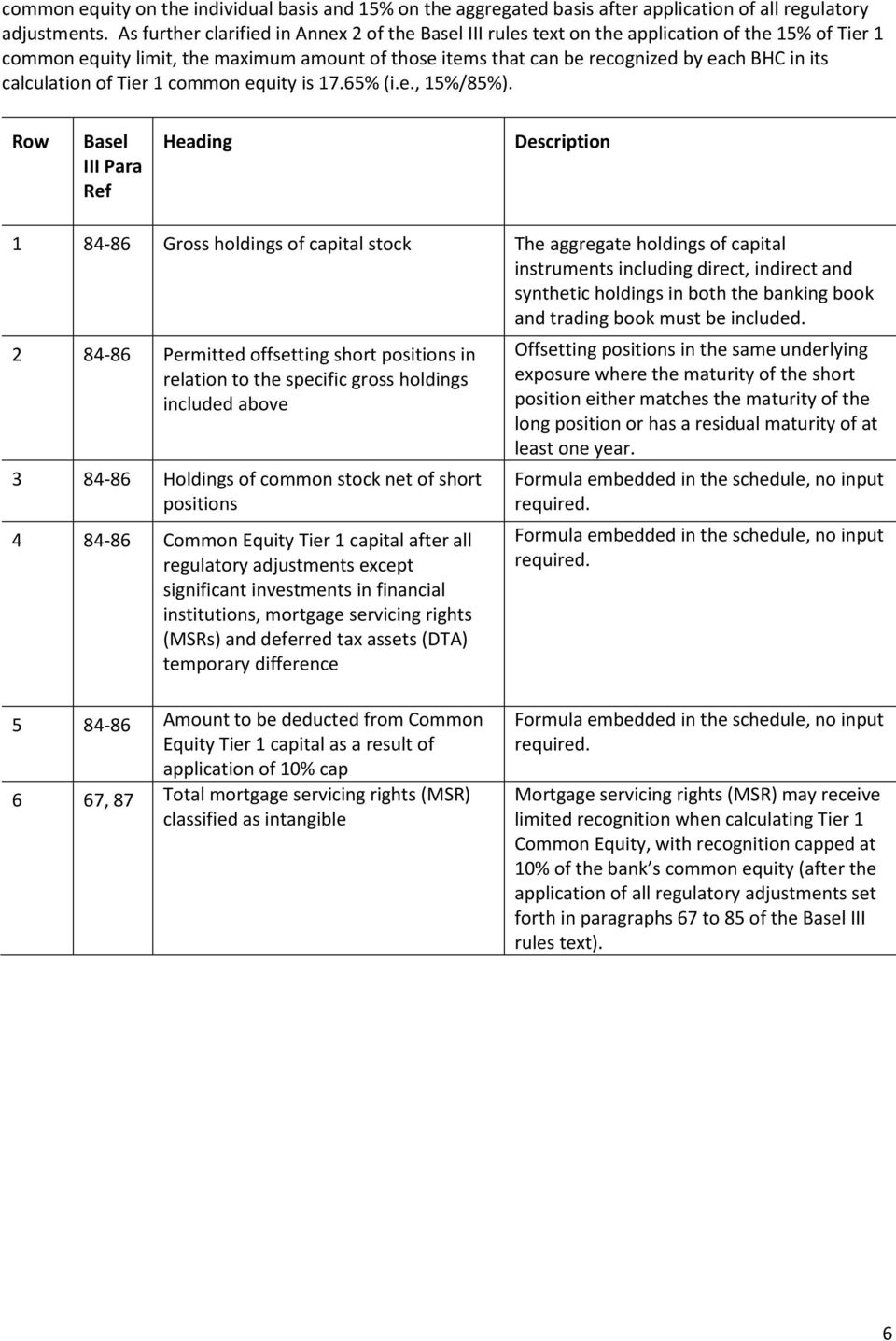
6 common equity on the individual basis and 15% on the aggregated basis after application of all regulatory adjustments. As further clarified in Annex 2 of the Basel III rules text on the application of the 15% of Tier 1 common equity limit, the maximum amount of those items that can be recognized by each BHC in its calculation of Tier 1 common equity is 17.65% (i.e., 15%/85%). Row Basel III Para Ref Heading Description Gross holdings of capital stock The aggregate holdings of capital instruments including direct, indirect and synthetic holdings in both the banking book and trading book must be included Permitted offsetting short positions in relation to the specific gross holdings included above Holdings of common stock net of short positions Common Equity Tier 1 capital after all regulatory adjustments except significant investments in financial institutions, mortgage servicing rights (MSRs) and deferred tax assets (DTA) temporary difference Offsetting positions in the same underlying exposure where the maturity of the short position either matches the maturity of the long position or has a residual maturity of at least one year. Formula embedded in the schedule, no input required. Formula embedded in the schedule, no input required Amount to be deducted from Common Equity Tier 1 capital as a result of application of 10% cap 6 67, 87 Total mortgage servicing rights (MSR) classified as intangible Formula embedded in the schedule, no input required. Mortgage servicing rights (MSR) may receive limited recognition when calculating Tier 1 Common Equity, with recognition capped at 10% of the bank s common equity (after the application of all regulatory adjustments set forth in paragraphs 67 to 85 of the Basel III rules text). 6
7 FR Y-14: Basel III and Dodd-Frank Schedule Instructions Row Basel III Para Ref Heading Description 7 67, 87 Associated deferred tax liability which would be extinguished if the intangible becomes impaired or derecognized under the relevant accounting standards 8 Mortgage servicing rights net of related tax liability 9 Common Equity Tier 1 after all regulatory adjustments except significant investments in financial institutions, mortgage servicing rights (MSR) s and deferred tax assets (DTA) temporary difference 10 Amount to be deducted from Common Equity Tier 1 capital as a result of application of 10% cap Net deferred tax assets due to temporary differences 12 Common Equity Tier 1 capital after all regulatory adjustments except significant investments in financials, mortgage servicing rights (MSR) and deferred tax assets (DTA) temporary differences 13 Amount to be deducted from Common Equity Tier 1 capital as a result of application of 10% cap 14 Significant investments in the common equity of financial entities not deducted as part of the 10% cap 15 Mortgage servicing rights not deducted as part of the 10% cap The amount of mortgage servicing rights (MSR) to be deducted from Tier 1 common equity can be net of any associated deferred tax liability when calculating Tier 1 Common Equity, with recognition capped at 10% of the bank s common equity (after the application of all regulatory adjustments set forth in paragraphs 67 to 85 of the Basel III rules text). If the bank chooses to net its deferred tax liabilities associated with mortgage servicing rights against deferred tax assets (in Row 17 of the Capital Composition worksheet), those deferred tax liabilities should not be deducted again here. Formula embedded in the schedule, no input required. Formula embedded in the schedule, no input required. Formula embedded in the schedule, no input required. Net deferred tax assets due to temporary differences may receive limited recognition when calculating Tier 1 Common Equity, with recognition capped at 10% of the bank s common equity (after the application of all regulatory adjustments set forth in paragraphs 67 to 85 of the Basel III rules text). Formula embedded in the schedule, no input required. Formula embedded in the schedule, no input required. Formula embedded in the schedule, no input required. Formula embedded in the schedule, no input required. 7

8 Row Basel III Para Ref Heading Description 16 Deferred tax assets due to temporary differences not deducted as part of the 10% cap 17 Sum of significant investments in financials, mortgage servicing rights (MSR) and deferred tax assets (DTA) temporary differences not deducted as a result of the 10% cap 18 Deduction from Common Equity Tier 1 capital in respect of amounts above the 15% cap Formula embedded in the schedule, no input required. Formula embedded in the schedule, no input required. Formula embedded in the schedule, no input required. Risk-Weighted Assets Worksheet In the Risk-Weighted Assets worksheet, BHCs should provide Basel II risk weighted asset estimates for portfolios not addressed in the Basel III capital framework inclusive of changes related to the capital treatment of securitization and traded exposures issued by the Basel Committee in July 2009 through July If a BHC s trading activity is below $1 billion or less than 10% of its total assets at 3Q 2011, the BHC does not need to complete the market risk-weighted asset section within the Basel III and Dodd Frank schedule. However, if the BHC projects to meet the trading activity threshold during 2012, then the BHC should complete the market risk-weighted asset section within the schedule, based on the Revisions to the Basel II market risk framework (updated as of December 31, 2010), regardless of whether the internal models have been approved. Additionally, the BHC should complete the market risk-weighted assets for all reporting periods beginning in 3Q A BHC unable to provide Basel II and III risk weighted asset estimates should send an to [email protected] to determine how to proceed. In doing so, BHCs should specify the affected portfolios, current limitations that preclude the BHC from providing Basel II estimates, as well as management s plan for addressing those limitations. Row Heading Description Credit risk (including Counterparty Credit Risk (CCR) and non-trading credit risk) Risk-weighted assets should reflect the 1.06 scaling factor to the Internal Rating-Based Approach (IRB) credit risk-weighted assets where relevant, unless noted otherwise. 1 Corporate Formula embedded in the schedule, no input required. 8

9 FR Y-14: Basel III and Dodd-Frank Schedule Instructions Row Heading Description 2 Corporate (not including receivables); Counterparty credit risk exposures (not including credit value adjustment (CVA) charges or charges for exposures to central counterparties (CCPs)) 3 Corporate (not including receivables); Other exposures Overall risk-weighted assets for corporate (not including receivables) counterparty credit risk exposures, not including credit value adjustment (CVA) capital charges or exposures to central counterparties (CCPs), after applying the 1.06 scaling factor to the Internal Rating- Based Approach (IRB) credit risk-weighted assets. Overall risk-weighted assets for other corporate exposures (not including receivables), after applying the 1.06 scaling factor to the Internal Rating-Based Approach (IRB) credit risk-weighted assets. 4 Sovereign Formula embedded in the schedule, no input required. 5 Sovereign; Counterparty credit risk exposures (not including credit value adjustment (CVA) charges or charges for exposures to central counterparties (CCPs)) Overall risk-weighted assets for sovereign counterparty credit risk exposures, not including credit value adjustment (CVA) capital charges or exposures to central counterparties (CCPs), after applying the 1.06 scaling factor to the Internal Rating-Based Approach (IRB) credit risk-weighted assets. 6 Sovereign; Other exposures Overall risk-weighted assets for other sovereign exposures, after applying the 1.06 scaling factor to the Internal Rating-Based Approach (IRB) credit riskweighted assets. 7 Bank Formula embedded in the schedule, no input required. 8 Bank; Counterparty credit risk exposures (not including credit value adjustment (CVA) charges or charges for exposures to central counterparties (CCPs)) Overall risk-weighted assets for bank counterparty credit risk exposures, not including credit value adjustment (CVA) capital charges or exposures to central counterparties (CCPs), after applying the 1.06 scaling factor to the Internal Rating-Based Approach (IRB) credit risk-weighted assets. 9 Bank; Other exposures Overall risk-weighted assets for other bank exposures, after applying the 1.06 scaling factor to the Internal Rating-Based Approach (IRB) credit risk-weighted assets. 10 Retail Formula embedded in the schedule, no input required. 11 Retail; Counterparty credit risk exposures (not including credit value adjustment (CVA) charges or charges for exposures to Central counterparties (CCPs)) Overall risk-weighted assets for retail counterparty credit risk exposures, not including credit value adjustment (CVA) capital charges or exposures to Central counterparties (CCPs), after applying the 1.06 scaling factor to IRB credit risk-weighted assets. 12 Retail; Other exposures Overall risk-weighted assets for other retail exposures, after applying the 1.06 scaling factor to the Internal Rating-Based Approach (IRB) credit risk-weighted assets. 9
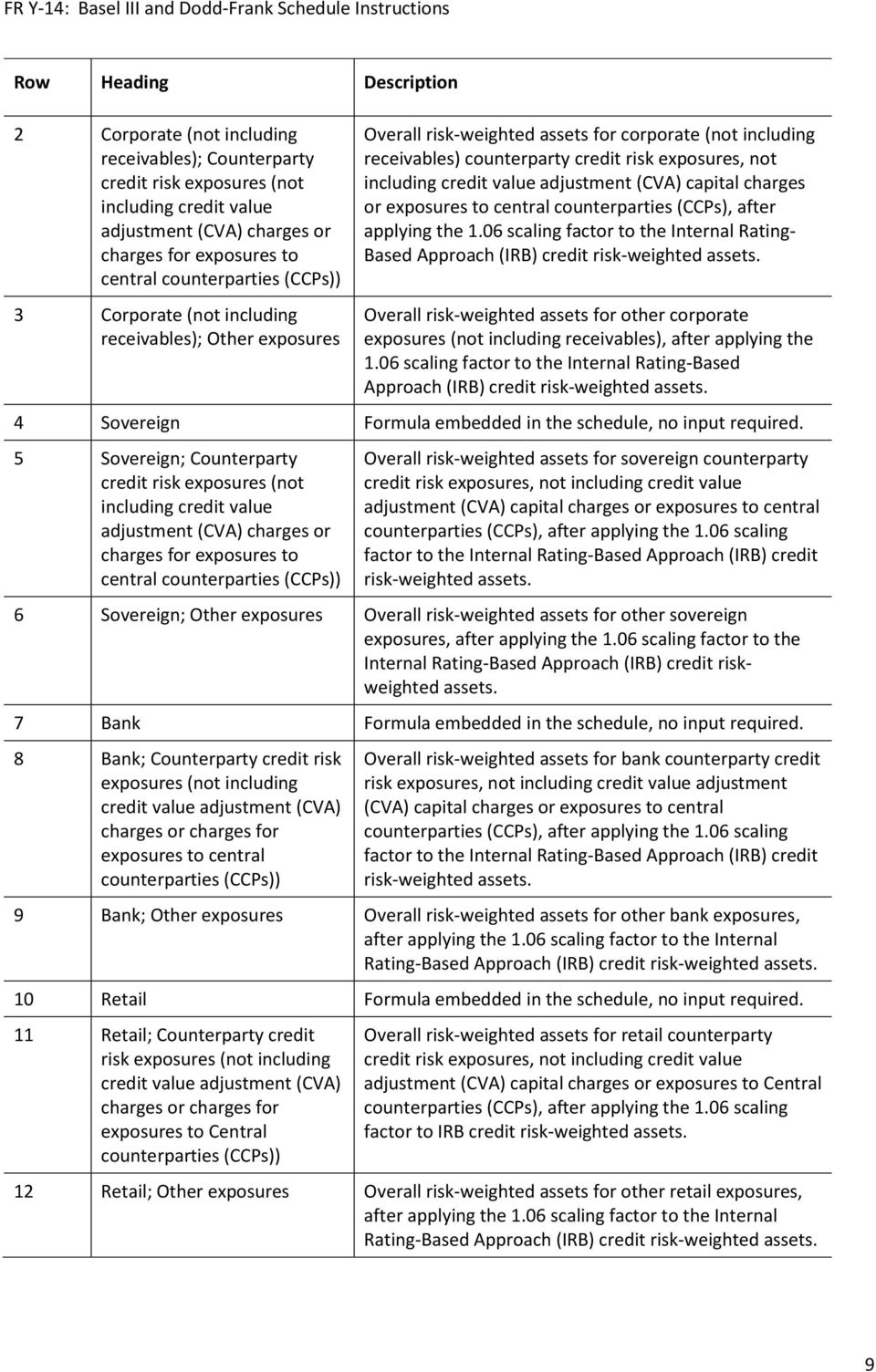
10 Row Heading Description 13 Equity Overall risk-weighted assets for equity exposures, where relevant after applying the 1.06 scaling factor to the Internal Rating-Based Approach (IRB) credit riskweighted assets. 14 Securitization Overall risk-weighted assets for securitizations that are held in the held-to-maturity or available-for-sale portfolios, where relevant after applying the 1.06 scaling factor to the Internal Rating-Based Approach (IRB) credit risk-weighted assets. 15 Trading Book Counterparty Credit Risk Exposures (if not included in above) 16 Credit value adjustment (CVA) Capital Charge (Risk-Weighted Asset Equivalent) 17 Advanced credit value adjustment (CVA) 18 Credit value adjustment (CVA) capital charge (risk-weighted asset equivalent); Advanced CVA; Unstressed Value at Risk (VaR) with multipliers Overall risk-weighted assets for counterparty credit risk exposures in the trading book if the BHC is not able to include them in the portfolio of the counterparty as specified above. Formula embedded in the schedule, no input required. Formula embedded in the schedule, no input required. Standalone 10-day value-at-risk calculated on the set of credit value adjustments (CVAs) (as specified in BCBS 189 Section II.A.1 paragraph 98 using expected exposure based on current parameter calibration) for all Over-thecounter (OTC) derivatives counterparties together with eligible credit value adjustment (CVA) hedges. The reported value-at-risk should consist of both general and specific credit spread risks and is restricted to changes in the counterparties credit spreads. The bank must multiply the reported value-at-risk by three times consistent with the approach used in calculating market risk capital charge (three-times multiplier). The 1.06 scaling factor does not apply. BHC should report 0 if it does not use the advanced credit value adjustment (CVA) approach. 10
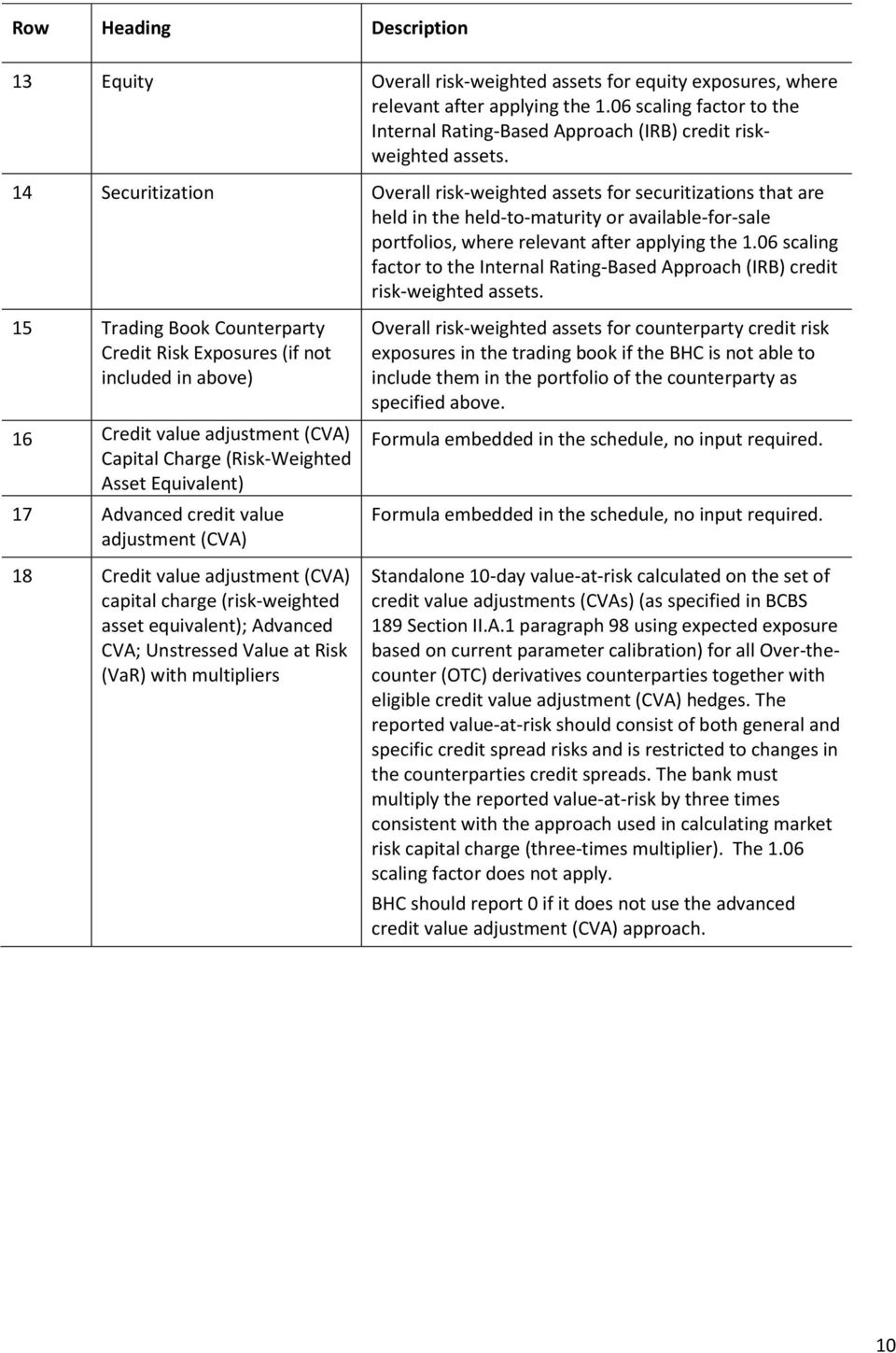
11 FR Y-14: Basel III and Dodd-Frank Schedule Instructions Row Heading Description 19 Credit value adjustment (CVA) capital charge (risk-weighted asset equivalent); Advanced CVA; Stressed Value at Risk (VaR) with multipliers 20 Credit value adjustment (CVA) capital charge (risk-weighted asset equivalent); Standardized CVA Standalone 10-day stressed Value-at-risk (VAR) calculated on the set of credit value adjustments (CVAs) (as specified in the Basel Committee on Banking Supervision (BCBS) 189 Section II.A.1 paragraph 98 using stressed exposure based on stress parameter calibrations) for all Over-the-counter (OTC) derivatives counterparties together with eligible credit value adjustments (CVA) hedges. The reported value-at-risk should consist of both general and specific credit spread risks and is restricted to changes in the counterparties credit spreads. It should reflect three-times multiplier. The 1.06 scaling factor does not apply. BHC should report 0 if it does not use the advanced credit value adjustments (CVA) approach Risk-weighted asset (RWA) equivalent of the standardized credit value adjustment (CVA) risk capital charge. 21 Other Credit Risk If the BHC is unable to assign credit risk-weighted assets to one of the above categories even on a best-efforts basis, they should be reported in this row. 22 Total Credit right-weighted assets (RWA) Formula embedded in the schedule, no input required. Market Risk If a BHC does not have a particular portfolio or no trading book at all, risk-weighted assets should be reported as Standardized Specific Risk (excluding securitization and correlation) 24 Value at Risk (VaR) with Multipliers (general and specific risk) 25 Stressed value-at-risk with Multipliers (general and specific risk) Risk-weighted asset (RWA) equivalent for specific risk based on the standardized measurement method as applicable. It should not include the risk-weighted assets according to the standardized measurement method for exposures included in the correlation trading portfolio or the standardized approach for other non-correlation related traded securitization exposures. BHC-wide 10-day value-at-risk (VaR) inclusive of all sources of risks that are included in the value-at-risk calculation. The reported value-at-risk should reflect actual multipliers as of the reporting date. BHC-wide 10-day stressed value-at-risk inclusive of all sources of risk that are included in the stressed value-atrisk calculation. The reported stressed value-at-risk should reflect actual multipliers as of the reporting date. 11
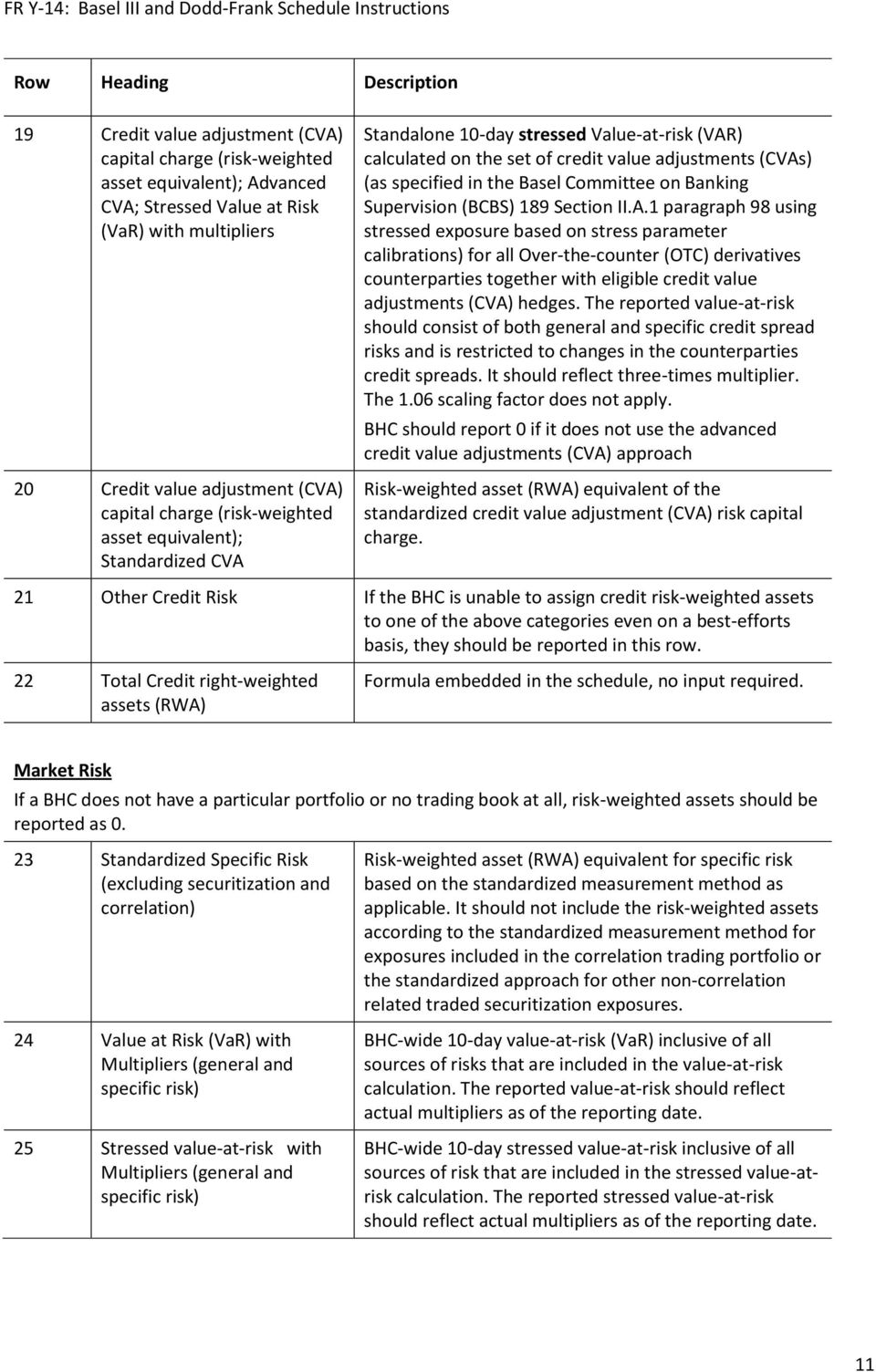
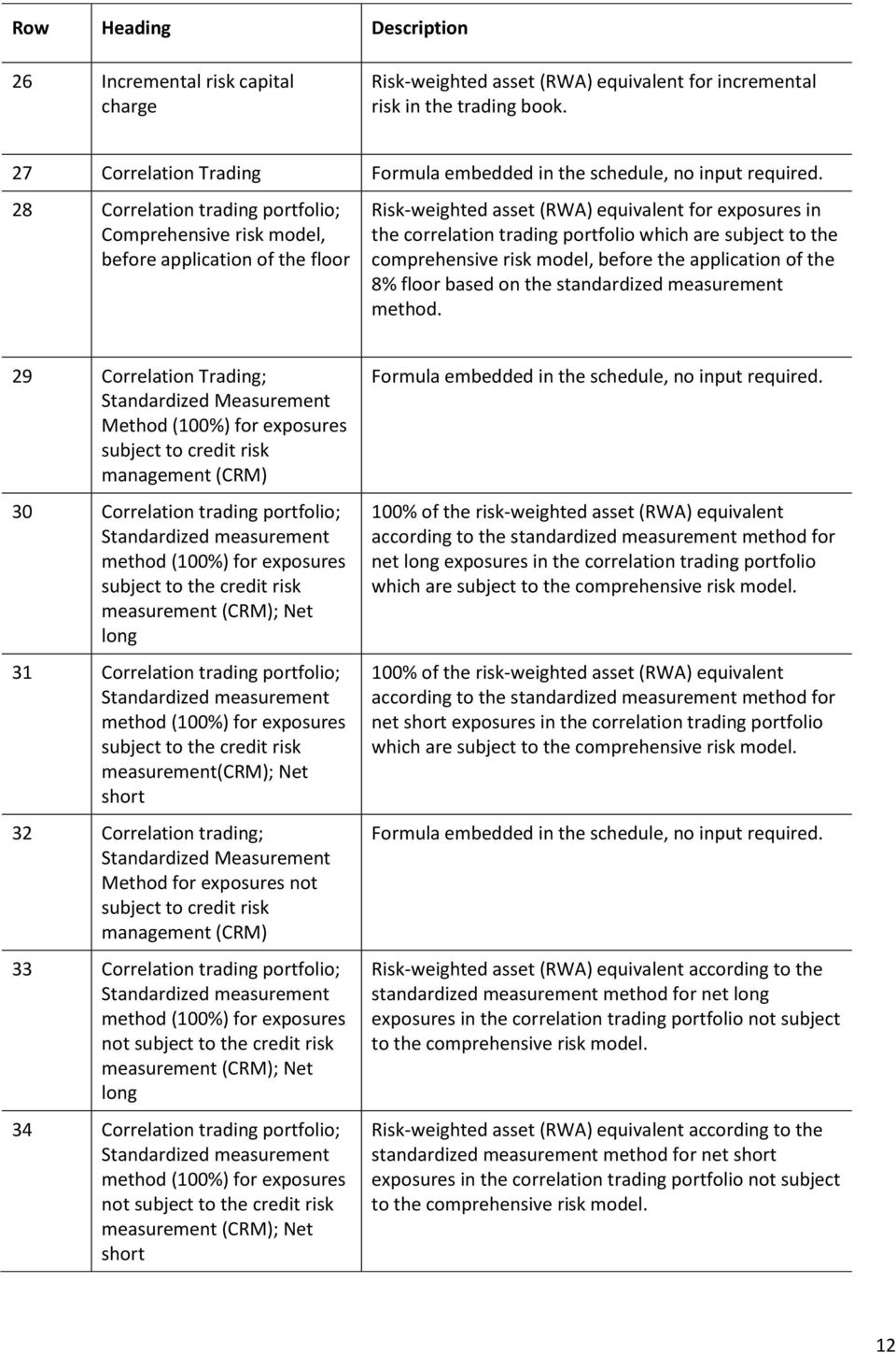
12 Row Heading Description 26 Incremental risk capital charge Risk-weighted asset (RWA) equivalent for incremental risk in the trading book. 27 Correlation Trading Formula embedded in the schedule, no input required. 28 Correlation trading portfolio; Comprehensive risk model, before application of the floor Risk-weighted asset (RWA) equivalent for exposures in the correlation trading portfolio which are subject to the comprehensive risk model, before the application of the 8% floor based on the standardized measurement method. 29 Correlation Trading; Standardized Measurement Method (100%) for exposures subject to credit risk management (CRM) 30 Correlation trading portfolio; Standardized measurement method (100%) for exposures subject to the credit risk measurement (CRM); Net long 31 Correlation trading portfolio; Standardized measurement method (100%) for exposures subject to the credit risk measurement(crm); Net short 32 Correlation trading; Standardized Measurement Method for exposures not subject to credit risk management (CRM) 33 Correlation trading portfolio; Standardized measurement method (100%) for exposures not subject to the credit risk measurement (CRM); Net long 34 Correlation trading portfolio; Standardized measurement method (100%) for exposures not subject to the credit risk measurement (CRM); Net short Formula embedded in the schedule, no input required. 100% of the risk-weighted asset (RWA) equivalent according to the standardized measurement method for net long exposures in the correlation trading portfolio which are subject to the comprehensive risk model. 100% of the risk-weighted asset (RWA) equivalent according to the standardized measurement method for net short exposures in the correlation trading portfolio which are subject to the comprehensive risk model. Formula embedded in the schedule, no input required. Risk-weighted asset (RWA) equivalent according to the standardized measurement method for net long exposures in the correlation trading portfolio not subject to the comprehensive risk model. Risk-weighted asset (RWA) equivalent according to the standardized measurement method for net short exposures in the correlation trading portfolio not subject to the comprehensive risk model. 12
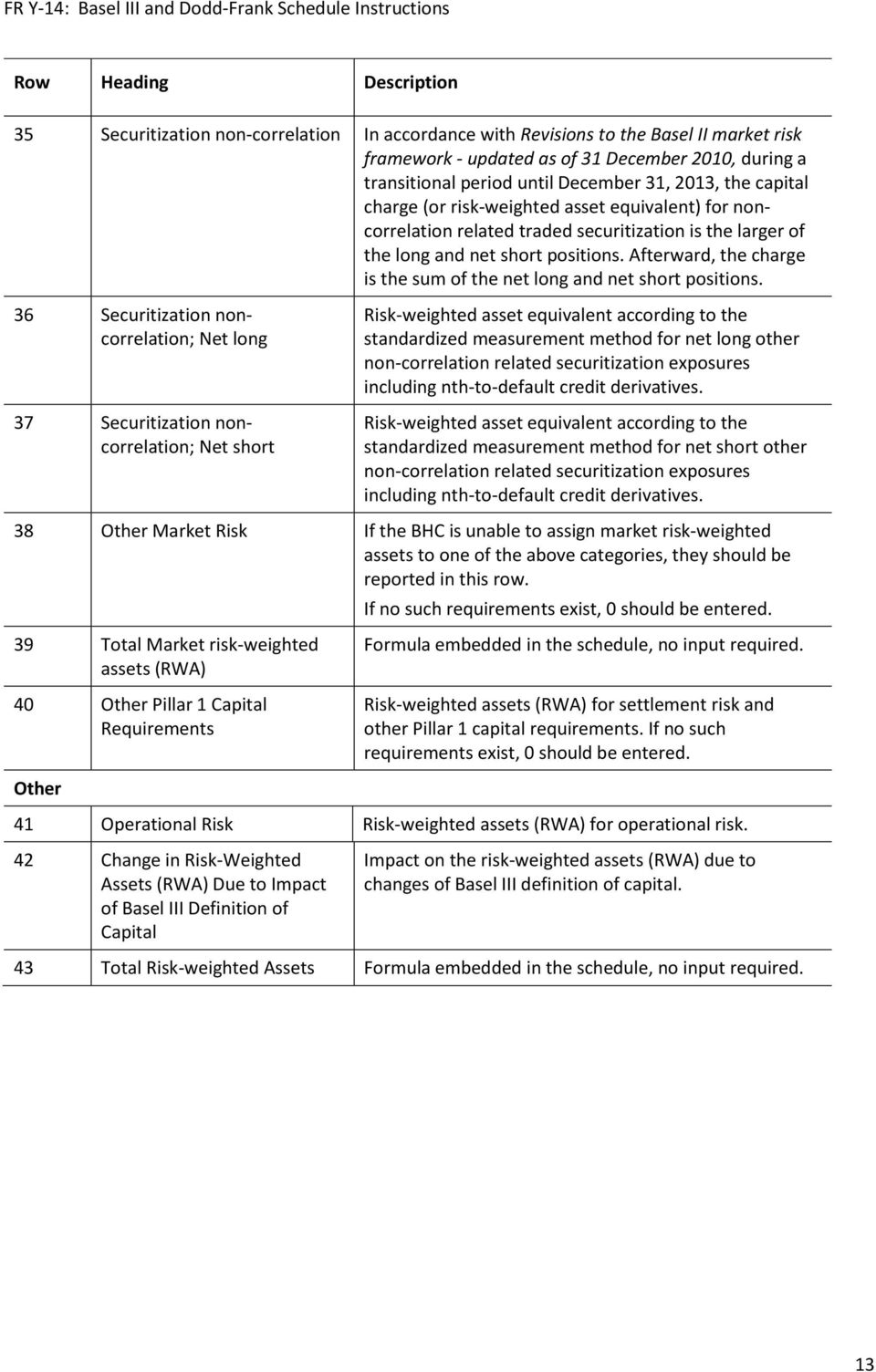
13 FR Y-14: Basel III and Dodd-Frank Schedule Instructions Row Heading Description 35 Securitization non-correlation In accordance with Revisions to the Basel II market risk framework - updated as of 31 December 2010, during a transitional period until December 31, 2013, the capital charge (or risk-weighted asset equivalent) for noncorrelation related traded securitization is the larger of the long and net short positions. Afterward, the charge is the sum of the net long and net short positions. 36 Securitization noncorrelation; Net long 37 Securitization noncorrelation; Net short Risk-weighted asset equivalent according to the standardized measurement method for net long other non-correlation related securitization exposures including nth-to-default credit derivatives. Risk-weighted asset equivalent according to the standardized measurement method for net short other non-correlation related securitization exposures including nth-to-default credit derivatives. 38 Other Market Risk If the BHC is unable to assign market risk-weighted assets to one of the above categories, they should be reported in this row. If no such requirements exist, 0 should be entered. 39 Total Market risk-weighted assets (RWA) 40 Other Pillar 1 Capital Requirements Formula embedded in the schedule, no input required. Risk-weighted assets (RWA) for settlement risk and other Pillar 1 capital requirements. If no such requirements exist, 0 should be entered. Other 41 Operational Risk Risk-weighted assets (RWA) for operational risk. 42 Change in Risk-Weighted Assets (RWA) Due to Impact of Basel III Definition of Capital Impact on the risk-weighted assets (RWA) due to changes of Basel III definition of capital. 43 Total Risk-weighted Assets Formula embedded in the schedule, no input required. 13
14 Leverage Exposure Worksheet BHCs should report the average as of quarter end for the relevant period by including averages of the exposures calculated on a monthly basis. Exposure measure of the leverage ratio is defined by the Basel III rules text. BHCs that are unable to calculate monthly data may report exposures as of the quarter end (i.e., not the average over the quarter of exposures calculated monthly). Row Heading Description 1 On-Balance Sheet Derivatives, Basel II Netting 2 Derivatives, Potential Future Exposure Applying Basel II Netting Total derivatives exposure (sum of positive fair values) with Basel II netting rules (i.e., positive net current derivatives exposure on a netting set-by-netting set basis, where those netting sets meet Basel II netting requirements, summed across counterparties). Both derivatives traded over-thecounter (OTC) and on an exchange or through a central counterparty (CCP) should be included. They do not include initial or variation margin credits. Regulatory potential future exposure (PFE) of derivatives when applying the current exposure method and Basel II netting rules. The PFE is calculated by multiplying the derivative s notional principal amount by a factor that is based on type of derivative contract and residual maturity. For derivatives contracts in bilateral netting sets that meet the Basel II netting requirements, the PFE is the adjusted sum of the PFE exposure for all over-the-counter (OTC) derivative contracts subject to the qualifying master netting agreement. (Reference Annex 4; paragraph 96(iv) of the Basel II framework.) 14

15 FR Y-14: Basel III and Dodd-Frank Schedule Instructions Row Heading Description 3 On-Balance Sheet Securities Financing Transactions, Basel II Netting 4 Other On-Balance Sheet Items, (Excluding Derivatives and Securities Financing Transactions) 5 Off-Balance Sheet Items (excluding derivatives) 6 Off-Balance Sheet Items (excluding derivatives) - Unconditionally Cancellable Commitments eligible for 10% credit conversion factors (CCF) Securities financing transactions (SFTs) as defined by the Basel II framework (i.e., transactions such as repurchase agreements, reverse repurchase agreements, security lending and borrowing, and margin lending transactions, where the value of the transactions depends on the market valuations and the transactions are often subject to margin agreements), when representing an asset on the accounting balance sheet. BHCs should report the sum of the net positive current exposures, determined on a netting set-by-netting set basis, where those netting sets meet Basel II netting requirements. The net positive exposure is determined by netting the exposure amounts and collateral (e.g., the sum of the market value of all securities and cash lent to the counterparty, less the sum of all securities and cash received from the counterparty as collateral under the bank's agreement). Include any securities financing transactions (SFTs) that are traded over-the-counter (OTC) or on an exchange, or through a central counterparty (CCP). All other assets that are carried on the balance sheet that are not specifically identified in rows one and three above. Other on-balance sheet assets may include cash, loans, securities, trading assets, fixed assets, and failed and unsettled transactions. Formula embedded in the schedule, no input required. All commitments that are unconditionally cancellable at any time by the BHC without prior notice are to be converted to credit equivalent amounts using a 10% credit conversion factors (CCF). 7 All other Off-Balance Sheet Items (excluding derivatives and off-balance sheet Securities Financing Transactions) ) All other off-balance sheet items that are subject to riskbased capital (RBC) requirements are to be converted to on-balance sheet credit equivalent amounts using a uniform 100% credit conversion factors (CCF). The 100% CCF is to be applied regardless of the CCF that would otherwise have been applied to such exposures under the RBC requirements. Exclude commitments that are eligible for the 10% CCF, operational risk exposures, off-balance sheet securities financing transactions (SFTs) and derivatives. 15

16 Row Heading Description 8 Amounts Deducted from Tier 1 Capital (Report as Negative) Formula embedded in the schedule, no input required. Planed Actions Worksheet For the purpose of completing the Planed Actions worksheet of the Basel III and Dodd-Frank schedule, BHCs should capture all material planned actions, including, but not limited to, the roll-off or sale of an existing portfolio, the issuance of regulatory capital instruments and other strategic corporate actions. For each planned action, BHCs should provide a brief description. In addition, BHCs should submit the incremental quantitative impact on Tier 1 common equity, Tier 1 riskbased capital, risk-weighted assets (RWA), and leverage exposures for each year as of year-end. The quantitative impact of planned actions submitted by BHCs should represent the stand-alone, incremental immediate impact of the action relevant to the time period in which it is planned to be executed. For example, if a planned action were forecasted to reduce the BHC s risk-weighted assets by $200 million as of 4Q 2013 and an additional $100 million as of 4Q 2014 (for a total reduction of $300 million), the BHC should report 200 for 4Q 2013, 100 for 4Q 2014, and 0 for subsequent periods. However, when evaluating the impact of the planned actions, BHCs should include an assessment of how each of these actions will comprehensively impact the firm. BHCs are required to factor in the combined impact of all planned actions on all other relevant worksheets of the Basel III submission. BHCs should provide a more detailed description of each material action in a separate attachment(s). The documentation should include: How each material planned action aligns with the BHC s long term business strategy and risk appetite on a going concerns basis; Assessment of each material planned action by taking into account potential capital and earnings impact, overall risk profile, and funding need; Assessment of market condition and capacity around planned actions including the BHC s planned sale size, availability, and appetite of buyers and other potential sellers; Assessment of impediments to plan actions (e.g., contractual, accounting or structural limitation); Whether there are recent transactions from either the BHC or other institutions that would demonstrate the ease of sales or unwind. Column Heading Description A Description Brief description of the planned action the BHC wishes to implement. B Action Type A selection from a list of available actions provided in the schedule. C Exposure Type A selection from a list of available exposure types provided in the schedule. 16

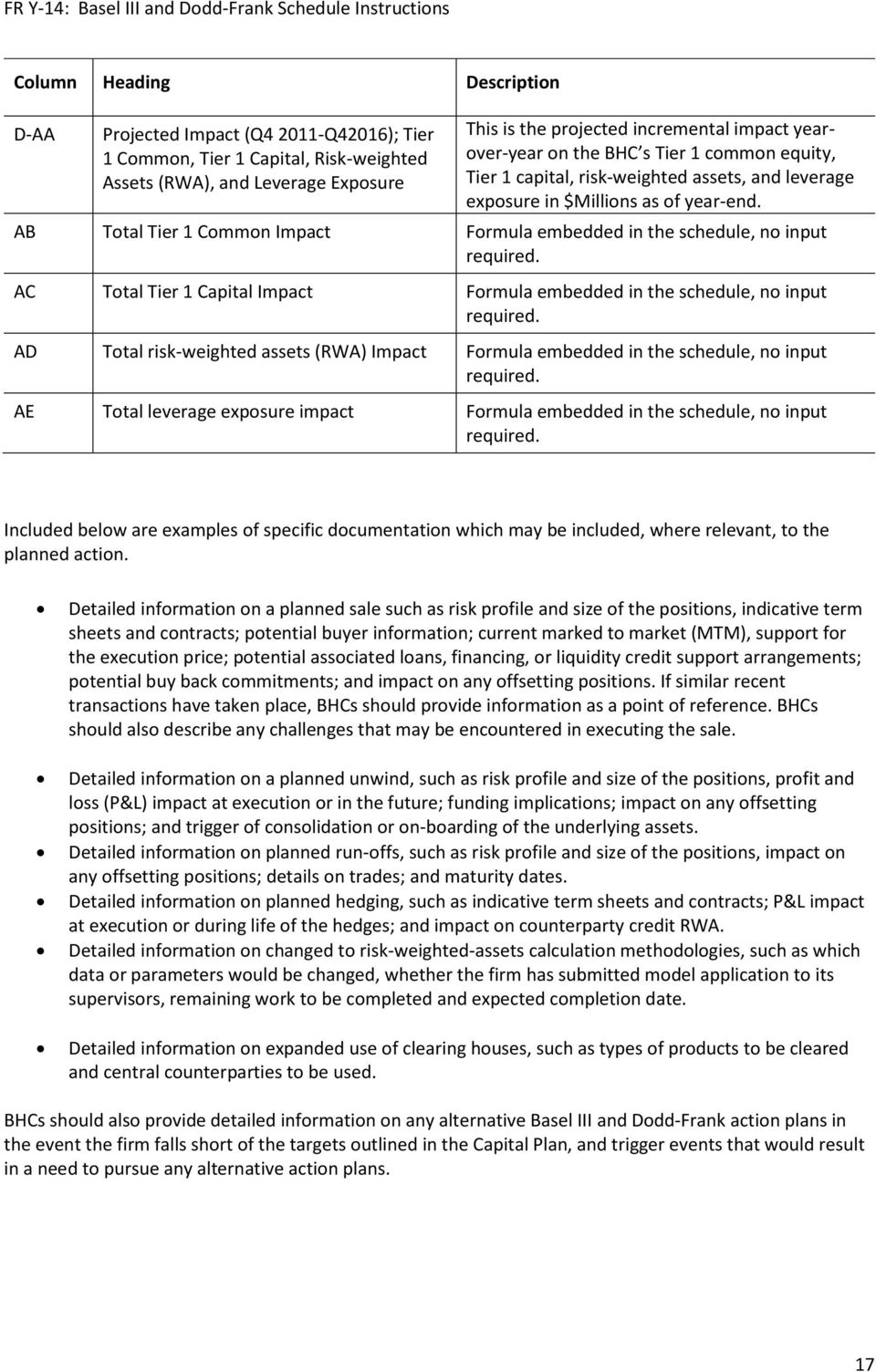
17 FR Y-14: Basel III and Dodd-Frank Schedule Instructions Column Heading Description D-AA Projected Impact (Q Q42016); Tier 1 Common, Tier 1 Capital, Risk-weighted Assets (RWA), and Leverage Exposure This is the projected incremental impact yearover-year on the BHC s Tier 1 common equity, Tier 1 capital, risk-weighted assets, and leverage exposure in $Millions as of year-end. AB Total Tier 1 Common Impact Formula embedded in the schedule, no input required. AC Total Tier 1 Capital Impact Formula embedded in the schedule, no input required. AD Total risk-weighted assets (RWA) Impact Formula embedded in the schedule, no input required. AE Total leverage exposure impact Formula embedded in the schedule, no input required. Included below are examples of specific documentation which may be included, where relevant, to the planned action. Detailed information on a planned sale such as risk profile and size of the positions, indicative term sheets and contracts; potential buyer information; current marked to market (MTM), support for the execution price; potential associated loans, financing, or liquidity credit support arrangements; potential buy back commitments; and impact on any offsetting positions. If similar recent transactions have taken place, BHCs should provide information as a point of reference. BHCs should also describe any challenges that may be encountered in executing the sale. Detailed information on a planned unwind, such as risk profile and size of the positions, profit and loss (P&L) impact at execution or in the future; funding implications; impact on any offsetting positions; and trigger of consolidation or on-boarding of the underlying assets. Detailed information on planned run-offs, such as risk profile and size of the positions, impact on any offsetting positions; details on trades; and maturity dates. Detailed information on planned hedging, such as indicative term sheets and contracts; P&L impact at execution or during life of the hedges; and impact on counterparty credit RWA. Detailed information on changed to risk-weighted-assets calculation methodologies, such as which data or parameters would be changed, whether the firm has submitted model application to its supervisors, remaining work to be completed and expected completion date. Detailed information on expanded use of clearing houses, such as types of products to be cleared and central counterparties to be used. BHCs should also provide detailed information on any alternative Basel III and Dodd-Frank action plans in the event the firm falls short of the targets outlined in the Capital Plan, and trigger events that would result in a need to pursue any alternative action plans. 17
18 FR Y-14A: Basel III & Dodd-Frank (D-F) Cover Sheet Institution Name: RSSD ID: Date of Data Submission: Please describe the baseline scenario associated with this submission. It should be consistent with that used for other capital plan baseline projections. Please specify the time period over which management expects to comply fully with the Basel III capital framework and related provisions of D-F that will affect regulatory capital: Note: BHCs should contact should they need to insert additional columns in the accompanying worksheets to reflect management's timeline as specified above. Please refer to the Basel III & Dodd-Frank Schedule Instructions when completing this schedule.

19 Basel III Capital Composition B C D E F G H I J BCBS Implementation Monitoring $ Millions $ Millions DefCapB3 tab 2 Actual Projected Q Q Q Q Q Q Q Basel III Tier 1 Common 1 Common Stock and Related Surplus (Net of Treasury Stock) Line 30 2 Retained Earnings Line 31 3 Accumulated Other Comprehensive Income Line 32 4 Unrealized Gains and Losses on Available-for-Sale Items Line 33 5 Gains and Losses on Derivatives Held as Cash Flow Hedges Line 34 6 Gains and Losses Resulting from Converting Foreign Currency Subsidiaries to the Parent Currency (If Applicable) Line 35 7 Actuarial Reserve (If Applicable) Line 36 8 Unrealized Gains and Losses from a Foreign Currency Hedge of a Net Investment in a Foreign Operation (If Applicable) Line 37 9 All Other Reserves (If Applicable) Line Other Equity Capital Components (Including Unearned Employee Stock Ownership Program Shares) 11 Total Tier 1 Common attributable to Parent Company Common Shareholders Line Minority Interest Included in Tier 1 Common Line Total Group Tier 1 Common Prior to Regulatory Adjustments Line Deductions 15 Goodwill, Net of Related Deferred Tax Liability Line Intangibles Other than Mortgage Servicing Rights, Net of Related Deferred Tax Liability Line Deferred Tax Assets (Excluding Temporary Differences Only), Net of Related Deferred Tax Liabilities Line Investments in Own Shares (Excluding Treasury Stock) Line Reciprocal Cross Holdings in Common Equity Line Shortfall of Provisions to Expected Losses Line Cash Flow Hedge Reserve (If Gain, Report as Positive; If Loss, Report as Negative) Line Cumulative G/L Due to Changes in Own Credit Risk on Fair Valued Liabilities (If Gain, Report as Positive; If Loss, Report as Negative) Line Defined Benefit Pension Fund Assets Line Securitization Gain on Sale Line Total Tier 1 Common After Deductions Above Line Insignificant Investments in the Common Share of Unconsolidated Financial Entities That Exceed 10% of Tier 1 Common (line 25) 1 Line Total Tier 1 Common After the Regulatory Adjustments Above Line Significant Investments in the Common Stock of Financial Entities (Amount Above 10% Threshold) Line Mortgage Servicing Rights (Amount Above 10% Threshold) Line Deferred Tax Assets Arising from Temporary Differences (Amount Above 10% Threshold) Line Total Common Equity Tier 1 Capital After the Regulatory Adjustments Above Line Regulatory Adjustments to be Applied to Common Equity Tier 1 Due to Insufficient Additional Tier 1 to Cover Deductions Line Total Common Equity Tier 1 Capital After the Regulatory Adjustments Above Line Amount Exceeding the 15% Threshold Line Tier 1 Common Line 63 Basel III Tier 1 Capital 36 Non-common Tier 1 Capital Instruments Line Minority Interest Included in Tier 1 Capital Line Deductions 39 Regulatory Adjustments to be Deducted from Additional Tier 1 Capital Line Tier 2 Regulatory Adjustments Which have to be Deducted from Additional Tier 1 Capital Line Tier 1 Capital Line 75 Data Completeness Check (If "No", please complete all non shaded cells until all cells to the right say "Yes." Do not leave cells blank; enter "0" if not applicable.) No No No No No No No Footnotes: 1 Investments in the capital of financial entities where the bank does not own more than 10% of the issued common share capital. 2 For BHCs participating in the Basel Committee on Bank Supervision's Basel III Implementation Monitoring exercise, this column provides the corresponding tab name and cells. References are made according to the September 2011 version of "Instructions for Basel III Implementation Monitoring." Line

20 Basel III "Exception Bucket" Calculator B C D E F G H I BCBS Implementation Monitoring $ Millions $ Millions DefCapB3 tab 2 Actual Projected Significant investments in the capital of unconsolidated financial entities 1 1 Gross holdings of common stock Line Permitted offsetting short positions in relation to the specific gross holdings included above Line Holdings of common stock net of short positions Line Common Equity Tier 1 capital after all regulatory adjustments except significant investments in financials, MSRs and DTA temporary difference Line Amount to be deducted from Common Equity Tier 1 capital as a result of application of 10% cap Line 220 Mortgage servicing rights 6 Total mortgage servicing rights classified as intangible Line Associated deferred tax liability which would be extinguished if the intangible becomes impaired or derecognized under the relevant accounting standards Line Mortgage servicing rights net of related tax liability Line Common Equity Tier 1 after all regulatory adjustments except significant investments in financials, MSRs and DTA temporary difference Line Amount to be deducted from Common Equity Tier 1 capital as a result of application of 10% cap Line 230 Deferred tax assets due to temporary differences 11 Net deferred tax assets due to temporary differences Line Common Equity Tier 1 capital after all regulatory adjustments except significant investments in financials, MSRs and DTA temporary differences Line Amount to be deducted from Common Equity Tier 1 capital as a result of application of 10% cap Line 235 Aggregate of items subject to the 15% limit (significant investments in financial institutions, mortgage servicing rights and DTAs that arise from temporary differences) 14 Significant investments in the common equity of financial entities not deducted as part of the 10% cap Line Mortgage servicing rights not deducted as part of the 10% cap Line Deferred tax assets due to temporary differences not deducted as part of the 10% cap Line Sum of significant investments in financials, mortgage servicing rights and DTA temporary differences not deducted as a result of the 10% cap Line Deduction from Common Equity Tier 1 capital in respect of amounts above the 15% cap Line 242 Footnotes: Q Q Q Q Q Q Data Completeness Check (If "No", please complete all non shaded cells until all cells to the right say "Yes." Do not leave cells blank; enter "0" if not applicable.) No No No No No No 1 Significant investments in the capital of unconsolidated banking, financial and insurance entities (i.e. where the bank owns more than 10% of the issued common share capital or where the entity is an affiliate), excluding amounts held for underwriting purposes only if held for 5 working days or less. 2 For BHCs participating in the Basel Committee on Bank Supervision's Basel III Implementation Monitoring exercise, this column provides the corresponding tab name and cells. References are made according to the September 2011 version of "Instructions for Basel III Implementation Monitoring."

21 Basel III Risk-weighted Assets 1, 2 B C D E F G H I J BCBS Implementation Monitoring $ Millions $ Millions General Info tab 4 Actual Projected Q Q Q Q Q Q Q Credit risk (Including CCR and non-trading credit risk), with 1.06 scaling factor 1 Corporate E77 2 Counterparty Credit Risk Exposures (not including CVA charges or charges to CCPs) G78 3 Other Exposures G80 4 Sovereign E81 5 Counterparty Credit Risk Exposures (not including CVA charges or charges to CCPs) E82 6 Other Exposures E83 7 Bank E84 8 Counterparty Credit Risk Exposures (not including CVA charges or charges to CCPs) G85 9 Other Exposures G86 10 Retail E87 11 Counterparty Credit Risk Exposures (not including CVA charges or charges to CCPs) E88 12 Other Exposures E89 13 Equity E90 14 Securitization G92 15 Trading Book Counterparty Credit Risk Exposures (if not included in above) E97 16 CVA Capital Charge (Risk-Weighted Asset Equivalent) E98 17 Advanced CVA G99 18 Unstressed VaR with multipliers G99 19 Stressed VaR with multipliers G99 20 Standardized CVA G Other Credit Risk E91, E93, E94, E95, E96 22 Total Credit RWA E106 Market risk 23 Standardized Specific Risk (excluding securitization and correlation) D111, D112, D VaR with multiplier D117& D Stressed VaR with multiplier D Incremental Risk Charge (IRC) D Correlation Trading 3 D Comprehensive Risk Measurement (CRM), Before Application of Floor D Standardized Measurement Method (100%) for Exposures Subject to the CRM D CRM Floor Based on 100% of Standardized - Net Long D CRM Floor Based on 100% of Standardized - Net Short D Standardized Measurement Method for Exposures Not Subject to CRM D Net Long D Net Short D Securitization Non-correlation 3, 5 D Net Long D Net Short D Other Market Risk D Total Market RWA D134 Other 40 Other Pillar 1 Capital Requirements D137, Operational Risk D Change in Risk-Weighted Assets Due to Impact of Basel III Definition of Capital D Total Risk-weighted Assets D187 Data Completeness Check (If "No", please complete all non shaded cells until all cells to the right say "Yes." Do not leave cells blank; enter "0" if not applicable.) No No No No No No No Footnotes: 1 Amounts calculated as capital requirements should be converted to risk-weighted assets by multiplying by Any assets deducted from capital should not be included in risk-weighted assets. 3 For credit derivatives, the exposure basis to be risk weighted should be the mark-to-market of the underlying, consistent with the last round of QIS instructions. 4 For BHCs participating in the Basel Committee on Bank Supervision's Basel III Implementation Monitoring exercise, this column provides the corresponding tab name and cells. References are made according to the September 2011 version of "Instructions for Basel III Implementation Monitoring." 5 In accordance with Revisions to the Basel II market risk framework issued by the Basel Committee (updated as of 31 December 2010), during a transitional period until December 31, 2013, the charge for securitization non-correlation is the larger of the net long and net short positions. Afterward, the charge is the sum of net long and net short positions.
22 Basel III Leverage Exposures (quarterly averages) B C D E F G H I J BCBS Implementation Monitoring $ Millions $ Millions Leverage Ratio tab 1 Actual Q Q Q Projected Q Q Q Q On-Balance Sheet Derivatives, Basel II Netting Line 8 2 Derivatives, Potential Future Exposure Applying Basel II Netting Line 21 3 On-Balance Sheet Securities Financing Transactions, Basel II Netting Line 12 4 Other On-Balance Sheet Items, Gross Value (Excluding Derivatives and Securities Financing Transactions) Line 13 5 Off-Balanace Sheet Items (excluding derivatives) 6 Of Which: Unconditionally Cancellable Commitments eligible for 10% CCF Line 27,28 7 Of Which: All Other Line Amounts Deducted from Tier 1 Capital (Report as Negative) Line 87 9 Total Exposures for Basel III Leverage Exposure Line 88 Data Completeness Check (If "No", please complete all non shaded cells until all cells to the right say "Yes." Do not leave cells blank; enter "0" if not applicable.) No No No No No No No
23 Basel III Planned Actions $ Millions A B C D E F G H I J K L M N O P Q R S T U V W X Y Z AA AB AC AD AE AF Q Q Q Q Q Q Total Action # Description Action Type Exposure Type Tier 1 Common Tier 1 RWA Leverage Exposure Tier 1 Common Tier 1 RWA Leverage Exposure Tier 1 Common Tier 1 RWA Leverage Exposure Tier 1 Common Tier 1 RWA Leverage Exposure Tier 1 Common Tier 1 RWA Leverage Exposure Tier 1 Common Tier 1 RWA Leverage Exposure Tier 1 Common Tier 1 RWA Leverage Exposure Total impact of planned actions Reported changes from prior period Check
24 FR Y-14A: Counterparty Credit Risk / CVA Data Submission Cover Sheet See tabs "CCR Data Dictionary " and "CCR Instructions to firms " for additional guidance on completing these worksheets. BHCs should complete all relevant cells in the corresponding worksheets, including this cover page. Data should be reported in millions of dollars. Institution Name: RSSD ID: Submission date: Data as of date: Version When Received: 12/15/11 3:47 PM CCR Cover Sheet 1
25 FR Y-14A: CCR data schedule - Instructions Data format: Provide the output that meets the criteria outlined below. Future time buckets (tabs 2a and 2b): The level of granularity of future revaluation time buckets should be at the level used to calculate CVA at the BHC, and should be as granular as available. Data format: Provide the data in the format used in this schedule. 1) Readability. Data must be in machine readable format. Tabs 1a, 1b, 1c, and 1d provide data at the counterparty level (unit of observation = counterparty). Tab 2a provides all available data at the counterparty + tenor bucket level (unit of observation = counterparty + tenor bucket). Tab 3a provides data at the counterparty level for each date of market data inputs used. 2) Mergeability. Unique identifiers must be consistent across tabs. In particular, it must be possible to merge tabs 1a, 2a, and 3a on the variables Counterparty Name, Counterparty ID and industry. If any counterparty IDs are missing from tab 2a, provide an explanation. Counterparty identification: All counterparties must have a unique counterparty identifier. In addition, the name of the counterparty should be provided. As discussed above, other unique identifiers may be required depending on the form of the data provided. Tab Notes to the CCR Schedule Use this tab(s) to submit voluntarily any additional information (e.g., data) that gives clarity on the portfolio. More than one additional tab may be provided. If the BHC elects to provide additional data, this should include an explanation of the additional data and why it is provided. If the data links to data in other tabs of the CCR schedule, then a clear data identifier must be provided such that tabs may be merged if necessary (see mergeability details above). CCR Instructions to firms 1
26 FR Y-14A:CCR Data dictionary TAB DATA FIELD DESCRIPTION / DEFINITION Counterparty All tabs: Counterparty identifiers - These must be consistent across tabs in order to enable linking. Generally speaking, a counterparty should be defined at the level at which the BHC calculates credit valuation adjustment (CVA). For many counterparties, all netting sets within the parent company will be a single counterparty; however if there are different market spreads attached to different legal entities, those should be considered separate counterparties. Counterparty name Counterparty ID Netting set ID (optional) Sub-netting set ID (optional) Industry Counterparty name should be a recognizable name rather than a code. Counterparty identifier. This field is optional. Netting sets should map to ISDA master aggreements. This field is optional. Used if your BHC calculates CVA below the netting set level. Use the industries that are provided in the drop down menu in each of the relevant tabs, which are broken down into the following categories: 1. Dealers and non-dealer banks 2. Financial guarantors / monolines 3. SPVs 4. Other financials 5. Non-financial corporates 6. Sovereigns 7. Local authorities 8. Other CCR Data dictionary 1
27 1) CVA Ratings data in tab 1e) should be the sum of the specific data field (e.g., Net CE, CVA) by internal ratings category and whether the netting set is collateralized or not. Gross CE Stressed Gross CE Net CE Stressed Net CE CVA Stressed CVA Gross CE (sometimes referred to as the replacement cost or current credit exposure) is the fair value of a derivative contract when that fair value is positive. Gross CE is zero when the fair value is negative or zero. For purposes of this schedule, Gross CE to an individual counterparty should be derived as follows: Determine whether a legally enforceable bilateral netting agreement is in place between the reporting BHC and the counterparty. If such an agreement is in place, the fair values of all applicable derivative contracts with that counterparty that are included in the scope of the netting agreement are netted to a single amount, which may be positive, negative, or zero. Report Gross CE when the fair value is positive, report it as a zero when the fair value is negative or zero. The full revaluation of Gross CE under stressed conditions. The sum of positive Gross CE netting agreements for a given counterparty less the value of collateral posted by the counterparty to secure those trades. Net CE should be reported after counterparty netting and after collateral. Net CE should reflect any excess collateral posted by the BHC to the counterparty. The full revaluation of Net CE under stressed conditions. Hold collateral constant; assume no additional collection of collateral. The balance of all credit valuation adjustments (CVA), gross of hedges, for asset-side, unilateral CVA. Report CVA as a positive value. CVA is an adjustment made to the market or fair value of derivatives receivables to take into account the credit risk of a counterparty. This is different from "Net CVA", which would be equivalent to CVA less debt valuation adjustment (DVA). Provide an explanation for counterparties where this does not hold (e.g., adjustments). The full revaluation of asset-side CVA under stressed conditions. Stressed CVA should incorporate the full revaluation of exposure, probability of default (PD), and loss given default (LGD) under stressed conditions. CSA in place? Indication of whether at least one of the netting sets comprising this counterparty has a legally enforceable collateral agreement, for example, Credit Support Annex (CSA), in place. "Y" for yes, "N" for no. % Gross CE with CSAs Percentage of Gross CE that is associated with netting sets that have a legally enforceable collateral agreement in place. For example, if there are two netting sets, one collateralized and one not, with equal Gross CEs in both netting sets, fill in 50%. Collateralized counterparty Internal Rating External Rating Collateralized netting set A collateralized counterparty is a counterparty with at least one netting set with a legally enforceable collateral agreement in place. The reporting BHC's internal rating of the counterparty. The external rating associated with the counterparty's internal rating, not the external rating associated with the specific counterparty. Provide an external rating from a Nationally Recognized Statistical Rating Organization (NRSRO). Netting sets with a CSA agreement in place. CCR Data dictionary 2
28 2) EE profile Tenor bucket in years The time provided should be as granular as possible. Use years as the unit. For example, if the time is 6 months, the BHC should report 0.5 not 6. EE - BHC specification The (unstressed) Expected Exposure (EE) metric used to calculate CVA for each tenor bucket. Along each simulation path, the exposure at time t used to estimate EE(t) should be non-negative; if any exposures along a simulation path calculated at time t are negative, these should be set to 0 before calculating the expected value. The EE reference point refers to the end-point of the time bucket between time t and t-1. A time bucket is considered the time between time t and time t-1. Indicate in separate methodology notes if another approach is used (e.g., average over time bucket, mid- point, etc.). EE (unstressed) calculated using the Bank Holding Company's (BHC) own specification. Marginal PD LGD Discount factor Stressed EE - FR scenario & FR specification Stressed EE - FR scenario & BCH Stressed EE - BHC scenario & BHC specification Stressed Marginal PD Stressed LGD EE (by ratings) Marginal PD and Stressed marginal PD (Avg.) (by ratings) Value provided should be the interpolated marginal PD for each time bucket between time t and t-1. For most BHCs, marginal PD will reflect default probability over tenor bucket and be equivalent to the difference between the cumulative PD at the beginning and the end of the tenor bucket. If not, provide additional explanation. Loss Given Default (1-Recovery Rate). The discount factor should be roughly equal to e^-zt or (1+z)^-t, where z is the value of the zero curve at time t for the LIBOR or some other "risk free" rate. Stressed EE calculated under the FR shock scenario using the FR specification. Calculate the EE under the Federal Reserve (FR) specification with a 10 day margin period of risk (MPOR) for all counterparties, and exclude the collection of additional collateral due to downgrade of a counterparty (i.e., downgrade triggers). Stressed EE calculated under the FR shock scenario using the BHC's own specification. If MPOR and downgrade trigger Stressed EE calculated under the BHC shock scenario using the BHC's own specification. The (unilateral) marginal PD associated with the counterparty's stressed spread. LGD in the stressed scenario The sum of the EEs for the aggregate CVA by internal ratings category. Value provided should be the average marginal PD expected exposure-weighted across all counterparties by internal ratings category for each time bucket between time t and t-1. Stressed marginal PDs should be weighted by stressed expected exposures. CCR Data dictionary 3
29 LGD and Stressed LGD (Avg.) (by ratings) Stressed EE (by ratings) Average Loss Given Default (1-Recovery Rate) weighted by marginal PD and expected exposure for each time bucket between time t and t-1, across all counterparties within each internal ratings category. Stressed LGDs should be weighted by stressed marginal PDs and stressed expected exposures. The sum of the full revaluation of the EE profile under stressed conditions by internal ratings category. 3) Credit Quality Time period The date for which the CDS (or other input) applies. For a one year CDS spread, enter "1". For grid pricing, do not enter the interpolated CDS spreads. Enter only the dates for which market data was available. Market spread (bps) Enter the market value. If this value comes from a proxy grid, enter the value from the grid. The whole grid is not necessary. For example, if the grid is computed based on 1, 3, 5, and 10 years spreads, enter only 1, 3, 5, and 10 year data. All spread data should be reported as the all-in-cost spread, with any upfront costs incorporated into the current all-in spread. Spread adjustment (bps) Provide the amount and operator (e.g., "*" and "+") of adjustments (in bps), if any, applied to the market spread. This may be zero or blank if no add-on is used. Spread (bps) used in CVA calculation Enter the value used in the CVA calculation. This may be left blank if the market spread of the single name or proxy is used without any adjustment. Stressed spreads The stressed values of CDS spreads used in the stressed CVA calculation. Mapping approach: Single name own or Proxy Proxy Mapping Approach Proxy Name Market input type Ticker / identifier Report date Source Comments Average spread (bps) used in CVA calculation (by ratings) Stressed spreads (by ratings) Fill in this field with either Single name own or Proxy. Single name own means that the single name reference entity is the same as the counterparty name. Proxy means that the counterparty's own spread was not used; rather, a proxy spread was used. Indicate the type of proxy mapping approach used: Single name - related party, Industry (indicate the type of industry), Ratings class (indicate the rating; e.g., AAA, AA), Industry-rating, Industry-rating-geography, and Other. This field may be left blank when mapping approach is Single name own. Identify the proxy used. For example, the single name or ratings/industry/geography proxy used. Select from the options provided (e.g., CDS spreads, Bond Spread, EDF, etc.). Where applicable, enter the ticker number used (e.g., CDX IG AA, single name ticker, etc.). Enter the date of the market data. Enter the source of the market data (e.g. Bloomberg, Markit). Enter any relevant comments. Enter the average (exposure-weighted) value used in the CVA calculation across all counterparties by internal ratings category. Enter the average (exposure-weighted) value used in the CVA calculation across all counterparties by internal ratings category for each time period. CCR Data dictionary 4
30 4) CVA sensitivities Aggregate CVA sensitivities Change in aggregate asset-side CVA for a given change in the underlying risk factor. Report an increase in CVA as a positive figure. Reported sensitivities should be gross of CVA hedges. Sensitivities for top 10 counterparties (ranked by CVA) Change in CVA of each counterparty for a given change in the underlying risk factor. Report an increase in CVA as a positive figure. Reported sensitivities should be gross of CVA hedges. Other material sensitivities Material sensitivities are other large and/or important risk factors for the BHC. Add the relevant risk factors for the BHC. Notes to the CCR Schedule Use this tab(s) to voluntarily submit additional information to give clarity on the portfolio. CCR Data dictionary 5
31 1a) Top 200 counterparties ranked by CVA $ Millions (1) i.e. full revaluation under stressed conditions Counterparty identifiers Exposure Data CVA Data Collateralization Credit Quality Data Rank Counterparty name Counterparty ID Netting set ID (optional) Sub-netting set ID (optional) Industry Gross CE Stressed Gross CE (1) Federal Reserve Scenario Stressed Gross CE (1) BHC Scenario Net CE Stressed Net CE (1) Federal Reserve Scenario Stressed Net CE (1) BHC Scenario INSERT TOP 200 COUNTERPARTIES RANKED BY UNSTRESSED CVA CVA Stressed CVA (1) Federal Reserve Scenario Stressed CVA (1) BHC Scenario CSA in place? Y/N (see data dictionary) % Gross CE with CSAs (see data dictionary) Internal Rating External Rating 1a) CP CVA by top 200 CVA 1
32 1b) Top 20 counterparties ranked by Federal Reserve Scenario Stressed CVA $ Millions (1) i.e. full revaluation under stressed conditions Counterparty identifiers Exposure Data CVA Data Collateralization Credit Quality Data Rank Counterparty name Counterpart y ID Netting set ID (optional) Sub-netting set ID (optional) Industry Gross CE Stressed Gross CE (1) Federal Reserve Scenario Stressed Gross CE (1) BHC Scenario Net CE Stressed Net CE (1) Federal Reserve Scenario Stressed Net CE (1) BHC Scenario INSERT TOP 20 COUNTERPARTIES RANKED BY FEDERAL RESERVE SCENARIO STRESSED CVA Only fill in these counterparties for counterparties that are not included in another section of this schedule (for example, Tab 1a) CP CVA by top 200 CVA). CVA Stressed CVA (1) Federal Reserve Scenario Stressed CVA (1) BHC Scenario CSA in place? Y/N (see data dictionary) % Gross CE with CSAs (see data dictionary) Internal Rating External Rating External Rating Source 1b) Top 20 counterparties ranked by BHC Scenario Stressed CVA $ Millions (1) i.e. full revaluation under stressed conditions Counterparty identifiers Exposure Data CVA Data Collateralization Credit Quality Data Rank Counterparty name Counterpart y ID Netting set ID (optional) Sub-netting set ID (optional) Industry Gross CE Stressed Gross CE (1) Federal Reserve Scenario Stressed Gross CE (1) BHC Scenario Net CE Stressed Net CE (1) Federal Reserve Scenario Stressed Net CE (1) BHC Scenario INSERT TOP 20 COUNTERPARTIES RANKED BY BHC SCENARIO STRESSED CVA Only fill in these counterparties for counterparties that are not included in another section of this schedule (for example, Tab 1a) CP CVA by top 200 CVA). CVA Stressed CVA (1) Federal Reserve Scenario Stressed CVA (1) BHC Scenario CSA in place? Y/N (see data dictionary) % Gross CE with CSAs (see data dictionary) Internal Rating External Rating External Rating Source 1b) CP CVA by top 20 Stressed 1
33 1c) Top 20 counterparties ranked by Net CE $ Millions (1) i.e. full revaluation under stressed conditions Counterparty identifiers Exposure Data CVA Data Stressed Rank Counterparty Counterpart Netting set ID Sub-netting set ID Stressed Gross CE (1) Stressed Gross CE (1) Stressed Net CE (1) Stressed Net CE (1) Stressed CVA (1) CVA (1) Industry Gross CE Net CE CVA name y ID (optional) (optional) Federal Reserve Scenario BHC Scenario Federal Reserve Scenario BHC Scenario Federal Reserve Scenario BHC Scenario INSERT TOP 20 COUNTERPARTIES RANKED BY NET CE Only fill in these counterparties for counterparties that are not included in another section of this schedule (for example, Tab 1a) CP CVA by top 200 CVA). External Rating External Rating Source 1c) Top 20 counterparties ranked by Federal Reserve Scenario Stressed Net CE $ Millions (1) i.e. full revaluation under stressed conditions Counterparty identifiers Exposure Data CVA Data Stressed Rank Counterparty Counterpart Netting set ID Sub-netting set ID Stressed Gross CE (1) Stressed Gross CE (1) Stressed Net CE (1) Stressed Net CE (1) Stressed CVA (1) CVA (1) Industry Gross CE Net CE CVA name y ID (optional) (optional) Federal Reserve Scenario BHC Scenario Federal Reserve Scenario BHC Scenario Federal Reserve Scenario BHC Scenario INSERT TOP 20 COUNTERPARTIES RANKED BY FEDERAL RESERVE SCENARIO STRESSED NET CE Only fill in these counterparties for counterparties that are not included in another section of this schedule(for example, Tab 1a) CP CVA by top 200 CVA). External Rating External Rating Source 1c) CP CVA by top 20 Net CE 1
34 1c) Top 20 counterparties ranked by BHC Scenario Stressed Net CE $ Millions (1) i.e. full revaluation under stressed conditions Counterparty identifiers Exposure Data CVA Data Stressed Rank Counterparty Counterpart Netting set ID Sub-netting set ID Stressed Gross CE (1) Stressed Gross CE (1) Stressed Net CE (1) Stressed Net CE (1) Stressed CVA (1) CVA (1) Industry Gross CE Net CE CVA name y ID (optional) (optional) Federal Reserve Scenario BHC Scenario Federal Reserve Scenario BHC Scenario Federal Reserve Scenario BHC Scenario INSERT TOP 20 COUNTERPARTIES RANKED BY BHC SCENARIO STRESSED NET CE Only fill in these counterparties for counterparties that are not included in another section of this schedule (for example, Tab 1a) CP CVA by top 200 CVA). External Rating External Rating Source 1c) CP CVA by top 20 Net CE 2
35 Rank Rank 1d) Top 20 collateralized counterparties* ranked by Gross CE $ Millions (1) i.e. full revaluation under stressed conditions Counterparty identifiers Exposure Data CVA Data Collateralization Credit Quality D Counterparty name Counterparty ID Netting set ID (optional) Sub-netting set ID (optional) Industry * A collateralized counterparty is a counterparty with at least one netting set with a CSA agreement in place. Gross CE Stressed Gross CE (1) Federal Reserve Scenario Stressed Gross CE (1) BHC Scenario Net CE Stressed Net CE (1) Federal Reserve Scenario Stressed Net CE (1) BHC Scenario CVA Stressed CVA (1) Federal Reserve Scenario 1d) Top 20 collateralized counterparties* ranked by Federal Reserve Scenario Stressed Gross CE $ Millions (1) i.e. full revaluation under stressed conditions Counterparty identifiers Exposure Data CVA Data Collateralization Credit Quality D Counterparty name Counterparty ID Netting set ID (optional) Sub-netting set ID (optional) Industry * A collateralized counterparty is a counterparty with at least one netting set with a CSA agreement in place. Gross CE INSERT TOP 20 COLLATERALIZED COUNTERPARTIES RANKED BY GROSS CE Only fill in these counterparties for counterparties that are not included in another section of this schedule (for example, Tab 1a) CP CVA by top 200 CVA). Stressed Gross CE (1) Federal Reserve Scenario Stressed Gross CE (1) BHC Scenario Net CE Stressed Net CE (1) Federal Reserve Scenario Stressed Net CE (1) BHC Scenario CVA Stressed CVA (1) Federal Reserve Scenario INSERT TOP 20 COLLATERALIZED COUNTERPARTIES RANKED BY FEDERAL RESERVE SCENARIO STRESSED GROSS CE Only fill in these counterparties for counterparties that are not included in another section of this schedule (for example, Tab 1a) CP CVA by top 200 CVA). Stressed CVA (1) BHC Scenario Stressed CVA (1) BHC Scenario CSA in place? Y/N (see data dictionary) CSA in place? Y/N (see data dictionary) % Gross CE with CSAs (see data dictionary) % Gross CE with CSAs (see data dictionary) Internal Rating Internal Rating External Rating External Rating 1d) CP CVA by top 20 Gross CE 1
36 Rank 1d) Top 20 collateralized counterparties* ranked by BHC Scenario Stressed Gross CE $ Millions (1) i.e. full revaluation under stressed conditions Counterparty identifiers Exposure Data CVA Data Collateralization Credit Quality D Counterparty name Counterparty ID Netting set ID (optional) Sub-netting set ID (optional) Industry * A collateralized counterparty is a counterparty with at least one netting set with a CSA agreement in place. Gross CE Stressed Gross CE (1) Federal Reserve Scenario Stressed Gross CE (1) BHC Scenario Net CE Stressed Net CE (1) Federal Reserve Scenario Stressed Net CE (1) BHC Scenario INSERT TOP 20 COLLATERALIZED COUNTERPARTIES RANKED BY BHC STRESSED GROSS CE Only fill in these counterparties for counterparties that are not included in another section of this schedule (for example, Tab 1a) CP CVA by top 200 CVA). CVA Stressed CVA (1) Federal Reserve Scenario Stressed CVA (1) BHC Scenario CSA in place? Y/N (see data dictionary) % Gross CE with CSAs (see data dictionary) Internal Rating External Rating 1d) CP CVA by top 20 Gross CE 2
37 Data External Rating Source Data External Rating Source 1d) CP CVA by top 20 Gross CE 3
38 Data External Rating Source 1d) CP CVA by top 20 Gross CE 4
39 1e) Aggregate CVA by ratings and collateralization $ Millions Aggregate (1) i.e. full revaluation under stressed conditions Ratings Category Exposure Data CVA Data Internal Rating External Rating Gross CE Stressed Gross CE (1) Federal Reserve Scenario Stressed Gross CE (1) BHC Scenario Net CE Stressed Net CE (1) Federal Reserve Scenario Stressed Net CE (1) BHC Scenario CVA Stressed CVA (1) Federal Reserve Scenario Stressed CVA (1) BHC Scenario N/A N/A Collateralized netting sets* (1) i.e. full revaluation under stressed conditions Ratings Category Exposure Data CVA Data Internal Rating External Rating Gross CE Stressed Gross CE (1) Federal Reserve Scenario Stressed Gross CE (1) BHC Scenario Net CE Stressed Net CE (1) Federal Reserve Scenario Stressed Net CE (1) BHC Scenario CVA Stressed CVA (1) Federal Reserve Scenario Stressed CVA (1) BHC Scenario INSERT AGGREGATE DATA FOR COLLATERALIZED NETTING SETS BY INTERNAL RATINGS CATEGORY * Netting sets with a CSA agreement in place. Uncollateralized netting sets** (1) i.e. full revaluation under stressed conditions Ratings Category Exposure Data CVA Data Internal Rating External Rating Gross CE Stressed Gross CE (1) Federal Reserve Scenario Stressed Gross CE (1) BHC Scenario Net CE Stressed Net CE (1) Federal Reserve Scenario Stressed Net CE (1) BHC Scenario CVA Stressed CVA (1) Federal Reserve Scenario Stressed CVA (1) BHC Scenario INSERT AGGREGATE DATA FOR UNCOLLATERALIZED NETTING SETS BY INTERNAL RATINGS CATEGORY ** Netting sets without a CSA agreement in place. 1e) Agg CVA by ratings 1
40 2a) EE profile by counterparty, top 200 counterparties $ Millions (1) Tenor buckets should be as granular as possible. (2) i.e. full revaluation under stressed conditions Counterparty identifiers CVA Inputs Counterparty name Counterparty ID Netting set ID (optional) Sub-netting set ID (optional) Industry Tenor bucket in years (1) EE - BHC specification Marginal PD LGD Discount factor Stressed EE - FR scenario & FR specification (2) Stressed EE - FR scenario & BCH specification (2) Stressed CVA Inputs Stressed EE - BHC scenario & BHC specification (2) Stressed Marginal PD FR Scenario Stressed Marginal PD BHC Scenario Stressed LGD FR Scenario Stressed LGD BHC Scenario INSERT TOP 200 COUNTERPARTIES RANKED BY UNSTRESSED CVA 2a) EE profile by CP 1
41 2b) EE profile by ratings, aggregate data $ Millions (1) Tenor buckets should be as granular as possible. (2) i.e. full revaluation under stressed conditions Ratings Category CVA Inputs Stressed CVA Inputs Internal rating External rating Tenor bucket in years (1) EE - BHC specification Marginal PD (Avg.) Marginal Stressed PD (Avg.) LGD (Avg.) Discount factor (Avg.) Stressed EE - FR scenario & FR specification (2) Stressed EE - FR scenario & BCH specification (2) Stressed EE - BHC scenario & BHC specification (2) Stressed Marginal PD FR Scenario Stressed Marginal PD BHC Scenario Stressed LGD FR Scenario Stressed LGD BHC Scenario INSERT AGGREGATE DATA BY INTERNAL RATINGS CATEGORY 2b) EE profile by ratings 1
42 3a) Credit quality by counterparty (1) Provide the amount and operator (e.g., "*" and "+") of adjustments (in bps), if any, applied to the market spread. This may be zero or blank if no add-on is used. (2) Enter the value used in the CVA calculation. This may be left blank if the market spread of the single name or proxy is used without any adjustment. Counterparty and time identifiers Data inputs Type of credit quality input Counterparty name Counterparty ID Netting set ID (optional) Sub-netting set ID (optional) Industry Time period (years) Market spread (bps) Spread adjustment (bps) (1) Spread (bps) used in CVA calculation (2) Stressed spreads (bps) FR Scenario Stressed spreads (bps) BHC Scenario Mapping approach: Single name own or Proxy (3) Proxy Mapping Approach (4) Proxy Name Market input type (5) Ticker / identifier Report date Source (Bloomberg, Markit, KMV, etc.) XYZ bank x1 x1_fx Dealers and non-deale Single name own CDS Spread 8765GA43 (CUSIP 5/31/2011 Bloomberg XYZ bank x1 x1_fx Dealers and non-deale Single name own CDS Spread 98765GA43 5/31/2011 Bloomberg XYZ bank x1 x1_fx Dealers and non-deale Single name own CDS Spread 98765GA43 5/31/2011 Bloomberg XYZ bank x1 x1_fx Dealers and non-deale Single name own CDS Spread 98765GA43 5/31/2011 Bloomberg XYZ bank x1 x1_fx Dealers and non-deale Single name own CDS Spread 98765GA43 5/31/2011 Bloomberg XYZ bank x1 x1_ir Dealers and non-deale Single name own CDS Spread 98765GA43 Bloomberg XYZ bank x1 x1_ir Dealers and non-deale Single name own CDS Spread 8765GA43 (CUSIP 5/31/2011 Bloomberg XYZ bank x1 x1_ir Dealers and non-deale Single name own CDS Spread 98765GA43 5/31/2011 Bloomberg XYZ bank x1 x1_ir Dealers and non-deale Single name own CDS Spread 98765GA43 5/31/2011 Bloomberg XYZ bank x1 x1_ir Dealers and non-deale Single name own CDS Spread 98765GA43 5/31/2011 Bloomberg XYZ bank x2 x2_fx Dealers and non-deale Single name own CDS Spread 8765GA43 (CUSIP 5/31/2011 Bloomberg XYZ bank x2 x2_fx Dealers and non-deale Single name own CDS Spread 98765GA43 5/31/2011 Bloomberg XYZ bank x2 x2_fx Dealers and non-deale 7 INSERT 208 TOP COUNTERPARTIES 218 Single name own CDS Spread 98765GA43 5/31/2011 Bloomberg XYZ bank x2 x2_fx Dealers and non-deale Single name own CDS Spread 98765GA43 5/31/2011 Bloomberg XYZ bank x2 x2_fx Dealers and non-deale RANKED+10BY UNSTRESSED 225 CVA Single name own CDS Spread 98765GA43 5/31/2011 Bloomberg XYZ bank x2 x2_cds Dealers and non-deale Single name own CDS Spread 98765GA43 Bloomberg XYZ bank x2 x2_cds Dealers and non-deale Single name own CDS Spread 8765GA43 (CUSIP 5/31/2011 Bloomberg XYZ bank x2 x2_cds Dealers and non-deale Single name own CDS Spread 98765GA43 5/31/2011 Bloomberg XYZ bank x2 x2_cds Dealers and non-deale Single name own CDS Spread 98765GA43 5/31/2011 Bloomberg XYZ bank x2 x2_cds Dealers and non-deale Single name own CDS Spread 98765GA43 5/31/2011 Bloomberg Country XYZ Developmen Other * Proxy Industry (Sovereign) Country XYZ Bond Spread G10.FX.IG 5/31/2011 Markit Country XYZ Developmen Other * Proxy Industry (Sovereign) Country XYZ Bond Spread G10.FX.IG 5/31/2011 Markit Country XYZ Developmen Other * Proxy Industry (Sovereign) Country XYZ Bond Spread G10.FX.IG 5/31/2011 Markit Country XYZ Developmen Other * Proxy Industry (Sovereign) Country XYZ Bond Spread G10.FX.IG 5/31/2011 Markit Country XYZ Developmen Other * Proxy Industry (Sovereign) Country XYZ Bond Spread G10.FX.IG 5/31/2011 Markit Country XYZ Developmen Other * Proxy Industry (Sovereign) Country XYZ Bond Spread G10.FX.IG 5/31/2011 Markit Country XYZ Developmen Other * Proxy Industry (Sovereign) Country XYZ Bond Spread G10.FX.IG 5/31/2011 Markit SmallCo Non-financial corporat Proxy ngle name - related pa BigCo CDS Spread BIGC 5/31/2011 Markit SmallCo Non-financial corporat Proxy ngle name - related pa BigCo CDS Spread BIGC 5/31/2011 Markit SmallCo Non-financial corporat Proxy ngle name - related pa BigCo CDS Spread BIGC 5/31/2011 Markit SmallCo Non-financial corporat Proxy ngle name - related pa BigCo CDS Spread BIGC 5/31/2011 Markit SmallCo Non-financial corporat Proxy ngle name - related pa BigCo CDS Spread BIGC 5/31/2011 Markit SmallCo Non-financial corporat Proxy ngle name - related pa BigCo CDS Spread BIGC 5/31/2011 Markit SmallCo Non-financial corporat Proxy ngle name - related pa BigCo CDS Spread BIGC 5/31/2011 Markit (3) Fill in this field with either "Single name own" or "Proxy". (4) Samples of proxy mapping approach: Single name - related party Industry (indicate industry) Rating class (indicate rating class) Industry-rating Industry-rating-geography Other (specify) (5) Sample of market inputs: CDS spreads Bond spreads KMV-EDFs Internal rating Other 3a) Credit quality by CP 1
43 3b) Credit quality by ratings Ratings categories and time identifiers Data inputs Ratings Time period (years) Average spread (bps) used in CVA calculation Stressed spreads (bps) FR Scenario Stressed spreads (bps) BHC Scenario Comments INSERT AGGREGATE DATA BY INTERNAL RATINGS CATEGORY 3b) Credit quality by ratings 1
44 4) CVA sensitivities and slides $ Millions Change to asset CVA for a given change in the underlying, gross of any hedges (an increase in CVA should be reported as a positive figure) Notes : Blank cells below will be interpreted as a zero The Reporting BHC may provide their own values for slides (e.g., +20bps instead of +10bps); however at a minimum there should be slides that represent a significant positive and negative move for that risk factor. Cells shaded gray do not need to be filled in Aggregate CVA sensitivities Sensitivities for top 10 counterparties (ranked by unstressed CVA) Top 1 Cpty Top 2 Cpty Top 3 Cpty Top 4 Cpty Top 5 Cpty Top 6 Cpty Top 7 Cpty Top 8 Cpty Top 9 Cpty Top 10 Cpty <<insert name>> <<insert name>> <<insert name>> <<insert name>> <<insert name>> <<insert name>> <<insert name>> <<insert name>> <<insert name>> <<insert name>> <<insert Cpty ID>> <<insert Cpty ID>> <<insert Cpty ID>> <<insert Cpty ID>> <<insert Cpty ID>> <<insert Cpty ID>> <<insert Cpty ID>> <<insert Cpty ID>> <<insert Cpty ID>> <<insert Cpty ID>> Credit Spreads -50% -10% +1bp +10% +100% 1bp 1bp 1bp 1bp 1bp 1bp 1bp 1bp 1bp 1bp Counterparty Spread Aggregate Aggregate by rating: AAA AA A BBB BB B CCC CC C NR Reference Spread Aggregate Aggregate by rating: AAA AA A BBB BB B CCC CC C NR Interest Rates (bps) -100bps -10bps +1bp +10bps +100bps 1bp 1bp 1bp 1bp 1bp 1bp 1bp 1bp 1bp 1bp EUR <=1Y 1-5Y >=5-10Y >=10Y All Maturities GBP <=1Y 1-5Y >=5-10Y >=10Y All Maturities USD <=1Y 1-5Y >=5-10Y >=10Y All Maturities Other material sensitivities <<Insert name/ definition>> <<Insert name/ definition>> <<Insert name/ definition>> <<Insert name/ definition>> <<Insert name/ definition>> 4) CVA sensitivities 1
45 4) CVA sensitivities and slides $ Millions Change to asset CVA for a given change in the underlying, gross of any hedges (an increase in CVA should be reported as a positive figure) Notes : Blank cells below will be interpreted as a zero The Reporting BHC may provide their own values for slides (e.g., +20bps instead of +10bps); however at a minimum there should be slides that represent a significant positive and negative move for that risk factor. Cells shaded gray do not need to be filled in Aggregate CVA sensitivities Sensitivities for top 10 counterparties (ranked by unstressed CVA) Top 1 Cpty Top 2 Cpty Top 3 Cpty Top 4 Cpty Top 5 Cpty Top 6 Cpty Top 7 Cpty Top 8 Cpty Top 9 Cpty Top 10 Cpty <<insert name>> <<insert name>> <<insert name>> <<insert name>> <<insert name>> <<insert name>> <<insert name>> <<insert name>> <<insert name>> <<insert name>> FX (%) -50% -10% +1% +10% +100% +1% +1% +1% +1% +1% +1% +1% +1% +1% +1% EUR GBP Other material FX sensitivities <<Insert name/ definition>> <<Insert name/ definition>> <<Insert name/ definition>> <<Insert name/ definition>> <<Insert name/ definition>> Equity (%) -50% -10% +1% +10% +100% +1% +1% +1% +1% +1% +1% +1% +1% +1% +1% US <<Define>> Europe <<Define>> Other <<Define>> Other material Equity sensitivities <<Insert name/ definition>> <<Insert name/ definition>> <<Insert name/ definition>> <<Insert name/ definition>> <<Insert name/ definition>> Commodities (%) -50% -10% +1% +10% +100% +1% +1% +1% +1% +1% +1% +1% +1% +1% +1% Oil & Oil Products Natural Gas Power Coal & Freight Softs & Ags Precious Metals Base Metals Other material Commodity sensitivities <<Insert name/ definition>> <<Insert name/ definition>> Other material sensitivities <<Insert name/ definition/units>> <<Insert name/ definition/units>> <<Insert name/ definition/units>> 4) CVA sensitivities 2
46 FR Y-14A: Regulatory Capital Instruments Annual Schedule Institution Name: RSSD ID: Date of Data Submission:
47 Instructions Review and complete the information in the following six worksheets according to the instructions outlined below. All information on proposed capital instrument redemptions and issuances should be based on the BHC baseline scenario. Refer to the Regulatory Capital Instrument Glossary for definitions of terms in this schedule. Note that the comment section is a required field. XX YY ZZ The last two digits of the year preceeding the year in which this schedule is being completed The last two digits of the year for which this schedule is completed The last two digits of the last year of the projection period associated with the exercise for which this template is being completed 1. Confirmation of Capital Instrument Stack as of Q2 20YY ("Confirm Q2 20YY Capital Stack" tab) This worksheet is pre-populated with information on each of the regulatory capital instruments outstanding as of Q2 20YY that the BHC reported during the 20XX CCAR exercise and subsequent monitoring. For each instrument: - Review the pre-populated information (columns B - K) for accuracy. - If there are data errors, make the corrections in the corresponding section shaded in YELLOW (columns K - R). If applicable, also report (in the yellow-shaded section) instruments outstanding as of Q2 20YY that are not shown in the pre-populated section of the template. 2. Capital Instruments Redeemed (Q3 20YY) ("Redemptions Q3 20YY" tab) Report on this worksheet the details of any capital instruments redeemed during Q3 20YY. A comments section is available for insertion of additional details or explanations. 3. Capital Instruments Issued (Q3 20YY) ("Issuances Q3 20YY" tab) Report on this worksheet the details of any capital instruments issued (including instruments issued as the result of a conversion) during Q3 20YY. A comments section is available for insertion of additional details or explanations. 4. Proposed Redemptions (Q4 20YY - Q4 20ZZ) ("Proposed Redemptions 4QYY-4QZZ" tab) Report on this worksheet the details of any capital instruments the BHC plans to redeem between Q4 20YY - Q4 20ZZ. A comments section is available for insertion of additional details or explanations. 5. Proposed Issuances (Q4 20YY - Q4 20ZZ) ("Proposed Issuances 4QYY-4QZZ" tab) Report on this worksheet the details of any capital instruments the BHC plans to issue (including instruments issued as the result of a conversion) between Q4 20YY - Q4 20ZZ. A comments section is available for insertion of additional details or explanations. 6. Reconciliation of Tier 1 and Tier 2 capital positions as of 9/30/20YY ("Capital position reconciliation" tab) Report on this worksheet information for the line items indicated to facilitate reconciliation of information on the BHC's funded instruments with the capital positions as reported on schedule HC-R as of 9/30/20YY.
48 Regulatory Capital Instruments - Confirmation of Capital Instrument Stack as of Q2 20YY This worksheet is pre-populated with information on each of the regulatory capital instruments outstanding as of Q2 20YY that the BHC reported during the 20XX CCAR exercise and subsequent monitoring. For each instrument: - Review the pre-populated information (columns B - K) for accuracy. - If there are data errors, make the corrections in the corresponding section shaded in YELLOW (columns L - S). If applicable, also report (in the yellow-shaded section) instruments outstanding as of Q2 20YY that are not shown in the pre-populated section of the template. Capital Instrument Stack (as of 6/30/20YY) Note corrections to details from CCAR submission AND/OR report missing instruments as of 12/31/20XX, if applicable B C D E F G H I J K L M N O P Q R S Firm RSSD CCAR ID CUSIP or unique identifier provided by BHC Instrument type Basel I treatment Basel III treatment Cumulative / noncumulative Notional amount as reported in CCAR ($mil) Amount recognized in regulatory capital as reported in CCAR ($mil) CUSIP or unique identifier provided by BHC Instrument type Basel I treatment Basel III treatment Cumulative / noncumulative Notional amount as reported in CCAR ($mil) Amount recognized in regulatory capital as reported in CCAR ($mil) Comments
49 Regulatory Capital Instruments - Capital Instruments Redeemed Q3 20YY Report on this worksheet the details of any capital instruments redeemed during Q3 20YY. * For "Redemption Action", if response is "Other", describe the details in the corresponding comments section. ** For transactions that took place over consecutive quarters, indicate the quarter in which the transaction was concluded. Capital Instruments Redeemed Q3 20YY B C D E F G H I J K L M N Firm RSSD CUSIP or unique identifier provided by BHC Instrument type Basel I treatment Basel III treatment Redemption action* Quarter in which action was executed** Date on which action was executed (mm/dd/yyyy)** Capital action amount ($mil) Notional amount remaining as of 9/30/YY ($mil) Amount recognized in regulatory capital remaining as of 9/30/YY ($mil) Comments
50 Regulatory Capital Instruments - Capital Instruments Issued Q3 20YY Report on this worksheet the details of any capital instruments issued (including instruments issued as the result of a conversion) during Q3 20YY. * For transactions that took place over consecutive quarters, indicate the quarter in which the transaction was concluded. Capital Instruments Issued Q3 20YY B C D E F G H I J K L M N O P Q R S T U V W X Y Z AA Firm RSSD CUSIP or unique identifier provided by BHC Instrument type Issuance as a result of conversion? If conversion, please indicate CUSIP of original instrument Calendar quarter when issuance occurred* Date of issuance (mm/dd/yyyy)* Basel I treatment Basel III treatment Cumulative / noncumulative Notional amount transacted ($mil) Regulatory capital amount transacted ($mil) Perpetual / dated If dated, date of maturity (mm/dd/yyyy)* Issuer call If callable, optional call date Fixed / floating Coupon / dividend rate (bps) Index Spread over index (bps) Existence of step up or other incentive to redeem Convertible / nonconvertible If convertible, mandatory or optional conversion? If convertible, specify instrument type into which it will convert Comments
51 Regulatory Capital Instruments - Proposed Redemptions (Q4 20YY - Q4 20ZZ) Report on this worksheet the details of any capital instruments the BHC plans to redeem between Q4 20YY - Q4 20ZZ. Proposed redemptions (Q4 20YY - Q4 20ZZ) B C D E F G H I J K Firm RSSD CUSIP or unique identifier provided by BHC Instrument type Basel I treatment Basel III treatment Redemption / repurchase / refinance plan Planned capital action amount ($mil) Quarter for which capital action is planned Comments
52
53 Regulatory Capital Instruments - Proposed Capital Instrument Issuances (Q4 20YY - Q4 20ZZ) Report on this worksheet the details of any capital instruments the BHC plans to issue (including instruments issued as the result of a conversion) between Q4 20YY - Q4 20ZZ. Proposed Capital Instrument Issuances (Q4 20YY - Q4 20ZZ) B C D E F G H I J K L M Firm RSSD Instrument type Issuance as a result of conversion? If conversion, please indicate CUSIP of original instrument Quarter for which issuance is proposed Basel I treatment Basel III treatment Cumulative / noncumulative Notional amount proposed ($mil) Regulatory capital amount proposed ($mil) Comments
54
55 Regulatory Capital Instruments - Reconciliation of Tier 1 and Tier 2 capital positions as of 9/30/20YY Complete this worksheet to facilitate validation of the additions and adjustments to the reporting BHC's Tier 1 and Tier 2 funded capital instruments that result in it's ultimate Tier 1 and Tier 2 capital positions. B C D Regulatory report Q3 20YY Reconciliation of Tier 1 capital position cell reference ($mil) 1 Funded Tier 1 instruments* - 2 Noncontrolling (minority) interest - 3 Class A BHCK G214 4 Class B BHCK G219 5 Class C BHCK G220 6 Retained earnings BHDM Accumulated other comprehensive income BHDM B530 8 Regulatory adjustments - 9 Restricted core capital in excess of the Tier 1 limit (if addition, report as a positive value; if deduction, report as a negative value) 10 Other additions/reductions - 11 Net unrealized gains (losses) on available-for-sale securities (if a gain, report as a positive value; if a loss, report as a negative value) BHCK Net unrealized loss on available-for-sale equity securities (report loss as a positive value) BHCK A Accumulated net gains (losses) on cash flow hedges (if a gain, report as a positive value; if a loss, report as a negative value) BHCK Disallowed goodwill and other disallowed intangible assets BHCK B Cumulative change in fair value of all financial liabilities accounted for under a fair value option that is included in retained earnings and is attributable to changes in the bank holding company's own creditworthiness (if a net gain, report as a positive value; if a net loss, report as a negative value) BHCK F Disallowed servicing assets and purchased credit card relationships BHCK B Disallowed deferred tax assets BHCK Other additions/deduction to tier 1 capital BHCK B Tier 1 capital (includes funded instruments, noncontrolling interest, retained earnings and AOCI LESS regulatory adjustments) - 20 For validation purposes, enter the value of Tier 1 capital per Schedule HC-R BHCK 8274 Reconciliation of Tier 2 capital position 21 Funded Tier 2 instruments* - 22 Noncontrolling (minority) interest - 23 Class B 24 Class C 25 Regulatory adjustments - 26 Restricted core capital in excess of the Tier 2 limit (if addition, report as a positive value; if deduction, report as a negative value) 27 Allowance for loan and lease losses includible in Tier 2 capital BHCK Unrealized gains on available-for-sale equity securities includable in Tier 2 capital BHCK Other Tier 2 capital components BHCK B Tier 2 capital (includes funded instruments, noncontrolling interest, and regulatory adjustments) - 31 For validation purposes, enter the value of Tier 2 capital per Schedule HC-R BHCK 8275 Reconciliation of Total risk-based capital position 32 Deductions for total risk-based capital BHCK B Total risk-based capital 34 For validation purposes, enter the value of Total risk-based capital per Schedule HC-R BHCK * Funded Tier 1 and Tier 2 instruments should equal the sum of the instruments as reported on the "Confirm Q2 20YY Capital Stack," "Redemptions Q3 20YY," and "Issuances Q3 20YY" worksheets.
56 FR Y-14A: Regulatory Capital Instruments Annual Schedule - Glossary FR Y-14A: Regulatory Capital Instruments Annual Schedule Glossary This glossary contains the description of the data required to be reported in each data field in the Regulatory Capital Instruments Annual Schedule. 1. General terms Firm (column B) Report the name of reporting BHC. Research Statistics Supervision Discount (RSSD) Number (column C) Report the RSSD identification number for reporting BHC. Comprehensive Capital Assessment & Review (CCAR) ID (column D) Report the internal identification number (internal FRS purposes only). Committee on Uniform Securities and Identification (CUSIP) or unique identifier provided by BHC (columns E and L) Report the CUSIP number or unique identification number assigned to the instrument as provided by the BHC. Instrument type (columns F and M) Report the type of regulatory capital instrument. Instruments should be reported based on whether they were actually included in Tier 1 or Tier 2. Basel I treatment (columns G and N) Report the regulatory capital treatment for the instrument under the Basel I rule set. Basel III treatment (columns H and O) Report the expected regulatory capital treatment for the instrument as per Basel III: A Global Regulatory Framework for More Resilient Banks and Banking Systems (December 16, 2010). Comments (column S) Use this field to report any supporting information regarding the instrument or corrections made to the pre populated information. This is a required field. 2. Confirmation of Capital Instrument Stack as of Q2 20YY ("Confirm Q2 20YY Capital Stack" tab) Cumulative/noncumulative (columns I and P) Report whether the instrument s coupon/dividend is cumulative or noncumulative. Notional amount as reported in CCAR (columns J and Q) Report the notional dollar amount (in $millions) of the instrument as of 6/30/20YY as reported in the previous CCAR exercise and subsequent monitoring. Amount recognized in regulatory capital as reported in CCAR (columns K and R) Report the dollar amount of the instrument that qualified as regulatory capital as of 6/30/20YY as reported in the previous CCAR exercise and subsequent monitoring. 1
57 FR Y-14A: Regulatory Capital Instruments Annual Schedule - Glossary 3. Capital Instruments Redeemed Q3 20YY ( Redemptions Q3 20YY tab) Redemption action (columns H) Report the redemption action executed on the instrument. Quarter in which the action was executed (column I) Report the calendar quarter in which the redemption action was executed. Date on which the action was executed (column J) Report the date when the redemption action was executed. Capital action amount (column K) Report the dollar amount (in $millions) of the redemption action. Notional amount remaining as of 9/30/YY (column L) Report the remaining notional dollar amount (in $millions) of the instrument as of 9/30/YY. Amount recognized in regulatory capital remaining as of 9/30/YY (column M) Report the remaining dollar amount (in $millions) of the instrument that is recognized in regulatory capital as of 9/30/YY. 4. Capital Instruments Issued Q3 20YY ("Issuances Q3 20YY" tab) Issuance as a result of conversion (column F) Report whether the instrument was issued as the result of the conversion of an existing instrument. If conversion, report CUSIP of original instrument (column G) For conversions, report the CUSIP of the instrument from which the issued instrument was converted. Calendar quarter when issuance occurred (column H) Report the quarter in which the instrument was issued. Date of issuance (column I) Report the date when the instrument was issued. Cumulative/noncumulative (column L) Report whether the instrument s coupon/dividend is cumulative or noncumulative. Notional transacted amount (column M) Report the notional dollar amount (in $millions) of the instrument created from the issuance or conversion. Regulatory capital amount transacted (column N) Report the dollar amount (in $millions) of the instrument that is included as regulatory capital. Perpetual/dated (column O) Report whether the instrument is of fixed maturity ( dated ) or of no fixed date when capital will be returned to the investor ( perpetual ). If dated, date of maturity (column P) For instruments of fixed maturity (i.e., dated instruments), report the maturity date. For perpetual instruments, report NA. 2
58 FR Y-14A: Regulatory Capital Instruments Annual Schedule - Glossary Issuer call (column Q) Report whether there is an issuer call option for the instrument. If callable, optional call date (column R) For instruments that feature an issuer call option, report the first date of call. Fixed/floating (column S) Report whether the instrument has a fixed or floating coupon/dividend. Coupon/dividend rate (column T) For instruments with fixed coupon/dividends, report the coupon/dividend rate for the instrument. For instruments that have a floating coupon/dividend or that have neither a fixed nor floating coupon/dividend rate (such as common stock), report NA. Index (column U) For instruments with a coupon/dividend rate that is linked to the rate of a particular index, report the index to which it is linked. For instruments with a fixed coupon/dividend rate, report NA. Spread over index (column V) For instruments with a coupon/dividend rate that is linked to the rate of a particular index, Report the spread over the relevant index in basis points (e.g., 1M LIBOR+50bps should be reported as 50 ). For instruments that have a fixed coupon/dividend rate or that have neither a fixed nor floating coupon/dividend rate, report NA. Existence of step up or other incentive to redeem (column W) Report whether the instrument features a step up or other incentive to redeem the security. Step up securities initially pay the investor an above market yield for a short period and then, if not called, step up to a higher coupon rate. Convertible/non convertible (column X) Report whether the instrument is convertible into another instrument or non convertible. If convertible, mandatory or optional conversion? (column Y) For instruments that are convertible into another instrument, report whether the conversion is mandatory or optional. For non convertible instruments, report NA. If convertible, specify instrument type into which it will convert (column Z) For instruments that are convertible into another instrument, report the type of instrument into which the instrument will convert. For non convertible instruments, report NA. 5. Proposed Redemptions (Q4 20YY Q4 20ZZ) ( Proposed Redemptions 4QYY-4QZZ tab) Redemption/repurchase/refinance plan (column H) Report the type of redemption action proposed for the instrument. Proposed capital action amount (column I) Report the dollar amount (in $millions) of the proposed redemption. Quarter for which capital action is planned (column J) Report the calendar quarter in which the redemption action is proposed. 3
59 FR Y-14A: Regulatory Capital Instruments Annual Schedule - Glossary 6. Proposed Issuances (Q4 20YY Q4 20ZZ) ( Proposed Issuances 4QYY-4QZZ tab) Issuance as a result of conversion? (column E) Report whether the proposed instrument is the result of a conversion. If conversion, report CUSIP of original instrument (column F) For proposed issuances that are the result of a conversion, report the CUSIP of the instrument from which the new issuance will be converted. Quarter for which issuance is proposed (column G) Report the quarter for which the instrument is proposed for issuance. Cumulative/noncumulative (column J) Report whether the proposed instrument s coupon/dividend will be cumulative or noncumulative. Notional amount proposed (column K) Report the notional dollar amount (in $millions) of the proposed instrument. Regulatory capital amount proposed (column L) Report the dollar amount (in $millions) of the proposed instrument that will be included in regulatory capital. 4
60 FR Y-14A: Regulatory Capital Instruments Annual Schedule - Glossary SUMMARY OF CAPITAL INSTRUMENT ATTRIBUTES Instrument Type/Name Description of Regulatory Capital Instrument 1A Common Equity (CE) The aggregate par value of common stock issued plus surplus, excluding all surplus related to preferred stock. The reported amount excludes retained earnings, does not include any regulatory adjustments but reflects deductions for common stock reacquired by the firm (e.g., treasury stock). 1B CE USG Investment The amount of common stock investments issued (and outstanding) by the reporting institution and still held by the US Government, as of the reporting date. 1C CE USG Detachable Warrants The amount of warrants investments issued (and outstanding) by the reporting institution to, and still held by, the US Government in connection with TARP Capital Investment Program or similar U.S. government capital issuance program, as of the reporting date. 2A Non-Cumulative Perpetual Preferred (NCPP) Non-dated (perpetual) instruments with dividends that may be suspended without having to reimburse the investor for unpaid dividends at a future date (noncumulative), which allows for preservation of capital in times of stress; deep subordination to absorb losses in bankruptcy or liquidation. Instruments in this category count as shareholder equity for accounting purposes and generally may be included as Tier 1 capital without formal limitation (unrestricted elements), subject to FRS guidance that voting common equity be the dominant element in Tier 1. Qualifying NCPP will also be eligible as Tier 1 capital under proposed Basel III rules. 2B NCPP Convertible A type of non-cumulative preferred security (see above) that converts to a fixed number of shares of common stock (mandatory or optional conversion) at or above some minimum preset conversion floor price established near the time of issuance. This category does not include preferred structures where the pre-converted instrument provides for cumulative dividends, such as TRUPS or cumulative perpetual preferreds. 3A Cumulative Perpetual Preferred (CPP) Non-dated, preferred instruments with dividends that if temporarily suspended must be repaid in a future period per contractual terms. Instruments in this category are counted as shareholder equity for accounting purposes. Because of their cumulative dividends, CPP are restricted core capital elements, which like TRUPS, are subject to a limit of 25 percent of all Tier 1 core capital elements, net of goodwill less any associated deferred tax liability. Internationally active banking organizations will be subject to a 15 percent limit when new rules become effective Qualifying CPP will be eligible as Tier 2 capital only under proposed Basel III rules. 3B CPP TARP Preferred Cumulative perpetual preferred securities (see above) that were issued by the reporting institution to, and still held by, the U.S. Government in connection with TARP Capital Investment Program, as of the reporting date. 4A 4B Mandatory Convertible Preferred (MCP) MCP USG Preferred (Convertible) Cumulative capital instruments (generally TRUPS or Cumulative Perpetual Preferreds) that convert to a fixed number of shares of common stock or non-cumulative perpetual preferred stock. With mandatory convertible preferred structures, the investor generally is obligated to exchange shares or have an agent remarket them at one or more scheduled conversion dates. However, preferred structures with an optional convertible feature allowing the investor the option to convert according to contractual terms are included in this category if the preconverted instrument is cumulative. MCPs are restricted core capital elements, subject to a limit of 25 percent of all Tier 1 core capital elements, net of goodwill less any associated deferred tax liability (applies to both internationally active and non-internationally active banking organizations). Qualifying MCPs will be eligible as Tier 2 capital only under proposed Basel III rules. Mandatory Convertible Preferreds (see above) that were issued by the reporting institution to, and still held by, the U.S. Government, as of the reporting date. 5A Cumulative Dated Preferred (TRUPS) Capital securities with a stated maturity date that pay a cumulative dividend deferrable for at least 5 years. TRUPS are issued by a consolidated special purpose entity and treated as a liability for accounting purposes. Because of their cumulative dividends, TRUPS are restricted core capital elements, subject to a limit of 25 percent of all Tier 1 core capital elements, net of goodwill less any associated deferred tax liability. Internationally active banking organizations will be subject to a 15 percent limit when new rules become effective Qualifying TRUPS will be eligible as Tier 2 capital only under proposed Basel III rules. 5B USG Preferred (TRUPS) Cumulative Dated Preferreds (TRUPS; see above) that were issued by the reporting institution to, and still held by, the US Government through a special arrangement, as of the reporting date. 6 REIT Preferred Noncumulative preferred stock issued by real estate investment trusts (REITS) that hold real estate related assets and pay dividends distributing most of the REIT's income to investors. REIT preferreds are counted as minority interests for accounting purposes. 7 Subordinated Debt Tier-2 qualifying subordinated debt with an original maturity of at least 5 years. Treated as a liability for accounting purposes. 5
61 FR Y - 14 : Macro Scenario Cover Sheet In addition to providing the name and RSSD ID of your institution on this cover sheet, all BHCs are expected to complete the following three tabs in this workbook: Scenario Variable Definitions, BHC Baseline Scenario and BHC Stress Scenario. If the BHC so chooses, it can provide additional stress scenarios on additional tabs. Please see the Tab Instructions for additional guidance on completing these worksheets. Institution Name: RSSD ID: Date of Data Submission:
62
63 FR Y - 14: Instructions for Macro Scenario Template FR Y - 14: Instructions for Macro Scenario Template These instructions provide guidance for reporting the variables used in the firm-defined macroeconomic scenarios underlying the projections of losses, revenue, and capital. These scenarios include the supervisory baseline scenario, supervisory stress scenario, the BHC baseline scenario, and the BHC stress scenario, as well as, any additional scenarios generated by the firm or supplied by the Federal Reserve. (Additional Scenario #1; Additional Scenario #2; etc.) The template consists of three worksheets that each BHC must complete. Additional worksheets are provided if the BHC generated additional variables for the supervisory scenarios or reported additional scenarios beyond the BHC baseline and BHC stress scenarios. The worksheets in the template are: Scenario Variable Definitions: This worksheet should be used to list and define the variables included in the BHC baseline and BHC stress scenarios, as well as, any additional BHC scenarios reported. --The worksheet provides space for the supervisory baseline scenario, supervisory stress scenario, BHC baseline scenario, and BHC stress scenario, as well as, space for an additional scenario. The sections for the BHC baseline and BHC stress scenarios must be completed. If no additional scenarios are provided, then this section of the worksheet may be left blank. If one or more additional scenarios are provided, then a section should be created for each additional scenario and labeled accordingly (Additional Scenario #1; Additional Scenario #2; etc.) --For each scenario, list the variables included in the scenario in the column titled "Variable Name." --Variable definitions should be provided in the column titled "Variable Definition." Variable definitions should include a description of the variable (e.g., "Real GDP") and the denomination and/or frequency of the variable (e.g., "Billions of 2005 dollars" or "in percent, average of monthly values"). --For convenience, the worksheet provides space for 10 variables per scenario, but any number of variables may be reported, depending on the variables actually used in the scenario. Extra lines may be created as needed. The same variables do not necessarily have to be included in each scenario. --Firms should include all economic and financial market variables that were important in projecting results, including those that affect only a subset of portfolios or positions. For example, if asset prices had a meaningful impact, the assumed level of the equity market and interest rates should be included, or if bankruptcy filings affect credit card loss estimates, then the assumed levels of these should be reported. -- Firms should also include any variables capturing regional or local economic or asset value conditions, such as regional unemployment rates or housing prices, if these were used in the projections. -- Firms should include historical data, as well as projections, for any macroeconomic, regional, local, or financial market variables that are not generally available. Historical data for these variables can be included in a separate worksheet. Supervisory Baseline Scenario: This worksheet should be used to report the values of any additional variables generated for the supervisory baseline scenario. Supervisory Stress Scenario: This worksheet should be used to report the values of any additional variables generated for the supervisory stress scenario. BHC Baseline Scenario: This worksheet should be used to report the values of the variables included in the BHC baseline scenario. BHC Stress Scenario: This worksheet should be used to report the values of the variables included in the BHC stress scenario. Additional Scenario #1/#2/etc. : These worksheets should be used to report the values of the variables included in any additional scenarios. --Please create a separate worksheet (tab) for each additional scenario. Name the worksheets Additional S i #1 Additi l S i #2 t 1
64 FR Y - 14: Instructions for Macro Scenario Template Scenario #1; Additional Scenario #2; etc. All Scenarios: The following applies to all of the Scenario tabs: --The variables should be the same (and have the same names) as the variables listed in the corresponding sections of the Scenario Variable Definitions Worksheet. --List quarterly values for the variables starting with the last realized value (3Q 2010) through the end of the forecast horizon (4Q 2012). --Please enter all variables as levels rather than as changes or growth rates (for instance, the dollar value of real GDP rather than the GDP growth rate). 2
65 FR Y - 14: Instructions for Macro Scenario Template 3
66 FR Y - 14: Instructions for Macro Scenario Template 4
67 Variable Number Variable Number Variable Number Variable Number Supervisory Baseline Scenario (additio Variable Name Supervisory Stress Scenario (addition Variable Name BHC Baseline Scenario (v Variable Name BHC Stress Scenario (va Variable Name
68 Variable Number Variable Name BHC Additional Scenario #1
69 onal variables used beyond those supplied) Variable Definition nal variables used beyond those supplied) Variable Definition variables not included above) Variable Definition ariables not included above) Variable Definition
70 1 (variables not included above) Variable Definition
71 Actual Variable Name 3Q Q Q Q 2011
72 Projected 3Q Q Q Q Q Q 2012
73 Actual Variable Name 3Q Q Q Q 2011
74 Projected 3Q Q Q Q Q Q 2012
75 Actual Variable Name 3Q Q Q Q 2011
76 Projected 3Q Q Q Q Q Q 2012
77 Actual Variable Name 3Q Q Q Q 2011
78 Projected 3Q Q Q Q Q Q 2012
79 Actual Variable Name 3Q Q Q Q 2011
80 Projected 3Q Q Q Q Q Q 2012
81 FR Y 14A: Summary Schedule Instructions FR Y 14A: Summary Schedule Instructions Table of Contents I. Overview... 3 A. Summary... 3 B. Technical Details... 3 II. Income Statement, Balance Sheet, and Capital... 4 A. Income Statement worksheet... 4 B. Balance Sheet worksheet... 4 C. Capital worksheet... 4 D. Supporting Documentation... 5 III. Retail... 5 A. Retail Balance Projections worksheet... 5 B. Retail Loss Projections Worksheet... 6 C. Retail Repurchase Worksheet... 6 D. Retail ASC (SOP03 3) Credit Mark Submission worksheet... 7 E. Retail Fair Value and Held for Sale Loan worksheet... 8 F. Supporting Documentation... 8 IV. Wholesale... 8 Balance Sheet Worksheet... 9 Income Statement Worksheet... 9 Supporting Documentation of Wholesale Modeling Methodology and Assumption... 9 V. AFS/HTM Securities... 9 A. Projected Other Than Temporary Impairment (OTTI) for Available for Sale (AFS) Securities and Held to Maturity (HTM) Securities by CUSIP worksheet... 9 B. Projected Other Than Temporary Impairment (OTTI) for Available for Sale (AFS) and Held to Maturity (HTM) Securities by Portfolio worksheet (Worksheet 1) C. Methodology for Determining Projected Other Than Temporary Impairment (OTTI) for Available for Sale (AFS) and Held to Maturity (HTM) Securities by Portfolio worksheet (Worksheet 2) 10 D. Methodology and Assumptions for Determining Estimated Fair Market Values worksheet (Worksheet 3) E. Actual AFS and HTM Fair Market Value Sources by Portfolio worksheet (Worksheet 4)
82 FR Y 14A: Summary Schedule Instructions F. Supporting Documentation VI. Trading A. Trading worksheet B. Supporting Documentation VII. Counterparty Credit Risk (CCR) A. CCR Worksheet B. Supporting Documentation CVA CCR IDR Trading IDR VIII. Operational Risk Op Risk Scenario Inputs worksheet Glossary & Definitions Projected Quarterly Op Risk Losses worksheet Historical Op Risk Capital worksheet Supporting Documentation IX. Pre Provision Net Revenue (PPNR) PPNR Projections Worksheet Revenue Components Non Interest Expense Components PPNR Net Interest Income (NII) Worksheet Interest Bearing Assets Interest Bearing Liabilities PPNR Metrics worksheet Commonly Used Terms and Abbreviations Geographic Regions Other Supporting Documentation of PPNR Modeling Methodology and Assumptions
83 FR Y 14A: Summary Schedule Instructions I. Overview A. Summary This document contains instructions for the FR Y 14A Summary schedule. The schedule includes data collection worksheets related to the following: 1. Income, Balance Sheet, and Equity/Capital Statements; 2. Retail; 3. Securities; 4. Trading; 5. Counterparty Credit Risk; 6. Operational Risk; and 7. Pre Provision Net Revenue (PPNR). The bank holding company (BHC) must submit a separate Summary schedule for each scenario (Use the Save As function of the original Excel workbook provided to the institution.). Name the file using the following style: FR_Y 14A_SUMMARY_BHCRSSD_BHCMNEMONIC_SCENARIO.xlsx. In the tab labeled Summary Submission Cover Sheet, include: The name and RSSD ID of the submitting BHC; The date of submission to the Federal Reserve; Which scenario this Summary Schedule applies to (choose from the drop down box); and A brief description of the scenario. For each section below, submit supporting documentation in additional files that clearly describe the methodology used to produce the BHC s projections. In the documentation, include a description of how the BHC translated the macroeconomic factors associated with the scenario into the BHC s projections and technical details of any underlying statistical methods used. If firm specific assumptions (other than broad macroeconomic assumptions) are used, also describe these assumptions and how they relate to reported projections. If the BHC models rely upon historical relationships, provide the historical data and clearly describe why these relationships are expected to be maintained in each scenario. Additional information to be included in the documentation is described in the sections below. B. Technical Details The following instructions apply to all worksheets within the Summary schedule. Do not enter any information in gray highlighted cells with embedded formulas. Ensure that any internal consistency checks are correct before submission. Report income and loss data on a quarterly basis, and not on a cumulative or year to date basis. Report dollar values in millions of US dollars (unless specified otherwise). For worksheets that collect non scenario dependent data (e.g. the historical data collection on the Retail Repurchase worksheet), report information for the Baseline Scenario only. 3
84 FR Y 14A: Summary Schedule Instructions The projection horizon refers to nine quarters starting with the fourth quarter of the reporting year (e.g., from fourth quarter of 2011 to fourth quarter of 2013). II. Income Statement, Balance Sheet, and Capital A. Income Statement worksheet The Income Statement worksheet collects projections for the main components of the income statement. Federal Reserve Micro Data Reference Manual (MRDM) codes are provided in the Notes column for many of the line items. 1 Where applicable, use the definitions for the FR Y 9C line items corresponding to the MDRM code. Any gains or losses due to changes in the fair value of assets that are held for sale or held for investment under the fair value option should be included under Other Losses (line 34). B. Balance Sheet worksheet The Balance Sheet worksheet collects projections for the main components of the balance sheet. MRDM codes are provided in the Notes column for many of the line items. Where applicable, use the definitions for the FR Y 9C line items corresponding to the MDRM code. C. Capital worksheet The Capital worksheet collects projections of the main drivers of equity capital and the key components of the regulatory capital schedule. MRDM codes are provided in the Notes column for many of the line items. The schedule collects projections of components of equity capital and regulatory capital (as reported in FR Y 9C schedules HI A and HC R), components of assets and liabilities (as reported in schedules HC, HC F, HC G), and deferred tax asset items. The projections should follow the definitions currently used in the FR Y 9C report and found in the Federal Reserve s risk based capital guidelines. All data collected in the Capital worksheet should be reported on a quarterly basis and not on a year to date, cumulative basis. 1 Each MDRM code is associated with a specific line item (data cell) on the FR Y 9C report. See for a list of MDRM codes and data descriptions. 4
85 FR Y 14A: Summary Schedule Instructions BHCs are required to provide projections of Tier 1 common capital, which is defined as Tier 1 capital less non common elements 2, including perpetual preferred stock and related surplus, minority interest in subsidiaries, trust preferred securities, and mandatory convertible preferred securities. The projections should clearly show any proposed capital distributions or other scenario dependent actions that would affect the BHC s regulatory capital. D. Supporting Documentation BHCs must submit supporting documentation that clearly describes the methodologies used to make the loss, reserve change, and revenue projections that underlie the pro forma projections of equity capital. Provide information on the specific assumptions used to calculate regulatory capital, including a discussion of any proposed capital distributions. When appropriate, clearly state assumptions related to the corporate tax rate and the evolution of the deferred tax assets. In situations where the BHC chooses not to project components of the balance sheet, those components should be held constant at the last current level and the BHC should explain why the zero delta assumption is appropriate in the given scenario. BHCs should submit any other information and documentation necessary to support or understand its capital calculations. For example, a BHC could show the calculations related to the projections of the deferred tax asset or servicing assets that may be disallowed for regulatory capital purposes. Where applicable, BHCs should link the additional supporting documentation to the Summary Memo of Capital Methodology and Assumptions and the Capital worksheet. III. Retail Throughout the retail related worksheets, Domestic refers to portfolios in the domestic US offices (as defined in the FR Y 9C report), and International refers to portfolios outside of the domestic US offices. A. Retail Balance Projections worksheet The Retail Balance Projections worksheet collects projections of business line level loan balances. Balances: According to FR Y 9C definition (end of quarter levels) New Originations: Total dollar amount of new loans originated in the given quarter, gross of asset sales. 2 Non common elements should include the following items captured in the FR Y 9C: Schedule HC, line item 23 net of Schedule HC R, line item 5; and Schedule HC R, line items 6a, 6b, and 6c. 5
86 FR Y 14A: Summary Schedule Instructions Paydowns: Total dollar of repayments received in the given quarter. Asset Sales: Total dollar of assets sold in the given quarter. Asset Purchases: Total dollar of assets purchased in the given quarter. B. Retail Loss Projections Worksheet The Retail Loss Projections worksheet collects projections of business line level loan losses. C. Retail Repurchase Worksheet The Retail Repurchase worksheet collects data on loans sold by the BHC that may be subject to repurchase risk due to breaches of representations and warranties made during the sale of the loans. Information about loans originated and sold between first quarter 2004 and third quarter 2011 should be aggregated and reported in the following categories: Loans Sold to GSEs: Loans sold to US government sponsored enterprises (GSEs); Securitized Loans: Loans packaged into a securitization; Whole Loans Sold: Loans sold as whole loans to parties other than the GSEs; Total: Total loans sold. This should be the sum of the above three categories and is included primarily to allow the reporting of certain variables that may not be available at more disaggregated levels. When appropriate, report information aggregated by vintage for each of the data fields below. In cases where the data (e.g., reserves) are not available by vintage, report those data in the Unallocated field. For items 1 through 5 below, exclude any loans for which the BHC has no risk of repurchase liability because of settlement or previous repurchase. Only exclude finalized settlements; any loans subject to a pending settlement should be included on this worksheet. Also exclude loans for which a repurchase request has been made and subsequently rescinded. Original UPB: The original unpaid principal balance (UPB) of the loans sold Outstanding UPB (Excluding UPB Exempted or Settled): The outstanding UPB on the loans sold as of September 30 of the reporting year. Delinquency Status as of 3Q: Report the data as of September 30 of the reporting year. The sum of the five delinquency categories listed below should equal the outstanding UPB reported for that vintage. Current: The UPB of loans less than 30 days past due which have not been delinquent during the life of the loan; Current, Previously Delinquent: The UPB of loans less than 30 days past due, which have previously been delinquent more than 30 days; Current and Modified Status: The UPB of loans that were modified and are currently less than 30 days past due; Past due 30 to 90 days: The UPB of loans days past due; Past due 90+ days: Includes all loans that are more than 90 days past due and have not yet been fully charged off 6
87 FR Y 14A: Summary Schedule Instructions Net Credit Loss Realized to date: Cumulative net credit losses realized by investors in loans sold through September 30 of the reporting year. Estimated Lifetime Net Credit Losses: The firm s estimate of lifetime net credit losses by investors in loans sold (inclusive of net credit losses realized to date) under each of the stress test scenarios. Repurchased UPB: UPB of loans repurchased by the seller Repurchase Loss to date: Loss realized on repurchases through September 30 of the reporting year Settlements/Make Whole Payments to date: Funds paid out to settle a claim of representation and warranty breach or to comply with a legal ruling requiring a payout. Any legal consultation or retainer fees specifically linked to representation and warranty litigation should be excluded from this worksheet. Repurchase Requests Outstanding: The UPB of loans for which a buyer has requested a repurchase but a resolution had not been reached as of September 30 of the reporting year Repurchase Reserve: Reserves established for losses associated with representation and warranty claims Litigation Reserve for Representation and Warrant Issues: Reserves established for losses associated with litigation or legal settlements regarding claims of representation and warranty breaches Projected Future Repurchase Losses: Lifetime future repurchase losses (including settlements, make whole payments, and payouts to comply with adverse legal rulings) related to representation and warranty issues under each of the stress test scenarios. Any legal consultation or retainer fees specifically linked to representation and warranty litigation should be excluded from this worksheet. Timing of Projected Future Repurchase Losses: In this section of the spreadsheet, distribute the projected future lifetime losses under each stress test scenario over the quarters displayed in the column headers. (E.g., for loans sold to GSEs, the sum of cells B35:K35 should equal the amount in cell J26.) D. Retail ASC (SOP03 3) Credit Mark Submission worksheet The Retail ASC worksheet collects information and projections on the BHCs purchased credit impaired portfolio. Provide actual information 4 for the third quarter of the reporting period and 3 Accounting Standards Codification (ASC) Subtopic , Receivables Loans and Debt Securities Acquired with Deteriorated Credit Quality (formerly AICPA Statement of Position 03 3, Accounting for Certain Loans or Debt Securities Acquired in a Transfer ). 4 Required only in the baseline scenario 7
88 FR Y 14A: Summary Schedule Instructions projected information for the future quarters of the reporting period. Items should be reported by quarter, and not on a cumulative or year to date basis. $ Unpaid Principal Balance: Total unpaid principal balance for ASC (SOP 03 3) Purchased Impaired accounts on the balance sheet as of quarter end. $ Credit Mark Usage: Total dollar amount of principal payments not received during the given quarter, that were already provided for in the non accretable difference (i.e. undiscounted cash flows related to a borrower s principal balance that were not collected, were not expected to be collected, and were charged off in the current period). $ ASC (SOP 03 3) Reserve Usage: Total dollar amount of principal payments not received during the given quarter, that were not provided for in the non accretable difference (i.e. undiscounted cash flows related to a borrower s principal balance that were not collected, WERE expected to be collected, and were thus provisioned for in a previous quarter but subsequent to acquisition, and were charged off in the current period. $ Ending Credit Marks: Total dollar amount of the non accretable difference attributable to contractual principal payments that have not yet been realized. $ Ending ASC (SOP 03 3) Reserves: Total dollar amount of allowance for loan loss at the end of the quarter that is intended as a reserve for credit deterioration subsequent to acquisition for principal cash flows that have not yet been charged off (i.e. held for principal payments that are not expected to be received and are not provided for in the non accretable difference). E. Retail Fair Value and Held for Sale Loan worksheet The Retail Fair Value and Held For Sale Loan worksheet collects information on retail held for investment loans measured at fair value and held for sale loans as of the reporting period. The BHC should include both the fair value and the unpaid principal balance for retail loans held for investment that are measured at fair value, as well as the carrying value and associated unpaid principal balance for retail loans held for sale. F. Supporting Documentation Provide supporting documentation to describe the details of any specific assumptions (other than broad macroeconomic assumptions) used to project the retail portfolio credit loss and their connection to reported figures. Such assumptions may include assumptions about future levels of bankruptcy filings, consumer spending activity, refinancing rates, interest rate curves, and other relevant trends that are consistent with the broader macroeconomic assumptions. In addition, where historical relationships are used to estimate losses (e.g. unemployment rate and credit card performance), document the historical data and clearly describe why these relationships are expected to hold true in each scenario. IV. Wholesale The balance and loss projections on the Wholesale portfolios should be reported on the Balance Sheet worksheet and Income Statement worksheet. There are no separate worksheets. Specific instructions related to reporting the wholesale balances and losses are provided below. 8
89 FR Y 14A: Summary Schedule Instructions Balance Sheet Worksheet For each scenario used, input the loan balance projections for wholesale portfolios in the various line items in this worksheet. MDRM codes are provided within the Notes column for many of the line items. When applicable, the definition of the BHC s projections should correlate to the definitions outlined by the corresponding MDRM code within the FR Y 9C report. Domestic refers to portfolios in the domestic US offices (as defined in the FR Y 9C report), and International refers to portfolios outside of the domestic US offices. Income Statement Worksheet For each scenario used, input the loan loss projections for wholesale portfolios in the various line items in this worksheet. The BHC should include losses tied to the relevant balances reported on the Balance Sheet worksheet, with the exception of (A) any losses due to changes in the fair value of assets that are held for sale or held for investment under the fair value option which should be reported in Other Losses (line 34), and (B) losses tied to Owner Occupied Loans (line 13 on Balance Sheet worksheet), Loans Secured by Farmland (in Domestic Offices) (line 14 on Balance Sheet worksheet), and Real Estate Loans Not in Domestic Offices (line 15 on Balance Sheet worksheet) which should be reported in the following line items: Losses on Loans Secured by Farmland (in Domestic Offices) should be reported in All Other Loans (line 23 on the Income Statement worksheet). Losses on Real Estate Loans Not in Domestic Offices should be reported in Construction (line 10), Multifamily (line 11), or Nonfarm, Non residential (line 12), consistent with the reporting of losses on CRE loans in Domestic Offices on the Income Statement worksheet. Losses on Owner Occupied Loans should be reported in Nonfarm, Non residential (line 12). Supporting Documentation of Wholesale Modeling Methodology and Assumption Each BHC must include in its supporting documentation a clear description of how the various balance sheet and loss projections were derived. To the extent that loss projection line items include the consolidation of various loan portfolios which have different risk characteristics, supporting documentation must break out the relevant sub portfolio losses. This is particularly critical for the consolidated line items noted above. Furthermore, supporting documentation should include detail on the reporting of gains and losses due to changes in the fair value of assets that are held for sale or held for investment under the fair value option as reported in Other Losses (line 34) related to the wholesale loan portfolios. V. AFS/HTM Securities A. Projected Other Than Temporary Impairment (OTTI) for Available for Sale (AFS) Securities and Held to Maturity (HTM) Securities by CUSIP worksheet For each CUSIP that incurred losses, state the CUSIP and the amount of loss projected (over the entire forecast horizon). Total projected losses should reconcile to the total sum of projected losses provided in Securities worksheet 1. 9
90 FR Y 14A: Summary Schedule Instructions B. Projected Other Than Temporary Impairment (OTTI) for Available for Sale (AFS) and Held to Maturity (HTM) Securities by Portfolio worksheet (Worksheet 1) For each stress scenario used, provide the credit loss portion and non credit loss portion of projected OTTI (for relevant portfolios) over the projection horizon. C. Methodology for Determining Projected Other Than Temporary Impairment (OTTI) for Availablefor Sale (AFS) and Held to Maturity (HTM) Securities by Portfolio worksheet (Worksheet 2) Please provide the assumptions used for determining OTTI. When stating the criteria for determining OTTI, provide detail on the criteria used. (E.g., if a price based threshold is used state the threshold value.) D. Methodology and Assumptions for Determining Estimated Fair Market Values worksheet (Worksheet 3) Estimate and provide projections of fair market values of AFS securities based on a re pricing of positions as of September 30 of the reporting year. Provide the primary market variables used for determination of estimated fair market values, high level description of methodology, and assumptions by portfolio. If the format provided is insufficient, include an attachment. Projected fair market values for each AFS securities portfolio should be based on actual 9/30/2011 balances; the actual 9/30/2011 balances used to project fair market values should reconcile to the 9/30/2011 portfolio level balances provided in the Market Value column of the Securities 2 worksheet of the FR Y 14Q. E. Actual AFS and HTM Fair Market Value Sources by Portfolio worksheet (Worksheet 4) Provide information on the sources of actual fair market values as of September 30 of the reporting year. F. Supporting Documentation BHCs must submit a brief methodological document that clearly answers questions similar to those posed below. These questions are related to other than temporary impairment (OTTI) methodologies used by BHCs to complete the FR Y 14A Summary schedule. The documentation should, at a minimum, address the questions outlined below by major product/portfolio type (e.g., non agency RMBS, CMBS, consumer ABS). Describe the model used to develop stressed OTTI losses. o Was a vendor model or proprietary model used to determine collateral losses? If using a vendor model, provide the name of the vendor and the model. What data source(s) was used? What were the key inputs/variables and how were these determined? (E.g., how were default, severity, and other elements determined? What were the key inputs in determining default, severity, and other elements? What were the 10
91 FR Y 14A: Summary Schedule Instructions key assumptions and how were the assumptions determined?) If using a cash flow model, was a vendor or proprietary model used? If using a vendor model, provide the name of the vendor and model. How did the model (whether vendor or proprietary) incorporate macroeconomic assumptions? If relevant, how were macroeconomic assumptions (as prescribed under the supervisory stress scenario) used to determine projected collateral default and severity? Were all securities reviewed for impairment? o If not, describe the rationale, decision rule or filtering process. If OTTI was estimated for multiple quarters, describe the process for determining OTTI in each period of the forecast time horizon. If the threshold for determining OTTI on structured products was based on cash flow modelbased expected losses, what was the discount rate that was used to make the determination (e.g., effective interest rate implicit in the security at the date of acquisition)? If the threshold for determining OTTI on structured products was based on a loss coverage multiple, describe the multiple used. Is the BHC using shortcuts or rules of thumb to recognize the OTTI charges for this analysis or going through the BHC s normal process for recognizing OTTI charges? If using shortcuts or rules of thumb, state how this process differs from the normal process for recognizing OTTI charges. In addition, BHCs should provide information relating to the fair market value determination. If more than one third party vendor is used as the principal pricing source for a given security, what are the criteria for determining the final price? (e.g., is a mean, median, weighting scheme, or high/low price taken?) Is there a hierarchy of sources? If appropriate, describe responses by major product or portfolio type (e.g., non agency RMBS, CMBS, Consumer ABS). If an internal model is used as the principal pricing source for a given security, are prices (from an internally created model) compared with third party vendor prices? If so, which vendors are used? If prices are not compared with third party vendors, state the reason. If appropriate, describe responses by major product/portfolio type (e.g., non agency RMBS, CMBS, Consumer ABS.). Describe any additional adjustments made to prices determined by internal model(s) and/or third parties. How is the ultimate price determined? If an internal model is used as the principal pricing source for a given security, what are the primary market pricing variables used for fair value estimation? Describe briefly the BHC s price validation and verification process. Provide readily available documentation related to the BHC s price validation and verification process. VI. Trading A. Trading worksheet The Trading worksheet collects firm wide trading profit and loss (P/L) results decomposed into the various categories listed (Equities, FX, Rates) as of a date specified by the Federal Reserve. These categories are not meant to denote lines of business or desks, but rather firm wide totals by risk. Definitions of terms can be found in the instructions to the quarterly Trading schedule. "Other Credit" is 11
92 FR Y 14A: Summary Schedule Instructions defined as the contribution from all credit products other than those specified on the "Securitized Products" worksheet in the quarterly Trading schedule. The decomposition of losses into risk areas should sum to equal the total trading mark to market (MTM) loss reported on the income statement. On the trading tab, report total P/L for the entire scenario horizon, not quarterly decomposition. Provide an estimate of the contribution of cross gamma and correlation losses to the total losses. Provide an estimate of the contribution of credit valuation adjustment (CVA) hedges to the the total losses. These estimates are not exclusive of the decomposition by risk area described above, but are included in the total of that decomposition. B. Supporting Documentation BHCs should provide documentation of the methodologies used to calculate trading losses including: The determination of the set of positions to include in trading losses, Scenario design for BHC scenarios and method of application for FRB scenario, Modeling methods including use of pricing models, Aggregation of results, and Consistency of methods across business lines. BHCs should describe the difference, if any, in the way the BHC organizes and reports losses and the way in which losses are reported in the Income Statement worksheet and the Trading worksheet of the Summary schedule. If the BHC intends to describe results attributed to desks or business lines, the BHC should include a description (e.g., a table or grid) showing how the business line representation of losses relates to the risk type representation included in the results schedule. In describing losses by categories of risks (subcategories of the risk areas), BHCs should reference the decomposition used in the FR Y14 Q Trading schedule. Include in the documentation a description of the methods that the BHC used to estimate the cross gamma and correlation contribution to losses and the isolation of the contribution of CVA hedging to total trading losses. VII. Counterparty Credit Risk (CCR) A. CCR Worksheet The CCR worksheet collects projected counterparty credit losses as of a date specified by the Federal Reserve. Use the following definitions for the fields in the worksheet. CVA losses: Total losses reported are equivalent to the BHC's calculation of aggregate stressed CVA less unstressed CVA for each scenario. CCR IDR losses: Capture incremental default risk (IDR) of over the counter (OTC) derivative counterparties in the trading book, beyond the mark to market (MTM) losses already captured by stressing CVA. A methodology conceptually similar to the Trading IDR book can be applied, where instead of obligor defaults, the CCR IDR would account for counterparty defaults. For such an analysis, exposure at default (EAD) calculations should capture stressed counterparty exposures, and should deduct stressed asset side, unilateral CVA. Stressed numbers should be 12
93 FR Y 14A: Summary Schedule Instructions based on the trading asset stress scenarios (adverse scenario provided by the Federal Reserve and adverse scenario developed by BHC). Where separate methodologies are used to calculate CCR IDR and/or Trading IDR, provide separate results and supporting details. Only single name credit default swap (CDS) hedges may be used to offset counterparty defaults in CCR IDR losses. Impact of hedges: The decrease in CCR IDR losses due to the gains from single name CDS hedges. Trading IDR losses: Capture incremental default risk (IDR) of credit sensitive assets in the trading book. Trading IDR represents the additional losses incurred from default of underlying securities (obligors) in the trading book, beyond the MTM losses already captured by the MTM trading book shocks. To estimate Trading IDR, firms can leverage calculations under the Basel methodology as defined in Basel Committee on Banking Supervision (BCBS) Guidelines for Computing Capital for Incremental Risk in the Trading Book. 5 Stressed numbers should be based on the trading asset stress scenarios (adverse scenario provided by the Federal Reserve and adverse scenario developed by BHC). Where separate methodologies are used to calculate CCR IDR and/or Trading IDR, provide separate results and supporting details. Trading IDR losses from securitized products: Trading IDR losses from securitized products. Trading IDR losses from other credit sensitive instruments: Trading IDR losses from all other credit sensitive instruments (i.e., all products considered in Trading IDR losses other than securitized products), such as sovereigns, advanced economy corporate credits, and emerging market corporate credits. B. Supporting Documentation BHCs should provide documentation of the methodologies used to estimate CVA, CCR IDR, and Trading IDR losses under the stress scenario. Some examples of specific topics to cover, where applicable, include: CVA Proportion captured by full revaluation, sensitivities, or other; Counterparty type inclusions and exclusions; Product type inclusions and exclusions; Loss given default (LGD) assumptions including LGDs used to derive probability of default (PDs) in the CVA calculation; 5 Available at 13
94 FR Y 14A: Summary Schedule Instructions Collateral treatment and assumptions on its collection, including the length of time of the margin period of risk (MPOR) assumed in the exposure profiles; Hedging, including confirmation that hedges were fully excluded and/or explanations of any exceptions; Confirmation that only asset side, unilateral CVA is reported; Explanation of the use of downgrade triggers; Detailed description of the unstressed and stressed methodology for CVA and CVA inputs for counterparty types, product types, or risk factors where a non standard methodology was applied (e.g., where other mitigants result in alteration to assumptions that differ from direct market inputs); and Impact on the loss estimate stemming from exposure measurement and product capture limitations, particularly where these limitations may understate losses, including products or trades not captured through exposure aggregation systems or via add ons. CCR IDR The proportion of trades or counterparties included in the loss estimate; Counterparty type inclusions or exclusions; product type inclusions or exclusions; PD methodology (including input assumptions, whether a single stressed expected or tail PD was used or whether PDs were simulated along each exposure path, and output such as the average/effective PD produced in the loss estimate); LGD methodology (including input assumptions, whether the same stressed LGD is used for all counterparties or whether LGDs were simulated along each exposure path, and output such as the average/effective LGD produced in the loss estimate); Collateral treatment and assumptions on its collection, including the length of time of the MPOR assumed in the exposure paths; Use of hedging and its effect on the loss estimate (including clarification on what types of hedges were included in CCR IDR and confirmation that these hedges were not used in Trading IDR); Use of liquidity horizons and their effect on the loss estimate; Downgrade trigger assumptions and their effect on the loss estimate; Description of any counterparties, counterparty types, product types, or risk factors where a non standard methodology was applied; and Effect of exposure measurement and product capture limitations on the loss estimate, particularly where it may understate losses. Trading IDR The proportion of trades and products included in the loss estimate; Issuer type inclusions and exclusions; Instrument type inclusions and exclusions (including whether equities were included and how structured products were treated); PD methodology (including input assumptions, whether a single stressed expected or tail PD was used or whether PDs were simulated along each exposure path, and output such as the average/effective PD produced in the loss estimate); LGD methodology (including input assumptions, whether a single stressed expected or tail LGD was used or whether LGDs were simulated along each exposure path, and output such as the average/effective LGD produced in the loss estimate); 14
95 FR Y 14A: Summary Schedule Instructions VIII. Treatment of hedges (including clarification on what types of hedges were excluded from Trading IDR and confirmation that hedges modeled in Trading IDR were excluded from CCR IDR); Liquidity horizon assumptions and their effect on the loss estimate; Any issuers, issuer types, or products where a non standard methodology was applied; Effect of exposure measurement and product capture limitations on the loss estimate, particularly where these limitations may understate losses; and Detailed description of any material aspects of the methodology or parameters that are inconsistent with the Basel incremental risk guidance referenced above. Operational Risk Operational risk losses are defined as losses arising from inadequate or failed internal processes, people, and systems or from external events. Operational risk losses include legal losses. Some examples of operational loss events that BHCs may consider are losses related to improper business practices (including class action lawsuits), execution errors, and fraud. For the purposes of reporting in the FR Y 14A Summary schedule, BHCs should report operational risk loss projections that include significant amounts paid to prevent or mitigate an operational loss (e.g. support for sponsored funds, a settlement with clients to prevent future legal action). Operational risk loss projections should be included in the PPNR Projections worksheet in the line item 27, Operational Risk Expense and should not be included as reserves. For those loss projections not covered on the Income Statement under line 61, the Repurchase Reserve, please report all projected settlements, make whole payments, and payouts to comply with adverse legal rulings related to representation and warranty issues for residential mortgages under each of the stress test scenarios within the Operational Risk worksheet. Please also include all associated legal consultation or retainer fees specifically linked to representation and warranty litigation in the Operational Risk worksheet. Refer to the following definitions when completing the Op Risk Scenario Inputs worksheet, the Projected Quarterly Op Risk Losses worksheet, and the Historical Op Risk Capital worksheet: 1. Event Types: The event type is one of seven industry standard categories that reflect the nature of the underlying operational loss. The seven categories are: Internal Fraud: Losses due to acts of a type which involve at least one internal party and are intended to defraud; misappropriate property; or circumvent regulations, the law, or company policy, excluding diversity and discrimination events. External Fraud: Losses due to acts of a type intended to defraud, misappropriate property or circumvent the law, by a third party. Employment Practices and Workplace Safety: Losses arising from acts inconsistent with employment, health or safety laws or agreements, from payment of personal injury claims, or from diversity / discrimination events. Clients, Products and Business Practices: Losses arising from an unintentional or negligent failure to meet a professional obligation to specific clients (including fiduciary and suitability requirements), or from the nature or design of a product. 15
96 FR Y 14A: Summary Schedule Instructions Damage to Physical Assets: Losses arising from loss or damage to physical assets from natural disaster or other events. Business Disruption and System Failure: Losses arising from disruption of business or system failures. Execution, Delivery and Process Management: Losses from failed transaction processing or process management, from relations with trade counterparties and vendors. 2. External data: Historical operational losses that have been experienced by other BHCs. 3. Frequency: The number of times the event happens per year. (E.g., an event that occurred five times per year would have a frequency of 5 and an event that had a frequency of 1 in 100 years would have a frequency of.01.) 4. Internal data: Historical operational losses that have been experienced by the BHC. 5. Operational Risk Scenario Analysis: A systematic process of obtaining expert opinions from business managers and risk management experts to derive reasoned assessments of the likelihood and loss impact of plausible high severity operational losses. 6. Severity: The dollar loss amount associated with an operational loss event. The severity could be a point estimate or a range. 7. Unit of Measure: The level at which the BHC's quantification model generates a separate distribution for estimating potential operational losses (e.g., organizational unit, operational loss event type, risk category). Op Risk Scenario Inputs worksheet The Op Risk Scenario Inputs worksheet collects information about the inputs into each scenario. BHCs are required to provide the type of data, a brief description of the loss events (including events from an operational risk scenario analysis process), the impacted business line(s), the event type, any associated frequency and severity data, and the contribution of those events to the operational loss projection. Glossary & Definitions Scenario Operational Loss Projection included in PPNR: Report the total operational loss projection from each scenario that was included in PPNR in millions of dollars. Unless otherwise noted, it is assumed that this amount is included in the PPNR Schedule in the line item Other Non interest Expense. Type of Data: Data types include internal loss data, external loss data, results from operational risk scenario analysis, and model output (such as output from a factor model). Brief Description: Description of operational loss event or other factor considered. Business Line: The business line(s) impacted by the data element. If the entire BHC is impacted indicate 'All.' Event Type: Enter the abbreviation for the one of the seven operational risk event types: o INTERNAL FRAUD (IF) o EXTERNAL FRAUD (EF) o EMPLOYMENT PRACTICES AND WORKPLACE SAFETY (EPWS) o CLIENTS, PRODUCTS AND BUSINESS PRACTICES (CPBP) o DAMAGE TO PHYSICAL ASSETS (DPA) o BUSINESS DISRUPTION AND SYSTEM FAILURES (BDSF) 16
97 FR Y 14A: Summary Schedule Instructions o EXECUTION, DELIVERY AND PROCESS MANAGEMENT (EDPM) Frequency: Provide any related estimates of frequency or changes in frequency. Severity: Provide any related estimates of severity or changes in severity in millions of dollars. Dollar Contribution to Operational Loss Estimate: For each row of operational risk data considered in the operational loss projections, indicate the dollar amount that was used in the operational loss projection included in PPNR in millions of dollars. Projected Quarterly Op Risk Losses worksheet For Operational Risk Quarterly Loss Amount, the sum of the quarterly data provided must equal the total for each scenario in the Ops Risk Scenario Inputs worksheet. Historical Op Risk Capital worksheet The BHC should only fill out this worksheet for the Baseline Scenario submission, and provide any supporting information in a separate document and cross reference the document to the respective item. If the BHC is subject to the advanced approaches risk based capital rules (12 CFR part 225, Appendix, G), it should provide: The total amount of firm wide operational risk capital on a diversified basis for each quarter from Q to Q3 of the reporting year; and, The BHC's operational risk capital by unit of measure from Q to Q3 of the reporting year; the unit of measure is the level at which the BHC's quantification model generates a separate distribution for estimating potential operational losses (e.g., organizational unit, operational loss event type, risk category, etc.). Total firm wide operational risk capital should be provided on a diversified basis (i.e., including diversification benefits). Supporting Documentation BHCs should provide supporting documentation that includes the following: A detailed description of the BHC s methodology and assumptions for projecting operational losses under each scenario. This should include a description of the underlying operational risk data used to determine projected losses and the approach for translating the data into loss projections. If a budgeting process was used, the BHC should describe the budgeting process and provide specific detail on how operational losses are estimated in this process. A description of work the BHC has done to assess relationships between macroeconomic factors and operational risk losses. The description should include relationships that were found to have the highest level of dependency, a summary of statistical results, and how these results were incorporated in the estimates should be provided. A description of how mortgage repurchase claims are captured. Specify if captured either in the credit template or the operational risk template, or if these claims are not applicable to the BHC. 17
98 FR Y 14A: Summary Schedule Instructions A discussion of how pending litigation and reserves for litigation were incorporated into operational loss projections for all three scenarios. A description of the methodology for allocating an operational loss amount to a particular quarter. IX. Pre Provision Net Revenue (PPNR) This document provides general guidance and data definitions for the Pre provision Net Revenue (PPNR) Schedule. The Schedule consists of three worksheets: PPNR Projections worksheet, PPNR Net Interest Income (NII) worksheet, and PPNR Metrics worksheet. The three worksheets are described in detail below. Certain commonly used terms and abbreviations, including PPNR, are defined at the end of this section. Undefined terms should be assumed to follow FR Y 9C definitions. In cases where FR Y 9C guidance is unavailable, BHCs should use internal definitions and include information about the definitions used in the supporting document for FR Y 14A projections. With the exception of the loss resulting from trading shock exercise (if applicable), which does not appear on the FR Y 14Q PPNR schedule, all line item definitions are consistent between the Y 14A and Y 14Q. All figures should be reported on a quarterly basis (not on a year to date basis). Provide data for all non shaded cells, except where the data requested is optional. The BHC is not required to populate cells shaded gray. Macros must be enabled in Excel to correctly complete the PPNR worksheets. Net Interest Income: Primary and Supplementary Options BHCs for which deposits comprise less than one third of total liabilities for every period reported in the FR Y 14Q should complete the PPNR Projections worksheet and the related portion of the PPNR Metrics worksheet. BHCs should designate the PPNR Projections worksheet as Primary Net Interest Income at the top of the PPNR Projections worksheet. The Net Interest Income worksheet is optional for these BHCs. All other BHCs should specify the PPNR Projections worksheet as either Primary Net Interest Income or Supplementary Net Interest Income through a pull down menu at the top of the PPNR Projections worksheet. Once specified, the designation for the Net Interest Income worksheet which will be either the Supplementary or Primary based on the option selected for the PPNR Projections worksheet will flow throughout the schedule. Note that this designation refers only to the net interest income portion of the worksheets; all other items on the PPNR Projections worksheet (line items and footnotes) and the related portions of the PPNR Metrics worksheet must be completed by all BHCs. Completion requirements are described below. Complete data for all net interest income fields in the primary worksheet and the related portion of the PPNR Metrics worksheet. Discuss consistency of a given schedule with the BHC s external reporting and internal reporting and forecasting in the supporting documentation for FR Y 14A Summary Schedule. Provide a description of broadly defined types of business models 18
99 FR Y 14A: Summary Schedule Instructions currently used (e.g. Asset/Liability, Relationship, Business Product/Services/Activity as defined or named by the BHC). Provide high level descriptions of motivations for choices of models for conducting business, reporting (internal and external) and forecasting P&L results; benefits and challenges associated with those models; and methodologies employed. Once a primary designation is made, continue to treat a given worksheet as primary for all historical and forecast periods. The primary designation should be consistent with the designation selected for the FR Y 14Q purposes and applies to all forecast periods. Provide net interest income data for the supplementary worksheet and the related portion of the PPNR Metrics worksheet on a best efforts basis. At a minimum, complete all line items identified with a number (e.g. 6), but not a number and letter (e.g. 6A). Complete the remaining line items, including the items identified with both number and letter and/or items that are primarily guided by internal definitions (e.g. interest bearing liabilities), on a best efforts basis. For all items not completed, or completed with qualifications, provide comprehensive information in the supporting documentation for FR Y 14A Summary schedule, on which items or areas were particularly challenging to complete and why, both for historical and projected periods. Materiality Thresholds Report data for all quarters for a given business segment in the PPNR Projections and PPNR Metrics worksheets if the revenue of that business segment, relative to total revenue of the BHC exceeded five percent in any of the most recent four actual quarters as provided by the BHC in the FR Y 14Q. BHCs have the option to report less material business segment revenue in a separate line item immaterial revenues (line item 23 of the PPNR Projections worksheet). The reported total immaterial business segment revenue relative to total revenue cannot exceed 10 percent. If the total immaterial business segment revenue relative to total revenue would be greater than 10 percent in any of the most recent four actual quarters as provided by the BHC in the FR Y 14Q, report data for the largest business segment among the immaterial business segments for all quarters in the PPNR Projections and PPNR Metrics worksheets such that the amount reported in the immaterial line item does not exceed 10 percent. BHCs should provide comprehensive information in the supporting documentation on which business segments are included in the immaterial revenues line item in both FR Y 14Q and FR Y 14A schedules, their relative contribution to the totals reported in both schedules and the manner in which the revenues were forecasted for the FR Y 14A purposes. If international revenue exceeded five percent of total revenue in any of the most recent four actual quarters as provided by the BHC in the FR Y 14Q, provide regional breakouts (line items 48 51) for all quarters in the PPNR Metrics worksheet. If International Retail and Small Business revenues exceeded five percent of Total Retail and Small Business Segment revenue and Total Retail and Small Business Segment revenues were material based on an applicable five percent threshold in any of the most recent four actual quarters as provided by the BHC in the FR Y 14Q, provide related metrics data for all quarters (PPNR Metrics worksheet, line item eight). If there are no data for certain fields, then populate the fields with a zero (0). If the fields are optional and a BHC chooses not to report data, leave the fields blank. 19
100 FR Y 14A: Summary Schedule Instructions PPNR Projections Worksheet The PPNR Projections worksheet is based on standardized reporting of each component of PPNR, using business line views discussed below. Choose the relevant reporting designation from the drop down box near the top of the worksheet; either Primary Net Interest Income or Supplementary Net Interest Income. Report key subcomponents of each major component of PPNR (net interest income, non interest income, and noninterest expense) in each period subject to completion requirements described above. Do not report gains and losses on AFS and HTM securities, including other than temporary impairments (OTTI) estimates, as a component of PPNR. Revenue Components Revenue items are divided into net interest income and non interest income, with totals expected to reconcile with what would be reported in the FR Y 9C when adjusted for Valuation Adjustment for firm's own debt under fair value option (FVO), loss resulting from trading shock exercise (if applicable), onetime revenue items, and operational risk expense adjustments required for PPNR purposes. For related items, reference PPNR Projections worksheet and related instructions for the line items 26, 33 34, 36). Report all items either in the segments that generated them and/or segments that they were allocated to through funds transfer pricing (FTP). Net interest income allocation to the defined segments should be based on the cost of funds applicable to those segments as determined by the BHC. Supporting documentation regarding methodology used should be provided in the memo accompanying the FR Y 14A Projections. Business segments and related sub components do not have to correspond to but may include certain line items on the FR Y 9C schedule. The Business segment structure of the worksheet is defined by product and services (e.g. credit cards, investment banking) and client type (e.g. retail, midsized businesses); it is not defined by client relationship. In determining where to report securitization revenues in the PPNR Projections worksheet and Net Interest Income worksheet, the BHCs should rely on internal reporting practices to the extent possible. Data on the PPNR Metrics worksheet should then be reported in the same segments as in the PPNR Projections worksheet. Related supporting documentation should be provided in the memo accompanying the FR Y 14A Projections. Subject to applicable thresholds, reporting of net interest income and non interest income items is requested based on a business line view, with business lines defined as follows: Retail and Small Business Banking and Lending: Report in the appropriate sub item all revenues related to retail and small business banking and lending, including both ongoing and run off and liquidating portfolios. The run off or liquidating businesses are operations that do not meet an accounting definition of discontinued operations but which the BHC intends to exit. Sub items are defined as follows: Credit Cards: Domestic credit and charge cards offered to retail customers. Exclude other unsecured borrowing and debit cards. Mortgages: Domestic residential mortgage loans offered to retail customers. Home Equity: Domestic Home Equity Loans and Lines of Credit (HELOANs/HELOCs) 20
101 FR Y 14A: Summary Schedule Instructions provided to retail customers. Retail and Small Business Banking: Domestic branch banking and deposit related products and services provided to retail and small business customers. Include debit card revenues in this line. Other Retail and Small Business Lending: Other Domestic Retail and Small Business products and services. These include but are not limited to small business loans, auto loans, student loans, or personal unsecured credit. International Retail and Small Business: Include, but are not limited to, all revenues from credit/debit/charge cards, mortgages, home equity, branch and deposit services, auto, student, and small business loans generated outside of the US and Puerto Rico. Commercial Lending: Report revenues from lending products and services provided to business, government, not for profit, and other institutional entities of medium size (generally defined as those with annual sales between $10 million and $2 billion), as well as to commercial real estate investors and owners. Exclude treasury, deposit and investment banking services provided to commercial lending clients. Investment Banking: Report in the appropriate sub item all revenues generated from investment banking services provided to business and institutional entities of both medium (generally defined as those with annual sales between $10 million and $2 billion) and large size (generally those with more than $2 billion in annual sales). Sub items are defined as follows: Advisory: Corporate strategy and financial advisory such as services provided for mergers and acquisitions (M&A), restructuring, financial risk management, among others. Equity Underwriting: Underwriting of equity offerings. Debt Underwriting: Underwriting of debt offerings. Exclude bridge loans, other bank loans, and loan syndication fees. Corporate Lending: Event or transaction driven (e.g. to finance M&A, leveraged buyouts) bank loans or other lending commitments to corporate clients. Include bridge loans and loan syndication fees. Merchant Banking/ Private Equity: Revenues from private equity (PE), real estate, infrastructure, and principal investments in hedge funds. Sales and Trading: Report in the appropriate sub item all revenues generated from sales and trading activities. Sub items are defined as follows: Equities: Commissions, fees, and trading gains and losses (including carry) on equity products. Exclude prime brokerage services. Fixed Income: Commissions, fees, and trading gains and losses (including carry) on fixed income, interest rate, and FX products. Exclude prime brokerage services. Commodities: Commissions, fees, and trading gains and losses (including carry) on commodity products. Exclude prime brokerage services. Prime Brokerage: Securities financing, securities lending, custody, clearing, settlement, and other services for hedge funds and other prime brokerage clients. Include all prime brokerage revenues in this line and not in the categories listed above. Investment Management: Report in the appropriate sub item all revenues generated from investment management activities. Sub items are defined as follows: Asset Management: Professional management of mutual funds and institutional accounts. Institutional clients may include endowments, not for profit entities, 21
102 FR Y 14A: Summary Schedule Instructions governments, and others. Wealth Management/Private Banking: Professional portfolio management and advisory services for individuals. Individual clients may be defined as mass market, affluent, and high net worth. Activities may also include tax planning, savings, inheritance, and wealth planning, among others. Also include retail brokerage services. Investment Services: Report in the appropriate sub item all revenues generated from investment servicing. Exclude prime brokerage revenues. Sub items are defined as follows: Asset Servicing: Custody, fund services, securities lending, liquidity services, collateral management; and other asset servicing. Include record keeping services for 401K and employee benefit plans, but exclude funding or guarantee products offered to such clients. Issuer Services: Corporate trust, shareowner services, depository receipts, and other issuer services. Other Investment Services: Clearing and other investment services. Treasury Services: Report cash management, global payments, working capital solutions, and trade finance from business and institutional entities of both medium (generally defined as those with annual sales between $10 million and $2 billion) and large size (generally those with more than $2 billion in annual sales). Include wholesale and commercial cards. Insurance Services: Report revenues from insurance activities including, but not limited to, individual (e.g. life, health), auto and home (property and casualty), title insurance and surety insurance, and employee benefits insurance. Retirement/Corporate Benefit Products: Report premiums, fees, and other revenues generated from retirement and corporate benefit funding products, such as annuities, guaranteed interest products, and separate account contracts. Corporate/Other: Report asset liability management (ALM) activities, run off or liquidating businesses other than those in retail and small business, non financial businesses (e.g. publishing, travel services), corporate support functions (e.g. Human Resources, IT), and other non core revenues not included in other segments (e.g. intersegment eliminations). The run off or liquidating businesses are operations that do not meet an accounting definition of discontinued operations but which the BHC intends to exit. Non Interest Expense Components Non Interest Expense figures are to be broken out as detailed on the worksheet. The total is expected to reconcile with what would be reported in the FR Y 9C when adjusted for certain items. As presented on the PPNR schedule, the adjustments include exclusions of goodwill impairment, one time expense items, as well as adjustments related to operational risk expense required for PPNR purposes. For the related items, reference PPNR Projections worksheet and related instructions for the line items 26, 35 and 37. Significant Non Interest Expense items falling into the Other Non Interest Expense line item should be detailed in the footnotes at the bottom of this worksheet. All operational loss items, including operational losses that are contra revenue amounts or cannot be separately identified, should be reported in the operational risk expense. Any legal consultation or retainer fees specifically linked to an operational risk event should be included in the Operational Risk Expense. If unrelated to operational losses, then the fees should be reported in the expense item called "Litigation Expense and Penalties." 22
103 FR Y 14A: Summary Schedule Instructions PPNR Net Interest Income (NII) Worksheet BHCs for which deposits comprise one third or more of total liabilities for any period reported in the FR Y 14Q are required to submit the Net Interest Income worksheet. This worksheet requires BHCs to provide average asset and liability balances and average yields to calculate net interest income. BHCs may complete the Net Interest Income worksheet as either Primary Net Interest Income or Supplementary Net Interest Income as described in the Completion Requirements section. The total net interest income calculated must equal the total net interest income reported using a business line view in the PPNR Projections worksheet. Interest Bearing Assets Report interest bearing assets using the same categories as defined for reporting loss estimates; BHCs should reference FR Y 9C definitions. Interest Bearing Liabilities For the classification of liabilities, BHCs should report based on internal definitions (those deemed to best represent the behavior characteristics of deposits). PPNR Metrics worksheet The PPNR Metrics worksheet requests information on certain metrics relevant for the assessment of various components of PPNR. Certain elements are required only for BHCs that must complete the Net Interest Income worksheet. Additionally, certain metrics are subject to thresholds as detailed in the footnotes to the worksheet. In providing market share information, BHCs can use third party data and are not required to independently derive these metrics. Any supporting information should be described in detail, including the data source, and corresponding data should be provided in the worksheet. BHCs should use internal definitions of proprietary trading and clearly describe the covered activities and transactions in methodology narratives. If a BHC is unable to provide a metric, include in the documentation memo accompanying the FR 14A Projections, a discussion of why the metric cannot be provided, and offer alternative metrics that are considered by the BHC in projecting the relevant component(s) of PPNR. Commonly Used Terms and Abbreviations Geographic Regions APAC: Asia and Pacific region (incl. South Asia, Australia, and New Zealand) EMEA: Europe, Middle East, and Africa LatAm: Latin America, including Mexico Other AUM: Assets under Management 23
104 FR Y 14A: Summary Schedule Instructions Commissions and Fees (Sales and Trading): Day 1 P&L on new trades, commissions, fees, and bid/offer spreads. International Revenues: Revenues from regions outside the US and Puerto Rico. Pre provision Net Revenue (PPNR): Sum of net interest income and non interest income net of non interest expense, with components expected to reconcile with those reported in the FR Y 9C when adjusted for certain items. As presented on the PPNR schedules, the adjustments include exclusions of Valuation Adjustment for BHC s debt under fair value option (FVO), goodwill impairment, loss resulting from trading shock exercise (if applicable), one time expense and income items, as well as adjustments related to operational risk expense required for PPNR purposes. For the related items, reference the PPNR Projections worksheet and related instructions for the line items 26, Note that all revenue and expenses related to mortgage servicing rights (MSRs) in the associated noninterest income and non interest expense line items should be reported on the PPNR schedules. BHCs should not report changes in value of the MSR asset or hedges within the trading shock. Revenues: Sum of net interest income and non interest income adjusted for selected exclusions. The number should tie to line item 24 of the PPNR Projections worksheet. Supporting Documentation of PPNR Modeling Methodology and Assumptions Each BHC should submit a methodological memo that clearly describes how it approached the PPNR projection process and translated macro economic factors into the reported projections. In addition to broad macro economic assumptions that will guide the exercise, it is expected that more specific assumptions will be used by BHCs in projections of PPNR, including macro economic factors other than those provided by the Federal Reserve System as well as firm specific assumptions. Such assumptions and their link to reported figures and standardized business segments and lines should be discussed in the methodology memo. Additionally, where historical relationships are relied upon (e.g. ratios of compensation expense to total revenues), BHCs are expected to document the historical data and clearly describe why these relationships are expected to hold true in each scenario, particularly under adverse conditions. BHCs that leverage established budget procedures for this exercise should describe the budget process in the memo, including the roles of various business lines and management teams involved in the process and how the projections are generated. Particular attention should be given to how the BHC ensures that assumptions are consistent across different business line projections, how assumptions are translated into projections of revenue and expenses, and the process of aggregating and reporting the results. Consideration should be given to how changes in regulation, for example implementation of the Volcker rule or the repeal of regulation Q, will impact the BHC s revenues and expenses over the projection period. The memo should include a section that addresses how recent or pending regulatory changes have impacted projected figures and in which line items these adjustments are reflected. 24
105 FR Y 14A: Summary Schedule Instructions BHCs are encouraged to submit any other information and documentation that would support of the BHC s PPNR projections. Where applicable, it would be useful to link this additional supporting information in the memo outlined above. The memo should also include any other information and supporting documentation as requested in the other sections of the FR Y 14A PPNR Instructions as well as throughout the FR Y 14Q PPNR Instructions. 25
106 Summary Submission Cover Sheet All BHCs are expected to complete a version of the Summary template for each required scenario - BHC Baseline, BHC Stress, Supervisory Baseline, and Supervisory Stress - and additional scenarios that are named accordingly. BHCs should complete all relevant cells in the corresponding worksheets, including this cover page. BHCs should not complete any shaded cells. Please ensure that the data submitted in this Summary Template match what was submitted in other data templates. Please do not change the structure of this workbook. Please note that unlike FR Y-9C reporting, all actual and projected income statement figures should be reported on a quarterly basis, and not on a cumulative basis. Any questions should be directed to [email protected]. Institution Name: RSSD ID: Source: Submission Date (MM/DD/YYYY): When Received: BHC 12/15/11 4:06 PM #N/A Please indicate the scenario associated with this submission using the following drop-down menu: BHC Stress Briefly describe the scenario below:
107 #N/A Actual in $Millions Projected in $Millions Sums in $Millions Item Notes Q Q Q Q Q Q Q Q Q Q Quarter LOAN LOSSES 1 First Lien Mortgages Second / Junior Lien Mortgages Sum of items 3 and Closed-End Junior Liens HELOCs C&I Loans Sum of items 6 to Large Commercial Credits Small Business (Graded) Small Business (Scored/Delinquency Managed) CRE Loans Sum of items 10 to Construction Multifamily Nonfarm, Non-residential Credit Cards Other Consumer Sum of items 15 to Auto Loans Student Loans Other Other Loans Sum of items 19 to Loans to foreign governments Agricultural loans Securities Lending Loans to depositories and other financial institutions All other loans Total Loan Losses Sum of items 1, 2, 5, 9, 13, 14, and 18 = bhck bhck COMMITMENTS AND CONTINGENT OBLIGATIONS 25 Total Commitment and Contingent Losses SECURITIES 26 Other-than temporary impairment Held to Maturity (HTM) Securities Other-than temporary impairment Available for Sale (AFS) Securities Total Securities Sum of items 26 and TRADING ACCOUNT 29 Trading MTM Losses Match 9-Quarter Sum with Trading Worksheet Item Trading Incremental Default Losses Match 9-Quarter Sum with Counterparty Risk Worksheet Item Counterparty Credit MTM Losses Match 9-Quarter Sum with Counterparty Risk Worksheet Item Counterparty Incremental Default Losses Match 9-Quarter Sum with Counterparty Risk Worksheet Item Total Trading and Counterparty Sum of items 29, 30, 31, and OTHER LOSSES 34 Other losses (describe in supporting documentation) Total Losses Sum of items 24, 25, 28, 33, and ALLOWANCE FOR LOAN and LEASE LOSSES 36 ALLL, prior quarter Provisions during the quarter bhck Net charge-offs during the quarter Item Other ALLL Changes bhckc233 less bhck ALLL, current quarter Items 36 and 37 less item 38 = bhct PRE-PROVISION NET REVENUE 41 Net interest income PPNR Projections Worksheet Item Noninterest income PPNR Projections Worksheet Item Noninterest expense PPNR Projections Worksheet Item Pre-Provision Net Revenue Items 41 and 42 less item CONDENSED INCOME STATEMENT 45 Pre-Provision Net Revenue Item Provisions during the quarter Item 37 = bhck Total Trading and Counterparty Item Other Losses, including goodwill impairment and fair value adjustment for firm's o Item PPNR Projections Worksheet, Item One time income and (expense) items not included in PPNR minus Item Realized Gains (Losses) on held-to-maturity securities bhck Realized Gains (Losses) on available-for-sale securities bhck To build/decrease Item 47 (bhckb557) in Balance Sheet. 52 Memo: Provision for unfunded off-balance sheet credit exposures 53 Income (loss) before taxes and extraordinary items Sum of items 45, 49, 50, and 51, less items 46, 47, and 48 =bhck Applicable income taxes (foreign and domestic) bhck Income (loss) before extraordinary items and other adjustments Item 53 less item 54 =bhck Extraordinary items and other adjustments, net of income taxes bhck Net income (loss) attributable to BHC and minority interests Sum of items 55 and 56 = bhckg Net income (loss) attributable to minority interests bhckg Net income (loss) attributable to BHC Item 57 less item 58 = bhck4340 (must match item 4 on the Capital Worksheet) Effective Tax Rate (%) Item 54 divided by item 55, multiplied by 100 -na- -na- -na- -na- -na- -na- -na- -na- -na- -na- -na- -na- Income Statement Worksheet
108 #N/A Actual in $Millions Projected in $Millions Item Notes Q Q Q Q Q Q Q Q Q Q SECURITIES 1 Held to Maturity (HTM) bhck Available for Sale (AFS) bhck Total Securities Sum of items 1 and LOANS 4 Real Estate Loans Sum of items 5, 6, 9, 14, and 15 = First Lien Mortgages (In Domestic Offices) bhdm Second / Junior Lien Mortgages (In Domestic Offices) Sum of items 7 and Closed-End Junior Liens bhdm HELOCs bhdm CRE Loans (In Domestic Offices) Sum of items 10 to Construction bhckf158 + bhckf Multifamily bhdm Nonfarm, Non-residential bhckf160 + bhckf Owner-Occupied bhckf Loans Secured by Farmland (In Domestic Offices) bhdm Real Estate Loans Not in Domestic Offices bhck1410 less items 5, 6, 9, and C&I Loans Sum of items 17 to Large Commercial Credits 18 Small Business (Graded) 19 Small Business (Scored/Delinquency Managed) Credit Cards bhckb Other Consumer Sum of items 22 to Auto Loans bhckk Student Loans Other Include bhckf Other Loans Sum of items 26 to Loans to Foreign Governments bhck Agricultural Loans bhck Securities Lending bhck Loans to Depositories and Other Financial Institutions bhck1292+bhck bhckj All Other Loans and Leases bhckj451 + bhckf Total Loans and Leases Sum of items 4, 16, 20, 21, and Unearned Income on Loans bhck Allowance for Loan and Lease Losses bhck Loans and Leases (Held for Investment and Held for Sale), Net of Unearned Income and Item 31 less items 32 and 33 = Allowance for Loan and Lease Losses bhck bhckb TRADING 35 Trading Assets bhck3545 INTANGIBLES 36 Goodwill bhck Mortgage Servicing Rights bhck Purchased Credit Card Relationships and Nonmortgage Servicing Rights bhckb All Other Identifiable Intangible Assets bhck Total Intangible Assets Sum of items 36 to OTHER 41 Other Assets bhck bhck bhck bhdmb987 + bhckb989 + bhck bhck bhck bhck bhck Total Assets Sum of items 3, 34, 35, 40, and 41 = bhck Deposits bhdm bhdm bhfn bhfn Trading Liabilities bhck Subordinated Notes Payable to Unconsolidated Trusts Issuing TruPS and TruPS Issued by Consolidated Special Purpose Entities bhckc Other Liabilities bhdmb993 + bhckb995 + bhck bhck bhck Memo: Allowance for off-balance sheet credit exposures bhckb Total Liabilities Sum of items 43 to 46 = bhck Perpetual Preferred Stock and Related Surplus bhck Common Stock (Par Value) bhck Surplus (Exclude All Surplus Related to Preferred Stock) bhck Retained Earnings bhck Accumulated Other Comprehensive Income (AOCI) bhckb Other Equity Capital Components bhcka130 Assets Liabilities Equity Capital 55 Total BHC Equity Capital Sum of items 49 to 54 = bhck3210 (must equal item 17 of the HI-A section on the Capital Worksheet) Noncontrolling (Minority) Interests in Consolidated Subsidiaries bhck Total Equity Capital Sum of items 55 and 56 = bhckg Other 58 Unused Commercial Lending Commitments and Letters of Credit bhck bhckj457 + bhckj458 + bhcj459 + bhck bhck bhck bhck3411 Balance Sheet Worksheet
109 #N/A Actual in $Millions Projected in $Millions Sums in $Millions Item Notes Q Q Q Q Q Q Q Q Q Q Quarter Schedule HI-A Changes in Bank Holding Company Equity Capital 1 Total bank holding company equity capital most recently reported for the end of previous QUARTER bhck Effect of changes in accounting principles and corrections of material accounting errors bhckb Balance end of previous QUARTER as restated (sum of items 1 and 2) bhckb Net income (loss) attributable to bank holding company Must match item 59 on the Income Statement Worksheet = bhct Sale of perpetual preferred stock (excluding treasury stock transactions): 5 Sale of perpetual preferred stock, gross bhck Conversion or retirement of perpetual preferred stock bhck Sale of common stock: 7 Sale of common stock, gross bhck Conversion or retirement of common stock bhck Sale of treasury stock bhck Purchase of treasury stock bhck Changes incident to business combinations, net bhck Cash dividends declared on preferred stock bhck Cash dividends declared on common stock bhck Other comprehensive income bhckb Change in the offsetting debit to the liability for Employee Stock Ownership Plan (ESOP) debt guaranteed by the bank holding bhck4591 company Other adjustments to equity capital (not included above)* bhck Total bank holding company equity capital end of current period (sum of items 3, 4, 5, 6, 7, 8, 9, 11, 14, 15, 16, less items 10, 12, 13) Must match item 55 on the Balance Sheet Worksheet = bhct Schedule HC-R Regulatory Capital Tier 1 capital 18 Total bank holding company equity capital Item 17 =bhcx Net unrealized gains (losses) on available-for-sale securities (if a gain, report as a positive value; if a loss, report as a negative value) bhck Net unrealized loss on available-for-sale equity securities (report loss as a positive value) bhcka Accumulated net gains (losses) on cash flow hedges (if a gain, report as a positive value; if a loss, report as a negative value) bhck Nonqualifying perpetual preferred stock bhckb Qualifying Class A noncontrolling (minority) interests in consolidated subsidiaries bhckg Qualifying restricted core capital elements (other than cumulative perpetual preferred stock) bhckg Qualifying mandatory convertible preferred securities of internationally active bank holding companies bhckg Disallowed goodwill and other disallowed intangible assets bhckb Cumulative change in fair value of all financial liabilities accounted for under a fair value option that is included in retained earnings and is attributable to changes in the bank holding company's own creditworthiness (if a net gain, report as a positive value; if a net loss, report as a negative value) bhckf Subtotal (sum of items 18, 23, 24, 25, less items 19, 20, 21, 22, 26, 27) bhckc Disallowed servicing assets and purchased credit card relationships bhckb Disallowed deferred tax assets bhck Other additions to (deductions from) Tier 1 capital** bhckb Tier 1 capital (sum of items 28 and 31, less items 29 and 30) bhck Total risk-weighted assets bhcka223 REGULATORY CAPITAL AND RATIOS 34 Tier 1 Common Capital*** 35 Tier 1 Capital bhck Total Risk-Based Capital bhck Risk-Weighted Assets Item 33 = bhcka Average Total Assets for Leverage Capital Purposes bhcka Tier 1 Common Ratio (%) Tier 1 Common/RWA* Tier 1 Ratio (%) Tier 1 Capital/RWA* Total Risk-Based Capital Ratio (%) Total Risk-Based Capital/RWA* Tier 1 Leverage Ratio (%) Tier 1 Capital/Average Total Assets* Capital Worksheet
110 #N/A Actual in $Millions Projected in $Millions Sums in $Millions Item Notes Q Q Q Q Q Q Q Q Q Q Quarter Schedule HC-R Memoranda Preferred stock (including related surplus) eligible for inclusion in Tier 1 capital: 43 Noncumulative perpetual preferred stock bhck Other noncumulative preferred stock eligible for inclusion in Tier 1 capital (e.g., REIT preferred securities) bhckc Other cumulative preferred stock eligible for inclusion in Tier 1 capital (excluding TruPS) bhcka507 Treasury stock (including offsetting debit to the liability for ESOP debt): 46 In the form of perpetual preferred stock bhck In the form of common stock bhck5484 Restricted core capital elements included in Tier 1 capital: 48 Qualifying Class B noncontrolling (minority) interest bhckg Qualifying Class C noncontrolling (minority) interest) bhckg Qualifying cumulative perpetual preferred stock bhck Qualifying TruPS bhckc Goodwill net of any associated deferred tax liability bhckg221 Schedule HC-F Other Assets 53 Net deferred tax assets bhck2148 Schedule HC-G Other Liabilities 54 Net deferred tax liabilities bhck3049 Schedule HC-M Memoranda 55 Total number of bank holding company common shares outstanding bhck3459 Issuances associated with the U.S. Department of Treasury Capital Purchase Program: 56 Senior perpetual preferred stock or similar items bhckg Warrants to purchase common stock or similar items bhckg235 Disallowed Deferred Tax Assets Calculation (Schedule HC-R Instructions) 58 (a) Enter the tier 1 subtotal Item (b) Enter 10% of the tier 1 subtotal 10% of Item (c) Enter the amount of of deferred tax assets to be used when calculating the regulatory capital limit 61 Enter any optional adjustment made to item 53 in item 60 as allowed in the FR Y-9C instructions Item 53 less item (d) Enter the amount of taxes previously paid that the bank holding company could recover through loss carrybacks if the bank holding company s temporary differences (both deductible and taxable) fully reverse at the report date**** 63 (e) Amount of deferred tax assets that is dependent upon future taxable income max(item 60 less item 62, 0) (f) Enter the portion of (e) that the bank holding company could realize within the next 12 months based on its projected future taxable income. Future taxable income should not include net operating loss carryforwards to be used during the next 12 months or existing temporary differences that are expected to reverse over the next 12 months 65 (g) Enter minimum of (f) and (b) min(item 64, item 59) (h) Subtract (g) from (e), cannot be less than 0 (must equal item 30) max(item 63 less item 65, 0) Future taxes paid used to determine item Future taxable income consistent with item 64***** Supplemental Capital Action Information (report in $Millions unless otherwise noted)****** 69 Cash dividends declared on common stock 70 Common shares outstanding (Millions) 71 Common dividends per share ($) Item 69 divided by item Issuance of common stock for employee compensation 73 Other issuance of common stock 74 Total issuance of common stock Sum of items 72 and Share repurchases to offset issuance for employee compensation 76 Other share repurchase 77 Total share repurchases Sum of items 75 and (*) Please break out and explain below other adjustments to equity capital: (**) Please break out and explain below other additions to (deductions from) Tier 1 capital: (***) Tier 1 common is calculated as Tier 1 capital less non-common elements, including perpetual preferred stock and related surplus, minority interest in subsidiaries, trust preferred securities and mandatory convertible preferred securities. Specifically, non-common elements must include the following items captured in the FR Y-9C: Schedule HC, line item 23 net of Schedule HC-R, line item 5; Schedule HC-R, line items 6a, 6b, and 6c; and Notes to the Balance Sheet - Other as captured in Schedule HC-R, line item 10. (****) The carryback period is the prior two calendar tax years plus any current taxes paid in the year-to-date period. Please provide disaggregated data for item 62 as follows: Taxes paid during fiscal year ended 2009 Taxes paid during fiscal year ended 2010 Taxes paid during the 9 months ended 9/30/11 (*****) Please provide historical data related to item 68 as follows: Income (loss) reported to IRS on Schedule M3 (line 30) for fiscal year ended 2009 Income (loss) reported to IRS on Schedule M3 (line 30) for fiscal year ended 2010 (******) Please reconcile the Supplemental Capital Action and HI-A projections (i.e., allocate the capital actions among the HI-A buckets): Capital Worksheet
111 #N/A Projected in $Millions Item Q Q Q Q Q Q Q Q Q st Mortgage (Domestic) 1 Balances 1.a New originations 1.b Paydowns 1.c Asset Purchases 1.d Asset Sales 1st Lien HELOAN (Domestic) 2 Balances 2.a New originations 2.b Paydowns 2.c Asset Purchases 2.d Asset Sales Closed-End Junior Liens (Domestic) 3 Balances 3.a New originations 3.b Paydowns 3.c Asset Purchases 3.d Asset Sales HELOC (Domestic) 4 Balances 4.a New originations 4.b Paydowns 4.c Asset Purchases 4.d Asset Sales 1st Lien Mortgages (International) 5 Balances 5.a New originations 5.b Paydowns 5.c Asset Purchases 5.d Asset Sales 2nd Lien Mortgages (International) 6 Balances 6.a New originations 6.b Paydowns 6.c Asset Purchases 6.d Asset Sales Card (Domestic) 7 Balances 7.a New originations 7.b Paydowns 7.c Asset Purchases 7.d Asset Sales Card (International) 8 Balances 8.a New originations 8.b Paydowns 8.c Asset Purchases 8.d Asset Sales Auto Loan/Lease (Domestic) 9 Balances 9.a New originations 9.b Paydowns 9.c Asset Purchases 9.d Asset Sales Auto Loan/Lease (International) 10 Balances 10.a New originations 10.b Paydowns 10.c Asset Purchases 10.d Asset Sales Student Loan 11 Balances 11.a New originations 11.b Paydowns 11.c Asset Purchases 11.d Asset Sales Small Business Loan - Scored (Domestic) 12 Balances 12.a New originations 12.b Paydowns 12.c Asset Purchases 12.d Asset Sales Small Business Loan - Scored (International) 13 Balances 13.a New originations 13.b Paydowns 13.c Asset Purchases 13.d Asset Sales Other Consumer Loan (Domestic) 14 Balances 14.a New originations 14.b Paydowns 14.c Asset Purchases 14.d Asset Sales Other Consumer Loan (International) 15 Balances 15.a New originations 15.b Paydowns 15.c Asset Purchases 15.d Asset Sales
112 #N/A Loan Losses in $Millions Projected in $Millions Item Q Q Q Q Q Q Q Q Q First Lien Mortgages (In Domestic Offices) st Mortgage (Domestic) 3 1st Lien HELOAN (Domestic) 4 Second / Junior Lien Mortgages (In Domestic Offices) Closed-End Junior Liens (Domestic) 6 HELOC (Domestic) 7 Mortgages (International) st Lien Mortgages (International) 9 2nd Lien Mortgages and HELOCs (International) 10 Credit Cards Card (Domestic) 12 Card (International) 13 Other Consumer Auto Loan/Lease (Domestic) 15 Auto Loan/Lease (International) 16 Student Loan 17 Small Business Loan - Scored (Domestic) 18 Small Business Loan - Scored (International) 19 Other Consumer Loan (Domestic) 20 Other Consumer Loan (International)
113 #N/A Table A.1 LOANS SOLD TO GSEs $Millions Original UPB Outstanding UPB (Excluding UPB Exempted or Settled) Delinquency Status as of 3Q Current Current, Previously Delinquent Current and Modified Past due 30 to 90 days Past due 90+ days Net Credit Loss Realized to-date Estimated Lifetime Net Credit Losses Repurchased UPB Repurchase Loss to-date Settlements/Make-Whole Payments to-date Repurchase Requests Outstanding Repurchase Reserve Litigation Reserve for Rep and Warrant Issues Projected Future Repurchase Losses Vintage (BHC Baseline Scenario only) &11 Unallocated Total Table A.2 Loss Projections for LOANS SOLD TO GSEs $Millions Projected Future Repurchase Losses Projected in $Millions Q Q Q Q Q Q Q Q Q or Later Table B.1 LOANS SECURITIZED $Millions Original UPB Outstanding UPB (Excluding UPB Exempted or Settled) Delinquency Status as of 3Q Current Current, Previously Delinquent Current and Modified Past due 30 to 90 days Past due 90+ days Net Credit Loss Realized to-date Estimated Lifetime Net Credit Losses Repurchased UPB Repurchase Loss to-date Settlements/Make-Whole Payments to-date Repurchase Requests Outstanding Repurchase Reserve Litigation Reserve for Rep and Warrant Issues Projected Future Repurchase Losses Vintage (BHC Baseline Scenario only) &11 Unallocated Total Table B.2 Loss Projections for SECURITIZED LOANS $Millions Projected Future Repurchase Losses Projected in $Millions Q Q Q Q Q Q Q Q Q or Later
114 Table C.1 WHOLE LOANS SOLD $Millions Original UPB Outstanding UPB (Excluding UPB Exempted or Settled) Delinquency Status as of 3Q Current Current, Previously Delinquent Current and Modified Past due 30 to 90 days Past due 90+ days Net Credit Loss Realized to-date Estimated Lifetime Net Credit Losses Repurchased UPB Repurchase Loss to-date Settlements/Make-Whole Payments to-date Repurchase Requests Outstanding Repurchase Reserve Litigation Reserve for Rep and Warrant Issues Projected Future Repurchase Losses Vintage (BHC Baseline Scenario only) &11 Unallocated Total Table C.2 Loss Projections for WHOLE LOANS SOLD $Millions Projected Future Repurchase Losses Projected in $Millions Q Q Q Q Q Q Q Q Q or Later Table D.1 TOTAL LOANS SOLD $Millions Original UPB Outstanding UPB (Excluding UPB Exempted or Settled) Delinquency Status as of 3Q Current Current, Previously Delinquent Current and Modified Past due 30 to 90 days Past due 90+ days Net Credit Loss Realized to-date Estimated Lifetime Net Credit Losses Repurchased UPB Repurchase Loss to-date Settlements/Make-Whole Payments to-date Repurchase Requests Outstanding Repurchase Reserve Litigation Reserve for Rep and Warrant Issues Projected Future Repurchase Losses Vintage (BHC Baseline Scenario only) &11 Unallocated Total Table D.2 Loss Projections for TOTAL LOANS SOLD $Millions Projected Future Repurchase Losses Projected in $Millions Q Q Q Q Q Q Q Q Q or Later
115 #N/A BHC to complete the table below for ASC (SOP03-3) Purchased Impaired loans in each Retail portfolio under each stress scenario. Provide actual information for Q (in the BHC Baseline Scenario only) and projected information for the period of Q to Q Projected in $Millions <PORTFOLIO> 3Q Q Q Q Q Q Q Q Q Q $ Unpaid Principal Balance 2 $ Credit Mark Usage 3 $ ASC (SOP-03-3) Reserve Usage 4 $ Ending Credit Marks 5 $ Ending ASC (SOP-03-3) Reserves
116 BHC to complete the tables below for retail Held for Investment loans measured at fair value and Held for Sale loans as of 3Q #N/A Held for Investment Loans Measured at Fair Value Loans Held for Sale $Millions Fair Value Unpaid Principal Balance Carrying Value Unpaid Principal Balance 1 1st Lien Mortgage 2 HELOC 3 Credit Card 4 Auto Loan / Lease 5 Student Loan 6 Small Business Loan - Scored 7 Other Consumer Loan
117 Projected Other-Than-Temporary Impairment (OTTI) for Available-for-Sale (AFS) Securities and Held-to-Maturity (HTM) Securities by CUSIP For each CUSIP that incurred losses, please state the CUSIP and the amount of loss projected (over the entire forecast horizon). Create a separate line item for each CUSIP. Total projected losses should reconcile to the total sum of projected losses provided in Securties Worksheet 1. Please provide responses in USD millions. #N/A CUSIP Actual 9/30/2011 Amortized Cost Credit Loss Portion Non- Credit Loss Portion Total OTTI GRAND TOTAL Securities CUSIPs Worksheet
118 #N/A Securities Worksheet 1: Projected Other-Than-Temporary Impairment (OTTI) for Available-for-Sale (AFS) and Held-to-Maturity (HTM) Securities by Portfolio For each stress scenario used, please provide the credit loss portion and non-credit loss portion of projected OTTI (for relevant portfolios) for the quarters detailed in the table below. Please provide responses in USD millions. Values should be quarterly, not cumulative. Projected Q Projected Q Projected Q Projected Q Projected Q Projected Q Projected Q Projected Q Projected Q Credit Loss Portion Non- Credit Loss Portion Credit Loss Portion Non- Credit Loss Portion Credit Loss Portion Non- Credit Loss Portion Credit Loss Portion Non- Credit Loss Portion AFS Securities Total OTTI Total OTTI Total OTTI Total OTTI Total OTTI Total OTTI Total OTTI Total OTTI Total OTTI 1 Agency RMBS Auction Rate Securities CDO CLO CMBS Common Stock (Equity) Total Consumer ABS (excl HEL ABS)* Auto ABS Credit Card ABS Student Loan ABS Other ABS Corporate Bonds (Domestic) Corporate Bonds (Foreign) Total Domestic Non-Agency RMBS (incl HEL ABS) Alt-A (Option ARM) Alt-A FRM Alt-A ARM Closed-End Second HELOC Scratch & Dent Subprime Prime Fixed Prime ARM Foreign RMBS Municipal Bonds Mutual Funds Preferred Stock (Equity) Sovereign Bonds US Treasuries & Agencies Other** GRAND TOTAL *Please include auto ABS, credit card ABS and student loan ABS and other ABS that is not home equity, CDO or CLO ABS. ** For 'Other' AFS securities, please provide name of security type in row 30 above (currently labeled "Other"). Please add additional rows if necessary. If adding additional rows, please ensure that grand totals sum appropriately. Credit Loss Portion Non- Credit Loss Portion Credit Loss Portion Non- Credit Loss Portion Credit Loss Portion Non- Credit Loss Portion Credit Loss Portion Non- Credit Loss Portion Credit Loss Portion Non- Credit Loss Portion Projected Q Projected Q Projected Q Projected Q Projected Q Projected Q Projected Q Projected Q Projected Q Credit Loss Portion of OTTI Non- Credit Loss Portion of OTTI Credit Loss Portion of OTTI Non- Credit Loss Portion of OTTI Credit Loss Portion of OTTI Non- Credit Loss Portion of OTTI Credit Loss Portion of OTTI Non- Credit Loss Portion of OTTI HTM Securities Total OTTI Total OTTI Total OTTI Total OTTI Total OTTI Total OTTI Total OTTI Total OTTI Total OTTI 32 Agency RMBS Auction Rate Securities CDO CLO CMBS Common Stock (Equity) Total Consumer ABS (excl HEL ABS)* Auto ABS Credit Card ABS Student Loan ABS Other ABS Corporate Bonds (Domestic) Corporate Bonds (Foreign) Total Domestic Non-Agency RMBS (incl HEL ABS) Alt-A (Option ARM) Alt-A FRM Alt-A ARM Closed-End Second HELOC Scratch & Dent Subprime Prime Fixed Prime ARM Foreign RMBS Municipal Bonds Mutual Funds Preferred Stock (Equity) Sovereign Bonds US Treasuries & Agencies Other** GRAND TOTAL *Please include auto ABS, credit card ABS and student loan ABS and other ABS that is not home equity, CDO or CLO ABS. ** For 'Other' HTM securities, please provide name of security type in row 61 above (currently labeled "Other"). Please add additional rows if necessary. If adding additional rows, please ensure that grand totals sum appropriately. Credit Loss Portion of OTTI Non- Credit Loss Portion of OTTI Credit Loss Portion of OTTI Non- Credit Loss Portion of OTTI Credit Loss Portion of OTTI Non- Credit Loss Portion of OTTI Credit Loss Portion of OTTI Non- Credit Loss Portion of OTTI Credit Loss Portion of OTTI Non- Credit Loss Portion of OTTI Securities Worksheet 1
119 Securities Worksheet 2: Methodology for Determining Projected Other-Than-Temporary Impairment (OTTI) for Available-for-Sale (AFS) and Held-to-Maturity (HTM) Securities by Portfolio When stating the criteria for determining OTTI, please provide detail on the criteria used. For example, if a price-based threshold is used, please state the threshold value. #N/A Collateral Assumptions Please state high-level simple average assumptions (where relevant) used for determining OTTI impairment. Please provide a numerical response. Security Assumptions Please state what type of security assumptions (where relevant) are used for determining OTTI impairment. Please provide a qualitative response. AFS and HTM Securities Criteria for determining OTTI including quantitative threshold value (e.g., price-based threshold, ratings-based threshold, cash flow model-based expected losses) Probability of Default Loss Severity Roll Rate Assumptions 1 Agency RMBS 2 Auction Rate Securities 3 CDO 4 CLO 5 CMBS 6 Common Stock (Equity) 7 Total Consumer ABS (excl HEL ABS)* 8 Auto ABS 9 Credit Card ABS 10 Student Loan ABS 11 Other ABS 12 Corporate Bonds (Domestic) 13 Corporate Bonds (Foreign) 14 Total Domestic Non-Agency RMBS (incl HEL ABS) 15 Alt-A (Option ARM) 16 Alt-A FRM 17 Alt-A ARM 18 Closed-End Second 19 HELOC 20 Scratch & Dent 21 Subprime 22 Prime Fixed 23 Prime ARM 24 Foreign RMBS 25 Municipal Bonds 26 Mutual Funds 27 Preferred Stock (Equity) 28 Sovereign Bonds 29 US Treasuries & Agencies 30 Other** *Please include auto ABS, credit card ABS and student loan ABS and other ABS that is not home equity, CDO or CLO ABS. ** For 'Other' AFS and HTM securities, please provide name of security type in row 30 above (currently labeled "Other"). Please add additional rows if necessary. Cumulative/ Projected Lifetime Loss Rate (% Original Balance) Prepayment Rate Discount Rate (e.g., book price/purchase price; other (please specify)) If employing a third-party model (e.g., third party cash flow, credit and/or prepayment model), please specify the vendor model(s) used and purpose How often are securities normally tested for impairment? Securities Worksheet 2
120 #N/A Securities Worksheet 3: Methodology and Assumptions for Determining Estimated Fair Market Values BHCs should estimate and provide fair market values of AFS securities based on a re-pricing of 09/30/2011 positions. Firms should also provide the primary market variables used for determination of estimated fair market values, high-level description of methodology, and assumptions by portfolio. If the format is insufficient, please include an attachment. Estimated Post-Shock Fair Market AFS Securities Value 1 Agency RMBS 2 Auction Rate Securities 3 CDO 4 CLO 5 CMBS 6 Common Stock (Equity) 7 Total Consumer ABS (excl HEL ABS)* - 8 Auto ABS 9 Credit Card ABS 10 Student Loan ABS 11 Other ABS 12 Corporate Bonds (Domestic) 13 Corporate Bonds (Foreign) 14 Total Domestic Non-Agency RMBS (incl HEL ABS) - 15 Alt-A (Option ARM) 16 Alt-A FRM 17 Alt-A ARM 18 Closed-End Second 19 HELOC 20 Scratch & Dent 21 Subprime 22 Prime Fixed 23 Prime ARM 24 Foreign RMBS 25 Municipal Bonds 26 Mutual Funds 27 Preferred Stock (Equity) 28 Sovereign Bonds 29 US Treasuries & Agencies 30 Other** 31 GRAND TOTAL - Primary Market Variable(s) Used for Determination of Estimated Post-Shock Fair Value *Please include auto ABS, credit card ABS and student loan ABS and other ABS that is not home equity, CDO or CLO ABS. ** For 'Other' AFS securities, please provide name of security type in row 30 above (currently labeled "Other"). Please add additional rows if necessary. High-Level Description of Methodology (Please describe the process for determining post-shock fair market values. Please describe how changes (absolute or relative) in the primary market pricing variables were applied to MM/DD/YYYY positions to determine estimated post-shock fair market values.) Major Assumption(s) Securities Worksheet 3
121 #N/A Securities Worksheet 4: Actual 09/30/2011 AFS and HTM Fair Market Value Sources by Portfolio Provide information on actual 09/30/2011 fair market values. If using a proprietary model, please state the principal model input and assumption (e.g., discount rate, PD, loss severity, etc.) AFS and HTM Securities Principal Market Value Source (e.g., 3rd party vendor(s), proprietary model, other) 1 Agency RMBS 2 Auction Rate Securities 3 CDO 4 CLO 5 CMBS 6 Common Stock (Equity) 7 Total Consumer ABS (excl HEL ABS)* 8 Auto ABS 9 Credit Card ABS 10 Student Loan ABS 11 Other ABS 12 Corporate Bonds (Domestic) 13 Corporate Bonds (Foreign) 14 Total Domestic Non-Agency RMBS (incl HEL ABS) 15 Alt-A (Option ARM) 16 Alt-A FRM 17 Alt-A ARM 18 Closed-End Second 19 HELOC 20 Scratch & Dent 21 Subprime 22 Prime Fixed 23 Prime ARM 24 Foreign RMBS 25 Municipal Bonds 26 Mutual Funds 27 Preferred Stock (Equity) 28 Sovereign Bonds 29 US Treasuries & Agencies 30 Other** *Please include auto ABS, credit card ABS and student loan ABS and other ABS that is not home equity, CDO or CLO ABS. If relevant, please provide 3rd party vendor(s) Probability of Default ** For 'Other' AFS and HTM securities, please provide name of security type in row 30 above (currently labeled "Other"). Please add additional rows if necessary. Collateral Assumptions Please state high-level simple average assumptions (where relevant). Please provide a numerical response. Loss Severity Roll Rate Assumptions Cumulative/ Projected Lifetime Loss Rate (% Original Balance) Prepayment Rate Security Assumptions Please state what type of security assumptions (where relevant). Please provide a numerical response. Simple Average Discount Rate How often are securities normally marked (e.g., daily, etc.)? Securities Worksheet 4
122 Effective date: XXXX, 2011 #N/A P/L Results in $Millions Firmwide Total 1 Equity 2 FX 3 Rates 4 Commodities 5 Securitized Products 6 Other Credit 7 Private Equity 8 Other Fair Value Assets 9 Total - Subcomponents 10 Cross-Gamma 11 Correlation 12 CVA Hedges The categories above (Equities, FX, Rates, etc.) are NOT meant to denote lines of business or desks, but rather firmwide totals by risk stripe. "Other Credit" is defined as the contribution from all credit products other than those specified on the "Securitized Products" worksheet. Printed: 12/15/2011 1
123 #N/A $Millions Losses should be reported as a positive value. 1 Counterparty Credit MTM Losses (CVA losses) 2 Counterparty Incremental Default Losses (CCR IDR) 3 Impact of CCR IDR hedges (as defined in the Instructions) 4 Trading Incremental Default Losses (Trading IDR) 5 Trading Incremental Default losses from securitized products 6 Trading Incremental Default losses from other credit sensitive instruments Consistency check TRUE
124 For the inputs into each scenario, provide the type of data, a brief description of the loss events (including events from an operational risk scenario analysis process), the impacted business line(s), the event type, any associated frequency and severity data, and the contribution of those events to the operational loss projection. Provide total figures from Q through Q Type of Data Brief Description Business Line Event Type Frequency Severity ($Mil) TOTAL $ - TOTAL SHOULD AGREE TO THE PROJECTED "OPERATIONAL RISK EXPENSE" AMOUNT INCLUDED IN LINE 26 IN THE PPNR PROJECTIONS WORKSHEET Page 1
125 #N/A Provide any supporting information including statistical results, data, summary tables, and additional descriptions in a separate document and cross reference the document to the respective question/item. The sum of the quarterly data provided must equal the total for each scenario in the Op Risk Scenario Inputs Worksheet Projected Operational Risk Losses $Million 2012 Projections 2013 Projections Q Q Q Q Q Q Q Q Q4 2013
126 Complete for BHC Baseline Scenario only. Provide any supporting information in a separate document and cross reference the document to the respective item. If a Basel II firm (mandatory or "opt-in"), provide: (a.) the total amount of firmwide operational risk capital on a diversified basis for each quarter from Q to Q3 2011; and, (b.) the BHC's operational risk capital by unit-of-measure from Q to Q3 2011; the unit-of-measure is the level at which the BHC's quantification model generates a separate distribution for estimating potential operational losses (for example, organizational unit, operational loss event type, risk category, etc.). Total firmwide operational risk capital on a diversified basis (i.e., including diversification benefit): #N/A $Million Q Q Q Q Q Q Q Q Q Q Q Q Operational risk capital by BHC unit-of measure (undiversified): (add additional rows as necessary) Unit of Measure ($Million) Q Q Q Q Q Q Q Q Q Q Q Q Totals
127 Instructions: Bank Holding Company (BHC) to complete non shaded cells only; all shaded cells with embedded formulas will self populate. For items designated as supplementary, BHCs are to complete the items as designated in the instructions. Flow quarterly items should be reported by quarter, and not on a cumulative basis. WARNING: MACROS MUST BE ENABLED TO USE THIS SCHEDULE Specify reporting designation for net interest income HERE Please indicate if deposits are one-third or more of total liabilities Amounts in $ Mil FR Y9C Codes Projected 2012 Projections 2013 Projections Net Interest Income by Business Segment: Q Q Q Q Q Q Q Q Q Retail and Small Business Domestic (7) A Credit Cards (7) 1B Mortgages (7) 1C Home Equity (7) 1D Retail and Small Business Banking (7) 1E Other Retail and Small Business (7) 1F International Retail and Small Business (7) 2 Commercial Lending 3 Investment Banking 4 Sales and Trading 5 Investment Management 6 Investment Services 7 Treasury Services 8 Insurance Services 9 Retirement / Corporate Benefits Products 10 Corporate / Other 11 Total Net Interest Income (1) Non Interest Income by Business Segment: 12 Retail and Small Business Domestic A Credit Cards 12B Mortgages and Home Equity 12C Retail and Small Business Banking 12D Other Retail and Small Business 12E International Retail and Small Business 13 Commercial Lending 14 Investment Banking A Advisory 14B Equity Underwriting 14C Debt Underwriting 14D Corporate Lending 14E Merchant Banking / Private Equity 15 Sales and Trading (10) A Equities 15B Fixed Revenues 15C Commodities 15D Prime Brokerage 16 Investment Management A Asset Management 16B Wealth Management / Private Banking 17 Investment Services A Asset Servicing 17B Issuer Services 17C Other Investment Services 18 Treasury Services 19 Insurance Services 20 Retirement / Corporate Benefits Products 21 Corporate / Other 22 Total Non-Interest Income (2) (3) Optional Immaterial Segment Revenues (9) 24 Total Revenues Non Interest Expense by Business Segment: 25 Compensation Expense (8) Base Pay A Salary Expense (cash incl. deferred) 25B Benefits Expense 25C Stock Based Compensation 25D Variable Pay (cash and stock, current and deferred) 26 Operational Risk Expense Litigation Expense & Penalties (list only if not included in item 26) 28 Occupancy Expense 29 Professional and Outside Service Expense 30 Other Non-Interest Expense (4)(5) 31 Total Non-Interest Expense (2) (4) Projected PPNR [item 24 - item 31] (6) Valuation Adjustment for firm's own debt under fair value option (FVO) 34 Loss resulting from trading shock exercise (if applicable) (11) Goodwill Impairment BHCKC One Time Items - Revenues (2) One Time Items - Expenses (2) Footnotes to the PPNR Submission Worksheet (1) Amount should equal item 37 of the Net Interest Income Worksheet, if completed. (2) One-time items are material non-recurring and infrequent items. Exclude such items from items and 31 and report in items 36 and 37. Examples of one time items include gains or losses on sales of business lines, gains or losses on extinguishment of debt, g One Time Items - Revenues One Time Items - Expense (3) Excludes Valuation Adjustment for firm's own debt under fair value option (FVO) and trading shock loss in items 33 and 34. (4) Excludes Goodwill Impairment included in item 35 (5) Provide a further break out of significant items included in Other Non-Interest Expense: (6) By definition, PPNR will calculate as Net Interest Income plus Non-Interest Income less Non-Interest Expense for both material and immaterial segments, excluding items broken out in items Other items, such as one time items (included in note 2 above), wi
128 Instructions: All BHCs for which deposits comprise one-third or more of total liabilities for any reported period must complete this worksheet. BHCs to complete non shaded cells only; all shaded cells with embedded formulas will self populate. For items designated as supplementary, BHCs are to complete the items as designated in the instructions. Flow quarterly items should be reported by quarter, and not on a cumulative basis. WARNING: MACROS MUST BE ENABLED TO USE THIS SCHEDULE Specify reporting designation for net interest income on PPNR Submission Worksheet Please indicate on the PPNR Submission worksheet if deposits are one-third or more of total liabilities Projected 2012 Projections 2013 Projections Average Interest-Bearing Asset Balances ($ Mil) (1) Q Q Q Q Q Q Q Q Q First Lien Mortgages 2 Second / Junior Lien Mortgages 2A Closed-End Junior Liens (5) 2B Home Equity Lines Of Credit (HELOCs) (5) 3 C&I Loans 4 CRE Loans 5 Credit Cards 6 Other Consumer 6A Auto Loans (5) 6B Student Loans (5) 6C Other (5) 6D Small Business (Scored/Delinquency Managed) (5) 7 Other Loans & Leases 8 Interest-Bearing Securities (AFS, HTM, and/or Trading Assets) 9 Deposits with Banks & Other Average Rates Earned (%) 10 First Lien Mortgages 11 Second / Junior Lien Mortgages 11A Closed-End Junior Liens (5) 11B HELOCs (5) 12 C&I Loans 13 CRE Loans 14 Credit Cards 15 Other Consumer 15A Auto Loans (5) 15B Student Loans (5) 15C Other (5) 15D Small Business (Scored/Delinquency Managed) (5) 16 Other Loans & Leases 17 Interest-Bearing Securities (AFS, HTM, and/or Trading) 18 Deposits with Banks & Other 19 Interest Income from above Other Interest Income (2) 21 Total Interest Income Average Interest-Bearing Liability Balance ($ Mil) 22 Customer Deposits-Domestic 22A Non-Interest-Bearing Demand (5) 22B Money Market Accounts (5) 22C Savings (5) 22D NOW, ATS, and other Transaction Accounts (5) 22E Time Deposits (5) 23 Customer Deposits-Foreign 23A Foreign Deposits (5) 23B Foreign Deposits-Time (5) 24 Fed Funds, Repos, & Other Short Term Borrowing 24A Fed Funds (5) 24B Repos (5) 24C Other Short Term Borrowing (5) 25 Trading Liabilities Subordinated Notes Payable to Unconsolidated Trusts Issuing Trust Preferred 26 Securities (TruPS) and TruPS Issued by Consolidated Special Purpose Entities 27 All Other Long Term Debt Average Liability Rates (%) 28 Customer Deposits-Domestic 28A Non-Interest-Bearing Demand (5) 28B Money Market Accounts (5) 28C Savings (5) Negotiable Order of Withdrawal (NOW), Automatic Transfer Service (ATS), and 28D other Transaction Accounts (5) 28E Time Deposits (5) 29 Customer Deposits-Foreign 29A Foreign Deposits (5) 29B Foreign Deposits-Time (5) 30 Fed Funds, Repos, & Other Short Term Borrowing 30A Fed Funds (5) 30B Repos (5) 30C Other Short Term Borrowing (5) 31 Trading Liabilities Subordinated Notes Payable to Unconsolidated Trusts Issuing TruPS and TruPS 32 Issued by Consolidated Special Purpose Entities 33 All Other Long Term Debt 34 Interest Expense from above Other Interest Expense (3) 36 Total Interest Expense Total Net Interest Income (4) Footnotes to the Net Interest Income Worksheet (1) Exclude nonaccrual loans, reporting these balances in item 56 of the PPNR Metrics Worksheet. Include purchased credit impaired loans. (2) Break out and explain nature of significant items included in Other Interest Income. (3) Break out and explain nature of significant items included in Other Interest Expense. (4) Amount should equal item 11 of the PPNR Submission Worksheet. (5) Complete on a best efforts basis if the worksheet has been designated as "Supplementary Net Interest Income"
129 Instructions: BHCs to complete non shaded cells only. Flow quarterly items should be reported by quarter, and not on a cumulative basis. WARNING: MACROS MUST BE ENABLED TO USE THIS SCHEDULE #N/A Projected 2012 Projections 2013 Projections Amounts FR Y9C Codes Units Q Q Q Q Q Q Q Q Q Metrics by Business Segment (6) Retail and Small Business Segment Domestic Credit Cards 1 Credit Card Interchange Revenues - Gross (exclude charge cards) (12) $ Mil Credit Card Purchase Volume (exclude charge cards) (12) $ Mil - - Mortgages 3 Average Third-Party Residential Mortgages Serviced (7) (8) $ Mil 4 Production Revenues - Gross (1) $ Mil Servicing Revenue - Net (2) $ Mil - - Retail and Small Business Banking 6 Debit Card Interchange - Gross $ Mil Debit Card Purchase Volume $ Mil - - International Retail and Small Business (3) 8 Credit Card Revenues (3) $ Mil - - Investment Banking Segment 9 Compensation - Total $ Mil Compensation - Variable Pay (cash and stock, current and deferred) $ Mil - - Advisory 11 Average Fee Rate (7) % 12 Deal Volume $ Mil Number of Deals # Market Share (5) (7) % Equity Underwriting 15 Average Fee Rate (7) % 16 Deal Volume $ Mil Market Share (5) (7) % Debt Underwriting 18 Average Fee Rate (7) % 19 Deal Volume $ Mil Market Share (5) (7) % Corporate Lending 21 Average Fee Rate (7) % 22 Deal Volume $ Mil Market Share (5) (7) % Merchant Banking / Private Equity 24 AUM $ Mil - - Sales and Trading Segment 25 Total Proprietary Trading Revenues $ Mil Compensation - Total $ Mil Compensation - Variable Pay (cash and stock, current and deferred) $ Mil - - Equities 28 Commission and Fees $ Mil Average Asset Balance (7) $ Mil Fixed Revenues 30 Commission and Fees $ Mil Average Asset Balance (7) $ Mil Commodities 32 Commission and Fees $ Mil Average Asset Balance (7) $ Mil Prime Brokerage 34 Average Client Balances (7) $ Mil 35 Transaction Volume $ Mil - - Investment Management Segment Asset Management 36 AUM - Total $ Mil AUM - Equities $ Mil AUM - Other $ Mil Net Inflows/Outflows $ Mil - - Wealth Management/Private Banking 40 AUM $ Mil Net Inflows/Outflows $ Mil Number of Financial Advisors # - - Investment Services Segment Asset Servicing 43 Assets under Custody and Administration $ Mil Securities Lending Revenue $ Mil - - Issuer Services 45 Number of Deals Administered # - - Treasury Services Segment 46 Average Interest Rate Spread between Loan and Deposit Yields (10) % Firm Wide Metrics 47 Number of Employees BHCK4150 # - - Revenues - International $ Mil Revenues - APAC (4) $ Mil Revenues - EMEA (4) $ Mil Revenues - LatAm (4) $ Mil Revenues - Canada (4) $ Mil Revenues - Domestic $ Mil OREO Balances BHCK2150 $ Mil - - Metrics for Net Interest Income Worksheet (Required only for BHCs that were required to complete the Net Interest Income Worksheet) 54 Nonaccrual Loan Balance BHCK5526-BHCK3507 $ Mil Carrying Value of Purchased Credit Impaired (PCI) Loans BHCKC780 $ Mil Net Accretion of discount on PCI Loans included in interest Revenues $ Mil - - Metrics for Primary Net Interest Income Quarter End Weighted Average Life of Assets (9) 57 First Lien Mortgages months 58 Closed-End Junior Liens months 59 HELOCs months 60 C&I Loans months 61 CRE Loans months 62 Credit Cards months 63 Auto Loans months 64 Student Loans months 65 Other (13) months 66 Small Business (Scored/Delinquency Managed) months 67 Other Loans & Leases months 68 Interest-Bearing Securities (AFS, HTM, and/or Trading) months Quarter End Weighted Average Life of Liabilities (9) 69 Domestic Time Deposits months 70 Foreign Deposits-Time months 71 Fed Funds months 72 Repos months 73 Other Short Term Borrowing months 74 Trading Liabilities months 75 Subordinated Notes Payable to Unconsolidated Trusts Issuing TruPS and TruPS Issued by Consolidated Special Purpose Entities months 76 All Other Long Term Debt months Retail Deposit Repricing Beta in a "Normal Environment" (11) 77 Money Market Accounts 78 Savings 79 NOW, ATS, and other Transaction Accounts 80 Time Deposits For upward rate movements For downward rate movements Assumed Floor Metrics for Supplementary Net Interest Income Quarter End Weighted Average Life of Assets (9) (14) 81 First Lien Mortgages months 82 Second / Junior Lien Mortgages months 82A Closed-End Junior Liens months 82B Home Equity Lines Of Credit (HELOCs) months 83 C&I Loans months 84 CRE Loans months 85 Credit Cards months 86 Other Consumer months 86A Auto Loans months 86B Student Loans months 86C Other months 86D Small Business (Scored/Delinquency Managed) months 87 Other Loans & Leases months 88 Interest-Bearing Securities (AFS, HTM, and/or Trading Assets) months months Quarter End Weighted Average Life of Liabilities (9) (14) 89 Domestic Time Deposits months 90 Foreign Deposits-Time 91 Fed Funds, Repos, & Other Short Term Borrowing months 91A Fed Funds months 91B Repos months 91C Other Short Term Borrowing months 92 Trading Liabilities months 93 Subordinated Notes Payable to Unconsolidated Trusts Issuing Trust Preferred Securities (TruPS) and TruPS Issued by Consolidated Special Purpose Entities months 94 All Other Long Term Debt months Retail Deposit Repricing Beta in a "Normal Environment" (11) 95 Money Market Accounts 96 Savings 97 NOW, ATS, and other Transaction Accounts 98 Time Deposits For upward rate movements For downward rate movements Assumed Floor Footnotes to the PPNR Metrics Worksheet (1) Revenues associated with residential mortgage production, including originations, sales of mortgage loans, and related hedging activities. Do not include impact from repurchase provisions related to representations and warranties. (2) Revenues associated with servicing residential mortgage loans held by others, MSRs, and related hedging activities. (3) Provide metrics data for all quarters, but only if International Retail and Small Business Segment revenues exceeded 5% of Total Retail and Small Business Segment and Total Retail and Small Business revenue exceeded 5% of total revenues in any of the last four actual quarters requested in the PPNR schedule. (4) Provide regional breakouts for all quarters but only if international revenue exceeded 5% of the total revenue in any of the last four actual quarters requested in the PPNR schedule. (5) The market share is a percent of a global market defined as the total dollar volume of deals. (6) See instructions for guidance on related thresholds. (7) Annual numbers for all average balances, average rates, and all market shares should be reported only if the annual averages are not equal to a simple average of the four quarters for a given year. (8) Average oustanding principal balance fo residential mortgage loans the BHC services for others. (9) The Weighted Average Life should be calculated based on the expected remaining lives, inclusive of behavioral assumptions. It should reflect the weighted average of time to principal actual repayment (as modeled) for all positions in that portfolio, rounded to the nearest monthly term. (10) A spread between the interest rates charged on loans (e.g. working capital loans) and interest rates paid on Treasury Services customer deposit balances. (11) A rate movement in an environment where the repricing assumption assumed by each of the major deposit products is not restricted by a cap, floor, or zero. (12) Include revenues earned on BHC issued cards as well as a result of a partnership agreement. (13) Corresponds to line item 6C Other on the Net Interest Income worksheet (14) Complete on a best efforts basis if the worksheet has been designated as "Supplementary Net Interest Income" Do international revenues exceed 5% of total revenues? N/A N/A N/A N/A N/A N/A N/A N/A N/A
Supporting Statement for the Consolidated Reports of Condition and Income (FFIEC 031 and FFIEC 041; OMB No. 7100-0036)
 Supporting Statement for the Consolidated Reports of Condition and Income (FFIEC 031 and FFIEC 041; OMB No. 7100-0036) Summary The Board of Governors of the Federal Reserve System requests approval from
The $500 Million Question. Proactive Planning for Consolidated Capital Requirements. By: Lowell W. Harrison and Derek W. McGee
 The $500 Million Question Proactive Planning for Consolidated Capital Requirements By: Lowell W. Harrison and Derek W. McGee Recently, we have received a number of questions from our clients regarding
Information on Capital Structure, Liquidity and Leverage Ratios as per Basel III Framework. as at March 31, 2015 PUBLIC
 Information on Capital Structure, Liquidity and Leverage Ratios as per Basel III Framework as at Table of Contents Capital Structure Page Statement of Financial Position - Step 1 (Table 2(b)) 3 Statement
Definition of Capital
 Definition of Capital Capital serves as a buffer to absorb unexpected losses as well as to fund ongoing activities of the firm. A number of substantial changes have been made to the minimum level of capital
Report Regarding Situation of Soundness in Management. as of September 30, 2015
 January 29, 2016 Daiwa Securities Group Inc. Report Regarding Situation of Soundness in Management as of September 30, 2015 In accordance with the Financial Instruments and the Exchange Act Article 5717,
MORGAN STANLEY ASIA INTERNATIONAL LIMITED. Interim Financial Disclosure Statements
 Interim Financial Disclosure Statements INTERIM FINANCIAL DISCLOSURE STATEMENTS CONTENTS PAGE Corporate Information 1 Unaudited income statement 2 Unaudited statement of comprehensive income 3 Unaudited
18,343 18,308 3 Accumulated other comprehensive income (and other reserves)
 The information in this report is prepared quarterly based on the ADI financial records. The financial records are not audited for the Quarters ended 30 September, 31 December and 31 March. The report
Basel Committee on Banking Supervision. Basel III definition of capital - Frequently asked questions
 Basel Committee on Banking Supervision Basel III definition of capital - Frequently asked questions December 2011 (update of FAQs published in October 2011) Copies of publications are available from:
Basel Committee on Banking Supervision. Basel III definition of capital - Frequently asked questions
 Basel Committee on Banking Supervision Basel III definition of capital - Frequently asked questions October 2011 (update of FAQs published in July 2011) Copies of publications are available from: Bank
2013 Comprehensive Capital Analysis and Review (CCAR) and Dodd-Frank Stress Tests
 2013 Comprehensive Capital Analysis and Review (CCAR) and Dodd-Frank Stress Tests Comprehensive Capital Plan submitted to the Federal Reserve Bank on January 7, 2013 SECTION TABLE OF CONTENTS PAGE 1 Background
U.S. Basel III: Guide for Community Banks
 October 2013 U.S. Basel III: Guide for Community Banks Luigi De Ghenghi 1 and Andrew S. Fei 2 Davis Polk & Wardwell LLP Executive Summary: U.S. Basel III is the most complete overhaul of U.S. bank capital
Note: The agencies revised this guide on July 18, 2013, to correct an error on page 8, Table 4, Comparison of Risk Weights of the Current Rule with
 Note: The agencies revised this guide on July 18, 2013, to correct an error on page 8, Table 4, Comparison of Risk Weights of the Current Rule with the New Rule. The risk weight under the New Capital Rule
BANK OF MAURITIUS. Guideline on Scope of Application. of Basel III and Eligible Capital
 BOM / BSD 35 / June 2014 BANK OF MAURITIUS Guideline on Scope of Application of Basel III and Eligible Capital June 2014 ii TABLE OF CONTENTS INTRODUCTION... 1 PURPOSE... 1 AUTHORITY... 1 SCOPE OF APPLICATION...
TD Bank Financial Group Q4/08 Guide to Basel II
 TD Bank Financial Group Q4/08 Guide to Basel II 1. OVERVIEW General Information on Basel can be found on the Canadian Bankers Association website at www.cba.ca. Choose Issues, Standards, Rules and Guidelines
2016 Comprehensive Capital Analysis and Review
 BMO Financial Corp. and BMO Harris Bank N.A. 206 Comprehensive Capital Analysis and Review Dodd-Frank Act Company-Run Stress Test Supervisory Severely Adverse Scenario Results Disclosure June 23, 206 Overview
2. Banks must maintain a total capital ratio of at least 10% and a minimum Tier 1 ratio of 6%.
 Chapter I Calculation of Minimum Capital Requirements INTRODUCTION 1. This section sets out the calculation of the total minimum capital requirements that Banks must meet for exposures to credit risk,
GE Capital Finance Australia APS 330: Public Disclosure of Prudential Information December 2013 (AUD $ million)
 December 2013 (AUD $ million) Important Notice This document has been prepared to meet the disclosure obligations under the Australian Prudential Regulation Authority (APRA) APS 330 Capital Adequacy: Public
SCHEDULE RC-R -- REGULATORY CAPITAL
 SCHEDULE RC-R -- REGULATORY CAPITAL General Instructions The extent to which banks must complete this Schedule RC-R depends on their size and, for smaller banks, their capital level. All banks that reported
The Goldman Sachs Group, Inc. and Goldman Sachs Bank USA. 2015 Annual Dodd-Frank Act Stress Test Disclosure
 The Goldman Sachs Group, Inc. and Goldman Sachs Bank USA 2015 Annual Dodd-Frank Act Stress Test Disclosure March 2015 2015 Annual Dodd-Frank Act Stress Test Disclosure for The Goldman Sachs Group, Inc.
HSBC North America Holdings Inc. 2015 Comprehensive Capital Analysis and Review and Annual Company-Run Dodd-Frank Act Stress Test Results
 2015 Comprehensive Capital Analysis and Review and Annual Company-Run Dodd-Frank Act Stress Test Results Date: March 5, 2015 TABLE OF CONTENTS PAGE 1. Overview of the Comprehensive Capital Analysis and
Basel III Leverage Ratio: U.S. Proposes American Add-on; Basel Committee Proposes Important Denominator Changes
 CLIENT MEMORANDUM Basel III Leverage Ratio: U.S. Proposes American Add-on; Basel Committee Proposes Important Denominator Changes July 19, 2013 On the heels of publishing the U.S. Basel III final rule,
CITIGROUP INC. BASEL II.5 MARKET RISK DISCLOSURES AS OF AND FOR THE PERIOD ENDED MARCH 31, 2013
 CITIGROUP INC. BASEL II.5 MARKET RISK DISCLOSURES AS OF AND FOR THE PERIOD ENDED MARCH 31, 2013 DATED AS OF MAY 15, 2013 Table of Contents Qualitative Disclosures Basis of Preparation and Review... 3 Risk
Main differences between the financial consolidation method and the regulatory consolidation method, considering regulatory adjustments
 Disclosure Report pursuant to the Capital Requirements Regulation as of 31 December 214 1 Scope of Application Regulatory Requirements Since 1 January 214, BCR Group has been calculating the regulatory
Basel Committee on Banking Supervision
 Basel Committee on Banking Supervision Frequently asked questions on the Basel III leverage ratio framework April 2016 (update of FAQs published in July 2015) This publication is available on the BIS website
U.S. Basel III Capital Proposed Rules and Market Risk Final Rule: Out with the Old, In with the New
 CLIENT NEWSFLASH June 12, 2012 U.S. Basel III Capital Proposed Rules and Market Risk Final Rule: Out with the Old, In with the New Led by the Federal Reserve Board on June 7, 2012, the three federal banking
Information on Capital Structure, Liquidity Coverage and Leverage Ratios as per Basel-III Framework as at March 31, 2016
 Information on Capital Structure, Liquidity Coverage and Leverage Ratios as per Basel-III Framework as at March 31, 2016 Table of Contents Capital Structure Statement of Financial Position - Step 1 ( Table
Basel Committee on Banking Supervision. Frequently Asked Questions on Basel III s January 2013 Liquidity Coverage Ratio framework
 Basel Committee on Banking Supervision Frequently Asked Questions on Basel III s January 2013 Liquidity Coverage Ratio framework April 2014 This publication is available on the BIS website (www.bis.org).
Consultation Paper: Implementation of Basel III capital adequacy requirements in New Zealand
 Consultation Paper: Implementation of Basel III capital adequacy requirements in New Zealand The Reserve Bank invites submissions on this Consultation Paper by 27 January 2012. Submissions and enquiries
Regulatory Capital Disclosures
 The Goldman Sachs Group, Inc. Regulatory Capital Disclosures For the period ended March 31, 2014 0 P age Introduction The Goldman Sachs Group, Inc. (Group Inc.) is a leading global investment banking,
BASEL III PILLAR 3 CAPITAL ADEQUACY AND RISKS DISCLOSURES AS AT 30 SEPTEMBER 2015
 BASEL III PILLAR 3 CAPITAL ADEQUACY AND RISKS DISCLOSURES AS AT 30 SEPTEMBER 2015 COMMONWEALTH BANK OF AUSTRALIA ACN 123 123 124 5 NOVEMBER 2015 This page has been intentionally left blank Introduction
Market Risk Capital Disclosures Report. For the Quarter Ended March 31, 2013
 MARKET RISK CAPITAL DISCLOSURES REPORT For the quarter ended March 31, 2013 Table of Contents Section Page 1 Morgan Stanley... 1 2 Risk-based Capital Guidelines: Market Risk... 1 3 Market Risk... 1 3.1
Regulatory Updates. 2015 MCT Guideline (Draft) and other regulatory reporting changes
 Regulatory Updates 2015 MCT Guideline (Draft) and other regulatory reporting changes Agenda 1. Draft 2015 MCT Guideline i. Conceptual changes ii. Significant changes and additions Capital available Capital
Capital Ratio Information (Consolidated) Sumitomo Mitsui Financial Group, Inc. and Subsidiaries
 SMFG Capital Ratio Information (Consolidated) Sumitomo Mitsui Financial Group, Inc. and Subsidiaries The consolidated capital ratio is calculated using the method stipulated in Standards for Bank Holding
Citigroup Inc. Basel II.5 Market Risk Disclosures As of and For the Period Ended March 31, 2014
 Citigroup Inc. Basel II.5 Market Risk Disclosures and For the Period Ended TABLE OF CONTENTS OVERVIEW 3 Organization 3 Capital Adequacy 3 Basel II.5 Covered Positions 3 Valuation and Accounting Policies
FDIC-FRB-OCC Banker Teleconference on Proposed Call Report Risk-Weighted Assets Reporting Changes. June 27, 2014
 Page 1 FDIC-FRB-OCC Banker Teleconference on Proposed Call Report Risk-Weighted Assets Reporting Changes Coordinator: Welcome and thank you all for holding. I would like to remind all parties that your
Risk & Capital Management under Basel III
 www.pwc.com Risk & Capital Management under Basel III London, 15 Draft Agenda Basel III changes to capital rules - Definition of capital - Minimum capital ratios - Leverage ratio - Buffer requirements
Notices of Proposed Rulemaking: Regulatory Capital Community Bank Informational Session
 Notices of Proposed Rulemaking: Regulatory Capital Community Bank Informational Session 1 Presentation Purpose and Limitations This presentation has been prepared by FDIC staff to provide a general overview
Table 1. Date: As at 31 March 2016 Summary comparison of accounting assets versus leverage ratio exposure measure
 Basel III LEVERAGE RATIO 31 March 2016 Table 1 A. Summary comparison of accounting assets vs leverage ratio exposure measure Summary comparison of accounting assets versus leverage ratio exposure measure
Basel Committee on Banking Supervision. Basel III definition of capital - Frequently asked questions
 Basel Committee on Banking Supervision Basel III definition of capital - Frequently asked questions July 2011 Copies of publications are available from: Bank for International Settlements Communications
CITIGROUP REPORTS THIRD QUARTER 2013 EARNINGS PER SHARE OF $1.00; $1.02 EXCLUDING CVA/DVA 1 AND TAX BENEFIT 2
 For Immediate Release Citigroup Inc. (NYSE: C) October 15, 2013 CITIGROUP REPORTS THIRD QUARTER 2013 EARNINGS PER SHARE OF $1.00; $1.02 EXCLUDING CVA/DVA 1 AND TAX BENEFIT 2 NET INCOME OF $3.2 BILLION;
Basel III Pillar 3 and Leverage Ratio disclosures of ALTERNA BANK
 of ALTERNA BANK 1. Scope of Application CS Alterna Bank, a member of the Canada Deposit Insurance Corporation ( CDIC ), operates under the name Alterna Bank. It is a Schedule 1 Bank and received letters
Basel III Pillar 3 CAPITAL ADEQUACY AND RISK DISCLOSURES AS AT 30 SEPTEMBER 2014
 Basel III Pillar 3 CAPITAL ADEQUACY AND RISK DISCLOSURES AS AT 30 SEPTEMBER 2014 COMMONWEALTH BANK OF AUSTRALIA ACN 123 123 124 5 NOVEMBER 2014 1 Scope of Application The Commonwealth Bank of Australia
Regulatory Capital Interim Final Rule
 Regulatory Capital Interim Final Rule Legal Disclaimer 2 This presentation has been prepared by FDIC staff to provide an overview of the interim final capital rule as it generally applies to community
BASEL III - LEVERAGE RATIO 31 December 2015
 BASEL III - LEVERAGE RATIO 31 December 2015 Table 1 A. Summary comparison of accounting assets vs leverage ratio exposure measure Summary comparison of accounting assets versus leverage ratio exposure
Citi 2016. 2016 Annual Stress Test Disclosure. Dodd Frank Wall Street Reform and Consumer Protection Act. June 23, 2016
 Citi 2016 2016 Annual Stress Test Disclosure Dodd Frank Wall Street Reform and Consumer Protection Act June 23, 2016 Overview 2016 Annual Stress Test In February 2016, the Federal Reserve Board (FRB) launched
Supporting Statement for the Recordkeeping and Reporting Requirements Associated with Regulation Y (Capital Plans) (Reg Y-13; OMB No.
 Summary Supporting Statement for the Recordkeeping and Reporting Requirements Associated with Regulation Y (Capital Plans) (Reg Y-3; OMB No. 700-0342) (Docket No. R-425) (RIN 700-AD77) The Board of Governors
Dodd-Frank Act Stress Testing (DFAST) Reporting Instructions
 Dodd-Frank Act Stress Testing (DFAST) Reporting Instructions OCC Reporting Form DFAST-14A December 2014 1 Table of Contents GENERAL INSTRUCTIONS... 5 NEW ELEMENTS IN DFAST 2015... 5 WHO MUST REPORT...
SCHEDULE RC-R REGULATORY CAPITAL
 SCHEDULE General Instructions The instructions for Schedule RC-R should be read in conjunction with the capital guidelines issued by the reporting bank s primary federal supervisory authority. Under the
Basel Committee on Banking Supervision. Frequently asked questions on the revised Pillar 3 disclosure requirements
 Basel Committee on Banking Supervision Frequently asked questions on the revised Pillar 3 disclosure requirements August 2016 This publication is available on the BIS website (www.bis.org). Bank for International
Supporting Statement for the Consolidated Financial Statements for Holding Companies (FR Y-9C; OMB No. 7100-0128)
 Supporting Statement for the Consolidated Financial Statements for Holding Companies (FR Y-9C; OMB No. 7100-0128) Summary The Board of Governors of the Federal Reserve System, under delegated authority
Basel Committee on Banking Supervision. Basel III leverage ratio framework and disclosure requirements
 Basel Committee on Banking Supervision Basel III leverage ratio framework and disclosure requirements January 2014 This publication is available on the BIS website (www.bis.org). Bank for International
Risk Based Capital Guidelines; Market Risk. The Bank of New York Mellon Corporation Market Risk Disclosures. As of December 31, 2013
 Risk Based Capital Guidelines; Market Risk The Bank of New York Mellon Corporation Market Risk Disclosures As of December 31, 2013 1 Basel II.5 Market Risk Annual Disclosure Introduction Since January
(a) (b) (c) (d) (e) (f) (g) (h) Capital issued by Bank S (gross of regulatory deductions) = ((a) * (b))
 Annex II-A Illustrative example to calculate the applicable amount of minority interests / Additional Tier 1 and Tier 2 capital instruments issued by consolidated bank subsidiaries and held by third parties
DRAFT September 2007. specified in the ADI s IRB approval, application of the FIRB approach to one or more of its SL sub-asset classes.
 Reporting Form ARF 113.0E FIRB Specialised Lending Instruction Guide This instruction guide is designed to assist in the completion of the FIRB Specialised Lending form. This form captures the credit risk-weighted
Basel Committee on Banking Supervision. Basel III counterparty credit risk - Frequently asked questions
 Basel Committee on Banking Supervision Basel III counterparty credit risk - Frequently asked questions November 2011 Copies of publications are available from: Bank for International Settlements Communications
BB&T Corporation. Dodd-Frank Act Company-run Stress Test Disclosure March 5, 2015
 BB&T Corporation Dodd-Frank Act Company-run Stress Test Disclosure March 5, 2015 1 Introduction BB&T Corporation (BB&T) is one of the largest financial services holding companies in the U.S. with $186.8
Huntington Bancshares Incorporated & Huntington National Bank Company Run Capital Stress Test Results Disclosure
 Huntington Bancshares Incorporated & Huntington National Bank Company Run Capital Stress Test Results Disclosure Capital Stress Testing Results Covering the Time Period October 1, 2014 through December
First Quarter Report January 31, 2015
 First Quarter Report January 31, 2015 PWC CAPITAL INC. ANNOUNCES RESULTS FOR ITS FIRST QUARTER ENDED JANUARY 31, 2015 FIRST QUARTER SUMMARY (1) (compared to the same periods in the prior year unless otherwise
U.S. regulatory capital: Basel III supplementary leverage ratio final rule. Key highlights for advanced approaches banks
 U.S. regulatory capital: Basel III supplementary leverage ratio final rule Key highlights for advanced approaches banks October 2014 Contents U.S. Basel III supplementary leverage ratio (SLR) rule is finalized
BASEL III PILLAR 3 DISCLOSURES. March 31, 2014
 BASEL III PILLAR 3 DISCLOSURES Table of Contents 2 Table 1. Scope of application HomEquity Bank (the Bank) is a federally regulated Schedule I bank, incorporated and domiciled in Canada. The Bank s main
Regulatory Practice Letter November 2014 RPL 14-20
 Regulatory Practice Letter November 2014 RPL 14-20 BCBS Issues Final Net Stable Funding Ratio Standard Executive Summary The Basel Committee on Banking Supervision ( BCBS or Basel Committee ) issued its
U.S. Bancorp. 2015 Comprehensive Capital Analysis and Review. Dodd-Frank Act Stress Test Disclosure. March 2015
 U.S. Bancorp 2015 Comprehensive Capital Analysis and Review Dodd-Frank Act Stress Test Disclosure March 2015 Page 1 Quantitative Disclosure U.S. Bancorp (the Company ) administers its capital adequacy
Expanded Community Bank Guide to the New Capital Rule for FDIC-Supervised Banks
 Purpose The FDIC has adopted this new capital rule as an interim final rule, which is substantively identical to the final rules issued by the Federal Reserve Board and the OCC. The FDIC has decided to
2014 EU-wide Stress Test
 2014 EU-wide Stress Test Bank Name LEI Code DK - Sydbank GP5DT10VX1QRQUKVBK64 DK NUK_WL_NR_XX version 1809014 No restructuring 2014 EU-wide Stress Test 2014 EU-wide Stress Test Summary Adverse Scenario
Dodd-Frank Act Stress Testing (DFAST) Reporting Instructions
 Dodd-Frank Act Stress Testing (DFAST) Reporting Instructions OCC Reporting Form DFAST-14A February 2016 1 Table of Contents GENERAL INSTRUCTIONS 4 1. Who Must Report 4 2. Where to Submit the Reports 5
SECURITIES AND FUTURES ACT (CAP. 289)
 Monetary Authority of Singapore SECURITIES AND FUTURES ACT (CAP. 289) NOTICE ON RISK BASED CAPITAL ADEQUACY REQUIREMENTS FOR HOLDERS OF CAPITAL MARKETS SERVICES LICENCES Monetary Authority of Singapore
Basel II, Pillar 3 Disclosure for Sun Life Financial Trust Inc.
 Basel II, Pillar 3 Disclosure for Sun Life Financial Trust Inc. Introduction Basel II is an international framework on capital that applies to deposit taking institutions in many countries, including Canada.
FDIC-FRB-OCC Banker Teleconference on Regulatory Capital Reporting Changes: Revised Call Report Schedule RC-R
 Page 1 FDIC-FRB-OCC Banker Teleconference on Regulatory Capital Reporting Changes: Revised Call Report Schedule RC-R Coordinator: Welcome and thank you for standing by. At this time all participants are
Notes to the Consolidated Financial Statements
 Deutsche Bank 2 Consolidated Financial Statements 289 Notes to the Consolidated Financial Statements 1 Significant Accounting Policies and Critical Accounting Estimates Notes to the Consolidated Financial
Bank Capital Adequacy under Basel III
 Bank Capital Adequacy under Basel III Objectives The overall goal of this two-day workshop is to provide participants with an understanding of how capital is regulated under Basel II and III and appreciate
Basel Committee on Banking Supervision. Net Stable Funding Ratio disclosure standards
 Basel Committee on Banking Supervision Net Stable Funding Ratio disclosure standards June 2015 This publication is available on the BIS website (www.bis.org). Bank for International Settlements 2015. All
EBA/CP/2013/41 24.10.2013. Consultation Paper
 EBA/CP/2013/41 24.10.2013 Consultation Paper Draft Implementing Technical Standards On Disclosure for the Leverage Ratio under Article 451(2) of Regulation (EU) No 575/2013 (Capital Requirements Regulation
Citigroup Inc. Pillar 3. Basel III Advanced Approaches Disclosures
 Citigroup Inc. Pillar 3 Basel III Advanced Approaches Disclosures For the Quarterly Period Ended June 30, 2014 TABLE OF CONTENTS OVERVIEW 3 Organization 3 Regulatory Capital Standards and Disclosures 3
Pillar 3 Disclosures. (OCBC Group As at 31 December 2014)
 1. INTRODUCTION The purpose of this document is to provide the information in accordance with Pillar 3 directives under Monetary Authority of Singapore ( MAS ) Notice 637 on Risk Based Capital Adequacy
Basel Committee on Banking Supervision. Frequently asked. monitoring
 Basel Committee on Banking Supervision Frequently asked questions on Basel III monitoring REVISED September 2012 Requests for copies of publications, or for additions/changes to the mailing list, should
CITIGROUP REPORTS FIRST QUARTER 2016 EARNINGS PER SHARE OF $1.10 NET INCOME OF $3.5 BILLION REVENUES OF $17.6 BILLION NET INTEREST MARGIN OF 2.
 For Immediate Release Citigroup Inc. (NYSE: C) April 15, 2016 CITIGROUP REPORTS FIRST QUARTER 2016 EARNINGS PER SHARE OF $1.10 NET INCOME OF $3.5 BILLION REVENUES OF $17.6 BILLION NET INTEREST MARGIN OF
1. This Prudential Standard is made under paragraph 230A(1)(a) of the Life Insurance Act 1995 (the Act).
 Prudential Standard LPS 110 Capital Adequacy Objective and key requirements of this Prudential Standard This Prudential Standard requires a life company to maintain adequate capital against the risks associated
Capital Cost Implications of Pending and Proposed Regulatory Changes
 J State Street s Digest of Topics in Securities Finance In View ISSUE 3 AUG. 2014 Capital Cost Implications of Pending and Proposed Regulatory Changes As we noted in our first In View article entitled,
Proposed regulatory framework for haircuts on securities financing transactions
 Proposed regulatory framework for haircuts on securities financing transactions Instructions for the Quantitative Impact Study (QIS2) for Regulated Financial Intermediaries (Banks and Broker-Dealers) 5
Basel Committee on Banking Supervision. Capital requirements for banks equity investments in funds
 Basel Committee on Banking Supervision Capital requirements for banks equity investments in funds December 2013 This publication is available on the BIS website (www.bis.org). Bank for International Settlements
TD Bank Financial Group Q1/08 Guide to Basel II
 TD Bank Financial Group Q1/08 Guide to Basel II 1. OVERVIEW General Information on Basel can be found on the Canadian Bankers Association website at www.cba.ca. Choose Issues, Standards, Rules and Guidelines
Division 9 Specific requirements for certain portfolios of exposures
 L. S. NO. 2 TO GAZETTE NO. 43/2006 L.N. 228 of 2006 B3157 Division 9 Specific requirements for certain portfolios of exposures 197. Purchased receivables An authorized institution shall classify its purchased
Quarterly Financial Supplement - 1Q 2016
 Quarterly Financial Supplement - 1Q 2016 Page # Consolidated Financial Summary... 1 Consolidated Income Statement Information... 2 Consolidated Financial Information and Statistical Data... 3 Consolidated
Data Compilation Financial Data
 Data Compilation Financial Data CONTENTS 1. Transition of Significant Management Indicators, etc. Japan Post Group (Consolidated) 122 Japan Post Holdings Co., Ltd. (Non-consolidated) 122 Japan Post Co.,