
Neuromuscular disorders in children
|
|
|
- Abner Hines
- 10 years ago
- Views:
Transcription
1 Programma Spierziekten bij Kinderen Nieuwe inzichten Algemene inleiding- Klinische symptomen Respiratoire aspecten Orthopedische aspecten- beleid Cardiale aspecten Nieuwe therapeutische strategieën N.Goemans M.Proesmans P.Moens B.Cools N.Goemans Spierziekten bij kinderen Algemene inleiding- Klinische symptomen Neuromuscular disorders in children Presenting symptoms: o Weakness Congenital, with feeding and respiratory difficulties, contractures,(foetal akinesia) Motor delay, motor regression Abnormalities in motor functions: getting from the floor, sitting, standing, walking, running taking stairs, sports. Neuromuscular disorders in children Presenting symptoms: o Weakness o Congenital or acquired orthopaedic problems: torticollis, hipluxation, scoliosis, muscle retractions, feet deformities, o Fatigability, cramps, muscle pain, 1

2 History Age / Onset Previous history, Evolution, Progression Family history Clinical examination Muscle weakness Hypotonia Atrophy / hypertrophy of muscle bulk Tendon reflexes, fasciculations, myotonia Associated orthopedic, respiratory, cardiac symptoms Observation of muscle strength Supine : frog-like postion Sitting: kyfosis, scoliosis Observation of muscle strength Standing: broad based, hyperlordosis, Gait (waddling, tiptooing, ability to stand on heels) Getting from the floor (Gowers maneuver) Facial weakness: mimic,eye closure, eye movements, chewing, swallowing,.. Proximal 2
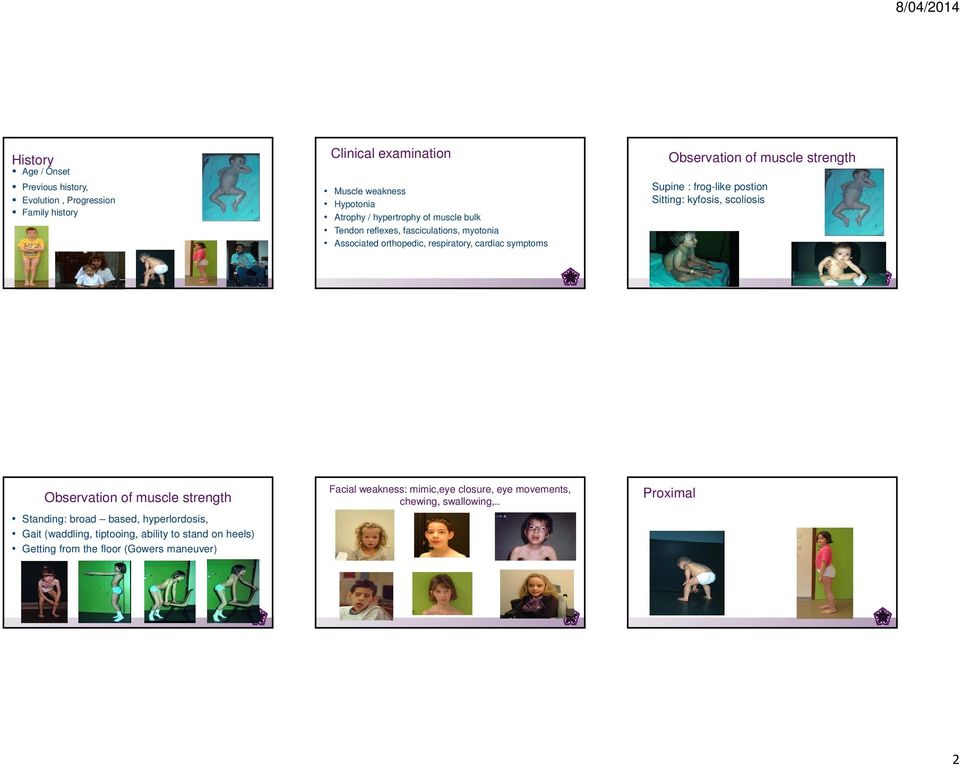
3 FSHD Distal Muscle bulk Atrophy : distribution: o Distal ( Charcot, other neuropathies, Steinert..) o Typical distribution in muscular dystrophies Duchenne Facioscapulohumeral Steinert Pseudohypertophy o Duchenne,Becker, Myotonia congenita,.. Congenitale myopathy Congenital Muscular Dystrophy Neurological signs Tendon reflexes: o Weak or absent in neurogenic conditions o Often weak secundary to muscle atrophy in muscle disorders Fasciculations: anterior horn cell involvement Myotonia: incapacity of relaxation following muscle contraction ( Steinert, ionchannel disorders) 3

4 The obvious ones. I. Age : 3 Presenting symptom: Clinical examination - Slowly progressive gait abnormalities: waddling gait, tipwalking, frequent falls - Difficulties raising from the floor Spinal Muscular Atrophy ( SMA) Very High Creatine Kinase ( CK) : U/l ( < 200) Toddler ( boy) Progressive gait disturbances Frequent falls Difficulties with stairs X linked inheritance ( 1/3 : new mutation) Autosomal recessive disease Progressive deterioration of anterior horn cells Broad clinical spectrum o SMA1: Werdnig-Hofman Muscle hypertophy Gowers + Tight TA Very High CK o o SMA2: Intermediate SMA3: Kugelberg Welander = DUCHENNE MUSCULAR DYSTROPHY Confirmation: Absence of dystrophin on muscle biopsy - Deletion in DMD gene Sma 1 Sma 2 Sma 3 4

5 Previous history uneventful Arrest/ regression in motor development Axial and proximal weakness Areflexia, fasciculations Normal face Normal or mildly elevated CK EMG : anterior horn cell Spinal Muscular Atrophy Confirmation: DNA : homozygeous deletion in SMN gene ( Chr 5) III. Age : 5 Presenting symptoms: o Motor delay o Global delay ( speech) Previous history: o Neonatal feeding difficulties o Clubfeet Family history: o Uneventful o in fact: dominant inheritance with anticipation Steinert disease: muscular symptoms Typical distribution of weakness Striking involvement of distal muscles Typical physionomy facial diplegia Speech disturbances ( articulation, nasal speech, swallowing difficulties) Steinert disease: multisystemic disorder Oftalmological problems (cataract) Gastro intestinal : motility disturbances Cardiac problems (conduction ) Endocrine en gynaecological problems Respiratory problems Central nervous system (hypersomnia, slowness,) Steinert disease ( MD) : spectrum Anticipation Late, with minimal expression Classical, adult onset with multi-system problems Juvenile Severe congenital 5

6 Steinert: spotdiagnosis Look at mother: Long face? Eye closure? Myotonic reactions? Family history of cataract, baldness, muscle cramps or weakness Metroraghia, postpartum hemorraghe Hypersomnia Congenital Myopathies Heterogenous group of inherited disorders of muscle structure/membrane. Initially named after histopathologic characteristics. Improved genetic diagnosis have highligted overlap Nemaline myopathy Central core, mini-core myopathy Centronucleair myopathy Congenitale myopathies : clinical symptoms Neonatal weakness +/- respiratory and feeding difficulties Congenital orthopedic features: hipluxation, clubfeet, scoliosis,.. Poor mimic, high arched palatum, Delayed motor deveolpment, secundary orthopaedic features ( contractures, scoliosis), restictive respiratory sydrome Congenitale myopathie MmC IV. Age : 6 Presenting symptom : gait difficulties Clinical examination: o Distal weakness, distal atrophy o Difficulties walking on heels, standing on one feet, hopping, o Areflexia TA, weak kneereflexes o Tight TA Family history : dominant inheritance with variable penetrance EMG : reduced motor conduction velocity : suggestive for demyelinating neuropathy Charcot Marie Tooth ( CMT) DEMYELINATING ( Type I) o Dominant ( CMT1A = most common) o Recessive o X linked AXONAL ( Type II) 6
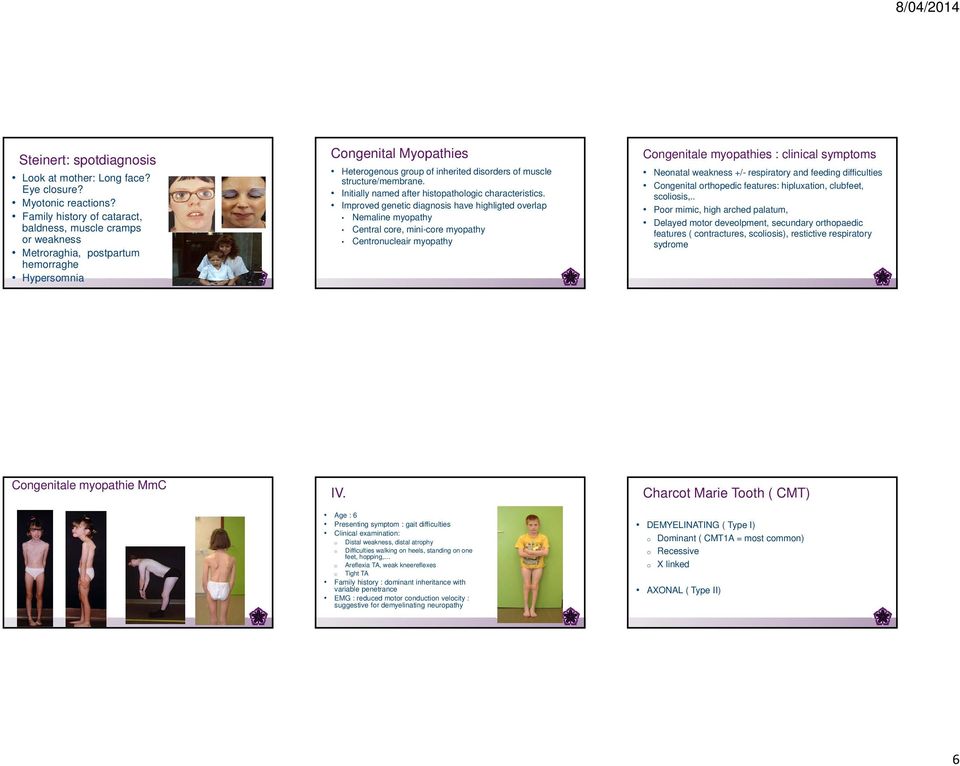
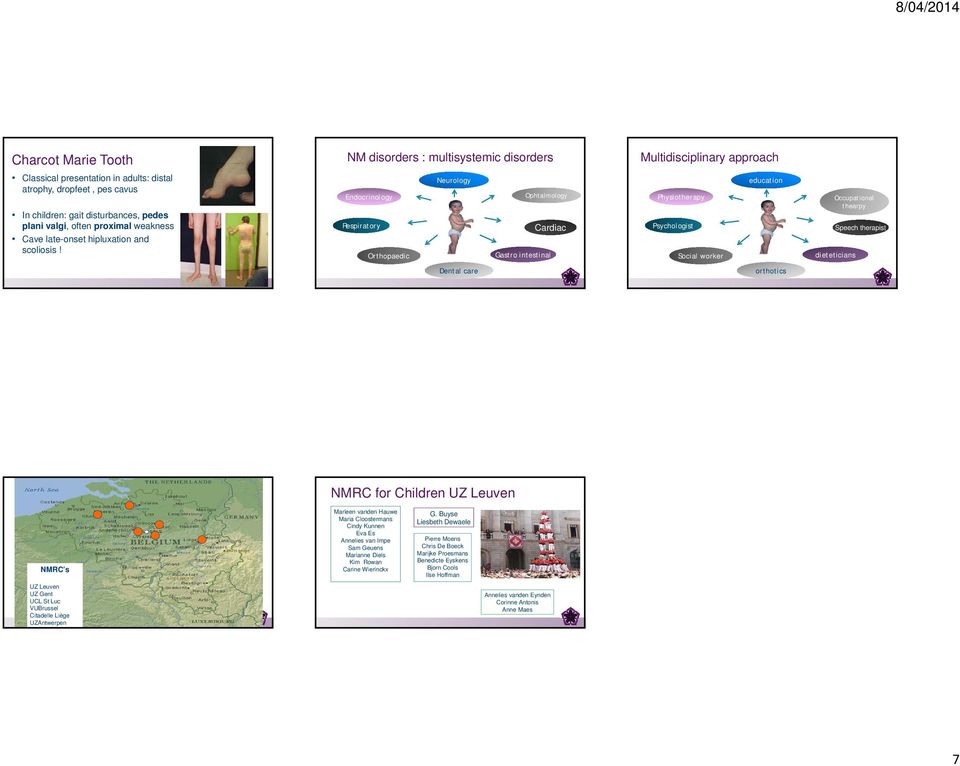
7 Charcot Marie Tooth NM disorders : multisystemic disorders Multidisciplinary approach Classical presentation in adults: distal atrophy, dropfeet, pes cavus In children: gait disturbances, pedes plani valgi, often proximal weakness Cave late-onset hipluxation and scoliosis! Endocrinology Respiratory Orthopaedic Neurology Ophtalmology Cardiac Gastro intestinal Physiotherapy Psychologist Social worker education Occupational thearpy Speech therapist dieteticians Dental care orthotics NMRC for Children UZ Leuven NMRC s Marleen vanden Hauwe Maria Cloostermans Cindy Kunnen Eva Es Annelies van Impe Sam Geuens Marianne Diels Kim Rowan Carine Wierinckx G. Buyse Liesbeth Dewaele Pierre Moens Chris De Boeck Marijke Proesmans Benedicte Eyskens Bjorn Cools Ilse Hoffman UZ Leuven UZ Gent UCL St Luc VUBrussel Citadelle Liège UZAntwerpen Annelies vanden Eynden Corinne Antonis Anne Maes 7
Neuromuscular diseases
 Neuromuscular diseases Spinal muscular atrophy - SMA characterized by degeneration of the anterior horn cells in the spinal cord and motor nuclei in the lower brainstem. SMA type 1, is also known as Werdnig-
DIAGNOSING CHILDHOOD MUSCULAR DYSTROPHIES
 DIAGNOSING CHILDHOOD MUSCULAR DYSTROPHIES Extracts from a review article by KN North and KJ Jones: Recent advances in diagnosis of the childhood muscular dystrophies Journal of Paediatrics and Child Health
Neuromuscular disorders Development of consensus for diagnosis and standards of care. Thomas Sejersen, Pediatric neurology
 Neuromuscular disorders Development of consensus for diagnosis and standards of care Thomas Sejersen, Pediatric neurology What are neuromuscular disorders? How does the field of neuromuscular disorders
Muscular Dystrophy. By. Tina Strauss
 Muscular Dystrophy By. Tina Strauss Story Outline for Presentation on Muscular Dystrophy What is Muscular Dystrophy? Signs & Symptoms Types When to seek medical attention? Screening and Diagnosis Treatment
Pediatric Neuromuscular Disorders: Transitions to Adult Providers
 Pediatric Neuromuscular Disorders: Transitions to Adult Providers 29 th Annual Update in Physical Medicine and Rehabilitation January 29, 2015 Russell Butterfield MD, PhD Assistant Professor, Departments
Facioscapulohumeral Muscular Dystrophy
 Facioscapulohumeral Muscular Dystrophy What is Facioscapulohumeral Muscular Dystrophy? Facioscapulohumeral (FSH) Muscular Dystrophy is the medical term for a disorder of the muscles. FSH most often affects
Duchenne muscular dystrophy (DMD)
 Duchenne muscular dystrophy (DMD) What is Duchenne muscular dystrophy or DMD? Muscular Dystrophy is a group of inherited muscle disorders, in which muscles weaken over time. Duchenne muscular dystrophy
Rigid spine syndrome (RSS) (Congenital muscular dystrophy with rigidity of the spine, including RSMD1)
 Rigid spine syndrome (RSS) (Congenital muscular dystrophy with rigidity of the spine, including RSMD1) What is RSMD1? The congenital muscular dystrophies are a group of conditions which share early presentation
Learn the steps to identify pediatric muscle weakness and signs of neuromuscular disease.
 Learn the steps to identify pediatric muscle weakness and signs of neuromuscular disease. Guide for therapists/specialists Questions and comments to: [email protected] Surveillance and Referral
Minicore (multicore) myopathy
 Minicore (multicore) myopathy Minicore myopathy, also called, multicore myopathy and multiminicore myopathy, falls under the umbrella of congenital myopathies. These are a group of conditions characterised
Central core disease
 Central core disease Central core disease falls under the umbrella of congenital myopathies which are characterised by muscle weakness and wasting. It is a rare condition, and symptoms are usually present
Doctor I can t walk properly - a guided walk around some gait problems
 Doctor I can t walk properly - a guided walk around some gait problems Dr Jeremy Rees Consultant Neurologist National Hospital for Neurology and Neurosurgery, Queen Square www.london-neurology.co.uk Walking
Neonatal Hypotonia. Clinical Approach to Floppy Baby
 Neonatal Hypotonia Clinical Approach to Floppy Baby Hypotonia in the newborn is a common presenting feature of systemic illness or neurologic dysfunction at any level of the central or peripheral nervous
Muscular Dystrophy and Multiple Sclerosis. ultimately lead to the crippling of the muscular system, there are many differences between these
 Battles 1 Becky Battles Instructor s Name English 1013 21 November 2006 Muscular Dystrophy and Multiple Sclerosis Although muscular dystrophy and multiple sclerosis are both progressive diseases that ultimately
Limb girdle muscular dystrophies (LGMDs)
 Limb girdle muscular dystrophies (LGMDs) This factsheet is for all people for whom a diagnosis of limb girdle muscular dystrophy (LGMD) has been suggested. This is a complicated subject since there are
Myotonic Dystrophy: Making an Informed Choice About Genetic Testing
 Myotonic Dystrophy: Making an Informed Choice About Genetic Testing Written by: Corrine O Sullivan Smith, MS, CGC Robin L. Bennett, MS, CGC Thomas D. Bird, MD Medical Genetics and Neurology University
Duchenne muscular dystrophy
 Duchenne muscular dystrophy Penny Southall, mum of Dan Hanson: My son, Dan, was diagnosed with Duchenne muscular dystrophy when he was three years old. I know the diagnosis can be devastating. Like we
EMG and the Electrodiagnostic Consultation for the Family Physician
 EMG and the Electrodiagnostic Consultation for the Family Physician Stephanie Kopey, D.O., P.T. 9/27/15 The American Association of Neuromuscular & Electrodiagnostic Medicine (AANEM) Marketing Committee
Oculopharyngeal muscular dystrophy (OPMD)
 Oculopharyngeal muscular dystrophy (OPMD) The term muscular dystrophy is used to cover a wide range of conditions which have in common progressive muscle weakness due to an inherited genetic defect (mutation).
1: Motor neurone disease (MND)
 1: Motor neurone disease (MND) This section provides basic facts about motor neurone disease (MND) and its diagnosis. The following information is an extracted section from our full guide Living with motor
Spinal Muscular Atrophy
 Maryam Oskoui, MD, MSc, FRCPC Pediatric Neurologist Spinal Muscular Atrophy Elise Historical Timeline In vitro and animal studies Werdnig and Hoffmann describe SMA 1 (Arch Psych Nervenkrankheiten) Disease
FSH Society s 2014 Biennial FSHD Connect Meeting: Natural History Studies
 FSH Society s 2014 Biennial FSHD Connect Meeting: Natural History Studies Raymond A. Huml, MS, DVM, RAC Executive Director, Head, Global Biosimilars Business Development and Strategic Planning, Quintiles
Cerebral palsy can be classified according to the type of abnormal muscle tone or movement, and the distribution of these motor impairments.
 The Face of Cerebral Palsy Segment I Discovering Patterns What is Cerebral Palsy? Cerebral palsy (CP) is an umbrella term for a group of non-progressive but often changing motor impairment syndromes, which
Comprehensive Care for Duchenne Muscular Dystrophy
 Comprehensive Care for Duchenne Muscular Dystrophy Brenda Wong, MD Cincinnati Children s Hospital Medical Center PPMD Annual Conference 2008 17 July 2008 Comprehensive Care for DMD Historical Perspective
CLINICAL APPROACH TO THE FLOPPY CHILD
 CLINICAL APPROACH TO THE FLOPPY CHILD The floppy infant syndrome is a well-recognised entity for paediatricians and neonatologists and refers to an infant with generalised hypotonia presenting at birth
Ultrasound of muscle disorders
 Ultrasound of muscle disorders Sigrid Pillen MD PhD Pediatric neurologist The Netherlands Disclosures None "Muscle ultrasound disclaimer" Muscle ultrasound Introduction Specific NMD Quantification Dynamic
Cerebral Palsy. 1995-2014, The Patient Education Institute, Inc. www.x-plain.com nr200105 Last reviewed: 06/17/2014 1
 Cerebral Palsy Introduction Cerebral palsy, or CP, can cause serious neurological symptoms in children. Thousands of children are diagnosed with cerebral palsy every year. This reference summary explains
Facts About Rare Muscular Dystrophies
 The fact sheets have been adapted from material originally prepared by MDA USA with their kind permission. We are grateful for providing this valuable and informative material Facts About Rare Muscular
Comprehensive List of Neuromuscular Disorders Covered by Muscular Dystrophy Canada
 Comprehensive List of Neuromuscular Disorders Covered by Muscular Dystrophy Canada Neuromuscular disorders is a general term that refers to diseases that affect any part of the nerve and muscle. These
Carrier detection tests and prenatal diagnosis
 Carrier detection tests and prenatal diagnosis There are several types of muscular dystrophy and about 50 neuromuscular conditions, all of which fall under the umbrella of the Muscular Dystrophy Campaign.
Cerebral Palsy. In order to function, the brain needs a continuous supply of oxygen.
 Cerebral Palsy Introduction Cerebral palsy, or CP, can cause serious neurological symptoms in children. Up to 5000 children in the United States are diagnosed with cerebral palsy every year. This reference
Muscle Physiology and the. Pathology of Muscular Dystrophy
 Muscle Physiology and the Pathology of Muscular Dystrophy Angela Tompkins February 23, 2010 Everglades University Biology 1 Muscle Physiology and the Pathology of Muscular Dystrophy Humans are able to
3nd Biennial Contemporary Clinical Neurophysiological Symposium October 12, 2013 Fundamentals of NCS and NMJ Testing
 3nd Biennial Contemporary Clinical Neurophysiological Symposium October 12, 2013 Fundamentals of NCS and NMJ Testing Peter D. Donofrio, M.D. Professor of Neurology Vanderbilt University Medical Center
Management in the pre-hospital setting
 Management in the pre-hospital setting Inflammation of the joints Two main types: Osteoarthritis - cartilage loss from wear and tear Rheumatoid arthritis - autoimmune disorder Affects all age groups,
Neuromuscular Medicine Fellowship Curriculum
 Neuromuscular Medicine Fellowship Curriculum General Review Goals and Objectives Attend weekly EMG sessions as assigned Take a Directed History and Exam of each EMG patient Attend every other week Muscle
Mendelian inheritance and the
 Mendelian inheritance and the most common genetic diseases Cornelia Schubert, MD, University of Goettingen, Dept. Human Genetics EUPRIM-Net course Genetics, Immunology and Breeding Mangement German Primate
A Note to Physical, Occupational and Speech Therapists
 D Page 1 of 5 A Note to Physical, Occupational and Speech Therapists Treating Children with Hurler Syndrome Because Hurler syndrome is such a rare disease, we have provided some basic information to assist
C CS. California Children Services Alameda County
 C CS California Children Services Alameda County The California Children Services (CCS) Program strives to assure access to medical services essential to the health and well-being of children with catastrophic
News. Report from Cypress: The Discovery of Protomyonecrosis
 Report from Cypress: The Discovery of Protomyonecrosis Introduction The central nervous system is made up of the brain and the spinal cord and together form a kind of perceptual computer that keeps us
Role of Electrodiagnostic Tests in Neuromuscular Disease
 Role of Electrodiagnostic Tests in Neuromuscular Disease Electrodiagnostic tests Electroencephalogram (EEG) Electromyography (NCV, EMG) Cerebral evoked potentials (CEP) Motor evoked potentials (MEP) Electronystagmogram
Allied, Therapeutic and Psychology Extender Benefit
 Allied, Therapeutic and Psychology Extender Benefit 2015 Allied, Therapeutic and Psychology Extender Benefit The Allied, Therapeutic and Psychology Extender Benefit is available on the Executive and Comprehensive
PART 2. ELECTRODIAGNOSTIC DIFFERENTIAL DIAGNOSIS OF COMMON
 PART 2. ELECTRODIAGNOSTIC DIFFERENTIAL DIAGNOSIS OF COMMON SYMPTOMS AND SIGNS 1. PAIN FACIAL PAIN " lesion of the trigeminal nerve " trigeminal neuralgia " facial nerve lesion NECK PAIN " C5 radiculopathy
Specialist Children s Service
 Specialist Children s Service Information and Guidelines for Referrers March 2009, Version 3.0 Contents CONTENTS... 2 INTRODUCTION... 3 TEAMS BASED AT THE WOOD STREET HEALTH CENTRE:... 3 TEAMS BASED ELSEWHERE
Pediatric Nerve Conduction Studies and EMG
 22 Pediatric Nerve Conduction Studies and EMG Peter B. Kang Summary A variety of neuromuscular conditions affect children, ranging from severe, usually fatal disorders, such as spinal muscular atrophy
Facts About. Facioscapulohumeral Muscular Dystrophy
 Facts About Facioscapulohumeral Muscular Dystrophy Updated December 2009 Paul Topkin Dear Friends: Facioscapulohumeral muscular dystrophy (FSHD) has been a part of my family s life for many years. My great-great-grandfather
Treatment of Spastic Foot Deformities
 Penn Comprehensive Neuroscience Center Treatment of Spastic Foot Deformities Penn Neuro-Orthopaedics Service 1 Table of Contents Overview Overview 1 Treatment 2 Procedures 4 Achilles Tendon Lengthening
Allied, Therapeutic and Psychology Extender Benefit
 Allied, Therapeutic and Psychology Extender Benefit 2013 The Allied, Therapeutic and Psychology Extender Benefit is available on the Enhanced Option only. Overview This document tells you about the Allied,
ELECTRODIAGNOSTIC MEDICINE
 ELECTRODIAGNOSTIC MEDICINE OBJECTIVES BEGINNER Patient Care Perform a comprehensive electrodiagnostic evaluation of each patient and to provide a concise diagnosis and plan for further treatment Describe
P U T T I N G T H E P I E C E S T O G E T H E R
 MEDICAL THERAPY PROGRAM P U T T I N G T H E P I E C E S T O G E T H E R CALIFORNIA CHILDREN SERVICES CCS is a statewide program providing medical care and rehabilitation to children with physical disabilities.
Facts About. Myotonic Muscular Dystrophy
 Facts About Myotonic Muscular Dystrophy Updated December 2009 Denise Balon Dear Friends: Myotonic muscular dystrophy (MMD) has been a part of my family s life for many years. The symptoms for my siblings
Facts About. Duchenne & Becker Muscular Dystrophies
 Facts About Duchenne & Becker Muscular Dystrophies Updated December 2009 Michael Norton (foreground) with brother, John, and parents, Suzan and Terry. Dear Friends: When my husband, Terry, and I learned
What Is Genetic Counseling? Helping individuals and families understand how genetics affects their health and lives
 What Is Genetic Counseling? Helping individuals and families understand how genetics affects their health and lives What does the career involve? Explore family histories to identify risks Reducing risks
THE DIAGNOSIS AND MANAGEMENT OF DUCHENNE MUSCULAR DYSTROPHY A guide for families
 THE DIAGNOSIS AND MANAGEMENT OF DUCHENNE MUSCULAR DYSTROPHY A guide for families Contents 1 Introduction 04 2 How to use this document 05 3 Diagnosis 11 4 Neuromuscular management - maintaining strength
THE DIAGNOSIS AND MANAGEMENT OF DUCHENNE MUSCULAR DYSTROPHY A GUIDE FOR FAMILIES
 THE DIAGNOSIS AND MANAGEMENT OF DUCHENNE MUSCULAR DYSTROPHY A GUIDE FOR FAMILIES CONTENTS DISCLAIMER 1 1. INTRODUCTION 2 2. HOW TO USE THIS DOCUMENT 3 3. DIAGNOSIS 7 4. NEUROMUSCULAR MANAGEMENT - maintaining
INCLUSIVE EDUCATION FOR CHILDREN WITH MUSCULAR DYSTROPHY AND OTHER NEUROMUSCULAR CONDITIONS GUIDANCE FOR PRIMARY AND SECONDARY SCHOOLS SECOND EDITION
 INCLUSIVE EDUCATION FOR CHILDREN WITH MUSCULAR DYSTROPHY AND OTHER NEUROMUSCULAR CONDITIONS GUIDANCE FOR PRIMARY AND SECONDARY SCHOOLS SECOND EDITION supported by INCLUSIVE EDUCATION FOR CHILDREN WITH
Multiple Sclerosis (MS)
 Multiple Sclerosis (MS) Purpose/Goal: Care partners will have an understanding of Multiple Sclerosis and will demonstrate safety and promote independence while providing care to the client with MS. Introduction
a guide to understanding moebius syndrome a publication of children s craniofacial association
 a guide to understanding moebius syndrome a publication of children s craniofacial association a guide to understanding moebius syndrome this parent s guide to Moebius syndrome is designed to answer questions
Steps to getting a diagnosis: Finding out if it s Alzheimer s Disease.
 Steps to getting a diagnosis: Finding out if it s Alzheimer s Disease. Memory loss and changes in mood and behavior are some signs that you or a family member may have Alzheimer s disease. If you have
The Pilates Method: A Conditioning Program for Clients with Acetabular Dysplasia and Charcot-Marie-Tooth Disease
 The Pilates Method: A Conditioning Program for Clients with Acetabular Dysplasia and Charcot-Marie-Tooth Disease Kara McCulloch April 13, 2008 BASI Oct 2007 Apr 2008 Herndon, VA Abstract This study applies
Facts About. Metabolic. Diseases of Muscle
 Facts About Metabolic Diseases of Muscle Updated December 2009 Keith Stout Dear Friends: If you ve just learned that you or a loved one has a metabolic muscle disorder, you re probably both relieved and
Facioscapulohumeral Muscular Dystrophy: Making an Informed Choice About Genetic Testing
 Facioscapulohumeral Muscular Dystrophy: Making an Informed Choice About Genetic Testing Written by: Corrine O Sullivan Smith, MS, CGC Robin L. Bennett, MS, CGC Thomas D. Bird, MD Medical Genetics and Neurology
ALL ABOUT SPASTICITY. www.almirall.com. Solutions with you in mind
 ALL ABOUT SPASTICITY www.almirall.com Solutions with you in mind WHAT IS SPASTICITY? The muscles of the body maintain what is called normal muscle tone, a level of muscle tension that allows us to hold
The challenges of conducting clinical development in rare / orphan diseases: The Industry Perspective
 The challenges of conducting clinical development in rare / orphan diseases: The Industry Perspective Thomas Meier, PhD (Chief Scientific Officer) Muscle Study Group, September 22, 2009 Agenda Santhera
Disorders of Muscles: The Myopathies
 C HAPTE R 13 Disorders of Muscles: The Myopathies Christopher M. Fredericks, PhD General Considerations Muscular Dystrophies Metabolic Myopathies Specific Congenital Myopathies Myotonias Periodic Paralyses
ICD-9 to ICD-10 Conversion Commonly Used Neurologic Diagnosis
 ICD-9 to ICD-10 Conversion Commonly Used Neurologic Diagnosis 327.20 Organic sleep apnea, unspecified... 1 331.0 Alzheimer s disease...3 333.1 Essential and other specified forms of tremor...4 340 Multiple
MULTIPLE SCLEROSIS. Mary Beth Rensberger, RN, BSN, MPH Author
 MULTIPLE SCLEROSIS Mary Beth Rensberger, RN, BSN, MPH Author All rights reserved. Purchasers of this module are permitted to reproduce the forms contained herein for their individual internal use only.
Differentiating Cervical Radiculopathy and Peripheral Neuropathy. Adam P. Smith, MD
 Differentiating Cervical Radiculopathy and Peripheral Neuropathy Adam P. Smith, MD I have no financial, personal, or professional conflicts of interest to report Radiculopathy versus Neuropathy Radiculopathy
F r e q u e n t l y A s k e d Q u e s t i o n s
 Myasthenia Gravis Q: What is myasthenia gravis (MG)? A: Myasthenia gravis (meye-uhss- THEEN-ee-uh GRAV uhss) (MG) is an autoimmune disease that weakens the muscles. The name comes from Greek and Latin
Electrodiagnostic Testing
 Electrodiagnostic Testing Electromyogram and Nerve Conduction Study North American Spine Society Public Education Series What Is Electrodiagnostic Testing? The term electrodiagnostic testing covers a
Facts About. Rare Muscular Dystrophies (Congenital, Distal, Emery-Dreifuss and Oculopharyngeal)
 Facts About Rare Muscular Dystrophies (Congenital, Distal, Emery-Dreifuss and Oculopharyngeal) Updated December 2009 Mike Neufeldt Dear Friends: When I was about a year old, my parents noticed something
Guidebook for NMDs professional parent or patient
 GRUNDTVIG LEARNING PARTNERSHIP 2011-1-RO1-GRU06-14989 1 Guidebook for NMDs professional parent or patient With the support of the Lifelong Learning Programme of the European Union Table of contents: Part
Rehabilitation Where You Recover. Inpatient Rehabilitation Services at Albany Medical Center
 Rehabilitation Where You Recover Inpatient Rehabilitation Services at Albany Medical Center You're Here and So Are We As the region s only academic medical center, Albany Medical Center offers a number
Developmental delay and Cerebral palsy. Present the differential diagnosis of developmental delay.
 Developmental delay and Cerebral palsy objectives 1. developmental delay Define developmental delay Etiologies of developmental delay Present the differential diagnosis of developmental delay. 2. cerebral
Rehabilitation Services Specialty Outpatient Clinics
 Rehabilitation Services Specialty Outpatient Clinics Rehabilitation Services offers a number of Specialty Outpatient Clinics for patients: Stroke Clinic o For any stroke patient who has physical problems
Neuropathy Action Foundation. Awareness Education Empowerment. A Guide to Neuropathy Jonathan Katz, MD Michelle Greer, RN
 Neuropathy Action Foundation Awareness Education Empowerment A Guide to Neuropathy Jonathan Katz, MD Michelle Greer, RN The Neuropathy Ac on Founda on (NAF), a 501(c)(3) non-profit, is dedicated to ensuring
Aetna Nerve Conduction Study Policy
 Aetna Nerve Conduction Study Policy Policy Aetna considers nerve conduction velocity (NCV) studies medically necessary when both of the following criteria are met: 1. Member has any of the following indications:
Understanding Pervasive Developmental Disorders. Page 1 of 10 MC5155-09 Pervasive Developmental Disorders
 Understanding Pervasive Developmental Disorders Page 1 of 10 MC5155-09 Pervasive Developmental Disorders Page 2 of 10 MC5155-09 Pervasive Developmental Disorders This information is intended to help you
CHAPTER 15 THE CHROMOSOMAL BASIS OF INHERITANCE. Section B: Sex Chromosomes
 CHAPTER 15 THE CHROMOSOMAL BASIS OF INHERITANCE Section B: Sex Chromosomes 1. The chromosomal basis of sex varies with the organism 2. Sex-linked genes have unique patterns of inheritance 1. The chromosomal
By Agnes Tan (PT) I-Sports Rehab Centre Island Hospital
 By Agnes Tan (PT) I-Sports Rehab Centre Island Hospital Physiotherapy Provides aids to people Deals with abrasion and dysfunction (muscles, joints, bones) To control and repair maximum movement potentials
How To Become A Physio And Rehabilitation Medicine Specialist
 EUROPEAN BOARD OF PHYSICAL AND REHABILITATION MEDICINE LOGBOOK EUROPEAN UNION OF MEDICAL SPECIALISTS UEMS IDENTIFICATION... 2 INSTRUCTIONS FOR USE... 3 THE TRAINING COURSE... 3 TRAINING PROGRAMME... 4
Becker Muscular Dystrophy
 Muscular Dystrophy A Case Study of Positional Cloning Described by Benjamin Duchenne (1868) X-linked recessive disease causing severe muscular degeneration. 100 % penetrance X d Y affected male Frequency
OCCUPATIONAL THERAPY
 OCCUPATIONAL THERAPY This document is subject to change. Please check our web site for updates. This provider manual outlines policy and claims submission guidelines for claims submitted to the North Dakota
IOPTP member organisations' materials: documents for sharing
 IOPTP member organisations' materials: documents for sharing Name of guideline Language Cost PT/Multidisciplinary/specialist Website ABUSE Guideline CBO Domestic violence in children and adults National
Whiplash Associated Disorder
 Whiplash Associated Disorder Bourassa & Associates Rehabilitation Centre What is Whiplash? Whiplash is a non-medical term used to describe neck pain following hyperflexion or hyperextension of the tissues
DISABILITY-RELATED DEFINITIONS
 DISABILITY-RELATED DEFINITIONS 1. The Americans with Disabilities Act (ADA) of 1990 is a civil rights law, which makes it unlawful to discriminate on the basis of disability. It covers employment in the
Physiotherapy for children with Neuromuscular Disorders
 Physiotherapy for children with Neuromuscular Disorders Special considerations for therapists, schools and parents, recommendations and latest research. Chiara Tewierik, Neurosciences Physiotherapist,
Case: Cerebral Palsy
 Case: Cerebral Palsy A.W. is a 48 y.o. AA female with diplegic Cerebral Palsy(CP) Dysphagia, coughing, with solid foods X 3 mo. Vague generalized abdominal pain intermittently, 3 lb wt loss Seizure disorder
Static Encephalopathy A Basis Explanation for Parents
 Static Encephalopathy A Basis Explanation for Parents Nancy J. Hitzfelder, M.D. Medical Director July 1999 This article may not be copied without the express written permission of Easter Seals of Greater
Usher Syndrome Genetics
 Usher Syndrome Genetics October 2012 Page 1 of 20 Introduction Usher syndrome is a genetic or inherited condition that affects hearing, vision and balance The sight loss is caused by an eye condition known
An Effective Exercise Prescription for Ataxia. Polly Swingle, PT The Recovery Project, LLC www.therecoveryproject.net 734-953-1745
 An Effective Exercise Prescription for Ataxia Polly Swingle, PT The Recovery Project, LLC www.therecoveryproject.net 734-953-1745 1 Are you Functional? Sit to stand from a chair without the use of your