
EMS Information Bulletin- #060
|
|
|
- Paulina Carpenter
- 10 years ago
- Views:
Transcription
1 BUREAU OF EMERGENCY MEDICAL SERVICES EMS Information Bulletin- #060 DATE: October 27, 2008 SUBJECT: TO: FROM: Continuous Positive Airway Pressure for Basic Life Support Pennsylvania EMS Organizations & Personnel Bureau of Emergency Medical Services PA Department of Health (717) The Pennsylvania Department of Health, Bureau of Emergency Medical Services (EMS), in cooperation with the Emergency Health Services Federation (EHSF), conducted a pilot study on the use of Continuous Positive Airway Pressure (CPAP) in the EHSF s region. As a result of a successful pilot study, the CPAP for Basic Life Support (BLS) Program is being implemented statewide. For the pilot study, the EHSF located each Advanced Life Support (ALS) station within their region, plotted it on a map and then identified a 15-minute drive time. Each BLS unit was then layered over the map and any BLS unit outside of the 15 minute drive time was requested to participate in the pilot study. The Statewide BLS Protocols are written to allow an EMT who has the appropriate training, is working with an ambulance service that meets the requirements of the CPAP program, and who has the approval of the ambulance service medical director to administer CPAP in accordance with the BLS Protocols or medical command orders. The Department of Health, Bureau of EMS, pursuant to the EMS Act (35 P.S. 6924), has the responsibility and authority to guide and coordinate the development of emergency medical programs into a unified Statewide system. Therefore, recognizing the importance of CPAP to an effective EMS system, the Bureau of EMS is issuing the following requirements for ambulance services that wish to participate in the CPAP for BLS Program.
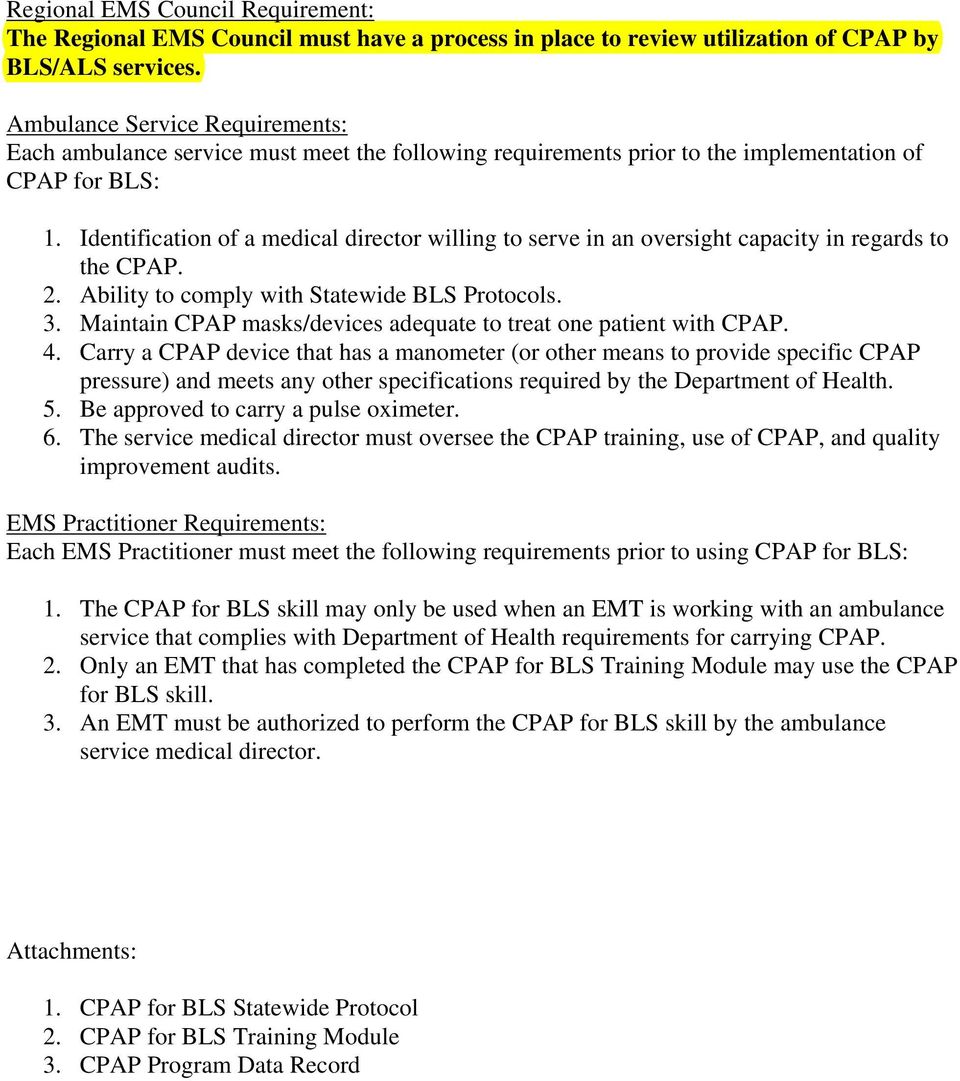
2 Regional EMS Council Requirement: The Regional EMS Council must have a process in place to review utilization of CPAP by BLS/ALS services. Ambulance Service Requirements: Each ambulance service must meet the following requirements prior to the implementation of CPAP for BLS: 1. Identification of a medical director willing to serve in an oversight capacity in regards to the CPAP. 2. Ability to comply with Statewide BLS Protocols. 3. Maintain CPAP masks/devices adequate to treat one patient with CPAP. 4. Carry a CPAP device that has a manometer (or other means to provide specific CPAP pressure) and meets any other specifications required by the Department of Health. 5. Be approved to carry a pulse oximeter. 6. The service medical director must oversee the CPAP training, use of CPAP, and quality improvement audits. EMS Practitioner Requirements: Each EMS Practitioner must meet the following requirements prior to using CPAP for BLS: 1. The CPAP for BLS skill may only be used when an EMT is working with an ambulance service that complies with Department of Health requirements for carrying CPAP. 2. Only an EMT that has completed the CPAP for BLS Training Module may use the CPAP for BLS skill. 3. An EMT must be authorized to perform the CPAP for BLS skill by the ambulance service medical director. Attachments: 1. CPAP for BLS Statewide Protocol 2. CPAP for BLS Training Module 3. CPAP Program Data Record
3 Pennsylvania Department of Health Respiratory 421 BLS Adult/Peds RESPIRATORY DISTRESS/RESPIRATORY FAILURE STATEWIDE BLS PROTOCOL Criteria: A. Shortness of breath or difficulty breathing. 1. Conditions which produce SOB from bronchoconstriction that may respond to bronchodilators. These conditions generally are associated with wheezing. a. COPD (emphysema, chronic bronchitis) b. Asthma c. Allergic reaction d. Respiratory infections (pneumonia, acute bronchitis) 2. Conditions which produce SOB without bronchoconstriction that do not respond to bronchodilators. These conditions usually are not associated with wheezing. a. CHF b. Pulmonary embolism Exclusion Criteria: A. None. System Requirements: A. Only an EMT that has completed the bronchodilator module through the EMT curriculum or continuing education may assist the patient with administration of a bronchodilator. B. CPAP may only be administered by an EMT that has completed the DOH BLS CPAP training and has been approved to administer CPAP by the service medical director. C. [Optional] BLS services may carry CPAP devices for use by the service s EMTs. 1. These services must assure that all EMTs using CPAP have completed the DOH BLS CPAP training and have been approved by the service medical director. 2. These services must carry a CPAP device that has a manometer (or other means to provide specific CPAP pressure) and meets any other specifications required by the DOH. 3. These services must be approved to carry pulse oximeters See Protocol # The service medical director must oversee the CPAP training, use of CPAP, and quality improvement audits. Treatment: A. All patients: 1. Initial Patient Contact see Protocol # 201. a. Consider call for ALS if available. See Indications for ALS Use protocol # If allergic reaction is suspected and patient meets criteria, proceed with Allergic Reaction / Anaphylaxis protocol #411. B. Pediatric patients: 1. NOTE: If child is sitting in a tripod position with excessive drooling this may be epiglottitis, transport immediately. Do not lay the patient flat and do not attempt to visualize the throat. C. All patients: 1. Apply high concentration oxygen. If necessary, assist respirations with a bag-valve-mask, but avoid overzealous hyperventilation. 2. Monitor pulsoximetry 1 [OPTIONAL MANDATORY IF USING CPAP] 3. Continuous Positive Airway Pressure (CPAP) [OPTIONAL]: a. Apply CPAP to adult patient if patient does not have any contraindication to CPAP 2 AND has at least TWO of the following after high concentration oxygen: 1) Pulse oximetry < 90% 2) Respiratory rate > 25 bpm 3) Use of accessory muscles during respiration b. If CPAP is applied 3 : 1) Titrate pressure up until either improvement or maximum of 10 cm H 2 O pressure. 2) Remove CPAP if respiratory status deteriorates and assist with BVM ventilation if needed. 4. Assist patient with his/ her bronchodilator inhaler [EMT ONLY] for conditions associated with wheezing 4,5,6 a. Must be a short-acting rapid onset, bronchodilator 7,8 5. Transport and reassess enroute Effective 11/01/ of 4

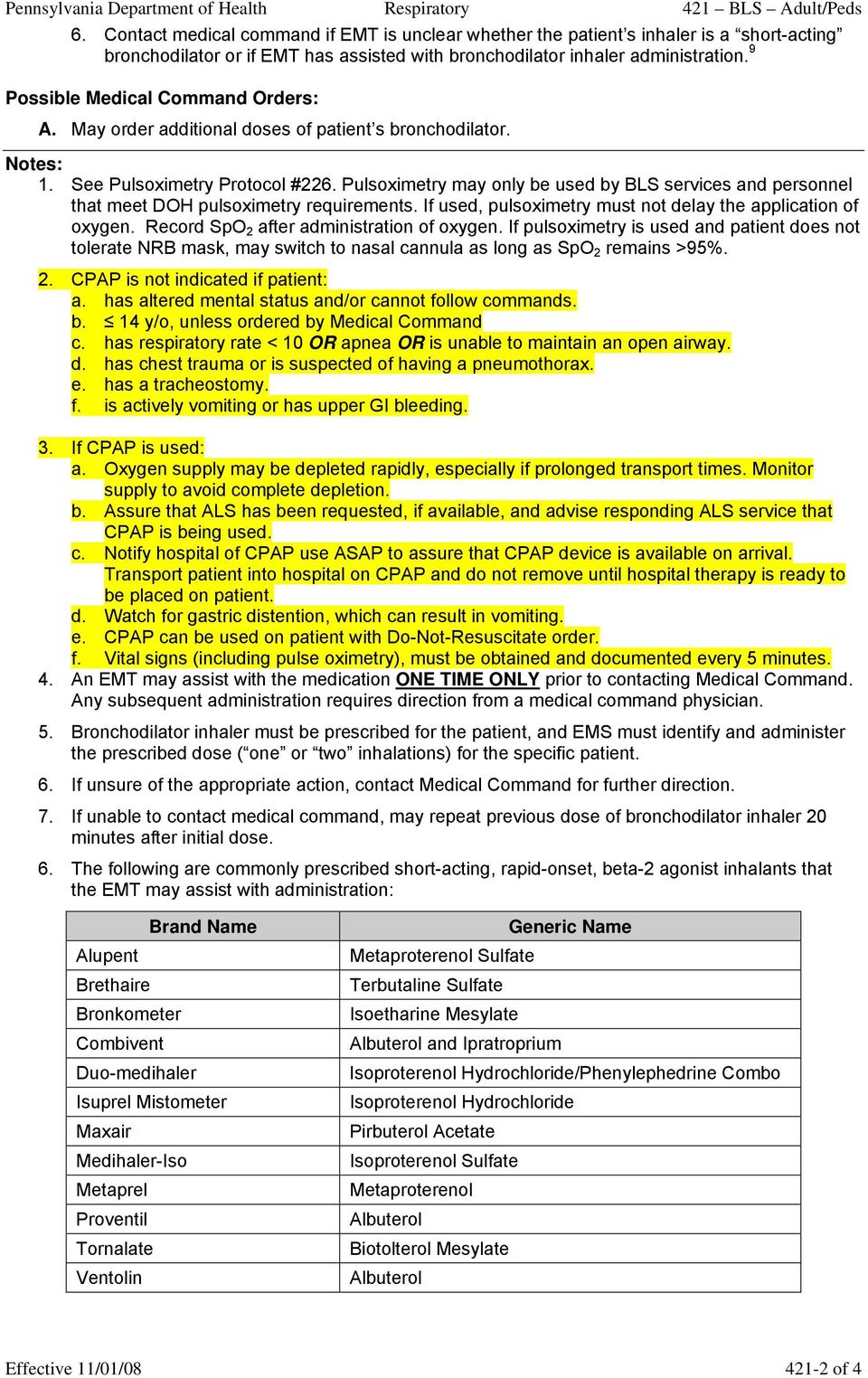
4 Pennsylvania Department of Health Respiratory 421 BLS Adult/Peds 6. Contact medical command if EMT is unclear whether the patient s inhaler is a short-acting bronchodilator or if EMT has assisted with bronchodilator inhaler administration. 9 Possible Medical Command Orders: A. May order additional doses of patient s bronchodilator. Notes: 1. See Pulsoximetry Protocol #226. Pulsoximetry may only be used by BLS services and personnel that meet DOH pulsoximetry requirements. If used, pulsoximetry must not delay the application of oxygen. Record SpO 2 after administration of oxygen. If pulsoximetry is used and patient does not tolerate NRB mask, may switch to nasal cannula as long as SpO 2 remains >95%. 2. CPAP is not indicated if patient: a. has altered mental status and/or cannot follow commands. b. 14 y/o, unless ordered by Medical Command c. has respiratory rate < 10 OR apnea OR is unable to maintain an open airway. d. has chest trauma or is suspected of having a pneumothorax. e. has a tracheostomy. f. is actively vomiting or has upper GI bleeding. 3. If CPAP is used: a. Oxygen supply may be depleted rapidly, especially if prolonged transport times. Monitor supply to avoid complete depletion. b. Assure that ALS has been requested, if available, and advise responding ALS service that CPAP is being used. c. Notify hospital of CPAP use ASAP to assure that CPAP device is available on arrival. Transport patient into hospital on CPAP and do not remove until hospital therapy is ready to be placed on patient. d. Watch for gastric distention, which can result in vomiting. e. CPAP can be used on patient with Do-Not-Resuscitate order. f. Vital signs (including pulse oximetry), must be obtained and documented every 5 minutes. 4. An EMT may assist with the medication ONE TIME ONLY prior to contacting Medical Command. Any subsequent administration requires direction from a medical command physician. 5. Bronchodilator inhaler must be prescribed for the patient, and EMS must identify and administer the prescribed dose ( one or two inhalations) for the specific patient. 6. If unsure of the appropriate action, contact Medical Command for further direction. 7. If unable to contact medical command, may repeat previous dose of bronchodilator inhaler 20 minutes after initial dose. 6. The following are commonly prescribed short-acting, rapid-onset, beta-2 agonist inhalants that the EMT may assist with administration: Alupent Brethaire Bronkometer Combivent Duo-medihaler Isuprel Mistometer Maxair Medihaler-Iso Metaprel Proventil Tornalate Ventolin Metaproterenol Sulfate Terbutaline Sulfate Isoetharine Mesylate Albuterol and Ipratroprium Isoproterenol Hydrochloride/Phenylephedrine Combo Isoproterenol Hydrochloride Pirbuterol Acetate Isoproterenol Sulfate Metaproterenol Albuterol Biotolterol Mesylate Albuterol Effective 11/01/ of 4
5 Pennsylvania Department of Health Respiratory 421 BLS Adult/Peds 7. The following are drugs that SHOULD NOT be used: Long-acting, Delayed-Onset, Bronchodilators Serevent Aero-bid Azmacort Beclovent Decadron Respihaler Dexacort Respihaler Flovent Vanceril Atrovent Intal Tilade Primatene Mist Salmeterol Xinafoate Corticosteroids Flunisolide Triamcinolone Acetonide Beclomethasone Dipropionate Dexamethasone Sodium Phosphate Dexamethasone Sodium Phosphate Fluticasone Propionate Beclomethasone Dipropionate Anticholinergics Ipratropium Bromide Non-Steroidal Anti-inflammatories Cromolyn Sodium Nedocromil Sodium Over-the-counter Drugs Epinephrine Performance Parameters: A. Review every case of EMT CPAP use or EMT-assisted bronchodilator inhaler administration for documentation for appropriate indication, appropriate medication, and appropriate contact with medical command. B. Consider benchmark of on scene time < 15 minutes if ALS not on scene. Effective 11/01/ of 4

6
7
8

9

10

RSPT 1410 Common Respiratory Drugs
 1 RSPT 1410 Wilkins: Chapter 32 2 Classifications Respiratory therapists administer several different class of drugs: (adrenergic) Parasympatholytics (anticholinergic) Mucoactives (mucolytic) Antiasthmatics
EPINEPHRINE AUTO-INJECTOR TRAINING POLICY ALLERGIC REACTION / ANAPHYLAXIS
 Page 1 of 1 EPINEPHRINE AUTO-INJECTOR TRAINING POLICY ALLERGIC REACTION / ANAPHYLAXIS All members/employees of (service) affiliate number must complete DOH training module #004124 and be familiar with
Medications. Patient Education Pulmonary Rehabilitation. A guide to medications for Chronic Obstructive Pulmonary Disease (COPD) Introduction
 Patient Education A guide to medications for Chronic Obstructive Pulmonary Disease (COPD) Do you know how each of your inhalers works to help your breathing? Do you know the correct order in which to use
Respiratory Therapy Self Assessment
 Respiratory Therapy Self Assessment Directions Please circle a value for each question to provide us and the interested facilities with an assessment of your clinical experience. These values confirm your
YOU VE BEEN REFERRED TO AN ASTHMA SPECIALIST...
 YOU VE BEEN REFERRED TO AN ASTHMA SPECIALIST... ...HERE S WHAT TO EXPECT You have been referred to an allergist because you have or may have asthma. The health professional who referred you wants you to
RESPIRATORY MEDICATIONS
 RESPIRATORY MEDICATIONS Purpose: To define and describe medications administered by Respiratory Therapy to patients. Sympathetic receptors: 1. Alpha receptors: - found primarily in blood vessels - stimulation
- Canine Chronic Bronchitis cannot be cured, but can be controlled
 MD-096A-0211 1 2 - The symptoms of asthma can mimic other diseases such as heartworm, pneumonia and congestive heart failure (Padrid, Use of Inhaled Medications to Treat Respiratory Diseases in Dogs and
GEORGIA MEDICAID FEE-FOR-SERVICE ASTHMA and COPD AGENTS PA SUMMARY
 GEORGIA MEDICAID FEE-FOR-SERVICE ASTHMA and COPD AGENTS PA SUMMARY Preferred Anticholinergics and Combinations Atrovent HFA (ipratropium) Combivent Respimat (ipratropium/albuterol) Ipratropium neb inhalation
COPD. (Chronic Obstructive Pulmonary Disease) (Emphysema) (Chronic Bronchitis) Education For Our Community
 COPD (Chronic Obstructive Pulmonary Disease) (Emphysema) (Chronic Bronchitis) Education For Our Community Chronic Obstructive Pulmonary Disease (COPD) Definition Chronic obstructive pulmonary disease (COPD)
Epinephrine Auto Injector Interim Policy (Amended March 12, 2008)
 Epinephrine Auto Injector Interim Policy (Amended March 12, 2008) Pursuant to the authority conferred by N.J.S.A. 26:2K-47.1, et seq., the Department of Health and Senior Services (the Department) shall
medicineupdate to find out more about this medicine
 medicineupdate Asking the right questions about new medicines Seretide for chronic obstructive pulmonary disease What this medicine is 1 What this medicine treats 2 Other medicines available for this condition
The patient s response to therapy within the first hour in the Emergency Room is one of the most reliable ways to predict need for hospitalization.
 Emergency Room Asthma Management Algorithm The Emergency Room Asthma Management Algorithm is to be used for any patient seen in the Emergency Room with the diagnosis of asthma. (The initial history should
Objectives COPD. Chronic Obstructive Pulmonary Disease (COPD) 4/19/2011
 Objectives Discuss assessment findings and treatment for: Chronic Obstructive Pulmonary Disease Bronchitis Emphysema Asthma Anaphylaxis Other respiratory issues Provide some definitions Chronic Obstructive
Emergency Medical Services Advanced Level Competency Checklist
 Emergency Services Advanced Level Competency Checklist EMS Service: Current License in State of Nebraska: # (Copy of license kept in file at station) Date of joining EMS Service: EMS Service Member Name:
Pharmacology for the EMT
 Pharmacology for the EMT Presented by Wade Scoles RRT, NREMT Pharmacodynamics Everybody reacts to drugs differently Factors altering drug responses Age Body mass Sex Pathologic state Genetic factors Psychological
Chronic obstructive pulmonary disease (COPD)
 Chronic obstructive pulmonary disease (COPD) Chronic obstructive pulmonary disease (COPD) is the name for a group of lung diseases including chronic bronchitis, emphysema and chronic obstructive airways
SMO: Anaphylaxis and Allergic Reactions
 REGION I EMERGENCY MEDICAL SERVICES STANDING MEDICAL ORDERS EMT Basic SMO: Anaphylaxis and Allergic Reactions Overview: Allergic reactions can vary in severity from a mild reaction consisting of hives
Protocol in depth Asthma/COPD. [email protected]
 Protocol in depth Asthma/COPD [email protected] Asthma/COPD Narrowing of airways (an H4 histamine response causing inflammation and mucous production), leading to wheezing on inspiration and exhalation.
It is recommended that the reader review each medical directive presented in this presentation along with the actual PCP Core medical directive.
 It is recommended that the reader review each medical directive presented in this presentation along with the actual PCP Core medical directive. This presentation will highlight the changes and any new
5. Aerosol Drug Delivery Devices: Pressurized Metered-Dose Inhalers
 Table of Contents Introduction 1. Aerosol Drug Delivery: the Basics 2. Aerosol Drugs: the Major Categories 3. Aerosol Drug Delivery Devices: Small-Volume Nebulizers 4. Aerosol Drug Delivery Devices: Inhalers
Medications for Managing COPD in Hospice Patients. Jim Joyner, PharmD, CGP Director of Clinical Operations Outcome Resources
 Medications for Managing COPD in Hospice Patients Jim Joyner, PharmD, CGP Director of Clinical Operations Outcome Resources Goal of medications in COPD Decrease symptoms and/or complications Reduce frequency
Emergency Medical Technician - Basic
 Washington State Specific Objectives for Emergency Medical Technician - Basic OFFICE OF EMERGENCY MEDICAL AND TRAUMA PREVENTION September 1996 Emergency Medical Technician - Basic Definition: Emergency
Stacie L. Penkova, PharmD, MHSA, BCPS Clinical Pharmacy Manager Critical Care Pharmacy Specialist Drug Information Coordinator Pharmacology Summit
 Stacie L. Penkova, PharmD, MHSA, BCPS Clinical Pharmacy Manager Critical Care Pharmacy Specialist Drug Information Coordinator Pharmacology Summit July 26, 2014 Objectives Classify asthma by severity Prescribe
Evaluating Steroid Inhalers Used to Treat: Asthma and Chronic Lung Disease. Comparing Effectiveness, Safety, and Price
 Evaluating Steroid Inhalers Used to Treat: Asthma and Chronic Lung Disease Comparing Effectiveness, Safety, and Price Our Recommendations Inhaled steroids are effective and safe medicines used to treat
CHAPTER 21 QUIZ. Handout 21-1. Write the letter of the best answer in the space provided.
 Handout 21-1 QUIZ Write the letter of the best answer in the space provided. 1. A severe form of allergic reaction is called A. an allergen. C. epinephrine. B. anaphylaxis. D. an immune reaction. 2. Harmless
Compare the physiologic responses of the respiratory system to emphysema, chronic bronchitis, and asthma
 Chapter 31 Drugs Used to Treat Lower Respiratory Disease Learning Objectives Describe the physiology of respirations Compare the physiologic responses of the respiratory system to emphysema, chronic bronchitis,
Oxygen - update April 2009 OXG
 PRESENTATION Oxygen (O 2 ) is a gas provided in compressed form in a cylinder. It is also available in liquid form, in a system adapted for ambulance use. It is fed via a regulator and flow meter to the
Community Ambulance Service of Minot ALS Standing Orders Legend
 Legend Indicates General Information and Guidelines Indicates Procedures Indicates Medication Administration Indicates Referral to Other Protocol Indicates Referral to Online Medical Direction Pediatric
Understanding asthma. Oxford Self-help guide. Oxford
 Understanding asthma Oxford Self-help guide Oxford Living with asthma Years ago, asthma was a debilitating condition that in many cases seriously limited what a person could do. Fortunately as a result
RESPIRATORY PHARMACOLOGY
 by Kevin T. Martin BVE, RRT, RCP RC Educational Consulting Services, Inc. 16781 Van Buren Blvd, Suite B, Riverside, CA 92504-5798 (800) 441-LUNG / (877) 367-NURS www.rcecs.com BEHAVIORAL OBJECTIVES UPON
First Responder: The National EMS Scope of Practice changes the name to Emergency Medical Responder.
 APPROVED SCOPE 2/8/08 BOARD MTG First Responder: The National EMS Scope of Practice changes the name to Emergency Medical Responder. Emergency Medical Responder (EMR) Description of the Profession The
Understanding COPD. An educational health series from
 Understanding COPD An educational health series from Our Mission since 1899 is to heal, to discover, and to educate as a preeminent healthcare institution. We serve by providing the best integrated and
Oxygen Therapy. Oxygen therapy quick guide V3 July 2012.
 PRESENTATION Oxygen (O 2 ) is a gas provided in a compressed form in a cylinder. It is also available in a liquid form. It is fed via a regulator and flow meter to the patient by means of plastic tubing
New 7/1/2015 MCFRS 1
 New 7/1/2015 MCFRS 1 The providers will summarize the need for this change from an epinephrine auto injector The provider will define the proper dosage of epinephrine for the adult and pediatric patient
Tests. Pulmonary Functions
 Pulmonary Functions Tests Static lung functions volumes Dynamic lung functions volume and velocity Dynamic Tests Velocity dependent on Airway resistance Resistance of lung tissue to change in shape Dynamic
INTERFACILITY TRANSFERS
 POLICY NO: 7013 PAGE 1 OF 8 EFFECTIVE DATE: 07-01-06 REVISED DATE: 03-15-12 APPROVED: Bryan Cleaver EMS Administrator Dr. Mark Luoto EMS Medical Director AUTHORITY: Health and Safety Code, Section 1798.172,
RESPIRATORY HOME CARE: AN OVERVIEW
 RESPIRATORY HOME CARE: AN OVERVIEW by Helen Schaar Corning RRT, RCP RC Educational Consulting Services, Inc. 16781 Van Buren Blvd, Suite B, Riverside, CA 92504-5798 (800) 441-LUNG / (877) 367-NURS www.rcecs.com
The Annual Direct Care of Asthma
 The Annual Direct Care of Asthma The annual direct health care cost of asthma in the United States is approximately $11.5 billion; indirect costs (e.g. lost productivity) add another $4.6 billion for a
Better Breathing with COPD
 Better Breathing with COPD People with Chronic Obstructive Pulmonary Disease (COPD) often benefit from learning different breathing techniques. Pursed Lip Breathing Pursed Lip Breathing (PLB) can be very
On completion of this chapter you should be able to: discuss the stepwise approach to the pharmacological management of asthma in children
 7 Asthma Asthma is a common disease in children and its incidence has been increasing in recent years. Between 10-15% of children have been diagnosed with asthma. It is therefore a condition that pharmacists
Allergy Emergency Treatment Protocol
 Allergy Emergency Treatment Protocol I. Initial evaluation of possible allergic reaction a. Cease administration of allergenic extracts b. Notify physician c. Record vital signs: blood pressure, pulse,
NOTICES. Approved and Required Medications Lists for Emergency Medical Services Agencies and Emergency Medical Services Providers
 NOTICES Approved and Required Medications Lists for Emergency Medical Services Agencies and Emergency Medical Services Providers [45 Pa.B. 5451] [Saturday, August 29, 2015] Under 28 Pa. Code 1027.3(c)
AETNA BETTER HEALTH Prior Authorization guidelines for Step Therapy
 AETNA BETTER HEALTH Prior Authorization guidelines for Step Therapy Definition A form of automated Prior Authorization whereby one or more prerequisite medications, which may or may not be in the same
Union EMS Local Formulary July 18, 2014
 July 18, 2014 Forward The intent of the Union EMS Local Formulary is to provide guidance during the implementation and use of the 2012 NCCEP Protocols, Policies and Procedures to the ALS and BLS Professionals
RES/006/APR16/AR. Speaker : Dr. Pither Sandy Tulak SpP
 RES/006/APR16/AR Speaker : Dr. Pither Sandy Tulak SpP Definition of Asthma (GINA 2015) Asthma is a common and potentially serious chronic disease that imposes a substantial burden on patients, their families
The Phoenix Document An Evolution from National Standard Curriculum to the Virginia EMS Education Standards
 The Phoenix Document An Evolution from National Standard Curriculum to the Virginia EMS Education Standards Training Levels Included: Emergency Medical Responder (EMR) Last Revised: January 19, 2011 Page
Problems With Inhaler Use: A Call for Improved Clinician and Patient Education
 Problems With Inhaler Use: A Call for Improved Clinician and Patient Education James B Fink MSc RRT FAARC and Bruce K Rubin MEngr MD MBA FAARC Introduction Economic Impact of Inhaler Misuse Problems With
Pulmonary Diseases. Lung Disease: Pathophysiology, Medical and Exercise Programming. Overview of Pathophysiology
 Lung Disease: Pathophysiology, Medical and Exercise Programming Overview of Pathophysiology Ventilatory Impairments Increased airway resistance Reduced compliance Increased work of breathing Ventilatory
Frontline First Aid EMR Scenario Examples
 Course Type: Start Date: Instructors initial scenarios as they are completed CPR-AED Scenarios CPR with Hypothermia Load and Go CPR with Obstructed Airway Continue CPR after airway clears with NO obvious
Nassau Regional EMS Council Basic Life Support Protocols and Supplements to State BLS Protocol Manual Table of Contents
 Nassau Regional EMS Council Basic Life Support Protocols and Supplements to State BLS Protocol Manual Table of Contents Approved/ Revised Effective BLS Adult Nerve Agent/Organophosphate Poisoning Antidote
Respiratory Care. A Life and Breath Career for You!
 Respiratory Care A Life and Breath Career for You! Respiratory Care Makes a Difference At 9:32 am, Lori Moreno brought a newborn baby struggling to breathe back to life What have you accomplished today?
ED PATIENT INTERFACILITY TRANSFERS
 Page 1 ED PATIENT INTERFACILITY TRANSFERS APPROVED: EMS Medical Director EMS Administrator 1. Purpose 1.1. To provide guidance for emergency departments on ground ambulance transport of patients that require
404 Section 5 Shock and Resuscitation. Scene Size-up. Primary Assessment. History Taking
 404 Section 5 and Resuscitation Scene Size-up Scene Safety Mechanism of Injury (MOI)/ Nature of Illness (NOI) Ensure scene safety and address hazards. Standard precautions should include a minimum of gloves
Guidelines for the Management of Asthma in California Schools
 Guidelines for the Management of Asthma in California Schools A comprehensive resource for school health and other personnel to address asthma in the school setting Arnold Schwarzenegger Governor State
IN-HOME QUALITY IMPROVEMENT. BEST PRACTICE: DISEASE MANAGEMENT Chronic Obstructive Pulmonary Disease NURSE TRACK
 IN-HOME QUALITY IMPROVEMENT BEST PRACTICE: DISEASE MANAGEMENT Chronic Obstructive Pulmonary Disease NURSE TRACK Best Practice Intervention Packages were designed for use by any In-Home Provider Agency
SARASOTA MEMORIAL HOSPITAL DEPARTMENT POLICY
 PS1006 SARASOTA MEMORIAL HOSPITAL DEPARTMENT POLICY TITLE: NON-INVASIVE POSITIVE PRESSURE (NPPV) VENTILATION (CPAP/BIPAP) Job Title of Reviewer: EFFECTIVE DATE: REVISED DATE: POLICY TYPE: Director, Respiratory
AECOPD: Management and Prevention
 AECOPD: Management and Prevention Neil MacIntyre MD Duke University Medical Center Durham NC AECOPD: Management and Prevention AECOPD: Definitions and impact Acute management of AECOPD Preventing AECOPD.
PRIMARY CARE PRACTICE GUIDELINES
 1 of 6 1. OUTCOME To identify anaphylaxis in the primary care setting and provide an evidence informed emergency response utilizing the most current provincial and federal practice guidelines. 2. DEFINITIONS
Treatment of Asthma. Talk to your doctor about the various medications available to treat asthma.
 Please call 911 if you think you have a medical emergency. Treatment of Asthma The goals of asthma therapy are to prevent your child from having chronic and troublesome symptoms, to maintain your child's
Inter-facility Patient Transfers
 Date: September 2004 Page 1 of 6 Inter-facility Patient Transfers Purpose: The purpose of this policy is to establish a uniform procedure for inter-facility transfers. 1. Responsibility: a. Patient transfer
Target groups: Paramedics, nurses, respiratory therapists, physicians, and others who manage respiratory emergencies.
 Overview Estimated scenario time: 10 15 minutes Estimated debriefing time: 10 minutes Target groups: Paramedics, nurses, respiratory therapists, physicians, and others who manage respiratory emergencies.
COPD PROTOCOL CELLO. Leiden
 COPD PROTOCOL CELLO Leiden May 2011 1 Introduction This protocol includes an explanation of the clinical picture, diagnosis, objectives and medication of COPD. The Cello way of working can be viewed on
EMS Course Requirements
 EMS Course Requirements The following outlines should be followed when creating your course syllabi. The minimum course hours must be met, but they can be exceeded depending on the needs of your class.
NEW YORK STATE DEPARTMENT OF HEALTH BUREAU OF EMERGENCY MEDICAL SERVICES
 NEW YORK STATE DEPARTMENT OF HEALTH BUREAU OF EMERGENCY MEDICAL SERVICES TRAINING PROGRAM OUTLINE FOR UNLICENSED OR UNCERTIFIED PERSONNEL TO ADMINISTER EPINEPHRINE BY AUTO-INJECTOR IN LIFE-THREATENING
Welcome COPD MANAGEMENT PROGRAM. Reproduced with permission of UofL Pulmonary s COPD Management Program
 Welcome COPD MANAGEMENT PROGRAM Section 1: Section 2: Section 3: Section 4: Section 5: Section 6: Section 7: Section 8: Section 9: What is COPD? How the Lungs work. Managing your COPD. Exercise Breathing
81 First Responder Respiratory
 81 First Responder Medical Scenarios Asthma Scenario: You are called to a local house for a woman with trouble breathing. You arrive to find a 67-year-old woman sitting upright in a chair. She states she
Immunologic Emergencies
 Immunologic Emergencies Part 1 You and your partner are dispatched to Pioneer Park, a local recreational area where residents frequently picnic and enjoy a variety of outdoor festivities, especially during
SERETIDE Fluticasone propionate/salmeterol xinafoate Consumer Medicine Information
 SERETIDE Fluticasone propionate/salmeterol xinafoate Consumer Medicine Information What is in this leaflet Please read this leaflet carefully before you start using Seretide. This leaflet answers some
Outside Patient Transfers. National Pediatric Nighttime Curriculum Written by Erin Augustine, MD Lucile Packard Children s Hospital at Stanford
 Outside Patient Transfers National Pediatric Nighttime Curriculum Written by Erin Augustine, MD Lucile Packard Children s Hospital at Stanford Case 1 A 5 year old male is being transferred from an outside
Novartis Gilenya FDO Program Clinical Protocol and Highlights from Prescribing Information (PI)
 Novartis Gilenya FDO Program Clinical Protocol and Highlights from Prescribing Information (PI) Highlights from Prescribing Information - the link to the full text PI is as follows: http://www.pharma.us.novartis.com/product/pi/pdf/gilenya.pdf
Development and Implementation of Respiratory Care Plans
 wheatley/shutterstock, Inc. CHAPTER Development and Implementation of Respiratory Care Plans David C. Shelledy and Jay I. Peters CHAPTER OUTLINE KEY TERMS Introduction to Respiratory Care Plans Common
Southern Stone County Fire Protection District Emergency Medical Protocols
 TITLE Pediatric Medical Assessment PM 2.4 Confirm scene safety Appropriate body substance isolation procedures Number of patients Nature of illness Evaluate the need for assistance B.L.S ABC s & LOC Focused
MARYLAND STATE SCHOOL HEALTH SERVICES GUIDELINES
 Department of Health and Mental Hygiene Maryland State Department of Education Maryland State School Health Council MARYLAND STATE SCHOOL HEALTH SERVICES GUIDELINES Emergency Management Guidelines for
RULE 59 NEBRASKA DEPARTMENT OF EDUCATION REGULATIONS FOR SCHOOL HEALTH AND SAFETY TITLE 92, NEBRASKA ADMINISTRATIVE CODE, CHAPTER 59
 NEBRASKA DEPARTMENT OF EDUCATION RULE 59 REGULATIONS FOR SCHOOL HEALTH AND SAFETY TITLE 92, NEBRASKA ADMINISTRATIVE CODE, EFFECTIVE DATE MAY 13, 2006 (REVISED) State of Nebraska Department of Education
EMERGENCY MEDICAL TECHNICIAN
 EMERGENCY MEDICAL TECHNICIAN Lisa Cookston ROP Career Specialist Orange County Emergency Medical Services EMT Externship Goal to understand and participate in supplementing current EMT curriculum with
POLICY SERVICES ADVISORY
 POLICY SERVICES ADVISORY Volume 12, Number 2 April 2015 CONTENTS Policy Advisory No. 114 JLCG Emergency Administration of Medications to Students JLCG-R Emergency Administration of Medications to Students
And the. Two types of orders:
 1 PHARMACOLOGY And the EMT-B 2 MEDICAL DIRECTION Must have Dr. s orders to administer any drug to a Pt Local medical director can override any state set protocols Two types of orders: On-line : verbal
Asthma in Infancy, Childhood and Adolescence. Presented by Frederick Lloyd, MD Palo Alto Medical Foundation Palo Alto, California
 Asthma in Infancy, Childhood and Adolescence Presented by Frederick Lloyd, MD Palo Alto Medical Foundation Palo Alto, California Major Health Problem in Childhood Afflicts 2.7 million children in the USA
Oxygenation. Chapter 21. Anatomy and Physiology of Breathing. Anatomy and Physiology of Breathing*
 Oxygenation Chapter 21 Anatomy and Physiology of Breathing Inspiration ~ breathing in Expiration ~ breathing out Ventilation ~ Movement of air in & out of the lungs Respiration ~ exchange of O2 & carbon