
20 Annual Report 1 2
|
|
|
- Christian Ray
- 10 years ago
- Views:
Transcription
1 Annual Report 2012

2 Key Figures 2012 PULSION (Group) 2012 Delta IFRS in % IFRS IFRS IFRS IFRS IFRS Revenues EUR million % Gross profit EUR million % EBITDA EUR million % EBIT EUR million % Consolidated profit/loss EUR million % Cash flows used in operating activities EUR million % Shareholders Equity* EUR million % Shareholders Equity percentage* EUR million 74 % 4 % 71 % 67 % 66 % 68 % 64 % Total assets* EUR million % R&D expenses % Employees (average) Amount % Revenue per employee TEUR % Installed base - PiCCO monitors* Units 8,150 9 % 7,500 6,860 6,247 5,743 5,256 *as at 31 December

3 Content Report of the Executive Director 5 A brief description of PULSION 10 The business model: Recurring revenues 12 Critical Care business unit 15 Perfusion business unit 23 The year in review 26 Events and activities in PULSION in the US market 29 PULSION stock 30 Employees 31 Corporate Governance report 32 Consolidated Financial Statements (IFRS) Report of the Administrative Board for the Financial Year Group Management Report 49 A Review of the Financial Year 49 Financial Report 49 Research and Development Report 60 Risk Report 63 Opportunities 68 Outlook Report 69 Disclosures Pursuant to 315 (4) of the German Commercial Code (HGB) 70 Statement on Corporate Governance 71 Compensation Report of the Executive Director(s) and Administrative Board 72 Forward-looking Assertions 73 Consolidated Balance Sheet 74 Group Income Statement 76 Reconciliation of Result to Total Comprehensive Income 77 Consolidated Cash Flow Statement 78 Consolidated Statement of Changes in Equity 79 Analysis of Changes in Fixed Assets 80 Notes to the Consolidated Financial Statements 83 Responsibility Statement 128 Auditors Report 129 Financial calendar Glossary / 3 Content

4 Our employees help to generate medical benefit for hospitals, doctors and patients every day through continuous innovation, training and compliance with the very highest quality requirements Patricio Lacalle CEO

5 Report of the Executive Director Dear customers, shareholders and employees The year 2012 again largely fulfilled our expectations. Both sales and earnings figures were up on those of the previous year and our cost management endeavours enabled us to achieve all of our targets. Sales rose by more than 5.1 % compared to one year earlier. Adjusted for currency factors, sales improved by 4.0 %. The momentum that drove our performance in 2011 therefore slowed moderately, primarily due to less favourable business conditions in the so-called PIGS countries. In contrast, however, the pace of growth rose sharply in a number of key regions, notably the UK and the USA. As in the previous year, the better earnings were again achieved amidst a backdrop of consistent cost discipline. We were successful in driving down the net OPEX (other operating expenses less other operating income) by approximately EUR 0.7 million to EUR 15.1 million. Together with the improvement in our gross margin, this helped to raise EBIT. Overall, EBIT climbed by EUR 2.7 million (+41 %) from EUR 6.8 million to EUR 9.5 million. In 2012 PULSION was able to achieve the financial targets it set for itself, namely the key performance indicators gross earnings, EBIT and free cash flow conversion rate. The main task in 2013 will be to raise the growth rate further with the aid of improved sales management and a broader product range. We would like to express our gratitude to all employees for their great commitment which has made this result possible. Thanks go on the one hand to those who made a contribution to above-average growth, but also equally to those who helped to provide stability and continuity in tremendously difficult circumstances. 4 / 5 Report of the Executive Directors
6 I. A review of the financial year 2012 In the following, we wish to continue our tradition of giving you a full account of the extent to which we achieved the goals we set ourselves for the year 2012 in the previous year s Annual Report. As shareholders, you can therefore see how we deal with success and failure: we believe that one can learn a lot from both of these and encourage a corresponding culture of intellectually honest discussion, both externally and within the company. A. Focus on management and key projects Innovation through in-house developments and acquisitions 1.1 Targets for 2012 as stated in the Annual Report 2011: We are planning to launch two new products in Europe in 2012 with the CE label: a) one or more software releases adding a number of new parameters for PiCCO, b) integration of PiCCO technology into the PulsioFlex platform and market introduction in Europe with the CE label. 1.2 Implementation in 2012 We did not launch a software release for the PiCCO 2 platform in The planned parameters will be subject to extensive clinical studies in both 2012 and 2013 and the respective software release is now scheduled to coincide with the turn of the year 2013/ The modular integration of the PiCCO technology in the PulsioFlex platform and also the market launch in Europe with the CE label were completed in August as planned. As a result, all technologies are now available on the latest PULSION monitoring platform.» Product management is involved with ensuring that PULSION s monitoring platforms are continually improved and suited to meet the ever-changing requirements of the markets. By merging both new and existing technologies in devices designed to be operated intuitively, our innovative products offer users optimal support in their day-to-day work. We also work extremely «closely with our strategic business partners. Malte Kochanski Technical Product Manager

7 2. Strengthen sales processes and reduce staff fluctuation in the field sales force 2.1 Targets for 2012 as stated in the Annual Report 2011: The recipe for success potential-orientated sales management and communicating the medical benefits than can be gained from our products is still not being implemented and sustained on a consistent basis throughout the Group. We have set ourselves the task of improving cooperation between the sales companies and headquarters with a view to accelerating growth in our companies in Spain, the UK, France and the USA. A second key target is to reduce employee fluctuation in the field sales force from its current high level. New management structures have been introduced in countries with the highest fluctuation rates and the entities concerned will receive greater levels of support across all functions. Local heads of sales will therefore have the wherewithal to lead their teams to success. The plan is to reduce employee fluctuation in the field sales force from its recent level of 35 % to below 25 % in The employee fluctuation rate is calculated on the basis of the average number of employees during the past 12 months to the end of the reporting period and the number of employees leaving the Group during that period (BDA formula: fluctuation rate = departures/average number of employees x 100). Temporary staff and apprentices are not included for the purposes of calculating the employee fluctuation rate. 2.2 Implementation in 2012 In 2012 we provided our foreign sales companies with a far greater degree of clinically and medically based support. This was achieved firstly by the increased presence of clinically and medically trained personnel and secondly due to the greater inclusion of opinion leaders and external speakers when organizing further training courses and workshops held at hospitals. In the USA and France, the use of PiCCO technology therefore grew significantly and in the UK the growth rate was well over 12 %. By contrast, however, sales figures in Spain deteriorated, which was largely attributable to the difficult financial situation in the public sector. However, growth was positive in all other countries where our sales companies operate, with double-digit figures recorded in some of them. For this reason, we see our target as having been largely achieved. We successfully reduced the rate of fluctuation in our field sales team to a greater degree than planned. Whereas fluctuation in December 2011 was running at 37 %, it had fallen to 18 % by December 2012, using the same method of measurement. Thus we have created the basis for entering the market with a more experienced team and thereby offer our customers improved continuity in Expansion of Perfusion business unit 3.1 Targets for 2012 as stated in the Annual Report 2011: In the field of perfusion imaging diagnostics, our task is to establish a more focused position in a number of targeted areas of application, namely ophthalmology, plastic surgery, visceral surgery and neurosurgery primarily by documenting and communicating the medical and commercial benefits that can be achieved in each of these areas of application. We intend to select a specific sales approach to this during the first half of Secondly, we want to complete the patient recruitment project phase as part of an approval study for a new indication for ICG. 3.2 Implementation in 2012 Ophthalmology was again a stable pillar of this business field in 2012 and continues to account for more than half of our sales revenue. In the fields of plastic and neurosurgery we have intensified collaboration with device 6 / 7 Report of the Executive Directors

8 suppliers and key opinion leaders, which has helped generate growth. However, abdominal surgery was no longer in the primary focus of our sales endeavours. Patient recruitment for the approval study for a new indication for ICG has been completed. We now expect the studies to be concluded and the first national regulatory approval in the course of International growth 4.1 Targets for 2012 as stated in the Annual Report 2011: The various business alliances established in 2011 must now be moved on to the marketing phase. Amongst other things, we expect that sales approval will be received in Mexico and that the first sales will be recorded on this market. We are also planning the establishment of at least a) one new joint venture and b) two new distributor agreements. 4.2 Implementation in 2012 Sales approval for Mexico has shifted to In the second half of the year, however, the approval process greatly benefited in terms of structure and direction with the help of a stronger Approvals and Regulatory Affairs department together with the locally based partner. We did not enter into any new joint ventures in After carefully examining several target markets, for the time being we will proceed with the approval process and then begin negotiating with locally based partners. Apart from Brazil, we have also entered into new distribution agreements with Ukraine, Kazakhstan, Belarus and Colombia. In Brazil we have already held workshops that received a positive response for arranged tests. B. Medium-term forecast P5 In the course of 2012 we readjusted our medium-term forecast and substantiated it in individual projects. Under the working title P5 (PULSION in 5 years) a total of some 20 individual projects were clearly assigned to the teams responsible. All PULSION employees are familiar with the project and fully focused on the targets and milestones that have been set. Acquisitions Perfusion Emerging markets Critical Care New products Critical Care Base line PiCCO (ex emerging markets)

9 The cleanroom team: An international team made up of people from Germany, Italy, Madagascar, Turkey, Serbia, Bosnia, Russia and Poland who have been with the company for up to 17 years. II. Outlook Focus on management and key projects 2013 The Executive Directors will focus in 2013 in parti cular on following areas, each aimed at achieving faster growth: P5 PULSION in 2016, based on the forecast we made at the beginning of 2012 In addition to our established strengths including innovation, sales management, internationalization and our perfusion business, the programme also includes the continual further development of our corporate culture. Our definite plans for 2013: 1. Innovations In 2013 we want to introduce at least one new parameter on the market. Secondly we want to bring our two projects for the continuous non-invasive measurement of blood pressure and cardiac output significantly closer to market maturity with the aim of releasing the products on the market by Acquisitions P5 has scheduled one acquisition in The goal is to acquire a technology that helps us supplement our two call points ICU and OR. In the medium term we plan to integrate the respective technology in our monitoring platform. We will, however, only go ahead with an acquisition if it creates economic added value. In this respect we do not intend to put ourselves under pressure and do not see it as a failure if we are unable to report a new deal at the beginning of Internationalization Primary focus on the USA: we are looking for a solution to significantly bolster our presence on this market. The US market constitutes some 40 % of the medical technology market worldwide and we see openings for our technology in this region. 4. Perfusion For the drug ICG we want to obtain approval for a new application in Moreover, we want to gain national approval in at least two additional countries in order to expand our sales territory. 5. Sales management Our approach of potential-orientated sales management based on a CRM system with a proprietary database is to be fully implemented in all countries operating a direct sales system. 6. Cultural change The management team has updated and newly adopted the cultural principles for PULSION. As part of the process of setting a good example, this group have it assessed over the course of the year before the change is incorporated throughout the entire enterprise. 8 / 9 Report of the Executive Directors

10 A brief description of PULSION PULSION Medical Systems SE is one of the world s leading providers of solutions for advanced haemodynamic monitoring. PULSION products are used mainly in intensive care units and, since 2012, following the introduction of the new ProAQT technology, in perioperative situations, where they measure and evaluate a large number of parameters for visualizing the oxygen supply to the body and the condition of its vital systems. In comparison to standard monitoring systems, critically ill patients in intensive care units and unstable patients in operating theatres can be monitored much more comprehensively. Medical and nursing staff can construct a complete picture and make correct and well-informed decisions more quickly potentially life-saving advantages. PULSION is currently developing a second promising business line in the field of perfusion imaging diagnostics. PULSION was founded in 1990 as a spin-off from the Technische Universität in Munich and has grown over the past 20 years into a medium-sized entity with approximately 130 employees. Particularly in Europe, it has become one of the market leaders in the field of haemodynamic monitoring systems for critically ill patients in the intensive care unit. Alongside its own sales activities, PULSION also works in partnership with leading manufacturers of integrated patient monitoring systems. Those partners are helping to spread the use of PULSION s monitoring technologies. The overriding objective of PULSION s endeavours is to generate measurable and provable medical benefits. The requirement to generate economic benefits by reducing the period a patient spends in the ICU is also gaining in importance. It is therefore seen as a strategic objective to concentrate knowledge and know-how within the company. This is underlined by the medical background of several members of management, a sales force with the appropriate set of skills and a Medical Advisory Board comprising internationally renowned members.

11 Two business units: Critical Care and Perfusion In its Critical Care business units, PULSION develops and manufactures medical products for diagnostics and the monitoring of critically ill patients. The products are primarily for use in intensive care units and following the introduction of new product lines increasingly also in operating theatres. Physicians are provided with extensive information pertaining to the condition of the cardiovascular system, which supplies the organs with oxygen, as well as information about the condition of other important systems in the body. The data can be collated by medical practitioners to create an informative, complete picture which helps them to make the correct decisions. The time and information thus gained helps the physician to start the correct therapy at an early stage and, hence, to avoid complications. PULSION s Perfusion business unit deals with the visualization of blood perfusion in tissues and organs. As an example of this, it enables pathological changes in blood vessels to be visualized. During surgery and post- operatively, it is possible to check whether there is an adequate blood supply to the tissues. For this purpose, PULSION uses its own diagnostic agent, ICG PULSION. Once it has been injected into the bloodstream it becomes fluorescent. An optical imaging system makes the blood vessels visible. It is a real alternative to X-rays since it enables physicians to see the perfusion of superficial tissue layers without any exposure to radiation. Thanks to its outstanding properties, the agent ICG PULSION can be used for diagnostic purposes as well as for quality assurance and documentation purposes in numerous fields. This technology is used, for instance, in the fields of ophthalmology and neurosurgery as well as abdominal and plastic surgery. PULSION currently holds exclusive drug approval in nine European countries. The company has permission to market ICG PULSION in the USA, where PULSION is one of two providers.» The customer is always the main focus for the customer service team, at both a national and international level. Orders, specification requirements and enquiries land here from all over the world and are processed by us in close cooperation with our colleagues in Germany and abroad. Our dialogue with customers is driven by a customer-orientated approach and the desire «to maximize customer satisfaction. Manuel Hackel Customer Service 10 / 11 Report of the Executive Directors

12 The business model: Recurring revenues Razor / Razorblade business model To generate revenues with each application: that is the basis of PULSION s business model. Like the manufacturers of ink jet printers, we do not focus exclusively on one-off sales of equipment. Recurring business generated with the disposable products required to use PULSION technologies accounts for a much bigger share of PULSION s commercial and financial success. Monitoring catheters, measurement probes, sensors or the agent ICG PULSION : these disposable items need to be regularly replenished by customers and since they can only be purchased via PULSION represent the central source of income for the company. In fact, all of PULSION s products and services are designed to generate recurring revenues. This distinguishes us from the majority of medical technology manufacturers whose business models are limited to initial installations of equipment in hospitals and medical practices, supplemented at best with equipment replacement investments and technical services. The same principle applies to PULSION s extensive and successful cooperation with major medical-technology providers in the area of monitoring hardware. Even though the equipment in this case is supplied by third parties, the related disposables business is PULSION s responsibility.» The sales team serves as the interface between PULSION and its customers. Pulsion Medical Systems core expertise and know-how is outstanding. Each member of the team is capable of addressing the individual wishes and needs of the customer. Convincing users of the medical benefit of our products is just as important as achieving sales-related targets. Intensive sales training is carried out at regular intervals to ensure quality in our selling activities. «Daniel Gaedke Regional Sales Manager for North-West Germany

13 PULSION s position in the market The medical-technology industry is extremely polarized. Numerous start-up companies are lined up against a small number of international global players. PULSION ranks exactly in-between this position requires us to match the innovative ability of smaller companies to avoid being overtaken by new players, as well as demonstrate excellence in the field of sales in order to survive in the face of the sales machinery of large corporations. As a specialist company selling medical-technology products requiring a high degree of explanation, PULSION has the opportunity to enter into cooperation arrangements with the major manufacturers of integrated monitoring systems. PULSION brings new technologies to market, concentrating on the so-called early markets. PULSION s products generally provide users with considerably more information than the products of the big companies. If the markets accept PULSION s innovations and the demand for these products grows accordingly, it is then an interesting proposition for manufacturers of integrated patient monitoring systems to have these new technologies integrated in their own platforms. Numerous large-sized monitor manufacturers have already incorporated PULSION s technologies into their patient monitoring systems, thereby expanding the available equipment base at an above average rate. PULSION benefits on the one hand from the revenue generated by the licence arrangement, and on the other from the growth in the volume of disposable product business generated by the company. PULSION s ability to access the market, coupled with the degree of specialization discussed above, means that cooperation arrangements are also of interest to start-up and development companies. Such companies generally do not have easy access to the market or the sales and marketing resources to position their own innovative products. In contrast, although the major manufacturers of integrated patient monitoring systems have strong sales abilities, they regularly rely on new medically relevant parameters. It is also generally true to say that they cannot be innovative in all areas. This is precisely where PULSION comes in: promising products are established on the early markets, mainly using a medical-based marketing approach. If a substantial market emerges, it then becomes the joint goal to integrate the product into the manufacturer s integrated patient monitoring systems. 12 / 13 Report of the Executive Directors

14 Rapid diagnosis, safe therapy decisions, the ability to assess the success of a chosen therapy continuously: these fundamental demands made of doctors and medical staff are addressed by PULSION s Critical Care business unit. The precise parameters measured by our products provide the user with a comprehensive picture of the condition of certain vital organs and their systems in critically ill patients. The innovative depiction of measurements with state-ofthe-art monitors facilitates the interpretation of the vast array of information that is available, thus enabling users to identify the condition of a patient quickly and to reach well-informed decisions.

15 Critical Care business unit The main focus of this business unit is on cardio vascular monitoring of critically ill patients in intensive care units and in operating theatres. A reliable and adequate oxygen supply is essential for the proper function of organs and tissue. Ensuring oxygen supply to the body s organs is one of the top priorities for intensive care specialists and anaesthetists. Another minimally invasive monitoring system was added to the range of current technologies in 2012 under the umbrella of the StepWISE Intelligent Patient Monitoring brand name. A non-invasive technology will complete the product range in future. Exactly the right amount of information can be prepared depending on requirements. This will broaden the target markets for PULSION s products and increase the benefits gained by the customer since monitoring can be even more finely tuned to suit the needs of each individual patient. The new PulsioFlex platform puts this concept fully into practice. 14 / 15 Report of the Executive Directors

16 Products and monitoring technologies PULSION currently provides two monitoring platforms: a) the traditional PiCCO platform and b) the PulsioFlex platform introduced in Catheters and probes are assigned to both of these platforms with which certain parameters at specified levels of accuracy can be measured. PiCCO 2 PULSION s PiCCO 2 platform, which can be used in intensive medical care in conjunction with the treatment of critically ill patients, is very well positioned. The finish, design, user interface, ease of use and visualization of parameters offered by this platform are amongst the best currently available on the market. The most important of these are: a) PiCCO technology b) ProAQT technology c) CeVOX technology d) LiMON technology In the following section we provide a brief summary of these products and technologies. Thanks to its platform concept, PiCCO 2 combines several PULSION technologies within a single piece of equipment. Users are able depending on the patient, complications and the progression of a disease to select the relevant parameters and most appropriate monitoring technology. With the PiCCO 2 platform, the medical practitioner receives precise information about the oxygen supply within the body (CeVOX technology), real-time cardiac and circulatory measurements, the existence of any pulmonary complications (PiCCO technology) as well as liver function and blood supply to the abdominal organs (LiMON technology).

17 PulsioFlex PiCCO Perioperative medicine is another field in which the PiCCO 2 platform can be employed for visualizing parameters. This area of medicine involves all aspects concerned with preparing for routine or emergency operations, minimizing risk to the patient and preventing complications. Here also, it is essential to establish a stable cardiovascular system for the provision of an adequate oxygen supply to all tissues. PULSION s new PulsioFlex monitoring platform is geared precisely towards this market. With the integrated ProAQT technology, it is possible to detect haemodynamic irregularities at an early stage and initiate the appropriate treatment. Since it can be flexibly assembled, it is also possible to market the equipment as an individual monitor for use with the PULSION CeVOX and LiMON technologies. In 2012 we supplemented this monitoring platform with the PiCCO technology for the field of intensive medicine so that now all technologies from PULSION can be used on this platform. The PiCCO catheter is the flagship amongst the disposables sold by PULSION. It enables doctors and medical practitioners to monitor the cardiovascular system of critically ill intensive care patients and to manage the selected therapy. In contrast to its competitors, PULSION is able to provide an especially comprehensive picture of the patient with PiCCO. An analogy using a car helps to illustrate the difference. Instead of only measuring the speed (in medical terms: cardiac output the volume of blood pumped by the blood in one minute), which in itself does not provide a full picture of motor performance, PiCCO also provides other important measurements. In addition to the number of revs (pulse frequency), further measurements are the torque and the engine performance (contractibility and cardiac power), the wind and frictional resistance (vascular tone) and the fuel supply to the engine (cardiac preload). The additional information not only shows that the engine (heart) is unable to bring the car (blood) to a specific speed (if the volume of blood being pumped by the heart is too low); the parameters incorporated into the system also show the reason for these problems and the measures that can be taken to improve the situation. This is the all-important distinction between a simple and a complete picture. 16 / 17 Report of the Executive Directors
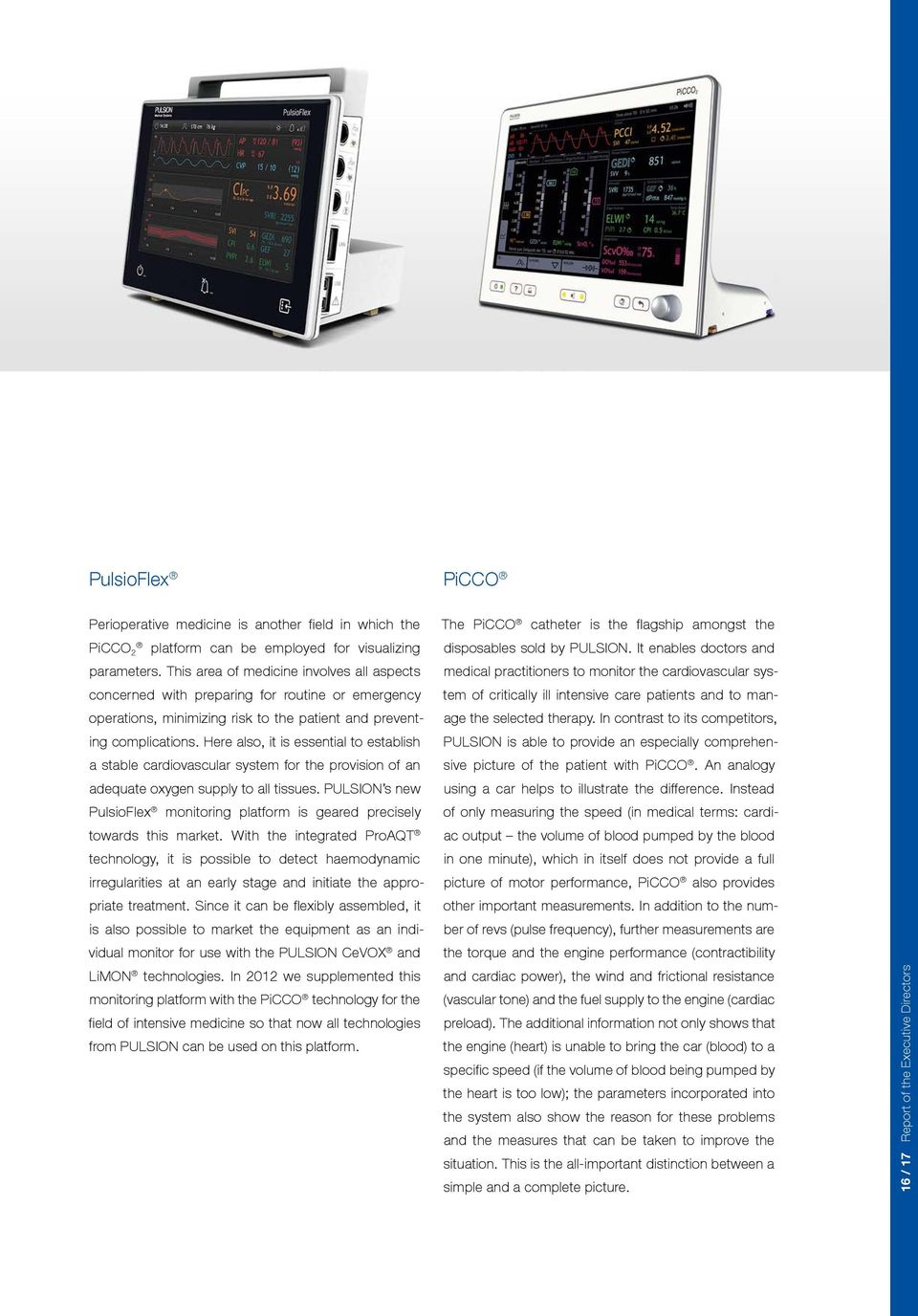
18 ProAQT LiMON The ProAQT probes are a simplified version of the PiCCO technology. This version is not equipped to provide answers to the complex problems posed in the field of intensive care medicine, but is definitely useful in perioperative medicine. It is a technology which can be used for at-risk patients and during high-risk surgery for the prevention or early warning of a reduction in oxygen supply and in preparation for appropriate measures to be taken. It is a minimally invasive technology which can be installed by nursing staff with access via a radial catheter. CeVOX LiMON technology is used to evaluate and monitor liver function. This product is used in intensive care medicine for the early detection of complications and to monitor the progress of patients suffering from liver function disorders and liver failure. In the area of hepatic surgery, for example, LiMON is used to monitor liver function, e.g. before and after operations on the liver, or liver transplants. StepWISE Intelligent Patient Monitoring CeVOX technology is designed to monitor the oxygen balance on a continuous basis (ratio of oxygen supply to oxygen demand). It enables early detection of an inadequate oxygen supply which could result in severe complications. CeVOX therefore serves as an early warning system, enabling the appropriate countermeasures to be carried out in good time. StepWISE, PULSION s latest brand, epitomizes PULSION s patient monitoring philosophy and amalgamates all of the monitoring technologies. The aim is to provide all hospital patients needing haemodynamic monitoring with a suitable methodology to answer relevant clinical questions relating to their condition.

19 Markets and competition Worldwide, up to three million intensive care patients and up to 15 million surgical patients could potentially benefit each year from improved haemodynamic monitoring and management. At present, the number of patients benefiting from these healthcare technologies is below 500,000 since these methods have so far not become standard applications. In the ICU segment, Edwards Lifesciences presented a new monitoring platform (EV1000 with VolumeView) in October This platform was introduced in 2011 and fully rolled out in PULSION reacted with targeted countermeasures and above all vigorously defended its position in Europe so that its sales figures in the field of Critical Care again grew, as shown above. Apart from Edwards Lifesciences as the largest market competitor, PULSION is principally confronted with smaller rivals such as LiDCO in Europe and ICU Medical in the USA. PULSION still sees itself as the market leader in the field of intensive care. Our market leadership is particularly strong in Europe. Sales for the Edwards business field Critical Care grew by a total of 3.5 % in By comparison, the PULSION Critical Care field grew by 3.0 % and the relative market share therefore remained approximately the same. Based on our own assessment, however, Edwards Lifesciences is the market leader in the OR segment. PULSION also wishes to participate in this market and joined the race in 2011 with its PulsioFlex / ProAQT product combination. In 2012, the first complete sales year, PulsioFlex / ProAQT enjoyed a highly positive response and achieved almost 5 % market share in the field of Critical Care. 18 / 19 Report of the Executive Directors

20 Strategy Research and development PULSION is after its competitor and the market leader Edwards Lifesciences the second largest provider of advanced haemodynamic monitoring products. The intention is to strengthen and build on this position. The main focus will be placed on the so-called platform strategy, which was initiated with PiCCO 2 and will be carried positively further with PulsioFlex. Additional technologies and improvements as well as new parameters will be added to the product range in 2013 and beyond to provide further benefits for patients and practitioners. This means that the number of areas of application for which PULSION monitoring solutions can be used will increase. A further focus will be on expanding cooperation arrangements with global players in the area of integrated patient monitoring with the aim of broadening the installed base by integrating PULSION monitoring technologies into other systems (see also section Business partners ). Research and development work performed in recent years laid the foundation for the introduction of new technologies and products. The main focus has been on physiology, new parameters and algorithms. In addition, PULSION also studies the market and medical literature continuously and keeps abreast of developments in the patent world with a view to identifying potential technologies for integration into the PULSION product range. Production Now that plastic processing activities have been outsourced, cooperation with our production partners has been intensified. Clean room final assembly, quality assurance and delivery to customers remained unchanged at the new production location. We were successfully audited by the American regulatory agency, FDA.» The goal of the clinical application team is to establish and standardize haemodynamic monitoring in intensive medical care as the foundation for goal-directed therapy and, hence, better outcomes. We offer dedicated training services to doctors and nursing staff on the one hand and to our sales partners on the other, supported by extensive training material. The Internet-based e-learning platform established in 2012 in conjunction with the PULSION Academy «represents a further building block. Johann Obermaier Senior Clinical Application Manager

21 Marketing PULSION is represented in 56 different countries. The basis for this high level of market presence comes from ten subsidiaries on the one hand and distributors with worldwide operations on the other. PULSION has traditionally been very strong in Central and Western Europe and Poland with its subsidiaries or joint ventures. PULSION Mexico was founded in April together with a joint venture partner. Close cooperation with sales partners in Eastern Europe, Asia and Latin America ensures that the markets in these areas are well serviced. The sales network is focusing its efforts on evaluating customer potential and areas of expertise in order to communicate medical benefits on a more targeted basis. In order to achieve the best marketing results, an appropriate combination of medical and classical marketing elements is applied. The provision of basic and further training to customers and practitioners also plays an important role in marketing. In this context, experts provided information at numerous workshops, symposia and congresses on selected areas of application of PULSION products. Business partners Strategic cooperation arrangements with numerous business partners in the area of integrated patient monitoring, such as Philips Healthcare, Dräger Medical and GE Healthcare, were cemented more firmly during the past year. The integration of further technologies with major providers of monitoring equipment remains a fundamental objective for PULSION. 20 / 21 Report of the Executive Directors
22 Before being able to commence with some courses of treatment or surgical procedures, it is essential that the state of perfusion in certain individual organs or specific areas of tissue is reliably assessed. PULSION has made a name for itself in the field of perfusion diagnostics with its own diagnostic agent ICG PULSION (indocyanine green). ICG PULSION is injected directly into the circulatory system. The medical practitioner is able to see the blood vessels with the appropriate equipment, e.g. using PULSION s PDE solution. Physicians chose to use ICG PULSION not only because it involves no radiation, but also because of the extremely detailed depiction of structures that this imaging system can provide.
23 Perfusion business unit The Perfusion business unit serves as the foundation for taking full advantage of the enormous market potential offered by ICG PULSION. Numerous areas of application some of them not yet addressed in the area of imaging diagnostics could be serviced in the future with ICG PULSION. As well the opportunities identified in the areas of breast cancer, neurosurgery and plastic surgery, it is used traditionally in the field of ophthalmology. 22 / 23 Report of the Executive Directors
24 Products ICG PULSION Photodynamic Eye (PDE) ICG PULSION (indocyanine green) is the core product of the Perfusion business unit. The agent indocyanine green fluoresces when stimulated by light of specific wavelengths. ICG PULSION is injected directly into the circulatory system and allows superficial vessels to be visualized when used in an imaging system. There are numerous areas of application. In the areas of abdominal and plastic surgery, ICG PULSION allows efficient and reliable testing of the perfusion of newly created blood vessel connections. Ophthalmic physicians use the dye to identify pathological changes in the vascular bed at the fundus of the eye. Photodynamic Eye (PDE) is the name given to the equipment used in some of the areas of surgical application involving ICG PULSION mentioned above. This product visualizes the agent s fluorescence for the physician. A camera device is held directly on the body region being examined, enabling doctors and medical staff to assess tissue perfusion on the operating table or at the bedside. Amongst other benefits, this technology brings with it substantial cost advantages, e.g. the use of PDE can reduce the necessity for repeat abdominal operations by 50 % or more.
25 Markets and competition The markets on which ICG PULSION is sold are developing heterogeneously, reflecting the great diversity in areas of application for this product. In the area of ophthalmology, the use of ICG for fluorescence angiography (to depict the blood vessels of the ocular fundus) has become established. The market for surgical applications is growing. The method is, however, slowly becoming standard in other fields, in particular in neurosurgery. Momentum is also coming from PULSION s strategic cooperation with equipment manufacturers for imaging diagnostics. Although there is a need for efficient depiction of tissue perfusion in the areas of general surgery, plastic surgery and breast cancer surgery, the related markets are only gradually being built up. Research and development Research and development activities in the Perfusion business unit are currently focused on new applications in the area of diagnostics. The range of indications is expected to be expanded accordingly at the end of 2013 / beginning of Strategy The razor / razorblade business model also applies to the Perfusion business unit. The primary aim is to achieve a widely installed base for PDE or other equipment requiring the use of ICG in order to generate continuous revenues from the sale of ICG PULSION. Partnership arrangements with other medical technology providers are helping in this respect. These providers are already using PULSION s technology or depend on ICG PULSION for other reasons. In addition to ICG PULSION, PULSION sells other disposable products for its solutions, in particular PDE. Production PULSION is responsible for the production of ICG PULSION in cooperation with various suppliers. Marketing PULSION has approvals to market ICG PULSION in nine European countries. In the USA, PULSION is one of two providers approved by the FDA. 24 / 25 Report of the Executive Directors
26 The year in review January February March April May June Launch of PULSION Academy app July August September October Introduction of PULSION Academy e-learning November December
27 Participation at the SCCM congress (Society of Critical Care Medicine) in Houston Texas, USA Distribution agreement with Brazilian partner Release to market of the PiCCO module for the CE region FDA approval for PulsioFlex with PiCCO module Launch of PulsioFlex Software / 27 Report of the Executive Directors
28 Events and activities in 2012 The year 2012 stood for improved sales management with a broader product portfolio. PULSION Academy At PULSION, e-learning is being implemented throughout the company at various levels of difficulty. The webbased training scheme is a key element in ensuring a high degree of qualification for all staff members in each of the company s specialist departments. Furthermore, all users and customers can use the PULSION mobile app for additional information on any questions relating to haemodynamic monitoring and gain comprehensive knowledge on products and applications. Sales support through targeted campaign management In 2012 the following topics in particular constituted the main points in our campaign management: a) Perioperative monitoring in abdominal surgery. Insufficient tissue perfusion and intraoperative oxygen deficit cause a significant and quantifiable rate of perioperative complications. Specified perioperative therapy was the principal focus of this campaign. b) ARDS. In order to offer better solutions in therapeutic conflicts, the treatment of ARDS patients in intensive care has been a subject in the further campaign Therapeutic conflicts in cases of ARDS. PulsioFlex obtains US approval Since 2009 PULSION has managed its sales organization through targeted campaign management. In this endeavour, we specifically focus on selected aspects of our technologies during three four-month periods. This focusing comprises: a) Specific training of the entire field sales staff in the selected topics, mostly two days. b) Production of specific marketing material on the selected topics in each of the various national languages. c) Selective use of our key opinion leaders on the specified topics as multiplicators. With approval for PulsioFlex devices and the ProAQT sensors, PULSION gains access to the perioperative haemodynamic monitoring market in the USA. After the successful launch of the PulsioFlex trend monitoring technology in the CE area, the first sales in the USA are likely to be in Product launch of PiCCO module for PulsioFlex With the integration of the PiCCO technology in the PulsioFlex platform and its market launch across Europe, all of the established technologies in the latest generation of PULSION monitoring platforms are now available.
29 PULSION in the US market The USA accounts for almost 40 % of the world market for medical technical products and solutions, making it an extremely important region for PULSION. Sales figures in the US market rose by 71% compared to the previous year and the Critical Care field contributed with a sales increase of 38 %. Haemodynamic monitoring in the United States is characterized by a number of specific factors. In the past, this sector developed very differently in the USA compared to Europe. The pulmonary arterial catheter (PAC) sold by the US company Edwards Lifesciences was the clinical standard for several decades. With the medical benefits of this procedure, compared to the additional risk, being increasingly questioned since the late 1990s, there has been a sharp reduction in its usage since then. An appropriate replacement has, however, not yet been accepted by the market. In many quarters, people still remain unconvinced of the importance of an all-encompassing approach to monitoring in connection with the monitoring and treatment of critically ill patients. Emotional factors also play a role, in particular the possible risk of catheter complications through infection. Cost-bearing organizations in the USA refuse to bear any of the cost in the event of such complications. Studies have shown for a long time, however, that the complication rate is similar to that of other standard procedures. The intensification of collaboration with the manufacturers of patient monitoring systems that have integrated PULSION technology is highly significant for boosting our sales power in the USA. In order to achieve this we need to considerably broaden our sales territory in the USA. PULSION continued to focus on specific regions, in particular on the east coast and in the mid-west, where many large-scale and important hospitals and university clinics are concentrated in a relatively small area. Several of the clinics acting as PiCCO reference centres are amongst the USA s top 20 institutions. We recorded significant growth in our core field of Critical Care in We registered a good level of growth in 2012, largely based on the increased presence we have shown at congresses and further training events since Sales generated with the agent ICG PULSION continued to rise in Our sales strategy is based on our own sales team, which we intend to supplement through collaboration with partners.» I like working for PULSION Medical because it is an internationally known company with a strong infrastructure that provides me with an opportunity to grow myself «professionally. Kyle Hester Clinical Sales, USA 28 / 29 Report of the Executive Directors
30 PULSION stock Over the course of the financial year, PULSION Medical Systems SE stock continued its practically unbroken upward trend at an impressive speed. The market price of PULSION stock rose from EUR 5.50 (closing price 2011, Xetra) to EUR (year-end price 2012, Xetra), an increase of 82 %. By comparison, in the course of the year the Prime Standard Pharma and Healthcare index gained 20 %; the SDAX also rose by 19 %. Key data on PULSION stock at 31 December 2012 ISIN code: DE (548790) Ticker symbol: Stock market segment: Sector index: PUS Prime Standard Prime Pharma and Healthcare Performance Index Bearer shares: 8,900,000 *) Closing price 2011 (Xetra, EUR): 5.50 *) Closing price 2012 (Xetra, EUR): High (52 weeks, Xetra, EUR): Low (52 weeks, Xetra, EUR): 5.45 Market capitalization (closing 2012, Xetra, EUR): million Earnings per share (diluted, EUR): 0.82 Issued share capital (EUR): 8,900,000 Transparency level: Market segment: Prime Standard Regulated market *) thereof treasury shares: 685,772. 8,000 7,000 DAX S-DAX PULSION EUR ,000 5,000 EUR 5.5 3,
31 Employees The PULSION field sales team has experienced a high degree of fluctuation in recent years. In order to improve the situation, at the beginning of 2011 we decided to systematically record fluctuation and included a detailed report on this subject in our quarterly reports. These controls helped all those involved in the recruiting process (requirements assessment, advertising, selection, induction and management) to critically examine our existing approach and adjust it accordingly. The results of the recruiting process in 2012 show that its quality has improved at every level. For example, the requirements are now described with far greater clarity, there are more team interviews and each candidate is given a task in preparation for the interview. In addition, intensive sales training consisting of three modules per year has been held at most company locations. Overall, these measures have contributed towards lowering the fluctuation rate from 37 % in 2011 to 18 % in In April 2012 two company locations, which encompass the fields of Marketing, R&D, Finance and Administration as well as Production, Service and Logistics, were merged at the site in Feldkirchen near Munich. The management team was strengthened by the arrival of a new member in the field of quality management in With this move we wish to emphasize the company-wide significance of quality and process management, which are not solely limited to production, procurement and the flow of goods. The Approvals department was also strengthened with the induction of new staff in order to additionally facilitate our increasing level of internationalization. An e-learning platform was introduced in The platform comprises a three-tier learning programme, the first of which has meanwhile been completed by all of our employees. The advanced tiers have been completed by all those engaged in the fields of sales, marketing, development, the Medical department and management. The aim of this measure is to imbue our staff members with a better understanding of and greater identification with the sense and the content of our enterprise. PULSION can only grow to the degree that our employees grow. Investor information In 2012 the shareholders and the general public were provided with four press releases and six ad-hoc reports on current events and developments. PULSION also held a company presentation at an investors conference, the Equity Forum of the German Stock Exchange. Further information on share buy-back and capital reduction is available in chapter 21 of the notes to the consolidated financial statements. 30 / 31 Report of the Executive Directors
32 Corporate Governance report The German Corporate Governance Code (Code) was adopted to instil confidence in the corporate governance of German listed companies. The intention of the Code is to make rules on corporate governance and the monitoring of management within Germany more transparent for national and international investors. The Code is also expressly applicable for companies structured as a Societas Europaea (SE) with a one-tier management system. The principles of good and responsible corporate governance determine the actions of PULSION SE s management bodies. They promote the trust of international and national investors, customers, employees and the general public in management and supervision and are a key factor for sustainable corporate success. Declaration of Compliance In accordance with 161 German Stock Corporation Act (AktG), management and supervisory boards of companies listed in Germany are required by law to report once a year on which points the recommendations issued by the German Government Corporate Governance Code Commission have been and are being complied with and which recommendations have not been and are not being applied. In this case, the reason for any departures from the recommendations must be given. This requirement applies to the Company in accordance with Art. 9 (1) c) (ii) SE-VO, 22 SE-AG. The joint Declaration of Compliance of the Administrative Board and Executive Directors dated 16 December 2012 was made available on the PULSION Group website at in accordance with 161 German Stock Corporation Act (AktG). Joint Declaration of Compliance of the Administrative Board and Executive Directors dated 16 December 2012 Pursuant to Art. 9 (1) c) (ii) SE-VO, and Art. 22 (6) SEAG in connection with 161 of the German Stock Corporation Act (AktG), the Administrative Board and the Executive Directors of PULSION Medical Systems SE hereby present the following declaration of compliance with the recommendations of the 26 May 2010 version of the Government Commission on the German Corporate Governance Code (valid since 2 July 2010) and the 15 May 2012 version (valid since 15 July 2012) (hereinafter referred to as the Corporate Governance Code ): Since issuance of the last Declaration in December 2011, PULSION Medical Systems SE has taking into account the special aspects of the one-tier system of management applied at the Company, described in point 1. below complied with the recommendations of the Corporate Governance Code with the exception of the recommendations referred to in point 2 below (and for the reasons provided therein).
33 I. Special aspects of the one-tier corporate governance system Taking into account the actual legal structure of the Company, PULSION Medical Systems SE relates the recommendations contained in the Corporate Governance Code to the Company s Administrative Board where the Code refers to a supervisory board and to the Company s Executive Directors where the Code refers to a management board. II. Exceptions to the recommendations of the Corporate Governance Code 1. Minimum of two Executive Directors Contrary to section of the Corporate Governance Code, the Company only has one Executive Director. Given the size of the Company and the one-tier system of management in place, the Administrative Board considers that it is acceptable to do without a second Executive Director for a foreseeable period of time. In the medium term, it is planned for the Company to have two Executive Directors. 2. No committees The Company s Administrative Board comprises three members. Contrary to sections to of the Corporate Governance Code, the Administrative Board does not make use of committees. Since PULSION complies with the requirement of 23 (1) SEAG for a minimum of three members of the Administrative Board, it is considered reasonable not to set up committees for the Administrative Board. 3. Diversity The present composition of the Administrative Board does not comply with the recommendations of the Corporate Governance Code with respect to diversity pursuant to section of the Corporate Governance Code. The Administrative Board set itself the task of appointing a non-german with broad international management experience to the board. PULSION Medical Systems SE will comply in future with the recommendations of the Corporate Governance Code. Only the recommendations stated above in points 1, 2, and 3 will not be applied or will not be applied temporarily. Feldkirchen, 16 December 2012 On behalf of the Administrative Board Dr. Burkhard Wittek On behalf of the Executive Board Patricio Lacalle 32 / 33 Report of the Executive Directors
34 Corporate governance Shareholders and Annual General Meeting Shareholders exercise their rights prior to and at the Annual General Meeting in accordance with the rules specified in the Company s statutes and cast their votes at that meeting. The Annual General Meeting makes resolutions on all matters stipulated by law and with binding effect for all shareholders and the Company. Each share of common stock in PULSION SE carries one vote. Shareholders who give notice in good time are entitled to attend the Annual General Meeting. Shareholders unable to attend in person have the option of casting their vote via an authorized proxy or, in line with the recommendation of the German Corporate Governance Code, via a representative designated by PULSION SE. Executive Directors The Executive Directors of PULSION SE manage the Company s business and represent the Company both judicially and extra-judicially. Their activities and decisions are directed at furthering the business interests of the Company, having given due consideration to the interests of shareholders, employees and other stakeholders and with the ultimate objective of generating sustainable added value. The Executive Directors report regularly, fully and in good time to the Administrative Board on all matters relating to business performance, the implementation of corporate strategies and potential risks. The Company currently has one Executive Director. The Administrative Board is currently seeking to appoint a second Executive Director in the course of The name of the Executive Director is shown in note 34 of the consolidated financial statements. Notice of the Annual General Meeting and information and documents relating to proposed resolutions are published in accordance with the German Stock Corporation Act (AktG) and are made available in the Investor Relations section of PULSION SE s website. Administrative Board The Administrative Board appoints the Executive Directors, governs the Company, defines the principles of its activity and supervises their implementation. In accordance with the Articles of Incorporation, PULSION SE s Administrative Board comprises three members. As a result of the size of the Administrative Board, no committees have been formed since all members are involved in the performance of the tasks that would otherwise be transferred and since no added value would be gained. No members of the Administrative Board hold more than a total of three mandates on non-pulsion Group administrative boards / supervisory boards of listed companies or in other bodies with comparable requirements. The names of the members of the Administrative Board are shown in note 34 of the consolidated financial statements. Risk management In accordance with 91 (2) of the German Stock Corporation Act (AktG), the Administrative Board has set up a group-wide risk management system as an integral part of the Group s planning, management and reporting processes. The risk management system is integrated in the organization, enabling risks to be identified at an early stage and managed appropriately. The risk management system is audited as part of the external annual audit. Further details are provided in the Group Management report. Compliance The Administrative Board, together with the Company s Executive Directors is responsible for ensuring that all provisions of national and international law and internal regulations of PULSION SE are complied with by all PULSION Group entities.
35 Cooperation between Administrative Board and Executive Directors Good corporate governance depends on close and efficient cooperation between the Administrative Board and the Executive Directors. The Administrative Board and the Executive Directors work together closely in the interests of the enterprise. Open discussion is of the utmost importance. The Administrative Board defines the principles of the Company s activities and agrees upon matters with the Executive Directors, in particular with regard to the strategic direction to be taken by the Company. The Administrative Board is kept informed about the implementation of business strategies, about business performance and forecasts as well as the Group s risk profile and risk management system. Major transactions require the approval of the Administrative Board. The Chairman of the Administrative Board reports every year to shareholders at the Annual General Meeting on the activities of the Administrative Board. The Chairman also coordinates work within the Administrative Board and chairs its meetings. The Executive Director fulfils his duties vis-à-vis the Administrative Board by reporting orally and in writing about the Group s current business performance, corporate planning, implementation of the strategic direction and position, including its risk profile and risk management system. On invitation by the Chairman of the Administrative Board, the Executive Director participates in the meetings of the Administrative Board and reports on the various points of agenda and responds to questions posed by the Administrative Board.» The Medical Department plays an important role in PULSION s infrastructure, both internally and externally. Internally, by offering medical expertise to the various departments, including the direct and indirect Sales Teams and the Research and Development department, regarding the application of PULSION s products. Externally, we provide customers who use our technologies in their daily work with clinical support and medical input. We are also responsible for liaising with the valued members of PULSION s Medical Advisory Board, as well as other experts from the various fields where our «products are used. Harriet Adamson Senior Clinical Resource Manager 34 / 35 Report of the Executive Directors
36 Remuneration of the Administrative Board and Executive Directors The compensation system for the Administrative Board and the Executive Director is described in the Group Management report. In addition, amounts of compensation paid to the members of Company s representative bodies are disclosed by individual person and analysed into fixed and variable components in the notes to the consolidated financial statements. The structure of the compensation systems is reviewed regularly. Transparency and communication All of the requirements set out in section 6 of the German Corporate Governance Code are fulfilled by PULSION. In order to ensure that all market participants are provided with the same level of information, all important information is made available promptly and in a uniform manner on PULSION s website at com. This includes, amongst other things, financial reports, press releases, the Articles of Incorporation, the financial calendar and reportable transactions pursuant to 15a of the German Securities Trading Act (WpHG) (Directors Dealings). Information about Directors Dealings and shareholdings in the financial year 2012 Members of the Administrative Board and the Executive Director and certain other senior management staff of PULSION SE as well as related parties of the persons concerned are required pursuant to 15a WpHG to give notice to the Company of the acquisition and disposal of shares of PULSION SE stock. The requirement only applies if the value of the transactions involving a member of a representative body of the Company and with related parties exceeds an amount of at least EUR 5, in a single calendar year. During the financial year 2012, the following notifications of transactions pursuant to 15a of the German Securities Trading Act (WpHG) were given to PULSION SE. 28 February 2012, the purchase of 920 shares at EUR 5.50 for a total amount of EUR 5, by Mr Patricio Lacalle, Executive Director 29 February 2012, the purchase of 80 shares at EUR 5.50 for a total amount of EUR by Mr Patricio Lacalle, Executive Director 30 March 2012, the purchase of 5,000 shares at EUR for a total amount of EUR 29, (339 shares at EUR 5.89; 1,161 shares at EUR 5.92; 339 shares at EUR 5.89; 3,161 shares at EUR 5.92) by Mr Patricio Lacalle, Executive Director 24 May 2012, the purchase of 1,600 shares at EUR 6.00 for a total amount of EUR 9, by Mr Jürgen Lauer, Member of the Administrative Board 14 June 2012, purchase of 1,119 shares at EUR 6.00 for a total amount of EUR 6, by Mr Nikolas Wittek, natural person closely related to the Chairman of the Administrative Board 19 June 2012, purchase of 881 shares at EUR 6.00 for a total amount of EUR 5, by Mr Nikolas Wittek, natural person closely related to the Chairman of the Administrative Board 19 June 2012, the purchase of 3,359 shares at EUR 6.00 for a total amount of EUR 20, by Mr Jürgen Lauer, Member of the Administrative Board 20 June 2012, the purchase of 205 shares at EUR 6.00 for a total amount of EUR 1, by Mr Jürgen Lauer, Member of the Administrative Board 25 June 2012, the purchase of 502 shares at EUR 6.10 for a total amount of EUR 3, by Mr Jürgen Lauer, Member of the Administrative Board 29 June 2012, the purchase of 3,159 shares at EUR 6.10 for a total amount of EUR 19, by Mr Jürgen Lauer, Member of the Administrative Board 5 July 2012, the purchase of 1,700 shares at EUR 6.40 for a total amount of EUR 10, by Mr Jürgen Lauer, Member of the Administrative Board The details of all securities transactions made by persons required to submit notifications are posted promptly to the PULSION SE website in accordance with legal requirements. The publication documents and the corresponding notifications are also communicated to the German Financial Supervisory Authority (BaFin).
37 Overview of shareholdings of members of representative bodies in PULSION Medical Systems SE and key management personnel and parties related to them. Number of shares 31 Dec Executive Directors Patricio Lacalle 56,000 Patricio Lacalle (share options) 50,000 Administrative Board Dr. Burkhard Wittek** 4,541,676 Jürgen Lauer 10,525 Frank Fischer*** 607,231 ** Based on a shareholder pooling agreement *** Directly and indirectly attributable via his activities as management board member at Shareholder Value Management AG and Shareholder Value Beteiligungen AG. FORUM European Smallcaps GmbH and other shareholders have set up a shareholders pool and gave notice that they held 4,541,676 shares in the Company as of 31 December Based on a shareholder agreement, the shares are attributable jointly to pool participants pursuant to 30 (2) sentence 1 of the German Securities Transitional Act (WpÜG). These shares are attributed to Dr. Wittek in his capacity as Managing Director (Geschäftsführer) of FORUM European Smallcaps GmbH. Jürgen Lauer directly holds 10,525 shares of the Company as of 30 December As of 31 December 2012 Frank Fischer, together with close family members, holds 56,611 of the Company s shares. In total, 607,231 shares are attributable directly and indirectly to Mr Fischer his activities as a management board member of Shareholder Value Management AG and Shareholder Value Beteiligungen AG. Financial reporting and audit Financial reporting The consolidated financial statements are drawn up in accordance with international requirements, International Accounting Standards (IAS) and International Financial Reporting Standards (IFRS), as required to be used in the European Union. Shareholders are also informed during the year in the form of a six-month financial report and two quarterly reports. Share option programmes and similar incentive systems There are no share option programmes or similar incentive systems in place for members of the Administrative Board. Two share option programmes are available to employees and the Executive Director. Details of these programmes are disclosed in note 22 to the consolidated financial statements. The statutory separate entity financial statements of PULSION Medical Systems SE are drawn up in accordance with the German Commercial Code (HGB). The consolidated financial statements are published within 90 days of the end of the financial year, the interim reports within 45 days of the end of each reporting period. Audit of the financial statements The separate entity and consolidated financial statements of PULSION SE were audited by PricewaterhouseCoopers AG, Wirtschaftsprüfungsgesellschaft, Munich, who had previously been elected by the shareholders at the Annual General Meeting. A declaration of independence was provided by the audit firm before commencement of the audit. 36 / 37 Report of the Executive Directors
38 At Berkshire, full reporting means giving you the information that we would wish you to give to us if our positions were reversed. Warren Buffet
39 Report of the Administrative Board for the Financial Year 2012 Dear customers, shareholders and employees Our Company again made very good progress in the past year. Sales grew by 5.1 % to EUR 34.6 million. The increase excluding exchange rate factors was 4.0 %, which was roughly in line with the 4.3 % increase reported in 2011 excluding exchange rate factors. EBIT amounted to EUR 9.5 million, and was a new record level. The same applies for the EBIT margin, which rose to 27.5 %. Free cash flow defined as cash flow after taxes, net capital expenditure and changes in net current assets amounted to EUR 7.5 million, giving an EBIT / free cash flow conversion rate of 79 %, was once again ahead of our target rate of 70 %. Good progress was again made in 2012 with a variety of projects which will strengthen PULSION s business in the future. You can read about some of these projects in the Administrative Board s discussion of significant issues. As in previous years, the intention of this report is provide information to you as an owner of the Company in the way cited by Warren Buffett in the introduction: in your capacity as a co-owner who has not taken part in a shareholders meeting for a year. Above all, this requires: an open and transparent presentation of developments which particularly affect owners interest. and balanced reporting that fairly communicates strengths and weakness as well as opportunities and risks. 38 / 39 Report of the Administrative Board for the Financial Year 2012
40 1. Report on the activities of the Administrative Board in Focus of the Administrative Board s deliberations The Administrative Board concentrated its activities in 2012 on the medium and long-term development of the business. The following topics were discussed on various occasions at Administrative Board meetings: 1.2 Assessment of statements made in the previous year s report of the Administrative Board In Section 3 of its report in the previous year, the Administrative Board specified the focus of its forthcoming work in 2012 and stated some its goals: a) Project P5. Our current five-year plan was drafted for the first time at the end of 2011 and covers the years 2012 to The past year, 2012, was therefore the first year covered by this business development plan. Key issues were the fine-tuning of objectives in line with actual progress made in 2012 and a step-by step definition of specific measures to be implemented to accelerate growth. b) Market launch of the Edwards EV How quickly is Edwards making progress? How can we hold on to our existing customer base? How can we raise the USP value of the PiCCO system? c) HR. Which new managers should we be recruiting? Which values and corporate culture does the company wish to stand for? Which corporate governance principles are applied in running the business? How do we increase loyalty to the company and reduce employee fluctuation? d) Innovation management. How is the innovation process defined, do we have to redefine it or finetune it? How does the development roadmap for 2016 look? Does the project portfolio represent a good mix and is it realizable within the planned time scale with the available resources? Which is the key project, and how can we ensure we deliver success within the planned time scale? e) USA. How do we improve the transfer of know-how from Europe to the USA? How do we increase our regional coverage? Which partners do we want to work with? Issues are dealt with roughly in order of importance. Compared to the previous year, the whole area of HR has been given greater priority. a) Acceleration of sales growth in conjunction with the P5 project to at least 10 % p.a. b) Improvement of innovation management processes were improved in 2012, and the first follow-on innovation after PulsioFlex / ProAQT will be presented in The target is to be able to report for 2013 that at least 20 % of sales are generated with products that are less than five years old. c) Increase in employee loyalty, reduction of employee fluctuation in the field sales force to 25 % by the end of Acceleration of sales growth in conjunction with the P5 project to at least 10 % p.a. The five-year plan ( P5 ) incorporates a growth rate of 10 % p.a. over the period 2011 to The relevant graph in the previous year s Annual Report shows lower growth rates in the early years, which then rise in later years to above 10 % as acquisitions and more frequent innovations take effect. The P5 version at the end of 2011 predicted that sales would grow to EUR 35.1 million in Based on sales of EUR 32.9 million for 2011, this would have entailed a growth rate of 6.7 %. Since we were working on the basis of constant exchange rates, we have to compare this target with the 4 % sales growth rate achieved in 2012 after adjustment for currency factors. In view of these figures, we did not achieve the target growth rate set for P5 s first year.
41 Our segments performed in line with the plan or better than planned. The two lines of business with the most pronounced better-than-planned growth were Critical Care in the USA and the Perfusion segment as a whole. Negative variances were recorded for the channels Distributors (excluding emerging markets) and Emerging Markets. In the first case, the biggest influence was the 18 % decrease in the PIGS countries (Portugal, Ireland, Greece and Spain). In the second case, we assume that business volumes were affected by order cycles and that the phenomenon is temporary. Sales of the Critical Care segment increased by 2.9 % overall. Sales performance in 2012 compared to our stock exchange-listed competitors operating in the field of haemodynamic monitoring was as follows: Competitors Reporting period Segment Sales growth PULSION 2012 Critical Care 3.0 % Edwards Q I III 2012 Critical Care (excluding vascular) -1.2 % Lidco HY1 FY 2013 Group 4.1 % Deltex HY Group 6.8 % There are no significant privately-held entities operating in this line of business. As a result especially considering the weight of Edwards role in the market we assume that PULSION more or less maintained its share of the haemodynamic monitoring market. In direct comparison to our main competitor, we were able to increase market share marginally. Based on actual developments in 2012, we have now updated the P5 forecast, set more focused priorities and incorporated specific measures. The new plan shown in the diagram below now envisages that sales will rise to EUR 54.4 million in 2016 (instead of EUR 57.7 million). Over the whole period , this corresponds to a grow rate of approximately 10.5 % p.a. (including acquisitions). Overall, we give the mark satisfactory for our endeavours to attain the predicted P5 sales target for Acquisitions Perfusion Emerging markets Critical Care New products Critical Care Base line PiCCO (ex emerging markets) 40 / 41 Report of the Administrative Board for the Financial Year
42 1.2.2 Improvement of innovation management The Administrative Board had forecast the prospect of improved processes by In my opinion, we have been successful in this area in Progress was made in particular thanks to the transparency created by Dr. Veit Otto, as interim manager, and the open discussions held between him and the Administrative Board. One outcome was to define clear plans for a number of key projects. Adherence to deadlines for subprojects and product improvements / new releases has improved significantly. A new Head of R&D will be joining PULSION from the medical technology sector effective 1 July 2013, which will also serve to greatly strengthen the management team. Filling this position took longer than expected. For this reason, we give the mark good in terms of attaining our targets for innovation management in Increasing employee loyalty; reducing employee fluctuation in the field sales force The employee fluctuation rate in the field sales force fell 37 % to 18 % in the period between 31 December 2011 and 31 December The target was a reduction to 25 % or less, which was therefore achieved. Attaining this target in 2012 justifies the mark good. 1.3 Due process During the financial year 2012, the Administrative Board carried out all its tasks in accordance with the law, the Company s statutes and its own terms of reference; it assured itself of the proper governance of the Company by the Executive Directors, monitored the activities of the Executive Directors on a regular basis and supported them in an advisory capacity. In all, seven meetings were held, five of which were attended in person and two were telephone conferences. The Administrative Board was directly involved in decisions of fundamental importance to the enterprise. Any business transactions requiring approval were examined, discussed and authorized by the Administrative Board. As Chairman of the Administrative Board, the undersigned and his colleagues kept in regular contact with the Executive Director outside of scheduled meetings as well to discuss major issues and forthcoming decisions. The Administrative Board has set itself the task of deepening its understanding of individual aspects of the organization both from the meetings described above and through ad-hoc contacts. We also wish to take up direct contact with employees and with existing and potential customers in order to obtain an unfiltered view of the Group s situation. We have accordingly allocated ourselves the following tasks: a) In my capacity as Chairman of the Administrative Board, one of my primary responsibilities is to oversee Sales and Marketing in Europe. My goal is spend at least five days out in the field, in other words with the sales force team and customers. In 2012, I spent two of these days with subsidiaries. b) My deputy, Jürgen Lauer, is heavily involved in overseeing financial reporting, accounting and HR. During 2012, in addition to the meetings of the Administrative Board, he also attended several meetings with administrative employees as well as with the Company s external auditor and tax advisers. He also performed an HR audit and helped the
43 Company, at a conceptional level, to develop its own corporate culture. c) Frank Fischer oversees the Perfusion segment. In 2012 he was involved in a project aimed at expanding the range of indications for the use of ICG and held discussions with some of the medical practitioners involved. In the 2011 Annual Report, we stated our intention to bring a new member into the Administrative Board in 2012, someone with experience in the field of innovation management in the medical technology sector. This search was put on the back burner until the Head of R&D was found. This issue has been clarified since the end of 2012 and we will therefore now resume our search. 2. Corporate governance 2.1 Actively practised corporate governance I would like to begin my reflections on corporate governance with the statement that, alongside the formal requirements placed on corporate governance, which are increasingly the focus of public debate, it is the culture of communication practised by a company that is the determining factor. Over the last three years, three key principles have proved their worth in this context in discussions between the Administrative Board and the Executive Director: a) Openness means that the Administrative Board is comprehensively informed of all developments by the Executive Director(s), with no prompting necessary. b) Intellectual honesty means, above all, that information is passed on unfiltered. c) Constructive criticism makes it possible to admit to mistakes in order to learn from them. The entire Administrative Board has the impression that all three principles are actively practised in the dialogue between the Administrative Board and the Executive Director: the latter keeps us informed at all times of matters that are not progressing in line with the plan. The information we receive is unfiltered, with the consequence that we can make up our own minds. When mistakes are made, we admit to them and ensure that we learn from them. Speaking as an old-timer from within the Administrative Board, I point out that PULSION s culture of communication was very different in days gone by and that it took a complete change in management both the Supervisory Board and Management Board to turn things round. Our current CEO, who embodies the values I am talking about and puts them into active practice within the organization, has had the strength together with the whole management team to engage in open dialogue with the Administrative Board. This approach has resulted on many occasions in intensive debate and, in the final analysis, in excellent solutions. The Administrative Board would like to thank Mr Lacalle and the management team and wish them success in their further endeavours to instil these values throughout the company. 2.2 Compliance with the relevant version of the Corporate Governance Code PULSION s approach to the Corporate Governance Code remains unchanged and can be summarized as follows: a) all recommendations in the relevant version of the Code should be complied with unless very significant objections apply in specific cases; b) suggestions should be checked in each separate case for their suitability. For a list of these divergences and the reasons for them, we refer to the Declaration of Compliance dated December 16, 2012, published on the PULSION website ( 42 / 43 Report of the Administrative Board for the Financial Year 2012
44 3. Focus of the Administrative Board s work in 2013 The Administrative Board will seek discussions with the Executive Director(s) in 2013 on the following main issues: 3.1 Project P5 The revised P5 project will remain the key area of focus in We are now targeting an organic growth rate of 6 % for sales. If an acquisition comes to fruition, the rate would rise to well over 10 %. We will, however, only go ahead with an acquisition if the return for shareholders, based on realistic assumptions, is well above the hurdle rate of 12 % p.a. 3.2 Creating PULSION s own corporate culture Supportive, and yet challenging The second major topic to be dealt with by the Administrative Board in 2013 will be Human Resources (HR). A number of projects were defined at a one-day board meeting in the fourth quarter In particular, the organization is to be given the following hierarchy of values and cultural aspects: a) The PULSION mission statement, which gives each individual employee a deeper sense of purpose in their daily work. Experience shows that a great many of those who take up a career in healthcare are inspired by a desire to make a concrete con tribution towards improving the lives of people suffering from illness and disease. We do not currently have a formulated vision of this kind at PULSION, even though the company has pioneered haemodynamic monitoring and thus created a gold standard in the field of Critical Care. b) The corporate culture, which defines how employees treat each other. The above-mentioned three key values, each in its own way defining the way in which we communicate with one another, are fundamental components of our corporate culture. Although a definition of the key values of the PULSION corporate culture exists from 2009, it needs to be revitalized, taken to heart by the entire staff and actively practised. c) The leadership principles define behaviour between executive staff and employees. What are our mutual expectations? The underlying reason for introducing these measures is our observation that from the company s foundation in 1992 until its founder left in 2005, corporate culture at PULSION was centred around one particular person. After this key reference person left the company, for the majority of employees, the point of reference to the company also largely disappeared. Now that Mr Schmitt and Mr Lacalle have joined PULSION, however, the company again has a management team possessing the personal characteristics necessary for creating a new corporate culture through active example. Since we rightly emphasized both individual and team-orientated achievement over the last two years, in order to bring PULSION up to a competitive level of profitability, in the second phase of the Culture Change project we intend to place the focus on finding the right balance between being supportive, and yet challenging for our employees. Our goal for 2013 is to bring the definition phase of all three projects to a successful conclusion. It is likely to take another two years until all of these programmes are broadly practised throughout the company. As a further spin-off benefit, we expect fluctuation to remain at a low level. We are striving to achieve a fluctuation rate of below 20 % for the field sales force.
45 The method of measurement used, which includes all those leaving, i.e. including job contracts terminated by us during the trial period and those taking maternity leave, makes it difficult to arrive at a figure below 15 %, in my opinion. We assume that companies reporting a lower fluctuation rate in their sales force use a different system of measurement. 3.3 Improvement of innovation management The largest source of growth in the medium-term forecast through to 2016 remains the successful market launch of innovative products, both in our core Critical Care segment and in the Perfusion segment. The Administrative Board and Executive Directors will therefore give greater priority to this issue in 2013 than in 2012, in particular once the management team has been strengthened. I do at this stage, however, have to put on ice our target of increasing the proportion of sales generated with products that are less than five years old to least 20 % in It will take time until the changes and reinforcements made in this area are translated into results, reflecting the fact that development, approval and placement processes in the medical technology sector are generally slow, and, if anything, have slowed down even further in recent years. In terms of resource allocation, the R&D budget for 2013 shows an increase in R&D expenditure (before recognition of internally generated assets) of EUR 2.6 million to EUR 4.9 million. The Administrative Board and the Executive Director (as well as the two main shareholders) are in agreement that we wish to make PULSION fit for the future even at the expense of short-term earnings optimization. In this context, I can only state that our target for 2013 is to achieve further improvements in processes and to define the Roadmap 2016 and the project portfolio more specifically. We should then reap the benefits in the form of additional market launches and corresponding increases in sales from 2014 onwards. We will increase the proportion of sales generated with products that are less than five years old by increased placements of PulsioFlex / ProAQT (marketed since 2011). The target is that this product group should account for 8 % of sales in 2013 (compared to 4 % in 2012). 4. Changes in composition of representative bodies4. They were no changes in the composition of PULSION s Administrative Board in 2012 or of Executive Directors. 5. Audit of the separate and consolidated financial statements The consolidated financial statements have been management reports. The auditors described the relevant auditing principles in their Auditors Report. drawn up in accordance with International Financial Reporting Standards (IFRS). The auditors, PricewaterhouseCoopers Aktiengesellschaft Wirtschaftsprüfungsgesellschaft, Munich, have audited the separate and complied with International Financial Reporting Stan- They concluded that PULSION SE and its subsidiaries consolidated financial statements of PULSION Medical Systems SE, as well as the Company and Group Standards Board (IASB) and with the Interpretations dards (IFRS) issued by the International Accounting of the International Financial Reporting Interpretations 44 / 45 Report of the Administrative Board for the Financial Year 2012
46 Committee (IFRIC), as endorsed for use within the European Union. The consolidated financial statements were given an unqualified audit opinion. The annual financial statements, the Company management report and the Dependent Company report pursuant to 312 AktG (German Stock Corporation Act), the consolidated financial statements and the Group management report, together with the long-form audit reports of the auditors were made available to all members of the Administrative Board. The relevant documents were discussed in detail at the Administrative meeting held on 14 March 2012, in the presence of the external auditors. The Administrative Board examined the annual financial statements, the Company management report, the proposed appropriation of results and the Dependent Company report as well as the consolidated financial statements and Group management report. No objections were raised. At the meeting on 14 March 2012, the Administrative Board concurred with the results of the external audit. The annual and consolidated financial statements prepared by the Executive Director are thus approved and the annual financial statements adopted in accordance with 172 AktG (German Stock Corporation Act). The Administrative Board agrees with the management report and the assessment of the enterprise s position and future development presented therein. 6. Risk management The Administrative Board deliberated on the Company s risk management system again during the financial year 2012, focussing in particular on the issue of fraud and defining a host of measures to improve the system. The risk management system was also tested in conjunction with the external audit of the annual financial statements. The Administrative Board was not made aware of any major weaknesses in the system. For further information with regard to risks, reference is made to the Risk report included as part of the notes to the financial statements. 7. Approval of the Dependent Company report In accordance with 312 AktG (German Stock Corporation Act), it was necessary again to draw up a Dependent Company report. The Executive Directors prepared the Dependent Company report in accordance with 313 AktG (German Stock Corporation Act). The report was audited by Pricewaterhouse Coopers AG Wirtschaftsprüfungsgesellschaft. Since the audit did not give rise to any objections, the external audit issued the following assurance report: Based on our audit and the conclusions reached, we confirm that 1. the disclosures made in the report are factually correct, 2. the consideration received or paid by the Company for each legal transaction disclosed in the report was not unreasonably high, 3 there are no other circumstances relating to the transactions and measures disclosed in the report which would lead to a conclusion different to the one reached by the Executive Director.
47 The Administrative Board examined the Report on Relationships with Affiliated Companies (Dependent Company report) and approved it in accordance with 324 AktG (German Stock Corporation Act). The Administrative Board had no objection to the report and the conclusion reached by the Executive Director. 8. Thanks to our shareholders and employees 8.1 Shareholders The Administrative Board would like to thank PULSION s shareholders for the trust they have placed in the Administrative Board. The Company had its third successive record-breaking year in The Company s share price increased during the year under report by 90 %, thus easily outperforming the reference index, the S-DAX. 8.2 Employees Our employees have also shown our competitor, Edwards Lifesciences, that PULSION is and remains the gold standard in the field of haemodynamic monitoring. In doing so, some of our field sales force have shown they have the necessary fighting spirit. Colleagues in Switzerland, Austria and the Benelux have succeeded on numerous occasions in persuading hospitals, in which Edwards had managed to place its EV 1000 monitor, to bring back PULSION into day-today clinical practice, thus proving that when the going gets tough, the tough get going! We would also like to thank all employees for the commitment shown in They demonstrated that they can take PULSION to an earnings level with which it can join the world league for medium-sized medical technology companies. We increased our budget for measures aimed at developing the workforce in 2012 and will increase it again in 2013 within the context of being supportive, and yet challenging. The willingness of our employees to perform will now take PULSION to even greater heights. Feldkirchen, 8 March 2013 Dr. Burkhard Wittek Chairman of the Administrative Board 46 / 47 Report of the Administrative Board for the Financial Year 2012
48
49 Group Management Report A Review of the Financial Year Overview Sales of the PULSION Group totalled EUR 34.6 million in 2012, 5.1 % up on the previous year s level of EUR 32.9 million. Adjusted for currency factors, the increase was 4 %. Sales of the Critical Care segment, with its core product PiCCO, climbed by 3 % from EUR 27.9 million in 2011 to EUR 28.8 million in 2012, while sales of the Perfusion segment grew by 16 % from EUR 5.0 million to EUR 5.8 million. The gross margin improved further to 71.5 % (2011: 69.0 %). Profit before interest and taxes (EBIT) jumped by EUR 2.8 million (+41 %) from EUR 6.8 million to EUR 9.5 million and the EBIT margin improved from 20.5 % to 27.5 %. Group net profit for the year attributable to the shareholders increased from EUR 4.7 million to EUR 7.0 million and earnings per share from EUR 0.51 to EUR Free cash flow after taxes rose by EUR 2.4 million in 2012 to EUR 7.5 million, giving an EBIT / free cash flow conversion rate of 79 %. An amount of EUR 4.4 million out of the free cash flow was used to buy back (treasury) shares in the Company. Financial Report General and sector business environment The year 2012 saw a low real rate of growth in OECD countries of 1.4 % (cf. OECD Economic Outlook No. 92, Volume 2012, Issue 2). PULSION generated approximately 81.5 % of its sales in Europe. The gross national product (GNP) in this region grew at slightly. In some countries, however, public-sector austerity measures resulted in cutbacks in healthcare expenditure. The OECD and the ifo-institut both predict that the economy in the eurozone will contract slightly in 2012 (-0.1 % and -0.2 % respectively; cf. OECD Economic Outlook No. 92 and ifo Economic Forecast 2012/2013). 48 / 49 Group Management Report
50 Sales In the financial year 2012 sales rose by 5.1 % to EUR 34.6 million (2011: EUR 31.5 million). In the previous year an increase of 4.6 % was recorded. Adjusted for exchange rate factors, sales rose by 4.0 % in Sales by business units PULSION is organized into two business units: a) Critical Care: This business unit focuses on systems used for haemodynamic monitoring. The most important products are PiCCO 2 and PulsioFlex as monitors on the one hand and PiCCO catheters, CeVOX and ProAQT as disposables on the other. b) Perfusion: Products and systems relating to diagnostics and therapy management of organ and tissue perfusion are bundled in this business unit. The principal areas of application are ophthalmology, surgery and hepatology. The principal products are PDE and the LiMON module monitors as well as the disposable product indocyanine green (ICG PULSION ). The Critical Care business unit recorded a 3 % increase in sales, similar to the growth achieved one year earlier. As can be seen from the table, sales generated with monitors edged up by 1 % (2011: 10 % decrease). Sales from Critical Care disposable products climbed by 4 %, following on from the 7 % rise in the previous year. The Perfusion business unit was able to generate a similarly high growth rate as in the previous year (16% in 2012 compared to 17 % in 2011), with growth driven again by sales of the diagnostic agent ICG PULSION. The subsidiary in the USA contributed greatly towards this increase. Sales by product in EUR million Change in % Monitors Critical Care % Perfusion % Disposables Critical Care % Perfusion % Total Critical Care % Total Perfusion % Total % Overall, the sales mix between monitors and disposables remained stable, with disposables accounting for 79 % as in the previous year. The percentage share is likely to continue to rise as PiCCO technology is integrated into more and more monitoring systems of our partners selling integrated patient monitoring systems. By far the most important product family of PULSION is the PiCCO system, which consists of a monitor and a range of catheters. In 2012, we sold some 125,000 PiCCO catheters, similar to the previous year s volume. The installed base of PiCCO monitors rose by 8 % to approximately 8,150.
51 In addition, our strategic partners have placed approximately 14,500 PiCCO modules in the market in the last seven years. PULSION s second largest product group is ICG, which is marketed by the Perfusion business unit. Sales generated with ICG PULSION rose by 11 % to EUR 5.3 million, with much of the increase coming as a result of new applications for ICG, in particular in the USA. Sales by region: Region 2012 KEUR 2011 KEUR Change DACH* 15,877 14, % Western Europe excluding DACH: 10,889 11, % Eastern Europe 1, % USA 2,370 1, % Japan % Latin America % Asia Pacific (ex Japan) 2,735 2, % ROW** % Total 34,621 32, % * Germany, Austria, Switzerland ** Rest of the world The core region of PULSION s sales activities remains the DACH region (Germany, Austria and Switzerland), which accounted for 46 % of sales in The penetration rate of our main product PiCCO is highest by far in this region and sales revenue from this product was increased by a further 6 %, mostly thanks to our highly experienced and committed field sales force. Sales generated in the Western Europe region (excluding DACH) decreased by 4.5 %. A strong sales performance in the United Kingdom (+ 13 %) was not sufficient to compensate for lower sales revenue levels recorded by our subsidiaries in southern Europe. Sales revenue in the PIGS countries slumped by 27 %. In the Eastern Europe region, by contrast, sales jumped by 50 %, helped by a good performance by our new subsidiary in Poland and by business with distributors in Russia. Our subsidiary in the USA was also able to increase sales by one half, with strong growth recorded by both the Critical Care business unit (up by 38 %) and the Perfusion business unit (sales doubled compared to the previous year). Together with our distribution partner, we recorded growth of 3 % in Japan in The growth rate achieved in the Latin American region was again approximately 50 %. Our joint venture in Mexico was not yet able to contribute to sales in 2012 due to delays in obtaining local sales approval for the monitoring kits destined for use with our PiCCO technology. It is now expected that approval will be obtained during the first quarter of The Asia-Pacific region (excluding Japan) grew at a modest rate of 3 %. The high growth rates seen in previous years, especially in China, were not repeated in We assume that this is not a consequence of structural changes, but rather one of consolidation i.e. catching up with the backlog of necessary training and education in the large number of newly won hospitals. 50 / 51 Group Management Report
52 Taking the last three groups as an approximation of our performance on emerging markets, the proportion of PULSION s sales generated on emerging markets fell from just under 11 % in the previous year to 10 % in We remain committed to achieving a proportion of 15 % as an intermediate target and believe solid foundations have been laid in Sales by distribution channel Distribution channel 2012 KEUR 2011 KEUR Change Direct 26,354 24, % Majority-owned subsidiaries % Distributors 7,719 7, % Total 34,621 32, % Our declared aim is to expand our international business in all major and potentially large markets through direct sales since we consider this to be the best way to market our products which require a relatively high degree of explanation and an easier way to finance the placement of monitors than through distributors. We will achieve this target either through our own sales companies or through joint ventures with local partners. Direct business comprises our wholly-owned subsidiaries in Europe (including Turkey) and the USA. These companies grew by 6.6 % in the year under report and hence slightly faster than the Group as a whole. The category majority-owned subsidiaries currently comprises only the companies in Australia and our joint venture in Mexico. Business in these countries stagnated in Worldwide business generated via distributors stagnated at the level of the previous year. The growth achieved in Russia and South America was just sufficient to compensate for declines in sales with our distributors in southern European countries (Italy, Greece and Portugal). Earnings Performance The gross margin improved from 69.0 % in 2011 to 71.5 % in 2012, a rise of approximately 2.5 percentage points. This improvement was partly due to the sales channel mix since direct business sales, which generate better margins, performed better than business with distributors. Moreover, write-downs on inventories based on turnover period were lower in 2012 and therefore had a positive impact on the gross margin. Selling and marketing expenses went up from KEUR 9,632 in 2011 to KEUR 10,085 in 2012, mainly reflecting the establishment of sales teams in Turkey and Mexico as well as additions to the workforce in Spain and France. Selling and marketing expenses as a percentage of sales revenue in 2012 were 29.1 % compared to 29.2 % one year earlier. We consider a selling cost ratio of just below 30 % to be a right and desirable target in the medium-term. At KEUR 2,425, research and development expenses were KEUR 611 or 20 % lower than in 2011 (KEUR 3,036). The decrease was due to the completion of the development of our second monitoring platform Pulsio- Flex for the Critical Care segment in 2011.
53 Total R&D expenditure adjusted for capitalized R&D costs developed as follows: R&D expense per income statement 2012 KEUR 2011 KEUR 2,425 3,036 add back amounts capitalized R&D expenditure before amounts capitalized 2,532 3,550 Based on R&D expenditure before amounts capitalized, the R&D ratio (expenditure as a percentage of sales) was 7.4 % in 2012 compared to 10.8 % one year earlier. Our target ratio before capitalization of development costs is approximately 10 %. General and administrative expenses amounted to EUR 3,438 and were thus at a similar level to the previous year (2011: KEUR 3,597). This gives a cost ratio of 9.9 % compared to 10.9 % in the previous year. For this performance, we have to thank all employees who contributed to raising the efficiency of the business processes in this area. Our target was a ratio of below 10 %. Total operating expenses, net (i.e. after offset against other operating income) decreased by KEUR 686 to KEUR 15,147. It should be noted that specific allowances on trade accounts receivable in Spain recognized at the end of 2011 amounting to KEUR 313 were reversed in 2012 and reported in Other operating income. Overall, the Group recorded an operating profit (EBIT) of KEUR 9,535, an improvement of KEUR 2,774 on the previous year (KEUR 6,761). The EBIT margin for the year 2012 was 27.5 % compared to 20.5 % a year earlier. Group net profit after minority interests jumped by 54 % from KEUR 4,569 in 2011 to KEUR 7,027 in This improvement was faster than the increase in EBIT, reflecting mainly a sharp decrease in the effective tax rate. Earnings per share in 2012 amounted to EUR 0.82, up 61 % compared to the previous year s EUR This improvement, which was faster than the increase in net profit, was partially attributable to the fact that share buy-backs reduced the average number of shares in circulation by approximately 3 %. 52 / 53 Group Management Report
54 Net Assets and Financial Position Net assets position and performance indicators The Group balance sheet total went up by 8 % from EUR 29.7 million at the end of the previous year to EUR 32.2 million at 31 December Key financial indicators relating to the balance sheet and financial position: Performance indicator Basis of computation Units Change Days of Sales Outstanding Inventory turnover Trade accounts receivable* 360 days Sales days % Cost of sales Average level of inventories % First grade liquidity Cash funds* 100 Current liabilities % % Fixed asset coverage Equity Fixed assets % Net funds Net Working Capital Cash on hand and at bank less liabilities to banks Current assets less cash and cash equivalents less current liabilities EUR million % EUR million % On the assets side of the balance sheet, non-current assets totalled EUR 8.7 million and were thus lower than their level of EUR 9.3 million at the end of the previous year. Intangible assets went down by EUR 0.6 million, while property, plant and equipment was almost unchanged at EUR 5.1 million. This partly reflects the prudent approach taken to recognizing costs for development as assets: only approximately 4 % of such costs were capitalized, with 96 % recognized directly in the income statement as expense. Trade accounts receivable decreased in 2012 by EUR 0.2 million from EUR 5.9 million to EUR 5.7 million, as a result of which the number of sales days outstanding decreased to 60, compared to 65 days at the end of Inventories stood at EUR 5.7 million, and hence EUR 0.5 million higher than at 31 December The inventory turnover rate fell from 1.9 in 2011 to 1.8 in Cash and cash equivalents amounted to KEUR 11,387 at 31 December This figure also corresponds to net liquidity, since the Company did not have any bank or financing liabilities at 31 December At the end of the previous year, net liquidity had been a positive amount of KEUR 8,313. On the equity and liabilities side of the balance sheet, liabilities decreased overall by EUR 0.2 million from EUR 8.6 million to stand at EUR 8.4 million at the end of the reporting period. Net deferred tax liabilities went down by EUR 0.2 million to EUR 0.9 million, while current tax payables went up by EUR 0.3 million to EUR 2.6 million. Deferred tax liabilities exceed deferred tax assets, resulting in the disclosure of net deferred tax liabilities on the equity and liabilities side of the balance sheet. Equity increased in 2012 by EUR 2.8 million from EUR 21.1 million to stand at EUR 23.8 million at 31 December The equity ratio improved from 71 % to 74 %.
55 Financial position The Group manages cash flows on the basis of the key performance indicator free cash flow. We define free cash flow as a) cash flow from operating activities after taxes b) less cash flows relating to changes in net current assets c) less cash flows from investing activities d) before acquisitions and share buy-backs. Free cash flow after taxes increased by KEUR 2,384 to KEUR 7,519 (2011: KEUR 5,135). The EBIT / free cash flow conversion rate in 2012 was 79 % and hence once again better than our internal target of 70 %. Free cash flow was used for the following measures which are allocated to cash flows from financing activities: Cash flows for the periods under report are disclosed in the Consolidated Statement of Cash Flows and commented on below. Cash flows from operating activities before changes in net current assets decreased slightly in 2012 to KEUR 8,232 (2011: KEUR 8,463). The increase in the net profit for the year contrasted primarily with the increase in cash outflows for tax payments. Changes in net current assets resulted in a cash inflow of KEUR 777 in 2012, compared with a cash outflow of KEUR 1,783 in the previous year. The principal reason for this improvement was the shorter period of days outstanding for trade accounts receivable. Overall, cash flow from operating activities after changes in net current assets went up in 2012 by KEUR 2,329 to KEUR 9,009 (2011: KEUR 6,680). Cash outflows for investing activities totalled KEUR 1,490 in 2011, and were therefore KEUR 55 lower than in the previous year. This decrease was entirely attributable to the lower amount of capitalized costs for development and therefore reflects the Group s prudent accounting policy in this area. Investment to place monitors which forms the basis for future sales revenue with disposables was raised to KEUR 1,255 (2010: KEUR 1,040), an increase of 21 % over the year. In addition to the PiCCO platform with its focus on the intensive care unit (ICU), we were able to place a significant number of our new PulsioFlex platform monitors, primarily in the operating room (OR). These investments in the market will help us achieve sales growth in the coming years. a) Disbursements for share buy-backs totalling KEUR 4,549. b) Repayment of bank credits totalling KEUR 445. As a result of the various cash flows described above, cash and cash equivalents increased by EUR 2.6 million to EUR 11.4 million. Share buy-backs The Company uses available funds to buy back shares if the market share price is lower than its estimated innate value. As in the previous year, we believe that the price of PULSION stock throughout 2012 did not reflect its innate value and therefore bought back shares. In total, 642,362 shares were acquired in 2012 at an acquisition cost of EUR 4,549, The share buybacks were executed as follows: a) In conjunction with the first public share buy-back offer covering the period from 4 April to 25 April 2012, 280,521 treasury shares were bought back at a market price of EUR b) In the Company s second public share buy-back programme covering the period from 30 August to 27 September 2012, 164,436 treasury shares were bought back at a market price of EUR c) In conjunction with the ongoing share buy-back programme, 197,405 shares were acquired over the course of 2012 at an average price of EUR The average price for all buy-backs was EUR per share. 54 / 55 Group Management Report
56 Of the shares bought back, 37,700 were used to service share option programmes. At 31 December 2012, PULSION SE holds 683,522 own shares, equivalent to 7.68 % of the Company s share capital. The Company is currently planning to use these shares primarily to service option programmes and any remaining shares will cancelled. After deduction of the 683,522 treasury shares held by the Company at the year end, the number of outstanding shares at 31 December 2012 was 8, (net). The next stage in our development must therefore be to globalize operations. We are thinking about globalization on two levels: a) Strengthening our market position in the few growing, stable major markets for medical technology with established competitors and very stable market shares, brought about by intelligent cooperation arrangements. b) Establishing a strong market position in emerging markets, where market shares have not yet been cemented in stone. Capital Expenditure Total capital expenditure in 2012 amounted to EUR 1.9 million (2011: EUR 1.9 million). Capital expenditure related to the following: Strengthening market position in developed markets Without any doubt, the key market for medical technology is the USA which accounts for an estimated 40 % of the world market for haemodynamic monitoring. EUR 1.3 million was invested in monitors. EUR 0.2 million was invested in intangible assets: thereof EUR 0.1 million on product development. EUR 0.4 million was invested in technical equipment, plant and machinery as well as other equipment, furniture and fixtures. The capital expenditure ratio in 2012, measured as a percentage of sales, was therefore unchanged at 5 % (2011: 5 %). Internationalization / Globalization From our base in Germany, we have pioneered the field of minimally invasive haemodynamic monitoring to gain market leadership in Europe both in the ICU and OR. The downside of this is that our sales revenue is heavily concentrated on Europe: in 2012, for instance, more than 80 % of sales were generated in Europe. In this respect we are the archetypal European company benefiting from a strong underlying culture of technological innovation and German efficiency in execution, but at the same time highly dependent on a continent with a low GDP growth rate. Our sales and marketing strategy in the USA in the Critical Care segment currently comprises a combination of the direct sales channel with a field sales force of fewer than 10 employees in heavily populated regions and a high proportion of university clinics on the East Coast and in the Midwest. We are using these resources to focus on building up business and relationships with reference clinics and opinion leaders. Our sales team became significantly more stable in 2012 following a sharp decrease in the employee fluctuation rate. We have also been successful in winning over a number of new, important reference clinics, the outcome being a 38 % increase in sales for the Critical Care segment. We have established and clearly defined a key project to increase our presence in the USA with the aid of local partners. The options open to us are: increased inclusion of distributors; strategic deals with US-based small-sized med-tech companies for which we, in return, could offer distribution of their products in Europe; and the acquisition of a suitable US company with an innovative product portfolio and an established sales system in the USA.
57 In the Perfusion segment, our strategy in the USA is to sell our products indirectly via a distributor and OEM customers. In 2012, we were able to double sales in this segment. The world s second-largest national market for medical technology is Japan. Our strategy here is based on a long-term distribution arrangement with a Japanese company which has exclusive rights to represent PULSION in Japan. Japan currently accounts for less than 2 % of Group sales. Even after taking account of the distributor s margin, we are still clearly under-represented in this market. The Latin American market accounts for less than 1 % of sales and is therefore currently the smallest of the emerging market regions for us. In the medium term, however, this region should gain in significance for PULSION, especially the largest individual markets, Mexico and Brazil. We have invested in a joint venture in Mexico. In 2012, we signed a further distribution agreement in Brazil. If the market develops in line with plan, it is our intention to replace this solution with joint venture arrangements. Purchasing, production, logistics Our target is to increase our market share in Japan by working even more closely with our distributor. We expect to achieve significant growth in the next three years, starting in Early presence in emerging markets In terms of potential and the current proportion of sales, the most significant part of the world s emerging markets for us is Asia (excluding Japan): in 2012, this region accounted for approximately 8 % of sales. By far the most important market in this region is China. We have been represented there for many years by an exclusive distributor who has performed excellent work in establishing PULSION s presence on this market. We took a further major step in 2012 in new cooperation arrangements with Mindray, a manufacturer of integrated patient monitoring systems. In order to strengthen and secure our presence, we are also looking at other options, such as entering into joint venture arrangements. We believe that a solution in this direction could boost business significantly and create a win-win situation for the local partner and PULSION. In Eastern Europe, which currently accounts for approximately 4 % of sales, we feel our business is well-structured with the current mixture of direct sales and distributors. The main projects currently being carried out in the areas of production and logistics are aimed at reducing procurement risks by cutting down process complexity. The following two projects have been initiated with this goal in mind: 1. Improvements to the supply chain process This project has the task of reducing/avoiding supply bottlenecks and quality defects. Risk points in the supply chain process have been identified and the following issues specified: Definition of performance indicators which are regularly observed and reported on. Specification of escalation steps and processes in order to have effective reaction times. Implementation of improvement measures to minimize risks. One example of this is a change in materials used which resulted in a 100 % reduction in reclamations (from 60 per year to 0 per year). 2. Uniform management and production of ProAQT and monitoring kit by a single manufacturer. Production of the monitoring kit was transferred to Italy, where it is being manufactured by a single supplier alongside ProAQT. This move has simplified raw materials procurement and enables better quality management over the supplier s processes. 56 / 57 Group Management Report
58 Human Resources Employees and employment structure Employee development The Company had a worldwide workforce (including 1 person employed on a low wage-earning basis), of 123 employees at the end of the year compared to 123 employees (including 6 people employed on a low wage-earning basis) one year earlier. In terms of full-time equivalents (FTEs), however, the workforce increased from 117 to 119 at the two year ends. The provision of further training for employees was again given high priority in During the year a total of 47 employees received further training, compared with 32 one year earlier. The main focuses were on selling and product training as well as further training in the areas of leadership and quality assurance. The budget for external training was raised by approximately 8 %. Number of employees (FTEs) Sales & Marketing R & D Operations Admin More than 50 % of PULSION s employees are allocated to selling and marketing activities. Out of this figure, in turn, approximately two thirds work in the field sales force. This structure represents one of the Group s strategic strengths and is seen as a good basis for further growth. In the area of research and development, PULSION was able to recruit several new and highly qualified employees in 2012 (Quality Assurance, Regulatory Affairs), while a number of other posts became free which it was not possible to fill immediately: this will be done during the first half of Another clear focus is on linking employee remuneration where possible to corporate targets and performance: this is now the case for most employees within the Group. Bonus agreements include a remuneration component based on specific personal targets and Group EBIT. The variable portion of remuneration based on EBIT is 30 % for first-tier management, 20 % for department heads and 10 % for all other employees. Employee fluctuation The employee fluctuation rate is calculated on the basis of the average number of employees during the past 12 months to the end of the reporting period and the number of employees leaving the Group during that period (BDA formula: fluctuation rate = departures/average number of employees x 100). Temporary staff and apprentices are not included for the purposes of calculating the employee fluctuation rate. Sales per employee (annual average) increased from KEUR 261 in 2011 to KEUR 279 in 2012.
59 Fluctuation rate 2012 Employees Disposals Employee fluctuation rate Field sales force % Other areas % Total % Fluctuation rate 2011 Employees Disposals Employee fluctuation rate Field sales force % Other areas % Total % The employee fluctuation rate in the field sales force halved in 2012 compared to the previous year (18 % compared to 37 %). The raft of measures implemented should now help to keep the rate at a stable level. By contrast, the employee fluctuation rate in other areas rose sharply. Out of the 19 exits during the 2012 financial year, 5 related to termination of contract by us or mutually agreed outplacement (approximately one quarter of all exits). The percentage of employees resigning in other areas was therefore around 17 %. Overall, the rate of 24 % recorded for the previous year has been improved slightly to 21 %. A whole range of measures has been put in place with the aim of reducing the fluctuation rate further. In addition to making changes in the employee evaluation process, we have initiated further training measures for managers with a view to improving the way that employees can develop their expertise and skill sets within PULSION. Environmental Care and Quality Management PULSION s quality management system was again certified by Dekra Certification GmbH in 2012 to EN ISO 13485: AC:2007 standard. In accordance with the European Union Directive on medical devices (MDD 93/42/EEC), PULSION is entitled to sell its products with the CE label within the European Union. The PULSION quality management system also complies with the requirements of the US authorities, FDA, and with the Canadian CMDCAS approval directives. PULSION is continuously improving its own quality management system. PULSION is committed to protecting the environment and endeavours to keep its energy requirements and waste to a minimum. Neither the production process nor the products themselves pose any direct or indirect risks to the environment 58 / 59 Group Management Report
60 Research and Development Report Research and development activities Further progress was made in 2012 to define the innovation process within PULSION. In this context, greater consideration was given to external inputs in determining the medium-term roadmap, in particular feedback gleamed from congresses and scientific publications, patents and observations of competitors as well as from a thorough analysis of ideas from our own sales team and customers. In addition, processes and responsibilities relating to project management for product developments were defined more precisely in 2012, giving project managers more responsibility and introducing a more professional approach to dealing with impending target overshoots. The tighter definition of responsibilities resulted in a significant improvement in the attainment of targets for R&D projects in compliance with deadlines. The following development targets were achieved in 2012: Hardware The most important milestone in 2012 was the introduction of the PiCCO module for the Pulsio- Flex platform, which was achieved in line with plan. The release-to-market ( RTM ) took place on 10 August Since then, customers can also use the all-important PULSION technology PiCCO with the new platform. i) The new version allows the doctor to transfer patient data collected by PulsioFlex to the hospital s own data system. II) The software also enables field sales force employees to demonstrate the capabilities of PulsioFlex, without having to have a patient connected. Algorithms At the heart of the various technologies incorporated into PULSION products are a set of haemodynamic parameter computations that are performed using specially-developed algorithms. PULSION developed a new parameter calculation which is currently undergoing clinical tests. Disposables The disposables ProAQT, PiCCO catheters and the monitoring kit were thoroughly revised in order to optimize quality and production. The revised PiCCO catheter was launched in October 2012 and the revised monitoring kit in December Approvals In order to shorten the time between completion of new product developments and approval in a specific country, we also revised approval processes in 2012 and integrated them into the development process. In addition, a new manager was appointed for this area. Software a) The software version 3.0 for PulsioFlex is a prerequisite for operating the PiCCO module. RTM in this case took place on 31 July b) The software version 3.0 US was developed for the use of PulsioFlex in the USA and was approved by the FDA on 2 August c) The software version 3.1 (RTM on 6 December 2012) expands the options for using PulsioFlex in relation to a number of important properties. Thanks to these changes, we were able to obtain approval for all technologies used with PulsioFlex including the PiCCO module within weeks of completing the development of the PiCCO module. This also includes FDA approval in the USA. Approval was granted on 2 August 2012, after which date we were able to sell the product concerned in the USA. RTM followed on 24 September 2012, so that the whole period from date of receipt of approval to RTM was 53 calendar days.
61 ProAQT and the monitoring kits, PV82xx and PV8615, also received FDA approval in the USA on 19 December In this case, the period from the date of receipt of approval to RTM was only one calendar day since the approval was accompanied throughout by the development team and a simplified approval procedure applied. No further approvals were granted in China during Similarly, there were no new approvals for ICG PULSION during the year under report. Clinical studies to validate and document the medical benefit of our products Various medical journals have so far published more than 1,000 scientific papers and studies dealing with PULSION products or parameters derived from them. The focus in recent years has increasingly been on specifying and quantifying medical benefit. Studies are expected to show that haemodynamic monitoring using PULSION products reduces the incidence of complications and shortens the length of stay of a patient in the ICU or hospital. During 2012, the results of the following clinical studies were published, which document the medical benefit of our products: a) A prospective study with 51 patients (Adler, C., et al., Fluid therapy and acute kidney injury in cardiogenic shock after cardiac arrest. Resuscitation, 2012) showed that fluid therapy based on PiCCO parameters reduces the incidence of acute kidney injury in patients with cardiogenic shock. The rate of 28.6 % in the control group decreased to only 4.3 % in the PiCCO group. The use of PiCCO therefore was shown to be a positive influence on an important complication which contributes to the high mortality rate amongst these patients. b) A further prospective study involving 152 patients (Kraft, R., et al., Optimized fluid management improves outcomes of pediatric burn patients. J Surg Res, 2012) demonstrated the positive effect of fluid therapy based on PiCCO parameters for children with severe burns. The end points of the study included the measurement of organ function (heart and kidney) using an appropriate score system. Significantly better values were recorded for the PiC- CO group. Moreover, the survival rate after 20 days in the PiCCO group was 96 % and therefore higher than the 90 % survival rate in the control group. c) A study on cardiac surgical patients (Lenkin, A.I., et al., Comparison of goal-directed hemodynamic optimization using pulmonary artery catheter and transpulmonary thermodilution in combined valve repair: a randomized clinical trial. Crit Care Res Pract, 2012) compared therapy based on use of the right-heart catheter with goal-directed therapy using PiCCO technology. This prospective randomized study covered 40 (2x20) patients. It was shown that the duration of respiratory support was 5.2 hours (27 %) shorter for the patients using transpulmonary thermodilution (PiCCO ) than for patients in the right-heart catheter group. A secondary outcome was generally improved cardiac circulation. In addition, an international multicentre outcome study on the use of ProAQT technology for perioperative, haemodynamic management, and carried out with more than 150 patients, was concluded in The primary end point compared to a control group for which a standard therapy was applied was the reduction in the incidence of complications as a result of a goal-directed therapy based in ProAQT parameters. A lower incidence of complications means that fewer resources are required to be used, thus also providing economic benefits. The results of the outcome study are expected to be published during the first half of Last but not least, the analysis of a monocentric study on the use of PiCCO with cardiac surgical patients was completed in This prospective randomized study covered 100 (2 x 50) patients. The primary end points are a reduction in the incidence of complications and short lengths of stay in hospital. The paper has been submitted and accepted for publication (expected in autumn 2013). 60 / 61 Group Management Report
62 Patents and Brand Rights PULSION protects its intellectual property in 44 patent groups. These protection rights either already issued or applied for cover processes, equipment and disposable products and the various elements used in existing and future systems. These 44 patent groups have been registered in various countries. In order to make the most effective use of protection rights, PULSION s internal processes with respect to monitoring the patent portfolio are organized as follows: 1. Regular strategic patent discussions aimed at: a) Monitoring for infringement by competitors. b) Closing patent gaps and deciding on new registrations. c) Terminating or selling protected rights no longer used by PULSION. d) Integrating existing protected rights into the innovation process. 2. Integration of patent expertise at an early stage into development projects in order to protect the new development against infringement and to register new patents. In 2012, a total of 8 patent families were given up, since they have either never been incorporated in products, do not offer any protection or no longer have any commercial value. PULSION has 35 registered trademarks worldwide and has submitted applications for a further 9 trademarks. Group Structure The PULSION Group comprises PULSION Medical Systems SE, Feldkirchen, as the Group parent company, and the subsidiaries shown below, each of which is responsible for the sale of PULSION s products in the corresponding market segments: PULSION Medical Systems SE Germany PULSION Medical Inc., USA 100 % 100 % PULSION France S.A.R.L. PULSION Benelux N.V. 100 % 100 % PULSION Medical UK Ltd. PULSION Switzerland GmbH 100 % 100 % PULSION Medical Systems Iberica S.L. PULSION Austria GmbH 100 % 100 % PULSION Polen Sp.z.oo 1 % 58 % PULSION Pacific Pty. Ltd., Australia PULSION Medical Systems Medikal Ürünler Ticaret Limited Sirketi, Turkey 99 % 51 % PULSION Medical Systems S. de RL de CV, Mexico There were no changes in the Group structure compared to the previous year. PULSION Medical Systems SE, Munich, still holds a minority interest of 25 % in KI Medical Services Ipari es Kereskedelmi Korlatolt, Felelossegu, Hungary. Liq uidation proceedings commenced in 2005 are being delayed because of local audits. Based on the latest information, it is not possible at present to predict when the liquidation will finally be completed. The carrying amount of the investment was written down to zero in previous years.
63 Organization Operational management of the PULSION Group is performed by the Executive Director(s). At present, there is only one Executive Director. The search for a second Executive Director to take over responsibility for Development and Operations is currently in progress and should be brought to a conclusion during the first half of Below the level of Executive Director(s), PULSION is organized in two business units, namely: Critical Care and Perfusion. The Critical Care business unit is organized by operating function, with department heads for sales, marketing, clinical studies and development. The Perfusion business unit is overseen by a segment head, who has access to resources for product development, clinical studies and sales/marketing. In addition, a number of overarching functions (such as finance, HR, logistics and regulatory affairs) provide services for both business units. Risk Report PULSION has a comprehensive risk management and internal control system in place. Risk management system Pursuant to 91 (2) of the German Stock Corporation Act (AktG), a uniform risk management system has been installed across the PULSION Group by the Executive Director(s), covering all functions and processes. The objective of the group-wide risk management system is to detect risks at an early stage, and assess, communicate and manage those risks. Serving as an integrated management and control tool, the risk management system forms the basis for decision-making, i.e. whether to accept new risks or implement measures to minimize any potentially adverse impact. One of the prerequisites for good risk management is that risks are identified at an early stage and at all corporate levels. The Risk Manager heads the risk management organization. Operational risks are managed by members of the operational risk management team under the leadership of the Risk Manager. Entity risk managers have been designated for each of the subsidiaries. The system is based primarily on a bottom-up approach. Those responsible for business processes within the various departments are required to review processes, transactions and new developments for potential and existing risks and to report operational risks appropriately. The Group Risk Management Manual, which is revised to take account of internal and external developments, helps employees to identify potential risks and assess the probability of potential losses for the Group. Risks are classified into categories on the basis of the likelihood of occurrence and the expected amount of loss and summarized at Group level. If a particular risk can be reduced, the residual risk is included after taking account of implemented countermeasures. Risks are considered over a period of one year. Workshops are held at least every six months under the leadership of the Risk Manager. The results are incorporated in PULSION s standardized risk reporting system and communicated to the Executive Director(s) and Administrative Board. If a risk or loss has been incurred, it is reported immediately. Two risk workshops were held in The Executive Director was kept informed of all risks. There were no matters subject to mandatory reporting in connection with potential risks. PULSION s controlling system complements the risk management system with monthly and quarterly analyses / reports containing comparisons to the previous year, forecast or estimated figures and appropriate variance analysis. 62 / 63 Group Management Report
64 Internal control system The internal control system (ICS) in place within the PULSION Group covers all principles, procedures and measures taken to ensure that financial reporting systems are functioning effectively, economically and properly and that relevant regulations are complied with. The accuracy and reliability of accounting and financial reporting processes, and hence the preparation of financial statements and the Management Report in compliance with the law, are safeguarded by a whole range of procedures and internal controls. Changes in the law, financial reporting standards and other pronouncements are regularly analysed to assess whether they are relevant or have an effect on the consolidated financial statements. Any necessary changes are incorporated into the Group s Accounting Policies Manual. The internal control system for financial reporting is based on control procedures that are either integrated into the relevant processes or are independent of those processes. Procedures integrated into processes include: a) The dual control principle which is documented in authorized signatory rules or work instructions (SOPs). b) The maintenance of records to ensure the correct and proper treatment of transactions: Segregation of duties wherever this is possible, given the appropriate personnel structures, and that such is economically acceptable. An access and authorization concept at all management levels. A Group reporting system based on the Group Accounting Policies Manual. Group companies prepare their financial statements locally. In some cases, transactions are recorded centrally at the level of the parent company. The amounts shown in the subsidiaries separate financial statements are recorded mostly in the relevant local accounting systems. For the purposes of preparing consolidated financial statements, data is collated via a uniform Group reporting package based on the Group Accounting Policies Manual. Group companies are responsible for complying with the manual and other Group-wide instructions and for the proper and timely execution of financial reporting-related processes and systems. Throughout the reporting process, local companies receive support from contact persons at the parent company. The reporting packages submitted by Group companies are reviewed and checked at Group level in order to ensure that the consolidated financial statements are properly and reliably derived from them. Thanks to well-defined structures and processes, the internal control and risk management system allows all relevant items to be recorded, processed and assessed and then presented appropriately in the consolidated financial statements. The internal control system does, however, have some inherent limitations, in particular with regard to discretionary decisions, unsuitable controls or other circumstances. As a consequence, there can be no absolute guarantee that the objectives of financial reporting will be met or that errors will be prevented or identified with the appropriate level of assurance.
65 Specific Risks Market and competition Developments in the medical technology sector are generally subject to a high degree of technological change. In the light of the attractiveness and needs of this market segment, it can be assumed that competition will continue to intensify in the future. This gives rise to potential risks for PULSION, e.g. strong downward pressure on selling prices. There is also a risk that the net assets and the financial and earnings position of the Group could be adversely affected if PULSION does not react adequately to market developments in terms of the range of products it offers. investment in product development and improvements, no major capital expenditure items are planned that require financing out of cash flow from operating activities. If the financial market crisis results in the necessity for customers to make further savings, particularly in the area of public sector budgets, there could be a negative impact on demand with corresponding consequences for sales and earnings. Risks relating to government healthcare policies PULSION counters these risks by developing its range of products continuously. This includes the further development of existing technologies and the expansion of the product range with new developments. Risks are also minimized by ensuring that intellectual property is appropriately protected by patents and registered trade names etc., by continuous market observation and ongoing improvements to cost structures. Based on our current understanding of the situation, Edwards entry to the market with the product Edwards EV1000 could pose a threat to the sale of disposable products for PULSION s installed base of equipment. We continue to observe the situation carefully. Also based on information available to our field sales organization, the number of EV1000 devices placed in Europe at 31 December 2012 was lower than PULSION s own target for fending off the competition. Financial market risk The financial and global economic crisis did not have any significant impact on the med-tech market. Given the current growth prospects, it is unlikely that any related risks will arise for PULSION. Since operations are funded out of the Company s own resources, the fact that it has become more difficult to raise debt capital does not affect PULSION. All debt was repaid during the financial year Based on forecasts, other than Governmental policies to hold down costs within the healthcare sector represent a structural risk for growth. PULSION is affected both directly and indirectly by such developments. In countries where product costs are reimbursed to hospitals particularly in Brazil, China and Belgium there is a risk that the level of reimbursements will be reduced. This results, at best, in lower sales revenue and lower sales revenue per unit sold. At worst, how ever, the reimbursement level could be reduced so sharply that PULSION would no longer be able to work profitably in the market. To the best of PULSION s knowledge, in 2012 no reductions of flat-rate product reimbursements were made in the countries listed above. In countries with fixed-sum treatment amounts (Diagnosis Related Group systems or DRGs), such as Germany, France or the USA, PULSION is constantly required to document that the use of PULSION technologies creates measurable medical and commercial benefits. If the fixed-sum treatment amounts are frozen or lowered, there is a risk that clinics may restrict the use of PULSION products to particularly critical cases or even entirely discontinue their use. DRGs were reduced in Spain in Apart from Spain, we are not aware of any reductions in DRGs. 64 / 65 Group Management Report
66 A law was enacted in the USA in 2012, which takes effect from 1 January 2013 and levies a tax of 2.3 % on medical technical devices. It cannot be ruled out that other countries will follow this example or that the tax will be increased. Product liability risk Product liability has always represented a substantial risk for enterprises in the med-tech and life science sector, since in the worst case, products can cause physical damage or injury to patients which, in turn, may result in substantial product liability claims. PULSION counters this risk with a comprehensive quality management system, based on international standards and norms, to ensure the highest standards of safety and product quality. In addition, a product liability insurance policy with international coverage is in place. No material claims relating to product warranty have been brought against PULSION to date. It cannot, however, be ruled out that PULSION will have to face such claims in the future and that the amounts involved could exceed insured amounts. PULSION did not have to utilize its product liability insurance in Product approvals Very strict approval regulations apply in the med-tech and pharmaceutical sectors (i.e. for ICG PULSION ) and these may differ from country to country. It is likely that requirements will become even stricter in future. The failure to obtain new approvals for the Group s products, or a delay in obtaining approval, could have a negative impact on the level of PULSION s sales revenue and earnings and could result in an impairment of capitalized development costs. PULSION works continuously with experienced external consultants and trains its own staff in the appropriate areas in order to identify and react to potential risks at an early stage. In 2012, extensive regulatory knowhow was built up and personnel resources expanded, enabling process product approvals to be carried out faster and more effectively. Production and purchasing risks Production and purchasing risks can arise in the event of the loss of a supplier, e.g. as a result of insolvency or persistent quality problems. The creditworthiness of small and financially weak suppliers is regularly checked. Supplier audits ensure that suppliers and contract manufacturers meet the necessary high quality standards. We counter the risk of loss of specific tools by carrying out regular checks and maintenance. Framework agreements with suppliers and regular volume forecasts also facilitate planning on both sides. Safety volume levels for the most important products and components mitigate risks that can arise from any single supplier. Financing risks PULSION has an equity ratio of 74 % at 31 December Unpledged cash and cash equivalents of EUR 11.4 million and current trade accounts receivable of EUR 5.7 million also provide financial flexibility. In addition, PULSION generated a cash flow from operating activities of EUR 8.2 million in From today s perspective, the financing and liquidity situation can therefore be considered solid. The forecast growth and related capital expenditure are to be financed out of the Group s own resources with the consequence that the current liquidity cushion might be reduced in the future. PULSION addresses this risk with a very detailed forecasting and control system, which compares actual and budget figures on a weekly and monthly basis in order to identify variances at an early stage so that countermeasures can be taken. PULSION counters bad debt risk with a tight receivables management system and provides for such risk in the form of specific and general allowances where necessary. For export business, PULSION generally obtains payments in advance to protect the Group from bad debts. The risk is also mitigated by the fact that PULSION does business with a wide range of customers, many of which are financed by public sector budgets or which are public sector organizations
67 themselves. PULSION is not exposed to significant seasonal fluctuations in its cash flows. There are currently no exposures to interest rate risks since the PULSION Group does not have any financial liabilities. Currency risks were not hedged in Patents and intellectual property PULSION is exposed to the risk that competitors might replicate PULSION s products despite the patent protection that is in place. PULSION is not aware of any infringements of patents or other protected industrial rights by third parties. PULSION endeavours to identify this risk as early as possible and adjust purchase and production volumes accordingly with the aid of flexible framework agreements with suppliers and a regular update of worldwide sales forecasts (forecast management). Safety volume levels were defined for the top-selling products and principal production components in order to minimize risk. Information technologies PULSION s daily operations depend increasingly on error-free and secure information technology solutions. Personnel As in all Mittelstand companies of a similar size, the loss of employees in key functions and technical specialists also represents a risk for PULSION. In order to minimize any resulting risks at an early stage, PULSION utilizes up-to-date hardware and software, redundant systems, virus and access protection systems to ensure the integrity of data and systems. Almost all servers run in virtualized environments. The loss of field sales force staff can result in a break in continuity in relationships with customers. Field sales force staff can only be replaced after a time delay and, once found, require an induction period of 6 to 12 months before becoming as effective as their predecessors. Nevertheless, the loss of important / confidential data through Internet attacks, theft and uncontrollable events cannot be ruled out entirely. Such occurrences could have a negative impact on PULSION s competitive position. No incidences of loss of data or noteworthy system breakdowns were registered in PULSION endeavours to tie in its employees to the Group on a long-term basis by means of performance-commensurate remuneration, a profit share and a stock option programme. Increasing amounts and resources are also being invested in employee development. The employee fluctuation rate is calculated each month as part of routine management reporting and discussed regularly in the Administrative Board. The countermeasures implemented and the attention given to this matter were rewarded in 2012 by a significant reduction in the employee fluctuation rate. Warehousing and transportation Risks relating to warehousing and product transportation risks are covered by appropriate insurance policies. Shifts in demand, however, can lead to increases in inventories which, in turn, would adversely affect liquidity. Subsidiaries PULSION is also indirectly exposed to the risk environment facing its subsidiaries. PULSION could be affected negatively by the statutory and contractual position of its subsidiaries. Distribution agreements were put in place with all subsidiaries in 2010 with a view to improving the liquidity position of these entities. The agreements ensure that a consistent margin can be earned by corresponding adjustments to transfer prices for monitors and disposables between the German parent company and subsidiaries. In addition, liabilities of the US subsidiary owed to the German parent company were converted into equity capital. This move has no impact on the 66 / 67 Group Management Report
68 consolidated balance sheet, but does serve to improve the creditworthiness of the subsidiary concerned and avoids the risk of any pending over-indebtedness at a local level. In order to secure the financing of the subsidiaries PULSION Pacific Pty. Limited, Australia, PULSION Medical Systems Medikal Ürünlem Ticaret Limited Sirketi, Turkey, PULSION Medical Systems S. de RL de CV, Mexico, PULSION Medical UK Ltd. and PULSION Medical Iberica S.L., the parent company has agreed to defer the payment of those entities intragroup payables until 31 December In addition, payables of the subsidiary PULSION Pacific Pty. Limited to PULSION SE amounting to EUR 2.1 million were waived. The corresponding intragroup receivables at the level of PULSION SE had already been written down in earlier periods. Litigation As a result of its international activities, PULSION is exposed to a variety of legal risks. This includes, in particular, risks relating to product liability, patent, tax and antitrust law. A case has been pending at the level of the French subsidiary since 2007 involving the revocation of appointment of an ex-director. After losing his claim in the court of first instance, the appeal count found in favour of the claimant, and ordered PULSION to pay an amount of KEUR 130. No expense was recorded in 2012 since a corresponding amount had already been recognized as a provision. The Company will not appeal against the ruling. Other legal disputes involving claims against PULSION are not material taken as a whole. Opportunities PULSION believes that its business strategy has a number of competitive advantages which will help it to perform successfully in the future. The key points that will enable the Group to generate substantial growth through greater exploitation of existing markets and expansion on target markets are as follows: An excellent reputation on the markets and strong brands such as PiCCO and PULSION, combined with a high degree of expertise in sales and marketing. A large network of key opinion leaders, scientists and leading clinical experts as well as a Medical Advisory Board comprising international experts in the fields of anaesthetics and critical care medicine. PULSION s range of products for monitoring critically ill patients, with the core competences expanded haemodynamic monitoring (cardiovascular system) and methods for monitoring vital organ functions. Improving and expanding the product range represents PULSION s main potential. The detailed short- and medium-term product development plan for the years ahead has been approved. The new product platform PulsioFlex in combination with the ProAQT trend monitoring system came onto the market in 2012 and contributed 4 % to total sales, while sales of the PiCCO module for the PulsioFlex platform started successfully in September Strong international representation via subsidiaries in France, Spain, Poland, Turkey, the UK, Belgium, Switzerland and Austria, the USA, Mexico and Australia, combined with a comprehensive distributor network. Further selective expansion of PULSION s international presence is planned for Subsidiaries have so far not been able to fully realize the market potential of PULSION s products and, in some cases, earnings have been unsatisfactory. However, significant progress was made in 2012 in the USA and for the first time the breakeven mark was achieved. The unaltered objective set for the coming year is to sharpen the focus of selling and marketing activities by taking a more
69 potential-orientated approach to sales and by carrying out continuous training within the sales force. In addition to its subsidiaries, PULSION works with local distributors in numerous countries. These arrangements will be retained and expanded in the future. In the area of perioperative monitoring, we started the process of selectively looking at sales partner companies in the USA and other regions in which this technology is making advances. The plan is to exploit existing potentials together with the sales partner companies concerned. Philips Healthcare, Dräger Medical, Mindray and GE Healthcare represent strong licensing partners. Innovative strength, driven forward through extensive expertise and application knowledge in all of the fields in which PULSION operates. For the first time in 2012, we became a player in the field of perioperative haemodynamic monitoring. ProA- QT trend monitoring opens the door for PULSION to enter another growth market one which is many times greater that the market for intensive care. In addition, PULSION is developing a non-invasive method for the continuous measurement of blood pressure and cardiac output. Outlook Report Corporate strategy P5: The PULSION Group is working in the short and medium term on the following major projects, on the basis of which growth targets can be achieved: Transfer of successful sales concepts to all sales companies. Increased internationalization, primarily by founding new sales partner entities in high-potential countries such as the USA or Japan. Product portfolio to be improved and expanded through innovation and technology acquisitions. Perfusion segment to be expanded by further approvals and new types of imaging systems. Planned use of resources: Management plans to allocate PULSION s increased liquidity on the basis of the following priorities: 1. Acquisitions 2. Share buy-backs 3. Dividends The highest priority is attached to acquisitions, given that PULSION needs to close two strategic gaps in order to secure its future: a) Innovative products as pointed out, the proportion of sales attributable to products which are less than 5 years old is too small. b) Critical mass needs to be increased in a number of sales regions, in particular the USA. We are convinced that sensible acquisitions in these areas can stabilize and strengthen PULSION and hence substantially raise the value of the business. The process of searching for appropriate businesses to acquire was set in motion in Over the course of 2012, we examined more than ten projects, of which seven did not pass the test of technological or commercial feasibility. With two experienced investors on the Administrative Board, investment decisions can be taken quickly and capital allocated in a sensible way. We will most definitely not buy in if the potential deal does not increase the value of the business or is likely to increase PULSION s risk profile. 68 / 69 Group Management Report
70 Outlook The financial year 2013 will be a year of picking up pace, which should lead to a year of acceleration in The budget for 2013 envisages the following developments: a) New posts will be created in the area of R&D. R&D expenditure in total will rise by more than 30 %. b) As far as sales and marketing is concerned, major endeavours will be undertaken to expand the marketing and international medical support functions. These investments will pave the way from 2014 onwards for achieving the ambitious growth rates targeted in P5. Sales growth in 2013 is expected to come primarily from the following sources: Further placements of PulsioFlex monitoring platforms in the operating room (OR), in order to push sales with ProAQT trend monitoring, without eating into our monitoring business with PiCCO in the intensive care unit (ICU). Ramp-up of the new joint ventures and distributors in emerging markets, return to sales growth in China. Further growth in the Perfusion segment from new applications of ICG used in third-party systems. Provided that there is no major deterioration in 2013 in the economic conditions relevant for PULSION, the Group is expected to record a sales revenue increase of at least 6 %. This is the increase that should come from organic growth, i.e. excluding currency impact and before acquisitions. Despite the high level of upfront expenditure necessary to accelerate sales revenue, the EBIT margin should be at least 23 %. The targets stated for sales and earnings are also seen as minimum levels for the year 2014
71 Disclosures Pursuant to 315 (4) of the German Commercial Code (HGB) The following disclosures are made in compliance with 315 (4) of the German Commercial Code (HGB). Composition of share capital Based on the authorizations given by the shareholders at the Annual General Meeting on 18 May 2010 and 26 May 2011, the Administrative Board resolved on 20 March 2012 to retire 677,302 shares by way of share capital reduction. The capital reduction was recorded in the relevant Commercial Register on 4 May The share capital accordingly amounts to EUR 8,900,000 at 31 December 2012, divided into a total of 8,900,000 non-par-value bearer shares. The holders of shares of common stock are entitled to one vote per share and to dividends as declared. There are no restrictions relating to voting rights or the transfer of shares pursuant to 315 (4) of the German Commercial Code (HGB). No shareholders have special rights. Shareholders with more than 10 % of voting rights The following direct and indirect investments in the share capital of PULSION Medical Systems SE, which exceed 10 % of the voting rights, are known to PULSION Medical Systems SE: FORUM European Smallcaps GmbH and other shareholders have set up a shareholders pool. According to the most recent notification of shareholdings received by the Company, the pool holds % of the share capital of PULSION Medical Systems SE at 31 December As a result of the shareholder pool agreement, these shares are attributable mutually to the pool participants pursuant to 30 (2) sentence 1 of the German Securities Transitional Act (WpÜG). Appointment and removal of Executive Directors, changes to Articles of Incorporation The appointment and removal of Executive Directors are based on the rules contained in 40 the Stock Corporation Act for SEs (SE-AG); changes to the Articles of Incorporation are made in accordance with Art. 9 (1) c) (ii) of the SE Regulation (in conjunction with 133 and 179 of the German Stock Corporation Act (AktG)). Authorization to issue shares A conditional capital of KEUR 481 was in place at the balance sheet date in accordance with shareholder resolutions taken at the Annual General Meeting which can be used to issue share options. Authorization to buy back shares In accordance with 71 (1) no. 8 of the German Stock Corporation Act (AktG) and on the basis of the shareholders resolution taken at the Annual General Meeting on 16 May 2012, the Company was authorized to acquire up to 10 % of its current share capital as treasury shares. Of the 890,000 shares covered, PULSION has acquired 311,471 shares since the authorization was given. The authorization runs for 5 years and expires on 25 May Provisions in place in the event of a change in ownership Service contracts with the Company s Executive Director(s) do not contain any specific commitment to pay compensation or convey other rights in the event of the early termination of their contracts. Furthermore, 315 (4) nos. 5, 8 and 9 of the German Commercial Code (HGB) are not applicable to PULSION at the balance sheet date. Statement on Corporate Governance The Statement on Corporate Governance pursuant to 289a of the German Commercial Code (HGB) consists of the Declaration of Compliance required by 161 of the German Stock Corporation Act (AktG), relevant information about corporate governance and a description of the work procedures of the Administrative Board and Executive Director(s). 70 / 71 Group Management Report
72 Declaration of Compliance with the Corporate Governance Code In 2012, PULSION again based its approach to corporate governance on the principles set out in the current German Corporate Governance Code (version dated 15 May 2012). Divergences from the recommendations of the German Corporate Governance Code are described in detail in the Declaration of Compliance issued by the Administrative Board on 16 December 2012, which can be accessed on PULSION s website at com in the section Investor Relations. Relevant disclosures in respect of corporate governance practices PULSION is committed to responsible corporate governance and takes a long-term approach to value creation. By a combination of efficient cooperation between the Administrative Board and the Executive Director(s), and open and timely communication in general, PULSION actively reinforces the trust placed in it by investors, customers, employees and members of the public alike. Compliance with these principles is therefore a vital aspect of achieving reliable corporate governance at PULSION. Further details and the Corporate Governance Report can be found in the Annual Report. The principles of the Group s remuneration systems and remuneration paid are presented in the Compensation Report, which is part of the Management Report. Work procedures of the Administrative Board and Executive Director(s) The common objective of the Administrative Board and Executive Director(s) is corporate governance based on long-term value creation. In order to achieve this objective, the Administrative Board and Executive Director(s) work together closely in the interests of the enterprise. The Executive Director(s) manage(s) the Company s business and represent the Company both judicially and extra-judicially. The Administrative Board defines the principles of its activities and supervises their implementation. Extensive disclosures on corporate governance practices at PULSION SE can be found in the Corporate Governance Report at Compensation Report of the Executive Director(s) and Administrative Board Compensation system for Executive Director(s) The Administrative Board determines the total remuneration of the individual Executive Director(s), finding a reasonable balance between their duties and the work performed and the Company s economic position. The total remuneration of the Executive Director(s) comprises a fixed monthly salary and a performance-based variable component. Approximately 70 % of the variable component is measured on the basis of the actual change in sales, EBIT and free cash flow (all equally weighted) and approximately 30 % is based on individual targets. The Executive Director(s) is/are also entitled to a company car. In addition, the Executive Director(s) has/have a multiyear target which up to now has been based on the EBIT margin and which will be based on sales growth if a minimum EBIT margin is achieved. As a long-term incentive, the Executive Director(s) also receive(s) on signing or extending their contracts options on PULSION stock in conjunction with the existing stock option programmes. The prerequisite for granting the options is that the Executive Director(s) acquire(s) PULSION shares out of their own funds and hold(s) them during the term of the options. The Company grants one option for each share acquired. Full details of the remuneration of each individual Executive Director are provided in the notes to the consolidated financial statements. During the year under report, no share options were granted to the Executive Director(s). Compensation system for the Administrative Board In accordance with the Company s Articles of Incorporation, the Administrative Board is made up of three members. The remuneration of the Administrative Board comprises a fixed component and a corporate performance-related component. The fixed remuneration (basic remuneration) amounts to EUR 12,500 for a member, EUR 18,750 for the Deputy Chairman and EUR 25,000 for the Chairman of the
73 Administrative Board. Administrative Board members who have not held office for the whole of a financial year receive their remuneration on a time-apportioned basis from the date of their election. The performance-based remuneration is calculated on the basis of annual earnings as follows: if the Group s EBIT margin as per the consolidated financial statements (EBIT as a percentage of Group sales) is at least 15.0 % but less than 20.0 % for the relevant financial year, each Administrative Board member receives an additional remuneration for the financial year equivalent to 50 % of the basic remuneration; if the Group s EBIT margin is at least 20.0 % for the relevant financial year, each member receives an additional remuneration for the financial year equivalent to 100 % of the basic remuneration. Full details of the remuneration of each individual member of the Administrative Board for the financial year 2012 are provided in the notes to the consolidated financial statements. companies pursuant to 312 of the German Stock Corporation Act (AktG). In this report, all relationships with the shareholder pool around FORUM European Smallcaps GmbH and with entities belonging to the PULSION Group were considered. The Executive Director(s) confirm(s) pursuant to 312 (3) of the German Stock Corporation Act (AktG) that PULSION Group entities have, on the basis of the circumstances of which the Executive Director(s) were aware at the time when the legal transactions were carried out, received adequate consideration for every legal transaction, and that they have not suffered any disadvantage as a result of the fact that measures have or have not been carried out. Events After the End of the Reporting Period There have been no events after the end of the reporting period that are subject to mandatory reporting or which are worthy of mention. Forward-looking Assertions No loans or share options were granted to Administrative Board members during the financial year under report. Dependent Company Report Since a control agreement is not in place with the majority shareholder, the Executive Director(s) of PULSION Medical Systems SE was/were required to prepare a report on relationships with affiliated These consolidated financial statements contain assertions that refer to the future performance of PUL- SION Medical Systems SE and to economic and business conditions and developments. These assertions represent estimations made on the basis of information available at the date of preparation of this management report. If the assumptions used do not turn out to be accurate or if other risks should arise, actual results could differ from expected results. Feldkirchen, 8 March 2013 PULSION Medical Systems SE Patricio Lacalle Executive Director 72 / 73 Group Management Report
74 Consolidated Balance Sheet PULSION Medical Systems SE at 31 December 2012 Assets Note 31 Dec Dec KEUR KEUR Non-current assets Intangible assets 12, 13 3,459 4,096 Property, plant, equipment 14 5,113 4,987 Investment property Financial assets Total non-current assets 8,720 9,274 Current assets Inventories 17 5,736 5,247 Trade accounts receivable 18 5,729 5,927 Other current assets Cash and cash equivalents 20 11,387 8,758 Total current assets 23,481 20,440 Total assets 32,201 29,714
75 Equity and Liabilities Note 31 Dec Dec KEUR KEUR Equity 21, 22 Share capital 8,900 9,577 Additional paid-in capital 2,391 1,532 Treasury shares (4,776) (3,414) Other reserves (732) (813) Accumulated profit/deficit 17,921 14,113 Equity attributable to the shareholders of the group parent company 23,704 20,995 Minority interests Total equity 23,838 21,097 Non-current liabilities Provisions Liabilities to banks 24, Other liabilities 24, Deferred taxes ,100 Total non-current liabilities 1,153 1,308 Current liabilities Provisions Liabilities to banks 24, Trade accounts payable 26 1,842 1,440 Tax payables 10 2,617 2,322 Other liabilities 24, 27 2,513 2,725 Total current liabilities 7,210 7,309 Total equity and liabilities 32,201 29, / 75 Consolidated Balance Sheet
76 Group Income Statement PULSION Medical Systems SE for the Financial Year Ended 31 December 2012 Note KEUR KEUR Sales 5 34,621 32,949 Cost of sales 6 (9,874) (10,221) Gross profit 24,747 22, % 69.0% Selling and marketing expenses 9 (10,085) (9,632) Research and development expenses 9 (2,425) (3,036) General and administrative expenses 9 (3,438) (3,597) Other operating expenses 7, 8 (191) (428) Other operating income 7, Operating profit 9,601 6,895 Exchange losses (205) (276) Exchange gains Profit before interests and taxes (EBIT) 9,535 6, % 20.5% Interest expenses 7 (19) (58) Interest income Profit before taxes (EBT) 9,603 6,717 Income taxes 10 (2,507) (2,055) Group net profit / loss (before minority interests) 7,096 4,662 of which attributable to shareholders of the group parent company 7,027 4,569 of which attributable to minority interests Earnings per share Undiluted - ordinary operations after taxes (in ) Diluted - ordinary operations after taxes (in ) Average number of shares in circulation (undiluted) 8,579,720 8,877,724 Average number of shares in circulation (diluted) 8,602,288 8,888,003
77 Reconciliation of Result to Total Comprehensive Income of PULSION Medical Systems SE for the Financial Year Ended 31 December 2012 IFRS KEUR KEUR Group net profit / loss (before minority interests) 7,096 4,662 Income and expenses directly recognized in equity Total comprehensive income / loss for the period 7,140 4,691 of which attributable to minority interests of which attributable to owners of the parent company 7,108 4,614 Total comprehensive income / loss for the period 7,140 4, / 77 Group Income Statement / Reconciliation of Result to Total Comprehensive Income
78 Consolidated Cash Flow Statement PULSION Medical Systems SE for the Financial Year Ended 31 December 2012 Note KEUR KEUR Cash flow aus laufender Geschäftstätigkeit Group net profit / loss after minority interests 7,027 4,569 Minority interests Amortization and depreciation of intangible assets and property, plant and equipment 1,916 1,810 + Interest paid Interest received (86) (14) + Income tax 2,507 3,062 +/ Changes in other assets 19 (155) 116 /+ Changes in other liabilities 24, /+ Changes in deferred taxes 10 (219) (936) /+ Changes in tax receivables / tax liabilities 32 (149) /+ Changes in provisions 23 (105) 164 Interest paid (19) (41) + Interest received Taxes paid (2,463) (806) + Tax refund / Non-cash income and expenses relating to the balance sheet items property, plant and equipment, inventories, trade accounts receivable, equity, other provisions, other liabilities, deferred taxes (576) 277 Cash flow from operating activities before changes in net current assets 8,232 8,463 +/ Changes in inventories 17 (123) (193) +/ Changes in receivables (991) /+ Changes in trade accounts payable (599) Cash flow from changes in net current assets 777 (1,783) Cash flow from operating activities before changes in net current assets 9,009 6,680 Cash flow from investing activities Cash flow from financing activities Cash funds at end of period Acquisition of purchased and internally generated intangible assets (244) (583) Purchase of property, plant and equipment (without monitors) (405) (179) Purchase of monitors (1,255) (1,040) Proceeds from disposal of intangible assets Proceeds from disposal of property, plant and equipment Proceeds from disposal of financial assets Cash flow from investing activities (1,490) (1,545) Free cash flow 7,519 5,135 Payments to found entities (2011: Mexico, Turkey) 0 (27) Payments for repurchase of treasury shares 21 (4,549) (882) + Proceeds from raising current and non-current loans 0 31 Repayments of bank borrowings 25 (445) (290) + Transfer to additional paid-in capital (share premium) in conjunction with exercise of stock options Cash flow from financing activities (4,890) (1,168) Decrease/Increase in cash funds 2,629 3,967 Cash funds at beginning of period 8,758 4,791 Cash funds at end of period 20 11,387 8,758
79 Consolidated Statement of Changes in Equity of PULSION Medical Systems SE at 31 December 2012 Subscribed Additional Own Other capital paid-in capital shares reserves Accumulated deficit / profit Minority interest Total Shares KEUR KEUR KEUR KEUR KEUR KEUR KEUR Balance at 1 January ,577,302 9,577 1,466 (2,532) (858) 9, ,198 Exchange differences (16) 29 Group net profit , ,662 Total result of the period , ,691 Dividends Employee share option programes Release minority interest Acquisition minority interest Share purchase programme (882) (882) Total items directly recognised in the equity (882) (792) Total (882) 45 4, ,899 Balance at 31 December ,577,302 9,577 1,532 (3,414) (813) 14, ,097 Balance at 1 January ,577,302 9,577 1,532 (3,414) (813) 14, ,097 Exchange differences (37) 44 Group net profit , ,096 Total result of the period , ,140 Reduction of shares (677,302) (677) 677 2,973 0 (2,973) 0 0 Employee share option programmes (246) Withdrawal of capital reserves Allocation statutory reserves Release minority interest Acquisition minority interest Share purchase programme (4,549) (4,549) Total items directly recognized in the equity (677,302) (677) 859 (1,362) 0 (3,219) 0 (4,399) Total (677,302) (677) 859 (1,362) 81 3, ,741 Balance at 31 December ,900,000 8,900 2,391 (4,776) (732) 17, , / 79 Consolidated Cash Flow Statement / Consolidated Statement of Changes in Equity
80 Analysis of Changes in Fixed Assets PULSION Medical Systems SE at 31 December 2012 Historical costs 1 Jan Translation differences Additions Reclassifications Disposals 31 Dec KEUR KEUR KEUR KEUR KEUR KEUR Intangible Assets Purchased intangible assets Internally generated intangible assets 6, ,263 6, ,138 Property, plant and equipment Technical equipment, plant and machinery 2, (40) 134 1,916 Other equipment, furniture and fittungs 8,288 (1) 1, ,378 (1) 1,461 (40) ,074 Investment property ,711 (1) 1, ,480 Analysis of Changes in Fixed Assets PULSION Medical Systems SE at 31 December 2011 Historical costs 1 Jan Translation differences Additions Reclassifications Disposals 31 Dec KEUR KEUR KEUR KEUR KEUR KEUR Intangible Assets Purchased intangible assets Internally generated intangible assets 5, ,102 6, ,954 Property, plant and equipment Technical equipment, plant and machinery 2, ,090 Other equipment, furniture and fittungs 7, , ,288 Finance lease , , ,378 Investment property , , ,711
81 Accumulated depreciation and impairment Carrying amounts 1 Jan Translation differences Additions Disposals 31 Dec Dec Dec KEUR KEUR KEUR KEUR KEUR KEUR KEUR , ,979 3,285 3,880 2, ,680 3,459 4,096 1, , ,075 4,376 (1) ,898 4,260 3,912 5,391 (1) 1, ,961 5,113 4, ,464 (1) 1, ,799 8,682 9,248 Accumulated depreciation and impairment Carrying amounts 1 Jan Translation differences Additions Disposals 31 Dec Dec Dec KEUR KEUR KEUR KEUR KEUR KEUR KEUR , ,223 3,880 3,980 2, ,859 4,096 4, ,015 1,075 1,306 3, ,376 3,912 3, , , ,391 4,987 5, , , ,464 9,248 9, / 81 Analysis of Changes in Fixed Assets
82
83 Notes to the Consolidated Financial Statements 1. Business and nature of operations PULSION Medical Systems SE, which has its registered office at Feldkirchen, Hans-Riedl-Str. 21, Germany, (hereafter also referred to as PULSION, PULSION SE, PULSION Group or the Company ) was established in 1990 and has been listed on the Prime Standard of the Frankfurt Stock Exchange since June The PULSION Group develops, manufactures and sells systems worldwide to monitor, diagnose and manage the physical parameters of seriously ill and intensive care patients in hospitals. PULSION also produces and markets intravenous diagnostics and specific sterile disposable items used to monitor patients. The PULSION Group employed 121 (2011: 123) people worldwide as of 31 December 2012, of whom 88 (2011: 92) worked at PULSION SE s headquarters in Feldkirchen. The consolidated financial statements for the year ended 31 December 2012 were released by the Executive Director on 8 March 2013 for approval by the Administrative Board. 2. General comments The consolidated financial statements of PULSION SE and its subsidiaries have been prepared in accordance with International Financial Reporting Standards (IFRS) issued by the International Accounting Standard Board (IASB) and Interpretations issued by the International Financial Reporting Interpretations Committee (IFRIC), as endorsed by the European Union. Foreign operations have been included using uniform Group accounting policies. All amounts are stated in thousands of euro (KEUR) unless otherwise stated. Amounts are rounded in accordance with normal commercial practice. This can result in rounding differences. For the purposes of preparing the IFRS consolidated financial statements, all International Financial Reporting Standards (IFRS) and International Accounting Standards (IAS) of the International Financial Reporting Interpretations Committee / Standing Interpretations Committee (IFRIC/SIC), which were mandatory for the financial year 2012, were applied. The consolidated financial statements comply with IFRS.. 82 / 83 Notes to the Consolidated Financial Statements
84 International Financial Reporting Standards (IFRS) and Interpretations (IFRIC) applied mandatorily for the first time [IAS 8.28] All of the Standards and Interpretations discussed below were applied by PULSION SE in the year under report. This involved the following pronouncements: Amendments to IFRS 7 Financial Instruments: Disclosures Transfers of Financial Assets relate to the extension of disclosure requirements for transactions entered into for the purposes of transferring financial assets, where certain rights and duties remain with the transferring entity or which are assumed in conjunction with the transaction. The disclosures are intended to show the relationships between the transfer of financial assets and corresponding financial liabilities. The transferring entity is required to make substantial disclosures regarding the rights and duties attached to the transaction. The amendments to IFRS 7, which were endorsed by the EU and published in the official EU Journal on 22 November 2011, are mandatory for annual periods beginning on or after 30 June This Interpretation does not currently have any impact on the consolidated financial statements of PULSION SE. On 20 December 2010, the IASB published two small amendments to IFRS 1 Severe Hyperinflation and Removal of Fixed Dates for First-time Adopters. The first amendment replaces the references to the fixed adoption date 1 January 2004 by the date of adoption of IFRS. The second amendment provides guidance on how an entity should resume presenting financial statements in accordance with IFRS after a period where the entity s functional currency has been subject to hyperinflation. The amendments have not yet been endorsed by the EU. They are mandatory for annual periods beginning on or after 1 July 2011, but are not relevant for PULSION SE. The amendment to IAS 12 Deferred Tax: Recovery of Underlying Assets, also published on 20 December 2010, provides for a mandatory exception to the principle pursuant to IAS that the measurement of deferred tax should reflect the tax consequences of the expected manner of recovery of the underlying asset (or liability). This change is particularly important for countries in which the use and sale of assets are taxed differently. Contrary to the Draft Standard issued in September 2010, the exception now only extends to investment properties measured at fair value, but not to intangible assets or property, plant and equipment. As a consequence of the amendment, SIC-21 Recovery of Revalued Non-Depreciable Assets no longer applies for investment property measured at fair value. The remaining rules were integrated into IAS 12, and SIC-21 was withdrawn accordingly. The amendment has not yet been endorsed by the EU. The amendments are mandatory for annual periods beginning on or after 1 January The impact of the amendments on the net assets, financial and earnings position of PULSION SE is currently being reviewed.
85 Published International Financial Reporting Standards (IFRS) and Interpretations (IFRIC) not yet required to be applied [IAS 8.30 et seq.] In accordance with the amendment to IAS 1, items reported in other comprehensive income (OCI) are required to be presented separately for amounts that will be recycled in the income statement and those which will not. IAS 1 is mandatory in this form for the first time for annual periods beginning on or after 1 July Early adoption is permitted. The regulation to endorse the Amendment to IAS 1 by the EU was published in the official EU Journal on 6 June The potential impact for PULSION SE is currently being reviewed. IFRS 10 Consolidated Financial Statements is the outcome of the IASB s consolidation project and supersedes the requirements contained in the previous IAS 27 Consolidated and Separate Financial Statements, and SIC-12 Consolidation Special Purpose Entities. The requirements relating to separate financial statements remain unchanged and IAS 27 will be renamed Separate Financial Statements. IFRS 10 introduces a uniform model which establishes control as the basis for consolidation control of a subsidiary entity by a parent entity and which can be applied to all entities. The control concept must therefore be applied both to parent-subsidiary relationships based on voting rights as well as to parent-subsidiary relationships arising from other contractual arrangements. As a consequence, special purpose entities currently consolidated on the basis of the risk and reward concept contained in SIC- 12 must also be assessed using the control concept. The control concept pursuant to IFRS 10 comprises three elements, all of which must be complied with: control over another entity, variable returns and the ability to influence the level of variable returns by exercising control. IFRS 10 is mandatory for the first time for annual periods beginning on or after 1 January Earlier application is permitted, if this is disclosed in the notes to the financial statements and if IFRS 11 and 12 and the new requirements contained in IAS 27 and IAS 28 are also applied early. The new requirements were endorsed by the EU in the fourth quarter of However, due to a recommendation of the Accounting Regulatory Committee (ARC), IFRS 10 is now expected to be endorsed with a different date for mandatory application, with the consequence that the Standard will become mandatory within the EU for the first time for annual periods beginning on or after 1 January The impact of the new requirements on the consolidated financial statements of PULSION SE is currently being reviewed. IFRS 11 Joint Arrangements eliminates the option of proportionate consolidation of joint ventures. Mandatory application of the equity method will now also apply to joint ventures in accordance with IAS 28. The scope of this Standard has been extended to cover joint arrangements and the Standard renamed IAS 28 Accounting for Investments in Associates and Joint Arrangements (revised 2011). It should be noted that as a result of the introduction of new classifications for joint arrangements, the equity method may not necessarily be applicable for joint ventures currently accounted for using the proportionate method. As a result of further amendments to IAS 28, it will also be necessary for the first time to account for the held-for-sale portion of the planned sale of an associated company or joint arrangement in accordance with IFRS 5 Non-current Assets Held for Sale and Discontinued Operations if the relevant classification criteria are met. The remaining portion continues to be accounted for using the equity method (so-called split-accounting ) until the held-for-sale portion is disposed of. If an associated company remains after the disposal, the equity method is retained, and if not, the remaining investment is accounted for in accordance with IFRS 9 Financial Instruments. Moreover, the previous scope exceptions for IAS 28 (i.e. venture capital organizations or investment funds) have been removed; investments in these entities can now be accounted for either at fair value or using the equity method. This measurement option also applies to investments in an associated company which are held indirectly, i.e. via a venture capital organization or investment fund. IAS 28 also integrated the requirements previously contained in SIC-13 Jointly Controlled Entities Non-Monetary Contributions by Venturers. It 84 / 85 Notes to the Consolidated Financial Statements
86 remains uncertain, however, whether on transfer of an operation to a joint arrangement only the portion of a gain / loss attributable to the equity interests of the other venturers can be recognized (formerly SIC-13, now IAS 28) or whether the whole of the gain / loss must be recognized in accordance with IAS 27. IFRS 11 is mandatory for the first time for annual periods beginning on or after 1 January Earlier application is permitted, if this is disclosed in the notes to the financial statements and if IFRS 10 and 12 and the new requirements contained in IAS 27 and IAS 28 are also applied early. The new requirements were endorsed by the EU in the fourth quarter of However, due to a recommendation of the Accounting Regulatory Committee (ARC), IFRS 10 is now expected to be endorsed with a different date for mandatory application, with the consequence that the Standard will become mandatory within the EU for the first time for annual periods beginning on or after 1 January IAS 28 (revised 2011) is mandatory for the first time for annual periods beginning on or after 1 January Earlier application is permitted, if this is disclosed in the notes to the financial statements and if IFRS 11 and 12 as well as IAS 27 (revised 2011) are also applied early. The impact of the new requirements on the consolidated financial statements of PULSION SE is currently being reviewed. IFRS 12 Disclosure of Interests in Other Entities brings together in one Standard the disclosure requirements for investments in subsidiaries, joint arrangements and associated companies as well as non-consolidated special purpose entities. In accordance with the new Standard, entities are required to provide quantitative and qualitative disclosures which should enable readers of the financial statements to evaluate the nature of, and risks associated with, its interests in other entities. IFRS 12 is mandatory for the first time for annual periods beginning on or after 1 January Earlier application is permitted, if this is disclosed in the notes to the financial statements. The new requirements were endorsed by the EU in the fourth quarter of However, due to a recommendation of the Accounting Regulatory Committee (ARC), IFRS 12 is now expected to be endorsed with a different date for mandatory application, with the consequence that the Standard will become mandatory within the EU for the first time for annual periods beginning on or after 1 January The impact of the new requirements on the consolidated financial statements of PULSION SE is currently being reviewed. The Standard IFRS 13 Measurement at Fair Value was published on 12 May The Standard sets out in a single IFRS a framework for measuring fair value, including a definition of the term and describing the methods that can be used to measure fair value. IFRS 13 also expands the disclosure requirements with respect to measurement at fair value. In future similar to the previous requirements of IFRS 7 Financial Instruments: Disclosures all assets and liabilities required to be measured at fair value must be allocated to classes which, among other matters, determine the nature of measurement parameters that can be used to determine fair value. This could, for instance, be relevant for investment property measured at fair value. It will also be necessary to specify the procedures used to determine fair value. The new requirements were endorsed by the EU in the fourth quarter of The impact of the amendments on the net assets, financial and earnings position of PULSION SE is currently being reviewed. The IASB issued a revised version of IAS 19 Employee Benefits on 16 June The requirements contained in the Standard have an impact on the recognition and measurement of the expense of defined benefit plans and termination benefits. In addition, the revised Standard will entail a significant increase in disclosures that many entities will be required to make with respect to benefits to employees. IAS 19 (revised) is mandatory for the first time for annual periods beginning on or after 1 January The regulation to endorse the revised IAS 1 by the EU was published in the official EU Journal on 6 June The impact of the amendments on the presentation of the consolidated financial statements of PULSION SE is currently being reviewed. As a result of new requirements added to IFRS 10 Consolidated Financial Statements, the previous consolidation requirements contained in IAS 27 Consolidated and Separate Financial Statements and
87 SIC-12 Consolidation Special Purpose Entities will be superseded. Since IAS 27 now only contains requirements applicable to separate financial statements, the Standard has been renamed IAS 27 Separate Financial Statements (revised 2011). The new version of this Standard is mandatory for the first time for annual periods beginning on or after 1 January Earlier application is permitted, if this is disclosed in the notes to the financial statements and if IFRS 10, 11 and 12 as well as IAS 28 (revised 2011) are also applied early. The new requirements were endorsed by the EU in the fourth quarter of However, due to a recommendation of the Accounting Regulatory Committee (ARC), IAS 28 (revised 2011) is now expected to be endorsed with a different date for mandatory application, with the consequence that the Standard will become mandatory within the EU for the first time for annual periods beginning on or after 1 January The impact of the amendments on the presentation of the consolidated financial statements of PULSION SE is currently being reviewed. IFRS 11 Joint Arrangements eliminates the option of proportionate consolidation of joint ventures. Mandatory application of the equity method will now also apply to joint ventures in accordance with IAS 28. The scope of this Standard has been extended to cover joint arrangements and the Standard renamed IAS 28 Accounting for Investments in Associates and Joint Arrangements (revised 2011). It should be noted that as a result of the introduction of new classifications for joint arrangements, the equity method may not necessarily be applicable for joint ventures currently accounted for using the proportionate method. As a result of further amendments to IAS 28, it will also be necessary for the first time to account for the heldfor-sale portion of the planned sale of an associated company or joint arrangement in accordance with IFRS 5 Non-current Assets Held for Sale and Discontinued Operations if the relevant classification criteria are met. The remaining portion continues to be accounted for using the equity method (so-called split-accounting ) until the held-for-sale portion is disposed of. If an associated company remains after the disposal, the equity method is retained, and if not, the remaining investment is accounted for in accordance with IFRS 9 Financial Instruments. Moreover, the previous scope exceptions for IAS 28 (i.e. venture capital organizations or investment funds) have been removed; investments in these entities can now be accounted for either at fair value or using the equity method. This measurement option also applies to investments in an associated company which are held indirectly, i.e. via a venture capital organization or investment fund. IAS 28 also integrated the requirements previously contained in SIC-13 Jointly Controlled Entities Non-Monetary Contributions by Venturers. It remains uncertain, however, whether on transfer of an operation to a joint arrangement only the portion of a gain / loss attributable to the equity interests of the other venturers can be recognized (formerly SIC-13, now IAS 28) or whether the whole of the gain / loss must be recognized in accordance with IAS 27. IAS 28 (revised 2011) is mandatory for the first time for annual periods beginning on or after 1 January Earlier application of the Standard is permitted, if this is disclosed in the notes to the financial statements and if IFRS 10, 11 and 12 as well as IAS 27 (revised 2011) are also applied early. The new requirements were endorsed by the EU in the fourth quarter of However, due to a recommendation of the Accounting Regulatory Committee (ARC), IAS 28 (revised 2011) is now expected to be endorsed with a different date for mandatory application, with the consequence that the Standard will become mandatory within the EU for the first time for annual periods beginning on or after 1 January The impact of the amendments on the presentation of the consolidated financial statements of PULSION SE is currently being reviewed. As part of its Improvements to IFRS Cycle involving minor improvements to Standards and Interpretations (Annual Improvements Process), the IASB has issued a further Amendment Standard. The following Standards are affected by the Amendment: IFRS 1 First-time Adoption of International Financial Reporting Standards IAS 1 Presentation of Financial Statements IAS 16 Property, Plant and Equipment IAS 32 Financial Instruments: Presentation IAS 34 Interim Financial Reporting 86 / 87 Notes to the Consolidated Financial Statements
88 The following points are made to the amendments: IFRS 1 First-time Adoption of International Financial Reporting Standards Clarification that it is possible, under certain circumstances, to reapply IFRS 1: entities which had previously ceased to apply IFRS, may apply the rules of IFRS 1 again when they recommence preparing financial statements in accordance with IFRS. Alternatively, it is also permitted to follow on retrospectively from the previous application of IFRS. In order to avoid misuse, entities must disclose why application of IFRS was terminated, why it is being reapplied and if the case why the entity has decided against applying IFRS 1 anew. Clarification that first-time adopters of IFRS may opt whether to apply the requirements of IAS 23 Borrowing Costs, from the date of adoption of IFRS or from an earlier date in accordance with IAS 23.28: irrespective of the date from which an entity opts to apply the requirements of IAS 23, borrowing costs capitalized on the basis of the previously applied accounting policy are not adjusted and any borrowing costs arising after the selected date must be accounted for in accordance with the requirements of IAS 23. This also applies for borrowing costs on qualifying assets, which are still under construction at the date of adoption of IFRS, irrespective of whether borrowing costs have been capitalized on them on the basis of the previously applied accounting policy. IAS 1 Presentation of Financial Statements Clarification of disclosure requirements for comparative information in the case of mandatory or voluntary preparation of a third balance sheet: the third balance sheet required in accordance with IAS 8 Accounting Policies, Changes in Accounting Estimates and Errors, when accounting policies are applied retrospectively or an adjustment is made retrospectively or items are reclassified retrospectively must be drawn up as at the beginning of the preceding annual accounting period. Disclosure notes for this balance sheet are not required. If an entity voluntarily discloses additional individual comparative information over and above the mandatory comparable period (e.g. a statement of total comprehensive income or balance sheet), it must then report the related disclosure notes. A corresponding follow-up amendment to IFRS 1 specifies that three balance sheets must be drawn up on first-time adoption of IFRS. In this case, related disclosure notes must be reported for all three balance sheets. IAS 16 Property, Plant and Equipment Clarification that spare parts and maintenance equipment that meets the criteria for property, plant and equipment must be reported as such and not as inventories: maintenance equipment that is used for more than one accounting period must in future be accounted for as property, plant and equipment. If the period of usage is shorter, the item must be reported as inventories. The previous requirement for spare parts and maintenance equipment that can only be used in conjunction with an item of property, plant and equipment to be treated as property, plant and equipment has been removed. IAS 32 Financial Instruments: Presentation Clarification of the recognition of the income tax consequence of dividend payments and transaction costs on the issue or repurchase of equity instruments: it is clarified that items must be accounted for in accordance with IAS 12 Income Taxes. Accordingly, the income tax consequence of dividend payments must be recognized in profit or loss, whereas the income tax consequence arising from transaction costs on equity transactions must be recognized directly in equity. IAS 34 Interim Financial Reporting Clarification of the disclosures required for segment assets and liabilities in interim financial reports: the amendment brings IAS 34 into line with IFRS 8 Operating Segments. It is clarified that the disclosure of segment assets and liabilities in interim financial reports is only required if these are also the object of regular reporting to the entity s chief operating decision maker and there have been significant changes since the most recently published
89 financial statements. Endorsement of the new requirements by the EU is expected for the first quarter of The impact of the new requirements on the consolidated financial statements of PULSION SE is currently being reviewed. The Amendment to IFRS 1 First-time Adoption of International Financial Reporting Standards Government Loans results in a new exception to the general principle that first-time adopters should apply IFRS retrospectively. The requirement contained in IAS 20.10A stating that a government loan at a below-market rate must be accounted for in accordance with the requirements of IAS 39 (or in future IFRS 9) and hence at its fair value must be applied prospectively to government loans granted on or after the date of first-time adoption at a below-market rate. Conversely, government loans already in existence at that date can be measured on the basis of previous requirements applicable to IFRS opening balance sheets. Voluntary retrospective application of the new requirement is permitted if information concerning the fair values of the loans concerned was already available on the date they were first recognized. Early adoption of the Amendment is permitted. Endorsement of the new requirements by the EU is expected for the first quarter of The impact of the new requirements on the consolidated financial statements of PULSION SE is currently being reviewed. The IASB published requirements for IFRS 7 Financial Instruments: Disclosures Offsetting of Financial Assets and Financial Liabilities (revised) and results on 16 December 2011 in the form of amendments to IAS 32 Financial Instruments: Presentation (see amendments to IAS 32), and to IFRS 7 Financial Instruments: Disclosures. Even after these amendments, offsetting criteria still differ from the corresponding US GAAP rules. In order to simplify the comparison between entities that draw up IFRS financial statements and entities whose financial statements are drawn up in accordance with US GAAP, disclosure requirements were significantly expanded when offsetting arrangements were in place. The amendments to IFRS 7 also require extensive disclosures in the event of a right of set-off which does not result in items being offset for IFRS purposes. In addition to a qualitative description of rights of set-off, the following disclosures must be made: the gross amount of the financial assets and financial liabilities concerned before set-off, the amounts offset in the balance sheet, the net amount of the financial assets and financial liabilities concerned after set-off, the amount of financial assets and financial liabilities that are subject to offsetting arrangements and which have not been offset in the balance sheet, the fair value of financial instruments received or granted as financial collateral, the net amount of the financial assets and financial liabilities concerned based on a set-off including the offsetting arrangements not recognized and collateral. The disclosures must be made separately for financial assets and financial liabilities. The disclosures can be summarized either on the basis of the type of financial instrument or the type of transaction. The offsetting disclosure requirements contained in IFRS 7 must be applied retrospectively and are effective for annual periods beginning on or after 1 January The new requirements were endorsed by the EU in the fourth quarter of The impact of the new requirements on the consolidated financial statements of PULSION SE is currently being reviewed. 88 / 89 Notes to the Consolidated Financial Statements
90 Amendments to IFRS 10 Consolidated Financial Statements, IFRS 11 Joint Arrangements and IFRS 12 Disclosure of Interests in Other Entities Transitional Rules clarify that the date of first-time application referred to in IFRS 10 is the beginning of the reporting period, in which the Standard is applied for the first time. As a consequence, the decision as to whether an investment must be consolidated or not in accordance with IFRS 10 must be taken at the beginning of this accounting period. If, for example, IFRS 10 were to be applied for the first time as at 31 December 2013, then the necessary consolidation-related decisions pursuant to IFRS 10 would have to be taken as at 1 January In this case, the following procedures must be applied: if there are any changes in the consolidation / non-consolidation of an investment when IFRS 10 is applied rather than IAS 27/SIC-12, the impact of the new consolidation decision must be accounted for retrospectively. However, adjustments only have to be made for the immediately preceding comparative period (in the example above, therefore, only for 2012). Differences between carrying amounts in accordance with IFRS 10 and previous carrying amounts at the beginning of the preceding period must be recognized directly in equity. if the first-time application of the new requirements of IFRS 10 does not result in any change in the previous requirement to consolidate an investment, no adjustments are required to be made retrospectively. This also applies if the unchanged requirement to consolidate an investment only arises because the investment was deconsolidated (due to sale or loss of control) in one of the comparative periods presented in the financial statements. It is also specified that on first-time application of the consolidation rules comparative disclosures relating to the mandatory disclosure requirements contained in IFRS 12 with respect to subsidiaries, associated companies and joint arrangements, are only required for the immediately preceding comparative period. The requirement to make comparative disclosures for non-consolidated structured entities was removed entirely. In the event that IFRS 10, 11 and 12 are applied early, the amendments must also be applied early. Endorsement of the new requirements by the EU is expected for the first quarter of The impact of the new requirements on the consolidated financial statements of PULSION SE is currently being reviewed. IFRIC 20 Stripping Costs in the Production Phase of a Surface Mine deals with the recognition and measurement of stripping costs. The accounting treatment of costs during the production phase depends on the benefits arising for the entity from the removal of mine waste. Costs incurred to create inventories out of stripped material must be accounted for in accordance with IAS 2 Inventories. If, however, the benefit of stripping activities is improved access in the future to mineral resources, the entity must recognize a non-current stripping activity asset as an enhancement of the existing tangible asset (e.g. a mine) or intangible asset (e.g. mining rights) (asset components). Recognition criteria are as follows: It is probable that the future economic benefit (improved access to the mineral resources) associated with the stripping activity will flow to the entity. The entity can identify the component of the mineral resources for which access has been improved. The costs relating to the stripping activity associated with that component can be measured reliably. The asset components must be measured in terms of their direct cost plus directly attributable overheads. Costs of incidental operations, which are not necessary for performing the stripping activities for production, must not be included. Subsequent to initial recognition, the stripping activity asset is measured in line with the measurement of the related tangible or intangible asset. A performance-based depreciation / amortization method should be applied, unless another method is more appropriate. If, in specific cases, it is not possible to separately identify costs relating to stripping activity assets and costs relating to the production of inventories, costs arising must be separated using a production-based methodology. Early adoption of the new requirements is permitted. The new requirements were endorsed by the EU in the fourth quarter of The Interpretation is not relevant for PULSION SE.
91 The amendments to IAS 32 Financial Instruments: Presentation Offsetting of Financial Assets and Financial Liabilities, published on 16 December 2011, retained in principle the offsetting model contained in IAS 32, but added new application guidance. Financial assets and financial liabilities must still be offset if, at the balance sheet date, an entity has a right of setoff and intends to settle on a net basis, or to realize the asset and settle the related liability simultaneously. The amendments clarify that the right of set-off must exist at the balance sheet date i.e. it must not depend on a future event. The right of set-off must also be legally enforceable for all contractual parties, both in the course of normal business operations and in the case of insolvency of one of the parties. The amendments also clarify that a gross settlement mechanism (such as a central clearing house system) may under certain circumstances correspond effectively to a net settlement mechanism and therefore meet the criterion contained in IAS 32. The prerequisite for this is that the method applied ensures that credit and liquidity risk is eliminated and that receivables and payables are dealt with in a single settlement process. General offsetting arrangements, in which the legal right of set-off is only enforceable if certain events occur in the future such as the insolvency of one of the contractual parties do not meet the criteria for offsetting. The application guidance contained in IAS 32 must be applied retrospectively. Early adoption of the new requirements is permitted. The new requirements were endorsed by the EU in the fourth quarter of The impact of IAS 32 on the net assets, financial and earnings position of PULSION SE is currently being reviewed. The IASB published IFRS 9 Financial Instruments: Classification and Measurement of Financial Liabilities on 28 October 2010, reiterating new rules issued in November Financial liabilities can still be allocated to the measurement categories amortized cost or fair value. Under the new rules, an entity that has opted for the fair value option to measure its financial liabilities is required to recognize fair value changes caused by changes in the entity s own credit risk directly in equity via other comprehensive income and not, as was previously the case, through the income statement. It is permitted to deviate from this rule if it results in a measurement mismatch in the income statement. The new rule has not yet been endorsed by the EU. The new requirements are mandatory for annual periods beginning on or after 1 January The impact of IFRS 9 on the net assets, financial and earnings position of PULSION SE is currently being reviewed. 90 / 91 Notes to the Consolidated Financial Statements
92 3. Group reporting entity and consolidation methods Country Date founded* Investment PULSION France S.A.R.L., Rungis France 1 October % PULSION Benelux N.V., Gent Belgium 22 January % PULSION Medical Inc., Dallas, Texas USA 1 October % PULSION Medical UK Limited, Hounslow United Kingdom 7 August % PULSION Pacific Pty. Limited, Sydney Australia 22 December % PULSION Medical Systems Iberica S.L., Madrid Spain 27 November % PULSION Switzerland GmbH, Baar Switzerland 9 December % PULSION Austria GmbH, Vienna Austria 1 January % PULSION Poland Sp.z.oo., Warsaw Poland 15 June % PULSION Medical Systems S. de RL de CV Mexico 1 June % PULSION Medical Systems Medikal Ürünler Ticaret Limited Sirketi Turkey 27 September % * Date of foundation corresponds to date of first-time consolidation. The shares of PULSION Benelux N.V., Gent and PULSION Medical Systems Medikal Ürünler Ticaret Limited Sirketi not held by the parent company are held by PULSION France S.A.R.L., Rungis (for the Belgian subsidiary) and by PULSION Austria GmbH, Vienna (for the Turkish subsidiary) repectively. The following entity is not consolidated as an associated company due to the lack of significant influence by the Group over it. Country Date founded* Investment KI Medical Services Ipari es Kereskedelmi Korlatolt, Felelossegu Hungary 1 October % The liquidation process has not yet been completed due to local audits. Based on the latest information, it is not possible at present to predict when the liquidation will be completed. It is not expected, however, that these local audits will give rise to any further obligations for PULSION SE. Basis of consolidation: The consolidated financial statements comprise all subsidiaries over which PULSION has control. Control is realized at each of the subsidiaries by holding a majority of the voting power. There are no associated companies. All Group entities draw up financial statements to 31 December of the relevant financial year. The financial year corresponds to the calendar year. The fully consolidated financial statements of Group entities are drawn up using uniform accounting policies. Receivables and payables of consolidated Group entities are offset against each other. The carrying amount of assets acquired from other Group entities is reduced to take account of any unrealized profits or losses; these assets are therefore measured at Group acquisition or manufacturing cost. Intra-Group sales are eliminated. All other intra-group income and expenses are offset against each other. Deferred tax is recognized on consolidation adjustments which have an income statement impact if the tax effect is expected to reverse in future financial years. Foreign currency translation: The consolidated financial statements are drawn up in euro, PULSION s functional and presentation currency.
93 Assets and liabilities of subsidiaries whose functional currency is not the euro are translated using the closing rate method. Equity transactions are translated using the historical rates prevailing at the date of the transaction. Income statement items are translated using the average exchange rate for the financial year. Translation differences are recognized directly in equity (other reserves). Foreign currency transactions are recorded using the spot exchange rate prevailing at the date of the transaction. Foreign currency monetary assets and liabilities are translated at subsequent balance sheet dates using the closing rate. Gains or losses arising from the restatement of foreign currency items are recognized in the income statement on the lines Exchange gains and Exchange losses. Exchange differences on non-monetary assets and liabilities are recognized directly in equity (other reserves). The main exchange rates used to draw up the consolidated financial statements were as follows: Closing rate at Closing rate at Average rate Average rate 31 Dec Dec AUD CHF GBP MXN PLN TRY USD / 93 Notes to the Consolidated Financial Statements
94 4. Accounting principles Assets and liabilities are measured in the consolidated financial statements on the basis of their amortized historical cost. Unless otherwise stated, the accounting policies described below were applied consistently for each of the accounting periods presented. Significant accounting areas of judgment and the principal sources of uncertainties in estimates: The preparation of consolidated financial statements in conformity with IFRS requires management to make estimates, use its judgment and apply assumptions that can have an impact on the amounts reported in the financial statements and accompanying notes. Estimates and the underlying assumptions to those estimates are derived, where available, from past experience and after taking all relevant factors into consideration. Assumptions used to make estimates are regularly reviewed. Changes in estimates only affecting one accounting period are only taken into account in that accounting period. In the case of changes in estimates that affect the current and future accounting periods, these are taken into account appropriately in the current and subsequent accounting periods. The most important forward-looking assumptions and other principal sources of uncertainties in estimates at the end of the reporting period, which could entail the risk that the varying amounts of assets and liabilities might need to be changed significantly in the next financial year, are described below: a) Revaluation of property, plant and equipment and investment property: As described in Note 14 Property, plant and equipment the Group reviews the estimated useful lives of assets at the end of each financial year. The useful lives assumed for capitalized monitors are based on an assessment of the revenue that can be generated with the monitors concerned over their expected life cycle. The Group measures investment property at its fair value, with changes in fair value recognized through the income statement. The fair value reflects market conditions at the end of the reporting period and takes account, amongst other things, of rental income based on current rental arrangements and an appropriate and reasonable assumption with regard to future rental arrangements and income based on current market conditions. b) Recoverability of internally generated intangible assets: Development costs are capitalized in accordance with the accounting policy described in Note 12 Intangible assets. The initial recognition of costs as an asset is based on management s assessment that technical and commercial feasibility has been demonstrated; this is usually the case if a product development project has reached a formal documented status. For the purpose of determining the amounts to be capitalized, management makes assumptions with respect to the amounts of future expected cash flows from the project, the discount factors to be applied and the period over which economic benefits are expected to flow to the entity. If assumptions (in particular the estimate of future expected cash flows) change in subsequent accounting periods, the appropriate adjustments will be recorded. c) Income taxes: Uncertainties exist with regard to the interpretation of complex tax regulations as well as to the amount and timing of future taxable income. Due to this complexity, it is possible that variances will arise between actual results and assumptions taken and that future changes in assumptions may require an adjustment to the tax expense recorded for earlier periods. Deferred tax assets are only recognized to the extent that taxable income is available for offset against tax losses available for carryforward. The Group has tax losses available for carryforward at the level of subsidiaries with a history of loss-making. Although the tax losses do not lapse with the exception of the USA, where the tax losses elapse after 20 years they cannot be offset against taxable income of other Group entities. Similarly, the subsidiaries do not have the appropriate tax planning opportunities that would justify even partial recognition of deferred tax assets.
95 d) Provisions and accrued liabilities: Provisions are recognized to cover pending and future court proceedings for legal disputes. Provisions are recognized and measured at the amount of the probable outcome of the legal disputes based on information available and after consultation with the lawyers concerned. If the amount of expected obligations changes as a result of changes in the legal situation, it may be necessary to change provisions in subsequent years with a corresponding impact on earnings. Goodwill: Goodwill arising on a business combination is recognized as an asset on the date on which the Group obtains control over the asset (acquisition date). It corresponds to the amount by which the consideration given exceeds the amount of all non-controlling interests in the acquired entity and the fair value of the equity previously held by the acquirer in the acquired entity and the net amount of the identified assets and liabilities acquired at acquisition date. Goodwill is tested for impairment at least once a year and is not subject to scheduled amortization. Impairment losses recognized on goodwill are not reversed in subsequent periods. On the sale of a subsidiary, the amount attributable to goodwill is taken into account for the purposes of determining the gain or loss on disposal. Cash and cash equivalents and current investments: Cash and cash equivalents comprise cash at bank and in hand and are measured at their nominal amounts. Financial assets PULSION holds the following categories of financial assets: Receivables: Receivables are non-derivative financial assets with fixed or determinable payments which are not quoted in an active market. They arise when the Group makes cash, goods or services available to a debtor, where the Group has no intention of trading the resulting balances. They are classified as current assets to the extent that they are not due later than 12 months after the balance sheet date. All other receivables are classified as non-current assets. Receivables are measured on initial recognition at their fair value, which will normally correspond to the nominal value. Subsequent to initial recognition, allowances are recognized on receivables on the basis of the likelihood of incurring losses on those balances. Other assets: Other assets and deferred expenses are stated at amortized cost. Deferred expenses are recognized to the extent that disbursements relate to expenses for future periods. Inventories: Inventories are stated at the lower of acquisition / manufacturing costs or net realizable value. Net realizable value is defined as the estimated selling price in the ordinary course of business less necessary variable costs to complete the sale. Manufacturing cost comprises the direct cost of production material and wages and a proportion of production overheads, including depreciation. Acquisition cost comprises the purchase price and all ancillary costs directly attributable to the acquisition. Acquisition and manufacturing costs are measured using the standard cost method. Borrowing costs are not capitalized since PULSION does not have any qualifying assets. Write-downs are recognized in the case of inventory and market risks, including write-downs for slow-moving inventories based on inventory turnover periods and past experience, measured separately for production material / components and finished products. Property, plant and equipment: Property, plant and equipment are stated at acquisition / manufacturing costs less accumulated depreciation. Acquisition / Construction costs include all costs directly attributable to an acquisition. Subsequent costs are only recognized as part of the cost of the asset or if relevant as a separate asset, if it is probable that future economic benefits will flow to the Group and if the cost of the asset can be measured reliably. All other repair and maintenance costs are recognized as expenses in the period in which they are incurred. In previous years, borrowing costs were capitalized on qualifying assets. 94 / 95 Notes to the Consolidated Financial Statements
96 Depreciation is determined using the straight-line method over the estimated useful lives of the assets. The estimated useful lives of property, plant and equipment are as follows: Buildings 25 years Leasehold improvements 2-33 years Other factory and office equipment 3-13 years Monitors accounted for as fixed assets 7.5 years Useful lives are reviewed at each reporting date and amended where necessary. Property, plant and equipment are periodically reviewed for impairment whenever circumstances and situations change such that there is an indication that the respective carrying amounts of such assets may not be recoverable. An impairment loss is recognized when the carrying amount of an asset exceeds the estimated recoverable amount. The recoverable amount is defined as the higher of an asset s fair value less costs to sell and its value in use. Impairment losses are reversed when the reason for impairment no longer exists. Investment property: The real estate presented as investment property relates to rented residential accommodation and offices which are held to earn rentals and are not used by the Group for operational purposes. Investment property is measured at acquisition cost less scheduled depreciation and impairment losses. Intangible assets: Software, development projects, approvals and patents have finite useful lives and are measured initially at cost. The cost of development projects includes borrowing costs to the extent that the asset meets the criteria of a qualifying asset. Scheduled amortization is computed using the straight-line method over the estimated useful lives of the asset. The estimated useful lives for the various classes of intangible assets are as follows: Internally generated intangible assets 5-20 years Externally generated intangible assets 3-5 years Development costs are expensed as incurred. The following items are excluded from this general rule: Expenditure on development projects which are in the so-called application development phase and which meet the criteria for recognition set out in IAS The normal useful life for the business in this case is 5 years. Capitalized items are amortized on a straight-line basis. Expenditure on approvals in Europe and the USA. These costs are depreciated on a straight-line basis over periods of between 5 and 10 years, commencing on the date of market introduction. Expenditure to obtain patents. Once a patent has been issued, it is amortized straight-line over a useful life of 20 years. When efforts to obtain the patent are discontinued, an impairment loss is recognized and the asset derecognized. Scheduled depreciation is computed using the straightline method over the estimated useful life of the asset. The useful life of the investment property is 25 years. The fair value of investment property was determined on the basis of a discounted forecast of net cash flows up to the end of the asset s useful life within the business and recoverable sales proceeds, in each case discounted using an appropriate risk-adjusted interest rate. An additional valuation was not carried out by a valuation expert. The relevant assets are tested for impairment whenever circumstances and situations change such that there is an indication that the respective carrying amounts of such assets may not be recoverable. These items are recognized in accordance with IAS 38 as internally generated intangible assets. Intangible assets are reviewed for impairment at least once a year or whenever circumstances and situations change such that there is an indication that the respective carrying amounts of such assets may not be recoverable. If the carrying value exceeds the estimated amount of undiscounted future cash flows before interest and tax, an impairment loss, measured as the difference between the fair value and the recoverable amount, is recognized.
97 Leases As the lessee under finance leases: There were no active sales-and-leaseback transactions in place at 31 December As the lessor under operating leases: The Group makes equipment available to customers on the following terms: Free-of-charge usage: Equipment is made available to customers free of charge on condition that they agree to purchase minimum volumes of disposable products. Ownership of the equipment remains with the Company. The equipment is depreciated over 90 months and presented in cost of sales. Loan of equipment combined with usage agreements: These contracts generally run for a period of 3 years and are combined with minimum purchase volumes of disposable products. In addition, an annual usage fee is charged. This revenue is recognized on a time-allocated basis. Legal ownership of the equipment remains with the Group. This equipment is also therefore capitalized within property, plant and equipment and depreciated over a period of 90 months. Rental agreements: Under this arrangement, equipment is loaned out to customers and a monthly rental invoice issued. The length of contract is individually agreed with each customer and therefore part of the contract. PULSION SE continues to own the equipment which is therefore reported within property, plant and equipment and depreciated over a period of 90 months. The Group also earns rentals on apartments and office space that it does not use operationally. It also sublets one underground parking space that is otherwise used operationally. As the lessor under finance leases: At 31 December 2012 no leases with purchase options were classified as finance leases. Equity: Debt and equity capital instruments are classified as financial liabilities or equity on the basis of the underlying substance of the contractual arrangements. Provisions: In accordance with IAS 37, a provision is recognized when the entity has a present obligation to a third party as a result of a past event, it is probable that an outflow of resources will be required to settle the obligation and a reliable estimate can be made of the amount of the obligation. Provisions are measured at their expected settlement amount. The amount recognized as a provision is the best estimate at the balance sheet date of the expenditure required to settle the present obligation at the end of the reporting period taking account of inherent risks and uncertainties pertaining to the obligation. Provisions for warranties on products sold are recognized and measured on the basis of the Group s past experience of the level of costs necessary to settle warranty obligations. If a number of similar obligations exist, the probability of incurrence is determined on the basis of the overall group of these obligations. Financial liabilities (debt) and liabilities (accounts payable): Financial liabilities are measured on initial recognition at their fair value. Subsequent to initial recognition, they are measured at amortized cost. Finance lease liabilities are measured initially at the present value of future lease payments and reduced in subsequent periods by the repayment portion of lease payments. Current liabilities are measured at their repayment or settlement amount. Borrowing costs: In accordance with IAS 23.20, borrowing costs were capitalized in previous years on qualifying assets. Government grants and government assistance: In accordance with IAS 20, government grants are not recognized until there is reasonable assurance that the Group will be able to fulfil the relevant conditions for the grant and it is probable that the grants will be paid. Government grants received to offset expenditure or losses already incurred or intended as immediate financial support for which there will be no future corresponding expenditure, are recognized as income in the period in which the claim arises. Revenue and cost recognition: Revenue from product sales is recognized when delivery has occurred or 96 / 97 Notes to the Consolidated Financial Statements
98 services have been rendered, the seller s price is fixed or determinable, and collectability is probable. Service revenues are generally recognized at the time of performance. Revenue from utilization fees is recognized straight-line on a time-apportioned basis over the period of the agreement. Sales revenue includes license fee income and is stated after deduction of rebates, customer bonuses and settlement discount. Product-related expenses: As a result of various market and product-related factors, such as general economic conditions, competitive intensity and the purchasing practices of customers, the Group uses promotional measures to control selling prices. Advertising expenses and sales promotion as well as sales-related expenses are expensed when incurred. Deferred taxes: Deferred taxes are recognized on timing differences between the tax bases and accounting carrying amounts of assets and liabilities (liability method), timing differences relating to consolidation procedures and on tax losses available for carryforward. The effect of changes in tax rates on deferred tax assets and liabilities is reflected in the income tax expense of the period in which the tax rate change is enacted. If the criteria set out in IAS 12 are met, deferred taxes are recognized on temporary differences between the tax base of the assets and liabilities of consolidated entities and the carrying amounts of those assets and liabilities in the consolidated balance sheet (netted). Income taxes: Income tax expense represents the aggregate amount of current and deferred tax expense. Current tax includes tax relating to previous years and foreign withholding taxes. Current tax expense is measured on the basis of taxable profit for the fiscal year and relates to German corporation tax, German trade municipal tax and solidarity surcharge as well as foreign income taxes. The deferred tax expense in accordance with IAS 12 results from taxable temporary differences between the carrying amounts of assets and liabilities in the consolidated financial statements and the tax bases of those assets and liabilities used to compute taxable income (liability method). Deferred taxes are measured using tax rates (and tax laws) that have been enacted or substantially enacted at the balance sheet date and that are expected to be valid at the date when the deferred tax asset is realized or the deferred tax liability is settled. Deferred taxes are recognized on the one hand on timing differences between the accounting and tax bases of assets and liabilities. In addition deferred tax assets are also recognized on tax losses available for carryforward. Deferred tax assets are only recognized at the level of subsidiaries if it is highly probable that they can be recovered in the future. Deferred tax assets and liabilities are measured using the tax rates expected to apply to taxable profit in the years in which the temporary differences are expected to reverse.
99 Employment benefits: In conjunction with legal provisions, employees are given the opportunity to participate in a company pension plan. This plan does not involve any obligations for PULSION. The Group has no other pension obligations. Employees remuneration comprises a fixed and a variable component. Bonus payments are agreed individually and disbursed in the following financial year. Employee share participation programme / share options: Two stock option pro grammes are in place as incentives to tie employees and executive management into the Company. Stock options issued after 7 November 2002 (Stock Option Plan 2003 and Stock Option Plan 2006), are measured at their fair value in accordance with the rule contained in IFRS 2. The amount calculated is recognized as expense at the end of the vesting period and offset against the corresponding amount previously recognized in equity. Segment reporting: Segment reporting is carried out in accordance with IFRS 8 on the basis of a management approach. IFRS 8 requires that segment information is presented on the basis of reports provided to the chief operating decision maker. An operating segment is defined as a component of the entity that engages in business activities for which it may earn revenues and incur expenses, whose operating results are reviewed by the chief operating decision maker and for which discrete financial information is available. 98 / 99 Notes to the Consolidated Financial Statements
100 Explanatory notes to the Consolidated Income Statement 5. Sales Sales by product line are as follows: The expense line items in the consolidated income statement contain the following personnel expenses: KEUR KEUR KEUR KEUR Equipment 6,658 6,910 Disposables 22,147 21,289 Indication / Diagnosis 5,816 4,753 34,621 32,949 Wages and salaries 7,598 8,097 Statutory social security 1,363 1,389 Expenses for stock options ,991 9,552 Equipment sales include all revenues related to equipment manufactured and sold by the Group. Equipment sales comprise primarily revenues generated by sales and, to a minor extent, license and rental income as well as equipment usage fees and repair services. 6. Cost of sales and personnel expenses Cost of sales comprises primarily the cost of raw materials and supplies used (KEUR 9,309; 2011: KEUR 6,949) and of bought-in goods and services (KEUR 749; 2011: KEUR 961). Depreciation, amortization and write-downs totalling KEUR 1,432 (2011: KEUR 1,603) are included. Depreciation of KEUR 692 (2011: KEUR 594) was recognized on monitors and amortization of KEUR 740 (2011: KEUR 588) on intangible assets. Wages and salaries include personnel recruitment costs of KEUR 246 in 2012 (2011: KEUR 334). Personnel expenses include a pension expense of KEUR 18 (2011: KEUR 18). PULSION had a worldwide workforce (including 1 person employed on a low wage-earning basis) of 121 employees at the end of the year compared to 123 employees (including 6 people employed on a low wage-earning basis) one year earlier. 7. Income and expenses from financial assets Interest expense includes KEUR 19 (2011: KEUR 58) for liabilities to banks. Interest earned on bank balances totalled KEUR 87 (2011: KEUR 14). 8. Other operating income and expense Impairment losses of KEUR 111 were recognized on intangible assets in 2012 (2011: KEUR 0). Reversals of impairment losses on current assets totalling KEUR 232 (2011: expenses of KEUR 571) were included in cost of sales. Other operating income includes income from the derecognition of other liabilities / reversal of provisions amounting to KEUR 379 (2011: KEUR 552), income from the private use of company vehicles amounting to KEUR 121 (2011: KEUR 132) and rental income of KEUR 22 (2011: KEUR 22). Other operating expenses also include foreign sales tax and other taxes totalling KEUR 89 (2011: KEUR 73).
101 9. Selling expenses, research and development expenses and general and administrative expenses As well as personnel, advertising, trade fair and selling expenses, the Group s operating expenses also include legal and advisory expenses, rental expenses and business travel costs. Operating expenses also include non-capitalizable development costs. 10. Income taxes KEUR KEUR Income taxes 2,726 2,983 (of which relating to prior periods) (22) 80 Deferred tax income (219) (928) Total tax expenses 2,507 2,055 The amount reported as current tax expense relates to German corporation tax, solidarity surcharge, German trade municipal tax, deductible foreign withholding taxes and foreign income taxes of the non-german Group entities as computed under relevant national tax rules. Tax provisions at 31 December 2012 amounted to KEUR 2,617 (2011: KEUR 2,322). Deferred taxes at 31 December 2012 were computed for the German entity on the basis of a corporation tax rate of 15.0% (31 December 2011: 15.0%). In addition, a solidarity surcharge of 5.5% (31 December 2011: 5.5%) on corporation tax and an effective municipal trade tax rate of approximately 12.99% (31 December 2011: 15.97%) were taken into account. A tax rate of 27.38% (31 December 2011: 31.80%) was accordingly used to calculate deferred taxes for the German entity. A deferred tax asset has been recognized for tax losses available for carryforward by Group entities to the extent that it is probable that taxable profit will be available in the future to offset those losses. The Group has not recognized deferred tax assets of KEUR 3,496 (2011: KEUR 5,379) on unused tax losses of KEUR 12,135 (2011: KEUR 15,210) which can be carried forward by non-german PULSION entities for offset against future taxable profit. The following summary shows a reconciliation between the expected tax expense derived from applying a cumulative German tax rate of 28.8% (2011: 32%) for corporation tax, solidarity surcharge and municipal trade tax and the actual tax expense: KEUR KEUR Group profit before taxes 9,603 6,717 Expected tax expenses 2,768 2,136 Effect of changes in tax rates (88) (7) Tax expense / income prior years (22) 0 Differences to Group tax rate 12 (60) Foreign withholding taxes (1) 0 Non-deductible expenses, adjustments for tax rules Change in recoverability of deferred tax assets (148) 4 Other consolidation procedures 0 (209) Other (114) 9 2,507 2, / 101 Notes to the Consolidated Financial Statements
102 31 Dec Dec KEUR KEUR KEUR KEUR Deferred tax assets Deferred tax liabilities Deferred tax assets Deferred tax liabilities Intangible assets ,235 Property, plant and equipment Inventories Receivables and other current assets Liabilities Consoidation procedures Accumulated deficit , ,795 Offset of deferred tax assets and liabilities (595) (595) (695) (695) Total ,100 It is forecast that, out of the KEUR 883 (2011: KEUR 1,100) reported as net deferred tax liabilities at 31 December 2012, deferred tax assets amounting to KEUR 176 (2011: KEUR 43) and deferred tax liabilities amounting to KEUR 33 (2011: KEUR 17) will be utilized within one year. 11. Minority interests The development of minority interests is shown in the Consolidated Statement of Changes in Equity.
103 Explanatory notes to the Consolidated Balance Sheet 12. Intangible assets Intangible assets at 31 December 2012 comprised: Historical cost Accumulated amortization and impairment losses Carrying amount KEUR KEUR KEUR Approvals 2,456 1,370 1,086 Patents 1, Distribution rights Product development 2,765 1,179 1,586 Software Goodwill Total 7,138 3,679 3,459 Intangible assets at 31 December 2011 comprised: Historical cost Accumulated amortization and impairment losses Carrying amount KEUR KEUR KEUR Approvals 2,442 1,151 1,291 Patents 1, Distribution rights Product development 2, ,942 Software Goodwill Total 6,954 2,858 4,096 Remaining amortization period borrowing costs recognized as an asset at the end from up to of the reporting period was KEUR 182 (2011: KEUR Approvals 1 month 8 years 182). Amortization and impairment losses amounting to KEUR 821 (2011: KEUR 658) were recognized in 2012, Patents 4.5 years 20 years including impairment losses amounting to KEUR 111 Product development 7 months 5 years as a result of the annual impairment test (2011: KEUR Software 1 month 3 years 0). Impairment losses, when recognized, are recorded with income statement effect (in cost of sales). Advance No new borrowing costs were capitalized on intangible assets in 2012 (2011: KEUR 25 determined using a capitalization rate of 10.47%). The total amount of payments for the BMEYE project amounting to KEUR 100 were recognized as an asset and expense in 2012 as a consequence of the discontinuation of the project. 102 / 103 Notes to the Consolidated Financial Statements
104 13. Goodwill 31 Dec KEUR 31 Dec KEUR Cost Accumulated impairment losses 0 0 Carrying amount at year end Changes in property, plant and equipment are shown in the analysis of changes in fixed assets. Details of assets pledged as collateral are disclosed in Note 26 Liabilities to banks. Monitors are reported on the line Other equipment, plant and business equipment. The carrying amount of monitors at 31 December 2012 amounted to KEUR 2,735 (2011: KEUR 2,464). 15. Lease liabilities / Asset carrying amounts In accordance with an agreement certified by notary public on 23 December 2008, PULSION AG acquired all of the shares of ESOMA Beteiligungsverwaltung GmbH (name changed to PULSION Austria GmbH in accordance with resolution dated 23 December 2008), which has its registered office in Vienna, for a purchase price of EUR 39,500. The share capital of the acquired entity is EUR 35,000. The investment was consolidated for the first time with effect from 1 January 2009 when the shares were transferred with legal effect, giving rise to goodwill of KEUR 12. The acquired company did not have any active operations at the date of acquisition and did not account for any significant assets or liabilities. Following the acquisition of the shares, the sales region Austria is now being handled by this subsidiary. 14. Property, plant and equipment No impairment losses were recognized in 2012 on property, plant and equipment to reduce their carrying amount to fair value (2011: KEUR 0). The depreciation expense for 2012 totalled KEUR 1,079 (2011: KEUR 1,152). As at the end of the previous financial year, there were no contractual obligations at 31 December Investment property Rental income from investment property amounted to KEUR 22 in 2012 (2011: KEUR 22). Costs directly related to investment property amounted to KEUR 7 (2011: KEUR 7). The fair value of real estate presented as investment property corresponds roughly to the carrying amount. At the balance sheet date, mortgages on property totalled KEUR 266 (2011: KEUR 417). 17. Inventories Inventories comprise: 31 Dec Dec KEUR KEUR Raw materials and supplies 3,247 2,712 Work in progress Finished goods and goods for resale 1,970 2,244 5,736 5,247
105 Write-downs on inventories were as follows: 31 December December 2011 KEUR KEUR Raw materials and supplies 3,774 3,167 Gross amount of which subject to write-down Write-downs (527) 3,247 (455) 2,712 Work in progress Finished goods 2,026 2,621 Gross amount value adjusted Value adjustment (56) 1,970 (377) 2,244 5,736 5,247 Income from the reversal of write-downs amounting to KEUR 232 (2011: expense of KEUR 571) was recorded in 2012 within cost of sales. This includes in 2012 income from the reversal of write-downs on slow moving inventories amounting to KEUR 226 (2011: expense of KEUR 385) and expenses for scrapping finished goods amounting to KEUR 18 (2011: KEUR 150). 18. Trade accounts receivable 31 Dec Dec Trade accounts receivable, gross 5,762 6,269 Allowances Trade accounts receivable, net 5,729 5,927 Impairment allowances developed as follows: Allowances at January Allocated Utilized 0 (1) Reversed (333) 0 Allowances at 31 December The impairment allowances include specific allowances amounting to KEUR 33 (2011: KEUR 342). Specific allowances on receivables entail a significant degree of estimation and the assessments of individual balances based on the creditworthiness of each customer. Impairment allowances are based on estimates. 104 / 105 Notes to the Consolidated Financial Statements
106 During the reporting period, trade accounts receivable amounting to KEUR 0.2 (2011: KEUR 24) were derecognized since the receivables cannot be recovered. The Group s payment periods range from 14 and 120 days depending on the customer concerned. Interest is not recognized on overdue receivables. Payment periods are exceeded significantly at the level of a number of the Group s subsidiaries. Past experience shows, however, that this does not result in a higher level of bad debts. The Group endeavours to reduce the level of arrears by increased receivables management activities. Impairment losses on trade accounts receivable are determined individually. Allowances totalling KEUR 20 were recorded on receivables in Spain not settled within the agreed payment periods, reflecting the fact that public sector organizations in Spain have delayed payments as a result of the debt crisis. In addition, the bad debt risk in the case of new customers outside Germany is minimized by requiring up-front payments and carrying out creditworthiness checks. Trade accounts receivable relate to individual customers and global distributors. There is no concentration of receivables for individual customers. Specific impairment allowances were not recognized on trade accounts receivable amounting to KEUR 2,406 (2011: KEUR 2,564) which were overdue at the balance sheet date since no significant change in the debtors creditworthiness was identified and since all outstanding amounts are expected to be paid. The Group does not hold any collateral for these items. The age structure of overdue receivables for which no impairment allowances have been recognized was as follows: KEUR Carrying amount of which neither subject to impairment loss nor overdue at the year end of which not subject to impairment loss and overdue of which at the year end in the following time windows subject to impairment loss and overdue at the year-end 1 to 30 days 30 to 60 days 60 to 90 days more than 90 days 31 Dec Trade accounts receivable 5,729 3, Dec Trade accounts receivable 5,729 3, For the purposes of determining the recoverability of trade accounts receivable, all changes in the creditworthiness of the customers from the date on which payment periods are agreed through to the balance sheet date are taken into account. Due to the structure of the customer base and the lack of correlation between customers, there is no significant concentration of credit risk. Management is therefore of the opinion that no further impairment allowances require to be recognized.
107 19. Other current assets This item comprises the following: 31 Dec Dec KEUR KEUR Deferred expenses Advance payments to suppliers Receivables from German Tax Office value added tax Other Total Cash and cash equivalents / Cash funds Cash funds reported in the cash flow statement comprise: 31 Dec Dec KEUR KEUR Cash and cash equivalents 11,387 8,758 Cash pledged as collateral ,387 8,758 Based on the authorizations given by the shareholders at the Annual General Meeting on 18 May 2010 and 26 May 2011, the Administrative Board resolved on 20 March 2012 to retire 677,302 shares by way of share capital reduction. The share capital reduction was entered into the relevant commercial register on 4 May The Company s share capital at 31 December 2012 is therefore EUR 8,900,000, divided into a total of 8,900,000 non-par shares issued to bearer. Each share represents EUR 1.00 of the share capital. The holders of shares of common stock are entitled to one vote per share and to dividends as declared. 21. Equity Other reserves relate primarily to translation differences. The composition of and changes in shareholders equity are shown in the Consolidated Statement of Changes in Equity. At 31 December 2012, Conditional Capitals II and III of EUR 350,000 and EUR 130,500 respectively are in place for the issue of shares in conjunction with the stock option plans. Conditional Capital II and Conditional Capital III totalling EUR 480,500 correspond to the Company s Authorized Capital. Additional disclosures relating to capital management: Equity capital increased during the financial year 2012 by 13.0%, mainly as a result of the sharp rise in net profit for the year. The equity ratio increased as a result to 74% (31 December 2011: 71%), while the return on equity and the return on total capital improved to 31.3% (31 December 2011: 23.9%) and 22.7% (31 December 2011: 16.5%) respectively. The improvement in returns on equity / capital resulted mainly from the higher net Group profit, which in turn was partly due to increased sales revenue and partly to further decreases in operating costs. 106 / 107 Notes to the Consolidated Financial Statements
108 Kennzahl Berechnung 31 Dec Dec Equity ratio Equity / Balance sheet total 74.0 % 71.0 % Return on equity Group profit / Average equity 31.3 % 23.9 % Return on total capital Group profit / Average total capital 22.7 % 16.5 % Additional paid-in capital developed during the year as follows: KEUR Balance at January 1, ,532 Expense relating to transfer to additional paid-in capital pursuant to 237 AktG 677 Transfer from fair value measurement of share options 30 Share premium arising on exercise of stock options Balance at December 31, ,391 Acquisition of treasury shares of KEUR 4,549. Minority interests In accordance with the resolution taken at the Annual General Meeting on 16 May 2012, the Company is authorized to buy back up to 10% of the Company s share capital. The acquisition can be executed via the stock exchange or by means of a public share buy-back offer. On the basis of this authorization, the Company acquired 199,905 treasury shares via the stock exchange over the course of the financial year Two share buy-back programmes were also carried out during financial year 2012: 280,521 treasury shares were bought back in conjunction with the first public share buy-back offer covering the period from 4 April to 25 April In the Company s second public share buy-back programme covering the period from 30 August to 27 September 2012, 164,436 treasury shares were bought back. During 2012, a total of 37,700 treasury shares were used to service stock options. Overall, the Company acquired 642,362 treasury shares during the year ended 31 December At 31 December 2012 PULSION SE holds a total of 683,522 treasury shares, corresponding to approximately 7.68% of the Company s share capital. Minority interests relate to PULSION Pacific and PULSION Mexico. 22. Incentive compensation plans The Group has two stock option plans (the 2003 and 2006 Stock Option Plans) which serve as incentives to tie in employees and management to the Group on a long-term basis. Settlement is in the form of the issue of equity instruments. Details regarding the structure of the plans: The exercise price of a stock option is generally equal to 125% of the fair market value of the Company s common stock on the grant date. The terms of the stock options are for eight years (Stock Option Plan 2003 and Stock Option Plan 2006). Options can be exercised under the stock option plans within predefined exercise windows. In the case of both plans, one half of the options can be exercised at the earliest two years after the grant date, and the other half at the earliest three years after the grant date. Fair values are determined using the Monte Carlo method. The average Xetra closing market price for PULSION stock in 2012 was EUR 7.04.
109 The following table summarizes option activity for the years ended 31 December: 31 Dec Dec Options Weighted average exercise price (EUR) Options Weighted average exercise price (EUR) Outstanding at the beginning of the year 146, , Granted during the year 0 0 Exercised during the year 37, , Exercised during the year / Forfeited* 14, , Outstanding at the end of the year 94, , Thereof Executive Directors 50, , Execisable at the end of the year 69, , Thereof Executive Directors 25, * of which are available for re-issue (2011: ). The following table summarizes information about options outstanding at 31 December 2012: Options outstanding Options exercisable Exercise price Number outstanding Weighted average remaining Weighted average exercise price Number exercisable Weighted average exercise price EUR Units Years EUR Units EUR , , , , , , , At 31 December 2012 and 31 December 2011, conditional capital was available to meet subscription rights exercised in conjunction with incentive compensation plans. At 31 December 2012, 19 employees held options in conjunction with the incentive compensation plans. 108 / 109 Notes to the Consolidated Financial Statements
110 The following weighted average assumptions were used to determine fair values in accordance with IFRS 2: Risk-free interest rate 1.24 % 1.24 % Dividend income 0 % 0 % Volatility % % Exercise price (EUR) In accordance with IFRS 2 B25(b), volatility was determined for options granted in 2010 on the basis of an estimated average term of under 4 years on the basis of the past volatility of the market price of PULSION stock during the period from 2 October 2006 to 30 November It is assumed that option holders will exercise their rights at the earliest possible date after the vesting period. No further options were granted in Terms of option rights 8 years 8 years 23. Provisions The composition of, and changes in, provisions were as follows: 1 Jan Utilized Reversed Interest unwound Allocated 31 Dec KEUR KEUR KEUR KEUR KEUR KEUR Warranties Other contractual obligations Legal disputes Other Jan Utilized Reversed Interest unwound Allocated 31 Dec KEUR KEUR KEUR KEUR KEUR KEUR Warranties Other contractual obligations Legal disputes Other In accordance with IAS 37, a provision is recognized when it is probable that an outflow of resources will be necessary to settle the obligation and a reliable estimate can be made of the amount of the obligation. Provisions were recognized primarily for warranties, in particular for monitors, based on past experience (KEUR 128; 2011: KEUR 139) and for other contractual obligations (KEUR 127; 2011: KEUR 137). With the exception of a partial amount of KEUR 167 (2011: KEUR 184), provisions all have an expected maturity of up to one year. The non-current portion will be utilized in instalments through to 31 January 2022.
111 24. Financial liabilities Current Non-current 31 Dec KEUR 31 Dec KEUR 31 Dec KEUR 31 Dec KEUR Unsecured financial liabilities at amortized cost Other 2,513 2, Secured financial liabilities at amortized cost Current account balances Bank loans ,513 3, Liabilities to banks There were no liabilities to banks at 31 December Collateral given to secure liabilities to banks at 31 December 2012 totalled KEUR 0. Mortgages on property totalled KEUR 266 at the balance sheet date (2011: KEUR 417). As in the previous year, no cash was pledged to banks during the financial year Assignment as collateral has been agreed for purchased equipment totalling KEUR 720 (including value added tax). At 31 December 2012 assets assigned as collateral amounted to KEUR 0 (2011 KEUR 228). At 31 December 2012, the Group had unused credit lines of KEUR 177 (2011: KEUR 162). The liabilities disclosed at 31 December 2011 were subject to the following terms and conditions: Liabilities to banks Type Maturity Interest rate 31 Dec Current Non-current % KEUR KEUR KEUR WestLB AG, Duesseldorf Loan 09/ WestLB AG, Duesseldorf Loan 07/ Banco Pastor, Alcorcon / Spain Current Account 06/ Gesamt Interest expenses in 2012 include KEUR 19 (2011: KEUR 36) for liabilities to banks. 110 / 111 Notes to the Consolidated Financial Statements
112 26. Trade accounts payable Trade accounts payable at the balance sheet date amounted to KEUR 1,842 (2011: KEUR 1,440). The Group has payment periods of between 0 and 60 days. The Group has implemented financial risk management measures to ensure that all trade accounts payable are paid within the agreed payment periods. 27. Other liabilities Other liabilities comprise: 31 Dec Dec Current other liabilities KEUR KEUR Audit of company / group financial statements License fees Deferred income Personnel-related obligations 1,054 1,055 Outstanding invoices Accrual for rent-free period Payroll taxes for December Value added pay payable Other ,513 2,725 Non-current other liabilities Other Total other liabilities 2,616 2,725 Personnel-related obligations comprise mainly holiday and bonus entitlements as well as social insurance obligations.
113 28. Other financial obligations Obligations from ab 2017 Total KEUR KEUR KEUR KEUR KEUR KEUR Rental contracts ,524 Vehicle leases Other service contractors Supplier framework agreements 8, ,099 Purchase agreements 2,004 3, ,818 Total 11,158 3,952 1, ,205 The line Open purchase orders includes framework agreements totalling KEUR 744. Commitments under purchase agreements amounted to KEUR 5,818. The combination of these two instruments provides security for production planning on the basis of sales forecasts. Fixed purchase prices also help to avoid unexpected price increases and reduce the risk of overstocking. Future total minimum lease payments on non-cancellable operating lease arrangements were as follows: As the lessee under operating leases: Group companies lease buildings and equipment for their own use. These leases are classified as operating leases and have original terms of between 2 and 6 years. The obligations relate primarily the operating lease arrangements for the site in Feldkirchen based on rental agreements dated 2 January The rental agreement for the production site in Feldkirchen contains an option to extend the rental period. A lease expense of KEUR 1,405 (2011: KEUR 1,312) was recognized in the income statement for operating leases KEUR KEUR Up to 1 year 1, Later than 1 year up to five years 2,066 2,024 Later than 5 years 0 0 As the lessor under operating leases: PULSION SE rents out items reported as investment properties. PULSION SE also makes monitors available to customers in return for commitments to purchase PULSION products and in return for a fee. 3,107 2, Disclosures with respect to IFRS 7 The Standard requires that financial instruments are allocated to categories of similar instruments. Disclosures are required to be made for the categories so defined. This information relates primarily to the significance of financial instruments and the nature and scale of risks attached to financial instruments, in particular The only contingent liabilities remaining at 31 December 2012 related to a performance warranty amounting to K USD 2 (2011: K USD 2) and a rental guarantee to landlords amounting to KEUR 170 (2011: KEUR 157). quantitative and qualitative disclosures relating to credit, liquidity and market risks. The fair value the amount for which an asset could be exchanged, or a liability settled, between knowledgeable, willing parties in an arm s length transaction is determined on the basis of stock exchange prices. Fair value gains and losses on 112 / 113 Notes to the Consolidated Financial Statements
114 available-for-sale financial assets are recognized directly in equity. Detailed disclosures relating to the quantitative and qualitative risks attached to each category are presented in the notes to the individual balance sheet items or categories. The classes of assets and liabilities (all attributable to the category loans and receivables ) were as follows at 31 December 2012: Carrying amount Amount relevant for IFRS 7 purpose Amortized cost Fair value recognized directly in equity Fair value recognized through income statement Fair value KEUR KEUR KEUR KEUR KEUR KEUR Cash and cash equivalents 11,387 11,387 11, ,387 Trade accounts receivable 5,729 5,729 5, ,729 Other assets Trade accounts payables 1,842 1,842 1, ,842 Liabilities to banks Financial debts Lease liabilities Other liabilities 2, At 31 December 2011, the classes of assets and liabilities (all attributable to the category loans and receivables ) were as follows: Carrying amount Amount relevant for IFRS 7 purpose Amortized cost Fair value recognized directly in equity Fair value recognized through income statement Fair value KEUR KEUR KEUR KEUR KEUR KEUR Cash and cash equivalents 8,758 8,758 8, ,758 Trade accounts receivable 5,927 5,927 5, ,927 Other assets Trade accounts payables 1,440 1,440 1, ,440 Liabilities to banks Financial debts Lease liabilities Other liabilities 2, Only assets and liabilities which fall into the categories defined by IFRS 7 are shown, so that the total amounts disclosed do not correspond to the balance sheet totals reported for each year. The following table shows the Group s financial liabilities and derivative financial liabilities by maturity category, based on the remaining term on the items at the end of the reporting period and in relation to the contractually agreed maturity date. Derivative financial liabilities are only included where this is necessary to understand the cash flows involved. The amounts shown in the table are undiscounted cash flows.
115 31 December 2012 Up to 1 year 1-5 years Above 5 years KEUR KEUR KEUR Bank overdrafts Other liabilities to banks Trade accounts payable 4, December 2011 Up to 1 year 1-5 years Above 5 years KEUR KEUR KEUR Bank overdrafts Other liabilities to banks Trade accounts payable 4, Other (losses) / Gains net Financial assets at fair value through profit and loss 31 Dec Dec KEUR KEUR Fair value losses relating to allowances on trade accounts receivable relating to exchange rate losses / gains Legal disputes and claims for damages A case has been pending at the level of the French subsidiary since 2007 involving the revocation of appointment of an ex-director. After losing his claim in the court of first instance, the appeal count found in favour of the claimant, and ordered PULSION to pay an amount of KEUR 130. Criminal proceedings initiated in 2008 were dropped in 2012 due to poor chances of success. No 31. Earnings per share PULSION s basic earnings per share are calculated based on the Group net profit and the weighted average number of shares in circulation during the reporting period. Diluted earnings per share include additional dilution from potential issuance of common stock, such expense was recorded in 2012 since a corresponding amount had already been recognized as a provision. The Company will not appeal against the ruling. Other legal disputes which arise in the normal course of business are not material, taken individually or as a whole. as stock issuable pursuant to the exercise of outstanding stock options. This is not the case, however, when earnings per share increase due to the fact that the shares are withdrawn from circulation and therefore do not result in dilution. 114 / 115 Notes to the Consolidated Financial Statements
116 Weighted average number of shares (undiluted) Number 8,579,720 8,877,724 Dilutive effect of options Number 22,568 10,279 Weighted average number of shares (diluted) Number 8,602,288 8,888,003 Group net profit / loss (after minority interests) KEUR 7,027 4,569 Earnings per share (undiluted) EUR Earnings per share (diluted) EUR The computation of diluted earnings per share does not take account of 69,350 options (2011: 28,350 options) which have an anti-diluting effect. A diluting effect arises in 2012 due to the fact that the average market price in 2012 was higher than the exercise price of exercisable options. The decrease in the average number of shares from 9,528,232 to 8,579,720 was due to share buybacks executed in 2012 and to the reduction in total number of shares to 8,900,000 as a result of the cancellation of shares in Financial instruments / Risk management Significant accounting policies: Details of the Group s principal accounting policies, including recognition criteria, measurement principles and the principles for recognizing income and expenses, are reported separately for each class of financial asset, liability and equity instrument in Note 4 of the notes to the consolidated financial statements. Impairment losses are analysed in Note 18. Categories of financial instruments: 31 Dec Dec KEUR KEUR Financial assets Loans and receivables (including cash and cash equivalents) 17,116 14,685 Financial assets 17,116 14,685 Financial liabilities Measured at fair value through profit or loss 0 0 Other financial liabilities measured at amortized costs 4,458 4,610
117 In the course of its operating activities, PULSION is exposed to a number of risks which inevitably arise in connection with entrepreneurial activities. All companies are faced with a two-fold challenge on the one hand, they must promptly recognize economic opportunities and make the best possible use of them; on the other hand, they must be able to identify the risks accompanying every business activity, analyse the effects they may have on the enterprise and, as far as possible, use preventive measures to avoid or stave off dangers which could arise. Under the leadership of PULSION s risk manager, the relevant members of staff within each function perform regular checks on processes, transactions and developments with regard to potential and existing risks. PULSION s risk management manual, which is continually revised to take account of internal and external changes, provides staff with a tool for identifying and correctly evaluating potential damage and the probability of occurrence. Current and potential future risks, and the factors influencing them, are reported regularly to management. These issues are discussed thoroughly at board meetings so that appropriate measures can be initiated in good time. Capital risk management: The Group s objectives when managing capital are to maximize the return of the various parties involved in the company by optimizing the relationship between equity and debt capital. This also helps to safeguard the Group s ability to continue as a going concern. The Group s capital structure comprises debt, cash and cash equivalents and the equity of the parent company attributable to shareholders. The latter comprises issued share capital, additional paid-in capital, other reserves and retained earnings. Market risk: The Group is exposed to currency and interest rate risks. Foreign currency risks arise from expected future transactions, recognized assets and liabilities and the net investment in foreign operations. A foreign currency risk arises when expected future transactions as well as recognized assets and liabilities are denominated in a currency other than the functional currency. The Group operates internationally and is therefore exposed to a foreign currency risk. This risk is mitigated by the fact that most transactions are denominated in the functional currency and that only a small volume of foreign currency transactions (USD, GBP, AUD, CHF, PLN, MXN, TRY) were transacted. The carrying amounts of the Group s foreign currency monetary assets and liabilities at the balance sheet date were as follows: Assets Liabilities 31 Dec KEUR 31 Dec KEUR 31 Dec KEUR 31 Dec KEUR USD 1, AUD (17) GBP CHF PLN (1) 8 MXN TRY / 117 Notes to the Consolidated Financial Statements
118 The following tables show, from a Group perspective, the sensitivity to a 10% change in the euro against other currencies to which the Group has an exposure. The potential impact of a 10% increase in the exchange rate against the euro is shown; if the change were in the other direction the impact would be the same (but with negative amounts). Assets Assets Carrying amount Change +10% Difference Carrying amount Change +10% Difference 31 Dec KEUR 31 Dec KEUR 31 Dec KEUR 31 Dec KEUR 31 Dec KEUR 31 Dec KEUR USD 1,719 1, , AUD GBP , CHF PLN MXN TRY ,164 4, ,380 3, Liabilities Liabilities Carrying amount Change +10% Difference Carrying amount Change +10% Difference 31 Dec KEUR 31 Dec KEUR 31 Dec KEUR 31 Dec KEUR 31 Dec KEUR 31 Dec KEUR USD AUD (17) (19) (2) GBP CHF PLN (1) (2) MXN TRY The interest rate risk is restricted by the fact that existing long-term loans generally have fixed interest rates. Operating cash flow is almost entirely unaffected by changes in the market interest rate.
119 Fair value measurement: The fair value measurement of assets and liabilities is performed in accordance with IAS 39. Credit risk: Credit risk is defined as the risk that the Group could incur a loss as a result one of its counterparties not fulfilling its contractual obligations. Internal rules are in place to ensure that business transactions are only entered into with creditworthy counterparties and that where appropriate adequate collateral is obtained to reduce risk of non-fulfilment of contractual obligations by counterparties. Trade accounts receivable mostly relate to public sector organizations and distributors and are spread over various geographical regions. The financial standing of debtors is evaluated regularly in the form of credit assessments. The default risk relating to cash is very small since the counterparties are banks. There have been no incidences of default in the past. Credit and liquidity risk: The Group manages liquidity risk by ensuring it has adequate reserves and credit lines with banks, by continually monitoring forecast and actual cash flows and by matching wherever possible the maturity profiles of financial assets and liabilities. The following tables show the expected cash outflows (including interest) for liabilities to banks and financial debt based on contractually agreed maturity dates. 31 Dec Due immediately Due within 3 months Due within 3 to 12 months Due within 1 to 5 years Due after more than 5 years KEUR KEUR KEUR KEUR KEUR Liabilities to banks subject to variable interest rates Liabilities to banks subject to fixed interest rates Dec Due immediately Due within 3 months Due within 3 to 12 months Due within 1 to 5 years Due after more than 5 years KEUR KEUR KEUR KEUR KEUR Liabilities to banks subject to variable interest rates Liabilities to banks subject to fixed interest rates Financial debt / 119 Notes to the Consolidated Financial Statements
120 33. Business unit reporting In accordance with IFRS 8, PULSION reports on its operating business units based on the way information is reported internally to the chief operating decision maker and in line with the way that the chief operating decision maker in each operating business unit checks that information. Reporting is presented for the Critical Care and Perfusion business units. The two business units are different in nature and are managed separately. This includes responsibilities for sales, procurement and regulatory affairs on the one hand and planning and management reporting on the other. Both business units report segment information from external revenues down to EBIT. Business unit information at 31 December 2012 is analysed as follows: in KEUR Critical Care Perfusion Group Total sales 28,805 5,816 34,621 Cost of sales (7,948) (1,926) (9,874) Gross profit 20,857 3,890 24,747 % of sales 72 % 67 % 71 % Operating expenses - Selling and marketing expenses (9,222) (864) (10,086) - Research and development expenses (1,909) (516) (2,425) - General and administrative expenses (2,967) (471) (3,438) Other operating expenses (191) 0 (191) Other operating income Exchange gains / losses (66) 0 (66) EBIT (profit before interest and taxes) 7,494 2,040 9,535 % of sales 26.0 % 35.1 % 27.5 %
121 The Perfusion business unit recorded a gross margin of 67% in 2012, and hence slightly lower than that of the Critical Care business unit. The main reason for this is the comparatively higher level of production and quality assurance costs incurred to produce the pharmaceutical agent indocyanine green (ICG). The Perfusion business unit also has a very lean structure in personnel terms, with low marketing and selling costs. Thanks to the lower level of operating costs, its reports an EBIT margin of over 35.1%. The EBIT margin of the Critical Care business unit rose to 26.0% (2011: 17.9%). This improvement was partly due to a change in the product mix (in favour of products with lower production costs which in turn gave a higher gross profit margin) and partly due to fact that savings in the areas of development and administration were primarily attributable to this business unit. Business unit information at 31 December 2011 is analysed as follows: in KEUR Critical Care Perfusion Group Total sales 27,918 5,031 32,949 Cost of sales (8,370) (1,851) (10,221) Gross profit 19,548 3,180 22,728 % of sales 70 % 63 % 69 % Operating expenses - Selling and marketing expenses (9,176) (456) (9,632) - Research and development expenses (2,631) (405) (3,036) - General and administrative expenses (3,048) (549) (3,597) Other operating expenses (428) 0 (428) Other operating income Exchange gains / losses (134) 0 (134) EBIT (profit before interest and taxes) 4,991 1,770 6,761 % of sales 17.9 % 35.2 % 20.5 % The Group s customer portfolio does not give rise to any risks in terms of dependence on individual customers. 120 / 121 Notes to the Consolidated Financial Statements
122 34. Representative bodies of PULSION During the financial year 2012, the Executive Director(s) comprised the following: During the financial year 2012, the Administrative Board comprised the following: Herr Patricio Lacalle Chairman of the Executive Directors; Herr Dr. Burkhard Wittek MBA, Entrepreneur, Chairman; Other mandates: Member of the Board of Directors of PULSION Medical UK Ltd., United Kingdom Gérant of PULSION France S.A.R.L., France Member of the Board of Directors of PULSION Austria GmbH, Austria Director of PULSION Medical Inc., USA Member of the Board of Directors of PULSION Benelux N.V., Belgium Member of the Board of Directors of PULSION Pacific PTY., Australia Member of the Board of Directors of PULSION Switzerland GmbH, Switzerland Member of the Board of Directors of PULSION Poland Sp.z.o.o., Poland Member of the Board of Directors of PULSION Iberica S.L, Spain Member of the Board of Directors of PULSION Medical Systems S. de RL de CV, Mexico Member of the Board of Directors of PULSION Medical Systems Medikal Ürünler Ticaret Limited Sirketi Other mandates: Immunodiagnostic System Holdings plc, Boldon Tyne & Wear, UK (non-executive Board Member) Herr Jürgen Lauer Dipl.-Betriebswirt, MBA, Deputy Chairman; Director of JüLa Beteiligungs GmbH, Weißenhorn; Other mandates: Medica Medizintechnik GmbH, Hochdorf (member of the Advisory Board) WashTec AG, Augsburg (Deputy Chairman of the Supervisory Board; to 10 May 2012) Herr Frank Fischer Dipl.-Kaufmann Chairman of the Shareholder Value Management AG, Frankfurt am Main Chairman of the Shareholder Value Beteiligungen AG, Frankfurt am Main Director of Value Focus Beteiligungs GmbH, Hofheim No further mandates 35. Related parties The parent company is PULSION Medical Systems SE, based in Munich, Germany. Transactions between PULSION SE and its subsidiaries that are also related parties were eliminated on consolidation. These transactions are not commented on in this note on related parties. Transactions with related parties were charged on the basis of arm s length principles. In order to secure the financing of the subsidiaries PULSION Pacific Pty. Limited, PULSION Medical UK Ltd. and PULSION Medical Systems S. de RL de CV, Mexico, the parent company has agreed to defer the payment of those entities intra-group payables until 31 December In accordance with IAS 24, the Group also reports all transactions between it and its related parties (including family members). Members of the Administrative Board and the Executive Director(s) (up to 9 June 2011 members of the Management Board and Supervisory Board) in all cases also including and family members have been defined as related parties.
123 The Chairman of the Administrative Board, Dr. Burkhard Wittek is also the Managing Director of FORUM European Smallcaps GmbH, Munich, Germany ( FES ). FES, together with Forum Private Equity GmbH and a number of private individuals known to PULSION through notifications given to it pursuant to 35 (1) of German Securities Acquisition and Takeover Act (WpÜG) (in conjunction with 10 (3) WpÜG) have joined to form an shareholders pool. The pool gave notice on 16 February 2009 that its shareholding in PULSION Medical Systems SE had exceeded the 30% threshold and that it represented the majority of the participants present at the Annual General Meeting Since then, PULSION has prepared an annual Dependant Company Report. Compensation report for the Executive Directors Fixed Variable Other Total Fixed Variable Other Total * ** *** * ** *** KEUR KEUR KEUR KEUR KEUR KEUR KEUR KEUR Patricio Lacalle Christoph R. Manegold (until 31 Oct. 2011) * incl. private use of car, reimbursement of social security contributions and insurance benefits ** estimated entitlement for 2012 and 2011 *** remuneration earned on the exercise of stock options and redundancy payments No share options were granted to Executive Directors in 2012 (2011: none). The remuneration of the members of the Executive Directors totalled KEUR 314 (2011: KEUR 645). Out of the total amount accrued at the end of the previous year for variable remuneration, KEUR 80 was not disbursed in Further disclosures with regard to the share-based remuneration of the Executive Directors for 2012 are presented in Note 22. Compensation report for the Administrative Board The Executive Directors service contracts do not contain any specific commitment to pay compensation in the event of either the early or regular termination of their contracts. Compensation may arise, however, in conjunction with a future specific contract termination agreement. Fixed KEUR Variable* KEUR Other KEUR The expense recognized for compensation of the Administrative Board during the financial year 2012 by way of fixed remuneration totalled KEUR 56 (2011: KEUR 51). Variable remuneration for the financial year 2012 (based on EBIT) amounted to KEUR 56 (2011: KEUR 51). Amounts paid to the members of the Administrative Board were as follows: Total KEUR Fixed KEUR Variable KEUR Other KEUR Dr. Burkhard Wittek Jürgen Lauer Frank Fischer Total * estimated entitlement for 2012 Total KEUR 122 / 123 Notes to the Consolidated Financial Statements
124 Shareholdings of Executive Directors and members of the Administrative Board At 31 December 2012 and 31 December 2011, the Executive Directors of PULSION SE held the following number of shares and stock options: 31 December December 2011 Executive Director Shares (Units) Options (Number) Shares (Units) Options (Number) Patricio Lacalle 56,000 50,000 50,000 50,000 Christoph R. Manegold (until 31 Oct. 2011) Total 56,000 50,000 50,020 50,000 Administrative Board gave notice to the Company of reportable shareholdings in the Company as at 31 December 2012 as follows: Based on the conclusion of a shareholders agreement, Dr. Burkhard Wittek reported at 31 December 2012 that he held 4,541,676 shares which were attributable jointly to pool participants pursuant to 30 (2) p.1. of the German Securities Acquisition and Takeover Act (WpÜG). Close family members of Dr. Wittek hold a further 4,000 shares at 31 December Jürgen Lauer directly held 10,525 shares of the Company at 31 December At 31 December 2012 Frank Fischer, together with close family members, holds 56,611 of the Company s shares. In total, 607,231 shares are attributable directly and directly via Mr. Fischer s activities as Management Board member of Shareholder Value Management AG and Shareholder Value Beteiligungen AG. Reportable transactions A summary of transactions of members of the Administrative Board and of Executive Directors with PULSION securities, as notified to PULSION SE in accordance with 15a of the German Securities Trade Act (Wertpapierhandelsgesetz), can be accessed on the Company s website at During the financial year 2012, the following notifications of transactions were given to PULSION SE: 28 February 2012, the purchase of 920 shares at EUR 5.50 for a total amount of EUR 5, by Mr Patricio Lacalle, Executive Director 29 February 2012, the purchase of 80 shares at EUR 5.50 for a total amount of EUR by Mr Patricio Lacalle, Executive Director 30 March 2012, the purchase of 5,000 shares at EUR for a total amount of EUR 29, (339 shares at EUR 5.89; 1,161 shares at EUR 5.92; 339 shares at EUR 5.89; 3,161 shares at EUR 5.92) by Mr Patricio Lacalle, Executive Director 24 May 2012, the purchase of 1,600 shares at EUR 6.00 for a total amount of EUR 9, by Mr Jürgen Lauer, Member of the Administrative Board 14 June 2012, the purchase of 1,119 shares at EUR 6.00 for a total amount of EUR 6, by Mr Nikolas Wittek, natural person closely related to the Chairman of the Administrative Board 19 June 2012, the purchase of 881 shares at EUR 6.00 for a total amount of EUR 5, by Mr Nikolas Wittek, natural person closely related to the Chairman of the Administrative Board 19 June 2012, the purchase of 3,359 shares at EUR 6.00 for a total amount of EUR 20, by Mr Jürgen Lauer, Member of the Administrative Board 20 June 2012, the purchase of 205 shares at EUR 6.00 for a total amount of EUR 1, by Mr Jürgen Lauer, Member of the Administrative Board 25 June 2012, the purchase of 502 shares at EUR 6.10 for a total amount of EUR 3, by
125 Mr Jürgen Lauer, Member of the Administrative Board 29 June 2012, the purchase of 3,159 shares at EUR 6.10 for a total amount of EUR 19, by Mr Jürgen Lauer, Member of the Administrative Board 5 July 2012, the purchase of 1,700 shares at EUR 6.40 for a total amount of EUR 10, by Mr Jürgen Lauer, Member of the Administrative Board 36. Auditors fees In 2012, an expense of KEUR 105 (2011: KEUR 132) was recognized for the audit of the Company and Group financial statements and dependent company report pursuant to 313 AktG (German Stock Corporation Act). Of this amount KEUR 43 related to the auditors international organization. In 2012, fees of KEUR 16 (2011: KEUR 34) were incurred for other services. 37. Corporate-Governance-Kodex A compliance declaration pursuant to 161 of the German Stock Corporation Act (AktG) has been issued and is available to shareholders on PULSION SE s website Investor/Corporate_Governance/ Entsprechenserklaerung_2011.pdf 38. Disclosures pursuant to 160 (1) no. 8 of the German Stock Corporation Act (AktG) Felix Beteiligungen AG, Frankfurt am Main, Germany, notified us on 3 January 2012 pursuant to 21 (1) WpHG (German Securities Trading Act) that its voting rights in PULSION Medical Systems SE, Feldkirchen, Germany, exceeded the 3% threshold on 5 October 2011 and amounted to 3.00% at that date (corresponding to 287,439 votes). Christiane Weispfenning, Germany, notified us on 24 April 2012 pursuant to 21 (1) WpHG (German Securities Trading Act) that her voting rights in PULSION Medical Systems SE, Feldkirchen, Germany, exceeded the 3% threshold on 2 November 2011 and amounted to 4.36% at that date (corresponding to 417,132 votes). 4.11% of the voting rights (corresponding to 393,332 votes) are attributable to Christiane Weispfenning via Felix Beteiligungen AG pursuant to 22 (1), sentence 1, no. 1 WpHG (German Securities Trading Act). Christiane Weispfenning, Germany, notified us on 24 April 2012 pursuant to 21 (1) WpHG (German Securities Trading Act) that her voting rights in PULSION Medical Systems SE, Feldkirchen, Germany, went below the 3% threshold on 5 March 2012 and amounted to 1.23% at that date (corresponding to 117,540 votes). 1.00% of the voting rights (corresponding to 95,990 votes) are attributable to Christiane Weispfenning pursuant to 22 (1), sentence 1, no. 1 WpHG (German Securities Trading Act). The following notifications on the part of Dr. Burkhard Wittek, FORUM European Smallcaps GmbH, Gabriele Wittek, FORUM Private Equity GmbH, Dr. Irmgard Wittek and Prof. Dr. Klaus Kühn relate to a shareholders pool. Dr. Burkhard Wittek, Germany, notified us on 16 May 2012 pursuant to 21 (1) WpHG (German Securities Trading Act) that his voting rights in PULSION Medical Systems SE, Feldkirchen, Germany, exceeded the 50% threshold on 2 April 2012 and amounted to 52.06% at that date (corresponding to 4,633,543 votes). 52,06% of the voting rights (corresponding to 4,633,543 votes) are attributable to Dr. Wittek pursuant to 22 (2) WpHG (German Securities Trading Act) via Forum Private Equity GmbH and Prof. Klaus Kühn, whose voting rights in PULSION Medical Systems SE amount to 3% or more. FORUM European Smallcaps GmbH, Munich, Germany, notified us on 16 May 2012 pursuant to 21 (1) WpHG (German Securities Trading Act) that its voting rights in PULSION Medical Systems SE, Feldkirchen, Germany, exceeded the 50% threshold on 2 April 2012 and amounted to 52.06% at that date (corresponding to 4,633,543 votes). 124 / 125 Notes to the Consolidated Financial Statements
126 29.38% of the voting rights (corresponding to 2,615,004 votes) are attributable to the company pursuant to 22 (2) WpHG (German Securities Trading Act) via Forum Private Equity GmbH and Prof. Klaus Kühn, whose voting rights in PULSION Medical Systems SE amount to 3% or more. Gabriele Wittek, Germany, notified us on 22 May 2012 pursuant to 21 (1) WpHG (German Securities Trading Act) that her voting rights in PULSION Medical Systems SE, Feldkirchen, Germany, exceeded the 50% threshold on 2 April 2012 and amounted to 52.06% at that date (corresponding to 4,633,543 votes) % of the voting rights (corresponding to 4,615,543 votes) are attributable to Gabriele Wittek pursuant to 22 (2) WpHG (German Securities Trading Act) via FORUM Private Equity GmbH, FORUM European Smallcaps GmbH and Klaus Kühn, whose voting rights in PULSION Medical Systems SE amount to 3% or more. FORUM Private Equity GmbH, Munich, Germany, notified us on 22 May 2012 pursuant to 21 (1) WpHG (German Securities Trading Act) that its voting rights in PULSION Medical Systems SE, Feldkirchen, Germany, exceeded the 50% threshold on 2 April 2012 and amounted to 52.06% at that date (corresponding to 4,633,543 votes) % of the voting rights (corresponding to 2,552,285 votes) are attributable to FORUM Private Equity GmbH pursuant to 22 (2) WpHG (German Securities Trading Act) via Forum European Smallcaps GmbH and Klaus Kühn, whose voting rights in PULSION Medical Systems SE amount to 3% or more. Dr. Irmgard Wittek, Germany, notified us on 29 May 2012 pursuant to 21 (1) WpHG (German Securities Trading Act) that her voting rights in PULSION Medical Systems SE, Feldkirchen, Germany, exceeded the 50% threshold on 2 April 2012 and amounted to 52.06% at that date (corresponding to 4,633,543 votes). FORUM European Smallcaps GmbH, FORUM Private Equity GmbH and Prof. Dr. Klaus Kühn, whose voting rights in PULSION Medical Systems SE amount to 3% or more. Prof. Dr. Klaus Kühn, Germany, notified us on 27 May 2012 pursuant to 21 (1) WpHG (German Securities Trading Act) that his voting rights in PULSION Medical Systems SE, Feldkirchen, Germany, exceeded the 50% threshold on 2 April 2012 and amounted to 52.06% at that date (corresponding to 4,633,543 votes) % of the voting rights (corresponding to 4,236,436 votes) are attributable to Prof. Dr. Kühn pursuant to 22 (2) WpHG (German Securities Trading Act) via FORUM European Smallcaps GmbH and FORUM Private Equity GmbH, whose voting rights in PULSION Medical Systems SE amount to 3% or more. PULSION Medical Systems SE, Feldkirchen, Germany, gave notice on 15 June 2012 pursuant to 26 (1) sentence 2 WpHG (German Securities Trading Act) that its holdings of treasury (own) shares on 2 April 2012 went under the thresholds of 5% and 3% of the voting rights and amounted to 1.41% at that date (corresponding to 125,534 votes). BNY Mellon Service Kapitalanlage-Gesellschaft mbh, Frankfurt, Germany notified us on 17 August 2012 pursuant to 21 (1) WpHG (German Securities Trading Act) that its voting rights in PULSION Medical Systems SE, Feldkirchen, Germany, exceeded the 3% threshold on 16 August 2012 and amounted to 3.50% at that date (corresponding to 311,323 votes). The Bank of New York Mellon SA/NV, Brussels, Belgium, notified us on 17 August 2012 pursuant to 21 (1) WpHG (German Securities Trading Act) that its voting rights in PULSION Medical Systems SE, Feldkirchen, Germany, exceeded the 3% threshold on 16 August 2012 and amounted to 3.50% at that date (corresponding to 311,323 votes) % of the voting rights (corresponding to 4,514,904 votes) are attributable to Dr. Irmgard Wittek pursuant to 22 (2) WpHG (German Securities Trading Act) via 3.50% of the voting rights (corresponding to 311,323 votes) are attributable to the company via BNY Mellon Service Kapitalanlage-Gesellschaft mbh pursuant to
127 22 (1) sentence 1, no. 1 WpHG (German Securities Trading Act). The Bank of New York Mellon, New York, USA, notified us on 17 August 2012 pursuant to 21 (1) WpHG (German Securities Trading Act) that its voting rights in PULSION Medical Systems SE, Feldkirchen, Germany, exceeded the 3% threshold on 16 August 2012 and amounted to 3.50% at that date (corresponding to 311,323 votes). 3.50% of the voting rights (corresponding to 311,323 votes) are attributable to the company via The Bank of New York Mellon SA/NV and BNY Mellon Service Kapitalanlage-Gesellschaft mbh pursuant to 22 (1) sentence 1, no. 1 WpHG (German Securities Trading Act). PULSION Medical Systems SE, Feldkirchen, Germany, gave notice on 21 December 2012 pursuant to 26 (1) sentence 2 WpHG (German Securities Trading Act) that its holdings of treasury (own) shares on 9 May 2012 exceeded the 3% threshold of the voting rights and amounted to 4.61% at that date (corresponding to 410,501 votes). PULSION Medical Systems SE, Feldkirchen, Germany, gave notice on 21 December 2012 pursuant to 26 (1) sentence 2 WpHG (German Securities Trading Act) that its holdings of treasury (own) shares on 1 October 2012 exceeded the 5% threshold and amounted to 5.16% at that date (corresponding to 459,673 votes). 39. Appropriation of profit The Bank of New York Mellon Corporation, New York, USA, notified us on 17 August 2012 pursuant to 21 (1) WpHG (German Securities Trading Act) that its voting rights in PULSION Medical Systems SE, Feldkirchen, Germany, exceeded the 3% threshold on 16 August 2012 and amounted to 3.50% at that date (corresponding to 311,323 votes). 3.50% of the voting rights (corresponding to 311,323 votes) are attributable to the company via The Bank of New York Mellon, The Bank of New York Mellon SA/ NV and BNY Mellon Service Kapitalanlage-Gesellschaft mbh pursuant to 22 (1) sentence 1, no. 1 WpHG (German Securities Trading Act). The Executive Director proposes that the accumulated loss be carried forward. 40. Events after the end of the reporting period There have been no events after the end of the reporting period that required to be reported or which are worthy of mention. Feldkirchen, 8 March 2013 PULSION Medical Systems SE Patricio Lacalle Executive Director 126 / 127 Notes to the Consolidated Financial Statements
128 Responsibility Statement To the best of our knowledge, and in accordance with the applicable reporting principles, the consolidated financial statements give a true and fair view of the assets, liabilities, financial position and profit of the Group, and the Group management report includes a fair review of the development and performance and position of the business and the position of the Group, together with a description of the principal opportunities and risks associated with the expected development of the Group. Feldkirchen, 8 March 2013 PULSION Medical Systems SE Patricio Lacalle Executive Director
129 Auditors Report We have audited the consolidated financial statements prepared by the PULSION Medical Systems SE, Feldkirchen, comprising the consolidated balance sheet, the Group income statement and reconciliation of result to total comprehensive income, consolidated statement of changes in equity, consolidated cash flow statement and the notes to the consolidated financial statements, together with the Group management report for the business year from 1 January 2012 to 31 December The preparation of the consolidated financial statements and the Group management report in accordance with the IFRS, as adopted by the EU, and the additional requirements of German commercial law pursuant to (Article) 315a Abs. (paragraph) 1 HGB (German Commercial Code) is the responsibility of the parent Company s Board of Managing Directors. Our responsibility is to express an opinion on the consolidated financial statements and on the Group management report based on our audit. activities and the economic and legal environment of the Group and expectations as to possible misstatements are taken into account in the determination of audit procedures. The effectiveness of the accounting-related internal control system and the evidence supporting the disclosures in the consolidated financial statements and the Group management report are examined primarily on a test basis within the framework of the audit. The audit includes assessment of the annual financial statements of those entities included in consolidation, the determination of the entities to be included in consolidation, the accounting and consolidation principles used and significant estimates made by the Company s Executive Director, as well as evaluating the overall presentation of the consolidated financial statements and the Group management report. We believe that our audit provides a reasonable basis for our opinion. Our audit has not led to any reservations. We conducted our audit of the consolidated financial statements in accordance with 317 HGB (German Commercial Code) and generally accepted standards in Germany for the audit of financial statements promulgated by the Institut der Wirtschaftsprüfer (Institute of Public Auditors in Germany) (IDW). Those standards require that we plan and perform the audit such that misstatements materially affecting the presentation of the net assets, financial position and results of operations in the consolidated financial statements in accordance with the applicable financial reporting framework and in the Group management report are detected with reasonable assurance. Knowledge of the business Munich, 11 March 2013 PricewaterhouseCoopers Aktiengesellschaft Wirtschaftsprüfungsgesellschaft Anita Botzenhardt Auditor In our opinion based on the findings of our audit, the consolidated financial statements comply with the IFRS as adopted by the EU and the additional requirements of German commercial law pursuant to 315a paragraph 1 HGB (German Commercial Code) and give a true and fair view of the net assets, financial position and results of operations of the Group in accordance with these requirements. The Group management report is consistent with the consolidated financial statements and as a whole provides a suitable view of the Group s position and suitably presents the opportunities and risks of future development. ppa. Florian Horn Auditor 128 / 129 Responsibility Statement / Auditors Report
130 Financial calendar 2013 The Annual Report can be downloaded under Investor Relations section, and is also available in English. This section also includes comprehensive information on PULSION figures and stock. We are available to answer your questions under Important dates for our investors in 2013: Financial report on first quarter May 2013 Annual General Meeting 16 May 2013 Financial report on first half-year August 2013 Financial report on first three quarters November 2013
131 Glossary Acute Respiratory Distress Syndrome (ARDS) Sudden respiratory failure which may be precipitated by one of several causes such as shock, respiratory disease or the aspiration or inhalation of water or toxic gases. In ARDS the lungs become almost incapable of gaseous exchange and the body is acutely at risk of being deprived of its oxygen supply. Between 30% and 50% of cases of ARDS are fatal. Cardiac output The amount of blood pumped around the body by the heart per minute. Low cardiac output endangers a patient s circulatory system and chances of survival. Cardiac output depends on several factors, such as the pumping strength and capacity of the heart, the quantity of blood available and the diameter of the blood vessels. Haemodynamics Haemodynamics is a term used to describe the flow of blood through the heart, blood vessels and organs. An adequate blood flow is essential for supplying cells and organs with oxygen and nutrients. Disruption of haemodynamics leads swiftly to organ damage and life-threatening situations. Haemodynamc monitoring In recent years haemodynamic monitoring has become the accepted term for the use of equipment-based monitoring of the cardiovascular system. In simple haemodynamic monitoring, the pulse rate and heart rhythm are continuously monitored using sensors attached to the body. In addition, intermittent readings are made of the blood pressure, using an inflatable cuff, and of the arterial oxygen level, using a sensor attached to the finger. Enhanced haemodynamic monitoring a field in which PULSION aims to lead the worldwide market is concerned with the needs of critically ill patients. It requires both an arterial line and a central venous line to be in situ. The worldwide standard includes the continuous measurement of arterial and venous blood pressure and intermittent measurement of central venous oxygen saturation. A range of important cardiovascular parameters can be measured continuously* using PiCCO 2, which does not require any additional access lines, thus avoiding further risk to the patient. These parameters make it possible to recognize life-threatening cardiovascular situations and to make accurate therapeutic decisions earlier. Cardiogenic shock A reduction in the heart s pumping capacity which leads to diminished oxygen supply to the rest of the body. This may result in organ hypofunction or organ failure. The insufficient pumping action of the heart causes blood congestion in the lungs, leading to pulmonary oedema and breathlessness. Cardiogenic shock is associated with high mortality. Intensive (or critical) care medicine The area of medicine dealing with the diagnosis and treatment of life-threatening conditions and diseases. It is usually carried out on the intensive care unit, which is a specially equipped hospital ward. Intensive care units have specially trained staff and extensive technical equipment. Since patients are highly dependent, one nurse will have to look after 1 to 3 patients (the ratio on ordinary wards is approximately 1:20). Monitoring In intensive care medicine, this term refers to the use of equipment to carry out continuous observations of parameters and organ functions of intensive care patients. These parameters include, amongst others, heart rate, respiration, ECG, oxygen saturation and blood pressure. 130 / 131 Financial calendar 2013 / Glossary
132 Monitoring systems (multi-parameter systems) Equipment used to carry out comprehensive monitoring of patients in hospital, above all on intensive care units. Throughout the world, a number of European and American companies have established themselves as manufacturers of patient monitoring systems, amongst them companies such as Philips-Healthcare, GE Medical, Dräger Medical, Datascope, Nihon Kohden, Mindray, Schiller and Spacelabs. They integrate an ever-increasing number of observations into so-called multi-parameter systems. PULSION technologies are also designed for use in patient monitoring systems via special modules or interfaces. PULSION has already developed integrated modules for use with systems made by Philips and Dräger Medical. It is possible to attach individual pieces of PULSION equipment to monitoring systems made by a number of other manufacturers. Shock Shock is the body s reaction to a critical situation in order to restore stable blood pressure. The blood vessels become constricted and the ensuing reduction in the oxygen supply to the body may become life-threatening if it continues. Shock can be caused by infection, hypersensitivity, heart failure or fluid loss; it is therefore referred to as septic shock, anaphylactic shock, cardiogenic shock, hypovolaemic shock etc. Shock is the most frequent and most serious problem arising in intensive care medicine. Sepsis Sepsis is commonly known as blood poisoning. It occurs when an infection becomes widespread throughout the entire body within a few hours. It is always caused by a local infection which the body is unable to contain. Shock occurring as a reaction to sepsis is known as septic shock and is fatal in more than 50% of cases. Disposables PULSION s Critical Care segment sells medical equipment (monitors and modules) and disposables (catheters and probes). Whereas the equipment can be used continually, the disposables are designed as sterile products for single use and must be bought new for each application. Parameters measured using PiCCO 2 include: cardiac output index (HI, PCHI), stroke volume index (SVI), stroke volume variation (SVV), pulse pressure variation (PPV), preload volume index (GEDI), systemic vascular resistance index (SVR), global ejection fraction (GEF), cardiac function index (CFI), maximum velocity of left ventricular pressure increase (dpmx), extravascular lung water index (ELWI), pulmonary vascular permeability index (PVPI), cardiac power index (CPI), central venous oxygen saturation (ScvO2), oxygen consumption index (VO2I), oxygen delivery index (DO2I) and global liver function (PDR-ICG).
133
134 PULSION Medical Inc., USA Phone PULSION Austria GmbH Phone PULSION Benelux nv/sa Phone PULSION Switzerland GmbH Phone PULSION Medical Systems Iberica S.L. Phone PULSION Poland Sp.z.oo. Phone PULSION Medical Systems S. de R.L. de C.V. Phone +52 (55) /5674 /6506 PULSION France S.A.R.L. Phone PULSION Medical UK Ltd. Phone PULSION MEDICAL SYSTEMS Med. Ürün. Tic. Ltd. Sti. Phone PULSION Medical Systems SE Hans-Riedl-Str. 17 D Feldkirchen Phone +49-(0) Fax +49-(0) [email protected] Editor: PULSION Medical Systems SE Design & Production: Zeilbeck Design Company
Get the complete picture
 Annual Report Get the complete picture PULSION 2009 Facts and Figures PULSION (Group) 2009 Change 2008 2007 2006 2005 IFRS in % IFRS IFRS IFRS IFRS Sales EUR million 28.1 1% 28.0 28.3 24.5 20.2 Gross profit
Quarterly Financial Report PULSION Medical Systems SE as of 30 September 2013
 Quarterly Financial Report PULSION Medical Systems SE as of 30 September 2013 PULSION Quarterly Financial Report as of September 30, 2013 1 PULSION at a glance PULSION (Group) IFRS QIII QIII Q I-III Q
HALF-YEARLY FINANCIAL REPORT PULSION Medical Systems SE as at June 30, 2013
 HALF-YEARLY FINANCIAL REPORT PULSION Medical Systems SE as at June 30, 2013 PULSION Half-yearly Financial Report as at June 30, 2013 1 PULSION at a glance PULSION (Group) IFRS Q2 Q2 HY 1 HY 1 Change 2013
HALF-YEARLY FINANCIAL REPORT PULSION Medical Systems SE as of June 30, 2014
 HALF-YEARLY FINANCIAL REPORT PULSION Medical Systems SE as of June 30, 2014 PULSION Half-Yearly Financial Report as at June 30, 2014 1 PULSION at a glance PULSION (Group) IFRS Q2 Q2 HY 1 HY 1 Change 2014
Annual Report 2004. PiCCO-Technology has become the medical standard
 Annual Report 2004 PiCCO-Technology has become the medical standard 04 Facts and figures PULSION 2004 PULSION (GROUP) 2004 Variance 2003 2002 in % Revenues EUR million 16.3 19% 13.7 11.5 Gross profit EUR
Quarterly Financial Report. as of March 31, 2010. Qarterly Financial Report. as of March 31, 2010
 Quarterly Financial Report as of March 31, 2010 Qarterly Financial Report as of March 31, 2010 PULSION Quarterly Financial Report as at March 31, 2010 1 PULSION at a glance PULSION (Group) according to
HALF YEAR REPORT AS OF JUNE 30
 2 0 1 4 HALF YEAR REPORT AS OF JUNE 30 T O O U R S H A R E H O L D E R S Dear shareholders, ladies and gentlemen, The Nemetschek Group continued its successful development in the second quarter of 2014
Ahlers AG, Herford. ISIN DE0005009708 and DE0005009732 INTERIM REPORT
 Ahlers AG, Herford ISIN DE0005009708 and DE0005009732 I N T E R I M R E P O R T for the first six months of the 2006/07 financial year (December 1, 2006 to May 31, 2007) BUSINESS DEVELOPMENT IN THE FIRST
Annual General Meeting of Beiersdorf AG, Hamburg March 31, 2015
 Annual General Meeting of Beiersdorf AG, Hamburg March 31, 2015 Speech by Stefan F. Heidenreich Chairman of the Executive Board Check against delivery Page 1 / 9 Dear shareholders, ladies and gentlemen,
INTERIM REPORT ON FIRST QUARTER OF 2015 201fehlungBild austauschen) Q1
 Interim Report Q1 2015 INTERIM REPORT ON FIRST QUARTER OF 2015 201fehlungBild austauschen) Q1 1 Interim Report Q1 2015 2 Letter from the Management Board Dear Shareholders, Ladies and Gentlemen, These
Unaudited Financial Report
 RECRUITING SERVICES Amadeus FiRe AG Unaudited Financial Report Quarter I - 2015 Temporary Staffing. Permanent Placement Interim Management. Training www.amadeus-fire.de Unaudited Amadeus FiRe Group Financial
Half Year 2015 Results
 Half Year 2015 Results Letter to shareholders LifeWatch First Half Highlights Revenue growth of 9.1% to USD 52.5 million Above-market growth of over 12% in core monitoring services resulting in market
SAMPLE. Asia-Pacific Interventional Cardiology Procedures Outlook to 2020. Reference Code: GDMECR0061PDB. Publication Date: May 2014
 Asia-Pacific Interventional Cardiology Procedures Outlook to 2020 Reference Code: GDMECR0061PDB Publication Date: May 2014 Page 1 1 Table of Contents 1 Table of Contents... 2 1.1 List of Tables... 4 1.2
TO OUR SHAREHOLDERS PROFITABLE GROWTH COURSE INTERNATIONALIZATION FURTHER EXTENDED US MARKET IN FOCUS
 QUARTERLY STATEMENT AS OF MARCH 31, 2015 TO OUR SHAREHOLDERS Patrik Heider, Spokesman of the Executive Board and CFOO The Nemetschek Group has made a dynamic start in the 2015 financial year and continues
Makita Corporation. Consolidated Financial Results for the nine months ended December 31, 2007 (U.S. GAAP Financial Information)
 Makita Corporation Consolidated Financial Results for the nine months ended (U.S. GAAP Financial Information) (English translation of "ZAIMU/GYOSEKI NO GAIKYO" originally issued in Japanese language) CONSOLIDATED
Europe: Growth of +7.8% in Recurring Operating Income France: New half of improved profitability
 2014 FIRST HALF RESULTS: CONTINUED GROWTH Organic sales growth of 4.3% Increase in Recurring Operating Income of +13.8% Strong increase in adjusted net income, Group share of +16.7% Strong profit growth
TO OUR SHAREHOLDERS DYNAMIC FIRST HALF YEAR
 HALF YEAR REPORT AS OF JUNE 30, 2015 TO OUR SHAREHOLDERS Patrik Heider, Spokesman of the Executive Board and CFOO The Nemetschek Group maintained its dynamic development from the first quarter of 2015
CONFERENCE CALL PRELIMINARY FIGURES FISCAL YEAR 2013
 WELCOME DÜRR AKTIENGESELLSCHAFT CONFERENCE CALL PRELIMINARY FIGURES FISCAL YEAR 2013 Ralf W. Dieter, CEO Ralph Heuwing, CFO Bietigheim-Bissingen, February 25, 2014 www.durr.com DISCLAIMER This presentation
Travel24.com AG. Quarterly Report Q1 2015
 Travel24.com AG Quarterly Report Q1 2015 2 Selected Key Group Data January 1 - March 31 Change In thousands of euro 2015 2014 % Revenue 4,494 7,810-42 % EBIT 806 1,231-35 % Net profit 66 518-87 % Earnings
CENIT AG Systemhaus. Industriestraße 52-54 D-70565 Stuttgart Tel: + 49 711 7825-30 Fax: + 49 711 7825-4000 Internet: http://www.cenit.
 9 Months Report 2007 CENIT AG Systemhaus Industriestraße 52-54 D-70565 Stuttgart Tel: + 49 711 7825-30 Fax: + 49 711 7825-4000 Internet: http://www.cenit.de Investor Relations: ISIN:DE0005407100 Fabian
FURTHER PROFIT GROWTH IN FIRST-HALF 2015
 FURTHER PROFIT GROWTH IN FIRST-HALF 2015 Net sales of 37.7bn, up +5.2% (+2.9% on an organic basis) Growth in Recurring Operating Income: 726m, +2.6% at constant rates Strong growth in adjusted net income,
Net attributable income totaled 64.7million in first-half 2015 compared with 69.0 million in firsthalf
 HALF-YEAR RESULTS 2015 H1 2015: FURTHER STRONG GROWTH FOR COMMUNICATION AND SHIPPING SOLUTIONS Sales up 10.4%, or -1.1% organically 1 CSS activities: organic growth of 16.0% Current operating margin 2
Ströer continuing on its profitable course of digital growth in Q3 and significantly raising its guidance for both 2015 and 2016
 PRESS RELEASE Ströer continuing on its profitable course of digital growth in Q3 and significantly raising its guidance for both 2015 and 2016 Ströer anticipating consolidated revenue of between EUR 1.1b
Connect Digital Education And Work September, 2015
 Connect Digital Education And Work September, 2015 Interview with Kay Krafft, CEO Bertelsmann Education Two years ago Kay Krafft would never have dreamed that he would one day find himself in a hospital
Airbus Group Reports Improved Nine-Month (9m) Results 2014
 Airbus Group Reports Improved Nine-Month () Results Financial performance reflects operational progress, guidance confirmed Revenues increase four percent to 40.5 billion EBIT* before one-off rises 12
SORIN GROUP ANNOUNCES FINAL FINANCIAL RESULTS FOR 2014
 Press Release SORIN GROUP ANNOUNCES FINAL FINANCIAL RESULTS FOR 2014 Consolidated results for 2014: Revenues were 746.9 million, up 3.4% 1 compared to 2013; Adjusted net profit 2 was 55.1 million compared
PRESS RELEASE. Revenue as of March 31, 2011. Sharp growth in Bureau Veritas Q1 2011 revenue Revenue up 23% to 775 million Organic growth of 6.
 1 PRESS RELEASE Neuilly-sur-Seine, France, May 4, 2011 Sharp growth in Bureau Veritas Q1 2011 revenue Revenue up 23% to 775 million Organic growth of 6.5% Frank Piedelièvre, Chairman and Chief Executive
FOR IMMEDIATE RELEASE
 FOR IMMEDIATE RELEASE O-I REPORTS FULL YEAR AND FOURTH QUARTER 2014 RESULTS O-I generates second highest free cash flow in the Company s history PERRYSBURG, Ohio (February 2, 2015) Owens-Illinois, Inc.
Nokia Conference Call Third Quarter 2004 Financial Results. Jorma Ollila Chairman and CEO Rick Simonson Senior Vice President and CFO
 Nokia Conference Call Third Quarter 2004 Financial Results Jorma Ollila Chairman and CEO Rick Simonson Senior Vice President and CFO Ulla James Vice President, Investor Relations October 14, 2004 15.00
Ontex Q3 2015: Trading in line with Company expectations and full year outlook reiterated
 Ontex Q3 2015: Trading in line with Company expectations and full year outlook reiterated Aalst-Erembodegem, November 5, 2015 - Ontex Group NV (Euronext Brussels: ONTEX; Ontex, the Group or the Company
FINANCIAL REPORT H1 2014
 FINANCIAL REPORT H1 2014 HIGH SPEED BY PASSION 02_Key Figures 03_Group Status Report 05_Consolidated Financial Statements 10_Notes 11_Declaration of the Legal Representatives 02 PANKL KEY FIGURES EARNING
Half-year Financial Report as of June 30, 2008
 Half-year Financial Report as of June 30, 2008 PULSION Half-year Financial Report as of June 30, 2008 PULSION at a glance PULSION (Group) according to IFRS H1 H1 Deviation 2008 2007 in % Revenues KEUR
Dear shareholders, TAKKT highlights during the first six months of 2001. The TAKKT group. Half-year report 2001
 Half-year report 2001 Stuttgart, July 2001 Dear shareholders, TAKKT AG continued its dynamic development during the first six months of 2001. Compared to the same period last year, the group increased
Vice-president and distinguished officials with us today
 Speech of Mr. José Antonio Álvarez, Chief Executive Officer of Banco Santander at the General Shareholders Meeting, March 18, 2016 Mr. President of Cantabria. Vice-president and distinguished officials
Second Quarter and First Half 2015 Trading Update
 Second Quarter and First Half 2015 Trading Update Trading Performance Year-on-Year Gross Profit Reported ( m) Constant 2015 2014 % % Q2 145.3 137.1 +6.0% +10.6% H1 281.0 263.7 +6.6% +10.8% Q2 Gross Profit
Earnings Release Q3 2014 April 1 to June 30, 2014. Good Q3 Results Challenges in Energy Sector. Fiscal Year Outlook Confirmed. Financial Highlights*:
 Good Q3 Results Challenges in Energy Sector Fiscal Year Outlook Confirmed Joe Kaeser, President and Chief Executive Officer of Siemens AG Financial Highlights*: While we made good progress in most areas,
Automotive Suppliers Survey
 The outlook for 2014 remains optimistic. The key to success will be innovation and R&D, the key to survive will be skilled labour. Automotive Suppliers Survey Slovakia, 2014 Consultancy firm PwC in cooperation
2014/2015 The IndusTrIal Group
 Q1 2014/2015 Interim Report 1 April to 30 june 2014 The Industrial Group The essentials at a glance in the first quarter Big increase in incoming orders, sales on par with previous year, earnings considerably
FORACO INTERNATIONAL REPORTS Q3 2014
 NEWS RELEASE FORACO INTERNATIONAL REPORTS Q3 2014 Toronto, Ontario / Marseille, France Tuesday, November 4, 2014 Foraco International SA (TSX:FAR) (the Company or Foraco ), a leading global provider of
Interim report as at 30 September 2014
 Interim report as at 30 September 2014 Fielmann increases unit sales, revenue and profit Result registers significant growth in the 3 rd quarter of 2014 Fielmann trains more than 2,900 opticians Fielmann
Annual General Meeting of Fresenius SE on May 12, 2010. Speech of Dr. Ulf M. Schneider, Chairman of the Management Board
 Annual General Meeting of Fresenius SE on May 12, 2010 Speech of Dr. Ulf M. Schneider, Chairman of the Management Board The spoken word has precedence. Chart: Welcome Good morning, ladies and gentlemen.
Media-Saturn posts strong increase in earnings METRO GROUP generates better operating performance net debt at record low
 10 February 2015 1/9 Media-Saturn posts strong increase in earnings METRO GROUP generates better operating performance net debt at record low EBIT before special items totals 1,024 million (Q1 2013/14:
Fiscal Year Guidance Achieved Execution of Vision 2020 Begun
 Fiscal Year Guidance Achieved Execution of Vision 2020 Begun Joe Kaeser, President and Chief Executive Officer of Siemens AG We delivered the results we originally promised for fiscal 2014 and made substantial
Management Discussion and Analysis of Financial Position and Operating Results
 Management Discussion and Analysis of Financial Position and Operating Results The purpose of this analysis is to provide the reader with an overview of how the financial position of Héroux-Devtek Inc.
Consolidated sales of 6,347 million euros, up 10% on a like-for-like basis (7% as reported)
 14.18 Order intake surged 25% to 9.1 billion euros Sales came in at 6.3 billion euros, up 10% like for like (7% as reported) Operating margin (1) up 15% to 442 million euros, or 7.0% of sales Net income
FOURTH QUARTER NET INCOME INCREASES 12% TO A RECORD $5.32 BILLION FOURTH QUARTER EPS OF $1.02, UP 12% REVENUES INCREASE 9% TO $21.
 FOURTH QUARTER NET INCOME INCREASES 12% TO A RECORD $5.32 BILLION FOURTH QUARTER EPS OF $1.02, UP 12% REVENUES INCREASE 9% TO $21.9 BILLION CITIGROUP 2004 NET INCOME OF $17.0 BILLION, EPS OF $3.26 REVENUES
CEO Interview Isao Moriyasu, President and CEO
 CEO Interview Isao Moriyasu, President and CEO June 2015 1. Fiscal 2014 Results Q: Looking back on fiscal 2014, the year ended March 31, 2015, could you discuss the results achieved as well as the progress
Medium-term Business Plan
 Mitsubishi UFJ Financial Group, Inc. Medium-term Business Plan Tokyo, May 15, 2015 --- Mitsubishi UFJ Financial Group, Inc. (MUFG) announced today that it has formulated its medium-term business plan for
GrandVision reports 2.8 billion Revenue and 449 million EBITDA for 2014
 GrandVision reports 2.8 billion Revenue and 449 million EBITDA for 2014 Schiphol, the Netherlands 18 March 2015. GrandVision N.V. publishes Full Year and Quarter 2014 results. 2014 Highlights Revenue grew
Airbus Group Achieves Record Revenues, EBIT* And Order Backlog In 2014
 Airbus Group Achieves Record Revenues, EBIT* And Order Backlog In Revenues increase five percent to 60.7 billion Reported EBIT* up 54 percent to 4.0 billion with a 6.7% return on sales Earnings per share
EDWARDS LIFESCIENCES REPORTS STRONG FIRST QUARTER RESULTS DRIVEN BY SALES GROWTH OF 18.8 PERCENT
 Edwards Lifesciences Corporation One Edwards Way Irvine, CA USA 92614 Phone: 949.250.2500 Fax: 949.250.2525 www.edwards.com FOR IMMEDIATE RELEASE Media Contact: Amanda C. Fowler, 949-250-5070 Investor
Overview of the key figures for the first nine months
 Continued revenue growth: up 12% on previous year Results impacted by revenue structure and one-off effects High volume of orders: outlook remains optimistic Q3 Overview of the key figures for the first
Group sales stable on a currency-neutral basis Results significantly impacted by negative currency effects adidas Group confirms full year guidance
 For immediate release Herzogenaurach, May 6, 2014 First Quarter 2014 Results: Group sales stable on a currency-neutral basis Results significantly impacted by negative currency effects adidas Group confirms
Aalberts Industries Net profit and earnings per share +15%
 PRESS RELEASE 1 ST HALF YEAR 2015 Aalberts Industries Net profit and earnings per share +15% Langbroek, 13 August 2015 Highlights o Revenue EUR 1,244 million, increase +18% (organic +2%). o Operating profit
Far more than finance
 Far more than finance Do you want to expand your business? Increase your sales? Do you have any investment projects? Together, we can quicken the pace of your development... If you are a manufacturer or
Interim report as at 31 March 2014. Unit sales, revenue and profit increase Dividend increases to 2.90 per share Stock split ratio of two-for-one
 Interim report as at 31 March 2014 Unit sales, revenue and profit increase Dividend increases to 2.90 per share Stock split ratio of two-for-one Fielmann Aktiengesellschaft Group interim report as at 31
Unaudited Nine Months Financial Report
 RECRUITING SERVICES Amadeus FiRe AG Unaudited Nine Months Financial Report January to September 2015 Temporary Staffing. Permanent Placement Interim Management. Training www.amadeus-fire.de Unaudited Nine
Protection notice / Copyright notice
 Infrastructure & Cities (IC) Analyst Call Dr. Roland Busch Member of the Managing Board of Siemens AG CEO of Infrastructure & Cities Sector December 5, 2011 Protection notice / Copyright notice Safe Harbour
Sales and profit expectations for 2014 fulfilled Distribution proposed Share buy-back agreed
 Press release Sales and profit expectations for 2014 fulfilled Distribution proposed Share buy-back agreed Sales up 4 percent on previous year Gross and EBIT margins reduced by temporary start-up costs
BoConcept Holding A/S. Full year 2012/13 results 26 June 2013, Danske Markets
 BoConcept Holding A/S Full year 2012/13 results 26 June 2013, Danske Markets Agenda Highlights from Q4 and FY 2012/13 Financial development Q4 and FY 2012/13 Strategic initiatives Outlook for FY 2013/14
WGZ BANK copes with fallout from sovereign debt crisis
 Press release WGZ BANK copes with fallout from sovereign debt crisis WGZ BANK's 2011 operating profit is second highest in its history Negative impact of European sovereign debt crisis is completely absorbed
2015 Quarterly Report II
 2015 Quarterly Report II 2 Key data Eckert & Ziegler 01 06/2015 01 06/2014 Change Sales million 69.0 61.9 + 11 % Return on revenue before tax % 16 % 9 % + 87 % EBITDA million 15.6 9.7 + 61 % EBIT million
Health Care Worldwide. Citi - European Credit Conference September 24, 2015 - London
 Health Care Worldwide Citi - European Credit Conference September 24, 2015 - London Safe Harbor Statement This presentation contains forward-looking statements that are subject to various risks and uncertainties.
Zebra Technologies Announces Record Sales for Second Quarter of 2006
 FOR IMMEDIATE RELEASE Zebra Technologies Announces Record Sales for Second Quarter of 2006 Vernon Hills, IL, July 26, 2006 Zebra Technologies Corporation (NASDAQ: ZBRA) today announced that net income
Brenntag AG Annual General Shareholders' Meeting on June 17, 2014. Speech of the Board of Management. Check against delivery
 Annual General Shareholders' Meeting on June 17, 2014 Steven Holland (CEO) Georg Müller (CFO) Check against delivery Dear Shareholders, Members of the Supervisory Board, Representatives of the Media, Ladies
EXECUTIVE SEARCH, INTERIM MANAGEMENT, NON-EXECUTIVE DIRECTORS & CONSULTING
 EXECUTIVE SEARCH, INTERIM MANAGEMENT, NON-EXECUTIVE DIRECTORS & CONSULTING division one FACTS & FIGURES With offices in Stuttgart, Munich and Dusseldorf along with our 43 ENEX partner offices all over
Hydrogenics Reports Fourth Quarter and Full Year 2015 Results
 PRESS RELEASE Hydrogenics Reports Fourth Quarter and Full Year 2015 Results Kolon, Alstom, and China Wins Highlight 2015 Achievements Mississauga, Ontario. March 9, 2016 Hydrogenics Corporation (NASDAQ:
3-month report January - March 2007 Published on August 10, 2007
 3-month report January - March 2007 Published on August 10, 2007 3-month report January March 2007 1. Group management report for the first quarter of 2007 Overview of the first quarter in 2007 Continued
RECOMMENDATIONS ON BUSINESS PLAN PREPARATION
 RECOMMENDATIONS ON BUSINESS PLAN PREPARATION 1. General provisions Business plan must contain: name of the investment project, as well description of its essence and feasibility; substantiation of the
Summary of Consolidated Financial Statements for the Second Quarter of Fiscal Year Ending March 31, 2012 (Japanese GAAP)
 This document is a translation of the Japanese financial statements and is not in conformity with accounting principles of the United States. Summary of Consolidated Financial Statements for the Second
CEO s address to Nolato s 2011 Annual General Meeting
 CEO s address to Nolato s 2011 Annual General Meeting Dear shareholders, ladies and gentlemen. The dip in our telecommunications operations at the beginning of 2011 which I will return to later does not
MEDTRONIC, INC. WORLD WIDE REVENUE (Unaudited)
 WORLD WIDE REVENUE ($ millions) 1 2 3 4 1 2 3 4 FY11 FY11 FY11 FY11 FY11 FY12 FY12 FY12 FY12 FY12 QTR 1 QTR 2 QTR 3 QTR 4 Total QTR 1 QTR 2 QTR 3 QTR 4 Total REPORTED REVENUE : CARDIAC RHYTHM DISEASE MANAGEMENT
Pfeiffer Vacuum announces results for FY 2014
 PRESS RELEASE Pfeiffer Vacuum announces results for FY 2014 Total sales of 406,6 million EBIT margin at 11,0 percent Dividend proposal of 2.65 euros Asslar, Germany, March 26, 2015. Total sales for FY
Interim report April-June 2003
 Interim report April-June 2003 Pre-tax profit for the second quarter amounted to SEK -34m, which is a SEK 30m improvement compared to last year (SEK -64m). Software revenue grew by 5% during the second
Consolidated Financial Results for the First Two Quarters of the Fiscal Year Ending March 31, 2016 (Japan GAAP)
 Consolidated Financial Results for the First Two Quarters of the Fiscal Year Ending March 31, 2016 (Japan GAAP) Name of Listed Company: Yokogawa Electric Corporation (the Company herein) Stock Exchanges
per share diluted 44.40 Equity ratio millions of yen 188,789 Total
 Consolidated Financial Results for the First Half of the Fiscal Year Ending March h 31, 2016 (April 1, 2015 through September 30, 2015) ( Prepared pursuant to Japanese GAAP) All financial information has
Nordex SE Conference Call 9M 2012. Hamburg, 13/11/2012
 Nordex SE Conference Call 9M 2012 Hamburg, 13/11/2012 AGENDA 1. Highlights 9M 2012 Dr. J. Zeschky 2. Financials 9M 2012 B. Schäferbarthold 3. Guidance 2012 and market outlook B. Schäferbarthold 4. Strategy
Quarterly Report P&I AG Inhaltsverzeichnis Lagebericht KONZERNBILANZ MORE VALUE 3-MONTHLY REPORT
 Quarterly Report P&I AG Inhaltsverzeichnis Lagebericht KONZERNBILANZ MORE VALUE 3-MONTHLY REPORT P&I PERSONAL & INFORMATIK AG 1 APRIL 2006-30 JUNE 2006 3-monthly Report P&I AG Foreword Dear shareholders,
Management Discussion and Analysis
 Management Discussion and Analysis MARKET REVIEW The economy for China continued to grow robustly with GDP growth of 9.6 percent in 2004. The austerity measures implemented by the Chinese government have
TIPTEL AG. Interim report of the TIPTEL Group. for the period from January 1 to September 30, 2006. tiptel
 TIPTEL AG Interim report of the TIPTEL Group for the period from January 1 to September 30, 2006 tiptel Letter to the Shareholders Dear shareholders and business friends, By September 30, 2006 our turnover
TO OUR SHAREHOLDERS A MESSAGE FROM THE CEO. shareholders equity ratio and ROE both rose to over 10%.
 TO OUR SHAREHOLDERS A MESSAGE FROM THE CEO During the fiscal year ended March 31, 2004, attained record-high total revenues, income before income taxes, and net income. We also made steady progress in
Management s Discussion and Analysis
 Management s Discussion and Analysis 64 Financial Policy Sysmex regards increasing its market capitalization to maximize corporate value as an important management objective and pays careful attention
Talanx generates solid growth in 2014
 Talanx generates solid growth in 2014 Gross written premiums up 3.0 percent at EUR 29.0 billion EBIT rises to EUR 1.9 billion (+7.1 percent) Group net income improves by 5.0 percent to EUR 769 million
Global outlook: Healthcare
 Global outlook: Healthcare March 2014 healthcare 1 Today s presenters Ana Nicholls Managing Editor, Industry Briefing Economist Intelligence Unit Lauren Brayshaw Marketing executive Economist Intelligence
F i r s t - h a l f r e s u l t s. 30 July 2014
 F i r s t - h a l f r e s u l t s 30 July 2014 Disclaimer This presentation does not constitute an offer of securities for sale in the United States of America or any other jurisdiction. Certain information
Statement by Kasper Rorsted Chairman of the Management Board Conference-Call November 11, 2015, 10.30 a.m.
 Statement by Kasper Rorsted Chairman of the Management Board Conference-Call November 11, 2015, 10.30 a.m. Welcome to our conference call today. As you will have seen, this morning we sent out our news
Significant reduction in net loss
 press release 12 May 2015 Royal Imtech publishes first quarter 2015 results Significant reduction in net loss Order intake in Q1 at a satisfactorily level of 912 million Revenue 3% down excluding Germany
CONFERENCE CALL PRELIMINARY FIGURES FISCAL YEAR 2014
 WELCOME DÜRR AKTIENGESELLSCHAFT CONFERENCE CALL PRELIMINARY FIGURES FISCAL YEAR 2014 Ralf W. Dieter, CEO Ralph Heuwing, CFO Bietigheim-Bissingen, March 9, 2015 www.durr.com DISCLAIMER This presentation
Herzogenaurach, Germany, July 27, 2004 PUMA AG announces its consolidated nd
 P Quarter P Half-Year For immediate release MEDIA CONTACT: INVESTOR CONTACT: U.S.A.: Lisa Beachy, Tel. +1 617 488 2945 Europe: Ulf Santjer, Tel. +49 9132 81 2489 Dieter Bock, Tel. +49 9132 81 2261 Herzogenaurach,
GERRY WEBER International AG Report on the first three months of 2005/2006 Report on the three-month period ended January 31, 2006 ISIN: DE0003304101
 GERRY WEBER International AG Report on the first three months of 2005/2006 Report on the three-month period ended January 31, 2006 ISIN: DE0003304101 The GERRY WEBER share Building on its excellent price
Quarterly Report Q1 Financial Year 2014 / 2015 NEW HORIZONS OPPORTUNITIES
 Quarterly Report Q1 Financial Year 2014 / 2015 150 NEW HORIZONS OPPORTUNITIES ISRA VISION Quarterly Report Q1 Financial Year 2014 / 2015 2 ISRA VISION AG: 1st Quarter 2014/2015 revenues rise by 9%, EBT
A LEADING GLOBAL HEALTH CARE GROUP. Frankfurt Stock Exchange (DAX30): FRE US ADR program (OTC): FSNUY wwww.fresenius.com/investors
 A LEADING GLOBAL HEALTH CARE GROUP Frankfurt Stock Exchange (DAX30): FRE US ADR program (OTC): FSNUY wwww.fresenius.com/investors SAFE HARBOR STATEMENT This presentation contains forward-looking statements