
JGWPT Holdings Inc. (JGW)
|
|
|
- Molly Stafford
- 10 years ago
- Views:
Transcription
1 February 2014 JGWPT Holdings Inc. (JGW) Dominant Franchise in a Lucrative Niche Has 75% Upside We are long shares of JGWPT Holdings (NYSE:JGW), which, via its J.G. Wentworth and Peachtree brands, is the number-one player in an attractive consumer-finance market niche. JGW provides liquidity to personal-injury plaintiffs, lottery winners, and others who are entitled to long-term payment streams but have near-term financial needs. Despite its 60-70% market share, attractive organic growth rate, and ability to compound capital through acquisitions and platform expansion, JGW trades at a consensus P/E ratio of 7x, an EV/EBITDA multiple of 8x, and at nearly half of our estimate of intrinsic value. Unlike other consumer-finance firms, JGW takes minimal credit risk and, under a well-established legal framework, obtains official court approval for every transaction it does. Regulatory uncertainty cannot justify its low valuation. But a slew of negative non-fundamental factors has dogged the stock since its November 2013 IPO: weak post-ipo trading, expiring share lock-ups, and, because of the ongoing involvement of its controlling private-equity shareholders, a small float relative to its market cap. As these non-fundamental issues fade away, the stock should re-rate dramatically on the strength of its underlying operations. Although the sell side acknowledges the strength with a variety of unconvincing reasons for setting low price targets. These include unnecessarily punitive P/E multiples and unjustifiable discounts to inappropriate targets still, on average, imply 21% upside. Notwithstanding its entrenched number-one position, JGW has compelling opportunities to further consolidate its core and adjacent markets with bolt-on acquisitions. At the time of its IPO, JGW cited six possible deals, the largest of which on its own could increase earnings by 30% and generate a more than 25% return on capital. Even without these deals, there remains -strong customer database and 800,000 annual inbound phone calls. With such a discounted base-case valuation, investors are getting this growth option for free. If legacy shareholders want to sell without regard for value, we are happy to. Disclaimer: As of the publication date of this report, Kerrisdale Capital Management, LLC ("Kerrisdale"), other research contributors, and others with whom we have shared our research long positions in the stock of the Company covered herein (JGWPT Holdings Inc.) and stand to realize gains in the event that the price of the stock increases. Following publication, the Authors may transact in the securities of the Company. The Authors have obtained all information herein from sources they believe to be accurate and reliable. whether express or implied. The Authors of this report make no representation, express or implied, as to the accuracy, timeliness, or completeness of any such information or with regard to the results obtained from its use. All expressions of opinion are subject to change without notice, and the Authors do not undertake to update this report or any information contained herein. Please read our full legal disclaimer at the end of the report.
2 Table of Contents I. INVESTMENT HIGHLIGHTS... 3 II. SITUATION OVERVIEW... 5 III. BUSINESS DESCRIPTION... 7 THE FRONT END: HOW STRUCTURED SETTLEMENTS WORK... 9 THE BACK END: FUNDING THE BUSINESS WITH SECURITIZATION UNIT ECONOMICS: EARNING SUPERB RETURNS ON EACH NEW TRANSACTION IV. GROWTH OPPORTUNITIES: SOLID CORE EXPANSION WITH MISPRICED OVERLOOKED BOLT-ON ACQUISITION POTENTIAL ORGANIC GROWTH: ROBUST DESPITE HEADWINDS BOLT-ON ACQUISITIONS: JGW CAN COMPOUND CAPITAL BY ACQUIRING SMALLER PLAYERS AT 3-4X EARNINGS SUBSTANTIAL INBOUND CALL VOLUMES COULD LEAD TO UPSELL OPPORTUNITIES V. SUSTAINABLE COMPETITIVE ADVANTAGES UNRIVALLED BRAND PRESENCE: JGW SPENDS 10X MORE ON MARKETING THAN ITS NEAREST COMPETITOR OPERATIONAL SCALE: JGW HAS THE BIGGEST NETWORK AND THE BEST COURTROOM TRACK RECORD COST OF CAPITAL: CHEAP FUNDING GIVES JGW THE BEST PRICES A WOULD-BE COMPETITOR CALLS IT QUITS: THE CASE OF IMPERIAL HOLDINGS VI. VALUATION S ENDURING TAX ADVANTAGES SUPPORT DCF UPSIDE PRIVATE EQUITY PAID 16X EARNINGS FOR PEACHTREE IN CLARIFYING S HISTORICAL FINANCIALS VII. COMPANY HISTORY: A COMPLEX CAPITAL STRUCTURE EMERGES FROM THE FINANCIAL CRISIS S FUNDING ARRANGEMENTS REFLECT THE LESSONS LEARNED IN BANKRUPTCY V MODEL HAS FULL JUDICIAL SUPPORT IX. CONCLUSION X. FULL LEGAL DISCLAIMER Kerrisdale Capital Management, LLC 1212 Avenue of the Americas, 3rd Floor New York, NY Tel: Fax:

3 I. Investment Highlights Ubiquitous Brand Name and Entrenched Customer Base Make JGW the Undisputed Industry Leader. JGW has 60-70% share in its core structured-settlement market; no competitor comes close to its scale. Settlement sellers typically sell only a fraction of their future payment streams in any one transaction, and then conduct followon sales as needed. Because JGW has the most recognizable brand and largest database of leads, it enjoys a steady flow of repeat customers, accounting for half of its transactions. These repeat customers are cheaper to acquire than new clients and add stability to revenue trends. Superior Cost of Capital and Robust Cash Flows via Regular Securitization. JGW is the only structured-settlement firm with access to cheap, consistent institutional funding via the securitization market. Having the lowest cost of funds in its sector allows JGW to offer settlement sellers the best price. In recent transactions JGW has been able to purchase assets at an 11% discount rate while Imperial Holdings, a smaller competitor, has been charging 17% - 18%. This is likely because Imperial funded its purchases through one-off transactions at high yields while JGW can reliably access 4% - 5% financing in the asset-backed securities market. Furthermore, the gap between the value securitizations and the price that JGW pays to acquire assets is so large that JGW can robust cash flow provided by the arrangement differentiates JGW from other securitization-funded finance companies, like mortgage originators, that often receive cash in a slow trickle over a period of many years. Exciting Growth Prospects and Ability to Compound Capital Through Bolt-on Deals. JGW has historically grown its key business drivers at mid-to-high single-digit rates, and higher interest rates in the future could lead more plaintiffs to opt for structured settlements. Moreover, as the top player in a fragmented industry, JGW has many opportunities to acquire smaller competitors and achieve synergies, yielding returns on capital of more than 25%. Over time, JGW can do more to capitalize on its highly effective marketing, which elicits 67,000 inbound inquiries a month, only a small fraction of which it can address with its existing products. By monetizing more of these leads, JGW can boost revenue without adding meaningful expenses. And by expanding prudently in the adjacent domain of presettlement funding, it can begin to capture more of the litigation value chain. Attractive Unit Economics. On average, JGW buys payment streams at 34% of face value and sells them at 60% of face value, for a tremendous gross return on investment of almost 80%. Viewed from a different angle, we estimate that JGW spends $6,700 to Kerrisdale Capital Management, LLC 1212 Avenue of the Americas, 3rd Floor New York, NY Tel: Fax:
4 acquire a new account, which in turn generates $15,400 of pre-tax earnings net of imputed costs. A Court-Sanctioned, Consumer-Friendly Business Model. settlement purchases must be individually approved by a judge. This court-approval process is not just a formality: the parties often appear before the judge in person, and the judge must rule that the transfer is in the best interest of the seller and his or her dependents Courts endors deal. The discount rates paid by JGW are attractive compared to the costs of alternative sources of liquidity like credit cards (19-24% for subprime borrowers), payday loans (>100%), and non-bank installment loans (18-36%). Relative to these alternatives, selling a payment stream at an 11% discount rate to repay higher-cost credit-card debt is a sensible financial move. Conservative DCF Valuation Implies 75% Upside to Current Share Price. JGW was expected to IPO at $19 to $22 a share, but the deal went badly and priced at $14. Since then, shares have struggled to gain traction, in part because JGW is the only major public company in its niche. But we estimate that its intrinsic value is almost $30, incorporating the benefit of the long- model but not factoring in the upside from its growth initiatives. The performance of other recent consumer-finance IPOs also suggests a fair value in the mid-$20-to-$30 per share range. If the sector once again sparks M&A interest, we note that in x pretax income. That multiple would imply a price for JGW of $36, 115% higher than where it trades today. Kerrisdale Capital Management, LLC 1212 Avenue of the Americas, 3rd Floor New York, NY Tel: Fax:
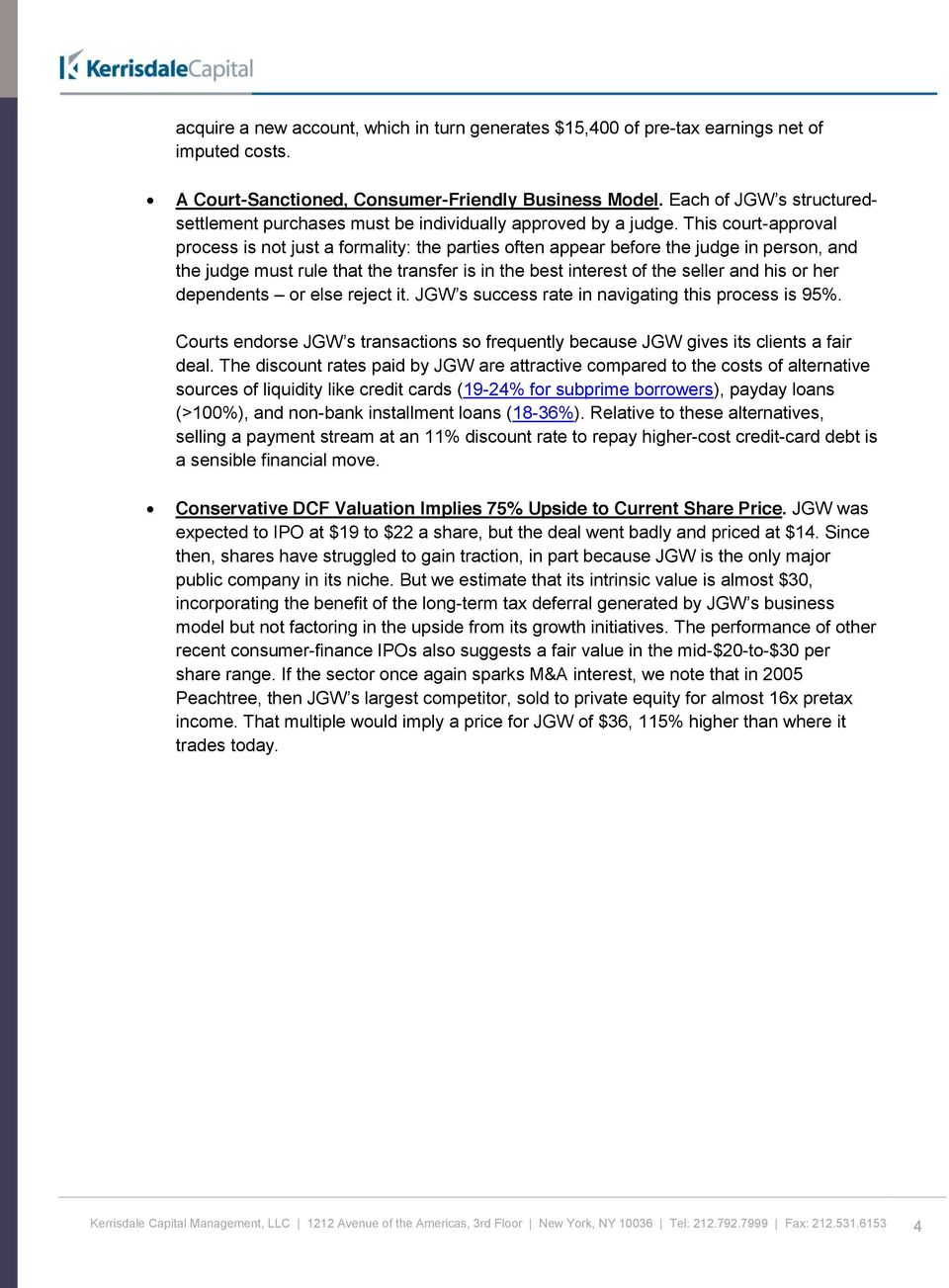
5 II. Situation Overview JGW S-1, 10-Q3 2013). Capitalization & Multiples Financial Statistics Fiscal Year End Dec 31st LTM Share Price (US$) $16.95 Gain on Sale $145.6 $219.2 $229.3 Diluted Shares (1) 29.6 % of Core TRB (5) 19.0% 23.9% 23.6% Market Capitalization $501.4 % Growth n.a. 50.5% 4.6% Corporate Debt (2) Other Cash (2) (44.8) % Growth n.a. 36.8% (13.0%) Enterprise Value $906.2 Total Revenue (3) $188.5 $277.8 $280.3 Trading Multiples $ Multiple % Growth n.a. 47.4% 0.9% EV / LTM EBITDA (3) $ x EBITDA (3) $61.3 $110.7 $113.1 EV / '14E EBITDA (3) x Term-Loan Int LTM P/E (4) $ x EBITDA - TL Int. $52.2 $96.2 $ E P/E (4) x EPS (4) $1.24 $2.58 $2.00 Source: JGW filings, Capital IQ, Kerrisdale analysis (1) Includes Class B and Class C shares, which are convertible into the public Class A shares. (2) Pro forma for the IPO and subsequent debt paydown. (3) EBITDA and revenue as shown are adjusted figures calculated by Kerrisdale. (4) Based on "adjusted net income" as defined by the company P/E based on consensus. (5) Core TRB consists of guaranteed structured settlements, annuities, and lottery payments. Since JGW only became public in November, the historical financial information available is limited. Furthermore, because it grew dramatically in mid-2011 by acquiring its largest competitor, Peachtree, year-to-year comparisons are distorted. Still, at first glance, the stock looks very cheap, trading at 7x consensus EPS. This simple conclusion survives a much more detailed analysis. Below we present an overview of our DCF valuation, which gives JGW credit for the ongoing tax benefits associated with the mismatch between its cash flows and the IRS treatment thereof, as explained in greater detail below. We conservatively assume only 5% growth in acquisition volume and minimal operating leverage. Kerrisdale Capital Management, LLC 1212 Avenue of the Americas, 3rd Floor New York, NY Tel: Fax:
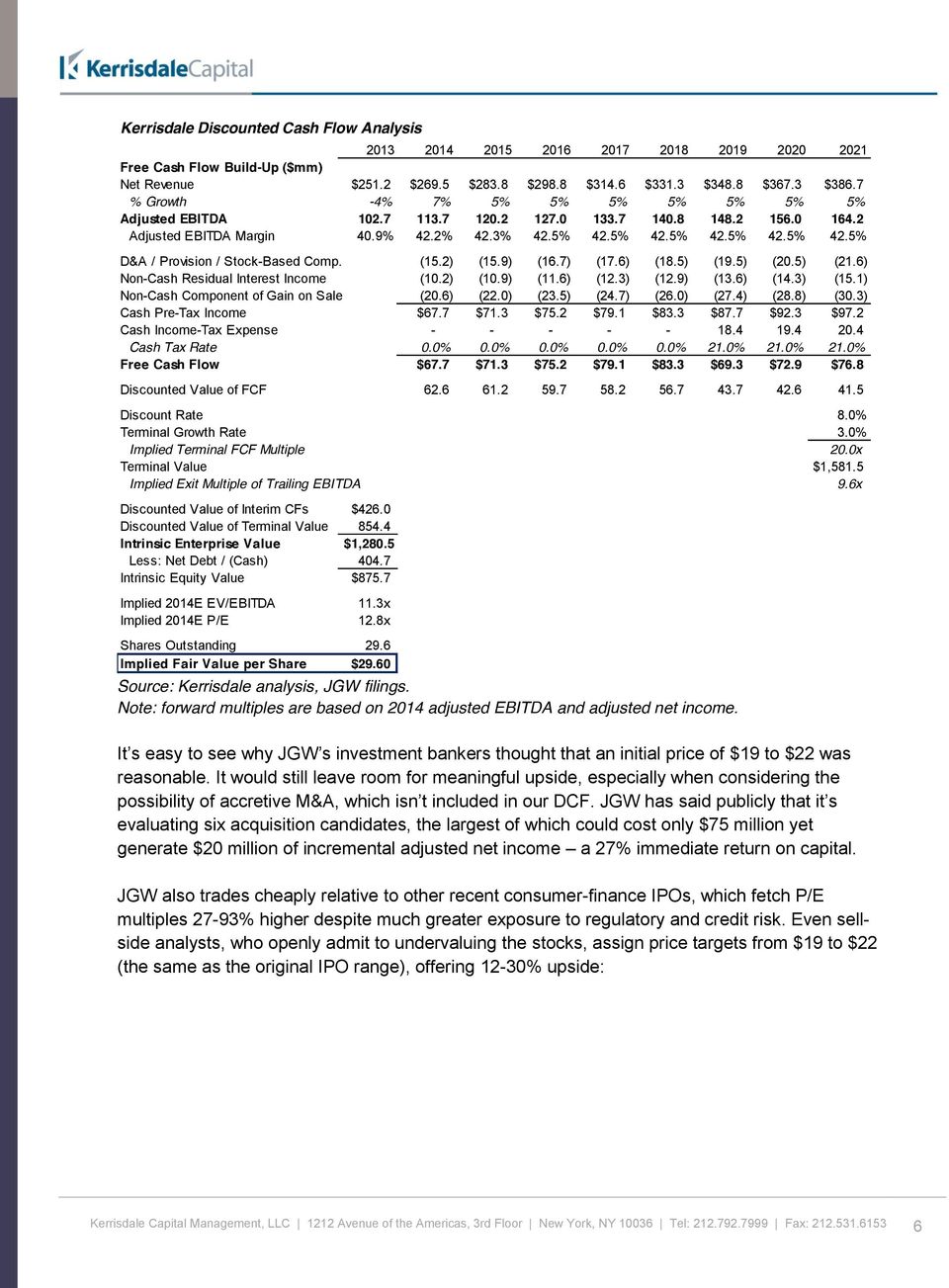
6 Kerrisdale Discounted Cash Flow Analysis Free Cash Flow Build-Up ($mm) Net Revenue $251.2 $269.5 $283.8 $298.8 $314.6 $331.3 $348.8 $367.3 $386.7 % Growth -4% 7% 5% 5% 5% 5% 5% 5% 5% Adjusted EBITDA Adjusted EBITDA Margin 40.9% 42.2% 42.3% 42.5% 42.5% 42.5% 42.5% 42.5% 42.5% D&A / Provision / Stock-Based Comp. (15.2) (15.9) (16.7) (17.6) (18.5) (19.5) (20.5) (21.6) Non-Cash Residual Interest Income (10.2) (10.9) (11.6) (12.3) (12.9) (13.6) (14.3) (15.1) Non-Cash Component of Gain on Sale (20.6) (22.0) (23.5) (24.7) (26.0) (27.4) (28.8) (30.3) Cash Pre-Tax Income $67.7 $71.3 $75.2 $79.1 $83.3 $87.7 $92.3 $97.2 Cash Income-Tax Expense Cash Tax Rate 0.0% 0.0% 0.0% 0.0% 0.0% 21.0% 21.0% 21.0% Free Cash Flow $67.7 $71.3 $75.2 $79.1 $83.3 $69.3 $72.9 $76.8 Discounted Value of FCF Discount Rate 8.0% Terminal Growth Rate 3.0% Implied Terminal FCF Multiple 20.0x Terminal Value $1,581.5 Implied Exit Multiple of Trailing EBITDA 9.6x Discounted Value of Interim CFs $426.0 Discounted Value of Terminal Value Intrinsic Enterprise Value $1,280.5 Less: Net Debt / (Cash) Intrinsic Equity Value $875.7 Implied 2014E EV/EBITDA 11.3x Implied 2014E P/E 12.8x Shares Outstanding 29.6 Implied Fair Value per Share $29.60 Source: Kerrisdale analysis, JGW filings. Note: forward multiples are based on 2014 adjusted EBITDA and adjusted net income. $19 to $22 was reasonable. It would still leave room for meaningful upside, especially when considering the evaluating six acquisition candidates, the largest of which could cost only $75 million yet generate $20 million of incremental adjusted net income a 27% immediate return on capital. JGW also trades cheaply relative to other recent consumer-finance IPOs, which fetch P/E multiples 27-93% higher despite much greater exposure to regulatory and credit risk. Even sellside analysts, who openly admit to undervaluing the stocks, assign price targets from $19 to $22 (the same as the original IPO range), offering 12-30% upside: Kerrisdale Capital Management, LLC 1212 Avenue of the Americas, 3rd Floor New York, NY Tel: Fax:
7 Sell-Side Price Targets for JGW Firm Price Target Upside Date Barclays $ % Dec-13 Credit Suisse $ % Dec-13 Deutsche Bank $ % Dec-13 Jefferies $ % Dec-13 JMP $ % Feb-14 KBW $ % Dec-13 Stephens $ % Feb-14 Average $ % Sources: Bloomberg, equity research Looking back to pre-crisis M&A in the structured- even larger. When the private (before JGW later acquired Peachtree itself), the price paid was nearly 16x run-rate pretax income. At that valuation, JGW would trade at $36, 115% higher than the current price. packaged bankruptcy in 2009, and its unusual status today as a public company still 62% owned and 93% controlled (based on voting rights) by its previous private equity owners. This overhang makes investors (and analysts) fearful of stepping in front of imminent lock-up expirations and potential share sales. both obscure and unique, sharing certain qualities with some specialty finance companies but lacking the natural audience commanded by banks and -quarter earnings announcement is unlikely to excite since IPO-related non-recurring items will dominate the than the market is implying today. In return for bearing the short-term risk of bad technicals, investors with a longer term horizon can buy a premier consumer franchise on the cheap. III. Business Description former sales manager at a JGW competitor (February 2014) -CASH-NOW are ingrained in the public consciousness, given that week. - Kerrisdale Capital Management, LLC 1212 Avenue of the Americas, 3rd Floor New York, NY Tel: Fax:

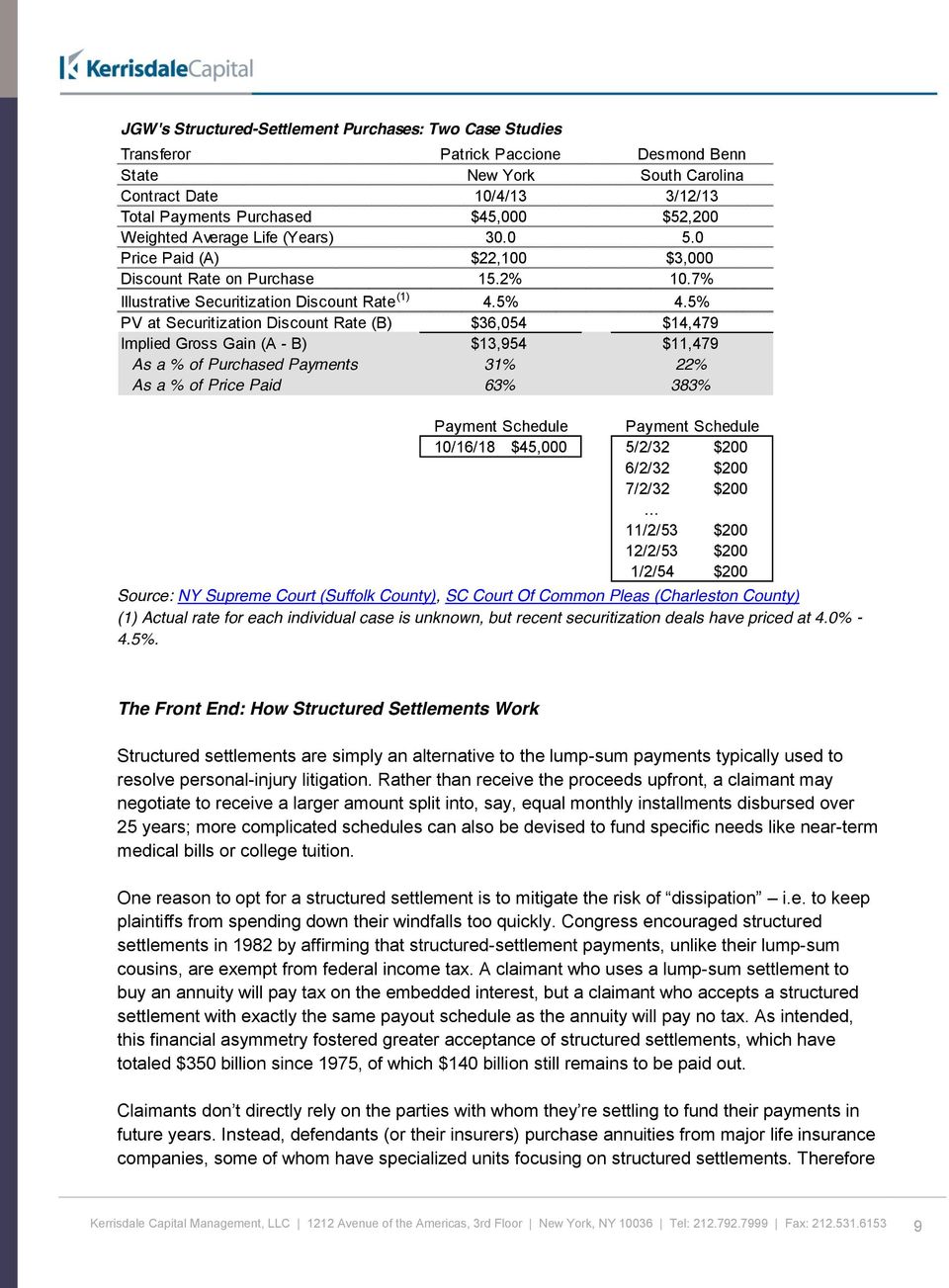
8 settlement payment streams from individuals and reselling them at a higher price to institutional bond investors. The model is similar for state-sponsored lottery payouts, which generate 7% of al annuities, which generate 2%. The balance of the company's sales comes from pre-settlement funding. JGW has recently been buying settlements at an average discount rate of 10.92% and securitizing them at an average discount rate of 4.37%. The company issues approximately three securitizations per year. For a hypothetical structured settlement of $100,000 paid out in equal installments over 25 years, for an average life of 12.5 years, the present value at a 10.92% discount rate is ~$34,000, while at a 4.37% discount rate JGW is thus able to re-sell its wares at more than a 70% mark-up, only a few months after buying them. The size of the gain will vary based on a variety of factors, including the duration of the payment stream the same discount-rate gap will produce smaller profits for shorter-lived streams and the jurisdiction in which JGW conducts the transaction, given that legal frameworks vary across different states. Offsetting these gains are costs associated with marketing, underwriting, etc. But even after these costs, JGW generates strong profit margins: over the last twelve mont, as we define it below, was 44%. Below are summaries of two recent transactions conducted by JGW that highlight the variety of possible sales structures. In the first case, New York resident Patrick Paccione transferred a single large lump sum; in the second, Desmond Benn of South Carolina transferred more than 20 years of small monthly payments, starting in In both cases, we estimate that JGW likely realized a healthy gain on sale. The customer benefits as well. Folks turn to JGW because the discount rates it charges are very attractive compared to the costs of alternative sources of liquidity like credit cards (19-24% for subprime borrowers), payday loans (>100%), and nonbank installment loans (18-36%). Kerrisdale Capital Management, LLC 1212 Avenue of the Americas, 3rd Floor New York, NY Tel: Fax:

9 JGW's Structured-Settlement Purchases: Two Case Studies Transferor Patrick Paccione Desmond Benn State New York South Carolina Contract Date 10/4/13 3/12/13 Total Payments Purchased $45,000 $52,200 Weighted Average Life (Years) Price Paid (A) $22,100 $3,000 Discount Rate on Purchase 15.2% 10.7% Illustrative Securitization Discount Rate (1) 4.5% 4.5% PV at Securitization Discount Rate (B) $36,054 $14,479 Implied Gross Gain (A - B) $13,954 $11,479 As a % of Purchased Payments 31% 22% As a % of Price Paid 63% 383% Payment Schedule Payment Schedule 10/16/18 $45,000 5/2/32 $200 6/2/32 $200 7/2/32 $200 11/2/53 $200 12/2/53 $200 1/2/54 $200 Source: NY Supreme Court (Suffolk County), SC Court Of Common Pleas (Charleston County) (1) Actual rate for each individual case is unknown, but recent securitization deals have priced at 4.0% - 4.5%. The Front End: How Structured Settlements Work Structured settlements are simply an alternative to the lump-sum payments typically used to resolve personal-injury litigation. Rather than receive the proceeds upfront, a claimant may negotiate to receive a larger amount split into, say, equal monthly installments disbursed over 25 years; more complicated schedules can also be devised to fund specific needs like near-term medical bills or college tuition. i.e. to keep plaintiffs from spending down their windfalls too quickly. Congress encouraged structured settlements in 1982 by affirming that structured-settlement payments, unlike their lump-sum cousins, are exempt from federal income tax. A claimant who uses a lump-sum settlement to buy an annuity will pay tax on the embedded interest, but a claimant who accepts a structured settlement with exactly the same payout schedule as the annuity will pay no tax. As intended, this financial asymmetry fostered greater acceptance of structured settlements, which have totaled $350 billion since 1975, of which $140 billion still remains to be paid out. future years. Instead, defendants (or their insurers) purchase annuities from major life insurance companies, some of whom have specialized units focusing on structured settlements. Therefore Kerrisdale Capital Management, LLC 1212 Avenue of the Americas, 3rd Floor New York, NY Tel: Fax:
10 claimants receive their checks from the likes of MetLife and Allstate, not the entities they originally sued. Not only do these firms generally boast high credit ratings but because the annuities rank pari passu with other customer claims, they a debt and would thereby, in the unlikely event of an insurer default, have the right to draw on the reserve funds established by state regulators to protect insurance policyholders. Structured-settlement payment streams thus constitute valuable financial assets with minimal credit risk. But because even large personal- owners of these assets sometimes find that selling all or a portion of their long-term payment streams is the best option they have to reduce credit-card balances, make a down payment on a house, or pay college tuition. But non-specialized consumer lenders and big banks lack leading buyer of structured settlements, JGW has the scale and know-how to offer liquidity to claimants at a reasonable price with terms better than what they could achieve via alternative sources of financing. Because deals are sourced one by one in small increments, marketing scale and brand recognition are critical to building a profitable operation in this sector; consumers gravitate toward companies they know. Through two decades of effective advertising, JGW has achieved a market share of 60-70%, making it the Guys February 2014). The Back End: Funding the Business with Securitization Structured settlement ABS is a sub-class of the non-mortgage ABS space that offers stable and predictable cash flow returns with little credit risk and very low correlation with the past 10 years stands as a testament to the minimal risk inherent in this space. Barclays securitization research, Introduction to Structured Settlement ABS (April 2012) Settlement sellers are often motivated by personal financial difficulties, but because the underlying value of their payment streams depends on the credit quality of the annuity provider, not the beneficiary incomes. In a sense, JGW does for individuals what a factoring firm like CIT does for small businesses supply liquidity to those who hold money-good receivables but lack ready cash. Whereas CIT might buy the right to collect from Wal-Mart a payment that it owes to a manufacturer of socks, JGW could buy the right to collect from Berkshire Hathaway a payment that it owes to the victim of a car accident. Kerrisdale Capital Management, LLC 1212 Avenue of the Americas, 3rd Floor New York, NY Tel: Fax:
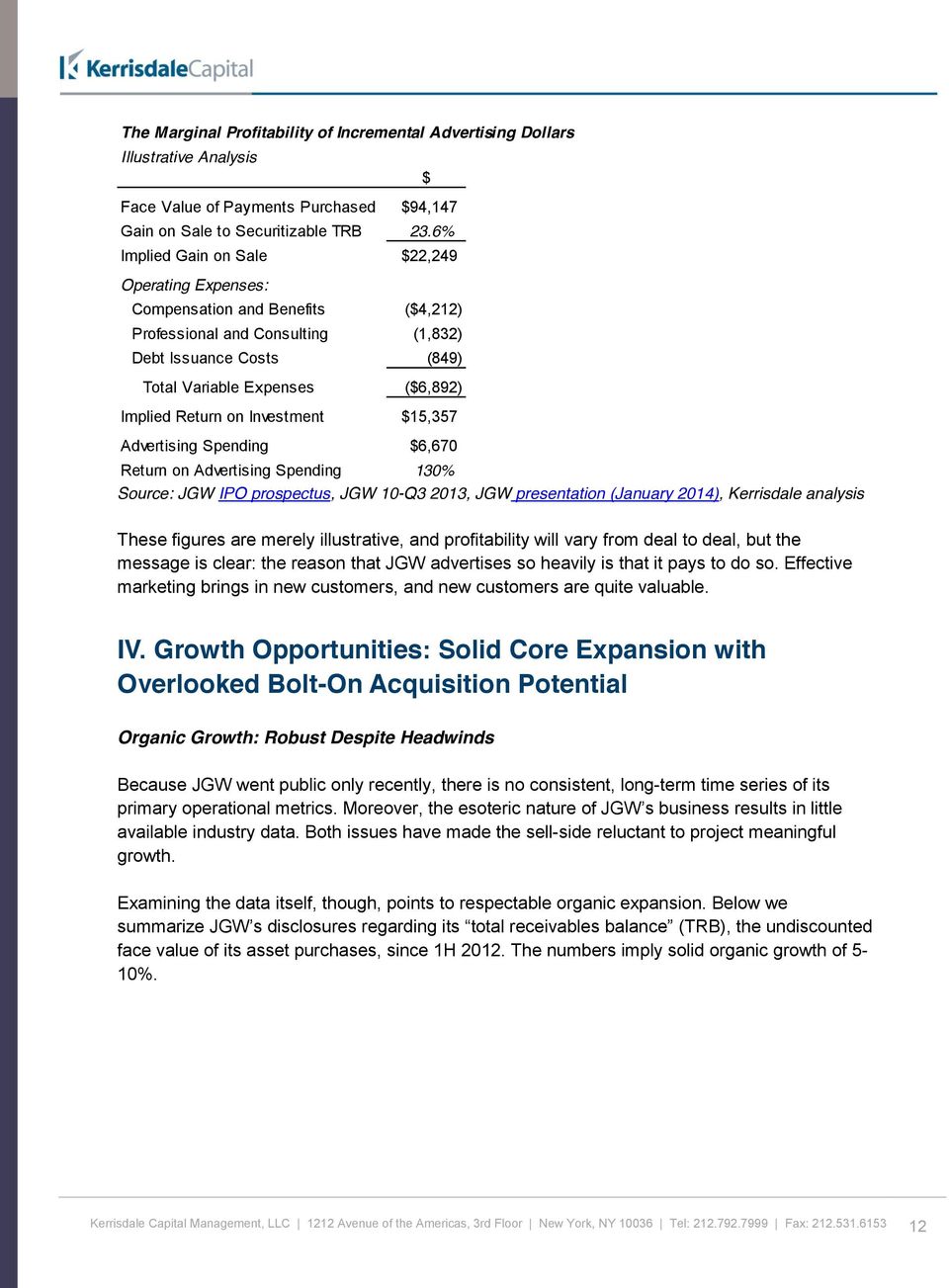
11 To make these purchases, JGW has constructed a well-funded, diversified source of working capital. Through September 30, 2013, JGW was on pace to spend $420 million acquiring settlement streams, up 8% from Because of the high quality of the assets it buys, along with its strong operational track record, JGW can obtain very advantageous near-term funding from investment banks before ultimately pooling, tranching, and selling the payment streams into the asset-backed securities market. As an intermediary between investors and individuals, JGW can only sustain this business model by offering a good value proposition to both sides of the market and it does. Institutional fixed-income investors have no interest in purchasing individual structured settlements. For one thing, individual settlements are much too small: the 20-year stream of $ monthly payments owed by Prudential to Janay Phipps as part of the settlement of a lawsuit regarding lead-paint exposure. But a diversified portfolio of a few thousand such receivables, assembled by a reputable market leader, can give rise to a relatively attractive investment even at a low absolute yield of 4-5%. Given the lack of credit or -backed securities are well-suited for the likes of the MetWest Total Return Bond Fund, BlackRock Total Return Fund, and Nuveen Core Bond Fund (the issuing entity sometimes appears under names like 321 Henderson Receivables, LLC). New deals are routine: JGW just closed a new securitization, series , in early February Regular access to cost-effective securitization is, in turn, what allows JGW to supply its customers with the liquidity they need at a competitive price. Smaller players with less attractive funding sources are hard- Holdings, a second-tier competitor, has never accessed the securitization market and instead funds itself by reselling settlements intermittently at 10-11% yields. Imperial passes these high funding costs on to its customers, charging them 17-19% on average, much worse than what ate a profit in this business of securitization as a competitive edge for JGW. Unit Economics: Earning Superb Returns on Each New Transaction To further of a single new transaction at the margin. Based on the average of the last three securitizations for which there is public data, the aggregate payments sold in an average deal total about $94,000. This figure implies that JGW originates roughly 850 transactions per month, consistent expenses are fixed but compensation and professional/consulting costs are fully variable a conservative premise generates ~$15,400 in profit from a marketing investment of ~$6,700, for a 130% net return: Kerrisdale Capital Management, LLC 1212 Avenue of the Americas, 3rd Floor New York, NY Tel: Fax:

12 The Marginal Profitability of Incremental Advertising Dollars Illustrative Analysis $ Face Value of Payments Purchased $94,147 Gain on Sale to Securitizable TRB 23.6% Implied Gain on Sale $22,249 Operating Expenses: Compensation and Benefits ($4,212) Professional and Consulting (1,832) Debt Issuance Costs (849) Total Variable Expenses ($6,892) Implied Return on Investment $15,357 Advertising Spending $6,670 Return on Advertising Spending 130% Source: JGW IPO prospectus, JGW 10-Q3 2013, JGW presentation (January 2014), Kerrisdale analysis These figures are merely illustrative, and profitability will vary from deal to deal, but the message is clear: the reason that JGW advertises so heavily is that it pays to do so. Effective marketing brings in new customers, and new customers are quite valuable. IV. Growth Opportunities: Solid Core Expansion with Overlooked Bolt-On Acquisition Potential Organic Growth: Robust Despite Headwinds Because JGW went public only recently, there is no consistent, long-term time series of its available industry data. Both issues have made the sell-side reluctant to project meaningful growth. Examining the data itself, though, points to respectable organic expansion. Below we face value of its asset purchases, since 1H The numbers imply solid organic growth of 5-10%. Kerrisdale Capital Management, LLC 1212 Avenue of the Americas, 3rd Floor New York, NY Tel: Fax:
13 Payment Streams Purchased by JGW H (1) 3Q2012 4Q2012 H (1) 3Q2013 TRB $254.2 $282.8 $278.7 $282.6 $299.3 % Growth n.a. n.a. n.a. 11.2% 5.8% Source: JGW IPO prospectus and 3Q13 earnings release (1) Average quarterly level (only six-month data disclosed). Another term growth rate. Peachtree noted in its 2005 IPO documents that its customer database -court filings from 2009 (source: PACER) indicate a JGW database of 56,500 candidates, at which point Peachtree was approximately customers. Tying the figures together, the organic growth rate in the JGW/Peachtree database over the past eight years has been roughly 8%: Estimated Growth of JGW's Customer Database Peachtree Database 25,000 33,900 Assumed % of JGW (1) 60% CAGR, % JGW: Existing Clients 15,700 Prospective Clients 40,800 Total JGW Database 56,500 Combined JGW/Peachtree 90, ,000 Implied Database CAGR, % Source: JGW S-1/A, JGW 2009 bankruptcy petition, Kerrisdale analysis (1) Per as standalone JGW in 2011 (combined assets of $3.8B, Peachtree assets of $1.5B, implied standalone JGW assets of $2.3B). We multiply the According to JGW itself (in its IPO prospectus), its database CAGR since August 2008 (including only guaranteed structured-settlement payment customers) has been roughly in line at 6%. Whatever the exact number, it appears that the core business has been expanding at a mid-to-high single-digit pace. This estimate aligns with the available data on the size of the primary market that is, the flow of new structured settlements, which may or may not be sold to the likes of JGW at a later date. After a long period of rapid growth, the primary market plateaued in the early 2000s, peaked in 2008 at $6.2 billion, and has declined gradually since then. Kerrisdale Capital Management, LLC 1212 Avenue of the Americas, 3rd Floor New York, NY Tel: Fax:
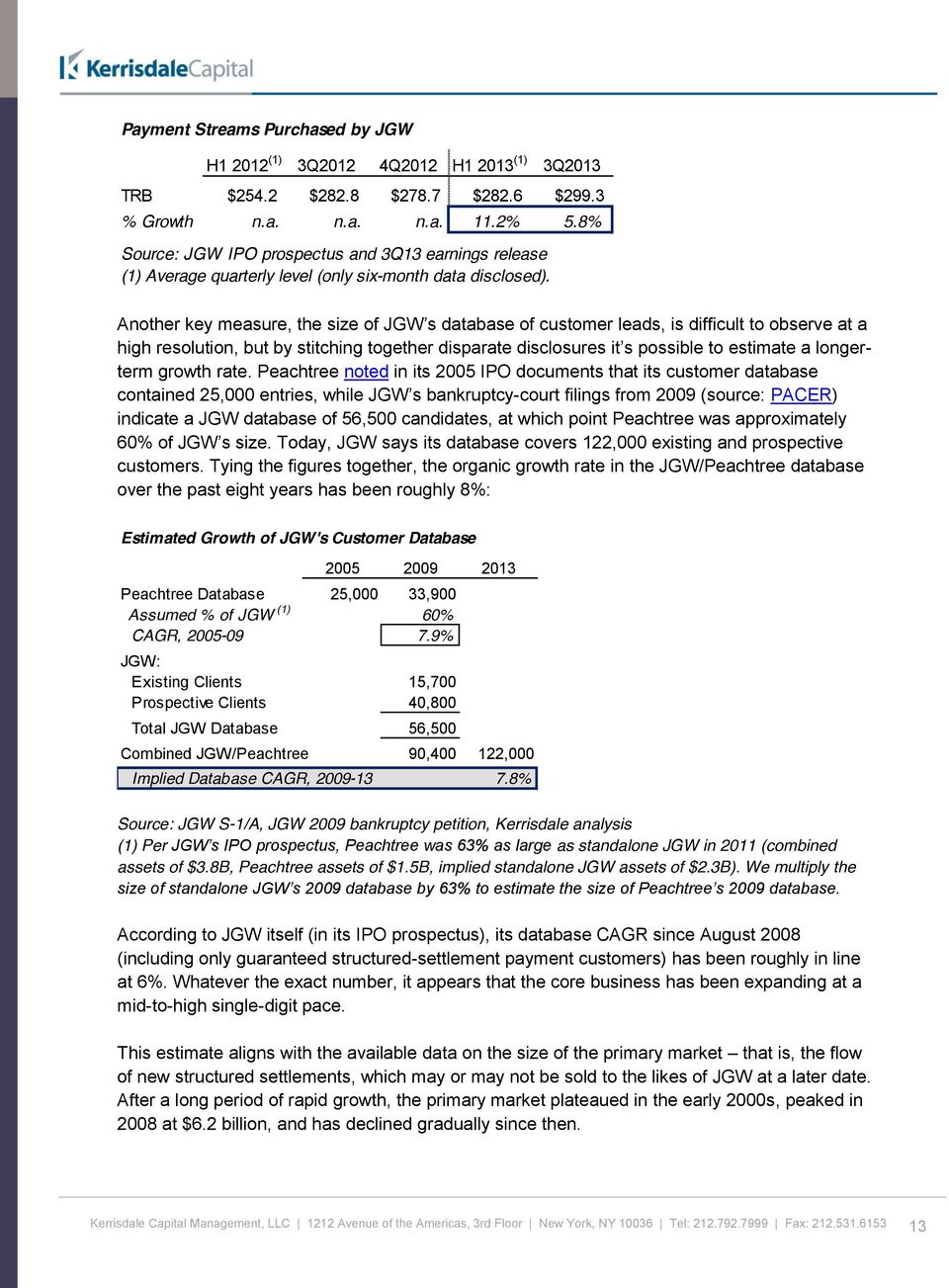
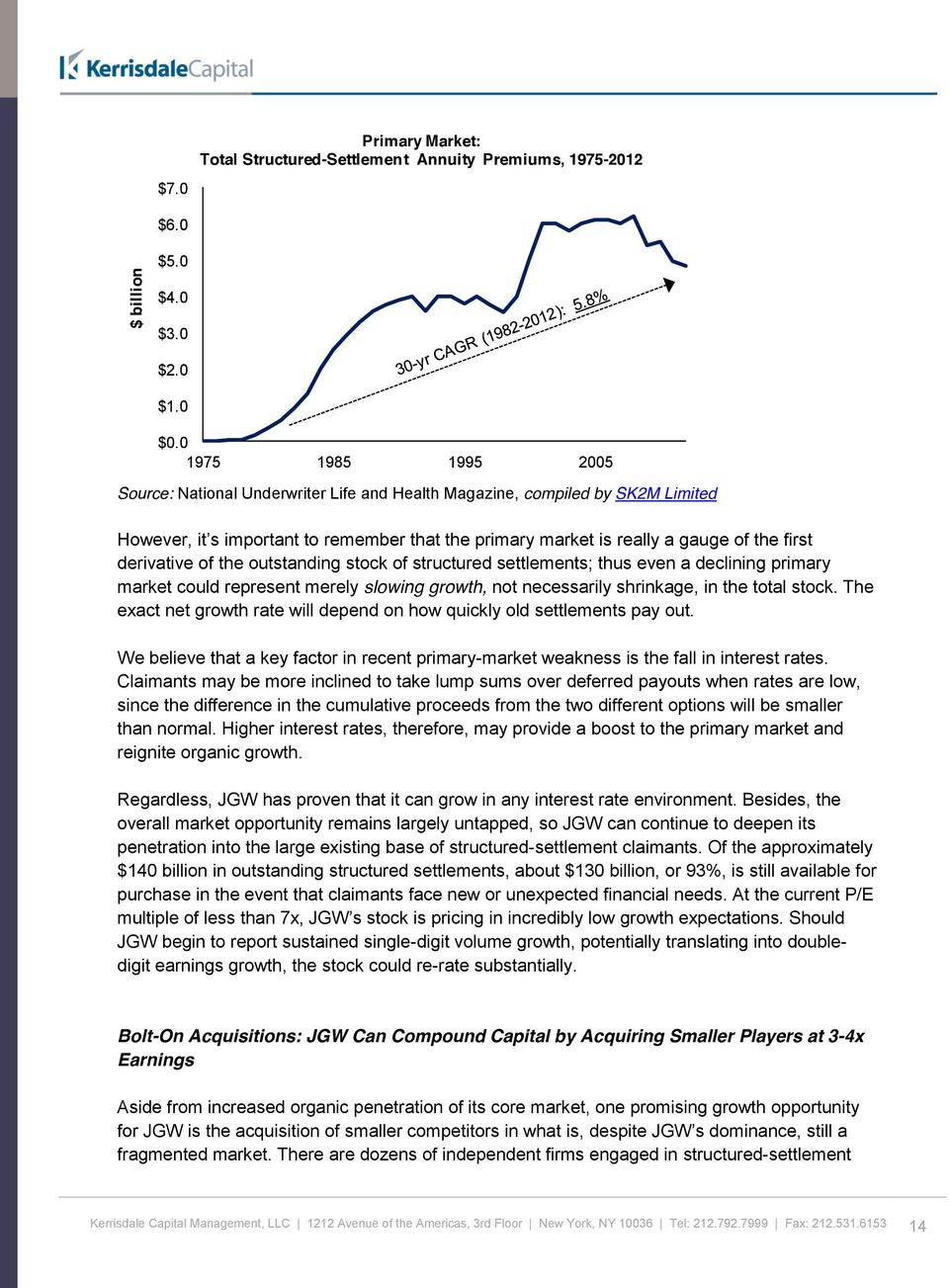
14 Primary Market: Total Structured-Settlement Annuity Premiums, $7.0 $6.0 $ billion $5.0 $4.0 $3.0 $2.0 $1.0 $ Source: National Underwriter Life and Health Magazine, compiled by SK2M Limited derivative of the outstanding stock of structured settlements; thus even a declining primary market could represent merely slowing growth, not necessarily shrinkage, in the total stock. The exact net growth rate will depend on how quickly old settlements pay out. We believe that a key factor in recent primary-market weakness is the fall in interest rates. Claimants may be more inclined to take lump sums over deferred payouts when rates are low, since the difference in the cumulative proceeds from the two different options will be smaller than normal. Higher interest rates, therefore, may provide a boost to the primary market and reignite organic growth. Regardless, JGW has proven that it can grow in any interest rate environment. Besides, the overall market opportunity remains largely untapped, so JGW can continue to deepen its penetration into the large existing base of structured-settlement claimants. Of the approximately $140 billion in outstanding structured settlements, about $130 billion, or 93%, is still available for purchase in the event that claimants face new or unexpected financial needs. At the current P/E in incredibly low growth expectations. Should JGW begin to report sustained single-digit volume growth, potentially translating into doubledigit earnings growth, the stock could re-rate substantially. Bolt-On Acquisitions: JGW Can Compound Capital by Acquiring Smaller Players at 3-4x Earnings Aside from increased organic penetration of its core market, one promising growth opportunity fragmented market. There are dozens of independent firms engaged in structured-settlement Kerrisdale Capital Management, LLC 1212 Avenue of the Americas, 3rd Floor New York, NY Tel: Fax:
15 purchasing and adjacent activities. JGW is so dominant that some competitors merely scavenge leads that it generates. But others run their own marketing and create real value value that JGW could likely optimize by leveraging its robust existing infrastructure. In its IPO prospectus, JGW laid out a near-term agenda for pursuing these sorts of bolt-on acquisitions: We are currently in discussions with six companies that are potential acquisition targets participating in certain of our existing markets. While no definitive terms have been discussed, we may go forward with at least one such potential acquisition in the near term. We estimate that the purchase price for any such potential acquisition would be in the range of $5 million to $75 million, which may be payable in cash, stock or a combination thereof. The various market participants under consideration have annual revenues ranging between $5 million and $40 million. If we consummated an acquisition of any one of these six market participants, we estimate that our annual Adjusted Net Income would increase by between $5 million and $20 million. million of adjusted net income at a cost of just $75 million, or about 4x earnings. At this price, JGW can redeploy its free cash flow at returns in excess of 25%. Such a $75 million deal would boost adjusted EPS by almost 30% immediately. A transaction of this magnitude is not contemplated in current consensus estimates. Substantial Inbound Call Volumes Could Lead to Upsell Opportunities calls ultimately generate revenue. To be sure, any call-center operation will face some level of dropped and misdirected calls, but many of the inquiries are real they are just related to and referred leads for products like lotteries or annuities to other firms in exchange for a fee; with these capabilities now in-house, there is less scope for referral fees in those areas, but other logical possibilities like secured credit cards, reverse mortgages, and installment loans remain untapped. -settlement funding, which it already offers, but only in small size (3% of revenue). Rather than acquiring payment streams from finalized settlements at a discount, JGW effectively makes a small equity investment in a pending settlement. This enables plaintiffs and their lawyers to ride out short-term liquidity problems rather than accept higher-cost short-term financing offers while under duress. In keeping with the underlying equity-like risk the clients owe nothing if they lose their case JGW can earn interest and fees on its funds that exceed statutory usury caps, while still benefiting from its own access to leverage via a $35- e-settlement funding currently entails some principal risk. But as long as JGW can properly price these deals, and who else but JGW could, the risk-adjusted returns should be as attractive as those in its core business. Kerrisdale Capital Management, LLC 1212 Avenue of the Americas, 3rd Floor New York, NY Tel: Fax:

16 Since the regulatory framework for pre-settlement funding is far less established than that for structured-settlement factoring, JGW has taken a measured approach to the business, honing in on just 26 states with particularly favorable judicial environments. But the total market size is enormous: tort settlements in the US amount to $122 billion a year, vastly more than structured expertise and relationships will take years, especially since it could require new state-level legislation, but JGW investors today are paying nothing for this valuable option on a large adjacent market. While the existing pre-settlement funding business is too small a contributor to JGW's results to have its own historical segment data, JGW's recent S-1 gives guidance on our pre-settlement fundings are typically high-quality short duration assets featuring an average life of less than two years and are priced to generate an ultimate return on a pool basis of 1.5x 2.0x funded amount." Using this information, we estimate the incremental earnings power of the business below. If JGW can increase originations by $35 million equal to the size of its current financing facility but still representing less than 3 basis points of the total market opportunity we estimate a 17-26% lift in EPS. Illustrative Pre-Settlement-Funding Opportunity Targeted Gross Return 150% 200% Targeted Net Return 50% 100% Average Term (Years) Illustrative Annual Volume ($mm) $35.0 $35.0 Incremental Earnings per Year $11.7 $17.5 JGW Shares Outstanding Incremental Adjusted EPS $0.39 $ Consensus EPS $2.32 $2.32 % Increase in EPS 17.0% 25.5% Source: JGW S-1/A, Kerrisdale analysis J.G. Wentworth and every other player. former sales manager at a JGW competitor (February 2014) JGW is clearly the top shown in the chart below, there are dozens of smaller players. Furthermore, if the estimates we sketch out above are accurate, then the economic returns JGW achieves are very attractive. Yet no competitor since Peachtree has been able to seriously challenge al, Kerrisdale Capital Management, LLC 1212 Avenue of the Americas, 3rd Floor New York, NY Tel: Fax:

17 financial, and brand dominance. It has led the industry for more than 20 years. The sources of its strength are simple but powerful. Source: JGW presentation, January 2014 Unrivalled Brand Presence: JGW Spends 10x More on Marketing than its Nearest Competitor Since 1995, JGW has invested $615 million into its marketing efforts; in 2012 alone, it spent $73 million (source: JGW S-1/A, February 2014). In recent years, the disparity on this front between JGW and its smaller competitors has grown to gargantuan size. Since 2008, J.G. Wentworth and Peachtree have spent approximately ten times as much on television ads as their next largest c JGW manage to consistently reach prospective clients the company estimates that over 80% of its target audience sees a J.G. Wentworth or Peachtree ad at least five times a week it has also made the most of its broad reach by crafting a unique brand image with its quirky, results, ranging from parodies paeans but the ads have been undeniably effective at building enviable brand recognition for what is a consumer awareness over two of its largest competitors: Kerrisdale Capital Management, LLC 1212 Avenue of the Americas, 3rd Floor New York, NY Tel: Fax:

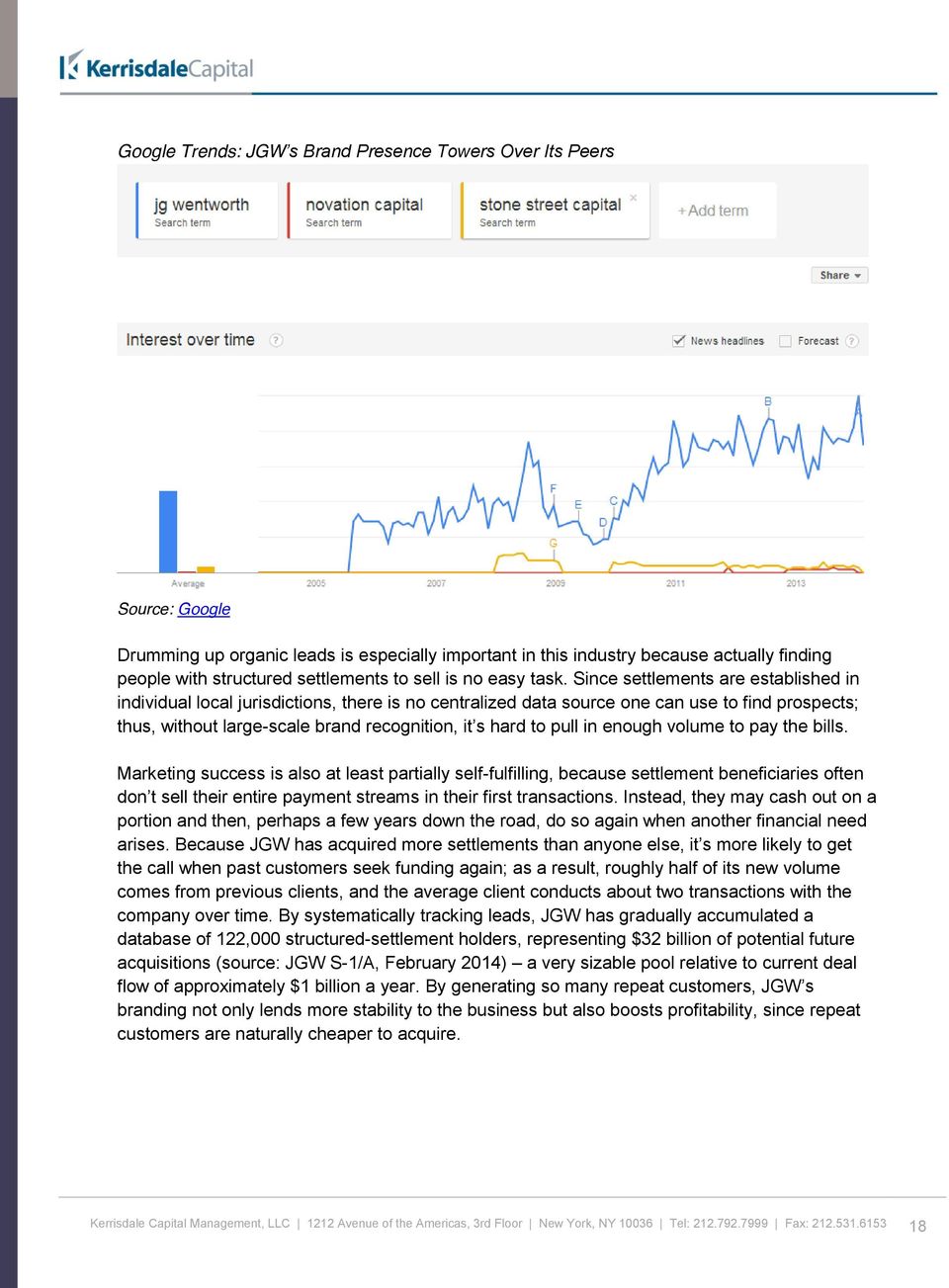
18 Google Trends: JGW Source: Google Drumming up organic leads is especially important in this industry because actually finding people with structured settlements to sell is no easy task. Since settlements are established in individual local jurisdictions, there is no centralized data source one can use to find prospects; thus, without large- Marketing success is also at least partially self-fulfilling, because settlement beneficiaries often payment streams in their first transactions. Instead, they may cash out on a portion and then, perhaps a few years down the road, do so again when another financial need to get the call when past customers seek funding again; as a result, roughly half of its new volume comes from previous clients, and the average client conducts about two transactions with the company over time. By systematically tracking leads, JGW has gradually accumulated a database of 122,000 structured-settlement holders, representing $32 billion of potential future acquisitions (source: JGW S-1/A, February 2014) a very sizable pool relative to current deal flow of approximately $1 billion a year. By branding not only lends more stability to the business but also boosts profitability, since repeat customers are naturally cheaper to acquire. Kerrisdale Capital Management, LLC 1212 Avenue of the Americas, 3rd Floor New York, NY Tel: Fax:
19 Operational Scale: JGW Has the Biggest Network and the Best Courtroom Track Record You have to be very diligent with underwriting these transfers no federal liens or anything like that, just making sure that all the disclosures are executed properly, that the settlement annuity information and all the documentation is in nt professional re there are no former sales manager at a JGW competitor (February 2014) Though buying and re-selling structured settlements is conceptually simple, actually completing transactions requires substantial expertise. Rules and processes vary from state to state, and a single procedural misstep could suffice to make an unfriendly judge reject a proposed transfer (and thereby waste all the marketing and underwriting costs it took to get to that point). In a company of only 346 people, JGW employs 27 dedicated, in-house legal professionals to oversee all aspects of the business and presides over a nationwide network of external that JGW leads the industry with a 95% court-approval success rate (source: JGW presentation, January 2014). Cus -out formalities. To succeed, settlement purchasers like JGW have to be easy to do business with, while still taking pains to handle all the technicalities correctly. Having completed 61,000 purchases since 2002, JGW has the experience to manage its relationships well, maintaining a smooth transition from initial client screening to final funding in a matter of 30 to 60 days. JGW even offers iphone and Android apps that facilitate document scanning and uploading for customers without easy access to fax machines. After making the purchase, JGW must then be able to collect on future payments owed by the life insurance companies serving as annuity providers, and insurers are not known for making complex transactions pleasant. It helps that JGW already has well-developed relationships with more than 200 insurance companies. Such operational advantages set a high bar for would-be competitors. Cost of Capital: Cheap Funding Gives JGW the Best Prices I think you have to have and Wentworth has shown this obviously you have to have to Kerrisdale Capital Management, LLC 1212 Avenue of the Americas, 3rd Floor New York, NY Tel: Fax:

20 everyone else. head of sales at a JGW competitor (February 2014)...J.G. Wentworth is the type of company that just says, Hey, we have the best price in the industry. the best price. former sales manager at a JGW competitor (February 2014) After acquiring Peachtree, JGW is currently the only structured-settlement buyer with demonstrated access to the securitization market, having issued 38 deals totaling more than $5 billion since The most recent deal HENDR was issued on February 18, While the economics of acquiring low-risk assets at double-digit yields are attractive even on a hold-to-maturity basis, securitization enables JGW to accelerate future cash flow and recycle its capital into additional purchases. For example, even after retaining a 6.5% interest in the underlying receivables and paying off the revolving line of credit that had previously financed them, JGW netted $32.3 million of cash from its issuance of $212.7 million in bond principal cash it could then re-invest into additional purchases. Because the company can routinely generate much more cash from financing its assets than it needs to consume to create them, it effectively runs with negative working capital, while smaller players are stuck with far less favorable financing terms. of its past issuances. While the logic behind the structured-settlement asset class always seemed reasonable a diversified portfolio of highly rated life-insurance exposures should hold up well even in a troubled economy put to the test. Through it all, over a peri experienced cumulative credit losses of only 0.08% not 0.08% per year, but 0.08% in total over the entire time span (source: JGW presentation, January 2014). Furthermore, since JGW retains the most subordinated piece of the capital structure (typically % percent of firstloss capital), those eight basis points never touched bond investors, who, unlike so many of their ABS-buying peers, emerged from the Great Recession totally unscathed. With this strong track record in hand, JGW should be able to access financing even in the most adverse environment; at the height of the crisis, when most securitization markets collapsed, the longest Kerrisdale Capital Management, LLC 1212 Avenue of the Americas, 3rd Floor New York, NY Tel: Fax:

21 omberg Source: Bloomberg While JGW clearly has a long head start over its competitors in the realm of funding, bond investors care more about the underlying assets than the identity of their originator, so others may eventually be able to securitize their receivables on terms simi of- leg up. Since the bond market dislikes illiquid, odd-lot securities, ABS issuers need to stockpile enough assets to achieve critical mass and pique the interest of large investors. With its heavy inbound call volume, JGW has the consistency and throughput to bring deals to market every few months, but for competitors that are less than one-tenth of its size, it could take years to accumulate the two to three thousand receivables that JGW typically pools into a single securitization. A second credible securitizer may emerge one day, but not overnight; for now, Kerrisdale Capital Management, LLC 1212 Avenue of the Americas, 3rd Floor New York, NY Tel: Fax:
22 A Would-Be Competitor Calls It Quits: The Case of Imperial Holdings [Imperial] dumped a lot of money into television, and they dumped a lot of money into advertising, that just I were just bleeding money left and right. head of sales at a JGW competitor (February 2014) One interesting window into the difficulty of breaking into the structured-settlement market comes from the experiences of Imperial Holdings, Inc. (IFT). Imperial is a Florida-based specialty-finance company that now focuses exclusively on its core business of life settlements. But recently, Imperial attempted to build up its own structured-settlement operations. Founded in December 2006, Imperial started small, purchasing just 10 structured settlements in 2007, but it boasted a very promising management team, including seasoned leaders from Singer Asset Finance, an early innovator in the field, and Peach Holdings, which has since become part of JGW. Over the next five years, Imperial rapidly ramped up its acquisition volume: $140 $120 $100 Imperial Holdings: Face Value of Structured Settlements Acquired, $ mm $80 $60 $40 $20 $ LTM Source: Imperial filings (IPO prospectus, K, K, K, and 3Q13 10-Q) Notwithstanding the distraction caused by an unrelated federal investigation of the life business in 2011, Imperial grew from a standing start to a top-ten player in structured-settlement purchasing. Imperial pursued many of the same strategic priorities as JGW, such as compiling a thorough database of prospects and retaining customers for repeat transactions. Still, this growth came at a high price: expenses in the structured-settlement unit totaled $95 million. Despite this large investment, the segment never broke even: Kerrisdale Capital Management, LLC 1212 Avenue of the Americas, 3rd Floor New York, NY Tel: Fax:
23 Imperial Holdings: Structured-Settlement Segment Earnings, $25 $20 $ mm $15 $10 $5 $ LTM Segment Revenue Segment Expenses Source: Imperial filings ( K, K, K, and 10-Q) Even with a sizable budget and experienced management, Imperial could not manage to attract enough business to cover its fixed costs. The lack of scale also prevented Imperial from achieving low-cost funding via securitization, which in turn made it likely that JGW could give prospective customers better prices. This ensured that Imperial only completed transactions with less informed customers who were willing to part with their payment streams at discount rates in the high teens. Imperial: Discount Rates for Structured-Settlement Segment M2013 Weighted Average Discount Rates: At Purchase 12.0% 16.3% 19.4% 18.2% 18.7% 17.2% At Sale 10.8% 11.5% 8.9% 10.5% 10.6% 9.5% Source: Imperial filings ( K, K, K, and 10-Q) Ultimately, Imperial chose in October 2013 to give up on this initiative and sell the platform to Blackstone for $12 million, for an approximate cumulative pretax net loss of $28 million an expensive lesson in the dangers of fighting for share in a consolidated market. Blackstone new competition in the future. But the failure of the previous iteration of this threat to create a task. Kerrisdale Capital Management, LLC 1212 Avenue of the Americas, 3rd Floor New York, NY Tel: Fax:
24 VI. Valuation amazing cash flows. former sales manager at a JGW competitor (February 2014) See unfortunately, challenging. This has given investors pause, prevented the sell-side from focusing on detailed DCFs, and contributed private ownership coupled with scanty IPO disclosures. The lack of pure-play public competitors add -term financial track record. What financials are disclosed are muddied by misleading GAAP accounting that forces the lready been sold to third parties. Complicating matters further, JGW benefits from certain ongoing tax advantages that are not obvious on cursory inspection. Sorting through these issues, we estimate that a conservative DCF would value JGW at approximately $30, or 75% above the current stock price. -tax expense, but only because the firm was previously organized as an LLC, passing its income through to its owners for tax purposes. In future quarters, JGW will, in fact, accrue a normal GAAP income-tax expense. Yet sell-side analysts and the company itself prefer to focus on -tax measure. years to come, JGW will pay minimal cash taxes. In the eyes of the IRS, its securitizations constitute financings, not sales; thus the company records revenue for tax purposes on a gradual, phased-in basis as receivables pay down, even though economically it receives the bulk of its cumulative cash flow very early on when it completes a securitization. This tax deferral is compounded by the upfront timing of be carried forward into the future. Eventually, the company will start to pay increasing amounts of cash taxes, but the interim benefit is valuable. JGW acquires $100,000 of future payments, spread evenly over the following 25 years (consistent with a 12.5-year weighted average life), at a 10.9% discount rate and securitizes them on the basis of a 4.4% discount rate (both consistent with recent experience). Using the rough assumption that core operating expenses scale with payment volume, we estimate that this transaction will generate ~$18,400 in net pre-tax cash flow as well as taxable income (see Appendix for further details). However, the cash arrives early while the taxable income trickles in Kerrisdale Capital Management, LLC 1212 Avenue of the Americas, 3rd Floor New York, NY Tel: Fax:
25 Cumulative Earnings from a Hypothetical Settlement Purchase: Pre-Tax Cash Flow vs. Taxable Income Cumulative Value as % of TRB 25% 20% 15% 10% 5% 0% -5% -10% -15% -20% Year Pre-Tax Cash Flow Taxable income Source: Kerrisdale analysis. See Appendix for complete details. Note: the cash-flow increase in Years 24 and 25 the securitization once the senior bonds are paid off, as well as the release of the cash reserve account. On a present-value basis, using an 8% discount rate, the pre-tax cash flow is worth 8.6% of the total receivables balance (TRB) -6.9%, equating to a 20-21% economic tax rate, substantially lower than a statutory tax rate of 35-38%. depend on the rate at which s rise relative to TRB. For the purposes of our DCF, we assume that the company pays no cash taxes for the first five years and afterwards incurs economic taxes at a rate of 21%, consistent with the output of the analysis above. Assuming what is effectively business as usual 5% growth in TRB, little operating leverage, and flat gain-on-sale margins we arrive at a fair value per share of almost $30: Kerrisdale Capital Management, LLC 1212 Avenue of the Americas, 3rd Floor New York, NY Tel: Fax:
26 Kerrisdale Discounted Cash Flow Analysis Free Cash Flow Build-Up ($mm) Net Revenue $251.2 $269.5 $283.8 $298.8 $314.6 $331.3 $348.8 $367.3 $386.7 % Growth -4% 7% 5% 5% 5% 5% 5% 5% 5% Adjusted EBITDA Adjusted EBITDA Margin 40.9% 42.2% 42.3% 42.5% 42.5% 42.5% 42.5% 42.5% 42.5% D&A / Provision / Stock-Based Comp. (15.2) (15.9) (16.7) (17.6) (18.5) (19.5) (20.5) (21.6) Non-Cash Residual Interest Income (10.2) (10.9) (11.6) (12.3) (12.9) (13.6) (14.3) (15.1) Non-Cash Component of Gain on Sale (20.6) (22.0) (23.5) (24.7) (26.0) (27.4) (28.8) (30.3) Cash Pre-Tax Income $67.7 $71.3 $75.2 $79.1 $83.3 $87.7 $92.3 $97.2 Cash Income-Tax Expense Cash Tax Rate 0.0% 0.0% 0.0% 0.0% 0.0% 21.0% 21.0% 21.0% Free Cash Flow $67.7 $71.3 $75.2 $79.1 $83.3 $69.3 $72.9 $76.8 Discounted Value of FCF Discount Rate 8.0% Terminal Growth Rate 3.0% Implied Terminal FCF Multiple 20.0x Terminal Value $1,581.5 Implied Exit Multiple of Trailing EBITDA 9.6x Discounted Value of Interim CFs $426.0 Discounted Value of Terminal Value Intrinsic Enterprise Value $1,280.5 Less: Net Debt / (Cash) Intrinsic Equity Value $875.7 Implied 2014E EV/EBITDA 11.3x Implied 2014E P/E 12.8x Shares Outstanding 29.6 Implied Fair Value per Share $29.60 Source: Kerrisdale analysis Note: forward multiples are based on 2014 adjusted EBITDA and adjusted net income. How does JGW look on the basis of more conventional metrics, like simple P/E ratios? While the question of taxes muddies any simple comparison, the answer is that it looks quite cheap, trading at 7.3x 2014 consensus EPS and 6.4x 2015 consensus EPS. Though there are no -finance IPOs: Springleaf (LEAF) and Santander Consumer USA (SC). Like JGW, both firms provide liquidity to cash-strapped consumers, but unlike JGW they do so by assuming major exposure to credit risk and competing directly against large, entrenched lenders. Despite the super specialty finance niche, the company trades at a material discount to these comparables, and, unlike them, has declined in price relative to the range originally contemplated by the IPO underwriters. At LEAF or SC s multiples of ~12x 2014 P/E, JGW would trade at about $28, not below $17. given its higher market share, freedom from credit risk, and well-known consumer brand. Kerrisdale Capital Management, LLC 1212 Avenue of the Americas, 3rd Floor New York, NY Tel: Fax:
27 Relative Valuations of Recent Consumer-Finance IPOs Company Price Consensus EPS Price / Earnings Market cap ($mm) Springleaf Holdings $26.14 $2,821 $1.85 $ x 11.4x Santander Consumer $ ,834 $2.55 $ x 8.1x JGWPT Holdings $16.95 $501 $2.32 $ x 6.4x Peer Multiples: Low 36% 27% High 93% 78% JGW Price Implied: Low $23.07 $21.58 High $32.72 $30.19 Company Initial IPO Price Range Return versus IPO Range First Trading Day Low High Low High Springleaf Holdings 10/16/13 $15.00 $ % 74.3% Santander Consumer 1/23/14 $22.00 $ % 15.2% JGWPT Holdings 11/8/13 $19.00 $22.00 (23.0%) (10.8%) Source: Capital IQ, Kerrisdale analysis While sell-side estimates for JGW are relatively reasonable, and the stock has received artificially pushed down their own price targets in view of a host of cosmetic factors: Deutsche Bank: compare its valuation. Instead, we use a comp universe that includes direct-to-consumer businesses (both financial and other), financial consumer brokers, insurance brokers, asset recovery managers, payday lenders and mortgage servicers in our comp universe. Compared to all companies in the comp universe, JGW shares trade at a 54% and 49% discount to median price-to-earnings and PEG valu report, Dec. 4, 2013). Instead of using these median levels to value JGW, though, DB decides to use the bottom quartile instead, thus keeping its price target closer to the trading price. JMP: ates to a modest 8.5x our 2015 EPS estimate of $2.65, roughly a 10% discount to the average forward (2014) earnings multiple for public report, Dec. 13, 2013). Again, why the arbitrary discount KBW: price-to-earnings multiple is appropriate (if not conservative) for JGW when taking into account its earnings growth opportunity (both organic and inorganic), size and scale, Kerrisdale Capital Management, LLC 1212 Avenue of the Americas, 3rd Floor New York, NY Tel: Fax:
28 strong market-leading brands, limited exposure to credit risk, and strong cash flow With all these strengths, why apply such a conservative multiple? Jefferies: Substantial indeed: a 38% discount with an unconvincing rationale. Credit Suisse: adjusted net income estimate. We would note that the companies that serve the needs of nonprime consumers but do not take material credit risk or regulatory risk (such as Western Union and MoneyGram) sell at multiples of EBPS on consensus In other words, economically similar firms garner valuations that are 30-80% higher, yet the target multiple remains the same. Barclays: based on our DCF valuation, we set our price target at $21 based on 8x our 2015 estimate of adjusted net income, which reflects a discount for the accounting complexity Going from 8x to 12x equates to 50% upside, yet Barclays would write that off as a reasonable discount for accounting complexity. -side analysts actually believe that JGW should trade at a substantially higher valuation than it does, but reluctant to set price targets too much at odds with current market prices come up with excuses to bring down their numbers. In the long run, though, market-leading consumer franchise should profit. Private Equity Paid 16x Earnings for Peachtree in 2005 When a private- ach Holdings in 2005, it was a few months after Peach Holdings had gone public. This revealed enough publicly available While there are reasons to discount the relevance of this analogy 2005 revenue came from life settlements, a business JGW does not conduct the fact remains that Peach Holdings sold for almost 16x run-rate pre-tax earnings, which would imply a price for JGW of more than $36, 115% above the current price. Kerrisdale Capital Management, LLC 1212 Avenue of the Americas, 3rd Floor New York, NY Tel: Fax:
29 Precedent Transaction: Peach Holdings Buyout ($mm) 2005 H annualized Reported Pre-Tax Income $37.1 $8.6 Deferred Revenue Recognized on Securitization 40.0 Adjusted Pre-Tax Income $37.1 $48.6 Price Paid by DLJ Merchant Banking Partners $763.0 $763.0 Price to Adjusted Pre-Tax Income 20.6x 15.7x JGW 2014 Consensus EPS $2.32 $2.32 Implied JGW Price $47.77 $36.41 Upside to Current Price 181.8% 114.8% Source: Peach Holdings documents, DLJ press release, Kerrisdale analysis Since JGW is larger, more entrenched, and less replicable today than Peachtree was in 2005, we would argue that, if anything, a higher multiple makes sense. core elements and set aside the noise. Note that because JGW acquired Peachtree halfway through 2011 and never provided public pro-forma financials combining the two operations, comparisons with 2011 would look misleadingly strong. Kerrisdale Capital Management, LLC 1212 Avenue of the Americas, 3rd Floor New York, NY Tel: Fax:
30 JGW's Historical Earnings Power FY Ended 12/31/12 LTM Ended 9/30/13 Adjusted Earnings ($mm) Gain on Sale $219.2 $229.3 % of Core TRB 23.9% 23.6% Interest Income Servicing, Broker, and Other Fees Total Revenue $277.8 $280.3 Warehouse Interest Expense Net Revenue $260.3 $259.7 Advertising Other Cash Opex Total Cash Opex Adjusted EBITDA $110.7 $113.1 % of Net Revenue 42.5% 43.6% % of Total TRB 10.4% 9.9% Non-Cash Recurring Expenses (12.6) (14.2) Net Impact of Securitization Accounting (4.4) (7.0) Fair-Value Items, Net Non-Recurring Expenses (4.7) (9.9) EBIT $133.8 $141.1 Term-Loan Interest Pre-Tax Income (As Reported) $119.2 $107.2 Income Taxes (0.2) 1.4 Net Income $119.5 $108.6 Source: JGW filings (IPO prospectus, 3Q13 earnings release, 3Q13 10-Q), Kerrisdale analysis receivable and, for the most part, crystallizes soon after via securitization. This gain, measured as a percentage of the total receivables balance (TRB) acquired, has historically averaged in the mid-20% range and has recently been running at this same level. The chart below demonstrates that JGW can maintain its profit spread through any interest-rate environment. Kerrisdale Capital Management, LLC 1212 Avenue of the Americas, 3rd Floor New York, NY Tel: Fax:
31 Source: Deutsche Bank report, December 4, 2013 After paying for advertising and other cash operating expenses, JGW is left with an adjusted EBITDA margin of 44%. What separates this figure from reported GAAP earnings? Non-cash recurring expenses: depreciation, stock-based compensation, and the provision for loan losses (driven by the small pre-settlement-funding business as the core structured-settlement business does not face material credit risk) generate noncash charges in every period. Since these are all economically meaningful, we incorporate them into our DCF analysis. Net impact of securitization accounting: under GAAP, because JGW exercises control over its economically off-balance-sheet securitization trusts by virtue of servicing them, it must incorporate their assets and liabilities into its results, obscuring the real results. The company does, however, disclose enough supplemental information to undo this accounting distortion. Fair-value items: another unpleasant consequence of GAAP is that JGW marks to unrealized fair-value gain when interest rates decline and a loss when they rise. While securitizations, the value of future business volume is what primarily drives the adjust upfront pricing as its cost of funds changes, adverse rate moves should have only a transitory effect. Kerrisdale Capital Management, LLC 1212 Avenue of the Americas, 3rd Floor New York, NY Tel: Fax:
32 Non-recurring expenses: severance and M&A-related costs are real but not particularly relevant to future results. Term-loan interest: as further fund a large dividend to themselves by levering up the company with a term loan before taking it public, then using a portion of the proceeds to pay down the principal, which now stands at $449.5 million. The increase in interest expense associated with this loan distorts inter-period comparisons. While the loan is certainly not to be ignored prepayment penalties mean that it will likely remain outstanding for years it can be dealt with separately for valuation purposes. VII. Company History: A Complex Capital Structure Emerges from the Financial Crisis distress and its current unusual holder base scare of usually prove to be fleeting, bu assumed its current form, Established to pursue unrelated business opportunities, JGW pivoted and entered the fledgling structured-settlements market in 1995, helping to establish the current regulatory framework and becoming the number-one player. In July 2005, the private-equity firm JLL Partners invested $170 million to acquire a 70% stake in the company, with management taking the other 30%; by 2007, it had already extracted $290 million in dividends, partially financed by the booming syndicated-loan market, and EBITDA was growing at over 25% a year. But when the financial crisis hit, JGW found itself over-levered and, worse still, far too reliant on a single source of secured funding: Deutsche Bank. Given the consistently large spread between the price at which JGW acquired receivables from customers and the price at which it resold them via securitization, the company had, as a matter of course, been able to borrow more from its Deutsche Bank secured credit facility than it spent acquiring the settlements that went into the facility, and it relied on this excess cash flow to fund operating expenses. In effect, it was getting an advance on future securitization proceeds. But when securitization markets - fly, dramatically marked down the underlying collateral, and issued a series of margin calls that $325 million term loan. In May 2009, the company filed for bankruptcy. But because it was a pre-packaged bankruptcy, the business suffered as little disruption as possible: the lenders just exchanged their interests for an equity stake, while JLL injected an additional $100 million of cash to keep the operations going. Kerrisdale Capital Management, LLC 1212 Avenue of the Americas, 3rd Floor New York, NY Tel: Fax:
33 rivateequity unit. Since the acquisition was paid for in stock, not cash, Credit Suisse affiliates ended up retaining part of the resulting entity. In 2012, JLL reportedly sought to sell JGW and attracted tentative bids from the likes of Blackstone, Apollo, and TPG, but, having a well-informed sense company yet again by increasing its leverage with a $575 million term loan and paying out a dividend to equity holders; then, it decided to take JGW public, using the proceeds in part to pay down this same loan. Even after the IPO, however, JLL and other legacy holders were set to have an outsized 93% of the voting rights of the publicly traded holding company, and the power to name five directors to the board (subject to shareholder approval, which, given the other special privileges, is assured). JGW Shareholder Breakdown Group Source: JGW filings % Economic Interest in Opco % Voting Rights of Holdco JLL Affiliates 31.6% 61.8% Credit Suisse Affiliates 14.7% 0.0% JGW Employees 6.9% 13.5% Other Holders (Incl. Pre-BK Lenders) 8.8% 17.3% Subtotal 62.1% 92.6% Public Investors 37.9% 7.4% Total 100.0% 100.0% Over time, this structure will migrate toward normalcy, since the legacy holders have the ability (but no obligation) to convert their equity interests into publicly traded Class A shares on the following schedule: JGW Lock-Up Expiration Schedule Shares Date Unlocking % of Total Feb. 6, , % Mar. 24, , % May 24, ,658, % Source: JGW filings Kerrisdale Capital Management, LLC 1212 Avenue of the Americas, 3rd Floor New York, NY Tel: Fax:
34 Still, for equity investors looking for a reason to ignore a small specialty-finance IPO involving an - - performed poorly in initial trading: after setting a price range of $19 to $22 but failing to elicit enough investor interest, the underwriters shrunk the number of shares offered by 20% (eliminating the secondary component) and cut the range to $15 to $16. In the end, JGW could only clear the market at $14, a significant 32% discount to the mid-point of the original range. JLL took advantage of the weak pricing and supported the deal by acquiring another 1.5 million shares at a net price of $ Due to the unique circumstances and likely side-pocket nature of the 1.5mm share investment, JLL chose to distribute those newly acquired shares to LPs as of February 5th. Though the stock price has rallied from its opening day low of $12.50, it has still yet to break into the originally contemplated IPO range of $19 to $22. Thanks to the high level of continued private-equity ownership and the onset of the lock-up expirations, the stock continues to suffer large potential seconda creates the opportunity for more patient investors to acquire a leading consumer-finance franchise at a bargain valuation; by the time the overhang is clearly gone, it may be too late to act. the firm from once again running into trouble in the event of a credit crunch. Given its continued reliance on wholesale funding to generate cash, JGW is certainly exposed to this risk, and a sufficiently severe replay of, say, the failure of Lehman Brothers would undoubtedly do damage. Nonetheless, the company has come a long way from its pre-bankruptcy days. Instead of relying on a single $250-million Deutsche Bank warehouse facility, JGW now uses five lenders for pre-securitization funding with aggregate capacity of $750 million and no provisions for mark-to-market margin calls or discretionary changes in advance rates. The facilities are also longer-dated, lasting at least two years and then amortizing over at least 18 months. -driven bankruptcy hurt the holders of its corporate debt and equity secur -backed issuances were never impaired stronger in the next credit debacle than it was in the last one. Additionally, JGW has focused more management energy on funding issues, with a dedicated chief investment officer overseeing the details and a relatively new CFO, hired from outside the firm in April Kerrisdale Capital Management, LLC 1212 Avenue of the Americas, 3rd Floor New York, NY Tel: Fax:
35 In faces harsh scrutiny not just from policymakers but from investors. JGW, however, has the benefit of a stable and time-tested legal framework for structured-settlement transfers that lends legitimacy to each and every one of its purchases. The same can't be said for even mainstream financial products like credit cards. In the 1990s, when structured settlements were themselves a relatively novel concept, a nascent industry arose to provide claimants with liquidity, but legislators grew concerned that, without more oversight, unscrupulous buyers could fleece unwary claimants by charging exorbitant discount rates; reckless claimants might also subvert the original policy purpose of structured settlements by quickly extracting the value of their payment streams and spending it on frivolities. In response to these concerns, state legislatures began in 1997 to adopt uniform model statute, albeit with minor variations. The key provision of the SSPAs is a requirement that any valid transfer must be approved in advance by a judge. Congress reinforced this state-level regime in 2001 with what is now Internal Revenue Code 5891, which imposes a 40% excise tax on any structured-settlement transfer not pre-approved by a court. Any valid court order is in the best interest of the payee, taking into account the welfare and support of the payee s dependents Journal article provides a good summary of the origins of this rule. they know that questionable transfers will get rejected in court, they have no incentive to pursue them and draw on home-equity lines to buy speedboats or flat-screen TVs, but structured-settlement claimants are at the mercy of their judges. Whatever one might think about this paternalistic system, it has the virtue, for JGW, of insuring that the industry is relatively wholesome. In a random sample of JGW transactions, two thirds of the sellers used the proceeds to pay down debt or to help with housing costs (for example, a down payment or moving expenses): Kerrisdale Capital Management, LLC 1212 Avenue of the Americas, 3rd Floor New York, NY Tel: Fax:
36 Source: JGW presentation, January 2014 Court approval is no mere rubber stamp; judges typically hold in-person hearings and question claimants directly to assess their level of competence. Furthermore, SSPAs often require that their payment streams or explicitly waive such advice; in any case, they receive detailed disclosures laying bare exactly what discount rate the proposed buyer is applying to their payments and even what the present value of those payments would be under a (currently quite low) federally sti Applicable Federal Rate typical disclosure form looks like: Kerrisdale Capital Management, LLC 1212 Avenue of the Americas, 3rd Floor New York, NY Tel: Fax:
37 JGW Disclosure Form for a Structured-Settlement Transfer in South Carolina Source: Charleston County, South Carolina, Court of Common Pleas Arguably this disclosure format is unfair to JGW because, by using a very low annuity rate to value the payments, it inflates their real worth fund this transaction at a 1.2% discount rate. Still, Tanisha Gantt decided that this was her best Kerrisdale Capital Management, LLC 1212 Avenue of the Americas, 3rd Floor New York, NY Tel: Fax:
38 option, and Judge Roger M. Young ultimately agreed, notwithstanding, based on the text of his order, a rather skeptical attitude: 10. The Court questioned Payee at length about her understanding of the transaction. 11. In particular, the Court emphasized to Payee that she was selling a portion of her structured settlement at a discount rate of 16.79% while the applicable federal rate is only 1.20%. 12. The Court also questioned Payee about alternate sources of funds such as loans from financial institutions where the costs to Payee would be less than contemplated under the agreement. 13. Payee appeared knowledgeable about alternative sources of financing but preferred that the Court approve the transaction and allow her to sell a portion of her structured settlement. 14. Payee has no minor dependents. 15. Payee appears to be fully aware of the details of the proposed transaction and understands the significance of the high discount at which she seeks to sell a portion of her structured settlement. 16. From the testimony of Payee, the Court finds that approval of this transaction dependents, if any. Source: Charleston County, South Carolina, Court of Common Pleas In light of the already intense judicial oversight of the transfer process, we don't foresee a regulator like the Consumer Financial Protection Bureau investigating JGW or other structured settlement liquidity providers. IX. Conclusion JGW is the leading player in its industry, with 60-70% market share, a well-established consumer brand, and unparalleled operational expertise. Its ability to tap the securitization market gives it an attractive cost advantage over competitors. The Company generates enviable returns on investment in its core business and has clear opportunities to grow, both through accretive acquisitions and expansion into adjacent areas. Yet the market values JGW like a distressed firm with an obsolete business model. ts far higher intrinsic value, which we estimate to be almost $30, to the lingering effects of its unsuccessful IPO, concerns about future lock-up expirations, and the company's complex accounting. JGW may also suffer from its obscurity, low float, and unfamiliar business model. But these technical and presentation- strong. We believe that buying a dominant consumer-finance franchise at such a discounted Kerrisdale Capital Management, LLC 1212 Avenue of the Americas, 3rd Floor New York, NY Tel: Fax:
39 valuation offers an attractive risk/reward trade- wait too long to act may discover that by the time the technical issues have been resolved and the market becomes comfortable with the company's accounting, it will be too late: the market may have already bid the price materially higher. Kerrisdale Capital Management, LLC 1212 Avenue of the Americas, 3rd Floor New York, NY Tel: Fax:
40 X. Full Legal Disclaimer As of the publication date of this report, Kerrisdale Capital Management LLC and its affiliates (collectively "Kerrisdale"), others that contributed research to this report and others that we have have long positions in and may own option interests on the stock of the company covered herein (JGWPT Holdings Inc.) and stand to realize gains in the event that the price of the stock increases. Following publication of the report, the Authors may transact in the securities of the company covered herein. All content in this report represent the opinions of Kerrisdale. The Authors have obtained all information herein from sources they believe to be accurate and reliable. However, such information is whether express or implied. The Authors make no representation, express or implied, as to the accuracy, timeliness, or completeness of any such information or with regard to the results obtained from its use. All expressions of opinion are subject to change without notice, and the Authors do not undertake to update or supplement this report or any information contained herein. This document is for informational purposes only and it is not intended as an official confirmation of any transaction. All market prices, data and other information are not warranted as to completeness or accuracy and are subject to change without notice. The information included in this document is based upon selected public market data and reflects prevailing conditions and views as of this date, all of which are accordingly subject to change. opinions and estimates constitute a best efforts judgment and should be regarded as indicative, preliminary and for illustrative purposes only. Any investment involves substantial risks, including, but not limited to, pricing volatility, inadequate liquidity, and the potential complete loss of principal estimated fundamental value only represents a best efforts estimate of the potential fundamental valuation of a specific security, and is not expressed as, or implied as, assessments of the quality of a security, a summary of past performance, or an actionable investment strategy for an investor. This document does not in any way constitute an offer or solicitation of an offer to buy or sell any investment, security, or commodity discussed herein or of any of the affiliates of the Authors. Also, this document does not in any way constitute an offer or solicitation of an offer to buy or sell any security in any jurisdiction in which such an offer would be unlawful under the securities laws of such jurisdiction. To the best of t and beliefs, all information contained herein is accurate and reliable. The Authors reserve the rights for their affiliates, officers, and employees to hold cash or derivative positions in any company discussed in this document at any time. As of the original publication date of this document, investors should assume that the Authors are long shares of JGW and stand to potentially realize gains in higher than prior to the original publication date. These affiliates, officers, and individuals shall have no obligation to inform any investor about their historical, current, and future trading activities. In addition, the Authors may benefit from any change in the valuation of any other companies, securities, or commodities discussed in this document. Analysts who prepared this report are compensated Kerrisdale Capital Management, LLC 1212 Avenue of the Americas, 3rd Floor New York, NY Tel: Fax:
41 based upon (among other factors) the overall profitability of and their affiliates. The compensation structure for analysts is generally a derivative of their effectiveness in generating and communicating new investment ideas and the performance of recommended strategies for the Authors. This could represent a potential conflict of interest in the statements and opinions in documents. The information contained in this document may include, or incorporate by reference, forwardlooking statements, which would include any statements that are not statements of historical fact. Any or all of forward-looking assumptions, expectations, projections, intentions or beliefs about future events may turn out to be wrong. These forward-looking statements can be affected by inaccurate assumptions or by known or unknown risks, uncertainties and other factors, most of which are beyond control. Investors should conduct independent due diligence, with assistance from professional financial, legal and tax experts, on all securities, companies, and commodities discussed in this document and develop a stand-alone judgment of the relevant markets prior to making any investment decision. Kerrisdale Capital Management, LLC 1212 Avenue of the Americas, 3rd Floor New York, NY Tel: Fax:
42 Cash Flows by Year Total Payments Received 4.0% 4.0% 4.0% 4.0% 4.0% 4.0% 4.0% 4.0% 4.0% 4.0% 4.0% 4.0% 4.0% 4.0% 4.0% 4.0% 4.0% 4.0% 4.0% 4.0% 4.0% 4.0% 4.0% 4.0% 4.0% 100.0% Carrying Value at Purch. Rate 33.9% 33.6% 33.3% 32.9% 32.5% 32.0% 31.5% 31.0% 30.3% 29.7% 28.9% 28.0% 27.1% 26.1% 24.9% 23.6% 22.2% 20.6% 18.9% 17.0% 14.8% 12.4% 9.8% 6.9% 3.6% 0.0% Interest Component 3.7% 3.7% 3.6% 3.6% 3.5% 3.5% 3.4% 3.4% 3.3% 3.2% 3.2% 3.1% 3.0% 2.8% 2.7% 2.6% 2.4% 2.3% 2.1% 1.9% 1.6% 1.4% 1.1% 0.7% 0.4% 66.1% Principal Component 0.3% 0.3% 0.4% 0.4% 0.5% 0.5% 0.6% 0.6% 0.7% 0.8% 0.8% 0.9% 1.0% 1.2% 1.3% 1.4% 1.6% 1.7% 1.9% 2.1% 2.4% 2.6% 2.9% 3.3% 3.6% 33.9% Securitization structure Simplified Waterfall: Bond Interest 2.4% 2.3% 2.2% 2.2% 2.1% 2.0% 1.9% 1.9% 1.8% 1.7% 1.6% 1.5% 1.4% 1.3% 1.2% 1.1% 1.0% 0.9% 0.7% 0.6% 0.5% 0.3% 0.2% 0.0% 0.0% 32.8% Residual Interest 0.1% 0.1% 0.1% 0.1% 0.1% 0.1% 0.1% 0.1% 0.1% 0.1% 0.1% 0.1% 0.1% 0.1% 0.1% 0.1% 0.1% 0.1% 0.1% 0.1% 0.1% 0.1% 0.1% 0.1% 0.0% 3.5% Bond Principal 1.5% 1.6% 1.6% 1.7% 1.8% 1.8% 1.9% 2.0% 2.1% 2.2% 2.2% 2.3% 2.4% 2.5% 2.6% 2.8% 2.9% 3.0% 3.1% 3.3% 3.4% 3.5% 3.7% 0.3% 0.0% 56.2% Residual Principal 0.0% 0.0% 0.0% 0.0% 0.0% 0.0% 0.0% 0.0% 0.0% 0.0% 0.0% 0.0% 0.0% 0.0% 0.0% 0.0% 0.0% 0.0% 0.0% 0.0% 0.0% 0.0% 0.0% 3.5% 4.0% 7.5% Total 4.0% 4.0% 4.0% 4.0% 4.0% 4.0% 4.0% 4.0% 4.0% 4.0% 4.0% 4.0% 4.0% 4.0% 4.0% 4.0% 4.0% 4.0% 4.0% 4.0% 4.0% 4.0% 4.0% 4.0% 4.0% 100.0% Total Cash to Residual 0.1% 0.1% 0.1% 0.1% 0.1% 0.1% 0.1% 0.1% 0.1% 0.1% 0.1% 0.1% 0.1% 0.1% 0.1% 0.1% 0.1% 0.1% 0.1% 0.1% 0.1% 0.1% 0.1% 3.7% 4.0% 11.0% At End of Period Bond Principal 56% 55% 53% 52% 50% 48% 46% 44% 42% 40% 38% 36% 34% 31% 29% 26% 23% 20% 17% 14% 11% 8% 4% 0% 0% 0% Residual "Principal" 4% 4% 4% 4% 4% 4% 4% 4% 4% 4% 4% 4% 4% 4% 4% 4% 4% 4% 4% 4% 4% 4% 4% 4% 0% 0% JGW Economics Purchase -33.9% Advertising -6.0% Cash Opex -8.0% Total Cash Invested -47.9% % Cash Proceeds from Funding 56.2% 56.2% Cash Proceeds from Resid. 0.1% 0.1% 0.1% 0.1% 0.1% 0.1% 0.1% 0.1% 0.1% 0.1% 0.1% 0.1% 0.1% 0.1% 0.1% 0.1% 0.1% 0.1% 0.1% 0.1% 0.1% 0.1% 0.1% 3.7% 4.0% 11.0% Underwriting/Legal Fees -0.8% -0.8% Restricted Cash -1.0% 1.0% 0.0% Total Pre-Tax Cash Flow 6.4% 0.1% 0.1% 0.1% 0.1% 0.1% 0.1% 0.1% 0.1% 0.1% 0.1% 0.1% 0.1% 0.1% 0.1% 0.1% 0.1% 0.1% 0.1% 0.1% 0.1% 0.1% 0.1% 0.1% 3.7% 5.0% 18.5% Cumulative 6.4% 6.6% 6.7% 6.9% 7.0% 7.1% 7.3% 7.4% 7.6% 7.7% 7.9% 8.0% 8.2% 8.3% 8.5% 8.6% 8.8% 8.9% 9.1% 9.2% 9.3% 9.5% 9.6% 9.8% 13.5% 18.5% For Tax Purposes: Interest Income - 3.7% 3.7% 3.6% 3.6% 3.5% 3.5% 3.4% 3.4% 3.3% 3.2% 3.2% 3.1% 3.0% 2.8% 2.7% 2.6% 2.4% 2.3% 2.1% 1.9% 1.6% 1.4% 1.1% 0.7% 0.4% 66% Interest Expense - 2.4% 2.3% 2.2% 2.2% 2.1% 2.0% 1.9% 1.9% 1.8% 1.7% 1.6% 1.5% 1.4% 1.3% 1.2% 1.1% 1.0% 0.9% 0.7% 0.6% 0.5% 0.3% 0.2% 0.0% 0.0% 33% Net Interest Income - 1.3% 1.4% 1.4% 1.4% 1.4% 1.5% 1.5% 1.5% 1.5% 1.5% 1.5% 1.6% 1.5% 1.5% 1.5% 1.5% 1.5% 1.4% 1.3% 1.3% 1.2% 1.0% 0.9% 0.7% 0.4% 33% Expenses -14.9% % Taxable Income -14.9% 1.3% 1.4% 1.4% 1.4% 1.4% 1.5% 1.5% 1.5% 1.5% 1.5% 1.5% 1.6% 1.5% 1.5% 1.5% 1.5% 1.5% 1.4% 1.3% 1.3% 1.2% 1.0% 0.9% 0.7% 0.4% 18.5% Cumulative -14.9% -13.6% -12.2% -10.8% -9.4% -7.9% -6.5% -5.0% -3.5% -1.9% -0.4% 1.1% 2.7% 4.2% 5.8% 7.3% 8.8% 10.2% 11.6% 13.0% 14.2% 15.4% 16.4% 17.3% 18.1% 18.5% Tax Rate 38% 38% 38% 38% 38% 38% 38% 38% 38% 38% 38% 38% 38% 38% 38% 38% 38% 38% 38% 38% 38% 38% 38% 38% 38% 38% Taxes Accrued -5.7% 0.5% 0.5% 0.5% 0.5% 0.5% 0.6% 0.6% 0.6% 0.6% 0.6% 0.6% 0.6% 0.6% 0.6% 0.6% 0.6% 0.6% 0.5% 0.5% 0.5% 0.4% 0.4% 0.3% 0.3% 0.1% 7.0% NOL Consumption -5.7% 0.5% 0.5% 0.5% 0.5% 0.5% 0.6% 0.6% 0.6% 0.6% 0.6% 0.2% 0.0% 0.0% 0.0% 0.0% 0.0% 0.0% 0.0% 0.0% 0.0% 0.0% 0.0% 0.0% 0.0% 0.0% 0.0% NOL Ending Balance 5.7% 5.2% 4.6% 4.1% 3.6% 3.0% 2.5% 1.9% 1.3% 0.7% 0.2% 0.0% 0.0% 0.0% 0.0% 0.0% 0.0% 0.0% 0.0% 0.0% 0.0% 0.0% 0.0% 0.0% 0.0% 0.0% Cash Taxes Paid 0.0% 0.0% 0.0% 0.0% 0.0% 0.0% 0.0% 0.0% 0.0% 0.0% 0.0% 0.4% 0.6% 0.6% 0.6% 0.6% 0.6% 0.6% 0.5% 0.5% 0.5% 0.4% 0.4% 0.3% 0.3% 0.1% 7.0% Total After-Tax Cash Flow 6.4% 0.1% 0.1% 0.1% 0.1% 0.1% 0.1% 0.1% 0.1% 0.1% 0.1% -0.3% -0.4% -0.4% -0.4% -0.4% -0.4% -0.4% -0.4% -0.4% -0.3% -0.3% -0.2% -0.2% 3.4% 4.9% 11.4% Pre-Tax NPV 8.6% After-Tax NPV 6.7% Discount Rate Assumed 8.0% Overall Economic Tax Rate 21% Source: JGW filings, Kerrisdale analysis Assumptions: purchase discount rate = 10.92%; securitization discount rate = 4.37%; bond coupon = 4.21%; residual coupon = 3.75%; total bonds = 93.5% of PV of payments at securitization discount rate; statutory tax rate = 38%; underwriting/legal fees = 1.5% of bond proceeds; restricted cash = 1.0% of bond proceeds.
JGWPT Holdings Inc. Reports Third Quarter Financial Results
 JGWPT Holdings Inc. Reports Third Quarter Financial Results 12.20.13 RADNOR, Pa.--(BUSINESS WIRE)-- JGWPT Holdings Inc. ( JGWPT or the Company ) (NYSE:JGW), a leading purchaser of structured settlement
SLM CORPORATION SUPPLEMENTAL FINANCIAL INFORMATION FIRST QUARTER 2006 (Dollars in millions, except per share amounts, unless otherwise stated)
 SLM CORPORATION SUPPLEMENTAL FINANCIAL INFORMATION FIRST QUARTER 2006 (Dollars in millions, except per share amounts, unless otherwise stated) The following supplemental information should be read in connection
Imperial Holdings, Inc.
 Imperial Holdings, Inc. NYSE: IFT July 2011 1 Legal Disclaimer Neither Imperial Holdings, Inc. ( Imperial ) nor its affiliates ( the Company ) make any representations or warranties, express or implied,
Mezzanine Finance. by Corry Silbernagel Davis Vaitkunas Bond Capital. With a supplement by Ian Giddy
 Mezzanine Finance by Corry Silbernagel Davis Vaitkunas Bond Capital With a supplement by Ian Giddy Mezzanine Debt--Another Level To Consider Mezzanine debt is used by companies that are cash flow positive
A Piece of the Pie: Alternative Approaches to Allocating Value
 A Piece of the Pie: Alternative Approaches to Allocating Value Cory Thompson, CFA, CIRA [email protected] Ryan Gandre, CFA [email protected] Introduction Enterprise value ( EV ) represents the sum of debt
Accounting for securitizations treated as a financing (on-balance sheet) verses securitizations treated as a sale (off-balance sheet)
 Accounting for securitizations treated as a financing (on-balance sheet) verses securitizations treated as a sale (off-balance sheet) The hypothetical example below is provided for informational purposes
Sankaty Advisors, LLC
 Leveraged Loans: A Primer December 2012 In today s market environment of low rates and slow growth, we believe that leveraged loans offer a unique diversification option for fixed income portfolios due
Three Months Ended September 30, 2012. November 6, 2012
 Q3 2012 Earnings Presentation Three Months Ended September 30, 2012 November 6, 2012 Forward Looking Statements Any statements in this presentation that are not historical or current facts are forward-looking
Financial Statement Analysis: An Introduction
 Financial Statement Analysis: An Introduction 2014 Level I Financial Reporting and Analysis IFT Notes for the CFA exam Contents 1. Introduction... 3 2. Scope of Financial Statement Analysis... 3 3. Major
Canadian Tire: Value Under the Hood
 Canadian Tire: Value Under the Hood May 2006 Pershing Square Capital Management, L.P. Disclaimer Pershing Square Capital Management's ("Pershing") analysis and conclusions regarding Canadian Tire Corporation
Performance Food Group Company Reports First-Quarter Fiscal 2016 Earnings
 NEWS RELEASE For Immediate Release November 4, 2015 Investors: Michael D. Neese VP, Investor Relations (804) 287-8126 [email protected] Media: Joe Vagi Manager, Corporate Communications (804) 484-7737
Investor Presentation: Pricing of MRU s Private Student Loan. July 7, 2008 NASDAQ: UNCL
 Investor Presentation: Pricing of MRU s Private Student Loan Securitization July 7, 2008 NASDAQ: UNCL Disclaimer and Disclosure Statement 1 Except for historical information contained herein, this presentation
Five Things To Know About Shares
 Introduction Trading in shares has become an integral part of people s lives. However, the complex world of shares, bonds and mutual funds can be intimidating for many who still do not know what they are,
Q1 2012 Earnings Presentation
 Q1 2012 Earnings Presentation Three Months Ended March 31, 2012 May 15, 2012 Forward Looking Statements Any statements in this presentation that are not historical or current facts are forward-looking
Business Value Drivers
 Business Value Drivers by Kurt Havnaer, CFA, Business Analyst white paper A Series of Reports on Quality Growth Investing jenseninvestment.com Price is what you pay, value is what you get. 1 Introduction
What is a Structured Settlement: WOODBRIDGE STRUCTURED FUNDING, LLC
 2014 What is a Structured Settlement: WOODBRIDGE STRUCTURED FUNDING, LLC STRAIGHT TALK ABOUT STRUCTURED SETTLEMENTS WOODBRIDGE STRUCTURED FUNDING, LLC Learn more about structured settlements: Why settled
Financial Analysis Project. Apple Inc.
 MBA 606, Managerial Finance Spring 2008 Pfeiffer/Triangle Financial Analysis Project Apple Inc. Prepared by: Radoslav Petrov Course Instructor: Dr. Rosemary E. Minyard Submission Date: 5 May 2008 Petrov,
Trxade Group, Inc. (TCQB: TRXD): Record Revenues in Q3
 Siddharth Rajeev, B.Tech, MBA, CFA Analyst November 5, 2015 Trxade Group, Inc. (TCQB: TRXD): Record Revenues in Q3 Sector/Industry: E-commerce Market Data (as of November 5, 2015) Current Price $1.15 Fair
SO, YOU WANT TO SELL YOUR LEASING BUSINESS. By Bruce Kropschot
 SO, YOU WANT TO SELL YOUR LEASING BUSINESS By Bruce Kropschot There comes a time in the life of most entrepreneurial business owners when he or she starts to think seriously about an exit strategy. The
CONTACTS: PRESS RELATIONS BETSY CASTENIR (212) 339-3424 INVESTOR RELATIONS ROBERT TUCKER (212) 339-0861 FSA HOLDINGS FIRST QUARTER 2004 RESULTS
 FOR IMMEDIATE RELEASE CONTACTS: PRESS RELATIONS BETSY CASTENIR (212) 339-3424 INVESTOR RELATIONS ROBERT TUCKER (212) 339-0861 FSA HOLDINGS FIRST QUARTER 2004 RESULTS NET INCOME $84 Million in Q1 04 (+28%
What is a Structured Settlement? Straight talk about structured settlements
 Woodbridge Structured Funding LLC What is a Structured Settlement? Straight talk about structured settlements Learn more about structured settlements: Why settled personal injury cases are often paid out
A guide to investing in hybrid securities
 A guide to investing in hybrid securities Before you make an investment decision, it is important to review your financial situation, investment objectives, risk tolerance, time horizon, diversification
INTERACTIVE DATA REPORTS FOURTH-QUARTER AND FULL- YEAR 2014 RESULTS
 Press Release INTERACTIVE DATA REPORTS FOURTH-QUARTER AND FULL- YEAR 2014 RESULTS New York February 12, 2015 Interactive Data Corporation today reported its financial results for the fourth quarter and
(Unofficial Translation) Acquisition of Protective Life Corporation Conference Call for Institutional Investors and Analysts Q&A Summary
 (Unofficial Translation) Acquisition of Protective Life Corporation Conference Call for Institutional Investors and Analysts Q&A Summary Date: June 4, 2014 16:00-17:00 Respondent: Seiji Inagaki, Executive
Merger Model Overview
 Merger Model Overview We can divide the merger model into an 8-step process: The merger model tells you what happens when one company acquires another company. Usually, the buyer makes an offer to acquire
American International Group, Inc.
 Financial Supplement Fourth Quarter 2013 All financial information in this document is unaudited. This report should be read in conjunction with AIG s Annual Report on Form 10-K for the year ended December
Pioneer Funds. Supplement to the Summary Prospectuses, as in effect and as may be amended from time to time, for: May 1, 2015
 Pioneer Funds May 1, 2015 Supplement to the Summary Prospectuses, as in effect and as may be amended from time to time, for: Fund Pioneer Absolute Return Bond Fund Pioneer AMT-Free Municipal Fund Pioneer
NATIONSTAR REPORTS FIRST QUARTER 2014 FINANCIAL RESULTS & STRATEGIC ACQUISITION
 Contact: Marshall Murphy (469) 549-3005 FOR IMMEDIATE RELEASE NATIONSTAR REPORTS FIRST QUARTER 2014 FINANCIAL RESULTS & STRATEGIC ACQUISITION GAAP EPS of $0.27 Pro forma EPS of $0.53, including impact
Chapter 7. . 1. component of the convertible can be estimated as 1100-796.15 = 303.85.
 Chapter 7 7-1 Income bonds do share some characteristics with preferred stock. The primary difference is that interest paid on income bonds is tax deductible while preferred dividends are not. Income bondholders
OptimizeRx OPRX. Buy. Platform Potential Continues to Grow $0.87 $4.00. Refer to the last two pages of this report for Disclosures
 Nov 14, 2014 Healthcare OptimizeRx Platform Potential Continues to Grow Other OTC OPRX Buy Rating Unchanged Current Price $0.87 Target Price $4.00 Market Capitalization 20.32M Shares Outstanding 23.36M
Strategic Update. James P. Gorman, Chairman and Chief Executive Officer. January 20, 2015
 Strategic Update James P. Gorman, Chairman and Chief Executive Officer January 20, 2015 Notice The information provided herein may include certain non-gaap financial measures. The reconciliation of such
An Alternative to Fixed Rate Bonds
 An Alternative to Fixed Rate Bonds Voya Senior Loans Suite offered by Aston Hill Financial Seeks to pay high income in various rate environments One of the world s largest dedicated senior loan teams Five
ATEL Growth Capital Fund 8, LLC. Financing Tomorrow s Technologies... Today
 ATEL Growth Capital Fund 8, LLC Financing Tomorrow s Technologies... Today RISK FACTORS Investors are encouraged to carefully read the Prospectus for ATEL Growth Capital Fund 8, LLC which has been provided
Leveraged Buyout Model Quick Reference
 Leveraged Buyout (LBO) Model Overview A leveraged buyout model shows what happens when a private equity firm acquires a company using a combination of equity (cash) and debt, and then sells it in 3-5 years.
VALUATION ANALYSIS APPENDIX B
 APPENDIX B THIS VALUATION ANALYSIS PRESENTS INFORMATION FOR ALL REORGANIZED DEBTORS ON A CONSOLIDATED BASIS. PRIOR TO THE HEARING TO APPROVE THE DISCLOSURE STATEMENT, THE DEBTORS WILL REPLACE THIS VALUATION
American Express Fixed Income Presentation. May 2008 Update
 American Express Fixed Income Presentation May 2008 Update Agenda AXP Overview Performance AXP Capital & Funding Management 2 Company Overview American Express is a leading global payments and travel company
RESEARCH UPDATE. Global Ad Agency Publicis Groupe BBB+ Rating Still On CreditWatch Negative After Announcement Of Razorfish Acquisition.
 RESEARCH UPDATE Global Ad Agency Publicis Groupe BBB+ Rating Still On CreditWatch Negative After Announcement Of Razorfish Acquisition Primary Credit Analysts: Raam Ratnam London (44) 207-176-7066 raam_ratnam@
Static Pool Analysis: Evaluation of Loan Data and Projections of Performance March 2006
 Static Pool Analysis: Evaluation of Loan Data and Projections of Performance March 2006 Introduction This whitepaper provides examiners with a discussion on measuring and predicting the effect of vehicle
28 October 2015. Market Announcements Office ASX Limited Exchange Centre 20 Bridge Street SYDNEY NSW 2000. Dear Sir/Madam
 28 October 2015 Market Announcements Office ASX Limited Exchange Centre 20 Bridge Street SYDNEY NSW 2000 Dear Sir/Madam 2015 AGM ADDRESSES TO SHAREHOLDERS The Company will address shareholders today at
Secondary Market Income Annuities
 Secondary Market Income Annuities Buyer s Guide Peace of Mind Through Financial Independence Annuity FYI is devoted to helping investors protect their retirement nest egg. Traditional wisdom of retirement
Your rights will expire on October 30, 2015 unless extended.
 DIVIDEND AND INCOME FUND 11 Hanover Square New York, NY 10005 September 28, 2015 Re: Rights Offering. Prompt action is requested. Dear Fellow Shareholder: Your rights will expire on October 30, 2015 unless
NorthStar Asset Management Group Inc. New York Office. Harness the Benefits of Real Estate Lending
 NorthStar Asset Management Group Inc. New York Office Harness the Benefits of Real Estate Lending Forward Looking Statements This sales material includes forward-looking statements that can be identified
Credit Suisse Global Services Conference. March 10, 2014
 Credit Suisse Global Services Conference March 10, 2014 Forward-Looking Statements This presentation includes forward-looking statements as that term is defined in the Private Securities Litigation Reform
Performance Food Group Company Reports Second-Quarter and First-Half Fiscal 2016 Results; Reaffirms Full-Year Fiscal 2016 Adjusted EBITDA Outlook
 NEWS RELEASE For Immediate Release February 3, 2016 Investors: Michael D. Neese VP, Investor Relations (804) 287-8126 [email protected] Media: Joe Vagi Manager, Corporate Communications (804) 484-7737
Understanding Leverage in Closed-End Funds
 Closed-End Funds Understanding Leverage in Closed-End Funds The concept of leverage seems simple: borrowing money at a low cost and using it to seek higher returns on an investment. Leverage as it applies
CUSTOMERS BANCORP REPORTS RECORD NET INCOME FOR FULL YEAR AND FOURTH QUARTER 2015
 Customers Bancorp 1015 Penn Avenue Wyomissing, PA 19610 Contacts: Jay Sidhu, Chairman & CEO 610-935-8693 Richard Ehst, President & COO 610-917-3263 Investor Contact: Robert Wahlman, CFO 610-743-8074 CUSTOMERS
Recommended Offer for Alliance & Leicester. 14 July 2008
 Recommended Offer for Alliance & Leicester 4 July 008 Disclaimer This document does not constitute an offer to sell, or an invitation to subscribe for or purchase, any securities or the solicitation of
How To Make Money From A Bank Loan
 NEWS RELEASE FOR FURTHER INFORMATION: WEBSITE: www.bnccorp.com TIMOTHY J. FRANZ, CEO TELEPHONE: (612) 305-2213 DANIEL COLLINS, CFO TELEPHONE: (612) 305-2210 BNCCORP, INC. REPORTS THIRD QUARTER NET INCOME
UnumProvident. Life Insurance Securitization: An Overview
 UnumProvident Investor Relations Life Insurance Securitization: An Overview January 2007 The life insurance industry is a highly conservative enterprise. Risks are carefully assessed by insurers when determining
Re-Assessing Multi-Strategy Hedge Funds Aaron Mirandon, Associate Portfolio Manager
 Re-Assessing Multi-Strategy Hedge Funds Aaron Mirandon, Associate Portfolio Manager { Overview } The market returns from September 2008 through mid-2010 have introduced some extraordinary market movements
Financing a New Venture
 Financing a New Venture A Canadian Innovation Centre How-To Guide 1 Financing a new venture New ventures require financing to fund growth Forms of financing include equity (personal, family & friends,
Small/Mid-Cap Quality Strategy (including FPA Paramount Fund, Inc. and FPA Perennial Fund, Inc.)
 Small/Mid-Cap Quality Strategy (including FPA Paramount Fund, Inc. and FPA Perennial Fund, Inc.) Investment Policy Statement OVERVIEW Investment Objective and Strategy The primary objective of the FPA
Three Months Ended March 31, 2015 Revenues $ 15,420 $ 17,258 Increase in revenues year over year 19% 12%
 Exhibit 99.1 Google Inc. Announces First Quarter 2015 Results MOUNTAIN VIEW, Calif. April 23, 2015 - Google Inc. (NASDAQ: GOOG, GOOGL) today announced financial results for the quarter ended. Google s
How To Calculate Financial Leverage Ratio
 What Do Short-Term Liquidity Ratios Measure? What Is Working Capital? HOCK international - 2004 1 HOCK international - 2004 2 How Is the Current Ratio Calculated? How Is the Quick Ratio Calculated? HOCK
Morgan Stanley Reports Fourth Quarter and Full Year 2015:
 Media Relations: Michele Davis 212-761-9621 Investor Relations: Kathleen McCabe 212-761-4469 Morgan Stanley Reports Fourth Quarter and Full Year 2015: Fourth Quarter Net Revenues of $7.7 Billion and Earnings
Understanding a Firm s Different Financing Options. A Closer Look at Equity vs. Debt
 Understanding a Firm s Different Financing Options A Closer Look at Equity vs. Debt Financing Options: A Closer Look at Equity vs. Debt Business owners who seek financing face a fundamental choice: should
Venture Debt Overview
 Venture Debt Overview Introduction When utilized appropriately, venture debt can reduce dilution, extend a company s runway or accelerate its growth with limited cost to the business If utilized poorly
FINANCING SCENARIOS FOR SOLAR
 FINANCING SCENARIOS FOR SOLAR Jaimes Valdez March 31, 2015 Comparative Financing Models of Solar Energy Systems in Washington State Introduction The solar energy marketplace is rapidly evolving, and a
Investment valuations in private equity buyouts
 By Brian Gallagher, Twin Bridge Capital Partners 11 Introduction Buyout investment math (or mathematics) is the means by which investment sponsors formally analyse the assumptions they make about the past
Opportunity in leveraged companies
 February 2015» White paper Opportunity in leveraged companies David L. Glancy Portfolio Manager Key takeaways Leverage can create attractive investment opportunities. Leveraged-company securities offer
The buck stops here: Vanguard money market funds
 The buck stops here: Vanguard money market funds Vanguard commentary September Executive summary. Money market funds play an important role for Vanguard clients, providing a high-quality and liquid investment
Equity Analysis and Capital Structure. A New Venture s Perspective
 Equity Analysis and Capital Structure A New Venture s Perspective 1 Venture s Capital Structure ASSETS Short- term Assets Cash A/R Inventories Long- term Assets Plant and Equipment Intellectual Property
Understanding Fixed Income
 Understanding Fixed Income 2014 AMP Capital Investors Limited ABN 59 001 777 591 AFSL 232497 Understanding Fixed Income About fixed income at AMP Capital Our global presence helps us deliver outstanding
Moss Adams Introduction to ESOPs
 Moss Adams Introduction to ESOPs Looking for an exit strategy Have you considered an ESOP? Since 1984, we have performed over 2,000 Employee Stock Ownership Plan (ESOP) valuations for companies with as
I. Introduction. II. Financial Markets (Direct Finance) A. How the Financial Market Works. B. The Debt Market (Bond Market)
 University of California, Merced EC 121-Money and Banking Chapter 2 Lecture otes Professor Jason Lee I. Introduction In economics, investment is defined as an increase in the capital stock. This is important
Investing on hope? Small Cap and Growth Investing!
 Investing on hope? Small Cap and Growth Investing! Aswath Damodaran Aswath Damodaran! 1! Who is a growth investor?! The Conventional definition: An investor who buys high price earnings ratio stocks or
Morgan Stanley Reports Third Quarter 2015:
 Media Relations: Michele Davis 212-761-9621 Investor Relations: Kathleen McCabe 212-761-4469 Morgan Stanley Reports Third Quarter 2015: Net Revenues of $7.8 Billion and Earnings per Diluted Share of $0.48
June 2008 Supplement to Characteristics and Risks of Standardized Options
 June 2008 Supplement to Characteristics and Risks of Standardized Options This supplement supersedes and replaces the April 2008 Supplement to the booklet entitled Characteristics and Risks of Standardized
Solving for Perpetuation Financing: The Next Generation ESOP
 Solving for Perpetuation Financing: The Next Generation ESOP Seven times eight times nine times or more times As the largest brokers have returned to the M&A market with a vengeance, we have witnessed
Financial Translation. Pierre Courduroux Senior Vice President and Chief Financial Officer
 Financial Translation Pierre Courduroux Senior Vice President and Chief Financial Officer Forward-Looking Statements Certain statements contained in this presentation are forward-looking statements, such
Second Quarter 2015 Earnings Conference Call
 Second Quarter 2015 Earnings Conference Call NYSE: CVA JULY 22, 2015 Cautionary Statements All information included in this earnings presentation is based on continuing operations, unless otherwise noted.
Atrium Mortgage Investment Corporation (TSX: AI) Record Year / Shares at Attractive Entry Levels. Sector/Industry: Mortgage Investment Corporation
 Siddharth Rajeev, B.Tech, MBA, CFA Analyst February 17, 2016 Atrium Mortgage Investment Corporation (TSX: AI) Record Year / Shares at Attractive Entry Levels Sector/Industry: Mortgage Investment Corporation
Financial Review. 16 Selected Financial Data 18 Management s Discussion and Analysis of Financial Condition and Results of Operations
 2011 Financial Review 16 Selected Financial Data 18 Management s Discussion and Analysis of Financial Condition and Results of Operations 82 Quantitative and Qualitative Disclosures About Market Risk 90
News Release. new.chubb.com @Chubb. Chubb Limited Bärengasse 32 CH-8001 Zurich Switzerland
 Chubb Limited Bärengasse 32 CH-8001 Zurich Switzerland new.chubb.com @Chubb News Release Chubb Limited Reports Legacy ACE Operating Income of $780 Million for the Fourth Quarter and $3.2 Billion for the
Managing Home Equity to Build Wealth By Ray Meadows CPA, CFA, MBA
 Managing Home Equity to Build Wealth By Ray Meadows CPA, CFA, MBA About the Author Ray Meadows is the president of Berkeley Investment Advisors, a real estate brokerage and investment advisory firm. He
Chapter 5 Valuing Stocks
 Chapter 5 Valuing Stocks MULTIPLE CHOICE 1. The first public sale of company stock to outside investors is called a/an a. seasoned equity offering. b. shareholders meeting. c. initial public offering.
Structured Cash Flows offer buyers competitive fixed rates with predictable income that can be customized to their unique needs.
 Brochure Summary: The secondary structured cash flow market has been in existence for decades, and is a multibillion dollar per year industry. The secondary structured cash flow market allows an individual
Leveraged Loan Funds: Debunking the Myths
 Leveraged Loan Funds: Debunking the Myths SM Leveraged Loan Funds: Debunking the Myths Contents 2 Myth #1: Managing liquidity in actively managed leveraged loan mutual funds is difficult. 3 Myth #2: In
RELEVANT TO ACCA QUALIFICATION PAPER F9. Studying Paper F9? Performance objectives 15 and 16 are relevant to this exam
 RELEVANT TO ACCA QUALIFICATION PAPER F9 Studying Paper F9? Performance objectives 15 and 16 are relevant to this exam Business finance Section E of the Paper F9, Financial Management syllabus deals with
Deutsche Bank Securities Jefferies Keefe, Bruyette & Woods A Stifel Company
 P R O S P E C T U S 9,750,000 CLASS A SHARES JGWPT HOLDINGS INC. Common Stock This is JGWPT Holdings Inc. s initial public offering. We are offering 9,750,000 shares of our Class A common stock, par value
Financial System Inquiry SocietyOne Submission
 Financial System Inquiry SocietyOne Submission SocietyOne is pleased to make the following submission to the Financial System Inquiry. SocietyOne is Australia s first fully compliant Peer-to-Peer (P2P)
Financial Terms & Calculations
 Financial Terms & Calculations So much about business and its management requires knowledge and information as to financial measurements. Unfortunately these key terms and ratios are often misunderstood
INDUSTRIAL-ALLIANCE LIFE INSURANCE COMPANY. FIRST QUARTER 2000 Consolidated Financial Statements (Non audited)
 INDUSTRIAL-ALLIANCE LIFE INSURANCE COMPANY FIRST QUARTER 2000 Consolidated Financial Statements (Non audited) March 31,2000 TABLE OF CONTENTS CONSOLIDATED INCOME 2 CONSOLIDATED CONTINUITY OF EQUITY 3 CONSOLIDATED
A case for high-yield bonds
 By: Yoshie Phillips, CFA, Senior Research Analyst MAY 212 A case for high-yield bonds High-yield bonds have historically produced strong returns relative to those of other major asset classes, including
Management s Discussion and Analysis
 Management s Discussion and Analysis of Financial Conditions and Results of Operations For the quarter and six months ended June 30, 2012 All figures in US dollars This Interim Management s Discussion
Analyst Conference Call
 Acquisition iti of fastral Analyst Conference Call March 16, 2012 Safe harbour notice Certain statements made in this presentation including, but not limited to, statements relating to the proposed acquisition
Financing Options for Advisor Succession
 Financing Options for Advisor Succession Ideas Without Limits TM Contents Seller Financing...2 Promissory Notes...3 Performance-Based Notes... 4 Bank Financing... 6 Security and Collateral...7 Summary...
Today s bond market is riskier and more volatile than in several generations. As
 Fixed Income Approach 2014 Volume 1 Executive Summary Today s bond market is riskier and more volatile than in several generations. As interest rates rise so does the anxiety of fixed income investors
Valuing S Corporation ESOP Companies
 CHAPTER FOUR Valuing S Corporation ESOP Companies Kathryn F. Aschwald Donna J. Walker n January 1, 1998, corporations with employee stock ownership plans (ESOPs) became eligible to O elect S corporation