
Considering a Unique Framework for Understanding Student Veterans: Research and Implications
|
|
|
- Trevor Barker
- 10 years ago
- Views:
Transcription
1 Considering a Unique Framework for Understanding Student Veterans: Research and Implications David Vacchi Lieutenant Colonel, US Army Retired Doctoral Student, Educational Policy &Leadership University of Massachusetts-Amherst
2 Background and Literature Review Connecting with the Literature Departing from Tinto and Schlossberg Reviewing the Issues of Student Veterans A Fresh Perspective and New Conceptual Model Review of Ongoing Research and the Model Conclusion Your Questions and a Conversation Agenda

3 Student veterans enroll more; may earn degrees less Significantly less degree attainment (Holder, 2009) Bulk of all research on visible and invisible injuries (e.g. Tanielian & Jaycox, 2009; National Academy of Sciences, 2012) Most student veterans do not have physical and psychological injuries (Vacchi, 2012a) Student veteran research in its infancy Focused almost exclusively on the transition to higher education only Quality and implications of this research is in question (e.g. Cook & Kim, 2009; DiRamio, et al, 2008; DiRamio & Jarvis, 2011; Rumann & Hamrick, 2010) May be difficult to derive practical suggestions from this body of work we should view this body of work with skepticism (Vacchi, 2012b) Background

4 Student Veterans are non-traditional students (DiRamio & Jarvis, 2011) Agreed, but not demonstrated with research or scholarly work Tinto s Student Departure Theory (1975/1993) Tinto attributes student departure to not adjusting socially or academically to a campus culture Tinto may not be applicable for non-traditional students (Berger & Braxton, 1998; Metz 2004) Deficit modeling for Non-Traditional Students (including veterans) Recent Research

5 Schlossberg s 4S Model and Theory of Adult Transition (1981;1985) Widely applicable to any population of adults Are all student veterans adults? Universal lack of appeal among student veteran scholars Can we develop something specific for veterans? Marcia Baxter-Magolda - veterans may bring a greater capacity to manage dissonance than the average student (DiRamio & Jarvis, 2012, p.91) We should be appropriately critical of these early efforts Recent Research


6 Non-traditional Students Bean & Metzner (1985) nontraditional students differ from traditional Smart, J. and Pascarella, E. (1987) - motivations for returning students are different from traditional students Weidman (1989) Frequency and intimacy of faculty interactions affect retention Participatory Theories Paulo Friere (1970) conceptualizes deficit model and faulty thinking of Modernization - Praxis Beltran (1980) - Involve others to jointly construct reality Kennedy (1984); Midgley (1986); Nair & White (1994) - Involve beneficiaries Servaes (1985, 1986, 1989) Multiplicity Theory - Grass roots approach for sustainability Socially Adjust? Motivation for Degree Faculty Impact Connecting to the literature

7 Student Background Characteristics Military Socialization Obstacle Negotiation Student Socialization Veteran Outcomes Success Adaptation of Weidman s (1989) Conceptual Model of Student Veteran Undergraduate Socialization Parental Socialization Pre- College Normative Pressure The student veteran The collegiate experience collegiate experience Social and Academic Social and Academic Socialization Processes Socialization Processes In-College Normative Pressure Non-College Reference Groups National Guard and Reserves Units Non-College Reference Groups Veterans Organizations Non-campus peer groups
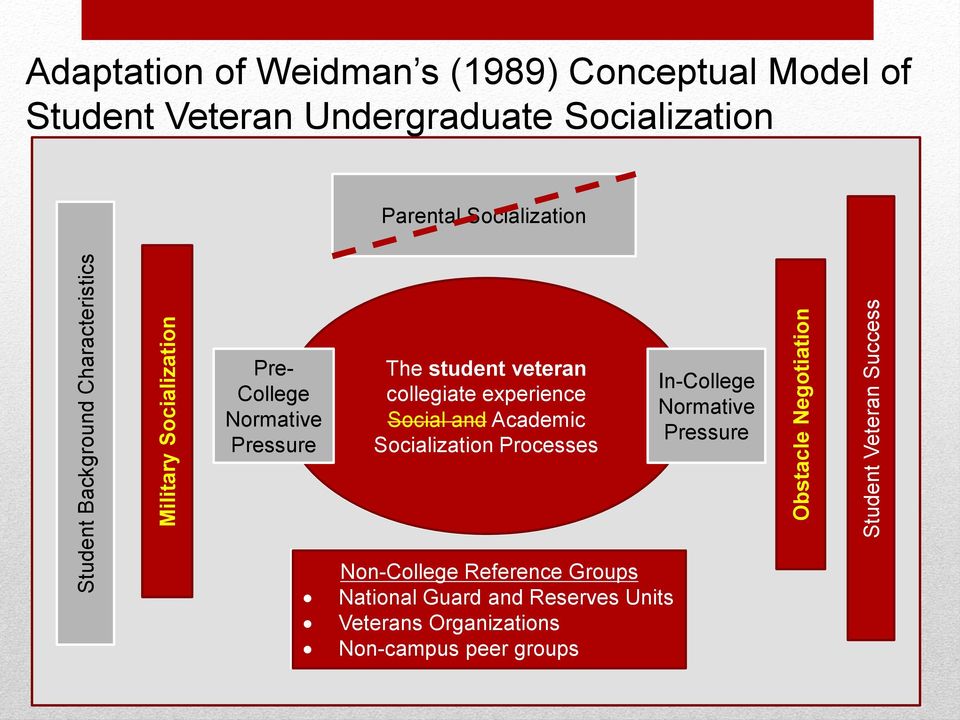
8 Weidman (1989) Undergraduate Socialization Theory Accounts for non-traditional students (veterans) Social integration not critical for non-traditional students Parents and non-college reference groups Friere (1973) Assistentialism highlights flawed thinking of diffusion models Treating symptoms, not ills of local cultures Create a student veteran lounge Provide GI Bill benefits Connecting the Two Fields

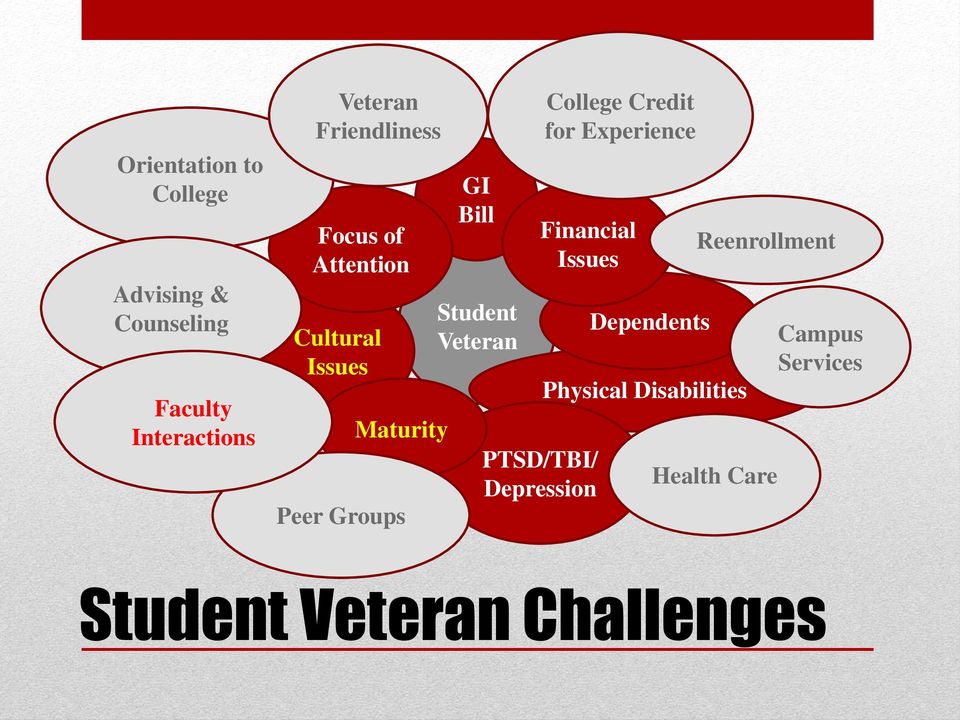
9 Orientation to College Advising & Counseling Faculty Interactions Veteran Friendliness Focus of Attention Cultural Issues Maturity Peer Groups GI Bill Student Veteran Financial Issues PTSD/TBI/ Depression College Credit for Experience Dependents Physical Disabilities Reenrollment Health Care Campus Services Student Veteran Challenges


10 Services General Unique Coaching Academic Advising Peer/Buddy Student Veteran Faculty Interaction In Class Out of Class Transition Orientations Veteran Course Academic Plan Access to courses National Guard & Reserves Model of Student Veteran Support

11 Presumption that transition is a problem (DiRamio, et al 2008; Rumann & Hamrick, 2010) How transition happens is the challenge Veterans manage dissonance well (Baxter-Magolda) Some general services should lead to Some unique individual assistance Showing veterans how sustainability Services must follow the general/individual pattern Quality of Services Timeliness of Services Transitions to Services Transitions - Orientations - Veteran Course - Academic Plan - Access to courses - National Guard &Reserves Services - General - Unique

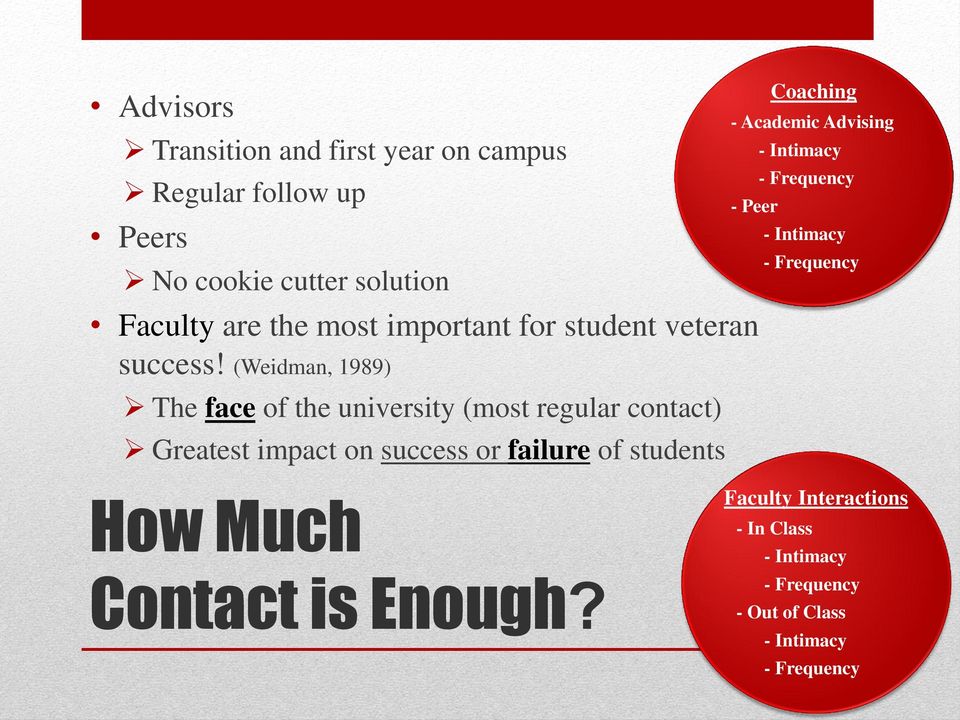
12 Advisors Transition and first year on campus Regular follow up Peers No cookie cutter solution Faculty are the most important for student veteran success! (Weidman, 1989) The face of the university (most regular contact) Greatest impact on success or failure of students Coaching - Academic Advising - Peer - Intimacy - Frequency - Intimacy - Frequency How Much Contact is Enough? Faculty Interactions - In Class - Intimacy - Frequency - Out of Class - Intimacy - Frequency
13 Research suggests colleges need to change in order to promote retention (Berger, 2000; Rendón, 1993) Increasing non-traditional student populations Colleges provide education (development) For non-traditional students minimal social impacts Faculty, Staff, and Administration can help student veterans succeed by: Better understanding veterans Better understanding veterans as students Better understanding non-traditional students? The campus may need to be more accommodating of student veterans (or veteran friendly) Who Really Needs to Develop?

14 1. Combat veterans have changes 2. Changes occurred while we were gone months to new normal 4. Wait at least six months before school 5. Take 12 credits (or the full time minimum) for 2 semesters 6. Veteran friendly campuses can be easy on the budget 7. Treat veterans as individuals 8. be honest with a veteran, they can take it 9. Intentionally involve faculty and staff, particularly your veterans 10. Your veterans will tell you what veteran friendliness should look like on your campus Tips on Student Veterans

15 Bean, J. & Metzner, B. (1985). A conceptual model of nontraditional undergraduate student attrition. Review of Educational Research. 55(4), Beltran, L. (1980). A farewell to Aristotle: Horizontal communication. Communication, 5:5-41. Berger, J. (2000). Optimizing capital, social reproduction, and undergraduate persistence: A sociological perspective. In J. M. Braxton (Ed.), Rethinking the student departure puzzle. Nashville, TN: Vanderbilt University Press. Berger, J. & Braxton, J. (1998). Revising Tinto s interactionalist theory of student departure through theory elaboration: Examining the role of organizational attributes in the persistence process. Research in Higher Education, 39 (2), Braxton, J., Sullivan, A., & Johnson, R. (1997). Appraising Tinto s theory of college student departure. In J. Smart (ed.), Higher education: Handbook of theory and research, vol. 12, New York, NY: Agathon. Cook, B. & Kim, Y. (2009). From soldier to student: Transition programs for service members on campus. Santa Monica, CA: Rand. DiRamio, D., Ackerman, R., & Mitchell, R. (2008). From combat to campus: Voices of student-veterans. NASPA Journal, 45(1), DiRamio, D., & Jarvis, K. (2011). Veterans in higher education: When Johnny and Jane come marching to campus. ASHE Higher Education Report, 37(3). Freire, P. (1970). Pedagogy of the oppressed. (M. Bergman Ramos, Trans). New York, NY: Monthly Review Press. Freire, P. (1973). Education for critical consciousness. New York, NY: Seabury Press. Holder, K. (2009). Profile of veterans: Data from the American community survey. Washington, DC: US Department of Veterans Affairs National Center for Veterans Analysis and Statistics. Kennedy, T. (1984). Beyond advocacy: An animative approach to public participation (doctoral dissertation, Cornell University, 0058), Dissertation Abstracts International, 45, 09A. Livingston, W., Havice, P., Cawthon, T., & Flemming, D. (2011). Coming home: Student veterans articulation of college re-enrollment. Journal of Student Affairs Research and Practice, 48(3), doi: / McBain, L., Kim, Y., Cook, B., & Snead, K. (2012). From soldier to student II: Assessing campus programs for veterans and service members. Washington, D.C.: American Council on Education. Metz, G. (2004). Challenge and changes to Tinto s persistence theory: A historical review. Journal of College Student Retention Research and Theory, 6(2) Midgley, J. (1986). Community participation: History, concepts and controversies. In J. Midgley (ed.). Community Participation, Social Development and the State, pp London, GBR: Methuen. Molina, D. (2012). Veterans transition from service to higher education. Presentation at the DoD Worldwide Education Symposium 2012, Las Vegas, NV. Nair, K. & White, S. (1994). Introduction. In K. Nair & S. White (eds.). Perspectives on Development Communication, pp New Delhi, India: Sage Publications. Rendón, L (1993). Validating culturally diverse students. Paper presented at the National Conference of the Community College Chairs, Phoenix, AZ, February 17-20, Rumann, C. & Hamrick, F. (2010). Student veterans in transition: Re-enrolling after war zone deployments. The Journal of Higher Education, 81(4), Schlossberg, N, (1981). A model for analyzing human adaptation to transitions. Counseling Psychologist, 9(2), Servaes, J. (1985). Towards an alternative concept of communication and development. Media Development, 4:2-5. Servaes, J. (1986). Development theory and communication policy: Power to the people! European Journal of Communication, 1: Servaes, J. (1989). One world, multiple cultures: A new paradigm on communication for development. Leuven: Acco. Smart, J. and Pascarella, E. (1987). Influences on the intention to reenter higher education. Journal of Higher Education, (58), Tanielian, T. & Jaycox, L. (Eds.) (2008). Invisible wounds of war: Psychological and cognitive injuries, their consequences, and services to assist recovery. Santa Monica, CA: Rand. Vacchi, D. (2012a). Considering student veterans on the twenty-first-century college campus. About Campus, 17 (2), Hoboken, NJ: Wiley Periodicals Inc. Vacchi, D. (2012b). [Review of the book by DiRamio and Jarvis. Veterans in Higher Education: When Johnny and Jane Come Marching to Campus.] The Review of Higher Education. Tinto, V. (1975). Dropout from higher education: A theoretical synthesis of recent research. The Review of Educational Research, (45), Tinto, V. (1993). Leaving College: Rethinking the causes and cures of student attrition, 2nd ed. Chicago, IL: University of Chicago Press. Weidman, J. (1989). Undergraduate socialization: A conceptual approach. In J. Smart (Ed.), Higher education: Handbook of theory and research (Vol. 5). New York, NY: Agathon. References
Increasing Student Veteran Success in the Post 9/11 Era. David Vacchi Lieutenant Colonel, US Army Retired Doctoral Student, UMass-Amherst
 Increasing Student Veteran Success in the Post 9/11 Era David Vacchi Lieutenant Colonel, US Army Retired Doctoral Student, UMass-Amherst 1 Who Am I? Retired Army Officer 20 years Kuwait OEF 2002-2003 Iraq
Welcome Home: Understanding and Serving Veteran Transition and Identity Development in College
 Suggested APA style reference information can be found at http://www.counseling.org/library/ Article 4 Welcome Home: Understanding and Serving Veteran Transition and Identity Development in College Paper
From military life to college life. Kathleen Normandin University of Hawaii at Manoa
 From military life to college life Kathleen Normandin University of Hawaii at Manoa I think the faculty needs to know who we are BATTLE MIND is the Soldier s training in combat skills and facing fear and
How To Integrate Veterans To College And University Leadership
 Veterans Integration to Academic Leadership (VITAL) Kai Chitaphong Acting National Director, VITAL Initiative Total VA Beneficiaries FY10-12 Total VA Education Beneficiaries 1,200,000 1,000,000 819,281
Considering Student Veterans on the Twenty-First-Century College Campus
 We will soon be seeing more student veterans enrolling in institutions of higher education than since WWII. David T. Vacchi provides guidance on how to serve this important population of students. By David
Defining Student Retention
 College Student Retention - Defining Student Retention, A Profile of Successful Institutions and Students, Theories of Student Departure Why do students leave college before completing a degree? This question
Project Focus. Component 1:
 Connect 25: Nontraditional Student Engagement at Six Public Tennessee Board of Regents Universities; where we are and where we need to go. Submitted by Cheryl Green, PhD Maxine Smith Fellow, 2014 Tennessee
Open and Distance Learning Student Retention: A Case Study of the University of Papua New Guinea Open College
 Open and Distance Learning Student Retention: A Case Study of the University of Papua New Guinea Open College INTRODUCTION Prof. Dr. Abdul Mannan, University of Papua new Guinea Open College, [email protected]
NAVIGATING MILITARY EDUCATION BENEFITS
 NAVIGATING MILITARY EDUCATION BENEFITS Kathleen Normandin Kelli Nakama ADVISORS ON THE FRONT LINES Other than the CO, advisors may be the first point of contact on campus Understanding benefits has multiple
Faculty Validation and Persistence Among Nontraditional Community College Students. Elisabeth Allanbrook Barnett
 Faculty Validation and Persistence Among Nontraditional Community College Students Elisabeth Allanbrook Barnett Teachers College, Columbia University February 2008 1 Abstract Community colleges enroll
WILLIS A. JONES. [email protected] Office: (859) 257-1607
 WILLIS A. JONES University of Kentucky, College of Education, Educational Policy Studies and Evaluation, 131 Taylor Education Building, Lexington, KY 40506 [email protected] Office: (859) 257-1607
INSTRUCTION AND ACADEMIC SUPPORT EXPENDITURES: AN INVESTMENT IN RETENTION AND GRADUATION
 J. COLLEGE STUDENT RETENTION, Vol. 5(2) 135-145, 2003-2004 INSTRUCTION AND ACADEMIC SUPPORT EXPENDITURES: AN INVESTMENT IN RETENTION AND GRADUATION ANN M. GANSEMER-TOPF JOHN H. SCHUH Iowa State University,
David C. DiRamio, Ph.D.
 David C. DiRamio 1 Curriculum Vitae David C. DiRamio, Ph.D. Associate Professor Administration of Higher Education College of Education 4096 Haley Center Home Address Auburn University, AL 36849 1083 Terrace
SHANE P. HAMMOND 314 Martindale Road - Bernardston, MA 01337 (413) 834-4116 [email protected]
 SHANE P. HAMMOND 314 Martindale Road - Bernardston, MA 01337 (413) 834-4116 [email protected] EXECUTIVE SUMMARY Demonstrated scholar-practitioner in Higher Education with progressively responsible
Holistic Student Development: Educating the Whole Student in a Humanistic Environment
 Holistic Student Development: Educating the Whole Student in a Humanistic Environment ADEA Annual Session & Exhibition March 17, 2014 Juliette C. Daniels, M.A. Director of Student Affairs 1 University
INIGRAL INSIGHTS. The Social Side of Student Retention. Rose Broome Brandon Croke Michael Staton Hannah Zachritz
 INIGRAL INSIGHTS The Social Side of Student Retention Rose Broome Brandon Croke Michael Staton Hannah Zachritz Research, Retention & Best Practices Student retention is a leading issue in post-secondary
Breaking Down Barriers and Building Opportunities for Nontraditional Students Catherine Cash, MA, GCDF Coordinator of Advising Services Doctoral
 Breaking Down Barriers and Building Opportunities for Nontraditional Students Catherine Cash, MA, GCDF Coordinator of Advising Services Doctoral Student, Higher Education Leadership University of Central
What about us? Student Life Research and Assessment. Connie Boehm, Director Student Wellness Center. Justin Moses, Assistant Director
 What about us? Engaging Second year Students Lance Kennedy Phillips Phillips, Ph.D., Director Student Life Research and Assessment Connie Boehm, Director Student Wellness Center Justin Moses, Assistant
Summary of Study and Findings J. Lisa Stewart, Ph.D.
 BRIDGING THE GAP BETWEEN ENROLLMENT AND GRADUATION: AN EXPLORATORY STUDY OF RETENTION PRACTICES FOR NONTRADITIONAL UNDERGRADUATE STUDENTS ATTENDING FAITH-BASED INSTITUTIONS Summary of Study and Findings
Facilitating Student Success for Entering California Community College Students: How One Institution Can Make an Impact
 for Entering California Community College Students: How One Institution Can Make an Impact Esau Tovar Santa Monica College Merril A. Simon 1 California State University, Northridge Abstract As the need
Promoting Student Retention Through Classroom Practice * Vincent Tinto Syracuse University USA
 Promoting Student Retention Through Classroom Practice * Vincent Tinto Syracuse University USA Introduction Many universities in the United States speak of the importance of increasing student retention.
DANIEL J. ALMEIDA 3470 Trousdale Parkway Waite Philips Hall, 701D fax (213) 740-7218
 DANIEL J. ALMEIDA 3470 Trousdale Parkway Waite Philips Hall, 701D fax (213) 740-7218 Los Angeles, CA 90089 [email protected] EDUCATION University of Southern California, Los Angeles, CA Expected May 2016
Beyond Service: New Outreach Strategies to Reach Student Veterans
 Beyond Service: New Outreach Strategies to Reach Student Veterans Sarah LeMire Over two million U.S. service members have been deployed to Iraq or Afghanistan since 2001. As the war in Iraq has ended and
Title Measuring the Success of Student Veterans and Active Duty Military Students
 Title Measuring the Success of Student Veterans and The NASPA Research and Policy Institute In partnership with 2013 NASPA & InsideTrack, All Rights Reserved. INTRODUCTION AND ISSUE OVERVIEW The nation
Persistence in University Continuing Education Online Classes
 International Review of Research in Open and Distance Learning Volume 8, Number 3. ISSN: 1492-3831 November 2007 Persistence in University Continuing Education Online Classes Jia University of California
4. Describe the programs or services that are available to veterans, active duty personnel, and spouses or dependents.
 1. Provide the contact information of the coordinator or primary person on campus with veterans and active duty personnel responsibilities. a. Name Andrea Leadingham b. Title Coordinator of Military Services
A progress report on La Trobe University s academic advising pilot project: Formalising and normalising the advising of first year students
 A progress report on La Trobe University s academic advising pilot project: Formalising and normalising the advising of first year students Dr. Bret Stephenson, Faculty of Humanities and Social Sciences,
2014 GLS Grantee Meeting Service Members, Veterans, and Families Learning Collaborative Additional Resources
 2014 GLS Grantee Meeting Service Members, Veterans, and Families Learning Collaborative Additional Resources Below are resources that address suicide prevention for service members, veterans, and their
From Soldier to Student II:
 The Leadership Association of 430 Public Colleges and Universities From Soldier to Student II: Assessing Campus Programs for Veterans and Service Members July 2012 The Leadership Association of 430 Public
Graduate Student Perceptions of the Use of Online Course Tools to Support Engagement
 International Journal for the Scholarship of Teaching and Learning Volume 8 Number 1 Article 5 January 2014 Graduate Student Perceptions of the Use of Online Course Tools to Support Engagement Stephanie
The Classroom: Exploring its Effects on Student Persistence and Satisfaction
 VOLUME 2, NUMBER 1, 2008 The Classroom: Exploring its Effects on Student Persistence and Satisfaction Michalyn C. Demaris, M.Ed. PhD Student in Educational Leadership The Whitlowe R. Green College of Education
Factors associated with student withdrawal from community college
 Factors associated with student withdrawal from community college Donna Scoggin Ronald A. Styron Dr. Scoggin is a nursing instructor at Jones County Junior College in Ellisville, Mississippi. Dr. Styron
Veteran Recruitment and Retention. Kay Drew, Daphne Molnar and Ashlee Spearman. Lipscomb University. December 10, 2015
 Running head: BEST PRACTICES FOR RECRUITMENT AND RETENTION A Study of the Best Practices of Colleges and Universities for Veteran Recruitment and Veteran Recruitment and Retention Kay Drew, Daphne Molnar
In the past two decades, the federal government has dramatically
 Degree Attainment of Undergraduate Student Borrowers in Four-Year Institutions: A Multilevel Analysis By Dai Li Dai Li is a doctoral candidate in the Center for the Study of Higher Education at Pennsylvania
Ph.D. Counselor Education and Supervision 2014 2015 Program Guidebook
 Ph.D. Counselor Education and Supervision 2014 2015 Program Guidebook NOTE: 1) This guidebook is subject to change. If it does, students will be notified via email and will be provided with the revised
INSTRUCTIONAL SCAFFOLDING TO SUPPORT ONLINE LEARNERS. Dr. Tina Stavredes, Vice President of Online Learning Ultimate Medical Academy
 INSTRUCTIONAL SCAFFOLDING TO SUPPORT ONLINE LEARNERS Dr. Tina Stavredes, Vice President of Online Learning Ultimate Medical Academy Your Event Hosts and Director Kevin Kelly, Ed.D. Director, Faculty Development
How To Help Veterans At Unm Veterans Resource Center
 Marilyn M. Dykman, MA LCDR, USCG (Retired) Director, Veterans Resource Center University of New Mexico Presentation Overview University of New Mexico Overview UNM Veterans Resource Center Overview Elements
Improving STUDENT RETENTION. A Whitepaper from The Learning House, Inc.
 Improving STUDENT RETENTION A Whitepaper from The Learning House, Inc. Rev. 9/2011 What is retention? Respected college administrator, educational consultant and professor Alan Seidman defines retention
MAKING A COLLEGE EDUCATION MORE AFFORDABLE THROUGH INNOVATION AND COLLABORATION
 MAKING A COLLEGE EDUCATION MORE AFFORDABLE THROUGH INNOVATION AND COLLABORATION Danny H. Taylor Senior Vice President of Finance & Administration Lipscomb University 1 Abstract Lipscomb University has
The Student in Higher Education: Nontraditional Student Retention. Betty A. Allen University of Alabama
 The Student in Higher Education: Nontraditional Student Retention Betty A. Allen University of Alabama In the 1980s, the nontraditional student became the norm in student populations in colleges and universities.
Handbook of Policies, Procedures, and Requirements for the Masters Degree in Instructional Systems
 Masters (M.S.) in Instructional Systems Department of Educational Psychology & Learning Systems Florida State University Handbook of Policies, Procedures, and Requirements for the Masters Degree in Instructional
Board Certification: Diplomate, American Board of Professional Psychology, in Forensic Psychology
 Page 1 Lisa Drago Piechowski, Ph.D., ABPP Board Certified in Forensic Psychology by the American Board of Professional Psychology 155 Sycamore Street, Suite 2E Glastonbury, CT 06033 (860) 659-0732 voice
RETENTION IN ACCELERATED DEGREE-COMPLETION PROGRAMS. Cynthia Benn Tweedell, Ph.D. Indiana Wesleyan University
 RETENTION IN ACCELERATED DEGREE-COMPLETION PROGRAMS Cynthia Benn Tweedell, Ph.D. Indiana Wesleyan University Why do some students leave college while others persist to graduation? Many social scientists
Planning your Program- PhD
 Planning your Program- PhD Students in the Rehabilitation Counselor Education program complete the following coursework toward their doctoral degrees. Additional information on these courses, elective
Supporting Different Learning Styles in an Online Learning Environment: Does it Really Matter in the Long Run?
 1 of 9 Supporting Different Learning Styles in an Online Learning Environment: Does it Really Matter in the Long Run? Steven R. Terrell, Ed.D. Graduate School of Computer and Information Science Nova Southeastern
An Examination of Institutional and Faculty Barriers to Distance Education - Thomson. References
 References Allen, I. E., & Seaman, J. (2013). Changing course: Ten years of tracking online education in the United States. Retrieved from The Sloan Consortium website: http://sloanconsortium.org/publications/annual-surveys
Assistant Professor of Marketing, 2012- Present McDonough School of Business, Georgetown University, Washington, DC
 Neeru Paharia McDonough School of Business, Georgetown University Rafik B. Hariri Building, Suite 578 37th and O Streets, NW, Washington, DC 20057 Tel: 510.823.1073 [email protected] Updated August,
What Makes a Quality Online Course? The Student Perspective. Penny Ralston-Berg, M.S. Senior Instructional Designer University of Wisconsin-Extension
 What Makes a Quality Online Course? The Student Perspective Penny Ralston-Berg, M.S. Senior Instructional Designer University of Wisconsin-Extension Leda Nath, Ph.D. Assistant Professor of Sociology University
Jennifer M. Logg. 425 Student Services Building #1900 Website: http://www.jennlogg.com Berkeley, CA 94720-1900
 Logg CV 1 Jennifer M. Logg Haas School of Business Phone: 908.217.9531 Email: [email protected] 425 Student Services Building #1900 Website: http://www.jennlogg.com Berkeley, CA 94720-1900 EDUCATION
Running Head: Promoting Student Success: Evaluation of a Freshman Orientation Course
 Running Head: Promoting Student Success: Evaluation of a Freshman Orientation Course Promoting Student Success: Evaluation of a Freshman Orientation Course Mary A. Millikin, PhD Abstract Many first-time
Under the Start Your Search Now box, you may search by author, title and key words.
 VISTAS Online VISTAS Online is an innovative publication produced for the American Counseling Association by Dr. Garry R. Walz and Dr. Jeanne C. Bleuer of Counseling Outfitters, LLC. Its purpose is to
Onsite Peer Tutoring in Mathematics Content Courses for Pre-Service Teachers
 IUMPST: The Journal. Vol 2 (Pedagogy), February 2011. [www.k-12prep.math.ttu.edu] Onsite Peer Tutoring in Mathematics Content Courses for Pre-Service Teachers Elaine Young Associate Professor of Mathematics
AC 2012-5061: EXPLORING THE DIVERSITY IN FACULTY CAREERS: FORMATIVE AND SUMMATIVE ASSESSMENT IN A PREPARING FU- TURE FACULTY COURSE
 AC 2012-5061: EXPLORING THE DIVERSITY IN FACULTY CAREERS: FORMATIVE AND SUMMATIVE ASSESSMENT IN A PREPARING FU- TURE FACULTY COURSE Ms. Cyndi Lynch, Purdue University, West Lafayette Cyndi Lynch is the
Servicemembers Opportunity Colleges Best Practices for Creating a Military Friendly Institution
 Servicemembers Opportunity Colleges Best Practices for Creating a Military Friendly Institution AACRAO Annual Conference Chicago, IL April 14, 2009 What makes an institution Military Friendly? Defining
PROVIDING COGNITIVE BEHAVIORAL THERAPY FOR VETERANS: A GRANT PROPOSAL ROGELIO BECERRA CALIFORNIA STATE UNIVERSITY, LONG BEACH MAY 2014
 PROVIDING COGNITIVE BEHAVIORAL THERAPY FOR VETERANS: A GRANT PROPOSAL ROGELIO BECERRA CALIFORNIA STATE UNIVERSITY, LONG BEACH MAY 2014 Introduction The Institute of Medicine (IOM) released a report, entitled
In search of higher persistence rates in distance education online programs
 Internet and Higher Education 6 (2003) 1 16 In search of higher persistence rates in distance education online programs Alfred P. Rovai* School of Education, Regent University, 1000 Regent University Drive,
Creating Quality Developmental Education
 ***Draft*** Creating Quality Developmental Education A Guide to the Top Ten Actions Community College Administrators Can Take to Improve Developmental Education Submitted to House Appropriations Subcommittee
Tracking the Academic Success of Servicemembers and Veterans
 EDUCATIONAL ATTAINMENT: Tracking the Academic Success of Servicemembers and Veterans July 2012 Education Working Group convened by Servicemembers Opportunity Colleges Disclaimer: Servicemembers Opportunity
The Summer Research Early Identification Program SR-EIP
 The Summer Research Early Identification Program SR-EIP Since 1992, the Leadership Alliance has encouraged students from groups traditionally underrepresented in the sciences, engineering, social sciences
Rovereto, June 20 th -25 th, 2011
 Rovereto, June 20 th -25 th, 2011 The program will include formal lectures on three topics: -Qualitative methods for social justice education (prof. Massimiliano Tarozzi, University of Trento) -Feminist
Life Stressors and Non-Cognitive Outcomes in Community Colleges for Mexican/Mexican American Men. Art Guaracha Jr. San Diego State University
 Life Stressors and Non-Cognitive Outcomes in Community Colleges for Mexican/Mexican American Men Art Guaracha Jr. San Diego State University JP 3 Journal of Progressive Policy & Practice Volume 2 Issue
Julian R. Cowart EDUCATION
 Julian R. Cowart EDUCATION Doctor of Philosophy in Education 2009 Capella University, Minneapolis, MN Specialization: Leadership for Higher Education Dissertation: Best Practices in Online Education: Why
HELPING VETERANS RETURN TO WORK
 OVERVIEW HELPING VETERANS RETURN TO WORK Best Practices for Behavioral Health Practitioners A report on a conference held June 7, 2013 at Rutgers, The State University of New Jersey Prepared by: USC Center
Evolving Modalities for Doctoral Education
 Evolving Modalities for Doctoral Education Charles McClintock Dean, Human & Organizational Development Fielding Graduate University Orlando L. Taylor President, Washington, DC Campus The Chicago School
Candidates seeking admission to the Ed.D. program must fulfill the following requirements:
 Doctoral Program Dear Prospective Student, Thank you for your interest in Lewis University s Doctoral Program (Ed.D.) in Educational Leadership for Teaching and Learning. In response to your inquiry, enclosed
THE PSYCHOLOGY UNDERLYING SUCCESSFUL RETENTION PRACTICES
 J. COLLEGE STUDENT RETENTION, Vol. 3(1) 73-89, 2001-2002 THE PSYCHOLOGY UNDERLYING SUCCESSFUL RETENTION PRACTICES JOHN BEAN Indiana University, Bloomington SHEVAWN BOGDAN EATON, PH.D. Northern Illinois
LAWRENCE MORLEY HANSER
 LAWRENCE MORLEY HANSER EDUCATION Ph.D. Psychology, 1977, Iowa State University M.S. Psychology, 1975, Iowa State University B.A. Psychology, 1972, Marquette University PROFESSIONAL EXPERIENCE 1989-Present
On Track: A University Retention Model. Utilizing School Counseling Program Interns. Jill M. Thorngren South Dakota State University
 On Track: A University Retention Model Utilizing School Counseling Program Interns Jill M. Thorngren South Dakota State University Mark D. Nelson and Larry J. Baker Montana State University Bozeman Barbara
College of Education. Department of Educational Psychology. New EPS Graduate Student Orientation Meeting Fall 2015
 College of Education Department of Educational Psychology New EPS Graduate Student Orientation Meeting Fall 2015 Northern Arizona University Approximately 27,715 undergraduate and graduate students, with
Matthew T. Gougherty Curriculum Vitae. Work Address Department of Sociology Phone: 812-340-1474
 Matthew T. Gougherty Curriculum Vitae Work Address Department of Sociology Phone: 812-340-1474 Ballantine Hall 744 Email: [email protected] 1020 East Kirkwood Avenue Website: www.mattgougherty.com Bloomington,
A FORMAL LITERATURE REVIEW OF VETERAN ACCULTURATION IN HIGHER EDUCATION
 InSight: RIVIER ACADEMIC JOURNAL, VOLUME 9, NUMBER 2, FALL 2013 A FORMAL LITERATURE REVIEW OF VETERAN ACCULTURATION IN HIGHER EDUCATION Michael M. Bichrest Doctoral Student, Ed.D. Program in Leadership
STRENGTHS-BASED ADVISING
 STRENGTHS-BASED ADVISING Key Learning Points 1. Good advising may be the single most underestimated characteristic of a successful college experience (Light, 2001). It is at the heart of all our efforts
Learning Better Together: The Impact of Learning Communities on Student Success
 Learning Better Together: The Impact of Learning Communities on Student Success Vincent Tinto Syracuse University Despite recent innovations, it remains the case that most students experience universities