
HOW ENTREPRENEURIAL ARE OUR FLEMISH STUDENTS?
|
|
|
- Suzan Scott
- 10 years ago
- Views:
Transcription
1 Knowledge partner SURVEY HOW ENTREPRENEURIAL ARE OUR FLEMISH STUDENTS? Prof. Hans Crijns Sabine Vermeulen November 2007

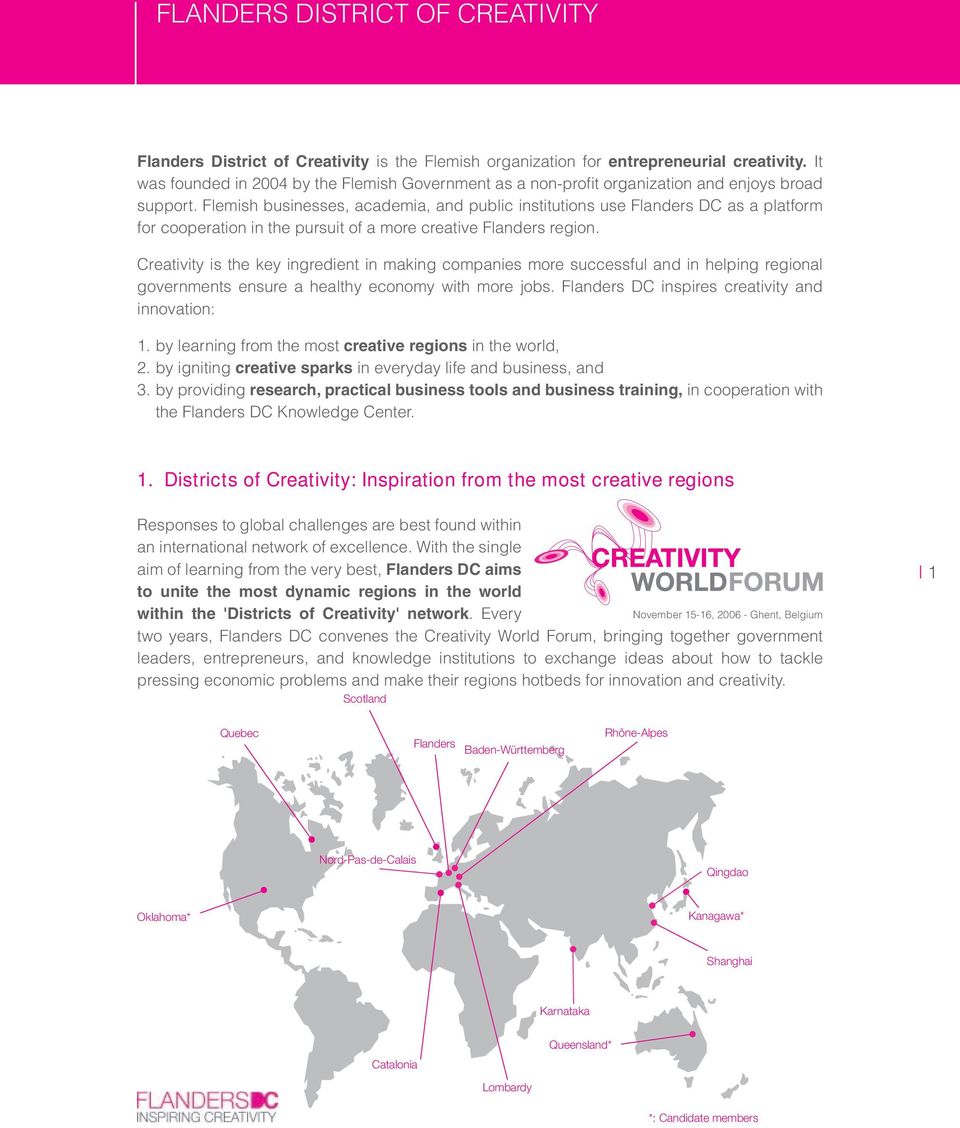
2 FLANDERS DISTRICT OF CREATIVITY Flanders District of Creativity is the Flemish organization for entrepreneurial creativity. It was founded in 2004 by the Flemish Government as a non-profit organization and enjoys broad support. Flemish businesses, academia, and public institutions use Flanders DC as a platform for cooperation in the pursuit of a more creative Flanders region. Creativity is the key ingredient in making companies more successful and in helping regional governments ensure a healthy economy with more jobs. Flanders DC inspires creativity and innovation: 1. by learning from the most creative regions in the world, 2. by igniting creative sparks in everyday life and business, and 3. by providing research, practical business tools and business training, in cooperation with the Flanders DC Knowledge Center. 1. Districts of Creativity: Inspiration from the most creative regions Responses to global challenges are best found within an international network of excellence. With the single aim of learning from the very best, Flanders DC aims to unite the most dynamic regions in the world within the 'Districts of Creativity' network. Every November 15-16, Ghent, Belgium two years, Flanders DC convenes the Creativity World Forum, bringing together government leaders, entrepreneurs, and knowledge institutions to exchange ideas about how to tackle pressing economic problems and make their regions hotbeds for innovation Scotland creativity. Quebec Scotland Quebec Rhône-Alpes Flanders Baden-Württemberg Flanders Baden-Württemberg l Rhô Nord-Pas-de-Calais Nord-Pas-de-Calais Qingdao Oklahoma* Oklahoma* Kanagawa* Shanghai Catalonia *: Candidate members Lombardy Karnataka Queensland* Catalonia *: Candidate members Lombardy Karnataka Queensland*
3 ISBN-NUMMER : EAN : Geert Devos, Mieke Van De Woestyne, Herman Van den Broeck Februari Raising awareness: The best way to predict the future is to invent it Flanders DC encourages entrepreneurs and citizens to look ahead and find creative solutions today for tomorrow's problems. Flanders DC has developed an idea-generation tool to encourage people and organizations to take the first step toward innovation. In addition, Flanders DC runs a general awareness-raising campaign entitled Flanders Future. l 2 3. The Flanders DC Knowledge Centre: Academic support Kennispartner HET INNOVATIEPROCES IN GROTE BEDRIJVEN EN KMO S - Februari 2007 Kennispartner ONDERZOEKSRAPPORT HET INNOVATIEPROCES IN GROTE BEDRIJVEN EN KMO S The Flanders DC Knowledge Center serves as a link between Flanders DC and Vlerick Leuven Gent Management School. Each year, the Flanders DC Knowledge Center publishes several reports and develops various tools, case studies and courses. All these projects focus on the role of creativity in a business environment and identify obstacles to, and accelerators of, competitive growth. The Creativity Talks brief monthly, interactive info sessions update you on these research activities. See for a current calendar and subscription information.

4 - De creativiteit en ondernemingsgezindheid in kaart gebracht via het online lee - Networking and innovation capacity of multinational c (auteurs: Veronique Warmoes en Herman Van den Broeck), April 2007 Vereecke and Evelyne Vanpoucke), December 2006 Els Van de Velde, Bart Clarysse and Wim Van Ha - Open innovation in Europe (auteurs: - Het innovatieproces in grote bedrijven en KMO s (a July 2007 Woestyne en Herman Van den Broeck), Februari Knowledge networks in industry-science relations (auteurs: Johan Bruneel, Bart - How innovative are we really? -(auteurs: DeClarysse, Bruyne andsteven Bert Weijters), De casemarion Arteconomy (auteurs: MestdaghSeptem en Her Annelies Maesen, Nathalie Morray and André Spithoven), December Flanders attractiveness forvoor foreign investment (auteurs: HarryTine Bowen, JuanJonas Enrique ondernemen (auteurs: Maenhout, On -decreatief in de praktijk. Een praktijkboek Vlaamse ondernemer. (auteurs: - De ondernemer Herman VanChavez, den Broeck,Isabelle Eva Cools,De HansVoldere Crijns, Sabine en Deva Rangarajan) - Knowledge in industry-science relations De creativiteit ennetworks ondernemingsgezindheid in (auteurs: kaart g - Leo andvermeulen Sleuwaegen), November 2008 ustry-science relations (auteurs: Johan Bruneel, Bart Clarysse, innovation capacity of multinational companies in Annelies Flandersnetworks (auteurs:nathalie - Networking and Research reports: Maesen, Morray and André Spithoven), Decem - Knowledge inann industry-science relations (auteurs: Joha (auteurs: Veronique Warmoes en Herman Van den Broeck orray and André Spithoven), December 2006 Vereecke and Evelyne Vanpoucke), December 2006 Uitdagingen Annelies De Vlaamse economie in 2015: voor deondernemer toekomst, Koen De Backer en Leo in de praktijk. Een praktijkboek voor de Vl2 - De Maesen, Nathalie Morray and André Spithoven), December ijk. Een praktijkboek voor de Vlaamse ondernemer. (auteurs:- Open innovation in Europe (auteurs: Els Van de Velde, B in groteseptember bedrijven 2005, en KMO s (auteurs: Geert Devos, Mieke Van De - Het innovatieproces Sleuwaegen, Published in Dutch Herman Van den Broeck, EvaEen Cools, Hans Crijns,voor Sabine in de praktijk. praktijkboek de Vermeu Vlaam - De ondernemer Cools, Hans Crijns, Sabine Vermeulen en Deva Rangarajan) Woestyne en Herman Van den Broeck), Februari Ondernemingscreativiteit als2007 motor vanjuly groei voor Vlaamse steden en Brussel, Isabelle 2007 and innovation capacity of multinational compane - Networking Herman Van den Broeck, Eva Cools, Hans Crijns, Sabine Vermeulen capacity of multinational companies in Flanders (auteurs: Ann (auteurs: Steven Mestdagh en Herman Van-November den Broeck), Februari 2007 Vanpoucke), - De case Arteconomy De Voldere, Eva Janssens en Jonas Onkelinx, 2005, Published incapacity Dutch of Vereecke and Evelyne December 2006 companies Networking and innovation multinational - How innovative are we really? (auteurs: Marion De Bruyn cke), December 2006 (auteurs: Tine Maenhout, Jonas Onkelinx en Hans Crijns), Maart Creatief ondernemen The Creative Economy: challenges and opportunities for the DC-regions, Isabelle De in grotedecember bedrijven en KMO s (auteurs: - Het innovatieproces Vereecke and Evelyne Vanpoucke), 2006 e bedrijven en KMO s (auteurs: Geert Devos, Mieke Van De- Flanders attractiveness for foreign investment (auteurs ondernemingsgezindheid kaart gebracht via onlineapril leerplatform - De creativiteit en Voldere, Eva Janssens, JonasinOnkelinx en Leo- Sleuwaegen, 2006, Published in English Woestyne en Herman Van den Broeck), Februari Het het innovatieproces in grote bedrijven en KMO s2007 (auteurs: Gee n Broeck), Februari 2007 (auteurs: Veronique Warmoes entelevisiesector Herman Van dengetuigen: Broeck), April 2007 Chavez, Isabelle De Voldere and Leo Sleuwaegen), Novem Spelers uit de een verkennende studie in de creatieve industrie, Arteconomy (auteurs: Steven Mestdagh Va - De case Woestyne en Herman Van den Broeck), Februari 2007 en Herman s: Steven Mestdagh en Herman Van den Broeck), Februari 2007 Flanders DC & Vacature Winter Academy (16 tot en met 19 Februari 2006) Open innovation in Europe (auteurs: Els Van de Velde, Bart Clarysse and Wim Van Haverbeke), tworks in industry-science Marc relations (auteurs: en Johan Bruneel, Buelens Mieke VanBart DeClarysse, Woestyne, Juni 2006, Published in Dutch Creatief ondernemen (auteurs: Tine Maenhout, Jonas Onkelinx - case De Arteconomy (auteurs: Steven Mestdagh en Herman Van de s: Tine Maenhout, Jonas Onkelinx en Hans Crijns), Maart 2007 en, Nathalie Morray and André Spithoven), December 2006 July 2007 Mobiliseren, dynamiseren en enthousiasmeren van onze (toekomstige) creativiteit en(auteurs: ondernemingsgezindheid in kaart gebrach - De ondernemen Tinezilvervloot, Maenhout, Jonas Onkelinx en H - Creatief Rob Dew, Visiting professor from Auckland on Creative Problem Solving, Septemb ingsgezindheid inpraktijkboek kaart gebracht via het online leerplatform er in de praktijk. Een voor de Vlaamse ondernemer. (auteurs: - How innovative are we really? (auteurs: Marion De Bruyne and Bert Weijters), September Knowledge networks in industry-science Johan Bart Clarysse, Thomas Dewilde, Annick Vlaminckx, relations Ans De-(auteurs: Vos Dirk Bruneel, Buyens, Juni 2006, en Published (auteurs: Veronique Warmoes Herman in Van den Broeck), April De en creativiteit en ondernemingsgezindheid in kaart gebracht via en Eva Van Cools,den Hans Crijns, Sabine Deva Rangarajan) enbroeck, Herman Broeck), AprilVermeulen 2007forenthe Scholarships Master Class Entrepreneurship andeninnovation. -attractiveness - Flanders foreign (auteurs: HarryinBowen, JuanVeronique Enrique Gutierrez Annelies for Maesen, Nathalie Morray and André December 2006 innovation in Europe (auteurs: Els Van de Velde, April Bart Clar - Open Dutch (auteurs: Warmoes Herman Van den Broeck), 2007 nd innovation capacity of multinational companies ininvestment Flanders (auteurs: Ann Spithoven), uteurs: Els Van de Velde,- Bart Clarysse and Wim Van Haverbeke), DeVoldere ondernemer in de praktijk. Een November praktijkboek2008 voor de Vlaamse ondernemer. (auteurs: Chavez, Isabelle De andof Leo Evelyne Vanpoucke), 2006 July 2007 Bowen, Development a Sleuwaegen), regional competitiveness index, Harry Wim(auteurs: Moesen and Leo Open innovation in Europe Els Van de Velde, Bart Clarysse -innovatieve Flanders DC Fellows: Creatieve en ondernemers als rolmodel. Eerste lic -December Herman Van den Broeck, Eva Cools, Hans Crijns, Sabine Vermeulen en Deva Rangarajan) proces in grote bedrijven en KMO s (auteurs: Geert Devos, Mieke Van De - How innovative are we really? (auteurs: Marion De Bruyne and B July 2007 Sleuwaegen, September 2006, Published in English?erman (auteurs: Marion De Bruyne and Bert Weijters), September 2007 and innovation capacity of multinational companies in Flanders (auteurs: Ann - Networking Van den Broeck), Februari 2007 cember as Flanders attractiveness for foreignmarion investment (auteurs: innovative are we really? (auteurs: andharry Bert W Innovation outside the lab: strategic the alternative, Marion Debruyne and De Bruyne Vereecke and Evelyne Vanpoucke), December How onomy (auteurs: Steven Mestdagh en Herman Van den Broeck), Februari 2007 oreign investment (auteurs: Harry Bowen, Juan Enrique Gutierrez innovation Flanders DC & Vacature Winter Academy (16 tot en me Chavez, IsabelleMieke De Voldere Leo Sleuwaegen), November 20 Creativity Talks. November Maandelijkse sessies ondernemingscreativiteit en(auteurs: innovatie. S Flanders attractiveness for Harry Bow Marie Schoovaerts, 2006, Published in over English nemen (auteurs: Tine-Maenhout, Jonas Onkelinx 2007 en innovatieproces incrijns), grotemaart bedrijven KMO s -(auteurs: Geert Devos, Vanforeign De and investment - Het nd Leo Sleuwaegen), November 2008 en Hans Kennisverspreiding en ondernemingsgezindheid in creatieve kaart gebracht via het leerplatform en Herman Van online den Broeck), Februari 2007 Chavez, Isabelle De Voldere and Leo Sleuwaegen), November 2008 DeWoestyne industrie in Vlaanderen, Tine Maenhout, Isabelle De Voldere, Jonas Onkelinx - Rob Dew, Visiting professor from Auckland on Creative Kennisverspreiding Kennisverspreiding 2006 tot Mei ique Warmoes en Herman Van- den Broeck), April 2007 (auteurs: Steven Mestdagh en Herman Van den Broeck), Februari 2007 case Arteconomy ende Leo Sleuwaegen, December 2006, Published in Dutch on in Europe (auteurs: Els Van-deCreatief Velde, Bart Clarysse and Wim VanTine Haverbeke), ondernemen (auteurs: Maenhout, Jonas Onkelinx en Hans Crijns), Maart 2007 Scholarships for the Master Class in Entrepreneurship an - Flanders DC & Vacature Winter Academy (16 tot en met -19en Februari Het innovatieproces in grote bedrijven KMO s,2006) Geert Devos, Mieke Van De Woestyne en creativiteit en ondernemingsgezindheid in Flanders kaart gebracht via het online 2006 leerplatform - De Visiting professor from Auckland on Creative Solving, September - Rob DC Fellows: Creatieve en innovatieve onderne -Problem Kennisverspreiding e are we really?dew, (auteurs: Marion De Bruyne and BertBroeck, Weijters), September 2007 Herman Van den 2007, Published in 2007 Dutch (auteurs: Veronique Warmoes Februari en Herman Van den Broeck), April for the(auteurs: MasterHarry Class in Entrepreneurship and Innovation. - Scholarships ctiveness for foreign investment Bowen, Juan Enrique Gutierrez Kennisverspreiding cember Creatief ondernemen in(auteurs: Vlaanderen, Tine Maenhout, Jonas Onkelinx en Hans Crijns, Maart in Europe Els Van de Velde, Bart Clarysse and Wim Van Haverbeke), - Open innovation e De Voldere and Leo DC Sleuwaegen), November 2008 Fellows: Creatieve en innovatieve ondernemers als rolmodel. Eerste lichting De- Winter Academy (16 tot en met l19 - Flanders Feb Flanders DC & Vacature July 2007 in Dutch ter Academy (16 tot en 2007, met 19Published Februari 2006) Creativity Talks. Maandelijkse sessies over ondernemin cember How innovative are we really? (auteurs: Marion De Bruyne and Weijters), September 2007 Dew, professor frommet Auckland Proble - Rob - Flanders DC & Visiting Vacature Winter Academy (16 en Creative met 19 Februar Bert Hoe Problem ondernemers Vlaanderen identificeren. Een rapport tipstot on from Auckland on Creative Solving,inSeptember 2006opportuniteiten 2006 tot Mei sessies over ondernemingscreativiteit en innovatie. September - Creativity Talks.- Maandelijkse Flanders attractiveness for foreign investment (auteurs: Harry Bowen, Juan Enrique Gutierrez for the Master Class insabine Entrepreneurship and Innov - Scholarships Dew, Visiting professor Auckland on Creative Problem S - Rob tools voor de ondernemer in de praktijk, Eva Cools, Herman Van denfrom Broeck, Class in Entrepreneurshipenand Innovation tot Mei 2007.Chavez, Isabelle De Voldere and Leo Sleuwaegen), November ng Flanders DC Fellows: Creatieve en innovatieve ondernemers a Scholarships for the Master Class in Entrepreneurship and Innovation Vermeulen, Crijns, Deva Rangarajan, Mei 2007, published in Dutch eve en innovatieve ondernemers als Hans rolmodel. Eerste lichting December DC Fellows: Creatieve en innovatieve - Flanders Networking in multinational manufacturing companies, Ann Vereecke, July 2007, published ondernemers als rol Vacature Winter Academy (16 tot en met 19 Februari 2006) cember Talks. Maandelijkse sessies over ondernemingscreat - Creativity professor fromondernemingscreativiteit AucklandinonEnglish Creative Problem September 2006 eingsessies over ensolving, innovatie. September 2006 tot Mei Maandelijkse Talks. sessies over ondernemingscreativiteit - Creativity Kennisverspreiding or the Master Class in Entrepreneurship and Innovation. ellows: Creatieve en innovatieve ondernemers als rolmodel. Eerste lichting DeIn addition to these research projects, the Flanders DC Knowledge Centre has also developed 2006 tot Mei Flanders DC & Vacature Winter Academy (16 tot en met 19 Februari 2006) the following tools and training sessions: s. Maandelijkse sessies over -ondernemingscreativiteit en innovatie. Rob Dew, Visiting professor fromseptember Auckland on September 2006 Ondernemen.meerdan.ondernemen, ancreative online Problem learningsolving, platform 007. De partners en leden van de raad van bestuur van Flanders DC zijn: - Scholarships for the Master Class in Entrepreneurship and Innovation. Creativity Class for young high-potentials - Flanders DC Fellows: Creatieve en innovatieve ondernemers als rolmodel. Eerste lichting De Flanders DC Fellows, inspiring role models in business creativity cember Published research reports can be downloaded via the Vlerick Talks. Maandelijkse sessies over en Leuven innovatie.gent September - Creativity De partners en leden van de raad van bestuur van Flanders DC ondernemingscreativiteit zijn: 2006 tot Mei Management School library catalogue or via De partners en leden van de raad van bestuur van Flanders DC z n bestuur van Flanders DC zijn: van de raad van bestuur van Flanders DC zijn: De partners en leden van de raad van bestuur van Flanders DC zijn: Board of Directors De partners en leden van de raad van bestuur van Flanders DC zijn: of Flanders DC De partners en leden van de raad van bestuur van Flanders DC zijn:

5

6 PREFACE The goal of this project is to examine, explain and discuss the behaviour and intentions of students in their decision to start entrepreneurial activities and to found an enterprise. This report has been written as part of an international research project called International Survey on Collegiate Entrepreneurship (ISCE) which is investigating Academic Entrepreneurship. The project is coordinated on an international level by the Swiss Research Institute of Small Business and Entrepreneurship at the University of St. Gallen (KMU-HSG) together with the KfW Endowed Chair for Entrepreneurship at the European Business School (EBS). The project is coordinated on a national level by the Centre of Entrepreneurship at Vlerick Leuven Gent Management School. We are very thankful to the participating universities/colleges in Belgium, namely Ghent University, the University of Antwerp, EHSAL, Université de Liège and FUNDP Namur. Without the concerted efforts of these universities/colleges and their representatives, the project would not have been realized to the current level. We hope that this project will provide students, authorities, professors, teachers and service providers with a wealth of ideas, impulses and motivations to help develop a real entrepreneurial spirit amongst academics. l 5

7 TABLE OF CONTENTS 1 Introduction Entrepreneurship and economic growth Entrepreneurship: a matter of learning? 1.3 Entrepreneurship and education Entrepreneurship and higher education Policy and initiatives Reasons for a study on how collegiate entrepreneurship 7 2 Methodology Goals of the study Significance of the study Sample and representativeness 24 3 Conditions at institutions of higher education Entrepreneurial environment International comparison Detailed results for Flanders Activities students would like to see offered at universities 31 l 6 4 Entrepreneurial activities and goals Professional expectations of students International comparison Detailed results for Flanders Current entrepreneurial activities and intentions of students International comparison Detailed results for Flanders Businesses established by students Intention of students to establish a business Activities in relation to establish a business Possible time frame for establishing a business Details of potential business establishments 44 5 Obstacles for establishing a business International comparison Detailed results for Flanders 49 6 Conclusions Important findings of this study What can be done? 55
8 LIST OF TABLES Table 1: Participating countries and response rate 22 Table 2: Structure of the samples in country comparison 23 Table 3: Main subject studied by students 24 Table 4: At which university/technical college are you studying? 25 Table 5: Rankings of expected entrepreneurial position 34 Table 6: Have you personally ever concretely thought about building up your own self-employed entrepreneurial existence, i.e. being self-employed? 38 Table 7: Businesses established by students 39 Table 8: Potential business formations by students 45 l 7

9 LIST OF FIGURES l 8 Figure 1: Can entrepreneurship be taught? Figure 2 : Where should entrepreneurship be taught? 2 Figure 3: Correlation between educational attainment and high-potential TEA for all participating GEM countries (De Clercq et al, 2002) 3 Figure 4: Education level versus TEA 4 Figure 5: Scores of Flemish key informants on separate items of Education and Training 15 Figure 6: Framework of the Global Entrepreneurship Monitor (GEM) 21 Figure 7: Framework of this study 21 Figure 8: How do you judge the climate and premises for starting a business at your university/ college? 28 Figure 9: No entrepreneurship-related courses offered 29 Figure 10: Non-attendance of entrepreneurship-related courses 29 Figure 11: How do you judge the climate and premises for starting a business at your university/ college? Results compared amongst institutions of higher education 30 Figure 12: How do you judge the climate and premises for starting a business at your university/ college? Results compared amongst study areas 30 Figure 13: Support students would like to see offered at universities 32 Figure 14: Activities after graduation 35 Figure 15: Average of job expectations following graduation in Flanders 36 Figure 16: Entrepreneurial activities and intentions of all students 37 Figure 17: Partners of business founders 40 Figure 18: Students taking no specific steps to establish a business 41 Figure 19: Information gathering for establishing a business 42 Figure 20: Preparatory steps for establishing a business 43 Figure 21: Time frame for establishing a business 44 Figure 22: Partners for potential business founders 46 Figure 23: Obstacles compared internationally 48 Figure 24: Obstacles for establishing a business in Flanders 50 Figure 25: Obstacles for establishing a business compared amongst study areas 51 Figure 26: Did you grow up in an entrepreneurial family? 61 Figure 27: The feelings they connect with their family business 62

10 1 INTRODUCTION l 9

11 1 INTRODUCTION While most studies focus on the number of firms that are created, the Global Entrepreneurship Monitor (GEM) gives us a good indication of how many individuals are actively involved in starting a company or have recently started a company. However, entrepreneurial activity in Flanders seems to be quite low in comparison with other countries worldwide (GEM, ). According to GEM 2006, the Flemish and Belgian TEA (Total Entrepreneurial Activity) remains seriously below the EU average of 5.01%). At this moment, Flanders and Belgium are falling in the ranks of the 16 participating EU countries and even of the 49 participating countries worldwide. That is, the Flemish TEA decreased even further from 3.71% in 2005 to 3.05 % in 2006, indicating that only 3 out of 100 people in the labour force are actively involved in starting up a company or have started up a company recently. Assuming that entrepreneurs are not born but made (studies have shown that people who have had entrepreneurship training are twice as likely to start a company), it is crucial to encourage entrepreneurship at the individual level. This project will provide insight into how entrepreneurial Flemish students (with a higher education) are, and which policy measures need to be taken to stimulate the entrepreneurial spirit and to further support the start-up of new companies in Flanders. l Entrepreneurship and economic growth The degree of entrepreneurship has an important influence on the economic prosperity of a region or country. New and growing companies are vital to economic prosperity: they increase an economy s innovative capacity, they anticipate market demands, they challenge existing companies to function more efficiently, and last but not least they create new business activities and therefore new jobs. Entrepreneurship induces economic growth because new ventures raise the competitiveness of a sector, region or country. A good example that illustrates this is Silicon Valley in the United States where, through innovative entrepreneurship, a region blossomed into a hotbed of high-tech activity. Research states that 4000 new companies have originated here, creating 1.1 million jobs (Steffenson et al, 1999). The success of Silicon Valley has spurred an increased interest in entrepreneurship over the past twenty years. An increase in the degree of entrepreneurship is the result of push-factors such as (imminent) unemployment and the anticipation of economic recovery. The degree of entrepreneurship is always coupled to the prosperity of an economy. High prosperity stimulates (pull) people to start a company themselves, while low prosperity forces (push) people to start a company themselves. The concepts entrepreneurship and prosperity (economy) are inseparable (Zwart, 2005). Recent research shows that more than half of the newly created jobs result from newly founded companies (Verhoeven et al, 2005). Moreover, new entrepreneurs with new insights prod existing companies into greater alertness, so that they do not lose market share or even entire markets. This phenomenon corresponds with Schumpeter s theory of creative destruction.

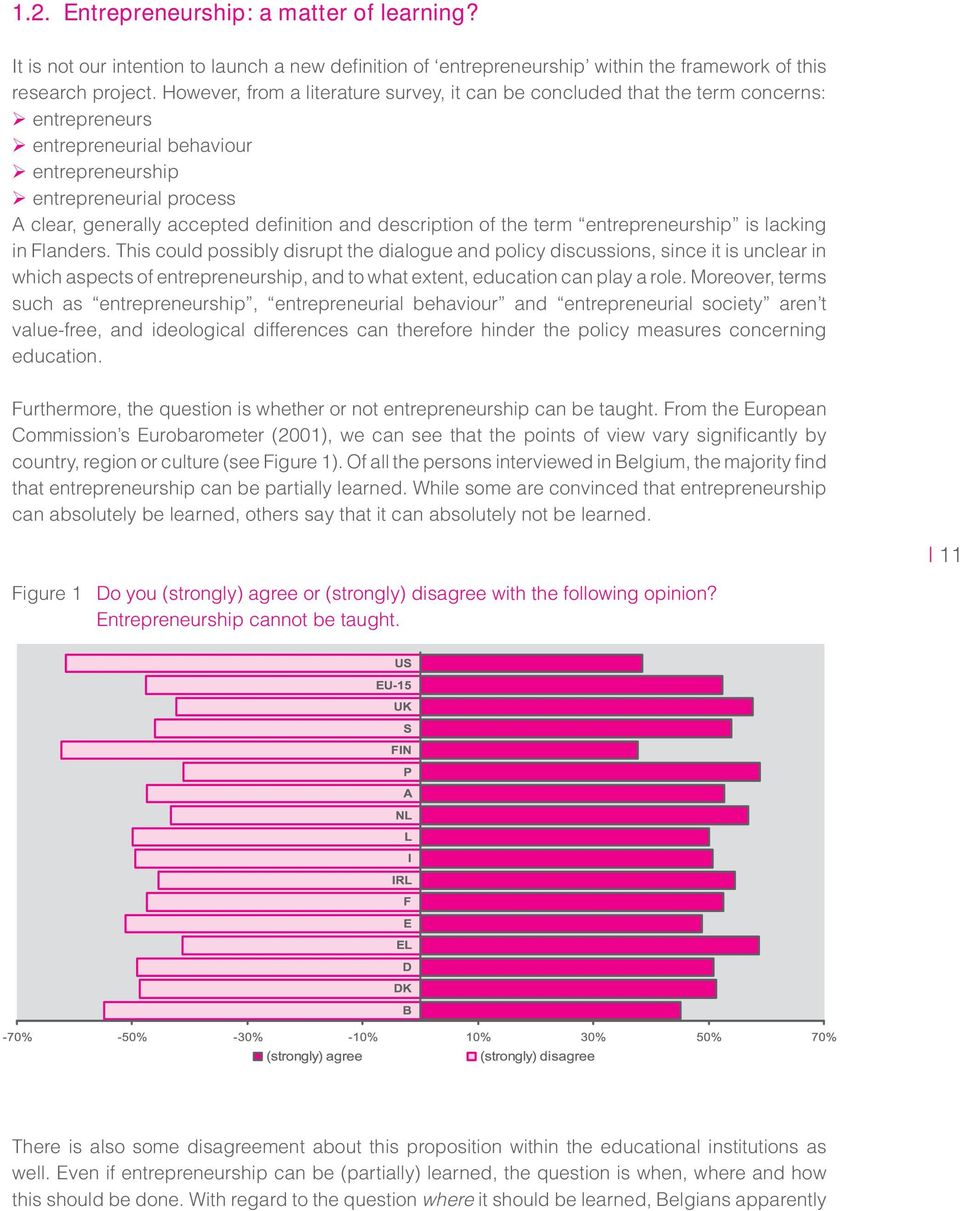
12 1.2. Entrepreneurship: a matter of learning? It is not our intention to launch a new definition of entrepreneurship within the framework of this research project. However, from a literature survey, it can be concluded that the term concerns: entrepreneurs entrepreneurial behaviour entrepreneurship entrepreneurial process A clear, generally accepted definition and description of the term entrepreneurship is lacking in Flanders. This could possibly disrupt the dialogue and policy discussions, since it is unclear in which aspects of entrepreneurship, and to what extent, education can play a role. Moreover, terms such as entrepreneurship, entrepreneurial behaviour and entrepreneurial society aren t value-free, and ideological differences can therefore hinder the policy measures concerning education. Furthermore, the question is whether or not entrepreneurship can be taught. From the European Commission s Eurobarometer (2001), we can see that the points of view vary significantly by country, region or culture (see Figure 1). Of all the persons interviewed in Belgium, the majority find that entrepreneurship can be partially learned. While some are convinced that entrepreneurship can absolutely be learned, others say that it can absolutely not be learned. l 11 Figure 1 Do you (strongly) agree or (strongly) disagree with the following opinion? Entrepreneurship cannot be taught. There is also some disagreement about this proposition within the educational institutions as well. Even if entrepreneurship can be (partially) learned, the question is when, where and how this should be done. With regard to the question where it should be learned, Belgians apparently
13 find that the period during higher education (along with specific courses for adults) is the most suitable time for students to learn about entrepreneurship (see Figure 2). Figure 2 Where should entrepreneurship be taught? l 12 It is obvious that, if Flanders wants to evolve into a more entrepreneurial, creative and knowledgedriven society, the educational system must play a decisive role. The pretext for entrepreneurship differs according to educational level. Overall, there are three aspects: 1 Creating awareness Every student needs to be taught the importance of, and the contribution of, entrepreneurship to the society and the economy. Students become aware of the possibilities that entrepreneurship offers and of entrepreneurship as a career path. 2 Stimulating a positive attitude and characteristics with respect to entrepreneurship The character traits generally associated with entrepreneurship include: creativity, risk-taking, audacity, ambition, perseverance, decisiveness, reliability, determination, efficiency, empathy, criticalness and persuasiveness. 3 Training entrepreneurial skills Students are given the opportunity to become acquainted with the different aspects that are necessary to experience entrepreneurship. The competencies students need to learn certainly include: business planning, financial management, market analysis, entrepreneurial management, negotiation skills, knowledge of ICT, etc. The teaching of these skills can be regarded as the preparation students require to become entrepreneurs themselves.

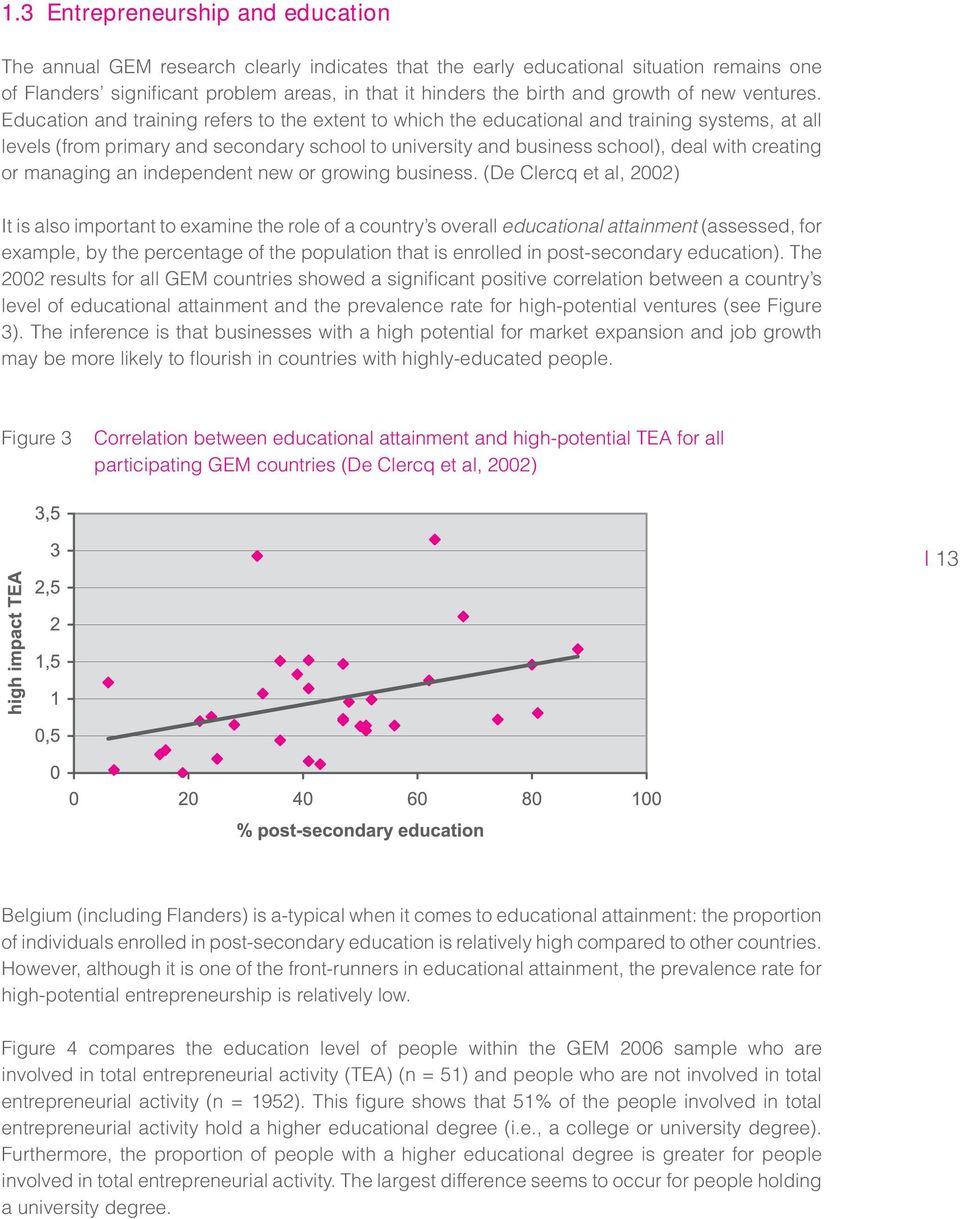
14 1.3 Entrepreneurship and education The annual GEM research clearly indicates that the early educational situation remains one of Flanders significant problem areas, in that it hinders the birth and growth of new ventures. Education and training refers to the extent to which the educational and training systems, at all levels (from primary and secondary school to university and business school), deal with creating or managing an independent new or growing business. (De Clercq et al, 2002) It is also important to examine the role of a country s overall educational attainment (assessed, for example, by the percentage of the population that is enrolled in post-secondary education). The 2002 results for all GEM countries showed a significant positive correlation between a country s level of educational attainment and the prevalence rate for high-potential ventures (see Figure 3). The inference is that businesses with a high potential for market expansion and job growth may be more likely to flourish in countries with highly-educated people. Figure 3 Correlation between educational attainment and high-potential TEA for all participating GEM countries (De Clercq et al, 2002) l 13 Belgium (including Flanders) is a-typical when it comes to educational attainment: the proportion of individuals enrolled in post-secondary education is relatively high compared to other countries. However, although it is one of the front-runners in educational attainment, the prevalence rate for high-potential entrepreneurship is relatively low. Figure 4 compares the education level of people within the GEM 2006 sample who are involved in total entrepreneurial activity (TEA) (n = 51) and people who are not involved in total entrepreneurial activity (n = 1952). This figure shows that 51% of the people involved in total entrepreneurial activity hold a higher educational degree (i.e., a college or university degree). Furthermore, the proportion of people with a higher educational degree is greater for people involved in total entrepreneurial activity. The largest difference seems to occur for people holding a university degree.
15 Figure 4 Education level versus TEA l 14 It is not encouraging that Flanders scored low in terms of the attention devoted to entrepreneurship in higher education (see Figure 5). The assessment in absolute scores is (still) not positive, but, compared to Western European countries, Belgian key informants gave relatively comparable scores to the higher education questions. On the other hand, the key informants felt that the overall level of business and management education in Belgium had improved compared to previous years. The good score in terms of management and business education is also evidenced by the key informants assessment of item 5 in Figure 5.

16 Figure 5 Scores of Flemish key informants on separate items of Education and Training (De Clercq et al, 2002) Legend: 2 = Completely agree; 0 = Neither true nor false; -2 = Completely disagree 1: In my country, teaching in primary and secondary education encourages creativity, selfsufficiency, and personal initiative. 2: In my country, teaching in primary and secondary education provides adequate instruction in market economic principles. 3: In my country, teaching in primary and secondary education provides adequate attention to entrepreneurship and new firm creation. 4: In my country, colleges and universities have enough courses and programs on entrepreneurship. 5: In my country, the level of business and management education is truly world-class. l Entrepreneurship and higher education The institutions of higher education in Flanders have great freedom in the structuring and development of their curricula. As a result, there is a great diversity amongst study areas that issue the same degrees. At present, entrepreneurship is not part of the accreditation criteria. However, there is an indirect link, as some of the criteria aim to develop general entrepreneurial competencies such as creativity, problem solving, leadership, communication skills, and so on. In some study areas, such as economics, engineering, etc., courses on entrepreneurship are offered as electives or as inter-faculty courses. However, in a lot of other study areas, students are not given the chance to follow entrepreneurial courses. GEM results show that, relatively speaking, there are no other countries in Europe where there are fewer people with a higher educational degree who are willing to start a venture. At the same time, studies show that more highly educated people who create a venture will (due to the nature of the firm) create more growth and employment than ventures established by people with less education. That people with a higher education show limited interest in this area could be due to

17 the fact that they do not want to take financial risks, as there are plenty of jobs available to those who have a marketable degree (most of the economics and engineering students have already been offered a job before they have even graduated). Still, the fact that every year thousands of higher education graduates follow a Syntra training programme to obtain an entrepreneurial certificate could be an indication that even graduates of higher education do not feel prepared for a career as an entrepreneur. The question is whether these low figures are the result of the students attitudes or other (environmental) factors. 1.5 Policy and initiatives Several initiatives towards start-ups and specific groups are being undertaken in the education field and encouraged by the Flemish Government to increase entrepreneurial spirit and, consequently, the number of newly founded companies. Policy makers and social partners are convinced that culture and education are partly responsible for stimulating entrepreneurship. l 16 Moreover, there is also noticeable activity in the field of education in Flanders. During the last few years, the Flemish Government has regularly launched (directly or indirectly) new initiatives, such as: Syntra-Vlaanderen: creation of the Competento database and website, which contains information regarding entrepreneurial competencies and entrepreneurial education. Brugprojecten : launched to promote entrepreneurship, innovation and internationalisation. Vlajo, including mini-ondernemingen Leerondernemingen : 10 in higher education and 15 in secondary education Actieplan Ondernemend Onderwijs which includes several initiatives (such as the Ondernemersklasseweek ) Ondernemende School (UNIZO) Accent op Talent Development of new tools for teaching entrepreneurship Study on entrepreneurship education (under the authority of the Koning Boudewijnstichting ) Flanders DC, including Flanders DC Fellows (50 Flemish entrepreneurs that travel to schools to tell their story) And more. In addition, professional and inter-professional organisations (such as UNIZO, VKW and VOKA) have taken initiatives during the last few years: company visits, learning enterprises, development of tools, Organisations such as Vlajo, Dream, and NFTE have education and training explicitly in their mission and are reaching hundreds of students, schools and other institutions. There is also the will to increase contact between educational institutions and companies in order to promote cooperation. In the long run, the impact of this policy development will make entrepreneurial education more discussible within the institutions concerned.
18 1.6 Reasons for a study on how entrepreneurial Flemish students are? Based on the information presented above, a number of conclusions can be drawn: The Flemish government is highly committed to developing a creative knowledge-based economy. In a comparative analysis concerning the degree of creativity of nine economically top regions, Flanders scores a total of 65.2%. This score is far lower than the front runners (Baden-Württemberg and Maryland), but higher than regions such as Quebec and Lombardy. Flanders scores significantly higher than the average of the nine regions (56.6%), earning good points for openness and innovation. More problematic is the score for entrepreneurship in Flanders: with 46.8%, it is not even close to the average of 52.1%. In this respect, Flanders occupies seventh place out of the nine. (Bowen et al, 2006). There is a clear positive correlation between entrepreneurship and economic growth. Moreover, there is a correlation between educational attainment and entrepreneurship (TEA). However, Flanders is atypical in this respect: despite high educational attainment and a high quality of education, Flanders has a low TEA. The Flemish government wishes to pursue an active policy regarding education and entrepreneurship. As a result, a whole range of initiatives has been launched in Flanders with the aim of stimulating entrepreneurship especially for youngsters. High-potential entrepreneurship leads to knowledge-intensive and innovative new companies. High-potential entrepreneurship is partly determined by the quality and quantity of human and social capital. High-potential entrepreneurs generally have a higher education. The attention currently paid to entrepreneurship in Flanders universities and colleges is highly fragmented. l 17

19

20 2 methodology l 19

21 2 METHODOLOGY The 'International Survey on Collegiate Entrepreneurship 2006' was based on voluntary cooperation among representatives from 14 different countries. The initiative arose as a result of the efforts of the Swiss Research Institute of Small Business and Entrepreneurship at the University of St. Gallen and the KfW Endowed Chair for Entrepreneurship at the European Business School. This core team was responsible for developing the questionnaire, coordinating the international efforts in conducting the survey, and publishing the findings of the study. Each of the 14 countries had one representative (see Appendix 1), who was responsible for contacting students in that country. The representatives were asked to the link to the questionnaire to as many students as possible, encouraging them to participate in the survey. Prize draws amongst participants were used as an incentive in some countries, so as to increase the students' participation in the survey. The survey itself was conducted via the Internet. On completion of the survey, all data was processed by the core team and then provided to the various national representatives in order to produce the national results. 2.1 Goals of the study l 20 We intend to use the data of this survey to explain and discuss the intentions and behaviour of students in higher education in their decision to start entrepreneurial activities and found an enterprise. This study is driven by three questions that need to beanswered in order to understand how institutions of higher education can support student entrepreneurship: What are colleges and universities doing to support student entrepreneurship? What do their students think the colleges and universities should do? and Is this different according to the area of study? When constructing the conceptual model of this study, we first start by illustrating the Global Entrepreneurship Monitor (GEM) model, which shows the nature of the relationship between entrepreneurship and economic growth (see Figure 6). The GEM model makes a distinction between entrepreneurial opportunities and entrepreneurial capacity. What drives entrepreneurial activity is the perception of entrepreneurial opportunities combined with the skills and motivation to exploit them. When opportunities are joined with skills and motivation to pursue them, the outcome is the creation of new firms and, inevitably, the destruction of some existing firms (new firms frequently displace inefficient or outmoded existing firms). This process of creative destruction is captured in the model by business churning. Despite its negative connotation, creative destruction actually has a positive impact on economic growth, because declining businesses are phased out as new start-ups competitively manoeuvre their way into the market. These dynamic transactions occur within a particular context, which is referred to in the GEM Model as Entrepreneurial Framework Conditions. These include variables such as: availability of funding, governmental policies and programs designed to support start-ups, R&D transfer, commercial infrastructure, education in general, education and training for entrepreneurship, social and cultural norms, and internal market openness (Bygrave et al., 2001).
22 Figure 6 Framework of the Global Entrepreneurship Monitor (GEM) When focusing on the entrepreneurial framework conditions and, in particular, the role of education, we obtain the research model used in our study (see Figure 7). The main focus of this study is on entrepreneurship education, both perceived and desired. Perceived entrepreneurship education concerns students perception of the entrepreneurial support that colleges and universities provide. Universities can support entrepreneurship in many ways that can be measured objectively. However, the extent to which they reach students is crucial to the effectiveness of the support measures. A suitable way to measure this is to measure the students perceptions of the support measures. Desired entrepreneurship education concerns student attitudes and preferences towards support measures and indicates the students opinions of the way and the extent to which their universities should support entrepreneurship. Students opinions are an important indicator but surely not the only one for the direction colleges and universities should take in their support of entrepreneurship. l 21 Figure 7 Framework of this study The uniqueness of this project is emphasized by the ability to compare the entrepreneurial intent of students from higher education throughout different countries. The ability to compare the educational package with the degree of entrepreneurial intent is an opportunity to find national best practices within entrepreneurial education. As the project is carried out on an international level, the results from Flanders can be benchmarked against results from 13 other countries worldwide (Liechtenstein, New Zealand, Switzerland, Singapore, Austria, Finland, Hungary, Germany, Norway, France, Ireland, South Africa and Australia).
23 2.2 Significance of the study The sample on which this study is based consists of 37,412 questionnaires for analysis, coming from the 14 participating countries. The distribution across the various countries shows that some distinctions can be made (see Table 1). Table 1 Participating countries and response rate Country Number of interviewed universities Population Number of completed questionnaires Response rate (in %) l 22 Liechtenstein ,09% New Zealand ,14% Switzerland ,01% Singapore ,11% Flanders ,45% Belgium ,34% Austria ,22% Finland ,45% Hungary ,34% Germany ,86% Norway ,85% France ,68% Ireland ,67% South Africa ,20% Australia ,13% International ,93% The response rate for Belgium and Flanders is higher than the international average of 5.93%. The population indicated in the third column relates to the number of universities effectively questioned. These figures were obtained as a result of adding up the number of students enrolled at the universities questioned for each country at the time the survey was held. This means that not every university was questioned. The population therefore shifts accordingly between students in Austria and 570 students in Liechtenstein. The fourth column shows the number of questionnaires that were completed in each country. The last column shows the resulting response rates. The highest response rates were achieved in Liechtenstein (35.1%), New Zealand (29.1%), and Switzerland (16.0%). The lowest response rates were obtained in Australia (0.1%), South Africa (0.2%), and Ireland (0.7%). The international average is 5.93%.
24 Table 2 Structure of the samples by country Country Academic Undergraduate / Graduate / Doctoral Full Part Average Male Female year Bachelor Master program / time time age (average) level level Ph D. South Africa 3,68 12,0 84,0 4,0 96,0 4,0 22,9 60,0 40,0 Austria 3,64 40,2 52,8 7,0 74,7 25,3 25,3 47,7 52,3 Germany 3,23 42,9 52,9 4,2 96,9 3,1 24,0 48,7 51,3 Hungary 3,19 40,2 58,6 1,2 90,6 9,4 23,3 51,6 48,4 Ireland 3,11 91,5 6,1 2,4 95,6 4,4 23,8 48,0 52,0 Switzerland 3,10 56,4 34,9 8,7 84,4 15,6 24,8 62,8 37,2 Norway 3,06 30,5 67,2 2,3 97,2 2,8 24,4 60,0 40,0 New Zealand 2,91 84,1 11,4 4,5 93,7 6,3 22,8 46,8 53,2 Belgium 2,75 40,7 48,1 11,2 92,7 7,3 23,0 51,9 48,1 Flanders 2,56 42,0 53,3 4,7 91,0 9,0 23,3 56,8 43,2 Finland 2,48 79,4 20,2 0,4 85,8 14,2 25,5 48,3 51,7 Liechtenstein 2,31 67,5 31,5 1,0 65,0 35,0 26,3 71,5 28,5 Australia 2,28 97,0 0,0 3,0 79,1 20,9 23,2 44,8 55,2 Singapore 2,18 98,9 1,1 0,0 98,3 1,7 22,5 49,4 50,6 France 1,00 94,0 6,0 0,0 100,0 0,0 21,0 37,3 62,7 Total 3,15 56,2 38,1 5,7 86,6 13,4 24,2 52,2 47,8 In addition to a quantitative description of the sample, its internal structure must also be taken into account. Table 2 therefore identifies five criteria in relation to the qualitative characteristics of the sample. In the second column, we have calculated the average duration of the students' course of study so far. The average number of study years is 3.15 years. For Belgium and Flanders, this average is slightly lower, 2.75 and 2.56 respectively. The second criterion is the stage of the course of study. 56.2% of all those questioned were Bachelor s degree students or an equivalent level, and 38.1% were Master s degree students or equivalent level. The remaining 5.7% were engaged in obtaining their Ph.D. or equivalent degree. When looking at Belgium and Flanders, there is apparently a higher percentage of Master s students than the international average. Furthermore, we also see a high percentage of Ph.D. students in Belgium (11.2%). However, this score is extremely high, so we suspect that there is a bias towards Ph.D. students because they might be more motivated to fill out the questionnaire. The third criterion relates to the way in which the course of study is structured. 86.6% of all students questioned indicated that they are in full-time education, whereas 13.4% stated that they are in part-time, or vocational, education. If we examine the sample for Belgium and Flanders in this respect, then once again we can see an over-representation of full-time students. In relation to the average age, which is 24.2 internationally, the students in Belgium and Flanders appear to be somewhat younger, averaging 23.0 and 23.3 years of age, respectively. The fourth criterion examines the division of gender amongst the students. On an international level, 52.2% of the students are male. For Belgium and Flanders, this percentage is 51.9% and 56.8% respectively. l 23
25 Table 3 Main subject studied by students Business administration Social sciences (psychology, sociology and similar subjects Natural sciences Mathematical sciences Mechanical and electrical engineering Medical sciences and pharmaceutics Economics Others l 24 Switzerland 24,2 5,3 11,4 10,9 11,2 6,9 4,1 26,0 Liechtenstein 74,0 0,0 0,0 0,0 0,0 0,0 1,0 25,0 Germany 20,5 11,6 11,2 10,0 16,6 4,1 2,4 23,6 Austria 36,5 12,0 7,2 9,1 7,0 1,6 1,4 25,2 France 97,0 1,5 0,0 0,0 0,0 0,0 1,5 0,0 Belgium 23,3 11,8 8,4 4,8 3,0 15,0 15,3 18,4 Flanders 27,7 9,6 3,8 2,7 0,3 7,3 33,9 14,6 Ireland 53,6 2,4 5,6 2,8 5,6 5,2 9,3 15,5 Finland 36,2 2,2 5,1 14,4 22,1 4,0 2,7 13,3 Norway 9,9 0,7 12,4 14,3 14,2 5,1 12,2 31,2 Hungary 30,3 5,1 7,1 16,3 8,6 0,7 16,7 15,2 New Zealand 11,1 17,3 13,4 5,7 6,0 12,9 6,1 27,5 Australia 68,7 1,5 0,0 0,0 1,5 0,0 11,9 16,4 South Africa 72,0 0,0 0,0 0,0 0,0 0,0 24,0 4,0 Singapore 63,0 6,8 0,0 1,7 0,0 0,0 12,7 15,8 Total 25,7 9,9 9,8 9,5 9,3 6,2 5,7 23,9 Another criterion is the composition of the national samples in relation to field of study (see Table 3). Here, we find large differences among the countries. This is a result of the questionnaire, which, in some cases, was sent to the entire student population of the university/school of higher education and, in other cases, to a particular faculty. Notwithstanding small differences among the various countries in relation to the structure of the samples, as well as the risks inherent to web-based questionnaires, we find that the significance of this study s findings is quite high, with the exception of France, Australia, and South Africa. Therefore, we will not include these three countries in our analyses. Hence, most analyses in this report are based on the total sample. 2.3 Sample and representativeness The sample obtained from the survey in Belgium was drawn from six universities/institutions of higher education in Flanders, Brussels and Wallonia (see Table 4). The majority of the respondents, i.e. 58.4%, were students of the University of Liège. Other participating universities were: the University of Antwerp, which accounted for 17.7% of the respondents; Ghent University and EHSAL, each accounting for 8.7% of our sample; and Vlerick Leuven Gent Management School, which accounted for 5.7% (or 92 students). The last 0.8 % of the sample was drawn from other universities in Belgium.
26 Table 4 At which university/technical college are you studying? Percent Belgium Percent Flanders University of Liège 58,4 - University of Antwerp 7,7 43,4 Ghent University 8,7 21,3 EHSAL 8,7 21,3 Vlerick Leuven Gent Management School 5,7 4,0 Others 0,8 - Total In this study, we will focus primarily on the region of Flanders and the Dutch-speaking student population. Thus, we will only take into account the responses from the following four schools of higher education: University of Antwerp, Ghent University, EHSAL and Vlerick Leuven Gent Management School. While the sample obtained is not representative of the entire student population of higher education in Flanders and worldwide, the participation of the several highly regarded educational institutions and the renowned project leaders has resulted in a stable basis from which we can draw solid conclusions on both the national and the international levels. l 25
27
28 3 CONDITIONS AT INSTITUTIONS OF HIGHER EDUCATION l 27
29 3 CONDITIONS AT INSTITUTIONS OF HIGHER EDUCATION The International Survey on Collegiate Entrepreneurship 2006 was carried out at institutions of higher education. Hence, it is also very important to examine the conditions at the institutional level: the entrepreneurial environment at the institutions of higher education and the activities students would like to see offered at their university/college. 3.1 Entrepreneurial environment International comparison Students were asked to rate their university in terms of entrepreneurial environment (see Figure 8). To this end, we used a scale ranging from 1 (very bad) to 6 (very good). The international average showed that the entrepreneurial environment at universities was perceived as 'rather good' (4.06). Overall, the national scores are above the neutral value of 3.5. Furthermore, the differences are very small when compared internationally. The averages per country range between 3.92 and However, it is quite remarkable that the entrepreneurial environment at the institutions of higher education in Belgium and Flanders score the lowest (3.92 and 3.94) of all participating countries. l 28 Figure 8 How do you judge the climate and premises for starting a business at your university/ college? (1 = very bad; 6 = very good) The entrepreneurial environment can be easily explained by examining the diagram below (see Figure 9). This figure shows the number of students who believe that no entrepreneurshiprelated courses are offered at their university/college. Students were surveyed across all study disciplines. Compared internationally, we can see that the availability of such courses is very much below the average in Belgium and Flanders.
30 Figure 9 No entrepreneurship-related courses offered Even when entrepreneurship-related courses are offered by the universities, the students do not necessarily attend them. Figure 10 shows the percentage of students who do not attend any entrepreneurship-related courses, even though such courses are available at their universities. When compared internationally, 57% of the students in Flanders tend not to take such courses. However, we do note that the international average for non-attendance is even higher, at a rate of 71.4 %. l 29 Figure 10 Non-attendance of entrepreneurship-related courses Detailed results for Flanders Traditionally, the higher educational system has great freedom in organising and planning its curricula. Thus, there could be large differences amongst the various universities/colleges that still grant the same diploma. Therefore, in addition to an international comparison of Flanders,
31 it is also interesting to compare the results of the institutions of higher education amongst themselves. Figure 11 How do you judge the climate and premises for starting a business at your university/ college? Results compared amongst institutions of higher education (only economics and business administration students) (1 = very bad; 6 = very good) l 30 Figure 11 shows the mean value of the Flemish institutions of higher education for the question: How do you judge the climate and premises for starting a business at your university/college? This figure focuses on students studying economics and business administration. Figure 11 shows that the differences among Flemish institutions (3.75 to 4.55, or a difference of 0.8) are larger than the differences amongst the countries surveyed (3.92 to 4.2 or a difference of 0.28; with the exception of Liechtenstein). Both Vlerick Leuven Gent Management School and EHSAL score significantly higher than Ghent University and the University of Antwerp (Vlerick s score is comparable to the highest international score: 4.59 for Liechtenstein). Ghent University brings up the rear with an average score of Figure 12 How do you judge the climate and premises for starting a business at your university/ college? Results compared amongst study areas (1 = very bad; 6 = very good)
32 In addition to differences amongst the institutions of higher education, there could also be differences amongst study areas. Consequently, we compared the results for the question How do you judge the climate and premises for starting a business at your university/college? between students studying economics & business administration and students in other study areas (see Figure 12). Apparently, the entrepreneurial culture within economics & business administration is significantly more developed than the entrepreneurial culture within other study areas. This is quite likely the result of the recently increased attention paid to entrepreneurship in those study areas that wish to prepare their students for business life. Such study areas frequently have more students with a family background in entrepreneurship, which often causes greater interest in a more entrepreneurially oriented education. On the other hand, in other study areas that also attract large numbers of students (e.g. law, exact sciences, medical sciences, ), entrepreneurship is rarely offered at all. The majority of students in these areas of study are not in touch with the operation of companies to the same degree. Furthermore, many faculties in these other areas are wary of introducing entrepreneurial education, as they prefer to keep business life and professional life separate. 3.2 Activities students would like to see offered at universities Finally, the students were asked what activities they would like to see offered by their universities, as well as any other sources of support, that would help them establish their own business during their studies, or immediately after graduation. The international average shows that most students would like to see coaching courses on offer, followed by general business-oriented seminars and lectures and business plan seminars (see Figure 13). The results for Flanders are in line with the international findings: for Flanders as well, the entrepreneurial support that the students want most is coaching for the start-up of their own business. This is followed by business plan seminars and business games for launching a business. l 31
33 l 32 Figure 13 Support students would like to see offered at universities
34 4 entrepreneurial activities and goals l 33
35 4 ENTREPRENEURIAL ACTIVITIES AND GOALS 4.1 Students professional expectations International comparison When we compare the countries, there is considerable variation in the students' expectations with respect to becoming an entrepreneur. Table 5 ranks the countries according to the students' expectations of becoming an entrepreneur. The percentages are based on the total sample. These rankings show that the entrepreneurial expectations for students in Flanders are quite high. In fact, for the within 5 years after graduation category, Belgium scores the highest of all participating countries (16.6%), while Flanders ranks fourth with 15.1%. The international average stands at 12.2%. After more than 5 years after graduation, when students have obtained some experience on the labour market, 44.7% of Belgian students and 40.8% of Flemish students expect to have an entrepreneurial position. Here, the international average stands at 34.8%. For purposes of comparison, we have included the countries Total Entrepreneurial Activity (TEA), which indicates the percentage of adults (from 18 to 64 years old) in the total population who are either actively involved in starting a new business or are managing a business that is younger than 42 months old. l 34 Table 5 Rankings of expected entrepreneurial position Immediately after graduation After a few years of work experience Total Entrepreneurial Activity (< 5 years) (> 5 years) (TEA) Country value in % rank Country value in % rank Country value in % rank Belgium 16,6 1 Singapore 46,9 1 Norway 9,14 1 Hungary 16 2 Ireland 44,8 2 Ireland 7,35 2 Ireland 15,7 3 Belgium 44,7 3 Hungary 6,04 3 Flanders 15,1 4 Flanders 40,8 4 Finland 4,99 4 Austria 14,2 5 Liechtenstein 37,5 5 Singapore 4,85 5 Liechtenstein 13 6 New Zealand 37,4 6 Germany 4,21 6 New Zealand 12,6 7 Hungary 35,7 7 Flanders 3,05 7 Singapore 12,4 8 Austria 35,5 8 Belgium 2,73 8 Norway 12,2 9 Norway 34 9 Singapore n.a. n.a. Finland 9,8 10 Switzerland 32,5 10 Liechtenstein n.a. n.a. Switzerland 9,5 11 Finland 29,2 11 New Zealand n.a. n.a. Germany 8 12 Germany 26,8 12 Austria n.a. n.a. International 12,2 International 34,8 Switzerland n.a. n.a. For more detailed information, see Figure 14. Besides showing the students' expectations of becoming an entrepreneur, Figure 14 also shows the students expectations of becoming an employee and their preference for starting their family life.
36 Figure 14 Activities after graduation l Detailed results for Flanders The aims of students in relation to their professional expectations can be quite diverse. At the same time, however, it must also be said that the first job that students obtain following graduation does not necessarily correspond with their job status after several years. We can assume that many students view their first job after graduation as a matter of finding their way around the job market as well as a first step towards further training and education. As a result, we distinguish between two question categories in Figure 15. In the first category, we asked students what their job expectations were for the first 5 years following graduation (< 5 years). The second category relates to the time after the students' first professional occupations (> 5 years after graduation).
37 Figure 15 Average of job expectations following graduation in Flanders l 36 As Figure 15 shows, the Flemish averages for students who intend to enter the job market after graduation are as follows: entry into a large company (22.2%), a medium-sized company (15.07%), or a small company (9.59%). Students also view public service (7.61%) and research (6.54%) as important activities. This overview clearly shows that two-thirds of the students expect their first job to be in the employ of someone else (total = 63.16%). In addition, 18.26% of the students surveyed were unable to state their preferences. Still, potential job aims also include (albeit in a small way) wanting to become an entrepreneur. These ranged from participating in a business, to taking over a business, to establishing a business of one s own. A total of % of all students surveyed expressed the intention of entering the job market following graduation as entrepreneurs. This percentage includes a range of variations: e.g., establishing a business, participating in a business, taking over a family Definition: micro-enterprise = 1-9 employees; small enterprise = employees; medium-sized enterprise = employees, large company = more than 250 employees; SME = small and medium-sized companies = 0-249employees.
38 business, or opening a franchise. On the other hand, the remaining 3.5% wanted to start a family or to continue with their family lives. As can be expected, students' professional expectations change over time. For example, more students intend to become an entrepreneur after having gained several years of professional experience than those who intend to do so directly after graduation. In this context, establishing a business (19.09%) is accorded the highest preference. This option is preferred to a job in someone else's employment (i.e., in small and medium-sized businesses or large companies). Finally, there is no significant increase in the number of students who still have no specific job expectations after their first few years in a professional position. 4.2 Current entrepreneurial activities and intentions of students International comparison Figure 16 shows students across all disciplines and their possible intention to start a business. When compared internationally, an average of 3.2% of all of the students have already established a business. This group can be divided into 2.0% of students who are still actively involved in the business, and 1.2% who are no longer actively involved in the business, even though they created it. These entrepreneurial activities are examined in more detail in Chapter 4.3. Amongst the group of countries surveyed, Flanders (2.0%) and Belgium (1.4%), appear at the bottom. l 37 Figure 16 Entrepreneurial activities and intentions of all students
39 The large majority of students have still not established a business. First, we considered all students across all disciplines (see also Figure 16). Compared internationally, 22.3% of all students indicate that they have never considered becoming an entrepreneur. With 26.2% for this category, Belgium occupies third place in the list of countries. This means that 1 out of 4 of the students surveyed in these countries has no entrepreneurial potential. The other 3 out of 4 students in the study (74.5% international average) would like to establish a business in the near, or not so near, future or at least they have considered doing so. This issue, and more detailed results for Belgium and Flanders, are examined in Chapter Detailed results for Flanders l 38 Table 6 compares the entrepreneurial intentions and activities of economics and business administration students with students from other fields of study. This table shows that a higher percentage (29.76%) of students in other study areas have never even thought about the possibility of starting up their own entrepreneurial enterprise. These results are in line with the conclusions drawn in Figure 12, where it was stated that the entrepreneurial environment for economics and business administration students scores significantly higher than the entrepreneurial environment for students studying other disciplines. Furthermore, 13.09% of economics and business administration students are bound and determined to start their own business, compared to 4.76% of students in other study areas. Table 6 Have you personally ever thought concretely about building up your own entrepreneurial enterprise (i.e. being self-employed)? Economics & Other study Total business areas administration no, never 7,04% 29,76% 21,92% yes, sketchily 44,69% 38,49% 42,31% yes, rather concretely 3,33% 16,67% 14,61% yes, but I turned away from it 6,67% 6,75% 6,70% yes, I am bound and determined to be self-employed 13,09% 4,76% 9,89% yes, I have already taken the first steps 2,72% 2,38% 2,59% yes, I am already self-employed,73%,19% 1,52% yes, I was self-employed, but I am not any longer 0,74% 0,00% 0,46% Total 00% 00% 100%
40 4.3 Businesses established by students Establishing a business may be advantageous, but the added value it implies is often questioned at the societal level. Therefore, we will now take a closer look at businesses already established by students (see Table 7). It is important to note, however, that the significance of some of the findings needs to be treated with caution, in particular for countries such as Liechtenstein, Singapore, Ireland, and Belgium, since the sample size for these countries is too small. Data for France, South Africa, and Australia were not analysed. Table 7 Businesses established by students (* = findings need to be treated with caution) Country n = rate of founded number of number of average age founders years ago employees founders of founders Liechtenstein* ,2 2,5 2,8 31,9 Singapore* 7 4,8 2,5 2,4 2,3 24,1 Austria 424 4,7 5 4,,6 30,8 Finland 68 4,4 5,2,8,6 29,1 New Zealand 260 3,3 5,3 4,,8 30,6 Ireland* 8 3,2 8,2,3 2,4 35,3 Norway 31 2,8 4,4 2,0,8 28,9 Germany 84 2,7 3,3,9,8 26 Hungary 81 2,4 3,6 3,9 2 27,9 Switzerland 210 2,4 4,4 4,1 2,3 28,2 Flanders* 13 2,0 7,0 4,1 2,1 30,4 Belgium* 22 1,4 7,1 4,3 2,1 29,8 l 39 International ,2 4,8 3,7,9 29,6 As mentioned previously, the international average percentage for establishing a business was 3.2%. On average, such businesses were established 4.8 years ago. With regard to the average age of the students at the time they established their business (29.6 years), we can see that it is significantly higher than the average age of all students (24.2 years). This leads to the conclusion that such businesses were either established very early on during their studies or that the students established their business prior to commencing their studies. Findings for Belgium and Flanders are not discussed here, as the samples for these regions are too small to draw solid conclusions.
41 Figure 17 Partners of business founders (indications in %, multiple options possible) l 40 In addition, we also asked business founders where members of their team were drawn from at the time they established their business, allowing for multiple answers (see Figure 17). Since the amount of data collected for most countries is too small, we have not provided an analysis or commentary at the international level. Compared internationally, students who formed an entrepreneurial team to establish a business in Flanders drew people mostly from their circle of friends (29.8%) and from their own university/college (25%). 4.4 Intention of students to establish a business Activities in relation to establishing a business Following the previous closer examination of students who have already established a business, we will now turn to potential founders of businesses. The key focus for this analysis is on all those students who have at least considered establishing a business (see also Chapter 3.2). In order to identify how serious these students are in this regard, we asked a series of questions regarding potential steps that could lead to establishing a business, allowing for multiple answers.
42 The international average showed that 47.2% of all students had not yet carried out any specific steps to establish a business (see Figure 18). This means that, although the students had already thought of establishing a business, half of them had not taken any serious steps towards becoming entrepreneurs. Compared internationally, Flanders (51.1%), occupies third place. This means that Flemish students are amongst the least likely to establish their own business, although they have considered it. Figure 18 Students taking no specific steps to establish a business l 41 In addition to non-binding contemplation of the topic in general, the first thing that can lead to establishing a business is the gathering of information (see Figure 19). Another significant number of students (46.3%) indicate that they have at least thought carefully about their initial business ideas. A significantly smaller percentage of students have put such considerations into writing (14.2%). Accordingly, 13.1% of all students gathered information that specifically related to establishing a business, and 6.9% indicate that they have attended one or more events inside or outside the university in relation to establishing a business. Once again, we can see that, when compared internationally, the students from Flanders sit on the lowest rung of the ladder. However, when the activities are compared, the results for Flanders are proportionally comparable to the international results.
43 Figure 19 Information gathering for establishing a business l 42 Finally, there are the preparatory activities, which point specifically, and in a goal-oriented way, to the intention of establishing a business (see Figure 20). These activities refer to the availability of prototypes of products or services (5.0%), preparation of a business plan (7.4%), talks with possible sources of financial support (3.7%), and/or agreeing on specific time lines in relation to establishing the business (1.7%). Compared internationally, Flanders is in second-to-last place.
44 Figure 20 Preparatory steps for establishing a business l 43 We can conclude that only a small percentage of students who intend to establish their own business have taken any concrete steps in that direction with a specific time frame in mind. This is certainly the case for Flanders, as it usually scores at the lower end of all of the participating countries Possible time frame for establishing a business We also asked potential business founders about the potential time frame for establishing their business (see Figure 21). Compared internationally, for 11.1% of those surveyed this matter has already become an issue during their studies. For 5.1% of the students, this is an issue to be considered after graduation. About half (53.1%) of the potential business founders make the conscious decision to first obtain several years of professional experience prior to taking steps to establish their own business. This corresponds with our analysis in Chapter 3.1. Almost one-third of all students (30.7%) remain uncertain as to when to establish their own business.
45 Figure 21 Time frame for establishing a business l 44 Compared internationally, we see that a rather low percentage of students in Belgium (7.5%) indicate that they want to establish a business during their studies. For Flanders, this percentage comes to 10.3%, which is almost the same as the international average. The differences are smaller with regard to students establishing their own business immediately following graduation, where Flanders shows a percentage of 4.7%. The percentage of Flemish students that wish to establish a business after some years of work experience (49.3%) is lower than the international average (53.1%). Furthermore, more than one third of the Flemish students claim that they don t yet know when they will establish their business Details of potential business establishments As we did above with the already established businesses, we will now examine potential business formations in more detail (see Table 8). The analysis per sector shows that an insignificantly small percentage of students (1.4%) intends to become active in the primary sector (agriculture, hunting, fishing, forestry, and mining). 22.3% of the potential business founders are interested in starting a business in the secondary sector. As expected, the tertiary sector (75.4%) is the predominant area for entrepreneurial activity. The most important industries within the tertiary sector once again include the provision of company-related services (15%) and communication
46 (10%), followed by the health and social sectors (11%) and the provision of social or personal services (10%). Comparing the various countries, not many significant distinctions can be identified. However, one noteworthy finding is that Flanders shows one of the highest interests in the tertiary sector (81%). Table 8 Potential business formations by students Country n = 1. Sector 2. Sector 3. Sector with number of experience founders Liechtenstein 167 1,2% 15,6% 82,2% 0,0% 2,1 Singapore * 303 0,7% 18,8% 80,5% 13,2% 2,5 Austria ,5% 19,5% 79,0% 34,0% 2,0 Finland ,9% 30,5% 67,6% 49,5% 2,0 New Zealand ,1% 19,4% 76,5% 26,5% 2,1 Ireland * 195 1,5% 20,5% 77,9% 46,8% 2,1 Norway 752 7,5% 42,7% 49,8% 23,2% 2,2 Germany ,3% 25,4% 73,2% 23,8% 2,1 Hungary ,6% 21,4% 76,0% 23,5% 2,4 Switzerland ,4% 24,3% 74,3% 36,0% 2,3 Belgium ,5% 18,5% 78,0% 29,8% 2,1 Flanders 500 0,8% 18,0% 81,0% 23,0% 2,1 International ,4% 22,3% 75,4% 30,7% 2,2 l 45 Almost one-third of the potential business founders indicated that they already have professional experience in their preferred sector. The results for Flanders are significantly lower than the international average: only 23% of the potential Flemish business founders in this study have practical experience in the industry in which they would want to start a business. The persons surveyed indicated that the average size of the team desired to establish a business is 2.2 persons. This international average is comparable to the desired team size for Flanders (2.1 persons). Closer examination reveals that cooperation across several universities rates lowest for potential business founders (see also Figure 22). For around 10% of potential Flemish business founders, partners should come from other universities. The percentage of students who want to establish a business solely on their own is quite low as well at 23.6% (while the international average is even lower at 19.0%). As we saw with actual business founders, potential business founders prefer to involve persons from their own immediate circle of friends or acquaintances, followed by persons from their own university.
47 l 46 Figure 22 Partners for potential business founders (indications in %, multiple options possible)
48 5 obstacles to establishing a business l 47
49 5 OBSTACLES TO ESTABLISHING A BUSINESS 5.1 International comparison The process of establishing a business may present a number of difficulties. For this reason, we asked the students what types of obstacles they might encounter and how they would rate those obstacles on a scale. Using a factor analysis and reliability test, we have identified three factors for further analysis. We will consider these factors as obstacles in what follows. The first factor/obstacle may be referred to as 'economic conditions'. This factor includes the business environment and the economic situation. The second factor can be labelled 'financial resources', which includes: lack of private capital, lack of foreign capital, and personal financial risk. The third factor 'personal engagement' comprises: lack of courage, fear of failure, and lack of a good business idea. l 48 Thus, we have defined three potential factors, in three different areas, which may have an effect on whether or not students decide to establish a business. The first area deals with an assessment of the economic conditions, which involves the environment in which the business is, or will be, established. The financial perspective provides an essential overview of the capital resources and relates to the financial strength of the business (to be) established. The last factor relates to the particular person who decides to establish a business and serves as a reference point for the (potential) business founder s entrepreneurial potential and ability to handle risk. These three factors are represented in Figure 23. Figure 23 Obstacles compared internationally
50 Compared internationally, we can see that financial resources are viewed as the biggest obstacle in all countries, ahead of personal engagement and economic conditions. However, in comparison to the other participating countries, the lack of financial resources is seen as a relatively minor obstacle in Flanders. Flanders score of 3.97 is significantly lower than the international average of At the same time, we can observe a weak but highly significant negative correlation between the students' potential to establish their own business and financial resources (correlation = -.132**). This means that the more the students regard access to finances as an obstacle, the less potential they have to establish their own business. When looking at personal engagement such as the lack of courage or the lack of business ideas the results for Flanders (3.74) are only slightly lower than the international average of Here too, we find a weak, but highly significant, negative correlation between the students' personal engagement and their potential to establish their own business (correlation = -.193**). This means that the less the students perceive themselves as an obstacle, the higher their potential to establish their own business. On the basis of these findings, we can conclude that personal characteristics are the most important factor in establishing a business. However, the effect on an individual basis is still relatively small for it to be the sole factor in explaining the entrepreneurial potential of students at the international level. With regard to economical environment, students wanting to establish their own business seem to find it the least obstacle. The score for Flanders (3.29) is quite good in comparison to the international average of There is even less of a correlation between the students' potential to establish their own business and economic conditions (correlation = **). This correlation means that the less economic conditions are seen as an obstacle, the more likely it is (albeit only to a small degree) that the students entrepreneurial potential will develop. l Detailed results for Flanders The detailed results for the obstacles to establishing a business in Flanders are shown in Figure 24. This figure illustrates that the personal financial risk and the lack of a good business idea are seen as the main obstacles. This is in line with what was mentioned previously, i.e. that most students perceived taking personal financial risks as the biggest obstacle.
51 Figure 24 Obstacles to establishing a business in Flanders (6 = very significant obstacle, 1 = very insignificant obstacle) l 50 Figure 25 examines the obstacles to starting a business across study areas. In general, economics and business administration students perceive most of these items as less of an obstacle. The largest differences between economic & business administration students and students from other study areas are for the following variables: lack of entrepreneurial skills and the economic cycle. This indicates that students studying economics & business administration are more selfconfident about their skills as potential entrepreneurs. Furthermore, they perceive the economic cycle as less of an obstacle, as they have more insight into the economic environment and therefore might feel they can anticipate it better.
52 Figure 25 Obstacles to establishing a business compared amongst study areas l 51
53
54 6 conclusions l 53
55 6 CONCLUSIONS 6.1 Important findings of this study Entrepreneurship and entrepreneurial intent are generally considered to be important prerequisites for economic growth and social welfare. However, the GEM results show that scores for Flanders are not encouraging in this regard. In fact, during the year 2006, Flanders even occupied last place amongst all 49 participating countries worldwide in the area of Total Entrepreneurial Activity (TEA). On the supposition that entrepreneurs are not born but made studies have shown that people who have had entrepreneurship education have twice the likelihood of starting a company it is crucial to encourage entrepreneurship on the individual level. In the Green Paper on Entrepreneurship in Europe, the European Commission reports the following finding: From the GEM survey, it has become clear that there exists a two to seven times larger chance that people who have faith in their own skills and experience become involved at starting a new venture; for those who know someone who has recently started a company, the chance is three to four times larger. ( ) The educational system can ensure both the skills and the familiarisation with entrepreneurship as a contribution to stimulating entrepreneurship. l 54 While the sample we report on is not representative for the entire student population in Flanders or worldwide, the participation of the various educational institutions and the (sub) project leaders has given us a stable basis from which we can draw solid conclusions on a national and international level. One of the most important questions in this survey concerned the perceived entrepreneurial environment at the institutions of higher education. The differences among countries are quite large, with Flanders bringing up the rear (3.94 out of a maximum score of 6). When reviewing the results at the institutional level, both Vlerick Leuven Gent Management School and EHSAL score significantly better than Ghent University and the University of Antwerp. The low scores for Flanders in general, and for some of the institutions of higher education, are probably the result of the fact that the number of entrepreneurship courses offered at these universities and colleges is low. An important finding is that the differences amongst the institutions in Flanders are larger than the differences amongst the European countries (with the exception of Liechtenstein). Furthermore, the question of quality and attractiveness arises: even when these courses are offered, 57% of the Flemish students tend not to attend them. While the students think that the entrepreneurial environment is not optimal in Flanders, all of the students in our study have indicated their preferences of what they would like to see offered at their university/college concerning entrepreneurship support. In Flanders, the most favoured choices are coaching for the start-up of a business, followed by business plan seminars and business games for starting a business. The professional expectations of Flemish students for having an entrepreneurial position are quite high. When it comes to the students professional expectations immediately after graduation, Flanders ranks 4 th out of the 11 countries surveyed. This indicates that the entrepreneurial intent of Flemish students is quite high: i.e., 15.1% while the international average lies at 12.2%. However, the majority of the students (63.2%) expect to be employed by someone else at first.
56 Then, after some years of work experience (more than five years), Flanders again ranks 4 th out of the 11 countries in entrepreneurial intent. However, the proportion is now much higher: 40.8% while the international average lies at 34.8%. While these results might be promising, the actual number of companies that are founded by Flemish students during their studies is low (2% of the Flemish sample state that they have already founded a business, while the international average is 3.2%). As expected, the entrepreneurial intent of economics & business students seems to be higher than that of students in other areas of study. More specifically, 13.09% of the economics and business administration students claim that they are bound and determined to become self-employed. When focusing on potential business founders, students in Flanders are among the least likely to establish a business, although they have considered it. 10.3% of the potential business founders wish to establish a business while still studying, whereas 4.7% aim to do this directly after graduation. The majority of Flemish students (81%) would like to start their business in tertiary industry; and the preferred partners for starting a business are people within the students personal circle of friends and people from their own university/college. The hurdles that would keep most students from starting a business are, in order of importance: lack of capital resources, lack of personal engagement and the economic environment. More specifically, the personal risk and lack of the right business idea seem to be the most significant obstacles. The order of importance is comparable throughout the participating countries. A positive note is that these hurdles are found to be less of a problem in Flanders than internationally. Furthermore, economics and business administration students perceive most of these hurdles as less of an obstacle. More specifically, these students seem to be more self-confident about their skills as potential entrepreneurs. l 55 These results indicate that we must not limit ourselves to answering the question: How entrepreneurial are our Flemish students? It is also crucial to question and examine: How entrepreneurial are the educational institutions in Flanders? and How entrepreneurial is the educational environment at these institutions? 6.2 What can be done? Institutions of higher education are well-placed to assist in the development of entrepreneurship i.e., to help those students with entrepreneurial intentions to find and use appropriate facilities and resources. This research project indicates that there is a lot of room for improvement in stimulating entrepreneurship at universities and colleges. Entrepreneurship support should be part of the university or college curricula not only for economics and business students, but for students in all fields of study. Student entrepreneurs at differing stages of commitment and planning are asking for targeted assistance. In the early stages of commitment, colleges and universities can give educational support to entrepreneurship. This type of support is part of their role as educational institutions. Universities can teach students the general knowledge and skills that are needed to start a company. They can do so in the form of courses, business games, etc. During the later stages of
57 commitment, colleges and universities could also provide more targeted and specific support. This type of support which moves away from the traditional teaching role of colleges and universities can entail providing individual students or groups of students with the support they need to develop their own firm (e.g., business plan seminars and (personal) coaching). As the results of this study show that some institutions of higher education have a more entrepreneurial climate than others, we suggest that structural attention be devoted to the coordination of actions in the educational system. Joint advice and general action plans for the institutions of higher education could be suggested. Then, policy makers have the responsibility to choose the appropriate actions and to coordinate these actions. Direct contacts with entrepreneurs (via company visits, for example) should be encouraged to give students and teachers a better idea of how a company works. Also, there is a need for more efficient and better structured relationships between universities/colleges and industry for mentoring and internships. l 56 Furthermore, one can question whether the faculty and staff have the necessary expertise to teach the students in this field of entrepreneurship. Is there sufficient conviction regarding the need to encourage entrepreneurship in students? Is there the necessary enthusiasm to excite students about the possibility of becoming entrepreneurs? Specific training courses could be developed to provide faculty and staff with the necessary skills and knowledge to teach students in the specialised area of entrepreneurship. A final suggestion is to continue to monitor entrepreneurship and entrepreneurial needs at the institutions of higher education (the next international survey on collegiate entrepreneurship is planned for 2008). Such longitudinal studies should also measure the effects of (the various forms of) entrepreneurial education on the establishment of new businesses.
58 BIBLIOGRAPHY Bowen, H., Moesen, W., Sleuwaegen, L. (2006). A Composite Index of the Creative Economy - With Application to Regional Best Practices. Flanders DC Research Report. Bygrave, W. D., Hay, M., Lopez-Garcia, P., Reynolds, P. D. (2001) The Global Entrepreneurship Monitor (GEM) model for economic growth: A study of venture capital in 19 nations. Frontiers of Entrepreneurship Research 2001, Wellesley, MA: Babson College. Clarysse, B., Crijns, H., Knockaert, M., Manigart, S., Meuleman, M., Van Acker, T., Vermeulen, S. (2006). Global Entrepreneurship Monitor: Rapport voor België & Vlaanderen. Vlerick Leuven Gent Management School. De Clercq, D., Manigart, S., Clarysse, B., Crijns, H., De Sutter, M. and Verzele, F. (2002). Global Entrepreneurship Monitor: Regionaal rapport voor Vlaanderen. Vlerick Leuven Gent Management School. European Commission (September 2001). Flash Eurobarometer 107: Entrepreneurship. European Commission (2003). Green Paper on Entrepreneurship in Europe. Enterprise Directorate-General (Document based on COM(2003) 27 final). Luxembourg. Fueglistaller, U., Klandt H. and Halter, F. (2006). International Survey on Collegiate Entrepreneurship. Swiss Research Institute of Small Business and Entrepreneurship, St. Gallen, Switzerland. l 57 Steffenson, M., Rogers, E. M., Speakman, K. (1999). Spin-offs from research centers at a research university. Journal of Business Venturing, New York. Verhoeven, W., Gibcus, P., de Jong - t Hart, P. (2005). Bedrijvendynamiek in Nederland: goed of slecht? EIM, Zoetermeer Zwart, P. S. (2005). Fundamentals of Small business en entrepreneurship, sheets college Rijksuniversiteit Groningen.
59
60 APPENDIX l 59
61 APPENDIX Appendix 1: Framework of ISCE 2006 l 60
62 Appendix 2 Family-Background One of the socio-demographic factors that was examined is whether or not the respondents had grown up in an entrepreneurial family (i.e. their father and/or mother were self-employed). Figure 26 presents the results of this question. Figure 26 Did you grow up in an entrepreneurial family? l 61 As Figure 26 indicates, the majority of the respondents (61.3%) have parents who have never been self-employed, and the remaining 38.7% have parents who either have been, or are still, selfemployed. Not having entrepreneurial parents does not preclude potential entrepreneurs from establishing a business in the future; however, having entrepreneurial parents does take potential entrepreneurs aware of the demands of running and operating a business. Interestingly, of those parents who established a business (38.7%), some 12.1% have since closed the business. Whereas the previous figure illustrates how many students come from an entrepreneurial family, Figure 27 shows whether their feelings were positive or negative regarding their family business. A total of 253 respondents answered this question.
63 Figure 27 The feelings they connect with their family business Figure 27 indicates that 79.4% of the respondents have positive feelings about their family business, and 20.6% of the espondents have negative feelings. l 62
64 Knowledge partner ISBN-NUMMER : EAN:
Industrial Networking and Strategic Role
 Knowledge partner RESEARCH REPORT NETWORK RELATIONS IN MULTINATIONAL MANUFACTURING COMPANIES Ann Vereecke July 2007 FLANDERS DISTRICT OF CREATIVITY Flanders District of Creativity is the Flemish organization
DOWNSTREAM COMPETITIVE ADVANTAGE: The Cognitive Bases of Competitive Advantage. Knowledge partner
 Knowledge partner RESEARCH REPORT DOWNSTREAM COMPETITIVE ADVANTAGE: The Cognitive Bases of Competitive Advantage How prototypicality structures and the cognitive processes of satisficing confer strategic
The international expansion path of Bekaert, AB-Inbev and Belgacom
 Knowledge Partner RESEARCH REPORT The international expansion path of Bekaert, AB-Inbev and Belgacom Priscilla Boiardi Leo Sleuwaegen February 2010 FLANDERS DISTRICT OF CREATIVITY Flanders District of
Developing a go-to-market strategy:
 Knowledge partner RESEARCH REPORT Developing a go-to-market strategy: ART OR CRAFT? Marion Debruyne Febi Tedja Lestiani November 2009 FLANDERS DISTRICT OF CREATIVITY Flanders District of Creativity is
SUSTAINING COMPETITIVE ADVANTAGE THROUGH PRODUCT INNOVATION: How to achieve product leadership in service companies
 Knowledge Partner RESEARCH REPORT SUSTAINING COMPETITIVE ADVANTAGE THROUGH PRODUCT INNOVATION: How to achieve product leadership in service companies Kurt Verweire Judith Escalier Revollo December 2009
The Effect of Negotiator Creativity on Negotiation Outcomes
 Knowledge Partner Research Report The Effect of Negotiator Creativity on Negotiation Outcomes Ann-Sophie De Pauw David Venter Veronique Warmoes Kobus Neethling July 2010 FLANDERS DISTRICT OF CREATIVITY
OPEN INNOVATION IN SMEs:
 Knowledge Partner Research Report OPEN INNOVATION IN SMEs: How can small companies and start-ups benefit from open innovation strategies? Prof. Dr Wim VANHAVERBEKE In collaboration with : Ine VERMEERSCH
Global University Entrepreneurial Spirit Students Survey 2011 Singapore Report
 Global University Entrepreneurial Spirit Students Survey 2011 Singapore Report Poh Kam Wong Yuen Ping Ho Pei Chin Low August 2012 NUS Entrepreneurship Centre Co Funded by: PDF version created 22 August
Bridge programme for Master of Science in Business Administration
 BRUSSELS Bridge programme for Master of Science in Business Administration Faculty of Economics and Business KU Leuven. Inspiring the outstanding. Study Economics and Business in Brussels The Faculty of
Master of Science in Business Administration
 BRUSSELS t Master of Science in Business Administration Majors: International Business Management Business Information Management International Relations Faculty of Economics and Business Campus Brussels
Leo Sleuwaegen. Function Competence Centre Research Centre. E-mail : : : : Core faculty Entrepreneurship, Governance and Strategy
 Leo Sleuwaegen Function Competence Centre Research Centre E-mail Core faculty Entrepreneurship, Governance and Strategy [email protected] Short Curriculum Prof Dr Leo Sleuwaegen obtained his PhD
臺 灣 大 學 師 資 培 育 中 心 教 育 系 列 演 講 ( 二 )
 臺 灣 大 學 師 資 培 育 中 心 教 育 系 列 演 講 ( 二 ) 主 辦 單 位 : 國 立 臺 灣 大 學 師 資 培 育 中 心 協 辦 單 位 : 國 立 臺 灣 大 學 教 學 發 展 中 心 講 題 :California's Higher Education System - Its Successes and Troubles 演 講 人 : Dr. John Douglass
Master of Science in Information Management
 Master of Science in Information Management Faculty of Economics and Business KU Leuven. Inspiring the outstanding. Discover KU Leuven. Situated in Belgium, in the heart of Western Europe, KU Leuven has
Master of Science in International Business Economics and Management
 BRUSSELS t Master of Science in International Business Economics and Management Faculty of Economics and Business Campus Brussels KU Leuven. Inspiring the outstanding. DISCOVER KU LEUVEN Situated in Belgium,
EUROPEAN AREA OF SKILLS AND QUALIFICATIONS
 EUROPEAN AREA OF SKILLS AND QUALIFICATIONS REPORT Fieldwork: April - May 2014 Publication: June 2014 This survey has been requested by the European Commission, Directorate-General for Education and Culture
DOCTORAL PROGRAMME IN MANAGEMENT ENGINEERING
 DIPARTIMENTO DI INGEGNERIA GESTIONALE DOCTORAL PROGRAMME IN MANAGEMENT ENGINEERING POLITECNICO DI MILANO SCHOOL OF MANAGEMENT 2 INDEX Why Us 4 Key Facts 5 International Research Environment 6 Aims and
Age differences in graduate employment across Europe
 November 2008 The Flexible Professional in the Knowledge Society new demands on higher education in Europe (Report 5) Age differences in graduate employment across Europe Report to HEFCE by Centre for
EUROPEAN. Geographic Trend Report for GMAT Examinees
 2011 EUROPEAN Geographic Trend Report for GMAT Examinees EUROPEAN Geographic Trend Report for GMAT Examinees The European Geographic Trend Report for GMAT Examinees identifies mobility trends among GMAT
Graduate and doctoral programmes in Economics and Business
 Graduate and doctoral programmes in Economics and Business Faculty of Economics and Business KU Leuven. Inspiring the outstanding. Discover KU Leuven. Situated in Belgium, in the heart of Western Europe,
INCLINATION OF ENTREPRENEURSHIP AMONG MBA WOMEN STUDENTS IN NAMAKKAL DISTRICT, TAMIL NADU
 INCLINATION OF ENTREPRENEURSHIP AMONG MBA WOMEN STUDENTS IN NAMAKKAL DISTRICT, TAMIL NADU ABSTRACT Dr. V. RATHIKA Assistant Professor, Dept of Management, K. S. Rangasamy College of Arts and Science, Tiruchengode-6370125
FACULTY OF EDUCATION AND SOCIAL WORK
 FACULTY OF EDUCATION AND SOCIAL WORK Strategic Plan for Teaching and Learning 2000-2004 (Revised February 2003) 1 Part 1. Faculty Strategic Plan for Teaching and Learning 2000-2004 (Revised February 2003)
IE Business School s. www.ie.edu/mbas
 IE Business School s s www.ie.edu/mbas WHY An mba AT ie BUsinEss school? Recognized as one of the world s top business schools by international rankings, ie Business school offers a number of renowned
The Open University s repository of research publications and other research outputs. Age differences in graduate employment across Europe
 Open Research Online The Open University s repository of research publications and other research outputs Age differences in graduate employment across Europe Other How to cite: Little, Brenda and Tang,
Preparation of a new EU Disability Strategy 2010-2020 Summary of the main outcomes of the public consultation
 Preparation of a new EU Disability Strategy 2010-2020 Summary of the main outcomes of the public consultation European Commission 2 Table of Contents 1. Background of the public consultation...5 2. Questionnaire...5
Master of Science in Psychology: Theory and Research
 LEUVEN t Master of Science in Psychology: Theory and Research Faculty of Psychology and Educational Sciences KU Leuven. Inspiring the outstanding. Discover KU Leuven Situated in Belgium, in the heart of
GLOBAL ENTREPRENEURSHIP REPORT 2 014
 GLOBAL ENTREPRENEURSHIP REPORT 2 014 ADVANCING ENTREPRENEURSHIP EDUCATION 1 Facts & FIGURES REPORT EDITION SAMPLE COUNTRIES 5 th 43,902 38 FIELDWORK April to July 2014 SAMPLE 43,902 women and men aged
How to Doing Business Like a Professional Manager
 LEADERSHIP AND MANAGEMENT IN BOSNIA AND HERZEGOVINA Author: Mile Vasic, PhD Abstract Do BH managers have different management practice than managers in other European countries? What personal and professional
Master of Science in Artificial Intelligence
 Master of Science in Artificial Intelligence Options: Engineering and Computer Science (ECS) Speech and Language Technology (SLT) Big Data Analytics (BDA) Faculty of Engineering Science Faculty of Science
Country note China. More than 255 million people in OECD and G20 countries have now attained tertiary education (Table A1.3a).
 Education at a Glance 2011 OECD Indicators DOI: http://dx.doi.org/10.1787/eag-2011-en OECD 2011 Under embargo until 13 September, at 11:00 Paris time Education at a Glance 2011 Country note China Questions
Graduate Employment. First Destinations Report. UL Graduates 2012. Careers Service. Cooperative Education & Careers Division. www.ul.
 Graduate Employment First Destinations Report UL Graduates 2012 Careers Service Cooperative Education & Careers Division www.ul.ie/careers 1 TABLE OF CONTENTS 1 EXECUTIVE SUMMARY... 6 2 GRADUATE EMPLOYMENT
JOINT RECOMMENDATIONS OF THE BELGIAN PRESIDENCY EU YOUTH CONFERENCE ON YOUTH EMPLOYMENT LEUVEN / LOUVAIN-LA-NEUVE, BELGIUM, 2-4 OCTOBER 2010
 JOINT RECOMMENDATIONS OF THE BELGIAN PRESIDENCY EU YOUTH CONFERENCE ON YOUTH EMPLOYMENT LEUVEN / LOUVAIN-LA-NEUVE, BELGIUM, 2-4 OCTOBER 2010 The EU Presidency Trio Spain-Belgium-Hungary together with the
Erasmus Policy Statement (Overall Strategy) Delft University of Technology (TU Delft)
 Erasmus Policy Statement (Overall Strategy) Delft University of Technology (TU Delft) The Institution agrees to publish this overall strategy (all three parts) on its website within one month after the
Centre for Entrepreneurship. Master of Science in. Innovation and. graduate
 Centre for Entrepreneurship Master of Science in Innovation and Entrepreneurship graduate Prospectus WELCOME WELCOME Contents The University of Oslo Students currently studying at the Centre for Entrepreneurship
Chapter 2. Education and Human Resource Development for Science and Technology
 Chapter 2 Education and Human Resource Development for Science and Technology 2.1 Evironment for Basic Human Resource Development... 53 2.1.1 Science education in primary and secondary schools... 53 2.1.2
Joint conclusions of the Spanish Presidency EU Youth Conference youth employment and social inclusion, Jerez, Spain 13-15 April 2010
 Joint conclusions of the Spanish Presidency EU Youth Conference youth employment and social inclusion, Jerez, Spain 13-15 April 2010 Youth Employment is the common theme of the three EU Youth Conferences
Fig. 1: Nascent Entrepreneurs in 22 innovation-driven GEM countries 2010
 Executive Summary This is the summary of the eleventh German Country Report for the Global Entrepreneurship Monitor (GEM). The GEM is an international research program which was initiated by London Business
Call to Action to shatter glass ceiling Role of European business schools to reach equality in Europe s boardrooms
 Call to Action to shatter glass ceiling Role of European business schools to reach equality in Europe s boardrooms INTRODUCTION European Commission Vice-President Viviane Reding furthered her initiative
MBA Program. Foundation Year Professional Year Degree Obtained. General MBA Export Market Entry MBA. MBA with. Entrepreneurship Concentration
 About Our MBA Program It s never business as usual in the University of New Brunswick s MBA program. By building a solid foundation in management skills and through customized professional tracks, your
Entrepreneurial universities a European guiding framework
 Entrepreneurial universities a European guiding framework Universidad de Cantabria 28 th February 2013 Presentation from Technopolis Rebecca Allinson The end result of the guiding framework Leadership
MBA AND EMBA PROGRAMMES AT COLOGNE BUSINESS SCHOOL
 WWW.CBS.DE/EN MBA AND EMBA PROGRAMMES AT COLOGNE BUSINESS SCHOOL ACADEMIC EXCELLENCE COLOGNE BUSINESS SCHOOL WHO WE ARE COLOGNE BUSINESS SCHOOL Since opening its doors in 1993, the Cologne Business School
at Cologne Business School
 www.cbs.de/en MBA and EMBA Programmes at Cologne Business School Academic excellence Cologne Business School Who we are The Hallmarks of a CBS Education CBS offrers students a rigorous and forward-minded
Chapter 2 Literature Review
 Chapter 2 Literature Review Abstract This chapter systematically reviews the literature on business incubators and business incubation. Focusing on the primary research orientations i.e. studies centering
The structure of the European education systems 2012/13: schematic diagrams
 What is Eurydice The Eurydice Network provides information on and analyses of European education systems and policies. It consists of 38 national units based in all 34 countries participating in the EU's
ARE ENTREPRENEURS BORN OR MADE? AMWAY GLOBAL ENTREPRENEURSHIP REPORT ITALY AND UNITED STATES IN COMPARISON
 ARE ENTREPRENEURS BORN OR MADE? AMWAY GLOBAL ENTREPRENEURSHIP REPORT AND UNITED STATES IN COMPARISON INTRO AND OBJECTIVES SURVEY DESIGN Fieldwork: April July 2014 Sample: 43.902 men and women aged 14-99
Summary of the Research on the role of ICT related knowledge and women s labour market situation
 Summary of the Research on the role of ICT related knowledge and women s labour market situation Comparative anlysis of the situation in the five surveyed countries: Analysis of data about employment shows
Online Master of Business Administration (MBA)
 Online Master of Business Administration (MBA) Dear Prospective Student, Thank you for contacting the University of Maryland s Robert H. Smith School of Business. By requesting this brochure you ve taken
How To Get Involved In An Australian Business School
 Association of Asia-Pacific Business School 2015 www.aapbs.org MESSAGE FROM THE PRESIDENT Members, friends and colleagues Is humility and caring unrelated to costs and cash flows? Is peace unrelated to
Doctoral Programs. the globally networked management school
 Doctoral Programs the globally networked management school Accreditation Accreditation is the review of the quality of higher education institutions and programs. Why is accreditation important? It is
Master in International Business
 Master in International Business Offered jointly with Introduction Welcome to Barcelona Welcome to UPF Barcelona, located in the Northeastern coast of Spain, is one of Europe s most cosmopolitan cities
HIGH IMPACT LEADERSHIP PROGRAM
 HIGH IMPACT LEADERSHIP PROGRAM Unlocking the Potential in Yourself and Others 3-day International Executive Program November 11-13, 2015 May 18-20, 2016 Madrid, Spain HIGH IMPACT Leadership PROGRAM Unlocking
Online Master of Business Administration (MBA)
 Online Master of Business Administration (MBA) Dear Prospective Student, Thank you for contacting the University of Maryland s Robert H. Smith School of Business. By requesting this brochure you ve taken
POSITION PAPER TENURE TRACK
 The Young Academy of the University of Twente (JA@UT) September 2014 POSITION PAPER TENURE TRACK Introduction A tenure track is a career instrument with a focus on challenging and facilitating talented
The Future European Constitution
 Flash Eurobarometer European Commission The Future European Constitution Fieldwork : January 2004 Publication : February 2004 Flash Eurobarometer 159 - TNS Sofres / EOS Gallup Europe This survey was requested
The Umbrella Concept. Results of the SME and Start-up Survey 2012. Prof. Dr. R.-Dieter Reineke Andrew Mpeqa, MSc, MA Michael Sitte, MSc, MA
 The Umbrella Concept Results of the SME and Start-up Survey 2012 Prof. Dr. R.-Dieter Reineke Andrew Mpeqa, MSc, MA Michael Sitte, MSc, MA Institut für Unternehmensführung Olten, November 2012 Agenda THE
TOP. Masters in Psychology. Acquire a deep understanding of human behaviour to drive performance in people and organisations
 Masters in University of Liverpool, Online Programmes Acquire a deep understanding of human behaviour to drive performance in people and organisations Learn to bring out the best in yourself and others
Van Rossem Annick (Phd) Doctor in Applied Economics. Snipweg 17 8670 Oostduinkerke Belgium [email protected]
 ANNICK VAN ROSSEM PERSONAL Van Rossem Annick (Phd) Doctor in Applied Economics Snipweg 17 8670 Oostduinkerke Belgium [email protected] [email protected] Tel (Home) 058/51.73.95 Tel
Digital Entrepreneurship: The EU vision, strategy and actions
 The digital economy at the heart of the economic and social transition of EU Regions Digital Entrepreneurship: The EU vision, strategy and actions EITO Task Force Meeting, 14th November 2014 Michael Berz
An international comparison of apprentice pay: Executive Summary. Low Pay Commission
 An international comparison of apprentice pay: Low Pay Commission October 2013 About is one of Europe's leading specialist economics and policy consultancies and has its head office in London. We also
PhD School. Bocconi University Contact Center 02 5836.3434 (from Italy) +39 02 5836.3535 (from abroad) Skype: www.unibocconi.
 Bocconi University Contact Center 02 5836.3434 (from Italy) +39 02 5836.3535 (from abroad) Skype: www.unibocconi.eu/contactcenter PhD School Office via Röntgen 1 20136 Milan, Italy Administrative Assistant:
Kate McIntosh MBA 2013
 The MBA is one of the best things I have done so far in my life. This program challenged me to take my professional ALBERTA MBA LEADERS FROM ALBERTA FOR THE WORLD and personal development to a whole new
Statistical Data on Women Entrepreneurs in Europe
 Statistical Data on Women Entrepreneurs in Europe September 2014 Enterprise and Industry EUROPEAN COMMISSION Directorate-General for Enterprise and Industry Directorate D SMEs and Entrepreneurship Unit
Education at a Glance 2008. OECD Technical Note For Spain
 Education at a Glance 2008 NO MEDIA OR WIRE TRANSMISSION BEFORE 9 SEPTEMBER 2008, 11:00 PARIS TIME OECD Technical Note For Spain Governments are paying increasing attention to international comparisons
GE Global Innovation Barometer
 GE Global Innovation Barometer 2013 Results Focus Turkey 1 Copyright 2012 Daniel J Edelman Inc. GE global innovation barometer methodology Now in its third edition and spanning across 25 countries, the
9 th European Quality Assurance Forum
 9 th European Quality Assurance Forum 13 15 November 2014 University of Barcelona, Spain Changing education QA and the shift from teaching to learning Author(s) Name: Inga Vau Position: Head of Academic
The Structure of the European Education Systems 2014/15:
 The Structure of the European Education Systems 2014/15: Schematic Diagrams November 2014 Eurydice Facts and Figures Education and Training at is Eurydice The Eurydice Network provides information on and
Council conclusions on entrepreneurship in education and training. EDUCATION, YOUTH, Culture and Sport Council meeting Brussels, 12 December 2014
 Council of the European Union PRESS EN COUNCIL CONCLUSIONS Brussels, 12 December 2014 Council conclusions on entrepreneurship in education and training EDUCATION, YOUTH, Culture and Sport Council meeting
Careers Advisory Service
 Careers Advisory Service Annual Report 2012/13 First Destination Statistics Careers Advisory Service 2 nd Floor, 7-9 South Leinster Street The University of Dublin, Trinity College Dublin 2 Tel: 01-8961721/1705
Magnus Klofsten Professor of Innovation and Entrepreneurship Linköping University, Linköping Sweden [email protected]
 European University-Based Entrepreneurship Training programmes: Best Practices High technology Small Firms Conference 22 and 23 May 2008, Enschede, the Netherlands Magnus Klofsten Professor of Innovation
Pan-European opinion poll on occupational safety and health
 PRESS KIT Pan-European opinion poll on occupational safety and health Results across 36 European countries Press kit Conducted by Ipsos MORI Social Research Institute at the request of the European Agency
TEACHING AND EXAMINATION REGULATION 2005-2006 MASTER S DEGREE PROGRAMME IN RESEARCH IN SOCIAL AND BEHAVIOURAL SCIENCES
 TEACHING AND EXAMINATION REGULATION 2005-2006 MASTER S DEGREE PROGRAMME IN RESEARCH IN SOCIAL AND BEHAVIOURAL SCIENCES Faculty of Social and Behavioural Sciences University of Tilburg 1 CONTENTS 1. General
Equality in Aalto University
 Equality in Aalto University We have come a long way Equality in Finland Pioneer in gender equality, and is the first country in the world to give women both the right to vote and stand for election (1906).
Entrepreneurial Intentions among Business Students in Batangas State University
 Asia Pacific Journal of Multidisciplinary Research Volume 2, No. 4, August 2014 Entrepreneurial Intentions among Business Students in Batangas State University ANGELICA M. RAMOS, MBA Master in Business
Boosting Entrepreneurship in Adult Education
 European Conference 7 March 2008, Nicosia Key Topics Entrepreneurship as key competence for growth, employment and personal fulfilment Promoting entrepreneurship through education European reality PECAE
Entrepreneurship Education at School in Europe
 Entrepreneurship Education at School in Europe National Strategies, Curricula and Learning Outcomes EURYDICE Entrepreneurship Education at School in Europe National Strategies, Curricula and Learning
How To Become A Criminologist
 Master of Science in Criminology Faculty of Law KU Leuven. Inspiring the outstanding. Discover KU Leuven Situated in Belgium, in the heart of Western Europe, KU Leuven has been a centre of learning for
What is an Executive MBA?
 What is an Executive MBA? a guide to the EXECUTIVE MBA Is an Executive MBA right for me? What is an Executive MBA? These two questions are asked of me on a daily basis. Most people I speak with know about
The Administrative Creativity Skills of the Public Schools Principals in Tafila Directorate of Education
 Kamla-Raj 2011 Int J Edu Sci, 3(1): 1-7 (2011) The Administrative Creativity Skills of the Public Schools Principals in Tafila Directorate of Education Suliman S. Al-hajaya and Atallah A. Al-roud * Department
ENTREPRENEURIAL INTENTION AMONG MALAYSIAN ENGINEERING GRADUATES: MALE VERSUS FEMALE
 ENTREPRENEURIAL INTENTION AMONG MALAYSIAN ENGINEERING GRADUATES: MALE VERSUS FEMALE Abbas, L. N. Faculty of Technical and Vocational Education, Universiti Tun Hussein Onn Malaysia, Malaysia [email protected]
The Changing Nature of Graduate Education: Inputs and Outcomes
 The Changing Nature of Graduate Education: Inputs and Outcomes Keynote address by Suzanne Ortega & Carol Lynch I. Introduction A. Our starting premise is that the defining characteristic of the great research
PROSPECTUS. Business.IllinoisState.edu
 Overview From Bloomington-Normal to Asia, the College of Business at Illinois State University continues to develop partnerships with leading corporations and businesses of all sizes. As a result, we are
Well-being at school: does infrastructure matter?
 ISSN 2072-7925 Well-being at school: does infrastructure matter? CELE Exchange 2011/10 OECD 2011 Well-being at school: does infrastructure matter? By Katrien Cuyvers, Gio De Weerd, Sanne Dupont, Sophie
Master in Digital Humanities
 Master in Digital Humanities Faculty of Arts Faculty of Psychology and Educational Sciences Faculty of Social Sciences Faculty of Sciences Department of Computer Science KU Leuven. Inspiring the outstanding.
Women Entrepreneurs in the Middle East and North Africa:
 CAWTAR Center of Arab Women for Training and Research Women Entrepreneurs in the Middle East and North Africa: Characteristics, Contributions and Challenges EXECUTIVE SUMMARY P UBLISHED BY The Center of
Master of Laws Advanced Studies in European Law Ghent University - Ghent - Flanders - Belgium
 Master of Laws Advanced Studies in European Law Ghent University - Ghent - Flanders - Belgium European Law in the Heart of Europe UniversityGhent,Photo scover:hildechristiaens Lay-out:Karakters-Ghent Ghent
THE TERTIARY TECHNOLOGICAL EDUCATION IN GREECE AND ITS POSITION IN THE SINGLE EUROPEAN HIGHER EDUCATION AREA
 THE TERTIARY TECHNOLOGICAL EDUCATION IN GREECE AND ITS POSITION IN THE SINGLE EUROPEAN HIGHER EDUCATION AREA Chatzichristos Christos 1, Karasavvoglou Anastasios 2, Vassiliadis Spyros 1 1 Technological