
2011 Drinking Water Quality Report for Nellis Air Force Base
|
|
|
- Willis Michael Peters
- 10 years ago
- Views:
Transcription
1 2011 Drinking Water Quality Report for Nellis Air Force Base This report is a snapshot of calendar year 2011 drinking water quality at Nellis AFB. It is required by the Environmental Protection Agency (EPA) Safe Drinking Water Act (SDWA) which was passed by Congress in The purpose of the SDWA is to protect public health by regulating the nation's public drinking water supply. It was amended in 1996 to require states to develop and implement source water assessment programs for existing and potential threats to the quality of public drinking water and to include a summary of the assessment in the water system s annual consumer confidence report (CCR). Specifically, states are required to delineate the sources of public drinking water, identify potential contamination sources within the delineated area, assess the water system s susceptibility to contamination and inform the public of the results. These results are summarized below: Where does my water come from? Most of the Nellis AFB drinking water comes from Lake Mead and is supplied by the Southern Nevada Water Authority (SNWA). The SNWA water is supplemented by a small percentage of groundwater from wells on and near the base. The well water comes from the Las Vegas Valley Aquifer. Virtually all of the water in Lake Mead begins as snowmelt in the Rocky Mountains and arrives via the Colorado River. The Las Vegas Wash, which carries storm water and treated wastewater into Lake Mead, accounts for less than 2 percent of all the water in the lake. The Virgin River and Muddy River also combine to provide approximately 1.5 percent of the water in Lake Mead. Potential sources of contamination for lakes and reservoirs include wildlife and industrial activities [urban chemicals such as fertilizers and pesticides]. Landfills, domestic septic systems, and leaking underground storage tanks are all potential sources of contamination for groundwater aquifers. Treatment Process SNWA has advanced water treatment facilities designed to provide water that meets SDWA standards. All the water drawn from Lake Mead is sent to the Alfred Merritt Smith or River Mountains water treatment facilities. As it arrives, the water is treated with chlorine and

2 ozone to kill any potentially harmful microscopic organisms. A multistage filtration system is used to remove particles from the water. As the water leaves the water treatment facility, additional chlorine is added to protect it on the way to customer taps. The water is also treated to prevent corrosion of the pipelines. The water from base wells are chlorinated by Civil Engineering Utilities and then mixed with the SNWA water. In addition to the SNWA supplied surface water, the Nellis AFB public water system consists of eight active wells (four potable and four irrigational). Three of the eight wells are located off base and are currently in compliance with revised arsenic maximum contaminant level (MCL) of 10 parts per billion (ppb). The remaining five of the eight active wells are located on base. Four of the five have arsenic concentrations that exceed the MCL, but are used only for irrigational purposes. The remaining well on-base is blended with off-base water; the resultant arsenic concentration is below the arsenic MCL of 10 ppb. Rest assured, the water shop maintains a staff of well-trained professionals who operate and maintain the system. Analysis and Compliance Every month, technicians from SNWA collect and analyze water samples from the Nellis AFB drinking water system and its water treatment facilities. In fact, the water is tested even more frequently and extensively than the SDWA and the Nevada Administrative Code requires. The test results are shown in the table below. Contact the Bioenvironmental Engineering Flight (BEF) at if you would like more information. We routinely monitor for disinfectant residual in the distribution system. This measurement tells us whether we are effectively disinfecting the water supply. Disinfectant residual is the amount of chlorine present in the pipes of the distribution system. If the amount of disinfectant is too low, organisms could grow in the pipes. Inadequately treated water may contain disease-causing organisms. These organisms include bacteria, viruses, and parasites, which can cause symptoms such as nausea, cramps, diarrhea, and associated headaches. However, these symptoms are not caused soley by organisms in drinking water, but can be attributed to other factors. While Nellis AFB drinking water meets the EPA standard for arsenic, it does contain low levels of arsenic. EPA standard balances the current understandings of the possible health effects against the costs of removing arsenic from drinking water. EPA continues to research the health effects of low levels of arsenic, which is a mineral known to cause cancer in humans at high concentrations and is linked to other health effects such as skin damage and circulatory problems.
3 Why are there contaminants in my drinking water? Drinking water, including bottled water, may reasonably be expected to contain at least small amounts of some contaminants. The presence of contaminants does not necessarily indicate the water poses a health risk. More information about contaminants and potential health effects can be obtained by calling the EPA s Safe Drinking Water Hotline at The sources of drinking water (both tap water and bottled water) include rivers, lakes, streams, ponds, reservoirs, springs, and wells. As water travels over the surface of the land or through the ground, it dissolves naturally occurring minerals, in some cases naturally occurring radioactive material, and can pick up substances resulting from the presence of animals or human activity. Contaminants potentially present in source (untreated) water inlude: Microbial contaminants, such as viruses and bacteria, which may come from sewage treatment plants, septic systems, and wildlife. Inorganic contaminants, such as salts and metals, which can be naturally occurring or result from urban storm runoff and industrial or domestic wastewater discharges. Pesticides and herbicides, which may come from a variety of sources such as agriculture, urban storm water runoff, and residential use. Organic chemical contaminants, including synthetic or volatile organic chemicals, which are byproducts of industrial processes and can come from gas stations, urban storm water runoff, and septic systems. Radioactive contaminants, which can be naturally occurring or the result of industrial activities. In order to ensure tap water is safe to drink, the EPA prescribes regulations to limit the amount of certain contaminants in water provided by public water systems. Food and Drug Administration (FDA) regulations establish limits for contaminants in bottled water and must provide the same protection for public health. For more information on bottled water quality, call the International Bottled Water Association at 800-WATER Maximum Contaminant Limit (MCL) Violations The water system servicing the north side of Nellis AFB, known as Area II, and the golf course exceeded the MCL level for total trihalomethanes (TTHM) according to results from a routine test performed 28 Sept 2011 at Nellis AFB. The running annual average for TTHM is milligrams per liter (mg/l) and the level of TTHM for the Nellis AFB drinking water system between December 2010 and September 2011 was mg/l. The violation lasted approximately three months. In December 2011, fourth quarter results reduced the running annual average to mg/l, bringing Nellis AFB into compliance.
4 Trihalomethanes (THM) form naturally in a water system when chlorine reacts with organic compounds in the water. The base continually balances the disinfectant level in order to keep the system in equilibrium, much like chlorinating a swimming pool. People who drink water containing THM s in excess of the MCL over many years may experience problems with their liver, kidneys, or central nervous system, and have an increased risk of cancer. Do I need to take special precautions? Some people may be more vulnerable to contaminants in drinking water than the general population. Immuno-compromised persons such as persons with cancer undergoing chemotherapy, persons who have undergone organ transplants, people with HIV/AIDS or other immune system disorders, some elderly, and infants can be particularly at risk from infections. These people should seek advice about drinking water from their health care providers. EPA/Centers for Disease Control (CDC) guidelines on appropriate means to lessen the risk of infection by Cryptosporidium and other microbial contaminants are available from the EPA Safe Drinking Water Hotline at Other Health Information The following substances are monitored by SNWA but are not regulated under the SDWA. We have included this information because consumers have a right to know about anything affecting their water. Cryptosporidium Cryptosporidium is a naturally occurring microscopic organism which is found in 95 % of all surface water in the United States. If ingested, it can cause gastrointestinal distress and fever. Filtration, sedimentation, and disinfection using ultraviolet light and ozone are generally effective at removing Cryptosporidium. SNWA carefully monitors the water for the presence of this organism. Perchlorate Perchlorate, a man-made salt consisting of chloride and oxygen, has been detected at low levels in untreated and treated water. Scientists have traced the origin of the salt to shallow groundwater entering the Las Vegas Wash. Although there are no federal limits for perchlorate in drinking water, SNWA is closely monitoring efforts by the Nevada Division of Environmental Protection to intercept and remove perchlorate at its source. Frequently Asked Questions Is my tap water safe to drink? Your tap water meets or surpasses all SDWA standards. The Alfred Merritt Smith Water Treatment Facility has been recognized by the National Partnership for Safe Water for its

5 efforts to ensure the Southern Nevada s municipal water meets these water quality standards. Water samples are taken from our water distribution system monthly and analyzed to ensure compliance with standards. If tap water is really of good quality, why does it taste the way it does? The taste of the water is caused by naturally occurring minerals and chlorine. The chlorine is added to keep the water safe from bacteria. Water quality is best measured by the amount and concentration of contaminants. We have very few contaminants in our drinking water and those that are present are within SDWA limits. Do I need to use a water treatment system or drink bottled water? Not unless you want to improve the taste of your water or remove the minerals that cause it to be hard. While many people prefer the taste of bottled water, tap water is subject to more stringent quality standards and is tested more frequently. Additionally, the cost of the average liter of bottled water is more than 1,000 times the same amount of tap water. Pregnant women and people with medical conditions affecting their immune system should consult a physician to determine whether a supplemental treatment system is appropriate. For additional information on home water treatment systems, contact the SNWA at or visit their website at How will I be notified if a significant health risk associated with my water quality develops? This report is considered the appropriate mechanism for notifying the consumer of routine/non-emergency compliance violations. Certain emergency situations may warrant a more active notification effort, including but not limited to: additional publications, postings in public places, mass-mailings, or working through other well-established mass-notification systems. Additional Information and Input If you would like a copy of this report or have questions, please contact the 99 ABW Public Affairs office at , [email protected]. Questions and comments can also be mailed to the 99 ABW Public Affairs office at: 99 ABW/PA, 4430 Grissom Ave, Bldg 11, Ste 107 Nellis AFB, NV The most current source water assessments are available at the BEF office for the Nellis AFB wells, and through SNWA for water provided by SNWA. If there are any future concerns about the quality of water at Nellis AFB, town hall meetings will be held at the base theater or the community center. For additional information on the quality of your water, call SNWA at or go to the SNWA website at Information on Nevada s Safe Drinking Water Program is available from the Nevada Division of Environmental Protection at
6 General information for drinking water can be found in the EPA s website at Water Quality Data Tables The tables below list the drinking water contaminants detected. The presence of contaminants in the water does not necessarily indicate the water poses a health risk. Unless otherwise noted, the data presented in the tables are from testing completed in the 2011 calendar year. The EPA or the State requires Nellis AFB to monitor for certain contaminants less than yearly because the concentrations of these contaminants do not change frequently.
7 NAFB 2011 CCR TABLE REGULATED CONTAMINANTS UNIT MCL (EPA Limit) MCLG (EPA Goal) NELLIS AIR FORCE BASE DISTRIBUTION SYSTEM (1) RESERVOIR #491 (1) RESERVOIR #562 (1) ALFRED MERRITT SMITH WATER TREATMENT FACILITY (1) RIVER MOUNTAINS WATER TREATMENT FACILITY (1) MINIMUM MAXIMUM AVERAGE MINIMUM MAXIMUM AVERAGE MINIMUM MAXIMUM AVERAGE MINIMUM MAXIMUM AVERAGE MINIMUM MAXIMUM AVERAGE POSSIBLE SOURCES OF CONTAMINATION Alpha Particles pci/l N/D N/D N/D Erosion of natural deposits of certain minerals that are radioactive and may emit a form of radiation known as Arsenic ppb (2) 2 17 (3) 8 (2)(4) alpha radiation Erosion of natural deposits Barium ppm Beta Particles and Photon Emitters Entry Point Monitoring Only pci/l 50 (5) 0 N/D N/D N/D N/D N/D N/D Erosion of natural deposits; discharge from metal refineries: discharge of drilling wastes Decay of natural and man-made deposits of certain minerals that are radioactive and may emit a form of radiation known as photons and beta radiation Bromate ppb 10 0 N/A 4 10 (6) 6 (2) (2) By-product of drinking-water disinfection with ozone Chromium ppb N/D N/D N/D N/D N/D N/D N/D N/D N/D Copper (7)(8) ppm 1.3 (9) (Action Level) (90th% value) DISTRIBUTION SYSTEM MONITORING ONLY Erosion of natural deposits; discharge from steel and pulp mills Corrosion of household plumbing systems; erosion of natural deposits Fluoride ppm Erosion of natural deposits; water additive (10) Free Chlorine Residual Haloacetic Acids ppm 4.0 (11) (MRDL) 4.0 (11) (MRDLG) Stage 1 DBP Rule (12) ppb 60 N/A (13) (15) 37 (2) Stage 2 DBP Rule (IDSE) (12)(14) ppb N/A N/A N/D Lead (7)(8) ppb 15 (9) (Action Level) (2) Water additive used to control microbes 0 N/D (90th% value) Nitrate (as Nitrogen) ppm Corrosion of household plumbing systems; erosion of natural deposits Runoff from fertilizer use; leaching from septic tanks, sewage; erosion of natural deposits Radium 226 and 228 (combined) pci/l 5 0 Entry Point Monitoring Only N/D N/D N/D N/D N/D N/D N/D N/D N/D Erosion of natural deposits Selenium ppb Total Coliforms Total Trihalomethanes number positive per month Stage 1 DBP Rule (12) ppb 80 N/A (13) (16) 85 (2) Stage 2 DBP Rule (IDSE) (12)(14) ppb N/A N/A Turbidity NTU DISTRIBUTION SYSTEM MONITORING ONLY Erosion of natural deposits; discharge from mines; component of petroleum <1 Naturally present in the environment DISTRIBUTION SYSTEM MONITORING ONLY 100% of the samples were 100% of the samples were 95% of the samples below 0.3 NTU. The below 0.3 NTU. The <0.3 NTU (17) N/A Treatment Facility Monitoring Only Soil runoff maximum NTU was on maximum NTU was on November 24, February 8, By-product of drinking-water disinfection By-product of drinking-water disinfection Uranium ppb 30 0 Entry Point Monitoring Only Erosion of natural deposits
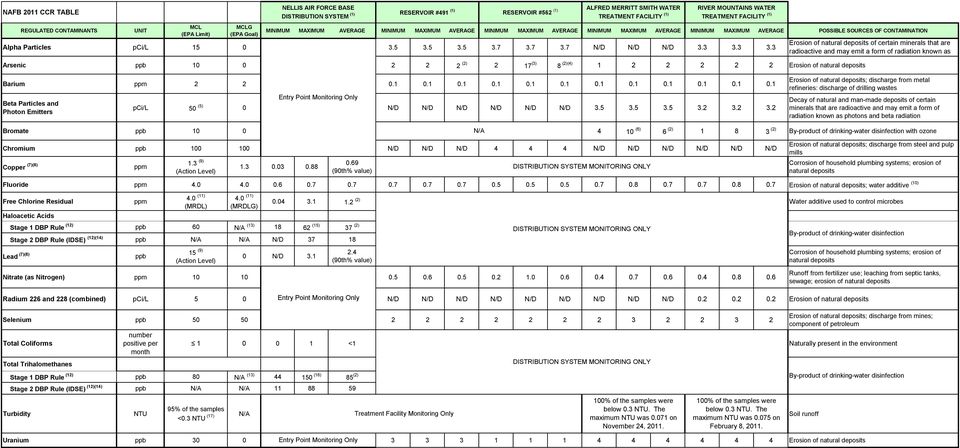
8 Footnotes: (1) Some Safe Drinking Water Act (SDWA) regulations require monitoring from the distribution system, while other SDWA regulations require monitoring at the entry points to the distribution system. (Alfred Merritt Smith WTF, River Mountains WTF, and NAFB Reservoirs) (2) This value is the highest running annual average reported in Reports are filed quarterly. (3) Maximum levels greater than the MCL are allowable as long as the running annual average does not exceed the MCL. (4 While your drinking water meets EPA's standard for arsenic, it does contain low levels of arsenic. EPA's standard balances the current understanding of arsenic's possible health effects against the costs of removing arsenic from drinking water. EPA continues to research the health effects of low levels or arsenic, which is a mineral known to cause cancer in humans at high concentrations and is linked to other health effects such as skin damage and circulatory problems. (5) The actual MCL for beta particles is 4 mrem/year. The U. S. Environmental Protection Agency (USEPA) considers 50 pci/l to be the level of concern for beta particles. (6) Maximum levels equal to or greater than the MCL are allowable as long as the running annual average does not exceed the MCL. (7) Samples are from the NAFB customers' taps. (8) Annual testing not required, data from (9) Lead and copper are regulated by a Treatment Technique (TT) that requires systems to control the corrosiveness of their water. If more than 10% of tapwater samples exceed the action level, water systems must take additional steps. For copper the action level is 1.3 ppm, and for lead it is 15 ppb. (10) By state law, the Southern Nevada Water Authority (SNWA) is required to fluoridate the municipal water supply. This law is not applicable to groundwater. (11) Chlorine is regulated by MRDL, with the goal stated as a MRDLG. (12) The Stage 1 Disinfectants and Disinfection By-products (DBP) Rule regulates current data collection and monitoring for Haloacectic Acids and Total Trihalomethanes in the distribution system. The Stage 2 DBP Rule was finalized on January 4, 2006 and collects Initial Distribution System Evaluation (IDSE) data designed to assist in selection of new, future sample locations for DBP testing. (13) No collective MCLG but there are MCLGs for some of the individual contaminants. Haloacetic Acids: dichloroacetic acid (0), trichloroacetic acid (300 ppb); Trihalomethanes: bromodichloromethane (0), bromoform (0), dibromochloromethane (60 ppb). (14) Data from (15) Maximum levels greater than the MCL are allowable as long as the running annual average of all locations does not exceed the MCL. Some people who drink water containing haloacetic acids in excess of the MCL over many years may have an increased risk of cancer. (16) Maximum levels greater than the MCL are allowable as long as the running annual average of all locations does not exceed the MCL. Some people who drink water containing trihalomethanes in excess of the MCL over many years may experience problems of the liver, kidneys, central nervous system, and may have an increased risk of cancer. (17) Turbidity is regulated by a Treatment Technique (TT) requirement - 95% of all samples taken after filtration each month must be less than 0.3 NTU. Maximum turbidity cannot exceed 1.0 NTU. Definitions: Action Level: The concentration of a contaminant which, if exceeded, triggers treatment or other requirements which a water system must follow. Disinfection by-product (DBP): A substance created by the chemicals or processes used to destroy potentially harmful microorganisms. Maximum Contaminant Level (MCL): The highest level of a contaminant that is allowed in drinking water. MCLs are set as close to the MCLGs as feasible using the best available treatment technology. Maximum Contaminant Level Goal (MCLG): The level of a contaminant in drinking water below which there is no known or expected risk to health. MCLGs allow for a margin of safety. Maximum Residual Disinfectant Level (MRDL): The highest level of a disinfectant allowed in drinking water. There is convincing evidence that addition of a disinfectant is necessary for control of microbial contaminants. Maximum Residual Disinfectant Level Goal (MRDLG): The level of a drinking water disinfectant below which there is no known or expected risk to health. MRDLGs do not reflect the benefits of the use of disinfectants to control microbial contamination. Treatment Technique (TT): A required process intended to reduce the level of a contaminant in drinking water. Millirem (mrem): one-thousandth of a rem (roentgen-equivalent-man), which is a unit of absorbed radiation dose that is adjusted for the biological effects equal to one rad of 250 kilovolt roentgen rays (dental roentgen rays require less than 100 kilovolts). N/A: Not applicable N/D: Not detected. Does not equate to zero, but refers to an amount below analytical reporting limits. Nephelometric Turbidity Unit (NTU): A measurement of water s clarity. Part per billion (ppb): A unit used to describe the levels of detected contaminants. Equivalent to 1 cent in $10 million. Part per million (ppm): A unit used to describe the levels of detected contaminants. Equivalent to 1 cent in $10,000. Picocuries per liter (pci/l): A measure of the radioactivity in water. Low levels of radiation occur naturally in many water systems, including the Colorado River. Running annual average: Based on the monitoring requirements, the average of 12 consecutive monthly averages or the average of four consecutive quarters. Turbidity: A measure of water clarity, which serves as an indicator of the treatment facility s performance.

Parts per million (ppm) or Milligrams per liter (mg/l): one part by weight of analyte to 1 million parts by weight of the water sample.
 2015 Annual Drinking Water Quality Report St. Johns County Utility CR 214 Mainland We're pleased to present to you this year's Annual Water Quality Report. This report is designed to inform you about the
Public Water System. Consumer Confidence Report Template
 Public Water System Consumer Confidence Report Template Ohio Environmental Protection Agency Division of Drinking and Ground Waters www.epa.ohio.gov/ddagw Updated March 2015 Section 1: Title {Water System
water quality 2007 annual report Huntington District Our Customer Charter Dear West Virginia American Water Customer,
 Dear West Virginia American Water Customer, 2007 annual water quality report You are our top priority. And delivering reliable, high-quality water to you all day, every day is our mission. We deliver at
2010 Annual Drinking Water Quality Report Collier County Water Department
 Annual Drinking Water Quality Report Collier County Water Department The Collier County Water Department is pleased to present this annual water quality report. We trust that you will read this report
Saving water means saving money; Fix those leaks right away. Community Water Company of Green Valley. Our Water Source
 Published June 20155 Community Water Company of Green Valley Water Quality Report 1501 S. La Canada Dr., Green Valley, AZ 85622 Phone: 520-625-8409 www.communitywater.com Community Water Company is pleased
Annual. Water testing performed in 2010. Presented By PWS ID#: FL6520336
 Annual Water QualityReport Water testing performed in 2010 Presented By PWS ID#: FL6520336 Meeting the Challenge O nce again we are proud to present our annual Water Quality Report. This report covers
Water. Quality. Report. Water Resources Department
 2013 Water Quality Report Providing Quality Water For Over A Century For more than 100 years, the City of Mesa has been committed to providing its customers with water that meets more than 100 state and
Drinking Water Quality Report
 Anne Arundel County Drinking Water Quality Report 2012 2012 Drinking Water Quality Anne Arundel County Department of Public Works Bureau of Utility Operations is proud to present the 2012 Drinking Water
The Las Vegas Valley Water District is a not-for-profit agency.
 The Las Vegas Valley Water District is a not-for-profit agency. Water. You depend on it every day. That s why it s important to know the facts. The Water District s 2015 Water Quality Report explains where
YOUr 2013 Water Quality REport
 YOUr 2013 Water Quality REport Chaparral City Water Company epcor.com PWS ID 0407017 CHAPARRAL CITY WATER COMPANY Safety. Quality. Community. You ll hear these words spoken often around EPCOR. For EPCOR,
2015 Annual Drinking Water Quality Report of the Englewood Water District
 2015 Annual Drinking Water Quality Report of the Englewood Water District Is my water safe? We are pleased to present this year's Annual Water Quality Report (Consumer Confidence Report) as required by
EDINBORO WATER AUTHORITY
 Annual Drinking Water Quality Report EDINBORO WATER AUTHORITY PWSID 6250022 No Monitoring Violations in 2014 We're pleased to present to you this year's Annual Drinking Water Quality Report. This report
2010 Annual Water Quality Report
 2010 Annual Water Quality Report Tennessee PWS ID: TN0000107 A Message from John Watson, President Dear Tennessee American Water Customer: Tennessee American Water is proud to be your local water company.
Water Quality Report January 1 - December 31, 2013
 Water Quality Report January 1 - December 31, 2013 Keeping Our Community Educated On the Quality of Our Drinking Water The purpose of this report is to keep our Residents informed on the quality of their
Annual. Quality. Report. for Courthouse Bay Water Treatment System. USMC Camp Lejeune - Courthouse Bay PWS ID#: NC0467047
 2007 Water Annual Quality Report for Courthouse Bay Water Treatment System USMC Camp Lejeune - Courthouse Bay PWS ID#: NC0467047 Meeting the Challenge M A arine Corps Base (MCB) Camp s Lejeune is committed
2015 Annual Drinking Water Quality Report. Celebrating 200 Years of That good York water Thanks to our Dedicated Employees.
 2015 Annual Drinking Water Quality Report Public Water System I.D. 7670100 Celebrating 200 Years of That good York water Thanks to our Dedicated Employees. W ANNUAL DRINKING WATER QUALITY REPORT e re pleased
2009 Drinking Water Quality Report The University of Kansas - Lawrence Campus - July 2010
 2009 Drinking Water Quality Report The University of Kansas - Lawrence Campus - July 2010 Prepared by the Department of Environment, Health & Safety The purpose of this report is to inform people who work
Where does my water come from? Harrisonburg 2013 Hardness Levels
 Definitions AL (Action Level): The concentration of a contaminant which, if exceeded, triggers treatment or other requirements which a water system must follow. MCL (Maximum Contaminant Level): The highest
2008 Consumer Confidence Report
 2008 Consumer Confidence Report A Message from Robert G. MacLean, President As a trusted leader in the industry, California American Water places a strong emphasis on sharing water quality information
2015 Annual Drinking Water Quality Report Water System Number: 04-07-010
 2015 Annual Drinking Quality Report System Number: 04-07-010 We are pleased to present to you this year's Annual Drinking Quality Report. This report is a snapshot of last year s water quality. Included
2012 Drinking. Water Report. Indianapolis, Morgan Co. & Plainfield. CitizensEnergyGroup.com - 1 -
 2012 Drinking Water Report Indianapolis, Morgan Co. & Plainfield CitizensEnergyGroup.com - 1 - What is a drinking water report and why did I get one? As a regional water supplier serving multiple counties
2015 Annual Drinking Water Quality Report For the City of Pittsfield, Massachusetts
 2015 Annual Drinking Water Quality Report For the City of Pittsfield, Massachusetts MassDEP Public Water Supply ID #1236000 This report provides drinking water quality information, including details about
A Report on Your Water Quality
 2013 Consumer Confidence REPORT FROM THE MAHWAH WATER DEPARTMENT A Report on Your Water Quality MAHWAH WATER DEPARTMENT Normal Working Hours Monday thru Friday 7:00am to 3:30pm 201-529-4413 / 201-512-1161
How To Read The 2015 Water Quality Report
 2015 Annual Water Quality Report US Army South Fort Hood PWS ID: TX0140107 This report contains important information about your drinking water. If you do not understand it, please have someone explain
DENVER, CO. WHAT S ON TAP? Grading Drinking Water in U.S. Cities June 2003 KEY CONTAMINANTS IN DENVER S WATER DENVER
 WHAT S ON TAP? Grading Drinking Water in U.S. Cities June 23 DENVER, CO Earned a Water Quality and Compliance Grade in 2 and 21 The city had moderate levels of some contaminants, but they generally measured
Hampton Shaler Water Authority
 Hampton Shaler Water Authority PWSID # 5020019 P.O. Box 66, 3101 McCully Road Allison Park, PA 15101 Phone: (412) 486-4867 Fax: (412) 486-4345 Annual Quality Report For Este informe contiene informacion
El Paso Water Utilities Drinking Water Report. www.epwu.org
 2 El Paso Water Utilities Drinking Water Report www.epwu.org Definitions Action Level - The concentration of a contaminant which, if exceeded, triggers treatment or other requirements which a water system
Hampton Shaler Water Authority
 Hampton Shaler Water Authority PWSID # 5020019 P.O. Box 66, 3101 McCully Road Allison Park, PA 15101 Phone: (412) 486-4867 Fax: (412) 486-4345 Annual Quality Report For Este informe contiene informacion
Water Quality Report. For You, Only Our Best Will Do! An Ongoing Commitment to the Communities We Serve. West Orange Water System
 Water Quality Report 2008 For You, Only Our Best Will Do! An Ongoing Commitment to the Communities We Serve. West Orange Water System West Orange Water System Water Quality, Customer Service and Healthy
FACTS Private Well Testing
 FACTS Private Well Testing Introduction 3 Why Should You Test Your Well Water? 4 What Are the Most Common Sources of Well Water Contamination? 6 What Health Effects Are Associated with Well Water Contaminants?
How To Test For Lead
 Water Quality Report Rancho Dominguez District Hermosa-Redondo Este informe contiene información muy importante sobre su agua potable. Tradúzcalo o hable con alguien que lo entienda bien. Table of Contents
Water Quality Report. 2015 Annual. Atlantic County System PWS ID: NJ0119002. A Message from the New Jersey American Water President
 2015 Annual Water Quality Report Atlantic County System PWS ID: NJ0119002 A Message from the New Jersey American Water President To Our Valued Customer: New Jersey American Water is proud to be your local
Report to Customers on. Water Quality. Introduction: Where Does Water Come From? Water Quality. For Supply Year. Important Phone Numbers
 2014 ANNUAL REPORT Endicott Water Department Public Water Supply ID# 0301665 Report to Customers on Water Quality Endicott Municipal Water Department Water Quality For Supply Year 2014 Introduction: To
Water Analysis Report Report Date: March 31, 2012 Testing Period: 1st - 4th Quarter 2011
 Volatile Organic Compounds Benzene 0.0005 0.005 ND Carbon tetrachloride 0.0005 0.005 ND Chlorobenzene (Monochlorobenzene) 0.0005 0.100 ND 1,2-Dichlorobenzene (o-dcb) 0.0005 0.600 ND 1,4-Dichlorobenzene
National Primary Drinking Water Regulations
 National Primary Drinking Water Regulations Contaminant MCL or Potential health effects from Common sources of contaminant Public Health TT 1 (mg/l) 2 long-term 3 exposure above the MCL in drinking water
FACTS. Nitrate and Nitrite in Drinking Water. What Are Nitrate and Nitrite? 3. How Can These Chemicals Get into Your Drinking Water?
 FACTS Nitrate and Nitrite in Drinking Water What Are Nitrate and Nitrite? 3 How Can These Chemicals Get into Your Drinking Water? 3 How Can You Find Out If These Chemicals Are in Your Drinking Water? 4
ANNUAL WATER QUALITY REPORT
 2014 ANNUAL WATER QUALITY REPORT Presidio of San Francisco Lobos Creek The Presidio Water Treatment Plant vigilantly safeguards its water supplies. Last year, Presidio tap water met all U.S. Environmental
CHICAGO, IL. WHAT S ON TAP? Grading Drinking Water in U.S. Cities June 2003 KEY CONTAMINANTS IN CHICAGO S WATER CHICAGO
 WHAT S ON TAP? Grading Drinking Water in U.S. Cities June 2003 CHICAGO, IL Chicago Earned a Water Quality and Compliance Grade of Excellent in 2000 and 2001 Contaminants present were found at levels averaging
Your 2014 Water Quality Report
 Your 2014 Water Quality Report Since 1990, California public water utilities have been providing an annual Water Quality Report to their customers. This year s report covers calendar year 2013 drinking
BOTTLED WATER QUALITY REPORT INTRODUCTION VOSS SOURCE SPECIFIC MINERAL ANALYSIS. VOSS Still. VOSS Sparkling. General Mineral Analysis
 BOTTLED WATER QUALITY REPORT Voss ion AS, N-4730 Vatnestrøm, Norway 1-877-525-VOSS INTRODUCTION At VOSS, we are proud of the quality of our products. VOSS Artesian Water from Norway meets all bottled water
How do you treat water based on water quality from different water sources?
 How do you treat water based on water quality from different water sources? Why? Authors: Wendy Lane and Kim Sciarrone Seattle Public Schools; Seattle, WA Water from different sources will contain different
Travel Centers of America 1003300
 Travel Centers of America 1003300 Source Water Assessment Report A State Assessment of Your Drinking Water Source s Vulnerability As a requirement of the 1996 Amendments to the Federal Safe Drinking Water
Texas Commission on Environmental Quality Page 1 Chapter 290 - Public Drinking Water
 Texas Commission on Environmental Quality Page 1 SUBCHAPTER F: DRINKING WATER STANDARDS GOVERNING DRINKING WATER QUALITY AND REPORTING REQUIREMENTS FOR PUBLIC WATER SYSTEMS 290.101-290.119, 290.121, 290.122
Drinking Water Quality Report
 Annual July 2012 Issue (year test results) Drinking Water Quality Report The Charter Township of Redford Water & Sewer Department 12200 Beech Daly, Redford MI 48239 313-387-2670 Dear Water Customer, Redford
8 Chemicals from water treatment and distribution
 8 Chemicals from water treatment and distribution 8.1 Introduction Chemicals from water treatment and distribution reach drinking-water by the most direct route. They fall into three broad categories:
United States Drinking Water Quality Study Report. A Project Sponsored by the Procter & Gamble Company June 2006 December 2006
 United States Drinking Water Quality Study Report A Project Sponsored by the Procter & Gamble Company June 2006 December 2006 Dr. Xinhao Wang, University of Cincinnati Charlotte White-Hull, the Procter
EAST BAY MUNICIPAL UTILITY DISTRICT
 EST BY MUNICIPL UTILITY DISTRICT NNUL WTER QULITY REPORT DROUGHT LERT Our water supply is critically low for 5. The drought continues. Tougher measures and more emergency supplies are needed. Please visit
Division of Epidemiology, Environmental and Occupational Health Consumer and Environmental Health Services
 Division of Epidemiology, Environmental and Occupational Health Consumer and Environmental Health Services FACTS Cryptosporidium in Drinking Water What Is Cryptosporidium? 3 Why Is Cryptosporidium a Concern
Chapter 14 Quiz. Multiple Choice Identify the choice that best completes the statement or answers the question.
 Chapter 14 Quiz Multiple Choice Identify the choice that best completes the statement or answers the question. 1. Which of the following is NOT true regarding the Chesapeake Bay? a. it is one of many small
Purity of water is defined in part by the mineral level found in specific bottled waters and is referred to as
 BOTTLED WATER QUALITY REPORT Voss ion AS, N-4730 Vatnestrøm, Norway 1-877-525-VOSS INTRODUCTION At VOSS, we are proud of the quality of our products. VOSS Artesian Water from Norway meets all bottled water
NITRATE. is found in the Honolulu Board of Water Supply REGION 3 (Ewa-Waianae-Waipahu System). Here are the EPA s Health Effects for this contaminant,
 NITRATE is found in the Honolulu Board of Water Supply REGION 3 (Ewa-Waianae-Waipahu System). Here are the EPA s Health Effects for this contaminant, as reported in the EPA Reports, & Honolulu Board of
Freshwater Resources and Water Pollution
 Visualizing Environmental Science Freshwater Resources and Water Pollution Chapter 10 Copyright The Importance of Water Life on Earth would be impossible without water All living organisms contain water
Fresno s Water It s Clean, Healthy, and Moving Towards Sustainability
 Water Quality Annual Report 2012 Fresno s Water It s Clean, Healthy, and Moving Towards Sustainability The Water Division manages and operates the City of Fresno s water system. The City purchases, treats,
Drinking Water Quality Report
 Annual July 2015 Issue The Charter Township of Redford (year 2014 test results ) Drinking Water Quality Report Water & Sewer Department 12200 Beech Daly, Redford Ml 48239 (313) 387-2670 Dear Water Customer,
Total Suspended Solids Total Dissolved Solids Hardness
 Total Suspended Solids (TSS) are solids in water that can be trapped by a filter. TSS can include a wide variety of material, such as silt, decaying plant and animal matter, industrial wastes, and sewage.
Interpreting Your Water Test Report
 publication 356-489 Interpreting Your Water Test Report Kathleen Parrott, Extension Specialist, Housing Blake Ross, Extension Specialist, Biological Systems Engineering Obtaining a water analysis from
PHOENIX, AZ. WHAT S ON TAP? Grading Drinking Water in U.S. Cities June 2003 PHOENIX
 WHAT S ON TAP? Grading Drinking Water in U.S. Cities June 23 PHOENIX, AZ Earned a Water Quality and Compliance Grade of Poor in 2 and 21 The city water supply had a number of contaminants approaching national
How To Know If Your Well Water Is Safe
 Bernalillo County Office of Environmental Health A comprehensive guide to help maintain your well and keep your drinking water safe Bernalillo County Office of Environmental Health Bernalillo County Commission