
STUDY GUIDE SAN ANTONIO ENTRY-LEVEL LAW ENFORCEMENT EXAM (SAELLEE)
|
|
|
- Polly Mathews
- 10 years ago
- Views:
Transcription
1 STUDY GUIDE SAN ANTONIO ENTRY-LEVEL LAW ENFORCEMENT EXAM (SAELLEE)

2 CONTENTS Introduction... 2 What exactly is the San Antonio Entry-Level Law Enforcement Exam?... 2 How did we develop this exam?... 2 How to use this study guide... 2 Chapter One: Test Basics... 4 Chapter Two: Cognitive Ability Groups... 5 Chapter Three: Language Ability... 5 Verbal Comprehension Questions: Definition and Sample Questions... 5 Verbal Expression Questions: Definition and Sample Questions... 7 Chapter Four: Visualization Ability... 8 Spatial Orientation Questions: Definition and Sample Questions... 8 Flexibility of Closure Questions: Definition and Sample Questions Selective Attention Questions: Definition and Sample Questions Visualization/Memorization: Definition and Sample Questions Chapter Five: Reasoning Ability Problem Sensitivity Questions: Definition and Sample Questions Deductive Reasoning: Definition and Sample Questions Inductive Reasoning Questions: Definition and Sample Questions Information Gathering Questions: Definition and Sample Questions Chapter Six: Behavioral-Orientation Section Chapter Seven: Additional Test-Taking Strategies SAELLEE Study Guide 1 Copyright 2010, I/O Solutions, Inc.

3 Introduction This study guide has been developed to introduce the San Antonio Entry-Level Law Enforcement Exam (SAELLEE). If you read through this guide carefully, you will have a better understanding of what strategies will help you to prepare for the test. You will learn about the types of questions that will be asked on the test, and you will have an opportunity to practice answering those questions. We hope that it will serve as a valuable tool to help you achieve your goal of serving and protecting the community. What exactly is the San Antonio Entry-Level Law Enforcement Exam? The SAELLEE was designed to determine whether or not candidates possess the minimum competencies required for enrollment in training centers and for employment as sworn law enforcement officers. The types of cognitive abilities that will be assessed are discussed in Chapters Two through Five. Chapter Six will discuss the behavior-orientation section of this exam. The SAELLEE is administered fully online, you will learn more about what to expect in Chapter One. How did we develop this exam? Job analysis, the in-depth study of a given job to determine the duties and specific tasks that employees in that job would be expected to perform, was a fundamental tool in the development of the test. Job analysis studies generally entail the gathering of many sources of information about a given job. These multiple forms of information provide us with a more realistic perspective of the occupation than any individual source of information. To gain an understanding of what law enforcement officers do on the job, how often they do these tasks and why, we sent two experienced job analysts to observe and note law enforcement officers actual behaviors, the equipment that they use, the tasks they perform and the analysts perceptions of what they observed. Next, we interviewed a sample of law enforcement officers in order to understand their perceptions. We asked them to provide a narrative description of their daily activities on the job as well as unusual or extraordinary situations that they have encountered. From the analysts observations and the law enforcement officers responses, we then created lists of personality, psychological, physical and cognitive attribute requirements of the job, lists of global job requirements, lists of job duties, etc. One particularly useful type of list that we used for this test development process was a task inventory. The task inventories enumerated all possible specific job tasks that must be performed by the worker on the job. We consulted with subject matter experts to review and modify the task inventory. From the task inventory, we created a job analysis questionnaire, which was completed by a sample of current employees in order to determine how often certain tasks are performed on the job and to rate the importance of these tasks. After analyzing all of this data, we defined the categories of skills and abilities, such as language or visualization skills, that are required to successfully perform daily job duties. We then decided how many questions would be written for each category, based on how experts rated their relative importance. We then wrote the proper number of questions for each category. The extensive work that we did in developing this exam means that you can be confident that your abilities will be assessed accurately and fairly. How to use this study guide Chapter One of this study guide will give you basic information about how to take the SAELLEE and some instructions on how the online tool works. Read this information carefully so that you will know the instructions in advance. Thorough preparation for this exam will increase your self-confidence; selfconfidence in turn will increase your chances of getting a high score. SAELLEE Study Guide 2 Copyright 2010, I/O Solutions, Inc.

4 In Chapters Two through Five, you will learn about the different categories of cognitive questions that will appear on the tests. The categories will be defined, and an explanation of how each category is important for the occupation of law enforcement officer will be provided. You will also find sample questions from each category along with answer explanations. Read the definition of each category carefully and then try the sample questions. After you have answered the sample questions, check your answers with the corresponding answer explanation. Be sure to read all answer explanations carefully, even if you have answered the sample questions correctly. You could learn a lot from the answer explanations, and they may point out aspects of the questions that had not occurred to you previously. Chapter Six will consist of a review of the behavioral-orientation section of this exam to orient you on how to best approach answering these questions. Chapter Seven will consist of important test-taking strategies. By following these tips, you will be able to complete this exam more quickly and efficiently, and you will be able to improve your overall performance on the exam. Good luck to you as you take the San Antonio Entry-Level Law Enforcement Exam and best wishes for your future career in law enforcement! Important Note: Do not memorize the sample questions and answers. Any question that has been released will not be used again. You may run into questions that will be very similar, but you will not be tested with any of these exact questions. These questions will give you good practice, but they will not give you the answers to any of the questions on your exam. SAELLEE Study Guide 3 Copyright 2011, I/O Solutions, Inc.

5 Chapter One: Test Basics The SAELLEE will consist of a 100 multiple-choice cognitive ability measure, and a 150 multiple-choice behavioral-orientation measure. This examination is administered fully online. When you arrive at the examination site on the day of the test, you will need to follow the proper check-in procedures. Listen carefully to and follow all instructions. Any infraction of the rules will be considered cheating, and you will be dismissed from the test. The test will be administered online. Proctors will guide you through the online log-in process. The online examination contains a self-guided tutorial to orient you through the online test administration tool. Read all instructions carefully and be sure to ask any questions that you may have so that you know exactly what to do. You will have three (3) hours to complete the exam. Be sure to pace yourself so that you can complete the entire exam. A timer will be provided for you in the online administration tool. If you finish early, use the extra time to look over your work and check your answers. There is no bonus for finishing early, so we recommend that you use all of your time to perfect your exam. Important notes: The online administration tool is designed to mirror a paper and pencil exam. On the bottom of the tool, you will find a Page Navigation bar. This bar allows you to skip around in the exam to any page. In this way, it is much like a paper and pencil tool. When you have marked an answer for each question on a page, the icon for that page will change colors to indicate that all answers have been filled in on that page. In this way, you will be able to keep track of the pages which contain unanswered questions. It is important to note that you must submit each page separately prior to navigating to other pages. In order to save your answers, you MUST submit those answers using the submit button. If you select a new page in the Page Navigation bar before you submit your answers, those unsubmitted answers will be lost. If you run out of time, the exam will automatically log you off and score the answers you have submitted. If you are on a page with un-submitted answers, those answers you have selected will be submitted before the exam logs you off. Most importantly, make sure that each response has been marked in the correct space. Question 1 must be in space 1; question 42 in space 42. Take your time and be sure you are selecting the appropriate response bubble for the question you intend to answer. Once you submit the exam, a confirmation screen will appear asking you to confirm that you wish to submit your answers. Once you submit your answers you will be shown a screen that indicates how many questions out of 250 you successfully submitted. Last, all of this information will be repeated to you in the online exam tutorial. Security Note: The online administration tool has several security safeguards. Namely, opening or clicking outside of the online administration tool window will result in an automatic shut-down of your exam. A proctor will be notified of this incident and you will have to log back into your test to continue. Repeated incidents will be taken for attempts at cheating; therefore, please do not attempt to click the mouse outside of the online administration tool window. SAELLEE Study Guide 4 Copyright 2011, I/O Solutions, Inc.
6 Chapter Two: Cognitive Ability Groups On the SAELLEE, we will assess your competency in multiple areas: Verbal Comprehension Verbal Expression Spatial Orientation Flexibility of Closure Selective Attention Visualization/Memorization Inductive Reasoning Deductive Reasoning Information Gathering Problem Sensitivity For ease of discussion, the above areas have been grouped together into three chapters based upon their relative similarity: Language Skills Visualization Skills Reasoning Skills Definitions of each of these competencies as well as definitions and examples of the types of questions that will measure your proficiency in each of these competency areas will follow in the next three chapters. Chapter Three: Language Ability On the SAELLEE, we will assess your language ability your ability to communicate with others through speech and writing as well as your ability to understand written material. Your language competency will be measured with the following types of questions: Verbal Comprehension Verbal Expression Verbal Comprehension Questions: Definition and Sample Questions Our subject matter experts have defined verbal comprehension as the ability to read and understand written words and sentences. Law enforcement officers use this ability when reading legal bulletins, state statutes, ordinances, policies and procedures. For verbal comprehension questions, you will be given a passage to read. You will then answer questions that ask you to recall details from the passage and the meaning of the passage. In order to answer the questions correctly, you will have to understand the meaning of the preceding passage. Verbal Comprehension Sample Question 1 Please use the information in the following passage to answer verbal comprehension sample question 1. Ms. Amelia Winters called the Police Department at approximately 8:45 p.m. Wednesday evening to report a robbery in her apartment. Ms. Winters, who lives with three roommates, reported that she was alone in the apartment at the time of the incident. She was reading in the living room when she heard a noise in the bedroom. She did not immediately investigate the situation because she assumed that she must not have noticed one of her roommates returning home early. However, when her greetings went SAELLEE Study Guide 5 Copyright 2011, I/O Solutions, Inc.

7 unanswered, she walked into the bedroom to see who was in the apartment. She walked through her bedroom, looked into an adjoining bathroom and discovered a young Caucasian male, approximately 6 feet tall, age 14-16, standing in her shower, attempting to keep out of sight. He had short brown hair and was wearing sunglasses. He was wearing a plain red t-shirt, blue jeans and black Nike sneakers. Ms. Winters ordered the young man to leave, and he walked into the bedroom and climbed out of an open bedroom window. After he left, Ms. Winters suddenly grew fearful and went next door to a neighbor s apartment to seek help and call the police. When she returned, she noticed that her purse had been stolen. She did not know exactly when the purse had been stolen although she remembered that she had last seen it lying on her bed. 1. Where was the suspected burglar hiding? a. In the living room. b. In the bedroom. c. Inside an adjoining bathroom in the shower. d. Just beneath an open bedroom window. The correct answer to verbal comprehension sample question 1 is (c), Inside an adjoining bathroom in the shower because that is the location where Ms. Winters found the strange young man hiding. Answers (a), (b) and (d) are incorrect. Ms. Winters was alone in the living room until she went to investigate the noise in the bedroom; therefore, the burglar was not hiding there. Although the burglar probably stole the purse from the bedroom, and although he walked through the bedroom to escape, he was not hiding in that room. He used the open bedroom window to escape and not to conceal his presence. Verbal Comprehension Sample Question 2 Unsolved Homicide On August 1, 2009, the body of a woman was found in a wooded area outside of Troy. The cause of death was homicide. The victim is described as a Hispanic female between the ages of with dark brown hair and brown eyes. She was approximately 5 5 tall and weighed 130 pounds. The victim was found wearing a blueand-white striped T-shirt, white shorts, and white Nike tennis shoes. She had three tattoos: an ivy pattern around her left ankle, a cross on her left shoulder and a daisy on her right hip. She was found wearing five pieces of jewelry: a pair (2) of gold hoop earrings, a silver necklace with an amethyst pendant, a sapphire ring with a gold setting on her left ring finger and a silver bracelet with a gold heart design. Although the media devoted extensive coverage to this case, the woman has not yet been identified. 2. What articles of clothing was the victim wearing when her body was discovered? a. A red-and-white striped T-shirt, white shorts and white Nike tennis shoes. b. A blue-and-white striped sweatshirt, white shorts and white Nike tennis shoes. c. A blue-and-white striped T-shirt, white pants and white Nike tennis shoes. d. A blue-and-white striped T-shirt, white shorts and white Nike tennis shoes. The correct answer to verbal comprehension sample question 2 is (d), A blue-and-white striped T-shirt, white shorts and white Nike tennis shoes because that is what the woman was wearing when her body was discovered. Answers (a), (b) and (c) are incorrect. The woman did not wear a red-and-white striped T-shirt. She wore a T-shirt and not a sweatshirt, and she wore shorts, not pants. SAELLEE Study Guide 6 Copyright 2011, I/O Solutions, Inc.
8 Tips to help you improve your verbal comprehension abilities: Before the test day, read entire newspaper articles for practice. Underline important details and ideas and notice different points of view and types of supporting evidence. After you have finished the article, try to summarize the main point of the article and the different arguments that may have been presented. Look over the words and sentences you have underlined. Were they the most important words and ideas? As you continue to practice this exercise, you will become a more efficient reader and you will read with greater comprehension. One strategy you may find helpful is to read the questions before you read the selection. The questions will tell you what important details you need to notice as you read the passage. Make sure that you read each question very carefully. Many candidates make mistakes on verbal comprehension questions because they misunderstand the question. Read all of the answer choices carefully. Try to eliminate incorrect answers until you are left with only one possible answer. If you have more than one possible answer, reread the passage. Verbal Expression Questions: Definition and Sample Questions Verbal expression questions are designed to test your ability to write words and sentences that other people will understand. Law enforcement officers use this ability to write the many reports, memos, affidavits and narratives that they are required to complete. For verbal expression questions, you will be asked to choose correctly spelled words, detect misspellings in a sentence, and choose words or phrases that will be grammatically correct in the context of a sentence. Verbal Expression Sample Question 1 For verbal expression sample question 1, determine which word in the sentence is spelled incorrectly. There will be only one misspelled word in this sentence. 1. Because Officer Vogel responded to the home invaison call late in his shift, he had to work six hours of overtime. a. Because b. responded c. invaison d. overtime The correct answer to verbal expression sample question 1 is (c) invaison because that word has been misspelled. The correct spelling is invasion. Answers (a), (b) and (d) have all been spelled correctly. Verbal Expression Sample Question 2 For verbal expression sample question 2, fill in the blank with the correctly spelled word. 2. The hearing for Inmate Cara Dawson has been scheduled for November 8, a. parole b. paroll c. parol d. parrole SAELLEE Study Guide 7 Copyright 2011, I/O Solutions, Inc.
9 The correct answer for verbal expression sample question 2 is (a) parole because that is the correct spelling of that word. Answers (b), (c) and (d) have all been spelled incorrectly. Verbal Expression Sample Question 3 1. As the police officers arrested the three suspects, they all three very carefully. a. search b. searched c. searches d. will search The correct answer to verbal expression sample question 3 is (b) searched because the simple past tense is required in this sentence. You can tell that the simple past tense is required in this instance because the police officers arrested and searched the suspects at the same time in the past. Answers (a), (c) and (d) are incorrect. Search is incorrect because it is in the present tense. Searches is incorrect because it is in the present tense and also because searches requires a singular subject (e.g. He searches. ) rather than a plural subject ( They search. ). Will search is incorrect because it is in the future tense. Tips to help you improve your verbal expression skills: By reading more every day, you will be able to increase your vocabulary. As you read, make a list of unfamiliar words. Afterwards, look up these words in the dictionary and write down their definitions in a special notebook. By writing down these words and their definitions, you will be able to remember them more easily. If you are not familiar with terms such as singular, plural, active voice and passive voice, we recommend that you consult a good grammar guide, such as Gerald P. Mulderig s The Heath Handbook, so that you are able to analyze the sentences in the test questions to understand what elements are required to complete the sentence grammatically. As before, be sure to read! If you read well-written material, you will become more comfortable with different types of sentence structures. As you read newspapers, magazines and books, practice locating the subjects and verbs of various sentences. Try to determine why a particular kind of verb is required to complement a particular kind of subject. Chapter Four: Visualization Ability On the SAELLEE, we will test your visualization ability your ability to perceive images, understand maps and plan routes based on those maps, and notice visual details. Your visualization competency will be measured with the following type of questions: Spatial Orientation Flexibility of Closure Selective Attention Visualization/Memorization Spatial Orientation Questions: Definition and Sample Questions Spatial orientation questions are designed to evaluate your ability to tell where you are in relation to the location of some object or to tell where the object is in relation to you. This skill involves maintaining directional orientation in one s bearings with respect to the points of a compass and allows one to stay SAELLEE Study Guide 8 Copyright 2011, I/O Solutions, Inc.

10 oriented in a vehicle as it changes direction and location. Law enforcement officers use this ability when they have to reach a destination in a community. They have to be able to visualize where they are in relation to their destination to determine the best route. On this exam, you will be provided with a map and a compass. You will then be given a situation in which you must determine the shortest (least distance) route from one location on the map to another. Alternately, you may be tested on where one object is in relation to another. Spatial Orientation Sample Questions 1 and 2 Please use the following map to answer spatial orientation sample questions 1 and 2. The City of Geneva Oz Lane Elm Street Maple Street Toy Shoppe Jones Park Abbott s Food Oak Street Police Station City Hall Maywood Fitness Center Lyon Ave. Train Station Fire Dept. NW Railway City Garage Bellview Terrace Commuter Parking Water Tower Elm Street Glenwood Forest Preserve Forest Preserve Rd. Loop St. Allison Lane N 1. Deputy Sheriffs Charleston and Davis are at the corner of Oak Street and Lyon Avenue. They receive a call to report to the site of a traffic accident at Allison Lane and Forest Preserve Road. What would be the quickest (least distance) route for them to take in order to reach the site of the accident? a. Travel east on Oak Street, then north on Bellview Terrace, then east on Allison Lane. b. Travel west on Oak Street, then north on Oz Lane, then east and southeast on Elm Street, then southwest on Loop Street. c. Travel east on Oak Street, then northeast on Allison Lane. d. Travel west on Oak Street, then north on Oz Lane, then east on Maple Street, then south on Bellview Terrace, and east on Allison Lane. The correct answer to spatial orientation sample question number 1 is (a) Travel east on Oak Street, then north on Bellview Terrace, then east on Allison Lane because that is the route that covers the least distance from the starting point to the final destination. Answers (b), (c) and (d) are all incorrect. If you travel west on Oak Street, then north on Oz Lane, then southeast on Elm Street, then southwest on Loop Street, you are not only taking a longer route than (a), but you will also not reach the intersection of Allison Lane and Forest Preserve Road unless you travel further east on Allison Lane. Because Allison SAELLEE Study Guide 9 Copyright 2011, I/O Solutions, Inc.

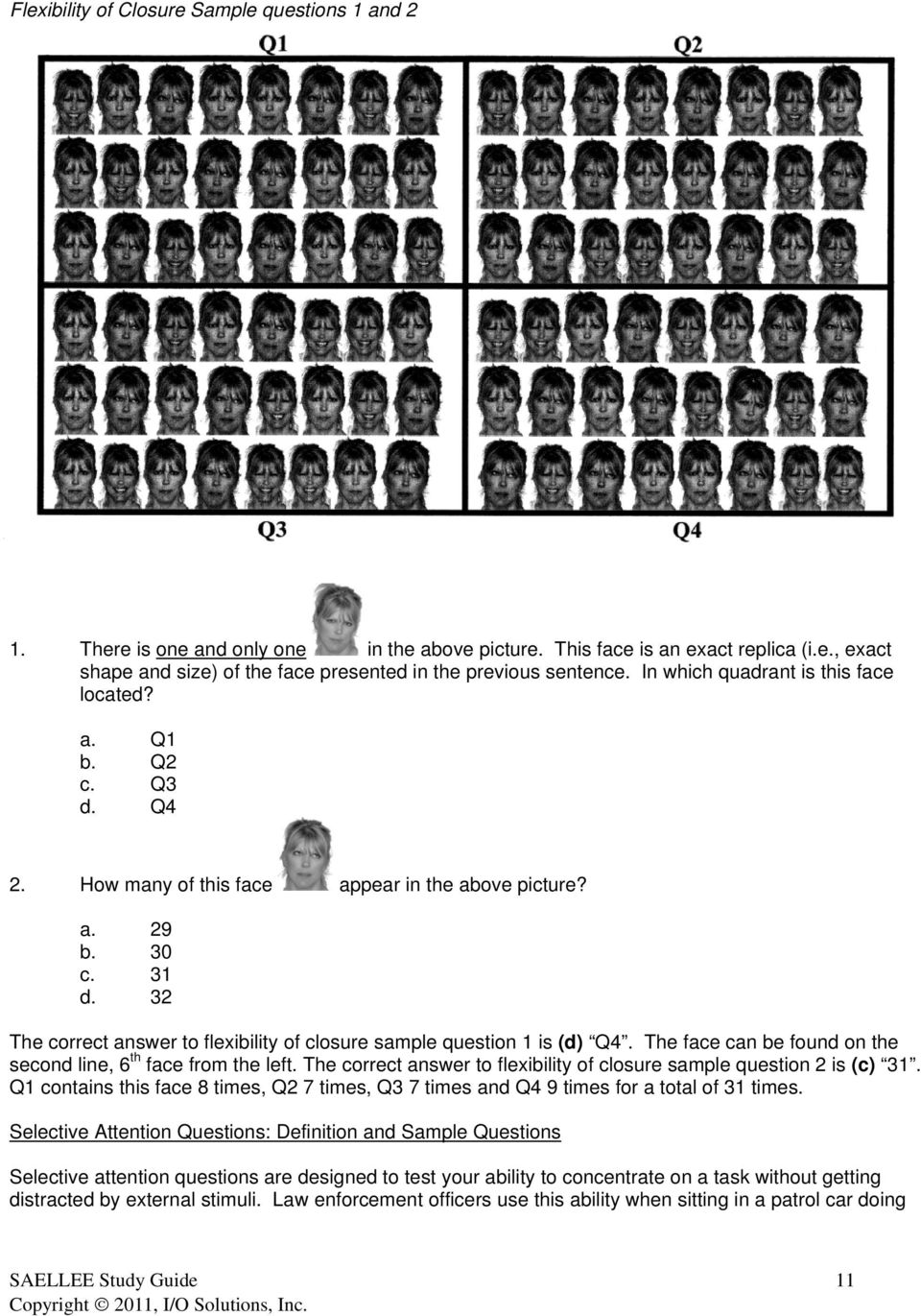
11 Lane only runs east-west, you will not be able to travel northeast on Allison Lane. Finally, if you travel west on Oak Street, then north on Oz Lane, then east on Maple Street, then south on Bellview Terrace, then east on Allison Lane, you will not be taking the shortest route. 2. Law enforcement authorities are looking for an escaped prisoner. They suspect that he has entered the city of Geneva and is hiding in the Glenwood Forest Preserve. Officer Anton is currently at the corner of Elm Street and Oz Lane. What would be the shortest (least distance) route for him to travel in order to reach the north side of the Glenwood Forest Preserve? a. Travel south on Oz Lane, then east on Oak Street, then north on Bellview Terrace, then east on Allison Lane, then south on Forest Preserve Road. b. Travel east on Elm Street, then south on Bellview Terrace. c. Travel east and then southeast on Elm Street, then southwest on Loop Street. d. Travel south on Oz Lane, then west on Maple Street, then south on Bellview Terrace, then east on Allison Lane. The correct answer to spatial orientation sample question 2 is (c) Travel east and then southeast on Elm Street, then southwest on Loop Street because that is the shortest of the four routes listed. Answers (a), (b) and (d) are all incorrect. If you travel south on Oz Lane, then east on Oak Street, then north on Bellview Terrace, then east on Allison Lane, then south on Forest Preserve Road, you are not only taking a longer route, but you will also end up on the east side of the forest preserve when you are supposed to report to the north side. If you travel east on Elm Street and south on Bellview Terrace, you will end up on the west side of the forest preserve. If you travel west on Maple Street, you will not reach Bellview Terrace and Allison Lane. Tips to help you improve your spatial orientation abilities: As with previous question categories, read the maps and situations very carefully. Occasionally you will learn in the passages provided that certain streets are one-way only or that traffic flows more slowly on certain roads due to construction or other conditions. Take these factors into account when choosing the best possible route. Practice your spatial orientation skills with other types of maps. Figure out the best way to reach one destination from another. Make this activity challenging by placing obstacles on certain paths. Imagine that a certain road has been blocked by the police, for example. What would be the shortest route to your destination while avoiding this obstacle? Flexibility of Closure Questions: Definition and Sample Questions This ability involves finding an object that is somehow hidden within a group of other objects. This would involve picking out a particular face in a crowd of people. In this case, the individual knows what he/she is looking for; the task is to identify the one pattern that is buried in a larger pattern. When you take the SAELLEE, you will be asked to identify a face in a crowd, find an exact match in a grid or count the number of exact matches in a grid. SAELLEE Study Guide 10 Copyright 2011, I/O Solutions, Inc.

12 Flexibility of Closure Sample questions 1 and 2 1. There is one and only one in the above picture. This face is an exact replica (i.e., exact shape and size) of the face presented in the previous sentence. In which quadrant is this face located? a. Q1 b. Q2 c. Q3 d. Q4 2. How many of this face appear in the above picture? a. 29 b. 30 c. 31 d. 32 The correct answer to flexibility of closure sample question 1 is (d) Q4. The face can be found on the second line, 6 th face from the left. The correct answer to flexibility of closure sample question 2 is (c) 31. Q1 contains this face 8 times, Q2 7 times, Q3 7 times and Q4 9 times for a total of 31 times. Selective Attention Questions: Definition and Sample Questions Selective attention questions are designed to test your ability to concentrate on a task without getting distracted by external stimuli. Law enforcement officers use this ability when sitting in a patrol car doing SAELLEE Study Guide 11 Copyright 2011, I/O Solutions, Inc.
13 paperwork while the radio is on or while performing a security check when a lot of commotion is taking place. On the SAELLEE, you will be given a series of letters, numbers and symbols. You will be asked to choose the option that contains the exact pattern of letters, numbers and symbols. Selective Attention Sample Question 1 Selective attention sample question 1 contains a set of letters, symbols and numbers. Please choose ONLY ONE option that contains the exact pattern of letters, symbols, numbers and spaces. 1. a. b. c. d. f The correct answer to selective attention sample question 1 is (c) because option (c) contains the exact pattern of letters, symbols, numbers and spaces as the original set. Answers (a), (b) and (d) are all incorrect. In option (a), the arrows () are pointed to the left instead of to the right, as they are in the original set. In option (b), there is a heart () instead of a diamond (). In option (d), the f is not in italics. Also, there is an extra space between the f and the in option (d). Selective Attention Sample Question 2 Selective attention sample question 2 contains a set of letters, symbols and numbers. Please choose ONLY ONE option that contains the exact pattern of letters, symbols, numbers and spaces. 2. a. b. c. d. The correct answer to selective attention sample question 2 is (d) because option (d) contains the exact pattern of letters, symbols, numbers and spaces as the original set. Answers (a), (b) and (c) are all incorrect. In option (a), the comma (,) and the semicolon (;) are mixed up at the beginning. Also, at the end of option (a), there is an A instead of a. In option (b), there is a instead of a. In option (c), there is a instead of a. SAELLEE Study Guide 12 Copyright 2011, I/O Solutions, Inc.

14 Tips to help you improve your selective attention skills: Be sure to allow yourself enough time to complete this portion of the test. We aren t kidding when we say you ll have to pay attention! Note the exact placement of the letters, symbols and spaces. Occasionally they will be in the wrong order, or another similar-looking character will be substituted for one of the letters or symbols. Semicolons (;) often look like colons (:). It is important to note if a letter is set in italics or is capitalized. Only one answer on the test will be correct, so look carefully! Look at license plates, phone numbers or VIN numbers. Can you copy them down exactly? Try typing a random set of characters on your computer. Put this original set away for a while. Return to it later and below the original set, try to draw (or type) the exact same pattern of letters and numbers. Visualization/Memorization: Definition and Sample Questions Visualization/memorization questions are designed to assess your ability to recall specific information upon request. Law enforcement officers use this ability to remember the important information presented in the Texas statutes, legal bulletins, shift briefings and also to remember new names, faces, codes, telephone numbers, geographic locations, documents, and long lists, which can be in the form of words, numbers, pictures, and procedures. On SAELLEE visualization/memorization questions, you will be presented with several color photographs. You will have two (2) minutes to study each photograph. After each photograph, you will be given two (2) minutes to answer questions associated with that photograph you have just memorized. You will not be allowed to look back at the pictures while you are answering the questions. Once time has elapsed for either the photograph or the answers, you will be automatically sent to the next screen and will be unable to return to the previous screen. Therefore, be sure to complete all tasks within the two (2) time window for the photograph and answer screens. Visualization/Memorization Sample questions 1 and 2 You are about to answer two practice memorization questions. This process will involve two steps. In step one (1), you will be given two (2) minutes to observe the picture below and to memorize any and all possible information provided in the picture. In step two (2), you will answer the two practice questions regarding the information in the picture you just observed. In order to practice for the actual exam, we recommend that you do not look back at the picture while you are answering the practice questions. SAELLEE Study Guide 13 Copyright 2011, I/O Solutions, Inc.

15 1. How many law enforcement officers can be seen in the picture? a. One b. Two c. Three d. Four 2. The dog is standing next to a. a. tree b. telephone pole c. fence d. vehicle The correct answer to memorization sample question 1 is (b) because two law enforcement officers are visible in the picture on the previous page. The correct answer to memorization sample question 2 is (c) because the dog in the picture on the previous page is standing next to a fence. Tips for improving your memorization skills Practice on your own by studying a picture for no more than two minutes. Then try to describe everything you observed in the picture or have someone else ask you questions about the picture. Try to answer the questions without looking at the picture because you will not be able to look back at the picture on the actual exam. It would be best to use a picture that you have never seen before, such as a picture from a newspaper or magazine. Chapter Five: Reasoning Ability When you take the exam, you will answer questions designed to measure your reasoning ability your ability to sense and solve problems, to apply rules to specific situations, to form conclusions, and to understand the order and arrangement of events and rules. Your reasoning competency will be assessed with the following types of questions: Problem Sensitivity Deductive Reasoning Inductive Reasoning Information Gathering Problem Sensitivity Questions: Definition and Sample Questions Problem sensitivity questions test your ability to sense if something is wrong or if something is likely to go wrong. Law enforcement officers rely on this skill when patrolling neighborhoods or interacting with individuals. This skill involves the ability to sense that a situation is going to deteriorate or worsen, to recognize the symptoms of a physical problem requiring first aid, to sense that an individual has a problem even if he or she insists that everything is all right. For SAELLEE problem sensitivity questions, you will be asked to read a short passage. You will then have to determine what is most likely to be the main problem in the situation that is presented in the SAELLEE Study Guide 14 Copyright 2011, I/O Solutions, Inc.

16 passage. You may also be asked to determine what problem would most likely arise from the conditions presented in the passage or what step you would take to address the problem. Problem Sensitivity Sample Question 1 Please use the information in the following passage to answer problem sensitivity sample question 1. Officer Denver is patrolling a neighborhood around 3:30 a.m. when she notices a car that must be traveling at least 25 miles per hour over the speed limit. She pulls the car over for a traffic stop. As she steps out of the squad car, the driver of the car steps out of his vehicle and walks toward her with his license and registration. Before Officer Denver can say a word, the driver apologizes for speeding and explains that he had just received a call about an emergency at home. He shows Officer Denver his driver s license and says that he hopes that the situation can be taken care of quickly. The man seems alert and agitated; his speech is clear, and he does not seem to have problems walking. Officer Denver orders the man to go back inside his car. She adds that she will also need to see proof of insurance. The man offers to go back to the car and get the proof of insurance for her. Officer Denver again orders the man to return to his car. The man snaps, Why can t we just take care of this here? He immediately apologizes for losing his temper; however, Officer Denver must order him to return to his car for a third time before he complies. 1. Based on the above information, what, if anything, is most likely to be the man s problem? a. The man is just impatient to return home so that he can deal with a family emergency. b. The man has something in his car that he does not want Officer Denver to see. c. The man is under the influence of alcohol. d. The man is nervous because he has no insurance. The correct answer to problem sensitivity sample question 1 is (b) The man has something in his car that he does not want Officer Denver to see because this is the best answer based on the information provided above. The man seems eager to take care of the matter outside and is reluctant to return to his car; this may lead Officer Denver to conclude that he does not want her to look inside his car. Option (a) would not be the best answer because if the man were so impatient to get home to deal with the emergency as he claims, why would he prolong the traffic stop by insisting that he remain outside of the car? Option (c) would not be the best answer because Officer Denver notes that the man is alert, and she does not notice any symptoms of intoxication, such as slurred speech or impaired motor skills. Option (d) also would not be the best answer because the man does not try to argue with Officer Denver about his proof of insurance. He offers to retrieve his proof of insurance for her, just as long as she conducts the traffic stop outside of his car. Problem Sensitivity Sample Question 2 Please use the information in the following passage to answer problem sensitivity sample question You are a law enforcement officer. At the beginning of your shift, your supervisor gives you instructions that you do not understand. What would be the first step you should take to solve this problem? a. You should ask the supervisor to repeat the unclear instructions. b. You should ask another coworker for assistance. c. Follow only the parts of the instructions that you understand perfectly. d. Try to complete the task as best as you can and ask the supervisor if you did the task correctly at the end of your shift. SAELLEE Study Guide 15 Copyright 2011, I/O Solutions, Inc.
17 The best answer to problem sensitivity sample question 2 is (a) You should ask the supervisor to repeat the unclear instructions. It is vital that you know what is required of you at all times during your shift. If you ask the supervisor to repeat the instructions, you will be able to follow those instructions accurately and efficiently. Answers (b), (c) and (d) are all incorrect. A coworker may not know what the supervisor wants you to do, so it would be best to ask the supervisor directly. If you only follow the parts of the instructions that you understand perfectly, you may neglect an important aspect of the task. Finally, it would simply be inefficient (and perhaps even dangerous!) to try to complete the task without understanding the instructions and waiting until the end of the shift to have a supervisor check on your progress. It is essential that you communicate clearly with your supervisor; therefore, (a) is the only correct answer. Tips for improving your problem sensitivity abilities: You will need to rely on your common sense to answer most of these questions. But make sure that you read the situation carefully and look for important details. Carefully examine the answers and make sure that you pick the answer that relates most closely to the details presented in the passage. For example, in problem sensitivity sample question 1, the passage explains that the driver of the car is alert, speaks clearly and has no problems walking. Thus you can safely eliminate (c), which names intoxication as the man s main problem. If you are asked to imagine what would be the first step you would take to solve a problem, you may find it helpful to imagine the consequences that would arise if you followed each answer choice. For example, in problem sensitivity sample question 2, if you followed (b) and asked another coworker for assistance, you could easily imagine the coworker not having a complete knowledge of what the supervisor wants you to do, and the coworker could give you incomplete or false instructions. If you imagine the consequences of each answer choice, you will see that (a) is the only sensible answer to that question. Deductive Reasoning: Definition and Sample Questions When you take the exam, you will encounter deductive reasoning questions, which will measure your ability to apply general rules to specific problems in order to reach a logical conclusion. Law enforcement officers use this ability to apply state statutes, state policies, procedures and laws to specific situations. On the exam, you will be asked to read a passage that explains state laws or law enforcement policies. You will then be given a specific situation related to the policies, and you will have to decide the best course of action based on what you know about the laws or regulations. Deductive Reasoning Sample Question 1 Please use the information in the following passage to answer deductive reasoning sample question 1. In the event of a crash involving death or personal injuries, the following procedures are to be followed: The driver of any vehicle involved in a crash resulting in the injury of any person must immediately stop the vehicle at the scene of the crash, or as close thereto as possible, and must remain at the scene of the crash until he or she has fulfilled the requirements of statute Any person who willfully violates this paragraph is guilty of a felony of the third degree. The driver of any vehicle involved in a crash resulting in the death of any person must immediately stop the vehicle at the scene of the crash, or as close thereto as possible, and must remain at the scene of the crash until he or she has fulfilled the requirements of statute Any person who willfully violates this paragraph is guilty of a felony of the second degree. SAELLEE Study Guide 16 Copyright 2011, I/O Solutions, Inc.
18 The department shall revoke the driver's license of the person convicted of violating the above regulations. Every stop must be made without obstructing traffic more than is necessary, and, if a damaged vehicle is obstructing traffic, the driver of the vehicle must make every reasonable effort to move the vehicle or have it moved so as not to obstruct the regular flow of traffic. Any person who fails to comply with this subsection shall be cited for a nonmoving violation. 1. Joe Biglietta was driving his car, a white 2007 Ford Explorer, and talking on his cell phone on his way to work. Witnesses say that he ran a red light at the corner of Main and Broadway and crashed into the driver s side door of Mary Churchill, who was driving a red 2004 Pontiac Grand Prix. Ms. Churchill was not wearing her seatbelt and suffered severe injuries to her head, her neck and her shoulder. It is unclear what type of injuries Mr. Biglietta sustained because as soon as he discovered that he could still drive his car, he left the scene before police arrived. Police found Mr. Biglietta at his home shortly afterwards. According to the above information, Mr. Biglietta will be charged with which of the following for leaving the scene of the accident? a. None because Ms. Churchill s injuries were caused by her failure to wear her seatbelt. b. A nonmoving violation. c. A felony of the second degree. d. A felony of the third degree. The correct answer to deductive reasoning sample question 1 is (d) A felony of the third degree because Mr. Biglietta has left the scene of a crash resulting in the injury of Ms. Churchill, and anyone who violates the regulations in the first paragraph of the procedures listed above will be guilty of a felony of the third degree. Answers (a), (b), and (c) are all incorrect. The law does not exempt Mr. Biglietta from remaining at the scene because Ms. Churchill was not wearing her seatbelt. A nonmoving violation citation would have been issued if Mr. Biglietta had made no effort to move his damaged vehicle from the intersection, thereby obstructing traffic, but nonmoving violation citations are not issued in the event of a driver leaving the scene of a crash that has resulted in injury. Finally, Mr. Biglietta would have been guilty of a felony of the second degree if Ms. Churchill had died in the accident, but because she had survived with injuries, he was guilty of a felony of the third degree. Deductive Reasoning Sample Question 2 Please use the following information to answer deductive reasoning sample question 2. Sick Leave Policies: If an employee of the police department knows that he or she will be late due to an illness or other emergency, that employee must contact his or her immediate supervisor before the shift begins to explain the situation and to provide an approximate time of arrival for duty. If an employee of the police department cannot work his or her shift due to illness or injury, then that employee must contact the highest-ranking supervisor available at the department at least three hours before the beginning of his or her shift. The supervisor will then notify on-duty members of the current shift that there is an opening in the upcoming shift. If no members of the current shift wish to work the upcoming shift, then members of the upcoming shift who have the day/night off will be contacted. Any members of the current or upcoming shift who fill the vacancy left by an ill or injured employee will be paid overtime. If an employee requires consecutive days off, the employee must contact the highest-ranking supervisor available at the department three hours before every shift that the employee will be unable to work. If an employee does not contact a supervisor the day/night after a sick day has been taken, then the supervisors will assume that the employee will work his/her assigned shift. If an employee fails to contact a supervisor when he/she is going to be late or absent, then that employee will be placed on leave without pay and will be subject to disciplinary action. SAELLEE Study Guide 17 Copyright 2011, I/O Solutions, Inc.
19 2. Officer Delarosa works the morning shift and is scheduled to begin his shift at 7:00 a.m. During the night, he suffers severe abdominal cramps and nausea. He suspects that he has food poisoning and wants to take the day off of work to recover. What should he do in order to follow the above policies? a. He should contact fellow officers (either of the midnight or the morning shift) to find a replacement for the day. b. He should contact his supervisor no later than 10:00 a.m. c. He should contact his immediate supervisor no later than 5:00 a.m. d. He should contact the highest-ranking supervisor available at the department no later than 4:00 a.m. The correct answer to deductive reasoning sample question 2 is (d) He should contact the highest-ranking supervisor available at the department no later than 4:00 a.m., because the second paragraph mentions that the highest-ranking supervisor needs to be contacted at least three hours prior to the beginning of the shift. Answers (a), (b) and (c) are all incorrect. Officer Delarosa should not contact fellow officers directly; the supervisor will. Officer Delarosa needs to contact his supervisor three hours before the beginning of his shift, not after. Lastly, he needs to call the highest-ranking supervisor, who may or may not be his immediate supervisor, and call three hours before his 7:00 a.m. shift. Tips for improving your deductive reasoning abilities: Be sure to read carefully both the policies and the questions. Occasionally there will be irrelevant details in both the general policies and the specific situations, so make sure to carefully match up important details and disregard the information that does not help you answer the question. For example, in deductive reasoning sample question 1, the models of the cars that Mr. Biglietta and Ms. Churchill were driving and the location of the collision were not pieces of information that helped you answer the accompanying question. You had to ignore those details to reach the correct conclusion. You may be able to practice your deductive reasoning skills by looking at a set of rules or policies. They could be school regulations, office policies at your current job, city ordinances, etc. Try to imagine situations in which a person could either follow or violate the rule. What parts of the rule(s) would you cite if you had to defend someone or issue a citation? SAELLEE Study Guide 18 Copyright 2011, I/O Solutions, Inc.
20 Inductive Reasoning Questions: Definition and Sample Questions Inductive reasoning questions assess your ability to combine separate pieces of information or to use specific details to form general rules or conclusions. Inductive reasoning involves the ability to think of possible reasons that things go together, such as giving a logical explanation for a series of events that seem unrelated. Law enforcement officers use this ability to perform any type of investigation to conclude that rules or laws have been violated. On the exam, you will be given tables of information, bar graphs or pie graphs. You will be asked to make general conclusions based on the information provided in these tables and charts. What trends do you notice? Have specific strategies been successful or unsuccessful? Inductive Reasoning Sample Question 1 Please use the bar graph below to answer inductive reasoning sample question 1. Total Domestic Violence Incidents in Texas, Texas Domestic Violence Rate per 100, Year 1. In 1997, a new public-awareness campaign against domestic violence was established. The campaign included advertisements in local newspapers, billboards on state highways and lectures at community centers. Based on the information provided in the table above, how successful was this campaign? a. The campaign was successful in decreasing the number of domestic violence incidents from b. The campaign was unsuccessful in decreasing the number of domestic violence incidents from c. The campaign was highly successful in 1997, but the number of domestic violence incidents increased afterwards. d. The campaign was mostly successful because although the number of domestic violence incidents increased from , there was a drastic decrease in domestic violence incidents from SAELLEE Study Guide 19 Copyright 2011, I/O Solutions, Inc.
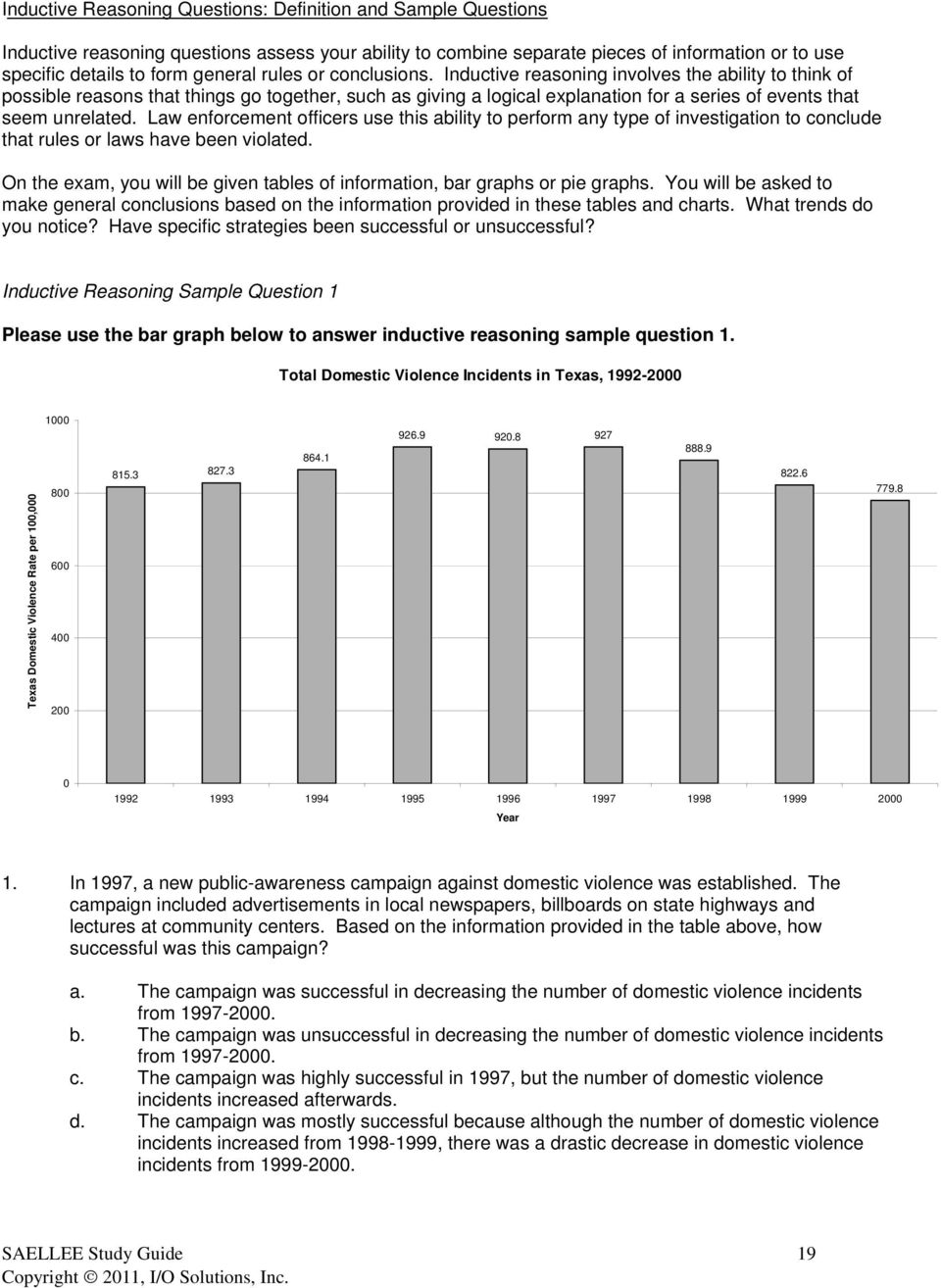
21 The answer to inductive reasoning sample question 1 is (a) The campaign was successful in decreasing the number of domestic violence incidents from , because if you look at the information presented in the table above, you will notice that the number of domestic violence incidents steadily decreased from Answers (b), (c) and (d) are all incorrect. The number of domestic violence incidents decreased from ; therefore, the campaign was not unsuccessful. The number of domestic violence incidents was highest in 1997 and decreased afterwards; therefore, the campaign would not have been wildly successful in 1997 and ineffective thereafter. Finally, although one could say that the campaign was mostly successful and although domestic violence incidents decreased from , they did not increase from Inductive Reasoning Sample Question 2 Use the following pie graphs to answer inductive reasoning sample question 2. Full-Time Law Enforcement Officers per County in 1998 Full-Time Law Enforcement Officers per County in 2000 Citrus 21% Bradford 3% Brown 3% Citrus 15% Bradford 3% Brown 2% Lake 3% Lake 5% Travis 47% Harris 25% Travis 52% Harris 21% 2. Which of the following conclusions can be drawn from the pie graphs above? I. The number of counties that increased their full-time law enforcement officer staff from 1998 to 2000 is greater than the number of counties that decreased their full-time law enforcement officer staff from 1998 to II. The number of counties that decreased their full-time law enforcement officer staff from 1998 to 2000 is greater than the number of counties that increased their full-time law enforcement officer staff from 1998 to III. Travis County had the greatest number of full-time law enforcement officers in both 1998 and a. I only b. II only c. III only d. II and III The correct answer to inductive reasoning sample question 2 is (d) II and III because statements II and III are both valid. Three counties decreased the number of their full-time law enforcement officers from 1998 to 2000; two counties increased the number of their full-time law enforcement officers from 1998 to 2000; SAELLEE Study Guide 20 Copyright 2011, I/O Solutions, Inc.
22 one county had the same number in both years. Also, Travis County had the biggest percentage of fulltime law enforcement officers in both years. Answers (a), (b) and (c) are all incorrect. Statement I is incorrect because more counties decreased rather than increased the number of their full-time law enforcement officers. Although statement II is correct, it is not the only conclusion that is valid. Similarly, statement III is correct, but it is not the only valid conclusion. Tips for improving your inductive reasoning abilities: Be sure to examine carefully every aspect of the charts or graphs provided and every part of the answer options. If you misread a number or a label, you obviously will not be able to reach the correct conclusion. You can practice your inductive reasoning skills by looking through a newspaper or a magazine for a chart or graph. Instead of reading the article or an explanation of the chart or graph, try forming your own conclusions about the data. Then read the article to see if you have reached a valid conclusion. Information Gathering Questions: Definition and Sample Questions Information gathering questions will measure your ability to follow correctly a rule or set of rules in order to arrange things or actions in a certain order. The things or actions must be put in order and may include numbers, letters, words, pictures, procedures, sentences and logical operations. Law enforcement officers use this skill when making arrests and issuing warrants. This skill is also used in applying first aid, following a procedure in operating equipment and arranging sentences in a meaningful paragraph. On the exam, some of the information gathering questions you will encounter will ask you to place five or six statements in either chronological or logical order. The statements could be part of a set of first-aid instructions, parts of policies or state laws. You may also encounter a passage featuring several witnesses statements and be asked to link information between the different witnesses. Information Gathering Sample Question 1 Please use the following information to answer information gathering sample question 1. Officer Hill has just finished interviewing the victim of a home invasion and assault. The following six statements appear in her account of the incident. 1. When I heard a loud pounding on our front door, I looked through the living room window and saw Charles Dixon, a friend of my boyfriend, standing outside. 2. Charles hit me repeatedly around my head, arms and shoulders with the baseball bat in the backyard. 3. I didn t want to answer the door because I knew that Charles was very angry with my boyfriend, and he had threatened us several times over the phone. 4. Charles kicked open the front door and chased me through the house. 5. I escaped the house through the back door in the kitchen, but Charles caught up with me in the backyard. 6. A neighbor heard my cries and chased Charles away. 1. What is the most logical order of these statements? a. 6, 1, 3, 5, 4, 2 b. 2, 4, 5, 3, 1, 6 c. 1, 3, 4, 5, 2, 6 d. 4, 3, 5, 2, 6, 1 SAELLEE Study Guide 21 Copyright 2011, I/O Solutions, Inc.
23 The correct answer to information gathering sample question 1 is (c) 1, 3, 4, 5, 2, 6. Answers (a), (b) and (d) are all incorrect. The statements should read as follows: (1) When I heard a loud pounding on our front door, I looked through the living room window and saw Charles Dixon, a friend of my boyfriend, standing outside. (3) I didn t want to answer the door because I knew that Charles was very angry with my boyfriend, and he had threatened us several times. (4) Charles kicked open the front door and chased me through the house. (5) I escaped the house through the back door in the kitchen, but Charles caught up with me in the backyard. (2) Charles hit me repeatedly around my head, arms and shoulders with the baseball bat in the backyard. (6) A neighbor heard my cries and chased Charles away. Information Gathering Sample Question 2 Witness 1: John Smith saw the suspect walking through the park while he was walking his dog after dinner. Witness 2: Helena Jones saw the suspect just before she left for work in the morning. She almost hit him as she was backing out of her driveway. Witness 3: Ronald Stewart saw the suspect getting a quick bite for lunch while he was having lunch himself at a nearby café. Witness 4: Christina Martinez saw the suspect as she was picking up her children from daycare after a long day at the office. 2. Who saw the suspect first? a. John Smith b. Helena Jones c. Ronald Stewart d. Christina Martinez The correct answer to information gathering sample question 2 is (b) Helena Jones because she saw the suspect in the morning before she left for work. Answers (a), (c) and (d) are all incorrect. John Smith saw the suspect in the evening (after dinner), Ronald Stewart saw the suspect at lunch time, and Christina Martinez saw the suspect after her work day. Tips to help you improve your information gathering skills: Look for word clues in the statements, such as before and after. See if any of the statements pair up in some way. For example, in information gathering sample question 1, the victim indicates that she heard a loud pounding on her door. The following statement reads, I didn t want to answer the door To practice information gathering, obtain a copy of a policy, a recipe, assembly instructions something that clearly must be done in a certain order. Cut out the individual steps or instructions; mix them up and then see if you can rearrange them so that they are once again in their original, or most logical, order. SAELLEE Study Guide 22 Copyright 2011, I/O Solutions, Inc.
24 Chapter Six: Behavioral-Orientation Section The behavioral-orientation section of the exam is different than the cognitive section. There are no obvious "correct" or "incorrect" responses to these types of items as there are for the cognitive questions. The goal of the behavioral-orientation component is to compare your attitudes and behavioral characteristics to those of successful criminal justice officers in San Antonio. Therefore, the closer your responses are in-match to those of successful officers, the higher you will score on this section, and the higher the likelihood that you will be successful on the job. You will be presented with multiple statements, and will be asked to use the scale below to rate how much you agree with the statement. A sample question is provided: The following five-point scale should be used to indicate your response to each statement presented: Strongly Agree Agree Not Sure Disagree Strongly Disagree 1. I wish to do well on this exam Since you strongly agree with this statement, the correct answer choice is 1. In this case, answer choice 1 indicates that you strongly agree that you wish to do well on this exam. Guidelines for Behavioral-Orientation Questions Responses should be an indication of how you feel about the statement. For example, avoid answering strongly unless you truly feel strongly. Mark not sure if you re truly in-between agreeing and disagreeing with the statement. Respond honestly to each statement. Don t spend too much time thinking about the statement. A good guideline for answering these types of items is to put down the first response that feels right. Use the full response scale (1-5). There are differences in agreeing and strongly agreeing with a statement, make sure you are indicating these differences. A Candidness Scale is imbedded in the behavioral-orientation test to detect if candidates are attempting to answer the questions based on looking good instead of being truthful. Don t try to answer how you think you should, but how you truly feel. Ensure you answer all of these questions. This section is as important as the cognitive component of the NCJOSI 2!! SAELLEE Study Guide 23 Copyright 2011, I/O Solutions, Inc.
25 Chapter Seven: Additional Test-Taking Strategies Throughout this study guide, we have offered you tips on how to improve your skills in each of the competency areas that will be measured on the exam. In this chapter, we will provide you with additional tips to help you do your best on the day of the exam. Before the exam: Have a good night s sleep Make sure that you get a good night s sleep the night before the exam so that you are rested and relaxed on the day of the test. On the day of the exam: Arrive on time It is crucial that you arrive on time! Punctuality will demonstrate your enthusiasm for a career in law enforcement. Besides, candidates who arrive late for a test are often turned away. We strongly recommend that you make plans to arrive early. Allow time for traffic delays, bad weather and any other holdups that may arise on the day of the test. Be Confident Stay confident! A confident and positive attitude will help you to do your best on the exam. Keep in mind that although you should view the exam as a challenge, try not to succumb to stress and testtaking anxiety. Remember that by carefully reading this study guide, you have prepared yourself for the exam. Guessing strategies for the cognitive exam: Pace yourself Remember that you should pace yourself so that you can read and carefully consider each question. Only correct answers are counted Only correct answers will be counted as part of your score. A wild guess would be better than a blank space. You will not be penalized for a wrong answer, and you may just guess the right answer. If you see that you are running out of time, mark the remaining spaces with the same answer. Statistically, some of these answers will be right. Make an educated guess If possible, try to make an educated guess rather than a wild guess. Try to eliminate the answer choices you know to be wrong and try to reason among the answers that remain. If you still do not know the answer, make a guess from the answers that remain. The odds of a right answer will increase if you can guess between two or three answers instead of four. Mark questions that you have guessed in your booklet When you make a guess, note that question in your memory or on scratch paper so that you can return to that question if time remains. On the exam: Read for overall meaning If you cannot understand the meaning of a word in a sentence or passage, reread the entire passage for the general or overall meaning of the selection. By looking at the context, or the words and phrases around the unfamiliar word, you may be able to determine the meaning of the unfamiliar word. Carefully read each answer option Keep in mind that incorrect answers are sometimes designed to divert or distract you from the correct response. Carefully read each answer option. Even if the option contains exact words or phrases from an accompanying passage, this does not guarantee that that option will be the correct answer. Watch out for answer options that contain the words only, always, never and all. Make sure that you carefully read any passages accompanying the question to determine whether an answer option is accurate or an exaggeration. This does not mean that any answer option containing the words listed above is automatically incorrect. Again, you must carefully read the accompanying passage to determine the validity of an answer option. Good luck on the exam! SAELLEE Study Guide 24 Copyright 2011, I/O Solutions, Inc.
Florida Criminal Justice Basic Abilities Tests
 CJBAT Test Preparation for Law Enforcement Officer and C Corrections i Officer Offi C Candidates did Provided by I/O Solutions, Inc. 2010 Florida Criminal Justice Basic Abilities Tests What is the CJBAT?
POLICE OFFICER ENTRANCE EXAM STUDY GUIDE
 ENTRANCE EXAM STUDY GUIDE The Entrance Exam for police officers measures the basic skills necessary to perform successfully as a police officer. The test covers four areas: (1) math skills, (2) reading
Study Guide for the Deputy Recruit Written Exam
 Study Guide for the Deputy Recruit Written Exam For the Washoe County Sheriff s Office Purpose of this guide: This guide was developed to assist you in doing your best on the entry-level Deputy Recruit/POST
Denver Police Department. Written Test Study Guide
 Denver Police Department Written Test Study Guide R:\EXAMS\POL-ENT\Test Preparation Guide.doc 11/09/2005 TEST PREPARATION One of the first steps toward becoming a Police Officer for the City and County
ENTRY LEVEL FIREFIGHTER EXAM STUDY GUIDE
 ENTRY LEVEL FIREFIGHTER EXAM STUDY GUIDE AUSTIN FIRE DEPARTMENT MORRIS & MCDANIEL Copyright 2015, Morris & McDaniel, Inc. TABLE OF CONTENTS INTRODUCTION 1 GENERAL WRITTEN EXAM INFORMATION 1 WRITTEN EXAM
Law Enforcement Aptitude Battery. Assessment Preparation Guide
 . EB Jacobs, LLC 300 South Burrowes Street State College, PA 16801 EB Jacobs Law Enforcement Aptitude Battery Assessment Preparation Guide.......... Computer Administration Version - Version 5 Copyright
WHAT SHOULD I DO IF I HAVE AN AUTO ACCIDENT? 1. If I have an auto accident, do I have to stop? 2. What should I do if someone is injured?
 WHAT SHOULD I DO IF I HAVE AN AUTO ACCIDENT? 1. If I have an auto accident, do I have to stop? 2. What should I do if someone is injured? 3. How can I get help? 4. What information should I gather at the
Chicago Police Officer Examination - CPOE Preparation Guide
 . INSERT COVER PAGE Chicago Police Officer Examination - CPOE Preparation Guide COPYRIGHT 2013 by Industrial/Organizational Solutions, Inc. Industrial/Organizational Solutions, Inc. (I/O Solutions) is
Alberta Police Cognitive Ability Test (APCAT) Candidate Brochure 1
 Alberta Police Cognitive Ability Test (APCAT) Candidate Brochure 1 General Information about the APCAT Q1. What does the APCAT measure? A1. The APCAT test measures one s potential to successfully complete
What to Expect on the Compass
 What to Expect on the Compass What is the Compass? COMPASS is a set of untimed computer adaptive tests created by the American College Test (ACT) Program. Because COMPASS tests are "computer adaptive,"
Public Safety Communciations Pre-Employment Test Preparation Guide
 Public Safety Communciations Pre-Employment Test Preparation Guide The computerized CritiCall pre-employment test used by this agency measures underlying skills and abilities a person needs to possess
City of Portland. Police Written Test Guide
 City of Portland Police Written Test Guide City of Portland Police Written Test Guide About This Informational Guide This information guide is designed to familiarize you with the City of Portland Police
Preparing for the Test
 This Applicant Preparation Guide has been prepared to assist you in your preparation for the City of Richmond Police Officer s Entrance Examination. The information contained in this guide is intended
Albuquerque Fire Department Training Division Fire Cadet Applicant Handbook and Written Test Study Guide
 Albuquerque Fire Department Training Division Fire Cadet Applicant Handbook and Written Test Study Guide This booklet provides information regarding the position of Fire Cadet with the City of Albuquerque.
Q. Officer, I am placing a copy of your department report face down in front of you.
 GateWay Community College Phoenix, AZ Q/A Dictation (20 word Count) Q. Officer, I am placing a copy of your department report face down in front of you. Please feel free to use that document at any time
Bicycle riding is a great way to get into shape
 Bicycle riding is a great way to get into shape and have fun. To remain safe on Illinois roads, it is important to follow the same traffic safety laws that govern vehicle drivers. No amount of bicycle
DRIVING RELATED ISSUES. Student Legal Service University of Illinois at Urbana-Champaign
 DRIVING RELATED ISSUES Student Legal Service University of Illinois at Urbana-Champaign License Issues You are not required to obtain an Illinois Driver s license while you are enrolled as a student in
Question Specifications for the Cognitive Test Protocol
 Question Specifications for the Cognitive Test Protocol Core Questions These are the 6 disability questions to be tested in the interview. All of the other questions in the cognitive test protocol are
Black Diamond Police Department Public Information Log
 Black Diamond Police Department Public Information Log 150000304 Hit&Run, Property Damage Traffic Accident, Hit and Run Black Diamond Police Dept 25510 Lawson ST, Incident Address: 294 216TH AVE SE Time
East Haven Police Department
 East Haven Police Department Type of Directive: Policies & Procedures No. 410.2 Subject/Title: Issue Date: Preliminary Criminal Investigations July 29, 2014 Effective Date: References/Attachments: N/A
APTITUDE TEST PREPARATION GUIDE
 APTITUDE TEST PREPARATION GUIDE The Fire Service Aptitude Test measures your skills and aptitude to become a firefighter. You do not require prior firefighter knowledge or experience to pass the aptitude
Lowcountry Injury Law
 Lowcountry Injury Law 1917 Lovejoy Street Post Office Drawer 850 Beaufort, South Carolina 29901 Personal Injury Phone (843) 524-9445 Auto Accidents Fax (843) 524-6981 Workers Comp [email protected]
SUPERIOR COURT OF CALIFORNIA, COUNTY OF CONTRA COSTA. Mock Trial Script. The Case of a Stolen Car
 SUPERIOR COURT OF CALIFORNIA, COUNTY OF CONTRA COSTA Mock Trial Script The Case of a Stolen Car This mock trial is appropriate for middle and high school students. The script includes a role for a narrator,
The Derry Police Department. Neighborhood Watch Packet
 The Derry Police Department Neighborhood Watch Packet Derry Police Department NEIGHBORHOOD WATCH PROGRAM WHAT IS A NEIGHBORHOOD WATCH? A Neighborhood Watch is a crime prevention program that stresses education
City of Elkins Motor Vehicle Policy Adopted by Elkins City Council October 22, 2015 Revised:
 City of Elkins Motor Vehicle Policy Adopted by Elkins City Council October 22, 2015 Revised: Contents 1. Introduction... 2 2. Applicability of this Policy... 2 3. Policies Applicable to All City Vehicles...
MIDDLETON SCHOOL DISTRICT #134 POLICY AND PROCEDURE MANUAL SECTION 800 Business Procedures. Conditions for Use of District Vehicles...
 MIDDLETON SCHOOL DISTRICT #134 POLICY AND PROCEDURE MANUAL SECTION 800 Business Procedures Conditions for Use of District Vehicles...POLICY 808 OVERVIEW As a driver of a Middleton School District vehicle,
Bicycle Safety Quiz Answers Parental Responsibilities
 Bicycle riding is a great way to get into shape and enjoy the outdoors. To remain safe on Illinois roads, it is important to follow the same traffic safety laws that govern vehicle drivers. No amount of
2014 FIREFIGHTER EXAM CANDIDATE PREPARATION GUIDE
 COMMONWEALTH OF MASSACHUSETTS Human Resources Division 2014 FIREFIGHTER EXAM CANDIDATE PREPARATION GUIDE EB Jacobs, LLC State College, PA Copyright by EB Jacobs, LLC. All rights reserved. TABLE OF CONTENTS
Candidate Orientation Booklet Probation Officer Examination
 California Board of Corrections Standards and Training for Corrections Program Candidate Orientation Booklet Probation Officer Examination October 2003 In preparing the Probation Officer Examination for
CHANDLER POLICE DEPARTMENT GENERAL ORDERS Serving with Courage, Pride, and Dedication
 CHANDLER POLICE DEPARTMENT GENERAL ORDERS Serving with Courage, Pride, and Dedication Order G-02 ACCIDENT INVESTIGATION Subject 200 Special Situations Effective 12/28/12 Rev Summary This order addresses
*****THIS FORM IS NOT A PROTECTIVE ORDER APPLICATION OR A PROTECTIVE ORDER*****
 SHAREN WILSON CRIMINAL DISTRICT ATTORNEY OF TARRANT COUNTY, TEXAS PROTECTIVE ORDER UNIT Family Law Center Phone Number 817-884-1623 200 East Weatherford Street # 3040 Fax Number 817-212-7393 Fort Worth,
Written Examination Orientation and Preparation Guide City of Tulsa Police Department
 Written Examination Orientation and Preparation Guide City of Tulsa Police Department Developed by I/O Solutions, Inc. Section Table of Contents Page Introduction... 1 Objectives of the Orientation and
WHAT SHOULD I DO IF I HAVE AN AUTO ACCIDENT? GET THE L E G A L F A C T S
 T H E S TAT E B A R O F C A L I F O R N I A WHAT SHOULD I DO IF I HAVE AN AUTO ACCIDENT? GET THE L E G A L F A C T S O F L I F E What should I do if I have an 1 a u t o a c c i d e n t? If I have an auto
Border Patrol Promotional Assessment Process Preparation Manual for Critical Thinking Skills Assessment
 Border Patrol Promotional Assessment Process Preparation Manual for Critical Thinking Skills Assessment Personnel Research and Assessment Division Office of Human Resources Management Updated January 2011
LAKE CITY POLICE DEPARTMENT GENERAL ORDERS MANUAL
 LAKE CITY POLICE DEPARTMENT GENERAL ORDERS MANUAL SUBJECT CHIEF OF POLICE Traffic Crash Investigations Signature on File NUMBER 119 ISSUE DATE December 30, 2011 REVISION DATE TOTAL PAGES 8 AUTHORITY/RELATED
*****THIS FORM IS NOT A PROTECTIVE ORDER APPLICATION OR A PROTECTIVE ORDER*****
 SHAREN WILSON CRIMINAL DISTRICT ATTORNEY OF TARRANT COUNTY, TEXAS PROTECTIVE ORDERS Family Law Center Phone Number 817-884-1623 200 East Weatherford Street # 3040 Fax Number 817-212-7393 Fort Worth, Texas
FIREFIGHTER TESTING PROCESS
 FIREFIGHTER TESTING PROCESS VILLAGE OF SCHAUMBURG FIREFIGHTER TESTING PROCESS Notice is hereby given that the Board of Fire and Police Commissioners of the Village of Schaumburg will initiate the testing
Safety-conscious Drivers Prevent Crashes. Defensive Driving: Managing Visibility, Time and Space. Improve Your Defensive Driving Skills
 Defensive Driving: Managing Visibility, Time and Space Motor vehicle travel is the primary means of travel in the United States. With all the benefits that come along with mobility, there are thousands
Scholastic Reading Inventory Software Manual
 Scholastic Reading Inventory Software Manual For use with Scholastic Reading Inventory version 2.1 or later and Scholastic Achievement Manager version 2.1 or later Copyright 2012 by Scholastic Inc. All
Guide to Preparing for Your Written Employment Test
 Guide to Preparing for Your Written Employment Test Lisa M. Garrett, Director of Personnel Table of Contents Introduction... 3 Who Should Use this Guide?... 3 Disclaimer... 3 General Information About
Study Guide and Sample Test for The National Police Officer Selection Test
 Study Guide and Sample Test for The National Police Officer Selection Test Provided By 2009, Stanard & Associates, Inc. All rights reserved. National Police Officer Selection Test (POST) Study Guide Table
MOTOR VEHICLES, ACCIDENTS AND ALCOHOL
 MOTOR VEHICLES, ACCIDENTS AND ALCOHOL This is a guide to what you must and should do if you: are involved in a motor accident; have dealings with a police officer involving a motor vehicle; are required
MUNICIPAL POLICE SELECTION TEST CANDIDATE INFORMATION BOOKLET
 MUNICIPAL POLICE SELECTION TEST CANDIDATE INFORMATION BOOKLET Purpose of this Information Booklet This Candidate Information Booklet is designed to help you in preparing to take the Baltimore City Police
PREPARATION GUIDE FOR WRITTEN TESTS
 PREPARATION GUIDE FOR WRITTEN TESTS Prepared by: The Department of Administrative Services Human Resources Management August 2004 GENERAL INFORMATION ON WRITTEN TESTS Two types of questions are often used
Investigation Techniques, Planning and Report Writing
 Investigation Techniques, Planning and Report Writing AGENDA Field Notes and Report Writing Observation Skills and Memory Incident Scene Procedures Interviewing Techniques SUPPLEMENTAL Investigation and
POLICES & PROCEDURES
 POLICES & PROCEDURES ACCIDENTS Any accident occurring at the workplace should be reported immediately to the on-site supervisor and the teacher. An accident is defined as an injury requiring doctor or
It is vital that you understand the rationale behind the correct answer(s) as wel as the incorrect answer options.
 Getting the Most out of ATI www.atitesting.com What is ATI? ATI is an online resource that will be used throughout the nursing program to help you learn about nursing practice as well as help prepare you
California Conservation Corps. Corpsmember Advisory Board. Handbook
 California Conservation Corps Corpsmember Advisory Board Handbook Last updated on January 26, 2010 Table of Contents Introduction..........................................................................
The Price You ll Pay...
 The Price You ll Pay... DUI in North Dakota December 2012 DL1212 Ten Tips to Save Your Life Always plan ahead. If you wait until you start drinking to figure out how you ll get home, it s too late. Designate
MONROE COUNTY SHERIFF S OFFICE
 MONROE COUNTY SHERIFF S OFFICE CLASS TITLE: COMMUNICATIONS OFFICER Pay Range: 11 Exempt: No Shift: 12 HR w/o Holidays This position is classified as a critical position and involves receiving incoming
Personal Injury? What to Do?
 Personal Injury? What to Do? 1 If you have been involved in a road traffic accident, an accident at work or an accident in a public place, you may be liable for a compensation! Every personal injury case
PEDESTRIAN LAWS OF NORTH CAROLINA
 PEDESTRIAN LAWS OF NORTH CAROLINA Under North Carolina law, pedestrians have the right of way at all intersections and driveways. However, pedestrians must act responsibly, using pedestrian signals where
OREGON TRAFFIC ACCIDENT AND INSURANCE REPORT
 DMV OREGON TRAFFIC ACCIDENT AND INSURANCE REPORT Tear this sheet off your report, read and carefully follow the directions. ONLY drivers involved in an accident resulting in any of the following MUST file
PTE Academic Test Tips
 PTE Academic Test Tips V2 August 2011 Pearson Education Ltd 2011. All rights reserved; no part of this publication may be reproduced without the prior written permission of Pearson Education Ltd. Important
what to do in case of an auto accident
 what to do in case of an auto accident Keep this pamphlet with a pencil and paper and your insurance card in your car. What These Words Mean Scene The place where the accident happened. Witness A person
Test of English for Aviation. Guide for: Test-takers & Teachers
 Guide for: Test-takers & Teachers What is the TEA test? TEA is a test of your ability to communicate in English it is not a test of your operational knowledge. TEA is a test of plain English in an aviation
Entry-Level Correction Officer Series
 New York State Department of Civil Service Committed to Innovation, Quality, and Excellence A Guide to the Written Test for the Entry-Level Correction Officer Series Andrew M. Cuomo Governor Jerry Boone
County Court Restraining Orders
 Answers to Your Questions About County Court Restraining Orders Excellence in Customer Service Colorado Judicial Branch http://www.courts.state.co.us June 2002 CIVIL LAW In a civil case, the person seeking
Driver Certification
 Driver Certification Environmental Health & Safety/Risk Management Department of Campus Operations 300 College Park Dayton, Ohio 45469-2904 937-229-4503 Agenda: Part I: Review of UD Driver Certification
Guidelines for Setting up Security Measures to Stop Domestic Violence in the Workplace
 Guidelines for Setting up Security Measures to Stop Domestic Violence in the Workplace As of June 15, 2010, all employers in Ontario are responsible for protecting workers when domestic violence follows
PROFESSIONAL RESPONSIBILITY Copyright February 1997 - State Bar of California
 Copyright February 1997 - State Bar of California David has been arrested for and charged with murder and robbery. David made a telephone call to Attorney, a member of the California Bar. Attorney came
International Test of English Proficiency itep Business Orientation Guide
 International Test of English Proficiency itep Business Orientation Guide www.itepexam.com itep...ready When You Are! Table of Contents I. Overview: itep Business...1 A. What to Expect on Exam Day...2
How to Use the California Identity Theft Registry
 How to Use the California Identity Theft Registry A Guide for Victims of Criminal Identity Theft Tips for Consumers Consumer Information Sheet 8 June 2014 What Is Criminal Identity Theft?...1 How You May
Representing Yourself in Court: A Guilty Plea
 Representing Yourself in Court: A Guilty Plea In an ideal world, anyone who has been charged with a criminal offence should have a lawyer handling their case and representing them in court. However you
How To Tell Someone You Were Injured In A Car Accident
 Personal Injury Questionnaire Answer each question fully and accurately. Success in this case depends on mutual confidence and complete cooperation between you (as the client) and the attorney. It is imperative
DMV. OREGON TRAFFIC ACCIDENT AND INSURANCE REPORT Tear this sheet off your report, read and carefully follow the directions.
 OREGON TRAFFIC ACCIDENT AND INSURANCE REPORT Tear this sheet off your report, read and carefully follow the directions. ONLY drivers involved in an accident resulting in any of the following MUST file
Crisis Management Guide
 Crisis Management Guide The Crisis Management Guide has been designed to help your company effectively respond to a crisis situation. Crises, large and small can be minimized if a thorough Crisis Management
LESSONS OF AN EXPERIENCED NEW YORK BIKE ACCIDENT LAWYER
 April 2009 BIKING IN NYC LESSONS OF AN EXPERIENCED NEW YORK BIKE ACCIDENT LAWYER The Perils Of Bicycle Riding In New York City- Here s What You Need To Know EVER BEEN DOORED? I have. EVER BEEN CUT OFF
Motor Vehicle Operations Program
 Motor Vehicle Operations Program July 31, 2008 Introduction The Texas Transportation Institute (TTI) is committed to providing a safe and healthful environment for its employees and visitors. All activities
Back to School Car Safety. Direct Buy Warranty Staff September 19, 2014
 Back to School Car Safety Direct Buy Warranty Staff September 19, 2014 It s back to school season, and that means kids are picking out new clothes, putting on their backpacks, and hitting the road to get
NATIONAL MS SOCIETY LONE STAR CHAPTER MS 150 RIDE MARSHAL MANUAL
 NATIONAL MS SOCIETY LONE STAR CHAPTER MS 150 RIDE MARSHAL MANUAL RIDE MARSHAL OVERVIEW AND REQUIREMENTS RIDE MARSHAL PURPOSE Ride Marshals perform two important functions for the MS Society. As cyclists
Law & The Courts Resource Guide
 Law & The Courts Resource Guide - what to do in case of an auto accident - your rights in traffic court - your rights if arrested table of contents What To Do In Case Of An Auto Accident...1 Your Rights
PRESCOTT POLICE DEPARTMENT
 PRESCOTT POLICE DEPARTMENT FORMING A NEIGHBORHOOD WATCH PROGRAM WHAT IS NEIGHBORHOOD WATCH? Crime or the fear of crime provides the impetus for residents to become better informed on how to protect themselves
Drinking, Drugs & Health
 Chapter 6 Drinking, Drugs & Health Drinking, Drugs & Health 103 104 104 106 106 107 107 108 Effects of Alcohol How Much is Too Much? Drinking and Driving Good Hosts and the Drinking Driver Designated Drivers
THE INFORMATIONAL INTERVIEW Networking with Career Professionals
 THE INFORMATIONAL INTERVIEW Networking with Career Professionals SUNY College at Potsdam Career Planning, Sisson Hall 130, Phone 267-2344 Web: www.potsdam.edu/career e-mail: career@ potsdam.edu WHAT IS
Auto Accident Victim s Guide
 Auto Accident Victim s Guide An auto accident is a traumatic experience and the moments afterward seem to race by in a blur. It s hard to keep track of all the details, information and choices you make
Cambridge English: First (FCE) Frequently Asked Questions (FAQs)
 Cambridge English: First (FCE) Frequently Asked Questions (FAQs) Is there a wordlist for Cambridge English: First exams? No. Examinations that are at CEFR Level B2 (independent user), or above such as
WHAT TO DO Immediately After Being Involved in an Auto Accident
 WHAT TO DO Immediately After Being Involved in an Auto Accident BY EDDIE E. FARAH & CHARLIE E. FARAH, ATTORNEYS AT LAW If a person is seriously injured, do not move them unless they are in imminent danger.
Journal. A workbook designed to organize and survey your incident & injury throughout the road to recovery. tywilsonlaw.
 YOUR INJURY Journal A workbook designed to organize and survey your incident & injury throughout the road to recovery SLIP/FALL CAR ACCIDENT WORKERS COMP TY WILSON LAW tywilsonlaw.com 866-937-5454 YOUR
REQUEST FOR TECHNICAL CHANGE. Criminal Justice Education and Training Standards Commission
 REQUEST FOR TECHNICAL CHANGE AGENCY: Criminal Justice Education and Training Standards Commission RULE CITATION: ALL RULES DEADLINE FOR RECEIPT: October, 0 NOTE WELL: This request when viewed on computer
IN RE: : CITY OF PHILADELPHIA CALVIN BUTLER, JR. : POLICE ADVISORY COMMISSION. : No. 95-0192 PANEL REPORT AND RECOMMENDATION
 IN RE: : CITY OF PHILADELPHIA CALVIN BUTLER, JR. : POLICE ADVISORY COMMISSION : No. 95-0192 Before: Uyehara, Ray and Savitt, Commissioners PANEL REPORT AND RECOMMENDATION I. INTRODUCTION Calvin Butler,
Transitional Colorado Assessment Program
 Transitional Colorado Assessment Program 2014 TCAP TEST PROCTOR S MANUAL grades 3 and 4 ENGLISH AND SPANISH Not a secure document 2705019-W Transitional Colorado Assessment Program TEST security requirements
HELPFUL TIPS AFTER A CAR ACCIDENT
 HELPFUL TIPS AFTER A CAR ACCIDENT A PRACTICAL GUIDE BY ERIN M. HARGIS, ESQ A car accident can be a very traumatic and stressful event and it may be difficult to think clearly if you have just been involved
Looking after health, safety and welfare at work
 Looking after health, safety and welfare at work Clocking In to Clocking Out Improving workplace basic education Published by: FÁS National Adult Literacy Agency (NALA) Skills for Work 76 Lower Gardiner
Alzheimer s disease Guide for law enforcement
 Alzheimer s disease Guide for law enforcement Law enforcement and Alzheimer s disease As our population ages, the number of people with Alzheimer s continues to grow as does the likelihood that you will
Examinations Page 1 MODULE 2 STUDENT GUIDE TO NOTE TAKING
 Examinations Page 1 MODULE 2 STUDENT GUIDE TO NOTE TAKING Examinations Page 2 Why take notes? I have a good memory: It s just short" o s t o f u s c a n r e l a t e t o t h i s q u o t e. H a v e y o u
Model Fleet Safety Program Short
 TM Model Fleet Safety Program Short CORPORATE HEADQUARTERS 518 EAST BROAD STREET COLUMBUS, OHIO 43215 614.464.5000 STATEAUTO.COM TM Disclaimer: The information contained in this publication was obtained
SafeMinistryTraining.com.au Course Notes
 SafeMinistryTraining.com.au Course Notes 1. Introduction Welcome to the Safe Ministry Training course. We all want our churches to be safe places for everyone kids as well as adults. The purpose of this
Credit Cards. The Language of Credit. Student Loans. Installment Loans 12/17/2015. Quick Response. Unit 4 - Good Debt, Bad Debt: Using Credit Wisely
 Quick Response Explain how you think credit cards work. How much do you have to pay every month? What happens if you pay late? What kinds of fees are involved? Unit 4 - Good Debt, Bad Debt: Using Credit
Auto Insurance for New Mexico s Young Drivers
 Auto Insurance for New Mexico s Young Drivers Prepared for New Mexico s Young Drivers and Their Parents by: One of the major events in many people s lives is earning the privilege of driving a motor vehicle.
FMCSA Webinar Nov.18th to Examine Large Truck Crash Fatalities Involving Pedestrians & Bicyclists. New Technology for Better Fleet Management
 In This Issue: FMCSA Webinar Nov.18th to Examine Large Truck Crash Fatalities Involving Pedestrians & Bicyclists Help Prevent Roadway Accidents involving Pedestrians How to Steer Clear of Accidents with
VITAL CHOICES: DRINKING, DRIVING & SEAT BELTS
 VITAL CHOICES: DRINKING, DRIVING & SEAT BELTS This easy-to-use Leader s Guide is provided to assist in conducting a successful presentation. Featured are: INTRODUCTION: A brief description of the program
SOUTH CAROLINA BAR. Auto Accidents and the Law
 SOUTH CAROLINA BAR Auto Accidents and the Law BE PREPARED Because accidents happen to even the best of drivers, everyone should be prepared to do the right things immediately afterward. Many legal troubles
Sample Questions for Series 8100 PROFESSIONAL LEVEL EXAM (PLE)
 Louisiana Department of State Civil Service Sample Questions for Series 8100 PROFESSIONAL LEVEL EXAM (PLE) This booklet contains SAMPLE QUESTIONS ONLY. None of the questions in this booklet are actual
Candidate Orientation Booklet Juvenile Corrections Officer Examination
 Corrections Standards Authority Standards and Training for Corrections Program Candidate Orientation Booklet Juvenile Corrections Officer Examination December 2006 In preparing the Juvenile Corrections
MEDICAL UNIVERSITY OF SOUTH CAROLINA DEPARTMENT OF PUBLIC SAFETY. of Prisoners
 MEDICAL UNIVERSITY OF SOUTH CAROLINA DEPARTMENT OF PUBLIC SAFETY SUBJECT: Searching and Transportation of Prisoners EFFECTIVE DATE: 1 January 1999 PAGE 1 OF 10 REVIEW DATE: 30 November 2015 APPROVED: CHANGE
2. Suppose you have an 8 oz glass of wine. How many standard drinks is this?
 Math 212 Drinking and Driving Project Part I: Reading the Charts Every year, people are killed in accidents due to driving while intoxicated. This project will examine the effects of drinking on a person
Comprehensive Medical Billing and Coding Student CD Quick Start Guide By Deborah Vines, Ann Braceland, Elizabeth Rollins
 Comprehensive Medical Billing and Coding Student CD Quick Start Guide By Deborah Vines, Ann Braceland, Elizabeth Rollins Welcome! In this CD that accompanies your Comprehensive Medical Billing and Coding