
Nordex SE: Performance indicators at a glance
|
|
|
- Stewart Harrington
- 10 years ago
- Views:
Transcription
1 Annual Report 2009
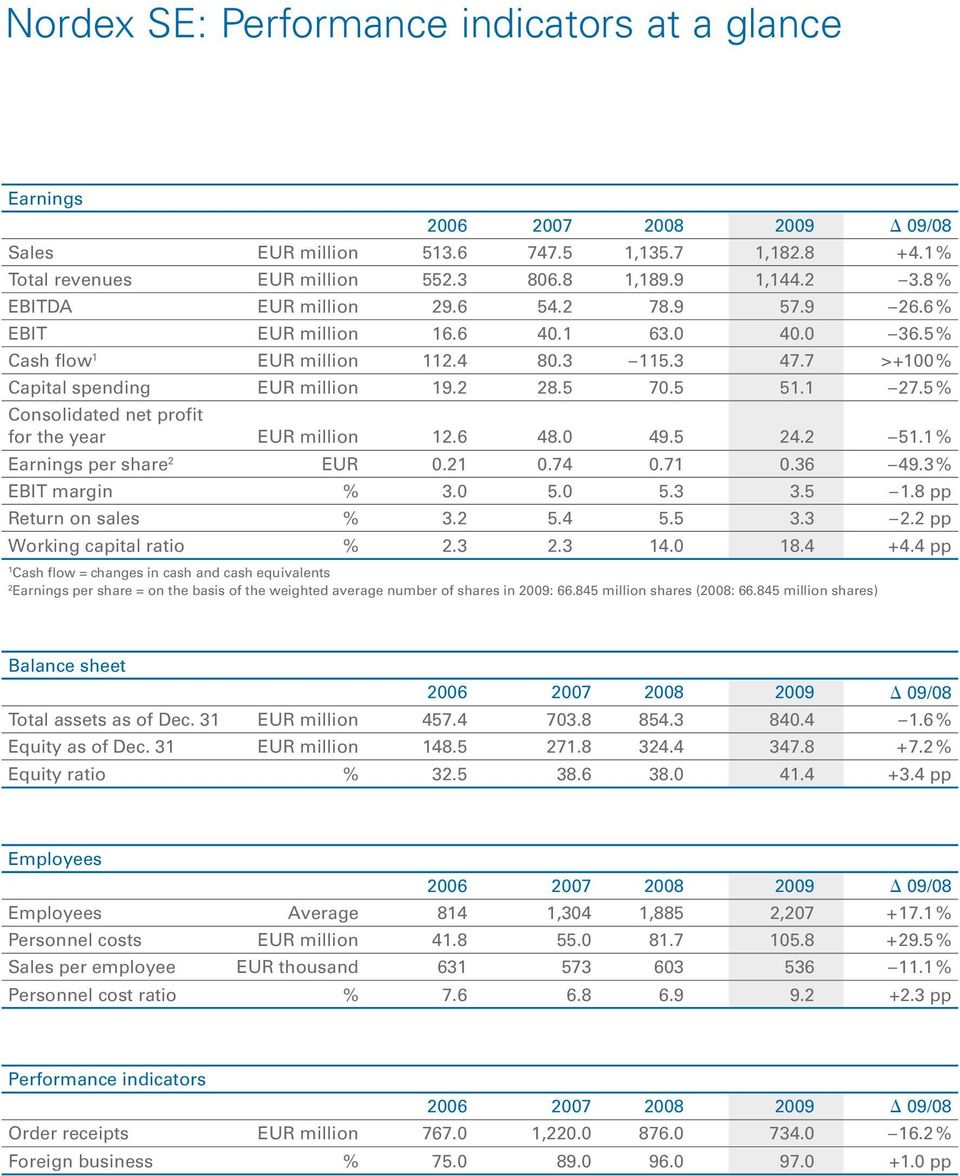
2 Nordex SE: Performance indicators at a glance Earnings /08 Sales million , , % Total revenues million , , % EBITDA million % EBIT million % Cash flow 1 million >+100 % Capital spending million % Consolidated net profit for the year million % Earnings per share % EBIT margin % pp Return on sales % pp Working capital ratio % pp 1 Cash flow = changes in cash and cash equivalents 2 Earnings per share = on the basis of the weighted average number of shares in 2009: million shares (2008: million shares) Balance sheet /08 Total assets as of Dec. 31 million % Equity as of Dec. 31 million % Equity ratio % pp Employees /08 Employees Average 814 1,304 1,885 2, % Personnel costs million % Sales per employee % Personnel cost ratio % pp Performance indicators /08 Order receipts million , % Foreign business % pp
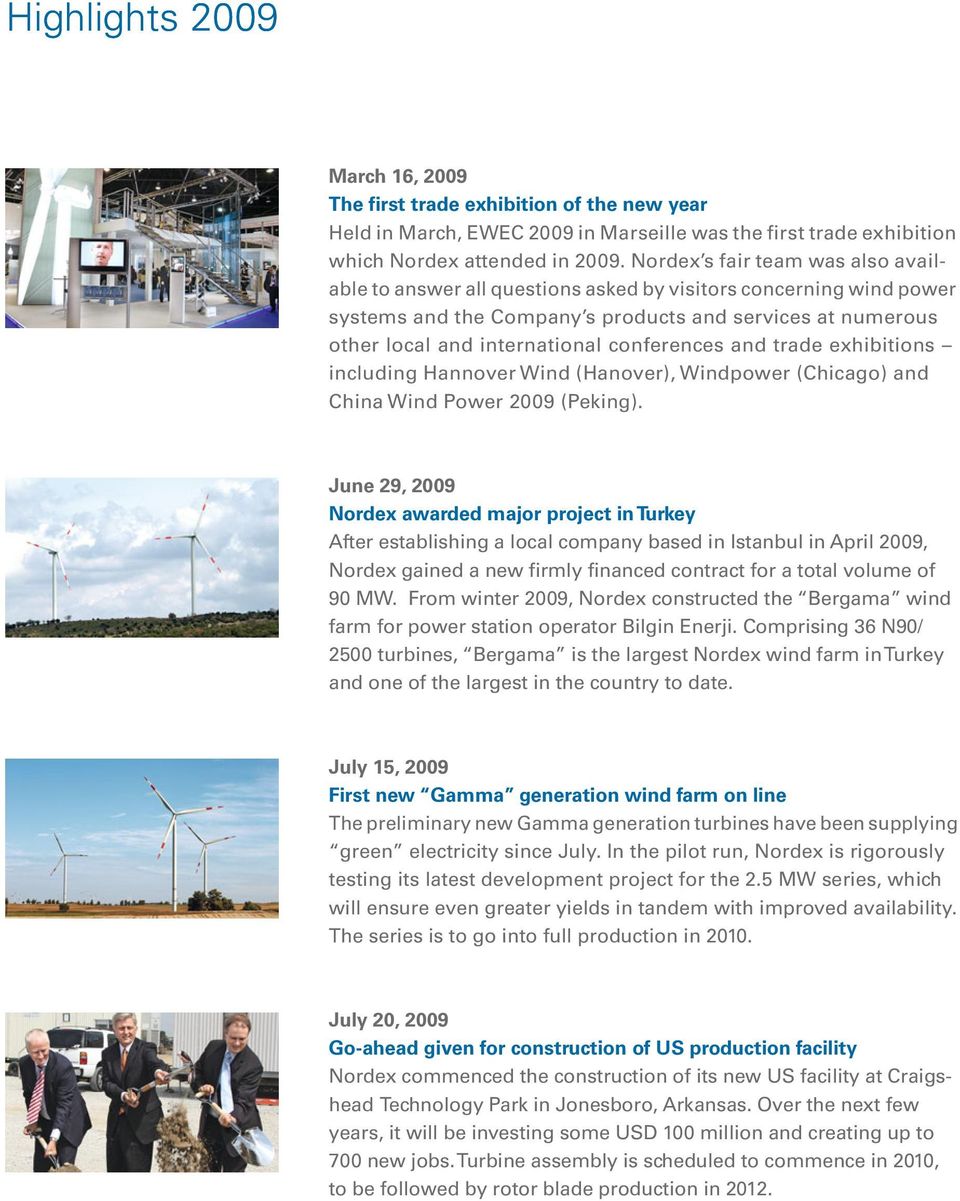
3 Highlights 2009 March 16, 2009 The first trade exhibition of the new year Held in March, EWEC 2009 in Marseille was the first trade exhibition which Nordex attended in Nordex s fair team was also available to answer all questions asked by visitors concerning wind power systems and the Company s products and services at numerous other local and international conferences and trade exhibitions including Hannover Wind (Hanover), Windpower (Chicago) and China Wind Power 2009 (Peking). June 29, 2009 Nordex awarded major project in Turkey After establishing a local company based in Istanbul in April 2009, Nordex gained a new firmly financed contract for a total volume of 90 MW. From winter 2009, Nordex constructed the Bergama wind farm for power station operator Bilgin Enerji. Comprising 36 N90/ 2500 turbines, Bergama is the largest Nordex wind farm in Turkey and one of the largest in the country to date. July 15, 2009 First new Gamma generation wind farm on line The preliminary new Gamma generation turbines have been supplying green electricity since July. In the pilot run, Nordex is rigorously testing its latest development project for the 2.5 MW series, which will ensure even greater yields in tandem with improved availability. The series is to go into full production in July 20, 2009 Go-ahead given for construction of US production facility Nordex commenced the construction of its new US facility at Craigshead Technology Park in Jonesboro, Arkansas. Over the next few years, it will be investing some USD 100 million and creating up to 700 new jobs. Turbine assembly is scheduled to commence in 2010, to be followed by rotor blade production in 2012.
4 August 13, 2009 Nordex s largest US wind farm to date completed Nordex placed 25 wind turbines with an installed nominal capacity of a total of 62.5 MW on line in Pennsylvania for US project developer EverPower Wind Holdings Inc. Known as Highland, this was the largest wind farm assembled by Nordex in the United States to date. The N90/2500 turbines are able to supply around 20,000 US households a year with clean electricity, thus preventing the emission of 115,000 tons of harmful carbon dioxide. September 2, 2009 Foundations laid for Nordex Forum in Hamburg-Langenhorn Nordex s head office will be located in an ecological new building in the Langenhorn suburb of Hamburg in the future. Together with members of the management boards of Nordex and Hochtief, Senator Anja Hajduk laid the foundation stone for the new Nordex Forum. Employees from four locations in the vicinity in the general metropolitan region will relocate to the new head office at the end of December 10, 2009 Solid finance secured for extensions to Rostock plant Jürgen Seidel, the minister of economics of the State of Mecklenburg-West Pomerania, handed over to Nordex a letter approving the grant of 10.5 million for the first stage of construction. Nordex will be spending around 68 million on extending and modernising its Rostock rotor blade production facilities until the end of 2010, this being the period covered by the letter of approval. Highlights

5 Nordex SE Annual Report 2009 Nordex is one of the world s leading producers of wind power systems. Our guiding principle is to harness the wind intelligently. This we achieve by never stopping in our search for new and better solutions. Our skills include the construction of turn-key wind farms, operational management as well as maintenance and after-sales service.
6 Contents About us For our shareholders 4 Letter to the shareholders 6 Management Board of Nordex SE 7 Management Board and Supervisory Board 10 Nordex stock 16 Strategy Our responsibility 20 Report of the Supervisory Board 26 Employees 30 Sustainability Key 00 Cross-reference with page Reference to Internet

7 Our business performance in 2009 Combined group 36 Economic environment management report 40 Business performance 42 Results of operations 44 Financial condition and net assets 45 Capital spending 46 Research and development 47 Quality management 48 Employees and remuneration 49 Outlook 51 Operational risk and opportunities report 56 Disclosures in accordance with Sections 289 (4); 315 (4) of the German Commercial Code 61 Events after the conclusion of the period under review 62 Nordex SE corporate governance declaration in accordance with Section 289a of the German Commercial Code (including corporate governance) 66 Disclosures on corporate governance practices and working methods of the Management Board, the Supervisory Board and the committees Consolidated financial 70 Consolidated balance sheet statements 72 Consolidated income statement 72 Consolidated statement of comprehensive income 73 Consolidated cash flow statement 74 Consolidated statement of changes in equity 76 Notes on the consolidated financial statements 122 Statement of changes in property, plant and equipment and intangible assets 124 List of shareholdings 130 Responsibility statement 131 Auditor s report Further information 132 Group structure 133 Glossary 135 Addresses
8 The year 2009 was a year of consolidation for Nordex. In a market that felt the effects of the financial and economic crisis, we were able to achieve a small 4% increase in consolidated sales and a 3.9% improvement in gross profit. On the other hand, how ever, EBIT dropped from 63 million in the previous year to 40 million. This was primarily due to the efforts that we took in the year under review to lay the foundations for making immediate use of the opportunities arising once the market starts recovering. In this connection, we initially focused on reinforcing our financial condition and net assets. This particularly entailed widening the equity ratio, securing funding for our capital spending plans, major improvements to working capital management and a substantial boost to liquidity. On this basis, we also made use of the year to improve our structures and processes in preparation of new market requirements. Nordex has restructured its operations to allow for specific regional market conditions. Looking forward, independent regional operating companies will be established in Europe, America and Asia to improve global presence, while heightening local efficiency and safeguarding our high quality standards. Last year, we invested considerable sums in research and development to secure our standing as one of the leading players in the high-growth wind power market in the long term. Thus, for example, we launched the first turbines for our new Gamma platform for the 2.5 MW series, to render this sales hit even more attractive and to thus further heighten its appeal to our customers. In addition to this, our engineers started work on a series of new development projects, including a multimegawatt turbine for the offshore market. Currently, we are not only extending and optimizing our range but also our production activities. Put simply, we are well on the way towards implementing production-line facilities with partially automated assembly lines. I am confident that the productivity gains, optimized development processes and the advantage that we are able to harness from economies of scale will result in substantially improved margins typical of our industry. Likewise, we have also invested in our personnel as a further means of ensuring our continued viability. This is because we require highly qualified employees so that we are able to continue asserting ourselves in such dynamic market conditions 4
9 For our shareholders 4 Letter to the shareholders 6 Management Board 7 Management Board and Supervisory Board 10 Nordex stock 16 Strategy as those typical of the renewable energies sector. It is with this realization in mind that in spite of the appreciable effects of the economic crisis we have maintained and, in some areas, even increased our staff numbers and have continued to train them in preparation of the requirements of the future. Turning now to 2010, we expect order receipts to pick up as of the third quarter, thus permitting renewed slight sales growth. With cost structures remaining largely constant, we will be able to improve our profitability by harnessing economies of scale. We have now also shortened project turnaround times substantially, thus taking the necessary precautions to immediately benefit from new order intake. In addition, I am convinced that our capital spending efforts will pay off in the future in the form of sales and earnings growth. This will also feed through to Nordex stock, which closed 2009 with gains for the year of 5%, even though it underperformed the market as a whole. This year, we will be again attaching key importance to our personnel development. After all, our employees are the most important guarantee of our success. I would like to take this opportunity to thank the entire Nordex team for their unwavering dedication and the services provided in Last year, we laid the foundations for a successful future for Nordex. We are thus confident of having paved the way for sustainable and profitable growth. I thank you most sincerely for your faith in us, and trust that you will continue to accompany Nordex on its chosen course. Yours sincerely, Thomas Richterich CEO 5
10 Management Board of Nordex SE From left: Dr. Marc Sielemann, Bernard Schäferbarthold, Carsten Risvig Pedersen, Thomas Richterich (Chief Executive Officer), Dr. Eberhard Voß 6

11 For our shareholders 4 Letter to the shareholders 6 Management Board 7 Management Board and Supervisory Board 10 Nordex stock 16 Strategy Management Board and Supervisory Board Management Board Thomas Richterich Chief Executive Officer Responsible for personnel, legal, internal audit, risk management, communications, IT, strategy Born in 1960, Mr. Richterich studied business management, after which he commenced his career at MAN in Up until 1999, he held various management positions at MAN Gutehoffnungshütte AG and was then appointed commercial director at Ferrostaal Industrial Plant Service GmbH. Between 2000 and 2002, Mr. Richterich held management positions at Babcock Borsig AG and Babcock Borsig Power GmbH. He joined Nordex SE s Management Board in 2002 and was appointed CEO in August Carsten Risvig Pedersen Chief Sales Officer Responsible for sales and marketing, tender management, project management and non-domestic companies Mr. Pedersen was born in After studying economics, he founded Nordex ApS in From 1987 until 2000, he was managing shareholder of Nordex GmbH, joining Nordex SE s Management Board in Bernard Schäferbarthold Chief Financial Officer Responsible for finance, controlling and accounting Mr. Schäferbarthold was born in 1970 and studied economics. From 1996 until 2005 he was an auditor and accountant at accounting company Warth & Klein. Thereafter, he joined Nordex SE, where he first worked as head of accounting before being appointed to the Management Board in April Dr. Marc Sielemann Chief Operations Officer (since April 2009) Responsible for production, sourcing, service Dr. Sielemann was born in After studying mechanical engineering, he was project engineer and research assistant at the Institute of Production Technology and Metal-Cutting Tooling Machinery at the University of Hanover up until He then went to MAN Commercial Vehicles in Munich, where he assumed the position of group manager. Between 2003 and 2009, Dr. Sielemann held various management positions at MAN Commercial Vehicles, most recently as managing director of MAN Nutzfahrzeuge AG/MAN Trucks Sp. Z o.o. in Poland. Dr. Sielemann was appointed to Nordex SE s Management Board in April
12 Dr. Eberhard Voß Chief Technical Officer Responsible for engineering, quality Dr. Voß was born in 1956 and studied mechanical engineering. Between 1982 and 1987 he was a research assistant at the University of Rostock and went on to become scientific head of the Energy Department of the Institute of Energy and Transport Research up until He was managing shareholder of WIND-Consult GmbH until Between 1997 and 2000, Dr. Voß was head of Central Engineering at Nordex Energy GmbH. After a tenure as managing shareholder at EEG Energie-Expertise GmbH and e.n.o. Wind Energiegesellschaft Nordost mbh, he returned to Nordex Energy GmbH as head of engineering in Dr. Voß has been on Nordex SE s Management Board since March Supervisory Board Uwe Lüders, Lübeck Chairman of the Supervisory Board, Chairman of the management committee, member of the audit committee Chief executive officer of L. Possehl & Co. mbh, Lübeck After graduating with a degree in economics, Mr. Lüders initially worked for a renowned consulting company. This was followed by management positions over several years at GEA AG in Bochum, where most recently he was a member of the management board. He was then appointed chief executive officer at listed company Buderus AG. Since 2004, he has been chief executive officer at L. Possehl & Co. mbh, Lübeck. Jan Klatten, Munich Deputy Chairman of the Supervisory Board, Chairman of the strategy and engineering committee Managing shareholder of momentum Beteiligungsgesellschaft mbh Mr. Klatten, M. Sc., studied ship engineering at the University of Hamburg and business management at the Sloan School of Management at M.I.T. He held management positions in the automobile industry over a period of 14 years, before going into business on his own in
13 For our shareholders 4 Letter to the shareholders 6 Management Board 7 Management Board and Supervisory Board 10 Nordex stock 16 Strategy Kai H. Brandes, Berlin Member of the management committee Managing shareholder of CMP Capital Management-Partners GmbH Mr. Brandes studied business management at the University of Trier and in Madrid. He is the managing shareholder of CMP Capital Man age ment Partners GmbH, a venture capital company specializing in investments in midsize companies in special situations. Prior to joining CMP, Mr. Brandes was involved in private equity business at Deutsche Bank. Dr. Dieter G. Maier, Reutlingen Member of the strategy and engineering committee Dr. Maier studied at Birmingham University, completing his doctorate at Max Planck Institute in Stuttgart. He held numerous management positions at Robert Bosch GmbH and Rodenstock GmbH, most recently as a shareholder and chief operations officer. In addition, he was a shareholder of the MOHR Group. Martin Rey, Weßling Chairman of the audit committee, member of the management committee Managing director of Babcock & Brown GmbH Mr. Rey studied law in Bonn and business management at Hagen Remote University. He held numerous management positions at Bayerische Hypo- und Vereinsbank, most r ecently as a member of the division board. Since 2003, Mr. Rey has been a member of the management board of Babcock & Brown, a global investment and consulting company, and is responsible for European business. Dr. Wolfgang Ziebart, Starnberg Member of the strategy and engineering committee Dr. Ziebart studied mechanical engineering, completing his doctorate at Munich Technical University. He joined BMW AG in 1977, where he held various positions including head of electronics development and head of body development. Most recently, he was responsible for development and procurement on BMW AG s management board. In 2000, he was appointed to the management board of Continental AG, where he was responsible for brake and electronics business. He was then named deputy chief executive officer. Between 2004 and 2008, Dr. Ziebart was chief executive officer at Infineon AG and, among other things, oversaw the spin-off of that company s memory chip business. He is currently the managing director of Artega Automobil GmbH & Co. KG and holds several supervisory board offices. 9

14 Nordex stock The international capital markets continued on the previous year s downward path at the beginning of 2009, in the wake of one of the worst crises to afflict the global economy in the past few decades. In the first two months of the year, the Dow Jones, OSTOXX 50 and DAX, for example, lost an average of around 25% of their value. This trend came to a halt in March 2009 when a recovery phase emerged in the stock markets and was sustained until the end of the year. This was due to nascent signs of an admittedly slow recovery in the economy and also better-than-expected company figures. On balance, the world s leading stock markets closed the year with gains of around 23% in euro terms. The German blue chip DAX index dipped to just on 3,600 points at the beginning of March However, the resolute efforts taken by governments and central banks to fend off the effects of the crisis, combined with the fact that the real economy was not dragged down as severely as feared, caused the benchmark indices to rebound sharply as the year progressed. At the end of the year, the DAX was trading at around 5,960 points, up around 23% on the beginning of the year. In fact, the TecDAX, which tracks the 30 largest listed technology companies, performed even better, rising by some 60% to 817 points. The RENIXX, a global stock index for the renewable energies sector, was up 7% for the year, closing at 750 points. In 2009, Nordex stock initially tracked the market as a whole. After hitting a low for the year of 7.26 on March 3, 2009, it entered a recovery phase lasting several weeks. On May 8, 2009 it reached a high for the year, closing at on that day. However, in the ensuing months, Nordex stock increasingly lost momentum and generally underperformed the main benchmark indices. On the final day of trading in 2009, it stood at 10.48, roughly 5% up on the closing price for Market capitalization increased correspondingly from Development of Nordex stock % 160 Nordex TecDAX RENIXX Dec. 31, 2008 March 31, 2009 June 30, 2009 Sept. 30, 2009 Dec. 31,

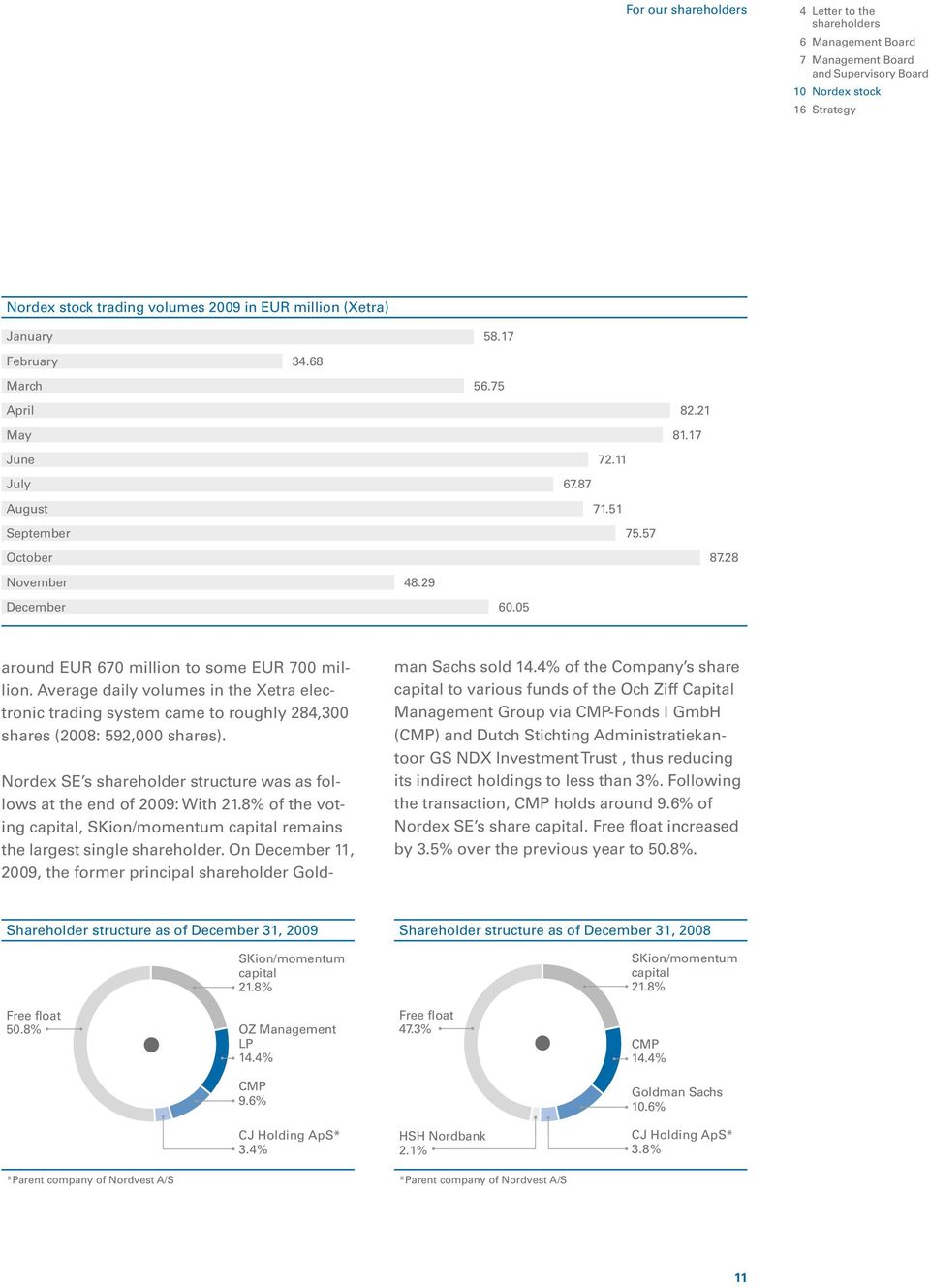
15 For our shareholders 4 Letter to the shareholders 6 Management Board 7 Management Board and Supervisory Board 10 Nordex stock 16 Strategy Nordex stock trading volumes 2009 in million (Xetra) January February March April May June July August September October November December around 670 million to some 700 million. Average daily volumes in the Xetra electronic trading system came to roughly 284,300 shares (2008: 592,000 shares). Nordex SE s shareholder structure was as follows at the end of 2009: With 21.8% of the voting capital, SKion/momentum capital remains the largest single shareholder. On December 11, 2009, the former principal shareholder Goldman Sachs sold 14.4% of the Company s share capital to various funds of the Och Ziff Capital Management Group via CMP-Fonds I GmbH (CMP) and Dutch Stichting Administratiekantoor GS NDX Investment Trust, thus reducing its indirect holdings to less than 3%. Following the transaction, CMP holds around 9.6% of Nordex SE s share capital. Free float increased by 3.5% over the previous year to 50.8%. Shareholder structure as of December 31, 2009 SKion/momentum capital 21.8% Shareholder structure as of December 31, 2008 SKion/momentum capital 21.8% Free float 50.8% OZ Management LP 14.4% Free float 47.3% CMP 14.4% CMP 9.6% Goldman Sachs 10.6% CJ Holding ApS* 3.4% HSH Nordbank 2.1% CJ Holding ApS* 3.8% *Parent company of Nordvest A/S *Parent company of Nordvest A/S 11
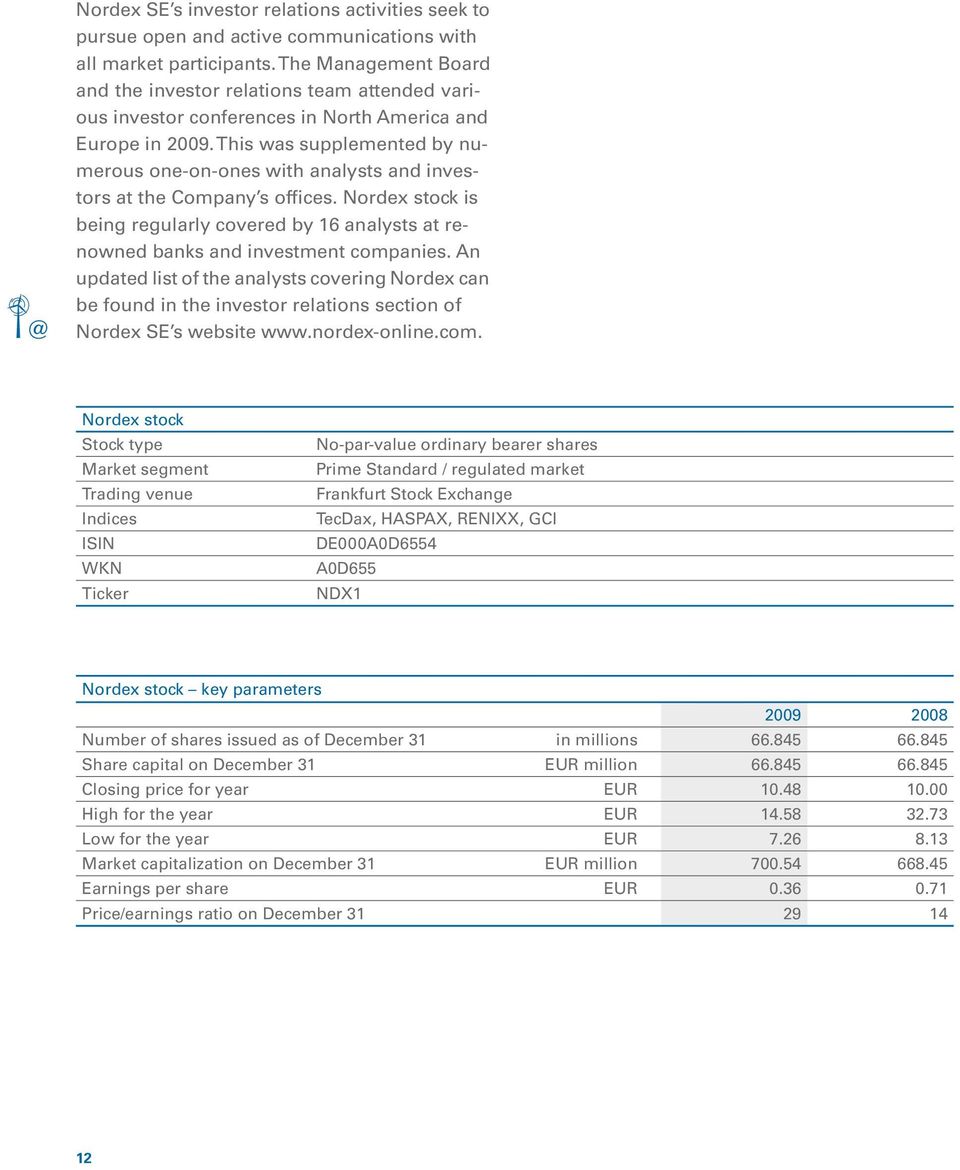
16 @ Nordex SE s investor relations activities seek to pursue open and active communications with all market participants. The Management Board and the investor relations team attended various investor conferences in North America and Europe in This was supplemented by numerous one-on-ones with analysts and investors at the Company s offices. Nordex stock is being regularly covered by 16 analysts at renowned banks and investment companies. An updated list of the analysts covering Nordex can be found in the investor relations section of Nordex SE s website Nordex stock Stock type Market segment Trading venue Indices ISIN WKN Ticker No-par-value ordinary bearer shares Prime Standard / regulated market Frankfurt Stock Exchange TecDax, HASPAX, RENIXX, GCI DE000A0D6554 A0D655 NDX1 Nordex stock key parameters Number of shares issued as of December 31 in millions Share capital on December 31 million Closing price for year High for the year Low for the year Market capitalization on December 31 million Earnings per share Price/earnings ratio on December
17 For our shareholders 4 Letter to the shareholders 6 Management Board 7 Management Board and Supervisory Board 10 Nordex stock 16 Strategy Nordex SE plans to continue its investor relations activities albeit to a greater extent than before in 2010 by taking part in various investor conferences and holding road shows and one-on-ones. Backed by a stable shareholder structure thanks to institutional investors, Nordex SE is seeking to maximize the liquidity of Nordex stock. To this end, it is committed to keeping the capital markets informed of the Company s activities and performance comprehensively and with minimum delay. Contact Nordex SE Investor Relations Bornbarch Norderstedt Germany Ralf Peters (Head of Corporate Communications) Telephone: Telefax: [email protected] 13

18 Nature has always been interconnected.

19 We see ourselves as being part of a sustainable energy network. And that is where we strive to play a key role. To achieve this, we combine technologies from a wide range of industries to generate electricity from wind power. Our long-term goal is to produce and deliver CO 2 -neutral products and services. This aspiration and the increasing competition on the world markets, mean that there is no room for waste. That is why we are committed to a system in which environmental protection and economic efficiency go hand in hand.

20 Strategy Well positioned for the future Interview with Thomas Richterich, CEO Mr. Richterich, every company should pursue long-term goals. Where do you see Nordex SE in, say, 2020? The world is on the threshold of a new era in the production of energy: The current balance of electricity from conventional power stations, on the one hand, and CO 2 -neutral production on the other, will increasingly shift very clearly in the future in favor of electricity from renewable sources particularly wind. There are a number of reasons for this: For one thing, environmental protection has become a prime economic factor with the introduction of emission rights. For another, it is safe to assume that the prices of fossil energies will climb again substantially and remain high on a protracted basis due to their growing natural and political scarcity. This brings me to the third important point: reliable supplies. Imports of fuel from regions, some of which are politically unstable, are being compensated for by a network of modern non-centralized power stations. Provided that the necessary infrastructure is established and operated in conjunction with efficient conventional power stations, it will be easily possible for renewable energies to cover 20, 30 or even 40% of electricity demand. Ten years down the road, I see Nordex in its capacity as a pioneer and premium maker of wind turbines in a key position allowing it to create the basis for the inexpensive production of clean electricity. What growth targets are achievable for smaller players such as Nordex? The wind power market is growing at extremely dynamic rates. In fact, it is expected to expand by 14% a year between now and 2015 alone. In the major markets, climate protection policy is seeking to create a new energy balance, in which some 15 to 20% of electricity production is to be covered by means of renewable sources. This means enormous growth for our industry. Nordex has demonstrated that it is able to outpace the market as a whole. And as an international operator we are well positioned to expand swiftly again in the future. Talking of strategy, Nordex seems to have been primarily focusing on growth over the past few years. Is this still the strategy you are pursuing? This strategy was the logical and appropriate option in our Company s development and, looking ahead over the next few years, we will continue to attach crucial importance to growth. Between 2004 and 2008, Nordex expanded by more than 50% each year. This is particularly important to harness economies of scale and to achieve greater profitability in the medium term. 16
21 For our shareholders 4 Letter to the shareholders 6 Management Board 7 Management Board and Supervisory Board 10 Nordex stock 16 Strategy Last year, Nordex was not spared the effects of the crisis afflicting the global economy, either. Is strong growth still possible? Yes, I m convinced it is. In earlier years, the wind power market was spurred by strong demand, which it was not possible to fully satisfy. With the outbreak of the global economic crisis, there has been a change in a number of important parameters and we are seeing signs of new trends emerging in the market. But the underlying conditions are still intact and a return to high growth rates is possible. However, to achieve this, we must have the right response to these trends. What changes have you observed? There has been a shift in the balance between supply and demand. Delivery shortfalls have now largely been overcome, allowing project turnaround times to be shortened substantially. This is also reflected in sell-side prices. However, this has not resulted in any net changes for us as buy-side advantages allow us to offset the effects of the price concessions that we make to our customers. Even so, we are taking steps to additionally enhance the competitiveness of our products in the medium term by implementing customized development processes. A large volume of potential is still waiting to be harnessed across the entire industry. This is because we have only recently achieved the volumes that allow us to entertain the possibility of standardization and the use of more industrialized processes. On the production side, Nordex spent heavily on such projects in the year under review. With customers also taking an increasingly professional approach, such steps are absolutely crucial for us. We are already selling a substantial proportion of our systems to industrial power station operators and utilities. This is a trend that is set to continue. This is only one side of the coin. What does the future hold for the supply side? Looking ahead, what trends do you expect to emerge? Moving forward, the market will be dominated by large industrial companies, who will determine the pace of the market. In addition, manufacturers with an international presence, in particular, will influence market activity. Potential candidates include a number of national heroes, incumbents, which primarily owe their market share to the strong position that they hold in their domestic markets, as well as companies like Nordex, whose business is predominantly underpinned by exports. 17
22 A view inside the nacelle of the new Nordex Gamma platform Why is it even important to become an international player? Large internationally active utilities are increasingly growing in importance as customers. As a result, the demands that wind power system producers must meet are increasing. In addition to offering technical excellence in our products and extensive after-sales service, in tandem with low costs throughout the entire life cycle of the wind power systems, we must be present in our main markets but also exhibit high local skills and flexibility. We can show the large conglomerates a thing or two, particularly when it comes to flexibility. We must develop best practices with our key-account customers throughout the entire project execution phase. This ability to learn is something that Nordex has been able to demonstrate frequently enough. And what is Nordex doing to join the premier league? First of all, we are working on additionally enhancing the cost structure of our products. The aim is to offer our customers attractive prices throughout the entire life cycle of the turbine while satisfying the highest possible standards of quality. Our efforts to intensify product development constitute a key aspect of our strategy. What I mean is the development of new series as well as processes that go deeper, for example during the testing phase. Can you be more specific? The development of a new wind turbine takes around five years. We are focusing to a far greater extent on field trials and strain testing over a simulated life cycle of 20 years, so as to additionally heighten the durability and also 18
23 For our shareholders 4 Letter to the shareholders 6 Management Board 7 Management Board and Supervisory Board 10 Nordex stock 16 Strategy the profitability of our products. In addition, we want to extend our range of products so that we are able to supply the optimum turbine to meet the requirements of different markets, individual customer preferences and specific geographic conditions. At the same time, however, we are attempting to standardize individual components wherever this is possible and makes sense. In addition, we are taking account of the size of the individual market. A market segment is only of any appeal to us if it has an annual capacity of at least five gigawatts over a protracted period of time. Is this why you have not yet launched any offshore turbines? The offshore market currently has a size of around 750 MW. We assume that a critical mass of 5 GW per year will be achieved by around 2015, which is when Nordex will be entering this market with a product of its own. At the moment, Nordex is building new production facilities in the United States. Will this also result in any changes in Nordex s corporate structures? This is the third main aspect of our strategy. We must give thought to how we work and how we organize ourselves. I d just like to cite one example out of the large number of new structures, which we have already implemented or plan to implement in the near future. We recently introduced a matrix structure in line with the parameters that we have defined in our strategy. In this way, we are able to link local expertise with the knowledge available throughout the entire Group in our core markets of Europe, America and Asia. This gives us an ideal link, helping us to manage our internationally active operations on a global basis as efficiently as possible, while still allowing us to act effectively on a local level. On the one hand, each market has, to a certain degree, its own unique characteristics, which must be taken into account. On the other, however, we require specific standards to master complexity. You are intensifying your research activities and spending on new structures and capacity. This took its toll on your profitability last year. What steps will you be taking to rectify this situation? Nordex s profitability was eroded in 2009 primarily due to the fact that the capital spending projects and the new structures that were established were not backed by the expected increase in sales. However, we had already predicted this in the second half of 2008 with the onset of the financial market crisis. Obviously, we trimmed certain structural costs by postponing investment projects and reducing expenses. Yet, we did not touch what in my eyes is any enterprise s most valuable asset for ensuring future profitable growth, namely qualified employees. You see, we are convinced that impetus for growth will return in the second half of And as it is, there is a shortage of qualified staff. Generally speaking, I think that a double-digit margin is possible in this expansionary industry. However, Nordex must primarily harness economies of scale by achieving strong growth, make further progress in its product design and also unlock further cost-cutting potential in areas such as production, for example, by implementing more heavily industrialized processes. We are well on the way to achieving all our goals in these areas. 19
24 Report of the Supervisory 62 The Supervisory Board of Nordex Aktiengesellschaft, now known as Nordex SE, performed the duties imposed on it by statute, the Company s bylaws and the rules of conduct. As the Company operated under the name Nordex Aktiengesellschaft throughout the entire year under review, the designation Nordex AG has been retained in parts of this report. The Supervisory Board regularly advised the Management Board on matters relating to the management of the Company and monitored management operations in compliance with its applicable statutory obligations. The Supervisory Board was directly involved in all decisions of fundamental importance for the Company. For this purpose, it maintained ongoing contact with Nordex AG s Management Board and was briefed regularly, with minimum delay and comprehensively in both written and oral reports, on the condition and performance of Nordex AG and its subsidiaries as well as all material business transactions. As a matter of principle, the Supervisory Board observes the recommendations published by the Government Commission on the German Corporate Governance Code on June 18, 2009 in the official part of the electronic Bundesanzeiger. The declaration of conformance specified in Section 161 of the Stock Corporation Act was issued by the Supervisory Board and the Management Board on November 27, 2009 (see Further information can be found in the corporate governance report. There were changes in the composition of both the Supervisory Board and the Management Board in the year under review. Dr. Hans W. Fechner stood down from the Supervisory Board on February 23, 2009 and Yves Schmitt and Dr. Hans Seifert on February 27, The Supervisory Board expressly wishes to thank Dr. Hans W. Fechner, Yves Schmitt and Dr. Hans Seifert for their dedication and their contribution to the Company s further development. Mr. Uwe Lüders was appointed to the Supervisory Board by court order on February 24, Dr. Wolfgang Ziebart and Dr. Dieter G. Maier were appointed to the Supervisory Board by court order on February 28, During telephone conferences held on March 17 and 18, 2009, Mr. Lüders was elected Chairman of the Supervisory Board. At the same time, elections were held for the Supervisory Board committees, which since then have comprised the following members: Management committee (nomination committee): Mr. Lüders (Chairman), Mr. Klatten, Mr. Brandes Audit committee: Mr. Rey (Chairman), Mr. Lüders, Mr. Brandes Strategy and engineering committee: Mr. Klatten (Chairman), Dr. Ziebart, Dr. Maier On April 1, 2009, the Supervisory Board appointed Dr. Marc Sielmann to the Management Board as Chief Operations Officer (production, purchasing, service). In the course of 2009, the Supervisory Board held six ordinary meetings on a joint basis as well as on repeated occasions in its committees (management committee, audit committee, strategy and technology committee). The ordinary meetings of the Supervisory Board were held on February 18, April 3, May 25, July 17, August 28 and November 27, Further resolutions were passed by written vote. 20
25 Our responsibility 20 Report of the Supervisory Board 26 Employees 30 Sustainability From left: Dr. Wolfgang Ziebart, Kai H. Brandes, Dr. Dieter G. Maier, Uwe Lüders, Jan Klatten, Martin Rey The 34th ordinary meeting of the Supervisory Board was held on February 18, At this meeting, the Management Board outlined the plans for 2009, which particularly focused on rendering orders with suppliers more flexible, as well as on order receipts and the possible delay in capital spending plans. In this connection, the possibility of a promissory note loan as a source of funding was also considered, to shield the Company from the effects of the financial crisis and to safeguard its future growth. The Management Board reported on the progress of the negotiations for the rental contract for the new headquarters in Hamburg and the extensions to the Rostock facility. Further items on the agenda included the Supervisory Board s approval of a partnership contract with asturia automotive AG, the establishment of a political advisory board and the progress of preparations to convert Nordex AG into an SE (Societas Europaea). The focus of the 35th ordinary meeting of the Supervisory Board held on April 3, 2009 was on examining and discussing Nordex AG s annual financial statements and consolidated financial statements for 2008 in the presence of the statutory auditor. The Management Board provided its appraisal of the previous financial year, reporting on the current state of business and describing the outlook for The Super visory Board approved the Management Board s resolution to convert Nordex AG into an SE as well as the draft conversion schedule submitted. Other main items of the agenda included a resolution outlining the proposals for the resolutions to be passed by the shareholders at the annual general meeting convened for May 26, 2009, and the planned liquidation of Nordex (Baoding) Wind Power Co Ltd., China. On May 12, 2009, the Supervisory Board approved in a written voting process the promissory note loan contract entered into between Nordex AG as the borrower and HSH Nordbank AG as the lender for an amount of 50 million. The 36th ordinary meeting of the Supervisory Board took place on May 25, 2009, ahead of the annual general meeting. At this meeting, the Management Board apprised the Supervisory Board of the current state of the Group s business and reported on its performance in the first quarter of The Supervisory Board determined the targets for the Management 21
26 Board bonus in 2009 on the basis of the forecast figures and appointed Dr. Eberhard Voß to the Management Board with immediate effect. In addition, the Supervisory Board consulted with the Management Board on Nordex s offshore strategy and the progress of the corresponding projects. At the Supervisory Board s 37th ordinary meeting held on July 17, 2009, the Management Board initially reported on the Company s current liquidity situation and the progress of negotiations for the grant of a loan by Kreditanstalt für Wiederaufbau (KfW). After lengthy discussion, the Supervisory Board approved the capital spending plans of USD 44.1 million of Nordex USA, Inc. for the construction of an assembly facility in Jonesboro, Arkansas, United States. The 38th ordinary meeting of the Supervisory Board was held on August 28, 2009, in Rostock. After hearing the Management Board s report on current business performance and the situation in the current quarter, the Supervisory Board turned its attention to the stock option program and determined the allocation day for the 2009 acquisition period. After the reports of the audit committee and the strategy and engineering committee, the Management Board summarized the current progress of activities for converting Nordex AG into a Societas Europaea (SE). The Supervisory Board then approved the establishment of further project companies in Poland so as to successfully continue the development of wind farm projects in that country. In addition, the Management Board briefed the Supervisory Board in detail on the state of the Company s offshore activities. Finally, the Supervisory Board considered the effects of the Accounting Law Modernization Act, which extended and rendered more precise the monitoring duties assigned to the Supervisory Board and the audit committee. At the beginning of the Supervisory Board s 39th meeting held on November 27, 2009, the Management Board briefed the Supervisory Board on the Company s current business performance and the main events of the third quarter of Following the audit committee s report, the Management Board submitted the budget for 2010 and the corporate and group plans for the Nordex Group. In addition to the expected performance of order intake, the forecasts for sales, costs and capital spending attracted lengthy discussion. After approving the budget and the corporate and group plans for 2010, the Supervisory Board approved the establishment of further non-domestic subsidiaries. In addition, it considered and approved the application for establishing a joint venture for project development in the United States. Approval was also given for the contract for a KfW investment loan of 75 million to finance the extensions to the Rostock production facility. Other main items on the agenda of this meeting included the deviations from the recommendations of the German Corporate Governance Code, the renewal of the D&O cover for 2010 and the Management Board s report on the Company s offshore activities. 22
27 Our responsibility 20 Report of the Supervisory Board 26 Employees 30 Sustainability Disclosures pursuant to Section 171 (2) Sentence of the German Stock Corporation Act in connection with Sections 289 (4) and 315 (4) of the German Commercial Code in connection with Article 61 of the SE Regulation The Supervisory Board deliberated with the Management Board on disclosures in accordance with Sections 289 (4) and 315 (4) of the German Commercial Code and was satisfied that these disclosures are true and complete. The financial statements of Nordex SE and the consolidated financial statements for the Nordex Group for the year ending December 31, 2009, as well as the combined management report of Nordex SE and the Nordex Group for fiscal 2009, including the bookkeeping, were audited and granted an unqualified auditor s report by auditing company Pricewaterhouse- Coopers Aktiengesellschaft Wirtschaftsprüfungsgesellschaft, Hamburg, which had been appointed at the annual general meeting on May 26, 2009 and engaged by the Supervisory Board. The report on the statutory audit of the annual financial statements confirmed that the Management Board had taken the measures stipulated in Section 91 (2) of the German Stock Corporation Act to ensure early detection of risks and that an effective internal control system exists. members of the Supervisory Board prior to the meeting of April 16, 2010, at which the financial statements were to be approved. At this meeting, the Supervisory Board deliberated at length on these documents in the presence of the statutory auditor, who was available to answer any questions. The Supervisory Board and its audit committee concurred with the statutory auditor s findings. The Supervisory Board examined the financial statements of Nordex SE and the consolidated financial statements as well as the combined management report for Nordex SE and the Nordex Group. No objections were raised on the basis of the final results of its examination. The Supervisory Board approved the annual financial statements and the consolidated financial statements prepared by the Management Board as of December 31, Accordingly, they are deemed to have been duly adopted. The Supervisory Board of Nordex SE thanks the Management Board for the constructive collaboration and expresses its gratitude to all employees as well as the employee representatives for their strong dedication and the work performed in Norderstedt, April 16, 2010 The annual financial statements, the consolidated financial statements and the combined management report for Nordex SE and the Nordex Group, the annual report and the statutory auditor s report were presented to all Uwe Lüders Chairman 23
28 The potential is visible.
29 Around 70% of the electricity produced worldwide is consumed in North America, Europe and Asia. So early on, we established full-scale business operations, including subsidiaries for sales, purchasing and production, in these key regions. By incorporating local knowledge and insights into our service offerings, we are strengthening our expertise wherever we are throughout the world.
30 Employees Nordex currently employs around 2,400 people all around the world. In order to assert itself as a relatively young and dynamically growing company in the expansionary renewable energies market, the Company needs the best minds and a potent, highly qualified and motivated team. For this reason, Nordex offers not only attractive working conditions but also a fair compensation and incentive system as well as extensive scope for further training and skills development. Transparent compensation providing just rewards for performance constitutes the first main pillar of the Company s personnel strategy. Employees receive an annual salary paid in twelve monthly installments. Technical staff receive a basic wage plus night, weekend and holiday bonuses. The amount of these bonuses has been fixed in an in-company agreement entered into with the employee representative council. Flexible working time models in the production departments allow overtime to be compensated by means of off-duty time. As well as this, Nordex employees receive a variable performance-tied annual bonus provided that certain predefined enterprise-wide objectives have been achieved. The service contracts for management staff provide for a basic salary and generally also performance-tied variable components based on the achievement of individual target agreements and the Nordex Group s business performance. In individual cases, Nordex may also grant non-cash benefits to employees such as a company car or training allowances. We offer all employees of the Nordex Group a funded in-company pension scheme in the form of a deferred income system. In September 2007, Nordex implemented a uniform compensation system, which does not make any distinction between eastern and western Germany or between technical and administrative staff. Instead, it is based solely on the requirements of the position in question. All positions are assigned to a compensation scale comprising a total of 13 levels plus a further four for executives. The aim is to heighten the transparency of the remuneration system and also to strengthen our employees motivation. In both 2008 and 2009, Nordex gave its staff the opportunity of participating in Nordex SE s stock option program. By taking part in this program, employees secured the right to acquire the Company s shares as of 2011 or 2012 at a fixed exercise price, thus allowing them to become co-owners of Nordex SE and to benefit directly from future gains in its enterprise value. In the medium term, the options also serve to encourage Nordex employees to remain with the Company. In September 2009, some 60% of the eligible employees had subscribed to the stock options, up from around 50% in the previous year. As a supplier of complex, high-quality products and services, the Nordex Group s success hinges crucially on its employees qualifications. Ongoing training of the Group s employees therefore forms the second main pillar of our personnel strategy. It was with this in mind that the Nordex Academy, an in-company train- 26
31 Our responsibility 20 Report of the Supervisory Board 26 Employees 30 Sustainability ing facility, was established a number of years ago as a means of providing Nordex employees with regular training and tuition from experienced experts. The Nordex Academy s capacity has recently been systematically extended to ensure continued high-quality training in the future. Around ten trainers and authors of technical documentation are responsible for preparing and executing the training courses. Whereas the Nordex Academy is primarily responsible for training and skills-development activities in all matters relating to wind power, the newly created Personnel Development department is mandated with overseeing the strategic development of management skills. As a globally active company, Nordex must adopt systematic and harmonized methods in the area of personnel and executive development. Launched in September 2009, a job-grading project, for example, is tasked with unifying the management structure for the Top 200 managers and executives. As part of this process, comparable positions are combined in the same management levels so as to render the requirements and career paths within the Nordex Group more transparent. of Nordex s new headquarters in Hamburg- Langenhorn. Scheduled for completion at the end of 2010, the Nordex Forum, as the new building is to be known, will have enough space to accommodate all local staff under a single roof in modern surroundings on a floor area measuring more than 15,000 m². All this will help to additionally reinforce the Group s position as an attractive employer. Finally, the Group ensures safe and appropriate working conditions for our staff, this being the third and most elementary task in our personnel strategy. Conditions on the work site materially influence employees well-being and, hence, the Company s success. Thus, the Health And Safety department ensures strict observance and further development of internationally acknowledged standards. Improved working conditions are currently being created for staff in Norderstedt with the construction 27
32 We maintain the same high quality standards even in stormy weather. Whether it is achieving strong growth or cutting electricity generation costs, our product portfolio and more than 1,000 multi-megawatt facilities provide a broad spectrum of capabilities. Plus, the new Gamma platform is setting new benchmarks in availability and energy output. The winds are favorable.
33
34 Sustainability Nordex s future viability hinges materially on its ability to react flexibly and swiftly to new underlying conditions, to develop high-quality products and to maximize cost efficiency. In addition to economic sustainability, however, social and ecological factors are increasingly coming to the fore in this era of globalization and climate change. In this connection, it is becoming ever-more important for companies to voluntarily assume responsibility towards society as a whole. Nordex is facing up to these challenges and is committed to making a material contribution. The aim is to create a basis for sustained economic growth, which does not exert any adverse effect on natural surroundings and offers people in all markets new prospects of prosperity. In this way, Nordex is seeking to safeguard its long-term business success. Economic factors Over the last few years, Nordex has increased its economic output substantially. For example, the Group s sales widened from around 514 million in 2006 to more than 1,180 million in 2009, accompanied by a rise in EBIT from 16.6 million to 40.0 million in the same period. Against the backdrop of the general economic crisis, Nordex has been investing in building up and extending its structures in preparation of the future return to stronger growth. Despite capital spending of around 51 million, Nordex boosted its liquidity materially by 43% to around 160 million in 2009, by obtaining promissory note loans and a KfW loan. As a result, it is well positioned to weather the fallout from the economic and financial crisis and has secured the basis for its ongoing future growth. At the same time, the Nordex Group boasts a solid equity base of around 41%. As one of the leading providers of technology geared to future requirements in the renewable energies segment, the Nordex Group s longterm business success is derived from its research and development efforts. It was in this spirit that in 2009 Nordex SE s Management Board decided to step up product development activities. This applies to both the development and launch of new products and enhancements and improvements to the existing range. At the same time, Nordex constitutes a critical economic factor at the sites at which it performs its activities as well as for its partners. Guided by the principle of maximizing local content, Nordex additionally sees the markets that it addresses as production locations. Thus, the Group maintains production facilities in Europe, Asia and soon also in North America, and establishes supply structures of its own in the local markets. Locally, the construction and operation of wind farms also generate employment and wealth during the assembly phase, as a result of the ensuing service of the wind power systems and through the generation of tax revenues. Last year, Nordex made use of public subsidies. It sees these funds as part of a sustained partnership with governments and the public sector from which all sides benefit. With the establishment of a political committee in 2009, the Company is now seeking to make a constructive contribution to political dialog, with the committee assisting Nordex in organizing and prioritizing its political activities. In the year under review, preliminary steps were also taken to establish corporate compliance structures at Nordex. This will be followed in 30
35 Our responsibility 20 Report of the Supervisory Board 26 Employees 30 Sustainability 2010 with the introduction of a global code of conduct within the Nordex Group, with the aim of defining mandatory and unambiguous principles for all of its employees conduct all over the world. The main purpose will be to ensure compliance with the laws of the region in question as well as universally applicable ethical standards. As an internationally active enterprise, Nordex is exposed to business and specific sector risks. It is therefore vital in the interests of the Company s continued existence to identify and assess risks as early as possible and, where necessary, to take the necessary precautions to avert these risks and curtail their effects. Nordex has a suitable risk management system, which entails the measures required to recognize and manage risk on a timely basis. Employees The Nordex Group s business success is materially attributable to the great commitment shown by its employees. In line with its business growth, the global headcount at Nordex has widened to over 2,200 employees, up from 814 in Yet, top performance is possible only with satisfied and qualified staff. It is with this realization in mind that Nordex introduced a uniform remuneration system for its staff in Germany in September Under this system, all employees are assigned to specific salary groups on the basis of the specific requirements of their position, ensuring that they receive comparable wages and salaries. This system creates transparency and also abolishes the distinction between western and eastern Germany as well as between technical and office staff. A further key purpose of Nordex s remuneration policy is to provide all Group employees with a share in its profits. This involves variable components of different proportions depending on the employee s position within the hierarchy. In addition, the issue of stock options in 2008 and 2009 gave employees an opportunity of sharing in the Company s future business success. Nordex sees this step as providing additional incentive for good performance as well as a means of tying employees to the Group even more strongly in the medium term. Finally, the Company also offers voluntary benefits such as training support and a subsidized in-company pension scheme (income deferral). On-site safety enjoys top priority at Nordex. The Health And Safety department ensures strict observance and further development of internationally acknowledged standards. This is because safe and reliable working conditions form the basis for all employees personal well-being and, hence, the Company s success. For this purpose, the strategy adopted goes well-beyond merely ensuring staff s physical wellbeing, preferring a holistic approach to good health. This is of high relevance as psychological strain is an increasingly prevalent cause of illness in modern societies in particular. As a provider of complex high-quality products and services, ongoing staff training is of crucial importance for Nordex. At the Nordex Academy, the Company s internal training and skillsdevelopment center, our employees receive regular training and tuition from experienced experts. In this way, the Company is able to ensure that all staff have the best possible qualifications. At the end of 2009, Nordex had a total of around 100 apprentices and trainees. By 31
36 undergoing solid vocational training, young people receive a solid grounding for the future. At the same time, the Company has access to qualified employees. In addition to this, recruiting university graduates and furthering their careers plays a crucial role at Nordex. Ecological factors In the absence of any fundamental change in the way in which energy is produced, the quality of life of future generations will be at risk as growing demand for energy around the world has resulted in enormous emissions of greenhouse gases. Wind power forms a crucial component in these efforts. Thus, a megawatt/hour of electricity generated using the wind avoids the production of roughly one ton of the CO 2, which is emitted when electricity is produced from coal, for example. Last year alone, Nordex was able to prevent emissions of several million tons of harmful gases. Each turbine recoups the energy consumed in producing it after only around seven months. This calculation includes the energy used throughout the entire production process as well as transportation to the site of deployment. Once in operation, each turbine provides clean energy for around 20 years. Even a single Nordex multi-megawatt turbine can supply enough energy to cover the requirements of up to 3,000 four-person households. Today, over 4,000 Nordex turbines are in operation worldwide, helping to ensure clean and secure energy supplies around the globe. Wind turbines have long since become a fixed part of modern landscapes. Yet, despite this, they have only a minimum impact on people and natural surroundings. Even environmental organizations such as WWF, Greenpeace and Robin Wood support further environmentally sustainable growth in wind power and other renewable energies. However, at Nordex, environmental protection is not confined to its products, but starts at the production phase. In Rostock, the Company is currently building one of the most modern and environmentally friendly facilities for the production of wind power turbines and rotor blades. These production technologies not only satisfy, but actually remain well short of, the stringent government maximum limits for emissions of dust, solvents, odors and wastewater. In addition, Nordex attaches the greatest possible importance to insulation and heat recycling. In preparation of the implementation of a global site safety and environmental production management system, in accordance with BS OHSAS and DIN EN ISO 14001, environmental parameters were collected and processed at the Company s facilities in Rostock and Hamburg in Nordex sees this as offering considerable potential for improving its ecological balance, which it plans to enhance step by step in the future. When it comes to building installation management, Nordex is also focusing on environmental protection by ensuring that all its buildings comply with the low energy standards as far as possible. Thus, the new facility in the United States will have an integrated geothermal HVAC system, while the new head office in Hamburg, which is still under construction, has already been awarded a preliminary Gold certificate by the German Association of Sustainable Building. 32
37 Our responsibility 20 Report of the Supervisory Board 26 Employees 30 Sustainability Responsibility as a corporate citizen In their business activities, enterprises also hold social responsibility. Nordex bases its activities on the principles set out in UN Global Impact in its relations with its own employees as well as third parties. Within the Company s sphere of influence, this entails the principles of human rights and anti-discrimination, as well as initiatives to encourage environmental awareness and to create comparable opportunities for education. Thus, for example, Nordex supported the 2008 and 2009 Hamburg Climate Protection Conference, which was organized by the State Institute of Teacher Training and School Development. Experiencing and understanding energy is the title of a long-term school project that the Company is implementing in conjunction with Umwelt-Aktion e.v. in Germany. In the past, Nordex has implemented measures in numerous areas aimed at furthering the Company s sustainability. Looking forward, corporate social responsibility (CSR) is to be embedded more firmly in its business strategy and enhanced accordingly. In addition, Nordex plans to keep its stakeholders informed of the Group s activities and objectives in a separate sustainability report as of
38 A big act to follow.
39 By introducing automated manufacturing technology and a linear assembly system, we have completed the shift to more streamlined production capabilities. It is all about maximizing productivity and eliminating waste in series manufacturing plus ensuring continuous improvement processes. In short: becoming a learning organization. This way our employees can develop their talents and potential to the full. We are striving for higher process stability and delivery reliability. Relentlessly.
40 Combined management report of the Nordex Group and Nordex SE (formerly Nordex Aktiengesellschaft) for 2009 Nordex supplies high-output wind power systems in the upper segment of the market for virtually all geographic regions. As a producer and developer of wind power systems, it concentrates on its core skills, namely engineering as well as maintenance and aftersales service. In selected markets, the Company also operates further upstream, e.g., in wind farm planning. It also offers turn-key project management solutions if required. Nordex assembles around 20% of its products at its own facilities and, as a systems integrator, sources some 80% of the components required from its suppliers. The Nordex Group is essentially a singleproduct company. Nordex SE (formerly Nordex Aktiengesellschaft) is purely a holding company. The main Nordex Group companies are Nordex Energy GmbH and Nordex Energy, B.V. Nordex SE is domiciled in Rostock. However, its headquarters are located in Norderstedt, near Hamburg. Nordex holds production facilities in Germany (Rostock) and China (Yinchuan, Dong ying); a further facility in the United States (Jonesboro) has been under construction since mid The Company has branch offices and subsidiaries in 19 countries. domestic product contracted by 2.5% (2008: growth of 0.4%), while the European economies shrank on average by 4.0% (2008: growth of 0.6%). According to the International Monetary Fund, the German economy contracted by 4.8% (2008: expansion of 1.2%). Thus, German gross domestic product declined in 2009 for the first time in six years, simultaneously recording the greatest contraction since the end of World War II. Emerging markets such as China and India exhibited relatively stable growth rates of 8.7% and 5.6%, respectively. Growth in gross domestic product by country/region 2009 % 2008 % United States European Union Germany China India Total Source: International Monetary Fund, January 2010 Economic environment and underlying political conditions At the beginning of 2009, the global economy suffered from a particularly severe slump in international trade, the effects of which hardly any country was able to escape. However, towards the middle of the year, signs of stabilization in the global economy already started to emerge, a trend which continued in the following quarters. The German Council of Economic Experts attributes the recovery during the year to four main aspects: the central banks expansionary monetary policy, the sharp increase in public-sector demand as a result of economic stimulus programs, the relative robustness of the economies of the emerging markets and the comparatively low price of oil. Even so, the world s leading economies sustained a sharp decline in gross economic growth compared with the previous year. Thus, for example, US gross During the period under review, the leading central banks continued their expansionary monetary policy, with the US Fed trimming its key rate to a target range of 0.0% 0.25% on December 16, 2008, and retaining this range throughout all of In Europe, the ECB lowered its main funding rate in four steps in the course of the year, from 2% to a historical low of 1%. Over the period under review, the euro appreciated slightly against the US dollar but fluctuated sharply in the course of the year. A low for the year of just over /USD 1.25 was reached at the beginning of March 2009, with a high of somewhat over / USD 1.50 hit at the end of November. In the year as a whole, the euro rose by 2.4% against the US dollar to /USD 1.43 (December 31, 2008: /USD 1.40), thus exerting pressure on the European export sector. 36
41 The recession also affected the price of oil in Initially, the high inventories in the United States in tandem with weak demand exerted downside pressure. However, the mounting economic optimism which emerged as the year unfolded increasingly spurred oil prices, causing them to rise. By autumn 2009, Brent crude oil was already trading back up at around USD 80 per barrel. At the end of the year, the prices stood at USD 77.9 per barrel, an increase of some 76% over the previous year (December 31, 2008: USD per barrel). Price of Brent crude oil in 2009 USD Combined management report Electricity consumption in Germany in 2009 com - pared with the previous year (percentage change) January 2.5% February 6.8% March 3.4% April 13.7% May 5.6% June 6.1% July 8.0% August 9.1% September 6.2% October 2.5% November 2.0% December +0.75% Source: Bundesverband der Energie- und Wasserwirtschaft (BDEW) 36 Economic environment 40 Business performance 42 Results of operations 44 Financial condition and net assets 45 Capital spending 46 Research and development 47 Quality management 48 Employees and remuneration 49 Outlook 51 Operational risk and opportunities report 56 Disclosures in accordance with Sections 289 (4); 315 (4) of the German Commercial Code 61 Events after the conclusion of the period under review 62 Corporate governance 66 Disclosures on corporate governance practices EEX Baseload Q4/2008 Q4/2009 /MWh Jan. March June Sept. Dec. Source: Wallstreet Online Electricity prices in 2009 were also materially affected by the economic crisis and the resultant decline in energy consumption, particularly in energy-intensive sectors. The EEX Baseload the quarterly weighted average price of base load electricity tracked by the European Energy Exchange (EEX) in Leipzig dropped from per megawatt/hour in the fourth quarter of 2008 to per megawatt/hour, equivalent to a decline of 43.0% Q4/2008 Q1/2009 Q2/2009 Q3/2009 Q4/2009 Source: European Energy Exchange (EEX) The German Engineering Federation (VDMA) reports that 2009 was one of the weakest years in the past few decades. Thus, the German mechanical and plant engineering industry slumped by just under 25% in real terms in sales accompanied by a decline of around 23% in sector sales. The federation also assumes that machinery sales in the major mechanical engineering countries contracted by 19% in real terms in 2009 on account of the global crisis. 37
42 According to a study published by HSBC Global Research, economic stimulus packages valued at around USD 2.8 trillion were established to ward off the effects of the economic crisis in the period under review. Of this, around USD 430 billion or some 16% was earmarked for climate protection projects such as energy efficiency, water and waste processing, as well as renewable energies. A large part of these sums will be spent between 2009 and 2012 and particularly in Proportion of environmental projects in total economic stimulus packages by country/region % United States 12 China 38 Germany 13 European Union 59 Global 16 Source: HSBC Climate for recovery the colour of stimulus goes green, February 2009 The wind power market remained robust in the period under review, notwithstanding the general economic crisis, and with an increase of around 27% in new installed capacity over the previous year, continued on its growth trajectory. According to MAKE Consulting, the main growth drivers were the United States and Asia. In this context, the sector benefited from the order backlog, which had arisen in Rising electricity consumption in the course of the year, accompanied by rising prices for fossil fuels, tended to reinforce the incentive to invest in wind power projects. Despite the continued growth in the overall wind power market, new business was down sharply in Against the backdrop of the general economic crisis and the tight financial situation of numerous banks and companies, less debt capital was available in 2009 than in the previous year for the construction of new wind farms. New Energy Finance estimates that the total volume of project finance in the wind power segment (onshore and offshore) contracted by roughly 6% from around USD 47 billion in 2008 to USD 44.3 billion in Although order receipts picked up in the course of the year, they did not return to the level seen prior to the outbreak of the crisis in summer Underlying political conditions for extensions to regenerative power production are still intact despite the global economic crisis. In the United States, the federal government announced plans to cut greenhouse gas emissions by around 17% compared with 2005 levels by In addition, the Clean Energy and Security Act, which aims to reduce national greenhouse gas emissions and encourage the use of renewable energies, was tabled. Also known as the Waxman-Markey Bill, it provides for the introduction of an emission trading system among other things. On top of this, President Obama unveiled plans to double the capacity of renewable energy power stations by In November 2009, China announced targets providing for greenhouse gas emissions to be cut by 40 45% over 2005 levels by However, the climate protection measures are tied to national economic output. With the introduction of a fixed feed-in rate for wind power, which varies according to region, the National Development and Reform Commission (NDRC) created an important incentive in July 2009 for investing in clean energy production. This gives foreign investors in particular a solid basis for planning. The 27 states of the European Union are still committed to lowering emissions by 20% relative to 1990 levels by In fact, cuts of as much as 30% are being planned in parts of the EU. In Germany, CO 2 emissions are to be reduced by 40%. After the amended Renewable Energies Act (REA) took effect at the beginning of 2009, the initial remuneration increased from 8.2 to 9.2 euro-cents/kwh for wind power generated onshore and from 9.0 to 15 euro-cents/kwh for wind power generated offshore. Under the German legislation, re-powering, i.e., the replacement of old wind power systems with new ones, is being encouraged with an increase of 0.5 euro-cents per kwh in the initial remuneration rate. As wind power systems will have to contribute to grid voltage and frequency control in the future, the legislation additionally provides for a system service bonus of 0.5 euro-cents per kwh on top of the initial remuneration, to cover the additional technical efforts required for this. 38
43 In Italy, the compensation system was retained after intensive discussion on a possible price cut for green certificates. Operators of wind farms receive these certificates over and above the traded electricity price, making them a material part of the compensation paid in Italy. The wind power market expanded again substantially in According to MAKE Consulting, global new capacity of 32,660 MW was installed in the period under review, an increase of 26.8% over the previous year (2008: 25,749 MW). The main growth drivers were Asia and North America, where the construction of new wind power systems expanded by 64% and 20%, respectively. On the other hand, at 9%, sales growth in Europe was relatively muted. The most important wind power markets in 2009 were China and the United States, which together accounted for 57.8% of new installed capacity, up from 51.3% in At 30.4%, the United States remained ahead of China (27.5%), with Spain ranking third (6.9%). At 5.9%, Germany came in fourth, followed by India (3.9%). In cumulative terms, the United States was again the largest market (23.2%). Germany ranked second (17.0%) ahead of China with a cumulative share of 12.6% in total installed capacity. Spain (12.5%) and India (6.9%) ranked fourth and fifth, respectively. Wind power market Country New output MW 2009 Combined management report 36 Economic environment New output MW 2008 Change % Europe 9,932 9, United States 9,922 8, China 8,970 4, Others 3,836 3, Total 32,660 25, Spain 2,245 1, Germany 1,917 1, Italy 1,043 1, France 1,036 1, UK Offshore Source: MAKE Consulting, March 2010 (Basis: Installed output online) Top 5 new installed output in 2009 (MW) Country Share of the global market % United States 30.4 China 27.5 Spain 6.9 Germany 5.9 India 3.9 Source: MAKE Consulting, March 2010 (Basis: Installed output online) 40 Business performance 42 Results of operations 44 Financial condition and net assets 45 Capital spending 46 Research and development 47 Quality management 48 Employees and remuneration 49 Outlook 51 Operational risk and opportunities report 56 Disclosures in accordance with Sections 289 (4); 315 (4) of the German Commercial Code 61 Events after the conclusion of the period under review 62 Corporate governance 66 Disclosures on corporate governance practices Top 5 cumulative capacity as of the end of 2009 Country Share of the global market % United States 23.2 Germany 17.0 China 12.6 Spain 12.5 India 6.9 Source: MAKE Consulting, March 2010 (Basis: Installed output online) In the United States, new installed capacity rose by 15.9% to 9,922 MW (2008: 8,558 MW), with cumulative installed capacity coming to 35,359 MW at the end of the period under review. Various analysts projected substantially lower new installed wind power capacity. Experts attributed the surprisingly strong growth in the US wind power market to the greater use of various investment incentives such as the Production Tax Credit (PTC) and the Investment Tax Credit (ITC). Additionally, it can be assumed that firm finance had 39
44 already been secured for a large proportion of the projects executed in 2009 prior to the outbreak of the economic crisis at the end of 2008, and were therefore not affected by the general lending restraint. Nordex supplied around 15% of its wind power systems to the United States in In the period under review, China again exhibited high growth rates, with new installed capacity rising from 4,660 MW to 8,970 MW, an increase of 92.5%. At the end of 2009, total installed capacity stood at 19,203 MW in China. Reflecting the specific political conditions in that country, around 90% of new installed wind turbines were locally sourced in the period under review (2008: 76%). Roughly 11% of wind power systems supplied by Nordex in 2009 were installed in China. The wind power market in the European Union was less dynamic but still expansionary. With new installed capacity of 9,932 MW, the previous year s figure was exceeded by 8.7% (2008: 9,138 MW), with cumulative installed capacity rising to 75,509 MW. According to the European Wind Energy Association (EWEA), wind power accounted for roughly 39% of new installed electricity production capacity in 2009, thus contributing more new capacity than all other energy sources (including gas, coal and nuclear) again as in Total capital spending on wind power projects came to around 13 billion in Europe (2008: roughly 11 billion). In Spain, installed capacity increased by 15.4% over the previous year to 2,245 MW, thus surpassing Germany, where new installed capacity climbed by 15.1% to 1,917 MW. Italy (1,043 MW, +4.0%), France (1,036 MW, 6.9%) and the UK (882 MW, +0.2%) followed at a substantial distance. The European market was once again by far the most important region for Nordex, accounting for 74% of its wind power business in In the offshore segment, new installed capacity came to a total of 620 MW, equivalent to an increase of 80.2% over the previous year (2008: 344 MW), underpinned for the most part by new projects in the UK, Denmark and Germany. Business performance In the period under review, the Nordex Group s business remained largely stable. Thus, the capacity of the turbines delivered in 2009 came to 1,060 MW (2008: 1,147 MW). Roughly 80% of these turbines had already been assembled at the intended wind farms as of December 31, For the first time, Nordex s largest regional market was Italy, where it achieved a share of 15% of the market, thus making it the third-largest supplier. What is more, Nordex executed the country s largest wind farm project to date (capacity of almost 100 MW) in Sicily. The Group s sales volumes were also well up in the United States, although part of the deliveries were delayed in accordance with customer requests. Nordex also registered substantial growth in Turkey, where sales volumes surged more than five-fold. On the other hand, the wind power industry as a whole contracted in some established markets, e.g., France. Capacity supplied 2009 MW 2008 MW Italy United States Turkey UK China Portugal France Poland Sweden Germany Others Total 1, ,147.4 The sales situation is also reflected in the Group s production output, although it should be noted that a number of turbines completed in 2008 were not delivered and assembled until There was no prefabrication in a comparable scale in 2009 so as to avoid tying up working capital. The planned reduction in inventories caused production output of the plants in Germany and China to shrink by almost 13%. 40
45 Output Turbine production (of which China) Rotor blades (of which China) 2009 MW (85.5) (46.0) 2008 MW 1,128.0 (176.0) (216.0) In line with expectations, consolidated sales rose by 4% to 1,183 million (2008: 1,136 million). This includes projects on which work has already commenced and which are scheduled for completion in The slight increase in sales was primarily underpinned by business in the United States and new export markets, such as Turkey and Poland, where sales of million and 51.2 million, respectively, were achieved. Sales by segment 2009 million 2008 million Europe America Asia Total 1,183 1,136 A good 95% of sales arose from wind turbine engineering and the remaining 5% from service business. New business dragged down by the financial market crisis Generally speaking, order intake was disappointing in the period under review, with receipts of new orders contracting by around 19% over In this context, however, it should be noted that the industrial sector only came under pressure with the onset of the financial market crisis late in the summer of 2008, meaning that a meaningful comparison of the two years is not possible. Combined management report The North American market was particularly affected by ordering restraint as there was a shortage of equity partners for project finance ( tax equity investors ) on the one hand, while many banks were unable to provide the necessary loans on the other. According to New Energy Finance, the debt capital provided by banks for wind farm projects bottomed out at USD 5.5 billion in the first quarter of 2009 (second quarter of 2008: USD 13.3 billion). Although the volume increased towards the end of the year, it failed to return to the original level. Extensive public-sector development programs, such as the grant of a 30% advance towards the total sum invested, failed to unleash any sustained effect, as the support does not expire until the end of 2011 and only a small amount of preparatory work for the projects is required to receive funding. A further obstacle proved to be the cyclically induced drop in electricity prices and the absence of comprehensive rules for increasing the share of renewable energies in the energy mix. While such rules have been enacted in 27 US states, at the federal level a corresponding bill has only been passed by one of the Houses of Congress. By contrast, new business in Europe was more stable. Although here, as well as there, there was a shortage of debt capital, a further decline in new business was prevented thanks to the strict targets formulated by climate policymakers and the already existing transparent long-term remuneration systems. What is more, Nordex benefited from high brand awareness and the launch of a new product platform, which is also suitable for inland locations. Asia and its dominant Chinese market were affected less by the financial market crisis than by growing protectionism in the award of public-sector contracts. Measured in terms of sales volumes, the share of the market held by international operators in China contracted to 11% (2008: 24%), with up to 100% of largescale contract volumes going to domestic producers. This protectionist policy has since decreased. Market observers assume that the inferior quality of many local producers is increasingly jeopardizing the availability of reliable supplies of electricity and thus making it more difficult to achieve the target of generating at least 15% of electricity from regenerative sources by Economic environment 40 Business performance 42 Results of operations 44 Financial condition and net assets 45 Capital spending 46 Research and development 47 Quality management 48 Employees and remuneration 49 Outlook 51 Operational risk and opportunities report 56 Disclosures in accordance with Sections 289 (4); 315 (4) of the German Commercial Code 61 Events after the conclusion of the period under review 62 Corporate governance 66 Disclosures on corporate governance practices 41
46 Order receipts by region 2009 million 2008 million Europe Turkey France UK Italy America Asia Total The order backlog dropped to 1,970 million (2008: 3 billion) on account of the low ratio of order receipts to sales (book-to-bill ratio: 0.62). Order books comprised firm orders of 473 million (2008: 824 million) and contingent orders of 1,497 million (2008: 2,220 million). The resultant decline in forward visibility has prompted Nordex to expect only a slight growth for the current year. The Management Board does not expect any material impetus to emerge for new business until the second half of Business performance of the parent company Nordex SE As the Group parent, Nordex SE operates as a holding company. One of Nordex SE s key tasks is to finance the Group members by providing cash and guarantees. In addition to this, it provides management services for various subsidiaries, above all in the areas of financing, law and IT. Nordex SE has entered into profit transfer agreements with Nordex Energy GmbH as the main German Group company as well as Nordex Grundstücksverwaltung GmbH and Nordex Windparkbeteiligung GmbH as further German Group members. In the period under review, Nordex SE s revenues rose by 17% to 40.4 million (previous year: 34.6 million). The main source of revenues are Group charges levied against foreign subsidiaries in consideration of the provision of Group management services and the grant of contractual performance guarantees. Staff costs increased by 31% to 13.8 million in the year under review (previous year: 10.5 million) primarily as a result of the increased headcount. As in the previous year, other operating income net of other operating expenses came to 22.6 million. After tax of 5.8 million (previous year: 3.1 million) and a substantial positive financial income of 34.8 million (previous year: 10.8 million), primarily resulting from the profit transferred from Nordex Energy GmbH, Nordex SE recorded net profit of 29.4 million for the year (previous year: 7.1 million). Nordex SE s equity rose by around 13% to million at the balance sheet date (previous year: million). With total assets climbing to million (previous year: million), Nordex SE s equity ratio fell slightly to 61.3% (previous year: 64.0%). On May 14, 2009, Nordex SE successfully placed a promissory note loan for 50.0 million in the capital market. In addition, it raised an investment loan of 75.0 million on November 30, Bank borrowings have a total value of 82.1 million as of December 31, 2009, while cash at banks stands at million. Results of operations In 2009 the Nordex Group increased its gross profit by 3.8% to million (2008: million). The profitability of the projects executed was largely unaffected by the economic downswing due to the fact that the contracts for some of these projects had been signed prior to the outbreak of the financial market crisis. In addition, it was possible to absorb the price concessions granted to customers in full on the buy side. The cost of materials ratio shrank from 78.9% to 77.2%. Earnings before interest and taxes (EBIT) came to 40 million in the year under review (2008: 63.0 million). This was materially due to higher structural costs for preparations in anticipation of an imminent recovery in the economy. Accordingly, the staff cost ratio rose from 6.9% to 9.2% or, in absolute figures, by around 24.1 million. At the same time, other operating expenses net of other operating income climbed by 6.5 million to 96.7 million. Depreciation expense rose by a further 2.1 million, reflecting the completion of construction work in the period under review. With the EBIT margin coming to 3.5%, profitability exceeded management s expectations slightly. 42
47 It became evident in the course of the year that profitability was closely related to business volumes. Whereas Nordex was able to break even in the first quarter on sales of million, the margin widened to 4.9% in the fourth quarter on total revenues of million. Performance by quarter in 2009 Sales million EBIT million EBIT margin % Q Q Q Q Total 1, Compared with the fourth quarter of 2008, quarterly average staff costs rose only marginally in the year under review. In fact, other operating expenses net of other operating income were down substantially, with structural costs declining slightly on a sequential quarterly basis thanks to cost-cutting measures. The establishment of new structures and the Company s continued development would have been impeded by staff layoffs. This, in turn, would have impaired the Nordex Group s outlook for future growth and impacted the planned improvement in its profitability. In the period under review, Nordex therefore recruited new employees in selected areas. Combined management report Net financial expense dropped to 5.2 million, reversing the previous year s net financial income of 1.0 million. This was due to substantially lower interest on credit balances in the period under review on the one hand and, on the other, higher interest expense resulting from the receipt of promissory note loans and an investment loan provided by Kreditanstalt für Wiederaufbau (KfW). After tax of 10.6 million, consolidated net profit for the year thus came to 24.2 million (2008: 49.5 million), translating into earnings per share of 0.36 (2008: 0.71). Comparison of actual and forecast business performance The forecast issued by the Management Board on April 21, 2009 assumed that the Nordex Group s sales would increase over the previous year (2008: 1.1 billion) to more than 1.2 billion. In addition, the Management Board expected the Group s profitability to fall short of the previous year (EBIT margin in 2008: 5.3%) due to slower growth in tandem with higher structural costs. In August 2009, Nordex announced sales guidance of around 1.2 billion, with the Management Board stating in November 2009 that it was expecting an EBIT margin of around 3%. In reality, the Nordex Group recorded sales of 1,183 million and an EBIT margin of 3.5% in 2009, i.e., within the forecast range. 36 Economic environment 40 Business performance 42 Results of operations 44 Financial condition and net assets 45 Capital spending 46 Research and development 47 Quality management 48 Employees and remuneration 49 Outlook 51 Operational risk and opportunities report 56 Disclosures in accordance with Sections 289 (4); 315 (4) of the German Commercial Code 61 Events after the conclusion of the period under review 62 Corporate governance 66 Disclosures on corporate governance practices Structural costs Q4/2008 million Quarterly average in 2009 million Staff costs Other operating expenses net of other operating income Depreciation/amortization Total Segments The Nordex Group s segments comprise Europe, Asia and America. The Europe segment (particularly Italy, Turkey and the UK) is currently Nordex s most important region. Against the backdrop of the EU s harmonization efforts, the members of the European Union are converging in both political and economic terms. In the medium to long term, there is expected to be further demand for electricity produced from wind power in EU countries. Accordingly, Nordex plans to widen its market share step by step in Europe as in the past. Asia as well as the United States must be viewed in terms of the potential for growth. The strong growth in demand in Asia prompted Nordex to start establishing nacelle and rotor blade production operations for the S70/77 wind power system in China in 2006, with the aim of supplying the Asian market from that 43
48 base. Demand in the United States is also expected to be strong in the future. Local production facilities are planned for Whereas sales in the America segment increased by 59.2 million to million as a result of new projects, sales in the Asia segment contracted from 91.0 million to 80.6 million. At 1,047 million, the Europe segment was virtually unchanged over the previous year. Capital spending in the America segment, mostly on property, plant and equipment, rose by 6.0 million due to the construction of production facilities. The reduction in capital spending in the Europe segment is materially due to the substantial progress made on the extensions to the production facilities in Rostock and the postponement of the planned second phase of this project. Financial condition and net assets The primary aims of financial management at Nordex are to safeguard the Group s liquidity and credit rating. The Group monitors its capital by reference to the working capital employed. As of the balance sheet date (December 31, 2009), the Group had cash and cash equivalents of million despite capital spending of 51,1 million, equivalent to an increase of 43.1% over the previous year (2008: million). The additional liquidity is particularly due to the receipt of bank loans in the form of promissory note loans as well as a KfW investment loan to finance the extensions to the Rostock production facilities. With respect to current assets, which contracted by 2.7% to million (2008: million), the most prominent changes were the decline in inventories from million to million ( 33.5%) and the increase in trade receivables and future receivables from construction contracts from to million. The ratio of working capital to total revenues shrank substantially in the course of the year, from 22.1% in the first quarter of 2009 to 18.4% as of December 31, However, the working capital ratio was up on the previous year (2008: 14.0%). Working capital was influenced by the decline in trade payables resulting from the lower inventories. At the same time, customer prepayments was due to the decline in reservation fees. Non-current assets increased from million to million primarily as a result of spending on property, plant and equipment and the increase in capitalized development expense. Property, plant and equipment rose by 23.6% to 97.5 million (2008: 78.8 million) due to capital spending. As of the balance sheet date, capitalized development expense stood at 34.6 million (2008: 22.4 million), equivalent to an increase of 54.5%. Within current liabilities, current bank borrowings widened from 15.8 million to 22.4 million due to the placement of promissory note loans with a total volume of 50 million, including 3.0 million that is due for settlement within one year. In addition, 18.3 million of the syndicated loan was raised as of the balance sheet date (December 31, 2009) for financing operating business in China. Net provisions tax climbed slightly, with current provisions for individual risks increasing by 15.8 million to 59.9 million. Trade payables declined by 35.4% to 85.7 million (December 31, 2008: million) due to active inventories management; other current liabilities dropped to million (2008: million). All told, current liabilities fell by 16.4% from million to million. The increase of non-current liabilities from 66.9 million to million or 57.4%, is chiefly due to the receipt of the promissory note loans in May 2009, of which an amount of 47.0 million is due for settlement in more than one year. The promissory note loans comprise three- and five-year floatingrate tranches. However, the floating rates have been hedged in full by means of a swap replacing the floating rates with fixed ones, thus fully offsetting the interest risk. Non-current provisions dropped by 10.4 million over the previous year. 44
49 Nordex Group bank borrowings (including interest payments) Dec. 31, 2009 (Dec. 31, 2008) Current bank borrowings Non-current bank borrowings Less than 3 months million 0.04 (7.6) 0 (0) 3 12 months million 25.8 (8.8) 0 (0) 1 5 years million 0 (0) 73.7 (1.1) More than 5 years million 0 (0) 13.5 (0 ) Further information on bank borrowings can be found in the notes to the consolidated financial statements. The Nordex Group s equity capital increased by 7.2% to million as of December 31, 2009 (previous year: million) chiefly as a result of the consolidated net profit for 2009 of 24.2 million. The equity ratio improved from 38.0% in the previous year to 41.4% in the year under review. The Nordex Group s net consolidated liquidity stood at 59.5 million (December 31, 2008: 95.9 million). All told, Nordex utilized around 35.8% percent of the cash and guarantee facilities totaling 500 million available to it. The increase in working capital was more than offset by operating profit, resulting in a net cash inflow from operating activities of 9.6 million, reversing the previous year s net outflow of 59.5 million. Net cash outflow from investing activities came to 46.5 million (2008: 70.5 million); the net cash inflow from financing activities amounted to 84.6 million (2008: 14.7 million). Net change in cash and cash equivalents was valued at 47,7 million (2008: million). In the period under review, the Nordex Group was able to further boost its liquidity reserves and was able to honor all payment obligations at any time. Combined management report Management assessment of the Company s economic performance Nordex achieved consolidated sales of 1,182.8 million in 2009, an increase of around 4.1% over the previous year (2008: 1,135.7 million). The EBIT margin came to 3.5% in 2009 (2008: 5.3%). Whereas the number of the turbines delivered by the Nordex Group remained favorable or at least stable, thus ensuring steady sales, order receipts were dragged down by the effects of the financial market crisis. Although the situation for obtaining finance for wind power projects had improved by the end of the year, it had not yet returned to the conditions prevailing in summer At the earnings level, Nordex was able to widen its gross profit again by 3.8% and trim the cost of materials ratio from 78.9% to 77.2%. On the other hand, earnings before interest and taxes (EBIT) declined to 40.0 million in the year under review (2008: 63.0 million). This was materially due to higher structural costs for preparations in anticipation of an imminent recovery in the economy. Nordex responded to weak new business by adopting a comprehensive catalog of cost-cutting measures and postponing planned capital spending projects. In this way, it was possible for structural costs to be stabilized and for profitability to be enhanced considerably in the course of the year. Despite the reduced short-term visibility in the market place, Nordex continued to invest in its structures and processes in 2009, in preparation of the expected return to stronger market growth in the future. The Nordex Group has a solid equity base of around 41.4% and ample liquidity. Capital spending Capital spending by the Nordex Group came to a total of 51.1 million in 2009 (2008: 70.5 million), equivalent to a decline of 27.5%. After proceeding at the planned speed with the extensions to its production facilities in 2008, Nordex postponed some projects in the year under review due to the Company s slower rate of growth in Thus, for example, work on establishing US production facilities did not commence until July Also, the second phase of the plant extension project in Rostock was rescheduled as the existing capacity is, for the time being, still sufficient to cover requirements. 36 Economic environment 40 Business performance 42 Results of operations 44 Financial condition and net assets 45 Capital spending 46 Research and development 47 Quality management 48 Employees and remuneration 49 Outlook 51 Operational risk and opportunities report 56 Disclosures in accordance with Sections 289 (4); 315 (4) of the German Commercial Code 61 Events after the conclusion of the period under review 62 Corporate governance 66 Disclosures on corporate governance practices 45
50 The bulk of capital spending was channeled into property, plant and equipment ( 31.6 million), particularly prepayments and assets under construction ( 24.3 million), followed by technical equipment and machinery ( 6.9 million). Most of the spending on property, plant and equipment was earmarked for the project commenced in the previous year for extending and modernizing rotor blade production in Rostock. By increasing the degree of automation in the production process, the number of production hours is to be reduced and product quality enhanced on a sustained basis. A sum of around 14 million was spent in 2009 on establishing production facilities in the United States (Jonesboro). Within property, plant and equipment, investment grants of 7.0 million and investment allowances of 3.2 million were capitalized in the year under review. Additions to intangible assets totaled 19.5 million and chiefly comprised capitalized development expense, which increased by 36.2% over the previous year to 17.7 million (2008: 13.0 million) in tandem with a virtually unchanged capitalization ratio, reflecting the Nordex Group s heightened research and development activities. Other additions to intangible assets e.g., software and licenses were valued at 1.8 million (2008: 6.3 million). Breakdown of capital spending 2009 million 2008 million Change Property, plant and equipment Intangible assets Total % Research and development In the course of the year under review, the Nordex Management Board decided to step up product development efforts. One aspect of this concerns the launch of a greater number of new products to address all the segments of the wind power industry that are expected to yield a sustained market volume of at least 5 GW a year in the future. One of the first strategic initiatives entailed work on engineering a new offshore series, which initially is to go into production in a small series as of A further aspect is a change to the development process per se. In the future, the testing phase of this process will focus more on simulating sustained loads over a life cycle of at least 20 years. In this context, Nordex has already invested in a new rotor blade production facility in Rostock to enable dynamic and static testing of its own rotor blades there in the future; further testing centers are being planned. Nordex s engineering department had around 300 employees as of the balance sheet date. This includes 171 engineers and technicians as well as 88 other staff in Central engineering covering all aspects of wind power technology, from basic research through to product and process development. A further 38 people are employed at the engineering departments in Asia and America. A total of 57 patents were registered in 2009 (2008: 22). Absolute in millions Percentage of sales Absolute in millions Percentage of sales Absolute in millions Percentage of sales Capitalized R&D expense Main development activities in 2009: In 2009, capitalized development expense rose by 36.2% to 34.6 million. Work primarily revolved around completing the new platform for the 2.5 MW series, which has been on the market for around ten years and assembled more than 1,200 times over two generations to date. The new platform entails the modifications so far implemented to the components as well as incorporating the latest research results. Although the underlying principle is unchanged, the new generation constitutes a major step forward, 46
51 setting new standards in availability, durability, operating safety, serviceability and ergonomics. This development is accompanied by the launch of a new version specially designed for locations characterized by moderate wind conditions. Known as the N100/2500, this model features a special 50-meter rotor blade designed by Nordex. The first small series of N100 turbines was completed in the middle of 2009, with further turbines currently in the production phase. A further area of activity was the development of an IEC-3 version of the 1.5 MW series with a rotor diameter of 82 meters for inland locations. These activities are being handled in a transcontinental project between Europe and China. At the same time, Central Engineering in Germany worked on a new-generation standardized platform for this series. The main new features are to be found in the turbine control system, brakes, azimuth, pitch and cooling system. The new platform is scheduled for market launch in spring Combined management report Quality management Against the backdrop of constantly changing market conditions in the wind power industry, mounting customer requirements and growing demand for high-quality products and services, the quality management system is playing an increasingly important role. Efficient standardized processes as well as qualified and motivated staff form the linchpin of successful business performance. Nordex s quality strategy rests on five pillars. First of all, Nordex encourages a keen awareness of quality and a customer-oriented approach among its employees. Regular and systematic training and briefing aim to enable Nordex Group staff meet the constantly increasing requirements. Moreover, ongoing improvements to quality form a firm part of the Company s day-to-day activities. Health, safety and environment considerations define the benchmarks in the production of Nordex wind power systems. Finally, Nordex has implemented clearly defined structures and appropriate processes. 36 Economic environment 40 Business performance 42 Results of operations 44 Financial condition and net assets 45 Capital spending 46 Research and development 47 Quality management 48 Employees and remuneration 49 Outlook 51 Operational risk and opportunities report 56 Disclosures in accordance with Sections 289 (4); 315 (4) of the German Commercial Code 61 Events after the conclusion of the period under review 62 Corporate governance 66 Disclosures on corporate governance practices The third main aspect entailed preparations for the development of a new family of turbines in the 4 MW class. Results are also to be incorporated in the concept study for an offshore series. In 2009, quality management focused on implementing a global quality system and on standardizing processes to provide the Company with a basis for successful growth in the future. With respect to the individual subsystems, particular attention was paid to designing a new tower system. Crucial factors in this context included the ability to adapt the tower to extreme climatic conditions (cooling system for sites with temperatures of over 40º C) and new grid connection rules, a reduction in the number of tower types without reducing the range of tower heights, reduced logistic costs and improved site safety standards. In addition, work on developing a hybrid tower with a height of 140 meters continued. Moreover, important preparatory activities were completed to achieve certification in accordance with the SDL requirements for new turbines going on line in Germany in the first half of 2010, as well as to comply with other new grid connection rules in Europe. A global quality management department was set up in the year under review and mandated with defining trans-regional quality processes and internal standards. In this way, Nordex is able to achieve a high level of quality at all of its international sites. In addition, a cross-function SAP-based deviation management system was implemented for the purpose of identifying deviations on an international level, uniformly and in full, so that they can be systematically analyzed across the Group.The focus here is on prevention and delivering sustained improvements to Nordex products. The establishment and implementation of a process-oriented international auditing program employing a uniform evaluation system is a further project that was completed in the period under review. The aim is to render cross-divisional optimization measures visible. In a further step, a crossdivisional key performance indicator (KPI) system for coordinating product quality was enhanced and the 47
52 central electronic Quality Information System (QUIS) modified to accommodate Nordex SE s international alignment. In 2009, the scheduled audit of the Company s quality management system was successfully performed by Bureau Veritas Certification (BVC) in accordance with ISO 9001:2000. In the year under review, 144 suggestions were received in the Nordex Group s in-company suggestion system (2008: 79). Employees and remuneration In view of the general economic crisis, the Nordex Group increased its employee numbers on a selective basis only in 2009, and to a lesser extent than in previous years. The headcount rose by 4.2% as of the balance sheet date to 2,243, up from 2,153 in the previous year. In absolute figures, new recruiting in 2009 concentrated on Service and Central Engineering. Around 78% of Nordex s employees are based in Europe (2008: 79%), 19% in Asia (2008: 20%) and around 3% in the United States (2008: 1%). The average age within the Nordex Group stands at around 36 years. The Company s youth and the strong growth of the past few years are also reflected in the average length of service, which stands at 3.3 years. In the period under review, the number of incoming job applications increased from 12,000 to around 13,000, underscoring the Nordex Group s appeal as an employer. At the end of the year, the Company had a total of 102 apprentices and trainees. Percentage breakdown of Nordex staff by segment Segment Dec. 31, 2009 % Dec. 31, 2008 % Production Service Central Engineering Project Management Administration Sales and Marketing 4 3 Procurement 3 3 Percentage breakdown of Nordex staff by length of service Length of service Proportion of employees as of December 31, 2009 % Less than 1 year years years years 14 More than 10 years 6 Key importance is attached to fair and transparent remuneration for all staff. The Group s employees receive an annual salary paid in twelve monthly installments. Technical staff receive a basic wage plus night, weekend and holiday premiums. These premiums have been fixed in an in-company agreement entered into with the employee representatives. In addition, flexible working hour models are possible in the production area, meaning that overtime can be offset by non-working time. As well as this, Nordex employees receive a performance-tied annual bonus provided that certain predefined enterprise-wide objectives have been achieved. The service contracts for management staff provide for a basic salary and generally also performance-tied variable components, based on individual target agreements and the Nordex Group s business performance. In individual cases, Nordex may also grant non-cash benefits to employees such as a company car or training allowances. 48
53 In September 2007, Nordex implemented a uniform compensation system for the staff at its German facilities which does not make any distinction between Eastern and Western Germany or between hourly paid and salaried employees; instead, it is based on the profile of requirements for the position in question. All positions are assigned to a compensation scale comprising a total of 13 levels plus a further four for executives. In this way, Nordex is seeking to enhance transparency, on the other one hand, while boosting staff motivation on the other. At the same time, it offers its employees a company pension in the form of remuneration conversion, which it tops up by a further amount. Both in 2008 and 2009, Nordex staff were given the opportunity of participating in Nordex SE s stock option program. By taking part in this program, employees secured the right to acquire the Company s shares as of 2011 or 2012 at a fixed exercise price, thus allowing them to become co-owners of Nordex SE and to benefit directly from future gains in its enterprise value. In the medium term, the options also serve to encourage Nordex employees to stay with the Company. In September 2009, some 60% of the eligible employees had already subscribed to the stock options, up from around 50% in the previous year. The business success of the Nordex Group as a supplier of complex high-quality products and services materially hinges on the qualifications of its employees. Ongoing staff training therefore forms a key element of its personnel strategy, together with safe and appropriate working conditions. The compensation paid to the Management Board comprises fixed and performance-tied variable components. The variable components are calculated on the basis of the Group s net profit. The variable component comprises 40 50% of the total compensation. In addition to a company car, which may also be used privately, contributions to pension savings schemes are provided up to the maximum amount permitted under the statutory pension system. Other than this, there are no material fringe benefits. The service contracts entered into with the members of the Management Board have a term of between three and five years. The individualized compensation paid to the members of the Supervisory Board is published in the Company s bylaws. Each member of the Super- Combined management report visory Board additionally receives both a fixed and variable compensation, the latter being calculated on the basis of the ratio between the Company s earnings before interest and tax (EBIT) and the consolidated sales (EBIT margin) in the year in question. Outlook The International Monetary Fund (IMF) expects the global economy to expand by 3.9% this year (2009: contraction of 0.8%). The experts forecast GDP growth of 2.7% in the United States (2009: contraction of 2.5%) and growth of 1% in the European Union (2009: contraction of 4.0%). According to projections, the German economy will expand by some 1.5% in 2010 (2009: contraction of 4.8%). The main drivers of growth in 2010 are again likely to be the emerging and developing markets, which were less severely affected by the economic crisis than the developed industrialized nations. Thus, China is expected to grow by 10.0% in 2010 (2009: 8.7%) and India by up to 7.7% (2009: 5.6%). The rather sluggish recovery of numerous industrialized nations is attributed to a number of challenges currently facing these economies. These include rising unemployment, growing public-sector debt and the ongoing need to repair the ailing financial systems. More favorable economic conditions as well as the resolute response by political leaders had a cushioning effect in the emerging and developing markets, with the result that the impact there of the economic crisis was felt less strongly and that international investors were prepared to re-enter these markets at an earlier date. In the course of 2009, the global financial markets recovered from their lows substantially in some cases. Yet, it must be assumed that the fallout from the bank and economic crisis will continue to be felt in 2010, as well. Accordingly, a number of banks are being forced to strengthen their capital base and must contend with the possibility of additional loan losses. This, in turn, may restrict lending to the corporate sector, with small and mid-size enterprises in particular bearing the brunt. Overall, lenders have become more selective and are paying particular attention to stable cash flows and readily quantifiable risks. Wind farm projects inherently satisfy these requirements and should therefore be less affected by banks lending restraint than other industries and sectors. 36 Economic environment 40 Business performance 42 Results of operations 44 Financial condition and net assets 45 Capital spending 46 Research and development 47 Quality management 48 Employees and remuneration 49 Outlook 51 Operational risk and opportunities report 56 Disclosures in accordance with Sections 289 (4); 315 (4) of the German Commercial Code 61 Events after the conclusion of the period under review 62 Corporate governance 66 Disclosures on corporate governance practices 49
54 Commodity prices initially rose in the shadow of the economic upswing, although the rally lost momentum towards the end of the year. This year, a moderate increase in prices is expected due to growing demand, particularly in the emerging markets. However, the upside pressure on commodity prices will be capped by the relatively large inventories in individual regions. The German Engineering Federation (VDMA) assumes that production volumes in the German mechanical engineering industry will remain more or less steady at the previous year s level in 2010, meaning that an end to the consolidation at a low level is in sight. According to VDMA, German mechanical engineering output will initially fall short of the previous year in some areas, but should return to positive growth rates by the end of the year. With respect to the wind power industry, the Danish consulting and research company MAKE projects further double-digit growth in Average annual growth of around 15% is forecast for the years from 2010 through In the current market conditions, wind power is benefiting from the political agenda adopted in various countries and regions for using regenerative sources of energy to cover a substantial part of electricity requirements in the foreseeable future. Germany, for example, is aiming for a share of 18% in total electricity production from regenerative energies by 2020, while France has set a target of no less than 23%. In the United States, the draft American Clean Energy and Security Act provides for renewable energies to contribute 20% to total electricity consumption by 2020, while the American Clean Energy Leadership Act has defined a target share of 15% in At the same time, further impetus for growth could come from spending on climate protection under the economic stimulus programs. A sum of around USD 200 billion has been set aside for such projects for A material factor impeding greater growth in the wind power industry is currently the shortage of project finance. Although the funding situation of wind farms increasingly eased in the course of 2009, it has not yet returned to pre-crisis conditions. Nordex expects to see a substantial recovery in wind park finance in 2010, in tandem with the favorable effects of the public-sector development programs. As of the balance sheet date, it had firmly financed contracts of 473 million and master contracts valued at around 1.5 billion. In connection with a sustained improvement in new business and partial completion of these projects in 2010, a slight increase in sales should be possible, with business performance in the second half of the year, in particular, making a crucial contribution to this. These projections are based on the master contracts already signed as well as new negotiations. On the basis of a possible increase in sales, Nordex expects heightened profitability at the EBIT level compared with the previous year. This will be particularly achieved by harnessing economies of scale coupled with stable cost structures and gross margin. With business volumes not expected to pick up again until the second half of the year, the main contribution to earnings will not arise until that period. Nordex projects an effective tax rate of 30% for In 2010, Nordex will again be investing heavily in extensions to its production facility in Rostock, and in the new plant in the United States, as well as in development activities to maintain its basis for continued growth and to achieve its medium-term goals. Capital spending is expected to total around 70 million. The finance for these capital spending plans is largely secured; at the same time, Nordex possesses ample liquidity. In response to the uncertainty as to how the general economic crisis will proceed, Nordex took out promissory note loans for 50 million and a KfW investment loan for 75 million in A further goal for 2010 is to keep the working capital ratio at a level below 15%. Preparatory measures are to be taken at the production level to implement justin-time delivery of components without sacrificing reliability as a means of lowering inventories on a sustained basis. 50
55 Combined management report 36 Economic environment 40 Business performance 42 Results of operations 44 Financial condition and net assets 45 Capital spending 46 Research and development 47 Quality management 46 Finally, the Group plans to generate net cash inflow from operating activities once more in Nordex plans to continue growing and improving its profitability (EBIT) in Operational risk and opportunities report Opportunities As a globally active company, Nordex is exposed to a wide range of influences in the individual national and international markets. At the same time, it faces numerous opportunities in light of the prevailing conditions and on the basis of its performance and business situation as described in this report. Looking forward, Nordex plans to make optimum use of the opportunities as they present themselves. Future opportunities are monitored continuously in all departments. Such evaluation activities form a fundamental part of Nordex s corporate strategy. Potential opportunities can particularly be harnessed by entering new regional markets, which are being addressed by its Emerging Markets sales department. In addition, Nordex evaluates new technical segments. In keeping with this, it recently decided to enter the offshore segment and is currently in the preparatory phase for this project. With respect to research and development activities, Nordex is working continuously on enhancing its products. The activities which this entails are described in detail in Research and Development. The various risks that are described in the following section must be seen in the light of the corresponding opportunities. Risks Companies business activities expose them to various risks arising either from their business or external factors. It is not possible to avert all risks in full as companies operate in complex environments and must make decisions relatively quickly to make use of business opportunities. Nordex has implemented a risk management system to identify risks to its business activities at an early stage and to take an appropriate response to them. In accordance with Section 91 (2) of the Stock Corporation Act, this risk management system comprises the measures deemed necessary for the early identification of risk as well as the activities required to manage risk. Following the implementation of the matrix system, Nordex s risk management system was completely revised in This system is now designed as a matrix and is implemented in all business units around the world. Nordex SE s Management Board receives a regular detailed risk report describing all changes in the Group s risk situation. Since the end of 2009, risk has been recorded on a monthly basis using a database system. Previously risks had been reported twice a year by the business units included in the risk management system. The persons in charge of the individual cost centers are responsible for the early detection of risk. They determine both the probability of the risk and the potential loss caused by each individual risk (gross risk) on a three-year horizon. In a next step, possible countermeasures necessary and possible to avert the risk (net risk) are analyzed and evaluated in consultation with risk managers on a regional and global level. Project-related task forces comprising specialists from all parts of the Company are established to address any problem areas that have been identified. This ensures the continuous tracking of risks from the offer process to the service process. Particular focuses in this context include concurrent project costing in the production and assembly phase and risk monitoring in the guarantee period. Internal control system Nordex s control monitoring system comprises a segment integrated into its business processes as well as a process-independent segment. Guidelines and instructions are issued and internal controls implemented to handle and manage risks. The definition and application of the necessary instruments is primarily overseen by the global specialist functions. By contrast, Internal Auditing is responsible for monitoring the process-independent risks. To this end, it examines the existing rules applicable to processes and ensures that they are complied with in practice. In addition, Internal Auditing reports on risks arising from discernible deviations and issues recommendations concerning the adjustments to be made. 48 Employees and remuneration 49 Outlook 51 Operational risk and opportunities report 56 Disclosures in accordance with Sections 289 (4); 315 (4) of the German Commercial Code 61 Events after the conclusion of the period under review 62 Corporate governance 66 Disclosures on corporate governance practices 51
56 Nordex takes a number of precautions to ensure proper accounting for the purposes of the annual financial statement. Thus, for example, it has a central accounting and financial statements structure which is implemented on the basis of uniform accounting rules and instructions. This ensures that Group accounting is reliable and orderly, and that transactions are recorded in full and on a timely basis in accordance with the statutory requirements and the provisions of the Company s bylaws. In addition, accounting rules and instructions are issued to ensure that stocktaking is completed correctly and assets and liabilities are recorded, measured and reported precisely in the consolidated financial statements. Controlling activities include, for example, analyses of facts and trends on the basis of performance indicators to ensure proper and reliable accounting. Transactions are recorded in the separate financial statements of the Group companies, with a uniform chart of accounts being used throughout the Group. The consolidated financial statements of Nordex SE and its subsidiaries were prepared in accordance with Section 315a of the German Commercial Code using the International Financial Reporting Standards (IFRS). A structured process as well as a schedule are used in the preparation of the consolidated financial statements. If any non-accounting information arises that is relevant to the preparation of the consolidated financial statements, it undergoes careful analysis and plausibility checks prior to being used. The financial statements are consolidated at the Nordex SE level. Various controls, such as the separation of functions, the double sign-off principle and approval and release processes are applied to both payments and contracts. In addition, the statutory auditors of the consolidated financial statements and other auditors such as external tax auditors are incorporated in the Group s controlling system with their process-independent auditing activities. The audit of the consolidated financial statements by the statutory auditors and of the Group companies separate IFRS financial statements provides a further process-independent control mechanism for Group accounting. Economic and social/political risks In 2009, a global economic crisis exerted pressure on nearly all of the world s main economies, which may constitute a material risk for Nordex s future performance. Both established economies and emerging markets are feeling the effects of the current slowdown in the global economy. Flat economic growth in connection with rising inflation, mounting budget deficits and government-sponsored economic stimulus programs may result in the postponement of climate protection goals and thus adversely affect Nordex s business performance. At this stage, Nordex sees only limited risk for the regenerative energies market in the medium to long term. The governments of leading industrialized nations and emerging markets have confirmed their commitment to climate goals and in individual cases even increased them substantially. The economic stimulus programs released to date expressly provide for spending on regenerative energies. Supplier risk In the wake of the general economic crisis, the situation in the supplier market has eased, with the risk of delivery shortfalls waning. A temporary decline in demand could, in turn, result in heightened stockpiling at Nordex, thus impairing its liquidity. Nordex is therefore endeavoring to keep inventories as low as possible by means of just-in-time deliveries without sacrificing schedule compliance. If demand fails to pick up again this year, suppliers, some of whom have spent heavily on extending their capacity, could be lost, reducing the number of potential suppliers. In this case, a strengthening recovery in demand in 2010 could result in delivery shortfalls, leading to delays in the completion of projects. 52
57 Development risk The development of new technologies entails considerable monetary risks. At the moment, different technical systems for the conversion of energy are competing in the market, with no clear trend discernible. Over the next few years, Nordex will be enhancing proven technology and observing its peers new developments closely so that, if necessary, it can make adjustments to its own product strategy at short notice. If these new technologies achieve swift market success, there is a risk of Nordex falling behind its peers with respect to its technology. However, Nordex considers this risk to be a good deal less pronounced than the risk arising from increased research and development efforts, for instance in the form of higher research and development costs, which might not provide the desired results or prove to exhibit insufficient viability. Nordex has commenced work on developing an offshore platform. If the offshore market fails to develop as anticipated over the next few years, it may not be possible to recoup the research and development expense that has been incurred. Nordex is monitoring trends in the offshore market closely and currently assumes that the opportunities that arise will outweigh the risks in this segment. Legislative risk Changes to the legislation governing feed-in rates or subsidies for renewable energies may trigger a decline in demand in the short term. The effects are all the greater the less diversified business is across different markets. Nordex s strategy aims at achieving broad sales diversification in Europe, Asia and the United States to cushion the effects of declines in individual regional markets. Liquidity risk The liquidity risk, i.e., the risk of not being able to meet current or future payment obligations due to a lack of funds, is monitored by the Treasury department at Nordex SE. Sufficient liquidity is held to ensure that all planned payment obligations can be honored on the dates on which they fall due across the entire Group. To this end, the Group members report their planned medium-term incoming and outgoing payments on a weekly basis. In addition, a liquidity reserve is held. Liquidity is checked regularly and adjusted in line with the actual situation as and when Combined management report required. Excess funds are mainly invested in the form of sight or term deposits. On top of this, bank facilities are available. In this context, Group companies provide the Nordex SE Treasury department with details of expected guarantee requirements on the basis of current sales plans. The central department compares guarantee requirements with the available guarantee facilities and issues any guarantees required for Group companies via the banks on a central basis. The planned investments in extensions to the Rostock facility have already been financed by means of promissory note loans and a KfW loan. All of the Nordex Group s existing loans/credit facilities are monitored by reference to uniform and coordinated non-financial and financial covenants, such as leverage, interest cover and equity ratio. The banks may only terminate existing facilities for good cause, including breach of the financial covenants. Foreign-currency risk Payment flows in a foreign currency liable to pose an exchange rate risk are generally recorded as risk items. The Group members report their currency exposure (risk of change in value as a result of exchange rate fluctuation) centrally to Nordex SE. Nordex SE s Treasury department is solely responsible for hedging foreign-currency transactions and monitors all current foreign-currency items and, thus, the potential exchange-rate risk on an ongoing basis. In some cases, derivative financial instruments are used to limit exchange-rate risks. Hedges are transacted only to protect an underlying asset it is not permissible for such instruments to be held for purely speculative purposes. These transactions are executed on a central basis by Nordex SE as the parent company. All of Nordex SE s counterparties in contracts for derivative financial instruments are domestic and foreign banks with investment-grade ratings with which Nordex has maintained business relations over many years. This requirement ensures that default risks with respect to counterparties payment obligations are largely secured. All transactions involving derivative financial instruments are subject to strict monitoring, which is particularly ensured by the separation of trading, back-office and supervisory functions. 36 Economic environment 40 Business performance 42 Results of operations 44 Financial condition and net assets 45 Capital spending 46 Research and development 47 Quality management 48 Employees and remuneration 49 Outlook 51 Operational risk and opportunities report 56 Disclosures in accordance with Sections 289 (4); 315 (4) of the German Commercial Code 61 Events after the conclusion of the period under review 62 Corporate governance 66 Disclosures on corporate governance practices 53
58 Credit risk The Nordex Group enters into business relations solely with favorably rated third parties in order to minimize its credit risk. All main new customers wishing to enter into business with the Group on credit terms undergo a credit check. In addition, receivables are monitored on an ongoing basis to avert all material risks of default. There is no material clustering within the Group of default risks; the maximum risk of default is capped at the carrying amount of the receivable concerned. In the case of the Group s other financial assets, such as cash and cash equivalents, the maximum credit risk in the event of any default on the part of the counterparty is limited to the carrying value of these instruments. Sales risk In the wake of the economic crisis, numerous banks have restricted lending practices, some to a considerable extent. This may give rise to a heightened sales risk if customers of the Nordex Group are unable to gain finance at all, or only on less favorable conditions or in a smaller volume for new or existing projects. As a result, the commercial viability of wind power projects may be adversely affected, thus leading to a sales risk for Nordex. In this context, it is possible that there may be a shift in the general customer structure for wind power, resulting in heightened competitive pressure on Nordex and its peers. Surplus capacity on the part of producers of wind power systems may also cause competition to intensify, thus heightening the sales risk. Nordex tries to shield itself from the risk of declining prices for wind power systems by entering new markets and securing more favorable supply-side prices for components. At the same time, the current weakness of a number of foreign currencies may impair the competitiveness of the Nordex Group s customers and exert pressure on the margins on foreign project business. This risk is averted by localizing purchasing activities. Interest risk As the promissory note loans are subject to a floating rate tied to Euribor, Nordex is exposed to an interest risk. This risk is hedged in full by interest swaps, which substitute the floating-rate for fixed-rate interest payments. Legal risks The possibility of risks from legal disputes can never be ruled out. In its operating business, the Nordex Group is exposed to liability risks arising from possible claims under guarantees or the recovery of damages under contracts for the supply of goods and services, as well as in other legal areas, e.g., product liability, patent law or tax law, as well as the breach of statutory rules. For example, there is a rule in all EU member states stipulating that all technical equipment must comply with the Machinery Directive. Nordex has established appropriate structures to ensure that these requirements are observed. In addition, other internal precautions are taken and processes implemented to avert such legal risks. Grid connection risk The wind power systems assembled by Nordex must comply with the applicable local grid connection guidelines. Otherwise, the wind farms may only be operated at a lower output, in which case Nordex has a contractual obligation to reimburse the wind farm operator for the resultant loss of income. This may give rise to extra expense for Nordex. This matter is currently one of the principal focuses of work in the Engineering department. Moreover, one of Nordex s competitors has obtained industrial property rights for the general compliance with grid connection requirements for wind power systems. Nordex, some competitors and one utility have lodged objections to the acknowledgement of these industrial property rights. If these property rights were to prove valid, manufacturers of systems that fulfill these conditions would have to pay license fees to the holder of the patent. 54
59 Reputation risk Among other things, the Nordex Group s success also depends on its reputation and its customers confidence in the quality of the products and services it offers. The technical and/or economic failure of individual wind power systems or an entire range could harm the Group s reputation, regardless of whether such failure is due to a production error or an unforeseeable change in the underlying business or legal conditions. The Nordex Group addresses these risks by ensuring compliance with high standards of quality in planning and production operations as well as swift and appropriate reaction to any changes in underlying conditions. Personnel risk In order to handle the rapidly growing volume of business, Nordex must set up new personnel structures, find qualified specialists to fill new positions and introduce them to the Company s operating procedures, particularly in the operating divisions. Here, there is the risk that insufficient qualified staff can be recruited and that delays may occur in training for the specific position. This may have an adverse effect on the Group s planned growth and its ability to achieve its strategic goals. Nordex has established an internal personnel marketing system, works closely with external consultants and has extended its own training academy in order to handle these tasks. Fluctuation in middle-management staff may lead to a loss of knowledge in individual key positions as recruiting and training new staff is very time-consuming. Nordex seeks to address the risk of personnel loss by establishing staff loyalty programs. Risk of limited scope for utilizing tax losses Section 8c of the Corporate Tax Act stipulates that in the event of a transfer of shares in Nordex SE of more than 25% and up to 50%, the tax losses accrue to the acquiring party on a proportionate basis and, in the event of a transfer of over 50%, in full during a five year period. However, the tax losses are not forfeited if they do not exceed the prorated unrealized reserves within the entity s domestic assets in the case of an acquisition of between 25% and 50%, or all unrealized reserves within the company s domestic assets in the case of an acquisition of more than 50%. Combined management report IT risk Nordex has taken numerous precautions to minimize the risk of system outage. Among other things, access control systems, encryption software, firewall systems and anti-virus programs are used to protect the IT systems and data. Overall risk The appraisal by the Nordex Group of its overall risk exposure in the year under review has not identified any risks to its going-concern status. The Management Board regularly reviews the risks to which the Nordex Group is exposed. It should be noted that the sequence in which the risks are described in this section should not be construed as indicating their probability or the potential loss or damage. General statement on the Group s expected performance The forecasts for the economy as a whole and the future performance of the wind power market indicate that Nordex will be able to continue growing in However, management assumes that the pace of this growth will hinge materially on banks willingness to provide sufficient funding for wind farm projects. As Nordex does not expect to see a sizable recovery in order receipts until the second half of 2010, growth is likely to remain muted. At the same time, the Company is confident of improving its profitability compared with the previous year. The Nordex Group s financial condition and net assets are stable. Nordex plans to continue pursuing its growth strategy under the current market conditions. At this stage, the Management Board of Nordex SE assumes that the Group will continue operating profitably in the years ahead. Deviations of a positive or negative type in all of the opportunities and risks presented here must be expected in view of the inherent uncertainty of all forward-looking statements. 36 Economic environment 40 Business performance 42 Results of operations 44 Financial condition and net assets 45 Capital spending 46 Research and development 47 Quality management 48 Employees and remuneration 49 Outlook 51 Operational risk and opportunities report 56 Disclosures in accordance with Sections 289 (4); 315 (4) of the German Commercial Code 61 Events after the conclusion of the period under review 62 Corporate governance 66 Disclosures on corporate governance practices 55
60 Disclosures in accordance with Sections 289 (4); 315 (4) of the German Commercial Code The following disclosures are required pursuant to Sections 289 (4) and 315 (4) of the German Commercial Code: The Company s fully paid share capital of 66,845,000 comprises 66,845,000 bearer shares. To each share is attached one voting right. As at December 31, 2009, the Company had Authorized Capital I of 13,586,250, equivalent to 13,586,250 shares, Contingent Capital I of 15,086,250, equivalent to 15,086,250 shares, and Contingent Capital II of 1,500,000, equivalent to 1,500,000 shares, each with a notional value of 1.00 per share. The notifications submitted by shareholders of the Company in accordance with the German Securities Trading Act indicate that one of the pools managed within CMP-Fonds 1 GmbH, Berlin had entered into an agreement to pool voting rights, but that such agreement was terminated effective April 3, The underlying agreements are not known to the Company and never have been. Accordingly, the Management Board assumes that there are currently no voting right pooling contracts in force. As of the balance sheet date, the following companies held more than 10% of the voting rights with respect to Nordex AG: Ventus Venture Fund GmbH & Co. Beteiligungs KG, Bad Homburg v.d. Höhe, held 13,369,000 and hence more than 20% of the voting rights. The appointment and dismissal of members of the Management Board is governed by Sections 84 and 85 of the German Stock Corporation Act and Article 46 of the Statute for a European Company (SE) for the legal form of SE. Section 7 of the Company s bylaws conforms to the legal requirements, with the new Paragraph 3 of this Section 7 implementing the provisions of the Statute for a European Company (SE) according to which the members of the Management Board of an SE are appointed for a period specified in the Company s bylaws, which may not exceed six years. In accordance with Section 179 of the German Stock Corporation Act, the Company s bylaws may only be amended with a resolution passed by the shareholders. Contrary to the statutory provisions, Section 19 of the Company s bylaws stipulates that a simple majority of the votes cast and a simple majority of the capital represented are sufficient for passing a resolution to amend the bylaws, unless a higher qualified majority of the votes cast and/or capital represented is mandated by law. Following conversion to an SE, amendments to the bylaws in accordance with Section 20 (4) of the bylaws in connection with Article 59 (1) and (2) of the Statute for a European Company (SE) require a majority of two-thirds of the votes cast or, if half of the share capital is represented, a simple majority of the votes cast. In cases in which the German Stock Corporation Act stipulates a majority of three-quarters of the votes cast, this also applies to Nordex SE in accordance with the overriding provisions in Article 59 of the Statute for a European Company (SE). However, this is not based on the capital represented but the number of votes cast. Section 25 of the Nordex Aktiengesellschaft s bylaws, which is now Section 26 of Nordex SE s bylaws, makes use of the statutory option of authorizing the Supervisory Board to make amendments to the version of the bylaws. The Management Board is permitted to issue new shares using Authorized Capital I and Contingent Capital I and II; in this context the shareholders passed a resolution at the annual general meeting held on May 27, 2008 with respect to Contingent Capital II. No use of this capital was made in the period under review. The shareholders passed a resolution on May 26, 2009 to include these provisions in Nordex SE s bylaws. In accordance with the statutory provisions in connection with Section 4 of the Company s bylaws, this permission granted to the Management Board entails the following: 56
61 Authorized Capital I In accordance with Section 4 (2) of the Company s bylaws, the Management Board is authorized, with the Supervisory Board s approval, to raise the Company s capital once or repeatedly by up to 13,586,250 by issuing new bearer shares on a cash or non-cash basis on or before April 30, 2011, but by no more than the amount of the authorized capital created in accordance with Section 4 (2) of Nordex Aktiengesellschaft s bylaws and in existence as of the date on which Nordex Aktiengesellschaft was converted into a European Company (SE) in accordance with the conversion schedule of April 6, 2009 (Authorized Capital I). The Management Board is additionally authorized, with the Supervisory Board s approval, to exclude the shareholders pre-emptive subscription rights including, but not limited to, the following cases: in the event of cash equity issues particularly for the purpose of acquiring companies, parts of companies or equity interests; if, in the case of a cash equity issue for which the pre-emptive subscription rights are excluded, the total share of the capital does not exceed 10% of the share capital in existence on the date on which the resolution to utilize Authorized Capital I is passed, and the issue price of the new shares is not materially less than the market price of the shares of the same class and rights already listed as of the date on which the final issue price is determined by the Management Board as defined in Section 203 (1) and (2) in connection with Section 186 (3) 4 of the German Stock Corporation Act; and for fractional amounts. The Management Board is authorized, with the Supervisory Board s approval, to determine the details of the execution of the equity issue using Authorized Capital I including, but not limited to, the specific rights attached to the shares and the other conditions of the issue. Combined management report Contingent Capital I The Management Board is authorized (see Section 4 (3) of the Company s bylaws), with the Supervisory Board s approval, to grant once or repeatedly bearer debentures with conversion rights and/or obligations (convertible bonds) as well as option bonds (together and separately also debentures ) and to grant the holders or creditors of these debentures conversion and/or option rights on the Company s bearer shares with a pro rata share of the Company s share capital of a total of 15,086,250 (but by no more than the amount of the authorized capital created in accordance with Section 4 (3) of Nordex Aktiengesellschaft s bylaws and in existence as of the date on which Nordex Aktiengesellschaft was converted into a European Company (SE) in accordance with the conversion schedule of April 6, 2009) on or before April 30, 2012 pursuant to conditions for convertible bonds and option bonds (together and separately also bond terms and conditions ). The total nominal amount of the debentures granted may not exceed an amount of 300,000,000 and their term may not exceed twenty years. The shareholders have a right to subscribe to the debentures. The debentures may also be transferred to one or more financial institutes with the obligation to offer them to the shareholders. The Management Board is authorized with the Supervisory Board s approval to exclude the shareholders subscription rights in order to: offer the debentures for subscription to individual investors or strategic partners provided that the volume of shares to be issued upon conversion of the debentures does not exceed 10% of the share capital in existence on the date on which the resolution to utilize this authorization is passed in accordance with Sections 221 (4) Sentence 2; 186 (3) Sentence 4 of the German Stock Corporation Act, and the issue price does not materially exceed the theoretical market price of the debentures calculated using acknowledged methods of financial mathematics. That amount of 10% of share capital includes the amount accounted for by shares issued and/or sold in accordance with an authorization excluding the shareholders pre-emptive subscription rights pursuant to, or in application of, Section 186 (3) Sentence 4 of the German Stock Corporation Act over the previous 12 months; and 36 Economic environment 40 Business performance 42 Results of operations 44 Financial condition and net assets 45 Capital spending 46 Research and development 47 Quality management 48 Employees and remuneration 49 Outlook 51 Operational risk and opportunities report 56 Disclosures in accordance with Sections 289 (4); 315 (4) of the German Commercial Code 61 Events after the conclusion of the period under review 62 Corporate governance 66 Disclosures on corporate governance practices 57
62 the shareholders subscription rights shall be excluded for fractional amounts arising from the fixing of the subscription ratio. The exchange ratio to be fixed is calculated by dividing the nominal amount or any lower issue price for an individual debenture by the conversion or option price stipulated and may be rounded up or down to form a full figure. The exchange ratio and the conversion or option price for a share may be variably fixed, i.e., depending on the performance of the trading price during its lifetime. However, the conversion or option price must amount to at least 95% of the average closing price of the Company s shares ( minimum price ) determined on the Frankfurt Stock Exchange in Xetra trading (or a replacement system with comparable functions) on the last ten trading days prior to the date of the resolution by the Supervisory Board on approval of the issue of debentures or in the event of subscription rights for the debentures during the days on which the subscription rights may be exercised (with the exception of the last five calendar days prior to expiry of the subscription period). The exchange ratio and the conversion or option price may also be reduced in accordance with a nondilution clause after the conditions of the convertible bond or option have been determined if during the option or conversion period the Company increases its share capital, issues further bonds with warrants or convertible bonds or grants or warrants, and does so by granting exclusive subscription rights to its shareholders or by means of an equity issue using the Company s own fund, and the holders of existing option or conversion rights are not granted subscription rights of the type to which they would be entitled after exercise of the option and conversion rights. In addition, the bond terms and conditions may provide for an adjustment in the option and conversion rights and duties in the event of a cut in the Company s capital. The bond terms and conditions may also give the Company the right to grant the bond creditors shares in the Company instead of paying the amount of money due, wholly or in part, when the bonds mature (this also includes maturity due to cancellation). In this case the conversion or option price pursuant to the bond terms and conditions may equal the average closing price of the Company s shares determined on the Frankfurt Stock Exchange in Xetra trading (or a replacement system with comparable functions) on the last ten trading days before or after the date of maturity, even if this average price is lower than the aforementioned minimum price. The Management Board is authorized, with the Supervisory Board s approval, to determine the further details of the issue and rights attaching to the debentures including, but not limited to, the interest rate, how interest is paid, additions, dilution protection, duration, issue price and exercise periods, denomination, conversion or option price, types of performance and termination of the debentures; this does not prejudice Section 9 (1) of the German Stock Corporation Act. The bond terms and conditions may provide for the Company to grant the entitled party its own shares instead of new shares using Contingent Capital I in the exercise of the conversion or option rights. Furthermore, it may also be stipulated that the Company may grant the party with conversion and option rights the equivalent in cash instead of shares in the Company. Contingent Capital II The Management Board is authorized (see Article 4 (4) of the Company s bylaws) with the Supervisory Board s approval to issue up to 1,500,000 subscription rights for shares in Nordex AG in accordance with the following terms ( stock option plan ) on or before December 31, To this purpose the Company s capital shall be conditionally increased by up to 1,500,000, but by no more than the contingent capital created in accordance with Section 4 (4) of Nordex Aktiengesellschaft s bylaws and in existence as of the date on which Nordex Aktiengesellschaft was converted into a European Company (SE) in accordance with the conversion schedule of April 6, 2009 (Contingent Capital II). 58
63 The main elements of the stock option plan are as follows: (1) Eligible persons Under the stock option plan, rights to subscribe to bearer shares issued by the Company ( subscription rights ) are granted to members of the management and employees of the Company and its affiliates in which the Company holds a majority interest as defined in Sections 15 et seq. of the German Stock Corporation Act and which themselves are not listed ( Nordex Group ) as well as to the members of management of Nordex Group companies and to members of the Company s Management Board. A total of 1,500,000 subscription rights ( total volume ) is issued to all eligible persons in their entirety during the term of the stock option plan until December 31, The subscription rights are assigned to the individual groups of the eligible persons as follows: (a) up to 550,000 subscription rights for members of management bodies and employees of the Company and domestic and non-domestic Nordex Group companies who are not members of a management body of the Company or the Nordex Group companies, (b) up to 100,000 subscription rights for members of management of domestic and non-domestic Nordex Group companies who are not members of the Company s Management Board, and (c) up to 850,000 subscription rights for members of the Company s Management Board. The precise number of eligible persons in the two groups referred to in (a) and (b) above and the volume of the stock options they are to be offered are determined by the Management Board in the light of the individual performance and capabilities of the eligible persons. The eligible parties among the members of the Company s Management Board and the volume of subscription rights to be offered to them are determined at the due discretion of the Supervisory Board in the light of the eligible parties individual performance and capabilities and, in particular, in the interests of binding such members of the Management Board to the Company who are otherwise not directly or indirectly involved in the Company as a result of third-party services with respect to their activity on the Management Board. Combined management report (2) Grant periods The grant of subscription rights is confined to four periods per year ( grant periods ). Subscription rights may be granted within 21 (twenty one) days after the announcement of the results for the previous fiscal year or within 21 (twenty one) days after the announcement of the results for the applicable quarter of the current fiscal year, but no later than two weeks prior to the end of the current quarter and, for the final time, in the grant period following the day on which the results for the second quarter of the 2012 fiscal year are announced. For this purpose, the results are deemed to have been announced on the date of first publication of the final results for the quarter or fiscal year in question. The day on which the subscription rights are allocated ( allocation day ) is determined by the Management Board with the approval of the Supervisory Board. The Supervisory Board is solely responsible for allocating the subscription rights to the members of the Management Board. (3) Term of subscription rights, vesting period and exercise periods The subscription rights have a maximum term of five years as of the allocation day, but may not be exercised until the vesting period has expired. The vesting period expires three years after the allocation day. The exercise of subscription rights is confined to two periods per year ( exercise periods ). The subscription rights may be exercised (i) within 28 (twenty-eight) days after the day of announcement of the results for a previous year, or (ii) within 28 (twenty-eight) days after the day of announcement of the results for the second quarter of the current year. The subscription rights may not be exercised outside these exercise periods. The terms and conditions underlying the stock option program may also provide for longer vesting periods and the exercise of subscription rights in several installments. In addition, the bearers of subscription rights are bound by the restrictions arising from general legal stipulations, e.g., the Securities Trading Act (insider provisions). 36 Economic environment 40 Business performance 42 Results of operations 44 Financial condition and net assets 45 Capital spending 46 Research and development 47 Quality management 48 Employees and remuneration 49 Outlook 51 Operational risk and opportunities report 56 Disclosures in accordance with Sections 289 (4); 315 (4) of the German Commercial Code 61 Events after the conclusion of the period under review 62 Corporate governance 66 Disclosures on corporate governance practices 59
64 (4) Content of subscription rights, target and exercise price (a) Content and target The subscription rights may only be exercised within their terms in accordance with (3) above provided that the price of the Company s ordinary shares in Xetra trading (or a replacement system with comparable functions) on the Frankfurt Stock Exchange exceeds the base price by at least 20% on ten trading days preceding the day on which the subscription rights are exercised. The subscription rights may only be exercised as long as the holder s employment contract with the Nordex Group company remains nonterminated. Special rules may be issued to provide for death, partial or full invalidity, retirement due to old age and the termination of the employment contract after the expiration of the vesting period. The subscription rights are non-transferrable. (b) Exercise price The subscription rights are granted free of any consideration. Upon exercise of the subscription rights, an exercise price must be paid for each subscription right exercised. For the purpose of the exercise of the subscription rights, the exercise price for an ordinary share issued by the Company is the base price. The base price is defined as the arithmetic mean of the closing price of the Company s shares determined on the Frankfurt Stock Exchange in Xetra trading (or a replacement system with comparable functions) on the last ten trading days prior to the date on which the subscription rights are allocated. This does not prejudice Section 9 (1) of the German Stock Corporation Act. (5) Settlement of subscription rights Subscription rights may also be settled in the form of treasury stock or in cash in lieu of new shares using Contingent Capital II, which has been established for this purpose, provided that the conditions for this are met. The conditions for the stock option plan should be such that this choice is available to the Company. A cash settlement should equal the difference between the exercise price and the opening price of the Company s ordinary shares in Xetra trading (or a replacement system with comparable functions) on the Frankfurt Stock Exchange on the day on which the subscription right is exercised. (6) Further rules The Management Board is authorized, with the Supervisory Board s approval, to determine further option conditions including details of the grant, the form and the settlement of subscription rights, as well as the conditions for exercise for the eligible persons coming within No. 1(a) and (b) as well as the issue and rights of the subscribed shares. The further terms and conditions for the grant of options for the group of eligible parties referred to in 1 (c) are determined by the Supervisory Board. This also applies to the provision for dilution protection in the event of any changes to the Company s capital. The dilution protection is to comply with the usual practices of the capital markets unless an adjustment mechanism is provided for by law. 60
65 (7) Taxation All taxes in connection with the exercise of the subscription rights or the sale of the shares in the Company by the eligible persons are to be borne by such eligible persons. (8) Reporting obligation The Management Board and the Supervisory Board will report to the shareholders at the annual general meeting on each utilization of the stock option plan and the subscription rights granted to the eligible persons. Nordex Energie GmbH has entered into a license agreement with pro+pro Energiesysteme GmbH & Co. KG, which has since been amalgamated by REpower Systems AG, under the terms of which Nordex may produce and distribute S70 and S77 type wind power systems and work on further developments to such systems free of any restrictions for an unlimited period of time. The licensor may terminate the license agreement for good cause if a direct competitor of the licensor acquires, either directly or indirectly, a share of at least 25% of the voting capital of the licensee or the entity that controls it, i.e., Nordex SE. In the event of an extraordinary termination of the license agreement, however, the Company assumes that it would be possible to use the new and further developments embodied in the systems without utilizing the licensed expertise by means of technical modifications, which would be possible at reasonable expense, and to continue producing and distributing these wind power systems. Combined management report Events after the conclusion of the period under review On May 26, 2009, the shareholders passed a resolution approving the conversion of Nordex AG into an SE (European company Societas Europaea). This corporate conversion took effect upon being entered in the commercial register of the Local Court of Rostock on March 4, On December 11, 2009, the companies of the Goldman Sachs Group only held 0.06% of Nordex SE s voting capital, down from just over 14%. This share rose again to 9.74% effective February 25, On March 15, 2010, Nordex reported that it had signed a contract for the assembly of the first Nordex wind power system in Pakistan. A total of 33 wind turbines with a nominal output of 49.5 MW are to be delivered to FFC Energy Limited, Rawalpindi, in The events reported here do not exert any material additional effects on the Nordex Group s net assets, financial condition and results of operations over and above those described in the outlook. 36 Economic environment 40 Business performance 42 Results of operations 44 Financial condition and net assets 45 Capital spending 46 Research and development 47 Quality management 48 Employees and remuneration 49 Outlook 51 Operational risk and opportunities report 56 Disclosures in accordance with Sections 289 (4); 315 (4) of the German Commercial Code 61 Events after the conclusion of the period under review 62 Corporate governance 66 Disclosures on corporate governance practices 61
66 @ Nordex SE corporate governance declaration in accordance with Section 289a of the German Commercial Code Corporate governance The Management Board and Supervisory Board of a listed company are required to issue a declaration once a year confirming conformity to the recommendations of the Government Commission on the German Corporate Governance Code issued by the German Federal Ministry of Justice and published in the official part of the electronic Bundesanzeiger (Federal Gazette) and stating which recommendations have not been implemented or are currently not being implemented. This declaration must be made permanently available to the shareholders. Nordex has published its declarations of conformity for the past six years on the Internet at investor-relations. Supervisory Board. This is because it is convinced that the members of these two bodies are doing everything to avert potential harm to the Company. Responsibility towards the Company and a sense of motivation are not encouraged by imposing a deductible on D&O cover. In addition, the inclusion of a reasonable deductible would not have any effect on the insurance premium. The Act on Appropriate Management Board Compensation (VorstAG), which came into effect on August 5, 2009, adds to the German Stock Corporation Act a new provision in the form of Section 93 (2) Sentence 3 stipulating a minimum deductible for members of the Management Board. Nordex complied with this statutory obligation when it renewed the existing D&O cover, which takes effect as of July 1, A deductible will continue to be waived for the members of the Supervisory Board for the reasons set out above. Declaration of conformity by the Management Board and the Supervisory Board in accordance with Section 161 of the German Stock Corporation Act The recommendations set out by the Government Commission on the German Corporate Governance Code, as amended on June 18, 2009, published by the German Federal Ministry of Justice in the official part of the electronic Bundesanzeiger were conformed to in 2009, save for the exceptions described below. This will also continue to be the case in the future unless changes are intended in the individual segments Transmission of the annual general meeting Nordex has so far not transmitted its annual general meeting using modern communication facilities (e.g., the Internet). It has not adopted this recommendation as it takes the view that the costs are not justified given the small interest expressed by its shareholders to date. Moreover, only a small number of shareholders have the technology to watch the annual general meeting on a streamed basis. At this stage, Nordex considers press work to be a more suitable method of communicating the details of the debate conducted at the annual general meeting. 3.8 D&O insurance In 2009, Nordex waived a deductible on the D&O insurance (directors and officers third-party liability insurance) for members of the Management Board and 4.2.3, 4.2.4, Individual breakdown of Management Board compensation As the Company s shareholders have made use of their right under Section 286 (5) of the German Commercial Code and passed a resolution dispensing with the individualized disclosure required by Section 285 (1) No. 9 a Sentence 5 9 and Section 314 (1) No. 6 a) Sentence 5 9 of the German Commercial Code of the total compensation paid to the members of the Company s Management Board for a period of five years commencing on January 1, 2006, i.e., up to and including the 2010 fiscal year, Nordex continues to refrain from individualizing the compensation paid to members of the Management Board, including benefits received by third parties in consideration of the performance of their duties in this capacity. The Company does not believe that the details of the compensation system constitute information of central importance for the capital markets. However, the Company wishes to state that all members of the Management Board hold shares in Nordex AG. As of December 31, 2009, the number of shares held were as follows: Thomas Richterich (CEO) holds 20,000 shares directly and a further 206,143 shares via a dormant sub-participation (without any voting or selling rights) in CMP- Fonds 1 GmbH, Berlin. In addition, Thomas Richterich (CEO) is entitled to a share of the proceeds from any 62
67 @ sale of the shares held in the Company by CMP Capital Management Partners and Goldman Sachs (excess profit participation). Carsten Pedersen (CSO) holds 30,463 shares directly and 2,360,221 million shares indirectly via his 50% stake in CJ Holding ApS, Denmark (parent company of Nordvest A/S). Dr. Eberhard Voß (CTO) directly holds 1,000 shares Compensation of the Supervisory Board Each member of the Supervisory Board is entitled to fixed remuneration of 15,000 in consideration of the performance of their duties for each full year in which they are members of the Supervisory Board, plus reimbursement of all costs incurred in the performance of their duties. In addition, each member of the Supervisory Board receives variable compensation calculated according to the proportion of the consolidated net profit less net financial result (EBIT) in consolidated sales (EBIT margin) for the year in question. The individualized compensation paid to members of the Supervisory Board is set out in the Company s bylaws ( investor-relations/veroeffentlichungen.html). The Chairman of the Supervisory Board receives twice, and his deputy one-and-a-half times, the sum total of the fixed and variable compensation and Potential conflicts of interest Three members of the Nordex SE Supervisory Board hold management functions with the Company s business partners. One member of the Management Board holds shares in a business partner. There were no material conflicts of interest in any of these cases. The details are as follows: Siempelkamp Gießerei GmbH & Co. KG supplies Nordex with cast parts for wind turbines. As the parent company of the Siempelkamp Group, G. Siempelkamp GmbH & Co. KG is the sole shareholder of Siempelkamp Gießerei GmbH & Co. KG. In his capacity as the spokesman of the management board of G. Siempelkamp GmbH & Co. KG, Dr. Hans Fechner, who was a member of Nordex AG s Supervisory Board up until February 22, 2009, is not involved in the operative decisions of Siempelkamp Gießerei GmbH & Co. KG and does not exert any specific influence on these business relations. Combined management report 36 Economic environment Martin Rey, a member of Nordex AG s Supervisory Board, is managing director of Babcock & Brown GmbH, Munich. In 2009, companies in the Babcock & Brown Group acquired wind turbines from Nordex. Mr. Rey was not personally involved in the contractual negotiations between Nordex and Babcock & Brown and did not exercise any material influence on these. Mr. Jan Klatten is an indirect shareholder and chairman of the supervisory board of asturia Automotive Systems AG, Munich, with which Nordex entered into a joint development contract on January 13, This contract was subject to approval by the Supervisory Board. This approval was granted at the meeting of February 18, 2009 without Mr. Klatten s participation. Management Board member Carsten Pedersen holds a share in Skykon Give A/S (formerly Welcon A/S). In the year under review, Skykon was a supplier of towers to the Nordex Group. The purchasing relations with Skykon comply strictly with arms-length requirements. Orders are placed only after intensive comparisons of prices and services. Mr. Pedersen in his capacity as Chief Sales Officer is not involved in these decisions. As Skykon is one of the most efficient producers of towers in northern Europe, it has been one of Nordex s suppliers for many years. Finally, it should be noted that the members of the Supervisory Board hold personal mandates with duties of confidentiality Reporting dates Nordex complies with the follow-up admission rules stipulated for the Prime Standard. These transparency standards formulated by Deutsche Börse are among the strictest in Europe. Among other things, the stockmarket rules stipulate that annual reports must be published within four months and quarterly reports within two months of the end of the period to which they refer. Nordex believes that the 90/45-day rule provided for in the code does not necessarily heighten transparency. Moreover, the billing practices in the mechanical and plant-engineering sector make it difficult to comply with shorter reporting deadlines. 40 Business performance 42 Results of operations 44 Financial condition and net assets 45 Capital spending 46 Research and development 47 Quality management 48 Employees and remuneration 49 Outlook 51 Operational risk and opportunities report 56 Disclosures in accordance with Sections 289 (4); 315 (4) of the German Commercial Code 61 Events after the conclusion of the period under review 62 Corporate governance 66 Disclosures on corporate governance practices 63
68 The Company therefore published its quarterly reports within the usual period of 60 days after the end of the period in question in However, the aforementioned periods stipulated by the Corporate Governance Code will be observed as of Disclosures on stock option program At the annual general meeting held on May 27, 2008 a resolution was passed to create Contingent Capital II in an amount of 1,500,000. It is used solely to settle subscription rights under the stock options granted to executives and employees of the Company and the domestic and non-domestic members of the Nordex Group, members of the management bodies of the Nordex Group companies and members of the Company s Management Board granted on or before December 31, 2012, in accordance with the authorization granted by the shareholders at the annual general meeting on May 27, 2008, for the purposes of motivating them and bonding them to Company and the Nordex Group. A maximum of 1,500,000 options are to be granted under the option plan. Of these options, (a) a maximum of 550,000 are to be granted to executives and employees of the Company as well as domestic and non-domestic Nordex Group companies who are not members of the management bodies of the Company or any of the Nordex Group companies, (b) a maximum of 100,000 to members of the management bodies of domestic and non-domestic Nordex Group companies who are not members of the Company s Management Board, and (c) a maximum of 850,000 to members of the Company s Management Board. The individual entitled persons within the above-mentioned groups and the volume of the options to be granted to them are determined by the Management Board within the scope of the terms and conditions for the grant of options. In doing so, it takes account of the individual performance and capabilities of the individual entitled persons. The eligible persons among the members of the Company s Management Board and the volume of subscription rights to be offered to them are determined at the due discretion of the Supervisory Board in light of eligible parties individual performance and capabilities and, in particular, in the interests of binding such members of the Management Board to the Company who are otherwise not directly or indirectly involved in the Company as a result of third-party services with respect to their activity on the Management Board. Subject to an adjustment as a result of a corporate measure, one option entitles the holder to acquire one bearer share issued by Nordex AG in accordance with terms of the stock option program. When the option is exercised, an exercise price per share is paid unless the Company waives its right to request cash settlement. There is no legal or constructive cash settlement obligation on the part of the Company towards option holders. The exercise price equals the arithmetic mean of the Xetra closing prices as quoted on the Frankfurt Stock Exchange (or any replacement system comparable in terms of its function) over the previous ten trading days for Nordex ordinary voting shares with full participation in the Company s profit and assets. The options vest no earlier than three years upon being granted, and are forfeited if the employment contract expires within this period. The options may only be exercised during two windows per year ( exercise period ) in the following two years. The exercise periods are as follows: the first 28 days after the day on which the Company announces its final results for the previous year the first 28 days after the day on which the Company announces its final results for the second quarter of the current year. The options may only be exercised if the price of Nordex ordinary shares on the ten trading days preceding the date on which the option is exercised exceeds the exercise price of the option in question by at least 20%. 64
69 In 2009, 279,775 stock options were offered to employees of the Nordex Group. Of these, 243,484 stock options were accepted. To date, none of these options have been forfeited since being granted. In 2008, 989,112 stock options were offered to employees of the Nordex Group. Of these, 813,221 stock options were accepted. The exercise price stands at per stock option for the 2009 installment and for the 2008 installment. As of the balance sheet date, 1,875 of the options granted in 2009 had been forfeited. The average residual period before vesting is 3 years. Of the 2008 installment, 8,860 stock options had been forfeited as of the balance sheet date. Accordingly, 1,045,970 stock options were outstanding as of December 31, 2009, none of which have vested. Combined management report 36 Economic environment 40 Business performance 42 Results of operations 44 Financial condition and net assets 45 Capital spending 46 Research and development 47 Quality management 48 Employees and remuneration 49 Outlook 51 Operational risk and opportunities report 56 Disclosures in accordance with Sections 289 (4); 315 (4) of the German Commercial Code 61 Events after the conclusion of the period under review 62 Corporate governance 66 Disclosures on corporate governance practices Directors dealings In the period under review, members of the Management Board and the Supervisory Board engaged in the following transactions with Nordex stock of which they informed Nordex immediately. Date Person Position Number of shares ISIN Stock market Price per share Total volume April 15, 2009 Dr. Dieter G. Maier Member of the Supervisory Board 5,000 Acquisition DE000A0D6554 Xetra , April 20, 2009 Dr. Eberhard Voß Member of the Management Board 1,000 Acquisition DE000A0D6554 Xetra , May 4, 2009 Nordvest A/S Legal entity in a close relationship with a member of the Management Board 200,000 Sale DE000A0D6554 Frankfurt ,659, May 26, 2009 Dr. Dieter G. Maier Member of the Supervisory Board 5,000 Sale DE000A0D6554 Frankfurt ,
70 Disclosures on corporate governance practices and working methods of the Management Board, the Supervisory Board and the committees How the Management Board functions The Management Board manages the Company a strategic holding company, which also provides administrative services at its own discretion, with the aim of achieving sustained improvements in enterprise value and of attaining the agreed targets. It conducts the Company s business in accordance with statutory provisions and the provisions of the Company s bylaws and rules of conduct for the Management Board. In addition, it works in a spirit of trust with the Company s other corporate governance bodies. In accordance with the Management Board s rules of conduct and business allocation plan, the Chairman is responsible for coordinating all of the Management Board s areas of responsibility, reporting to the Supervisory Board and representing the Company and the Group towards third parties. He is responsible for personnel, legal, internal audit, risk management, communications, IT and strategy. The other four members of the Management Board in 2009, namely the Chief Financial Officer, the Chief Operating Officer, the Chief Technical Officer and the Chief Sales Officer, are assigned specific tasks and duties in accordance with the business allocation plan. The Management Board defines the long-term goals and strategies for the entire Nordex Group and determines the guidelines and the principles for the corporate policy derived from these. It coordinates and supervises all significant activities. It determines the portfolio, develops and deploys executive staff, allocates resources and makes decisions on financial management and Group reporting. The members of the Management Board are jointly responsible for the entire management of the Company. Notwithstanding this, the individual members of the Management Board perform the duties assigned to them in accordance with the resolutions passed at their own discretion. The allocation of duties to the members of the Management Board is recorded in a business allocation plan and organizational charts. The Management Board makes decisions on all matters of fundamental and material importance as well as in the cases prescribed by law or otherwise. Meetings of the Management Board are held regularly. They are convened by the Chairman of the Management Board. In addition, each member of the Management Board may request that a meeting be convened. Resolutions of the Management Board are passed with a simple majority except where a unanimous vote is prescribed by law. In the event of a tied vote, the Chairman has the casting vote. The Management Board has not established any committees. Supervisory Board: supervisory and advisory activities The Supervisory Board is responsible for monitoring and advising the Management Board. It comprises six members who are elected by the shareholders at the annual general meeting. The Supervisory Board is directly involved in all decisions of fundamental significance for the Company; it also consults with the Management Board on the Company s strategic orientation and regularly discusses with it the progress being made on implementing business strategy. The Chairman of the Supervisory Board coordinates its activities and presides over the meetings. The Supervisory Board is kept informed of the Company s business policy, corporate planning and strategy at all times via regular meetings with the Management Board. The Supervisory Board approves the budget and the annual financial statements of Nordex SE and the Nordex Group as well as the combined management report, taking into account the statutory auditor s report. 66
71 Supervisory Board committees The Supervisory Board currently has the following committees: Management committee: This committee has three members; the Chairman is Mr. Uwe Lüders. The management committee has the function of a permanent personnel committee. In addition, it is responsible for passing urgent resolutions on decisions made by the Management Board that require the Supervisory Board s approval in accordance with corporate law, the provisions of the Company s bylaw or the rules of conduct, unless a resolution passed by the entire Supervisory Board is prescribed by law. In addition, it performs the task of a nomination committee and submits recommendations to the Supervisory Board with respect to voting proposals for the annual general meeting. Audit committee: The audit committee comprises three members. The Chairman of the audit committee in the year under review, Mr. Martin Rey, as well as the member Mr. Uwe Lüders, both satisfy the statutory requirements imposed on members of a Supervisory Board and an audit committee with respect to independence and expertise in the areas of accounting and auditing. The audit committee is responsible for matters relating to accounting and risk management, the necessary independence of the statutory auditor, the mandating of the statutory auditor, the determination of the main aspects of the audit and the fee agreement with the statutory auditor. In addition, it is responsible for matters relating to controlling and contracting, and particularly also for decisions made by the Management Board that require the Supervisory Board s approval in accordance with corporate law, the provisions of the Company s bylaws or the rules of conduct. The audit committee is also responsible for monitoring the accounting process, the efficacy of the internal control system and corporate compliance, the risk management system and the internal auditing system. Strategy and engineering committee: This committee has three members; the Chairman is Mr. Jan Klatten. It is responsible for technical and strategic matters. Combined management report 36 Economic environment Corporate compliance In the year under review, preliminary steps were taken to establish corporate compliance structures at Nordex. So far, a compliance team has been established and a global compliance charter issued. Further steps planned for 2010 include the adoption of a global code of conduct, to be implemented step by step across the Nordex Group. Detailed reporting To achieve the greatest possible transparency, Nordex keeps shareholders, financial analysts, shareholder groups, the media and the public at large regularly informed on a timely basis of the Company s condition and main changes in its business. In this way, the Company s reports comply with the rules defined in the code: Nordex informs its shareholders four times a year of its business performance, net assets, financial condition and results of operations, and its risk exposure. In accordance with the statutory requirements, members of the Company s Management Board confirm that the annual financial statements, consolidated financial statements and combined management report provide a true and fair view of the Company s condition. The annual financial statements of Nordex SE, the Nordex Group s consolidated financial statements and the combined management report are published within four months of the end of the year to which they relate in accordance with the stock market rules. During the year, shareholders and third parties are informed of the Company s performance in the halfyearly report and, in the 1st and 3rd quarters, in quarterly reports. 40 Business performance 42 Results of operations 44 Financial condition and net assets 45 Capital spending 46 Research and development 47 Quality management 48 Employees and remuneration 49 Outlook 51 Operational risk and opportunities report 56 Disclosures in accordance with Sections 289 (4); 315 (4) of the German Commercial Code 61 Events after the conclusion of the period under review 62 Corporate governance 66 Disclosures on corporate governance practices 67
72 In addition, Nordex publishes information at press and analyst conferences. It also uses the Internet as a publication platform. The Group s website sets out the main financial dates, such as the dates of publication of the annual report and the quarterly interim reports and the date of the annual general meeting. Any material new information is made available to the broad public without delay. In addition to regular reporting, ad-hoc bulletins are released to disclose all facts not publicly known, which are liable to materially affect the price of Nordex stock upon becoming known. Nordex SE Rostock, March 18, 2010 T. Richterich C. Pedersen B. Schäferbarthold Chairman of the Member of the Member of the Management Board (CEO) Management Board Management Board M. Sielemann E. Voß Member of the Member of the Management Board Management Board 68
73 Consolidated financial statements 69
74 Consolidated balance sheet as of December 31, 2009 Assets Notes Dec. 31, 2009 Dec. 31, 2008 Cash and cash equivalents (1) 159, ,711 Trade receivables and future receivables from construction contracts (2) 187, ,360 Inventories (3) 247, ,189 Other current financial assets (4) 13,067 32,852 Other current assets (5) 43,874 49,431 Current assets 651, ,543 Property, plant and equipment (6) 97,474 78,846 Goodwill (7) 9,960 9,960 Capitalized development costs (8) 34,604 22,376 Other intangible assets (9) 6,406 7,327 Non-current financial assets (10) 5,852 6,670 Other non-current financial assets (11) 68 1,462 Other non-current assets (12) 137 2,264 Deferred tax assets (13) 34,462 55,832 Non-current assets 188, ,737 Assets 840, ,280 70
75 Equity and liabilities Notes Dec. 31, 2009 Consolidated financial statements Dec. 31, 2008 Current bank borrowings (14) 22,441 15,803 Trade payables (15) 85, ,613 Income tax liabilities (16) 5,312 3,875 Other current provisions (17) 59,877 44,038 Other current financial liabilities (18) 8,792 5,011 Other current liabilities (19) 205, ,575 Current liabilities 387, ,915 Pensions and similar obligations (21) Other non-current provisions (17) 15,272 25,714 Non-current bank borrowings (20) 77,948 0 Other non-current financial liabilities (22) 0 7,653 Deferred tax liabilities (13) 11,589 33,038 Non-current liabilities 105,359 66,924 Subscribed capital 66,845 66,845 Share premium account 158, ,650 Other retained earnings 31,136 1,731 Other equity components 10,530 10,530 Currency translation reserve 1,207 3,454 Consolidated profit carried forward 103,034 62,446 Consolidated net profit 5,060 40,498 Equity attributable to the parent company s equity holders 345, ,094 Non-controlling interests 2,510 3,347 Equity capital (23) 347, , Consolidated balance sheet 72 Consolidated income statement 72 Consolidated statement of comprehensive income 73 Consolidated cash flow statement 74 Consolidated statement of changes in equity 76 Notes on the consolidated financial statements 122 Statement of changes in property, plant and equipment and intangible assets 124 List of shareholdings 130 Responsibility statement 131 Auditor s report Total equity and liabilities 840, ,280 71
76 Consolidated income statement for the period from January 1 to December 31, 2009 Notes Jan. 1 Dec. 31, 2009 Jan. 1 Dec. 31, 2008 Sales (25) 1,182,780 1,135,689 Changes in inventories and other own work capitalized (26) 38,624 54,227 Total revenues 1,144,156 1,189,916 Other operating income (27) 24,157 18,080 Cost of materials (28) 883, ,148 Personnel costs (29) 105,810 81,712 Depreciation/amortization (30) 17,986 15,923 Other operating expenses (31) 120, ,256 Earnings before interest and taxes (EBIT) 39,954 62,957 Share of profit of associates 1,127 0 Depreciation on financial assets 0 4 Other interest and similar income 1,651 6,284 Interest and similar expenses 7,943 5,260 Net finance income/expense (32) 5,165 1,020 Profit from ordinary activity 34,789 63,977 Income taxes (33) 10,631 14,447 Consolidated profit 24,158 49,530 Of which attributable to: Parent company s equity holders 24,345 47,622 Non-controlling interests (34) 187 1,908 Earnings per share () (35) Basic* Diluted* *Based on weighted average number of million shares (2008: million shares) Consolidated statement of comprehensive income for the period from January 1 to December 31, 2009 Jan. 1 Dec. 31, 2009 Jan. 1 Dec. 31, 2008 Consolidated profit 24,158 49,530 Other comprehensive income: Foreign currency translation differences 1,653 2,684 Gains/losses from fair-value measurement of interest swaps Deferred income taxes Consolidated comprehensive income 22,218 52,214 Of which attributable to: Parent company s equityholders 22,405 50,306 Non-controlling interests 187 1,908 72
77 Consolidated cash flow statement for the period from January 1 to December 31, 2009 Consolidated financial statements Jan. 1 Dec. 31, 2009 Jan. 1 Dec. 31, 2008 Operating activities: Consolidated profit 24,158 49,530 + Depreciation 17,986 15,923 + Interest and similar expenses 7,943 5,260 Other interest and similar income 1,651 6,284 + Income taxes 10,588 4,968 /+ Decrease/increase in pension provisions /+ Decrease/increase in other provisions and tax provisions 1,599 30,400 /+ Profit/loss from the disposal of non-current assets / Decrease/increase in inventories 124, ,798 Increase in trade receivables and future receivables from construction contracts as well as other assets not allocated to investing or financing activities 54,478 14,838 /+ Decrease/increase in trade payables and other liabilities not allocated to investing or financing activities 110,385 12,862 /+ Changes in deferred taxes 80 9,269 Interest paid 6,292 5,656 + Interest received 699 1,641 Taxes paid 6,060 1,133 +/ Other non-cash expenses/income 1,557 0 = Cash flow from operating activities 9,580 59,476 Investing activities: + Payments received from the disposal of property, plant and equipment/intangible assets 1,915 1,923 Payments made for investments in property, plant and equipment/intangible assets 55,543 72,250 + Payments received from the disposal of financial assets Payments made for investments in financial assets Cash receipts from customers 7,007 = Cash flow from investing activities 46,473 70,521 Financing activities: + Bank loans raised 89,670 15,521 Bank loans repaid 5, = Cash flow from financing activities 84,586 14,679 Net change in cash and cash equivalents 47, ,318 + Cash and cash equivalents at the beginning of the period 111, ,187 + Changes due to additions to companies consolidated 0 14,838 Exchange rate-induced change in cash and cash equivalents = Cash and cash equivalents at the end of the period* 159, ,711 *Restricted cash (trust account) million (2008: million) 70 Consolidated balance sheet 72 Consolidated income statement 72 Consolidated statement of comprehensive income 73 Consolidated cash flow statement 74 Consolidated statement of changes in equity 76 Notes on the consolidated financial statements 122 Statement of changes in property, plant and equipment and intangible assets 124 List of shareholdings 130 Responsibility statement 131 Auditor s report 73
78 Consolidated statement of changes in equity Subscribed capital Share premium account Other retained earnings Other equity components Balance on January 1, , , ,706 Consolidated profit for 2007 allocated to consolidated profit carried forward Reclassifications ,176 Accounting for employee option program Changes to companies consolidated Consolidated comprehensive income Utilization of unappropriated surplus 0 0 1,731 0 Balance on December 31, , ,650 1,731 10,530 Subscribed capital Share premium account Other retained earnings Other equity components Balance on January 1, , ,650 1,731 10,530 Consolidated profit for 2008 allocated to consolidated profit carried forward Purchase of minority interests Cash equity issue Reclassifications Accounting for employee option program 0 2, Consolidated comprehensive income Utilization of unappropriated surplus ,405 0 Balance on December 31, , ,687 31,136 10,530 74
79 Consolidated financial statements Currency translation Consolidated net profit brought forward Consolidated net profit Equity attributable to the parent company s equity holders Noncontrolling interests Total equity ,576 48, ,408 1, , Consolidated balance sheet 72 Consolidated income statement 72 Consolidated statement of comprehensive income 73 Consolidated cash flow statement 74 Consolidated statement of changes in equity 76 Notes on the consolidated financial statements 122 Statement of changes in property, plant and equipment and intangible assets 124 List of shareholdings 130 Responsibility statement 131 Auditor s report 0 48,859 48, , , ,622 47,622 1,908 49, ,393 7, ,454 62,446 40, ,094 3, ,441 Currency translation Consolidated net profit brought forward Consolidated net profit Equity attributable to the parent company s equity holders Noncontrolling interests Total equity 3,454 62,446 40, ,094 3, , ,498 40, , ,037 1, ,345 22, , , , ,034 5, ,319 2, ,829 75
80 Notes on the consolidated financial statements for the year from January 1, 2009 until December 31, 2009 Summary of significant accounting policies General disclosures Nordex SE, a listed Societas Europaea, and its subsidiaries develop, manufacture and distribute wind power systems, particularly large megawatt-class turbines, in Germany and other countries. Nordex SE is domiciled in Rostock. However, its headquarters are located in Bornbarch 2, Norderstedt, Germany. Nordex SE stock is admitted to regulated trading subject to the advanced admission obligations (TecDAX) stipulated by Deutsche Börse. Its nominal capital as of December 31, 2009 stands at 66,845,000 (2008: 66,845,000) and is divided into 66,845,000 (2008: 66,845,000) no-par-value shares with a notional value of 1 each. Nordex SE s consolidated financial statements for the year ending December 31, 2009 were approved for publication in a resolution passed by the Management Board on March 5, The consolidated financial statements had not yet been approved in accordance with Section 170 et seq. of the German Stock Corporation Act. The consolidated financial statements of Nordex SE and its subsidiaries were prepared in accordance with Section 315a of the German Commercial Code, using the International Financial Reporting Standards (IFRS) as they are to be applied in the European Union. In this connection, all International Financial Reporting Standards and interpretations of the International Financial Reporting Interpretations Committee binding as of December 31, 2009 were applied. The consolidated financial statements were prepared using the historical-cost method supplemented with fair-value measurement of the financial assets classified as available for sale and the assets and liabilities at fair value through profit and loss (including derivative financial instruments). The consolidated financial statements are prepared in s of euros. As in the previous year, Nordex SE applied the current/non-current distinction provided for in IAS 1 for accounting for assets and liabilities in At Nordex SE and all its consolidated companies, the fiscal year is identical to the calendar year. Moreover, there are no changes in the accounting and measurement methods used compared with the previous year. Effects of new accounting standards New and amended International Financial Reporting Standards and interpretations, which must be applied for the first time to reporting periods commencing on January 1, 2009 (IAS 8.28): Amendments to IFRS 1 and IAS 27 Cost of a Subsidiary, Joint Venture or Associate in the Separate Financial Statements of a Parent on First-time Adoption of IFRSs IFRS 1 First-Time Adoption of the International Financial Reporting Standards has been amended to allow an entity, in its separate financial statements, to determine the cost of investments in subsidiaries, jointly controlled entities or associates (in its opening IFRS financial statements) as deemed cost being the fair value of the investment in its separate financial statements at the date of transition to IFRS, or being the previous GAAP carrying amount of the investment at the date of transition to IFRS. 76
81 IAS 27 Consolidated and Separate Financial Statements has been modified as follows: The definition of the acquisition cost method has been eliminated. The dividends of subsidiaries, jointly controlled entities or associates are now recorded within profit and loss in the parent s separate financial statements, even if the dividend arises from a period prior to the acquisition of such entity. If the group structure is reorganized, the new parent must determine the cost for the share in the previous parent on the basis of the carrying amount of the equity recognized in the separate financial statements on the date on which the new parent was established, provided that the following conditions are satisfied: Consolidated financial statements Amendments to IFRS 2 Share-based payment, vesting conditions and cancellations The amendments to IFRS Share-Based Payment relate to the definition and treatment of vesting conditions as well as the treatment of cancellations by a party other than the company itself. The amendments clarify that the vesting conditions are defined solely as the conditions that determine whether a company receives the services, which result in the counterparty s entitlement. Accordingly, the definition of vesting conditions only includes service conditions and performance conditions. In contrast to non-vesting conditions, the counterparty must also complete a certain service period in the case of performance conditions, i.e., under the new rules, the performance conditions now always include a service requirement in addition to the achievement of certain targets. 70 Consolidated balance sheet 72 Consolidated income statement 72 Consolidated statement of comprehensive income 73 Consolidated cash flow statement 74 Consolidated statement of changes in equity 76 Notes on the consolidated financial statements 122 Statement of changes in property, plant and equipment and intangible assets 124 List of shareholdings 130 Responsibility statement 131 Auditor s report The new parent issues equity instruments of its own to replace those of the previous parent and gains control of this entity as a result. The assets and liabilities of the new group are identical to those of the previous group immediately after reorganization. The equity holders of the previous parent have the same relative and absolute shares in both the previous and the new group immediately before and after reorganization. The new standard does not have any effect on the consolidated financial statements. If the entity or the counterparty can choose whether to meet a non-vesting condition, the amendments to IFRS 2 determine that a failure to meet the nonvesting condition within the vesting period is deemed to constitute a cancellation. Under the new rules, cancellation by a party other than the entity (e.g., employee) must be reported in the same way as a cancellation by the entity, i.e., the expense that has not yet been reported is immediately taken to profit and loss (accelerated vesting). The new standard does not have any effect on the consolidated financial statements. Amendments to IFRS 7 Improved disclosures on financial instruments The amendments provide for extended disclosures on the measurement of financial instruments at their fair value and on liquidity risks. In particular, they introduce a three-level hierarchy for the disclosure of fair value determining the extent of the additional disclosures required. When the amendments are applied for the first time, it is not necessary to provide any comparative data for the previous year for the additional compulsory disclosures. The new standard only stipulates additional disclosures in the notes and does not have any effect on the consolidated financial statements. 77
82 110 IFRS 8 Operating Segments This standard replaces the former IAS 14 Segment Reporting and harmonizes the rules on segment reporting with US-GAAP (FAS 131) as part of the convergence project. IFRS 8 Operating Segments introduces major changes to segment reporting compared with IAS 14: It stipulates the use of the management approach, meaning that the structure and content of segment reporting must be based on the reports regularly submitted to internal decision makers. The disclosures to be included in the segment report in accordance with IFRS 8 are determined in accordance with internal accounting rules; however, these must be reconciled with the final IFRS figures. More information on the effects of the amendments are set out in the segment report. IAS 1 (rev. 2007) Presentation of Financial Statements. The revised version of IAS 1 replaces the traditional income statement as a separate part of the financial statements with the statement of comprehensive income. Comprehensive income comprises the income and expenses reported in the conventional income statement as well as the income and expenses recorded directly within equity. The statement of comprehensive income can be presented either in the form of a single statement or in the form of two separate statements. One of the most important changes is the distinction between changes in equity attributable to non-owners and those attributable to the owners, e.g., capital increases and dividend payments. The income and expenses recognized directly in equity must therefore be reported in the statement of comprehensive income as a non-owner change in equity. It is no longer possible for it to be solely reported together with owner changes in equity in the form of a statement of changes in equity. The revised version of IAS 1 also stipulates further compulsory disclosures. Among other things, reporting entities must disclose the reclassification adjustments as well as the tax effects attributable to them for each component of comprehensive income, either in the notes or within the statement of comprehensive income. Reclassification adjustments are adjustments made in comprehensive income when income and expense previously recognized within equity are recycled to the income statement upon realization. In the event of any changes in accounting methods, corrections to errors or the reclassification of individual items, an opening balance sheet for the comparison period must be added to the balance sheet. Apart from the new presentation of the consolidated financial statements stipulated by the standard, no other changes arise. Amendments to IAS 23 Borrowing Costs The amendments to IAS 23 Borrowing Costs abolish the option of recognizing in profit and loss the borrowing costs, which can be directly attributed to a qualifying asset. As a result, these borrowing costs must be capitalized as part of the cost of the qualifying asset. This obligation does not apply to borrowing costs relating to assets, which are measured at their fair value, and inventories, which are produced in large numbers on a continuous basis. The amendments to the standard affect the capitalization of borrowing costs, which can be directly attributed to the acquisition, construction or production of a qualifying asset acquired on or after January 1, As a matter of principle, only buildings and long-term development projects are classified as qualifying assets within the Nordex Group. 78
83 The transitional provisions stipulate that the amended standard is only to be applied to acquisitions as of For this reason no borrowing costs were capitalized in 2009 as no qualifying assets were acquired or produced after January 1, Amendments to IAS 32 and IAS 1 Terminable financial instruments and obligations arising during liquidation Published on February 14, 2008, the amendments particularly result in changes to IAS 32 Financial Instruments: Disclosure and Presentation, which contains the principal rules for distinguishing debt and equity capital. Under certain circumstances, these amendments will permit the classification of puttable financial instruments and certain obligations arising on liquidation in the future as equity instruments; previously, they were recognized as debt capital under IAS 32. This amendment does not have any effect on the consolidated financial statements. Consolidated financial statements To prevent this possible misinterpretation, the references to total interest income have been removed from IFRS 7.IG13. As in the previous years, total interest income and total interest expense are not netted in the consolidated income statement. Amendment to IAS 1 Presentation of derivatives as current or non-current It was determined that the wording of IAS 1 (rev. 2007) could be misconstrued as indicating that all financial liabilities held for trading in accordance with IAS 39 must be reported as current liabilities. IAS 1 Presentation of Financial Statements has now been revised to make it clear that financial liabilities are recognized in accordance with the general principles concerning the current/non-current distinction. As in the previous years, liabilities are classified as either current or non-current in the consolidated balance sheet. 70 Consolidated balance sheet 72 Consolidated income statement 72 Consolidated statement of comprehensive income 73 Consolidated cash flow statement 74 Consolidated statement of changes in equity 76 Notes on the consolidated financial statements 122 Statement of changes in property, plant and equipment and intangible assets 124 List of shareholdings 130 Responsibility statement 131 Auditor s report Improvements to IFRSs (2008) On May 22, 2008, the IASB published the first annual collective standard setting out minor revisions to the IFRSs, known as Improvements to IFRSs. The following amendments do not have any effect on the consolidated financial statements. Amendment to IFRS 7 Presentation of finance cost IAS 1 Presentation of Financial Statements stipulates that income and expenses may only be netted in the income statement if this is expressly permitted or required by an IFRS rule (IAS 1.32). The interpretation guidance on IFRS 7 Financial Instruments: Disclosures (IFRS 7.IG13) previously stated that total interest income and total interest expenses were components of finance cost, suggesting that it was permissible to net these two items in the income statement rather than stating them separately. Amendment to IAS 8 Binding nature of application guidance The amendment to IAS 8 Accounting and Measurement Methods, Changes in Estimates and Errors clarifies that the guidance, which is designated as being an integral part of a standard or an interpretation must be applied, whereas non-integral parts of the IFRSs (e.g., application guidance, bases of conclusions) do not contain any mandatory rules. Even so, adequate reasons must be given for any failure to observe such sources. This amendment does not have any effect on the consolidated financial statements. 79
84 Amendment to IAS 10 Dividends proposed or declared after the balance sheet date IAS Events After the Balance Sheet Date previously stated that if dividends are declared after the balance sheet date, but before the financial statements are authorized for issue, they are not recognized as a liability at the balance sheet date because they do not meet the criteria of a present obligation in IAS 37 Provisions, Contingent liabilities and Contingent assets. The IASB saw the risk of this rule being misconstrued as meaning that, for example, in cases of a constructive obligation to distribute a dividend resulting from long-standing practice, the existence of a liability in accordance with IAS 37 was confirmed and that this liability therefore had to be recognized. The wording of IAS has now been revised to clarify the fact that no obligation arises in such cases, meaning that no liability may be recognized. This amendment does not have any effect on the consolidated financial statements. Amendment to IAS 16 and IAS 7 Sale of assets held for rental The amendment concerns entities that routinely sell items of property, plant and equipment previously rented out to third parties. Amendment to IAS 16 Recoverable amount The amendment to IAS 16 Property, Plant and Equipment replaces the term net selling price with fair value less cost to sell for consistency with the wording used in IFRS 5 Non-current Assets Held for Sale and Discontinued Operations and IAS 36 Impairment of Assets. This amendment does not have any effect on the consolidated financial statements. Amendment to IAS 18 Cost of issuing a debt instrument In accordance with IAS 39.43, the incremental transaction costs must be included in the initial measurement of debt instruments issued. On the other hand, the wording of IAS 18 (A14 (a) (I), (ii) and (iii) only referred to related direct costs and did not mention the term incremental. The wording of the appendix to IAS 18 Revenue has now been adjusted to match the definition of transaction costs included in IAS 39, Financial instruments: Recognition and Measurement. This amendment does not have any effect on the consolidated financial statements. They should transfer such assets to inventories at their carrying amount when they cease to be rented and are held for sale. The proceeds from the sale of such assets should be recognized as revenue. This amendment to IAS 16 Property, Plant and Equipment results in a change to IAS 7 Cash Flow Statements. IAS 7.14 now states that both investments in, and sales of, such assets previously held for rental must be reported as cash flows from operating activities. This amendment does not have any effect on the consolidated financial statements. Amendment to IAS 19 Various amendments In the amendment to IAS 19 Employee Benefits, the IASB has clarified the difference between plan curtailments and negative past service cost. Negative past service cost arises when an action relating to past service results in a reduction in existing benefits and a lower present value of the defined-benefit obligation. If, however, the effect of a plan amendment that reduces existing benefits relates to future service, this is deemed to be a curtailment. In addition, the IASB has adjusted the definition of return on plan assets and the corresponding rules for determining the actual and expected return on plan assets. The adjustment now clarifies that expenditure on managing the plan must be either recognized as a reduction in the return on the plan assets or taken into consideration in the determination of the scope of the obligation. 80
85 Moreover, the IASB has clarified the distinction between short-term employee benefits and other longterm employee benefits. The distinction between these two categories is based on the expected period for settlement of employee benefits. If employee benefits are due for settlement within twelve months of the end of the period in which the employee has provided the service in question, these are deemed to constitute short-term employee benefits. If employee benefits are due for settlement after twelve months of the end of the period in which the employee has provided the service in question, these are other longterm employee benefits. IAS 19 included a cross-reference to IAS 37 stating that this standard imposes on entities the duty to recognize and to disclose information on certain contingent liabilities. However, as IAS 37 stipulates that contingent liabilities should not be recognized, the crossreference has been reworded and now only refers to disclosure. This amendment does not have any effect on the consolidated financial statements. Amendment to IAS 20 Recognition of Government loans with a below-market rate of interest Government loans with a below-market rate of interest must now be recognized and measured in accordance with IAS 39 Financial Instruments: Recognition and Measurement. The amount arising from the comparison of the amount received and preliminary recognition of the loan is accounted for as a benefit in accordance with IAS 20 Accounting for Government Grants and Disclosure of Government Assistance. This amendment does not have any effect on the consolidated financial statements. Amendment to IAS 23 List of borrowing costs IAS 23 Borrowing Costs has been modified in such a way that the list of borrowing costs has been replaced by a general reference to the calculation of interest expense using the effective interest method in accordance with IAS 39 Financial Instruments: Recognition and Measurement. Consolidated financial statements This avoids potential inconsistencies between IAS 23 and IAS 39 with respect to the calculation of borrowing costs. This amendment does not have any effect on the consolidated financial statements. Amendment to IAS 27 Measurement of availablefor-sale subsidiaries in the parent company s separate financial statements The amendment to IAS 27 Consolidated and Separate Financial Statements clarifies that shares in subsidiaries, which are classified as held for sale in accordance with IFRS 5, must be recognized in the parent company s separate financial statements at their fair value in accordance with IAS 39, Financial instruments: Recognition and Measurement and not at their fair value less costs to sell in accordance with IFRS 5. This amendment only affects separate financial statements and therefore does not have any impact on the consolidated financial statements. Amendment to IAS 28 Impairment of investments in associates in accordance with IAS 28 In accordance with IAS Accounting for Investments in Associates, the goodwill attributable to associates is not tested for impairment separately in accordance with IAS 36, Impairment of Assets. Instead, the entire carrying amount of the investment in the associate is tested for impairment. As a result of the amendment, each impairment after first-time application of the equity method of accounting is not allocated to the assets included in the carrying amount of the associate including goodwill. In the event of an ensuing reversal of the impairment, such reversal is applied to the carrying amount of the associate. Accordingly, the prohibition of any reversal of goodwill impairments provided for in IAS 36 does not apply in this case. This amendment does not have any effect on the consolidated financial statements. 70 Consolidated balance sheet 72 Consolidated income statement 72 Consolidated statement of comprehensive income 73 Consolidated cash flow statement 74 Consolidated statement of changes in equity 76 Notes on the consolidated financial statements 122 Statement of changes in property, plant and equipment and intangible assets 124 List of shareholdings 130 Responsibility statement 131 Auditor s report 81
86 Amendment to IAS 28 Disclosure in the notes of investments in associates and jointly controlled entities recognized at fair value as well as subsequent amendments to IAS 32 and IFRS 7. Certain investments in associates and jointly controlled entities are excluded from the scope of IAS 28 Accounting for Investments in Associates and IAS 31 Interests in Joint Ventures if these investments are recognized and measured at their fair value in accordance with IAS 39 Financial instruments: Recognition and Measurement. However, IAS 32 Financial Instruments: Disclosures states that such investments are not excluded from compulsory disclosure in the notes in accordance with IAS 28 and IAS 31. So as to avoid unnecessary additional disclosures in the notes over and above those stipulated by IAS 32 and IFRS 7, the IASB has decided to abolish the compulsory disclosure in the notes stipulated by IAS 28 and IAS 31. IAS 32 and IFRS 7 have been modified accordingly. However, the specific stipulations for disclosures on associates (IAS (f)) and joint ventures (IAS and 31.56) continue to apply. Amendment to IAS 29 Description of measurement basis in annual financial statements In connection with the description of the measurement basis customarily used in annual financial statements, the previous version of IAS 29 Financial Reporting in Hyperinflationary Economies did not take account of the fact that some assets and liabilities may or must be measured on the basis of current daily rates in lieu of historical cost. This has now been adjusted by adding examples of such assets and liabilities to a number of paragraphs in lieu of the previous exhaustive lists. This amendment does not have any effect on the consolidated financial statements. Amendment to IAS 34 Disclosure of earnings per share in interim reports Following the amendment to the wording of IAS Interim Financial Reporting, it is now expressly clear that it is only necessary to disclose basic and diluted earnings per share in the interim financial reports in accordance with IAS 33 if the entity comes within the scope of IAS 33. This amendment does not have any effect on the consolidated financial statements. Amendment to IAS 36 Disclosures in the notes on determining the recoverable amount To eliminate the inconsistency with respect to the previous differences in the disclosures in the notes concerning value in use and fair value less cost to sell (FVLCTS), the IASB determined that the same information should be disclosed regardless of whether the FVLCTS or the value in use are applied in cases in which FVLCTS is calculated using the discounted cash flow method. IAS 36 Impairment of Assets was adjusted accordingly. This amendment does not have any effect on the consolidated financial statements. Amendment to IAS 38 Advertising and promotional costs and the amortization method to be used IAS 38 Intangible Assets states that advertising and promotional costs must be recognized in the income statement upon arising. The amendment to IAS 38 clarifies that advertising and promotional costs are recognized in the income statement upon the service in question being received or upon the goods in question becoming available. Accordingly, it does not matter when the entity uses the goods or services received in the actual advertising or promotional activities. Prepayments made are only capitalized up until that date as they represent the entitlement to receive these goods or services. 82
87 A further change concerns the selection of the amortization method. The final sentence of IAS states that there will rarely, if ever, be persuasive evidence to support an amortization method for intangible assets that results in a lower amount of accumulated amortization than under the straight-line method. This is inconsistent with the general principle whereby the amortization method is selected according to the expected consumption of value; as a result, this sentence has been deleted. Consolidated financial statements When a fair-value hedge is accounted for, the carrying amount of the host contract must be adjusted to match its fair value. IAS 39 was amended in such a way that this adjustment results in recalculation of the effective interest rate after the termination of the hedge relationship. This rule takes precedence over another rule in IAS 39 stipulating that changes in the estimates of cash flows from financial instruments result in the recalculation of the carrying amount on the basis of the original effective interest rates. 70 Consolidated balance sheet 72 Consolidated income statement 72 Consolidated statement of comprehensive income 73 Consolidated cash flow statement 74 Consolidated statement of changes in equity 76 Notes on the consolidated financial statements 122 Statement of changes in property, plant and equipment and intangible assets 124 List of shareholdings 130 Responsibility statement 131 Auditor s report This amendment does not have any effect on the consolidated financial statements. Amendment to IAS 39 Various amendments IAS stipulates that the reclassification of financial instruments to or from the at fair value through profit and loss category is fundamentally not permissible. However, reclassification is permitted if a derivative used in connection with a previously effective cash flow hedge or a net investment hedge no longer satisfies the requirements of a hedge or if a derivative is used for the first time as part of an effective cash flow hedge or a net investment hedge. In accordance with IAS 39, only financial instruments in which an external party not belonging to the reporting entity (i.e., an external party not belonging to the reporting group, segment or individual company) is involved may be designated as hedges within a hedge relationship. The previous references in IAS 39 to segments and segment reporting have been deleted in full to avoid any possible inconsistency with IFRS 8, which stipulates the application of the management approach in segment reporting. This amendment does not have any effect on the consolidated financial statements. If a financial instrument is held in a portfolio and is to be assigned to the held for trading category, the revised version of IAS 39 Financial instruments: Recognition and Measurement stipulates that there must be evidence, as of the date of first-time recognition of this financial instrument, that this portfolio is being managed for the purpose of short-term profit taking. If this evidence does not arise until a later date, reclassification into this category is not justified. Amendment to IAS 40 Property that is being constructed or developed for future use as investment property as well as the impossibility of determining the fair value Property that is constructed or developed for future use as investment property no longer comes within the scope of IAS 16 Property, Plant and Equipment but is assigned from the outset to IAS 40 Investment Property. If it is not yet possible to reliably determine the fair value of the property during the construction or development phase, it should be recognized at historical cost. This amendment does not have any effect on the consolidated financial statements. 83
88 Amendment to IAS 41 Reference to additional biological transformation and discount rate for the calculation of the fair value. The amendment to IAS 41 Agriculture clarifies that additional biological transformations must be included in the calculation of the fair value of biological assets. The risks inherent in the cash flow from these future transformations must be taken into account in determining the expected cash flow, the interest rate applied or both. In addition, the measurement rules in IAS have been modified such that it is no longer absolutely necessary to use a market-determined pretax interest rate to calculate the fair value of biological assets. This examination must be based on the conditions prevailing as of the date on which the entity first becomes party to the financial instrument or on which there is a change in the terms of the contract with material effects on payment flows. If this examination reveals the need to account for the derivative separately, but a separate measurement of the derivative is not possible as its fair value cannot be reliably determined, the entire structured instrument must be retained in the at fair value through profit and loss category. This amendment does not have any effect on the consolidated financial statements. This amendment does not have any effect on the consolidated financial statements. Amendment to IFRIC 9 and IAS 39 Embedded derivatives On March 12, 2009, the IASB announced an amendment to IFRIC 9 Reassessment of Embedded Derivatives and IAS 39 Financial instruments: Recognition and Measurement affecting the treatment of embedded derivatives. The amendment was endorsed by the EU on November 27, In accordance with IFRIC 9.7, the entity must assess whether an embedded derivative is required to be separated from the host contract and accounted for as a derivative when it first becomes a party to the contract. Subsequent reassessment is prohibited unless there is a change in the terms of the contract that significantly modifies the cash flows that would otherwise be required under the contract. In the amendment, the IASB clarifies that if a financial asset previously classified as at fair value through profit and loss is reclassified, it is necessary to assess any embedded derivatives as it was previously not necessary to examine the structured product for evidence of any embedded derivatives to be separated as it was recognized at fair value through profit and loss. Amendments to IFRIC 11 and IFRS 2 Group and treasury share transactions Published on June 2, 2007, IFRIC 11 provides guidance on matters relating to the treatment of share-based compensation agreements in which the entity s own shares or those of other group companies have been granted by the entity or its shareholders. It states that the acquisition of treasury stock from third parties to settle share-based payment obligations does not affect the equity-settled status. IFRIC 11 also stipulates that when rights to equity instruments issued by the parent are granted to the employees of the subsidiary a distinction must be drawn between equity-settled and cash-settled grants depending on whether the parent or the subsidiary granted the rights to the equity instruments. This interpretation must be applied retrospectively in accordance with IAS 8 in reporting periods commencing on or after March 1, This amendment does not have any effect on the consolidated financial statements. 84
89 Amendments to IFRIC 13 Customer loyalty programs IFRIC 13 addresses accounting by entities that grant loyalty award credits (such as points or air miles) to customers who buy goods or services, entitling them to claim goods or services at a reduced price or free of charge in the future. It stipulates that such customer loyalty programs must be accounted for as multicomponent contracts in accordance with IAS Consolidated financial statements IFRIC 14 was endorsed by the EU on December 16, However, the date of first application determined by the IASB (reporting periods commencing on or after January 1, 2008) was changed. Accordingly, I FRIC 14 must be applied by no later than the first reporting period after December 31, This amendment does not have any effect on the consolidated financial statements. 70 Consolidated balance sheet 72 Consolidated income statement 72 Consolidated statement of comprehensive income 73 Consolidated cash flow statement 74 Consolidated statement of changes in equity 76 Notes on the consolidated financial statements 122 Statement of changes in property, plant and equipment and intangible assets 124 List of shareholdings 130 Responsibility statement 131 Auditor s report Contrary to what the IASB states, the EU endorsement regulation for IFRIC 13 provides for compulsory application by no later than the beginning of the first reporting period after December 31, As the interpretation does not include any special transitional rules, the rules contained in IAS 8 stipulating retrospective application apply to entities that must modify their previous accounting methods to comply with IFRIC 13. This amendment does not have any effect on the consolidated financial statements. Amendments to IFRIC 14 and IAS 19 The limit on a defined benefit asset, minimum funding requirements and their interaction IFRIC 14 addresses the question arising in connection with asset ceilings as to whether, and in what amount, refunds or future reductions in contributions are available to the entity, particularly if, for example, the law or the rules of the pension plan provide for minimum funding requirements. In addition to providing guidance on the interpretation of the term availability in accordance with IAS 19.58, IFRIC 14 particularly clarifies when a minimum funding requirement may lead to a liability or influences the availability of future economic benefits. Consolidation Subsidiaries are defined as all entities on whose financial and business policy the Group exerts control. This is generally accompanied by a share of more than 50% in voting rights. In determining whether such control exists, allowance is made for the existence and effect of potential voting rights, which are currently vested or subject to conversion. Subsidiaries are fully consolidated from the date on which control is transferred to the Group (full consolidation). They are deconsolidated from the date on which control ceases. Subsidiaries acquired are accounted for in accordance with the purchase method. The acquisition costs equal the fair value of the assets acquired, equity instruments issued and the liabilities arising or assumed as of the date of exchange, plus the costs directly attributable to the acquisition. If the acquisition costs exceed the Group s share in the net assets measured at fair value, this difference is recognized as goodwill and recorded within non-current assets. Goodwill is subject to impairment testing in accordance with IAS 36 Impairment of Assets (impairment only approach). 85
90 The following companies are consolidated: Name Share in capital/ voting rights Dec. 31, 2009 % Share in capital/ voting rights Dec. 31, 2008 % Nordex SE, Rostock (Group parent)* Nordex Energy GmbH, Norderstedt* Nordex Grundstücksverwaltung GmbH, Norderstedt* Nordex Windpark Beteiligung GmbH, Norderstedt* Nordex Energy B.V., Rotterdam, Netherlands Nordex Energy Ibérica S.A., Barcelona/Spain Nordex UK Limited, Didsbury, United Kingdom Nordex Energy Ireland Limited, Dublin, Ireland Nordex France S.A.S., La Plaine Saint-Denis, France Nordex Italia Srl., Rome, Italy Nordex Hellas Monoprosopi EPE, Athens, Greece Nordex Sverige AB, Uppsala, Sweden Nordex Polska Sp. z o.o., Gdansk, Poland Nordex Enerji A.S., Istanbul, Turkey Nordex USA Inc., Chicago, United States Nordex Singapore Equipment Private Limited, Singapore Nordex (Beijing) Wind Power Engineering & Technology Co. Ltd., Beijing, China Nordex (Baoding) Wind Power Co. Ltd., Baoding, China Nordex (Dongying) Wind Power Equipment Manufacturing Co. Ltd., Dongying, China Nordex (Yinchuan) Wind Power Equipment Manufacturing Co. Ltd., Ningxia, China 60.0** 50.0*** * Equity after profit/loss transfer ** In the period under review Nordex Energy GmbH acquired a further 10% stake in the voting rights from Ningxia Electric Energy Development Group Co. Ltd, China. *** In the event of a parity of votes cast by the shareholders, Nordex Energy GmbH exercises the casting vote on the Board of Directors, which is the company s highest governance body. The following newly incorporated affiliated companies Nordex Enerji A.S., Turkey, Nordex Energy Ireland Limited, Ireland, and Nordex Singapore Equipment Private Limited, Singapore, were consolidated for the first time in the year under review. Name Date of incorporation Nordex Energy Ireland Limited, Dublin, Ireland December 14, 2009 Nordex Enerji A.S., Istanbul, Turkey April 8, 2009 Nordex Singapore Equipment Private Limited, Singapore December 15, 2009 There are profit-transfer agreements in force between Nordex SE and its consolidated domestic companies with a corresponding effect on the Group s tax situation. A tax unity for corporate, trade and value added tax is in force with Nordex SE for the domestic subsidiaries. In addition, reference is made to the attached list of shareholdings as of December 31, As part of liability consolidation, all receivables and liabilities between consolidated companies of 719,635 (2008: 1,108,313 ) are netted against each other. Internal Group transactions as well as unrealized gains and losses from internal Group transactions were eliminated. In connection with the consolidation of expenses and income, internal Group deliveries of services and goods as well as expenses and income arising from transfer transactions of 724,787 (2008: 313,341 ) were netted against each other
91 Principles of currency translation Foreign currency transactions are translated into the functional currency using the exchange rates prevailing at the dates of the transactions. In accordance with IAS 21, monetary items are translated at the exchange rate prevailing on the balance sheet date; non-monetary items are translated at the exchange rate prevailing on the date of the transaction. Any resultant currency translation differences are recognized in profit and loss. Consolidated financial statements Notes on the balance sheet and the income statement General notes on accounting and valuation methods Recognition and measurement methods are applied uniformly throughout the Nordex Group. For this purpose, the separate financial statements prepared in accordance with local GAAP are adjusted in accordance with the Group-wide accounting policies in accordance with IFRS. 70 Consolidated balance sheet 72 Consolidated income statement 72 Consolidated statement of comprehensive income 73 Consolidated cash flow statement 74 Consolidated statement of changes in equity 76 Notes on the consolidated financial statements 122 Statement of changes in property, plant and equipment and intangible assets 124 List of shareholdings 130 Responsibility statement 131 Auditor s report As of the balance sheet date, the financial statements prepared in a foreign currency were converted to the Group s functional currency using the modified endof-year exchange rate method in accordance with IAS 21 Effect of Changes in Exchange Rates. Assets and liabilities are translated at the end-of-year rate and expenses and income at annual average rates. Any differences arising from currency translation are not taken to profit and loss but recognized as a currency reserve within equity. The following table sets out the main exchange rates against the euro of importance to the Group: Exchange rates 1.00 equals Average exchange rate for End-of-year exchange rates as of Dec USD GBP CNY SEK TRY PLN Cash and cash equivalents Cash and cash equivalents include cash in hand and short-term bank deposits due for settlement in less than three months. Trade receivables and future receivables from construction contracts Trade receivables are categorized as loans and receivables and recorded at amortized cost less reasonable adjustments to allow for discernible risks calculated on the basis of individual risk estimates and historical values. Future receivables under construction contracts are carried using the percentage-of-completion method provided for in IAS 11, in cases where a specific order has been received from the customer. For this purpose, profit is recognized on a prorated basis in accordance with the stage of completion, provided that the stage of completion, total costs and total revenues from the orders in question can be reliably calculated pursuant to IAS 11. The stage of completion of the individual orders is calculated using the cost-to-cost method (IAS 11.30a). Total revenues from the contract are carried in accordance with the stage of completion, provided that the above-mentioned conditions are met. Contract costs comprise the costs directly attributable to the contract as well as production overheads. Please refer to the notes on the recognition of revenues for further details of the percentage-ofcompletion method. 87
92 Inventories Inventories are reported at their cost of acquisition or production. Generally speaking, averages are used to calculate the cost of acquisition or production. The production costs include full costs (IAS 2) and are calculated on the basis of normal capacity utilization. Specifically, the production costs include directly attributable costs as well as material and production overheads including production-related charges and pension expenses. In addition, production-related administrative overheads are assigned to production costs. Borrowing costs, which are directly attributable to the construction of wind power systems and their components as well as advance outlays for project development, rights and infrastructure, are included in production costs. Suitable adjustments are made to allow for any inventory risks in connection with reduced merchantability. If the net recoverable amount of the inventories on the balance-sheet date is less than their book value, they are written down accordingly. In the event of an increase in the net realizable value of inventories for which impairment expense has previously been recognized, the resultant reversal amount is deducted from the cost of materials or recognized as an increase in inventories. Financial assets The investments carried as financial assets are classified as available for sale and measured at historical cost less impairment, as there is no active market for them and their fair value cannot be reliably determined. Borrowings are recognized at amortized cost. In accordance with IAS 20.24, government grants and allowance received for the purposes of acquiring assets are deducted from the acquisition/production costs. Economic ownership of leased assets is assigned to the lessee pursuant to IAS 17 if it bears materially all of the opportunities and risks related to the leased assets. In cases in which the material opportunities and risks rest with Nordex AG, the leased assets are recognized as of the date on which the lease is signed in an amount equaling the fair value of the leased asset or the present value of the minimum lease payments, whichever is the lower. The leased asset is written down on a straight-line basis over its assumed life expectancy or the term of the lease, whichever is the shorter (IAS 17). The following useful lives are assumed for the purpose of writing down property, plant and equipment: Useful life Depreciation rate Land and buildings (depreciation calculated for buildings only) years 3% 10% Technical equipment and machinery 3 16 years 6.25% 33.33% Operating and business equipment 2 18 years 5.56% 50% If there is any evidence indicating impairment in the value of the asset and the realizable amount is less than the amortized acquisition or production costs, the asset is written down on a non-scheduled basis. If the reasons for the impairment no longer apply, the impairment loss is reversed. Property, plant and equipment Property, plant and equipment are reported at cost and, where subject to wear and tear, written down on a scheduled basis. Depreciation charges are taken on the basis of their expected useful lives on a straightline basis. Repair and maintenance costs are expensed upon arising. Material additions and improvements are recognized as assets. Borrowing costs Borrowing costs that are directly attributable to the acquisition, construction or production of a qualifying asset are capitalized as part of the cost of that asset. Otherwise they are recognized through profit and loss in the period in which they arise. A qualifying asset is one whose construction or assembly takes more than one year. 88
93 Goodwill, capitalized development expenses and other intangible assets Intangible assets include licenses acquired, software and the development costs for new and further-developed wind turbines, as well as goodwill arising from business combinations. Intangible assets (with the exception of goodwill) have a definite useful live and are recorded at cost and written down on a scheduled straight-line basis over their expected useful lives or, if earlier, until the right in them expires. Development costs are capitalized if the technical feasibility of completing the intangible asset so that it is available for use or sale and the intention for the intangible asset to be completed, used or sold can be demonstrated. In addition, Nordex SE must be able to demonstrate the generation of a future economic benefit as a result of the asset and the availability of the resources to complete the asset and reliably measure the expenditure attributable to the intangible asset during its development. The cost of production for such assets includes all costs directly attributable to the production process as well as the productionrelated overheads. Finance costs are not capitalized. Capitalized development costs are written down on a straight-line basis over the period in which the project is expected to generate sales, however no longer than five years. The following useful lives are assumed for the purpose of writing down intangible assets: Useful life Depreciation rate Capitalized development costs 5 years 20% Licenses, software and similar rights 2 5 years 20% 50% Consolidated financial statements If there is any evidence pointing to impairment in the value of the asset and the realizable amount is below the amortized acquisition or production costs, the asset is written down on a non-scheduled basis. If the reasons for the impairment no longer apply, the impairment loss is reversed. Evidence of impairment may include age, damage, price erosion or changes in market interest rates. Goodwill undergoes annual impairment testing in accordance with IAS 36 (impairment only approach) at the end of each year at the level of the segment Europe; reversals are not permitted. No impairment losses were recorded in 2009 as the recoverable value of the segment Europe was higher than the carrying value of the segment s assets plus the carrying value of the goodwill. The recoverable value of the segment Europe was calculated on the basis of the value in use. The value in use in this segment is calculated by reference to the budget for 2010, as well as the following two years, derived from the Company s medium-term planning. Revenues beyond the three-year period were extra polated using a consistent growth rate of 1.0% p.a. The discount rate after tax is 11.1% (2008: 11.3%) and is based on the weighted average cost of capital (WACC). The discount rate is based on a riskfree interest rate of 4.25% (2008: 3.8%), a market risk premium of an unchanged 5.0% and a beta factor of 1.51 (2008: 1.51). The beta factor and the ratio of the market value of equity capital to the market value of debt capital were determined by reference to a segment-specific peer group. 70 Consolidated balance sheet 72 Consolidated income statement 72 Consolidated statement of comprehensive income 73 Consolidated cash flow statement 74 Consolidated statement of changes in equity 76 Notes on the consolidated financial statements 122 Statement of changes in property, plant and equipment and intangible assets 124 List of shareholdings 130 Responsibility statement 131 Auditor s report 89
94 Current taxes/deferred taxes Income taxes are calculated in accordance with the tax rules of the countries in which the Group operates. Deferred taxes arise from differences in the measurement of assets and liabilities in the consolidated balance sheet and the tax balance sheets of the individual companies in cases where such measurement differences result in higher or lower taxable income than would be the case if the measurement principles applying to the consolidated balance sheet were used (temporary valuation differences). Deferred tax assets also include tax reimbursement claims arising from the expected future utilization of existing tax losses that will be realized with reasonable certainty. Deferred taxes were measured on the basis of the tax rates applicable, or expected to be applicable, in the individual countries on the date on which they are realized. Other provisions Other provisions are set aside to allow for all discernible risks and contingent liabilities up to an amount commensurate with their likelihood of occurring. Values are calculated on the basis of prudent estimates. Non-current provisions with respect to which the date of the cash outflow is known were discounted. Pensions and similar obligations Provisions for pensions and similar commitments are calculated using the projected unit credit method pursuant to IAS 19, according to which the commitments are calculated on the basis of expected future salary and pension increases as well as other actuarial assumptions. Actuarial gains and losses are amortized using the corridor method. They are not accounted for if they do not exceed 10% of the obligation. The amount exceeding the corridor is spread over the average remaining service period of the active staff and charged to the income statement. A tax rate of 30.00% was again applied to the various differences in measurements of assets and liabilities for the purpose of calculating domestic deferred tax. Deferred tax assets for domestic unused tax losses were calculated using an unchanged tax rate of 15.83%, including the solidarity surcharge in the case of corporate tax and 14.91% (2008: 14.00%) in the case of trade tax. Deferred tax assets for unused tax losses for Nordex Group companies were recognized on the basis of national tax rates and, where applicable, take account of any restrictions in the length of time in which they may be utilized. Deferred tax assets are calculated on the basis of the medium-term planning for the tax unit in question. Stock option plan Nordex SE grants selected persons, who are executives or employees of Nordex SE or any companies affiliated with it as defined in Section 15 et seq. of the Stock Corporation Act in which Nordex holds a majority stake and which themselves are not listed, as well as members of the management of companies of the Nordex Group and members of the Management Board of Nordex SE, the right, free of charge, to acquire shares in Nordex AG in order to motivate them and to bind them to Nordex SE or the Nordex Group. Nordex SE may also make a cash settlement in lieu of delivery of shares. As there is currently no obligation to make a cash settlement and this is not planned in the future, stock options are accounted for as equity-settled obligations. Liabilities As a general rule, liabilities are carried at amortized cost. Liabilities under financial leases are recognized at the present value of the lease payments. The services received are recorded at the fair value of the stock options and distributed over the vesting period. 90
95 Derivative financial instruments Currency forwards The Nordex Group endeavors to net foreign-currency deliveries within the Group on a matching currencies and maturities basis. If this is not possible, the foreigncurrency items or resultant differences are sold to or bought from domestic and foreign banks. The instruments used by the Group comprise solely currency forwards. No other instruments are used. If the derivative is used to hedge the currencies of expected future payment inflows or outflows, it is recognized at fair value through profit and loss. Derivatives are marked to the market. Interest swaps The Nordex Group has hedged in full the interest risk arising from the floating rate of promissory note loans with one-year, three-year and five-year maturities by means of interest swaps, which substitute the floatingrate for fixed-rate interest payments. Risk management goals and strategies as well as the hedge relations between the host contact and the hedge are documented at the beginning of the hedge in accordance with IAS 39. The hedge of future floating interest payments is considered to be highly efficient. Moreover, the efficacy of the hedge is continuously monitored over the term of the interest swap. In cases in which the hedge relationship between the host contract and the hedge is considered to be highly efficient, the effective part of the profit or loss from the fair-value measurement of the hedge is recorded directly within equity. The inefficient part of the profit or loss is recognized in profit and loss for the period. The profit or loss recorded within equity is recycled to profit and loss on the date on which the floating interest on the host contract is recorded in profit and loss. If the hedge is no longer considered to be efficient, the profit and loss hitherto recorded within equity is Consolidated financial statements also recycled to profit and loss on the date on which the interest on the host contract is recognized in profit and loss. Any subsequent profits or losses from the hedge are immediately recorded in profit and loss. Recognition of revenues Revenues are derived from the sale of wind power systems, production in response to orders received from customers, income from service contracts and interest income. In the case of construction contracts for customers, revenues are generally recognized in accordance with the percentage-of-completion method, measured as the ratio of incurred to planned costs, when a) a legally binding contract has arisen, b) all necessary building permits have been issued, c) a grid connection or a contract providing for a grid connection is in existence, d) customer finance is assured and e) the customer has paid the agreed installment. Revenues from service contracts are recognized upon the service being provided. Interest income is recorded in the period in which it arises. Operating expenses and income Operating expenses are taken to the income statement upon the service in question being used, or as of the date on which they occur. Provisions are set aside to cover guarantee claims after the final invoice for the wind power projects has been issued. Development expenses are recognized in the year in which they arise unless they are capitalized pursuant to IAS 38. Interest income and expenses are recognized in the period in which they arise. Critical accounting estimates and judgments The preparation of financial statements in accordance with IFRS requires management to make critical accounting estimates and judgments, which may have an impact on the amounts reported and related disclosures. Although these estimates are made with management s best knowledge based on current events and activities, deviations between actual events and these estimates may arise. 70 Consolidated balance sheet 72 Consolidated income statement 72 Consolidated statement of comprehensive income 73 Consolidated cash flow statement 74 Consolidated statement of changes in equity 76 Notes on the consolidated financial statements 122 Statement of changes in property, plant and equipment and intangible assets 124 List of shareholdings 130 Responsibility statement 131 Auditor s report 91
96 The most important assumptions concerning the future and other key sources of estimation uncertainty as of the balance sheet date giving rise to a significant risk of causing a material adjustment to the carrying amounts of assets and liabilities within the next fiscal year concern the following items: The Group submits goodwill to an impairment test at least once a year. This necessitates the calculation of the value in use of the cash generating units to which the goodwill has been assigned. To estimate the value in use, the Group must estimate the likely future cash flows from the cash generating unit and additionally select an appropriate discount rate to calculate the present value of this cash flow. As of December 31, 2009, the carrying amount of the goodwill allocated to the Europe segment came to around 10 million as in the previous year. Further details can be found in the section discussing the recognition and measurement methods applied to intangible assets. The Group reviews the fair value of the capitalized development costs at least once a year. In doing so, the Management Board assumes a useful life of five years for the purpose of calculating depreciation expense on capitalized development costs. In addition, the likely economic benefit of the development is determined by estimating the values in use of the cash generating units to which capitalized development costs are allocated. Past development costs that have become technically antiquated are written off. As of December 31, 2009, the Group capitalized development costs with a residual carrying amount of 34,604 (2008: 22,376 ). In 2009, capitalized development costs from earlier years with a residual carrying value of 251 (2008: 123 ) were derecognized on account of technical adjustments and the historical costs of 374 (2008: 223 ) recorded as a disposal. Provisions for guarantees, warranty claims, service and maintenance stood at 71,644 as of the balance sheet date. Provisions are recognized and measured on the basis of estimates, which, among other things, may incorporate historical data, particularly with respect to the expected costs. Actual costs may differ from the provisions due to the inherent uncertainties. Nordex SE capitalizes deferred tax on the unused tax losses of the parent company. Deferred tax assets are calculated on the basis of medium-term planning for the German part of the Nordex Group. The forecast period for the probability of unused tax losses being utilized is unchanged at five years. As of December 31, 2009, the deferred taxes on unused tax losses within the German part of the Nordex Group came to 43.4 million (2008: 51.4 million). Deferred tax assets for domestic unused tax losses were calculated using an unchanged tax rate of 15.83%, including the solidarity surcharge in the case of corporate tax and 14.91% in the case of trade tax. The non-german companies within the Nordex Group recognize deferred taxes on unused tax losses of 3.4 million (2008: 3.0 million) on the basis of the pre-vailing national tax rates and, where applicable, in the light of any limitations on availability. Deferred tax assets are calculated on the basis of the medium-term planning for the subsidiary in question. Nordex records receivables under construction contracts in accordance with IAS 11. In this context, the proceeds from fixed-price contracts are compared with the planned contract costs from the wind farm projects. Nordex has installed a project monitoring system, which reports to project management, to oversee project costs. In addition to initial pricing, this system observes pricing changes during the performance of the contract as well as the final pricing activities. Revenues and margin contributions are recorded in accordance with the percentage of completion of the contract up until final acceptance by the customer. 92
97 Notes on the balance sheet (1) Cash and cash equivalents This item comprises almost exclusively bank balances. Of this sum, 591 (2008: 217 ) has been deposited in a trust account with a bank subject to withdrawal restrictions. Cash at banks is subject to variable interest rates for accounts available on call. Short-term deposits have been made for different periods depending on the Group s short-term liquidity requirements. They are subject to interest at the applicable rates for shortterm deposits. (2) Trade receivables and future receivables from construction contracts Receivables break down as follows: Dec. 31, 2009 Dec. 31, 2008 Gross trade receivables 108,194 53,633 less adjustments 6,409 5,189 Trade receivables (net) 101,785 48,444 Future receivables from construction contracts 85,451 54, , ,360 Trade receivables are not subject to interest and are generally due for settlement within 30 to 90 days. Adjustments to trade receivables were as follows in the year under review, as well as in the previous year Adjustments on January 1 5,189 5,608 Additions recognized as expense 4,129 1,993 Utilized 1, Released 1,075 1,501 Adjustments on December 31 6,409 5,189 Consolidated financial statements As of December 31, 2009, trade receivables had the following age structure: Dec. 31, 2009 Dec. 31, 2008 Receivables not overdue or adjusted 33,767 10,321 Receivables overdue but not adjusted less than 30 days 31,757 15, days 12,357 3, days 6,687 13, days and more 13,249 4,647 Total of overdue but non-adjusted receivables 64,050 36,669 Partially adjusted receivables 3,968 1, ,785 48,444 In the year under review, receivables of a total of 536 (2008: 594 ) that had not been adjusted were derecognized. Adjustments primarily comprise lost interest on delayed payments from customers. Further information on the treatment of financial risks can be found in the comments under miscellaneous explanations in the section entitled credit risks. Future receivables from construction contracts also comprise unfinished orders recognized in accordance with the percentage-of-completion method provided for in IAS 11. The item comprises the order costs incurred as of the balance sheet date and the prorated profit on orders realized in accordance with the costto-cost method. Prepayments received were deducted. In the context of the measurement of long-term construction contracts, adjustments of 1,056 (2008: 8,642 ) were taken on future receivables from construction contracts in Consolidated balance sheet 72 Consolidated income statement 72 Consolidated statement of comprehensive income 73 Consolidated cash flow statement 74 Consolidated statement of changes in equity 76 Notes on the consolidated financial statements 122 Statement of changes in property, plant and equipment and intangible assets 124 List of shareholdings 130 Responsibility statement 131 Auditor s report
98 Receivables from construction contracts broke down as follows in the year under review, as well as in the previous year: Dec. 31, 2009 Dec. 31, 2008 Accrued contract costs 782, ,618 Prorated realized profits on orders 156, ,589 Subtotal 938, ,207 less part payments received 853, ,291 85,451 54,916 (3) Inventories Dec. 31, 2009 Dec. 31, 2008 Raw materials and supplies 118, ,899 Unfinished goods and services 76, ,452 Finished goods 11,826 0 Prepayments made 40,633 51, , ,189 Dec. 31, 2009 Dec. 31, 2008 Receivables from nonconsolidated affiliated companies and associates 9,254 5,505 Bonus claims against suppliers Deposits Creditors with debit accounts 400 3,227 Other loans Loans to non-consolidated affiliated companies Insurance claims ,495 Claims against customers Currency forwards 421 1,376 Adjustments Miscellaneous 2,784 1,980 13,067 32,852 Receivables from affiliated companies entail the delivery of goods and services as well as finance to nonconsolidated subsidiaries. As in the previous year, they are due for settlement in less than one year. Raw materials and supplies primarily comprise production and service material. Unfinished goods and services relate to wind power systems under construction as well as advance outlays for project development, rights and infrastructure of 25,963 (2008: 52,878 ) not due for completion until after Finished goods concern a wind farm, which will be handed over to the customer in The carrying amount of the receivables includes depreciation charges of 20,657 (2008: 5,068 ). The impairment expense on inventories attributable to the year under review of 17,114 (2008: 1,007 ) was recognized in profit and loss. A sum of 1,525 (2008: 1,699 ) relates to the utilization of prior-period adjustments recognized in profit and loss. The carrying amount of the impaired inventories came to 9,780 (2008: 9,371 ). (4) Other current financial assets Current financial assets break down as follows as of the balance sheet date: The insurance claims recorded in the previous year primarily relate to receivables due under insurance compensation on account of faulty rotor blades ( 18,600 ). The insurance company has paid the compensation in full. In the year under review, adjustments of 359 (2008: 0) were utilized, an amount of 324 (2008: 500 ) released and the proceeds recognized through profit and loss and new adjustments of 34 (2008: 53 ) allocated. (5) Other current assets Other current assets break down as follows: Dec. 31, 2009 Dec. 31, 2008 Tax reimbursement claims 22,070 33,652 Government allowances 8,017 4,871 Prepaid expenses 6,218 4,081 Claims against suppliers 3,191 2,533 Transportation equipment 3,090 1,821 Others 1,288 2,473 43,874 49,431 94
99 Consolidated financial statements 70 Consolidated balance sheet 72 Consolidated income statement 72 Consolidated statement of comprehensive income 73 Consolidated cash flow statement 96 Tax reimbursement claims primarily relate to the input tax reimbursement claims held by Nordex SE ( 14,494 ), Nordex Italia Srl. ( 5,291 ), Nordex Hellas Monoprosopi EPE ( 650 ) and Nordex (Yinchuan) Wind Power Equipment Manufacturing Co. Ltd. ( 557 ). Prepaid expenses primarily comprise advance payments for guarantees and insurance policies. As in the previous year, the settlement periods are less than one year. The claims against suppliers of 3,191 relate to advance payments in connection with the purchase of rotor blades, which are expected to be delivered next year. In connection with this, a further sum of a 137 is reported within other non-current assets for the purchase of rotor blades in 2011 (see Note (12)). The payments made are safeguarded by guarantees provided by the suppliers. Government allowances have been received for the plant extensions in Rostock and for the acquisition of further productive assets. The assets for which the grants have been received must remain at the designated sites within the five-year restricted period, which commences upon completion of investment activity. In addition, a yearly average of around 650 jobs must be maintained permanently during this period. There was no need for any adjustments to other current assets. (6) Property, plant and equipment Property, plant and equipment including finance leases recognized break down as follows: Dec. 31, 2009 Dec. 31, 2008 Expected government allowances for the extensions to the Rostock plant as well as expected government allowances for the procurement of additional production assets in an amount of 3,200 (2008: 4,871 ) have been deducted from the cost of the assets in question in accordance with IAS In addition, investment advances of 7,007 have been deducted. A senior-ranking land charge on a property in Rostock valued at 75,000 was provided as collateral for a syndicated loan. Moreover, technical equipment and machinery as well as other equipment were pledged as collateral. In addition to the capitalized real property, the leases primarily comprise motor vehicles (operating leases). As of the balance sheet date, the Nordex Group had obligations of a total of 17,781 in connection with the construction project in Jonesboro/ United States and in Rostock. (7) Goodwill Goodwill is explained in connection with the accounting policies for intangible assets. It is unchanged over the previous year at 9,960. (8) Capitalized development costs As of the balance sheet date, development costs of 34,604 (2008: 22,376 ) are capitalized in accordance with IAS 38. In 2009, development expenses of 17,666 (2008: 13,011 ) were capitalized for the first time. Further development expenses of 10,484 (2008: 7,861 ) also arising in the year under review did not meet the criteria for capitalization. 74 Consolidated statement of changes in equity 76 Notes on the consolidated financial statements 122 Statement of changes in property, plant and equipment and intangible assets 124 List of shareholdings 130 Responsibility statement 131 Auditor s report Land and buildings 46,589 49,393 Technical equipment and machinery 11,132 9,659 Other equipment, operating and business equipment 12,497 14,583 Prepayments made and assets under construction 27,256 5,211 97,474 78,846 95
100 (9) Other intangible assets Other intangible assets break down as follows: Shares in associates comprise non-listed shares for which there is no intention to sell. Dec. 31, 2009 Dec. 31, 2008 Concessions, trade and similar rights 19,741 19,215 Cumulative amortization 13,335 11,888 Atria Grundstücksverwaltungsgesellschaft mbh & Co. Objekt Rostock KG and Atria Grundstücksverwaltungsgesellschaft mbh were acquired by Nordex Energy GmbH effective January 1, 2009, renamed and amalgamated into Nordex Energy GmbH. 6,406 7,327 In addition, reference is made to Note (22) and the Amortization expense calculated for other intangible assets came to 2,684 in 2009 (2008: 1,332 ). Amortization of intangible assets is included in depreciation/amortization in the income statement. Reference should be made to Note (30) in this connection. The Nordex Group has not accepted any obligation for the acquisition of intangible assets as of the balance sheet date. attached list of shareholdings as of December 31, (11) Other non-current financial assets Non-current financial assets break down as follows: Dec. 31, 2009 Dec. 31, 2008 Other non-current receivables Other non-current receivables from customers 0 1, (10) Non-current financial assets 68 1,462 Non-current financial assets break down as follows: Dec. 31, 2009 Dec. 31, 2008 Shares in associates 5,852 5,645 (12) Other non-current assets Other non-current assets of 137 (2008: 2,264 ) relate to prepayments for the delivery of rotor blades in Loans to associates 0 1,025 5,852 6,670 Shares in associates break down as follows: (13) Deferred tax assets and liabilities Changes in deferred tax assets and liabilities are described in Note (33) Income taxes. 107 Dec. 31, 2009 Dec. 31, 2008 Project companies 3,131 2,923 Qingdao Huawei Wind Power Co. Ltd. 2,506 2,506 Komplementarselskabet Whitewater Invest I ApS Komplementarselskabet Whitewater Invest VII ApS Komplementarselskabet Whitewater Invest VIII ApS Nordex Windpark Verwaltung GmbH natcon 7 GmbH Atria Grundstücksverwaltungsgesellschaft mbh & Co. Objekt Rostock KG 0 5 Others 6 6 5,852 5,645 (14) Current bank borrowings The current bank borrowings of 22,441 (2008: 15,803 ) primarily relate to cash credit facilities utilized by subsidiaries in China. Of this, an amount of 4,067 relates to Nordex (Dongying) Wind Power Equipment Manufacturing Co. Ltd. and 6,101 to Nordex (Beijing) Wind Power Engineering & Technology Co. Ltd. under the syndicated credit facility. Further liabilities of 8,087 concern Nordex (Yinchuan) Wind Power Equipment Manufacturing Co. Ltd. and relate to facilities provided by a bank outside the syndicated credit facility. This is the oneyear slice of 3,000 of the promissory note loan placed in May 2009 and the repayment due in 2010 of the syndicated loan of 1,146 obtained to finance the rotor-blade production facility in Rostock. 96
101 (15) Trade payables As in the previous year, trade payables are due for settlement in less than one year. (16) Income tax liabilities Of the income tax liabilities of 5,312, a sum of 4,748 relates to Nordex AG, Nordex Energy GmbH, Nordex Grundstücksverwaltung GmbH and Nordex Windpark Beteiligung GmbH, which are included in the domestic fiscal unit. Of the domestic tax liabilities, a sum of 1,414 relates to the tax respite in connection with the now completed external tax audit for the period 2002 through 2006 for the Nordex AG fiscal unit. In addition, income tax liabilities of 212 and 3,121 are attributable to Nordex SE for 2008 and 2009, respectively. The other liabilities relate to non-domestic subsidiaries. Consolidated financial statements 70 Consolidated balance sheet 72 Consolidated income statement 72 Consolidated statement of comprehensive income 73 Consolidated cash flow statement 74 Consolidated statement of changes in equity 76 Notes on the consolidated financial statements 122 Statement of changes in property, plant and equipment and intangible assets 124 List of shareholdings 130 Responsibility statement 131 Auditor s report (17) Other provisions Movements in other current provisions break down as follows: Jan. 1, 2009 Consumed Reversed Added Dec. 31, 2009 Individual guarantees 36,733 31,756 1,401 43,129 46,705 General guarantees, service, maintenance 29,560 21,257 1,141 17,777 24,939 Miscellaneous 3,459 3, ,111 3,505 69,752 56,015 2,605 64,017 75,149 97
102 Other provisions are set aside in accordance with IAS 37 to allow for legal or commercial obligations whose settlement is likely to result in an outflow of resources embodying economic benefits and whose amount can be estimated reliably. The guarantee provisions are utilized in accordance with statutory or contractual periods. Other provisions have been set aside for the cost of the annual general meeting, the cost of having the parent company and consolidated financial statements prepared and audited, as well as litigation risks, among other things. They include other non-current provisions of million (2008: million), which are expected to be utilized in periods after The amount of million derived from discounting the non-current provisions was deducted from the additions. (18) Other current financial liabilities Current financial liabilities break down as follows: Dec. 31, 2009 Dec. 31, 2008 Accruals 4,569 2,920 Liabilities to non-consolidated affiliated companies 1, Currency forwards Interest swaps Others 1,258 1,138 8,792 5,011 (19) Other current liabilities Other current liabilities break down as follows: Dec. 31, 2009 Dec. 31, 2008 Prepayments received 138, ,635 Other tax liabilities 9,648 46,651 Accruals 43,039 27,222 Deferred income 8,867 3,422 Liabilities for social security Others 4,719 6, , ,575 The tax liabilities concern value added tax ( 8,370 ) and still outstanding payroll and church tax ( 1,278 ). Of the VAT liabilities, Nordex France S.A.S. accounts for 3,732, Nordex SE for 1,672 and Nordex Sverige AB for 1,706. Accruals primarily comprise project-related postcompletion costs of 35,188 (2008: 19,882 ) and personnel liabilities of 6,416 (2008: 6,394 ). Deferred income primarily comprises income received in advance under service contracts entered into with customers. (20) Non-current bank borrowings The non-current bank borrowings of 77,948 comprise the non-current part of the May 2009 promissory note loan of 47,000, of which a sum of 34,500 is due for settlement after three years and a sum of 12,500 after five years. Further liabilities of 30,948 relate to the November 2009 syndicated loan to finance the rotor-blade production facilities in Rostock, which is being repaid in equal installments over eight years. (21) Pensions and similar obligations Pension provisions are set aside to cover performancetied commitments to eligible active and former employees at Nordex SE and Nordex Energy GmbH. The benefits are based on individual commitments generally calculated according to the length of service and remuneration of the employees concerned; staff are not required to make any contributions of their own. Pension provisions are not externally funded. 98
103 The calculations are based on the following assumptions: Nominal interest rate Wage and salary trend Pension trend 5.30% p. a. (2008: 5.75% p.a.) n/a 2.00% p. a. (2008: 2.00% p.a.) The statistical probability data set out in the Prof. Dr. Heubeck 2005 G mortality tables was used as the biometric basis for calculations. Actuarial gains and losses are amortized using the corridor method. They are not accounted for if they do not exceed 10% of the obligation. The amount exceeding the corridor is spread over the average remaining service period of the active staff and charged to the income statement. The pension provisions carried on the balance sheet are lower than the present value of the pension obligations on account of unrecognized actuarial losses. Dec. 31, 2009 Dec. 31, 2008 Present value of defined benefit obligations Non-amortized actuarial gains ( )/losses (+) Amount shown on balance sheet Total pension expenses comprise the following components: Fiscal year 2009 Fiscal year 2008 Current service cost Interest cost Amortization of actuarial gains/losses Consolidated financial statements 70 Consolidated balance sheet 72 Consolidated income statement 72 Consolidated statement of comprehensive income 73 Consolidated cash flow statement 74 Consolidated statement Movements in obligations carried on the balance sheet of changes in equity 76 Notes on the are as follows: consolidated financial statements Fiscal year 2009 Fiscal year 2008 Settlement obligation on Jan Current service cost Interest cost Pension payments Actuarial gains/losses Settlement obligation on Dec Changes in obligations and adjustments based on historical experience are set out in the following table: Fiscal year 2009 Fiscal year 2008 Settlement obligation on Dec Adjustments based on historical experience 9 3 Pension payments of 22 are expected in the following year. (22) Other non-current financial liabilities In 2008, other non-current financial liabilities comprised a lease obligation arising from the lease of a production hall and an office building from Atria Grundstücksverwaltungsgesellschaft mbh & Co. Objekt Rostock KG, which is due for settlement as follows: Lease payments in future years Less than 1 year 1 to 5 years Over 5 years Total Lease and remaining payments Previous year 673 2,690 8,681 12,044 Discount amounts Previous year ,798 4,233 Present values Previous year 652 2,276 4,883 7,811 (of which non-current) 7, Statement of changes in property, plant and equipment and intangible assets 124 List of shareholdings 130 Responsibility statement 131 Auditor s report 99
104 On January 1, 2009, Nordex Energy GmbH acquired 100% of the capital of Atria Grundstücksverwaltungsgesellschaft mbh, Wiesbaden, and the remaining 4% of the capital of Atria Grundstücksverwaltungsgesellschaft mbh & Co. Objekt Rostock KG. Accordingly, as of this date Nordex Energy GmbH held 100% of the capital of the limited-liability partnership. Following this acquisition, the assets and liabilities were amalgamated into Nordex Energy GmbH, effective January 1, 2009, as a result of which, the lease obligations ceased to exist. (23) Equity capital Contingent Capital I is used to grant conversion rights and/or to establish conversion obligations in accordance with the terms of the convertible bond in question for the holders of the convertible bonds issued by the Company on or before April 30, 2012, in accordance with the resolution passed by the shareholders at the annual general meeting held on May 15, 2007, and to grant option rights in accordance with the terms of the option bond in question for holders of the option bonds issued by the Company on or before April 30, 2012, in accordance with the resolution passed by the shareholders at the annual general meeting held on May 15, Dec. 31, 2009 Dec. 31, 2008 Subscribed capital 66,845 66,845 Share premium account 158, ,650 Other retained earnings 31,136 1,731 Other equity components 10,530 10,530 Currency translation reserve 1,207 3,454 Consolidated profit carried forward 103,034 62,446 Consolidated net profit 5,060 40,498 Equity attributable to the parent company s equity holders 345, ,094 Non-controlling interests 2,510 3, , ,441 The Company s fully paid share capital of 66,845,000 comprises 66,845,000 bearer shares. The issued capital comprises 66,845,000 non-parvalue shares with a notional proportion in the issued capital of 1 each. Contingent Capital II is used solely to settle subscription rights under the stock options granted to executives and employees of the Company and the domestic and non-domestic members of the Nordex Group, members of the management of the Nordex Group companies and members of the Company s Management Board granted on or before December 31, 2012, in accordance with the authorization given by the shareholders at the annual general meeting on May 27, The share premium account of 158,687 (2008: 156,650 ) includes an amount of 2,037, which was added in connection with the recognition of the employee stock option program completed in 2008 (see also Note (29)). At the level of the Group parent, the net profit for the year determined in accordance with German GAAP in a total amount of 29,405, was allocated to other retained earnings in accordance with Article 23 of Nordex AG s bylaws. 104 As of December 31, 2009, the Company had Authorized Capital I of 13,586,250, equivalent to 13,586,250 shares, Contingent Capital I of 15,086,250, equivalent to 15,086,250 shares, and Contingent Capital II of 1,500,000, equivalent to 1,500,000 shares, each with a notional value of 1 per share. As of the balance sheet date, non-controlling interests are valued at 2,510 (2008: 3,347 ). This includes the minority share in the net loss for 2009 of the fully consolidated company Nordex (Yinchuan) Wind Power Equipment Manufacturing Co. Ltd. in an amount of 187 (2008: share of profit 1,908 ). 100
105 (24) Additional disclosures on financial instruments Nordex categorizes its financial assets as loans and receivables (LaR), financial assets held for trading (FAhfT) and available for sale (AfS) on the basis of their intended use. Loans and receivables are financial assets with fixed payments, which are not traded in an active market and do not constitute derivative financial instruments. Financial assets are deemed to be held for trading if there is an intention to sell them in the short term. This category also includes derivative financial instruments. Financial assets that do not fit the other two categories are classified as available for sale. Financial liabilities are classified as financial liabilities at amortized cost (FLAC) or as financial liabilities held for trading (FLHfT). Consolidated financial statements 70 Consolidated balance sheet 72 Consolidated income statement 72 Consolidated statement of comprehensive income 73 Consolidated cash flow statement 74 Consolidated statement of changes in equity 76 Notes on the consolidated financial statements 122 Statement of changes in property, plant and equipment and intangible assets 124 List of shareholdings 130 Responsibility statement 131 Auditor s report The following table sets out the carrying amounts and fair values of the individual financial assets and liabilities for each financial instrument category: Category in accordance with IAS 39 Dec. 31, 2009 Dec. 31, 2008 Carrying amount Fair value Carrying amount Fair value Financial assets Financial assets recognized at historical or amortized cost 1. Receivables from long-term construction contracts LaR 85,451 85,451 54,916 54, Trade receivables LaR 101, ,785 48,444 48, Other current financial assets receivables LaR 12,646 12,646 31,476 31, Non-current financial assets investments in associates* AfS 5,852 5, Non-current financial assets loans LaR 0 0 1,025 1, Other non-current financial assets receivables LaR ,462 1, Cash and cash equivalents LaR 159, , , ,711 Financial assets at fair value through profit and loss 1. Other current financial assets currency forwards FAHfT ,376 1,376 *As there is no active market, it was not possible to reliably determine the fair value. 101
106 Category in accordance with IAS 39 Dec. 31, 2009 Dec. 31, 2008 Carrying amount Fair value Carrying amount Fair value Financial liabilities Financial liabilities recognized at cost or amortized cost 1. Current bank borrowings FLAC 22,441 22,441 15,803 15, Trade payables FLAC 85,739 85, , , Non-current bank borrowings FLAC 77,948 77, Other current financial liabilities FLAC 7,564 7,564 5,011 5, Other non-current financial liabilities FLAC 0 0 7,653 7,653 Financial liabilities at fair value through profit and loss 1. Other current financial liabilities currency forwards FLHfT Effective hedges measured at fair value 1. Other current financial liabilities interest swaps Cash and cash equivalents, trade receivables and other current financial assets have short settlement periods. The carrying amounts on December 31, 2009 therefore come close to equaling the fair values. The carrying amount of the non-current financial assets is close to their fair value on account of the discount taken. The loans reported within financial assets are measured at historical cost less impairment losses. Derivative financial instruments are measured at their fair value. Trade payables and other liabilities have short settlement periods. The carrying amounts correspond to their fair values. The carrying amount in the previous year of the liabilities from future lease payments included in other financial liabilities equals their fair value due to the discounts taken. 102
107 The following table analyzes the financial assets and liabilities, which were measured at their fair value on December 31, 2009: Level 1 Level 2 Level 3 Total Financial assets at fair value through profit and loss Currency forwards (held for trading) Financial liabilities at fair value through profit and loss Currency forwards (held for trading) Derivatives measured at fair value in hedge accounting Interest swaps (cash flow hedge) Assets and liabilities whose fair value is derived from the market values in active markets are assigned to Level 1. A market is assumed to be active if market values are calculated regularly and are based on actual recurring transactions executed at arm s length. Fair values that cannot be determined by reference to active markets are derived from measurement models, which primarily take account of observable market data and generally do not include companyspecific estimates. These financial instruments are assigned to Level 2. Consolidated financial statements 70 Consolidated balance sheet 72 Consolidated income statement 72 Consolidated statement of comprehensive income 73 Consolidated cash flow statement 74 Consolidated statement If material assumptions underlying the measurement of changes in equity 76 Notes on the are not based on observable market data, the financial instruments concerned are classified as Level 3. statements consolidated financial 122 Statement of changes in property, plant and The net gains and losses from fair-value measurement equipment and intangible assets of the financial instruments break down as follows: 124 List of shareholdings Fiscal year 2009 Fiscal year 2008 Financial assets and liabilities at fair value through profit and loss Currency forwards (net gains) 1,798 1,161 Currency forwards (net losses) 1, ,161 Derivatives measured at fair value in hedge accounting Ineffective part of interest swaps (net losses) 24 0 The effective part of the market value of interest swaps of 410 was recorded in other comprehensive income net of deferred taxes of Responsibility statement 131 Auditor s report 103
108 Notes on the income statement (25) Sales Sales break down by region as follows: Fiscal year 2009 millions Fiscal year 2008* millions Europe America Asia , ,135.7 * The figures for the previous year have been restated in the light of the changed requirements for segment reporting. Of this item, sales of million (2008: million) arose from the application of the percentage-of-completion method for construction contracts provided for in IAS 11. (27) Other operating income Other operating income breaks down as follows: Fiscal year 2009 Fiscal year 2008 Income from currency translation gains 6,077 9,762 Reimbursement of storage/ transportation costs 4,723 0 Insurance claims indemnified 2, Income from settlements 2, Payments received on derecognized receivables 1, Training advances 1,108 0 Reversal of adjustments 1,075 1,501 Currency forwards 43 1,161 Miscellaneous 4,589 3,572 24,157 18,080 Sales break down by category as follows: Fiscal year 2009 millions Fiscal year 2008 millions Sales of new wind power systems 1, ,085.5 Service Miscellaneous , ,135.7 (28) Cost of materials The cost of materials breaks down as follows: Fiscal year 2009 Fiscal year 2008 Cost of raw materials and supplies 707, ,415 Cost of services bought 175, , , ,148 (26) Changes in inventories and other own work capitalized Own work capitalized in the year under review is valued at 21,420 (2008: 15,337 ), of which 17,666 (2008: 13,011 ) relates to expenses for developing and enhancing new and existing wind turbines. Changes in inventories in 2009 equal 60,044 (2008: 38,890 ). The cost of services bought results from external freight services, changes in order provisions, commissions and externally sourced order-handling services. (29) Personnel costs Fiscal year 2009 Fiscal year 2008 Wages and salaries 89,390 65,827 Social security and pension and support expenses 16,420 15, ,810 81,
109 The Group headcount was as follows: Fiscal year 2009 Fiscal year 2008 Change Balance sheet date Office staff 1,332 1, Technical staff ,243 2, Average Office staff 1,289 1, Technical staff ,207 1, Consolidated financial statements 70 Consolidated balance sheet 72 Consolidated income statement 72 Consolidated statement of comprehensive income 73 Consolidated cash flow statement 74 Consolidated statement The exercise price equals the arithmetic mean of the of changes in equity 76 Notes on the Xetra closing prices over the ten trading days preceding the date on which the subscription right is allo- statements consolidated financial cated as quoted on the Frankfurt Stock Exchange (or 122 Statement of changes in property, plant and any replacement system comparable in terms of its equipment and intangible assets function) for voting-entitled ordinary voting shares with 124 List of shareholdings full participation in the Company s profit and assets. 130 Responsibility statement The options vest no earlier than three years upon 131 Auditor s report being granted and are forfeited if the employment contract expires within this period. The options may only be exercised during two windows per year ( exercise period ) in the following two years. Stock option plan Maximum number of options granted A maximum of 1,500,000 options are to be granted under the option plan. Of these options, (a) a maximum of 550,000 are to be granted to executives and employees of the Company as well as domestic and non-domestic Nordex Group companies, who are not members of the management bodies of the Company or any of the Nordex Group companies, (b) a maximum of 100,000 to members of the management bodies of domestic and non-domestic Nordex Group companies who are not members of the Company s Management Board and (c) a maximum of 850,000 to members of the Company s Management Board. The options may only be exercised if the price of Nordex ordinary shares on the ten trading days preceding the date on which the option is exercised exceeds the exercise price of the option in question by at least 20%. Calculation of the fair value of stock options In 2009, 279,775 stock options were offered to employees of the Nordex Group. Of these, 243,484 stock options were accepted. The exercise price stands at per stock option for the 2009 installment and for the 2008 installment. As of the balance sheet date, 1,875 of the options granted in 2009 had been forfeited. The average residual period before vesting is three years. Vesting conditions Subject to an adjustment as a result of a capital measure, one option entitles the holder to acquire one bearer share issued by Nordex SE. When the option is exercised, an exercise price per share is paid. In 2008, employees of the Nordex Group were offered 989,112 stock options, of which 813,221 were accepted. Of this 2008 installment, 8,860 stock options had been forfeited as of the balance sheet date. Accordingly, 1,045,970 stock options were outstanding as of December 31, 2009, none of which have vested. The fair value of the obligations in the individual installments was calculated using a binominal model. 105
110 The following parameters were applied: Measurement parameters 2009 Average stock price Average fair value per stock option 5.90 Allocation day September 1, 2009 Vesting period 3 years Duration of program from allocation day; automatic expiry of all non-exercised options 5 years Risk-free interest rate 3% Annual volatility of stock 70% Sub-optimum exercise (option holders risk appetite) 57,80% The fair values of the stock options were calculated on the basis of an assumed dividend payment of 0. Future volatility was estimated in the light of the historical volatility of comparable periods. In addition to the exercise periods, the option model also makes allowance for a 20% increase in the price of the stock. The expense thus calculated came to 152 for the 2009 installment and 1,885 for the 2008 installment. (31) Other operating expenses Other operating expenses break down as follows: Fiscal year 2009 Fiscal year 2008 Currency translation losses 16,384 11,429 Loss of revenues 13,854 9,396 Travel expenses 13,352 11,791 Legal and consulting costs 13,044 14,357 Rental and lease expenses 11,444 10,100 External services 6,093 8,268 IT costs 5,999 4,641 Other leased personnel services 5,430 4,088 Adjustments to receivables 4,833 2,217 Advertising 3,905 3,765 Maintenance 3,537 3,239 Telecommunications 3,370 2,971 Training 2,613 1,758 Insurance 2,170 1,713 Other taxes Ineffective part of interest swaps 24 0 Miscellaneous 14,101 17, , ,256 (32) Net finance income/costs (30) Depreciation/amortization Depreciation/amortization breaks down as follows: Fiscal year 2009 Fiscal year 2008 Depreciation of property, plant and equipment 10,115 8,701 Amortization of capitalized development costs 5,187 5,890 Amortization of other intangible assets 2,684 1,332 17,986 15,923 The amortization of capitalized development costs includes impairment losses of 251 (2008: 123 ) in accordance with IAS 36 on account of technical adjustments. Fiscal year 2009 Fiscal year 2008 Share of profit of associates 1,127 0 Depreciation on financial assets 0 4 Other interest and similar income 1,651 6,284 Interest and similar expenses 7,943 5,260 5,165 1,020 The share of profit of associates comprises dividend payouts. Interest income and expense arise solely from deposits with banks and the utilization of cash credit facilities or bank loans, respectively. 106
111 (33) Income taxes Current tax expense is calculated on the basis of the tax legislation applicable or enacted in the countries in which the subsidiaries are active and generate taxable income as of the balance sheet date or shortly after. Management regularly checks tax declarations, particularly with respect to matters open to interpretation and, if necessary, sets aside provisions based on the amounts that are likely to be payable in tax. Income taxes include the income taxes (paid or owed) in the individual countries as well as deferred taxes. Deferred taxes were measured on the basis of the tax rates applicable or expected to be applicable in the individual countries on the date on which they are realized. As of December 31, 2009, a tax rate of 30.00% was again applied for the purpose of calculating the domestic deferred taxes. Deferred tax assets for domestic unused tax losses were calculated using an unchanged tax rate of 15.83% including the solidarity surcharge in the case of corporate tax and 14.91% (2008: 14.00%) in the case of trade tax. The subsidiaries recognize deferred tax assets for tax losses in the light of the national tax rates and take account of any restrictions in the length of time in which they may be utilized. Deferred tax assets are calculated on the basis of the medium-term planning for the tax unit in question. Consolidated financial statements 70 Consolidated balance sheet 72 Consolidated income statement 72 Consolidated statement of comprehensive income 73 Consolidated cash flow statement 74 Consolidated statement Income taxes break down as follows: of changes in equity Fiscal year 2009 Fiscal year 2008 Current tax expense Tax refund for previous years Domestic income taxes 4,794 3,081 Non-domestic income taxes 5,030 1,932 Total 10,588 4,968 Deferred taxes 43 9,479 Tax expense ( ) / tax income (+) 10,631 14,447 The Management Board currently assumes that of the existing unused corporate tax losses of 142 million (2008: 173 million) and the unused trade tax losses of 150 million (2008: 183 million), a figure of 135 million (2008: 172 million) and 148 million (2008: 171 million), respectively, should be available for utilization at the level of Nordex SE. The relevant legislation does not stipulate any maximum period in which tax losses must be utilized in Germany. As of December 31, 2009, the non-domestic subsidiaries of the Nordex Group hold the following unused tax losses for which no deferred tax assets have been recognized: 76 Notes on the consolidated financial statements 122 Statement of changes in property, plant and equipment and intangible assets 124 List of shareholdings 130 Responsibility statement 131 Auditor s report Unused tax losses Nordex Energy B.V. 2,131 Nordex France S.A.S. 9,233 Nordex Hellas Monoprosopi EPE 1,219 Nordex Enerji A.S. 4,027 Nordex UK Ltd. 11,166 Nordex (Yinchuan) Wind Power Equipment Manufacturing Co. Ltd. 470 Nordex (Baoding) Wind Power Co. Ltd. 4,
112 The unused tax losses not recognized can be carried forward free of any restrictions in France and the United Kingdom. The unused tax loss expires after five years in Greece, Turkey and China and after nine years in the Netherlands. The deferred tax assets and liabilities arising in connection with recognition and measurement differences as well as tax losses break down as follows: Dec. 31, 2009 Dec. 31, 2008 Deferred tax assets Deferred tax liabilities Deferred tax assets Deferred tax liabilities Property, plant and equipment 0 10, ,441 Receivables from construction contracts 0 23, ,846 Other assets Unused tax losses 46, ,464 0 Provisions 8, Miscellaneous 1, ,368 2,339 Total 56,688 33,815 55,832 33,038 Offset 22,226 22, Amount shown on balance sheet 34,462 11,589 55,832 33,038 The deferred tax assets include non-current deferred tax assets for unused tax losses of 38.3 million (2008: 44.2 million). Of the deferred tax liabilities, an amount of 10.7 million (2008: 4.6 million) is attributable to the non-current portion of the deferred tax liabilities before netting. The taxable differences from shares in subsidiaries for which no deferred tax has been recognized, came to 3,319 on the balance sheet date. The following table reconciles the tax expense/income expected for the year in question with actual tax expense/income reported. For the purposes of calculating the expected tax expense/income, the Group tax rate of 30% for 2009 is multiplied by earnings before tax as defined in IFRS. The causes of the differences between expected and actual tax expense at the Group level are as follows: Fiscal year 2009 Fiscal year 2008 Net profit before tax 34,789 63,977 Expected tax expense 10,436 19,193 Differences in non-domestic tax rates Tax-free income 1,683 2,896 Non-deductible expenses 3, Tax effects from previous years 6,386 2,018 Effects of inclusion of unused tax losses from previous years 425 4,197 Effects of non-inclusion of unused tax losses 5,586 1,451 Other tax effects 546 1,190 Actual tax expense 10,631 14,447 Effective tax rate (%) 30.6% 22.5% Deferred tax assets net of deferred tax liabilities rose from 22,794 to 22,873. Of this, an amount of 123 was recorded within other comprehensive income and a further amount of 43 recorded in the income statement. The deferred tax assets recorded directly in other comprehensive income arise from the effective part of the fair-value measurement of the interest swap of 410, resulting in a total decrease of 287 in other comprehensive income after tax. 108
113 106 (34) Non-controlling interests Non-controlling interests in consolidated net profit stand at 187 (2009: 1,908 ). These comprise solely the minority interests in Nordex (Yinchuan) Wind Power Equipment Manufacturing Co. Ltd. (nacelle production) in China. (35) Earnings per share Earnings per share (EPS) are calculated by taking the quotient of the consolidated net loss and the weighted average number of shares outstanding in the fiscal year. The stock options issued as part of the 2009 installment of the employee option program do not have any dilutory effect on earnings per share as the intrinsic value of the option was not positive (see also details on personnel expense in Note (30)). Consolidated financial statements 70 Consolidated balance sheet 72 Consolidated income statement 72 Consolidated statement of comprehensive income 73 Consolidated cash flow statement 74 Consolidated statement of changes in equity 76 Notes on the consolidated financial statements 122 Statement of changes in property, plant and equipment and intangible assets 124 List of shareholdings 130 Responsibility statement 131 Auditor s report Consolidated net profit for the year of which owners of which non-controlling interests ,158 49,530 24,435 47, ,908 Weighted average number of shares 66,845,000 66,845,000 Earnings per share
114 Segment report The Nordex Group is engaged in the development, production, servicing and marketing of wind power systems. In addition to development and production, it provides preliminary project development services to support marketing, acquires rights and creates the infrastructure required to construct wind power systems at suitable locations. The Nordex Group is essentially a single-product company. Segment reporting follows the internal reports submitted to the main decision makers. Nordex SE s Management Board has been identified as the main decision maker. Three reportable segments, which are based on the geographic markets and managed separately, have been designated. Nordex SE operates solely as a holding company and can therefore not be allocated to any of the three segments. The following material changes have arisen since the previous year on account of the amendments to IFRS 8 Operating Segments: Division of the Rest of the world segment into Asia and America. Allocation of sales based on the location of the legal entity providing the services (previous year: allocation based on the place at which the service was provided). Internal reporting is based on the accounting policies applied to the consolidated financial statements. Segment sales comprise sales with third parties (external sales) as well as internal sales between the individual regions (internal sales). The prices of deliveries between the individual segments are determined on an arm s length basis. External sales are assigned in accordance with the sales destination. Segment earnings are consolidated on the basis of external sales. The following table reconciles segment earnings with earnings before interest and tax (EBIT) and segment assets with consolidated assets: Europe (adjusted) 2009 Asia 2008 (adjusted) Sales External sales 967, ,463 80,509 91,015 Internal sales 79,323 69, Sales 1,047,022 1,054,819 80,618 91,015 Depreciation/amortization 12,265 10,905 1,824 1,908 Interest income 2,058 4, Borrowing costs 6,486 11,830 1, Income taxes 4,275 1, Earnings before interest and taxes (EBIT); segment net profit/loss 73,359 84,756 4,134 10,023 Investments in property, plant and equipment and intangible assets 38,938 55,564 1,271 8,391 Cash and cash equivalents 26,587 52,120 6,199 11,
115 Consolidated financial statements 70 Consolidated balance sheet 72 Consolidated income statement 72 Consolidated statement of comprehensive income 73 Consolidated cash flow statement 74 Consolidated statement of changes in equity 76 Notes on the consolidated financial statements 122 Statement of changes in property, plant and equipment and intangible assets 124 List of shareholdings 130 Responsibility statement 131 Auditor s report America Central units Consolidation Group total (adjusted) (adjusted) (adjusted) 2008 (adjusted) 134,571 59, ,182,780 1,135, ,431 69, ,571 59, ,431 69,356 1,182,780 1,135, ,651 2, ,986 15, ,280 11,339 6,871 9,671 1,651 6, ,384 2,281 6,871 9,671 7,944 5, ,875 3, ,588 4,968 3,539 1, ,176 40,237 31,861 39,954 62,958 9,251 3,251 2,029 8, ,054 51,129 70,558 17,315 9, ,785 38, , ,
116 Other disclosures Financial risk management purposes and methods As an enterprise acting on an international level, the Nordex Group is exposed to financial risks in its operating business and financial transactions. These are primarily liquidity, interest, counterparty and currency risks. The purpose of financial risk management is to limit these market risks by means of ongoing operating and finance-oriented activities. For this purpose, derivative and non-derivative hedge instruments are used. Derivative financial instruments are used solely for hedging purposes and are not utilized for trading or other speculative purposes. These transactions are executed on a central basis by Nordex SE as the parent company. All transactions involving derivative financial instruments are subject to strict monitoring, which is particularly ensured by a strict separation of trading, backoffice and supervisory functions. The basic elements of the financial strategy are defined by the Management Board on an annual basis and monitored by the Supervisory Board. The Treasury department is responsible for implementing the financial strategy and for ongoing risk management. Certain transactions require the prior approval of the Management Board, which is additionally kept regularly informed of the extent and value of the outstanding risk positions. All of Nordex SE s counterparties in contracts for derivative financial instruments are domestic and foreign banks. This requirement ensures that default risks with respect to counterparties payment obligations are minimized. The main financial liabilities held by the Group with the exception of derivative financial instruments comprise bank loans, overdraft facilities and trade payables. The main purpose of these financial liabilities is to finance the Group s business operations. The Group has various financial assets such as trade receivables, cash and cash equivalents and current deposits generated directly as a result of its business activity. Interest risk Interest risks arise from potential changes in market interest rates and may result in a change in the fair value in the case of fixed-rate financial instruments and fluctuations in interest payments in the case of floating-rate financial instruments. The Nordex Group has hedged the interest risk arising from the floating rate of promissory note loans with one-year, threeyear and five-year maturity slices in full by means of interest swaps, which substitute the floating-rate for fixed-rate interest payments. Interest rates have been fixed for the first three years for the first installment of the investment loan received to finance the extensions to the Rostock production facility. Other than this, Nordex SE does not have any material floatingrate assets or liabilities exposed to interest risk. An increase (decrease) in all relevant interest rates by 100 basis points would have had a positive effect of 832 (negative effect of 862 ) on equity after tax, but would not have had any material effect on net profit for the year. 112
117 Exchange rate risk The Group s business is exposed to fluctuations in exchange rates as a result of its international orientation. The main risks are primarily to be found in the exchange rate between the euro (), the US dollar (USD), pounds sterling (GBP) and the Chinese renminbi yuan (CNY). The Group s foreign currency exposure primarily arises in its operating business in cases in which the individual Group companies do not conduct their activities in their respective functional currencies. Currency forwards are used only to hedge exchange rate risks. Nordex s operating activities were not exposed to any material foreign currency exposure as of the balance sheet date. For the purpose of describing market risks, IFRS 7 stipulates a currency sensitivity analysis showing the effects of hypothetical changes in relevant risk variables on the Company s earnings and equity. Currency risks arise as a result of financial instruments denominated in a currency other than the Group s functional currency and of a monetary nature; differences as a result of exchange rates in the translation of singleentity financial statements for inclusion in the consolidated financial statements are ignored. As a matter of principle, the relevant risk variables comprise all non-functional currencies in which the Nordex Group transacts financial instruments. The exchange rate sensitivity of the originated monetary financial instruments (cash and cash equivalents, trade receivables and liabilities) is calculated by simulating 10% appreciation (depreciation) in all foreign currencies relative to the functional currency. As of December 31, 2009, this simulated appreciation (depreciation) would have resulted in an increase (decrease) in the equivalent amounts in euros and thus affected profit and loss after tax by +4.1 million and 3.7 million, respectively (2008: +9.9 million and 8.8 million, respectively). With respect to the sensitivity analysis, an appreciation of the foreign currency against the functional currency as of December 31, 2009 primarily affected the US Consolidated financial statements 70 Consolidated balance sheet 72 Consolidated income statement 72 Consolidated statement of comprehensive income 73 Consolidated cash flow statement 74 Consolidated statement dollar in an amount of 1.8 million, pounds sterling of changes in equity 76 Notes on the in an amount of 1.1 million and the euro in an consolidated financial amount of 1.0 million. A simulation of a depreciation of the foreign currency against the functional 122 Statement of changes statements in property, plant and currency produced the following results: Euro equipment and intangible assets 2.2 million, pounds sterling 0.8 million and 124 List of shareholdings the US dollar 0.6 million. 130 Responsibility statement Only currency forwards are used to hedge currency 131 Auditor s report risks arising from operating business. As of December 31, 2009, these were primarily US dollar and pound sterling currency forwards. If the foreign currency (US dollar, pound sterling) had appreciated (depreciated) against the functional currency (euro) by 10% as of December 31, 2009, the effects on profit and loss after tax from the remeasurement of the foreigncurrency forwards would have been 0.1 million higher and 0.2 million lower, respectively (2008: 2.2 million and 2.9 million higher, respectively). Credit risk The Group enters into business solely with investment-grade-rated third parties. All main new customers wishing to enter into business with the Group on credit terms undergo a credit check. As a matter of principle, default risks or the risk of counter-parties failing to comply with their payment obligations are addressed ahead of acceptance of the order by means of a standardized approval procedure. In particular, the order is not accepted unless the project finance is guaranteed by a bank and/or a bank guarantee or a Group bond has been issued. In addition, the contracts provide for payment to be made upon certain milestones being reached. Also, receivables are monitored on an ongoing basis to avert all material risks of default. The maximum default risk is limited to the carrying amount in question. There is no pronounced clustering of default risks within the Group. Receivables from construction contracts and trade receivables are additionally secured by means of guarantees, finance commitments or in other ways. 113
118 Liquidity risk The Group uses a liquidity planning program to monitor the risk of a liquidity shortfall on an ongoing basis. This program tracks payments made and received in the light of the settlement periods of the financial investments and assets (e.g., receivables, other financial assets) as well as expected payment flows from operating activities. The Group seeks to achieve a balance between current incoming and outgoing payments. In some cases, Nordex uses cross-border cash-pooling mechanisms to enhance the efficiency of liquidity management within the Group. If necessary, temporary liquidity peaks are offset by short-term deposits or the use of overdraft facilities, as the case may be. As a matter of principle, the Nordex Group is financed by project prepayments made by customers. With all projects, the payments are called down in accordance with the progress of work on the basis of the agreed contractual schedule. The Group s funding/facilities are primarily based on the following debt instruments: On May 7, 2008, the Nordex Group was granted a syndicated multi-currency credit facility of 500,000. Of this, a sum of 425,000 is available for covering existing and future guarantee obligations. A sum of 75,000 may be used for financing working capital via cash drawings and also for issuing guarantees. As of December 31, 2009, the Group had unutilized guarantee facilities of 258,523 and free cash facilities of 62,683 (2008: cash and guarantee facilities of 313,160 ). On May 14, 2009, Nordex SE successfully placed a promissory note loan for 50,000 in the debt capital market. This loan is divided into different maturities of between one and five years. The borrower is Nordex SE, which is jointly and severably liable with Nordex Energy GmbH. A syndicated loan of 75,000 was taken out on November 30, This investment loan was provided via funds from the KfW large companies program. The loan must be called down within one year of the date on which it is provided by KfW. This date was September 10, Funds of 32,094 were drawn on this facility as of December 31, 2009, in accordance with the percentage of completion of the construction project. The loan expires on September 30, 2017 and may be used solely for financing the extensions to the rotor-blade and nacelle production facility in Rostock. The borrower is Nordex SE, which is jointly and severally liable with Nordex Energy GmbH as the guarantor. Initial repayments will be made from December 31, Collateral has been provided in the form of a land charge entered in the land registry of the City of Rostock. In addition, it is being secured by pledges on the machinery and equipment located on the land in question. All existing facilities/loans are monitored by the creditor banks by reference to uniform and coordinated non- financial and financial covenants such as leverage, interest cover and equity ratio. The banks may only terminate the existing facilities for good cause, which includes the breach of the financial covenants. The syndicated credit facility is secured by the patents, industrial property rights and brand names held by the Group. The borrowers and guarantors are Nordex SE and other main Nordex Group companies. The loan is subject to floating rates based on Euribor or Libor. Changes in leverage result in quarterly adjustments to the margin on cash drawings of guarantee utilization. 114
119 As of December 31, 2009, the Group s financial liabilities broke down by maturity as follows: Year ending Dec. 31, 2009 (Dec. 31, 2008) Less than 3 months Current bank borrowings 40 (7,637) Non-current bank borrowings 0 (0) Trade payables 85,695 (132,510) Derivatives 0 (0) Other financial liabilities 7,564 (4,708) 3 to 12 months 25,814 (8,756) 0 (0) 0 (48) 1,228 (0) 0 (817) 1 to 5 years 0 (0) 73,688 (1,124) 44 (55) 0 (0) 0 (2,690) Consolidated financial statements 70 Consolidated balance sheet 72 Consolidated income statement 72 Consolidated statement of comprehensive income 73 Consolidated cash flow statement 74 Consolidated statement of changes in equity Over 5 years 0 (0) 13,523 (0) 0 (0) 0 (0) 0 (8,681) Total 25,854 (16,393) 87,211 (1,124) 85,739 (132,613) 1,228 (0) 7,564 (16,896) 76 Notes on the consolidated financial statements 122 Statement of changes in property, plant and equipment and intangible assets 124 List of shareholdings 130 Responsibility statement 131 Auditor s report Capital management Equity stood at 347,829 as of December 31, The main aims of financial management are to ensure sustained growth in enterprise value and to safe-guard the Group s liquidity and credit rating. The Group monitors its capital by reference to the working capital employed. Working capital is defined as the sum total of inventories, receivables under construction contracts and trade receivables less advance payments received and trade payables. The Nordex Group seeks to keep its working capital ratio (i.e., ratio of working capital to total revenues) below 20%. Dec. 31, 2009 Dec. 31, 2008 Inventories 247, ,189 Receivables from construction contracts 85,451 54,916 Trade receivables 101,785 48,444 Prepayments received 138, ,635 Trade payables 85, , , ,301 Benefits 1,144,156 1,189,916 Working capital ratio 18.4% 14.0% 115
120 Consolidated cash flow statement The consolidated cash flow statement analyzes changes in the cash flow in the course of the year as a result of cash inflows and outflows. In accordance with IAS 7, cash flows are broken down into those from operating activities, those from investing activities and those from financing activities. The cash and cash equivalents reported in the consolidated cash flow statement include cash in hand and at banks. Cash in hand and at banks are due for settlement in less than three months. The changes in the items of the balance sheet used for determining changes in the cash flow statement cannot be directly derived from the balance sheet as non-cash currency effects, and changes to the companies consolidated are not cash-effective and are not eliminated. Cash flow from operating activities is calculated using the indirect method, i.e., earnings after tax are adjusted for non-cash expenses and income. After allowing for changes in working capital and additional receivables and liabilities as well as deferred taxes, the net cash inflow from operating activities comes to 9,580 (2008: net cash outflow of 59,476 ), primarily due to the reduction in capital tied up in inventories of 124,833. Net cash outflow from investing activities decreased in the year under review to 46,473 (2008: 70,521 ). This is chiefly due to payments made for investments in property, plant and equipment of 55,543 (2008: 72,250 ) in connection with the plant extensions. The net cash inflow from financing activities comes to 84,586 (2008: 14,679 ) and is due almost solely to the promissory note loan ( 50,000 ) and a syndicated loan ( 32,094 ). Leases In 2009, lease payments of 4,708 (2008: 3,869 ) were made. These were primarily for mobile assets. Other financial obligations Other financial obligations relate to operating lease and rental obligations of 14,219 (2008: 14,354 ) with the following periods: Fiscal year Due for settlement in less than 1 year Due for settlement in 1 to 5 years Due for settlement in over 5 years Dec. 31, ,860 7, Dec. 31, ,700 8,017 1,637 Obligations under lease and rental agreements relate to equipment and machinery of 10,880 (2008: 10,245 ) and real estate of 3,339 ( 4,109 ). Notes on related parties In four cases, parties related to the Nordex Group as defined in IAS 24.9 exercised management functions for business partners in However, there is no evidence of any conflict of interests. The details are as follows: Siempelkamp Gießerei GmbH & Co. KG supplies Nordex with cast parts for wind turbines. As the parent company of the Siempelkamp Group, G. Siempelkamp GmbH & Co. KG is the sole shareholder of Siempelkamp Gießerei GmbH & Co. KG. In his capacity as the spokesman of the management board of G. Siempelkamp GmbH & Co. KG, Dr. Hans Fechner, who was a member of Nordex SE s Supervisory Board up until February 22, 2009, is not involved in the operative decisions of Siempelkamp Gießerei GmbH & Co. KG and does not exert any specific influence on these business relations. Martin Rey, a member of Nordex SE s Supervisory Board, is managing director of Babcock & Brown GmbH, Munich. In 2009, companies in the Babcock & Brown Group acquired wind turbines from Nordex. Mr. Rey was not personally involved in the contractual negotiations between Nordex and Babcock & Brown and did not exercise any material influence on these. 116
121 Management Board member Carsten Pedersen holds a share in Skykon Give A/S (formerly Welcon A/S). In the year under review, Skykon was a supplier of towers to the Nordex Group. The purchasing relations with Skykon comply strictly with arms-length requirements. Orders are placed only after intensive comparisons of prices and services. Mr. Pedersen in his capacity as CSO is not involved in these decisions. As Skykon (Welcon) is one of the most efficient producers of towers in northern Europe, it has been one of Nordex s suppliers for many years. Consolidated financial statements 70 Consolidated balance sheet 72 Consolidated income statement 72 Consolidated statement of comprehensive income 73 Consolidated cash flow statement 74 Consolidated statement of changes in equity 76 Notes on the consolidated financial statements 122 Statement of changes in property, plant and equipment and intangible assets 124 List of shareholdings 130 Responsibility statement 131 Auditor s report Mr. Jan Klatten is an indirect shareholder and chairman of the supervisory board of asturia Automotive Systems AG, Munich, with which Nordex entered into a joint development contract on January 13, This contract was subject to approval by the Supervisory Board. This approval was granted at the meeting of February 18, 2009 without Mr. Klatten s participation. Transactions with related parties as of December 31, 2009 Related person Dr.-Ing. Hans Fechner* Martin Rey** Carsten Pedersen*** Jan Klatten**** Company Transaction Outstanding items Dec. 31, 2009 G. Siempelkamp GmbH & Co. KG Associated companies of Babcock & Brown GmbH Skykon Give A/S (formerly Welcon A/S) asturia Automotive Systems AG Outstanding items Dec. 31, 2008 Sales 2009 Sales 2008 Supplier of cast parts ,873 Sale of wind power systems including project companies 0 3,240 21,146 43,164 Supplier of towers 7,975 10,472 61,768 54,654 Research and development project * Managing director of G. Siempelkamp GmbH & Co. KG; stood down from the Supervisory Board on February 23, 2009 ** Executive Director, Babcock & Brown Ltd. *** Co-owner, Skycon Give A/S **** Chairman of the supervisory board, asturia Automotive Systems AG As of December 31, 2009, the Nordex Group held guarantees issued by CJS Holding ApS in favor of Skykon Give A/S. 117
122 @ Events occurring after the balance sheet date On May 26, 2009, the shareholders of Nordex AG passed a resolution to convert the Company into a Societas Europaea (SE). Conversion took effect upon being entered in the commercial register of the Local Court of Rostock on March 4, Corporate Governance Code declaration pursuant to Section 161 of the German Stock Corporation Act The Management Board and the Supervisory Board have issued the declaration of conformance for 2009 pursuant to Section 161 of the Stock Corporation Act and made it available for examination by the shareholders on the Internet at Utilization of relief provisions Nordex Energy GmbH, Norderstedt, Nordex Grundstücksverwaltung GmbH, Norderstedt, and Nordex Windpark Beteiligung GmbH, Norderstedt, are exempt from disclosure duties in accordance with Section 325 of the German Commercial Code due to the application of the provisions contained in Section 264 (3) of the German Commercial Code. Nordex SE Management Board and Supervisory Board Supervisory Board During 2009, and as of the date on which the financial statements for 2009 were prepared, the Supervisory Board comprised the following members: Uwe Lüders, Lübeck, Chairman of the Supervisory Board, Chairman of the management committee, member of the audit committee (since February 24, 2009) Chief Executive Officer of L. Possehl & Co. mbh, Lübeck Member of the supervisory board of Drägerwerk AG & Co. KGaA Member of the supervisory board of Drägerwerk Verwaltungs AG Yves Schmitt, Berlin, Chairman of the Supervisory Board, Chairman of the management committee, member of the audit committee (until February 27, 2009) Managing shareholder of Schmitt Vermögensverwaltungs- und Beteiligungs-GmbH Jan Klatten, Munich, Deputy Chairman of the Supervisory Board, member of the strategy and technology committee Managing shareholder of momentum Beteiligungsgesellschaft mbh Chairman of the supervisory board of asturia Automotive Systems AG Kai H. Brandes, Berlin, member of the audit committee Managing shareholder of CMP Capital Management- Partners GmbH Dr.-Ing. Hans W. Fechner, Düsseldorf, member of the strategy and technology committee until November 28, 2009 (until February 23, 2009) Spokesman for the management of G. Siempelkamp GmbH & Co. KG Spokesman for the management of Siempelkamp Maschinen- und Anlagenbau GmbH & Co. KG Chairman of the advisory board of ATR Industrie-Elektronik GmbH & Co. KG* Chairman of the advisory board of W. Strothmann GmbH* Chairman of the advisory board of Siempelkamp Handling Systeme GmbH* Member of the advisory board of RWTÜV e.v. Member of the advisory board of MEP Management + Equity Partners AG Member of the advisory board of Deutsche Bank AG *Affiliated companies 118
123 Dr. Dieter G. Maier, Reutlingen (since February 28, 2009) Physicist Martin Rey, Weßling, Chairman of the audit committee and member of the management committee Managing director of Babcock & Brown GmbH Member of the board of BRISA Auto-Estradas de Portugal, S.A. Member of the supervisory board of ZAAB Energy AG Chairman of the supervisory board of RENERCO AG* Member of the board of Babcock & Brown European Investments S.a.r.l, Luxembourg* * Associated companies of Babcock & Brown GmbH Dr.-Ing. Hans Seifert, Krailling, member of the strategy and technology committee (until February 27, 2009) Managing director of Vinco Beteiligungs GmbH Blue Cap AG (chairman of the supervisory board) EmQtec AG (member of the supervisory board) Hallufix AG (member of the supervisory board) Dr. Wolfgang Ziebart, Starnberg (since February 28, 2009) Chairman of the advisory board and managing director of Artega Automobile GmbH & Co KG, Delbrück/Westphalia Member of the supervisory board of Autoliv Inc., Stockholm Member of the supervisory board of ASML Holding N.V. Veldhoven/Netherlands Management Board Thomas Richterich, Hamburg (CEO) Consolidated financial statements 70 Consolidated balance sheet 72 Consolidated income statement 72 Consolidated statement of comprehensive income 73 Consolidated cash flow statement 74 Consolidated statement of changes in equity Carsten Risvig Pedersen, Humlebaek/Denmark (CSO) Ulric Bernard Schäferbarthold, Hamburg (CFO) Dr. Marc Sielemann, Munich (COO) (since April 1, 2009) Dr. Eberhard Voß, Biendorf (CTO) The members of the Supervisory Board and the Management Board held the following shares in the Company as of December 31, 2009: Name Position Shares Kai H. Brandes Supervisory Board 2,000 via a share in Brandes Capital GmbH and further shares indirectly via a share in CMP-Fonds 1 GmbH Jan Klatten Thomas Richterich Carsten Risvig Pedersen Dr. Eberhard Voß Supervisory Board 14,652,052 via a share in momentum capital Vermögensverwaltungsgesellschaft mbh and Ventus Venture Fund GmbH & Co. Beteiligungs KG CEO 20,000 directly and 206,143 via a dormant sub-interest in the holdings of CMP-Fonds I GmbH CSO CTO 30,463 directly and a further 2,565,451 shares via a 50% holding in CJ Holding A/S* 1,000 directly 76 Notes on the consolidated financial statements 122 Statement of changes in property, plant and equipment and intangible assets 124 List of shareholdings 130 Responsibility statement 131 Auditor s report *CJ Holding ApS is the parent company of Nordvest A/S. A total of 547,080 stock options have been granted to members of the Management Board. 119
124 In accordance with an agreement between the shareholders Goldman Sachs International, CMP-Fonds I GmbH and Mr. Richterich, the latter is entitled to receive a share in the excess proceeds in the event of the sale of the shares held by these investors. All told, Mr. Richterich has an non-forfeitable claim to 14,168,725 shares under this agreement. Remuneration paid to the members of the Supervisory Board and Management Board of Nordex SE Fiscal year 2009 Fiscal year 2008 Supervisory Board 158, ,491 Management Board 2,122,256 1,988,494 The compensation paid to the Management Board comprises fixed and performance-tied variable components. In addition, expense of 1,578,143 arose from allocations to the stock option plan for the members of the Management Board in The shareholders passed a resolution at the annual general meeting of May 15, 2006 dispensing with the individualization of the remuneration paid to individual members of the Management Board. In addition, each member of the Supervisory Board receives variable compensation calculated according to the proportion of the consolidated net profit less net financial result (EBIT) in consolidated sales (EBIT margin) for the year in question: EBIT margin Amount of variable compensation in >_ 5 % 5,000 >_ 7 % 10,000 >_ 9 % 15,000 The EBIT margin is calculated on the basis of EBIT and revenues as stated in the audited financial statements for the year in question. Variable compensation is due for payment at the end of the annual general meeting, at which a resolution to accept and approve the annual financial statements for the year in question is passed. The Chairman of the Supervisory Board receives twice and his deputy one-and-a-half times the sum total of the fixed and variable compensation. Value added tax on the reimbursement of expenses is refunded in accordance with Articles 17 (1) through (3) of the bylaws. The Company pays the premium on l iability insurance (D&O insurance) if such cover also includes the members of the Supervisory The individualized compensation paid to members of the Supervisory Board is set out in the Company s bylaws ( This amount equals 15,000 per year for each member of the Supervisory Board. Benefits/pension provisions for former members of the Management Board Pension provisions of 185 (2008: 177 ) had been set aside as of December 31, 2009 to cover entitlement vesting to two former members of the Management Board. 120
125 Auditor s fee The fee payable in 2009 for the statutory audit stands at 179 (2008: 135 ). In addition, the cost of tax consulting services came to 104 (2008: 71 ) and of other services to 98 (2008: 17 ). Nordex SE Rostock, March 18, 2010 Consolidated financial statements 70 Consolidated balance sheet 72 Consolidated income statement 72 Consolidated statement of comprehensive income 73 Consolidated cash flow statement 74 Consolidated statement of changes in equity 76 Notes on the consolidated financial statements 122 Statement of changes in property, plant and equipment and intangible assets 124 List of shareholdings 130 Responsibility statement 131 Auditor s report T. Richterich C. Pedersen B. Schäferbarthold Chairman of the Member of the Member of the Management Board (CEO) Management Board Management Board M. Sielemann E. Voß Member of the Member of the Management Board Management Board 121
126 Statement of changes in property, plant and equipment and intangible assets Commencing balance Jan. 1, 2009 Additions Historical cost First time consolidation Disposals Foreign currency Property, plant and equipment Land and buildings 55, , Technical equipment and machinery 25,240 6, , Other equipment, operating and business equipment 33, , Prepayments made and assets under construction 5,211 24, , Total property, plant and equipment 119,352 31, , Intangible assets Goodwill 14, Capitalized development costs 42,810 17, Other intangible assets 19,215 1, , Total intangible assets 76,486 19, , Re - classification Commencing balance Jan. 1, 2008 Additions Historical cost First time consolidation Disposals Re - classification Foreign currency Property, plant and equipment Land and buildings 19,042 31, , Technical equipment and machinery 19,295 5, Other equipment, operating and business equipment 25,485 9, , Prepayments made and assets under construction 5,471 4, , Total property, plant and equipment 69,293 51, , ,445 Intangible assets Goodwill 14, Capitalized development costs 30,022 13, Other intangible assets 14,077 6, , Total intangible assets 58,560 19, ,
127 Consolidated financial statements 70 Consolidated balance sheet 72 Consolidated income statement 72 Consolidated statement of comprehensive income 73 Consolidated cash flow statement 74 Consolidated statement of changes in equity 76 Notes on the consolidated financial statements 122 Statement of changes in property, plant and equipment and intangible assets 124 List of shareholdings Closing balance Dec. 31, 2009 Commen c- ing balance Jan. 1, 2009 Additions Depreciation/amortization Disposals First time consolidation Reclassification Foreign currency Closing balance Dec. 31, 2009 Carrying amount Dec. 31, Responsibility statement 131 Auditor s report 54,608 6,361 1, ,019 46,589 33,486 15,581 3, , ,354 11,132 30,767 18,564 4, ,267 3, ,270 12,497 27, , ,376 40,506 10, , ,902 97,474 14,461 4, ,501 9,960 60,102 20,434 5, ,498 34,604 19,741 11,888 2, , ,335 6,406 94,304 36,823 7, , ,334 50,970 Depreciation/amortization Closing balance Dec. 31, 2008 Commen c- ing balance Jan. 1, 2008 Additions Disposals First time consolidation Reclassification Foreign currency Closing balance Dec. 31, 2008 Carrying amount Dec. 31, ,754 4,826 1, ,361 49,393 25,240 13,265 2, ,581 9,659 33,147 15,966 4, , ,564 14,583 5, , ,352 34,057 8, , ,506 78,846 14,461 4, ,501 9,960 42,810 14,643 5, ,434 22,376 19,215 10,660 1, ,888 7,327 76,486 29,804 7, ,823 39,
128 List of shareholdings as of December 31, 2009 Consolidated affiliated companies (figures in accordance with statutory financial statements) Nordex SE, Rostock (parent company)* Nordex Energy B.V., Rotterdam, Netherlands Nordex Grundstücksverwaltung GmbH, Norderstedt, Germany* Nordex Energy GmbH, Norderstedt, Germany* Nordex Windpark Beteiligung GmbH, Norderstedt, Germany* Nordex Energy Ibérica S.A., Barcelona, Spain Nordex Energy Ireland Ltd., Dublin, Ireland**** Nordex Enerji A.S., Istanbul, Turkey**** Currency Nordex France S.A.S., La Plaine Saint-Denis, France Nordex Hellas Monoprosopi EPE, Kifissia, Greece Nordex Italia Srl., Rome, Italy Nordex Polska Sp. z o.o., Gdansk, Poland Nordex Sverige AB, Uppsala, Sweden Nordex UK Ltd., Didsbury, United Kingdom Nordex USA Inc., Chicago, USA Nordex (Beijing) Wind Power Engineering & Technology Co. Ltd., Beijing, China Nordex (Baoding) Wind Power Co. Ltd., Baoding, China Nordex (Yinchuan) Wind Power Equipment Manufacturing Co. Ltd., Ningxia, China Nordex (Dongying) Wind Power Equipment Manufacturing Co. Ltd., Dongying, China Nordex Singapore Equipment Private Ltd., Singapore**** Non-consolidated affiliated companies (figures in accordance with statutory financial statements) Nordex Windpark Verwaltung GmbH, Norderstedt, Germany natcon7 GmbH, Norderstedt, Germany** Parc Éolien d Auneau, S.A.S., Paris, France*** Parc Éolien Harbonnieres/Framerville-Rainecourt, S.A.S., Paris, France*** Parc Éolien des Caulieres Eplessier Lamaronde S.A.S., Paris, France*** Parc Éolien de Dehlingen, S.A.S., Paris, France*** Parc Éolien du Chemin de Serrouville, S.A.S., Paris, France*** Parc Éolien de Mazeray et de Bignay, S.A.S., Paris, France*** Parc Éolien des Mistandines, S.A.S., Paris, France*** Parc Éolien des Croquettes, S.A.S., Paris, France*** Parc Éolien de l Alizier, S.A.S., Paris, France*** Parc Éolien de la Chaussée de César Nord, S.A.S., Paris, France*** Parc Éolien Affluent de la Chaussée Brunhaut S.A.S., Paris, France*** 124
129 Consolidated financial statements 70 Consolidated balance sheet 72 Consolidated income statement 72 Consolidated statement of comprehensive income 73 Consolidated cash flow statement 74 Consolidated statement of changes in equity 76 Notes on the consolidated financial statements 122 Statement of changes in property, plant and equipment and intangible assets 124 List of shareholdings Share in capital (%) Net profit/loss Jan. 1 Dec. 31, 2009 Equity capital Dec. 31, 2009 Share held via 130 Responsibility statement 131 Auditor s report 29,405, ,991, , ,643, Nordex SE , Nordex SE ,254, Nordex SE , Nordex SE 100 1,316, ,742, Nordex Energy B.V Nordex Energy B.V. 96/1/ 1/1/1 4,027, ,581, Nordex Energy B.V./Nordex SE/ Nordex Energy GmbH/ Nordex Windpark Beteiligung GmbH/ Nordex Grundstücksverwaltung GmbH 100 3,520, ,383, Nordex Energy B.V , , Nordex Energy GmbH 100 3,581, ,020, Nordex Energy B.V. 99/1 967, , Nordex Energy B.V./Nordex Energy GmbH 100 1,531, ,021, Nordex Energy B.V ,918, ,006, Nordex Energy B.V , ,432, Nordex Energy B.V , ,710, Nordex Energy GmbH , ,435, Nordex Energy GmbH , ,348, Nordex Energy GmbH 100 2,801, ,804, Nordex Energy GmbH Nordex Energy GmbH 100 1, , Nordex SE , ,548, Nordex SE , , Nordex Windpark Beteiligung GmbH 100 2, , Nordex Windpark Beteiligung GmbH , Nordex Windpark Beteiligung GmbH 100 7, , Nordex Windpark Beteiligung GmbH 100 2, , Nordex Windpark Beteiligung GmbH 100 2, , Nordex Windpark Beteiligung GmbH 100 6, , Nordex Windpark Beteiligung GmbH 100 4, , Nordex Windpark Beteiligung GmbH 100 2, , Nordex Windpark Beteiligung GmbH 100 3, , Nordex Windpark Beteiligung GmbH 100 2, , Nordex Windpark Beteiligung GmbH 125
130 Currency Parc Éolien de Fillières S.A.S., Paris, France*** Parc Éolien des Hauts de Sarre S.A.S., Paris, France*** Parc Éolien de la Côte de Repy S.A.S., Paris, France*** Parc Éolien de Laborde S.A.S., Paris, France*** Parc Éolien de Landelles S.A.S., Paris, France*** Parc Éolien de l Artois S.A.S., Paris, France*** Parc Éolien de Zondrange S.A.S., Paris, France*** Parc Éolien de Point de Vue S.A.S., Paris, France*** Parc Éolien de Rimling-Erching S.A.S., Paris, France*** Parc Éolien de Grivaudines S.A.S., Paris, France*** Parc Éolien des Pelures Blanches S.A.S., Paris, France*** Parc Éolien de Longchamp S.A.S., Paris, France*** Parc Éolien d Oberdorff S.A.S., Paris, France*** Parc Éolien de Campagne S.A.S., Paris, France*** Parc Éolien Nordex I S.A.S., Paris, France*** Parc Éolien Nordex II S.A.S., Paris, France*** Parc Éolien Nordex III S.A.S., Paris, France*** Parc Éolien Nordex IV S.A.S., Paris, France*** Parc Éolien Nordex V S.A.S., Paris, France*** Parc Éolien Nordex VI S.A.S., Paris, France*** Parc Éolien Nordex VII S.A.S., Paris, France*** Parc Éolien Nordex VIII S.A.S., Paris, France*** Parc Éolien Nordex IX S.A.S., Paris, France*** Parc Éolien Nordex X S.A.S., Paris, France*** Parc Éolien Nordex XI S.A.S., Paris, France*** Parc Éolien Nordex XII S.A.S., Paris, France*** Parc Éolien Nordex XIII S.A.S., Paris, France*** Parc Éolien Nordex XIV S.A.S., Paris, France*** Parc Éolien Nordex XV S.A.S., Paris, France*** Parc Éolien Nordex XVI S.A.S., Paris, France*** Parc Éolien Nordex XVII S.A.S., Paris, France*** Parc Éolien Nordex XVIII S.A.S., Paris, France*** Parc Éolien Nordex XIX S.A.S., Paris, France*** Parc Éolien Nordex XX S.A.S., Paris, France*** Parc Éolien Nordex XXI S.A.S., Paris, France*** Parc Éolien Nordex XXII S.A.S., Paris, France*** Parc Éolien Nordex XXIII S.A.S., Paris, France*** Parc Éolien Nordex XXIV S.A.S., Paris, France*** Parc Éolien Nordex XXV S.A.S., Paris, France*** Parc Éolien Nordex XXVI S.A.S., Paris, France*** Parc Éolien Nordex XXVII S.A.S., Paris, France*** Parc Éolien Nordex XXVIII S.A.S., Paris, France*** Parc Éolien Nordex XXIX S.A.S., Paris, France*** Parc Éolien Nordex XXX S.A.S., Paris, France*** Parc Éolien Nordex XXXI S.A.S., Paris, France*** Parc Éolien Nordex XXXII S.A.S., Paris, France*** 126
131 Share in capital (%) Net profit/loss Jan. 1 Dec. 31, 2009 Equity capital Dec. 31, 2009 Share held via 100 5, , Nordex Windpark Beteiligung GmbH 100 2, , Nordex Windpark Beteiligung GmbH , , Nordex Windpark Beteiligung GmbH 100 2, , Nordex Windpark Beteiligung GmbH 100 2, , Nordex Windpark Beteiligung GmbH 100 2, , Nordex Windpark Beteiligung GmbH 100 2, , Nordex Windpark Beteiligung GmbH 100 2, , Nordex Windpark Beteiligung GmbH 100 2, , Nordex Windpark Beteiligung GmbH 100 2, , Nordex Windpark Beteiligung GmbH 100 2, , Nordex Windpark Beteiligung GmbH 100 4, , Nordex Windpark Beteiligung GmbH 100 2, , Nordex Windpark Beteiligung GmbH 100 2, , Nordex Windpark Beteiligung GmbH 100 1, , Nordex Windpark Beteiligung GmbH 100 1, , Nordex Windpark Beteiligung GmbH 100 1, , Nordex Windpark Beteiligung GmbH 100 1, , Nordex Windpark Beteiligung GmbH 100 1, , Nordex Windpark Beteiligung GmbH 100 1, , Nordex Windpark Beteiligung GmbH 100 1, , Nordex Windpark Beteiligung GmbH 100 1, , Nordex Windpark Beteiligung GmbH 100 1, , Nordex Windpark Beteiligung GmbH 100 1, , Nordex Windpark Beteiligung GmbH 100 1, , Nordex Windpark Beteiligung GmbH 100 1, , Nordex Windpark Beteiligung GmbH 100 1, , Nordex Windpark Beteiligung GmbH 100 1, , Nordex Windpark Beteiligung GmbH 100 1, , Nordex Windpark Beteiligung GmbH 100 1, , Nordex Windpark Beteiligung GmbH 100 1, , Nordex Windpark Beteiligung GmbH 100 1, , Nordex Windpark Beteiligung GmbH 100 1, , Nordex Windpark Beteiligung GmbH 100 1, , Nordex Windpark Beteiligung GmbH 100 1, , Nordex Windpark Beteiligung GmbH 100 1, , Nordex Windpark Beteiligung GmbH 100 1, , Nordex Windpark Beteiligung GmbH 100 1, , Nordex Windpark Beteiligung GmbH 100 1, , Nordex Windpark Beteiligung GmbH 100 1, , Nordex Windpark Beteiligung GmbH 100 1, , Nordex Windpark Beteiligung GmbH 100 1, , Nordex Windpark Beteiligung GmbH 100 1, , Nordex Windpark Beteiligung GmbH 100 1, , Nordex Windpark Beteiligung GmbH 100 1, , Nordex Windpark Beteiligung GmbH 100 1, , Nordex Windpark Beteiligung GmbH Consolidated financial statements 70 Consolidated balance sheet 72 Consolidated income statement 72 Consolidated statement of comprehensive income 73 Consolidated cash flow statement 74 Consolidated statement of changes in equity 76 Notes on the consolidated financial statements 122 Statement of changes in property, plant and equipment and intangible assets 124 List of shareholdings 130 Responsibility statement 131 Auditor s report 127
132 Currency Parc Éolien Nordex XXXIII S.A.S., Paris, France*** Parc Éolien Nordex XXXIV S.A.S., Paris, France*** Parc Éolien Nordex XXXV S.A.S., Paris, France*** Parc Éolien Nordex XXXVI S.A.S., Paris, France*** Parc Éolien Nordex XXXVII S.A.S., Paris, France*** Parc Éolien Nordex XXXVIII S.A.S., Paris, France*** Parc Éolien Nordex XXXIX S.A.S., Paris, France*** Parc Éolien Nordex XL S.A.S., Paris, France*** Parc Éolien Nordex XLI S.A.S., Paris, France*** Parc Éolien Nordex XLII S.A.S., Paris, France*** Parc Éolien Nordex XLIII S.A.S., Paris, France*** Parc Éolien Nordex XLIV S.A.S., Paris, France*** Parc Éolien Nordex XLV S.A.S., Paris, France*** Parc Éolien Nordex XLVI S.A.S., Paris, France*** Parc Éolien Nordex XLVII S.A.S., Paris, France*** Parc Éolien Nordex XLVIII S.A.S., Paris, France*** Parc Éolien Nordex XLIX S.A.S., Paris, France*** Parc Éolien Nordex L S.A.S., Paris, France*** NPV Dritte Windpark GmbH & Co. KG, Norderstedt, Germany Sechste Windpark Support GmbH & Co. KG, Osnabrück, Germany Qingdao Huawei Wind Power Co. Ltd., Qingdao, China** Farma Wiatrowa Bełzce Sp. z o.o., Gdansk, Poland**** Farma Wiatrowa Orla Sp. z o.o., Gdansk, Poland**** Farma Wiatrowa Wymysłów Sp. z o.o., Gdansk, Poland**** Farma Wiatrowa Zbuczyn Sp. z o.o., Gdansk, Poland**** Farma Wiatrowa Liw Sp. z o.o., Gdansk, Poland**** Investments in associates (not consolidated) (figures in accordance with statutory financial statements) Société d Energie Éolienne de Cambon S.E.E.C. S.à r.l., La Martyre, France*** Parc d Energie de Conlie P.E.C. S.à r.l., La Martyre, France*** Société Éolienne de Rouesse-Vasse S.E.R.V. S.à r.l., Rouesse Vasse, France*** Société Bretonne d Energie d Armorique SBEA S.à r.l., Pleyber Christ, France*** Parc Eolien des Vents de la Thierache S.à r.l., Paris, France*** K/S Whitewater Wind Power Invest I, Komplementarselskabet Whitewater Invest I ApS** K/S Whitewater Wind Power Invest VII, Komplementarselskabet Whitewater Invest VII ApS** K/S Whitewater Wind Power Invest VIII, Komplementarselskabet Whitewater Invest VIII ApS** * Profit transfer agreement, net profit/loss and equity after transfer of profit/loss in accordance with local provisions ** Financial statements for the year ending December 31, 2008 (financial year from January 1, 2008 until December 31, 2008) *** Provisional financial statements as of December 31, 2009 **** Company incorporated in
133 Share in capital (%) Net profit/loss Jan. 1 Dec. 31, 2009 Equity capital Dec. 31, 2009 Share held via 100 1, , Nordex Windpark Beteiligung GmbH 100 1, , Nordex Windpark Beteiligung GmbH 100 1, , Nordex Windpark Beteiligung GmbH 100 1, , Nordex Windpark Beteiligung GmbH 100 1, , Nordex Windpark Beteiligung GmbH 100 1, , Nordex Windpark Beteiligung GmbH 100 1, , Nordex Windpark Beteiligung GmbH 100 1, , Nordex Windpark Beteiligung GmbH 100 1, , Nordex Windpark Beteiligung GmbH 100 1, , Nordex Windpark Beteiligung GmbH 100 1, , Nordex Windpark Beteiligung GmbH 100 1, , Nordex Windpark Beteiligung GmbH 100 1, , Nordex Windpark Beteiligung GmbH 100 1, , Nordex Windpark Beteiligung GmbH 100 1, , Nordex Windpark Beteiligung GmbH 100 1, , Nordex Windpark Beteiligung GmbH 100 1, , Nordex Windpark Beteiligung GmbH 100 1, , Nordex Windpark Beteiligung GmbH , Nordex Grundstücksverwaltung GmbH , Nordex Grundstücksverwaltung GmbH , ,112, Nordex Energy GmbH 99/ Nordex Windpark Beteiligung GmbH/ Nordex Energy GmbH 99/ Nordex Windpark Beteiligung GmbH/ Nordex Energy GmbH 99/ Nordex Windpark Beteiligung GmbH/ Nordex Energy GmbH 99/ Nordex Windpark Beteiligung GmbH/ Nordex Energy GmbH 99/ Nordex Windpark Beteiligung GmbH/ Nordex Energy GmbH Consolidated financial statements 70 Consolidated balance sheet 72 Consolidated income statement 72 Consolidated statement of comprehensive income 73 Consolidated cash flow statement 74 Consolidated statement of changes in equity 76 Notes on the consolidated financial statements 122 Statement of changes in property, plant and equipment and intangible assets 124 List of shareholdings 130 Responsibility statement 131 Auditor s report , , Nordex France S.A.S Nordex France S.A.S , Nordex France S.A.S , , Nordex France S.A.S Nordex France S.A.S , , Nordex Energy GmbH 11 40, , Nordex Energy GmbH 11 22, , Nordex Energy GmbH 129
134 Responsibility statement Responsibility statement in accordance with Sections 297 (2) 4 and 315 (1) 6 of the German Commercial Code To the best of our knowledge, and in accordance with the applicable reporting principles for financial reporting, the consolidated financial statements give a true and fair view of the Group, and the management report of the Group includes a fair review of the development and performance of the business and the position of the Group, together with a description of the principal opportunities and risks associated with the expected development of the Group. Nordex SE Rostock, March 18, 2010 T. Richterich C. Pedersen B. Schäferbarthold Chairman of the Member of the Member of the Management Board (CEO) Management Board Management Board M. Sielemann E. Voß Member of the Member of the Management Board Management Board 130
135 Auditor s report Auditor s report We have audited the consolidated financial statements prepared by the Nordex SE, Rostock, comprising the statement of financial position, income statement and statement of comprehensive income, statement of changes in equity, cash flow statement and the notes to the consolidated financial statements, together with the group management report, which is combined with the management report of the Nordex SE for the business year from 1 January to 31 December The preparation of the consolidated financial statements and the combined management report in accordance with the IFRSs, as adopted by the EU, the additional requirements of German commercial law pursuant to (Article) 315a Abs. (paragraph) 1 HGB ( Handelsgesetzbuch : German Commercial Code) and supplementary provisions of the articles of incorporation are the responsibility of the parent Company s Board of Managing Directors. Our responsibility is to express an opinion on the consolidated financial statements and the combined management report based on our audit. We conducted our audit of the consolidated financial statements in accordance with 317 HGB and German generally accepted standards for the audit of financial statements promulgated by the Institut der Wirtschaftsprüfer (Institute of Public Auditors in Germany) (IDW). Those standards require that we plan and perform the audit such that misstatements materially affecting the presentation of the net assets, financial position and results of operations in the consolidated financial statements in accordance with the applicable financial reporting framework and in the combined management report are detected with reasonable assurance. Knowledge of the business activities and the economic and legal environment of the Group and expectations as to possible misstatements are taken into account in the determination of audit procedures. The effectiveness of the accounting-related internal control system and the evidence supporting the dis- Consolidated financial statements closures in the consolidated financial statements and the combined management report are examined primarily on a test basis within the framework of the audit. The audit includes assessing the annual financial statements of those entities included in consolidation, the determination of the entities to be included in consolidation, the accounting and consolidation principles used and significant estimates made by the Company s Board of Managing Directors, as well as evaluating the overall presentation of the consolidated financial statements and the combined management report. We believe that our audit provides a reasonable basis for our opinion. Our audit has not led to any reservations. In our opinion based on the findings of our audit the consolidated financial statements comply with the IFRSs as adopted by the EU, the additional requirements of German commercial law pursuant to 315a Abs. 1 HGB and supplementary provisions of the articles of incorporation and give a true and fair view of the net assets, financial position and results of operations of the Group in accordance with these provisions. The combined management report is consistent with the consolidated financial statements and as a whole provides a suitable view of the Group s position and suitably presents the opportunities and risks of future development. Hamburg, March 19, 2010 PricewaterhouseCoopers Aktiengesellschaft Wirtschaftsprüfungsgesellschaft sgd. sgd. Niklas Wilke ppa. Sandra Philipps Wirtschaftsprüfer Wirtschaftsprüferin (German Public Auditor) (German Public Auditor) 70 Consolidated balance sheet 72 Consolidated income statement 72 Consolidated statement of comprehensive income 73 Consolidated cash flow statement 74 Consolidated statement of changes in equity 76 Notes on the consolidated financial statements 122 Statement of changes in property, plant and equipment and intangible assets 124 List of shareholdings 130 Responsibility statement 131 Auditor s report 131
136 Nordex Group structure* Nordex SE Nordex Energy GmbH (100%) Nordex Energy B.V. (100%) Further subsidiaries (100%) Nordex Hellas Monoprosopi EPE, Greece (100%) Nordex (Beijing) Wind Power Engineering & Technology Co. Ltd., P. R. China (100%) Nordex (Yinchuan) Wind Power Equipment Manufacturing Co. Ltd., P. R. China (60%) Nordex (Dongying) Wind Power Equipment Manufacturing Co. Ltd., P. R. China (100%) Nordex (Baoding) Wind Power Co. Ltd., P. R. China (100%) Nordex France S.A.S. (100%) Nordex UK Ltd. (100%) Nordex Italia Srl. (100%) Nordex Energy Ibérica S.A. (100%) Nordex Sverige AB (100%) Nordex Polska Sp. z o.o. (99%) Nordex Enerji A.S., Turkey (96%) Nordex USA Inc. (100%) Nordex Windpark Verwaltung GmbH (100%) Nordex Windpark Beteiligung GmbH (100%) Nordex Grundstückverwaltung GmbH (100%) natcon7 GmbH (75%) Qingdao Huawei Wind Power Co. Ltd., P. R. China (67%) *A detailed description of the Group structure can be found in the notes to the consolidated financial statements. 132
137 Further information 132 Group structure 133 Glossary 135 Addresses Glossary Azimuth system Adjustment system to position the nacelle in the horizontal plane to ensure that the rotor is always exactly facing the direction from which the wind is coming. Avale Guarantee. Capacity factor Notional share of hours per year in which a wind power system can achieve full capacity operation. Cash flow A business parameter defining the net inflow of cash and cash equivalents from sales and other operating activities in a given period. Certification Wind power systems are certified according to certain guidelines. This ensures that they are constructed correctly and can be operated safely. In Germany, Germanische Lloyd (GL) and TÜV Nord are the main certifying agents. EBIT Earnings before interest and taxes. Equity ratio Proportion of equity in total assets. Considered to be the benchmark for determining the intrinsic value of a company s assets in the balance sheet. Emission trade Trade in certificates permitting the emission of a certain quantity of a hazardous substances (in this case, carbon dioxide). One of the tools of climate policy combining government intervention and market instruments. Free float Refers to all the shares issued by a company, which are freely traded in the market and not held by strategic or financial investors on a long-term basis. Full-load hours The yield of a wind power system depends on the wind speed. Wind turbines reach their maximum output at speeds of 13 to 15 m/s. The number of theoretical full-load hours per year characterizes the quality of wind-farm sites. This varies from around 1,800 hours in Germany to approx. 2,900 hours in the UK. Gearbox The gearbox is located between the slow rotor shaft and the fast generator shaft. It causes the generator shaft to rotate up to one hundred times faster than the rotor shaft. Generator The generator of a wind power system converts mechanical energy into electrical energy. German Corporate Governance Code In 2002, the German government s Corporate Governance Commission drew up a code to regulate nationally and internationally recognized standards for fair and responsible corporate governance. Gross domestic product Benchmark for the economic performance of an economy. The GDP states all newly available goods and services at their current market prices produced in the country by nationals and non-nationals within one year. Leverage This analysis of the share of a listed company by an investment bank, which is performed on a regular basis. 133
138 Kilowatt Output is defined as energy per time unit and is measured in watts. One kilowatt (kw) equals 1,000 watts. Reservation fee Fees for providing production time windows for projects to be delivered. Margin contribution Contract value less project-related cost of materials. Megawatt One megawatt (MW) equals 1,000 kilowatts. New business Order receipts. Rotor The rotor of a wind turbine comprises the blades and the hub. The rotor is mounted on the main shaft. Stock options Options are derivative financial instruments, which entitle the holder to buy or sell securities at a later date at a predefined price. Offshore systems Turbines operated in coastal waters. Onshore systems Turbines erected on land. Pitch control Control of the wind turbine by rotating the rotor blade around the longitudinal axis. POC Percentage of completion. The method stipulated by international accounting rules for recognizing revenues. PTC The production tax credit (PTC) guarantees a tax credit on the income tax to be paid in the United States for companies operating wind power systems there. TecDAX Technology index of the Frankfurt Stock Exchange for the 30 largest German technology stocks. Unused tax losses A tax loss is the total of all losses incurred in past fiscal years, which it is not possible to net against profits. These losses can be carried forward to later fiscal years. In tax terms, this involves the intention to offset these losses against profits expected to arise in the future. Wind farm Wind farms comprise of several wind turbines operated in tandem. Working capital The supplier s capital used during the implementation phase of an order. REA Renewable Energies Act. The REA has regulated the feeding of renewable energy into the German power grid since April 1,
139 Further information 132 Group structure 133 Glossary 135 Addresses Addresses Nordex SE Bornbarch Norderstedt Germany Nordex Energy GmbH Erich-Schlesinger-Str Rostock Germany Nordex China Room 808, First Shanghai Center, No. 39 Liangmaqiao Road Chaoyang District Beijing P. R. China Nordex USA, Inc. 300 South Wacker Drive, Suite 1500 Chicago, Illinois United States 135
140
141 Financial calendar 2010 April 19, 2010 Publication of 2009 Annual Report, Press and analyst conference, Frankfurt am Main May 12, 2010 Interim Report for the first quarter of 2010, conference call June 8, 2010 Annual General Meeting, Rostock August 19, 2010 Interim Report for the first half-year of 2010, conference call November 11, 2010 Interim Report for the third quarter of 2010, conference call Contacts Published by Nordex SE Investor Relations Bornbach Norderstedt Germany Telephone Telefax Design and layout EGGERT GROUP, Düsseldorf, Germany Translation Stephen Fletcher, Hamburg, Germany Photography Christiane Koch, getty images, Nordex Lithography Farbort, Düsseldorf, Germany Print Druckstudio GmbH, Düsseldorf, Germany Disclaimer This Annual Report contains forward-looking statements that relate to macroeconomic developments, the business and the net assets, financial position and results of operations of the Nordex Group. Forward-looking statements by definition do not depict the past and are in some instances indicated by words such as believe, anticipate, predict, plan, estimate, aim, expect, assume and similar expressions. Forward-looking statements are based on the Company s current plans, estimates, projections and forecasts and are therefore subject to risks and uncertainties that could cause actual development or the actual results or performance to differ materially from the development, results or performance expressly or implicitly assumed in these forwardlooking statements. Readers of this Annual Report are expressly cautioned not to place undue reliance on these forward-looking statements, which apply only as of the date of this Annual Report. Nordex SE does not intend and does not undertake any obligation to revise these forward-looking statements. The English version of the Group Annual Report constitutes a translation of the original German version. Only the German version is legally binding.
142
Nordex SE: Performance indicators at a glance
 Annual Report 2010 Nordex SE: Performance indicators at a glance Earnings 2006 2007 2008 2009 2010 10/09 Sales million 513.6 747.5 1,135.7 1,182.8 972.0 17.82% Total revenues million 552.3 806.8 1,189.9
Nordex SE: Key figures at a glance
 Annual Report 2011 Nordex SE: Key figures at a glance Earnings 2007 2008 2009 2010 2011 11/10 Sales million 747.5 1,135.7 1,182.8 972.0 920.8 5.27% Total revenues million 806.8 1,189.9 1,144.2 1,007.9
Annual Report Nordex SE
 2012 Annual Report Nordex SE Nordex SE: Key figures at a glance Earnings 2008 2009 2010 2011 2012 12/11 Sales 1 million 1,135.7 1,182.8 972.0 916.8 1,075.3 17.29% Total revenues 1 million 1,189.9 1,144.2
Nordex SE. Capital Markets Day Introduction - Thomas Richterich
 Nordex SE Capital Markets Day Introduction - Thomas Richterich Rostock, 13 October 2011 PROGRAMME NORDEX CAPITAL MARKETS DAY 08.00 08.30 Welcome & overview 08.30 09.30 09.30 09.45 Break 09.45 10.45 10.45
HALF YEAR REPORT AS OF JUNE 30
 2 0 1 4 HALF YEAR REPORT AS OF JUNE 30 T O O U R S H A R E H O L D E R S Dear shareholders, ladies and gentlemen, The Nemetschek Group continued its successful development in the second quarter of 2014
TO OUR SHAREHOLDERS DYNAMIC FIRST HALF YEAR
 HALF YEAR REPORT AS OF JUNE 30, 2015 TO OUR SHAREHOLDERS Patrik Heider, Spokesman of the Executive Board and CFOO The Nemetschek Group maintained its dynamic development from the first quarter of 2015
Nordex SE Conference Call 9M 2012. Hamburg, 13/11/2012
 Nordex SE Conference Call 9M 2012 Hamburg, 13/11/2012 AGENDA 1. Highlights 9M 2012 Dr. J. Zeschky 2. Financials 9M 2012 B. Schäferbarthold 3. Guidance 2012 and market outlook B. Schäferbarthold 4. Strategy
Nordex SE Conference Call Q1 2015
 Nordex SE Conference Call Q1 2015 Hamburg 13 May 2015 AGENDA 1. Highlights Dr. Jürgen Zeschky 2. Operational progress and order intake Dr. Jürgen Zeschky 3. Financials Q1 2015 Bernard Schäferbarthold 4.
Nordex SE Conference Call FY 2014
 Nordex SE Conference Call FY 2014 Frankfurt 23 March 2015 AGENDA 1. Highlights Dr. Jürgen Zeschky 2. Operational progress Dr. Jürgen Zeschky 3. Financials 2014 Bernard Schäferbarthold 4. Market development
Nordex SE Conference Call Q3 2013. Frankfurt/M. November 14, 2013
 Nordex SE Conference Call Q3 2013 Frankfurt/M. November 14, 2013 AGENDA Speaker: Dr. Jürgen Zeschky, CEO 1. Highlights 2. Market update 3. Business performance 4. Financials 5. Outlook and guidance 6.
Nordex SE Annual Results 2013
 Nordex SE Annual Results 2013 Frankfurt 24 March 2014 AGENDA 1. Highlights 2013 Dr. Jürgen Zeschky 2. Market success and operating milestones Dr. Jürgen Zeschky 3. Business development and key figures
Check against delivery. Hans Dieter Pötsch Speech at the Annual Media Conference and Investor Conference on March 13, 2014.
 Check against delivery Hans Dieter Pötsch Speech at the Annual Media Conference and Investor Conference on March 13, 2014 Part II Good morning, Ladies and Gentlemen, I, too, would like to wish you a very
Interim consolidated financial statements as of September 30, 2007
 1 Interim consolidated financial statements as of September 30, 2007 January 1 through September 30, 2007 MeVis Medical Solutions AG laying the foundation for further dynamic growth: Sales plus other operating
TO OUR SHAREHOLDERS PROFITABLE GROWTH COURSE INTERNATIONALIZATION FURTHER EXTENDED US MARKET IN FOCUS
 QUARTERLY STATEMENT AS OF MARCH 31, 2015 TO OUR SHAREHOLDERS Patrik Heider, Spokesman of the Executive Board and CFOO The Nemetschek Group has made a dynamic start in the 2015 financial year and continues
BMW Group. Corporate Governance Code. Principles of Corporate Governance.
 BMW Group Corporate Governance Code. Principles of Corporate Governance. - 2 - Contents Page Introduction 3 1. Shareholders and Annual General Meeting of BMW AG 5 1.1 Shareholders of BMW AG 5 1.2 The Annual
Nordex SE Investor Presentation. Hamburg September, 2015
 Nordex SE Investor Presentation Hamburg September, 2015 AGENDA 1. Intro and corporate strategy 2. Markets and market success 3. Products and R&D 4. Financials 2014 & outlook 5. Appendix (shareholder structure)
Nordex SE Conference Call Q1 2013. Frankfurt/Main May 15, 2013
 Nordex SE Conference Call Q1 2013 Frankfurt/Main May 15, 2013 AGENDA 1. Highlights Dr. J. Zeschky 2. Market Update and business performance Dr. J. Zeschky 3. Financials B. Schäferbarthold 4. Summary and
INTERIM REPORT ON FIRST QUARTER OF 2015 201fehlungBild austauschen) Q1
 Interim Report Q1 2015 INTERIM REPORT ON FIRST QUARTER OF 2015 201fehlungBild austauschen) Q1 1 Interim Report Q1 2015 2 Letter from the Management Board Dear Shareholders, Ladies and Gentlemen, These
Unaudited Nine Months Financial Report
 RECRUITING SERVICES Amadeus FiRe AG Unaudited Nine Months Financial Report January to September 2015 Temporary Staffing. Permanent Placement Interim Management. Training www.amadeus-fire.de Unaudited Nine
ANNUAL REPORT. www.nordex-online.com
 ANNUAL REPORT 2006 www.nordex-online.com 02_03 Contents CONTENTS 2 Contents 3 Performance indicators/organisational structure 4 Letter to the shareholders 5 The Management Board 6 The Supervisory Board
Nordex SE Fiscal 2011 and Outlook. Frankfurt, April 2nd, 2012
 Nordex SE Fiscal 2011 and Outlook Frankfurt, April 2nd, 2012 AGENDA 1. Global Wind Market Development 2011 and Outlook B. Schäferbarthold 2. Order Intake B. Schäferbarthold 3. Financials 2011 B. Schäferbarthold
CORPORATE GOVERNANCE PRINCIPLES ZEAL NETWORK SE. (as adopted by the Supervisory Board and Executive Board on 19 November 2014)
 CORPORATE GOVERNANCE PRINCIPLES OF ZEAL NETWORK SE (as adopted by the Supervisory Board and Executive Board on 19 November 2014) FOREWORD ZEAL Network SE ("Company") transferred its registered office from
Ahlers AG, Herford. ISIN DE0005009708 and DE0005009732 INTERIM REPORT
 Ahlers AG, Herford ISIN DE0005009708 and DE0005009732 I N T E R I M R E P O R T for the first six months of the 2006/07 financial year (December 1, 2006 to May 31, 2007) BUSINESS DEVELOPMENT IN THE FIRST
Nordex SE Conference Call H1 2013. Hamburg August 15, 2013
 Nordex SE Conference Call H1 2013 Hamburg August 15, 2013 AGENDA 1. Highlights Dr. J. Zeschky 2. Market update Dr. J. Zeschky 3. Business performance Dr. J. Zeschky 4. Financials B. Schäferbarthold 5.
Real Estate Clients. For more information on HSH Nordbank Hypo s business, please refer to pages 58 and 59.
 31 Real Estate Clients HSH Nordbank is one of the most sought-after providers of finance on the German real estate market. Backed by our extensive specialist skills in financial services for all aspects
Overview of the key figures for the first half of the year
 Half-Year Report 2015 Q2 Revenues increase in the first half of the year by 23% EBIT increased by 1.5 million euros compared to the previous year Order book is growing Overall annual forecast remains unchanged
BMW Motorrad delivered more than 47,000 motorcycles from April to June its highest-ever quarterly figures.
 Media Information - Check against delivery - Statement Dr. Friedrich Eichiner Member of the Board of Management of BMW AG, Finance Conference Call Interim Report to 30 June 2015, 10:00 a.m. Ladies and
PNE WIND AG. Presentation January 2012. Buchholz wind farm
 PNE WIND AG Presentation January 2012 Buchholz wind farm Agenda 1. PNE WIND AG at a glance 2. Business model 3. Market and strategy 4. Financials 5. PNE WIND AG share 6. Investment highlights Langwedel
Nordex SE. Analyst Presentation Preliminary Figures FY 2011. Hamburg 28/02/2012
 Nordex SE Analyst Presentation Preliminary Figures FY 2011 Hamburg 28/02/2012 Overview Order intake, sales and EBIT before one-off items in line with most recent forecast as of 14 Nov. Guidance 2011p Order
Annual Report Nordex SE
 2014 Annual Report Nordex SE Nordex SE: Key figures at a glance Earnings 2010 2011 2012 2013 2014 14/13 Sales 1 million 972.0 920.8 1,075.3 1,429.3 1,734.5 21.35% Total revenues 1 million 1,007.9 927.0
German Corporate Governance Code
 (as amended on May 26, 2010) Government Commission German Corporate Governance Code 1. Foreword 1 This German Corporate Governance Code (the "Code") presents essential statutory regulations for the management
Annual General Meeting of Fresenius SE on May 12, 2010. Speech of Dr. Ulf M. Schneider, Chairman of the Management Board
 Annual General Meeting of Fresenius SE on May 12, 2010 Speech of Dr. Ulf M. Schneider, Chairman of the Management Board The spoken word has precedence. Chart: Welcome Good morning, ladies and gentlemen.
NorCom Information Technology AG, Munich. Interim Report for the 1st half of 2006
 2006 NorCom Information Technology AG, Munich Interim Report for the 1st half of 2006 NorCom Information Technology AG at a glance IFRS Group indicators Jan-Jun 2006 Jan-Jun 2005 Revenues 13,144,811 12,374,916
Unaudited Financial Report
 RECRUITING SERVICES Amadeus FiRe AG Unaudited Financial Report Quarter I - 2015 Temporary Staffing. Permanent Placement Interim Management. Training www.amadeus-fire.de Unaudited Amadeus FiRe Group Financial
3-month report January - March 2007 Published on August 10, 2007
 3-month report January - March 2007 Published on August 10, 2007 3-month report January March 2007 1. Group management report for the first quarter of 2007 Overview of the first quarter in 2007 Continued
Ordina does not have a one-tier board. In view of the above, a limited number of the Code s best practices do not apply.
 CORPORATE GOVERNANCE STATEMENT This is a statement regarding corporate governance as meant in article 2a of the decree on additional requirements for annual reports (Vaststellingsbesluit nadere voorschriften
9-MONTHS REPORT. Stable development of business in Q3 Lila Logistik confirms full-year forecast
 /08 9-MONTHS REPORT Stable development of business in Q3 Lila Logistik confirms full-year forecast Key figures for the first three quarters of 2008 in accordance with IFRS 01.01. 01.01. Change in Change
Quarterly Financial Report
 3/2012 Quarterly Financial Report Sales up by over 27 % to more than 35 million EBIT improved by 20 % to 3.4 million Quarterly Financial Report 3/2012 Dear shareholders, employees, partners and friends
Q1/2014. Interim Report of the Nordex Group as of 31 March 2014
 Q1/2014 Interim Report of the Nordex Group as of 31 March 2014 Contents 3 Key figures 4 Letter to the shareholders 5 The stock Group interim management report as of 31 March 2014 7 Economic conditions
Joining forces with. Hamburg, 5 October 2015
 Joining forces with Hamburg, 5 October 2015 AGENDA Key facts of the acquisition Acciona S.A. / Acciona Windpower at a glance Key elements of the acquisition Strategic rationale Main areas of value creation
InVision AG Workforce Management Cloud Services Call Center Training. Financial Report 9M 2014
 Financial Report 9M 2014 Seite 1 von 7 1. Financial Summary Income (in TEUR) 9M 2014 9M 2013 Revenues 9,485 9,992-5% Software & Subscriptions 8,668 8,127 +7% Services 817 1,865-56% EBIT 2,926 1,051 +178%
Corporate Governance Principles
 2 Corporate Governance Principles Preamble Trust in the corporate policy of Bayerische Landesbank (BayernLB) is largely dependent on the degree to which there are responsible, transparent management and
2015 Quarterly Report II
 2015 Quarterly Report II 2 Key data Eckert & Ziegler 01 06/2015 01 06/2014 Change Sales million 69.0 61.9 + 11 % Return on revenue before tax % 16 % 9 % + 87 % EBITDA million 15.6 9.7 + 61 % EBIT million
SMFG Corporate Governance Guideline
 [Translation] SMFG Corporate Governance Guideline Chapter 1 General provisions Article 1 Purpose The purpose of this SMFG Corporate Governance Guideline (this Guideline ) is for Sumitomo Mitsui Financial
Consolidated Nine-month Report of Baader Bank AG as of 30 September 2012
 Consolidated Nine-month Report of Baader Bank AG as of 30 September 2012 Overview of key figures EARNINGS 1 Jan. - 30 Sept. 2012 1 Jan. - 30 Sept. 2011 Change % Net interest income thou. 4.06 4.66-13.0
ARTICLES OF ASSOCIATION
 ARTICLES OF ASSOCIATION OF STRÖER MEDIA SE I. GENERAL CONDITIONS ARTICLE 1 COMPANY, REGISTERED OFFICE AND TERM (1) The Company has the name Ströer Media SE. (2) The Company s registered office is in Cologne.
CONTENTS. 02_03 Contents
 02_03 Contents CONTENTS 2 Contents 3 Performance indicators/organisational structure 4 The Management Board 5 Letter to the shareholders 6 The Supervisory Board 7 Report of the Supervisory Board 10 The
Makita Corporation. Consolidated Financial Results for the nine months ended December 31, 2007 (U.S. GAAP Financial Information)
 Makita Corporation Consolidated Financial Results for the nine months ended (U.S. GAAP Financial Information) (English translation of "ZAIMU/GYOSEKI NO GAIKYO" originally issued in Japanese language) CONSOLIDATED
Travel24.com AG. Quarterly Report Q1 2015
 Travel24.com AG Quarterly Report Q1 2015 2 Selected Key Group Data January 1 - March 31 Change In thousands of euro 2015 2014 % Revenue 4,494 7,810-42 % EBIT 806 1,231-35 % Net profit 66 518-87 % Earnings
Trig Social Media AB (publ) Corporate Identity Number: 556788-2807. Three Months Report. January 1 March 31, 2015
 EN Trig Social Media AB (publ) Corporate Identity Number: 556788-2807 Three Months Report January 1 March 31, 2015 First Quarter, January - March 2015 Net sales amounted to 26 337 Euro Operating loss amounted
Financial Report 9M 2014
 Financial Report 9M 2014 1 von 10 12.11.14 13:19 1. Financial Summary Income (in TEUR) 9M 2014 9M 2013 Revenues 9,485 9,992 Software & Subscriptions 8,668 8,127 Services 817 1,865 EBIT 2,926 1,051 as a
Corporate Governance Regulations
 Corporate Governance Regulations Contents Part 1: Preliminary Provisions Article 1: Preamble... Article 2: Definitions... Part 2: Rights of Shareholders and the General Assembly Article 3: General Rights
Sales and profit expectations for 2014 fulfilled Distribution proposed Share buy-back agreed
 Press release Sales and profit expectations for 2014 fulfilled Distribution proposed Share buy-back agreed Sales up 4 percent on previous year Gross and EBIT margins reduced by temporary start-up costs
Ahlers AG, Herford. ISIN DE0005009708 and DE0005009732 INTERIM REPORT
 Ahlers AG, Herford ISIN DE0005009708 and DE0005009732 on the first nine months of fiscal 2005/06 (December 1, 2005, to August 31, 2006) BUSINESS DEVELOPMENT IN THE FIRST NINE MONTHS OF FISCAL 2005/06 According
Fiscal Year Guidance Achieved Execution of Vision 2020 Begun
 Fiscal Year Guidance Achieved Execution of Vision 2020 Begun Joe Kaeser, President and Chief Executive Officer of Siemens AG We delivered the results we originally promised for fiscal 2014 and made substantial
Consolidated sales of 6,347 million euros, up 10% on a like-for-like basis (7% as reported)
 14.18 Order intake surged 25% to 9.1 billion euros Sales came in at 6.3 billion euros, up 10% like for like (7% as reported) Operating margin (1) up 15% to 442 million euros, or 7.0% of sales Net income
PRESS RELEASE. Board of Directors approves results as of December 31 2014
 PRESS RELEASE Board of Directors approves results as of December 31 2014 SOGEFI (CIR GROUP): REVENUES AT OVER 1.3 BLN (+1.1%; +4.7% AT SAME EXCHANGE RATES), NET INCOME AT 3.6 MLN MARGINS LOWER BECAUSE
Corporate Governance. 48 OLYMPUS Annual Report 2015
 Corporate Governance Basic Stance toward Corporate Governance The Olympus Group strives to realize better health and happiness for people by being an integral member of society, sharing common values,
FINANCIAL REPORT H1 2014
 FINANCIAL REPORT H1 2014 HIGH SPEED BY PASSION 02_Key Figures 03_Group Status Report 05_Consolidated Financial Statements 10_Notes 11_Declaration of the Legal Representatives 02 PANKL KEY FIGURES EARNING
FOR IMMEDIATE RELEASE
 FOR IMMEDIATE RELEASE O-I REPORTS FULL YEAR AND FOURTH QUARTER 2014 RESULTS O-I generates second highest free cash flow in the Company s history PERRYSBURG, Ohio (February 2, 2015) Owens-Illinois, Inc.
German Corporate Governance Code. (as amended on June 24, 2014 with decisions from the plenary meeting of June 24, 2014)
 (as amended on June 24, 2014 with decisions from the plenary meeting of June 24, 2014) 1 Foreword 1 The German Corporate Governance Code (the "Code") presents essential statutory regulations for the management
Quarter Report 2014 ESSANELLE HAIR GROUP AG
 Quarter Report 2014 ESSANELLE HAIR GROUP AG Q1 2 Q1/2014 ESSANELLE HAIR GROUP KEY FIGURES for 1 January to 31 March 2014/2013 (IFRS) million 2014 2013 Change* Consolidated sales 32.3 30.8 +4.7% essanelle
Convenience Translation the German version is the only legally binding version. Articles of Association. Linde Aktiengesellschaft.
 Convenience Translation the German version is the only legally binding version Articles of Association Linde Aktiengesellschaft Munich 9 March 2015 Page 1 of 12 I. General Rules 1. Company Name, Principal
Articles of Association. SQS Software Quality Systems AG
 Status: 10 November 2015 Articles of Association of SQS Software Quality Systems AG III. General Provisions 1 Name, Registered Office, Fiscal Year 1. The name of the company is SQS Software Quality Systems
Unaudited Half Year Financial Report January June 2013. Creating career prospects and deploying targeted professional skills.
 Creating career prospects and deploying targeted professional skills Amadeus FiRe AG Unaudited Half Year Financial Report January June 2013 Unaudited Half Year Financial Report, January June 2013 1 Unaudited
CONFERENCE CALL PRELIMINARY FIGURES FISCAL YEAR 2014
 WELCOME DÜRR AKTIENGESELLSCHAFT CONFERENCE CALL PRELIMINARY FIGURES FISCAL YEAR 2014 Ralf W. Dieter, CEO Ralph Heuwing, CFO Bietigheim-Bissingen, March 9, 2015 www.durr.com DISCLAIMER This presentation
Financial Summary. as a % of balance sheet total
 InVision AG Financial Report 6M 2015 Consolidated Interim Financial Statements of InVision AG as of 30 June 2015 in accordance with IFRS and 315a of the German Commercial Code as well as the Group management
2014/2015 The IndusTrIal Group
 Q2 2014/2015 Half-Year Interim Report 2014/2015 1 April to 30 September 2014 The Industrial Group The first six months of financial year 2014/2015 at a glance Incoming orders increased in the first half
Remuneration of the Executive and Non-executive Members of the Board
 Corporate Governance Remuneration of the Executive and Non-executive Members of the Board 77 Remuneration of the Executive and Non-executive Members of the Board Tables Summarizing the Remuneration and
CONSOLIDATED INTERIM FINANCIAL STATEMENTS
 CONSOLIDATED INTERIM FINANCIAL STATEMENTS AND GROUP INTERIM MANAGEMENT REPORT SECOND QUARTER OF 2008 JUNE 30, 2008 FRANCONOFURT AG FRANKFURT AM MAIN FRANCONOFURT AG, FRANKFURT AM MAIN CONSOLIDATED INTERIM
Overview of the key figures for the first nine months
 Continued revenue growth: up 12% on previous year Results impacted by revenue structure and one-off effects High volume of orders: outlook remains optimistic Q3 Overview of the key figures for the first
Earnings Release Q3 2014 April 1 to June 30, 2014. Good Q3 Results Challenges in Energy Sector. Fiscal Year Outlook Confirmed. Financial Highlights*:
 Good Q3 Results Challenges in Energy Sector Fiscal Year Outlook Confirmed Joe Kaeser, President and Chief Executive Officer of Siemens AG Financial Highlights*: While we made good progress in most areas,
MEDIA RELEASE SIKA WITH STRONG GROWTH IN EMERGING MARKETS
 DATUM 1 / 6 Zugerstrasse 50 6341 Baar, Switzerland www.sika.com CONTACT TELEPHONE E MAIL Dominik Slappnig Corporate Communications & Investor Relations +41 58 436 68 21 [email protected] SIKA
I D E A S M E A N D Y N A M I C F O R C E
 I D E A S M E A N D Y N A M I C F O R C E INTERIM REPORT I/27 D Y N A M I C F O R C E M E A N S P R O G R E S S KEY FIGURES (HGB) Group 31/3/27 31/3/26 Revenue EUR millions 2.4 17.6 Foreign share % 68.1
2OO 6 9 MONTHS REPORT 2OO 7
 2OO 6 9 MONTHS REPORT 2OO 7 Hönle at a glance Hönle Group Figures 1) 2006/2007 2005/2006 Changes 9 months 9 months Income Statement T T in % Revenues 19,055 17,081 11.6 EBITDA 3,504 2,661 31.7 EBIT 3,005
Q1 / 2015: INTERIM REPORT WITHIN THE FIRST HALF-YEAR OF 2015. Berentzen-Gruppe Aktiengesellschaft Haselünne / Germany
 Q1 / 2015: INTERIM REPORT WITHIN THE FIRST HALF-YEAR OF 2015 Berentzen-Gruppe Aktiengesellschaft Haselünne / Germany Securities Identification Number 520 163 International Securities Identification Numbers
Consolidated Interim Report
 Consolidated Interim Report as of 31 March 2015 UNIWHEELS AG CONTENTS 1. Key performance data 2. Condensed group management report as of 31 March 2015 3. Condensed consolidated financial statements as
Real Estate Tax Strategies - 2009
 TAG Immobilien AG February 2010/Q1-Q3 2009 TAG I 1 Content I. Group overview Investment case/ Structure Highlights Q3 page 3-6 II. Portfolio page 7-12 Residential Commercial Vacancy rates Q4/2009 III.
NORDEX SE CAPITAL MARKETS DAY 2014
 NORDEX SE CAPITAL MARKETS DAY 2014 Hamburg, September 24, 2014 AGENDA 1. Introduction 2. The story at a glance 3. Phase I (2012 2014) Restructuring and Turnaround 4. Phase II (2014 2017) Profitability
Earnings Release Q1 FY 2016 October 1 to December 31, 2015
 Munich, Germany, January 25, 2016 Earnings Release FY 2016 October 1 to December 31, 2015 Strong start into the fiscal year earnings outlook raised»we delivered a strong quarter and are well underway in
Articles of Association of MTU Aero Engines AG. Last revised: June 2015
 Articles of Association of MTU Aero Engines AG Last revised: June 2015 First Part: General Section 1 Company name, registered office, financial year (1) The Company operates under the name of: MTU Aero
Memorandum and Articles of Association
 Aareal Bank AG Wiesbaden Memorandum and Articles of Association In accordance with the resolutions passed by the General Meeting on 20 May 2015 (version lodged with the Commercial Register of the Wiesbaden
Interim Report HORNBACH HOLDING AG GROUP. 1st QUARTER 2004/2005 (March 1 to May 31, 2004)
 Interim Report HORNBACH HOLDING AG GROUP 1st QUARTER 2004/2005 (March 1 to May 31, 2004) page 2 HORNBACH HOLDING AG Group Interim Report (IFRS) for the First Quarter of 2004/2005 (March 1 to May 31, 2004)
Sumitomo Forestry Basic Policy on Corporate Governance
 (Translation) Sumitomo Forestry Basic Policy on Corporate Governance Chapter 1. Article 1. General Provisions (Basic Philosophy on Corporate Governance) Sumitomo Forestry Co., Ltd. (the Company ) seeks
Corporate Governance Report and Declaration Pursuant to Section 289a of the German Commercial Code (HGB)
 Corporate Governance Report and Declaration Pursuant to Section 289a of the German Commercial Code (HGB) Good and responsible corporate governance geared towards sustainable, long-term value creation is