
How To Write The Energy Bill
|
|
|
- Elfreda Rich
- 5 years ago
- Views:
Transcription

1 Implementing Electricity Market Reform (EMR) Finalised policy positions for implementation of EMR June 2014
2 Crown copyright 2014 URN 14D/221 You may re-use this information (not including logos) free of charge in any format or medium, under the terms of the Open Government Licence. To view this licence, visit or write to the Information Policy Team, The National Archives, Kew, London TW9 4DU, or Any enquiries regarding this publication should be sent to us at 2

3 Contents Foreword... 7 Executive summary... 9 EMR overview... 9 Contracts for Difference Capacity Market Electricity Demand Reduction (EDR) pilot Ensuring effective and transparent delivery Introduction overview of EMR Electricity Market Reform Development of EMR The EMR framework The legal framework The Levy Control Framework (LCF) The institutional framework EMR supporting measures The transition to the reformed market Renewables Obligation (RO) transition Investment Contracts The move to implementation during EMR in the Devolved Administrations Northern Ireland Scotland Wales Contracts for Difference Introduction Legal framework for Contracts for Difference Roles and responsibilities of market participants Policy framework and final design The CFD generator journey Setting the budget for CFDs
4 2.2.3 CFD application and allocation CFD contract management Settlement process for BSC registered generators CFD contract closure Offshore wind phased projects Route to market Review and revision of the CFD framework Payment model: the CFD supplier obligation Supplier obligation overview Payment and settlement Billing and invoicing Forecasting and setting the interim rate Reserve payments In period adjustments Levy reconciliation Data reconciliation Supplier collateral required through the supplier obligation Mutualisation Arrangements for dealing with non-payment Disputes Exemption for Energy Intensive Industries (EIIs) Low Carbon Contracts Company s operational cost levy Setting the operational cost levy rate Reconciliation of operational cost payments Managing budget risk Enforcement Dispute resolution Institutional and governance arrangements CFD Counterparty - the Low Carbon Contracts Company Designation of the CFD Settlement Services Provider System Operator National Grid Capacity Market Introduction Scope of this chapter Roles and responsibilities for the Capacity Market Policy framework and final design
5 3.2.1 Amount to auction Eligibility and pre-qualification Auction frequency, format and agreement lengths Secondary market Delivery Participation of demand side response (DSR) Specific procedures for DSR participation in the enduring Capacity Market Transitional arrangements for DSR Payment model Payment model overview Calculating charges and payments Data systems and data collection Invoicing, banking and payment Settlement dispute resolution process Reconciliation Institutional and governance arrangements Institutional roles Legal framework for the Capacity Market Legal framework Nature of a capacity agreement Capacity Market Units (CMUs) and pre-qualification requirements Capacity Market Units (CMUs) Pre-qualification requirements Electricity Demand Reduction Pilot Introduction Reasons for including EDR in the Capacity Market EDR pilot Eligibility Auction Next steps Ensuring effective and transparent delivery Introduction EMR Delivery Plan EMR Delivery Plan process The first EMR Delivery Plan Analysis and advice

6 5.2.4 Seeking information from CFD generators Transparency Independent Panel of Technical Experts Publications and contracts to be laid in Parliament to provide transparency Annual reporting duty DECC Annual Report Liability shield for the EMR Delivery Body Modifications to National Grid s transmission licence to implement mitigation measures to manage conflicts of interest Evaluation and review Statutory review requirements Evaluation Annex A Dedicated biomass combined heat and power (CHP) eligibility criteria Annex B - Summary of key elements of the CFD contract terms

7 Foreword At the start of this Parliament we set out our vision to transform the electricity system to ensure it provided secure, affordable and low carbon energy. A significant challenge is facing us: The UK faces rapid closure of existing capacity as older, polluting power stations go offline, and at the same time demand for electricity is expected to increase. This closing capacity needs to be replaced with a cleaner mix of generation to help us meet our climate change and renewables targets and lay the pathway to a greener, more sustainable future. It has been four years since we set out that vision and significant progress has been made in the period since. Our Electricity Market Reform (EMR) programme is no longer just a set of policies but measures which are already delivering investment into electricity infrastructure. Up to 12 billion of private sector investment will be provided as a result of the early contracts that were awarded to renewable electricity projects under the FID Enabling for Renewables process in April 2014, and the first investment under the enduring Contracts for Difference regime will come forward when contracts are allocated later this year. Under EMR we are also taking action to ensure future security of supply so that the lights can stay on. We expect to run the first capacity auction which provides generators with a steady retainer payment to provide additional capacity when the system is tight later this year, for delivery of capacity in winter 2018/19. The Government is also continuing to explore ways in which we can address the demand side and encourage more efficient energy use through Electricity Demand Reduction (EDR). A 20 million pilot project is being launched shortly. These reforms, which we are delivering this year, are helping to support the UK s position as one of the most attractive places to invest in energy globally. The UK is a world leader in offshore wind and record amounts have been invested into the renewables and wider electricity sector in recent years. Not only will EMR ensure we achieve our vision of having a clean, diverse and competitive mix of energy generation; it will also boost economic growth. The investment as a result of EMR will help support up to 250,000 jobs, creating jobs in clean energy industries and the supply chains. And it will achieve all of this in a way which minimises costs to the consumer. This document sets out the reforms at a point where the implementing secondary legislation is being laid before Parliament. This marks a major milestone as, subject to Parliamentary 7
8 approval, this enshrines the Government s reforms in law, giving industry the detail and certainty they need to engage and invest in the new - reformed - arrangements. The Rt. Hon. Edward Davey MP Secretary of State for Energy and Climate Change 8

9 Executive summary The Electricity Market Reform (EMR) programme is promoting investment in secure and low carbon electricity generation, while improving affordability for consumers. This document intends to provide stakeholders with a comprehensive overview of EMR policy at a point where the implementing secondary legislation is laid before Parliament. The document includes chapters on the two main mechanisms that the Government is introducing to reform the electricity market: Contracts for Difference (CFDs) and the Capacity Market, as well as detail on measures to encourage greater energy efficiency through the Electricity Demand Reduction (EDR) programme. These reforms are already starting to deliver investment in electricity infrastructure. The support provided through the FID Enabling for Renewables process will provide private sector investment in renewable electricity generation of up to 12 billion by 2020, further supporting the UK s position as one of the most attractive places to invest in energy globally. EMR overview i. The Government is reforming the electricity market in response to the challenges facing the electricity sector: The UK faces very rapid closure of existing capacity as older, more polluting plant go offline. Our generation mix needs to respond to the challenge of climate change and meet our legally-binding carbon and renewable targets. Electricity demand is expected to continue to grow over the coming decades as we increasingly turn to electricity for heat and transport. These reforms will enable the UK to develop a clean, diverse and competitive mix of electricity generation, which will deliver security of supply and ensure that the lights can stay on. ii. There are two key mechanisms to provide incentives for the investment required in our energy infrastructure. Contracts for Difference (CFDs) provide long-term price stabilisation to low carbon plant, allowing investment to come forward at a lower cost of capital and therefore at a lower cost to consumers. The Capacity Market provides a regular retainer payment to reliable forms of capacity (both demand and supply side), in return for such capacity being available when the system is tight. 9
10 iii. In developing these mechanisms, affordability for consumers has been a key consideration. Both CFDs and the Capacity Market work with the market and encourage competition, in order to minimise costs, while also delivering the required investment. At the time of publication, analysis suggests that household electricity bills will on average be 41 (or 6 per cent) lower per year over the period under the reformed arrangements, compared to meeting the Government s objectives with existing policy instruments 1. For businesses, annual average electricity bills are estimated to be 7 to 8 per cent lower. Contracts for Difference iv. A Contract for Difference (CFD) is a private law contract between a low carbon electricity generator and the Low Carbon Contracts Company (LCCC) 2, a Government-owned company. A generator party to a CFD is paid the difference between the strike price a price for electricity reflecting the cost of investing in a particular low carbon technology and the reference price a measure of the average market price for electricity in the GB market. It gives greater certainty and stability of revenues to electricity generators by reducing their exposure to volatile wholesale prices, whilst protecting consumers from paying for higher support costs when electricity prices are high. v. This document describes the legal framework underpinning the generic CFD, the roles and responsibilities of market participants, the lifecycle of a CFD contract and the arrangements by which eligible generators can apply for and are allocated a CFD including: eligibility criteria; pre-contract signature obligations for successful applicants; post-contract signature process; and contract closure. vi. It also includes detail on the supplier obligation, a levy on electricity suppliers to meet the cost of CFDs, and the associated institutional arrangements that will be needed to administer CFDs. 1 Based on an illustrative carbon emissions intensity of 100gCO2/kWh for the power sector in 2030, analysis based on average emission levels of both 50gCO2/kWh and 200gCO2/kWh in 2030 are available as part of the EMR impact assessment: This figure does not include EMR administrative costs, a summary of which can be found in the Supplier Obligation IA, available at: Estimates provided in the Supplier Obligation IA suggest that EMR administrative costs up to 2020 are relatively small; average annual cost of between 30 and 40 pence per year for households from 2015 to Further information on energy prices and bills is available at: 2 Formerly the CFD Counterparty Company. 10

11 Capacity Market vii. The Capacity Market ensures sufficient investment in the overall level of reliable capacity (both supply and demand side) needed to provide secure electricity supplies. The Capacity Market ensures sufficient reliable capacity to meet peak demand, for example during cold, still periods where demand is high and wind generation is low. The Capacity Market works by giving all capacity providers a steady payment to ensure enough capacity is in place to meet demand. Capacity providers face penalties if they fail to deliver energy when needed. viii. This document sets out the policy and design of the Capacity Market. It includes: Explanation of the Capacity Market policy, covering each area of design. The participation of demand side response (DSR) capacity in more detail. A detailed description of the Capacity Market payment model. The institutional arrangements for delivering the Capacity Market. The legal framework for the Capacity Market and the scope, content and legal basis of a capacity agreement. Definition of Capacity Market Units (CMUs) and criteria for pre-qualification. Electricity Demand Reduction (EDR) pilot ix. The purpose of the Electricity Demand Reduction (EDR) Pilot is to understand whether capacity savings resulting from the installation of more efficient electrical equipment (which provide lasting rather than temporary reductions) could also form part of the Capacity Market, and to learn lessons for Government and wider stakeholders about the delivery of any final scheme. EDR projects could contribute to the Capacity Market as they reduce the demand placed on the system and in turn lower the amount of generation capacity that needs to be delivered to meet that demand. Ensuring effective and transparent delivery x. This document describes how mechanisms have been put in place to ensure that the changes being introduced through the EMR programme are delivered in an effective, robust and transparent manner. xi. It deals specifically with: providing investors with a clear long-term vision they can have confidence in via the EMR Delivery Plan; transparency on progress through reporting on the new arrangements and their delivery; how any potential liability that may arise for the Delivery Body will be dealt with; the licence modifications which are being introduced to avoid conflicts of interest arising within the Delivery Body; and monitoring and evaluation plans for the reformed market, to ensure it is continuing to cost-effectively support the UK s energy objectives. 11

12 1 Introduction overview of EMR 1.1 Electricity Market Reform 1. The Electricity Market Reform (EMR) programme is promoting investment in secure and low carbon electricity generation, while improving affordability for consumers. The support provided under EMR will provide private sector investment in renewable electricity generation of up to 12 billion by 2020, further supporting the UK s position as one of the most attractive places to invest in energy globally In December 2013 the Energy Bill, which implements the reforms, received Royal Assent to become the Energy Act This was a significant milestone and laid the groundwork for implementation of EMR in The Government is reforming the electricity market in response to the challenges facing the electricity sector: The UK faces very rapid closure of existing capacity as older, more polluting plant go offline. Our generation mix needs to respond to the challenge of climate change and meet our legally-binding carbon and renewable targets. Electricity demand is expected to continue to grow over the coming decades as we increasingly turn to electricity for heat and transport. 4. This amounts to a significant investment challenge, with an estimated 100 billion of further investment needed in the sector through to This investment has the potential to support up to 250,000 jobs in low carbon electricity over the same period. 5. EMR will enable the UK to develop a clean, diverse and competitive mix of electricity generation, which will deliver security of supply and ensure that the lights can stay on. 6. There are two key mechanisms which have been designed to incentivise the investment required in our energy infrastructure: Contracts for Difference (CFDs) are designed to provide long-term price stabilisation to low carbon plant, allowing investment to come forward at a lower cost of capital and therefore at a lower cost to consumers. The Capacity Market provides a regular retainer payment to reliable forms of capacity (both demand and supply side), in return for such capacity being available when the system is tight. This will provide an insurance policy against future blackouts for example, during cold, windless periods helping to ensure that consumers continue 3 For further information on investment see eport_web_final.pdf 12

13 to receive reliable electricity supplies at an affordable cost. The Government is also exploring whether capacity savings resulting from the installation of more efficient electrical equipment (which provide lasting rather than temporary reductions) could also form part of the Capacity Market as part of its Electricity Demand Reduction (EDR) scheme The System Operator, National Grid, is the Delivery Body. In this role, National Grid will provide expert analysis to Government and will administer both mechanisms. Additionally two new institutions have been set up: The Low Carbon Contracts Company Ltd (formerly the CFD Counterparty Company ), a new company which is wholly owned by Government and will act as a counterparty to a CFD contract 5 ; and the Electricity Settlements Company, which will make capacity payments and retains accountability and control of the Capacity Market settlement process. 8. In developing these mechanisms, affordability for consumers has been a key consideration. Both CFDs and the Capacity Market work with the market and encourage competition, in order to minimise costs, while also delivering the required investment. At the time of publication, the latest analysis suggests that household electricity bills will on average be 41 (or 6 per cent) lower per year over the period under EMR, compared to meeting the Government s objectives with existing policy instruments 6. For businesses, annual average electricity bills are estimated to be 7 to 8 per cent lower. 9. Our long-term vision for the electricity market is for a decreasing role for the Government over time, and to transition to a market where low carbon technologies can compete fairly on price. Competition between technologies will allow us to meet our objectives in the most cost-effective way. The pipeline of projects under development in the UK in established technologies is already strong enough for competition between these technologies to take place from the start of the regime. The reforms are also designed to ensure security of supply in the short, medium and longer term. There are four phases to the reforms, which are set out in table See Chapter 4 for further information on the EDR pilot scheme. 5 The Low Carbon Contracts Company Limited (LCCC) will be designated as a CFD Counterparty and is intended to be the only CFD Counterparty for the foreseeable future. For ease of comparison with other EMR publications and the regulations, the majority of references to the LCCC remain as the CFD Counterparty. This also applies to the Electricity Settlements Company, the incorporated name for the Capacity Market Settlement Body. 6 Based on an illustrative carbon emissions intensity of 100gCO2/kWh for the power sector in 2030, analysis based on average emission levels of both 50gCO2/kWh and 200gCO2/kWh in 2030 are available as part of the EMR impact assessment: This figure does not include EMR administrative costs, a summary of which can be found in the Supplier Obligation IA, available at: Estimates provided in the Supplier Obligation IA suggest that EMR administrative costs up to 2020 are relatively small; average annual cost of between 30 and 40 pence per year for households from 2015 to Further information on energy prices and bills is available at: 13

14 10. Crucially, the EMR programme is already starting to deliver investment in electricity infrastructure demonstrating industry confidence in the arrangements being set up. The investment secured has enabled the UK to make significant progress against the investment challenge inherited by the Government in 2010: It was identified that up to 110 billion of electricity infrastructure investment was needed between 2013 and Latest analysis 7 shows that the aim now stands at up to 100 billion from 2014 to Under the EMR programme: Eight renewable electricity projects were awarded Investment Contracts (an early form of CFD) under the FID Enabling for Renewables process in April These projects could add a further 4.5GW of electricity capacity to the UK s generation mix, providing up to 12 billion of private sector investment by 2020, and supporting 8,500 jobs 8. Siemens took the decision to invest 310 million in wind turbine and installation facilities in Yorkshire; demonstrating the positive impact the reforms are having on the supply chain. More widely, significant progress has been made in the levels of investment into electricity infrastructure. Office of National Statistics (ONS) figures indicate that average investment in the electricity sector exceeded 10 billion in 2012, the highest figure on record and up from an average of 5 billion in 2005 to Table 1.1: The four phases of EMR Stage 1: To 2017 Stage 2: Contracts for Difference will run alongside the Renewables Obligation. Established technologies will enter a competitive auction to set the strike prices 10. Less established technologies are likely to receive support at the administrative strike price (unless the CFD budget constraint is reached, then those technologies would have to compete against each other on price). The first capacity auctions will be run in 2014 for delivery of capacity from winter 2018/19. The Capacity Market will be fully operational and delivering capacity in 7 See eport_web_final.pdf 8 All figures are estimates based on information from industry on the eight projects awarded contracts and compiled by DECC. 9 ONS Annual Business Survey. See eport_web_final.pdf 10 The administrative strike price for a particular type of technology is the maximum price that can be awarded. Where there is a competitive process (i.e. an auction) the administrative strike price will act as a ceiling for bids. 14

15 s this period. Stage 3: Continued maturity of technologies and movement towards technology 2020s neutral auctions. Demand side response, additional storage and interconnection, and well-functioning energy markets across the EU, will play an increasingly large role in managing supply and demand. Stage 4: late 2020s and beyond Technologies are mature enough and the carbon price is high and sustainable enough to allow all generators to compete without intervention. 1.2 Development of EMR 12. The Government s proposals for EMR were set out in the 2011 White Paper, Planning our electric future: a White Paper for secure, affordable and low carbon electricity Since the publication of the 2011 White Paper, a significant amount of work has been done with industry and other stakeholders to shape the proposals so that they are robust, investable and value for money. The EMR programme is on track for delivery this year, with the first CFD allocation and capacity auction due before the end of the year. 14. In the course of development of these reforms a number of documents and consultations have been published setting out policy proposals and decisions. The policy proposals have been implemented using powers which were acquired in the Energy Act 2013, which received Royal Assent in December To support Parliamentary scrutiny of the proposed reforms, in October 2013 the Government published a consultation on the detailed implementation proposals for EMR 12. Decisions taken as a result of the October consultation are reflected in the implementing secondary legislation. 15. This document provides stakeholders with a comprehensive overview of the EMR programme at a point when the implementing legislation is laid before Parliament. It includes detail on the two main new mechanisms: CFDs and the Capacity Market, as well as detail on measures to encourage greater energy efficiency through the Electricity Demand Reduction (EDR) programme. The publication of this document and the laying of the implementing legislation in Parliament represent the completion of the design phase of EMR. The Government is working closely with our delivery partners as the programme moves into implementation this year. 1.3 The EMR framework 11 See 12 See 15

16 16. This section provides an overview of the framework which has been put in place to allow the new arrangements to operate. This includes: The legal framework: The Energy Act 2013 provides the Secretary of State with the powers needed to implement the reforms. The Secretary of State has exercised powers through secondary legislation (statutory instruments known as regulations), in rules, in an Allocation Framework and also through licence modifications. Therefore, the suite of EMR implementing legislation contains various instruments which often must be considered together in order to get a complete picture of how the reforms operate. The Levy Control Framework (LCF): The LCF sets annual limits on the overall costs of all DECC s low carbon electricity levy-funded policies to control public expenditure paid for through consumer energy bills. The LCF was extended to 2020/21 specifically for low carbon electricity policies to inform decisions on new mechanisms, and has been set at a level which will enable us to cost-effectively meet our low carbon and renewables ambitions. The institutional framework: As well as the Government, the organisations involved in the delivery of CFDs and the Capacity Market include existing bodies such as Ofgem; the System Operator, National Grid; ELEXON, as well as two new institutions: the Low Carbon Contracts Company (CFD Counterparty) and the Electricity Settlements Company (the Capacity Market Settlement Body). EMR supporting measures: The reforms will work alongside other Government energy market measures, including an Emissions Performance Standard to limit emissions from newly built fossil fuel power stations, the Carbon Price Floor, and a package of reforms to encourage market liquidity and new entrants. Each of these are discussed in more detail below The legal framework 17. The Energy Act completed its Parliamentary passage and received Royal Assent in December The Act contains the powers needed to implement the reforms, and makes provisions relating to: Contracts for Difference and the Capacity Market; Conflicts of interest and mitigation arrangements, to ensure the institutions delivering these arrangements are not able to secure an unfair commercial advantage as a result of being privy to EMR related information; Investment Contracts, the early form of CFD entered into by the Secretary of State, designed to enable early investment in advance of the CFD regime coming into force; Transitional arrangements for renewables, to ensure that the existing investments under the Renewables Obligation (RO) remain stable; and An Emissions Performance Standard (EPS), to limit the carbon emissions from the most polluting newly-built fossil fuel power stations, i.e. unabated coal. 13 See 16

17 18. EMR will be implemented through secondary legislation which includes the necessary detail too complex to be included in the Act. The secondary legislation is supplemented by supporting documentation including the Capacity Market Rules and CFD Allocation Framework. The legislation has now been laid before Parliament and, subject to the will of Parliament, will be in force in summer Details of the implementing legislation are set out in table 1.2, below. Table 1.2: EMR implementing legislation Primary legislation Energy Act 2013 Secondary legislation & summary of content Contracts for Difference Contracts for Difference (Allocation) Regulations 2014 Qualification requirements for the generic CFD allocation process Notices and timelines for allocation round Sets parameters for the allocation process Dispute resolution and audit provisions Provisions on how a CFD must be offered to a successful applicant Capacity Market Electricity Capacity Regulations 2014 (and forthcoming Supplier Payment Regulations 14 ) Determining amount of capacity to auction and setting other auction parameters Duty on National Grid to produce annual electricity capacity reports Eligibility to participate in capacity auctions Determining when to hold a capacity auction and powers to postpone, cancel or annul an auction Ability to make capacity agreements and establish a Capacity Market Register and introduce termination provisions Transitional provisions for demand side response (DSR) Payment and settlement provisions, including capacity payments, penalty charges, overdelivery payments, settlement levy and credit provisions Information, enforcement and appeals Duty of National Grid to produce annual electricity capacity reports Power for the Authority to make or amend Capacity Market Rules Requirements on reviewing the Capacity Market and the Capacity Market Rules A shield for the Delivery Body against liability for damages arising from the performance of its 14 See Section 3.4. The Secretary of State intends to make further regulations to make provision about the supplier charging methodology for the Capacity Market in a further statutory instrument to be laid before Parliament in summer
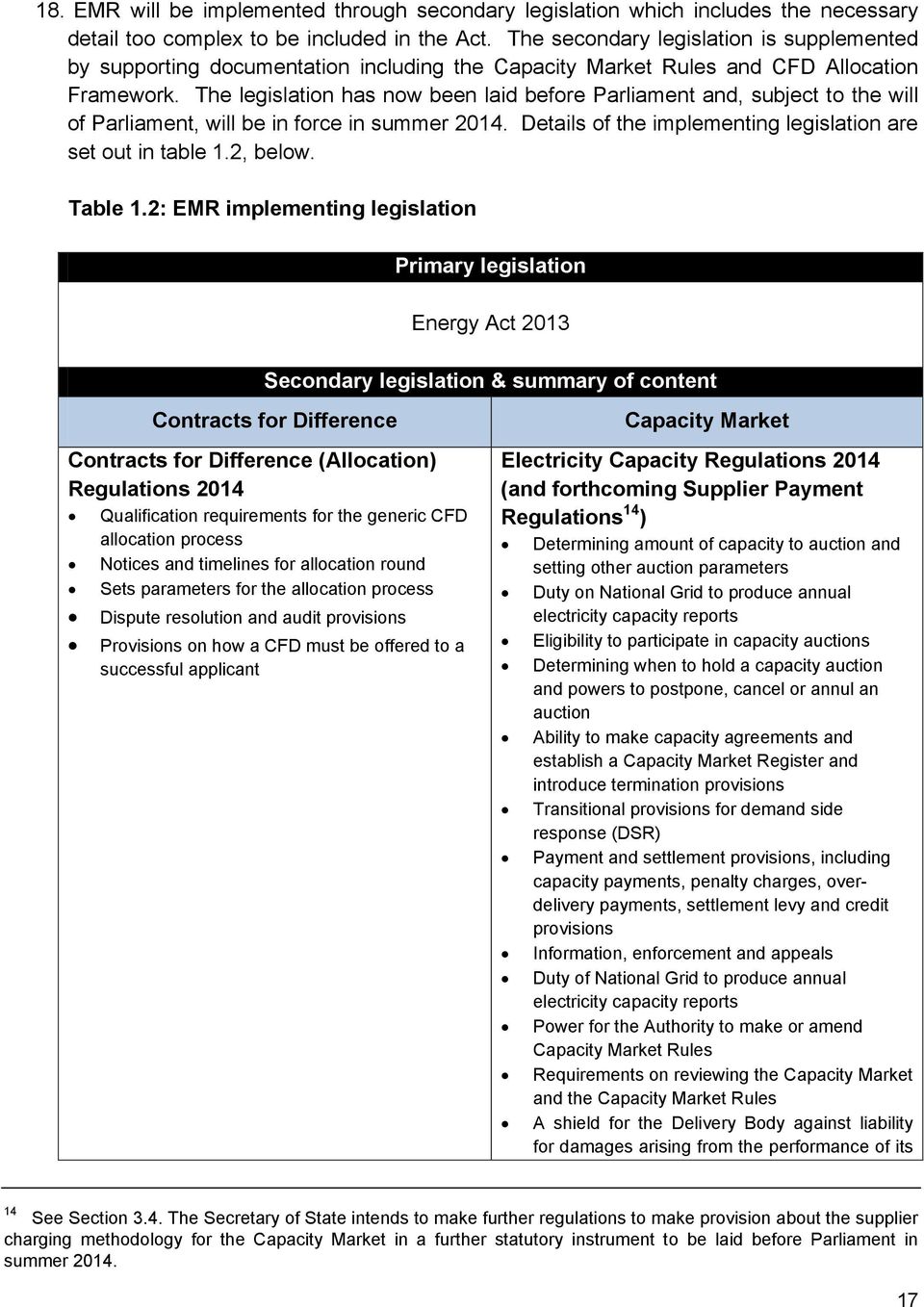
18 EMR delivery functions relating to the Capacity Market Contracts for Difference (Definition of Eligible Generator) Regulations 2014 Definition of eligible generator Defines the technologies in respect of which an eligible generator may apply for a CFD ( eligible generating stations ) Contracts for Difference (Electricity Supplier Obligations) Regulations 2014 General obligation on GB electricity suppliers to pay net costs of CFDs Obligation on suppliers to make interim payments against underlying CFD costs, comprising an interim /MWh rate and reserve payments Obligations on the CFD Counterparty to determine an interim levy rate and reserve payments on a quarterly basis Quarterly reconciliation of suppliers interim payments against the underlying supplier obligation levy Mutualisation of unpaid amounts Obligation on suppliers to provide collateral to the CFD Counterparty Obligation on suppliers to pay the operational costs of the CFD Counterparty through a levy Disputes and enforcement Pro-rating of payments to CFD generators Capacity Market Rules 2014 Capacity Market rules set out the operational and technical processes to ensure the efficient running of the Capacity Market This includes detailed information on prequalification, running the capacity auction (including DSR transitional auctions), issuing capacity agreements and monitoring Contracts for Difference (Standard Terms) Regulations 2014 Regulations that control three aspects of the way in which a generic CFD may be constructed, offered and publicised Includes the terms that must be followed when drafting a generic CFD Governs the way in which an applicant may request a change to the generic CFD terms Requires that certain information be published concerning those applicants who successfully enter into a CFD Controls the process through which a CFD is completed and offered Allocation Framework In accordance with the Contracts for Difference (Allocation) Regulations 2014, sets out detail on: Qualification requirements The allocation process, including auction rules 18

19 Electricity Market Reform (General) Regulations 2014 Sets out the functions the Secretary of State may be required to perform to deliver EMR, including: Placing a requirement on the Delivery Body to provide information in relation to the strike price applicable to any form of low carbon electricity generation under CFDs. How and when each Supply Chain Plan application should be made and what it should cover. Also the circumstances under which the Secretary of State may release information contained in the Supply Chain Plan application, for what purposes and to whom A shield for the Delivery Body against liability for damages arising from the performance of its EMR delivery functions relating to the Contract for Difference Modifications to the Transmission Licence of National Grid Electricity Transmission plc (NGET) Special Condition 2N: Electricity Market Reform (EMR) Functions Consequential modifications to industry codes and licences 19. Further detail on the legal framework and implementation measures for CFDs and the Capacity Market can be found in Chapters 2 and The Levy Control Framework (LCF) 20. The Levy Control Framework (LCF) allows the Government to control public expenditure paid for through consumers energy bills, and reflects the importance the Government places on monitoring and controlling spending on levy schemes that are funded in this way. In 2012, the LCF was extended to 2020/21 specifically for low carbon electricity policies to inform decisions on new mechanisms and to provide investors with greater certainty on future levels of support. 21. The LCF sets annual limits on the overall costs of all DECC s low carbon electricity levyfunded policies until 2020/21. These comprise the Renewables Obligation (RO), smallscale Feed-in Tariffs and CFDs (including Investment Contracts). The annual cap in 2020/21 has been set at 7.6 billion, a level which will enable us to meet our low carbon and renewables ambitions. DECC has updated its governance arrangements for the LCF to incorporate CFDs and manage spend and deployment across all schemes in the framework. 22. These updated arrangements allow the Government to rebalance support for renewables and manage a smooth transition to the reformed market that will secure the further 19
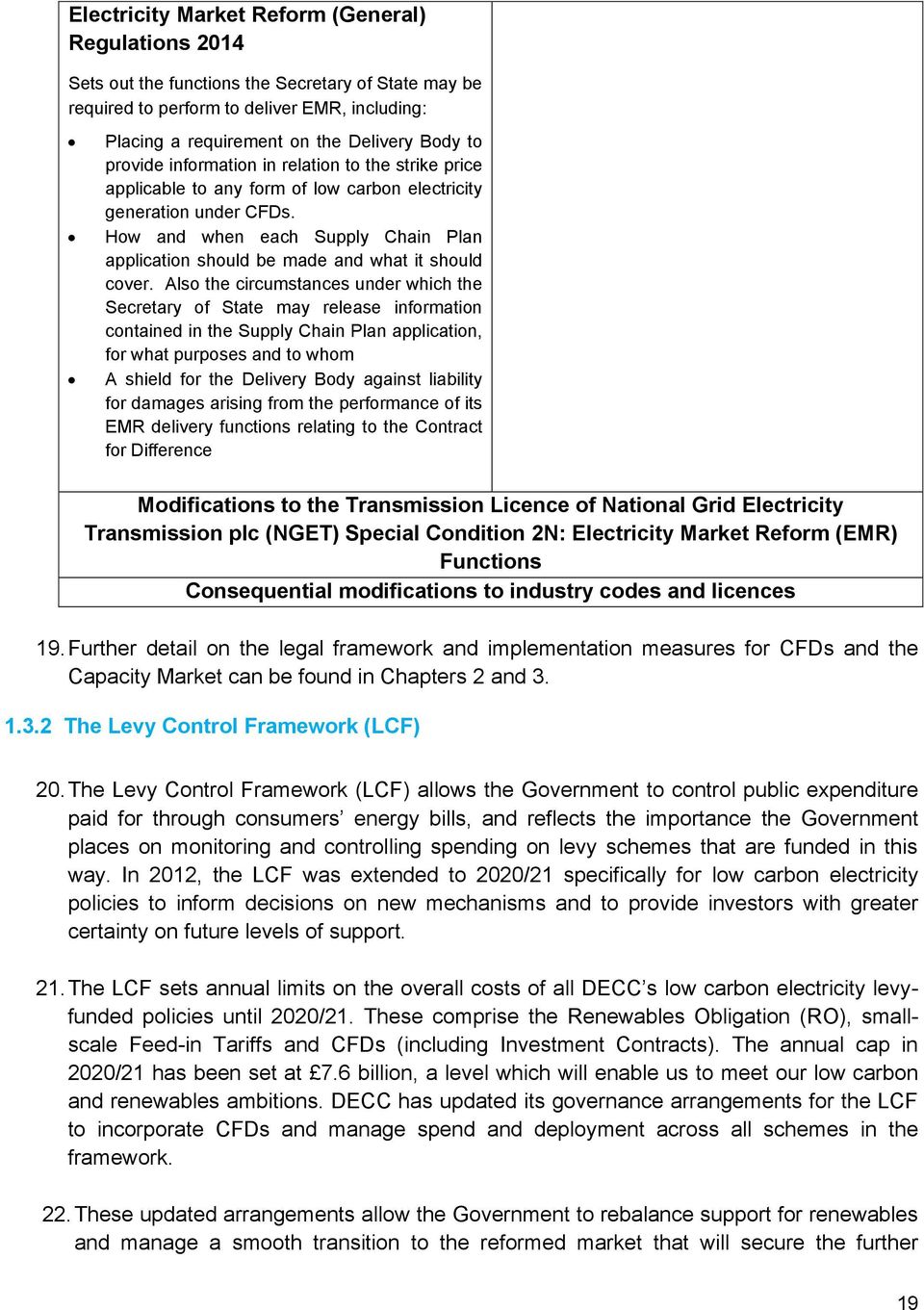

20 investment we need. If spend in one area of the LCF increases unsustainably, it will increase pressure on bills unless it is matched by cost reductions elsewhere. The Government takes potential risks to the LCF very seriously and will act where necessary to ensure that costs are contained and that programmes supported through the LCF remain affordable. 23. In future, the Capacity Market will also be included in the LCF. However, it will not fall within the spending cap for low carbon electricity ( 7.6 billion in 2020/21, in real 2011/12 prices). Expenditure on the Capacity Market will not begin until When there is greater certainty on the size of the levy, its own separate budget will be set. A future government will consider when to set an LCF cap beyond 2020/ The institutional framework 24. Figure 1.1 indicates how the key new mechanisms and institutions fit together to provide a secure, competitive and low carbon electricity market. Figure 1.1: The EMR institutions Government Sets overall policy direction and sets out key parameters within the EMR Delivery Plan Delivery Body (within the System Operator, National Grid) Provides analysis (which is scrutinised by the Panel of Technical Experts) to Ministers on key parameters (e.g. CFD strike prices and Capacity Market auction volume) and runs generic CFD and CM allocation processes Contracts for Difference to incentivise low carbon generation Market wide Capacity Market: open to all forms of capacity (except those holding a CFD or RO) National Grid notifies the Low Carbon Contracts Company of an eligible generator to whom a CFD should be issued National Grid informs the Electricity Settlements Company of successful capacity providers in auction Low Carbon Contracts Company (the CFD Counterparty) Electricity Settlements Company (the Capacity Market Settlement Body) Settlement Services Provider manages settlement of payments on behalf of the Low Carbon Contracts Company and Electricity Settlements Company Settlement Services Provider (ELEXON) Ofgem regulates the market 20
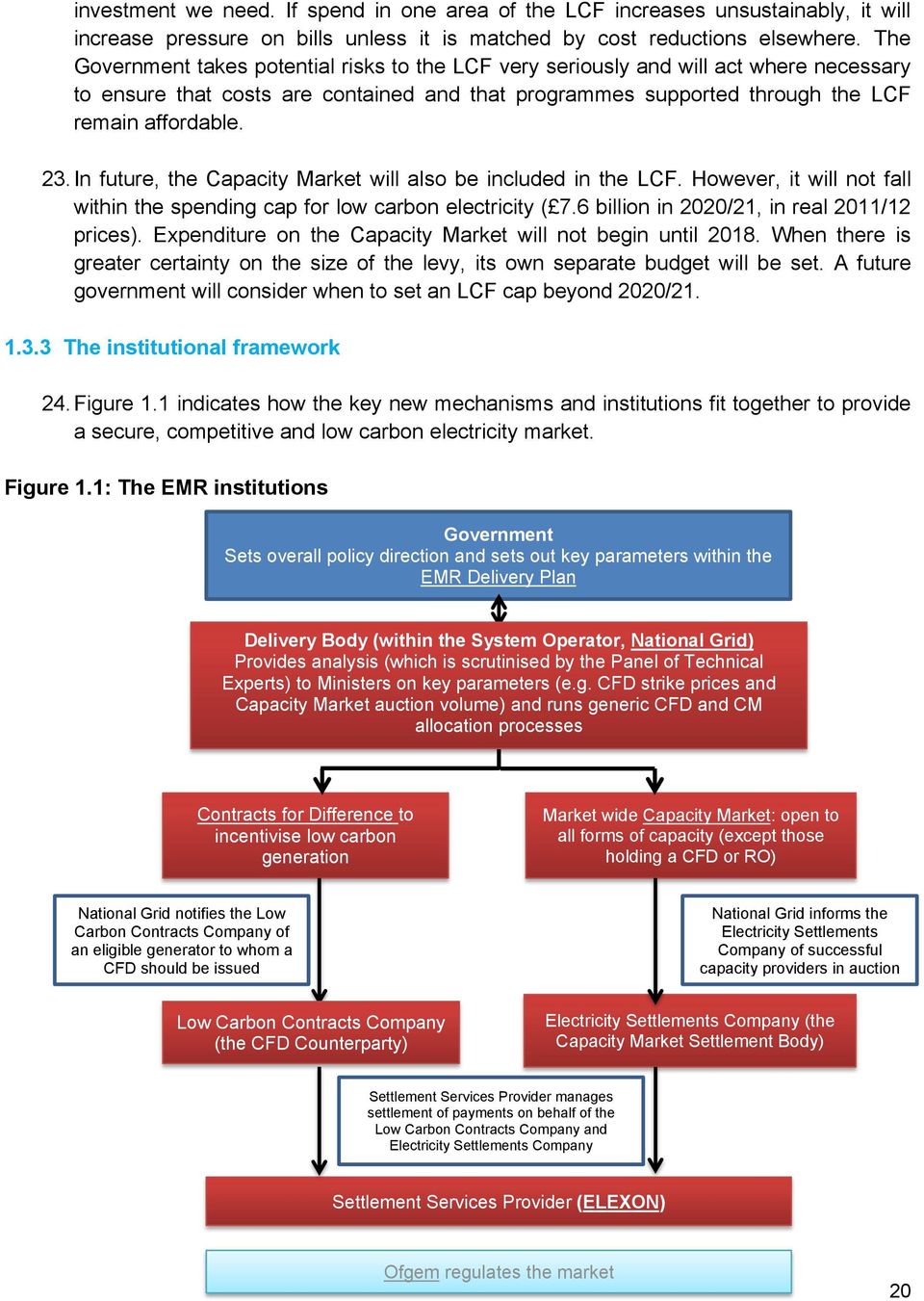
21 25. A number of parties are involved in the delivery of the market reforms: Government Sets the policy framework, provides sponsorship, leads design and legislative action. Ofgem Regulates the electricity market, provides design advice, analysis and regulation. National Grid Delivery Body, administrator of CFD allocation and the Capacity Market auction and provides advice to the Government. Low Carbon Contracts Company (the CFD Counterparty) Administers and acts as counterparty to the CFD, manages the supplier obligation. Electricity Settlements Company (the Capacity Market Settlement Body) Makes capacity payments and retains overall accountability and control of the Capacity Market settlement process. Settlement Services Provider Carries out the settlement of CFDs on behalf of the CFD Counterparty and the settlement of Capacity Market agreements on behalf of the Capacity Market Settlement Body. Devolved Administrations Oversee implementation and monitoring of EMR with DECC. Generators Participants and parties to CFD and Capacity Market agreements. Suppliers Contributors to CFD and Capacity Market funding arrangements National Grid (System Operator) Delivery Body 26. In its role as System Operator, National Grid Electricity Transmission plc has been appointed as the Delivery Body. The System Operator is in a unique position at the heart of the electricity system. It has been chosen to help deliver the reforms due to the strong synergies between its current role and the requirements of both CFDs and the Capacity Market. 27. National Grid s work balancing the electricity transmission system gives it an understanding of the balancing requirements of different technologies, and the impacts these may have on transmission network reinforcements. Additionally, it has extensive experience of running tenders and auctions both on the electricity side and on the gas side of its businesses. 28. The Delivery Body s role can be summarised as: Providing analysis to inform ministers key decisions, for example, on the level of support for low carbon technologies in the case of CFD and how much capacity to contract for in the case of the Capacity Market; Administering the two new mechanisms: Establishing whether projects meet Government-set eligibility criteria to receive CFDs and running auctions for CFDs and capacity agreements. 21
22 29. Delivery of these two mechanisms by a single organisation ensures a joined up approach to the CFD and the Capacity Market and, combined with National Grid s current roles, will provide value for money for consumers. 30. A more detailed explanation of the Delivery Body s role in administering CFDs and the Capacity Market is set out in Chapters 2 and 3 respectively Low Carbon Contracts Company (LCCC) 31. An order will be made to designate the Low Carbon Contracts Company as the CFD Counterparty under the Energy Act Its principal functions are to act as the counterparty to and manage Contracts for Difference, and also to manage the collection and payment of monies under the supplier obligation for the CFD regime. The Chair and the Senior Independent Director have been appointed, and the Low Carbon Contracts Company is being set up to be fully operational from 1 August Electricity Settlements Company (ESC) 32. The Electricity Settlements Company s key roles are to make capacity payments and to retain overall control of the Capacity Market settlement process and accountability to Parliament EMR supporting measures 33. The CFD and Capacity Market implementation will be complemented by: Transitional arrangements for the early years of the new arrangements ( ) including regulations on the transition from the Renewables Obligation to the CFD and on Investment Contracts (covered in Section 1.4, below). Governance documents to implement the institutional arrangements for delivery of both the CFD and the Capacity Market (covered in detail within Chapter 3 and Chapter 4). Measures to support Electricity Demand Reduction (EDR) The Energy Act 2013 includes provisions to enable EDR to be delivered through the Capacity Market and EDR will be piloted this year (covered in Chapter 4). Publication of the EMR Delivery Plan on a 5-yearly basis. The first EMR Delivery Plan was published in December 2013 (covered in Chapter 5). Publication of Annual Updates these will be published in between Delivery Plans every year and provide updates on EMR, and may indicate future strike prices or changes to strike prices (covered in Chapter 5). Licence and code modifications to mitigate any potential conflicts of interest for National Grid in performing its role for EMR (covered in Chapter 5). 34. In addition, EMR will work alongside other Government energy market measures: 22
23 Action by Ofgem wholesale market liquidity: The electricity market in Great Britain has low levels of liquidity relative to some other major European power markets and the Great Britain gas market. At the end of last year Ofgem took the decision to introduce changes to licence conditions to provide that: o wholesale energy prices are transparent, with the six largest suppliers required to quote prices two years in advance; o the six largest suppliers must trade at the prices they quote; and o the six largest suppliers and the largest independent generators must trade fairly with small suppliers or face financial penalties. Carbon Price Floor (CPF): The Carbon Price Floor sets a minimum price for carbon dioxide in the UK electricity generation sector by topping-up the EU Emissions Trading System (EU ETS) price through a tax (Carbon Price Support) on fossil fuels used in electricity generation. By increasing the wholesale electricity price, the CPF is designed to incentivise investment in low carbon electricity generation now. The CPF complements wider EMR proposals and reinforces the polluter pays principle. Emissions Performance Standard (EPS): The EPS provides a regulatory backstop on the amount of carbon emissions that new fossil fuel power stations are allowed to emit. It has been set at a level which supports the planning requirement that any new coal fired power stations can only be built if equipped with Carbon Capture and Storage. The UK is the first country in the EU to adopt an EPS and the Government will review the key elements on a regular basis. Further information on the EPS can be found on the website. 1.4 The transition to the reformed market 35. To maintain investor certainty and confidence ahead of implementation and as the reforms are taken forward, the Government has put in place transitional arrangements for renewable generation currently supported by the Renewables Obligation (RO), and to enable investment decisions through Investment Contracts (an early form of CFD) Renewables Obligation (RO) transition 36. In July 2013, the Government published a consultation paper 15 setting out proposals for the operation of the RO during the transition period. Following consideration of representations and consultation responses, the Government published a further consultation 16 in November 2013 proposing detailed arrangements for the eligibility criteria and lengths that would apply to the grace periods (the exceptions to the RO closure date for new generating capacity, to cover projects against certain types of delay risk) to be offered at the point of RO closure. A combined Government response to these 15 See 16 See 23
24 consultations was published on 12 March 2014 and sets out the Government s decisions on these matters. This is summarised in the paragraphs below. 37. Between the introduction of the CFD regime in 2014 and the RO closing on 31 March 2017, new renewable generating capacity will have a choice between these two support mechanisms. 38. Generators putting in place additional capacity of more than 5MW will also have the choice of applying to register that additional capacity under the RO or apply for a CFD. A generating station with some capacity accredited under the RO and some supported by a CFD, will become a Dual Scheme Facility and will be expected to treat the capacity in each scheme as distinct and separate through separate metering and fuel data arrangements. Additional capacity of 5MW or less added to RO accredited stations after 31 March 2017 will not be supported. This is primarily because there is no proportionate and viable mechanism for providing support to this additional capacity that is consistent with overall transition policy. 39. Generators already accredited within the RO and those which accredit during the transition period before the RO closes on 31 March 2017 will continue to receive support in the vintaged scheme for a full 20 years or until 31 March 2037, whichever is sooner. 40. Grace periods will be offered to generators in certain circumstances who expect to deploy prior to the RO closure date, but were delayed. Generators will be entitled to choose which grace period best meets their needs and circumstances, subject to the detailed eligibility criteria and any application requirements or timeframe for each grace period. 41. There are two specific measures for operators of biomass co-firing stations or unit(s), and offshore wind stations. To incentivise full biomass conversion as a transitional technology, operators of an RO accredited biomass co-firing stations or unit(s) will be able to apply for a CFD as a biomass conversion and leave the RO if successful. In addition, operators of co-firing stations or unit(s) will also be able to bid in to the Capacity Market and leave the RO if successful in that bid. In both cases, stations or units would not be able to return to the RO once they have made this choice. Offshore wind generators which have accredited under the RO at the point of closure, and are looking to register turbines in more than one phase, will be able to register any unregistered offshore turbines under the RO, the CFD or a combination of both. This provides maximum flexibility and minimises the risk of an investment hiatus. 42. In May 2014 a further consultation 17 was launched on proposed changes to financial support to solar PV, which set out the Government s proposals to close, from 1 April 2015, the RO across Great Britain to new solar PV capacity above 5MW, both to new stations and to additional capacity added to existing accredited stations. Solar PV is an 17 See 24
25 important part of the UK s energy portfolio, however large-scale solar is deploying much faster than previously expected and the Government has had to consider the impact that this will have on the LCF. A Government response will be published as soon as the Government has had a chance to consider consultation responses. The consultation closes on 7 July Investment Contracts 43. To help enable investment decisions ahead of implementation of the new arrangements and avoid the risk of investment hiatus, the Energy Act 2013 includes provisions that enable the Secretary of State to enter into Investment Contracts (an early form of CFD) with electricity generators FID Enabling for Renewables 44. Eight renewables projects were awarded Investment Contracts under the Final Investment Decision (FID) Enabling for Renewables process in April These have now been signed and were laid in Parliament on 4 June This is the first support offered under the EMR programme and it will provide up to 12 billion of private sector investment by These projects include biomass conversion, dedicated biomass with combined heat and power and offshore wind, and will bring forward: up to 15 TWh/y of generation. This will be enough generation to power the equivalent of up to around three million homes; approximately 4.5GW of renewables capacity across offshore windfarms, coal to biomass conversion plant and dedicated biomass plant with combined heat and power. This is around 14 per cent of the UK s 2020 renewable energy target; and a reduction of about 10MtCO 2 from the UK power sector per annum compared to fossil fuel generation FID Enabling for Hinkley Point C 46. DECC has been in discussion with NNB Genco, a subsidiary of EDF Energy, about an early CFD for its Hinkley Point C new nuclear power plant project. In October 2013 commercial agreement was reached on key terms, including strike price, for Hinkley Point C. 47. Negotiations remain on-going and the Government has always made clear that any contract will only be offered if it is fair, affordable, offers value for money to the consumer, is consistent with State Aid rules and is in line with government policy, including the commitment of not providing a public subsidy for new nuclear unless similar support is offered to other technologies. 25
26 Legal framework for Investment Contracts 48. Schedule 2 of the Energy Act 2013 sets out the provisions which give effect to Investment Contracts. The key components of these powers are the following: Transparency: In order to ensure full transparency of Investment Contracts, they must be laid before Parliament and published together with certain information required under the Act. While confidential information can be withheld from publication, this does not apply to the strike price or the reference price agreed. Mitigation against delays and payments to generators: The Secretary of State has powers to make payments under Investment Contracts in case the enduring EMR regime is delayed or does not come in to force at all. In this unlikely scenario, the Secretary of State could create regulations to collect payments from suppliers and administer payments himself or through an Investment Contract counterparty. If necessary, the Secretary of State could also make payments to generators directly under Investment Contracts. Transfer to the enduring EMR regime: The Secretary of State is under a duty to transfer by transfer scheme any Investment Contracts agreed to the Low Carbon Contracts Company, once: o the Investment Contract powers expire (1 Jan 2016 or earlier if CFD regulations define an eligible generator ); o the CFD Counterparty is designated; and o Contracts for Difference (Electricity Supplier Obligations) Regulations are in force. 49. Paragraph 7(2) of Schedule 2 of the Energy Act 2013 requires regulations are made for electricity suppliers to pay generators for the purposes of enabling payments to be made to generators under Investment Contracts. The Government intends to satisfy this requirement by making regulations under Paragraph 16(2) of Schedule 2, which will form part of the Contract for Difference (Electricity Supplier Obligations) Regulations. 50. The FID Enabling for Renewables Investment Contracts are based on the strike prices published on 4 December and the standard CFD. There are small differences between these Investment Contracts and the enduring CFD to take account of Investment Contracts being issued ahead of the enduring regime. These include: Counterparty: As noted above, under the Investment Contract the counterparty will initially be the Secretary of State. Investment Contracts will then be transferred to the Low Carbon Contracts Company by transfer scheme once it is operational. Conditions precedent: The Investment Contracts will only come into force once laid before Parliament. If they are not laid before Parliament by 31 December 18 See 26
27 2014, they will be automatically terminated. The contracts are also conditional upon the receipt of any necessary State Aid approval. It also provides for deferral periods and termination rights for developers if there are any delays to receiving State Aid approval. Phasing: Investment Contracts allow for a maximum of five phases in respect of the construction of a project and the first phase must comprise a minimum of 20 per cent of the project s total installed capacity The move to implementation during Contracts for Difference 51. The first CFDs are expected to be allocated during 2014, subject to State Aid approval. In April 2014 the Government published the Contracts for Difference Implementation Plan 19, which provides potential participants with details of the key implementation activities and milestones and their indicative dates. Key milestones for the first CFD allocation round include: Publication of supply chain guidance (30 April) Publication of initial CFD budgets (July) Secondary legislation and codes and licence changes come into force; budgets take effect and the CFD contract finalised for this allocation round (1 August) Applicants with generation >300MW may start to submit supply chain plans (1 August) Delivery Body publishes Application/Allocation Guidelines (12 September) Minor and necessary contract variation process (4 August 10 October) Secretary of State confirms the CFD budget (29 September) Application round opens (14 October) Delivery Body confirms the allocation outcome, assuming no outstanding disputes (end December) First CFD payments to generators (end April 2015) Capacity Market 52. It is expected that the first Capacity Market capacity auction will be run in December 2014, subject to State Aid approval. In December 2013 the Government published the Capacity Market Implementation Plan 20, which provides potential participants with details of the key implementation activities and milestones and their indicative dates. Key milestones include: 19 See df 20 See ation_plan_final.pdf 27
28 Secondary legislation and codes and licence changes come into force (1 August) Pre-qualification window open for applicants to submit formal registration and data submission (4-15 August) Pre-qualification results announcement (26 September) Start auction (9 December) Auction results day (24 December, though could be earlier depending on auction duration). 53. National Grid expects to publish an updated Capacity Market Implementation Plan before pre-qualification opens. 1.5 EMR in the Devolved Administrations 54. Throughout the development of these reforms we have sought to ensure that the approach to incentivising investment in low carbon generation is applicable and usable by all financiers and investors, and beneficial to all UK consumers. Significant parts of the UK s low carbon generation capacity, including substantial potential onshore and offshore renewable resources, are located within Northern Ireland, Scotland and Wales. It is by harnessing natural resources and technical expertise from across the UK that we will be able to deliver the required new generation of secure low carbon power. 55. The Northern Ireland Executive and Scottish and Welsh Governments have been closely involved in the development of the reforms and this collaboration will continue throughout their delivery Northern Ireland 56. Energy policy is devolved to Northern Ireland, with the exception of most elements of nuclear power. Northern Ireland has consented to the CFD and Investment Contracts provisions of the Energy Act 2013 applying to Northern Ireland, while taking into account both devolved competencies and Northern Ireland s position within the Single Electricity Market. 57. The CFD will be introduced later in the Northern Ireland as a result of on-going reform of the Single Electricity Market in Northern Ireland and the Republic of Ireland. The new Integrated Single Electricity Market design is expected to be operational by the end of The Government will continue to work closely with colleagues in Northern Ireland to design a CFD implementation programme in Northern Ireland that starts from April The supplier obligation will first be levied on licenced suppliers in England, Wales and Scotland. We are considering the precise date that the supplier obligation will begin to be levied in Northern Ireland, which will not be before Northern Ireland enters the CFD scheme. We will continue to work with the Department of Enterprise, Trade and 28
29 Investment in Northern Ireland (DETI) on this. The underlying policy for Northern Ireland supplier obligation will be the same as for Great Britain, but adapted to fit within the Northern Irish market. It is intended that when implemented in Northern Ireland the supplier obligation will impose an obligation which is the equivalent of that imposed on all UK electricity suppliers in relation to their market share. 59. Officials in DETI in Northern Ireland and the System Operator of Northern Ireland (SONI) worked with DECC officials and National Grid in modelling the impact of strike prices on deployment in Northern Ireland, and whether these achieve Northern Ireland s renewable electricity target by The DETI Minister consented to CFD strike prices for renewable technologies, as set out in the Delivery Plan, to apply in Northern Ireland. 60. The UK Government and Northern Ireland have also agreed that because the Irish Single Electricity Market already uses a capacity mechanism, the Capacity Market will only apply across Great Britain with any associated costs being borne by GB customers Scotland 61. The generation and supply of energy are reserved policy matters under the Scottish devolution settlement (see the Scotland Act 1998). All EMR policy extends to Scotland. 62. The Scottish Government has a consultative role in EMR as set out in Section 24 of the Energy Act 2013 in the design and delivery of the CFD, as well as a consultative role within the accompanying institutional framework. Scottish ministers have been consulted throughout the policy design process, including the Delivery Plan process on the CFD aspects of the analysis and strike prices Wales 63. Energy policy is a reserved matter under the Welsh devolution settlement (see the Government of Wales Act 2008). All EMR policy extends to Wales. 64. The Welsh Government has a consultative role in EMR as set out in section 24 of the Energy Act 2013 in the design and delivery of the CFD, as well as a consultative role within the accompanying institutional framework. Welsh ministers have been consulted throughout the policy design process, including in the Delivery Plan process on the CFD aspects of the analysis and strike prices. 29
30 1. Contracts for Difference 2.1 Introduction Legal framework for Contracts for Difference Energy Act Secondary legislation Allocation Framework Additional supporting documents Roles and responsibilities of market participants Policy framework and final design The CFD generator journey Setting the budget for CFDs Levy Control Framework (LCF) budget CFD allocation budget Division of the CFD budget into pots The use of budget minima and maxima Publication of CFD budget information Changes to the CFD allocation budget CFD application and allocation Eligibility to apply for a CFD Supply chain requirement Individual pre-signature modifications to the CFD standard terms CFD application Secretary of State direction to offer a CFD Applying to the Delivery Body for a CFD Appeals provisions Allocation of a CFD by the Delivery Body Allocation audit Contract offer and acceptance CFD contract management Pre commissioning Milestone Delivery Date Target Commissioning Window Longstop Date
31 Contract capacity adjustment Post commissioning Settlement process for BSC registered generators CFD contract closure Offshore wind phased projects Route to market Review and revision of the CFD framework Payment model: the CFD supplier obligation Supplier obligation overview Payment and settlement Billing and invoicing Forecasting and setting the interim rate Reserve payments In period adjustments Levy reconciliation Data reconciliation Supplier collateral required through the supplier obligation Mutualisation Arrangements for dealing with non-payment Disputes Exemption for Energy Intensive Industries (EIIs) Low Carbon Contracts Company s operational cost levy Setting the operational cost levy rate Reconciliation of operational cost payments Managing budget risk Enforcement Dispute resolution Institutional and governance arrangements CFD Counterparty - the Low Carbon Contracts Company Roles of the Low Carbon Contracts Company Governance and constitution of the Low Carbon Contracts Company The statutory framework of the Low Carbon Contracts Company The Framework Document Arrangements for the operational establishment of the Low Carbon Contracts Company Designation of the CFD Settlement Services Provider
32 2.4.3 System Operator National Grid
33 2.1 Introduction 65. A Contract for Difference (CFD) is a private law contract between a low carbon electricity generator and the Low Carbon Contracts Company (LCCC, the CFD Counterparty 21 ) a Government-owned company. A generator party to a CFD is paid the difference between the strike price a price for electricity reflecting the cost of investing in a particular low carbon technology and the reference price a measure of the average market price for electricity in the GB market. It gives greater certainty and stability of revenues to electricity generators by reducing their exposure to volatile wholesale prices, whilst protecting consumers from paying for higher support costs when electricity prices are high. In this way, CFDs provide efficient long-term support for all forms of low carbon generation. 66. The EMR Delivery Plan will be published every five years and will set out the maximum strike price that can be included in CFDs, which will determine the maximum level of support for low carbon technologies. The first EMR Delivery Plan was published in December 2013 and included the administrative strike prices for renewable technologies for CFD commissioning during the period 2014/ /19. Further information on the EMR Delivery Plan (and future Delivery Plans and Annual Updates) can be found in Chapter The cost of CFDs will be met by consumers via the supplier obligation, a levy on electricity suppliers. 68. The process for the allocation of CFDs will be overseen by the Delivery Body, National Grid, who will notify the CFD Counterparty of the projects that have been successful in an allocation round. The CFD Counterparty will then offer a CFD based on a set of standard terms, with some limited scope to make minor and technical modifications to these terms. Government retains a power to direct the CFD Counterparty to enter into CFDs outside of these procedures. Further details are provided in Section (Secretary of State direction to offer a CFD). 69. This chapter describes the legal framework underpinning the generic CFD, the roles and responsibilities of market participants, the lifecycle of a CFD contract and the arrangements by which eligible generators can apply for and are allocated a CFD including: eligibility criteria; pre-contract signature obligations for successful applicants; post-contract signature process; and contract closure. 21 The Low Carbon Contracts Company Limited (LCCC) will be designated as a CFD Counterparty and is intended to be the only CFD Counterparty for the foreseeable future. For ease of comparison with other EMR publications and the regulations, the majority of references to the LCCC remain as the CFD Counterparty. This also applies to the Electricity Settlements Company, the incorporated name for the Capacity Market Settlement Body 33
34 It also includes detail on the supplier obligation and the associated institutional arrangements that will be needed to administer CFDs, in Sections 2.3 and CFDs subject to the generic allocation process will first be introduced first in England, Wales and Scotland, with Northern Ireland opening its market to CFDs at a later date. The Government will continue to work closely with colleagues in Northern Ireland to design a CFD implementation programme in Northern Ireland that starts from April The information on CFDs set out in this document applies to renewables projects located in Great Britain only, unless stated otherwise Legal framework for Contracts for Difference 72. The Contract for Difference regime is put in place by the Secretary of State under the powers conferred on him by the Energy Act Exercising these powers the Secretary of State has implemented the regime by a combination of: secondary legislation; an Allocation Framework; a Budget Notice (which sets the budget for an allocation round); and Standard Terms Notices. Supporting these documents will be the CFD contract. Detailed administrative guidance may be published by the Delivery Body on the form and requirements for applications that must be sent to them, and guidance issued by the CFD Counterparty on its processes for managing the CFD contract and settlement systems. 73. The roles of the Delivery Body and CFD Counterparty are set out in the Energy Act 2013, implementing regulations and licence modifications which, for example, put into place a regime designed to prevent conflicts of interest arising. The governance arrangements of the CFD Counterparty are set out in a combination of the company s Articles of Association and a Framework Document Energy Act The Energy Act 2013 contains powers enabling the Secretary of State to implement the Contracts for Difference regime through a combination of regulations and a private law contract between generators and the CFD Counterparty Secondary legislation 75. The statutory instruments that relate to the CFD are: Contracts for Difference (Allocation) Regulations These regulations set out the allocation process for CFDs allocated by the Delivery Body, from the announcement of an allocation round through to the point where the Delivery Body sends the CFD Counterparty notifications of the successful applicants that must be offered a CFD. The regulations set out the notices that set up an allocation round, the application process, eligibility criteria and which applications are excluded, eligibility 34
35 review and appeals processes and audit requirements. They also set the parameters of the Allocation Framework which sets out the auction rules. Some of the requirements set out in the regulations can be added to or amended in the Allocation Framework. The regulations also set out the process by which the Secretary of State can direct the CFD Counterparty to offer a CFD outside of the generic CFD allocation process. Contracts for Difference (Definition of Eligible Generator) Regulations These regulations define an eligible generator for the purposes of entering into a CFD. Contracts for Difference (Standard Terms) Regulations These regulations set out the content that the Secretary of State must include within a CFD that is to be offered or revised, the tests that must be applied when assessing whether a given pre-signature modification is of a minor effect and necessary within the meaning of the Energy Act 2013, and a requirement that a contract is entered in to and its details published in a strictly time-controlled process. Contracts for Difference (Electricity Supplier Obligations) Regulations These set out the supplier obligation, the mechanism to allow the CFD Counterparty to raise funds from all licensed electricity suppliers in Great Britain to pay for the liabilities that it has to make payments to electricity generators under the CFD scheme, and to return money to suppliers where appropriate. The regulations set out arrangements for the CFD Counterparty to hold sums in reserve and to cover its losses in the situation of default by an electricity supplier. The regulations also set out the arrangements for collection of a levy from all licensed electricity suppliers to pay for the CFD Counterparty s operating costs. Electricity Market Reform (General) Regulations These set out set out a number of general provisions relating to CFD policy, including: o a requirement on the Delivery Body to provide information in relation to the strike price applicable or to be applicable to low carbon electricity generation under CFDs; o provisions setting out how and when a supply chain statement application must be made, and the circumstances in which the Secretary of State must not disclose information contained in a supply chain statement application (see Section ); and o provision to shield National Grid Electricity Transmission plc (NGET), acting as the national System Operator and Delivery Body, against liability in damages to third parties relating to its EMR delivery functions relating to the CFD Allocation Framework 35
36 76. The Allocation Framework will include the technical rules and procedures that will apply in an allocation round. It also contains other provisions which enable the CFD allocation process to operate efficiently and flexibly. The Allocation Framework applies to the first allocation round. The Secretary of State will need to specify whether the same Allocation Framework applies to a future allocation round or may decide to produce a new framework. A new framework may be needed to deal with the prevailing circumstances in respect of a subsequent allocation round and may, for example, provide for a different type of auction process or a refinement to the existing one in light of the experience which has been obtained by that point. A draft version of the Allocation Framework 22 was published on 8 April 2014, and an updated version will be published alongside the laying of legislation and this document Additional supporting documents 77. In addition to the documents listed above, further details on the CFD terms and conditions can be found in the following documents 23 : CFD Contract Terms and Conditions (April 2014) CFD Agreement (April 2014) Draft CFD (Phase 1) Agreement (Apportioned Metering) CFD (Phase 1) Agreement (Single Metering) CFD (Phase 2) Agreement (Single Metering) CFD (Phase 3) Agreement (Single Metering) Roles and responsibilities of market participants 78. Throughout this chapter, reference is made to key participants in the CFD allocation and administration processes. Table 2.1 below summarises the participants and the key responsibilities of each. Table 2.1 Market participants Market Participant Government Roles and responsibilities Designs and implements the policy for the CFD mechanism. Sets the terms of the CFD contract and can vary terms for contracts issued in future. Sets the objectives for the allocation system. Responsible for the overall budget (policy costs) of the CFD scheme. Responsible for approval of supply chain plans. 22 See 23 These can be found on the GOV.UK website
37 National (Delivery Body) Grid Low Carbon Contracts Company (LCCC) (The CFD Counterparty) Sets out eligibility criteria that applicants must meet. Sets auction rules and details of the allocation process in the Allocation Framework. Can vary the generic CFD contract terms before an allocation round is announced. Announce allocation round and the budget for the allocation round. Takes the final decision on whether to proceed with, rerun or terminate an allocation round after receiving the audit report. May award CFDs outside the generic allocation process. Sole shareholder of the CFD Counterparty. Reviews and approves CFD Counterparty s operational budget and sets the operational cost levy rate to cover this in the Contract for Difference (Electricity Supplier Obligations) Regulations. Assesses the eligibility of applications for generic CFDs 24 and notifies applicants of eligibility determination. Values all applications and assesses whether an auction process is required to decide which applicants should be offered a CFD. Runs the CFD allocation process. Provides the CFD Counterparty with the information necessary to offer a CFD. Conducts analysis to support Government s setting of administrative strike prices. Reports value of applicants to DECC Determines disputes regarding CFD eligibility (Tier 1 disputes) Signs CFDs once provided with the necessary information by the Delivery Body or directed by the Secretary of State and manages CFDs and Investment Contracts which are transferred from Secretary of State. Monitors and manages the contracts over their lifetime, including fuel monitoring, sampling and sustainability agreements where necessary Considers any minor and technical amendments to the contract standard terms. Forecasts CFD payments, determines interim rate and reserve amounts on a quarterly basis. Calculates quarterly reconciliation payments. 24 That is, CFDs which are not allocated directly by the Secretary of State. 37
38 Ofgem Eligible electricity generators Collects payments from suppliers and passes to generators and vice versa (a subsidiary of ELEXON will carry out the settlement part of this role as Settlement Services Provider on behalf of the CFD Counterparty). Collects and holds collateral from suppliers Takes action to recover debts owed by electricity suppliers, and mutualises any unpaid debts. Ensures that the Delivery Body carries out its duties efficiently, cost effectively and in a timely fashion. Determines disputes regarding CFD eligibility (Tier 2 disputes). The body to which suspected market collusion is reported Responsible for submitting the CFD application, together with appropriate supporting evidence in accordance with the eligibility criteria (including, where applicable, a supply chain plan). May submit a sealed bid if there is a competitive allocation process in the first allocation round. Responsible for delivering their project and complying with the terms of the contract. 2.2 Policy framework and final design The CFD generator journey 79. Figure 2.1 below sets gives overview of the CFD journey; from setting the budget to the processes by which eligible generators can apply for a CFD, through to contract allocation and management of the CFD contract by the CFD Counterparty. Figure 2.1: A CFD generator s journey 38
39 2.2.2 Setting the budget for CFDs 80. Before discussing the application and allocation process for CFDs, it is important to set the budget context for the allocation process. The CFD budget is a subset of the Levy Control Framework Levy Control Framework (LCF) budget 81. The Government s Levy Control Framework (LCF) cap represents the maximum amount of spending allowable in the period 2014/ /21 through consumer bills to support Government s electricity market decarbonisation and renewables objectives 25. It is expressed as a series of annual limits on the overall costs of support across a number of schemes. These schemes include the Renewables Obligation, small-scale Feed in Tariffs (FIT), Investment Contracts and CFDs. The amount of the LCF allocated for each scheme is described as a budget CFD allocation budget 82. The LCF sets annual limits on the overall costs of DECC s levy funded policies. As the LCF forms one overall capped amount, any increase in spend for one sector under these financial incentives will reduce the level of support available for other sectors under the LCF. We are currently working to determine the level of the CFD budget available to National Grid for allocation under the enduring regime. 83. The Contracts for Difference (Allocation) Regulations will require the Secretary of State to publish a Budget Notice at least ten working days before an allocation round opens, but the Government intends to provide stakeholders with at least three month visibility of the CFD budget prior to the opening of an allocation round to enable them to be able to prepare their applications. 84. In order to manage the costs imposed on consumers, provide as much certainty as possible to generators, and to meet Government s objectives we are taking the following approach: The CFD budget will be allocated to a number of technology groups or pots. The Government will confirm the CFD budget available to the Delivery Body for allocation in the first allocation round in the final Budget Notice to be published before 1 October 2014, at the same time that the Secretary of State announces the size of the Renewables Obligation (RO) for the 2015/16 period. The CFD 25 Annex D of the draft Delivery Plan provides further details of how the Levy Control Framework has been extended to 2020/21 to support Electricity Market Reform. df 39
40 (Allocation) Regulations set out the circumstances in which the Secretary of State can vary the CFD budget, including restrictions on doing so within an allocation round and establish the potential for optional use of maxima (caps) and minima (floors) for some technologies within this budget. The process that rations CFDs in a competitive (constrained) allocation round, implemented through the allocation process (as described in Section below). 85. Indicative budget levels will be published in July The detail provided will: confirm an indicative CFD budget envelope; set out indicative sizing for each group; The budget allocations that are released to National Grid for delivery years 2014/15 to 2020/21, but only those years for which there are strike prices are available for allocation in the first allocation round (2015/ /19) Division of the CFD budget into pots 86. For the following types of eligible generating stations, the CFD budget will be divided as follows: a group of established technologies (Onshore Wind (>5 MW), Solar Photovoltaic (PV) (>5 MW), Energy from Waste with CHP, Hydro (>5 MW and <50 MW), Landfill Gas and Sewage Gas; a group of less established technologies (Offshore Wind, Wave, Tidal Stream, Advanced Conversion Technologies, Anaerobic Digestion, Dedicated biomass with combined heat and Power and geothermal); and On 13 May 2014, we published a consultation 26 on the treatment of biomass conversion plant, Scottish Islands onshore wind projects, and any minima and maxima that may be applied within technology groupings in the allocation rounds. Subject to the outcome of this consultation it is possible that another pot will be created for biomass conversions and/or Scottish Island onshore wind projects. 87. Budgets will be set and allocated between these pots in different ways. The amount of budget to be released for established technologies will be determined so that there is likely to be competition (constrained allocation), with the clearing strike price determined through that competitive process. 26 See 40
41 88. For less established technologies, these are able to receive support in the first Delivery Plan period (2014/ /19) at the administrative strike prices published on 4 December 2013, unless there is insufficient budget in a CfD allocation round to satisfy all bids. In such cases then an auction (competitive allocation) will apply. Those technologies would then have to compete against each other on price whereby each project is paid the clearing price for its delivery year within the auction, capped at its administrative strike price The use of budget minima and maxima 89. We are considering the possible use of minima (floors) or maxima (caps) placing restrictions on allocation of the CFD budget for some technologies or technology groups. A minima would effectively reserve a portion of the CFD budget for a technology or group of technologies while a maxima would constrain the portion of the CFD budget available for a technology or group of technologies. 90. We propose only a 100MW minimum threshold for wave and tidal stream technologies (i.e. not including tidal lagoon or tidal barrage) across both the RO and CFD schemes for the duration of the first Delivery Plan period. Our approach will be confirmed in the forthcoming Government Response to the consultation on the use of technology groupings, minima and maxima Publication of CFD budget information 91. Market participants need to know how much of the CFD budget is available so that they can make informed choices about their project development spending. DECC will publish a Budget Notice on its website at least ten working days before the opening of an allocation round. The CFD Counterparty will publish details of all CFDs entered into following an allocation round Changes to the CFD allocation budget 92. The Government has the ability to adjust the CFD budget. Where it does so the Government will publish a Budget Revision Notice with updated values and the Delivery Body will use these to determine CFD allocation. Government will have the ability to increase the amount of budget released to the Delivery Body within any allocation round. This flexibility would come from managing the interdependencies between the CFD and other budgets within the LCF as described above. 93. The Delivery Body must inform DECC of the total value of applications before proceeding to the allocation process, (i.e. the process that determines which of the qualifying applicants will be offered a CFD, a process which may include a form of auction). The 27 See 41
42 Secretary of State would then have five working days to decide whether to increase the budget before the allocation process commences. It is envisaged that for the first allocation round this would be before applicants are invited to submit sealed bids. 94. A Budget Revision Notice can increase or decrease the budget if it is issued at least ten working days before the first date that applications may be submitted in the allocation round. After that point budgets can only be increased, and maxima and minima may only be increased if the overall budget is increased by at least the same amount. 95. This will provide investors and applicants with certainty that the budget will not be amended in a way which might disadvantage an application for a CFD. Government will not be able to reduce the budget for applicants within an allocation round all applicants to a round will be assessed against a budget that is at least as high as that which was in place when the round opened for applications. 96. The Government will inform the Devolved Administrations (DAs) ahead of amending budget parameters, and will aim to involve them as far as possible. In particular we will aim to do so where decisions will impact technologies in which DAs have a particular interest. There may be a limited number of circumstances in which we will reserve the ability to make quick decisions where it is in the public interest to control costs; for example if the allocated budget had to be reduced very suddenly between allocation rounds in order to address gaming risks or pressures elsewhere in the LCF. In these circumstances the DAs will be informed, but further involvement may not be practicable CFD application and allocation 97. This section sets out the: eligibility criteria that an eligible generator will need to satisfy when making an application for a CFD, including the requirement that projects of 300MW and above will need to demonstrate that they have met the supply chain plan eligibility criteria when making an application for a CFD; process by which generators can negotiate minor and necessary changes to the contract; CFD application and assessment; submission of sealed bids; allocation process; and contract review and signing 98. From the start of the regime, contracts for the more established technologies will be subject to competitive allocation, as set out in the Allocation Framework. 42

43 99. Figure 2.2 below shows the journey a project with a CFD will progress through from application through to operation. This was first published in the 2013 document, Contract for Difference: Allocation Methodology for Renewable Generation 28. Figure 2.2: CFD application to auction MIlestone Delivery Date Target Commissioning Date Latest point for contract to go live but end point fixed CFD cancelled if project not generating by long Delivery Plan (Strike Prices and Mix scenarios) LCF Settlement and Decision on Supply Chain Application Allocation Contract Signature Project Procurement Construction Target Commissioning Window Late Commissioning Contract value erodes Generator can start contract at any point within TCW Secretary of State sets the strike price and budget NG runs Allocation Process CFD Counterparty manages contract Eligibility to apply for a CFD 100. The Delivery Body will determine whether or not an application made by an eligible generator meets the various eligibility criteria such that the application may take part in the allocation process which leads to the offer of CFDs. A complete set of detailed requirements are outlined in the Allocation Regulations and the Allocation Framework. Examples of some key criteria are further described below: The generating station which is the subject of an application must be an eligible generating station. The generating station must not be an excluded application (e.g. the station is not already in receipt of funds from other Government support schemes except in the case of dual scheme facilities) 29 Applicable planning consents have been given for the proposed generating station and other relevant works that enable electricity to be generated - not covered by grid connection agreements (i.e. plant, buildings, cables, or other service media) under the appropriate consenting regimes; The generating station meets the connection agreement requirements, i.e: 28 See _MASTER_-_6_Aug_v_FINAL.pdf 29 Applications cannot be registered or accredited under RO, CFD, CM or ssfit schemes 43
44 o For projects connecting directly to the transmission or distribution system, a grid connection agreement; o For projects connecting indirectly (private networks), an agreement between the applicant and the operator of the private network that permits connection to the transmission or distribution system; and o For projects not connecting to the transmission or distribution system, a declaration stating that no connection is applicable at the time of application. Additional qualification requirements have been met if applicable (e.g. where installed capacity will be 300MW or greater, a company s supply chain plan has been approved by the Government and timing and capacity requirements for phased offshore projects can be demonstrated to be met); A statement from the applicant identifying the set of standard CFD terms and conditions that apply or a statement that identifies the modifications agreed with the CFD Counterparty; and All relevant supporting information has been included with the application. For example, name and contact details of applicant (or GB based agent if applicant is not based in GB), company registration and VAT numbers, project information (i.e. name, technology type, location, proposed capacity, phases and target dates), description and location map of the generating station, and whether the station is a dual scheme facility The Contracts for Difference (Definition of Eligible Generator) Regulations 2014 define a list of the renewable technologies and any associated fuels that are eligible for CFDs - a qualifying form of low carbon generation. The Allocation Framework further sets out the evidential requirements in relation to eligibility. Definitions are based on those under the Renewables Obligation (RO), adjusted in some cases to acknowledge differences between the two schemes Applicants for CFDs will be required to provide the Delivery Body with evidence that the proposed project meets the eligibility criteria. Applicants will also be required certify that all evidence provided with the application is true, complete and accurate. As part of the eligibility determination, the Delivery Body will then ensure all evidence submitted to satisfy the criteria is valid and consistent (e.g. any stated project capacities in signed grid connection offers or locations in planning permissions align with application information). 30 We propose to use a simplified definition of biomass to that used in the RO to ensure there is no ambiguity in what is categorised as energy from waste plant and what is a dedicated biomass plant. This reflects the policy intention for dedicated biomass with CHP plants to be able to use waste where the fossil-derived contamination is under 10 per cent of the biomass fuel used in a month, and for waste plants to be able to use non-waste biomass. In line with the RO, facilities using biomass fuels will only be paid on the renewable/biomass proportion of the fuel used in a given month, on an energy content basis. 44
45 103. We also recognise there will be differences to Northern Ireland planning systems, regulatory and legislative frameworks amongst others which will affect eligibility criteria and these differences will be reflected as we continue to develop the Northern Ireland CFD policy Failure to meet any of these eligibility criteria and any additional information required with the application (as set out in the Allocation Regulations and Allocation Framework) will result in the Delivery Body rejecting the application In order to mitigate gaming risks, where an applicant: a) has been allocated a CFD but then fails to sign a CFD when offered one by the CFD Counterparty; or b) has its CFD terminated between contract signature and Milestone Delivery Date (which occurs 1 year after contract signature) The policy intention is that the applicant will be precluded for 13 months from the point of their CFD notification from making another application for a CFD The Government intends to bring forward further amending regulations that will enact this policy 31. This is designed to discourage spurious or highly speculative applications from participating in the auction process, potentially distorting auction outcomes and blocking budget that would otherwise have been available to genuine projects with a greater likelihood of delivery Supply chain requirement 107. All applicants wishing to apply for a CFD under the generic process where the generating station the subject of their application has a generating capacity of 300MW or more will need to provide the Delivery Body with a supply chain statement from the Secretary of State which confirms that they have an approved supply chain plan for the project. The aim of the supply chain plan assessment process is to encourage the effective development of low carbon electricity generation supply chains. It will do this by encouraging open and competitive supply chains and the promotion of innovation and skills. This will in turn drive down the cost of low carbon electricity generation over the long-term and contribute to lower costs for consumers The first supply chain plan assessment process is scheduled to take place ahead of the first EMR CfD allocation round in October 2014 and a final guidance document will be published when the regulations come into force on 1 August Supply chain plans can be submitted once the regulations come into force and projects submitting supply chain plans to DECC should do so between 1 August and 26 August 2014 in order to best ensure that their plans can be considered prior to the first CfD allocation round. The 31 The Government is currently considering any exceptions that may apply to this provision. 45
46 Department will endeavour to assess the plans within 30 working days although borderline cases may take longer In evaluating supply chain plans, the Government will assess the extent to which plans: support the development of competition in supply chains (the competition criteria); support innovation in supply chains (the innovation criteria); and support the development of skills in supply chains (the skills criteria ) For detailed guidance on the supply chain plan assessment process and timetable see the Supply Chain Plan Draft Guidance document 32 which was published on 29 April Individual pre-signature modifications to the CFD standard terms 111. On announcing an allocation round, the Secretary of State will issue a notice informing generators and the CFD Counterparty of what CFD terms are available for that round. Those Standard Terms will be fixed for the duration of that round However, there is the flexibility for generators to request necessary modifications to the standard terms that are of minor effect. This flexibility to modify contract terms has been tightly defined in regulations, so that applicants cannot gain commercial advantage or unreasonably impact the functioning of the CFD regime through this process. This flexibility will only be available where generators are unable to enter into a generic CFD for reasons they cannot change and where the proposed change will not change the riskreward balance of the CFD Detailed criteria are set out within the Contracts for Difference (Standard Terms) Regulations These include in particular a requirement that a requested modification not alter certain essential elements of the contract s functioning, nor place undue strain upon the CFD Counterparty Any modifications to the standard terms must be agreed with the CFD Counterparty in advance of a generator applying for a CFD. Applications may be made from the time an allocation round is announced until five days prior to the closure of that round s application window. The time taken to assess and respond to modification requests will vary depending upon the complexity of the request and the number of pending applications before the CFD Counterparty CFD application 115. There are two routes to getting offered a CFD; the main route is to apply to the Delivery Body for a CFD under the generic allocation process, and the other route is to seek a CFD directly from the Secretary of State. 32 See 46
47 Secretary of State direction to offer a CFD 116. In accordance with Section 10 of the Energy Act 2013, the Secretary of State can direct the CFD Counterparty to offer a CFD to an eligible generator. Such a direction would be made outside the generic CFD allocation process. This is not expected to apply to many projects, and is likely to be limited to larger or more complex projects, notably those which use technologies that are excluded from the generic CFD allocation process The direction might be given following a bilateral negotiation between the Secretary of State and an eligible generator or following a competitive process defined by the Secretary of State. Before making a direction, the Secretary of State would have to take into account relevant factors such as the impact on the LCF budget and any State Aid considerations The Secretary of State may only direct the CFD Counterparty to offer a CFD to a person who is an eligible generator as defined in the Contracts for Difference (Definition of Eligible Generator) Regulations The contract terms that can be offered in such a contract are not restricted to the Standard Terms that will be issued under Section11 of the Energy Act 2013 and which will be applicable to CFDs offered through the generic CFD allocation process. The direction-making power could therefore be used in relation to large or unusual projects for which the standard terms and generic allocation process would not be suitable Applying to the Delivery Body for a CFD 120. This is the principal route for obtaining a CFD for most technologies and most projects An allocation round will be established when an Allocation Round Notice is issued. This will identify the ten working day application window in which applicants must make an application for a CFD. A Framework Notice will also be issued, identifying which Allocation Framework applies to the allocation round After the Allocation Framework has been published the Delivery Body will publish guidance setting out the detailed application process. This will explain to applicants details such as which forms to use, how they should be completed and how to use the systems Once the application window has closed, eligibility for each applicant will be checked by the Delivery Body and determinations will be made of which applications are qualifying applications such that those applications can be included in the allocation process for the allocation of CFDs set out in the Allocation Framework Appeals provisions 47
48 124. The regulations will provide generators with a process for appealing Delivery Body decisions on their eligibility for a CFD where they feel they have reason to believe that the Delivery Body incorrectly applied the rules. First, the Delivery Body will check and review their decision at the request of the unsuccessful applicant ( Tier 1 appeals). Second, if the applicant still believes that there is an error, they will be able to appeal to Ofgem to check the Delivery Body s decision ( Tier 2 appeals) The allocation process will pause while Tier 1 and Tier 2 appeals run, allowing successful appellants to participate in the auction. However, the Secretary of State may direct the Delivery Body to commence the allocation process while Tier 2 appeals are still on-going in order to avoid excessive delay to the allocation round. Our intention is that where appeals at Tier 2 are not resolved after 30 working days, the allocation process will be resumed and the projects with unresolved appeals will be excluded from the auction Where projects are excluded from the auction due to on-going appeals, and in a sealed bid scenario, these applicants will be asked to submit a bid, or multiple flexible bids, which will only be opened in the event that the appeal is successful. If the any of their submitted bids are below the relevant clearing price, the appellant will be awarded a CFD for the lowest priced bid that is below the relevant clearing price (with the CFD allocated for the capacity and Target Commissioning Date that applies to this bid). The strike price in the offered CFD will be the relevant clearing price or administrative strike price, whichever is lower The appellant has a right of appeal to the High Court in the event it wishes to dispute Ofgem s decision. This is provided for in secondary legislation. The High Court may require Ofgem to reconsider its decision, require the Delivery Body to award a CFD to the appellant or grant any other remedy it thinks fit Allocation of a CFD by the Delivery Body 128. Once eligibility has been determined, the Delivery Body will compare the value of the applicants with the applicable budgets (technology pots, minima and maxima). If all of the applicants can be satisfied within the budget, under the constraints of any minima and maxima (i.e. the allocation round is unconstrained ) then all of the applicants will be allocated a CFD If there is insufficient budget to satisfy all bids, or maximum constraints are exceeded, then an auction (constrained allocation) will apply to the relevant bids, and in the first allocation round the Delivery Body will invite those eligible applicants to submit sealed bids. The rules for constrained allocation are set out within the Allocation Framework The payment rule, clearing mechanism for the auction, treatment of minima and maxima and other auction details are set out in the Allocation Framework. 48
49 131. An applicant may withdraw its application during the application window or during the period for submitting sealed bids to the Delivery Body. As described in the section on eligibility, withdrawals later in the allocation process or before the Milestone Delivery Date will affect the project s eligibility for future rounds Allocation audit 132. The Delivery Body will be required to procure an independent audit of its allocation calculations in order to check their robustness and provide assurance that they have been correctly performed in compliance with the relevant Allocation Framework The auditor will provide a report to the Delivery Body stating whether calculations have been carried out correctly and accurately, and where any errors in substance or method have been made, identifying the consequences of those errors. The Delivery Body will then submit this report to the Secretary of State together with a statement of whether they intend to proceed to CFD notifications or to rerun the allocation process or any part of it. In such circumstances, the Secretary of State may then direct the Delivery Body to proceed to CFD notifications, to rerun the allocation process or any part of it, or to terminate the allocation round If no direction is received from the Secretary of State within the 2-day window following submission of the audit report, the Delivery Body will proceed in accordance with its statement Contract offer and acceptance 135. Once the Delivery Body provides the CFD Counterparty with a CFD notification in respect of a successful application, the CFD Counterparty must offer a CFD to the applicant, subject to the process laid out in the Allocation Regulations. Although it is a single legal agreement, a signed CFD contains two distinct internal elements, the CFD Agreement and the Terms and Conditions The CFD Agreement includes the project and technology-specific elements of the CFD contract. The remaining Terms and Conditions set out consistent rights and obligations for all projects and all eligible technologies (not all of which will be relevant to each project) The CFD notification will contain all of the information needed by the CFD Counterparty to populate the CFD, taking account of the relevant technology and project characteristics. This notification will, for example, include the relevant Target Commissioning Window, initial Installed Capacity Estimate, reference price and strike price. 49
50 138. The CFD Counterparty will offer a CFD to the generator (consistent with the relevant CFD notification), with that offer being valid for two working weeks. The generator may accept the CFD by signing and returning the CFD to the CFD Counterparty, receipt of which will then be confirmed by the CFD Counterparty. Where an offer is not accepted within this period of validity, it will lapse Where such a lapse occurs, or where an applicant unilaterally terminates its CFD between contract signature and Milestone Delivery Date (MDD) (which occurs 1 year after contract signature), the CFD regime will prevent an application in respect of the particular generating unit, which was the subject of the original CFD application, from being considered in future allocation rounds up until the actual or theoretical MDD (see Section ) CFD contract management 140. The CFD places a number of obligations on the contract parties, some of which are particularly relevant before the generation facility is fully commissioned and others that are likely to be more relevant once the facility is fully operational. The following sections set out some of the more important rights and obligations included in a CFD Pre commissioning 141. Following signature, a CFD places a number of obligations on developers, aimed at encouraging applications only from those developers with a strong likelihood of progressing to commissioning, and doing so in a timely manner In particular, the CFD contract includes (amongst other requirements): Obligations to provide the CFD Counterparty with information about progress to commissioning (Initial conditions precedent); A requirement to make a range of representations and warranties about the nature of the project, shortly after signature (further conditions precedent); A requirement to demonstrate that a substantial financial commitment has been entered into within a year of contract signature (i.e. milestone evidence at the Milestone Delivery Date); A Target Commissioning Window within which commissioning can take place whilst maintaining the value of support under the CFD and commissioning (start date) notice; and A requirement to commission a minimum capacity before payments can commence and ahead of a Longstop Date; and 50
51 An ability to adjust the contracted capacity at the Milestone Delivery Date and at the Longstop Date The latter four requirements are discussed in more detail below Milestone Delivery Date 144. The Milestone Delivery Date (MDD) is set within one year of signature of the contract, for all technologies. Generators will provide the CFD Counterparty with evidence either that: they have spent ten per cent of total project pre-commissioning Costs (specified by technology in the CFD Agreement) by the MDD; and/or that they have entered into other commitments that are a proxy for spending money (as set out in the CFD Agreement), such as signing contracts committing significant expenditure against the delivery of the agreed capacity by the Target Commissioning Date Developers that do not meet the relevant requirements at the MDD will be liable to have their CFDs terminated, allowing the budget to be reallocated to new applicants Target Commissioning Window 146. The Target Commissioning Window (TCW) is the period of time within which a generator is able to commission without penalty. The length of the Target Commissioning Window aims to reflect the technical challenges faced by generators of each generation type Force majeure provisions within the CFD contract (Schedule 2) provide for circumstances which are outside the generator s control and which would result in a delay to commissioning within this window Failure to meet deliver sufficient capacity (and, more specifically, satisfy the Further Conditions Precedent in the contract) results in the 15 year term of the CFD commencing even though the plant is not yet eligible to receive top-up payments through the contract. This has the effect of gradually reducing the effective period of support offered to any project that is commissioning late (i.e. outside of the Target Commissioning Window) Longstop Date 149. The Longstop Date is the point beyond the end of the Target Commissioning Window after which a project which has failed to meet its contractual Further Conditions Precedent and will be liable to have its CFD terminated by the CFD Counterparty. This allows for DECC to reallocate budget within the LCF from these projects that have failed to commission within a reasonable timescale. 51
52 Contract capacity adjustment 150. Generators will be able to make cost-free adjustments to the capacity of their projects within set parameters, at two points in their project s development. The contract provides: flexibility that must be used or surrendered at the Milestone Delivery Date; and flexibility that is available at any point up to the Longstop Date For projects above 30MW we currently propose allowing most technologies to make up to a 25 per cent adjustment to their capacity at the Milestone Delivery Date and a further 5 per cent adjustment at Longstop Date. Offshore wind projects will be allowed to technologies to make up to a 25 per cent adjustment to their capacity at the Milestone Delivery Date and a further 15 per cent adjustment at Longstop Date Projects up to 30MW will benefit from an appropriate degree of flexibility to alleviate the risk that failure to deliver a single turbine leads to termination of their CFD. It is intended that they will have the flexibility to make up to a 25 per cent adjustment at the Milestone Delivery Date, and a further adjustment at the Longstop Date of up to 5 per cent of the intended installed capacity 33 or by an amount equal to the capacity of one turbine (whichever is the greater) These are in addition to other forms of flexibility, such as force majeure provisions in the contract (which allow for circumstances outside the generators control) and the ability to adjust capacity in response to certain geological and other conditions Contract termination would only be a risk if the amount of capacity delivered by the Longstop Date falls below the minimum level permitted by the flexibilities outlined above Post commissioning 155. As set out above, the CFD regime will operate though a contract between the CFD Counterparty and each relevant generator. This contract will set out the terms of the CFD arrangements associated with that relevant generator. The CFD Counterparty will manage the contract for the duration of the life of the contract, including managing the process of termination if circumstances require it Below is a short summary of post-commissioning phase: a) Payment commences when party notifies CFD Counterparty and the generator has met the Further Conditions Precedent (and no later than Longstop Date); b) The contract includes a number of metering obligations (and, for some technologies, fuel measurement obligations) that allow the CFD Counterparty to measure the eligible generation that attracts payment; 33 I.e. the Installed Capacity Estimate specified at the Milestone Delivery Date. 52
53 c) The contract sets out the detail of how difference payment will be determined. This payment is determined principally by the strike price and the relevant market reference price, as adjusted for inflation indexation, with adjustments for reconciliation differences and any other payments that are due/owed. d) The contract provides a number of mechanisms that reduce the risks faced by generators, including change-in-law, force majeure and adjustments for changes in some transmission charges. e) There are also terms that require certain information to be provided to the CFD Counterparty and which set out how disputes under the contract should be resolved The full CFD Standard Terms and Conditions and CFD Agreement provide detail on the contract terms, and have been made available in an iterative form since August , alongside documents that chart their functioning and development since that time published on 19 December 2013 and 23 April A short summary of the key CFD terms is set out at Annex B Further details on the set up of the CFD Counterparty, the Low Carbon Contracts Company, can be found in Section Settlement process for BSC registered generators 159. All calculations in the settlement process for BSC registered generators are based on a generator s BM Unit Metered Volume, adjusted for transmission electricity losses according to the procedures developed under the Balancing and Settlement Code (BSC) and provided from the BSC data systems. Separate arrangements are being developed for generators operating on private wire networks The metered output used for the calculation of CFD difference payments is Loss Adjusted Metered Output (LAMO). LAMO will be net of all input electricity as well as loss adjusted for transmission and, if appropriate, distribution losses. Difference payments are only to be made by (or paid back to) the CFD Counterparty on the amount of net electrical output of the facility deemed to be low carbon. A Renewable Qualifying Multiplier (RQM) is applied to ensure that metered output takes into account only the low carbon output of the facility. For those technologies where combined heat and power is part of their operations, a CHP multiplier will also be applied As for suppliers, CFD difference payments will be settled each working day making a one day billing period, coinciding with the BSC s Settlement Day. Smaller generators who are not already a party to the BSC will need to ensure that their systems are able to cope with daily settlement, but the cash flow benefits of daily settlement should offset the additional administrative costs of settling daily. 34 See 53
54 162. The initial CFD difference payment will be calculated using the II run of the BSC and the billing statement will be issued seven working days after the date of generation. The billing statement will include information to allow the generator to audit the calculation and will include: the billing period to which the billing statement relates the name of the generator or the unique identifier attributed to the generator by the CFD Counterparty the details of the facility or the unique identifier the metered output for each settlement period or settlement unit within the relevant billing period The market reference price in respect of each settlement period or settlement period within the relevant billing period The strike price applicable to each settlement period or settlement unit within the relevant billing period The difference between the strike price and market reference price for each settlement period or settlement unit within the relevant billing period The different amount for each settlement period or settlement unit within the relevant billing period and the sum of the difference amounts for each settlement period or settlement unit within the relevant billing period The net payable amount in respect of the relevant billing period Any reconciliation amount i.e. any revisions to the net payable amount for each previous billing period Any compensatory interest amounts applied following any reconciliation amount for a previous billing period 163. Generators will have ten working days to pay the net payable amount set out in the billing statement CFD contract closure 164. With the exception of biomass projects, any CFD should continue to function following the start of payments under the contract terms for the full term of fifteen years, at which point support under that CFD will end. However, there are certain defined circumstances under which the CFD may be closed ( terminated ) by the CFD Counterparty before this point These circumstances, termed Termination Events allow the CFD Counterparty to bring the CFD to an effective close where the generator has breached one of a list of fundamental contract requirements. These, which include for example the insolvency of the generator or the commission of fraud, are delineated in an exhaustive list within the Contract Terms. The ability to terminate the CFD in this way is only within the CFD Counterparty s power (the generator may not terminate the CFD). That power is discretionary, however, and it is up to the CFD Counterparty to take into account any 54
55 prevailing circumstances at the time in the exercise of its discretion. Further details are in Annex B and the standard contract terms Offshore wind phased projects 166. The arrangements for offshore wind differ somewhat from those set out above. In particular, certain offshore wind developers may apply for a CFD that allows for the phased delivery of capacity, providing greater flexibility in order to reflect better the practical constraints of developing these projects Projects seeking to deliver under the phased approach will need to meet a number of additional requirements, as set out in the Allocation Framework. These include limitations on the number of phases and on the Target Commissioning Dates that can be nominated for each phase Subject to these requirements, offshore wind projects will be able to deliver the overall capacity in up to three distinct phases, each of which will have a separate set of delivery obligations. All phases will receive the same strike price Route to market 169. The Government established two working groups, comprised of industry experts, to create products that will help prepare independent renewable generators for the introduction of CFDs Independent renewable generators are very important to the success of CFDs. They have a significant pipeline of projects and support competition and low carbon innovation to the market. The Government is committed to helping independent renewable generators access the market, and is aware of concerns that it can be difficult to secure a bankable Power Purchase Agreement (PPA) in order to do this under the Renewables Obligation (RO) The introduction of CFDs should make it easier for independent generators to find a route-to-market. However, some route-to-market issues will remain if, as expected, lenders continue to require independent generators to have long-term PPAs with creditworthy, established companies The Government also took powers in the Energy Act 2013 to introduce a scheme to support independent renewable generators secure a route-to-market under the CFD. In February 2014 we consulted on the Offtaker of Last Resort 35 (OLR). This will ensure that eligible renewable generators have access to a backstop PPA on specified terms with a credit worthy offtaker. Generators will be paid by offtakers at a discount to the 35 See 55
56 market reference price in their CFD, with the discount significantly larger than those expected to be available in the open market, ensuring that this is a last resort By ensuring a route-to-market for the generator s power, the OLR has the potential to make lenders more comfortable accepting alternative routes-to-market for independent renewable generator projects, such as shorter-term contracting strategies. This should reduce the cost of investment in renewable electricity, boosting competition amongst both generators and offtakers, and lowering costs to consumers We are currently considering the responses to the consultation and will be consulting on our finalised policy options in summer We expect that the secondary legislation on the OLR will be in force by the time of the first CFDs are signed Review and revision of the CFD framework 175. The Energy Act 2013 provides for the Secretary of State to issue and revise the Standard Terms that may be offered to generators following allocation. This process is subject to provision made in regulation. Regulation presently before Parliament requires that certain provisions be included within any revised or newly issued terms. These required areas of provision ensure that the CFD will remain largely consistent from revision to revision, preserving elements of the contract that both Government and industry consider important in guaranteeing its continuing robustness Aspects preserved in this way include provision for compensation following a change in law or the imposition of a tax on generation, for a generator to reduce their declared capacity prior to commissioning and for only certain, defined circumstances to have the potential to lead to termination of the CFD by the CFD Counterparty The issue and revision of terms does not, and cannot, impact the sanctity of existing, signed, contracts, which will remain private agreements between the CFD Counterparty and the generator in question without regard for any revisions made by the Secretary of State to the terms available for other, future CFDs offered following subsequent allocation rounds We have given a public undertaking to consult for a longer period where such revisions are material in nature, mirroring the meaning found within the CFD itself; of adverse economic impact. In any case, regulation goes on to require that any revision be accompanied by an explanation as to what has changed and why, ensuring that generators remain abreast of the CFD as it evolves Each time an allocation round is announced, the Secretary of State must also issue a notice informing generators and the CFD Counterparty of the terms that are available for use in that round and the way in which those terms should be used. 56
57 180. The Allocation Framework can be updated in advance of an allocation round. The Secretary of State will give notice, identify the allocation framework (or any revision to an Allocation Framework) which applies to that allocation round. The notice will be issued at least 10 working days before an allocation round opens for application. Any addition, amendment or revision to an Allocation Framework must be clearly identified. 2.3 Payment model: the CFD supplier obligation Supplier obligation overview Key features: The CFD supplier obligation must be paid by all licensed electricity suppliers in Great Britain, from 1 April It is intended that it will be extended to all UK electricity suppliers at the same time that CFDs are available in Northern Ireland. Each levy period will be based on a calendar quarter. The underlying amounts owed by each supplier over a quarter will be exactly equal to the CFD payments made to generators. These amounts will be calculated on the basis of the suppliers daily market share of daily CFD generation payments in most circumstances. Suppliers will make pre-payments against the underlying obligation. These will consist of an interim unit cost fixed rate, charged as a /MWh rate on a daily basis, and lump sum reserve payments at the start of each levy period. The CFD Counterparty will notify suppliers of the interim rate and reserve payments three months before the start of each quarter. The CFD Counterparty will also publish forecasts of the interim rate and reserve payments for at least the following three quarters. Reconciliation of suppliers interim payments against the underlying obligation ( levy reconciliation ) takes place at the end of every quarterly levy period. Data reconciliation of suppliers interim rate payments as settlement data for the period is adjusted will take place on a daily basis throughout the quarter. Suppliers will have to post collateral in the form of letters of credit or cash to cover 21 calendar days of interim rate payments. The CFD Counterparty will be able to mutualise unpaid amounts across other suppliers with five working days notice. The supplier obligation is expressed as formulae in regulations, as the exact amount cannot be known until all supply and generation data is finalised The payments due to generators under CFDs will be determined by each CFD contract. These amounts will be calculated and paid out by the CFD Counterparty (utilising its Settlement Services Provider). The CFD Counterparty receives the funds for the CFD payments through the CFD supplier obligation; a compulsory levy on electricity suppliers. The amounts owed by individual suppliers will be dependent on their market share (volume of electricity supplied). 57
58 182. The requirements of the supplier obligation (including the requirement to make payments) will be enforceable as relevant requirements under the Electricity Act This means that Ofgem may enforce the requirements of the supplier obligation in the same way as a breach of the conditions of electricity supply licences Electricity suppliers in Great Britain will be liable for payments to CFD generators from 1 April 2015, with this being extended to suppliers in Northern Ireland once CFDs become available in Northern Ireland (see Section for further details). Supplier obligation policy in Northern Ireland will be consistent with Great Britain, with regulations adapted where necessary to take account of differences in the Northern Irish electricity market, for instance in settlement data flows The underlying amount owed through the supplier obligation levy will be exactly equal to the net CFD payments made to (or by) generators. These CFD payments are made up of: Generation payments payments to or from CFD generators that are calculated directly by reference to an amount of electricity generated. These are expected to be the vast majority of payments under CFDs; and Non-generation payments ad hoc payments to or from CFD generators that are not directly related to an amount of electricity generated. These could include change in law compensation payments or termination payments A supplier s liability for CFD payments will vary depending on the type of payment: Generation payments the supplier s liability is based on the volume of electricity supplied by the supplier, as a proportion of total electricity supply, on the day of generation (the date the payment relates to); and Non-generation payments the supplier s liability is based on its average electricity supply, as a proportion of total electricity supplied, over the levy period (i.e. quarter) that the payment liability occurs in The underlying levy amount owed is expressed in legislation by formulae set out in Regulations 4 and 5 of The Contracts for Difference (Electricity Supplier Obligations) Regulations The exact amount owed may not be known until up to 28 months after the day of generation as generation and supply data are updated Prior to determination of the underlying levy, suppliers will be required to make interim payments to the CFD Counterparty to enable it to make payments to generators. These interim payments will take the form of: a) An interim unit cost fixed rate. The CFD Counterparty will forecast the total expected CFD costs and total expected supply for the levy period, and set a pounds per MWh ( /MWh) rate (the interim rate) against which suppliers are charged according to their supply on a daily basis. 58
59 b) Reserve payments, to cover mismatches between interim rate payments received from suppliers and payments out to generators. The CFD Counterparty will set the total reserve amount such that there is a 19 in 20 probability (i.e. 95 per cent) that it will be able to make CFD payments, having consideration to a broader range of scenarios than were predicted when the interim rate was set (for example, lower market reference prices or higher CFD generation than forecast). Suppliers will be required to pay this amount as a lump sum at the start of each quarter The interim rate and total reserve fund amount will be set three months in advance of each quarterly levy period. The levy periods will start on 1 April, 1 July, 1 October and 1 January each year. For the purposes of calculating the interim rate and reserve amount there is no differentiation between financial years Shortly after the end of every quarterly levy period the CFD Counterparty will reconcile (true up) the actual underlying levy owed by each supplier for the quarter just finished and all preceding quarters for which data has not yet been finalised. Reconciliation payments owed to or by suppliers will be offset against suppliers reserve payments for the following quarter. The CFD Counterparty will publish the actual supplier obligation levy amount once data for a particular quarter has been finalised Payment and settlement Key features: Interim rate payments from suppliers: o Suppliers will make daily interim rate payments, based on supply within a day long billing period. o Suppliers will be invoiced seven working days in arrears of the billing period. Invoices will be based on data from the initial information (II) run. o Suppliers will have five working days to pay the daily invoice. Payments to or from generators: o CFD generators will receive a billing statement on a daily basis, based on generation within a day long billing period. o When the strike price is higher than the reference price, the CFD Counterparty will pay generators 28 calendar days in arrears of each billing period. o When the strike price is lower than the reference price, generators will have 10 working days to pay any amounts owed to the CFD Counterparty. Reserve and reconciliation payments from or to suppliers: o Suppliers will make a quarterly reserve and reconciliation payment. o Suppliers will be notified of the amount to be paid within the first two weeks of the preceding quarter. 59
60 o Suppliers will have 90 calendar days from the notification date to pay their reserve fund and reconciliation amounts The settlement process for the supplier obligation will use metered data calculated according to the Balancing and Settlement Code 36 (BSC) and provided from BSC data systems. The Settlement Services Provider will use the data provided by the BSC, which will be a mixture of profiled data based on estimated consumption and half hourly metered consumption data. Supplier consumption data will be defined as all electricity imported from the total electricity system for which a licensed supplier is responsible under the BSC, loss adjusted for transmission and, if appropriate, distribution losses. In due course the Government intends to introduce further regulations which will make this calculation net of any electricity exempted through the forthcoming Energy Intensive Industries (EII) exemption (see Section ) Under the BSC, a supplier s metered output begins as a mixture of profiled and actual data from meter readings. This is due to the fact that domestic customers in particular have their meters read infrequently. The BSC carries out reconciliation runs which update the metered data for specific settlement periods, in most cases over a 14 month timetable. Further reconciliations can happen as late as 28 months after the settlement day where there has been a trading dispute. The effect of this is covered in Section below To align with BSC settlement processes, minimise administrative costs and reduce the amount of collateral required, the supplier obligation will be settled (calculated and paid) on each working day. This results in a one day billing period, coinciding with the BSC s Settlement Day. Daily payments will be calculated using the Interim Information Volume Allocation (II) run, which is available five working days after the day of supply/generation. The Settlement Services Provider will then have two days to calculate and generate the relevant invoices and billing notices The settlement timetable is shown in the diagram below: 36 A series of industry codes setting out how electricity distribution is balanced and settled across Great Britain 60

61 2.3.2 Billing and invoicing 194. Payments of the interim /MWh rate by suppliers will be due on each working day and will be based on metered volume within a day long billing period (the time over which supplier obligation charges are aggregated). Suppliers will be invoiced seven working days after the date of supply, and will have five working days, from the date the invoice is issued, to make this payment. As there will be no reconciliation payment due at the start of the first and second quarter of 2015/16, reserve fund payments should be made by the seventh day of each of these quarters Reconciliation and reserve fund payments will be due on a quarterly basis and should be paid as a cash lump sum amount. Any reconciliation payments will be offset against the next quarter s reserve amount, so suppliers should receive one invoice for a single 61
62 reserve and reconciliation payment each quarter. Suppliers will have 90 calendar days from the date the invoice is issued to make this payment When payment flows are reversed and the reference price is higher than the strike price generators will make payments to the CFD Counterparty. The billing and invoicing periods are the same for suppliers and generators; however generators have a longer payment period of 10 working days when payment flows are reversed. This is reflected in the CFD contract. When the CFD Counterparty receives amounts from generators this will be passed through to suppliers through the quarterly reconciliation process The CFD Counterparty will pay generators what is owed under their CFD contract by 28 calendar days after the relevant billing period. This will allow the CFD Counterparty some flexibility to manage its cash flow but still gives generators a certain date by which payment will be received As public money, supplier obligation payments must be held securely in the Government Banking Service. The CFD Counterparty will not earn interest on non-collateral sums held and so interest will not be paid to suppliers when there is surplus in the CFD Counterparty s accounts or charged to suppliers when reconciliation shows payments are due to the CFD Counterparty Forecasting and setting the interim rate Key features: The interim /MWh rate is based on forecast CFD payments and electricity supplied in the levy period. The interim rate is set for a quarterly period, three months in advance of the quarter. The CFD Counterparty will provide suppliers with a forecast of the expected interim rate for at least an additional three quarters The CFD Counterparty will be required to forecast and set the interim /MWh rate on a quarterly basis three months in advance. The CFD Counterparty will also inform suppliers of the estimated interim rate for the following three quarterly levy periods, giving suppliers at least 15 months visibility of expected rates. If the CFD Counterparty considers it necessary and reasonable to do so, it may provide suppliers with forecasts for longer periods The interim rate will be determined using the formula set out in Regulation 6 of the Contracts for Difference (Electricity Supplier Obligations) Regulations This will be based on the CFD Counterparty s estimate of expected payments to CFD generators, expected payments from generators if applicable (e.g. if the CFD Counterparty forecasts that the strike price will be below the reference price for some generators), and expected 62
63 electricity supply for the quarter. To calculate these estimates the CFD Counterparty will use a purpose built forecasting model, which takes account of factors including likely CFD generation volume, strike prices and reference prices for the levy period. The CFD Counterparty is in the process of tendering for this model, which is intended to include a transparency tool to help suppliers understand the basis for the forecasts and provide access to the underlying data as far as possible, whilst respecting confidentiality provisions within the CFD contract. The CFD Counterparty is also forming an industry group to help with the design of the model and to provide a forum for engagement with suppliers over the modelling process Where the CFD Counterparty forecasts net payments from generators across an entire quarter (i.e. the amount it expects to receive from generators over the whole quarter is greater than the amount it expects to pay generators for example because the strike price is expected to be below the reference price for the majority of generation), it will set the interim rate at zero. Payments due back to suppliers will be made through the quarterly reconciliation process Reserve payments Key features: The total reserve amount will be sized to give the CFD Counterparty 95 per cent confidence that it can make all payments in the levy period. The reserve amount is set for a quarterly period three months in advance. Suppliers will make lump sum payments within the first two weeks of each quarter. Reserve payments will be netted off against quarterly reconciliation payments. The CFD Counterparty will provide suppliers with an estimate of the expected reserve amounts for the following three levy periods Implementing a fixed rate levy will mean that payments received by the CFD Counterparty for each billing period will not exactly match its payments out to generators. In order to ensure that the CFD Counterparty has sufficient funds to make CFD payments, the CFD Counterparty will also collect interim reserve payments from suppliers at the start of each quarter. These will allow it to manage the unpredictability, volatility and cash flow timing mismatches that will arise within the CFD Counterparty s payment framework Regulation 10 of the Contracts for Difference (Electricity Supplier Obligations) Regulations 2014 specifies that the total reserve amount should be set at a level that the CFD Counterparty determines would give a 19 in 20 probability (i.e. 95 per cent) that it will be able to make all payments to CFD generators for the quarter. As with the interim rate, this figure will be derived from the forecasting model having regard to alternative scenarios, such as low reference prices and a high level of CFD generation. The CFD 63
64 Counterparty can also take account of the possibility of supplier default when determining the total reserve amount. This replaces proposals for a separate insolvency reserve fund. We anticipate that the amount included in the reserve fund to cover the risk of default will be small because the CFD Counterparty can mutualise defaults if it believes the defaulting supplier s collateral will be exhausted within five working days, leaving a payment gap of no more than four working days Suppliers will be required to make a lump sum cash reserve payments by the seventh working day of each quarter unless a reconciliation notice has been issued in respect of the quarter before last (e.g. for Q1 in respect of reserve payments due for Q3). If a reconciliation notice is issued, the reconciliation amount will be netted off against the reserve payment, so there will be a single combined reconciliation and reserve amount invoiced. Payment must be made within 90 days of the date of reconciliation notice In practice this is most likely to mean that for the first two levy periods of the regime (April June 2015 and July September 2015), when no reconciliation has taken place, suppliers will need to make their reserve payments by the seventh working day of each quarter. For the following quarters it is most likely that a reconciliation notice will have been issued. Given the timings for reconciliation this would mean a single reserve and reconciliation payment is likely to be due within the first two weeks of each quarter Suppliers individual reserve amounts will be calculated based on their average market share in the 30 days prior to the total reserve amount being calculated by CFD Counterparty. New entrants to the market that start supplying electricity part way through a levy period will be invoiced for their first reserve payment the next time the CFD Counterparty is scheduled to calculate and invoice reserve and reconciliation amounts for all suppliers. For example, if a new supplier starts supplying halfway through Q1, the next reconciliation calculation will occur at the start of Q2, with reconciliation and reserve payments due within the first few weeks of Q3. The new supplier would, however, be liable for interim rate payments from the day they start supplying, and for reconciliation payments covering the periods in which they were supplying The CFD Counterparty will notify suppliers of the total reserve balance fund balance held by the CFD Counterparty at least monthly In period adjustments Key features: The CFD Counterparty can adjust the interim rate and/or reserve amount during a levy period in exceptional circumstances. The interim rate can be increased or decreased. The reserve amount can be increased. 64
65 208. The CFD Counterparty will have the ability to adjust the interim rate or ask for additional reserve payments during a levy period if it determines, through its monitoring procedures, that there is a high degree of likelihood that it will not have sufficient funds to make all future CFD payments in the levy period, or a high likelihood that it will collect significantly more than is required for the remainder of the period. Given the frequency of forecasting and the conservative approach to sizing reserve amounts it is expected to be extremely infrequent that the CFD Counterparty would need to make such an adjustment Should the CFD Counterparty need to make any in-period changes, these will be determined on the same basis as the original interim rate and reserve amounts. Suppliers would be given at least 30 days notice before any in-period adjustments take effect. Regulations 12 to 14 of the Contracts for Difference (Electricity Supplier Obligations) Regulations 2014 set out the relevant parameters and formulae for calculating any adjusted amounts Levy reconciliation Key features: Levy reconciliation is conducted after the end of each quarter, after the last invoice for that quarter has been issued. Levy reconciliation trues up suppliers actual liabilities against what they were required to pay the CFD Counterparty in interim payments ( /MWh rate and reserve payments), data reconciliation payments, and previous levy reconciliation payments. Suppliers levy reconciliation amounts will be netted off against their reserve requirement for the following quarter. Levy reconciliation payments will be due 90 calendar days from the date of the reconciliation notice The CFD Counterparty will conduct levy reconciliation after the end of each quarter. Reconciliation is the truing up the underlying supplier obligation levy payments, by calculating what interim payments suppliers were required to pay in respect of the quarter and comparing that to their underlying liability for CFD payments for the same period. The first levy reconciliation in respect of a quarter will take place as soon as practicable after the last interim rate invoice has been issued for that quarter. Additional reconciliation calculations for that quarter will be carried out on a quarterly basis until supply and generation data has been finalised for all days in that quarter up to 28 months after the last day of the quarter To calculate reconciliation amounts the CFD Counterparty will determine for each supplier: 65
66 The supplier s underlying liability for CFD payments in the levy period, according to their market share and the net CFD payments made by the CFD Counterparty; less The net amount the supplier was required to pay the CFD Counterparty in respect of the levy period in terms of interim rate, data reconciliation, reserve, and previous levy reconciliation payments Suppliers reconciliation amounts will be netted off against their individual reserve payments for the following quarter. As described in paragraph 195, this means that suppliers will receive one invoice for a single amount, comprising their reconciliation and reserve payments. Levy reconciliation and reserve payments must be made 90 calendar days from the date the reconciliation notice was issued. In practice this would normally mean that the payment is due within the first two weeks of the relevant quarter Data reconciliation 213. Supplier obligation and CFD payments to generators will be subject to data reconciliations following BSC data reconciliation runs (and for certain generators, the provision of more accurate private wire generation data or updated information on their Renewable Qualifying Multiplier). The CFD Counterparty will reconcile supplier obligation payments for each individual Settlement Day when the BSC updates supply data from the Initial Settlement (SF) Run and the following reconciliation runs up until the fourteenth month after the Settlement Day (or 28 th month where there has been a dispute). Reconciliation for a levy period will continue until the data is finalised Where a reconciliation run is carried out in respect of a day in the current levy period, the CFD Counterparty will notify suppliers where an adjustment is required to the previous interim rate payment made to the CFD Counterparty in respect of that settlement day Where a reconciliation run relates to supply in previous quarters, adjustments will be made through the reconciliation process at the end of each quarter as described in the previous section. The CFD Counterparty must keep suppliers informed of their liabilities and provide information on potential future liabilities throughout the regime When all the data relating to a quarterly levy period has been finalised, the CFD Counterparty will determine each supplier s final liability for the period in question through the formulae set out in regulations and will notify suppliers of the actual amounts paid Supplier collateral required through the supplier obligation Key features: Existing suppliers are required to post collateral to cover 21 calendar days of interim rate payments by the end of the first day of supply. New market entrants minimum credit cover will increase daily from the first day of supply 66
67 until their collateral is sized to 21 calendar days. Collateral is calculated on a rolling basis. Collateral can be either posted as cash, letters of credit or a combination of the two. A supplier s collateral can be used to cover any payment default, including interim rate, reserve and reconciliation payments Suppliers will be required to post collateral sized to cover 21 calendar days of interim rate payments, to protect the CFD Counterparty against the possibility of late payment. This amount is known as the minimum credit cover Existing suppliers will be required to provide at least 21 calendar days collateral by the end of the first day of the supplier obligation regime. The minimum credit cover for new market entrants, who begin supplying after the start of the supplier obligation regime, will increase daily from the first day of supply until they have posted collateral of 21 calendar days The CFD Counterparty will have discretion to call collateral to cover default by a supplier on any type of supplier obligation payment, including defaults on the interim rate, reserve, reconciliation and mutualisation payments. It cannot, however, be used to cover default on the operational cost levy, accrued interest or be used by the CFD Counterparty to cover default by a different supplier When a supplier does not pay any amount which is due under the Contracts for Difference (Electricity Supplier Obligations) Regulations, the CFD Counterparty will notify that supplier of the non-payment and the supplier will have a further two working days to pay the outstanding amount. This period is known as the payment rectification period. If the outstanding amount remains unpaid after the payment rectification period, the CFD Counterparty may draw on the supplier s collateral. If, at any point during the late payment rectification period, it becomes clear to the CFD Counterparty that the supplier is in financial distress, the CFD Counterparty will have discretion to draw on that supplier s collateral before the two working day rectification period has elapsed The minimum credit cover required by a supplier will be sized on a rolling basis, according to the supplier s interim rate payments for the previous 21 calendar days for which the initial volume allocation run has been completed. The amount of minimum credit cover will change as changes in market share and seasonal variations in electricity supply feed through to the rolling 21 calendar days The Settlement Services Provider will calculate the minimum amount of collateral cover that a supplier needs to have posted daily and will communicate this on each invoice, giving early warning for suppliers to increase or extend existing letters of credit or post additional cash collateral. 67
68 223. Suppliers will be required to provide at least the minimum credit cover by the end of the first day on which they supply electricity The collateral cover posted by suppliers may either be in cash or letter(s) of credit, provided that the institutions issuing those letters of credit meet the minimum short-term credit rating. The minimum short-term credit rating is A-1 with Standard and Poor s; or P- 1 with Moody s; or F-1 with Fitch Group. Suppliers can use more than one letter of credit to meet the minimum required credit cover as long as each issuing institution meets the minimum credit rating and is on terms regarded as appropriate by the CFD Counterparty. The CFD Counterparty will publish the terms it is likely to regard as appropriate before 1 December 2014, and will publish any revisions from time to time The CFD Counterparty will have the discretion to adjust the required credit rating for letters of credit issuing institutions downwards, for example, in reaction to events in the banking market that materially affect the ability of suppliers to provide letters of credit at the prevailing rating requirement It is likely that the CFD Counterparty will require that letters of credit will need to last for a minimum of three months, and can be issued by both UK and international institutions, provided that the letter of credit is on terms considered appropriate to the CFD Counterparty. In the case of an institution having a split credit rating, the highest credit rating would apply provided it meets the minimum requirements The Settlement Services Provider will also monitor the continuing validity of letters of credit and notify suppliers in advance of expiry and if their issuing bank s credit rating falls below the minimum requirement. In line with the requirements of the Balancing and Settlement Code (BSC), suppliers will be notified of expiry 20 working days before the letter of credit is due to expire Any cash collateral provided by suppliers will be held in an interest bearing bank account within the Government Banking Service (GBS) at the GBS interest rate. Any interest on cash collateral will be credited to the supplier s collateral account within five working days of the interest being received by the CFD Counterparty The Settlement Services Provider will notify a supplier when the collateral posted does not meet their minimum credit cover requirements. The supplier will have until close of business two working days after the notice is issued to increase its collateral level to the minimum credit cover requirement If the supplier s collateral cover is still below the minimum requirement by the deadline, the supplier will be considered to be in collateral default and the CFD Counterparty may be able to take enforcement action and may issue a notice to the supplier that they are doing so. These actions may include the CFD Counterparty formally reporting the default to Ofgem; publishing a notice of the default; and pursuing the debt in the courts. 68
69 231. Where suppliers find themselves over-collateralised, they will be able to request that the CFD Counterparty refunds part of their current collateral cover (where it is provided in cash). Where it is provided through letters of credit, the supplier may request that an existing letter of credit be replaced by a more limited one. Refunds will take place within two working days following such a request from a supplier Generators will be required to post collateral when they have made late payments to the CFD Counterparty on three occasions. This requirement is outlined in the CFD contract Mutualisation Key features: The CFD Counterparty can mutualise defaults on supplier obligation payments when the defaulting supplier s collateral is exhausted, or if it determines that the collateral is likely to be exhausted within the next five working days. Defaults will be mutualised across all non-defaulting suppliers. Amounts recovered from a defaulting supplier will be passed through to suppliers who contributed to the mutualisation event In the event that a supplier is in default on a supplier obligation payment and its collateral has been exhausted, or the CFD Counterparty determines that the supplier s collateral is likely to be exhausted within the next five working days, the unpaid amount can be recovered from all other non-defaulting suppliers. This process is known as mutualisation There will be no minimum threshold before mutualisation applies. When the CFD Counterparty decides to mutualise the unpaid amounts, the CFD Counterparty will calculate and invoice non-defaulting suppliers for their individual mutualisation payments. Non-defaulting suppliers will be invoiced according to their market share as a proportion of total supply for all non-defaulting suppliers Market share will be determined according to the type of payment default. If the default relates to an interim rate payment, market share for non-defaulting suppliers will be calculated as a proportion of each non-defaulting supplier s market share for the date which the payment default relates to. For mutualisation of defaults on other supplier obligation payments (e.g. reserve, reconciliation or mutualisation payments), the nondefaulting suppliers share will be calculated as an average of their market share for the most recent 30 calendar days for which the BSC has carried out an Initial Volume Allocation Run Non-defaulting suppliers will receive an invoice for each mutualisation event. Late payments of mutualisation contributions will accrue simple default interest from the day 69
70 after payment was due until payment is received at a rate of five per cent above the Bank of England base rate Where mutualisation payments (or a portion thereof) are later recovered by the CfD Counterparty, they will be returned to the suppliers that participated in the mutualisation within five working days after payments have been recovered together with any interest paid by the defaulting supplier. These monies would be allocated in proportion to each supplier s contribution to the mutualisation event(s) Arrangements for dealing with non-payment Key features: Requirements to make supplier obligation payments, as set out in the Contracts for Difference (Electricity Supplier Obligations) Regulations, will be enforceable as if they are relevant requirements of the Electricity Act Suppliers who fail to make a payment on a due date will be alerted by the Settlement Services Provider. Suppliers will have a two working day payment rectification period to make the outstanding payment. If the outstanding amount is not rectified, the CFD Counterparty may report the non-payment to Ofgem. Details of non-payment may be published on the CFD Counterparty s website. The CFD Counterparty may recover outstanding amounts as a debt through the civil courts The requirements for suppliers to make interim, reserve, collateral, mutualisation and reconciliation payments, as set out in the regulations, will be enforceable as relevant requirements under the Electricity Act This means that Ofgem may enforce the requirements of the supplier obligation in the same way that they enforce licence conditions If a supplier fails to make a payment on a due date the CFD Counterparty will immediately contact the supplier to alert them that they have missed a payment. Suppliers will have two working days to rectify the late payment. The CFD Counterparty may draw on collateral at any time during the two working day payment rectification period if it considers that the supplier is in financial distress. If the payment has not been made within these two working days the CFD Counterparty may, on the following day, issue a notice to the relevant supplier and draw on their collateral to cover the outstanding debt. The notice will also state if the supplier s remaining collateral is sufficient to meet their minimum collateral requirement. Where a supplier has posted a combination of cash or letter of credit as collateral, the CFD Counterparty will draw on the cash collateral in the first instance. 70
71 240. In parallel, the CFD Counterparty may, after the two working day payment rectification period, informally notify the non-payment to Ofgem. The CFD Counterparty may also, depending on the circumstances of the matter, formally report non-payment to Ofgem. The CFD Counterparty may publish a notice on its website to communicate to all other suppliers that the non-payment has been formally reported to Ofgem In the event that Ofgem determines supplier insolvency, Ofgem will appoint a Supplier of Last Resort (SoLR). The SoLR will supply electricity to defaulting supplier s customers from the time that the SoLR is appointed and the defaulting supplier s supply licence is revoked The SoLR would not be liable for any debts of the defaulting supplier that accrue before they are appointed. These debts may be recovered from the administrators of the insolvent supplier in the ordinary course of the insolvency process If a large supplier became insolvent, and it was not feasible to appoint a SoLR, then the Secretary of State, or Ofgem with the Secretary of State s consent, may apply to the court for an Energy Supply Company Administration (ESCA) Order. An energy administrator is then appointed by the court to run the company until it is either rescued, sold or its customers transferred to other suppliers. In running the company the energy administrator must comply with all licence conditions, and will be responsible for ensuring that debts that have arisen in relation to licence conditions prior to the company entering energy supply company administration are paid. The Government has powers to provide financial assistance (and powers to require repayment of any financial assistance) to the energy administrator, in order to ensure the continued supply of gas and electricity to company s customers. This will also ensure the market continues to function effectively. This is different from the SoLR process regime where the supplier taking on the failed supplier s customers is responsible for liabilities in relation to licence conditions only from the date that the customers are transferred Late payments will accrue default simple interest from the day after payment was due until payment is received at a rate of five percentage points above the Bank of England base rate The CFD Counterparty may issue a supplier with a default notice where it determines a supplier has not paid an amount due under the regulations. If the CfD Counterparty issues a supplier with a default notice, it will provide a copy of that notice to Ofgem. The CFD Counterparty may also publish a copy of the notice, or a summary of that notice on its website to communicate the scale of the default to other market participants In the event that a default is remedied by a defaulting supplier, any notice published on the CFD Counterparty s website in respect of that default will remain published for a further five working days, but will be updated to reflect that the default has been remedied. 71
72 247. Where supplier default is not rectified, the CFD Counterparty may seek to recover outstanding sums from that defaulting supplier as a debt through the civil courts. The CFD Counterparty will have discretion over whether to pursue any outstanding debts through the courts. We expect the CFD Counterparty to base this assessment on the cost and the likelihood of success. In reaching its decision, the CFD Counterparty should also consider the interests of non-defaulting suppliers and generators If the CFD Counterparty receives a partial payment for an outstanding amount from a defaulting supplier, this payment will first be applied to any defaults on the operational cost recovery levy, then to any defaults on the supplier obligation and finally to any default interest payments Disputes Key features: Disputes on metered supply data will be considered under the relevant Balancing and Settlement Code procedures. All other disputes can be disputed within 28 calendar days of a notice being given by the CFD Counterparty. The CFD Counterparty must make a determination on the dispute within 28 calendar days of receiving notice from the disputing supplier. The CFD Counterparty will notify any other supplier who it thinks is likely to have been affected by a determination The supplier obligation regulations allow suppliers to raise two broad categories of dispute: Disputes on metered data. Disputes about determinations made by the CFD Counterparty Where a supplier or generator disputes the generation or supply data used by the CFD Counterparty i.e. metered data it will be taken forward as a dispute under the relevant BSC procedures Suppliers are able to dispute any determination made by the CFD Counterparty, or a failure by the CFD Counterparty to make a determination, by giving notice to the CFD Counterparty. This notice should set out, in writing, the basis on which the supplier disputes the determination within 28 calendar days of the determination being made by the CFD Counterparty Where a supplier has disputed a determination made by the CFD Counterparty, the supplier must continue to comply with that determination, including paying amounts under the regulations when they fall due. 72
73 253. On receipt of a dispute notice from a supplier, the CFD Counterparty would, within 28 calendar days of receipt, either reject the dispute notice, or accept the notice (either in full or in part) and make whatever determination it considers necessary in the circumstances Where the CFD Counterparty rejects or accepts a dispute notice given by a supplier, the CFD Counterparty must notify the supplier who raised the dispute setting out its decision and the reasons for it Where the CFD Counterparty accepts that it should not have issued a determination to a supplier or should have made a different determination, it will notify Ofgem of this fact. The CFD Counterparty is also required to notify any other supplier who it thinks is likely to have been affected by the determination Where the CFD Counterparty varies or revokes the original determination and money had already been paid by it to suppliers, or suppliers had already paid it, that money must be returned within five working days of the making of the determination or a within a longer period if the CFD Counterparty does not think it reasonable to require repayment so quickly If a supplier remains unsatisfied with the CFD Counterparty s decision on the determination the supplier can make an application for judicial review Exemption for Energy Intensive Industries (EIIs) 258. The Government intends to exempt the most Energy Intensive Industries (EIIs) from some of the costs of contracts for difference, where they pose a significant risk to UK competitiveness, subject to State Aid approval The Government consulted on the eligibility for the EII exemption in August The Government is reviewing the eligibility for the EII exemption in response to the revised Energy & Environmental Aid guidelines (EEAG) which were published in April 2014 and will publish a separate consultation on eligibility. A further consultation on implementation, including draft regulations and a full impact assessment will be published alongside this consultation. This consultation will also include details of when the EII exemption will come into force Low Carbon Contracts Company s operational cost levy 260. A levy paid to the CFD Counterparty (the Low Carbon Contracts Company) by suppliers will allow it to recover the operational costs it incurs in connection with the performance 37 See 73
74 of its functions of administering CFDs 38. This would include, for instance, staff, estate and IT costs, as well as potential legal fees in relation to dispute resolution. Requirements to make operational cost levy payments, as set out in regulations, will be enforceable as if they are relevant requirements of the Electricity Act To reduce administrative costs for suppliers and the CFD Counterparty, we have designed the operational cost element, as far as possible, to be invoiced and collected alongside the supplier obligation which will be used to fund payments under CFDs. At the same time we will provide maximum transparency over what element is used to pay for operational costs and therefore the operational cost share will appear as a separate line on the invoice. A fixed levy rate ( /MWh of electricity supplied) will be charged which will be set in regulations in advance of each operational cost levy period, following a public consultation, as described in further detail below Suppliers will be liable for the costs of the Company once it becomes operational in August 2014 and the operational cost levy will be collected daily along with the supplier obligation in future years (for the first year, see below). It will use the same settlement systems, market share data and invoices as the main levy. The levy rate will usually apply for a financial year, i.e. 1 April to 31 March. The envisaged timings of budget consultation and levy setting are set out below For the first financial year of operation (2014/15), a different approach to collection is necessary. Between August 2014 and 31 March 2015 Government will provide the CFD Counterparty with the working capital required to allow it to continue operating. This working capital provided by Government will be recovered from suppliers through the operational cost levy in one instalment collected 23 working days after 31 March 2015 (i.e after the Initial Volume Allocation Run (SF) data is available for 31 March 2015). From 1 April 2015, when payment systems are in place, suppliers will pay their share of the operational costs on a daily basis alongside the supplier obligation Setting the operational cost levy rate 264. The levy rate will be calculated based on the CFD Counterparty s agreed annual budget divided by total estimated electricity supply in the same year. Since the rate is based on the company s annual budget, it is highly likely that the rate will change every year. This will be done through an amendment to the principal regulations, subject to the affirmative procedure in Parliament Government will consult on the levy rate for the year ahead. We anticipate that the consultation will be open for four weeks and will include information on the budget for the year ahead. The first of these consultations on the levy rate for 2014/15 has already 38 The power to collect such costs from suppliers arises from Part 2, Chapter 2, Clause 9 of the Energy Act 2013, available at 74
75 taken place 39. The consultation will give interested parties early sight of expected costs and the levy rate, and provide an opportunity to scrutinise and challenge the proposed costs and rate. After consultation, an updated budget will be submitted to Government for final approval and inclusion in regulations We expect to consult in autumn each year for the following year s rate e.g. October/November 2014 for the 2015/16 rate. Suppliers and other parties will be given at least three months notice of the rate before it starts to apply 40. The proposed timings are driven by the need to provide suppliers and other parties with reasonable notice or the level of the levy and the need to make secondary legislation in order to change the rate In the event that there is any delay in amending the rate, the existing rate (where applicable) will continue to apply Reconciliation of operational cost payments 268. The CFD Counterparty s operational costs will be divided between suppliers based on their market share with this being determined using the Initial Volume Allocation (SF) Run, which is usually available 16 working days after settlement. As SF data will be used as final supply data, suppliers share of operational costs will be partly based on estimates. Compared to what will be collected from suppliers under the supplier obligation for CFDs, the CFD Counterparty s operational costs will be small, and therefore we believe there is not the same need to reconcile data for 14 months. By using SF data, final market share figures will be available by June each year, before the CFD Counterparty is expected to finalise its accounts. The approach to use SF data as final data for the purposes of recovering running costs is also used by ELEXON Ltd under the Balancing and Settlement Code Managing budget risk 269. As the levy rate is based on estimates of the CFD Counterparty s costs and overall electricity supply, the amount that is collected during a levy period may not match the actual expenditure incurred. Government will look to the CFD Counterparty to manage its costs from within its levy income, including re-prioritising spend where necessary. We recognise that this may not always be possible and where appropriate Government may agree to provide the CFD Counterparty with additional funding, and it will be able to access working capital if necessary. Government may also increase the levy in-year if there is a significant discrepancy between the levy income and costs, but we would consult on this and seek Parliamentary approval prior to any change. 39 See 40 From the date when the final business plan is published following the consultation. An indication of what rate is likely to be will be provided earlier through the draft business plan. 75
76 270. We do not intend for the CFD Counterparty to have a surplus of income over expenditure. However, if expenditure is less than income from the levy or other sources (e.g. damages paid to the CFD Counterparty) any surplus at year-end will be refunded to suppliers. If the CFD Counterparty assesses that it is likely to have a surplus at year end, it will notify suppliers of this fact as soon as reasonably practical. It will also undertake to confirm the value of any refunds as soon as possible after the particular year-end when its accounts are finalised and the reconciliation of metering data is corrected for major errors (i.e. the SF run has been completed). The rebate will be based on suppliers overall market share in the financial year, as determined by the Balancing and Settlement Code Company, and will be reimbursed through the issue of credit notes which will reduce suppliers cash payments in the following year between the date they are issued and the point at which they are exhausted. Relevant credit notes will be issued by the CFD Counterparty as soon as it is reasonably practicable after its accounts have been audited Enforcement 271. The arrangements for enforcement of payment obligations are set out in the Contracts for Difference (Electricity Supplier Obligations) Regulations. As the CFD Counterparty may receive working capital from Government in order to manage cash flow issues arising from a payment default or otherwise (for operational costs only) it is not necessary to collect or use collateral for the operational cost levy. A default in operational cost payments will not lead to mutualisation of the outstanding debt across other suppliers. However, the CFD Counterparty will be able to pursue debts through the courts As previously mentioned, the supplier obligation levy and operational cost levy will be invoiced jointly. If a supplier only pays part of its bill, the part payment will count first as a payment for operational costs, and then towards payments under the supplier obligation. This prioritisation exists because there are a number of strong protections under the supplier obligation to ensure that payments continue to be made to generators. These protections are not in place for operational costs. However, the operational cost share of an invoice cannot be used to cover defaults in supplier obligation payments relating to an earlier bill date (such defaults are managed with collateral and other backstops as described above) Dispute resolution 273. Should a dispute arise in relation to the operational cost levy, different dispute resolution processes will apply depending on what the point of dispute is. If suppliers believe that they have been charged an incorrect amount, this could give rise to a metering dispute (i.e. that the market share assigned is incorrect) and will be resolved in the same way for both operational costs and the supplier obligation (see above) If there is a dispute over the calculation or invoice or billing of a statement which is not due to metering, then the relevant supplier will raise the dispute with the CFD 76
77 Counterparty directly as set out in above. The levy rate itself is set by Government and there will be an opportunity for stakeholders to challenge the proposed levy rate through the consultation process. 2.4 Institutional and governance arrangements CFD Counterparty - the Low Carbon Contracts Company Roles of the Low Carbon Contracts Company 275. As set out in Section 2.1.2, the key role of the Low Carbon Contracts Company (LCCC) is to manage CFDs and raise money under the supplier obligation to pay for those contracts The Low Carbon Contracts Company s principal roles are to act as the counterparty to, and manage, Contracts for Difference, and also to manage the collection and payment of monies under the supplier obligation for the CFD regime. The Low Carbon Contracts Company is a Government owned company In relation to its role as counterparty to CFDs, the Low Carbon Contracts Company will: Consider any minor and technical amendments to the contract standard terms. Sign CFDs once provided with the necessary information by the Delivery Body (National Grid) or directed by the Secretary of State and manage CFDs and Investment Contracts which are transferred from the Secretary of State. Monitor and manage the contracts over their lifetime, including fuel monitoring, sampling and sustainability agreements where necessary In relation to its role in tax raising and settlement the Low Carbon Contracts Company will: Forecast CFD payments, determine interim rate and reserve amounts on a quarterly basis, and calculates quarterly reconciliation payments in accordance with the supplier obligation regulations. Collect payments from suppliers and pass to generators and vice versa (a subsidiary of ELEXON will carry out the settlement part of this role as Settlement Services Provider on behalf of the CFD Counterparty). Collect and hold collateral from suppliers. Takes action to recover debts owned by electricity suppliers, and mutualises any unpaid debts Governance and constitution of the Low Carbon Contracts Company 279. Low Carbon Contracts is a company limited by shares and wholly owned by the Secretary of State for Energy and Climate Change. In its activities in managing contracts 77
78 and raising the supplier obligation, the company operates within two main frameworks: EMR legislation (the Energy Act 2013 and resulting relevant regulations) and the corporate and company law framework. The company s principal constitutional document is its Articles of Association, and as a company, it is subject to UK company law. The Articles of Association will include an objects clause which sets out the purpose and remit of the company specifying what it can do Low Carbon Contracts is also subject to certain guidance related to government-owned entities. Most notably, HM Treasury s Managing Public Money guidance 41 applies to the company, and it is governed by a Framework Document in line with that guidance in relation to arms length bodies. The Framework Document (which will in due course be available on the company website but is summarised below) will make clear the relationship between the shareholder and the company The Secretary of State as sole shareholder has the ability to appoint and remove directors, amend the company s constitutional documents, and give shareholder instructions to the directors. The Framework Document will set out that the shareholder expects the company to have day to day operational independence, that the Secretary of State will appoint a minority of the Board and that there are only a limited number of prescribed matters where shareholder consent is required The composition and procedures of the Board will be guided by best corporate governance practice, with half of the members being independent non-executive directors. Board members will be appointed for three years and subject to re-election thereafter. It will also establish an audit and risk committee, a remuneration committee and a nominations committee, constituted in accordance with best practice The Secretary of State will appoint a minority of the Board, emphasising the operational independence of the company. This includes the Chair, Senior Independent Director (SID) and at least one government shareholder representative. A nominations subcommittee of the Board appoints the remaining members, including the CEO. As sole shareholder, the Secretary of State has the power to veto proposed appointments to the Board when they are recommended by the nominations committee but has no involvement in the recruitment process. Board members are likely to be the same as the Electricity Settlement Company (the Capacity Market Settlement Body), but with each member of the board owing a separate duty to each company The statutory framework of the Low Carbon Contracts Company 284. Low Carbon Contracts Company (the company ) will be designated as CFD Counterparty by virtue of a designation order made under Clause 7 of the Energy Act This will give it its duties and powers under the Energy Act and resulting 41 See 78
79 legislation. Once it is designated, the Secretary of State must exercise his powers to ensure that there is always a designated CFD Counterparty The company will enter into CFDs in two ways: it will be directed under powers in legislation by the Secretary of State to enter into CFDs and it will be allocated CFDs to enter into by the Delivery Body. It does not choose which CFDs it enters into. The company will also manage Investment Contracts as transferred to it by the Secretary of State Under EMR legislation the company has certain tax-raising and settlement functions for the purposes of CFDs. It is not able to raise funds for any purposes other than paying the supplier obligation and meeting its own operational costs. The company must exercise the functions conferred upon it to ensure that it can meet its liabilities under any CFD to which it is a party EMR legislation also sets out that the company will negotiate minor and technical amendments to the CFD pre-signature The Framework Document The Framework Document will be published when the company is operational from August It is a document between the Secretary of State and the Low Carbon Contracts Company, and will set out: the purpose of the company and the roles it is required to fulfil including under CFDs and Investment Contracts, and its role in providing information and advice to DECC in respect of the CFD regime; the relationship between the company and DECC as its sponsoring department, including the requirement for regular meetings and their purpose; the reporting requirements of the company including performance monitoring and the key areas which DECC is interested in; that in its decision making it should seek to minimise costs to consumers whilst maintaining investor confidence in the CFD regime; the governance and accountability of the Board, including the Secretary of State s right to appoint up to two senior government officials to be their representative on the Board; its management and financial responsibilities including budget setting; its business planning processes, including that a three year business plan will be agreed by the shareholder; the remuneration arrangements that require shareholder consent (over the threshold outlined in Cabinet Office Guidance); and 42 The Framework Document should be read separately and in its entirety for the full detail of the relationship between the company and DECC, including its guiding principles and the matters requiring shareholder consent. This section should not be read as a replacement for the Framework Document. 79
80 the extent of its day-to-day operational independence, specifying in particular where decisions require shareholder consent. These are in three categories, broken down into the following main areas: a) Varying a CFD/Investment Contract beyond its terms, which would alter the intended balance of risk and reward; b) Entering into commitments outside of the CFD/Investment Contract management process with financial or policy impacts for DECC 43 ; and c) Approval of the annual budget and business plan; name and location change; and investment and borrowing restrictions Arrangements for the operational establishment of the Low Carbon Contracts Company Funding 289. As set out in section 3.3, the Low Carbon Contracts Company s operational costs will be funded via a levy on suppliers. Government will fund the set up costs of the Low Carbon Contracts Company, i.e. until the company is operational. The operational costs for 2014/15 have already been published for consultation (see Section ) prior to DECC setting the levy rate in the regulations published alongside this document. Location 290. The Company s offices will be located on existing Government estate, within Fleetbank House, London. This will enable the companies to work closely with DECC and ELEXON Ltd (its designated Settlement Services Provider) during implementation and initial operational phases. This will be reviewed in three years time. Key appointments 291. Dr Martin Read CBE has been appointed as Chair of the Low Carbon Contracts Company. Dr Martin Read will be supported in this three year role by Jim Keohane, as the Senior Independent Director (SID). The two appointees will also take on the Chair and SID positions of the Electricity Settlement Company. The process for recruiting the CEO is underway. An interim Head of Contract Management has been appointed and other key recruitments are also in progress. Set up timeline 292. The Low Carbon Contracts Company is being set up to be fully operational from 1 August 2014, when it will be designated. 43 The LCCC is funded through an operational costs levy and through working capital arrangements see section
81 293. The set up project is scheduled around key readiness milestones during 14/15 including those set out in Table 2.2: Table 2.2 Key readiness milestones during 14/15 Key readiness milestone Date Process requests for minor and necessary modifications from generic CFD applicants and manage novated Investment Contracts 1 August Send out CFD contracts to successful applicants November 2014 onwards Charge for 14/15 operational costs March 2015 Issue notifications of supplier obligation interim rate and reserve fund for 15/16 28 Dec 2014 Begin charging operational costs for 15/16, supplier obligation charges and first reserve fund payments 1 April 2015 Make first payments to generators 29 April Designation of the CFD Settlement Services Provider 294. In November 2012 the Government stated that The Government is minded to use ELEXON as the Settlement Agent on behalf of the Counterparty. ELEXON Ltd (the Balancing and Settlement Code Company) currently administers the payment flows under the Balancing and Settlement Code (BSC). ELEXON Ltd is a not-for-profit body and the company is constituted through the Balancing and Settlement Code (BSC). This role is now referred to as the CFD Settlement Services Provider. The Government will also designate ELEXON Ltd as Settlement Services Provider for the Capacity Market The establishment of the BSC is a requirement of National Grid s Transmission Licence as the System Operator. This ensures the independence of ELEXON Ltd from conflicts of interests and restricts the scope of its activities. ELEXON Ltd s expertise and the fact that it already collects and processes the data that will be required for the Supplier Obligation puts it in a unique position in the electricity market to fulfil the role as Settlement Services Provider for EMR. ELEXON Ltd will establish a subsidiary company within ELEXON Ltd itself to deliver EMR settlement services. 81
82 296. Government will designate the Settlement Services Provider using powers granted to the Secretary of State in Clause 20 of the Energy Act 2013, to amend the National Grid Transmission Licence and the Balancing and Settlement Code (BSC). Changes to the Transmission Licence and to the BSC are expected to come into effect in summer A subsidiary of ELEXON Ltd will be performing this role on behalf of the Low Carbon Contracts Company and so will be responsible to the Low Carbon Contracts Company for its performance. The cost of settlement services once payments have commenced will be borne by the Low Carbon Contracts Company and will be included in the Low Carbon Contracts Company s annual budget System Operator National Grid 298. The Delivery Body s (National Grid s) role in administering CFDs is set out below: Preparation of Delivery Plan and Annual Updates: The Delivery Body is responsible for providing modelling and analysis to DECC on strike price scenarios. The Secretary of State commissions the analysis by setting out the exact requirements and associated deadlines. The commissions are likely to be on an annual basis, but additional commissions may be made in-year. CFD budget: The Delivery Body is responsible for: o Applying the calculation methodology for valuing a CFD during the allocation process. o Providing DECC with updates on the value of applications in order to inform decisions on whether to increase the CFD budget o Publishing CFD budget information via a public facing website. Pre-application: The Delivery Body is responsible for publishing guidance to help CFD applicants through the application process. Application: The Delivery Body is responsible for determining whether applicants for a CFD are eligible, according to the criteria set in regulation following the process set out in regulation and the Allocation Framework. Allocation rounds: In the allocation rounds: - a) Delivery Body assesses all eligible applications in a round. b) Delivery Body allocates CFDs at the administered strike price where permitted by budget limits or open and use sealed bids where budgetary constraints require. c) Delivery Body notifies applicants of their success or failure. d) Delivery Body notifies the Low Carbon Contracts Company that the allocation process is complete and states an estimated date by which the Delivery Body intends to issue CFD notifications. 82
83 e) Delivery Body publishes this notice. f) Delivery Body notifies the Low Carbon Contracts Company of allocated CFDs. g) Delivery Body publishes information on allocations made, in aggregate and against any minima, maxima, by year. h) Delivery Body updates post confirmation of contract signature by the Low Carbon Contracts Company. Appeals: The Delivery Body is required to review any appeals from an applicant who has been deemed ineligible within a defined timescale. The Delivery Body is also required to provide information to Ofgem should this proceed to a formal appeal to Ofgem. 83
84 3. Capacity Market 3.1 Introduction Scope of this chapter Roles and responsibilities for the Capacity Market Policy framework and final design Amount to auction Reliability standard Demand curves Auction price cap Constructing the slope of the demand curves Electricity capacity adequacy assessment Eligibility and pre-qualification Demand side response (DSR) Electricity storage Electricity Demand Reduction (EDR) Low carbon capacity Long-term Short-Term Operating Reserve Balancing services Interconnected capacity Pre-qualification Disputing the outcome of pre-qualification Auction frequency, format and agreement lengths Auction frequency Auction format Auction cancellation, conduct and the auction monitor Locational constraints Price takers and price makers Capacity agreement durations Secondary market Delivery The capacity obligation Level of obligation in system stress events Penalties
85 Penalty capping Over-delivery Demonstrating satisfactory performance Participation of demand side response (DSR) Specific procedures for DSR participation in the enduring Capacity Market DSR pre-qualification Credit cover requirements for DSR De-rating DSR Testing DSR Metering DSR and embedded generation (non-cmrs) Baselining DSR Transitional arrangements for DSR Timing for DSR transitional arrangements Eligibility for DSR transitional arrangements Pre-qualification for DSR transitional arrangements Products to be auctioned in the DSR transitional arrangements Penalties and testing in the DSR transitional arrangements Recovery of costs for the DSR transitional arrangements National Grid s DSR balancing service Payment model Payment model overview Calculating charges and payments Capacity Market supplier charge Data systems and data collection Invoicing, banking and payment Settlement Body costs Identification and monitoring of credit cover Requirements for credit cover Default and mutualisation Settlement dispute resolution process Reconciliation Institutional and governance arrangements Institutional roles The Government Ofgem National Grid
86 Electricity Settlements Company and Capacity Market Settlement Services Provider Role of the Electricity Settlements Company (the Capacity Market Settlement Body) Governance and constitution of the Electricity Settlements Company Conflicts of interest Confidentiality Legal framework for the Capacity Market Legal framework Electricity Capacity Regulations and Capacity Market Rules Consequential amendments to existing licences and industry documents Nature of a capacity agreement Capacity agreement notice Capacity Market Register Payment Disputes resolution Change Transfer Termination and other remedies Capacity Market Units (CMUs) and pre-qualification requirements Capacity Market Units (CMUs) Pre-qualification requirements
87 3.1 Introduction 299. The Capacity Market ensures sufficient investment in the overall level of reliable capacity (both supply and demand side) needed to provide secure electricity supplies. The Capacity Market ensures sufficient reliable capacity to meet peak demand, for example during cold, still periods where demand is high and wind generation is low. The Capacity Market works by giving all capacity providers a steady payment to ensure enough capacity is in place to meet demand. Capacity providers face penalties if they fail to deliver energy when needed The Capacity Market brings forward investment by allowing the market to competitively set a price for capacity. Capacity agreements are offered to investors in existing and new capacity four years ahead of the year capacity must be delivered, giving them certainty over part of the future revenues they will receive. The Capacity Market operates alongside the electricity market and the existing services National Grid contracts to ensure moment to moment balancing of the system Scope of this chapter 301. This chapter sets out the policy and design of the Capacity Market. It is structured as follows: Section 3.2 explains the bulk of the Capacity Market policy, covering each area of design; Section 3.3 explains the participation of demand side response (DSR) capacity in more detail; Section 3.4 includes a more detailed description of the Capacity Market payment model; Section 3.5 covers the institutional arrangements for delivering the Capacity Market; Section 3.6 describes the legal framework for the Capacity Market and the scope, content and legal basis of a capacity agreement; Section 3.7 defines Capacity Market Units (CMUs) and the criteria for prequalification Roles and responsibilities for the Capacity Market 302. Table 3.1 summarises the main roles and responsibilities in the Capacity Market. Section 3.5 provides more detail on the roles involved in delivering the Capacity Market. Table 3.1 market participants Market participant Roles and responsibilities under the Capacity Market The Oversight of policy effectiveness of the Capacity Market. 87
88 Government Reviews the Capacity Market every five years to consider the current and future roles of the Capacity Market, and whether it is still needed. Makes an annual decision about whether a capacity auction is to be held and setting auction parameters. Provides estimates and directions on the methodology to be used in producing the recommended demand curves and the assumptions to be used in preparing the electricity capacity report. Determines the reliability standard. National (Delivery Body) Electricity Settlements Company (Capacity Market Settlement Body 44 ) Grid Prepares and publishes an annual capacity report containing scenarios, estimates and/or recommendations. This report will also include demand and capacity contributions from electricity market participants ineligible for the Capacity Market to inform the target requirement in the demand curve. Conducts analysis to support the Government s setting of some of the auction parameters. Maintains a Capacity Market Register. Runs the pre-qualification process. Calculates the central de-rating factors. Publishes capacity auction guidelines before the pre-qualification window opens. Notifies pre-qualification results to the Government. Conducts the capacity auction or arranges for an auctioneer to do so. Notifies auction results to the Government. Notifies each bidder in the capacity auction whether or not its bid was successful. Publishes the auction results. Issues a capacity agreement notice to each capacity provider. Issues Capacity Market warnings. Retains overall accountability and control of the Capacity Market settlement process. Administers bank accounts used for managing the Capacity Market (holding bid-bonds, making payments, etc). Collects payments from suppliers and passes to generators and vice versa (a subsidiary of ELEXON will carry out the settlement part of this role, as well as collect metering data, as Settlement Services Provider on behalf of the Settlement Body). Holds collateral from participants in the capacity auctions and transitional arrangements Determines Capacity Market settlement disputes relating to the functions of the Settlement Services Provider. Monitors and reviews the regulations relating to settlement functions of the Capacity Market and identifies and reports to the Secretary of State any recommended changes. Enforces any non-payment of charges. 44 The Electricity Settlements Company (ESC) will be designated as a Capacity Market Settlement Body and is intended to be the only Capacity Market Settlement Body for the foreseeable future. For ease of comparison with other EMR publications and the regulations, the majority of references to the ESC remain as the Settlement Body. This also applies to the Carbon Contracts Company Limited (LCCC), the incorporated name for the CFD Counterparty. 88
89 Ofgem Oversight and ownership of the Capacity Market Rules, including the power to make and amend the Capacity Market Rules. Carries out a review every five years of those areas of the Capacity Market design that are covered in the Rules, looking at the effectiveness of the Capacity Market and whether existing code arrangements are fit for purpose. Ensures that National Grid carries out its Capacity Market delivery duties efficiently, cost effectively and in a timely fashion. May make changes to the Capacity Market Rules following consultation. Provides the Government with an annual report on the operation of the Capacity Market; and National Grid s performance of its functions in relation to the Capacity Market. Ensures that participants in the Capacity Market comply with rules and regulations. Responsible for tier 2 appeals in respect of appeals made by applicants to the Delivery Body in respect of certain decisions by National Grid in exercising Capacity Market functions. (Potential) Capacity Provider Responsible for submitting the application to participate in an auction according to the eligibility criteria, requirements and processes as set out in the rules. Responsible for delivering their capacity obligation and complying with the terms of the capacity agreement. 3.2 Policy framework and final design 303. The Capacity Market provides certain, regular payments to capacity providers, in return for which they must be available and producing electricity (or reducing demand) when the system is tight, or else face penalties. The Capacity Market operates alongside the electricity market which is where most participants earn the majority of their revenues. National Grid will also contract short-term balancing services to ensure the moment to moment balancing of the system. Table 3.2: Key differences between the electricity, capacity and balancing services markets Market Electricity market Role Generators sell electricity ( /MWh) to suppliers for particular periods of time Allows generators and suppliers to hedge price risk. Provides signals for which plant/dsr providers should be dispatched and whether energy should flow in or out of GB through interconnectors. Capacity Market National Grid will buy capacity ( /kw/yr) on behalf of suppliers Will ensure sufficient investment to meet an enduring reliability standard through an auction four years ahead of 89
90 each delivery year. Will allow capacity providers to receive the share of their fixed costs not recoverable through the electricity market. Ancillary (balancing) services market National Grid pays capacity providers ( /kw) for an option to buy energy at an agreed price ( /MWh) Ensures moment to moment balancing of the system. Allows National Grid to have sufficient capacity in reserve so it can manage system at least cost to consumers. Allow National Grid to procure system balancing services not valued in the energy or capacity markets i.e. o Capacity that is situated in particular locations; and/or o Capacity that is particularly flexible The Capacity Market consists of six operational stages: a) Amount of capacity (see Section 3.2.1): where Ministers decide the amount of capacity for which capacity agreements are to be auctioned. This will be the total amount of capacity needed, with some deductions for capacity which will be on the system, but which does not participate in the Capacity Market. b) Eligibility and pre-qualification (see Section 3.2.2): where applicants who are eligible to offer capacity participate in a pre-qualification process run by the Delivery Body. c) Auction (see Section 3.2.3): where applicants who have successfully prequalified enter a competitive central auction also run by the Delivery Body, four years (with a further auction one year) ahead of delivery. Successful bidders are awarded capacity agreements, which provide a steady payment for capacity in return for a commitment to deliver energy when required in the delivery year/s, or face a penalty. d) Secondary market (see Section 3.2.4): where, between auction and delivery and in the delivery year/s, participants adjust their position through either financial or physical secondary trading, e.g. to take on a greater or lesser obligation, or if a new build that is facing delays to commissioning can find alternative capacity to meet the temporary shortfall. e) Delivery (see Section 3.2.5): capacity providers receive payment if they provide capacity in the delivery year in periods of system stress. Financial penalties may apply if they do not deliver the amount of energy set out in their capacity agreement. f) Payment (see Section 3.4): the costs of capacity agreements will be met by suppliers. The payments will flow from suppliers, via a Settlement Body, to 90
91 3.2.1 Amount to auction providers of capacity. Where penalties are applied to capacity providers, the funds will flow from them, via the Settlement Body, to suppliers. Provisions relating to the supplier charging methodology are not included in the regulations laid before Parliament in June. The Government will bring forward a new set of regulations, the Supplier Payment Regulations to be laid in Parliament in summer The elements of the amount to auction are: Annual security of supply analysis on the amount of capacity required to meet a reliability standard carried out by the Delivery Body and scrutinised by the Panel of Technical Experts. A capacity demand curve determined annually by the Government, in advance of capacity auctions. The demand curve will: o set a target level of capacity to auction; o enable the trade-off between cost and reliability to be automatically determined at auction; and o set a cap on the maximum price that can be set at auction The contribution to security of supply of any ineligible capacity (including interconnected capacity), and plant that opt out of the auction, are taken into account when setting the total amount of capacity for which capacity agreements are to be issued Reliability standard 307. The Secretary of State establishes and publishes an enduring reliability standard which provides an indication of the acceptable level of security of supply for the GB system bearing in mind the likely costs of providing that level of security. This will be expressed as a loss of load expectation (LOLE) 45. The Government will review the reliability standard as it considers appropriate Demand curves 308. The Government publishes a methodology for calculating the demand curves for capacity auctions. Demand curves allow a trade-off to be made between reliability and cost (e.g. analysis might suggest that 45 gigawatts (GW) is the ideal amount of capacity but if the 45th GW is very expensive, entering into capacity agreements for only 44GW might be better value). Demand curves provide an auction price cap, and flexibility to procure less capacity if the price is high. 45 I.e. The number of hours/periods per annum in which, over the long-term, it is statistically expected that supply will not meet demand, and which reflects the economically efficient level of capacity. This does not mean that we would have this level of blackouts in a particular year; in the vast majority of cases, loss of load would be managed without significant impacts on consumers. 91

92 309. A main auction for pre-qualified capacity will take place every year, for delivery in four years time. A further year-ahead auction will be held in the year immediately prior to the delivery year of the main auction. The frequency of auctions is explained in more detail in Section The Government publishes the demand curve for each four-year ahead auction around four and a half years ahead of the delivery year, and the demand curve for each year ahead auction one and a half years ahead of the delivery year Each demand curve for the capacity auction will be a line passing through the following points, as shown in the figure below: i. Price cap at a capacity of 0GW (point A in Figure 3.1 below) ii. For the four-year ahead auction, the price cap at a capacity 1.5GW less than target level. For the year ahead auction, the price cap at a capacity 5 per cent less than target level. (B) iii. Net cost of new entry at the target level of capacity. (C) iv. For the four-year ahead auction, 0/kW at a capacity 1.5GW more than the target level. For the year ahead auction, 0/kW at a capacity 5 per cent more than the target level. (D) v. Where the price is zero, as much capacity is available will be contracted (E). Figure 3.1: Illustrative capacity demand curve 312. The target capacity level is informed by analysis from the Delivery Body on the amount of capacity required to meet the reliability standard, and will take into account the level of capacity expected to be available outside the Capacity Market (e.g. capacity supported 92
93 by Contracts for Difference (CFDs), and expected imports via interconnectors). Demand curves are revised downwards when pre-qualification concludes, so less capacity is auctioned if plant have opted out of participating in the mechanism but have indicated they will remain operational during the delivery year Auction price cap 313. The auction price cap determines the top of the demand curve i.e. the price at which no more capacity will be auctioned. The price cap protects consumers from unforeseen problems with the auction, such as a lack of competition or abuse of market power by participants Net-CONE is determined from the cost of a new build combined cycle gas turbine (CCGT) plant (i.e. gross-cone) minus expected electricity market and ancillary service revenue, and will be revised, if necessary, for each auction - for instance based on new engineering cost estimates for new build and on information gained in previous auctions The price cap is set administratively to ensure there are opportunities for a wide range of projects/technologies to set the price and ensure that the auction clears. Indexation of payments For the 4 year ahead auction capacity payments are indexed for inflation using the Consumer Price Index (CPI) from a base year specified in advance of the auction to the delivery year (and for subsequent delivery years for those capacity providers with a capacity agreement longer than one year). This does not apply to capacity agreements awarded in a one-year ahead auction given the much shorter period between the auction and delivery year Constructing the slope of the demand curves 316. The slope of each demand curve (between the points set by the target level of capacity and the auction price cap) identifies how the amount auctioned will differ according to the price at which capacity is available For the four-year ahead auctions, the Government sets the slope so that demand is equal to the target level of capacity plus 1.5GW at a price of 0/kW. Similarly, demand is equal to the target level of capacity minus 1.5GW at the price cap. 1.5GW represents the de-rated capacity of approximately two large CCGT plant. This helps to mitigate gaming risk by limiting the ability of a single plant to influence the auction clearing price by withholding capacity. 93
94 318. For the year ahead auctions, the Government calibrates the demand curve differently so that demand is equal to the target level of capacity plus five per cent at a price of 0/kW. Similarly, demand is equal to the target level of capacity minus five per cent at the price cap Electricity capacity adequacy assessment 319. To administer the Capacity Market, the Government requires annual advice on the amount of capacity needed to meet the reliability standard. the Delivery Body provides the Government with an annual electricity capacity report containing an assessment of the amount of capacity that is needed for a delivery year (running from 1 October to 30 September) to meet the reliability standard based on an assessment of different possible scenarios To provide the Government with additional assurance on the robustness of the advice from the Delivery Body, an independent panel of technical experts comments on the assumptions to be used in the analysis, scrutinises the modelling approach and reviews the models chosen for the analysis Eligibility and pre-qualification 321. This sub-section explains the types and amounts of capacity that are eligible to participate in capacity auctions and receive capacity payments, and the process for prequalifying capacity in advance of auctions The following are eligible to participate in the Capacity Market: New and existing generation capacity (including combined heat and power (CHP)); demand side response (DSR), including embedded generation; and electricity storage The following forms of capacity are not eligible to participate in the Capacity Market: Capacity receiving support through the Renewables Obligation (RO), Contracts for Difference (CFDs), small-scale Feed in Tariffs (FIT), Renewable Heat Incentive (RHI), New Entrants Reserve 300 (NER300), or UK Carbon Capture and Storage Commercialisation Programme; Applicants who hold long-term contracts to provide Short-Term Operating Reserve (STOR) and which do not make an irrevocable declaration to terminate their STOR contracts if awarded a capacity agreement; and Interconnected non-gb capacity, and the interconnectors themselves (it is intended that this capacity will be eligible from 2015) Capacity below a 2 megawatt (MW) de-minimis threshold is only able to participate when combined with other capacity, either within the definition of a generating CMU or through a DSR aggregation service. 94
95 325. All eligible capacity is free to participate in both the Capacity Market and balancing services markets Participation in capacity auctions is voluntary, but all generators must for each of their eligible, licensable units either apply to pre-qualify or, if they do not wish to bid in the capacity auction, submit an opt-out notification. The opt-out notification must state whether the generator intends to run the unit during the delivery year and, if not, whether it is retiring the plant or closing it temporarily. The pre-qualification stage is also mandatory for other applicants who intend to bid (e.g. applicants with non-licensable units and DSR providers). This stage confirms the eligibility and bidding status of potential capacity providers The amount of capacity each participant can bid into the auction is determined by the Delivery Body (subject to rules on the de-rating factor to be applied) 46. There is a dispute process for participants unhappy with the Delivery Body s assessment of their prequalification eligibility The Capacity Market is technology neutral, and capacity providers participate in the Capacity Market on the basis of Capacity Market Units (CMUs). Section 3.7 explains the definition of CMUs in more detail. In the capacity auction, plant are only compared on the level of their auction bids and there is no requirement for particular plant characteristics. Rules for plant wishing to opt out of the Capacity Market As part of pre-qualification, existing capacity is able to opt out of participating in the capacity auction. Providers choosing to opt out must select from one of the following three categories: a. Opt out plant that expect to be operational for that delivery year; b. Non-operational opt out plant that expect to be closed down or decommissioned by the start of the delivery year; or c. Non-operational opt out plant that expect to be temporarily non-operational for that delivery year but operational for subsequent delivery years. The amount auctioned is reduced by the capacity of plant opting out, but that has declared it will be operational in the delivery year, although to a de-rating level that is slightly lower than for plant that opt in to the mechanism. However, where opt-out capacity declares that it will be non-operational in the delivery year then demand in the auction is not reduced by an equivalent amount. Any eligible capacity that opts out of the capacity auction is not exposed to Capacity 46 De-rating refers to the process by which we will determine the amount of reliable capacity that can be ascribed to each potential Capacity Market resource. Government s proposed approach to this is set under pre-qualification below. 95
96 Market penalties for non-delivery, nor are they eligible for any payment for over-delivery (see Section 3.2.5) or take on obligations in the secondary market. Operational opt-out capacity is able to opt back into all subsequent auctions and can then participate in the secondary market if they are not successful in that auction. However, capacity that had declared itself temporarily non-operational is eligible to enter capacity auctions for subsequent delivery years, but not in the year-ahead auction for that delivery year. Capacity that had declared itself permanently nonoperational is not eligible to enter the year-ahead auction for that delivery year or in the auctions for the two subsequent delivery years Demand side response (DSR) 329. DSR (including embedded generation and smaller storage) is able to participate in the Capacity Market in either the four-year ahead or one-year ahead auction One-year ahead auctions allow DSR that finds it difficult to commit to providing capacity four years ahead of delivery to participate Transitional arrangements will be in place for DSR in advance of the first year ahead auction to help increase the total amount of DSR on the system and ensure that DSR capabilities are fully exploited Both the transitional arrangements and the procedures for DSR participation in the main Capacity Market are described in more detail in Section Electricity storage 333. All storage is able to participate in the Capacity Market and can choose whether to enter in the four-year or one-year ahead auctions. Storage is able to aggregate with other resources to bid into capacity auctions in the transitional arrangements and main Capacity Market, and can participate in the secondary market Smaller electricity storage (i.e. storage connected to the distribution rather than the transmission network and under 50MW) can benefit from the transitional DSR arrangements laid out in Section Storage is able to demonstrate delivery of capacity by exporting stored electricity to the grid or reducing demand against a baseline set before the Capacity Market warning is issued. Storage is not able to obtain a capacity agreement for their ability to stop taking load, only for their generating capacity. 96
97 Electricity Demand Reduction (EDR) 336. EDR is not eligible to participate in the 2014 capacity auction, but may be at a later date. This is currently the subject of a pilot, see Chapter 4 for more details Low carbon capacity 337. Low carbon capacity already in receipt of other forms of support is not eligible for the Capacity Market. Plant receiving CFDs will not be eligible to participate in the Capacity Market, at least while levels of support for CFDs are set administratively Capacity that is fitted with Carbon Capture and Storage (CCS) and in receipt of a CFD is not eligible to participate in the Capacity Market (regardless of whether the capacity runs in unabated mode at certain times during a delivery year). This includes circumstances where capacity is increased temporarily to respond to peaks in demand. CCS capacity not in receipt of a CFD, or unabated units within a partly abated power station, is eligible to participate in the Capacity Market Capacity receiving support through either the Renewables Obligation (RO) or small-scale Feed in Tariffs (FIT) is not eligible to participate in the Capacity Market. Such capacity will be eligible to enter the Capacity Market once their RO or FIT support has expired provided they meet all other eligibility criteria (such as minimum size). With the exception of biomass co-firing plant, RO-accredited plant are not eligible to terminate their 20-year term of RO support early in order to bid in to the Capacity Market Plant claiming the Renewable Heat Incentive (RHI) are excluded from the Capacity Market. Renewable combined heat and power (CHP) plant are able to claim the RHI on renewable heat generated, and the RO or CFD on renewable electricity generated, and these schemes represent the best way of supporting renewable CHP plant Plant that receive funding from the New Entrants Reserve 300 (NER 300) 47 or from the UK CCS Commercialisation Programme are excluded from the Capacity Market for ten years following the start of the period of support (and are subject to the eligibility rules for other forms of low carbon support should they claim additional support through another scheme like the CFD) To verify that plant opting in to the Capacity Market are not in receipt of low carbon support, plant opting in to the Capacity Market will be required to self-certify whether they are receiving or accredited for low carbon support. A system of spot checks will check that declarations are accurate. 47 The NER 300 is a low carbon energy fund administered by the European Commission. It provides funding for nascent low carbon technologies, and applicants can opt to receive the funding in the form of a capital grant or an operating grant spread over a maximum period of ten years. 97
98 Long-term Short-Term Operating Reserve 343. Providers who hold long-term contracts to provide Short-Term Operating Reserve (STOR) which were entered into before the Electricity Capacity Regulations come into force may not participate in the Capacity Market unless they make an irrevocable declaration, in respect of the relevant Capacity Market Unit, to terminate their STOR contract if awarded a capacity agreement Balancing services 344. Normal balancing services are not affected by the Capacity Market and providers can offer both capacity and balancing services, and if successful in both could receive revenue from both. Providers will have to meet the requirements of both regimes, and will face penalties under balancing services contracts and under the Capacity Market if failing to act as instructed for balancing services at a time of scarcity when Capacity Market penalties also apply Adjustments to a capacity provider s capacity obligation will be made to account for the interactions with the provision of balancing services to the Delivery Body such that it is not unfairly penalised for acting in accordance with the Delivery Body s instructions under a balancing services contract. For instance, if a generating unit is providing a frequency response service under a balancing services agreement, and as a result of this it is required to operate at an operating level 200MW below its full capability then any capacity obligation would also be lowered by 200MW to reflect the action of the balancing services agreement The exception to this is capacity subject to a long-term contract to provide STOR to National Grid, which will be excluded from the Capacity Market, as set out above Interconnected capacity 347. Interconnected capacity is not currently eligible to participate in the Capacity Market. However, the Government acknowledges the benefits that interconnected capacity can provide in relation to security of supply and notes the importance of recognising this value through the Capacity Market For this reason, the Government is working to enable interconnected capacity to participate in the Capacity Market from the second auction in The Government is undertaking additional policy work to develop proposals, which will be consulted on in the autumn, to be able to amend the Capacity Market secondary legislation in Q For the first auction, the contribution of interconnected capacity to security of supply will be recognised implicitly by adjusting the amount of capacity to procure in line with expected contribution from imports. 98
99 Pre-qualification 350. A pre-qualification stage will open four months ahead of each auction to confirm the eligibility and bidding status of all potential capacity. Pre-qualification ensures that participants in the Capacity Market auction can deliver the capacity they offer. It also ensures that the Delivery Body is able to mechanistically adjust the amount to auction in the Capacity Market based on the volume of capacity opting out of the auction which states they will be operational for the delivery year. This is achieved by de-rating such opt out capacity, although to a level that is slightly lower than for plant that opt-in (see Section 3.7) and subtracting this from the volume of capacity to be auctioned To ensure the Delivery Body has the best information for adjusting the amount to auction, it is mandatory for all licensable plant to participate in pre-qualifying, although there are reduced administrative requirements on plant that do not intend to participate in the auction Responsibility for pre-qualification submissions resides with the legal owner of each generating unit (the applicant ). Parties with despatch control may be nominated as the applicant with the joint agreement, and declaration to such effect, of both the legal owner and the despatch controller. The applicant in respect of DSR will be the provider with the commitment to reduce customer demand for each of the relevant CMUs Disputing the outcome of pre-qualification 353. Participants considered ineligible as a result of the pre-qualification stage may dispute the decision. In the first stage of the dispute resolution process the appellant is required to provide justification and supporting information for a dispute to the Delivery Body, and to notify Ofgem of the dispute, within five working days of being notified of the outcome of pre-qualification The Delivery Body Grid has five working days to respond to the appellant on eligibilityrelated appeals, and either upholds its original decision or amends it. If the Delivery Body s position is disputed further then the appellant must formally notify and provide Ofgem with supporting documentation/arguments within five working days of receiving the latest decision from the Delivery Body Once Ofgem receives the appellant s request and supporting documentation, it may appoint an independent person to consider the case and provide a recommendation to it Ofgem reviews the information provided to the Delivery Body to ensure that the Delivery Body took the decision correctly, but no further information may be provided at this stage by either the appellant or the Delivery Body. Ofgem will make a determination in favour of one of the two parties, and this decision will be substituted for the original. The Secretary of State has discretion to delay an auction, or the auction will go ahead, whilst Ofgem continue to work through the remaining appeals, and capacity agreements may 99
100 be awarded retrospectively. In the event that appeals are not resolved within the allocated time Ofgem will regularly notify the Government of the applications that have been resolved, and those remaining Where an unsuccessful appellant wishes to make a formal appeal against Ofgem s decision, they must submit their notification to the High Court (England & Wales) or Court of Session (Scotland) in accordance with time limits in rules of court. Ofgem would be the defendant The court has the power to order the Delivery Body to give a successful appellant an offer of a capacity agreement for the amount of capacity under dispute (within what is set out in the Capacity Regulations), valued at the clearing price for the auction in which they were originally deemed ineligible to participate in. The auction result would not be re-run, nor its results affected Auction frequency, format and agreement lengths 359. For each delivery year, an auction is held four years ahead of delivery, supplemented by a further auction one year ahead of delivery to enable the participation of DSR and provide an opportunity to refine the level of capacity for which capacity agreements are issued The Delivery Body will have the capability to run zonal auctions, if necessary, to manage constraints but no such zones will be created unless approved by Ofgem The auction will be pay-as-clear all participants receive the clearing price set by the marginal bidder. Auctions follow a descending clock format - the price offered is gradually reduced until the minimum price is reached at which the supply of capacity offered by bidders is equal to the volume of capacity required Bidders are classified as either price takers (who cannot bid above a relatively low threshold) or price makers (who can). New entrants and DSR resources are classified as price makers, and are free to bid up to the overall auction price cap Existing plant default to one year capacity agreements unless they require major refurbishment, in which case they may, subject to having capital expenditure per kw above a minimum threshold, request to access a capacity agreement with a term of up to three years New entrants that have capital expenditure above a higher minimum threshold will have access to a longer term agreement for a term they nominate up to a maximum of 15 years. The respective thresholds for 3 or 15 year agreements will be determined as part of the auction parameters for the auction in question. 100
101 Auction frequency 365. A main auction for pre-qualified capacity is held every year, for delivery in four years time A further year-ahead auction is held in the year immediately prior to the delivery year of the main auction. The process for setting the demand curve for this auction is the same as that for the main (four-year ahead) auction the Delivery Body provides analysis on the amount of capacity needed to meet the reliability standard, with the final decision taken by the Government Some capacity is held back from the four-year ahead auction and reserved for the year ahead auction. The amount of reserved capacity is based on an assessment of the amount of the cost effective DSR that could participate in an auction, and is made public when the demand curve for the four-year ahead auction is published If expected electricity falls between the four-year ahead and year ahead auctions, the amount of capacity auctioned in the year ahead auction is reduced. The target volume of capacity for a one-year ahead auction will be at least 50 per cent of the capacity that was reserved for it at the four-year ahead stage 48. This is to ensure that there is a market for DSR participants and to remove some of the uncertainty on them as the industry develops Year ahead and four-year ahead auctions are run for each delivery year, but once prequalification for an auction has been completed, the Government will make a final decision about whether to hold that auction. Once an auction has commenced, there is no Government discretion to influence the outcome. Once an auction has been completed, the Government receives a report from the auction monitor (see below) and reviews the outcome. The auction result stands, unless invalidated by the Secretary of State within seven working days Auction format 370. Auctions are mechanistically run, and in a descending clock format. Providers confirm that they will offer capacity at a particular price, and then further rounds are held at lower and lower prices until the auction discovers the minimum price at which sufficient capacity is supplied Auction cancellation, conduct and the auction monitor 48 The target amount is the amount of capacity that the Delivery Body will procure if the auction clearing price is equal to net-cone, with the demand curve and price cap allowing for more or less capacity to be procured according to the price. 101
102 371. Where unforeseen issues arise prior to an auction commencing, the Secretary of State has power to postpone or stop the auction. If it is expected that there will not be sufficient competition in the auction, the auction may be postponed or cancelled to avoid running an undersubscribed and uncompetitive process. Once an auction starts, checkpoints (and contingency plans) allow for cancellation or suspension of the auction by the Delivery Body if the auction cannot be conducted fairly, for example due to an IT system failure or other exceptional circumstance Participants are required to certify that they have complied with relevant legislation and not engaged in market manipulation. This can be done using a pro-forma (annexed to the rules). This pro forma will be referred to as a Certificate of Conduct Ofgem has the power to enforce the conduct requirements in the rules An auction monitor verifies that the auction rules were followed. The auction monitor provides a report to the Secretary of State on whether the proper auction process was followed. If the auction monitor detects any irregularities in the auction process that could have materially altered the auction outcome, the Secretary of State may then choose to nullify the results of the auction within seven working days of it being run. The Secretary of State decides whether to rerun the auction Locational constraints 375. There is no locational pricing, but this is kept under review in the light of external factors Price takers and price makers 376. Participation in the pre-qualification process is mandatory for generating plant covered by a generation licence and other CMUs wishing to participate in the Capacity Market, but participation in the auctions themselves is voluntary To mitigate the potential abuse of market power, at the pre-qualification stage all participants must register whether they wish to participate in the auction as price makers or price takers Existing generating CMUs default to being a price taker and, unless they submit evidence that they need to bid higher, are only able to bid up to a threshold set to allow the majority of existing plant to participate in the auction as price takers. The price taker threshold is determined as one of the auction parameters ahead of each auction If successful in the auction, price takers are offered a one year price and capacity agreement at the auction clearing price New plant and DSR capacity are automatically able to participate as a price maker without providing a price maker justification. Any existing plant wishing to bid above the 102
103 price taker threshold have to provide a statement approved by their board stating that they may need to receive a price higher than the price taker threshold to remain operational in the delivery year, along with a document providing justification for this. Justification must be provided to the Delivery Body 10 working days in advance of the capacity auction. The Delivery Body provides a receipt to National Grid so that the provider is qualified as a price maker in the auction. Ofgem is able to request this information as part of any investigation into abuse of market power Existing plant that qualify as a price maker are able to set a price in the auction below the threshold i.e. they may change their mind during the auction as to whether they need a price above the threshold Any existing providers that bid a price above the price maker threshold and do not receive a capacity agreement in the auction, but continue to operate in the delivery year, risk investigation by Ofgem, which may use information provided alongside the pricesetting auction bid Capacity agreement durations 383. If successful at auction an existing generation unit or a DSR or storage provider is awarded a one year capacity agreement at the clearing price. Longer-term agreements will be available for refurbishing plant and new prospective generators (including storage). The eligibility for longer term contracts is based on the expenditure per kw of de-rated capacity. These capital expenditure thresholds are published prior to each auction. Agreements for longer than one year are not available in the one-year ahead auction. Additional rules for refurbishing plant Financial Commitment Milestone To ensure plant undergoing refurbishment have strong incentives to build on time and be ready for the delivery year, refurbishing plant are required to demonstrate that they have incurred at least 10 per cent of anticipated total project capital expenditure, as per their construction plan, or to demonstrate the specified financial commitment (entry into a major contract, directors certification) within 18 months of being awarded the capacity agreement. Substantial Completion Milestone A refurbishing plant must achieve 100 per cent of the capacity stated in the capacity agreement by the start of the delivery year. If it fails to achieve 100 per cent of the capacity as above, then provided the bidder is a mandatory CMU or had elected also to participate at the time of the auction as a prerefurbishment CMU, the capacity agreement will be reduced to one year and be reset 103
104 by reference to the de-rated capacity of the pre-refurbished plant. Additional rules for new build plant Similarly, to ensure plant under construction holding capacity agreements have strong incentives to build on time and are ready for the delivery year, new plant are required to demonstrate that they have incurred at least 10 per cent of anticipated total project capital expenditure, as per their construction plan, or to demonstrate the specified financial commitment (entry into a major contract, directors certification) within 18 months of being awarded the capacity agreement. Failure to provide sufficient evidence results in the termination of the capacity agreement and the application of a termination fee of 5,000/MW. This termination fee is funded from collateral which must be posted as part of new plant pre-qualification. Collateral Collateral sufficient to cover 100 per cent of a plant s potential exposure to termination fees is required. Types of acceptable collateral are: o An approved letter of credit from a bank with a long-term debt rating of not less than A3 by Moody s or A- by Standard & Poor s; o Cash deposit/prepayment (payment made before the applicant bids in the capacity auction); Plant will have their collateral returned in full if they are unsuccessful in the capacity auction, or when they successfully pass the 18 month milestone. Substantial Completion Milestone Capacity payments are suspended for new plant until they become operational (though their agreement term will run from the beginning of the delivery year). Such plant are not liable for performance penalties until they have started to receive capacity payments. New plant will meet the Substantial Completion Milestone if at least 90 per cent of the capacity stated in the capacity agreement is operational. If less than 100 per cent, the capacity obligation and capacity payments would be adjusted pro-rata, but the capacity provider has the opportunity up to 18 months after the start of the delivery year to increase the operational capacity of the plant to be able to deliver up to 100 per cent of the capacity obligation and for capacity payments to be increased accordingly. New plant are subject to a minimum completion requirement. Any new capacity failing 104
105 to have at least 50 per cent of the amount specified in its capacity agreement operational by 12 months after the start of its first delivery year will have an additional six month cure period applied, but if it is still unable to meet the 50 per cent threshold at the end of this period it will have its capacity obligation terminated, and be liable for a termination fee of 25,000/MW. Such capacity is eligible to participate in subsequent auctions as a price taker. If a plant meets the 50 per cent minimum threshold by 12 months after the start of its first delivery year but has not met the 90 per cent substantial completion level, the capacity agreement will take effect in respect of the proportion which is operational, with the capacity obligation and capacity payments adjusted pro-rata. As above, it has the opportunity up to 18 months after the start of the first delivery year (i.e. for a further six months) to increase the operational capacity of the plant to be able to deliver up to 100 per cent of the capacity obligation and for capacity payments to be increased accordingly Secondary market 384. This sub-section explains the opportunities and rules for secondary trading of capacity agreements between the auction and delivery year. Providers can physically trade their obligations from a year ahead of the start of the delivery year and throughout the delivery year where there is additional unencumbered pre-qualified capacity that can take their place Capacity is unencumbered if it has spare capacity as defined in the pre-qualification process and if the plant had not opted out in the previous pre-qualification process. The Delivery Body maintains a register of capacity obligations Checks are undertaken by the Delivery Body before physical trades are made to verify that the party taking on additional obligations is eligible to do so. Providers can also manage their penalty risk at any point through private financial hedging The Delivery Body maintains a register of parties pre-qualification status and the details of any capacity agreements awarded. This register is consulted by the Delivery Body to determine the eligibility of parties wishing to enter into bilateral physical trades. The Settlement Body and its agent have access to this register for the purpose of settling payments and/or to apply penalties. A form of the register is made publicly available so parties can see who holds obligations, the size and agreement duration of the obligations, and which parties are eligible to take on additional obligations through secondary trading Traded obligations are frozen at the point of transfer for the purposes of penalty liabilities and contribution to liability caps. All historic liabilities remain with the provider which incurred the original penalties and have to be settled by that provider according to 105
106 Capacity Market rules. Providers are not able to trade their capacity obligation if there is a liability for penalties in relation to that CMU which remains unpaid There are three forms of secondary trading, and the main characteristics and differences are set-out in the table below. Table 3.3: Capacity Market secondary trading arrangements Eligibility Payment for holding capacity obligation Financial Trading Volume Reallocation Obligation Trading 49 Parties can trade with Parties can reallocate Parties can only move whomever they choose excess output to another obligations to prequalified (e.g. each other or CMU resources to the insurers) limit of their de-rated capacity and which do not have obligations (i.e. empty vessels). Unaffected Unaffected Payment goes directly to whoever holds the obligation. Timing As privately negotiated. Volume reallocation can only happen ex post in 11 to 19 working days following months in which there have been stress events. Size of As privately negotiated. No restrictions on size. trading blocks Examples Agreement B underdelivers; A overdelivers For a fixed fee, A agrees to pay B an amount if B becomes liable for a penalty B is penalised, but receives a private payment from A. A is eligible for overdelivery payments in the ordinary course. Agreement made after stress event. A nominates surplus to B (so A has no surplus and hence receives no overdelivery payments); B receives surplus when offsets and B has no liability. Obligation trading can take place following the T-1 auction up to near real time. Minimum trading blocks to be determined B transfers the capacity obligation to A. B has no obligation. A has the same obligation B once held B has no obligation. A receives over-delivery payments. A and B A and B are penalised. Neither A nor B have B has no obligation. A is 49 To note: Provisions relating to Obligation Trading are not set out in the current draft of the Capacity Market Regulations it is intended that these will be introduced via a subsequent amendment to the regulations. 106
107 underdeliver B receives a private payment from A. excess output to reallocate. Both must look for another party to reallocate volume with, or face a penalty. penalised Delivery 390. This sub-section explains the obligations on capacity agreement holders, and the penalties applicable to any capacity provider that does not meet these obligations The capacity obligation 391. System stress events are any settlement periods in which either voltage control or controlled load shedding are experienced at any point on the system for 15 minutes or longer 50. Periods of voltage control or load shedding resulting from failures or deficiencies in the transmission or distribution systems are not considered as stress events. Similarly, periods of voltage control or load shedding where the volume of disconnection is lower than the volume of the Delivery Body s instructions for generators to reduce output, are also not considered as stress events The decision on whether a capacity provider has met its obligation during a period of system stress is based on the delivery of energy, or provision of a balancing service, during that period. Providers are required to determine their own response at such times, and avoid breaching any existing code or licence conditions To ensure participants are able to adequately manage the risk of exposure to penalties, e.g. the risk that a number of plant simultaneously trip, the Delivery Body will publish a Capacity Market warning, based on a pre-determined methodology, to highlight a high risk of inadequate system margin. Unless this warning has been issued, a system stress event will not trigger Capacity Market penalties or over-delivery payments. Capacity Market warnings A Capacity Market warning is automatically published by the Delivery Body where the triggering criteria for an impending system stress event are met, or where load is starting to be shed. These criteria are designed to highlight a high risk of inadequate system warning, based on the available capacity (declared maximum export limit (MEL) minus transmission system demand and reserve for response capacity. The Delivery Body does not have any discretion over whether to publish the warning where 50 A stress event will be considered to start when the System Operator issues demand control instructions to relevant Distribution Network Operators (DNOs), or where demand is automatically disconnected by low frequency relays. A stress event will be considered to have finished when the System Operator instructs the last relevant DNO to reconnect demand. The link to instructions, rather than their implementation, will provide clearly auditable timestamps for any stress periods. 107
108 the criteria have been met. The warning methodology is kept under review to ensure it remains fit for purpose. The warning acts as a dispatch signal for DSR capacity. The delivery of such capacity is not assumed when determining whether the trigger criteria for the warning had been met, given the requirement for such a dispatch signal. The warning remains in force until such time as the inadequate system margin no longer exists. The Delivery Body does not, however, have discretion in respect of cancelling the warning early A four hour warning period allows the Delivery Body to make an accurate assessment of the likelihood of system stress, and provide enough time for plant operators to adjust their output before penalties based on their capacity obligations apply A capacity agreement and obligation attached to a plant transfers with the plant if the plant is sold. Therefore, the new owner has to take on the capacity obligation Level of obligation in system stress events 396. A provider s obligation is calculated from their obligations acquired in the four-year and year-ahead auctions, plus any secondary traded obligations acquired for the specific settlement periods in which a stress event occurs In stress periods providers obligations come into force four hours after the triggering of a Capacity Market warning. The obligations are load following and they are only required to be generating electricity or reducing demand up to the total level of their obligation if all capacity with capacity agreements is required to meet demand. In a stress event where only 70 per cent of the total capacity with capacity agreements is required to meet demand, each provider is only required to be generating electricity or reducing demand up to 70 per cent of their full capacity obligation There are limited delivery exceptions provided for force majeure events outside of a provider s control A provider s delivery obligation is suspended, and no penalties will apply where: a unit has been prevented from delivering due to transmission constraints by National Grid; the electricity market has been suspended (under Section G of the Balancing and Settlement Code); the unit is bound to comply with a direction issued by the Secretary of State under section 34 of the Electricity Act 1989; or 108
109 the unit is affected by a relevant interruption (under section 5.10 of the Connection Use of System Code) Penalties 400. Providers that do not deliver sufficient energy at times of system stress to meet their scaled obligation are required to pay a penalty The penalty rate ( /MWh) for each obligation is 1/24th of the relevant auction s clearing price, adjusted for inflation. This will ensure that units failing to deliver their obligations at times of system stress will progress to their respective caps at the same rate, irrespective of their auction vintage or clearing price Penalty capping 402. Penalties are capped at 200 per cent of a provider s monthly capacity revenues. This means that, given the weighting of monthly payments according to system demand, providers may be exposed to a penalty liability of up to 20 per cent of their annual revenue in any one month Penalties are subject to an overarching annual cap of 100 per cent of annual revenues, and are applied and capped at CMU level, not portfolio level Over-delivery 404. Providers that deliver more than their capacity obligations at times of system stress, preceded by a Capacity Market warning, are paid for their over-delivery. Only providers holding capacity agreements, who notify the amount they will deliver to National Grid before gate closure or react to specific National Grid instructions and comply with their obligations under the Balancing and Settlement and Grid Codes, qualify for this payment The rate of over-delivery payments is calculated by dividing the total penalty payments received by the Settlement Body in a stress event by the total amount of over-delivered energy in the same stress event. This rate is capped at the prevailing Capacity Market penalty rate. In the event that no penalty payments are received as a consequence of a stress event then no payments for over-delivery are made. Over-delivery payments are calculated and paid at the end of the year Demonstrating satisfactory performance 406. Generators will be required to nominate (ex-post) any three settlement periods, on separate days, in which they have delivered at least their de-rating figure over the winter peak period (beginning of October to end of April). DSR providers have to nominate a maximum of six periods in advance, in which they must demonstrate a prescribed demand reduction on three occasions. 109
110 407. Providers unable to nominate three periods where they have demonstrated their capacity by the end of April forfeit further capacity payments until they can demonstrate their capacity on three occasions of their selection after this point. Obligations would be discharged by the provider retrospectively nominating settlement periods in which they have performed to the requisite level, rather than being spot tested by the Delivery Body Providers which have not demonstrated capacity by the end of the year are required to repay all net capacity revenues received across the year, and providers holding enduring capacity agreements forfeit payments for future delivery years until they demonstrate their capacity as above Providers completely failing to deliver during the course of stress events in two months or more have their testing requirements doubled as a consequence. Those failing to deliver in two months stress events and on six occasions over winter forfeit their payments until they demonstrate six times over the summer. Those failing to achieve the six occasions must repay net payments received over the year. 3.2 Participation of demand side response (DSR) 410. This section sets out how demand side response (DSR) (which includes on-site generation and smaller storage capacity) can participate in the Capacity Market. It also sets out the details of the transitional arrangements which will seek to expand this sector and to develop capability so that DSR can participate in the enduring Capacity Market as soon as possible DSR capacity providers will be required to meet their capacity obligation by reducing demand below a baseline at times of system stress. This can be achieved by reducing demand or shifting demand: either is acceptable (and neither preferable) provided a measurable reduction takes place at times of system stress. DSR can also be provided by 'behind the meter' generation or storage. Such generation would normally accrue to a supplier s consumption account i.e. an upsurge in behind-the-meter generation would manifest as a reduction of demand accruing in the consumption account Specific procedures for DSR participation in the enduring Capacity Market 412. Any DSR resource can participate in capacity auctions, but there are specific procedures. This section explains these procedures under six headings: a) DSR pre-qualification; b) Credit cover requirements for DSR; c) De-rating DSR; d) Testing DSR; e) Metering DSR; and f) Baselining DSR. 110
111 DSR pre-qualification 413. There will be a pre-qualification process for DSR in advance of capacity auctions being held. The pre-qualification process will check that all prospective resources are eligible to participate in the Capacity Market and that there is a high level of confidence that they can deliver the capacity required DSR will have two pre-qualification routes: a) Proven DSR: Resources must demonstrate their existing capability by submitting evidence of previous performance (similar to pre-qualification for existing generation); or b) Unproven DSR: Resources must demonstrate their potential capacity by providing a business plan, supported by a bid bond Route (a): Proven DSR 415. DSR providers pre-qualifying under route (a) will be required to demonstrate their capability reference to previous performance delivering a balancing service (including the Demand Side Balancing Reserve (DSBR) or during a previous Capacity Market stress event or test This previous performance must have been with the same resources within the last two years and have demonstrated delivery of the stated capacity for at least one half hour settlement period. Any resources that have been substituted or added since the last demonstration must be tested separately or must qualify as a separate CMU under route (b). Route (b): Unproven DSR 417. A potential provider wishing to pre-qualify under route (b) would be required to provide a business plan detailing how the demand resource required to meet the capacity offering would be built up and post a bid bond of 5,000/MW All DSR will be required to provide the information set out below. In the case of DSR pre-qualifying through route (a) this must happen during pre-qualification (i.e. before the auction) to allow testing to take place or to demonstrate compliance with a balancing service contract. Under route (b) this information can be provided after the auction in line with the requirements below. This information is to allow baselining and measurement of performance during a system stress event and also to allow for effective review of the policy and how the DSR industry is functioning This information required must include: the amount of capacity to be bid into the auction; a list of the meter point administration numbers (MPANs) from which the demand reduction or generation will be visible, to allow the Delivery Body to ensure that a 111
112 single demand resource is not included in multiple portfolios, and allow monitoring of delivery; the metering arrangements at each site and details of other meters that serve the site this allows checks to be carried out to ensure demand is actually being reduced and not shifting between meters during a stress event. information on the type of resource load reduction (reducing electricity demand from a baseline level), embedded storage (storage on-site or attached to the distribution network) or embedded generation (generation on site or attached to the distribution network); and a description of the business model of the provider (e.g. large industrial user or third party aggregator) Credit cover requirements for DSR 420. No credit cover is required from existing DSR under pre-qualification route (a). Where DSR providers pre-qualify under route (b) they are required to provide credit cover (a bid bond) to ensure that there is an incentive to give accurate and realistic information, and to test their intention to deliver. This will be in the form of a bid bond set at a 5,000/MW in the first auction The Delivery Body will inform the Settlement Body that an unproven DSR CMU (see Section 3.7 for a description of the different types of CMU) has applied for prequalification and will calculate the bid bond required and request it from the DSR provider. The receipt for the bid bond must be submitted to the Delivery Body 25 days before the auction The forms that DSR bid bonds can take will match the credit arrangements set out in the Connection and Use of System Code (CUSC) in Section 2, Connection, and Section 3, Use of System : a letter of credit (available for an initial period of not less than 6 months); and/or cash for credit to the Escrow account 423. The bid bond will be held by the Settlement Body until one of the following triggers occur: (a) the auction takes place and the provider does not win an agreement or does not participate in the auction; (b) the provider reduces the capacity it wishes to enter into the auction; (c) the provider wins an agreement in the auction and subsequently proves capacity by passing a test (see below); or (d) the provider wins an agreement and fails to pass a test within the allowed time. 112
113 424. Under (a), (b) or (c) the Delivery Body will inform the Settlement Body and the bond will be returned to the provider (in part for (b)). Under (c) the bond is forfeit and surrendered to the Exchequer CMUs that entered the auction with unproven resources and are subsequently only able to provide part of the capacity for which they were awarded an agreement in the auction will have their obligation scaled down to the level of capacity they can provide. They will lose their full bid bond if they fail to deliver De-rating DSR 426. DSR s nameplate capacity will be set by the maximum demand reduction achieved during the pre-qualification test undertaken after the auction under pre-qualification route (b) or previous performance delivering a balancing service. For DSR prequalifying under route (b), the amount of capacity declared in pre-qualification will be deemed to be the nameplate capacity of that CMU unit. The nameplate capacity will then be de-rated according to a central figure for the capacity type DSR will be de-rated by the Delivery Body during pre-qualification, in line with other capacity providers. The Delivery Body will apply a standard DSR de-rating factor rather than an individual de-rating factor being calculated for each prospective DSR CMU. Derating factors will be based on the past performance of non-bsc units under committed STOR contracts Testing DSR 428. Tests will be triggered in the following ways: For DSR pre-qualifying under route (a): ahead of the pre-qualification window to prove that the resource exists, allowing the DSR to pre-qualify and participate in the auction. For DSR pre-qualifying under route (b): after the auction, once the resource has been built to prove the new resource exists, allowing the bid bond to be returned and the resource to receive capacity payments. For DSR pre-qualifying under both pre-qualification route (a) and (b): during the first half of the delivery year, either during the transitional arrangements or enduring Capacity Market, to prove the capacity is still operational. For DSR pre-qualifying under both route (a) and (b): in the second half of the delivery year if the capacity fails to nominate itself for tests or fails to pass tests during the delivery year in line with its obligations (see Testing in Section 3.2.5). 51 The bid bond is returned to the provider on a pro-rata basis for CMUs that demonstrate a DSR capacity of 90 per cent or above of their capacity obligation. Where a DSR CMU performs at under 90 per cent they will forfeit 100 per cent of their bid bond. 113
114 429. Tests will check the control systems, processes for despatch, that a relationship exists between the provider and the resource that will reduce demand for electricity on the system, and that a reduction occurs at the time of the test Metering DSR and embedded generation (non-cmrs) 430. The meter level data for individual meters is not available to either ELEXON or National Grid at a disaggregated level. There are therefore capacity resources for which existing metering is insufficient to pick up the complexities of energy use on the site. For example, where on-site generation (i.e. used to power a site) is not separately metered (i.e. behind the meter generation). In addition, if the generator is used to power the site most of the time such as embedded CHP there will be no notable drop in demand from the system at times of stress because the generator is continuing to power the site rather than only powering it during the stress event. The unit is still delivering its obligation at the time of stress because it is continuing to power the site in the same way as a larger generator that runs as baseload plant (i.e. all or most of the time) and so metering is needed to reflect this capacity The DSR or non-cmrs capacity provider must declare during pre-qualification how metering will be carried out and it will also be the responsibility of providers to ensure the metering of their units provides the Settlement Services Provider with the necessary data to assess their delivery. Where data is not provided when required, the unit will be deemed to have failed to deliver during the event or test. Metering option (a) 432. The capacity provider must notify the data collector (appointed by the supplier) to pass the half hourly, non-aggregated BSC metered data for the relevant CMU component (and related meters on the same site if appropriate) to the Settlement Services Provider. This option is for either DSR, embedded generation that exports electricity to the network, or embedded generation which has a separate BSC meter. Metering option (b) 433. The capacity provider must put metering in place to measure delivery and provide the data to the Settlement Body. Metering option (c) 434. Capacity providers who also participate in STOR can use the existing STOR metering. This is likely to be the case for example for embedded generation where the only data requirements are to show output at times of system stress or during a test Baselining DSR 114
115 435. For all DSR CMUs, consumption of electricity during a system stress event will be compared to consumption at other, similar times to determine whether a DSR provider has delivered its obligation. This involves measuring performance during similar periods and then comparing these Considering a single settlement period, baseline consumption will be calculated from: Demand in the same settlement period on the same day of the week for the last six weeks, giving six samples of day of the week and time of day. Demand in the same settlement period on 10 of the previous 14 days, to capture on-going consumption and to mitigate incentive to inflate demand for a short period to increase potential reduction. Settlement periods that appear in both categories above will only be counted once. The baseline will be adjusted in accordance with actual use on the day of the stress event, before the Capacity Market warning is issued. Anomalous days (such as non-working days like Christmas Day) would be removed from the sample. Data samples will be corrected to reflect delivery of a contracted balancing service Monitoring will be carried out to confirm that there has been no baseline manipulation. Where demand reduction is delivered through some, but not all, of the MPANs at a given site, the data for all meters at the site would be examined to determine that a genuine demand reduction has been delivered DSR capacity providers will be able to take on balancing services obligations (such as STOR) as well as capacity obligations, with the exception of the Demand Side Balancing Reserve (DSBR). If responding to an instruction for a contracted balancing service, the unit s baseline or delivery during the event may have reduced, appearing as an under delivery of the capacity obligation. To avoid penalising units for participation in both the capacity and balancing services markets, baselines and delivery will be adjusted by the Settlement Services Provider where delivery of a balancing service would have affected delivery of the unit s Capacity Market obligation Where units also respond to signals in the market (e.g. Triad avoidance or high prices) 52 the Capacity Market obligation will not be reduced and providers will be expected to deliver their full obligations Transitional arrangements for DSR 440. The Government will introduce transitional arrangements with a first auction in Timing for DSR transitional arrangements 52 National Grid s methodology for this may be found here: 115
116 441. Each stage of transitional arrangements will run two transitional auctions for DSR capacity. Stage 1 will introduce DSR-specific auctions for load following and time limited obligations i.e. limited to peak hours and days. Stage 2 (if required) will endure for no longer than two delivery years and may move towards the requirements of the enduring Capacity Market, for example, removing the time banded products Eligibility for DSR transitional arrangements 442. National Grid will provide an assessment of the potential growth of DSR for each delivery year. This analysis will be presented to the Government who will make the final decision on the amount to procure Eligibility is limited to non-cmrs CMUs and DSR CMUs which have not participated in the Capacity Market or in the Balancing Mechanism and include generation no larger than 50MW Participants in the transitional arrangements will be free to participate in other services such as Triad avoidance and National Grid s balancing services. The baseline for delivery will be adjusted to take account of delivery under contracted balancing services (as with generation), but not for Triad avoidance so a provider would have to make a commercial decision about participating in both Triad avoidance and the Capacity Market Pre-qualification for DSR transitional arrangements 445. Pre-qualification for the transitional arrangements is the same as in the enduring Capacity Market with the exception that the level of the required bid bond will be reduced by 90 per cent to reflect the relatively underdeveloped nature of the DSR market Products to be auctioned in the DSR transitional arrangements 446. The Delivery Body will hold year ahead auctions using the same format as the main Capacity Market. There will be one auction each year for the load following obligation and the time banded products The demand curve for the auction will set out the quantity of DSR capacity required. winter weekdays 9am-11am and 4pm-8pm (time banded obligation); and load-following obligation (as in the enduring Capacity Market) Penalties and testing in the DSR transitional arrangements 448. The penalty regime for the transitional arrangements will be the same as for the enduring Capacity Market. Where stress events occur, National Grid will despatch DSR 53 See Section 3.7 for a description of different CMU types. 116
117 (i.e. instruct it to reduce demand) four hours in advance (in line with the enduring Capacity Market s Capacity Market warnings) and monitor providers performance Penalties and testing requirements will be the same as in the Capacity Market, with the exception that the satisfactory performance days timeframe is reduced for the time banded providers The Capacity Market warning will be issued via existing systems where providers have access to those systems or on a website by National Grid for DSR units which are not party to any of those systems. The despatch systems used by balancing services could be used to despatch DSR if relevant Recovery of costs for the DSR transitional arrangements 451. The costs of capacity payments and settlement in the transitional arrangements will be met by electricity suppliers, with costs allocated in the same way as in the main Capacity Market National Grid s DSR balancing service 452. National Grid has announced plans for a new DSR system balancing service, Demand Side Balancing Reserve (DSBR). Further information on this can be found at Payment model 453. This section details the Capacity Market payment model - how the Capacity Market is funded, the roles, functions and governance arrangements of the key institutions within the payment model Provisions relating to the supplier charging methodology are not included in the Electricity Capacity Regulations laid in Parliament in June The Government intends to bring forward a new set of Regulations, Supplier Payment Regulations to be laid in Parliament in summer Further details can be found in Section Payment model overview 455. Capacity providers that have been successful in the auction receive capacity payments in the relevant delivery year. These capacity payments are known in aggregate following the auction, and so well in advance of the delivery year. The supplier charge methodology will determine suppliers market share between 4pm and 7pm on weekdays over winter, i.e. from the start of November to the end of February (the same period from which the Triads are taken). This will initially be based on supplier forecasts, then using actual data once this becomes available. The payments are funded by a compulsory 117
118 payment, payable by all licenced suppliers (the Capacity Market supplier charge ), and set out in regulations Capacity providers are subject to penalties should any under-perform against their capacity obligations during a stress event, or over-delivery payments should they overperform. The payment model sets out how these penalty payments are collected and redistributed as over-delivery payments. The Capacity Market supplier charge and penalties/over-delivery payments are administered by a Settlement Body. The running costs of the Settlement Body and Settlement Services Provider (see below) are also to be funded via a charge on licenced suppliers As set out above and in Section , details on the supplier charging methodology will be set out in a second regulation, laid in Parliament in summer The Settlement Body collects payments from suppliers and passes to generators and vice versa (a subsidiary of ELEXON will carry out the settlement part of this role as Settlement Services Provider on behalf of the Settlement Body) Calculating charges and payments 459. The payments which apply to licenced suppliers, capacity providers and portfolio adjustment payers in respect of the Capacity Market are as follows: Capacity Market supplier charge: A payment made by licenced suppliers to pay for the total amount of capacity obligations of capacity providers. The amount paid by a licenced supplier is in proportion to the suppliers forecast market share between 4pm and 7pm on weekdays over winter, i.e. from the start of November to the end of February (the same period from which the Triads are taken). Capacity payment: A payment to a capacity provider in respect of the capacity obligations held by the provider. Capacity provider penalty charges: A payment made by a capacity provider for any under-performance against its capacity obligations during a stress event. Capacity provider over-delivery payment: A payment to a capacity provider for any over-performance against its capacity obligations during a stress event. Penalty residual supplier amount: The difference between the total of capacity provider penalty charges, less total amounts paid in over-delivery payments, for a given month. This difference, where it is not zero, is a payment made to licenced suppliers. 118
119 Settlement Body operating costs: A payment will be made by licenced suppliers to pay for the operating costs of the Settlement Body and its subcontractor in discharging the functions conferred by regulations All of these payments are made through the Settlement Body, with payments to capacity providers being made on a pay when paid basis. This means that payments made to the Settlement Body each month will equal payments made by the Settlement Body Safeguards built into the Capacity Market payment model to ensure certainty of payments for capacity providers include payment in arrears, credit cover, the ability to enforce payment through licence conditions, and the ability to mutualise the charges of a defaulting supplier across the remaining suppliers. In the event that there is a funding shortfall in a billing period then there is a pro-rata reduction in all payments to capacity providers for that billing period. Should the shortfall be recovered at a later date then previous payment reductions are reversed through reconciliation Capacity Market supplier charge 462. The Capacity Market supplier charge is first calculated annually. Once the amount to be recovered from suppliers is known, this shall be published each year as an amendment to the payment regulations. The proportion of the annual amount payable by a particular licenced supplier is determined by reference to that supplier s forecast market share between 4pm and 7pm on weekdays over winter, i.e. from the start of November to the end of February (the same period from which the Triads are taken), before switching to actual data once available Data systems and data collection 463. The Settlement Services Provider sets up and maintains the systems that allow it to collect and securely store, and where appropriate securely transmit, the data necessary for the settlement of the Capacity Market The Settlement Services Body collects data from: The Balancing and Settlement Code Company; National Grid; Suppliers; Capacity providers that are not parties to the Balancing and Settlement Code or that do not provide data under the Balancing and Settlement Code; and Ofgem The precise data requirements for each party are set out in the Capacity Market Rules Invoicing, banking and payment 119
120 466. The invoicing, banking and payment process involve collaboration between the Settlement Body and the Settlement Services Provider The Settlement Services Provider calculates and prepares invoices, receives all payments due from suppliers and capacity providers and releases payments to capacity providers The Capacity Market settlement timetable aligns with the availability of data in the BSC settlement process. The timetable is structured such that monies to be received by the Settlement Body are invoiced and collected prior to the issue of credit notes and payments out from the Settlement Body. Where liabilities are unsecured (penalty payments), the settlement timetable allows later payment amounts to be amended so as to recover any underpayments and to reflect non-payments All amounts owed are invoiced separately to allow a clear separation between cost categories, and where the consequences of default differ between payments, to allow the consequences of such a default to be clearly and unambiguously identified Settlement Body costs 470. The Settlement Body is required to forecast the operational costs it and the Settlement Services Provider will incur in advance of each Capacity Market delivery year such that this forecast may form the basis of the operational costs levy that is to be charged to suppliers (the settlement costs levy ). It is intended that this charge will be apportioned between suppliers based on the same principle as the main Capacity Market supplier charge, albeit using the previous winter s data as the intial proxy in the place of supplier forecasts. However, in the first year (2014/15) the Settlement Body s costs will be collected once at the end of the financial year based on each supplier s share of demand over the Capacity Market supplier charge period The Settlement Body is required to maintain strict control of its operational costs and will, where possible, exploit synergies with the CFD Counterparty. It must set and adhere to an annual budget covering its costs in connection with its role as the Capacity Market Settlement Body for the forthcoming delivery year. The annual budget must also set out the forecast costs of the Settlement Services Provider in performing functions Government will consult on the levy rate for the year ahead. We anticipate that the consultation will be open for four weeks and will include information on the budget for the year ahead. The first of these consultations on the levy rate for 2014/15 has already taken place. The consultation will give interested parties early sight of expected costs and the levy rate, and provide an opportunity to scrutinise and challenge the proposed costs and rate. After consultation, an updated budget will be submitted to Government for final approval and inclusion in regulations. 120
121 473. We expect to consult in autumn each year for the following year s rate e.g. October/November 2014 for the 2015/16 rate. Suppliers and other parties will be given at least three months notice of the rate before it starts to apply 54. The proposed timings are driven by the need to provide suppliers and other parties with reasonable notice or the level of the levy and the need to make secondary legislation in order to change the rate In the event that a proposed budget is rejected by Parliament during their scrutiny of the regulations, or the laying of regulations delayed as a result of the outcome of the consultation, the existing budget (where applicable) will continue to apply The Government maintains oversight of whether the Settlement Body is likely to over or under collect. In the event of an under collection, and to ensure the Settlement Body s continuation, the Government may need to provide working capital and/or top up the budget, or in extreme cases, seek to amend the levy mid-year Reconciliations of Settlement Body charges only occur at the Initial Settlement (SF) run, mirroring ELEXON s approach to recovering its own running costs under the BSC arrangements 55. The Settlement Body is not able to accrue the levy beyond the point at which it finalises its annual accounts The Settlement Body issues invoices each month of a capacity year in respect of the settlement costs included in the approved budget. The annual budget is recovered from suppliers in 12 equal monthly instalments, based on their overall Capacity Market funding share. 54 From the date when the final business plan is published following the consultation. An indication of what rate is likely to be will be provided earlier through the draft business plan. 55 Initial Settlement (SF) is defined in the Balancing and Settlement Code payment timetable. 121
122 Figure 3.2: Capacity Market settlement timetable Note: related settlement payment flows are colour coded. For example green colour coded payments from supplier monthly charges (together with any credit drawn down) fund capacity payments) Identification and monitoring of credit cover Suppliers 478. Suppliers are required to lodge credit cover with the Settlement Body so that they are in a position to cover their Capacity Market supplier obligation and Settlement Body charge payment obligation for one month in the event of default Credit cover is required for each month, but as each month s credit requirement does not overlap with the following month, suppliers may choose to have credit cover in place which applies to more than one month. The Settlement Services Provider calculates the amount of a supplier s credit cover for each month at the total of the monthly supplier charge and the monthly settlement costs requirement, plus additional headroom of 10 per cent. In the event that a supplier has not supplied sufficient credit cover and is in credit default, defaulting supplier s charges are mutualised across other suppliers. The 10 per cent headroom is to reduce the risk that, in the event of mutualisation of 122
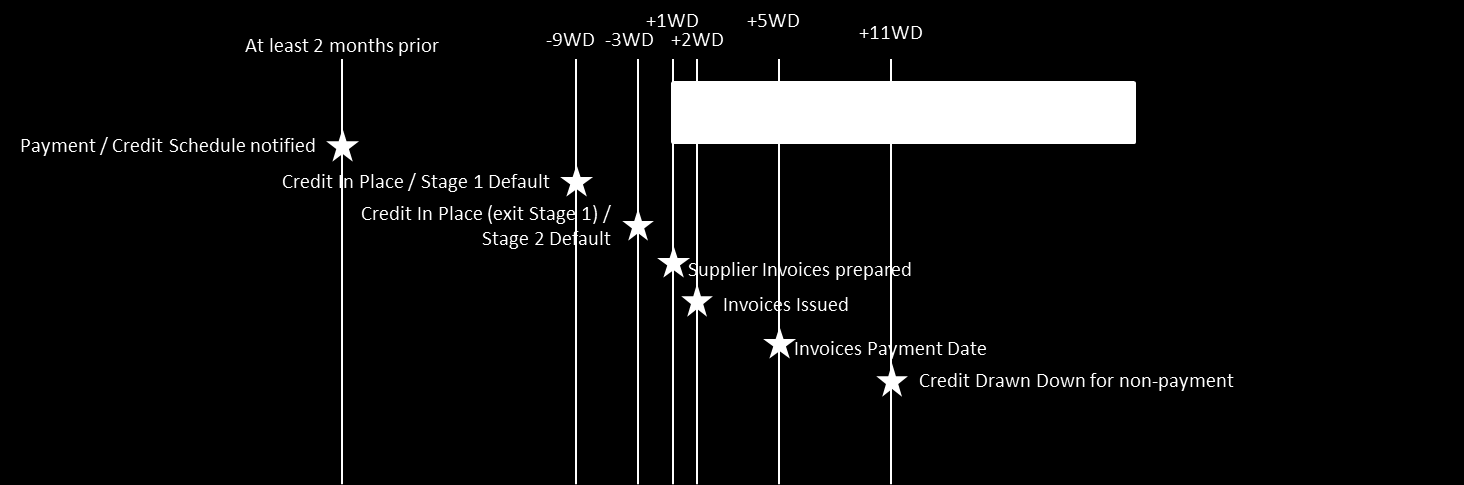
123 payments, suppliers remaining in the market are left without sufficient credit to cover their increased payment The Settlement Body is responsible for ensuring that credit cover is provided throughout the period for which it is required, as set out in the regulations. Figure 3.3: Sample credit cover timetable Capacity providers 481. Existing capacity providers are not generally required to lodge any credit cover with the Settlement Body. Cover for any penalty default is provided by netting against future capacity revenues in the first instance. Netting off continues until such time as the capacity provider ceases to have a capacity agreement. Any shortfall at this point in the amount of penalties collected will reduce the amount available to be distributed back to suppliers as the penalty residual supplier amount. The only requirements for a capacity provider to provide credit cover is a bid bond for a DSR provider (see Section 3.3) or against any termination fees that are required to be paid by new plant (see Section 3.2 for further details) Requirements for credit cover 482. The following forms of credit only may be accepted as valid credit cover: a letter of credit from a bank with a long-term debt rating of not less than A3 by Moody s or A- by Standard & Poor s; or cash Default and mutualisation 483. Suppliers must ensure that they have approved credit cover in place prior to the start of each month. Where they do not have this in place nine working days prior to the start of the month they enter stage one credit default. They are then given a further three working days to provide sufficient credit cover. Should they fail to do so the supplier 123
124 passes into stage two credit default. At this point their outstanding charges are mutualised. At this point Ofgem may consider whether the terms of the supplier s supply licence have been breached. Suppliers whose charges increase are notified in accordance with the normal timetable (within three working days) Mutualisation continues until the supplier pays to the Settlement Body all charges due, plus accrued interest, and meets the credit cover requirements; or the end of the capacity year. Should the supplier make good on its previous unpaid charges those suppliers whose charges were temporarily increased through mutualisation receive that money via reconciliation Settlement dispute resolution process 485. Provisions for the resolution of Capacity Market settlement disputes (CMS disputes) are set out in the Electricity Capacity Regulations. If a dispute cannot be resolved by the procedure set out in regulations, any claims against the Settlement Body would be made through the courts CMS disputes are overseen by the Settlement Body. The Settlement Body investigates the circumstances leading to the dispute, commissioning input from the Settlement Services Provider as appropriate, with the Settlement Body reaching a view on how the dispute should be settled. Except for recourse to the judicial system, the view of the Settlement Body is final and forms the basis of the charges and payments made under the Capacity Market settlement process The regulations include a general principle that CMS disputes do not suspend the normal workings of the Capacity Market settlement process. For example, if a party raises a dispute about an amount owed, it would still be obliged to make that payment within the timescales set out in regulations. If the dispute is upheld prior to this payment date it must pay or be paid the revised amount. If the dispute is upheld following the original payment deadline then the party is subject to a future reconciliation through which its payments would be adjusted in line with the issued determination Only disputes relating to the calculations and determinations of the CMS can be raised through the CMS disputes process, not disputes that fall under the provisions of the Capacity Market Rules or the Balancing and Settlement Code Reconciliation 489. The regulations relating to the settlement of the Capacity Market will make provision to revise payments due to the Settlement Body and credits payable. The Supplier Payment Regulations will make provision requiring the Settlement Body to publish a reconciliation timetable, which will mirror existing BSC processes. Reconciliations shall update the settlement calculations resulting from one or more of the following: 124
125 An update of data (e.g. metered demand or generation), including outturn data to replace forecast data. Such an update may occur as more accurate meter data becomes available, through the correction of an error in the data, or through the reinstatement of data missing from an earlier settlement run. As an outcome of a CMS dispute. A supplier no longer being in credit default. Where credits were reduced because payments were not received by the due date and those payments were later paid, together with late payment interest. 3.5 Institutional and governance arrangements Institutional roles 490. The Capacity Market is overseen and delivered by a combination of the Government, the regulator Ofgem, the Delivery Body National Grid, and the Electricity Settlements Company. The need for a Capacity Market is reviewed every five years, and a report is published setting out the objectives of the Capacity Market, the extent to which these objectives have been achieved and the extent to which they remain appropriate, or could be achieved in a way that imposes less regulation The Government 491. The Government is responsible for the strategic oversight of the Capacity Market and for changes to the regulations and payment regulations. The Electricity Capacity Regulations and forthcoming Supplier Payment Regulations include general eligibility criteria for entry to Capacity Market auctions, auction parameters such as the demand curve and target volume, functions of National Grid for delivery of the Capacity Market, and settlement of payments Ofgem 492. The Government developed the Capacity Market rules, but Ofgem will take ownership of the rules the day after the result of the first auction is published. Ofgem will be primarily responsible for amending the rules, as set out in the Electricity Capacity Regulations. The rules include technical rules and procedures such as pre-qualification and capacity auctions, and provision about the contents of capacity agreements and obligations of capacity agreement holders This arrangement for the regulations, payment regulations and rules puts in place appropriate controls for the Government and Ofgem in order to keep budgetary control and to enable changes to the market to be made in a timely and coherent manner Ofgem may amend, add to or revoke provisions in the Capacity Market Rules and this could mean that Ofgem can expand or reduce the scope of the rules in future. Ofgem will 125
126 do this in accordance with objectives set out in the regulations, meaning that Ofgem must ensure the rules remain consistent with the regulations. In addition, Ofgem cannot confer functions on the Secretary of State or amend or add to its functions through rules changes without the Secretary of State s consent. In order that the rules can improve and adapt in response to learning from industry, there will be a duty on Ofgem to consider any proposal for a rule change that it receives. Industry, delivery partners and the public will be able to suggest changes to the rules though they will not be able to block a change to the rules. If parties wish to challenge a change made to the rules this will be by way of a judicial review. There will be a requirement for Ofgem to consult on all changes it proposes to make. Ofgem will have discretion on how long the consultation should be Ofgem will publish guidance for industry on the process it intends to use to amend the rules. This guidance could, for example, include an annual process for submitting rule change proposals Ofgem will be responsible for resolution of appeals by applicants about the outcome of a pre-qualification decision if the appeal cannot be first resolved by the applicant and Delivery Body (See Section ). In addition, the Government has made provision in the regulations for dispute resolution processes for Capacity Market participants in the event that they are unsatisfied with the way in which the rules have been applied by the Delivery Body in certain circumstances. Those circumstances are a refusal by the Delivery Body to rectify the Capacity Market Register and/or a Capacity Agreement Notice; a case where a capacity provider has been unable to agree with the Delivery Body any necessary amendments to the capacity agreement; and where a capacity provider is dissatisfied with a decision by the Delivery Body regarding a termination notice. In these instances, Ofgem is the disputes body if the dispute cannot be first resolved by the applicant and the Delivery Body. Ofgem will publish guidance on the process it intends to follow for resolving disputes that are submitted to it for determination National Grid 497. National Grid is to undertake the delivery role (the EMR Delivery Body), which includes: Preparation of the Delivery Plan and Annual Updates for Capacity Market: The Delivery Body provides modelling and analysis to DECC on capacity requirements to inform any form of low carbon electricity generation under CFDs. Preparation for auction: The Delivery Body prepares and publishes Auction Guidelines which contain all the information industry require to participate in Capacity Market auctions which are not set out in the Capacity Market Rules. Pre-qualification: The Delivery Body assesses applications to the Capacity Market against criteria in rules and regulations; updates the Capacity Market 126
127 Register as appropriate and makes the relevant notifications to DECC and Ofgem. It also considers first-stage disputes relating to pre-qualification. Auction: The Delivery Body is responsible for holding an auction as per the Capacity Market Rules on the date set out in the Auction Guidelines. The Delivery Body is also responsible for publishing the auction results. Capacity agreement management: The Delivery Body issues capacity agreement notices to successful participants, is responsible for establishing, maintaining and updating the Capacity Market Register with relevant information, receives evidence of milestones, and confirms capacity providers continued eligibility for capacity payments. Secondary Market: The Delivery Body checks and confirms eligibility of physical secondary trades and notifies industry when the physical secondary trading window has opened. Delivery year: In the delivery year the Delivery Body or System Operator: - o Provides information to support the Settlement Body s Capacity Market calculations. o Prepares and issues Capacity Market warnings. o Issues demand control instruction when required and establishes whether it is energy related or caused by failure of transmission assets. o Provides the Settlement Body with data required to calculate providers load following obligations. o Tests providers to ensure they are able to demonstrate their capacity The Government has set the EMR delivery functions of National Grid in secondary legislation before Parliament, which will become relevant requirements, enforceable by Ofgem as if they were licence conditions. The secondary legislation, regulations and Rules, prescribes the EMR functions that National Grid must carry out, in order that the Government has certainty about what will be delivered and that Ofgem has a clear basis on which to manage the performance of National Grid in its delivery role The Panel of Technical Experts will provide independent scrutiny of National Grid s advice on the level of capacity to auction Electricity Settlements Company and Capacity Market Settlement Services Provider 500. The Electricity Settlements Company (ESC) shall be a company owned by the Government limited by shares. The ESC is the incorporated name for the Settlement Body and it will carry out the obligations placed by regulations on the Settlement Body. Where practical, it mirrors the set-up of the Low Carbon Contracts Company, which is described in Chapter 3 of this document. 127
128 501. The Electricity Settlements Company s Framework Document will set out the general performance and reporting arrangements stating that the Secretary of State as shareholder will monitor the company s performance through regular meetings and prompt disclosure of specified information by the company. A contract between the Low Carbon Contracts Company (on behalf of itself and the Electricity Settlements Company) and the Settlement Services Provider will outline the detail of the service to be delivered, the cost of that service and performance monitoring arrangements. The Government will use, where possible, synergies between the two bodies to minimise operational costs and the Low Carbon Contracts Company will be providing services to the Electricity Settlements Company in this regard Role of the Electricity Settlements Company (the Capacity Market Settlement Body) 502. The Electricity Settlements Company s key roles are to make capacity payments and to retain overall control of the Capacity Market settlement process. It will include: Specifying and monitoring a contract through which the Settlement Services Provider provides settlement activities for the Settlement Body, as well as setting out performance requirements and the consequences of failing to meet them. Holding collateral from participants in the capacity auctions and transitional arrangements. Determining Capacity Market settlement disputes relating to the calculations and determinations of the Settlement Services Provider. The Settlement Body may constitute an external advisory group to provide advice on disputes and/or make recommendations as to how disputes are resolved. It will remain a matter for the Settlement Body alone, however, to reach a determination on disputes. Responsibility to Parliament via the Secretary of State in all matters concerning settlement of the Capacity Market. Preparation of annual forecast budgets (one-year ahead) and business plans (looking three years ahead), in liaison with the Settlement Services Provider. Separately the Settlement Body will need to monitor its costs and provide updates on actual and forecast spend against budgets. Preparation, at the end of each delivery year, of an annual report and accounts, which will be presented to the Secretary of State. This will be published not less than four months following the end of the delivery year the annual report and accounts refer to. The report will set out a review of its Capacity Market settlement activities (and those of its agent), incorporating final audited accounts for the delivery year in question. The report will include: o A breakdown of its expenditure against budget, detailing areas of significant under- or over-spend. o The performance of the Settlement Body and the Settlement Services Provider against their obligations as set out in regulations. o A report on the general performance of the settlement arrangements as set out in the regulations. 128
129 503. The Electricity Settlements Company is responsible for setting its own internal governance so it is able to meet its obligations. This may involve the constitution of committees and advisory bodies and use of external expert advice Governance and constitution of the Electricity Settlements Company 504. The governance and constitution of the ESC reflect that of the Low Carbon Contracts Company. See Section Conflicts of interest 505. The potential for conflicts of interest between National Grid s role in EMR and its existing interests in the energy market was the subject to a joint assessment by the Government and Ofgem The joint analysis concluded that, on the basis of existing National Grid activities, current market arrangements, and the current design of EMR, conflicts of interest are manageable subject to the implementation of various mitigation measures. The mitigations include the continued design of EMR in a way that minimises the risks of conflicts of interest arising through transparency, scrutiny and limits on the National Grid s discretion, and the proportionate ring-fencing of some of the EMR functions. The ring-fencing includes staff whose role is to carry out the capacity auction. The measures are intended to protect confidential information to which National Grid may have access and minimise the risk of conflicts of interest arising. The Government will keep these measures under review to ensure they remain effective The Government has also agreed to shield National Grid from liability in damages for anything done or omitted whilst exercising its Delivery Body functions to help manage the risks which may arise. For further information on the liability shield, see Chapter Confidentiality 508. Provisions on confidentiality have been finalised to be consistent with protection of information measures in the regulations and proposed modifications to National Grid s transmission licence to address potential conflicts of interest. These amendments include a number of provisions to protect information submitted to the Delivery Body for the purposes of it carrying out its functions under the regulations and the rules. 3.6 Legal framework for the Capacity Market 509. This section describes the legal framework that enables the introduction of the Capacity Market. It also covers the nature of a capacity agreement in more detail and summarises the rights and obligations which a Capacity Market provider accrues under a capacity 129
130 agreement. The delivery obligations, payments and penalties are described in Sections 3.2 and Legal framework Electricity Capacity Regulations and Capacity Market Rules 510. The Secretary of State has powers to introduce the Capacity Market by making regulations and Capacity Market Rules. The Electricity Capacity Regulations and forthcoming Supplier Payment Regulations, for which the Secretary of State retains responsibility for, include the amount of capacity to auction, eligibility criteria, determining when a capacity auction will be held and settlement of payments. The rules, which are first made by the Secretary of State and then overseen and owned by Ofgem, include technical rules and procedures as to how the Capacity Market operates, covering prequalification, the capacity auction process and penalties If a bidder is successful in the capacity auction, in respect of a CMU the bidder will accrue rights and obligations in accordance with the regulations and Capacity Market Rules 56. These include the obligation to provide capacity, the right to receive capacity payments and the liability to pay penalties. Reference to a capacity agreement means the rights and obligations which accrue under the regulations and rules The Secretary of State also intends to make further regulations to make provision about certain policy matters that are not included in the regulations laid in Parliament in June These are provisions which do not need to be in force before the commencement of pre-qualification for the first capacity auction, however details of some of these provisions (as set out below) are included in this document. These outstanding policy issues will be taken forward in to two ways: a) Government will bring forward a new set of regulations, the Supplier Payment Regulations to be laid in Parliament in summer 2014 which will make provision for payment: By electricity suppliers, of charges to fund the making of capacity payments and the Settlement Body s costs of performing its functions (except for the period up to 31 March 2015, for which provision is made in the Electricity Capacity Regulations); To electricity suppliers, of a share of the amount of capacity provider penalty charges collected by the Settlement Body, after deducting the cost of making over- 56 Pre-qualification applications, and bids in the subsequent auction rounds, will be at a Capacity Market Unit (CMU) level rather than a plant level, although the two concepts may be synonymous depending on how a plant is structured. Depending on the context this can be either a generating CMU that delivers energy by generating, or a DSR CMU that delivers energy by reducing demand. Storage participants may be made up of a combination of generation CMUs (where electricity is provided by releasing it from storage) or DSR CMUs (where electricity is provided by ceasing imports from the grid to replenish storage). A generating CMU must be capable of exporting electricity independently from other units and have a dedicated half-hourly meter. 130
131 delivery payments, provision for which is made in the Electricity Capacity Regulations; and To adjustment payments to and from suppliers ( reconciliation ) where further data becomes available to the Settlement Body after supplier payment calculations have been made. b) Government will also make further provision, by amending the Electricity Capacity Regulations in early 2015, to make provision for: Subsequent adjustment of payments ( reconciliation ) to capacity providers where further data becomes available to the Settlement Body after payment calculations have been made; Capacity obligation trading to occur with modifications to apply to the payment calculation formulae to allow for this; DSR metering; and Interconnection participation in the Capacity Market Consequential amendments to existing licences and industry documents 513. The Energy Act 2013 enables the Secretary of State to modify licence conditions and documents maintained under licence conditions, together with related agreements, for the purpose of giving effect to the Capacity Market. These modifications, if required, are in addition to the Electricity Capacity Regulations and the Capacity Market Rules Nature of a capacity agreement Capacity agreement notice 514. A capacity agreement notice is issued by the Delivery Body in respect of each successful CMU within 20 working days of the auction result, stating that the holder has the rights and obligations pursuant to the regulations and rules. It includes details of: The obligation on the holder to deliver electrical energy or reduce demand. The entitlement to a capacity payment. The auction in question and whether it is a four-year ahead or one-year ahead auction, the relevant delivery year(s) and the price which will be used in determining capacity payments. The capacity provider and, where applicable, the portfolio holder. The CMU in question, its type (as a generating unit within the balancing mechanism or as a DSR unit/embedded generator outside the balancing mechanism) and its classification (e.g. as an existing, prospective or refurbishing generating unit), as well as the de-rated capacity figure, the meter details and whether it is a price maker or price taker The capacity provider is able to request an amendment to a capacity agreement notice within 10 working days of its issue, but only in respect of a factual inaccuracy. Where any 131
132 amendments are agreed, a new capacity agreement notice is issued and the register updated. If this cannot be agreed within 20 working days from receipt of the request, the provider has a further 10 working days in which to request that the decision be reviewed under the appeals process set out in the rules Capacity Market Register 516. A Capacity Market Register, maintained by the Delivery Body, records each successful CMU. The entry on the register confirms the existence of a capacity agreement and the right to a capacity payment for that CMU for the stated delivery year(s). A form of the register is made publically available. The entry in the Capacity Market Register is the definitive document and, in the event of conflict, the Capacity Market Register takes precedence over the capacity agreement notice Payment 517. Payments to capacity providers are funded by the charges levied on suppliers. The Settlement Body is responsible (via a subsidiary of ELEXON as Settlement Services Provider) for collecting payments due from suppliers for payment to the capacity providers. Details of the settlement process and governance are contained in Sections 3.4 and A capacity provider is entitled to receive capacity payments for the relevant delivery year(s) which are calculated and, following collection of funds via the levy on suppliers, paid by a subsidiary of ELEXON in accordance with the price and capacity details in the Capacity Market Register. The subsidiary of ELEXON will similarly calculate and collect any penalties payable by a capacity provider, which may be off set against payments otherwise due to the provider. Payments are made on a monthly basis in arrears in accordance with the payment model described in Section 3.4. Section 3.4 also sets out the process for resolving Capacity Market settlement disputes relating to the calculations of the Settlement Services Provider Disputes resolution 519. There is provision for an applicant to dispute a pre-qualification decision, to request an amendment to a capacity agreement notice or entry on the Capacity Market Register or dispute a termination notice issued by the Delivery Body. A person wishing to dispute one of these decisions from the Delivery Body may request that the decision is reconsidered, which National Grid must do, as well as informing the applicant of its reconsidered decision and the reasons for it. If an applicant remains dissatisfied, it can apply to Ofgem to determine the appeal. If, following Ofgem s determination, the applicant is still dissatisfied there is a further right of appeal to the court Settlement disputes relating to the calculations of the Settlement Services Provider are referred to the Capacity Market Settlement Body for determination and resolution. 132
133 Change 521. Although a capacity provider would, after obtaining a capacity agreement, have to comply with any subsequent changes to the regulations or rules, certain details entered in the Capacity Market Register are not subject to amendment and are protected through the regulations. This includes the duration of the capacity agreement, the capacity cleared price, the based period for indexation, the relevant milestone date, the annual penalty cap and monthly penalty cap, the rates for termination fees and the capacity obligation for which the capacity agreement is issued Transfer 522. A capacity agreement can be transferred outright, but only together with the relevant CMU. Similarly, the CMU itself cannot be transferred or sold to another party unless the transferee is an acceptable transferee in this case that it meets the pre-qualification criteria and meets the credit support requirements. As the CMU is also being transferred in this case, any liability for accrued penalties will transfer with the CMU Termination and other remedies 523. Should the entire Capacity Market be withdrawn, all existing capacity agreements continue to their expiry date, including longer-term agreements with prospective new build units A generating unit that wishes to voluntarily terminate a capacity agreement may only do so in order to participate in a renewable support scheme or be supported under a CFD. It must request cancellation of its capacity agreement and withdraw from the Capacity Market at least 16 months prior to the relevant delivery year. If it fails to do so in time, it must trade its capacity agreement for the full delivery year. Termination 525. A capacity agreement may otherwise only be terminated in the specific circumstances where the capacity provider has: Failed to demonstrate a financial commitment. As set out in Section 3.2, this applies to a prospective new build CMU where it has failed to demonstrate that it has incurred at least 10 per cent of the project expenditure (as identified at the prequalification stage) at a 12 month milestone date from the award of the capacity agreement. o A termination fee is payable ( 5,000/MW) which is drawn from the collateral posted as part of the pre-qualification. o A CMU which has had its capacity agreement terminated in this way may bid again in succeeding auctions for a new capacity agreement (but must still pay the termination fee as outlined above). 133
134 Failed to achieve the minimum completion requirement. This applies where a prospective new build CMU had not achieved a minimum completion level of 50 per cent of its intended capacity by a longstop date 18 months after the start of its first delivery year 57. A termination fee is payable at the rate of 25,000/MW. Such capacity as is complete is eligible to participate in subsequent auctions as a price taker. Failed to obtain a connection agreement offer. This applies where a distribution connected prospective CMU has failed to submit its connection offer to National Grid by the latest date of 18 months prior to the start of the relevant delivery year. A termination fee of 5,000/MW will be applied in such circumstances, which is drawn from the collateral posted as part of the pre-qualification. Failed to demonstrate Transmission Entry Capacity (TEC) by 18 months prior to the start of the relevant delivery year applicable for the 2014 auction only, where it had not been demonstrated in the pre-qualification process. Existing generating CMUs unable to demonstrate TEC at the pre-qualification stage for this auction would be required to lodge collateral (of 5,000/MW) before the auction and would have a termination fee of 5/kW applied when they were terminated. Failed to maintain TEC of a level to cover their de-rated capacity. A termination fee of 25,000/MW would be applied in such circumstances. Failed to achieve a satisfactory metering test (where such metering test is required). Failed to prove the DSR capacity. This applies to an unproven DSR unit which had not submitted a test certificate proving its capacity by the latest date of the start of the delivery year. The bid bond is forfeited as a result. Been affected by an Insolvency Termination Event 58. Failed or ceases to meet the general eligibility criteria set out in the Electricity Capacity Regulations. Opted out in a previous auction as temporarily non-operational but had generated. This applies where a CMU has generated contrary to a previous opt-out notification 57 This is determined by the System Operator on the basis of the Interim Operational Notification (ION) or, in the case of a distribution network connected CMU, by an independent technical advisor s report submitted by the provider. 58 An Insolvency Termination Event occurs if an insolvency practitioner has been appointed in respect of the capacity provider or any of its assets, or if a court has made a judgment of insolvency or bankruptcy, entered an order for relief or made an order for winding up or liquidation against the capacity provider, or taken any similar step against it (in any jurisdiction), which has not been dismissed, stayed or discharged. 134
135 in which it was declared as temporarily non-operational, and is restricted from participation, but has already been awarded a capacity agreement for a delivery year subsequent to the year in which it opted out Where the above circumstances apply, or where the Secretary of State notifies the Delivery Body of an actual or suspected breach of the ethical requirements, the Delivery Body must issue a notice to the capacity provider that the capacity agreement will terminate in 60 working days During this 60 working day period, the capacity provider may request that the issue of a termination notice be reconsidered, or in certain circumstances that the notice period be extended. The Secretary of State has the right, during that period, to instruct that the notice of termination be extended for a further 60 working days or that it be withdrawn. Other remedies 528. Different remedies, such as set off of payments, deferral or suspension of payments or an adjustment to the term or to the de-rated capacity figure, apply in other specific circumstances. These are where the capacity provider has: Failed (in the case of a refurbishing CMU) to meet the Financial Commitment Milestone. In such case, the capacity agreement is reduced to one year and the de-rating figure adjusted as applicable (as no refurbishment is assumed to be taking place for that delivery year). The CMU would be restricted for a two year period from bidding again for a contract longer than one year. Failed (in the case of a refurbishing CMU) to achieve substantial completion. If the CMU has not achieved full completion by the start of the delivery year (no further longstop date applies), this results in the capacity agreement being reduced to one year and the de-rated capacity adjusted as appropriate. The prerefurbishment CMU may bid in future auctions (but would be restricted for a two year period from bidding again as a refurbishing CMU). Failed (in the case of a prospective new build CMU) to complete the full intended capacity. A CMU which achieves more than the minimum 50 per cent completion, but less than 90 per cent, by the 18 month longstop date would have a further six month period in which to reach 100 per cent completion. Failure to reach the 100 per cent level by the further six month date results in the capacity agreement being adjusted to reflect the operational capacity as at that two year date. Capacity payments (and liability for penalties) commence at this point, but the overall term of the capacity agreement is not extended by any period of delay i.e. the term always runs from the start of the first delivery year. Becomes insolvent (but where it is not a termination event as described above). Payments under the capacity agreement would be deferred and accrued capacity 135
136 payments are made at the end of the delivery year (or earlier if the insolvency is cured or to a new owner if the capacity agreement is transferred outright with the CMU). If the insolvency persists over more than one delivery year, the accrued capacity payments are paid for the year ending and capacity payments for the new delivery year would again be deferred. o During any such deferral of capacity payments, the CMU must still be able to meet its capacity obligation. The liability for penalties continues to apply and penalty payments due are set off against any accrued capacity payments. Failed to pay penalties. Penalty payments are set off against capacity payments. The liability for penalties and the right to set off against capacity payments roll across future delivery years for that capacity agreement, or across a subsequent capacity agreement. If a provider opts out of the Capacity Market in future years, payment for outstanding penalties may be pursued through the courts. Failed to notify (in the case of a DSR unit) changes to its baseline or connection details. Capacity payments are suspended until proper notification is given. 3.7 Capacity Market Units (CMUs) and pre-qualification requirements 529. This section includes a detailed description of CMUs and how they will be defined, along with more detail on the pre-qualification requirements for different participants Capacity Market Units (CMUs) 530. There are two categories of Capacity Market resources known as generating Capacity Market Units and demand side response (DSR) Capacity Market Units (CMUs) There are three types of generating CMUs: Transmission CMU: A generating unit connected to the transmission system and which participates in the balancing mechanism. This type of CMU includes (traditional) conventional large scale generating units, storage and CHP. CMRS distribution 59 ( embedded ) CMU: A generating unit connected to the distribution system which participates in the balancing mechanism. This type of CMU is generally of a smaller scale and it could also include smaller scale CHP and storage. Non-CMRS distribution CMU: A distribution-connected generating unit that does not participate in the balancing mechanism. This type of CMU is of a smaller scale (possibly non-licenced) and could also include smaller scale CHP and storage. 59 CMRS refers to the Central Meter Registration Service. CMRS CMUs refers to a CMU with a metering system registered in the CMRS in accordance with Section K of the Balancing and Settlement Code. 136
137 532. DSR CMUs take the form of customer response in the form or reduction of demand or an increase in on-site generation which will be visible in the supplier metering account and measured by the X of Y baseline methodology (see Section 3.3) This list of CMU types is kept under review and may be amended, for example to permit participation by Electricity Demand Reduction resources CMUs must be at least 2MW to be eligible for the Capacity Market, but smaller resources can aggregate and present themselves as a CMU The different categories of CMU are also explained in Figure
138 Figure 3.4: Categorisation of Capacity Market Units (CMUs) 138
139 3.7.2 Pre-qualification requirements 536. Section covers the purpose and timing of pre-qualification. This section includes more detail on pre-qualification requirements There are different pre-qualification criteria depending on whether the applicant is an existing plant, an existing plant seeking support for refurbishment, a potential new plant, or a DSR provider. All applicants intending to participate in the auction are required to include basic administrative details (e.g. name, company registration, bank account details, legal structure, portfolio holder, and low carbon support scheme status) along with plant-specific information. Table 3.4 sets out the information required in prequalification Existing plant must include generation licence status, details of connection/distribution agreements and Transmission Entry Capacity 60 (TEC) status (if relevant), along with evidence of their historic performance over their two previous years of operation. An existing plant electing to be a price maker must prepare a board-approved justification (see Section 3.2.3) Existing plant seeking support for refurbishment must declare any relevant planning consents, a milestone plan detailing key dates in their refurbishment timeline and a refurbishment plan detailing their proposed capital expenditure for the refurbishment New build plant must declare all relevant planning consents (note that a planning application is not sufficient; evidence of consent will be required) as well as submitting a construction milestone plan detailing the dates in which key stages to achieve operation will be achieved such as commencement of construction works and achievement of energisation operational notification (EON) status 61. New build plant must supply a valid connection/distribution agreement or certify that a distribution agreement will be in place by the relevant delivery year Prospective new build plant are required to provide collateral representing 100 per cent of the level of the termination fee for which they would be liable if they failed to demonstrate the substantial Financial Commitment Milestone 18 months after the auction, if they failed to demonstrate a valid distribution connection agreement or offer (where relevant), or (for existing generating plant and for the 2014 auction only) failed to demonstrate valid Transmission Entry Capacity Low carbon plant that intend to opt in to the Capacity Market must certify, as part of the pre-qualification application, that the plant is not applying for or receiving support under 60 Transmission Entry Capacity (TEC) is the amount of generation a generator wishes to export onto the National Electricity Transmission System. 61 The concept of energisation operational notification is explained on page 3 here: 737FBAACD25D/55802/7_COMPLIANCE_PROCESSES_I5R1.pdf 139
140 Renewables Obligation (RO), Contracts for Difference (CFDs), small-scale Feed in Tariffs (FIT), Renewable Heat Incentive (RHI), New Entrants Reserve 300 (NER300), hold long-term contracts to provide Short-Term Operating Reserve (STOR), or the UK Carbon Capture and Storage Commercialisation Programme will not be eligible for the Capacity Market The amount of capacity which each capacity provider can offer into the auction must accurately reflect the amount of capacity they can offer at times of peak demand. The de-rating process, administered by the Delivery Body, establishes the amount of capacity each plant can be relied upon to deliver. Capacity agreements are issued and providers paid on the basis of their de-rated capacity rather than their individual nameplate capacity Central de-rating of capacity is undertaken by the Delivery Body using a pre-determined methodology. The de-rating factors for generation plant are based on a similar methodology as used in the Electricity Capacity Assessment report. Table 3.4: Pre-qualification requirements Requirement General administrative details (e.g. name, contact details & CMU identity) Existing generating unit Prospective generating unit Proven DSR unit Unproven DSR unit Opting out X X X X X (abridged) Solvency certificate 62 X X X X Legal status Classification of CMU X X X X X X X X X X Low carbon exclusion status X X X X Conduct declaration X X X X X De-rating factor & connection/dsr capacity X X X X Connection/distribution agreement X X (includes distribution offers) X (connection capacity only) Details of metering arrangement X X 62 A declaration by directors that the company is solvent. 140
141 Evidence of historic performance Grid Code compliance (or commitment to be compliant) Planning consent (if relevant) Construction milestone plan X X X (refurbishing units only) X X Collateral/ bid bond Business model (e.g. type of DSR, relationship, procurement strategy) X (not for refurbishing units) X X X DSR test certificate or test information X Commitment to undergo DSR test X Operational status in delivery year & reasons for statement X Note: a refurbishing CMU is one which meets the criteria for both existing and prospective generating units 545. The mean availability for conventional generation is derived for each BMU, by taking the average of its declared Maximum Export Limit (MEL) figures at real time across the previous seven winter peak periods, and weighting according to each unit s maximum declared capacity over the period. The average weighted availability is then calculated for each fuel type and published as part of the annual Auction Guidelines by National Grid. As part of their pre-qualification submission applicants are required to select the de-rating factor for their unit/s and apply it to their unit s connection capacity 63. The figure selected in pre-qualification endures for the duration of the applicant s capacity agreement if on a multi-year term. 63 The Connection Entry Capacity for a transmission connected CMU or the volume stated in the Distribution Connection Agreement for a Distribution CMU, the mean average of three highest outputs over the preceding 24 months or their CEC pro-rated according to the level of site TEC. 141
142 546. The de-rating factors for DSR capacity are calculated by comparing the declared availabilities of non-balancing mechanism providers of Short-Term Operating Reserve (STOR), frequency control by demand management, and firm frequency response services to National Grid, relative to their contracted volumes. This data set is augmented with performance and availability data gathered during the transitional arrangements and during the delivery years of the Capacity Market to ensure DSR providers de-rated capacity accurately reflects the level of capacity that can be reliably delivered Existing generators and proven DSR providers must complete a metering assessment during pre-qualification. This assessment is a set of questions about a site s metering arrangements and will help to determine whether an applicant (if successful at auction) will need to undergo a comprehensive metering test. The test is a review of the provider s metering arrangements to ensure that the metering set-up correctly reflects the flow of electricity supplied, generated and consumed within a site. The metering tests will take place by the Settlement Body after the auction and 18 months prior to the start of the relevant delivery year for T-4 providers, and one month prior to the start of the delivery year for T-1 providers. Unproven DSR will need to confirm during prequalification that they will complete the metering assessment and, if necessary, take a metering test one month prior to the start of the delivery year. The exact timing of the test for each provider is dependent on when the provider submits the necessary requirements to the Settlement Body, and when the Settlement Body schedules the tests. 142
143 4 Electricity Demand Reduction Pilot 4.1 Introduction 548. As stated in Section 1.1, the Capacity Market aims to ensure that consumers continue to receive reliable electricity supplies at an affordable cost. It will provide regular monthly payments to capacity providers during the delivery year, in return for which they must be available to produce electricity (or reduce demand) when the amount of excess capacity is tight The purpose of the Electricity Demand Reduction (EDR) Pilot is to understand whether capacity savings resulting from the installation of more efficient electrical equipment (which provide lasting rather than temporary reductions) could also form part of the Capacity Market and to learn lessons for the Government and wider stakeholders about the delivery of any enduring scheme EDR projects could potentially participate in the Capacity Market as they reduce the demand placed on the system and in turn lower the amount of generation capacity that needs to be delivered to meet that demand. Demand side response (DSR), where capacity providers reduce demand below a specified baseline (either by reducing or shifting demand) at times of system stress, is already eligible to participate in the Capacity Market (see Section 3.3), however EDR could provide lasting reductions and greater long-term electrical efficiency. 4.2 Reasons for including EDR in the Capacity Market 551. EDR could deliver direct benefits to the Capacity Market, including: Lower costs to consumers - more competition in the Capacity Market could reduce the cost of providing secure electricity supplies. Improved security of supply a system based on a diverse range of capacity providers can be more resilient. Increased responsiveness - new Electricity Demand Reduction can be delivered much more quickly than a new power station can be built There is significant opportunity for greater electrical efficiency in the UK. In 2013 DECC published analysis suggesting that, even on conservative assumptions, there is potential for up to 32 terawatt hours of savings in 2030 (or around nine per cent of estimated total demand). We also know that reducing the amount of electricity we use could also deliver significant benefits. For example, a nine per cent reduction in overall demand could, by 2030: 143
144 deliver savings of around 2.3 billion 64 cut emissions in the traded sector by 3.2 mega tonnes (equivalent to the amount produced from the electricity use of around 1.8 million households in a year); and save electricity equivalent to that generated by around four power stations in a year Financial help for action on energy efficiency could also be good for jobs and growth - stimulating greater development of green businesses and their supply chains There are successful international precedents for EDR schemes taking part in capacity markets similar schemes are already operating successfully in the USA. 4.3 EDR pilot 555. It is intended that the pilot will run for two years. During this time, businesses and other organisations can seek financial support to install new efficiency measures that will deliver verifiable capacity savings (kw) over the winter peak period. Efficient motors, air conditioning and lighting are examples of the kinds of equipment that could receive support. Eligible participants will be entitled to seek funding by offering their savings into an auction. Figure 4.1: Key stages of the EDR pilot Pre-qualification Proposals are checked for eligibillity and deliverability Auction Participants bid against each other for support Delivery and Payments Payments follow proof of installation and delivery of savings Eligibility 556. Projects wishing to take part in the pilot will need to demonstrate that they meet certain eligibility criteria. Some of these criteria have been set in order to ensure parallels with the Capacity Market - like the need for measures to be connected to the Grid in Great Britain (not Northern Ireland 65 ) and to not shift electricity demand to other times of day. Others are concerned with delivering value for money - like the requirement that measures do not receive support from specified forms of Government incentives (such 64 These are the net savings to society in 2030 expressed in 2012 terms, undiscounted. 65 Because the Irish Single Electricity Market already uses a capacity mechanism, the Capacity Market will only apply across Great Britain with any associated costs being borne by GB customers. 144
145 as Climate Change Agreements or Salix loans). A plan for measuring and verifying savings is also required for each project Auction 557. Participants who qualify will be invited to participate in a competitive auction process. They will then bid in the amount of electricity demand savings they propose to make (measured as capacity in kw) and a price at which they are prepared to sell it. Successful bids will secure funding that can then be used to support the installation of more efficient electrical equipment. 4.4 Next steps 558. The learning gathered during the pilot will inform a decision on financial support for EDR going forward. The most up-to-date information about the pilot can be found on See 145
146 5 Ensuring effective and transparent delivery 5.1 Introduction 559. This chapter describes how mechanisms have been put in place to ensure that the changes being introduced through the EMR programme are delivered in an effective, robust and transparent manner. It deals specifically with: providing investors with a clear long-term vision they can have confidence in via the EMR Delivery Plan; transparency on progress through reporting on the new arrangements and their delivery; how any potential liability that may arise for the Delivery Body will be dealt with; the licence modifications which are being introduced to avoid conflicts of interest arising within the Delivery Body; and monitoring and evaluation plans for the reformed market, to ensure it is continuing to cost-effectively support the UK s energy objectives The Government s objectives for the electricity market are set out in clause 5 of the Energy Act The objectives are: ensure a secure electricity supply; ensure sufficient investment in sustainable low carbon technologies; and maximise benefits and minimise costs to taxpayers and consumers. EMR will provide the means to meet these objectives and the measures outlined below will help ensure it is continuing to do so. 5.2 EMR Delivery Plan 561. In order for CFDs and the Capacity Market to be delivered effectively and to generate the required investment in the electricity market, it is essential that Government provides certainty and clarity on it s long-term objectives for the reformed market. To facilitate this, the Government has designed the enduring EMR Delivery Plan process EMR Delivery Plan process 562. The EMR Delivery Plan process has been designed to effectively deliver: Decisions by the Government that contribute towards EMR objectives, as set out above; timely and robust evidence and analysis to support those decisions; and 146
147 a decision-making process that is appropriately transparent Through the process, we also need to achieve a balance between: Giving certainty to industry in the decisions Government is taking; and Flexibility for Government to retain the ability to take certain decisions as and when necessary. It is vital that both these deliverables and this balance are maintained through the enduring Delivery Plan process The Government will publish a Delivery Plan every five years and annual updates in between. A Delivery Plan sets out Government s objectives, key decisions on the new mechanisms (such as CFD strike prices for renewables and the volume to contract under CFD auctions, and how much capacity to contract for in any capacity auction), and the impacts of those decisions on the objectives. For example, any adjustments to future strike prices is likely to impact on the LCF and so will require the Secretary of State to consider how this will impact the Government s objective to minimise costs to taxpayers and consumers It should be noted that the precise content of future Delivery Plans and their annual updates will be determined in due course so that they can evolve with CFDs and the Capacity Market. For example, as CFDs are allocated on a more competitive basis and as certain information becomes available (such as data on technology costs and the rate of CFD allocations) The first EMR Delivery Plan 566. The first EMR Delivery Plan was published in December The first Delivery Plan set out: The administrative strike prices for renewable technologies under Contracts for Difference commissioning in the period 2014/ /19. A robust methodology which provided the basis for the strike prices. The Government s intention to move to a competitive price discovery process for all low carbon technologies as soon as practicable. The reliability standard for the GB electricity market, which will be used to inform the amount of capacity to be contracted The Government will also publish Annual Updates to the first Delivery Plan in the years between Delivery Plan publications. Annual Updates may include: Information related to the delivery of the new mechanisms: the Capacity Market and CFDs, such as the number and type of contracts allocated; Update on the FID Enabling for Renewables Investment Contracts; Update on the Levy Control Framework within the context of Investment Contracts signed; Update on the readiness of the CFD Counterparty, and associated systems; 147
148 Update on the Offtaker of Last Resort mechanism During the period in which strike prices are set administratively, we intend that each Delivery Plan will be the primary means of publishing strike prices for renewables for the following five-year period. It is not our current intention to use each Annual Update to publish strike prices for the period beyond that which a particular Delivery Plan relates to, although Government may choose to use individual Annual Updates to indicate future strike prices or to provide other updates about the way the CFD budget, within the LCF cap, will be used Analysis and advice 569. To inform the Government s key decisions on CFDs and the Capacity Market, the Government will commission the Delivery Body to produce analysis and evidence for the Government. The Delivery Body will also work with the System Operator Northern Ireland (SONI) and the Single Electricity Market Operator (SEMO) The Government will ensure that any request for advice and analysis which is made to the Delivery Body is also made publicly available. This is to help ensure that the process is transparent and to help other stakeholders who may wish to feed ideas or thoughts to the Delivery Body to do so in a timely fashion, thus ensuring effective engagement between relevant industry players. The Government intends to consult on any new or changes to strike prices. Furthermore, measures have been taken to ensure that the Delivery Body is given the right tools for the job and can access robust data and assumptions which underpins their analysis (see below) Seeking information from CFD generators 571. The main analysis required for the Delivery Plan process uses key assumptions about the electricity market (e.g. forecasts of electricity demand and fossil fuel prices), and electricity generation technologies (e.g. costs of generation, such as build, capital and operating costs). Some of these may be provided by DECC, some with the Delivery Body s input or advice and some directly by the Delivery Body, including via market participants, such as generators The System Operator, National Grid, launched a Call for Evidence 67 in October 2012 to support the development of the CFD for renewable technologies. While National Grid received over 70 responses to the consultation there was no guarantee that it would receive robust information or evidence from the relevant parts of industry. However, the Government must be confident in the decisions it is taking on EMR, for example in setting bankable and affordable CFD strike prices for renewable technologies or in the volume of capacity to procure through a capacity auction. It therefore needs to be confident that the Delivery Plan process, including the Delivery Body s evidence base, is as robust as possible. 67 See 148
149 573. The Delivery Body will seek information from the CFD Counterparty in the first instance. Due to a limitation on the information the CFD Counterparty can collect the Government has concluded that it is appropriate to create an obligation on CFD generators ( a generator who is party to a CFD ) to provide the Delivery Body with certain information, including build, capital and operational costs of CFD plant. The obligation has been created using the powers in Section 19 (Information and Advice) of the Energy Act 2013 and is set out in the Electricity Market Reform (General) Regulations The Government is mindful that CFD generators may be cautious about sharing such information, owing to potential conflicts of interest between the Delivery Body and its commercial role. The Government is confident, however, that any potential conflicts can be managed and that information will be strictly safeguarded. More information on managing conflicts of interest can be found in Section Transparency 575. Transparency on policies under the EMR programme will lead to confidence and reassurance in our proposals, and will demonstrate the Government s commitment to openness and willingness to work with industry to get the best outcome for the market reforms There are a number of ways in which the Government ensures transparency of policies under the EMR programme: Transparency through reporting requirements; Appointment of the EMR Panel of Technical Experts; National Grid accountability; Liability shield for the Delivery Body Independent Panel of Technical Experts 577. To ensure the information underpinning the policy making is robust, the Government has put in place an independent Panel of Technical Experts (PTE). The purpose of the EMR Panel of Technical Experts is to impartially scrutinise and quality assure the analysis carried out by National Grid in its role as Delivery Body, the choice of models and modelling techniques employed, the inputs to that analysis (including the inputs provided by DECC) and the outputs from that analysis scrutinised in terms of the inputs and methods applied An interim panel was appointed in February 2013 to scrutinise National Grid s analysis for the first Delivery Plan. The interim panel s term came to an end following the publication of its report alongside the Delivery Plan. In February 2014 the EMR Panel of Technical Experts for the enduring regime was appointed. 149
150 579. The role of the panel is to perform a technical function. It is not a forum for policy commentary or for advising the Government on its objectives for the new arrangements, the policies being implemented or policy decisions surrounding them The Panel of Technical Experts will continue to play a key role in scrutinising the analysis undertaken by the Delivery Body, which includes taking a view on the quality of that analysis. The PTE will continue to publish reports in accordance with their remit as set out in their Terms of Reference. To avoid duplication, we do not propose that Ofgem should have a role in scrutinising or monitoring the quality of the analysis undertaken by the Delivery Body. Ofgem s role is therefore proposed to be limited to regulating whether the Delivery Body has carried out the analysis and followed the correct processes Publications and contracts to be laid in Parliament to provide transparency 581. To ensure there is clarity and openness relating to policy under the EMR programme, the Energy Act 2013 includes a duty requiring the Secretary of State to report to Parliament on how they have carried out the EMR functions (see next section for further details on the Annual Reporting Duty). The Energy Act 2013 also requires that any Investment Contracts entered into by the Secretary of State must be laid before Parliament In addition to this reporting requirement, the Secretary of State has committed to publishing a number of different reports and a five-year review of EMR. These are outlined below and in Table 5.1. Table 5.1: Summary of EMR reporting requirements Report EMR Delivery Plan Annual Updates to the Delivery Plan Annual Reporting Duty Timing of publication Every five years, with the first Delivery Plan commencing in 2013 and covering the period 2014/15 to 2018/19 Annually, between publication of the EMR Delivery Plans Annually by 31December, starting Annual reporting duty 583. Section 5 of the Energy Act 2013 requires the Secretary of State to report on meeting the EMR functions. The section requires the Secretary of State to report, before 31 December each year and beginning in 2014, on how the Secretary of State has carried 150
151 out the functions in Part 2 of the Act 68. The report must be laid in Parliament and be shared with the Devolved Administrations The report will provide Parliament and stakeholders with the opportunity to scrutinise the Government s achievements on EMR, and will also provide assurances on transparency and accountability to Parliament. Given the overlap of the EMR reporting duty and content of the Annual Update an opportunity exists to meet this statutory requirement through the Annual Update DECC Annual Report 585. The DECC Annual Report focuses on the Department s performance and policy making. The Annual Report is scrutinised by the House of Commons Energy and Climate Change Committee which holds an oral session at the end of the year, which is attended by the Secretary of State and Permanent Secretary. 5.4 Liability shield for the EMR Delivery Body 586. The appointment of National Grid as the Delivery Body is an innovative approach; an approach that will use private sector know-how to help lower costs for taxpayers, consumers and industry. In its role as the EMR Delivery Body, National Grid will be responsible for functions such as: providing analysis to Government to support policy decisions, administering the allocation process for CFDs and administering and running the capacity auctions for the Capacity Market. National Grid has been selected as the Delivery Body because of its expertise and experience, and because of the synergies arising with its existing role as the national System Operator for Great Britain However, it is recognised that a number of unforeseen risks might arise when National Grid is performing its Delivery Body functions. To help manage the risks which may arise, the Government intends to shield National Grid from liability for damages arising as a result of exercising these functions Scope of the power to shield National Grid as Delivery Body 588. Section 63 of the Energy Act 2013 gives the Secretary of State the power to protect National Grid, its directors, employees, officers or agents against a claim for damages made by a third party where National Grid is alleged to have caused the third party loss as a result of carrying out its Delivery Body functions The liability shield 68 Part 2 includes: Contracts for Differences, Capacity Market, Investment Contracts, Conflicts of Interest and Renewables Obligation transitional provisions. 151
152 589. Following consultation it was decided that the Secretary of State should apply a liability shield to all of National Grid s Delivery Body functions but with specific exclusions where the shield will not apply. Those exclusions include where National Grid has acted in bad faith, breached the Human Rights Act 1998 or is in breach of an enforcement order made by Ofgem under its powers in the Electricity Act In addition, to ensure that the shield does not have the effect of diluting incentives for good performance by National Grid, the Government has gone beyond these minimum exemptions to also ensure that National Grid will not be protected from damages liability where National Grid has acted criminally, has breached confidentiality, or is in breach of contract The application of a liability shield to National Grid s EMR functions does not protect it from complaints, nor deny people other forms of redress against its decisions. For example, both the Capacity Market and CFD functions have appeals processes to help resolve issues arising between National Grid and others affected by the exercise of its Delivery Body functions. It is important to note therefore that the shield will only protect National Grid (its directors, officers, employees or agents) from liability in damages. 5.5 Modifications to National Grid s transmission licence to implement mitigation measures to manage conflicts of interest 591. National Grid Electricity Transmission (NGET) is the electricity System Operator for Great Britain and electricity Transmission Owner in England and Wales. National Grid has been designated as the EMR Delivery Body due to synergies with its current System Operator role As the System Operator business sits within NGET, and NGET is a part of National Grid plc, a large private company which has both monopoly and competitive businesses, it was recognised that there was a possibility that conflicts of interest would arise between its new public function delivering EMR and its private business interests After extensive work with Ofgem an assessment of these conflicts of interest and a package of mitigation measures to manage them were published in April The approach included certain business separation measures that are being implemented through modifications to NGET s transmission licence Cumulatively these measures should: Create a separate team within NGET for certain EMR functions such as CFD allocation and running the Capacity Market auctions Prevent certain confidential EMR information leaving the System Operator and passing to other NGET staff 69 See 152
153 Prevent the analysts within NGET who are carrying out EMR Delivery Plan analysis from knowing the source of the data they use in their modelling where this relates to commercially sensitive information Ensure senior accountability to ensure the impartiality of the analysis; and Ensure separation measures are in place between NGET s System Operator- Transmission Owner business and certain other competitive businesses owned by National Grid. 5.6 Evaluation and review 595. The Government is committed to monitoring and evaluating the EMR programme as it is implemented to ensure its benefits are being realised and so that any lessons learned from the initial stages of the programme can be brought to bear on subsequent stages. The Government is also committed to reviewing the operation of the programme at appropriate points in the future to ensure it is continuing to cost-effectively support the UK s energy objectives Statutory review requirements 596. As discussed in Section 5.3.3, the Energy Act 2013 requires the Secretary of State to report to Parliament by the end of 2014 and provide an update on EMR Secondary legislation also requires the Secretary of State to carry out reviews at least every five years of the electricity capacity market regulations and on whether their objectives have been met and whether they could be achieved in a less burdensome way. Ofgem is also is required to produce a holistic review of the Capacity Market Rules every five years. This review will be a holistic review of the Capacity Market Rules and whether their objectives have been met as well as if they can be achieved in a less burdensome way. Ofgem is required to carry out annual review of the operation of the Capacity Market including the Delivery Body s performance of its functions in relation to the Capacity Market and any other matters requested by the Secretary of State Evaluation 598. Evaluation will help to provide evidence on whether EMR processes are as efficient and effective as possible and on whether the benefits of the new arrangements are being achieved. The Government will commission independent contractors with appropriate expertise to provide evaluation reports on key aspects of the reforms to help inform future decisions The Government currently envisages that such reports will include (but not be confined to) an assessment of the extent to which the first round of awards of CFDs under the enduring regime have furthered the UK s low carbon energy objectives at least cost to consumers; an evaluation of the extent to which the first Capacity Market auction has met expectations of providing security of supply; and an assessment of whether the 153
154 institutional framework underlying the programme is fit for purpose. The timing of these reviews and their outputs are still being considered. The Government intends to provide more information on its approach and the outcome of evaluations in the annual updates to the EMR Delivery Plan. 154
155 Annex A Dedicated biomass combined heat and power (CHP) eligibility criteria i. In order to be eligible for support as biomass CHP, generating plant will need to provide a certificate from the Combined Heat and Power Quality Assurance (CHPQA) programme, confirming that the plant either partially or fully qualifies under the CHPQA criteria. ii. Plant will need to maintain their CHPQA certification annually once operating and for the duration of the CFD contract, in order to continue to receive support. Support under the CFD will be paid on the proportion of their metered electrical output assessed by CHPQA to be Qualifying Power Output (QPO) only, i.e. the portion of electrical output that can be considered good quality. This is to ensure that support is provided for genuine CHP projects only, in line with our decision not to support electricity-only dedicated biomass and in line with the requirements of Article 14(11) of the EU Energy Efficiency Directive (2012/27/EU). iii. Qualifying Power Output will be assessed using the criteria in CHPQA Guidance Note 44 (GN44), which is also used under the Renewables Obligation for assessing electrical output eligible for support as CHP. These criteria have been specifically designed for renewable CHP schemes, recognising that they inherently have lower overall efficiencies than gas CHP. The GN44 requirements were updated, for plant which reached financial close after 25th July 2012, with effect from 1 Jan 2014 in order to reflect improvements in generating efficiency of newer plant. These new requirements are grandfathered from the date a plant is CHPQA certified, subject to any changes that may be required by EU law or the European Commission. We will keep the need for further periodic updates of GN44 requirements, for new projects, under review. iv. Implementation of CFD support for Qualifying Power Output will be via the use of a CHP Qualifying Multiplier. The CHP Qualifying Multiplier will be assessed as part of the CHPQA certification process and recorded on the plant s CHPQA Guidance Note 44 certificate. Subject to the safeguard provisions discussed below the CHPQA Qualifying Multiplier will normally be calculated as the ratio of the plant s Qualifying Power Output: Total Power Output in the last CHPQA certification period 70. v. CHP plant can potentially lose heat customers through no fault of its own, resulting in a lower Qualifying Power Output and reduced CFD support, or even loss of support. Without mitigating measures this risk could dissuade investment in biomass CHP projects. To help mitigate this risk, a safeguard will be applied. Under this safeguard a plant may elect to have their CHP Qualifying Multiplier assessed on the basis their most recent CHPQA F3 design certificate, rather than on their operation in the last CHPQA certification period. The plant may elect to do this in up to 5 CHPQA certification periods (which need not necessarily be consecutive) at any point(s) during the CFD contract 70 CHPQA certificates for operational plant are generally issued by the end of June each year, covering the operation of the plant in the preceding calendar year. 155
156 lifetime. This ensures that plant are protected against the risk of loss of their heat customer for up to 5 years providing greater investor certainty and giving a breathing space for plant to search for new heat customers. vi. vii. To ensure that the F3 design certificate does accurately reflect the performance of the plant in CHP operation plant will be audited in their first year of operation. In the event that the audit finds that the plant has not been constructed in line with the design submission, or its electrical efficiency is significantly different from that declared, an amended F3 design certificate will be issued. The plant will also be required to provide evidence of their intended heat load, e.g. a Business case, Contract or Memorandum of Understanding, in their CHPQA F3 design submission. It will not be sufficient for plant to be simply CHP ready without clear plans to supply heat. The Government will review the safeguard, if evidence emerges that it is not proving effective in bringing forward expected investment in biomass CHP and credible alternative options that would provide greater certainty for investors are identified. Energy from Waste CHP viii. The eligibility criteria for Energy from Waste CHP will mirror the arrangements in place under the Renewables Obligation, which are that support under the CFD will be paid only on the proportion of metered electrical output assessed by CHPQA to be Qualifying Power Output, that is the portion of electrical output that can be considered good quality. The Guidance Note 44 (GN44) definition of QPO will continue to be used for this purpose. Plant will need to maintain their CHPQA certification annually once operating and for the duration of any CFD offered in order to continue to receive support. 156
157 Annex B - Summary of key elements of the CFD contract terms Key CFD Terms Key Term Condition(s) Purpose and Operation Definitions and interpretation Condition 1 This section defines essential terms that are used within the Contract s substantive provisions. A term which is defined within this section is capitalised whenever it is used in the main text to signal that the reader should refer back to this section. Some of these terms point the reader to Projectspecific information as set out in CFD Agreement. These will vary by Project. So the definition of Facility for example, is laid out in the Agreement and references the Annex 1 map that Generators will submit to the CPB. This definition is of particular importance as it underlines the application of the subsequent terms. It includes all assets used, or intended to be used, in the delivery or generation of electricity that fall within the map s outlined area. Only assets which are taken into account when the Generator specifies its Initial Capacity Estimate are taken into account, so assets which are being used for the generation of electricity under a different scheme, such as the Renewables Obligation, are not captured. Term Condition 2 This clause explains the duration of the contract, i.e. the length of time which it shall remain in force. Initial Conditions Precedent Condition 3 There are two types of Conditions Precedent, Initial Conditions Precedent and Further Conditions Precedent. The processes for evidencing their fulfilment are explained in these provisions. The Initial Conditions Precedent must be fulfilled by the Generator within 10 Business Days of the Agreement Date, i.e. the date on which the Parties sign the CFD. These require: (i) That the Generator submit a legal opinion to the Counterparty Body confirming that the Generator is 157
158 Further Conditions Precedent Milestone Requirement Condition 3 Condition 4 properly formed under the laws applicable to it and that it has the power to enter into meet its CFD obligations; and (ii) Evidence that the Generator is in compliance with know your customer (or equivalent) procedures. If the Generator has not fulfilled its Initial Conditions Precedent by the deadline the Counterparty Body may terminate the Contract. All of the Further Conditions Precedent must be fulfilled by the Longstop Date at the very latest. Any failure to do so means that the Counterparty Body may terminate the CFD. By their nature, however, it is expected that these will be fulfilled at different times in the lead up to the Longstop Date. The Generator will provide the Counterparty Body with updates on how it is progressing towards their fulfilment, and notify the Counterparty Body whenever a Further Condition Precedent is satisfied. The Further Conditions Precedent are specified in Part B of Schedule 1 to the CFD. The Milestone requires that the Generator provides evidence of its financial commitment to the Project. This means that on the Milestone Delivery Date, which is specified, the Generator must submit evidence that it has spent at least 10 per cent of the Total Project Pre-Commissioning Costs (which is also a specified sum). Alternatively the Generator can submit the documents listed in the Project Commitments section of the CFD Agreement (Part A of Annex 6). These documents would include, for example, a copy of a resolution from the Generator s Board of Directors to undertake the Project, amongst others. These are designed to form an equivalent standard to the 10 per cent spending threshold in order to demonstrate that the Generator is progressing towards the completion of the Project in good faith. Relevant Construction 5 The Project as a whole is subject to a minimum Installed Capacity requirement. The Generator must meet this capacity threshold (subject to the permitted 158
159 Event Permitted Reductions to Installed Capacity Estimate Final Installed Capacity and Maximum Contract Capacity reductions below) by the Longstop Date or the Project can be terminated. There are certain circumstances, however, which could arise during construction which could genuinely prevent even the most prudent of Generators from meeting that threshold. This is the situation which the Relevant Construction Event condition attempts to deal with. If such circumstances arise the Generator notifies the Counterparty Body that it has been subject to a Relevant Construction Event. If the Counterparty Body agrees that this is the case the Generator may reduce their Installed Capacity Estimate by the proportion of their capacity which has been affected by that event without penalty. 6 The Generator must meet at least 95 per cent (85 per cent for Offshore Wind) of its Installed Capacity Estimate by the Longstop Date or the CFD may be terminated. In recognition of the difficulties associated with major Project construction, however, this Estimate can be adjusted down by up to 25 per cent. The Generator may only make one such Permitted Adjustment and must notify the Counterparty Body that it is making this adjustment by the Milestone Date at the latest. 7 AT some point between the Start Date and the Longstop Date the Generator must notify the Counterparty Body of its Final Installed Capacity, i.e. the final capacity figure that it has achieved. If the Generator fails to do so, it will be assumed that the Generator has only met 80 per cent of its Installed Capacity Estimate. Payment Calculations Billing and Payments Parts 5A and 5B (Conditions 8 15 and 16 21, respectively) Part 6 (Conditions The Payment Calculations Sections set out the metric that is utilised in setting the Market Reference Price as well as outlining the inputs and the approach that is taken to any adjustments to the Strike Price. Part 5A deals with Baseload Technologies, and Part 5B with Intermittent. This Part 6 sets out the billing and payment procedures that will be utilised whenever a payment 159
160 22 27) is owed under the Contract s Terms. Representatio ns, warranties and undertakings Metering Undertakings Part 7 (Conditions 28 32) Condition 31 The Generator has to make a series of general undertakings (i.e. standards which it agrees to comply by or uphold). These include undertakings such as compliance with the law, for example, and apply throughout the CFD s term. These are generally made undertakings and thus must be true at all points from signature. The rest of the undertakings, representations and warranties to which the Generator is subject are applicable from key defined points. The Generator s Metering Undertakings, for example, are applicable from the Start Date. The Counterparty Body must also make a number of representations and warranties (Condition 29) to the effect that it is in a position to meet and honour all of its CFD obligations. Aside from the general and time point-specific undertakings, the Generator is also subject to a range of metering undertakings, These undertakings, effective from the Start Date, require that the Generator ensures that its Metering Equipment is at all times BSC-compliant and is correctly recording output and input electricity, as applicable. The Generator is also required to investigate any fault or issue with its Metering Equipment (whether notified to it by the BSC or the Counterparty Body). If the Generator breaches any of these Metering Undertakings (known collectively as the Metering Compliance Obligations ) it can issue a breach Notice. Once accepted the Generator will then have fifteen Business Days to present a Remediation plan to address such breach and sixty days thereafter to remedy the breach itself. Failure to do so can result in Termination of the CFD. The Generator also makes a General Undertaking to keep the Electrical Schematic which it has lodged with the Counterparty up-to-date if there is any Material Change to its Facility Metering Equipment, as well as an undertaking to ensure access rights to its Metering Equipment. Failure to comply with any of these Undertakings can result in the suspension of 160
161 Changes in Law Changes in Applicable Law Generation Tax Balancing System Charges and TLM (D) Conditions Conditions Part 9 (conditions 42-44) Part 10 Difference Payments until the breach is remedied. Persistent failure to provide Metering Access Rights can also result in Termination These provisions protect Generators in circumstances where an unforeseen Change in Law targets a particular Generator, Project, Technology or CFDholders. In order to claim protection Generators must meet a number of definitional standards that are contained in the Definitions and Interpretation provisions. If the Generator does meet these standards compensation will be available, based on various formulae which seek to remedy this Change in Law by putting the Generator in a No Better, No Worse situation to one in which the Qualifying Change in Law had not been enacted. The Changes in Applicable Law fall under the Changes in Law umbrella but don t seek to compensate the Generator. Rather, they are designed to remedy circumstances in which Changes in Law have rendered the CFD frustrated or inoperable. In these circumstances a Review can be triggered that will seek to suggest Amendments to the CFD in order to mitigate the effects of the Change in Applicable Law. These provisions are designed to deal with circumstances in which a specific tax on electricity generators is introduced. In such circumstances these provisions allow compensation be paid on the lesser of (i) the extra costs which the introduction of such tax has caused the Generator to incur; and (ii) the extent to which non-cfd holders have been able to pass this cost through to the wholesale market. These provisions set out the processes that will be used to adjust a Generator s Strike Price on foot of changes to the charges incurred by the average Great Britain Generator on Balancing Charge Services (SBUoS/RCRC) or their Transmission Loss 161
162 Multiplier (TLM(D)). Curtailment Part 11 (Conditions 47 49) These conditions also make provision for compensation to be payable in circumstances where the Generator is curtailed by the System Operator. Termination Part 12 There are certain circumstances in which the Counterparty Body can elect to terminate the CFD. These can broadly be divided into Pre-Start Date Termination Events and Default Termination Events (post- Start Date). The Termination rights which attach to both of these are discretionary, i.e. the Counterparty Body may elect not to utilise such rights at its discretion. By-inlarge the Termination conditions attach only to the most serious of circumstances, such as fraud committed by the Generator in respect of the CFD. Credit Support Part 13 (Conditions 54 55) If the Generator fails to make a payment due under their CFD on more than one occasion in any twelve month period these conditions provides that they will be served with a Payment Failure Notice. If there have been three of these Payment Failures in any twelve month period than the Generator will be required to post collateral, the amount of which is determined pursuant to a set formula in Condition 54. Dispute Resolution Part 14 (Conditions 56 62) Part 14 sets out the Dispute Resolution Procedure. Provision is made, depending on the stage and nature of the Dispute, for resolution by the Parties Senior Representatives, through an Arbitration Process or through an Expert Determination. Force Majeure Condition 68 A Force Majeure event is one which impacts upon the Generator s ability to fulfil its obligations but which is outside the control of the Generator and would not have been avoided by a hypothetical Generator acting to a reasonable and prudent standard - very extreme weather conditions or a terrorist attack, for example, would meet this standard. Where a Force Majeure event occurs the Generator must notify the Counterparty Body. If the Counterparty Body agrees that this is the case the Generator will be relieved of any liability for a breach under the CFD that has been caused by the Force 162
163 Limited Recourse Direct Agreement FMS arrangements and RQM Calculation Methodology Condition 70 Condition 78.6 and Annex 3 Annex 7 Majeure event. The Limited Recourse conditions limit the extent of the CFD Counterparty s liability to the amount that it holds through the combined funds available to it via the supplier bligation. These provisions require the CFD Counterparty to call on funds available to it through the supplier obligation as payments fall due. The CFD regime allows for the assignment of rights under a specially developed Direct Agreement, detailed in full under Annex 3 of the CFD. If there is a payment failure that triggers the operation of the Direct Agreement any outstanding cure periods will be frozen until the Lender which holds the Direct Agreements either steps-in or elects not to. Annex 7 outlines the processes by which renewable, fuelled Generators can seek to agree their Fuel Measurement and Sampling (FMS) procedures, as well as the information requirements that apply in terms of populating and submitting FMS reports. The metric through which the applicable Renewable Qualifying Multiplier is also set out. Annex 7 sets out the procedural requirements for renewable, fuelled Generators and the CFD Counterparty to agree Fuel Measurement and Sampling ( FMS ) Procedures, and sets out the methodology to calculate or deem the Renewable Qualifying Multiplier ( RQM ). 163
164 164
165 Crown copyright 2014 Department of Energy & Climate Change 3 Whitehall Place London SW1A 2AW URN 14D/221
Electricity Market Reform: Consultation on Proposals for Implementation
 Electricity Market Reform: Consultation on Proposals for Implementation October 2013 2 Electricity Market Reform: Consultation on Proposals for Implementation Presented to Parliament by the Secretary of
EMR: Consultation on Balancing and Settlement Code subsidiary documents
 EMR: Consultation on Balancing and Settlement Code subsidiary documents URN: 14D/108 April 2014 Department of Energy and Climate Change 3 Whitehall Place London SW1A 2AW Telephone: 0300 068 4000 Website:
EMR: Consultation on industry code and licence modifications
 EMR: Consultation on industry code and licence modifications January 2014 Department of Energy and Climate Change 3 Whitehall Place London SW1A 2AW Telephone: 0300 068 4000 Website: https://www.gov.uk/government/organisations/department-of-energy-climate-change
Investing in renewable technologies CfD contract terms and strike prices
 Investing in renewable technologies CfD contract terms and strike prices December 2013 Crown copyright 2013 You may re-use this information (not including logos) free of charge in any format or medium,
Contract for Difference for non-uk Renewable Electricity Projects
 Contract for Difference for non-uk Renewable Electricity Projects August 2014 Crown copyright 2014 URN 14D/291 You may re-use this information (not including logos) free of charge in any format or medium,
This seeks to define Contracts for Difference (CfDs) and their relevance to energy related development in Copeland.
 Contracts for Difference and Electricity Market Reform LEAD OFFICER: REPORT AUTHOR: John Groves Denice Gallen Summary and Recommendation: This seeks to define Contracts for Difference (CfDs) and their
Government response: EMR consultation on industry code and licence modifications
 Government response: EMR consultation on industry code and licence modifications June 2014 Crown copyright 2014 Copyright in the typographical arrangement and design rests with the Crown. This publication
Electricity Market Reform: policy overview
 Electricity Market Reform: policy overview November 2012 2 ELECTRICITY MARKET REFORM: POLICY OVERVIEW Presented to Parliament by the Secretary of State for Energy and Climate Change by Command of Her Majesty
EXPLANATORY MEMORANDUM TO THE CONTRACTS FOR DIFFERENCE (ELECTRICITY SUPPLIER OBLIGATIONS) REGULATIONS 2014. 2014 No. [XXXX]
![EXPLANATORY MEMORANDUM TO THE CONTRACTS FOR DIFFERENCE (ELECTRICITY SUPPLIER OBLIGATIONS) REGULATIONS 2014. 2014 No. [XXXX]](/thumbs/39/19228373.jpg "EXPLANATORY MEMORANDUM TO THE CONTRACTS FOR DIFFERENCE (ELECTRICITY SUPPLIER OBLIGATIONS) REGULATIONS 2014. 2014 No. [XXXX]") EXPLANATORY MEMORANDUM TO THE CONTRACTS FOR DIFFERENCE (ELECTRICITY SUPPLIER OBLIGATIONS) REGULATIONS 2014 2014 No. [XXXX] 1. This explanatory memorandum has been prepared by the Department for Energy
EXPLANATORY MEMORANDUM TO THE CONTRACTS FOR DIFFERENCE (ELECTRICITY SUPPLIER OBLIGATIONS) REGULATIONS 2014 2014 No. [XXXX] 1. This explanatory memorandum has been prepared by the Department for Energy
Electricity market reform: policy overview
 Electricity market reform: policy overview May 2012 Contents Introduction... 3 Electricity Market Reform... 6 The Move to EMR... 21 Costs and Benefits of EMR... 24 EMR in the Devolved Administrations...
Annex A Feed-in Tariff with Contracts for Difference: Operational Framework
 Annex A Feed-in Tariff with Contracts for Difference: Operational Framework November 2012 Contents Executive Summary... 5 Document Overview... 9 1. Introduction... 10 The Energy Bill: The Legal Framework
Electricity Market Reform:
 Electricity Market Reform: Consultation on Low Carbon Contracts Company s and Electricity Settlements Company s operational costs 2015/16 Government Response January 2015 Crown copyright 2015 URN 15D/001
ANNEX B FEED-IN TARIFF WITH CONTRACTS FOR DIFFERENCE: DRAFT OPERATIONAL FRAMEWORK
 ANNEX B FEED-IN TARIFF WITH CONTRACTS FOR DIFFERENCE: DRAFT OPERATIONAL FRAMEWORK 1 CONTENTS Introduction...3 Section A Price Setting...8 Section B CfD Allocation... 18 Section C CfD Terms Pre Commissioning...
UK renewable energy an update
 UK renewable energy an update 30 October 2014 Robert Hull, Managing Director Renewable energy key challenges 1 2 3 Costs to Climate change: Risks to security consumers: decarbonising of supply: short affordability
The UK Electricity Market Reform and the Capacity Market
 The UK Electricity Market Reform and the Capacity Market Neil Bush, Head Energy Economist University Paris-Dauphine Tuesday 16 th April, 2013 Overview 1 Rationale for Electricity Market Reform 2 Why have
Regulatory Briefing. Capital Markets Day. 17 October 2013
 Regulatory Briefing Capital Markets Day 17 October 2013 Agenda Andrew Koss Director of Strategy Damien Speight Head Trader Renewables Obligation Contracts for Difference Levy Control Framework Capacity
Low Carbon Contracts Company and Electricity Settlements Company operational costs 2016/17
 Low Carbon Contracts Company and Electricity Settlements Company operational costs 2016/17 Consultation on the operational cost levies November 2015 Department of Energy and Climate Change 3 Whitehall
Government response: EMR consultation on BSC subsidiary documents
 Government response: EMR consultation on BSC subsidiary documents June 2014 Crown copyright 2014 Copyright in the typographical arrangement and design rests with the Crown. This publication (excluding
ELECTRICITY MARKET REFORM (EMR) & THE ENERGY BILL INENCO OVERVIEW
 ELECTRICITY MARKET REFORM (EMR) & THE ENERGY BILL INENCO OVERVIEW February 2014 ELECTRICITY MARKET REFORM (EMR) & THE ENERGY BILL The Energy Bill is the government s flagship energy policy. There have
Contracts for Difference - the new support regime for low carbon generation
 Contracts for Difference - the new support regime for low carbon generation James Taylor Raj Bavishi 11 November 2014 UK Incentive Regimes Small scale Feed in Tariffs and the Renewables Obligations have
Annex B: Strike price methodology July 2013
 July 2013 URN 13D/189 Contents Introduction... 3 Overview of methodology for deriving a CfD strike price... 3 Strike Prices during the cross-over period with the RO (2014/15 2016/17)... 4 Comparison of
The levy control framework (LCF) & contracts for difference (CfD) allocation what it means for the low-carbon generation mix
 The levy control framework (LCF) & contracts for difference (CfD) allocation what it means for the low-carbon generation mix Gareth Redmond 24 th September, 2014 Paid for through energy bills costs passed
Energy Act 2013 CHAPTER 32. Explanatory Notes have been produced to assist in the understanding of this Act and are available separately
 Energy Act 2013 CHAPTER 32 Explanatory Notes have been produced to assist in the understanding of this Act and are available separately Energy Act 2013 CHAPTER 32 CONTENTS PART 1 DECARBONISATION 1 Decarbonisation
Foratom event 29 April 2015
 Foratom event 29 April 2015 New nuclear in the UK and Electricity Market Reform Colin Parker Head of European Liaison - EDF Energy 1 April 2015 EDF Energy plc. All rights reserved. EDF Energy A UK energy
npower EMR Explained Session The Energy Event 10 th & 11 th September 2013
 npower EMR Explained Session The Energy Event 10 th & 11 th September 2013 Welcome Chris Billing, Head of Indirect Sales, npower Agenda > 13.30 Welcome & introduction Chris Billing EMR Pulse Survey Results
UK legislative framework for renewable energy
 UK legislative framework for renewable energy 2015 Update Dominic FitzPatrick Partner, Head of Energy (UK) Last year s article for Clean Energy UK Finance Guide 2014 set out a comprehensive review of the
The Levy Control Framework
 Report by the Comptroller and Auditor General Department of Energy & Climate Change The Levy Control Framework HC 815 SESSION 2013-14 27 NOVEMBER 2013 4 Key facts The Levy Control Framework Key facts 2bn
Eligibility for an exemption from the costs of Contracts for Difference updated cost estimates
 Electricity Market Reform Eligibility for an exemption from the costs of Contracts for Difference updated cost estimates AUGUST 2013 1. In examining the consultation currently open on eligibility for an
Duncan Burt Head of Commercial Operation National Grid. The Office of Gas and Electricity Markets 9 Millbank London SW1P 3GE
 National Grid House Warwick Technology Park Gallows Hill, Warwick CV34 6DA The Office of Gas and Electricity Markets 9 Millbank London SW1P 3GE 16 June 2015 Duncan Burt Head of Commercial Operation National
Disclaimer: All costs contained within this report are indicative and based on latest market information. 16 th March 2015
 Disclaimer: All costs contained within this report are indicative and based on latest market information 16 th March 2015 FD SUMMARY The make up of the electricity bill is changing, with non-commodity
Response to direct consultation questions
 Consultation on proposals for the levels of banded support under the Renewables Obligation for the period 2013-17 and the Renewables Obligation (Scotland) Order 2011 Response by RenewableUK RenewableUK
Report on the EMR Delivery Body s performance of its functions in relation to the Capacity Market
 Report on the EMR Delivery Body s performance of its functions in relation to Report Publication date: 19 June 2015 Team: EMR Team Contact: Sujitra Krishnanandan; Matthew Pearson Tel: 020 3263 9832; 020
Opening the CfD support scheme to non-uk renewables projects
 Opening the CfD support scheme to non-uk renewables projects European Commission workshop, Brussels, 5 November 2014 Agenda 1. What is the CfD support scheme? 2. What may be the benefits of opening the
Dear Colleague, Summary
 System Operators, Transmission and Transportation System Owners, Generators, Shippers, Suppliers, Customers, Investors and other interested parties Date: 20 December 2013 Dear Colleague, Consultation on
The participation of non-generation activities in the GB Capacity Market. Department for Energy & Climate Change
 The participation of non-generation activities in the GB Capacity Market Department for Energy & Climate Change 22 January 2015 Presentation today 1 Environmental & Energy Aid Guidelines and nongeneration
Making CfDs work for renewable generators
 Making CfDs work for renewable generators This is in two parts. 1 st a brief introduction to the Green Power Auction Market. 2 nd gives more detail on the structure and follows on. We consider this a critical
Subsidising Biomass Electricity - Contracts for Difference and what they mean for dedicated and converted biomass power stations
 January 2014 Subsidising Biomass Electricity - Contracts for Difference and what they mean for dedicated and converted biomass power stations New Government support for renewable electricity, and hence
Contracts for Difference Round Guidance
 30th June 2014 Contracts for Difference Round Guidance Contracts for Difference Allocation Round 1 2014 CFD Round Guidance 3 rd October 2014 National Grid Delivery Body Page 1 CFD Allocation Round Guidance
Synergies and Conflicts of Interest arising from the Great Britain System Operator delivering Electricity Market Reform
 Synergies and Conflicts of Interest arising from the Great Britain System Operator delivering Electricity Market Reform Final report URN: 13D/088 Department of Energy and Climate Change 3 Whitehall Place
Electricity Market Reform: Proposals for Implementation
 EMR Programme Team Department of Energy & Climate Change 4 th Floor Area D 3 Whitehall Place London SW1A 2AW 23 rd December 2013 Dear Sirs, Electricity Market Reform: Proposals for Implementation I am
Electricity Settlements Company Ltd Framework Document
 Electricity Settlements Company Ltd Framework Document This framework document has been drawn up by the Department of Energy and Climate Change in consultation with the Electricity Settlements Company.
The UK Offshore Wind Experience
 The UK Offshore Wind Experience Tom Simchak Policy Advisor, Energy British Embassy, Washington EESI Briefing, 28 September 2015 UNCLASSIFIED The United Kingdom is The global market leader in offshore wind:
UK Electricity Market Reform:
 UK Electricity Market Reform: EMR Update - Capacity Market and Strike Prices July 2013 www.allenovery.com UK Electricity Market Reform: EMR Update Capacity market and strike prices July 2013 Contents Introduction
POLICY FEEDING RENEWABLE. How the Energy Bill might affect green electricity suppliers and also renewable generators
 FEEDING RENEWABLE POLICY How the Energy Bill might affect green electricity suppliers and also renewable generators Holly Tomlinson Regulation and Compliance Analyst for Ecotricity 18 th January 2013 Contents
Wind and solar reducing consumer bills An investigation into the Merit Order Effect
 Switch for Good Wind and solar reducing consumer bills An investigation into the Merit Order Effect Executive summary Concerns over the cost of renewable subsidy schemes have led to significant policy
Gaelectric Holdings Plc
 Gaelectric Holdings Plc Response Paper to: Consultation on Transition from the NIRO to CfDs and Grace Periods 14/04/2015 Public 1 INTRODUCTION Gaelectric Holdings Plc (Gaelectric) welcomes the opportunity
Supplier Implementation Event. Tuesday 27 January 2015
 Supplier Implementation Event Tuesday 27 January 2015 Health & Safety 2 Supplier Implementation Event - 27 January 2015 What we will cover? Agenda Time Lead Introduction 9.30 LCCC, ESC and EMRS What do
IMPACT OF GB S ELECTRICITY MARKET REFORM ON INTERCONNECTIONS, CONSEQUENCES ON NORDIC MARKET Michel Martin, 3 April 2014
 IMPACT OF GB S ELECTRICITY MARKET REFORM ON INTERCONNECTIONS, CONSEQUENCES ON NORDIC MARKET Michel Martin, 3 April 2014 PÖYRY MANAGEMENT CONSULTING ENERGY Pöyry offices (c) grafikdienst.com Pöyry Management
National Grid EMR Electricity Capacity Report
 National Grid National Grid EMR Electricity Capacity Report 1 June 2015 Report with results from work undertaken by National Grid for DECC in order to support the development of Capacity Market volume
Reforming the business energy efficiency tax landscape
 Reforming the business energy efficiency tax landscape September 2015 Reforming the business energy efficiency tax landscape September 2015 Crown copyright 2015 This publication is licensed under the
Fixed + Protect Electricity supply contracts explained for large business customers
 Fixed + Protect Electricity supply contracts explained for large business customers 2/7 Fixed + Protect explained We fix your unit price, with a generous tolerance on how much your electricity use can
Renewable energy. Impact report
 Renewable energy Impact report Prepared by Audit Scotland May 2015 Audit Scotland is a statutory body set up in April 2000 under the Public Finance and Accountability (Scotland) Act 2000. It provides services
In our member surveys, the following themes are repeatedly mentioned as concerns:
 The Rt Hon George Osborne MP Chancellor of the Exchequer HM Treasury 1 Horse Guards Road London SW1A 2HQ 22 November 2013 Growth and Britain's Number One Manufacturing Exporter From the Chief Executive
CCS Roadmap. The regulatory framework
 The regulatory framework April 2012 The regulatory framework We are: Ensuring that the CCS Commercialisation Programme provides practical experience with the regulatory framework and that the framework
EUROPEAN COMMISSION. Brussels, 23.7.2014 C (2014) 5083 final. State aid SA.35980 (2014/N-2) United Kingdom Electricity market reform Capacity market
 EUROPEAN COMMISSION Brussels, 23.7.2014 C (2014) 5083 final In the published version of this decision, some information has been omitted, pursuant to articles 24 and 25 of Council Regulation (EC) No 659/1999
EMR Capacity Market Implementation Coordination Workshop
 EMR Capacity Market Implementation Coordination Workshop Place your chosen image here. The four corners must just cover the arrow tips. For covers, the three pictures should be the same size and in a straight
MEMORANDUM TO THE BUSINESS, INNOVATION AND SKILLS SELECT COMMITTEE. Post-Legislative Assessment of the Further Education and Training Act 2007
 MEMORANDUM TO THE BUSINESS, INNOVATION AND SKILLS SELECT COMMITTEE Post-Legislative Assessment of the Further Education and Training Act 2007 Presented to Parliament by the Secretary of State for Business,
What next for UK auctions of renewable Contracts for Difference?
 What next for UK auctions of renewable Contracts for Difference? In February we saw the results of the first competitive auction for Contracts for Difference (CfDs), the primary support mechanism for incentivising
Energy Act 2011 CHAPTER 1 CONTENTS PART 1 ENERGY EFFICIENCY GREEN DEAL
 Energy Act 2011 CHAPTER 16 CONTENTS PART 1 ENERGY EFFICIENCY CHAPTER 1 GREEN DEAL Introductory 1 Green deal plans 2 Green deal plans: supplementary 3 Framework regulations Green deal plan 4 Assessment