
Accreditation of Initial Teacher Education Programs in Australia
|
|
|
- Buck Hawkins
- 10 years ago
- Views:
Transcription
1 AITSL is funded by the Australian Government Accreditation of Initial Teacher Education Programs in Australia Guide to the accreditation process May 2013

2 First published December 2011 Revised with amendments May Education Services Australia as the legal entity for the Ministerial Council for Education, EarlyChildhood Development and Youth Affairs (MCEEDCYA). Education Services Australia, as the legal entity for the Ministerial Council for Education Early Childhood Development and Youth Affairs (MCEECDYA) owns the copyright in this publication. This publication or any part of it may be used freely only for non-profit education purposes provided the source is clearly acknowledged. The publication may not be sold or used for any other commercial purpose. Other than as permitted above or by the Copyright Act 1968 (Commonwealth), no part of this publication may be reproduced, stored, published, performed, communicated or adapted, regardless of the form or means (electronic, photocopying or otherwise), without the prior written permission of the copyright owner. Address inquiries regarding copyright to: MCEECDYA Secretariat, PO Box 202, Carlton South, VIC 3053, Australia. The Australian Institute for Teaching and School Leadership was formed to provide national leadership for the Commonwealth, state and territory governments in promoting excellence in the profession of teaching and school leadership with funding provided by the Australian Government.

3 Table of Contents 1.0 Introduction Background Context - the purpose of accreditation Accreditation or re-accreditation Statements of elaboration Application for accreditation Documentation Key stages in the accreditation process Program changes Re-accreditation Types of evidence 10 TEMPLATES A Application cover sheet A1 Application declaration form A2 B Graduate Teacher Standards mapping matrix B1 C Program Standards mapping matrix C1 Appendix 1- Framework for achieving Program C12 Standards 3.1 & 3.2 ATTACHMENTS 1 Statements of elaboration D1 2

4 1. Introduction 1.1 Background In April 2011 the Ministerial Council for Education, Early Childhood Development and Youth Affairs (MCEECDYA) endorsed standards and procedures for the accreditation of initial teacher education programs in Australia. For convenience initial teacher education programs will be referred to as programs in the remainder of this document. These standards and procedures, developed through consultation with the teaching profession, teacher educators, employers of teachers, teacher regulatory authorities, schools and the education community more broadly, are detailed in AITSL s document entitled Accreditation of Initial Teacher Education Programs in Australia: Standards and Procedures (April 2011) and referred to in this document as Standards and Procedures. This Guide to the accreditation process (the Guide ) forms part of the supplementary materials as outlined in the Standards and Procedures. It provides an overview of and advice on the accreditation process, and relevant templates to be used by providers in their application. The Guide requires providers to map their programs against the Australian Professional Standards for Teachers at the Graduate career stage. This is to ensure that the Graduate career stage of the Standards is met and even exceeded by those seeking to become teachers. The types of evidence required to show how a program will or does meet the Graduate Teacher Standards and Program Standards will come mainly from existing documentation. This Guide is for the use of providers applying for: initial accreditation of a new (proposed) program under the national approach initial accreditation of existing programs (i.e. programs accredited under the state system that have not yet been accredited under the national approach) OR re-accreditation of a program that has previously been accredited under the national approach. 1.2 Context the purpose of accreditation The accreditation of programs is a key element in improving initial teacher education and therefore improving teacher quality. The national approach to accreditation has two key objectives: improving teacher quality through continuous improvement of initial teacher education, and accountability of providers for their delivery of quality teacher education programs based on transparent and rigorous standards and accreditation processes. Accreditation of programs is informed by six principles: 1. Continuous improvement: The accreditation process contributes to the improvement of the quality of initial teacher education and consequently of teaching and learning in Australia, providing a guarantee of graduate teacher quality and building public confidence in the profession. It will lead to change where performance needs improvement, and challenge effective providers and programs to improve further. The Standards and Procedures document is regularly reviewed and improved. 3

5 2. Outcomes focus: The accreditation process sets high standards for graduate outcomes, and focuses on ensuring these are met. 3. Flexibility, diversity and innovation: National accreditation celebrates and encourages the capacity of providers to be innovative in the delivery of programs to meet the diverse needs of students and the profession. Accordingly, teacher education providers may present an evidence-based case that an element or elements of their programs meet the intent of the Program Standards and that their graduates satisfy the Graduate Teacher Standards. 4. Partnerships: National accreditation is built around partnerships involving shared responsibilities and obligations among teacher education providers, schools, teachers, employers, and teacher regulatory authorities. 5. Building on existing expertise: National accreditation adds value to and builds on the strengths of jurisdictional accreditation experience, and the considerable expertise that exists in Australian teacher education. It acknowledges the professional prerogatives of Australian universities. 6. Evidence: The credibility of national accreditation is built on evidence-based practice and contributes to the development of evidence through research about what works in quality teacher education. This evidence in turn informs the development of accreditation, allowing it to focus on those things shown to be related to outcomes. Accreditation also serves the more practical purpose of ensuring that the academic qualifications achieved by graduates of the relevant programs are automatically accepted for the purposes of teacher registration in all Australian jurisdictions 1. Providers may offer non-accredited programs, but the qualifications of graduates of such programs may not be acceptable for teacher registration purposes. It is acknowledged that programs and/or the providers offering these are also subject to several other assessment processes. This includes internal accreditation of programs and the quality assessment undertaken by the Tertiary Education Quality and Standards Agency (TEQSA). The national approach to accreditation of programs is intended to complement, not duplicate, these processes. AITSL will seek to cooperate with both TEQSA and also the new Australian Children s Education and Care Quality Authority (ACECQA) in minimising duplications of accreditation activity. The accreditation process described in this document is clearly focused on accreditation of individual degree programs, is specific to teacher education and has a direct link to teacher registration. Assessment of programs as part of this process is therefore undertaken from the point of view of the program s adequacy as professional preparation for registration as a teacher. 1 Registration of individual graduates would still be subject to other requirements as set out by the relevant teacher regulatory authority. 4

6 1.3 Accreditation or re-accreditation The term accreditation is used in the Standards and Procedures in a general sense, to refer to the endorsement of a program, as well as in a more particular sense, to refer to the initial, or first-time, accreditation of a program under the national approach. Accreditation under the national approach is granted for a specified period (up to five years), after which time a provider will need to apply for re-accreditation of the program. The term re-accreditation thus refers to the periodic review and re-endorsement of programs that have been previously accredited under the national approach. Note on transitional arrangements: All applications for program accreditation submitted under the national approach to accreditation for the first time, whether new or already accredited under state/territory processes, will be considered as an initial accreditation. Programs currently accredited under state/territory processes will maintain their accreditation status until the expiry date unless otherwise negotiated with the relevant state/territory regulatory authority. Such programs will have been accredited on the basis of meeting the former state/territory based standards. When applying for accreditation under the national approach for the first time, providers will need to supply full documentation to demonstrate that their programs meet the national Program Standards. Further information on the specific documentation and information/evidence required to demonstrate how the (proposed) program meets the Graduate Teacher Standards and Program Standards and further detail on the Graduate Teacher Standards, is set out in the following sections of this Guide. 1.4 Statements of elaboration During the development of the national Program Standards for initial teacher education, the Ministerial Council asked AITSL to specify the knowledge and skills that graduates of programs should achieve in a number of priority areas. AITSL has worked with a wide range of stakeholders, including teacher educators, to develop statements that elaborate the desired outcomes of programs in these priority areas: Literacy and numeracy Students with special educational needs Aboriginal and Torres Strait Islander education Classroom management ICT The elaborations were endorsed by the National Initial Teacher Education Advisory Committee (NITEAC) and the AITSL Board late in 2012, and were presented to Ministers at their December 2012 meeting. These statements will inform providers of ITE in developing and reviewing their programs, and will serve as a guide to accreditation panels in their assessment of programs against the Program and Teacher Standards. They are not intended as a checklist of requirements additional to the requirements of the Standards. 5

7 2. Application for Accreditation 2.1 Documentation Before completing an application, providers should ensure that the following documents have been read and understood: Accreditation of Initial Teacher Education Programs in Australia: Standards and Procedures (2011) Guide to the accreditation process. All templates contained in the Guide are available on AITSL s website. When preparing an application providers will: Submit a separate application for each program (although several applications may be submitted concurrently). Ensure each attachment has a title, is sequentially labeled and has page numbers. Ensure that each unit outline has a title and indicates the name of the provider, the name of the program, and the unit code. Ensure all attachments are included. Please ensure that documentation is provided in sequential order. Before submitting the application providers should check that the application is complete. Incomplete applications will be returned, which may delay assessment of the application. Submitting the application Applications should be submitted with the declaration form signed by the dean of education (or other appropriate person) to the relevant officer in the relevant jurisdictional teacher regulatory authority. (Contact details for the various authorities are available on the AITSL website). Applications will include the following documents: completed Template A Application for accreditation or re-accreditation of an initial teacher education program: Application cover sheet and declaration form completed Template B Graduate Teacher Standards mapping matrix completed Template C Program Standards mapping matrix, including appendix 1- Framework for achieving Program Standards 3.1 & 3.2 full program documentation that includes information on all units. In most cases this will be the program documentation already prepared for the provider s internal or external accreditation processes depending on the provider s self-accreditation status additional material that the provider believes constitutes evidence for the purposes of demonstrating that program standards are met. This Guide provides advice on what may comprise such evidence. The format of the application is to be negotiated with the relevant teacher regulatory authority. If more than one program is to be submitted for accreditation, a separate application should be submitted for each program. However, closely related programs that contain a number of common units may more efficiently be considered as one program. If there is uncertainty about what constitutes a separate program, providers should liaise with the jurisdictional teacher regulatory 6
8 authority to determine whether separate applications will be needed. If separate applications are required and these are considered by different panels, the teacher regulatory authority will take steps to ensure consistency across panels in advice relating to the common elements. It may be more efficient to consider multiple programs from one provider at the same time. Again, in this case the provider should liaise with the jurisdictional teacher regulatory authority. To ensure timely accreditation or re-accreditation of programs, it is strongly recommended that providers liaise with the local teacher regulatory authority regarding timelines to allow time for all stages of the accreditation process to be completed by the date by which (re-) accreditation is desired. Where applications are submitted outside the negotiated timeframe, the process may not be completed before the proposed program commencement date, or before the current accreditation expires, resulting in uncertainty for providers and pre-service teachers. If a non self-accrediting provider wishes to have the accreditation of its program(s) under the national approach undertaken concurrently with other applicable accreditation requirements (as suggested by Program Standard 2.3), the provider should contact the jurisdictional teacher regulatory authority about this as early as possible. 7

9 2.2 Key stages in the accreditation process Prior to submission Prior to the formal submission of an application for the accreditation of a program, the jurisdictional teacher regulatory authority will support the provider through undertaking preliminary consultation, negotiating timeframes and clarifying matters relating to the accreditation process The assessment process On submission of all necessary documentation, the assessment of the application will commence. The assessment process may include a site visit to the provider or locations where major components of the program are delivered. The assessment panel may also decide that further advice is required before any decisions can be made and may forward advice to a provider identifying areas for further information or clarification Reporting On finalisation of the assessment by the panel a report is prepared. This report is forwarded to the provider to verify accuracy in relation to the program. In its response, the provider should correct any inaccuracies but should not indicate whether or not it agrees with the panel s views. Upon receipt of the provider s response, the report is finalised. The finalised report is forwarded to the jurisdictional teacher regulatory authority for consideration through established approval mechanisms. Normally the jurisdictional teacher regulatory authority will only receive the final report. However, in certain cases (e.g. where a lengthy delay has occurred as a result of substantial changes being made to a program), an interim report may be provided Assessment outcomes A Regulatory Authority may decide to accredit or not to accredit a program, or accrediting the program with conditions. Accreditation with conditions If the standards are broadly met but there are aspects of the program requiring further evidence or adjustment, a panel may recommend accreditation be granted with conditions. A timeframe within which the conditions are to be met will be specified. Non accreditation A panel may decide to recommend that a program not be accredited if the panel believes it has exhausted all reasonable possibilities to obtain the assurances it needs that the program will meet the standards. It is expected that such a situation will be rare, and that normally any serious deficiencies identified in a program will be resolved through a collaborative and constructive process of discussion and negotiation. If necessary, the jurisdictional teacher regulatory authority may seek further information from the provider before making a decision. If the authority decides not to accredit the program, it will supply the provider with detailed reasons for the decision and will provide information about how to apply for a review of the decision Jurisdictional teacher regulatory authority s decision 8

10 The panel will be informed of the jurisdictional teacher regulatory authority s decision on all programs considered. The authority will provide AITSL with a summary report on the program s accreditation suitable for publication on AITSL s website. The summary report will include: the name of the provider the program name program code program duration qualification awarded location, campus and delivery mode(s) of the program a short description of the program including the quantity and nature of professional experience the date of accreditation, the date by which any conditions must be met, and the date on which accreditation expires. While five years is the maximum period, accreditation may be granted for a shorter period in certain cases, e.g. where accreditation is granted with conditions. Where accreditation has been granted with conditions, the jurisdictional teacher regulatory authority will follow up with the provider to obtain evidence that conditions have been met. If necessary, the panel may be reconvened to consider the evidence Appeals Where an application for accreditation or re-accreditation of a program is unsuccessful, the provider may apply for a review of the decision or appeal against it. Providers applying for review or appealing against a decision not to accredit an initial teacher education program will do so in accordance with the legislative, policy and administrative requirements of the relevant jurisdictional teacher regulatory authority. The Authority will immediately advise AITSL when it becomes aware of an appeal or request for review. 2.3 Program changes Accreditation is granted on the basis that the program will be and will continue to be implemented as indicated in the documentation submitted or as amended for approval. In the case of accreditation with conditions, it is expected that program aspects apart from those specified in the conditions will and will continue to be implemented as indicated in the documentation submitted. Continuing accreditation of any program will be subject to the provider providing to the jurisdictional teacher regulatory authority satisfactory annual reports on the operation of the program. Providers will seek approval from the Authority for proposed significant changes to an accredited program before making the proposed changes. As a guide a program change that would normally be reported within the provider s program approval structures would be considered a significant change for this purpose. A significant change includes, for example, a major change to the content of the program or to the mode of offering of the program. 9

11 The application for approval will be in writing. The Authority will assess these program changes. Where changes are considered to substantially affect an accredited program, the Authority will ask the institution to re-submit the amended program for accreditation. Where the change affects the information held in its database, the regulatory authority will provide that information in writing to AITSL. 2.4 Re-accreditation Normally a program will be accredited for a period of up to five years. Re-accreditation needs to occur before expiry of current accreditation. The provider must apply for re-accreditation within a timeframe that ensures the completion of the re-accreditation process before the accreditation is due to expire. If no application for re-accreditation is received within the existing accreditation period, accreditation will lapse. The jurisdictional teacher regulatory authority will remind the provider at least 12 months in advance that accreditation of a program is due to expire. The re-accreditation process will be essentially the same as initial accreditation but with additional types of evidence. The provider will supply documentation to demonstrate that the program meets the Program Standards, giving greater weight in the re-accreditation process to evidence that graduates of the program meet the Graduate Teacher Standards. 2.5 Types of evidence The Standards and Procedures acknowledge that there are multiple pathways to excellence and that the accreditation process provides for flexibility in how both providers and program participants achieve high standards and demonstrate them. The Graduate Teacher Standards and Program Standards are the central requirements for accreditation of programs. The types of evidence that may be provided to show how a program will or does meet both the Graduate Teacher Standards and Program Standards can come from a variety of sources. These sources are highlighted in template B and C, mapped against the relevant standards. The templates are to be used to cross-reference where in the documentation provided the standards are located and met. The rest of this Guide details the types of evidence that might be provided against each standard. Providers should use existing material as far as possible. The major types of evidence are likely to be: rationale for program design and sequence program outline unit outlines assessment requirements evidence of graduate outcomes (for existing programs) professional experience assessment handbook professional experience outcomes evidence of existing partnerships relevant policy documentation evidence of processes for gathering feedback on the program and using this to inform improvement admissions data. 10

12 TEMPLATE A APPLICATION FOR ACCREDITATION OR RE-ACCREDITATION OF AN INITIAL TEACHER EDUCATION PROGRAM APPLICATION COVER SHEET Name of program: Program code: Qualification awarded: Awarding provider: Faculty/School/Department: Website: Duration of program (in FTE years): Delivery mode/s: Length of professional experience component (days of supervised practice): Teaching area(s): Program contact person: Name: Position: Postal address: Phone: Title First name Last name Is this application for: Initial accreditation OR Re-accreditation If application is for initial accreditation, is the program: new/proposed OR existing If existing program, date program commenced: If initial accreditation, date of last accreditation under state system (if applicable): If reaccreditation, date of initial/previous accreditation under national approach: Date(s) of any preliminary meeting(s) with panel for this application: Date of application: Date of proposed program commencement: A1

13 TEMPLATE A APPLICATION FOR ACCREDITATION OR RE-ACCREDITATION OF AN INITIAL TEACHER EDUCATION PROGRAM DECLARATION FORM DECLARATION BY DEAN/HEAD OF SCHOOL I,, being (Name) Title of position) endorse the attached as the formal application from (Name of faculty/school) We undertake to comply with the reporting requirements specified in Program Standards 7.2 and 7.3. Signed: Date: Phone: A2

14 TEMPLATE B APPLICATION FOR ACCREDITATION OR RE-ACCREDITATION OF AN INITIAL TEACHER EDUCATION PROGRAM Graduate Teacher Standards Mapping Matrix This template requires providers to identify how the Graduate Teacher Standards will be, or are, met in their program. In the case of re-accreditation, all required information should be provided, even if details have not changed since any previous accreditation. Attention should be drawn to any areas that have changed since the original submission. This template is designed to: assist higher education providers to indicate how the program will ensure that graduates meet the Graduate Teacher Standards help higher education providers to ensure that the program addresses all the Graduate Teacher Standards assist the accreditation panel to identify where in the program each Graduate Teacher Standard is met assist the panel in making its decision. The completed template must be included for all program applications for accreditation. Completion of the template should primarily consist of cross-referencing to the relevant section(s) in program documentation (usually unit outlines) and any supporting material. Use of the matrix is not intended to be onerous for either providers or panels. It is recognised that one standard may be achieved in several units of the program and one unit may assist students to meet several different standards. Providers need not reference every single location where a particular standard is addressed, but should ensure the main places are included. If a standard is addressed in a number of places in the program, it is necessary only to include major examples. The template should be completed electronically so that the cells can be expanded as required. It is also recognised that, particularly for undergraduate programs, unit outlines may not be fully developed for the later years of a program. In this case, sufficient detail should be provided to give a panel assurance that the relevant Graduate Teacher Standards will be addressed during the program. The provider should indicate the evidence which would be provided at the site visit if the Authority requires one. The requirement for a site visit is at the discretion of the Authority. B1

15 Template B: GRADUATE TEACHER STANDARDS Following is a description of what should be contained in the two blank columns in Template B. Program response to the Graduate Teacher Standards: Indicate where the Graduate Teacher Standards are addressed, practised and assessed in the program. This is accomplished by referencing the sections in the program documentation (for example unit outlines) where this is evident. Evidence: Indicate what evidence there is, or will be, of individual students attainment of the standard and how it is or will be collected. This is accomplished by referencing the sections in the program documentation (for example unit outlines) where this is evident. Providers are encouraged to make use of a range of types of evidence. If a standard is addressed in a number of places in the program, it is necessary only to include major examples. Standard one title: Know students and how they learn 1.1 Demonstrate knowledge and understanding of physical, social and intellectual development and characteristics of students and how these may affect learning. 1.2 Demonstrate knowledge and understanding of research into how students learn and the implications for teaching. 1.3 Demonstrate knowledge of teaching strategies that are responsive to the learning strengths and needs of students from diverse linguistic, cultural, religious and socioeconomic backgrounds. 1.4 Demonstrate broad knowledge and understanding of the impact of culture, cultural identity and linguistic background on the education of students from Aboriginal and Torres Strait Islander backgrounds. 1.5 Demonstrate knowledge and understanding of strategies for differentiating teaching to meet the specific learning needs of students across the full range of abilities. 1.6 Demonstrate broad knowledge and understanding of legislative requirements and teaching strategies that support participation and learning of students with disability. Program response to the Graduate Teacher Standards Evidence of students attainment of the standard and how it is or will be collected B2

16 Standard two title: Know the content and how to teach it 2.1 Demonstrate knowledge and understanding of the concepts, substance and structure of the content and teaching strategies of the teaching area. 2.2 Organise content into an effective learning and teaching sequence. 2.3 Use curriculum, assessment and reporting knowledge to design learning sequences and lesson plans. 2.4 Demonstrate broad knowledge of, understanding of and respect for Aboriginal and Torres Strait Islander histories, cultures and languages. 2.5 Know and understand literacy and numeracy teaching strategies and their application in teaching areas. 2.6 Implement teaching strategies for using ICT to expand curriculum learning opportunities for students. Program response to the Graduate Teacher Standards Evidence of students attainment of the standard and how it is or will be collected Standard three title: Plan for and implement effective teaching and learning 3.1 Set learning goals that provide achievable challenges for students of varying abilities and characteristics. 3.2 Plan lesson sequences using knowledge of student learning, content and effective teaching strategies. 3.3 Include a range of teaching strategies. Program response to the Graduate Teacher Standards Evidence of students attainment of the standard and how it is or will be collected 3.4 Demonstrate knowledge of a range of resources, including ICT, that engage students in their learning. 3.5 Demonstrate a range of verbal and non-verbal communication strategies to support student engagement. B3

17 3.6 Demonstrate broad knowledge of strategies that can be used to evaluate teaching programs to improve student learning. 3.7 Describe a broad range of strategies for involving parents/carers in the educative process. Standard four title: Create and maintain supportive and safe learning environments 4.1 Identify strategies to support inclusive student participation and engagement in classroom activities. 4.2 Demonstrate the capacity to organise classroom activities and provide clear directions. 4.3 Demonstrate knowledge of practical approaches to manage challenging behaviour. 4.4 Describe strategies that support students well-being and safety working within school and/or system, curriculum and legislative requirements. 4.5 Demonstrate an understanding of the relevant issues and the strategies available to support the safe, responsible and ethical use of ICT in learning and teaching. Program response to the Graduate Teacher Standards Evidence of students attainment of the standard and how it is or will be collected Standard five title: Assess, provide feedback and report on student learning 5.1 Demonstrate understanding of assessment strategies, including informal and formal, diagnostic, formative and summative approaches to assess student learning. 5.2 Demonstrate an understanding of the purpose of providing timely and appropriate feedback to students about their learning. 5.3 Demonstrate understanding of assessment moderation and its application to support consistent and comparable judgements of student learning. Program response to the Graduate Teacher Standards Evidence of students attainment of the standard and how it is or will be collected B4

18 5.4 Demonstrate the capacity to interpret student assessment data to evaluate student learning and modify teaching practice. 5.5 Demonstrate understanding of a range of strategies for reporting to students and parents/carers and the purpose of keeping accurate and reliable records of student achievement. Standard six title: Engage in professional learning 6.1 Demonstrate an understanding of the role of the Australian Professional Standards for Teachers in identifying professional learning needs. 6.2 Understand the relevant and appropriate sources of professional learning for teachers. 6.3 Seek and apply constructive feedback from supervisors and teachers to improve teaching practices. 6.4 Demonstrate an understanding of the rationale for continued professional learning and the implications for improved student learning. Program response to the Graduate Teacher Standards Evidence of students attainment of the standard and how it is or will be collected Standard seven title: Engage professionally with colleagues, parents/carers and the community 7.1 Understand and apply the key principles described in codes of ethics and conduct for the teaching profession. 7.2 Understand the relevant legislative, administrative and organisational policies and processes required for teachers according to school stage. 7.3 Understand strategies for working effectively, sensitively and confidentially with parents/carers. 7.4 Understand the role of external professionals and community representatives in broadening teachers professional knowledge and practice. Program response to the Graduate Teacher Standards Evidence of students attainment of the standard and how it is or will be collected B5

19 TEMPLATE C APPLICATION FOR ACCREDITATION OR RE-ACCREDITATION OF AN INITIAL TEACHER EDUCATION PROGRAM Program Standards Mapping Matrix This template requires providers to identify how the Program Standards will be, or are, met in their program. In the case of re-accreditation, all required information should be provided, even if details have not changed since any previous accreditation. Attention should be drawn to any areas that have changed since the original submission. This template is designed to: assist higher education providers to indicate how the program meets the Program Standards and possible sources of evidence help higher education providers to ensure that the program addresses all the Program Standards assist the accreditation panel to identify where in the program each Program Standard is met assist the panel in making its decision. The completed template must be included for all program applications for accreditation. Completion of the template should include cross-referencing to the relevant section(s) in program documentation and any supporting material. Use of the matrix is not intended to be onerous for either providers or panels. Providers need only to provide sufficient evidence and do not need to reference every single location where a standard is addressed. The template should be completed electronically so that the cells can be expanded as required. The provider should indicate the evidence which would be provided at the site visit if the Authority requires one. The requirement for a site visit is at the discretion of the Authority. C1

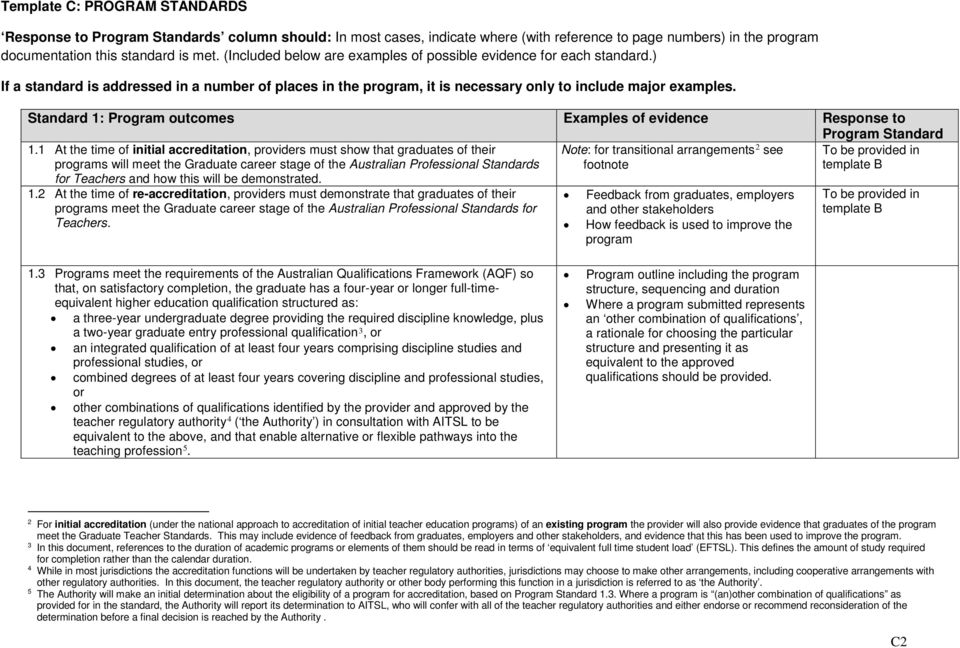
20 Template C: PROGRAM STANDARDS Response to Program Standards column should: In most cases, indicate where (with reference to page numbers) in the program documentation this standard is met. (Included below are examples of possible evidence for each standard.) If a standard is addressed in a number of places in the program, it is necessary only to include major examples. Standard 1: Program outcomes Examples of evidence Response to Program Standard 1.1 At the time of initial accreditation, providers must show that graduates of their programs will meet the Graduate career stage of the Australian Professional Standards for Teachers and how this will be demonstrated. Note: for transitional arrangements 2 see footnote To be provided in template B 1.2 At the time of re-accreditation, providers must demonstrate that graduates of their programs meet the Graduate career stage of the Australian Professional Standards for Teachers. Feedback from graduates, employers and other stakeholders How feedback is used to improve the program To be provided in template B 1.3 Programs meet the requirements of the Australian Qualifications Framework (AQF) so that, on satisfactory completion, the graduate has a four-year or longer full-timeequivalent higher education qualification structured as: a three-year undergraduate degree providing the required discipline knowledge, plus a two-year graduate entry professional qualification 3, or an integrated qualification of at least four years comprising discipline studies and professional studies, or combined degrees of at least four years covering discipline and professional studies, or other combinations of qualifications identified by the provider and approved by the teacher regulatory authority 4 ( the Authority ) in consultation with AITSL to be equivalent to the above, and that enable alternative or flexible pathways into the teaching profession 5. Program outline including the program structure, sequencing and duration Where a program submitted represents an other combination of qualifications, a rationale for choosing the particular structure and presenting it as equivalent to the approved qualifications should be provided. 2 For initial accreditation (under the national approach to accreditation of initial teacher education programs) of an existing program the provider will also provide evidence that graduates of the program meet the Graduate Teacher Standards. This may include evidence of feedback from graduates, employers and other stakeholders, and evidence that this has been used to improve the program. 3 In this document, references to the duration of academic programs or elements of them should be read in terms of equivalent full time student load (EFTSL). This defines the amount of study required for completion rather than the calendar duration. 4 While in most jurisdictions the accreditation functions will be undertaken by teacher regulatory authorities, jurisdictions may choose to make other arrangements, including cooperative arrangements with other regulatory authorities. In this document, the teacher regulatory authority or other body performing this function in a jurisdiction is referred to as the Authority. 5 The Authority will make an initial determination about the eligibility of a program for accreditation, based on Program Standard 1.3. Where a program is (an)other combination of qualifications as provided for in the standard, the Authority will report its determination to AITSL, who will confer with all of the teacher regulatory authorities and either endorse or recommend reconsideration of the determination before a final decision is reached by the Authority. C2
21 Standard 2: Program development Examples of evidence Response to Program Standard 2.1 Programs take account of: contemporary school and system needs current professional expert knowledge authoritative educational research findings and community expectations. This occurs through consultation with employing authorities, professional teacher bodies and/or the direct involvement of practising teachers, educational researchers and relevant cultural and community experts (e.g. local Aboriginal & Torres Strait Islander groups, parents organisations). 2.2 Programs at self-accrediting higher education institutions 6 have been assessed as meeting internal accreditation processes such that there is coherence and rigour in the intended program outcomes, approaches to teaching and learning, and related student assessment Programs of non self-accrediting institutions meet both the relevant accreditation requirements for such institutions and the requirements for national accreditation of initial teacher education programs. Wherever practicable, the two accreditation processes will be undertaken concurrently, ensuring there is coherence and rigour in the intended program outcomes, approaches to teaching and learning and related student assessment, as well as economy of effort 8. How the following has influenced the development and review of the program: o range and nature of consultations undertaken o communications, reports and other forms of feedback from various stakeholders o evaluations of existing program(s) o the research base including investigation into the provider s own practices A mechanism for ensuring the program is informed by school and system needs, such as ongoing involvement by practising teachers, or staffing arrangements. Documented outcome of internal accreditation of program such as minutes or date of internal accreditation. Documented outcome of certification of program through the relevant external accreditation process. 6 For these purposes, a self-accrediting provider is defined as a university or a self-accrediting higher education institution listed in Table 1 or 2 of the Australian Qualifications Framework Register 7 Please note: Depending on the whether a provider is a self-accrediting or non-self-accrediting institution, only one of the items will apply, that is either 2.2 OR 2.3 but NOT both. 8 If a non self-accrediting provider wishes to have the national accreditation of its initial teacher education program(s) undertaken concurrently with other applicable accreditation requirements (as suggested by Program Standard 2.3), it should contact the jurisdictional teacher regulatory authority about this as early as possible. C3
22 Standard 3: Program entrants Examples of evidence Response to Program Standard 3.1 All entrants to initial teacher education will successfully demonstrate their capacity to Provider s policy outlining selection engage effectively with a rigorous higher education program and to carry out the criteria and entry procedures intellectual demands of teaching itself. To achieve this, it is expected that applicants Mechanisms for identifying students levels of personal literacy and numeracy should be broadly equivalent to those of the requiring support 9 top 30 per cent of the population. Unit or program pre-requisites 3.2 Providers who select students who do not meet the requirements in 3.1 above must establish satisfactory additional arrangements to ensure that all students are supported to achieve the required standard before graduation. 3.3 Graduate-entry initial teacher education programs have clear selection criteria and equitable entry procedures that require students to have achieved a discipline-specific qualification relevant to the Australian curriculum or other recognised areas of schooling provision. For secondary teaching this is at least a major study 10 in one teaching area and preferably a second teaching area comprising at least a minor study 11. For primary teaching this is at least one year of full-time-equivalent study relevant to one or more learning areas of the primary school curriculum. 3.4 Students admitted to programs on the basis of an International English Language Testing System (IELTS) assessment, or an equivalent English language proficiency assessment, have attained an overall IELTS (or equivalent) score of 7.5 (with no score below 7 in any of the four skills areas, and a score of no less than 8 in speaking and listening), either on entry to or on graduation from the program. 3.5 Recognition of prior learning or credit transfer arrangements are determined by providers in accordance with the AQF National Principles and Operational Guidelines for Recognition of Prior Learning and Good Practice Principles for Credit Transfer and Articulation from Vocational Education and Training to Higher Education 12. Admissions data Mechanisms for identifying students requiring support Compensatory units and other support provided to these students Assessment procedures and graduation requirements Graduate outcomes demonstrating that standards 3.1 / 3.2 are met Provider s selection policy outlining selection criteria and entry procedures Unit or program pre-requisites Admissions data Provider s policy outlining selection criteria and entry procedures Mechanisms for identifying / monitoring students requiring additional support Unit or program pre-requisites Admissions data General policy on credit transfer Details of Articulation agreements/arrangements 9 Note: AITSL has commissioned further work on defining the levels of personal literacy and numeracy that are broadly equivalent to the top 30% of the population. 10 Study undertaken for a major study will be equivalent to a total of three-quarters of a year of successful full time higher education study, usually comprising sequential discipline study taken over three years. In most programs, this equates to six units, with no more than two at first year level and no fewer than two units at third year level. 11 Study undertaken for a minor study will be equivalent to a total of half a year of successful full time higher education study, usually comprising sequential discipline study taken over two years. In most programs, this equates to four units, with no more than two at first year level and These documents provide agreed guidelines for the assessment of learning undertaken outside the program, and for granting credit or standing as a result of that assessment. C4
23 Standard 4: Program structure and content Examples of evidence Response to Program Standard 4.1 Program structures must be sequenced coherently to reflect effective connections between theory and practice. Clear aims and objectives or intended outcomes Rationale for sequence of program and balance and relationship between theory and practice Duration and nature of each 4.2 Professional studies in education include discipline-specific curriculum and pedagogical studies, general education studies and professional experience. The professional studies in education will comprise at least two years of full-time-equivalent study Discipline studies will normally be completed either in a separate discipline degree completed prior to a graduate-entry initial teacher education program, or as part of an integrated undergraduate teaching degree or combined teaching/discipline degree program. 4.4 Primary programs Teacher education programs that prepare primary teachers must include study in each of the learning areas of the primary school curriculumsufficient to equip teachers to teach across the years of primary schooling. In undergraduate primary programs, at least one half of the program (i.e. normally two years of full-time-equivalent study) must be dedicated to the study of the discipline of each primary learning area and discipline-specific curriculum and pedagogical studies. professional experience Program and unit outlines clearly identifying the units addressing this standard Aims and objectives of the units including assessment policies and procedures, identified level, credit point value (weighting within total program) and pre-service teacher workload Identification of pre-requisite and corequisite units, compulsory and elective units For graduate entry programs a combination of the selection policy and admissions data For undergraduate programs shown in program and unit outlines Alignment with the relevant curriculum 15 Program and unit outlines with clear links to all learning areas (or equivalent) in the relevant curriculum and clearly indicating the duration of units 13 These standards refer to the amount of study to be undertaken in particular areas in terms of years of full-time equivalent study. This is compatible with the measurement of student load in terms of equivalent full-time student load (EFTSL). In a traditional structure of eight units per year, one unit would be equivalent to one eighth of a year of full-time equivalent study. The use of equivalent recognises that many programs are now structured to deliver more than one year s study in a calendar year, and the increasing use of flexible delivery options. 14 In graduate entry programs up to one-quarter of a year of full time equivalent study of relevant discipline studies may be undertaken as electives - see 4.4 and Until the Australian curriculum is fully implemented, specification of minimum discipline requirements will be as described in the Programs Standards, unless a jurisdiction has greater requirements. In these cases, the minimum requirement will be the same as what is currently required in that jurisdiction. For further information please refer to Accreditation of Initial Teacher Education Programs in Australia: Standards and Procedures. p3 C5
24 This must include at least one quarter of a year of full-time-equivalent study of discipline and discipline-specific curriculum and pedagogical studies in each of English/literacy, mathematics/numeracy, and at least one eighth of a year of full-time-equivalent study of discipline-specific curriculum and pedagogical studies in science. Where literacy, numeracy and science are not covered in clearly identifiable separate units, providers should clearly identify where these are covered The remainder of the program may be structured to include extension or specialist studies in priority areas or related curriculum areas. Graduate entry primary programs must comprise at least two years of full-timeequivalent professional studies in education. These programs must include at least one year of full-time-equivalent study of disciplinespecific curriculum and pedagogical studies across the learning areas of the primary school curriculum. Programs must include at least one quarter of a year of full-timeequivalent study of discipline-specific curriculum and pedagogical studies in each of English/literacy and mathematics/numeracy, and at least one eighth of a year of fulltime-equivalent study of discipline-specific curriculum and pedagogical studies in science. These programs may include up to one quarter of a year of full-time-equivalent study of relevant discipline studies as elective units which could be undertaken by applicants who do not fully meet prerequisite discipline study requirements. 4.5 Secondary programs Undergraduate secondary programs must provide a sound depth and breadth of knowledge appropriate for the teaching area/s the graduate intends to teach. These programs should provide at least a major study 16 in one teaching area and preferably a second teaching area comprising at least a minor study 17. Alignment with the relevant curriculum (refer to footnote 17) Program and unit outlines with clear links to all learning areas (or equivalent) in the relevant curriculum and clearly indicating the duration of units 18 In addition, these programs must include a minimum of one quarter of a year of full-timeequivalent study of discipline-specific curriculum and pedagogical studies for each teaching area the graduate intends to teach. Discipline-specific curriculum and pedagogical studies will prepare graduates to teach across the years of secondary schooling. Graduate entry secondary programs must comprise at least two years of full-timeequivalent professional studies in education. 16 Study undertaken for a major study will be equivalent to a total of three-quarters of a year of successful full time higher education study, usually comprising sequential discipline study taken over three years. In most programs, this equates to six units, with no more than two at first year level and no fewer than two units at third year level. 17 Study undertaken for a minor study will be equivalent to a total of half a year of successful full time higher education study, usually comprising sequential discipline study taken over two years. In most programs, this equates to four units, with no more than two at first year level. 18 Where requirements are not undertaken in clearly identifiable separate units, providers should clearly identify where these are covered, and that they add up to the required amount of study. C6
25 Programs must include a minimum of one quarter of a year of full-time-equivalent study of discipline-specific curriculum and pedagogical studies for each teaching area that the graduate intends to teach. The discipline-specific curriculum and pedagogical studies should prepare graduates to teach across the years of secondary schooling. These programs may include up to one quarter of a year of full-time-equivalent study of relevant discipline studies as elective units which could be undertaken by applicants who do not fully meet prerequisite discipline study requirements. 4.6 Specialist programs Where initial teacher education programs include specialist area studies (e.g. primary physical education, secondary special education, secondary teacher-librarianship etc), these studies must comprise one year of full time equivalent study relevant to that specialist area. 4.7 Non-traditional and other settings Some teacher education programs prepare graduates for teaching across traditional boundaries. Programs that prepare graduates to teach in both early childhood settings and primary schools are expected to prepare graduates for teaching the curriculum in both contexts. Programs that prepare graduates for middle school teaching may have a stronger emphasis on teaching particular year levels (e.g. Years 5 to 9) but must fully address the requirements for primary teaching and for secondary teaching in at least one major study or two minor studies in secondary teaching areas. Program outline clearly identifying the units addressing this standard (refer to footnote 15) Alignment with the relevant curriculum Program and unit outlines with clear links to all learning areas (or equivalent) in the relevant curriculum and clearly indicating the duration of units (refer to footnote 15) Note: As required, and in discussion with regulatory authorities, AITSL may develop more detailed guidelines for specific types of programs. Programs that prepare graduates for teaching across P/F/R/K-Year 12 must address the requirements for both primary and secondary teaching. Programs that prepare graduates for teaching in other specialised teaching roles in schools and other educational settings must address the specific content and pedagogy of the specialisation. C7
26 Standard 5: School partnerships Examples of evidence Response to Program Standard 5.1 Providers have established enduring school partnerships to deliver their programs, particularly the professional experience component. Quality (school) partnerships both existing and planned including the active engagement of the supervising teacher in the assessment Partnerships that are broader than professional experience Feedback processes Feedback used to improve the program, quality and sustainability of 5.2 The professional experience component of each program must include no fewer than 80 days of well-structured, supervised 19 and assessed teaching practice in schools in undergraduate and double-degree teacher education programs and no fewer than 60 days in graduate entry programs. 5.3 Providers describe in detail the elements of the relationship between the provider and the schools, the nature and length of professional experience placements, the components of the placement, including the planned experiences and related assessment criteria and methods, and the supervisory and professional support arrangements. 5.4 Providers and their school partners ensure the professional experience component of their program provides their program s students with professional experience that enables: working with learners in a variety of school year levels appreciation of the diversity of students and communities which schools serve (e.g. rural and metropolitan settings, culturally and linguistically diverse communities, Indigenous communities, etc). partnerships Program outlines indicating the duration of professional experience Quality (school) partnerships both existing and planned indicating how they are developed, resourced and maintained Arrangements in place to ensure a quality supervised teaching practice Assessment arrangements, including clarity on the roles of school and provider staff Collaborative work between providers and their partner schools Feedback from partners on the quality and sustainability of partnerships Range of supervised teaching practice a graduate will normally have experienced through the program Arrangements in place to ensure a quality supervised teaching practice Data from pre-service teachers, partner schools and stakeholder organisations on the quality of the professional experience and/or partnership 19 Supervised teaching practice refers to the required component of an initial teacher education program during which pre-service teachers engage in teaching and learning processes in schools and other educational settings, supervised and mentored by a suitably qualified and registered teacher. The purposes are to develop, practise, improve and assess professional knowledge and skills. C8
27 5.5 Providers and their school partners ensure that teachers supervising professional experience (in particular the supervised teaching practice) are suitably qualified and registered. They should have expertise and be supported in coaching and mentoring, and in making judgments about whether students have achieved the Graduate Teacher Standards. 5.6 Providers require that the supervised teaching practice: mandates at least a satisfactory formal assessment of the program s students against the professional practice elements 20 of the Graduate Teacher Standards as a requirement for graduating from the program is undertaken mostly in a recognised Australian school setting over a substantial and sustained period that is relevant to an authentic classroom environment, and includes a designated role for supervising teachers in the assessment of the program s students. 5.7 School partnership arrangements provide for the timely identification of program students at risk of not satisfactorily completing the formal teaching practice, and of ensuring appropriate support for improvement or program counselling. Evaluations undertaken to assess strength and effectiveness of school partnerships Documentation supplied to supervising teachers and how they are selected and supported How school-based personnel are engaged in designing, implementing and assessing supervised teaching practice Feedback from supervisors, mentors and other relevant staff on the quality of support provided Professional experience placement requirements including handbook Assessment arrangements, including clarity on the roles of school and provider staff How the Graduate Teacher Standards are used as the basis for assessment of pre-service teachers in their supervised teaching practice Requirement that pre-service teachers will not receive the award unless they have been assessed as satisfactory in classroom practice Documentation supplied to supervising teachers and how they are selected and supported The procedures for identifying and supporting students at risk of not satisfactorily completing this component of the program 20 The standards and descriptors within the Professional Practice domain of the Australian Professional Standards for Teachers. C9
28 Standard 6: Program delivery and resourcing Examples of evidence Response to Program Standard 6.1 Programs must use effective teaching and assessment strategies (linked to intended learning outcomes) and resources, including embedded information and communication technologies. Program and unit outlines providing evidence of teaching and assessment strategies used, and documentation of the usage of digital resources and tools to complement teaching and 6.2 Programs are delivered by appropriately qualified staff, consistent with the staffing requirements in the relevant National Protocols for Higher Education Approval Processes 21, including an appropriate proportion who also have contemporary school teaching experience. 6.3 Providers ensure that programs use contemporary facilities and resources, including information and communication technologies, which students can expect to be available in schools. 6.4 Providers ensure that their facilities conform to the general expectation for a contemporary higher education learning environment appropriate to the mode of delivery, including such matters as access to: education-related library resources information and communication technologies. assessment strategies Provider/faculty/school staff recruitment policy and professional development policy List of staff involved in the delivery of the program, including their qualifications and teaching experience Site visit Detail of resources and equipment used in the program Student feedback on the adequacy of resources and facilities Site visit Detail of resources and equipment used in the program Student feedback on the adequacy of resources and facilities 21 and in particular section 17.7, p.18. This section provides assurance that students are taught and supported by staff with academic and professional expertise to facilitate quality learning outcomes and who contribute to the advancement of knowledge and understanding. C10
29 Standard 7: Program information and evaluation Examples of evidence Response to Program Standard 7.1 Providers use a range of data, such as student assessment information, destination surveys, employer and other stakeholder feedback to drive program improvement and periodic formal evaluation. Details of provider processes for ongoing monitoring, review and continuous improvement of the program content, delivery methods, assessment and learning outcomes Feedback from students, staff, partners, graduate employers and other 7.2 Providers report annually to the Authority outlining challenges encountered or any changes in programs. 7.3 Providers supply data as required to support local and national teacher workforce supply reporting, to support program and provider benchmarking, and to build a cumulative database of evidence relating to the quality of teacher education in Australia. Data collected is held in a centrally managed database and, under agreed protocols, will be available to all jurisdictions and teacher education providers for research, evaluation and program improvement. stakeholders on program outcomes Providers should provide a statement of willingness to comply with this standard in Template A Providers should highlight: o changes to program content/ delivery o how achievements influence program delivery o major challenges encountered and the response Providers should provide a statement of willingness to comply with this standard in Template A. C11
30 Background TEMPLATE C Appendix 1 APPLICATION FOR ACCREDITATION OR RE-ACCREDITATION OF AN INTIAL TEACHER EDUCATION PROGRAM Framework for achieving Program Standard 3.1 & 3.2 Program Standards 3.1 and 3.2 outline the literacy and numeracy requirements of entrants to initial teacher education programs. 3.1 All entrants to initial teacher education will successfully demonstrate their capacity to engage effectively with a rigorous higher education program and to carry out the intellectual demands of teaching itself. To achieve this, it is expected that applicants levels of personal literacy and numeracy should be broadly equivalent to those of the top 30 per cent of the population. 3.2 Providers who select students who do not meet the requirements in 3.1 above must establish satisfactory additional arrangements to ensure that all students are supported to achieve the required standard before graduation. It is noted that Program Standard 3.1 will predominately be assessed against students entering initial teacher education programs straight from a Year 12 course. While Program Standard 3.2 will address non-year 12 entrants as well as those Year 12 entrants not meeting the 30 per cent threshold. The Framework The Framework for achieving Program Standard 3.1 and 3.2 has been developed and endorsed by the Australian Council of Deans of Education. The Framework represents an agreed set of principles and benchmarks relevant to the requirements of Program Standards 3.1 and 3.2. The Framework covers the range of development of pre-service teachers throughout their education and provides initial teacher education providers with a mechanism to demonstrate how they assess and improve student literacy and numeracy at three key phases: at entry during the period of learning and development at attainment of the Standard. It is envisaged that initial teacher education providers will demonstrate how their pre-service teachers are meeting the literacy and numeracy standards mandated in Program Standards 3.1 and 3.2 using some combination of the assessment and development strategies outlined in this Framework. Many initial teacher education providers will have already implemented and have been using a number of these assessment and improvement strategies. Providers will demonstrate throughout their accreditation application the mechanisms in place for assessing and improving student literacy and numeracy at each key phase. Providers should provide sufficient evidence, based on the strategies outlined in this Framework, so that an accreditation panel can have confidence that the program meets Program Standard 3.1 and 3.2. C12
31 Phase 1: Entry Determination of pre-service teachers personal ability, strengths and needs in English and mathematics on entry to their pre-service program may be identified through a range of mechanisms. Principles and practices for Achievement Examples of assessment mechanisms for Phase 1 Examples of Evidence Year 12 study scores Using the nationally agreed methodology for assessment of Year 12 subject scores to determine the scores above the 30% cut off. 22 Demonstration of capability in tasks designed to reflect appropriate literacy and numeracy achievement, benchmarked as broadly equivalent to the level of achievement identified in Standard 3.1 Demonstration of AQF Level 7 standard or above in English and/or mathematics Results from a Special Tertiary Admissions Test (STAT) Provider designed test Portfolio of evidence of achievement and capability assessed by the provider Satisfactory completion of an approved bridging course Completion of a relevant program or units at AQF Level 7 standard or above Assessment policy and procedures. Processes and samples of benchmarking to ensure equivalence between assessment mechanism and 30% threshold 22 Noting agreement as to the agreed methodology and process is currently underway C13
32 Phase 2: Learning and Development The identification of the learning strengths and needs of pre-service teachers in English and mathematics early in the degree, leading to a program of Learning and Development to ensure capability and achievement demonstrated at Standard 3.2 and for AQF method disciplines Principles and practices for Achievement Designated specialist study units Distributed knowledge development through a range of units of study in both substantive knowledge and knowledge for teaching Additional programs and activities which complement pre-service teachers courses and work to engage, improve and enrich their skills in English and mathematics Mentoring programs in English and mathematics Academic skills units, student advisors and extra-curricula programs Library programs Online course and programs Embedded literacy and numeracy assessment rubrics in all appropriate degree units Examples of Evidence Program and unit outlines clearly identifying the units addressing the principle/practice Program and unit outlines clearly identifying where the knowledge is addressed throughout the identified range of units Copies of provider processes and program outlines detailing the provision of additional services. Data showing levels of participation and assessment results post participation. Program and unit outlines clearly demonstrating the use of assessment rubrics across the identified units C14
33 Phase 3: at the Standard Pre-service teacher s evaluation and demonstration of meeting Program Standard 3.2 in English and mathematics and beyond to AQF appropriate to their method discipline level. While this may occur at any stage of the degree, it is likely to be realized well before course completion. Principles and practices for Achievement Demonstration of capability in tasks designed to reflect appropriate literacy and numeracy achievement, benchmarked as broadly equivalent to the level of achievement identified in Standard 3.1 Demonstration of AQF Level 7 standard or above in English and/or mathematics Examples of assessment mechanisms Phase 3 Results from a Special Tertiary Admissions Test (STAT) Provider designed test to assess student s literacy and numeracy skills Provider designed assessment tasks designed to demonstrate student abilities in literacy and numeracy Portfolio of evidence of achievement and capability assessed by the provider Satisfactory completion of an approved bridging course Completion of a relevant program or units at AQF Level 7 standard or above Examples of Evidence Assessment policy and procedures. Processes and samples of benchmarking to ensure equivalence between assessment mechanism and 30% threshold C15
34 ATTACHMENT 1 Elaboration of Priority Areas Purpose and Use The National Program Standards for Initial Teacher Education require that providers show that graduates of their programs will meet the Graduate career stage of the Australian Professional Standards for Teachers (Standard 1.1). In addition, Ministers have specified priority areas in which all initial teacher education graduates should develop skills and knowledge. These statements elaborating the Ministers priority areas are intended to provide guidance to providers seeking accreditation and to accreditation panels on the skills and knowledge that graduates are required to develop through the program. It is envisaged that the priority areas will be addressed through the Australian Professional Standards for Teachers. It is anticipated that providers will demonstrate how their programs enable graduates to gain and demonstrate skills and knowledge in the priority areas throughout their application for accreditation. It is not proposed that additional evidence will be required, beyond that required by the templates in the existing guide to accreditation. There is an expectation that both providers and panels will refer to the elaborations and consider how they are achieved through the program. Priority areas The priorities link directly to the Graduate career stage of the Australian Professional Standards for Teachers and the National Program Standards for Initial Teacher Education. Initial Teacher Education programs should ensure that the following areas, which are seen as priorities in all Australian jurisdictions, are addressed: Aboriginal and Torres Strait Islander education Classroom management ICT Literacy and numeracy Students with special educational needs Initial Teacher Education programs should ensure that all graduates: Gain knowledge and skills in the priority areas, as identified in the statements of elaboration Are able to link theory and practice so that the knowledge and skills acquired can be applied in practice Are able to demonstrate these attributes and are assessed against them in course work and/ or practicum, as appropriate. As per Program Standard 6.2, programs should be delivered by qualified staff who have expertise and/ or practical experience, where appropriate. D1
35 D2 Priority area: ABORIGINAL AND TORRES STRAIT ISLANDER EDUCATION Initial Teacher Education Program Outcomes Initial teacher education programs should ensure that graduate teachers have demonstrated skills and/ or knowledge, as noted below. Aboriginal and Torres Strait Islander cultures and history Knowledge of concepts of histories, contemporary cultures, cultural identity, linguistic background and understanding of their impact on the education of students from Aboriginal and Torres Strait Islander backgrounds Understanding of and respect for Aboriginal and Torres Strait Islander histories, cultures and languages and knowledge of how to use these to promote reconciliation Awareness of local Aboriginal and Torres Strait Islander knowledge and knowledge sources Teaching strategies Knowledge and understanding of effective strategies for meeting the learning needs of Aboriginal and Torres Strait Islander students, including specific literacy, numeracy and English as a Second or Other Language strategies Ability to identify culturally inclusive practices in relation to curriculum, classroom teaching and assessment. Knowledge of strategies to engender a positive attitude to promote excellence and success in learning outcomes for Aboriginal and Torres Strait Islander students Inclusion Ability to recognise relevant issues for Aboriginal and Torres Strait Islander students and community members in relation to schooling, including an understanding that English may not be their first language Ability to examine relevant resources and syllabuses in terms of Aboriginal and Torres Strait Islander perspectives Ability to identify communication strategies to develop inclusive educational partnerships with Aboriginal and Torres Strait Islander students, families and communities Priorities, policies and resources Awareness of relevant international, national and local jurisdictional educational priorities and policies that impact on Aboriginal and Torres Strait Islander education Knowledge of what constitutes racism and anti-racism strategies, policies and legislation Understanding of the roles of Aboriginal and Torres Strait Islander support personnel at system and school levels, and the contribution of Indigenous educational and community organisations in improving educational outcomes for Aboriginal and Torres Strait Islander students Program Design Initial teacher education programs may address these issues in specific units of study or by embedding them across the program of study. Appropriately qualified Aboriginal people (teachers, lecturers, educators and/or community members) should be consulted on an ongoing basis on the design and development of Aboriginal and Torres Strait cultural content and, where possible, be involved in its delivery and evaluation. Culturally appropriate support for Indigenous preservice teachers should be provided through the local Indigenous support unit, including by phone or electronically during professional experience placements. The Ministers priority areas link to the Australian Professional Standards for Teachers (Graduate stage). All professional standards have a bearing on the skills and abilities required by the priority areas. The Aboriginal and Torres Strait Islander Education priority area is specifically relevant to the Standards noted below. See page D7 for the full list of Standards. Standard 1: Know students and how they learn Focus area 1.4: Strategies for teaching Aboriginal and Torres Strait Islander students Standard 2: Know the content and how to teach it Focus area 2.4: Understand and respect Aboriginal and Torres Strait Islander people to promote reconciliation between Indigenous and non-indigenous Australians Standard 3: Plan for and implement effective teaching and learning Focus area 3.1: Establish challenging learning goals Standard 4:Create and maintain supportive and safe learning environments Focus area 4.1: Support student participation
36 D3 Priority area: CLASSROOM MANAGEMENT Initial Teacher Education Program Outcomes Initial teacher education programs should ensure that graduate teachers have demonstrated skills and/or knowledge, as noted below. Knowledge Understanding of how effective teaching, including curriculum rigor, engagement, participation and inclusion, is a key factor in effective classroom management Knowledge of child and adolescent development, student well-being and mental health, and an understanding of the implications for learning and the management of behaviour Understanding of anti bullying strategies and how to identify and respond to bullying, including cyberbullying, in different contexts and cohorts Teaching Strategies Ability to enact appropriate strategies that respond to the learning needs of students from diverse linguistic, cultural, religious and socioeconomic backgrounds Ability to design and implement plans and strategies that can be used within classrooms and other school settings to facilitate a positive classroom climate. These strategies could include (but not be limited to): - the promotion of positive student behaviour and positive relationships within the classroom - support of students with special needs within the classroom and wider school settings, including practical strategies to facilitate the students success - effective communication with parents/care-givers and communities - intervention to manage disruptive student behaviour - discipline/crisis/emergency response for disruptive student behaviour Ability to successfully manage student behaviour, as demonstrated within the professional experience component of the program Ability to work with colleagues to develop and implement practical approaches to managing students with challenging behaviours in a whole-school context Ability to develop strategies to minimise physical and emotional bullying, and to support students who have been victims of bullying and to respond to perpetrators Priorities, policies and resources Understanding of key systemic policy documents and legislative requirements, resources, personnel and referral agencies that assist teachers to create effective learning environments and interpersonal relationships Awareness and understanding of the whole-school approach to student welfare/discipline policies and/or approaches to classroom and student management adopted by professional experience schools and the evidence on which these are based Program Design Initial teacher education programs may address these issues in specific units of study or by embedding them across the program of study. The Ministers priority areas link to the Australian Professional Standards for Teachers (Graduate stage). All professional standards have a bearing on the skills and abilities required by the priority areas. Classroom management priority area is specifically relevant to the Standards noted below. See page D7 for the full list of Standards. Standard 1: Know students and how they learn Focus area 1.1: Physical, social and intellectual development and characteristics of students Standard 3: Plan for and implement effective teaching and learning Focus Area 3.5: Use effective classroom communication Standard 4: Create and maintain supportive and safe learning environments Focus Area 4.3: Manage challenging behaviour
37 D4 Priority area: INFORMATION AND COMMUNICATION TECHNOLOGIES Initial Teacher Education Program Outcomes Initial teacher education programs should ensure that graduate teachers have demonstrated skills and/or knowledge, as noted below. Knowledge Understanding of the underlying social and pedagogical implications of ICT and their application to education Knowledge of responsible and ethical use of digital information including in relation to plagiarism, copyright, censorship, bullying and privacy Teaching strategies Understanding of innovative use of information and communication technologies in enhancing student learning Understanding of the capacity of ICT to support differentiated student-centred learning and the development of critical and creative thinking Ability to select and evaluate ICT-based learning materials and software and integrate them into their teaching Ability to effectively employ ICT applications to support specific syllabus outcomes, content and processes Ability to design a range of ICT-based assessment tasks linked to curriculum outcomes Understanding of the collaborative and student led nature of effective ICT-mediated learning Using information Understanding of the issues of appropriate access to, and verification of, information gained from a variety of sources including the Internet and other digital resources Ability to critically evaluate, retrieve, manipulate and manage the information from a range of digital sources including social media Technical skills Understanding of the range of applications and adaptive technologies available to support students with special needs Ability to construct and manipulate texts and images, create presentations and store and retrieve digital information for classroom and on-line learning Ability to use appropriate digital resources for student profiling and reporting, lesson preparation and class/faculty administration Ability to safely and effectively use ICT in online collaborative environments Program Design Initial teacher education programs may address these issues in specific units of study or by embedding them across the program of study. The Ministers priority areas link to the Australian Professional Standards for Teachers (Graduate stage). All professional standards have a bearing on the skills and abilities required by the priority areas. The ICT priority area is specifically relevant to the Standards noted below. See page D7 for the full list of Standards. Standard 1: Know students and how they learn Focus area 1.2:Understand how students learn Standard 2: Know the content and how to teach it Focus area 2.6: Information and Communication Technology (ICT) Standard 3: Plan for and implement effective teaching and learning Focus area 3.4: Select and use resources Standard 4: Create and maintain supportive and safe learning environments Focus area 4.5: Use ICT safely, responsively and ethically
38 D5 Priority area: LITERACY AND NUMERACY Initial Teacher Education Program Outcomes Initial teacher education programs should ensure that graduate teachers have demonstrated skills and/or knowledge, as noted below. Knowledge Understanding of the literacy and numeracy demands of the curriculum areas they teach Understanding of the pervasive nature of literacy and numeracy and their role in everyday situations, and of the importance of home and community literacy and numeracy practices Awareness that all students can be literate and numerate Understanding of the diversity of literacy and numeracy abilities and the needs of learners, including English as a Second or Other Language needs Understanding of the explicit teaching of reading and writing, speaking and listening appropriate to their level and area of teaching Sound knowledge of mathematics appropriate to their level and area of teaching Knowledge of contemporary understandings of research evidence related to teaching reading, writing, speaking, listening and mathematics appropriate to their level and area of teaching Knowledge of a range of resources to support students literacy and numeracy learning, appropriate to their level and area of teaching Teaching strategies Ability to identify the literacy and numeracy needs of students and understand a range of strategies to support those needs Ability to analyse the literacy and numeracy demands of the subjects and curriculum in their teaching areas Ability to recognise and exploit opportunities to support literacy and numeracy learning within their curriculum areas Ability to develop units of work and teaching plans that embody a literacy and numeracy focus and incorporate the effective use of literacy and numeracy strategies and assessment tasks to inform teaching and the selection of subject matter Ability to analyse student work samples to identify areas of literacy and numeracy need Ability to provide accurate written and oral feedback for students in relation to their literacy and numeracy development Ability to develop specific strategies to cater for students requiring additional support Ability to interpret data (school-based and system) to make informed decisions about student literacy and numeracy needs in the context of their subject and in a broader whole school context Ability to teach reading and writing, speaking and listening and mathematics appropriate to their level and area of teaching using approaches based on knowledge and evidence Where relevant, ability to use a range of effective teaching and assessment strategies in reading, writing, speaking, listening and mathematics. Where relevant, ability to sequence reading, writing and mathematical learning experiences appropriately Program Design Initial teacher education programs may address these issues in specific units of study or by embedding them across the program of study. The Ministers priority areas link to the Australian Professional Standards for Teachers (Graduate stage). All professional standards have a bearing on the skills and abilities required by the priority areas. The literacy and numeracy priority area is specifically relevant to the Standards noted below. See page D7 for the full list of Standards. Standard 2: Know the content and how to teach it Focus area 2.1: Content and teaching strategies of the teaching area Standard 2: Know the content and how to teach it Focus area 2.5: Literacy and numeracy strategies
39 D6 Priority area: STUDENTS WITH SPECIAL EDUCATIONAL NEEDS Initial Teacher Education Program Outcomes In inclusive classrooms graduate teachers will work with the full spectrum of children in terms of abilities, difficulties and special needs, including learning difficulties and giftedness. Initial teacher education programs should ensure that graduate teachers have demonstrated skills and/or knowledge, as noted below. Knowledge Understanding of child and adolescent development and milestones Understanding of the broader implications of special educational needs on learning and the responsibilities of teachers Understanding of the likely impacts that special needs may have on a student s access to and participation in learning Teaching strategies Ability to identify individual learning needs and, with appropriate specialist support, apply strategies to address such needs in the school and classroom environment Understanding of strategies for engaging and collaborating with parents/care-givers and other professionals in order to better support students with special educational needs Ability to use curriculum based assessment and monitoring procedures for identifying prior achievement and making differentiated assessment and learning decisions, including the reasonable adjustments required to enable students to meet curriculum outcomes Ability to plan, implement and evaluate programs in order to include the specific learning needs of students Priorities, policies and resources Broad understanding of how programs and resources can meet specific learning needs of all students, including inclusive education practices, specialist support and government and community services. Knowledge of legislative responsibilities and educational policies as they relate to educational settings for students with special needs Program Design Initial teacher education programs may address these issues in specific units of study or by embedding them across the program of study. The Ministers priority areas link to the Australian Professional Standards for Teachers (Graduate stage). All professional standards have a bearing on the skills and abilities required by the priority areas. The students with special educational needs priority area is specifically relevant to the Standards noted below. See page D7 for the full list of Standards. Standard 1: Know students and how they learn Focus area 1.5: Differentiate teaching to meet the specific learning needs of students across the full range of abilities Standard 1: Know students and how they learn Focus area 1.6: Strategies to support full participation of students with disability Standard 4: Create and maintain supportive and safe learning environments Focus area 4.1: Support student participation
40 D7 Australian Professional Standards for Teachers- Graduate Career Stage Professional Knowledge Standard Focus areas 1.1 Physical, social and intellectual development and characteristics of students Demonstrate knowledge and understanding of physical, social and intellectual development and characteristics of students and how these may affect learning. 1.5 Differentiate teaching to meet the specific learning needs of students across the full range of abilities Demonstrate knowledge and understanding of strategies for differentiating teaching to meet the specific learning needs of students across the full range of abilities. Professional Knowledge Standard Focus areas 2.1 Content and teaching strategies of the teaching area Demonstrate knowledge and understanding of the concepts, substance and structure of the content and teaching strategies of the teaching area. 2.5 Literacy and numeracy strategies Know and understand literacy and numeracy teaching strategies and their application in teaching areas. 1. Know students and how they learn 1.2 Understand how students learn Demonstrate knowledge and understanding of research into how students learn and the implications for teaching. 1.6 Strategies to support full participation of students with disability Demonstrate broad knowledge and understanding of legislative requirements and teaching strategies that support participation and learning of students with disability. 2. Know the content and how to teach it 2.2 Content selection and organisation Organise content into an effective learning and teaching sequence. 2.6 Information and Communication Technology (ICT) Implement teaching strategies for using ICT to expand curriculum learning opportunities for students. 1.3 Students with diverse linguistic, cultural, religious and socioeconomic backgrounds Demonstrate knowledge of teaching strategies that are responsive to the learning strengths and needs of students from diverse linguistic, cultural, religious and socioeconomic backgrounds. 2.3 Curriculum, assessment and reporting Use curriculum, assessment and reporting knowledge to design learning sequences and lesson plans. 1.4 Strategies for teaching Aboriginal and Torres Strait Islander students Demonstrate broad knowledge and understanding of the impact of culture, cultural identity and linguistic background on the education of students from Aboriginal and Torres Strait Islander backgrounds. 2.4 Understand and respect Aboriginal and Torres Strait Islander people to promote reconciliation between Indigenous and non Indigenous Australians Demonstrate broad knowledge of, understanding of and respect for Aboriginal and Torres Strait Islander histories, cultures and languages. Professional Practice Standard Focus areas 3.1 Establish challenging learning goals Set learning goals that provide achievable challenges for students of varying abilities and characteristics. 3.5 Use effective classroom communication Demonstrate a range of verbal and nonverbal communication strategies to support student engagement. 3. Plan for and implement effective teaching and learning 3.2 Plan, structure and sequence learning programs Plan lesson sequences using knowledge of student learning, content and effective teaching strategies. 3.6 Evaluate and improve teaching programs Demonstrate broad knowledge of strategies that can be used to evaluate teaching programs to improve student learning. 3.3 Use teaching strategies Include a range of teaching strategies. 3.7 Engage parents/ carers in the educative process Describe a broad range of strategies for involving parents/carers in the educative process. 3.4 Select and use resources Demonstrate knowledge of a range of resources, including ICT, that engage students in their learning.
41 D8 Professional Practice Standard Focus areas 4.1 Support student participation Identify strategies to support inclusive student participation and engagement in classroom activities. 4.5 Use ICT safely, responsibly and ethically Demonstrate an understanding of the relevant issues and the strategies available to support the safe, responsible and ethical use of ICT in learning and teaching. Professional Practice Standard Focus areas 5.1 Assess student learning Demonstrate understanding of assessment strategies, including informal and formal, diagnostic, formative and summative approaches to assess student learning. 5.5 Report on student achievement Demonstrate understanding of a range of strategies for reporting to students and parents/carers and the purpose of keeping accurate and reliable records of student achievement. 4. Create and maintain supportive and safe learning environments 4.2 Manage classroom activities Demonstrate the capacity to organise classroom activities and provide clear directions. 4.3 Manage challenging behaviour Demonstrate knowledge of practical approaches to manage challenging behaviour. 5. Assess, provide feedback and report on student learning 5.2 Provide feedback to students on their learning Demonstrate an understanding of the purpose of providing timely and appropriate feedback to students about their learning. 5.3 Make consistent and comparable judgements Demonstrate understanding of assessment moderation and its application to support consistent and comparable judgements of student learning. 4.4 Maintain student safety Describe strategies that support students wellbeing and safety working within school and/or system, curriculum and legislative requirements. 5.4 Interpret student data Demonstrate the capacity to interpret student assessment data to evaluate student learning and modify teaching practice. Professional Engagement Standard Focus areas 6.1 Identify and plan professional learning needs Demonstrate an understanding of the role of the Australian Professional Standards for Teachers in identifying professional learning needs. 6. Engage in Professional learning 6.2 Engage in professional learning and improve practice Understand the relevant and appropriate sources of professional learning for teachers. 6.3 Engage with colleagues and improve practice Seek and apply constructive feedback from supervisors and teachers to improve teaching practices. 6.4 Apply professional learning and improve student learning Demonstrate an understanding of the rationale for continued professional learning and the implications for improved student learning. Professional Engagement Standard Focus areas 7.1 Meet professional ethics and responsibilities Understand and apply the key principles described in codes of ethics and conduct for the teaching profession. 7. Engage professionally with colleagues, parents/carers and the community 7.2 Comply with legislative, administrative and organisational requirements Understand the relevant legislative, administrative and organisational policies and processes required for teachers according to school stage. 7.3 Engage with the parents/carers Understand strategies for working effectively, sensitively and confidentially with parents/carers. 7.4 Engage with professional teaching networks and broader communities Understand the role of external professionals and community representatives in broadening teachers professional knowledge and practice.
42 aitsl.edu.au Further information Telephone: [email protected] Melbourne Canberra AITSL is funded by the Australian Government
aitsl.edu.au Accreditation of Initial Teacher Education Programs in Australia
 aitsl.edu.au Accreditation of Initial Teacher Education Programs in Australia Standards and Procedures April 2011 2011 Education Services Australia as the legal entity for the Ministerial Council for Education,
Accreditation of Initial Teacher Education Programs in Australia
 AITSL is funded by the Australian Government Accreditation of Initial Teacher Education Programs in Australia Standards and Procedures April 2011 2011 Education Services Australia as the legal entity for
AITSL is funded by the Australian Government. Guide to the Certification of Highly Accomplished and Lead Teachers in Australia
 AITSL is funded by the Australian Government Guide to the Certification of Highly Accomplished and Lead Teachers in Australia The Australian Institute for Teaching and School Leadership (AITSL) has been
Australian Professional Standards for Teachers
 AITSL is funded by the Australian Government Australian Professional Standards for Teachers February 2011 Formerly the National Professional Standards for Teachers Work on the (the Standards) commenced
Certification of Highly Accomplished and Lead Teachers in Australia
 AITSL is funded by the Australian Government Certification of Highly Accomplished and Lead Teachers in Australia April 2012 The Australian Institute for Teaching and School Leadership (AITSL) has been
Australian Professional Standards for Teachers
 Australian Professional Standards for Teachers This version of the Australian Professional Standards for Teachers was adopted by the Queensland College of Teachers (QCT) with permission from the Australian
AUSTRALIAN PROFESSIONAL STANDARDS FOR TEACHERS I L C O U N C
 AUSTRALIAN PROFESSIONAL STANDARDS FOR TEACHERS QUALITY TEACHING I L C O U N C Contents Introduction 2 Organisation of the Australian Professional Standards for Teachers 4 Professional Knowledge 8 Professional
End of Experience/Placement Assessment Report: Masters of Teaching (Primary) Graduate Diploma of Teaching (Primary)
 End of Experience/Placement Assessment Report: Unit Code LEM503 Unit Title Supervised Practicum A: Literacy and Numeracy 1 Pre-service Teacher s name: Name of Education Setting: Mentor Teacher 1 (name):
A guide to the evidence-based process for full registration SUPPORTING PROVISIONALLY REGISTERED TEACHERS
 A guide to the evidence-based process for full registration SUPPORTING PROVISIONALLY REGISTERED TEACHERS Updated 0 SUPPORTING PROVISIONALLY REGISTERED TEACHERS ONLINE Teachers with provisional registration
APPLICATION TRANSITION FROM PROVISIONAL TO (FULL) REGISTRATION
 Member of the Australasian Teacher Regulatory Authorities Inc. PO Box 3649, Rundle Mall SA 5000 Phone: (08) 8226 2666 Fax: (08) 8226 2667 Website: www.trb.sa.edu.au Email: [email protected] APPLICATION
FINAL EVALUATION FORM. Graduate Certificate of Education PPA5106 Early Childhood Studies
 Graduate Certificate Teacher Name: Centre/School: University Supervisor: Year Level Taught: FINAL EVALUATION FORM Graduate Certificate of Education PPA5106 Early Childhood Studies Please indicate whether
Accreditation of initial teacher education programs in Australia
 aitsl.edu.au Accreditation of initial teacher education programs in Australia Frequently Asked Questions Standards and Procedures April 2011 1. What are the Standards and Procedures for the Accreditation
How To Teach
 AITSL is funded by the Australian Government Certification documentary evidence supplement Lead teachers Companion document to the Guide to Certification of Highly Accomplished and Lead Teachers in Australia
Professional Experience Handbook - Appendices Bachelor of Education (Early Childhood) Course Code SL033BEEC 2013
 Professional Experience Handbook - Appendices Bachelor of Education (Early Childhood) Course Code SL033BEEC 2013 Professional Experience Unit SLEE202 Teaching and Learning in Early Childhood Table of
Procedures for Assessment and Accreditation of Medical Schools by the Australian Medical Council 2011
 Australian Medical Council Limited Procedures for Assessment and Accreditation of Medical Schools by the Australian Medical Council 2011 Medical School Accreditation Committee These procedures were approved
Evidence Guide for the Proficient Teacher Standards
 Guide for the Proficient Teacher Standards Guide for the Proficient Teacher Standards Table of Contents Section One: Teaching Standards... 3 Section Two: for Accreditation... 8 Section Three: Examples
Bachelor of Bachelor of Education (Honours)
 Bachelor of Bachelor of Education (Honours) Detailed Course Requirements The 2016 Monash University Handbook will be available from October 2015. This document contains interim 2016 course requirements
ACCREDITATION Classroom ready: Demonstrating the impact on student learning of initial teacher education programs
 ACCREDITATION Classroom ready: Demonstrating the impact on student learning of initial teacher education programs Position Paper August 2015 Classroom ready: Demonstrating the impact on student learning
NATIONAL GUIDELINES FOR THE ACCREDITATION OF NURSING AND MIDWIFERY PROGRAMS LEADING TO REGISTRATION OR ENDORSEMENT IN AUSTRALIA
 NATIONAL GUIDELINES FOR THE ACCREDITATION OF NURSING AND MIDWIFERY PROGRAMS LEADING TO REGISTRATION OR ENDORSEMENT IN AUSTRALIA NATIONAL GUIDELINES FOR THE ACCREDITATION OF NURSING AND MIDWIFERY PROGRAMS
NATIONAL GUIDELINES FOR THE ACCREDITATION OF NURSING AND MIDWIFERY PROGRAMS LEADING TO REGISTRATION AND ENDORSEMENT IN AUSTRALIA
 NATIONAL GUIDELINES FOR THE ACCREDITATION OF NURSING AND MIDWIFERY PROGRAMS LEADING TO REGISTRATION AND ENDORSEMENT IN AUSTRALIA NATIONAL GUIDELINES FOR THE ACCREDITATION OF NURSING AND MIDWIFERY PROGRAMS
Australia-wide accreditation of programs for the professional preparation of teachers. A consultation paper
 Australia-wide accreditation of programs for the professional preparation of teachers A consultation paper was established as the national body for the teaching profession with funding provided by the
NATIONAL GUIDELINES FOR THE ACCREDITATION OF NURSING AND MIDWIFERY PROGRAMS LEADING TO REGISTRATION OR ENDORSEMENT IN AUSTRALIA
 NATIONAL GUIDELINES FOR THE ACCREDITATION OF NURSING AND MIDWIFERY PROGRAMS LEADING TO REGISTRATION OR ENDORSEMENT IN AUSTRALIA NATIONAL GUIDELINES FOR THE ACCREDITATION OF NURSING AND MIDWIFERY PROGRAMS
Australian Professional Standard for Principals
 AITSL is funded by the Australian Government Australian Professional Standard for Principals July 2011 Formerly the National Professional Standard for Principals 2011 Education Services Australia as the
NATIONAL PROTOCOLS FOR HIGHER EDUCATION APPROVAL PROCESSES
 NATIONAL PROTOCOLS FOR HIGHER EDUCATION APPROVAL PROCESSES The following National Protocols for Higher Education Approval Processes were recommended by the Joint Committee on Higher Education and approved
APPLICATION GUIDE AND APPLICATION FOR REGISTRATION AS AN AUSTRALIAN UNIVERSITY COLLEGE EFFECTIVE FROM 1 JANUARY 2013
 APPLICATION GUIDE APPLICATION FOR A REGISTERED HIGHER EDUCATION PROVIDER TO CHANGE PROVIDER CATEGORY TO: AUSTRALIAN UNIVERSITY COLLEGE, OR AUSTRALIAN UNIVERSITY, OR AUSTRALIAN UNIVERSITY OF SPECIALISATION
Standards for Accredited Courses
 Standards for Accredited Courses Commonwealth of Australia October 2007 This work is copyright. It may be reproduced in whole or in part for study or training purposes, subject to the inclusion of an acknowledgement
Information Technology Curriculum Framework
 Information Technology Curriculum Framework Stage 6 Syllabus Part A for implementation from 2000 Information Technology (120 indicative hours) Information Technology (180 indicative hours) Information
PRESERVICE. PROFESSIONAL STANDARDS FOR QUEENSLAND TEACHERS (graduate level): A guide for use with preservice teachers QUEENSLAND COLLEGE OF TEACHERS
 PRESERVICE PROFESSIONAL STANDARDS FOR TEACHERS (graduate level): March 2009 INTRODUCTION The Professional Standards for Queensland Teachers underpin all stages of teachers professional learning throughout
National Guidelines for Higher Education Approval Processes
 National Guidelines for Higher Education Approval Processes Guidelines for the registration of non self-accrediting higher education institutions and the accreditation of their course/s As approved by
Appendix 1: Detailed evidence examples
 Appendix 1: Detailed examples These examples are not an exhaustive list and serve only as an illustration. They should not be viewed as a checklist. Please note: one quality item can provide for a range
leadership s t r a t e g y MCEETYA A u s t r a l i a N e w Z e a l a n d
 leadership s t r a t e g y MCEETYA A u s t r a l i a N e w Z e a l a n d Leadership enhanced by information and communication technologies responds to the expectations, challenges and possibilities of
COURSE REGULATIONS SCHOOL OF EDUCATION. GRADUATE CERTIFICATE IN EARLY CHILDHOOD EDUCATION GCertEaChEd COURSE CODE: 4147
 COURSE REGULATIONS SCHOOL OF EDUCATION GRADUATE CERTIFICATE IN EARLY CHILDHOOD EDUCATION GCertEaChEd COURSE CODE: 4147 THESE COURSE REGULATIONS ARE EFFECTIVE FROM 1.7.2016 SCHOOL OF EDUCATION 1. These
Course outline. Code: EDU317 Title: Teaching Health and Physical Education in Primary School
 Course outline Code: EDU317 Title: Teaching Health and Physical Education in Primary School Faculty of: Science, Health, Education and Engineering Teaching Session: Semester 2 Year: 2015 Course Coordinator:
Foreword. Closing the Gap in Indigenous Health Outcomes. Indigenous Early Childhood Development. Indigenous Economic Participation.
 National Aboriginal and Torres Strait Islander Health Workforce Strategic Framework 2011 2015 Prepared for The Australian Health Ministers Advisory Council by the Aboriginal and Torres Strait Islander
COURSE INFORMATION BSB61015 Advanced Diploma of Leadership and Management
 COURSE INFORMATION BSB61015 Advanced Diploma of Leadership and Management What is the Australian Qualifications Framework? The Australian Qualifications Framework (AQF) establishes the quality of Australian
Transition to full registration. Providing evidence of practice EVIDENCE GUIDE
 Transition to full registration Providing evidence of practice EVIDENCE GUIDE Table of Contents This is a QCT resource for provisionally registered teachers (developed from AITSL s Guide to Transition
Guidelines for the approval of Masters Courses for student income support payments 2
 Guidelines for the approval of Masters Courses for student income support payments 2 Contents THE PURPOSE OF THESE GUIDELINES... 4 STUDENT INCOME SUPPORT... 5 Youth Allowance, Austudy and Pensioner Education
CONTINUING PROFESSIONAL DEVELOPMENT POLICY - SUPPORTING THE MAINTENANCE OF ACCREDITATION AT PROFICIENT TEACHER/ PROFESSIONAL COMPETENCE
 NSW INSTITUTE OF TEACHERS CONTINUING PROFESSIONAL DEVELOPMENT POLICY - SUPPORTING THE MAINTENANCE OF ACCREDITATION AT PROFICIENT TEACHER/ PROFESSIONAL COMPETENCE Updated 21 June 2012 CONTENTS PART 1: INTRODUCTION:...
Accreditation at Highly Accomplished and Lead Teacher The Role of the Principal
 Accreditation at Highly Accomplished and Lead Teacher The Role of the Principal Accreditation at Highly Accomplished and Lead Teacher: The Role of the Principal Page 1 Contents Introduction... 4 The phased
InSights. National system for the accreditation of pre service teacher education programs: Consultation report
 National system for the accreditation of pre service teacher education programs: Consultation report Helen Timperley October 2010 Citation Australian Institute for Teaching and School Leadership 2010,
Implementation Handbook
 Implementation Handbook Fourth Edition 2007 Published by Australian Qualifications Framework (AQF) Advisory Board PO Box 609 Carlton South Vic 3053 Tel: (03) 9639 1606 Fax: (03) 9639 1315 Email: [email protected]
COURSE REGULATIONS SCHOOL OF EDUCATION BACHELOR OF EDUCATION / BACHELOR OF BEHAVIOURAL SCIENCE COURSE CODES: 3427, 3119 & 3130
 COURSE REGULATIONS SCHOOL OF EDUCATION BACHELOR OF EDUCATION / BACHELOR OF BEHAVIOURAL SCIENCE Early Childhood and Care: 0-8 YEARS (3427) - BEd(ECEC)/BBehSc Primary (3119) - BEd(Prim)/BBehSc Secondary
COURSE REGULATIONS SCHOOL OF EDUCATION. MASTER OF EDUCATION (SPECIAL LEARNING NEEDS) MEd(SN) COURSE CODE: 5032
 COURSE REGULATIONS SCHOOL OF EDUCATION MASTER OF EDUCATION (SPECIAL LEARNING NEEDS) MEd(SN) COURSE CODE: 5032 THESE COURSE REGULATIONS ARE EFFECTIVE FROM 1.1.2014 SCHOOL OF EDUCATION 1. These Course Regulations
NATIONAL SAFE SCHOOLS FRAMEWORK
 NATIONAL SAFE SCHOOLS FRAMEWORK All Australian schools are safe, supportive and respectful teaching and learning communities that promote student wellbeing www.safeschoolshub.edu.au National Safe Schools
COURSE REGULATIONS SCHOOL OF EDUCATION. BACHELOR OF EDUCATION (EARLY CHILDHOOD AND CARE: 0-8 YEARS) BEd(ECE) COURSE CODE: 3382
 COURSE REGULATIONS SCHOOL OF EDUCATION BACHELOR OF EDUCATION (EARLY CHILDHOOD AND CARE: 0-8 YEARS) BEd(ECE) COURSE CODE: 3382 THESE COURSE REGULATIONS ARE EFFECTIVE FROM 1.1.2015 SCHOOL OF EDUCATION 1.
Transition to Full Registration
 Transition to Full Registration Guide to Evidencing the Professional Standards at the Proficient Level Teacher Registration Board of Western Australia www.trb.wa.gov.au 2014 / 21998 Transition to Full
Course outline. Code: EDU343 Title: Inclusive Practices and Intervention in Early Education
 Course outline Code: EDU343 Title: Inclusive Practices and Intervention in Early Education Faculty of: Science, Health, Education and Engineering Teaching Session: Semester 2 Year: 2015 Course Coordinator:
Academic Registrar, Academic Administration [email protected] (07) 373 57334
 Bachelor Degree (AQF Level 7) Policy Approving authority Approval date Academic Committee 20 August 2015 (6/2015 meeting) Advisor Next scheduled review 2020 Academic Registrar, Academic Administration
TEQSA and the Australian Qualifications Framework. Questions and answers
 TEQSA and the Australian Qualifications Framework Questions and answers February, 2013 TEQSA AND THE AQF What is TEQSA s role in relation to the Australian Qualifications Framework? TEQSA s role is to
HIGHER EDUCATION STANDARDS FRAMEWORK
 HIGHER EDUCATION STANDARDS FRAMEWORK TABLE OF CONTENTS Introduction to the Higher Education Standards Framework... 1 PART A: Standards for Higher Education... 3 Introduction to Part A... 3 1 Student Participation
Vocational Education and Training in Schools Guidelines
 Vocational Education and Training in Schools Guidelines Department of Training and Workforce Development Department of Education 1. Introduction These guidelines support the implementation of the Joint
PRESERVICE. PROGRAM APPROVAL GUIDELINES for Preservice Teacher Education QUEENSLAND COLLEGE OF TEACHERS. Revised September 2011
 PRESERVICE PROGRAM APPROVAL GUIDELINES for Preservice Teacher Education Revised September 2011 COLLEGE OF TEACHERS PROGRAM APPROVAL GUIDELINES for Preservice Teacher Education Revised September 2011 COLLEGE
BSB40812 Certificate IV in Frontline Management
 BSB40812 Certificate IV in Frontline Management Course information and vocational outcomes This nationally accredited qualification reflects the role of individuals who take the first line of management
National system for the accreditation of pre service teacher education programs Proposal for consultation. Consultation Report
 National system for the accreditation of pre service teacher education programs Proposal for consultation Consultation Report October 2010 Contents Purpose 3 Background 3 Overview of the consultation process
Assessor Guide. Recognition of Prior Learning Initiative CHC50113. RPL Assessment Toolkit for CHC50113 Diploma of Early Childhood Education and Care
 Recognition of Prior Learning Initiative Assessor Guide RPL Assessment Toolkit for CHC50113 Diploma of Early Childhood Education and Care CHC50113 DIPLOMA Effective July 2013 Commonwealth of Australia
c o n t e m p o r a r y
 c o n t e m p o r a r y MCEETYA A u s t r a l i a - N e w Z e a l a n d 21 st century education integrates technologies, engaging students in ways not previously possible, creating new learning and teaching
Australian Transport Council. National Standard for the Administration of Marine Safety SECTION 5
 Australian Transport Council National Standard for the Administration of Marine Safety SECTION 5 APPROVAL AND AUDITING OF REGISTERED TRAINING ORGANISATIONS August 2008 First Published: August 2008 Endorsed
Guide for Transition to Full Registration
 Guide for Transition to Full Registration February 2012 1 The Guide for Transition to Full Registration (Guide to Full Registration) Table of Contents 1. Background on using the Guide to Full Registration
Standards for Registered Training Organisations (RTOs) 2015
 Standards for Registered Training Organisations (RTOs) 2015 I, Ian Elgin Macfarlane, Minister for Industry, make this legislative instrument under subsection 185(1) and subsection 186(1) of the National
RTO Delegations Guidelines
 RTO Delegations Guidelines ISBN 0 7594 0389 9 Victorian Qualifications Authority 2004 Published by the Victorian Qualifications Authority This publication is copyright. Apart from any use permitted under
THE VOCATIONAL GRADUATE CERTIFICATE IN LOCAL GOVERNMENT MANAGEMENT
 THE VOCATIONAL GRADUATE CERTIFICATE IN LOCAL GOVERNMENT MANAGEMENT IT S THE CAREER ACCELERATOR FOR COUNCIL MANAGERS SUBJECT CHOICES Govern councils Manage the human resources process in local government
NQC RESPONSE TO THE PRODUCTIVITY COMMISSION DRAFT RESEARCH REPORT ON THE VOCATIONAL EDUCATION AND TRAINING WORKFORCE
 INTRODUCTION The National Quality Council (NQC) is pleased to provide feedback to the Productivity Commission on the Draft Research Report Vocational Education and Training Workforce (November 2010). Council
COURSE INFORMATION BSB50415 Diploma of Business Administration
 COURSE INFORMATION BSB50415 Diploma of Business Administration What is the Australian Qualifications Framework? The Australian Qualifications Framework (AQF) establishes the quality of Australian qualifications.
The Shape of the Australian Curriculum
 November 2010 The Shape of the Australian Curriculum Version 2.0 December 2010 www.acara.edu.au Australian Curriculum, Assessment and Reporting Authority 2010 ii This work is copyright. You may download,
Business Services (Administration) Curriculum Framework
 Business Services (Administration) Curriculum Framework Stage 6 Syllabus Part A for implementation from 2000 Business Services Office Administration (120 indicative hours) Business Services Office Administration
COURSE REGULATIONS SCHOOL OF EDUCATION. GRADUATE CERTIFICATE IN EDUCATION (LEADERSHIP AND MANAGEMENT) GradCertEd(L&M) COURSE CODE: 4071
 COURSE REGULATIONS SCHOOL OF EDUCATION GRADUATE CERTIFICATE IN EDUCATION (LEADERSHIP AND MANAGEMENT) GradCertEd(L&M) COURSE CODE: 4071 THESE COURSE REGULATIONS ARE EFFECTIVE FROM 1.1.2014. SCHOOL OF EDUCATION
Forms and Templates. Recognition of Prior Learning Initiative CHC50113
 Recognition of Prior Learning Initiative Forms and Templates RPL Assessment Toolkit for CHC50113 Diploma of Early Childhood Education and Care CHC50113 DIPLOMA Effective July 2013 Commonwealth of Australia
COURSE REGULATIONS SCHOOL OF MEDICINE BACHELOR OF MEDICINE/BACHELOR OF SURGERY MBBS. BACHELOR OF MEDICINE/BACHELOR OF SURGERY (HONOURS) MBBS(Hons)
 COURSE REGULATIONS SCHOOL OF MEDICINE BACHELOR OF MEDICINE/BACHELOR OF SURGERY MBBS BACHELOR OF MEDICINE/BACHELOR OF SURGERY (HONOURS) MBBS(Hons) COURSE CODE: 3342 & 3314 THESE COURSE REGULATIONS ARE EFFECTIVE
COURSE REGULATIONS SCHOOL OF EDUCATION. GRADUATE CERTIFICATE IN EDUCATION (EARLY CHILDHOOD) GradCertEd(ECE) COURSE CODE: 4069
 ` COURSE REGULATIONS SCHOOL OF EDUCATION GRADUATE CERTIFICATE IN EDUCATION (EARLY CHILDHOOD) GradCertEd(ECE) COURSE CODE: 4069 THESE COURSE REGULATIONS ARE EFFECTIVE FROM 1.1.2015. SCHOOL OF EDUCATION
EARLY CHILDHOOD EDUCATION (BIRTH 5 YEARS)
 EARLY CHILDHOOD EDUCATION (BIRTH 5 YEARS) WHY STUDY EARLY CHILDHOOD EDUCATION AT AVONDALE?... 2 BACHELOR OF EDUCATION EARLY CHILDHOOD (BIRTH 5 YEARS)... 3 Details... 3 Overview... 3 Entry Requirements...
MAINTENANCE OF ACCREDITATION AT THE PROFICIENT TEACHER LEVEL
 MAINTENANCE OF ACCREDITATION AT THE PROFICIENT TEACHER LEVEL INFORMATION FOR TEACHERS YOUR CONTINUING PROFESSIONAL DEVELOPMENT YOUR MAINTENANCE OF ACCREDITATION REPORT REVISED: 22 JANUARY 2014 Contents
Common Rules Courses leading to the Awarding of a Professional Doctorate (Research) Doctor of
 Common Rules Courses leading to the Awarding of a Professional Doctorate (Research) Doctor of Version: 3.00 Approved: Council Date: 20 June 2008 Administered: Governance Next Review: June 2011 COMMON RULES
Registration standard: Endorsement as a nurse practitioner
 Registration standard: Endorsement as a nurse practitioner Consultation report February 2016 Nursing and Midwifery Board of Australia G.P.O. Box 9958 Melbourne VIC 3001 www.nursingmidwiferyboard.gov.au
NSW INSTITUTE OF TEACHERS
 NSW INSTITUTE OF TEACHERS THE UNDERGRADUATE STUDIES AND POSTGRADUATE STUDIES POLICY SUPPORTING THE MAINTENANCE OF ACCREDITATION AT PROFESSIONAL COMPETENCE 1 Contents 1. Purpose..3 2. Legislation... 3 3.
RULES FOR ACCREDITATION AND ACCREDITATION STANDARDS FOR PSYCHOLOGY COURSES. JUNE 2010 Version 10
 RULES FOR ACCREDITATION AND ACCREDITATION STANDARDS FOR PSYCHOLOGY COURSES JUNE 2010 Version 10 Australian Psychology Accreditation Council Rules & Accreditation Standards for Psychology Courses Ver 10
Employment of Paraprofessionals in NSW Government Schools Guidelines
 This is a joint initiative of the Australian and the NSW Governments Smarter Schools National Partnerships on Improving Teacher Quality and Low Socio-economic Status School Communities Employment of Paraprofessionals
APPLICATION FOR ASSESSMENT: Special Education Teacher (not elsewhere classified) (ANZSCO 241599)
 Effective: 01 January 2014 APPLICATION FOR ASSESSMENT: Special Education Teacher (not elsewhere classified) (ANZSCO 241599) The Australian Institute for Teaching and School Leadership (AITSL) Ltd has been
Registration for Home Schooling in NSW Information Package
 Registration for Home Schooling in NSW Information Package August 2013 2013 Copyright Board of Studies NSW for and on behalf of the Crown in right of the State of New South Wales. This document contains
Credit, Advanced Standing and Accelerated Entry Policy (MPF1293)
 Credit, Advanced Standing and Accelerated Entry Policy (MPF1293) RELEVANT LEGISLATION Statute 11.1 Courses, Enrolment & Assessment Regulation 11.1.A2 - Courses, Selection, Admission and Assessment SCOPE
Teaching Qualifications - Full, Provisional and Non-Practising Registration
 TRBWA Teaching Qualifications - Full, Provisional and Non-Practising Registration 1. Purpose This policy outlines the teaching qualification requirements for registration in the categories of Full, Provisional
Comparison table showing 2015 accreditation standards for specialist medical programs and professional development programs against the 2010 standards
 Comparison table showing 2015 accreditation standards for specialist medical programs and professional development programs against the 2010 standards Medical Programs and Professional Development Programs
great teaching, inspired learning
 INITIAL TEACHER EDUCATION RECOGNISE AND SHARE OUTSTANDING PRACTICE INSPIRED LEARNING ENTRY INTO THE PROFESSION DEVELOP AND MAINTAIN PROFESSIONAL PRACTICE Great Teaching, Inspired Learning A blueprint for
COURSE REGULATIONS SCHOOL OF EDUCATION. MASTER OF TEACHING CONVERSION (KINDERGARTEN YEAR 7) MTeach(K-7) COURSE CODE: 5086
 COURSE REGULATIONS SCHOOL OF EDUCATION MASTER OF TEACHING CONVERSION (KINDERGARTEN YEAR 7) MTeach(K-7) COURSE CODE: 5086 THESE COURSE REGULATIONS ARE EFFECTIVE FROM 1 January 2014. SCHOOL OF EDUCATION
Certificate IV in Legal Services
 Certificate IV in Legal Services BSB42215 Course Guidelines General Information This document provides an overview of the Certificate IV in Legal Services (BSB42215) qualification offered via the Queensland
Joint Statement of Principles for Professional Accreditation
 Universities Australia and Professions Australia Joint Statement of Principles for Professional Accreditation 9 March 2016 Preamble Professions Australia and Universities Australia, and the members of
Accreditation under the Health Practitioner Regulation National Law Act 1 (the National Law)
 Accreditation under the Health Practitioner Regulation National Law Act 1 (the National Law) This paper which has been developed by accreditation authorities, national boards and the Australian Health
1. Introduction. 2. National Guidelines
 Australian Education Union Submission to the Parliament of Victoria s Education and Training Committee Inquiry into Pre-Service Teacher Education May 2004 1. Introduction The AEU welcomes the opportunity
Guide to Assessment and Rating for Regulatory Authorities
 Guide to Assessment and Rating for Regulatory Authorities January 2013 Copyright The details of the relevant licence conditions are available on the Creative Commons website (accessible using the links
Assessor Guide. Recognition of Prior Learning Initiative CHC30113
 Recognition of Prior Learning Initiative Assessor Guide RPL Assessment Toolkit for CHC30113 Certificate III in Early Childhood Education and Care CHC30113 CERTIFICATE III Effective July 2013 Commonwealth
Credit Arrangements Policy
 Credit Arrangements Policy Navitas Professional Institute Document Document I.D. Policy Owner (NPI 00 [21] 01P) Credit Arrangements Policy Quality and Accreditation Office of the Registrar Issue Date May
Department of Education, Training and Employment. Community Learning. Inclusive learning for Queenslanders. Guidelines for funding 2014 15
 Community Learning Inclusive learning for Queenslanders Guidelines for funding 2014 15 140107 Community Learning Inclusive learning for Queenslanders Guidelines for funding 2014 15 Introduction Community
Public consultation paper
 Public consultation paper September 2013 Proposed expanded endorsement for scheduled medicines Draft Registration standard for endorsement of registered nurses and/or registered midwives to supply and
ELICOS NATIONAL STANDARDS
 ELICOS NATIONAL STANDARDS National standards for ELICOS providers and courses These standards operate as an adjunct to the National Code of Practice for Registration Authorities and Providers of Education
SELECTION PANEL PROCEDURES FOR SCHOOL TEACHERS 2013
 SELECTION PANEL PROCEDURES FOR SCHOOL TEACHERS 2013 Selection Panel Procedures for School Teachers 2013, which is located on the Department s website at http://www.teach.nsw.edu.au/documents/sel_panelproc.pdf,
Forms and Templates. Recognition of Prior Learning Initiative CHC30113
 Recognition of Prior Learning Initiative Forms and Templates RPL Assessment Toolkit for CHC30113 Certificate III in Early Childhood Education and Care CHC30113 CERTIFICATE III Effective July 2013 Commonwealth
Guide to Developing a Quality Improvement Plan
 4 Guide to Developing a Quality Improvement Plan September 2013 Copyright The details of the relevant licence conditions are available on the Creative Commons website (accessible using the links provided)