
INTERNATIONAL ARMAMENTS COOPERATION HANDBOOK
|
|
|
- Angelica Adams
- 10 years ago
- Views:
Transcription
1 INTERNATIONAL ARMAMENTS COOPERATION HANDBOOK OFFICE OF THE DIRECTOR INTERNATIONAL COOPERATION 3 rd Edition November 2004

2 FOREWORD International Armaments Cooperation Handbook November 8, 2004 International armaments cooperation is a complicated business. Acquisition personnel considering international armaments cooperation for their programs must take into account a series of complex national and international interrelationships. While the business is complex, the rewards are great. International armaments cooperation has the potential to significantly improve interoperability for coalition warfare, to leverage scarce program resources, and to obtain the most advanced, state-of-the-art technology from the global technology and industrial base. The International Armaments Cooperation Handbook satisfies the need for a straightforward, explanatory road map through this complex business. This handbook is not in itself a policy document, but is based almost entirely upon laws and policy documents. It is an informed view of the current practices and procedures in this complex area. It was developed from inputs from many informed sources, primarily the Office of the Secretary of Defense: OUSD(Acquisition, Technology & Logistics)/International Cooperation and OUSD(Policy)/Technology Security Policy and Counterproliferation. Support contractors from LMI, AT&T Government Solutions and JIL Information Systems provided valuable inputs, as well as assistance with handbook integration, including a new feature of including links to the laws and policy documents referenced throughout. The Military Departments international program offices provided support for selected sections. Perhaps most importantly, it directs the reader to additional sources for assistance and information. Since this handbook was last issued in 2003, this version represents a partial rewrite and general update from the previous version. As users of this handbook will likely be interested in only one or several of the chapters, each is written to stand alone. International armaments cooperation is constantly changing. This handbook will be updated annually; visit for the current version. Your comments, suggestions, and updates are welcome. Please forward them to [email protected]. /Signed/ Director, International Cooperation i

3 Chapter and Section TABLE OF CONTENTS Page No. Foreword i. List of Figures vii. List of Tables viii. Chapter 1: Introduction and Background 1.1 Purpose Organization and Content Objectives of Armaments Cooperation Armaments Cooperation - Definition and Description International Considerations References 5 Chapter 2: Legislation and Policy Governing International Armaments Cooperation 2.1 Introduction Legal Basis for Armaments Cooperation DoD Policy on Armaments Cooperation Summary References 9 Chapter 3: DoD Organizations Supporting International Armaments Cooperation 3.1 Introduction OSD Organizations Supporting Armaments Cooperation Military Departments and Defense Agencies Infrastructure Supporting Armaments Cooperation Overseas Offices Supporting Armaments Cooperation References 24 ii

4 Chapter 4: Multilateral and Bilateral International Forums and Activities 4.1 Introduction NATO Conference of National Armaments Directors (CNAD) Senior NATO Logisticians Conference (SNLC) NATO Standardization Organization (NSO) NATO Communications and Information Systems The NATO Research and Technology Organization (RTO) Australia, Canada, New Zealand, United Kingdom, and United States (AUSCANNZUKUS) Forums Pacific Officers Senior Area Logistics Seminar (PASOLS) Von Karman Institute International Defense Educational Arrangement (IDEA) Bilateral International Forums Summary References 41 Chapter 5: Role of the Office of Defense Cooperation in International Armaments Cooperation 5.1 Introduction Roles and Responsibilities Summary References 46 Chapter 6: International Considerations in Defense Acquisition 6.1 Introduction Definitions Legal and Policy Basis Guidance for International Cooperative Programs International Considerations Within the Acquisition Management Framework International Considerations During the Determination of User Needs & Exploring Technology Opportunities (Pre-ACAT Technology Projects) International Considerations During Pre-Systems Acquisition International Considerations in System Development & Demonstration International Considerations in the Production & Deployment Phase International Considerations in the Operations & Support Phase Summary 65 iii
5 6.12 References 66 Chapter 7: International Agreements Process 7.1 Introduction Definitions Legal and Policy Basis IA Document Format Review and Approval Process Use of the IA Generator Summary References 86 Chapter 8: Information Exchange Program (IEP) 8.1 Introduction Definitions Legal Authority Department of Defense Information and Directives Governing the IEP IEP Principles and Directives Information Exchange Program Agreements Information Exchange Program Annexes Establishment and Management of Information Exchange Program Annexes Summary References 104 Chapter 9: International Cooperative Research, Development & Acquisition Programs 9.1 Introduction Legal and Policy Basis Cooperative Research and Development Mechanisms Coalition Warfare Initiative International Cooperative Research and Development Program Funding Summary References 116 Chapter 10: The Foreign Comparative Testing Program 10.1 Introduction 117 iv
6 10.2 Definitions Legal Authority, Funding and Policy Basis FCT Proposals Reporting Requirements Summary References 123 Chapter 11: Personnel Exchanges and Assignments 11.1 Introduction Definitions Specific Personnel Exchange and Assignment Programs Legal Authority Guidelines Program Administration U.S. Participation Foreign Participation Summary References 143 Chapter 12: Defense Trade and Industrial Cooperation 12.1 Introduction Legal and Policy Basis Foreign Participation in Research, Development & Acquisition Programs Foreign Production of U.S. Defense Articles Summary References 149 Chapter 13: Cooperative Logistics Introduction Legal and Policy Basis Cooperative Logistics Support Agreements Summary References 157 v

7 Chapter 14: Security and Technology Transfer Requirements for International Armaments Cooperation 14.1 Introduction Legal and Policy Basis Bilateral Security Agreements The Government-To-Government Principle International Visits and Assignments of Foreign Nationals Multinational Industrial Security Working Group Planning for Security During Systems Acquisition Summary References 170 Chapter 15: Summary 171 Annex A: Acronyms and Abbreviations 172 Annex B: References 179 Annex C: Key Offices 184 Annex D: Web Sites 186 vi

8 LIST OF FIGURES Figure Title Chapter Page No. 1-1 Building Blocks of International Armaments Cooperation Hierarchy of Relationships Leading to Armaments Cooperation OSD Offices Involved in International Cooperation MILDEP International Program Organizations Responsible 3 18 for Armaments Cooperation 6-1 The Defense Acquisition Management Framework Pilot Nation Structure Integrated Structure Decentralized Structure Industrial Structures for Competition in International Programs: 6 60 Scenario Industrial Structures for Competition in International Programs: 6 61 Scenario Consortium Structure Joint Venture Company Structure The RAD Stage of the IA Process The Development and Negotiation Stage of the IA Process The RFA Stage of the IA Process Comparison Between Streamlining I and II Staffing Processes Information Exchange Program IEP Annexes Management Framework 8 98 vii

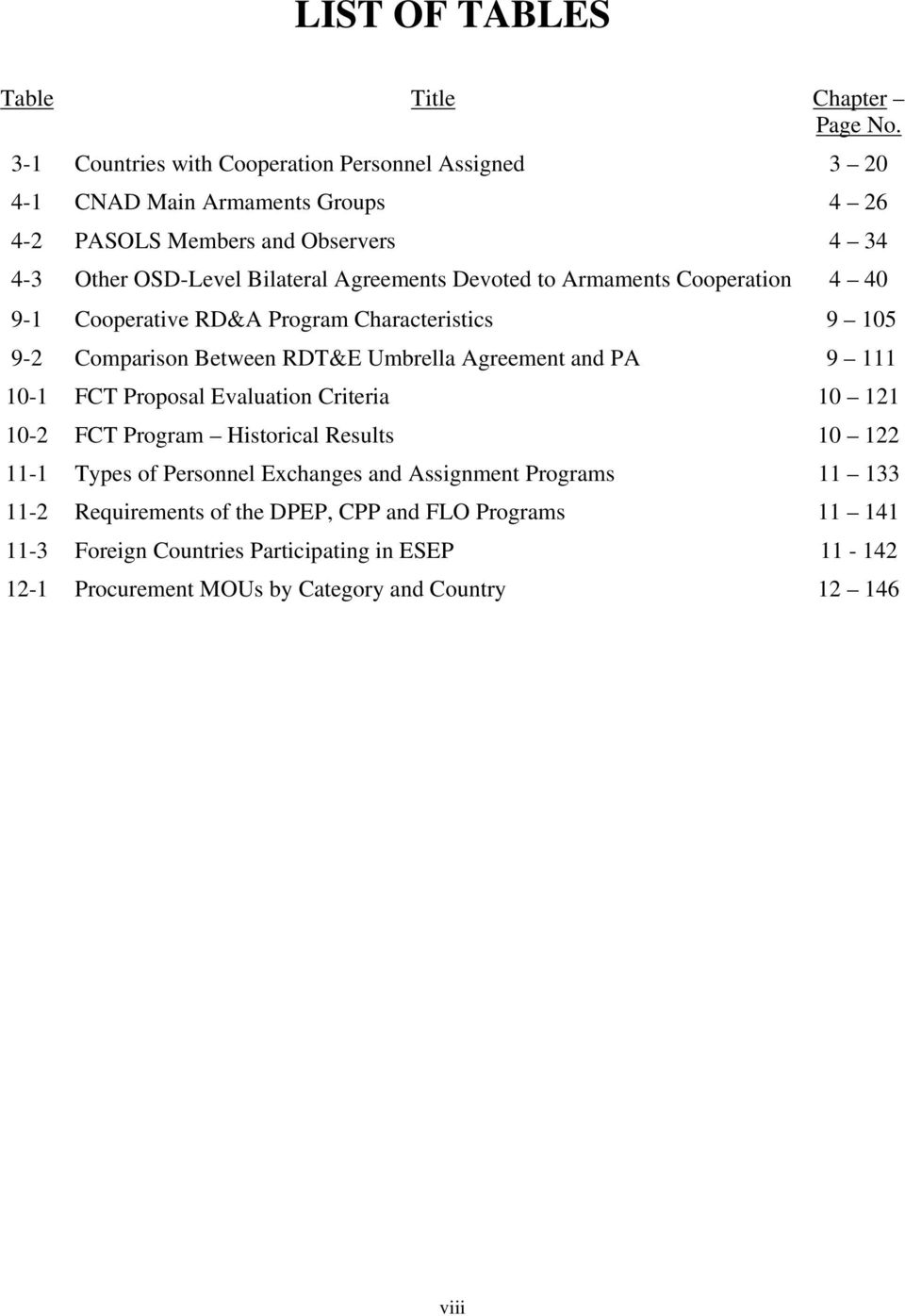
9 LIST OF TABLES Table Title Chapter Page No. 3-1 Countries with Cooperation Personnel Assigned CNAD Main Armaments Groups PASOLS Members and Observers Other OSD-Level Bilateral Agreements Devoted to Armaments Cooperation Cooperative RD&A Program Characteristics Comparison Between RDT&E Umbrella Agreement and PA FCT Proposal Evaluation Criteria FCT Program Historical Results Types of Personnel Exchanges and Assignment Programs Requirements of the DPEP, CPP and FLO Programs Foreign Countries Participating in ESEP Procurement MOUs by Category and Country viii
10 CHAPTER 1: INTRODUCTION & BACKGROUND 1.1 PURPOSE This Handbook provides guidance and information about the policies, processes, procedures, and programs that collectively make up the international armaments cooperation effort of the U.S. Department of Defense (DoD). This Handbook covers international cooperative research, development, test & evaluation, production, and logistics functional areas to assist DoD acquisition personnel in identifying, developing, and implementing any international activities related to their acquisition responsibilities. While the term armaments cooperation could be applied to a broad range of international activities conducted by DoD, it generally applies to cooperation in weapons research, development, test & evaluation, and acquisition. Consequently, this Handbook will not cover joint military arrangements and operations with allied nations, which are the purview of the Joint Chiefs of Staff and the various combatant commands. Nor will it specifically address the Security Assistance program, including Foreign Military Sales (FMS). The Security Assistance Management Manual (SAMM) published by the Defense Security Cooperation Agency (DSCA) should be referred to for a thorough treatment of Security Assistance policy and procedures. While this Handbook describes a wide range of armaments cooperation activities, it is not intended to replace or modify existing DoD policies and procedures. Rather, this Handbook provides DoD personnel with a handy reference compendium that will assist them in more effectively pursuing international cooperative efforts related to their programs. 1.2 ORGANIZATION AND CONTENT This Handbook is organized into fifteen separate chapters covering legislation and policy, international organizations, acquisition considerations, international agreements, and specific programs. There is a concluding summary chapter followed by four annexes with acronyms and abbreviations, Legal and DoD Directive and Instruction references, points of contact in key offices, and websites. 1

11 Throughout the Handbook, the objective is to provide sufficient information so that personnel responsible for implementing cooperative programs are aware of the key policies and processes that apply to DoD international program efforts. To that end, selected material from relevant directives or policy documents is included as a ready reference. To ensure development and implementation of successful international programs, acquisition personnel are encouraged to contact and work closely with the Office of the Secretary of Defense (OSD) or DoD Component international program organization responsible for supporting their organization. 1.3 OBJECTIVES OF ARMAMENTS COOPERATION The core objectives of armaments cooperation are (1.) operational - to increase military effectiveness through interoperability with allies and coalition partners, (2.) economic - to reduce weapons acquisition cost by sharing costs or avoiding duplication of development efforts with our allies and friends, (3.) technical - to access the best defense technology and help minimize the capabilities gap with allies and coalition partners, (4.) political strengthen alliances and relationships with other friendly countries, and (5.) industrial bolster domestic and allied defense industrial bases. Since the end of the Cold War, the U.S. recognized that armaments cooperation programs offered new and broader opportunities for promoting U.S. security. These new opportunities include new subject areas, such as the environment, and new partners worldwide. As emphasized in the DoD 5000 series, the leveraging of U.S. resources through cost sharing and economies of scale afforded by international cooperative research, development, production, and logistics support programs should be fully considered when Components work with users to define needed capabilities as well as during the preparation of the technology development strategy and subsequent acquisition strategy. 1.4 ARMAMENTS COOPERATION - DEFINITION AND DESCRIPTION The majority of armaments cooperation activities are cooperative research, development, and acquisition (RD&A) projects and programs. While not formally defined by statute or regulation, it is generally accepted that armaments cooperation includes: Exchanges of information and personnel. Research, development, test, and evaluation (RDT&E) of defense technologies, subsystems, and systems or equipment. 2

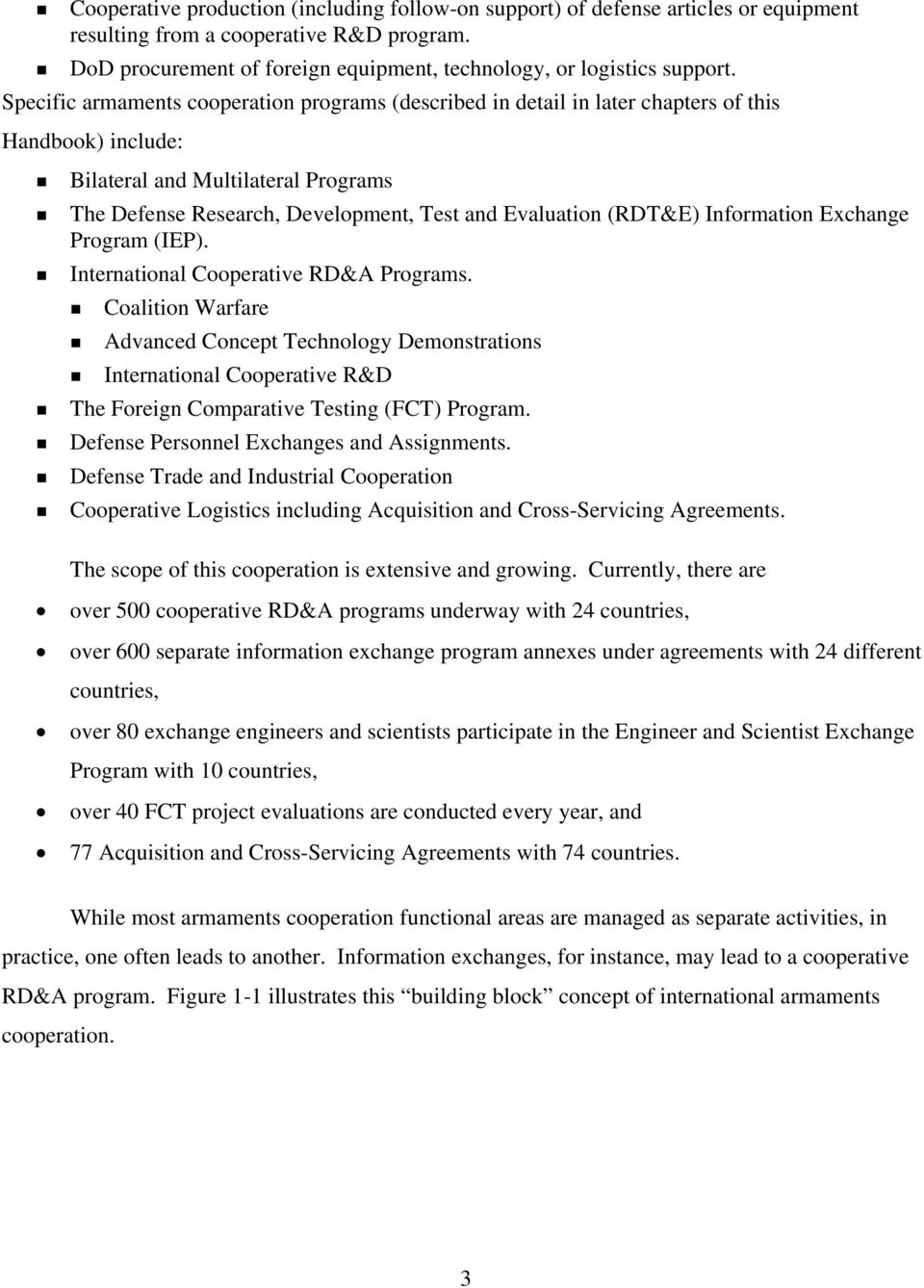
12 Cooperative production (including follow-on support) of defense articles or equipment resulting from a cooperative R&D program. DoD procurement of foreign equipment, technology, or logistics support. Specific armaments cooperation programs (described in detail in later chapters of this Handbook) include: Bilateral and Multilateral Programs The Defense Research, Development, Test and Evaluation (RDT&E) Information Exchange Program (IEP). International Cooperative RD&A Programs. Coalition Warfare Advanced Concept Technology Demonstrations International Cooperative R&D The Foreign Comparative Testing (FCT) Program. Defense Personnel Exchanges and Assignments. Defense Trade and Industrial Cooperation Cooperative Logistics including Acquisition and Cross-Servicing Agreements. The scope of this cooperation is extensive and growing. Currently, there are over 500 cooperative RD&A programs underway with 24 countries, over 600 separate information exchange program annexes under agreements with 24 different countries, over 80 exchange engineers and scientists participate in the Engineer and Scientist Exchange Program with 10 countries, over 40 FCT project evaluations are conducted every year, and 77 Acquisition and Cross-Servicing Agreements with 74 countries. While most armaments cooperation functional areas are managed as separate activities, in practice, one often leads to another. Information exchanges, for instance, may lead to a cooperative RD&A program. Figure 1-1 illustrates this building block concept of international armaments cooperation. 3
13 Figure 1-1 Building Blocks of International Armaments Cooperation 1.5 INTERNATIONAL CONSIDERATIONS Armaments cooperation activities result from political and military relationships that have evolved over time, and are generally conducted with nations that have solid political and economic ties with the U.S., similar military requirements, and a reasonably robust defense science and technology base. Selected allies have common objectives and possess defense industrial capabilities that have allowed cooperation across a wide spectrum of programmatic and technical areas. Our convergence of interests is reflected in the numerous information and personnel exchanges and cooperative development projects with these countries. Other countries may be quite important to the U.S. from a political, economic, or military standpoint but have divergent military requirements or lack a substantial defense industrial base, diminishing the potential for successful international armaments cooperation activity. 4

14 Another way of looking at the cooperative armaments relationship is to think of the hierarchy of relationships as a pyramid as illustrated in Figure 1-2. Even though armaments cooperation programs form the capstone, it does not imply that cooperative RD&A is the ultimate form of cooperation. It does, however, illustrate that effective armaments cooperation normally rests on a broad foundation of other prerequisite relationships and conditions. Figure 1-2 Hierarchy of Relationships Leading to Armaments Cooperation 1.6 REFERENCES 1. International Cooperative Research and Development Program, 2002 Report to Congress, March [NOTE: No longer required] 2. Security Assistance Management Manual, DoD M, October 3,

15 CHAPTER 2: LEGISLATION & POLICY GOVERNING INTERNATIONAL ARMAMENTS COOPERATION 2.1 INTRODUCTION Since the end of World War II, a set of legislation, policy, and principles has developed that guides U.S. participation in armaments cooperation projects. These measures range from specific enabling and restricting legislation to detailed procedures of reviews and approvals, and are intended to encourage armaments cooperation while ensuring that such cooperation is entered into only with the proper legal and regulatory authority. This chapter will introduce some key legal aspects of armaments cooperation and briefly discuss DoD s overall armaments cooperation policy, as promulgated by OSD. DoD has consistently endorsed a strong, active, and effective armaments cooperation program. Specific instructions and implementation policy will be discussed in subsequent chapters covering individual international cooperation functional areas. Additional information on the most current applicable guidance is available from international program organizations and legal counsel. 2.2 LEGAL BASIS FOR ARMAMENTS COOPERATION Over the years, Congress has enacted a number of laws encouraging and enabling cooperation with our allies in the acquisition of defense equipment. Most are codified in Title 10 United States Code Armed Forces, and Title 22 Foreign Relations and Intercourse. These laws often permit departures, when appropriate and justified, from domestic procurement law that would otherwise make cooperation impossible. Acquisition workforce awareness of these legislative provisions is essential, both to recognize the opportunities and to ensure that legal authorities are not exceeded. Each international cooperation functional area has one or more statutes that form the legal basis for DoD international armaments cooperation activities in that area. In many 6
16 instances, additional U.S. government (USG) regulations and DoD/DoD Component policies have been issued to implement these legal requirements and establish specific procedural guidance that must be followed by DoD acquisition personnel. While the subsequent chapters of this Handbook provide individual summaries of key statutes and relevant DoD policies in each international cooperation functional area, in most cases acquisition personnel should consult with the Director (International Cooperation) (DIR(IC)) or DoD Component international program organizations to obtain assistance (including detailed guidance) regarding one or more specific international program activities under consideration. The complexity of laws, regulations, and policies that apply to armaments cooperation activities should not be underestimated. Self-interpretation of armaments cooperation related laws, regulations, and policies without assistance from DoD international program organizations is unwise and, in the case of legal interpretations, unauthorized. Legal interpretations of relevant armaments cooperation statutes must be obtained from appropriate OSD or DoD Component legal counsel. The most important point to remember about the legal basis for armaments cooperation activities is that international program related statutes (and associated regulations and policies) in most instances apply in addition to (not instead of) applicable domestic DoD acquisition laws and policies. Acquisition personnel, with the assistance of supporting DoD international programs organizations, must comply with both domestic and international cooperation related laws, regulations, and policies while developing and implementing armaments cooperation initiatives. 2.3 DoD POLICY ON ARMAMENTS COOPERATION Department of Defense policy promotes international cooperative acquisition, technology and logistics activities, especially with allies and friends, that will enable the warfighter to be well prepared and supported for coalition operations. Well-constructed international cooperative arrangements and programs strengthen our defense industrial base by providing reciprocal access to defense markets with our allies and friends. 7

17 Accordingly, the USD(AT&L) strongly encourages international cooperative activities that pursue standardization or interoperability of equipment and services to be used by the armed forces of the United States and coalition partners, provide access to technology from sources worldwide, and save money. The USD(AT&L) has aligned international cooperation goals under five of his seven AT&L goals. The international aspect of each follows: 1. Acquisition Excellence with Integrity: Prioritize and harmonize capabilitiesbased requirements with allies and friendly governments. 2. Logistics Integrated and Efficient: Ensure interoperable, logistically supportable systems. 3. Technology Dominance: Identify and acquire the best technologies from sources worldwide 4. Industrial Base Strengthened: Remove barriers to international defense cooperation and trade with our allies and friends. 5. Motivated, Agile Workforce: Ensure that there is adequate staff to enable international cooperation, and improve international acquisition training for U.S. and allied workforces. DoD has strongly supported international armaments cooperation as a key aspect of the DoD acquisition process. The DoD Directive , which provides management principles and mandatory policies and procedures for managing all acquisition programs, states that Program Managers shall pursue international armaments cooperation to the maximum extent feasible, consistent with sound business practice and with the overall political, economic, technological, and national security goals of the United States. Furthermore, interoperability between U.S. Forces and coalition partners is defense acquisition policy. This Directive goes on to say that a cooperative development program with one or more Allied nations is preferred to a new, joint, DoD Component or Government Agency development program, or DoD Component-unique development program. 8

18 2.4 SUMMARY Legislation pertaining to armaments cooperation serves various purposes. Most importantly, it provides the fundamental legal authority, as well as constraints, regarding the conduct of armaments cooperation activities. In addition, Congressional supporters use legislation to encourage or require OSD to develop and pursue international cooperative programs, while Congressional opponents use legislation to hinder or constrain such efforts. For the most part, however, DoD, with the support of influential Members of Congress, has consistently promoted armaments cooperation from a policy standpoint. Since Congress has provided DoD with a broad range of enabling legislation to pursue armaments cooperation programs, DoD acquisition personnel must ensure that their international cooperation related-activities fully comply with the wide array of statutes, directives, instructions, regulations, and policies that govern DoD armaments cooperation efforts. Prior consultation with DoD international program organizations (including legal counsel), combined with use of this Handbook, is the most effective way to comply with the specific legal and policy requirements that may apply to a given armaments cooperation initiative under consideration. 2.5 REFERENCES 1. Title 10 U.S.C. Section 2350a, Cooperative Research and Development Agreements. 2. Title 22 U.S.C. Section 2767 (Arms Export Control Act, Section 27), Authority of President to enter into cooperative projects with friendly foreign countries. 3. Title 22 U.S.C. Section 2796d (Arms Export Control Act, Section 65), Loan of materials, supplies, and equipment for research and development purposes. 4. Memorandum USD(AT&L), SUBJECT: International Cooperation in Acquisition, Technology and Logistics, April 27, DoD Directive , The Defense Acquisition System, May 12,
19 CHAPTER 3: DOD ORGANIZATIONS SUPPORTING INTERNATIONAL ARMAMENTS COOPERATION 3.1 INTRODUCTION This chapter briefly describes the DoD organizations involved with international armaments cooperation. Figure 3-1 illustrates the key OSD organizations that have armaments cooperation review, coordination, or implementation responsibility in one or more of the functional areas described in subsequent chapters of this Handbook. A brief description of key OSD, Military Department, Defense Agency, Office of Defense Cooperation, and DoD Component Overseas Offices organizational responsibilities in the area of armaments cooperation is provided in this chapter. Figure 3-1 OSD Offices involved in International Cooperation 10

20 3.2 OSD ORGANIZATIONS SUPPORTING ARMAMENTS COOPERATION The Under Secretary of Defense (Acquisition, Technology and Logistics) USD(AT&L) The USD(AT&L) is the Principal Staff Assistant and advisor to the Secretary and Deputy Secretary of Defense for all matters relating to the DoD Acquisition System, research and development, advanced technology, developmental test and evaluation, production, logistics, installation management, military construction, procurement, environmental security, and nuclear, chemical, and biological matters. The USD(AT&L) is responsible for international cooperative research, development, test and evaluation, production, and logistics support, including wartime host-nation support, with allied and friendly foreign nations. The USD(AT&L) develops, in coordination with the Under Secretary of Defense for Policy (USD(P)), and the DoD General Counsel (GC, DoD), agreements with friendly and Allied Nations and international organizations relating to acquisition matters consistent with DoD Directive The USD(AT&L) is the U.S. National Armaments Director (NAD) and as such is the U.S. delegate to the NATO Conference of National Armaments Directors (CNAD) Director (International Cooperation) (DIR(IC)) The Director (IC) advises the Under Secretary of Defense for Acquisition, Technology and Logistics, and establishes policy for international armaments cooperation programs. The three offices that provide support to the IC Director include: Director, Armaments Cooperation Atlantic (DIR(ACA)) The Director, Armaments Cooperation Atlantic supports the USD(AT&L) and the Director, International Cooperation as the DoD focal point for defense-related research, development, production and other acquisition activities that involve cooperation between the DoD and governments or industries of allied and friendly countries in 11

21 Europe, and the countries of the former Soviet Union (FSU); and Canada. ACA manages DoD participation in multilateral armaments cooperation bodies such as NATO s Conference of National Armaments Directors and its subordinate bodies, and other formal and informal multilateral and bilateral armaments cooperation relationships. Director, Pacific Armaments Cooperation (DIR(PAC)) The Director, Pacific Armaments Cooperation supports the USD(AT&L) and the Director, International Cooperation as the DoD focal point for defense-related research, development, production and other acquisition activities that involve cooperation between the DoD and governments or industries of allied and friendly countries in Asia, the Pacific, the Middle East, the Americas, and Africa. Director, Planning & Analysis (DIR(P&A)) The Director of Planning & Analysis provides direct analytic and management support to the Director, International Cooperation and the USD(AT&L) on cross-cutting international issues that do not fit into a country or region-specific context. Some of the responsibilities include oversight of International Agreement policy, including review and approval, and trouble-shooting. Agreement types under the purview of P&A include: Cooperative Research & Development and Production Memoranda of Understanding, Project Arrangements, Loan Agreements, End Use Certificates and Acquisition & Cross Servicing Agreements. P&A promotes harmonization of requirements and acquisition processes. Additionally, P&A conducts National Disclosure Policy review and case-bycase oversight of technology transfer issues for both sales and cooperative programs, and provides AT&L representative to the National Disclosure Policy Committee. Furthermore, P&A provides guidance and oversight on strategic planning, science and technology, acquisition, logistics, and training issues concerning international cooperative programs. The office also manages the DoD Coalition Warfare initiative, a defense-wide effort to assist the Combatant Commanders, Military Departments (MILDEPs), and other DoD Components in integrating coalition-enabling solutions into existing and planned U.S. programs. 12
22 Director, Defense Research and Engineering (DDR&E) The DDR&E is the principal staff advisor to the Under Secretary of Defense for Acquisition, Technology, and Logistics (USD(AT&L)) and the Secretary and Deputy Secretary of Defense for research and engineering matters. Research and Engineering (R&E) includes Science and Technology programs (consisting of Basic Research, Applied Research, and Advanced Technology Development) and Advanced Component Development and Prototypes programs, which are identified as Budget Activities 1, 2, 3, and 4, respectively. Responsibility for OSD-level assessments of international Science and Technology program initiatives proposed by DoD Components falls under this office. The DDR&E oversees and provides the U.S. participation in The Technical Cooperation Program (TTCP) and NATO Research and Technology Organization (RTO). Offices reporting to the DDR&E having some international involvement include the following: Deputy Under Secretary of Defense (Science & Technology (DUSD(S&T)) The DUSD(S&T) supports the DDR&E in the capacity of overseeing and managing five key science and technology programs and two sub-offices. These programs include Sensor Systems, Weapons Systems, Information Systems, Bio Systems, and the Strategic Environmental Research and Development Program. The Defense Modeling and Simulation Office, and the High Performance Computing and Modernization Office provide support to S&T initiatives in these areas. Deputy Under Secretary of Defense (Advanced Systems and Concepts) (DUSD(AS&C)) The DUSD(AS&C) is responsible for management of DoD s Advanced Concept Technology Demonstration (ACTD) program and associated international ACTD initiatives, as well as oversight and management of the Foreign Comparative Testing Program. 13
23 Deputy Under Secretary of Defense (Laboratories and Basic Sciences) (DUSD(LABS)) The DUSD(LABS) is responsible for basic research, including international technology Director, Defense Procurement & Acquisition Policy (DIR(DP&AP)) The Director (DP&AP) has primary responsibility for development, negotiation, and implementation of DoD reciprocal procurement agreements, as well as review of any other international agreement that involves contracting or procurement. Defense reciprocal procurement agreements in general waive Buy American Act restrictions for those nations that agree to reciprocate by waiving their national restrictions on foreign sources for defense products Director, Defense Systems (DIR(DS)) The Director, Defense Systems, is the principal advisor to the USD(AT&L) for the application of sound systems engineering practices in the Department s acquisition programs, oversight of acquisition programs in assigned mission areas, and the integration of acquisition programs into joint warfighting architectures Deputy Under Secretary of Defense (Industrial Policy) (DUSD(IP)) DUSD(IP) is responsible for the review of International Agreements for their effect on the defense industrial base. The Office of the DUSD(IP) ensures that an adequate defense industrial base exists and remains viable for defense production to meet current, future, and emergency requirements. The office also advises USD(AT&L) on defense industry mergers, acquisitions and consolidation. This includes global investment in U.S. defense firms and other related globalization topics. The office also counsels Defense Acquisition Boards on industrial base and production readiness issues. 14
24 Deputy Under Secretary of Defense, Logistics & Materiel Readiness (DUSD(L&MR)) The DUSD (L&MR) serves as the principal staff assistant and advisor to the Under Secretary of Defense for Acquisition, Technology, and Logistics (USD(AT&L)) and the Secretary and Deputy Secretary of Defense on logistics and materiel readiness in the Department of Defense and is the principal logistics official within the senior management of the Department of Defense The General Counsel, Department of Defense (GC, DoD) The GC, DoD is the chief legal officer of the Department of Defense and provides advice to the Secretary and Deputy Secretary of Defense regarding all legal matters and services performed within, or involving, the Department of Defense. The GC, OSD also provides legal advice to Office of the Secretary of Defense (OSD) organizations and, as appropriate, other DoD Components. Specific to international matters, the GC acts as lead counsel for the Department in all international negotiations conducted by the OSD Components and coordinates on all proposed international agreements prior to their tender to prospective parties by the OSD Components, prior to the initiation of negotiations, and prior to final conclusion of proposed international agreements; oversees legal reviews performed by the DoD Components with respect to the negotiation and conclusion of international agreements in accordance with DoD Directive The GC maintains the central repository for all international agreements coordinated, negotiated, or concluded by DoD personnel. Furthermore, the GC provides for guidance in, and coordination of, significant legal issues in international law Assistant Secretary of Defense for Networks and Information Integration (ASD(NII)) The Assistant Secretary of Defense (Networks and Information Integration), (ASD (NII)), is the principal OSD staff assistant for the development, oversight, and integration of DoD policies and programs relating to the strategy of information superiority for the DoD. ASD(NII) responsibilities include information policy and information management, command and control, communications, 15
25 counterintelligence, security, information assurance, information operations, space systems and space policy, intelligence, surveillance and reconnaissance, and intelligence-related activities conducted by the Department. Additionally, the ASD(NII) serves as the Chief Information Officer of the Department Under Secretary of Defense (Comptroller) (USD(C)) OUSD(C) reviews proposed agreements to ensure that they comply with the DoD Financial Management Regulation (FMR) and other DoD financial guidance Under Secretary of Defense (Policy) (USD(P)) The USD(P) is the principal staff assistant and advisor to the Secretary and Deputy Secretary of Defense for all matters concerning the formation of national security and defense policy, as well as the integration and oversight of DoD policy and plans to achieve national security objectives. In the matters of international armament cooperation, USD(P) reviews international agreements for policy considerations in dealing with foreign countries. Some of the key directorates in USD(P) that participate in international armaments cooperation include: Assistant Secretary of Defense for International Security Affairs (ASD(ISA)) The Assistant Secretary of Defense for International Security Affairs is the principal staff assistant and advisor to the USD (P) and the Secretary of Defense for formulating international security and political-military policy for Africa, Asia-Pacific, Near-East and South Asia, and the Western Hemisphere. Defense Security Cooperation Agency (DSCA) DSCA provides direction, supervision, and oversight of Security Assistance programs in support of U.S. national security and foreign policy objectives. The agency promotes security relationships with allies and friends through Security Assistance and defense sales, humanitarian assistance and demining action, in addition to other programs. 16
26 Assistant Secretary of Defense for International Security Policy (ASD (ISP) ) - Deputy Under Secretary of Defense, Technology Security Policy / Counter Proliferation Policy (DUSD(TSP/CP)) - Director, International Security Programs The International Security Programs Directorate provides oversight and guidance concerning the exchange of classified information with other countries and is responsible for: 1. Establishing national and DoD policies on foreign disclosure of classified military information and materiel. 2. Administering the interagency National Disclosure Policy Committee 3. Evaluating the capability of foreign governments and international organizations to provide protection to classified material. 4. Negotiating general security of information and industrial security agreements. 5. Monitoring security arrangements for security assistance programs. 6. Establishing policy on visits and personnel exchanges. 7. Acting as liaison with foreign government security officials. 8. Representing the U.S. on the NATO Security Committee (NSC) 9. Representing the U.S. on ad hoc and standing working groups formed under the NSC. 10. Reviewing International Agreements for security implications. 17
27 3.3. MILITARY DEPARTMENTS AND DEFENSE AGENCIES INFRASTRUCTURE SUPPORTING ARMAMENTS COOPERATION Each of the Military Departments has established an infrastructure to support the armaments cooperation program. Figure 3-2 illustrates these organizations, and the following section provides a brief description of their individual responsibilities. Figure 3-2 MILDEP International Program Organizations Responsible for Armaments Cooperation Army The Deputy Assistant Secretary of the Army for Defense Exports and Cooperation (SAAL-ZN) is responsible for Army armaments cooperative RD&A programs. The office with day-to-day responsibility is the Director of Armaments Cooperation (SAAL- NC). SAAL-NC directly supports SAAL-ZN in reviewing and coordinating international agreements. 18
28 Specific activities include management of Army Foreign Comparative Testing (FCT) projects, review and coordination of International Agreements and Information Exchange Program annexes, personnel assignments and exchanges, cooperative logistics, support for the NATO Army Armaments Group (NAAG) panels, and tracking, reporting and financial management for armaments cooperation programs. SAAL-ZN conducts Senior National Representative (SNR) discussions for the Army and is also the Army s head of delegation to the NATO Army Armaments Group (NAAG) Navy The Assistant Secretary of the Navy for Research, Development and Acquisition, ASN(RD&A), has responsibility for all international RD&A program functions, including international armaments cooperation efforts. ASN(RD&A) has delegated responsibility for management and implementation of all RD&A international functions, including foreign military sales and technology transfer, to the Navy International Programs Office (Navy IPO). Within the Navy IPO, the Directorate of Technology Security and Cooperative Programs is responsible for all international armaments cooperation activities, including cooperative R&D, production and support agreements, the RDT&E Information Exchange Program, Engineer and Scientist Exchange Program, and Navy FCT projects. The U.S. Navy s Oceanographer (N096) is double-hatted as SNR and acts as the Navy s NATO Naval Armaments Group (NNAG) Representative, with the support of Navy IPO Air Force Within the Air Force, all non-operational international programs are the responsibility of the Deputy Under Secretary of the Air Force for International Affairs (SAF/IA). While its primary focus is oversight of FMS and Security Assistance programs, SAF/IA also oversees international cooperative RD&A programs. The Air Force SNR is from SAF/IA, although the NATO Air Force Armaments Group (NAFAG) Representative is from the Assistant Secretary of the Air Force for Acquisition (SAF/AQ). 19
29 The Air Force Armaments Cooperation Division (SAF/IAPQ) directly supports SAF/IA in performing its international armaments cooperation responsibilities, including cooperative R&D, production and logistics agreements, management of Air Force FCT Projects, as well as support for the NATO RTO and Air SNR meetings and programs Defense Agencies Defense Agencies have responsibility and authority similar to the MILDEPs for the conduct of international armaments cooperation efforts related to their mission (e.g., DARPA, MDA, DTRA, etc.). However, not all Agencies have dedicated international organizational elements to assist in conducting international armaments cooperation activities. 3.4 OVERSEAS OFFICES SUPPORTING ARMAMENTS COOPERATION Offices of Defense Cooperation Several overseas organizations act as liaison between the DoD research, development and acquisition agencies and corresponding agencies in the host nation. They can assist technical project offices and U.S. international program offices in obtaining information and assessing the opportunities for cooperative projects with their host nation. Australia France Italy Singapore BELLUX Germany Japan South Korea Canada Greece Netherlands Spain Chile Hungary Norway Sweden Czech Republic India Poland Turkey Denmark Israel Romania Ukraine United Kingdom Table 3-1 Countries with Cooperation Personnel Assigned 20
30 The most important of these overseas organizations are the Offices of the Defense Cooperation/Security Assistance Offices (ODCs/SAOs) in many U.S. embassies. (See Chapter 5 for a detailed description the ODC s role in Armaments Cooperation.) The ODC/SAO is generally responsible for overseeing and implementing incountry Security Cooperation, including both FMS activities and facilitating cooperation in research, development, and acquisition. DoD has approximately 40 dedicated armaments cooperation personnel in the ODCs/SAOs located in the allied nations listed in Table 3-1. The term ODC is used throughout this handbook when referring to the organization in-county performing armaments cooperation activities. In the European Theater, the ODC designation is uniformly used. In the Pacific Theater, the term ODC is used only in certain countries, and most countries with an office performing armaments cooperation activities use a designation that is unique to the country. Therefore, designations such as Mutual Defense Assistance Office (Japan), Joint Military Assistance Group (South Korea), or Military Liaison Office or Group may be encountered. Even where there are no full-time armaments cooperation personnel, the ODC/SAO remains responsible in-country for cooperative activity. In nations where there is no ODC/SAO, the OSD point of contact is usually the Defense Attaché. Armaments cooperation personnel assigned to the ODCs are the in-country liaison for the National Armaments Director and the DoD Components, and directly support the U.S. weapons acquisition process. They are also the in-country agent for enforcement of Reciprocal Defense Procurement Memoranda of Understanding. General oversight and guidance for armaments cooperation activities are provided by DIR(IC). A specific function of ODCs/SAOs is to assist DoD RD&A agencies to obtain information on host nation equipment and programs needed to make acquisition decisions regarding development, production, and logistics cooperation with the host nation DoD Component Overseas Offices Army Overseas Offices US Army International Technology Centers (ITCs) [formerly known as U.S. Army Research, Development and Standardization Groups (USARDSGs or "Stan 21
31 Groups.")] are maintained in Argentina, Australia, Canada, Chile, France, Germany, Japan, Singapore and the United Kingdom. These Centers forge and expand links with both the government (defense and non-defense) and non-government sectors. The goal of these links is to promote force multiplying interoperability and standardization with allies and coalition partners. To achieve this goal, the ITCs seek to identify and facilitate international cooperation that supports technology, acquisition and logistics activities.. In addition, representatives in Canada, Australia and Britain have an expanded mission as the Standardization representative for the American, British, Canadian, and Australian (ABCA) Armies Standardization Program. The Army Research Office under the U.S. Army Research, Development and Engineering Command s Army Research Laboratory maintains two overseas components: The European Research Office (ERO) operationally attached to ITC- Atlantic in London, and The Asian Research Office (ARO) operationally attached to ITC-Asia in Tokyo. These research offices enhance, complement, and provide risk mitigation for Army and DoD science and technology (S&T) programs. To do this, these offices leverage foreign expertise and technology, and build and nurture S&T partnerships. They also identify and leverage opportunities for specific collaborations between U.S. DoD and foreign researchers in Europe, Africa, Asia, Middle East, and Southwest Asia (including India). They have the capability to provide limited funding for collaborative opportunities, to include support for expert travel, conferences and workshops, and S&T projects Navy Overseas Offices The Office of Naval Research maintains R&D liaison offices in the UK (responsible for covering Europe), in Japan (covering Asia), and in Chile (covering South America). These foreign field offices survey worldwide findings, trends and achievements in science and technology and establish and maintain liaison between the Navy and foreign organizations that conduct programs of Naval interest. Liaison 22
32 includes international, bilateral, and multilateral cooperative R&D programs, evaluation of foreign weapons, and scientific and technical exchange programs Air Force Overseas Offices The European Office of Aerospace Research and Development (EOARD) is based in London and is an extension of the Air Force Office of Scientific Research. It is the USAF s monitor of Europe and Africa with respect to basic and applied aerospace-related technology. The technical staff maintains close contact with USAF laboratories to provide continuing assessments of technology and to recommend technical areas for potential cooperative research. EOARD can sponsor research by European institutions through grants or contracts. The Asian Office of Aerospace Research and Development (AOARD), located in Tokyo, was established in 1992 by the Air Force Office of Scientific Research. Its function is similar to that of EOARD, except it concentrates on Pacific Rim nations. Note: The Office of Naval Research Asian Office and the Army Research Office -- Far East are co-located with the AOARD in Tokyo. Air Force R&D Liaison Offices (RDLO) are liaison offices maintained in Germany, France, and the United Kingdom. These offices serve as liaisons between the USAF R&D personnel and their foreign counterparts. 23
33 3.5 REFERENCES 1. DoD Directive , Under Secretary of Defense for Acquisition, Technology and Logistics (USD(AT&L)), April 21, DoD Directive , Director of Defense Research and Engineering (DDR&E), November 3, DoD Directive , Deputy Under Secretary of Defense for Logistics and Materiel Readiness (DUSD(L&MR)), May 25, DoD Directive , General Counsel of the Department of Defense, May 2, DoD M, Security Assistance Management Manual, October 3, DoD Directive , Materiel Interoperability with Allies and Coalition Partners, Final Draft October
34 CHAPTER 4: MULTILATERAL AND BILATERAL INTERNATIONAL FORUMS AND ACTIVITIES 4.1 INTRODUCTION The U.S. participates in a variety of multinational organizations ranging from NATO to The Technical Cooperation Program (TTCP). It also maintains a series of bilateral arrangements, some under the umbrella of established programs and others as unique arrangements, such as the U.S.-Canada Defense Development Sharing Program (DDSP). Individually, these activities involve only selected acquisition work force personnel, so they may lack the visibility that other higher profile armaments cooperation activities enjoy. Collectively, however, they entail a significant degree of effort in terms of DoD manpower, time, and travel. Accordingly, DoD acquisition personnel involved in armaments cooperation activities may require familiarity with efforts of one or more of the forums described below in order to obtain assistance in the promotion or implementation of a desired international cooperation initiative. Note that DoD Components also have many recurring meetings and working groups that deal with specific technology or military functions. 4.2 NATO CONFERENCE OF NATIONAL ARMAMENTS DIRECTORS (CNAD) NATO has been the centerpiece of all U.S. defense cooperation since the end of World War II, including cooperative RD&A projects. Cooperation in weapons development and acquisition is the responsibility of the CNAD, which is made up of the senior person of each nation responsible for weapons procurement, the National Armament Director (NAD), and meets regularly to consider political, economic and technical aspects of NATO forces equipment development and procurement. 25
35 The CNAD established key committees to concentrate on specific functional areas. These committees, called CNAD Main Armaments Groups, are responsible for research, armaments and equipment programs and the DoD organizations responsible for sending representatives. Other groups under the Conference, called CNAD Partnership Groups (formerly known as Cadre Groups), are active in defense procurement policy and acquisition practices, codification, quality assurance, test and safety criteria for ammunition and material standardization. Additionally, the CNAD steers Ad Hoc Groups that are responsible for special armaments projects, such as the Alliance Ground Surveillance Steering Committee. Group NATO Army Armaments Group (NAAG) NATO Navy Armaments Group (NNAG) NATO Air Force Armaments Group (NAFAG) NATO Research and Technology Organization (RTO) US Representative Office Army - SAAL-ZN Navy - N096 USAF - SAF/AQ OSD - Deputy Under Secretary of Defense (Science & Technology) Table 4-1 CNAD Main Armaments Groups In the 1970s, the Four Power was established as an ad hoc group to develop a consensus on issues to be considered by the CNAD. In 2000, Italy joined the forum, making it the Five Power and consisting of the NADs from France, Germany, Italy, the United Kingdom, and the United States. In addition to CNAD issues, the Five Power NADs discuss cooperative projects and issues involving the Five Power countries. The U.S. delegation to the Five Power NAD forum consists of the U.S. NAD (USD(AT&L)) and a small support staff. The Five Power NADs meet semiannually, just before the full CNAD meeting. Each acts in turn as the hosting country. 4.3 SENIOR NATO LOGISTICIANS CONFERENCE (SNLC) The Senior NATO Logisticians Conference (SNLC) is the senior NATO advisory body on consumer logistics; its mission is to assess NATO s logistics posture to ensure NATO forces adequate logistics support. The Conference has adopted provisions intended to permit NATO to provide logistical support to smaller and more mobile forces consisting of multi-national components. 26
36 4.3.1 NATO Maintenance and Supply Organization (NAMSO) The main purpose for the NATO Maintenance and Supply Organization (NAMSO) is to provide the structure for the logistics support of selected weapons systems in the national inventories of two or more NATO nations. This is achieved through the common procurement and supply of spare parts and the provision of maintenance and repair facilities NATO Maintenance and Supply Agency (NAMSA) The executive arm of NAMSO is the NATO Maintenance and Supply Agency (NAMSA). Besides providing the full range of logistics support services of weapon and equipment systems held in common by NATO nations, it promotes materiel readiness and improved logistics efficiently. NAMSA enters into cooperative procurements for participating countries, as well as providing storage, calibration, and maintenance services and depot and supply services for weapons systems common to two or more alliance members. 4.4 NATO STANDARDIZATION ORGANIZATION (NSO) The NSO is comprised of the NATO Committee for Standardization (NCS), the NATO Standardization Staff Group, and the NATO Standardization Agency. The role of the NATO Standardization Organization (NSO) is to advance interoperability and to contribute to the ability of Alliance forces to train, exercise and operative effectively together. The NSO was established in 1995 by the North Atlantic Council and was restructured in 2000 as a result of a Standardization Review performed to meet the requirements of the 1999 Washington Summit and challenges posed by the Defense Capabilities Initiative initiated at the Summit NATO Committee for Standardization (NCS) NCS is the senior NATO authority on overall standardization matters, and thereby aims to enhance coordination and harmonization of NATO standardization policies. The Group of NCS Representatives (NCSREPs) provides support to NCS through harmonization and guidance standardization between NATO and national bodies. Since 27
37 September 2000, Partner nations have become actively engaged in NCS activities NATO Standardization Staff Group (NSSG) The NATO Standardization Staff Group (NSSG) reports to the NCS on issues that aim to harmonize standardization policies and procedures, as well as coordination of standardization activities. NSSG achieves these goals through staff liaison and documentation preparation in the formulation of Military Standardization Requirements by the Strategic Commands, in addition to the drafting of Standardization Objectives for the NATO Standardization Program NATO Standardization Agency (NSA) NSA is a single, integrated body set up by the North Atlantic Council and composed of military and civilian staff. It is responsible to the NATO Standardization Committee for the coordination of issues between all fields of standardization. It sets out procedures, planning and execution functions related to standardization for application throughout the Alliance. It is responsible for the preparation of the work for the NCS, NCSREPs and NSSG meetings and the overall administration of all Standardization Agreements (STANAGs) and Allied Publications (APs). 4.5 NATO COMMUNICATIONS AND INFORMATION SYSTEMS The NATO Consultation, Command and Control Organization (NC3O) is responsible for a provision of a cost-effective interoperable and secure capability NATOwide to ensure high level political consultation and command and control of military forces. The NC3 Agency (NC3A) performs the central planning, systems integration, design, systems engineering and technical support for NATO C3 systems and installations. It also provides scientific and technical advice to the Major NATO Commanders and other NATO customers. NC3A has facilities in The Hague and in Brussels. 28
38 4.6 THE NATO RESEARCH AND TECHNOLOGY ORGANIZATION (RTO) The RTO is the single focus in NATO for defense research and technology activities. It was formed in 1996, evolving from the NATO Advisory Group for Aerospace Research and Development (AGARD), and the Defense Research Group (DRG). Its mission is to conduct and promote cooperative research and information exchange. The objective is to support the development of the Alliance, to maintain a technological lead and to provide advice to NATO and national decision-makers. The RTO performs its mission with the support of an extensive network of national experts. It also ensures effective coordination with other NATO bodies involved in R&T activities. The RTO has six Technical Panels and a NATO Modeling and Simulation Group. The majority of scientific and technical work is conducted by Technical Teams created for specific activities. The teams sponsor symposia, field trials, lecture series and training courses. The total spectrum of R&T activities is covered by the following Panels: Studies, Analysis and Simulation (SAS) Systems Concepts and Integration (SCI) Sensors and Electronics Technology (SET) Information Systems Technology (IST) Applied Vehicle Technology (AVT) Human Factors and Medicine (HFM) After the events of September 11, 2001, the RTB established the Defense Against Terrorism subgroup to provide oversight and coordination to insure prioritized technical issues were incorporated into the panels' programs of work. The RTO reports to both the Military Committee and the CNAD and comprises a Research and Technology Board (RTB) as the highest level of national representation and the Research and Technology Agency (RTA), a dedicated staff headquartered in Neuilly, 29
39 France. The RTB governs the organization. The U.S. lead delegate to the RTB has been the DUSD (LABS). Additionally, the U.S. currently provides a delegate from the Army and NASA. Staff support is the responsibility of a National Coordinator. The U. S. National Coordinator is the responsibility of the International Plans and Programs Directorate, ODUSD (S&T). 4.7 AUSTRALIA, CANADA, NEW ZEALAND, UNITED KINGDOM AND UNITED STATES (AUSCANNZUKUS) FORUMS The AUSCANNZUKUS nations have a variety of programs dedicated to standardization and technical cooperation. The objectives are to facilitate standardization of equipment and procedures among their respective member militaries and to develop common or compatible doctrine, logistics procedures, and systems among the participating countries. There are five forums dedicated respectively to land, air, and naval operations; communications; and technology development. Each of the five permanent management staffs is located in Washington, D.C. U. S. participation is guided by interoperability policies contained in DoD Directive , Materiel Interoperability with Allies and Coalition Partners, and the respective MILDEP Directives, i.e., AR 34-1, AFPD 60-1 and AFPD The following are descriptions of the five AUSCANNZUKUS forums: The American, British, Canadian, and Australian (ABCA) Armies Standardization Program: The ABCA program seeks to optimize interoperability, focusing on the continuum of military operations including prevention, intervention, enforcement, stabilization, regeneration, sustainment, and transition against conventional and unconventional forces in multiple and varied geographic regions and environments. It aims to achieve the highest degree of materiel and non-materiel interoperability amongst the armies through its five Capability Groups and three Support Groups: Capability Groups: o Command 30
40 o Sense o Act o Shield o Sustain Support Groups o Futures o Science o Exercise and Experimentation These groups develop and implement ABCA standards and ABCA Advisory Publications covering their respective functional areas. An ABCA standard is a record of agreement among ABCA armies to adopt like or similar equipment, ammunition, supplies and stores, and/or operational, testing, logistical, and administrative procedures. An Advisory Publication is developed when standardization is not necessary, but when a listing of national data would aid mutual understanding. The ABCA program seeks to optimize interoperability, focusing on the continuum of military operations including prevention, intervention, enforcement, stabilization, regeneration, sustainment, and transition against conventional and unconventional forces in multiple and varied geographic regions and environments. It aims to achieve the highest degree of materiel and non-materiel interoperability amongst the armies through its five Capability Groups and three Support Groups: Capability Groups: o Command o Sense o Act o Shield o Sustain Support Groups o Futures o Science o Exercise and Experimentation These groups develop and implement ABCA standards and ABCA Advisory Publications 31
41 covering their respective functional areas. An ABCA standard is a record of agreement among ABCA armies to adopt like or similar equipment, ammunition, supplies and stores, and/or operational, testing, logistical, and administrative procedures. An Advisory Publication is developed when standardization is not necessary, but when a listing of national data would aid mutual understanding Air Standardization Coordination Committee (ASCC): Development of air standardization policy among the five nations is accomplished through the ten ASCC specialist Working Parties who generate formal agreements, known as "ASCC Air Standards." Both the U. S. Air Force and U. S. Navy participate in the ASCC. Under the auspices of the ASCC, the Test Project Agreement (TPA) program allows member nations to reduce R&D costs and enhance standardization through the exchange of equipment AUSCANNZUKUS Naval C4 Organization: The AUSCANNZUKUS provides a forum for the exchange of information on naval interoperability and to resolve long term complex C4 interoperability issues. The primary working element is the C4 Committee which meets twice a year to address technical and operational interoperability issues. Technical support is provided by technical working groups Combined Communications Electronics Board (CCEB): The CCEB is responsible for coordination of military communications electronics matters among the five nations. It accomplishes most of its work through two International Subject Matter Experts (ISMEs) groups who consider long-term issues that require continual maintenance. The two current ISMEs are Allied Message Handling and Information Security. The CCEB also has Frequency Managers responsible for coordination and resolution of frequency spectrum requirements. The CCEB issues a variety of technical publications providing guidance for communications electronics policies and procedures among the member nations. 32
42 4.7.5 The Technical Cooperation Program (TTCP): The Technical Cooperation Program (TTCP) is an international organization that collaborates in defense scientific and technical information exchange; program harmonization and alignment; and shared research activities for the five nations (Australia, Canada, New Zealand, the United Kingdom, and the United States). Participation in TTCP is coordinated through regular meetings of national members of the Subordinate Elements at which areas of potential collaboration and program alignment are identified. In addition, symposia are conducted which, if appropriate and agreed by all TTCP participants, may be opened to a wider participation than TTCP members. TTCP Subordinate Elements achieve their objectives by: 1. Mutual review of each nation's programs to identify common areas of interest and gaps in existing programs. 2. Recommendations for new research and development activities, changes in emphasis and avoidance of duplication. 3. Recommendation of cooperative programs on projects of high mutual interest where special capabilities, facilities, personnel and geographical or environmental regions can be utilized to greatest advantage. 4. Exchange of information, including correspondence, technical reports and data, meetings, symposia, visits and exchange of scientific personnel. 5. Transfer of materials, equipment, software and test items. 6. Establishment of methods and standards for test and evaluation of experimental results. 7. Preparation of TTCP Publications and other papers as appropriate. 8. Provision of assistance to MILDEP Standardization Organizations on questions requiring technological input. TTCP management responsibility has been largely delegated to representatives (Washington deputies) in the Washington, DC area. U.S. participation in TTCP is 33
43 managed by the DUSD(S&T). This office coordinates U.S. TTCP activities, but the individual subordinate elements are headed up by the S&T personnel from the various DoD Components. 4.8 PACIFIC AREA SENIOR OFFICERS LOGISTICS SEMINAR (PASOLS) PASOLS is an annual apolitical forum for the exchange of ideas, initiatives, information and experience in the logistics arena. It is the only multinational, multiservice, Ministry/Department of Defense level forum in the Pacific region. The seminar began in 1971, but has over time expanded in size and scope so that now over 30 nations from the Asian-Pacific-Indian Ocean regions are invited to attend, and 25 are member nations (see list of members below). PASOLS has experienced considerable success against its goals of fostering logistics cooperation and logistics proficiency. PASOLS Member Nations (As of October 2003) AUSTRALIA KIRIBATI SINGAPORE BANGLADESH MADAGASCAR SOLOMON ISLANDS BRUNEI MALAYSIA SOUTH KOREA CANADA MALDIVES SRI LANKA CHINA (PRC) MONGOLIA THAILAND FIJI NEW ZEALAND TONGA INDIA PAPUA NEW GUINEA UNITED STATES INDONESIA PHILIPPINES VANUATU JAPAN These Nations Are Regularly Invited to Attend PASOLS as Observers CAMBODIA MAURITIUS RUSSIA COMOROS NEPAL SEYCHELLES FRENCH POLYNESIA NEW CALEDONIA SAMOA Table 4-2 PASOLS Members and Observers 34
44 4.9 VON KARMAN INSTITUTE The Von Karman Institute for Fluid Dynamics in Belgium is an educational organization and performs leading edge research in fluid dynamics. Personnel from member nations can also earn advanced degrees from the Institute. The U.S. is the executive agent for the Von Karman Institute. It is currently supported with subsidies from most of the member countries of NATO and with an income derived from contract research INTERNATIONAL DEFENSE EDUCATIONAL ARRANGEMENT (IDEA) IDEA was formed in 1988 as an arrangement among the defense acquisition training and education institutions in the U.S., United Kingdom, and Germany. France joined in The participating institutions are: Defense Acquisition University, Fort Belvoir, U.S.; Royal Military College of Science, Shrivenham, United Kingdom; Federal Academy of Defence Administration and Technology, Mannheim, Germany; and Centre des Hautes Études de l Armement, Paris, France. IDEA aims to improve the economy and effectiveness of international training and education for acquisition management through cooperation among national defense training and education institutions. IDEA is funded on a national basis. IDEA members meet annually during an international armaments cooperation seminar, the hosting of which rotates among the participating institutions. An annual product of IDEA is the documentation and update of the four participating nations acquisition processes and related topics in a uniform format. 35
45 4.11 BILATERAL INTERNATIONAL FORUMS The U.S.-Japan Systems and Technology Forum (S&TF) The S&TF is the senior bilateral forum for discussion of defense equipment matters of mutual interest to the U.S. and Japan. The S&TF was established in 1980 to facilitate mutually beneficial cooperation between the U.S. DoD and the Japan Defense Agency (JDA) in the fields of systems acquisition and R&D. The S&TF is co-chaired by the USD(AT&L) and the Director General, Bureau of Finance and Equipment, Japan Defense Agency. Other U.S. members include senior officials from the Military Departments, DARPA, DSCA, MDA, HQ PACOM and the U.S. Mutual Defense Assistance Office (MDAO), Tokyo. The S&TF has established subordinate groups on Equipment Cooperation and Technology Development as well as a number of ad hoc Joint Working Groups to manage specific technology exchange issues or projects. The S&TF meets annually and is hosted by each country in turn; a working level S&TF meeting is also held annually between the executive level meetings. Subordinate groups are co-chaired by experts in pertinent fields and meet as required The U.S.-Republic of Korea (ROK) Defense Technological and Industrial Cooperation Committee (DTICC) DTICC was established in 1988 to facilitate mutual and equitable defense industrial cooperation between the U.S. and the ROK. Its objectives are to improve ROK defense capabilities and to enrich the defense technology bases of both participants. DTICC oversees ongoing cooperation under the Defense RDT&E Information Exchange Program and Defense Personnel Exchange Program (DPEP), as well as cooperative R&D and production projects. DTICC is co-chaired by DIR(IC) and the Director General, Research and Development Bureau, ROK Ministry of National Defense. A subordinate Technological Cooperation Sub-Committee (TCSC) is co-chaired by a DIR(IC) representative and focuses on information exchange and cooperative R&D. 36
46 The AUSMIN Defense Acquisition Committee (ADAC) The ADAC is the senior bilateral forum between the U.S. Department of Defense and the Australian Department of Defence for discussion and cooperation in matters involving the acquisition and follow-on support of defense equipment. The goals are to regularly discuss matters of mutual interest pertaining to defense equipment acquisition and support, to engage in early discussion of future equipment-related operational requirements, to promote systems interoperability and standardization between U.S. and Australian defense forces, to promote the exchange of technical information, and to facilitate mutually beneficial cooperation in the fields of systems development, acquisition and follow-on logistics support. The ADAC was established in 1999 and is co-chaired by the Under Secretary, Defence Materiel for the Australian DoD, and the Principal Deputy Under Secretary, Office of the Under Secretary of Defense (Acquisition, Technology and Logistics) for the U.S. DoD. The meetings will routinely include the principal acquisition and international logistics organizations of each side, and any others as appropriate to the agenda. The ADAC normally meets annually and is hosted by each country in turn The Singapore-US Defense Cooperation Committee (DCC) The DCC, co-chaired by the USD(AT&L) and the Permanent Secretary (Defence), Singaporean Ministry of Defense, is the senior bilateral forum between the U.S. Department of Defense and the Singaporean Ministry of Defence for discussion and cooperation in matters involving the acquisition and follow-on support of defense equipment. The goals are to regularly discuss matters of mutual interest pertaining to defense equipment acquisition and support, to engage in early discussion of future equipment-related operational requirements, to promote systems interoperability and standardization between U.S. and Singaporean defense forces, to promote the exchange of technical information, and to facilitate mutually beneficial cooperation in the fields of systems development, acquisition and follow-on logistics support. 37
47 The U.S./Canadian Armaments Cooperation Management Committee (ACMC) The key objective of the ACMC is to improve the state of armaments cooperation and related matters between the two countries. It is co-chaired by Director, Armaments Cooperation Atlantic (ACA) for the U.S. and Director General, International & Industry Programs (DGIIP) for Canada. The ACMC reports to the NADs on the status of its activities, which include: monitoring on-going activities of DoD and DND to ensure consistency of armaments cooperation efforts; resolving armaments cooperation issues beyond the mandates of Staffs; reviewing and attempting to resolve systemic problems associated with specific policy issues; and, finally, identifying, as directed by the NADs, new areas of potential cooperation between the two countries The Argentina-US Science, Technology and Logistics Sub-Group The Argentina-US Science, Technology and Logistics Sub-Group is a committee of the Argentina-US Defense Bilateral Working Group (BWG), the senior bilateral forum devoted to the defense relationship between Argentina and the US. Traditionally, the meetings of the Sub-Group are chaired by the Director, Pacific Armaments Cooperation in OUSD(AT&L)/IC or the General Director of Technological and Industrial Planning in the Argentine Ministry of Defense (MoD). The Science, Technology and Logistics Sub- Group meets in conjunction with the BWG and is the senior bilateral forum between the U.S. Department of Defense (DoD) and the Argentine (MoD) for discussion and coordination of matters involving research, development, test, evaluation, production and follow-on support of defense equipment. It aims to establish a framework for bilateral cooperation in defense science and technology and other activities related to the acquisition of defense equipment, provide a forum in which the policies, plans and requirements of both sides can be discussed, and develop activities that will lead to substantive cooperation in research, development, test, evaluation, production and follow-on support of defense equipment The India-US Joint Technical Group (JTG) The India-US JTG was established in 1995 as part of the bilateral defense framework agreement worked out between the U.S. Secretary of Defense and the Indian 38
48 Prime Minister. It aims to expand defense research, development and production cooperation between India and the US. The JTG is co-chaired by the Director, International Cooperation, OUSD(AT&L) and the Chief Controller, Research and Development, Defence Research and Development Organization, and meets annually The South Africa-US Acquisition and Technology Working Group (A&TWG) The A&TWG of the South Africa-US Defense Committee is the senior bilateral forum between the U.S. Department of Defense and the RSA Department of Defence for discussion and coordination of matters involving research, development, test, evaluation, production and follow-on support of defense equipment. The A&TWG is co-chaired by the Director, Pacific Armaments Cooperation, OUSD(AT&L) and the Chief of Acquisition and Procurement, Department of Defence. The Working Group was established in 1997 as a charter element of the South Africa-US Defense Committee. Its aims are to: Establish a framework for bilateral cooperation in acquisition and life-cycle support of defense equipment; facilitate cooperative activities; develop activities that will lead to substantive cooperation and monitor progress periodically; provide a forum in which the policies, plans and requirements of both sides can be discussed, and; exchange information and views on Acquisition and Technology Management. Meetings of the A&T Working Group are held annually, usually in conjunction with meetings of the Defense Committee US-UK Bilateral Defense Acquisition Committee (BDAC) In a July 2003 letter to Prime Minister Blair of the UK, President Bush proposed the establishment of a Bilateral Defense Acquisition Committee ((BDAC). The President recommended that the committee include representatives from the two nation s respective defense and foreign policy communities. The BDAC is to address cooperative life cycle acquisition activities from research and development and test and evaluation to cooperative procurement and logistics support. Early focus was prescribed to be on clarifying existing arrangements for defense industrial sharing. In February 2004 the Deputy Secretary of Defense and his UK counterpart signed BDAC Terms of Reference (TOR). The BDAC began meeting in February According to the TOR, at least one 39
49 meeting each year will be chaired by the U.S. Deputy Secretary of Defense and the Permanent Secretary of the United Kingdom MoD. Other meetings will be chaired by the DoD Under Secretary of Defense for Acquisition, Technology and Logistics and the MoD Deputy Chief of Defence Staff for Equipment Capability Other OSD-Level Bilateral Agreements Devoted to Armaments Cooperation NATION Austria Czech Republic Denmark Egypt Finland France Greece Hungary Israel Italy Lithuania Netherlands Norway Poland Portugal Slovakia South Korea Spain Sweden Turkey Ukraine TITLE OF GOVERNING AGREEMENT No specific name in governing agreement No specific name in governing agreement No specific name in governing agreement Egypt-US Defense Industrial Cooperation Committee No specific name in governing agreement US-France Armaments Cooperation Management Committee US-Greece Defense Industrial Cooperation Agreement Committee No specific name in governing agreement Israel-US MOU Meeting No specific name in governing agreement US-Lithuania Defense Technology Working Group No specific name in governing agreement No specific name in governing agreement US-Poland Defense Industrial Working Group No specific name in governing agreement No specific name in governing agreement Korea-US Logistics Cooperation Committee No specific name in governing agreement No specific name in governing agreement US-Turkey Defense Industrial Cooperation Committee US-Ukraine Joint Committee on Military-Technical Cooperation Table 4-3 Other OSD-Level Bilateral Agreements Devoted to Armaments Cooperation 40
50 4.12 SUMMARY In conformance with U.S. policy, DoD is well represented in international organizations engaged in armaments cooperation. There are many other organizations and forums, in addition to the aforementioned, that are involved in international armaments cooperation. Many organizations have components involved in very specific international technical efforts. For information on any of these groups, contact the appropriate international programs office REFERENCES 1. DoD Instruction , U.S. Participation in Certain NATO Groups Relating to the Research, Development, Production and Logistics Support of Military Equipment, 12 December DoD Directive , Materiel Interoperability with Allies and Coalition Partners, Final Draft October Chairman of the Joint Chiefs of Staff Instruction Series, Requirements Generation System, April 15, DoD M, Security Assistance Management Manual, October 3, The North Atlantic Treaty Organization Handbook 2001, NATO Office of Information and Press, 1110 Brussels, Belgium. 6. American, British, Canadian, and Australian (ABCA) Armies Program Information Booklet, 2003 Edition 1. 41
51 CHAPTER 5: ROLE OF THE OFFICE OF DEFENSE COOPERATION IN INTERNATIONAL ARMAMENTS COOPERATION 5.1 INTRODUCTION The Office of Defense Cooperation (ODC) is the foremost security cooperation point of contact between the DoD and the host nation s Ministry of Defense, other Government Agencies, small businesses, and academia, and is an integral and essential part of any successful international armaments cooperation program. In fact, the ODC is very often the only organization that is involved in the process from beginning to end. They often assist cooperative program proponents in identification of cooperative opportunities, supporting preliminary program discussions, and international agreement negotiations. They can also serve as DoD s in-country team to help with program implementation. An ODC actively involved in a cooperative program can be very effective in facilitating communications, coordinating with the host nation program officials and ascertaining their positions, as well as serving as the acquisition workforce s "eyes and ears" in the host nation. Quite simply, the ODC represents the host nation government to the United States and vice versa. The remainder of this chapter will delineate the ODC s responsibilities in armaments cooperation, and describe how acquisition workforce personnel can utilize and benefit from the ODC s unique position and expertise. The term ODC is used throughout this handbook when referring to the organization incounty performing armaments cooperation activities. In the European Theater, the ODC designation is uniformly used. In the Pacific Theater, the term ODC is used only in certain countries, and most countries with an office performing armaments cooperation activities use a designation that is unique to the country. Therefore, designations such as Mutual Defense Assistance Office (Japan), Joint Military Assistance Group (South Korea), or Military Liaison Office or Group may be encountered. 5.2 ROLES AND RESPONSIBILITIES The role of the ODC has evolved considerably over the years. Originally, the ODC s focus was on security assistance as the U.S. sought to strengthen allied nations military capabilities during 42
52 the Cold War era. Gradually, the relationship grew to include cooperation in requirements definition, RDT&E, system development, production and support. ODCs now have specific and clearly defined responsibilities in support of international armaments cooperation. These responsibilities are promulgated in the Defense Cooperation in Armaments Charter, which can be found in the Security Assistance Management Manual, SAO Functions Armaments Cooperation, Table C2.T3. The ODCs support Armaments Cooperation in three distinct but overlapping aspects. The first is direct support to the USD(AT&L); the second is to be a conduit of information between host nation defense organizations and corresponding U. S. organizations for the specific purpose of fostering armaments cooperation programs; the third is providing support and assistance to individual armaments cooperation programs with the host nation Support to the USD (AT&L) The preeminent ODC responsibility in systems acquisition is to represent the USD(AT&L) to counterparts in the host nation, and to be the primary source of information regarding host nation armaments requirements and acquisition activities for the USD(AT&L) and the OUSD(AT&L) organization. This requires the ODC to be cognizant of the U. S. and the host country defense and acquisition policies, requirements, and issues. It requires a close liaison with the host country s Ministry of Defense and armaments development and acquisition organizations. From the U.S. perspective, these efforts should also be reflected in the Unified Command's "Theater Security Cooperation Plan" and the Embassy's "Mission Performance Plan". A list of the working knowledge topics the ODC needs to develop and maintain, according to the Defense Cooperation in Armaments Charter, includes: Operational requirements affecting or leading to cooperative programs; Defense systems acquisition policy, procedures, and organizational relationships; Defense related research and development facilities that could contribute to or support cooperative research projects; Defense scientific, technical, and industrial capabilities that could contribute to or support cooperative weapons systems development or production; Defense logistics capabilities that could contribute to support of allied forces and equipment; 43
53 Host nation industrial security organizations, their responsibilities, and their requirements Fostering Cooperative Opportunities The ODC s most visible role is that of a clearing house for defense information assisting the host government s defense acquisition establishment in obtaining information on U.S. equipment and programs, and similarly assisting DoD weapons acquisition agencies in obtaining information on host nation equipment and programs. This function also extends to assisting industry, both U.S. and host nation, in gaining access to the other nation s defense market and in developing cooperative programs. The most important contribution to armaments cooperation process is assisting the DoD acquisition workforce in identifying and making recommendations for cooperative opportunities with the host nation. This requires an active role, in which the ODC staff will frequently have to take the initiative to identify opportunities and then apply their judgment in recommending potential projects. Areas where ODC recommendations are pertinent include: potentially new topics under the Information Exchange Program, research or technology development project opportunities under RDT&E Program master agreements, sites or locations for Engineer and Scientist Exchange Program personnel, and defense equipment for evaluation under the Foreign Comparative Testing Program. However, identifying opportunities is only half of the equation. The other half is providing recommendations on the most productive approach to follow in initiating and implementing cooperative activities with the host country. Depending on the activity, these recommendations could range from identifying points of contact, to suggestions for timing or line of reasoning in presenting the U.S. position. These recommendations carry particular weight because no one else in DoD has the in-country perspective and unique insight of the ODC. The ODCs also have a role in assisting the acquisition workforce in formulation of technology development and acquisition strategies for systems acquisition programs, even those that initially may not be thought of as international cooperative programs. The DoDD specifies that the DoD Component(s) shall consider multiple concepts and analyze alternative ways to satisfy the user need. These include commercially available products, services, and technologies from domestic or 44
54 international sources. Again as with cooperative R&D programs, the ODC s in-country perspective makes it a logical source for information in generating any international parts of the acquisition strategy Supporting Cooperative Programs Once a cooperative opportunity becomes a prospective cooperative program, the ODC role continues through the in-country support and assistance rendered to the program. While the type and level of support will obviously vary by program, the common and most critical element is maintaining the two-way street of information flow and minimizing misunderstandings. In terms of communication, the ODC is literally on the front line. When things go wrong, they are usually the ones to receive the first complaint because they are accessible to all levels of the host nation Ministry/Department of Defense. However, because of that accessibility, they are also in the best position to learn of new program developments. ODC involvement in cooperative programs can sometimes be a delicate balance, for both the ODC and the program manager. Too much unsolicited help may become meddling ; too little may lead to the perception of being non-responsive. Also, the ODC does much more than assist with travel arrangements - too many requests for travel assistance overshadow the technical contributions that are the primary basis of the ODC mission. The DoD proponent, through their reliance on the ODC (or lack thereof), sets the tone for the ODC s role and relationship, but effective acquisition workforce personnel include the ODC as part of their program management or integrated process team. 45
55 5.3 SUMMARY The ODC s singular role as the primary point of contact between the U.S. DoD and the host country Ministry or Department of Defense means that it provides a service that can be of incalculable benefit to the acquisition workforce. The ODCs have a proactive role identifying new opportunities and are the key to facilitating communications in negotiating new programs and implementing existing ones. Just as the OUSD(AT&L) regards the ODC as an extension of OSD, international cooperative program managers should also consider the ODC as an extension of their program office in dealing with foreign government defense agencies. 5.4 REFERENCES 1. Security Assistance Management Manual (SAMM), DoD M, October DoD Directive , The Defense Acquisition System, May 12,
56 CHAPTER 6: INTERNATIONAL CONSIDERATIONS IN DEFENSE ACQUISITION 6.1 INTRODUCTION A key objective of international armaments cooperation is to reduce weapons system acquisition costs through cooperative development, production and support. According to current defense guidance, Program Managers shall pursue international armaments cooperation to the maximum extent feasible, consistent with sound business practice and with the overall political, economic, technological, and national security goals of the United States. Defense acquisition policy mandates that interoperability shall apply within and among U.S. Forces and U.S. coalition partners. A cooperative development program with one or more allied nations is preferred to a new joint Component or Government Agency development program, or a new DoD Component-unique development program. During the development of the initial acquisition strategy for a new program, the potential for international cooperative research, development, production and logistic support should be addressed. The potential for international cooperation must be considered in every phase of the acquisition process. This chapter discusses the U.S. acquisition process and presents the considerations, options, and requirements that exist for identifying international cooperative opportunities within the defense acquisition management framework. Government program management and industrial structures and acquisition strategy development also are presented in this chapter. In addition, also provided are definitions and terms pertaining to international armaments cooperation, the legal and policy basis for these efforts and the potential for cooperative opportunities within the phases of the acquisition process. 47
57 6.2 DEFINITIONS Description and Decision Authority for Acquisition Category (ACAT) Programs (See DoDI Enclosure 2 for more details) Acquisition Reason for ACAT Designation Category ACAT I MDAP (10 USC 2430) - Dollar value: estimated by the USD(AT&L) to require an eventual total expenditure for research, development, test and evaluation (RDT&E) of more than $365 million in fiscal year (FY) 2000 constant dollars or, for procurement, of more than $2.190 billion in FY 2000 constant dollars - MDA designation MDA designation as special interest ACAT IA MAIS: Dollar value of AIS estimated by the DoD Component Head to require program costs (all appropriations) in any single year in excess of $32 million in fiscal year (FY) 2000 constant dollars, total program costs in excess of $126 million in FY 2000 constant dollars, or total life-cycle costs in excess of $378 million in FY 2000 constant dollars MDA designation as special interest ACAT II Does not meet criteria for ACAT I Major system - Dollar value: estimated by the DoD Component Head to require an eventual total expenditure for RDT&E of more than $140 million in FY 2000 constant dollars, or for procurement of more than $660 million in FY 2000 constant dollars (10 USC 2302d) - MDA designation4 (10 USC 2302(5)) MDA designation as special interest ACAT III Does not meet criteria for ACAT II or above Less-than a MAIS program Decision Authority ACAT ID: USD(AT&L) ACAT IC: Head of the DoD Component or, if delegated, the DoD Component Acquisition Executive (CAE) ACAT IAM: ASD(NII)/DoD CIO ACAT IAC: CAE, as delegated by the DoD CIO DoD CAE or the individual designated by the CAE Designated by the DoD CAE at the lowest level appropriate Notes: 1. In some cases, an ACAT IA program, as defined above, also meets the definition of an MDAP. The USD(AT&L) and the ASD(NII)/DoD CIO shall decide who will be the MDA for such programs. Regardless of who is the MDA, the statutory requirements that apply to MDAPs shall apply to such programs. 2. An AIS program is an acquisition program that acquires IT, except IT that involves equipment that is an integral part of a weapon or weapons system, or is an acquisition of services program. 3. The ASD(NII)/DoD CIO shall designate programs as ACAT IAM or ACAT IAC. MAIS programs shall not be designated as ACAT II. 4. As delegated by the Secretary of Defense or Secretary of the Military Department. 48
58 Acquisition Program The management process by which the Department of Defense provides effective, affordable, and timely systems to the users. Component Acquisition Executive (CAE) CAEs for each of the Components are the Secretaries of the Military Departments, or Heads of Agencies with power of redelegation. The CAEs, or designees, are responsible for all acquisition matters within their respective Components. For the Army, the CAE is the Assistant Secretary for Acquisition, Logistics, and Technology; for the Navy, it is the Assistant Secretary for Research, Development and Acquisition; and for the Air Force, it is the Assistant Secretary for Acquisition. Defense Acquisition Executive (DAE) Interoperability Initial Capabilities Document (ICD) The DAE is the USD(AT&L) who has responsibility for supervising the Defense Acquisition System. The DAE takes precedence on all acquisition matters after the Secretary and the Deputy Secretary. Interoperability is the ability of systems, units, or forces to provide data, information, materiel, and services to and accept the same from other systems, units, and forces, and to use the data, information, materiel, and services so exchanged to enable them to operate effectively together. The ICD is a broad, time-phased, operational goals focused description of requisite defense capabilities. 49
59 International Cooperative Program Joint Requirements Oversight Council (JROC) Milestone Decision Authority (MDA) Pre-ACAT Technology Projects Program Manager (PM) Any acquisition system, subsystem, component, or technology program with a technology development strategy or acquisition strategy that includes participation by one or more foreign nations, through an international agreement, during any phase of a system's life cycle. All international cooperative programs shall fully comply with foreign disclosure and program protection requirements. The JROC is the body that validates a proposed Initial Capabilities Document (ICD). It is headed by the Vice-Chairman of the Joint Chiefs of Staff. Its members are the Vice Chiefs of the MILDEPs and the Assistant Commandant of the Marine Corps. The MDA is the designated individual with overall responsibility for a program. The MDA shall have the authority to approve entry of an acquisition program into the next phase of the acquisition process and shall be accountable for cost, schedule, and performance reporting to higher authority, including Congressional reporting. Efforts that occur prior to acquisition program initiation, including Advanced Technology Demonstrations, Joint Warfighting Experiments, Advanced Concept and Technology Demonstrations, Concept Refinement, and Technology Development. The PM is the designated individual with responsibility for and authority to accomplish program objectives for development, production, and sustainment to meet the user's operational needs. The PM shall be accountable for credible cost, schedule, and performance reporting to the MDA. 50
60 6.3 LEGAL AND POLICY BASIS Title 10 U.S.C. 2350a (e) requires an analysis of potential opportunities for international cooperation for all ACAT I programs. DoD Directive and DoD Instruction govern the DoD systems acquisition process. Collectively, the DoD 5000 series specifies the overarching principles, policy, conditions, and procedures for program approval and progress through the milestones of the defense acquisition management framework. Specific requirements regarding various international considerations, including armaments cooperation, are also contained in the DoD 5000 series. Amplifying guidance and information on international considerations in defense acquisition are also contained in the Defense Acquisition Guidebook. Each DoD Component with acquisition responsibilities has the authority to issue implementing policy directives for the DoD 5000 series, and may have done so. Consult with the appropriate DoD Component international programs organization to determine if any further international programs guidance is contained in such directives. 6.4 GUIDANCE FOR INTERNATIONAL COOPERATIVE PROGRAMS DoDD policy states that PMs shall pursue international armaments cooperation to the maximum extent feasible, consistent with sound business practice and with the overall political, economic, technological, and national security goals of the United States. DoDD mandates that interoperability shall apply within and among U.S. Forces and U.S. coalition partners. To this end, DoDD states that a cooperative development program with one or more Allied nations is preferred to a new joint Component or Government Agency development program, or a new DoD Component-unique development program. MDAs recommend forming international cooperative programs at program initiation based on the international program acquisition strategy considerations. DoD Component Heads recommend forming international cooperative programs, as appropriate. The MDA makes decisions in an attempt to establish an international cooperative program as early as possible in the acquisition process. DoD Components periodically review their programs to determine the potential for international cooperation. 51
61 The DoD Component shall remain responsible for preparation and approval of most statutory, regulatory, and contracting reports and milestone requirements, as listed in Enclosure 3 of DoDI Specific examples are the Technology Development Strategy (TDS), Acquisition Strategy including Cooperative Opportunities, Test and Evaluation Master Plan (TEMP), Acquisition Program Baseline (APB), and Program Protection Plan (PPP). Documentation for decision points and periodic reports shall flow through the DoD Component acquisition chain, supported by the participating nation(s), as required. The USD(AT&L)/ASD(NII) or the applicable DoD Component, with the advice and counsel of the military services and the JROC, makes the ultimate decision to pursue an international cooperative program. The decision process should consider the following: Demonstrated best business practices including a plan for effective, economical and efficient management of the international cooperative program. Demonstrated DoD Component willingness to fully fund their share of international cooperative program needs. The long-term interoperability and political-military benefits that may accrue from international cooperation. The international program s management structure which is documented in the international agreement. The designated PM (U.S. or foreign) is fully responsible and accountable for the cost, schedule, and performance of the development system. International cooperation can add stability to the program. DoD Components shall not terminate or substantially reduce participation in international cooperative ACAT ID programs under signed international agreements without USD(AT&L) approval, or in international cooperative ACAT IAM international agreement programs without ASD(NII) approval. Furthermore, DoD Components shall not terminate or substantially reduce participation in international cooperative ACAT II or III programs under signed international agreements unless they have provided notification to the USD(AT&L). The USD(AT&L) or ASD(NII) may require the DoD Component to continue to provide some or all of the funding for that program in order to minimize the impact on the international cooperative program. Substantial reduction is defined as a funding or quantity 52
62 decrease of 25% or more in the total funding or quantities in the latest President's Budget for that portion of the international cooperative program funded by the DoD Component seeking the termination or reduced participation. 6.5 INTERNATIONAL CONSIDERATIONS WITHIN THE ACQUISITION MANAGEMENT FRAMEWORK International programs are a consideration at any point in the defense acquisition management framework whenever it is a prudent business decision. Key considerations for international cooperative opportunities are shown below in the context of the framework from DoD Instruction , Operation of the Defense Acquisition System. The Defense Acquisition Management Framework User Needs & Technology Opportunities Concept Refinement Concept Decision A Technology Development Pre-Systems Acquisition Exploratory Discussions & International Forums Studies & Exchanges B (Program Initiation) System Development & Demonstration C Design Readiness LRIP/IOT&E Review Systems Acquisition IOC Production & Deployment FRP Decision Review International Cooperation in AT&L Cooperative R&D & International Testing Cooperative Production FMS Coproduction Licensed Coproduction FOC Operations & Support Sustainment Cooperative Logistics Figure 6-1 The Defense Acquisition Management Framework 6.6 INTERNATIONAL CONSIDERATIONS DURING THE DETERMINATION OF USER NEEDS & EXPLORING TECHNOLOGY OPPORTUNITIES (PRE-ACAT TECHNOLOGY PROJECTS) 53
63 The efforts needed to identify cooperative development opportunities before entering into a formal acquisition program are often challenging, but such activities capitalize on high payoffs in cost savings and interoperability when successful. Formulation of cooperative development programs involves resolution of issues in the areas of requirements harmonization, cost share, work share, technology transfer, intellectual property rights, and many others. While multinational force compatibility may increase system acquisition cost, it can provide more cost-effective defense for the whole force through interoperability and reduction in life-cycle costs. Cooperative opportunities identification and formulation should be pursued during the earliest stages of the pre-systems acquisition research and development process in order to maximize the chance for success. This is done in a variety of ways, including Advanced Technology Demonstrations, Joint Warfighting Experiments, Advanced Concept and Technology Demonstrations, Concept Refinement, and Technology Development. Using the JCIDS process, representatives from multiple DoD communities formulate broad, time-phased, operational goals, and describe requisite capabilities in the Initial Capabilities Document (ICD). They shall examine multiple concepts and materiel approaches to optimize the way the Department of Defense provides these capabilities. This examination shall include robust analyses that consider affordability, technology maturity, and responsiveness. Several important mechanisms available to provide insight into the needs of potential foreign partners are exploratory discussions, international forums, studies, and exchanges of information and personnel Exploratory Discussions Before entering into an international project, there are many forms of dialogue that can take place with potential partners. These informal discussions are usually called exploratory discussions or technical discussions, or anything but negotiation, which requires a legal authority and formal permission from OSD. Exploratory discussions are characterized by the avoidance of any binding commitments on the U.S. Government, and the lack of any draft international agreements. Otherwise, 54
64 most anything may be discussed just as long as release authority has been obtained for any information provided by DoD representatives or defense contractors International Forums There are many international forums, conferences, and seminars dedicated to discussing mutual armaments needs and pre-acat technology projects. These forums include the Conference of National Armaments Directors (CNAD), see Chapter 4 Section 4.4. The CNAD's subsidiaries are the Main Armaments Groups, particularly the NATO Army Armaments Group (NAAG), NATO Navy Armaments Group (NNAG), and the NATO Air Force Armaments Group (NAFAG). The Technical Cooperation Program (TTCP) with Australia, Canada, New Zealand and the United Kingdom is another multilateral forum dedicated to cooperation in conventional military technology development. In addition there are a number of bilateral forums, such as the U.S.-Japan Systems and Technology Forum and the U.S. / Canadian Armaments Cooperation Management Committee that have a similar purpose. These forums were explained in more detail in chapter Studies It is normal for the DoD and potential partners to conduct studies before entering into a cooperative acquisition project. These studies can be conducted years before the start of a project, and are often called feasibility studies or even pre-feasibility studies earlier on. Feasibility studies are carried out by industry or government agencies, or a combination of both, with the object of providing a technical appraisal of the feasibility of developing and producing equipment. These studies can develop input for the Analysis of Alternatives required by DoD before the start of a new acquisition program International Exchanges of Information and Personnel A common source for cooperative program opportunity identification is the Defense Research, Development, Test and Evaluation Information Exchange Program (IEP), which provides a standardized way of conducting bilateral science and technology information exchange (formerly called data exchange). The IEP has proven extremely useful as a means of cooperative opportunities formulation. Another source for identifying cooperative opportunities is the Defense Personnel 55
65 Exchange Program (DPEP), which encompasses all programs that involve the placement of foreign nationals to positions with the DoD Components in exchange for the placement of DoD personnel to positions with foreign government defense establishments. These exchanges of personnel include many disciplines, such as engineers and scientists, administrative, logistics, finance, health, legal, planning and intelligence. See Chapters 8 and 11, respectively, for more specific information on these programs. 6.7 INTERNATIONAL CONSIDERATIONS DURING PRE-SYSTEMS ACQUISITION Decisions made during the Concept Refinement and Technology Development phases of Pre- Systems Acquisition generally define the nature of the entire program. Once the program enters the System Development & Demonstration phase, it is difficult to adopt major changes without significant schedule or cost adjustments. Consequently, the decision to include international partners needs to be addressed as early as possible, preferably during development of the Initial Capabilities Document, but no later than the Concept Refinement phase. Therefore, this is the ideal point to elaborate on the various government and industrial structures for international cooperative programs Government International Program Management Structures There are three basic government program management structures for international cooperative projects: pilot nation, integrated, and decentralized. Each basic structure is described in some detail below. Occasionally international programs are not purely cooperative, and conduct aspects of the program using the Foreign Military Sales Program. These are referred to as hybrid programs Pilot Nation Under this structure the pilot nation executes the program on behalf of the participating nations. Usually there is a steering committee comprised of high ranking representatives from the participating nations which provides varying degrees of overall management direction to the program office. A steering committee would satisfy U.S. legal requirements that the cooperative project be jointly managed, and is almost universally used in trans-atlantic projects. The use of liaison officers alone normally would not satisfy this legal requirement. The U.S. would likely be the pilot nation 56
66 under most situations, since the U.S. would be the major contributor of resources and technology. There is no example of an international program successfully completed where the U.S. participated under this structure, but was not the pilot nation. This structure would be favorable to the efficiency of the program, as it allows maximum authority for the program manager to remain on schedule and within cost, especially if the program office exercises complete control over the contracting process. The original F-16 aircraft program with the European Participating Governments used this structure. The Joint Strike Fighter, F-35, program uses the pilot nation approach with modifications unique to the program. Figure 6-2 Pilot Nation Structure Integrated The integrated management structure, like the pilot nation structure, would employ a steering committee comprised of high ranking representatives from the participating nations which provides varying degrees of overall management direction to the program office. Some programs employ an interleaving management committee between the steering committee and the program management office. The main difference between this structure and the pilot nation structure is found in the full internationalization of the program office and management structure. Within the integrated structure there could be a deputy program manager and department heads and staff from another participating nation or nations. While it is conceivable that the program manager could come from another nation, this would be completely impractical for any program where the U.S. is the dominant participant, both governmentally and industrially. Implicit in this structure is a stronger steering committee and 57
67 greater international influence in the contracting process. The benefit would be a greater commitment to program success by all the participants. Two of the most successful cooperative productions programs to date, the Rolling Airframe Missile and the Multi-Functional Information Distribution System, use the integrated structure. The integrated structure would employ a host or lead nation to host the program management office and place the contracts under that nations procedures. Under this structure, NATO or a NATO organization could be designated as host or lead, just as a participating nation. A specific type of integrated program is the NATO project. This means that the project is under a NATO charter. A well known example is the NATO Airborne Warning & Control System (AWACS/E-3). Figure 6-3 Integrated Structure Decentralized Under this structure, each participating nation manages their portion of the program and contracts their industry under national procedures. In some cases the contracting nation may also contract another nation s industry to participate in the program, but still under that nation s national procedures. There are a variety of management arrangements for executing the program. There could be an elaborate structure with a steering committee and management committee, but it is not necessary. In fact a significant number of decentralized programs do not have a steering committee. This is the norm with Trans-Pacific projects. Each nation may have its own program management office and share results of the national efforts. This structure is sometimes referred to as a discrete work package approach. While this term is descriptive, it is also used in intra-european programs to describe work packages that may be moved from one nation to another to satisfy work sharing 58
68 5 requirements. This practice results in inefficiencies that should be avoided if the U.S. is a participant. While the decentralized structure is often used at program inception, this approach should be avoided with more mature programs. As an international program matures, clear responsibility for system integration is required. Figure 6-4 Decentralized Structure Industrial Structures for International Cooperative Programs There are three basic industrial teaming structures for international cooperative projects: prime contractor (with international teaming of subcontractors), consortium and joint venture. The selection of the best industrial arrangement is not necessarily the decision of the governments, but requires negotiation with defense industry representatives. National contracting can be the most efficient structure for smaller programs early in the acquisition process. An important consideration for the U.S. in an international cooperative program is maintaining competition. There are various industrial organization structures, all of which are modified in some way to satisfy U.S. requirements for competition in contracting Prime Contractor (with International Teaming of Subcontractors) This structure employs a single prime contractor, which may or may not have been 59
69 competitively awarded the prime contract. In a fully competitive environment, the prime contractor awards all subcontracts competitively without restriction. However, in the international cooperative project, it is common for the competition for subcontracts to be restricted to the participating nations and sometimes directed to a specific contractor. International participation may be set as a goal of the project, and contracting incentives may be used for this purpose. Even national subcontracting may be used, which may introduce inefficiencies, and problems in program integration with the prime contractor. There may be a number of prime/ subcontractor arrangements. Occasionally, when the prime contract is competed, the same subcontractor may participate in on or more of the teaming arrangements with different prime contract competitors. Scenario 1 Same Prime Contractor Different Subcontractors* U.S. Prime A U.S. Prime A Sub A Sub B Sub C Sub A Sub D Sub E *Subcontractors are mixed foreign and/or U.S. subs often to align with workshare agreements 60
70 Scenario 2 Different & Prime Contractors Same or Different Subcontractors* U.S. Prime A U.S. or Foreign B Sub A Sub B Sub C Sub A Sub B Sub C *Subcontractors may be mixed foreign and/or U.S. depending on whether competing Prime Contractor is foreign. Structure often aligns with workshare agreements. Figure 6-5 Industrial Structures for Competition in International Programs Consortium A consortium is a group of companies formed under an agreement among them to undertake an enterprise beyond the resources of any one member. As is often the case, a consortium is not a legal entity so the participating nations in an international project cannot contract directly with the consortium, but must contract with one of the companies designated as the lead or prime by the consortium agreement. This structure may result in difficulty in establishing settlement of a liability claim between a participating nation and one of the contractors subcontracting with the lead or prime company. Agreement among contractors Figure 6-6 Consortium Structure 61
71 Joint Venture This structure is similar to the consortium, except that the joint venture company is a registered legal entity (e.g. a corporation). The difficulty with this structure is that the joint venture company limits its liability to the contributions of the participating companies, which may be significantly less than the potential liability. Participating governments may insist upon greater guarantees from the joint venture participating companies before placing a large contract. Figure 6-7 Joint Venture Company Structure International Considerations in Acquisition Strategy Development To meet the requirements of Section 2350a.(e), of Title 10 United States Code Cooperative research and development agreements: NATO organizations; allied and friendly foreign countries, an ACAT I program s acquisition strategy must address the following areas: Is a similar project in development or production by NATO, a NATO organization, a member nation of NATO, a major non-nato ally, or friendly foreign country? If so, provide an assessment of that project as to whether or not it could satisfy or be modified to satisfy U.S. military requirements. Assess the advantages and disadvantages with regard to program timing, developmental and life cycle costs, technology sharing, and RSI (rationalization, standardization, interoperability) of a cooperative development program. Provide specific recommendation whether or not a cooperative program should be explored. 62
72 What alternate forms of cooperation could be appropriate for this project? Except for the last area, these questions are based on requirements in Section 2350a of Title 10 United States Code. By considering alternate forms of appropriate cooperation, this ensures that, even if cooperative development is impractical, cooperative production, Foreign Military Sales, licensed coproduction, component/subcomponent co-development or incorporation of subsystems from allied or friendly foreign sources will still be considered. DoD Components should fully investigate potential cooperative opportunities as part of the technology and/or acquisition strategy development. Program proponents should consult with the appropriate international programs organization to obtain assistance in addressing international considerations during acquisition strategy development for all ACAT level programs. 6.8 INTERNATIONAL CONSIDERATIONS IN SYSTEM DEVELOPMENT & DEMONSTRATION After Program Initiation, during System Development and Demonstration, key elements of the system design are defined, and system/subsystem development has begun. At the Program Initiation milestone the decision to conduct an international cooperative development project must be made at the system level, or deferred until production. If there is no decision to cooperate at the system level, there have been numerous examples of successful subsystem cooperative development partnerships that have been formed during the System Development and Demonstration Phase. Once a program has reached this phase, absent cooperation in earlier stages, there will be only limited the opportunity to bring other nations on as full cooperative development partners. Consequently, if the opportunity for cooperation in subsystem development arises prior to or during System Development and Demonstration, consult with the appropriate international programs organization to obtain further assistance. A viable alternative to development is the acquisition of a Non-Developmental Item (NDI). While individual acquisition programs can conduct an NDI evaluation with their own resources, the Foreign Comparative Testing (FCT) Program offers a structured and funded means for program offices to evaluate the suitability of a foreign developed item for purchase in lieu of developing a similar U.S. item. The FCT program is described in detail in Chapter
73 The International Test Operations Procedures (ITOP) program provides for international agreements that document state-of-the-art test techniques for technical testing of military material and allows the exchange of test data to avoid redundant testing when foreign equipment is purchased. Currently there are over 130 ITOPs with Germany, France, and the UK covering a variety of test types and/or equipment class. Through ITOPs, the U.S. has access to latest test technology and procedures of our allies, which could possibly be utilized by DoD program managers. The ITOP program is managed at OSD by the Office of the Director, Operational Test and Evaluation (DOT&E). 6.9 INTERNATIONAL CONSIDERATIONS IN THE PRODUCTION & DEPLOYMENT PHASE There are three basic mechanisms for transfer of U.S. produced defense articles and associated production capability to other nations. The first two, foreign purchase and foreign coproduction of a U.S. developed system, fall under the purview of the Defense Security Cooperation Agency (DSCA). The Department of State is responsible for transfer of defense articles and associated production capability under export licenses. Both DSCA and the Defense Technology Security Administration are to coordinate closely with the cognizant DoD Component(s) regarding the development and implementation of DoD coproduction policy in their respective areas of responsibility (see Chapter 12 for further details). USD(AT&L) is responsible for oversight of the third basic mechanism: cooperative production, which is a joint or concurrent international production arising out of a cooperative development project. Good examples of this type of production program are the Rolling Airframe Missile (RAM) and the Multi-Functional Information Distribution System (MIDS). Cooperative production falls under the authority of the Arms Export Control Act (AECA) Section 27. These types of programs are discussed in more detail in Chapter INTERNATIONAL CONSIDERATIONS IN THE OPERATIONS & SUPPORT PHASE Cooperative logistics refers to cooperation between the U.S. and allied or friendly nations or international organizations in the logistical support of defense systems and equipment. Cooperative logistics is part of the acquisition process, but being also a substantial part of military operations, 64
74 much of the implementation process involves Security Assistance processes and procedures. Cooperative logistics support includes: Logistics Cooperation international agreements (IAs), used to improve sharing of logistics support information and standards, and to monitor accomplishment of specific cooperative logistics programs; Acquisition and Cross Servicing Agreements (ACSAs); Host Nation Support (HNS); Cooperative Logistics Supply Support Arrangements (CLSSAs); Cooperative Military Airlift Agreements (CMAAs); War Reserve Stocks for Allies (WRSA); Agreements for acceptance and use of real property or services; and Standardization of procedures under America/Britain/Canada/Australia/New Zealand (ABCANZ) treaty for information exchange. Each participant or party involved in cooperative logistics agreements benefits, whether it be a tangible benefit, such as the U.S. receiving support for its naval vessels when in a foreign port, or an intangible, such as the implied benefit to the foreign nation of having a visible U.S. naval presence in the region. Other cases are more obviously quid-pro-quo: cross-servicing agreements, in which each party receives the equivalent of the materiel or services provided to the other. Besides the obvious material benefits, such agreements have the effect of creating relationships between the parties which it is hoped will serve to strengthen political bonds. DoD acquisition personnel activities should be aware of and support such efforts SUMMARY International cooperative projects offer the opportunity to access the best technology and achieve cost savings from the earliest phases of Pre-Systems Acquisition throughout the life cycle, while attaining interoperability with coalition partners. All DoD acquisition personnel, in consultation with the appropriate international programs organizations, should strive to identify and pursue international cooperative programs in accordance with defense acquisition policy. 65
75 6.12 REFERENCES 1. Title 10 U.S.C. Section 2350a, Cooperative Research and Development Agreements 2. DoD Directive , The Defense Acquisition System, May 12, DoD Instruction , Operation of the Defense Acquisition System, May 12, Defense Acquisition Guidebook, October Guidebook for Preparation and Negotiation of International Armaments Cooperation Memoranda of Understanding: Strategies, Tactics, Positions, Jerry A Cooke, Defense Systems Management College Press, March FOR OFFICIAL USE ONLY 66
76 CHAPTER 7: INTERNATIONAL AGREEMENTS PROCESS 7.1 INTRODUCTION An essential element of any international cooperative program is the formal agreement between cooperating nations that delineates respective responsibilities. The Department of Defense has a highly structured process governing development, coordination, negotiation, and implementation of armaments cooperation related international agreements (IAs), also known as Memoranda of Understanding (MOUs) or Memoranda of Agreement (MOAs). The cooperative program international agreement shall, in accordance with DoD Directive , specify the relationship and respective responsibilities of the Department of Defense and the participating nation(s). IAs are used to establish information and personnel exchanges, loans of equipment, cooperative research, development, test and evaluation projects, cooperative and coproduction (including licensed coproduction), cooperative or reciprocal logistics support, and related standardization efforts. IAs document the agreement between the U.S. and one or more foreign partners when a commitment of resources funds, equipment, labor, information or action is required. The simplest IA may commit to the loan of a test article; the most complex could be a multi-billion dollar agreement such as the Joint Strike Fighter (JSF) program. This chapter describes some key IA principles, outlines the use of the IA Generator in developing an IA, and summarizes the development, coordination, negotiation, and implementation of armaments cooperation IAs, emphasizing streamlining procedures. This chapter covers only the IA process itself. Detailed description and guidance about cooperative research, development and acquisition (RD&A) programs is contained in Chapter 9. 67
77 7.2 DEFINITIONS Conclusion [of an IA] Exploratory or Technical Discussions International Agreement The act of signing, initialing, responding or otherwise indicating the acceptance of an international agreement by the United States. The programmatic and technical interchange that takes place prior to obtaining the formal authority to negotiate (See definition of Negotiation). Any agreement concluded with one or more foreign governments including their agencies, instrumentalities, or political subdivisions, or with an international organization that: (1) Is signed or agreed to by personnel of any Department of Defense (DoD) Component, or by representatives of the Department of State (DoS) or any other Department or Agency of the U.S. Government, (2) Signifies the intention of its parties to be bound in international law, (3) Is denominated as an international agreement or as a memorandum of understanding, memorandum of agreement, memorandum of arrangements, exchange of notes, exchange of letters, technical arrangements, protocol, note verbal, aide memoir, agreed minute, contract, arrangement, statement of intent, letter of intent, statement of understanding or any other name connoting a similar legal consequence. 68
78 6 Negotiation Parties or Participants Summary Statement of Intent (SSOI) Communication by any means of a position or offer, on behalf of the United States, the Department of Defense, or on behalf of any officer or organizational element thereof, to an agent or representative of a foreign government, including an agency, instrumentality, or political subdivision thereof, or of an international organization, in such detail that acceptance in substance of such a position or offer would result in an international agreement. The term negotiation includes any such communication even though conditioned on later approval by a responsible authority. The term negotiation also includes provision of a draft agreement or other document, the acceptance of which would constitute an agreement, as well as discussions concerning U. S. or foreign government or international organization draft document whether or not titled Agreement. The term Negotiation does not include preliminary or exploratory discussions or routine meetings where no draft documents are discussed, so long as such discussions or meetings are conducted with the understanding that the views communicated do not and shall not bind or commit any side, legally or otherwise. Signatories to the IA. DIR(IC) required summary of the IA covering operational requirement of the proposed project; identification of the partner nation(s); applicable legal authority; project management; benefits/risk to the U.S.; potential industrial base impact; funding availability; procurement; information security and technology transfer issues; and proponents of the project. 69
79 Umbrella IA An IA that sets forth general provisions that apply to all the specific projects pursued within its scope. The approval authority to begin negotiations of individual projects under such IAs may be delegated to a lower level than the signatory of the IA. 70
80 7.3 LEGAL AND POLICY BASIS International Agreements - General Any international agreement between the U.S. and another nation constitutes a commitment binding in international law on the part of the U.S. and the foreign government. Such agreements obligate both governments to provide funds or other resources, or to perform certain activities. The clearly defined IA authorization and approval process ensures that the U.S. does not commit to a course of action that may not be in its best interest International Agreements - DoD DoDD , International Agreements, is the principal directive that governs the armaments cooperation international agreements process. The definition of an international agreement contains important aspects. It can be concluded by any DoD Component, or in certain situations by the Department of State, with a foreign government or international organization. The U.S. insists that any international agreement must signify the intention of its parties to be bound in international law. While DoDD lists many possible denominations for an international agreement, the most common are Memorandum of Understanding or Memorandum of Agreement. The following seven documents are explicitly not considered to constitute international agreements for purposes of DoDD Eight and nine are added to the list to avoid any confusion. (1) Contracts made under the Federal Acquisition Regulations. (2) Foreign Military Sales Credit Agreements. (3) Foreign Military Sales Letters of Offer and Acceptance and Letters of Intent. (4) Standardization Agreements (STANAGs, ABCA Standards, ASCC Air Standards, NAVSTAGs). However, STANAGs that provide for mutual support or cross-servicing are considered international agreements. (5) Leases. (6) Agreements solely to establish administrative procedures. (7) Acquisitions or orders pursuant to cross-servicing agreements made under the authority of the NATO Mutual Support Act. (8) Industry only relationships. 71
81 (9) Information [or Data] Exchange Program annexes (see Chapter 8). Unless a proposed agreement fits one of the exemptions, DoD acquisition personnel should consider any proposed cooperative program document potentially to be an IA requiring DoD processing. Various legal authorities are the statutory basis for development, negotiation, and implementation of armaments cooperation IAs. DoD Directive , and the Defense Acquisition Guidebook, and associated DEPSECDEF and DIR(IC) policy memoranda govern the processing of armaments cooperation IAs. Establishment of the proposed IA s legal basis is a critical element in the IA development and coordination process and should be accomplished in close coordination with the cognizant DoD international programs organization and associated general counsel s office. DoDD provides additional policy that international agreements for international armaments cooperation programs shall complete the interagency consultation and Congressional notification requirement contained in Section 2350a of Title 10, Section 2751 of Title 22 (the Arms Export Control Act), and Section 2531 of Title, 10 United States Code Consultation with the Department of State The Case Act (Section 112b of Title 1, United States Code) requires executive agencies to consult with the Secretary of State before signing an international agreement, as well as to provide copies of all IAs after they have been concluded. Not every agreement requires consultation; for example, those that fall under a specific class of agreement that the Department of State already has approved do not. If required, it is the responsibility of OSD to coordinate with Department of State during the DoDD specified review and approval of a proposed IA Consultation with the Department of Commerce The Department of Defense is required to consider the effects of any agreement on the U.S. industrial base, and to consult with the Department of Commerce about the commercial implications and potential effects on the international competitive position of U.S. industry according to Section 2531 of Title 10, United States Code. Additionally, Section 2532 states that no official of the United States may enter into a memorandum of understanding or other agreement with a foreign government 72
82 that would require the transfer of United States defense technology to a foreign country or a foreign firm in connection with a contract that is subject to an offset arrangement if the implementation of such memorandum or agreement would significantly and adversely affect the defense industrial base of the United States and would result in a substantial financial loss to a United States firm. The Secretary of Defense in consultation with the Secretaries of Commerce and State determine the validity of such a claim, or avoid application by certifying to Congress that such understanding or agreement will result in strengthening the national security of the United States. On December 13, 2000 the Under Secretary of Defense for Acquisition, Technology and Logistics (USD(AT&L)), and the Under Secretary of Commerce for Industry and Security (USC (BIS)) [formerly Export Administration (USC (BXA))] established the following administrative procedures concerning Interagency Coordination of Acquisition, Technology, and Logistics-Related International Agreements. In the event a DoC/BIS non-concurrence results from the Interagency Consultation Process the following interagency dispute resolution procedure will be employed: Interagency Consultation Process The Office of the USD(AT&L) agreed to continue its current practice of parallel internal DoD AT&L/DoC BIS consultation of all IAs in accordance with DoD's IA streamlining policy and procedures, as well as specific delegations of IA authority to the DoD Military Departments (Army, Navy and Air Force). Specific consultation procedures by IA type are as follows: International Cooperative IAs (also known as Memoranda of Understanding/ Agreement (MOUs/MOAs): OUSD(AT&L)/Director for International Cooperation (IC) will provide DoC BIS/Director of Office of Strategic Industries and Economic Security (SIES) with copies of all DoD IA proponent "Requests for Authority to Develop" (RADs) and "Requests for Final Approval" (RFAs) prior to the planned IA negotiation (for RADs) and IA signature (for RFAs). DoC BIS will use its best efforts to respond in writing within a 21-day period. OUSD(AT&L) will use its best efforts to ensure DoC BIS comments and recommendations are fully considered by the DoD IA proponent prior to OUSD(AT&L) RAD or RFA approval. In the event DoC BIS/SIES submits a nonconcurrence which is based on substantive objections and/or insufficient information to 73
83 OUSD(AT&L)/IC at the end of the 21 day period, the Dispute Resolution Procedures described below will be employed in an attempt to resolve the issue prior to IA negotiation or signature. Arms Export Control Act (AECA) Section 65 Loan Agreements and Project Agreements/Arrangements/Annexes under DoD AT&L Umbrella IAs: OUSD(AT&L)/IC will provide DoC BIS/SIES with copies of all DoD proponent RFAs prior to IA signature. DoC BIS will use its best efforts to respond in writing within a 15-day period. OUSD(AT&L) will use its best efforts to ensure DoC BIS comments and recommendations are fully considered by the DoD IA proponent prior to OUSD(AT&L) RFA approval. In the event DoC BIS/SIES submits a nonconcurrence which is based on substantive objections and/or insufficient information to OUSD(AT&L)/IC at the end of the 15 day period, the Dispute Resolution Procedures described below will be employed in an attempt to resolve the issue prior to DoD IA signature. Defense Research, Development, Test and Evaluation (RDT&E) Information Exchange Program (IEP) IEP annexes (a.k.a. Data Exchange Annexes/Agreements [DEAs] or Information Exchange Annexes/Agreements [IEAs]) under DoD agreements (a type of MOU): Recognizing that DoD has delegated authority for IEP annex negotiation and signature to the Military Departments, OUSD(AT&L)/IC instructed the DoD Military Departments to provide DoC BIS/SIES with copies of proposed IEP annexes prior to IEP annex signature. DoC BIS will use its best efforts to respond in writing to the responsible DoD Military Department within a 15-day period. In the event DoC BIS/SIES submits a non-concurrence which is based on substantive objections and/or insufficient information to the responsible DoD IEP annex proponent and OUSD(AT&L)/IC at the end of the 15 day period, the Dispute Resolution Procedures described below will be employed in an attempt to resolve the issue prior to IEP annex signature. (See Chapter 8 Information Exchange Program for full discussion regarding the development, coordination and conclusion of IEP annexes.) Expedited Review OUSD(AT&L)/IC may, if the need arises, request from DoC BIS/SIES an expedited DoC BIS review of any of the IAs and/or IEP annexes addressed in the Interagency Consultation Procedures 74
84 described above. OUSD(AT&L)/IC and DoC BIS/SIES will mutually agree upon the terms and conditions that will apply to the expedited review on a case-by-case basis Interagency Dispute Resolution Procedures In the event a DoC BIS non-concurrence results from the Interagency Consultation Process described in the preceding paragraphs, the following interagency dispute resolution procedures will be employed: OUSD(AT&L)/IC and DoC BIS/SIES will discuss the matter and make a good faith effort to resolve the issue. If no accommodation can be made, OUSD(AT&L)/IC will notify DoC BIS/SIES in writing before taking final action. Notwithstanding the Interagency Consultation Process and Dispute Resolution Procedures described herein, the Department of Defense and the Department of Commerce retain their respective authorities under U.S. law and regulation to act in the best interests of their respective Departments Distribution Of Signed IAs The Department of Defense will use its best efforts to provide copies of signed IAs to DoC BIS by including DoC on distribution for all IAs subject to Case Act notification to the Department of State. In responding to any DoC inquiries on proposed IAs or IEP annexes, the following procedures should be followed.: If your office receives DoC questions or comments verbally, a response should be provided verbally. OSD should be notified of such questions and responses as the subject warrants. If questions or a "non-concur" are received in writing, a written response should be drafted and chopped through OUSD(AT&L)/DIR, IC before being provided to the Department of Commerce. These exchanges may occur electronically as appropriate Consultation with the Department of the Treasury Executive Order (Section 1(f)) requires the Department of Defense to consult with the Department of the Treasury (in addition to the Department of State) before notifying Congress of its 75
85 intent to sign certain agreements. Not every agreement requires this consultation. If required, it is the responsibility of OSD to perform this coordination prior to the Congressional notification process Negotiating an Agreement DoDD specifically prohibits DoD personnel from initiating or conducting negotiations of an international agreement without the prior written approval of the DoD official who has approval authority. In the case of cooperative RDT&E and production programs, the authority lies with the USD(AT&L). There is a clear distinction between exploratory or technical discussions and negotiations. It is incumbent upon DoD acquisition personnel to ensure any meetings held are only exploratory in nature and not negotiations of provisions binding upon the U.S. government until authority to enter into formal negotiation has been granted by proper authority. Furthermore, the DoDD definition of negotiation expressly prohibits DoD personnel from offering to or accepting from representatives of a foreign government any draft agreement, whether titled as such or not. Note that exploratory discussions to determine the feasibility of the proposed project are almost always required in order to provide adequate justification for the proposed IA in the SSOI. Proponents should actively explore reasonable alternatives in such discussions, but must avoid making any commitments prior to the formal negotiation stage. Draft IA text may not be provided to nor accepted from the prospective foreign partner until authority to negotiate the agreement is granted by OSD. 7.4 IA DOCUMENT FORMAT The IA is intended to specify all of the conditions, criteria, responsibilities, and obligations participants need to fulfill in order to make the joint project succeed. Most standard armaments cooperation IAs have individual sections covering: Objectives Scope of Work Management Financial Provisions Contracting Provisions Disclosure and Use of Project Information Controlled Unclassified Information Visits Security Third Party Sales and Transfers Liability and Claims Customs, Duties and Taxes 76
86 Settlement of Disputes Amendments, Termination, and Duration These sections of the IA can be divided into two categories -- those specifically written to describe the individual project and those relatively unchanged from project to project. For example, the latter includes the sections on security, customs, duties, and taxes, liabilities and claims, etc. It is DIR(IC) policy that armaments cooperation IAs must be developed using DoD IA Generator computer software. All deviations from IA Generator text must be justified and approved. For project-specific sections, the IA Generator provides guidance. The IA Generator also provides guidance and suggested text for standardized sections. The IA Generator process is more completely described in Section 7.6. DoD negotiators should avoid using a foreign-nation provided initial draft MOU because the final draft must be DoD IA Generator compliant, or each deviation explained by the Component and approved by OSD. 7.5 REVIEW AND APPROVAL PROCESS Streamlining I. the Current Process For most armaments cooperation IAs, approval from OUSD(AT&L) must be obtained prior to the negotiation and conclusion of an IA. Armaments cooperation IAs currently are processed in accordance with DoDD and the Defense Acquisition Guidebook. The process to obtain approval involves three stages: Request Authority to Develop the international agreement, Development and Negotiation, and Request for Final Approval to conclude the international agreement. Each stage is described below Request for Authority to Develop (RAD): The IA sponsor engages in exploratory discussions and develops a concise SSOI to request authority to develop and negotiate the IA. The SSOI is the most important document prepared by the proponent; it provides the basis for approval of the request to begin negotiations. The SSOI must include sufficient information so that reviewing offices can make informed judgments as to whether the proposal should proceed. Planned deviations from the IA Generator text should be identified where known prior to negotiation. The SSOI format requires the following information be provided on the proposed IA: 77
87 Operational Requirement Legal Authority Partner Nation(s) Project Management Negotiation Strategy Benefits and Risks Potential Industrial Base Impact Funding Availability and Requirements Procurement Information Security and Technology Transfer Sponsor s Points of Contact Issues The OSD-approved SSOI format is provided in the IA Generator, and may also be obtained from your appropriate international programs organization. In most cases, the sponsoring DoD Component international program organization submits the SSOI to DIR(IC) for review and coordination with relevant OSD offices, as well as State and Commerce Departments, if required. Coordination, under a silence procedure at this stage, should take no longer than 30 calendar days from receipt of the SSOI unless significant issues arise. Figure 7-1: The RAD Stage of the IA Process Development and Negotiation: After the SSOI is approved, the IA proponent may provide draft U.S. IA text to the proposed partner nation(s). DoD IA Generator is used as the point of departure to develop the draft IA. DoD functional representatives are kept informed of progress by the IA proponent, as required. Upon completion of negotiations (with a goal of no longer than nine months being DIR(IC) policy), the negotiated IA, plus the revised SSOI, is formally sent to DIR(IC) for final approval. 78
88 Figure 7-2: The Development and Negotiation Stage of the IA Process Request for Final Authority: DIR(IC) is responsible for final review and coordination of armaments cooperation IAs, including the Departments of State, Commerce, and Treasury, as appropriate. This stage should take no longer than 30 calendar days, not including any required Congressional notification period, unless significant issues arise. If Congressional notification is required under AECA Section 27 (Section 2767(f) of Title 22, Unites States Code), the IA proponent shall forward a project certification as part of the RFA package. As designated in the statute, the project certification must be numbered and contain: PROJECT CERTIFICATION (Number: ####) (Alpha-numeric Identifier and Title of the Cooperative Project) (1) Project Description. A detailed description of the cooperative project with respect to which the certification is made; (2) Estimated Quantities. An estimate of the quantity of the defense articles expected to be produced in furtherance of such cooperative project; (3) Estimated Cost. An estimate of the full cost of the cooperative project, with an estimate of the part of the full cost to be incurred by the United States Government, including an estimate of the costs as a result of waivers of section 2761(e)(1)(A) and 2792(b) of Title 22 U.S.C., for its participation in such cooperative project and an estimate of that part of the full costs to be incurred by the other participants; (4) Financial Contributions for the Cooperative Effort. An estimate of the dollar value of the funds to be contributed by the United States and each of the other participants on behalf of such cooperative project; (5) Defense Articles and Services Contributions. A description of the defense articles 79
89 and defense services expected to be contributed by the United States and each of the other participants on behalf of such cooperative project; (6) Policy and National Security Benefits. A statement of the foreign policy and national security benefits anticipated to be derived from such cooperative project; and (7) Prime Contractors and Subcontractors. To the extent known, whether it is likely that prime contracts will be awarded to particular prime contractors or that subcontracts will be awarded to particular subcontractors to comply with the proposed agreement. Figure 7-3: The RFA Stage of the IA Process DoD s MOU streamlining initiative (initiated in 1994 and now commonly referred to as Streamlining I) for armaments cooperation IAs is based on timely coordination of relevant documents under the RAD/RFA process. It includes the use of silence procedures, the use of organizational points of contact (POCs) to manage the processing of agreements, transmittal of unclassified documentation by electronic mail (classified documents by classified electronic mail and computer diskette) and use, wherever possible, of the standard IA Generator text. Exceptions to or deviations from standard IA Generator text should be highlighted and explained for ease of review. Adherence to these procedures is critical to meeting the target dates for processing and approving IAs. 80
90 7.5.2 Streamlining II. New Process Streamlining II procedures are found in the Defense Acquisition Guidebook. Streamlining II follows the new DoDD policy of streamlined and effective management, as it decentralizes responsibility for IAs to the maximum extent practicable. Streamlining of IA procedures also supports the policies associated with armaments cooperation and interoperability. Under the provisions of Streamlining II, the Director, International Cooperation delegated authority to the Assistant Secretary of the Navy (Research, Development & Acquisition) for RDT&E International Agreements (MOUs/MOAs) for ACAT II and ACAT III programs, as well as Pre-ACAT Technology Projects having a total program cost of less that $25 million. Further delegation to the Deputy Assistant Secretary of the Navy (International Programs) was granted for Pre-ACAT Technology Projects having a total program cost of less that $10 million. To date, only the Navy has been delegated Streamlining II authority Background Streamlining II further streamlines the OSD portion of the IA staffing process, and delegates authority to DoD Components. Under Streamlining II, the OUSD (AT&L) may delegate RAD/RFA authority for small programs as shown below. ACAT I programs are not affected. - DoD CAE for ACAT II, ACAT III and non-acat <$25M Total Program Cost (CY01$) - CAE May Further Delegate ACAT III and non-acat <$10M (CY01$) to Head of DoD Component s International Programs Organization The key concepts of Streamlining II are as follows. - AT&L/IC may certify a DoD Component s IA processes as meeting IA Streamlining II standards prior to delegation of RAD/RFA authority. - AT&L/IC may decertify a DoD Component s IA processes in the event minimum quality standards are not maintained. - OSD (through AT&L/IC) retains business process oversight and control. DoD General Counsel, OUSD(Policy)/Policy Support/International Security Programs, and Comptroller are also part of the oversight and control process 81
91 Once certified under Streamlining II, the DoD Component sends Notices of Intent to Negotiate and Conclude (NIN/NICs) to initiate and end the IA process. AT&L/IC uses NIN/NICs to perform the necessary statutory approval requirements (2350a AT&L approval, Commerce and State Coordination, and Congressional Notification). As with Streamlining I, the DoD IA Generator version 3.0 is used as the baseline. Any desired deviations and waivers are processed by AT&L/IC and other cognizant OSD organization(s). AT&L/IC will monitor NIN/NICs, and negotiation results to ensure quality remains high General Areas of Quality Assessment As a necessary aspect of Streamlining II, quality assurance guidelines were developed. These are guidelines for assessing the quality of international agreements submitted under the new Streamlining II process. There are four general areas of quality assessment, which are listed in priority order:. 1) The business case for the project is sound. a. Executable Project cost, schedule and performance goals are attainable. b. Equitable Project costs and benefits sharing meet statutory equitability standards. c. Cost Effective Project will result in net benefits to the U.S. due to the international effort. d. The international agreement is supported by applicable components in the DoD Component, OSD and the partner nation(s). 2) The international agreement is technically sufficient. a. Consistency agreement sections are consistent and do not contradict nor conflict with one another. b. Conformance agreement conforms to current version of IA Generator and agrees with the SSOI. Substantive exceptions to IA Generator are clearly identified and the rationale apparent. c. Complexity agreement complexity is appropriate for the size of the program. The agreement includes those terms and conditions necessary to adequately address all the salient factors (e.g. sufficiently detailed scope of work, project equipment section, etc.) for the particular project. 3) The international agreement is submitted with appropriate lead time and complete documentation for OSD staffing. 82
92 a. Timeliness sufficient lead time allowed for OSD staffing and notifications prior to signature. b. Completeness all necessary supporting documents are provided with submission. c. For the NIN: SSOI and Component s Approval Document. d. For the NIC: Negotiated IA, Revised SSOI, Component s Approval Document, and 2350a Executive Summary and/or AECA Section 27 Certification, as applicable. e. Coordinated The DoD Component review is rigorous and apparent. Coordination is complete with no outstanding unresolved issues. 4) The international agreement and supporting documentation are well written. a. Documentation is clear, concise and coherent. b. Spelling errors do not appear. c. Grammatical errors do not appear. d. Agreement has professional appearance Rating Standards and Evaluation Scheme ODIR, IC will rate all Streamlining I international agreement submissions based on the following net assessment of the general areas of quality assessment using the following rating standards and evaluation scheme. DoD Components are encouraged to do likewise as part of their Streamlining II implementation: 1 Agreement fails to meet minimum standards and is not acceptable, or agreement and/or documentation is incomplete. 2 Agreement and/or supporting documentation is of marginal quality, and is returned for improvement. 3 Agreement and/or supporting documentation is marginally acceptable. DoD Component should strive for improvement on subsequent agreements. 4 Agreement and/or supporting documentation is acceptable, and is of good quality. 5 Agreement and/or supporting documentation is acceptable, and is flawless, or nearly so. 83
93 For less complex agreements, e.g. Section 65 loans or PAs with equal contributions by the partners, ODIR (IC) may consider a net rating of 3 as acceptable, but 4 or 5 would be desirable. For agreements involving asymmetrical (i.e., non-equal share) contributions and benefits, as well as complex system development, production and/or support agreements, ODIR, IC would normally consider a net rating of 4 as acceptable, but in some cases would require a net rating of 5 for high value or precedent-setting agreements. For Streamlining I agreements, if a package submission is found unacceptable by ODIR, IC, it will be rated again upon subsequent resubmission(s). Incomplete submissions will be rated by ODIR, IC as 1, and re-rated upon receiving a completed package Anticipated Results There are three results anticipated from the implementation of Streamlining II. 1. Significantly reduce total OSD staffing time. 2. Push agreement quality down to the preparer level (away from the reviewer level). 3. Encourage MILDEPs to streamline their processes. Figure 7-4 illustrates the new staffing process under Streamlining II. Figure 7-4: Comparison between Streamlining I and II Staffing 84
94 7.6 USE OF THE IA GENERATOR To assist DoD acquisition personnel in developing armaments cooperation IAs, DoD has created the IA Generator. IA Generator is a menu-driven software program that has all standard IA provisions plus fill in the blank formats for program-specific IA sections. It includes the most current language and standard provisions approved by international program specialists and DoD Component international program organizations. It is designed to assist the IA proponent in quickly developing draft agreements that conform with relevant U.S. law and U.S. Government regulations and policies, as well as the generally accepted IA formats and norms used by foreign nations. There are three main structural components in the software: - Standard and alternative text for each agreement type - Development and negotiation instructions associated with each Article/Section - Relevant DoD policy guidance associated with various Articles/Sections Whereas the first two components must be reviewed and used concurrently, the last component may be used separately as a stand-alone feature. This helps DoD acquisition personnel gain a better understanding of the relevant DoD policies and directives associated with armaments cooperation IAs. Contact your responsible international programs organization or DIR(IC) for further information on how to obtain and use the DoD IA Generator. 7.7 SUMMARY Effective planning and negotiation of a proposed IA usually leads to timely IA signature and efficient program implementation. With the advent of the IA Generator, developing an IA has become a simpler task, although close attention must be paid by the proponent to ensure that policy and statutory requirements are met at every stage of the process. The international programs organizations of each DoD Component possess unique expertise to offer acquisition personnel in the development, negotiation, and conclusion of an IA, and should be contacted as early as possible, before formally initiating the IA process. Experience has shown that a closely coordinated team effort between the IA proponent and their international programs organization is the best way to ensure timely and efficient formulation, development, negotiation, signature, and implementation of the desired IA. 85
95 7.8 REFERENCES 1. DoD Directive , International Agreements, 11 June Title 1 U.S.C. Section 112b, The Case Act. 3. Title 10 U.S.C. Section 2531, Defense memoranda of understanding and related agreements. 4. Title 10 U.S.C. Section 2532, Offset policy; notification. 5. Title 22 U.S.C. Section 2767, Arms Export Control Act: Authority of President to enter into cooperative projects with friendly foreign countries. 6. DoD IA Generator Computer Software (latest approved version) 7. PDASD(DUTP&IP) Memorandum Streamlining the Development of International Research and Development (R&D) Agreements - Revision 2, 26 May 1995; Revision 1, 13 February 1995; original memorandum, 12 October Statement of Principles OUSD(AT&L) and USC(BXA), December 13, Defense Acquisition Guidebook, October
96 CHAPTER 8: INFORMATION EXCHANGE PROGRAM (IEP) 8.1 INTRODUCTION Since the 1950s, DoD Components have collaborated with the defense components of allied and friendly nations to exchange scientific and technical (S&T) information in areas of mutual interest. Such information exchange is the least complex of formal armaments cooperation activities. It takes place in three ways: Through case-by-case ( one-time ) releases of information. Through the Defense Research, Development, Test and Evaluation (RDT&E) Information Exchange Program (IEP) with its specific IEP agreements and associated annexes. Through certain International Agreements (IAs) not covered under the IEP. While S&T information can be exchanged between the U.S. and a foreign nation using a caseby-case release, such exchanges are cumbersome and may lack adequate legal protection for the information exchanged, particularly in the area of intellectual property rights. These releases of information must undergo a case-by-case review and approval by the cognizant foreign disclosure and international programs organizations (IPO), among others. Consult with your DoD Component s IPO or the Office of the Under Secretary of Defense for Acquisition, Logistics and Technology, Director, International Cooperation [OUSD(AT&L)/DIR, IC] regarding case-by-case information releases. The Defense Research, Development, Test and Evaluation (RDT&E) Information Exchange Program (IEP), customarily called the IEP, is the prime means for and is commonly (but improperly) used to describe the sum of all DoD RDT&E information exchange taking place under bilateral and multilateral international agreements (IAs). Under this program, the U.S. and allied or friendly nations conduct RDT&E information exchange through IEP annexes to IEP agreements. These IEP agreements were formerly called Master Information Exchange Agreements (MIEA), Master Data Exchange Agreements (MDEAs), Master Agreements etc. Don t be surprised when you hear these terms used interchangeably! As noted, in some circumstances RDT&E information exchange is also authorized under other umbrella RDT&E IAs as well as program agreements such as the MOU that governs The 87
97 Technical Cooperation Program (TTCP) (Chapter 4). Under umbrella RDT&E, Advanced Concept Technology Demonstration (ACTD), Test and Evaluation Program (TEP) and other such IAs, the exchange of RDT&E information is often allowed as a mechanism for the participants to determine which Project Arrangements/Agreements/Annexes (PAs) to develop and conclude. Under a program IA such as TTCP, information exchange is allowed to coordinate and harmonize selected national RDT&E efforts, as well as to determine which PAs and cooperative RDT&E loans to develop and conclude. Such information exchange helps either to avoid or harmonize duplicative RDT&E investments. It also assists in accomplishing the foremost goal of armaments cooperation, that is, multinational interoperability and standardization. 8.2 DEFINITIONS The following definitions describe key terms used under the Information Exchange Program. They are listed in the order that they should be read, not alphabetically. Information (includes 1. Information: Knowledge obtained in any manner by observation, data) investigation, or study and the ideas inferred, regardless of form or type, including but not limited to, that of a scientific, technical, business, financial or programmatic nature, and also including photographs, reports, manuals, threat data, experimental data, test data, designs, specifications, processes, techniques, drawings, technical writings, sound recordings, magnetic media, pictorial representations and other graphical presentations, whether on magnetic tape or disk, computer memory or any other form, and whether or not subject to copyright, patent, or other legal protection. 2. Data: a. Factual information (as measurements or statistics) used as a basis for reasoning, discussion, or calculation. b. Information in numerical form that can be digitally transmitted or processed. Merriam-Webster On-Line Dictionary, September 20,
98 Information Exchange Program (IEP) agreement Information Exchange Program (IEP) annex Delegation of Disclosure Authority Letter (DDL) A bilateral or multilateral international agreement [also known as a Master Data Exchange Agreement (MDEA), Master Information Exchange Agreement (MIEA) or Master Agreement] entered into under the IEP established by DoD Instruction between the Department of Defense or a DoD Component, and one or more foreign governmental entities, for the exchange of RDT&E information. An annex [also known as a Data Exchange Annex (DEA), Information Exchange Annex (IEA) and in the case of Ukraine, Exchange of Information Document (EID)] to an IEP agreement that identifies specific, potential information exchange opportunities on which the Department of Defense or a DoD Component, and one or more foreign governmental entities, may wish to exchange RDT&E information. An IEP annex is not an international agreement. A letter issued by the appropriate designated disclosure authority explaining classification levels, categories, scope, and limitations of information under a DoD Component's disclosure jurisdiction that may be disclosed to a foreign recipient. It is used to delegate disclosure authority to subordinate disclosure authorities. DoDD , Section E2.1.4 The DDL authorizes TPOs, in coordination with and approval of the Designated Disclosure Authority (DDA), designated in the DDL, to disclose selected information under an IEP annex. It also specifies the disclosure procedures the U.S. TPO and DDA must follow when disclosing and/or releasing information under the annex. As these DDLs are U.S.-only documents normally issued by a DoD Component s foreign disclosure organization, they specify the scope of information that can be released by the TPO to the counterpart TPO, as well as information that cannot be released. 89
99 Technical Data IEP annex Authorities Any information regarding RDT&E to include scientific, technical, performance, business, contractual, administrative, financial information, software and source code, -- whatever the form or type. Those individuals listed or noted either in the: IEP agreement the National Annex Authority [NAA], NAA representatives, (or in older agreements the Project Officer [PO]), or IEP annex the Technical Project Officer [TPO] and Associate TPOs [ATPOs]. NAA and/or NAA reps (POs) manage the bilateral or multilateral IEP; TPOs and ATPOs administer each bilateral or multilateral IEP annex. NAA and/or NAA reps (POs) execute annual IEP reviews. Each IEP annex TPO approves and effects each IEP annex information exchange or visit after such exchange or visit is certified by the annex s Designated Disclosure Authority (DDA). ATPOs recommend for approval by the TPO information exchanges or visits. Each exchange and visit must be certified and approved prior to the actual transfer or visit. Technical Project Officer (TPO) An individual (an IEP annex Authority) with a specialized knowledge of a particular subject, who is designated to control and administer an IEP annex. This individual is formally appointed by the cognizant DoD Component international programs organization (IPO) and is the single point of contact for implementation of information exchanges and approval of visits under an annex and is the only individual authorized to make exchanges under such an annex. 90
100 Associate TPO Designated Disclosure Authority (DDA) An individual (an IEP annex Authority) nominated and assigned by the TPO to assist the TPO in executing exchanges and visits under annexes. Nomination, assignment and selection will be performed by the TPO with information copies of all correspondence, including a technical resume of the ATPO, provided to the Military Department s (MILDEP s) IPO. An official, at subordinate component level, designated at the Head of a DoD Component or the Component s Principal Disclosure Authority to control disclosures of classified military information by his or her organization. DoDD , Section E Often the Component will also assign the DDA to certify the disclosure of Controlled Unclassified Information (CUI) and Sensitive But Unclassified (SBU) as well. IEP annex Establishments Establishments are a listing of those commands or organizations that are potential sources or recipients of information exchanged under the annex. The annex Establishment listing may include several DoD organizations and may even list government entities outside of the U.S. Department of Defense or partner nation, if authorized by the IEP agreement and pertinent annex(es). Neither U.S. nor foreign contractors, including 'special status' contractors such as Federally Funded Research and Development Centers or foreign equivalents, may be listed as Establishments. However, U.S. and foreign contractors, including 'special status' contractors, may participate in annex-related meetings or other interchanges based on mutual agreement between the U.S, Department of Defense and partner nation(s). Establishments do not have the authority to disclose or transfer information under the IEP annex. 91
101 8.3 LEGAL AUTHORITY The Department of Defense relies upon the general authority of the Department and the DoD Components to conduct research and development (R&D) activities contained in Section 2358 of Title 10, United States Code, as the legal basis for establishment of IEP agreements and associated annexes. 8.4 DEPARTMENT OF DEFENSE INSTRUCTION AND DIRECTIVES GOVERNING THE IEP The following Instruction and Directives govern the IEP: a. DoD Instruction , Defense Research, Development, Test and Evaluation (RDT&E) Information Exchange Program (IEP): Establishes DoD policies and procedures for IEP management by DoD Components, Delegates IEP annex development, coordination, negotiation and conclusion authority to the MILDEPs. Other DoD Components do not have delegated authority. Changed the title of the DoD s information exchange program from the Defense Data Exchange Program (DDEP), the Defense Development Exchange Program, and the Mutual Weapons Development Data Exchange Program to the Defense Research, Development, Test and Evaluation (RDT&E) Information Exchange Program (IEP). b. DoD Directive , Disclosure of Classified Military Information to Foreign Governments and International Organizations, establishes policy, responsibilities, and procedures governing proposed disclosures of classified military information to foreign governments. c. DoD Directive , Visits, Assignments, and Exchanges of Foreign Nationals, establishes policy and responsibilities governing visits and assignments, including exchanges, of foreign nationals to the DoD Components and certain contractor facilities. d. DoD Directive , International Agreements, assigns responsibility for controlling the negotiation and the conclusion of international agreements with foreign governments and international organizations by authorized DoD Component personnel. As noted in Chapter 7, DoD Directive and the Defense Acquisition Guidebook provide policy and procedural guidance regarding the development, negotiation and conclusion of international agreements. 92
102 In addition, each MILDEP has issued amplifying policy regarding IEP management. 8.5 IEP PRINCIPLES AND OBJECTIVES The benefit of the IEP, and from the RDT&E information obtained via IEP annexes are: To see different ways of approaching a similar technical challenge (possibly as a result of different engineering cultures). To identify and/or reveal technical approaches that either do or do not provide good results, and to avoid the cost of duplicating RDT&E. To expand the RDT&E information base. To promote cooperative R&D through the exchange of RDT&E information. To establish and/or nurture relationships between the technical communities of the U.S. Government (USG) and the technical communities of other nations (for future acquisitions and promoting broader defense relationships). To be aware of developments outside the United States in defense and defense-related RDT&E (for future acquisitions). To learn what other nations are developing (for acquisition and broader defense planning activities). To impart to partner nations the U.S. vision of the potential impact of information exchanges on various defense equipment programs (for acquisition and broader defense planning activities). 8.6 INFORMATION EXCHANGE PROGRAM (IEP) AGREEMENTS The U.S. participates in the IEP through bilateral and multilateral IEP agreements with allied and friendly nations. An IEP agreement is the IA between the Department of Defense or DoD Component and foreign governmental entities that establishes a framework for the exchange of RDT&E information. It does not establish information exchange details; instead, it authorizes creation of separate annexes for specific information exchange projects. The IEP agreement establishes the basic terms and conditions that IEP annex Authorities, and IEP annex Establishments must comply with when implementing an annex. For example, the IEP agreement will specify 93
103 security procedures, the highest classification allowed for the information exchanges, IEP management structure, information use rights (including Third Party Transfer), the process for clearance of visitors, and methods for resolving disputes. Consequently, DoD Components do not include such terms and conditions when they develop and conclude individual IEP annexes; they need only to define the technical scope and determine the highest classification of the information to be exchanged for each annex. They must also use the appropriate annex format; Component IPOs and OUSD(AT&L)/DIR, IC have IEP annex templates on file. As noted above, IEP agreements and amendments to them must be negotiated and concluded in accordance with DoD Directive , and other relevant DoD policy described in Chapter 7. Information Exchange Program DoD or DoD Component Establishes Framework IEP Agreement Foreign Governmental Entity Allows Exchanges in Specific Technical Areas IEP Annex A IEP Annex B IEP Annex C DDL A Defines DoD Restrictions DDL B DDL C Figure 8-1: Information Exchange Program 94
104 8.7 INFORMATION EXCHANGE PROGRAM (IEP) ANNEXES IEP agreements use IEP annexes to establish defined information exchange relationships between the Department of Defense and foreign governmental entities in specific RDT&E subject areas. Annexes are the best information exchange mechanism because they provide adequate legal protection for the information while facilitating the exchange of the information. Even though IEP annexes information exchanges require foreign disclosure certification, they simplify and accelerate the exchange process by authorizing field-level scientists and engineers to serve as TPOs. TPOs have the authority to manage information exchanges within the scope of the annex. As noted above, the implementation and approval of individual annexes has been delegated to the MILDEPs. There is no limit to the number of IEP annexes that an IEP agreement may have. Each DoD Component maintains records of its IEP annexes, and reports the number of its annexes annually to OUSD(AT&L)/DIR, IC. Annexes are considered DoD resources and their crosscoordination and potential use by other DoD Components is encouraged. IEP participants must always remember, however, that annexes are mechanisms specifically limited to exchange of RDT&E information; they may not be used to transfer the following: Material. Equipment. Technical data packages. Production information. Manufacturing information. Price and availability information on U.S. production and/or operational systems. Money. Furthermore annexes are not the appropriate vehicle to: Establish personnel exchanges. Provide or exchange technical services. Perform cooperative RDT&E, which formally commits the participants to fund specific RDT&E shared work. (Chapter 7.) Be cited as authority to place contracts. 95
105 Exchange proprietary information unless explicit permission has been obtained from the owner and appropriate foreign disclosure and export control mechanisms are observed. Approve export licenses. Initiate Foreign Military Sales (FMS) activities. Exchange operational data. Exchange intelligence data. Provide training. Assume responsibility for performing any tasks or work on behalf of the other partner. The above activities must be arranged through appropriate IAs, licenses, FMS cases, or contracts, and must be in compliance with applicable U.S. laws and policies described in this handbook, the Defense Security Cooperation Agency s Security Assistance Management Manual (SAMM), the Federal Acquisition Regulation (FAR), Defense FAR (DFAR), etc. Annexes may involve participation by several DoD organizations and may include a listing of government entities outside of the U.S. Department of Defense or partner nation s defense establishment, if authorized by the IEP agreement and pertinent annex(es). However, neither U.S. nor foreign contractors, including 'special status' contractors such as Federally Funded Research and Development Centers or foreign equivalents, may be listed as IEP annex Establishments. Nevertheless, U.S. and foreign contractors, including 'special status' contractors, may participate in annex-related meetings or other interchanges based on mutual agreement between the U.S. Department of Defense and partner nation(s). Any meetings, discussions, visits or proposed information exchanges which will involve commercial or university contractors are subject to the following: TPO approval, which must be granted in accordance with DoD Component regulations or policies for contractor transfer of U.S. government-generated information to foreign partner representatives on the U.S. Department of Defense s behalf. Contractor compliance with the provisions of the Department of State, International Traffic in Arms Regulations (ITAR) prior to the transfer of any commercial or university contractor generated export controlled information to foreign partner representatives. 96
106 Contractor compliance with the provisions of the Export Administration Regulation (EAR) for information on the Department of Commerce's Commerce Controls List (commodities, software and technologies) prior to transfer of any commercial or university contractor generated export controlled information to foreign partner representatives. Contractor generated RDT&E information exchanged under IEP annexes may be transferred by the U.S. TPO to the foreign TPO subject to: o Compliance with any disclosure and intellectual property rights restrictions established by the owner of the information. Close coordination is requisite. o Compliance with any DoD Component regulations or policies concerning approval for transfer of export controlled information. As a result, each annex is supported by a corresponding Delegation of Disclosure Authority Letter (DDL) that provides foreign disclosure guidance and, in the near future, may give direction regarding export controlled information. Adherence by IEP annex Authorities and Establishments to DDL foreign disclosure guidance and any export control direction is mandatory. In the event of a perceived conflict between the DDL and the IEP agreement or annex, the DDL takes precedence with regard to the scope and type of U.S. classified or controlled unclassified information proposed for exchange. Classified information may be exchanged under annexes provided that the IEP agreement and annex specifically authorize such exchange, concomitant with the associated DDL. The DDL will describe the type, scope and classification of the information to be exchanged. Such information will be exchanged only on a need-to-know basis and with the approval of the originating office. Close coordination between the U.S. and foreign TPOs, as well as effective communication between the TPO, other Authorities, and Establishments, is strongly recommended since annexes managed in this way generally result in high quality information exchange of mutual benefit. DoD Components retain significant latitude regarding methods used to assess IEP annex and IEP agreement equitability. U.S. law does not permit the use of IEP annexes as a vehicle for technological foreign aid. Yet the effectiveness of IEP annexes and IEP agreements is often dependent on DoD regional and country security cooperation goals and objectives. The result is that TPOs strive to establish and maintain reciprocal and equitable exchanges under their annexes, -- the preferred method for measuring equitability. Nevertheless, there are situations where the net 97
107 assessment of all IEP annexes under a given IEP agreement may be the more appropriate method by which to measure equitability. 8.8 ESTABLISHMENT AND MANAGEMENT OF INFORMATION EXCHANGE PROGRAM (IEP) ANNEXES Identify Potential Technical Area for Annex Formal multi- and bilateral forums Informal discussions Another IA or IEP annex Annex program reviews Directed effort Foreign partner IEP Annex Management Framework Phase I Phase II Phase III Phase IV Phase V MS-I Propose Annex Develop & Coordinate Technical International Foreign Disclosure Legal MILDEPs, DoD Components, as appropriate Formally staff Annex and equitability statement to Dept. of Commerce MILDEPs directly w/cc to DIR, IC Other Components thru DIR, IC MS-II DoD Components Approval of Annex Establish Annex Negotiate Annex with foreign partner Sign the Annex Copies to: DIR, IC MILDEP Office of Record MS-III Sign into Force Execute Annex TPOs establish first year objectives MS-IV Annual Reviews Information exchanges, visits and meetings Annual report - Past activities - Future objectives - Assessment w/ Recommendation Amend Replace Terminate Assess Annex MS-V Sunset Clause Decision Review Assessment during year of expiration Recommendation Extend Amend Replace Expire Figure 8-2: IEP Annex Management Framework Each DoD Component has specific procedures for developing, coordinating, negotiating, concluding and managing annexes, but all are in accordance with this management framework Phase I: Identifying a Potential Technical Area for an IEP annex. Identifying technical areas for potential IEP annexes usually takes place in one of these ways: Formal multilateral and bilateral RDT&E forums, meetings and working groups, or informal discussions at such forums, meetings and working groups. Information exchanged under another IA or IEP annex. Draft IEP annex presented by the foreign partner. 98
108 Directed effort resulting from NAA, NAA-representative (PO in older IEP agreements) or other high-level DoD or DoD Component meetings. Generally speaking, once the prospective U.S. and foreign TPOs agree on the technical area for a potential IEP annex, the IEP annex Milestone I decision is made. Milestone I Propose the IEP annex Following the exploration of the potential technical area of the new IEP annex, the DoD Component head of the IPO or designee directs that the development and coordination of the IEP annex commence Phase II: Develop and Coordinate the IEP annex. Once the U.S. and foreign TPO designates agree upon the annex s project description or scope, the appropriate technical, international, foreign disclosure and legal organizations develop the IEP annex package. The IEP annex package consists of: The IEP annex. The Delegation of Disclosure Authority Letter (DDL). A DoD Component, not OUSD(AT&L)/DIR, IC, required Equitability Statement. Format varies by DoD Component; consult with your Component IPO. DoD Component IPOs coordinate the proposed annex with all interested parties within the Component, and with other DoD Component IPOs. The latter step serves to guard against duplication of annexes, protects against the accidental disclosure of information by one Component that another Component wants restricted, and promotes wider DoD participation in annex exchanges through creation of additional Establishments and Authorities, if appropriate. The annex and DDL also undergo a final review by the Foreign Disclosure Policy Office of the responsible DoD Component(s). IEP annexes must also be coordinated with the Department of Commerce (DoC). DoC is charged with protecting U.S. industry and the U.S. industrial base. As a result, DoC reviews IEP annexes with regard to: Trade Considerations, that is, the potential application of the technology by the partner nation and its impact on the U.S. industrial base. Technology Transfer, that is, what are the specific technologies that will be transferred 99
109 to the partner nation(s). Reciprocity and Technology Flow-back, that is, the potential equitability and benefit to the U.S. that may result from the information exchange. The MILDEPs coordinate directly with the DoC while providing courtesy copies of the correspondence to OUSD(AT&L)/DIR, IC. Other DoD Components must forward the IEP annex to OUSD(AT&L)/DIR, IC for transmittal to the Department of Commerce for review and comment. In addition to the IEP annex, it should be noted that DoC usually requests that the DoD Components forward copies of the annex s equitability statement to facilitate their review. Milestone II DoD Component s Approval of the IEP annex for Negotiation After developing and coordinating the IEP annex, each MILDEP approves the IEP annex for negotiation with the foreign partner(s). Other DoD Components must staff their IEP annex package with OUSD(AT&L)/DIR, IC to obtain approval to negotiate and conclude (sign) the IEP annex Phase III: Establish the IEP annex. During Phase III the IEP annex is negotiated, concluded and established for implementation by the U.S. and foreign partner TPOs (and ATPOs, if any). Negotiations usually take place via e- mail. They are usually accomplished quickly because, during the IEP annex technical area identification and Project Description or Scope development, the TPOs reached agreement on the Project Description or Scope, -- and the rest of the annex, for the most part, comprises boilerplate language. Milestone III: Sign the IEP annex into Force Upon completion of the negotiation and mutual agreement on the final text of the annex, the Component s IEP signature authority concludes the annex Phase IV: Execute the IEP annex (Annual Cycles of Review). Once the annex is concluded (at the date of the last signature), the DoD Component provides the U.S. TPO with a copy of the annex and copies of the approved DDL and equitability statement, and TPO is charged to commence the information exchange by either: Establishing the first year's annex information exchange objectives, or Re-affirming previously developed (often done during Phase II) annex objectives. Once the annex is implemented the TPO has the following responsibilities throughout the IEP 100
110 annex s life cycle: To exchange information, and conduct visits and meetings as appropriate. To complete the IEP annex annual progress report, which includes: A brief description of the year s activities, An assessment of the effectiveness of the annex in achieving the Component's information exchange objectives, and Next year s information exchange objectives. To recommend annually to the DoD Component IPO whether or not: The IEP annex should continue, or be amended, replaced or terminated. The DDL needs revision. The DoD Components are then able to update the OUSD(AT&L)/DIR, IC with current information regarding the status of IEP agreements and annexes under their jurisdiction. Milestone IV: DoD Component Annual Reviews Based upon a DoD Component's annual review there may be a decision to take one of the following actions regarding the IEP annex: Amend, Replace, or Terminate Phase V: Year of Expiration IEP annex Assessment During the final year before expiration (an annex is established for a period of 5-10 years), the TPO, ATPOs, and the MILDEP National Annex Authority (NAA) representative or Project Officer (PO) (See section IEP Management Structure.) will: Assess annual IEP information exchanges, visits, and meetings; Determine if information exchange objectives have been met or not met, and properly analyzed throughout the duration of the annex; and Finally determine whether an IEP annex should be extended, amended or replaced by a new annex, or allowed to expire. Other DoD Components execute the same assessment and the recommend for OUSD(AT&L)/DIR, IC (National Annex Authority) decision whether or not the IEP annex should be extended, amended, or replaced. 101
111 Milestone V: Sunset Clause Decision MILDEP NAA representative (PO for older IEP agreements) or NAA make aforementioned decision, and then the MILDEP or other Components IPOs work with the TPO, ATPO(s), legal and foreign disclosure organizations to extend, amend or replace the current IEP annex in accordance with DoD Component IPO procedures. If the decision is to allow the annex to expire, the U.S. and foreign TPOs should inform either their NAA or respective NAA representative/po of their intent. Note, however, if no action is taken, the IEP annex will expire IEP annex Management Structure (and Responsibilities) The IEP management structure is usually defined in each IEP agreement. Customarily, the following comprises not only a typical IEP agreement management structure, but also compromises the management structure utilized by OUSD(AT&L)/DIR, IC and the MILDEPs: a. National Annex Authority (NAA): The OUSD(AT&L)/Director, IC serves as the NAA under most IEP agreements. NAA duties comprise: i Serving as overall auditor of each IEP. ii Providing DoD policy guidance, oversight, and procedures for RDT&E information exchanges. iii Ensuring that there is overall equitability in the flow of information with partner nations, consistent with national security policy and DoD security policy iv Arbitrating IEP issues with the DoD Components. v Coordinating with Department of Commerce to resolve disputes concerning proposed IEP annexes in accordance with the Statement of Principles between the Department of Defense and Department of Commerce of December 13, 2000 (Annex B). b. NAA representative or (or in older IEP agreements the Project Officer[PO]), usually the head of the MILDEPs international programs organization (IPO), duties compromise: i Managing and overseeing the MILDEP s IEP. ii Providing MILDEP policy guidance and procedures for developing, coordinating, negotiating, concluding and executing IEP annexes. iii Chairing with foreign partner annual bilateral country-to-country IEP reviews that assess the equitability of the MILDEP s IEP with each country. iv Resolving TPO-to-TPO disputes that cannot be resolved at the IEP annex proponent 102
112 level. v Ensuring that TPOs, ATPOs and other MILDEP personnel involved with the IEP are trained. c. Technical Project Officer (TPO) duties comprise: i Managing the IEP annex and assigned ATPOs ii Assigning ATPOs iii Ensuring that the exchange of information under the IEP annex is equitable. iv Recommending and determining in coordination with the Designated Disclosure Authority (DDA) the information to be exchanged under the annex. d. Associate TPO duties compromise: i Managing the information exchange for designated portions of the IEP annex Project Description (Scope). ii Recommends information to be exchanged to the TPO. e. Designated Disclosure Authority (DDA) adjudicates and approves the classified information recommended by the TPO for disclosure (exchange). 8.9 SUMMARY IEP agreements and annexes are extremely useful tools for the equitable exchange of RDT&E information with allied and friendly nations. They are strictly limited to this purpose, and may not be used as a substitute for cooperative technology, acquisition and logistics IAs. Furthermore, U.S. information exchanged must comply with US, Department of Defense, and DoD Component foreign disclosure and USG export control policy. Besides promoting weapon systems interoperability and standardization, strengthening military alliances and supporting coalitions, and bolstering DoD s technology base, IEP annexes allow DoD to multiply defense dollars by avoiding duplicative investment. Often a cooperative development program will evolve from exchanges, thus benefiting DoD with access to the best technology and potential economic benefits. 103
113 8.10 REFERENCES 1. DoD Instruction , Defense Research, Development, Test and Evaluation (RDT&E) Information Exchange Program (IEP), 7 February DoD Directive , Disclosure of Classified Military Information to Foreign Governments and International Organizations, 16 June, DoD Directive , Visits, Assignments, and Exchanges of Foreign Nationals, August 12, DoD Directive , International Agreements, 11 June Defense Acquisition Guidebook, October Memorandum, OUSD(AT&L)/DIR, IC, 13 December 2000, Subject: DoD-wide Implementation of the Statement of Principles Between the Department of Defense (DoD) and the Department of Commerce (DoC) concerning the Interagency Consultation Process for Acquisition, Technology and Logistics-related International Agreements. 104
114 CHAPTER 9: INTERNATIONAL COOPERATIVE RESEARCH, DEVELOPMENT & ACQUISITION PROGRAMS 9.1 INTRODUCTION Cooperative research, development, and acquisition (RD&A) refers to a range of international programs in which DoD and a foreign nation jointly manage efforts to satisfy a common need or requirement by sharing work, technology, costs, and resulting benefits through an IA. These programs range in scope from small bilateral S&T agreements to multi-billion dollar, multi-national programs such as the Joint Strike Fighter (JSF) program. Put simply, there are a number of types of agreements the U.S. and its partners use, and a variety of statutes that provide the legal basis for cooperating in defense acquisition. This chapter describes the legal and policy background of international cooperative RD&A programs. There are a number of requirements for each type of effort, so proponents are encouraged to consult with their appropriate international programs organization for guidance. International cooperative RD&A programs are referred to by a variety of names, including Defense Cooperation in Armaments (NATO terminology), "armaments cooperation", or simply "cooperative programs". Regardless of the name, these programs are defined by the fact that they all involve (1) research, development, test, evaluation or production; (2) mutual and equitable sharing of effort, cost and risk; and (3) sharing of the resulting information, equipment or other benefits. Table 9-1 summarizes their characteristics. COOPERATIVE RD&A PROGRAMS ARE ARE NOT Shared Cost Contracts Shared Risk Security Assistance Buyer-Seller Relationships Shared Benefits One Way Transfer or Grant Jointly Managed Foreign Aid Government to Government Industry-only Relationships Table 9-1 Cooperative RD&A Program Characteristics 105
115 It is important to note that occasionally, as part of a cooperative agreement, equipment or services purchased through the U.S. security assistance (Foreign Military Sales) system may be included to the R&D effort, and may be referenced in the international agreement as a contribution to the program by the foreign participant. These are referred to as hybrid programs. 9.2 LEGAL AND POLICY BASIS Legal Authority The legal basis for cooperative RD&A programs comes from several sources in the United States Code. The most significant are the Arms Export Control Act (AECA) under Title 22 Foreign Relations and Intercourse, Chapter 39 Arms Export Control, and provisions of Title 10 Armed Forces, Chapter 138 Cooperative Agreements with NATO Allies and Other Countries and Chapter 139 Research and Development. These are briefly described in the following paragraphs. For program-specific assistance and guidance, proponents should consult their respective Office of General Counsel (OGC) Arms Export Control Act Relevant provisions of the AECA describe specific requirements for cooperative RD&A programs. Cooperative projects require a written agreement, an equitable sharing of costs, and an objective of promoting rationalization, standardization, and interoperability (RSI) to improve conventional defense capabilities of participants. Relevant sections of the AECA (Title 22 U.S.C.) include: Section 27 (22 U.S.C. Section 2767): Authorizes the President (delegated to the Under Secretary of Defense (Acquisition, Technology & Logistics)) to enter into cooperative projects with NATO, NATO allies, NATO organizations or other friendly foreign countries. This legal authority provides for the U.S. and at least one other participant (a) to share the cost of research and development, testing, evaluation, and joint production, to including follow-on support; (b) for concurrent production in the U.S. or another member country of a jointly developed defense article; or (c) for procurement by the U.S. of defense articles from other eligible participants in direct support of the cooperative program. Note that Section 27 specifically describes the requirement for equitable cost sharing: 106
116 Each agreement for a cooperative project shall provide that the United States and each participant will contribute to the cooperative project its equitable share of the full cost of such cooperative projects and will receive an equitable share of the results of such cooperative projects. A 30-calendar day Congressional notification period prior to signature is required for all IAs that use Section 27 as a legal basis. Congress need not be in session during the notification period. If a Member of Congress or a Congressional staff member expresses concerns about the agreement within this 30 day period, the signing of the agreement must be delayed until the issue is resolved or the agreement proponent receives authorization from the Office of the Under Secretary of Defense (OUSD(AT&L)) to proceed. Section 65 (22 U.S.C., Section 2796d): Under this Section, DoD Components may conclude and implement written agreements to make, accept, and administer loans, without charge, of U.S. defense materials, supplies, or equipment to, and to accept loans or gifts of defense materials, supplies, or equipment from a NATO or major non-nato ally. These agreements permit no-cost loans of equipment for the purposes of cooperative research, development, test or evaluation programs. Each loan or gift transaction must be provided for under the terms of an IA that includes, but are not limited to the purpose and objective(s) of the loan; articles to be loaned; loan duration; management responsibilities; and financial arrangements. Section 65 Loan Agreements (and Section 61 Leases) are discussed in more detail in paragraph The implications of expending or consuming a loaned item are addressed in the Department of Defense Financial Management Regulation, and may be authorized by the Secretqry of Defense under Section 65. The MILDEP international offices can provide guidance should this occur Title 10 U.S.C. Title 10 contains a number of authorities that authorize international cooperative activities for the conduct of joint research, development, test and evaluation. The most commonly used authorities are Sections 2350a and Section 2350a Cooperative Research and Development Agreements: This statute also provides DoD the authority to conduct cooperative R&D with NATO, NATO Organizations, 107
117 Member nations of NATO, major non-nato allies and friendly foreign countries. All programs utilizing NATO Cooperative R&D funds rely on this legal authority. Additional information on international cooperative R&D funding is provided in section 9.4 of this chapter. Although Title 10 U.S.C. Section 2350a and AECA Section 27 are similar in many respects, some key differences do exist, including the following: - Section 2350a is limited to R&D; Section 27 also allows for cooperative and concurrent production efforts. - Section 2350a designation extends to eight nations not designated as friendly foreign countries under Section 27 - Bahrain, Jordan, Morocco, New Zealand, Pakistan, the Philippines, Taiwan, and Thailand. However, these nations are designated as major non-nato allies under AECA Section 65, thus authorizing loans, but not cooperative production. - Section 27 allows the U.S. to mix and consolidate the participating governments funding so that the pilot nation can contract on behalf of the other(s). Section 2350a does not allow this. - Section 2350a efforts have no Congressional notification requirement prior to signing the agreement unless friendly foreign countries are involved. USD(AT&L) approval is still required. Section 27 has a 30 calendar-day Congressional notification requirement. Section 2350l Cooperative Agreements for Reciprocal Use of Test Facilities: Foreign Countries and International Organizations. This statutory amendment was enacted in December Years of experience with Canada under the Canada-U.S. Test and Evaluation Program (CANUSTEP) MOU pinpointed areas where clarification of the legal basis was needed. The U.S. sought and obtained a specific Test and Evaluation Program (TEP) amendment to the R&D legal authority, 10 U.S.C., Chapter 138, Section 2350l. This new legal authority authorizes the Secretary of Defense, with concurrence of the Secretary of State, to enter into an MOU (or other formal agreement) for the reciprocal testing of defense equipment. Section 2350l further defines the payment of costs associated with the reciprocal testing. This new authority served as the legal basis for the renewal/ replacement of the CANUSTEP MOU in 2001, and for other bilateral TEP MOUs with France and Australia. Section 2358 Research and Development Projects (General R&D Authority) Section 2358 confers authority on the Secretary of Defense and the Secretaries of the Military 108
118 Department to conduct and participate in R&D programs and to use foreign sources as appropriate. Section 2358 is often referred to as general R&D authority. This authority may be cited for cooperative R&D programs that do not involve coproduction, and where the participants perform, or separately contract to perform, their own share of the work. The greatest benefit of Section 2358 is that it can be used for limited cooperative RD&A activities with nations that are not members of NATO, or have been designated as major non-nato allies or friendly foreign countries. Title 10 U. S. Code Section 2350i provides additional contracting-related authority available for cooperative projects under AECA Section 27, and Section 2350i enables foreign contributions to cooperative projects to be credited to DoD appropriations. The descriptions above provide only a brief overview of key statutes that apply to cooperative RD&A programs. DoD proponents must consult with cognizant international program organizations and legal counsel as part of the IA process described in Chapter 7 to obtain detailed information and guidance regarding the legal basis for their proposed cooperative RD&A program. 9.3 COOPERATIVE RESEARCH AND DEVELOPMENT MECHANISMS The following overview provides a brief description of the various types of acquisition-related IAs that DoD negotiates and concludes with foreign nations. The first type, cooperative RD&A Memoranda of Understanding (or Agreement), require case-by-case OSD-level approval, but provides the proponent with great latitude to pursue joint activities. RDT&E Project Arrangements/ Agreements/Annexes (PAs), The Technical Cooperation Program (TTCP) PAs, AECA Section 65 Loan Agreements, and U.S./Canada Defense Development Sharing Program (DDSP) PAs, on the other hand, are simpler, more focused types of RD&A IAs. Authority to negotiate and conclude these latter IA types is delegated to the MILDEP Secretaries, or their designees, so these agreements can be developed and concluded more rapidly. In recent years, RDT&E, Test and Evaluation Program (TEP) and other similar umbrella agreements have begun to include new mechanisms within their scopes to facilitate collaborative efforts. Under the umbrella, Information Exchange (conducted with careful attention to disclosure issues and according to carefully defined procedures) and Working Groups established to study 109
119 specific areas in order to define future collaborative projects have now joined PAs as enabling tools Cooperative Research, Development, and Acquisition International Agreements A cooperative RD&A IA is normally pursued when one or more prospective foreign participants desire to form a partnership with the U.S. Government in one or more of the following areas: - share the cost and effort of research, development, test and evaluation of a defense article; - share the cost of investment and establishing a joint framework for cooperative production of a defense article. The advantage of using cooperative RD&A IA vice a Project Arrangement/Agreement/Annex (PA) is that the scope of work permitted under such an agreement is very flexible and broad. The potential disadvantage lies in the complexity of the cooperative RD&A type of IA. There is a more stringent and detailed requirement for coordination at the outset of the effort, and review of the proposed IAs can be lengthy. In general, for the sake of efficiency and timeliness, proponents should look carefully at whether the objective of a proposed R&D effort can be accomplished through a PA. Acquisition personnel should contact their cognizant international programs organization for recommendations prior to making a determination on the type of approach to take Research, Development, Test & Evaluation Project Agreements International RDT&E PAs are intended to facilitate the establishment of collaborative efforts involving basic, exploratory, and advanced technologies. The RDT&E umbrella agreement sets forth the general terms, conditions and formats for implementing individual projects related to technology base R&D activities. DoD has granted most DoD Components authority to initiate negotiations for specific projects, which reduces administrative lead time. Each RDT&E PA contains specific provisions describing, inter alia, the objective(s), scope of work, management structure, and financial arrangements for a particular project. System development and demonstration or production programs that may evolve from collaboration under one or more supplements to an umbrella agreement require separate cooperative agreements outside the scope of a RDT&E PA. Thus, these Agreements fill the niche for cooperative efforts that, 110
120 by their nature, fall between an Information Exchange Program (IEP) annex and a project MOU. RDT&E agreements function like an IEP agreements (see Chapter 8); however, RDT&E agreements efforts are not limited to only information exchange. The umbrella agreement contains the standard sections (security, intellectual property rights, etc.) and specifies the criteria that projects must meet. Typical criteria could be that projects must be basic or advanced development, and have a specified duration and funding level. Specific PAs need only to address project specific information. Currently, bilateral RDT&E IAs exist with Australia, Canada, France, Germany, Israel, The Netherlands, Norway, Singapore, South Korea, Sweden, and the United Kingdom. New Zealand would be included under the TTCP. In addition a trilateral RDT&E IA exists between the U.S. and Canada and the UK. Note that if funding is exchanged, the PA must have specific provisions and the legal authority normally will be AECA Section 27. When Section 27 authority is used, a 30 calendar-day Congressional notification period is required for PAs. Covered in Umbrella Agreement Objectives of Umbrella Agreement Scope of the Umbrella Agreement (6.1, 6.2, 6.3) Management of Umbrella Agreement Intellectual Property Provisions Security Provisions Loan of Materials Third Party Sales and Transfers Liability Customs Duties Dispute Settlement Amendment of Umbrella Duration of Umbrella Termination of Umbrella Covered in PA Objectives of Particular Project Scope of Particular Project Project Management of Particular Project Cost Sharing of Particular Project Contractual Arrangements for Particular Project; Acquisition Strategy Work Sharing for Particular Project Figure 9-2 Comparison between RDT&E Umbrella Agreement and PA 111
121 9.3.3 Advanced Concept Technology Demonstration (ACTD) Cooperation MOU Project Arrangements The United States also has a bilateral MOU with the United Kingdom which specifically focuses on ACTD cooperation. The ACTD MOU includes ACTD-specific language that should allow for the easier negotiation and implementation of ACTD PAs. Note that an ACTD project is never required to use the ACTD MOU, but it is available as an option The Technical Cooperation Program (TTCP) Project Agreements (PAs) TTCP program efforts as described in Chapter 4 (section 4.7.5) are distributed over three areas: the forum itself, S&T harmonization and alignment, and TTCP PAs. Two or more TTCP participants can enter into TTCP PAs. Like RDT&E PAs, TTCP PAs include specific provisions concerning objectives, scope of work, sharing of work, management structure, etc. Consult the office of the Director, Defense Research and Engineering (DDR&E) or your cognizant international programs organization for additional information on how to pursue TTCP PAs AECA Loan and Lease Agreements AECA Section 65 Loan Agreements Under Section 65 of the AECA (22 U.S.C. 2796d, Loans of materials, supplies and equipment for R&D purposes), MILDEPs may conclude and implement written agreements to make, accept, and administer loans, without charge, of U.S. defense materials, supplies, or equipment to, and to accept loans or gifts of defense materials, supplies, or equipment from NATO and major non-nato allies. These agreements permit no-cost loan of equipment for the purposes of cooperative research, development, test or evaluation programs. Loaned materials, supplies, or equipment may be expended without reimbursement. Each loan or gift transaction must be provided for under the terms of an IA that specifies, among other things, the purpose and objective(s) of the loan, articles to be loaned, loan duration, management responsibilities, return of the loaned item (if applicable) and financial arrangements. A test report is given free of charge to the providing party in exchange for the temporary loan or gift of a defense article. 112
122 No Section 65 Agreement may require a party to the agreement to provide materiel that would impair its own priorities, requirements, or commitments, or would otherwise be inconsistent with its national laws or regulations, or other international agreements. If an article is loaned to a foreign government, the loan should involve no funded cost to the U.S., and a cost-benefit analysis that compares the value of the loaned article to the value of the test report must be performed to justify the loan AECA Section 65 Lease Agreements Section 61 of the AECA (Title 22 U.S.C. Section 2796, Leasing Authority). Leases of defense articles under Section 61, and in accordance with procedures set forth in DoD M, may also be used for cooperative RDT&E purposes and may be rent free. Conditions for leases under Section 61 of the AECA are covered in detail in Chapter 11 of the Security Assistance Management Manual. Basically, all lease costs must be paid by the eligible foreign country or international organization, to include depreciation, restoration or replacement, if required. Section 61 leases may be used for countries or international organizations that are neither NATO members nor major non-nato allies, since Section 65 does not apply to certain friendly foreign countries U.S.-Canada Defense Development Sharing Program (DDSP) and the Defense Production Sharing Program (DPSP) The Defense Development Sharing Program (DDSP) and the Defense Production Sharing Program (DPSP) were established in 1963 to facilitate cooperation in military R&D between the U.S. and Canada. The objective of both programs is to promote joint U.S.-Canadian military materiel programs and to make more efficient use of industrial, scientific, and technical resources of both countries in the interest of mutual defense. Under DDSP, the Canadian government agrees to fund up to 50 percent of the development cost if one or more Canadian defense firm is awarded a contract for development of a U.S. weapon system or related equipment. PAs delineate the specific nature of the DDSP/DPSP projects to be undertaken. PAs include provisions for defining the project, funding, contracting, security, information transfer, personnel access, liability, and any other project specific matters. The authority to enter into such PAs has been 113
123 delegated to the Military Departments. Consult your cognizant international programs organization to obtain additional information on how to pursue PAs under these authorities. 9.4 COALITION WARFARE INITIATIVE The Coalition Warfare (CW) Initiative: The CW is a Defense-wide development (6.3) program started in FY01 and administered by the OUSD (AT&L) IC to provide seed money for cooperative research and development programs which will improve the interoperability between U.S. forces and those of our likely coalition partners. Recent coalition operations have shown a lack of partner coordination specifically in logistics, intelligence, surveillance, reconnaissance, command, control, and communications. These shortcomings impede the U.S. warfighters' ability to efficiently and safely complete missions and coalition campaigns. Moreover, there is a growing capabilities gap between the U.S. and its allies. Because the U.S. is not likely to fight without partners in the foreseeable future, DoD must address coalition interoperability in parallel with joint interoperability CW Objectives The Coalition Warfare Initiative provides the OUSD (AT&L) with the ability to initiate projects in prioritized capability areas determined by the USD(AT&L) and his counterparts. As a program, CW is designed to improve international cooperation and interoperability and, where applicable, to reduce isolated national and MILDEP efforts early in development programs that are expected to lead to fielded systems. CW management assists Program Executive Offices (PEOs) and Program Managers (PMs) in assessing coalition capabilities as early as possible in project development CW Project Cycle Based upon input from the warfighting community, CW identifies key U.S. and allied programs as candidates for enhanced coalition interoperability. CW funds are applied to short-term cooperative interoperability efforts (two years or less for CW funds). For copies of the CW Management Plan, go to For additional information, contact the Office of International Cooperation, OUSD(AT&L) at (703)
124 9.5 INTERNATIONAL COOPERATIVE RESEARCH & DEVELOPMENT ("NUNN") PROGRAM The International (or NATO) Cooperative R&D Program is often referred to as the Nunn Program, since former Senator Nunn was the primary sponsor of the original legislation. In addition, it is no longer limited to NATO nations only, despite the NATO in the Program Element (PE) title. Funding for the program is provided through annual authorization and appropriations legislation directly to the Military Departments. OUSD(AT&L) no longer receives NATO Cooperative R&D funding. The International (or NATO) Cooperative R&D Program is an important element of the defense acquisition process of DoD. While many other sources of funds are used to pursue cooperative R&D efforts, this program provides seed money to capitalize on cooperative opportunities until the Military Departments can program their own funds throughout the normal budgeting process. The program has resulted in a substantial number of international cooperative R&D programs with high payoff, for example the Army s Ducted Rocket Engine effort, the Navy s AV-8B Harrier II Plus radar integration, and the Air Force s F-16 Midlife Update. There are certain restrictions on the use of International Cooperative R&D funding. - There must be an IA defining the nature of the project. - International Cooperative R&D funds must be spent in the U.S. - Each Project must be jointly managed - Allies must contribute an equitable amount of funds in comparison to total U.S. funding. Finally, the Secretary of Defense must have determined that the project will improve conventional defense capabilities of the U.S. and its allies. This determination was delegated to the USD(AT&L) in 1994, but not further delegated to the Military Departments. 115
125 9.6 SUMMARY The formulation and implementation of international cooperative RD&A programs is a complex process. There are statutory requirements that need to be met, as well as OSD and DoD Component program-specific requirements. There are a variety of mechanisms for implementing different types of international efforts, most of which are far simpler than project-specific IAs. This chapter is intended as a guide for proponents, but is not intended to supplant the role of your international programs organization and general counsel in providing advice and recommendations on the best course of action tailored to meet your individual program needs. 9.7 REFERENCES 1. Title 10 U.S.C. Section 2350a, Cooperative Research and Development Agreements 2. Title 10 U.S.C. Section 2350i, Foreign Contributions for Cooperative Projects; Title 10 U.S.C. Section 2350l Cooperative Agreements for Reciprocal Use of Test Facilities: Foreign Countries and International Organizations 3. Title 10 U.S.C. Section 2358, Research and Development Projects (General R&D Authority) 4. Title 22 U.S.C. Section 2767, Arms Export Control Act: Authority of President to enter into cooperative projects with friendly foreign countries (AECA Section 27) 5. Title 22 U.S.C. Section 2796d, Loan of materials, supplies, and equipment for research and development purposes (AECA Section 65) 6. DoD Directive , International Agreements, 11 June Defense Acquisition Guidebook, October
126 CHAPTER 10: THE FOREIGN COMPARATIVE TESTING PROGRAM 10.1 INTRODUCTION The Foreign Comparative Testing (FCT) Program funds U.S. T&E of defense items developed by allied and other friendly foreign countries to determine whether these items can satisfy DoD requirements or address mission area shortcomings. Congress authorized the FCT Program in 1989 by consolidating two earlier programs: the Foreign Weapons Evaluation (FWE) Program and NATO Comparative Test (NCT) Program. The FCT Program is administered by the DUSD, Advanced Systems and Concepts (AS&C), under the Director, Defense Research & Engineering, OUSD (AT&L). The key objectives of FCT are to: improve warfighting capability accelerate fielding save taxpayer funds Each year, the Military Services and the U.S. Special Operations Command (USSOCOM) request funding from the Office of the Secretary of Defense (OSD) for proposed projects. OSD screens the proposals to ensure that the proposed items for test are non-developmental, address valid military requirements and have user support, with a viable acquisition strategy and clear intention to procure the item if testing is successful. OSD reviews the market investigations, test approach, and the Military Service priority rating, OSD then chooses which projects to fund based on available budget, and notifies Congress of the intent to fund projects which may result in procurement DEFINITIONS Non-Developmental Item (NDI) Previously developed items whether developed for commercial or military markets that are ready to use with little or no modification. Test to Procure A category of FCT project. Should the item meet the test criteria and requirement, there is an intent to procure it. 117
127 Qualification Test Comparative Test One of two types of an FCT Test to Procure. A qualification test is one which a unique foreign item is evaluated to determine if the equipment s capabilities meet the U.S. requirement. FCT funding may be requested for the entire test and evaluation costs (includes lease purchase of test article and execution of the testing). One of two types of an FCT Test to Procure. Under a comparative test, multiple items are tested simultaneously and evaluated against each other and against a set of requirements. If all items in a comparative test are foreign, FCT funding can be requested for the entire cost of the test (including lease or purchase of test articles and execution of the test and evaluation). If U.S. domestic items have been identified as candidates and there is a mixture of foreign and domestic items to evaluate, the FCT Program only provides FCT funding for costs associated with test and evaluation of the foreign items. The sponsoring organization must provide all funds for test and evaluation of the domestic items. 118
128 10.3 LEGAL AUTHORITY, FUNDING AND POLICY BASIS Legal Authority The legal basis for the FCT Program is Title 10 U.S.C. 2350a (g), Side-by-Side Testing. Participation in FCT is open to all foreign countries friendly to the United States. According to the statute: It is the sense of Congress that the Secretary of Defense should test conventional defense equipment, munitions, and technologies manufactured and developed by countries referred to in subsection (a)(2)* to determine the ability of such equipment, munitions, and technologies to satisfy United States military requirements or to correct operational deficiencies; and that while the testing of non-developmental items and items in the late state of the development process are preferred, the testing of equipment, munitions, and technologies may be conducted to determine procurement alternatives. *Title 10 U.S.C. Section 2350a, Subsection (a)(2) explicitly refers to the following as eligible countries and organizations to participate in the FCT Program. 1. The North Atlantic Treat organization 2. A NATO organization 3. A member nation of the North Atlantic Treaty Organization 4. A major non-nato ally 5. Any other friendly foreign country Authorization and Appropriation of FCT Funding The annual authorization and appropriations Acts establish the level of DoD-wide FCT funding available in a given year. Funding is provided under Program Element (PE) D in the Defense-wide Research, Development, Test and Evaluation Budget Policy Basis The FCT Program supports the U.S. national policy by insuring that the U.S. military has the best equipment available in the world to produce the most effective combat force possible. The program also promotes international armaments cooperation to improve the combat capabilities of 119
129 our coalition partners as well. Third the program increases the effectiveness of our (and our allies) research and development expenditure by reducing redundant development and ensuring commonality of equipment for everyone fighting in support of democracy. The FCT Program implements standardization objectives outlined in 10 U.S.C. Section Standardization of equipment with North Atlantic Treaty Organization members. DoD Directive policy promotes interoperability with coalition partners and competition from qualified international sources. FCT explicitly supports these policies. Further guidance is found in DoD Instruction , Enclosure 5, Integrated Test and Evaluation. While there is a clear policy basis for the FCT Program, The Defense Federal Acquisition Regulations, especially Part 225 Foreign Acquisition, should be consulted prior to initiating any foreign procurements FCT PROPOSALS Each March, the Military Services and the Special Operations Command propose projects to OSD for FCT funding consideration. Each proposed project is submitted in a structured FCT Proposal format. The proposal is a comprehensive explanation of an FCT project that clearly describes the candidate item for which funding is requested, cost and schedule data for the T&E, and additional information needed by OSD to evaluate the merit of the project. The OSD staff screens and evaluates proposals to ensure submitting Components have (1) strong user advocacy for the proposed item, (2) addressed valid requirements, (3) completed thorough market investigations, and (4) developed viable, funded acquisition strategies. When the review is complete, OSD notifies Congress of the intent to obligate funds for the selected projects. After funding is provided, the sponsoring organizations obtain, test, and evaluate item(s) for the selected projects. The highest priority for FCT funding is for T&E of equipment, in production or in the late stages of development, which demonstrates good potential to satisfy Component requirements with little or no modification and which the sponsor intends to procure after successful tests (Test to Procure category of FCT). As a lower priority, a Technical Assessment of foreign equipment or systems may be conducted, with the full cognizance of the foreign government and manufacturer, to aid U.S. efforts to incorporate new capabilities with no intent for follow-on procurement. Candidate 120
130 proposals, which meet the following criteria, are normally approved by OSD. Table 10-1 FCT Proposal Evaluation Criteria 1. Item is foreign 2. User advocates project 3. Valid requirement exists 4. Market investigation is recent, thorough and complete 5. Procurement potential and viable acquisition strategy exist 6. System is from a dependable ally and dependable company 7. System and project has a U.S. partnership supporting bi-lateral cooperation 8. Funds are available to test domestic contenders (if applicable) 9. Item is in use by host nation (Desired) 10. Test cost/schedule is realistic 11. Vendor participates in FCT proposal and test 12. Logistics issues are addressed 13. Certification and issues affecting procurement decision is addressed 14. Project benefits U.S. (cost/schedule/performance) The FCT Program is not allowed to fund T&E of U.S. equipment nor purchase U.S. equipment for testing or exploitation of foreign equipment. However, the Comparative Test Office may fund U.S. Companies with money from the FCT sister program Defense Acquisition Challenge Program (DACP) ( Generally, approved projects are funded under FCT for one or two years; however, complex or high-cost systems may be funded for a longer period. Since 1980, OSD has funded 449 FCT projects, and 393 projects have been completed to date. Of the 221 evaluations that met the sponsor s requirements, 133 led to procurements worth approximately $5.8 billion in FY 2002 dollars. With an OSD investment of about $805 million, the FCT Program has realized an estimated RDT&E cost avoidance of $4.0 billion. 121
131 Sponsor Table 10-2 FCT Program Historical Results Total Projects Funded ( ) Total Meeting Sponsor s Requirements Army Navy/Marine Corps Air Force USSOCOM (95-00) Total Projects Resulting in Procurement 10.5 REPORTING REQUIREMENTS DoD Component reporting requirements include a quarterly progress report, a quarterly financial summary, test plan, test report, final disposition report, and procurement report. In addition, Components may be requested to present a project review for selected projects. OSD reporting requirements include notification to Congress of all new start projects and an annual report to Congress SUMMARY The FCT Program maximizes increasingly scarce defense resources by identifying, testing, and evaluating foreign NDI systems that potentially meet DoD Component requirements and provide significant benefits. These benefits constitute the foundation for a robust cost-saving program that improves the capabilities of the U.S. warfighter. For DoD Components, the FCT Program has consistently reduced acquisition costs. In the private sector, it has served as a catalyst for industry teaming arrangements; this is productive for both the U.S. and foreign industries in the increasingly competitive world market. This chapter is intended as a general guide for those interested in the FCT Program. Current policy guidance, specific procedures and points of contact may be obtained from the FCT Web Site at 122
132 10.7 REFERENCES 1. DoD Instruction , Operation of the Defense Acquisition System, May 12, Foreign Comparative Testing Handbook, OUSD(AT&L) Director, Strategic & Tactical Systems. March (Available at: ) 3. DoD Manual M-2, Foreign Comparative Testing Program Procedures Manual, OUSD (A&T), January Defense Acquisition Guidebook, October Title 10 U.S.C. Section 2350a, Cooperative Research and Development Agreements: (g), Side-by-Side Testing. 6. Title 10 U.S.C. Section Standardization of equipment with North Atlantic Treaty Organization members. 123
133 CHAPTER 11: PERSONNEL EXCHANGES AND ASSIGNMENTS 11.1 INTRODUCTION The Department of Defense (DoD) has entered into a number of agreements with allies and friendly foreign countries which allow for the exchange or assignment of foreign personnel in U.S. defense establishments and for the corresponding exchange or assignment of U.S. personnel in foreign defense establishments. Most of these programs permit participants both military and civilian to spend one or more years working in the host nation s defense research and development organizations, joint program offices, or operational defense establishments on projects directly related to their area of expertise. Programs that facilitate the exchange of both U.S. and foreign participants are collectively referred to as the Defense Personnel Exchange Programs (DPEP). Programs that assign foreign participants in the U.S. and U.S. participants in allied and friendly nations include the Cooperative Program (or Project) Personnel (CPPs) and operational liaison officers; this chapter, however, will concentrate on Foreign Liaison Officers (FLOs) DEFINITIONS The following definitions describe key terms used under defense personnel exchange or placement programs. Administrative and Professional Exchange Program (APEP) Classified Information Combatant Command See DPEP below. Official information that requires protection in the interests of national security and is so designated by the application of security classification markings. One of the U.S. unified or specified combatant commands established by the President under Title 10, United States Code, Section
134 Controlled Unclassified Information Contact Officer Cooperative Program/Project Personnel (CPP) Defense Personnel Exchange Program (DPEP): 1. Administrative and Professional Exchange Program (APEP) 2. Defense Intelligence Exchange Program (DIPEP) 3. Engineer & Scientist Exchange Program (ESEP) 4. Military Personnel Exchange Program (MPEP) Unclassified information to which access or distribution limitations have been applied in accordance with applicable national laws or regulations. Whether the information is provided or generated under an international agreement (IA), the information shall be marked to identify its "in confidence" nature. It could include information which has been declassified, but remains controlled. A DoD official designated in writing to oversee and control all contacts, requests for information, consultations, access, and other activities of foreign nationals who are assigned to, or are visiting, a DoD Component or subordinate organization. In the case of DPEPs, the host supervisor may be the contact officer. DoDD , E Assignment of military or civilian specialist personnel to a cooperative program/project Joint Program Office (JPO) in management; administrative; finance; planning; research, development, test and evaluation (RDT&E); logistics and/or other support functions identified by the governing IA s management structure. The APEP, DIPEP, ESEP and MPEP comprise the DPEP, DoD Directive , Visits, Assignments, and Exchanges of Foreign Nationals, August 12, 1998: Exchange of military or civilian specialist personnel in administrative, finance, health, legal, logistics, planning and other support functions in host organizations. Exchange of military intelligence analysts in host party intelligence community. Exchange of military or civilian engineers and scientists in RDT&E positions in host organizations. Exchange of military commissioned and non-commissioned officers in authorized military positions in host organizations. 125
135 Delegation of Disclosure Authority Letter (DDL) A letter issued by the appropriate designated disclosure authority explaining classification levels, categories, scope, and limitations of information under a DoD Component's disclosure jurisdiction that may be disclosed to a foreign recipient. It is used to delegate disclosure authority to subordinate disclosure authorities. DoDD , Section E2.1.4 The DDL authorizes supervisors of foreign APEP, CPP, DIPEP, ESEP and MPEP personnel, and FLO contact officers in coordination with and approval of the Designated Disclosure Authority (DDA), designated in the DDL, to disclose selected information to the participants in the aforementioned exchange and assignment programs. It also specifies the disclosure procedures the supervisor and DDA must follow when disclosing and/or releasing information under these exchange and assignment programs. As these DDLs are U.S.-only documents normally issued by a DoD Component s foreign disclosure organization, they specify the scope of information that can be released, as well as information that cannot be released. Designated Disclosure Authority (DDA) An official, at subordinate component level, designated at the Head of a DoD Component or the Component s Principal Disclosure Authority to control disclosures of classified military information by his or her organization. DoDD , Section E Often the Component will also assign the DDA to certify the disclosure of Controlled Unclassified Information (CUI) as well. Defense Intelligence Exchange Program (DIPEP) Engineer and Scientist Exchange Program (ESEP) See DPEP above. See DPEP above. 126
136 Exchange Program Foreign Liaison Officers (FLOs): 1. National Representative The exchange of personnel under DPEP (that is, APEP, ESEP, DIPEP and MPEP) IAs. Reference DoDD , Enclosure 2, E2.1.16: A foreign government representative, normally assigned to his or her national embassy or legation in Washington DC (e.g. an attaché), who performs liaison activities with the DoD and the DoD Components. 2. Operational A foreign government representative who is assigned to a DoD Component pursuant to a documented requirement to coordinate operational matters, such as combined planning; training; education; research, development and acquisition (RD&A) activities. (NOTE: The DoD Components also assign operational liaison officers within the defense establishments of allies and other friendly nations. See operational liaison officers below for bilateral definition.) 3. Security Assistance Host Organization Host Party A foreign government representative who is assigned to a DoD Component or contractor facility pursuant via a requirement that is described in a Letter of Offer and Acceptance. Security Assistance LOs may also perform specific oversight duties for their respective government's students receiving Foreign Military Sales (FMS) training in the United States. The Military Service, Combatant Command, Defense Department/ Ministry agency, or staff, or equivalent organizations of each Defense Department/Ministry, to which exchange and assignment personnel are placed for duty pursuant to the exchange (APEP, DIPEP, ESEP and MPEP) or assignment (CPP and FLO) program. The Defense Department or Ministry of Defense (DoD/MOD) to which the Host Organization belongs. 127
137 Information 1. Any knowledge, regardless of form, provided to, generated in, or used in these exchange or placement programs. 2. Knowledge obtained in any manner by observation, investigation, or study and the ideas inferred, regardless of form or type, including but not limited to, that of a scientific, technical, business, financial or programmatic nature, and also including photographs, reports, manuals, threat data, experimental data, test data, designs, specifications, processes, techniques, drawings, technical writings, sound recordings, magnetic media, pictorial representations and other graphical presentations, whether on magnetic tape or disk, computer memory or any other form, and whether or not subject to copyright, patent, or other legal protection. Invention Military Personnel Exchange Program (MPEP) Operational Liaison Officers (Foreign and U.S.) Any invention or discovery formulated or made (conceived or first actually reduced to practice) in the course of work performed. The term first actually reduced to practice means the first demonstration, sufficient to establish to one skilled in the art to which the invention pertains, of the operability of an invention for its intended purpose and in its intended environment. See DPEP above. Assignment of military and civilian personnel specialists in a host organization to represent the parent organization to the host organization in areas of mutual interest pursuant to a documented requirement to coordinate operational matters, such as combined planning, training, education, RD&A etc activities. (Also see Foreign Liaison Officers above.) 128
138 Parent Organization Parent Party Patent Technical Information or Data The Military Service, Combatant Command, Defense Department/Ministry agency, or staff, or equivalent organizations of each Defense Department/Ministry, to which exchange (APEP, DIPEP, ESEP and MPEP) or assignment (CPP and FLO) personnel belong. The Defense Department or Ministry of Defense (DoD/MOD) to which the Parent Organization belongs. Legal protection of the right to exclude others from making, using, or selling an invention. The term refers to any and all patents including, but not limited to, patents of implementation, improvement, or addition, petty patents, utility models, appearance design patents, registered designs, and inventor certificates or like statutory protection as well as divisions, reissues, continuations, renewals, and extensions of any of these. Any information regarding RDT&E to include scientific, technical, performance, business, contractual, administrative, financial information, software and source code -- whatever the form or type Specific Personnel Exchange and Assignment Programs Defense Personnel Exchange Program (DPEP) The Defense Personnel Exchange Program (DPEP) encompasses a number of different military and civilian exchange programs that involve the assignment of foreign nationals to positions with the DoD Components in exchange for the assignment of DoD personnel to positions with foreign government defense establishments. DPEP exchanges include the following: The Administrative and Professional Exchange Program (APEP) APEP is a professional development program that promotes international cooperation by exchanging civilian and military specialist personnel in fields such as administration, logistics, finance, legal, planning and quality assurance. These reciprocal assignments take place through the 129
139 exchange of military and/or civilian management professionals. APEP provides on-site working assignments for foreign personnel in U.S. defense (government) establishments, and for U.S. personnel in foreign defense (government and contractor) establishments The Engineer and Scientist Exchange Program (ESEP) ESEP is a career enhancement program that assigns foreign civilian and military engineers and scientists to DoD (government) research, development, test, and evaluation (RDT&E) facilities and U.S. civilian and military engineers and scientists to foreign defense (government and contractor) RDT&E facilities to conduct RDT&E. The first bilateral ESEP agreement was established in 1963, when the U.S. and Germany agreed to place research scientists and engineers in each other s RDT&E facilities. Historically, the ESEP program's objectives have been to improve the understanding of the other nation's technical capabilities and the process by which its defense RDT&E program is managed. Thousands of exchange foreign and U.S. scientists and engineers have participated in this program The Military Personnel Exchange Program (MPEP) MPEP involves the reciprocal (one-for-one) assignment of U.S. and foreign military personnel to authorized positions within the other country's operational military establishment. The goal of the program is to foster mutual understanding between the military establishment of each participating nation by providing exchange personnel familiarity with the organization, administration, and operations of the host organization. Foreign military personnel are integrated into the DoD component host organization work force and vice versa for U.S. military personnel assigned to foreign partner military establishments. The intention of the MPEP is to exchange Commissioned and Non-Commissioned Officers in operational billets. There are a few exchanges that take place in RDT&E billets, e.g., developmental test pilots, but this is the exception, not the rule. 130
140 The Defense Intelligence Personnel Exchange Program (DIPEP) DIPEP is a program for exchanges of military intelligence analysts between the parent parties intelligence organizations. Participants in DPEP exchanges become an integral part of their host organizations, fully contributing to the project to which they are assigned. While participants learn a great deal and generally become more capable in their fields as a result of the experience, they are not sent to the host party or organization for training. Rather, participants both contribute to and learn from host country counterparts as they work together in defense efforts of mutual interest to both nations. It should be noted that because allied and friendly foreign countries use their DPEP experience as a career-enhancing program, foreign DPEP participants often rise to positions of influence and importance in their own defense organization. These career progressions may result in long-lasting benefits to the U.S., since these individuals form friendships with rising U.S. personnel during their assignments Cooperative Program/Project Personnel (CPP) Cooperative Program/Project Personnel (CPP) are participants in a professional assignment program that promotes cooperative Research, Development and Acquisition (RD&A) work by assigning U.S. and foreign personnel with specific skills to on-sight positions in a Joint Program Office (JPO). CPP assignments take place under specific cooperative RD&A MOUs or PAs that call for the establishment of a JPO where a multinational staff manages and/or executes the work under the agreement. CPP participants report to and take direction from the Program Manager (or Program Manager equivalent), and may serve in a variety of JPO positions from Deputy Program Manager to scientist. CPP personnel perform duties of an assigned Position Description (PD) under the direction of a JPO supervisor. CPP personnel are assigned specific project responsibilities and promote specific cooperative development, cooperative production and/or other activities under the agreement. However, CPPs cannot perform duties that are reserved by law or regulation to an officer or employee of the host party or organization (such as the responsibilities of any contracting official, component duty officer, classified document custodian, security officer, escort duty etc.) or perform other official acts as a representative of the host party or organization. Note, that as a general rule, a CPP, assigned to a JPO in the U.S. is not permitted to act in a dual capacity as an official or employee of the JPO and as a foreign liaison officer for his/her 131
141 government (See DoD Directive , Visits, Assignments, and Exchanges of Foreign Nationals, August 12, 1998). However, there may be exceptional circumstances where the interests of the U.S. Government, the project, and the foreign government would be best served by permitting an individual to serve both as a CPP and a liaison officer. For example, a foreign CPP may have unique expertise concerning missiles that may be important for not only the project but also for a foreign military sales (FMS) case unrelated to the project; in order to achieve the effective and efficient administration of the FMS case, it may be advisable to allow the CPP to serve as a security assistance liaison officer, provided that the CPP is also able to effectively and efficiently perform all assigned CPP responsibilities. The September 15, 2000 memorandum from the Deputy Under Secretary of Defense (Policy Support), entitled Delegation of Authority to Approve Sharing of Foreign Liaison Officer (FLO) and Cooperative Project Personnel (CPP) Duties, delegated to the international program heads of the Army, Navy and Air Force the authority to approve, on a case-bycase basis, CPP performance of liaison officer functions subject to the terms of that memorandum. This authority was delegated without authority for re-delegation Foreign (operational) Liaison Officers (FLOs) The purpose of the Foreign Liaison Officer (FLO) program is to facilitate cooperation, mutual understanding and information exchange regarding concepts or capabilities development, training, doctrine, RD&A, operations etc, between the defense establishments of the U.S. and our allies and coalition partners. A FLO is a foreign government military member or civilian employee who is authorized by his or her parent party/organization, and is certified by a DoD Component host organization, to act as an official representative of the parent party/organization in its dealings with the host organization in connection with programs, projects or agreements of interest to the parent parties/organizations. Reciprocity is not required for the establishment of FLO positions. FLOs are expected to represent the views to their parent parties/organizations regarding issues of mutual interest. Although not covered in great detail in this chapter, the DoD Components also assign U.S. operational liaison officers in allied and friendly nation host organizations. The following table summarizes the different types of exchange and assignment programs: 132
142 DPEP Exchanges Assignments APEP ESEP MPEP DIPEP CPP FLO Types of Personnel or Positions Type of Program Administrative, Finance, Health, Legal, Logistics, and Planning Scientists and Engineers Commissioned and Non- Commissioned Military Operational Personnel Intelligence Personnel Managerial, Administrative, Programmatic, Scientists, and Engineers Concepts or Capabilities Development, Training, Doctrinal, RD&A, and Operations Exchange Exchange Exchange Exchange Assignment Assignment Nationality of Participants U.S. and Foreign U.S. and Foreign. U.S. and Foreign U.S. and Foreign U.S. and Foreign Foreign (and U.S.) Eligible Personnel Proponent One-for-One Reciprocity Required Civilian and Military DUSD(Policy Support) Civilian and Military USD(AT&L) Active Military Commissioned and Non- Commissioned Officers Army, Navy and Air Force Civilian and Military Dir, DIA Civilian and Military RD&A IA Mgt Structure/Joint Programs Office NO NO YES NO NO NO Civilian and Military DoD Components Table 11-1 Types of Personnel Exchange and Assignment Programs 11.4 LEGAL AUTHORITY The legal basis for all DoD personnel exchange and assignment programs is found in public law No , Section Agreements for Exchange of Defense Personnel between the United States and Foreign Countries. This section provides authority to the Secretary of Defense to negotiate agreements with allies or other friendly foreign countries to exchange military and civilian DoD personnel with military and civilian personnel of foreign defense ministries. Under this authority, DoD personnel may also be assigned to positions in private industries that support the host party of the host foreign government, but the law does not allow foreign personnel to be placed in U.S. defense industries. DoD Directives and establish the policy and procedures that apply to the development, negotiation, signature and implementation of individual defense personnel 133
143 exchange and assignment IAs with foreign partners. Cooperative Program/Project Personnel (CPPs) are assigned to a JPO under a specific international agreement or annex to an umbrella international agreement concluded under DoD Directive Operational Liaison Officers (OLOs) are also usually assigned under the auspices of an IA or annex thereto. Security Assistance LOs, however, may be assigned under an IA negotiated pursuant to DoDD with a Letter of Offer and Acceptance (LOA) covering provision for support, or an LOA alone containing equivalent provisions as such and IA GUIDELINES DPEP The DPEP program is implemented through separate DPEP master IAs with each participating foreign partner. DPEP agreements normally cover the type(s) of exchange position(s) to be established, length of tour, financial responsibilities, use of facilities, entitlements, liabilities and claims, status of assigned personnel (including privileges and exemptions), security, and administrative and oversight responsibilities. APEP and ESEP IAs are usually negotiated and concluded by an OSD delegated MILDEP Executive Agent (EA). The DUSD (Technology Security Policy & Counter Proliferation) [formerly the DUSD (Policy Support) is the APEP EA and the USD(AT&L) is the ESEP EA, see DoDD They delegate APEP and ESEP EA responsibility to a MILDEP at the commencement of the IA s Request for Authority to Develop and Negotiate (RAD) process (Defense Acquisition Guidebook, Section OUSD(AT&L)-Related International Agreement Procedures). During the RAD and Request for Final Approval (RFA), the MILDEP, as that IA s EA, develops, coordinates, negotiates and concludes the IA. The MILDEP, as EA, then implements the assigned APEP or ESEP IA in conjunction with the IAs assigned Managing Agents (MAs). (See next section for specific EA and MA duties.). Both APEP and ESEP IAs allow flexibility in the number and location of exchange personnel. MPEP agreements, on the other hand, are negotiated by each MILDEP for specific one-for-one exchange positions, and, as a result, have less flexibility in location and number of personnel participating. DIPEP agreements are negotiated implemented by the intelligence community. Because APEP IAs allow numerous RD&A placements and the ESEP pertains exclusively to RD&A placements, these programs are discussed in depth in this chapter. The MPEP and DIPEP are not, 134
144 because they are not normally considered programs for RD&A placements. While each DPEP IA is specific to the particular country with which the U.S. wishes to exchange personnel, certain overall guidelines apply to all DPEP exchanges. Successful DPEP assignments normally meet the following criteria: The experience and expertise to be gained by the participants should expand and/or enhance their careers. The professional development opportunities for participant(s) should be essentially equal. Assignments should be in disciplines associated with a mutual military requirement. Exchanges are managed in such a way that equitable benefits (qualitative and/or quantitative) are derived by both countries. Certain conditions and restrictions apply to all DPEP exchanges: DPEP is not a means to provide training, nor is it to be used as a mechanism for exchanging technical data or other information related to the design, development, and manufacture of military systems. Participants may not act in the dual capacity as a DPEP participant and as a representative (that is, a liaison officer) of their government while assigned to a host organization. Participants are prohibited from: o Taking an oath of allegiance to the host country or o Holding an official capacity. The costs of participation are borne by the participant's parent organization. Exceptions exist for the cost of temporary duty directed by the host organization, certain training programs, and use of facilities of the host party. A U.S. delegation of disclosure authority letter (DDL), and position description is established for each exchange position assigned to a DoD Component. Participants remain under the administrative control (i.e., pay, ratings) of their parent organization, but are under the operational control of their host organization Cooperative Program/Project Personnel CPP participants may be either military members or civilian employees of the parent organization. Because CPP positions are based on the needs of a specific cooperative program, the criteria for selecting participants varies widely. The RD&A and/or logistics IA or annex that allows 135
145 for CPPs will address the following issues: Type of positions to be established. Length of tour. Financial responsibilities (e.g., travel, salary, etc.) and use of host organization facilities and equipment. Entitlements (e.g., commissary privileges, medical care, etc.). Status of assigned personnel, to include privileges and exemptions, liabilities and claims. Security. Disciplinary matters. Administrative matters and oversight responsibilities (e.g., leave, dress, reviews, and performance reports). During their assignment, CPP participants remain under the administrative control (e.g., pay, disciplinary actions) of their parent organization. However, they operate under the operational control of the host organization through the Program Manager (or Program Manager-equivalent) of the cooperative project or program to which they are assigned. They may participate in most functions of the host organization. From this standpoint, CPP participants work on behalf of the joint project -- not as a representative of their parent party/parent organization. Because of this distinction, foreign CPPs in the U.S. are generally not permitted to be assigned dual responsibilities as FLOs. However, under certain exceptional circumstances this can be done. See Section Cooperative Program/Project Personnel (CPP) Foreign Liaison Officers (FLOs) There are three types of FLOs: National Representative. A foreign government representative, normally assigned to his or her national embassy or legation in Washington DC (e.g. and attaché), who performs liaison activities with the DoD and the DoD components. Operational. A foreign government representative who is assigned to a DoD Component pursuant to a documented requirement to coordinate operational matters, such as combined planning, training, education, RD&A etc activities. Security Assistance. A foreign government representative who is assigned to a DoD Component or contractor facility pursuant via a requirement that is described in a Letter of 136
146 Offer and Acceptance. Security assistance LOs may also perform specific oversight duties for their respective government's students receiving FMS training in the United States. Operational liaison officers are the category specifically addressed in this chapter as they are the type of liaison officers that may support international cooperative RD&A. The assignment of operational FLOs to U.S. installations requires an IA, per DoDD , developed, negotiated and concluded in accordance with DoD that contains provisions concerning such matters as responsibilities and obligations of the parties, authorized activities, security requirements, financial arrangements, and claims. These IAs may be either specific program agreements or liaison officer specific unilateral (foreign to U.S.) or bilateral (foreign to U.S. and U.S. to foreign) umbrella agreements containing annexes for multiple assignments. However, since cooperative IAs often address FMS, it should be noted that in the case of Security Assistance FLOs, a Letter of Offer and Acceptance (LOA) may also be used that contains the equivalent provisions. Each FLO participant is certified to a U.S. host organization. Certification does not automatically bestow diplomatic or other special privileges. Only certified, usually National Representative FLOs, who have attaché status, may have diplomatic accreditation and privileges accorded by the Department of State. Once in place, FLOs represent their parent party in its dealings with the host organization to which they are assigned. FLOs activities are limited to representational responsibilities for their parent organization as described in their certification; they may not perform activities that are a responsibility of an employee of the host organization or represent the host organization in any capacity. Because FLOs remain under the administrative and operational control of their parent organization, they cannot simultaneously perform the duties of a DPEP participant, who are under the operational control of the host organization PROGRAM ADMINISTRATION APEP and ESEP OSD has delegated the responsibility for the oversight of the APEP and ESEP to the Army and Air Force by designating them executive agents (EAs). OSD divides up EA responsibilities, more or less equitably, between the Army and Air Force. The Army and Air Force EAs ensure that 137
147 each DoD Component that participates in the APEP or ESEP designates a Managing Agent (MA). EAs and MAs have distinctly different but complementary responsibilities ESEP Executive Agent The EA is responsible for the oversight of each IA to: Ensure its conformity with current law and regulations; Recommend amendments; and Maintain a record of all exchange positions and MAs. Although only one MILDEP acts as EA for each APEP and ESEP agreement, personnel from all DoD Components are eligible to participate in the exchanges. For example, the Army routinely hosts foreign exchange participants from countries under agreements for which the Air Force is the EA ESEP Managing Agent To make the above work, each DoD Component that hosts APEP and ESEP participants assigns an MA to manage the placements of U.S. and foreign APEP and ESEP participants. Each Component MA, designated at each host organization to which APEP and ESEP participants are assigned, is responsible for: Negotiating and executing specific exchanges; Maintaining a record of the position descriptions; Ensuring that exchanges are conducted in accordance with the approved position descriptions, applicable laws and regulations, and the respective IA; Reporting exchange positions to the EA; and Approving new or amendments to position descriptions. DoD Component international programs organizations, where the MA usually resides, work closely with the EA and foreign defense representatives for each APEP and ESEP agreement to identify exchange opportunities and implement specific exchanges CPP The specific details of and management structure for CPP placements is governed by the specific cooperative program IA under which the placement occurs. In general, CPPs are assigned to Joint Program Offices (JPOs) set up to manage cooperative projects. In the U.S. and abroad, the associated Program Management Office (PMO) or equivalent for the cooperative project acts as the administrative point of contact and usually houses the supervisor for CPP personnel. PMOs 138
148 coordinate with the IA management structure regarding the selection and placement CPPs FLO International Agreements (IAs) for FLO (and in some cases U.S.) placements are negotiated and implemented by the DoD Components as noted in Section Foreign Liaison Officers. Each Component sets its own implementation guidelines and administration system for FLOs, within the scope of DoDD US PARTICIPATION US participants in APEP and ESEP are usually selected competitively from volunteers who meet the selection criteria. Military participants are typically Army/Air Force captains or Navy lieutenants (O-3); civilian participants are typically GS-12s or 13s, or equivalent. Selection is not necessarily based on specialty, so DoD personnel interested in APEP and ESEP exchange opportunities are encouraged to discuss potential assignments with their DoD Component international programs organization. The CPP is open to both foreign and U.S. participants, but is dependent upon the country in which the JPO is located. U.S. participants to be placed in the foreign JPO are nominated by the U.S. Program Manager and approved in accordance with the governing IAs management structure. The FLO program provides for foreign (and U.S.) participation. Nevertheless, no DoD Component centrally manages its total liaison officer program due to the diversity, depth and breadth of possible operational liaison officer placements. The result is that FLOs are centrally managed, but U.S. liaison officers are not. Therefore, the participation in and placement of individual U.S. operational liaison officers is not uniformly regulated by the DoD Components. It is recommended that before any DoD Component takes steps to place a U.S. liaison officer that they consult with their Component international programs organization. If required, selected candidates must attend a DoD language course before being allowed to go overseas. Whenever possible, spouses also take the course. U.S. participants are expected to take their families to the host nation and live on the local civilian economy, even if there are opportunities to live in U.S. military housing. All APEP and ESEP participants are expected to be an integral part of the host organization, but they cannot serve in any other official capacity. 139
149 There also are opportunities for so-called "ad-hoc" usually short-term (less than 12 months) assignments. An ad-hoc assignment takes advantage of an opportunity when a specific parent organization individual is available to work on a specific project at the host organization. In such cases, the individual remains attached to his assigned duty organization and usually is on extended temporary duty status at the host organization. Currently, the U.S. sends the most ESEP participants to Australia, France, Germany and the United Kingdom FOREIGN PARTICIPATION The first step in the assignment cycle is the parent party/organization screening and selection process. This process is strictly a function of the parent party, and each applies its own criteria. APEP, CPP, ESEP and Liaison Officer IAs contain requirements specifying that participants must be government employees, and ESEP IAs further specify that participants must have at least a bachelors degree, (preferably a masters), in a scientific or engineering discipline. Not only must the foreign APEP, CPP, ESEP or FLO participant be technically qualified, there also must be a corresponding DoD host organization that is willing to accept the proposed candidate. The foreign parent organization must also agree to pay the participant s salary, housing and travel expenses for the assignment. The U.S. will generally only be responsible for direct costs associated with hosting the individual at the U.S. host organization. Once the foreign parent party decides to nominate an individual as an APEP, CPP, ESEP or FLO, they will forward the individual s resume for: APEP/ESEP participation to the appropriate DoD Component MA, CPP participation to the specific RD&A IA Management Structure, usually the Steering Committee, and FLO assignment to the specific Component that concluded the IA or consummated the FLO LOA. If the foreign partner is unclear where to send their candidate s resume, they should consult with a DoD Component international programs organization or OUSD(AT&L)/DIR, IC. When a U.S. host organization (center, laboratory, institute, program office etc.) agrees to accept a foreign participant, the facility prepares a position description, which would describe the 140
150 project the candidate would work on and outlining the candidate s responsibilities and duties. The facility is also responsible for obtaining Foreign Disclosure guidance regarding the candidate s assignment from the cognizant foreign disclosure organization. Such disclosure guidance must be obtained before the DoD Component s MA or international programs organization initiates an attempt to arrange the proposed assignment with the parent organization s representatives. Altogether, the following documents/actions are required as part of the placement process for U.S. and foreign participants in APEP, ESEP, CPP and FLO: Required Documents/Actions: 1. Resume APEP ESEP CPP FLO Developed By YES YES YES YES 2. Career Areas of Interest & Assignment Objectives YES YES NO NO Parent Organization Parent Organization 3. Certificate/Terms of Conditions & Responsibilities 4. Commitment Regarding Inventions Made & Technical Information Developed YES YES YES YES Parent/Host Organization NO YES YES NO Parent/Host Organization 5. Position Description YES part Host Organization YES YES YES of 3. above 6. Delegation of Disclosure Authority Letter (DDL) (only YES YES YES YES Host Organization for foreign personnel in U.S.) 7. Extended Visit Request YES YES YES YES Host Organization 8. Orientation/In-Briefing YES YES YES YES Host Organization Table 11-2 Requirements of the DPEP, CPP and FLO Programs ESEP is the most widely utilized of the exchange and assignment programs. Currently, Germany provides the most participants in the ESEP by a wide margin. Following Germany, South Korea, the United Kingdom and Australia provide the most participants in the order listed. Historically, the number of foreign participants in ESEP greatly exceeds the number of U.S. participants. 141
151 The following table lists foreign countries that have signed umbrella ESEP IAs with the Department of Defense. ESEP Countries Australia Canada Egypt France Germany Greece Israel Japan Korea Netherlands Norway Portugal Singapore Spain Sweden United Kingdom Table 11-3 Foreign Countries Participating ESEP CPP and FLO countries are not noted in the above table, due to the fact that those programs are not centrally managed (no Executive Agent assigned) across the Department of Defense; they are managed by each Component and vary by IA. There are a number of APEP agreements in process, but since they are not approved they are not listed. 142
152 11.9 SUMMARY Participation in personnel exchange and assignment programs can be very valuable for both the individuals and nations concerned. Foreign countries do not require a large or strong defense technology base in order to send APEP, CPP, ESEP and/or FLO participants to the U.S.; expertise in a defense-related technology that can contribute to a U.S. program is sufficient. Consequently, these programs are very attractive for allies, as well as friendly foreign countries that have a small defense RDT&E establishment, but still wish to cooperate with the U.S. in niche technology areas of mutual interest. As greater numbers of APEP, CPP, ESEP and FLO IAs are established with allied and friendly foreign nations, the scope of these programs should continue to expand REFERENCES 1. DoD Directive , Disclosure of Classified Military Information to Foreign Governments and International Organizations, June 16, DoD Directive , Visits, Assignments, and Exchanges of Foreign Nationals, August 12, DoD Directive , Withholding of Unclassified Technical Data From Public Disclosure, November 6, DoD Directive , International Agreements, June 11, 1987; and CHG1, dated February 18, Public Law , Section 1082, Agreements for Exchange of Defense Personnel between the United States and Foreign Countries, September 23,
153 CHAPTER 12: DEFENSE TRADE AND INDUSTRIAL COOPERATION 12.1 INTRODUCTION International sales, purchases, and licensed coproduction are common forms of international defense cooperation. These transactions are important in that they contribute to interoperability and promote cost savings, two of the key goals of the armaments cooperation programs addressed elsewhere in this handbook. These transactions are heavily regulated by most nations and are often politically sensitive because they involve both national security and public funding. Although most DoD equipment is from domestic sources, the Department of Defense makes use of a worldwide supplier base. The Department of Defense is somewhat constrained by laws and regulations that discriminate against acquisition of non-u.s. products, such as the Buy American Act (requiring 50% U.S. content), the Berry Amendment (affecting procurement of food, clothing, specialty metals, or hand measuring tools) and annual Appropriations Act provisions that restrict certain procurements to U.S. sources. To overcome some of these limitations, the DoD has agreements with many allies to facilitate defense trade. The aim of those agreements is rationalization of the defense equipment supplier base so as to achieve the greatest efficiency in equipping our collective forces. The agreements establish reciprocity in the treatment of each other s vendors and enable the Secretary of Defense to waive the discriminatory provisions of the Buy American Act. The Congress has encouraged acquisition of defense equipment from U.S. allies to avoid duplication of research and development effort. The Foreign Comparative Testing program is funded by Congress and facilitates testing and acquisition of foreign-developed products when those nondevelopmental products can meet DoD requirements. This program has resulted in substantial costsavings through avoidance of costly development programs. Foreign-developed products acquired by the DoD are often produced in the U.S. under license. Examples of such products are the Rhinemetall 120mm tank gun used on the M1A1 Main Battle Tank, the Beretta 9mm pistol, the AV-8B Harrier aircraft, the Mark 92 naval fire control radar, 144
154 the Oto Melara 76mm naval gun, the T-45 trainer, and the joint Navy/Air Force trainer (JPATS). The Department of Defense transfers defense equipment and provides defense services to allied and friendly governments through grant aid programs and the Foreign Military Sales program, both managed by the Defense Security Cooperation Agency. These programs are authorized by the Arms Export Control Act and certain Foreign Assistance Acts, and are the only legal means by which the DoD can transfer defense articles or services. U.S. defense company sales of defense articles and services are also controlled by the Arms Export Control Act and implementing regulations that require a State Department export license for every transaction. Often, foreign governments seek to produce domestically part or all of the US-developed defense equipment. Generally speaking, U.S. defense companies accommodate such foreign production and provide commercial licenses to the foreign governments or foreign firms. Such commercial licenses also require U.S. Government approval through the State Department export licensing process. In some cases, the DoD transfers through FMS technical data packages that relate to such licensed coproduction programs LEGAL AND POLICY BASIS The Arms Export Control Act (AECA) provides DoD legal authority to transfer defense articles and services to foreign governments. It regulates direct commercial transfers of defense articles and services from U.S. defense contractors to foreign governments, including transfer of technical information required for the development, production or maintenance of defense equipment. Direct commercial transfers are conducted under munitions export licenses issued by the Department of State, in consultation with DoD through the Defense Technology Security Administration (DTSA). The Security Assistance Management Manual (SAMM) contains policy and procedures regarding all FMS activities, including FMS coproduction. The International Traffic in Arms Regulations (ITAR) establishes U.S. Government policies and procedures that govern the munitions export license process. 145
155 12.3 FOREIGN PARTICIPATION IN DOD RESEARCH, DEVELOPMENT, AND ACQUISITION PROGRAMS The Buy American Act discriminates against foreign suppliers by requiring U.S. Government purchasers to add a price differential to the price of foreign goods in competitive source selection actions. The Secretary of Defense is authorized to waive the provisions of the Buy American Act on the basis of reciprocity (which also provides U.S. vendors better access to foreign markets) and has entered into reciprocity agreements with many allied and friendly foreign nations. These IAs, called Defense Reciprocal Procurement Agreements, promote both operational interoperability and cost savings. As set out in Table 12-1, nine reciprocal procurement IAs are currently in force with industrialized NATO partners; Procurement and Industrial Cooperation IAs Reciprocal Procurement IAs United Kingdom Norway they define general and reciprocal policies France Portugal affecting R&D, production, procurement, and logistic support of defense equipment. The Netherlands Germany Belgium Italy Denmark Defense Industrial Cooperation IAs Other IAs have been established with less- industrialized NATO partners (defining general and reciprocal terms for defense industrial cooperation) or with other foreign participants (covering terms for defense Turkey Greece Spain Industrial Participation Agreement & Reciprocal Procurement IA Australia General Procurement IAs Israel Egypt Sweden Austria procurement or for defense industrial Switzerland Finland cooperation, depending on the foreign Canada Table 12-1 Procurement MOUs by participant). The objective of these Category and Country agreements is to foster overall defense cooperation while ensuring reciprocity for U.S. industry seeking business opportunities in foreign defense markets, just as foreign industries are allowed to pursue opportunities in the U.S. defense market. Allied and friendly countries with which the U.S. has signed a reciprocal or general defense procurement IA or a defense industrial cooperation agreement are identified as "qualifying" countries 146
156 in the DFAR. The IAs with these countries provide for waiver of domestic price preference of the Buy American Act so long as the partner country reciprocally waives its similar buy national legislation for procurements from U.S. sources. The Buy American Act and the DoD Balance of Payments Program (restricting construction materials to U.S. sources) are waived for all qualifying countries listed in Table 12-1 (NOTE: Austria, Finland and Sweden are waived on a purchase-bypurchase basis). Foreign procurements can be restricted for national defense reasons, national disclosure policy, defense mobilization requirements, other U.S. laws or regulations, or industrial security requirements. The involvement of Canadian sources in the U.S. procurement process takes place under the DPSP and DDSP (see Chapter 9, paragraph 9.3.5). Under these agreements, the U.S. provides preferential access to Canadian suppliers to support the North American industrial base, and Canada relies on the U.S. for most of its major weapon systems. For production planning purposes, Canada is part of the defense industrial base under the Defense Federal Acquisition Regulations, Subpart Contracting with Canadian Contractors FOREIGN PRODUCTION OF U.S. DEFENSE ARTICLES Foreign production of U.S. defense articles, commonly referred to as coproduction, is often undertaken to satisfy domestic defense industry development or to establish a domestic maintenance capability. There are three distinct methods of authorizing foreign production of defense articles: Cooperative Production This type of production is conducted with a partner nation under a cooperative IA, and features a division of labor. Each partner produces parts of a system and acquires other parts from partners. Final assembly can be conducted by one or more of the partners. Most cooperative production programs naturally evolve from System Development and Demonstration phase partnerships (e.g. the Rolling Airframe Missile (RAM) program with Germany and the Multi- Functional Information Distribution System with France, Germany, Italy, and Spain). 147
157 FMS Coproduction This type of coproduction involves the use of FMS procedures and commercial licenses to transfer to a foreign nation the ability to produce U.S. origin defense articles developed and fielded by DoD. Coproduction capabilities may be transferred solely through FMS Letters of Offer and Acceptance (LOAs), may involve a combination of FMS LOAs and associated munitions export licenses, or may even require development of an FMS Coproduction IA. FMS coproduction agreements are governed by the SAMM, Chapter 11, Section C11.8 International Agreements. DoD acquisition personnel should consult their DoD Component Security Assistance organization or DSCA to obtain further guidance regarding the development and implementation of FMS coproduction programs Licensed Coproduction This type of coproduction involves use of munitions export licenses issued by the Department of State (usually after consultation with DoD) to enable U.S. companies to transfer to foreign governments or foreign companies the ability to produce U.S. origin defense articles. Note that the U.S. origin defense articles proposed for licensed coproduction may not even be in DoD use, or may be a significantly modified version of DoD equipment in either development or production. DTSA, in concert with the other DoD Components, Defense Agencies, and the OSD staff, plays a leading role in formulating DoD s position with regard to U.S. industry licensed coproduction proposals. Due to the complex nature of licensed coproduction programs, and their propensity to affect numerous DoD organizations, DoD acquisition personnel should consult their cognizant international programs organization to obtain information and advice regarding such efforts SUMMARY As described above, there are a number of mechanisms whereby the U.S. can take advantage of foreign participation in systems acquisition and production. Questions and issues regarding cooperative production and coproduction are often quite complex, thus acquisition professionals should consult with their cognizant international programs organization for assistance and guidance in pursuing foreign coproduction opportunities. 148
158 12.6 REFERENCES 1. "Buy American Act" means Title III of the Act entitled "An Act making appropriations for the Treasury and Post Office Departments for the fiscal year ending June 30, 1934, and for other purposes", approved March 3, 1933 (Title 41 U.S.C. Section 10a) 2. "Berry Amendment", Title 10 U.S.C. Section 2533a, Requirement to Buy Certain Articles From American Sources; Exceptions 3. Federal Acquisition Regulations, Subpart 25.3, Balance of Payments Program 4. DoD M, Security Assistance Management Manual, October 2, International Traffic in Arms Regulations (ITAR), April 1, DoD Directive , International Transfer of Technology, Goods, Services and Munitions, July 5,
159 CHAPTER 13: COOPERATIVE LOGISTICS 13.1 INTRODUCTION Cooperative logistics refers to cooperation between the U.S. and allied or friendly nations or international organizations in the logistical support of defense systems and equipment. Cooperative logistics is part of the acquisition process, but being also a substantial part of military operations, much of the implementation process involves Security Assistance processes and procedures. Even though some of the processes described in part of this chapter are under the cognizance of Defense Security Cooperation Agency (DSCA), they are included here for completeness. Cooperative logistics support includes: Logistics Cooperation international agreements (IAs), used to improve sharing of logistics support information and standards, and to monitor accomplishment of specific cooperative logistics programs; Acquisition and Cross Servicing Agreements (ACSAs); Host Nation Support (HNS); Cooperative Logistics Supply Support Arrangements (CLSSAs); Cooperative Military Airlift Agreements (CMAAs); War Reserve Stocks for Allies (WRSA); Agreements for acceptance and use of real property or services; and Standardization of procedures under America/Britain/Canada/Australia/New Zealand (ABCANZ) auspices LEGAL AND POLICY BASIS The North Atlantic Treaty Organization Mutual Support Act of 1979 (dated 4 August 1980), as amended (Title 10 U.S.C ), now known as the Acquisition and Cross Servicing Agreement (ACSA) Authority, provides two distinct, although not entirely separate, provisions for cooperative logistics support. Title 10 U.S.C provides acquisition-only authority, and Title 10 U.S.C provides cross-servicing authority, which includes both acquisition and transfer authority. The FY87 DoD Authorization Act expanded this authority to include eligible, non-nato 150
160 countries; the FY91 Authorization Act removed geographic restrictions on logistics transfers, permitting transfers to allied nations in any geographic location. The FY 95 Defense Authorization Act added the United Nations Organization or any other regional international organization of which the U. S. is a member Title 10 U.S.C. 2341, Acquisition-Only Authority This authorizes DoD to acquire logistic support, supplies, and services directly from NATO countries governments, subsidiary NATO bodies, the United Nations Organization or any other regional international organization of which the U. S. is a member, and other eligible countries for U.S. forces deployed in the supporting country s military region, without a cross-servicing agreement or an implementing arrangement. It allows liquidation by either cash payment or replacement-inkind or exchange of identical or substantially identical items. A non-nato country must meet one or more of the following criteria: Have a defense alliance with the U.S.; Permit stationing of members of the U.S. armed forces or the homeporting of naval vessels of the U.S.; Have agreed to preposition U.S. materiel; or Serve as host country for U.S. armed forces during exercise, or permit other U.S. military operations in-country Title 10 U.S.C. 2342, Cross-Servicing Authority This authorizes DoD (after consultation with the Department of State) to provide logistics support, supplies, and services to a NATO nation, a NATO subsidiary body, the United Nations Organization or any other regional international organization of which the U. S. is a member in return for reciprocal provisions of logistics support, supplies and services. The SECDEF may designate non-nato nations as eligible to participate in cross-serving agreements after: Determining such action is in the interest of U.S. national security; Consultation with the State Department; and Expiration of a 30-day waiting period after notifying Congress. 151
161 The SECDEF may not use this authority to procure from any foreign government or international organization any goods or services reasonably available from domestic commercial sources. There are additional, specific restrictions on the items that may be transferred COOPERATIVE LOGISTICS SUPPORT AGREEMENTS DoD Directive , Acquisition and Cross-Servicing Agreements, provides complete details on responsibilities and procedures for acquiring and transferring logistics support, supplies, and services under the authority of Title 10 U.S.C. DoD M provides guidance for CLSSAs. A brief overview of the most common types of general logistics agreements follows Acquisition and Cross Servicing Agreements (ACSAs) These provisions, collectively referred to as ACSAs, are applicable worldwide, not merely to NATO nations. As of October 2003, the U. S. has ACSAs with 76 countries, including most NATO nations, as well as the NATO Maintenance and Supply Agency, NATO Allied Command Transformation, and SHAPE. There are currently seven ACSAs awaiting final signature by the country and appropriate Combatant Commander. Seventy four additional countries are eligible to negotiate an ACSA. Such logistics support transfers come into play primarily during wartime, combined exercises, training, deployments, contingency operations, humanitarian or foreign disaster relief operations, certain peace operations under the UN Charter, or for unforeseen or exigent circumstances. As a result, ACSA authority is almost always exercised by the Unified Combatant Commands (e.g., EUCOM, PACOM, CENTCOM, SOUTHCOM, etc.) not by DoD s RD&A acquisition commands, Program Executive Offices (PEOs), or laboratories. There must usually be a cross-servicing agreement and implementing arrangements, negotiated in accordance with authority delegated by DoD Directive , to implement proposed transfers. Whenever practical, a single cross-servicing agreement with the eligible nation or NATO body should form the basis for both acquisitions and transfers. Until such an agreement has been signed, logistics support, supplies, and services may be acquired from the nation or NATO entity, but not transferred to it. 152
162 Compensation for acquisitions or transfers under these arrangements may be either on a costreimbursement basis or by exchange of supplies or services of equal value. These agreements establish principles and provisions for effecting required support, but do not bind either party to any particular monetary value or number of transactions. DoD organizations using ACSA authority to acquire or transfer logistic support, supplies, or services must document each transaction. Volume 11A, Chapter 8, of DoD R, Department of Defense Financial Management Regulations, gives information and record keeping requirements and reporting procedures. ACSAs must primarily benefit the interest of DoD forward deployed commands and forces; they are not a grant program. Acquisitions or transfers must be either in cash, replacement-in-kind, or exchange of supplies or services of equal value in support of the operational needs of forward deployed forces. They may not be used to increase inventories, nor can DoD use them when the desired materiel or service is reasonably available from U.S. commercial sources. Most importantly, DoD acquisition personnel must ensure ACSAs are not used as a routine source of supply for a foreign country. Routine foreign requests for desired U.S. defense articles and services should be addressed through FMS procedures in accordance with the SAMM. Categories of logistics support, supplies, and services that can be provided as defined in Title 10 U.S.C 2350 include: Food Base Operations Support Billeting Storage Services Transportation (including airlift) Use of Facilities Petroleum, Oils, and Lubricants Training Services Clothing Spare Parts and Components Communications Services Repair and Maintenance Services Medical Services Calibration Services Ammunition Port Services In addition to the above categories, logistic support, supplies and services includes temporary use of general purpose vehicles and other nonlethal items of military equipment which are not 153
163 designated as significant military equipment on the U.S. Munitions List. There are many items that may not be transferred under an ACSA, such as weapon systems and major end items of equipment. A complete listing is provided in DoDD Host Nation Support (HNS) HNS is civil and military assistance (materiel, manpower, or services) rendered in peace or war by a host nation to allied or friendly forces and organizations located on or in transit through its territory. HNS agreements are normally pursued by Unified Combatant Commands under overall direction of JCS and Dir (IC). HNS assistance is provided in accordance with commitments made under alliances or bilateral or multilateral agreements, usually in the context of a broader cooperative logistics program. Areas normally addressed in HNS agreements and implementing arrangements include, but are not limited to: Logistics Lines of Communication Terminal transfer services Collocated operating bases Supplies En route and transient support Troop support services Overflight rights Facilities Weapons systems cross-servicing Materiel handling Port reception, departure, and clearance Equipment decontamination services services Naval vessels support Medical services and equipment Intra-theater transportation Communication services and equipment Labor Follow-on arrangements and joint planning for logistics lines of communication are particularly important to ensure continued materiel flow in support of deployed forces in emergency agreements. However, the absence of a written agreement does not preclude programming for host nation support in anticipation of such an agreement Cooperative Logistics Supply Support Arrangements (CLSSAs) CLSSAs are established using LOAs as the mechanism in accordance with DoD Directive 154
164 CLSSAs set out terms and conditions under which DoD provides supply support for a common weapons systems to a foreign government or international organization on a basis equal to that provided to U.S. forces. Except for significant military equipment, CLSSAs provide for prestockage and storage of DoD-stocked items that are needed and used by the FMS purchaser on a recurring basis. Availability of such support is of paramount importance in promoting interoperability, as well as in marketing U.S.-manufactured weapons systems. The Department of Defense considers CLSSAs one of the most effective ways of providing common spares, repair parts, and secondary item support for U.S.-origin defense equipment in allied or friendly country inventories Cooperative Military Airlift Agreements (CMAAs) Title 10 U.S.C. 2350c authorizes SECDEF, after consultation with the Department of State, to enter into cooperative military airlift agreements with allied countries. Subject to Title 10 U.S.C. 2350c reimbursement and other provisions, these agreements cover transporting NATO and other allied nations military personnel and cargo on aircraft operated by or for the U.S. armed forces, in return for reciprocal transportation of U.S. military personnel and cargo. SECDEF may also enter into non-reciprocal CMAAs with NATO subsidiary bodies for transportation of their personnel and cargoes on U.S. armed forces aircraft War Reserve Stocks for Allies (WRSA) The Foreign Assistance Act of 1961 established the WRSA program, which allows the prepositioning of host-nation intended, but U.S.-owned, war reserve material in authorized countries during peacetime. U.S. policy requires allies provide for their own sustainability to the maximum extent possible; any action to supplement established allied war reserve requirements will be considered only on a case-by-case basis. The host nation through a bilateral agreement will normally fund storage, maintenance, in-country transit, and other WRSA-related costs. Congress limits the value of assets transferred into WRSA stockpiles located in foreign countries in any fiscal year through authorizing legislation. The U.S. retains title to the stocks; title must be transferred before the foreign country may use them. 155
165 Acceptance and Use of Real Property Title 10 U.S.C. 2350g authorizes DoD Components to accept real property, services, and supplies from a foreign country for support of any element of the U.S. Armed Forces in an area of that country. This includes: Real property or the use of real property and related services and supplies for the U.S. or for use by the U.S. in accordance with a mutual defense agreement or an occupational arrangement; and Services furnished as reciprocal international courtesies or as services customarily made available without charge. Specific authorization is not required unless acceptance would violate a prohibition or limitation that applies to the program, project, or activity in question. A report must be submitted to Congress within 30 days after the end of each quarter in which real property, services, and supplies are accepted SUMMARY Each participant or party involved in cooperative logistics agreements benefits, whether it be a tangible benefit, such as the U.S. receiving support for its naval vessels when in a foreign port, or an intangible, such as the implied benefit to the foreign nation of having a visible U.S. naval presence in the region. Other cases are more obviously quid-pro-quo: cross-servicing agreements, in which each party receives the equivalent of the materiel or services provided to the other. Besides the obvious material benefits, such agreements have the effect of creating relationships between the parties which it is hoped will serve to strengthen political bonds. DoD acquisition personnel involved in RD&A activities should be aware of and support such efforts. They should ensure the cooperative support mechanisms described above are used in an appropriate manner to support forward deployed forces, rather than as a means to avoid use of FMS or other armaments cooperation mechanisms described in this Handbook. 156
166 13.5 REFERENCES 1. The North Atlantic Treaty Organization Mutual Support Act of 1979, 4 August See Title 10 U.S.C. Section Title 10 U.S.C. Section 2341 Authority to acquire logistic support, supplies, and services for elements of the armed forces deployed outside the United States. 3. Title 10 U.S.C. Section 2342 Cross-servicing agreements. 4. Title 10 U.S.C. Section 2350c Cooperative military airlift agreements: allied countries. 5. Title 10 U.S.C. Section 2350g Authority to accept use of real property, services, and supplies from foreign countries in connection with mutual defense agreements and occupational arrangements. 6. DoD Directive , Cooperative Logistic Supply Support Arrangements, February 12, DoD Directive , Department of Defense Policy for NATO Logistics, November 12, DoD Directive , Acquisition and Cross-Servicing Agreements, April 28, DoD M, Security Assistance Management Manual, October 3, DoD R, Department of Defense Financial Management Regulations (FMRs), May, The North Atlantic Treaty Organization (NATO) Logistics Handbook, October CJCS Instruction , Acquisition and Cross-Servicing Agreements, April 28,
167 CHAPTER 14: SECURITY AND TECHNOLOGY TRANSFER REQUIREMENTS FOR INTERNATIONAL ARMAMENTS COOPERATION 14.1 INTRODUCTION Prior to involvement in a program that will include participation by a foreign government, international organization or their representatives (to include contractors), two basic security requirements - Access and Protection - must be considered and resolved as a first order of business. These requirements evolve from law and Presidential orders. The first requirement is a decision by designated disclosure authorities (i.e., a Principal Disclosure Authority or a Designated Disclosure Authority) on whether the information to be involved (both classified and controlled unclassified information), can be shared with the other government or the international organization participants. The second requirement entails assurances that the foreign recipients will properly protect the information (normally in the form of a bilateral security agreement or security requirements detailed in a program specific agreement). Failure by DoD Components to consider these requirements prior to commitments on foreign involvement may well result in program delays at a critical stage in the program, which can be costly and embarrassing to the Department of Defense. This chapter will briefly outline some of the key legal and national policy requirements from a security and technology transfer perspective that must be satisfied prior to involvement by DoD Components in an international program. It will identify the officials who are responsible for ensuring that the requirements are satisfied. The International Programs Security Handbook, published by the Office of the Deputy Under Secretary of Defense (Technology Security Policy and Counterproliferation), the office responsible for security arrangements for international programs, should be consulted for additional information and detailed guidance on the requirements. That Handbook is available on the Defense Acquisition University, Defense Institute of Security Assistance Management, and Defense Security Service websites. 158
168 14.2 LEGAL AND POLICY BASIS The Arms Export Control Act As indicated in earlier chapters, the Arms Export Control Act (AECA) and 10 U.S.C provide the legal basis for most international cooperative programs. It is the AECA that provides the legal basis for the security and technology transfer requirements. Its provisions pertain to exports of both classified and unclassified defense articles and services, whether by sales, leases or loans, or as the result of a cooperative project. The AECA deals with the security requirements in terms of access and protection. It specifies, inter alia, that no U.S. defense articles and services (i.e., technical data) may be sold to other countries and international organizations and no agreement may be entered into for a cooperative project unless: The president finds that the furnishing of defense articles and defense services to such country or international organization will strengthen the security of United States and promote world peace (access). The country or international organization shall have agreed: not to transfer title to, or possession of, any defense articles or related training or defense service so furnished to it, or produced in a cooperative project to anyone who is not an officer, employee or agent of that country or international organization; not to use or permit the use of such article or related training or other defense service for purposes other than those for which furnished unless the consent of the President has been obtained; and, the country or international organization shall have agreed that it will maintain the security of such article or service and provide substantially the same degree of security protection afforded to such article or defense service by the United States (protection) Executive Order Executive Order establishes the U.S. government s National Security Information Program. It identifies the information that may be classified, who may 159
169 classify it, when and how it is to be declassified or downgraded, and basic safeguarding requirements. This order, the implementing Office of Management and Budget Directive on classification management and Presidential Directive on Safeguarding National Security Information, are all implemented within DoD by the Defense Acquisition Guidebook. The Order also deals with access and protection. It specifies that: Access to classified information may be permitted when it is necessary to perform or assist in a lawful and authorized governmental function. Persons who disseminate classified information outside of the Executive Branch must assure that Protection of the information is in a manner equivalent to that provided by the Executive Branch. Executive Order contains two other provisions that are pertinent to international cooperative programs. These are that: Information classified by another organization may not be further disclosed without the consent of the originating organization. Information provided by another government or an international organization, or jointly produced with another government or an international organization, on the condition that the information or the source of the information will be held in confidence (i.e., foreign government information ), will be protected under the Order. This information may be classified foreign government information or it may be controlled unclassified information that is protected by the laws and regulations of the originating country or organization and is provided to DoD in confidence. The Defense Acquisition Guidebook and the International Programs Security Handbook discuss these specific protection standards in more detail. 160
170 National Security Decision Memorandum 119 and the National Disclosure Policy National Security Decision Memorandum 119 (NSDM-119) establishes the basic national policy governing the disclosure of classified military information (CMI) to foreign governments and international organizations. It is implemented by the interagency, National Policy and Procedures for the Disclosure of Classified Military Information to Foreign Governments and International Organizations and International Organizations (also, National Disclosure Policy or NDP-1). The President has given the responsibility for implementing the policy jointly to the Secretaries of Defense and State. The Secretaries of Defense and State established the interagency National Disclosure Policy Committee (NDPC) to administer the National Disclosure Policy, promulgate implementing procedures, and consider requests for exception to the policy. This policy is implemented within the Department of Defense by DoD Directive The office that is responsible for policy guidance within DoD is the Directorate for International Security Programs in the Office of the Deputy Under Secretary of Defense (Technology Security Policy & Counterproliferation). The Secretary of Defense and Deputy Secretary of Defense have original disclosure authority over DoD classified information. The Secretary, in DoD Directive , has delegated disclosure authority to the heads of selected DoD Components. The heads of those Components are required to designate a Principal Disclosure Authority to oversee the implementation of NDP-1 and DoD Directive by their Component. The Principal Disclosure Authorities for the Military Departments are, respectively, the Deputy Chief of Staff for Intelligence, Department of the Army; Assistant Secretary of the Navy for Research, Development, and Acquisition; and the Deputy Under Secretary of the Air Force for International Affairs. The heads of DoD Components may further delegate disclosure authority to subordinate commands or elements to the extent necessary to carry out their missions. However, if authority is delegated, the subordinate command or element must appoint a Designated Disclosure Authority, who will be responsible to coordinate disclosure 161
171 decisions and ensure compliance with prescribed disclosure policies. Only those officials who have been designated as a disclosure authority, or who have been given disclosure authority in a Delegation of Disclosure Authority Letter (see below), in writing, are authorized to make foreign disclosure decisions, and then only with respect to information over which they exercise disclosure authority and in compliance with DoD Directive and the terms of the delegation of authority. Disclosure authority is normally delegated in the form of the Delegation of Disclosure Authority Letter (DDAL or DDL). The DDLs may be issued to cover specific programs or categories of information. They will specify the scope of the information that is authorized for release to specified countries or international organizations, specific information that may and may not be disclosed, the person or persons who have the authority to make individual decisions, and the procedures to be followed. The DDLs are to be used by government employees; their content may not be shared with foreign persons. For military systems, the DDLs normally are prepared jointly by the responsible program office and the supporting Designated Disclosure Authority. However, a Principal or Designated Disclosure Authority ultimately approves all DDLs, to ensure compliance with national laws and policies. DDLs are extremely important instruments to facilitate future decisions on such matters as foreign participation in a program, foreign military sales and commercial sales, and follow-on support by foreign sources (e.g., the NAMSA) Export Control Compliance Export control compliance is an important aspect of technology security that must be considered when developing an international cooperative program. The Defense Technology Security Administration (DTSA), in concert with DoD Component s technology security and foreign disclosure organizations, is the focal point within the DoD for export control compliance matters. For the most part, export control compliance in support of international cooperative agreements is accomplished by U.S. contractors obtaining export licenses through export license processes managed by the Department of State (for munitions list items) or Department of Commerce (for dual use items). 162
172 However, the Department of Defense also possesses limited Arms Export Control Act and International Traffic in Arms (ITAR) exemption authority to authorize cooperative program-related exports when such exports further U.S. interests in defense cooperation with allied and friendly nations and meet specific criteria. To that end, DTSA published guidance to the DoD Components in March 2004 for certifying use of ITAR exemptions. Export control planning and implementation must also be addressed as an integral part of the initial planning of an international cooperative program through a review of NDP-1, and the development of the foreign disclosure and export control elements of the program's Technology Assessment/Control Plan (TA/CP). Key to effective TA/CP implementation in the export control compliance area is an effective and realistic Technology Release Roadmap (TRR). The TRR should forecast when export licenses would be required in support of the acquisition process, and when critical milestones regarding national disclosure policy implementation would need to be addressed. The TRR generally includes the following three sections: (1) a timeline which maps key projected export licenses against the program acquisition schedule; (2) description of the technologies involved in each export license; and (3) a list of U.S. contractors (exporters) as well as foreign contractors (end users) for each license BILATERAL SECURITY AGREEMENTS One of the criteria that must be satisfied when making foreign disclosure decisions or delegating disclosure authority is whether the recipient government or international organization has both the capability and the intent to protect the information or material in a manner substantially the same as the United States (see AECA, above). Capability is determined by the NDPC as the result of obtaining intelligence assessments of the security programs of various governments, and by conducting on-site evaluations of the programs. If these reviews are satisfactory, bilateral security agreements General Security Agreements, General Security of Information Agreements (GSOIAs) or General Security of Military Information Agreements (GSOMIAs) will be negotiated with the governments to establish the government s intent. These agreements will generally satisfy the AECA requirement for agreement by the foreign recipient on use, transfer, and 163
173 protection. DoD negotiates Industrial Security Agreements with those governments with which it has commitments involving industry participation, such as the Reciprocal Procurement Agreements. However, requirements on the protection of controlled unclassified information are not covered in the GSOIAs and GSOMIAs, and security requirements often are necessary beyond those set forth in the GSOIAs and GSOMIAs. Therefore, NATO and the Multinational Industrial Security Working Group (MISWG) have agreed on certain clauses that are to be included in program agreements to cover these issues. The clauses are contained in the DoD IA Generator. In the rare situation when a program agreement is negotiated with a country with which the United States does not have a security agreement, all of the security requirements must be included in the program agreement. The Office of the Director, International Security Programs, Office of the Deputy Under Secretary of Defense (Technology Security Policy & Counterproliferation) should be contacted for further guidance when such situations arise THE GOVERNMENT-TO-GOVERNMENT PRINCIPLE Once a decision is made to disclose CMI to a foreign government or international organization, transfers must be affected in compliance with the government-togovernment principle. The AECA, Executive Order 12958, and NSDM-119 form the basis for the government-to-government principle. There are two elements to this principle. First, all three documents mandate that decisions on the disclosure or export of classified or unclassified defense articles and technical data be made from a territorial perspective (even though physical transfer may involve a contractor or other representative). The decision to be made regarding disclosure or export is whether the United States would be willing to share a national asset (the defense articles, technical data, or other controlled information) with another country or an international organization. If the decision is affirmative, the other government or the international organization will be responsible to ensure protection of the information once it comes under its jurisdiction. Thus, the second element is that classified articles or data will be affected as a government-to-government transfer. This means that classified matter 164
174 normally will be transferred through official government channels (e.g., military postal service registered mail, diplomatic pouch, government courier). However, in recognition of the fact that government channels are not always readily available, most governments with which the United States has security agreements have agreed that other means of transfer can be used. The use of other means (e.g., hand carry by contractor employees, commercial freight) must be limited to information no higher than Secret (Top Secret material must always be transferred by government channels), result in the same degree of protection as the government channels, be agreed in writing between the sending and receiving governments, provide for the appointment of a Designated Government Representative (DGR) who will assume custody and security responsibility, and provide for receipts to be obtained for information classified Confidential and Secret. The receipt is evidence of the transfer of security jurisdiction. Moreover, a Security Assurance must be provided by the responsible government on all foreign nationals who take custody of classified material (see below). Specific procedures are contained in the Defense Acquisition Guidebook for government employees, in Chapter 10 of the National Industrial Security Program Operating Manual (NISPOM) for contractors, and in the International Programs Security Handbook INTERNATIONAL VISITS AND PLACEMENTS OF FOREIGN NATIONALS Overseas visits by DoD employees and defense contractors, visits by foreign nationals to DoD organizations and defense contractor facilities, and placements of foreign nationals to DoD organizations under the Defense Personnel Exchange Program (DPEP), along with Cooperative Program Personnel (CPPs) and Foreign Liaison Officers (FLOs) present significant risks of unauthorized or inadvertent disclosures of classified and controlled unclassified information. Therefore, these activities must be carefully controlled. The following paragraphs highlight the aspects of DoD policy on these activities that are pertinent to IAC programs Visits Overseas by DoD Personnel and Defense Contractors Overseas visits by DoD personnel are governed by DoD Directive and 165
175 the DoD Foreign Clearance Guide (FCG - DoD G). The Directive requires the DoD Components to develop implementing procedures, including the appointment of an official to oversee compliance and procedures to ensure that classified and controlled unclassified information to be disclosed are properly approved for disclosure. The procedures to be followed by DoD personnel for visits to various countries are contained in the FCG. Procedures for contractors are contained in Chapter 10 of the NISPOM Visits and Assignments of Foreign Nationals to DoD Organizations and Contractor Facilities DoD Directive and DoD R require commanders of posts, camps and stations to take measures necessary to protect government property and personnel at government facilities. This requirement covers any situation that is judged to pose a threat, including any type of visitor. DoD Directive contains DoD policy on visits and assignments of representatives of foreign governments and international organizations to DoD organizations. Procedures for such visits to security cleared defense contractor facilities are in Chapter 10 of the NISPOM. A foreign national may have access to classified information and controlled unclassified information only if they are sponsored by their government, and a disclosure decision has been made by a designated disclosure official. If they are to be given access to classified or controlled unclassified information, foreign national visitors must be sponsored by their government, or by the international organization to which they are assigned, and the government or organization must provide a Security Assurance regarding the visitor. The security assurance is a certification by the sponsoring government or organization that the person has the requisite level of security clearance, the person may assume custody of or knowledge concerning classified information on behalf of the government or organization, and the government or organization will protect the information in compliance with pertinent security agreements. Particular care must be exercised when considering the assignment of foreign 166
176 nationals on site as CPPs, FLOs or as exchange personnel under the DPEP. These personnel normally may be assigned only pursuant to the terms of a specific international agreement (pursuant to DoD Directive ) that contains the terms of the assignment and the rights and obligations of the foreign national and the U.S. Government. Such personnel cannot normally serve concurrently as CPPs, FLOs and/or exchange officers, and neither can perform functions that are reserved for officials of the U.S. Government. DoD Directive must be consulted and legal advice should be obtained prior to entering into discussions that could lead to the assignment of foreign nationals to DoD organizations. Foreign national visitors along with exchange and assignment personnel who are sponsored by their government or an international organization may be given access to only that classified or controlled unclassified information which has been authorized by a Principal or Designated Disclosure Authority for disclosure to the sponsoring foreign government or international organization. Contrary to often-cited opinion, such personnel are not to be fully integrated into DoD activities. They are not U.S. citizens and they do not have the rights or privileges of U.S. citizens; their allegiance is to a foreign country, even though the country may be a close ally or friend of the United States. Therefore, each potential exchange or assignment must be carefully analyzed prior to any commitments being made to assure that safeguards can be adopted to ensure that the person will have access only to that information which can be authorized for disclosure to the sponsoring government or organization. This requirement pertains to classified information and controlled unclassified information. Special attention must be given with respect to access to areas and electronic equipment that may present an opportunity for unauthorized access. All foreign nationals must be provided badges or passes that clearly identify them as foreign nationals. DoD Directive , Information Assurance, states that representatives of foreign governments, coalitions or international organizations may be granted access to DoD information systems provided that the sponsoring DoD Component authorizes such access, mechanisms are in place to strictly limit access to information cleared for release to those foreign governments and external access to the DoD network is regulated through the use of positive technical controls. 167
177 14.6 MULTINATIONAL INDUSTRIAL SECURITY WORKING GROUP The Multinational Industrial Security Working Group (MISWG) was established by the NATO countries (less Iceland) as an ad hoc advisory group (Austria, Sweden, Switzerland, and other countries have subsequently joined). Its purpose is to rationalize the disparate security practices of the various NATO countries and develop standard procedures to be applied to cooperative programs. The MISWG is not officially associated with NATO; however, NATO has adopted many of the MISWG procedures. Many of the MISWG countries also have adopted the procedures as their national procedures. Other countries, such as the non-nato European Union countries, Australia, and New Zealand also have agreed to use the procedures. The specific MISWG documents are contained in the appendices of the International Programs Security Handbook. One of the MISWG documents is the Program Security Instruction (PSI). The PSI contains all of the security arrangements and procedures that form the security Standard Operating Procedures for an international program. If a PSI is properly prepared (and this must be accomplished as a team effort with the representatives of the participating countries) early in a program, and used in conjunction with the program DDL, export and disclosure decisions and transfers of material will be significantly expedited. Failure by program offices to prepare these documents early likely will result in significant program delays as well as potential security vulnerabilities. The International Programs Security Requirements Handbook contains MISWG procedures PLANNING FOR SECURITY DURING SYSTEMS ACQUISITION DoD policy, as prescribed in DoD Directive and DoD Instruction , and DoDD require that the DoD Components ensure that acquisition strategy includes compliance with procedures for the protection of Critical Program Information (CPI). If CPI elements are identified for an acquisition program, a Program Protection 168
178 Plan (PPP) must be developed as prescribed by DoD Directive The PPP is the comprehensive security plan for protecting the program and the system under development from compromise or inadvertent disclosure. If there is to be foreign involvement in the program, at any stage (including foreign sales and follow-on support), a Technology Assessment/Control Plan and DDL are required prior to Milestone B. However, these documents should be prepared as soon as foreign involvement is anticipated. In the past, program managers have complained that the information necessary to develop the foregoing documents is not readily available and that it is not cost-effective to develop it. In fact, much of the required information necessary to prepare the PPP, TA/CP, and DDL should be available, even prior to the designation of a PM. The documents that are prepared by the DoD Component organizations that prepare capabilities requirements documents prior to and just after Milestone A (e.g., Initial Capabilities Document, Technology Development Strategy, Analysis of Alternatives, Concept Development Document) contain most of the information that is necessary to prepare the PPP, TA/CP, and DDL. It is the responsibility of the DoD Components, the Joint Requirements Oversight Council (or other validation authority which approves the capabilities requirements documents prior to their submission to the Milestone Decision Authority (MDA)), and the responsible Integrated Product Teams, to ensure that they are properly prepared. Failure to do so will delay preparation of the security documents, which in turn will result in delays in export and disclosure decisions and the preparation of security procedures for the program. A detailed discussion of the TA/CP and DDL, along with examples, can be found at Chapter 8 and Appendices H and I of the International Programs Security Handbook SUMMARY Military systems are developed to give U.S. war fighters the advantage in combat. DoD must enter into cooperative arrangements with allies and other friendly countries relating to the development of military systems for many valid reasons, including cost savings and interoperability. However, there are risks involved in these arrangements, 169
179 because DoD will be entrusting the partner countries with the responsibility to protect a valuable U.S. asset. Security planning, therefore, must be factored into the requirements for cooperative programs at the earliest possible time to protect United States national defense and foreign policy interests. This planning must take into consideration two important principles Access and Protection. These basic principles are based on the requirements of the AECA, Executive Order 12958, and NSDM 119. Failure to plan for security and adhere to security requirements make delay export and disclosure decisions. Ultimately, the program may be compromised REFERENCES 1. Title 22 U.S.C. Section 2751, The Arms Export Control Act (Public Law (1976)). 2. Executive Order 12958, Classified National Security Information, April 20, DoD Directive , Disclosure of Classified Military Information to Foreign Governments and International Organizations, June 16, DoD Directive , Official Temporary Duty Overseas, May 1, DoD Directive , Visits, Assignments, and Exchanges of Foreign Nationals, August 12, DoD Directive , Security of DoD Installations and Resources, April 25, DoD Directive , International Agreements, June 11, DoD Directive , Security, Intelligence, and Counterintelligence Support to Acquisition Program Protection, September 10, DoD Directive , The Defense Acquisition System, May 12, DoD Instruction , Operation of the Defense Acquisition System, May 12, International Programs Security Handbook, dated February 1995, revised May 1, Defense Acquisition Guidebook, October DoD Directive , Information Assurance, October 24,
180 CHAPTER 15: SUMMARY The preceding chapters have provided a brief description of major international armaments cooperation activities and mechanisms. As noted throughout this Handbook, there are significant advantages to the U.S. in participating in international cooperative efforts. The most obvious of these benefits are cost savings, access to technology, enhanced system interoperability with those of our allies and coalition partners, and strengthened political-military ties. As described earlier, international cooperative efforts include information and personnel exchanges, loans of materials, supplies and equipment to friendly foreign nations as well as evaluation of their defense products, cooperative RD&A programs, cooperative production programs, and cooperative logistics programs. All offer the opportunity for enhancing U.S. defensive capabilities while reducing cost. Acquisition personnel are encouraged to review each of the preceding chapters to identify potential areas of cooperation, as well as the laws, policies and procedures that apply to the pursuit of cooperative opportunities. There are several offices that can provide assistance to acquisition personnel attempting to establish cooperative endeavors. These are the OUSD(AT&L) and other OSD offices identified specifically throughout this Handbook, the international programs organizations of each DoD Component, and OSD and DoD Component offices of general counsel. Contact information for many of these is shown in Annex C. Use of this Handbook, followed by effective teamwork between acquisition personnel and their international program advisors, will greatly improve the probability of success in international armaments cooperation. 171
181 ANNEX A ACRONYMS & ABBREVIATIONS ABCA ACARS ACAT ACMC ACSA ADAC AECA AFMC AGARD AIMS AMC AOARD AP APEP ARO ARO American, British, Canadian, and Australian Armies Standardization Program Alliance Coordinated Armaments Requirements Acquisition Category The U.S./Canadian Armaments Cooperation Management Committee Acquisition and Cross Servicing Agreement The AUSMIN Defense Acquisition Committee Arms Export Control Act Air Force Material Command Advisory Group for Aerospace Research and Development (NATO) Armaments Defense Information Management System Army Materiel Command Asian Office of Aerospace Research and Development Allied Publication Administrative and Professional Exchange Program Army Research Office Asian Research Office [under the Army Research Office] ASCC ASD(C3I) ASD(ISA) ASD(NII) ASN(RD&A) Air Standardization Coordination Committee Assistant Secretary of Defense (Command, Control, Communications and Intelligence) [no longer in existence - split between USD(Intelligence) and ASD(NII)] Assistant Secretary of Defense (International Security Affairs) Assistant Secretary of Defense for Networks and Information Integration Assistant Secretary of the Navy (Research, Development and Acquisition) 172
182 ATPO AUSCANNZUKUS C3I CAE CAPS CLSSA CMAA CNAD CNP DAB DAE DARPA DCC DDL DDR&E DDSP DEPSECDEF DFAR DICSC DIR(DP&AP) DIR(DS) DIR(IC) DIR(L&MR) DISAM DMC DoD DoDD DoDI DON DPEP DPSP Associate Technical Project Officer Australia-Canada-New Zealand-United Kingdom-United States Forums and Programs to promote standardization of equipment and procedures. Command, Control, Communications, Intelligence Component Acquisition Executive Conventional Armaments Planning System (NATO) (now AIMS) Cooperative Logistics Supply Support Arrangement Cooperative Military Airlift Agreements Conference of National Armaments Directors (NATO) Candidate Nomination Proposal Defense Acquisition Board Defense Acquisition Executive Defense Advanced Research Projects Agency The Singapore U.S. Defense Cooperation Committee Delegation of Disclosure Authority Letter (sometimes identified as the DDAL) Director, Defense Research and Engineering Defense Development Sharing Program (Canada-US) Deputy Secretary of Defense Defense Federal Acquisition Regulations Defense Industrial Cooperation Subcommittee Director, Defense Procurement & Acquisition Policy Director, Defense Systems Director (International Cooperation) Director, Logistics & Materiel Readiness Defense Institute of Security Assistance Management Departmental MOU Committee Department of Defense Department of Defense Directive Department of Defense Instruction Department of the Navy Defense Personnel Exchange Programs Defense Production Sharing Program (Canada-US) 173
183 DRG DSAA DSCA DTICC DTRA DTSA DTSE&E DTICC DUSD(AS&C) DUSD(IP) DUSD(PS) DUSD(S&T) DUSD(TSP&CP) EMD EOARD ERO ESEP ESSM FCT FFC FMS FORDTIS FWE GC GSOIA GSOMIA HNS IA ICD ICOG Defense Research Group Defense Security Assistance Agency (now DSCA) Defense Security Cooperation Agency Defense Technological and Industrial Cooperation Committee Defense Threat Reduction Agency Defense Technology Security Administration Director, Test, Systems Engineering and Evaluation U.S. Republic of Korea Defense Technological and Industrial Cooperation Committee Deputy Under Secretary of Defense (Advanced Systems and Concepts) Deputy Under Secretary of Defense (Industrial Policy) Deputy Under Secretary of Defense (Policy Support) [New name for organization is DUSD(TSP&CP)] Deputy Under Secretary of Defense (Science & Technology) Deputy Under Secretary of Defense (Technology Security Policy & Counterproliferation) Engineering and Manufacturing Development European Office of Aerospace Research and Development European Research Office [Under Army Research Office] Engineer and Scientist Exchange Program Evolved NATO Seasparrow Missile Foreign Comparative Testing Friendly Foreign Country Foreign Military Sales Foreign Disclosure and Technical Information System Foreign Weapons Evaluation General Counsel General Security of Information Agreements General Security of Military Information Agreements Host Nation Support International Agreement Initial Capabilities Document International Cooperative Opportunities Group 174
184 IDEA IEP IPO ITAR ITOP JCS JDA JROC LOA MAIS MAP MAS MDA MDA MDAO MDAPs MIDS MIEA MILDEP MISWG MMIEM MNNA MNS MOA MOU NAAG NAD NAFAG NAMSA NAMSO NATO International Defense Educational Arrangement Information Exchange Program (NOTE: Under the IEP there are IEP agreements, under which there may be a number of IEP annexes.) International Programs Office International Traffic in Arms Regulations International Test Operations Procedure Joint Chiefs of Staff Japan Defense Agency Joint Requirements Oversight Council Letter of Offer and Acceptance Major Automated Information Systems Military Assistance Program Military Agency for Standardization (NATO) Milestone Decision Authority Missile Defense Agency - formerly BMDO Mutual Defense Assistance Office Mandatory Defense Acquisition Programs Multifunction Information Distribution System Master Information Exchange Arrangement (NOTE: old terminology see IEP) Military Department Multinational Industrial Security Working Group Multilateral Master Information Exchange Memorandum of Understanding (NOTE: old terminology see IEP) Major non-nato Ally Mission Needs Statement Memorandum of Agreement Memorandum of Understanding NATO Army Armaments Group National Armaments Director NATO Air Force Armaments Group NATO Maintenance and Supply Agency NATO Maintenance and Supply Organization North Atlantic Treaty Organization 175
185 NCARC NCS NCT NDI NDP NIC NII NIN NNAG NSDM NSO ODC OGC ONR OSD PA PASOLS PDASD(DUTP&IP) PE PEO PO POC POM PPBS QAPs QSTAG R&D RDT&E RAD RDECOM RDLO NATO Conventional Armaments Review Committee NATO Committee for Standardization NATO Comparative Testing Non-Developmental Items National Disclosure Policy Notification of Intent to Conclude Networks & Information Integration Notification of Intent to Negotiate NATO Navy Armaments Group National Security Decision Memorandum NATO Standardization Organization Office of Defense Cooperation Office of General Counsel Office of Naval Research Office of the Secretary of Defense Project Arrangement/Agreement/Annex Pacific Area Senior Logistics Seminar Principal Deputy Assistant Secretary of the Defense (Dual Use Technology Policy and International Programs) (NOTE: No longer in existence, international functions subsumed by DIR(IC)) Program Element Program Executive Office Project Officer Point of Contact Program Objective Memorandum Program Planning and Budgeting System Quadripartite Advisory Publications Quadripartite Standardization Agreement (This acronym is arcane. Preferred term is ABCA Standard) Research and Development Research, Development, Test & Evaluation Request for Authority to Develop Research, Development, and Engineering Command (Army) Research and Development Liaison Offices 176
186 RDT&E IEP RFA ROK RRTC RSI RTO S&T S&TF SAALT SAAL-NC SAAL-ZN SAF/AQ SAF/IA SAF/IAPQ SAMM SAO SCM SECDEF SHAPE SNR SSOI Stan Group STANAG STC SWG T&E TCSC TEP TPA TPO TRDP RDT&E Information Exchange Program Request for Final Approval Republic of Korea U.S. Army Regional Research and Technology Centers (formerly USARDSGs) Rationalization, Standardization, Interoperability NATO Research and Technology Organization Science and Technology Systems and Technology Forum (Japan-U.S.) Secretary of the Army for Acquisition, Logistics and Technology Director of International Cooperation, Army Deputy Assistant Secretary of the Army for Defense Exports and Cooperation Assistant Secretary of the Air Force for Acquisition Deputy Under Secretary of the Air Force for International Affairs Air Force Armaments Cooperation Division Security Assistance Management Manual Security Assistance Office Security Consultative Meeting Secretary of Defense Supreme Headquarters Allied Powers Europe Senior National Representative Summary Statement of Intent U.S. Army Research, Development and Standardization Group (arcane term, see USARDSG) Standardization Agreement SHAPE Technical Center Special Working Group (NATO) Test and Evaluation Technological Cooperation Subcommittee Test & Evaluation Program Test Project Agreement Technical Project Officer Technology Research and Development Program (old term, see 177
187 TRR TSGCEE TTCP TTSARB U.S.C. USARDG USD(AT&L) USD(C) RDT&E) Technology Release Roadmap Tri Services Group on Communications and Electronics Equipment The Technical Cooperation Program Technology Transfer Security Assistance Review Board United States Code US Army Research, Development and Standardization Groups (formerly Stan Groups ) Under Secretary of Defense (Acquisition, Technology & Logistics) Under Secretary of Defense (Comptroller) USG WRSA U.S. Government War Reserve Stocks for Allies 178
188 ANNEX B LAWS REFERENCES 1. Title 1 U.S.C. Section 112b, The Case Act. 2. Title 10 U.S.C., Section 2341 Authority to acquire logistic support, supplies, and services for elements of the armed forces deployed outside the United States. 3. Title 10 U.S.C., Section 2342 Cross-servicing agreements. 4. Title 10 U.S.C. Section 2457 Standardization of equipment with North Atlantic Treaty Organization members. 5. Title 10 U.S.C. Section 2350a Cooperative Research and Development Agreements. 6. Title 10 U.S.C., Section 2350c Cooperative military airlift agreements: allied countries. 7. Title 10 U.S.C., Section 2350g Authority to accept use of real property, services, and supplies from foreign countries in connection with mutual defense agreements and occupational arrangements. 8. Title 10 U.S.C., Section 2350i Foreign Contributions for Cooperative Projects. 9. Title 10 U.S.C., Section 2350l Cooperative Agreements for Reciprocal Use of Test Facilities: Foreign Countries and International Organizations. 10. Title 10 U.S.C., Section 2358 Research and Development Projects (General R&D Authority). 11. Title 10 U.S.C. Section Standardization of equipment with North Atlantic Treaty Organization members. 12. Title 10 U.S.C. Section 2531, Defense memoranda of understanding and related agreements. 13. Title 10 U.S.C. Section 2532, Offset policy; notification. 14. "Berry Amendment", Title 10 U.S.C. Section 2533a, Requirement to Buy Certain Articles From American Sources; Exceptions 179
189 15. Title 22 U.S.C. Section 2751, The Arms Export Control Act: (AECA): Need for international defense cooperation and military export controls; Presidential waiver; report to Congress; arms sales policy. (Public Law (1976)). 16. Title 22 U.S.C. Section 2767, Arms Export Control Act (AECA): Authority of President to enter into cooperative projects with friendly foreign countries.(aeca Section 27) 17. Title 22 U.S.C. Section 2796d, AECA: Loan of materials, supplies, and equipment for research and development purposes.(aeca Section 65) 18. Public Law , Section 1082, Agreements for Exchange of Defense Personnel between the United States and Foreign Countries, September 23, "Buy American Act" means Title III of the Act entitled "An Act making appropriations for the Treasury and Post Office Departments for the fiscal year ending June 30, 1934, and for other purposes", approved March 3, 1933 (Title 41 U.S.C. Section 10a) DEPARTMENT OF DEFENSE DIRECTIVES, INSTRUCTIONS, REGULATIONS AND MANUALS 1. DoD Directive , Cooperative Logistic Supply Support Arrangements, February 12, DoD Instruction , U.S. Participation in Certain NATO Groups Relating to the Research, Development, Production and Logistics Support of Military Equipment, December 12, DoD Directive , Materiel Interoperability with Allies and Coalition Partners, Final Draft October DoD Directive , Department of Defense Policy for NATO Logistics, November 12, DoD Directive , Acquisition and Cross-Servicing Agreements, April 28, DoD Instruction , Defense Research, Development, Test and Evaluation (RDT&E) Information Exchange Program (IEP), 7 February DoD Directive , International Transfers of Technology, Goods, Services, and Munitions, 17 January Change 1 July 5,
190 8. Chairman of the Joint Chiefs of Staff (CJCS) Instruction , Acquisition and Cross-Servicing Agreements, April 28, Chairman of the Joint Chiefs of Staff (CJCS) Instruction Series, Requirements Generation System, April 15, DoD Directive , Official Temporary Duty Overseas, May 1, DoD Directive The Defense Acquisition System, May 12, DoD Instruction , Operation of the Defense Acquisition System, May 12, DoD Manual M-2, Foreign Comparative Testing Program Procedures Manual, OUSD (A&T), January DoD Directive , Security of DoD Installations and Resources, April 25, DoD Directive , U.S. Participation in Certain NATO Groups Relating to the Research, Development, Production and Logistics Support of Military Equipment, 29 July DoD M, Security Assistance Management Manual (SAMM), October 3, DoD Directive , Under Secretary of Defense for Acquisition, Technology and Logistics (USD(AT&L)), April 21, DoD Directive , Director of Defense Research and Engineering (DDR&E), November 3, DoD Directive , Deputy Under Secretary of Defense for Logistics and Materiel Readiness (DUSD(L&MR)), May 25, DoD Directive , General Counsel of the Department of Defense, May 2, DoD Directive Security, Intelligence, and Counterintelligence Support to Acquisition Program Protection, September 10, DoD Directive , Disclosure of Classified Military Information to Foreign Governments and International Organizations, 16 June, DoD Directive , Visits, Assignments, and Exchanges of Foreign Nationals, August 12,
191 24. DoD Directive , International Agreements, June 11, 1987; and CHG1, dated February 18, DoD Regulation R, Department of Defense Financial Management Regulations (FMRs), May, DoD Directive , Information Assurance, October 24, NORTH ATLANTIC TREATY ORGANIZATION (NATO) 1. The North Atlantic Treaty Organization, Handbook 2001, NATO Office of Information and Press, 1110 Brussels, Belgium. 2. The North Atlantic Treaty Organization Logistics Handbook, October The North Atlantic Treaty Organization Mutual Support Act of 1979, 4 August OTHER DOCUMENTATION 1. Office of the Director (International Cooperation (ODIR(IC)) Briefing DoD International Cooperation AT&L Overview, January American, British, Canadian, and Australian (ABCA) Armies Program Information Booklet, 2003 Edition DoD IA Generator Computer Software (latest approved version). 4. Foreign Comparative Testing Handbook, OUSD(AT&L) Director, Strategic & Tactical Systems. March (Available at: ) 5. PDASD(DUTP&IP) Memorandum Streamlining the Development of International Research and Development (R&D) Agreements - Revision 2, 26 May 1995; Revision 1, 13 February 1995; original memorandum, 12 October Statement of Principles OUSD(AT&L) and USC(BXA), December 13, Defense Acquisition Guidebook, October International Cooperative Research and Development Program, 2002 Report to Congress, March
192 9. International Programs Security Handbook, dated February 1995, revised May International Traffic in Arms Regulations (ITAR), April 1, Guidebook for Preparation and Negotiation of International Armaments Cooperation Memoranda of Understanding: Strategies, Tactics, Positions, Jerry A. Cooke, Defense Systems Management College Press, March FOR OFFICIAL USE ONLY 12. Federal Acquisition Regulations, Subpart 25.3, Balance of Payments Program 13. Executive Order 12958, Classified National Security Information, April 20,
193 ANNEX C KEY OFFICES WITH INTERNATIONAL COOPERATION RESPONSIBILITIES Office of the Under Secretary of Defense (Acquisition, Technology and Logistics) Director (International Cooperation) Room 3A Defense Pentagon Washington, DC Telephone: (703) DSN Facsimile: (703) DSN Director, Armaments Cooperation Atlantic 3070 Defense Pentagon Washington, DC Telephone: (703) DSN Facsimile: (703) DSN Director, Pacific Armaments Cooperation 3070 Defense Pentagon Washington, DC Telephone: (703) DSN Facsimile: (703) DSN Director, Planning and Analysis 3070 Defense Pentagon Washington, DC Telephone: (703) DSN Facsimile: (703) DSN Deputy Under Secretary of Defense (Policy Support) Director, International Security Policy 2200 Defense Pentagon Washington, D.C Telephone: (703) DSN Fax: (703) DSN
194 Department of the Army Deputy Assistant Secretary of the Army for Defense Exports and Cooperation 1777 N. Kent Street, Suite 8200 Arlington, VA Telephone: (703) DSN Facsimile: (703) DSN Department of the Navy Navy International Programs Office Nebraska Avenue Complex 4255 Mount Vernon Drive, Suite Washington, D.C Telephone: (202) DSN Facsimile: (703) DSN Department of the Air Force Secretary of the Air Force (International Affairs), Armaments Cooperation Division (SAF/IAPQ) 1080 Air Force Pentagon Washington, DC Telephone: (703) DSN Facsimile: (703) DSN
195 ANNEX D WEBSITES DEFENSE AGENCIES, ORGANIZATIONS, AND PROGRAMS ABCA Program Defense Acquisition University Defense Institute of Security Assistance Management (DISAM) DefenseLink (Main DoD Site) Defense Security Cooperative Agency (DSCA) Defense Security Service (DSS) Deputy Assistant Secretary of the Army for Defense Exports and Cooperation Deputy Under Secretary of the Air Force, International Affairs Director (International Cooperation) Armaments Cooperation Atlantic Pacific Armaments Cooperation Planning and Analysis Foreign Comparative Testing 186
196 Office of the Under Secretary of Defense (Acquisition, Technology and Logistics) Navy International Programs Office (NIPO) DOD-RELATED REFERENCES Defense Trade Controls Reference Library DoD 5000 Series Resource Center DoD Directives and Instructions Financial Management Regulation (FMR) Security Assistance Management Manual (SAMM) NON-DOD REFERENCES National Security Strategy of the United States of America North Atlantic Treaty Organization (NATO) Thomas - Library of Congress information on proposed and enacted legislation United States Code (Official) United States Code (Unofficial) 187
Department of Defense DIRECTIVE
 Department of Defense DIRECTIVE NUMBER 5000.01 May 12, 2003 Certified Current as of November 20, 2007 SUBJECT: The Defense Acquisition System USD(AT&L) References: (a) DoD Directive 5000.1, The Defense
Department of Defense INSTRUCTION. SUBJECT: Defense Research, Development, Test and Evaluation (RDT&E) Information Exchange Program (IEP)
 Department of Defense INSTRUCTION NUMBER 2015.4 February 7, 2002 USD(AT&L) SUBJECT: Defense Research, Development, Test and Evaluation (RDT&E) Information Exchange Program (IEP) References: (a) DoD Instruction
A Short Primer on Deputy Under Secretary of the Air Force International Affairs
 A Short Primer on Deputy Under Secretary of the Air Force International Affairs By Lieutenant Colonel Michael J. McCarthy, USAF Senior Executive Officer to Deputy Under Secretary of the Air Force, International
Department of Defense INSTRUCTION
 Department of Defense INSTRUCTION NUMBER 4140.25 June 25, 2015 USD(AT&L) SUBJECT: DoD Management Policy for Energy Commodities and Related Services References: See Enclosure 1 1. PURPOSE. This instruction:
Department of Defense DIRECTIVE
 Department of Defense DIRECTIVE NUMBER 5144.02 November 21, 2014 DCMO SUBJECT: DoD Chief Information Officer (DoD CIO) References: See Enclosure 1. PURPOSE. Under the authority vested in the Secretary
Department of Defense INSTRUCTION
 Department of Defense INSTRUCTION NUMBER 5132.13 January 9, 2009 USD(P) SUBJECT: Staffing of Security Cooperation Organizations (SCOs) and the Selection and Training of Security Cooperation Personnel References:
UNCLASSIFIED. UNCLASSIFIED Office of Secretary Of Defense Page 1 of 9 R-1 Line #139
 Exhibit R-2, RDT&E Budget Item Justification: PB 2015 Office of Secretary Of Defense Date: March 2014 0400: Research, Development, Test & Evaluation, Defense-Wide / BA 6: RDT&E Management Support COST
Department of Defense DIRECTIVE
 Department of Defense DIRECTIVE NUMBER 7045.14 January 25, 2013 USD(C) SUBJECT: The Planning, Programming, Budgeting, and Execution (PPBE) Process References: See Enclosure 1 1. PURPOSE. This Directive:
International cooperation in defense acquisition programs is an important but complex undertaking.
 H U M A N C A P I T A L I N I T I A T I V E S New Career Path Recognizes Global Scope of Acquisitions International Acquisition Career Path Duane Tripp Roy Wood International cooperation in defense acquisition
Department of Defense DIRECTIVE
 Department of Defense DIRECTIVE NUMBER 5505.13E March 1, 2010 ASD(NII)/DoD CIO SUBJECT: DoD Executive Agent (EA) for the DoD Cyber Crime Center (DC3) References: See Enclosure 1 1. PURPOSE. This Directive:
International Acquisition Career Path
 International Acquisition Career Path By Jeffrey S. Grafton Associate Professor, DISAM An International Acquisition Career Path (IACP) has been created by the Under Secretary of Defense for Acquisition,
Department of Defense DIRECTIVE
 Department of Defense DIRECTIVE NUMBER 5230.20 June 22, 2005 USD(P) SUBJECT: Visits and Assignments of Foreign Nationals References: (a) DoD Directive 5230.20, "Visits, Assignments, and Exchanges of Foreign
THE UNDER SECRETARY OF DEFENSE 3010 DEFENSE PENTAGON WASHINGTON, DC 20301 3010
 THE UNDER SECRETARY OF DEFENSE 3010 DEFENSE PENTAGON WASHINGTON, DC 20301 3010 ACQUlsmON, TECHNOLOGY AND LOG ISTICS AUG 1 0 2011 MEMORANDUM FOR SECRETARIES OF THE MILITARY DEPARTMENTS CHAIRMAN OF THE JOINT
Department of Defense INSTRUCTION
 Department of Defense INSTRUCTION NUMBER 3115.12 August 24, 2010 USD(I) SUBJECT: Open Source Intelligence (OSINT) References: See Enclosure 1 1. PURPOSE. This Instruction: a. Establishes policy, assigns
Department of Defense INSTRUCTION
 Department of Defense INSTRUCTION NUMBER 5200.39 May 28, 2015 USD(I)/USD(AT&L) SUBJECT: Critical Program Information (CPI) Identification and Protection Within Research, Development, Test, and Evaluation
Foreign Military Sales (FMS) National Defense Industrial Association 11th National Small Business Conference
 Defense Security Cooperation Agency Defense Solutions for America s Global Partners Foreign Military Sales (FMS) National Defense Industrial Association 11th National Small Business Conference Micheal
Department of Defense INSTRUCTION. Measurement and Signature Intelligence (MASINT)
 Department of Defense INSTRUCTION NUMBER 5105.58 April 22, 2009 USD(I) SUBJECT: Measurement and Signature Intelligence (MASINT) References: See Enclosure 1 1. PURPOSE. This Instruction reissues DoD Instruction
GAO MILITARY EDUCATION. Improved Oversight and Management Needed for DOD s Fellowship and Training-with-Industry Programs
 GAO United States Government Accountability Office Report to Congressional Committees April 2012 MILITARY EDUCATION Improved Oversight and Management Needed for DOD s Fellowship and Training-with-Industry
360 o View of. Global Immigration
 360 o View of Global Immigration In a fast moving global economy, remaining compliant with immigration laws, being informed and in control is more challenging than ever before. We are a globally linked
Department of Defense DIRECTIVE
 Department of Defense DIRECTIVE NUMBER 5205.15E April 26, 2011 USD(AT&L) SUBJECT: DoD Forensic Enterprise (DFE) References: See Enclosure 1 1. PURPOSE. Pursuant to the authority vested in the Secretary
Department of Defense DIRECTIVE. SUBJECT: Management of the Department of Defense Information Enterprise
 Department of Defense DIRECTIVE SUBJECT: Management of the Department of Defense Information Enterprise References: See Enclosure 1 NUMBER 8000.01 February 10, 2009 ASD(NII)/DoD CIO 1. PURPOSE. This Directive:
DOD DIRECTIVE 4715.21 CLIMATE CHANGE ADAPTATION AND RESILIENCE
 DOD DIRECTIVE 4715.21 CLIMATE CHANGE ADAPTATION AND RESILIENCE Originating Component: Office of the Under Secretary of Defense for Acquisition, Technology, and Logistics Effective: January 14, 2016 Releasability:
Department of Defense INSTRUCTION
 Department of Defense INSTRUCTION NUMBER 3204.01 August 20, 2014 USD(AT&L) SUBJECT: DoD Policy for Oversight of Independent Research and Development (IR&D) References: See Enclosure 1 1. PURPOSE. This
DOD BUSINESS SYSTEMS MODERNIZATION. Additional Action Needed to Achieve Intended Outcomes
 United States Government Accountability Office Report to Congressional Committees July 2015 DOD BUSINESS SYSTEMS MODERNIZATION Additional Action Needed to Achieve Intended Outcomes GAO-15-627 July 2015
Sybase Solutions for Healthcare Adapting to an Evolving Business and Regulatory Environment
 Sybase Solutions for Healthcare Adapting to an Evolving Business and Regulatory Environment OVERVIEW Sybase Solutions for Healthcare Adapting to an Evolving Business and Regulatory Environment Rising medical
Department of Defense INSTRUCTION. Health Care Eligibility Under the Secretarial Designee (SECDES) Program and Related Special Authorities
 Department of Defense INSTRUCTION NUMBER 6025.23 September 16, 2011 Incorporating Change 1, Effective October 2, 2013 USD(P&R) SUBJECT: Health Care Eligibility Under the Secretarial Designee (SECDES) Program
Department of Defense DIRECTIVE
 Department of Defense DIRECTIVE NUMBER 5205.16 September 30, 2014 USD(I) SUBJECT: The DoD Insider Threat Program References: See Enclosure 1 1. PURPOSE. In accordance with sections 113 and 131 through
Department of Defense DIRECTIVE
 Department of Defense DIRECTIVE NUMBER 5215.1 October 25, 1982 Incorporating Change 1, November 16, 1994 SUBJECT: Computer Security Evaluation Center References: (a) DoD Directive 5200.28, "Security Requirements
Department of Defense INSTRUCTION
 Department of Defense INSTRUCTION NUMBER 1400.25, Volume 1100 January 3, 2014 USD(P&R) SUBJECT: DoD Civilian Personnel Management System: Civilian Human Resources Management Information Technology Portfolio
UNITED STATES AIR FORCE. Air Force Product Support Enterprise Vision
 UNITED STATES AIR FORCE Air Force Product Support Enterprise Vision July 2013 Foreword Product Support is a set of functions and products that enables operational capability and readiness of systems, subsystems,
Team Orlando International Team Analysis. By Capital Communications & Consulting, 2013
 Team Orlando International Team Analysis By Capital Communications & Consulting, 2013 Table of Contents The U.S. Army Research Laboratory Human Research & Engineering Directorate Simulation & Training
Defense Budget Programs That Provide Assistance To Foreign Countries
 Defense Budget Programs That Provide Assistance To Foreign Countries 1. Accounting for Missing United States Government Personnel First legislated in 2008. $1,000,000 Section 408 of Title 10, U.S. Code
Department of Defense INSTRUCTION
 Department of Defense INSTRUCTION NUMBER 5000.70 May 10, 2012 Incorporating Change 1, Effective March 19, 2014 USD(AT&L) SUBJECT: Management of DoD Modeling and Simulation (M&S) Activities References:
INSPECTOR GENERAL DEPARTMENT OF DEFENSE 4800 MARK CENTER DRIVE ALEXANDRIA, VIRGINIA 22350-1500
 INSPECTOR GENERAL DEPARTMENT OF DEFENSE 4800 MARK CENTER DRIVE ALEXANDRIA, VIRGINIA 22350-1500 MAY 2 8 2014 MEMORANDUM FOR DISTRIBUTION SUBJECT: Government Accountability Office (GAO) Weekly Activity Repati
Customer Support. Superior Service Solutions for Your Laser and Laser Accessories. Superior Reliability & Performance
 Customer Support Superior Service Solutions for Your Laser and Laser Accessories Superior Reliability & Performance Optimizing Service Support for our Customers. Increased up-time Focus on core business
TAZEEM PASHA MANAGER, BUSINESS RETENTION AND EXPANSION SELECTUSA U.S. DEPARTMENT OF COMMERCE
 TAZEEM PASHA MANAGER, BUSINESS RETENTION AND EXPANSION SELECTUSA U.S. DEPARTMENT OF COMMERCE Tazeem Pasha serves as Manager, Business Retention and Expansion at SelectUSA. Established by Executive Order
Department of Defense INSTRUCTION
 Department of Defense INSTRUCTION NUMBER 7230.08 January 2, 2009 USD(P) SUBJECT: Leases and Demonstrations of DoD Equipment References: See Enclosure 1 1. PURPOSE a. This Instruction reissues DoD Directive
APPENDIX J INFORMATION TECHNOLOGY MANAGEMENT GOALS
 APPENDIX J INFORMATION TECHNOLOGY MANAGEMENT GOALS Section 5123 of the Clinger-Cohen Act requires that the Department establish goals for improving the efficiency and effectiveness of agency operations
Department of Defense DIRECTIVE
 Department of Defense DIRECTIVE NUMBER 5105.77 October 30, 2015 DCMO SUBJECT: National Guard Bureau (NGB) References: See Enclosure 1 1. PURPOSE. Pursuant to the authority vested in the Secretary of Defense
Indicators of Aerospace Industry Globalization
 SUMMARY In fiscal year 2001, the U.S. Air Force tasked RAND with providing an analysis to help it respond to the potential new opportunities and problems arising from an increasingly globalized and consolidated
Professional Military Education
 Professional Military Education OUSD(C)-31 I. Narrative Description: The Eisenhower School s mission is to prepare selected military officers and civilians for senior leadership and success in developing
Department of Defense INSTRUCTION
 Department of Defense INSTRUCTION NUMBER 5200.44 November 5, 2012 DoD CIO/USD(AT&L) SUBJECT: Protection of Mission Critical Functions to Achieve Trusted Systems and Networks (TSN) References: See Enclosure
Information Technology
 September 11, 2002 Information Technology The Defense Advanced Research Projects Agency s Transition of Advanced Information Technology Programs (D-2002-146) Department of Defense Office of the Inspector
EDWARD G. LEWIS 556 East Gill Way, Superior, Colorado 80027-8002 Tel: 303-494-6537; Fax: 303-494-0645; E-Mail: [email protected]
 556 East Gill Way, Superior, Colorado 80027-8002 Tel: 303-494-6537; Fax: 303-494-0645; E-Mail: [email protected] PROFESSIONAL EXPERIENCE 2001 - Present Member, Board of Directors, National Veterans Business
Department of Defense DIRECTIVE
 Department of Defense DIRECTIVE NUMBER 5118.05 April 20, 2012 DA&M SUBJECT: Defense Finance and Accounting Service (DFAS) References: See Enclosure 1 1. PURPOSE. Pursuant to the authority vested in the
Department of Defense MANUAL. Procedures for Ensuring the Accessibility of Electronic and Information Technology (E&IT) Procured by DoD Organizations
 Department of Defense MANUAL NUMBER 8400.01-M June 3, 2011 ASD(NII)/DoD CIO SUBJECT: Procedures for Ensuring the Accessibility of Electronic and Information Technology (E&IT) Procured by DoD Organizations
Department of Defense. SUBJECT: Interoperability and Supportability of Information Technology (IT) and National Security Systems (NSS)
 Department of Defense DIRECTIVE NUMBER 4630.05 May 5, 2004 Certified Current as of April 23, 2007 ASD(NII)/DoD CIO SUBJECT: Interoperability and Supportability of Information Technology (IT) and National
Department of Defense DIRECTIVE
 Department of Defense DIRECTIVE NUMBER 5400.11 October 29, 2014 DCMO SUBJECT: DoD Privacy Program References: See Enclosure 1 1. PURPOSE. This directive: a. Reissues DoD Directive (DoDD) 5400.11 (Reference
Department of Defense DIRECTIVE
 Department of Defense DIRECTIVE NUMBER 4715.1E March 19, 2005 USD(AT&L) SUBJECT: Environment, Safety, and Occupational Health (ESOH) References: (a) DoD Directive 4715.1, Environmental Security, February
Department of Defense INSTRUCTION
 Department of Defense INSTRUCTION NUMBER 6000.08 January 22, 2014 USD(P&R) SUBJECT: Defense Health Program Research and Clinical Investigation Programs References: See Enclosure 1 1. PURPOSE. This instruction:
DEFENSE ACQUISITION WORKFORCE
 United States Government Accountability Office Report to Congressional Committees December 2015 DEFENSE ACQUISITION WORKFORCE Actions Needed to Guide Planning Efforts and Improve Workforce Capability GAO-16-80
DEPARTMENT OF THE NAVY OFFICE OF THE CHIEF OF NAVAL OPERATIONS 2000 NAVY PENTAGON WASHINGTON, DC 20350-2000
 DEPARTMENT OF THE NAVY OFFICE OF THE CHIEF OF NAVAL OPERATIONS 2000 NAVY PENTAGON WASHINGTON, DC 20350-2000 OPNAVINST 9410.5C N2/N6 OPNAV INSTRUCTION 9410.5C From: Chief of Naval Operations Subj: NAVY
Joint Declaration. On the Establishment of the Regional Co-operation Council (RCC)
 Joint Declaration On the Establishment of the Regional Co-operation Council (RCC) Representatives of the Participating States of the South East European Co-operation Process (SEECP), the United Nations
Department of Defense Fiscal Year (FY) 2016 President's Budget Submission
 Department of Defense Fiscal Year (FY) 2016 President's Budget Submission February 2015 Defense Contract Management Agency Defense Wide Justification Book Volume 5 of 5 Research,, Test & Evaluation, Defense-Wide
STATEMENT BY DAVID DEVRIES PRINCIPAL DEPUTY DEPARTMENT OF DEFENSE CHIEF INFORMATION OFFICER BEFORE THE
 STATEMENT BY DAVID DEVRIES PRINCIPAL DEPUTY DEPARTMENT OF DEFENSE CHIEF INFORMATION OFFICER BEFORE THE HOUSE OVERSIGHT AND GOVERNMENT REFORM COMMITTEE S INFORMATION TECHNOLOGY SUBCOMMITTEE AND THE VETERANS
Overview of the OECD work on transfer pricing
 Overview of the OECD work on transfer pricing Written contribution to the Conference Alternative Methods of Taxation of Multinationals (13-14 June 2012, Helsinki, Finland) by Marlies de Ruiter, Head of
Solutions for America s Global Partners
 Solutions for America s Global Partners Key Terms... 1 Message from the Director... 2 Message from the Management Team... 3 Executive Summary... 4 Our Environment and Approach... 6 Synchronizing Security
Department of Defense DIRECTIVE
 Department of Defense DIRECTIVE NUMBER 4205.01 March 10, 2009 USD(AT&L) SUBJECT: DoD Small Business Programs References: See Enclosure 1 1. PURPOSE. This Directive: a. Reissues DoD Directive 4205.01 (Reference
Department of Defense INSTRUCTION
 Department of Defense INSTRUCTION NUMBER 1322.19 March 14, 2013 USD(P&R) SUBJECT: Voluntary Education Programs in Overseas Areas References: See Enclosure 1. 1. PURPOSE. This instruction: a. Reissues DoD
Department of Defense INSTRUCTION. DoD and Department of Veterans Affairs (VA) Health Care Resource Sharing Program
 Department of Defense INSTRUCTION NUMBER 6010.23 January 23, 2012 Incorporating Change 1, Effective October 3, 2013 USD(P&R) SUBJECT: DoD and Department of Veterans Affairs (VA) Health Care Resource Sharing
April 17, 2006. Human Capital. Report on the DoD Acquisition Workforce Count (D-2006-073) Department of Defense Office of Inspector General
 April 17, 2006 Human Capital Report on the DoD Acquisition Workforce Count (D-2006-073) Department of Defense Office of Inspector General Quality Integrity Accountability Additional Copies To obtain additional
AIR FORCE OFFICE OF SCIENTIFIC RESEARCH AFRL International Office (AFOSR/IO)
 AIR FORCE OFFICE OF SCIENTIFIC RESEARCH AFRL International Office (AFOSR/IO) INTERNATIONAL WINDOW PROGRAMS Window on Europe Window on Asia Window on the Americas February 2006 AFOSR INTERNATIONAL WINDOW
DEFENSE BUSINESS SYSTEMS. Further Refinements Needed to Guide the Investment Management Process
 United States Government Accountability Office Report to Congressional Committees May 2014 DEFENSE BUSINESS SYSTEMS Further Refinements Needed to Guide the Investment Management Process GAO-14-486 May
NSS 2014 UK NATIONAL PROGRESS REPORT. March 2014
 NSS 2014 UK NATIONAL PROGRESS REPORT March 2014 1. Support for the Convention on the Physical Protection of Nuclear Material and the International Convention for the Suppression of Acts of Nuclear Terrorism
Department of Defense DIRECTIVE
 Department of Defense DIRECTIVE NUMBER 7045.20 September 25, 2008 USD(P) SUBJECT: Capability Portfolio Management References: See Enclosure 1 1. PURPOSE. This Directive: a. Establishes policy and assigns
Department of Defense INSTRUCTION
 Department of Defense INSTRUCTION NUMBER 8320.05 August 18, 2011 ASD(NII)/DoD CIO SUBJECT: Electromagnetic Spectrum Data Sharing References: See Enclosure 1 1. PURPOSE. This Instruction: a. Establishes
Defense Business Systems Investment Management Process Guidance. June 2012
 Defense Business Systems Investment Management Process Guidance June 2012 Executive Summary Section 901 of the Fiscal Year 2012 National Defense Authorization Act (FY2012 NDAA), now codified at Title 10
UNCLASSIFIED. UNCLASSIFIED Office of Secretary Of Defense Page 1 of 5 R-1 Line #159
 Exhibit R-2, RDT&E Budget Item Justification: PB 2015 Office of Secretary Of Defense Date: March 2014 0400: Research, Development, Test & Evaluation, Defense-Wide / BA 6: RDT&E Management Support COST
GMP and QMS Regulation in Japan
 GMP and QMS Regulation in Japan Tomiko Tawaragi Chief Safety Officer Pharmaceuticals and Medical Devices Agency (PMDA) August 2 nd, 2014 1 st Brazil-Japan Seminar GMP/QMS GMP : Good Manufacture Practice
Department of Defense DIRECTIVE
 Department of Defense DIRECTIVE NUMBER 5100.01 December 21, 2010 DA&M SUBJECT: Functions of the Department of Defense and Its Major Components References: See Enclosure 1 1. PURPOSE. This Directive: a.
How To Manage A Defense Department Budget
 DoD 7000.14 - R DEPARTMENT OF DEFENSE FINANCIAL MANAGEMENT REGULATION VOLUME 1: GENERAL FINANCIAL MANAGEMENT INFORMATION, SYSTEMS AND REQUIREMENTS UNDER SECRETARY OF DEFENSE (COMPTROLLER) 2BDoD 7000.14-R
Position Classification Standard for Traffic Management Series, GS-2130. Table of Contents
 Position Classification Standard for Traffic Management Series, GS-2130 Table of Contents SERIES DEFINITION... 2 EXCLUSIONS... 2 OCCUPATIONAL INFORMATION... 2 TITLES... 5 EVALUATING POSITIONS... 5 GRADE
TITLE III INFORMATION SECURITY
 H. R. 2458 48 (1) maximize the degree to which unclassified geographic information from various sources can be made electronically compatible and accessible; and (2) promote the development of interoperable
Security Assistance, Training, and Export Policy
 Army Regulation 12 1 Security Assistance and International Logistics Security Assistance, Training, and Export Policy Headquarters Department of the Army Washington, DC 22 February 2016 UNCLASSIFIED SUMMARY
Department of Defense INSTRUCTION
 Department of Defense INSTRUCTION NUMBER 8910.01 May 19, 2014 DoD CIO SUBJECT: Information Collection and Reporting References: See Enclosure 1 1. PURPOSE. This instruction: a. Reissues DoD Instruction
Lawson Talent Management
 Lawson Talent Imagine Knowing: Which employees have the highest potential how to recruit more talent like them. Imagine Understanding: Which employees are a flight risk how your compensation plans could
Software Reprogramming Policy for Electronic Warfare and Target Sensing Systems
 Army Regulation 525 15 Military Operations Software Reprogramming Policy for Electronic Warfare and Target Sensing Systems Headquarters Department of the Army Washington, DC 23 July 2010 UNCLASSIFIED SUMMARY
DoD Cloud Computing Strategy Needs Implementation Plan and Detailed Waiver Process
 Inspector General U.S. Department of Defense Report No. DODIG-2015-045 DECEMBER 4, 2014 DoD Cloud Computing Strategy Needs Implementation Plan and Detailed Waiver Process INTEGRITY EFFICIENCY ACCOUNTABILITY
DoD 4400.1-M, Feb. 21, 2002
 1 2 FOREWORD 3 FOREWORD TABLE OF CONTENTS Page FOREWORD 2 TABLE OF CONTENTS 4 FIGURE 5 REFERENCES 6 DEFINITIONS 7 ABBREVIATIONS AND/OR ACRONYMS 8 CHAPTER 1 - GENERAL INFORMATION 9 C1.1. REISSUANCE AND
Department of Defense Foreign Tax Relief Program
 Army Regulation 27 70 Legal Services Department of Defense Foreign Tax Relief Program Headquarters Department of the Army Washington, DC 15 January 1980 UNCLASSIFIED SUMMARY of CHANGE AR 27 70 Department
Department of Defense DIRECTIVE
 Department of Defense DIRECTIVE NUMBER 5105.64 January 10, 2013 DA&M SUBJECT: Defense Contract Management Agency (DCMA) References: See Enclosure 1 1. PURPOSE. Pursuant to the authority vested in the Secretary
NOTE NATO Missile defence
 NOTE NATO Missile defence Missiles pose an increasing threat to Allied populations, territory and deployed forces. Over 30 countries have or are acquiring missiles that could be used to carry not just
Subj: CIVILIAN EMPLOYEE TRAINING AND CAREER DEVELOPMENT
 SECNAV INSTRUCTION 12410.25 From: Secretary of the Navy DEPARTMENT OF THE NAVY OFFICE OF THE SECRETARY 1000 NAVY PENTAGON WASHINGTON DC 20350-1000 SECNAVINST 12410.25 ASN(M&RA) Subj: CIVILIAN EMPLOYEE
STRATEGIC SOURCING. Opportunities Exist to Better Manage Information Technology Services Spending
 United States Government Accountability Office Report to Congressional Requesters September 2015 STRATEGIC SOURCING Opportunities Exist to Better Manage Information Technology Services Spending GAO-15-549
Information Briefing and Reception. Chris Van Metre President, SCRA Applied R&D December 4, 2014
 Information Briefing and Reception Chris Van Metre President, SCRA Applied R&D December 4, 2014 Overview OT Consortium Business Model Section 845 Other Transactions Agreement DoD Spectrum Enterprise (DSE)
How many students study abroad and where do they go?
 From: Education at a Glance 2012 Highlights Access the complete publication at: http://dx.doi.org/10.1787/eag_highlights-2012-en How many students study abroad and where do they go? Please cite this chapter
Update on U.S. Critical Infrastructure and Cybersecurity Initiatives
 Update on U.S. Critical Infrastructure and Cybersecurity Initiatives Presented to Information Security Now! Seminar Helsinki, Finland May 8, 2013 MARK E. SMITH Assistant Director International Security
Department of Defense DIRECTIVE
 Department of Defense DIRECTIVE NUMBER 2311.01E May 9, 2006 Incorporating Change 1, November 15, 2010 Certified Current as of February 22, 2011 GC, DoD SUBJECT: DoD Law of War Program References: (a) DoD
NATIONAL CENTER FOR PUBLIC HEALTH INFORMATICS (CPE)
 NATIONAL CENTER FOR PUBLIC HEALTH INFORMATICS (CPE) The National Center for Public Health Informatics (NCPHI) protects and improves the public s health through discovery, innovation, and service in health
Department of Defense INSTRUCTION
 Department of Defense INSTRUCTION NUMBER 2205.02 June 23, 2014 USD(P) SUBJECT: Humanitarian and Civic Assistance (HCA) Activities References: See Enclosure 1 1. PURPOSE. This instruction: a. Reissues DoD
The face of consistent global performance
 Building safety & security global simplified accounts The face of consistent global performance Delivering enterprise-wide safety and security solutions. With more than 500 offices worldwide Johnson Controls
Foreign Affairs and National Security
 Foreign Affairs and National Security Objectives: TLW understand and explain the following questions as it relates to the Foreign affairs of the American Government What is foreign policy? What is the
Department of Defense INSTRUCTION
 Department of Defense INSTRUCTION NUMBER 6440.02 May 29, 2014 USD(P&R) SUBJECT: Clinical Laboratory Improvement Program (CLIP) References: See Enclosure 1 1. PURPOSE. This instruction: a. Reissues DoD
Department of Defense MANUAL
 Department of Defense MANUAL NUMBER 3305.09 May 27, 2014 USD(I) SUBJECT: Cryptologic Accreditation and Certification References: See Enclosure 1 1. PURPOSE. This manual: a. Provides accreditation guidance
Department of Defense DIRECTIVE
 Department of Defense DIRECTIVE NUMBER 3000.09 November 21, 2012 USD(P) SUBJECT: Autonomy in Weapon Systems References: See Enclosure 1 1. PURPOSE. This Directive: a. Establishes DoD policy and assigns