
ANNUAL REPORT REGISTRATION DOCUMENT LAFARGE 2012
|
|
|
- Caren Harvey
- 10 years ago
- Views:
Transcription
1 ANNUAL REPORT REGISTRATION DOCUMENT LAFARGE 2012
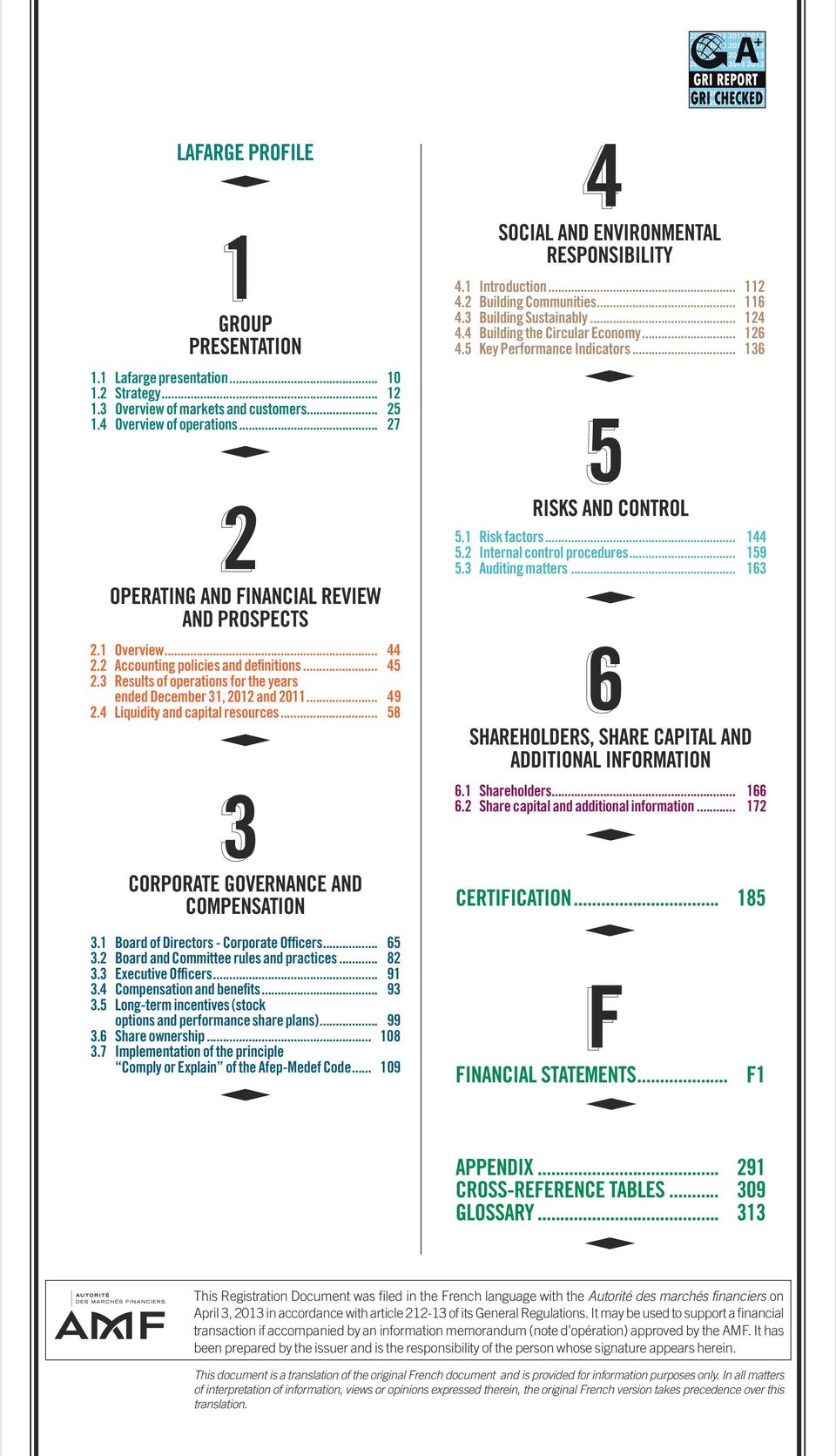
2 LAFARGE PROFILE 1 GROUP PRESENTATION 1.1 Lafarge presentation Strategy Overview of markets and customers Overview of operations OPERATING AND FINANCIAL REVIEW AND PROSPECTS 2.1 Overview Accounting policies and definitions Results of operations for the years ended December 31, 2012 and Liquidity and capital resources CORPORATE GOVERNANCE AND COMPENSATION 3.1 Board of Directors - Corporate Officers Board and Committee rules and practices Executive Officers Compensation and benefits Long-term incentives (stock options and performance share plans) Share ownership Implementation of the principle Comply or Explain of the Afep-Medef Code SOCIAL AND ENVIRONMENTAL RESPONSIBILITY 4.1 Introduction Building Communities Building Sustainably Building the Circular Economy Key Performance Indicators RISKS AND CONTROL 5.1 Risk factors Internal control procedures Auditing matters SHAREHOLDERS, SHARE CAPITAL AND ADDITIONAL INFORMATION 6.1 Shareholders Share capital and additional information CERTIFICATION F FINANCIAL STATEMENTS... F1 APPENDIX CROSS-REFERENCE TABLES GLOSSARY This Registration Document was filed in the French language with the Autorité des marchés financiers on April 3, 2013 in accordance with article of its General Regulations. It may be used to support a financial transaction if accompanied by an information memorandum (note d opération) approved by the AMF. It has been prepared by the issuer and is the responsibility of the person whose signature appears herein. This document is a translation of the original French document and is provided for information purposes only. In all matters of interpretation of information, views or opinions expressed therein, the original French version takes precedence over this translation.
3 EDITORIAL BY BRUNO LAFONT EDITORIAL BY BRUNO LAFONT Chairman and Chief Executive Officer 2012 proved to be a milestone year for Lafarge. We have carried out an in-depth transformation which is now starting to bear fruit. In spite of a tough economic climate in Europe, our total sales rose by 3.5%, our EBITDA by 7% and our current operating income by 12%. Excluding oneoff elements relating to the sale of our Gypsum assets, net income Group share was 70% higher, at 772 million. We owe these results first and foremost to the excellent geographic spread of our portfolio, with a strong presence in emerging countries, which accounted for 59% of our revenues in 2012 and 68% of our EBITDA. It results also from our strategy, wich includes: d a new organization, which is more efficient and is firmly focused on our markets and our customers, d a n action plan for , launched in June, which aims to generate an additional 1.75 billion of EBITDA through a vast costcutting program and a new policy on innovation. 15,816 revenues in m illion euros 65,0 00 employees 64 countries 1,570 production sites We met our target of 410 million cost savings for the year Meanwhile, our innovation measures which have involved products, construction solutions and services have generated 80 million of additional EBITDA. Thanks to this excellent performance, we are contempla ting delivering on our plan by the end of 2014, a year ahead of our original objective. In parallel, we have continued with the reduction of our net debt. It fell by 700 million during the year to 11.3 billion (compared to 17 billion four years ago), and we are very confi dent in our ability to bring it below 10 billion as early as possible in Taking advantage of the impulse given in 2012, the quality of our employees in all parts of the world and of our portfolio of assets, we are on track to accelerate the dynamic of change and to increase the sales, results, return on capital employed and cash flows of the Group. My priority is to create value for the shareholders. Lafarge - Registration Document

4 LAFARGE PROFILE GOVERNANCE BOARD OF DIRECTORS Front, from left to right : Paul Desmarais, Véronique Weill, Hélène Ploix, Bruno Lafont (Chairman and Chief Executive Officer ), Colette Lewiner, Philippe Dauman. Back, from left to right : Gérard Lamarche, Baudoin Prot, Philippe Charrier, Michel Bon, Nassef Sawiris, Ian Gallienne, Oscar Fanjul (Vice-Chairman of the Board of Directors ), Jérôme Guiraud, Juan Gallardo, Michel Rollier. EXECUTIVE COMMITEE Jean-Jacques Gauthier, Thomas Farrell, Christian Herrault, Jean-Carlos Angulo, Eric Olsen, Gérard Kuperfarb, Bruno Lafont, Alexandra Rocca, Jean Desazars de Montgailhard, Guillaume Roux. 2 Lafarge - Registration Document 2012

5 LAFARGE PROFILE LAFARGE WORLDWIDE (D ecember 31, 2012) Western Europe North America Central and Eastern Europe Middle East and Africa Latin America Asia World map of L afarge s presence as of De cember 31, 2012 (plants an d sales offices). KEY FIGURES BY GE OGRAPHIC AREA (D ecember 31, 2012) REVENU ES EMPLOYEE S Western Europe 20.1% Asia 17.4% Western Europe 17.8% Asia 23.0% North America 21.3% Latin America 6.1% Central and Eastern Europe 8.0% Latin America 4.1% North America 13.7% Central and Eastern Europe 10.9% Middle East and Africa 27.1% Middle East and Africa 30.5% Lafarge - Registration Document

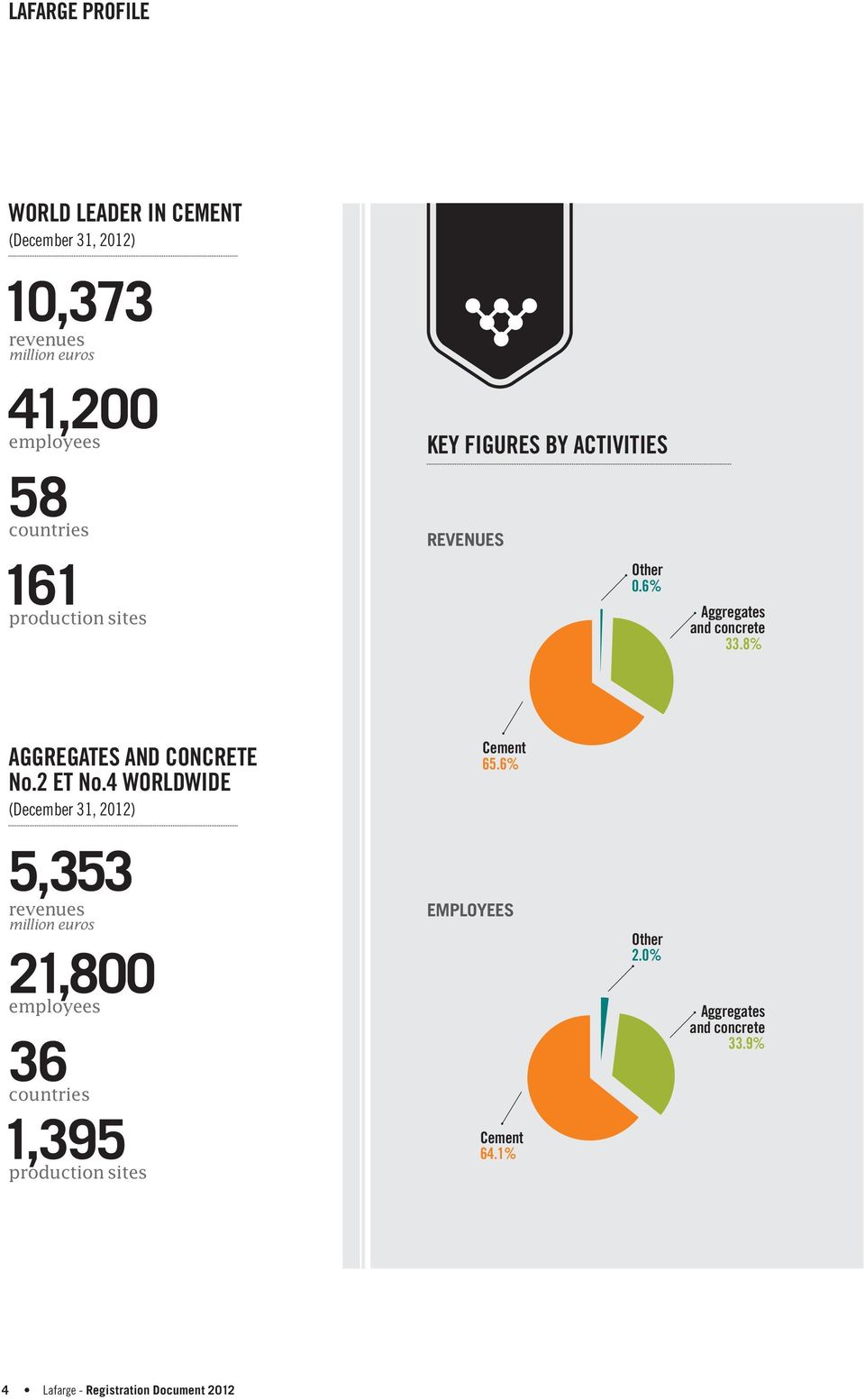
6 LAFARGE PROFILE WORLD LEADER IN CEMENT (December 31, 2012) 10,373 revenues million euros 41,200 employees 58 countries 161 production sites KEY FIGURES BY ACTIVITIES REVENUES Other 0.6% Aggregates and concrete 33.8% AGGREGATES AND CONCRETE No.2 ET No.4 WORLDWIDE (December 31, 2012) Cement 65.6% 5,353 revenues million euros 21,800 employees 36 countries 1,395 production sites EMPLOYEES Cement 64.1% Other 2.0% Aggregates and concrete 33.9% 4 Lafarge - Registration Document 2012
7 LAFARGE PROFILE IN FIGURES REVENUES (in M ) , , ,834 (2) Revenues increased 3.5% in 2012, driven by price increases and growth in emerging markets. EBITDA (1) (in M ) , , ,488 (2) The Group strongly improved its operational performance in OPERATING INCOME BEFORE CAPITAL GAINS, IMPAIRMENTS, RESTRUCTURING AND OTHERS (in M ) , , ,393 (2) Cost savings of 410 million euros strongly contributed to the improvement of the current operating income. FREE CASH-FLOW (1) (in M ) , ,761 (2) GROUP NET DEBT (1) (in M ) , , ,993 NET INCOME GROUP SHARE (in M ) (2) The Group pursued its actions to maximize the free cash flow. The decrease observed in 2012 reflects the payment of non-recurring restructuring charges in the context of the implementation of the cost-saving program and a temporary increase in inventories. Net debt has been reduced by 2.7 billion euros in two years, to 11.3 billion euros. Lafarge will reduce its net debt to below 10 billion euros as soon as possible in Net income Group share was 432 million euros in NET INCOME GROUP SHARE BEFORE NON-RECURRING ITEMS (3) (in M ) In 2011 and 2012, net income Group share included significant non-recurring items. Restated for such items, Net income Group share was 772 million euros, up 70% from 2011 and reflecting the improvement in operating results. NET EARNING PER SHARE (in ) (2) NET EARNING PER SHARE BEFORE NON-RECURRING ITEMS (3) (in ) DIVIDEND PER SHARE (in ) A dividend of 1.00 euro per share proposed at the shareholders meeting on May 7, (1) See Section 2.2 (Accounting policies and definitions). (2) 2010 figures have been restated following the disposal of the Gypsum division as mentioned in Note 3 (Significant events of the period) to the consolidated financial statements. (3) 406 million euros pre-tax for impairments of Greek assets and restructuring charges in 2012; in 2011, 346 million euros for impairment charges in Western Europe and the United Arab Emirates and restructuring charges more than offset by one-time gains of 466 million euros related to Gypsum divestments. Lafarge - Registration Document

8 LAFARGE PROFILE Selected Financial Data SELECTED FINANCIAL DATA Following European Regulation no. 1606/2002 issued on July 19, 2002, the Group has prepared consolidated financial statements for the year ending December 31, 2012 in accordance with International Financial Reporting Standards (IFRS) adopted by the European Union at December 31, The tables below show selected consolidated fi nancial data under IFRS for the years ending December 31, 2012, 2011, and The selected financial information is derived from our consolidated financial statements, which were audited by Deloitte & Associés and Ernst & Young et Autres. The audited consolidated financial statements for the years ending December 31, 2012 and 2011 appear in part F at the end of this report. KEY FIGURES FOR THE GROUP (million euros, unless otherwise indicated) (2) CONSOLIDATED STATEMENT OF INCOME Revenues 15,816 15,284 14,834 Ebitda (1) 3,450 3,217 3,488 Operating income before capital gains, impairment, restructuring and other 2,440 2,179 2,393 Operating income 1,947 1,683 2,134 Net income ,114 Out of which: Net Income from continuing operations ,094 Net income from discontinued operations Out of which part attribuable to: O wners of the parent of the Group Non-controlling interests (minority interests) Earnings per share attributable to the owners of the parent company: Basic earnings per share (euros) Diluted earnings per share (euros) Earnings per share of continuing operations Basic earnings of continuing operations per share (euros) Diluted earnings of continuing operations per share (euros) Basic average number of shares outstanding (thousands) 287, , ,087 (1) See Section (Reconciliation of non- GAAP financial measures) for the definition of this indicator. (2) 2010 figures have been restated following the disposal of Gypsum activities as mentioned in Note 3 (Significant events of the period) to the consolidated financial statements. 6 Lafarge - Registration Document 2012

9 LAFARGE PROFILE Selected Financial Data (million euros) CONSOLIDATED STATEMENT OF FINANCIAL POSITION ASSETS Non-current assets 30,180 31,172 34,752 Current assets 9,284 9,547 7,742 Out of which assets held for sale 2,280 2,195 TOTAL ASSETS 39,464 40,719 42,494 EQUITY AND LIABILITIES Equity attributable to the owners of the parent company 15,668 16,004 16,144 Non-controlling interests (minority interests) 2,082 2,197 2,080 Non-current liabilities 14,449 15,260 16,765 Current liabilities 7,265 7,258 7,505 Out of which liabilities associated with assets held for sale TOTAL EQUITY AND LIABILITIES 39,464 40,719 42,494 (million euros) (1) CONSOLIDATED STATEMENT OF CASH FLOWS Net cash provided by operating activities 1,298 1,619 2,172 Net operating cash generated by continuing operations 1,276 1,597 2,098 Net operating cash generated by discontinued operations Net cash provided by/(used in) investing activities (327) 843 (1,244) Net cash provided by/(used in) investing activities from continuing operations (323) 891 (1,186) Net cash provided by/(used in) investing activities from discontinued operations (4) (48) (58) Net cash provided by/(used in) financing activities (1,348) (2,529) 38 Net cash provided by/(used in) financing activities from continuing operations (1,348) (2,455) 59 Net cash provided by/(used in) financing activities from discontinued operations - (74) (21) Increase (decrease) in cash and cash equivalents (377) (67) 966 (1) 2010 figures have been restated following the disposal of Gy psum activities as mentioned in Note 3 (significant events of the period) to the consolidated financial statements. (million euros, unless otherwise indicated) ADDITIONAL FINANCIAL INDICATORS (1) Free Cash-Flow 884 1,208 1,761 (2) Return on capital employed (%) Group Net Debt 11,317 11,974 13,993 (1) See Section (Reconciliation of non- GAAP financial measures) for the definition of these indicators. (2) Including the 338 million euros one-time payment for the Gypsum competition fine. (euros, unless otherwise indicated) 2012 (1) DIVIDENDS Total dividend (million euros) 289 (3) Basic dividend per share Loyalty dividend per share (2) (1) Proposed dividend. (2) See Section (Articles of Association (Statuts) Rights, preferences and restrictions attached to shares) for an explanation of our Loyalty dividend. (3) Based on an estimation of 287,098,219 shares eligible for dividends. Lafarge - Registration Document

10 LAFARGE PROFILE Selected Financial Data 8 Lafarge - Registration Document 2012

11 1GROUP PRESENTATION 1.1 Lafarge presentation Profile History and development Strategy A solid foundation: a balanced geographical portfolio focused on emerging markets and on Lafarge s core business lines Two key growth drivers: innovation and performance Our ambition: support urbanization Recent acquisitions, partnerships and divestitures Overview of markets and customers Construction Infrastructure Industrial customers Distribution Overview of operations Overview: In 2012 Lafarge continued to focus on its core business through two activities Cement Aggregates and concrete Other products: Gypsum Mineral reserves and quarries Expenditures in 2012 and Capital expenditures planned for Lafarge - Registration Document

12 1GROUP PRESENTATION 1.1 Lafarge presentation 1.1 LAFARGE PRESENTATION F ounded in F rance in 1833, lafarge has become a world s leading producer of building materials Profile Lafarge primarily produces and sells cement, aggregates and ready-mix concrete worldwide, mostly under the Lafarge brand name. Its building products and solutions are used to construct and renovate homes, buildings and infrastructures. Based on its revenues and on internal and external analysis, Lafarge is a world leader in building materials and in the cement market. It is the second largest producer of aggregates and fourth largest producer of ready-mix concrete. In the 2012 financial year, Lafarge generated sales of 15,816 million euros, with Ebitda (1) of 3,450 million euros and net income, group share of 432 million euros. At year-end, its assets totaled 39,464 million euros and the Group employed approximately 65,000 people in 64 countries. Lafarge S.A. is a Limited Liability Company (Société Anonyme) incorporated in France under French law, registered on the Paris Corporate and Trade Register under number The KEY DATES Company's corporate term is due to expire on December 31, 2066 and may be extended pursuant to its by-laws. The registered office is located at 61 rue des Belles Feuilles, Paris, France. The Group's reporting currency is the euro ( ). Lafarge shares have been traded on the Paris Stock Exchange (NYSE Euronext Paris) since Lafarge shares have belonged to the CAC 40 since the creation of this index HISTORY AND DEVELOPMENT In 1833, Joseph-Auguste Pavin de Lafarge sets up a lime operation in Le Teil (Ardèche, France), on the right bank of the Rhône. Through sustained growth and numerous acquisitions, the Company becomes France s largest cement producer by the late 30s. Lafarge s first step to international expansion takes place in 1864 with the export of lime for the construction of the Suez Canal. Its expansion then continues, fi rstly in the Mediterranean basin (particularly Algeria), then in Canada and Brazil in the 1950s. The acquisition of General Portland Inc. in 1981 allows it to become one of the largest concrete manufacturers in North America, while the purchase of the Swiss group Cementia in 1989 enables it to take up new positions, particularly in Europe and East Africa. The 1990s see the Group s first sites appear in Eastern Europe and Asia, primarily China and India. Parallely, Lafarge develops it aggregates and ready-mix concrete activity. In 1997, the acquisition of the British company Redland allows Lafarge to grow in this activity and to become an important player in the roofing market (2). With the purchase of the British manufacturer Blue Circle in 2001, Lafarge further increases its presence on emerging markets and becomes the world s leading cement producer. In January 2008, Lafarge acquires the cement activity of the Egyptian Orascom group (Orascom Building Materials Holding SAE), which makes it the market leader in the Middle East and Africa. The Gypsum business, which began in 1931, is mostly disposed of in the second half of Definitions Lafarge S.A. refers to the Group s listed parent company. Lafarge refers to the whole Lafarge Group Beginning of operations in France Lafarge builds its 1 st cement plant in Richmond, Canada Acquisition of General Portland, making Lafarge one of the largest cement manufacturers in North America 1994 Lafarge enters the Chinese market 1998 First operations in India 2006 Lafarge owns 100% of Lafarge North America Inc. January 2008 Acquisition of Orascom Cement 1864 Lafarge delivers 110,000 tonnes of lime for the construction of the Suez Canal 1959 First operations in Brazil 1989 Acquisition of Cementia 1997 Acquisition of Redland plc, one of the principal manufacturers of aggregates and concrete worldwide 2001 Acquisition of Blue Circle Industries plc. February 2007 Sale of the Roofing Division 2011 Sale of our Gypsum operations (1) See Section (Reconciliation of non-gaap financial measures) for the definition of this indicator. (2) The roofing activity has been disposed of in Lafarge - Registration Document 2012

13 GROUP PRESENTATION 1.1 what makes us different WHAT MAKES US DIFFERENT Strategic levers Our strengths The evidence A geographical portfolio positioned to capture growth Strong and diversified presence in emerging markets Z 72% of sales outside Europe Z 59% of sales in emerging countries Z 75% of our cement capacities are in emerging countries Z no emerging country represents more than 5% of sales H igh and rising margins Increase in EBITDA margin from 21.0% in 2011 to 21.8% in Staying ahead through innovation Powerful central R&D Means of development at country level Innovative products and solutions: Z Cements and concretes Z Special concretes to meet construction challenges: Hydromédia permeable concrete, Agilia selfcompacting concrete, Artevia decorative concrete, Thermedia thermal concrete, Ductal ultra highstrength concrete and the new anti-pollution concrete. A growing number of services: Z consultancy services during the design phase of projects Z construction site services Z distribution services Development of specification and consultancy services for architects and decision-makers. The world s largest R&D center in the building materials sectors; f ounded in A budget of 116 million. 158 new patent applications in Local development laboratories in France, India and China. Projects 2013: Brazil and Algeria. 120 launches of cement and concrete products by countries in Special concrete products accounted for 43% of concrete sales in Some examples: Z the placing and finishing service for concrete launched in 18 countries, Z c reation of innovative distribution circuits in Morocco, Tanzania, Algeria, Nigeria. Roughly 50 positions for construction specialists and international key account managers created in Continuous improvement in performance to boost our competitiveness. Cost reduction 410 million of cost reduction in billion of cost reduction since 2006, t hrough various lever s. Z For example, n on-fossil fuels constitute more than 15% of the consumption of our cement plants. Z A sourcing platform in Beijing to supply plants with equipments and spare parts at the best value. Produce more with existing means Increase of the cement/clinker ratio from 1.31 in 2011 to 1.33 in Reliability rate constantly rising: a n average of 94.7% in More than half of our plants are over 96%. Operational excellence: Z Business models in each business. Z Training programs for key operational positions. R oughly 1,3 00 employees certified. Lafarge - Registration Document

14 1GROUP PRESENTATION 1.2 Strategy 1.2 STRATEGY A SOLID FOUNDATION: A BALANCED GEOGRAPHICAL PORTFOLIO FOCUSED ON EMERGING MARKETS AND ON L AFARGE S CORE BUSINESS LINES With a balanced geographical portfolio oriented towards emerging markets and a presence in 64 countries, Lafarge - having refocused on its core business lines and with a more efficient organizational structure since has the strengths required for its development and to consolidate its leading position on the world building materials market. a) A balanced international group Thanks to its long-standing international expansion strategy, Lafarge has now achieved a geographical balance that offers a unique growth potential with strong positions on both developed and emerging markets and with limited risk : no single emerging country accounts for more than 5% of its sales. S ales in emerging markets in Central and Eastern Europe, Middle East and Africa, Latin America and Asia, grew from 32% in 2005 to 59% of sales in 2012 and place Lafarge in a strong position to seize all opportunities for worldwide growth. b) A group refocused on its core business In 2011, Lafarge decided to refocus on its core business lines of cement and aggregates & concrete, which show very high growth potential, by disposing most of its Gypsum assets, having done likewise with its Roofing business in c) A country-based organizational structure In early 2012, a new organizational structure - more agile, more reactive and more focused on markets and customers - was implemented with a view to enhancing Lafarge s efficiency and accelerating its growth. The business-based structure was replaced by a country-based organization. Each country unit is headed by a general manager responsible for all cement and aggregates & concrete activities in the country, drawing on shared local support functions as well as Lafarge s support functions. The organizational structure and the responsibilities of the Executive Committee were also redistributed with the creation of Innovation and Performance functions. This new structure is the natural continuation of both Lafarge s geographical expansion phase and its refocusing on its core business. Its aim is to increase Lafarge s differentiation through the development of higher added value products and solutions for construction, linking all cement and aggregates & concrete skills in each country, thus reinforcing Lafarge s position as a key player in construction TWO KEY GROWTH DRIVERS: INNOVATION AND PERFORMANCE a) Innovation: the key to development Innovation represents a strategic focus area for Lafarge that has enabled it to set itself apart on the market. It is now a key factor for the Company s growth as it seeks to morph from a producer of materials into a supplier of solutions. Lafarge has been innovating for a long time. Today, the Group works on three main axes: Continue to enrich its added value range of products, deploy them in all its units around the world and develop solutions and services. This innovation strategy is supported by the Group central Research Center and also supported locally by the Construction Development Labs. It is implemented through a commercial policy aiming at strengthening expertise of sales forces and develop cooperation with prescribers. Z Developing global and local expertise There would be no innovation without solid efforts in Research and Development (R&D). Lafarge s first R&D center was created in Today, some 240 engineers and technicians from various scientific backgrounds and a dozen countries work at Lafarge s L'Isle d'abeau site, which hosts the Lafarge Research Center near Lyon (France). Its current research is primarily focused on the development of sustainable construction solutions (insulation, use of thermal inertia of concrete, soil drainage, etc.) and the reduction of greenhouse gases, in both manufacturing and product usage. INTERNATIONAL PARTNERSHIPS As an internationally-renowned benchmark, Lafarge s Research Center takes part in scientific networks and forms partnerships with the most important research institutions, top-ranking higher education establishments and universities worldwide. These include the Materials Science for Sustainable Construction (SMCD) teaching and research chair, in partnership with the Ecole Polytechnique and the Ecole des Ponts in France. There are a number of other cooperative projects: the Nanocem 12 Lafarge - Registration Document 2012

15 GROUP PRESENTATION 1.2 Strategy R&D AT LAFARGE A budget of 116 million euros in 2012 f or product innovation and industrial process improvement. 240 engineers and technicians at Lafarge Research Center on L'Isle D'Abeau site. 158 new patent applications were filed in network, a consortium of about twenty European universities and about a dozen industry partners; the Centre National de la Recherche Scientifi que (National Center for Scientifi c Research, a group of thirty or so laboratories); the Ecole des Mines and various universities in France; the Massachusetts Institute of Technology (MIT), the universities of Princeton and Berkeley in the United States; the universities of Laval, Sherbrooke and Montreal Polytechnic in Canada; the polytechnic schools in Lausanne and Zurich, Switzerland; the universities of Aberdeen and Leeds in the United Kingdom; the Indian Institute of Technology in Madras, Delhi and Mumbai, the Indian Institute of Science in Bangalore and the Central Building Research Institute in Roorkee, all in India; the universities of Chongqing, Hunan and China Building Materials Academy in Beijing, China; the universities of Rio de Janeiro, Parana and Rio Grande do Sul in Brazil. EXPANDING AS CLOSE AS POSSIBLE TO OUR MARKETS In order to adapt its research to match the needs of its local markets as closely as possible, Lafarge created Construction Development Labs. These laboratories, staffed by specialists, aim to adapt Lafarge s solutions to the needs, constraints, characteristics and opportunities of its local markets. Their work is carried out in close partnership with customers and local specifiers (architects, industrial companies, distributors, project managers, etc.). The first labs were launched in France and China in 2011, followed by India in early More Construction Development Labs are scheduled to open in Algeria and Brazil in In total, around ten new labs are to open over the next few years. Z Creating and promoting value-added products and solutions One of the major areas of innovation in the last few years has been the creation of special concrete, providing solutions to current challenges in the field of construction: respect for the environment, high strength, speed and ease of application, aesthetics, insulation, etc. This ongoing work forms the basis of a number of original construction systems and stimulates innovation and 1 A NEW GENERATION OF CEMENT The result of several years research, Aether is a new-generation cement, the production of which cuts CO 2 emissions by 25 to 30% and the energy needed for burning by 15%, without requiring any significant cement plant modifications. This is why the European Union has lent its financial support for this project as part of the environmental Life+ program. The second industrial test, carried out in December 2012 at the Le Teil plant (Ardèche, France), produced very positive results. If the studies confirm the results obtained by the preliminary test, the Aether cement and the concrete produced with it will boast strength on a par with that of standard Portland cement. Lafarge - Registration Document

16 1GROUP PRESENTATION 1.2 Strategy excellence in relation to processes to obtain cement, aggregates and concretebased construction products and solutions of consistent quality throughout the world. 120 new products launches by countries took place in 2012.Product innovation is also successful in the cement product line with Aether (read insert on page 13 ) which will be launched in INCREASINGLY HIGH-PERFORMANCE CONCRETE In 2012, special concrete represented 35% in volume and 43% in value of overall concrete sales. They increased respectively by 17% and 20% in one year on a like-for-like basis. The past year saw the development, local adaptation and market release of Hydromedia draining concrete, which combined permeability with mechanical strength. This new product enhances the value-added concrete range, which is made up of Agilia self-placing concrete, Artevia decorative concrete, Thermedia insulating concrete and Ductal ultra-highperformance concrete. The research center is actively pursuing its work on structural insulating concrete in order to adapt it to different construction methods and building thermal regulations, which are changing rapidly in both developed and in emerging countries. Other innovations brought about by the Company s research are very promising. In 2012, the Research Center and patented a prototype depolluting concrete capable of absorbing nitrogen dioxide fumes, which is particularly suited to tunnels. Another breakthrough is the development of a new generation of ultra-high performance concrete for industrial applications, such as facades, which is currently undergoing testing. CONSTRUCTION SYSTEMS: SOLUTIONS FOR SPECIFIERS Finally, 2012 was marked by the launch of construction systems - innovative solutions for the production of structural components (walls, floors, facades, etc.) with stand-out characteristics in one or more areas (cost, durability, strength, insulation, aesthetics, ease of application, etc.). These construction systems represent tools for promoting concrete faced with competition from other materials and ambassadors of Lafarge s expertise in the eyes of customers and prescribers. At the end of 2012, the Company catalog comprised 45 systems, presented in comprehensive documents and tailored to local characteristics. Z Creating new services Resolutely customer-focused, Lafarge prioritizes the development of new services. MORE AND MORE SERVICES IN CONCRETE Lafarge is developing services to client aiming at facilitating access to and use of our products, such as the rental of pumps and conveyor belts and the management of laboratory testing and a new offer allowing contractors to collect small loads from certain plants themselves. SOLUTION SEEKERS In one year since its launch, the Isle d Abeau Construction Development Lab, which operates in the Europe- Mediterranean region, has worked on twenty or so different projects, on its own or in liaison with partners and pertaining to such fields as insulation and wall systems (cavity walls, permanent form walls, hemp-concrete panels), The lab in Mumbai, India, has worked on the development of Aadhar - a binder for mud houses that multiplies their life span by a factor of five -, the design of full drainage systems using Hydromedia to prevent flooding and the development of set-retarding agent concrete that can be delivered in buckets for houses in shantytowns. It has also provided technical support to the winners of the 2011 Lafarge Invention Awards, which aim to reward entrepreneurship and research projects that relate to building materials and contribute to sustainable development. 14 Lafarge - Registration Document 2012

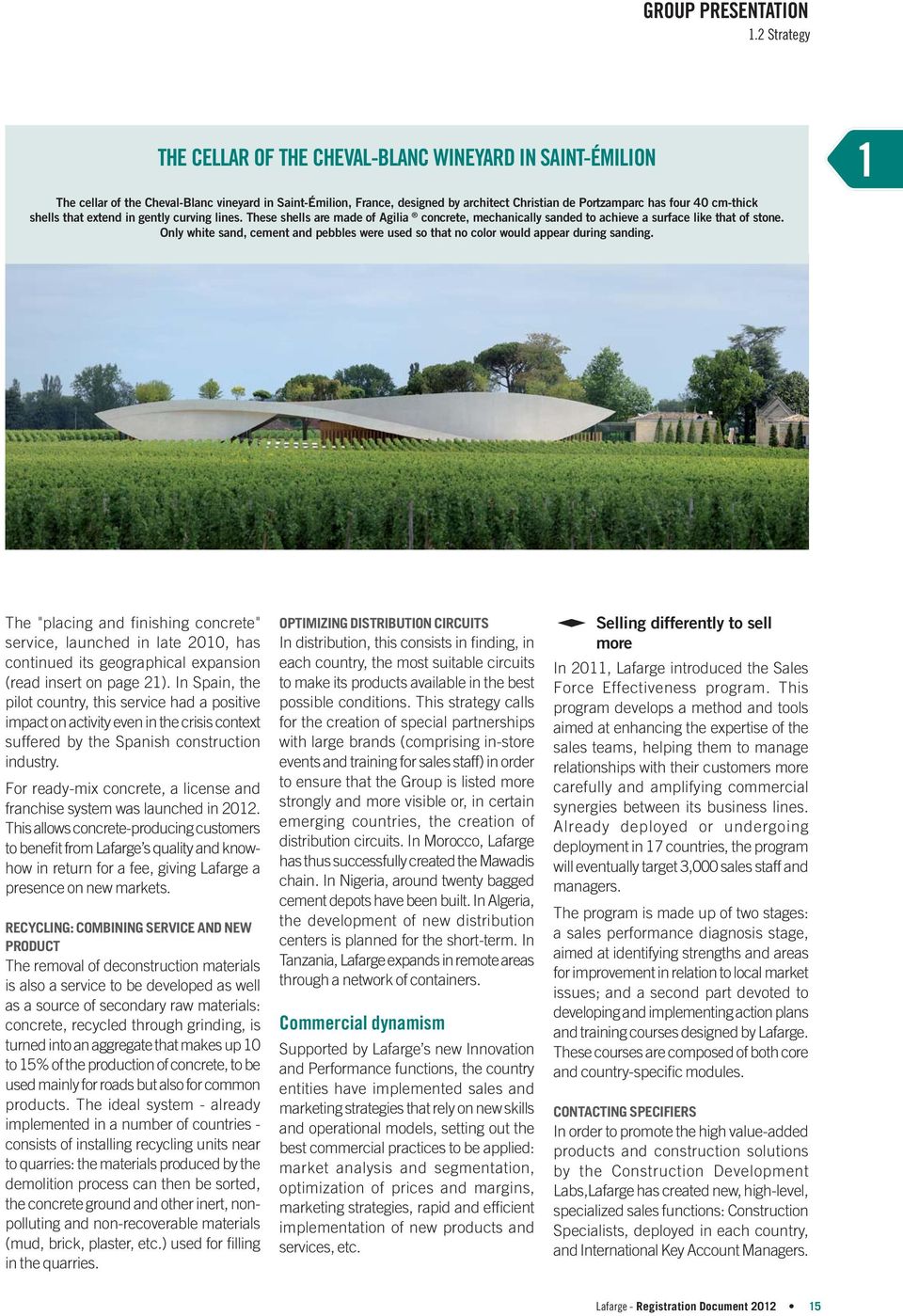
17 GROUP PRESENTATION 1.2 Strategy THE CELLAR OF THE CHEVAL-BLANC WINEYARD IN SAINT-ÉMILION The cellar of the Cheval-Blanc vineyard in Saint-Émilion, France, designed by architect Christian de Portzamparc has four 40 cm-thick shells that extend in gently curving lines. These shells are made of Agilia concrete, mechanically sanded to achieve a surface like that of stone. Only white sand, cement and pebbles were used so that no color would appear during sanding. 1 The " placing and finishing concrete" service, launched in late 2010, has continued its geographical expansion (read insert on page 21). In Spain, the pilot country, this service had a positive impact on activity even in the crisis context suffered by the Spanish construction industry. For ready-mix concrete, a license and franchise system was launched in This allows concrete-producing customers to benefit from Lafarge s quality and knowhow in return for a fee, giving Lafarge a presence on new markets. RECYCLING: COMBINING SERVICE AND NEW PRODUCT The removal of deconstruction materials is also a service to be developed as well as a source of secondary raw materials: concrete, recycled through grinding, is turned into an aggregate that makes up 10 to 15% of the production of concrete, to be used mainly for roads but also for common products. The ideal system - already implemented in a number of countries - consists of installing recycling units near to quarries: the materials produced by the demolition process can then be sorted, the concrete ground and other inert, nonpolluting and non-recoverable materials (mud, brick, plaster, etc.) used for filling in the quarries. OPTIMIZING DISTRIBUTION CIRCUITS In distribution, this consists in finding, in each country, the most suitable circuits to make its products available in the best possible conditions. This strategy calls for the creation of special partnerships with large brands (comprising in-store events and training for sales staff) in order to ensure that the Group is listed more strongly and more visible or, in certain emerging countries, the creation of distribution circuits. In Morocco, Lafarge has thus successfully created the Mawadis chain. In Nigeria, around twenty bagged cement depots have been built. In Algeria, the development of new distribution centers is planned for the short-term. In Tanzania, Lafarge expands in remote areas through a network of containers. Commercial dynamism Supported by Lafarge s new Innovation and Performance functions, the country entities have implemented sales and marketing strategies that rely on new skills and operational models, setting out the best commercial practices to be applied: market analysis and segmentation, optimization of prices and margins, marketing strategies, rapid and efficient implementation of new products and services, etc. Z Selling differently to sell more In 2011, Lafarge introduced the Sales Force Effectiveness program. This program develops a method and tools aimed at enhancing the expertise of the sales teams, helping them to manage relationships with their customers more carefully and amplifying commercial synergies between its business lines. Already deployed or undergoing deployment in 17 countries, the program will eventually target 3,000 sales staff and managers. The program is made up of two stages: a sales performance diagnosis stage, aimed at identifying strengths and areas for improvement in relation to local market issues; and a second part devoted to developing and implementing action plans and training courses designed by Lafarge. These courses are composed of both core and country-specific modules. CONTACTING SPECIFIERS In order to promote the high value-added products and construction solutions by the Construction Development Labs,Lafarge has created new, high-level, specialized sales functions: Construction Specialists, deployed in each country, and International Key Account Managers. Lafarge - Registration Document
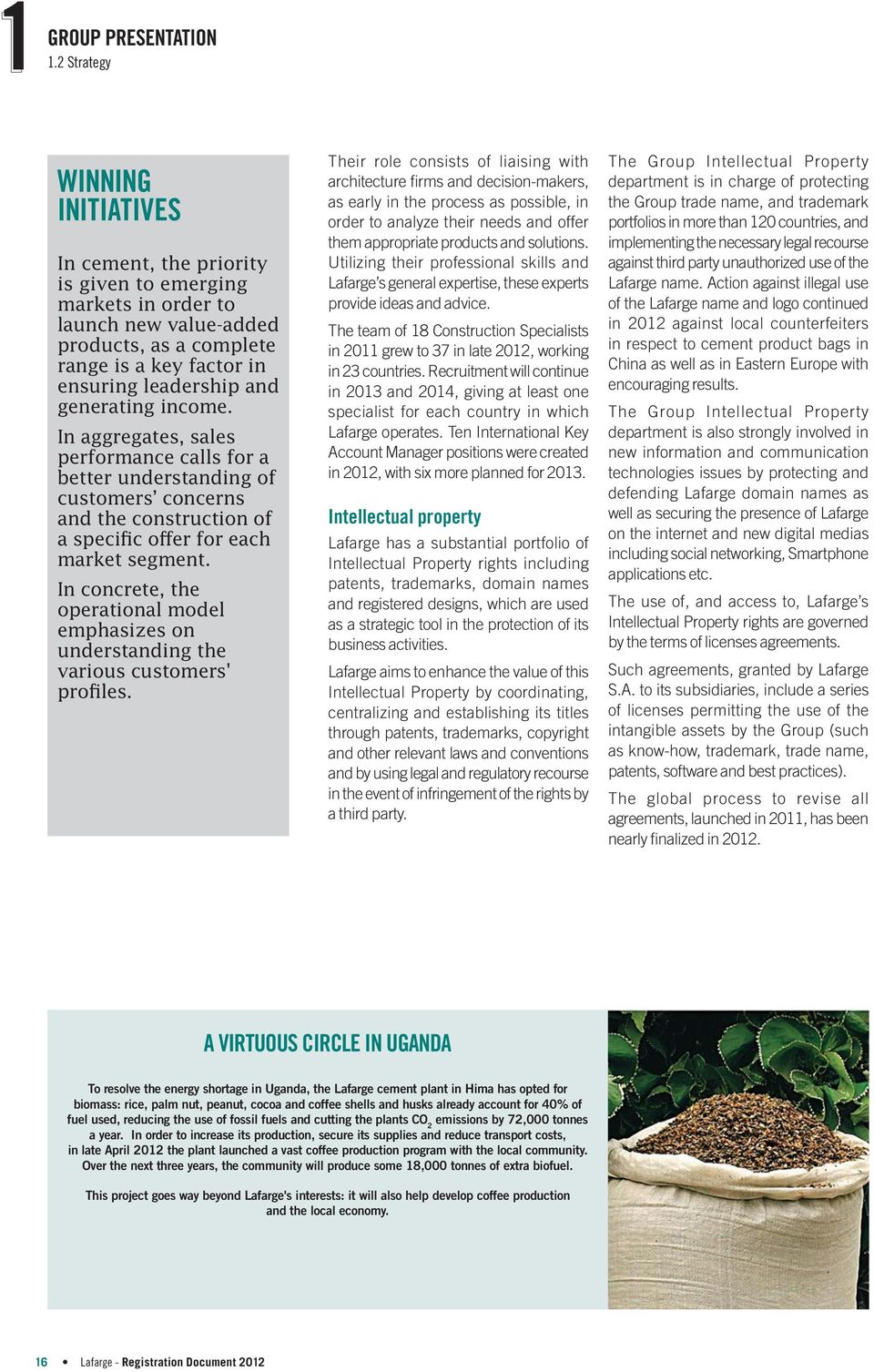
18 1GROUP PRESENTATION 1.2 Strategy WINNING INITIATIVES In cement, the priority is given to emerging markets in order to launch new value-added products, as a complete range is a key factor in ensuring leadership and generating income. In aggregates, sales performance calls for a better understanding of customers concerns and the construction of a specific offer for each market segment. In concrete, the operational model emphasizes on understanding the various customers' profiles. Their role consists of liaising with architecture firms and decision-makers, as early in the process as possible, in order to analyze their needs and offer them appropriate products and solutions. Utilizing their professional skills and Lafarge s general expertise, these experts provide ideas and advice. The team of 18 Construction Specialists in 2011 grew to 37 in late 2012, working in 23 countries. Recruitment will continue in 2013 and 2014, giving at least one specialist for each country in which Lafarge operates. Ten International Key Account Manager positions were created in 2012, with six more planned for Intellectual property Lafarge has a substantial portfolio of Intellectual Property rights including patents, trademarks, domain names and registered designs, which are used as a strategic tool in the protection of its business activities. Lafarge aims to enhance the value of this Intellectual Property by coordinating, centralizing and establishing its titles through patents, trademarks, copyright and other relevant laws and conventions and by using legal and regulatory recourse in the event of infringement of the rights by a third party. The Group Intellectual Property department is in charge of protecting the Group trade name, and trademark portfolios in more than 120 countries, and implementing the necessary legal recourse against third party unauthorized use of the Lafarge name. Action against illegal use of the Lafarge name and logo continued in 2012 against local counterfeiters in respect to cement product bags in China as well as in Eastern Europe with encouraging results. The Group Intellectual Property department is also strongly involved in new information and communication technologies issues by protecting and defending Lafarge domain names as well as securing the presence of Lafarge on the internet and new digital medias including social networking, Smartphone applications etc. The use of, and access to, Lafarge s Intellectual Property rights are governed by the terms of licenses agreements. Such agreements, granted by Lafarge S.A. to its subsidiaries, include a series of licenses permitting the use of the intangible assets by the Group (such as know-how, trademark, trade name, patents, software and best practices). The global process to revise all agreements, launched in 2011, has been nearly finalized in A VIRTUOUS CIRCLE IN UGANDA To resolve the energy shortage in Uganda, the Lafarge cement plant in Hima has opted for biomass: rice, palm nut, peanut, cocoa and coffee shells and husks already account for 40% of fuel used, reducing the use of fossil fuels and cutting the plants CO 2 emissions by 72,000 tonnes a year. In order to increase its production, secure its supplies and reduce transport costs, in late April 2012 the plant launched a vast coffee production program with the local community. Over the next three years, the community will produce some 18,000 tonnes of extra biofuel. This project goes way beyond Lafarge's interests: it will also help develop coffee production and the local economy. 16 Lafarge - Registration Document 2012
19 GROUP PRESENTATION 1.2 Strategy TRANSFERRING KNOW-HOW When a plant needs to improve its process, it can call upon boosters : around 250 available professionals, of all nationalities, identified as the best experts in their fields and renowned for their job skills and teaching abilities. Ready to be mobilized at any time, they may remain on assignment for around six months until the improvements are secured with lasting solutions, i.e. until best practices have been transmitted and applied. In 2012, several assignments were carried out or begun in countries such as Algeria, Brazil, France (Le Havre plant), Indonesia, Nigeria, the Philippines and Russia. All of them led to an acceleration of performance improvements. 1 The portfolio of patents continues to grow, with 158 new patent applications made in 2012, refl ecting the commitment of Lafarge in the fi eld of innovation. More than 45% of these applications relate to sustainable construction and sustainable development, in line with the 2020 ambitions of Lafarge. b) Performance To improve its competitiveness, Lafarge uses two levers: cost reduction and plant productivity improvement. In order to improve its performance, Lafarge has operational models for each of its fields of activity. Based on the best practices - both industrial and commercial - observed within the Group, the models allow accelerating and standardizing the various drivers of performance: reducing costs, upgrading the skills of employees and industrial excellence. These models, which are gradually enhanced and expanded, allow performance to improve on an ongoing basis. For industrial activities, the operational models aim to increase production on the markets where demand is highest, enhance the reliability and profi tability of existing facilities and achieve top level quality and regularity of products. Performance improvement also calls for the expansion and modernization of information systems (management of orders in concrete plants, online purchasing software, etc.), the streamlining of the purchasing of spare parts for the maintenance of plants and logistics chain, the standardization of engineering methods, professional energy management and strategic sourcing. The operational models by Lafarge also apply to its commercial activities. See insert Winning initiatives on page 16 for more information on commercial operational models. Z Accelerating cost reduction In 2012, Lafarge reduced its costs by 410 million euros in Encouraged by this result, the Group decided to accelerate its program aiming at generating savings of 1,300 million euros from 2012 to We believe that we will complete this program by 2014, one year ahead of schedule. LOWERING ENERGY COSTS Energy alone accounts for one third of the Group s cement production costs (before distribution and administrative costs): Lafarge s total consumption is on a par with a country the size of Ecuador! Reducing the energy bill and protecting the Group against price increases are thus priorities. Lafarge is therefore seeking to increase the proportion of alternative fuels used in its plants: tires and waste industrial oil, household and agricultural waste, etc. In 2012 these fuels accounted for approximately 15% of cement plant consumption, reaching more than 20% in 16 countries and even exceeding 60% in some plants. The goal is to reach averages of 30% in 2015 and 50% in At the same time, Lafarge is seeking to form long-lasting partnerships in waste collection and sorting. Lafarge also reduces the cost of traditional fuels by grouping supplies covering multiple countries and optimizing the fuel mix: coal is thus replaced with petcoke or low-quality coal; petcoke with a high sulfur content - which is cheaper - can, if managed properly by the plants, be used instead of ordinary petcoke. As an example, the amount of petcoke in the fuel Lafarge - Registration Document

20 1GROUP PRESENTATION 1.2 Strategy mix increased from 17% in 2011 to 21 % in At last, Lafarge is also streamlining electricity expenditure on its sites by using new tools to manage consumption and monitor it in real time, in order to take benefit of prices opportunities. In a number of emerging countries, the plants also use the radiant heat produced by their kilns to generate electricity. CONTINUING TO IMPROVE THE CEMENT/ CLINKER RATIO The production of clinker, a base component of cement, is the most costly operation energy-wise. However, it is possible to replace clinker with other components: slag (a by-product of steel production), fl y ash (produced by the combustion of coal in thermal power plants), pozzolan (volcanic rock) and limestone. This method enhances facilities production capacities - thereby limiting investment costs - while cutting energy bills and CO 2 emissions. Moreover, the use of these components gives the cement produced special properties that can be advantageous in certain contexts, such as better resistance to chemical stresses (improved durability in environments with high levels of sulfur or chlorine) and low hydration heat (reduced cracking in large structures). Lafarge s progress can be measured by the change in the cement/clinker ratio, which has been on a constant rise for the last ten years (see Chapter 4 for more information on the evolution of the clinker cement ratio). OPTIMIZING LOGISTICS AND TRANSPORT Reducing costs also involves logistics, where significant efforts are planned for For example, in Canada, outsourcing concrete delivery to transport companies has already cut costs significantly. SEEKING THE BEST PROCUREMENT SOURCES Based on its experience acquired during the construction of new cement plants in China, Lafarge has its sourcing platform in Beijing with a new team (International Sourcing Development Team) responsible for supplying its plants with equipment and spare parts at the best possible prices, while controlling throughout the production process to ensure that the components are of highest quality. This supply management also applies to the construction of new plants. Combined with the standardization of engineering methods, it helps reduce construction costs and the time needed to bring the units online. Z Increasing plant productivity Producing more with existing assets. From 13 to 15 million additional tonnes have been identified for the period A potential that will result in additional sales. To reach this objective, Lafarge woks towards the optimization of the industrial equipment and processes used in cement plants, concrete plants and quarries, with the aim of improving their reliability and thus their productivity. This optimization will also help reduce production costs, including energy bills and maintenance expenditure. A CONSTANTLY-RISING RELIABILITY RATE (1) Lafarge beat its own reliability record in 2012, achieving an average of 94.7%, with more than half of its plants exceeding 96%. This good result makes the target of 96% reliability in 75% of our plants by 2015 perfectly realistic, thanks to the systematic deployment of operational models. INDIVIDUAL HOUSES IN A COMMON STRUCTURE In France, Lafarge partnered with the city of Bègles, architect Christophe Hutin and developer DomoFrance to create the Hauts-Plateaux vertical housing development. This development consists of a series of platforms that can be modified over time. These platforms are divided into lots measuring square meters, of which 50% is housing space, 50% is yard space of which 25% may be transformed into additional home. The concept revolves around a structure made of slender, widespanning slabs and beams and specialized types of concrete, e.g., high-strength concrete for the beams, watertight concrete for the slabs and pervious concrete for exterior floor slabs. 1) The reliability rate is an indicator of the frequency of failures during production. 18 Lafarge - Registration Document 2012

21 GROUP PRESENTATION 1.2 Strategy MARSEILLE, AN URBAN METAMORPHOSIS 1 In Marseille, plans to revitalize the old docks neighborhood near the city s harbor include the building of a high-rise known as the H99, designed by Jean-Baptiste Pietri. Its name is a reference to its height of 99 meters. The building will be home to luxury apartments and will be the first high-rise apartment building to be built in France since the 1970s. In the same Euroméditerranée district of Marseille, Lafarge was involved in the construction of a 145-meter skyscraper housing the headquarters of the shipping company CMA CGM. This building was designed by architect Zaha Hadid with a mobile concrete production facility set up at the construction site. OPTIMIZING MAINTENANCE Effective management of maintenance helps enhance the reliability of industrial facilities, reduce their operating costs and extend their lifespan. To achieve this, Lafarge favors preventive maintenance through the use of tools for monitoring actual facility usage, records, inspections, and training program s. Z Developing skills In its operational models, Lafarge places particular focus on enhancing its employees skills. A well-run production unit, with well-trained teams and individuals, can boast a high level of reliability. Lafarge has therefore launched a range of training programs, for both management staff and various critical operational positions. These programs should lead to future certification for 1,300 employees OUR AMBITION: SUPPORT URBANIZATION Over the next few decades, the growth of the world s population will be almost exclusivity confined to urban environments. Ensuring the success of this urbanization in human, economic and ecological terms is one of the major challenges facing the 21 st century. Operating in both mature markets and emerging countries, Lafarge is at the heart of this challenge. With its know-how and international experience, Lafarge is well positioned to promote solutions continuing to respond to cities challenges. a) Urbanization: a major phenomenon The growth in the urban population is set to continue over the next few decades, laying down challenges that call for imagination and innovation. Z World population growth The world s population exceeded 7 billion in According to United Nation forecasts, it should exceed 8 billion in 2025 and 9 billion in around This means that in less than 40 years, an extra two billion people will need to be housed, mainly in cities. This is because urbanization, which rose alongside the population explosion of the 20th century, has grown even more spectacularly: since 2007, the majority of the world's population has lived in cities, compared with 30% in This rate is set to reach nearly 70% in 2050, when towns and cities will absorb all of the population growth. Z A new urban landscape Towns and cities are growing in every country. While this phenomenon is less visible - though no less real - in already highly-urbanized regions (Europe, North and South America), it is occurring at a high rate in developing countries, including in Africa. Two phenomena now illustrate the urban landscape: Z the growth of average-size cities with between 100,000 and 500,000 inhabitants, which remain the most numerous, containing around half of the total urban population. Z the growing proportion of megapolises (metropolitan areas containing more than 10 million inhabitants). These currently number 23 and are forecast to rise to around 40 in 2025, with their total population increasing from 359 million to 630 million i.e. almost Lafarge - Registration Document
22 1GROUP PRESENTATION 1.2 Strategy 14% of the planet's inhabitants. Twenty-one of these megapolises will be located in Asia and two new ones will appear in Africa including Lagos (Nigeria). Z Challenges to be met The vast majority of city-dwellers, including inhabitants of megapolises, like the cities they live in (TNS Sofres study for Veolia Environment, 2011). However, they are skeptical, especially in Europe and America, about the possibilities for improving the quality of urban life over the next decade. Among the factors needed to bring about such an improvement, better public transport comes top of the list, followed by increasing the size of their homes, heat insulation, and sound insulation. Managing population density and fluidity of movement, providing access for all to adequate housing and significantly improving housing quality are just some of the major challenges ahead. Other issues abound. In the areas surrounding many megapolises and large cities in developing countries, access to drinking water and electricity remains a significant problem. Finally, it is crucial that urbanization does not lead to a rise in the wasting of natural resources, pollution and greenhouse gas emissions, but that, instead, it helps reduce them. b) Lafarge s efforts to improve cities Considering the major challenges facing our cities, Lafarge has made it a priority, to be a committed actor for contributing to the construction of better towns. To this end, a series of innovative solutions to improve cities have been developed and implemented. Z Cities more friendly To provide decent housing for all city-dwellers, especially newcomers, whatever their income level, public and private developers and contractors seek out solutions to build quality housing at affordable prices. BUILDING FASTER AND CHEAPER In certain countries, as regards lowcost housing, Lafarge works to develop absorptive form techniques in which the form remains integrated with the concrete after construction is complete. Its quick, easy installation allows for considerable savings. Lafarge has a long history of collaboration with Habitat for Humanity, an NGO that helps residents build homes at a lower cost in many countries. In 2012, it took part in a Habitat for Humanity project in Edmonton (Canada) working with an engineering firm to design a residential duplex made of precast concrete. FACILITATE ACCESS TO HOUSING Through its Sustainable Development Ambitions 2020, Lafarge is committed to facilitate access to an affordable and sustainable housing for two million persons throughout the world. For example, in Mumbai, India, Lafarge offers a simple solution to improve the quality of life in the city s slums: concrete supplied in buckets that can be transported down very narrow streets to build high-quality, two-story homes (ground floor used for commercial activities, upper floor used for housing). Lafarge signed partnership agreements with the NGO Global Communities (formerly known as CHF International) and the French Development Agency with a view to providing decent housing for the populations of developing nations with little buying power so that these people of limited means can build, expand or renovate their homes. Operations are already underway in Indonesia, in Honduras and in the Philippines. Other programs are in the planning stages. SOLUTIONS TO COMBAT FLOODING The soil sealing caused by growing cities can have unseen, and sometimes dramatic, consequences when severe weather strikes. Hydromedia pervious concrete provides a suitable solution. This product was chosen to create the 26,000 square meter patio on the campus of Toronto s Centennial College (Canada). Thanks to its fluidity during application and its drying time, the material is perfect for sloped terrain, and its draining and filtering capabilities help to protect ground water and to provide natural irrigation for the college s mini-gardens, valued highly by its students. 20 Lafarge - Registration Document 2012
23 GROUP PRESENTATION 1.2 Strategy READY- MIX CONCRETE PLACING SERVICES 1 Launched first in Spain, the Group s placing and finishing concrete activity consists of a full service (estimate of requirements, supply and laying) of products such as Artevia (decorative concrete) and Agilia (self-placing and self-leveling concrete). Particularly suited to detached house markets, this service is entrusted to specially-selected and trained application professionals, with Lafarge remaining responsible for the service as a whole. This new service has been set up in 18 countries in the space of one year. In 2013, Lafarge intends to expand the concept to more countries and products. Z More compact cities Experts agree that cities will not be able to accommodate their growing populations simply by growing outward, since sprawl poses complex, costly problems related to transportation, inefficient use of energy and disappearance of farmland. Instead, cities will have to become denser. BUILDING UPWARDS Densification will be achieved by building upward - by moving from one-story buildings to multi-story buildings or by building high-rises, depending on the size of the city and the geography. Lafarge supports these building projects by offering different types of concrete: very high-strength concrete for foundations and lower parts, lightweight concrete for higher parts, insulating concrete, etc. Unlike steel frames, concrete gives high-rises the ability to withstand seismic vibrations, deformation and fire. Lodha s World One skyscraper in Mumbai, one of the highest in the world, is designed as housing. Its numbers are impressive: 800,000 cubic meters of concrete and 150,000 square meters of fl oor space. Thanks to an advanced technology and to be able to meet the challenges of this project, Lafarge has developed a concrete with the required solidity and durability. REIMAGINING AND REVITALIZING CITIES As cities become denser, efforts must also be made to increase their attractiveness and to improve their residents well-being through a balanced approach to city planning. The development of the bay of Algiers, a project in which Lafarge is a partner, is particularly ambitious in this regard. Covering a land strip of 70 km long by 500 m wide, the project aims to renew the coastline and to connect it with the existing urban area, to create new economic and cultural facilities and to promote mobility through a new public transit system. Z More sustainable cities More sustainable cities means more resistant and more environment-friendly cities. Concrete is a material that is resistant and sustainable. WITHSTAND EARTHQUAKES Facing natural disasters, it will resist better that any other material. In exposed areas, Lafarge proposes special concrete that better resist earthquakes and hurricanes. For example in Miami, a new ultra-high performance concrete (Ductal ) was used in the construction of the new A rt M useum. Thanks to its exceptional resistance, it complies with the antihurricane applicable standards. IMPROVING THERMAL EFFICIENCY Better building insulation for lower energy bills, as well as lower CO 2 emissions, has become a top priority for public and private developers, as well as for residents, owners and tenants. Lafarge s insulating concrete Thermedia, offers a simple and effective solution. Providing three times the insulation of standard concrete, this product reduces the thermal bridges at the connections between facades and interior walls by 35%. Thermal breaks made of Ductal fiber reinforced concrete and mineral wool can be used to reduce the thermal bridge in insulation from the interior by 70%. In partnership with Cécile Robin Construction, Lafarge also designed an individual positive-energy home (a house that produces more energy than it consumes) made of concrete. Unveiled in July 2012 in Roanne (Loire, France) this home combines traditional techniques and innovative materials such as pumice concrete blocks. It was named " house of the year" in its category by the Union des Maisons Françaises. Lafarge is also involved in a similar project in the United Kingdom. Lafarge - Registration Document
24 1GROUP PRESENTATION 1.2 Strategy REDUCING THE ENVIRONMENTAL IMPACT OF CONSTRUCTION As part of its 2020 Sustainable Development Goals, Lafarge plans to reduce its CO 2 emissions per tonne of cement by 33% compared to 1990, to use 50% non-fossil fuels in its cement plants (including 30% biomass); to produce 15 million tonnes of aggregate using reused or recycled materials and to incorporate this aggregate in 20% of its concrete production. Steps have already been taken in all of these regards, such as the development of the new Aether cement and constant improvement in the cement/clinker ratio, the launch of alternative fuel supply programs for Lafarge s cement plants, and the removal and recycling of demolition waste into aggregate sold under the Aggneo brand name. The construction of a new stadium in Le Havre (Seine-Maritime, France) is a good example of the environmental advantages of a low CO 2 cement, which made possible to reduce the carbon footprint of the construction project by 2,350 tonnes of CO 2. Z Better connected cities Mobility is essential to people s quality of life and livelihoods. Lafarge draws on its expertise, cutting-edge products and services and its international resources to offer construction solutions for infrastructure used to link people together and to provide them access to energy resources. Examples of projects in which Lafarge was involved include the Belgrade telecommunications tower standing at 200 meters; tunnels and bridges such as the Port Mann Bridge in Canada (which required 180,000 cubic meters of concrete and 2,300 prefabricated components); transportation infrastructure such as the tramway in Casablanca (Morocco); and a high-speed railway in Poland created thanks to the installation of a mobile concrete production facility. POWERING CITIES EFFICIENTLY Working to develop harmonious cities also entails taking part in the construction of major infrastructure to supply the power they need. This infrastructure requires especially strong, reliable materials. Lafarge was selected to provide three layers of different types of concrete necessary for the wind turbines in Europe s largest wind farm, in Romania (1,100 hectares, 240 turbines). The foundations of the future hydroelectric power plant in Roanne (France) laid nine meters underwater in the riverbed of the Loire River, required 7,000 cubic meters of Agilia concrete, selected for its selfleveling capabilities and its density. For the renovation of the Caderousse dam on the Rhone River (Vaucluse, France), Ductal was selected for its exceptional resistance to impacts and abrasion, following a battery of tests. Z More beautiful cities For a city to be successful, its developers must pay close attention to aesthetics, a key factor in its residents quality of life. HIGH-PERFORMANCE, ATTRACTIVE CONCRETE The concrete by Lafarge allows architects to design buildings that are both innovative and sturdy. For instance, the facade of the nursing home (EHPAD) located in the 9th arrondissement of Paris, which dates from 1935, was entirely restructured and outfi tted with an exterior screen made of Ductal, an ultra-high performance concrete. Applied over an area of 1,000 square meters spanning the facade's THE PALAIS DES PAPES, A HIGH-PROFILE RENOVATION PROJECT Built in the 14th century, the Palais des Papes in Avignon (Vaucluse, France) is the largest medieval building in Europe and is classified as a Unesco World Heritage Site. The experts involved in its renovation had strict specifications for the materials that would be used. Lafarge s Nathural white lime was selected for the renovation of the building s Tour de Trouillas, a project sponsored by the city of Avignon. 100% natural, this flexible, consistent product, permeable to water vapor, was used to join, level and finish the stone surfaces and to restore the building s original appearance. 22 Lafarge - Registration Document 2012
25 GROUP PRESENTATION 1.2 Strategy 22 meters in height, the exterior now resembles giant bamboo shoots swaying in the wind. In addition, this screen conceals the continuous walkways on the exterior. On the Calder River in Wakefi eld, near Leeds in the United Kingdom, stands the Hepworth Gallery, whose imposing structure was made of Agilia self-placing concrete, embellished with a grey-violet pigment. It required the development of a specific placing technique, never before tested in the United Kingdom, in order to obtain a uniform color across the entire structure. DECORATIVE ART The Artevia line of decorative concrete products is particularly well-suited for the embellishment of buildings and public spaces. It is used in a wide variety of applications; when combined with other types of concrete, it makes it possible to create an aesthetically-pleasing, environmentally-friendly result. For the Plaza del Milenio in Valladolid (Province of Castila and León, Spain) the city wanted to create an exemplary ecofriendly space. Lafarge s team offered customized solutions, adapting the concrete formulation to the demands of the project. The pavement was done in green and grey Artevia while the plaza s bicycle path was done in pervious concrete for optimal rainwater drainage. This rainwater is collected to water the city s green spaces. A combination of Artevia, 3,500 cubic meters of water-resistant concrete and 4,800 cubic meters of structural concrete was used to create the 80-meter facade of the Botanical Research Center of the University of Cambridge (in the United Kingdom) with connections that are practically invisible. Artevia is frequently used for singlefamily homes, to create or restore polished concrete patios, to create garden paths or eye-catching colored concrete pool decks or to simulate the warmth of a wooden deck using stamped concrete RECENT ACQUISITIONS, PARTNERSHIPS AND DIVESTITURES Z Significant recent acquisitions In 2012 and 2011, the Group has made a limited number of small to medium-sized acquisitions. Acquisitions during the last two years had an overall positive effect on revenues of 95 million euros in 2012 compared to Z Significant recent partnerships See Notes 3 (Significant events of the period) and 20 (Equity) to the consolidated financial statements for more information on these partnerships. United Kingdom. On January 7, 2013, Lafarge and Anglo American announced the completion of their 50/50 joint venture which combines their cement, aggregates, ready-mix concrete, asphalt and asphalt surfacing, maintenance services, and waste services businesses in the United Kingdom. The joint venture will be known as Lafarge Tarmac. Completion of the Lafarge Tarmac joint venture follows final clearance from the United Kingdom Competition Commission, predicated on the completed sale of a portfolio of Tarmac and Lafarge construction materials operations in the United Kingdom. The agreed sale of Tarmac's 50% ownership interest in Midland Quarry Products is subject to a right of preemption in favour of Hanson Quarry Products Europe Limited and as a result, the completion of this transaction is pending. Mexico. On January 8, 2013, Lafarge reached an agreement with Elementia to combine their cement assets in Mexico. Lafarge will bring its two plants of Vito and Tula for a total capacity close to 1 million tonnes, while Elementia will contribute the new 1 million tonnes plant it is currently building in central Mexico. The transaction, which involves no cash and is subject to regulatory approvals, is expected to close in the second half of 2013, pursuant to the start up of the new plant of Elementia. The new joint venture formed will be 47% held by Lafarge and 53% by Elementia. The joint venture will therefore be recorded under equity method by Lafarge. Central and Eastern Europe. On May 25, 2010, Lafarge and STRABAG announced their agreement to combine their cement activities in several Central European countries. Lafarge brought its cement plants in Mannersdorf and Retznei in Austria, Cížkovice in Czech Republic and Trbovlje in Slovenia, while STRABAG contributed the plant built in Pécs in Hungary. Lafarge holds a 70% interest in the joint venture, and STRABAG holds 30%. After obtaining the approval by the competition authorities in February 2011 and the fulfillment of other conditions precedent, the transaction became final on July 29, Z Significant recent divestitures See Notes 3 (Significant events of the period), 5 (Net gains (losses) on disposals) and 32 (Supplemental cash flow disclosures) to the consolidated financial statements for more information on these disposals. The United States. On November 30, 2012, Lafarge sold its cement and concrete and aggregates assets in Missouri and Oklahoma to Eagle Materials Inc. The assets sold include cement plants in Kansas City (Missouri), and Tulsa (Oklahoma) having a total cement capacity of 1.6 million tons, along with associated cement terminals. Lafarge also sold its aggregates and ready-mix concrete operations in Kansas City. Asia. On December 9, 2011, Lafarge sold its stake in LBGA (Lafarge Boral Gypsum Asia) to its partner Boral. LBGA was a joint venture owned 50/50 by Lafarge and Boral and dedicated to Gypsum activities in Asia. Europe and South America. On November 4, 2011, Lafarge completed the sale of its Gypsum activities in Europe and South America to the Etex group. Lafarge retains a 20% stake in the new entities that combine gypsum operations of both companies in Europe and South America. 1 Lafarge - Registration Document
26 1GROUP PRESENTATION 1.2 Strategy Australia. On August 5, 2011, Lafarge sold its gypsum operations in Australia to Knauf, composed of two plants of plasterboard and other related products and of a national network of distribution and sales. The United States. On October 3, 2011, Lafarge completed the sale of its cement and concrete businesses in the South East of the United States to the Colombian conglomerate Cementos Argos. The Cement business sold includes Harleyville cement plant in South Carolina and Roberta cement plant in Alabama, a cement grinding station in Atlanta, Georgia, and the associated distribution terminals. Lafarge also sold its ready-mix concrete business units in this region of the United States. In addition, during 2011 and 2012, we carried out several small-to-medium sized divestments. In total, divestitures during the last two years reduced the Group s sales by 270 million euros in 2012 compared to Z Post closing divestitures The United States. On January 10, 2013, Lafarge signed binding agreements for the sale of 6 aggregates quarries in the state of Georgia for a total enterprise value of 160 million US dollars. These transactions are subject to the approval relevant authorities. 24 Lafarge - Registration Document 2012
27 GROUP PRESENTATION 1.3 Overview of markets and customers 1.3 OVERVIEW OF MARKETS AND CUSTOMERS 1 Growth is globally expected to stand at a yearly rate of 5-6%, exceeding estimated global GDP growth by around 1 point over the same period (source: Oxford Economics, 2011). The construction industry is driven by three factors: demographic growth, urbanization and economic growth. The emerging markets, which must overcome major needs for infrastructure and residential buildings, should spur much of the growth in this sector over the coming years. In the medium term, certain developed markets are also expected to contribute to this growth. Canada needs to build infrastructure in order to take advantage of their natural resources, while the United States are experiencing a cyclical upswing in the housing market. Western Europe, however, c ould see its growth potential limited during a few years by structural constraints that are weighing on public finances. Expenses in the construction industry could be broken down as follows: 40% from residential projects, 35% from infrastructure projects and 25% from non-residential projects (source: Oxford Economics, 2011). The cement industry saw similar proportions. These numbers vary, however, depending on the situation and level of development of each country CONSTRUCTION a) Residential construction A relatively young population, the downward trend in the number of people per household and the emergence of a middle class with growing buying power make the residential construction market one of the most promising segments in emerging countries. The greatest opportunities in this market lie in the construction of affordable housing and solutions offered by building material manufacturers for do-it-yourself construction, which represents a majority of the demand. This segment will also continue to fare well in nations with certain demographic growth, boosted by a catch-up effect after several slow years. Materials that improve energy efficiency, which are becoming more and more important to the end customer, will be key to the vitality of this market. b) Non-residential construction Closely linked to economic growth, non-residential construction (factories, offices, etc.) should continue to contribute to growth in the industry, especially in emerging nations whose industry and services are expanding. Despite its relatively small size, the segment requires specific solutions, which make it possible for builders and building material manufacturers to set themselves apart by offering added value INFRASTRUCTURE Growth in international trade and the rapid development of cities are creating major infrastructure needs, in terms of both new construction and renovation. This trend will benefit to the cement industry, as well as to aggregate and ready-mix concrete. Many experts believe that this segment will grow more quickly than others in countries with decades of under-investment. Thus, Brazil and Russia have already allocated significant funds to upgrade their networks (ports and airports), in addition to the investments that will be made in order to host major upcoming sporting events such as the 2014 soccer World Cup and the 2016 Summer Olympics in Brazil; the 2014 Winter Olympics and the 2018 soccer World Cup in Russia. Countries rich in natural resources plan to make considerable investments in their transportation, water and electrical infrastructure to become more competitive and to prepare for a future with less oil. This segment is not expected to experience the same growth in Western Europe, which already has a well- and somewhat recentlybuilt network and which is hampered by budgetary constraints. A better outlook is anticipated in North America and Oceania INDUSTRIAL CUSTOMERS This segment encompasses all customers that employ the materials in industrial processes to create ready-mix concrete, prefabricated concrete products, asphaltcovered products and mortars. Industrial customers generally purchase bulk cement and aggregate and sell their products to end users in the construction and infrastructure markets. In mature markets, buyers of readymix concrete are served by a network of ready-mix plants, while in emerging markets these buyers, with a much smaller presence, purchase concrete mainly for large-scale construction sites. Demand for prefabricated products relates largely to high-quality products that meet customers specific needs (mechanical resistance or resistance to abrasion, surface quality, etc.) and that allow them to be competitive and innovative in downstream construction and infrastructure markets. The cost of raw materials (cement and/or aggregates) represents around 50-70% of their cost price DISTRIBUTION The distribution segment (i.e. the wholesale segment) covers sales to intermediaries wholesalers and Lafarge - Registration Document
28 1GROUP PRESENTATION 1.3 Overview of markets and customers retailers that resell the products without modifying them in any way. The structure of the markets varies greatly from one country to another. In developed markets, retail sales pertain to cement in bags. These sales represent less than 30% cement volumes (less than 10% in North America and Germany). Retail sales are concentrated, especially in France, among networks of specialty stores and do-it-yourself home centers. In emerging markets, however, bagged cement represents the majority of sales. The length of the chain of intermediaries that these products must pass through depends on the country. This situation is changing though, as intermediaries that provide no added value are eliminated and the chain is shortened. In certain regions it is useful to develop partnerships with retailers to create true distribution networks that make it easier to channel materials to the end customer, to foster customer loyalty and to optimize prices and volumes. In all markets, demand is increasing for value added products, ready-to-use products for specific applications, or those with specifi c packaging (bagged aggregates, small plastic bags of cement, masonry cement, buckets of mortar, etc.). This is limited to the upward trend in self construction that do-it-yourself construction can be seen in the residential construction market. 26 Lafarge - Registration Document 2012
29 GROUP PRESENTATION 1.4 Overview of operations 1.4 OVERVIEW OF OPERATIONS 1 Overview: In 2012 Lafarge continued to focus on its core business through two activities. The breakdown of Lafarge sales by geographic area and activity is as follows: SALES BY GEOGRAPHIC AREA (1) (2) (million euros ) (%) (million euros ) (%) Western Europe 3, , North America 3, , Central and Eastern Europe 1, ,293 8 Middle East & Africa 4, , Latin America Asia 2, , TOTAL 15, , (1) After elimination of sales between geographic areas. (2) 2011 figures have been restated as explained in Note 4 (Operating s egment information ) to the consolidated financial statements. SALES BY ACTIVITY (1) (million euros) (%) (million euros ) (%) Cement 10, , Aggregates and concrete 5, , Other products TOTAL 15, , (1) After elimination of sales between activities. EBITDA (1) BY GEOGRAPHIC AREA (2) (million euros ) (%) (million euros ) (%) Western Europe North America Central and Eastern Europe Middle East & Africa 1, , Latin America Asia TOTAL 3, , (1) As defined in Section (Reconciliation of non-gaap Financial measures ). (2) 2011 figures have been restated as explained in Note 4 (Operating s egment information ) to the consolidated financial statements. Lafarge - Registration Document
30 1GROUP PRESENTATION 1.4 Overview of operations EBITDA (1) BY ACTIVITY (million euros) (%) (million euros) (%) Cement 2, , Aggregates and concrete Other products TOTAL 3, , (1) As defined in Section (Reconciliation of non-gaap Financial measures ). In the following pages of this Section 1.4: Z sales figures are presented by origin country. They include all the amounts both produced and sold in the market, as well as any quantities exported to other markets. They are presented before elimination of inter-activities sales and calculated following applicable consolidation rules; Z data regarding the number of sites and production capacity include 100% of all its subsidiaries facilities and production capacity, whether fully or proportionately consolidated; Z the percentage of sales for each region is computed in relation to the total sales of the relevant activity, before elimination of interactivity sales. During its operations, Lafarge may face risks that are presented in Section 5.1 (Risk Factors). 28 Lafarge - Registration Document 2012
31 GROUP PRESENTATION 1.4 Overview of operations 1 CEMENT WORLD LEADER (December 31, 2012) Blasting Quarry Crusher Grinder 10, 373 revenues million euros Cooler Preheating ClinKer storage Kiln ,200 employees Additives 6 Grinder Storage silos Truck Train 7 Boat 58 countries 161 production sites Lafarge - Registration Document
32 1GROUP PRESENTATION 1.4 Overview of operations CEMENT Cement production historically represents Lafarge s core business. Cement is the principal hydraulic binder. It is the principal strengthgiving and property-controlling component of concrete. It is a high quality, cost-effective building material that is a key component of construction projects throughout the world. Based on both internal and external research, Lafarge is a world s leading producer of cement, taking into account sales, production capacity, geographical positions, technological development and quality of service. a) Profile At year-end 2012, Lafarge operated, in 58 countries, 116 cement plants, 39 clinker grinding plants and 6 slag grinding plants, with an annual production capacity of 223 million tonnes (total capacity of the entities consolidated by Lafarge, of which 201 million tons after deduction of our partners' shares in non controlled joint ventures). Consolidated sales for 2012 reached 141 million tonnes. b) Production process The raw materials needed to make cement are calcium carbonate, silica, alumina and iron ore. These are usually present in limestone, chalk, marl, shale and clay. These raw materials are crushed, then ground up and mixed in the appropriate proportions. The resulting mixture is then put into a rotary kiln and heated to approximately 1,500 C to create clinker. The clinker is finely ground with gypsum to make cement. It is also possible to substitute other ingredients such as limestone, ground slag (by-product of steel manufacturing), fly ash (created when coal is burned in thermal power plants), or pozzolan (volcanic slag) for certain raw materials or to add these ingredients at the end of the manufacturing process. This technique makes it possible to cut energy bills and CO 2 emissions and to broaden the range of products. See Section (b) (Performance) for further information on lowering energy costs and improving the cement/clinker ratio. An average breakdown of the production cost of cement (before distribution and administrative costs) is approximately: energy 33%, raw materials and consumables 29%, labor, maintenance and other production costs 26%, and depreciation 12%. See paragraph Customers, products and services on page 31. c) The cement industry The cement industry is capital intensive: construction of a new production line represents more than two years of its full capacity sales. As a result, cement industry saw a trend toward concentration beginning in the 1970s. Today, there are several multinational cement companies, including, other than Lafarge, Holcim (Switzerland), HeidelbergCement (Germany), Italcementi (Italy), Buzzi (Italy), Cemex (Mexico), Taiheiyo (Japan), Camargo Corrêa and Votorantim (Brazil), and many smaller international corporations. Most of the major international cement companies implemented cost reduction plans and focus on internal growth. There are also well-positioned national and regional producers alongside multinational corporations. In 2012, local players based in emerging countries continued to gain strength. Chinese giants CNBM and ANHUI CONCH do not have any presence outside China. One of the biggest changes among industry competitors in 2012 was the acquisition, via a takeover bid, of Portuguese construction material manufacturer Cimpor. Cimpor s assets were divided among the Brazilian conglomerate Camargo Corrêa and Brazilian cement manufacturer Votorantim. d) Markets Emerging markets (Central and Eastern Europe, Asia, Middle East & Africa, Latin America) currently represent 90% of the world s market, while North America and Western Europe make up the remaining 10%. Lafarge has a large presence in each of these markets, often in fierce competition with other international cement companies and local producers. Over the past twenty years, world cement consumption has significantly increased with an average rate of growth above 5% per year. Despite the economic and fi nancial crisis, global cement demand grew by approximately 5% in 2012, supported by the dynamism of most large emerging markets, particularly China, Brazil, India and Sub Saharan Africa. Mid and long-term prospects for cement demand remain favourable, especially in these markets, where demography, urbanization and economic growth drive the needs for housing and infrastructure. 30 Lafarge - Registration Document 2012
33 GROUP PRESENTATION 1.4 Overview of operations EVOLUTION OF THE CEMENT WORLD MARKET Million tons 3,500 3,000 2,500 2,000 1,200 1,250 1,300 1,350 1,420 1,470 1,495 1,570 1,620 1,700 1,500 1,000 5% / year 1,800 1,900 2,100 2,300 2,500 2,740 2,800 2,980 3,290 3,540 3, Year Lafarge estimate e) Location of our cement plants and markets Cement is a product that is costly to transport over land. Consequently, the radius within which a typical cement plant is competitive extends for no more than 300 kilometers for the most common types of cement. However, cement can be shipped more economically by sea and inland waterway over great distances. T he location of a cement plant and the cement's transportation cost produced through our distribution network significantly affect the plant's competitiveness. Lafarge establishes its plants to the extent possible near its clients. f) Customers, products, and services Lafarge produces an extensive line of cements and hydraulic binders, ranging from Portland cements and classic masonry cements to specialized products for different types of environments (e.g., environments exposed to seawater, sulfates and other harsh natural conditions, in which case cements with high slag or pozzolan content provide greater durability) and products intended for specific applications (e.g. white cement, oil-well cements, road surfacing binders, etc.). These products are designed for all segments of the construction and public works industries: construction/ public works companies, manufacturers (producers of ready-mix concrete and prefabricated products), and the general public, via retailers. These products go hand-in-hand with certain complementary services, such as technical support, order and delivery logistics, documentation, and demonstrations and training related to the characteristics and proper use of cement. The quality and consistency of the products, as well as the reliability of a producer s deliveries and related services represent major competitive advantages. Lafarge makes every effort to meet its customers expectations in these areas. g) Breakdown by regions L afarge produces and sells cement in the regions and countries listed in the tables below. The following presentation shows each region s percentage contribution to our 2012 cement sales in euros, as well as the number of plants operated, cement production capacity, and approximate market share in each country over the year ending December 31, SALES CEMENT ACTIVITY 2012 Latin America 8% Asia 22% Middle East and Africa 34% Western Europe 15% North America 12% Central and Eastern Europe 9% In the following section, stated production capacities are reported on the basis of 100% of operating plants controlled by Lafarge in the indicated countries, disregarding the percentage of ownership. Volumes sold are reported on a stand alone basis before elimination of intra-group sales. The approximate market share has been calculated per country based on information contained in the Industrial Building Materials Sector report published by Jefferies in August 2012 (the Jefferies Report ) and internal estimates. Comparable information for the year 2011 is available in the 2011 Registration Document. Lafarge - Registration Document
34 1GROUP PRESENTATION 1.4 Overview of operations WESTERN EUROPE (15% OF THE CEMENT ACTIVITY 2012 SALES) NUMBER OF Country Cement plants Grinding plants Cement production capacity Approximate market share (million tonnes) (%) France Greece Spain United Kingdom Germany French West Indies/Guyana TOTAL WESTERN EUROPE The Lafarge Tarmac 50/50 joint venture in the United Kingdom was completed on January 2013 and has a total capacity of 4.6 million tonnes, considering the contribution of one Tarmac plant and the disposal of one Lafarge plant (Hope). In 2012, all countries in Western Europe registered volume decreases, especially Greece and Spain, reflecting the macroeconomic trends. The region as a whole consumed close to 130 million tonnes of cement in 2012, according to the estimates of the Jefferies Report, down by 20 million tonnes vs Lafarge sold 16.4 million tonnes of cement in Western Europe in 2012 and 18.4 million tonnes in NORTH AMERICA (12% OF THE CEMENT ACTIVITY 2012 SALES) NUMBER OF Country Cement plants Grinding plants Cement production capacity Approximate market share (million tonnes) (%) United States Canada TOTAL NORTH AMERICA Markets regained growth in 2012, amid economic recovery. Sales are seasonal in Canada and much of the East Coast and Mid West of the United States, because temperatures in the winter fall below minimum setting temperatures for concrete. The Jefferies Report estimated that the region as a whole experienced a growth in cement consumption, reaching 88 million tonnes in Lafarge sold 12.8 million tonnes of cement in North America in 2012, vs million tonnes in 2011, considering the divestment of assets in the Southeast of the United States end of 2011, and further disposals in Missouri and Oklahoma in 2012 to Eagle Materials Inc.. 32 Lafarge - Registration Document 2012
35 GROUP PRESENTATION 1.4 Overview of operations CENTRAL AND EASTERN EUROPE (9% OF THE CEMENT ACTIVITY 2012 SALES) NUMBER OF 1 Country Cement plants Grinding plants Cement production capacity Approximate market share (million tonnes) % Poland 3-5,7 20 Romania 2 1 4,9 31 Russia 2-4,1 7 Austria 2-2,0 32 Serbia 1-2,0 45 Ukraine 1-1,7 12 Moldova 1-1,4 62 Czech Republic 1-1,2 9 Hungary 1-1,0 8 Slovenia 1-0,6 38 TOTAL CENTRAL AND EASTERN EUROPE After a significant increase in 2011, Central and Eastern Europe markets experienced in 2012 a lower growth. Estimates from the Jefferies Report for the region give a 2012 cement consumption close to 150 million tonnes. Lafarge sold 13.2 million tonnes of cement in Central and Eastern Europe in 2012 and 14.1 million tonnes in MIDDLE EAST AND AFRICA (34% OF THE CEMENT ACTIVITY 2012 SALES) NUMBER OF Country Cement plants Grinding plants Cement production capacity Approximate market share (million tonnes) % Egypt Algeria Morocco Iraq Nigeria Jordan South Africa United Arab Emirates Syria Kenya Cameroon Zambia Uganda Benin Zimbabwe Tanzania Malawi TOTAL MIDDLE EAST AND AFRICA In this region with a consumption close to 390 million tonnes of cement in 2012 (according to the Jefferies Report estimates), Lafarge sold 45.2 million tonnes of cement in 2012, compared to 48 million tonnes of cement in Sustained demographic growth and significant needs for housing and infrastructures support the strong potential of this region. In Morocco, Lafarge develops its cement business through a joint venture with Société Nationale d Investissement. Lafarge also operates through a joint venture in the United Arab Emirates. Lafarge - Registration Document
36 1GROUP PRESENTATION 1.4 Overview of operations LATIN AMERICA (8% OF THE CEMENT ACTIVITY 2012 SALES) NUMBER OF Country Cement plants Grinding plants Cement production capacity Approximate market share (million tonnes) % Brazil Ecuador Honduras Mexico NS TOTAL LATIN AMERICA Lafarge announced on January 8, 2013 an agreement for the creation of a joint venture in Mexico with Elementia to combine the cement assets of both entities. Lafarge brings its two plants of Vito and Tula for a total capacity close to 1 million tonnes, while Elementia contributes the new 1 million tonnes plant it is currently building in central Mexico. Latin America as a whole consumed about 162 million tonnes of cement in 2012 according to the Jefferies Report estimates. Lafarge sold 9.2 million tonnes of cement in Latin America in 2012, compared to 8.8 million tonnes in ASIA (22% OF THE CEMENT ACTIVITY 2012 SALES) NUMBER OF Cement production capacity Approximate market share Country Cement plants Grinding plants (million tonnes) % China (1) Malaysia South Korea India (2) Philippines Pakistan Indonesia Bangladesh Vietnam TOTAL ASIA (1) Depending on region where Lafarge is operating. (2) For the North East region. According to the Jefferies Report, the estimate for the consumption of the region as a whole is about 2,685 million tonnes of cement in Lafarge sold 44.3 million tonnes of cement in the region in 2012 and 42.5 million tonnes in In China, Lafarge operates through a joint venture with Hong Kong based company Shui On. This joint venture is currently the market leader in Southwest China (Sichuan, Chongqing, Guizhou and Yunnan). The cement business in Bangladesh is held through a joint venture with Cementos Molins (Spain). CEMENT TRADING ACTIVITIES Lafarge also manages worldwide cement trading activities, which help s meeting fluctuations in demand in certain countries, without building plants that may result in excess capacity. Lafarge conducts these activities primarily through its subsidiary Cementia Trading. In addition, another subsidiary Marine Cement acts mainly as an importer and distributor of cement in the Indian Ocean and the Red Sea countries. 34 Lafarge - Registration Document 2012
37 GROUP PRESENTATION 1.4 Overview of operations 1 AGGREGATES AND CONCRETE No. 2 AND 4 worldwide (December 31, 2012) 5, 35 3 revenues million euros 21, 800 employees 36 countries 1, 395 production sites Lafarge - Registration Document
38 1GROUP PRESENTATION 1.4 Overview of operations AGGREGATES AND CONCRETE AGGREGATES Aggregates, such as crushed rock, manufactured sand, and natural sand and gravel, are the most-used materials in the world, after water. 25 billion tons of aggregates are used per year, at an average of 4 tons per person. Aggregates are used as raw materials for concrete, masonry, asphalt, and other industrial processes, and as base materials for roads, landfills, and building. According to internal and external analysis, Lafarge is the world s second largest producer of aggregates, thanks in large part to its mineral reserves in key markets. This advantage is undeniable given the growing environmental pressures that make it increasingly difficult to obtain extraction permits. Nevertheless, Lafarge has the benefit of a favorable reputation thanks to its history of responsible environmental management and land restoration. a) Profile On December 31, 2012, Lafarge had 386 production facilities for aggregates (each including one or more quarries) in 24 countries. Consolidated sales reached approximately 188 million tonnes. b) Production process Aggregates are typically produced by blasting hard rock from quarries and then extracting it and crushing it. Aggregates production also involves the extraction of sand and gravel from both land and marine locations, which generally requires less crushing. In both cases, the aggregates is then screened to obtain various sizes to meet different needs. c) Industry and markets The production of aggregates requires heavy equipment including crushing and screening systems and mobile equipment like wheel loaders and dumpers, etc. The cost of the processing systems and mobile equipment can range from a few million euros for a small quarry to several tens of million euros for a very large quarry. Furthermore, many countries laws restrict the development of new sites. Consequently, the aggregates industry is in the early stages of consolidation, mainly in mature markets. Competitors include a few multinational groups (Lafarge, Cemex, CRH, HeidelbergCement, Holcim), nat ional producers like Martin Marietta Materials and Vulcan Materials in the US, and a large number of independent operators. Because of the high weight of aggregates and the cost to ship them, markets are very local in nature. Although it does business worldwide, Lafarge's a ggregates activities still remain principally present in Western Europe and North America. d) Customers, products, and services The customers who purchase our aggregates number in the tens of thousands. Major customers include concrete and asphalt producers, manufacturers of prefabricated products and construction and public works contractors of all sizes. Aggregates differ in terms of their physical characteristics such as hardness, geological nature (limestone, granite, etc.), their granularity (ranging from sand to riprap used in seawalls), their shape, their color and their granular distribution. These characteristics have a large impact on the quality of the applications in which they are used, especially for concrete. The work of Lafarge s Research Center has made it possible to redefine its offer to products with greater added value. Lafarge also markets high-quality recycled aggregates made from crushed concrete and asphalt issued from deconstruction. READY-MIX CONCRETE Ready-mix concrete is one of the largest markets for the cement and aggregate industries. As the fourth largest producer of readymix concrete, according to internal and external analyses, Lafarge is known for its innovation with sophisticated, high value added concretes. a) Profile On December 31, 2012, Lafarge had 1,011 concrete plants in 32 countries. Consolidated sales reached approximately 31.8 million cubic meters. b) Production process Indispensable to most construction projects around the world, concrete is produced by mixing aggregates, cement, chemical admixtures and water in varying proportions depending on the type of concrete to be produced. Readymix concrete is prepared at concrete production plants. The mixture is loaded into concrete trucks so that it can be mixed until consistent and delivered to the customer within a very specific timeframe. Concrete plants are usually fixed permanent sites, but there are also portable facilities that may be set up at major construction sites or at sites that are too far removed from any permanent plants. c) Industry and markets The ready-mix concrete industry is less capital intensive than ciment. It is also highly decentralized, since concrete is a heavy product that must be delivered quickly, thus requiring that production facilities be near to wherever the concrete is going to be used. Because of this, only very large integrated corporations that produce both cement and aggregates, including Lafarge and its main competitors Cemex, CRH, HeidelbergCement, Holcim and Italcementi have succeeding in establishing an international presence in this market. The competition consists mainly of independent, local operators. Lafarge s ready-mix concrete production facilities are still located primarily in Western Europe and North America. However, its operations are rapidly expanding in North Africa, the Middle East, Latin America and Asia. 36 Lafarge - Registration Document 2012
39 GROUP PRESENTATION 1.4 Overview of operations d) Customers, products, and services Buyers of ready-mix concrete are typically construction and public works contractors, ranging from major multinational corporations to small-scale artisans. In this highly competitive market, Lafarge works to set itself apart based on the quality and consistency of its products, the breadth of its product line and, especially, the innovative products by its research center. These products include ultra-high performance fi ber reinforced concrete, self-filling and self-leveling concrete, decorative concrete, insulating concrete, pervious concrete, etc. ASPHALT In North America and the United Kingdom, we produce asphalt which we sell either as a stand-alone product, or in conjunction with contracted paving. Asphalt consists of 90-95% dried aggregates mixed with 5-10% heated liquid bitumen, a byproduct of oil refining that acts as a binder. We obtain much of the aggregates needed to produce asphalt from internal sources and purchase the bitumen from third party suppliers. Bitumen is a by-product of petroleum refining, the price of which is tied to oil prices. Asphalt is produced at plants consisting of raw material storage facilities and equipment for combining raw materials in the proper proportions at a high temperature. Our asphalt plants range in output from 5,000 to 500,000 tonnes per year and are located primarily in Canada and the United Kingdom. Like concrete, asphalt must be delivered quickly after it is produced. Thus, asphalt markets tend to be very local. Generally speaking, asphalt is sold directly by the asphalt producer to the customer, with only very limited use of intermediate distributors or agents since prompt and reliable delivery in insulated vehicles is essential. BREAKDOWN BY REGION Lafarge produces and sells aggregates and concrete in the regions and countries of the world listed in the table below. The table shows the number of industrial sites operated on December 31, 2012 and the volume of aggregates and concrete sold by the consolidated operations in NUMBER OF INDUSTRIAL SITES VOLUMES SOLD (2) Region/country Aggregates (1) Ready-mix concrete Aggregates Ready-mix concrete (million tonnes) (million cubic meters) WESTERN EUROPE France United Kingdom Spain Greece Other NORTH AMERICA Canada United States CENTRAL AND EASTERN EUROPE Poland Romania Russia Ukraine Hungary (1) Industrial sites for the production of aggregates from one or more quarries. (2) Volumes sold take into account 100% of volumes from fully consolidated subsidiaries and the consolidated percentage of volumes for proportionately consolidated subsidiaries. Lafarge - Registration Document
40 1GROUP PRESENTATION 1.4 Overview of operations NUMBER OF INDUSTRIAL SITES VOLUMES SOLD (2) Region/country Aggregates (1) Ready-mix concrete Aggregates Ready-mix concrete MIDDLE EAST AND AFRICA South Africa Reunion/Mauritius Egypt Algeria Morocco Qatar Iraq Oman Jordan Saudi Arabia United Arab Emirates Kuwait OTHER Malaysia/Singapore Philippines Brazil India Other TOTAL 386 1, (1) Industrial sites for the production of aggregates from one or more quarries. (2) Volumes sold take into account 100% of volumes from fully consolidated subsidiaries and the consolidated percentage of volumes for proportionately consolidated subsidiaries. In 2012, Lafarge s asphalt operations produced and sold a total of 3.6 million tonnes in the United States, Canada and the United Kingdom OTHER PRODUCTS : GYPSUM Most of the Group s Gypsum activities were disposed of in Asia, Europe and South America and Australia in Lafarge retained only operations in Africa, Turkey and, primarily, in the United States. a) Profile At year-end 2012, Lafarge had three wallboard plants in the United States and had a market share of 10%. Lafarge also owned one wallboard plant and five other Gypsum plants outside the United States. b) Production process Plaster is made by grinding and heating gypsum (calcium sulfate dihydrate) to release the trapped water molecules. Wallboard is made by mixing the plaster with water to form a slurry and then extruding this slurry between two sheets of paper. The plaster hardens and the resulting board is cut to desired sizes. Naturally occurring gypsum may be replaced by synthetic gypsum. Synthetic gypsum is a by-product of certain chemical manufacturing processes or electricity production in thermal power plants. It is used, for instance, in Lafarge s plants in the United States. c) Markets In 2011, Lafarge sold its 50% stake in Lafarge Boral Gypsum Asia (LBGA) to its partner Boral. In 2012, its gypsum operations in European and South American operations were sold to the Etex Group with Lafarge retaining 20% and its gypsum operations in Australia were sold to Knauf. The wallboard market is highly competitive, with production mostly concentrated among several national and international players. In the US market, which is the world s largest, our largest competitors are US Gypsum, National Gypsum, Saint-Gobain, Eagle Materials and Georgia Pacific (Koch Industries). d) Products and customers Currently, Lafarge produces wallboard (95% of sales) and joint compounds in North America. These products are used in the construction and renovation of buildings (to finish walls and ceilings). The line includes both standard and technical wallboards, e.g., fire retardant, moisture-resistant, treated for heavy use or exterior surfaces, etc. Gypsum wallboard products are mostly sold to general building materials distributors, plasterboard installers, wallboard specialty dealers, do-it-yourself home centers and transforming industries MINERAL RESERVES AND QUARRIES In an effort to secure the availability of the raw materials necessary to produce our products, Lafarge is implementing internal procedures to manage mineral resources by managing land control and permits as well as by monitoring the reserves in our quarries. 38 Lafarge - Registration Document 2012
41 GROUP PRESENTATION 1.4 Overview of operations a) Objectives Lafarge s businesses activities are involved in heavy industry, and as such, are built to last. Therefore, they must own or have control over substantial reserves of raw materials. These reserves represent a major competitive asset in terms of their location, quantity and quality. All business units must follow the Group policy concerning the acquisition and preservation of its reserves (limestone, marl, clay, sand, etc.), within the constraints of local regulation. In particular they must ensure to have adequate reserves for: Z plants currently in operation; Z plants projected for the relatively near future; Z long-term projects intended to assure growth, restructuring or strategic repositioning. The exploration for deposits must be based on rigorous geological investigations. b) Requirements Z Each business unit has to define its proven, probable and potential reserves in terms of years of production of aggregates or clinker (for cement). The target is to maintain fifty years of proven and probable reserves except justifiable cases such as constraints due to local regulations; Z For each deposit, business units must establish a long term plan for obtaining or extending mining rights and for managing landholdings and operating permits. For all areas involved in longterm operations, including buffer zones, this plan must contain the following information: Z property limits; Z expiry dates of mining permits; Z tonnage and quality of reserves; Z characteristics of the deposits and their environmental constraints; Z action plan and budget necessary until restoration. c) Definitions The raw material deposits are considered as reserves when the technical and economical operability is confirmed. Reserves of raw materials are verified by the Industrial Performance teams and classified as follows: Z Proven and probable reserves Reserves are defined as proven when Lafarge has full control over them through the following parameters: Z the mining rights and necessary administrative permits for mining operations are obtained; Z full control of the land for which we have the mining rights is achieved; Z the reserve evaluation is validated based on representative core drilling or equivalent and reliable geochemical analyses. Reserves are defined as probable if one of the above parameters is not fully achieved, such as: For example: Z the mining rights could be limited in duration or some necessary administrative permits for mining operations could be incomplete; Z the control of the land for which Lafarge has mining rights could be incomplete; Z the necessary geological investigations have not been finalized. Z Potential reserves The reserves are considered as potential if they are in a land which is not fully controlled, but recognized as potentially mine-able after obtaining the necessary permits. The necessary geological investigations are not fully carried out. d) Remarks on the impact of local regulations for permitting Z In some countries, permits are given for a limited period of time. Reserves are therefore proven for the duration of the permits and probable for the remaining time. Local regulations may therefore impact proven reserves. In France for example, the mining right duration is not more than 30 years; in the most favorable case, the reserves can only be proven for 30 years. In other countries the mining rights could be obtained for a very long period of time but the surface rights are limited to 5 years. In this case, reserves are proven for 5 years and probable for the remaining duration of the mining rights. For this reason, proven and probable reserves are reported together. Z The mining rights procedures in each country may also influence the land control strategy that is implemented locally. For example, a limited duration of mining rights provides less visibility on the future. Surface rights will be granted until expiry of this period but not necessarily beyond. The capital expenditure is thus spread out over a longer period of time. In that hypothesis, the corresponding reserves are only potential. Land management is therefore specific to each situation. e) Internal yearly reporting A senior geologist in the Industrial Performance team must approve the report for all the reserves for cement production in his area. For aggregates, the calculation of reserves is approved by the land director of each country. Ownership titles, mining permits and other legal issues (environment, parks, historical monuments, etc.) must be validated namely by a Lafarge legal manager. The reserves are expressed in years of production (of clinker for the cement product line, or of aggregates for the aggregates product line) as compared to average production over the three previous years. Every year the reserves table is updated in the yearly internal reporting. The numbers are worked out between the geologists and the quarry managers according to the estimated reserves. These reserves are calculated based on the latest geological model of the deposit and the plant s raw materials consumption. Z The raw materials expert obtains the tonnage mined during the previous year from the quarry manager. Z The reserve calculation is done by the raw materials expert for cement and by the geologist for aggregates: Z simple yearly calculation by subtracting quarry production from the last reserve estimation; Z full reserves reconciliation using accurate topographic survey, deposit block model and production figures (each 3-5 years). 1 Lafarge - Registration Document
42 1GROUP PRESENTATION 1.4 Overview of operations Z For cement the result is validated through an exchange between the plant quarry manager, the country raw material manager and the raw material expert from the Industrial Performance team. For aggregates, the calculation is validated by the quarry manager, the geologist and the land director. For purposes of external reporting of the cement plants reserves, only the limestone reserves are considered critical to the plant s life. Additives, such as clay, sand, iron and alumina, represent a small percentage of the ingredients making up CEMENT the raw mix. The supply of these additives is controlled either through ownership of quarries, like for limestone, or through supply agreements. Control of these materials is not as critical as control of limestone resources, since they may be purchased from outside sources and transported long distances. The supply of additives is not crucial to the plant s life. Nevertheless, internal teams monitor the sourcing of these materials since this could potentially impact production costs. In the tables below, the reserves are consolidated region by region with the total tonnage of raw material reserves available divided by the total production of the plants in each region. As explained above, the production taken as a reference is the average production from the past three years. Mothballed plants are included in this computation. All the plants technically managed by Lafarge at the end of December 2012 are fully taken into account, even if Lafarge is not the majority shareholder. Average production (MT clinker) Proven and probable reserves (years) Potential reserves (years) Number of clinker production sites Western Europe North America Central and Eastern Europe Middle East and Africa Latin America Asia TOTAL AGGREGATES Average production (MT) Proven and probable reserves (years) Potential reserves (years) Number of quarries Western Europe North America Central and Eastern Europe Middle East and Africa Latin America Asia TOTAL The changes in reserves reflect the divestments and coming on stream of new sites in various countries. 40 Lafarge - Registration Document 2012
43 GROUP PRESENTATION 1.4 Overview of operations EXPENDITURES IN 2012 AND 2011 The following table presents the Group s capital expenditures for each of the two years ending December 31, 2012 and Sustaining expenditures serve to maintain or replace equipment, while internal development expenditures are intended to enhance productivity, increase capacity, or build new production lines. External development expenditures are devoted to the acquisition of production assets and equity interests in companies. 1 SUSTAINING AND INTERNAL DEVELOPMENT EXPENDITURES EXTERNAL DEVELOPMENT EXPENDITURES (million euros) Western Europe (32) 6 North America Central and Eastern Europe Middle East and Africa Latin America Asia TOTAL 756 1, See Section 2.4 (Liquidity and Capital Resources) for more information on 2012 investments. Lafarge generally owns its plants and equipments. The legal status of the quarries and lands depends on the activity: Z in the cement activity, Lafarge owns its quarries or holds long-term operating rights; Z in the aggregates activity, mineral lease contracts are favored in order to minimize the capital employed. See also Section (Mineral reserves and quarries) for more information CAPITAL EXPENDITURES PLANNED FOR 2013 Capital expenditures for 2013 will be limited initially to 800 million euros in Additional disvestments beyond the current target of 1 billion euros since the beginning of 2012 may lead to a moderate increase of this expenditures level while maintaining our debt reduction objective. These capital expenditures will be financed notably by the cash provided by operating activities, the cash provided by the issuance of debt, and establishment of short and medium term credit lines. Lafarge - Registration Document
44 1GROUP PRESENTATION 1.4 Overview of operations 42 Lafarge - Registration Document 2012
45 2 OPERATING AND FINANCIAL REVIEW AND PROSPECTS 2.1 Overview Highlights Trend information and 2013 perspectives Recent Events Accounting policies and definitions Significant accounting policies Effects on reported results of changes in the scope of operations and currency fluctuations Definition Reconciliation of non-gaap financial measures Results of operations for the years ended December 31, 2012 and Liquidity and capital resources Group funding policies Cash flows Level of debt and financial ratios Rating Lafarge - Registration Document
46 2OPERATING AND FINANCIAL REVIEW AND PROSPECTS 2.1 Overview 2.1 OVERVIEW HIGHLIGHTS The year was marked by a strong progression of the operational performance: Z Sales increased 3.5% year-to-date, driven by successful price actions across all product lines to respond to cost inflation and by growth in emerging markets. Z The Group delivered on its cost savings target, achieving 410 million euros in the year; innovation plan roll out is gaining pace and actions generated 80 million euros of Ebitda (1) in Z Ebitda and current operating income rose 7% and 12% respectively despite the continued slowdown in Europe. Operations outside of Europe generated more than 75% of the Group s Ebitda and rose 19% year-to-date. Group's Ebitda margin improved 130 basis points when excluding carbon credit sales. Net income Group share reached 432 million euros for the year, down 27% mainly because of the one-time 466 million euros gain related to gypsum divestments in Excluding one-offs items (2), net income Group share improved 70% year-to-date to 772 million euros. Group return on capital employed (3) was 7.9% compared to 6.8% in 2011, reflecting higher earnings and the Group s investment discipline. The Group has actively pursued the execution of its action plan to reduce its net debt and maintain its strong liquidity. Net debt declined 0.7 billion euros over the year, dropping to 11.3 billion euros. The Group has secured close to 900 million euros of divestments, of which 474 million euros were received in The Group also further strengthened its strong liquidity through the issuance of 815 million euros mid-term bonds with no financial covenants and interest rates below 6% and with the renewal of three bilateral credit facilities initially expiring in 2013 for a total of 450 million euros TREND INFORMATION AND 2013 PERSPECTIVES With its new country-based organization fully implemented, the Group has gained in efficiency and speed, and the plan to generate 1.75 billion euros through cost reduction and innovation measures has progressed rapidly. This transformation created a new momentum, and allowed the Group to accelerate the implementation of its plan, with 650 million euros additional Ebitda expected from these measures in 2013, and the delivery of most of the plan by the end of 2014, close to one year ahead of the initial objective. Overall the Group sees cement demand moving higher and estimates market growth of between 1 to 4% in 2013 versus Emerging markets continue to be the main driver of demand and Lafarge benefits from its well-balanced geographic spread of high quality assets. The Group expects higher pricing for the year and that cost inflation will continue, although at a slightly lower rate than in The Group maintains its target of reducing net debt to below 10 billion euros as soon as possible in The above forward-looking statements do not constitute forecasts regarding results or any other performance indicator, but rather trends or targets, as the case may be, including with respect to plans, initiatives, events, products, solutions and services, their development and potential. Although Lafarge believes that the expectations reflected in such forward-looking statements are based on reasonable assumptions as at the time of publishing this document, investors are cautioned that these statements are not guarantees of future performance. Actual results may differ materially from the forward-looking statements as a result of a number of risks and uncertainties (see Section 5.1 (Risk Factors)), many of which are diffi cult to predict and generally beyond the control of Lafarge and uncertainties related to the market conditions and the implementation of our plans. Accordingly, we caution you against relying on forward looking statements. Lafarge does not undertake to provide updates of these forward-looking statements RECENT EVENTS See Section (Recent acquisitions, partnerships and divestitures) for more information. (1) See Section (Reconciliation of non-gaap financial measures ) for more information. (2) Asset impairment in Q on Greece and in Q on W estern Europe and the United Arab Emirates, restructuring charges, and one-time gains in 2011 on Gypsum divestments. (3) Before tax. 44 Lafarge - Registration Document 2012
47 OPERATING AND FINANCIAL REVIEW AND PROSPECTS 2.2 Accounting policies and definitions 2.2 ACCOUNTING POLICIES AND DEFINITIONS SIGNIFICANT ACCOUNTING POLICIES See Note 2 (Summary of significant accounting policies) to the consolidated financial statements for more information. Impairment of goodwill In accordance with IAS 36 Impairment of Assets, goodwill is tested for impairment, whose purpose is to take into consideration events or changes that could have affected the recoverable amount of these assets, at least annually and quarterly when there are some indications that an impairment loss may have been identified. The annual impairment test is performed during the last quarter of the year, in relation with the budget process. The recoverable amount is defined as the higher of the fair value less costs to sell and the value in use. For the purposes of the goodwill impairment test, net assets are allocated to Cash Generating Units ( CGUs ) or groups of CGUs. A CGU is the smallest identifiable group of assets generating cash inflows independently and represents the level used by the Group to organize and present its activities and results in its internal reporting. CGUs generally represent one of our two activities in a particular country. When it is not possible to allocate goodwill on a non-arbitrary basis to individual CGUs, goodwill can be allocated to a group of CGUs at a level not higher than the operating segment, as defined in Note 4 (Operating s egment information) to the consolidated financial statements. Impairment tests are carried out in two steps: Z first step: the Group compares the carrying amount of CGUs or groups of CGUs with an EBITDA multiple (the industry-specific multiples used is determinated every year on the basis of a sample of companies in our industry). EBITDA is defined as the operating income before capital gains, impairment, restructuring and other, before depreciation and amortization on tangible and intangible assets; Z second step: for CGUs or groups of CGUs presenting an impairment risk according to this first step approach, the Group determines the recoverable amount of the CGU or group of CGUs as its fair value less costs to sell or its value in use. Fair value is the best estimate of the amount obtainable from the sale in an arm s length transaction between knowledgeable, willing parties. This estimate is based either on market information available, such as market multiple, on discounted expected market cash flows, or any other relevant valuation method. Value in use is estimated based on discounted cash flows expected over a 10-year period. This period reflects the characteristics of our activities where operating assets have a high lifespan and where technologies evolve very slowly. If the recoverable amount of the CGU or group of CGUs is less than its carrying value, the Group records an impairment loss, first to reduce the carrying amount of any goodwill allocated to the CGU or group of CGUs, then to reduce the carrying amount of the other assets of the CGU or group of CGUs. See Note 10 (Goodwill) to the consolidated financial statements for more information. Pension plans, termination benefits and other post-employment benefits Accounting rules for pension plans and other post-employment benefi ts require us to make certain assumptions that have a significant impact on the expenses and liabilities that we record for pension plans, termination benefits, and other post-employment benefits. The United Kingdom and North America (the United States and Canada) represent as of December 31, 2012, 56% and 35%, respectively, of the Group s total obligations in respect of pension plans, termination benefits and other post-employment benefits. See Note 23 (Pension plans, termination benefits and other post-employment benefits) to the consolidated financial statements for more information on the primary assumptions made to account for pension plans, termination benefits and other post-employment benefits. Pension and other post-employment benefi t obligations are impacted by the 2012 discount rates, which refl ect the rate of long-term high-grade corporate bonds. An increase of the discount rate assumption by 0.5 percentage point at December 31, 2012 would have led to a decrease in the valuation of the obligations of the main benefit plans located in the United Kingdom and North America by approximately 358 million euros. 2 Lafarge - Registration Document
48 2OPERATING AND FINANCIAL REVIEW AND PROSPECTS 2.2 Accounting policies and definitions From January 1, 2013, the Group will apply Amendments to IAS 19 Employee benefits, issued by the IASB in June 2011 and applicable for annual periods beginning on or after January 1, These amendments impact mainly the financial component of the net periodic pension cost recorded in the consolidated statement of income. The fi nancial component of the net periodic pension cost recorded in the consolidated statement of income will be calculated by multiplying the fair value of plan assets by the discount rate instead of the expected return of plan assets. The difference with the actual return of plan assets will be recorded in the other comprehensive income. As a result, this will impact neither the total amount of the obligation nor the equity. It will only change the split of the financial component of the net periodic pension cost between net income and other comprehensive income. See Note 2.27 (Accounting pronouncements at the closing date not yet effective) to the consolidated financial statements for more information. Provision for environmental risks Costs incurred to mitigate or prevent future environmental contamination and costs incurred that result in future economic benefits, such as extending useful lives, increasing capacity or safety, are capitalized. When the Group determine that a legal or constructive obligation exists and that its resolution will result in an outflow of resources, an estimate of the future remediation cost is recorded as a provision without contingent insurance recoveries being offset (only quasi-certain insurance recoveries are recognized as an asset). When we do not have a reliable reversal time schedule or when the effect of the passage of time is not significant, the provision is calculated based on undiscounted cash flows. Environmental costs, which are not included above, are expensed as incurred. See Note 24 (Provisions) to the consolidated financial statements for more information. Provision for site restoration Where we are legally, contractually or implicitly required to restore a quarry site, we accrue the estimated costs of site restoration and recognize them under cost of sales on the basis of production levels and depletion rates of the quarry. The estimated future costs for known restoration requirements are determined on a site-by-site basis and are calculated based on the present value of estimated future costs. See Note 24 (Provisions) to the consolidated financial statements for more information. Income tax In accordance with IAS 12 Income tax, deferred taxes are accounted for by applying the liability method to temporary differences between the tax basis of assets and liabilities and their carrying amounts (including tax loss and capital loss available for carry forward). Deferred tax assets are recognized if it is likely that a taxable income will exist on which these tax advantages will be used. The Group offsets deferred tax assets and liabilities if the entity has a legally enforceable right to offset current tax assets against current tax liabilities, and the deferred tax assets and deferred tax liabilities relate to income taxes levied by the same taxing authority. The Group calculates the income tax expense in accordance with the prevailing tax legislation in the countries where the income is earned. See Note 22 (Income tax) to the consolidated financial statements for more information EFFECTS ON REPORTED RESULTS OF CHANGES IN THE SCOPE OF OPERATIONS AND CURRENCY FLUCTUATIONS Changes in the scope of our operations, such as acquisitions and divestitures, changes in how we account for our business units, such as a change from proportionate to full consolidation, or changes in exchange rates used for the conversion of accounts of foreign subsidiaries to euros, may increase or decrease our consolidated sales, Ebitda and operating income before capital gains, impairment, restructuring and other in comparison to a prior year and thus make it difficult to determine trends in the underlying performance of our operations. Changes in the scope of our operations In order to provide a meaningful analysis between any two years (referred to below as the current year and the prior year), sales, Ebitda and operating income before capital gains, impairment, restructuring and other are adjusted to compare the two years at constant scope. With respect to businesses entering the scope of consolidation at any time during the two years under comparison, current year sales, Ebitda and operating income before capital gains, impairment, restructuring and other are adjusted to take into account the contribution made by these businesses during the current year only for a period of time identical to the period of their consolidation in the prior year. With respect to businesses leaving the scope of consolidation at any time during the two years under comparison, prior-year sales, Ebitda and operating income before capital gains, impairment, restructuring and other are adjusted to take into account the contribution of these businesses during the prior year only for a period of time identical to the period of their consolidation in the current year. 46 Lafarge - Registration Document 2012
49 OPERATING AND FINANCIAL REVIEW AND PROSPECTS 2.2 Accounting policies and definitions Currency fluctuations Similarly, as a global business operating in numerous currencies, changes in exchange rates against our reporting currency, the euro, may result in an increase or a decrease in the sales, Ebitda and operating income before capital gains, impairment, restructuring and other reported in euros not linked to trends in underlying performance. Unless stated otherwise, we calculate the impact of currency fluctuations as the difference between the prior year s figures as reported (adjusted if necessary for the effects of businesses leaving the scope of consolidation) and the result of translating the prior year s figures (adjusted if necessary for the effects of businesses leaving the scope of consolidation) using the current year s exchange rates. In addition, operating income before capital gains, impairment, restructuring and other is a major component of the Group s key profitability measure, return on capital employed. The Group s subtotal shown under operating income may not be comparable to similarly titled measures used by other groups. Furthermore, this measure should not be considered as an alternative for operating income as the effects of capital gains, impairment, restructuring and other amounts excluded from this measure ultimately affect our operating performance and cash flows. Accordingly, the Group also presents operating income on the consolidated statement of income, which encompasses all the amounts affecting the Group s operating performance and cash flows DEFINITION The Group has included the Operating income before capital gains, impairment, restructuring and other subtotal (which we commonly refer to as current operating income hereinafter) on the face of consolidated statement of income. This measure excludes aspects of our operating performance that are by nature unpredictable in their amount and/or in their frequency, such as capital gains, asset impairment charges and restructuring costs. While these amounts have been incurred in recent years and may recur in the future, historical amounts may not be indicative of the nature or amount of these charges, if any, in future periods. The Group believes that the Operating income before capital gains, impairment, restructuring and other subtotal allows to better identify the current operating performance and provides to the users of financial statements a useful information for a predictive approach of the results RECONCILIATION OF NON-GAAP FINANCIAL MEASURES Net debt and cash flow from operations To assess the Group s financial strength, we use various indicators, in particular the net debt-to-equity ratio and the cash flow from operations to net debt ratio. We believe that these ratios are useful to investors as they provide a view of the Group-wide level of debt in comparison with its total equity and its cash flow from operations. See Section ( Level of debt and financial ratios ) for the value of these ratios in 2012 and As shown in the table below, our net debt is defined as the sum of our long-term debt, short-term debt (including current portion of long-term debt), non current and current derivative instruments liabilities less our cash and cash equivalents, currrent and non current derivative instruments assets. Lafarge - Registration Document
50 2OPERATING AND FINANCIAL REVIEW AND PROSPECTS 2.2 Accounting policies and definitions (million euros) Long-term debt 11,261 12,266 Short-term debt (including current portion of long-term debt) 2,823 2,940 Non current derivative instruments liabilities 8 46 Current derivative instruments liabilities Cash and cash equivalents (2,733) (3,171) Non current derivative instruments assets (27) (80) Current derivative instruments assets (68) (61) NET DEBT 11,317 11,974 We calculate the net debt-to-equity ratio by dividing the amount of our net debt, as computed above, by our total equity as shown on our consolidated statement of financial position. We calculate the cash flow from continuing operations to net debt ratio by dividing our cash flow from continuing operations by our net debt as computed above. Cash flow from continuing operations (after interest and income tax paid) is the net cash provided by operating activities from operations, before changes in operating working capital items, excluding financial expenses and income taxes, as follows: (million euros) Net operating cash generated by continuing operations 1,276 1,597 Changes in operating working capital items, excluding income tax and financial expenses 304 (20) CASH FLOW FROM CONTINUING OPERATIONS 1,580 1,577 Free cash flow Free cash flow is defined as net operating cash generated by operations less sustaining capital expenditures. EBITDA Ebitda is defined as the current operating income before depreciation and amortization on tangible and intangible assets. The Ebitda margin is calculated as the ratio Ebitda on revenue. Return on capital employed One of the key profitability measures used by our Group is the return on capital employed (1). This non-gaap measure is calculated by dividing the sum of Operating income before capital gains, impairment, restructuring and other and share of net income (loss) of associates by the average of capital employed at the end of the current and prior year. This measure is used by the Group internally to manage and assess the results of its operations and those of its operating segments, make decisions with respect to investments and resource allocations and assess the performance of the management. However, because this measure has the limitations outlined below, the Group restricts the use of this measure to these purposes. See Note 4 (Operating s egment information) to the consolidated financial statements for more information on current operating income and capital employed by operating segment. Return on capital employed before tax for each business segment and the Group was 7.9% in 2012 vs 6.8% in (1) Before tax. 48 Lafarge - Registration Document 2012
51 OPERATING AND FINANCIAL REVIEW AND PROSPECTS 2.3 Results of operations for the years ended December 31, 2012 and RESULTS OF OPERATIONS FOR THE YEARS ENDED DECEMBER 31, 2012 AND All data regarding sales, sales volume, Ebitda and COI include the proportional contributions of our proportionately consolidated subsidiaries. When we analyze our volumes and sales trends per country, and unless specified, we comment the domestic volumes and sales both originating and completed within the relevant geographic market, and thus exclude export sales and volumes. Demand for c ement and a ggregates & c oncrete products is seasonal and tends to be lower in the winter months in temperate countries and in the rainy season in tropical countries. We usually experience a reduction in sales on a consolidated basis in the first quarter during the winter season in our principal markets in Western Europe and North America, and an increase in sales in the second and third quarters, reflecting the summer construction season. The Group has implemented its new organization, with the change to a country-based organization, and has consequently adapted its external reporting. Operational results are now primarily analyzed on a country basis versus previously by product line, and the results are presented by region. Since July 2011, the Group is committed in a disposal project of the main part of the Gypsum Division and disposed of its Gypsum operations in Western Europe, Central and Eastern Europe, Latin America and Asia in the second half of In accordance with IFRS, until the activities are effectively divested, the contribution of the Gypsum discontinued activities to the Group s consolidated statements of in come and statements of cash flows is presented on specific lines for all the periods presented. In the Group s consolidated statement of financial position, Gypsum discontinued assets and liabilities are shown on separate lines for December 2012 and December 2011 data. CONSOLIDATED VOLUMES, SALES, EBITDA AND CURRENT OPERATING INCOME VOLUMES 12 Months Variation Variation like-for-like Cement (MT) % -2% Pure a ggregates (MT) % -3% Ready-m ix c oncrete (Mm 3 ) % -2% Cement sales volumes, at million tons, decreased 3% yearto-date, mostly reflecting the effect of the construction slowdown in Europe, increased local supply in Egypt, current situation in Syria and the impact of the US divestments, mitigated by solid domestic growth in Asia, Latin America and most countries of Middle East and Africa. Aggregates sales volumes declined by 2% year-to-date, primarily reflecting lower construction activity in Western and Eastern Europe. Concrete volumes declined 6% year-to-date impacted by the sale of US ready-mix assets last year. On a like-for-like basis, ready-mix concrete sales volumes were slightly down 2% year-to-date, with higher volumes in North America and Middle East and Africa almost compensating for lower volumes in Western Europe. Lafarge - Registration Document
52 2OPERATING AND FINANCIAL REVIEW AND PROSPECTS 2.3 Results of operations for the years ended December 31, 2012 and 2011 SALES BY GEOGRAPHICAL AREA AND ACTIVITY (million euros) 12 Months Variation Scope variations effect Variation at constant scope Exchange rates variations effect Variation like-for-like BY GEOGRAPHICAL AREA North America 3,375 3, % -7.8% 16.3% 8.2% 8.1% Western Europe 3,181 3, % -0.8% -7.7% 1.5% -9.2% Central and Eastern Europe 1,270 1, % 2.9% -4.7% -1.0% -3.7% Middle East and Africa 4,283 4, % 0.6% 4.1% 2.5% 1.6% Latin America % - 6.2% -3.7% 9.9% Asia 2,746 2, % -0.6% 14.7% 4.7% 10.0% BY ACTIVITY Cement 10,373 9, % -0.5% 4.5% 2.7% 1.8% Aggregates and c oncrete 5,353 5, % -2.7% 5.1% 3.4% 1.7% Holding and others TOTAL 15,816 15, % -1.2% 4.7% 2.9% 1.8% Consolidated sales, at 15,816 million euros year-to-date, moved higher, up 3.5% year-to-date, supported by successful price actions to respond to cost inflation across all of our product lines, higher cement volumes in Latin America and Asia, and favorable foreign exchange. Net changes in the scope of consolidation had a negative impact on our sales of 1.2%, primarily reflecting the effect of the divestment of our South Eastern United States assets and of aggregates and concrete activities in Portugal, partially offset by several targeted operations achieved in the aggregates and concrete business lines optimizing our asset portfolio. Currency impacts were favorable (2.9% year-to-date), mainly due to the appreciation against the euro of the US and the Canadian dollar, the British pound, the Chinese renminbi, the Malaysian ringgit, the Philippine peso and the Egyptian pound, partially offset by the effect of the depreciation of the Indian rupee, the South African rand, the Syrian pound and the Brazilian real. EBITDA BY GEOGRAPHICAL AREA AND ACTIVITY (million euros) 12 Months Variation Scope variations effect Variation at constant scope Exchange rates variations effect Variation like-for-like BY GEOGRAPHICAL AREA North America % 2% 25% 9% 16% Western Europe (1) % - -17% 2% -19% Central and Eastern Europe (1) % 2% -24% -2% -22% Middle East and Africa 1,235 1,131 9% - 9% 3% 6% Latin America % - 20% -2% 22% Asia % -1% 38% 7% 31% BY ACTIVITY Cement (1) 2,960 2,734 8% - 8% 2% 6% Aggregates and c oncrete % 3% -1% 3% -4% Holding and others TOTAL (1) 3,450 3,217 7% 0% 7% 3% 4% (1) Impacted by lower sales of carbon credits: Western Europe: 63 million euros lower proceeds for the full year Central and Eastern Europe: 15 million euros lower proceeds for the full year Cement and t otal Group: 78 million euros lower proceeds for the full year 50 Lafarge - Registration Document 2012
53 OPERATING AND FINANCIAL REVIEW AND PROSPECTS 2.3 Results of operations for the years ended December 31, 2012 and 2011 Ebitda improved 7% year-to-date, and at constant scope and exchange rates, grew 4% year-to-date. Ebitda increases in Asia, Middle East and Africa, Latin America, and North America supported this growth. Declines occurred in Western and Central & Eastern Europe, reflecting 78 million euros of lower proceeds from the sale of carbon credits year-to-date compared to last year, and a challenging economic environment. Selling and administrative expenses as a percentage of the total Group revenue were 9.0% for the year 2012, down 70bps versus last year. Overall, cost reduction actions contributed 410 million euros to the year-to-date results, with efforts put on all levers, while innovation plan roll out is gaining pace and actions generated 80 million euros of Ebitda in CURRENT OPERATING INCOME Current operating income increased 7% year-to-date, at constant scope and exchange rates and when restating the impact of the stoppage of depreciation of the assets in the United Kingdom as of March 1, 2011 due to their scheduled contribution to the joint venture with Anglo American (9 million euros less depreciation). The depreciation of the combined assets contributing to the joint venture will restart after the formation of the joint venture that was announced to be effective on January 7, SALES, EBITDA AND CURRENT OPERATING INCOME BY GEOGRAPHICAL AREA NORTH AMERICA Volumes Cement (MT) Pure a ggregates (MT) Ready-mix c oncrete (Mm 3 ) 12 Months Variation -5% - -9% Variation like-for-like Sales (million euros) 3,375 3,110 9% 8% Ebitda (million euros) % 16% Ebitda Margin 16.2% 13.9% 230bps COI (million euros) % 41% 4% 2% 8% Sales were up 9% year-to-date. The effect of the divestment of our South Eastern US assets in October 2011 reduced sales by 8 percentage points year-to-date, but was offset by the appreciation of the Canadian and US dollar against the euro. At constant scope and exchange rates, sales were up 8% year-todate, with higher volumes across all activities and higher prices overall. Z In the United States, the residential sector improved with housing starts above 770,000, but overall, the construction sector experienced subdued growth in the second half of the year, with a more difficult base comparison and fiscal cliff threat backdrop weighing on civil construction. Cement sales volumes were up 2% year-to-date and price increases have been implemented successfully. Aggregates and ready-mix concrete sales volumes both decreased 2% year-to-date, with less project works. Z In Canada, all three product lines showed volume growth over the year, supported by market dynamism and several major projects in West Canada. Cement, aggregates and ready-mix concrete sales volumes were up 8%, 4% and 12% year-todate, respectively. Ebitda was up 115 million euros year-to-date, driven by higher sales and strong cost-cutting measures, and further helped by a one-time gain of 24 million euros on pensions in the fourth quarter. Lafarge - Registration Document
54 2OPERATING AND FINANCIAL REVIEW AND PROSPECTS 2.3 Results of operations for the years ended December 31, 2012 and 2011 WESTERN EUROPE Volumes Cement (MT) Pure a ggregates (MT) Ready-mix c oncrete (Mm 3 ) 12 Months Variation -11% -13% -16% Variation like-for-like Sales (million euros) 3,181 3,477-9% -9% Ebitda (1) (million euros) % -19% Ebitda Margin (1) 17.5% 19.2% -170bps COI (million euros) (1) % -25% (1) Impacted by the variation of the sales of carbon credits: 63 million euros lower proceeds in 2012 versus % -12% -13% Western Europe building activity declined in 2012 versus last year, impacted by a challenging economic environment and a difficult base comparison due to particularly favorable weather conditions in the first and fourth quarters As a result, sales were down 9% year-to-date. Sales volumes at constant scope experienced decreases across all business lines, while prices were stable overall. Net changes in the scope of consolidation had a negligible negative impact on 2012 sales of the region, while the appreciation of the British pound against the euro was slightly positive by 2 percentage points. At constant scope and exchange rates, sales were down 9% year-to-date. Z In France, a slowdown in infrastructure projects and in housing starts affected the building materials sector. Year-to-date, our cement, pure aggregates and ready-mix concrete domestic sales volumes were down 5%, 8% and 5%, respectively. Z In the United Kingdom, after a strong 2011 year supported by Olympic construction, construction activity slowed down in 2012, impacted by declines in public sector funding for construction. In this context, cement domestic sales volumes decreased 8% year-to-date. Our pure aggregates and readymix concrete sales volumes were down 9% and 15% year-todate, respectively, reflecting the completion of road projects, notably the A46 and M25 projects. Prices increased across all of our activities in response to higher production costs. Z In Spain and Greece, our cement domestic sales volumes decreased respectively 26% and 37% year-to-date, under a persistently challenging economic environment and with the impact of the austerity measures being implemented. Significant cost-cutting achievements and lower cost inflation helped mitigate the impact of lower volumes and lower carbon credit proceeds. The sales of carbon credits were 73 million euros year-to-date versus 136 million euros in Ebitda margin improved 140 basis points when excluding carbon credit sales and the impact of a one-time gain of 66 million euros (1) recorded in 2011, reflecting the significant impact of our costsaving actions, which more than offset the impact of declining volumes. (1) One-time gain for a pension curtailment recorded in the fourth quarter Lafarge - Registration Document 2012
55 OPERATING AND FINANCIAL REVIEW AND PROSPECTS 2.3 Results of operations for the years ended December 31, 2012 and 2011 CENTRAL AND EASTERN EUROPE Volumes Cement (MT) Pure a ggregates (MT) Ready-mix c oncrete (Mm 3 ) 12 Months Variation -6% 7% -1% Variation like-for-like Sales (million euros) 1,270 1,293-2% -4% Ebitda (1) (million euros) % -22% Ebitda Margin (1) 20.1% 25.4% -530bps COI (million euros) (1) % -28% (1) Impacted by the varation of carbon credit proceeds in 2012 versus 2011: 15 million euros lower proceeds in % -3% 5% 2 In Central and Eastern Europe, sales were down 2% year-to-date, impacted by a market correction in Poland and adverse weather in the fourth quarter. Year-to-date, scope effects were positive (+3 percentage points on sales), as the Group strengthened its positions within this region last year through various operations, including the start-up of clinker production at our new cement plant in Hungary, and the strengthening of our a ggregates activities in Russia. Foreign exchange had a negative impact on sales of 1 percentage point. At constant scope and exchange rates, sales were down 4% yearto-date, helped by positive pricing but with sales volumes down for cement and aggregates. Contrasting trends were experienced within the region: Z In Poland, building activity slowed down, reflecting the completion of construction projects in advance of the European Cup games in June and lower EU funding. Cement domestic sales volumes were down 21% year-to-date, after the strong increase of 24% recorded in Our pure aggregates sales volumes were also down 16% over the year, with a high comparison base last year. Z In Russia, market trends were positive, but cement volumes were impacted from the second quarter by production limitations at one of our plants close to Moscow. Z Romania experienced positive volumes trends across all activities, with notably an increase in cement sales volumes of 7% year-to-date. Like-for-like Ebitda decreased versus last year, with lower sales in Poland, higher logistics costs in Russia and lower carbon credit proceeds for the year. The sales of carbon credit were 26 million euros in 2012 versus 41 million euros in MIDDLE EAST AND AFRICA Volumes Cement (MT) Pure a ggregates (MT) Ready-mix c oncrete (Mm 3 ) 12 Months Variation -6% -3% 14% Variation like-for-like Sales (million euros) 4,283 4,092 5% 2% Ebitda (million euros) 1,235 1,131 9% 6% Ebitda Margin 28.8% 27.6% 120bps COI (million euros) % 7% (1) D omestic only. -3% (1) -5% 7% Lafarge - Registration Document
56 2OPERATING AND FINANCIAL REVIEW AND PROSPECTS 2.3 Results of operations for the years ended December 31, 2012 and 2011 Market trends remained strong overall, particularly in Sub- Saharan Africa, Algeria and Iraq, supported by increasing demand for housing and infrastructures. Overall, sales grew 5% year-to-date. Year-to-date, scope effects were slightly positive, mostly reflecting our developing operations in Iraq, while the impact of foreign currency fluctuations also benefited sales (+3% on sales). At constant scope and exchange rates, sales were up 2% yearto-date with overall positive pricing in response to inflation and contrasting volume trends within the region. Z In Algeria, domestic cement sales were up 11% year-to-date, with strong market trends. Z In Egypt, sales were down 5% year-to-date, with positive pricing but cement domestic volumes down 12% year-todate, impacted by new cement production capacities started last year in the market and a higher comparison base for the fourth quarter. Z In Iraq, domestic sales are supported by strong needs for housing, and we have strengthened our presence with the Kerbala plant located in the South together with the development of our ready-mix activities. Cement domestic sales volumes were up 11% year-to-date, with average prices below 2011 levels. Z In Kenya, our cement domestic sales increased 12% year-todate, bolstered by a strong market, somewhat slowed down in the fourth quarter ahead of elections. Z In Morocco, increased local supply combined with a softer market in the second half of the year drove domestic cement sales volumes down in Z In Nigeria, dynamic market trends overall and our 2.2MT new line started in the second half of 2011 drove a 32% increase in cement sales year-to-date. Z In South Africa, all three product lines showed volume growth and price gains in 2012, with domestic cement sales up 5%, aggregates sales up 16% and ready-mix concrete up 6%. Z In Syria, cement sales volumes declined sharply, impacted by the political situation. At constant scope and exchange rates, Ebitda rose 6% year-todate, driven by significant cost-saving initiatives and pricing gains in response to cost increases, notably with higher energy costs. LATIN AMERICA Volumes Cement (MT) Pure a ggregates (MT) Ready-mix c oncrete (Mm 3 ) 12 Months Variation 4% 15% 22% Variation like-for-like Sales (million euros) % 10% Ebitda (million euros) % 22% Ebitda Margin 30.8% 27.2% 360bps COI (million euros) % 27% 4% 15% 22% The construction markets remained strong within the region, and as a result, sales increased 10% year-to-date at constant scope and exchange rates. Foreign exchange fluctuations negatively impacted the sales by 4 percentage points year-to-date, reflecting the depreciation of the Brazilian real against the euro. Z In Brazil, the construction market remained strong. Our cement sales were up 10% year-to-date, with prices welloriented in response to cost increases, while our a ggregates and c oncrete activities benefited from various infrastructure projects in the region of Rio. Z Honduras and Ecuador also experienced cement domestic sales growth, up 6% and 3% year-to date, respectively. At constant scope and exchange rates, Ebitda experienced a strong 22% increase year-to-date, supported by higher sales, and lower cost inflation coupled with cost-saving actions. 54 Lafarge - Registration Document 2012
57 OPERATING AND FINANCIAL REVIEW AND PROSPECTS 2.3 Results of operations for the years ended December 31, 2012 and 2011 ASIA Volumes Cement (MT) Pure a ggregates (MT) Ready-mix c oncrete (Mm 3 ) 12 Months Variation 4% 30% -8% Variation like-for-like Sales (million euros) 2,746 2,407 14% 10% Ebitda (million euros) % 31% Ebitda Margin 20.5% 17.1% 340bps COI (million euros) % 53% 4% 15% -2% 2 In Asia, market trends were positive in most markets where we operate, and our sales grew 10% like-for-like year-to-date. Foreign exchange fluctuations had a positive effect of on sales, while scope impact was negligible. Z In China, cement sales volumes were up 2% year-to-date, while average prices were affected by increased supply. Z India, cement domestic sales rose 22% year-to-date as price actions were successfully implemented to offset higher logistics and power costs. Cement volumes were up 1% yearto-date, impacted by heavy rains in the second and third quarters. Ready-mix sales were stable overall, higher prices offsetting lower volumes. Z Indonesia benefitted from steady construction market growth, and our cement domestic sales rose 14% year-to-date, with price gains and higher volumes. Z In Malaysia, the construction market was dynamic, especially for the infrastructure segment, and our domestic cement sales were up 7% year-to-date. Z In the Philippines, cement construction was bolstered by developing governmental infrastructures projects. Cement domestic sales grew 15% year-to-date under the combined effect of higher volumes and price gains in response to production cost increases, notably power and logistics costs. Z In South Korea, market conditions improved and prices are progressively recovering from low levels, resulting in domestic cement sales being up 21% year-to-date. Production levels are temporarily hampered after a landslide occurred at a quarry at the end of August and exports were reduced to enable us to serve local cement needs. Ebitda strongly improved in 2012, up 151 million euros over the year, with better volumes, higher prices to offset cost inflation and significant cost-saving measures. Lafarge - Registration Document
58 2OPERATING AND FINANCIAL REVIEW AND PROSPECTS 2.3 Results of operations for the years ended December 31, 2012 and 2011 CONSOLIDATED OPERATING INCOME AND CONSOLIDATED NET INCOME The table below shows our operating income and net income for the period ended December 31, 2012 and 2011: 12 Months Variation % EBITDA 3,450 3,217 7% Depreciation (1,010) (1,038) -3% Current Operating Income 2,440 2,179 12% Net gains on disposals % Other operating income (expenses) (546) (541) 1% OPERATING INCOME 1,947 1,683 16% Net financial (costs) income (1,031) (999) 3% Of which Financial expenses (1,191) (1,142) 4% Financial income % Share of net income (loss) of associates 5 (8) INCOME BEFORE INCOME TAX % Income tax (316) (432) -27% NET INCOME FROM CONTINUING OPERATIONS % Net income from discontinued operations NET INCOME % of which part attributable to: Owners of the parent Company % Non-controlling interests (minority interests) % Depreciation was 1,010 million euros in 2012 versus 1,038 million euros in 2011, under the combined effect of the stopping of the depreciation of our assets in the United Kingdom and the outsourcing of certain quarry mobile equipments to increase operating flexibility and allow focus on our core business activities. Net gains on disposals were 53 million euros in 2012 versus 45 million euros in 2011, and mainly comprise the gain on the divestment of most of our minority position in Lafarge Aso Cement in Japan to our partner Aso Corporation, and the gain on the sale of US assets in Missouri and Oklahoma. Other operating expenses primarily reflect the impact of impairments, restructuring, and legal actions. They amounted to 546 million euros in 2012 versus 541 million euros in In 2012, the Group recorded 204 million euros of restructuring charges as part of executing its cost-cutting program. Additionally, given the sustained downturn in economic conditions in Greece, an impairment of goodwill and other assets was recorded for a total amount of 200 million euros in the second quarter 2012 while close to 40 million euros of accelerated assets depreciation and write-offs were recorded in 2012 on European assets. In 2011, other operating expenses mainly comprised an impairment of goodwill in Greece and United Arab Emirates for a total of 285 million euros, restructuring expenses, accelerated depreciation of some assets in Western Europe and costs of ongoing diposals. Operating income increased 16% to 1,947 million euros versus 1,683 million euros in 2011, reflecting the improvement in Ebitda. Net Finance costs, comprised of financial expenses on net debt, foreign exchange, and other financial income and expenses, were 1,031 million euros versus 999 million euros in The financial expenses on net debt slightly increased to 889 million euros from 841 million euros, the impact of higher interest rates offsetting the effect of a lower average net debt of 1.6 billion euros. The decision of Standard & Poor s and Moody s to downgrade our credit rating on March 17th, 2011 and August 8th, 2011, respectively, triggered step-up clauses on certain of our bonds, increasing the rate of interest to be paid. The average interest rate on our gross debt was 6.2% in 2012, compared to 5.7% in Lafarge - Registration Document 2012
59 OPERATING AND FINANCIAL REVIEW AND PROSPECTS 2.3 Results of operations for the years ended December 31, 2012 and 2011 Foreign exchange resulted in a loss of 23 million euros in 2012 compared with a loss of 79 million euros in 2011, mostly relating to loans and debts denominated in currencies for which no hedging market is available. Other financial costs rose from 79 million euros to 119 million euros, and mainly comprise bank commissions, the amortization of debt issuance costs and fair value adjustments of the debt. The contribution from our associates represented a net gain of 5 million euros in 2012, versus a net loss of 8 million euros in 2011, benefiting from improved earnings for Unicem (Nigeria) and with the contribution of the 20% ownership in Etex Dryco (Gypsum operations in Europe and Latin America). Income tax was 316 million euros in 2012 versus 432 million euros in The effective tax rate was 34%, impacted by the effect of the application of the new French tax law on the partial non-deductibility of fi nancial interests, and by non-recurring elements, notably comprising a non-deductible impairment charge on goodwill recorded in the second quarter 2012 and the impact of the divestment of our Oklahoma and Missouri (US) assets in The effective tax rate was 63% in 2011, mostly reflecting the non-deductibility of impairments of goodwill, the one-off impact on the Egyptian deferred tax position to reflect the newly applicable tax rate and some other one-off elements such as the impact of the divestment of our South Eastern United States assets. Net income from continuing operations was 605 million euros in 2012 versus 244 million euros in 2011, under the combined effect of improved Ebitda and lower exceptional tax effects. Net income from discontinued operations was a gain of 16 million euros year-to-date, reflecting the results of our Gypsum operations in North America, helped by improved housing construction and higher pricing. In 2011, net income from discontinued operations was 492 million euros, with a net non-recurring gain of 466 million euros, mostly due to the gain of the divestments of our Gypsum operations in Europe, Latin America and Asia. Net income Group share (1) decreased to 432 million euros from 593 million euros in 2011, impacted by several non-recurring items. The base comparison for 2011 was higher due to a 466 million euros non-recurring net gain on Gypsum discontinued operations in 2011, partly offset by an impairment of goodwill on Greece and United Arab Emirates for a total of 285 million euros and by 61 million euros of restructuring charges. In 2012, net income was impacted by a 200 million euros second quarter impairment charge on Greek assets and by 204 million euros of restructuring charges recorded as part of the Group cost saving initiatives. Excluding these items, net income Group share improved 70% year-to-date, reflecting the strong improvement in operating results. Non controlling interests increased to 189 million euros in 2012 compared with 143 million euros in 2011, as 2011 third quarter minorities were negatively impacted by a retroactive effect to reevaluate the opening deferred tax position of Egypt after an increase of the tax rate in this country. Basic earnings per share was 1.50 euros in 2012, compared to 2.07 euros in 2011, refl ecting the decrease in net income attributable to the owners of the parent company, while the average number of shares was relatively stable. 2 (1) Net income/loss attributable to the owners of the parent company. Lafarge - Registration Document
60 2OPERATING AND FINANCIAL REVIEW AND PROSPECTS 2.4 Liquidity and capital resources 2.4 LIQUIDITY AND CAPITAL RESOURCES GROUP FUNDING POLICIES The Group Executive Committee establishes the overall funding policies. The aim of these policies is to safeguard our ability to meet our obligations and to maintain a strong financial structure. These policies take into consideration our expectations concerning the required level of leverage, coverage ratios, the average maturity of debt, interest rate exposure and the level of committed credit lines. These targets are monitored on a regular basis. As a result of these policies, a significant portion of our debt has a long-term maturity. We constantly maintain medium term committed credit and unused lines. We are subject to foreign exchange risks as a result of our subsidiaries transactions in currencies other than their operating currencies. Our general policy is for subsidiaries to borrow and invest excess cash in the same currency as their functional currency. However, we encourage the investment of excess cash balances in US dollars or euros in emerging markets. A portion of our subsidiaries debt funding is, when technically feasible, borrowed at the parent company level in foreign currencies or in euros and then converted into foreign currencies through currency swaps CASH FLOWS During the periods presented, our main sources of liquidity were: Z cash provided by operating activities; Z cash provided by the divestment of assets; Z cash provided by the issuance of bonds and commercial paper, of our share capital, and set up of short and medium term credit lines. COMPONENTS OF CASH FLOW (million euros) CASH FLOW FROM CONTINUING OPERATIONS 1,580 1,577 Changes in operating working capital items excluding financial expenses and income taxes (304) 20 Net operating cash generated/(used) by continuing operations 1,276 1,597 Net operating cash generated/(used) by discontinued operations Net operating cash generated/(used) by operations 1,298 1,619 Net cash provided by/(used in) investing activities from continuing operations (323) 891 Net cash provided by/(used in) investing activities from discontinued operations (4) (48) Net cash provided by/(used in) investing activities (327) 843 Net cash provided by/(used in) financing activities from continuing operations (1,348) (2,455) Net cash provided by/(used in) financing activities from discontinued operations - (74) Net cash provided by/(used in) financing activities (1,348) (2,529) INCREASE/(DECREASE) IN CASH AND CASH EQUIVALENTS (377) (67) 58 Lafarge - Registration Document 2012
61 OPERATING AND FINANCIAL REVIEW AND PROSPECTS 2.4 Liquidity and capital resources a) Net cash provided by operating activities Net operating cash generated by continuing operations was 1,276 million euros in 2012, versus 1,597 million euros in Net operating cash provided by continuing operations decreased 0.3 billion euros, primarily reflecting the evolution of the change in working capital, while cash flow from operations was stable. Indeed, the higher Ebitda generated over the period was offset by the payment of non-recurring restructuring charges in the context of the implementation of our cost-saving program. The variation of working capital increased by 0.3 billion euros, primarily due to inventory building ahead of maintenance shutdown expected in the first quarter 2013 and with lower than expected volumes in December for certain countries due to bad weather. In 2012, we continued to optimize our strict working capital that was maintained at a low level, representing 34 days sales at the end of December See Section (Reconciliation of non-gaap financial measures) for more information on cash flow from operations. b) Net cash used in investing activities Net cash used in investing activities from continuing operations was 323 million euros, compared with 891 million euros of net cash provided in Sustaining capital expenditures were contained at 392 million euros compared to 389 million euros in Capital expenditures for productivity projects and for the building of new capacity were strongly reduced to 364 million euros versus 665 million euros in 2011, as part of our strict capex management. Including the acquisitions of ownership interests with no gain of control (1), and the debt acquired, acquisitions had a net impact of 61 million euros on the net debt, versus 145 million euros in Net of debt disposed of, and including the proceeds of the disposals of ownership interests with no loss of control, the divestment operations performed in 2012 have reduced, net of selling costs, the Group s financial net debt by 474 million euros (2,226 million euros in 2011). They were mainly related to the sale of some assets in Missouri and Oklahoma (US) to Eagle Materials, the divestment of most of our minority position in Lafarge Aso Cement in Japan to our partner Aso Corporation, together with the fourth instalment of the divestment of our Venezuelan operations. Further divestments were secured and will generate additional proceeds to be received in On November 16, 2012, Lafarge and Anglo American announced the sale of a portfolio of assets in the United Kingdom generating cash up to 285 million. This agreement is expected to close in The sale of these assets was the principal condition to receiving fi nal clearance from the Competition Commission for the formation of a 50:50 joint venture. This joint venture was completed on January 7, 2013, and combines Tarmac s and Lafarge s Cement, Aggregates, ready-mix Concrete, Asphalt and Asphalt surfacing and maintenance services, and waste services businesses in the United Kingdom. On January 10, 2013, Lafarge announced the sale of some aggregates assets located in Georgia (US) for a total enterprise value of 160 million US dollars. As at February 20, 2013, the Group has secured close to 900 million euros, with some further binding agreements signed in February. See Section (Recent acquisitions, partnerships and divestitures) for more information. c) Net cash used in financing activities At December 31, 2012, the Group s net debt amounted to 11,317 million euros (11,974 million euros at December 31, 2011). This 657 million euros net debt reduction was achieved through the execution of our divestment program, while net cash provided by operating activities was used to fund dividends and targeted investments. In 2012, we continued to maintain a solid liquidity position. Indeed, in addition to our level of cash of 2,733 million euros, we have unused committed credit lines for an amount of 3.4 billion euros with an average maturity of 2.5 years at December 31, See Note 25 (Debt) to the consolidated financial statements for more information on our financing. Z Long and medium term debt In general, we meet our medium and long-term financing needs through bond issues and the use of long-term instruments, such as our Euro Medium Term Notes (EMTN) program and bank loans. Under our EMTN program, we have a maximum available amount of 12,000 million euros of which 8,952 million euros is used at December 31, (1) The acquisitions of ownership interests with no gain of control represented 60 million euros in 2012 and 49 million euros in 2011, excluding third-party puts, already recorded as debt, exercised in the period (a 51 million euros put and a 111 million euros put exercised in the first and third quarters 2011, respectively, and a 28 million euros put and a 59 million euros put exercised in the second and fourth quarters 2012, respectively). Lafarge - Registration Document
62 2OPERATING AND FINANCIAL REVIEW AND PROSPECTS 2.4 Liquidity and capital resources LONG AND MEDIUM-TERM DEBT SECURITIES ISSUANCES IN 2012 AND 2011 Lafarge S.A. has not issued any bond or other related security in 2011, either under the EMTN program or otherwise. During 2012, the principal financing transactions have been the following: Under the EMTN Program Z on March 15, 2012, we issued a 50 million euros private placement, bearing a fixed interest rate of 5.25% with a 5-year maturity; Z on June 19, 2012, we issued a 40 million euros private placement, bearing a fixed interest rate of 5.375% with a 5-year maturity. This debt comes in addition to the 500 million euros bond issued on June 26, 2007; Z on July 9, 2012, we issued a 500 million euros bond, bearing a fixed interest rate of 5.875% with a 7-year maturity; Z on July 10, 2012, we issued a 175 million euros private placement, bearing a fixed interest rate of 5% with a 5-yearand-a-half maturity; Lafarge S.A. has not issued any bond or other related security in 2011 under the EMTN program. Outside the EMTN Program Z on October 12, 2012, we issued a private placement for 50 million euros, bearing a floating interest rate of Euribor 3M % for the first five months with a 7-year maturity. Lafarge S.A. has not issued any bond or other related security in 2011 outside the EMTN program. PRINCIPAL DEBT REPAYMENTS IN 2012 Z on October 15, 2012, Lafarge S.A. repaid a 71 million euros Schuldschein bank borrowing; Z on November 6, 2012, Lafarge S.A. repaid a 350 million British pound bond; Z on November 30, 2012, Lafarge S.A. repaid the last installment of the Orascom Cement acquisition line for 768 million euros. Z Short term debt Short-term needs are met mainly through the use of bank loans, the use of bank credit lines, the issuance of domestic commercial paper, as well as the use of our securitization programs. We currently have a euro-denominated commercial paper program, with a maximum available amount of 3,000 million euros. At December 31, 2012, no commercial paper were outstanding under this program. We also currently have securitization programs, for which detailed information is given in Note 17 (Trade receivables) to the consolidated financial statements. Z Committed credit lines We maintain committed credit lines with various banks (mainly at parent company level) to ensure the availability of funding on an as-needed basis. The syndicated credit facility signed in 2004 for a 5-year term and an initial amount of 1,850 million euros, has been amended several times successfully. Through the last amendment of March 19, 2012, the amount was reduced to 1,235 million euros and the maturity extended to July 28, 2015 for 1,200 million euros. This syndicated credit facility contains an optional exit mechanism, on an individual basis for each participating bank, if the consolidated net debt to EBITDA ratio is higher than Such an event would not be considered an event of default and would have no impact on the status of the Group s other financing arrangements. Besides three bilateral committed credit lines initially maturing in 2014 for a total amount of 450 million euros have been renegociated in 2012, with an updated maturity of 2016 for 250 million euros and 2018 for 200 million euros. At December 31, 2012, committed credit lines amounted to 3,435 million euros (compared with 4,023 million euros at December 31, 2011), fully available at December 31, 2012 (compared with 4,010 million euros at December 31, 2011). The average maturity of these credit facilities was approximately 2.5 years at the end of 2012 versus 2.2 years at the end of In addition, we have a 450 million euros undrawn financing at December 31, 2012 that we can use anytime until its maturity date (June 22, 2020). This specific financing set-up in 2012, and the utilization of which would be considered as a private placement outside the EMTN program, is not considered in the committed credit lines amount disclosed above. Z Cash and cash equivalents Our cash and cash equivalents amounted to 2,733 million euros at year-end 2012, with 18% of this amount denominated in euros and the remainder in a large number of other currencies. Z Cash management In order to ensure that cash surpluses are used efficiently, we have adopted cash pooling structures on a country-by-country basis in a number of cases. We have established a centralized cash management process for most of the euro-zone countries, and we have also extended the centralization of cash management 60 Lafarge - Registration Document 2012
63 OPERATING AND FINANCIAL REVIEW AND PROSPECTS 2.4 Liquidity and capital resources to signifi cant non-euro countries (such as Hungary, Poland, Romania, Switzerland, the United Kingdom and the United States). Local cash pools have also been set up in other parts of the Group. Owing to legal or regulatory constraints or national regulations, we do not operate a fully global centralized cash management program. However, the policies set by our senior management tend to maximize cash recycling within the Group. Where cash cannot be recycled internally, cash surpluses are invested in liquid, short-term instruments. Z Share capital See Section (Share capital), Note 15 (Net equity) to the statutory accounts and Note 20 (Equity) to the consolidated fi nancial statements for information on the share capital of Lafarge S.A LEVEL OF DEBT AND FINANCIAL RATIOS See Note 25 (Debt) to the consolidated financial statements for more information on debt. a) Total debt On December 31, 2012, our total debt amounted to 14,035 million euros (compared with 15,058 million euros in 2011) excluding put options on shares of subsidiaries and impact of derivative instruments. Long-term debt totalled 11,212 million euros at year-end 2012 compared with 12,216 million euros at year-end Approximately 35 % of the 2012 long-term debt is due to mature after Long-term debt mainly comprises fixed-rate debt (after taking into account interest rate swaps). Most of this debt is denominated in euros, US dollars and British pounds. At December 31, 2012, our short-term debt (including the current portion of long-term debt) amounted to 2,823 million euros (compared with 2,842 million euros in 2011). At December 31, 2012, the average spot interest rate on our total debt after swaps was 6.4%, compared to 6.2% at December 31, The average annual interest rate on debt after swaps was 6.2% in 2012 (compared with 5.7% in 2011). This average annual interest rate on debt increase in 2012 is mainly due to the step-up impact following our credit rating downgrade (see Section Rating). See Section (b) (Financial and market risks) and Notes 25 (Debt) and 26 (Financial instruments) to the consolidated financial statements for more information. b) Net debt and net debt ratios Our net debt, which includes put options on shares of subsidiaries and derivative instruments, totalled 11,317 million euros at December 31, 2012 (compared with 11,974 million euros at December 31, 2011). Our net-debt-to-equity ratio stood at 64% at December 31, 2012 (compared with 66% at December 31, 2011). Our cash flow from operations to net debt ratio stood at 14% at December 31, 2012 (compared with 13% at December 31, 2011). See Section (Reconciliation of non-gaap financial measures) for more information on these ratios. c) Loan agreements Some of our loan agreements contain restrictions on the ability of subsidiaries to transfer funds to the parent company in certain specific situations. The nature of these restrictions can be either regulatory, when the transfers of funds are subject to approval by local authorities, or contractual, when the loan agreements include restrictive provisions, such as negative covenants on the payment of dividends. However, we do not believe that any of these covenants or restrictions, which relate to just a few loans, will have any material impact on our ability to meet our obligations. See Section (b) ( Financial and market risks). At December 31, 2012, the financing contracts of Lafarge S.A. do not contain any financial covenants. A few of our subsidiaries loan agreements include such provisions. These subsidiaries are located in the following countries: Bangladesh, Ecuador, India, Jordan, Nigeria, Pakistan, Qatar, Syria, United Arab Emirates, United Kingdom and Vietnam. Debt with such financial covenants represents approximately 4% of the total Group debt excluding put options on shares of subsidiaries at December 31, For most of them, these financial covenants have a low probability of being triggered. Given the split of these contracts on various subsidiaries and the quality of the Group s liquidity through its access to committed credit lines, the existence of such clauses cannot materially affect the Group s financial situation. See Note 25 (e) (Debt) to the consolidated financial statements. 2 Lafarge - Registration Document
64 2OPERATING AND FINANCIAL REVIEW AND PROSPECTS 2.4 Liquidity and capital resources RATING Because we use external sources to finance a significant portion of our capital requirements, our access to global sources of financing is important. The cost and availability of unsecured financing are generally dependent on our short-term and long-term credit ratings. Factors that are significant in the determination of our credit ratings or that otherwise could affect our ability to raise short-term and long-term financing include: our level and volatility of earnings, our relative positions in the markets in which we operate, our global and product diversification, our risk management policies and our financial ratios, such as net debt to total equity and cash flow from operations to net debt. We expect credit rating agencies to focus, in particular, on our ability to generate sufficient operating cash flows to cover the repayment of our debt. Deterioration in any of the previously stated factors or a combination of these factors may lead rating agencies to downgrade our credit ratings, thereby increasing our cost of obtaining unsecured financing. Conversely, an improvement in these factors may prompt rating agencies to upgrade our credit ratings. Since the filing of the previous Registration Document, the credit ratings for our short and long-term debt evolved as follows: S&P Moody s Short-term rating Long-term rating Short-term rating Long-term rating 12/31/ /17/2011 (1) 08/05/2011 (2) 12/31/ /13/2012 (3) A-3 B B BBB- (negative outlook) Not rated Baa3 (negative outlook) BB+ (stable outlook) Ba1 (stable outlook) BB+ (stable outlook) Not rated Ba1 (stable outlook) BB+ (negative outlook) (1) On February 23, 2011, the rating agency Standards & Poor s Ratings Services placed our long-term credit rating BBB- and our short-term credit rating A-3 under negative watch. On March 17, 2011, Standard & Poor s Rating Services downgraded our long-term credit rating to BB+ (stable outlook) and our short-term credit rating to B. (2) On August 2, 2011, the rating agency Moody s placed our long-term credit rating Baa3 under review for downgrade. On August 5, 2011, Moody s downgraded our long-term rating to Ba1 (stable outlook). (3) On March 13, 2012, Standard & Poor s Ratings Services revised its outlook on our long-term rating from stable to negative. See Section (b) ( Financial and market risks - indebtedness and credit ratings) for information on the financial impact of changes to our credit ratings. 62 Lafarge - Registration Document 2012
65 3 CORPORATE GOVERNANCE AND COMPENSATION 3.1 Board of Directors - Corporate Officers Form of organization of governance Board of Directors Chairman and Chief Executive Officer Vice-Chairman of the Board Powers of the Chairman and Chief Executive Officer Information on Directors Independent Directors Parity and diversity within the Board Director s charter Board and Committees rules and practices Board of Directors Board of Directors Committees Self-assessment of the Board, its Committees and of the Chairman and Chief Executive Officer Summary table on the attendance at Board and Committee meetings Executive Officers Compensation and benefits Compensation paid to Directors Directors' fees General principles, compensation and benefits paid to the Chairman and Chief Executive Officer Total compensation of the Chairman and Chief Executive Officer and Executive Officers in 2012 and 2011, pension and other retirement benefits Long-term incentives (stock options and performance share plans) Grant policy Performance conditions and holding rule Stock option plans Performance share plans Share ownership Directors, Chairman and Chief Executive Officer and Executive Officers share ownership Trading in Lafarge shares by Directors, Chairman and Chief Executive Officer and Executive Officers Implementation of the principle Comply or Explain of the Afep-Medef Code Lafarge - Registration Document
66 3CORPORATE GOVERNANCE AND COMPENSATION Declaration in terms of corporate governance Governance Code of reference DECLARATION IN TERMS OF CORPORATE GOVERNANCE GOVERNANCE CODE OF REFERENCE LEGAL FRAMEWORK: French listed companies are required to publish a statement of corporate governance specifying which Code they are voluntarily referring to and indicating, where appropriate, the provisions of this Code of corporate governance that have not been applied and the reasons for which they have not been implemented (Article L of the French Commercial Code). The Code of Corporate Governance which the Company refers to is the Code of the Corporate Governance of Listed Corporations published by the Afep (Association française des entreprises privées) and the Medef (Mouvement des entreprises de France), named the Afep-Medef Code. This Code, which is available online on consolidates the various corporate governance principles and recommendations of the Afep and the Medef in its April 2010 version. The Lafarge S.A. Board of Directors considers that these recommendations are in line with the corporate governance principles of the Company. In accordance with this Code and French law, companies which refer to this Code must state in their Registration Document how these recommendations have been implemented and explain, if need be, the reasons why they have not been complied with fully. If relevant, such explanations regarding compliance by Lafarge S.A. will be mentioned in the present Chapter 3. See Section 3.7 (Implementation of the principle Comply or Explain of the Afep-Medef Code). 64 Lafarge - Registration Document 2012
67 CORPORATE GOVERNANCE AND COMPENSATION 3.1 Board of Directors - Corporate Officers 3.1 BOARD OF DIRECTORS - CORPORATE OFFICERS LEGAL FRAMEWORK: Under French law, the Chairman and Chief Executive Officer as well as the members of the Board of Directors are considered as the "Corporate Officers" (mandataires sociaux) of Lafarge S.A. At present, the Board of Directors of Lafarge S.A. consists of 16 members with largely international backgrounds that bring to the Board of Directors various complementary expertise and experience. The Board s composition has been modified during the 2012 financial year as a result of the following events: Z Mr Thierry de Rudder did not ask for the renewal of his office as Director upon expiry of his office at the end of the General Meeting of May 15, 2012; i n addition, the term of office of Mr Bertrand Collomb could not be proposed for renewal at the end of the General Meeting of May 15, 2012 as a result of the age limitation provisions applicable to Directors contained in the Articles of Association; Z Shareholders at the General Meeting of May 15, 2012: Z ratified the co-optation of Mr Ian Gallienne as Director as well as the renewal of his term of office, Z approved the appointment of Mr Gérard Lamarche as a Director, and Z re-appointed Messrs Paul Desmarais Jr., Michel Rollier and Nassef Sawiris as Directors. Several Board members have professional dealings with the Group and therefore have a good understanding of the Group s activities. Other Directors are not as close to our business and bring to the table other experience, a global understanding of business matters and the ability to benchmark the Group s activities against practices and standards in other industries. In accordance with the Director s Charter, each Board member must carry out his duties with full independence of mind. Proposals for the election of a new Director when their nomination is on the agenda, are made by the Corporate Governance and Nominations Committee. The Company s Articles of Association provide that: Z Directors are appointed for a 4-year office term; Z Directors must not be over 70 years old; and Z each Director must hold a minimum of 1,143 shares of the Company. Mr Bruno Lafont is the only Board member exercising executive functions within the Group. Two representatives of the Works council attend Board meetings. There is no Director representing either employee shareholders or employees. See Section (Articles of Association(statuts)) for more information on the rules governing the Board of Directors FORM OF ORGANIZATION OF GOVERNANCE BOARD OF DIRECTORS CHAIRMAN AND CHIEF EXECUTIVE OFFICER VICE-CHAIRMAN OF THE BOARD a) Chairman of the Board and Chief Executive Officer LEGAL FRAMEWORK: The governance structure of a French public limited liability company (ie: a one-tier Board of directors or a two-tier Board with a management Board and a separate supervisory Board) is chosen by the shareholders in General Meeting. For companies with a one-tier Board, it is up to the Board of directors to decide on whether or not the functions of Chairman and Chief Executive Officer need to be separate. For these types of companies, general management can be assumed by the Chairman of the Board (in this case the functions of Chairman and CEO are unified). It can also be transferred to a person other than the Chairman, the Chief Executive Officer (separation of functions) (Article L of the French Commercial Code). On May 28, 2002, the General Meeting of Lafarge S.A. resolved to amend the Articles of Association of the Company, providing that the Company would be managed through a one-tier Board structure. At its May 3, 2007 meeting, and further to the recommendations of the Remunerations Committee, the Lafarge Board of Directors resolved that it was in the best interest of the Company to unify the functions of Chairman of the Board and Chief Executive Officer. On the same date, it decided to confer these functions to Mr Bruno Lafont. This type of governance is very common in French issuing companies with a Board of Directors. It is deemed appropriate given the organization and operating mode of Lafarge, offering a 3 Lafarge - Registration Document
68 3CORPORATE GOVERNANCE AND COMPENSATION 3.1 Board of Directors - Corporate Officers reactive and efficient decision making process which maintains and reinforces alignment within the organization. This type of governance structure is exercised in compliance with the specific powers of each governing body (General Meetings, Board of Directors, Executive Officers), particularly in terms of control over management of the Company s business. The presence of a majority of independent directors on the Board together with the framework set by the Board s internal regulations which in particular provide for the election of an independent Vice-Chairman of the Board (Lead Independent Director) with specific powers, ensure that corporate governance best practices are complied with. It was noted by the Board of Directors during its self-assessment conducted at the beginning of 2013 that the governance structure of the Company allowed for a balanced functioning of the Board, in compliance with corporate governance best practices. See Section (Powers of the Chairman and Chief Executive Offi cer) for further information regarding the powers of the Chairman and Chief Executive Officer and their limitations, as well as the paragraph below for information on the missions of the Vice-Chairman of the Board (Lead Independent Director). b) Vice-Chairman of the Board (Lead Independent Director) This office is currently held by Mr Oscar Fanjul. In accordance with its internal regulations, the Board elects a Vice-Chairman of the Board (Lead Independent Director) from amongst the Directors who are classified as independent for a one-year renewable term of office upon recommendation by the Corporate Governance and Nominations Committee. He is elected at the Board of Directors meeting following the annual Shareholders Meeting of the Company. The Vice-Chairman of the Board is a member of the Corporate Governance and Nominations Committee and of the Remunerations Committee. He chairs meetings of the Board in the absence of the Chairman and Chief Executive Officer and, in particular, chairs the Board of Directors discussions at least once per year to assess the performance and set the remuneration of the Chairman and Chief Executive Offi cer, such discussions taking place in the absence of the latter. Likewise, should he consider it necessary, the Vice-Chairman may arrange, in advance of the meeting of the Board of Directors during which the assessment of the Board is scheduled to take place, a separate meeting of the independent Directors to consult on, coordinate and facilitate the communication of any recommendations by these Directors. More generally, as provided for in the Articles of Association (Article 16), a meeting of the Board may be convened and then chaired by the Vice-Chairman if the Chairman and Chief Executive Officer is unavailable. Since the agenda of Board meetings is prepared in conjunction with the Vice-Chairman, the Chairman and Chief Executive Officer will send him a draft version before convening the meeting. Where appropriate after consulting with the other Committee Chairmen, the Vice-Chairman may propose adding further points to this agenda. The Vice-Chairman may also propose convening an unscheduled meeting of the Board of Directors to the Chairman and Chief Executive Officer to consider a particular issue, the importance or urgent nature of which would justify holding such an exceptional meeting. Such requests may not be dismissed without good reason. On an annual basis, the Vice-Chairman draws up and presents to the Board an activity report helping it to assess the performance of his role and duties, particularly with regard to monitoring all the corporate governance-related issues in conjunction with the Chairman and Chief Executive Officer, and the use made of his specific powers. As part of this role of monitoring corporate governance-related issues, the Vice-Chairman s duties include coordinating within the Corporate Governance and Nominations Committee the proper implementation of procedures to identify, analyze and provide information about situations that could possibly fall within the scope of the management of conflicts of interest within the Board of Directors. See Section (Self-assessment by the Board, Committees, Chairman and Chief Executive Offi cer Activity report of the Vice-Chairman) for the principal findings of the Vice-Chairman s activity report for POWERS OF THE CHAIRMAN AND CHIEF EXECUTIVE OFFICER The Chairman and Chief Executive Officer represents the Company in its relations with third parties. He has broad powers to act on behalf of our Company in all circumstances (Article L of the French Commercial Code). In addition, as Chairman of the Board, the Chairman and Chief Executive Officer represents the Board of Directors. He organizes and directs the work of the Board in accordance with the provisions of its internal regulations. The Company s strategic priorities are proposed by the Chairman and Chief Executive Offi cer and are discussed by the Board of Directors and the Strategy, Investment and Sustainable Development Commitee. Specific strategic presentations may be submitted to the Board of Directors as often as necessary. The Company s strategic priorities are approved by the Board of Directors. Limitations of the Chairman and Chief Executive Officer s powers are contained in the Board s internal regulations and concern investment and divestment decisions, as well as certain financial transactions. 66 Lafarge - Registration Document 2012
69 CORPORATE GOVERNANCE AND COMPENSATION 3.1 Board of Directors - Corporate Officers a) Investments and divestments The Board s internal regulations stipulate that investment and divestment decisions must be submitted to the Board of Directors as follows: Z as regards transactions which are in line with strategy previously approved by the Board: Z submission post transactions for information purposes: for transactions below 200 million euros, Z submission for prior approval of the principle of the transaction, either during a Board meeting or in writing, enabling Directors to comment on the proposed transaction or request a Board decision: for transactions between 200 and 600 million euros, Z submission for prior approval of the transaction and its terms: for transactions in excess of 600 million euros; Z as regards transactions that do not fall within the scope of the Company s strategy as previously defined by the Board: submission for prior approval of transactions exceeding 100 million euros. The above amounts refer to the Company s total commitment including assumed debt and deferred commitments. b) Financial transactions The Board s internal regulations provide that transactions relating to the arrangement of debt, financing and liquidity that can be decided by Chief Executive Offi cers by law, or pursuant to a delegation by the Board of Directors and the General Meeting, are subject to the following rules: Z financing transactions carried out through bilateral or syndicated credit facilities for an amount below 2 billion euros are submitted to the Board of Directors by the Chairman and Chief Executive Officer for information purposes post transaction. Those transactions exceeding 2 billion euros are submitted to the Board for prior approval; Z bond issues, which may be decided by the Chairman and Chief Executive Officer pursuant to a Board delegation, must be submitted to the Board as follows: Z for information purposes following the closing of the issue: for bond issues below 300 million euros, Z for information purposes prior to the launch of the issue: for bond issues between 300 million and 1 billion euros, the Chairman and Chief Executive Officer is in charge of defining the terms and conditions of the issue, Z for prior approval of the issue and its terms: for bond issues in excess of 1 billion euros, Z for prior approval of the issue and its terms for bond issues convertible or exchangeable into shares. 3 SUMMARY OF LIMITATIONS TO THE CHAIRMAN AND CHIEF EXECUTIVE OFFICER S POWERS CONTAINED IN THE BOARD S INTERNAL REGULATIONS Type of transaction Amount of transaction (in million euros) Board consultation INVESTMENTS AND DIVESTMENTS In line with strategy previously approved by the Board <200 Post Information Prior Information >600 Prior Approval That do not fall within the scope of the Company s strategy as previously defined by the Board >100 Prior Approval FINANCIAL TRANSACTIONS Credit facilities <2,000 Post Information 2,000 Prior Approval Bond issues <300 Post Information 300 1,000 Prior Information >1,000 Prior Approval Bond issues convertible or exchangeable into shares From 1 st Prior Approval Lafarge - Registration Document
70 3CORPORATE GOVERNANCE AND COMPENSATION 3.1 Board of Directors - Corporate Officers INFORMATION ON DIRECTORS The Board of Directors of Lafarge S.A. is composed of 16 members with largely international profi les. Their respective management experience and expertise, presented below, bring together diverse and complementary skills to the Board of Directors. Detailed information on the various positions currently held (or held in the last five years) in France or abroad by each Director is set out on page 291. a) Presentation of the Directors Expertise and experience BRUNO LAFONT - born on June 8, French citizen Experience and expertise 61, rue des Belles Feuilles, Paris, France Number of Lafarge S.A. shares held: 24,006 Chairman of the Board of Directors and Chief Executive Officer Bruno Lafont was appointed as Chairman of the Board of Directors in May He has held the office of Director since May 2005 and Chief Executive Officer since January 1, He graduated from the Hautes Études Commerciales business school (HEC 1977, Paris) and the École Nationale d Administration (ENA 1982, Paris). He began his career at Lafarge in 1983 and held various positions in finance and international operations. In 1995, Mr Lafont was appointed Group Executive Vice- President, Finance, then Executive Vice-President of the Gypsum Division in Mr Lafont joined the Group s General Management as Chief Operating Officer between May 2003 and December He also acts as Director for EDF and ArcelorMittal (Luxembourg). Position (appointment/renewal/expiry of term of offi ce) Appointment as Director of Lafarge S.A. in Expiry of his term of office after the General Meeting called to approve the 2012 financial statements. Chief Executive Officer since January Chairman and Chief Executive Officer since May The renewal of his term of office will be proposed at the Shareholders General Meeting to be held on May 7, OSCAR FANJUL - born on May 20, Spanish citizen Experience and expertise Paseo de la Castellana, 28-5, ES Madrid, Spain Number of Lafarge S.A. shares held: 6,193 Vice-Chairman of the Board and Director, Chairman of the Corporate Governance and Nominations Committee, Chairman of the Remunerations Committee Oscar Fanjul was appointed to the Lafarge Board of Directors in 2005 and has been Vice-Chairman of the Board since August 1, He began his career in 1972 working for the Industrial Holding I.N.I. (Spain), then acted as Chairman Founder and Chief Executive Officer of Repsol (Spain). He currently acts as Chairman of the Board of Deoleo, S.A. (Spain) and Vice-Chairman of Omega Capital, SL (Spain). Oscar Fanjul also is a Director of Marsh & McLennan Companies (United States) and Acerinox (Spain). Independent Director, Oscar Fanjul in particular brings to the Board his experience as an executive officer and director of international industrial groups as well as his expertise in corporate governance. In addition to his specific duties as Vice-Chairman of the Board, Oscar Fanjul ensures coordination and coverage of work and topics to be addressed by the Corporate Governance and Nomination Committee and the Remunerations Committee, which he chairs. Position (appointment/renewal/expiry of term of offi ce) Appointment as Director of Lafarge S.A. in Expiry of his term of office after the General Meeting called to approve the 2012 financial statements. The renewal of his term of office will be proposed at the Shareholders General Meeting to be held on May 7, Lafarge - Registration Document 2012
71 CORPORATE GOVERNANCE AND COMPENSATION 3.1 Board of Directors - Corporate Officers MICHEL BON - born on July 5, French citizen 86, rue Anatole-France, Levallois-Perret, France Number of Lafarge S.A. shares held: 6,800 Experience and expertise Director, member of the Audit Committee, Chairman of the Strategy, Investment and Sustainable Development Committee Michel Bon was appointed to the Lafarge Board of Directors in He is Chairman of the Supervisory Board of Devoteam and Éditions du Cerf. He is also a Director of Sonepar and SONAE (Portugal) and senior adviser to Roland Berger and Vermeer Capital. He previously served as Chairman and Chief Executive Officer of France Telecom from 1995 to 2002, and Chief Executive Officer then Chairman and Chief Executive Officer of Carrefour from 1985 to Independent Director, Michel Bon in particular brings to the Board his experience as an executive officer and director of international industrial groups as well as his expertise in finance. The Board also benefits from his extensive knowledge of the Group, which dates since his appointment in Position (appointment/renewal/expiry of term of offi ce) Appointment as Director of Lafarge S.A. in Expiry of his term of office after the General Meeting called to approve the 2012 financial statements. The renewal of his term of office may not be proposed at the Shareholders General Meeting to be held on May 7, 2013 as a result of age limitation provisions applicable to Directors contained in the Articles of Association. 3 PHILIPPE CHARRIER - born on August 2, French citizen 60-62, rue d Hauteville, Paris, France Number of Lafarge S.A. shares held: 6,118 Experience and expertise Director, member of the Remunerations Committee, member of the Strategy, Investment and Sustainable Development Committee Philippe Charrier was appointed to the Lafarge Board of Directors in He acts as Chief Executive Officer of Labco, Chairman of the Board of Directors of Alphident and Dental Emco S.A. He is also a Founder member of the Club Entreprise et Handicap and a Director of Rallye. He is President of the association Cap Cités established in 2010 and President of the Clubhouse France association established in He is President and Director of the association UNAFAM. He was Vice-President, Chief Executive Officer and Director of Œnobiol from 2006 to 2010 and Chairman and Chief Executive Officer of Procter & Gamble France from 1999 to He joined Procter & Gamble in 1978 and held various financial positions before serving as Chief Financial Officer from 1988 to 1994, Marketing Director in France from 1994 to 1996, and Chief Operating Officer of Procter & Gamble Morocco from 1996 to Independent Director, Philippe Charrier in particular brings to the Board his experience as an executive officer and director of international industrial groups as well as his expertise in the field of sustainable development and marketing. Position (appointment/renewal/expiry of term of offi ce) Appointment as Director of Lafarge S.A. in Expiry of his term of office after the General Meeting called to approve the 2012 financial statements. The renewal of his term of office will be proposed at the Shareholders General Meeting to be held on May 7, Lafarge - Registration Document
72 3CORPORATE GOVERNANCE AND COMPENSATION 3.1 Board of Directors - Corporate Officers PHILIPPE DAUMAN - born on March 1, American citizen Experience and expertise 1515 Broadway, New York, NY 10036, USA Number of Lafarge S.A. shares held: 1,143 Director, member of the Corporate Governance and Nominations Committee, member of the Strategy, Investment and Sustainable Development Committee Philippe Dauman was appointed to the Lafarge Board of Directors in May He has been President and Chief Executive Officer of Viacom Inc. (US) since September He was previously Joint Chairman of the Board and Chief Executive Officer of DND Capital Partners LLC (US) from May Before creating DND Capital Partners, Philippe Dauman was Deputy Chairman of the Board of Viacom from 1996 to May 2000, Executive Vice-President from 1995 to May 2000, and General Counsel and Secretary of the Board from 1993 to Prior to that, he was a partner in New York law firm Shearman & Sterling. He served as Director of Lafarge North America from 1997 to He is currently a Director of Viacom Inc. and National Amusements Inc. (US), a member of the Dean s Council for the University of Columbia Law School, a member of the Business Roundtable (US), a member of the Board of the National Cable & Telecommunications Association (US) and Vice- Chairman of the Partnership for New York (US). He is also a member of the Board of Kipp Foundation (US), a member of The Paley Center for Media s Board (US), and a member of the Executive Committee of the Board of Lenox Hill Hospital (US). Independent Director, Philippe Dauman in particular brings to the Board his knowledge of the Group, in particular in North America, as well as his experience as an executive officer and director of international industrial groups. Position (appointment/renewal/expiry of term of offi ce) Appointment as Director of Lafarge S.A. in Expiry of his term of office after the General Meeting called to approve the 2014 financial statements. 70 Lafarge - Registration Document 2012
73 CORPORATE GOVERNANCE AND COMPENSATION 3.1 Board of Directors - Corporate Officers PAUL DESMARAIS, JR. - born on July 3, Canadian citizen 751, Square Victoria, Montreal, Quebec H2Y 2J3, Canada Number of Lafarge S.A. shares held: 6,715 Experience and expertise Director, member of the Strategy, Investment and Sustainable Development Committee Paul Desmarais, Jr. was appointed to the Lafarge Board of Directors in January He has been Chairman and Co-Chief Executive Officer of Power Corporation of Canada (PCC or Power) since 1996 and Co-Chairman of the Board of Power Financial Corporation (PFC). Prior to joining PCC in 1981, he was at SG Warburg & Co. in London and Standard Brands Incorporated in New York. He was President and Chief Operating Officer of PFC from 1986 to 1989 and Chairman of PFC from 1990 to He is a Director and member of the Executive Committee of many Power group companies in North America. He is also Executive Director and Vice-Chairman of the Board of Pargesa Holding S.A. (Switzerland), and a Director of Groupe Bruxelles Lambert (Belgium), Total S.A. and GDF-Suez (France). Paul Desmarais, Jr. is Chairman of the Board of Governors of the International Economic Forum of the Americas, Founder and member of the International Advisory Committee of the école des Hautes Études Commerciales (HEC) in Montreal and honorary member for life of the Desautels Faculty Advisory Board and member of the Principal s International Advisory Board of McGill University. He is a member of the Advisory Council of the INSEAD, and one of the trustees and Vice-President of the International Advisory Council of the Brookings Institution (Washington, US). Paul Desmarais, Jr. is a member of the Economic Consultative Council directed by minister Flaherty (Canada), Vice- Chairman of the Board and member of the Executive Committee of the CCCE (Conseil canadien des chefs d entreprise). He is also member of the Global Board of Advisers of the Council on Foreign Relations, member of the Global Advisory Council of Harvard University and Co-President of the national campaign for the preservation of nature in Canada (NCC). Paul Desmarais, Jr. studied at McGill University where he obtained a Bachelor s degree in Commerce. He then graduated from the European Institute of Business Administration (INSEAD) in Fontainebleau, France, with an MBA. Paul Desmarais, Jr. in particular brings to the Board his expertise in finance and management of equity investments as well as his experience as a director of international industrial groups and his knowledge of North America. Position (appointment/renewal/expiry of term of offi ce) Appointment as Director of Lafarge S.A. in Expiry of his term of office after the General Meeting called to approve the 2015 financial statements. 3 JUAN GALLARDO - born on July 28, Mexican citizen Monte Caucaso piso, Col. Lomas de Chapultepec C.P., MX Mexico, Mexico Number of Lafarge S.A. shares held: 1,500 Experience and expertise Director, member of the Audit Committee, member of the Corporate Governance and Nominations Committee, member of the Remunerations Committee Juan Gallardo was appointed to the Lafarge Board of Directors in He has been Chairman of Grupo Embotelladoras Unidas S.A. de C.V. (Mexico) since He is the Chairman of Grupo Azucarero Mexico S.A., a Director of IDEA S.A. (Mexico) and Caterpillar Inc. (USA). Juan Guallardo coordinated the private sector efforts in the ALENA negotiations as well as for the free-trade agreement between Mexico and the European Union. He is a member of the Mexican Business Roundtable. He was previously a member of the International Advisory Council of Lafarge, the Chairman of the Fondo Mexico, Vice-President of Home Mart Mexico and Director of Grupo Mexico S.A. de C.V. (Mexico). Independent Director, Juan Gallardo in particular brings to the Board his experience as director of international industrial groups, as well as his knowledge of North and Latin America. Position (appointment/renewal/expiry of term of offi ce) Co-optation as Director of Lafarge S.A. in Expiry of his term of office after the General Meeting called to approve the 2012 financial statements. The renewal of his term of office will be proposed at the Shareholders General Meeting to be held on May 7, Lafarge - Registration Document
74 3CORPORATE GOVERNANCE AND COMPENSATION 3.1 Board of Directors - Corporate Officers IAN GALLIENNE - born on January 23, French citizen Experience and expertise Avenue Marnix 24, 1000 Bruxelles, Belgium Number of Lafarge S.A. shares held: 1,143 Director, member of the Remunerations Committee Ian Gallienne was appointed to the Lafarge Board of Directors in Ian Gallienne is Managing Director of Groupe Bruxelles Lambert (Belgium) since January 1, He has a degree in Management and Administration, with a specialization in Finance, from the E.S.D.E. in Paris and an MBA from INSEAD in Fontainebleau. He began his career in Spain, in 1992, as co-founder of a commercial company. From 1995 to 1997, he was a member of management of a consulting firm specialised in the reorganization of ailing companies in France. From 1998 to 2005, he was manager of the private equity funds Rhône Capital LLC in New York and London. From 2005 to 2012, he founded and served as Managing Director of the private equity funds Ergon Capital Partners, Ergon Capital Partners II and Ergon Capital Partners III in Brussels. He has been a Director of Groupe Bruxelles Lambert (Belgium) since 2009, of Imerys (France) since 2010 and of Pernod Ricard (France) since Ian Gallienne in particular brings to the Board his expertise in finance and management of equity investments as well as his experience as a director of international industrial groups. Position (appointment/renewal /expiry of term of offi ce) Co-optation as a Director of Lafarge S.A. in Expiry of his term of office after the General Meeting called to approve the 2015 financial statements. JÉRÔME GUIRAUD - born on January 7, French citizen Experience and expertise 4 Cork street, London W1S 3LG, United Kingdom Number of Lafarge S.A. shares held: 3,948 Director, member of the Audit Committee Jérôme Guiraud was appointed to the Lafarge Board of Directors in He graduated from Hautes Études Commerciales (HEC 1984 Paris). Jérôme Guiraud started his career at the French Embassy in Zagreb (Croatia) in 1985 as Deputy to the Attaché Commercial. He joined the Société Générale group at the Inspection Générale department in From 1993 he has held various managing positions abroad, in Europe and in emerging countries on capital markets, then as Country manager and Director of the Société Générale group s listed subsidiaries. He joined the NNS group in He is currently Chief Executive Officer of NNS Capital and a Director and Audit Committee s member of Orascom Construction Industries (significant construction and in fertilizer company, listed on London, N.Y. and Cairo stock exchanges). Jérôme Guiraud in particular brings to the Board his expertise in finance, his experience as an executive officer and director of international groups as well as his knowledge of Africa and the Middle East. Position (appointment/renewal/expiry of term of offi ce) Appointment as Director of Lafarge S.A. in Expiry of his term of office after the General Meeting called to approve the 2015 financial statements. 72 Lafarge - Registration Document 2012
75 CORPORATE GOVERNANCE AND COMPENSATION 3.1 Board of Directors - Corporate Officers GÉRARD LAMARCHE - born on July 15, Belgian citizen Avenue Marnix 24, 1000 Bruxelles, Belgium Number of Lafarge S.A. shares held: 1,143 Experience and expertise Director, member of the Audit Committee Gérard Lamarche was appointed to the Lafarge Board of Directors in Gérard Lamarche is a Director of Groupe Bruxelles Lambert (Belgium), of which he is also Managing Director since January 1, Gérard Lamarche is also a Director of Legrand. He has been co-opted as a director of Total SA in January 2012 for a one-year term of office, where he also sits on the audit committee and the strategy committee. In April 2012 he was appointed as censor of GDF Suez. He graduated from the University of Louvain-la-Neuve with a Bachelor s degree in Economic Sciences and a specialisation in Business Administration and Management. He also completed the Advanced Management Program for Suez Group Executives at the INSEAD Business School and took part in the Wharton International Forum, Global Leadership Series. He began his professional career in 1983 with Deloitte Haskins & Sells in Belgium, and became M&A Consultant in the Netherlands in In 1988, he joined the Venture Capital Department of Société Générale de Belgique as Investment manager. He was promoted to Controller in 1989, and in 1992 was appointed Advisor to the Director of Strategic Planning. He became Special Projects Advisor to the President and Secretary of the Suez Board of Directors ( ) and participated in the merger between Compagnie de Suez and Lyonnaise des Eaux (1997); he was later appointed the new Group s Senior Vice President in charge of Planning, Control and Accounts Management. In July 2000, Mr. Gérard Lamarche joined NALCO (American subsidiary of the Suez Group and world leader in industrial water treatment) as Director, Senior Executive Vice President and CFO. He was appointed Senior Executive Vice President Finance (CFO) of the Suez Group in March 2004, becoming Executive Vice President, CFO of GDF SUEZ, and member of the Management and Executive Committees of the GDF SUEZ Group in July Gérard Lamarche in particular brings to the Board his expertise in finance and management of equity investments as well as his experience as an executive officer and director of international industrial groups. Position (appointment/renewal/expiry of term of offi ce) Appointment as Director of Lafarge S.A. in Expiry of his term of office after the General Meeting called to approve the 2015 financial statements. 3 Lafarge - Registration Document
76 3CORPORATE GOVERNANCE AND COMPENSATION 3.1 Board of Directors - Corporate Officers COLETTE LEWINER - born on September 19, French citizen Experience and expertise Tour Europlaza- La Défense 4, 20 avenue André Prothin, Paris-La Défense, France Number of Lafarge S.A. shares held: 1,653 Director, member of the Strategy, Investment and Sustainable Development Committee Colette Lewiner was appointed to the Lafarge Board of Directors in Since July 2012, she is energy advisor of the Chairman of Cap Gemini after having le d since 1998 (the year she joined Cap Ge mini) the Energy, Utilities & Chemicals sector. She is also non- executive Chairman of TDF. She is also Director of Bouygues, Colas (Groupe Bouygues), Eurotunnel, Nexans, TGS Nopec (Norway) and Crompton Greaves (India). From 1992 to 1998, she was Chairman and CEO of SGN-Réseau Eurisys, a subsidiary of Cogema (Areva group). From 1979 to 1992, Colette Lewiner held various positions within the EDF Group, at the Research & Development department, and then at the fuel procurement department that she managed in In 1989, she created the Development and Commercial Strategy Division and became the first woman Executive Vice-President at EDF. Colette Lewiner is also a member of the French Academy of Technologies and of the European Union Advisory Group on Energy. After entering the École normale supérieure and graduating as a Doctor in Physics (PhD), she started her career as an Associate Professor and Researcher at the Denis Diderot University in Paris. Independent Director, Colette Lewiner in particular brings to the Board her recognized expertise in the field of energy, her experience in consulting and strategy as well as her experience as an executive officer and director of international industrial groups. Position (appointment/renewal/expiry of term of offi ce) Appointment as Director of Lafarge S.A. in Expiry of her term of office after the General Meeting called to approve the 2013 financial statements. HÉLÈNE PLOIX - born on September 25, French citizen Experience and expertise 162, rue du Faubourg- Saint-Honoré, Paris, France Number of Lafarge S.A. shares held: 2,883 Director, Chairman of the Audit Committee Hélène Ploix was appointed to the Lafarge Board of Directors in Hélène Ploix is Chairman of Pechel Industries SAS and Pechel Industries Partenaires SAS. She is also Chairman of FSH SAS. She was previously Deputy Chief Executive Officer of Caisse des Dépôts et Consignations (France) and Chairman and Chief Executive Officer of CDC Participations from 1989 to 1995, Chairman of the Caisse Autonome de Refinancement and Chairman of the Supervisory Board of CDC Gestion. She previously served as Special Counsel for the single currency at KPMG Peat Marwick from 1995 to 1996 and as Director of Alliance Boots plc (UK) from 2000 to July She is a member of the Supervisory Board of Publicis Groupe, a non-executive Director of BNP Paribas, Ferring S.A. (Switzerland), Sofina (Belgium), Genesis Emerging Markets Fund Limited (Guernesey) and, as Pechel Industries Partenaires permanent representative, she is also a Director of SES (Store Electronic System) and member of the Supervisory Board of non-listed companies. Independent Director, Hélène Ploix in particular brings to the Board her recognized expertise in finance and her experience as an executive officer and director of international industrial groups. The Board also benefits from her extensive knowledge of the Group, which she accompanies since Position (appointment/renewal/expiry of term of offi ce) Appointment as Director of Lafarge S.A. in Expiry of her term of office after the General Meeting called to approve the 2012 financial statements. The renewal of her term of office will be proposed at the Shareholders General Meeting to be held on May 7, Lafarge - Registration Document 2012
77 CORPORATE GOVERNANCE AND COMPENSATION 3.1 Board of Directors - Corporate Officers BAUDOUIN PROT - born on May 24, French citizen 3 rue d Antin, Paris, France Number of Lafarge S.A. shares held: 1,250 Experience and expertise Director, member of the Strategy, Investment and Sustainable Development Committee and member of the Corporate Governance and Nominations Committee Baudouin Prot was appointed to the Lafarge Board of Directors in He is Chairman of BNP Paribas since December After graduating from the French business school HEC in 1972 and from ENA in 1976, Baudouin Prot joined the French Ministry of Finance where he stayed for four years. He then became Deputy Director of Energy and Raw Materials at the French Ministry of Industry for three years. He joined BNP in 1983 as Deputy Director of the intercontinental branch of Banque Nationale de Paris and became Director for Europe in In 1987, he joined the Central Networks Department, was promoted to Central Director in 1990, and became Executive Vice President of BNP in charge of networks in Baudouin Prot was appointed Chief Executive Officer of BNP in 1996 and Chief Operating Officer (Directeur général délégué) of BNP Paribas in In May 2000, he was appointed Director and Chief Operating Officer (Directeur général délégué) of BNP Paribas, and became Director and Chief Executive Officer of the bank in May Baudouin Prot is also a Director of Pinault-Printemps-Redoute, Veolia Environnement, Erbé SA (Belgium) and Pargesa Holding SA (Switzerland). Independent Director, Baudouin Prot in particular brings to the Board his expertise in finance and banking and his experience as an executive officer and director of international groups. Position (appointment/renewal/expiry of term of offi ce) Appointment as Director of Lafarge S.A. in Expiry of his term of office after the General Meeting called to approve the 2014 financial statements. 3 MICHEL ROLLIER - born on September 19, French citizen 27, cours de l'ile Seguin, Boulogne- Billancourt, France Number of Lafarge S.A. shares held: 1,758 Experience and expertise Director, member of the Audit Committee, member of the Corporate Governance and Nominations Committee Michel Rollier was appointed to the Lafarge Board of Directors in Since May 2012, he is Chairman of Plateforme de la Filière Automobile (PFA). He is also a member of the Supervisory Board of Somfy Sa and Vice-Chairman of the Supervisory Board of Siparex Associés. Michel Rollier graduated from the Institut d études politiques (1967) and the Université de Droit of Paris (1968). He previously held several positions with Aussedat-Rey (International Paper Group) starting in 1971, including controller until 1982, Unit Operational manager from 1982 to 1987, Chief Financial Officer between 1987 and 1994 and Deputy Managing Director from 1994 to Michel Rollier joined Michelin in 1996 as Chief Legal Officer and Head of Financial Operations. He was appointed member of the Michelin Group Executive Council and Chief Financial and Legal Officer in 1999 before being appointed as Managing Partner of the Compagnie Générale des Établissements Michelin in May 2005 until May Independent Director, Michel Rollier in particular brings to the Board his expertise in finance and his experience as an executive officer and director of international industrial groups. Position (appointment/renewal/expiry of term of offi ce) Appointment as Director of Lafarge S.A. in Expiry of his term of office after the General Meeting called to approve the 2013 financial statements taking into account age limitation provisions for Directors contained in the Articles of Association. Lafarge - Registration Document
78 3CORPORATE GOVERNANCE AND COMPENSATION 3.1 Board of Directors - Corporate Officers NASSEF SAWIRIS - born on January 19, Egyptian citizen Experience and expertise 61, rue des Belles Feuilles, Paris, France Number of Lafarge S.A. shares held: 1,671 (this fi gure does not take into account the shares owned by NNS Holding Sàrl) (See Section 6 Major shareholders) Director, member of the Remunerations Committee, member of the Strategy, Investment and Sustainable Development Committee Nassef Sawiris was appointed to the Lafarge Board of Directors in January Nassef Sawiris is the major shareholder, Chairman and the Chief Executive Officer of Orascom Construction Industries (OCI), currently the largest listed company on the Egyptian Stock Exchange. Mr Sawiris joined the Orascom Group in 1992 and became the Chief Executive Officer of Orascom Construction Industries in 1998 prior to its initial public offering, which was successfully completed in He leads the company in developp ing its investment strategies. He led the establishment of its Cement business, investments in natural gas industries and significant geographic expansion of the construction group. Through investments in complementary businesses, Mr Sawiris has grown the family business into an international corporation. Nassef Sawiris is the major shareholder and Chief Executive Officer of OCI N.V., a leading fertiliz er and construction group listed on NYSE Euronext Amsterdam. He is also a Director of the BESIX Group (Belgium) and of NNS holding, a privately-owned investment group in Luxembourg and a Director of the Dubai international Financial Exchange (Nasdaq DIFC). He joined Citigroup s I nternational Adisory Board in Nassef Sawiris holds a BA in Economics from the University of Chicago, USA. Nassef Sawiris in particular brings to the Board his expertise as an entrepreneur and business developer as well as his experience as an executive officer and director of international industrial groups. The Board benefits also benefits from his extensive knowledge of Africa and the Middle East and of the Group s businesses. Position (appointment/renewal/expiry of term of offi ce) Appointment as Director of Lafarge S.A. in Expiry of his term of office after the General Meeting called to approve the 2015 financial statements. VÉRONIQUE WEILL - born on September 16, French citizen Experience and expertise 25, avenue Matignon, Paris, France Number of Lafarge S.A. shares held: 1,200 Director, member of the Audit Committee Véronique Weill was appointed to the Lafarge Board of Directors in Véronique Weill is a graduate of the Institut d'etudes Politiques de Paris and of the Université la Sorbonne (Licence de Lettres). She spent more than 20 years at J.P. Morgan and has notably served as Group head of Operations for Investment Banking and global head of IT & Operations for Asset Management and Private Clients. Véronique Weill joined AXA in June 2006 as a Chief Executive Officer of AXA Business Services and Group Executive Vice President of Operational Excellence. In January 2008, she was appointed Executive Vice President IT and Operational Excellence of the Group. Since January 1st, 2009, Véronique Weil is a member of the Executive Committee of the AXA Group and since December 2009, she has been Chief Operating Officer of AXA. She is now in charge of Group Marketing, Distribution, IT, Operational Excellence, Procurement and GIE AXA (headquarters' shared services). Véronique Weill is a member of the AXA Research Fund Scientific Committee. As from January 1, 2013, Véronique Weill is a member of the Management Committee of the AXA Group. Independent Director, Véronique Weill in particular brings to the Board her expertise in finance, her knowledge of corporate functions and her experience as an executive officer of an international group. Position (appointment/renewal/expiry of term of offi ce) Appointment as Director of Lafarge S.A. in Expiry of her term of office after the General Meeting called to approve the 2013 financial statements. 76 Lafarge - Registration Document 2012
79 CORPORATE GOVERNANCE AND COMPENSATION 3.1 Board of Directors - Corporate Officers SUMMARY OF EXPIRY OF TERM OF OFFICE OF LAFARGE DIRECTORS Directors Bruno Lafont Oscar Fanjul Michel Bon Philippe Charrier Philippe Dauman Paul Desmarais Jr. Juan Gallardo Ian Gallienne Jérôme Guiraud Gérard Lamarche Colette Lewiner Hélène Ploix Baudouin Prot Michel Rollier* Nassef Sawiris Véronique Weill 2013 (General Meeting called to approve the 2012 financial statements) 2014 (General Meeting called to approve the 2013 financial statements) * Taking into account age limitation provisions for Directors contained in the Articles of Association (General Meeting called to approve the 2014 financial statements) 2016 (General Meeting called to approve the 2015 financial statements) 3 b) Sanctions applicable to the Directors To the Company s knowledge, no Director was, over the previous five years, convicted of fraud, involved in a bankruptcy, receivership or liquidation, subject to official public incrimination and/or sanctions, or disqualified by a court from acting as Director or in management or conducting the affairs of any issuer INDEPENDENT DIRECTORS PARITY AND DIVERSITY WITHIN THE BOARD a) Independence Directors qualified as independent Michel Bon Philippe Charrier Philippe Dauman Oscar Fanjul Juan Gallardo Percentage of independent Directors: 62.5% Colette Lewiner Hélène Ploix Baudouin Prot Michel Rollier Véronique Weill Directors non-qualified as independent/justification Bruno Lafont Paul Desmarais, Jr. Ian Gallienne Gérard Lamarche Jérôme Guiraud Nassef Sawiris Corporate officer of Lafarge S.A. Chairman and Chief Executive Officer. Connected to Group Brussels Lambert, a shareholder holding more than 10% of the capital and voting rights of the Company. Connected to NNS Holding Sàrl, a shareholder holding more than 10% of the capital and voting rights of the Company. Lafarge - Registration Document
80 3CORPORATE GOVERNANCE AND COMPENSATION 3.1 Board of Directors - Corporate Officers In accordance with the recommendations of the Afep-Medef Code and the Board s internal regulations, the Board regularly reviews the situation of the Directors in light of the independence criteria. The Board of Directors, after an individual assessment of each Director s situation in light of the independence criteria applicable to the Company, considers that ten Directors, out of the sixteen members of the Board, are independent, corresponding to 62.5% of the Board being independent Directors. In accordance with the recommendations of the Afep-Medef Code, the Board s internal regulations provide that a majority of the members of the Board, the Corporate Governance and Nominations Committee and the Remunerations Committee must qualify as independent, and that at least two-thirds of the members of the Audit Committee must qualify as independent. The Board of Directors considers that the composition of the Board and its Committees is compliant with its internal regulations. The formal non-qualification as independent Director in no way challenges the professionalism or freedom of judgment that characterize all Directors. See Section (Board of Directors Committees) for more information on the involvement of Independent Directors in the Committees. b) Independence criteria The Board of Directors has applied the following recommendations of the Afep-Medef Code in its assessment of independent Directors: Z not to be an employee or Corporate Officer of the Company, or an employee or Director of its parent or a company that it consolidates and not having been in such a position over the previous five years; Z not to be a Corporate Officer of a company in which the Company holds a directorship, directly or indirectly, or in which an employee appointed as such or a Corporate Officer of the Company (currently in office or having held such office going back five years) is a Director; Z not to be a customer, supplier, investment banker or commercial banker: Z that is material for the Company or its group, Z or for a significant part of whose business the Company or its group accounts; Z not to be related by close family ties to a Corporate Officer; Z not to have been an auditor of the Company over the previous five years; Z not to have been a Director of the Company for more than twelve years; Z finally, with respect to Board members representing shareholders holding 10% or more of the capital or voting rights of the Company, the Afep-Medef Code provides that the Board should systematically examine their qualifications as independent Directors. The Directors of Lafarge linked to the Company s two major shareholders (Groupe Bruxelles Lambert and NNS Holding) are not classified as independent Directors. The Board of Directors did not apply the recommended 12-year limitation on length of service as Director. The Board considers that in a long-term business such as ours, where management is stable, serving as Director for a long period of time can bring more experience and authority, increasing the Directors independence. Mr Michel Bon and Mrs Hélène Ploix have served as Directors of Lafarge S.A. for over 12 years. c) Materiality tests on business relationships between the Company and its Directors During the annual review of the classifi cation of Directors as independent, the Corporate Governance and Nominations Committee as well as the Board of Directors, during their meetings on February 19, 2013, conducted materiality tests on business relationships between the Company and some of its Directors. These tests consist in verifying that the value of transactions between the Company and one of its Directors or a company with which such Director is associated (as customer, supplier, investment banker or commercial banker) does not exceed specific thresholds, which have been set in advance, of the Group s revenues, equity, assets or debt. In particular, the Board reviewed the relationship between Lafarge and BNP Paribas, one of the Group s corporate and investment banks, of which Baudouin Prot is Chairman. Lafarge can rely on a pool of competitive banks preventing the likelihood of a relationship of dependency on BNP Paribas. Likewise, the fees that BNP Paribas receives from the Group account for an infinitesimal percentage of the bank s revenues and do not create a relationship of dependency for Lafarge. In addition, the results of the materiality test show that the value of the committed credit facilities of BNP Paribas towards the Group represents less than 5% of the Group s gross debt, while the value of the transactions between the Company and BNP Paribas is less than 1% of the revenues, less than 10% of the equity and less than 5% total assets of both the Group and BNP Paribas. In light of these factors, and given the independent thinking that Baudouin Prot has shown in his capacity as Director, the Board considers him to be an independent Director. The Board of Directors also conducted materiality tests on the business relationships existing between the Company and Capgemini, of which Colette Lewiner is Vice-President, and the Company and AXA, of which Véronique Weill is Group Chief Operating Offi cer. The results of these tests showed in both instances that the value of the transactions between the Company and Capgemini or AXA is less than 1% of the revenues, less than 10% of the equity and less than 5% of the total assets of the Group, Capgemini and AXA. The Board of Directors therefore resolved to classify Mrs Colette Lewiner and Véronique Weill as independent Directors. 78 Lafarge - Registration Document 2012
81 CORPORATE GOVERNANCE AND COMPENSATION 3.1 Board of Directors - Corporate Officers d) Management of conflicts of interests LEGAL FRAMEWORK: Agreements entered into between a public limited liability company and its corporate officers are subject to dual control: prior approval of the Board, followed by a vote by the General Meeting following the reading of a special report of the statutory auditors (article L et seq. of the French Commercial Code). The French regulatory authority, the AMF, recommends that relatedparty agreements which have a continuing effect should be reviewed by the Board on an annual basis. As provided in the Lafarge S.A. Director s Charter, a Director is required to inform the Board of any situation involving a conflict of interests, even one of a potential nature, and must refrain from taking part in any vote on any resolution of the Board where he finds himself in any such situation. The Charter also provides that Directors are required to inform the Chairman promptly of any relations that may exist between the companies in which they have a direct interest and the Company. The Directors must also, in particular, notify the Chairman of any agreement covered by article L et seq. of the French Commercial Code that either they themselves, or any company of which they are Directors or in which they either directly or indirectly hold a signifi cant number of shares, have entered into with the Company or any of its subsidiaries (related-party agreements). These provisions do not apply to agreements made in the ordinary course of business. During its meeting on February 19, 2013, the Board of Directors conducted a review of related-party agreements authorized in 2012, as well as agreements approved in prior years that had a continuing effect in See the Special Report of the statutory auditors on related-party agreements and commitments on page F100. See Section (Director s charter). The internal regulations of the Board of Directors specify that the Vice-Chairman s duties include, as part of his role of monitoring corporate governance-related issues, coordinating within the Corporate Governance and Nominations Committee the proper implementation of procedures to identify, analyze and provide information about situations that could possibly fall within the scope of the management of conflicts of interest within the Board. On the number of corporate offices held by Directors, the internal regulations of the Board of Director provide that the Corporate Governance and Nominations Committee and the Board of Directors must give their prior approval before the Chief Executive Officer accepts a corporate office of a listed company that does not belong to the Group. In addition, all Directors certify on an annual basis the existence, or absence, of specifi c items and indicate that there are no potential conflicts of interests between their duties as a Director and their private interests or other duties. To the best of Lafarge s knowledge, there are no conflicts between the duties of the Group Board members and their private interests and other duties. Lafarge has not entered into service contracts providing for the granting of future benefits. e) Parity and diversity The Board of Directors of Lafarge S.A. is composed of members with largely international profiles, resulting from their professional experience. Over a third of Directors are non French nationals. Each Director brings to the Board of Directors diverse expertise and experiences which contribute to the diversity of the Board. See Section (Information on Directors) for a presentation of the respective management experience and expertise of the Directors. During its self-assessment conducted begining of 2013, the Board of Directors considered that its composition was adapted to the situation of the Group, noting the good diversity of its membership while achieving the necessary balance between Directors qualified as independent and representatives of significant shareholders. In addition, and with the support of the Corporate Governance and Nominations Committee, the Board of Directors is aiming at increasing the number of women on the Board by The proportion of women elected to the Board currently stands at 19%, with three women out of the 16 members composing the Board of Directors. If the proposed resolutions put to the General Meeting convened on May 7, 2013 are passed, the composition of the Board will go down to 15 members, of wich 20% are women. LEGAL FRAMEWORK: The law provides, under the balanced representation of women and men on Boards of directors, that Boards of directors of listed companies should comprise at least 20% women in 2014 and 40% in 2017 (article L of the French Commercial Code). The Afep-Medef Code recommends attaining the same percentages one year earlier. 3 Lafarge - Registration Document
82 3CORPORATE GOVERNANCE AND COMPENSATION 3.1 Board of Directors - Corporate Officers DIRECTOR S CHARTER The full text of the Lafarge S.A. Director s Charter is set out below. Preamble In accordance with the principles of corporate governance, a Director carries out his duties in good faith, in such a manner as, in his opinion, best advances the interests of the Company, applying the care and attention expected of a normally prudent person in the exercise of such office. Z Competence Before accepting offi ce, a Director must ascertain that he is acquainted with the general and specific obligations assigned to him. He must, in particular, acquaint himself with legal and statutory requirements, the Company articles of association (statuts), current internal rules and any supplementary information that may be provided to him by the Board. Z Defending corporate interest A Director must be an individual shareholder and hold the number of Company shares required by the articles of association (statuts), i.e., a number representing in total a nominal value of at least 4,572 euros which amounts to 1,143 shares, recorded in the share register in nominal form. Every Director represents the body of shareholders and must in all circumstances act in their interest and in that of the Company. Z Conflicts of interest A Director is required to inform the Board of any situation involving a conflict of interests, even one of a potential nature, and must refrain from taking part in any vote on any resolution of the Board where he finds himself in any such situation. Z Diligence A Director must dedicate the necessary time and attention to his office, while respecting the legal requirements governing the accumulation of several appointments. He must be diligent and take part, unless impeded from doing so for any serious reason, in all meetings of the Board and, where necessary, in any Committee to which he may belong. Z Information Confidentiality A Director is bound by obligation to keep himself informed to be able to contribute in a useful manner on the issues under discussion on the Board agenda. With regard to information outside of the public domain and which he has acquired while in office, a Director must consider himself bound by a duty of confidentiality, which goes beyond the simple obligation to maintain discretion as provided for by law. Z Training Every Director may, in particular at the time of his election to the Board and where he deems it necessary, take advantage of training on specific aspects of the Company and the Group, its business activities, field of activity, organization and particular financial circumstances. Z Loyalty A Director is bound by an obligation of loyalty. He must not, under any circumstances, do anything liable to damage the interests of the Company or those of any of the other companies in the Group. He may not personally take on any responsibilities, within any undertakings or businesses having any activity competing with those of Lafarge without first notifying the Board of Directors thereof. Z Privileged information Trading in shares A Director must not carry out any transactions involving Company shares except within the framework of the rules determined by the Company. He must make a statement to Lafarge concerning any transactions involving Lafarge shares carried out by him within five days of any such transaction. Z Independence A Director undertakes, in all circumstances, to maintain his independence of thought, judgment, decision and action and will resist all pressure, whatever the nature or origin. A Director undertakes to refrain from seeking or accepting from the Company, or any other company linked to it, either directly or indirectly, any personal benefits likely to be deemed to be of such a nature as might compromise his freedom of judgment. Z Agreements in which Directors have an interest The Directors are required to inform the Chairman promptly of any relations that may exist between the companies in which they have a direct interest and the Company. The Directors must also, in particular, notify the Chairman of any agreement covered by article L et seq. of the French Commercial Code that either they themselves, or any company of which they are Directors or in which they either directly or indirectly hold a signifi cant number of shares, have entered into with the Company or any of its subsidiaries. These provisions do not apply to agreements made in the ordinary course of business. Z Information of Directors The Chairman ensures that the Directors receive in a timely manner, the information and documents needed to perform the full extent of their duties. Similarly, the Chairman of each of the said Committees ensures that every member of his Committee has the information needed to perform his duties. 80 Lafarge - Registration Document 2012
83 CORPORATE GOVERNANCE AND COMPENSATION 3.1 Board of Directors - Corporate Officers Prior to every meeting of the Board (or of every Committee), the Directors must thus receive in a timely manner a file setting out all the items on the agenda. Any Director who was unable to vote because he was not fully apprised of the issue has to inform the Board and insist on receiving the critical information. Generally, every Director receives all the information necessary to perform his duties and may arrange to have all the relevant documents delivered to him by the Chairman. Similarly, the Committee Chairmen must supply the members of the Board, in a timely manner, with the reports they have prepared within the scope of their duties. The Chairman ensures that members of the Board are apprised of all the principal relevant items of information, including any criticism concerning the Company, in particular, any articles of press or financial research reports. Meetings, during which any Director may make presentations and discuss with the Directors his field of activity, are held on a regular basis by the Chairman during or outside Board meetings. Every Director is entitled to request from the Chairman the possibility of special meetings with Group management in the fields of interest to them, without his presence. 3 Lafarge - Registration Document
84 3CORPORATE GOVERNANCE AND COMPENSATION 3.2 Board and Committees rules and practices 3.2 BOARD AND COMMITTEES RULES AND PRACTICES BOARD OF DIRECTORS a) Indicators Number of meetings 7 7 Average attendance rate 94% 93% Number of Directors 16 (1) 17 Percentage of independent Directors 62.5% (10 out of 16) (1) 59% (10 out of 17) (1) Information as of the date of filing of this Registration Document. b) Duties and responsibilities LEGAL FRAMEWORK: In accordance with law and the Company s articles of association, the Board of Directors determines the strategic direction of the Company s operations and supervises the implementation of such strategy. Subject to the powers expressly granted by law to Shareholders Meetings and within the scope of the Company s corporate purpose, the Board is vested with the power to deliberate and take decisions on any matter relating to the operations and business of the Company. The Board can conduct any audits and investigations as it deems appropriate. The Board of Directors is also granted specific powers by law, such as the calling of Shareholders Meetings, the approval of statutory and consolidated financial statements, the approval of management reports, the authorization of regulated agreements and commitments (between the Company and related parties), the appointment of Directors in case of vacancy, the appointment of the Chairman and Chief Executive Officer and the power to set the Chief Executive Officer s and the Directors compensation. It is a collegial body representing all the shareholders collectively, and is required to act at all times in the interests of the Company. The Board of Directors is responsible for the performance of its duties to the General Meeting. c) Board s internal regulations The Board s internal regulations defi ne the respective roles and duties of the Chairman and Chief Executive Officer and of the Vice-Chairman of the Board of Directors, the restrictions to the powers of the Chairman and Chief Executive Offi cer, the composition of the Board of Directors and its Committees, as well as the responsibilities of the various Board Committees. The internal regulations also specify the applicable rules for the evaluation of the Chairman and Chief Executive Officer, of the Board of Directors and of the Board Committees. They are amended on a regular basis to take into account changes to the Company s organization and to keep in line with the best governance practices. The main provisions of the Board s internal regulations are presented or inserted in this Chapter 3 of the Registration Document. As regards the information presented to the Board, the Board s internal regulations state that at each meeting of the Board, the Chairman and Chief Executive Officer will give a summary of the Company s business during the previous period and of its financial situation, cash flow position and commitments. In addition, the Chairman and Chief Executive Officer will make a presentation of the main development projects in progress, and, depending on their state of advancement, of the principal industrial and financial data relating to such projects. In addition, the Director s Charter presented in Section describes in its article 11 the terms for the information for Directors. In particular, it provides that Directors are apprised of the financial research reports. See Section 3.1 (Board of Directors-Corporate Officers). Cases where prior approval of the Board is required for significant investments, divestments or financial transactions are described in the Board s internal regulations. They are presented in Section relating to the limitations of the Chairman and Chief Executive Officer s powers. See Section (Powers of the Chairman and Chief Executive Officer). 82 Lafarge - Registration Document 2012
85 CORPORATE GOVERNANCE AND COMPENSATION 3.2 Board and Committees rules and practices d) Main activities Approximately one week prior to every Board meeting, every Director receives a file containing the agenda for the meeting, the minutes of the previous meeting and documentation relating to each topic on the agenda. In accordance with the Board s internal regulations, certain topics, depending on their nature, are fi rst discussed within the relevant Committees before being submitted to the Board for approval. These mainly relate to: the review of fi nancial statements, internal control procedures, auditor assignments and financial transactions for the Audit Committee; the election of new Directors, the appointment of senior managers and the composition of the Committees as regards the Corporate Governance and Nominations Committee; Directors and senior managers compensation as regards the Remunerations Committee and general strategic priorities of the Company and the Group for the Strategy, Investment and Sustainable Development Committee. The Committees carry out their duties under the supervision of the Board of Directors. In 2012, in addition to the approval of the quarterly, interim and annual financial statements, the composition of the Board and its Committees, the assessment of the independence of the Directors, the preparation of the General Meeting, determination of the compensation of the Chairman and Chief Executive and other decisions in the ordinary course of business, the Board notably worked on: the follow up of developments and divestments and of the Group s fi nancial situation, the follow up of the implementation of the Group s new organization, amendments to the Board s Internal regulations in relation to the Vice-Chairman (Lead Independent Director) s role and duties, grants of stock option s and performance shares, the review of insider dealing rules. For further information on developments and divestments, please refer to Section (Recent acquisitions, partnerships and divestures). The compensation of the Chairman and Chief Executive is described in Section (General principles, compensation and benefits paid to the Chairman and Chief Executive Officer). The role and duties of the Vice-Chairman of the Board (Lead Independent Director) are described in Section (Form of organization of the management). Grants of stock option s and performance shares in 2012 are described in Section 3.5 (Long-term incentives) BOARD OF DIRECTORS COMMITTEES LEGAL FRAMEWORK: The Board of Directors may set up specialized committees as it sees fit and appoint its members. These committees have no decision-making power but make recommendations to prepare Board decisions. Only the setting up of an audit committee is compulsory for listed companies. The Board of Directors of Lafarge S.A. has defined, in its internal regulations, the duties and responsibilities of its various Standing Committees, which are: Z the Audit Committee; Z the Corporate Governance and Nominations Committee; Z the Remunerations Committee; Z the Strategy, Investment and Sustainable Development Committee. The Committees are composed of a minimum of three members and a maximum of ten members nominated by the Board of Directors from among its Directors. The term of office of the Committee members is aligned with their Director office. These positions can be renewed simultaneously. The Committees are convened by their Chairmen or at the request of the Chairman and Chief Executive Offi cer by any means possible, including orally. The Committees may meet anywhere and using whatever means, including videoconference or teleconference. A quorum consists of at least one-half of members being present. At least 2 meetings are held per year. The agenda for Committee meetings is drawn up by its Chairman. Minutes of the Committee meetings are drafted after each meeting. For the purpose of their work, the Committees may interview members of Executive Officers of the Group or any other Group manager. The Committees may also engage any expert and interview him about his report. The Committees report on their work to the next meeting of the Board, by way of verbal statement, opinion, proposals, recommendations or written reports. The Committees may not handle on their own initiative any issue outside of their terms of reference, as defined below. They have no decision-making powers, merely the power to make recommendations to the Board of Directors. 3 Lafarge - Registration Document
86 3CORPORATE GOVERNANCE AND COMPENSATION 3.2 Board and Committees rules and practices a) Audit Committee Z Indicators Number of meetings 5 5 Average attendance rate 97% 86% Number of members 7 (1) 7 Percentage of independent Directors 71% (5 out of 7) (1) 71% (5 out of 7) (1) Information as of the date of filing of this Registration Document. Z Composition The Audit Committee is chaired by Mrs Hélène Ploix. It is composed of the following members: Z Hélène Ploix, Chairman (independent Director); Z Michel Bon (independent Director); Z Jan Gallardo (independent Director); Z Jérôme Guiraud; Z Gérard Lamarche; Z Michel Rollier (independent Director); Z Véronique Weill (independent Director). Mr Thierry de Rudder was a member of the Audit Committee until the term of his office, which ended at the General Meeting of May 15, Mr Gérard Lamarche became a member of the Audit Committee further to his appointment as Director by the General Meeting held on May 15, LEGAL FRAMEWORK: Boards of directors of listed company must set up a specialized committee monitoring issues relating to the preparation and control of accounting and financial information. The Board of Directors must qualify at least one member of the committee as having special expertise in finance or accounting and being independent (Article L of the French Commercial Code). Upon the Audit s Committee s proposal, the Board of Directors resolved on February 19, 2013, in line with its previous resolutions, that each member of the Audit Committee had the required level of expertise in finance or accounting with regards to their education and professional experience, as described in the biographies set out in Section (Information on Directors). Z Duties and Responsibilities The Audit Committee has the following duties: FINANCIAL STATEMENTS Z to ensure that the statutory auditors assess the relevance and consistency of accounting methods adopted for the preparation of the consolidated or statutory financial statements, as well as appropriate treatment of the major transactions at Group level; Z when the financial statements are prepared, to carry out a preliminary review and give an opinion on the draft statutory and consolidated financial statements, including quarterly, semi-annual and annual statements prepared by management, prior to their presentation to the Board; for those purposes, the draft financial statements and all other useful documents and information must be provided to the Audit Committee at least 3 days before the review of the financial statements by the Board. In addition, the review of the financial statements by the Audit Committee must be accompanied by (i) a memorandum from the statutory auditors highlighting the key points of the results and the accounting options adopted; and (ii) a memorandum from the Finance Director describing the Company s exposure to risk and the major off-balance sheet commitments. The Audit Committee interviews the statutory auditors, the Chairman and Chief Executive Officer and financial management, in particular concerning depreciation, reserves, the treatment of goodwill and consolidation principles; Z to review the draft interim financial statements, the draft halfyear report and the draft report on results of operations prior to publication, together with all the accounts prepared for specific transactions (asset purchases, mergers, market operations, prepayments of dividends, etc.); Z to review, where necessary, the reasons given by the Chairman and Chief Executive Officer for not consolidating certain companies; Z to review the risks and the major off-balance sheet commitments. 84 Lafarge - Registration Document 2012
87 CORPORATE GOVERNANCE AND COMPENSATION 3.2 Board and Committees rules and practices INTERNAL CONTROL AND INTERNAL AUDIT Z to be informed by the Chairman and Chief Executive Officer of the definition of internal procedures for the gathering and monitoring of financial information, ensuring the reliability of such information; Z to be informed of procedures and action plans in place in terms of internal control over financial reporting, to interview the persons in charge of internal control every half-year and at the end of each financial year and to examine the terms of engagement of the statutory auditors; Z to examine the Group s internal audit plan and interview the persons in charge of internal audit for the purposes of taking note of their programs of work and to receive the internal audit reports of the Company and Group or an outline of those reports, and provided the Chairman and Chief Executive Officer has been informed in advance, these hearings may take place, if necessary, without the Chairman and Chief Executive Officer being in attendance. STATUTORY AUDITORS Z to listen regularly to the statutory auditors reports on the methods used to carry out their work; Z to propose to the Board, where necessary, a decision on the points of disagreement between the statutory auditors and the Chairman and Chief Executive Officer, likely to arise when the work in question is performed, or because of its contents; Z to assist the Board in ensuring that the rules, principles and recommendations safeguarding the independence of the statutory auditors are applied and, for such purposes, the members of the Committee have, by way of delegation by the Board of Directors, the following duties: Z supervising the selection or renewal procedure (by invitation to tender) of statutory auditors, while taking care to select the best bidder as opposed to the lowest bidder, formulating an opinion on the amount of the fees sought for carrying out the statutory audit assignments, formulating an opinion stating the reasons for the selection of statutory auditors and notifying the Board of its recommendation in this respect, Z supervising the questions concerning the independence, fees and duties of the statutory auditors. FINANCIAL POLICY Z to be informed by the Chairman and Chief Executive Officer of the financial standing of the Group, the methods and techniques used to lay down financial policy, and to be regularly informed of the Group s financial strategy guidelines in particular with regard to debt and the hedging of currency risks; Z to be informed of the contents of official financial statements prior to their release; Z to be informed in advance of the conditions of the financial transactions performed by the Group; if a meeting of the Committee cannot be held owing to an emergency, the Audit Committee is informed of such reasons; Z to review any financial or accounting issue submitted to it by the Board, the Chairman and Chief Executive Officer or the statutory auditors; Z to be informed by the Chairman and Chief Executive Officer of all third party complaints and of any internal information criticizing accounting documents or the Company s internal control procedures, as well as of procedures put in place for this purpose, and of the remedies for such complaints and criticism. FRAUD Z to ensure that procedures are put in place for the receipt, retention and treatment of accounting and financial related complaints received by the Company; Z to be informed of possible cases of fraud involving management or employees who have a significant role in internal controls concerning financial reporting. RISK MANAGEMENT Z to ensure that appropriate means and measures are put in place by, or at the initiative of, the general management to enable identification, analysis and continuing improvement in the management of risks to which the Group may be exposed as a result of its operations; Z every year, to dedicate one of its meetings to Internal Control, Internal Audit and risk management. To enable the Audit Committee to carry out the full extent of its duties, the Board s internal rules state that all pertinent documents and information must be provided to it by the Chairman and Chief Executive Officer on a timely basis. The Audit Committee is given the opportunity to listen to the Chairman and Chief Executive, the Chief Financial Officer, members of the financial management (control, consolidation and treasury), the Internal Audit Director, the Group General Counsel and the statutory auditors on a regular basis during its meetings, depending on topics addressed. In addition, during each of its meetings, the Committee always has the possibility to listen to the statutory auditors without the Chairman and Chief Executive Officer or members of the management being in attendance. The Committee may also listen to the general management without the auditors being in attendance. Z Main Activities In 2012, the Audit Committee focused mainly on: Z a preliminary review of the 2011 statutory and consolidated annual financial statements, the statutory interim financial statements and of the quarterly financial consolidated statements for the first three quarters of 2012; Z a review of the press releases and analyst slides concerning the publication of these financials statements; Z the auditors budget for 2012; 3 Lafarge - Registration Document
88 3CORPORATE GOVERNANCE AND COMPENSATION 3.2 Board and Committees rules and practices Z the statutory auditors appointments, which the Committee recommended for renewal and which was voted at the General Meeting of May 15, 2012; Z the Group s financing, liquidity and debt situation, with a specific focus on the Company s credit ratings; Z the review of particular accounting and financial aspects of some of the Group s strategic projects; Z supervision of the Group s internal control, risk management and internal audit. In particular, the Audit Committee reviewed the management s update of the Group s risk mapping and followed up the different action plans relating to the Group s priority risks; Z regular updates on fraud, the Group s fraud prevention program and the annual certification process; Z the qualification of its members as experts in finance; Z an assessment of its practices, as further described in Section (Self-assessment by the Board, Committees, Chairman and Chief Executive Officer). As part of its preliminary review of the 2012 statutory and consolidated financial statements in February 2013, and on the basis of presentations made by the finance management and external auditors, the Audit Committee reviewed the principal items of the closing, with a special focus on other operating income and expense, finance costs, tax, goodwill impairment tests, as well as major off-balance sheet commitments and exposure to risks. It also reviewed the management s assessment on internal controls over financial reporting which are described in detail in the Chairman s report on internal control procedures and considered the description of the Group s risk factors in the Registration Document. It also examined the auditors assessment on accounting options selected at closing, fairness of our financial statements and on our internal control over financial reporting. Finally, the Audit Committee reviewed the draft dividend payout plan for 2012 and issued recommendations to the Board. See Section 5.2 (Internal controls procedures). b) Corporate Governance and Nominations Committee Z Indicators Number of meetings 4 5 Average attendance rate 96% 89% Number of members 7 (1) 7 Percentage of independent Directors 71% (5 out of 7) (1) 71% (5 out of 7) (1) Information as of the date of filing of this Registration Document. Z Composition The Corporate Governance and Nominations Committee is chaired by Mr Oscar Fanjul. It is composed of the following members: Z Oscar Fanjul, Chairman (Vice-Chairman independent Director); Z Philippe Dauman (independent Director); Z Juan Gallardo (independent Director); Z Ian Gallienne; Z Baudouin Prot (independent Director); Z Michel Rollier (independent Director); Z Nassef Sawiris. There has been no change to the Committee s composition during the 2012 financial year. Z Duties and Responsibilities The Corporate Governance and Nominations Committee is responsible, in cooperation with the Chairman and Chief Executive Officer, for ensuring compliance with the Company s corporate governance rules. In particular, it is responsible for: Z monitoring governance practices in the market, submitting to the Board the corporate governance rules applicable by the Company and ensuring that the Company s governance rules remain among the best in the market; Z reviewing proposals to amend the internal regulations or the Director s Charter to be submitted to the Board; Z submitting to the Board the criteria to be applied to assess the independence of its Directors; Z submitting to the Board, every year before publication of the Registration Document, a list of Directors qualifying as independent; 86 Lafarge - Registration Document 2012
89 CORPORATE GOVERNANCE AND COMPENSATION 3.2 Board and Committees rules and practices Z preparing assessment of the work of the Board provided for by the Board s Internal Regulations; Z preparing changes in the composition of the Company s management bodies; Z giving its prior approval before the Corporate Executive Officer accepts a corporate office of a listed company that does not belong to the Group. The Committee has special responsibility for examining the succession plans for senior management members and the selection of new Directors. It also makes recommendations to the Board for the appointment of the Vice-Chairman and the Chairmen of other Standing Committees. The choices made by the Corporate Governance and Nominations Committee on the appointments of the candidates to the office of Director are guided by the interests of the Company and all its shareholders. They take into account the balance of the Board s composition, in accordance with the relevant rules laid down in its internal regulations. They ensure that each Director possesses the necessary qualities and availability, and that the Directors represent a range of experience and competence, thereby enabling the Board to perform its duties effectively, while maintaining the requisite objectivity and independence with regard to the Chairman and Chief Executive Officer and any shareholder or any particular group of shareholders. c) Remunerations Committee Z Indicators Z Main Activities In 2012, the Corporate Governance and Nominations Committee focused mainly on: Z composition of the Board and its Committees; Z assessment of the independence of the Directors and materiality tests; Z evaluation of the Chairman and Chief Executive Officer s performance; Z reappointment of the Vice-Chairman of the Board; Z amendment of the internal regulations of the Board of Directors; Z amendments of the rules on insider dealing; Z review of the Group s succession plan for general management; Z review of related-party agreements; Z assessment of the Board and of its Committees (2012 and beginning of 2013); Z review of the Corporate Governance section in the 2012 Registration Document (beginning of 2013); and Z review and analysis of various reports on topics falling within the scope of its duties (AMF report on the General Meetings of listed companies, AMF report on corporate governance and compensation of corporate officers etc.) Number of meetings 3 5 Average attendance rate 89% 93% Number of members 6 (1) 6 Percentage of independent Directors 67% (4 out of 6) (1) 67% (4 out of 6) (1) Information as of the date of filing of this Registration Document. Z Composition The Remunerations Committee is chaired by Mr Oscar Fanjul. It is composed of the following members: Z Oscar Fanjul, Chairman (Vice-Chairman independent Director); Z Philippe Charrier (independent Director); Z Juan Gallardo (independent Director); Z Ian Gallienne; Z Nassef Sawiris; Z Véronique Weill (independent Director). Mr Thierry de Rudder was a member of the Remunerations Committee until the term of his offi ce, which ended at the General Meeting of May 15, Mr Ian Gallienne was appointed to the Remunerations Committee by the Board of Directors on May 15, Z Duties and Responsibilities The Remunerations Committee is responsible for examining the compensation and benefits paid to Directors and members of senior management, and providing the Board with comparisons and benchmarking with market practices, in particular: Z to review and make proposals in relation to the remuneration of senior management members, both with regard to the fixed portion and the variable portion of said remuneration, and all benefits in kind, stock subscription and purchase options granted by any Group company, provisions relating to their retirements, and all other benefits of any kind; Lafarge - Registration Document
90 3CORPORATE GOVERNANCE AND COMPENSATION 3.2 Board and Committees rules and practices Z to define and implement the rules for the determination of the variable portion of their remuneration, while taking care to ensure these rules are compatible with the annual evaluation of the performances of senior management and with the medium-term strategy of the Company and Group; Z to deliver the Board with an opinion on the general allocation policy for stock subscription and/or purchase options and on the stock option plans set up by the Chairman and Chief Executive Officer, and submit the allocation of stock subscription or purchase options to the Board; Z to be informed of the remuneration policy concerning the principal management personnel (aside from senior management) of the Company and other Group companies, and to examine the consistency of this policy; Z to suggest to the Board the total amount of Directors fees for proposal at the Company s Shareholders Meeting; Z to suggest to the Board the allocation rules for Directors fees and the individual payments to be made to the Directors, taking into account the attendance rate of the Directors at Board and Committee meetings; Z to examine every matter submitted to it by the Chairman and Chief Executive Officer, relating to the questions above, as well as plans for increases in the number of shares outstanding owing to the implementation of employee stock ownership; Z to approve the information disclosed to the shareholders in the Registration Document on the remuneration of senior management members and the principles and methods determining the compensation of said persons, as well as on the allocation and exercize of stock subscription or purchase options by senior management. Z Main Activities During the course of 2012, the work of the Remunerations Committee was primarily focused on: Z a review of the Group s long term incentives policy; Z stock option s and performance shares (2012 grants and validation of the performance conditions applicable to the 2009 grants); Z a review of the Directors fees budget and distribution for 2012; Z the Chairman and Chief Executive Officer s compensation (fixed compensation, the criteria for the variable part of his compensation as well as his long term incentived based compensation); Z a review of the Group s pension plans; Z an assessment of its practices; and Z the review of the Compensation and benefits section in the 2012 Registration Document (beginning of 2013). d) Strategy, Investment and Sustainable Development Committee Z Indicators Number of meetings 7 2 Average attendance rate 94% 87% Number of members 7 (1) 7 Percentage of independent Directors 71% (5 out of 7) (1) 71% (5 out of 7) (1) Information as of the date of filing of this Registration Document. Z Composition The Strategy, Investment and Sustainable Development Committee is chaired by Mr Michel Bon. It is composed of the following members: Z Michel Bon, Chairman (independent Director); Z Philippe Charrier (independent Director); Z Philippe Dauman (independent Director); Z Paul Desmarais, Jr; Z Colette Lewiner (independent Director); Z Baudouin Prot (independent Director); Z Nassef Sawiris. There has been no change to the Committee s composition during the 2012 financial year. Z Duties and Responsibilities The Strategy, Investment and Sustainable Development Committee is responsible for: Z advising the Board on the main strategic priorities of the Company and Group and on the investment policy and important strategic issues put before the Board; Z reviewing in detail and giving the Board its opinion on the issues submitted to it relating to major investments, the creation and upgrading of equipment, external growth, or divestments and asset or share sales; Z ensuring that sustainable development and societal responsibility are a component of Lafarge s long-term strategy and constitute one of the aspects of its economic development. 88 Lafarge - Registration Document 2012
91 CORPORATE GOVERNANCE AND COMPENSATION 3.2 Board and Committees rules and practices Z Main Activities Since 2004, the Strategy, Investment and Sustainable Development Committee has been open to all Directors wishing to attend its meetings. In 2012, the Strategy, Investment and Sustainable Development Committee focused on the following: Z the Group's main actions for reinforcing the Group's financial structure as presented to analysts on June 15, 2012, and including: Z the implementation of innovation and commercial development action plans: Z operational performance improvement levers; Z net debt reduction plans taking into account different economic scenarii, and the follow up of capital expenditure and divestments projects; Z the Group s strategic orientations mid to long term, as well as associated financial targets and human and financial ressources SELF-ASSESSMENT OF THE BOARD, ITS COMMITTEES AND OF THE CHAIRMAN AND CHIEF EXECUTIVE OFFICER a) Self-assessment of the Board, its Committees and of the Chairman and Chief Executive Officer The Board s internal regulations provide that the Board is to hold a discussion at least once a year about its practices with a view to assessing and improving their efficiency and to proceed with the evaluation of the Chairman and Chief Executive Officer. A formal assessment of its operations, the verifi cation that important issues are properly prepared and debated within the Board, and the effective participation and involvement in the deliberation of each Director, is to take place at least every 2 years using a questionnaire approved by the Board. Beginning of 2013, the Board initiated a formal debate on its organization and practices in accordance with its internal regulations. This debate was led by the Vice-Chairman of the Board, first within the Corporate Governance and Nominations Committee and then within the Board of Directors, following interviews with each of the Directors. This review also included an assessment of each of the Committees. The outcome of the comments and discussions resulting from this assessment was that the Directors consider that the organization and practices of the Board and its Committees are globally very satisfactory. The principal findings and recommendations for potential optimization were as follows: Z the Directors confirmed the sufficient diversity of background of the different members of the Board and how the necessary balance between Directors qualifying as independent and shareholder representatives had been successfully achieved; Z the Directors noted their appreciation of the organization of the Board and of how discussions were chaired by the Chairman and Chief Executive Officer, both regarding direction of debates as well as the quality of his contributions. The Directors also noted that the governance structure of the Company allowed for a balanced functioning of the Board in compliance with corporate governance best practices, in particular as a result of the Vice-Chairman (Lead Independent Director) specific role and powers; Z the operation of the Board was considered very satisfactory and the Directors noted the relevance of the topics covered and the efficient allocation of work between the Board and its Committees. The quality of the work of the Board of Directors was perceived as very satisfactory, in particular in relation to financial management, budgeting and results; Z in terms of perspective, an interest was shown to continue the focus on strategy by the Board and for additional discussions on the Group's risks; Z in relation to the findings resulting from the previous formal assessment of the Board in 2010, the Board noted that the role of the Strategy, Investment and Sustainable Development Committee had since been reinforced in defining and following-up the Group s strategy. In addition, in line with the recommendations for potential optimization resulting from the 2010 assessment, the Directors also noted a reduction in the overall number of Directors and an improved representation of women on the Board: if the proposed resolutions put to the General Meeting convened on May 7, 2013 are passed, the composition of the Board will go down to 15 members, of which 20% are women (compared to 18 members of which 17% were women in 2010). b) Activity report of the Vice-Chairman (Lead Independent Director) In 2012, the Vice-Chairman of the Board (Lead Independent Director) attended all Board meetings as well as all meetings of the Corporate Governance and Nominations Committee and of the Remunerations Committee, which he both chairs. As part of his role as chairman of these Committees, the Vice-Chairman conducted the Committees' review and analysis of various reports 3 Lafarge - Registration Document
92 3CORPORATE GOVERNANCE AND COMPENSATION 3.2 Board and Committees rules and practices on topics falling within the scope of his duties (AMF report on the General Meetings of listed companies, AMF report on corporate governance and compensation of corporate officers etc.). In accordance with the Board's internal regulations, the Vice- Chairman chaired the Board's discussions on the performance and setting of the Chairman and Chief Executive Officer 's compensation, such discussions taking place in the absence of the latter. The Vice-Chairman was consulted by the Chairman and Chief Executive Officer on the agenda for all Board meetings. The Corporate Governance and Nominations Committee, chaired by the Vice-Chairman, also reviewed the corporate governance aspects of the report on internal control procedures and corporate governance prepared by the Chairman and Chief Executive Offi cer in accordance with article L of the French Commercial Code. The activity report of the Vice-Chairman for 2012 was presented to the Board of Directors in early 2013 and its main fi ndings on corporate governance are included in the principal findings resulting from the Board's assessment presented above. As part of the self-assessment of the Board and of its Committees, the Vice-Chairman conducted interviews with each of the Directors SUMMARY TABLE ON THE ATTENDANCE AT BOARD AND COMMITTEE MEETINGS The following table shows the number of Board and Committee meetings during fiscal year 2012, as well as Director membership and attendance at these various meetings. Board of Directors Attendance Rate (%) Audit Committee Attendance Rate (%) Corporate Governance and Nominations Committee Attendance Rate (%) Remunerations Committee Attendance Rate (%) Strategy, investment and Sustainable Development Committee Attendance Rate (%) Number of meetings in Bruno Lafont Oscar Fanjul Michel Bon Philippe Charrier Bertrand Collomb (1) 4/4 100 Philippe Dauman Paul Desmarais Jr Juan Gallardo Ian Gallienne (2) /1 100 Jérôme Guiraud Gérard Lamarche (3) 2/3 67 3/3 100 Colette Lewiner Hélène Ploix Baudouin Prot Michel Rollier Thierry de Rudder (1) 4/ / /2 100 Nassef Sawiris Véronique Weill (1) Directors whose term of office ended on May 15, (2) Director co-opted by the Board of Directors on November 3, 2011 and appointed to the Remunerations Committee on May 15, (3) Director appointed on May 15, Lafarge - Registration Document 2012
93 CORPORATE GOVERNANCE AND COMPENSATION 3.3 Executive Officers 3.3 EXECUTIVE OFFICERS The Executive Committee includes Bruno Lafont, our Chairman and Chief Executive Officer, and the following members: Jean-Carlos Angulo: Operations Executive Vice-President, 61, rue des Belles Feuilles, Paris, France. Jean-Carlos Angulo (born in 1949) is a graduate from the École des mines de Nancy (France) and from the European Business Institute, and has been with the Group since From 1971 to 1974, he was a project engineer in the aeronautics industry with the Société Européenne de Propulsion in Bordeaux. He joined Lafarge in 1975 as Project manager then as Project Director of the Group s subsidiaries specialized in engineering and later as Director of Lafarge Consulteria e Estudos in Brazil. In 1984, he joined Lafarge Aluminates as Head of Development. From 1990 to 1996, he served as Chief Executive Officer of Lafarge in Brazil and as President for South and Latin America. In 1996, he was appointed Chief Executive Officer of Lafarge Ciments France. From 2000 to August 2007, he was President of Cement Division operations in Western Europe and Morocco. On September 1, 2007, he became a member of the Executive Committee and Executive Vice-President, Co-President of the Cement business. Since January 1, 2012 he is Operations Executive Vice-President. Jean Desazars de Montgailhard: Executive Vice-President for Strategy, Development and Public Affairs, 61, rue des Belles Feuilles, Paris, France. Jean Desazars de Montgailhard (born in 1952) graduated from the Institut d études politiques de Paris and the École Nationale d Administration (ENA) with a Master s degree in economics. He joined the Group in He began his career at the French Ministry of Foreign Affairs in Madrid, Stockholm, Washington DC and Paris, before joining Lafarge Ciments as Strategy Director in Paris and then Lafarge Asland in Spain as Sales and Marketing Director. From 1996 to 1999, he acted as Regional President for Asia in Singapore, then in Paris until 2006 for Africa. He was appointed as Executive Vice-President, Strategy and Development for the Group in He has been Executive Vice-President Strategy, Development & Public Affairs and a member of the Executive Committee since January 1, He is a Director of COE Rexecode (France). Thomas Farrell: Operations Executive Vice-President, 61, rue des Belles Feuilles, Paris, France. A graduate from Brown University and with a law degree from Georgetown University (JD), Thomas Farrell (born in 1956) began his career as a lawyer with Shearman & Sterling. He joined Lafarge in 1990 as Director of Strategic Studies for the Group. From 1992 to 1994, he managed an operating unit of Lafarge Aggregates & Concrete in France. In 1996, he became Vice- President/General M anager of Aggregates, Concrete & Asphalt Division s operations in South Alberta (Canada). In 1998, he was appointed Chief Executive Officer of Lafarge in India. From 2002 to 2006, he was Executive Vice-President of Lafarge North America Inc. and President of the Aggregates, Concrete & Asphalt Division s operations for Western North America. From 2006 to August 2007, he was President of the Aggregates, Concrete & Asphalt Division in North America. On September 1, 2007, he was appointed Executive Vice-President, Co-President of the Aggregates & Concrete business, and a member of the Executive Committee. On January 1, 2012, he became Operations Executive Vice-President. He is a director of Rexel S.A. Jean-Jacques Gauthier: Chief Financial Officer and Executive Vice-President, 61, rue des Belles Feuilles, Paris, France. Graduated in law and economics, Jean-Jacques Gauthier (born in 1959) joined the Group in February He began his career with Ernst & Young in 1983 as senior auditor. In 1986, he joins the Finance Department of the Matra group. From 1988 to 1981, he is the Chief Financial Officer of Matra Datavision in the United States and in 1988 joins the General Management of Groupe Lagardère as Director of Audit of the Matra and Hachette groups. In 1993, he becomes the chief Financial Officer of Matra Espace and in 1996, Deputy General Manager and Chief Financial Officer of the Franco-British company Matra Marconi Space. When Astrium was created in 2000 through the merger of the space activities of the Matra, GEC and Deutsche Aerospace groups, he becomes Deputy General Manager and Chief Executive Officer. He is Chief Financial Officer and a member of the Executive Committee of the Lafarge Group since Lafarge - Registration Document
94 3CORPORATE GOVERNANCE AND COMPENSATION 3.3 Executive Officers Christian Herrault: Operations Executive Vice-President, 61, rue des Belles Feuilles, Paris, France. A graduate of the École Polytechnique (1972) and the École nationale supérieure des mines de Paris, Christian Herrault (born in 1951) joined the Group in 1985, taking over responsibility for strategy and development at the Bioactivities Unit. Between 1987 and 1992, he acted as Chief Operating Officer for the Seeds Unit, initially in the United States, then in France, and managed the Glutamates business from 1992 to In 1995, he was appointed Chief Executive Officer of the Aluminates & Admixtures Unit (no longer part of the Group). In 1998, he was appointed Executive Vice-President Organization and Human Resources and joined the Executive Committee. On September 1, 2007, he became President of the Gypsum business. Still a member of the Executive Committee, he is Operations Executive Vice- President since January 1, He is the Chairman of the Board of Directors of the École des mines de Nantes. Gérard Kuperfarb: Executive Vice-President in charge of the Innovation function, 61 rue des Belles Feuilles, Paris, France. Gérard Kuperfarb (born in 1961) graduated from the École des mines de Nancy (France). He also holds a Master s degree in Materials Science from the École des mines de Paris and a MBA from the école des Hautes Études Commerciales (HEC). He has been with the Group since He began his career in 1983 as an engineer at the Centre de mise en forme des matériaux of the École des mines de Paris, before joining the Composite materials Division at Ciba group in 1986, where he held sales and marketing functions. In 1989, he joined a strategy consulting firm in Brussels and Paris. He joined Lafarge in 1992 as Marketing Director for the Refractories business then became Vice-President for strategy at Lafarge Specialty Materials. In 1996, he became Vice-President Ready-mix Concrete strategy in Paris. In 1998, he was appointed Vice-President/General manager for the Aggregates & Concrete business in Southwest Ontario (Canada) before heading the Performance group at Lafarge Construction Materials in North America in He joined the Aggregates & Concrete Division in Paris as Senior Vice-President Performance in From 2005 to August 2007, he was President of the Aggregates & Concrete business for Eastern Canada. On September 1, 2007, he became Executive Vice-President, Co-President of the Aggregates & Concrete business and a member of the Executive Committee. Since January 1, 2012, he is Executive Vice-President in charge of the Innovation function. Eric Olsen: Executive Vice-President Organization and Human Resources, 61, rue des Belles Feuilles, Paris, France. Eric Olsen (born in 1964) is a graduate in finance and accounting from University of Colorado and holds a Master s degree awarded by the école des Hautes Études Commerciales (HEC). He has been with the Group since He began his career as a senior auditor with Deloitte & Touche in New York. From 1992 to 1993, he worked as senior associate at Paribas bank in Paris and partner at the consulting firm Trinity Associates in Greenwich, Connecticut, from 1993 to He joined Lafarge North America Inc. in 1999 as Senior Vice-President Strategy and Development. In 2001, he was appointed President of the Cement Division for Northeast America and Senior Vice-President Purchasing for Lafarge North America Inc. He was appointed Chief Finance Officer of Lafarge North America Inc. in He was appointed Executive Vice-President for Organization and Human Resources and became a member of the Executive Committee on September 1, He is a director of Vista print N.V. (The Netherlands), the American School of Paris and the American Chamber of Commerce in France. Alexandra Rocca: Senior Vice-President, Communications of Lafarge, 61, rue des Belles Feuilles, Paris, France. Alexandra Rocca (born in 1962) is a graduate of the école des Hautes Études Commerciales (HEC), the Institut d études politiques in Paris and has a degree in French language and literature. She began her career with the Printemps group from 1986 to 1990, and then joined Air Liquide where, from 1990 to 2001, she was notably in charge of client communications and international brand management, before being appointed Deputy Communications Director of the group. Alexandra Rocca was then Communications Director for Galeries Lafayette from 2001 to She then joined the Crédit Agricole S.A. group in 2005 to work as Communications Director for LCL (formerly Crédit Lyonnais) before being appointed Head of Communications for the Crédit Agricole S.A. group. Alexandra Rocca has been appointed as Senior Vice-President, Communications of Lafarge, in September She joined the Executive Committee on January 1, Guillaume Roux: Executive Vice-President in charge of the Performance function, 61, rue des Belles Feuilles, Paris, France. A graduate of the Institut d études politiques in Paris, Guillaume Roux (born in 1959) joined the Group in 1980 as an internal auditor with Lafarge Ciment, France. He was Chief Financial Officer of the Biochemicals Unit in the United States from 1989 to 1992, before returning to Lafarge headquarters as Project manager for the Finance department. In 1996, he returned to the United States as Vice-President of Marketing for Lafarge North America Inc. In 1999, he was appointed Chief Executive Officer of Lafarge s operations in Turkey and then in 2001, Executive Vice- President of the Cement Division s operations in South-East Asia. Guillaume Roux joined the Executive Committee when he was appointed Executive Vice-President, Co-President of the Cement business in January On January 1, 2012, he became Executive Vice-President, in charge of the Performance function. There are no confl icts of interest affecting members of the Executive Committee between any duties owed to us and their private interests. To our knowledge, during the previous five years, no member of the Executive Committee has been convicted of fraudulent offences, involved in a bankruptcy, receivership or liquidation, subject to official public incrimination and/or sanctions or disqualified by a court from acting as a Director or from acting in the management or conduct of the affairs of any issuer. 92 Lafarge - Registration Document 2012
95 CORPORATE GOVERNANCE AND COMPENSATION 3.4 Compensation and benefits 3.4 COMPENSATION AND BENEFITS COMPENSATION PAID TO DIRECTORS DIRECTORS' FEES The only compensation paid to Directors in 2012 corresponded to Directors' fees (with the exception of the Chairman and Chief Executive Officer). a) Maximum amount The General Meeting held on May 6, 2010 set the maximum aggregate amount of Directors fees at 700,000 euros. b) Allocation rules In addition, the Board of Directors adopted on March 24, 2010 the following rules on the allocation of Directors fees: Z each Director is currently entitled to receive a fixed fee of 17,000 euros per year (increased by 5,000 euros for the Committee Chairmen and by 15,000 for the Vice-Chairman). A Director who is appointed or whose office ends during the course of the year is entitled to 50% of the fixed fee; Z a variable fee of 1,200 euros is payable to each Director for every Board of Directors or Committees meeting attended. Some Directors who must travel from distant locations are eligible for a double variable fee. In 2012, Philippe Dauman, Paul Desmarais Jr., Juan Gallardo and Nassef Sawiris received double variable fees for this reason. c) 2012 Directors Fees The total amount of Directors fees paid in 2013 (with respect to the 2012 fiscal year) was 671,900 euros. In 2012 (with respect to the 2011 fiscal year) it amounted to 656,500 euros, while the total amount paid in 2011 (with respect to the 2010 fiscal year) was 683,000 euros. 3 Lafarge - Registration Document
96 3CORPORATE GOVERNANCE AND COMPENSATION 3.4 Compensation and benefits Directors Directors fees for 2012 paid in 2013 (euros) Directors fees for 2011 paid in 2012 (euros) Directors fees for 2010 paid in 2011 (euros) Bruno Lafont 25,400 25,400 26,600 Oscar Fanjul 58,800 62,400 60,000 Michel Bon 44,800 36,300 37,400 Philippe Charrier 37,400 33,800 33,800 Bertrand Collomb (1) 13,300 25,400 26,600 Philippe Dauman 55,400 48,200 50,600 Paul Desmarais, Jr. 43,400 33,800 38,600 Juan Gallardo 62,600 62,600 62,600 Ian Gallienne (2) 31, Jérôme Guiraud 31,400 31,400 33,800 Gérard Lamarche (3) 14, Colette Lewiner 31,400 27,800 14,500 Hélène Ploix 36,400 35,200 38,800 Baudouin Prot (4) 37,400 14,500 - Michel Rollier 35,000 32,600 35,000 Thierry de Rudder (1) 18,100 37,400 36,200 Nassef Sawiris 62,600 55,400 38,600 Véronique Weill 32,600 30,200 15,700 Total 671, ,500 (5) 683,000 (5) (1) Directors whose term of office expired on May 15, (2) Director co-opted by the Board of Directors on November 3, (3) Director appointed on May 15, (4) Director appointed on May 12, (5) Including fees paid to Directors whose term of office expired before According to the Group s policy, no Directors fees have been paid with respect to the 2012 fiscal year either to Lafarge S.A. Senior Officers or to Group Executive members for offices they may hold in any Group subsidiary GENERAL PRINCIPLES, COMPENSATION AND BENEFITS PAID TO THE CHAIRMAN AND CHIEF EXECUTIVE OFFICER a) General principles As a world leader in its industry, Lafarge gives great recognition to performance. Lafarge s remuneration principles are: Z to attract, motivate and retain talented and qualified people; Z to be competitive against the comparable market; Z to be fair, transparent and performance-related; Z to be aligned with shareholders interest; Z consistently applicable throughout the Group. The remuneration is benchmarked annually against the practice of other global companies using data of consulting firms to ensure fairness and competitiveness. The Remunerations Committee reviews on behalf of and recommends to the Board of Directors the principles of the remuneration policy applicable to Corporate Officers. The Board determines the remuneration policy applicable to the Chairman and Chief Executive Officer taking into account the principles of comprehensiveness, balance, benchmarking, consistency, readability and measurement as recommended by the Afep/ Medef Code of corporate governance. These Board of Directors decisions are taken with the Chairman and Chief Executive Officer not attending the discussion. This policy is based on the relevance and stability of performance criteria, in order to develop a longterm vision securing the best interests of the Group and of the shareholders. The compensation paid to the Chairman and Chief Executive Officer comprises a fixed portion and a variable short-term and long-term performance-related portion: Z a fixed portion: the annual base salary is driven by the reward market value of the position and is systematically compared with the practices of similar companies in relevant sector and market; Z a variable short-term performance-related portion which rewards annual performance based on achievement of the Group business and financial objectives set every year (such as EPS variation, Free Cash-Flow, Roce, Group performance compared to competitors, etc) as well as individual performance compared to pre-defined objectives. The general policy of the Company is to set the performancerelated portion at a maximum of 160% of fixed compensation, except exceptional circumstances. The Board of Directors, upon recommendation of the Remunerations Committee may, 94 Lafarge - Registration Document 2012
97 CORPORATE GOVERNANCE AND COMPENSATION 3.4 Compensation and benefits in exceptional circumstances, grant an additional variable short-term performance-related portion ; Z a long-term variable reward comprising Long-term Incentives plans (such as stock options, performance shares or any other long term incentives) which reward the achievement of longterm operational profit measured through cumulative internal and external performance criteria. Furthermore, Bruno Lafont, in his capacity as Chairman and Chief Executive Officer, benefits from a supplementary defined benefits pension plan through two collective plans applicable to Senior Management. In principle, a person is eligible for this plan only if he is still working in the Company upon his retirement date or if he ends his career in the Company after 55 years old on the initiative of the latter. In February 2009, the Board of Directors, following the recommendations of the Afep-Medef Code, decided that the estimated pension amount paid to the Chairman and Chief Executive Officer related to these two plans would not exceed 40% of his last total cash compensation. This cap will be applied as the rule adopted by the Board of Directors for any future Corporate Officer. In accordance with the aforementioned Code, the remuneration components of the Chief Executive Officer are made public after the Board s meeting during which they are approved. Compensation elements Main drivers Performance criteria Base compensation Annual base salary Position, experience, sustained performance Variable compensation Short-term annual incentive Achievement of Group business and financial yearly objectives and reward of individual performance (except exceptional circumstances) Long-term incentives A) Financial external conditions measured by comparing Lafarge s annual improvement relative to a peer group of companies or based on a criteria linked to the Lafarge S.A. share price, and B) I nternal financial conditions Market practices, individual performance Financial part (62.5% of Target short-term annual incentive): achievement of criteria such as EPS, FCF, Ebitda, Roce, change in Lafarge s performance compared to competitors. Individual bonus (37.5% of Target short-term annual incentive): achievement of annual individual objectives Achievement of external and internal conditions over several years 3 b) Fixed and variable compensation paid to the Chairman and Chief Executive Officer Z 2012 Fixed compensation In 2012, fixed annual compensation paid to the Chairman and Chief Executive Officer has remained at 950,000 euros. Z 2012 Variable part of the compensation (to be paid in 2013) In accordance with the criteria set for 2012, the Board of Directors decided to set the Chairman and Chief Executive Officer s variable part of the compensation for 2012 at 1,168,000 euros. Furthermore, the Board considered that 2012 was an outstanding year for the Group, marked by a major transformation with the implementation of a new organization and a new development strategy based on innovation. The initial benefits of these initiatives are reflected in the Group s 2012 results, notwithstanding macroeconomic conditions. These strong results drove a significant increase in the share price, which posted a gain of 78% in 2012, while the CAC 40 rose by 15%. Taking into account the Group s exceptional performance and achievements in this context, the Board decided to grant an exceptional bonus of 800,000 euros. The 2012 financial objectives set for the variable part related to: Z evolution in earnings per share; Z free cash flow generation; Z EBITDA level; Z ROCE (return on capital employed); Z Change in Lafarge s performance compared to competitors. The 2012 individual objectives related to the following areas: Z health and safety; Z balance sheet optimization; Z financial communications; Z the introduction of the new organization; Z the Innovation project; and Z the development of the management team. Lafarge - Registration Document
98 3CORPORATE GOVERNANCE AND COMPENSATION 3.4 Compensation and benefits c) Long-term incentive based on the Company s performance On November 5, 2009, the Board of Directors decided to grant a long-term incentive to the Chairman and Chief Executive Officer Bruno Lafont, based on the Company s performance over a period of three to seven years. Such compensation will be due and payable between 2012 and 2016 insofar as the Company s performance as benchmarked against a group of peer companies in the sector remains in the top half (external performance condition). Provided this external performance condition is met, the amount of the long-term incentive will depend on the achievement of free cash flow and return on capital employed (Roce) pre-defined objectives over a given period, such objectives corresponding to the Company s strategic objectives as set by the Board and already used in relation to the Group s senior management (internal performance conditions). The amount of the longterm incentive will be reduced by a quarter for each internal performance condition which remains unsatisfied. Each performance condition (external and internal) will be tested every two years over the period until it is declared as being fulfilled. If all performance conditions are satisfied, the long-term incentive will amount to 1,500,000 euros as positively or negatively adjusted based on the evolution of the total shareholder return since the beginning of 2010 (percentage calculated by taking into account dividend and share price evolution). A first performance test has been calculated on basis of 2011 results. No payment was due at this stage. COMPENSATION PAID TO OUR CHAIRMAN AND CHIEF EXECUTIVE OFFICER FOR 2012 AND AMOUNT 2011 AMOUNT (thousand euros) Due Paid Due Paid Bruno Lafont, Chairman and Chief Executive Officer Fixed compensation Variable compensation 1, Exceptional compensation 800 N/A N/A N/A Lafarge S.A. Directors fees Benefits in kind (Company car) TOTAL 2,948 1,628 1,628 1,778 STOCK OPTION S AND PERFORMANCE SHARES GRANTED IN 2012 The information on stock option s and performance shares granted in 2012 to the Chairman and Chief Executive Officer (as well as their valuation) are detailed in Sections and (Stock Options and Performance Shares plans). The Company considers that these items must not be aggregated with the above compensation because the amount of stock option s and performance shares valuation at fair value at the grant date is not a compensation paid to the beneficiary grant (number) Valuation (euros) (1) Bruno Lafont Stock option s (2) 70, ,300 Performance shares (2) 20, ,400 (1) Stock option s and performance shares fair value is calculated at grant date using the Black & Scholes model. See Note 21 (Share-based payments) to the consolidated financial statements. (2) These stock option s and performance shares are all subject to performance conditions. 96 Lafarge - Registration Document 2012
99 CORPORATE GOVERNANCE AND COMPENSATION 3.4 Compensation and benefits d ) Employment contract and Severance arrangements for the Chairman and Chief Executive Officer Z Employment contract of Bruno Lafont At their meeting on July 27, 2011, further to a recommendation by the Corporate Governance and Nominations Committee, the Board of Directors decided to maintain Bruno Lafont s employment contract and amend said employment contract in order to remove Mr Bruno Lafont s commitment not to leave the Company before June 30, 2011 in consideration for which the dismissal notice period may run up until this date. The Board considers that its decision to maintain Bruno Lafont s employment contract initially entered into on January 1, 1983 is warranted: Z in view of his 30 years service with the Group (and 24 years performance of his employment contract until it was suspended in 2006 when he was appointed Chief Executive Officer); Z as it encourages an internal promotion policy allowing for the appointment of Corporate Officers (mandataires sociaux) from among experienced senior executives (cadres dirigeants) with in-depth knowledge of the industry and markets on which Lafarge operates and for whom the loss of rights deriving from their employment contracts and length of service (e.g., contractual severance compensation under the collective bargaining agreement) would act as a drawback. This amendment to the employment contract was approved by the Company s General Meeting of May 15, These decisions do not change Bruno Lafont s position in particular with regard to his pension plan or severance compensation entitlement. Z Severance compensation and amendments to the employment contract If Bruno Lafont s contract were to become valid again after his term of office as Chairman and Chief Executive Officer, in the event of dismissal (for any reason other than serious misconduct or gross negligence), he would receive contractual severance compensation, the conditions of which have been reviewed by the Board in order to take into account the Afep-Medef recommendations on the subject. Such severance compensation would therefore be due only insofar as all terms have been fulfilled: Z the first condition is the event giving rise to the right to severance compensation. The dismissal must take place after a change of control (meaning (i) a change in the Company s capital distribution characterized by the holding by Groupe Bruxelles Lambert and NNS Holding Sàrl of in total, not acting in concert, more than 50% of the Company s voting rights or (ii) the fact that another shareholder or several shareholders acting in concert hold more than 50% of the Company s voting rights) or after a change in the Company s strategy; Z the second condition is performance based. This term will be satisfied and severance compensation would be paid if two of the following three criteria are satisfied. If only one criterion out of the three is satisfied, the condition will only be partially satisfied and only one half of the severance compensation would be paid. If none of the criteria are satisfied, the condition would not be satisfied and no severance compensation would be paid. The three criteria to be satisfied, over the last three fiscal years preceding the employment contract s termination, are as follows: Z on average, over the last three fiscal years: the after-tax return on invested capital is greater than the Average Weighted Cost of the Capital. Here, the term Average Weighted Cost of the Capital means the sum of the cost of debt multiplied by the total debt divided by the total of the capital and cost of equity multiplied by the equity and divided by the total of capital (Group figures), Z on average, over the last three fiscal years: the ratio Ebitda/ Turnover is strictly greater than 18% (Group figures), Z on average, over the last three fiscal years: the average percentage of given bonuses under the Employment Contract or the Term of Office is greater than 60% of the maximum bonus. The amount of such severance compensation is a maximum equal to two years of total gross remuneration received by Bruno Lafont for the most favorable of the three years preceding the date of his dismissal notice. In order to ensure that the total amount of the compensation due to Bruno Lafont in case of a departure is within such limit, such severance compensation would be reduced by the amount of the contractual dismissal compensation due pursuant and in compliance with the terms of the applicable collective bargaining agreement. A job elimination or a decrease in the level of responsibilities would also constitute a case of dismissal creating a right to dismissal compensation. e ) Pensions and other retirement benefits for the Chairman and Chief Executive Officer According to the above general principles, Bruno Lafont is eligible for a supplementary defined benefits plan. Due to his 30 years of service within the Group, this plan would provide him with a pension equal to 26% of his reference salary (average of the variable and fixed compensation over the last 3 years) in excess of 8 times the annual French social security cap to which an additional 13% would be added in excess of 16 times the annual French social security cap. In February 2009, the Board of Directors, following the recommendations of the Afep-Medef Code, decided that the estimated pension amount paid to the Chairman and Chief Executive Officer related to these two plans would not exceed 40% of his last total cash compensation (fixed and variable). There is no specific pension plan for Corporate Officers. 3 Lafarge - Registration Document
100 3CORPORATE GOVERNANCE AND COMPENSATION 3.4 Compensation and benefits SUMMARY Corporate officer EMPLOYMENT CONTRACT SUPPLEMENTARY PENSION PLAN SEVERANCE ARRANGEMENTS PAID OR TO BE PAID IN CASE OF TERMINATION OR CHANGE OF POSITION NON COMPETITION CLAUSE PAYMENTS Yes No Yes No Yes No Yes No Bruno Lafont (1) Chairman and Chief Executive Officer (see above) (see above) (see above) (1) Bruno Lafont was appointed as Director on May 25, 2005, Chief Executive Officer on January 1, 2006 and Chairman and Chief Executive Officer on May 3, The renewal of his term of office will be proposed to the General Meeting to be held on May 7, TOTAL COMPENSATION OF THE CHAIRMAN AND CHIEF EXECUTIVE OFFICER AND EXECUTIVE OFFICERS IN 2012 AND 2011, PENSION AND OTHER RETIREMENT BENEFITS The Executive Officers include Bruno Lafont, Chairman and Chief Executive Officer, and the members of the Executive Committee Average number of persons (1) Amount paid (million euros) (2) Pension commitment (million euros) (3) (1) All those who were Executive Officers for the period of the year during which they were Executive Officers. (2) This amount includes: - the fixed compensation of Executive Officers for the related year; - a qualitative performance component, a financial performance component and a collective performance component as the variable portion paid for the preceding year; - directors fees paid by Lafarge S.A. to Bruno Lafont. (3) The evolution of the global commitment between 2011 and 2012 is mainly explained by a normal increase linked to a closer retirement date, by a discount rate fluctuation and an increase of social contributions. 98 Lafarge - Registration Document 2012
101 CORPORATE GOVERNANCE AND COMPENSATION 3.5 Long-term incentives (stock options and performance share plans) 3.5 LONG-TERM INCENTIVES (STOCK OPTIONS AND PERFORMANCE SHARE PLANS) GRANT POLICY PERFORMANCE CONDITIONS AND HOLDING RULE a) Grant policy The objective of the Group s remuneration policy is to reward and retain key talent while providing managers and employees with an opportunity to share in the success of the Group s business through the grant of stock option s and performance shares (free allotment of shares), which are connected to the Group s long-term strategy. Stock option s and/or performance shares are granted to the Chairman and Chief Executive Officer, senior management, middle management and some key performers in recognition of their commitment and achievements for the Group. Stock option s and performance shares are granted by the Board of Directors upon a recommendation of the Remunerations Committee. Grants are made annually, usually during a Board of Directors meeting held in March. Regarding stock option s, the Group s practice since 2002 is to allocate share subscription options. No discount is applied to the exercise price. Following the Afep-Medef Code recommendations, the Board of Directors decided to limit the number of stock option s or performance shares attributable to Corporate Officers. Under this rule, the proportion of options and performance shares attributable to Corporate Officers may not exceed respectively 10% of the total amount of options and 10% of the total amount of performance shares granted during any given fiscal year. b) Performance conditions Z Proportion of options or performance shares subject to performance conditions In line with the Afep-Medef Code, the Group s policy approved by the Board of Directors in 2009 is that all stock options and performance shares granted to the Chairman and Chief Executive Officer must be conditional upon performance requirements. In addition stock options and performance shares, granted to members of the Executive Committee are also conditional upon performance requirements, in an increasing proportion since 2003, which reached 100% in Stock options and performance shares granted to other employees are also conditional upon performance requirements, in a proportion (of a minimum of 25%) depending on the employee s level of responsibility. 3 PROPORTION OF THE GRANTS OF THE CHAIRMAN AND CHIEF EXECUTIVE OFFICER AND EXECUTIVE COMMITTEE MEMBERS WHICH ARE CONDITIONAL UPON PERFORMANCE REQUIREMENTS 2003 and to Chairman and Chief Executive Officer and other Corporate Officers 43% 50% 50% No grant 100% 100% 100% 100% Executive Committee members 30% 50% 63% 70% 70% 80% 100% 100% Lafarge - Registration Document
102 3CORPORATE GOVERNANCE AND COMPENSATION 3.5 Long-term incentives (stock options and performance share plans) Z Applicable performance conditions Since 2011, performance shares and stock option s granted are conditional upon several performance criteria which have been set in advance, and this applies to all beneficiaries AND 2012 GRANTS The performance conditions for 2011 and 2012 grants are both external and internal. These conditions must be met over a three year period. The level of achievement of each condition is to be measured at the end of each year and achievement is calculated as an average of these three years. The external condition is based on the Group s relative performance compared to its competitors in relation to the following: return on capital employed (Roce), total shareholder return (TSR) and free cash fl ow (FCF). The Group s relative performance on these three criteria must be within the top tier of the benchmark for the performance condition to be met. If not, entitlement to half of the grant submitted to performance conditions is cancelled. The internal performance conditions, which apply to the other half of the grant subject to performance conditions, are based on free cash flow (FCF) and return on capital employed (Roce) targets. Three levels have been set for each of these two targets, in line with the Group s strategic plan. The percentage of entitlement to the grant which is subject to performance conditions depends on the level of achievement of each target. The percentages are as follows, for each target: 12.5% if the first level is achieved, 18.75% if the second level is achieved and 25% if the third level is achieved. The levels set to achieve 100% of the internal performance conditions are ambitious and can represent up to 150% of annual objectives set in the Group s strategic plan. The proportion of performance shares and stock option s subject to these performance criteria depends on the level of responsibility of the eligible population ADDITIONAL PERFORMANCE SHARES PLAN Based on cost reduction targets at Group level, additional performance shares have been granted to Senior and Middle management of the Group. Cost reduction performance applies to 100% of this additional grant and to all beneficiaries. The performance condition is based on the Group cost reduction results. The percentage of entitlement to the grant which is subject to performance conditions depends on the level of achievement of the target. Three levels have been set: 50% if the first level is achieved, 75% if the second level is achieved and 100% if the third level is achieved. The third level of this performance condition has been achieved for The Chairman and Chief Executive Officer was not eligible to this additional grant. PRIOR GRANTS In 2009 and 2010, stock option s granted to members of the Executive Committee and some senior executives were also conditional upon several performance criteria, which were external based on the Group s performance compared to competitors and internal based on free cash flow, return on capital employed, Ebitda or cost reduction targets. These criteria were alternate or combined in part, depending on the grant year and on the level of responsibility of the eligible population. These criteria also applied to stock option s granted to the Chairman and Chief Executive Officer in 2010 (as the Chairman and Chief Executive Officer did not receive any stock option s in 2009). Part of the performance conditions applicable to the grants made in 2009 and 2010 were not met. For the 2010 grant, the corresponding stock option s have been cancelled. The performance conditions wich had not been met for the 2009 grant will be re-tested in 2014 (in relation to 2012 and 2013 financial years). In 2007 and 2008, stock option s granted to the Chairman and Chief Executive Officer, members of the Executive Committee and some senior executives had for sole performance condition cost reduction targets as part of the Excellence 2008 program. From 2007 until 2010, the performance condition applicable to stock option s and performance shares granted to employees (other than members of the Executive Committee and some senior executives) was the achievement of cost reduction targets as part of the Excellence 2008 program (for 2007 and 2008 grants) and the Excellence 2010 program (for 2009 and 2010 grants). All performance conditions based on the cost reduction targets set out in the Excellence programs have been met. 100 Lafarge - Registration Document 2012
103 CORPORATE GOVERNANCE AND COMPENSATION 3.5 Long-term incentives (stock options and performance share plans) SUMMARY OF THE PERFORMANCE CONDITIONS APPLICABLE TO THE GRANTS OF THE CORPORATE OFFICERS AND MEMBERS OF THE EXECUTIVE COMMITTEE Corporate Officers Executive Committee Members 2007 and 2008 Internal Conditions Excellence 2008 cost reduction targets 2009 External Condition No grant Lafarge s relative performance compared to peers (2009, 2010 and 2011 average). If the external condition is not met in 2012, a new test will be implemented in 2013 and Internal Conditions FCF and Roce targets (2009, 2010 and 2011 average) External Condition Lafarge s relative performance compared to peers (2010, 2011 and 2012 average). Internal Conditions FCF and Roce targets (2010, 2011 and 2012 average) External Condition Lafarge s relative performance compared to peers (2011, 2012 and 2013 average). Internal Conditions FCF and Roce targets (2011, 2012 and 2013 average). The percentage of entitlement to the grant subject to performance conditions depends on the level of achievement (there are 3 levels for each of the FCF and Roce targets) External Condition Lafarge s relative performance compared to peers (2012, 2013 and 2014 average). Internal Conditions FCF and Roce targets (2012, 2013 and 2014 average). The percentage of entitlement to the grant subject to performance conditions depends on the level of achievement (there are 3 levels for each of the FCF and Roce targets). For members of the Executive Committee part of the internal performance condition is linked to 2012 cost reduction targets External Condition Lafarge's relative performance compared to peers (2013, 2014 and 2015 average). Internal Conditions Ebitda growth resulting from cost reduction, innovation and performance targets for 2013 and c) Holding rule hedging instruments The Chairman and Chief Executive Officer is required to hold 50% of shares resulting from the exercise of stock option s for each allocation and 50% of performance shares acquired at the end of the holding period for each allocation, until the shares held by the Chairman and Chief Executive Officer (whatever their origin) represent an aggregate amount equivalent to 3 years of their last fixed pay (based on a calculation taking in account the share price (i) at the time of each exercise of stock option s or (ii) at the end of the holding period for performance shares). This rule is applicable to all exercises of options carried out for options awarded that have not yet been exercised and to all performance shares granted yet to be acquired, until the end of the Chairman and Chief Executive Officer s mandate. The Afep-Medef Code recommends that performance shares granted to Corporate Offi cers should be conditional upon an obligation to purchase a defined quantity of shares upon definitive allotment. The Board of Directors of Lafarge S.A. considers that the demanding holding rule described above achieves the same objective as the recommendation of the Afep-Medef Code, making it unnecessary to impose a further obligation on Corporate Officers regarding the purchase of a defined quantity of shares upon definitive allotment of performance shares. In addition, each member of the Executive Committee is required to (i) invest one third of the net theoretical gain after tax realized upon exercise of his stock purchase or subscription options in Lafarge shares each year and (ii) hold one third of the performance shares acquired at the end of the holding period for each allocation, until each holds in aggregate the equivalent in value of his fixed annual remuneration in Lafarge shares and until the term of his position as member of the Group Executive Committee. The Chairman and Chief Executive Officer and members of the Executive Committee are not allowed to use hedging instruments in relation to options and performance shares granted. d) Insider dealing rules relating to the sale of shares resulting from stock option and performance share plans Specific insider dealing rules apply to the sale of performance shares and to the sale of shares obtained through the exercise of stock options, when the sale and the exercise are simultaneous. In these cases, Group Executives (including Directors and members of the Executive Committee) are prohibited from trading in the Company s securities during non authorized periods. These periods start thirty days prior to the date of publication of quarterly, half-yearly or annual results and end ten trading days after such publication for sales of performance shares or for the sale of shares obtained through the exercise of stock options, when the sale and the exercise are simultaneous. Lafarge - Registration Document
104 3CORPORATE GOVERNANCE AND COMPENSATION 3.5 Long-term incentives (stock options and performance share plans) STOCK OPTION PLANS Total stock option s outstanding at the end of December 2012 were 8,455,389 representing approximately 2.94% of our outstanding shares on that date. a) Main terms Z Stock option terms All stock option s are valid for a period of 10 years. The exercise price of options is set as the average of the share price during the twenty trading days preceding the date of grant by the Board of Directors. No discount is applied to the exercise price. Z Terms of exercise Stock option s granted are subject to a vesting period. Since December 2001, the vesting period corresponds to 4 years. This vesting period also applies to the stock option s granted by the Board as part of the LEA 2002 plan (share offering reserved for employees enabling them to subscribe between 1 and 110 shares, with the right to receive one option for every share purchased beginning with the eleventh share). For stock options granted since 2007, this restriction on availability of the stock options will automatically cease to apply if, within this 4 year period, there is a public offering for Lafarge S.A. s shares or Lafarge S.A. merges with or is absorbed by another company. Z Cancellation of options Stock option s not exercised within 10 years of their date of grant are cancelled. Since 2007, stock option s are also cancelled in specific circumstances, such as resignation or termination of employment. The right to stock option s may be maintained if the beneficiary s employing company is sold outside the Group. b) Fiscal year 2012: stock option s granted to the Chairman and Chief Executive Officer and to largest beneficiaries The tables below set forth the following information related to Mr Bruno Lafont, Chairman and Chief Executive Officer: Z options granted by Lafarge and Group subsidiaries in 2012; Z options exercised in 2012; Z total number of options outstanding at December 31, OPTIONS GRANTED IN 2012 TO THE CHAIRMAN AND CHIEF EXECUTIVE OFFICER Plan No. and date of grant Bruno Lafont OSA /15/2012 Type of options Valuation of options per accounting treatment used in the consolidated accounts (1) (euros) Total number of options Exercise price (euros) Exercise period Subscription 412,300 70, /15/2016 to 03/14/2022 (1) Stock option s fair value is calculated at grant date using the Black & Scholes model. See Note 21 (Share-based payments) to the consolidated statements. OPTIONS EXERCISED BY THE CHAIRMAN AND CHIEF EXECUTIVE OFFICER Plan No. and date of grant Total number of options exercised Bruno Lafont The Chairman and Chief Executive Officer did not exercise any option in 2012 Exercise price (euros) 102 Lafarge - Registration Document 2012
105 CORPORATE GOVERNANCE AND COMPENSATION 3.5 Long-term incentives (stock options and performance share plans) OPTIONS GRANTED TO THE CHAIRMAN AND CHIEF EXECUTIVE OFFICER OUTSTANDING AT DECEMBER 31, 2012 Options exercisable at December 31, 2012 Options not exercisable at december 31, 2012 Total Bruno Lafont ,000 (1) 650,722 (1) (1) Including options, exercisability of which is conditional upon performance conditions. Mr Bruno Lafont, Chairman and Chief Executive Officer, does not use hedging instruments in relation to options granted. TOTAL OF THE TEN LARGEST OPTION GRANTS MADE TO THE GROUP S EMPLOYEES OTHER THAN THE CHAIRMAN AND CHIEF EXECUTIVE OFFICER, AND THE TOTAL OF THE TEN LARGEST OPTION EXERCISES 3 Total number of options granted/shares subscribed or purchased E xercise price (euros) Plan No. Options granted during the 2012 financial year by the issuer and its consolidated subsidiaries for stock option grant purposes to the ten employees of the issuer and its subsidiaries having received the largest grants (global information) Lafarge S.A. 171, OSA /15/2012 Shares (1) subscribed or purchased during the 2012 financial year as a result of the exercise of stock option s of the issuer and its consolidated subsidiaries for stock option grant purposes, by the ten employees of the issuer and its subsidiaries having subscribed or purchased the largest number of shares (global information) Lafarge S.A. 7, OSA /25/2009 (1) One share per option. c) Directors, Chairman and Chief Executive Officer and Executive Officers stock option s At December 31, 2012, the Directors, Chairman and Chief Executive Offi cer and Executive Offi cers listed in Section 3.3 (Executive Officers) held 20.78% of unexercised options, of which 7.70% were held by the Chairman and Chief Executive Officer. d) Stock option s outstanding in 2012 The total number of shares that could be subscribed or purchased upon exercise of the options, and the exercise price set forth in the following tables have been readjusted since the date of grant to reflect transactions that have affected option value, such as certain increases in the share capital or the issue of performance shares to existing shareholders, to maintain a constant total option value for each beneficiary as provided by law. Lafarge - Registration Document
106 3CORPORATE GOVERNANCE AND COMPENSATION 3.5 Long-term incentives (stock options and performance share plans) OPTIONS TO SUBSCRIBE FOR SHARES GRANTED FROM MAY, TO MAY, OSA 2002-LEA OSA /28/2002 (1) 12/11/2002 OSA /10/2003 OSA /14/2004 OSA /16/2005 OSA /24/2006 Allotment authorized by the Shareholders Meeting of 05/28/ /28/ /20/ /20/ /25/ /25/2005 Date of allotment by the Board of Directors 05/28/ /11/ /10/ /14/ /16/ /24/2006 Type of options subscription subscription subscription subscription subscription subscription The total number of shares that could be subscribed upon exercise of the options 539, ,730 1,427, ,575 1,466, ,626 Of which by Directors and Chairman and Chief Executive Officer Bruno Lafont ,296 28,925 34,709 69,418 69,418 Bertrand Collomb ,556 46,279 46,278 - Initial beneficiaries (total) 14, , , Available for exercise from 05/28/ /11/ /10/ /14/ /16/ /24/2010 Option exercise period lapses 05/28/ /11/ /10/ /14/ /16/ /24/2016 Exercise price (euros) Total number of options subscribed as at December 31, , , ,473 9,134 45,975 3,050 Total number of options cancelled or that have lapsed (2) 434, ,303 59,208 36,384 79,684 37,765 OPTIONS OUTSTANDING AT DECEMBER 31, ,104, ,057 1,340, ,811 (1) Plan Lafarge en action (2) In accordance with the terms of the plan. 104 Lafarge - Registration Document 2012
107 CORPORATE GOVERNANCE AND COMPENSATION 3.5 Long-term incentives (stock options and performance share plans) OPTIONS TO SUBSCRIBE FOR SHARES GRANTED FROM MAY 24, 2006 TO MARCH 15, 2012 OSA /24/2006 OSA /15/2007 OSA /26/2008 OSA /25/2009 OSA /24/2010 OSA /15/2011 OSA /15/2012 Allotment authorized by the Shareholders Meeting of 05/25/ /03/ /03/ /03/ /06/ /06/ /12/2011 Date of allotment by the Board of Directors 05/24/ /15/ /26/ /25/ /24/ /15/ /15/2012 Type of options subscription subscription subscription subscription subscription subscription subscription The total number of shares that could be subscribed upon exercise of the options 171, , , ,045 1,203, , ,920 Of which by Directors and the Chairman and Chief Executive Officer Bruno Lafont - 69, , ,000 70,000 70,000 Bertrand Collomb Initial beneficiaries (total) Available for exercise from 05/24/ /15/ /26/ /25/ /24/ /15/ /15/2016 Option exercise period lapses 05/24/ /15/ /26/ /25/ /24/ /15/ /15/2022 Exercise price (euros) Total number of options subscribed as at December 31, , Total number of options cancelled or that have lapsed (1) 15,785 58,992 66,393 48, ,393 37,895 0 OPTIONS OUTSTANDING AT DECEMBER 31, , , , , , , ,920 (1) In accordance with the terms of the plan. 3 e) Fiscal year 2013 : Stock option s grant On the date of this Registration Document, no options to subscribe for or acquire shares had been granted in fiscal year PERFORMANCE SHARE PLANS The total number of outstanding performance shares at the end of December 2012 was 1,055,587, representing approximately 0.37% of our outstanding shares at December 31, a) Main terms Z Performance share terms Performance shares are definitively allotted to beneficiaries upon expiry of a two-year or three-year vesting period for French tax residents or upon expiry of a four-year vesting period for non- French tax residents. In addition, French tax residents must also hold the performance shares for a further period of 2 years following definitive allotment. Z Loss of rights to the performance shares Under certain circumstances, such as resignation or termination of employment, the right to performance shares will be lost during the vesting period. The right to performance shares may be maintained if the beneficiary s employer company is sold outside the Group. b) Fiscal year 2012: performance shares granted to the Chairman and Chief Executive Officer Performance shares were granted to the Chairman and Chief Executive Officer for the first time in The table below sets out the information relating to the performance shares granted to the Chairman and Chief Executive Officer by Lafarge S.A during fiscal year Lafarge - Registration Document
108 3CORPORATE GOVERNANCE AND COMPENSATION 3.5 Long-term incentives (stock options and performance share plans) PERFORMANCE SHARES GRANTED TO THE CHAIRMAN AND CHIEF EXECUTIVE OFFICER IN 2012 Plan N and date of grant Bruno Lafont AGA /15 /2012 Number of shares granted Valuation of shares per accounting treatment used in the consolidated accounts (1) (euros) Date of definitive allotment Date performance shares can be transferred Performance conditions 20, ,400 03/17/ /17/ % of the shares granted are subject the performance conditions, as described above (1) Performance shares fair value is calculated at grant date using the Black & Scholes model. See Note 21 (Share-based payments) to the consolidated statements. PERFORMANCE SHARES DEFINITIVELY ALLOTED TO THE CHAIRMAN AND CHIEF EXECUTIVE OFFICER IN 2012 Plan N and date of grant Total number of performance shares definitively alloted Bruno Lafont No performance shares were definitively allotted to the Chairman and Chief Executive Officer in 2012 TOTAL NUMBER OF PERFORMANCE SHARES GRANTED TO THE CHAIRMAN AND CHIEF EXECUTIVE OFFICER AT DECEMBER 31, 2012 Bruno Lafont 40,000 (1) (1) 100% of the performance shares allotment is conditional upon performance conditions. Total c) Fiscal year 2012: performance shares granted to largest beneficiaries TOTAL OF THE TEN LARGEST PERFORMANCE SHARES GRANTS MADE TO THE GROUP S EMPLOYEES OTHER THAN THE CHAIRMAN AND CHIEF EXECUTIVE OFFICER Total number of performance shares granted Plan Performance shares granted during the 2012 financial year to the ten Group's employees having received the largest grants (global information) Lafarge S.A. 53,445 AGA /15/2012 d) Directors, Chairman and Chief Executive Officer and Executive Officers performance shares At December 31, 2012, the Directors, Chairman and Chief Executive Offi cer and Executive Offi cers listed in Section 3.3 (Executive Offi cers) held 8.24 % of the performance shares granted by the Group (not defintively alloted), of which 3.79 % were held by the Chairman and Chief Executive Officer. 106 Lafarge - Registration Document 2012
109 CORPORATE GOVERNANCE AND COMPENSATION 3.5 Long-term incentives (stock options and performance share plans) e) Performance shares plans outstanding in 2012 PERFORMANCE SHARES GRANTED FROM MARCH 26, 2008 TO MARCH 15, 2012 AGA /26/2008 AGA /25/2009 AGA /24/2010 AGA /15/2011 AGA /12/2011 AGA /15/2012 Allotment authorized by the Shareholders Meeting of 05/03/ /03/ /06/ /06/ /12/ /12/2011 Date of allotment by the Board of Directors 03/26/ /25/ /24/ /15/ /12/ /15/2012 Performance shares initially granted (total) 52, , , ,755 20, ,967 Of which to Directors and Chairman and Chief Executive Officer Bruno Lafont ,000 20,000 Initial beneficiaries (total) 628 2,461 2,032 2, ,950 French tax residents Non-French tax residents 427 1,768 1,485 1, ,320 Date of definitive allotment French tax residents 03/26/ /25/ /24/ /15/ /12/ /17/2015 Non-French tax residents 03/26/ /25/ /24/ /15/2015 N/A 03/15/2016 Date performance shares can be transferred French tax residents 03/26/ /25/ /24/ /15/ /12/ /17/2017 Non-French tax residents 03/26/ /25/ /24/ /15/2015 N/A 03/15/2016 Performance shares cancelled (1) 5,965 28,468 19,675 23, Performance shares definitively alloted at December 31, 2012 (1) 46,285 59,945 45, PERFORMANCE SHARES OUTSTANDING AT DECEMBER 31, , , ,515 20, ,967 (1) According to the plan rules. 3 f ) Fiscal year 2013: Performance shares grant On March 13, 2013, the Board of Directors granted 636,920 performance shares, of which 33,500 were granted to the Chairman and Chief Executive Officer. Lafarge - Registration Document
110 3CORPORATE GOVERNANCE AND COMPENSATION 3.6 Share ownership 3.6 SHARE OWNERSHIP DIRECTORS, CHAIRMAN AND CHIEF EXECUTIVE OFFICER AND EXECUTIVE OFFICERS SHARE OWNERSHIP Based on our knowledge, the Directors, Chairman and Chief Executive Offi cer and Executive Offi cers listed in Section 3.3 (Executive officers) held together 0.03 % of our share capital and 0.04 % of voting rights at December 31, TRADING IN LAFARGE SHARES BY DIRECTORS, CHAIRMAN AND CHIEF EXECUTIVE OFFICER AND EXECUTIVE OFFICERS No transactions in Lafarge shares were carried out by our Directors, Chairman and Chief Executive Officer and Executive Officers in Group Executives (including Directors and members of the Executive Committee) are prohibited from trading in the Company s securities during non- authorized periods according to internal insider dealing rules. These periods start thirty days prior to the date of publication of quarterly, half-yearly or annual results and end the day following publication (or ten trading days after such publication for sales of performance shares or the sale of shares obtained through the exercise of stock options, when the sale and the exercise are simultaneous). 108 Lafarge - Registration Document 2012
111 CORPORATE GOVERNANCE AND COMPENSATION 3.7 Implementation of the principle Comply or Explain of the Afep-Medef Code 3.7 IMPLEMENTATION OF THE PRINCIPLE COMPLY OR EXPLAIN OF THE AFEP-MEDEF CODE The summary table below is a list of main exceptions to recommendations of the Afep-Medef Code. 3 Recommendations Afep Medef Lafarge s Position Explanations Reference Summary table of the compensation added to the options and shares granted to the CEO Independence criteria of the Directors Employment contract of the legal representative Reinvestment of performance shares in Lafarge S.A. shares upon allotment The total compensation paid to the CEO is not added to the valuation of options and performance shares granted to him The recommended 12-year limitation on length of service as Director is ruled out The employment contract of the CEO is maintained There is an alternate obligation to hold 50% of the performance shares Section Summary table and subsequent paragraph Section paragraph Independence Criteria Section paragraph Employment contract and Severance arrangements for the Chairman and Chief Executive Officer Section paragraph Holding rule hedging instruments Lafarge - Registration Document
112 3CORPORATE GOVERNANCE AND COMPENSATION 110 Lafarge - Registration Document 2012
113 4 SOCIAL AND ENVIRONMENTAL RESPONSIBILITY 4.1 Introduction Introduction Ambitions Building Communities Health and Safety: our First Priority Employment, Employee Diversity and Skills Community development and outreach Building Sustainably Sustainable Construction and Cities Access to Housing Sustainable Supply Chain Building the Circular Economy C0 2 and Air Emissions Natural Resources Biodiversity and water Energy Consumption and Resource management Key Performance Indicators Table of Key Performance Indicators Reporting Methodology Independent Assurance report on environmental and social information by Bureau Veritas Certification 141 Lafarge - Registration Document
114 4SOCIAL AND ENVIRONMENTAL RESPONSIBILITY 4.1 Introduction 4.1 INTRODUCTION INTRODUCTION This year we present for the second time our most important sustainable development indicators together with our financial results. This type of integrated reporting addresses the requirements of the French Grenelle II law (1) (art. 225, law published on 07/12/2010) and mirrors the trend of incorporating sustainable development into the business. Lafarge will continue to publish a separate Sustainability Report to address the specific needs of all our stakeholders, especially communities and extrafinancial rating agencies. The difficult economic context of 2012 did not slow our progress in achieving our 2012 set of ambitions, coming to term this year. In 2012, Lafarge sustainability practices were rewarded by the Dow Jones Sustainability World & Europe Indexes for the third year running as well as by other major extra financial rating agencies. The Group's Sustainability Report was also Global Reporting Initiative (GRI) A+ level check, as in previous years. Lafarge continued to improve its sustainability performance in 2012 by being focused on its global priorities while accelerating its actions within each country of operations. A new country-based organization was put into place to allow stronger focus on local market needs, accelerate development through organic growth and innovation and reinforce efficiency. Measures were taken to accompany those employees impacted by the reorganization and to assist them in finding new employment either within or outside the Group saw major improvements and successful early implementation of new strategic orientations in health and safety management, with a 26 % reduction in fatalities compared to However, the health and safety of employees and contractors remains a preoccupation and the Group s number one priority. Lafarge continued to reduce its CO2 emissions in 2012, with a 24.7% reduction per ton of cement compared to This result was achieved thanks to intensified performance efforts to improve kiln energy efficiency, increase the use of alternative fuels and develop new blended products for a range of applications, using carbon-neutral additives. Lafarge also successfully completed its second industrial trial for Aether, its new generation clinker formulated for lower carbon cements. The trial confirmed the feasibility of industrial-scale production of Aether cements, which offer similar characteristics to Ordinary Portland Cement, while allowing a 25-30% reduction in CO 2 emissions. In early 2012, Lafarge finalized a Biodiversity Management Plan (BMP) template, developed in partnership with WWF International and the Group s International Biodiversity Panel, to assist the Group s sites in their work to protect and promote biodiversity. BMPs were developed in 99.2% of those quarries identified in a 2011 screening program as being in or within 0.5 km of a sensitive area for biodiversity. The Group also publically released a Biodiversity Guidance manual developed with WWF International and its International Biodiversity Panel and ran an internal competition to promote the implementation of the Guidance at both quarry and non-quarry sites. In order for Lafarge to accelerate its contribution towards a more sustainable world, Lafarge created a new Innovation function in 2012 to boost the development and roll-out of innovative construction solutions to meet the challenges of urbanization, demographic growth and environmental constraints in its different markets. Bringing together R&D, marketing by specific construction segment and distribution, this new function will facilitate the development of tailor-made local solutions. With several billion people today lacking access to decent housing, Lafarge also launched its mircrofinance program for affordable housing to help low income populations in emerging markets fi nance the construction, extension or renovation of their homes. Having reached the term of its ambitions, Lafarge launched its Sustainability Ambitions 2020 in June This program reflects the Group's commitment to make a net positive contribution to society by setting objectives for the business to deliver on our stakeholders priorities, throughout our value chain. Some of our objectives build on successful efforts outlined in our previous action plan, Ambitions For example, this is the case of our objective to reduce our CO 2 emissions by 33% per ton of cement by Other objectives are entirely new, such as our commitment to 1 million hours of employee volunteering per year by Sustainability Ambitions 2020 are the result of close consultation with all our stakeholders, who have helped us evolve and define strategies that are both good for Lafarge as well as the greater community. We will start reporting on Ambitions 2020 next year. (1) Governance related issues are treated separately, in chapter 5 of this report. 112 Lafarge - Registration Document 2012
115 SOCIAL AND ENVIRONMENTAL RESPONSIBILITY 4.1 Introduction Lafarge continues to fulfill its obligations as a signatory to the United Nations Global Compact through the implementation of its 10 principles (1). Our commitment to sustainability is more than ever enshrined in our DNA and we intend to play a leading role for the industry and in particular the Construction Materials sector in the coming years. To improve the accessibility of key data presented in the body of this chapter as well as other indicators that comprise GRI and WBCSD CSI (World Business Council for Sustainable Development - Cement Sustainability Initiative) reporting, a data table has been included as Section of this chapter. As described more fully in the Reporting Methodology Section 4.5.2, Bureau Veritas C ertification performed a review of the statements and data presented in Chapter 4, including a selection of important quantitative indicators as indicated in the Reporting Methodology section of this chapter, in order to issue a limited assurance report. The report by Bureau Veritas C ertification can be found in Section AMBITIONS 2012 Target Deadline 2012 Performance 2011 Performance Why is Lafarge pursuing this ambition? What will change? How are we progressing against this ambition? MANAGEMENT On safety, reduce the employee Lost Time Injury Frequency Rate (LTIFR) for Lafarge employees to 0.94 or below in Continue to check the implementation of our Competition compliance program in our business units. 100% of all significant business units tested for compliance by end of Manage and improve our local stakeholder relationship management by: Z training 100% of units in the local stakeholder relationship methodology; Z full reporting of the three new indicators; Z three additional targets (undertaking self-assessment on stakeholder relationships, launching a dedicated intranet site and providing an internal audit screening tool) were completed in On customers, by 2012, the Group will achieve 3 billion annual sales in new products Lafarge continued to make progress in 2012 in reducing the lost-time injury frequency rate (LTIFR) for its on-site contractors, with a 19% reduction compared to However, the LTIFR for employees was disappointing with a 19% increase compared to % 96% Our Competition Compliance Program has been implemented in 100% of our business units. To ensure its effectiveness, the Group Legal Department conducts regular unannounced compliance checks and verifications Cement: 64 % A&C: 41% 2009 done done Cement: 76% A&C: 80% Training workshops focus on the key personnel for stakeholder engagement: Cement Plant Managers and Aggregates & Concrete (A&C) Area/Regional Managers. With our reorganization that took place at both Group and country level in 2012: some training sessions were postponed to allow country-level organizations to be put in place; going forward, we will continue to reinforce this program. The other objectives have been previously completed billion euros 2.3 billion euros The decrease of ce rtain markets explains the evolution of the indicator. However, new concrete product sales increased. 4 (1) Business should (1) support and respect the protection of internationally proclaimed human rights; (2) make sure that they are not complicit in human rights abuses; (3) uphold the freedom of association and the effective recognition of the right to collective bargaining; (4) support the elimination of all forms of forced and compulsory labor; (5) support the effective abolition of child labour; (6) support the elimination of discrimination with respect to employment and occupation; (7) support a precautionary approach to environmental challenges; (8) undertake initiatives to promote greater environmental responsibility; (9) encourage the development and diffusion of environmentally friendly technologies; (10) work against corruption in all its forms, including extortion and bribery. Lafarge - Registration Document
116 4SOCIAL AND ENVIRONMENTAL RESPONSIBILITY 4.1 Introduction Target Reach 20% of women in senior and executive management (Lafarge grades 18+) by SOCIAL By end 2010, establish a comprehensive Group-wide occupational health program including, at a minimum, regular medical examinations. For HIV/AIDS and malaria, by end 2010, Lafarge will have extended to major emerging countries where it operates, its best practice implemented in Africa. ENVIRONMENT Have 100% of our sites audited environmentally within the last four years. By end 2010, 85% of quarries having a rehabilitation plan complying with Lafarge standards. By end of 2010, all our quarries will have been screened according to a criteria validated by WWF International. Sites in sensitive areas (1) will have developed a site biodiversity program by Deadline 2012 Performance 2011 Performance Why is Lafarge pursuing this ambition? What will change? How are we progressing against this ambition? % 15.8% In 2012 we continued the improvement seen over the last few years, and by year-end 16.4% of positions in senior management were held by women. Although we did not reach our target of 20% by end 2012, we are making great progress and our Sustainability Ambitions 2020 endeavors to have 35% of senior management positions held by women in Completed Plan rolled-out A protocol for Health Assessment (HASOP) has been developed and broadened in all countries to provide a standardized approach to risk-based medicals. This protocol will ensure that the relevant occupational and personal health risks are identified and managed. Assessments are now being implemented at country level, and should be finished by Completed Completed Based on its experience in Africa, the Group has developed a manual and user guide to assess and manage relevant public health issues. The Group is working towards the development of an integrated health approach to improve the well-being of its communities. In 2012 guidelines were developed to facilitate the implementation of the health strategy. Permanent 89.3% 88.4% Although we did not complete our objective, we have made significant progress over the years and will continue to work towards the target of having 100% of our sites audited environmentally within the last four years % 86.4% Although we have reached this objective in 2011 change in assets slightly undermined our performance in % 97% Lafarge continued to build on the 2011 mapping of all its quarries and screened them to confirm locations that are inside internationally protected areas or within 500 m of them using IBAT (Integrated Biodiversity Assessment Tool) % 49.2% In order to achieve this ambition, Lafarge and WWF employed ecology graduates to help develop site biodiversity programs, in close collaboration with the environment and operational teams in several countries. 114 Lafarge - Registration Document 2012
117 SOCIAL AND ENVIRONMENTAL RESPONSIBILITY 4.1 Introduction Target By end 2010, cut our worldwide net (2) CO 2 emissions per ton of cement by 20% compared to During 2011, a new objective of reduction of 33% vs 1990 by 2020 was set. Cut our dust emissions in cement plants by 30% over the period Cut our NO x emissions in our cement plant by 20% over the period Cut our SO 2 emissions in our cement plant by 20% over the period By end 2010 have a baseline for persistent pollutants in our cement plants for 100% of kilns and reinforce our Best Manufacturing Practices to limit emissions Progress on our Sustainability Ambitions: Fully achieved; Partially achieved; In progress. Deadline 2012 Performance 2011 Performance Why is Lafarge pursuing this ambition? What will change? How are we progressing against this ambition? 2010 (24.7%) (23%) Our new CO 2 emission reductions objective was made public in June 2011 and are part of the Sustainability Ambitions 2020 plan. By end of 2012 we have made significant progress, in line with our new objective (45%) (39%) Although cement plants generate dust, we have continued to make significant progress in lowering emissions through revamping or replacing less efficient air pollution control devices (34.5%) (33.5%) NO x is emitted from virtually every combustion, including cement manufacture. Since achieving our targeted reduction in 2009 we have continued to implement NO x abatement technologies such as SNCR (Selective non catalytic reduction) and many of our newer kilns are designed with low-no x precalciners (61%) (51%) SO 2 can be another unwanted product of some cement kilns. We have reduced emissions by around 60% since % 100% Persistent pollutants are emitted by cement kilns. Lafarge is working with WWF to achieve significant emission reduction. Measurements have been completed for all kilns but the analytical results for recently acquired operations in one country are pending. Plant specific action plans have been developed to reduce emissions from a group of top-emitting plants. Progress with reducing emissions will be monitored and reported. (1) Sensitive areas are defined as IUCN Category I to VI sites, which are host to endangered species (on the red list). (2) Net CO 2 emissions are the gross emissions less the emissions that come from burning waste. 4 Lafarge - Registration Document
118 4SOCIAL AND ENVIRONMENTAL RESPONSIBILITY 4.2 Building Communities 4.2 BUILDING COMMUNITIES HEALTH AND SAFETY: OUR FIRST PRIORITY Lafarge s objective is to reach zero incidents over the longterm and across all units, with contractors working to the same standards as employees. Moreover, Lafarge wants to be recognized by NGOs and the business community as a world leader in safety saw major improvements and successful early implementation of new strategic orientations. However, the Group health and safety situation remains a preoccupation. We will continue our efforts to implement our risk mitigation strategy and strengthen our programs that adress occupational health issues. a) Results and incidents reduction LOST TIME INJURY FREQUENCY RATE (LTIFR) TOTAL INJURY FREQUENCY RATE (TIFR) Lafarge continued to make progress in 2012 in its lost-time injury frequency rate (LTIFR) for on-site contractors, with a 19 % reduction compared to However, the LTIFR for employees was disappointing with a 19 % increase compared to fatalities occurred in 2012 compared to 34 in Although this represents a 26 % reduction between 2011 and 2012, Lafarge still has too many fatalities and cannot be satisfied until all of them have been eliminated. Following a 50% reduction in transport related fatalities in 2011, no significant reduction was noted in % of transport fatalities occurred in Middle East and Africa. Countries in this zone are diligently and relentlessly working at implementing the Group Transport Standards in a challenging geographical context. The focus is on the 5 transport management pillars: Transport Contractors, Drivers, Vehicles, Journey and Load. 116 Lafarge - Registration Document 2012
119 SOCIAL AND ENVIRONMENTAL RESPONSIBILITY 4.2 Building Communities Lost time injuries and fatalities Number of lost time injuries among Lafarge employees Number of lost time injuries among contractors employees Lafarge employee fatalities on site Lafarge employee fatalities transport Lafarge employee fatalities customer job sites Contractors employee fatalities on site Contractors employee fatalities transport Contractors employee fatalities customer job sites Contractors employee fatalities project sites Third-Parties fatalities (customer job sites, transport) Lafarge employee fatality rate (number of fatal accidents per 10,000) b) Strengthening local health and safety management by developing a risk-based approach In line with its "Health and Safety Management System", the Group moved to a Risk Based Approach starting in early The countries assessed their health and safety related risks, prioritized them and then addressed them in compliance with the Group Standards, Advisories, Good Practices and Guidelines. This evolution provided countries with more accountability and autonomy in managing health and safety according to local needs, issues and priorities. To assist the countries, an Operational Health and Safety Matrix was launched in early October to provide management with a clear framework in identifying health and safety issues and gaps, defining the path to corrective actions and implementing proven good practices developed by the countries. The matrix is based on the Group s three key pillars in managing health and safety: Rules & Standards, Leadership and Empowerment. In addition, Lafarge launched two guidelines on the prevention of hand and eye injuries, representing about 30% and 20% respectively of all incidents in the Group ( ). For the fifth year in a row, Health and Safety Month in June was an opportunity to engage everyone in every country and in every function, in raising awareness and improving performance on risk mitigation behaviors, not forgetting engagement with customers, contractors and local stakeholders. Success is also conveyed by powerful new health & safety best practices emerging more and more from the countries. For example, the Management Accountability & Engagement process in Honduras, the See Something, Do Something program in Western Canada and the Eoulim activity in South Korea are the type of initiatives developed locally. c) Developing an integrated health approach to improve the well-being of our communities In 2011 Lafarge developed a health strategy supporting its goal of providing a healthy work environment and preventing occupational illness. To complement this strategy, guidelines were developed in 2012 to further explain and simplify implementation of the health strategy. A fourth pillar Environmental Health, has been added to the existing three Health pillars: Occupational Health Risk Prevention, Workplace Reintegration and Health Promotion. Five Group Health Standards were launched in Additional Health Standards are expected to be launched in 2013, including one devoted to alternative fuels. Through the requirements of the Risk Management Standard and the risk based approach, the implementation of these specific Health Standards will be phased over the next few years as determined by the prioritization process in each country. Our 2020 Health ambitions were defi ned in To assist countries in managing Occupational Health, a guideline entitled Baseline Industrial Hygiene measurements and service provider was launched in October EMPLOYMENT, EMPLOYEE DIVERSITY AND SKILLS Lafarge is convinced that organization and human resources are key levers to achieve competitive advantage through organizational performance, talent attraction and retention and innovation driven teams. a) Headcount, reorganization and social measures At the end of 2012, the Group had 64,337 employees, representing a net decrease of 3,587 employees (or 5.3%) compared to December This reduction is resultant of: Z The Group s reorganizations at corporate and country levels (particularly in China, Qatar, the United States and in Western Europe due to local market situations). At constant scope, the decrease in number of employees amounted to 3,685 jobs (i.e. 5.4% decrease compared to December 2011) ; 4 Lafarge - Registration Document
120 4SOCIAL AND ENVIRONMENTAL RESPONSIBILITY 4.2 Building Communities Z Divestments in the United States and China: these concerned 882 employees (i.e. 1.29% of total headcount at end of 2011). Reductions were partially offset by increased workforce in certain emerging markets such as Brazil and Nigeria. Latin America was the only geographical zone in which there was an increase in headcount in The tables below present the changes in employee headcount in 2012, 2011 and 2010 by geographical zone and by business line. Figures include 100% of the headcounts of our fully and proportionately consolidated subsidiaries. EMPLOYEES BY GEOGRAPHICAL AREA Headcount % 12 vs 11 Headcount % 11 vs 10 Headcount % Western Europe 11, % (6.2%) 12, % (21.9%) 15, % North America 8, % (8.2%) 9, % (10.6%) 10, % Central and Eastern Europe 7, % (5.7%) 7, % (2.4%) 7, % Middle East and Africa 19, % (3.6)% 20, % 8.1% 18, % Latin America 2, % 2.9% 2, % (24.5%) 3, % Asia 14, % (6.1%) 15, % (19.1%) 19, % TOTAL 64, % (5.3%) 67, % (10.2%) 75, % EMPLOYEES BY BUSINESS LINE ACTIVITY Headcount % 12 vs 11 Headcount % 11 vs 10 Headcount % Cement 41, % (4.9%) 43, % (1.9%) 44, % Aggregates & Concrete 21, % (6.3%) 23, % (0.8%) 23, % Others 1,308 (1) 2.0% 1.4% 1,289 (1) 1.9% (83.9%) 7,987 (2) 10.5 % TOTAL 64, % (5.3%) 67, % (10.2%) 75, % (1) Including headcount of our residual Gypsum activities and Gypsum activities held for sale. (2) Including headcount of our Gypsum activities the majority of which was sold in Z Employment Policy Our employment policy aims to develop our people and improve our effi ciency. Job reduction is the option of last resort. The principles of our employment policy include: Z Stakeholder dialogue: involving employees, employee and union representatives, local and national public authorities. Z Solidarity and support to facilitate internal mobility, adapted measures for departing employees, internal job placement and outplacement. Z Support to entrepreneurship outside the Group. In France, for instance, Lafarge contributes to the creation of 100 jobs every year. Many other countries implement similar actions (training for bricklayers in India, support for private enterprises in Central Europe, etc). Our objective is to have 75% of Lafarge operations implementing a local job creation plan by EMPLOYMENT Percentage of full-time employees 99% 99% 99% Percentage of part-time employees 1% 1% 1% Percentage of permanent employees 96% 97% 96% Percentage of fixed-term contract employees 4% 3% 4% 118 Lafarge - Registration Document 2012
121 SOCIAL AND ENVIRONMENTAL RESPONSIBILITY 4.2 Building Communities JOB EVOLUTION Number of hirings 5,544 7,400 5,991 Number of resignations 2,996 3,770 3,752 Number of retirements ,057 Number of redundancies 3,298 4,308 3,986 Number of deaths MEASURES TO MITIGATE JOB CHANGES Percentage of business units having implemented significant headcount reduction impacting more than 5% of workforce 26% 20% 28% Of which % of business units with headcount reduction having set up an employment channel for employees 71% 38% 58% Of which % of business units with headcount reduction having set up a local economic development channel for local communities 21% 14% 30% Number of Lafarge employees re-employed outside the Group (in another company or in their own business) ,393 4 b) Labor Organization In 2012 Lafarge worked with 31,577 out-sourced contractors (5.5% less than 2011), accounting for some 33% of the workforce (same as in 2011). Lafarge extended its health & safety practices to contractors, contributing to a reduction in occupational accidents. Furthermore, several pilot actions were conducted in emerging countries. They aim at: Z Improving working conditions for contractor employees Z Professionalizing business relationships with contracting parties Z Increasing Lafarge efficiency. OUTSOURCING BY FIELD OF ACTIVITY (%) Production 36% 36% 38% Maintenance and c lean ing 27% 27% 26% Transport 18% 20% 19% Security and Guarding 9% 11% 10% Others (IT, accounting, etc.) 10% 6% 7% Z Working hours Lafarge enforces its commitment to work/life balance: already 43% of our country headquarters have a flexible working hours system and most entities offer additional holidays for family events. WORKING HOURS % of employees working on (3) 8h shifts 15.9% 15.0% % of employees working on (2) 8h shifts 8.2% 9.4% Lafarge - Registration Document
122 4SOCIAL AND ENVIRONMENTAL RESPONSIBILITY 4.2 Building Communities Z Compensation & Benefits Our compensation and benefits system is predominantly handled directly by countries, except for the top management. However, some core principles apply everywhere. These include respect of legal and contractual minimum wages and, in line with external practices, a pay package consisting of a fi xed portion and a flexible portion dependent on the completion of objectives (which includes health and safety). Benefits include medical insurance and a retirement plan. AVERAGE NUMBER OF HOURS OF TRAINING Managers Non-Managers c) Developing people, Diversity and Inclusion Lafarge s commitment to people is based on robust and innovative programs related, for instance, to diversity, skill development through learning activities and career management and wellbeing at work. All programs support the Group s strategy, performance and innovation Z Developing skills and careers Lafarge is convinced that skill development and career management are key levers for performance and innovation. The average number of training hours for our employees demonstrates this conviction. While the average number of training hours for managerial staff decreased slightly in 2012 it stills remains high. Training for non-managers increased by 14%. Various and different modes of training are encouraged, to increase learning opportunities and reflect the specificities of work situations: regular training programs complement on-thejob training and e-learning tools. In addition, we provide training in all areas of our business, including: technical skills, health & safety, languages, human rights and environmental awareness. This broad spectrum allows everyone to perform better in their own job and to identify clearly the issues for our business, making everyone a part of its success. Z Annual performance review Annual reviews are essential not only to appraise the past year s performance but also to identify the right competencies to deliver on the following year s objectives. They are part of tailored career development plans for each of our employees. STAFF PERFORMANCE ASSESSMENT Percentage of manager staff having an annual performance review 88% 91% 94% Percentage of non-manager staff having an annual performance review 63% 62% 64% Z Well-being at work Lafarge promotes the idea that well-being at work is an essential factor for employee motivation and in turn for Group performance. A year after the joint Declaration concerning Health, Safety and Hygiene, our European social partners restated their deep interest in Lafarge employees welfare. The European Works Council is promoting and following the action plans undertaken after the implementation of well-being surveys conducted between 2009 and 2011 in France, Germany and Austria. Furthermore, the scope of these surveys has been extended beyond Europe to countries such as Zambia, Zimbabwe and Uganda. 120 Lafarge - Registration Document 2012
123 SOCIAL AND ENVIRONMENTAL RESPONSIBILITY 4.2 Building Communities Z Talent retention and Employer of choice Lafarge is convinced that becoming an employer of choice in its countries of operations is essential to attract and retain talents. This is why several countries, such as Vietnam, Brazil and Cameroon, decided to implement satisfaction surveys in Lafarge Brazil was also ranked among the 100 Best Places to Work in Brazil. While the 2012 global turnover resulting from all company departures (including divestments, redundancies, retirements, etc.) was 14.2%, Lafarge continues to attract and retain talents, since the employee turnover rate for those employees choosing to leave the Group (also included in the global turnover) is only 4.6%. Z Diversity As an international group, Lafarge is convinced that all kinds of diversity speed up change and are a source of performance, creativity and innovation. The Sustainability Ambitions 2020 restated Lafarge s commitment to increasing women in strategic positions, with an ambitious objective: having 35% of senior management positions held by women by In 2012, the group continued to make progress towards this objective. INCREASING NUMBER OF WOMEN IN SENIOR MANAGEMENT Boards of Directors 18.8% 17.6% 17.0% Senior executives and managers (Lafarge grades 18+) 16.4% 15.8% 13.5% Senior executives (Lafarge grades 23+) 11.2% 10.8% 9.9% Senior managers (Lafarge grades 18-22) 16.7% 16.2% 13.9% Managers (all categories) 19.7% 18.8% 18.7% Non-managers employees 14.9% 15.0% 16.0% 4 DIVERSITY PROGRAMS IN COUNTRIES AGE DIVERSITY % of entities with a recruitment and/or career development plan aimed for a specific population Of which, percentage of entities with a specific program for women Percent of employees aged under 30 Percentage of employees from 30 to 50 years of age 50 Percentage of employees over 50 years of age % % 76% 75% % 72% Recruiting and developing disabled workers constitute an area of improvement. Because of the lack of homogeneity in definitions in our 64 countries of operations, it is complex to determine the number of disabled workers. Some of our operations, including plants in France, have already made significant progress in this area. Some actions are also implemented at corporate level: for instance, Lafarge s headquarters endeavors to reinforce its links with specialized contractors employing disabled workers. In 2012, recourse to those contractors increased by 35% compared to Lafarge - Registration Document
124 4SOCIAL AND ENVIRONMENTAL RESPONSIBILITY 4.2 Building Communities d) Social dialogue EMPLOYEES COVERED BY COLLECTIVE AGREEMENTS Health and Safety 62% 59% 51% Restructuring 58% 57% 47% Compensation and benefits 62% 58% 52% Others 28% 35% 25% Staff employees represented by staff representatives or trade union organizations 70% 70% 67% Business units with collective agreements 78% 74% 71% Lafarge values the involvement of employee representatives, especially in a rapidly changing business environment. Therefore, a high-quality social dialogue is sought at the country, regional and international level. Health & Safety is one of the main topics regularly discussed with staff representatives and reinforced by the Joint Declaration concerning Health, Safety and Hygiene signed in 2011 with the European Works Council and the European Federation of Building and Woodworkers. Because of the Group s reorganization in 2012, information and consultation processes were conducted regularly at every level, in many countries and at the Group s headquarters. The European Works Council, including its restricted committee and health commission, met nine times. Z International Framework Agreement At the international level, the implementation of the 2005 International Framework Agreement was reviewed during two meetings of the reference group in 2012 with equal representation of the signatories. Those meetings also allowed the reference group to take stock of the evolution of local industrial relations, particularly in emerging countries COMMUNITY DEVELOPMENT AND OUTREACH Lafarge has a methodology for sites to engage with its communities in order to drive maximum benefit for both the company and the communities. This methodology ensures that any engagement is planned and emphasizes the importance of dialogue and feedback with stakeholders, including representatives of surrounding communities. This approach is vital in helping our sites co-exist with their neighbors in a constructive manner during day-to-day operations and periods of change. For Lafarge s 2012 Ambitions, agreed upon with the Group s Stakeholder Panel, the priority was placed on ensuring that the key personnel on stakeholder engagement were trained on this methodology to help drive positive and meaningful community interaction. The key personnel for Lafarge are defined as Industrial Site Managers in Cement and Area or Product Line Managers in Aggregates and Concrete (A&C) (the job title for this role varies across countries, although in most cases, refers to the post to which site manager report). Training on the tools and techniques to effectively engage with stakeholders and communities are delivered through internal professional development programs and workshops commissioned by countries, which are run and facilitated by Lafarge s dedicated team on the topic, along with members of the Group and country environment and communications teams. 122 Lafarge - Registration Document 2012
125 SOCIAL AND ENVIRONMENTAL RESPONSIBILITY 4.2 Building Communities It can be seen that, currently, 41% of all A&C Area/Product Line Managers and 64 % of Cement Industrial Site Managers have participated in training on stakeholder engagement. Year-on-year, the proportion of target population for stakeholder engagement trained on the Group methodology decreased, due to a reduced number of workshops taking place during the year and the reorganization within the Group. Indicators (4) Cement Aggregates & c oncrete Number of target population (site & area/product line managers) who have been trained on the Group stakeholder methodology (1) 64 % 41% Number of sites that organize regular meetings with their stakeholders / local communities (2) 76% 40% Number of sites with an annual local action plan detailing planned stakeholder engagement (3) 65% 29% (1) Trained on stakeholder engagement would mean that engagement with stakeholders is part of the site s annual plan (and documented) and that there is some awareness of the Group s four-step methodology on stakeholder management. (2) Meetings refers to sites that are pro-actively arranging to meet stakeholders. Meetings can vary from individual meetings to liaison committees and open door events at the site. Regular would be defined as at least 2 meetings with stakeholders pro-actively organized per year. (3) A documented plan details planned actions for engaging with stakeholders during the following period (at least 6 months). (4) Data calculated on the basis of sites responses to annual survey. The effectiveness of this training is measured through two outputs: the number of sites developing local action plans for engaging with their stakeholders and the number of sites meeting regularly with their communities. These indicators track both planning and dialogue for each site. It is also important to note that the Group s methodology and training also encourages other ways to engage with stakeholders, in addition to the noted KPIs. These include open door events (undertaken by 55% of sites in 2012) and media relations (43% of sites sent proactive news releases in the last 12 months). An update on progress in the key areas of community programs and partnerships is detailed below. During % of sites reported diffi cult relations or even conflict with one or more local stakeholders, consistent with the level recorded for Examples of these types of situations drawn from Slovenia, India, Indonesia and the United States, are available on the Lafarge website. a) Community programs and partnerships A key area of Lafarge s methodology is to ensure that our sites engage in effective programs with their communities. Toolkits and guidance are provided to the sites to help them develop dialogue and involve their local communities in developing longterm programs that address the needs of both the area and the company. (When addressing the needs of the company, examples could include actions that help develop skills and experience of the local Lafarge team as well as programs that address key issues at the site, such as visual impact). More than 960 community programs were reported by Lafarge sites in Notable examples include: setting up an educational campaign for road safety (Egypt), supporting community educational skills (India), sharing in-house expertise in biodiversity and quarry rehabilitation to help a local farmer restore his land (United Kingdom), participation of employees in cleaning up a river that the company uses daily to ship its products (United States ), alongside long-running initiatives, such as public health programs in United Arab Emirates, Ecuador and Zambia. Consistent with Lafarge s long tradition of community development, Lafarge s Sustainability Ambitions 2020 launched in 2012 include as one of three main pillars a new program focused on Building Communities. This program consists of a number of objectives and commitments directly linked to community development. As part of Ambitions 2020, our units worldwide started planning volunteering activities for their launch from 2013, for example in Canada and Brazil. In 2013, the Group s policies and tools will be reviewed to ensure the Group s effectiveness in this field. b) Working in partnership Lafarge maintains partnerships with WWF International and CARE France. Lafarge s work with CARE France has particularly focused on understanding the long-term interests of society through the joint development of a tool to measure sites socioeconomic footprint. This footprint tool allows a site to understand its interdependencies with surrounding areas and track the progress of its activities in this field. In 2012 the tool was further used by two sites, Mbeya plant in Tanzania and Otavalo plant in Ecuador. In 2013, it is intended that the tool will be widely rolled out to sites across the Group. Numerous other examples of partnerships at a local level include: working in partnership with habitat associations to improve local housing (for example, in Romania and Western Canada); inaugurating a first solar-powered computer center for one of our local communities (India Rajasthan); partnering with public and specialized waste companies to process waste into a fuel that can be used in the cement manufacturing or process power generation. 4 Lafarge - Registration Document
126 4SOCIAL AND ENVIRONMENTAL RESPONSIBILITY 4.3 Building Sustainably 4.3 BUILDING SUSTAINABLY SUSTAINABLE CONSTRUCTION AND CITIES A building s environmental footprint must be optimized over its full lifecycle, starting from the design phase. This is why Lafarge has created an in-house team of construction specialists who can provide advice on building design and engineering at a very early stage in a given project, as well as the solutions that Lafarge can provide to optimize building performance and contribute to climate change adaptation. a) Tailoring our innovation to meet local market needs Innovating upstream in the value chain, Lafarge takes into account product safety requirements (1) and local needs which can vary considerably due to specific environmental constraints, cultural habits, social needs and regulatory frameworks. In 2012 for example, Lafarge Shui On in China launched a new innovative construction system to meet the challenge of Chongqing s rapid urban growth while complying with local regulatory requirements in terms of energy efficiency. Wallmaster is a new wall-fill and thermal solution using autoclaved aerated concrete blocks, coupled with a light weight concrete solution for floor insulation. It contributes to improving energy efficiency in buildings, but as a ready-mix solution is easier to install than existing local solutions. I t also allows for a significant reduction in construction time and costs. Our innovation is supported by our in-house R&D center. Loca ted near Lyon in France, it is the world s leading research center on building materials and brings together around 240 researchers with a wide range of competencies. They work in collaboration with the Group's regional technical centers and Construction Development Laboratories (CDL). The first CDL was inaugurated in Chongqing, China in September 2011 and the second in Mumbai, India in March These allow Lafarge to respond to construction trends in these key markets, adapting solutions to specific local needs. b) Delivering on our value proposition Lafarge reorganized its teams in 2012 to build a strong value proposition for local construction markets around the world. Sustainable construction is now under the responsibility of the Executive Vice-President for Innovation, within a function that brings together the whole value chain, from R&D and marketing by specific segment to distribution. In 2012, the Group enriched its catalog of Efficient Building TM Systems, adding new systems, guidelines on commercialization and on adapting systems to specific local contexts. The catalog details the technical, environmental and aesthetic performance of concrete, with references in various countries. It also includes calculation tools to model the contribution of Lafarge s concrete solutions to the cost and overall mechanical and environmental performance of buildings. c) Partnering for success Lafarge is convinced that the challenge of sustainable construction requires a collective effort. We therefore partner with all the actors in the construction value chain: architects, engineering design offices, property developers as well as worldclass research centers and universities. Lafarge continues to take the lead in sectoral bodies promoting sustainable construction solutions and standards, co-chairing task forces within the Cement Sustainability Initiative or Cembureau. The Group is also co-chairing the World Business Council for Sustainable Development s Energy Efficiency in Buildings initiative (EEB 2.0) with United Technologies. Bringing together major companies in the construction value chain, EEB 2.0 focuses on implementing the roadmap produced as part of EEB 1.0, for a transformation of the building sector to reach an 80% reduction in energy use by EEB 2.0 will involve both public and private initiatives to develop energy efficient building projects at a variety of locations around the world. (1) Lafarge maintains a rigorous product safety data sheet system to inform customers of safety requirements. 124 Lafarge - Registration Document 2012
127 SOCIAL AND ENVIRONMENTAL RESPONSIBILITY 4.3 Building Sustainably ACCESS TO HOUSING The Lafarge Affordable Housing project is our response to one of the greatest development challenges of our time, with 4 billion people at the base of the pyramid (BOP) (1 ) and many people excluded from decent housing in developed countries. Lafarge is committed to contributing to urban development by delivering construction solutions for everyone. To do this, innovation in materials is only one part of the solution; we also need innovative finance, innovative ways of delivering solutions to the end-user and innovative partnerships. For Lafarge, this means creating new markets and contributing to achieving a high social impact. a) Creating an Affordable Housing Business Offer In order to achieve its ambition of enabling two million people to have access to affordable and sustainable housing by 2020, Lafarge has set up a dedicated team at Group level to provide expertise and coordinate projects in the key market segments identified as business opportunities: microcredit for individual house improvement or extension, slum rehabilitation, developers housing programs and new social housing projects in developed countries. Projects are run locally by a dedicated manager, with Group support, and are fully integrated into the marketing plans of the countries concerned. b) Innovative Finance for House Extension The Lafarge microfinance program for affordable housing brings together the complementary competencies of microfi nance institutions, retail networks and Lafarge teams to develop a tailormade local affordable housing offer. Lafarge sales people provide promotional materials to local retailers to present the offer to potential customers and also publicize this via village meetings and at local markets. Once a new customer has entered into a loan agreement with the microfinance institution selected by Lafarge for around 2,000 euros on average, Lafarge technical experts provide advice on design and construction, using a Lafarge catalog of house designs and innovative construction systems developed specifi cally for this type of construction project. Customers thereby receive assistance and support throughout their project. A microfinance pilot project was first run in Indonesia and then rolled out in Honduras, Nigeria, the Philippines and Zambia during 2012, after adaptations to take into account the specific characteristics of each market. c) Delivering Concrete in Informal Settlements Lafarge has developed an innovative solution to deliver concrete to slums in Mumbai, India and plans to expand its reach in 2013, thereby contributing to the urban development of one of the world s fastest growing economies. Concrete offers a number of advantages compared to the traditional solutions used in slums, in particular speed of implementation and resistance to tropical weather conditions. The main challenge is delivery, as customers in slums typically need small quantities and delivery cannot be carried out by truck due to infrastructure that is not adapted to large vehicles. Lafarge has set up a dedicated concrete plant to serve these settlements and has developed an innovative solution to deliver concrete in buckets or bags by rickshaw to slum dwellers. The Lafarge Construction Development Lab, which opened in Mumbai in March 2012, has developed a new formulation for this concrete to ensure quality and homogeneity when it is delivered to the customer SUSTAINABLE SUPPLY CHAIN Over the past three years, Lafarge has worked towards the integration of sustainability assessment into the sourcing process. To continue our progress, since May 2012, Country Purchasing Teams have started to include suppliers compliance with the ten UN Global Compact Principles in all Purchase Orders. As of December 2012, Lafarge has thirteen Countries which have adopted the standard clause. For 2013, our target is to have all countries comply with this requirement. In addition, Lafarge has decided to carry out a category risk mapping of its suppliers to assess their sustainability risk. As part of this assessment, the Group is evaluating suppliers on potential risks linked to social, environmental and ethical practices. To facilitate the evaluation, Lafarge has agreed to work with Ecovadis, a company that specializes in supplier assessments. In 2012 over 1,000 critical suppliers were identified for assessment. Once these have been evaluated, this information will provide the Country Purchasing Teams with an accurate mapping of their suppliers practices and will be used to establish corrective action plans when required. The benefit for the suppliers is that they will receive feedback on their practices, which will allow them to work with Lafarge on corrective action plans. Our ambition is to have 12,000 suppliers assessed by (1 ) The BOP population segment is defined as those with annual incomes up to and including $3,000 per capita per year (2002 purchasing power parity). Lafarge - Registration Document
128 4SOCIAL AND ENVIRONMENTAL RESPONSIBILITY 4.4 Building the Circular Economy 4.4 BUILDING THE CIRCULAR ECONOMY C0 2 AND AIR EMISSIONS For a large industrial manufacturing company like Lafarge, managing its emissions is not only a key part of its industrial performance and its environmental stewardship, but also central to its responsibility towards local communities and public health. The Group has developed a number of strategies to reduce its environmental footprint, contributing to both its economic competitiveness and its industrial performance. They include anticipating changing regulations and benchmarking each plant s emissions, both internally and against international standards, in order to anticipate and prioritize emission reduction investment. We also contribute to setting standards for the industry through the Cement Sustainability Initiative and many national and regional associations. a) Mitigating climate change As announced in June 2011, our objective is to reduce our net carbon emissions per ton of cement by 33% in 2020 compared to At the end of 2012 we managed to reduce our emissions by 24.7% compared to 1990, representing a 192 kg reduction in CO 2 emitted per ton of cement and around 30 million tons of carbon emissions avoided for Our CO 2 performance is the result of our long-term industrial performance programs: Z Improvements in kiln energy efficiency. Z Efforts to accelerate the transition towards non fossil fuels which now account for 14% of our fuel mix, with a 50% target for Z Product development and innovation to bring lower carbon cement solutions to market. In 2012, our cement to clinker ratio (c/k) was 1.33 up from 1.31 in In 2012 Lafarge successfully completed its second industrial trial for Aether, its new generation clinker formulated for lower carbon cements. The trial confirmed the feasibility of industrial-scale production of Aether cements, which offer similar characteristics to Ordinary Portland Cement, while allowing a 25-30% reduction in CO 2 emissions. GROSS CO 2 EMISSIONS (per ton) In 2012 our gross emissions per ton were 22.5% lower than 1990 levels. NET CO 2 EMITTED (per ton) In 2012 our net emissions per ton were 24.7% lower than 1990 levels. 126 Lafarge - Registration Document 2012
129 SOCIAL AND ENVIRONMENTAL RESPONSIBILITY 4.4 Building the Circular Economy CARBON EFFICIENCY IN OPERATIONS NET CO 2 EMISSIONS (million tons ) Tons Cement Produced Tons of CO 2 emitted net Emerging markets Developed Countries In 2012 we produced 69% more cement than in 1990 but our CO 2 emissions increased by only 27% over the same period. GROSS CO 2 EMISSIONS (million tons ) In 2012 our net emissions were flat with 2011 while our production increased 1.4%. CLINKER FACTOR (percentage) 4 Emerging markets Developed Countries In 2012 our gross emissions increased 0.78% vs while our production increased 1.4%. Clinker, the component of cement whose production is associated with CO2 emissions has decreased 14.4% since Lafarge - Registration Document
130 4SOCIAL AND ENVIRONMENTAL RESPONSIBILITY 4.4 Building the Circular Economy b) Reducing emissions Growing urbanization around the world poses new challenges in terms of public health, particularly due to air pollution. Lafarge is conscious of the positive impact it can have on this phenomenon by sound management of its own emissions. Regulators rightly continue to focus their attention on NO x reduction from industrial combustion sources. More stringent standards, whether it be in China, the United States, or the European Union, are continuing to be implemented in legislation, regulation, permit renewals, or bi-lateral agreements with companies, all requiring investment in NO x reduction technology. Being not only a positive and responsible contributor to society, Lafarge endeavors to be a good neighbor. Our long-lasting relations with our local stakeholders highlight the importance of reducing dust emissions and local impact (blast vibration, noise, etc.). Lafarge has therefore set standards for emissions for all of its factories and is implementing a replacement and upgrade program that meets both regulatory and internal standards. In addition, blast vibration is strictly monitored. Our use of advance d blasting technology has reduced vibrations levels. As far as noise is concerned, we have set new targets within Ambitions 2020 and started to implement a dedicated roadmap. At this stage, 74.4% of our cement sites have measured noise at site's boundaries, over the past five years. Lafarge, through its partnership with WWF International on persistent pollutants, has been addressing both mercury and dioxin/furan emissions for more than ten years. This work has focused on defining and implementing best practices for control and reduction of emissions, testing and analysis protocols to ensure accurate measurement of emissions, and is implementing a program for the reduction of emissions at higher emitting plants. Mercury emissions from the cement industry are also a continuing focus of both international organizations and domestic regulators. In January 2013, Lafarge welcomed the completion of the international negotiations held under the auspices of UNEP (United Nations Environment Programme) to conclude a global legally binding instrument on mercury, which will apply to the cement sector, amongst others. As part of its Sustainability Ambitions 2020, Lafarge has set itself the ambitious target of reducing its mercury emissions by 30% per ton of clinker by 2020, compared to its baseline emissions in NO X EMISSIONS g/t kk (clinker) 3,000 2,500 2,000 1,500 1, ,461 2,354 2,272 2,123 1,961 1,810 1,636 1, , Target There has been a 34% reduction in NO x emissions since 2005, more than the targeted reduction of 20% and an 1% reduction since SO 2 EMISSIONS g/t kk 1, Target There has been a 61% reduction in SO 2 emissions since 2005, more than the targeted reduction of 20% and a 18% reduction since Lafarge - Registration Document 2012
131 SOCIAL AND ENVIRONMENTAL RESPONSIBILITY 4.4 Building the Circular Economy DUST EMISSIONS DIOXIN/FURANS EMISSIONS g/t kk ng/t kk Target There has been a 45% reduction in dust emissions since 2005, more than the targeted reduction of 30% and a 9% reduction since For dioxin/furan, our results in 2012 are 30% below the 2011 emissions. Almost all of these reductions were the results of changes at 7 plants. 4 MERCURY EMISSIONS VOC EMISSIONS mg/t kk g/t kk For mercury, our results in 2012 are 1 % below Action plans have been implemented to reduce emissions at a number of kilns, and the results should appear in future reporting. For Volatile Organic Components, our results in 2012 are 16% below the 2011 emissions. Lafarge - Registration Document
132 4SOCIAL AND ENVIRONMENTAL RESPONSIBILITY 4.4 Building the Circular Economy NATURAL RESOURCES BIODIVERSITY AND WATER a) Biodiversity Z Development of Biodiversity Management Tools Early in 2012 a Biodiversity Management Plan (BMP) template was finalized to help sites develop a plan to manage biodiversity. This template, which was developed by our internal working group, helps a site identify specific conditions which need to be taken into account when developing the site plan. The BMP template is proposed to be used by WWF International in 2013 to develop, with Lafarge s assistance, a generic template which can be used by any industry or organization to help develop a biodiversity management plan. Also during 2012 a toolbox containing 7 methods to monitor biodiversity over time was developed in a partnership project between IUCN France, WWF France, WWF International and Lafarge. This includes simple methods such as the use of photographic images to track the change in habitats over time, but also complex methods such as our Long term Biodiversity Index (LBI), which was revised and released internally in 2012 following extensive consultation with many stakeholders including our International Biodiversity Panel. Z Raising awareness on biodiversity Lafarge continued to work on raising awareness on biodiversity both internally and externally in Following the development in 2011 of a Biodiversity Guidance manual, in partnership with WWF International and Lafarge s International Biodiversity Panel, an internal competition was conducted in 2012 to promote the implementation of this guidance at both quarry and non-quarry sites. The winning projects, selected by the Panel, were those that showed the best application of the guidance to their specific local project. The Biodiversity Guidance was also publically released at the 24th Wildlife Habitat Council symposium in November. Lafarge participated at the Ramsar Conference held in Romania in July. Lafarge presented on biodiversity and water management at the event alongside WWF and a wetland area created in Lafarge s Fusea Quarry was one of the official visits open to delegates of the conference. Z Roll out of the Biodiversity Management Plan template In 2011 our screening program using IBAT (Integrated Biodiversity Assessment Tool) identified 18% of our active quarries as being in or within 0.5 km of a sensitive area. Lafarge set an objective to develop BMPs for these sensitive quarries by In order to achieve this, Lafarge and WWF employed ecology graduates to help develop these plans in close partnership with the environment and operational teams in several countries. This was a great opportunity for students to get practical experience and to share the new techniques they had learned through their studies. Thanks to these partnerships Lafarge was able to complete 99.2% of its BMPs of sensitive quarries by year end, just slightly short of the 100% target. 130 Lafarge - Registration Document 2012
133 SOCIAL AND ENVIRONMENTAL RESPONSIBILITY 4.4 Building the Circular Economy Z Progress towards Group ambitions for rehabilitation and biodiversity % , % Active quarries screened international biodiversity sensitivity Active quarries with a rehabilitation plan Active quarries with high biodiversity which have a BMP Z Progress with ambitions for rehabilitation and biodiversity Sample of 708 quarries 2012 achievement % of quarries with rehabilitation plans (target 85% by 2010) 84.6% % of quarries screened for international biodiversity sensitivity using IBAT data 100.0% % of quarries which operate within or adjacent to a protected area (1) 18.5% Of which having site biodiversity programs (target 100% by 2012) 99.2% % of quarries which have red-listed species (2) 17.8% % of quarries engaged in formalized partnerships with NGOs for nature conservation 34.6% (1) Quarries within 0.5 km of IUCN I VI, Ramsar, IBA, Natura (2) A species categorized by the IUCN as threatened. 4 b) Water The first phase of our water program, launched in 2009, focused on assessing the water footprint of our sites, through dedicated metrics and systems. As part of our climate adaptation strategy, best Management Practices were also developed for all product lines to reduce water consumption. In 2012, Lafarge Cement UK received the Large Business European Eco-Management and Audit Scheme (EMAS) Award for its innovative practices in water management across six of its sites. In 2012, we moved from addressing site-level water use to examining water risks and we shall now move towards full water stewardship by working in specific river basins. Z Lafarge's water footprint in 2012 The systems that we have put into place to measure and report on our water footprint according to GRI definitions have given us a clearer picture of water withdrawals at our operations. In 2012, measured water withdrawal increased. The installation of meters at several aggregate sites enabled us to correct previous underestimations. However over the last three years, through the Water Awareness Program, we have managed to reduce the dependency of our sites on municipal and groundwater supplies. In 2012 the average water consumption was 305 liters per ton of cement. Lafarge - Registration Document
134 4SOCIAL AND ENVIRONMENTAL RESPONSIBILITY 4.4 Building the Circular Economy TOTAL WATER WITHDRAWAL BY SOURCE (in million cubic meters) Cement Aggregates Concrete Total Cement Aggregates Concrete Total Cement Surface water including from rivers, lakes, wetlands and oceans Ground water Rainwater harvested Municipal water supplies or other water utilities Total withdrawal (1) Water returned to same catch ment area Net Withdrawal (1) According to GRI G3 EN Aggregates Concrete Total (in million cubic meters) Cement Aggregates Concrete Cement Aggregates Concrete Cement Aggregates Concrete Net withdrawal Consumption Discharge Establishing high priority basins and engaging with local stakeholders: In 2011 Lafarge set an objective to assess the water risk for its cement and aggregate operations worldwide in order to identify situations at risk and set plans accordingly. A first risk assessment exercise was carried out in 2011, focusing on the sole dimension of water scarcity. This showed that 25% of our cement production was located in areas of water scarcity or high water scarcity, based on 2025 projections of Annual Renewable Water Supply per Person (see Lafarge Sustainability Report 2011). In 2012 we completed this assessment by using the WWF Water Risk Filter (WRF), that takes into account not only physical risks such as water scarcity, but also regulatory and reputational risks. The graph on the right shows the evaluation of our cement activities: WATER RISK FILTER ASSESSMENT basin related risk high medium low Low risk Medium risk High risk low medium Industry specific risks high Fifteen Lafarge cement sites are identified as being located in high-risk basins (indicated in red). The site-specific risks for these operations are ranked as medium. 132 Lafarge - Registration Document 2012
135 SOCIAL AND ENVIRONMENTAL RESPONSIBILITY 4.4 Building the Circular Economy Ten priority basins have been identified: Indus (Pakistan), Damodar & Mahanadi (India), Djebel Zerouala, El Fedj and Menasria (Algeria) Panuco (Mexico), Dead Sea (Jordan), Hong (China), Groot-Vis (South Africa), Tigris and Euphrate (Iraq), Nile (in Uganda). Lafarge will work to reduce water impact and develop a watershed sustainability plan in these water impacted areas. From 2013 we will start analyzing the specificities of each basin by collecting local information on physical characteristics and local regulatory frameworks, identifying any existing water initiatives and platforms and mapping key stakeholders with a role in watershed governance. On this basis we will defi ne the appropriate type and level of local engagement for each water basin. Typical collective action areas for Lafarge could be contributing to the provision of water for agriculture needs, reuse of waste water, storm water management and flood control, contributing to projects to access safe water and sanitation or educational and public awareness programs ENERGY CONSUMPTION AND RESOURCE MANAGEMENT Lafarge has set itself a significant challenge in aiming for 50% of alternative fuels in its cement plants by The Group is seeking to improve its competitiveness by reducing fuel costs, save non-renewable resources and cut net CO 2 emissions by FUEL MIX IN THE CEMENT BUSINESS reducing fossil fuel consumption. This activity also provides a service to the community, offering a sound route for the safe disposal of a broad range of waste, and the processing of waste in Lafarge cement plants generates local economic activity. The growing importance of this activity drove us to rework our industrial ecology policy in 2012, which today includes eight golden rules: Z Protect the health and safety of our employees, contractors and local communities; Z Respect the environment; Z Guarantee the quality of our cement products; Z Have appropriate operational controls; Z Have appropriate waste quality control; Z Ensure full transparency with our stakeholders; Z Be recognized as a service provider; Z Use of sustainable biomass production. Through 2012 we progressed each month in the fuel substitution rate and reached an average of % for the year (15.5% based on the consolidation scope ). We continued to develop our activities in all countries, utilizing many types of waste, with a growing emphasis on biomass and municipal waste. 4 (% of total) Coal 55.1% 44.4% 46.0% 38.9% Coke 8.4% 19.7% 17.3% 21.1% Oil 13.6% 7.3% 6.9% 7.2% High Viscosity Fuels 2.1% 0.1% 0.2% 0.5% Gas 18.1% 17.0% 16.7% 18.4% Waste 2.0% 8.8% 9.6% 10.0% Biomass (pure) 0.7% 2.7% 3.3% 3.9% Total 100.0% 100.0% 100.0% 100.0% Lafarge - Registration Document
136 4SOCIAL AND ENVIRONMENTAL RESPONSIBILITY 4.4 Building the Circular Economy ENERGY CONSUMPTION AND RESOURCES MANAGEMENT % 4% 3% 2% 3% 3% A portfolio of projects in more than 40 countries is currently being developed by the Industrial Ecology team, including partnerships with local companies or investment funds specializing in sustainable development projects. New installations were started in Asia, the Middle East, Europe, Latin America and North America based on local waste generation. R&D and knowledge progressed in 2012 in the area of municipal waste so that today Lafarge is in a position to offer municipalities a complete solution for the treatment of this waste stream. 6 3% 3% 3% 3 5% 4% 4% ALTERNATIVE FUELS Tyres Pure biomass Liquid waste Solid waste Mature Co-processing New developments WWF International was engaged to review and challenge Lafarge s roadmap, as part of its global partnership with the Group. In particular in biomass, Lafarge s policy has since been extended to avoid competition with food production. In 2012, the Group also started working with WWF in Hungary to develop a project that could allow the use of various local biomass sources as alternative fuel for its cement plant, including non-indigenous invasive plants that are growing out of control. In Uganda we distributed more than 1 million coffee seedlings to help a local population of more than 40,000 persons create a new farming activity and thus increase local prosperity. Coffee husks will be a source of alternative fuel for our Hima cement plant when the coffee beans are extracted. Several captive plantations on the African continent are being studied, incorporating key principles such as not replacing food, 134 Lafarge - Registration Document 2012
137 SOCIAL AND ENVIRONMENTAL RESPONSIBILITY 4.4 Building the Circular Economy sharing prosperity, integration with other agriculture benefits for the local population and maintaining or improving biodiversity. In 2012, we also prepared to roll out projects in 20 plants to increase the use of alternative raw materials, such as slag from steel-industry blast furnaces, fly ash from coal-fired power plants or natural pozzolanic rock. These cementitious products have comparable hydraulic binding properties to cement and can be used either as substitute raw materials or to replace clinker in the finished product (cement), to produce less carbon intensive blended cements, and offer specific properties in a wide range of applications. For many years Lafarge has used recycled materials in its manufacture of aggregates, concrete and asphalt, helping to reduce the use of virgin materials and raw material costs and offering other industries specific uses for some of their waste products. As part of its Sustainability Ambitions 2020, Lafarge set ambitious new targets for recycling: by 2020, 20% of its concrete will contain reused or recycled materials and 15 million tons/ year of its aggregates sold will be manufactured from recycled/ reused materials. Lafarge has major recycling operations in the UK, Canada, the USA and France and in 2012, the Group sold 2.66 million tons of recycled aggregates, produced from a variety of materials, including construction and demolition waste, glass and recycled asphalt pavement. It also launched Aggneo, a range of highquality recycled aggregates, offering a performance close to natural aggregates in applications such as pathways, road bases and bedding sand. Source materials are carefully processed to separate deleterious and other recyclable materials, such as steel, gypsum and asphalt, and to ensure consistency and performance. Lafarge continues to engage with specifiers and other influencers to help ensure that specifications and quality expectations allow for the highest possible use of recycled aggregates. As a result these types of materials are increasingly being used for the production of concrete products. 4 Lafarge - Registration Document
138 4SOCIAL AND ENVIRONMENTAL RESPONSIBILITY 4.5 Key Performance Indicators 4.5 KEY PERFORMANCE INDICATORS TABLE OF KEY PERFORMANCE INDICATORS CSI key performance indicators - Data and coverage Issue Key performance indicator (KPI) Level BUILDING COMMUNITIES HEALTH AND SAFETY Fatalities Number of fatalities (employees) Group Number of fatalities per 10,000 employees Group Number of fatalities (sub-contractors) Group Number of fatalities (3 rd party) Group Total number of fatalities Group Lost Time Injuries Number of Lost Time Injuries (employees) Group Lost Time Injuries per 1 million man-hours (employees) Group Number of Lost Time Injuries (sub-contractors) Group Lost Time Injuries per 1 million man-hours (sub-contractors) Group Total Number of Lost Time Injuries Group COMMUNITY DEVELOPMENT AND OUTREACH Local stakeholders management Target population (regional and area managers) who have been trained on the Group stakeholder methodology 64 % (C) 41% (A&C) KPI 76% (C) 80% (A&C) 81% (C) Group % of sites with community engagement plans in place 65% 69% 64% Cement Sites that organize regular meetings with their stakeholders/local 76% 88% 85% Cement communities EMPLOYMENT, EMPLOYEE DIVERSITY AND SKILLS Workforce Total headcount 64,337 67,923 75,677 Group Percentage of full-time employees 99.1% 99.0% 99.1% Group Percentage of part-time employees 0.9% 1.0% 0.9% Group Percentage of permanent employees 96.4% 97.0% 96% Group Percentage of fixed-term contract employees 3.6% 3.0% 4.0% Group Percentage of employees under the age of % 16.1% 16.7% Group Percentage of employees between 30 and % 63.0% 63.3% Group Percentage of employees above % 20.9% 20.0% Group 136 Lafarge - Registration Document 2012
139 SOCIAL AND ENVIRONMENTAL RESPONSIBILITY 4.5 Key Performance Indicators Issue Key performance indicator (KPI) Level Turnover Employee Turnover Rate 14.2% N/A N/A Group Voluntary Employee Turnover Rate 4.6% N/A N/A Group Number of hirings 5,544 7,400 5,991 Group Number of resignations 2,996 3,770 3,752 Group Number of retirements ,057 Group Number of redundancies 3,298 4,308 3,986 Group Number of deaths Group Total number of male/female fatalities 24M/1F 33M/1F Group Employees Number of employees in cement 41,249 43,392 44,253 Group by Business Number of employees in aggregate and concrete 21,780 23,242 23,438 Group Number of employees in other businesses 1,308 1,289 7,987 Group Employees by Region Number of employees in Western Europe 11,448 12,202 15,626 Group Number of employees in North America 8,821 9,604 10,748 Group Number of employees in Central and Eastern Europe 7,041 7,464 7,652 Group Number of employees in the Middle East and Africa 19,644 20,376 18,843 Group Number of employees in Latin America 2,609 2,535 3,355 Group Number of employees in Asia 14,774 15,742 19,454 Group Training and Skills Average number of hours of training for management staff Group Development Average number of hours of training for non-management staff Group Percentage of management staff having an annual performance 88.0% 91.0% 94.0% Group review Percentage of non-management staff having an annual 63.0% 62.0% 64.0% Group performance review Diversity % of women in senior management position 16.4% 15.8% 13.5% Group % of entities with a recruitment and/ or career development plan 45% 31% 45% Group aimed for a specific population. Of which, % of entities with a specific program for women 76% 75% 72% Group Of which, % of entities with a specific program for disabled workers 33% 25% 29% Group Working Hours % of employees working on (3) 8h shifts 16% 15% - % of employees working on (2) 8h shifts 8.2% 9.4% - Social Dialogue Number of countries with strikes action Group Percentage of business units where employees are covered 78% 74% 71% Group by collective agreements Percentage of total workforce covered by Health & Safety Committees 99% 98% 97% Group KPI 4 GOVERNANCE % of countries that have implemented the Competition Compliance Program 100% 96% 96% Group BUILDING THE CIRCULAR ECONOMY CO 2 AND AIR EMISSIONS Carbon emissions Total CO 2 emissions - gross (million tons) Cement Total CO 2 emissions - net (million tons) Cement Specific CO 2 emissions - gross (kg/ton cementitious material) Cement Specific CO 2 emissions - net (kg/ton cementitious material) Cement GHG emissions from energy purchased and consumed (scope 2) 8,907 9,003 8,390 Group Lafarge - Registration Document
140 4SOCIAL AND ENVIRONMENTAL RESPONSIBILITY 4.5 Key Performance Indicators Issue Key performance indicator (KPI) Level Air Emissions Total NO x emissions (tons/year) 187, , ,022 Cement Specific NO x emissions (g/ton clinker) 1,611 1,636 1,810 Cement Total SO 2 emissions (tons/year) 41,076 49,404 47,309 Cement Specific SO 2 emissions (g/ton clinker) Cement Total Dust emissions (tons/year) 15,463 16,842 17,332 Cement Specific Dust emissions (g/ton clinker) Cement Mercury emissions - t/year Cement Mercury emissions mg/t clinker Cement Dioxin/Furans emissions - g TEQ/year Cement Dioxin/Furans emissions pg/ton of clinker Cement VOC emissions - kt/year Cement VOC emissions g/t clinker Cement % Clinker produced with monitoring of dust, SO 2 and NO x 97% 94% 90% Cement emissions % Clinker produced with continuous monitoring of dust, SO 2 71% 66% 62% Cement and NO x emissions ENERGY CONSUMPTION AND RESOURCE MANAGEMENT Energy Efficiency Total energy consumption (PJ) Group Direct Energy consumption by primary energy source (million Teo) Group Electricity purchased (GWh) 15,653 16,003 14,819 Group Specific heat consumption of clinker production (MJ/ton clinker) 3,653 3,661 3,671 Cement Clinker Intensity factor (%) 72.6% 73.0% 73.9% Cement Alternative Fuels Alternative Fuel Rate (%) 13.9% 12.8% 11.5% Cement Biomass Fuel Rate (%) 5.5% 4.7% 4.0% Cement Materials Quantity of quarried material (million tons) Group Alternative Raw Materials Rate (%) 8.78% 8.24% 8.22% Group Consumption of material (million tons) Group Waste Dust d isposed on-site (kton) Cement Non hazardous waste recovered (kton) Group Non hazardous waste disposed (kton) Group Hazardous waste recovered (kton) Group Hazardous waste disposed (kton) Group NATURAL RESOURCES Biodiversity % of sites with quarry rehabilitation plans in place 84.6% 86.4% 84.5% Group Number of quarries within, containing, or adjacent to areas Group designated for their high biodiversity value, as defined by GRI EN11 (number and coverage) Percentage of quarries with high biodiversity value where 99.2% 49.2% - Group biodiversity management plans are actively implemented Percentage of active quarries that have been screened 100% 97.2% 90.7% Group for biodiversity according to WWF s criteria Quarries engaged in formalized partnerships with NGOs for nature 34.6% 28.6% - Group conservation Materiality (1) Environment capital expenditure (million euros) Group Environment operating expense (million euros) (2) Group KPI 138 Lafarge - Registration Document 2012
141 SOCIAL AND ENVIRONMENTAL RESPONSIBILITY 4.5 Key Performance Indicators Issue Key performance indicator (KPI) Level Water (4) % of production in water stressed regions (3) 20.3% 24.7% Group Total water withdrawal from ground water (million cubic meters) Group Total water withdrawal from open water (million cubic meters) Group Total water withdrawal from municipal supply (million cubic meters) Group Rainwater Harvested (million cubic meters) Group Net water withdrawal (million cubic meters) Group Quantity of water consumed (million cubic meters) Group % of sites equipped with a water recycling system 69.7% 68.5% 72.9% Group Verification % of sites (in terms of revenues) audited as part 89.3% 88.4% 91.2% Group of our Environmental Management System (1) In 2012, environmental fines amounted to M, in addition to the 740, 000 USD announced in our 2011 Sustainability R eport (cf. p72. See S ection of this report for more details). (2) In 2012, we started mesuring operating expenses, that is why we report this figure for 2012 only. Figures reported previously were estimated. It includes the cost of one spill of cement due to a failure of a dust collector in the United States. (3) In 2011 only cement operations were reported. In 2012 our repor ting scope also included the aggregate operations, 16% of which are situated in water stressed regions. (4) Including gypsum REPORTING METHODOLOGY a) Reporting standards The rules for computing the KPIs are consistent with the GRI (Global Reporting Initiative) G3 reporting standard. Where detailed definitions of KPIs are defined by WBCSD - CSI (World Business Council for Sustainable Development - Cement Sustainability Initiative), the recommended CSI methodology is used for the calculation of the KPI. All elements for calculating KPIs are documented in a glossary specific to the Cement, Gypsum or Aggregates and Concrete businesses. Compliance with GRI G3 and a summary of reporting standards used is documented online at Health and safety data is collected separately, taking into account our internal guidelines and external best practice. The Group s Social Policies department conducts a separate survey on social data. The KPI related to the training on stakeholder relationship is also tracked and verified. Local stakeholder relationship management training is organized around plant managers (in c ement and g ypsum) and area/regional managers in a ggregates and c oncrete. b) Scope of consolidation and reporting methodologies The reporting covers all business units and their industrial production sites under the Group s management control throughout the world. When a new site is acquired by Lafarge, procedures and definitions for sustainability data are not necessarily in line with Lafarge standards. Accordingly we give new sites a maximum of KPI four years to meet our standards but performance and emissions reporting are included from the start up date. This period is necessary to implement the appropriate management systems. When a plant is sold, we cease to include its performance data and we remove its data from the baseline data used for our Sustainability Ambitions, whether the reference year is 1990 or For plants divested during the year, social data is excluded for the entire year; for environmental and health and safety, data is included up until the time of divestiture. We use the CSI Protocol V3 to calculate CO 2 emissions between the 1990 baseline and the reporting year. In 2011 we changed our methodology for calculating air emissions to be in accordance with the March 2012 CSI guidelines for emissions monitoring and reporting in the Cement Industry ( wbcsdcement.org). Previously, gas factors based on the type of kiln process were utilized whereas we now use gas factors based on the energy consumption of the specific kiln; prior years data and our baseline (2005) is restated using the this methodology for comparison. For dust, SO 2 and NO x emissions, we use standard emission concentrations based on the site s kiln process when no measurements are available and we use the prior year s reporting in cases where the current year data is not available. In 2012 the standard emission concentration was applied to 1.4% of clinker production and for dust emissions, 1.2% for SO 2 emissions and 3.0% for NO x emissions. For water, dewatering of quarries and non-contact cooling water taken from surface water and returned to the same catchment is not included in net withdrawal. 4 Lafarge - Registration Document
142 4SOCIAL AND ENVIRONMENTAL RESPONSIBILITY 4.5 Key Performance Indicators For the calculation of safety KPIs that include contractors, contractor off-site hours are not included in the divisor and therefore these indicators may slightly overstate the frequency rates. Social data and health and safety data is collected by business units and consolidated at Group level. Social data for 2012 in this report is derived from a social survey covering 98 business units representing 100% of the total Group workforce and includes majority owned entities and managed assets. Headcount data is compiled by an external consultant supervised by corporate and country fi nance departments. Absenteeism data is not consolidated due to the various national definitions under which this data is captured. c) Control and assurance Environmental data is collected by business line and consolidated at Group level. For cement, environmental experts in the regional technical centers (Beijing, Cairo, Montréal, Kuala Lumpur and Vienna) review and validate the performance data for the plants within their regions. Bureau Veritas Certification provides independent verification for sustainability data. A selection of key quantitative indicators (lost time injury frequency rate and fatality rate; total headcount, workforce covered by collective agreements and types of contracts and by Status, workforce hirings, resignations, retirements, redundancies and death; women in senior and executive management; sites environmentally audited, quarries with rehabilitation plans and quarries screened for biodiversity and those having biodiversity management plans; consumption of energy, fuels used, CO 2, dust, NO x, SO 2, Mercury, VOC and Dioxins/Furans emissions, water withdrawals by sources and consumption quarried and alternative raw materials consumption) were reviewed to issue a limited assurance report. More details may be found on the verifi cation works and conclusion in Bureau Veritas Certification s independent assurance report provided in our Registration Document, section Lafarge - Registration Document 2012
143 SOCIAL AND ENVIRONMENTAL RESPONSIBILITY 4.5 Key Performance Indicators INDEPENDENT ASSURANCE REPORT ON ENVIRONMENTAL AND SOCIAL INFORMATION BY BUREAU VERITAS CERTIFICATION Year ended December, 31, 2012 At the request of Lafarge S.A., Bureau Veritas Certification performed an independent verification of the information contained within section 4 " Social and environmental responsibility" of the Lafarge Registration Document. This addresses the requirements of the French decree n relative to the requirements of transparency of companies on the disclosure of environmental and social topics, and provides a limited assurance opinion on published performance indicators identified in the reporting methodology of section The reviewed information subject to verification covers the reporting period of January 1 st, 2012 to December 31, This opinion is independently stated, and without partiality. Our work has been conducted according to the professional practice and internal protocol of Bureau Veritas Certification for assurance of non-financial information. The preparation and presentation of the qualitative and quantitative data within the Registration Document is the sole responsibility of Lafarge. The collection and management of this information has been coordinated by the Technical Director for Environment of the Lafarge, in accordance with: The reporting procedure Group " group environmental standard" version V3.7.2; Z The group specific instructions and procedures, a summary of which is provided in Section (under the heading " social and environmental responsibility" ), relating directly to the table of the Key performance indicators in section Z This is further named " the reporting methodology" and available at Lafarge s Head Office. 4 Nature and scope of our work We undertook the review of the following quantitative social, societal and environmental information, including the following. Z Review of " the reporting methodology" with regard to relevance, completeness, neutrality, understandability and reliability of information, relating to good practice within the sector; Z conducted at corporate level interviews with key personnel responsible for the reporting of environmental (cement and aggregates & concrete product lines), safety and social information in order to verify the correct application of the " the reporting methodology" ; Z performed an analytical review on a sample of data to check the effectiveness of consolidation of the information at the corporate level; Z Selected for environmental, health & safety and social indicators, a sample of entities on the basis of their activities and contributions to the Group s consolidated data : 10 cements plants, 2 regional technical centers, 7 business units, 2 concrete plants, one aggregates quarry, 2 cement quarries and the GIE aggregates & concrete. Selected entities are located across the globe (France, United States, Austria, United Kingdom, China, Russia) Z tested at site level, the understanding and correct application of " the reporting methodology", conducted detailed checks on a sample of collected data, its supporting evidence and the calculation methodology and formulas applied. Z For the Cement business line, checked the consistency of CO 2 emissions for sites in France with those figures declared to the appropriate authorities in accordance with reporting obligations under the Framework of the 2003/87/CE European Directive on EUETS " allowances". Z Conducted at the corporate level and selected sites the checking of the qualitative information, except that included within S ection 4.3 of R egistration D ocument duly supported by personnel, interviews and checking of the qualitative information on a sampling basis. The sites and technical centers sampling has covered more than 50% of clinker production. More than 20% of the environmental data was reviewed at operational sites 1. Investigations on site at the social level covered more than 20% of the workforce. Lafarge - Registration Document
144 4SOCIAL AND ENVIRONMENTAL RESPONSIBILITY 4.5 Key Performance Indicators Information about " the reporting methodology" and the verified data We draw your attention to the following comments on the guidance and the information preparation processes: Z Relevance: The published information is widely based on the professional reporting guidelines (WBCSD CSI: World Business Council for Sustainable Development Cement Sustainability Initiative). Z Completeness: The quantitative information represents the operational activities of the Group worldwide; The data relating to the activities of Tulsa and Sugar Creek plants, which were both divested during the second half of the reporting year, have been included in the reporting and the verification activities. Z Reliability : As water consumption indicators are new, additional verification of Technical Centers was required and implemented to compensate for any reporting difficulties at plant level. The method to account for subcontractor employee headcount differs between sites ; however, at the global level the data is seen to be consistent on a year- to- year basis; Although no major anomaly was detected on safety indicators, the collection of hours worked of the subcontractors could be strengthened. Presence All the information required by the French decree n on April 24, 2012 is present in Lafarge s reporting with the exception of absenteeism for which justification is provided. Conclusion: Sincerity and limited assurance For the reported quantitative information, the data testing by Bureau Veritas Certification conducted on a sample basis has not revealed any significant discrepancy, error or mis-statement at the corporate level. For the reported qualitative information, the work conducted did not reveal any significant error, bias or mis-statement in assertions made. On the basis of the defined scope of work, we have issued the above comments, and nothing has come to our attention to suggest that the information communicated by Lafarge in its R egistration D ocument is not reliable. Puteaux, France, on March 1 st, Etienne Casal Managing Director Bureau Veritas Certification France s.a.s 142 Lafarge - Registration Document 2012
145 5 RISKS AND CONTROL 5.1 Risk factors Presentation of the principal risks Risk management Insurance and risk coverage Internal control procedures Report of the Chairman of the Board of Directors on internal control procedures and on corporate governance (article L of the French Commercial Code) Statutory Auditors Report, prepared in accordance with Article L of the French Commercial Code (Code de commerce), on the report prepared by the Chairman of the Board of Directors of Lafarge Auditing matters Auditors Auditors fees and services Auditors reports Lafarge - Registration Document
146 5RISKS AND CONTROL 5.1 Risk factors 5.1 RISK FACTORS PRESENTATION OF THE PRINCIPAL RISKS Lafarge operates in a constantly evolving environment, which exposes the Group to risk factors and uncertainties in addition to the risk factors related to its operations. The materialization of the risks described below could have a material adverse effect on the operations, financial condition, results, prospects of Lafarge and on the Lafarge S.A. share price on the stock exchange. There may be other risks that have not been identified yet or whose occurrence is not considered likely to have such material adverse effect as of the date of this Registration Document. The information given below is based on certain assumptions and hypotheses, which could, by their nature, prove to be inaccurate. a) Risks re lated t o business Z Ri sks related to worldwide presence OP ERATIONS AND CY CLICALITY La farge s products are used mainly in the construction sector (buildings and civil works). Demand for Lafarge s products in the different markets in which it operates de pends o n the level of activity in the construction sector. The construction sector tends to be cyclical and depends on various factors such as the level of infrastructure spending, the level of residential and commercial construction activity, interest rates, and, more g enerally, the level of economic activity in a given market. The cyclicality of the construction sector together with its dependence on economic activity could have a negative impact on the financial results and the profitability of the operations of Lafarge. La farge manages this risk by operating in geographically diverse markets, with a portfolio of operations both in developed markets and in emerging countries, thereby minimizing its exposure to risk in a given country, although it might be significantly affected by global downturns or in individual significant markets. Se e Risks relating to the global economic conditions on page 145. EM ERGING MARKETS App roximately 59% of Lafarge s 2012 rev enues are derived from emerging markets, defined as countries outside Western Europe and North America. Mos t of the Group's new production capacity projects are located in emerging markets. Increased presence in emerging markets exposes Lafarge to risks such as gross domestic product (GD P) vol atility, significant currency fluctuations, political, financial and social uncertainties and turmoil, terr orism, civil war and unrest, high inflation rates, exchange control systems, less certainty concerning legal rights and their enforcement and the possible nationalization or expropriation of privately-held assets, any of which could damage or disrupt operations in a given market. For exa mple, cement sales volumes in Syria declined sharply in 2012, impacted by the situation in the country. See Sec tion (b) (Risks management systems Management of the Group s assets portfolio) page 156. While Lafarge has sprea d its emerg ing markets operations across a large number of countries, diversification efforts will not enable Lafarge to avoid risks that affect multiple emerging markets at the same time. No indivi dual emerging country represents over 5% of its sales. If such risks were to materiali ze in the f uture in a signifi cant and lasting manner, this could have a negative impact on the recoverable value of a signifi cant portion of the Group's asset s. See Risk on Acquisition-related accounting issues on page 148 and Note 10 (Goodwill) to the consolidated financial statements on page F33 for further information on main goodwill and the analysis on the sensitivity of recoverable amounts and on impairment losses. CLIMATE AND NATURAL DISASTERS Being present in a large number of countries increases Lafarge s exposure to meteorological and geological risks such as natural disasters, climate hazards, or earthquakes which could damage Lafarge s property or result in business interruptions, or increase the risk of litigation, and which co uld have a material adverse effect on the Group's operations. In addition to the natural events modelling process which had been put in place within the Group in the last years, a pluriannual assessment program to evaluate " natural disasters" risks was launched in Lafarge - Registration Document 2012
147 RISKS AND CONTROL 5.1 Risk factors This program is aimed at classifying sites according to their risk exposure and identifying potential losses depending on their financial impact by event, country or financial year as well as the probability of occurrence. Based on the current outcome of the modelling process and of the assessment program, the fo llowing countries in which Lafarge is present are subject to a risk o f natu ral disa sters: A lgeria, Bangladesh, China, Egypt, Greece, Honduras, Indonesia, Iraq, Jordan, Morocco, the Philippines, Romania, South Korea, Syria, Tanzania and United Arab Emirates. These countries represent approximately 23% of the Group's consolidated sales in In the future, other countries could be added to such list. See Section (b) (Risk management systems) on page 154 and Section (Insurance and risk coverage) on page 157 for more information on risk management by the Group. SEASONALITY AND WEATHER Construction acti vity, and thus demand for Lafarge s products, decreases during periods of very cold weather, snow, or sustained rainfall. Con sequently, demand for Lafarge s products is lower during the winter in temperate countries and during the rainy season in tropical countries. Sales in Europe, North America and other markets generally increase during the second and third quarters due to better wea ther c onditions. However, high levels of rainfall or low temperatures can adversely affect operations during these periods as well. Such adverse weather conditions can materially affect operational results and profitability if they occur with unusual intensity, during abnormal periods, or last longer than usual in Lafarge s major markets, especially during peak construction periods. Z Risks related to global econom ic c onditions Lafarge's results depend m ainly on residential, commercial, and infrastructure construction activity, and spending levels. The global economic a nd fina ncial cri sis that began during the second half of 2008 and the ongo ing Eurozone sovereign debt crisis significantly im pact the construction business in developed markets. To varying degrees depending on the market, this has had, and may continue to have, a negative impact on product demand as well as Lafarge s business and operational results. For example, operat ion s in Greece and Spain have suffered from tough er economic conditions since 2009, resulting in particular from governmental austerity measures in the context of the sovereign debt crisis in the Eurozone. Together, both countries represen t approximately 2% of Lafarge s sales in Lafarge has prepared internal analysis of potential worldwide demand for Lafarge s products for purposes of internal planning and resource allocation. Lafarge s analysis of worldwide demand for cement is described in Sections (d) (Markets) on page 30 and (Trend informat ion and 2013 per spectives) on page 44. We estimate that cement deman d in Lafarge s markets will grow between 1% to 4% in 2013 versus Emerging markets should continue to be the main driver of demand, supported by long-term trends of demographical growth and urbanization, and Lafarge should benefit from its well balanced geographic spread of high quality assets. Overall pricing is expected to increase over the year while costs are anticipated to increase at a lower rate than in In this environment, Lafarge has continued to implement proactive measures, such as a divestment program and the launch of an 1,300 million euros cost savi ngs plan over A s the result of the disposal of most of Gypsum operations in 2012, Lafarge establishe d a new, country-based, orga nizational structure, centered on the markets o f c ement, a ggregates & c oncrete. While we believe this strategic change should enable Lafarge to accelerate i ts organic growth, in particular through the development of innovative systems and solutions for its clients, tougher financial cond itions could continue to n egatively affect the Group's business operations and financial results. Were the foregoing risks to materialize in the fu ture i n a significant and lasting manner, they could have a negative impact on the recoverable value of some of Lafarge s assets. See Risk on Acquisition-relate d accounting issues on page 148 and Note 10 (Goodwi ll) to the consolidated financial stat ements on page F33 for further inform ation on goo dwill a nd on the analysis on th e sensitivity of recoverable amounts and impairment losses. Z Energy costs Lafa rge s operations consum e signi fi cant amounts of energy (electricity, coal, petcoke, natural gas, fuel, and diesel), the cost of which c a n fl uctuate significantly, largely as a result of market conditions and ot her factors beyond Lafarge s control. Energy cost inflation has been a k ey factor of margin erosion over the past few years, in particular in emerging markets, which have structural fixed cost inflation reflecting rapid increases in wages, production and logistics costs. The markets in which Lafarge operates are competitive and in such environments the evolution of selling prices depends largely on supply and demand fluctuations. In this context, Lafarge pays particular attention to the impa ct of energy price variations on the selling price of its products, although situations can vary greatly from one country to another 5 Lafarge - Registration Document
148 5RISKS AND CONTROL 5.1 Risk factors or even within the same country, as markets are local and heavy products cannot easily be transported. It is there fore difficult to provide meaningful data on the impact of energy price variations on selling prices. Energy markets may be r egu lated in some of the countries in which Lafarge operates and the evolutio n of prices could have an adverse impact on the profitability of the operations of Lafarge s subsidiaries. While Lafarge takes a number of st eps to manage energy cost risk, it cannot be sure that they will be fully effective. For example: Z Lafarge occasionally enters into medium-te rm supply co ntracts. In addition, the centralized pur chasing organization at Group level also gives more leverage with suppliers, enabling Lafarge to obtain the most competitive terms and conditions. Nonetheless, if supply contracts contain indexation clauses, they will not always protect Lafarge from fluctuations in energy prices. Similarly, fixed price contracts signed when prices are high prevent the purchaser from benefitting from possible subsequent decline price decreases. Z Lafarge also uses derivative instruments, mainly swaps and options, on organized markets or on the over-the-counter (OTC) market, to mana g e it s exposure to risk related to energy cost fluctuations; and Z Lafarge diversifies its fuel sources, including alternative fuels such as biomass, used oil, recycled tires and other recycled materials or industrial by-products, which has resulted in less vulnerability to fossil fuel price increases and permits a reduction energy costs. Although these measures aim to reduce negative effects, they may not be sufficient to protect Lafarge from its exposure to the volatility of energy prices. As a result, material increases or changes in energy and fuel costs have affected, and may continue to affect, financial results. See Sections (b) (Financial and market risks) on page 149 and below as well as Se ction (b) (Productio n process ) on page 30 for f urther information on the content and production of cement. Z Risks related to sourcing and access to raw materials QUARRIES, PERMITS AND RESERVES Access to the raw materials necessary for operations (limestone, gypsum, aggregates and other raw materials) is essential for sustainability and profitability of the Group's operations and is a key consideration in the investments. Failure to obtain, maintain or renew these land and mining rights as well as any other permits, licenses, rights an d titles necessary t o carry out its operations or expropriation as a result of local legislative, regulatory or political action could have a negative impact on the Group's results or on the development of its activities. For example, the Group s plant in Bangla desh has been stopped due to the tem porary suspension of a mining license for its quarry in India by the Supreme Court of India. The final Stage 2 permit for quarrying operations in India was obtained on February 29, 2012, although Lafarge was required to pursue the matter before the Indian courts. For further information on these proceedings, see Note 29 ( Legal and arbitration proceedings) to the c onsolidated financial statements on page F69. Lafa rge actively manages the quarries and production plants that it operates or expect to operate, and the related permits, licences, rights and titles, in order to secure its operations in the long-term. Lafarge usually owns or holds long-term land and mining rights on the quarries of limestone, gypsum, aggregate and other raw materials essential to its operations. This factor is taken into account at the time of the investments. See Section (Mineral reserves and quarries) on page 38 for further information. OTHER RAW MATERIALS In addition, Lafarge increasingly uses certain by-products of industrial processes, such as synthetic gypsum, slag and fl y ash, produced by third parties as raw materials. In general, Lafarge is not dependent on its raw materials suppliers and tries to secure the supply of the required materials through long-term renewable contracts and framework agreements, which ensure better management of supplies. Short-term contracts may however be entered into in certain countries. Should existing suppliers cease operations or reduce or eliminate production of these by-products, sourcing costs for these materials could increase significantly or require Lafarg e to find alternative sources fo r these materials. For further information o n quarries, see Sections (b) (Productio n process ) on page 30 and (Mineral reserves and quarries) on page 38. See Section (b) (Risk management systems) on page 154 for more information on how Lafarge manages this risk. 146 Lafarge - Registration Document 2012
149 RISKS AND CONTROL 5.1 Risk factors Z Risks related to competition and competition law investigations Competition is strong in the markets in which Lafarge operates. Competition, whether from established market participants or new entrants could cause La farge to lose market share, increase expenditures or reduce pric ing, any one of which could have a material adverse effect on business, financial condition, results of operations or prospects. This risk is partially compensated by certain characteristics of Lafarge s markets which are not limited to trade-off between price and volume. Among these characteristics, there are significant barriers to entry which are the result of a capital intensive industry. A greenfield cement plant represents an average investment of several hundred million eu ros. Regulatory constraints for obtaining licenses to operate in some of the countries where Lafarge is present is another barrier to entry. Marketing and innovation actions enable Lafarge to develop new products, services and solutions which are also differentiating factors. Finally, the signifi cant impact of transport costs, and the low technical obsolescence of industrial equipment, lead Lafarge to establish market positions which are both close to the customers and sustainable for the long term. Given Lafarge s worldwide presence and the fact that it sometimes operates in markets in which the concentration of market participants is high, Lafarge is currently, and could be in the future, subject to investigations and civil or criminal proceedings by competition authorities for alleged infringem ent of a ntitrust laws. These investigations and proceedings can result in fines, or civil o r c riminal liabi lity, which may have a material adverse effect on the image, financial condition and results of operations of some of the Group s entities, particularly given the level of fines imposed by European authorities in recent cases. In November 2008, the major European cem ent companies, including Lafarge, were placed under investigation by the Europea n Commission for alleged anti-competitive practices. In December 2010, the European Commission launched an official investigation, while indicating that this only meant that the Commission intends to pursue this as a matter of priority but does not imply that the Commission has conclusive evidence of any infringement. At this stage, given the fact -inten sive nature of t he issues involved and the inherent uncerta inty of such litigation and investigati on, Lafarge is not in a position to evaluate the possible outcome of this investiga tion. Lafarge is committed to the preservation of vigorous, healthy and fair competition as well as complying with relevant antitrust laws in countries in which it operates. In line with this objective, Lafarge has a competition policy and a competition compliance program described in Section (b) (Risk management systems). Nonetheless, these procedures cannot prov ide abso lute assurance against the risks relating to these issues. See Section 1.4 (Overview of operations) on page 27 for a description of competi tors in ea ch of Lafarge s markets. See Note 29 (Legal and arbitration proceedings) to consolidated fi nancial statements on page F69 for further information on material legal and arbitration proc eedings. This note gives further information on Lafarge s most sign ificant or mate rial competition investigations o r/and litigations. It should be noted the 15 million euros settlement paid by Lafarge s subsidiary in March 2012 in relation to competition proceeding s in South Africa or the 4. 8 billion ru pees (67 million euros) pen al ty i mposed on Lafarge India PV T Ltd. by the Competition Commission of India. See Section (b) (Risk management systems) on page 154 for more information on the competition policy of Lafarge and management of this risk. Z Industrial risks related to safety and the environment Although Lafarg e s industrial processes are very well-known and are dedicated to the production of cement, aggregates and concrete, which are not usually considered to be hazar dous materials, i ts oper ations are subject to environme ntal and safety laws and regulations, as int erpre ted by relevant agencies and courts, which impose increasingly stringent obligations, re strictions and protective measures regardin g, among o ther things, land and product use, remediation, air emissions, noise, waste and water, health and safety. The costs of complying with these laws and regulations could increase in some jurisdictions, particularly as a result of new or more stringent regu lations or changes in their interpretation or implementation. In addition, non- compliance with these regulations could result in sanctions, including monetary fines, against La farge. The r isks faced by Lafarge regarding the environment can be illus trated by the following examples relating to its operations in the United States: Z the cement industry air emissions regulation in the United States is under review by the US Environmental Protection Agency (EPA). This new set of rules primarily relates to the content of air emissions, including fine particles, m ercury, and chlorine. These regulations are still in the process of being finalized by the EPA and the US federal courts, but stricter limits on mercury emissions are expected industrywide. This is part of a global trend in different countries as part of the United Nations Environment Programme to strictly limit mercury emissions and the impact of industry on the environment. Although Lafarge is active in developing solutions in anticipation of such changes, at this stage, it is still difficult to foresee the impact of such potential changes on its results; 5 Lafarge - Registration Document
150 5RISKS AND CONTROL 5.1 Risk factors Z on January 21, 2010, Lafarge North America Inc. and certain of its subsidiaries (LNA) entered into a settlement of certain alleged violations of the US C lean Air Act with the EPA and a number of US states. Under this settlement, LNA is required to decrease sulfur dioxide (SO 2 ) and nitrogen oxides (NO x ) emanating from its US c ement manufacturing plants by making the necessary investments over a period of five years. LNA has also agreed to pay a civil penalty of $5 million, which was paid in April In addition, on November 29, 2011, LNA entered into a settlement of certain alleged violations of the Clean Water Act with the EPA and the states of Maryland and Colorado under which LNA agreed to pay a civil penalty of $740,000, which was paid in January Lafarge has implemented internal standards at Grou p level whereby environmental risks are taken into account in the management cycle and have developed a unified and consistent reporting system in each Division to measure and control environmental performances. Non etheless, these procedures cannot provide absolute assurance against risks relating to these issues. See Section 4.4 (Building the circular economy) on page 126 for more information on the impact of environmental matters on operations, environmental policy and various environmental initiatives. In terms of security risks, Lafarge's main objective is to reduce lost time injuries and fatalities and is implementing a risk mitigation strategy, which is further described in Section (Health and Safety: our first priority) on page 116 and Section (b) (Risk management systems) on page 154. For all industrial risks, see Section (b) (Risk management systems) on page 154 for more information on how the Group manages these risks. See a lso Notes 2.3 (Use of e stimates and judgment ) on pag e F11 and Not e 24 (Provisi o ns) to the co nsolida ted financial statements on page F56. Z Risks related to litigation Lafarge has w orldwide operations, and subsidiaries are required to comply with applicable national and local laws and regulations, which vary from one country to another. As part of its operations, Lafarge is, or could be in the futur e, involved in various claims, as well as le gal, admin istrative and arbitration proceedings and class action suits. New proceedings may be initiated against the Group s entities in the future. See Note 29 (Legal and ar b itration proceedings) to the cons o lidated financial statements on page F69 for more information on Lafarge s mate rial legal and arbitration proceedings. Z Risks relat ed to the Group structure FINANCIAL AND TAX ISSUES Lafarg e S.A. is a holding company with no significant assets other than direct and indirect interests in its numerous subsidiaries. A number of sub sidiaries are located in countries that may impose regulations restricting the payment of dividends outside the country through exchange control regulations. To the best of our knowledge, aside from North Korea, there are currently no countries in which Lafarge operates that prohibit the payment of dividends. Furthermore, th e transfer of dividends and other income from the Group subsidiaries may be limited by various credit or other contractual arrangements and/or tax constraints, which could make such payments difficult or costly. Should such reg ulations, arrangements and constraints restricting the payment of dividends be significantl y increased in t he fut ure simultaneously in a large number of countries where Lafarge operates, it might impair its ability to make shareholder distributions. In addition, La farge s subsidiaries are subject to tax audits by the tax authorities in the respective jur isdictions in which they are located. Various tax authorities have proposed or levied assessments for additional taxes for prior years. Although we believe that the settlement of any or all of these assessments would not have a mat erial adverse effect on its results or financial position, Lafarge is not in a position to evaluate the possible outcome of these proceedings. See Section (b) (Risk management systems) on page 154 for more information on how the Group manages these risks and Note 22 (Income tax) to th e consolida t ed fina ncial statements on page F48. RIS KS RELATED TO A CQUISITION-RELATED ACCOUNTING ISSUES As a result of sign ificant acquisitions, many of its tangible and intangible assets are recorded in the consolidated statement of financial position of Lafarge at amounts based on their fair value as of the acquisition date. Lafarge has also recorded significant goodwill (12.2 billion euro s) on the consol idated statement of financial position as of December 31, In accordance with IFRS, Lafarge tests non-current assets, including goodwill, for impairment, as described in Not e s 2.12 (Impairmen t of non-cu r rent assets) on page F16 and 10 (Goodwi ll) to the con solidated fina ncial statements on page F33 for good will. In particular, a go odwill impairment test is p erformed at leas t annually and a specific analysis is performed at the end of each quarter in case of impairment indications. 148 Lafarge - Registration Document 2012
151 RISKS AND CONTROL 5.1 Risk factors The key assumptions used to perform impairment tests take into consideration the market level and forecasts on the evolution of prices and costs. These assumptions, whi ch are further described in Note 10 (Goodwill) on page F33 to the co n s olidated finan cial statements reflect the specific environm ents in each c ountry of ope ra tion, such as the sovereign deb t crisis in the Eurozone (Greece and S pain, in particular). These assumptions do no t, however, antic ipate a n y breakd o wn in the current economic or geopolitical environment. If these assumptions p rove incorrect, or must be revised to reflect worsening conditions, this could have a material adverse effect on Lafarge s results or financial position. Depending on th e ev ol ution of the recoverable val u e of cash g enerati ng units ( CGUs) or groups of CGUs, which i s mostly related to future market conditions, further impairment charges might be necessary and could have a signifi cant impact on results. For example, the strong de crease in dema nd in Greece fo llowing tougher econ omic condi tions resulted in the Group recording an impairment loss of 185 million euros for the CGU Cement Greece as at December 31, 2011 and a further 160 million euros impairment loss in the second quarter of See Note 10 (Goodwill) to the consolidated financial statements on page F33 for further information on impairment losses recorded in 2012 and the analysis on the sensitivit y of recoverable amounts of s ignificant assets. MINORITY SHAREHOLDERS AND PARTNERS Lafarge conducts its business th rough subsidiaries. In some instances, third-party shareholders hold minority interests in these s ubsidiaries. While this is generally considered positive as it may result in partnership or investment agreements, various disadvantages may resu lt from the participation of minority shareholders whose interests may not always be aligned with the inter ests of Lafarge. So me of these disadvantages may, among others, result in the difficulty or inability to implement organizational efficiencies and transfer cash and assets from one subsidiary to another in order to allocate assets most effectively. See Section (Intra-Group Relationships) on page 182 for further information on the relationship with minority shareholders with in subsidiaries a nd Section (b) (Risk ma nagement systems) on page 154 for more information on how Lafarge manages these risks. b) Financial and market risks Z Financial risks INDEBTEDNESS AND CREDIT RATINGS Lafarge is exposed to different market risks, which could have a material adverse effect on our financial condition or on our ability to meet our financial commitments. In particular, our access to global sources of financing to cover our financing needs or repayment of our debt could be impaired by the deterioration of fi nancial markets or downgrading of our credit rating. On December 31, 2012, our net debt (which includes put options on shares of subsidiaries and derivative instruments) amounted to 11,317 million euros, and our gross debt (which includes put options on shares of subsidiaries and derivative instruments) amounted to 14,145 million euros. 2,876 million euros of our gross debt as of December 31, 2012 was due in one year or less. As part of our strict financial policies, we are implementing actions to manage our debt and improve our financial structure. We cannot, however, give any assurance that we will be able to implement these measures effectively or that further measures will not be required in the future. The financing contracts of Lafarge and its subsidiaries contain various commitments. Some of our subsidiaries are required to comply with certain financial covenants and ratios. At the end of 2012, these agreements represented approximately 4% of the Group s consolidated financial liabilities. Our main covenants are described in Note 25 (e) (Particular clauses in financing contracts) to the consolidated financial statements on page F59. Our agreements and those of our subsidiaries also include crossacceleration clauses. If we, or under certain conditions, our material subsidiaries, fail to comply with our or their covenants, then our lenders could declare default and accelerate repayment of a significant part of our debt. If the construction sector economically deteriorates further, the reduction of our operating cash flow could make it necessary to obtain additional financing. Changing conditions in the credit markets and the level of our outstanding debt could impair our ability to obtain additional financing for working capital, capital expenditures, acquisitions, general corporate purposes or other purposes, or make access to this financing more expensive than anticipated. This could result in greater vulnerability, in particular by limiting our flexibility to adjust to changing market conditions or withstand competitive pressures. 5 Lafarge - Registration Document
152 5RISKS AND CONTROL 5.1 Risk factors Our financial costs and our ability to raise new financing can be significantly impacted by the level of our credit ratings. The rating agencies could downgrade our ratings either due to factors specific to us, or due to a prolonged cyclical downturn in the construction sector. On the filing date of this Registration Document, our long-term corporate credit rating is BB+ (negative outlook) according to Standard & Poor s Rating Services, further to a downgrading on March 17, 2011 and evolution of outlook from stable to negative on March 13, It is Ba1 (stable outlook) according to the rating agency Moody s, further to a downgrading on August 5, Such downgrading leads to additional interest expense for approximately 67 million euros in 2012, mainly due to the step up clause included in bonds issued by Lafarge between 2009 and Any new decline in our ratings could have a negative impact on our financial condition, our results, and our ability to refinance our existing debt. See Section 2.4 (Liquidity and Capital Resources) on page 58 and Notes 8 (Financial (expenses) income) on page F31 and 25 (Debt) on page F56 to the consolidated financial statements for more information. LIQUIDITY RISK Lafarge is exposed to a risk of insufficient financial resources, which could impact its ability to continue its operations. The Group implements policies to limit its exposure to liquidity risk. As a result of these policies, a significant portion of its debt has a long-term maturity. Lafarge also maintains committed credit lines with various banks, which are primarily used as a back-up for the debt maturing within one year as well as for the Group s short-term financing, and which contribute to the Group s liquidity. Although based on our current financial outlook, we believe that we have sufficient resources for our ongoing operations in both the short term and the long-term. Inability to maintain sufficient liquidity could have a material adverse impact on its business, financial condition, results of operations or prospects. See Section 2.4 (Liquidity and Capital Resources) on page 58 and Notes 25 (b) (Analysis of debt excluding put options on shares of subsidiaries by maturity) on page F58 and 26 (g) (Liquidity risk) on page F66 to the consolidated financial statements for more information on liquidity risk and such risk management. PENSION PLANS Lafarge has obligations under defined benefit pension plans, mainly in the United Kingdom and North America. Lafarge's funding obligations depend upon future asset performance, the level of interest rates used to measure future liabilities, actuarial assumptions and experience, benefit plan changes, and government regulations. Due to the large number of variables that determine pension funding requirements, which are difficult to predict, as well as any legislative action, future cash funding requirements for our pension plans and other postemployment benefi t plans could be signifi cantly higher than amounts estimated as at December 31, If so, these funding requirements could have a material adverse effect on Lafarge's business, financial condition, results of operations or prospects. See Section 2.2 (Accounting policies and definitions) on page 45 and Note 23 (Pension plans, end of service benefits and other post employment benefits) to the consolidated financial statements on page F51 for more information on pension plans. See Section (b) (Risk management systems) on page 154 for more information on how Lafarge manages these risks. Z Market risks In this Section, debt fi gures are present ed excluding put options on shares of subsidiaries g ranted to non- c ontrolling interests. CURRENCY EXCHANGE RISKS AND E XCHANGE RATE SENSITIV I TY C URRENCY EXCHANGE RISK Lafarge is subject to foreign exchange risk as a result of its subsidiaries purchase and sale transactions in currencies other than their operating currencies. With regard to transaction-based foreign currency exposures, the Group policy is to hedge all material foreign currency exposures through derivative instruments no later than when a firm commitment is entered into or becomes known. These derivative instruments are generally limited to forward contracts and standard foreign currency options, with terms of generally less than one year. From time to time, Lafarge also hedges future cash flows in foreign currencies when such flows become highly probable. Lafarge does not enter into foreign currency exchange contracts other than for hedging purposes. Each subsidiary is responsible for managing the foreign exchange positions arising as a result of commercial and financial transactions performed in currencies other than its domestic currency, with the support of the corporate Treasury department. Exposures are centralized and hedged with the corporate Treasury department using foreign currency derivative instruments when local regulations allow it. Otherwise, exposures are hedged with local banks. Lafarge S.A. attempts to reduce the overall exposure by netting purchases and sales in each currency on a global basis, where feasible and then covers its net position in the market. As far as financing is concerned, the Group general policy is for subsidiaries to borrow and invest excess cash in the same currency as their functional currency when possible, except for subsidiaries operating in emerging markets, where structural cash surpluses are invested, wherever possible, in US dollars or in euros. A portion of Lafarge's financing is in US dollars and British pounds, in particular as a result of its operations located in these countries. Part of this debt was initially raised in euros at parent company level then converted into foreign currencies through currency swaps. 150 Lafarge - Registration Document 2012
153 RISKS AND CONTROL 5.1 Risk factors Lafarge holds assets, earns income and incurs expenses and liabilities directly and through its subsidiaries in a variety of currencies. Lafarge's fi nancial statements are presented in euros. Therefore, when Lafarge prepares its Group s financial statements, it must convert its assets, liabilities, income and expenses in other currencies into euros at then-applicable exchange rates. See Note 25 (Debt) on page F56 and Note 26 (Financial instruments) on page F60 to the consolidated financial statements for more information on debt and financial instruments. Additional information on the Group policies in place to mitigate this risk can be found in Section (Risk management ) on page 154. EXCHANGE RATE SENSITIVITY If the euro increases in value against a currency, the value in euros of assets, liabilities, income and expenses originally recorded in the other currency will decrease. Conversely, if the euro decreases in value against a currency, the value in euros of assets, liabilities, income, and expenses originally recorded in that other currency will increase. Consequently, increases and decreases in the value of the euro may affect the value in euros of Lafarge's non-euro assets, liabilities, income, and expenses, even though the value of these items has not changed in their original currency. MATURITIES OF NOTIONAL CONTRACT VALUES ON DECEMBER 31, 2012 In 2012, Lafarge generated approximately 85% of its sales in currencies other than the euro, with approximately 21% denominated in US or Canadian dollars. As a result, a 10% change in the US dollar/euro exchange rate and in the Canadian dollar/euro exchange rate would have an impact on Lafarge's sales of approximately 332 million euros. In addition, on December 31, 2012, before currency swaps, 16% of total debt was denominated in US dollars and 8% in British pounds. After taking into account the swaps, the US dollar denominated debt amounted to 14% of total debt, while debt denominated in British pounds represented 4% of the total. A +/-5% fluctuation in the US dollar/euro and in the British pound/ euro exchange rate would have an estimated maximum impact of -/+ 109 million euros on Lafarge's debt exposed to these two foreign currencies as of December 31, The table below provides information about Lafarge's debt and foreign exchange derivative financial instruments that are sensitive to exchange rates. The table shows: Z for debt obligations, the principal cash flows in foreign currencies by expected maturity dates and before swaps, Z for foreign exchange forward agreements, the notional amounts by contractual maturity dates. These notional amounts are generally used to calculate the contractual payments to be exchanged under the contract. 5 (million euros) > 5 YEARS TOTAL FAIR VALUE DEBT IN FOREIGN CURRENCIES (1) US dollar ,304 2,521 British pound ,126 1,038 Other currencies ,192 1,170 TOTAL 1, ,622 4,729 FOREIGN EXCHANGE DERIVATIVES (2) Forward contract purchases and currency swaps US dollar (7) British pound (5) Other currencies (-) TOTAL 1, ,536 (12) Forward contract sales and currency swaps US dollar British pound Other currencies (5) TOTAL 1, ,064 (3) (1) The fair value of long-term debt was determined by estimating future cash flows on a borrowing-by-borrowing basis, and discounting these future cash flows using an interest rate that takes into account the Group s incremental borrowing rate at year-end for similar types of debt arrangements. Market price is used to determine the fair value of publicly traded instruments. (2) The fair value of foreign currency derivative instruments has been calculated using market prices that the Group would pay or receive to settle the related agreements. Lafarge - Registration Document
154 5RISKS AND CONTROL 5.1 Risk factors Based on outstanding hedging instruments on December 31, 2012, a +/-5% shift in exchange rates would have an estimated maximum impact of respectively -/+1 million euros on equity in respect of foreign currency derivatives designated as hedging instruments in a cash flow hedge relationship. The net income statement impact of the same exchange rate fluctuations on the Group s foreign exchange derivative instruments is -/+ 1 million euros. Fair values are calculated with internal models that rely on market observable data (currency spot rate, forward rate, currency rate curves, etc.). INTEREST RATE RISKS AND SENSITIVITY Interest rate risks Lafarge is exposed to interest-rate risk through debt and cash. Its interest rate exposure can be sub-divided among the following risks: Z price risk for fixed-rate financial assets and liabilities By contracting a fixed-rate liability, for example, Lafarge is exposed to an opportunity cost in the event of a fall in interest rates. Changes in interest rates impact the market value of fixedrate assets and liabilities, leaving the associated financial income or expense unchanged; Z cash flow risk for floating-rate assets and liabilities Changes in interest rates have little impact on the market value of floating-rate assets and liabilities, but directly influence the future income or expense flows of the Group. In accordance with its policy, Lafarge seeks to manage these two types of risks, including the use of interest-rate swaps and forward rate agreements. The Corporate Treasury department manages Lafarge s financing and interest rate risk exposure in accordance with the defined rules in order to keep a balance between fixed rate and floating rate exposure. Although interest rate exposure is managed as described above, it cannot immunize fully Lafarge from interest rate risks. See Note 25 (Debt) on page F56 and Note 26 (Financial instruments) on page F60 to the consolidated financial statements for more information. Additional information on the Group policies in place to mitigate this risk can be found in Section (Risk management) on page 154. Interest rate sensitivity Before taking into account interest rate swaps, on December 31, 2012, 85% of total debt carried a fixed rate. After taking into account these swaps, the portion of fixed-rate debt amounted to 79%. A +/-1% change in short-term interest rates calculated on the net floating rate debt, taking into account derivative instruments would have a maximum impact on the 2012 consolidated income before tax of -/+3 million euros. The table below provides information about interest-rate derivative instruments and debt obligations that are sensitive to changes in interest rates and presents: Z for debt obligations, the principal cash flows by expected maturity dates and related weighted average interest rates before swaps; Z for interest-rate derivative instruments, notional amounts by contractual maturity dates and related weighted average interest rates. Notional amounts are used to calculate the contractual payments to be exchanged under the contract. Weighted average floating rates are based on effective rates at year-end. 152 Lafarge - Registration Document 2012
155 RISKS AND CONTROL 5.1 Risk factors MATURITIES OF NOTIONAL CONTRACT VALUES ON DECEMBER 31, 2012 (million euros) AVERAGE RATE (%) 2013 h h > 5 YEARS TOTAL FAIR VALUE DEBT (1) Long-term debt (2) ,580 1,971 1,454 2,130 1,707 3,950 13,105 14,083 Fixed-rate portion ,163 1,836 1,408 1,871 1,672 3,889 11,864 12,755 Floating-rate portion ,241 1,328 Short-term debt INTEREST-RATE DERIVATIVES (3) Pay fixed Euro (5) Other currencies Pay floating Euro Other currencies Other interest-rate derivatives Euro Other currencies (1) The fair value of long-term debt was determined by estimating future cash flows on a borrowing-by-borrowing basis, and discounting these future cash flows using an interest rate that takes into account the Group s incremental borrowing rate at year-end for similar types of debt arrangements. (2) Including the current portion of long-term debt. (3) The fair value of foreign interest rate derivative instruments has been calculated using market prices that the Group would pay or receive to settle the related agreements. Based on outstanding hedging instruments on December 31, 2012, a +/-100 basis point shift in yield curves would have an estimated maximum impact of respectively -/+ 3 million euros on equity in respect of interest-rate derivatives designated as hedging instruments in a cash flow hedging relationship. The impact on the income statement related to interest-rate derivative instruments designated as hedging instruments in a fair value hedging relationship is netted off by the revaluation of the underlying debt. Furthermore, the income statement impact of the same yield curve fluctuations on interest-rate derivative instruments, not designated as hedges for accounting purposes, would have a maximum impact of -/+ 1 million euros in income. Fair values are calculated with internal models that rely on observable market data (interest rates curves, zero coupon curves, etc.). COMMODITY RISK AND SENSITIVITY Lafarge is also subject to commodity risk with respect to price fluctuations mainly in the electricity, natural gas, petcoke, coal, fuel, diesel and also maritime freight markets. Exposure to fluctuations in commodity prices is limited by increased use of alternative fuels and renewable energies. From time to time, and if a market exists, commodity exposures are hedged through derivative instruments at the latest when a firm commitment is entered into or known, or where future cash flows are highly probable. These derivative instruments are generally limited to swaps and options, with maturities and terms adaptable on a case by case basis. We do not enter into commodities contracts other than for hedging purposes. Based on outstanding hedging instruments on December 31, 2012, a +/-20% change in the commodity indexes against which Lafarge is hedged, i.e. mainly power, fuel (Platts), gas oil (IPE) and coal (Newcastle FOB), would have an estimated maximum impact of respectively -/+8 million euros on equity in respect of commodity derivative instruments designated as hedging instruments in a cash flow hedging relationship. The net income statement impact of the same commodity index fluctuations on the Group s commodity derivative instruments is not material. Fair values are calculated with internal models that rely on observable market data (raw materials spot and forward rates, etc.). See Note 26 (e) (Commodity risk) to the consolidated financial statements on page F65 for more information on financial instruments and commodity risk. COUNTERPARTY RISK FOR FINANCIAL OPERATIONS Lafarge is exposed to credit risk in the event of default by a counterparty (mainly banks and other financial institutions). The exposure to counterparty risks is limited by rigorously selecting its counterparties, by regularly monitoring the ratings assigned 5 Lafarge - Registration Document
156 5RISKS AND CONTROL 5.1 Risk factors by credit rating agencies, and by taking into account the nature and maturity of its exposed transactions, according to internal Group policies. Counterparty limits that are defined and regularly reviewed. We believe our counterparty management risk cautious and in line with market practices but this may not prevent us from being significantly impacted in case of systemic crisis. For further information on exposure to credit and counterparty risks and management thereof, see Note 26 (Financial instruments) to consolidated financial statements on page F60 as well as Section (Insurance and risk coverage) on page 157. LISTED SHARES RISK Quoted equity Lafarge does not hold any non- consolidated investments in listed companies which could have a significant impact on its profit or financial situation. The Group s principal defined benefits pension plans, which are situated in the United Kingdom and in North America, are managed by pension funds that invest the main part of their assets in listed securities. The fair value of these assets as well the split of the investments between stock, bonds and others can be found in Note 23 (Pensions plans, termination benefits and other post-employment benefits) to consolidated financial statements on page F51. In the United Kingdom, the pension assets are principally administered through a unique pension fund, governed by an independent board. See Pension Plans risk on page 150. Treasury shares On December 31, 2012 Lafarge held 157,283 treasury shares. These shares are assigned to cover stock option or performance share grants. Lafarge considers t he risk exposure with respect to treasury shares to be insignificant RISK MANAGEMENT In order to ensure the sustainability of its business development and to meet its targets, the Group makes ongoing efforts to prevent and control the risks to which it is exposed. Risk management requires establishing standard procedures to identify and analyze the main risks to which the Group is exposed and continually deploying and managing risk management systems designed to eliminate or reduce the probability that risks will arise and to limit their impact. a) Risk identification and analysis Risk identifi cation and analysis is structured around several coordinated approaches conducted within the Group under the responsibility of the Group Executive Committee. A detailed update of the Group risk mapping was carried out at the end of 2011 and beginning of 2012 and the outcome was presented to the Audit Committee in The main areas identified have been subjected to in-depth analysis and the development of actions plans which are progressively implemented. As part of the Group s management cycle, strategic reviews of all Group countries are conducted periodically by the heads of the countries and the Group. These strategic reviews include an analysis of the main risks to which the countries are exposed. Every year, an analysis of risks related to the reliability of financial information, asset protection, and fraud detection and prevention is performed at the Group level by the Internal Control department, in conjunction with the relevant functional departments. This analysis serves as a basis for updating the Group s internal control standards (1), which are deployed across the Group s countries and within the Group s functional departments (see Section (b) (Procedures related to internal control over financial reporting ) for more information). The annual audit plan drawn up by the Group Internal Audit department takes into account the various analyses described above. In preparing this plan, Group Internal Audit also conducts a large number of interviews and corroborates or supplements these analyses. Implementation of this plan and the summary of work presented to the Group Executive Committee and Audit Committee lead to more in-depth analyses in certain areas and contribute to the ongoing risk identification process. b) Risk management systems An active risk management plan based on the risk identification and analysis work described above has been in place within the Group for several years. It is continually adjusted in response to new issues and risks to which the Group is exposed. Z General risk management framework and Code of Business Conduct RESPONSIBILITY AND PRINCIPLES UNDERLYING RISK MANAGEMENT Generally speaking, the heads of the Countries and Group functional departments are responsible for defi ning and/or applying the measures required to reduce the Group s risk exposure. (1) Group Internal Control Standards is the set of key controls covering main risks pertaining to processes in place for the preparation of financial reporting. 154 Lafarge - Registration Document 2012
157 RISKS AND CONTROL 5.1 Risk factors Risk management is based primarily on certain defining principles, such as: Z the Group s Principles of Action, which define the Group s commitments to customers, employees, shareholders, and other Group stakeholders, and define what the Lafarge Way is, i.e. the Group s management philosophy; Z the principles of organization, which define responsibilities at all levels within the organization (countries and Group) and the various components of the management cycle. These principles are communicated on an ongoing basis and are a major component of the Group s preventive management of main risks by defining the Group s fundamental values and clearly identifying responsibilities. In addition, the Group and each functional department have defined a set of complementary policies and rules. The functional managers, their staff, and the Country managers are in charge of disseminating and applying these policies and rules to ensure that practices are consistent at each level of the organization. All these rules have been gradually assembled to facilitate their implementation. LAFARGE EMPLOYEE CODE OF CONDUCT As a core part of its policies, the Group adopted a Code of Business Conduct that sets out the principles of conduct that each individual is to adopt in every day business situations. The Code of Business Conduct is essential in preventing the main risks faced by the Group, by setting out the issues, recommendations, and prohibitions pertaining primarily to the following: compliance with laws and regulations, abiding by competition rules, corruption and fraud prevention, insider trading rules, conflicts of interest, participation in political activities, health and safety, discrimination and harassment prevention, respect for the environment, protection of assets, reliability of information, importance of internal control and application of sanctions in case of violations. The action to strengthen the dissemination of the Code of Business Conduct and its appropriation by all Group employees is a continuing process. A comprehensive training program, based on concrete case studies drawn from business examples, was reviewed by Transparency International and the International Chamber of Commerce in 2008, and disseminated in all countries where Lafarge operates. The Group continued in 2012 the active promotion of this program and implemented in 2012 interactive training tools, accessible through the Group intranet in all countries where the Group operates. ASSET PROTECTION For many years, the Group has been defi ning policies and practices implemented for the purpose of protecting its assets, both tangible (property, plant and equipment, inventories, accounts receivable, financial assets, etc.) and intangible (brand, information, know-how, patents, etc.). The application of these policies has been strengthened by establishing internal control standards in the Group s countries and functional departments, with one main objective being the safeguarding of assets. FRAUD PREVENTION PROGRAM The Group has a program designed to prevent, deter, and detect fraud. This program has been gradually reinforced over the years and encompasses: Z the Code of Business Conduct, which provides a general framework in this area; Z a procedure that was defined and deployed for reporting and monitoring cases of fraud and other breaches of the Code of Business Conduct, which requires that each case be reported to the Group through the various channels set out in this procedure and defines the role of the different parties involved (Country heads, Group Legal, Human Resources, Internal Audit, and Internal Control departments), the various types of fraud and the course to be followed in case of suspected fraud; Z an ethics line set up to enable employees, anywhere in the world to anonymously exercise their whistleblowing rights, to report any breach of the rules set forth in the Code of Business Conduct and, more specifically, to report fraud cases. The guidelines issued by the Cnil (the French national data protection and privacy agency) were followed to set up this system, to ensure strict adherence to specific rules implemented in France regarding reporting mechanisms; Z the Group s internal control standards, which cover many key controls that directly and indirectly target the risk of fraud and have been widely deployed; and Z more generally, the body of rules, procedures, and controls applied within the Group s organizations. Z Systems for managing specific risks In particular, risk management systems have been developed and applied in the following areas: Z management of the Group s asset portfolio; Z actions to secure access to raw materials; Z environmental risk management and safety program; Z antitrust compliance program; and Z financial and market risks management. These systems are defi ned by precise objectives, which are approved by the Group s governing bodies, the use of dedicated tools and resources to achieve these objectives, and a set of oversight and monitoring actions to ensure that they are properly implemented. 5 Lafarge - Registration Document
158 5RISKS AND CONTROL 5.1 Risk factors MANAGEMENT OF THE GROUP S ASSET PORTFOLIO Management of the Group s asset portfolio mainly entails: Z actively monitoring country risks, particularly those arising from the economic, political and social climate; Z a process for geographically modelling natural disaster risks; Z a structured decision-making process for investments and divestments; and Z a system to optimize the flows of funds into the Group. The Group Strategy department has defi ned a methodology for measuring and monitoring country risk trends over time. This analysis is conducted annually and is taken into account when defining the Group s asset management strategy. With the support of these analyses, we continue to diversify our portfolio geographically and exercise care to manage the respective weight of each country for the Group. The Group s Risks and Insurance department has developed a process for modelling natural event risks with the primary aim of setting up insurance programs to secure optimum coverage for such risks. Acquisitions and disposals are subject to review and approval at various levels as a function of their materiality, upon completion of each phase economic opportunity study, feasibility study and detailed study. The Risk and Portfolio Committee reviews the risks and rewards of each acquisition or disposal project submitted thereto, based on an assessment report that covers the strategic, business and financial, legal, tax, h uman r esources, and technical aspects (status of assets and mineral reserves, energy access conditions), as well as aspects related to sustainable development. A risk and opportunity analysis is performed in each of these areas. Lastly, a Dividends Committee, in which the Group s Tax, Legal, Control and Consolidation and Financing and Treasury departments are represented, determines how to optimize returns of cash to the Group. ACTIONS TO SECURE ACCESS TO CERTAIN RAW MATERIALS Managing the risk associated with access to raw materials is organized upstream in the Group s development process, primarily through actions to secure long-term access to resources via acquisitions and development projects and ongoing management of land resources and other supply sources. See Section (Mineral reserves and quarries) on page 38 for further information. MANAGEMENT OF ENVIRONMENTAL, HEALTH AND SAFETY RISKS The Group takes many measures to manage the environmental impact of its business operations. The Group s Environmental and Public Affairs department monitors the application of its environmental policy throughout all Group entities. This policy covers managing production facilities in compliance with the law, minimizing quantities of non-renewable resources used, minimizing waste production, and implementing quarry rehabilitation plans. Audits and performance controls are carried out to ascertain that standards and performance targets are met. The Group is engaged in an ambitious program to improve its performance in terms of the health and safety of persons who work on its sites. This is being accomplished by defining a risk management standard, deploying specifi c operational rules and standards, as well as through systematic analyses of the causes of serious incidents, and by disseminating information on experiences and good practices throughout the sites. All Group business units have been mobilized to implement these standards, which are gradually reducing accident risks. The Health and Safety Management System (HSMS) has the main following governance Standards: Incident Reporting and Investigation, Contractor Safety Management, Risk Management. On top of these, the HSMS has the following operational standards: Work at Height, Personal P rotective Equipment, Energy Isolation, T ransport of P eople and loads and Confined Space. This list is not exhaustive. COMPETITION COMPLIANCE PROGRAM The Group's competition compliance program (Compliance Program), implemented since 2007, aims at ensuring that all Group employees abide by competition laws and regulations. It is applicable in all countries where Lafarge has operations and covers all of its activities, including those conducted jointly with third parties in the context of joint-ventures. The Compliance Program is cascaded worldwide through a number of awareness tools and training actions, as well as verifications that the rules of the Compliance Program are being followed at Country level and information reporting through a dedicated network of competition correspondents based in every country where the Group operates. In the event of allegations of breach of compliance with competition laws made against the Group or one of its subsidiaries, the Group s policy is to cooperate with the local antitrust authorities. In 2012, the Group Competition Team and local lawyers continued the promotion of this Program through various training sessions performed worldwide (including e-learning) and compliance verifications. In addition to the foregoing, various Group guidelines are available to increase the awareness of Group employees and to provide them with appropriate competition law guidance on the applicability of the Compliance Program in various types of situations. 156 Lafarge - Registration Document 2012
159 RISKS AND CONTROL 5.1 Risk factors FINANCIAL AND MARKET RISK MANAGEMENT Management of financial and market risks (currency and interest rate risk, liquidity risk, equity risk and risk of price volatility for energy sources used in the production cycle) is centralized by the Group Finance department, which works jointly with the Group Purchasing department for energy source issues. A set of strict policies and procedures is determined at Group level to cover these risks and define the responsibilities of the different parties involved. Approval must be obtained from the Group Finance department for all operations or transactions involving setting up financing and guarantees for a term of more than one year or above a certain amount, the use of some hedging instruments or derivatives, and the distribution of dividends. Lafarge policies do not allow for any speculative positions on the market. Lafarge has instituted management rules based on the segregation of duties, financial and administrative control and risk measurement. Lafarge have also introduced an integrated system for its operations managed at corporate level that permits real-time monitoring of hedging strategies. Lafarge policy is to use derivative instruments to hedge our exposure to exchange rate and interest rate risks. We also use derivative instruments from time to time to manage our exposure to commodity risks. Lafarge uses fi nancial instruments only to hedge existing or anticipated financial and commercial exposures. This hedging is undertaken in the over-the-counter market with a limited number of highly rated counterparties. The positions in derivative financial instruments are monitored using various techniques, including the fair value approach. To reduce Lafarge's exposure to currency risks and interest rate fluctuations, the exposure is managed both on a central basis through the Group Treasury department and in conjunction with some of Lafarge's subsidiaries. Various standard derivative fi nancial instruments, such as forward exchange contracts, interest rate, currency swaps, and forward rate agreements, are used to hedge currency and interest rate fluctuations on assets, liabilities and future commitments, in accordance with guidelines established by senior management. Lafarge is also subject to commodity risk with respect to price changes principally in the energy and maritime freight markets. From time to time, Lafarge uses derivative financial instruments to manage the exposure to these commodity and energy risks. A follow-up review of risks related to financial instruments is regularly carried out based on indicators provided to the management team through internal reporting. Lafarge participates in the selection and monitoring of financial assets covering pension benefit obligations in conjunction with the entities that manage these funds INSURANCE AND RISK COVERAGE Lafarge s general insurance policy is based on the following key principles: Z implement prevention and protection actions in order to mitigate risks; Z retain exposure to frequency risks through Group captives; Z transfer only severity risks, above the self-retention threshold, to the leading insurers and reinsurers. Special attention is given to the financial strength of market participants; Z cover subsidiaries in which we own a majority shareholding under Group-wide insurance policies, subject to local regulatory constraints and specific geographical exclusions. On this last point, the Group continues its actions. In this context, in 2012 the total cost of the Group s insurance programs, including the risks self-insured via the captives, amounted to about 5 per thousand of the revenues of the insured perimeter. a) Property damage and business interruption insurance These insurance programs cover property losses resulting from fire, explosion, natural disasters, machinery breakdown, etc. and related business interruption, if any. These programs provide worldwide coverage. Group assets are insured at their actual cash value. Total insured values amount to 27,771 million euros. Potential fi re loss scenarios for the largest sites are regularly evaluated with specialized engineers from an external consulting firm. The highest Maximum Foreseeable Loss for fire per site is lower than 200 million euros. In line with the modelization process of risks linked to natural disasters, established by Lafarge in the past few years, a pluriannual plan permits classification of the cement plants according to their vulnerability and to determine the potential scenarios and amounts involved. The Group Property Damage and Business Interruption program limit remains at 200 million euros per claim, with the usual sub-limits set by insurance companies. The number and diverse geographical locations of the Group s industrial sites all over the world help mitigate the risk of high business interruption exposure. 5 Lafarge - Registration Document
160 5RISKS AND CONTROL 5.1 Risk factors In accordance with this plan, fire risk protection standards are progressively implemented in all cement plants with the support of prevention engineers from an external consulting firm. b) Liability insurance Public liability, product liability and environmental impairment liability policies are the main liability-type policies within the Group. They cover amounts commensurate with the nature of Lafarge s business activities, the relevant countries, loss experience and available capacity in the insurance and reinsurance markets. c) Captive insurance Lafarge has one insurance and one reinsurance captive insurance companies located in Europe to manage the frequency risk of the Group s subsidiaries. The amount of liability retained by these captives stands at a maximum of 2 million euros per casualty claim and 5 million euros per property damage claim. In North America, the Group has two insurance captive companies covering workers compensation, automobile liability and general liability coverage. The maximum liability retained by these captives ranges from 2 million US dollars to 5 million US dollars per loss, depending on the type of coverage. 158 Lafarge - Registration Document 2012
161 RISKS AND CONTROL 5.2 Internal control procedures 5.2 INTERNAL CONTROL PROCEDURES REPORT OF THE CHAIRMAN OF THE BOARD OF DIRECTORS ON INTERNAL CONTROL PROCEDURES AND ON CORPORATE GOVERNANCE (ARTICLE L OF THE FRENCH COMMERCIAL CODE) This report on internal control procedures and corporate governance was prepared under the responsibility of the Chairman of the Board pursuant to article L of the French Commercial Code. It was drafted with the support of the Group Internal Control department and the Group Audit department. It was examined by the Audit Committee in its meeting of February 18, 2013, reviewed by the Corporate Governance and Nominations Committee, chaired by the Vice-Chairman of the Board (Lead Independent Director) on the governance aspects and approved by the Board of Directors in its meeting of February 19, The information of this report is organized as follows: Z general organization of internal control and risk management; Z internal control procedures related to the preparation of accounting and financial information. The introduction of Chapter 3 (Declaration in terms of corporate governance Governance Code of Reference) and Sections (Risk Management), 3.1 (Board of Directors-Corporate Offi cers), 3.2 (Board and Committees rules and practices), 3.4 (Compensation and benefits), 3.7 (Implementation of the principle Comply or Explain of the Afep-Medef Code), and (e) (Convocation and admission to Shareholders General Meetings) as well as the annex appendix (Information on directors) of the Registration Document (Document de référence) are part of this report. Moreover the Registration Document includes the information pursuant to article L of the French Commercial Code in (Change of control). Internal control related to the preparation of financial and accounting information is designated below as internal control over financial reporting. a) General organization of internal control and risk management Z Internal control framework chosen by the Group In conformity with the definition of the COSO Report (1), which is the framework chosen by the Group, the internal control process consists of implementing and permanently adapting appropriate management systems, aiming at giving the Directors and management reasonable assurance concerning the reliability of financial reporting, compliance with laws and internal regulations, and the effectiveness and efficiency of major Company processes. One of the objectives of internal control is to prevent and monitor the risks of errors and fraud. Like all control systems, because of its inherent limitations, the internal control process cannot guarantee that all risks of errors or fraud are fully eliminated or controlled. Z Group internal control environment Lafarge aims to have effective Internal Control systems in place at each level of responsibility supported by commitment of management and a culture of internal control. The Group s internal control environment is based on key documents such as the Group Principles of Action, P rinciples of O rganization and Code of Business Conduct, which have to be strictly applied by Group employees: Z the Principles of Actions present Group commitments towards customers, employees, shareholders and other Group stakeholders, and define what the Lafarge Way is, being its management philosophy; Z the P rinciples of O rganization define responsibilities at all levels within the organization (countries and Group), the various components of the management cycle as well as the key principles driving performance improvement; Z the Code of Business Conduct defines rules of conduct and is structured as follows: compliance with laws and regulations, prevention of conflicts of interest, respect for people and the environment, safeguarding of the Group s assets, financial disclosure, importance of internal control, implementation of behavioral rules and appropriate sanctions. 5 (1) COSO: Committee of Sponsoring Organization of the Treadway Commission. September Lafarge - Registration Document
162 5RISKS AND CONTROL 5.2 Internal control procedures Those documents are complemented by rules and policies established by the Group defining priorities for each of the Group s principal functions. Among other things, these rules state that implementing a robust internal control process is one of the primary responsibilities of the Executive Management of each legal or operational entity. An annual assessment of the internal control environment is organized in the Group on the basis of self-assessment questionnaires completed at the Country and Group level and signed by relevant managers. Z Risk identification and analysis The approach implemented by the Group, relating to the identification and analysis of risks, is described in Section (a) (Risk identification and analysis ) of the Registration Document. Z Risk management systems A presentation of the general framework of risk management and of major risks management systems is also included in Section (b) (Risk management systems) of the Registration Document. Z Control activities Control activities are implemented at every level in the Group, in conformity with rules and policies described above. Internal control activities over major processes impacting the reliability of the Group s financial reporting are defined in the Group Internal Control Standards (1) and are documented and tested as described in Section (b) below. Z Information and communication The Group s key documents are available on the Group s intranet. Function leaders are responsible for disseminating the rules, policies and procedures applicable Group-wide. Controls and procedures over key processes affecting the Group s financial reporting are subject to formal documentation and test procedures described in Section (b) below. Z Internal control monitoring across the Group Internal control is monitored at all levels of the Group. The roles of major stakeholders are described below. BOARD OF DIRECTORS AND BOARD COMMITTEES The Board of Directors and its specialized Committees, and in particular the Audit Committee, ensure the implementation of the Group s internal control policy. See Sections 3.1 (Board of Directors-Corporate Officers), 3.2 (Board and Committees rules and practices) and 3.4 (Compensation and benefits). GROUP EXECUTIVE COMMITTEE The Executive Committee steers the effective implementation of the Group s internal control policy, through: Z the monitoring and follow-up of internal control procedures performed throughout the Group, and in particular the followup of identified action plans. Periodic presentations on internal control are submitted to the Executive Committee; Z the review of the annual summary of the Group s internal audit reports. GROUP FUNCTIONS With regard to processes affecting the preparation of financial reporting, Group function leaders, including in particular managers of the Group Finance function, have been designated at Group level as business process owners, with the responsibility of: Z documenting their processes at Group level including product line specifics and verifying that the Internal Control Standards for such processes are effectively implemented; Z defining and updating the standards of internal control applicable to countries. COUNTRIES In 2012, the Group implemented a country-based organization and consequently adapted the organization of internal control monitoring. In application of the Group internal control policy, internal control is under the direct responsibility of the Executive Committee of countries. In each of the Group s countries, Internal Control Managers are appointed. Their role consists mainly in supporting implementation of the Group s Internal Control Standards and ensuring procedures related to internal control over financial reporting in their country are implemented. Their activities are coordinated by the Group Internal Control department presented below. GROUP INTERNAL AUDIT The Group Internal Audit department (around 30 persons) is responsible for performing an independent assessment of the quality of internal control at all levels in the organization, following the annual audit plan approved by the Chairman and Chief Executive Officer and Audit Committee. Reports are issued to countries and to senior managers upon completion of the fieldwork. An annual summary of such reports is presented to the Chairman and Chief Executive Officer and to the Audit Committee, who also receives comments from the Group s external auditors on internal control. Furthermore, follow-up assignments are organized to verify that internal audit recommendations have been put in place. (1) Group Internal Control Standards is the set of key controls covering main risks pertaining to processes participating in the preparation of financial reporting. 160 Lafarge - Registration Document 2012
163 RISKS AND CONTROL 5.2 Internal control procedures GROUP INTERNAL CONTROL DEPARTMENT The Group Internal Control department (7 persons) is part of the Group Finance function. This department is in charge of overseeing internal control and monitoring all procedures related to internal control over financial reporting. This department oversees the defi nition of Internal Control Standards mentioned above and coordinates the network of Internal Control Managers within countries. It supports countries and the heads of Group functions in the implementation of such standards as well as the documentation and tests of controls over financial reporting presented in Section (b) below. The Internal Control Committee chaired by the Group Chief Financial Officer and encompassing the key finance managers at Group level, the Group audit Director, the Group information systems Director, the Group energy and strategic sourcing Director, and the Group legal counsel oversees the work performed on internal control over financial reporting. b) Procedures related to internal control over financial reporting Z Key processes with an impact on the reliability of Group financial reporting Processes with a direct impact on the production of financial reporting, for which key controls were defined as part of the analysis presented above, relate to the following areas: finance (closing process, consolidation process, legal and tax management, treasury management), purchasing (from the bidding process to recording and payment of invoices), sales (from orders receipt to revenue recognition and collection), IT (security management, among others), payroll and management of various employee benefi ts, management of tangible and intangible assets and management of inventories (physical count, valuation, etc.). Z Documentation and testing of controls over financial reporting The Group is committed to maintain high standards of internal control. It implements detailed work related to documentation and testing of internal control over financial reporting to support its assessment. This work is implemented by Countries and at Group level, on key controls contributing to the reliability of financial reporting and encompasses: Z a description of key processes affecting the reliability of the Group s financial reporting, as presented above; Z a detailed description of key controls defined in the Internal Control Standards presented above; Z tests of controls to check the operational effectiveness of such controls; the scope of such tests being defined based on the materiality and risk level of each entity; Z an annual internal certification process to review the principal action plans in progress and to confirm management responsibility at Countries and Group level on the quality of both internal control and financial reporting. This work is part of the process of continuous improvement in internal control and includes the preparation of specific action plans, identified through the activities described above, as well as through internal and external audits. The implementation of action plans is followed up by relevant senior management. The outcome of such procedures is presented to the Audit Committee. Z Preparation of published financial reporting Specific procedures are put in place to ensure the reliability of published financial reporting, as follows: Z a consolidation and financial reporting system is used to prepare Group financial reporting; Z a formal reporting, analysis and control process for other published information included in the Group s Registration Document (Document de Référence) is implemented. This process is monitored by the Disclosure Committee, composed of the main heads of Group functions, who verify the content of financial disclosures and reports before they are submitted to the Audit Committee and to the Board of Directors. Paris, February 19, 2013 French original signed by Bruno Lafont Chairman of the Board of Directors 5 Lafarge - Registration Document
164 5RISKS AND CONTROL 5.2 Internal control procedures STATUTORY AUDITORS REPORT, PREPARED IN ACCORDANCE WITH ARTICLE L OF THE FRENCH COMMERCIAL CODE (CODE DE COMMERCE), ON THE REPORT PREPARED BY THE CHAIRMAN OF THE BOARD OF DIRECTORS OF LAFARGE ON THE INTERNAL CONTROL AND RISK MANAGEMENT PROCEDURES RELATING TO THE PREPARATION AND PROCESSING OF FINANCIAL AND ACCOUNTING INFORMATION This is a free translation into English of a report issued in the French language and is provided solely for the convenience of English-speaking users. This report should be read in conjunction with, and construed in accordance with, French Law and professional auditing standards applicable in France. YEAR ENDED DECEMBER 31, 2012 To the Shareholders, In our capacity as statutory auditors of LAFARGE (the Company ), and in accordance with Article L of the French Commercial Code, we report to you on the report prepared by the Chairman of the Board of Directors of your Company in accordance with Article L of the French Commercial Code for the year ended December 31, It is the Chairman s responsibility to prepare, and submit to the Board of Directors for approval, a report on the internal control and risk management procedures implemented by the Company and containing the other disclosures required by Article L of the French Commercial Code, particularly in terms of corporate governance. It is our responsibility to: Z report to you on the information set out in the Chairman s report on the internal control and risk management procedures relating to the preparation and processing of financial and accounting information; Z attest that the report contains the other information required by Article L of the French Commercial Code, it being specified that we are not responsible for verifying the fairness of these disclosures. We conducted our work in accordance with professional standards applicable in France. Z Information on the internal control and risk management procedures relating to the preparation and processing of financial and accounting information The professional standards require that we perform the necessary procedures to assess the fairness of the information set out in the Chairman's report on internal control and risk management procedures relating to the preparation and processing of financial and accounting information. These procedures notably consisted in: Z obtaining an understanding of the internal control and risk management procedures relating to the preparation and processing of financial and accounting information, on which the information presented in the Chairman's report is based, and the existing documentation; Z obtaining an understanding of the work performed to prepare this information, and the existing documentation; Z ensuring that any material weaknesses in internal control procedures relating to the preparation and processing of financial and accounting information that we would have detected in the course of our engagement have been properly disclosed in the Chairman s report. On the basis of these procedures, we have no matters to report in connection with the information given on the internal control and risk management procedures relating to the preparation and processing of financial and accounting information, contained in the Chairman s report, prepared in accordance with Article L of the French Commercial Code. Z Other information We attest that the Chairman s report contains the other information required by Article L of the French Commercial Code. Neuilly-sur-Seine and Paris-La Défense, February 27, 2013 The Statutory Auditors DELOITTE & ASSOCIÉS French original signed by ERNST & YOUNG et Autres French original signed by Arnaud de Planta Frédéric Gourd Alain Perroux Nicolas Macé 162 Lafarge - Registration Document 2012
165 RISKS AND CONTROL 5.3 Auditing matters 5.3 AUDITING MATTERS AUDITORS Auditors Z Statutory auditors DELOITTE & ASSOCIÉS 185, avenue Charles-de-Gaulle, Neuilly-sur-Seine, represented by Arnaud de Planta and Frédéric Gourd. Date of first appointment: Expiry of current appointment: at the end of the Shareholders Meeting called to approve the fi nancial statements for fi scal year ERNST & YOUNG ET AUTRES Tour First, 1-2, place des Saisons, Paris La Défense 1, Courbevoie, represented by Alain Perroux and Nicolas Macé. Date of first appointment: 2012 (date of the first appointement of the Ernst and Young n etwork: 2006). Expiry of current appointment: at the end of the Shareholders Meeting called to approve the fi nancial statements for fi scal year Z Alternate Auditors BEAS 195, avenue Charles-de-Gaulle, Neuilly-sur-Seine. Date of first appointment: Expiry of current appointment: at the end of the Shareholders Meeting called to approve the fi nancial statements for fi scal year AUDITEX 1-2, place des Saisons, Paris La Défense 1, Courbevoie. Date of first appointment: Expiry of current appointment: at the end of the Shareholders Meeting called to approve the fi nancial statements for fi scal year Lafarge - Registration Document
166 5RISKS AND CONTROL 5.3 Auditing matters AUDITORS FEES AND SERVICES This table sets out the amount of fees billed for each of the last two fiscal years by each of our auditors, Deloitte & Associés and Ernst & Young et Autres, in relation to audit services, audit-related services, tax and other services provided to us. DELOITTE & ASSOCIÉS ERNST & YOUNG ET AUTRES Amount (excl. Tax) % Amount (excl. Tax) % (million euros) AUDIT FEES Audit, attestation and review of financial statements % 57% % 84% Lafarge S.A % 13% % 21% Subsidiaries % 44% % 63% Audit-related Fees (1) % 41% % 12% Lafarge S.A % 23% % 8% Subsidiaries % 18% % 4% SUB-TOTAL % 98% % 96% OTHER FEES Tax Fees (2) % 2% % 4% Legal and Employment Fees Information Technology Others SUB TOTAL OTHER FEES % 2% % 4% TOTAL FEES % 100% % 100% (1) Audit-related fees are generally fees billed for services that are closely related to the performance of the audit or review of financial statements. These include due diligence services related to acquisitions, consultations concerning financial accounting and reporting standards, attestation services not required by statute or regulation, information system reviews. (2) Tax fees are fees for services related to international and domestic tax compliance, including the review of tax returns and tax services regarding statutory, regulatory or administrative developments and expatriate tax assistance and compliance AUDITORS REPORTS The table below indicates where to find in this Registration Document the different reports issued by the auditors. Report Page Report on the consolidated financial statements F3 Report on the statutory accounts F77 Special report on related-party agreements and commitments F100 Report on the report prepared by the Chairman of the Board of Directors on internal control and risk management 162 In addition, Bureau Veritas certification's report on sustainable development indicators can be found on page 141 of this Registration Document. 164 Lafarge - Registration Document 2012
167 6 SHAREHOLDERS, SHARE CAPITAL AND ADDITIONAL INFORMATION 6.1 Shareholders Major shareholders and share capital distribution Shareholders agreement Threshold notifications imposed by law and declarations of intent Employee Share Ownership Listing Share capital and additional information Share Capital Shares owned by the Company Securities non representative of share capital Bonds Authorizations delegated to the Board of Directors Articles of Association (Statuts) Change of control Material contracts Intra-group relations Documents on display Lafarge - Registration Document
168 6SHAREHOLDERS, SHARE CAPITAL AND ADDITIONAL INFORMATION 6.1 Shareholders 6.1 SHAREHOLDERS MAJOR SHAREHOLDERS AND SHARE CAPITAL DISTRIBUTION The following tables set out, to the best of our knowledge, the principal holders of Lafarge S.A. s share capital at December 31, 2012, their percentage ownership and geographic distribution: Major shareholders At December 31 Number of shares held Number of votes held % of total shares issued % of total voting rights Number of shares held Number of votes held % of total shares issued % of total voting rights Groupe Bruxelles Lambert 60,307, ,614, ,307, ,614, NNS Holding Sàrl 40,063,011 79,853, ,063,011 79,853, Dodge & Cox 22,689,673 29,733, ,214,899 24,077, Other institutional shareholders (1) 130,409, ,740, ,101, ,391, Individual shareholders 33,629,264 42,008, ,326,927 41,847, Treasury shares 157, ,283 (2) , ,448 (2) TOTAL 287,255, ,106, ,247, ,016, Source: Thomson Reuters. (1) Including 51,581 Lafarge S.A. shares currently held by Cementia Holding AG for the benefit of shareholders who have not yet requested the delivery of their Lafarge S.A. shares, following the squeeze-out procedure carried out by Lafarge S.A. in 2002 with respect to the Cementia Holding AG shares. (2) Theoretical voting rights; at a General Meeting these shares bear no voting right. Share capital distribution DISTRIBUTION BY TYPE OF SHAREHOLDER Based on our knowledge, seven institutional shareholders held between 1% and 4% of our outstanding shares at December 31, Of these institutional shareholders, five held between 1% and 2% of our shares, 1 held between 2% and 3% of our shares and 1 held between 3% and 4% of our shares. Individual shareholders* 11.7% Treasury shares 0.1% French institutional shareholders 12.9% Non-French institutional shareholders 75.3% * Including 1.77% of the share capital held by Group employees. 166 Lafarge - Registration Document 2012
169 SHAREHOLDERS, SHARE CAPITAL AND ADDITIONAL INFORMATION 6.1 Shareholders GEOGRAPHICAL DISTRIBUTION At December 31 Number of shares held % of total shares issued Number of shares held % of total shares issued France 70,763, ,141, Belgium (1) 62,628, ,844, United States 55,532, ,583, Luxembourg (2) 40,309, ,880, United Kingdom 21,458, ,808, Rest of the World 36,563, ,988, TOTAL 287,255, ,247, Source: Thomson Reuters. (1) Including shares held by Groupe Bruxelles Lambert. (2) Including shares held by NNS Holding Sàrl. GEOGRAPHICAL DISTRIBUTION SHAREHOLDERS AGREEMENT Rest of the world 12.8% Luxembourg 14% United Kingdom 7.5% United States of America 19.3% Pledge of our shares France 24.6% Belgium 21.8% 22,776,803 of our shares held in registered form were pledged at December 31, 2012, representing 7.93% of our share capital and 11.35% of our voting rights % of these pledged shares were held by NNS Holding Sàrl. Shareholders agreement with the Sawiris family and NNS Holding Sàrl A 10-year shareholders agreement was entered into with certain members of the Sawiris family and NNS Holding Sàrl on December 9, 2007, following the acquisition of Cement arm of Orascom Group (Orascom Construction Industries S.A.E., acquired by the Group on January 23, 2008). This agreement contains certain commitments regarding the shares issued for their benefit as a result of the reserved capital increase of In particular, the shareholders agreement contained (i) a lockup commitment of four years (with limited exceptions) followed by a three-year period for phased disposals; (ii) a standstill commitment for a four-year period not to acquire more than 8.5% of the share capital in addition to their current shareholding, such holding in any case not to exceed a total of 20% of the share capital or any other higher level of shareholding that would come to be held by another shareholder acting alone or in concert; and (iii) a commitment not to act in concert with a third party in relation to Lafarge S.A. shares for a 10-year period. In consideration of these commitments, the Company has undertaken to make its best efforts to ensure that NNS Holding Sàrl is entitled to nominate two of its representatives as members of the Board of Directors as long as NNS Holding Sàrl and the Sawiris family together hold more than 10% of the share capital of the Company and comply with all their obligations under this agreement. 6 Lafarge - Registration Document
170 6SHAREHOLDERS, SHARE CAPITAL AND ADDITIONAL INFORMATION 6.1 Shareholders Since March 27, 2012, the shares held by NNS Holding Sàrl and certain members of the Sawiris family are no longer subject to the lock-up commitment and acquisitions of Lafarge S.A. shares are unrestricted. The only remaining covenants are information covenants as well as the commitment not to act in concert with a third party THRESHOLD NOTIFICATIONS IMPOSED BY LAW AND DECLARATIONS OF INTENT Groupe Bruxelles Lambert Groupe Bruxelles Lambert did not notify any threshold crossing and made any declaration of intent during In 2011, Groupe Bruxelles Lambert declared having exceeded the threshold of 25% of Lafarge S.A. voting rights on April 28, 2011 and holding 60,307,265 Lafarge S.A. shares representing 109,614,530 voting rights (corresponding to 21.05% of the share capital and 28.46% of the voting rights), as a result of the allotment of double voting rights. It was specified that there was no financing or securities borrowing associated to this threshold crossing as it resulted from the allotment of double voting rights and Groupe Bruxelles Lambert confirmed that it was not party to any agreement for the temporary transfer of its Lafarge S.A. shares or voting rights. As part of this notification, Groupe Bruxelles Lambert declared that it was acting in concert with those controlling Groupe Bruxelles Lambert (legal presumption) but not with any other third party, that it was not contemplating further acquisitions (without excluding the possibility of arbitrage) and that it had no intention of taking control of Lafarge S.A. Groupe Bruxelles Lambert also confirmed supporting the strategy of the Board of Directors of Lafarge S.A., that it had no intention of either soliciting the appointment of additional Directors other than its existing three representatives to the Lafarge Board of Directors or implementing the transactions listed in paragraph 6 of article of the general regulations of the AMF, ie any of the following: Z merger, restructuring, liquidation or transfer of a substantial part of the Company s assets, or of any controlled person as defined by article L of the French Code of Commerce; Z change to the Company s business; Z change to the Company s articles of association; Z delisting of a category of securities issued by the Company; Z issue of Lafarge S.A. securities. NNS Holding Sàrl and Mr Nassef Sawiris In 2012, Mr Nassef Sawiris declared having exceeded the threshold of 15% of Lafarge S.A.' share capital on October 1, 2012, acting in concert with NNS Holding Sàrl (the Sawiris family holding company) and NNS Holding (Cayman) (a company controlled by a trust constituted by Mr Nassef Sawiris) and holding in concert 48,120,866 Lafarge S.A. shares representing 87,912,654 voting rights (corresponding to 16.75% of the share capital and 22.04% of the voting rights). This threshold crossing results from the assimilation of 6,000,000 Lafarge S.A. shares by NNS Holding (Cayman) following the entry into force of new legislation providing that shares underlying cash-settled share forward transactions must be assimilated to shares and voting rights held (article L I 4 bis of the French Commercial Code). NNS Holding (Cayman) has entered into a cash-settled share forward transaction.this forward transaction does not give NNS Holding (Cayman) any right to Lafarge S.A. shares nor voting rights in the Company. NNS Holding (Cayman)'s economic exposure corresponds to an underlying number of 6,000,000 Lafarge S.A. shares. This forward transaction is due to settle on May 19, 2014 but can be settled earlier in all or in part. It was also specified that part of the shares declared by NNS Holding Sàrl (ie: 2,056,184 Lafarge S.A. shares representing 2,056,184 voting rights) correspond to two purchase options, to be cash or stock settled at NNS Holding Sàrl's initiative: one option relating to 1,022,247 Lafarge S.A. shares to be settled on January 17, 2013 and a further option relating to 1,033,937 Lafarge S.A. shares to be settled on January 31, Mr Nassef Sawiris, NNS Holding Sàrl and NNS Holding (Cayman) declared acting in concert, it being specified that as a result of the shareholders agreement of December 9, 2007 entered into between Lafarge S.A. and NNS Holding Sàrl, they had undertaken not to act in concert with any third party (with the exception of members of Mr Nassef Sawiris family and related companies) for the duration of the shareholders agreement (10 years). NNS Holding Sàrl and Mr Nassef Sawiris also declared envisaging to proceed to further acquisitions depending on opportunities and on the market (it being specified that the limits set by the shareholders agreement of December 9, 2007, described further in Section (Shareholders' agreement with the Sawiris family and NNS Holding Sàrl), are no longer applicable). Mr Nassef Sawiris, NNS Holding Sàrl and NNS Holding (Cayman) declared having no intention of taking control of Lafarge S.A. and renewing their support to the management of the Company. Mr Nassef Sawiris, NNS Holding Sàrl and NNS Holding (Cayman) declared that they were not party to any agreement for the temporary transfer of Lafarge S.A. shares or voting rights and had no project for any: Z merger, restructuring, liquidation or transfer of a substantial part of the Company s assets; Z change to the Company s articles of association or business; Z delisting of a category of securities issued by the Company; Z issue of Lafarge S.A. securities; Z request for the appointment of further Board members. 168 Lafarge - Registration Document 2012
171 SHAREHOLDERS, SHARE CAPITAL AND ADDITIONAL INFORMATION 6.1 Shareholders NNS Holding (Cayman) further declared having no intention to amend the cash-settled share forward transaction described above into a transaction which can be settled in Lafarge S.A. shares. In 2011, Mr Nassef Sawiris declared having exceeded the threshold of 20% of the voting rights in Lafarge S.A. on April 28, 2011, acting in concert with NNS Holding Sàrl (the Sawiris family holding company) and holding in concert 40,297,995 Lafarge S.A. shares representing 80,126,943 voting rights (corresponding to 14.07% of the share capital and 21.14% of the voting rights), as a result of the allotment of double voting rights. It was specifi ed that since the threshold was crossed as the result of the allotment of double voting rights, as opposed to the acquisition of shares, there was no financing or securities borrowing associated to this threshold crossing. As part of this notifi cation, NNS Holding Sàrl and Mr Nassef Sawiris made declarations of intent similar to the ones made in 2012 as set out above. Dodge & Cox Dodge & Cox did not notify any threshold crossing and made any declaration of intent during In 2011, Dodge & Cox, acting for client accounts, declared having exceeded the 5% threshold of the share capital of Lafarge S.A. on August 30, 2011 and holding for the accounts of the above mentioned clients 14,375,379 shares representing 21,135,004 voting rights, corresponding to 5.04% of the share capital and 5.33% of the voting rights of Lafarge S.A..This threshold crossing results from the acquisition of Lafarge S.A. shares on the market. Southeastern Asset Management, Inc. In 2012, Southeastern Asset Management, Inc., acting for client accounts, declared having fallen below the 5% threshold of the share capital of Lafarge S.A. on August 16, 2012 and holding for the accounts of the above mentioned clients 14,297,439 shares representing 14,297,439 voting rights, corresponding to 4.98% of the share capital and 3.58% of the voting rights of Lafarge S.A.. This threshold crossing results from the sale of Lafarge S.A. shares off market. In 2011, Southeastern Asset Management, Inc., acting for client accounts, declared having exceeded the 5% threshold of the share capital of Lafarge S.A. on November 24, 2011 and holding for the accounts of the above mentioned clients 14,846,018 shares representing 14,846,018 voting rights, corresponding to 5.17% of the share capital and 3.75% of the voting rights of Lafarge S.A.. This threshold crossing results from the acquisition of Lafarge S.A. shares on the market and off market. Others To our knowledge, there is no shareholder holding more than 5% of our share capital or voting rights other than those mentioned above EMPLOYEE SHARE OWNERSHIP As at December 31, 2012, Lafarge employees held 1.77% of the share capital and 2.09% of voting rights. The employee savings fund Lafarge 2000 represented 0.55% of the share capital and the balance was held by employees in direct ownership (registered account). Employee Stock Ownership Policy Since 1961, date of the first share offering reserved for employees, Lafarge has developed an active employee share ownership program. The Group is convinced that being both an employee and a shareholder strengthens the tie with the Company and wishes to provide this opportunity on a regular basis to the largest possible number of employees on a worldwide basis. Lafarge launched six employee stock ownership programs called Lafarge en action (LEA) since 1995, enabling employees participating in these plans to subscribe to Lafarge S.A. shares, with a discount and an employer matching contribution. The amount of the employer contribution, applied to the first shares purchased, depends on the gross domestic product of the relevant country. The shares are subject to a five year holding period save for defined early unblocking events. The plans launched in 1995 and 2002 gave employees the additional right to receive one option for every share purchased beginning with the eleventh share. Lafarge also set up an employee savings fund in 1990 for its French employees, part of the Group Savings Plan, called Lafarge 2000, and under which participating employees can contribute to a savings plan linked to the value of the Lafarge S.A. shares and benefit from an employer contribution. Latest share capital increase for employees: LEA 2011 On May 12, 2011, the Board of Directors, acting by virtue of a delegation of the Annual Shareholders Meeting of May 12, 2011, decided on the terms of the LEA 2011 scheme. The goal of this employee stock ownership plan was to reach all employees of Lafarge, meaning that it was offered in all countries where it was legally feasible. The subscription price for the shares was set at euros, corresponding to 80% of the reference price calculated on the basis of the average opening share price on Euronext Paris S.A. over the twenty trading days preceding May 12, With LEA 2011, each employee was offered the possibility to subscribe for Lafarge S.A. shares while benefiting from a matching contribution from their employer on the first 15 shares purchased. The share capital increase reserved to eligible employees was realized on July 29, 2011; the total amount of the share capital increase was 3,174,956 euros, corresponding to the issuance of 793,739 shares. The subscription rate was 44%. In the case where it was not possible to offer the LEA 2011 program in a country, employees could subscribe to an alternative plan providing the same economical benefits. 6 Lafarge - Registration Document
172 6SHAREHOLDERS, SHARE CAPITAL AND ADDITIONAL INFORMATION 6.1 Shareholders SUMMARY TABLE The following table sets out the main terms of employee stock ownership plans: LEA 2011 LEA 2009 LEA 2005 LEA 2002 LEA 1999 LEA 1995 Number of countries covered Number of eligible employees 57,588 70,085 51,150 53,818 40,570 20,113 Subscription rate 44.0% 53.0% 48.8% 53.3% 51.6% 74.6% Total number of shares subscribed 793,739 1,101, , , , ,582 Maximum number of shares offered to each employee Unlimited (1) Unlimited (1) Subscription price (euros) Associated stock option grant No No No Yes No Yes TOTAL NUMBER OF STOCK OPTIONS GRANTED N/A N/A N/A 437,373 (3) N/A 331,060 (2) (1) Except for local regulations. (2) These stock options may no longer be exercised. (3) These stock options may no longer be exercised as of May 28, LISTING Listing on NYSE Euronext (Paris) The Company s shares are listed on NYSE Euronext (Paris), under Code ISIN FR and symbol LG. Lafarge S.A. s shares are traded on the Paris stock exchange since 1923 and have been part of the French CAC 40 index since its creation on December 31, All Lafarge S.A. shares are subject to the same voting right conditions, except for (i) our treasury shares, which at General Meetings bear no voting rights, and (ii) shares held in registered form for over two years, which carry double voting rights. See Section (Articles of Association (Statuts)). Transactions and market capitalization The market capitalization of Lafarge S.A. totalled 13.9 billion euros at December 31, The following tables show the volume and high and low closing price of Lafarge S.A. shares, as reported by NYSE Euronext (Paris). FIVE MOST RECENT FINANCIAL YEARS 1,554 1,509 1,467 1, , Average daily volume (in thousands of shares) High intraday (in euros) Low intraday (in euros) Source: NYSE Euronext (Paris). 170 Lafarge - Registration Document 2012
173 SHAREHOLDERS, SHARE CAPITAL AND ADDITIONAL INFORMATION 6.1 Shareholders THE LAST SIX MONTHS 1,192 1, Sept. 12 Oct. 12 Nov. 12 Dec. 12 Jan. 13 Feb. 13 American Depository Receipts (ADRs) Program Lafarge voluntarily delisted its American Depository Receipts (ADRs) from the New York Stock Exchange on September 13, The delisting became effective on September 24, Since its delisting, the Lafarge ADR program has been maintained and ADRs continue to be traded over the counter (level one program). Each ADR represents a quarter of a share. As of December 31, 2012, 4,135,249 ADRs existed. Since October 8, 2007, Lafarge is deregistered from the Securities and Exchange Commission. Average daily volume (in thousands of shares) High intraday (in euros) Low intraday (in euros) Source: NYSE Euronext (Paris). 6 Lafarge - Registration Document
174 6SHAREHOLDERS, SHARE CAPITAL AND ADDITIONAL INFORMATION 6.2 Share capital and additional information 6.2 SHARE CAPITAL AND ADDITIONAL INFORMATION SHARE CAPITAL As at December 31, 2012, Lafarge S.A. s share capital amounted to 1,149,022,008 euros divided into 287,255,502 fully paid-up shares, each with a nominal value of 4 euros. Considering that double voting rights accrue to 112,851,323 shares held in registered form for at least 2 years, the total number of voting rights attached to the shares for the purpose of computing notification thresholds amounted to 400,106,825 at December 31, a) Changes in the share capital during the fiscal year ended December 31, 2012 Lafarge S.A. s share capital at December 31, 2011 amounted to 1,148,990,072 euros divided into 287,247,518 shares, each with a nominal value of 4 euros. Since December 31, 2011, the share capital has increased by a total of 7,984 shares as a result of exercises of stock subscription options: SUBSCRIPTION AMOUNT (euros) Number of shares issued Capital Share premium Total Exercises of stock subscription options 7,984 31, , , b) Potential share capital at December 31, 2012 The number of shares of the Company as at December 31, 2012 could be increased by a maximum of 8,455,389 shares in the hypothetical scenario that stock options granted to employees existing on that date were exercised. 5,391,588 out of these existing 8,455,389 stock options could have been exercised at December 31, The remaining 3,063,801 stock options can only be exercised upon expiry of a period of four years after their grant and subject to the performance conditions attached to some of these stock options being fulfilled. At December 31, 2012, there is no other type of security giving any right, directly or indirectly, to the Company s share capital. Our Board of Directors has received from our General Meeting held on May 12, 2011, the right to carry out share capital increases through the issue of shares or other equity securities with or without preferential subscription rights for shareholders, the capitalization of reserves, the issue of employee stock subscription options or performance shares, and through the issue of shares reserved for our employees. See Section (Authorizations delegated to the Board of Directors) for further information on fi nancial authorizations delegated to Board of Directors. 172 Lafarge - Registration Document 2012
175 SHAREHOLDERS, SHARE CAPITAL AND ADDITIONAL INFORMATION 6.2 Share capital and additional information c) Changes in our share capital over the past two fiscal years Share capital at the beginning of the fiscal year (number of shares) 287,247, ,453,779 Number of shares issued during the period from January 1 to December 31 as a result of 7, ,739 payment of the dividend in shares - - exercise of stock subscription options 7,984 - exercise of stock subscription warrants - - increase in share capital reserved for employees - 793,739 issue of new shares - - Number of shares cancelled during the period from January 1 to December Maximum number of shares to be issued in the future as a result of 8,455,389 8,511,063 exercise of stock subscription options 8,455,389 8,511,063 exercise of stock subscription warrants - - conversion of bonds - - Share capital at the end of the fiscal year a- euros 1,149,022,008 1,148,990,072 b- number of shares 287,255, ,247, SHARES OWNED BY THE COMPANY a) Information on transactions completed during the fiscal year ending December 31, 2012 The Company held 157,283 shares with a nominal value of 4 euros, as of December 31, 2012, representing 0.05% of its capital stock. The value based on the purchase price of those shares is 11,148, euros. All of the 157,283 shares held by the Company at December 31, 2012 are assigned to cover stock options or performance share grants. In 2012, 76,165 shares were used to cover the delivery of performance shares. None of the shares held by the Company have been reassigned to cover different objectives. The Company has not entered into any liquidity agreement with an investment service provider. In 2012, the Company carried out the following transactions on its treasury shares: Number of shares purchased PURCHASES Average price (in euros) Amounts (in euros) Number of shares sold SALES Average price (in euros) Amounts (in euros) 2012 fiscal year ,165 (1) - - (1) Delivered to employees as part of performance share plans. 6 b) Information on the share buyback program approved on May 15, 2012 The share buyback program approved by the Shareholders Meeting on May 15, 2012 has the following features: Securities Shares Maximum percentage of capital that may be authorized 5% Maximum number of shares that may be acquired 14,362,375 (1) Maximum total amount of the program 500 million euros Maximum unit purchase price 80 euros (1) Which is 5% of the capital as of December 31, 2011, subject to adjustment to take into account treasury shares and/or shares cancelled on the date of the purchases. Program objectives: Z the implementation of any Company stock option plan under the terms of articles L et seq. of the French Commercial Code or any similar plan; or Z the allotment or sale of shares to employees under the French statutory profit-sharing scheme or the implementation of any employee savings plan under applicable legal conditions, in particular articles L et seq. of the Labor Code; or Lafarge - Registration Document
176 6SHAREHOLDERS, SHARE CAPITAL AND ADDITIONAL INFORMATION 6.2 Share capital and additional information Z the allotment of consideration free shares pursuant to the terms of articles L et seq. of the French Commercial Code; or Z generally, to fulfil obligations linked with stock option programs or other share allotment schemes in favor of employees or executive officers of the Company or related entities; or Z the delivery of shares on the exercise of rights attached to securities giving rights to the capital by redemption, conversion, exchange, presentation of a warrant or any other means; or Z the cancellation of some or all of the shares purchased, pursuant to the 15th resolution approved by the Combined General Meeting on May 12, 2011; or Z the delivery of shares (in exchange, as payment, or otherwise) in connection with acquisitions, mergers, demergers or assetfor-share exchanges; or Z market-making in the secondary market or maintenance of the liquidity of Lafarge shares by an investment services provider under a liquidity contract that complies with the ethical code recognized by the Autorité des marchés financiers. Period: 18 months, until November 15, As indicated in the table in Section (Information on transactions completed during the fiscal year ending December 31, 2012) above, the Company has not purchased any of its own shares within the share buyback program in 2012 or until publication of this Registration Document. c) Information on the share buyback program to be approved on May 7, 2013 The Shareholders Meeting convened on May 7, 2013 should be presented with the following share buyback program for approval: Securities Shares Maximum percentage of capital that may be authorized 5 % Maximum number of shares that may be acquired 14,362,775 (1) Maximum total amount of the program 500 million euros Maximum unit purchase price 100 euros (1) Which is 5 % of the capital as of December 31, 2012, subject to adjustment to take into account treasury shares and/or shares cancelled on the date of the purchases. Program objectives: Z the implementation of any Company stock option plan under the terms of articles L et seq. of the French Commercial Code or any similar plan; or Z the allotment or sale of shares to employees under the French statutory profit-sharing scheme or the implementation of any employee savings plan under applicable legal conditions, in particular articles L et seq. of the Labor Code; or Z the allotment of consideration free shares pursuant to the terms of articles L et seq. of the French Commercial Code; or Z generally, to fulfil obligations linked with stock option programs or other share allotment schemes in favor of employees or executive officers of the Company or related entities; or Z the delivery of shares on the exercise of rights attached to securities giving rights to the capital by redemption, conversion, exchange, presentation of a warrant or any other means; or Z the cancellation of some or all of the shares purchased, pursuant to the 20 th resolution approved by the Combined General Meeting on May 7, 2013; or Z the delivery of shares (in exchange, as payment, or otherwise) in connection with acquisitions, mergers, demergers or assetfor-share exchanges; or Z market-making in the secondary market or maintenance of the liquidity of Lafarge shares by an investment services provider under a liquidity contract that complies with the ethical code recognized by the Autorité des marchés financiers. Period: 18 months, until November 7, As at February 28, 2013, the Company held 157,283 shares with a nominal value of 4 euros representing 0.05 % of its capital stock, all of which are assigned to cover performance share grants. The Company has no open purchase or sale positions in relation to its share buyback program approved on May 15, 2012 on the date of publication of this Registration Document SECURITIES NON REPRESENTATIVE OF SHARE CAPITAL BONDS To meet the Group s medium and long-term financing needs and to optimize the maturity profile of the Group s debt, Lafarge issues bonds and other related securities on a regular basis, in particular under its Euro Medium Term Notes program (EMTN). During the course of 2012, the Company has issued several bonds, either under the EMTN program or otherwise. The maximal nominal outstanding amount under our EMTN program is currently 12,000 million euros. At December 31, 2012, the Company s total nominal outstanding amount of bond issues under the EMTN program is 8,952 million euros. The available 174 Lafarge - Registration Document 2012
177 SHAREHOLDERS, SHARE CAPITAL AND ADDITIONAL INFORMATION 6.2 Share capital and additional information balance for new bond issues was therefore 3,048 million euros at December 31, At December 31, 2012, the total nominal outstanding amount of the Company resulting from bonds issues, including bonds issues made under the EMTN program, is 10,956 million euros. Our General Meeting held on May 12, 2011 authorized our Board of Directors to issue up to 8,000 million euros of bonds and other related securities for a period of 26 months. At December 31, 2012, an outstanding amount of 7,185 million euros was available for new bonds, as the Company has issued several bonds or other related security since the authorization granted by the General Meeting held on May 12, The General Meeting of Lafarge S.A. covened on May 7, 2013 will be asked to renew this authorization. See Section (c) ( Net cash used in financing activities) and Note 25 (Debt) to the consolidated financial statements for more information on bond issues. See Section (Authorizations delegated to the Board of Directors) for further information on fi nancial authorizations delegated to our Board of Directors. 6 Lafarge - Registration Document
178 6SHAREHOLDERS, SHARE CAPITAL AND ADDITIONAL INFORMATION 6.2 Share capital and additional information AUTHORIZATIONS DELEGATED TO THE BOARD OF DIRECTORS a) Authorizations delegated to the Board of Directors by the General Meeting At March 13, 2013, the Board of Directors of Lafarge S.A. benefited from the following authorizations upon delegation by the General Meeting held on May 12, 2011: Type of authorization Maximum amounts Expiration date Issue of bonds and other related securities (8 th resolution) Issue of shares or other equity securities with preferential subscription rights (9 th resolution) Issue of shares or other equity securities without preferential subscription rights (10 th resolution) Issue of shares in an offer as set forth in article L of the French Monetary and Financial Code (11 th resolution) Issue of shares or other equity securities as payment for contributions in kind (12 th resolution) Increase in the number of shares to be issued in case of a capital increase with or without preferential subscription rights (13 th resolution) Capital increase through incorporation of premiums, reserves, profits or other items (14 th resolution) Reduction of share capital through cancellation of treasury shares (15 th resolution) Grant of options to subscribe for and/or purchase shares (16 th resolution) Allotment of free existing or new shares (17 th resolution) Issue of shares or other equity securities reserved for Group employees (18 th resolution) Capital increase reserved for a category of beneficiaries as part of a transaction reserved for employees (19 th resolution) (1) Global cap for the 9 th, 10 th, 11 th, 12 th, 13 th and 14 th resolutions. (2) To be applied against the global cap set forth in the 9 th resolution. (3) To be applied against the cap set forth in the 10 th resolution. (4) To be applied against the cap set forth in the 16 th resolution. (5) To be applied against the cap set forth in the 18 th resolution. 8 billion euros (nominal value) July 12, 2013 Maximum authorized amount available at March 13, 2013 (euros) 7,185 million euros 560 million euros July 12, million euros (nominal value) (1) 160 million euros July 12, million euros (nominal value) (2) 160 million euros July 12, million euros (nominal value) (2) (3) 112 million euros July 12, million euros (nominal value) (2) (3) Up to the amount applicable to the initial issue and to be applied against the global cap set forth in the 9 th resolution July 12, million euros July 12, million euros (nominal value) (2) (3) Up to 10% of the share capital for a 24-month period July 12, % of the share capital 3% of the share capital (on grant date) July 12, ,33 % of the share capital 1% of the share capital July 12, ,66 % of the share capital (on grant date) (4) 50 million euros (nominal value) 50 million euros (nominal value) (5) July 12, ,825,044 euros November 12, 2012 Authorization expired 176 Lafarge - Registration Document 2012
179 SHAREHOLDERS, SHARE CAPITAL AND ADDITIONAL INFORMATION 6.2 Share capital and additional information In addition, at March 13, 2013, the Board of Directors benefited from the following authorizations upon delegation by the General Meeting held on May 15, 2012: Type of authorization Maximum amounts Expiration date Buy and sell its own shares (17 th resolution) Up to 5% of the share capital Up to 500 million euros Unitary Purchase price up to 80 euros Maximum authorized amount available at March 13, 2013 (euros) November 15, % of the share capital 500 million euros Z Use of existing financial authorizations in 2012 The Board of Directors made use of the authorizations granted in the 16 th and 17 th resolutions of the General Meeting held on May 12, 2011 during its meeting on March 15, 2012 by granting 789,920 stock options and 483,967 performance shares. In addition, the authorization to issue bonds and other related securities granted in the 8 th resolution was used on several occasions during the course of 2012 for bond issuances of a total amount of 815 million euros. See Section (c ) ( Net cash provided used in fi nancing activities) and Note 25 (Debt) to the consolidated fi nancial statements for more information on bond issues. Z Use of existing financial authorizations in 2013 The Board of Directors made use of the authorization granted in the 17 th resolution of the General Meeting held on May 12, 2011 during its meeting on March 13, 2013 by granting 636,920 performance shares. 6 Lafarge - Registration Document
180 6SHAREHOLDERS, SHARE CAPITAL AND ADDITIONAL INFORMATION 6.2 Share capital and additional information b) Authorizations to be delegated to the Board of Directors by the General Meeting to be held on May 7, 2013 The General Meeting to be held on May 7, 2013 should vote upon the following delegations: Type of authorization to be voted upon Buy and sell its own shares (11 th re solution) Issue of bonds and other related securities (simple and complex bonds) (12 th and 13 th re solutions) Issue of shares or other equity securities with preferential subscription rights (14 th re solution) Issue of shares or other equity securities without preferential subscription rights (15 th re solution) Issue of shares in an offer as set forth in article L of the French Monetary and Financial Code (16 th re solution) Issue of shares or other equity securities as payment for contributions in kind (17 th re solution) Increase in the number of shares to be issued in case of a capital increase with or without preferential subscription rights (18 th re solution) Capital increase through incorporation of premiums, reserves, profits or other items (19 th re solution) Reduction of share capital through cancellation of treasury shares (20 th re solution) Allotment of free existing or new shares (21 st re solution) Grant of options to subscribe for and/or purchase shares (22 nd resolution) Issue of shares or other equity securities reserved for Group employees (23 rd re solution) Capital increase reserved for a category of beneficiaries as part of a transaction reserved for employees (24 th resolution) (1) Global cap for the 14 th, 15 th, 16 th, 17 th, 18 th and 19 th resolutions. (2) To be applied against the global cap set forth in the 14 th resolution. (3) To be applied against the cap set forth in the 15 th resolution. (4) To be applied against the cap set forth in the 23 rd resolution. Maximum amounts Expiration date Up to 5% of the share capital Up to 500 million euros Unitary Purchase price up to 100 euros November 7, billions euros (nominal value) (common ceiling) July 7, million euros (nominal value) (1) July 7, million euros (nominal value) (2) July 7, million euros (nominal value) (2) (3) July 7, million euros (nominal value) (2) (3) July 7, 2015 Up to the amount applicable to the initial issue and to be applied against the cap set forth in the 15 th and/or the 14 th resolution July 7, million euros (nominal value) (2) July 7, 2015 Up to 10% of the share capital for a 24-month period July 7, % of the share capital (on grant date) July 7, % of the share capital (on grant date) July 7, million euros (nominal value) July 7, million euros (nominal value) (4) N ovember 7, Lafarge - Registration Document 2012
181 SHAREHOLDERS, SHARE CAPITAL AND ADDITIONAL INFORMATION 6.2 Share capital and additional information ARTICLES OF ASSOCIATION (STATUTS) The main provisions of articles of association of Lafarge S.A. are summarized below. a) Corporate purpose The Company s purpose, in France or abroad, is: Z The acquisition and management of all industrial and financial holdings, including, without limitation: Z industries relating to cement and other hydraulic binders, construction materials and products or equipment used in homes; Z refractory product industries; Z industrial plant engineering and construction; Z bio-industries and agri-business. Z Research and provision of services in any of the abovementioned fields and in any other field where the skills of the Company and its subsidiaries may be relevant. Z All associations or undertakings, all acquisitions of securities, and all industrial, commercial, financial, agricultural, real and movable property transactions relating directly or indirectly to any of the above-mentioned purposes or such as ensure the development of Company assets. b) Board of Directors The Board of Directors must have a minimum of three members and a maximum of 18 members. The Directors are appointed by shareholders at a General Meeting, and their term of office is for four years. Directors must not be over 70 years of age and must each hold at least 1,143 of the Company s shares. Each Director s term of office expires at the end of the ordinary Shareholders Meeting called to approve the previous year s financial statements and held in the year during which the Director s term of office normally expires or during which the Director reaches the age limit of 70 years. The Board of Directors elects a Chairman from among its members. The Chairman of the Board must not be over 65 years of age. The Chairman automatically ceases to perform his duties on December 31 of the year in which he reaches the age of 65 unless the Board of Directors decides as an exceptional measure to extend the term of office of the Chairman beyond the above-mentioned age limit for successive one-year periods provided that his term of office as Director continues for such periods. In this case, the term of office of the Chairman of the Board expires definitively on December 31 of the year in which he reaches the age of 67. See Section 3.1 (Board of Directors-Corporate Officers) for more information on our Board of Directors. Z Related-party transactions Agreements between the Company and any member of the Board of Directors are subject to prior approval of the Board unless these agreements are entered into at arms length in the ordinary course of business. The Director who has an interest in the agreement to be approved by the Board cannot take part in the vote of the Board of Directors. The same applies to agreements to be entered into between the Company and the Chief Executive Officer, a Chief Operating Officer, a shareholder holding more than 10% of the voting rights in the Company or, if such shareholder is a legal entity, a company controlling that shareholder. Z Directors compensation The Shareholders Meeting can award a fixed annual amount as compensation for the members of the Board of Directors. The Board can then distribute this amount between its members as it sees fit. See Section 3.4 (Compensation and benefits) for more information on the amount of compensation awarded to the Directors by the Shareholders Meeting. The Board of Directors can authorize the reimbursement of travelling expenses and expenses incurred by Directors in the interests of Lafarge. The Board may also award exceptional remuneration to Directors who are members of Committees formed from among its members or who are entrusted with specific tasks or duties. c) Rights, preferences and restrictions attached to shares Z Allocation and appropriation of earnings The net results of each financial year after deduction of overheads and other Company expenses, including any depreciation and provisions, constitute the Company s profit or loss for that financial year. The Company contributes 5% of this profi t, as reduced by any loss carried forward from previous years, to a legal reserve fund; this contribution is no longer required if the legal reserve fund equals 10% of the Company s issued share capital and becomes compulsory again if the legal reserve fund falls below this percentage of the share capital. A contribution is also made to other reserve funds in accordance with French law. The profits remaining after these contributions constitute the profits available for distribution, as increased by any profit carried forward from the previous years, out of which an initial dividend equal to 5% of the nominal value of shares fully paid-up and not redeemed is paid to the shareholders. Such dividends cannot be carried forward from one year to another. The profits available for distribution remaining after payment of the initial dividend can be allocated to optional reserve funds 6 Lafarge - Registration Document
182 6SHAREHOLDERS, SHARE CAPITAL AND ADDITIONAL INFORMATION 6.2 Share capital and additional information or carried forward. Any profi ts remaining are distributed to shareholders as a super dividend. The Shareholders General Meeting may also decide to distribute part of the Company s distributable reserves. In such cases, the decision of the shareholders must specify expressly from which reserves the distribution is to be made. In any event, dividends are to be paid first from the financial year s distributable profits. If the Company has incurred losses, such losses are recorded, after approval of the accounts by the shareholders, in a special balance sheet account and can be carried forward against profits in subsequent years until extinguished. Z Payment of dividends Our statuts provide that the General Meeting may offer shareholders a choice, with respect to all or part of any dividend to be distributed, between payment in cash and payment in new Company shares pursuant to applicable law. Shareholders may be offered the same choice with regard to the payment of interim dividends. Unclaimed dividends within five years from the date of payment are forfeited and must be paid to the French State, in accordance with French law. Z Loyalty dividend Any shareholder who, at the end of the fi scal year, has held registered shares for at least 2 years and still holds them at the payment date of the dividend in respect of that year, is entitled to receive in respect of such shares a bonus equal to 10% of the dividend (initial and loyalty dividend) paid to other shareholders, including any dividend paid in shares. Where applicable, the increased dividend is rounded down to the nearest cent. Entitlement to the increased dividend is lost upon conversion of the registered shares into bearer form or upon transfer of the registered shares. Similarly, any shareholder who, at the end of the fiscal year, has held registered shares for at least 2 years and still holds them at the date of an issue by way of capitalization of reserves, retained earnings or issue premiums of performance shares, is entitled to receive additional shares equal to 10% of the number distributed, rounded down to the nearest whole number. The number of shares giving entitlement to such increases held by any one shareholder may not exceed 0.5% of the total share capital at the relevant fiscal year-end. In the event of a share dividend or bonus issue, any additional share ranks pari passu with the shares previously held by a shareholder for the purpose of determining any increased dividend or distribution of performance shares. However, in the event of fractions: Z where a shareholder opts for payment of dividends in shares, he can pay a balancing amount in cash to receive an additional share provided he meets the applicable legal requirements; Z in the event of a bonus issue, the rights to any fractions of a share arising from the increase are not negotiable, but the corresponding shares can be sold and the proceeds will be distributed to the holder of such rights no later than 30 days after the registration in the share account of the whole number of shares allocated to him. Z Voting rights Each holder of shares is entitled to one vote per share at any Shareholders General Meeting. Voting rights attached to shares may be exercised by the holder of the usufruct except where the holder of the usufruct and the beneficial owner agree otherwise and jointly notify the Company at least five days before the date of the meeting. DOUBLE VOTING RIGHTS Double voting rights are attached to fully paid-up shares registered for at least 2 years in the name of the same shareholder. In accordance with French law, entitlement to double voting rights is lost upon conversion of the registered shares into bearer form or upon transfer of the registered shares (this does not apply to transfers resulting from inheritance or gifts). Double voting rights were introduced in the Company's articles of association over 60 years ago and are exercisable within the limitations set out below. ADJUSTMENT OF VOTING RIGHTS There are no restrictions on the number of voting rights held by each of our shareholders if those rights do not exceed 5% of the rights attached to all the shares comprising the Company s share capital. Above this threshold, the number of voting rights is adjusted on the basis of the percentage of the capital represented at the General Meeting rounded off to the nearest whole unit. This prevents over-representation of a shareholder when participation at a General Meeting is low, while ensuring that each of our shareholders obtains a percentage of voting rights at least equal to his stake in the Company s share capital. Where applicable, the voting rights held directly or indirectly by a shareholder are added to the voting rights belonging to any third party, with whom such shareholder is acting in concert, as defined by law. This adjustment mechanism does not apply when the quorum at the General Meeting is greater than two-thirds of the total number of voting rights. d) Changes to shareholders rights Shareholders rights can only be modified if a resolution to amend our statuts is passed at an Extraordinary General Meeting of the shareholders by a two-thirds majority. Unanimity is, however, required to increase shareholders obligations. In addition to a vote at the Shareholders Extraordinary General Meeting, elimination of double voting rights requires ratification by a two-thirds majority at a special meeting of the shareholders benefiting from such rights. 180 Lafarge - Registration Document 2012
183 SHAREHOLDERS, SHARE CAPITAL AND ADDITIONAL INFORMATION 6.2 Share capital and additional information e) Convocation and admission to Shareholders General Meetings Z Convocation of General Meetings Shareholders General Meetings can be called by the Board of Directors or, failing which, by the auditors and any other person legally authorized for such purpose. The form of notice calling such meeting, which may be transmitted electronically, and the time limits for sending out this notice are regulated by law. The notice must specify the place of the meeting, which may be held at the registered office or any other place, and the agenda of the meeting. Z Attendance and voting at General Meetings Shareholders General Meetings may be attended by all shareholders regardless of the number of shares they hold, provided that all calls of capital contributions due or past due with respect to such shares have been paid in full. Access to the General Meeting is open to such shareholders, as well as to their proxies and registered intermediaries who have provided evidence of their entitlement to attend no later than midnight (Paris time) three business days before the date of the General Meeting, including certifi cation that their shares are registered in an account. It is not necessary to block shares in order to attend General Meetings. The Board of Directors may, where appropriate, present shareholders with personal admission cards and request production of the cards. At all General Meetings, shareholders are deemed present for quorum and majority purposes if participating in the General Meeting by videoconference or by any electronic communication means, including internet, that permits them to be identified. The Board of Directors organizes, in accordance with applicable laws and regulations, the participation and voting by such shareholders at the meeting by creating a dedicated site, and verifies the efficacy of the methods adopted to permit shareholder identification and to guarantee their effective participation in the General Meeting. Shareholders not domiciled in French territory may be represented by an intermediary registered in accordance with applicable laws. Any shareholder may be represented by proxy, even if the proxy holder is not a shareholder. Shareholders may also vote by mail in accordance with the conditions set out by law. Shareholders may, pursuant to applicable law and regulations, submit their proxy or mail voting forms in respect of any General Meeting, either in paper form or by a method of electronic communications, provided that such method is approved by the Board of Directors and published in the notices of meeting, no later than 3.00 p.m. (Paris time) the day before the date of the General Meeting. The Board of Directors is authorized to reduce the time limit for the receipt of such forms. Any shareholder fulfilling the required conditions set out above may attend the General Meeting and take part in the vote, and any previously submitted correspondence vote or previously granted proxy is deemed invalid. Z Quorum In Ordinary and Extraordinary General Shareholders Meetings, the calculation of the quorum is based on the total number of shares with voting rights. Ordinary General Meetings: the quorum for Ordinary General Meetings called pursuant to the first notice of the meeting is only met if the shareholders present, deemed present or represented, hold 20% of the shares with voting rights. No quorum is required for a meeting called pursuant to a second notice. Extraordinary Meetings: a quorum for Extraordinary Meetings is met only if the shareholders present, deemed present or represented at a meeting called pursuant to the first notice, hold 25% of the shares with voting rights, or hold 20% of the shares with voting rights at a meeting called on second notice. If the quorum is not met pursuant to the second notice, the meeting is to be postponed to a date no later than 2 months after the date for which it had been called. Z Majority required Resolutions at an Ordinary General Meeting of shareholders are passed by a simple majority of the votes cast by the shareholders present, deemed present or represented. Resolutions at an Extraordinary General Shareholders Meeting are passed by a two-thirds majority of the votes cast by the shareholders present, deemed present or represented. In the event of a capital increase by capitalization of reserves, profits or issue premiums, resolutions are passed in accordance with the voting requirements for Ordinary General Shareholders Meetings. f) Disclosure of holdings exceeding certain thresholds In addition to the legal requirement to disclose holdings exceeding certain thresholds, our statuts provide that any person acting alone or in concert who becomes, directly or indirectly, the owner of 2% or more of our share capital must notify the Company therein. This notification requirement is governed by the same provisions that apply to the legal requirement. The Company must be notifi ed, within the time limits provided by law, by registered mail with return receipt requested or by fax or telex, of the number of shares held, indicating whether these are held directly or indirectly and whether the shareholder is acting alone or in concert. The same notification requirement applies to each subsequent increase in ownership of 1%. Notifications must be made within the same time limits and in the same format for subsequent decreases below the above mentioned thresholds whatever the reason. Notifications must also specify the date on which the threshold was crossed (which corresponds to the date on which the transaction resulting in the crossing of the threshold took place) and the number of shares held giving access to the share capital. 6 Lafarge - Registration Document
184 6SHAREHOLDERS, SHARE CAPITAL AND ADDITIONAL INFORMATION 6.2 Share capital and additional information If a person does not comply with this notification requirement, the provisions of the law providing for loss of voting rights apply. If this sanction is not applied automatically, one or more shareholders holding 1% or more of our share capital or voting rights may require a Shareholders General Meeting to strip the shares in excess of the relevant threshold of voting rights at all General Meetings for 2 years following the date on which the owner complies with the notification requirements. This penalty is irrespective of any legal sanction that may be issued by a court upon the request of the Chairman, a shareholder or the Autorité des marchés financiers (AMF). The Company may at any time request, under the terms and conditions set forth by applicable law, the entity in charge of settlement of securities transactions to identify the holders of securities conferring immediate or future entitlement to voting rights at General Meetings and to state the number of securities held by each holder and any restrictions on such securities. See Section (Threshold notifications imposed by law and declarations of intent) for information on threshold notifications made in the last two fiscal years CHANGE OF CONTROL Within the framework of the provisions of article L of the French Commercial Code, the Company states that it has no specific provisions which may have an incidence in the event of a call for tenders. The change of control provisions of the Company s principal financing agreements, including those presented in Section (Material contracts), details the early reimbursement of the loans in case of a change of control. The EMTN program of the Company includes in its terms and conditions the situation of a change of control accompanied by a lowered financial rating for the Company which could bring about, at the choice of bonds holders and subject to certain conditions, the early reimbursement of bonds. In addition, for informational purposes: Z the structure of the Company s capital, the information on the thresholds notifications and declaration of intent are set forth in Section 6.1 (Shareholders) and certain provisions of the Articles of Association, including those regarding voting rights, are set forth in Section (Articles of Association Statuts); Z to the Company s knowledge, there are no agreements between shareholders which may give rise to restrictions to the transfer of shares and the exercise of the Company s voting rights, and the Company has not been informed of agreement clauses pursuant to article L of the French Commercial Code; Z the severance arrangements which may be due to the Chairman and Chief Executive Officer following a change of control is set forth in Section (General principles, compensation benefits paid to the Chairman and Chief Executive Officer) MATERIAL CONTRACTS We are a party to a syndicated credit facility entered into on October 29, 2004, and amended successively on July 28, 2005, July 27, 2010 and March 19, This facility originally provided a revolving credit line in the amount of 1,850 million euros, with a maturity of five years. Through the last amendment of March 19, 2012, we have reduced the amount to 1,235 million euros and extended the maturity to July 28, 2015 for 1,200 million euros. This syndicated credit facility contains an optional exit mechanism, on an individual basis, if the consolidated net debt to Ebitda ratio is higher than Such an event would not be considered an event of default and would have no impact on the status of the Group s other financing arrangements. As a part of the acquisition of Orascom Cement, we were party to a 7,200 million euro credit facility dated December 9, 2007 arranged by BNP Paribas, Calyon and Morgan Stanley Bank International Ltd. This facility was structured in several tranches of different amounts and with maturity dates, maturing on December 9, The remaining balance under this facility of 768 million euros was repaid on November 30, We also have a significant number of contracts relating to outstanding bond issues. See Section 2.4 (Liquidity and capital resources) and Note 25 (Debt) to the consolidated financial statements for further information. In addition, we have entered into several agreements in relation to the significant sales and acquisitions mentioned in Section (Recent acquisitions, partnerships and divestitures). The Company also has entered into a shareholders agreement with the Sawiris family and NNS Holing SARL, further described in Section (Shareholders agreement) INTRA-GROUP RELATIONS See Note 35 (List of significant subsidiaries, joint ventures and investments in associates at December 31, 2012) to the consolidated financial statements for more information on significant subsidiaries. Lafarge S.A. is a holding company. We conduct our operations through over 1,000 subsidiaries, out of which 80 % are consolidated. We have a large number of operating companies because we previously conducted our operations through several Divisions, our businesses are local in nature, and we have facilities in 64 countries. a) Relations between Lafarge S.A. and its subsidiaries Lafarge S.A. s relationship with its subsidiaries is that of an industrial holding and includes a financial component and an assistance component. 182 Lafarge - Registration Document 2012
185 SHAREHOLDERS, SHARE CAPITAL AND ADDITIONAL INFORMATION 6.2 Share capital and additional information The financial component covers the financing by Lafarge S.A. of most subsidiaries operations and the transfer of dividends from subsidiaries. On December 31, 2012, Lafarge S.A. held approximately 83 % of the Group s debt excluding put options on shares of subsidiaries. Lafarge S.A. is subject to a quotation by Standard & Poor s and by Moody s. The Company has access to short-term and long-term fi nancial markets and large banking networks, and provides financing to its subsidiaries through inter-company loans. To fund such loans, Lafarge S.A. draws primarily on its Euro Medium Term Notes program for medium to long-term financing and the related Commercial Paper program for short-term financing. Nevertheless, this general financing rule has some exceptions. As an example, if Lafarge S.A. cannot obtain financing through these programs in a subsidiary s local currency, it secures local funding to ensure the subsidiary s operations are financed in the relevant local currency. Furthermore, certain of Lafarge s consolidated subsidiaries, which have minority shareholders, can access the financial markets on their own and, thus, obtain and carry their own financing. For those subsidiaries for which it is possible (most subsidiaries located in the euro-zone, Hungary, Poland, Romania, Switzerland and the United Kingdom), Lafarge S.A. uses a cash pooling program, through which cash generated by such subsidiaries is consolidated and managed by Lafarge S.A. in connection with the financing of the subsidiaries operations. See Section 2.4 for more information on Liquidity and capital resources. The assistance component relates to the supply by Lafarge S.A. of administrative and technical support to its subsidiaries. Lafarge S.A. also grants rights to use its brands, patents, and industrial know-how to its various subsidiaries. The Research & Development activities are managed by the Lafarge's research center located in Lyon (L Isle-d Abeau), France. In the Cement Division, technical support services are provided by Lafarge s various technical centers located in Lyon, Vienna, Montreal, Atlanta, Beijing, Kuala Lumpur and Cairo. Subsidiaries are charged for these various services and licenses under patent license, support or brand licensing contracts. See Section (a) (Innovation: the key to development) for more information. b) Lafarge s relationship with its subsidiaries minority shareholders In addition to Lafarge s listed subsidiaries that have a broad base of minority shareholders, certain other controlled subsidiaries may have industrial or financial partners, government entities, prior employees or prior owners as minority shareholders. In some cases, such minority shareholdings are required by local law or regulations (e.g. in the case of a partial privatization, mergers, local regulations, listing on capital markets). In other instances, we have partnered with them to share our business risk. In many cases, we have entered into shareholders' agreements with such minority shareholders providing for Board membership or other similar provisions, shareholders information rights and control provisions. We have not recently experienced any diffi culties in managing these subsidiaries with our partners, which could present a risk to our financial structure. A limited number of these shareholders' agreements contain exit provisions for our minority shareholders that may be exercised at any time, at certain fixed times, or under specific circumstances, such as a continuing disagreement between Lafarge S.A. and the shareholder or a change in control of the relevant subsidiary or Lafarge S.A. In particular, our shareholders' agreement relating to Lafarge s cement operations in Morocco contains provisions that enable our partners to buy back our shareholding in this business in the event of a change in control of Lafarge S.A. Similarly, the shareholders' agreement with Strabag in the Cement Division in Eastern Europe (Austria, Hungary, Czech Republic, Slovenia and Slovakia) allows our partner to acquire our stake should we lose the control of our subsidiary carrying the interest in this joint venture. See Note 25 (f) to the consolidated financial statements for more information on put options on shares of subsidiaries DOCUMENTS ON DISPLAY The Articles of Association of the Company, minutes of General Meetings as well as reports from the Board of Directors to the General Meeting, auditors reports, financial statements of the Company for the last three fiscal years, and any other document sent to or available for our shareholders in accordance with the law, are available for consultation during the validity period of this Registration Document at our registered office, 61, rue des Belles Feuilles, Paris. In addition, historical financial information and regulated information relating to the Group as well as information relating to the Company s General Meetings is available on-line at www. lafarge.com. 6 Lafarge - Registration Document
186 6SHAREHOLDERS, SHARE CAPITAL AND ADDITIONAL INFORMATION 184 Lafarge - Registration Document 2012
187 CERTIFICATION CERTIFICATION We hereby certify that, having taken all reasonable care to ensure that this is the case, the information set out in this Document de Référence is, to the best of our knowledge, true and accurate and that no information has been omitted that would be likely to impair the meaning thereof. We certify that, to the best of our knowledge, the financial statements have been prepared in accordance with applicable accounting standards and give a true and fair view of the assets and liabilities, and of the financial position and results of the Company and of its consolidated subsidiaries, and that the management report of the Annual Financial Report defined on page 312 provides a true and fair view of the evolution of the business, results and financial condition of the Company and of its consolidated subsidiaries, and a description of the main risks and uncertainties the Company and its consolidated subsidiaries are subject to. We have obtained from our statutory auditors, Deloitte & Associés and Ernst & Young et Autres, a letter asserting that they have reviewed the information regarding the financial condition and the financial statements included in this Document de Référence and that they have read the whole Document de Référence. The historical financial data presented in this Registration Document have been the subject of a report from our statutory auditors set out on pages F3 and F77, as well as the 2011 and 2010 historical financial data incorporated by reference. The statutory auditors' report on the 2010 consolidated financial statements presented in the Document de Référence 2010 (D ) on page F3 contains a technical observation. Paris, March 28, 2013 Jean-Jacques Gauthier Chief Financial Officer French original signed by Bruno Lafont Chairman and Chief Executive Officer Lafarge - Registration Document
188 186 Lafarge - Registration Document 2012
189 CONSOLIDATED FINANCIAL STATEMENTS Statutory auditors report on the consolidated financial statements Consolidated statement of income Consolidated statement of comprehensive income Consolidated statement of financial position Consolidated statement of cash flows Consolidated statement of changes in equity F3 F3 F4 F5 F6 F7 F9 F FINANCIAL STATEMENTS NOTES TO THE CONSOLIDATED FINANCIAL STATEMENTS F10 Note 1 Business description F10 Note 2 Summary of significant accounting policies F10 Note 3 Significant events of the period F24 Note 4 Operating segment information F26 Note 5 Net gains (losses) on disposals F29 Note 6 Other operating income (expenses) F30 Note 7 Emission rights F30 Note 8 Financial (expenses) income F31 Note 9 Earnings per share F32 Note 10 Goodwill F33 Note 11 Intangible assets F36 Note 12 Property, plant and equipment F37 Note 13 Investments in associates F38 Note 14 Joint ventures F39 Note 15 Other financial assets F40 Note 16 Inventories F41 Note 17 Trade receivables F42 Note 18 Other receivables F43 Note 19 Cash and cash equivalents F43 Note 20 Equity F43 Note 21 Share based payments F45 Note 22 Income tax F48 Note 23 Pension plans, end of service benefits and other post-employment benefits F51 Note 24 Provisions F56 Note 25 Debt F56 Note 26 Financial instruments F60 Note 27 Other payables F67 Note 28 Commitments and contingencies F68 Note 29 Legal and arbitration proceedings F69 Note 30 Related parties F71 Note 31 Employee costs and compensation to Directors and Executive officers for services F71 Note 32 Supplemental cash flow disclosures F72 Note 33 Auditors fees and services F73 Note 34 Subsequent events F73 Note 35 List of significant subsidiaries, joint ventures and investments in associates at December 31, 2012 F74 Lafarge - Registration Document 2012 F1
190 F2 Lafarge en Rapport Financier STATUTORY ACCOUNTS F77 Statutory Auditors Report on the annual financial statements F77 Comments on the income statement and the balance sheet F78 Appropriation of earnings F78 Statement of income F79 Balance sheet F80 Statement of cash flows F82 Note 1 Significant events of the period F83 Note 2 Accounting policies F83 Note 3 Depreciation and amortization, operating provision (allowance) reversal F85 Note 4 Financial income from investments F85 Note 5 Interest and similar income F85 Note 6 Financial provision (allowance) reversal F86 Note 7 Interest and similar expenses F86 Note 8 Exceptional income (loss) F87 Note 9 Income tax F87 Note 10 Intangible assets and property, plant & equipment F87 Note 11 Financial assets F88 Note 12 Marketable securities F88 Note 13 Lafarge S.A. treasury shares F88 Note 14 Translation adjustments and bond redemption premiums F89 Note 15 Net equity F89 Note 16 Provisions for losses and contingencies F90 Note 17 Pension benefit obligations F91 Note 18 Financial debt F91 Note 19 Derivatives F93 Note 20 Financial commitments F95 Note 21 Maturity of receivables and liabilities at the balance sheets date F95 Note 22 Related parties F96 Note 23 Compensation of the Board of Directors and executive management F96 Note 24 Average number of employees during the year F96 Note 25 Individual rights to training F96 Note 26 Deferred tax position tax base (holding company only) F97 Note 27 Subsequent events F97 Note 28 Investments F98 Change in the financial income of the Company during the last five years (articles R225-81, R225-83, R of the French Commercial Code) F99 Statutory auditors special report on regulated agreements and commitments with third parties F100 F2 Lafarge - Registration Document 2012
191 CONSOLIDATED FINANCIAL STATEMENTS Statutory auditors report on the consolidated financial statements CONSOLIDATED FINANCIAL STATEMENTS STATUTORY AUDITORS REPORT ON THE CONSOLIDATED FINANCIAL STATEMENTS This is a free translation into English of the statutory auditors report on the consolidated financial statements issued in the French language and is provided solely for the convenience of English-speaking users. The statutory auditors' report includes information specifically required by French law in such reports, whether modified or not. This information is presented below the opinion on the consolidated financial statements and includes an explanatory paragraph discussing the auditors assessments of certain significant accounting and auditing matters. These assessments were made for the purpose of issuing an audit opinion on the consolidated financial statements taken as a whole and not to provide separate assurance on individual account captions or on information taken outside of the consolidated financial statements. This report also includes information relating to the specific verification of information given in the Group's management report. This report should be read in conjunction with, and construed in accordance with, French law and professional auditing standards applicable in France. FOR THE YEAR ENDED DECEMBER 31, 2012 To the Shareholders, In compliance with the assignment entrusted to us by your Annual General Meeting, we hereby report to you for the year ended December 31, 2012 on: d the audit of the accompanying consolidated financial statements of LAFARGE; d the justification of our assessments; d the specific verification required by law. These consolidated financial statements have been approved by the Board of Directors. Our role is to express an opinion on these consolidated financial statements based on our audit. d I. Opinion on the consolidated financial statements We conducted our audit in accordance with professional standards applicable in France; those standards require that we plan and perform the audit to obtain reasonable assurance about whether the consolidated financial statements are free of material misstatement. An audit involves performing procedures, using sampling techniques or other methods of selection, to obtain audit evidence about the amounts and disclosures in the consolidated financial statements. An audit also includes evaluating the appropriateness of accounting policies used and the reasonableness of accounting estimates made, as well as the overall presentation of the consolidated financial statements. We believe that the audit evidence we have obtained is sufficient and appropriate to provide a basis for our audit opinion. In our opinion, the consolidated financial statements give a true and fair view of the assets and liabilities and of the financial position of the Group as at December 31, 2012 and of the results of its operations for the year then ended in accordance with IFRS as adopted by the European Union. d II. Justification of our assessments In accordance with the requirements of Article L of the French Commercial Code (Code de commerce) relating to the justification of our assessments, we bring to your attention the following matters: Goodwill, property, plant and equipment, and intangible assets have been tested for impairment in accordance with the Group's accounting policies described in Note 2.12 Impairment of non-current assets to the consolidated financial statements. The estimates are established based on currently available information at the time of the preparation of the consolidated financial statements and are in keeping with the current economic crisis or political instability affecting some of the Group s markets, as described in Note 2.3 Use of estimates and judgments to the consolidated financial statements. Therefore, as set out in Note 10 Goodwill to the consolidated financial statements, for countries with a recent political instability, or European countries hit by the sovereign debt crisis, the operational and actuarial assumptions used in future discounted cash flows have been determined based on the specific country environment, for these countries, without taking into consideration any possible breach of the economical or geopolitical environment. In addition, the Group analyzed the sensitivity of the recoverable amount (particularly with regard to a change of one point in the discount rate and the perpetual growth rate) for the main goodwill items. Our procedures consisted in reviewing available documents and the implementation of impairment testing, assessing the reasonableness of adopted valuations and the appropriateness of the information disclosed in the notes to the consolidated financial statements. These assessments were made as part of our audit of the consolidated financial statements taken as a whole, and therefore contributed to the opinion we formed which is expressed in the first part of this report. d III. Specific verification As required by law, we have also verified, in accordance with professional standards applicable in France, the information presented in the Group s management report. We have no matters to report as to its fair presentation and its consistency with the consolidated financial statements. Neuilly-sur-Seine and Paris-La Défense, February 27, 2013 The Statutory Auditors DELOITTE & ASSOCIÉS French original signed by ERNST & YOUNG et Autres French original signed by Arnaud de Planta Frédéric Gourd Alain Perroux Nicolas Macé F Lafarge - Registration Document 2012 F3
192 CONSOLIDATED FINANCIAL STATEMENTS FConsolidated statement of income CONSOLIDATED STATEMENT OF INCOME YEARS ENDED DECEMBER 31, (million euros, unless otherwise stated) NOTES REVENUE (4) 15,816 15,284 Cost of sales (11,945) (11,627) Selling and administrative expenses (1,431) (1,478) OPERATING INCOME BEFORE CAPITAL GAINS, IMPAIRMENT, RESTRUCTURING AND OTHER (4) 2,440 2,179 Net gains (losses) on disposals (5) Other operating income (expenses) (6) (546) (541) OPERATING INCOME 1,947 1,683 Financial expenses (8) (1,191) (1,142) Financial income (8) Share of net income (loss) of associates (13) 5 (8) INCOME BEFORE INCOME TAX Income tax (22) (316) (432) NET INCOME FROM CONTINUING OPERATIONS Net income (loss) from discontinued operations (3) NET INCOME Of which attributable to: Owners of the parent Company Non-controlling interests (minority interests) EARNINGS PER SHARE (euros) ATTRIBUTABLE TO THE OWNERS OF THE PARENT COMPANY Basic earnings per share (9) Diluted earnings per share (9) From continuing operations Basic earnings per share (9) Diluted earnings per share (9) BASIC AVERAGE NUMBER OF SHARES OUTSTANDING (in thousands) (9) 287, ,514 The accompanying notes are an integral part of these consolidated financial statements. F4 Lafarge - Registration Document 2012
193 CONSOLIDATED FINANCIAL STATEMENTS Consolidated statement of comprehensive income CONSOLIDATED STATEMENT OF COMPREHENSIVE INCOME YEARS ENDED DECEMBER 31, (million euros) NET INCOME Items that will not be reclassified subsequently to profit or loss Actuarial gains/(losses) (331) (345) Income t ax on items that will not be reclassified to profit or loss Total items that will not be reclassified to profit or loss (243) (200) Items that may be reclassified subsequently to profit or loss Available-for-sale financial assets - - Cash-flow hedging instruments 4 1 Foreign currency translation adjustments (492) (400) Income t ax on items that may be reclassified to profit or loss (2) 2 Total items that may be reclassified to profit or loss (490) (397) OTHER COMPREHENSIVE INCOME, NET OF INCOME TAX (733) (597) TOTAL COMPREHENSIVE INCOME (112) 139 Of which attributable to: Owners of the parent Company (248) (6) Non-controlling interests (minority interests) The accompanying notes are an integral part of these consolidated financial statements. F Lafarge - Registration Document 2012 F5
194 CONSOLIDATED FINANCIAL STATEMENTS FConsolidated statement of financial position CONSOLIDATED STATEMENT OF FINANCIAL POSITION AT DECEMBER 31, (million euros) NOTES ASSETS NON-CURRENT ASSETS 30,180 31,172 Goodwill (10) 12,184 12,701 Intangible assets (11) Property, plant and equipment (12) 14,992 15,542 Investments in associates (13) Other financial assets (15) Derivative instruments (26) Deferred tax assets (22) 1, Other receivables (18) CURRENT ASSETS 9,284 9,547 Inventories (16) 1,662 1,531 Trade receivables (17) 1,762 1,765 Other receivables (18) Derivative instruments (26) Cash and cash equivalents (19) 2,733 3,171 Assets held for sale (3) 2,280 2,195 TOTAL ASSETS (4) 39,464 40,719 EQUITY AND LIABILITIES Common stock (20) 1,149 1,149 Additional paid-in capital (20) 9,695 9,684 Treasury shares (20) (11) (17) Retained earnings 6,546 6,219 Other reserves (20) (992) (751) Foreign currency translation adjustments (20) (719) (280) EQUITY ATTRIBUTABLE TO OWNERS OF THE PARENT COMPANY 15,668 16,004 Non-controlling interests (minority interests) (20) 2,082 2,197 EQUITY 17,750 18,201 NON-CURRENT LIABILITIES 14,449 15,260 Deferred tax liabilities (22) Pension & other employee benefits (23) 1,490 1,295 Provisions (24) Long-term debt (25) 11,261 12,266 Derivative instruments (26) 8 46 Other payables (27) CURRENT LIABILITIES 7,265 7,258 Pension & other employee benefits (23) Provisions (24) Trade payables 1,985 1,964 Other payables (27) 1,567 1,499 Current tax payables Short term debt and current portion of long-term debt (25) 2,823 2,940 Derivative instruments (26) Liabilities associated with assets held for sale (3) TOTAL EQUITY AND LIABILITIES (4) 39,464 40,719 The accompanying notes are an integral part of these consolidated financial statements. F6 Lafarge - Registration Document 2012
195 CONSOLIDATED FINANCIAL STATEMENTS Consolidated statement of cash flows CONSOLIDATED STATEMENT OF CASH FLOWS YEARS ENDED DECEMBER 31, (million euros) NOTES NET CASH PROVIDED BY (USED IN) OPERATING ACTIVITIES NET INCOME NET INCOME FROM DISCONTINUED OPERATIONS NET INCOME FROM CONTINUING OPERATIONS Adjustments for income and expenses which are non- cash or not related to operating activities, financial expenses or income tax: Depreciation and amortization of assets (4) 1,010 1,038 Impairment losses (6) Share of net (income) loss of associates (13) (5) 8 Net (gains) losses on disposals (5) (53) (45) Financial (income)/ expenses (8) 1, Income tax (22) Others, net (including dividends received from equity-accounted investments) (95) (59) Change in working capital items, excluding financial expenses and income tax (see analysis below) (304) 20 NET OPERATING CASH GENERATED BY CONTINUING OPERATIONS BEFORE IMPACT OF FINANCIAL EXPENSES AND INCOME TAX 2,717 3,025 Interest (paid) received (954) (944) Cash payments for income tax (487) (484) NET OPERATING CASH GENERATED BY CONTINUING OPERATIONS 1,276 1,597 NET OPERATING CASH GENERATED BY DISCONTINUED OPERATIONS NET CASH GENERATED BY OPERATING ACTIVITIES 1,298 1,619 NET CASH PROVIDED BY (USED IN) INVESTING ACTIVITIES Capital expenditures (4) (775) (1,071) Investment in subsidiaries and joint ventures (1) 21 (47) Investment in associates (13) (3) (4) Acquisition of available-for-sale financial assets (1) (3) Disposals (2) (3) / (32) 413 2,084 Net (increase) decrease in long-term receivables 22 (68) NET CASH PROVIDED BY (USED IN) INVESTING ACTIVITIES FROM CONTINUING OPERATIONS (323) 891 NET CASH PROVIDED BY (USED IN) INVESTING ACTIVITIES FROM DISCONTINUED OPERATIONS (4) (48) NET CASH PROVIDED BY (USED IN) INVESTING ACTIVITIES (327) 843 F NET CASH PROVIDED BY (USED IN) FINANCING ACTIVITIES Capital increase (decrease) - owners of the parent company (20) 9 18 Capital increase (decrease) - non- controlling interests (minority interests) 2 - Acquisitions of ownership interests with no gain of control (32) (147) (211) Disposals of ownership interests with no loss of control (32) Dividends paid (20) (145) (288) Dividends paid by subsidiaries to non- controlling interests (minority interests) (154) (199) Proceeds from issuance of long-term debt 1, Repayment of long-term debt (1,928) (2,442) Increase (decrease) in short-term debt (75) (42) NET CASH PROVIDED BY (USED IN) FINANCING ACTIVITIES FROM CONTINUING OPERATIONS (1,348) (2,455) NET CASH PROVIDED BY (USED IN) FINANCING ACTIVITIES FROM DISCONTINUED OPERATIONS - (74) NET CASH PROVIDED BY (USED IN) FINANCING ACTIVITIES (1,348) (2,529) The accompanying notes are an integral part of these consolidated financial statements. Lafarge - Registration Document 2012 F7
196 CONSOLIDATED FINANCIAL STATEMENTS FConsolidated statement of cash flows YEARS ENDED DECEMBER 31, (million euros) NOTES INCREASE/(DECREASE) IN CASH AND CASH EQUIVALENTS FROM CONTINUING OPERATIONS (395) 33 Increase (decrease) in cash and cash equivalents from discontinued operations 18 (100) Net effect of foreign currency translation on cash and cash equivalents and other non monetary impacts (61) (56) Reclassification of cash and cash equivalents from discontinued operations - - Cash and cash equivalents at beginning of the year 3,171 3,294 CASH AND CASH EQUIVALENTS AT END OF THE YEAR (19) 2,733 3,171 (1) Net of cash and cash equivalents of companies acquired - 3 (2) Net of cash and cash equivalents of companies disposed of ANALYSIS OF CHANGES IN OPERATING WORKING CAPITAL ITEMS (304) 20 (Increase)/decrease in inventories (16) (183) (89) (Increase)/decrease in trade receivables (107) (193) (Increase)/decrease in other receivables excluding financial and income tax receivables (44) (33) Increase/(decrease) in trade payables Increase/(decrease) in other payables excluding financial and income tax payables 6 33 The accompanying notes are an integral part of these consolidated financial statements. F8 Lafarge - Registration Document 2012
197 CONSOLIDATED FINANCIAL STATEMENTS Consolidated statement of changes in equity CONSOLIDATED STATEMENT OF CHANGES IN EQUITY Notes Outstanding shares (number of shares) Of which treasury shares Common stock Additional paid-in capital Treasury shares Retained earnings Other reserves (million euros) Foreign currency translation adjustments Equity attributable to the owners of the parent company Noncontrolling interests BALANCE AT JANUARY 1, ,453, ,558 1,146 9,640 (26) 5,816 (555) ,144 2,080 18,224 Net income Other comprehensive income, net of income tax (196) (403) (599) 2 (597) TOTAL COMPREHENSIVE INCOME 593 (196) (403) (6) Dividends (20) (288) (288) (199) (487) Issuance of common stock (21) 793, Share based payments (21) Treasury shares (20) (130,110) 9 (9) - - Changes in ownership with no gain/loss of control (20) Other movements (20) (2) (2) (2) BALANCE AT DECEMBER 31, ,247, ,448 1,149 9,684 (17) 6,219 (751) (280) 16,004 2,197 18,201 BALANCE AT JANUARY 1, ,247, ,448 1,149 9,684 (17) 6,219 (751) (280) 16,004 2,197 18,201 Net income Other comprehensive income, net of income tax (241) (439) (680) (53) (733) TOTAL COMPREHENSIVE INCOME 432 (241) (439) (248) 136 (112) Dividends (20) (145) (145) (170) (315) Issuance of common stock (21) 7, Share based payments (21) Treasury shares (20) (76,165) 6 (6) - - Changes in ownership with no gain/loss of control (20) (93) (47) Other movements (20) BALANCE AT DECEMBER 31, ,255, ,283 1,149 9,695 (11) 6,546 (992) (719) 15,668 2,082 17,750 The accompanying notes are an integral part of these consolidated financial statements. Equity F Lafarge - Registration Document 2012 F9
198 NOTES TO THE CONSOLIDATED FINANCIAL STATEMENTS FNote 1 Business description NOTES TO THE CONSOLIDATED FINANCIAL STATEMENTS NOTE 1 BUSINESS DESCRIPTION Lafarge S.A. is a French limited liability company (société anonyme) governed by French law. Our commercial name is Lafarge. The Company was incorporated in 1884 under the name J. et A. Pavin de Lafarge. Currently, our by-laws state that the duration of our Company is until December 31, 2066, and may be amended to extend our corporate life. Our registered offi ce is located at 61 rue des Belles Feuilles, BP 40, Paris Cedex 16, France. The Company is registered under the number RCS Paris with the registrar of the Paris Commercial Court (Tribunal de Commerce de Paris). The Group has a country-based organization (see Note 3.1 and Note 4). The Group s shares have been traded on the Paris stock exchange since 1923 and have been a component of the French CAC 40 market index since its creation, and also included in the SBF 250 index. As used herein, the terms Lafarge S.A. or the parent company refer to Lafarge a société anonyme organized under French law, without its consolidated subsidiaries. The terms the Group or Lafarge refer to Lafarge S.A. together with companies included in the scope of consolidation. These consolidated fi nancial statements for the year ended December 31, 2012, were prepared and authorized for issue by the Board of Directors on February 19, They will be submitted for approbation to the shareholders during the Annual General Meeting to be held on May 7, NOTE 2 SUMMARY OF SIGNIFICANT ACCOUNTING POLICIES 2.1 BASIS OF PREPARATION The consolidated financial statements of the Group are prepared in accordance with the International Financial Reporting Standards ( IFRS ) as endorsed by the European Union as of December 31, 2012 and available on the site eu/internal_market/accounting/ias/index_fr.htm, which do not differ, for the Group, from the effective IFRS as published by International Accounting Standard Board ( IASB ). The consolidated financial statements have been prepared in accordance with the historical cost basis, except for the following, which are measured at fair value: d derivative financial instruments; d financial instruments at fair value through statement of income; d available-for-sale financial assets; d liabilities for cash-settled share based payment arrangements. The consolidated financial statements are presented in euros rounded to the nearest million, unless otherwise indicated. As a first time adopter of IFRS at January 1, 2004, the Group has followed the specific prescriptions of IFRS 1 which govern the first-time adoption. The options selected for the purpose of the transition to IFRS are described in the following Notes. Standards and Interpretations which are effective for the first time for the financial year beginning on or after January 1, 2012 had no impact on the Group consolidated financial statements: d Amendments to IFRS 1 Severe Hyperinflation and Removal of Fixed Dates for First-Time Adopters; d Amendments to IFRS 7 Disclosures Transfer of financial assets; d Amendments to IAS 12 Deferred Tax Recovery of Underlying Assets. Standards and Interpretations to existing standards that are not effective at January 1, 2012, have not been early adopted by the Group (see Note 2.27). 2.2 PRINCIPLES OF CONSOLIDATION Subsidiaries Investments over which the Group exercises control are fully consolidated. Control exists when the Group has the power, directly or indirectly, to govern the financial and operating policies of an enterprise so as to obtain benefi ts from its activities. In assessing control, potential voting rights that are currently exercisable are taken into account. The financial statements of subsidiaries are included in the consolidated financial statements from the date that control begins until the date that control ceases. The net income attributable to third parties is presented on the line Non-controlling interests in the balance sheet, even if it can create negative non-controlling interests. F10 Lafarge - Registration Document 2012
199 NOTES TO THE CONSOLIDATED FINANCIAL STATEMENTS Note 2 Summary of significant accounting policies Special Purpose Entities (SPE) are consolidated if, based on an evaluation of the substance of its relationship with the Group and the SPE s risks and rewards, the Group concludes that it controls the SPE. Joint ventures Investments in companies in which the Group and third party investors have agreed to exercise joint control are consolidated by the proportionate consolidation method with the Group s share of the joint ventures results of operations, assets and liabilities recorded in the consolidated financial statements. Such entities are referred to as joint ventures throughout the consolidated financial statements. Associates Investments over which the Group exercises significant influence on the fi nancial and operating policies, but not control, are accounted for under the equity method. Such investees are referred to as associates throughout the consolidated financial statements. Significant influence is presumed to exist when the Group holds at least 20% of the voting power of associates. Associates are initially recognized at cost except if the Group previously controlled the investee. The consolidated financial statements include the Group s share of the income and expenses recorded by the associates, after adjustments to align the accounting policies with those of the Group, from the date significant influence begins until the date that significant influence ceases. When the Group s share of losses exceeds its interest in an equity accounted investee, the carrying amount of that interest (including any long term investments) is reduced to nil and the recognition of further losses is discontinued except to the extent that the Group has an obligation to contribute to losses or to make payments on behalf of the investee. Transactions eliminated on consolidation All intercompany balances and transactions have been eliminated in consolidation for fully consolidated companies. With respect to proportionately consolidated companies, intercompany transactions are eliminated on the basis of the Group s interest in the entity involved. Gains arising from transactions with equity accounted investees are eliminated against the investment to the extent of the Group s interest in the investee. Losses are eliminated in the same way, but only to the extent that there is no evidence of impairment. 2.3 USE OF ESTIMATES AND JUDGMENT The preparation of consolidated financial statements requires the Group s management to exercise judgment, to make estimates and to use assumptions that affect the reported amounts of assets and liabilities and of revenues and expenses. The management of the Group revises its estimates and assumptions on a regular basis to ensure that they are relevant regarding the past experience and the current economic and political environment. Such estimates are prepared on the assumption of going concern, are established based on currently available information and are in keeping with the current economic crisis or political instability affecting some of the Group s markets. These forecasts do not reflect any possible breach of the economical or geopolitical environment. Estimates may be revised in case of changes in circumstances used for the estimate or new information. Actual amounts could differ from the estimates. The main estimates and judgments made by the management for the preparation of the financial statements concern the following items: d Impairment tests (see Note 2.12 and Note 10 d)): the determination of recoverable amounts of the CGUs/groups of CGUs assessed in the impairment test requires an estimate of their fair value less costs to sell or of their value in use. The assessment of the recoverable value requires assumptions to be made with respect to the operating cash flows of the CGUs/ groups of CGUs as well as the discount rates; d Deferred tax (see Note 2.23 and Note 22): the recognition of deferred tax assets requires assessment of future taxable profit; d Pension plans, termination benefits and other postemployment benefits (see Note 2.20 and Note 23): the actuarial techniques used to assess the value of the defined benefit plan involve financial assumptions (discount rate, rate of return on assets, medical costs trend rate) and demographic assumptions (salary increase rate, employee s turnover rate ). The Group uses the assistance of an external independent actuary in the assessment of these assumptions; d Provisions for environmental risks and site restoration (see Note 2.21 and Note 24): provisions for environmental risks and site restoration require setting assumptions in terms of phasing and discount rate; d Provisions for litigation (see Note 24 and Note 29): the litigation and claims to which the Group is exposed are assessed by the Legal department. In certain situation, the Legal department may use the assistance of external specialised lawyers. Disclosures related to these provisions require also judgment; d Financial instruments (see Note 25 and Note 26): the fair value of financial instruments is estimated on the basis of their market quotations, on valuation techniques relying on market observable data or by estimating the present value of future cash flows. The use of different valuations, methodologies and assumptions may have a material effect on the estimated fair value amounts. For financial liabilities recorded at amortized cost, the Group assesses events/circumstances of the period that may lead to revised the future payments and estimates the most probable scenario to determine if the carrying value of the financial liability shall be adjusted accordingly to IAS 39 principles. F Lafarge - Registration Document 2012 F11
200 NOTES TO THE CONSOLIDATED FINANCIAL STATEMENTS FNote 2 Summary of significant accounting policies 2.4 TRANSLATION OF FINANCIAL STATEMENTS DENOMINATED IN FOREIGN CURRENCIES 1) Foreign currency transactions Transactions in foreign currencies are initially recorded in the respective functional currencies of the entities of the Group by applying the exchange rate at the date of the transactions. At each balance sheet date, monetary assets and liabilities denominated in foreign currencies recorded at historical cost are translated using the functional currency closing rate, whereas those measured at fair value are translated using the exchange rates at the date at which the fair value was determined. Nonmonetary assets and liabilities in a foreign currency that are measured at historical cost are translated using the exchange rates at the date of the transaction. All exchange differences arising from those translations are recorded in profit and loss of the period, with the exception of differences on monetary items that are designated as part of the hedge of the Group s net investment in a foreign entity. These are reflected directly in other comprehensive income, until the disposal of the net investment. 2) Foreign operations The assets and liabilities, including goodwill and any fair value adjustments arising on the acquisition of a foreign operation whose functional currency is not the euro, are translated by using the closing rate. Income and expenses of a foreign entity whose functional currency is not the currency of a hyperinfl ationary economy, are translated by using the average currency rate for the period unless exchange rates fluctuate significantly. The exchange differences arising on the translation are recorded directly in a separate component of other comprehensive income Foreign currency translation. On the partial or total disposal of a foreign entity with a loss of control, the related share in the cumulative translation differences recorded in equity is recognized in the statement of income. In accordance with IFRS 1, the Group elected to reset to zero as at January 1, 2004, cumulative translation differences arising from the translation into euros of foreign subsidiaries financial statements denominated in foreign currencies. As a consequence, they will therefore not be included when calculating gains or losses arising from the future disposal. For companies that operate in hyperinflationary countries, amounts in the statement of financial position not yet expressed in terms of the current measuring unit at the balance sheet date are restated by applying the most relevant general price index. Revenues and expenses in local currency are also restated on a monthly basis. Differences between original values and reassessed values are included in statement of income. In defining hyperinflation, the Group employs criteria which include characteristics of the economic environment, such as inflation and foreign currency exchange rate fluctuations. F12 Lafarge - Registration Document 2012
201 NOTES TO THE CONSOLIDATED FINANCIAL STATEMENTS Note 2 Summary of significant accounting policies The schedule below presents foreign exchange rates for the main currencies used within the Group: Rates (euros) Average rate Year-end rate Average rate Year-end rate U.S. dollar (USD) Canadian dollar (CAD) British pound (GBP) Brazilian real (BRL) Chinese yuan (CNY) Algerian dinar (DZD) Egyptian pound (EGP) Hungarian forint (HUF) Indian rupee (INR) Iraqi dinar (IQD) 1, , , , Jordanian dinar (JOD) Kenyan shilling (KES) Korean won (KRW) 1, , , , Moroccan dirham (MAD) Malaysian ringgit (MYR) Nigerian naira (NGN) Philippine peso (PHP) Polish zloty (PLN) Romanian leu (RON) Russian rouble (RUB) South African rand (ZAR) BUSINESS COMBINATIONS, ACQUISITION OF ADDITIONAL INTERESTS AND DISPOSAL OF INTERESTS 1) Business combinations Business combinations are accounted for in accordance with the acquisition method. The acquiree s identifiable assets, liabilities and contingent liabilities that meet the conditions for recognition under IFRS are recognized at their fair value at the acquisition date, except for non-current assets that are classified as held for sale in accordance with IFRS 5, which are recognized and measured at fair value less costs to sell. When goodwill is determined provisionally by the end of the reporting period in which the acquisition is effected, the Group recognizes any adjustments to those provisional values within one year of the acquisition date to reflect new information obtained about facts and circumstances that existed as of the acquisition date. If the adjustments to provisional values would have materially affected the presentation of the consolidated financial statements, comparative information which was presented for the periods before the final accounting of fair values is corrected as if the initial accounting had been completed as of the acquisition date. At the acquisition date, the goodwill is measured as the difference between: d the fair value of the consideration transferred to take control over the entity, including contingent consideration, plus the amount of any non-controlling interests in the acquiree, and in a business combination achieved in stages, the fair value at acquisition date of the previously held equity interest in the acquiree, accordingly revaluated through the statement of income; and d the fair value of the identifiable assets acquired and the liabilities assumed on the acquisition date. Any contingent consideration payable in a business combination is accordingly measured at fair value at the acquisition date. After the acquisition date, the contingent consideration is revalued at fair value at each reporting date. Subsequent changes to the fair value of the contingent consideration beyond one year from the acquisition date will be recognized in the statement of income if the contingent consideration is a financial liability. A negative goodwill is recognized immediately in the statement of income. Acquisition costs (excluding costs to issue debt and equity securities) are expensed as incurred and are presented in the consolidated statement of income on the line Other operating income (expenses). F Lafarge - Registration Document 2012 F13
202 NOTES TO THE CONSOLIDATED FINANCIAL STATEMENTS FNote 2 Summary of significant accounting policies When a business combination is entered into with an interest ownership below 100%, IFRS 3 revised standard allows, on a transaction-by-transaction basis, to account for goodwill either on a 100% basis or on the acquired interest ownership percentage (without any subsequent change in case of additional purchase of non-controlling interests). The non-controlling interests are accordingly measured either at fair value or at the non-controlling interests proportionate share in the acquiree s net identifiable assets. dspecific treatment related to first-time adoption of IFRS (business combinations before January 1, 2004) As permitted by IFRS 1, the Group has not restated the business combinations which predate the transition date (January 1, 2004). In addition, under French accounting principles, before January 1, 2004, non-amortizable intangible assets such as market share, have been recognized through the purchase price allocation. These assets are not considered as a separately identifiable intangible asset under IAS 38, Intangible Assets. They have been reclassified to goodwill as at January 1, ) Acquisition of additional interests after control is obtained Since there is no change on the control exercised over this entity, the difference between the acquisition price and the carrying amount of the non-controlling interests acquired is recognised directly in equity and attributed to the owners of the parent company with no change in the consolidated carrying amount of the subsidiary s net assets and liabilities including goodwill. The cash consideration paid, net of acquisition costs, is reflected as cash flows from financing activities in the consolidated statement of cash flows. 3) Disposal of interests after control is obtained ddisposal of interests without loss of control Since there is no change on the control exercised over this entity, the difference between the fair value of the consideration received and the carrying amount of the interests disposed of at transaction date is recognised directly in equity and attributed to the owners of the parent company with no change in the consolidated carrying amount of the subsidiary s net assets and liabilities including goodwill. The cash consideration received, net of sale costs, is reflected as cash flows from financing activities in the consolidated statement of cash flows. ddisposal of interests with loss of control The loss of control triggers the recognition of a gain (loss) on disposal determined on both shares sold and retained at the transaction date. Any investment retained is accordingly measured at its fair value through the statement of income upon the date the control is lost. The cash part of the consideration received net of associated disposal costs and cash and cash equivalents disposed of, is reflected as investing activities cash flows on the line Disposals of the consolidated statement of cash flows. 2.6 REVENUE RECOGNITION Revenues represent the value, before sales tax, of products and services sold by consolidated entities as part of their ordinary activities, after elimination of intra-group sales. Revenues are recorded when the Group has transferred the significant risks and rewards of ownership (generally at the date ownership is transferred) and recovery of the consideration is probable. Revenue is measured at the fair value of the consideration received or receivable net of return, taking into account the amount of any trade discounts and volume rebates. Amounts billed to a customer in a sales transaction related to shipping and handling are included in Revenue. Costs incurred for shipping and handling are classified as Cost of sales. 2.7 OPERATING INCOME BEFORE CAPITAL GAINS, IMPAIRMENT, RESTRUCTURING AND OTHER The Group presents the subtotal Operating income before capital gains, impairment, restructuring and other in the consolidated statement of income. This measure excludes those elements of our operating income that are by nature unpredictable in their amount and/or in their frequency, such as capital gains, asset impairments and restructuring costs. While these amounts have been incurred in past years and may recur in the future, historical amounts may not be indicative of the nature and/or amount of these expenses, if any, in the future. The Group believes that the subtotal Operating income before capital gains, impairment, restructuring and other allows to better identify the current operating performance and provides to the users of fi nancial statements a useful information for a predictive approach of the results. In addition, operating income before capital gains, impairment, restructuring and other is a major component of the Group s key profitability measure, return on capital employed. This ratio is calculated by dividing the sum of operating income before capital gains, impairment, restructuring and other, and the share of net income (loss) of associates by the average of capital employed. This measure is used by the Group internally to: a) manage and assess the results of its operations and those of its business segments, b) make decisions with respect to investments and allocation of resources, and c) assess the performance of management personnel. However, because this measure has limitations as outlined below, the Group limits its use to these purposes. F14 Lafarge - Registration Document 2012
203 NOTES TO THE CONSOLIDATED FINANCIAL STATEMENTS Note 2 Summary of significant accounting policies This subtotal within operating income may not be comparable to similarly titled measures used by other groups. Further, this measure should not be considered as an alternative for operating income as the effects of capital gains, impairment, restructuring and other amounts excluded from this measure do ultimately affect our operating results and cash fl ows. Accordingly, the Group also presents Operating income within the consolidated statement of income which encompasses all amounts which affect the Group s operating results and cash flows. 2.8 FINANCIAL EXPENSES AND INCOME Financial expenses and income comprise: d interest charges and income relating to debenture loans, the liability component of compound instruments, other borrowings including lease-financing liabilities, and cash and cash equivalents; d other expenses paid to financial institutions for financing operations; d dividends received from non-consolidated investments; d impact of discounting provisions (except employee benefits) and long-term receivables; d financial foreign currency exchange gains and losses; d gains on the disposal of available-for-sale financial assets; d impairment losses recognised on available-for-sale financial assets; d gains and losses associated with certain derivative instruments (except for the effective portion of derivative instruments qualified as cash flow hedge or net investment hedge); d change in value of derivative instruments held for trading. 2.9 EARNINGS PER SHARE Basic earnings per share are computed by dividing the net income attributable to the owners of the parent company by the weighted average number of common shares outstanding during the year. Diluted earnings per share are computed by dividing adjusted net income attributable to the owners of the parent company by the weighted average number of common shares outstanding during the year adjusted to include any potential dilutive common shares. Potential dilutive common shares result from stock options and performance shares issued by the Group INTANGIBLE ASSETS In accordance with criteria set in IAS 38, intangible assets are recognized only if: d they are identifiable; d they are controlled by the entity because of past events; d it is probable that the expected future economic benefits that are attributable to the asset will flow to the Group and the cost of the asset can be measured reliably. Intangible assets primarily include depreciable items such as software, mineral rights, and real estate development rights, as well as certain development costs that meet the IAS 38 criteria. Intangible assets are amortized using the straight-line method over their useful lives ranging from three to seven years, except for mineral rights, which are amortized based upon tonnes extracted, and real estate development rights, which are amortized over the estimated life of the program. Depreciation expense is recorded in Cost of sales and Selling and administrative expenses, based on the function of the underlying assets. Research & Development costs According to IAS 38, development expenditure is capitalized only if the entity can demonstrate: d the technical feasibility of completing the intangible asset so that it will be available for use or sale; d its intention to complete the intangible asset and use or sell it; d its ability to use or sell the intangible asset; d how the intangible asset will generate probable future economic benefits; d the availability of adequate technical, financial and other resources to complete the development; d its capacity to measure reliably the expenditure attributable to the intangible assets during their development. The Group is committed to improving its manufacturing process, maintaining product quality and meeting existing and future customer needs. These objectives are pursued through various Research and Development programs. Within their framework, expenditure on research activities undertaken with the prospect of gaining new scientific or technical knowledge and understanding, are recognised as expenses when incurred. Development costs (which have direct applications on the product offer) are capitalised only if the above-mentioned criteria are met and are amortized on a straight-line basis over five years. The expenditure capitalised includes the costs that are directly attributable to preparing the asset for its intended use. Other development costs are recognised as expenses as incurred. F Lafarge - Registration Document 2012 F15
204 NOTES TO THE CONSOLIDATED FINANCIAL STATEMENTS FNote 2 Summary of significant accounting policies Intangible assets considered to have finite useful life are carried at their costs less accumulated amortization and accumulated impairment losses PROPERTY, PLANT AND EQUIPMENT Property, plant and equipment are measured at cost less accumulated depreciation and accumulated impairment losses. In accordance with IFRIC 4 Determining whether an arrangement contains a lease, arrangements including transactions that convey a right to use the asset, or fulfilment of the arrangement is dependent on the use of a specific asset, are analyzed in order to assess whether such arrangements contain a lease and whether the prescriptions of IAS 17 Lease Contracts should be applied. In accordance with IAS 17, the Group capitalizes assets financed through capital leases where the lease arrangement transfers to the Group substantially all of the benefits and risks of ownership. Lease arrangements are evaluated based upon the following criteria: d the lease term in relation to the assets useful lives; d the total future payments in relation to the fair value of the financed assets; d existence of transfer of ownership; d existence of a favorable purchase option; and d specificity of the leased asset. Upon initial recognition the leased asset is measured at an amount equal to the lower of its fair value and the present value of the minimum lease payments. Subsequent to initial recognition, the asset is accounted for in accordance with the accounting policy applicable to that asset. Other leases are operating leases. The leased assets are not recognized on the Group s consolidated statement of financial position. Interest on borrowings related to the fi nancing of signifi cant investments, which is incurred during the construction phase, is capitalized in acquisition costs. The interest rate used to determine the amount of capitalized interest cost is the actual interest rate when there is a specific borrowing, or the Group s debt average interest rate. Investment subsidies are deducted from the cost of property, plant and equipment. The residual values are reviewed, and adjusted if appropriate, at each balance sheet date. Depreciation on property, plant and equipment is calculated as follows: d mineral reserves are depleted by reference to the ratio of tons extracted during the year to the estimated total extraction capacity of the reserve over its useful life; d land is not depreciated; d buildings are depreciated using the straight-line method over estimated useful lives varying from 20 years to 50 years for office properties; d machinery, equipment and installations are depreciated using the straight-line method over their estimated useful lives, ranging from 8 to 30 years. The cost of assets is classified into specific cost categories based upon their distinct characteristics. Each cost category represents a component with a specific useful live. Useful lives are reviewed on a regular basis and changes in estimates are accounted for on a prospective basis. The cost of replacing part of an item of property, plant and equipment is recognized in the carrying amount of the item if it is probable that the future economic benefits embodied within the part will fl ow to the Group and its cost can be measured reliably. The costs of the day-to-day servicing of property, plant and equipment are recognized in the statement of income as incurred. Depreciation expense is recorded in Cost of sales and Selling and administrative expenses, based on the function of the underlying assets IMPAIRMENT OF NON-CURRENT ASSETS 1) Goodwill In accordance with IAS 36 Impairment of Assets, goodwill is tested for impairment, whose purpose is to take into consideration events that could have affected the recoverable amount of these assets, at least annually and quarterly when there are some indications that impairment may have been identified. The annual impairment test is performed during the last quarter of the year, in relation with the budget process. The recoverable amount is defined as the higher of the fair value less costs to sell and the value in use. For the purposes of the impairment test, the Group s net assets are allocated to Cash Generating Units ( CGUs ) or groups of CGUs. A CGU is the smallest identifiable group of assets generating cash inflows independently and represents the level used by the Group to organize and present its activities and results in its internal reporting. CGUs generally represent one of our two activities (c ement or a ggregates & c oncrete) in a particular country. When it is not possible to allocate goodwill on a non-arbitrary basis to individual CGUs, goodwill can be allocated to a group of CGUs at a level not higher than the operating segment, as defined in Note 4. F16 Lafarge - Registration Document 2012
205 NOTES TO THE CONSOLIDATED FINANCIAL STATEMENTS Note 2 Summary of significant accounting policies Impairment tests are carried out in two steps: d first step: the Group compares the net carrying value of CGUs or groups of CGUs with an Ebitda multiple (the industryspecified multiple used is determined every year on the basis of a sample of companies in our industry). Ebitda is defined as the operating income before capital gains, impairment, restructuring and other, before depreciation and amortization of intangible assets and property, plant and equipment; d second step: for CGUs or groups of CGUs presenting an impairment risk according to this first step approach, the Group determines the recoverable amount of the CGU or group of CGUs as its fair value less costs of sale or its value in use. Fair value is the best estimate of the amount obtainable from the sale in an arm s length transaction between knowledgeable, willing parties. This estimate is based either on market information available, such as market multiples, on discounted expected market cash flows, or any other relevant valuation method. Value in use is estimated based on discounted cash flows expected over a 10-year period. This period reflects the characteristics of our activities where operating assets have a high lifespan and where technologies evolve very slowly. If the recoverable amount of the CGU or group of CGUs is less than its net carrying value, the Group records an impairment loss, first to reduce the carrying amount of any goodwill allocated to the CGU or group of CGUs, then to reduce the carrying amount of the other assets of the CGU or group of CGUs. The impairment loss is recorded in Other operating expenses (see Note 6). In accordance with IAS 36, impairment losses recognized for goodwill are never reversed. 2) Property, plant & equipment and depreciable intangible assets Whenever events or new circumstances indicate that the carrying amount of an asset may not be recoverable, an impairment test is performed. The purpose of this test is to compare the carrying value of the asset with its recoverable value. Recoverable amount is determined for an individual asset, unless the asset does not generate cash inflows that are largely independent of those from other assets or groups of assets. In that case, the recoverable amount is determined for the cash-generating unit to which the asset belongs. The recoverable amount is the higher of the fair value less costs to sell and the value in use, which is the present value of the future cash flows expected to be derived from the use of the asset or its disposal. When the carrying amount of an asset exceeds its recoverable amount, an impairment loss is recognized in Other operating income and expenses. When an impairment loss is recognized for a cash-generating unit, the loss is allocated first to reduce the carrying amount of the goodwill allocated to the cash-generating unit; and, then, to the other assets of the unit pro rata on the basis of the carrying amount of each asset in the unit. After the impairment loss, the new carrying value of the asset is depreciated prospectively over its remaining life. Assets other than goodwill that suffered impairment are reviewed for possible reversal of the impairment at each year-end. The carrying value of the assets, revised due to the increase of the recoverable value, cannot exceed the carrying amount (net of depreciation) that would have been determined had no impairment loss been recognized in prior periods. Such reversal is recognized in the statement of income OTHER FINANCIAL ASSETS Other fi nancial assets mainly consist of shares held in nonconsolidated companies, long-term loans and receivables, and cash balances that are restricted from use. Financial assets are classified in four categories: trading (assets that are bought and held principally for the purpose of selling them in the near term), held-to-maturity (assets with fixed or determinable payments and fixed maturity that the Group has a positive intent and ability to hold to maturity), long-term loans and receivables (assets with fixed or determinable payments that are not quoted in an active market) and, available-for-sale (all other assets). The classification depends on the purpose for which the financial assets were acquired. The classification is determined at initial recognition. All financial assets are reviewed for impairment on an annual basis to assess whether there is any indication that the asset may be impaired. Purchases and sales of all financial assets are accounted for at trade date. Financial assets held for trading Financial assets held for trading are measured at fair value with unrealized gains and losses recorded as fi nancial income or expense. Assets in this category are classified as current assets. Financial assets held-to-maturity Financial assets that are designated as held-to-maturity are initially measured at fair value and then at amortized cost, in accordance with the effective interest rate method. F Lafarge - Registration Document 2012 F17
206 NOTES TO THE CONSOLIDATED FINANCIAL STATEMENTS FNote 2 Summary of significant accounting policies Long-term loans and receivables Long-term loans and receivables are initially measured at fair value and then accounted for at amortized cost measured in accordance with the effective interest rate method. Available-for-sale financial assets Equity interests in non- consolidated companies are classified as available-for-sale financial assets and are initially recognized and subsequently measured at fair value. For equity securities listed on an active market, the fair value is quoted price. In the absence of an active market, fair value is generally determined according to the most appropriate financial criteria in each case (comparable transactions, multiples for comparable companies, present value of future cash flows, estimated selling price). If such fair value cannot be reliably measured, equity securities are accounted for at cost. Gains and losses arising from changes in their fair value are recognized directly in other comprehensive income ( Other Reserves ). When the security is disposed of, the cumulative unrealized gain or loss is included in the statement of income for the period ( Financial income Financial expenses ). The Group assesses at the end of each reporting period whether there is any objective evidence that these financial assets are impaired which would lead, if this were to be the case, to recognise in the statement of income the loss previously recognized in equity. Such impairment cannot subsequently be reversed. Factors considered by the Group to assess the objective evidence of impairment of its investments and accordingly enabling the Group to determine whether the cost of its financial assets can be or not recovered, are notably: d the occurrence of significant financial difficulties; d the analysis of the national/local economic conditions in relation with its assets; d the analysis of significant adverse changes in the technological, economic or legal environment; d the existence of a significant or prolonged decline in fair value of the investment below its acquisition cost DERECOGNITION OF FINANCIAL ASSETS Financial assets can only be derecognized when no further cash flow is expected to flow to the Group from the asset and if substantially all risks and rewards attached to the assets have been transferred. For trade receivables, programs for selling receivables with recourse against the seller in the event of default in payment (either in the form of a subordinated retained interest or a direct recourse) do not qualify for derecognition INVENTORIES Inventories are stated at the lower of cost and net realizable value.the cost of i nventories is determined using the weightedaverage method and includes expenditure incurred in acquiring the inventories. In the case of manufactured inventories and work in progress, cost includes an appropriate share of production overhead based on normal operating capacity. Net realizable value is the estimated selling price in the ordinary course of business, less the estimated costs of completion and selling expenses TRADE RECEIVABLES Trade receivables are initially measured at fair value, and subsequently carried at amortized cost using the effective interest method less provision for impairment. A depreciation for trade receivables is established when there is objective evidence that the Group will not be able to collect all amounts due according to the original terms of the receivables. The amount of the depreciation is the difference between the asset s carrying amount and the present value of estimated future cash flow, discounted at the original effective interest rate. Impairment loss is recorded in the statement of income CASH AND CASH EQUIVALENTS Cash and cash equivalents consist of current account bank balances, cash, highly liquid investments and cash equivalents which are not subject to significant changes in value and with an original maturity date of generally less than three months from the time of purchase. Investments, classified as cash equivalents, with a maturity date greater than three months have: d exit options exercisable with no penalty at any time or maximum every 3 months, planned at the initiation of the contract; d no risk related to the minimum return acquired. Cash balances that are restricted from use restrictions other than legal restrictions in force in some countries (exchange controls, etc.) are excluded from cash presented in the consolidated statement of fi nancial position and in the statement of cash flows and are classified in non-current assets on the line Other financial assets. F18 Lafarge - Registration Document 2012
207 NOTES TO THE CONSOLIDATED FINANCIAL STATEMENTS Note 2 Summary of significant accounting policies 2.18 EQUITY 1) Ordinary shares Incremental costs directly attributable to the issue of ordinary shares and share options are recognized as a deduction from equity, net of any tax effects. 2) Treasury shares Treasury shares (own equity instruments held by Lafarge S.A.) are accounted for as a reduction of equity at acquisition cost and no further recognition is made for changes in fair value. When shares are sold out of treasury shares, the resulting profit or loss is recognized in equity, net of tax FINANCIAL LIABILITIES AND DERIVATIVE INSTRUMENTS 1) Recognition and measurement of financial liabilities Financial liabilities are measured at amortized cost calculated based on the effective interest rate method. Accrued interests are presented within Other payables in the consolidated statement of financial position. Financial liabilities hedged by an interest rate swap that qualifies for fair value hedge accounting are measured in the consolidated statement of financial position at fair value for the part attributable to the hedged risk (risk related to changes in interest rates). The changes in fair value are recognized in earnings for the period of change and are offset by the portion of the loss or gain recognized on the hedging item that relates to the effective portion. 2) Compound instruments Some financial instruments contain components with characteristics of both liability and equity items (e.g. bonds convertible into common shares). The different component parts are recorded in equity and in financial liability for their respective part. The component classifi ed as a fi nancial liability is valued at issuance at the present value (taking into account the credit risk at issuance date) of the future cash flows (including interest and repayment of the nominal value) of a bond with the same characteristics (maturity, cash flows) but without any option to be converted into or repaid in common shares. The equity component is assigned the residual carrying amount after deducting from the instrument as a whole the amount separately determined for the liability component. 3) Recognition and measurement of derivative instruments The Group enters into financial derivative instruments only in order to reduce its exposure to changes in interest rates, foreign currency exchange rates and commodities prices on firm or highly probable commitments. Forward exchange contracts and foreign currency swaps are used to hedge foreign currency exchange rate exposures. The Group enters also into interest rate swaps and options to manage its interest rate exposure. These swaps aim at converting financial instruments either from fixed rate to floating rate or from floating rate to fixed rate. The Group uses derivatives such as swaps and options in order to manage its exposure to commodity risks. Derivative instruments are recorded in the consolidated statement of financial position at their fair value. The accounting for changes in fair value of a derivative depends on the intended use of the derivative and the resulting designation. The Group designates its derivatives based on the criteria established by IAS 39. In case of a fair value hedge relationship, changes in fair value on the hedging item are recognized in the consolidated statement of income of the period. The part corresponding to the efficient portion of the hedge is offset by the unrealized loss or gain recognized on the hedged item. In case of a cash flow hedge relationship, changes in fair value on the hedging are recognized directly in other comprehensive income for the effective portion and in financial income (expense) for the ineffective portion. The gain or loss recognized in equity is subsequently reclassified to the consolidated statement of income when the hedged exposure affects the latter. Embedded derivatives not closely related to host contracts are recorded at fair value in the consolidated statement of financial position. Their change in fair value is recorded in the statement of income of the period. 4) Put options on shares of subsidiaries (commitment to purchase non-controlling interests) Put options granted to non- controlling interests of subsidiaries are considered financial debt. The value of the debt is estimated using the contract formulas or prices. When utilizing formulas based upon multiples of earnings minus debt, we use the actual profit/ loss of the period and the debt of the subsidiary at the closing date of the estimation. F Lafarge - Registration Document 2012 F19
208 NOTES TO THE CONSOLIDATED FINANCIAL STATEMENTS FNote 2 Summary of significant accounting policies dput options granted to non- controlling interests before January 1, 2010 The Group recorded the put options granted to non- controlling interests as a financial debt at present value of the put exercise price and as a reduction in non- controlling interests in equity. When the put exercise price exceeded the carrying amount of the non- controlling interest, the Group recorded this difference as goodwill. The changes in the fair value of the debt related to put options granted to non- controlling interests before January 1, 2010, are recorded against non-controlling interests and against the goodwill initially recorded if the debt exceeds the carrying amount of the non-controlling interests. There is no impact on the consolidated statements of income nor on the equity attributable to the owners of the parent company. dput options granted to non- controlling interests after January 1, 2010 The Group recorded the put options granted to non- controlling interests as a financial debt at present value of the put exercise price and as a reduction in non- controlling interests in equity. When such present value of the put exercise price exceeded the carrying amount of the non- controlling interest, the Group recorded this difference as a reduction in equity attributable to the owners of the parent company. The changes in the fair value of the debt related to put options granted to non controlling interests after January 1, 2010, are recorded against non-controlling interests and against equity attributable to the owners of the parent company if the debt exceeds the carrying amount of the non-controlling interests PENSIONS, TERMINATION BENEFITS AND OTHER POST-EMPLOYMENT BENEFITS 1) Defined contribution plans The Group accounts for pension costs related to defined contribution pension plans as they are incurred (in C ost of sales or S elling and administrative expenses based on the beneficiaries of the plan). 2) Defined benefit plans Estimates of the Group s pension and termination benefit obligations are calculated annually, in accordance with the provisions of IAS 19 Employee Benefits, with the assistance of independent actuaries, using the projected unit credit method. This method considers actuarial assumptions including the probable future length of the employees service, the employees final pay, the expected average life span and probable turn-over of beneficiaries. The obligations are discounted by country based upon appropriate discount rates. The obligations are recognized based upon the proportion of benefits earned by employees as services are rendered. Assets held by external entities to fund future benefit payments are valued at fair value at the closing date. For most defined benefit plans of the Group, changes in actuarial assumptions which affect the value of the obligations and the differences between expected and actual long-term return on plan assets are accounted for as actuarial gains and losses. The current period pension expense is comprised of the increase in the obligation, which results from the additional benefits earned by employees in the period, and the interest expense on the obligation, which results from the unwinding of discount of the provision. The amounts described above are reduced by the expected return on plan assets. The current period pension expense is recorded in Operating income before capital gains, impairment, restructuring and other (in Cost of sales or Selling and administrative expenses based on the beneficiaries of the plan). Actuarial gains and losses arise from changes in actuarial assumptions used in the valuation of obligations and plan assets and from market conditions effectively noticed regarding these assumptions. These gains or losses are recorded in other comprehensive income in the period in which they arise, the Group applying the option offered by the amendment to IAS 19. Pension plans amendments are, in general, recognized in the consolidated statement of income: d in the year of the amendment for the part related to vested benefits; d over the remaining period until the benefits become vested for the portion related to non-vested benefits. In the event of overfunding of a plan s liabilities by its dedicated assets, the Group applies the limitations applicable under IAS 19 (asset ceiling). 3) Other post-employment benefits Certain subsidiaries grant their employees and dependants post-employment medical coverage or other types of postemployment benefits. The costs of these benefits are calculated based upon actuarial determinations and are recorded through the consolidated statement of income over the expected average remaining service lives of the employees (in Cost of sales or Selling and administrative expenses based on the beneficiaries of the plan). dspecific treatment related to first-time adoption of IFRS The Group has elected to use the option available in IFRS 1 under which any difference existing at January 1, 2004 between defined benefit plan liabilities and the fair value of dedicated assets, not recognized in an entity s statement of financial position at that date, can be recognized through an adjustment to equity, except the non-vested portion of unrecognized prior service costs. As a consequence, actuarial gains or losses relating to pensions obligations were recognized as of January 1, F20 Lafarge - Registration Document 2012
209 NOTES TO THE CONSOLIDATED FINANCIAL STATEMENTS Note 2 Summary of significant accounting policies 2.21 PROVISIONS The Group recognizes provisions when it has a legal or constructive obligation resulting from past events, the resolution of which would result in an outflow of resources. 1) Restructuring A provision for restructuring costs is recorded when the restructuring plans have been finalized and approved by the management, and when the Group has raised a valid expectation in those affected that it will carry out the plan either by starting to implement the plan or announcing its main features. The provision only includes direct expenditures arising from the restructuring, notably severance payments, early retirement costs, costs for notice periods not worked and other costs directly linked with the closure of the facilities. 2) Site restoration When the Group is legally, contractually or constructively required to restore a quarry site, a provision for site restoration is recorded in cost of sales. This provision is recorded over the operating life of the quarry on the basis of production levels and depletion rates. The estimated future costs for known restoration requirements are determined on a site- by- site basis and are calculated based on the present value of estimated future costs. 3) Environmental costs Costs incurred to mitigate or prevent future environmental contamination and that result in future economic benefi ts, such as extending useful lives, increased capacity or safety, and those, are capitalized. When the Group determines that a legal or constructive obligation exists and that its resolution will result in an outflow of resources, an estimate of the future remediation is recorded as a provision without the offset of contingent insurance recoveries (only virtually certain insurance recoveries are recorded as an asset). When the effect of the passage of time is not significant, the provision is calculated based on undiscounted cash flows. Environmental costs, which are not included above, are expensed as incurred TRADE PAYABLES Trade payables are recognized initially at fair value and subsequently measured at amortized cost using the effective interest method INCOME TAXES Income tax expense or benefit comprises current and deferred tax. Income tax is recognised in the consolidated statement of income except to the extent that it relates to items recognised directly in equity, in which case it is recognised in equity. Current tax is (i) the expected tax payable on the taxable income for the year, using tax rates enacted or substantively enacted at the reporting date, and (ii) any adjustment to tax payable in respect of previous years. Deferred tax is recognized using the balance sheet method, providing for temporary differences between the carrying amounts of assets and liabilities and the amounts used for taxation purposes. Deferred tax is not recognized for the following temporary differences: (i) the initial recognition of goodwill, (ii) the initial recognition of assets or liabilities in a transaction that is not a business combination and that affects neither accounting nor taxable profit, and (iii) differences relating to investments in subsidiaries and jointly controlled entities to the extent that it is probable that they will not reverse in the foreseeable future. Deferred tax is measured at the tax rates that are expected to be applied to the temporary differences when they reverse, based on the laws that have been enacted or substantively enacted by the reporting date. Deferred tax assets and liabilities are offset if there is a legally enforceable right to offset current tax liabilities and assets, and they relate to income taxes levied by the same tax authority either on the same taxable entity or on different tax entities, but they intend to settle current tax liabilities and assets on a net basis or their tax assets and liabilities will be realized simultaneously. A deferred tax asset is recognized to the extent that it is probable that future taxable profi ts will be available against which the temporary difference can be utilized. Deferred tax assets are reviewed at each reporting date and are reduced to the extent that it is no longer probable that the related tax benefit will be realized. A deferred tax liability is recognized for all taxable temporary differences associated with investments in subsidiaries, joint ventures and associates except to the extent that both of the following conditions are satisfied: d the Group is able to control the timing of the reversal of the temporary difference (e.g. the payment of dividends); and d it is probable that the temporary difference will not reverse in the foreseeable future. F Lafarge - Registration Document 2012 F21
210 NOTES TO THE CONSOLIDATED FINANCIAL STATEMENTS FNote 2 Summary of significant accounting policies Accordingly, for fully consolidated companies, a deferred tax liability is only recognized in the amount of taxes payable on planned dividend distributions by these companies. The compensation cost calculated is expensed in the period of the operation (considered as compensation for past services) if no vesting condition is attached to the shares SHARE BASED PAYMENTS On a regular basis, the Group grants to its employees purchase or subscription stock options at a set price, performance stock plans and offers employee share purchase plans. In accordance with the prescriptions of IFRS 2 Share Based Payments, the Group records compensation expense for all sharebased compensation granted to its employees. 1) Share options granted to employees, performance stock plans and SAR ( Stock Appreciation Rights ) Share options and performance stock fair value are calculated at grant date using the Black & Scholes model. However, depending on whether the equity instruments granted are equity-settled through the issuance of Group shares or cash settled, the accounting treatment differs. If the equity instrument is settled through the issuance of Lafarge shares, the fair value of the equity instruments granted is estimated and fi xed at the grant date and recorded in the consolidated statement of income over the vesting period (based on the characteristics of the equity instruments) with a counterpart in equity. If the equity instrument is settled in cash (applicable for SAR), the fair value of the equity instruments granted is estimated at the grant date and is re-estimated at each reporting date and the expense is adjusted pro rata taking into account the vested rights at the relevant reporting date. The expense is amortized over the vesting period (based on the characteristics of the equity instruments) with a counterpart in non-current provisions. In accordance with IFRS 1 and IFRS 2, only plans granted after November 7, 2002 and not fully vested at January 1, 2004 have been measured and accounted for as employee costs. 2) Employee share purchase plans When the Group performs capital increases reserved for employees, and when the conditions offered are significantly different from market conditions, the Group records a compensation cost. This cost is measured at the grant date, defined as the date on which the Group and employees share a common understanding of the characteristics and conditions of the offer. The measurement of the cost takes into account the Group s contribution to the plan, the potential discount granted on the share price and the effect of post-vesting transfer restrictions (deducted from the discount granted) EMISSION RIGHTS Until the IASB issues a position on the appropriate accounting treatment of tradeable emission quota under plans to reduce emissions of green house gases, the Group accounts for the effects of such scheme as follows: d emission rights granted by governments are not recorded in the consolidated statement of financial position, as they have a cost equal to zero; d proceeds from the sale of emission rights are recorded as a reduction to Cost of sales ; d purchases of emission rights on the market are recorded in Cost of sales when they cover actual emissions of the period. They are recorded as intangible assets if they cover actual emissions to be made in future periods; d provisions are recorded (in cost of sales ) when actual emissions exceed the number of emission rights (granted or purchased). No other impact is recorded in the statement of income or in the consolidated statement of financial position NON-CURRENT ASSETS HELD FOR SALE AND DISCONTINUED ACTIVITIES A fixed asset or a group of assets and liabilities is classified as held for sale when its carrying amount will be recovered principally through a sale transaction rather than through continuing use. For this to be the case, the asset must be available for immediate sale and its sale must be highly probable. Such assets or group of assets are presented separately in the consolidated statement of financial position, in the line Assets held for sale when they are material. These assets or group of assets are measured at the lower of their carrying value or the fair value less costs to sell. The liabilities directly linked to the assets or group of assets held for sale are presented in the line Liabilities directly associated with assets held for sale in the consolidated statement of financial position. A discontinued operation is a component of an entity that either has been disposed of or is classified as held for sale, and: d represents a separate major line of business or geographical area of operations for the Group; d is part of a single coordinated plan to dispose of a separate major line of business or geographical area of operations for the Group; or d is a significant subsidiary acquired exclusively with a view to resale. F22 Lafarge - Registration Document 2012
211 NOTES TO THE CONSOLIDATED FINANCIAL STATEMENTS Note 2 Summary of significant accounting policies Amounts included in the statement of income and the statement of cash flows related to these discontinued operations are presented separately for all prior periods presented in the financial statements. Assets and liabilities related to discontinued operations are shown on separate lines with no restatement for prior years ACCOUNTING PRONOUNCEMENTS AT THE CLOSING DATE NOT YET EFFECTIVE Standards and interpretations adopted by the European Union at the closing date dpronouncements with a potential impact on consolidated financial statements d IFRS 10 Consolidated financial statement, issued by the IASB in May 2011 and applicable for annual periods beginning on or after January 1, 2014, based on a preliminary study, no material impact has been identified. However, our final assessment of the potential impacts is not yet complete; d IFRS 11 Joint arrangements, issued by the IASB in May 2011 and applicable for annual periods beginning on or after January 1, 2014, based on a preliminary study, this new standard could have a material impact on performance indicators and presentation of Group consolidated financial statements (s ee Note 14 related to Joint ventures). However, our final assessment of the potential impacts is not yet complete; d IFRS 12 Disclosures of interests in other entities, issued by the IASB in May 2011 and applicable for annual periods beginning on or after January 1, 2014; d Amendments to IAS 19 Employee benefits, issued by the IASB in June 2011 and applicable for annual periods beginning on or after January 1, The Group already applies the option offered by IAS 19 to recognize immediately the actuarial gains or losses in other comprehensive income in the period in which they arise. As a result, these amendments impact mainly the financial component of the net periodic pension cost recorded in the consolidated statement of income and the recognition of non-vested past service costs: d the financial component of the net periodic pension cost recorded in the consolidated statement of income will be calculated by multiplying the fair value of plan assets by the discount rate instead of the expected return of plan assets. The difference with the actual return of plan assets will be recorded in the other comprehensive income. As a result, this will impact neither the total amount of the obligation nor the equity. It will only change the split of the financial component of the net periodic pension cost between net income and other comprehensive income. If the this amendment had been applied in 2012, the following impacts would have been recorded: d a negative impact of -91 million euros on the income before income tax (67 million euros on the net income), d an actuarial gain in the other comprehensive income for the same amount; d the recognition of non-vested past service costs from plan amendments will be no more recognized over the remaining period until the benefits become vested. The unrecognized past service costs as at December 31, 2012, will be recorded in consolidated reserves for their total amount net of income tax as at January 1, 2013 (2 million euros). dpronouncements with limited impact expected on consolidated financial statements d IFRS 13 Fair value measurement, issued by the IASB in May 2011 and applicable for annual periods beginning on or after January 1, 2013; d IAS 27 revised Separate financial statements, issued by the IASB in May 2011 and applicable for annual periods beginning on or after January 1, 2014; d IAS 28 revised Investments in associates and joint ventures, issued by the IASB in May 2011 and applicable for annual periods beginning on or after January 1, 2014; d Amendments to IAS 1 Presentation of financial s tatements Presentation of items of other comprehensive income, issued by the IASB in June 2011 and applicable for annual periods beginning on or after July 1, 2012; d Amendments to IFRS 7 Disclosures Offsetting financial assets and financial liabilities, issued by the IASB in December 2011 and applicable for annual periods beginning on or after January 1, 2013; d Amendments to IAS 32 Financial instruments: Presentation Offsetting financial assets and financial liabilities, issued by the IASB in December 2011 and applicable for annual periods beginning on or after January 1, 2014; d IFRIC 20 Stripping costs in the production phase of a surface mine, issued by the IASB in October 2011 and applicable for annual periods beginning on or after January 1, F Lafarge - Registration Document 2012 F23
212 NOTES TO THE CONSOLIDATED FINANCIAL STATEMENTS FNote 3 Significant events of the period Standards and Interpretations issued but not yet adopted by the European Union at the closing date dpronouncements with a potential impact on consolidated financial statements d IFRS 9 Financial instruments and subsequent amendments, issued by the IASB in November 2009, October 2010 and in December 2011 and applicable for annual periods beginning on or after January 1, 2015; dpronouncements with limited impact expected on consolidated financial statements d Amendments to IFRS 1 Government loans, issued by the IASB in March 2012 and applicable for annual periods beginning on or after January 1, 2013; d Improvements to IFRSs , issued by the IASB in May 2012 and applicable for annual periods beginning on or after January 1, 2013; d Amendments to IFRS 10, IFRS 11 and IFRS 12 Transition Guidance, issued by the IASB in June 2012 and applicable, consistent with IFRS 10, IFRS 11 and IFRS 12, for annual periods beginning on or after January 1, 2014; d Amendments to IFRS 10, IFRS 12 and IAS 27 Investment Entities, issued by the IASB in October 2012 and applicable for annual periods beginning on or after January 1, NOTE 3 SIGNIFICANT EVENTS OF THE PERIOD 3.1 NEW COUNTRY-BASED ORGANIZATION Following the disposal in 2011 of most of the Gypsum activities and a refocus ing on c ement and a ggregates & c oncrete, the Group implemented a new organization to increase the differentiation through the development of higher value-added products and solutions for construction. This new organization project was implemented during the first quarter It includes: d the implementation of an organization based on countries or group of countries, with CEO responsibilities extended to cover all c ement and a ggregates & c oncrete activities, using common support functions; d the removal of one hierarchical layer, with the aim of cutting out the regional level; d the resulting transformation of the structure and responsibilities of the Executive Committee, including the creation of a Performance function and an Innovation function. Consequently, the internal reporting and the segment information have been reviewed (s ee Note 4) and the goodwill of the Middle East and Africa regio n (1,130 million euros as at December 31, 2011) has been reallocated to the CGU/group of CGU of this region as at January 1, 2012 (s ee Note 10). This new allocation had no effect on the results of impairment tests made as of December 31, DISCONTINUED OPERATIONS AND ASSETS HELD FOR SALE Disposal of Gypsum Division operations The Group has presented since 2011 its Gypsum operations (activities in the Middle East and Africa region excluded) as discontinued operations according to IFRS 5 (see Note 2.26). The completion of the divestments occurred in August 2011 for Australia and during the last quarter of 2011 for Western Europe, Central and Eastern Europe, Latin America and Asia. As of December 31, 2012, interests not disposed of, but for which the Group is still committed in a disposal project, continue to be consolidated and are presented in two separate lines in the consolidated statement of financial position, i.e. Assets held for sale and Liabilities associated with assets held for sale with no restatement for previous years. The Assets held for sale for an amount of 431 million euros mainly comprise of goodwill and tangible assets and the Liabilities associated with assets held for sale for an amount of 40 million euros mainly comprise of trade payables. F24 Lafarge - Registration Document 2012
213 NOTES TO THE CONSOLIDATED FINANCIAL STATEMENTS Note 3 Significant events of the period The following table provides the net income attributable to the discontinued operations: YEARS ENDED DECEMBER 31, (in million euros, except per share data) REVENUE 242 1,236 Cost of sales (191) (1,028) Selling and administrative expenses (23) (133) Operating income before capital gains, impairment, restructuring and other Other operating income (expenses) (including gains (losses) on disposals) (5) 466 OPERATING INCOME Financial income (expenses) - (6) Share of net income (loss) of associates - (15) INCOME BEFORE INCOME TAX Income tax (1) (7) (28) NET INCOME/(LOSS) FROM DISCONTINUED OPERATIONS Of which attributable to: Owners of the parent Company Non-controlling interests - 2 EARNINGS PER SHARE FROM DISCONTINUED OPERATIONS (IN EUROS) basic earnings per share diluted earnings per share (1) Of which (14) million euros related to gains/(losses) on disposal in The depreciation charge on depreciable assets ceased since July 1, 2011 (20 million euros impact in 2012 and 29 million euros in 2011) Completion of the Lafarge Tarmac joint venture In compliance with IFRS 5 Non-current assets held for sale and discontinued operations, assets and liabilities of Lafarge Cement UK and Lafarge Aggregates and Concrete UK that will be contributed to the joint venture with Tarmac Quarry Materials, have been grouped since February 18, 2011 in the consolidated statement of financial position on the lines Assets held for sale and Liabilities directly associated with assets held for sale, respectively, with no restatement for previous years. Lafarge UK s businesses that will contribute to the joint venture are not discontinued operations according to IFRS 5 (see Note 2.26). Accordingly, the amounts included in the statements of income and the statements of cash flows related to these businesses are not presented separately for the current and comparative periods presented in the financial statements. The depreciation charge on depreciable assets ceased since February 18, 2011 (78 million euros impact in 2012 and 69 million euros in 2011). As of December 31, 2012, the assets held for sale of Lafarge UK amount to 1,849 million euros and essentially comprise goodwill and property, plant and equipment. The liabilities directly associated with assets held for sale of Lafarge UK amount to 348 million euros and notably comprise trade payables. The Competition Commission in May 2012 approved the proposed joint venture between Lafarge UK and Tarmac subject to the sale of a portfolio of Tarmac and Lafarge construction materials operations in the United Kingdom. Those disposals and the completion of the Lafarge Tarmac joint venture occurred on January 7, 2013.This joint venture combines their c ement, a ggregates, ready-mix c oncrete, asphalt and asphalt surfacing, maintenance services, and waste services businesses in the United Kingdom. The joint venture, named Lafarge Tarmac of wich the Group holds 50% of voting rights, will be consolidated using the proportionate method. The Lafarge Tarmac combination is expected to generate synergies through improving operational logistical and purchasing efficiencies and the introduction of value-added products across a wider geographic area. Due to the recent closing of the transaction, the initial accounting for the business combination is not completed and no preliminary goodwill has been determined at this stage. 3.3 DISPOSAL OF ASSETS IN MISSOURI AND OKLAHOMA (UNITED STATES ) On November 30, 2012, the Group disposed of its cement and aggregates & concrete assets in Missouri and Oklahoma to Eagle Materials Inc.. The assets sold include cement plants in Kansas City (Missouri), and Tulsa (Oklahoma) having a total cement capacity of 1.6 million tons, along with associated cement terminals. Lafarge is also selling its ready-mix c oncrete and a ggregates operations in Kansas City. The net impact of this disposal is 307 million euros, net of cash disposed of in the consolidated cash flows on the line Disposals and 8 million euros for the net gain on disposal on the consolidated statement of income on the line Net gains (losses) on disposals. F Lafarge - Registration Document 2012 F25
214 NOTES TO THE CONSOLIDATED FINANCIAL STATEMENTS FNote 4 Operating segment information NOTE 4 OPERATING SEGMENT INFORMATION As of January 1, 2012, the organization by d ivision has been replaced by a country-based organization (see Note 3.1), with countries or groups of countries becoming the Group s operating segments. For purposes of presentation, 6 regions corresponding to the aggregation of countries or groups of countries are reported (except for North America, which is an operating segment): d Western Europe; d North America; d Central and Eastern Europe; d Middle East and Africa; d Latin America; d Asia comparative figures have been restated accordingly. The information presented hereafter by reportable segment is in line with that reported to the Chief Executive Officer (1) for the purposes of making decisions about allocating resources to the segment and assessing its performance. Each operating segment derives its revenues from the following products: d a wide range of cement and hydraulic binders adapted to the needs of the construction industry; d aggregates and concrete; d other products: mainly gypsum. Group management internally follows the performance of the business based upon: d Revenues by origin of production; d Earnings before interests, taxes, depreciation and amortization (Ebitda), defined as the total of operating income before capital gains, impairment losses, restructuring and others, before depreciation and amortization of property, plant and equipment and intangible assets; d Operating income before capital gains, impairment losses, restructuring and others; and d Capital employed, defined as the total of goodwill, intangible assets and property, plant and equipment, investments in associates and working capital. Group financing, notably treasury process (including financial income and expenses), and income taxes are managed at Group level and are not allocated to segments. The accounting policies used for segment information indicators comply with those applied for the consolidated financial statements (as described in Note 2). The Group accounts for intersegment sales and transfers at market prices. (1) The Chief Operating Decision Maker. F26 Lafarge - Registration Document 2012
215 NOTES TO THE CONSOLIDATED FINANCIAL STATEMENTS Note 4 Operating segment information A) SEGMENT INFORMATION DECEMBER 31, 2012 (million euros) Western Europe North America Central and Eastern Europe Middle East and Africa Latin America Asia Total STATEMENT OF INCOME Gross revenue 3,271 3,375 1,293 4, ,832 Less: intersegment (90) - (23) (140) - (86) EXTERNAL REVENUE 3,181 3,375 1,270 4, ,746 15,816 EBITDA , ,450 Depreciation and amortization (191) (198) (81) (329) (40) (171) (1,010) Operating income before capital gains, impairment, restructuring and other ,440 Net gains (losses) on disposals Other operating income (expenses) (357) (65) (36) (71) (4) (13) (546) Including impairment on assets and goodwill (178) (7) (19) (5) - (3) (212) OPERATING INCOME ,947 OTHER INFORMATION Capital expenditures Capital employed 4,081 5,060 2,686 11,560 1,332 3,938 28,657 STATEMENT OF FINANCIAL POSITION Segment assets 5,244 5,632 3,007 12,701 1,550 5,073 33,207 Of which investments in associates Assets held for sale 1, ,280 Unallocated assets (1) 3,977 TOTAL ASSETS 39,464 Segment liabilities 1,952 1, , ,208 Liabilities associated with assets held for sale Unallocated liabilities and equity (2) 32,868 TOTAL EQUITY AND LIABILITIES 39,464 (1) Cash and cash equivalents, d eferred tax assets and derivative instruments. (2) Deferred tax liability, financial debt, derivative instruments and equity. F Lafarge - Registration Document 2012 F27
216 NOTES TO THE CONSOLIDATED FINANCIAL STATEMENTS FNote 4 Operating segment information DECEMBER 31, 2011 (million euros) Western Europe North America Central and Eastern Middle East Europe and Africa Latin America Asia Total STATEMENT OF INCOME Gross revenue 3,547 3,110 1,323 4, ,510 Less: intersegment (70) - (30) (108) - (103) EXTERNAL REVENUE 3,477 3,110 1,293 4, ,407 15,284 EBITDA , ,217 Depreciation and amortization (213) (235) (73) (311) (42) (164) (1,038) Operating income before capital gains, impairment, restructuring and other ,179 Net gains (losses) on disposals (1) (2) 45 Other operating income (expenses) (314) (18) (15) (173) (9) (12) (541) Including impairment on assets and goodwill (253) (7) (10) (115) - (3) (388) OPERATING INCOME ,683 OTHER INFORMATION Capital expenditures ,071 Capital employed 4,356 5,518 2,565 12,080 1,408 4,015 29,942 STATEMENT OF FINANCIAL POSITION Segment assets 5,610 6,072 2,789 13,421 1,653 4,863 34,408 Of which investments in associates Assets held for sale 1, ,195 Unallocated assets (1) - 4,116 TOTAL ASSETS 40,719 Segment liabilities 1,883 1, , ,935 Liabilities associated with assets held for sale Unallocated liabilities and equity (2) 34,420 TOTAL EQUITY AND LIABILITIES 40,719 (1) Cash and cash equivalents, d eferred tax assets and derivative instruments. (2) Deferred tax liability, financial debt, derivative instruments and equity. B) INFORMATION BY PRODUCT LINE External revenue Gross revenue (million euros) December 31, 2012 December 31, 2011 December 31, 2012 December 31, 2011 Cement 10,373 9,975 11,085 10,622 Aggregates & c oncrete 5,353 5,227 5,367 5,238 Other products Eliminations (726) (658) TOTAL 15,816 15,284 15,816 15,284 F28 Lafarge - Registration Document 2012
217 NOTES TO THE CONSOLIDATED FINANCIAL STATEMENTS Note 5 Net gains (losses) on disposals C) GEOGRAPHIC AREA INFORMATION (million euros) December 31, 2012 December 31, 2011 External revenue Non-current segment assets (1) External revenue Non-current segment assets (1) WESTERN EUROPE 3,181 4,231 3,477 4,422 Of which: France 1,855 2,344 1,949 2,349 United Kingdom NORTH AMERICA 3,375 4,700 3,110 5,145 Of which: United States (2) 1,307 1,368 1,347 1,676 Canada (2) 2, , CENTRAL AND EASTERN EUROPE 1,270 2,642 1,293 2,465 MIDDLE EAST AND AFRICA 4,283 11,444 4,092 12,070 Of which: Egypt 459 2, ,729 Algeria (3) 584 3, ,954 Nigeria (3) 572 1, LATIN AMERICA 961 1, ,403 Of which: Brazil ASIA 2,746 3,939 2,407 3,994 TOTAL 15,816 28,266 15,284 29,499 (1) Non-current segment assets include goodwill, intangible assets, property, plant and equipment and investments in associates. (2) Non-current segment assets excluding goodwill. (3) The increase of non- current segment assets is due to the allocation of the goodwill of the Middle East and Africa region (see Note 10). D) MAJOR CUSTOMERS The Group has no reliance on any of its customers. NOTE 5 NET GAINS (LOSSES) ON DISPOSALS Components of net gains (losses) on disposals are as follows: YEARS ENDED DECEMBER 31, F (million euros) Net gains (losses) on disposals of consolidated subsidiaries, joint ventures and associates Net gains (losses) on sale of other long-term assets - 1 NET GAINS (LOSSES) ON DISPOSALS The effect of capital gains and losses on the tax rate is mentioned in the Note 22 (a) Net gains on disposals of consolidated subsidiaries, joint ventures and associates amount to 53 million euros and are notably composed of a 40 million euros gain on the sale of most of our minority position in Lafarge Aso Cement in Japan and 8 million euros on the disposal of cement, aggregates and concrete assets in Missouri and in Oklahoma in the United States Net gains on disposals of consolidated subsidiaries, joint ventures and associates amount to 44 million euros and are notably composed of a 22 million euros gain on the sale of cement and concrete assets in the South East United States and 18 million euros on the disposal of a ggregates & c oncrete activities in Portugal. Lafarge - Registration Document 2012 F29
218 NOTES TO THE CONSOLIDATED FINANCIAL STATEMENTS FNote 6 Other operating income (expenses) NOTE 6 OTHER OPERATING INCOME (EXPENSES) Components of other operating income (expenses) are as follows: YEARS ENDED DECEMBER 31, (million euros) Impairment losses on goodwill (162) (292) Impairment losses on intangible assets and property, plant and equipment (50) (96) IMPAIRMENT LOSSES (212) (388) Restructuring costs (204) (61) Litigation (5) (25) Other income 14 - Other expenses (139) (67) OTHER OPERATING INCOME (EXPENSES) (546) (541) 2012 Other operating income (expenses) mainly comprises of impairment losses on goodwill in Greece, depreciation of some assets in Europe and restructuring costs for 204 million euros in various locations. Restructuring costs include mainly employee termination benefits. They are mainly due to our reduction cost plans and concern notably France and North America. During the period, the cash out amounts to 183 million euros Other operating income (expenses) mainly comprised of impairment losses on goodwill in Greece and United Arab Emirates, depreciation of some assets in Europe and restructuring costs for 61 million euros in various locations. Restructuring costs include notably employee termination benefits, contract termination costs and other restructuring costs. They are mainly due to our reduction cost plans and concern notably Spain (cement and aggregates & concrete) and North America. In 2011, litigations mainly include an accrual related to a competition litigation in South Africa. NOTE 7 EMISSION RIGHTS The Group records tradeable emission quota under plans to reduce emissions of greenhouse gases as described in Note In 2003, the European Union adopted a d irective implementing the Kyoto Protocol on climate change. This d irective established a CO 2 emissions trading scheme in the European Union: within the industrial sectors subject to the scheme, each industrial facility is allocated a certain amount of CO 2 allowances. Industrial operators that keep their CO 2 emissions below the level of allowances granted to their facilities can sell their excess allowances to other operators that have emitted more CO 2 than the allowances they were initially granted. Another provision allows European Union Industrial operators to use credits arising from investments in emission reduction projects in developing countries to comply with their obligations in the European Union. The Emissions Trading Scheme (ETS) d irective came into force on January 1, 2005 for an initial three-year period ( ). For the second period covering the years 2008 to 2012, each Member State issued at the end of 2007, after approval by the European Commission, a National Allocation Plan (NAP) defining the amount of allowances given to each industrial facility. For the third period covering the years 2013 to 2020, allocations are calculated according to a new methodology based on the historical production level for each plant (expressed in tons of clinker) and a reference value common to the European sector (expressed in tons of CO 2 per ton of clinker). These allocations will be free for the European cement industry in 2013 and 2014; these allocations will remain free after 2015 if the cement industry is recognised as exposed to carbon leakage. The Emissions Trading Directive and its provisions apply to all our cement plants in the European Union. The group is operating cement plants in 11 out of the 27 countries of the European Union. Allowances that were allocated to these facilities represented some 28 million tonnes of CO 2 per year over the period. The Group monitors allowances not only on a yearly basis but also over the whole period. Actual emissions are consolidated on a monthly basis. The f orecast of yearly position is updated regularly during the period. Allowances would be purchased on the market in case of actual emissions exceeding rights granted for the period and, conversely, surplus may be sold on the market. F30 Lafarge - Registration Document 2012
219 NOTES TO THE CONSOLIDATED FINANCIAL STATEMENTS Note 8 Financial (expenses) income In 2012, the low level of demand in our European markets combined with our improved performance in kg of CO 2 per ton of cement has led to a surplus of allowances. During 2012, the Group sold excess rights over actual emissions for an amount of 84 million euros and EUA/CER swaps for an amount of 15 million euros, which leads to a total amount of 99 million euros (177 million euros in 2011). For the year 2013, based on our estimate of allowances to be received and based on our current production forecasts, which may evolve in case of market trends different from those expected as at today, the allowances granted should exceed our needs on a consolidated basis. NOTE 8 FINANCIAL (EXPENSES) INCOME Components of financial (expenses) income are as follows: YEARS ENDED DECEMBER 31, (million euros) Interest expense (1,000) (943) Foreign currency exchange losses (67) (97) Other financial expenses (124) (102) FINANCIAL EXPENSES (1,191) (1,142) Interest income Dividends received from investments 2 4 Foreign currency exchange gains Other financial income 3 19 FINANCIAL INCOME NET FINANCIAL INCOME (EXPENSES) (1,031) (999) Interest expense net of interest income and capitalized interest costs, amounts to 889 million euros as at December 31, 2012 (841 million euros as at December 31, 2011), which represents an increase of 6%. This variation is mainly explained by: d the average interest rate on our gross debt of 6.2% in 2012, as compared to 5.7% in 2011 (7.2% in 2012 and 6.3% in 2011 on our net debt); d capitalized interest costs for construction projects of 9 million euros in 2012 compared to 33 million euros for the year ended December 31, 2011; d additional interest of 63 million euros in 2012 (21 million euros in 2011) further to the decisions of the credit rating agencies (Standard & Poor s and Moody s) to downgrade our credit rating in 2011 triggering step-up clauses on certain of our bonds. The amount of foreign currency exchange gains and losses depends on the exchange risk exposure of loans and debts denominated in currencies different from the functional currencies of the company that carries this loan and/or this debt. These exchange differences mainly relate to loans and debts denominated in US dollars and Algerian dinars. F Lafarge - Registration Document 2012 F31
220 NOTES TO THE CONSOLIDATED FINANCIAL STATEMENTS FNote 9 Earnings per share NOTE 9 EARNINGS PER SHARE The computation and reconciliation of basic and diluted earnings per share for the years ended December 31, 2012 and 2011 are as follows: YEARS ENDED DECEMBER 31, NUMERATOR (million euros) NET INCOME - ATTRIBUTABLE TO THE OWNERS OF THE PARENT COMPANY Out of which net income from continuing operations DENOMINATOR (in thousands of shares) WEIGHTED AVERAGE NUMBER OF SHARES OUTSTANDING 287, ,514 Total potential dilutive shares 1, Weighted average number of shares outstanding fully diluted 288, ,315 BASIC EARNINGS PER SHARE (euros) DILUTED EARNINGS PER SHARE (euros) BASIC EARNINGS PER SHARE FROM CONTINUING OPERATIONS (euros) DILUTED EARNINGS PER SHARE FROM CONTINUING OPERATIONS (euros) For purposes of computing diluted earnings per share, stock options which would have an antidilutive effect on the calculation of the diluted earnings per share are excluded from the calculation. In 2012, 7.0 million stock options were excluded from the diluted earnings per share calculation (7.81 million in 2011). F32 Lafarge - Registration Document 2012
221 NOTES TO THE CONSOLIDATED FINANCIAL STATEMENTS Note 10 Goodwill NOTE 10 GOODWILL A) CHANGES IN GOODWILL The following table displays the changes in the carrying amount of goodwill by operating segment: (million euros) Western Europe North America Central and Eastern Europe Middle East and Africa Latin America Asia Total CARRYING AMOUNT AT DECEMBER 31, ,814 2, , ,025 14,327 Gross amount 3,044 2, , ,088 14,635 Accumulated impairment (230) - (15) - - (63) (308) CARRYING AMOUNT AT JANUARY 1, ,814 2, , ,025 14,327 Additions Disposals (101) (163) (32) - (16) (56) (368) Impairment losses (192) - - (100) - - (292) Change in goodwill related to put options on shares of subsidiaries and other Translation adjustments (22) (155) (49) (24) (161) Other movements (1) (151) - - (151) Reclassification as Assets held for sale (709) (89) (798) CARRYING AMOUNT AT DECEMBER 31, ,886 2, , ,701 Gross amount 2,093 2, , ,017 13,080 Accumulated impairment (207) - - (108) - (64) (379) CARRYING AMOUNT AT JANUARY 1, ,886 2, , ,701 Additions Disposals - (86) (86) Impairment losses (160) - (2) (162) Change in goodwill related to put options on shares of subsidiaries and other (3) 3 Translation adjustments - (41) 4 (170) (60) 4 (263) Other movements 4 (2) (38) 9-1 (26) CARRYING AMOUNT AT DECEMBER 31, ,736 2, , ,184 Gross amount 2,104 2, , ,022 12,727 Accumulated impairment (368) - (2) (106) - (67) (543) CARRYING AMOUNT AT DECEMBER 31, ,736 2, , ,184 (1) Corresponds to the goodwill of Saudi Arabia (change of consolidation method). B) ACQUISITIONS AND DISPOSALS 2011 F 2012 dacquisitions No significant acquisition occurred in ddisposals The 2012 disposals are mainly related to the share of goodwill allocated to CGUs of the cement and aggregates & concrete assets affected by the disposal of our operations in the Missouri and Oklahoma (United States). dacquisitions No significant acquisition occurred in ddisposals The 2011 disposals are related to: d the goodwill allocated to CGUs of the Gypsum Division for its operations in Western Europe, Central and Eastern Europe, Latin America and Asia, d the goodwill allocated to the activities of a ggregates & c oncrete business in Portugal, and d the share of goodwill allocated to CGUs affected by the disposal of cement and concrete operations in the South East United States. Lafarge - Registration Document 2012 F33
222 NOTES TO THE CONSOLIDATED FINANCIAL STATEMENTS FNote 10 Goodwill C) RECLASSIFICATION AS «ASSETS HELD FOR SALE» In 2011, the reclassification as «assets held for sale» line mainly refl ects the amounts related to Lafarge UK (s ee Note 3) and includes 230 million euros of goodwill impairment. D) IMPAIRMENT TEST FOR GOODWILL The Group s methodology to test its goodwill for impairment is described in Note Key assumptions The evolution of the economic and financial, political and competitive contexts in the different countries may have an impact on the evaluation of recoverable amounts. Especially, the key assumptions are the following: d the market size, driven by expenditures in the residential and commercial construction sectors and for infrastructure in each country ; d the evolution of the products portfolio in association with the Group s innovation program; d the market share of the Group and the level of prices based especially on supply - demand balance on the market; d the costs evolution factors and mainly the evolution of energy costs; d the country specific discount rate based on the weighted average cost of capital; d the country specific perpetual growth rate. These parameters are based on: d A 10-year period plan established during the last quarter of the year in line with the budget exercise and approved by the heads of operating and functional matters, which details operating assumptions described above, based on the last trends known; d A country specific discount rate, which includes a country risk premium factoring political and economical risks of the country and takes into account if needed specific situations such as in certain countries in Europe or the Middle East; d A perpetual growth rate which has been maintained in 2011 for the main CGUs, because the worldwide economic climate evolution does not change the expected evolution of longterm market trends in the construction segment in which the Group operates. For countries such a s Syria with a political instability, or Euro zone countries hit by the economic crisis such as Greece and Spain, the operating assumptions and discount rates used have been determined based on the specific country environment. These forecasts do not reflect any possible breach of the economical or geopolitical environment. As described in Note 2.12, in performing the first step of the impairment test, the Group uses a multiple of Ebitda from 7.6 to 12.5 (7.9 to 13.4 in 2011) according to the corresponding activity. When the Group determines the value in use of CGUs or groups of CGUs based on estimated discounted cash-flows (second step of the impairment test as described in Note 2.12), the discount rates and perpetual growth rates are as follow for the main regions where the Group operates: Discount rate Perpetual growth rate Western Europe [7.0%-11.0%] [7.0%-11.0%] 2.0% 2,0% Central and Eastern Europe 8.0% N.A. 2.0% N.A. North America 7.3% 7.3% 1.4% 1.4% Middle East and Africa [8.6%-14.0%] [8.4%-11.8%] 3.0% 3.0% Asia [8.1%-12.4%] [8.1%-12.1%] [2.0%-3.0%] [2.0%-3.0%] The discount rates are post-tax discount rates that are applied to post-tax cash flows. The use of these rates results in recoverable values that are identical to the ones that would be obtained by using pre-tax rates applied to pre-tax cash flows. The discount rates and perpetual growth rates are based on inflation assumptions in Euro-Zone or U.S. Dollar-zone ( hard currency ). Therefore, the cash flows used for the calculation of the value in use are translated in hard currency taking into account the differential of inflation between local currency and hard currency. Main goodwill CGUs generally correspond to one of the two activities in a country. The key assumptions used for the valuation of the main CGUs or groups of CGUs, covering abou t 50% of total Group goodwill together, with the carrying amount of corresponding goodwill are as follow: F34 Lafarge - Registration Document 2012
223 NOTES TO THE CONSOLIDATED FINANCIAL STATEMENTS Note 10 Goodwill dmain CGUs AT DECEMBER 31, Cash Generating Units Carrying value of goodwill (a) (million euros) Discount rate Perpetual growth rate Carrying value of goodwill (million euros) Discount rate Perpetual growth rate Cement Algeria 1, % 3.0% 1, % 3.0% Cement North America 1, % 1.4% 1, % 1.4% Cement Egypt 1, % 3.0% 1, % 3.0% Aggregates & c oncrete North America 1,016 (b) n/a 1,024 (b) n/a Cement Iraq % 3.0% % 3.0% (a) Including the reallocation of the Middle East and Africa goodwill as mentioned in Note 3.1. (b) In 2012 and 2011, the a ggregates & c oncrete North America CGU was estimated based on a Ebitda multiple of 12.5 and 13.4 respectively. Following the new country-based organization implemented in 2012 (s ee Note 3.1), the goodwill of the Middle East and Africa region (1,130 million euros as at December 31, 2011) has been reallocated to the CGUs/groups of CGUs of this region as at January 1, 2012 mainly: Cement Nigeria (500 million euros), Cement Morocco (130 million euros), Cement Algeria (100 million euros), Cement Iraq (100 million euros) and 180 millions euros to the CGUs Cement of Kenya, Uganda and Tanzania. The other CGUs or groups of CGUs do not account individually for more than 5% of total Group goodwill. Sensit iv ity of recoverable amounts The Group analyzed the sensitivities of the recoverable amounts to a reasonable possible change of a key assumption (notably to a change of one point in the discount rate and the perpetual growth rate). These analyses did not show a situation in which the carrying value of the main CGUs would exceed their recoverable amount, with the exception of the five CGUs referred to below. For these five CGUs, the sensit ivi ty of the recoverable amount to an independent change of one point in either the discount rate or the perpetual growth rate was as follows as at December 31, 2012: Impact of one point increase/decrease in the Excess of estimated Discount rate Perpetual growth rate Cash generating unit recoverable amount over (million euros) carrying value +1pt -1pt +1pt -1pt Cement Greece (1) 4 (78) (37) Cement Spain 33 (126) (72) Cement Egypt 223 (259) (145) Cement Syria 10 (38) (13) Cement Jordan 17 (26) (11) (1) After impairment loss of 185 million euros in 2011 and 160 million euros in 2012, which leads to a residual goodwill amounting to 312 million euros. F For these five CGUs, the maximal range of sensitivity estimated by the Group of the recoverable amount to key assumptions included in 10-year period plans is reflected by the sensitivity to the discount rate presented above, espec ially: d assumptions related to the market size and the date of recovery n otably in Euro zone countries, as well as the date of return to political stability such as in Syria; d assumptions for prices evolution and costs reductions. Lafarge - Registration Document 2012 F35
224 NOTES TO THE CONSOLIDATED FINANCIAL STATEMENTS FNote 11 Intangible assets Impairment losses d2012 During the first half-year, the Group recorded an impairment loss of 160 million euros for the goodwill of the CGU Cement Greece, based on the value in use of this CGU. This value in use, estimated with a discount rate of 11,0%, takes into account the deterioration of the economic environment in Greece leading to a drop in demand. At December 31, 2012, the updated business plan confirms this value in use. d2011 As at December 31, 2011, the Group has recorded the following impairment losses: d CGU Cement Greece: an impairment loss of 185 million euros for the goodwill of this CGU, based on the value in use of this CGU determined with a discount rate of 11,0%. d CGU Cement United Arab Emirates: an impairment loss of 100 million euros for the goodwill of this CGU, based on the value in use of this CGU determined with a discount rate of 8.7%. NOTE 11 INTANGIBLE ASSETS (million euros) CARRYING AMOUNT AT JANUARY 1, Additions Disposals (4) - Amortization (81) (82) Impairment losses - - Changes in scope and other changes 2 28 Translation adjustments - 10 Reclassification as assets held for sale - (35) CARRYING AMOUNT AT DECEMBER 31, For the years presented, no reversal of impairment charges has been recorded. The following table presents details of intangible assets: AT DECEMBER 31, (million euros) Cost Accumulated amortization and impairment Carrying value Cost Accumulated amortization and impairment Carrying value Software Real estate development rights Mineral rights Other intangible assets TOTAL INTANGIBLE ASSETS 1, , For the years presented, Other intangible assets include only assets with finite useful lives. In 2012, the overall Group s expenditure for products innovation and industrial process improvement were 116 million euros, compared to 129 million euros in The portion of this expenditure that was expensed as incurred were 103 million euros in 2012 (117 million euros in 2011). F36 Lafarge - Registration Document 2012
225 NOTES TO THE CONSOLIDATED FINANCIAL STATEMENTS Note 12 Property, plant and equipment NOTE 12 PROPERTY, PLANT AND EQUIPMENT A) CHANGES IN PROPERTY, PLANT AND EQUIPMENT (million euros) Mineral reserves and land Buildings Machinery, equipment, fixtures and fittings Construction in progress Investment subsidies Gross value 2,272 4,380 20,760 1,905 (72) 29,245 Accumulated depreciation (540) (1,933) (8,833) (27) (11,333) CARRYING AMOUNT AT JANUARY 1, ,732 2,447 11,927 1,878 (72) 17,912 Additions Disposals (38) (15) (47) (2) 5 (97) Other changes in scope (127) (58) (731) (806) Depreciation (28) (152) (772) (4) - (956) Impairment losses (2) (12) (77) (5) - (96) Other changes (1,076) - (14) Translation adjustments 3 (61) (161) (33) - (252) Reclassification as assets held for sale (1) (200) (162) (660) (106) - (1,128) CARRYING AMOUNT AT DECEMBER 31, ,426 2,169 10,436 1,572 (61) 15,542 Gross value 1,835 3,877 18,197 1,582 (61) 25,429 Accumulated depreciation (409) (1,708) (7,761) (10) (9,887) CARRYING AMOUNT AT JANUARY 1, ,426 2,169 10,436 1,572 (61) 15,542 Additions (7) 865 Disposals (6) - (16) (24) 1 (45) Other changes in scope 35 (12) (194) 25 - (146) Depreciation (28) (159) (745) (1) 4 (929) Impairment losses (5) (3) (42) - - (50) Other changes (846) - (9) Translation adjustments (5) (18) (199) (14) - (236) CARRYING AMOUNT AT DECEMBER 31, ,468 1,998 10,131 1,458 (63) 14,992 Gross value 1,904 3,788 18,130 1,467 (63) 25,226 Accumulated depreciation (436) (1,790) (7,999) (9) (10,234) (1) Correspond to the tangible assets related to Lafarge UK and to the Gypsum activities for which the disposal is not effective as at December 31, Total F 2012 Other changes in scope are mainly related to the disposal of the cement and aggregates & concrete assets in the Missouri and Oklahoma (United States) Other changes in scope notably includes: d The disposal of Gypsum activities; d The transaction with Strabag (see Note 20 (g)); d The change in consolidation method of the company Al Safwa in Saudi Arabia (see Note 13). For the years presented, no significant reversal of impairment charges has been recorded. B) FINANCE LEASE The cost of property, plant and equipment includes 115 million euros and 113 million euros of assets under finance leases at December 31, 2012, and 2011, respectively. The remaining obligations on such assets amount to 38 million euros and 46 million euros at December 31, 2012, and 2011, respectively. Lafarge - Registration Document 2012 F37
226 NOTES TO THE CONSOLIDATED FINANCIAL STATEMENTS FNote 13 Investments in associates NOTE 13 INVESTMENTS IN ASSOCIATES Investments in associates (see Note 35), presented below, are not listed and therefore do not have public quote. Their reporting date is in line with that of the group. A) CHANGES IN INVESTMENT IN ASSOCIATES (million euros) AT JANUARY 1, Share of net income (loss) of associates 5 (8) Dividends received from associates (10) (15) Acquisitions or share capital increases Disposals and reduction in ownership percentage (1) (129) (128) Other changes (3) 178 AT DECEMBER 31, (1) In 2012 mainly corresponds to the disposal of our participation in Japan and to the decrease of our ownership percentage in Al Safwa C e ment C ompany (Saudi Arabia) and in 2011 to the Gypsum disposal. Main events detex Group Following the disposal to Etex Group of the European and South American Gypsum operations, the Group retains a 20% interest in the partnerships, which combines the European and South American Gypsum activities of both Groups and is accounted under the equity method for 163 million euros as of December 31, 2012 and 153 million euros as of December 31, Information relating to the statement of income The following table details the Group s share of the operations of associates: dal Safwa Cement Company In Saudi Arabia, the Group exercises a significant influence over the Al Safwa Ce ment C ompany in 2011, which is accounted under the equity method for 110 million euros as of December 31, 2012 and 178 million euros as of December 31, 2011 further to the entrance of two new Saudi fi nancial partners leading to a decrease in percentage owned from 50% to 25% in February YEARS ENDED DECEMBER 31, (million euros) Operating income before capital gains, impairment, restructuring and other Net gain (losses) on disposals (1) - Other operating income (expenses), net - (9) Financial income (expenses) (26) (27) Income tax (6) (5) SHARE OF NET INCOME (LOSS) FROM ASSOCIATES 5 (8) F38 Lafarge - Registration Document 2012
227 NOTES TO THE CONSOLIDATED FINANCIAL STATEMENTS Note 14 Joint ventures B) SUMMARIZED COMBINED STATEMENT OF FINANCIAL POSITION AND STATEMENT OF INCOME INFORMATION OF ASSOCIATES Combined statement of financial position information at 100% AT DECEMBER 31, (million euros) Non-current assets 2,555 2,652 Current assets TOTAL ASSETS 3,227 3,583 Total equity 1,274 1,247 Non-current liabilities 1,371 1,304 Current liabilities 582 1,032 TOTAL EQUITY AND LIABILITIES 3,227 3,583 Combined statement of income information at 100% YEARS ENDED DECEMBER 31, (million euros) Revenue 1, Operating income before capital gains, impairment, restructuring and other Operating income Net income 29 (23) NOTE 14 JOINT VENTURES The Group has several interests in joint ventures (see Note 35). As of December 31, 2012, the joint ventures mainly relate to: d Lafarge Emirates Cement LLC, owned at 50% in the United Arab Emirates; d Several joint ventures in Morocco for the c ement and a ggregates & c oncrete activities, owned at 35%; d Several joint ventures in China ; d O ther joint ventures in the Middle East for the a ggregates & c oncrete activity and in Bangladesh for the c ement activity. Lafarge Shui On China is 55% owned by Lafarge. It comprises the Chinese operations mainly in the Provinces of Sichuan, Yunnan, Guizhou and Chongqing. Concerning Lafarge Shui On China, on December 31, 2012, an agreement has been signed that plans the exit of our partner Shui On by the end of 2015 under various scenarios. Following this agreement, the Group still exercises a joint control on Lafarge Shui On China, which is accounted under the proportionate consolidation method as of December 31, F Lafarge - Registration Document 2012 F39
228 NOTES TO THE CONSOLIDATED FINANCIAL STATEMENTS FNote 15 Other financial assets The following amounts are included in the Group s financial statements as a result of the proportionate consolidation of joint ventures: IMPACT ON THE CONSOLIDATED STATEMENT OF FINANCIAL POSITION AT DECEMBER 31, (million euros) Non-current assets 2,081 2,076 Current assets Non-current liabilities Current liabilities IMPACT ON THE CONSOLIDATED STATEMENT OF INCOME YEARS ENDED DECEMBER 31, (million euros) (1) Revenue 1,128 1,093 Operating income before capital gains, impairment, restructuring and other Operating income Net income (1) Including Al Safwa net income further to the change of consolidation method in December 2011 (see Note 13). Those amounts do not take into account the joint venture Lafarge Tarmac created in UK on January 7, 2013 (s ee Note 3.2.2). NOTE 15 OTHER FINANCIAL ASSETS Components of other financial assets are as follows: AT DECEMBER 31, (million euros) Long-term loans and receivables Available for sale investments Prepaid pension assets 3 3 Restricted cash TOTAL LONG-TERM LOANS AND RECEIVABLES Long-term loans and receivables include namely loans to our non- controlled subsidiaries (joint ventures and investments in associates) in China, in Nigeria and Saudi Arabia. AVAILABLE-FOR-SALE INVESTMENTS Available-for-sale investments are shares in equity securities that are not consolidated. The table below presents the split of the fair value between the three levels of hierarchy: d level 1: for equity securities listed on an active market, fair value is quoted price; d level 2: for equity securities not listed on an active market and for which observable market data exist that the Group can use in order to estimate the fair value; d level 3: for equity securities not listed on an active market and for which observable market data doesn t exist in order to estimate the fair value. F40 Lafarge - Registration Document 2012
229 NOTES TO THE CONSOLIDATED FINANCIAL STATEMENTS Note 16 Inventories AT DECEMBER 31, (million euros) Level Level Level AVAILABLE-FOR-SALE INVESTMENTS For the level 3 category, the reconciliation from the beginning balances to the ending balances is as follows: (million euros) AT JANUARY 1, Gains (losses) in statement of income/equity - - Change in Scope (20) (14) Other movements (including translation adjustments) (8) - Reclassification in (out of) level AT DECEMBER 31, Following the delisting from the mar occan stock market of Société Nationale d Investissement, the Group reclassified its investment in Level 3. NOTE 16 INVENTORIES Components of inventories are as follows: AT DECEMBER 31, (million euros) Raw materials Work-in-progress 8 9 Finished and semi-finished goods Maintenance and operating supplies INVENTORIES GROSS VALUE 1,836 1,692 Depreciation (174) (161) INVENTORIES 1,662 1,531 The depreciation primarily relates to maintenance and operating supplies for 111 million euros and 110 million euros at December 31, 2012 and 2011, respectively. The change in the inventories is as follows: F (million euros) AT JANUARY 1, 1,531 1,647 Movement of the year Scope effects and other changes (24) (197) Translation adjustments (28) (8) AT DECEMBER 31, 1,662 1,531 In 2011, scope effects and other changes mainly include the Gypsum disposal and the reclassification as «Assets held for sale» of Lafarge UK s inventories. Lafarge - Registration Document 2012 F41
230 NOTES TO THE CONSOLIDATED FINANCIAL STATEMENTS FNote 17 Trade receivables NOTE 17 TRADE RECEIVABLES Components of trade receivables are as follows: AT DECEMBER 31, (million euros) Gross trade receivables and advances on trade payables 2,042 1,998 Valuation allowance (280) (233) TRADE RECEIVABLES 1,762 1,765 The change in the valuation allowance for doubtful receivables is as follows: (million euros) AT JANUARY 1, (233) (221) Current year addition (1) (84) (53) Current year release Cancellation Other changes - 12 Translation adjustments - - Reclassification as assets held for sale - 1 AT DECEMBER 31, (280) (233) (1) Out of which 42 million euros related to receivables in Greece in SECURITIZATION PROGRAMS The Group entered into multi-year securitization agreements, with respect to trade receivables: d The first one implemented in France in January 2000 for c ement activity, renewed twice, has been extended to a ggregates & c oncrete activity since September This is a five-year program from June 2010; d The second one implemented in September 2009 in North America (United States and Canada) for a three-year period; this program was renewed in 2012 for a two-year period. d The last one implemented in March 2010 both in Spain and the United Kingdom, also for a 5-year period, for some of the c ement, a ggregates & concrete activities of these two countries. This program was terminated and repaid early in December Under the programs, some of the French and North American, subsidiaries agree to sell, on a revolving basis, some of their accounts receivables. Under the terms of the arrangements, the subsidiaries involved in these programs do not maintain control over the assets sold and there is neither entitlement nor obligation to repurchase the sold receivables. In these agreements, the purchaser of the receivables, in order to secure his risk, only finances a part of the acquired receivables as it is usually the case for similar commercial transactions. As risks and benefits cannot be considered as being all transferred, these programs do not qualify for derecognition of receivables, and are therefore accounted for as secured financing. Trade receivables therefore include sold receivables totalling 371 million euros and 537 million euros at December 31, 2012 and 2011, respectively. The current portion of debt related to these programs includes 300 million euros and 404 million euros at December 31, 2012 and 2011, respectively. The French securitization agreement is guaranteed by subordinated deposits and units totalling 71 million euros at December 31, 2012 (133 million euros at December 31, 2011 for the French, United Kingdom and Spain programs). F42 Lafarge - Registration Document 2012
231 NOTES TO THE CONSOLIDATED FINANCIAL STATEMENTS Note 20 Equity NOTE 18 OTHER RECEIVABLES Components of other receivables are as follows: AT DECEMBER 31, (million euros) Taxes Prepaid expenses Interest receivables Other current receivables OTHER RECEIVABLES Current portion Non-current portion In 2012, Other current receivables mainly include: d the receivables on disposals of assets and advances paid to suppliers for an amount of 50 million euros (105 million euros at December 31, 2011), including the short-term part of our receivable on the 2009 disposal of our Cement activities in Venezuela for 17 million euros; d the receivables from the Group s employees for 15 million euros (15 million euros at December 31, 2011). NOTE 19 CASH AND CASH EQUIVALENTS Cash and cash equivalents, amounting to 2,733 million euros at December 31, 2012 (3,171 million euros at December 31, 2011), include cash equivalents totalling 670 million euros at December 31, 2012 (1,191 million euros at December 31, 2011) which are mainly time deposits. NOTE 20 EQUITY A) COMMON STOCK At December 31, 2012, Lafarge common stock consisted of 287,255,502 shares with a nominal value of 4 euros per share. At December 31, 2012, the total number of theoretical voting rights attributable to the shares is 400,106,825 after inclusion of the double voting rights attached to registered shares held for at least two years in the name of the same shareholders. B) CAPITAL INCREASE AND DECREASE There was neither a capital increase (excepted exercise of stock options, see Note 21) nor a decrease in In 2011, Lafarge launched a share capital increase reserved for the Group s employees (see Note 21). F Lafarge - Registration Document 2012 F43
232 NOTES TO THE CONSOLIDATED FINANCIAL STATEMENTS FNote 20 Equity C) DIVIDENDS The following table indicates the dividend amount per share that the Group paid for the year 2011 as well as the dividend amount per share for 2012 proposed by our Board of Directors for approval at the Annual General Meeting of shareholders to be held on May 7, Dividends on fully paid-up shares that have been held by the same shareholders in registered form for at least two years are increased by 10% over dividends paid on other shares. The number of shares eligible for this increased dividend for a shareholder is limited to 0.5% of all outstanding shares at the end of the fiscal year for which the dividend is paid. (euros, unless otherwise indicated) Total dividend (million) 289 (3) 145 Base dividend per share 1.00 (1) 0.50 Increased dividend per share (2) 1.10 (1) 0.55 (1) Proposed dividend. As this dividend is subject to approval by the shareholders at the Annual General Meeting, it has not been included as a liability in these financial statements as of December 31, (2) See Section (c) (Articles of Association (Statuts) - Rights, preferences and restrictions attached to shares) for an explanation of our Loyalty dividend. (3) Based on an estimate of the number of shares eligible for dividends of 287,098,219 shares. D) TRANSACTIONS ON TREASURY SHARES In 2012, the treasury shares decreased by 76,165 shares related to the performance stock plans which were vested and delivered to the employees (vs 130,110 shares in 2011). E) OTHER COMPREHENSIVE INCOME NET OF INCOME TAX PART ATTRIBUTABLE TO THE OWNERS OF THE PARENT COMPANY The roll forward of other comprehensive income, for the part attributable to the owners of the parent company, is as follows: January 1, 2011 Gains/ (losses) arising during the year Recycling to income statement December 31, 2011 Gains/ (losses) arising during the year Recycling to income statement December 31, 2012 Available-for-sale financial assets 22 (1) Gross value Deferred taxes (9) (1) - (10) - - (10) Cash flow hedge instruments (34) 3 2 (29) - 2 (27) Gross value (43) (1) 3 (41) - 4 (37) Deferred taxes 9 4 (1) 12 - (2) 10 Actuarial gains/(losses) (543) (200) - (743) (243) - (986) Gross value (725) (345) - (1,070) (331) - (1,401) Deferred taxes TOTAL OTHER RESERVES (555) (198) 2 (751) (243) 2 (992) TOTAL FOREIGN CURRENCY TRANSLATION ADJUSTMENTS 123 (386) (17) (280) (430) (9) (719) TOTAL OTHER COMPREHENSIVE INCOME (LOSS), NET OF INCOME TAX (432) (584) (15) (1,031) (673) (7) (1,711) F) NON-CONTROLLING INTERESTS At December 31, 2012, the non controlling interests amount to 2,082 million euros (2,197 million euros at December 31, 2011). At December 31, 2012 and December 31, 2011, the Group s significant non- controlling interests are in Lafarge Cement Egypt SAE (Egypt), Lafarge Malayan Cement Berhad (Malaysia), Jordan Cement Factories Company PSC (Jordan), Lafarge Cement WAPCO Nigeria Plc. (Nigeria), Lafarge Zemen t werke GMBH (Austria), Lafarge Cement Hungary Ltd. (Hungary) and Bazian Cement Company Ltd (Iraq). G) CHANGES IN OWNERSHIP INTERESTS WITH NO GAIN/LOSS OF CONTROL As at December 31, 2012, changes in ownership interest with no gain/loss of control amount to (47) million euros, of which (38) million euros are related to the acquisition of a non- controlling interest in Lafarge Halla Cement Corporation (South Korea). F44 Lafarge - Registration Document 2012
233 NOTES TO THE CONSOLIDATED FINANCIAL STATEMENTS Note 21 Share based payments As at December 31, 2011, changes in ownership interest with no gain/loss of control amount to 254 million euros, of which 350 million euros related to the transaction with Strabag (Lafarge contributed its cement plants in Austria, in Czech Republic and in Slovenia in exchange for Strabag s contribution of its cement plant in Hungary). NOTE 21 SHARE BASED PAYMENTS A) COMPENSATION EXPENSE FOR SHARE- BASED PAYMENTS The Group recorded a compensation expense for share- based payments that is analyzed as follows: YEARS ENDED DECEMBER 31, (million euros) Employee stock options 6 9 Employee share purchase plans - 8 Performance stock plans 5 8 Stock appreciation rights (SAR) plans - - COMPENSATION EXPENSE FOR SHARE BASED PAYMENTS Share capital increase reserved for employees The Group launched in 2011 a share capital increase reserved for the Group s employees, under the plan Lafarge in Action. Under the terms of the plan, the employees and Corporate Offi cers eligible to the Employee Lafarge Plan were entitled to purchase a maximum of five million shares at 4 euros each. The purchase price was euros, 20% less than the average of Lafarge s shares price over the last 20 days preceding the date the offer was proposed. Additionally, depending on the country, bonuses are paid on the first 15 purchased shares. The shares purchased cannot be sold for a period of five years, except under specific circumstances. The increase in capital resulting from this plan amounts to 3,174,956 euros by issuing 793,739 new shares. A net expense of 8 million euros has been recognized in full on this plan in 2011 as there are no vesting conditions attached to the shares: d 7 million euros related to the cash incentives; d 1 million euros related to the compensation expense deducted from the discount element. Employee stock options plans and performance stock plans The compensation cost recognized includes the fair value amortization for all outstanding and non- vested plans, including the plans granted in Total compensation cost related to non-vested and not yet recognized stock options plans and performance stock plans is 27 million euros which will be recognized on a straight-line basis over the vesting period from 2013 to B) EQUITY-SETTLED INSTRUMENTS Stock option plans Lafarge S.A. grants stock option plans and employee stock purchase plans. Stock option plans offer options to purchase or subscribe to shares of the Group s common stock to executives, senior management, and other employees who have contributed significantly to the performance of the Group. The option exercise price approximates market value on the grant date. The options are vested after four years and expire ten years from the grant date. See Section (Stock-option plans) for more information. F Lafarge - Registration Document 2012 F45
234 NOTES TO THE CONSOLIDATED FINANCIAL STATEMENTS FNote 21 Share based payments Information relating to the Lafarge S.A. stock options granted is summarized as follows: Options Weighted average exercise price (euros) Options Weighted average exercise price (euros) OPTIONS OUTSTANDING AT JANUARY 1, 8,511, ,113, Options granted 789, , Options exercised (7,984) Options cancelled and expired (837,610) (1,384,745) OPTIONS OUTSTANDING AT DECEMBER 31, 8,455, ,511, OPTIONS EXERCISABLE AT DECEMBER 31, 5,391, ,402, Weighted average share price for options exercised during the year Weighted average share price at option grant date (for options granted during the year) Weighted average fair value of options granted during the year Information relating to the Lafarge S.A. stock options outstanding at December 31, 2012 is summarized as follows: Exercise price (euro) Number of options outstanding Weighted average remaining life (months) Number of options exercisable ,104, ,104, , , ,340, ,340, , , , , , , , , , , ,455,389 5,391,588 dfair value of options granted The Group estimated the fair value of the options granted based on the following assumptions: LAFARGE S.A. OPTIONS Years ended December 31, Expected dividend yield 2.5% 3.5% Expected volatility of stock 30.2% 30.4% Risk-free interest rate 2.6% 3.2% Expected life of the options (years) The expected dividend yield assumption is based on a prospective approach, according to market expectations by The expected volatility assumption has been determined based on the observation of historical volatility over periods corresponding to the expected average maturity of the options granted, partially adjusted to eliminate extreme deviations and better reflect longterm trends. The Group assumes that the equivalent risk-free interest rate is the closing market rate, on the last trading day of the year, for treasury bills with maturity similar to the expected life of the options. The Lafarge S.A. stock incentive plans were introduced on November 29, The Group assumes the estimated life of the outstanding option agreements based upon the number, of options historically exercised and cancelled since the plan's inception. F46 Lafarge - Registration Document 2012
235 NOTES TO THE CONSOLIDATED FINANCIAL STATEMENTS Note 21 Share based payments Performance stock plans Lafarge set up a performance stock plan. The shares are granted to executives, senior management and other employees for their contribution to the continuing success of the business. For French resident employees, these shares will be issued following a three-year vesting period after the grant date, but will remain unavailable for an additional two-year period. For non-french resident employees, the shares will be vested after four years. See Section (Performance share plans) for more information. Information relating to the Lafarge S.A. performance stock plans outstanding at each December 31, is summarized as follows: (million euros) SHARES OUTSTANDING AT JANUARY 1, 679, ,560 Shares granted 483, ,755 Shares cancelled (31,725) (31,695) Shares definitely allotted (76,165) (130,110) SHARES OUTSTANDING AT DECEMBER 31, 1,055, ,510 Weighted average share price at option grant date The Group estimated the fair value of the shares granted in 2012 and 2011 based on the following assumptions: YEARS ENDED DECEMBER 31, Expected dividend yield 2.5% 3.4% Post vesting transfer restriction discount 4.0% 4.2% The expected dividend yield assumption is based on a prospective approach, according to market expectations by A discount for post vesting transfer restrictions has been applied on shares granted to French resident employees for the three years following the vesting date. C) CASH-SETTLED INSTRUMENTS In 2007 and 2008, Lafarge granted certain US employees equity instruments settled in cash, called Stock Appreciation Rights (SAR). SAR give the holder, for a period of 10 years after the grant date, the right to receive a cash payment based on the increase in the value of the Lafarge share from the time of the grant until the date of exercise. The SAR strike price approximates market value on the grant date. Grant rights will vest at a rate of 25% each year starting on the first anniversary of the grant. Information relating to the Lafarge North America Inc. Stock Appreciation Rights plan outstanding at December 31, is summarized as follows: F SAR Weighted average exercise price SAR Weighted average exercise price SAR OUTSTANDING AT JANUARY 1, 571, , SAR revaluation ,422 (16.06) SAR granted SAR exercised SAR cancelled and expired (3,480) (4,782) SAR OUTSTANDING AT DECEMBER 31, 567, , OPTIONS EXERCISABLE AT DECEMBER 31, 567, , Weighted average share price for SAR exercised during the year - - Weighted average share price at SAR grant date - - Weighted average fair value of SAR granted during the year - - SAR grants have a non material impact on the Group's financial statements. Lafarge - Registration Document 2012 F47
236 NOTES TO THE CONSOLIDATED FINANCIAL STATEMENTS FNote 22 Income tax NOTE 22 INCOME TAX A) INCOME TAX The components of the income tax expense from continuing operations for the reporting periods are as follows: YEARS ENDED DECEMBER 31, (million euros) CURRENT INCOME TAX (498) (453) Corporate income tax for the period (450) (380) Adjustment of current tax of prior periods (2) (2) Withholding tax on dividends (31) (27) Other (15) (44) DEFERRED INCOME TAX Deferred taxes on origination or reversal of temporary differences & other movements Reassessment of deferred tax assets 73 (68) Adjustment of deferred tax of prior periods (5) (19) Effect of changes in tax rates (1) - (46) INCOME TAX (316) (432) (1) In 2011, the Group had accounted for an additional deferred tax charge of 46 million euros as a result of the re-measurement of the relevant deferred tax balances following the change in the corporation tax rate in Egypt from 20% to 25% as at January 1, The increase of current corporate income tax expense in 2012 is mainly due to the increase in taxable profits in several countries, in particular in emerging countries. An analysis of the deferred tax (expense) income in respect of each temporary difference is presented in paragraph (c) Change in deferred tax assets and liabilities. The reassessment of deferred tax assets is mainly due to the outcome of tax audits on French holdings (fiscal years 2004 to 2010) which led to a partial release in 2012 of the depreciation booked at December 31, 2011 on the deferred tax assets of the tax group. B) EFFECTIVE TAX RATE The Group s effective tax rate is based on income before income tax from continuing operations, excluding the share of net income (loss) of associates, namely 916 million euros for 2012 and 684 million euros for For the years ended December 31, 2012 and 2011, the Group s effective tax rate is reconciled to the same tax rate of 34.43%. This rate elected by the Group does not take into account the additional contribution of 5% as enacted in France by the Loi de Finances for 2011, based on the following grounds: i) this contribution is a temporary measure; ii) the French tax group is not a tax payer in 2012; iii) the impact of the reassessment of deferred taxes that will be reversed in 2013 and 2014 is deemed not to have a material impact on the Group s consolidated financial statements. F48 Lafarge - Registration Document 2012
237 NOTES TO THE CONSOLIDATED FINANCIAL STATEMENTS Note 22 Income tax The reconciliation is as follows: YEARS ENDED DECEMBER 31, (%) Statutory tax rate Effect of foreign tax rate differentials (15.0) (20.2) Withholding taxes and other costs on dividends and service & royalties fees Changes in enacted tax rates (1) Capital gains taxed at a different rate Impact of impairment loss on goodwill and other assets Non -recognition of deferred tax assets and provisions for tax exposure (6.8) 14.3 Other effects 5.1 (4.2) EFFECTIVE TAX RATE (1) In 2011, the Group had accounted for an additional deferred tax charge of 46 million euros as a result of the re-measurement of the relevant deferred tax balances following the change in the corporation tax rate in Egypt from 20% to 25% as at January 1, Effect of foreign tax rate differentials The effect of foreign tax rate differentials remains consistent in value as compared to 2011 but has a lower relative impact on the effective tax rate due to the increase of the relative weight of results in high tax rate jurisdictions and to a lower contribution of some lower tax rate jurisdictions. Capital gains taxed at a different rate In 2012, asset disposals in the United States generated a higher taxable result than the accounting result which has been offset against the recognized tax losses of the US tax group, thus increasing the effective tax rate by 3.9%. This caption also comprises the effect of the sale of the Group s participation in Lafarge Aso Cement in Japan which has generated a low-taxed capital gain. Impact of impairment loss on goodwill and other assets The goodwill impairment loss amounting to 162 million euros in 2012 was not tax deductible and increased the effective tax rate C) CHANGE IN DEFERRED TAX ASSETS AND LIABILITIES by 6.1%. In 2011, goodwill impairment loss had increased the effective tax rate by 14.3%. Non- recognition of deferred tax assets and provisions for tax exposure T he Group has re-estimated some of its deferred tax assets on tax loss carry forwards and on taxable temporary differences following the reassessment of the recoverability of these assets and the impacts of ongoing tax audits. Such re-evaluation reduced the effective tax rate by 6.8%. This impact is explained in paragraphs 22.a and 22.c). Other effects Other effects notably include the impact of the new measure enacted by the Loi de Finances for 2012 in France, which limits the tax deduction of interest charges to 85% of their net amount. Such effect increased the effective tax rate by 4.3% as at December 31, The movements in net deferred tax (from a net liability of (382) million euros as at December 31, 2010 to a net liability of (129) million euros as at December 31, 2011 and to a net asset of 176 million euros as at December 31, 2012) as presented in the consolidated statement of financial position are as follows: F (million euros) January 1, 2012 (Expense) income Recorded in other comprehensive income Scope effects Other changes Translation adjustments December 31, 2012 Pensions and other post-employment benefits 457 (49) 88-1 (3) 494 Property, plant and equipment (1,560) (2) (1,486) Net operating loss and tax credit carry forwards 1, (1) (21) (9) 1,610 Net capital loss carry forwards 257 (24) - (1) Valuation allowance (832) (5) (757) Provisions, current liabilities & others, net 101 (4) (2) 1 (19) (1) 76 NET DEFERRED TAXES POSITIONS - ASSET (LIABILITY) (129) (7) Lafarge - Registration Document 2012 F49
238 NOTES TO THE CONSOLIDATED FINANCIAL STATEMENTS FNote 22 Income tax (million euros) January 1, 2011 (Expense) income Recorded in other comprehensive income Scope effects Other changes Translation adjustments December 31, 2011 Pensions and other post-employment benefits 386 (34) 101 (4) (2) Property, plant and equipment (1,480) (77) - 35 (62) 24 (1,560) Net operating loss and tax credit carry forwards 1, (3) 9 1,448 Net capital loss carry forwards 273 (20) - (1) (2) Valuation allowance (862) (11) (11) (832) Provisions, current liabilities & others, net 89 (52) (7) 101 NET DEFERRED TAXES POSITIONS - ASSET (LIABILITY) (382) (5) 32 (129) In 2012, in addition to the deferred tax income accounted for in the consolidated statement of income, a net deferred tax income of 86 million euros has been recorded mainly related to actuarial losses in other comprehensive income. Scope effects are mostly composed of the reclassifi cation to assets and liabilities held for sale of our operations in the United Kingdom. D) TAX LOSS AND CAPITAL LOSS CARRY FORWARDS At December 31, 2012, the Group has net operating loss (NOL) and tax credit carry forwards of approximately 4,947 million euros, and capital loss carry forwards of 1,034 million euros, which will expire as follows: (million euros) NOL and tax credits carry forwards Long term capital loss carry forwards Total and thereafter 4,649 1,034 5,683 TOTAL 4,947 1,034 5,981 Deferred tax assets have been recognized on all tax losses and a valuation allowance has been recorded when it is not probable that such deferred tax assets will be recoverable in a foreseeable future or when tax losses are uncertain to be used due to risks of divers interpretations with regard to the application of tax legislation. The analyses performed based on the most recent forecasts approved by the management conclude that it is probable that such assets will be recoverable in a foreseeable future, notably in France, United States and Spain where these net assets amounted to 921 million euros as at December 31, As at December 31, 2012, based on the most reasonable estimate of taxable results, deferred tax assets should be recoverable within approximately 10 years. In France, since 2011, given the action plans implemented to reduce the level of indebtedness at Group level and of the French tax group perimeter, the deferred tax assets on the tax loss carry forwards, along with tax assets relating to taxable temporary differences, have been recognized for the amount generated during the year. E) TAX AUDITS The fi scal year ended December 31, 2012 and prior years are open to tax audits by the respective tax authorities in the jurisdictions in which the Group has or had operations. Various tax authorities have proposed or levied adjustments for additional tax in respect of prior years. In jurisdictions where notices of adjustments have been received, the Group has challenged almost all of the proposed assessments and is proceeding with discussions with relevant tax authorities. As at December 31, 2012 the Group has covered its most reasonable estimate of the charge which may ultimately result from such tax audits considering notably the technical merits of its positions towards tax authorities and possible settlements in certain countries. The Group regularly reviews the assessment of such risk taking into account the evolution of audits and disputes. F50 Lafarge - Registration Document 2012
239 NOTES TO THE CONSOLIDATED FINANCIAL STATEMENTS Note 23 Pension plans, end of service benefits and other post-employment benefits NOTE 23 PENSION PLANS, END OF SERVICE BENEFITS AND OTHER POST-EMPLOYMENT BENEFITS The Group s post-employment benefits vary in accordance with local legal requirements and each specific subsidiary's benefit policies. They are composed of both defined benefits and defined contribution plans. For defined contribution plans, the Group s obligations are limited to periodic payments to third party organizations, which are responsible for the financial and administrative management of the funds. The pension costs of these plans, corresponding to the contribution paid, are expensed as incurred. The total contribution paid in 2012 and 2011 (excluding mandatory social security plans organized at the state level) for continuing operations is 43 million euros and 33 million euros, respectively. Only defi ned benefi t plans create future obligations for the Group. Defined benefit pension plans and end of service benefits constitute 93% of the Group s post-employment obligations. The remaining balance relates mainly to post-employment medical plans. These obligations are estimated on a regular basis by independent actuaries using assumptions, which may vary over time. The obligations related to these plans are often funded through Group and employee contributions to third party legal entities, which investments are subject to fl uctuations in the financial markets. These entities are usually administered by trustees representing the Group, employees and beneficiaries. Based on specific studies conducted by external experts, each Board of Trustees determines an appropriate investment strategy, typically designed to maximize asset and liability matching and limit investment risk by an appropriate diversification. The implementation of this investment strategy is conditioned by market opportunities and is usually conducted by external asset managers selected by trustees. Assets are mostly invested in listed instruments (shares, bonds) with limited use of derivatives or alternative asset classes. These entities do not hold any instrument (shares or bonds) issued by the Group. The following table shows the asset allocation of the most significant funded plans of the Group located in the United Kingdom and North America: North America United Kingdom (%) Equity Bonds Other TOTAL F Lafarge - Registration Document 2012 F51
240 NOTES TO THE CONSOLIDATED FINANCIAL STATEMENTS FNote 23 Pension plans, end of service benefits and other post-employment benefits The following table shows the accounting treatment for defined benefit pension plans and end of service benefits under the column pension benefits and the accounting treatment for other post-employment benefits under the column O ther benefits. AT DECEMBER 31, Pension benefits Other benefits Total (million euros) COMPONENTS OF NET PERIODIC PENSION COST Service cost Interest cost Expected return on plan assets (273) (249) - - (273) (249) Amortization of past service cost 1 7 (1) (1) - 6 Special termination benefits Curtailment (gain) / loss (1) (33) (79) - 2 (33) (77) Settlement (gain) / loss (2) (26) (26) - NET PERIODIC PENSION COST CHANGE IN DEFINED BENEFIT OBLIGATION DEFINED BENEFIT OBLIGATION AT JANUARY 1, 4,947 4, ,312 4,894 Service cost Interest cost Employee contributions Plan amendments (4) - 7 Curtailments (1) (33) (79) - 2 (33) (77) Settlements (2) (79) (9) - - (79) (9) Business combinations / Divestitures - (28) (28) Special termination benefits Benefits paid (314) (278) (23) (19) (337) (297) Actuarial (gain) / loss related to change in assumptions Actuarial (gain) / loss related to experience effects (23) Foreign currency translations (4) DEFINED BENEFIT OBLIGATION AT DECEMBER 31, 5,306 4, ,663 5,312 (1) Including in 2012 the restructuring impacts for 14 million euros and the change in law in Greece for 7 million euros, and in 2011 the effect of freezing the UK pension plan for 66 million euros (see Note 23 (a)). (2) Corresponding in 2012 to the buy-out of pension rights in the United States: decrease of the obligation by 79 million euros and a gain of 26 million euros (s ee Note 23 (a)). F52 Lafarge - Registration Document 2012
241 NOTES TO THE CONSOLIDATED FINANCIAL STATEMENTS Note 23 Pension plans, end of service benefits and other post-employment benefits AT DECEMBER, 31 Pension benefits Other benefits Total (million euros) CHANGE IN FAIR VALUE OF PLAN ASSETS FAIR VALUE OF PLAN ASSETS AT JANUARY 1, 3,855 3, ,855 3,654 Expected return on plan assets Actuarial gain (loss) related to experience effects 57 (29) (29) Employer contributions (1) Employee contributions Benefits paid (243) (223) - - (243) (223) Settlements (2) (53) (9) - - (53) (9) Business combinations/divestitures - (9) (9) Foreign currency translations FAIR VALUE OF PLAN ASSETS AT DECEMBER 31, 4,074 3, ,074 3,855 Actual return on plan assets RECONCILIATION OF PREPAID (ACCRUED) BENEFIT COST Defined benefit obligation 5,306 4, ,663 5,312 Fair value of plan assets 4,074 3, ,074 3,855 FUNDED STATUS OF THE PLAN (1,232) (1,092) (357) (365) (1,589) (1,457) Unrecognized actuarial past service cost 8 8 (6) (6) 2 2 Unrecognized asset due to asset ceiling limitations (2) (4) - - (2) (4) PREPAID (ACCRUED) PENSION COST AT DECEMBER 31, (1,226) (1,088) (363) (371) (1,589) (1,459) Of which Other financial assets Of which Pension & other employee benefits (1,229) (1,091) (363) (371) (1,592) (1,462) (1) Of which exceptional contributions to US pension plan of 19 million euros in 2012 and to the UK pension plan of 12 million British pounds in 2012 and in 2011 (see Note 23 (a)). (2) Corresponding in 2012 to the buy-out of pension rights in the United States: payments by the fund of 53 million euros (s ee Note 23 (a)). Amounts recognized in equity are presented in the table below (before income tax and non-controlling interests (minority interests)): PENSION BENEFITS OTHER BENEFITS TOTAL (million euros) ACTUARIAL GAINS/(LOSSES) BEFORE FOREIGN CURRENCY TRANSLATIONS AT JANUARY 1, (1,038) (717) (32) (8) (1,070) (725) AMOUNTS RECOGNIZED IN THE PERIOD (337) (321) 6 (24) (331) (345) Of which Actuarial Gain (Losses) (339) (322) 6 (24) (333) (346) Of which Asset ceiling impact ACTUARIAL GAINS/(LOSSES) BEFORE FOREIGN CURRENCY TRANSLATIONS AT DECEMBER 31, (1,375) (1,038) (26) (32) (1,401) (1,070) Cumulative foreign currency translations at December 31, (70) (71) (3) (3) (73) (74) F The Group did not recognize any reimbursement right as an asset for the years presented. Lafarge - Registration Document 2012 F53
242 NOTES TO THE CONSOLIDATED FINANCIAL STATEMENTS FNote 23 Pension plans, end of service benefits and other post-employment benefits The defined benefit obligation disclosed in the table above arises from: AT DECEMBER 31, (million euros) Plans wholly unfunded Plans wholly or partially funded 4,713 4,407 4,028 3,629 3,051 TOTAL DEFINED BENEFIT OBLIGATION 5,663 5,312 4,894 4,399 3,750 Actuarial (gains) / losses related to experience effects (179) 83 Actuarial (gains) / losses in % of obligation at December 31, 1% 1% 0% (4%) 2% TOTAL FAIR VALUE OF PLAN ASSETS 4,074 3,855 3,654 3,236 2,761 Gains / (losses) related to experience effects 57 (29) (839) Gains / (losses) in % of fair value of asset at December 31, 1% (1%) 5% 7% (30%) The primary assumptions made to account for pensions and end of service benefits are as follows: % United States Canada United Kingdom Euro Zone 2012 Discount rate at December 31, Salary increase at December 31, n/a 2.50 to Expected long term return rate on assets at January 1, Discount rate at December 31, Salary increase at December 31, n/a 2.50 to Expected long term return rate on assets at January 1, The expected long-term return on pension plan assets and the discount rates used to calculate the Group s pension obligations are established in close consultation with independent advisors. The expected long-term rates of return on pension plan assets are based on historical performance, current and long-term outlook and the asset mix in the pension trust funds. A decrease of the expected rate of return on plan assets by 0.5 percentage point for 2012 would have led to an increase in the net periodic pension cost of the main benefit plans located in the United Kingdom and North America by approximately 19 million euros. Discount rates reflect the rates of long-term high-grade corporate bonds. They are selected from yield curves built by external experts based on public bonds universes (such as the iboxx bonds universe in the UK for instance), usually considered as references for discounting pension obligations. The Group was specifically attentive to the relevance of those curves. An increase of the discount rate assumption by 0.5 percentage point at December 31, 2012 would have led to a decrease in the valuation of the obligations of the main benefit plans located in the United Kingdom and North America by approximately 358 million euros. For 2013, the expected rates of return on plan assets will be equal to the discount rate at year end 2012 in accordance with IAS 19 Revised effective for annual periods beginning on or after January 1, 2013 (see Note 2.27). A) PENSION PLANS The main defined benefit pension plans provided to employees by the Group are mainly in the United Kingdom and North America (The United States and Canada). The related pension obligations represent 56% and 35%, respectively, of the Group s total defined benefit plan obligations. In the United Kingdom, pension related obligations are principally administered through a unique pension fund, governed by an independent Board. In October 2011, vested rights (based on salary and years of service within the Group) have been frozen: active members of the scheme do not acquire anymore rights in the defi ned benefi t plan. If needed, the plan is funded by employer contributions for which the rates are determined, within the framework of the UK pension regulation every three years, based on plan valuation made by independent actuaries. Funding of the obligation fu lfills both local minimum funding requirements as well as long term funding objectives to settle the future statutory pension obligations. Based on the funding situation of the plan at the end of June 2012, an additional contribution of 21 million British pounds will probably be called in 2013, versus 12 million British pounds in At the end of 2012, approximately 49% of the pension fund assets are invested in equity instruments, which is consistent with the long-term nature of the pension obligations, approximately 42% are invested in bond portfolios and 9% in cash instruments and real estate. F54 Lafarge - Registration Document 2012
243 NOTES TO THE CONSOLIDATED FINANCIAL STATEMENTS Note 23 Pension plans, end of service benefits and other post-employment benefits In North America (United States and Canada), defined pension benefits are granted through various plans. Employer contributions are based upon required amounts to fund the various plans as well as tax-deductible minimum and maximum amounts. Group obligations granted through these funds are currently managed to limit further accruals of rights by closing some funds to new entrants and to optimize administrative and management costs and processes by merging some of them. At the end of 2012, 60% of the pension fund assets were invested in equity instruments and 40% in bonds portfolios. Required employer contributions in 2013 are expected to be 71 million US dollars. In 2012, a transaction was offered to deferred members (beneficiaries who do not acquire new pension rights and have not yet liquidated their retirement) in the United States. In exchange for a lump-sum payment, these beneficiaries waive their future pension rights. This operation has resulted in an additional contribution to the pension funds of 19 million euros to reach minimum funding requirements. The fund paid to beneficiaries 53 million euros and the Group s pension obligation decreased by 79 million euros resulting in a settlement gain of 26 million euros recognized in B) END OF SERVICE BENEFITS End of service benefits are generally lump sum payments based upon an individual s years of credited service and annual salary at retirement or termination of employment. The primary obligations for end of service benefits are in France, Greece, South Korea and Nigeria. In Greece, the last austerity law gave rise in 2012 to a change in plan which reduced the benefits which resulted in a curtailment gain of 7 million euros. C) OTHER POST-EMPLOYMENT BENEFITS In North America, and to a lesser extent in France, in Morocco, in Jordan and in Brazil, certain subsidiaries provide healthcare and insurance benefits to retired employees. These obligations are unfunded, but the federal subsidies expected in the coming years in the United States (Medicare Act) have significantly reduced the Group's obligations. The 2010 health care reform in the United States did not have a significant impact on the obligation of the US plans. In North America, the assumed healthcare cost trend rate used in measuring the accumulated post-employment benefit obligation differs between US and Canadian plans. At the end of 2012, the rates used were 8% in the US plan, decreasing to 5% in 2019, and 7.12% in the Canadian plan, decreasing to 5% in At the end of 2011, the rates used were 8% in the US plan, decreasing to 5% in 2019, and 7.6% in the Canadian plan, decreasing to 5% in Assumed healthcare costs trend rates have a significant effect on the amounts reported for the healthcare plans. A one-percentagepoint increase or decrease in assumed healthcare cost trend rates would have the following effects: (million euros) Increase Decrease Increase (decrease) of defined benefit obligation at December 31, (28) Increase (decrease) of the total of service and interest cost components for (2) F Lafarge - Registration Document 2012 F55
244 NOTES TO THE CONSOLIDATED FINANCIAL STATEMENTS FNote 24 Provisions NOTE 24 PROVISIONS (million euros) Restructuring provisions Site restoration and environmental provisions Other provisions AT JANUARY 1, Current year addition Current year release (18) (26) (64) (108) Cancellation (1) (4) (36) (41) Other changes (16) (43) 15 (44) Translation adjustments - 1 (4) (3) AT DECEMBER 31, Current portion 125 Non-current portion 637 AT JANUARY 1, Current year addition Current year release (29) (20) (58) (107) Cancellation (9) (12) (54) (75) Other changes (3) 2 (35) (36) Translation adjustments - - (8) (8) AT DECEMBER 31, Current portion 127 Non-current portion 637 The restructuring provisions mainly include the employee termination benefits. Other provisions include: d 225 million euros (277 million euros as at December 31, 2011) of provisions for tax risks and litigations, of which competition litigation (mainly a competition litigation in Germany, see Note 29); d 117 million euros (111 million euros as at December 31, 2011) of provisions related to actual damages, costs and insurance and re-insurance. Total NOTE 25 DEBT The debt split is as follows: AT DECEMBER 31, (million euros) Long-term debt excluding put options on shares of subsidiaries 11,212 12,216 Put options on shares of subsidiaries, long-term LONG-TERM DEBT 11,261 12,266 Short-term debt and current portion of long-term debt excluding put options on shares of subsidiaries 2,823 2,842 Put options on shares of subsidiaries, short-term - 98 SHORT-TERM DEBT AND CURRENT PORTION OF LONG-TERM DEBT 2,823 2,940 Total debt excluding put options on shares of subsidiaries 14,035 15,058 Total put options on shares of subsidiaries TOTAL DEBT 14,084 15,206 F56 Lafarge - Registration Document 2012
245 NOTES TO THE CONSOLIDATED FINANCIAL STATEMENTS Note 25 Debt A) ANALYSIS OF DEBT EXCLUDING PUT OPTIONS ON SHARES OF SUBSIDIARIES BY TYPE OF FINANCING AT DECEMBER 31, (million euros) Debenture loans 10,501 10,384 Notes/Private placements Bank loans and credit lines 2,262 3,442 Commercial paper - 57 Other deb ts TOTAL DEBT EXCLUDING PUT OPTIONS ON SHARES OF SUBSIDIARIES 14,035 15,058 Debenture loans, notes and private placements The Group has a Euro Medium-Term Note (EMTN) program, which allows for a maximum issuable amount of 12,000 million euros. At December 31, 2012, 8,952 million euros had been issued under the EMTN program, including 8,113 million euros of debenture loans and 839 million euros of private placements included under Notes/Private placements. The weighted average spot interest rate of EMTN issues is 6.6% as at December 31, 2012 with maturities ranging from 2013 to At December 31, 2012, debenture loans, mainly consisting of bonds issued in euros, US dollars and British pounds, amount to 10,501 million euros (including 8,113 million euros of debenture loans issued under the EMTN program disclosed above). Weighted average interest rate of these debenture loans is 6.7% at December 31, 2012 (6.7% at December 31, 2011). Their maturities range from 2013 to 2036, with an average maturity of 4 years and 9 months. Notes and private placements, mainly denominated in euros and in US dollars, amount to 920 million euros at December 31, 2012 (including 839 million euros of private placements issued under the EMTN program disclosed above). Weighted average interest rate of these private placements is 6.4% at December 31, 2012 (7.1% at December 31, 2011). Bank loans At December 31, 2012, bank loans total 2,262 million euros and are primarily comprised of loans to Group subsidiaries in their local currencies. The weighted average interest rate on these bank loans is approximately 5.6% at December 31, 2012 (5.9% at December 31, 2011). Committed credit lines At December 31, 2012, committed credit lines amount to 3,435 million euros, fully contracted at Lafarge S.A. level. These committed credit lines remain fully available at December 31, 2012 as no drawdown has been done on them. The average non-utilization fee of these credit lines stands at 80 basis points at December 31, 2012 (63 basis points at December 31, 2011). The average maturity of these credit facilities is 2.5 years at December 31, 2012 (2.2 years at December 31, 2011). T he three remaining tranches of the Orascom Cement acquisition credit facility put in place on December 9, 2007 have been fully reimbursed (768 million euros) on November 30, The syndicated credit facility signed in 2004 for a 5-year term and an initial amount of 1,850 million euros, has been amended successfully several times. Through the last amendment of March 19, 2012, the amount was reduced to 1,235 million euros and the maturity extended to July 28, 2015 for 1,200 million euros. This syndicated credit facility contains an optional exit mechanism, on an individual basis, if the consolidated net debt to Ebitda ratio is higher than Such an event would not be considered an event of default and would have no impact on the status of the Group s other financing arrangements. In addition, we have a 450 million euros undrawn fi nancing at December 31, 2012 that we can use anytime. This specific financing set-up at October 12, 2012 is not considered in the committed credit lines amount disclosed above. Utilization of this financing would be considered as a private placement outside the EMTN program. Commercial paper The Group s euro denominated commercial paper program at December 31, 2012 allows for a maximum issuable amount of 3,000 million euros. Commercial paper can be issued in euros, US dollars, Canadian dollars, Swiss francs or British pounds. At December 31, 2012, the commercial paper program is unused. F Lafarge - Registration Document 2012 F57
246 NOTES TO THE CONSOLIDATED FINANCIAL STATEMENTS FNote 25 Debt B) ANALYSIS OF DEBT EXCLUDING PUT OPTIONS ON SHARES OF SUBSIDIARIES BY MATURITY The following table details the contractual maturities of our various loan agreements (excluding put options on shares of subsidiaries), including the undiscounted contractual flows and future interest, based on the closest term the Group can be called for repayment. Under IAS1, when the Group does not have the unconditional right to defer the term of a financing beyond 12 months, then the financing is accounted for in current liabilities regardless of probable renegotiation considered by the Management in order to extend the maturity of the financial instrument. (million euros) 2013 H H2 Contractual flows - less than one year (incl. future interests) Statement of Financial position - Current Liabilities Short-term debt and bank overdrafts Debenture loans/private placements 373 1,589 1,962 1,060 2,469 1,731 2,349 2,038 Other LT financings (including ST portion of LT debt) TOTAL 1,525 2,288 3,813 2,823 2,711 2,051 2,639 2,078 (million euros) More than 5 years Contractual flows - more than one year (incl. future interests) Statement of Financial position - Non- Current Liabilities Total Contractual Statement flows (incl. of Financial position future interests) - December 31, 2012 Short-term debt and bank overdrafts Debenture loans/private placements 4,895 13,482 10,361 15,444 11,421 Other LT financings (including ST portion of LT debt) ,841 1,684 TOTAL 4,935 14,414 11,212 18,227 14,035 The short-term debt that the Group can refinance on a medium and long-term basis through its committed credit facilities is classified in the statement of financial position under the section «Long-term debt» (no amount as at December 31, 2012 and 57 million euros as at December 31, 2011). The net variation of this short-term debt is shown in the cash flow statement in «proceeds from issuance of long-term debt» when it is positive, and in «repayment of long-term debt» when it is negative. At December 31, 2012, the net variation of this debt amounted to a decrease of 57 million euros (compared to a decrease of 667 million euros at December 31, 2011). C) ANALYSIS OF DEBT EXCLUDING PUT OPTIONS ON SHARES OF SUBSIDIARIES BY CURRENCY AT DECEMBER 31, (million euros) Before swaps After swaps Before swaps After swaps Euro (EUR) 9,413 10,198 9,597 10,896 US dollar (USD) 2,304 1,929 2,487 1,998 British pound (GBP) 1, , Chinese yuan (CNY) Indian rupee (INR) Nigerian naira (NGN) Other TOTAL 14,035 14,035 15,058 15,058 F58 Lafarge - Registration Document 2012
247 NOTES TO THE CONSOLIDATED FINANCIAL STATEMENTS Note 25 Debt D) ANALYSIS OF DEBT EXCLUDING PUT OPTIONS ON SHARES OF SUBSIDIARIES BY CATEGORY AND TYPE OF INTEREST RATE AT DECEMBER 31, (million euros) Before swaps After swaps Before swaps After swaps Floating rate 2,171 3,014 3,561 4,971 Fixed rate below 6% 3,819 2,887 3,111 1,559 Fixed rate between 6% and 10% 7,321 7,411 7,652 7,794 Fixed rate 10% and over TOTAL 14,035 14,035 15,058 15,058 The average spot interest rate of the debt after swaps, as at December 31, 2012, is 6.4% (6.2% as at December 31, 2011). The average interest rate on net debt after swaps in 2012 is 7.2% (6.3% in 2011). E) PARTICULAR CLAUSES IN FINANCING CONTRACTS Financial covenants At December 31, 2012, Lafarge S.A. loan contracts do not required any financial covenants. Loan contracts requiring compliance with certain financial covenants existed in some of our subsidiaries. These subsidiaries are located in the following countries: Bangladesh, Ecuador, India, Jordan, Nigeria, Pakistan, Qatar, Syria, United Arab Emirates, United Kingdom and Vietnam. Debt with such financial covenants represents approximately 4% of the total Group debt excluding put options on shares of subsidiaries at December 31, For most of them, they have a low probability of being triggered. Our agreements and those of our subsidiaries also include crossacceleration clauses. If we, or under certain conditions, our material subsidiaries, fail to comply with our or their covenants, then our lenders could declare default and accelerate a significant part of our indebtedness. Given the split of these contracts on various subsidiaries and the quality of the Group liquidity protection through its access to committed credit lines, the existence of such clauses cannot materially affect the Group s financial situation. The other loan contracts do not require any compliance with certain financial covenants. Change of control clauses Change of control clauses appear in several of the Group s committed credit facilities contracts, which amount to 3,435 million euros, i.e. 100% of the total outstanding credit facilities contracted at the parent company level. As a consequence, in the event of a change in control, these facilities will be automatically cancelled if undrawn or, if drawn upon, will require immediate repayment. Change of control clauses are also included in some debenture loans and private placements issued under the EMTN program, which amount to 7,071 million euros. In case of a change in control, the holders of these notes would be entitled, under certain conditions, to request their repayment. F) PUT OPTIONS ON SHARES OF SUBSIDIARIES As part of the acquisition process of certain entities, the Group has granted third party shareholders the option to require the Group to purchase their shares at a price determined on the basis of the market value. These shareholders are either international institutions, such as the European Bank for Reconstruction and Development, or private investors, which are essentially financial or industrial investors or former shareholders of the acquired entities. Assuming that all of these options were exercised, the purchase price to be paid by the Group, including debt and cash acquired, would amount to 64 million euros at December 31, 2012 (162 million euros at December 31, 2011). Out of the outstanding put options at year-end 2012, 15 million euros can be exercised in The remaining 49 million euros can be exercised in part starting in 2014 and in part starting in 2015.Put options granted to non- controlling interests of subsidiaries are classifi ed as debt of the Group. Out of the total options granted by the Group, the options granted to non- controlling interests amounted to 49 million euros and 148 million euros at December 31, 2012 and December 31, 2011, respectively, the remaining options were granted on shares of joint ventures. The debt decrease related to put options granted to non- controlling interests of subsidiaries is mainly due to the acquisition of additional interests in Lafarge Ukraine Holding for 59 million euros reflected in the cash flow on the line Acquisition of ownership interests with no gain of control. F Lafarge - Registration Document 2012 F59
248 NOTES TO THE CONSOLIDATED FINANCIAL STATEMENTS FNote 26 Financial instruments The goodwill resulting from put options granted to non- controlling interests amounts to 6 million euros and 71 million euros at December 31, 2012, and December 31, 2011, respectively. Put options on shares of joint ventures are presented in Note 28 as Commitments related to scope of consolidation. NOTE 26 FINANCIAL INSTRUMENTS A) DESIGNATION OF DERIVATIVE INSTRUMENTS FOR HEDGE ACCOUNTING The Group uses derivative fi nancial instruments to manage market risk exposures. Such instruments are entered into by the Group solely to hedge such exposures on anticipated transactions or firm commitments. The Group does not enter into derivative contracts for speculative purposes. Certain derivative instruments are designated as hedging instruments in a cash flow or fair value hedge relationship in accordance with IAS 39 criteria. Other derivatives, which are not documented under IAS 39 as it would translate into an unfavorable cost-benefit ratio, are not designated as hedges for accounting purposes. Changes in fair value of these derivatives are recorded directly in statement of income, as required by IAS 39. F60 Lafarge - Registration Document 2012
249 NOTES TO THE CONSOLIDATED FINANCIAL STATEMENTS Note 26 Financial instruments B) FAIR VALUES The following details the cost and fair values of financial instruments: FINANCIAL INSTRUMENTS IN THE CONSOLIDATED STATEMENT OF FINANCIAL POSITION AT DECEMBER 31, (million euros) IAS 39 Category Fair value category Carrying amount Fair value Carrying amount Fair value ASSETS Cash and cash equivalents Financial assets at fair value through profit and loss Lev 1, 2 (1) 2,733 2,733 3,171 3,171 Trade receivables Loans and Receivables at amortized cost 1,762 1,762 1,765 1,765 Other receivables Loans and Receivables at amortized cost Other financial assets Held-to-maturity investments Held-to-maturity financial assets at amortized cost Available-for-sale financial assets Available for sale investments at fair value See recognized in equity Note Long-term loans and receivables Loans and Receivables at amortized cost Prepaid pension assets (excluding the IAS 39 scope) Restricted cash Financial assets at fair value through profit and loss Lev Derivative instruments - assets See below LIABILITIES Short-term debt and bank overdrafts (2) Financial liabilities at amortized cost ,034 1,034 Trade payables Financial liabilities at amortized cost 1,985 1,985 1,964 1,964 Other payables Financial liabilities at amortized cost 1,647 1,647 1,582 1,582 Debenture loans/private placements Financial liabilities at amortized cost Lev 2 11,421 12,418 11,072 10,731 Other long-term financial debt (including current portion) Financial liabilities at amortized cost Lev 2 1,684 1,665 2,952 2,838 Put options on shares of subsidiaries Derivative instruments - liabilities See below DERIVATIVE INSTRUMENTS Interest rate derivative instruments Designated as hedging instruments in cash flow hedge relationship Lev Designated as hedging instruments in fair value hedge relationship Lev Not designated as hedges for accounting purposes Lev (2) (2) Foreign exchange derivative instruments (15) (15) Designated as hedging instruments in cash flow hedge relationship Lev 2 (2) (2) 3 3 Designated as hedging instruments in fair value hedge relationship Lev 2 (6) (6) (5) (5) Not designated as hedges for accounting purposes Lev 2 (7) (7) Commodities derivative instruments - - (2) (2) Designated as hedging instruments in cash flow hedge relationship Lev (2) (2) Other derivative instruments Equity swaps not designated as hedges for accounting purposes Embedded derivatives not designated as hedges for accounting purposes (1) See Note 2.17 and Note 19. (2) Of which 274 million euros of bank overdraft as at December 31, 2012 (282 million euros of bank overdrafts as at December 31, 2011) and 300 million euros of securitization (404 million euros of bank overdrafts as at 31 December, 2011). Level 1: quoted on financial markets (Note 15). Level 2: based on market observable data (Note 15). Level 3: based on internal assumptions (Note 15). F Lafarge - Registration Document 2012 F61
250 NOTES TO THE CONSOLIDATED FINANCIAL STATEMENTS FNote 26 Financial instruments The fair value of financial instruments has been estimated on the basis of available market quotations or the use of various valuation techniques, such as present value of future cash flows. However, the methods and assumptions followed to disclose fair value are inherently judgmental. Thus, estimated fair value does not necessarily reflect amounts that would be received or paid in case of immediate settlement of these instruments. The use of different estimations, methodologies and assumptions could have a material effect on the estimated fair value amounts. The methodologies used are as follows: d cash and cash equivalents, trade receivables, trade payables, short-term bank borrowings: due to the short-term nature of these balances, the recorded amounts approximate fair value; d other financial assets: Marketable securities quoted in an active market are carried at market value with unrealized gains and loss recorded in a separate component of equity. The fair value of securities that are not quoted in an active market and for which there is no observable market data on which the Group can rely to measure their fair value (191 million euros as at December 31, 2012 and 219 million euros as at December 31, 2011) is determined according to the most appropriate financial criteria in each case (discounted present value of cash flows, estimated selling price). If such fair value cannot be reliably measured, securities are carried at acquisition cost; d debenture loans: the fair values of the debenture loans were estimated with internal models that rely on market observable data, at the quoted value for borrowings listed on a sufficiently liquid market; d other long-term financial debt: the fair values of long-term debt were determined by estimating future cash flows on a borrowing-by-borrowing basis, and discounting these future cash flows using a rate which takes into account the Group s spread for credit risk at year end for similar types of debt arrangements; d derivative instruments: the fair values of foreign exchange, interest rate, commodities and equity derivatives were calculated using market prices that the Group would pay or receive to settle the related agreements. C) FOREIGN CURRENCY RISK In the course of its operations, the Group s policy is to hedge all material operational foreign currency exposures arising from its transactions using derivative instruments as soon as a firm or highly probable commercial and/or financial commitment is entered into or known. These derivative instruments are limited to forward contracts, foreign currency swaps and options, with a term generally less than one year. This policy is implemented in all of the Group s subsidiaries, which are required to ensure its monitoring. When allowed by local regulations and when necessary, Group subsidiaries have to hedge their exposures with the corporate treasury department. A follow up of risks related to foreign exchange financial instruments is regularly done through internal reporting provided to the management. The Group s operating policies tend to reduce potential financial foreign currency exposures by requiring all liabilities and assets of controlled companies to be denominated in the same currency as the cash flows generated from operating activities, the functional currency. The Group may amend this general rule under special circumstances in order to take into account specific economic conditions in a specific country such as, inflation rates, interest rates, and currency related issues such as convertibility and liquidity. When needed, currency swaps are used to convert debts most often raised in euros, into foreign currencies. See Section (b) (Financial and market risks) of the Registration Document for more information on our exposure to foreign currency risk. F62 Lafarge - Registration Document 2012
251 NOTES TO THE CONSOLIDATED FINANCIAL STATEMENTS Note 26 Financial instruments Foreign currency hedging activity At December 31, 2012, most forward contracts have a maturity date of less than one year. The nominal amount of foreign currency hedging instruments outstanding at year-end is as follows: AT DECEMBER 31, (million euros) FORWARD CONTRACT PURCHASES AND CURRENCY SWAPS US dollar (USD) 801 1,158 British pound (GBP) 644 1,040 Other currencies TOTAL 1,536 2,415 FORWARD CONTRACT SALES AND CURRENCY SWAPS US dollar (USD) British pound (GBP) Other currencies TOTAL 1,064 1,148 Details of the statement of financial position value of instruments hedging foreign currency risk At December 31, 2012 and 2011, most of the Group s foreign currency derivatives were not designated as hedges for accounting purposes (see Note 26 (a) (Designation of derivative instruments for hedge accounting)). Changes in fair value were recorded directly in the consolidated statement of income. AT DECEMBER 31, (million euros) Derivatives fair value Underlying reevaluation Net impact Derivatives fair value Underlying reevaluation Net impact ASSETS Non-current derivative instruments Current derivatives instruments Net reevaluation of financial loans and borrowings denominated in foreign currencies LIABILITIES Non-current derivative instruments Current derivative instruments Net reevaluation of financial loans and borrowings denominated in foreign currencies NET IMPACT ON EQUITY (15) 4 (11) 14 (15) (1) F D) INTEREST RATE RISK The Group is primarily exposed to fluctuations in interest rates based upon the following: d price risk with respect to fixed-rate financial assets and liabilities. Interest rate fluctuations impact the market value of fixed-rate assets and liabilities; d cash flow risk for floating rate assets and liabilities. Interest rate fluctuations have a direct effect on the financial income or expense of the Group. In accordance with established policies, the Group seeks to mitigate these risks using, to a certain extent, interest rate swaps and options. A follow up of risks related to interest rate financial instruments is regularly done through internal reporting provided to the management. Lafarge - Registration Document 2012 F63
252 NOTES TO THE CONSOLIDATED FINANCIAL STATEMENTS FNote 26 Financial instruments Interest rate risk derivatives held at December 31, 2012 were mainly designated as hedging instruments in: d cash flow hedge relationship for derivatives used to hedge cash flow risk; d fair value hedge relationship for derivatives used to hedge price risk. See Section (b) (Financial and market risks) of the Registration Document for more information on our policy and procedure to interest rate risk. Interest rate hedging activity AT DECEMBER 31, 2012 (million euros) Less than one year 1 to 5 years More than 5 years Total Fixed rate Floating rate Fixed rate Floating rate Fixed rate Floating rate Fixed rate Floating rate Debt (1) 1,187 1,636 6, , ,863 2,172 Cash and cash equivalents - (2,733) (2,733) NET POSITION BEFORE HEDGING 1,187 (1,097) 6, , ,863 (561) Hedging instruments (168) 168 (274) 274 (400) 400 (842) 842 NET POSITION AFTER HEDGING 1,019 (929) 6, , , (1) Debt excluding put options on shares of subsidiaries. The notional value of interest rate derivative instruments at year-end is as follows: MATURITIES OF NOTIONAL CONTRACT VALUES AT DECEMBER 31,2012 (1) (million euros) Average rate > 5 years Total F ixed-rate payer (designated as cash flow hedge) Euro 4.5% Other currencies 7.1 % F loating payer (designated as fair value hedge) Euro 0.7% Other currencies 1.2% Other interest rate derivatives Euro Other currencies 1.4% TOTAL ,700 (1) The notional amounts of derivatives represent the face value of financial instruments negotiated with counterparties. Notional amounts in foreign currency are expressed in euros at the year-end exchange rate. MATURITIES OF NOTIONAL CONTRACT VALUES AT DECEMBER 31,2011 (1) (million euros) Average rate > 5 years Total F ixed-rate payer (designated as cash flow hedge) Euro 4.5% Other currencies 7.2% F loating payer (designated as fair value hedge) Euro 1.7% 1, ,500 Other currencies 1.8% Other interest rate derivatives Euro Other currencies 2.2% TOTAL 1, ,543 (1) The notional amounts of derivatives represent the face value of financial instruments negotiated with counterparties. Notional amounts in foreign currency are expressed in euros at the year-end exchange rate. F64 Lafarge - Registration Document 2012
253 NOTES TO THE CONSOLIDATED FINANCIAL STATEMENTS Note 26 Financial instruments Details of the statement of financial position value of instruments hedging interest rate risk AT DECEMBER 31, (million euros) Impact on derivatives Impact on underlying Net impact Impact on derivatives Impact on underlying Net impact ASSETS Non-current derivative instruments Current derivative instruments LIABILITIES Long-term debt Non-current derivative instruments Current derivative instruments NET IMPACT ON EQUITY 49 (17) (7) 42 E) COMMODITY RISK The Group is subject to commodity risk with respect to price changes mainly in the electricity, natural gas, petcoke, coal, oil refined products and sea freight markets. The Group uses, from time to time, fi nancial instruments to manage its exposure to these risks. At December 31, 2012 and 2011, these derivative instruments were mostly limited to swaps and options. A follow up of risks related to commodity financial instruments is regularly done through internal reporting provided to the management. See Section (b) (Financial and market risks) of the Registration Document for more information on our commodity risk hedging policy and procedure. Commodities hedging activity The notional value of commodity derivative instruments at year-end is as follows: MATURITIES OF NOTIONAL CONTRACT RESIDUAL VALUES AT DECEMBER 31, 2012 (1) (million euros) > 5 years Total Natural Gas (Nymex) Heating Oil (Nymex) Gasoil Fuel Oil Others TOTAL (1) The notional residual amounts of derivatives represent the residual value at December 31 of financial instruments negotiated with counterparties. Notional amounts in foreign currency are expressed in euros at the year-end exchange rate. F MATURITIES OF NOTIONAL CONTRACT RESIDUAL VALUES AT DECEMBER 31, 2011 (1) (million euros) > 5 years Total Natural Gas (Nymex) Heating Oil (Nymex) Others TOTAL (1) The notional residual amounts of derivatives represent the residual value at December 31 of financial instruments negotiated with counterparties. Notional amounts in foreign currency are expressed in euros at the year-end exchange rate. Lafarge - Registration Document 2012 F65
254 NOTES TO THE CONSOLIDATED FINANCIAL STATEMENTS FNote 26 Financial instruments Details of the statement of financial position value of instruments hedging commodities risk Commodities derivative instruments held at December 31, 2012 and 2011 were all designated as hedging instruments in the cash flow hedge relationship. Statement of financial position values of commodity derivative instruments are as follows: AT DECEMBER 31, (million euros) ASSETS Non-current derivative instruments - - Current derivative instruments 1 1 LIABILITIES Non-current derivative instruments - - Current derivative instruments 1 3 NET IMPACT ON EQUITY 0 (2) F) COUNTERPARTY RISK FOR FINANCIAL OPERATIONS The Group is exposed to credit risk in the event of a counterparty s default. The Group implemented policies to limit its exposure to counterpart risk by rigorously selecting the counterparties with which it executes financial agreements. These policies take into account several criteria (rating assigned by rating agencies, assets, equity base) as well as transaction maturities. The Group s exposure to credit risk is limited and the Group believes that its counterparty management risk is cautious and in line with market practic es but this may not prevent the Group s financial statements from being significantly impacted in case of systemic crisis. G) LIQUIDITY RISK The Group implemented policies to limit its exposure to liquidity risk. As a consequence of this policy, a signifi cant portion of our debt has a long-term maturity. The Group also maintains committed credit lines with various banks which are primarily used as a back-up for the debt maturing within one year as well as for the short-term financings of the Group and which contribute to the Group s liquidity. See Section 2.4 (Liquidity and capital resources) of the Registration Document and Note 25 for more information on our exposure to liquidity risk. H) CAPITAL RISK MANAGEMENT The Group manages equity from a long-term perspective taking the necessary precautions to ensure its sustainability, while maintaining an optimum financial structure in terms of the cost of capital, the Return On Equity for shareholders and security for all counterparties with which it has ties. Within this framework, the Group reserves the option, with the approval of shareholders, to issue new shares or to reduce its capital. The Group also has the power to adapt its dividend distribution policy. The Group wishes to adjust its dividend distribution to its financial performances, notably to earnings per share. In accordance with common market practices, in managing its financial structure, the Group strives to maintain the cash flow from operations to net debt ratio within a predefined range. Based on the 2012 fi nancial statements, the cash fl ow from operations to net debt ratio was 14.0%, compared to 13.2% at year-end See Section (Reconciliation of non-gaap financial measures) of the Registration Document for more information on the Group s definition of the indicators net debt, equity and cash flow from operations. See Section (b) (Net debt and net debt ratios) of the Registration Document for more information on the net-debt-toequity ratio and the cash flow from operations to net debt ratio for each of the periods presented. I) CREDIT RISK Credit risk is defined as the risk of default by a counterpart with respect to its contractual obligations or its payment of debts when due. The Group is exposed to credit risks in its operations. F66 Lafarge - Registration Document 2012
255 NOTES TO THE CONSOLIDATED FINANCIAL STATEMENTS Note 27 Other payables The Group s maximum exposure to credit risk as of December 31, 2012 on its short-term receivables is presented in the following table: (million euros) At December 31, 2012 Trade receivables (see Note 17) 1,762 Other receivables (see Note 18) 819 TOTAL 2,581 The Group considers that the credit risk on overdue and not depreciated receivables is not material. In fact, the Group sells its products to thousands of customers, and customers usually order quantities to meet their short-term needs. Outstanding amounts per customer are, on an individual basis, not significant. The general terms of payment are different across countries however, the Group's average days of payment is around 46 to 60 days. The Group has implemented procedures for managing and depreciating receivables, which are set by each Division. A monthly review of the operating working capital is performed at both Division and Group level, aiming to verify that the monitoring of trade receivables, through the days receivable ratio, is compliant with the Group s commercial policies. In addition, the Group has loans and long term-receivables for a total amount of 373 million euros and 386 million euros as at December 31, 2012 and 2011, respectively (see Note 15). NOTE 27 OTHER PAYABLES Components of other payables are as follows: AT DECEMBER 31, (million euros) Accrued payroll expenses Accrued interest Other taxes Payables to suppliers of fixed assets Other accrued liabilities OTHER PAYABLES 1,647 1,582 Current portion 1,567 1,499 Non-current portion Other accrued liabilities include payables to suppliers for non-operating services and goods, and payables to associates. F Lafarge - Registration Document 2012 F67
256 NOTES TO THE CONSOLIDATED FINANCIAL STATEMENTS FNote 28 Commitments and contingencies NOTE 28 COMMITMENTS AND CONTINGENCIES The procedures implemented by the Group allow all the major commitments to be collated and prevent any significant omissions. (million euros) Less than 1 year 1 to 5 years More than 5 years At December 31, 2012 At December 31, 2011 COMMITMENTS GIVEN Commitments related to operating activities Capital expenditures and other purchase obligations ,913 1,383 Operating leases ,034 1,097 Other commitments Commitments related to financing Securities pledged Assets pledged Other guarantees Scheduled interest payments (1) 845 2, ,015 4,649 Net scheduled obligation on interest rate swaps (2) 1 (8) (4) (11) 19 Commitments related to scope of consolidation Indemnification commitments Put options to purchase shares in joint ventures COMMITMENTS RECEIVED C onfirmed credit lines 25 3, ,435 4,010 Other available financing facilities (1) Scheduled interest payments associated with variable rate are computed on the basis of the rates in effect at December 31. Scheduled interest payments include interest payments on foreign exchange derivative instruments. (2) Scheduled interest payments of the variable leg of the swaps are computed based on the rates in effect at December 31. 1) COMMITMENTS GIVEN a) Commitments related to operating activities In the ordinary course of business, the Group entered into contracts for long term supply for raw materials and energy. The Group is committed as lessee in operating leases for land, building and equipment. The amount in off-balance sheet commitments corresponds to future minimum lease payments. Total rental expense under operating leases was 222 million euros and 193 million euros for the years ended December 31, 2012, and Future expected funding requirements or benefi t payments related to our pension and post-employment benefit plans are not included in the above table because future long-term cash flows in this area are uncertain. Refer to the amount reported under the current portion of pension and other employee benefits liabilities in the statements of financial position or in Note 23 for further information on these items. b) Commitments related to scope of consolidation As part of its divestment transactions, the Group has granted indemnification commitments, for which the exposure is considered remote, for a total maximum amount still in force at December 31, 2012 of 449 million euros. In addition, the European Bank for Reconstruction and Development (EBRD) increased late 2009 by 15% its minority stake in our cement operations in Russia. Starting from December 2015, the Group will have the right to buy back this additional minority stake at fair market value. Assuming that this call option is not exercised, the Group could be induced to sell all or part of its own stake to a third party or to the EBRD. 2) COMMITMENTS RECEIVED As part of its acquisition transactions, the Group received indemnification commitments for a maximum amount of 115 million euros relating to the acquisition of c ement operations in Brazil from Votorantim in The Group in addition received specifi c warranties to cover specifi c assets, properties and agreements related to this transaction. Pursuant to a settlement agreement dated June 21, 2012 (which has been approved by Lafarge s Board of Directors and that will be presented to the next Shareholders Meeting), Orascom Construction Industries S.A.E (OCI) paid to Lafarge 73 million euros as a global settlement amount to settle warranties triggered by Lafarge from the acquisition in 2008 of the c ement activities of OCI, except two specific items for which warranties are maintained. F68 Lafarge - Registration Document 2012
257 NOTES TO THE CONSOLIDATED FINANCIAL STATEMENTS Note 29 Legal and arbitration proceedings NOTE 29 LEGAL AND ARBITRATION PROCEEDINGS In the ordinary course of its business, Lafarge is involved in a certain number of judicial and arbitral proceedings. Lafarge is also subject to certain claims and lawsuits which fall outside the scope of the ordinary course of its business, the most significant of which are summarized below. The amount of provisions made is based on Lafarge s assessment of the level of risk on a case-by-case basis and depends on its assessment of the basis for the claims, the stage of the proceedings and the arguments in its defense, it being specified that the occurrence of events during proceedings may lead to a reappraisal of the risk at any moment. COMPETITION Germany Cement: Following investigations on the German cement market, the German competition authority, the Bundeskartellamt, announced on April 14, 2003, that it was imposing fines on the major German cement companies, including one in the amount of 86 million euros on Lafarge Zement, our German cement subsidiary for anti-competitive practices in Germany. Considering that the amount of the fine was disproportionate in light of the actual facts, Lafarge Zement has brought the case before the Higher Regional Court, the Oberlandesgericht, in Düsseldorf. Moreover, on August 15, 2007, Lafarge Zement partially withdrew its appeal. Consequently Lafarge Zement paid an amount of 16 million euros on November 2, 2007 and reduced the related provision of the same amount (It should be noted that the Bundeskartellamtclaims for payment of accrued interests on this amount, which Lafarge Zement is contesting). Finally, the Court s decision related to the remaining part of the appeal was issued on June 26, 2009, exempting Lafarge Zement partly and reducing the remaining fi ne very significantly to 24 million euros. Lafarge Zement has appealed to the Supreme Court on the basis of legal grounds. The decision of the Supreme Court should be issued in A civil action has been brought in parallel by third parties that consider themselves to have been damaged by such anticompetitive practices in Germany. Further to the hearings which took place on March 2012, the Düsseldorf Regional Court pronounced itself on various points of law. Moreover, additional pleadings with regard to the statute of limitation are set for the first semester of The global provision in connection with these cases amounts to 26 million euros as of December 31, India Cement: An investigation started in 2011 against the major players in the cement Indian market. Further to this investigation, by an Order dated June 21, 2012, the Competition Commission of India has found cement manufacturers in violation of the provisions of the Competition Act, 2002, which deals with anticompetitive agreements. The Commission has imposed a penalty on 11 cement manufacturers, including our subsidiary Lafarge India PVT Limited. The Commission has also imposed a penalty on the Indian Cement Manufacturers Association. The penalty imposed on Lafarge India PVT Limited amounts to 4.8 billion rupees (67 million euros), out of a total amount of penalty of sixty billion rupees (830 million euros). Lafarge India PVT Limited vigorously challenges the merits of this order and, on August 31, 2012, lodged an appeal to the Competition Appeal Tribunal as well as a request for a stay of the collection of the penalty until final Judgment of the Competition Appeal Tribunal. On December, 6, 2012, the Competition Appeal Tribunal issued an Order granting a stay of the Commission Order, preventing the Commission from collecting the penalty and agreed not to request Lafarge India PVT Limited to pay a deposit. Further hearings are set and the Competition Appeal Tribunal may issue an Order during the course of the year No provision has been recorded. United States Gypsum: On December 13, 2012, Sierra Drywall Systems, Inc. filed a class action complaint in the United States District Court for the Northern District of Illinois, against a number of companies that manufacture and sell gypsum board in the United States, including our subsidiary Lafarge North America Inc (LNA). This lawsuit was later withdrawn and refiled in the United States District Court for the Eastern District of Pennsylvania. A number of other similar lawsuits were subsequently filed in various judicial districts on behalf of direct and indirect purchasers of gypsum board. We anticipate that these cases will be centralized for case management purposes by the US Judicial Panel on Multidistrict Litigation. The complaints filed to date allege that the defendants engaged in certain anticompetitive practices that purportedly resulted in an increase in the price of gypsum board in the United States. Even if it is not possible at this early stage to draw any conclusions regarding the possible outcome, LNA strongly contests these allegations, which are believed to be entirely without merit. Also on competition matters, there are two industry-wide inquiries which do not constitute judicial proceedings and for which no provision has been recorded: Europe Cement: In November 2008, the major European cement players, including Lafarge, were investigated by the European Commission for alleged anti-competitive practices. By a letter dated December 6, 2010, the Commission notified the parties of the opening of an official investigation (which does not however constitute a statement of objection), while reminding them that at this stage, it did not have conclusive evidence of anti-competitive practices. The alleged offens es, which will be the subject of the detailed investigation, involve any possible restrictions of commercial trade in or upon entry to the EEA, market sharing, and coordination of prices on the cement and related markets (concrete, aggregates). In the case of Lafarge, seven (7) countries are quoted: France, the United Kingdom, Germany, Spain, the Czech Republic, Greece and Austria. The Commission s investigation is ongoing and Lafarge answered to its various requests for information. In November 2011, further to the answer by Lafarge to the last questionnaire received, the F Lafarge - Registration Document 2012 F69
258 NOTES TO THE CONSOLIDATED FINANCIAL STATEMENTS FNote 29 Legal and arbitration proceedings Commission notified Lafarge an injunction to waive any reserve to the answer and provide any further information deemed necessary to complete its investigation, under the threat of a penalty. Lafarge promptly complied with this new request for information and lodged a lawsuit with a view to obtaining the annulment of such injunction decision. As a new development, by letter received on January 15, 2013, the European Commission confirmed that no penalty will be imposed to Lafarge under this injunction. During the third quarter of 2012, European officials visited the French, German and European cement association. The completion date of this investigation is unknown and no conclusion can be drawn at this stage. United Kingdom (UK) Cement: On January 18, 2012, the UK Office of Fair Trading (OFT) announced that it had referred the aggregates, cement and ready-mixed concrete markets (the Industry ) in the UK to the Competition Commission for an in-depth sector investigation. The OFT believes that it has reasonable grounds to suspect that competition problems may exist due to the existing market structure in the UK, and considers that the Industry displays a number of features which may potentially adversely affect the way competition operates in the UK. As a result, the Competition Commission is conducting an in-depth sector investigation into competition in relation to the supply of those products, and will decide whether or not any structural and/or behavioural remedies will be required. Further to hearings which took place in December 2012, our UK subsidiaries continue to fully cooperate with the Competition Commission, which is expected to issue a provisional findings report in April 2013, with further hearings organized afterwards. At this stage, we cannot assess the potential consequences of this investigation. OTHER PROCEEDINGS United States Hurricane Katrina: In late 2005, several class action and individual lawsuits were fi led in the United States District Court for the Eastern District of Louisiana. In their c omplaints, plaintiffs allege that our subsidiary, Lafarge North America Inc. (LNA), and/or several other defendants including the federal government, are liable for death, bodily and personal injury and property and environmental damage to people and property in and around New Orleans, Louisiana. Some of the referenced complaints claim that these damages resulted from a barge under contract to LNA that allegedly breached the Inner Harbor Navigational Canal levee in New Orleans during or after Hurricane Katrina. On May 21, 2009, the Court denied plaintiffs Motion for Class Certification. The Judge trial involving the first few plaintiffs commenced in late June In a ruling dated January 20, 2011, the Judge ruled in favor of LNA. These plaintiffs filed a Notice of Appeal, but then withdrew it. Our subsidiary then filed a Motion for Summary Judgment against all the remaining plaintiffs. A Hearing was held by the Court in October 2011 and a decision was handed down on March 20, 2012 granting Summary Judgment in LNA s favour and against all remaining cases filed in the Federal Court. Plaintiffs appealed this decision but recently, voluntarily dismissed their appeal. A new case was filed against LNA on September 16, 2011 by the Parish of Saint Bernard in Louisiana State Court. LNA moved to remove the case to Federal Court before the same Judge who had the main litigation and has won that m otion. LNA then moved for Summary Judgment against the Parish of Saint Bernard and has recently won this motion. Plaintiffs appealed this ruling on January 3, Lafarge North America Inc. vigorously defends itself in all these ongoing actions. Lafarge North America Inc. believes that the claims against it are without merit and that these matters will not have a materially adverse effect on its financial condition. In connection with disposals made in the past years, Lafarge and its subsidiaries provided customary warranties notably related to accounting, tax, employees, product quality, litigation, competition, and environmental matters. Lafarge and its subsidiaries received or may receive in the future notice of claims arising from said warranties. In view of the current analysis, it is globally concluded that no signifi cant provision has to be recognized in relation to such claims and disposals. In particular, there is an ongoing arbitration between Lafarge s subsidiaries and the buyer of one of our businesses which is claiming a total of 59 million US dollars on grounds considered unfounded by our subsidiaries and for which no provision has been taken. We expect that the final and binding sentence of the arbitration tribunal will be delivered during the first semester Finally, certain Group subsidiaries have litigation and claims pending in the normal course of business. The resolution of these matters should not have any significant effect on the Company s and/or the Group s financial position, results of operations and cash fl ows. To the Company s knowledge, there are no other governmental, legal or arbitration proceedings which may have or have had in the recent past significant effects on the Company and/or the Group s financial position or profitability. F70 Lafarge - Registration Document 2012
259 NOTES TO THE CONSOLIDATED FINANCIAL STATEMENTS Note 31 Employee costs and compensation to Directors and Executive officers for services NOTE 30 RELATED PARTIES Lafarge has not entered into any transaction with any related parties as defi ned under paragraph 9 of IAS 24, except for information described hereafter and in paragraph b) disclosed in Note 31. Transactions with associates and with joint ventures were not material for the years presented except for a loan granted to our associate in Nigeria (Unicem) amounting to 86 million euros as at December 31, 2012 (84 million euros as at December 31, 2011). See Note 35 (List of significant subsidiaries, joint ventures and investments in associates at December 31, 2012). Transactions with other parties or companies related to the Group are as follows: Within the scope of the purchase of Orascom Building Materials Holding SAE (OBMH) in 2008, the holding company of the c ement activities of Orascom construction industrie SAE (OCI), Lafarge S.A. has received indemnification guarantees (see Note 28 about the settlement agreement related to warranties granted by Orascom Construction Industries) and entered into a cooperation agreement with OCI. Mr. Nassef Sawiris is Chief Executive Officer of OCI and Director of both OCI and Lafarge S.A., and Mr. Jérôme Guiraud is Director of both OCI and Lafarge S.A. The cooperation agreement dated December 9, 2007 aims to allow OCI to participate in tenders in respect of the construction of new plants in countries where OCI has the capability to meet certain of Lafarge s construction needs. At this stage, the construction agreements entered into with the OCI Group are considered to be arms length business transactions, intervening within the framework of consortia, OCI being one of the members. There is no conflict of interest between Mr. Nassef Sawiris and Lafarge on this subject. Under these agreements, the outstanding balances with the OCI Group are not significant as at December 31, From time to time Directors of the Group, or their related entities, may purchase or sell goods from the Group. These purchases or sales are on the same terms and conditions as those entered into by other Group employees, suppliers or customers. Certain business relationships between the Group, its Directors and related parties are described in Section (Materiality tests on business relationships between the Company and its Directors) of the Registration Document (see also the description of related party agreements and commitments detailed in the special report of the statutory auditors on page F100 ). NOTE 31 EMPLOYEE COSTS AND COMPENSATION TO DIRECTORS AND EXECUTIVE OFFICERS FOR SERVICES A) EMPLOYEES AND EMPLOYEE COSTS AT DECEMBER 31, Management staff 11,690 11,989 Non-management staff 46,341 48,936 TOTAL NUMBER OF EMPLOYEES (1) 58,031 60,925 Of which: companies accounted for using the proportionate method 7,050 7,788 (1) The headcounts at 100% of our fully consolidated and proportionately consolidated subsidiaries amounted to 64,337 as of December 31, 2012 and 67,924 as of December 31, F YEARS ENDED DECEMBER 31, (million euros) TOTAL EMPLOYEES COSTS 2,425 2,452 Of which: companies accounted for using the proportionate method Lafarge - Registration Document 2012 F71
260 NOTES TO THE CONSOLIDATED FINANCIAL STATEMENTS FNote 32 Supplemental cash flow disclosures B) COMPENSATION TO DIRECTORS AND EXECUTIVE OFFICERS FOR SERVICES The table below presents the compensation by Lafarge S.A. and its subsidiaries to executives who are, at closing date or have been during the period, members of the Board of Directors or of the Group Executive Committee. The Group Executive Committee is composed as defined in Section Executive Officers of the Registration Document: YEARS ENDED DECEMBER 31, (million euros) Board of Directors (1) Senior Executives Short-term benefits (fixed salary and variable) Post-employment benefits (2) Other long-term benefits - - Share-based payments (3) TOTAL (1) Directors fees. (2) Change for the year in post-employment benefit obligation. (3) Expense of the year estimated in accordance with principles described in Note NOTE 32 SUPPLEMENTAL CASH FLOW DISCLOSURES A) CASH FLOW INFORMATION RELATED TO INVESTING ACTIVITIES The cash flows from investments in subsidiaries and joint venture include the purchase price consideration paid for the acquisitions less the cash acquired. No significant acquisition settled in cash occurred in 2012 and in The cash flows from disposal of assets include the selling price, net of disposal costs and less the cash disposed of. The impact of the disposals in the statement of income is detailed in Note 5. The main disposals in 2012 are more fully described in Note 3. YEARS ENDED DECEMBER 31, CASH FLOWS FROM DISPOSALS OF ASSETS 413 2,084 of which: Disposal of our c ement, a ggregates and c oncrete activities in Missouri and Oklahoma (United States) Disposal of our minority investment in Japan 82 - Disposal of our investment in Venezuela Disposal of our Gypsum activity in Europe, Latin America, Asia and Australia - 1,290 Disposal of our c ement and c oncrete activities in South East US Disposal of our activities in Portugal - 62 Disposal of our a ggregates & c oncrete activities in Alsace (France) and Switzerland - 13 Others B) CASH FLOW INFORMATION RELATED TO FINANCING ACTIVITIES The lines Acquisitions/disposals of ownership interests with no gain/loss in control reflect the cash impact of acquisition and disposal of non-controlling interests (minority interests), net of related acquisition/disposal costs (see Note 2) Acquisitions of ownership interests with no gain of control amounts to 147 million euros and essentially includes puts exercised on non- controlling interests in Ukraine (59 million euros) and acquisition of non- controlling interests in South Korea (32 million euros). Disposals of ownership interests with no loss in control amounts to 21 million euros and essentially includes the cash proceeds arising from the disposal of non controlling interests in Philippines. F72 Lafarge - Registration Document 2012
261 NOTES TO THE CONSOLIDATED FINANCIAL STATEMENTS Note 34 Subsequent events 2011 Acquisitions of ownership interests with no gain of control amounted to 211 million euros and essentially included puts exercised on non- controlling interests in Serbia (111 million euros) and in India (51 million euros). Disposals of ownership interests with no loss in control amounted to 87 million euros and essentially included the cash proceeds arising from the disposal of the non- controlling interests in Austria. NOTE 33 AUDITORS FEES AND SERVICES This table sets out the amount of fees billed for each of the last two fiscal years by each of our auditors, Deloitte & Associés and Ernst & Young et Autres, in relation to audit services, audit-related services, tax and other services provided to us. (million euros) DELOITTE & ASSOCIES ERNST & YOUNG ET AUTRES Amount (excl. tax) % Amount (excl. tax) % AUDIT FEES Audit, attestation and review of individual and consolidated financial statements % 57% % 84% Lafarge S.A % 13% % 21% Subsidiaries fully and proportionately consolidated % 44% % 63% Audit-related Fees (1) % 41% % 12% Lafarge S.A % 23% % 8% Subsidiaries fully and proportionately consolidated % 18% % 4% SUB-TOTAL % 98% % 96% OTHER FEES Tax f ees (2) % 2% % 4% Legal and e mployment f ees Information t echnology Others SUB-TOTAL OTHER FEES % 2% % 4% TOTAL FEES % 100% % 100% (1) Audit-related fees are generally fees billed for services that are closely related to the performance of the audit or review of financial statements. These include due diligence services related to acquisitions, consultations concerning financial accounting and reporting standards, attestation services not required by statute or regulation, information system reviews. (2) Tax fees are fees for services related to international and domestic tax compliance, including the review of tax returns and tax services regarding statutory, regulatory or administrative developments and expatriate tax assistance and compliance. F NOTE 34 SUBSEQUENT EVENTS Completion of the Lafarge Tarmac joint venture See Note Lafarge - Registration Document 2012 F73
262 NOTES TO THE CONSOLIDATED FINANCIAL STATEMENTS FNote 35 List of significant subsidiaries, joint ventures and investments in associates at December 31, 2012 NOTE 35 LIST OF SIGNIFICANT SUBSIDIARIES, JOINT VENTURES AND INVESTMENTS IN ASSOCIATES AT DECEMBER 31, 2012 The companies listed below are consolidated using the full method, the proportionate method or the equity method based on the principles of consolidation described in Note 2.2 and meet at least on of the following criteria: d contribution of over 25 million euros to the Group revenue; d contribution of over 250 million euros to the Group total assets. Companies Country Cement Aggregates & Concrete Other % of interest Consolidation Method Algerian Cement Company SPA Algeria W Full Algerian Concrete Technologies SPA Algeria W Full Ciment Blanc Algerien SPA Algeria W Full Transcon Algerian SPA Algeria W Full Lafarge Zementwerke GmbH Austria W Full Lafarge Surma Cement Limited Bangladesh W Proportionate Groupement SCB Lafarge Benin W Proportionate Centralbeton LTDA Brazil W Full Industria e comercio de extraçao de Areia Khouri Ltda Brazil W Full Lafarge Brasil SA Brazil W Full Concretran SA Brazil W Full Cimenteries du Cameroun Cameroon W Full Lafarge Canada Inc. Canada W W W Full Lafarge Chongqing Cement Co., Ltd. China W Proportionate Lafarge Dujiangyan Cement Co. Ltd. China W Proportionate Yunnan State Assets Cement Honghe Co., Ltd. China W Proportionate Zunyi Sancha Lafarge Shui On Cement Co., Ltd. China W Proportionate Lafarge Cement AS Czech W Full Republic Lafarge Cementos SA Ecuador W Full Lafarge Cement Egypt SAE Egypt W Full Lafarge Ready Mix SAE Egypt W Full Béton Chantiers de Bretagne France W Full Granulats Bourgogne Auvergne France W Full Lafarge Bétons de l Ouest France W Full Lafarge Bétons Sud Est France W Full Lafarge Bétons Sud Ouest France W Full Lafarge Bétons Vallée de Seine France W Full Lafarge Ciments France W Full Lafarge Ciments Distibution France W Full Lafarge Ciments Réunion France W Full Lafarge Granulats Ouest France W Full Lafarge Granulats Seine Nord France W Full Lafarge Granulats Sud France W Full Société des Ciments Antillais France W Full Etex Dryco S.A.S. France W Equity Libaud Beton Chantiers France W Full Lafarge Zement Karsdorf GmbH Germany W Full Lafarge Zement Wössingen GmbH Germany W Full Heracles General Cement Company S.A. Greece W Full Lafarge Cementos SA de CV Honduras W Full F74 Lafarge - Registration Document 2012
263 NOTES TO THE CONSOLIDATED FINANCIAL STATEMENTS Note 35 List of significant subsidiaries, joint ventures and investments in associates at December 31, 2012 Companies Country Cement Aggregates & Concrete Other % of interest Consolidation Method Lafarge Cement Hungary Ltd. Hungary W Full Lafarge India PVT Limited India W Full Lafarge Aggregates & Concrete India Private Limited India W Full Pt Lafarge Cement Indonesia Indonesia W Full Bazian Cement Company Ltd. Iraq W Full United Cement Company Limited Iraq W Full Lafarge Company for Construction Contracting and General Iraq W Full Trading, Ltd. Arabian Concrete Supply Company Jordan W Full Jordan Cement Factories Company PSC. Jordan W Full Bamburi Cement Ltd. Kenya W Full Lafarge Halla Cement Corporation Korea W Full Lafarge Cement Malawi Ltd. Malawi W Full CMCM Perniagaan SND BHD Malaysia W Full Lafarge Malayan Cement Berhad Malaysia W Full Lafarge Cement sdn bhd Malaysia W Full Lafarge Concrete (Malaysia) sdn bhd Malaysia W Full Lafarge Cementos S.A. de C.V. Mexico W Full Lafarge Ciment (Moldova) SA Moldavia W Full Lafarge Betons Morocco W Proportionate Lafarge Ciments Morocco W Proportionate United Cement Company of Nigeria Ltd. Nigeria W Equity Ashakacem Plc Nigeria W Full Lafarge Cement WAPCO Nigeria Plc. Nigeria W Full Lafarge Pakistan Limited Pakistan W Full Lafarge Holdings (Philippines) Inc. Philippines W Full Lafarge Cement S.A. Poland W Full Lafarge Kruszywa i Beton Poland W Full Readymix Qatar W.L.L. Qatar W Proportionate Lafarge Ciment (Romania) S.A. Romania W Full OAO Lafarge Cement Russia W Full Upravlyayushchaya Kompaniya (Karelnerud) LLC. Russia W Full AlSafwa Cement Company Saudi Arabia W Equity Lafarge Beocinska Fabrika Cementa Serbia W Full Lafarge Cement Singapore Pte Ltd. Singapore W Full Lafarge Aggregates South Africa (Pty) Ltd. South Africa W Full Lafarge Gypsum (Pty) Ltd. South Africa W Full Lafarge Industries South Africa (Pty) Ltd. South Africa W W Full Lafarge Aridos y Hormigones S.A.U. Spain W Full Lafarge Cementos S.A.U. Spain W W Full Lafarge Mahaweli Cement (Private) Limited Sri Lanka W Full Cementia Trading AG. Switzerland W Full Marine Cement AG/Ltd. Switzerland W Full Lafarge Cement Syria Syria W Full Mbeya Cement Company Limited Tanzania W Full Dalsan Alci Sanayi Ve Ticaret AS Turkey W Proportionate Hima Cement Ltd. Uganda W Full PJSC Mykolaivcement Ukraine W Full LLC Technobud Ukraine W Full F Lafarge - Registration Document 2012 F75
264 NOTES TO THE CONSOLIDATED FINANCIAL STATEMENTS FNote 35 List of significant subsidiaries, joint ventures and investments in associates at December 31, 2012 Companies Country Cement Aggregates & Concrete Other % of interest Consolidation Method Lafarge Emirates Cement LLC United Arab W Proportionate Emirates Lafarge Aggregates Limited United W Full Kingdom Lafarge Cement UK Limited United W Full Kingdom Redland Readymix Holdings Limited United W Full Kingdom Blue Circle North America Inc. USA W Full Lafarge North America Inc. USA W W W Full Lafarge Cement Zambia PLC Zambia W Full Lafarge Cement Zimbabwe Limited Zimbabwe W Full F76 Lafarge - Registration Document 2012
265 STATUTORY ACCOUNTS Statutory Auditors Report on the annual financial statements STATUTORY ACCOUNTS DECEMBER 31, 2012 STATUTORY AUDITORS REPORT ON THE ANNUAL FINANCIAL STATEMENTS This is a free translation into English of the statutory auditors report issued in the French language and is provided solely for the convenience of English-speaking users. The statutory auditors report includes information specifically required by French law in such reports, whether modified or not. This information is presented below the opinion on the annual financial statements and includes an explanatory paragraph discussing the auditors assessments of certain significant accounting and auditing matters. These assessments were considered for the purpose of issuing an audit opinion on the annual financial statements taken as a whole and not to provide separate assurance on individual account captions or on information taken outside the annual financial statements. This report also includes information relating to the specific verification of information given in the management report. This report should be read in conjunction with, and construed in accordance with, French law and professional auditing standards applicable in France. YEAR ENDED DECEMBER 31, 2012 To the Shareholders, In compliance with the assignment entrusted to us by your Annual General Meeting, we hereby report to you for the year ended December 31, 2012 on: d the audit of the accompanying annual financial statements of LAFARGE; d the justification of our assessments; d the specific verifications and information required by law. These annual financial statements have been approved by the Board of Directors. Our role is to express an opinion on these financial statements based on our audit. d I. Opinion on the annual financial statements We conducted our audit in accordance with professional standards applicable in France; those standards require that we plan and perform the audit to obtain reasonable assurance about whether the annual financial statements are free of material misstatement. An audit involves performing procedures, using sampling techniques or other methods of selection, to obtain audit evidence about the amounts and disclosures in the annual financial statements. An audit also includes evaluating the appropriateness of accounting policies used and the reasonableness of accounting estimates made, as well as the overall presentation of the annual financial statements. We believe that the audit evidence we have obtained is sufficient and appropriate to provide a basis for our opinion. In our opinion, the annual financial statements give a true and fair view of the assets and liabilities and of the financial position of the Company as of December 31, 2012 and of the results of its operations for the year then ended, in accordance with French accounting principles. d II. Justification of our assessments In accordance with the requirements of Article L of the French Commercial Code (Code de commerce) relating to the justification of our assessments, we bring to your attention the following matters: Note "2.3 Financial assets" to the annual financial statements describes the accounting policies and methods applied to investments and states that the earnings outlooks are established based on currently available information and are in keeping with the current economic crisis or political instability affecting some of the Group s markets. They do not take into account any possible breach of the current economical or geopolitical environment. Our procedures consisted in reviewing available documents and assessing the reasonableness of adopted valuations and the appropriateness of the information disclosed in the notes to the annual financial statements. The assessments were made as part of our audit of the annual financial statements taken as a whole, and therefore contributed to the opinion we formed, which is expressed in the first part of this report. d III. Specific verifications and information We have also performed, in accordance with professional standards applicable in France, the specific verifications required by French law. We have no matters to report as to the fair presentation and the consistency with the annual financial statements of the information given in the management report of the Board of Directors and in the documents addressed to shareholders with respect to the financial position and the annual financial statements. Concerning the information given in accordance with the requirements of Article L of the French Commercial Code (Code de commerce) relating to remunerations and benefits received by the directors and any other commitments made in their favour, we have verified its consistency with the annual financial statements, or with the underlying information used to prepare these annual financial statements and, where applicable, with the information obtained by your Company from companies controlling your Company or controlled by it. Based on this work, we attest the accuracy and fair presentation of this information. In accordance with French law, we have verified that the required information concerning the identity of the shareholders and holders of the voting rights has been properly disclosed in the management report. F Neuilly-sur-Seine and Paris-La Défense, February 27, 2013 The Statutory Auditors DELOITTE & ASSOCIÉS French original signed by ERNST & YOUNG et Autres French original signed by Arnaud de Planta Frédéric Gourd Alain Perroux Nicolas Macé Lafarge - Registration Document 2012 F77
266 STATUTORY ACCOUNTS FComments on the income statement and the balance sheet COMMENTS ON THE INCOME STATEMENT AND THE BALANCE SHEET The financial statements for the year ended December 31, 2012 show net income of 103 million euros compared to 206 million euros the previous year. d these results reflect the following events: d the increase in operating income of 29 million euros due mainly due to the continuing implementation in 2012 of new license contracts with our subsidiaries, d dividends received remain stable while net financial expenses increase by 18 million euros, d exceptional loss of 39 million euros in 2012 mainly corresponds to the provision for performance share allotment plan for - 24 million euros, d finally, income tax includes 77 million euros already received or receivable from subsidiaries included in the Group tax regime; d the main trends in the balance sheet reflect the following: d the change in the gross value of investments (+23 million euros) is notably explained by the capital increase of our subsidiary Lafarge Brasil SA, d the increase in provisions of 28 million euros which record an additional provision for performance share allotment plan, d the net increase of 347 million euros in short and long-term loans, borrowings and current accounts granted to Group companies, d the increase in equity of 61 million euros before profit or loss, resulting from the appropriation of the previous year s net income, d the slight increase in net debt of 279 million euros which stood at 11,797 million euros at year-end As of December 31, 2012, gross debt was composed of bonds for 11,250 million euros, borrowings from Group companies for 361 million euros and other bank borrowings for 582 million euros. APPROPRIATION OF EARNINGS It will be proposed to the General Meeting an appropriation of the earnings for fiscal year 2012 that allows a normal dividend of 1.00 euro per share and a loyalty dividend of 1.10 euro per share, as follows: Origins: Earnings 102,842, Retained earnings (1) 1,751,687, TOTAL 1,854,530, Appropriation Legal reserve 5,142, Dividend - First dividend (5% of the par value of the share) 57,419, Additional dividend (total dividend first dividend) 229,678, Maximum amount of the 10% increase 2,147, Total Dividend 289,246, Retained Earnings 1,560,141, TOTAL 1,854,530, (1) After adjustments relating to events not taken into account on the date on which the appropriation of earning submitted to the previous Shareholders Meeting was completed (a) dividend received in relation to new shares giving right to dividend created before the dividend detachment date, which amounted to 3,992 euros, (b) dividend received in relation to shares previously held by the Company and which were no longer held by the Company on the dividend detachment date, which amounted to 38, euros, (c) loss of the right to the 10% increase of the dividend for some registered shares before payment of the dividend, corresponding to 50, euros, and (d) regularization on dividends paid for the fiscal year 2006, which amounted to 15, euros. F78 Lafarge - Registration Document 2012
267 STATUTORY ACCOUNTS Statement of income We remind the Shareholders Meeting that the dividends distributed in previous years were as follows: Year Number of shares 287,247, ,453, ,453,316 Normal dividend per share Loyalty dividend per share STATEMENT OF INCOME YEARS ENDED DECEMBER 31 (million euros) Notes Production sold (services) Provision reversals Operating Revenue Other purchases and external charges (381) (413) Duties and taxes (7) (4) Employee expenses (150) (142) Depreciation and amortization 3 (23) (23) Provision allowance 3 (39) (22) Operating expenses (600) (604) OPERATING INCOME (68) (97) Income from investments Interest and similar income Foreign exchange gains Provision reversals Financial Income Interest and similar expenses 7 (817) (806) Foreign exchange losses (23) (17) Provision allowance 6 (14) (13) Financial Expenses (854) (836) NET FINANCIAL INCOME/(COST) CURRENT OPERATING INCOME BEFORE TAX EXCEPTIONAL INCOME/(LOSS) 8 (39) 72 Income tax credit / (expense) NET INCOME F Lafarge - Registration Document 2012 F79
268 STATUTORY ACCOUNTS FBalance sheet BALANCE SHEET ASSETS AT DECEMBER (million euros) NOTES Gross amount Depreciation, amortization, impairment Net amount Net amount NON-CURRENT ASSETS Intangible assets and property, plant and equipment Financial assets (1) 11 25, ,994 26,649 Investments 28 25, ,485 25,462 Long-term receivables from investments ,174 Other financial assets , ,086 26,743 CURRENT ASSETS Other receivables 21 3,851-3,851 2,313 Marketable securities Cash and cash equivalents ,296 4,247-4,247 3,626 Debenture redemption premiums Cumulative translation adjustments TOTAL ASSETS 30, ,575 30,864 (1) Of which less than one year F80 Lafarge - Registration Document 2012
269 STATUTORY ACCOUNTS Balance sheet EQUITY AND LIABILITIES (BEFORE APPROPRIATION) AT DECEMBER 31 (million euros) NOTES NET EQUITY 15 Common stock 1,149 1,149 Additional paid-in capital 9,853 9,853 Revaluation reserves 3 3 Legal reserve Other reserves Retained earnings 1,752 1,701 Net income for the year Tax-driven provisions ,613 13,655 PROVISIONS FOR LOSSES AND CONTINGENCIES FINANCIAL DEBT 18 Debenture issues 11,250 10,201 Bank borrowings (1) 582 1,575 Other loans and commercial paper 361 1,055 12,193 12,831 Tax and employee-related liabilities Other liabilities 21 4,295 3,833 LIABILITIES (2) 16,557 16,710 Cumulative translation adjustments TOTAL EQUITY AND LIABILITIES 30,575 30,864 (1) Of which current bank overdrafts (2) Of which less than one year 5,636 5,582 F Lafarge - Registration Document 2012 F81
270 STATUTORY ACCOUNTS FStatement of cash flows STATEMENT OF CASH FLOWS YEARS ENDED DECEMBER 31 (million euros) CASH FLOW FROM OPERATIONS (1) Change in working capital (936) 1,741 NET CASH FROM OPERATING ACTIVITIES (I) (761) 1,928 Capital expenditure (23) (44) Investments - (1,164) Repayment of investments Net decrease in loans and miscellaneous Disposals of assets - 21 NET CASH FROM INVESTING ACTIVITIES (II) 627 (202) Proceeds from issuance of common stock - 28 Dividends paid (145) (288) NET CASH USED IN / FROM CAPITAL TRANSACTIONS (III) (145) (260) (INCR EASE) / DECREASE IN NET DEBT (I+II+III) (279) 1,466 NET DEBT AT YEAR END 11,797 11,518 Debt 12,193 12,831 Marketable securities (11) (17) Cash and cash equivalents (385) (1,296) (1) Cash flow from operations mainly comprises net income (+103 million euros) before depreciation and amortization (+37 million euros), provisions (+36 million euros). F82 Lafarge - Registration Document 2012
271 NOTES TO THE STATUTORY ACCOUNTS Note 2 Accounting policies NOTES TO THE PARENT COMPANY FINANCIAL STATEMENTS NOTE 1 SIGNIFICANT EVENTS OF THE PERIOD Lafarge S.A. continued in 2012 with the implementation of three new services agreements, intended to to retribute LAFARGE's brand, the transfert of know-how and intellectual property and some support functions for which Lafarge S.A. is in charge of. They currently replace the former Industrial Franchi se agreements. Lafarge S.A. issued four new bonds for a total amount of 775 million euros and increased an existing bond issue by 40 million euros. NOTE 2 ACCOUNTING POLICIES The financial statements have been prepared in accordance with the provisions set forth in the French General Chart of Accounts ( Plan Comptable Général CRC regulation 99-03). The accounting policies applied by the Company are described below: 2.1 INTANGIBLE ASSETS Intangible assets are recorded at acquisition cost and mainly include purchased software and related development costs. These assets are amortized on a straight-line basis over five to seven years from the date of commissioning. 2.2 PROPERTY, PLANT AND EQUIPMENT Property plant and equipment are recorded at historical cost, except for those items purchased before December 31, 1976 that have been recorded based on their revalued amounts (legal revaluation). Depreciation is recorded using the straight-line method (except for computer hardware, which is depreciated using the declining balance method) over the estimated useful life of items of property, plant and equipment as follows: d buildings: 25 years; d equipment: 3 to 10 years; d vehicles: 4 years. Accelerated depreciation classified in the balance sheet under tax driven provisions is recorded when the fiscally authorized period is less than the estimated useful life or when the depreciation method is different. 2.3 FINANCIAL ASSETS Investments The gross value of investments is equal to the purchase price excluding acquisition costs, after the 1976 revaluation adjustment for investments purchased before this date. Acquisition costs are expensed in the fiscal year. When the current value is less than the gross value, a provision for impairment is recognized in the amount of the difference. The current value is determined taking into account the share of net equity held, the earnings outlook or the quoted market price, if relevant. The earnings outlook is determined using either an estimate cash flows approach or a market multiple approach (multiple of gross operating income). It is established based on currently available information and is in keeping with the current economic crisis or political instability affecting some of the Group s markets. These forecasts do not reflect any possible breach of the economical or geopolitical environment. When the Company s share in the net equity of the investment is negative, a provision for contingencies is recorded, if justified. Long-term receivables from investments These are long-term loans granted to companies held directly or indirectly by Lafarge S.A. Long-term receivables from investments are recorded at their nominal value. Long-term receivables from investments are distinguished from current accounts received or granted to subsidiaries, used for daily cash management. An impairment loss is recognized in the event of risk of nonrecovery. F Lafarge - Registration Document 2012 F83
272 NOTES TO THE STATUTORY ACCOUNTS FNote 2 Accounting policies Treasury shares Lafarge S.A. treasury shares are classified as Financial assets in the balance sheet except when they are earmarked to cover purchase option plans and performance share plans. 2.4 MARKETABLE SECURITIES Shares are valued in accordance with CRC regulation Lafarge S.A. treasury shares are classified as Marketable securities in the balance sheet when they are earmarked to cover purchase option plans and performance share plans. When plans are likely to be exercised and a cash outflow is probable, a provision for contingencies is recorded for the corresponding shares, equal to the difference between the value of shares allocated to the plans and the exercise price of each of the plans. For Lafarge S.A. employees, this provision is spread out over the vesting period. When plans are not likely to be exercised, an impairment loss is recognized for the corresponding shares if the market price of the shares is lower than the gross value. 2.5 FOREIGN CURRENCY DENOMINATED TRANSACTIONS Payables and receivables denominated in foreign currencies are translated into euros using the period end closing exchange rate. The resulting unrealized exchange gains or losses are recorded in the translation adjustment accounts in the balance sheets. Unrealized foreign currency exchange losses are provided in full, except when offset by unrealized foreign exchange gains on payables and receivables or on off-balance sheet commitments expressed in the same currency and with similar maturities. 2.6 INTEREST RATE DERIVATIVES Gains and losses on these contracts are calculated and recognized to match the recognition of income and expenses on the hedged debt. 2.7 BOND ISSUE AND REDEMPTION PREMIUMS Bond issues to be redeemed with a premium are recognized in liabilities on the balance sheet for their total amount, including redemption premiums. An offsetting entry is then made for redemption premiums which are recognized in assets and amortized on a straight-line basis over the term of the bond issue. Other expenses and commission relating to these bonds are expensed in the fiscal year incurred. 2.8 NET EQUITY Expenses relating to capital increases are deducted from additional paid-in capital. 2.9 PROVISIONS FOR LOSSES AND CONTINGENCIES A provision is recognized when an obligation which is probable or certain will result in an outflow of resources with no offsetting entry INCOME TAX Lafarge S.A., together with its French subsidiaries held directly or indirectly more than 95%, has elected to report income tax under the tax Group regime as defined in article 223A and following of the French General Tax Code (CGI). The tax savings resulting from the difference between the income tax recorded separately for each of the consolidated entities and the income tax calculated based on the taxable results of the consolidated group is recorded at Lafarge S.A. Lafarge S.A. is liable to the French Treasury for the full tax charge calculated based on the profits and losses of all tax Group companies RETIREMENT BENEFIT OBLIGATION Provisions are recognized to cover termination benefi ts and other post-employment benefits. These provisions are based on periodic actuarial valuations performed using the projected unit credit method. This method takes into account seniority, life expectancy and Company employee turnover, as well as salary increase and discounting assumptions. Actuarial gains and losses resulting from a change in actuarial assumptions or experience adjustments are recognized when they exceed a corridor corresponding to 10% of the value of obligations. They are amortized over the average expected remaining service lives of the plans beneficiaries. F84 Lafarge - Registration Document 2012
273 NOTES TO THE STATUTORY ACCOUNTS Note 5 Interest and similar income NOTE 3 DEPRECIATION AND AMORTIZATION, OPERATING PROVISION (ALLOWANCE) REVERSAL 3.1 DEPRECIATION AND AMORTIZATION (million euros) DEPRECIATION AND AMORTIZATION Intangible assets (20) (20) Property, plant and equipment (3) (3) (23) (23) 3.2 OPERATING PROVISION (ALLOWANCE) REVERSAL (million euros) Allowance Reversal Allowance Reversal Pensions obligations and end-of-service benefits (1) (20) 15 (22) 19 Other operating provisions (19) (39) 15 (22) 19 (1) See Note 17 «Pension benefit obligations» for more information. NOTE 4 FINANCIAL INCOME FROM INVESTMENTS (million euros) DIVIDENDS RECEIVED Dividends received from French subsidiaries Dividends received from foreign subsidiaries INCOME ON LONG-TERM RECEIVABLES FROM INVESTMENTS TOTAL FINANCIAL INCOME FROM INVESTMENTS F NOTE 5 INTEREST AND SIMILAR INCOME Interest and similar income breaks down as follows: (million euros) INTEREST AND SIMILAR INCOME Revenue from current account advances to Group companies Other Lafarge - Registration Document 2012 F85
274 NOTES TO THE STATUTORY ACCOUNTS FNote 6 Financial provision (allowance) reversal NOTE 6 FINANCIAL PROVISION (ALLOWANCE) REVERSAL Financial provision (allowances) reversals break down as follows: (million euros) Allowance Reversal Allowance Reversal IMPAIRMENT OF ASSETS Long-term receivable for investment PROVISIONS FOR LOSSES AND CONTINGENCIES Treasury shares Foreign exchange loss REDEMPTION PREMIUMS (14) - (13) - TOTAL (14) 6 (13) 1 NOTE 7 INTEREST AND SIMILAR EXPENSES Interest and similar expenses break down as follows: (million euros) INTEREST AND OTHER EXPENSES ON INVESTMENTS Expenses on payables related to investments (20) (21) Expenses on current account advances from Group companies (25) (41) (45) (62) OTHER INTEREST AND SIMILAR EXPENSES Interest on bond issues (732) (651) Interest on bank borrowings (29) (42) Interest on negotiable debt instruments (1) (1) (45) Other interest and financial expenses (10) (6) (772) (744) TOTAL INTEREST AND SIMILAR EXPENSES (817) (806) (1) After reclassification of interest on private investments to bond interest of the amount of 21 million euros. F86 Lafarge - Registration Document 2012
275 NOTES TO THE STATUTORY ACCOUNTS Note 10 Intangible assets and property, plant & equipment NOTE 8 EXCEPTIONAL INCOME (LOSS) (million euros) Gain (loss) on the disposal of assets 1 5 Performance share allotment plan (24) (4) Reversal revaluation reserve Other net exceptional items (16) (14) EXCEPTIONAL INCOME (LOSS) (39) 72 In 2012, the significant increase in provisions for performance share allotment plan relates to the change in Lafarge s share price. In 2011, the exceptional income corresponded mainly to the reversal revaluation reserve (1976 revaluation) of its investments Lafarge Ciments and Lafarge Ciments Distribution, following the transfer of this investment to its subsidiary Sofimo. NOTE 9 INCOME TAX (million euros) INCOME TAX Gain or (loss) from tax Group regime Income tax, withholding tax, other (11) (35) At December 31, 2012, tax loss carry forwards attributable to the tax Group totaled 2, 352 million euros excluding the consequences of tax investigations. NOTE 10 INTANGIBLE ASSETS AND PROPERTY, PLANT & EQUIPMENT The change in intangible assets and property, plant and equipment in the period breaks down as follows (million euros) December 31, 2011 Increase Decrease December 31, 2012 F INTANGIBLE ASSETS Gross amount Accumulated amortization (79) (20) (11) (88) Net amount PROPERTY, PLANT & EQUIPMENT Gross amount Accumulated amortization (26) (3) (1) (28) Net amount TOTAL No impairment is recorded for intangible assets and property, plant and equipment. Lafarge - Registration Document 2012 F87
276 NOTES TO THE STATUTORY ACCOUNTS FNote 11 Financial assets NOTE 11 FINANCIAL ASSETS (million euros) December 31, 2011 Increase Decrease December 31, 2012 Investments (1) 25, ,485 Long-term receivables from investments 1, Other financial assets Other investment securities Security deposit FINANCIAL ASSETS 26, ,994 (1) The list of subsidiaries and investments is presented in Note 28 «Investments» The increase in investments concerns the capital increase of the subsidiary Lafarge Brasil SA. Long-term receivables are composed of long-term loans granted to directly or indirectly-held affiliated companies. In 2012, Lafarge Minerals (UK) repaid its loan which had reached maturity for 649 million euros. NOTE 12 MARKETABLE SECURITIES (million euros) December 31, 2011 Increase Decrease December 31, 2012 Lafarge S.A. treasury shares (1) MARKETABLE SECURITIES (1) See Note 13 «Lafarge SA treasury shares» for more information. NOTE 13 LAFARGE S.A. TREASURY SHARES (number of shares) December 31, 2011 Increase Decrease Reclassification December 31, 2012 LONG-TERM INVESTMENTS Share purchase option plan Performance share plans 233,448-76, ,283 MARKETABLE SECURITIES 233,448-76, ,283 (million euros) December 31, 2011 Increase Decrease Reclassification December 31, 2012 LONG-TERM INVESTMENTS Share purchase option plan Performance share plans MARKETABLE SECURITIES The decrease of 76, 165 treasury shares corresponds to the 2008 and 2010 performance stock which were vested and delivered to the employees. The 157,283 Lafarge S.A. treasury shares earmarked to hedge the performance share plans had a market value of 8 million euros as of December 31, F88 Lafarge - Registration Document 2012
277 NOTES TO THE STATUTORY ACCOUNTS Note 15 Net equity NOTE 14 TRANSLATION ADJUSTMENTS AND BOND REDEMPTION PREMIUMS (million euros) ASSETS Bond redemption premiums Cumulative translation adjustments LIABILITIES Cumulative translation adjustments Bond redemption premiums total 36 million euros as of December 31, 2012 compared to 45 million euros as of December 31, The 5 million euros new premiums and the 14 million euro depreciation and amortization expense explain the decrease by 9 million euros. Cumulative translation adjustments result from the remeasurement of trade receivables, trade payables, loans and borrowings in local currencies at the end of fiscal year. NOTE 15 NET EQUITY 15.1 SHARE CAPITAL On December 31, 2012, the Company s share capital amounted to 1,149,022,008 euros, divided into 287,255,502 fully paidup shares with a nominal value of four euros each. Taking into account double voting rights accruing to shares held in registered form for at least two years (112,851,323 ), the total number of voting rights attaching to the shares was 400,106,825 at December 31, Changes in the share capital during the fiscal year ended December 31, 2012 The Company s share capital at December 31, 2011 amounted to 1,148,990,072 euros, divided into 287,247,518 shares with a nominal value of four euros each. Since December 31, 2011, the Company s share capital has increased by a total of 7,984 shares as a result of the following: AMOUNT OF SUBSCRIPTIONS OR DEDUCTIONS (EUROS) Number of shares issued Capital Share premium Total Stock options exercice 7,984 31, , ,428 TOTAL AT DECEMBER 31, ,984 31, , ,428 F Potential Share capital as of December 31, 2012 The number of shares as of December 31, 2012 could be increased by a maximum of 8,455,389 shares in the hypothetical scenario that stock options granted to employees existing on that date were exercised. 5,391,588 out of these existing stock options could have been exercised at December 31, The remaining 3,063,801 stock options can only be exercised upon expiry of a period of four years after their grant and subject to the performance conditions attached to some of these stock options being fulfilled. Lafarge - Registration Document 2012 F89
278 NOTES TO THE STATUTORY ACCOUNTS FNote 16 Provisions for losses and contingencies 15.2 CHANGE IN NET EQUITY (million euros) Common Additional stock paid-in capital Other reserves Retained earnings Net income NET EQUITY AS OF DECEMBER 31, 2011 (Before appropriation of 2011 income) 1,149 9, , ,655 Appropriation of 2011 income 9 51 (206) (145) Net income for NET EQUITY AS OF DECEMBER 31, 2012 (Before appropriation of 2012 income) 1,149 9, , ,613 Total NOTE 16 PROVISIONS FOR LOSSES AND CONTINGENCIES Change in provisions for losses and contingencies break down as follows: (million euros) December 31, 2011 Addition Utilization Reversal December 31, 2012 Provisions for retirement benefit obligations (1) Provision for share-based payment Provision for tax Other provisions for losses and contingencies PROVISIONS FOR LOSSES AND CONTINGENCIES Of which employee expenses Of which operating Of which financial Of which exceptional Of which tax (1) See Note 17 «Pension benefit obligations» for more information. At December 31, 2012, Lafarge S.A. has covered its most reasonable estimate of the risk which may result from the tax audit in progress considering notably the technical merits of its positions. The Company has also recorded at December 31, 2012 a provision of 18 million euros related to the voluntary redundancy plan within the context of the reorganisation of Corporate functions. In November 2008, the major European cement players, including Lafarge, were investigated by the European Commission for alleged anti-competitive practices. By a letter dated December 6, 2010, the Commission notifi ed the parties of the opening of an official investigation (which do not however constitute a statement of objection), while reminding them that at that stage, it did not have conclusive evidence of anti-competitive practices. The alleged offences, which will be the subject of the detailed investigation, involve any possible restrictions of commercial trade in or upon entry to the EEA, market sharing, and coordination of prices on the cement and related markets (concrete, aggregates). In the case of Lafarge, seven (7) countries are quoted: France, the United Kingdom, Germany, Spain, the Czech Republic, Greece and Austria. The Commission s investigation is ongoing and Lafarge answered to its various requests for information. In November 2011, further to the answer by Lafarge of the last questionnaire received, the Commission notifi ed Lafarge an injunction to waive any reserve to the answer and provide any further information deemed necessary to complete its investigation, under the threat of a penalty. Lafarge promptly complied with this new request for information and lodged a lawsuit before the EU General Court with a view to obtaining the annulment of such injunction decision. As a new development, by letter received on January 15, 2013, the European Commission confirmed that no penalty will be imposed to Lafarge under this injunction. During the third quarter of 2012, European officials visited the French, German and European cement association. The completion date of this investigation is unknown and no conclusion can be drawn at this stage. F90 Lafarge - Registration Document 2012
279 NOTES TO THE STATUTORY ACCOUNTS Note 18 Financial debt NOTE 17 PENSION BENEFIT OBLIGATIONS Lafarge S.A. s pension obligation comprises supplementary pension regimes and end-of-service benefits. In 2007, the Company transferred its obligation relating to the supplementary defi ned benefi t pension schemes of current retirees through an insurance contract with Cardif Assurance Vie. The premium paid amounted to 8 million euros in 2012, compared to 15 million euros in In accordance with French Regulations, the insurer guarantees pension indexation up to the amount of technical gains allocated to the contract, with any residual cost of pension indexation remaining with the Company. Obligations for supplementary pension regimes and end-of service benefits were valued using the projected unit credit method. The main assumptions underlying these valuations are outlined below: (million euros, unless otherwise indicated) Discount rate 3.00% 4.30% Wage increase 2 à 5.5% 2 à 5.5% Discounted value of the obligation Fair value of pension fund assets - - Actuarial gains/losses and impact of plan modifications not recognized (115) (84) PROVISION FOR RETIREMENT BENEFIT OBLIGATIONS NOTE 18 FINANCIAL DEBT 18.1 FINANCIAL DEBT BY NATURE (million euros) Amount outstanding at December 31, 2011 Increase Decrease Other Amount outstanding at (1) movements December 31, 2012 BOND ISSUES Bond issues (excluding accrued interest) 9, ,956 Accrued interest on bond issues ,201 1, ,250 BANK BORROWINGS 1, OTHER FINANCIAL DEBT Other loans and commercial paper (2) (646) - Long-term payables from investments , (637) 361 TOTAL FINANCIAL DEBT 12,831 1,112 1,741 (9) 12,193 (1) Notably translation adjustments. (2) Reclassification of 646 million euros in bond issues. F In 2012, Lafarge S.A. issued four new bonds worth a total of 775 million euros and increased an existing bond issue by 40 million euros. The decrease in total debt corresponds to the repayment of a bond issue with a 2012 maturity date for 419 million euros. Moreover, reclassifications were made between categories for 646 million euros (see Note 18.2). The loans secured by Lafarge S.A. do not contain any clause requiring continuous compliance with certain financial ratios. However, the loans secured by some subsidiaries of the Group contain that type of clause. If we, or under certain conditions, our material subsidiaries, fail to comply with our or their covenants, then our lenders could declare default and accelerate a significant part of our indebtedness. Lafarge - Registration Document 2012 F91
280 NOTES TO THE STATUTORY ACCOUNTS FNote 18 Financial debt 3,435 million euros of credit facilities are fully undrawn at December 31, 2012, out of which a syndicated credit facility of 1,200 million euros with a maturity July 28, This syndicated credit facility contains an optional exit mechanism, on an individual basis, if the Group consolidated net debt to Ebitda of the Group ratio is higher than Such an event would not be considered as an event of default and would have no impact on the status of Lafarge S.A. s other financing arrangements. In addition, we have a 450 million-euro undrawn financing at December 31, 2012 that we can use anytime. This specifi c financing set-up at October 12, 2012 is not considered in the committed credit lines amount disclosed above. Utilization of this financing would be considered as a private placement outside the bond program BOND ISSUES (million euros) Currency Initial amount Rate Maturity Amount outstanding at December 31, 2011 Amount outstanding at December 31, bond GBP % 11 years bond GBP % 15 years bond EUR % 10 years bond EUR % 10 years bond EUR % 11 years bond EUR % 15 years bond USD % 30 years bond USD % 10 years bond EUR % 10 years bond EUR % 7 years bond (1) USD 143 USD libor 3 m bp 5 years bond (1) USD 78 USD libor 3 m bp 4 years bond (1) EUR % (2) 8 years bond (1) EUR % (2) 8 years bond EUR % (2) 5 years bond GBP % (2) 8 years bond EUR % (2) 10 years bond EUR % (2) 7 years bond USD % (2) 5 years bond EUR % (2) 8 years bond EUR % (2) 8 years bond EUR % 5 years bond EUR % 6 years bond EUR % 7 years bond EUR 50 E uribor 3 M % (3) 7 years ,946 10,956 Accrued interest on bond issues BOND ISSUES 10,201 11,250 (1) Reclassification of negotiable debt securities as bonds. (2) In 2012, the interest rates shown take account of step-up clauses associated with these bonds following the downgrading of our long-term credit rating. (3) For the first five months BANK BORROWINGS As of December 31, 2012, bank borrowings amount to 582 million euros and include 229 million euros maturing in F92 Lafarge - Registration Document 2012
281 NOTES TO THE STATUTORY ACCOUNTS Note 19 Derivatives 18.4 ANALYSIS OF FINANCIAL DEBT BY MATURITY The following table details the contractual maturities of our various agreements, including the undiscounted contractual flows and future interest, based on the closest term Lafarge S.A. can be called for repayment. Financial debts are accounted at their historical value. In the absence of a specific accounting standard, the Company evaluates if the circumstances and events could lead to a revision of future payments and estimates the most probable scenario to determine if the accounting value of the debt needs any adjustment analogous to their required by IAS 39. When the Group does not have the unconditional right to differ the term of a financing beyond 12 months, then the financing is accounted as financial debt with a maturity of less than one year regardless probable renegotiation considered by the Management in order to extend the maturity. Bond issues (not including accrued interests) 2013 H H2 Contractual flows - less than one year (incl. future interests) More than 5 years Contractual flows - more than one year (incl. future interests) Total Contractual flows (incl. future interests) Balance Sheet Total Financial Debt* Balance Sheet - less than one year* Bank borrowings Long-term payables from investments TOTAL * Excluding accrued interests as at December 31, 2012 on bond issues. NOTE 19 DERIVATIVES 19.1 CURRENCY RISK d Lafarge S.A. uses forward purchases and sales of currencies and currency swaps to: d refinance loans and borrowings granted to subsidiaries in a currency other than the euro; d hedge the currency risk incurred by the Group s subsidiaries (firm commitments and highly probable transactions), bearing in mind that contracts negotiated with subsidiaries are hedged in exactly the same manner in the interbank market and do not give rise to a currency position for Lafarge S.A. At December 31, 2012, most forward exchange contracts had a maturity date of less than one year. F Lafarge - Registration Document 2012 F93
282 NOTES TO THE STATUTORY ACCOUNTS FNote 19 Derivatives The nominal and fair values of derivatives at the balance sheet date were as follows: (million euros) At December 31, 2012 At December 31, 2011 Notional Fair value (1) Notional Fair value (1) FORWARD PURCHASES AND CURRENCY SWAPS US dollar (USD) 692 (3) 1, Pound sterling (GBP) 643 (5) 1, Other currencies 64 (1) 194-1,399 (9) 2, FORWARD SALES AND CURRENCY SWAPS US dollar (USD) (10) Pound sterling (GBP) Other currencies 345 (2) (8) (1) The fair value of currency derivatives was calculated using market prices that Lafarge S.A. would pay or receive to unwind these positions INTEREST-RATE RISK d Lafarge S.A. s exposure to interest rate fluctuations comprises two types of riska fair value risk arising from fixed-rate financial assets and liabilities: interest-rate fluctuations have an influence on their market value; d a cash flow risk arising from floating-rate financial assets and liabilities: fluctuations in interest rates have a direct impact on the Company s future earnings. As part of its general policy, Lafarge S.A. manages these two risk categories using, if necessary, interest-rate swaps. The notional and fair values of interest rate derivatives at the balance sheet date were as follows: AT DECEMBER 31, 2012 NOTIONAL VALUE OF DERIVATIVES BY EXPIRY DATE (1) (million euros, unless otherwise indicated) Average interest rate > 5 years Total Fair value (2) INTEREST RATE SWAP Fixed-rate payer 4.5% (5) Fixed-rate receiver 0.7% AT DECEMBER 31, 2011 NOTIONAL VALUE OF DERIVATIVES BY EXPIRY DATE (1) (million euros, unless otherwise indicated) Average interest rate > 5 years Total Fair value (2) INTEREST RATE SWAP Fixed-rate payer 4.5% (8) Fixed-rate receiver 1.7% 1, ,500 3 (1) The notional value of derivatives represents the nominal value of financial instruments traded with counterparties. (2) The fair value of interest-rate swaps was calculated using market prices that Lafarge S.A. would have to pay or receive to unwind the positions. F94 Lafarge - Registration Document 2012
283 NOTES TO THE STATUTORY ACCOUNTS Note 21 Maturity of receivables and liabilities at the balance sheets date NOTE 20 FINANCIAL COMMITMENTS Commitments given for 1,407 million euros include financial guarantees given for 1,276 million euros and vendor warranties given in connection with asset sales for 131 million euros. As of December 31, 2012, there are no securities or assets pledged. NOTE 21 MATURITY OF RECEIVABLES AND LIABILITIES AT THE BALANCE SHEETS DATE Falling due in Net amount at December 31, 2012 Less than one year Between 1 and 5 years Over 5 years RECEIVABLES NON-CURRENT RECEIVABLES Long-term receivables from investments Other financial assets CURRENT RECEIVABLES Loans and current accounts granted to subsidiaries 3,816 3, Other ,851 3, TOTAL RECEIVABLES 4,360 3, LIABILITIES FINANCIAL DEBT Bond issues 11,250 1,021 6,299 3,930 Bank borrowings Long-term payables owed to investments ,193 1,272 6,991 3,930 TAX AND EMPLOYEE-RELATED LIABILITIES WW OTHER LIABILITIES Borrowings and current accounts received from Group companies 4,244 4, Other (1) ,295 4, TOTAL LIABILITIES 16,557 5,636 6,991 3,930 (1) Settlement periods: Law no of August 4, 2008 on the modernization of the economy, known as the LME, and Decree no of December 30, 2008 rendered for the application of article L of the French Commercial Code. F The 51 million euros of other liabilities include trade payables for an amount of 19 million euros as of December 31, 2012 (French and foreign suppliers). The following schedule presents trade payables from the invoice date: (million euros) Debt due at year end 30 days from invoice date Between 31 and 60 days from invoice date > 61 days from invoice date Total at December 31,2012 Trade payables (including debt to suppliers of fixed assets) (million euros) Debt due at year end 30 days from invoice date Between 31 and 60 days from invoice date > 61 days from invoice date Total at December 31,2011 Trade payables (including debt to suppliers of fixed assets) Lafarge - Registration Document 2012 F95
284 NOTES TO THE STATUTORY ACCOUNTS FNote 22 Related parties NOTE 22 RELATED PARTIES (million euros) Net Amount Of which Related parties Of which Other investments FINANCIAL ASSETS Investments 25,485 25,485 - Long-term receivables from investments FINANCIAL DEBT Other loans and commercial paper OTHER RECEIVABLES Loans and current accounts 3,816 3,811 5 Other receivables OTHER LIABILITIES Borrowings and current accounts 4,244 4,241 3 Other NET INCOME FROM INVESTMENTS INTEREST AND SIMILAR INCOME INTEREST AND SIMILAR EXPENSES (817) (45) (4) Pursuant to the regulations of the ANC, the French standard-setting body, and article R of the French Commercial Code, on related parties, Lafarge SA hereby reports that it did not enter into any significant transaction considered not to be arms length business during NOTE 23 COMPENSATION OF THE BOARD OF DIRECTORS AND EXECUTIVE MANAGEMENT (million euros) Board of Directors Executive management (1) (1) Executive Management comprises 10 members, including the Chief Executive Officer, as of December 31, 2012 NOTE 24 AVERAGE NUMBER OF EMPLOYEES DURING THE YEAR Management Supervisors and technicians Other employees TOTAL EMPLOYEES NOTE 25 INDIVIDUAL RIGHTS TO TRAINING In compliance with recommendation 2004F issued by the Urgent Issues Task Force of the French National Accounting Council (CNC) concerning accounting for individual rights to training, Lafarge did not record any provisions for training rights in the financial statements for the year ended December 31, Rights acquired at year-end 2012 are estimated at 39,331 hours. F96 Lafarge - Registration Document 2012
285 NOTES TO THE STATUTORY ACCOUNTS Note 27 Subsequent events NOTE 26 DEFERRED TAX POSITION TAX BASE (HOLDING COMPANY ONLY) (million euros) DEFERRED TAX LIABILITIES Tax-driven provisions 1 1 Capital gains rolled over Long term 1,849 1,849 DEFERRED TAX ASSETS Provision for pensions Other provisions 26 7 Temporarily non-deductible expenses - 12 TAX LOSSES CARRIED FORWARD Tax Group losses 2,352 1,932 Revaluation account (1976) tax free 3 3 The tax audit in progress could induce a reduction of the tax losses carried forward of the French tax group. NOTE 27 SUBSEQUENT EVENTS There are no subsequent events to report F Lafarge - Registration Document 2012 F97
286 NOTES TO THE STATUTORY ACCOUNTS FNote 28 Investments NOTE 28 INVESTMENTS SUBSIDIARIES AND INVESTMENTS AT DECEMBER 31, 2012 (in million of currency unit) Currency Common stock (A) Reserves and retained earnings (A) (B) Share of capital held % Book value of shares held (C) Gross Net Loans and advances granted and not repaid (C) Guarantees & endorsements given by the Company (C) Net revenues excluding tax at closing (A) Net income (profit or loss) at closing (A) Dividends received by the Company over the year (C) A. DETAILED INFORMATION ON SUBSIDIARIES (1) AND INVESTMENTS (2) ET (3) BELOW 1. SUBSIDIARIES ( OVER 50% OF CAPITAL HELD BY THE COMPANY) Sofimo EUR 1,055 16, ,676 16, Lafarge Gypsum International EUR Lafarge Centre de Recherche EUR Sabelfi EUR 2, ,99 2,728 2, Lafarge Brasil BRL 1,293 (271) , Lafarge North America Inc USD 6, ,709 4, , INVESTMENTS (10 TO 50% OF CAPITAL HELD BY THE COMPANY) Ciments du Cameroun CFA 5,600 23, ,331 2,975 1 Lafarge Zement gmbh EUR INVESTMENTS ( LESS THAN 10% OF CAPITAL HELD BY THE COMPANY) B. GENERAL INFORMATION CONCERNING OTHER SUBSIDIARIES AND INVESTMENTS 1. SUDSIDIARIES NOT INCLUDED UNDER A.1 French sudsidiaries (total) Foreign sudsidiaries (total) INVESTMENTS NOT INCLUDED UNDER A.2 AND A.3 French (total) Foreign (total) TOTAL 25,489 25, (A) In local currency for foreign subsidiaries. (B) Before appropriation of net incomeand interim dividend. (C) In million euros. F98 Lafarge - Registration Document 2012
287 NOTES TO THE STATUTORY ACCOUNTS Change in the financial income of the Company during the last five years (articles R225-81, R225-83, R of the French Commercial Code) CHANGE IN THE FINANCIAL INCOME OF THE COMPANY DURING THE LAST FIVE YEARS (ARTICLES R225-81, R225-83, R OF THE FRENCH COMMERCIAL CODE) CAPITAL STOCK Capital stock (euros) 1,149,022,008 1,148,990,072 1,145,815,116 1,145,813, ,946,136 Number of existing shares of common stock 287,255, ,247, ,453, ,453, ,236,534 Maximum number of future shares to be created 8,455,389 8,511,063 9,099,072 8,060,756 7,033,553 through conversion of bonds through exercise of stock options 8,455,389 8,511,063 9,099,072 8,060,756 7,033, TRANSACTIONS FOR THE YEAR (THOUSANDS OF EUROS) a) Gross sales revenues (1) 1,542,723 1,536,243 1,322,722 1,625,520 1,878,341 b) Income before taxes, profit-sharing and amortization and provisions 109,709 88,208 ( 320,834) 213, ,856 c) Income taxes 65,750 68,352 76, , ,900 d) Employee profit-sharing owed for the year e) Income after taxes, profit sharing and amortization and provisions 102, ,507 49, , ,352 f) Income distributed 289, , , , ,654 including 10% increase (2) 2,148 1,002 1,683 3,028 2,942 Earnings per share (euros) a) Income after taxes, employee profit-sharing but before amortization and provisions ( 0.85) b) Income after taxes, employee profit-sharing and amortization and provisions c) Net dividend Net loyalty dividend PERSONNEL Number of employees at December Payroll (in thousands of euros) (3) 102,597 94,773 92,799 78,315 87,421 Social benefits (in thousands of euros) (4) 47,494 47,369 48,098 35,088 33,261 Bonuses and profit-sharing paid (thousands of euros) 1,388 1,732 2,142 1,592 3,382 (1) Gross sales revenues represent the revenues from ordinary activities, which include the sold production (services) and finance income. (2) Increase in the dividend for registered shares held for more than two years. (3) including retirement indemnities, provision for performance shares grants. (4) Social organizations, charitable projects and other employee costs for impatriates, etc. F Lafarge - Registration Document 2012 F99
288 STATUTORY ACCOUNTS FStatutory auditors special report on regulated agreements and commitments with third parties STATUTORY AUDITORS SPECIAL REPORT ON REGULATED AGREEMENTS AND COMMITMENTS WITH THIRD PARTIES This is a free translation into English of a report issued in the French language and is provided solely for the convenience of English-speaking users. This report should be read in conjunction with, and construed in accordance with, French law and professional auditing standards applicable in France. ANNUAL GENERAL MEETING OF SHAREHOLDERS HELD TO APPROVE THE FINANCIAL STATEMENTS FOR THE YEAR ENDED DECEMBER 31, 2012 To the Shareholders, In our capacity as Statutory Auditors of your Company, we hereby report to you on regulated agreements and commitments with third parties. The terms of our engagement require us to communicate to you, based on information provided to us, the principal terms and conditions of those agreements and commitments brought to our attention or which we may have discovered during the course of our audit, without expressing an opinion on their usefulness and appropriateness or identifying such other agreements and commitments, if any. It is your responsibility, pursuant to Article R of the French Commercial Code (Code de Commerce), to assess the interest involved in respect of the conclusion of these agreements and commitments for the purpose of approving them. Our role is also to provide you with the information provided for in Article R of the French Commercial Code in respect of the performance of the agreements and commitments, already authorized by the Shareholders' Meeting and having continuing effect during the year, if any. We conducted our procedures in accordance with the professional guidelines of the French National Institute of Statutory Auditors (Compagnie Nationale des Commissaires aux Comptes) relating to this engagement. These guidelines require that we agree the information provided to us with the relevant source documents. AGREEMENTS AND COMMITMENTS SUBMITTED FOR APPROVAL TO THE SHAREHOLDERS MEETING Agreements and commitments authorized during the year Pursuant to Article L of the French Commercial Code, we have been advised of the following agreement previously authorized by your Board of Directors. WITH ORASCOM CONSTRUCTION INDUSTRIES SAE Board members concerned Mr. Nassef Sawiris, a director of your Company, is also the Chairman & CEO and a director of Orascom Construction Industries SAE. Mr. Jérôme Guiraud, a director of your Company, is also a director of Orascom Construction Industries SAE. Settlement agreement dated June 21, 2012 between Orascom Construction Industries SAE and Lafarge The Orascom Building Materials share purchase agreement signed on December 9, 2007 bewteen Lafarge and Orascom Construction Industries SAE (OCI) contained general warranties and specific indemnities. Further to negotiations following the triggering of some of the warranties and indemnities by Lafarge, the parties reached a settlement for an amount of 73 million euros to be paid by OCI to Lafarge (the Settlement ). The Board of Directors resolved during its meeting on May 15, 2012 to approve this settlement, considering that it was in the Company s interest given that (i) the transaction settles all disputes relating to the general and specific warranties triggered by Lafarge without having to go through an arbitration procedure, the outcome of which was deemed as uncertain, (ii) the amount negotiated pursuant to this Settlement is considered as a reasonable compromise, due to the uncertainty linked to the warranties triggered, (iii) for the general warranties, the amount of the quantifiable claims which had a chance of success was lower than the contractual deductible, and (iv) specific indemnities are carved out and maintained in relation to two topics. The settlement agreement was entered into on June 21, 2012 and the 73 million euros were paid since. AGREEMENTS AND COMMITMENTS AUTHORIZED SINCE THE ACCOUNTS CLOSING DATE We have been advised of the following commitment authorized since the accounts closing date previously authorized by your Board of Directors. F100 Lafarge - Registration Document 2012
289 STATUTORY ACCOUNTS Statutory auditors special report on regulated agreements and commitments with third parties WITH MR. BRUNO LAFONT, CHAIRMAN & CEO OF YOUR COMPANY At its March 13, 2013 meeting, in application with article L of the French Commercial Code, the Board of Directors, on the recommendation of the Remunerations Committee decided and confirmed that, in case of retirement, death or disability, Mr. Bruno Lafont will retain the rights from which he benefits or will benefit in relation to options to subscribe or purchase shares, free shares and other components of long-term (multi-year) compensation subject to performance conditions. In case of death, the heirs of Mr. Bruno Lafont will retain the benefit of his rights. COMMITMENTS TO BE SUBMITTED AGAIN FOR APPROVAL TO THE SHAREHOLDERS MEETING We have been, moreover, advised of the following commitments which need to be submitted again for approval to the Shareholders Meeting, in application with article L of the French Commercial Code. WITH MR. BRUNO LAFONT, CHAIRMAN & CEO OF YOUR COMPANY Furthermore, as indicated in the Board of Director s report and as provided for by law, shareholders are asked to confirm their approval, given on the Shareholders Meetings of May 6, 2009 and May 15, 2012, of the commitments made in favor of Mr. Bruno Lafont in anticipation of the renewal of his term of office as Chairman & CEO, subject to the condition precedent of this renewal. These commitments, that have not undergone any change since these approvals, relate to Mr. Bruno Lafont s suspended employment agreement that includes contractual severance compensation, payable subject to certain conditions, including a performance condition. It is recalled that, following the automatic resumption of his employment agreement in the event Mr. Bruno Lafont were to cease serving in his corporate offices (Chairman and Chief Executive Officer), the contractual severance compensation in case of dismissal (other than for gross negligence or serious misconduct) would only be owed to Mr. Bruno Lafont if a series of conditions are met: d The first condition covers the event triggering the right to receive contractual severance compensation. The dismissal must take place after a change of control or after a change in the Company s strategy. d The second condition is performance based. This condition will be satisfied and the contractual severance compensation would be paid if two of the following three criteria are satisfied. If only one criterion out of the three is satisfied, the condition will only be partially satisfied and only one half of the contractual severance compensation would be paid. If none of the criteria are satisfied, the condition would not be satisfied and no contractual severance compensation would be paid. The three criteria to be satisfied, over the last three fiscal years preceding the employment contract s termination, are as follows: (i) an after-tax average return on invested capital for the last three years greater than the Weighted Average Cost of Capital (WACC), (ii) an EBITDA/Turnover ratio strictly greater than 18%, on average, for the last three years, and (iii) an average bonus granted under the employment agreement greater than 60% of the maximum bonus, on average, for the last three years. The maximum amount of this contractual severance compensation would be equal to two years of total gross compensation received by Mr. Bruno Lafont for the most favorable of the three years preceding the date of his dismissal notice. This calculation basis corresponds to the provisions of the Collective Bargaining Agreement. So as to ensure that the total amount of the compensation due to Mr. Bruno Lafont in case of departure remains within this limit, such contractual severance compensation would be reduced by the amount of the dismissal compensation due to him pursuant to and in compliance with the terms of the applicable Collective Bargaining Agreement. A job elimination or decrease in level of responsibilities would also constitute a case of dismissal providing entitlement to such compensations. F AGREEMENTS AND COMMITMENTS ALREADY APPROVED BY THE SHAREHOLDERS MEETING Agreements and commitments already approved during previous years and having continuing effect during the year Pursuant to Article R of the French Commercial Code, we have been informed that the following agreements and commitments, already approved by the Shareholders Meeting in previous years, continued during the year. WITH BNP PARIBAS Board members concerned Mrs. Hélène Ploix, a director of your Company, is also a director of BNP Paribas, and Mr. Baudouin Prot, a director of your Company, is also Chairman of the Board of Directors of BNP Paribas. a. Domiciliation agent agreement At its meeting on May 24, 2006, the Board of Directors authorized the domiciliation agent agreement between your Company and BNP Paribas concerning the commercial paper program. In 2012, the amounts paid by your Company in respect of this agreement totaled 1,759. Lafarge - Registration Document 2012 F101
290 STATUTORY ACCOUNTS FStatutory auditors special report on regulated agreements and commitments with third parties b. Loan agreement of 2.4 billion guaranteed by BNP Paribas for the acquisition of Orascom Building Materials Holding At its meeting on December 9, 2007, the Board of Directors authorized a loan agreement totaling 7.2 billion between your Company and BNP Paribas and two other financial institutions to finance the acquisition of the shares of the Egyptian company Orascom Building Materials Holding. BNP Paribas had originally guaranteed to finance an amount of 2.4 billion. Under this agreement, the costs relating to the set-up of this line of credit correspond to the 13.8 million in commissions paid by your Company to BNP Paribas in This loan was fully repaid on November 30, c. Transfer of retirement plans for French executives, senior executives and members of the Executive Committee to Cardif Assurance Vie, a subsidiary of BNP Paribas The Board of Directors authorized the conclusion of insurance contracts between your Company and Cardif Assurance Vie, a subsidiary of BNP Paribas, the purpose of which was to transfer defined-benefit retirement plans. These agreements were authorized by the Board of Directors at its meetings of August 1, 2007 and November 6, 2008 and approved by the Shareholders Meetings of May 7, 2008 and of May 6, As these agreements remained in force in 2012, the total amount of contributions allocated to retirement capital, expenses and other taxes and paid by your Company in respect of the two current contracts with Cardif Assurances amounted to 8.2 million for the year ended December 31, d. Agreement covering the management of its securities department with BNP Paribas Securities Services, a subsidiary of BNP Paribas At its meeting on September 8, 2004, the Board of Directors authorized an agreement covering the management of its securities department, shareholders meetings, employee shareholding plans and stock option plans with BNP Paribas Securities Services, a wholly owned subsidiary of BNP Paribas. This agreement was terminated as of June 30, In 2012, the amounts paid by your Company in respect of these services totaled 2.5 million. AGREEMENTS AND COMMITMENTS ALREADY APPROVED DURING PREVIOUS YEARS THAT WERE NOT IMPLEMENTED DURING THE YEAR Furthermore, we have been informed that the following agreements and commitments, already approved by the Shareholders Meeting in previous years, were not implemented during the year. WITH MR. BRUNO LAFONT, CHAIRMAN & CEO OF YOUR COMPANY Supplementary pension plan of Mr. Bruno Lafont At its meeting on December 16, 2005, the Board of Directors authorized an amendment to Mr. Bruno Lafont s employment contract, whereby he would benefit from a supplementary pension plan guaranteeing a pension based on his salary as a corporate officer. The employment contract was suspended as from January 1, 2006, the date of Mr. Bruno Lafont s appointment as Chief Executive Officer. However, in his capacity as a corporate officer, he will continue to benefit from the supplementary retirement benefit. Moreover, at its meeting on November 6, 2008, the Board of Directors authorized the amendment of two supplementary benefit plans. One of these amendments consists in including the Company s corporate officers as potential beneficiaries of these benefit plans, which would provide, under certain conditions, a retirement payment based on the last salaries received, irrespective of any other legal retirement benefits received by the retired individual. The Shareholders Meeting of May 6, 2009 approved this agreement. Mr. Bruno Lafont s suspended employment contract and severance compensation At its meeting on July 27, 2011, the Board of Directors decided to maintain Mr. Bruno Lafont s employment contract and to delete the continued service clause pursuant to which Mr. Bruno Lafont had undertaken not to leave the Company before June 30, 2011, in consideration of which the notice period would run up until the same date. This contract was approved by the Shareholders Meeting on May 15, At its meeting on February 19, 2009, the Board of Directors authorized the amendment to Mr. Bruno Lafont s employment contract, for the purpose of adapting the severance compensation to the Afep Medef recommendations regarding the compensation of executive corporate officers. This contract was approved by the Shareholders Meeting on May 6, As indicated in the first part of this report, shareholders are requested to confirm their approval of these commitments, which terms and conditions have not been modified since their approval by the Shareholders Meetings of May 6, 2009 and May 15, 2012, as described above. F102 Lafarge - Registration Document 2012
291 STATUTORY ACCOUNTS Statutory auditors special report on regulated agreements and commitments with third parties WITH NNS HOLDING SÀRL, ORASCOM CONSTRUCTION INDUSTRIES SAE, MR. NASSEF SAWIRIS AND OTHER PARTIES Board members concerned Mr. Nassef Sawiris, a director of your Company, is also Chairman & CEO of Orascom Construction Industries SAE and a director of NNS Holding Sàrl. Mr. Jérôme Guiraud, a director of your Company, is also a director of Orascom Construction Industries SAE. Amendment to the Shareholders Agreement of December 9, 2007 At its meeting on March 15, 2012, the Board of Directors authorized the signature of the amendment to the Shareholders Agreement for the purpose of maintaining on the 22.5 million shares issued to NNS Holding Sàrl via a reserved capital increase in 2008 the undertaking by NNS Holding Sàrl (i) to inform Lafarge first of any planned share disposals until March 27, 2015 and (ii) not to sell these shares to any competitors of Lafarge until the expiration date of the Shareholders Agreement. This agreement was approved by the Shareholders Meeting on May 15, WITH ORASCOM CONSTRUCTION INDUSTRIES SAE Board members concerned Mr. Nassef Sawiris, a director of your Company, is also Chairman & CEO of Orascom Construction Industries SAE. Mr. Jérôme Guiraud, a director of your Company, is also a director of Orascom Construction Industries SAE. Amendment to the Agreement for the sale and purchase of the shares of Orascom Building Materials Holding SAE entered into between Lafarge and Orascom Construction Industrie SAE on December 9, 2007 At its meeting on February 18, 2010, the Board of Directors authorized the signature of this amendment dated February 22, The purpose of the amendment was (i) to set the general framework for the steps that your Company had to implement to further develop its business activity in a joint venture in Saudi Arabia acquired by the Agreement and (ii) stipulated that these steps would be implemented without prejudice to the rights and claims of each party to the Agreement, which were preserved and maintained. Following the signature of the Settlement on June 21, 2012 as presented in the first part of this report, the stipulations set forth in this amendment no longer serve any legal purpose and are replaced by those in the Settlement. Neuilly-sur-Seine and Paris-La Défense, March 14, 2013 The Statutory Auditors DELOITTE & ASSOCIES ERNST & YOUNG et Autres Arnaud de Planta Frédéric Gourd Alain Perroux Nicolas Macé F Lafarge - Registration Document 2012 F103
292 STATUTORY ACCOUNTS FStatutory auditors special report on regulated agreements and commitments with third parties F104 Lafarge - Registration Document 2012
293 APPENDIX Information on Directors APPENDIX INFORMATION ON DIRECTORS BRUNO LAFONT - born on June 8, French citizen 61, rue des Belles Feuilles, Paris, France Number of Lafarge shares held: 24,006 Experience and expertise Chairman of the Board of Directors and Chief Executive Officer Bruno Lafont was appointed as Chairman of the Board of Directors in May He has held the office of Director since May 2005 and Chief Executive Officer since January 1, He graduated from the Hautes Études Commerciales business school (HEC 1977, Paris) and the École Nationale d Administration (ENA 1982, Paris). He began his career at Lafarge in 1983 and held various positions in finance and international operations. In 1995, Mr Lafont was appointed Group Executive Vice-President, Finance, then Executive Vice-President of the Gypsum Division in Mr Lafont joined the Group s General Management as Chief Operating Officer between May 2003 and December He also acts as Director for EDF and ArcelorMittal (Luxembourg). Position (appointment/renewal/expiry of term of offi ce) Appointment as Director of Lafarge in Expiry of his term of office after the General Meeting called to approve the 2012 financial statements. Chief Executive Officer since January Chairman and Chief Executive Officer since May The renewal of his term of office will be proposed at the Shareholders General Meeting to be held on May 7, Positions held in France and abroad over the last fi ve years Current positions: In France: Director, Chairman and Chief Excutive Officer of Lafarge (listed company) Director of EDF (listed company) Abroad: Director of ArcelorMittal (Luxemburg) (listed company) Director of Lafarge Shui On Cement Limited (China) (a Lafarge Group company) Over the last five years that have ended, in France and international: Abroad: Positions in various subsidiaries of the Group Lafarge - Registration Document
294 APPENDIX Information on Directors OSCAR FANJUL - born on May 20, Spanish citizen Paseo de la Castellana, 28-5, ES Madrid, Espagne Number of Lafarge shares held: 6,193 Experience and expertise Vice-Chairman of the Board and Director, Chairman of the Corporate Governance and Nominations Committee, Chairman of the Remunerations Committee Oscar Fanjul was appointed to the Lafarge Board of Directors in 2005 and has been Vice- Chairman of the Board since August 1, He began his career in 1972 working for the Industrial Holding I.N.I. (Spain), then acted as Chairman Founder and Chief Executive Officer of Repsol (Spain). He currently acts as Chairman of the Board of Deoleo, S.A. (Spain) and Vice-Chairman of Omega Capital, SL (Spain). Oscar Fanjul also is a Director of Marsh & McLennan Companies (United States) and Acerinox (Spain). Independent Director, Oscar Fanjul in particular brings to the Board his experience as an executive officer and director of international industrial groups as well as his expertise in corporate governance. In addition to his specific duties as Vice-Chairman of the Board, Oscar Fanjul ensures coordination and coverage of work and topics to be addressed by the Corporate Governance and Nomination Committee and the Remunerations Committee, which he chairs. Position (appointment/renewal/expiry of term of offi ce) Appointment as Director of Lafarge in Expiry of his term of office after the General Meeting called to approve the 2012 financial statements. The renewal of his term of office will be proposed at the Shareholders General Meeting to be held on May 7, Positions held in France and abroad over the last fi ve years Current positions: In France: Director and Vice-Chairman of the Board of Lafarge (listed company) Abroad: Vice-Chairman of Omega Capital (Spain) Director of Marsh & McLennan Companies (USA) (listed company) Director of Acerinox (Spain) (listed company) Chairman of Deoleo, S.A. (Spain) (listed company) Over the last five years that have ended, in France and international: In France: Director of Areva (listed company) until 2011 Abroad: Director of Unilever (United Kingdom) (listed company) Director of Colonial (Spain) (listed company) Director of the London Stock Exchange (United Kingdom) (listed company) 292 Lafarge - Registration Document 2012
295 APPENDIX Information on Directors MICHEL BON - born on July 5, French citizen 86, rue Anatole-France, Levallois-Perret, France Number of Lafarge shares held: 6,800 Experience and expertise Director, member of the Audit Committee, Chairman of the Strategy, Investment and Sustainable Development Committee Michel Bon was appointed to the Lafarge Board of Directors in He is Chairman of the Supervisory Board of Devoteam and Éditions du Cerf. He is also a Director of Sonepar and SONAE (Portugal) and senior adviser to Roland Berger and Vermeer Capital. He previously served as Chairman and Chief Executive Officer of France Telecom from 1995 to 2002, and Chief Executive Officer then Chairman and Chief Executive Officer of Carrefour from 1985 to Independent Director, Michel Bon in particular brings to the Board his experience as an executive officer and director of international industrial groups as well as his expertise in finance. The Board also benefits from his extensive knowledge of the Group, dating from his appointment in Position (appointment/renewal/expiry of term of offi ce) Appointment as Director of Lafarge in Expiry of his term of office after the General Meeting called to approve the 2012 financial statements. The renewal of his term of office may not be proposed at the Shareholders General Meeting to be held on May 7, 2013 as a result of age limitation provisions applicable to Directors contained in the Articles of Association. Positions held in France and abroad over the last fi ve years Current positions: In France: Director of Lafarge (listed company) Director of Sonepar Chairman of the Supervisory Board of Éditions du Cerf Chairman of the Supervisory Board of Devoteam (listed company) Abroad: Director of SONAE (Portugal) Over the last five years that have ended, in France and international: In France: Director of Provimi until 2010 Director of Editis until 2009 Censor of Asterop until 2008 Abroad: Director of Myriad (Switzerland) until 2011 Director of Cie Européenne de Téléphonie (Luxembourg) until 2011 Lafarge - Registration Document
296 APPENDIX Information on Directors PHILIPPE CHARRIER - born on August 2, French citizen 60-62, rue d Hauteville, Paris, France Number of Lafarge shares held: 6,118 Experience and expertise Director, member of the Remunerations Committee, member of the Strategy, Investment and Sustainable Development Committee Philippe Charrier was appointed to the Lafarge Board of Directors in He acts as Chief Executive Officer of Labco, Chairman of the Board of Directors of Alphident and Dental Emco S.A. He is also a Founder member of the Club Entreprise et Handicap and a Director of Rallye. He is President of the association Cap Cités established in 2010 and President of the Clubhouse France association established in He is President and Director of the association UNAFAM. He was Vice-President, Chief Executive Officer and Director of Œnobiol from 2006 to 2010 and Chairman and Chief Executive Officer of Procter & Gamble France from 1999 to He joined Procter & Gamble in 1978 and held various financial positions before serving as Chief Financial Officer from 1988 to 1994, Marketing Director in France from 1994 to 1996, and Chief Operating Officer of Procter & Gamble Morocco from 1996 to Independent Director, Philippe Charrier in particular brings to the Board his experience as an executive officer and director of international industrial groups as well as his expertise in the field of sustainable development and marketing. Position (appointment/renewal/expiry of term of offi ce) Appointment as Director of Lafarge in Expiry of his term of office after the General Meeting called to approve the 2012 financial statements. The renewal of his term of office will be proposed at the Shareholders General Meeting to be held on May 7, Positions held in France and abroad over the last fi ve years Current positions: In France: Director of Lafarge (listed company) Chief Executive Officer of Labco Chairman of the Board of Directors of Alphident and Dental Emco S.A. (subsidiary of Alphident) Director of Rallye (listed company) Director and Vice-President of the UNAFAM (association) President of Clubhouse France (association) Over the last five years that have ended, in France and international: In France: Vice-President, Chief Executive Officer and Director of Œnobiol from 2006 to 2010 Chairman of the Supervisory Board of Spotless Group until 2010 Chairman of Entreprise et Progrès until Lafarge - Registration Document 2012
297 APPENDIX Information on Directors PHILIPPE DAUMAN - born on March 1, American citizen 1515 Broadway, New York, NY 10036, USA Number of Lafarge shares held: 1,143 Experience and expertise Director, member of the Corporate Governance and Nominations Committee, member of the Strategy, Investment and Sustainable Development Committee Philippe Dauman was appointed to the Lafarge Board of Directors in May He has been President and Chief Executive Officer of Viacom Inc. (US) since September He was previously Joint Chairman of the Board and Chief Executive Officer of DND Capital Partners LLC (US) from May Before creating DND Capital Partners, Philippe Dauman was Deputy Chairman of the Board of Viacom from 1996 to May 2000, Executive Vice-President from 1995 to May 2000, and General Counsel and Secretary of the Board from 1993 to Prior to that, he was a partner in New York law firm Shearman & Sterling. He served as Director of Lafarge North America from 1997 to He is currently a Director of Viacom Inc. and National Amusements Inc. (US), a member of the Dean s Council for the University of Columbia Law School, a member of the Business Roundtable (US), a member of the Board of the National Cable & Telecommunications Association (US) and Vice-Chairman of the Partnership for New York (US). He is also a member of the Board of Kipp Foundation (US), a member of The Paley Center for Media s Board (US), and a member of the Executive Committee of the Board of Lenox Hill Hospital (US). Independent Director, Philippe Dauman in particular brings to the Board his knowledge of the Group, in particular in North America, as well as his experience as an executive officer and director of international industrial groups. Position (appointment/renewal/expiry of term of offi ce) Appointment as Director of Lafarge in Expiry of his term of office after the General Meeting called to approve the 2014 financial statements. Positions held in France and abroad over the last fi ve years Current positions: In France: Director of Lafarge (listed company) Abroad: Director, President and Chief Executive Officer of Viacom Inc. (USA) (listed company) Director of National Amusements Inc. (USA) Over the last five years that have ended, in France and international: Lafarge - Registration Document
298 APPENDIX Information on Directors PAUL DESMARAIS, JR. - born on July 3, Canadian citizen 751, Square Victoria, Montreal, Quebec H2Y 2J3, Canada Number of Lafarge shares held: 6,715 Experience and expertise Director, member of the Strategy, Investment and Sustainable Development Committee Paul Desmarais, Jr. was appointed to the Lafarge Board of Directors in January He has been Chairman and Co-Chief Executive Officer of Power Corporation of Canada (PCC or Power) since 1996 and Co-Chairman of the Board of Power Financial Corporation (PFC). Prior to joining PCC in 1981, he was at SG Warburg & Co. in London and Standard Brands Incorporated in New York. He was President and Chief Operating Officer of PFC from 1986 to 1989 and Chairman from 1990 to He is a Director and member of the Executive Committee of many Power group companies in North America. He is also Executive Director and Vice-Chairman of the Board of Pargesa Holding S.A. (Switzerland), and a Director of Groupe Bruxelles Lambert (Belgium), Total S.A. and GDF-Suez (France). Paul Desmarais, Jr. is Chairman of the Board of Governors of the International Economic Forum of the Americas, Founder and member of the International Advisory Committee of the école des Hautes Études Commerciales (HEC) in Montreal and honorary member for life of the Desautels Faculty Advisory Board and member of the Principal s International Advisory Board of McGill University. He is a member of the Advisory Council of the INSEAD, and one of the trustees and Vice-President of the International Advisory Council of the Brookings Institution (Washington, US). Paul Desmarais, Jr. is a member of the Economic Consultative Council directed by minister Flaherty (Canada), Vice-Chairman of the Board and member of the Executive Committee of the CCCE (Conseil canadien des chefs d entreprise). He is also member of the Global Board of Advisers of the Council on Foreign Relations, member of the Global Advisory Council of Harvard University and Co-President of the national campaign for the preservation of nature in Canada (NCC). Paul Desmarais, Jr. studied at McGill University where he obtained a Bachelor s degree in Commerce. He then graduated from the European Institute of Business Administration (INSEAD) in Fontainebleau, France, with an MBA. Paul Desmarais, Jr. in particular brings to the Board his expertise in finance and management of equity investments as well as his experience as a director of international industrial groups and his knowledge of North America. Position (appointment/renewal/expiry of term of offi ce) Appointment as Director of Lafarge in Expiry of his term of office after the General Meeting called to approve the 2015 financial statements. 296 Lafarge - Registration Document 2012
299 APPENDIX Information on Directors Positions held in france and abroad over the last fi ve years Current positions: In France: Director of Lafarge (listed company) Director of Total S.A. (listed company) Director of GDF-Suez (listed company) Abroad: Chairman of the Board and Co-Chief Executive Officer of Power Corporation of Canada (listed company) The following positions are held as representative of Power Corporation of Canada: Co-Chief Executive Officer and Director of Power Financial Corporation (Canada) (listed company) Vice-Chairman of the Board of Directors and Deputy Managing Director of Pargesa Holding (Switzerland) (listed company) Director and member of the Executive Committee of Great-West, Compagnie d assurance-vie (Canada) Director and member of the Executive Committee of Great-West Life & Annuity Insurance Company (USA) Director and member of the Executive Committee of Great-West Lifeco Inc. (Canada) (listed company) Director and member of the Executive Committee of Groupe Bruxelles Lambert S.A. (Belgium) (listed company) Director and member of the Executive Committee of Groupe Investors Inc. (Canada) Director and member of the Executive Committee of London Insurance Group Inc. (Canada) Director and member of the Executive Committee of London Life Compagnie d assurance-vie (Canada) Director and member of the Executive Committee of Mackenzie Inc. (Canada) (listed company) Director and member of the Executive Committee of Canada Life Assurance Company (Canada) Director and member of the Executive Committee of Canada Life Financial Corporation (Canada) Director and member of the Executive Committee of Canada Life Capital Corporation (Canada) Director and member of the Executive Committee of Power Corporation International (Canada) Director and Vice-President of the Board of Square Victoria Communications Group Inc. (Canada) Director and member of the Executive Committee of Crown Life Insurance Company (Canada) Director and member of the Executive Committee of IGM Financial Inc. (Canada) Member of the Supervisory Board of Parjointco N.V. (Netherlands) Director and Vice-President of the Board of Gesca Ltée (Canada) Director and Vice-President of the Board of La Presse Ltée (Canada) Director of Power Communications Inc. (Canada) Director and member of the Executive Committee of Putnam Investments LLC (USA) Director of Power Financial B.V. (Netherlands) Director of Great-West Financial (Canada) Inc. (Canada) Director and Chairman of Canada Inc. (Canada) Director of Canada Inc. (Canada) Director of GWL&A Financial Inc. (United States) Director of Great-West Financial (Non Scotia) Co. (Canada) Director of Great-West Life & Annuity Insurance Company of New York (United States) Member of the Supervisory Board of Power Financial Europe B.V. (Netherlands) Director and Member of the Management Board of The Canada Life Insurance Company of Canada (Canada) Over the last five years that have ended, in France and international: In France: Vice-Chairman of the Board of Imérys (listed company) until July 2008 Abroad: Vice-Chairman of the Board of Canada Inc.(Canada) until 2010 Lafarge - Registration Document
300 APPENDIX Information on Directors JUAN GALLARDO - born on July 28, Mexican citizen Monte Caucaso piso, Col. Lomas de Chapultepec C.P., MX Mexico, Mexico Number of Lafarge shares held: 1,500 Experience and expertise Director, member of the Audit Committee, member of the Corporate Governance and Nominations Committee, member of the Remunerations Committee Juan Gallardo was appointed to the Lafarge Board of Directors in He has been Chairman of Grupo Embotelladoras Unidas S.A. de C.V. (Mexico) since He is the Chairman of Grupo Azucarero Mexico S.A., a Director of IDEA S.A. and Caterpillar Inc. (USA). Juan Guallardo coordinated the private sector efforts in the ALENA negotiations as well as for the free-trade agreement between Mexico and the European Union. He is a member of the Mexican Business Roundtable. He was previously a member of the International Advisory Council of Lafarge, the Chairman of the Fondo Mexico, Vice-President of Home Mart Mexico and Director of Grupo Mexico S.A. de C.V. (Mexico). Independent Director, Juan Gallardo in particular brings to the Board his experience as director of international industrial groups, as well as his knowledge of North and Latin America Position (appointment/renewal/expiry of term of offi ce) Co-optation as Director of Lafarge in Expiry of his term of office after the General Meeting called to approve the 2012 financial statements. The renewal of his term of office will be proposed at the Shareholders General Meeting to be held on May 7, Positions held in France and abroad over the last fi ve years Current positions: In France: Director of Lafarge (listed company) Abroad: Chairman of the Board of Directors of Grupo Embotelladoras Unidas, S.A. de C.V. (Mexico) (listed company) Chairman of Grupo Azucarero Mexico S.A. (Mexico) (listed company) Director of IDEA S.A. (Mexico) Director of Caterpillar Inc. (USA) (listed company) Over the last five years that have ended, in France and international: In France: Member of the International Advisory Board of Textron Inc. (listed company) Abroad: Director of Mexicana de Aviacion (Mexico) until 2010 Director of Grupo Mexico S.A. de C.V. (Mexico) (listed company) until Lafarge - Registration Document 2012
301 APPENDIX Information on Directors IAN GALLIENNE - born on January 23, French citizen Avenue Marnix 24, 1000 Bruxelles, Belgium Number of Lafarge shares held: 1,143 Experience and expertise Director, member of the Remunerations Committee Ian Gallienne was appointed to the Lafarge Board of Directors in Ian Gallienne is Managing Director of Groupe Bruxelles Lambert (Belgium) since January 1, He has a degree in Management and Administration, with a specialization in Finance, from the E.S.D.E. in Paris and an MBA from INSEAD in Fontainebleau. He began his career in Spain, in 1992, as co-founder of a commercial company. From 1995 to 1997, he was a member of management of a consulting firm specialised in the reorganization of ailing companies in France. From 1998 to 2005, he was manager of the private equity funds Rhône Capital LLC in New York and London. From 2005 to 2012, he founded and served as Managing Director of the private equity funds Ergon Capital Partners, Ergon Capital Partners II and Ergon Capital Partners III in Brussels. He has been a Director of Groupe Bruxelles Lambert (Belgium) since 2009, of Imerys (France) since 2010 and of Pernod Ricard (France) since Ian Gallienne in particular brings to the Board his expertise in finance and management of equity investments as well as his experience as a director of international industrial groups. Position (appointment/renewal/expiry of term of offi ce) Co-optation as a Director of Lafarge in Expiry of his term of office after the General Meeting called to approve the 2015 financial statements. Positions held in France and abroad over the last fi ve years Current positions: In France: Director of Lafarge (listed company) Director of Imerys (listed company) Director of Pernod Ricard (listed company) Abroad: Managing Director of Groupe Bruxelles Lambert S.A (Belgium) (listed company) The following positions are held as representative of Groupe Bruxelles Lambert S.A: Managing Director of Ergon Capital Partners S.A. (Belgium), Ergon Capital Partners II S.A. (Belgium) and Ergon Capital Partners III S.A. (Belgium) Director of Ergon Capital S.A. (Belgium) Director of Steel Partners N.V. (Belgium) Director of Gruppo Banca Leonardo SpA (Italy) Managing Director of Egerton S.à r.l (Luxemburg) and Ergon Capital II s.à r.l (Luxemburg) Over the last five years that have ended, in France and international: In France: Director of Central Parc Villepinte S.A (until July 31, 2011) Director of EliTech Group S.A.S (until December 31, 2011) Director of the Fonds de dotations du Palais Director of PLU Holding S.A.S (until April 26, 2012) Abroad: Director of Arno Glass S.A (Luxemburg) until June 1, 2009 Director of La Gardenia Beauty SpA (Italy) until December 31, 2011 Director of Seves Spa (Italy) until December 31, 2011 Director of Groupe De Boeck S.A (Belgium) until December 31, 2011 Lafarge - Registration Document
302 APPENDIX Information on Directors JÉRÔME GUIRAUD - born on January 7, French citizen 4 Cork street, London W1S 3LG, United Kingdom Number of Lafarge shares held: 3,948 Experience and expertise Director, member of the Audit Committee Jérôme Guiraud was appointed to the Lafarge Board of Directors in He graduated from Hautes Études Commerciales (HEC 1984 Paris). Jérôme Guiraud started his career at the French Embassy in Zagreb (Croatia) in 1985 as Deputy to the Attaché Commercial. He joined the Société Générale group at the Inspection Générale department in From 1993 he has held various managing positions abroad, in Europe and in emerging countries on capital markets, then as Country manager and Director of the Société Générale group s listed subsidiaries. He joined the NNS group in He is currently Chief Executive Officer of NNS Capital and a Director and Audit Committee s member of Orascom Construction Industries (significant construction and in fertilizer company, listed on London, N.Y. and Cairo stock exchanges). Jérôme Guiraud in particular brings to the Board his expertise in finance, his experience as an executive officer and director of international groups as well as his knowledge of Africa and the Middle East. Position (appointment/renewal/expiry of term of offi ce) Appointment as Director of Lafarge in Expiry of his term of office after the General Meeting called to approve the 2015 financial statements. Positions held in france and abroad over the last fi ve years Current positions: In France: Director of Lafarge (listed company) Abroad: Director Chief Executive Officer of NNS Capital (United Kingdom) Director of Orascom Construction Industries S.A.E (Egypt) (listed company) Over the last five years that have ended, in France and international: Abroad: Chairman of the Executive Board of Société Générale Marocaine de Banque (Morocco) and Director of Morocco subsidiaries of the Groupe Société Générale from 2004 to 2008 (Morocco) Director of Maphars (Morocco subsidiary of Sanofi-Aventis) from 2006 to 2008 Director of JET4YOU (Morocco subsidiary of TUI) from 2006 to Lafarge - Registration Document 2012
303 APPENDIX Information on Directors GÉRARD LAMARCHE - born on July 15, Belgian citizen Avenue Marnix 24, 1000 Bruxelles, Belgium Number of Lafarge shares held: 1,143 Experience and expertise Director, member of the Audit Committee Gérard Lamarche was appointed to the Lafarge Board of Directors in Gérard Lamarche is a Director of Groupe Bruxelles Lambert (Belgium), of which he is also Managing Director since January 1, Gérard Lamarche is also a Director of Legrand. He has been co-opted as a director of Total SA in January 2012 for a one-year term of office, where he also sits on the audit committee and the strategy committee. In April 2012 he was appointed as censor of GDF Suez. He graduated from the University of Louvain-la-Neuve with a Bachelor s degree in Economic Sciences and a specialisation in Business Administration and Management. He also completed the Advanced Management Program for Suez Group Executives at the INSEAD Business School and took part in the Wharton International Forum, Global Leadership Series. He began his professional career in 1983 with Deloitte Haskins & Sells in Belgium, and became M&A Consultant in the Netherlands in In 1988, he joined the Venture Capital Department of Société Générale de Belgique as Investment manager. He was promoted to Controller in 1989, and in 1992 was appointed Advisor to the Director of Strategic Planning. He became Special Projects Advisor to the President and Secretary of the Suez Board of Directors ( ) and participated in the merger between Compagnie de Suez and Lyonnaise des Eaux (1997); he was later appointed the new Group s Senior Vice President in charge of Planning, Control and Accounts Management. In July 2000, Mr. Gérard Lamarche joined NALCO (American subsidiary of the Suez Group and world leader in industrial water treatment) as Director, Senior Executive Vice President and CFO. He was appointed Senior Executive Vice President Finance (CFO) of the Suez Group in March 2004, becoming Executive Vice President, CFO of GDF SUEZ, and member of the Management and Executive Committees of the GDF SUEZ Group in July Gérard Lamarche in particular brings to the Board his expertise in finance and management of equity investments as well as his experience as an executive officer and director of international industrial groups. Position (appointment/renewal/expiry of term of offi ce) Appointment as Director of Lafarge in Expiry of his term of office after the General Meeting called to approve the 2015 financial statements. Lafarge - Registration Document
304 APPENDIX Information on Directors Positions held in France and abroad over the last fi ve years Current positions: In France: Director of Lafarge (listed company) Director of Legrand (listed company) Director of Total SA (listed company) (Mr. Lamarche was appointed by co-optation on January 12, 2012, until 2013) Censor of GDF Suez (appointed in April 2012) Abroad: Managing Director of Groupe Bruxelles Lambert S.A (Belgium) (listed company): Over the last five years that have ended, in France and international: In France: Director of Suez Environnement Company (from 19 May 2011 until December ) Director of Suez Environnement Company (from December 5, 2007 until 15 July 2008) Director of Suez Environnement (from April 20, 2004 until October 28, 2010) Director of GDF Suez Energy Services (from September 15, 2005 until June 16, 2011 Abroad: Director of Electrabel (Belgium) until December 31, 2011 Director of International Power plc (United Kingdom) (listed company) until December 8, 2011 Director of Europalia (Belgium) until October 12, 2011 Director of GDF Suez Belgium until October 1, 2011 Director of Sociedad General de Aguas de Barcelona (Agbar - Spain) until June Director of Suez-Tractebel S.A (Belgium) until January 25, 2011 Director of Fortis Banque S.A. (Belgium) until July 2, 2010 Director of Leo Holding Company (United States) until May 15, 2009 Director of Suez Environnement North America (United States) until Decembe 31, 2009 Director of GENFINA (Belgium) until December 18, 2008 Director of GDF Suez CC (Belgium) until November 28, 2008 Director of Distrigaz (Belgium) until October 30, Lafarge - Registration Document 2012
305 APPENDIX Information on Directors COLETTE LEWINER - born on September 19, French citizen Tour Europlaza- La Défense 4, 20 avenue André Prothin, Paris-La Défense, France Number of Lafarge shares held: 1,653 Experience and expertise Director, member of the Strategy, Investment and Sustainable Development Committee Colette Lewiner was appointed to the Lafarge Board of Directors in Since July 2012, she is energy advisor of the Chairman of Cap Gemini after having lead since 1998 (the year she joined Cap Gamini) the Energy, Utilities & Chemicals sector. She is also non executive Chairman of TDF. She is also Director of Bouygues, Colas (Groupe Bouygues), Eurotunnel, Nexans, TGS Nopec (Norway) and Crompton Greaves (India). From 1992 to 1998, she was Chairman and CEO of SGN-Réseau Eurisys, a subsidiary of Cogema (Areva group). From 1979 to 1992, Colette Lewiner held various positions within the EDF Group, at the Research & Development department, and then at the fuel procurement department that she managed in In 1989, she created the Development and Commercial Strategy Division and became the first woman Executive Vice-President at EDF. Colette Lewiner is also a member of the French Academy of Technologies and of the European Union Advisory Group on Energy. After entering the École normale supérieure and graduating as a Doctor in Physics (PhD), she started her career as an Associate Professor and Researcher at the Denis Diderot University in Paris. Independent Director, Colette Lewiner in particular brings to the Board her recognized expertise in the field of energy, her experience in consulting and strategy as well as her experience as an executive officer and director of international industrial groups. Position (appointment/renewal/expiry of term of offi ce) Appointment as Director of Lafarge in Expiry of her term of office after the General Meeting called to approve the 2013 financial statements. Positions held in France and abroad over the last fi ve years Current positions: In France: Director of Lafarge (listed company) Director of Nexans (listed company) Director of Bouygues (listed company) Director of Colas (Groupe Bouygues) Director of Eurotunnel Chairman of TDF (SAS) Abroad: Director of TGS-Nopec (Norway) (listed company) Director of Crompton Greaves (India) (listed company) Over the last five years that have ended, in France and international: In France: Director of La Poste until May 2011 Abroad: Director of Ocean Rig (Norway) until 2010 Lafarge - Registration Document
306 APPENDIX Information on Directors HÉLÈNE PLOIX - born on September 25, French citizen 162, rue du Faubourg- Saint-Honoré, Paris, France Number of Lafarge shares held: 2,883 Experience and expertise Director, Chairman of the Audit Committee Hélène Ploix was appointed to the Lafarge Board of Directors in Hélène Ploix is Chairman of Pechel Industries SAS and Pechel Industries Partenaires SAS. She is also Chairman of FSH SAS. She was previously Deputy Chief Executive Officer of Caisse des Dépôts et Consignations (France) and Chairman and Chief Executive Officer of CDC Participations from 1989 to 1995, Chairman of the Caisse Autonome de Refinancement and Chairman of the Supervisory Board of CDC Gestion. She previously served as Special Counsel for the single currency at KPMG Peat Marwick from 1995 to 1996 and as Director of Alliance Boots plc (UK) from 2000 to July She is a member of the Supervisory Board of Publicis Groupe, a non-executive Director of BNP Paribas, Ferring S.A. (Switzerland), Sofina (Belgium), Genesis Emerging Markets Fund Limited (Guernesey) and, as Pechel Industries Partenaires permanent representative, she is also a Director of SES (Store Electronic System) and member of the Supervisory Board of non-listed companies. Independent Director, Hélène Ploix in particular brings to the Board her recognized expertise in finance and her experience as an executive officer and director of international industrial groups. The Board also benefits from her extensive knowledge of the Group, which she accompanies since Position (appointment/renewal/expiry of term of offi ce) Appointment as Director of Lafarge in Expiry of her term of office after the General Meeting called to approve the 2012 financial statements. The renewal of his term of office will be proposed at the Shareholders General Meeting to be held on May 7, Positions held in France and abroad over the last fi ve years Current positions: In France: Director of Lafarge (listed company) Director of BNP Paribas (listed company) Member of the Supervisory Board of Publicis Groupe (listed company) Director of SES (Store Electronic Systems) (representing Pechel Industries Partenaires) (listed company) Chairman of Pechel Industries SAS Chairman of Pechel Industries Partenaires SAS Chairman of FSH SAS Director of Ypso Holding S.A. (as legal representative of Pechel Industries Partenaires) Manager of Hélène Ploix SARL Manager of HMJ (Hélène Marie Joseph) SARL Manager of Sorepe Société Civile Member of the Supervisory Board of Goëmar Développement (as permanent representive of Pechel Industries Partenaires SAS) Member of the Supervisory Board of Laboratoires Goëmar (as permanent representive of Pechel Industries Partenaires SAS) Abroad: Director of Ferring S.A. (Switzerland) Director of Sofina (Belgium) Managing Director of Goëmar Holding (Luxemburg) representing Pechel Industries Partenaires Director of Genesis Emerging Markets Fund Limited (Guernesey) Over the last five years that have ended, in France and international: Abroad: Director of Completel NV (Netherlands) (end of the term of office December 31, 2010) 304 Lafarge - Registration Document 2012
307 APPENDIX Information on Directors BAUDOUIN PROT - born on May 24, French citizen 3 rue d Antin, Paris, France Number of Lafarge shares held: 1,250 Experience and expertise Director, member of the Strategy, Investment and Sustainable Development Committee and member of the Corporate Governance and Nominations Committee Baudouin Prot was appointed to the Lafarge Board of Directors in He is Chairman of BNP Paribas since December After graduating from the French business school HEC in 1972 and from ENA in 1976, Baudouin Prot joined the French Ministry of Finance where he stayed for four years. He then became Deputy Director of Energy and Raw Materials at the French Ministry of Industry for three years. He joined BNP in 1983 as Deputy Director of the intercontinental branch of Banque Nationale de Paris and became Director for Europe in In 1987, he joined the Central Networks Department, was promoted to Central Director in 1990, and became Executive Vice President of BNP in charge of networks in Baudouin Prot was appointed Chief Executive Officer of BNP in 1996 and Chief Operating Officer (Directeur général délégué) of BNP Paribas in In May 2000, he was appointed Director and Chief Operating Officer (Directeur général délégué) of BNP Paribas, and became Director and Chief Executive Officer of the bank in May Baudouin Prot is also a Director of Pinault-Printemps-Redoute, Veolia Environnement, Erbé SA (Belgium) and Pargesa Holding SA (Switzerland). Independent Director, Baudouin Prot in particular brings to the Board his expertise in finance and banking and his experience as an executive officer and director of international groups. Position (appointment/renewal/expiry of term of offi ce) Appointment as Director of Lafarge in Expiry of his term of office after the General Meeting called to approve the 2014 financial statements. Positions held in France and abroad over the last fi ve years Current positions: In France: Director of Lafarge (listed company) Chairman of BNP Paribas (listed company) Director of Pinault-Printemps-Redoute (listed company) Director of Veolia Environnement (listed company) Abroad: Director of Erbé SA (Belgium) Director of Pargesa Holding SA (Switzerland) (listed company) Over the last five years that have ended, in France and international: In France: Director of Accor (from June 1992 to February 2009) (listed company) Chairman of the Fédération Bancaire Française (from September 2009 to August 2010) Abroad: Director of BNL S.p.A (Italy) (from April 2006 to September 2008) Lafarge - Registration Document
308 APPENDIX Information on Directors MICHEL ROLLIER - born on September 19, French citizen 27, cours de l'ile Seguin, Boulogne- Bilancourt, France Number of Lafarge shares held: 1,758 Experience and expertise Director, member of the Audit Committee, member of the Corporate Governance and Nominations Committee Michel Rollier was appointed to the Lafarge Board of Directors in Since May 2012, he is Chairman of Plateforme de la Filière Automobile (PFA). He is also a member of the Supervisory Board of Somfy Sa and Vice-Chairman of the Supervisory Board of Siparex Associés. Michel Rollier graduated from the Institut d études politiques (1967) and the Université de Droit of Paris (1968). He previously held several positions with Aussedat-Rey (International Paper Group) starting in 1971, including controller until 1982, Unit Operational manager from 1982 to 1987, Chief Financial Officer between 1987 and 1994 and Deputy Managing Director from 1994 to Michel Rollier joined Michelin in 1996 as Chief Legal Officer and Head of Financial Operations. He was appointed member of the Michelin Group Executive Council and Chief Financial and Legal Officer in 1999 before being appointed as Managing Partner of the Compagnie Générale des Établissements Michelin in May 2005 until May Independent Director, Michel Rollier in particular brings to the Board his expertise in finance and his experience as an executive officer and director of international industrial groups. Position (appointment/renewal/expiry of term of offi ce) Appointment as Director of Lafarge in Expiry of his term of office after the General Meeting called to approve the 2013 financial statements taking into account age limitation provisions for Directors contained in the Articles of Association. Positions held in France and abroad over the last fi ve years Current positions: In France: Director of Lafarge (listed company) Member of the Supervisory Board of Somfy SA (listed company) Vice-Chairman of the Supervisory Board of Siparex Associés Chairman of Plateforme de la Filière Automobile (PFA) Over the last five years that have ended, in France and international: In France: Managing Partner of the Compagnie Générale des Établissements Michelin (listed company) (until May 2012) Director of Moria (until September 2011) Abroad: Managing Partner of la Compagnie Financière Michelin (Switzerland) 306 Lafarge - Registration Document 2012
309 APPENDIX Information on Directors NASSEF SAWIRIS - born on January 19, Egyptian citizen 61, rue des Belles Feuilles, Paris, France Number of Lafarge shares held: 1,671 (this fi gure does not take into account the shares owned by NNS Holding Sàrl) (See Section 6 Major shareholders) Experience and expertise Director, member of the Remunerations Committee, member of the Strategy, Investment and Sustainable Development Committee Nassef Sawiris was appointed to the Lafarge Board of Directors in January Nassef Sawiris is the major shareholder, Chairman and the Chief Executive Officer of Orascom Construction Industries (OCI), currently the largest listed company on the Egyptian Stock Exchange. Mr Sawiris joined the Orascom Group in 1992 and became the Chief Executive Officer of Orascom Construction Industries in 1998 ahead of its initial public offering, which was successfully completed in He leads the company in devising its investment strategies. He led the establishment of its Cement business, investments in natural gas industries and significant geographic expansion of the construction group. Through investment in complementary business, Mr Sawiris has grown the family business into an international corporation. Nassef Sawiris is the major shareholder and Chief Executive Officer of OCI N.V., a leading fertiliser and construction group listed on NYSE Euronext Amsterdam. He is also a Director of the BESIX Group (Belgium) and of NNS holding, a privately-owned investment group in Luxembourg and a Director of the Dubai international Financial Exchange (Nasdaq DIFC). He joined Citigroup s international Adisory Board in Nassef Sawiris holds a BA in Economics from the University of Chicago, USA. Nassef Sawiris in particular brings to the Board his expertise as an entrepreneur and business developer as well as his experience as an executive officer and director of international industrial groups. The Board benefits also benefits from his extensive knowledge of Africa and the Middle East and of the Group s businesses. Position (appointment/renewal/expiry of term of offi ce) Appointment as Director of Lafarge in Expiry of his term of office after the General Meeting called to approve the 2015 financial statements. Positions held in France and abroad over the last fi ve years Current positions: In France: Director of Lafarge (listed company) Abroad: Chairman and Chief Executive Officer of Orascom Construction Industries S.A.E (OCI) (Egypt) (listed company) Director and Chief Executive Officer of OCI N.V. (The Netherlands) (listed company) Director of Besix (Belgium) Director of NNS Holding (Luxembourg) Director of Nasdaq DIFX (Dubai International Stock Exchange) (United Arab Emirates) Director and General manager of several subsidiaries of OCI Group (Egypt) Chairman of Lafarge Cement Egypt (Egypt) and positions in various subsidiaries of the Group Over the last five years that have ended, in France and international: Abroad: Director of OBMH (Orascom Building Material Holding S.A.E) Lafarge - Registration Document
310 APPENDIX Information on Directors VÉRONIQUE WEILL - born on September 16, French citizen 25, avenue Matignon, Paris, France Number of Lafarge shares held: 1,200 Experience and expertise Director, member of the Audit Committee Véronique Weill was appointed to the Lafarge Board of Directors in Véronique Weill is a graduate of the Institut d'etudes Politiques de Paris and of the Université la Sorbonne (Licence de Lettres). She spent more than 20 years at J.P. Morgan and has notably served as Group head of Operations for Investment Banking and global head of IT & Operations for Asset Management and Private Clients. Véronique Weill joined AXA in June 2006 as a Chief Executive Officer of AXA Business Services and Group Executive Vice President of Operational Excellence. In January 2008, she was appointed Executive Vice President IT and Operational Excellence of the Group. Since January 1st, 2009, Véronique Weil is a member of the Executive Committee of the AXA Group and since December 2009, she has been Chief Operating Officer of AXA. She is now in charge of Group Marketing, Distribution, IT, Operational Excellence, Procurement and GIE AXA (headquarters' shared services). Véronique Weill is a member of the AXA Research Fund Scientific Committee. As from January 1st, 2013, Véronique Weill is a member of the Management Committee of the AXA Group. Independent Director, Véronique Weill in particular brings to the Board her expertise in finance, her knowledge of corporate functions and her experience as an executive officer of an international group. Position (appointment/renewal/expiry of term of offi ce) Appointment as Director of Lafarge in Expiry of her term of office after the General Meeting called to approve the 2013 financial statements. Positions held in France and abroad over the last fi ve years Current positions: In France: Director of Lafarge (listed company) Director of AXA Assistance SA Member of the Executive Committee of AXA Group Solutions (SAS) Chairman of the Supervisory board of GIE AXA Member of the Supervisory Board of GIE AXA Group Solutions Chairman and member of the Executive Committee, AXA Technology Services (SAS) Permanent representative of Vamopar on the board of FamilyProtect Permanent representative of AXA on the board of AXA France IARD and AXA France Vie Abroad: Director of AXA Business Services Private Ltd. (India) Over the last five years that have ended, in France and international: 308 Lafarge - Registration Document 2012
311 CROSS-REFERENCE TABLES CROSS-REFERENCE TABLES EC REGULATION 809/2004 CROSS-REFERENCE TABLE In order to facilitate the reading of the present document as the form of the Registration Document, the cross-reference table below is used to identify the corresponding Sections. Items of Annex I to EC Regulation 809/2004 Location in this Report Page 1 PERSONS RESPONSIBLE Certification STATUTORY AUDITORS 2.1 Name and address Auditors Resignation or removal of statutory auditors Not applicable - 3 SELECTED FINANCIAL INFORMATION 3.1 Selected historical financial information Profile Selected financial data Selected financial information for interim periods Not applicable - 4 RISK FACTORS 5.1 Risk factors INFORMATION ABOUT LAFARGE 5.1 History and development of the Company 1.1 Lafarge presentation History and development 5.2 Investments Recent acquisitions, partnerships and divestitures E xpenditures in 2012 and Capital expenditures planned for BUSINESS OVERVIEW 6.1 Principal activities 1.4 Overview of operations Principal markets 1.3 Overview of markets and customers 1.4 Overview of operations 6.3 Exceptional factors Recent acquisitions, partnerships and divestitures Dependency of the issuer Not applicable Competitive position 1.4 Overview of operations 27 7 ORGANIZATIONAL STRUCTURE 7.1 Description of the Group Intra-group r elations List of the issuer s significant subsidiaries Note 35 (List of significant subsidiaries, joint ventures and F74 investments in associates at December 31, 2012) 8 PROPERTY, PLANTS AND EQUIPMENT 8.1 Existing or planned material tangible fixed asset Mineral reserves and quarries E xpenditures in 2012 and Capital expenditures planned for Environment 4.4 Building the Circular Economy OPERATING AND FINANCIAL REVIEW 9.1 Financial condition 2.1 Overview Operating results 2.3 Results of operations for the years ended December 31, 2012 and Lafarge - Registration Document
312 CROSS-REFERENCE TABLES 10 CAPITAL RESOURCES 10.1 Equity capital 2.4 Liquidity and capital resources 58 Note 20 (Equity) F Cash flows 2.4 Liquidity and capital resources Financing and liquidity 2.4 Liquidity and capital resources Information regarding any restrictions on the use of capital resources that have materially affected, or could materially affect, the issuer s operations 10.5 Information regarding the anticipated sources of funds needed to fulfil certain commitments 2.4 Liquidity and capital resources 5.1.1(b) Financial and market risks 2.4 Liquidity and capital resources RESEARCH & DEVELOPMENT, PATENTS AND LICENCES 1.2.2(a) Innovation TREND INFORMATION Trend information and 2013 perspectives PROFIT FORECASTS OR ESTIMATES Not applicable - 14 ADMINISTRATIVE, MANAGEMENT, AND SUPERVISORY BODIES AND SENIOR MANAGEMENT 14.1 Information on the members of administrative and management bodies Information on Directors Executive Officers 91 Appendix Conflicts of interests Independent Directors Parity and diversity within the Board 3.3 Executive Officers 15 REMUNERATION AND BENEFITS 15.1 Remuneration and benefits granted 3.4 Compensation and benefits Note 31 (Employee costs and compensation to Directors and Executive Officers for services) 15.2 Retirement plans 3.4 Compensation and benefits Note 31 (Employee costs and compensation to Directors and Executive Officers for services) 16 BOARD PRACTICES 16.1 Term of office of the Directors Information on Directors Appendix 16.2 Service contracts providing for the grant of future benefits Independent Directors Parity and diversity within the Board 16.3 The Committees Board of Directors Committees Declaration in terms of corporate governance Declaration in terms of corporate governance - 64 Governance Code of Reference 3.7 Implementation of the Principle Comply or explain 109 of the Afep-Medef Code 17 EMPLOYEES 17.1 Number of employees Employment, Employee diversity and skills Shareholdings and stock-options Stock option plans Performance share plans Directors, Chairman and Chief Executive Officer and Executive Officers S hare O wnership 17.3 Employees share ownership in the issuer s capital 3.5 Long-term incentives (stock options and performance shares plans) Employee S hare O wnership 18 MAJOR SHAREHOLDERS 18.1 Share capital distribution Major shareholders and share capital distribution Threshold notifications imposed by law and declarations of intent 18.2 Voting rights Major shareholders and share capital distribution 6.2.5( c) Rights, preferences and restrictions attached to shares 18.3 Information on the control of share capital Shareholders agreement Threshold notifications imposed by law and declarations of intent Change of control Change of control F71 93 F Lafarge - Registration Document 2012
313 CROSS-REFERENCE TABLES 19 RELATED PARTY TRANSACTIONS Note 30 (Related parties) Independent Directors - Parity and diversity within the Board (Management of conflicts of interests) 20 FINANCIAL INFORMATION 20.1 Historical financial information Consolidated financial statements F Pro forma financial information Not applicable Financial statements Consolidated financial statements F Auditing of historical annual financial information Consolidated financial statements - statutory auditors report F Age of latest financial information Consolidated financial statements F Interim and other financial information Not applicable Dividend policy Note 20 (Equity) F Legal and arbitration proceedings Note 29 (Legal and arbitration proceedings) F Significant change in the issuer s financial or trading Note 34 (Subsequent events ) F73 position 21 ADDITIONAL INFORMATION 21.1 Share capital Z Share capital Share C apital 172 Z Securities not representing capital Securities non representative of share capital - Bonds 174 Z Shares owned by the Company Shares owned by the Company 173 Z History of the capital Share C apital Memorandum and articles of association Articles of Association (statuts) 179 Z Corporate purpose (a) Corporate purpose 179 Z Statutory provisions or other with respect to the members of administrative and management bodies Z Rights, preferences and restrictions attached to the shares F (b) Board of Directors (c) Rights, preferences and restrictions attached to the shares Z Changes to shareholder rights 6.2.5(d) Changes to Shareholder rights 180 Z Convocation and admission to the Shareholders General Meetings 6.2.5(e) Convocation and admission to the Shareholders General Meetings Z Change of control Change of control 182 Z The crossing of thresholds 6.2.5(f) Disclosure of holdings exceeding certain thresholds MATERIAL CONTRACTS Material contracts THIRD-PARTY INFORMATION, AND STATEMENT BY EXPERTS Not applicable - AND DECLARATIONS OF ANY INTEREST 24 DOCUMENTS ON DISPLAY Documents on display INFORMATION ON HOLDINGS Intra-group r elations Note 35 (List of significant subsidiaries, joint ventures and investments in associates at December 31, 2011) F74 ANNUAL FINANCIAL REPORT CROSS-REFERENCE TABLE The table below identifies the sections of the Annual financial report (article of the Monetary and Financial Code and article of the General Regulations of the AMF) incorporated in the present Registration Document. Section of this report Item or Page Lafarge SA statutory accounts F78 - F98 Consolidated financial statements F4 - F76 Management report (see cross-reference table below) N/A Certification 185 Statutory auditors report on Lafarge S.A. financial statements F77 Statutory auditors report on the consolidated financial statements F3 Auditors fees and services Report of the Chairman of the Board on internal control procedures and on corporate governance (article L of the French Commercial Code) Statutory auditors report on the Chairman s report (article L of the French Commercial Code) Preamble to Chapter 3 3.1, 3.2, 3.4, 3.7, 5.1.2, 5.2.1, 6.2.5, Appendix Lafarge - Registration Document
314 CROSS-REFERENCE TABLES MANAGEMENT REPORT CROSS-REFERENCE TABLE This Registration Document contains all the items of the Management report in accordance with the provisions of the French Commercial Code. Item Section of this report or Page Activity and financial situation Profile, 1.2, 1.4, 2.3, 2.4, F78 Recent events, trend information and perspectives 2.1 Research and Development (a) Principal risks, risk management and coverage (including use of derivative instruments) 5.1, 5.2, Note 26 (Consolidated financial statements) Social and environmental data 4 Corporate officers (mandataires sociaux) and Executive Officers (appointments, compensation, 3, Appendix transactions on shares) Share capital and employee share ownership 6.2.1, Treasury shares Elements that could have an incidence in the event of a tender offer Subsidiaries and affiliates 6.2.8, Note 35 (Consolidated financial statements) Authorizations granted by the General Meeting Table of the financial income during the last five years F99 Additional information (accounting policies, dividends, settlement periods) 2.2, F78, Note 21 (Statutory accounts) INCORPORATION BY REFERENCE In accordance with article 28 of Commission rule (EC) n 809/2004, the following information has been incorporated by reference in this Registration Document: Z section 3.4 (Our businesses) pages 32 to 44, chapter 4 (Operating and financial review and prospects) pages 47 to 66, as well as the statutory and consolidated financial statements for the financial year ending December 31, 2011, including the notes to the financial statements and the reports of the statutory auditors, set out on pages F3 to F72 and F73 to F92 of the 2011 Registration Document filed with the Autorité des marchés financiers on April 10, 2012 under number D ; Z section 3.2 (Our businesses) pages 25 to 37, chapter 4 (Operating and financial review and prospects) pages 44 to 64, as well as the statutory and consolidated financial statements for the financial year ending December 31, 2010, including the notes to the financial statements and the reports of the statutory auditors, set out on pages F3 to F72 and F73 to F95 of the 2010 Registration Document filed with the Autorité des marchés financiers on March 22, 2011 under number D The sections of the Registration Document 2011 and 2010 which have not been incorporated by reference are either not significant for the investor or already covered in another section of the present Registration Document. 312 Lafarge - Registration Document 2012
315 GLOSSARY GLOSSARY In this document, the following terms have the meanings indicated below: "ACTIVITIES": One of the two product-lines of the Group, c ement, a ggregates and r eady-mix concrete. Since the reorganization of 2012, all activities in a country are placed under the responsability of a country manager. COUNTRY : the organization by country that replaced in 2012 the product -based organization. REGISTRATION DOCUMENT or ANNUAL REPORT : the present document which is a free translation of the Document de référence filed with the Autorité des marchés financiers of France. GROUP or LAFARGE : Lafarge S.A. and its consolidated subsidiaries. COMPANY or Lafarge S.A. : our parent company Lafarge S.A., a société anonyme organized under French law. EMERGING MARKETS or COUNTRIES : all markets or countries outside Western Europe and North America, except Japan, Australia and New Zealand. Tonne or Tons : always refer all to metric tons. Dollars or US dollars : unless otherwise specified, dollars of the United States of America. Pure aggregates : core aggregates activities such as crushed stone, gravel and sand. GRI: Global Reporting Initiative. WBCSD CSI: World Business Council for Sustainable Development Cement Sustainability Initiative. KPI: Key Performance Indicators. Corporate Officer : under French law, the Chairman and Chief Executive Officer and the Board of Directors members are the Corporate Officers of Lafarge S.A. UNITED STATES : United States of America NB: Due to rounding of amounts and percentages, the addition of data in text or charts may not be totally consistent. Indeed, totals include decimals. Lafarge - Annual Report and Registration Document
316 GLOSSARY 314 Lafarge - Annual Report and Registration Document 2012
317 GLOSSARY Lafarge - Annual Report and Registration Document
318 GLOSSARY 316 Lafarge - Annual Report and Registration Document 2012
319 This document is printed in France by an Imprim Vert certified printer on PEFC certified paper produced from sustainably managed forests. Crédits Photos & Copyright : Médiathèque Lafarge - Ignus Gerber ; couverture - Médiathèque Lafarge - Ignus Gerber ; P 11 - Copyright : DR Urbanology LLP ; p 16 - Médiathèque Lafarge - Yves Chanoit ; p 15 - Copyright : DR Médiathèque Lafarge ; p 17 - Copyright : DR Médiathèque Lafarge ; p 18 - Copyright : Médiathèque Lafarge - Carolina Reis ; p 19 - Copyright : DR Médiathèque Lafarge - Christophe Hutin (architecte) ; p 20 - Copyright : Pietri Architectes - Jean-Baptiste Pietri (architecte) ; p 21 - Copyright : DR Médiathèque Lafarge ; p 22 - Copyright : Atelier Christian de Portzamparc, photo: E. Saillet ; p 23 - Copyright : DR Médiathèque Lafarge ; p 24 - Copyright : Médiathèque Lafarge - Ignus Gerber ; P 45 - Photographe : Ricciotti Lisa, Architecte : Bellini Mario, Ricciotti Rudy, Copyright : Rudy Ricciotti - Mario Bellini - Musée du Louvre - Lisa Ricciotti ; P 65 - Copyright: Médiathèque Lafarge - Claude Cieutat ; p70 à 78 et 289 à Copyright : Médiathèque Lafarge - Ignus Gerber ; p Copyright : DR Médiathèque Lafarge ; p Copyright: Médiathèque Lafarge - Piotr Kaczmarek ; p Copyright: Médiathèque Lafarge - Peter Casamento ; p F1.
320 LAFARGE 61, rue des Belles Feuilles BP Paris Cedex 16 France Tél.: Fax:
Consolidated sales of 6,347 million euros, up 10% on a like-for-like basis (7% as reported)
 14.18 Order intake surged 25% to 9.1 billion euros Sales came in at 6.3 billion euros, up 10% like for like (7% as reported) Operating margin (1) up 15% to 442 million euros, or 7.0% of sales Net income
Management Report at December 31, 2010
 Management Report at December 31, 010 1 Key Figures Page Review of Operations and Financial Result Page 4 3 Consolidated Financial Statements Page 1 couva4_pressebook_fr&gb.indd 6 17/0/011 09:50:03 CONSOLIDATED
FRANKLIN ELECTRIC REPORTS RECORD SECOND QUARTER 2013 SALES AND EARNINGS
 For Immediate Release For Further Information Refer to: John J. Haines 260-824-2900 FRANKLIN ELECTRIC REPORTS RECORD SECOND QUARTER 2013 SALES AND EARNINGS Bluffton, Indiana July 30, 2013 - Franklin Electric
Financial Information
 Financial Information Solid results with in all key financial metrics of 23.6 bn, up 0.4% like-for like Adjusted EBITA margin up 0.3 pt on organic basis Net profit up +4% to 1.9 bn Record Free Cash Flow
2050 LOW CARBON ECONOMY Executive Summary THE EUROPEAN CEMENT ASSOCIATION
 The role of CEMENT in the 2050 LOW CARBON ECONOMY Executive Summary THE EUROPEAN CEMENT ASSOCIATION Concrete is the third most used substance in the world after air and water, a staple of modern life and
Consolidated Financial Results for the First Two Quarters of the Fiscal Year Ending March 31, 2016 (Japan GAAP)
 Consolidated Financial Results for the First Two Quarters of the Fiscal Year Ending March 31, 2016 (Japan GAAP) Name of Listed Company: Yokogawa Electric Corporation (the Company herein) Stock Exchanges
Our results at a glance
 1Report 15 AkzoNobel I Report for the first quarter 2015 2 AkzoNobel around the world Revenue by destination (44 percent in high growth markets) A North America B Emerging Europe C Mature Europe D Asia
FOR IMMEDIATE RELEASE
 FOR IMMEDIATE RELEASE O-I REPORTS FULL YEAR AND FOURTH QUARTER 2014 RESULTS O-I generates second highest free cash flow in the Company s history PERRYSBURG, Ohio (February 2, 2015) Owens-Illinois, Inc.
Consolidated Financial Results for the First Three Quarters of the Fiscal Year Ending March 31, 2016 (Japan GAAP)
 Consolidated Financial Results for the First Three Quarters of the Fiscal Year Ending March 31, 2016 (Japan GAAP) Name of Listed Company: Yokogawa Electric Corporation (the Company herein) Stock Exchanges
Management s Discussion and Analysis
 Management s Discussion and Analysis 6 Financial Policy Sysmex regards increasing its market capitalization to maximize corporate value an important management objective and pays careful attention to stable
GrandVision reports 2.8 billion Revenue and 449 million EBITDA for 2014
 GrandVision reports 2.8 billion Revenue and 449 million EBITDA for 2014 Schiphol, the Netherlands 18 March 2015. GrandVision N.V. publishes Full Year and Quarter 2014 results. 2014 Highlights Revenue grew
LafargeHolcim announces Q4 and FY 2015 results
 Zurich, March 7, 206 LafargeHolcim announces Q4 and FY 205 results CHF 83m free cash flow drives CHF bn of debt reduction in fourth quarter, despite continuing challenging conditions in selected markets
PRESS RELEASE. Sales in the third quarter and first nine months of 2015
 PRESS RELEASE Sales in the third quarter and first nine months of 2015 October 19, 2015 Solid organic growth with third-quarter sales up +4.6% [1] Full-year 2015 targets confirmed Q3 sales [2] up +4.6%
H1 2014 Earning Results JULY 30 TH, 2014
 H1 2014 Earning Results JULY 30 TH, 2014 Disclaimer This document includes forward looking statements relating to Ingenico Group s future prospects, development and business strategies. By their nature,
The Global Cement Industry
 The Global Cement Industry Cement is a basic ingredient for the construction industry. Cement is made out of limestone, shell, clay mined out of a quarry close to the plant. The raw material is crushed,
Aalberts Industries realises strong growth in revenue (15%) and earnings per share (24%)
 date 23 February 2012 more information e-mail Jan Aalberts / John Eijgendaal [email protected] phone +31 (0)343 565 080 Press Release Aalberts Industries realises strong growth in revenue (15%) and earnings
Financial Results. siemens.com
 s Financial Results Fourth Quarter and Fiscal 2015 siemens.com Key figures (in millions of, except where otherwise stated) Volume Q4 % Change Fiscal Year % Change FY 2015 FY 2014 Actual Comp. 1 2015 2014
Société Générale's Premium Review Conference
 Strength. Performance. Passion. Société Générale's Premium Review Conference Bernard Fontana, CEO Holcim Group Société Générale's Premium Review Conference 2012 Holcim Ltd Agenda Assessing our strategy
FURTHER PROFIT GROWTH IN FIRST-HALF 2015
 FURTHER PROFIT GROWTH IN FIRST-HALF 2015 Net sales of 37.7bn, up +5.2% (+2.9% on an organic basis) Growth in Recurring Operating Income: 726m, +2.6% at constant rates Strong growth in adjusted net income,
Environmental commitment and social responsibility
 Environmental commitment and social responsibility Environmental Commitment and Social Responsibility Holcim s ambition is to create value for all relevant stakeholders in a sustainable manner. Therefore,
BlackBerry Reports Software and Services Growth of 106 Percent for Q4 and 113 Percent for Fiscal 2016
 April 1, FOR IMMEDIATE RELEASE BlackBerry Reports Software and Services Growth of 106 Percent for Q4 and 113 Percent for Fiscal Company reports positive free cash flow for eighth consecutive quarter and
2015 Results and Prospects
 PRESS RELEASE Paris, 23 March 2016 2015 Results and Prospects Revenues: 2,579.3 million, up 3.2% EBITDA: 342.0 million, an operating margin of 13.3% 2016 Objectives: revenues close to 3 billion and an
2014 Half-Year Results
 2014 Half-Year Results July 30, 2014 Amsterdam Nancy McKinstry Chief Executive Officer and Chairman Kevin Entricken Chief Financial Officer Forward-looking Statements This presentation contains forward-looking
IBM REPORTS 2014 FOURTH-QUARTER AND FULL-YEAR RESULTS
 IBM REPORTS 2014 FOURTH-QUARTER AND FULL-YEAR RESULTS Fourth-Quarter 2014: o Diluted EPS from continuing operations: - GAAP: $5.54, down 4 percent; - Operating (non-gaap): $5.81, down 6 percent; o Pre-tax
FINANCIAL SUPPLEMENT December 31, 2015
 FINANCIAL SUPPLEMENT December 31, 2015 Monster Worldwide, Inc. (together with its consolidated subsidiaries, the Company, Monster, we, our or us ) provides this supplement to assist investors in evaluating
COMPANY CONTACTS: Jay S. Hennick Founder & CEO. D. Scott Patterson President & COO (416) 960-9500
 COMPANY CONTACTS: Jay S. Hennick Founder & CEO D. Scott Patterson President & COO John B. Friedrichsen Senior Vice President & CFO (416) 960-9500 FOR IMMEDIATE RELEASE FirstService Reports Record Fourth
Europe: Growth of +7.8% in Recurring Operating Income France: New half of improved profitability
 2014 FIRST HALF RESULTS: CONTINUED GROWTH Organic sales growth of 4.3% Increase in Recurring Operating Income of +13.8% Strong increase in adjusted net income, Group share of +16.7% Strong profit growth
Net attributable income totaled 64.7million in first-half 2015 compared with 69.0 million in firsthalf
 HALF-YEAR RESULTS 2015 H1 2015: FURTHER STRONG GROWTH FOR COMMUNICATION AND SHIPPING SOLUTIONS Sales up 10.4%, or -1.1% organically 1 CSS activities: organic growth of 16.0% Current operating margin 2
Aalberts Industries Net profit and earnings per share +15%
 PRESS RELEASE 1 ST HALF YEAR 2015 Aalberts Industries Net profit and earnings per share +15% Langbroek, 13 August 2015 Highlights o Revenue EUR 1,244 million, increase +18% (organic +2%). o Operating profit
ACCOUNTING FOR ASIA S NATURAL CAPITAL
 ACCOUNTING FOR S NATURAL CAPITAL DRIVING THE TRANSITION TO A RESOURCE-EFFICIENT GREEN ECONOMY Asia s rapid economic growth during recent decades has been accompanied by serious depletion of the region
A good start to the year, in line with expectations Danone continues to re-balance its model of growth
 First-quarter 206 sales Press release Paris, April 9, 206 A good start to the year, in line with expectations Danone continues to re-balance its model of growth FIRST QUARTER 206 sales growth: +3.5% Solid
Accenture Reports Third-Quarter Fiscal 2015 Results. -- Revenues of $7.8 billion, up 0.4% in U.S. dollars and 10% in local currency --
 Accenture Reports Third-Quarter Fiscal 2015 Results -- Revenues of $7.8 billion, up 0.4% in U.S. dollars and 10% in local currency -- -- EPS of $1.24 include a $0.06 non-cash pension settlement charge.
INSIDE Secure First half of 2015 results
 INSIDE Secure First half of results Q2 revenue of $18.6 million is up 14% compared with low point reached in Q1 leading to a total of $35.0 million in H1 Adjusted gross margin 1 of $16.4 million (47.0%
OPTION REPORTS FULL YEAR 2013 RESULTS
 OPTION REPORTS FULL YEAR 2013 RESULTS Leuven, Belgium March 13, 2014 Option N.V. (EURONEXT Brussels: OPTI; OTC: OPNVY), a global leader in wireless connectivity, security and experience, today announced
Key figures as of June 30, 2013 1st half
 Never standing still. Interim Report as of June 30, 2013 Contents 2 Key figures as of June 30, 2013 1st half 3 Key figures as of June 30, 2013 2nd quarter 6 Strong revenue growth 12 Consolidated interim
Holcim Leadership Journey 2012-2014. May 14, 2012
 Holcim Leadership Journey 2012-2014 Summary of the Holcim Leadership Journey 2012-2014 Focus on health and safety strengthen the social dialog Development and generation of leaders and talents By 2014
February 2, 2016 Consolidated Financial Results for the Third Quarter of Fiscal Year 2015 (From April 1, 2015 to December 31, 2015) [Japan GAAP]
![February 2, 2016 Consolidated Financial Results for the Third Quarter of Fiscal Year 2015 (From April 1, 2015 to December 31, 2015) [Japan GAAP]](/thumbs/34/17006729.jpg "February 2, 2016 Consolidated Financial Results for the Third Quarter of Fiscal Year 2015 (From April 1, 2015 to December 31, 2015) [Japan GAAP]") February 2, 2016 Consolidated Financial Results for the Third Quarter of Fiscal Year 2015 (From April 1, 2015 to December 31, 2015) [Japan GAAP] Company Name: Idemitsu Kosan Co.,Ltd. (URL http://www.idemitsu.com)
February 2, 2016 Consolidated Financial Results for the Third Quarter of Fiscal Year 2015 (From April 1, 2015 to December 31, 2015) [Japan GAAP] Company Name: Idemitsu Kosan Co.,Ltd. (URL http://www.idemitsu.com)
Exhibit 1. General Motors Company and Subsidiaries Supplemental Material (Unaudited)
 Exhibit 1 General Motors Company and Subsidiaries The accompanying tables and charts include earnings before interest and taxes adjusted for special items, presented net of noncontrolling interests (EBIT-adjusted),
INTERIM REPORT Q3 FY2015
 REVENUE +23.2 % YOY [TO 160.4 M IN Q3 FY15 ] INTERIM REPORT Q3 FY2015 ADJUSTED EBIT +10.6 % YOY [TO 19.8 M IN Q3 FY15 ] ADJUSTED PROFIT 9.5 M [ Q3 FY14: 11.3 M ] CONTENT 01 KEY FIGURES 02 HIGHLIGHTS 03
PRESS RELEASE February 4, 2016 SIMPSON MANUFACTURING CO., INC. ANNOUNCES FOURTH QUARTER RESULTS
 PRESS RELEASE February 4, 2016 SIMPSON MANUFACTURING CO., INC. ANNOUNCES FOURTH QUARTER RESULTS Pleasanton, CA - Simpson Manufacturing Co., Inc. (the Company ) (NYSE: SSD) today announced its fourth quarter
Cytec Announces First Quarter 2010 Results. As-Adjusted EPS of $0.66, Significantly Above Prior Year As-Adjusted EPS of $0.06
 cytec News & Information Cytec Industries Inc. Five Garret Mountain Plaza Woodland Park, New Jersey 07424 www.cytec.com Contact: Jodi Allen (Investor Relations) (973) 357-3283 Release Date: Immediate Cytec
W.W. Grainger, Inc. First Quarter 2015 Results Page 1 of 9
 W.W. Grainger, Inc. First Quarter 2015 Results Page 1 of 9 News Release GRAINGER REPORTS RESULTS FOR THE 2015 FIRST QUARTER Revises 2015 Guidance Quarterly Summary Sales of $2.4 billion, up 2 percent Operating
Aalberts Industries increases earnings per share +10%
 Aalberts Industries increases earnings per share +10% Langbroek, 26 February 2015 Highlights o Revenue EUR 2,201 million, increase +8% (organic +3.1%) o Operating profit (EBITA) +10% to EUR 247 million;
PRESS RELEASE. Revenue as of March 31, 2011. Sharp growth in Bureau Veritas Q1 2011 revenue Revenue up 23% to 775 million Organic growth of 6.
 1 PRESS RELEASE Neuilly-sur-Seine, France, May 4, 2011 Sharp growth in Bureau Veritas Q1 2011 revenue Revenue up 23% to 775 million Organic growth of 6.5% Frank Piedelièvre, Chairman and Chief Executive
UNAUDITED CONDENSED INTERIM CONSOLIDATED FINANCIAL STATEMENTS FOR THE SIX MONTHS ENDED JUNE 30, 2015
 BE SEMICONDUCTOR INDUSTRIES N.V. DUIVEN, THE NETHERLANDS UNAUDITED CONDENSED INTERIM CONSOLIDATED FINANCIAL STATEMENTS FOR THE SIX MONTHS ENDED JUNE 30, 2015 Contents Unaudited Condensed Interim Consolidated
CANON REPORTS RESULTS FOR FISCAL 1999
 February 14, 2000 CANON REPORTS RESULTS FOR FISCAL 1999 1. CONSOLIDATED RESULTS Millions of yen (except per share amounts) Actual Projected 1999 1998 Change(%) 2000 Change(%) Net sales 2,622,265 2,826,269-7.2
Earnings Conference Call Q1 2016 Update Wednesday, May 25 th 2016
 Earnings Conference Call Q1 2016 Update Wednesday, May 25 th 2016 These materials may not be used or relied upon for any purpose other than as specifically contemplated by a written agreement with Credit
Contact Christopher Mecray D +1 215 255 7970 [email protected]
 Axalta Coating Systems 2001 Market Street Suite 3600 Philadelphia, PA 19103 USA Contact Christopher Mecray D +1 215 255 7970 [email protected] For Immediate Release Axalta Releases Second
Consolidated Financial Results for the First Quarter of the Fiscal Year Ending March 31, 2016 (Japan GAAP)
 Consolidated Financial Results for the First Quarter of the Fiscal Year Ending March 31, 2016 (Japan GAAP) Name of Listed Company: Yokogawa Electric Corporation (the Company herein) Stock Exchanges Where
Ahlers AG, Herford. ISIN DE0005009708 and DE0005009732 INTERIM REPORT
 Ahlers AG, Herford ISIN DE0005009708 and DE0005009732 I N T E R I M R E P O R T for the first six months of the 2006/07 financial year (December 1, 2006 to May 31, 2007) BUSINESS DEVELOPMENT IN THE FIRST
VMob Group Limited. Unaudited Interim Report. For the 6 months ended 30 September 2014
 Unaudited Interim Report For the 6 months ended 30 September 2014 Directors Report The last six months has continued to be a period of growth and development for the Company, highlighted by a number of
NET INCOME FOR 2014 OF 557 MILLION (2013: 431 MILLION) NET ASSET VALUE INCREASES BY 380 MILLION
 Press release HAL NET INCOME FOR 2014 OF 557 MILLION (2013: 431 MILLION) NET ASSET VALUE INCREASES BY 380 MILLION Net income of HAL Holding N.V. for 2014 amounted to 557 million ( 7.64 per share) compared
ASM INTERNATIONAL N.V. REPORTS THIRD QUARTER 2015 RESULTS
 Almere, The Netherlands October 28, 2015 ASM INTERNATIONAL N.V. REPORTS THIRD QUARTER 2015 RESULTS ASM International N.V. (Euronext Amsterdam: ASM) today reports its third quarter 2015 operating results
BlackBerry Reports Strong Software Revenue and Positive Cash Flow for the Fiscal 2016 First Quarter
 FOR IMMEDIATE RELEASE June 23, BlackBerry Reports Strong Software Revenue and Positive Cash Flow for the Fiscal 2016 First Quarter Waterloo, ON BlackBerry Limited (NASDAQ: BBRY; TSX: BB), a global leader
Howelliott.Com Is A Major Supplier Of Aeroceo
 Almere, The Netherlands March 4, 2015 ASM INTERNATIONAL N.V. REPORTS FOURTH QUARTER 2014 RESULTS ASM International N.V. (NASDAQ: ASMI and Euronext Amsterdam: ASM) reports today its fourth quarter 2014
COTT ANNOUNCES FIRST QUARTER 2012 RESULTS AND SHARE REPURCHASE PROGRAM FOR UP TO $35 MILLION IN COMMON SHARES
 CONTACT: Michael C. Massi Investor Relations Tel: (813) 313-1786 [email protected] COTT ANNOUNCES FIRST QUARTER 2012 RESULTS AND SHARE REPURCHASE PROGRAM FOR UP TO $35 MILLION IN COMMON SHARES
Diluted net income per share (Yen) 90.03 129.05. Net assets per share assets. Equity
 Summary of Consolidated Financial Results for the Nine months Ended December 31, 2008 February 3, 2009 Listed company name : Sysmex Corporation Code : 6869 Listed stock exchanges : Tokyo Stock Exchange
Organic Growth and Strategic Acquisitions. Delivered record 66 million of validated cost savings to our customers
 2014 Preliminary Results For the year ended 31 December 2014 Organic Growth and Strategic Acquisitions Delivered record 66 million of validated cost savings to our customers Agenda Overview Financial highlights
CHINA DISTANCE EDUCATION HOLDINGS LIMITED ANNOUNCES FISCAL THIRD QUARTER 2008 RESULTS
 FOR IMMEDIATE RELEASE CHINA DISTANCE EDUCATION HOLDINGS LIMITED ANNOUNCES FISCAL THIRD QUARTER 2008 RESULTS BEIJING, China, August 18, 2008 China Distance Education Holdings Limited (NYSE Arca: DL) ( CDEL,
How To Profit From A Strong Dollar
 For Immediate Release MERCER INTERNATIONAL INC. REPORTS STRONG 2015 THIRD QUARTER RESULTS ANNOUNCES QUARTERLY CASH DIVIDEND OF $0.115 NEW YORK, NY, October 29, 2015 - Mercer International Inc. (Nasdaq:
Annual Results 2008/2009
 Annual Results 2008/2009 Contents Financial statements Financial statements The market Strategy The market Faiveley Transport Outlook Strategy Outlook Outlook 2 Financial statements Financial statements
Verifone Reports Results for the Second Quarter of Fiscal 2016
 Verifone Reports Results for the Second Quarter of Fiscal 2016 SAN JOSE, Calif. (BUSINESS WIRE) Verifone (NYSE: PAY), a world leader in payments and commerce solutions, today announced financial results
Ternium Announces First Quarter 2015 Results
 Sebastián Martí Ternium - Investor Relations +1 (866) 890 0443 +54 (11) 4018 2389 www.ternium.com Ternium Announces First Quarter 2015 Results Luxembourg, April 29, 2015 Ternium S.A. (NYSE: TX) today announced
Consolidated Results for the First Quarter of the Fiscal Year Ending March 20, 2016
 Consolidated Results for the First Quarter of the Fiscal Year Ending March 20, 2016 [Japan GAAP] July 21, 2015 Listed company name: YASKAWA Electric Corporation http://www.yaskawa.co.jp/en/ Representative:
CEMENT AND CONCRETE IN AFRICA PRESENTATION OF UNIVERSITY OF THE WITWATERSRAND SOUTH AFRICA AKINDAHUNSI A. A
 CEMENT AND CONCRETE IN AFRICA PRESENTATION OF UNIVERSITY OF THE WITWATERSRAND SOUTH AFRICA BY AKINDAHUNSI A. A INTRODUCTION Concrete: Most widely used material About a ton of concrete produced per person
IBM REPORTS 2013 FOURTH-QUARTER AND FULL-YEAR RESULTS
 IBM REPORTS 2013 FOURTH-QUARTER AND FULL-YEAR RESULTS Fourth-Quarter 2013: o Diluted EPS: - GAAP: $5.73, up 12 percent; - Operating (non-gaap): $6.13, up 14 percent; o Net income: - GAAP: $6.2 billion,
Full year and fourth quarter 2014 results 1
 Full year and fourth quarter results 1 Luxembourg, February 12, 2015 Highlights Health and Safety frequency rate 2 of 1.1x in compared to 1.3x in 2013. Shipments of 1,813 thousand tonnes in full year,
Presentation of Grupo ACS. September 2009
 Presentation of Grupo ACS September 2009 Strategic vision A global leader in infrastructure development In the fields of civil and industrial engineering activities With sustainable and profitable growing
For personal use only
 COMPUMEDICS LIMITED (ACN 006 854 897) ASX final report 30 June 2014 Lodged with the ASX under Listing Rule 4.3A Contents Results for Announcement to the Market (Appendix 4E item 2) Consolidated statement
FOSSIL GROUP, INC. REPORTS FOURTH QUARTER AND FISCAL YEAR 2014 RESULTS; Fourth Quarter Net Sales of $1.065 Billion; Diluted EPS Increases 12% to $3.
 FOSSIL GROUP, INC. REPORTS FOURTH QUARTER AND FISCAL YEAR 2014 RESULTS; Fourth Quarter Net Sales of $1.065 Billion; Diluted EPS Increases 12% to $3.00 Fiscal Year 2014 Net Sales Increase 8% to $3.510 Billion;
Waste Management Announces Second Quarter Earnings
 FOR IMMEDIATE RELEASE Waste Management Announces Second Quarter Earnings Collection and Disposal Income from Operations Grows 3.4% HOUSTON July 26, 2012 Waste Management, Inc. (NYSE: WM) today announced
Makita Corporation. Consolidated Financial Results for the nine months ended December 31, 2007 (U.S. GAAP Financial Information)
 Makita Corporation Consolidated Financial Results for the nine months ended (U.S. GAAP Financial Information) (English translation of "ZAIMU/GYOSEKI NO GAIKYO" originally issued in Japanese language) CONSOLIDATED
GrandVision reports Revenue growth of 13.8% and EPS growth of 31.7%
 GrandVision reports Revenue of 13.8% and EPS of 31.7% Schiphol, the Netherlands 16 March 2015. GrandVision NV (EURONEXT: GVNV) publishes Full Year and Fourth Quarter 2015 results. 2015 Highlights Revenue
Monster Worldwide Reports Third Quarter 2015 Results
 Monster Worldwide Reports Third Quarter 2015 Results Third Quarter Financial Highlights: o Company Exceeds Expectations on All Profitability Metrics For the 5th Consecutive Quarter Adjusted EBITDA Including
Full year results. March 2012
 2 0 1 1 Full year results March 2012 1 DISCLAIMER Safe Harbour Statement This presentation contains forward-looking statements (made pursuant to the safe harbour provisions of the Private Securities Litigation
November 4, 2015 Consolidated Financial Results for the Second Quarter of Fiscal Year 2015 (From April 1, 2015 to September 30, 2015) [Japan GAAP]
![November 4, 2015 Consolidated Financial Results for the Second Quarter of Fiscal Year 2015 (From April 1, 2015 to September 30, 2015) [Japan GAAP]](/thumbs/25/6762882.jpg "November 4, 2015 Consolidated Financial Results for the Second Quarter of Fiscal Year 2015 (From April 1, 2015 to September 30, 2015) [Japan GAAP]") November 4, 2015 Consolidated Financial Results for the Second Quarter of Fiscal Year 2015 (From April 1, 2015 to September 30, 2015) [Japan GAAP] Company Name: Idemitsu Kosan Co., Ltd. (URL http://www.idemitsu.com)
November 4, 2015 Consolidated Financial Results for the Second Quarter of Fiscal Year 2015 (From April 1, 2015 to September 30, 2015) [Japan GAAP] Company Name: Idemitsu Kosan Co., Ltd. (URL http://www.idemitsu.com)
China Distance Education Holdings Limited Reports First Quarter Fiscal Year 2016 Financial Results
 China Distance Education Holdings Limited Reports First Quarter Fiscal Year 2016 Financial Results - Revenue Up 13.5% Year-Over-Year to $24.4 Million, Exceeding Guidance - Cash Receipts From Online Course
PAR TECHNOLOGY CORPORATION ANNOUNCES 2011 THIRD QUARTER RESULTS
 FOR RELEASE: NEW HARTFORD, NY, November 2, 2011 CONTACT: Christopher R. Byrnes (315) 738-0600 ext. 226 [email protected], www.partech.com PAR TECHNOLOGY CORPORATION ANNOUNCES 2011 THIRD QUARTER RESULTS
Shifting sands the UK market for low carbon B2B offerings may never be the same again
 Shifting sands the UK market for low carbon B2B offerings may never be the same again White Paper June 2015 Contact: Michael Brown [email protected] +44 131 466 5544 Dina Darshini [email protected]
Power Generation Service Life Cycle Management for Power Plants
 Power Generation Service Life Cycle Management for Power Plants Power Generation Service is protecting your Investment by Step-wise Evolution and Updating of Instrumentation, Control and Electrical Systems.
Sopra Group announces the accounting impact of the exceptional cash distribution and of the distribution of Axway Software shares
 Press Release Contacts Investor Relations: Kathleen Clark Bracco +33 (0)1 40 67 29 61 [email protected] Press Relations: Virginie Legoupil +33 (0)1 40 67 29 41 [email protected] Image
Management s Discussion and Analysis
 Management s Discussion and Analysis 64 Financial Policy Sysmex regards increasing its market capitalization to maximize corporate value as an important management objective and pays careful attention
Hydrogenics Reports Fourth Quarter and Full Year 2015 Results
 PRESS RELEASE Hydrogenics Reports Fourth Quarter and Full Year 2015 Results Kolon, Alstom, and China Wins Highlight 2015 Achievements Mississauga, Ontario. March 9, 2016 Hydrogenics Corporation (NASDAQ:
Consolidated financial statements
 Consolidated financial statements Year ended December 31, 2009 (in blank) Consolidated Financial Statements 2 CONSOLIDATED INCOME STATEMENT... 6 STATEMENT OF COMPREHENSIVE INCOME... 7 CONSOLIDATED STATEMENT
MECHEL REPORTS THE 1Q 2015 FINANCIAL RESULTS
 MECHEL REPORTS THE 1Q 2015 FINANCIAL RESULTS amounted to $1.1 billion Consolidated EBITDA(a) * amounted to $211 million Net loss attributable to shareholders of Mechel OAO amounted to $273 million Moscow,