
Achieving Results Through Community School Partnerships
|
|
|
- Brianna Marshall
- 10 years ago
- Views:
Transcription
1 THE ASSOCIATED PRESS/Tony Gutierrez Achieving Results Through Community School Partnerships How District and Community Leaders Are Building Effective, Sustainable Relationships Martin J. Blank, Reuben Jacobson, and Atelia Melaville January

2

3 Achieving Results Through Community School Partnerships How District and Community Leaders Are Building Effective, Sustainable Relationships Martin J. Blank, Reuben Jacobson, and Atelia Melaville January 2012 About the Coalition for Community Schools The Coalition for Community Schools, housed at the Institute for Educational Leadership, is an alliance of national, state and local organizations in education K-16, youth development, community planning and development, higher education, family support, health and human services, government, and philanthropy as well as national, state, and local community school networks. The Coalition advances opportunities for the success of children, families, and communities by promoting the development of more, and more effective, community schools. About the Institute for Educational Leadership The Institute for Educational Leadership is a nonprofit, nonpartisan organization based in Washington, D.C. Since 1964 IEL has worked to build the capacity of people, organizations, and systems in education and related fields to cross boundaries and work together to attain better results for children and youth. IEL envisions a society that uses its resources effectively to achieve better futures for all children and youth.

4

5 Contents 1 Introduction and summary 4 The importance of partnerships in a community school strategy 13 Strategies for building and maintaining successful partnerships 23 Recommendations for local stakeholders 24 About the authors 25 Acknowledgements 26 Endnotes

6

7 Introduction and summary A community school is a place and a set of partnerships connecting a school, the families of students, and the surrounding community. A community school is distinguished by an integrated focus on academics, youth development, family support, health and social services, and community development. Community schools extend the school day and week, reaching students, their families, and community residents in unique ways. Community schools are thus uniquely equipped to develop their students into educated citizens who are ready and able to give back to their communities. The community school strategy is central to efforts to improve America s public schools. Community schools use partnerships to align school and community resources in order to produce successful students, strong families, and engaged communities. They combine quality education with enrichment opportunities, health and mental health services, family support and engagement, early childhood and adult education, and other supports. Research shows that low-income families regularly experience economic and material hardship. Missed rent, utility shutoffs, inadequate access to health care, unstable child care arrangements, and food insecurity are common experiences that inevitably affect students readiness, attendance, performance, and completion rates at school. 1 By sharing resources, expertise, and accountability, community schools can address challenges related to economic hardship and create essential conditions for learning by concentrating on a single access point public schools to effectively target their efforts. Any type of public school can become a community school, including traditional, charter, alternative, magnet or others. The vision of a community school must be at the heart of emerging place-based initiatives, including Promise Neighborhoods, Choice Neighborhoods, cradle-to-career programs, and P-20 networks integrating educational opportunities from preschool through college. Introduction and summary 1
8 This paper outlines how school and community leaders develop a common vision for a community schools strategy and explores six key strategies that successful community school initiatives use to build effective partnerships with local government agencies, teachers unions, and other organizations. It begins by describing the elements of a community school strategy, then draws on the experiences of several community school initiatives that use the following strategies to form and maintain key relationships: Ensure that all partners share a common vision. The entire community and all involved partners should agree on the same goals and expectations. Establish formal relationships and collaborative structures to engage stakeholders. Initiating and sustaining stakeholder participation often requires creating structured opportunities ranging from developing taskforces to creating formal agreements. Encourage open dialogue about challenges and solutions. To foster shared ownership, stakeholders must engage honestly and constructively with each other to solve problems and make midcourse corrections. Engage partners in the use of data. Sharing data enables all stakeholders to understand where things stand and hold each other accountable for making measurable progress. Create and empower central-office capacity at the district level to sustain community school work. Continued capacity can be created through establishing a high-level management position within a district s central office or through creating an office dedicated to supporting a community school agenda. Leverage community resources and braid funding streams. Community schools capitalize on the financial assets of community partners and funding streams to support programs and activities aligned with their common vision. Successful community school partnerships deliver strong results The community school strategy is already proving to be effective around our nation. Research shows that students in community schools in and around Tulsa, Oklahoma, for example, are outperforming noncommunity schools on state tests 2 Center for American Progress Achieving Results Through Community School Partnerships

9 in math by 32 points and reading by 19 points. 2 What s more, another study found that community schools outperform matched noncommunity schools on measures of dropout and graduation rates. 3 Then there are the students who regularly participated in the Schools Uniting Neighborhoods community schools initiatives in Portland, Oregon, and nearby Multnomah County. These students showed strong gains in academics, attendance and behavioral areas, with increased state benchmark scores in reading and in math. 4 And in Cincinnati, Oyler Community Learning Center graduated more students over the past three years than in the previous 85, improving its Ohio Performance Index (which measures student achievement) each year. The reason: Oyler is part of a districtwide community school initiative that is seeing results: In Cincinnati Public Schools earned an Effective status on the state s rating system for the second straight year. 5 This paper demonstrates the effectiveness and importance of community schools to reforming our public school systems in ways that are creative, enduring, and based on measurable results. Introduction and summary 3

10 The importance of partnerships in a community school strategy Every community school begins under a different set of circumstances and develops its own distinctive culture. What community schools have in common is a belief in the basic principles of collective impact: a commitment to partnerships, accountability for results, respect for diversity, belief in community strengths, and high expectations for all. Collective impact is created when two or more organizations realize that they can accomplish more by working together and sharing resources than they can by working alone. A community school strategy recognizes that many public and private community institutions share responsibility for helping: Children develop socially, emotionally, physically, and academically Students become motivated and engaged in learning Families and schools work effectively together Communities become safer and more economically vibrant Community schools establish cradle to career conditions for learning that make it possible for every child to succeed. This strategy works by creating a collaborative leadership structure, embedding a culture of partnership, and aligning resources. Partners set and achieve high standards of accountability across multiple outcomes. In a time of declining fiscal resources and greater demand for public services, districts with fewer dollars to spread around have learned that forming partnerships can also be fiscally prudent. A recent Coalition for Community Schools study finds that, on average, districts leverage three dollars from community partners for every dollar they allocate. Partners can contribute dollars or in-kind support in the form of access to family programs, health services, and more. 6 The structures and functions associated with building a community schools strategy are built on a deepening foundation of collective trust. That trust is vital 4 Center for American Progress Achieving Results Through Community School Partnerships

11 to achieving the collective impact that emerges when school and community partners share responsibility for the education of our children and youth. While a wide range of community stakeholders across the country are engaged in developing systems of community schools, this paper focuses on what a selected but growing number of communities are doing to build and maintain strong partnerships over time. The seven communities described here were selected because they represent community school initiatives that have established robust partnership networks with districts, unions, local government agencies, and other organizations. The authors conducted interviews and reviewed documents for all of these communities and recently visited four of them. Brief descriptions of these communities are highlighted in this report can be found in the table below. Building strong community schools Key attributes of communities building strong community school initiatives Initiative name School districts Sample partners Year started Number of community schools Partnership structures Tulsa Area Community School Initiative, or TACSI Tulsa, OK Tulsa Public Schools Union Public Schools Community Service Council of Greater Tulsa; Quality Counts/Ready by 21; Tulsa Metropolitan Chamber of Commerce; Tulsa Community College The TACSI Management Team, composed of school district superintendents the University of Oklahoma at Tulsa, and other stakeholders works to align its partners visions on the ground. The community-wide Steering Committee represents the broader community including funders, school board members, and representatives from early childhood, health/ health education, out-of-school time, mental health/social services, family and community engagement, youth development, neighborhood development, and lifelong learning. Schools Uniting Neighborhoods, or SUN Multnomah County (Portland), OR Centennial School District David Douglas School District Gresham-Barlow School District Parkrose School District Portland Public Schools Multnomah County Department of Human Services; City of Portland Children s Levy; Portland Parks and Recreation Bureau The SUN Coordinating Council includes the City of Portland, high-level district administrators from six participating school districts, the director of the City of Portland Children s Levy, the director of Portland Parks and Recreation, members of the Coalition of Communities of Color, community and nonprofit partners, the Multnomah County Department of Human Services, the Commission on Children, Families and Community of Multnomah County, and others. Reynolds School District The importance of partnerships in a community school strategy 5
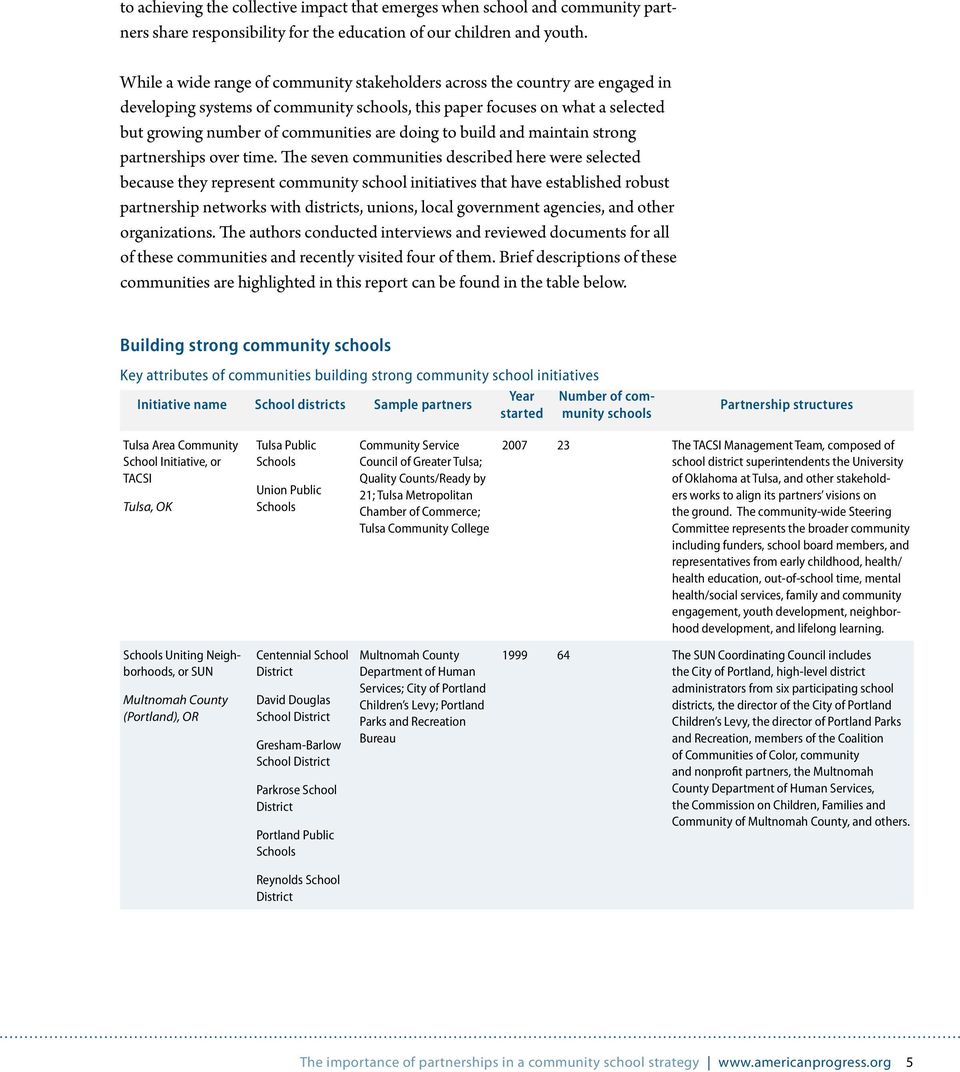
12 Initiative name School districts Sample partners Year started Number of community schools Partnership structures Chicago Public Schools Community Schools Initiative Chicago, IL Chicago Public Schools Federation of Community Schools; University of Illinois at Chicago; University of Chicago; local Neighborhood Councils * Budget cuts have reduced the number of schools directly funded by CPS. Partnerships remain strong at most of the original community schools Chicago Public Schools, or CPS, is the primary coordinating institution for community schools at the community level. CPS staff are responsible for professional development, funding, and selecting lead partners (along with school personnel). The Federation of Community Schools in Illinois advocates for community schools in Chicago and statewide. Evansville Community Schools Evansville, IN Evansville Vanderburgh School Corporation Evansville Teachers Association; Evansville Education Roundtable; Public Education Foundation; Department of Parks and Recreation; Southwest Indiana College Access Network (district-wide) The School-Community Council, also known as the Big Table, includes over 70 partners and engages school leaders and community partners. A smaller steering committee guides the ongoing work of the initiative. Oakland Full Service Community Schools Oakland, CA Oakland Unified School District County Public Health Department; SF Foundation; Bay Area Community Resources; Urban Strategies; City of Oakland, Bechtel Foundation; Safe Passages 2010 Plan to implement across the district A community leadership team is being formed to guide the Full Service Community Schools Initiative. Cincinnati Community Learning Centers, or CLCs Cincinnati, OH Cincinnati Public Schools Cincinnati Community Learning Center Institute; United Way; YMCA; Cincinnati Children s Hospital Medical Center; University of Cincinnati; City of Cincinnati Health Department; Project Grad; Adopt a Class (district-wide) The CLC Cross-Boundary Leadership Team consists of leaders representing partnership networks including afterschool, health, mental health, nature, college access, early childhood, tutoring, mentoring, parent engagement, and other types of collaboratives. It helps to organize services at each community learning center. CLCs select the partners from among these groups that best align with their needs. The CLC Funders Network includes the Cincinnati Public Schools, the Hallie Foundation and the Schiff Foundation, the United Way of Greater Cincinnati the Greater Cincinnati Foundation, and the Cincinnati Community Learning Center Institute. Say Yes to Education Syracuse, NY Syracuse City School District Community Folk Art Center; Syracuse Teachers Association; Onondaga County; Boys and Girls Clubs; 100 Black Men of Syracuse, Inc (district-wide) The Community Advisory Group is comprised of local, county, state, and federal leaders including the county executive, mayor, and school board president. The Operating Group is comprised of the school district, Syracuse University, Say Yes, union, city, and county leadership. Source: Coalition for Community Schools at the Institute for Educational Leadership 6 Center for American Progress Achieving Results Through Community School Partnerships

13 Organizing collaborative leadership structures The collective experience of these and other communities illuminates a basic strategy and set of institutional arrangements that can assist other localities to begin and expand community school initiatives. 7 The ongoing work of a scaled-up community school initiative takes place through the Collaborative Leadership Structure. This is where shared ownership takes root and where the initiative s vision and results are set. Figure 1 identifies common participants, including school districts and unions, and shows how leadership is shared across key functions. FIGURE 1 Collaborative leadership structure for community schools COMMUNITY-WIDE LEADERSHIP Key roles: vision, policy, resource alignment Public agencies and local government Philanthropies and businesses Unions School districts Higher education Nonprofit organizations Students, families and residents Community and faith-based agencies COMMUNICATION AND ALIGNMENT INTERMEDIARY LEADERSHIP Key roles: planning, coordination and management COMMUNICATION AND ALIGNMENT SCHOOL-SITE LEADERSHIP Key roles: planning and implementation Teachers and school staff Students, families and residents Lead agency Community partners Site coordinator Principal Unions KEY SYSTEM FUNCTIONS Results-based vision, data and evaluation, finance and resource development, alignment and integration, supportive policy, professional development and technical assistance, community engagement Source: Coalition for Community Schools at the Institute for Educational Leadership A communitywide leadership group develops a shared vision, builds a common policy framework, and aligns their resources. A similar entity at the school site, with strong parent and neighborhood participation, is responsible for planning, implementation, and continuous improvement. In most initiatives, a community The importance of partnerships in a community school strategy 7
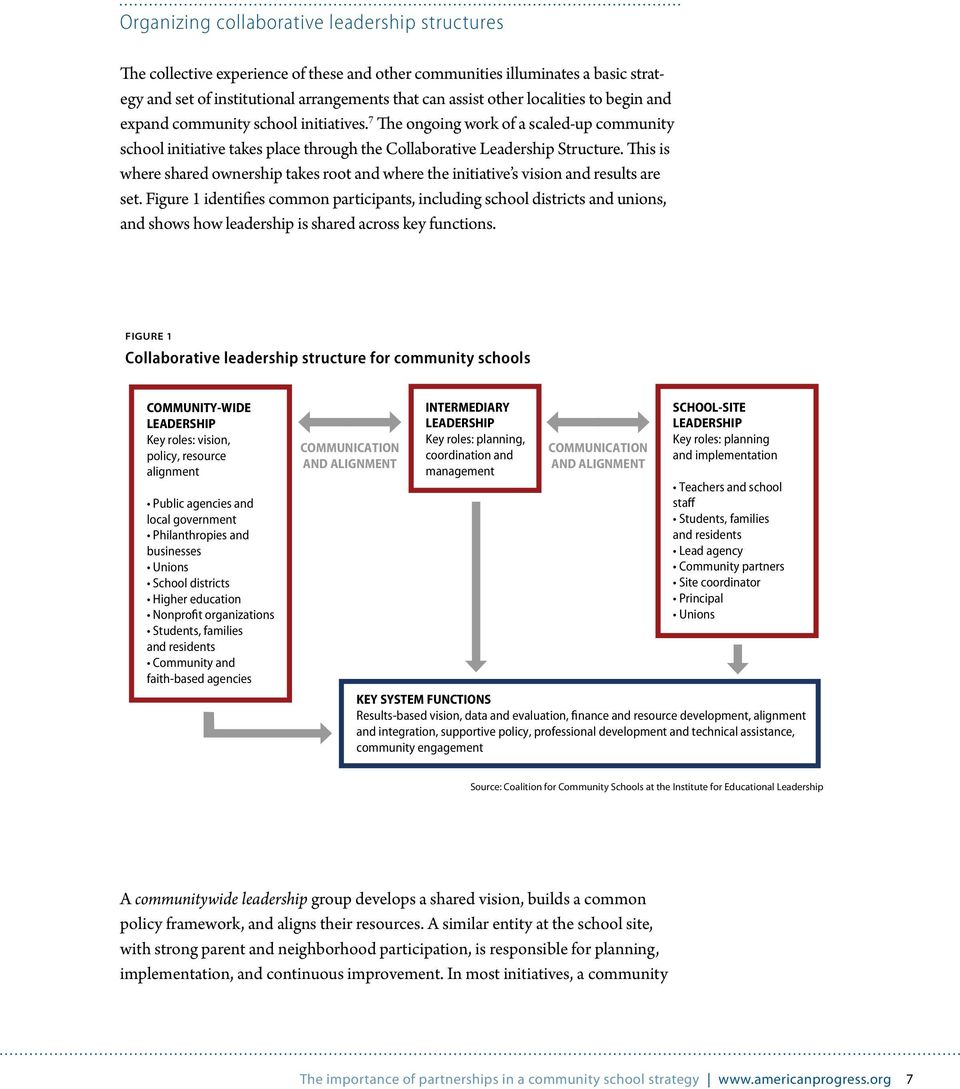
14 school resource coordinator manages day-to-day community school activities. An intermediary entity provides planning, coordination, and management, and ensures communication between communitywide and school-site leaders. Forming partnerships Collaboration matters greatly in school reform. Successfully implementing a community school strategy is impossible without the active involvement of school districts and their local partners. Research shows a positive correlation between average student academic achievement and superintendents who engage all relevant stakeholders including central-office staff, building-level administrators, and school board members in creating goal-oriented districts focused on teaching and learning. 8 School leaders involved in community schools recognize that all relevant stakeholders includes community partners. (see below box) Who are community school partners Community school partners can be any organization in the community that is concerned with the education of the community s children. They can be: Local government agencies such as the county health department Teachers unions Nonprofit organizations such as the local Boys and Girls Club Private agencies serving youth and families Community-based organizations Faith-based institutions such as churches, temples, and mosques Neighborhood groups Businesses in the community Civic organizations such as United Way Higher education institutions such as nearby universities or community colleges Partnerships may vary by community but they share a common purpose: to involve all stakeholders interested in improving academic achievement and social outcomes for children. The experience of local community initiatives suggests that collaboration between school districts and community partners are initiated by districts or by partner organizations. Either way the ultimate goal is collaboration toward a common vision and shared results. Districts and their union partners play an essential role in planning and implementing a communitywide strategy. Together, they also have the ability to dramatically scale up the number of community schools and students being served. Indeed, collective impact results from the organization of key stakeholders into communitywide leadership groups that have a shared vision, build a common policy framework, and align their resources. 8 Center for American Progress Achieving Results Through Community School Partnerships

15 Community partners can initiate relationships with districts Until recently most school districts have become involved in community school initiatives through efforts initiated by external stakeholders. Nonprofit organizations, government agencies, United Ways, philanthropies, and others often seek out school district involvement. They recognize the potential of reaching children through schools and the greater effectiveness of educational strategies that link academic and nonacademic competencies. One example is Tulsa, Oklahoma s Metropolitan Human Services Commission, a collaborative of community partners who realized in 2005 that their work in a variety of child abuse prevention, family support, and early childhood-development activities had limited effect. Members envisioned a more comprehensive approach, including a school-reform strategy that would start from birth and continue through entry into the workforce. The collaborative decided to make education a priority, and chose community schools as their reform strategy. At that point the superintendents from the Tulsa and Union school districts, which both serve the city of Tulsa, became actively involved in vetting reform strategies throughout their systems and in building ownership in what is now the Tulsa Area Community Schools Initiative, or TACSI. Staffed by the Community Service Council of Greater Tulsa, TACSI developed 23 community schools in the Union and Tulsa school districts, with eight schools preparing for implementation and two nearby districts in the initial phases of developing their own community schools initiatives. Both Union and Tulsa school districts are contributing Title I federal funds and other state and local school funds to TASCI schools and are fully invested in their success. As Union Public Schools superintendent Cathy Burden says, By partnering with outside agencies and opening ourselves up to understanding the needs of the whole child and his family and community, we become a more integral part of a child s life and can be more effective in the classroom. Another example is Schools Uniting Neighborhoods, or SUN, in Multnomah County, Oregon, which includes Portland. In 1998 local governments in Portland and Multnomah County were facing shrinking budgets, growing cultural and linguistic diversity, and a widening achievement gap in schools. To make matters worse they had no clear sense of where and how resources supporting school-age students and families were being used. The county, together with the city, approached six local school districts for a conversation about community schools. A consensus emerged among school, city, and county leaders to launch a The importance of partnerships in a community school strategy 9
16 coordinated community schools strategy as a way to respond to these concerns; target resources more effectively; and increase educational success and selfsufficiency for children, families, and communities. These initial partners decided that visibly co-locating community services in schools would counteract the isolation of schools and help residents appreciate the centrality of schools and their importance to the entire community. Schools Uniting Neighborhoods began in 1999 with eight schools with the county acting as an intermediary. The city and county reached out to school leaders and now representatives from six school districts serve on a communitywide Coordinating Council that includes city, county, and state leaders, as well as businesses and community organizations. Since 1999 the number of SUN schools has grown to 64 across six districts and the SUN Council has embraced the vision that all 150 county schools will become community schools. Another approach was taken in Chicago in the 1990s, when the Polk Brothers Foundation funded and implemented a community schools model at three Chicago schools that improved parental involvement, student outcomes, and school climate. Encouraged by those successes, corporate and philanthropic leaders realized that school-district involvement was essential for expanding this promising model. In 2001 these leaders invited the Chicago Public Schools system to join in a public-private partnership to scale up community schools by matching private dollars with city funds. Then city superintendent Arne Duncan agreed, and a goal was set to develop 100 community schools in five years. Chicago s Community Schools Initiative, or CSI housed within the city s public school system eventually met and exceeded that goal. By 2010 CSI had grown to 154 schools, each of which works in partnership with a lead community agency skilled in youth and adult programming to meet the specific needs of each school community. Due to severe budget constraints CPS now funds 102 community schools, though many of the initial schools are using other funds to remain community schools. Most recently, in 2007 the Say Yes to Education initiative started to work with partners in Syracuse, New York with the goal of increasing high school and college graduation rates for urban youth. Say Yes, a national nonprofit organization, mobilizes community resources to support early childhood education, out-ofschool time programming, mentoring, academic support, primary and mental health care, as well as other services. It convened a leadership group that included the school district, the local teachers union, Syracuse University, the city, and the 10 Center for American Progress Achieving Results Through Community School Partnerships

17 county, to share ownership of the initiative. The school district has made Say Yes the core of its strategy to improve outcomes for children. That s where the rubber meets the road, says Kevin Ahern, president of the Syracuse Teachers Association, who serves on this group You need to have decision-makers from all these places at the table. Speaking to the sustainability of the initiative under this collaborative structure, he adds, We ve managed to get this done [Say Yes] under two different mayors, two different superintendents, three different union presidents. That s the kind of commitment it takes. Districts initiate collaboration with community partners In other instances school districts have taken the first steps toward a community school vision. This is most likely to happen when school leaders personally experience the positive benefits that result from partnership efforts. As the number of community school initiatives grows, many more school leaders are learning firsthand how collaborative partnerships can help educators do their work and many more are taking steps to organize, coordinate, and institutionalize community school relationships in their own districts. In Evansville, Indiana, for example, a principal at a single elementary school in the Evansville Vanderburgh School District sought community support to better meet the economic, social, and learning needs of students and families at her school. In the early 1990s, building on a United Way afterschool initiative, principal Cathlin Gray set out to develop a more comprehensive vision of a full-service community school. With United Way s continuing aid, she eventually involved over 70 organizations at her Cedar Hall Elementary. Convinced by Cedar Hall s strong family involvement and community support, the district expanded the approach systemwide. A community school strategy is now a district priority, and is included in school-improvement plans and budgetary allocations, and implemented in all 38 Evansville Vanderburgh schools. It has lasted through four superintendents and has become part of the district s culture. When asked whether he would change strategies just one day after being hired, David Smith, the newest superintendent, said, The change is going to be we re not going to change. We re totally committed to early childhood, family, school, community partnerships. quite frankly, we can t solve or resolve [school] issues in isolation. It takes a community effort. The importance of partnerships in a community school strategy 11
![Speaking to the sustainability of the initiative under this collaborative structure, he adds, We ve managed to get this done [Say Yes] under two different mayors, two different superintendents, three](/docs-images/40/723843/images/page_17.jpg "different union presidents. That s the kind of commitment it takes.")
18 Similarly, a number of assets set the stage for a comprehensive community school strategy in the Oakland Unified School District in Oakland, California, including having many community agencies already working in schools and even an existing Department of Complementary Learning to coordinate their work. But it took the vision of new superintendent Tony Smith and his decade of experience implementing a community school approach in another school district to convincingly engage the community in a collective effort and plan for district-wide implementation. In 2010 the school board institutionalized a community school strategy as the central part of the district s reform agenda. While still in the early stages of its work, the Oakland Unified School District has buttressed its new school motto Community Schools, Thriving Students with staff and policies to support the new strategy. 12 Center for American Progress Achieving Results Through Community School Partnerships

19 Strategies for building and maintaining successful partnerships Collaborative leadership structures in community schools are designed to connect communitywide leaders including union leaders, superintendents, and other local stakeholders to school-site operations. But how can that be achieved? Individuals in the communities we interviewed shared six main strategies for building and continuing partnerships: Ensuring a common vision among all partners Establishing structured opportunities to engage stakeholders Encouraging open dialogue about challenges and solutions Engaging stakeholders in the use of data Creating central-office capacity to sustain community schools work Leveraging community resources and braiding funding streams Let s examine each of these strategies in turn. Ensure a common vision among all partners Partners must be invested in a common vision and set of expectations for community schools. This will help to sustain partnerships in the long run, enhance community school efficacy, and encourage each stakeholder to clearly define its role in meeting specific goals. District leaders, including superintendents and school boards, must work to ensure the initiative s results-based vision is aligned and integrated with the district s overall school improvement plan and other core guidance documents. Community partners must adapt their mission to align with the community school vision. Since 2006 district leaders from both Tulsa and Union public schools have worked with other key stakeholders on a Management Team to ensure the TACSI strategy aligns well with their school districts missions. These superintendents were visibly involved and encouraging of community school efforts, inviting their schools Strategies for building and maintaining successful partnerships 13
20 to become community schools as a vehicle for school reform. Significantly, in its Strategic Plan, Tulsa Public Schools has included the expansion of community schools as a strategic objective to meet its core goal of improving student achievement. 9 Evansville, Indiana, illustrates how school districts make community schools a part of their results-based vision. The district, after engaging the community in numerous listening sessions, developed a strategic plan around five core areas: Early childhood education Technology Professional development Innovative school models Family, school, and community partnerships As they write in their 2011 State of Our Schools report, The EVSC is committed to the Full-Service Community Schools strategy as a way to wrap supports around children to help them physically, mentally, and emotionally. The Center for Family, School, and Community Partnerships is primarily responsible for the last core area and aligns its strategies, including the community schools strategy, with the set of long- and short-term results laid out by the district in its strategic plan. When Superintendent Tony Smith came to Oakland, for example, he saw that existing partnership efforts were fragmented in a district struggling with the challenges of violence and poverty. He was determined to streamline these efforts so he worked closely with the school board to establish a plan for Oakland to become a full service community school district a district comprised entirely of community schools. The board initiated an eight-month fact-finding process with 14 taskforces and broad community participation. The Full Service Community Schools taskforce included representatives from the Oakland Community After School Alliance, East Bay Asian Youth Center, and the Oakland Unity Council, among others, and met weekly for over seven months. These taskforce members visited existing community school sites to understand implementation, consulted with key stakeholders, and held numerous community gatherings to hear local feedback on the idea of developing a districtwide community schools strategy. In the spring of 2011, the school board voted unanimously to move forward with this approach, and the Oakland United School District is now in the process of building up an effective system of community schools. 14 Center for American Progress Achieving Results Through Community School Partnerships

21 Establish formal relationships and collaborative structures to engage stakeholders A successful community school initiative depends on the active involvement of families, school boards, unions, local organizations, and state and local government agencies. Initiating and sustaining involvement often requires creating structured, collaborative opportunities ranging from developing taskforces to creating or modifying formal agreements. The school districts and surrounding communities we researched for this report took a variety of steps in pursuit of these goals. Cincinnati s superintendent, school board president, and union president embraced a slightly different approach. They worked together to maximize the impact of their community learning centers, which have become part of the district s culture. Each school is home to a Local School Decision-Making Committee comprised of school staff, partners, and community members. The committee identifies school needs in specific areas health, mental health, after school, the arts and others and works with networks of providers to coordinate services requested by schools so that appropriate resources are distributed as efficiently as possible. The networks of community partners come together in a Cross-Boundary Leadership Team to integrate these efforts. In Syracuse the school district committed to a six-year sustainable plan and agreed to serve on leadership and operating groups that would engage numerous community partners. The president of the Syracuse Teachers Association is an active member of the operating group. These groups meet regularly to review data, have frank discussions about progress, and make decisions about implementation. They are designed as stable leadership structures to guide the community schools initiative as it transitions from being funded primarily through philanthropy to being funded primarily by community partners. Schools Uniting Neighborhoods in Portland, Oregon, and nearby Multnomah County worked with districts to create intergovernmental agreements that create policies governing the work in community schools under a number of areas including building use, alignment with instruction, the school s improvement plan, and partnerships. The agreement requires the district to provide partners with rent-free access to school sites, and requires all partners to align their activities with existing services and school improvement plans. It further stipulates that each SUN Community Schools Site Manager will act as coordinator for collaboration and integration of all extended-day activities and partners within a school Strategies for building and maintaining successful partnerships 15
22 building and requires that other agencies link with the SUN community schools site manager. 10 The superintendent and relevant city and county leadership sign each agreement. Encourage open dialogue about challenges and solutions Shared ownership is critical for sustaining community school work. While schools are primarily held responsible for ensuring that every child is well-educated and prepared for productive adulthood, districts know they must engage constructively with other stakeholders to achieve better outcomes. Successfully sharing ownership among multiple partners requires collective trust and the ability to discuss issues openly in order to find solutions. Leadership structures with top-down and bottomup communication flow make it possible for stakeholders to push back and negotiate to meet both community and district goals. Again, the subjects of our research built on their foundation of trust to find creative solutions to emerging tensions. The Tulsa Public Schools, one of two districts involved with the Tulsa Area Community Schools Initiative, or TASCI, planned to hire additional school-site resource coordinators through the district with Title I funds and hire a director for community schools. Since coordinators worked directly for TASCI up until this point, there were questions about how the districts would select new coordinators, what their job description would be, and how they would be supervised. TACSI staff brought their concerns to both the superintendent and school board. Frank discussion ensued, resulting in TASCI staff receiving assurances that schoolsite coordinators hired by schools would continue to work in line with TACSI goals, be supervised by TACSI and be part of the TACSI coordinators network. The district, as it always has, continues to sit on the TACSI management team and share responsibility for setting direction for the initiative. A community school strategy also creates a space for union representatives, partners, and the district to discuss priorities and ensure that the strategies being used aren t top down and lacking in teacher input, but rather are the best ideas of all partners and are sustainable. Gambill makes sure that teachers have an opportunity to give input in community decision-making. He says of these efforts: We have great community partners but what we ve found at times is that a partner outside of the school may believe that item A is a problem and if they define that and it really isn t, then they have invested in developing a program 16 Center for American Progress Achieving Results Through Community School Partnerships
23 for a problem that doesn t exist. And that s where that connection to the voice of teachers is: Here are some places where we re struggling, and what can you provide as a community partner to assist in it? Highly involved community partners in Evansville s 70-member School- Community Council have welcomed the school district s increasing efforts to institutionalize a full-service community school agenda and have pushed back when they saw the need. When a superintendent transition was about to occur, community partners voiced concerns about having a new school superintendent who would be supportive of the work. Their efforts led to the hiring of a superintendent who was a strong advocate for community schools. These partners consistently communicated with the new superintendent about sharing responsibilities and roles, and are now in the middle of assessing the responsibilities of the School Community Council and creating a steering committee to more robustly guide the initiative. Engage partners in the use of data Generating targeted and useful data on community school initiatives can be challenging but necessary for measuring student, school, and family outcomes. School districts we researched work with a range of partners to design data collection and analysis strategies and make data more accessible to educators. Sharing data enables all stakeholders to understand where things stand at various points, and helps them hold each other and themselves accountable for making measurable progress on outcomes. In some circumstances external partners can bring a wealth of data expertise that can help schools evaluate partnerships and activities based on goals for achievement, attendance, behavior and more. Cincinnati Public Schools and its data partners, Microsoft Corp. and Proctor & Gamble, are in the process of designing a Learning Partners Dashboard a database that will connect the district s data system with partners data systems to generate information in four goal areas: Academic Parent involvement Community engagement Wellness Strategies for building and maintaining successful partnerships 17
24 The system will be updated nightly with district academic, behavioral, and attendance data and linked to data on student participation in community-partner programs. Reports generated from this data-collection system will show student-risk factors, service-utilization rates, and connect activities and partnerships to student achievement. CPS actively involves Proctor & Gamble and Microsoft in school visits so that their data experts can help resource coordinators and educators use the data system in the most effective ways. According to superintendent Mary Ronan, this links back to sustainability and funding because if we can show impact, then we can go ask for additional dollars because we can say that this model is working. In Portland and Multnomah County, community school and district leaders sat down to discuss and agree upon a common set of measures that they could report on as a function of students participating in SUN Community School activities. These included standardized test scores, attendance, credits earned, and others. They wrote data-sharing agreements signed by partners. Annually, Multnomah County extracts from its database, ServicePoint, the relevant demographic and participation data for students participating in SUN Community School activities, and sends it to the school districts, who then match it and send back the corresponding academic data. This early agreement and process provided the foundation for SUN to collaborate on other data related issues such as chronic absenteeism. When SUN analyzed attendance data they found that early chronic absenteeism was rife in both early childhood and elementary settings. Consequently, leaders in all six participating districts worked with SUN and other partners in the community to address the problem. In other cases collaboration with outside partners can steer community school leadership toward a stronger focus on data and results. In Tulsa staff from TASCI worked with an external evaluator to answer questions about the development of their community schools as well as their impact. Initially, TACSI staff were interested in implementation fidelity and thus used findings from the first study to redesign their training for implementers at the school level. The findings then prompted them to examine the impact of community schools and they found that community schools implementing their strategy with high fidelity significantly outperform noncommunity schools on measures of reading (+19 points) and math (+32 points). 11 Reflecting on these results, Tulsa superintendent Keith Ballard said, We now have research that proves that community schools work. The very schools that 18 Center for American Progress Achieving Results Through Community School Partnerships
25 have the most success, that have brought children to achievement levels above and beyond what other schools have done, are the community schools. You have to meet the needs of the whole child. Create and empower central-office capacity at the district level to sustain community school work Creating a sustainable community school initiative requires continued capacity within a district s central office to coordinate community school work. One way to ensure this capacity is through creating a high-level management position within a district s central office; a senior official dedicated to community school work would ensure that community school principles are embedded in practice and policy, as well as in strategic-planning documents. Another way could be through combining existing resources to create an office dedicated to supporting a community school agenda. The school districts and communities we researched took both approaches. In 2002 then-superintendent Bart McCandless elevated the status of community schools in the Evansville Vanderburgh Unified School District to a new level by creating a position to address community school issues, and naming Cathlin Gray, a community school leader, to the position. In 2007 new superintendent Vince Bertram acknowledged the increasingly central position of a community school strategy within the district by appointing Gray to be the associate superintendent for families, schools and community partners. Gray now sits on the district s leadership team and her team assumes responsibility for all school-financed health and social services, early childhood programs, after school programs and related activities, and the coordination of federal, state, and other monies. This organizational shift bundled together the funding and coordination of school-managed resources, allowing the school district to use its funds strategically to coordinate with community partners. Rather than adding a new office, Oakland school district leaders decided to merge two existing offices that worked on issues related to their community schools strategy and create a stronger, more cohesive office. The purpose of this new Department of Family, Schools, and Community Partnerships, led by a new associate superintendent, is to align resources so that partnerships better meet the needs of children and families and advance the district s five-year plan to improve outcomes. Strategies for building and maintaining successful partnerships 19
26 Creating internal district capacity to support community schools was central to then-ceo Arne Duncan s plan for making every Chicago Public School a community school. He created the Office of Afterschool and Community School Programs to pull together disparate afterschool programs under a comprehensive Community Schools Initiative. After Duncan left Chicago to become the U.S. Secretary of Education, the district reorganized, but the community school strategy remained intact because the Community School Programs Manager and associated staff stayed on to carry on the work of the initiative and provide a stable point of contact for their partners. 12 Leveraging community resources and braiding funding streams Community schools garner financing and programmatic support from multiple sources. On average only about one-quarter of all resources in community school initiatives come from school districts. The remainder is leveraged from other sectors including local, state, and federal funding streams; foundations; and a mix of public agencies and community-based organizations a 3-to-1 ratio in support of school success. School districts commonly provide space and cover maintenance and overhead costs at no cost to community partners, while community partners provide needed services, staff, and capacity through their own funding sources. Community schools and their partners also braid multiple funding streams to support their common vision. Title I funds as well as various private sources are often used to hire resource coordinators at individual school sites. Competitive grant funding from all levels of government provides important flexibility in meeting school site costs such as startup costs for a health clinic or expanding learning opportunities. Local foundations, local government, and others support the work of the intermediary and other community partners. Community schools use these and other funding sources to focus on sustainability and growth. Evansville s early decision to install a community school leader as associate superintendent for Family, School, and Community Partnerships provided an opportunity to begin coordinating and strategically deploying a raft of school resources. Rather than looking for funds to support specific programs, Evansville demonstrates how partnering with the federal government can yield a variety of 20 Center for American Progress Achieving Results Through Community School Partnerships
27 revenue streams that can be blended to advance a comprehensive community school strategy. The district was able to obtain formula and discretionary federal funds from the following sources: Title I School Improvement Grants 1003 G School Improvement IDEA; Title II Professional Development Title III English Language Learner Title IV Safe and Drug Free Even Start and Head Start Centers for Disease Control 21st Century Community Learning Centers Carol M. White Physical Education Grant Grant to Reduce Alcohol Abuse Safe School/Healthy Students McKinney Vento Homeless Grant Full-Service Community Schools Grant Other local, state, and philanthropic sources that support key partnerships. Taking a different approach, organizations participating in Cincinnati s partnership networks redirect existing resources to provide services at Community Learning Centers. Agencies and organizations in the partnership networks assume the responsibility for financial sustainability including third party billing where appropriate. For instance, a partnering organization that works on mental health issues can bill Medicaid for mental health services that students and families receive. The school district directly funds a Director of Community Schools to oversee district-wide implementation and uses Title 1 monies to underwrite the costs of resource coordinators at approximately 31 schools. The Greater Cincinnati United Way, the Greater Cincinnati Community Foundation, the Community Learning Centers Institute, and other private donors pay for school site coordinators at the additional schools. The initiative is exploring expanded financing strategies to provide a coordinator at every school and to ensure the initiative s continuing growth and development. Julie Sellers, president of the Cincinnati Federation of Teachers, describes the advantages of coordinators saying, I think it is beneficial for the students and it gives the support to teachers so that they can focus on instruction. I wish we had one in every school. Strategies for building and maintaining successful partnerships 21
28 Syracuse s Say Yes initiative was intentionally started with sustainability in mind. The district s commitment to the initiative required it to take on an increasing share of the overall budget for the work, increasing nearly 10 percent each year till it is fully responsible for funding within six years. The district and union have had fiscal audits and made the changes necessary to organize the district and workforce to do the work required to improve results. This included changing staffing ratios and patterns in schools. City and county funds are also being retooled to align with the Say Yes strategy and nonprofit are redirecting resources as well. 22 Center for American Progress Achieving Results Through Community School Partnerships
29 Recommendations for local stakeholders Nearly every school district has partners in its schools. But most do not have a coherent framework and strategy that lays out how the district and its community partners will work together to support student success. The recently issued guide from the Coalition for Community Schools, Scaling up School and Community Partnerships: The Community Schools Strategy, lays out a detailed plan of action that local stakeholders can take. Here are a few recommendations for getting started: Reach out. Talk with each other, with principals and teachers, with families, and with key leaders whom you know are involved with schools and concerned about young people and your community. Look at the data. Review data on school and nonschool factors that influence student achievement. Attendance, chronic absence, suspension, truancy, parent involvement, health, and other indicators should be examined and discussed. Learn from other schools. Arrange to visit a nearby community schools initiative with a strong record of success. Nothing can substitute for seeing the energy, focus, and commitment of educators and community partners in an effective community school. Review existing partnerships. Awareness of existing school and community partnerships can lead to a more coordinated strategy. Look closely at a few examples of strong partnerships and see what you can learn from them. Get started. Together, school and community leaders should craft an initial plan to approach key challenges that must be addressed to improve educational life outcomes for students. Recommendations for local stakeholders 23
30 About the authors Martin J. Blank is the president of the Institute for Educational Leadership in Washington, D.C. Marty also serves as the director of the Coalition for Community Schools, which is staffed by IEL. Marty is the co-author of Making the Difference: Research and Practice in Community Schools and Together We Can: A Guide for Crafting a Pro-family System of Education and Human Services. He has a B.A. from Columbia University, a J.D. from Georgetown University Law Center, and served as a VISTA Volunteer in the Missouri Bootheel. Reuben Jacobson serves as the senior associate for research and strategy for the Coalition for Community Schools at IEL. He develops and implements the Coalition s research agenda, communicates research findings to the field, and works on overall strategy. Reuben has also worked at the American Institutes for Research and taught in D.C. Public Schools. Reuben has a B.A. from the University of Wisconsin, a master s in education policy from the George Washington University, a master of arts in teaching from American University, and is currently pursuing his Ph.D. in education policy at the University of Maryland. Atelia Melaville is an independent consultant living in Annapolis, MD. She has contributed to numerous Coalition for Community Schools publications, including the recent guide: Scaling up School and Community Partnerships: The Community Schools Strategy. 24 Center for American Progress Achieving Results Through Community School Partnerships
31 Acknowledgements The authors thank the Coalition s funders including the Annie E. Casey Foundation, Charles Stewart Mott Foundation, JPMorgan Chase Foundation, Stuart Foundation, the W.K. Kellogg Foundation, and an anonymous donor. They would also like to thank all the community school leaders around the country who are working tirelessly to improve the lives for children and their families. Specifically, they thank those individuals who were interviewed for this report: Superintendent Cathy Burden, Union Public Schools; Superintendent Keith Ballard, Tulsa Public Schools; Jan Creveling, Tulsa Area Community School Initiative; Peggy Samolinski and Diana Hall, Schools Uniting Neighborhoods in the Multnomah County Department of Health Services; Adeline Ray, Chicago Public Schools; Superintendent David Smith and Cathlin Gray, Evansville Vanderburgh School Corporation; Keith Gambill, Evansville Teachers Association; Superintendent Tony Smith, Curtiss Sarikey, and Andrea Bustamante, Oakland Unified School District; Superintendent Mary Ronan, Cincinnati Public Schools; Darlene Kamine, Community Learning Center Institute; Julie Sellers, Cincinnati Federation of Teachers; Gene Chasin, Say Yes to Education; Keith Ahern; Syracuse Teachers Association; and Tony Majors, Metro Nashville Public Schools, and Joan Devlin, American Federation of Teachers. The Center for American Progress thanks the JPMorgan Chase Foundation for generously providing support for this paper. Acknowledgements 25
32 Endnotes 1 Heather Boushey and others, Hardships in America: The Real Story of Working Families (Washington: Economic Policy Institute, 2001), available at 2 C.M. Adams, The Community School Effect: Evidence from an Evaluation of the Tulsa Area Community School Initiative (Tulsa, Oklahoma: The Oklahoma Center for Educational Policy: University of Oklahoma, 2010). 3 ICF Consulting, Communities in Schools National Evaluation: Five Year Executive Summary (2010). 4 Results, available at School Year Report Card, available at Cincinnati Public Schools, Cincinnati Public Schools Again Rated Effective By State, Press release, August 17, 2011, available at 6 Blank, M, Jacobson, R, Melaville, A, and Pearson, S, Financing Community Schools: Leveraging Resources To Support Student Success (Washington: Coalition for Community Schools, Institute for Educational Leadership, 2010). 7 For more detail about the experiences of local communities see the Coalition s interactive guide, Scaling Up School and Community Partnerships: The Community Schools Strategy, at The guide includes a six-stage process for implementing a community school strategy and a benchmark chart that districts and partners can use to track their progress. 8 J. Timothy Waters and Robert J. Marzano, School District Leadership that Works: The Effect of Superintendent Leadership on Student Achievement. Working Paper (Mid-continent Research for Education and Learning, 2006). 9 Tulsa Public Schools, Tulsa Public Schools: Strategic Plan, See, for example: Intergovernmental Agreement between the David Douglas School District, Multnomah County and City of Portland, available at 11 Adams, The Community School Effect. 12 The Chicago Community Schools Initiative now sits in the district s Office of Student Support and Engagement in the Office of Pathways to College and Career. 26 Center for American Progress Achieving Results Through Community School Partnerships
33
34
35
36 The Center for American Progress is a nonpartisan research and educational institute dedicated to promoting a strong, just, and free America that ensures opportunity for all. We believe that Americans are bound together by a common commitment to these values and we aspire to ensure that our national policies reflect these values. We work to find progressive and pragmatic solutions to significant domestic and international problems and develop policy proposals that foster a government that is of the people, by the people, and for the people H Street, NW, 10th Floor, Washington, DC Tel: Fax:
Schools Uniting Neighborhoods: Community Schools Anchoring Local Change
 Schools Uniting Neighborhoods: Community Schools Anchoring Local Change By Diana Hall, Multnomah County Across the United States, communities are thinking differently about the challenges they face to
Great Public Schools for Every Student. Wraparound Services
 Great Public Schools for Every Student An NEA Policy Brief Wraparound Services Teachers and support professionals know that students need to come to school ready and able to learn. Students who have good
UNLOCKING OPPORTUNITIES: SERVICES THAT HELP POOR CHILDREN SUCCEED IN THE CLASSROOM
 1 UNLOCKING OPPORTUNITIES: SERVICES THAT HELP POOR CHILDREN SUCCEED IN THE CLASSROOM Part 7: Schools As Community Hubs for Students and Families By Soumya Bhat and Jenny Reed Elementary and secondary schools
Denver Thrives. When Our Youth Succeed. Afterschool is making a difference in the lives of Denver s youth
 Denver Thrives When Our Youth Succeed Afterschool is making a difference in the lives of Denver s youth Who We Are We are a diverse collaborative of stakeholders including the City and County of Denver,
2007-2013 960 Main Street, 8th Floor Hartford, CT 06103 (860) 695-8710 [email protected]
 The Coalition is proud to recognize the amazing work being done at Hartford Community Schools. It is one of two communities in the country winning national recognition from our organization this year.
READY KIDS DENVER Ready Kids, Ready Families, Ready Communities Initiative A Proposal for Educational Achievement and Workforce Excellence
 READY KIDS DENVER Ready Kids, Ready Families, Ready Communities Initiative A Proposal for Educational Achievement and Workforce Excellence With elections in May for a new Mayor and all thirteen City Council
DRAFT FOR PUBLIC REVIEW
 DRAFT FOR PUBLIC REVIEW Portland Plan Phase III: Education Strategy www.pdxplan.com What are the goals of this strategy? Improve student success through community-wide collaborative efforts, address the
Strengthening Partnerships: Community School Assessment Checklist
 Strengthening Partnerships: Community School Assessment Checklist STRENGTHENING PARTNERSHIPS: COMMUNITY SCHOOL ASSESSMENT CHECKLIST In many communities, partnerships between schools and other community
2015 Award for Excellence Winner
 2015 Award for Excellence Winner Family League of Baltimore Baltimore, MD Family League of Baltimore, in partnership with Baltimore City Public Schools and the Mayor and City Council, currently has 45
Guide to Building A Broad-Based Coalition
 Guide to Building A Broad-Based Coalition Supporting the Development and Sustainability of a System of Pathways DISTRICT FRAMEWORK TOOL 1.1.3 As communities across California commit to developing systems
Setting the Standard for Evaluation and Data-Informed Decision Making
 Elev8 Chicago: Demonstrating the Power and Potential of Community Schools Communities across the country are grappling with the challenge of preparing young people for a bright future, in an era of extremely
100-Day Plan. A Report for the Boston School Committee By Dr. Tommy Chang, Superintendent of Schools. July 15
 July 15 2015 100-Day Plan A Report for the Boston School Committee By Dr. Tommy Chang, Superintendent of Schools Boston Public Schools, 2300 Washington Street, Boston, MA 02119 About this plan Over the
Full-service community schools: A strategy not a program
 Community schools are one solution to the fact that schools can t do it alone. Today s youth need comprehensive, coordinated support services provided in schools through partnerships. 1 Full-service community
BLOCKS BUILDING. Reuben Jacobson Linda Jacobson Martin J. Blank
 BUILDING BLOCKS An Examination of the Collaborative Approach Community Schools Are Using To Bolster Early Childhood Development Reuben Jacobson Linda Jacobson Martin J. Blank Because Every Child Deserves
Projects Reviewed. Neighborhood
 !"# $# "$"%&"$ '( )"* %+,,- The notion that children cannot achieve academic excellence without good health, a supportive social circle, and a safe environment seems common sense to families and educational
CONVERSION FOUNDATIONS: DEFINING MISSION AND STRUCTURE
 When a nonprofit health care corporation becomes a for-profit corporation through conversion, merger or acquisition, most state laws require that the full value of the nonprofit be preserved for public
AchieveMpls Strategic Plan FY 2014 FY 2016
 AchieveMpls Strategic Plan FY 2014 FY 2016 Approved unanimously by the AchieveMpls Board of Directors September 12, 2013 I. Mission As the strategic nonprofit partner of the Minneapolis Public Schools,
Kathryn Baron Contributing writer, Education Week. Follow Kathryn on Twitter: @TchersPet
 Kathryn Baron Contributing writer, Education Week Follow Kathryn on Twitter: @TchersPet Partners in Time: Building School-Community Models Expert Presenters: Martin J. Blank, president, Institute for Educational
An Assessment of Capacity Building in Washington State
 An Assessment of Capacity Building in Washington State The Nonprofit Ecosystem Framework Executive Summary prepared by The Giving Practice A consulting service of Philanthropy Northwest February 2012 About
Sustaining the Race to the Top Reforms
 Sustaining the Race to the Top Reforms Race to the Top (RTTT) presents states with a unique opportunity to accelerate their efforts to graduate all high school students prepared for college, careers and
M D R w w w. s c h o o l d a t a. c o m 8 0 0-3 3 3-8 8 0 2
 MDR s Guide to Federally Funded Education Programs Major federal programs in the Education Budget for Fiscal Year 2011 are listed below. Twenty-three programs were eliminated from the FY2011 budget, including
2014/15 Strategic Update for the Community
 An update to last year s Unparalleled Altitude To realize our goal of being a world-class district, we have several years of climbing to complete. This update is the climb for the 2014/15 school year.
Campus Network Planning and Technical Assistance Overview
 Campus Network Planning and Technical Assistance Overview WHAT IS THE PURPOSE OF A NETWORK? Networks are part of the California College Pathways (CCP) Initiative s strategy to expand college and career
School-Based Health Centers 101. First Steps in Planning a School Health Center
 School-Based Health Centers 101 First Steps in Planning a School Health Center About Us We are the statewide nonprofit organization helping to put more health services in schools. Our mission is to improve
Superintendent Effectiveness Rubric*
 Public Document 3 Purpose: Outlines the standards that are the foundation for the evaluation. Name of Superintendent: Date: Performance Rating Scale: Distinguished (4) Accomplished (3) standards for most
PAINTER EXECUTIVE SEARCH
 PAINTER EXECUTIVE SEARCH Position Description Painter Executive Search is supporting the in a search for an experienced to lead a broad regional coalition of Bay Area land conservation agencies and organizations
1. Title IV, Part B: 21 st Century Community Learning Centers [Goals 1, 2 and 5]
![1. Title IV, Part B: 21 st Century Community Learning Centers [Goals 1, 2 and 5]](/thumbs/29/13867157.jpg "1. Title IV, Part B: 21 st Century Community Learning Centers [Goals 1, 2 and 5]") 1. Title IV, Part B: 21 st Century Community Learning Centers [Goals 1, 2 and 5] Identify the percentage of students participating in 21 st Century Community Learning Centers who meet or exceed the proficient
1. Title IV, Part B: 21 st Century Community Learning Centers [Goals 1, 2 and 5] Identify the percentage of students participating in 21 st Century Community Learning Centers who meet or exceed the proficient
Generation Next Leadership Council SPECIAL SESSION
 Generation Next Leadership Council SPECIAL SESSION AGENDA June 11, 2014 9:00 9:45am Minneapolis Public Schools 1250 W. Broadway, Minneapolis Assembly Room S1-404, 1st Floor 9:00 AM Introduction R.T. Rybak
Quality Schools Working Group Purpose Statement and Workplan
 Quality Schools Working Group Purpose Statement and Workplan June 2014 Draft 4.1 Overview The Quality Schools Working Group is about unifying and unleashing the power of the Oakland community to transform
Financing Community Schools
 Financing Community Schools LEVERAGING RESOURCES TO SUPPORT STUDENT SUCCESS Martin J. Blank Reuben Jacobson Atelia Melaville Sarah S. Pearson November 2010 Because Every Child Deserves Every Chance WITH
DRAFT. Denver Plan 2014. Every Child Succeeds
 Denver Plan 2014 Every Child Succeeds 100 80 Introduction Every child takes that first step into their first day of school with butterflies and talent, potential and dreams. It s the day that the door
About the Finalist. Cumberland County Schools North Carolina DISTRICT PROFILE
 About the Finalist Cumberland County Schools North Carolina DISTRICT PROFILE Superintendent Dr. Frank Till became superintendent in June 2009, after leading the Boys & Girls Clubs in Broward County, Fla.,
Friends of School Health
 Friends of School Health Testimony Expanding Funding for CDC School Health Programs Statement of Sharon Murray, MHSE, CHES Executive Director, Society of State Directors of Health, Physical Education and
OPEN SOCIETY INSTITUTE BALTIMORE 201 North Charles Street, Suite 1300, Baltimore, MD 21201, (401) 234-1091 www.soros.org/initiatives/baltimore
 OPEN SOCIETY INSTITUTE BALTIMORE 201 North Charles Street, Suite 1300, Baltimore, MD 21201, (401) 234-1091 www.soros.org/initiatives/baltimore SUMMARY The Open Society Institute (OSI), a private operating
Arts Abstract 2012-2015: The Chicago Public Schools Arts Education Plan. Bringing the Arts to Every Child in Every School
 Arts Abstract 2012-2015: The Chicago Public Schools Arts Education Plan Bringing the Arts to Every Child in Every School The CPS Arts Education Plan Today marks the beginning of an important new era in
LOUISVILLE S BLUEPRINT
 PHASE ONE: MOVING LOUISVILLE TO ACTION ANTHONY D. SMITH GREG FISCHER Our Blueprint is dedicated to the late Dr. J. Blaine Hudson, who helped lead this work. Dr. Hudson committed his life to scholarship
Core Qualities For Successful Early Childhood Education Programs. Overview
 Core Qualities For Successful Early Childhood Education Programs Overview The National Council of La Raza (NCLR) the largest national Hispanic civil rights and advocacy organization in the United States
Gwinnett County Public Schools, Ga.
 , Ga. District Profile*: Rank among U.S. school districts (by size): 14 Number of schools: 123 Number of students: 159,298 Number of teachers: 11,000 Per pupil expenditures**: $8,859 Superintendent: J.
Early Childhood Education Draft Board Resolution
 SAMPLE RESOLUTION Early Childhood Education Draft Board Resolution How To Use This Resolution California s new school funding law, (the Local Control Funding Formula or LCFF) provides an opportunity for
The Federation for Community Schools
 The Federation for Community Schools Community School Transformation: A Guide for Schools, Districts, Parents, and Community Members Working Together to Improve Outcomes for Students, Families and Communities,
DC COMMISSION ON EARLY CHILDHOOD TEACHER COMPENSATION
 DC COMMISSION ON EARLY CHILDHOOD TEACHER COMPENSATION Pursuant to the Pre- K Clarification and Acceleration Emergency Act of 2010, Bill 18-605, the University of the District of Columbia convened the DC
Masters Comprehensive Exam and Rubric (Rev. July 17, 2014)
 1 Educational Leadership & Policy Studies Masters Comprehensive Exam and Rubric (Rev. July 17, 2014) The comprehensive exam is intended as a final assessment of a student s ability to integrate important
What is Quality Schools Development? Why are we doing this?
 What is Quality Schools Development? Why are we doing this? All students deserve quality schools in their neighborhoods that help them thrive academically, socially, and emotionally. Right now, several
Job Title: Executive Director of Organizational and Professional Learning
 Equal Opportunity Employer Job Description Job Title: Executive Director of Organizational and Professional Learning Reports to: Chief Academic Officer Department: Teaching and Learning Number of Days:
Program Quality Self-Assessment (QSA) Tool Planning for Ongoing Program Improvement
 (QSA) Tool Planning for Ongoing Program ment CBO/District: After-school site: Program director: Assessment period: From To Working to ensure that all of New York State s children and youth have access
2010-11. San Francisco Afterschool for All Initiative
 San Francisco Afterschool for All Initiative 2010-11 Afterschool for All Vision: All children, youth and parents in San Francisco have a range of quality out of school time program choices. Produced by
Washington State School for the Blind Superintendent Location: Vancouver, Washington Recruitment Announcement
 Washington State School for the Blind Superintendent Location: Vancouver, Washington Recruitment Announcement ABOUT THE AGENCY The primary purpose of the State School for the Blind (WSSB) is to educate
What School Leaders Can Do To Increase. Arts Education
 What School Leaders Can Do To Increase Arts Education Strategies School Leaders Can Use to Increase Arts Education A. Establish a School-Wide Commitment to Arts Learning 1. Articulate clear goals 2. Identify
Logic Model for ECCS Program: The Oklahoma Early Childhood Comprehensive Systems (ECCS) Statewide Plan/Smart Start Oklahoma INTERVENTION
 GRANTEE/ PROJECT CHARACTERISTICS (i.e., goals and description of the project, environment, description of population/case load and partner organizations): TOTAL FUNDS REQUESTED: (for the first year of
Crosswalk of the New Colorado Principal Standards (proposed by State Council on Educator Effectiveness) with the
 Crosswalk of the New Colorado Principal Standards (proposed by State Council on Educator Effectiveness) with the Equivalent in the Performance Based Principal Licensure Standards (current principal standards)
Philadelphia, Pennsylvania (Project U-Turn Campaign) Action Plan to Help More of its Young People Graduate High School, Ready for College, Work & Life
 ACTION PLANNING WORKSHEET Philadelphia, Pennsylvania (Project U-Turn Campaign) Action Plan to Help More of its Young People Graduate High School, Ready for College, Work & Life Name of Summit State or
Framework and Guidelines for Principal Preparation Programs
 THE FRAMEWORK FOR PRINCIPAL PREPARATION PROGRAM GUIDELINES PENNSYLVANIA DEPARTMENT OF EDUCATION 1 Purpose Of all the educational research conducted over the last 30 years in the search to improve student
Oakland Museum of California: Strategic Plan 2014-2019 Inspiring California s Future. Context
 Oakland Museum of California: Strategic Plan 2014-2019 Inspiring California s Future Context 2019 will mark the 50 th anniversary of the founding of the Oakland Museum of California. It is a particularly
Best Practice: Youth After-School Programming
 Best Practice: Youth After-School Programming This report is publicly available on the NYC Global Partners Innovation Exchange website: www.nyc.gov/globalpartners/innovationexchange REPORT UPDATED :AUGUST
Bill Horn SUPERVISOR, FIFTH DISTRICT SAN DIEGO COUNTY BOARD OF SUPERVISORS
 DATE: March 11, 2003 Bill Horn SUPERVISOR, FIFTH DISTRICT SAN DIEGO COUNTY BOARD OF SUPERVISORS AGENDA ITEM TO: SUBJECT: Board of Supervisors SUMMARY: Overview In 1998, the County of San Diego, Health
Section Three: Ohio Standards for Principals
 Section Three: Ohio Standards for Principals 1 Principals help create a shared vision and clear goals for their schools and ensure continuous progress toward achieving the goals. Principals lead the process
Los Angeles YouthSource Centers
 Los Angeles YouthSource Centers Contents Collaboration Overview... 1 Collaboration Purpose... 2 About the Collaboration... 2 Collaboration Structure... 3 Promising Practices... 4 Lessons Learned... 6 Accomplishments...
Wyman s National Network: Bringing Evidence-Based Practice to Scale. COA Innovative Practices Award Case Study Submission. Emily Black.
 Running Head: WYMAN S NATIONAL NETWORK Wyman s National Network: Bringing Evidence-Based Practice to Scale COA Innovative Practices Award Case Study Submission Emily Black Wyman Center Abstract Wyman Center
Scaling Up School and Community Partnerships
 Scaling Up School and Community Partnerships The Community Schools Strategy Atelia Melaville Reuben Jacobson Martin J. Blank September 2011 Prepared with the generous support of the Stuart Foundation September
ED478098 2003-06-00 After-School and Community Technology Education Programs for Low-Income Families. ERIC Digest.
 ED478098 2003-06-00 After-School and Community Technology Education Programs for Low-Income Families. ERIC Digest. ERIC Development Team Table of Contents If you're viewing this document online, you can
Adopted March 2010 ESEA REAUTHORIZATION PRINCIPLES AND RECOMMENDATIONS. A Policy Statement of the Council of Chief State School Officers
 Adopted March 2010 ESEA REAUTHORIZATION PRINCIPLES AND RECOMMENDATIONS A Policy Statement of the Council of Chief State School Officers INTRODUCTION This policy statement presents a vision for a new deal
Special Education Audit: Organizational, Program, and Service Delivery Review. Yonkers Public Schools. A Report of the External Core Team July 2008
 Special Education Audit: Organizational, Program, and Service Delivery Review Yonkers Public Schools A Report of the External Core Team July 2008 The Collaborative Founded in 1994 Sponsored by the Education
Kansas Dental Project Joint Venture
 Kansas Dental Project Joint Venture Purpose In 2009, the W.K. Kellogg Foundation launched a national initiative to expand access to oral health care through innovative and community-driven solutions to
Prepared by: Kate Tarrant Prepared February 3, 2015
 STATE POLICY TO PROMOTE EFFECTIVE TEACHING AND LEARNING Discussion Guide: In What Ways do Teaching Condition Support Effective Teachers? Prepared by: Kate Tarrant Prepared February 3, 2015 Please note
Standards for Advanced Programs in Educational Leadership
 Standards for Advanced Programs in Educational Leadership for Principals, Superintendents, Curriculum Directors, and Supervisors NATIONAL POLICY BOARD FOR EDUCATIONAL ADMINISTRATION Published January,
PERFORMANCE EXPECTATION 1: Vision, Mission, and Goals
 PERFORMANCE EXPECTATION 1: Vision, Mission, and Goals PERFORMANCE EXPECTATION 1: Vision, Mission, and Goals Education leaders ensure the achievement of all students by guiding the development and implementation
Chicago Public Schools Renaissance 2010 Schools
 Chicago Public Schools Renaissance 2010 Schools Program Name: Implemented: Program Type: Legal Authorization: Student-Based Budgeting 2005-2006 School Year Pilot Program School Board Policy School Empowerment
The Role of Case Management in Value-based Health Care
 The Role of Case Management in Value-based Health Care Providers sharing patient data across the care continuum using safe, appropriate, holistic, prevention-based treatments. Visibility to proven, measureable
Clark College. Strategic Plan {2015-2020}
 Clark College Strategic Plan {2015-2020} 2 3 Purpose A strategic plan is a story one told by many authors, and for many audiences. Taken as a whole, the Clark College 2015-2020 Strategic Plan tells the
Portsmouth NH Police Department Strategic Plan 2010-2015
 Portsmouth NH Police Department Strategic Plan 2010-2015 The strategic vision, goals, and deliverables of the Portsmouth, New Hampshire Police Department for 2010-2015 Letter from the Chief The City of