
UNLOCKING OPPORTUNITIES: SERVICES THAT HELP POOR CHILDREN SUCCEED IN THE CLASSROOM
|
|
|
- Adelia Sanders
- 10 years ago
- Views:
Transcription


1 1 UNLOCKING OPPORTUNITIES: SERVICES THAT HELP POOR CHILDREN SUCCEED IN THE CLASSROOM Part 7: Schools As Community Hubs for Students and Families By Soumya Bhat and Jenny Reed Elementary and secondary schools can serve not only as a source of academic instruction, but also as community hubs that connect children and their families to other services that ultimately enhance academic goals. In many communities, schools and community-based organizations partner to deliver services identified as community priorities physical and mental health care, afterschool programs, adult education, or early childhood supports. These integrated student supports in turn can lead to engaged families, stronger communities, and better academic outcomes. The District currently is investing resources into six grantees (11 schools) to broaden their role in their communities, but it could be doing more to expand these promising practices to all highpoverty schools. Create clear, stable funding for the Community Schools model to expand in the District. Community Schools need to be prioritized and funded as part of strategies to close the student achievement gap in DC. Explore the role of an intermediary organization. Either a government or nongovernment agency should take on the role of coordinating a city-wide expansion of Community Schools, including consistent data tracking and making professional development and technical assistance available for grantees. Key Features of Community Schools Community engagement and buy-in from school leadership Initial assets and needs assessment to identify gaps Partnerships between school and community-based organizations Integration of comprehensive, noninstructional services with school academic goals Prioritize data collection and evaluation of key indicators. The District should continue to collect information on school readiness, student attendance, adult education, and other indicators to assess the short- and longterm impacts of Community Schools. Research on Community Schools. Community Schools use public schools as central hubs for students and the larger community to access integrated services, supports and opportunities. They do this by developing partnerships between the school and community-based resources. There is evidence that school-based student and family supports can lead to reductions in grade retention and dropout rates, improved attendance and gains in math, reading, and October 8, 2014
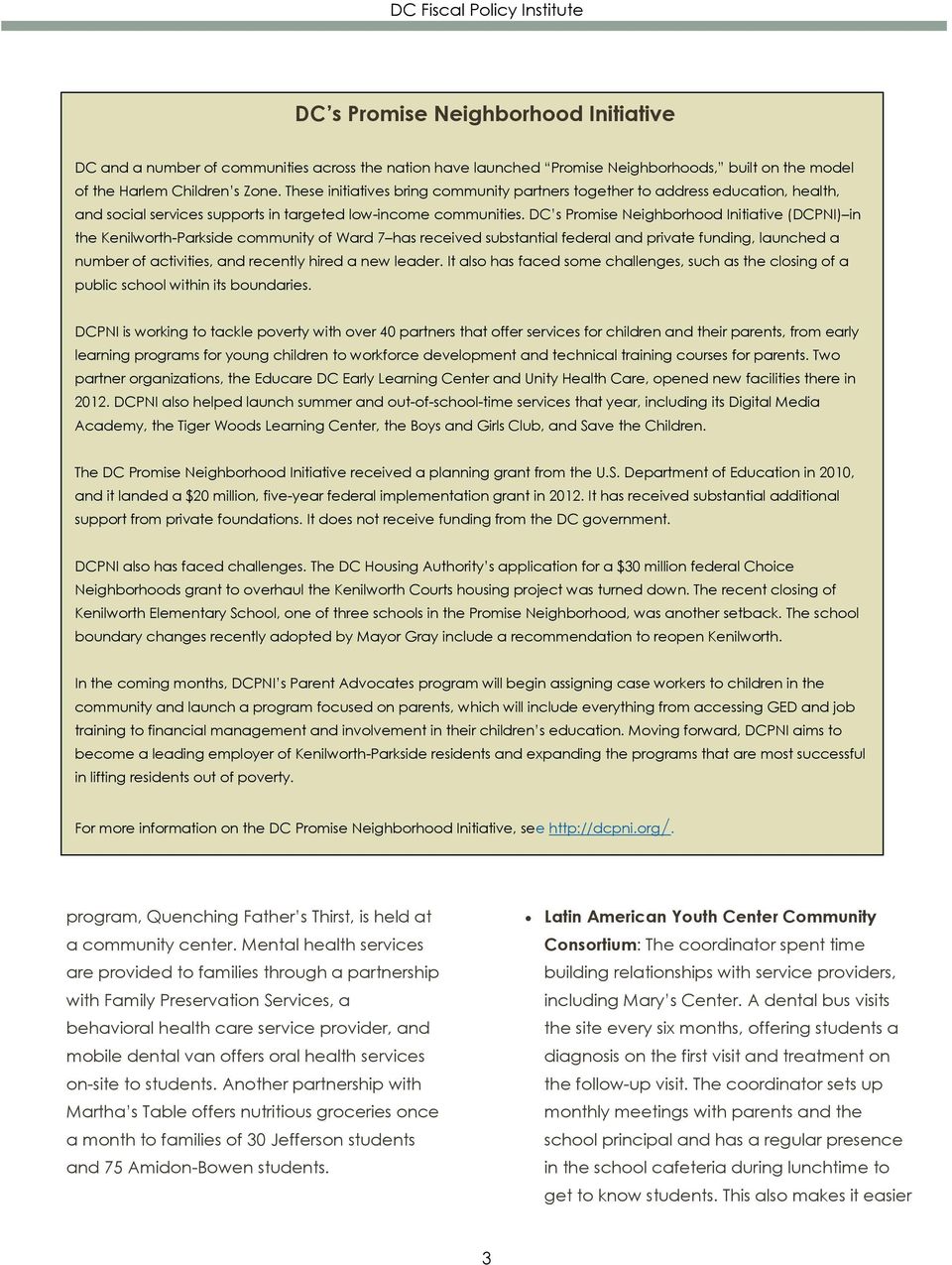
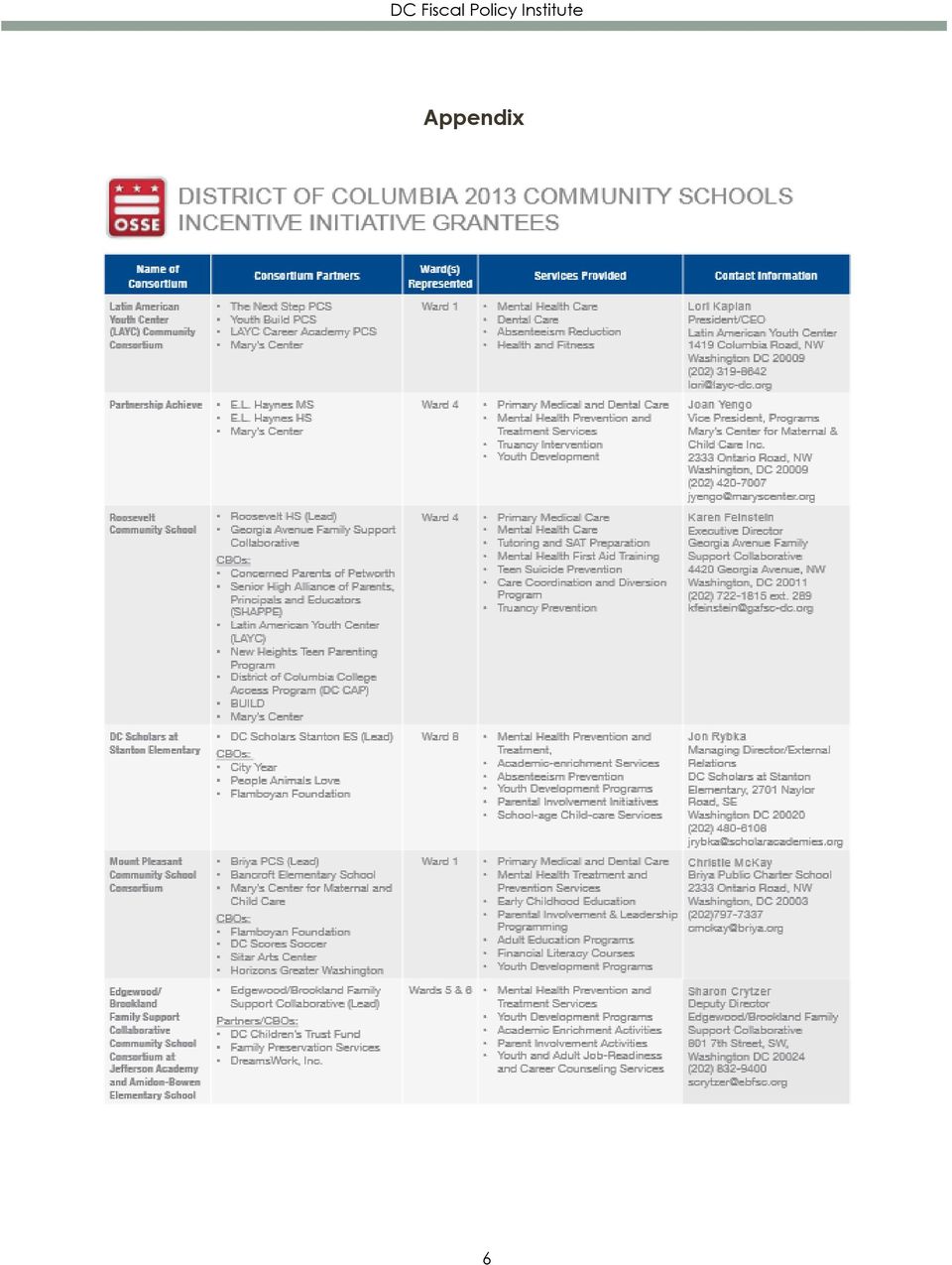
2 overall grade point average. 1 These efforts take a whole child perspective and recognize that a child s development and academic success is hinged on several domains and need to include the school, family, and larger community. 2 Interventions that address a range of academic and non-academic needs have been shown to result in better outcomes than those focused only on one of these domains. Using schools as a community hub also pays off in the long-term. Studies show that every dollar invested in a Community Schools model saves $4 to $15 from improved educational, environmental, and health outcomes for children and families, and costs that would be avoided such as reductions in ER visits or repeating a grade. 3 There are over 4,000 community schools operating in the U.S. Community Schools focus on issues such as chronic absenteeism, parental involvement, early childhood services, or youth development. The partners often connect students and their families with outside supports, including medical, dental and mental health services. They also connect students with extended learning opportunities before and after school and during the summer, and connect families with classes like financial literacy, GED prep, and computer classes. DC s Community Schools Initiative. There are 11 DC public and public charter schools operating Community School (CS) partnerships in the District (see Appendix.) All grantees were required to establish an advisory board comprised of community members and to conduct a needs assessment to learn what programs the school already offered and to identify gaps. Each site has a full-time coordinator who works to build partnerships between the school, community-based organizations, and families in the community. The coordinator works with the school principal and faculty to align partnerships with the school s academic plans and to best match the services to identified needs of students and families. The coordinator also works to inform parents and the broader community of services available to families at or near the school site. In 2012, the District s CS grantees were identified by an advisory committee and allocated a combined total of $1 million in local funds through the Office of the State Superintendent of Education (OSSE). A typical CS grantee budget is just enough to cover the cost of a few staff positions, such as the full-time coordinator, attendance specialist, or mental health coordinator, as well as seed funding for key partnerships, such as for after-school providers or health services. A few more examples of the CS model in action are listed below: Edgewood/Brookland Family Support Collaborative Community Consortium at Jefferson Academy and Amidon-Bowen Elementary School: The Dreamworks program, which offers art-based leadership development for youth, started in April 2014 at Jefferson Middle School. A six-week fatherhood education empowerment 1 Kristen Anderson Moore and Carol Emig. Integrated Student Supports: A summary of the Evidence Base for Policymakers. Child Trends, Kristen Anderson Moore and Carol Emig. Integrated Student Supports: A summary of the Evidence Base for Policymakers. Child Trends, Ibid and Children s Aid Society, Measuring Social Return on Investment for Community Schools Y%20final.pdf. 2

3 DC s Promise Neighborhood Initiative DC and a number of communities across the nation have launched Promise Neighborhoods, built on the model of the Harlem Children s Zone. These initiatives bring community partners together to address education, health, and social services supports in targeted low-income communities. DC s Promise Neighborhood Initiative (DCPNI) in the Kenilworth-Parkside community of Ward 7 has received substantial federal and private funding, launched a number of activities, and recently hired a new leader. It also has faced some challenges, such as the closing of a public school within its boundaries. DCPNI is working to tackle poverty with over 40 partners that offer services for children and their parents, from early learning programs for young children to workforce development and technical training courses for parents. Two partner organizations, the Educare DC Early Learning Center and Unity Health Care, opened new facilities there in DCPNI also helped launch summer and out-of-school-time services that year, including its Digital Media Academy, the Tiger Woods Learning Center, the Boys and Girls Club, and Save the Children. The DC Promise Neighborhood Initiative received a planning grant from the U.S. Department of Education in 2010, and it landed a $20 million, five-year federal implementation grant in It has received substantial additional support from private foundations. It does not receive funding from the DC government. DCPNI also has faced challenges. The DC Housing Authority s application for a $30 million federal Choice Neighborhoods grant to overhaul the Kenilworth Courts housing project was turned down. The recent closing of Kenilworth Elementary School, one of three schools in the Promise Neighborhood, was another setback. The school boundary changes recently adopted by Mayor Gray include a recommendation to reopen Kenilworth. In the coming months, DCPNI s Parent Advocates program will begin assigning case workers to children in the community and launch a program focused on parents, which will include everything from accessing GED and job training to financial management and involvement in their children s education. Moving forward, DCPNI aims to become a leading employer of Kenilworth-Parkside residents and expanding the programs that are most successful in lifting residents out of poverty. For more information on the DC Promise Neighborhood Initiative, see program, Quenching Father s Thirst, is held at a community center. Mental health services are provided to families through a partnership with Family Preservation Services, a behavioral health care service provider, and mobile dental van offers oral health services on-site to students. Another partnership with Martha s Table offers nutritious groceries once a month to families of 30 Jefferson students and 75 Amidon-Bowen students. Latin American Youth Center Community Consortium: The coordinator spent time building relationships with service providers, including Mary s Center. A dental bus visits the site every six months, offering students a diagnosis on the first visit and treatment on the follow-up visit. The coordinator sets up monthly meetings with parents and the school principal and has a regular presence in the school cafeteria during lunchtime to get to know students. This also makes it easier 3
4 when the time comes to refer a child for needed services. Mt. Pleasant Community School Consortium: Partners include Cardozo clinic, Mt. Pleasant Library, and a credit union that offers financial literacy and budget management workshops. The coordinator helps students and families navigate the system, with an emphasis on working with English Language Learner students. Some of the major needs the coordinator identified are employment, housing, nutrition, legal services, and social services. She developed a presentation on summer options for adult students and families which compiled all the information into one place. As the CS program is sustained with funding in year two (fiscal year 2015), grantees plan to continue to refine their goals while working to expand participation and improve their existing partnerships. For example, Amidon-Bowen wants to procure a washer-dryer for the school because there are no laundromats in the neighborhood or in the neighborhood s public housing. Jefferson Academy hopes to reinvigorate their parent resource center. The LAYC consortium wants to offer more peer learning between staff, and organize resource fairs focused on mental health and social services. The Mt. Pleasant Consortium will focus on improving school attendance and recruiting partners for before- and after-school activities, including exploring ways for high schools students to take part in community service. All grantees will work to track and evaluate their work through common measures of success that are consistent with academic goals set by DCPS and public charter school leaders, including improved outcomes for student attendance, school climate, and reading proficiency. Recommendations for DC Scale-Up of Community Schools. The long-term success of Community Schools for D.C. depends on a number of factors, including stable leadership, strong district support, solid relationships with community partners, and a sustained financial investment. DCFPI recommends that the CS model be expanded in the District to become a larger community-based strategy to improve outcomes for low-income students and their families. In order to accomplish this objective, the following steps should be considered: Create clear, stable funding for the Community Schools model to expand in the District. Community Schools need to be prioritized as part of a larger strategy to close the student achievement gap in DC. The CS pilot is currently funded at $1 million per year, will need additional funding if it is to expand to more high-poverty schools. Sites can be funded with a blend of public and private resources, but private funders will want to see the District is committed to scaling up this pilot phase before committing their support for future years. Explore the role of an intermediary organization. The Baltimore CS Initiative uses an intermediary organization to coordinate the city-wide effort, including consistent data tracking, and making professional development and technical assistance available for grantees. This type of infrastructure will be needed as the CS model expands to more sites, and DC should determine what the right entity - OSSE or a non-government agency is able to take on this role. Prioritize data collection and evaluation of key indicators. The District should continue to collect information on school readiness, 4

5 student attendance, adult education, and other indicators to assess the short-term impacts of Community Schools. This will be particularly important to attract additional funding from non-public sources, but also to show District leaders the impacts on student learning, health, family engagement, and other outcomes over time. The District Can Look To Baltimore as a Model For Enhancing Community Schools The Baltimore City Community Schools Initiative, operating since 2006, is a partnership of Baltimore City, City Schools, and the Family League of Baltimore, a non-profit grantmaking organization. In 2013, through efforts made by the Family League, the model was redesigned to align CS with the city s out-of-school time strategies. Integrating the model meant advocates were no longer fighting over the same funding streams, and that community partners and funders were able to come together to support one comprehensive strategy focusing on supports for students from breakfast to supper. In spring of 2013, Maryland passed legislation for a $1.2 billion bond for renovation funds for Baltimore City Schools, with specific language about schools serving as community hubs. The Family League is partnering with the Mayor s office and the school district to plan facility renovations with an emphasis on the needs of a CS partnership model. Strong aspects of the Baltimore model include: Citywide steering committee with shared vision. Formed by the Family League, the 37-member committee includes funders, policymakers, principals, lead agencies, and coordinators. Intermediary role. The Family League serves to align the city s strategies to strengthen before- and afterschool programs as the main focus of their model. The Family League is both the Local Management Board for Baltimore as well as a 501c3 able to leverage and blend multiple funding streams. Data and evaluation. Each school coordinator is able to share metrics across the CS initiative, through a data sharing agreement with the school district, For example, they track school climate, attendance, suspension data, and academic performance indicators for their students. Family League partners with the Baltimore Education Research Consortium to perform external research and evaluation of the programs. Data collected is used to drive school level strategy and system level resources. Strong district-level support. The city s Office of Family Engagement was highly supportive of the CS model and its new alignment strategy. There is a pending district-wide policy development team focused on Community Schools through this office. Diverse funding streams. The funding for the Baltimore CS Initiative comes from a range of public and private sources, including the Mayor s office, the Governor s Office for Children, the Open Society Institute, the Wallace Foundation, and the Collaborative for Building After-School Systems. While the majority of funds currently are from the city, the Initiative aims to match each dollar with private funds in the future. For more information, see 5


6 Appendix 6
2015 Award for Excellence Winner
 2015 Award for Excellence Winner Family League of Baltimore Baltimore, MD Family League of Baltimore, in partnership with Baltimore City Public Schools and the Mayor and City Council, currently has 45
2007-2013 960 Main Street, 8th Floor Hartford, CT 06103 (860) 695-8710 [email protected]
 The Coalition is proud to recognize the amazing work being done at Hartford Community Schools. It is one of two communities in the country winning national recognition from our organization this year.
Denver Thrives. When Our Youth Succeed. Afterschool is making a difference in the lives of Denver s youth
 Denver Thrives When Our Youth Succeed Afterschool is making a difference in the lives of Denver s youth Who We Are We are a diverse collaborative of stakeholders including the City and County of Denver,
M D R w w w. s c h o o l d a t a. c o m 8 0 0-3 3 3-8 8 0 2
 MDR s Guide to Federally Funded Education Programs Major federal programs in the Education Budget for Fiscal Year 2011 are listed below. Twenty-three programs were eliminated from the FY2011 budget, including
Great Public Schools for Every Student. Wraparound Services
 Great Public Schools for Every Student An NEA Policy Brief Wraparound Services Teachers and support professionals know that students need to come to school ready and able to learn. Students who have good
Delray Beach CSAP - Kindergarten Readiness
 Delray Beach CSAP - Kindergarten Readiness Assurance #1 School Readiness has improved over the past four (4) years and stands at 78% in 2011 with 75% of our students attending a State Voluntary Pre-Kindergarten
Section I: Introduction
 ANALYSIS OF RACE TO THE TOP: EARLY LEARNING CHALLENGE APPLICATION SECTION ON SUSTAINING EFFECTS INTO THE EARLY ELEMENTARY GRADES 1 JUNE 2012 Section I: Introduction In 2011, as part of the Race to the
Schools Uniting Neighborhoods: Community Schools Anchoring Local Change
 Schools Uniting Neighborhoods: Community Schools Anchoring Local Change By Diana Hall, Multnomah County Across the United States, communities are thinking differently about the challenges they face to
Governor Snyder s FY2016 Education & School Aid Budget Recommendations
 Governor Snyder s FY2016 Education & School Aid Budget Recommendations February 23, 2015 The annual budget is the single most powerful expression of the state s priorities. It is during the budget process
Generation Next Leadership Council SPECIAL SESSION
 Generation Next Leadership Council SPECIAL SESSION AGENDA June 11, 2014 9:00 9:45am Minneapolis Public Schools 1250 W. Broadway, Minneapolis Assembly Room S1-404, 1st Floor 9:00 AM Introduction R.T. Rybak
2010-11. San Francisco Afterschool for All Initiative
 San Francisco Afterschool for All Initiative 2010-11 Afterschool for All Vision: All children, youth and parents in San Francisco have a range of quality out of school time program choices. Produced by
100-Day Plan. A Report for the Boston School Committee By Dr. Tommy Chang, Superintendent of Schools. July 15
 July 15 2015 100-Day Plan A Report for the Boston School Committee By Dr. Tommy Chang, Superintendent of Schools Boston Public Schools, 2300 Washington Street, Boston, MA 02119 About this plan Over the
Setting the Standard for Evaluation and Data-Informed Decision Making
 Elev8 Chicago: Demonstrating the Power and Potential of Community Schools Communities across the country are grappling with the challenge of preparing young people for a bright future, in an era of extremely
RENEWING CAREER AND TECHNICAL EDUCATION IN COLORADO
 RENEWING CAREER AND TECHNICAL EDUCATION IN COLORADO A summary of the Colorado State Plan for Implementation of the Carl D. Perkins Career and Technical Education Act of 2006 Prepared by the Colorado Community
Creating Safe, Healthy, and Supportive Learning Environments to Increase the Success of all Students
 Creating Safe, Healthy, and Supportive Learning Environments to Increase the Success of all Students The Final Report of the Massachusetts Behavioral Health and Public Schools Task Force AUGUST 2011 In
READY KIDS DENVER Ready Kids, Ready Families, Ready Communities Initiative A Proposal for Educational Achievement and Workforce Excellence
 READY KIDS DENVER Ready Kids, Ready Families, Ready Communities Initiative A Proposal for Educational Achievement and Workforce Excellence With elections in May for a new Mayor and all thirteen City Council
DEPARTMENT OF EDUCATION
 DEPARTMENT OF EDUCATION OFFICE OF ELEMENTARY AND SECONDARY EDUCATION Federal Funds Total: Outlays. Budget Authority... Outlays.,,,, 0,, ACCELERATING ACHIEVEMENT AND ENSURING EQUITY Note. A full-year 0
New York City Community Schools Strategic Plan
 A New York City Community Schools Strategic Plan Mayor Bill de Blasio s strategy to launch and sustain a system of over 100 Community Schools across NYC by 2017. Prepared by: Office of the Mayor Department
Historically Minority Colleges and Universities Consortium Uniting Communities to Close the Achievement Gap
 Historically Minority Colleges and Universities Consortium Uniting Communities to Close the Achievement Gap Report on Closing the Achievement Gap Funds The purpose of this report is to respond to the General
National Center for Urban Education at the University of the District of Columbia Conceptual Overview
 National Center for Urban Education at the University of the District of Columbia Conceptual Overview In far too many universities, education schools are the neglected stepchild. Too often they don't attract
Investing in Our Kids: District of Columbia School Finance Primer By Soumya Bhat
 An Affiliate of the Center on Budget and Policy Priorities 820 First Street NE, Suite 460 Washington, DC 20002 (202) 408-1080 Fax (202) 408-8173 www.dcfpi.org Updated March 26, 2015 Investing in Our Kids:
1. Title IV, Part B: 21 st Century Community Learning Centers [Goals 1, 2 and 5]
![1. Title IV, Part B: 21 st Century Community Learning Centers [Goals 1, 2 and 5]](/thumbs/29/13867157.jpg "1. Title IV, Part B: 21 st Century Community Learning Centers [Goals 1, 2 and 5]") 1. Title IV, Part B: 21 st Century Community Learning Centers [Goals 1, 2 and 5] Identify the percentage of students participating in 21 st Century Community Learning Centers who meet or exceed the proficient
1. Title IV, Part B: 21 st Century Community Learning Centers [Goals 1, 2 and 5] Identify the percentage of students participating in 21 st Century Community Learning Centers who meet or exceed the proficient
Middle Grades Action Kit How To Use the Survey Tools!
 How To Use the Survey Tools Get the most out of the surveys We have prepared two surveys one for principals and one for teachers that can support your district- or school-level conversations about improving
DEPARTMENT OF EDUCATION
 DEPARTMENT OF EDUCATION Funding Highlights: Provides $77.4 billion. The Budget includes a significant increase for K-12 education, while making tough choices to put the Pell Grant program on a sustainable
DEPARTMENT OF EDUCATION
 DEPARTMENT OF EDUCATION Funding Highlights: Provides $77.4 billion. The Budget includes a significant increase for K-12 education, while making tough choices to put the Pell Grant program on a sustainable
TENNESSEE STATE BOARD OF EDUCATION
 Policy for Local School Systems To establish early childhood education and parent involvement programs of high quality, the State Board of Education adopts the following policy: 1. Subject to the rules,
District of Columbia Career Guide for Early Childhood and Out of School Time Professionals
 District of Columbia Career Guide for Early Childhood and Out of School Time Professionals Pathways to Professional Growth Division of Early Learning Office of the State Superintendent of Education (OSSE)
Best Practice: Youth After-School Programming
 Best Practice: Youth After-School Programming This report is publicly available on the NYC Global Partners Innovation Exchange website: www.nyc.gov/globalpartners/innovationexchange REPORT UPDATED :AUGUST
School-Based Health Centers 101. First Steps in Planning a School Health Center
 School-Based Health Centers 101 First Steps in Planning a School Health Center About Us We are the statewide nonprofit organization helping to put more health services in schools. Our mission is to improve
HEALTHY CPS. Rahm Emanuel Mayor. Bechara Choucair, M.D. Commissioner. Barbara Byrd-Bennett Chief Executive Officer
 HEALTHY CPS An Agenda for student Wellness Rahm Emanuel Mayor Barbara Byrd-Bennett Chief Executive Officer Bechara Choucair, M.D. Commissioner A Message from the CEO of Chicago Public Schools and the Commissioner
AFTERSCHOOL IN INDIANA
 THE POWER OF AFTERSCHOOL IN INDIANA WHY AFTERSCHOOL MATTERS FOR INDIANA Every child in Indiana deserves a great education, regardless of background, income or ZIP code. Schools can t do it alone. Youth
Friends of School Health
 Friends of School Health Testimony Expanding Funding for CDC School Health Programs Statement of Sharon Murray, MHSE, CHES Executive Director, Society of State Directors of Health, Physical Education and
ELEMENTARY AND SECONDARY EDUCATION ACT
 ELEMENTARY AND SECONDARY EDUCATION ACT Comparison of the No Child Left Behind Act to the Every Student Succeeds Act Congress passed the Every Student Succeeds Act (ESSA) 1 to replace the No Child Left
A Blueprint for Transforming Philadelphia s Public Schools. Safe, high-quality schools. Fiscal sustainability.
 A Blueprint for Transforming Philadelphia s Public Schools Safe, high-quality schools. Fiscal sustainability. 1 Four Guiding Questions 1 What s the problem? 2 What can we do about it? 3 4 How long will
Kathryn Baron Contributing writer, Education Week. Follow Kathryn on Twitter: @TchersPet
 Kathryn Baron Contributing writer, Education Week Follow Kathryn on Twitter: @TchersPet Partners in Time: Building School-Community Models Expert Presenters: Martin J. Blank, president, Institute for Educational
Agenda for Reform. Summary Briefing December 14, 2009
 Summary Briefing December 14, 2009 The Vision The Board of Regents envisions a New York where all students are prepared for college, the global economy, 21 st century citizenship, and continued learning
DRAFT. Denver Plan 2014. Every Child Succeeds
 Denver Plan 2014 Every Child Succeeds 100 80 Introduction Every child takes that first step into their first day of school with butterflies and talent, potential and dreams. It s the day that the door
OPEN SOCIETY INSTITUTE BALTIMORE 201 North Charles Street, Suite 1300, Baltimore, MD 21201, (401) 234-1091 www.soros.org/initiatives/baltimore
 OPEN SOCIETY INSTITUTE BALTIMORE 201 North Charles Street, Suite 1300, Baltimore, MD 21201, (401) 234-1091 www.soros.org/initiatives/baltimore SUMMARY The Open Society Institute (OSI), a private operating
BIRTH THROUGH AGE EIGHT STATE POLICY FRAMEWORK
 BIRTH THROUGH AGE EIGHT STATE POLICY FRAMEWORK The Birth Through Eight State Policy Framework is a tool, or roadmap, that anyone can use to guide policy in ways that will improve the health, learning,
BREAKFAST CHANGES LIVES ENSURING NO KID GOES HUNGRY IN THE CLASSROOM
 BREAKFAST CHANGES LIVES ENSURING NO KID GOES HUNGRY IN THE CLASSROOM SHARE OUR STRENGTH S BREAKFAST REPORT 2013 BREAKFAST CHANGES LIVES Research continues to show that children who eat a balanced breakfast
Arizona Department of Education 21 st Century Community Learning Centers Grant Online Application Training Cycle 11
 Arizona Department of Education 21 st Century Community Learning Centers Grant Online Application Training Cycle 11 http://www.azed.gov/century-learning-centers/ 1 Arizona Department of Education 21 st
Partners in. Preparation. A Survey
 Partners in : A Survey of Educators & Education Programs Teacher training and school systems must join together to fully prepare aspiring for their first day on the job. Louisiana students are just as
Position Statement on English Language Arts Education Connecticut State Board of Education December 3, 2008
 Position Statement on English Language Arts Education Connecticut State Board of Education December 3, 2008 The Connecticut State Board of Education believes a high-quality, comprehensive prekindergarten-12
Philadelphia, Pennsylvania (Project U-Turn Campaign) Action Plan to Help More of its Young People Graduate High School, Ready for College, Work & Life
 ACTION PLANNING WORKSHEET Philadelphia, Pennsylvania (Project U-Turn Campaign) Action Plan to Help More of its Young People Graduate High School, Ready for College, Work & Life Name of Summit State or
Colorado Springs School District 11
 Colorado Springs School District 11 Colorado Superintendent: Dr. Sharon A. Thomas Primary contact: Holly Brilliant, Title I facilitator 29,625 students, K-12, urban District Description Colorado Springs
Get Us To College Proven strategies for helping NYC students navigate the college process
 Get Us To College Proven strategies for helping NYC students navigate the college process A white paper researched by the Founded in 2004, the Urban Youth Collaborative (UYC) is a coalition of youth organizing
Bridging Health and Community Development: Investing in People, Place, and Equity May 21, 2015 1:00 pm Eastern Time
 Bridging Health and Community Development: Investing in People, Place, and Equity May 21, 2015 1:00 pm Eastern Time Andriana Abariotes, Twin Cities LISC Kimberlee Cornett and David Fukuzawa, The Kresge
DEPARTMENT OF EDUCATION
 DEPARTMENT OF EDUCATION Funding Highlights: Provides $68.6 billion in discretionary funding for the Department of Education to build upon investments in preschool access, ongoing K-12 reforms, and efforts
CAS-Carrera, 21 st Century Community Learning Centers and ASPIRA of NJ: A Natural Partnership
 CAS-Carrera, 21 st Century Community Learning Centers and ASPIRA of NJ: A Natural Partnership This project was funded in its entirety with federal Elementary and Secondary Education Act, as amended by
July 12, Guiding Principles: Digital Learning Environment, Learning Standards, Assessments for Learning
 July 12, student District Goal: Ensure continuous improvement in Initiative: Continue development of the initial Plano ISD Academy. This development will include the naming of an internal steering committee
Georgia's P-16 Partnerships
 Ronald J. Henry and Jan S. Kettlewell The Georgia P-16 Initiative is a strategy to solve problems of low aspirations and underpreparedness of students in Georgia's public education systems. Insights drawn
T3: Turnaround Teacher Teams
 T3: Turnaround Teacher Teams T3 Program History The T3 Initiative began in 2009 as a policy proposal from Teach Plus s first cohort of 16 Teaching Policy Fellows, all teachers in urban public schools in
Full-service community schools: A strategy not a program
 Community schools are one solution to the fact that schools can t do it alone. Today s youth need comprehensive, coordinated support services provided in schools through partnerships. 1 Full-service community
2015 Javits Gifted and Talented Students Education Act Grants Project Abstracts from the U.S. Department of Education
 2015 Javits Gifted and Talented Students Education Act Grants Project Abstracts from the U.S. Department of Education Statewide Grants (8) The Arizona Department of Education, $410,202. The overarching
R00A99. Early Childhood Development. Maryland State Department of Education. Response to the Analyst s Review and Recommendations
 R00A99 Early Childhood Development Maryland State Department of Education Response to the Analyst s Review and Recommendations House Education and Economic Development Subcommittee February 26, 2015 Senate
Washington State Community Learning Center Program. Final Report to the Legislature
 Washington State Community Learning Center Program Final Report to the Legislature Randy I. Dorn State Superintendent of Public Instruction December 2009 Washington State Community Learning Center Program
Attachment 1. Principles, Priorities, and Actions for Economic Renewal and Development for the City of Seattle
 Attachment 1 Principles, Priorities, and Actions for Economic Renewal and Development for the City of Seattle Quality of Life A livable city requires that we retain and improve the character of Seattle,
Putting Youth to Work Series
 Putting Youth to Work Series Examples of Effective Practice in Distressed Communities By Sara Hastings July 2009 Baltimore, MD Best Practice Examples in: Convening Body Delivery Agent Workforce and Employer