
SETTLEMENT OF WITH SPECIAL REFERENCE
|
|
|
- Toby Shelton
- 10 years ago
- Views:
Transcription
1 SETTLEMENT OF MOTOR I ACCIDENTS 5 CLAIMS T(_) KERALA (I WITH SPECIAL REFERENCE -\_" Thesis Submitted By K. FIADHAKRISHNAN NAIR For the Degree of Doctor of Pbflosophpg Facufip of Law COCI'lIN UNIVERSITY OF SCIENCE AND TECHNOLOGY COCHIN MAY I995

2 nec;grat10n I hereby declare that the thesis entitled "SETTLEMENT OF MOTOR ACCIDENTS CLAIMS WITH SPECIAL REFERENCE T0 KERALA" is the record of original work carried out by me under the guidance and supervision of Dr.V.D.Sebastian, Professor (Retd.), Department of Law, Cochin University of Science and Technology. This has not been submitted either in part, or in whole, for any degree, diploma, associateship, fellowship or other similar titles or recognition at any University. Cochin llth May 1995 K. RADHAKRISHNAN NAIR r/i,

3 CERTIFICATE This is to certify that the thesis entitled "SETTLEMENT OF MOTOR ACCIDENTS CLAIMS WITH SPECIAL REFERENCE T0 KERALA" submitted by Shri.K.Radhakrishnan Nair, for the Degree of Doctor of Philosophy is the record of bonafide research carried out under my guidance and supervision in the Department of Law, Cochin University of Science and Technology. This thesis, or any part thereof, has not been to the best of my knowledge submitted elsewhere for any other degree, diploma, associateship, fellowship or other similar titles or recognition. L Cochin V-D-$eb&8ti8n llth May 1995 Supervising Guide
4 ti ) PREFACE Traffic Accidents have developed in to one of the great economic and social problems of today. The paramount importance of rendering speedy justice to the accidents victims has been the grave concern of all the reformers. A widespread dissatisfaction with the traditional fault system as a method of compensating the Victims or their representatives for personal injuries or death has become apparent throughout the common law world. A good number of studies have been undertaken and stream of proposals for reform on piecemeal basis have also come out principally focussing on the problem of compensation for road accidents. It should by now be clear that in lieu of any piecemeal reforms within the tort systems, a comprehensive reform of the whole system is what is needed today. The idea of selecting this topic originally emanated from purely practical and personal experience as a practitioner in law of damages. On my joining the General Insurance Industry in 1987 as a law officer, it was felt that an analysis of the extent of interaction between the Insurance and the fault system would be helpful also for the specific purpose of expeditious settlement of Motor Accidents claims. With a view to suggesting improvements in the existing system, effort has been made to critically examine and review the existing system, the piecemeal reforms already made and their impact on the national and international developments. Although, the main attempt is to find out a cheapest and a quickest mode of settlement of Motor Accidents Claims, necessary attention has also been drawn to the importance of prevention of accidents. The existing machinery for getting compensation leads a victim to a poignant situation. A switch over to Tribunal system from the ordinary

5 I ii ) civil court jurisdiction since 1956 for adjudicating the claims cases reaped no efficacious results. The appointment of a Motor Accidents claim, Tribunal was to dispense with the inappropriateness of the inherited judicial system and its alienation from the common people coupled with intractable problem of delay and arrears resulting in denial of justice. Delay defeats equity. Justice delayed is justice denied. Long litigation is beyond the financial capacity of the poor claimants. Similarly, the Insurance Companies are also adversely affected in as much as the administrative and legal costs are continuing to spiral out of control. However, the reformers who seek to eliminate the problem of delay, being an intractable concomitant of adjudication, are confronted with two dangers. The first is the cynicism which accepts it as inevitable. The second is an abandonment in the name of efficiency of those procedural safeguards which protect the autonomy and worth of every individuals. The present system of liability determination based on fault has got practically many defects. Most accidents do occur suddenly and unexpectedly. The details surrounding them can seldom be accurately determined. A normally cautious driver could be held negligent because an incorrect decision in the last split of a second results in an accident. Further proof of negligence, an inevitable ingredient for getting the compensation, becomes a difficult task on the plaintiff due to various reasons. The possibility that either party to the accident may be tempted to suppress or fabricate evidence to show that the other party is at fault cannot be ruled out. In the result, the tort system based on fault becomes an extremely expensive method. Therefore, it is necessary to examine whether it is desirable to continue such a
6 (iii) liability determination based on fault. If not, what must be the basis for a change. An Empirical survey of cases decided by the Motor Accidents Claims Tribunal of Ernakulam, Perumbavoor and Kottayam has been done to evaluate the functioning of the Tribunal System. Besides, the role of claimants, drivers, owners, and insurers has also been dealt with in detail. Just like fixing the liability, the most difficult part of the law of damages is the fixation of the quantum. Having made a review of the existing methods of computation, a modification of the statutorily structured formula, which was loosely drafted with errors, omission and anomalies, has been proposed. An alternative to the existing System an alternative has been suggested which it is hoped would be more indigenous, less cumbersome, socially responsive administratively fair and in tune with the noble ideals enshrined in the Directive Principles under Article 39 (A) and 40 of the constitution. This is called peoples Court or Lok Adalat. The importance of Lok Adalat and other supplementary media of Jald Rahat Yojana, conciliatory courts and out of court and compromised settlements through the existing tribunals has also been critically examined. Having found a new basis of liability and devised a new schedule next most important requirement is to have a machinery in order to facilitate expeditious settlement of claims. The adjudicatory process of the existing tribunal system has failed to deliver justice a reorganisation of the system vesting with a dual function is worked out. Over and above, the financial protection which is secured through third party insurance has also been examined with a view to expand its coverage on a first party loss insurance basis. It is hoped that the
7 (iv) study has made a humble contribution to a field of legal regulation of increasing importance. I should not conclude this preface without expressing my indebtedness to the Cochin University of Science and Technology for awarding me a Junior Research Fellowship for the period of my full time -research and for granting the required extension of the research period. i I express my sincere gratitude to the Oriental Insurance Co. Ltd., a reputed subsidiary of the General Insurance Corporation, from which I have been receiving sustenance and countenance since In every respect, I owe a great debt to my guide Dr. V.D.Sebastian S Professor (Retd.) Department of Law, who has been the sole source of inspiration, encouragement and guidance. 1 I am grateful too to Dr.P.Leelakrishnan, Dr. N.S.Chandrasekharan and Dr.K.N. Chandrasekharan Pillai, Professors, Faculty of Law CUSAT. I must express my thanks to the Library Staff of the Department of Law, Indian Law Institute, Delhi, High Court of Kerala. My thanks are due to my wife Smt. Krishnamma, Lecturer in Commerce, N.S.S.College, Nemmara, who helped me in comparing and correcting the thesis. My thanks are also due to Petcots Computer Copy Centre, Ernakulam for neatly taking Computer prints.
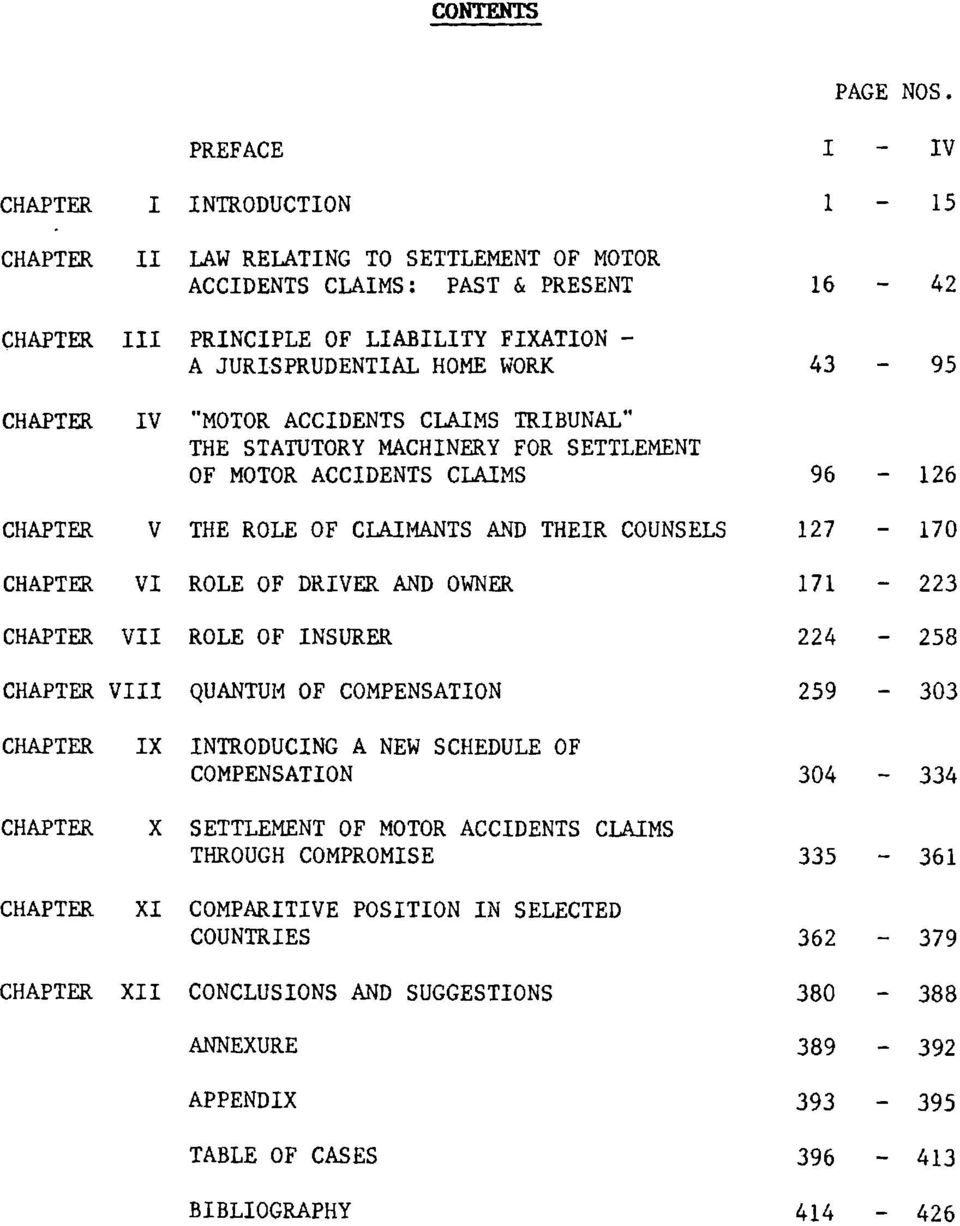
8 CONTENTS CHAPTER I PREFACE INTRODUCTION PAGE I. 1 _ NOS. IV 15 CHAPTER CHAPTER II III LAW RELATING T0 SETTLEMENT OF MOTOR ACCIDENTS CLAIMS: PAST & PRESENT PRINCIPLE OF LIABILITY FIXATION A JURISPRUDENTIAL HOME WORK CHAPTER IV "MOTOR ACCIDENTS CLAIMS TRIBUNAL" THE STATUTORY MACHINERY FOR SETTLEMENT OF MOTOR ACCIDENTS CLAIMS CHAPTER V THE ROLE OF CLAIMANTS AND THEIR COUNSELS CHAPTER VI ROLE OF DRIVER AND OWNER CHAPTER VII ROLE OF INSURER CHAPTER VIII QUANTUM OF COMPENSATION CHAPTER IX INTRODUCING A NEW SCHEDULE OF COMPENSATION CHAPTER X SETTLEMENT OF MOTOR ACCIDENTS CLAIMS THROUGH COMPROMISE CHAPTER XI COMPARITIVE POSITION IN SELECTED COUNTRIES CHAPTER XII CONCLUSIONS AND SUGGESTIONS ANNEXURE APPENDIX TABLE OF CASES ~ BIBLIOGRAPHY
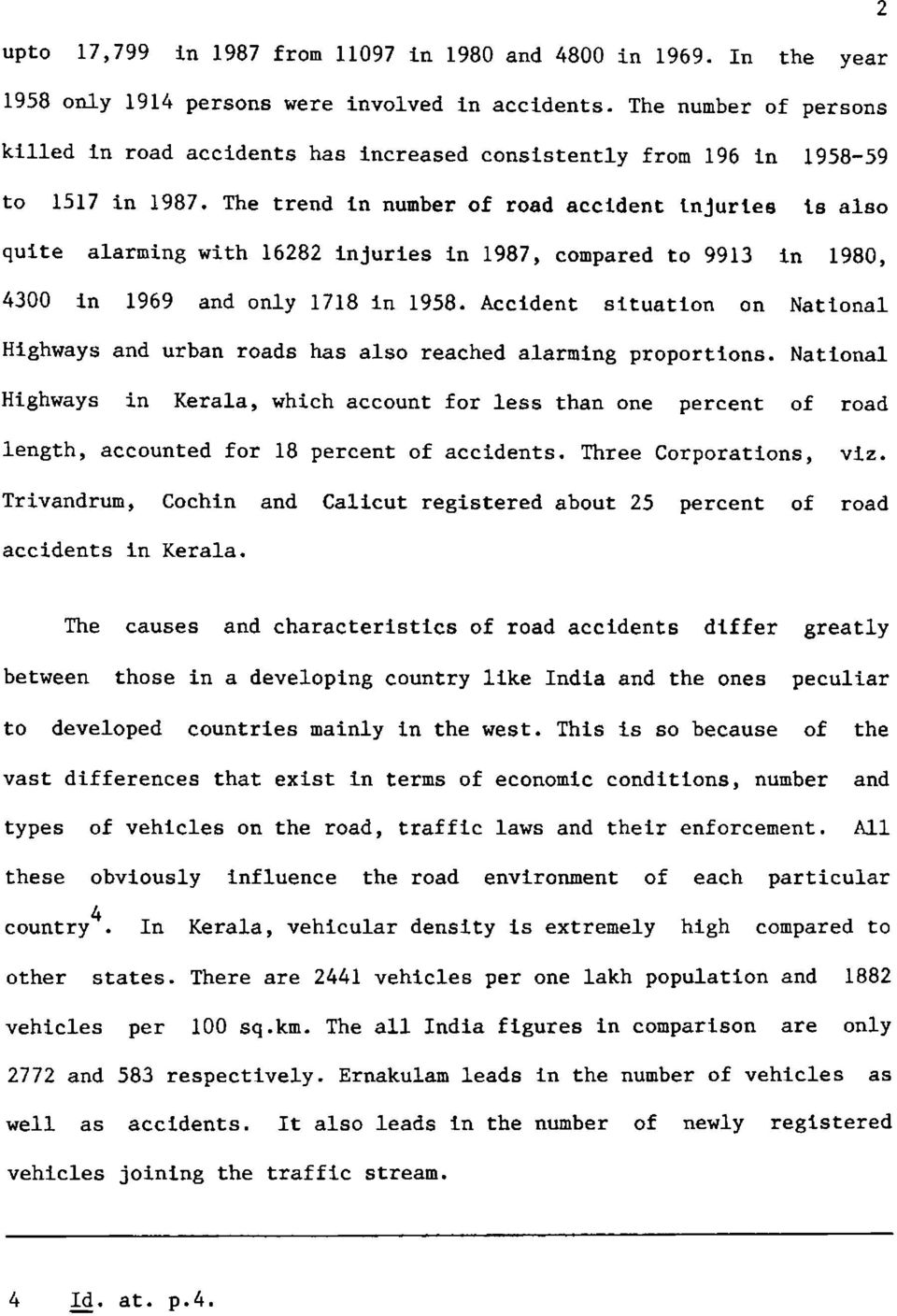
9 1 CHAPTER 1 ]LN1RODUCTIO Expeditious settlement of Motor Accidents claims assumes paramount importance in view of its vital relevance to social justice. Traffic Accidents have developed into one of the great economic and social problems of todayl. The accident toll on our road traffic is increasing at an alarming ratez. Though India's Motor Vehicle population is only 1% (one percent) of the World's, her share of World road traffic accidents is 6% (six percent). There is an accident every minute in the country and every ten minutes one person dies of them3. More than eight lakh people have died in road accidents after independence, over 50% of them in the last decade alone. Road accident rates and resultant fatality rates in India are rising by 5% and 10% respectively per annum. The problem of traffic accidents in Kerala is still more serious as accidents in Kerala have increased at a faster rate than in many other parts of the country. In the year 1958 only 1581 accidents were registered which have increased to 4214 in 1969, 7064 in 1980 and 11,794 in Similarly the number of persons involved in accidents have gone 1 8 th Law Commission Report on claims for compensation under chapter 8Uof the Motor Vehicles Act, 1939; p.8 (1980). VT If 2 Mahesh chand "Accident Scenario in India with special reference to Kerala" A Study Report by National Transportation WPlanning Wand Research Centre) Trivandrum (NATPAC) 3 oad Safety Digest, Vol. 2 No.4 (1992) (L.P.A) The motor" vehicle population in India has tripled in the first eight years of the last decade. In 1989 there were 106 lakh two wheelers alone consisting of 63.6% of the total national motor vehicles population.

10 upto 17,799 in 1987 from in 1980 and 4800 in In the year 1958 only 1914 persons were involved in accidents. The number of persons killed in road accidents has increased consistently from 196 in to 1517 in The trend in number of road accident injuries is also quite alarming with injuries in 1987, compared to 9913 in 1980, 4300 in 1969 and only 1718 in Accident situation on National Highways and urban roads has also reached alarming proportions. National Highways in Kerala, which account for less than one percent of road length, accounted for 18 percent of accidents. Three Corporations, viz. Trivandrum, Cochin and Calicut registered about 25 percent of road accidents in Kerala. 2 The causes and characteristics of road accidents differ greatly between those in a developing country like India and the ones peculiar to developed countries mainly in the west. This is so because of the vast differences that exist in terms of economic conditions, number and types of vehicles on the road, traffic laws and their enforcement. All these obviously influence the road environment of each particular country4. In Kerala, vehicular density is extremely high compared to other states. There are 2441 vehicles per one lakh population and 1882 vehicles per 100 sq.km. The all India figures in comparison are only 2772 and 583 respectively. Ernakulam leads in the number of vehicles as well as accidents. It also leads in the number of newly registered vehicles joining the traffic stream. 4 lg. at. p.4.
11 The number of Accidents and Fatalities in India during are 5 follows. Year N0. of Accidents No. of Persons killed If the reported figures are so much, the real picture can easily be imagined. The escalation of automobile accidents has become an explosive, and a lethal phenomenon, on Indian roads everywhere, accounting for more deaths than the most deadly diseases6. The estimated financial loss due to road accidents in 1983 was calculated at around Rs.237 crores where as it had escalated to Rs.1,600 crores by This was around 1% of the country's Gross Domestic Product (G.D.P)- Road accident fatalities are expected to reach one lakh fifteen thousand by the year 2000 in India if present trends continue. Obviously this 5 Roadh Safety Digest Vol.2 (3) 1992 p.8. as extracted from the statistics of Ministry of Surface Transport, Government of India. 6. Concord Insurance Co. V. Nirmala Devi, A.I.R SC 1666, 1667.

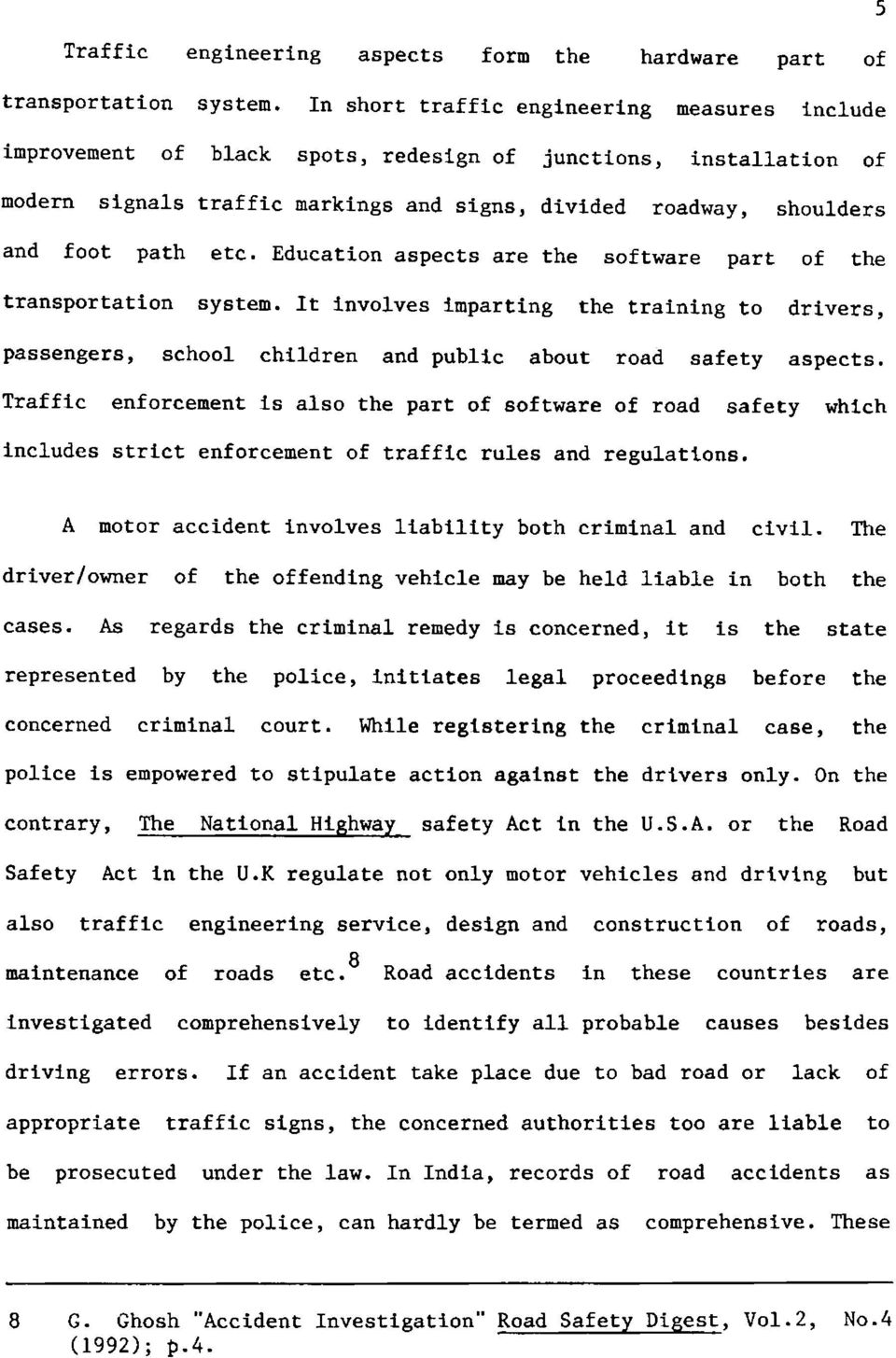
12 appalling toll of life and health represents heavy economic loss in addition to human tragedy. The enormous increase in the number of motor vehicles with its rash and negligent and rockless use by unscrupulous, inexperienced and dangerous drivers in the most miserably managed roads with concomitant hazards and peril would explain that Accident prevention and Accident compensation are thoroughly two compatible aims. Proposed solutions to the traffic problems abound like preventive efforts concentrated on the driver, the road, and the vehicle in addition to educative campaigns. The need for developing a more scientific approach has become a desideratum. Human errors, even minor ones, can cause serious accidents on the road. Simple driving errors are often responsible for deaths, disabilities and loss of property. Defects in design, construction and maintenance of roads, shoulders (sides of a road), dividers, culverts, etc. can also lead to accidents. Even a cautious driver gets a little time, may be a split second, to adjust his driving to the deficiencies or changes in road, vehicle or traffic conditions. He is prone to commit fatal errors unless he receives necessary guidance through cautionary or informatory signs and markings to rectify his errors well in time. the following three factors7 are very crucial in ensuring road safety and reducing accidents. 1. Traffic Engineering 2. Traffic Education and 3. Traffic Enforcement. 4 7 Supra, n,2. at p. 10.

13 Traffic engineering aspects form the hardware part of transportation system. In short traffic engineering measures include improvement of black spots, redesign of junctions, installation of modern signals traffic markings and signs, divided roadway, shoulders and foot path etc. Education aspects are the software part of the transportation system. It involves imparting the training to drivers, passengers, school children and public about road safety aspects. Traffic enforcement is also the part of software of road safety which includes strict enforcement of traffic rules and regulations. 5 A motor accident involves liability both criminal and civil. The driver/owner of the offending vehicle may be held liable in both the cases. As regards the criminal remedy is concerned, it is the state represented by the police, initiates legal proceedings before the concerned criminal court. While registering the criminal case, the police is empowered to stipulate action against the drivers only. On the contrary, Ihe, National Highway; safety Act in the U.S.A. or the Road Safety Act in the U.K regulate not only motor vehicles and driving but also traffic engineering service, design and construction of roads, maintenance of roads etc.8 Road accidents in these countries are investigated comprehensively to identify all probable causes besides driving errors. If an accident take place due to bad road or lack of appropriate traffic signs, the concerned authorities too are liable to be prosecuted under the law. In India, records of road accidents as maintained by the police, can hardly be termed as comprehensive. These 8 G. Ghosh "Accident Investigation" Road Safety Digest, Vol.2, No.4 (1992); p.4.
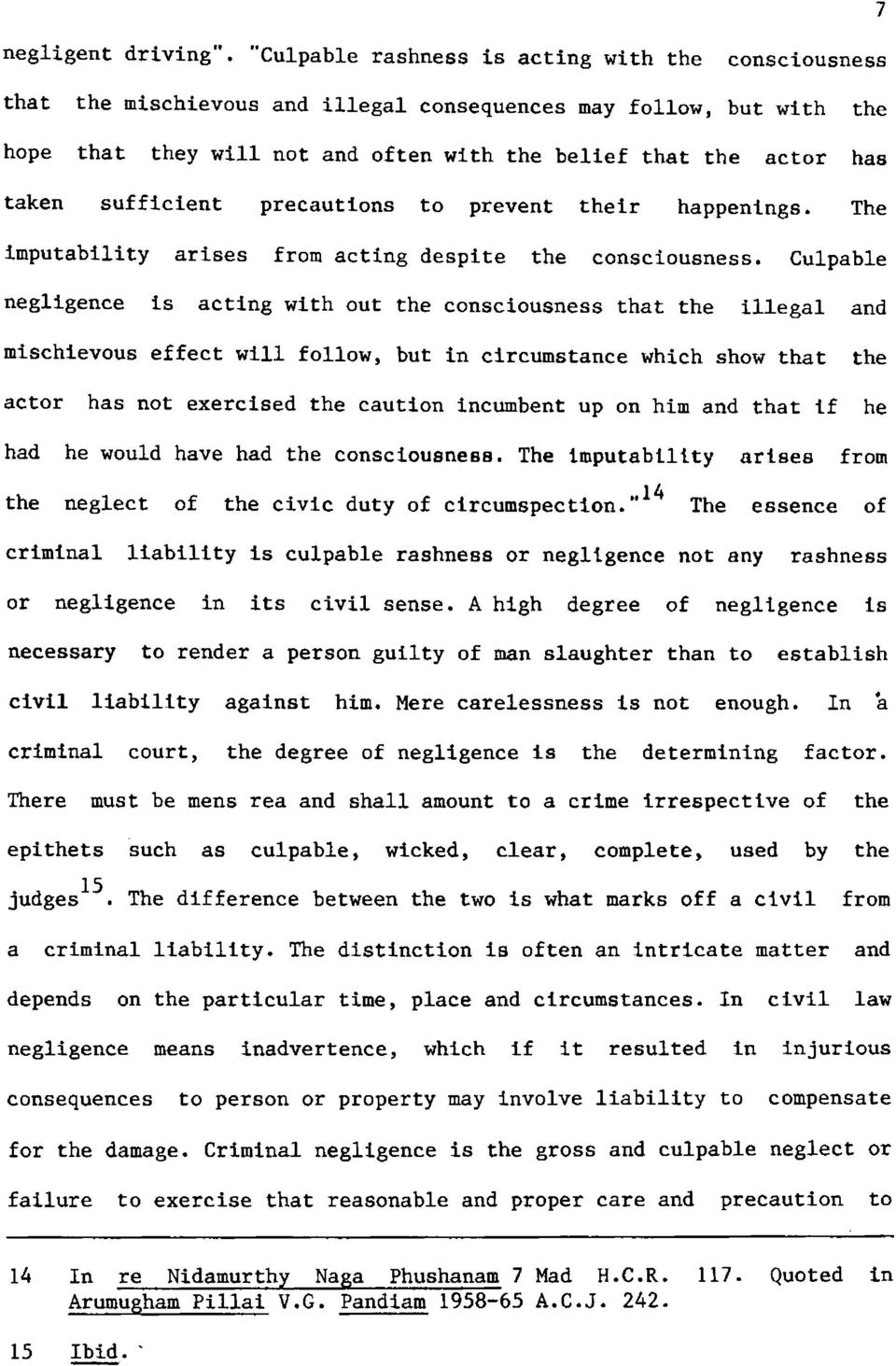
14 records seldom give any clue about such specific problems as drunken driving, skidding, overloading, head injuries sustained by two wheeler occupants, eye deceases suffered by drivers eg: night blindness, colour blindness, defective side vision etc. Though the Indian Road Congress had recommended an elaborate accident reporting format (Form Arl) for police investigation, it is seldom used for the above purposeg. In India an automobile driver is criminally liable under sections 279, , and 304 A13 of the Indian Penal Code for his culpable rash and 9 Ibid. 10 Section 279 provides that whoever drives any vehicle or rides, on any public way in a manner so rash or negligent as to endanger human life, or to be likely to cause hur or injury to any other person, shall be punished with imprisonment of either description for a term which may extend to six months, or with fine which may extend to one thousand rupees or with both. 11 Section 337, provides that whoever causes hurt to any person by doing any act so rashly or negligently as to endanger human life, or the personal safety of others, shall be punished with imprisonment of either description for a term which may extend to six months, or with fine which may extend to five hundred rupees or with both. 12 Section 338, provides that whoever causes grievous hurt to any person by doing any act so rashly or negligently as to endanger human life or the personal safety of others, shall be punished with imprisonment of either description for a term which may extend to two years, or with fine which may extend to one thousand rupees or with both. 13 Section 304 A provides that whoever causes the death of any person by doing any rash or negligent act not amounting to culpable homicide shall be punished with imprisonment of either description for a term which may extend to two years, or with fine, or with both. Interpreting this section, Supreme Court held that to impose criminal liability under section 304 A, it is necessary that death should have been the direct result of a rash and negligent act of the accused, and that must be the proximate and efficient cause without the intervention of another's negligence. It must be the cause of Causans', it is not enough that it may have been. cause sine gqua non; (Suleman V. State of Maharashtra 1968 A.C.J. 51, 55 (SC) 6

15 negligent driving". "Culpable rashness is acting with the consciousness that the mischievous and illegal consequences may follow, but with the hope that they will not and often with the belief that the actor has taken sufficient precautions to prevent their happenings. The imputability arises from acting despite the consciousness. Culpable negligence is acting with out the consciousness that the illegal and mischievous effect will follow, but in circumstance which show that the actor has not exercised the caution incumbent up on him and that if he had he would have had the consciousness. The imputability arises from the neglect of the civic duty of circumspection."14 The essence of criminal liability is culpable rashness or negligence not any rashness or negligence in its civil sense. A high degree of negligence is necessary to render a person guilty of man slaughter than to establish civil liability against him. Mere carelessness is not enough. In a criminal court, the degree of negligence is the determining factor. There must be mens rea and shall amount to a crime irrespective of the epithets such as culpable, wicked, clear, complete, used by the judgesls. The difference between the two is what marks off a civil from a criminal liability. The distinction is often an intricate matter and depends on the particular time, place and circumstances. In civil law negligence means inadvertence, which if it resulted in injurious consequences to person or property may involve liability to compensate for the damage. Criminal negligence is the gross and culpable neglect or failure to exercise that reasonable and proper care and precaution to 7 14 In re_#nidamurthyw Naga,_Bhu hanam 7 Mad H.C.R Quoted in grumugham Pillai V.G. Pandiam A.C.J Ibid.
16 guard against injury either to the public generally or to an individual in particular. Negligence is an omission to do something which a reasonable man guided upon those considerations which ordinarily regulate the conduct of human affairs, would do, or doing something which a prudent and reasonable man would not dole. In Sulemang Rehiman figl gi_ V. The gstate of_maharastra> Supreme Court had to consider, whether a person holding a learners licence or possessed no licence at all is ipso facto culpable rash and negligent. It was held that there was no presumption in law that such a person did not know driving. For various reasons as for instance sheer indifference, he might not have taken a regular licence. The very fact that the accused had been driving the vehicle for sometime past without any mishap was a proof of the fact that he knew driving.l8 However, he cannot escape from the criminal liability as a result of any violation of the provision of the Motor Vehicles Act.19 Trial of traffic offences need be conducted more seriously. The traffic police responsible for the investigation are since deputed from the other branches of the police force it has inherent weakness of the system. Traffic offences are not honestly booked or registered. It sometimes happen that fraudulent cases are registered and genuine cases are left out. It is generally alleged that corruption is rampant and it is one of the main reasons for becoming the system ineffective. The force for investigation of traffic offences 16 gbhalachandra 38,43 Wamang (so) Pathe T" Y. The ff State of all Maharashtra A.C.J A.C.J. 51, (sc) 18 Ed, at p See Chapter VI infra.

17 must be specially trained and it would be better if a specific force is newly created and trained without absorbing from the present police force. It is necessary to ensure that every cases are timely and intelligently registered to book the wrong doers. The past experience shows that many of the wrong doers are narrowly escaping due to the lack of evidence and by virtue of irresponsible conduct of cases. In many of the serious cases only a nominal fine could be imposed.20 The accident prevention to an extent is possible by the deterrent effect through the criminal and semicriminal penalities. On contrary, to concieve an idea that the deterrent effect has to be necessarity accomplished through the law of compensation seems to be less rational than a sincere enforcement of the criminal liability provisions. 9 Civil_liabilitl_ It has been our experience that accidents do occur inspite of preventive measures. Our problem is of alleviating, if not eliminating the misery of those who suffer in tragic consequences.2l Imposition of civil liability in the form of compensation alone is justified as a measure of social justice. As regards the civil remedy is concerned, it is the victim himself who has to file or claim for compensation in the 20 The Kerala High Court observed that the practice of treating the.fine as a rule and imprisonment as an exception is not healthy. Wherever imprisonment has to be given, must be given. _ 9hana Sreekumaran Nair v. State of Kerala 1986 K.L.T 504, Sreedharan J. 21 Patro "Damages in Motor Accidents Claims A Fresh Look"..R. 214 (1979).
18 Motor Accidents claims Tribunal, popularly known as MACT. If the compensation is the sole motto then who must pay this compensation is a relevant enquiry. Whether owner, driver, or their insurer. What must be the juridical foundation for allocating the responsibility of providing this compensation? A brief survey of the categories of systems of compensation in respect of Motor accidents by the Indian Law Commissionzz throws the idea open for further thoughts on this issue. These categories are viz. (i) Compensation by the person who, by his fault, causes the accident (ii) Compensation by the person responsible for the accident, irrespective of fault. (iii) Compensation by the insurer of the person responsible for the accident. 10 (iv) Compensation by the state or by an agency set up or recognised by the state, compensation being payable irrespective of fault. (v) Compensation by the insures of the victim. Compensation based on the fault theory is the familiar one of liability for tort at common law. When it becomes difficult to prove who was responsible for, the accident, or to prove his fault, hardship arises. Hardship can similarly arise when the person responsible for the accident, though known and proved to be at fault is not financially sound. 22 jlst Report of the Indian Law Commission f0n Automobile hit and Run compensation p.2 (1972)
19 Since the requirement of fault is out of date, it is not necessary to retain the traditional requirement of fault. The main object of the law is compensation and not to penalise the person causing the accident. The liability must be based on no fault'.23 Having the liability Insurance in the form of Motor Third party Insurance, made compulsory, there is no justification to consider the fault element and it must be the responsibility of the insurer to indemnify the loss directly. The best alternative for the automobile accident will be social insurance24. Compensation shall be provided by the state or by an agency set up or recognised by the state irrespective of any fault factor. As envisaged under the constitution 25 the "state shall with in the limits of its economic capacity and development make effective provision for securing the right to public assistance in cases of unemployment, old age, sickness and disablement and in other cases of undeserved want". But a basic question is posed, whether or not the financial resources of the state permit the introduction of social insurance in a vast country like India. There is another school of thought that all citizens should compulsorily insure themselves against automobile accidents. Traffic I i AM7? Y 0 I Mg ' ' 23 amala vi V Krishna Qhand 1970 A C J 310 ( ) see also N K V. qniiiulb ibrothers V. My KarumaigAmma 1980 A.C.J. 435 (SC ;_ g yan Nair V. State insurance Office; 1971 A.C.J. 219 (Kern) 24 Bishan Devi V. Sirbaksh Singh 1979 A.C.J. 496 (SC) 25 Article 41 of the Indian Constitution. 11
20 rules imposing obligations are now familiar to every urban citizen, and it is not inconceivable that such a legislation may be passed requiring the residents of big cities to insure themselves compulsorily against injury by automobile accidents upto a certain amountzfi. While analysing the various systems of compensation a pragmatic solution can be found in fixing the liability based on no fault and the compensation provided by the liability insurer directly. 12 The existing machinery for getting compensation leads a victim to a poignant situation. The hardships and difficulties that have been experienced in the working of the present law relating to principles on which liability of the various parties, jurisdiction and smooth working of the Motor Accident Claim Tribunal, being the settlement machinery, and mode of assessment of quantum and mode of disbursement of the award render it desirable that the law relating to compensation be revised. An empirical survey of cases disposed of by selected tribunals like Ernakulam, Kottayam, Alleppey and Perumbavoor reveal that these Tribunals are mostly affected by intractable problem of delay and arrears. Unnecessary delay is caused in the lookout of fault element. It is surprising to observe that most of the Tribunals are in favour of finding negligence so as to ensure compensation to the poor victims. A contrary finding can be seen only in negligible number of cases. The working of the existing claims tribunals are far from satisfactory. As Franks Committee27 suggested it is a system where the principle of 26 lst Law Commission Report p.4 (1972) 27 Report of the Franks Qommittee (1957)
21 openness, fairness and impartiality are to be scrupulously followed. But it functions as a court proper with all its inherent trappings of the court. in order to achieve expeditious settlement of motor accident claims and to deliver speedy justice it is high time to revetalise the existing tribunal system alongwith adoption of supplementary forum. The State Governments are also lagging behind and are failing to give sufficient infrastructure. The most relevant other factors of equal importance are the relative role played by the claimant, driver, owner, insurer and their counsels in the process of settlement. Justice requires that a claimant has to approach a Tribunal with his clean hands. Fraudulent claims should not be filed. No attempt shall be there to make any unjust enrichment or a windfall out of a small thing. The claimant lawyers, as alleged, have reduced to the status of ambulance chasers disregarding their noble professional ethics.28 Measures are required to do away with such sharp practices. Since the financial liability of the driver and owner is indemnified by their liability insurer, most often they do not come forward to assist the process of settlement. It is pitiable to observe that the driver and owner are not even bothered to extent medical assistance to the poor victims. Neither they report to the police nor furnish necessary details with regard to the vehicle and insurance. The law enforcement authorities are also to be blamed for their non co operation.the role of insurer is another major aspect where an improvement of the system is required. The liability insurance ishan Devi v. girbaksh S A.C.J. 496 (sc)
22 is in its transient stage and a system of Loss Insurance or First party Insurance should come in its place. It is alleged that Insurance Companies are raising untenable pleas while defending the case. It is required that the insurance company has to play a positive role. An Insurer issues different types of policies with different kinds of cover. The law needs be reformed to evolve a uniform cover including all types of victims. The right to defense in the case of insurers are statutorily prescribed to a limited items mainly of violations of policy conditionszg. Since the money is paid by the insurer, as the driver and the owner are not interested to contest, there is no justification to limit the insurer's right to defense. The role of insurance lawyers is another area, where improvement of their performance is mostly needed. Similarly with the problem of fixing the liabilities of the parties another confounding dilemma is to determine the quantum of compensation. The judicially recognised methods such as interest theory30 Lumpsum theory31 and Multiplier theory32 are not considered fool proof methods. It is therefore necessary to find out a suitable method for determining the quantum. Besides, a view has been generated that a system of structured compensation will be more useful than a system of lumpsum 33 payment Section 149(2) of Motor Vehicles Act, fihagayandas V. Mohammad Arif, A.I.R A.P Manjusri;Raha V. B.L Gupta, A.I.R SC K..R.T.Q. V. fiusamma Thomas 1994 (1) K.L.T 67 (SC) 33 David Allen "Structured Settlements" (1988) The,Law_ Quarterly Review 448: see also Chapter VIII. 7 7
23 In addition to the Motor Accidents Claims Tribunal, supplementary machineries are also found useful in settling the Motor Accident Claims Settlement of cases by mutual compromise through Lok, Adalat, Open court settlement before the MACT and through Jald Rahat Yojana has produced efficacious results. Discourage litigation, persuade your neighbours to compromise whenever your can, point out to them how the nominal winner is often a real loosers in fees expenses and waste of time. The compromise is quite often a better method of ending the Dispute than the alternatives of fighting the case to the bitter end and by taking the matter in appeal from one court to another. The Legal Service Authorities Act 1987 and the statutory recognition of these peoples forums will have a great impact on the expeditious settlement of Motor Accidents claims. it can be seen that these peoples forum may even evolve as an alternative to the Anglo Saxon System since it is more indigenous, less cumbersome, socially responsive and administratively fair forums. These reforms have already taken a statutory shape in many of the other countries. In Newzeland, a direct compensation is assured irrespective of the fault element through social insurance.34 The problem referred to above are studied in the succeeding chapters I1"-9 _N, 3?%_@_<?_la11<1-_A _ _i 1_eP _CQmP ns_a i011- Act. 1972
24 16 CHAPTER II LAHfBElAIINCjIp SEITLEflENT,QF HQTOR ACCIDENTS QLAI S 2 PAST a PRESENT The general law applicable to settlement of Motor Accidents compensation is common law and the Law of Tortsl. The law of torts as is applicable today in India, has been borrowed from English Law. The Indian Courts have been applying the same on the grounds of justice, equity and good conscience. Under the common law of England, the dependents of the persons killed in an accident had no remedy by virtue of the principle actio_personalis moritur cum persona.2 But an injured person could maintain an action for damages. This resulted in the peculiar position that it was cheaper to kill than to maim or cripple a person. The introduction of railway trains and the increasing number of accidents from 1830 onwards rendered necessary a change in the law. The Fatal Accident Act 1846 Known as Lord Campbell's Act was enacted which gave a new and independent right of action to certain near relatives of the deceased as confined to wife, husband, parent and child3. The advent of the motor car and the great rise in road accidents brought about a further change in the law. The Law Reforms 1. Minu B.Mehta Vs. Balakrishna Ramachandra Nayan (1977) 2 SCR 886; A.I.R s.c.1248, T 2. It means, a personal right of action dies with the person. It was held that in a Civil Court the death of a human being cannot be complained of as an injury (Baker V.Bolt0n (1808) 1 CAMP 493) 3. S. 2 of the Fatal Accident Act 1846.
25 (Miscellaneous Provisions) Act 1934 was passed to remedy the loopholesé of the 1846 Act. Under the provision of the 1934 Act, the right of action of the injured person is deemed to survive his death and passes to his personal representatives. The Act of 1846 was amended in 1908 to direct that insurance money received on the Death should not be deducted from the damages. Similarly pensions and gratutitys were also excluded. In 1971 it was directed that a widow's prospects of remarriage should be left out of account. The law was consolidated, with these amendments by the Fatal Accidents Act Further, amendments were made by Administration of Justice Act This introduced a new award very close relatives only) for the personal distress of bereavement enlarged the class of potential dependents,6 and it directed that benefits arising on the death were to be disregarded7. Though tortfeasor is infact liable to pay the compensation based on principle of fault, the introduction of motor Insurance influenced 0 regulation of law relating to the Motor Accidents compensation. Motor Insurance, a fascinating branch of insurance had its beginning in United Kingdom in the early part of this century. The first motor was introduced in to England in The first Motor Policy was issued 17 the (to It all the the the the car 4. Mainly damages were inadequate and there was no provision survival of cause of action. for 5. Amendment in See Munkman Damages for personal Injuries and Death; (1985) 7th Ed.P.l mi 777 K7 * See chapter V. 7. These amendments do not apply where the cause of action arose before 1983.
26 in 1895 to cover third party liabilities. In 1903, the Car and general Insurance Corporation was established to transact motor Insurance mainly followed by other companies8. After the first world war, there was considerable increase in the number of vehicles on the road and in the number of road accidents. Prior to 1930, it was not compulsory to insure a vehicle. Even where there was an insurance in respect of an accident caused by a motor vehicle, the injured party could not sue the insurer directly or indirectly in the name of the assured to compel the insurer to pay the insurance money to him. This was due to the fact that under the common law, a stranger to a contract could not sue up on it. In England, the third parties (Rights against Insurers) Act 1938 was enacted to confer on third parties rights against the insurer of third party risks in the event of an assured becoming insolvent. This Act could not come'to the aid of a person injured by an insolvent whose vehicle was not insured. The Road Traffic Act 1930 was then enacted, prohibiting the use of a motor vehicle on a road, unless the owner or other person using it took a policy of insurance or gave security against liability to third parties. Under the Road Traffic Act 1930 it was possible for the insurer to escape from the liability by incorporating specific stipulation in the policy, breach of which would render the policy void. The Road Traffic Act, 1934 was passed to prevent the insurer from escaping the liability under the insurance policy by compelling him to satisfy the judgement obtained against the insured and also by rendering ineffective certain clauses in the policy which might be aimed at avoiding the liability arising under it. l8 8 Motor Insurance, Insurance Institute of India (IC ) p.1.
27 19 Bgsition in lndia The Indian Fatal Accidents Act, 1855 legislated on the lines of English Fatal Accidents Act 1846, rendered the maxim "actio personalis mortur cum persona" obsolete and ineffective and enabled the wife, the husband, the parent and the child to maintain an action against the tortfeasor for the recovery of damages in respect of tortious action notwithstanding the death of the person injured. Ordinary suits were filed in the civil courts claiming compensation. Despite, the fact that our first Motor Vehicles Act was passed in the year 1914, some sort of financial protection through third party insurance could be introduced only in the Motor Vehicles Act of The provision therein for compulsory insurance was effected much later from The provision of Chapter 8 of the Motor Vehicle Act 1939, particularly sections 94 to 96 were modelled on English satuties then in force. The objects of the chapter were (1) to enable a claimant to recover the whatever sum he is in law entitled to, despite the inability of the owner or the driver to pay; (2) to prevent the insurer from escaping liability on the ground of breach on the part of the insured, of any term of the contract and (3) to entitle the claimant to recover compensation directly from the insurer. As observed by the Law C0mmiSSi0n9 the legislation on the subjects of compensation for death or injury from accidents caused by motor vehicle has proceeded mainly on two lines viz. 9 85th geport of the Law Commission (1980) p.2.
28 (i) Insertion of provision for enforcing liability towards third parties against the insurer, even though the contract of insurance was between the owner and the insurer, thus modifying the general rule of law of contract that a third party cannot sue on a contract. (ii) Creation of a special forum for the trial of claims for compensation, thus modifying the jurisdiction of the courts with the general hierarchy of courts. 20 Until 1956, there was no adequate machinery for the adjudication of claims for compensation for Motor Accidents. In 1956 Motor Vehicles Act was amendedlo providing for the constitution of Motor Accident Claims Tribunals and confering jurisdiction on them to adjudicate up on claim for compensation in respect of accidents involving death or bodily injury to persons arising out of the use of motor vehicles. The amendment of 1956 incorporated section 110 A to 110 F in order to carry out the avowed object. Until 1969, section 110 of the Motor Vehicles Act permitted petition before the claims Tribunal only for 10 Statement of Objects and Reasons; azette of_ India, Extraordinary Part II, Section 2, No. 47, November 12, 1955, 555, 626. "The State Governments are being empowered to set up tribunals to determine the award of damages in case of accidents involving the death of, or bodily injury to, person arising out of the use of motor vehicles and also to adjudicate on the liability of the insurer in respect of payment of damages awarded. At present, a court decree has to be obtained before the obligation of the insurance company to meet the claims can be enforced. The amendment is designed to remove the existing difficulty experienced by persons of limited means in prefering claims on account of injury or death caused by motor vehicles.
29 compensation for death or bodily injury arising out of the accident. By the Amendment Act 56 of 1969 a provision was added to Section of the Motor Vehicles Act enabling the third party to claim for damage to property also. 21 Pf. 'P "53I 9n P1' "i5_i911_i" the L939: A11 The provision with regard to Motor Accident Compensation were incorporated under Chapter 8 with a caption "Insurance of Motor Vehicle against third party risks. As commented by the 85th Law Commission the heading is inadequate and should be suitably revised since the Section also deals with matters other than insurance. It is recommended that the heading should be revised as "Insurance of Motor Vehicles and Adjudication of claims for compensation in respect of accidents caused by motor vehicles.12 Even after several amendments of the Act the heading remains as such. Sections 93 to 111 A deal with compensation aspects. Section 93 contains certain definition section 94 makes it ll Section 110 of the amended Motor Vehicles Act of 1969 provides that (1) A State Government may by notification in the official gazettee, constitute one or more Motor Accidents claims Tribunals for such area as may be specified in the notification for the purpose of adjudicating up an claims for compensation in respect of accidents involving the death or bodily injury to persons arising out of the use of the Motor Vehicles, or damages to any property of a third party. So arising or both. Provided that where such claims includes a claim for compensation in respect of damage to property exceeding rupees two thousand, the claimant may, at his option refer the claim to a civil court for adjudication, and where a reference is so made, the claims tribunals shall have, no jurisdiction to entertain any question relating to such claim th Law Commission Report (1980) p.7.
30 imperative that there must be an insurance policy in relation to a motor vehicle to cover third party risks before the motor vehicle can be used or allowed to be used in a public place. Section 95 deals with requirement of the insurance policy, as well as the limits of the insurer's liability. Section 96 imposes on the insurer an obligation to satisfy the judgement which might have been passed against the insured in respect of a third party risk. It also enumerates the grounds of defence available to the insurer. Section 97 deals with the rights of third parties against the insurer on the insovlency of the insured. Section 98 casts a duty on a person against whom the claim is made to give information as to the insurer. Section 99 relates to settlement between the insurer and insured persons. Section 100 assigns meaning to the expression liabilities to third parties..." Section 101 relates to the insolvency of insurer. Section 102 deals with the effect of death. Section 103 to 108 deal with certain matters of detail, concerning insurance. Section 109 imposes a duty on the registering officer or on the officer in charge of a police station to furnish particulars of a vehicle involved in an accident. Sections 110 to 110 E are concerned with claim Tribunal, their composition, applications before them, their awards, appeals, powers and procedure. Section 110 F provides that jurisdiction of the Civil Court is barred if a claims Tribunal is created. Section 111 and 111A deal with rules making power. Z2 It should be pointed out that as a result of the provision made in this chapter, transaction of insurance assumes a tripartite character. Normally insurance, like any other contracts, crates a legal link only between the parties to the transaction. The rights of the third parties
31 23 are only against the person insured there being no. direct cause of action infavour of the third parties against the insurer. To this an exception is created by chapter 8, the principal provision in section 96(1) imposes a duty on the insurer to satisfy a judgement against persons' insured in respect of third party risk. The Sections 94 to 96 infact make an inroad on the common law rule that a third party cannot derive benefit under a contract. Until Ist July 1989 the liability of the Insurer was limited depending upon the class of vehicles. As statutorily fixed the liability of the insurer in respect of goods vehicle was limited to fifty thousand rupees in all, including the liabilities, if any arising under the Workmen's Compensation Act 1923, in respect or death of or bodily injury to employees (other than the driver) not exceeding six in number, being carried in the vehicle.l3 In respect of passenger carrying vehicle, there ia limit of fifty thousand rupees in all where the vehicle is registered to carry not more than thirty passengers. In case of vehicles which is registered to carry more than thirty but not more than sixty passengers the liability of the insurer is limited to rupees seventy five thousand in all. It is one lakh in respect of vehicles when it is registered to carry more than sixty passengers. If the vehicle is a motor cab the liability limit of the insurer towards the individual passengers was only ten thousand rupees each and five thousand in any other cases. Where the vehicle is a vehicle of any other Class, the liability of the insurer was the amount of loss infact actually incurred. In respect of persons other than 13 Section 95 (2) of the Motor Vehicle Act 1939.
32 passengers carried for hire or reward, the limit of insurer was rupees fifty thousand in all. The provision is applicable not only to the passengers carried for hire or reward but also in persuance of a contract of employment. The liability of the insurer in respect of property damage was limited to rupees two thousand irrespective of the class of vehicle. These limits were incorporated at a time when the concept of social justice had not fully developed. These monetary limits fixed some what arbitarily on the basis of the nature of the vehicle and.. 14 its size was criticized as anachronistic. 24 In Manjushri V. B.L Guptal5 the Supreme Court of India also made a suggestion for removal of the present limit of liability. It was observed that "such an invidious distinction is absolutely shocking to any judicial or social conscience and yet section 95(2) (d) of the Motor Vehicles Act seems to suggest such a distinction. We hope and trust that our law makers will give serious attention to this aspect of the matter and remove this serious lacuna in Section 95(2) (d) of the Motor Vehicles Act. We would also like to suggest that instead of limiting the liability of the insurance companies to a specified sum of money, as representing the value of human life, the amount should be left to be determined by a court in the special circumstances of each case. We further hope our suggestions will duly implemented and the observation 14 th Law Commission Report (1980) p.32. It is recommended that the limit should be either deleted or raised to Rs. two lakhs per claimant in regard to claim before ordinary courts and Rs. one lakh before claim tribunal. 15 A.I.R S.C
33 of the highest court of the country do not become a mere pious wish."l In Marine and General Insurance C9. Vs Balakrishnan Ramachandra Nayanl7 and Kesavan Nair V. state also it had been suggested to remove the limit of the liability. The pious hope cherished by the Supreme Court of India could not be fully realized even after a decade.l9 In the year 1982 the Motor Vehicle Act was amended for the purpose of incorporating mainly the No. fault liability provision under Chapter VII A captioned "Liability without Fault in Certain Cases". In the amendment Act of instead of deleting the limit of liability, the legislative favour was for enhancing the limit further. As enhanced, the limit in respect of goods vehicle was rupees one lakh fifty thousand rupees. Third party liability in respect of stage carriage and contract carriage was fixed as Rupees fifty thousand. Towards passenger a limit of Rs.15000/~ was prescribed. The limit for property damage has also been enhanced to Rs.6,000/- from 2000/-21. The legislation of No Fault liability provisions based on the recommendations of the Law Commission of Indian22 as well as on the Id at. P A.I.R BOHL 53, 59, A.C.J. 219 (Kerala) 19 S.147 of the Motor Vehicles Act, (20 of the Motor Vehicle Act 1939 (Act 47 of 1982) 21 S. 95 (2) of the Motor Vehicle Act 1939 (Act 47 of 1982) 22 85th Report (1980)
34 basis of judicial pronouncement23 was considered to be a breakthrough in the law of Motor Accident Compensation. Section 92A of the Motor Vehicle Act provides that an owner or the owners of the offending vehicles shall jointly and severally be liable to pay a fixed sum of Rs.l5000/ and 7500 in case of death and permanent disablement respectively. For the entitlement of the same a claimant shall not be required to plead and establish that the motor accident was due to any wrongful act, neglect or default of the owner or owners of the vehicles or of any other person. The defense of contributory negligence was an absolute bar on the respondents. In the amended Act of 1982 another important legislation was the provision for hit and run compensation. The law commission of India in its 51st reportzé had observed that "having considered the various situation, we are of the view that cases in which the accident is caused by a vehicle where the person responsible cannot be traced, Popularly known as hit and run cases, should be provided for, and that the state should take over the liability in such cases. There being no recovery from the tortfeasor or his insurer, the harm suffered goes uncompensated for. Social justice required that the state should take over the liability. On the basis of the recommendation a special provision under S A was incorporated for the hit and run cases. It envisages to create a Solatium Fund with the co operation of General 25 Insurance Corporation and Central and State Governments. In case of death a sum of rupees five thousand is provided to the dependants. In Zhanjushri Raha v. BL Gupta 1977 A.C.J. 134 (SC) 24 "On, compensation Wfor injuries caused by Automobiles in, Hit, and Run Case (1972) p A (4) of the Motor Vehicles Act 1939.
35 respect of grievous hurt a victim is entitled to a sum of rupees one 2 thousand only 6. Motor Yfrhifile Act, The need for updating, simplification and rationalisation of the law relating to Motor Vehicles was recommended by the working group constituted in January 1984 to review all the provisions of the Motor Vehicles Act, 1939 and to submit draft proposals for a comprehensive legislation to replace the existing Act. Various committees like National Transport Policy Committee, National Police Commission, Road Safety Committee, Low powered Two wheelers committee and the Indian Law Commission have also maticulously examined the different aspects of the road transport and favoured the consolidation and amendment of the law.,the observation of the Supremen Court in M.K. Kunhimohammed V. P.A.Ahemedkutty?8 also accelerated the legislative intervention in changing the law to suit the modern day requirements. The changes in the Act proposed were mainly aimed to adapt with changes in the road transport technology, pattern of passenger and freight movements, development of the road network in the country and particularly the A (5) of the M V Act Published in Gazette of India Extra Part II - Section I dated October 17, 1988 Sl. No. 78. This Act came into force with effect from July 1, 1989 vide notification No. SO. 368(E) dated (1987) 4 SCC 284, A.I.R SC To raise the limit of compensation payable as a result of motor accidents in respect of death and permanent disablement in the event of there being no proof of fault on the part of the person involved in the accident and also in hit and run motor accidents and to remove certain disparities in the liability of the insurer to pay compensation depending up on the class or type of vehicle involved in the accident. 27
36 28 improved techniques in the motor vehicles management. The Motor Vehicle Act 1988 was thus enacted taking care of important recommendations. The administration of the Solatium Scheme by the General Insurance Corporation, provision for enhanced compensation in cases of, no fault liability and hit and run motor accidents, provision for payment of compensation by the insurer to the extent of actual liability to the victims of motor accidents irrespective of the class of vehicle are the main changes in respect of Law relating to compensation. The enhanced compensation in N0 Fault cases is fixed as rupees Twentyfive thousand and twelve thousand respectively in death and permanent disablementzg. Similarly compensation for hit and run accidents is also enhanced to eight thousand and five hundred rupees in the case of death and rupees two thousand and in cases of grievous hurt Solatiug Schen*19 9 The applicant shall submit an application seeking compensation. 34 under this scheme in Form 132 along with duly filled in discharge receipt in Form I133 and the undertaking in form V to the Claims 29 Section 140 of the Act Section 161 (3) of the Act S E dated June 12, 1989, Gazette of India,p Extraordinary. part II, Section 3 (II) dated June 12, it 32 Appendix C of the Motor Vehicles Manual (Delhi Universal Book Traders, 1995) 33 Ibid. 34 Ibid.
37 Enquiry Officer35 of the sub division in which the accident takes place with in a period of six months from the date of accident. A Claim Enquiry Officer is empowered to condone delay of six months only provided there are reasonable grounds. Where the claims Enquiry Officer does not accept the grounds advanced by the applicant, he shall record speaking orders and communicate to the applicant reasons for not accepting the claim application. On receipt of the claim application, the claims Enquiry Officer shall immediately obtain a copy of the FIR, inquest report, Postmortem Report or certificate of injury as the case may be from the concerned authorities and hold enquiry in respect of claims arising out of Hit and run Motor accidents. The claim Enquiry Officer has to decide as to who are the rightful claimants where there are more than one claimants and he has to submit, as early possible, and in any case with in a period of one month from the date of receipt of application a report in Form III36 along with duly discharged receipt in Form II and the undertaking in Form V along with his own recommendation to the claim settlement commissioner Claims Enquiry Officer means the Sub Divisional Officer, Tahsildar, or any other officer in charge of a revenue subdivision or a Taluka in each revenue district of a state or such other officer not below the rank of a Sub Divisional Officer or a tahsildar as may specified by the State Government. 36 Supra.n Claims settlement Commissioner means the District Magistrate, the Deputy Commissioner, the Collector or any other officer in charge, of a revenue district in a state appointed as such by a state government.
38 The claim settlement commissioner may return any report to claims Enquiry Officer for further enquiry which may be undertaken and reported on within 15 days by the Enquiry Officer for final order. The nominated office of the Insurance Company immediately on receipt of the sanction order in Form IV together with the discharge receipt in Form II and the undertaking in Form V shall make the payment to claimant. The payment to the claimant by the Insurance Company shall be made within 15 days from the date of receipt of the sanction order together with discharge receipt and wherever delay occurs, reasons therefore shall be explained to the Claims Settlement Commissioner. The payment of compensation in respect of the death of or grievous hurt to any person under Section 161 shall be subject to the condition that if an amount equal to this solatium compensation is obtained under, 38 any other yprovisions of law, then solatium compensation has to be refunded to the insurer. Until 1989, July I, the liability of the Insurer was limited. On 39 1' ' R 6000 the enforcement of the 1988 Act an insurer is liable to indemnify the actual loss. In the case of property damage only a imit o s. has been prescribed4o. The liability of the insurer in respect of property damage can be increased to any extent by giving extra. 41 premium Section 162 (1) of the MV Act Section 147 (2) (a) 40 Section 147 (2) (b) 41 See chapter VII
39 A claim can be settled between the insurer and the insured provided the third party is also a party to the settlement42. The new Act also enables an automatic transfer of the certificate of insurance along with transfer of ownership43. Previously the law and practice was very much anomalous where the benefits of the insurance was lost if the insurance was also not legally transferred 3l0ng with the transfer of ownership. Under the new Act, the officer in charge of the police station is required to forward a copy of the investigation report to the claim Tribunal having jurisdiction and also a copy thereof to the concerned insurer. In practice this mandatory provision is not seen complied with. In the process of settlement of Motor Accident claims, forwarding a copy of the police records to the claims tribunal and to the concerned insurer would help in many ways. A claims tribunal can treat this report if it thinks necessary to do so, as if it were an application44 for compensation under this Act. It facilitates timely action and will be unaffected by any question of limitation. It also requires that the police reports must be forwarded to the claims tribunal and the insurer immediately. If the time taken for completing the investigation and submitting the report is not with in a short period, the desired result will not be there. In this regard it is relevant to refer to the statutory provision made by the Tamil Nadu Government. In Tamil Nadu, it is made mandatoryas that the police should furnish the victims of Section 152 of the Act Section 157 of the Act Section 166(4) of the Act. 45 G.O. Ms. No dated
40 accidents or where death has occurred to the legal representatives of the deceased the following details: 1. Name and address of the owner of the vehicle. 2. Name and address of the insurance company with which the vehicle is insured for third party risk. It is a fact that many accident victims are being deprived of their legitimate dues by lack of knowledge of the law. 32 In 1976 an important rule46 was incorporated in the Motor Accidents Claims Tribunal rules which provides that "Notwithstanding anything contained in Rule 3 and Rule 20, any police officer not below the rank of a Sub Inspector of Police who is entrusted with the investigation of the motor vehicle accident, shall without waiting for the result of the investigation or presentation and as expeditiously as possible get an application in the form appended to these rules from the party injured in the accident or all or any of the legal representatives of the deceased, as the case may be and forward the same to claims tribunal who shall, treat it as application for the purpose of section 110 A. The party concerned shall, before the tribunal passes the award, pay the fees prescribed in Rule 20." Besides, the government of Tamil Nadu has also directed the police officer to findout whether the applicant of the above form is in need of legal aid to press the claim. If the applicant needs legal aid and then the police officer forwards a copy of the application to the District 46 Rule 3 A of the Motor Accidents Claims Tribunal Rules, 1961.
41 Committee for legal aid and advice, who in turn assign counsel and give whatever aid is necessary or collect further information to press claims. Thus the poor and illiterate gets all possible help. The provision introduced by the Tamil Nadu Government may be suitably adopted in other states where parallel provisions do not exist. 33 Where the death of or bodily injury to any person gives rise to a claim for compensation under the Motor Vehicles Act and also under the Workmen's Compensation Act, 1923, the person is entitled to compensation under either of those Acts but not under both47. In such circumstances, the extent of liability of the insurer will be as per the fourth schedule of the W.C. Act A wider legal liability can be obtained if an extra coverage for the same is provided in the policy48. important amendments of the Motor Yehicles Act 1988 By the Amendment Act 54 of 1994, the Motor Vehicles Act 1988, some important changes were made. The driver including the owner of the vehicle has got a great responsibility to take all reasonable steps to secure medical attention for the injured person by conveying him to the nearest medical practitioner or hospital besides giving the required information to the policy officer or to the police station with in twenty four hours of the occurrence. He shall also give the details in writing to the insurer with regard to (1) Insurance policy number and 47 Section 167 of the Motor Vehicles Act, See Harivadan Maneklal Modi v. C.C. Barmar A.I.R P. 69 TTWWWWA 48 See Chapter V.
42 period of its validity (2) date, time and place of accident. (3) particulars of the persons injured or killed in the accident and (4) name of the driver and the particulars of his driving licence.49 As decided by our Supreme Court, in Parmanand Katara V.,Unionof_=India50 professional obligation was statutorily laid down. Now it shall be the duty of every registered medical practitioner or doctor on duty in the hospital immediately to attend to the injured person and render medical aid or treatment without waiting for any procedural formalities As amended the "no fault compensation" is enhanced to fifty thousand rupees in case of death and twenty five thousand rupees in case of permanent disablement.52 In respect of vehicle carrying or meant to carry, dangerous or hazardous goods, it is required to have a policy of insurance under the public liability insurance act, The insurance protection to owner of goods or his authorised representative carried in the vehicle is now assured.54 In the "Hit and Run" cases the quantum of compensation is further enhanced from eight thousand and five hundred rupees to a fixed sum of Rs. twenty five thousand in respect of death and in respect of grievous hurt the quantum raised from 49 Section 134 of the amended Act, A.C.J Section 134 (a) of the amended Act, Section 140 (a) of the amended Act, Section 146 (1) proviso of the Act, Section 147 (b) (1), of the Act, 1988
43 two thousand to twelve thousand five hundred.55 In the Amendment Act of 1994 the most notable aspect was the introduction of a special provision to make payment of compensation on structured formula basis56. As provided the owner of the motor vehicle or the authorised insurer shall be liable to pay in the case of death or permanent disablement due to accident arising out of the use of the motor vehicle, compensation as indicated in the second schedule57, to the legal heirs or the vicitim, as the case may be. The term permanent disability shall have the same meaning and extent as in the Workmen's Compensation Act, The important characteristic of the scheme is that the claimant shall not be required to plead or establish that the death or permanent disablement in respect of which the claim has been made was due to any wrongful act or neglect or default of the owner of the vehicle or vehicles concerned or of any other person. The Central Government is empowered to revise the structured compensation schedule from time to time keeping inview of the cost of living by notification in the official gazette. Where a person is entitled to claim compensation under Section 140 and Section l63 A, he has to exercise his option and he shall file the 58 claim under either of the said section and not under both. 35 The law relating to Motor Accident Compensation thus provides three types of compensation. The right to claim compensation on the principle 55 Section 161 (3) (a) & (b) 56 Section l63 A w.e.f Provided by Act 54 of 1994 (Section 64) 58 Section 163-B of the Act 1988
44 of fault is retained. As provided the amount of such compensation to be given under any other law shall be reduced from the amount of compensation payable under section 140 or under section l63 A.59 The compensation provided under section 140 and section l63 A is on the basis of 'no fault' for death and permanent disablement. Under Section 140, the term permanent disablement is defined and includes any injury or injuries involving (a) permanent privation of the sight of either eye or the hearing of either ear, or privation of any member or joint; or (b) destruction or permanent impairing of the powers of any member or joint; or (c) permanent disfiguration of the head or face. Where as under Section l63~a the term permanent disability shall have the same meaning and extent as in the Workmen's Compensation Act, Under the Workmen's Compensation Act, disability may be classified as follows: 1) Total disablement 2) Partial disablement 3) Permanent disablement 4) Temporary disablement Total disablement60 means such disablement, whether of a temporary or permanent nature which incapacitate a workman for all work which he was capable of performing at the time of the accident Section 140 (5) of the Amended Act of Section 2(1) (1) of the W.C.Act.
45 Partial disablement meas where the disablement is of a temporary nature, such disablement as reduces the earning capacity of a workman in any employment in which he was engaged at the time of the accident resulting in the disablement and, where the disablement is of a permanent nature, such disablement as reduces his earning capacity in every employment which he was capable of undertaking at that time6l. As rightly observed62, in the absence of a precise definition of the term disablement as such, classification of it as total and partial and permanent and temporary and defining in terms of loss of earning capacity in any employment and every employment as explained in Section 2(1) (g) and incapacitation for all work as specified in Section 2(1) (i) is a subject matter of controversy. As it is not so easy to say as to what are the different employments in which the injured could have been engaged and capable of holding earning capacity prior to the occurrence of the accident, no fruitful purpose is served by defining the important term disablement in the above classified manner. Such a definition may only help to impose an additional burden on the adjudicating body besides creating an unnecessary confusion in the minds of the poor claimants who are the real beneficiaries. Permanent and temporary disablement should be defined separately from the partial and total in terms of duration of employment ie. whether it lasts till superannuation or for a lesser period. Total and partial disablement should be defined in the context of injuries specified in the schedule III of the Workmen Compensation Act 1923 and examine. Whether the 61 Section 2 (1) (g) of the W.C. Act. 62 N. Maheswara Swamy "What is disablement under the Workmen's Compensation Act 1923" 1992(1) A-C-J- XXVI 37
46 disablement affects his earning capacity in the employment in which he was engaged at the time of accident or for all work or employment that he was capable of undertaking or performing at the relevant time. The term permanent disability must be clearly defined to avoid different standards and its application must be uniform before any categories of compensation. Further, retention of compensation based on fault over and above the structured formula basis is also a grave concern which requires to be abolished to accomplish the expeditious settlement of Motor Accidents Claims. As substituted by the Amended Act, every application under Subsection ('1') of Section 166 shall be made at the option of the claimant either to the claims tribunal having jurisdiction over the area in which the accident occurred or to the claims Tribunal with in the local limits of whose jurisdiction the claimant resides or carries on business or within the local limits of whose jurisdiction the defendant resides, and shall be in such form and contain such particulars an prescribed. Before this amendment the claims for compensation by the victims or their legal representations were to befiled with in the local limits of the area where the accident occurs63. The amendment of the section was suggested by the Law Commission of India64. Though the amendment provides a widened scope for the claimants, there are disadvantages in respect of both the insurers and the claimants. When there are more claims, a joint l19th Report, :On Motor Accidents Claim" (1987) 64 Section 166 (2) of the Amended Act, 1988.
47 adjudication would be helpful to resolve the issues. The claimants may also find it difficult to get the witnesses once the jurisdiction he chooses is different from the place of occurrence. Since the liability of the insurer is limited to the number of persons permitted by the permit there may be circumstances under which an insurer may face difficulty in arranging a uniform and common defence. The administrative expenses of the insurer will be more when each claim arising out of a single accident requires to be defended by a seperate counsel. Therefore it is necessary to ensure that the jurisdiction of such multiple claims shall be confined to the Tribunal covered by, the place of occurrence of the accident. Another important change was the deletion of sub section 3 of Section 166 of the 1988 Act. It has been provided that no application for Motor Accidents Compensation shall be entertained unless it is made with in six months but not later than twelve months, if it satisfied that the applicant was prevented by sufficient cause from making the application in time. By deleting the same, the claimants are free to file the claim at any time. There is no period of limitation as such for filing the claim application. Having deleted the clause for the period of limitation, it is necessary to substitute the words with in a reasonable time in sub section 2 of Section 166. It shall be the discretion of the Tribunal to determine the reasonable time with in which the claim is filed. To allow a claimant to file a compensation application at any time may cause inconvenience to the insurer since the policy documents are retained in the office to a certain limited period only. When the death of or bodily 39
48 40 injury to, any person gives rise to a claim for compensation under the Motor Vehicles Act and also under the Workmen's Compensation Act, 1923, the person entitled to compensation may without prejudice to the provision of Chapter X (No fault compensation) claim such compensation under either of those Acts but not under both65. This is an option statutorily allowed to claimants. In case the claimant opts Workmen's Compensation forum, he need not prove negligence whereas before the Motor Accidents Claims Tribunal he has to prove negligence. The liability of the insurer is limited to the Workmen's Compensation schedule generally. As discussed66 below an enhanced liability will be discharged by the insurer on paying extra premium to the insurer in the relevant policy before the Motor Accident Claims Tribunal. A claim tribunal shall pass an award determining the amount of Compensation which appears to be just and specifying the person or persons to whom compensation shall be paid. Tribunal shall also specify the amount to be paid by the Insurer, owner or driver. A copy of the award needs to be delivered with in a period of fifteen days from the date of the award67. The award amount shall be deposited - within days from the date. of announcing.. the. award. Generally an insurer is unable to be contest the case all grounds available to the insured. But, under certain situation viz. (1) when 65 Section 167 of the Motor Vehicle Act, See Chapter IV 67 Section 168 (2) of the Act, Section 149 (2) of the Act, 1988
49 there is a collusion between the person making the claim and the person against whom the claim is made or (2) the persons against whom the claim is made has failed to contest the claim, the insurer is permitted to contest on all grounds available to the insured69. An award shall carry simple interest from such date not earlier than the date of making the claim70. A Tribunal is also empowered to award compensatory costs not exceeding one thousand rupees when the policy is void on the ground that it was obtained by misrepresentation or any party or insurer has put forward a false or vexations claim or defence. 4 A22-=_-al Any person aggrieved by an award may prefer an appeal to the High Court within ninety days from the date of the award7l. No appeal shall be against any award of a claim Tribunal if the amount in dispute in the appeal is less than ten thousand rupees. In the case of person who is liable to pay the compensation prefers an appeal it is a condition precedent for him to deposit Rs.25000/ or fifty present of the amount so awarded whichever is less in the manner directed by the High Court72 Recovery of money under an award will be done as an arrear of land revenue73. Further, no civil courts shall have jurisdiction to entertain 69 Section 170 of the Act, Section 171 of the Act, Section 173 of the Act, lbid 73 Section 174 of the Act, 1988
50 any question relating to any claim for compensation where any claim tribunal has been constituted for that area.74 The law relating to motor accidents compensation is changed frequently. The poor accident victims or their dependants are not so legally aware of their rights. It is satisfying to note that the police officer in charge of the police station shall forward a copy of the police report with in 30 days from the date of recording or completion, to the claims tribunal, to the the insurer or owner. The copy received by the owner shall retransmit within 30 day of receipt to the claims tribunal and the concerned insurer.75 The claim Tribunal shall treat any report of accidents forwarded to it under sub section (6) of Section 158 as an application for compensation under this Act. This will ensure that rights of the poor claimants are considered and protected through proper adjudication. After having analysed the procedure for making compensation, it is proposed to take up for study in the next chapter the principles of liability Section 175 of the Act, Section 158 (6) of the Act, 1988
51 42 cuamzx 111,P_R1NCIPLE_,,O]?' 1-'1.xA;1;_1pN. A Hour-',woRx One of the central problems involved in the process of settlement of motor accidents claims is to find out the legal basis for the fixation of liability. In both common law and civil law systems, the evolution has followed identical principles viz., extention of the concept of negligence, judicial recognition of liability without fault and the legislative adoption of the principle of strict liability for certain activity considered dangerous and ultra hazardous. These developments, however, have not changed the basic theory that liability is still predicated on the basic interpretation of the notion of fault. It can be seen that this is a theoretical anachronism paradoxically kept alive and intact by practical inroads made up on it by the rapidly increasing coverage of liabililty insurance business which in effect abolishes altogether the idea of tort liability. It is an established fact that the ultimate goal in allocating accidental losses should be to promote wide distribution of loss in the most efficient manner consistent with the achievement of a satisfactory level of deterrence and loss protection. Under the existing compulsory Third party Insurance Scheme the question of deterrence and loss prevention are highly debatable. The element of justice requires that each party should be held responsible according to the nature of the risk involved in the activity. In the law of compensation, a satisfactory level of deterrence can be achieved to the extent of imposing some financial accountability only. The new Motor Vehicle Act of 1988 not only enhanced the liability of the Insurer to the actual loss suffered but also set free the driver and the owner from any liability. Though this
52 provision enables the victims to recover the compensation from the insurer, an absolute escape from any financial accountability by the owner and driver seems to be anomalous. It is suggested that the premise for allocating loss must be the risk involved in the motoring activity. Once the risk is accepted as a reason for a rational allocation of loss it, is necessary that the liability insurance system be replaced by a system of First Party Insurance or loss Insurance. Under this scheme an insurer shall be allowed to recover from the owner and driver at least a small percent of the total award paid to the victim being their share towards medical expenses, or in the alternative, the owner and the driver shall be responsible to meet the medical expenses upto a sum of Rs. 3000/-. This will ensure the financial responsibility as well as their active co-operation in the process of settlement either through compromise or through contest. Similarly criminal trial of traffic offenses and imposition of higher penalties shall necessarily be strictly enforced to achieve satisfactory deterrence. There are different schools of thought, which are profitably referred to as guiding factors in the look out and it has become a desideratum to evolve a more comprehensive system built up on a strong jurisprudential foundation. 44,LlABILITY BA$ED ON FAULT The tangled, intertwined concepts of the law of negligence are a constant source of fascination for lawyers and also a source of despair. No theory is likely to explain all the cases, or even the vast majority
53 of them. The greatest sin for academic lawyers is therefore over ambition.l 45 It is assumed that the fundamental objective of automobile claims system is to compensate for loss suffered, and the idea that the best way to accomplish this objective is to impose up on the party whose fault caused. the accident - the responsibility for compensating the victim. In Anglo American jurisdictions, the law of automobile claims system is a segment of tort law, a body of law concerned with private redress for accidental and intentional injuries. The primary question of automobile law is of tort law generally. Why provide and award of money to the victim rather than allow a loss to remain where it has fallen. Here emerges a basic principle that an award is not to be made unless there exists some reason other than the mere need of the victim for compensation. Otherwise, the award will be an arbitrary shifting of loss from a person to another at a net loss to society due to the economic and sociological costs of adjudication.2 Tort laws in one sense is public law, it concerns public interests, its impacts extend into the lives of all people in the community and it reflects as faithfully as any branch of law. In another sense, tort law is distinctly private law. It focuses on private interests, and concerns the rights and duties of private individual towards each other.3 The question whether a money judgment should be awarded can be approached 1. J.D.Fresser & D.R.Howarth "More concern for cause" 1984 (2) Legal Studies Robert E Keetone and Jefry 0' Connell "Basic protection ~ A proposal for improving Automobile claims system" 78 fiarv.l.rey ( ) id _at.p.332
54 from the point of view of the public interest. What reasons for shifting loss between a plaintiff and defendant might serve as guiding principles for motor accidents claims system? What arguments beyond simply a need for compensation might be advanced for a decision that a defendant pay money damages to a plaintiff injured in a traffic accident? Fault, is the justification most often given for shifting loss in motor accident claims.4 Liability is dependent up on proof of negligence of the defendant or some one for whose conduct he is accountable.5 Fault in theory tries to reduce total costs by deterring specific conduct felt to be dangerous. Letting the party which causes the cost bear it attempts to decrease accident costs either by reducing the cost causing activity by making it more expensive or by inducing the introduction of safety devices to the extent that they cost less than paying for the damages which they prevent.6 Spreading the loss broadly attempts to reduce costs in a secondary sense. It does not reduce the number or gravity of the accidents. But by spreading the burden of Blum & Kalven "Public Law Perspectives on a Private Law Reform" 31 pv. Jhi.L Rev. 641 (1964) See also VAR STRALL "Tort Liability and Insurance". 3_ candinavian studies in Laws (1959) Wing V.Londong General OmnibuSCO._(l909) 2 K.B. 652; Stennet V. Hancock [1939] 2 All E.R The rule of absolute liability laid down in Rylands V. Fletcher was inapplicable to a motor vehicle. Philip V.Britania Hygenic Laundry Co. [1923] 1 K.B Guido calabresi "Fault,Accidents, and the wonderful world of Blum and Kalven" 75 The Yale Law Journal 216 ( )
55 , 7 their secondary costs. accidents it attempts to reduce the bad effects that accidents have 47 As per the classic definition of fault in French Administration law "Fault is seen in form of departure from a standard or as an empirical course of conduct, rather than as a breach of duty. Any derogation from the requisite standard of competence amounts to a malfunctioning of the public service.8 FLULIpf_.STATUTORY_fl E The consensus opinion of the High Courts in India was that the law relating to Motor Accidents compensation which contained in the Motor Vehicles Act, is merely a procedural law. The substantive law applicable is only common law and law of Torts.l0 The word negligence is no where found in the whole law relating to compensation. In Minu Q Mehta V.Balakrishna Ramachandra Nayan ll the Supreme Court of India authoritatively pronounced the ratio confirming the above stand. This was a case of Collision between a Car and a Truck. Dr. Balakrishna Ramachandran Nayarawas driving his car. His nurse Malathi 7. Ibid 8. Carol Harlov "Fault Liability in French & English public law (1976) 39 M.L.R Chapters 10,11 and 12 of the Act 10. Seethamma V.Benedict D'sa.l?66 A.C.J; 178 [Mysore H.C.] g.govindara alu Chetty V. flla Govindaraja Madaliar 1966 A.C.J. 153 (Madras H.C) Mangalal V. Parasyam 197OA.C.J86 (MP) Ram Pratap V Punjab Roadways _Ambala A.I.R Punjab 540. A A A.C.J. 118 (sc)
56 M.Deshmukh was also with him who was sitting on his left side in front. The truck was at a high speed and dashed against the right side of the car. The car was damaged due to the impact causing personal injuries to both the Doctor and the Nurse. It was argued that negligence need not be proved. It was observed that the plea that the claim tribunal was entitled to award compensation which appeared to be just when it was satisfied on the proof of injury to a third party arising out of the use of a vehicle on a public place without proof of negligence would lead to strange results. It is useful here to refer to some decisions of the High Courts where it has been held that negligence is not a relevant factor to be inquired into to fix the liability. 48 In HajiwZakaria V.Naoshir Camaézthe Andhra pradesh High Court held that the requirement of proof of rash and negligent driving of vehicles involved in the accident giving rise to the claim would defeat the very purpose of insurance and there was no need to prove the same and the use of the vehicle was the criterion. However this has been overruled in Minu B ehtas' case. Similarly in Marine & Genllnsurance Co.Ltd V Qr;_ Balakrishnan Ramachandran Nayan13 the Bombay High Court interpreted section 110 of the Motor vehicles Act,l939 to the effect that everyone injured by the use of Motor vehicle must get compensation for injury. It is not necessary for the court to interpret. The word Use as necessarily implying improper use or negligent use in the absence of any words used by the legislature to underpin the liability as a liability with respect to negligence or any other specific tort or tort A.C.J A.C.J. 288
57 14. generally. On appeal the Supreme Court reversed the decision and reiterated the necessity of proving negligence for entitlement of the 49 compensati0n.l5 HISTORICAL pnvmprnmljr or nocmlnr-fantr 1.1gABI1.1'rg History16 reveals that concept of strict liability was the prevailing rule of the early common law. Fault concept was only a later development. Historians have differed as to how the law of torts began. There is one theory that it originated with liability based up on "actual intent and actual personal culpability" with a strong moral tinge and slowly formulated external standards which took less account of personal fault.l7 Another theory, is that the law began by making a man act at his peril, and gradually developed towards the acceptance of moral standards as the basis of liabilityls It has been suggested that, there has been no steady progression and that there have been 'unm0ral' periods and others in which stress has been laid up on moral fault.l9 14. _;d_ t.p flinu B. Mehta V. fialakrishna Ramachandranwflayan 1977 A.C.J. 118 (SC) 16. Edwar J. Kionka Torts Injuries to persons and property (St. Paul Minn West publishing Co., 1977) 17. Holmes, The common Law Lecture 1 (London, Macmillan & Co. 1887) 18 Wigmore "Responsibility for Tortious Act: Its History" 7 Har. L Rev. 315 (1894) see also Amos "Law and Moral" 22 fiar,%l. Rev. 97 (1908) 19. Issacs, "Fault and liability" 22 Har.L.Rev. 954, 965 (1918)
58 At the earliest stages of the common law the terms crime and tort were unknown.20 Personal disputes were self remedied by way of tit for tat and eye for an eye. THe intervention of law as an harbinger of peace gradually evolved. First step was to offer and provide some incentives for the parties to settle the disputes by an agreed compensation. Soon it began to require resort to a primitive form of trial by ordeal or oath in lieu of the feud. If Plaintiff won, the defendant had to pay some fixed sum to the plaintiff called bot and to the king called 'wite' computed on the basis of plaintiff value (called 'wer') and the nature of the injury or on the value of the property. If the defendant could not pay, he was punished.2l Then existing Anglo Saxson courts were local and dealt with only minor wrongs we now call misdemeanors. Only after the Norman Conquest in 1066 the Royal courts were created and began to have limited jurisdiction over a specified list of wrongs primarily called felonies where there was a breach of the king's peace and disputes involving land. The procedure adopted in the Royal courts was called appeal of felony by which plaintiff accused defendant of a wrong in open court and offered the appropriate form of trial, combat, ordeal or oaths depending on the type of wrong and other factors. If plaintiff won, the defendant was punished. But no compensation was awarded to plaintiff in this action except that in an appeal of larceny, the goods if available were returned to the plaintiff. In 1166, the grand Jury was instituted, and a century later lesser crimes could to 20. Woodbine, "The Origin of the Action of Tresspass 33 'Yale L.Journal (1923) p igigé sie also Fifoot, fiistory and Sources of the Qgmmon Law (1949) 50
59 presented by public officials up on an information but the appeal of felony remained optional for many years. Since then, up to 15th century, much of the kings business was accomplished by Royal writs and this included the administration of justice. Gradually, a formal system of named writs evolved, and it became necessary for the plaintiff to purchase an appropriated writ from the kings chancellor in order to commence his action. As a result of various political and judicial pressures the writs became crystallised in to certain forms and contents corresponding to the available actions and if plaintiff could not fit his case into one of the prescribed writ form, he had no action in the Royal courts. By the 15th century it had become possible and common to commence an action by Bill or complaint instead of Royal writs, but plaintiff's declaration still had to state a course of action in the recognised forms corresponding to the writs that could have been selected.22 From the early stages of writ jurisdiction an action for personal civil injury was recognised. This is called writ of trespass. Under this writ of trespass the plaintiff recovered his actual damages if any rather than damages according to a fixed scheme of compensation. For many years it also retained quasi criminal character in that, a vanquished defendant was usually imprisoned or fined. Besides trespass, an another form of writ was also developed to accommodate certain wrongs that were outside the preview of the writ of trespass. This is called Action on the Case. In the final stages of evolution only a clear cut distinction between the writ of trespass and the Action on the case was recorded Maitland, The f_orms_of_a_ction_at_ common Lag (1941) 650.
60 In ggt_v. Shephered23 where on a squib being thrown in a market place and further thrown in self defense from one point to another by persons endangered, the injury was held to be the direct and immediate act of the defendant. But where indirect, ie, ulterior damage was sued for, in an action on the case, some limitation had to be imposed and the test came to be whether the indirect consequence was forseeable. It explains that the writ of trespass was applicable when the injury was direct and immediate, the action on the case was the remedy for the indirect and consequential harm. In the case of action on the case proof of actual damage was required but not in the case of trespass. Further, proof of defendant's fault was also required in action on the case. No civil action was permitted in the kings court for wrongful death until the passage of Lord Comphell's Act in As time went on, in certain of the recurring cases, actions crystallised and were separated in to named actions having rules and writs of their own. In a nutshell, trespass together with action on the case and its progeny, account for virtually all the action to which we now refer collectively as the Law of Torts. The action on the case in most instances required to prove the fault to establish a breach of duty to plaintiff in a sense as a substitute for the missing element of a direct trespass. This fault could be the performance of a lawful act in a dangerous manner. This negligence formed the basis of liability in a number of different civil action for which action on the case was the appropriate writ E R, 525 as per wc Grey c J (1773) 2 Win B/892
61 _ 24 negligence took hold. As the vitality of the forms of actions declined, harms direct and indirect grouped as separate field of liability and a general concept of 53 Ideologically the liability based on fault has its roots in the rationalistic natural law dating from the beginning of the 17th centuryzs and the idea of personal liability seems to have been first forcefully advanced among the jews during their Babylonian exile, where they were heavily engaged in trade.26 In Roman Law, the lex Aquilia required some degree of fault in defendants for punishment and compensation. The conception of fault was also being combined with christian conception of guilt in the canon Law. POSITION The historical background of legal system in India could be traced from Samhita period.27 The implicit belief in rebirth and the fixed notion that for every defect or mishap in this life, a person himself is responsible in this life, or in a past one are major characteristics of the judicial and social code of Hindus The origin of this fault rule is obscure and winfield in common with most other writers, regarded it as both exceptional and historicaly unjustifiable. Winfield and Jol0wicz,on Torts (1979) p Stig Jorgenson, "The decline and fall of the Law of Torts" 18 _Amer:J.Comp. L.39 (1970) 26. ld_ae p From 1600 B.C to 1300 B.C 28. Beni Prasad, Theory of Government in Anqjent India p_10 cited in Karkara Contributory Negligence, (1983) p.6
62 During the period of Upanishads and Dharmasastraszg only a real beginning of civil and criminal law as two distinct branches can be found. A great,deal was left to be adjudged by usages, precedents and customs.30 Judges were to consider fault of the parties in dealing various wrongful acts.3l During the Manu Smruthi period32 compensation was provided either on the principle of fault or social assistance.33 In a case, if the wrongdoer was not in a position to pay the damages, a system of social assistance by which the users of the vehicle were required to make good the loss caused to the injured. The judge were required to measure compensation by finding the truth by inference. The period between 320 A.D to 1000 A.D saw the end of the constructive period of Hindu Law and its critical phase was yet to begin. The commentaries of Yagnavalkya, Vishvarupa and Medhatithi made a blending of crime and tort and no clearout importance was given to fault or negligence.34 Muslim Law went even further in the direction of subordinating the tort to crime35 By the beginning of the 17th century, at least in states administered by Hindu Kings, Manu Smruthi was considered as main source B.C to 600 B.C 30. Kane, P V History ofdharmashastra vols. 2 & 3 (1941) 31. Ibid B.C to 320 A.D 33. Manu Smruthi VIII, see infra. n G.S. Karkara, Law relating to Contributory Negligence (1983) p Anand & Shastri,Lawof lortsl 240.
63 of law. But in parts of the country where Muslim Law was applied either the law of Torts was not developed or it was in rudimentary stage. This had helped the Britishers to apply their own law in India. The people of India came under the influence of the common law jurisprudence in such a peculiar way. The English law has been the source of the Law of Torts as applied by the courts in India but its actual extent of applications remained vague.36 By the charter of 1726, both common law and statute law of England, were introduced in India as they stood in In the case of Torts, the courts in India tried to follow the rules of common law in so far as they were in consonance with justice, equity and good conscience.38 Its application was therefore selective39 and was not followed if found unreasonable and unsuitable.4o Sir Fredrik Pollock had prepared a draft code of Torts for India known as "The Indian Civil Wrongs Bill at the instances of the Government of India. It was not taken for legislation.4l 55 MEANING OF FAULT Winfield defines fault or negligence as the breach of a legal duty to take care which results in damage undesired by the defendant to the 36. R.Ramamoorthy "Difficulties of Tort litigants in India" l2 J.I.L.I (1970) 37. Thanvi S.C. The Indian legal system, 591 see also Advocate WGeneral Q _ ggg l_ V Ranee_Suruomayee Posse; (l863)9 MIA 387 at Id at Smt; Vidyadevi V. MPSRTC 1974 A.C.J pesai &gdesailramaswami Iyer The Law of Torts p.21 8th Ed. Bombay, Tripathy Pvt. Ltd. (1987) 41- Report of the 4th Lawgcommission of India see also 5 LQR 362.
64 4.. plaintiff.42 It is a carelessness in a matter in which carefulness is made obligatory by Law 3 Lord Wright in lochgelly Iron and Coal Company V. M Mullan44 explains that negligence means more than headless or careless conduct, whether as omission or commission, it properly connotes the complex concept of duty, breach and damage thereby suffered by the person to whom the duty is owing. In yarsilal_jagannath Parshad mor V. Pandit Sitaraman Dubeyés the Madyapradesh, High court held that a necessary ingredient in the conception of negligence is the existence of a duty owed by the defendant to the Plaintiff to take due care and breach of that duty. The idea of negligence and duty are related and there is no such thing as negligence in abstract; negligence is simply neglect of some care which we are bound by law to exercise towards somebody46 A reasonable man so regulates his conduct as to avoid producing any undesirable consequences which he forsees as probable. That is the normal standard of careful conduct. If the conduct in question falls short of this standard, it is negligence On Tort, llth ed, (1979) 43. Salmond On Tort 15th ed. 44. [1934] AC 1, A.C.J. 352 (MP) 46. Bewen, Qn negligence, p.ll (As per Stone, it is a legal category of concealed circular reference. It is not only incapable of yielding only one result, it is strictly incapable of yielding any result. To make duty an additional requirement to that of negligence is to assert that there is a distinction, where no distinction is to be found we are confronted by a meaningless distinction, a category of meaningless reference. Stone, {Legal Systems and Lawyers Q 1 5 (1964) p.258 That is the normal istandardniofi careful conduct.) 47. Minor Veeran V. T.V. Krishnamoorthy A.I.R Kerala 172
65 57 f1 _l!q {IES OF FAULI There are two rival schools of thought with regard to the meaning of the term fault. According to one, fault is a state of mind. The other view is that it is not a state of mind but merely a type of conduct. These theories are respectively called subjective and objective theories of fault. SUBJEQIf_IVE THBORII It is Sir John Salmond, who adopted this theory as expounded by Austin. According to him, a careless person is a person who does not care. It is an attitude of indifference. Now indifference is exceedingly apt to produce thoughtlessness or inadvertness; but it is not the samething, and may exist without it. If one is indifferent as to the results of his conduct, he shall very probably fail to require adequate foresight and consciouness of them, but he may, on the contrary, make a very accurate estimate of them, and yet remain equally indifferent with respect to them. It therefore essentially consists in the mental attitude of undue indifference with respect to one's conduct and its consequence.48 IHBrQBJECIIVE,IHEORY It is Sir Fredrick Pollock, who propounded this theory. Fault is not a subjective element but an objective one. It is not a particular state of mind but a particular type of conduct. It is a breach of the duty of taking care and to take care 48. P.J.Fitzgerald, Salmond on Jurisprudencg (1966) p.390
66 means to take precautions against the harmful results of one's actions and to refrain from unreasonably dangerous kinds of conduct.49 For instance to drive at night without lights is a fault because to carry lights is a precaution taken by all reasonable and prudent men for the avoidance of accidents. To take care therefore is no more a mental attitude or state of mind. It emphasises that fault means a failure to achieve the objective standards of the reasonable man. It is not sufficient that one has acted in good faith to the best of his judgment and belief and has used as such care as he himself believed to be required of him in the circumstance of the case. The question in every case is not whether he honestly thought his conduct sufficiently careful, but whether in fact it attained the standard of due care established by law. The standard due care demands the amounts of care which is reasonable in the circumstances of the particular case. It is different from the standards of an average man. Fault is therefore the omitting to do something which a reasonable man would do, or the doing something which a reasonable man would not do.50 The subjective theory has the merit of making clear the distinction between intention and fault. The willful wrong doer desires the harmful consequence, and therefore does the act in order that they may ensue. The negligent wrongdoer does not desire the harmful consequence, but in many cases is careless whether they ensue or not and therefore does the act notwithstanding the risk that may ensue. The willful wrongdoer is liable because he desires to do the harm. The negligent wrongdoer may be liable because he does not sufficiently desire to avoid it. 49- Pollflck, TOrtSf 15th ed p.33ef ff? jfljf TI T T T T 50. lyth_v. Birmingham water works Co. (1856) 25 L.J.Ex at
67 The importance of objective theory is strongly felt when wrongful intention is not in issue and the question is simply whether the defendant caused the harm without any fault on his part or by his unintentional fault, the question is to be settled by asserting whether his conduct conformed to the standards of the reasonable man. In such cases, the law relating to fault requires the defendant at his peril to come up to an objective standards and declines to take his personal equation in to account.51 In American jurisdictions also fault was considered as an essential element. In the leading American case rown_ V. Kendall52 When defendant raised a stick to seperate two fighting dogs and in doing so accidentally struck the eye of plaintiff who was standing behind him. Plaintiff sued in trespass for assault and battery. Under the English common law plaintiff could have won since the injury was directly caused by the defendants voluntary act. Although the court held that the trespass was the proper form of action, it found for the defendant holding that liability in trespass required either intentional or negligent misconduct. The fault ethics based on brown case was so strong that the New York Court of Appeals in 1911 held the state's first workman's compensation statute unconstitutional because it imposed Holmes "On negligence and recklessness" (1961) 24 M.L.R In Denmark by the middle of the 19th century Orsted and Goos (like Jhering) attached importance to objective rather than subjective factors for practical reasons. According to them a certain basic integrity of persons and things must be protected by the laws of compensation, regardless of the presence or absence of subjective elements. (Stig Jorgenson "The decline and fall of the Law of Torts" 18 Ame.J, gmp. L; 39, 47 (1970). Materials p.5 (1962) 3rd ed: 1' Cash (60 Massachusetts 1850) See prosser and Smith, cases, and
68 - -' liability without fault. Writer Kionka observe that the past fifty years have seen a dramatic reversal of fault ethic attitude. W0rkman's compensation statutes have been passed and sustained in every state Restatement of Torts (second) in 1964 clearly provides strict liability for activities which are abnormally danger0us FAULT LIABILITY SYSTEM :Critical Appraisal The Present system of liability determination based on fault has got practically many defects adversely affecting its continued existence. The intractable problems of delay and arrears, the difficulty of proof of fault, and the positive aspects of the inherent risk, social justice, availability of third party insurance protection demand the abolition of fault aspect. "The drift to paternalistic.. 56 having to prove the negligence or fault of somebody else. ~ government which has marked the last hundred years has led to the belief that compensation for personal injury and death should depend up on the commission of a wrong is untenable, so that reparation must be available beyond the limits of tortious claims"55 A road accident victim should be able to recover atleast the whole of his net economic loss without 53. EDWAR J KIONKA Iorts injuries to persons and property (1977) p Sections 519 & Philips S. James General Principles of the Law of Iort p.9 (1978) 56. "Editorial" 120 the new Lapwm_journa_l 469 (1970)
69 According to Alec Samuel57 the defects in the present fault system of damages for personal injuries are painfully apparent. Woodhouse report58 in New zealand strongly criticizes the concept of fault liability as a philosophy on which it depends as illogical, the verdicts as entirely uncertain affected by mere chance, the procedure as costly and slow moving and the nature of award and the whole process as an impediment to rehabilitation59 and further observed that the moral basis for the application of fault principle cannot be explained in terms of the legal conception of negligence because the test of negligence is objective and impersonal.6o Negligence is tested not in terms of the state of mind or attitude of the actual defendant but impersonally against performance of a theoretical individual described as the reasonable man of ordinary prudence.61 Defects L1n@ted_scope of Reparation A major shortcoming of this system is its ineffectiveness as a means of social adjustment. Though the defendant is successfully sued, the injured plaintiff will go unrecomposed if the defendant lack the means to pay and also the injured plaintiff has to go unrecompensed if the facts be such that the defendant has done him no tortious wrong. 57. "Personal injuries. "Fault as basis of compensation 120 Ihe New Law gjournal, 798 (1970) 58. Rep9rt_ of the groyal_commission_ofgenqp;ryy on_ compensation? for personal injury in New zealand (December 1967) 59. g_ E p lg _p ld_ t_p.5o
70 62 (b) limited $cope of Personal accountability Fault by its nature fails to bring home the wrongdoer personal accountability interalia on the main grounds of widely accepted liability insurance practice as well as on lack of means to pay. The liability of the insurer has now been statutorily very widened by which the tort feasor can escape absolutely free from any type of financial accountability. (c) Difficulty of Fault Determination Most accidents occur suddenly and unexpectedly. The details of the surrounding circumstances can seldom be accurately determined. A normally cautious driver could be held negligent because an incorrect decision62 in the last split of a second results in an accident.63 Further, proof of negligence becomes a difficult task on the plaintiff due to various reasons.64 It cannot be ruled out the possibility that either party to the accident may be tempted to suppress or fabricate evidence to show that the other party is at fault. It has become a dilatory process. The inordinate delay caused to poor victims amounts to denial of justice 62. It is estimated that a driver averages 200 observation and 20 decision per mile. See George E. Rejda Social Insurance and Economic Security (1976), p Ullnwdl T 6 es. $2; Record of the police investigations are not made available to the Tribunal and officer who investigate the accident are seldom available to give evidence. With regard to the present system of investigation it is commented in a report by Justice on Trial of Motor Accident cases that it is expensive, necessarily incomplete, no party getting a picture of all the evidence-and it is defective in that witnesses are generally not appropriate for fault statements until their memories have began to fade. Philip Kimber Trial of Motor Accident cases (1966) p.7
71 Delay defeats equity. Justice delayed is justice denied. Long litigation is beyond the financial capacity of poor claimants.65 Similary, Insurance companies are also adversely affected in as much as their administrative and legal costs are continuing to spiral out of control. 63 However, the reformers who seek to eliminate the problem of delay, being an intractable concomitant of adjudication in the process of finding out the fault element, are confronted with two dangers. The first is the cynicism which accepts it as inevitable. The second is an abandonment in the name of efficiency of those procedural safeguards which protect the autonomy and worth of every individual. (d) lnequities_ingglain.paymntp Courts are reluctant to give a substantial award in case the insurer has not come in the picture and significant numbers of claim are not promptly paid because of investigation, negotiation and waiting for court dates. Further, the victims are not given on time the proceeds of the award due to cumbersome procedure adopted through treasury and banks. The intervention of middlemen further delays the payment. gigh.aqflinisi AIIQR COSTS AHD IREFFICIEQQZ Shifting of accidental loss according to the legal determination of individual fault is an extremely expensive method. The administrative costs such as lawyers fees,witness fees, court costs, operating costs 65. Bishan Devi Vs Sirbaksh_ ingh_a.i.r S C It is an case which dragged on for 18 years. As supreme court commented. The defendants had raised untenable pleas.
72 and profit of insures involved in allocating accidental losses based a fault are very high. In 1967 it was estimated66 that more than 40% of the total money paid into the tort system in New zealand was absorbed by administrative costs. In the year Pearson Commission67 in England estimated that the operating costs of the tort system for compensating personal injuries amounted to about 85% of the value of compensation paid or about 45% of the combined total compensation and operating costs. In the United States, administrative costs appear to be even higher. Prof. Keetone68 has estimated that in automobile injury cases 56% of every liability insurance premium dollar absorbed by operating expenses. But the cost of administering New zealand's no fault compensation scheme in respect of personal injuries has been proved inexpensive which amounts to only 10% of the total amount paid in to the Scheme Merits 1. Essence of Justice The principle of basing awards on fault has been generally accepted as the essence of justice. Perhaps the only justification for this 66. Report of the Royal Comissign on compensation tor personalf injury in New zealand (The wood house Report) part, Reportv of the Royal commission on civil liability and compensation org personal Injury_ (The Pearson Commission Report) para. 53 (1978) ( "7 68. Keetone compensation Wsystem, 33 (1969) cited from J.A.Smillie, "Negligence and Economic Loss" (1982) 32 University of Torronto Law Journal Report of the accident compensation commission to the New zealand
73 principle is that most people believe fairness requires one who causes harm intentionally or carelessly to pay for it.7o The impact of the modern civilization and its increasing casualties however seems to outweigh the element of justice involved in the system when compared with the social justice involved in providing compensation to poor victim The Qeterrent Effect Fault system has in truth its object in assuming a sense of security in the common interest through the deterrence of potential wrongdoers. However the effects of compulsory motor third party insurance and other liability insurance schemes have practically freed tort feasors from any economic burden. The primary and effective function of the tort law is compensatory.72 Even otherwise most of the accidents are products of personal traits that cannot be controlled by threat of liability.73 The rapidly changing traffic conditions and quick response that driving entails are circumstances where deterrence will not work well. The deterrent effect through tort liability can be seen less compared to 70. Robert C. Keetone and Jeffrey 0 Connel, "Basic Protection for Improving Automobile claim system", 78 Harv.L.Rev. 329, 335 ( ) 71. Hans Stoll "Penal purposes in the Law of Torts" 18 Ame., J. Comp; law 3, 16, (1970) (1968) if 67 ' 6 ll '7 72. Jolowicz,"Liability for Accidents" 26 Cambridge Law_1ournal 50, 56, 73. James and Dickinson, " Accident proneness and Accident Law" 65 fiarv. L, K. 769 (1950)
74 other deterrent influence such as fear of injury to oneself and fear of criminal and semicriminal sanctions.74 Deterrence looks more to the public interest in the effect of award than to the private interest of parties to particular cases and focussing the contest between two parties after the accident tends to bring private interest into the foreground. Effectiveness of personal liability through deterrence in drivers is thus limited. In general, liability based on fault cannot be shown to have any considerable concrete preventive effect since it is impossible to distinguish this effect from that of other motives psychological, social religious etc in influencing human behaviour.75 In the words of Jorgenson76 the fault system is not only antiquated from a methodological point of view but is also no longer capable of dealing with the underlying social facts. The fault as the sole criterion of liability is also unjustified in the large scale prevalence of insurance facility.77 But the judiciary in England was reluctant to diverge from the traditional concept of fault liability. Viscount Simond78 was of the view that it was not the function of a court of Law to fasten up on the fortuitous circumstance of insurance to impose a greater burden Guide Calabrise, "Fault, Accidents and wonderful world of Blum and Kalven" 75 Yale.L.J. 216 (1965) Law 201 (1959) W.Strahll "Tort Liability and Insurance" 3 Scandinavian Studies in studies in law (1963) W 76. Stig Jorgenson "Towards Strict liability in Tort" 7 Scandinavian 77. Peter J Rowe, "Insurance and the Fault Principle, Some Recent Development 120 The New Law journal 726 (1970) 78. Davie V. New Morton Mills lid. [1959] A.C. 604, 627
75 on the defendant than would otherwise lie up on him. The same view has been reaffirmed by the House of Lords in Judicial Sympathy In British Railway Board V fiarrington80 Lord Wilberforce observed the fault liability as outdated. It was Lord Denning M.R. who vehemently attacked this fault doctrine. In Moris V. Ford flotor Co. Ltd8l he made his approach very clear and laid down that "damages are expected to be borne by the insurers. The court themselves recognise this every day. They would not find negligence so readily or award sums of such increasing magnitude except on the footing that the damages are to be borne not by the man himself but by an insurance company". With this in mind the way is open to formulate a new basis for liability by asking up on whom should the risk fall instead of who was at fault.82 Economic Analysis of Law The economic analysts like Guido Calabrese,83 M.Landes & Richad A 79. Morgans V. Launchbury [1972] 2 All E.R {l972] 1 All E.R. 749, (1973) 2 WLR 843, Devie s case. (195 ]A»C-604, 627 see also Louis L. Jaffe " Damages for Personal injury. The impact of Insurance (1953) 18 Law and contemporary problem "The Decision for Accidents,An Approach to Non fault Allocation of costs" 78 Harv L. Rev. 713 (1965)
76 Posner,84 William Vickrey85 and Steven Shavell86 were in support of considering the probability of loss by the activities as a desirable test. According to them actual causation requirement has nothing to do with the fixation of tort liability in the ultimate accomplishment of maximisation of social costs. To an economist, a defendant is held liable for a particular injury only. Doing so will create incentives for the defendant or others to act more efficiently in future or alternatively if the defendant is situated to spread or abosorb the loss so as to minimise the economic disruption resulting from the injury regardless of who caused it? The principal object should be not to eliminate all damage but to deter conduct resulting in damage where the cost of accident prevention is less than the cost of accident occurring. In practice, Negligence Law, however has never adhered rigidly to a principle of awards based on fault in the sense of morally blame worthy conduct. Though the fault is the explanation most frequently given for shifting losses in automobile cases it has become increasingly clear "Causation in Tort Law; An Economic Approach" 12 (1) Journal of Legal studies 109 (1983) 85. "Automobile Accidents, Tort Law and Insurance" 33 Law and contemporary problems 464 (1968) "Jurisprudence tends in principle, though law in practice to drew a sharp line between client and culpable behaviour. Action that fails to transgress this line may be held to involve damnum absque injuria and carry no penalty, however great be the damage done to the others and however small the potential benefit to the actor. The economist tends rather to take natura non facit saltum as his motto, and to insist that the degree of culpability and accountability is measured by the damage done not by any arbitrary line defining the limits of acceptable behaviour. 167 (1980) j f 86. "Strict liability versus Negligence" 9 journal of Legal pstudies
77 that culpability has by no means been an exclusive guide in formulating rules for liability in automobile cases. The fault system is a poor system of market or collective control.87 Treating the problem of accident law in forms of activities rather than in terms of careless conduct is the first step towards a rational system of resource allocation.88 Activities are of useful and useless types though either may be accident prone. There are acts or activities that we would bar in our society regardless of the willingless of doer to pay for harm they cause. Two categories of useless acts are noticed. First comprises in those which the doer has sufficient control over the activity so that criminal penalties are appropriate. The second comprises those in which the doer has such insufficient control that criminal penalties are deemed inappropriate. Here a system of non insurable tort fines assessed on the individual doer of the useless and together with general no fault liability would do a far better job of deterrence of value less activities Professor Fleming Jamesgo observes that concept of fault is without significance either to create liability or to defeat it because a patterned way of responding the concept of negligence is emptied of any 87. Guido calbrise "Does the fault system optimally control primary accident costs" (1968) 33 Law and cont. Problems 429, 453. In Market control or deterrence; we set individuals decide whether an act or activity is worth doing given to its costs to society but in collective control or deterrence, we decide collectively for individuals whether the act or activity is worth its cost to society and should be allowed. 88. Guide Calabrise "The decision for Accidents;An approach to no-fault allocation of costs" 78 Harv. L. Rev. 718 (1965) 89. Ibid 90. "Accident proneness and Accident Law 65 Harv.L.Rev. 769 (1950)
78 element of blame since negligence is attributable to accident proneness and accident proneness is a characteristing trait. The tort action therefore should be abolished atleast in personal 91 injury cases 70 EVQLYlNG RUL OF NO FAULIuLIABILlTYf_IN MOTOR ACClPEHT CLAIHB._ The main question to be considered here is whether liability for personal injury and death from accidents caused by Motor Vehicles should continue to be governed by the traditional doctrine of fault, or whether there is need for abrogating or modifying that doctrine? While critically appraising the fault system, it has been experienced that the liability determination based on fault is not satisfactory. It is the view of the majority that because of the difficulties of proof of fault which are peculiar to highway traffic, justice suffers, in as much as the person who could have recovered compensation is unable to do so, not because fault did not exist, but because it could not be proved. "Once a person has become disabled, the important thing is the consequence of the disability not the cause of it"92. If eligibility for compensation is to be dependent on proof of cause, the result may be damaging delay in the commencement of payments as well as rehabilitation. The fault liability in its origin was initiated not to expand legal protection of the injured but rather to reduce it, in the wake of the Industrial revo1ution.93 It was felt to be in the better interest of an advancing 91 P.S.Atiyah, Accidents, compensation and Law_(197O) p T.G.ISOW, Human Disability and personal Income L.Klar studies in Canadian Tort Law (1977) P.427. ' 93. Prof. Fleming. The Law of Torts (1977) P.8.
79 economy to subordinate security of individuals, who happened to be casualties of the new machine age, rather than fetter enterprise by loading of with the cost of inevitable accidents. The consideration of difficulty of proof, inordinate delay and arrears have thus led to the evolution of special rules in the form of no fault liability. P0 FAULT it 1'-1'5 It denotes liability without proof of negligence. The terms absolute liability and strict liability are also referred to while explaining the same. Absolute liability was the first expression used by Justice Blackburn to impose liability without proof of negligence94. Since the defences like acts of God and victims own fault played a relative role in the determination of liability the term absolute liability was criticized as a myth and misnomer by P.H.Winfield95. He instead recommended the term strict liability'96. The term no fault liability is different from No liability without fault. As per the rule No liability without fault the burden if proof is imposed up on the owner or user to show that a negligent act has not been committed. This is a type of reversed burden of proof. In Nordic countries like Sweden and Denmark as well as in the Soviet Russia No liability without fault rule was in practice Fletcher V.Rylands (1866) L.R.I.EX P.H.Winfield "Myth of Absolute liability" 42 L.Q.R. 37(l926). 96. Ibid. 97. Alice Jay, "Principles of Liability in Soviet Law of Torts"(1969) 18, I.C.L.Q. 424, 427.
80 According to W.L.Morrisons & C Sappideangs the term no fault liability is a misleading word. It has been traditionally treated within the law of tort as the absolute liability which is imposed on a defendant who causes harm independently of any fault of his. But no fault compensation does not come from a source which necessarly had anything to do with causing the harm at all, with or without fault. It has been described as compensation obtainable without proving fault and is provided outside the tort system. It is a new liability created by statute and up on such creation, gives rise to a corresponding right to the victims or his legal representatives. Therefore it belongs to substantive law and to that extent it modifies the liability under the Law of Torts Historical Development. The concept of strict liability was the prevailing rule of the early common lawloo. While analysing the historical development of the Law of Fault, it has been noted that strict liability was the rule in the writ of trespass and the aspect of negligence was later in origin reflected through the action on the case. A new life was given to the concept of strict liability for harm resulting from abnormally dangerous condition and activities through the decision in Rylands V. Fletcherlol. The rule in effect postulates the following requirements namely(a) that 98. Torts, Qommentary &>Materials(l978l Australia. 99. Neeli V. Padmanabha Pillai 1992 (2) KLT- 807, 814 EB- as per Jagannadha Rao CJ Edwar J Kionka,T0r_ts_Injurie*s to Persons and prgperty(1977) PP (1868) L R 3 H L 330
81 the defendant brought, introduced and collected things or goods on his land, (b) that he made non natural user of his land by excessive use of his private rights, (c) that the thing or object escapes from his land to another's land and (d) that the plaintiff suffered damage to his person or property. S0 the rule of strict liability is very appropriate for harm resulting from the miscarriage of an activity which though lawful, is unusual, extraordinary, exceptional, or inappropriate in the light of the place and manner in which the activity is conducted. Strict liability for abnormally dangerous activity is now the general rule. The development of this rule in India is expected to get a new shape by virtue of the pronouncement in M.C. gflehta V. Union of Indialoz by the Supreme Court. The Supreme Court was in a way legislating a policy matter by holding that the liability of hazardous industries are absolute more than strict and no defences that are available under Rylands V. Flectcher rule will be applied to negativate their liability. In Union Carbide Corporation V. pnion of Indial03 also the Supreme Court adopted the same principle of liability. The statutory provisions of strict liability in respect of accidents in trains carrying passengerslo4 workmen by accidents arising out of and in A.C.J.386(S.C) A.C.J. 760 (SC) various High Courts in India had applied the rule of strict liability in Rylands V.Fletcher while dealing with hazardous objects. See. ManindranathgV.Mathpradas, 49 CWN 827; T.C.Balakrishnafi Menon V.I.R.Subramanyan AIR 1968 (Kerala) 151; Statep of gmysore V.Ramachandrap (1970) 73 Bom.L.R.723; Madappa V.Kasiappa, AIR 1964 Mysore Indian Railways Act 1890, Section 82 A.
82 the course of employmentlos and accidents to air passangersl06 were there with the Social Security Objectives. 74 OF STRICT QQABILITY RULE_Q QflDTOR.ACClQ flts CLAIMS. The Anglo American law does not classify the driving of a motor vehicle as a dangerous activitylo7. Even the driving of a defective vehicle is not considered as an abnormally dangerous activity that can be subjected to strict liabilityl08. But in France, Motor vehicles are treated as dangerous things. This was done by way of a judicial interpretation of the Article 1384(1) of the French civil codelog some of the Victorian judges had even ruled out the application of this rule of strict liability towards personal injuries in generall10.later in rry_ V.Kendrick Transport Co.l1l its applicability has been firmly established in cases of personal injury. A fortiori, a specific treatment of this rule of strict liability was even argued for especially in cases of personal injury or death arising out of Motor vehcles accidents as a seperate and Preferential category workmen s Compensation Act 1923, section Carriage by Air Act 1972, First Schedule Chapter III Rules l Law Commission of India 85th Report,P.4 (Madras). 1 i 108. Philipps V. ritanicagj Hygienic 011 (1923) 2 KB, 832, see B.Govindarajalu gchetty v. Govindaraja Mudaliar, 1966 A.C.J R.R.Cooper "The Relevance of Fault in Determining Liability for Road Accidents; The French Experience" 38 I.C.L.Q. 502 (1989) Read V.(J) lyons &Co.Ltdi[194i]A.C (1956) 1 W}L.R.85, 87
83 7 Legi lative_attempts. In England, a bill which would have made motorists strictly liable to pedestrians, without proof of fault was in fact given a third reading by the House of Lords in 1934, though it was not proceeded within the House of Commons. The select committee, to which the U.K.Bill proposing no fault liability was referred to even considered that a motor car on the road could properly be regarded as falling within the rule of Rylands V. Fletcher1l2.It has also been recognised that the obligation to compensate the innocent pedestrian ought to be regarded as a duty of the motoring community as a whole, rather than of the individual motorists who cause the damage113.the development of Law in Newzealand seems to be notable. The consolidated Newzealand Accident Compensation Act of 1982 provides a very comprehensive scheme and it has been described as the most ambitious reforms of the Tort Law in the common law worldllé. In Finland the Finnish Act of 1959 has practically abolished the personal liability of the owner and of the user, in so far as the insurance covers the loss or damage. Their liability has been replaced by a compulsory insurance system for the direct benefit of the injured 115 persons H.L.Deb. 5th series Col Douglas Payne, "Compensating the Accident Victim" (1960) 13 C.L.P Geoggrey W.Palmer "Compensation for personal injury; a Requiem for the common law in Newzealand". 21 Am J:Comp_Law I(1973) Finnish Motor vehicles Insurance Act of 1959.
84 In Sweden, after the New Traffic Damage Act came in to effect in 1976, normally all traffic victims are entitled to receive in principle full compensation for their personal injuries without proof of fault116. In the U.S.A. the subject of no fault liability has received the maximum recognition Various studies undertaken by committees and commissions have come out with the principal recommendation for no fault compensation. A Ivar Wennborg, "Sweden Road Traffic Injuries Compensation", AIDA News letter No.28 Oct Dec See Bombaugh "Uniform Motor Vehicles Accidents Reparation Act" 59 Am.8ar Assn Journal 45(l973) Columbia University Committee plan of 1932, saskatchewan plan of 1946, california plan of 1965, Keetore and O'wnndl's basic protection plan of 1964 (see Robert E.Kectone and Jeoffray O'Connell Basic protection for the traffic victions - A blue print for reforming automobile insurane (1965)PP. 140, 148, 273. All the above four committees are U.S.Based Committees Royal Commission on Compensation for the personal injuries in Newzealand. The Woodhouse Report (1967), Para III; Royal Commission on Civil, liability and compensation for personal injury of england (Pearsons Commission report (1978) P.7054; 51st Indian Law Commission Report on Hit and Run Accidents (1972) P.2; 85th Law Commission Report on claims for compensation under Chapter 8,of the Motor Vehicles Act 1939 (1980) P.23.
85 no fault Scheme has been formulated by the 85th Law Commissions. Considering the Indian Economy it is suggested that it is better to impose liability without fault on the Motorist coupled with liability 121 Insurance. ZHDIAN JUQlQlARY'VI :AéVIS_ O FAULIMLIABILIIX As far as Indian Judiciary is concerned, though the Supreme Court of India had ruled out a blanket liability on the Insurer and its Motorists in Minn B Mehta V.Balakri hna Ramachandran Nayanlzz it was not hesitant to be express, dissatisfaction over the fault principle. In corcord Insurance Co. V.NirmalaDevi123 the Supreme Court emphasised the need for amending the Motor vechiles Act of 1939 so as to incorporate in it the principle of no fault liability with regard to Motor vehicles th Report - P.26. The scheme envisages (a) The level of protection against measurable economic loss is to be treated as a risk of motoring subject to a pecuniary limit. The assumption is that a motorist who creates a risk of injury or death must pay for that injury or death without regard to fault. (b) Through the medium of insurance and by making the insurer liable the cost of providing the compensation would in substance be distributed among the motorists without regard to fault in particular accidents. This will be applicable only to claims before the Tribunal. (c) In such cases contributory negligence should neither be a defence nor be a ground for apportionment according to fault. The quantum of compensation against non fault scheme was suggested not to exceed one lakh rupees each in respect of injury as well as death and further a claimnant shall be able to seek an amount in excess of the no fault scheme, provided he proves the fault before the claims Tribunal {git P A.I.R S.C A.l.R S.C. 1666
86 Accidents. As observed by Krishna Iyer J., "The command of the constitution is being violated by the state itself by neglecting road repairs, ignoring deadly over loads and contesting liability after nationalising the bulk of bus transport and the whole of general Insurance Business. The jurisprudence of compensation for Motor accident must develop in the direction of no fault liability and the determination of the quantum must be liberal, not niggardly. Since the law values life and limb in a free country in general scales"124. In State_ of Haryana V. Darshana Devilzs it was observed by the supreme Court that insurance against third party risk is now compulsory and motor insurance is nationalised and transport itself is largely by state undertakings the principle of no fault liability and on the spot settlement of cliams should become a national policy. Justice Kailasam in Bishan Qevi V. SirbakshSingh}26 recommended that the legislature may consider making the liability to pay minimum compensation absolute as provided for the dependants or victim in rail and air accidents. 78 According to him a minimum compensation may be paid every month to the dependants calculating their share for the period to which they are entitled127.justice Krishna Iyer, a staunch supporter of'no fault liability strongly criticized in Rattan Singh V. State of Bunjablzg the neglect of legislature in TKfiIlegislating the no fault liability. He 124. Id at P.l A.C.J. 205 (sc) 126. A.I.R s.c Id at P.l (35) s.c.w.r. 29,31
87 laid down the jurisprudential foundation of state liability in N,K.V.Bros(p)Ltd.V.M.KurumaiAmmallzg. He held "the state must seriously consider no fault 1iability'by legislation. A second aspect which pains us is that inadequacy of compensation or undue parsimony practicised by Tribunals. We must remember that Tribunals are state organs and Article 41 of the constitution lays the jurisprudential foundation for state relief against accident disablement of citizensl The Madras High Court in M/s.RubXmInsurance Co.Ltd. V.Govindarajl3l has gone to the extent of suggesting social insurance to provide cover for the claimanants irrespective of proof of negligence to a limited extent upto Rs.300/ a month. in Kesavan Nair V. tate Insurance 0fficerl32 Krishna Iyer J for the Kerala High Court held: "Out of a sense of humanity and having due regard to the handicap of the innocent victims in establishing the negligence of the driver of the vehicle a blanket liability must be cast on the insurers. The 129. A.I.R S.C hi 130. Id at P AAO Nos 607 of 1973 and 296 of 1974 decided on referred to in A.I.R S C 1862, A.C.J.219
88 jurists, Clark and Lindsell,133 Street,l34 Winfield and Jolowiczl35 have also supported the modification of liability to be based on no fault. Imposition of liability based on cause in law shall be replaced by risk allocation. As observed by Professor Atiyahl36 a motorist may be a better persons to bear the risk of non fault caused accidents because he can better distribute the loss arising from such accidents and also it is much easier to enforce compulsory insurance against motorist than it would be against pedestrains. Further it is also asserted that the availability of liability insurance is an important legislative reason for the introduction of no fault liabilityl37. The fundamental principle upon which insurance practice has been passed for several centuries isa simple one. Pooling of Riskl38. Through out its history insurance has been a subject of public policy consideration and actionl39. Automobile liability insurance has traditionally relied on a third party system under which the insurer asks a potential claimnant, were you at fault; if so recovery is proportional or even barred. Reliance onfault as a basis for distinguishing between those who will and will not collect the proceeds of an insurance policy is Clark and Lindsell on Torts 967 (1979) 134. Street on Torts,172 (1976) 135. Winfield and Jolowicz on Tort, 14 (1979) 136. P.S.Atiyah, Accidents, Qompensations and the law (1970) P.l73. studies in Law 27,30 (1963) Stig Jorgenson "Towards strict liability in Torts". 7 Scandinavian 138. James E Post Risk and Response 25 (1976) 139. id aip.35.
89 something of an anomaly in the end of 20th century insurance practice. The starting point of the principle of risk with insurance is that in a complex modern society injury and damage are bound to occur from time to damage against liability to pay compensation for it. time and that is it is possible to insure either against that injury or 81 What is needed therefore is a reconsideration of the existing fault liability whenever the risk of injury or damage ought to be there. Proof of reasonable care, proof of all possible care, proof ofeven act of god must be ruled out as defences14l. It is satisfying to note that the Indian Parliament has accepted the theory of no fault in Motor Accident Claims System also. In accordance with the recommendations of the Indian Law Commission142 a scheme for the no-fault compensation was statutorily established in India through an amendment in the year of the Motor vehicles Act, 1939 on the lines of similar attempts to reform the law in other countries. Although the commission recommended upto Rupees one lakh each in respect of injury as well as of death on the no-fault compensation the amount statutorily fixed was Rupees 15,000/- against death and Rs.7500/- against permanent disablement144. The important features of Journal,5O,6l. in I 140. JA Jolowicz "Liability for accidents". (1968)26 Cambridgep Law 141. Ibid see also Guido calabresi "The Decision for Accidents; An approach to non fault Allocation of cost 78 Har L.Rev.7l3(1965) th Report.(l980) 143. Inserted new Sections 92 A, 92 B, 92 C, 92 D, and 92E under a seperate Chapter VII A (w.e.f ) 144. Section 92 A of the Act.
90 this statutory schemes were that the claimant is not be required to plead and establish that the death or permanent disablement in respect of which the claim has been made was due to any wrongful act, neglect or default of the owner or others of the vehicle or vehicles concerned or of any other pers0nl45. And the compensation shall not be denied by reason of any wrongful act, neglect or default of the deceased or injuredl46. The right to no-fault compensation is an additional right and a claimant can always enjoy the benefits of other rights based on the principle of fault. The no fault compensation has to be made available as expeditiously as possible. N0 fault compensation shall also be payable to a person coming under the Workmen's compensation Act, 1923 if the loss gives rise to a claim under the Motor Vehicles Act, Since it constitutes an interim remedy, a speedy or expeditious disposal of such claims are required by law to meet the ends of justice. The no fault compensation as fixeed under the 1982 amendment of the Motor Vehicles Act was considered low and there was incessant demand from all circles for enhancing the amount reasonably and fix at a higher limit. This was considered while the new Motor Vehicles Act of 1988 was enacted. As a result the no fault compensation in respect of death and permanent disablement has now been enhanced to Rs.25,000/- and Rs.12,000/ respectivelyl48. The Motor Vehicles Act, 1988 was again amended by the Act, No. 54 of The 'no fault Section 92 A (3) of the Act Section 92 -A (4) of the Act Section 92 D, of the Act Sections 140 to 144 of the Motor Vehicles Act 1988 (w.e.f.lst July 1989)
91 Q 1 compensation is further enhanced from to Rupees Fifty thousand and twentyfive thousand respectivelyl NC FAULT SYSTEM PRESENT LAN ANP PRACIICE. At present No Fault System compensation is granted for permanent diablement as well as for death without proof of fault. Compensation in this context means compensation for actual losses but not for intangible lossl50.the injured person or a dependant will be in a better position under a non fault system compared with traditional tort law since he will be entitled to receive immediate compensation for his actual loss without lengthy litigation or proof of fault. It is true that the present No fault system is at its infant stage so there are inherant short comings as well. The system came in to existence with effect from lst October 1982 by the Motor vehicles (Amendment) Act, l98215l.the need of no fault liability was strongly advocated by the Supreme Court in State of Har ana V. Darshana 152 Devi i_e ' as 1 ice) s. Where they recommended to the Central Law Commission and to Section 140 (2) of the Amended Act, th Report of Law Commission of India P.10 (1980) Section 92A under Chapter VIl A. Objects and reasonsi " Having regard to the nature of circumstances in which the road accidents takes place, in a number of cases it is difficult to secure adequate evidence to prove negligence...it is therefore considered necessary to amend the act to make suitable provision as a measure of social justice for compensation without proof of fault or negligence on the part of the owner or driver the vehicle K.Nandakumar V.T.T.Corpn. Ltd.l992 A.C.J at P.lO A.C.J. 205 (SC) see also concord mlnsurance Wcoés Vs. Nirmala Devi1979 (3) SCR 694.
92 Parliament to sensitize this tragic area of tort law and overhaul it humanistically. Consequently, the Law Commission of India in its 85th report discussed at length the concept of no fault liability and recommended to the Govt. of India for necessary legislation. The rationale underlying the important features of no fault liability as envisaged by the commission was as followsl (a) subject to a pecuniary limit, the level of protection against measurable economic loss is to be treated as risk of motoring. The assumption is that a motorist who create a risk of injury or death must pay for that injury or death without regard to fault. This would be confined to claims before Tribunals created under the Act. Clims before the ordinary courts should be decided on fault basis only. This, however, would be the position only where a claims Tribunal has not been constituted at all for the area concerned. (b) Through the medium of Insurance and making the insurer liable, the cost of providing the compensation would, in substance, be distributed among all motorists without regard to fault in particular accidents. This will be applicable only to claims before the Tribunal. (c) In such cases contributory negligence should neither be a defence, nor be a ground for apportionment according to fault. (d) The above scheme of liability on no fault basis will apply only to the claims Tribunal th Law Commission Report P.26 (1980)
93 (e) The fault principle and related rules of tort law will continue as the cases of allocating the burden in other cases, ie,in claims filed before ordinary courts where no Tribunals are created. Such cases,however will be rare. Ordinary Courts can award compensation irrespective of limits if fault is proved. (f) But even in cases where the fault principle continues, compulsory insurance which the motorist must carry to protect against tort liability will continue to afford some protection, provided fault is proved. (g) On the introduction of such no fault liability there should injury or in death cases.. be a monetary limit preferably Rs.One lakh each as maximum either in the 85 Though the commission has strongly recommended to the effect that the proceeding before the Tribunal would be exclusively on no fault basis the insertion of 5.92 A in the amended Act of 1982 retained the fault principle also to decide the claim before the claims Tribunal over and above the no fault amount. The amount of compensation was also limited to Rs.15000/- and Rs.7500/ respectively in injury and death cases. Section 92 - A provides that (1) Where death or permanent disablement of any person has resulted from an accident arising out of the use of a motor vehicle or motor vehicles, the owner of the vehicle shall, or as the case may be, 154. _1_q_. _;. P.27
94 the owners of the vehicle shall jointly and severally, be liable to pay compensation in respect of such death or disablement in accordance with the provisions of the section. (2) The amount of compensation which shall be payable under sub section (1) in respect of death of any person shall be a fixed sum of fifteen thousand rupees and the amount of compensation payable under that sub section in respect of the permanent disablement of any person shall be a fixed sum of seven thousand five hundred rupees. (3) In any claim for compensation under sub section (1), the claimant shall not be required to plead and establish that the death or permanent disablement in respect of which he claim has been made was due to any wrongful act, neglect or default of the owner or owners of the vehicle or vehicles concerned or of any other person. (4) A claim for compensation under sub section (1) shall not be defeated by reason of any wrongful act, neglect or default of the person in respect of whose death or permanent disablement the claim has been made nor shall the quantum of compensation recoverable in respect of such death or permanent disablement be reduced on the basis of the share of such person in the responsibility for such death or permanent disablement. The right to claim no fault compensation is in addition to any other right based on fault under the same Act or under any other law for the time being in force155. Similarly the person liable to pay Section 92.B
95 compensation under S.92 A is also liable to pay compensation in accordance with the right on the principle of fault. If the compensation awarded on the basis of fault is less than the no fault compensation to the victims or dependant as the case may be. compensation already paid, no recovery is permitted from the claimant. On contrary, if the award on fault is higher than the no fault compensation the difference has to be paid by the person liable to pay 87 In the new Motor vehicles Act of 1988, this provisions with regard to no fault compensation remain the same except the enhancement of the quantums to a sum of twentyfive thousand rupees and twelve thousand rupees respectivelyl57. As further amended by Act 54 of 1994 the no fault compensation is now Fifty thousand rupees in cases of death and twenty five thousand rupees in cases of permanent disablement. An important question was raised in Neeli V. fadmanabha Pillai158 in the Kerala High Court as to whether the no fault provisions pertains to substantive law or is proceedural dealing with mode of proof. It was held by Jagannada Rao CJ that no fault liability is a new liability created by statute outside the tort systems and it belongs to substantive law and to that extent it modifies the liability under the law of Torts. In Q:S.R.I.Q. V.Bamanbhai our supreme court has 156. lbid 157. Section 140 (2) of the Motor Vehicles Act, (2) K L T 807 (F B) 159. id at P A.I.R S.C at 1697; 1987 A.C.J. 561.
96 88 also described that no fault part of the Act is clearly a departure from the common law principle and that to that extent the substantive law of the country stands modified16l. It is argued that S.92 A(3) merely states that in any claims for compensation under S.92 A (1) the claimant shall not be required to plead and establish that the death or permanent disablement was due to any wrongful act, neglect or default of the owner of the vehicle or any other person and therefore it merely refers to procedure and a rule of evidence and not to substantive law. According to the court, since a new liability under S.92 A is created outside the tort system where negligence need neither be pleaded nor proved. Besides S.92 A (3) does not deal with mode of proof of a fact within the pre existing tort system. The decision in gyilasini V. K.S.R.T.C Corpn.162 to the effect that S.92 A as a rule of procedure or refers to a rule of evidence within the tort system was also overruled by the Full Bench. In Vilasini's case the important issue was whether section 92 A is applicable to pending cases relating to accidents which took place prior to its coming in to force, in other words whether the provision of the section 92 A have got any retrospective application. It was argued that section 92-A is a completely new provision of law and that if the intention of the legislation was to give retrospective effect, nothing prevented the legislature from expressly providing for such retrospective operation. Since it is a social welfare legislation intended to remove the difficulties faced by the victims to establish 161. See also Shivaji Dayana Patel V. Yatschala Uttam More AIR 1991 SC 1769 at A.C.J. 755; 1988 (1) KLT 915.
97 8 the rushness and negligence on the part of the driver, the court was reluctant to rely on rather than appreciates as attractive163. But to Jagannadha Rao CJ the nature of beneficial legislation alone, was not a satisfactory score for giving a retrospective effect. If the law is procedural there is no doubt, a presumption that it applies to pending proceedings. If the law is substantive in nature, the normal presumption against retrospectively still holds good, subject to the principle that the court must look to the question whether the rights of the parties at the commencement of proceedings were intended to be modified, either expressly or by necessary implication. As Halsbury's laws of England 164 stated, "It is also in reliance on the presumption that the courts have frequently held pending proceedings to be unaffected by changes in the law so far as they relate to the determination of substantive rights. In the absence of a clear indication of contrary intention in an amending enactment the substantive rights of the parties to an action fall to be determined by the law as it existed when the action was commenced". The Supreme Court in R L Gupta V. Jupitor General Insurance Co.165 observed that the quantum of no fault liability is now provided by the statute prospectively. In an another unreported decisionl66 by the Supreme Court which was referred to by the Madyapradesh High Court in New India _Assurance Co.Ltd. V gfiafizbegum 167 it was held that the 163. ;Q_at P Vol. 44 Para 922 (4th ad) (1) SCC National insurance Co.Ltd. V. Bhagwandas, SLP No of A.I.R MP 302 at 308.
98 accident took place prior to Section 92 A of the Motor Vehicles Act, 1939, and the High Court has not jurisdiction to refer to that provision for fixing the liability for the compensation on the insurer. A question about the retrospective operation of Section 92 A arose. The High Courts of Patna168, Andhra Pradeshl69, Gauhati17O and Bombayl7l were of the opinion that Section 92 A is retrospective in operation since they are procedural and a rule of evidence. But for the High Courts of Rajasthan172, Allahabad173, Madhyapradesh174 and Punjabl75, Section 92 A was only prospective in operation since the section is a part of the substantive law. The opinion of the High Courts is thus squarely divided on this point. Therefore, an authoritative pronouncement by the Supreme Court can only declare the correct position of the law. However, it is profitable to refer to the obiterdictum laid down by the Supreme Court in R.L.Qupta[s176 case for the future guidance Mohammed Arshad V..flarinuddin 1990 (2) A.C.J T.S.Reddy V. C.Govardhana Naidu 1990 (1) A.C.J New India Assurance Co. Ltd. V. Ramesh Kalitha,1989 (2) A.C.J Oriental Fire & Gen. Insurance Co. Ltd. V. ShantibanmS.NDharma 1987 (1) A.C.J Yesodhakumari V. Rajasthan"S.R;I.,l984 A.C.J Ram.fl.Cupta V. M.Ibrahim 1985 A.C.J Kasurag V.QQprakash 1989 A.C.J Bimlaupevi V. Nationalflnsurance Co. Ltd, 1988 A.C.J Supra.n.165 (8.92 A is only prospective in nature)
99 .LIABILITY or THE INSURER IN RESBECT or N0 FAULT COMPENSATION n The scope of liability of Insurer in respect of No Fault Compensation is another area where there is lot of confusion. In National Insurance Qo.Ltd. V. SurJit Singh_.It was observed that, the Insurance Company can be saddled with liability if either the insurance Company admits that the vehicle involved was insured with it or the fact is Primafaciep established from the material on record; no further enquiry is required to be made by the tribunal even at this stage because if a detailed enquiry is made by the tribunal even at this stage, it would frustrate the very object for which section 92-A was enacted. The court has a duty to promote the intention of the legislature and not to frustrate it particularly while considering a beneficial legislation. The underlying idea behind section 92 A being payment of prompt and immediate compensation, the same cannot be allowed to be frustrated to decide various defences to be raised by the Insurance Co., the disposal of which would naturally take time". It was heldl78 that no real prejudice is caused therefore to the insurer as its interest can be protected, in case it is ultimtely found that it is not liable under policy to indemnify the Insured, by passing appropriate orders under S.96(4) of the Motor Vehicles Act While passing an award under section 92.A, the claims Tribunal is not to apply its mind to the defences available to an insurance company under section 96(2). In gavi Kumar V. Ram Brakashl79 Delhi High Court did not permit the plea A.C.J ( J & K ) 178. fiew India Assurance Co;Ltd. V Member QACT 1988 A.C.J. 612 (Gauhati) A.C.J. 550 (Delhi)
100 of the driver being a minor and not qualified to hold a licence to come in the way of fixing liability on the Insurance to under Section 92 A. The interim award under S.92 A does not deprive the insurer of its right to defend itself at the subsequent proceedings by raising whatever defences available to it under S.96 of the Actl80.If the Tribunal ultimately arrives at a finding that the insurer was not liable to indemnify the insured while passing the final award, under S.ll0 B, the Tribunal may direct the insured by virtue of the provisions contained in S.96(4) to reimburse the insurer the amount paid by itlsl. In K.P.Ali V. M.Madhavanl82 the Kerala High Court was pleased to establish that even in cases where no formal application is made for granding the benefit under S.92-A, it is open to the Tribunal or the appellate Court before which a matter is pending to exercises the jursidiction under section 92 A and award the compensation in accordance with section 92 A. An order under section 92 A in of a summary nature and it does not contemplate any enquiry before passing an order under it183. In National Insurance Co.Ltd; V. K. avithril84the main issue was whether the claims Tribunal can direct the insurance company to pay the award under S.92.A notwithstanding the insurance company's contention that the policy of insurance became invalid consequent on violation of its condition. Thomas J for the Kerala High Court held the sufferer in Shastri Brothers V.Parwatbai Jain 1988 A.C.J (MP) 181. Ibid see also Dwaraika V.Bis A.C.J. 283, A.C.J Qrigntal insurance Co.Ltd. V. Rangji 1990 A.C.J A.C.J. 768
101 motor accidents cannot be put under further suffering on account of procedural delay in receiving the compensation money which is based on the principle of no fault liability. The claim Tribunal is not obliged to wait until the insurer establishes that one or more of the policy condition had been violated. Such a disputes need be determined for the purpose of passing a final award subject to the recovery right u/s 96(4). In fiohammed lgbalp V. Bhimaiahlas it was observed by the Karnataka High Court that it would be necessary to prove that death or permanent disablement has results from the accident arising out of the use of the motor vehicle unless it is admitted or not denied. It can be proved by getting the wound certificate or Post Mortem certificate Marked by consent. If it is desired that the liability should be saddled on the insurance Co, it is further necessary to produce evidence to show that the vehicle was insured at the relevant time unless it is not denied by the insurer. In Ramulu V. haik Khaja}86. Andrapradesh High Court held that it is a case of absolute liability and it cannot be defeated by way of any defence or other pleas. The pleas or defences available to an insurer as per section 95(1) (b) or section 96 are inconsistent with the concept of absolute liability created under section 92 A. Further even if it is ultimately established that the insurer is not liable in regard to the amount paid awarded as per section llo B still the Insurance Company is not entitled to recover the amount paid towards no fault liability. It follows that to the extent of no fault liability, the insurer is liable even in cases where it is A.C.J A.C.J. 359
102 . 187 not liable for the amount awarded under section l10 B. In Shivaji D y&nu Patil V. Vatschala Uttam More Supreme Court of India lays down that under such 92 A the claims Tribunal is required to satisfy itself the following aspects for awarding compensation. (a) an accident has arisen out of the use of the motor vehicle. (b) the said accident has resulted in permanent disablement of the person who is making the claim or death of the person whose legal representative is making the claims. (c) the claim is made against the owner and the insurer of the motor vehicle involved in the accident188. The documents referred to in rules 29l A and 306E189 will enable the claims Tribunal to ascertain the necessary facts in regard to these matters. The panchanana and first information report will show whether accident had arisen out of the use of the motor vehicle in question. The injury certificate or postmortem report will show the nature of injuries and the cause of death. The registration certificate and insurance certificate of the motor vehicle will indicate who is the owner and insurer of the vehicle. In the event of the claims Tribunal feeling doubtful about the correctness or genuineness of any of these documents or if it considers it necessary to obtain supplementary information or documents rule 306A empowers the claims Tribunal to obtain such details from the police, medical or other authorities. Over and above, the claims Tribunal is not required to follow the normal procedure prescribed under S.l1O A of the Act. While interpreting the term arising out of the use of the vehicle, the Supreme A.C.J _I_<_i_; Q P Bombay Motor Vehicles Rules
103 190 ll? 95 Court relied on overnment Insurance Office of N.S.W. V. R.J. Geen Lloyed BtypLtdg and held that the causal relationship between the use of the motor vehicle and the accident resulting in death or permanent disablement is not required to be direct and proximately and it can be less immediate. This would imply that the accident should be connected with the use of the motor vehicle but the said connection need not be direct and immediate. The expression arising out of has a wider connotation compared with the expression caused by. Which connotes a direct or proximate casual relationship between the use of the vehicle and injury. & The provision of no fault compensation in its true sense, a humble beginning towards the reforms in the law of compensation. The retention of fault element is no longer justified in its continued existence. The present set up of varied systems of comepnsation with different standards should be replaced by a simple and unique system of compensation. The last so many years have been occupied with adjusting the law of Torts to the phenomenon of liability insurance which destroyed the assumption of individual responsibilities and familiarised us with the reality of spreading or pooling of losses among large section of the community. In the process of its evolution the next stage is already in the offing, it spells nothing short of the displacement of tortious liability by a system of direct compensation A.C.J. 329 (HC Australia)
104 96 HA?TER-lY. TMOTOR ACCIDENTS CLAIMS TRIBUNAL" THE STATUTORY MACHINERY FOR.$E1'1'I- rim?-nt 91iM0TQR.-AccI!>BI1'1 $ Cuunsi i it Tribflflfll 5Y$F m=.a"3sn ra1 analysis Traditionally, tribunals have been considered as a part of, or at least complementary to the judicial system. To that extent and in nearly every respect, they are viewed simply as alternatives within that system to courts of Law.l Creation of special procedure in lieu of the existing adversary court procedure was a necessity. Today, there is hardly any area into which the administrative arm of the government does not reach. Certainly it has been concern for the increasingly weak position of the individual citizen, what has led to the establishment of independent tribunals exercising a protective or safeguaring role. The more vulnerable the individuals position, the greater the demand for such protection. Justice through regular courts was a difficult task. It continues to be a task which often results into denial of justice. It is expensive and is inherited with intractable problems of delayz and arrears. Speedy justice is of the essence of an organised society.3 l. J.A.Farmer Tribunals and Governments, (1974) P Z]th_Report of the Law Commission of India on Delay and Arrears in Trial CourtsL" l978) Raters.<1f_1=h@ Earflammtission <>.fr-ins1iai"on-_p9.l.s.y..._@2d. s r ar.--12 high Courts and otherappellate ourts" P.2M(lQ79)
105 Delay defeats equity and justice delayed is justice denied. At the same time it is obvious that in order to speed up the decision of the case, the basic norms that are necessary for ensuring justice should not be dispensed with. Inorder to balance the consideration of speed and the demands of justice and to maintain a reasonable amount of harmony between these two the tribunal system was pr0p0s8d4. The main characteristics of a Tribunal are openness, fairness and impartiality and as Donoughmore committee pointed out, tribunals have certain special characteristcis which often give them advantage over the courts. These are cheapness, accessibility, freedom from technicality, expedition and expert knowledge of their particular subjects. In the field of tribunals openness appears to us to require the publicity of proceedings and knowledge of the essential reasoning underlying the decision. Fairness demands the adoption of a clear procedure which enables parties to know their rights to present their case fully and to know the case which they have to meet. The impartiality perforce the freedom of tribunals from the influence, real or apparent of departments concerned with the subject matter of their decisions. Franks committee reports that procedure is of the greatest importance and that it should be clearly laid down in a statute6. Any system of procedure must subserve the ends of justice. Procedure is a means, and not an end. When the means assume undue Franks Committee Report, Cmnd 218 para 4O.P.9 (1957) uo 5. Id. at P.5 6. Id. at P.15
106 prominence and the end is lost sight of or even sometimes apt to be defeated in the process, citizens affected have a legitimate right to complain. It is the duty of the state to see that its legal system does not leave scope for process which are likely to hinder or defeat justice. The Indian constitution direct that the "State shall strive to promote the welfare of the people by securing and protecting as effectively as it may, a social order in which justice, social economic and political, shall inform all the institutions of the national life"7. As Hepburn wrote "procedure should always be indeed the "handmaiden of justice", its motto should be that of the prince of Wales: Ich dien. This cardinal fact is widely admitted, but has often been overlooked in I I98 practice. As Cardozo observedg "a system of procedure is perverted from its proper function when it multiplies impediments to justice without the warrant of clear necessity". Chief Justice Warren who aptly stated that "the orderly and expeditious processing of litigations is a right which each of us should be able to ask of our judicial system, no matter what our status in life or how meagre or non existent our resources may be, In the name of human dignity we can ask no less, yet we must admit that we are falling far short of our goal". As a primary objective procedure exists for the sake of substantive lawlo. But procedure has many 7. Article 38 of the Constitution. 8. Hepburn, The Historical DevelopmentsMof the Code Pleading (1897), 19,20, cited in Fleming, Civil Procedure (1965) P.2. as cited in 54th Law Commission Repgrt, 9 (1973) 9. Read V Allen (1932) 286 US.19l, Supra, n
107 99 secondary objectives. It must give the parties a feeling that they are being dealt with fairly. It must serve the cause of efficiency. And it must yield final and lasting adjudication. These objectives may sometimes come in to conflict with each otherll. In an imperfect world, limits have to be put on the length and amplitude of an enquiry in to truth. An ideal system of procedure would be one which could achieve these objectives to the maximum extent practicable, and harmonise them to the extent possible. The importance of procedure to the ordinary man has been observed by the Evershed Committeelz in terms that "it is from the practice and procedure of the courts that is, the way in which a case is conducted, the facts discovered from examination and cross examination and the like that the ordinary citizen, as litigant, witness or even spectator, obtains his experience of our legal system; and on that evidence he is likely to form his judgment on the claim commonly made by Englishmen to excellence in the administration of justice". Since the procedure is a means and justice the end, the means must be effective for realising the end. This requires that the procedure must be simple, fair, effective, speedy and inexpensive. This is what exactly spelled out by the Franks Committee in England as regards tribunals. It is necessary to preserve informality of atmosphere in hearing before tribunals. Informality without rules of procedure may be ll. Ibid 12. Final Report of_the Evershed Committee on practice and procedure, para 1 (1953)
108 10 0 positively inimical to right adjudications, since the proceedings may well assume an unordered character which makes it different, if not impossible, for the tribunal properly to evaluate the facts and weigh the evidence. The object to be aimed at in most tribunals is the combination of a formal procedure with an informal atmosphere. On the one hand it means a manifestly sympathetic attitude on the part of the tribunal and the absence of the trappings of a court. But on the other hand such prescription of procedure makes the proceedings clear and orderly. As the Supreme court has observed13. "The principle function of courts and Tribunals is to settle the dispute between the parties and thereby give a quietus to the social frictions generated by the unresolved disputes. As long as litigation lasts, the tension continues and useful energies will be wasted. This is not all. Every litigation means heavy financial burden to the parties". Obviously an expensive procedural system is a self defeating instrument of justice. In developing countries like India large numbers of cases have to be disposed of with as much dispatch, efficiency, and informality to meet the ends of justice. To a great extent there are primarily and essentially problems of organisation and method to be solved by statute and regulation rather than by court of Law. A multitude of special jurisdictions have been created which in the aggregate add a 13. Prabhayathi V. Pritham aur A.I.R S.C.l9lO, 1912 Hegde J.
109 10 1 large new dismension to the administration of justice. The special procedures for these are called hearings in the United States and Tribunal enquiries in the United Kingdom14. Following the English Patterns it is nonenclatured as Tribunals in India. A glib juxtaposition of court and Tribunal raises fundamental difficulties of definition. One problem, however, is that there has been little analysis or examination of Tribunal decision making to enable the necessary comparisons between the Courts and Tribunals to be madels. The difference between the courts and tribunals should in the main, be ones of degree because of the adversary system, which is a chief factor limiting any tribunal from straying too far from the judicial fold. And also it is the norm however the degree of disparity between the process of the ordinary courts and that of tribunals is necessarily constrained. Tribunal should be regarded as a part of the machinery of adjudication and not as a part of the machinery of the administration and the correlative of which was that they should be open, fair and impartial. The object to be aimed at in most tribunals is the combination of a formal procedure with an informal atmosphere. Procedure need not be formalised to the extent of requiring documents in the nature of legal proceedings. What is needed is that the citizen should receive in good time before-hand a document setting out the main points of the opposing case. It should not be necessary, and indeed inview of the type of 14. Parameswar "Motor Accidents Claims Tribunal A Critical Look" 1980 AQCQJO VI. 15. J.A.Farmer Tribunals and Government, (1974) p. 166
110 102 persons frequently appearing before the tribunal, it would in many cases be positively undesirable, to require the parties to adhere rigidly at the hearing to the case previously set out, provided always that the interests of another party are not prejudiced by such flexibilityl6. Provided that an adequate opportunity of attending is given to all parties, tribunals should have discretion to proceed with hearings and inspection in the absence of a party17. Tribunals should have a definite order of events at hearings which promote clarity and regularity. In certain cases the tribunals must have discretion to vary the procedure where it appears to them desirable in the interests of justice. It would be a mistake to introduce strict rules of evidence. The presence of a legally qualified chairman should enable the tribunal to evaluate the matters like hearsay and written evidence. Applicants should have the right to apply to the tribunal in certain cases for subpoena, in which the tribunal must have discretion to issue18. These ingredients necessarily draw a line between the courts and Tribunals. While examining specific tribunals constituted for certain purposes, we may even be disappointed with the retrogressive development now faced by the tribunal system. gnoroa gurus TRIBUNAL ; In India, during the past forty five years Tribunals of various jurisdiction and for various purposes have been and are being 16. Franks Committee Report P.l8 (1957) 17. Ibid 18. Ibid
111 createdlg. In the year 1956, the Motor Accidents claims Tribunal was statutorily provided by an amendment of the section 110 of the Motor Vehicles Act In introducing the Amendment Billzo of 1955, the then Minister of Transport explained the object of the bill as "The State Governments are being empowered to set up tribunals to determine the award of damages in cases of accidents involving the death of, or bodily injury to, person arising out of the use of motor vehicles and also to adjudicate on the liability of the insurer in respect of payment of damages awarded. At present a court decree has to be obtained before the obligations of the Insurance Company to meet the claims can be enforced. The amendment is designed to remove the existing difficulty experienced by persons of limited means in preferring claims on account of injury or death caused by motor vehicles"2l. To carryout the above object, the amendment of 1956 introduced sections 110 A to l10f in the Motor Vehicles Act, Under of the Motor Vehicles Act, 1939, as it stood before the amendment, the State Governments had been empowered to appoint persons to investigate and report on Motor accidents. But such persons so appointed were not empowered to adjudicate on the liabilities of the insurer and on the quantum of damages to be awarded, except at the express desire of the Insurance Company concerned. Therefore, claimants Administrative Tribunals, Industrial Tribunals, Land Tribunals etc: See Article 323 A & 323 B of the Indian Constitution; (Inserted by the constitution (42 Amendment) Act 1976 S.46. W.e.f ) 20. Lok Sabha Bill No.57 of 1955 which became the Motor Vehicles (Amendment) Act (100 of 1956) 21. Statement of objects and Reasons; Gazette of India Extra Ordinary Part II Section 2, No.47 (November 12, 1995 P.555, 626.)
112 has no other alternative but to seek remedy in a civil court just like in any other case of tort. Suits for compensation involving heavy expenses, and inordinate delay were found to be inadequate as a remedy to the large number of persons aggrieved by Motor Accidents. The amendment of 1956 enabled an aggrieved person to claim compensation before the Tribunal without payment of advalorem Court Fees. Appeal against the decision of the tribunal was provided directly to the court. The legislative intention apparently was to substitute a cheaper and more expeditious forum in place of the ordinary civil courts. lo OONSITIQIEQN OF CLAl S TRIBU AL The State Government has to constitute one or more Motor Accidents Clims Tribunals for such area as may be specified in the notification for the purpose of adjudication upon claims for compensation in respect of accidents involving the death of or bodily injury to persons arising out of the use of the Motor Vehicles or damages to any property of a third party so arising or bothzz. Until the new Motor Vehicles Act, 1988 came into force, the Motor Accidents Claims Tribunal were having a jurisdiction to try property damage claim only upto Rs.2000/*. Where the claim exceeded Rs. 2000/-, claimant had an option to refer the claims to the Civil court for adjudication. The choice of the forum thus lies with the claimant. Such a procedure created difficulty, and 22. Section 110 of the Motor Vehicles Act, See Section 165 of the New Motor Vehicles Act Though it is a reproduction of section 110, the proviso to section 110 (1) has been deleted. As per the proviso, "where such claims includes a claim for compensation in respect of damage to properly exceeding rupees two thousand, the claimant may, at his option, refer the claims to a l i T ib ' ' ' civil court for adjudication, and where a reference is so made, the gugsmgon gelgpalg igaélchhiygimgo jurisdiction to entertain any
113 complications resulting out of two parallel proceedings in respect of the same accident. This may ultimately lead to conflicting decisions. The Law Commission of lndia23 had also recommended to delete the proviso. As observed, "the restriction on the competence of Tribunals is not of mere academic interest"24. There is important difference between the ordinary civil court and the claims Tribunal in respect of pleadings, court fees, and period of limitation. The provisions of the Motor Vehicles Act do not require elaborate pleadings, court fee is not the ad valorem fee, and the period of limitation for a claim is six months. with regard to the restrictions in claim for property damage, the Law Commission analyse25 that if the intention is that claims for a high amount ie. exceeding a particular figure should be tried only by ordinary courts then the same reasoning should apply to claims for personal injuries which exceeds that particular figure. But there is no such pecuniary limit on the competence of the Tribunal in regard to claims for compensation for personal injuries. Prima facie, there was a strong case for deleting the proviso to section 110. The recommendation to delete the same was favourably considered and accordingly deleted in the new Motor Vehicles Act A claims Tribunal shall consist of such number of members as the State Government may think fit to appoint and where it consists of two or more members, one of them shall be appointed as the chairman 23. _85th Report on claims for compensation under Chapter 8 of the Motor,Vehicles Act, Ml T j T W AW if T ii A Mi 24. Q. it P Ibid 26. Section 165 (1) of the Motor Vehicles Act,
114 h 27 t ere of. A person shall be eligible for appointment as a member of a claims Tribunal if he is, or has been a judge of either High Court or District Court or if he is qualified for appointment as a judge of a High Court or District Court28. The statutory set up of the existing Motor Accidents claims Tribunal system has not delivered any efficacious results. As observed by 77th Law Commission of Indiazg the entire object of appointing Motor Accidents claims Tribunals and creating third party liability by statute was set at naught by the inordinate length of time taken to dispose of these legion number of cases. At most of the places the District Judge is designated as the Motor Accidents Claims Tribunal. He, however, because of pressure of other work, has hardly enough time to deal with these cases. It is a fact that many of our tribunals will have a very large number of cases which would remain pending for five to six years or even more. This causes ~ as it must - great dismay and frustration amongst the people. As hoped by the Commission30 if the claims are to be disposed of within a period of less than a year, It is possible only when the frame work of the tribunal system as a whole is changed3l' 1 O (2) of the old Act 1939, section 165 (2) of the Act Section 165 (3) of Amended Act, Wzjth Report on 7Delaymand arrears in trial courtsi, 37 (1978) 30. Ibid 31. See chapter IX
115 1 O7 PROCEDURE & POWERS OF MOTOR ACCIDENT CLAIMS TRIBUNALS The statute pr0vides32 that in holding enquiries the tribunal may, subject to rules, follow such summary procedure as it thinks fit. State governments have, under their rule making power adopted or copied various rules contained in the code of Civil Procedure on specific matters. But it is often found that these rule are not comprehensive and leave out important matters that arise frequently in practice as commented by the Law Commission.33 Because of want of specific rules, the awards of the Tribunals are in many cases sought to be challenged in appeal on minute points of procedure causing avoidable delay and injustice34. Though there is no prescribed procedure rigidly controlling the proceedings of the tribunal, there is no wholly unfettered, absolute and arbitrary power on the Tribunal to do what it likes or wills. The matter truly and essentially pertains to the domain of judicial discretion governed by rules of reason and justice. Its procedure is to be consistent with the principles of fair play and natural justice and should not cause any prejudice to any party.35 In New India Assurance Co, V Punjab-Boadways36 it was held that in the absence of a restraining provision a Tribunal is at liberty to follow any procedure which it may choose to evolve for itself as long as 32. Section 169 of the Motor Vehicles Act, 1988 (Old section 110(c)(1) th Report of the Law Qommission. 50 (1980) 34. Qalcutta tate Transport fiorporation Vs Laxmi Rani Pal 1977 A.C.J. 395 A.I.R Cal 249, 250 (Re examination of witnesses) M.Krishnan Vs. P.J.Shah A.I.R Mad 259 (Commissions) 3 i 35. Calcutta _State Transport Vs. Laxmi Rani Pal 1977 A.C.J. 395 se also jbijay Kumar Vs Qinanath jha_ l98l*a.clj. 250 (Pat) 36. A.I.R Punj.235
116 such procedure is orderly and consistent with the rules of natural justice and does not contravene any provisions of Law. The summary procedure generally adopted by the claims Tribunals are as follows. On receipt of an application for compensation the claims Tribunal may examine the applicant and after considering the application and the statement if any of the applicant recorded by it, dismiss the application summarily, if for reasons to be recorded, it is of the opinion that there are no sufficient grounds for proceeding there with. If the application is not dimissed the claims Tribunal shall send to the owner of the Motor vehicle involved in the accident, its driver and its insurer a copy of the application together with a notice of the date on which it will hear the application. The owner, driver, and the insurer may, and if so required by the claims Tribunal shall, at or before the first hearing or within such further time as the claims tribunal may allow, file a written statement dealing with the claim raised in the application and any such written statement shall form part of the record. If the owner; the driver or the insurer contest the claim, the claim Tribunal may, and if no written statement has been filed shall proceed to examine them up on the claim and shall reduce the substance of examination to writing. After considering the claim application the written statement, the statements of parties and of witnesses, if any examined, and the result of any local inspection, the claims Tribunal shall proceed to record the issues upon which the right decision of the case appears to it to depend. After framing the issues, the claims Tribunal shall proceed to record evidence thereon which each party may desire to produce. The claims Tribunal in passing orders shall record concisely in a judgement the findings on each of the issues framed and 1 O8
117 the reasons for such findings and make an award specifying the amount of compensation to be paid by the insurer or owner or driver of the offending vehicle involved in the accident or by all or any of them and also the person or persons to whom compensation shall be paid. Where the compensation is awarded to two or more persons, the claims Tribunal shall also specify the amount payable to each of them. The procedure prescribed in form of summary nature is to effect an expeditious settlement. It is sad and sorbid to point out that due to inordinate delay in disposal of claim petitions before the Motor Claims Tribunal the badly needed relief to the poor claimants is not available for several years. Further time is taken in appeals. All along the dependents will have to carry on without any relief. in Bishan Devi V. Sirbaksh,Singh our Supreme Court was very much annoyed to note of 18 years delay besides the exploitations of the middlemen. As observed, it is common knowledge that such helpless and desperate condition is exploited by unscrupulous persons who manage to get away with the bulk of the compensation money if and whom the claimants succeed in getting ito l Errosisdural Delsr It is revealed from an empirical study(36a) conducted as a part of this research, that the time which elapses between the date of road traffic accident and the date of judgment varies between about eighteen months and six years. Exceptionally and rarely it occurs that this interval is short than eighteen months. It is fair to say that the majority of cases which come to trial involve a period of about four years. 36a. See Appendix
118 110 It follows that nearly the whole of the time which elapses between the date of the accident and the date of trial is dead time. It is not unusual to find a considerable delay on the part of victims himself due to his lack of awareness with regard to his entitlement of compensation. Inspire of the fact that the provisions of the law of the land under the Motor vehicles Act are in his favour to grant him compensation, lack of awareness and resources come in his way to seek justice through law. A victim on the street is never in a position to ask for adequate compensation relief for his lawful claims from a rich and privileged adversary, because no sooner he sets his claims in actions, he finds himself in a maze of procedural wranglings which will certainly sap his time and energy. And in quite a number of cases, the injured persons are not able to even register a case because of non co operation of the concerned police officials. The victims of road accidents in fact are discouraged at every point of time. It has become a herculean task on the part of a victim to collect all the information with regard to the accident, vehicle and insurance. Unless the investigating agency who investigate traffic offence, helps in providing the required details there are possibility of further delay. It is true that our concern is to avoid the delay once the case is filed before the Motor Accident Claims Tribunal. The delay starts at the notice stage itself. At times there will be a delay of six months or more. It often happens that a statement of claims (written statement) is -not delivered within a reasonable time either by the insured or the insurer. In very many, perhaps most, cases the lawyers for one side or the other ask for an extension of time, and this, normally will be readily granted. In the result, the litigation is
119 111 delayed denying justice to the poor victims. In order to avoid delay after passing the award certain stipulations are made in the Central Act. As statutorily provided37 the claims Tribunal shall arrange to deliver copies of the award to the parties concerned expeditiously and in any case within a period of fifteen days from the date of award. Further, the person who is liable to pay the amount interms of such award shall within thirty days of the date of announcing the award deposit the entire amount awarded in such manner as the claims Tribunal may direct. For want of sufficient infrastructure, these mandatory requirements are also not strictly enforced. Inherent Powers It is undeniable that the court cannot exercise its inherent power which is otherwise prohibited by any specific provisions or impliedly barred. In the exercise of its inherent power, the court should be careful to see that its decision is based on sound principles and i5 not in conflict with them or intention of the legislature38. As observed by Mahmood J "courts are not to act on the principles that every procedure is to be taken as prohibited unless it is expressly provided for by the.. 39 understood as permissible till its shown to be prohibited by the laws. code, but on the converse principle that every procedure is to be 37. Section 168 (2) & (3) of the Act, U.P,S.R.T. _M orpn V.Qeeta Devi A-C-J- 360 (All) 39. Narasingh Das V.mangal Dubey (1883) I.L.R. 5 All 163 (FB)
120 112 HHETHER MOTOR ACCIDENTS CLAIMS TRlBURAL IS A.CIYIL COURT The. interesting 40 question has often. arisen 41 as to whether a Motor Accidents claims Tribunal is a court Stricto Sense or not. There is 8 cleavage of opinion among the High Courts in our country. High Courts like those of Uttarpradesh, Punjab & Haryana and 42 Madyapradesh, have held the view that the Motor Accidents claims Tribunal is a persona designata and not a court. The reasoning these high courts is that though the claim Tribunal has many of trappings of a court, still it does suffer from a limitation of authority or otherwise. It has borrowed the plumage of a court for a limited purpose. In Khairunnisa A.K;,Saddiki Vs. Municipal Corporation Bombay 3 the appellants filed an application compensation before the claims Tribunal under section ll0 A of Motor Vehicles Act against the Municipal Corporation, Bombay and employees. The application was dismissed by the Tribunal on the ground that a notice as required by section 527 of the Bombay Municipal Corporation Act, 1888 had not been given to the Corporation. Highcourt at Bombay comprising Justice Patel and Justice Bal held that no such notice is required to be given to the corporation for filing applications for the compensation under S.110 A because these applications are not "suits". The claims Tribunal is not a court is not governed by any legislation applicable to Civil Courts. of the.1722 for the its The. It The 40. Satishchandran V. State of Uttarpradesh 1971 A.C.J Harbansingh V. Atma Singh, 1966 A.C.J ,M.P.S.R.T.C, Bhopal V. Munnabai 1967 A.C.J A.C.J. 31.
121 proceedings itself has to be commenced by an application in the prescribed form, and the resultant order is not even called a decree. Besides the summary procedure adopted, the amount due under the Award shall be recovered through the collector as arrears of revenue.44 The jurisdiction of Civil Courts is barred in places where claims Tribunals 113 have been constituted.45 The state by reason of the powers conferred up on it by S. 111 of the Act framed rules of procedure for the tribunals, and it is only where no specific rules exist that the Tribunals, are enabled to follow the provisions of the civil procedure code. It is therefore impossible to hold that the tribunal is a c0urt.46 In British India Qeneral Insurance Co.Ltdl V Chanbiw Shaikh, Abdul ad )47 the Judicial Commissioner of Goa, Daman and Diu held that "The claims Tribunal cannot be regarded as a Civil Court for the purpose of interference in revision under section 115 (c) of the C.P.C. and section 8 (2) (b) (1) of the Goa Daman and Diu, Regulation, It can however be regarded as a Tribunal for the purpose of supervisory jurisdiction vested in the high court under article 227 of the constitution of India". In Barkat,5ingh_V. fians Raj_fandit48 High Court for the Punjab & Haryana observed that "No doubt the claims Tribunal acts as a court when it adjudicates up on a claim for compensation but it is not a court in the technical sense of the term and is not part of hierarchy of the Civil Courts 44. S.1l0~E of the Act 45. S.110-F of the Act 46. Supra n.43 P.4l as per Patel J A.C.J A.C.J. 318 ( P & H )
122 114 recognised by the constitution. It is only a quasi - Judicial Tribunal exercising judicial functions and powers specifically conferred on it". Claims Tribunalqis a Court In Bhagwati Devi V. I.S.Goel49 the Supreme Court of India following the observation in one of its earlier decisions in fitate of Harvana V. Dar hana Devi O held that the Motor Accidents Claims Tribunal is a Civil Court for the purpose of Section 25 of the Civil Procedure Code. It was a case for transfer of claims applications from one Motor Accidents Claims Tribunal to another in exercise of powers under sections 25 of the Civil procedure code. In Dushyant Kumar V. pgajastanf State groad Transportgg Corporation51' Rajasthan High Court has observed "the nomenclature given to the Motor Vehicles Tribunal that it is a tribunal will not take it out of the purview of the Civil court. In Hayat Khan V Manjilalsz Madhya Pradesh High Court has also held that claims Tribunal is a Civil Court. In Afsaribegum V. Oriental_Fire and Ceneral Insurance Co.Ltd53 the Division Bench of the Allahabad High Court held that the claims Tribunal under the Motor vehicles Act being a Civil court was amenable to revisional jurisdiction of the High Court and that the Tribunal was a court subordinate to the High Court. In Darshan Singh V. Ghewrchandsa Rajasthan High Court held that working of tribunal is A.C.J. 123 (sc) A.C.J. 205 (SC) A.C.J. 150 (Rajasthan) A.C.J. 331 (MP) Allahabad L.J.l A.C.J. 534
123 like that of a Civil Court. The same view was adopted by the High Court of Jammu Kashmir in Mamta 56 Gupta V.. State ofhj & K55. In Anirudh Prasad gba Ea_V. State of Bihar Patna High Court held that claims Tribunals are courts and are subordinate to High Courts both administrative and revisional. In BraJnandan Sinha v. yotinarain5 Supreme Court quoted from Cooper V. Wilson58 that "A true judicial decision presupposes an existing dispute between two or more parties and then involves four requisities: (1) The presentation of their case by the parties to the dispute, (2) If the dispute between them is a question of fact, the ascertainment of the fact by means of evidence adduced by the parties to the dispute and often with the assistance of argument by or on behalf of the parties on the evidence. (3) If the dispute between them is a question of law, the submission of legal arguments by the parties, and (4) a decision which disposes of the whole matter by a finding up on the facts in dispute and an application of the law of land to the facts so found, including where required a ruling up on any disputed question of Law". As further observed "It is clear, therefore, that inorder to constitute a court in the strict sense of the term, an essential consideration is that the Court should have apart from having some of the trapping of a judicial tribunal, how to give a decisions or a definite judgement which has finality and authorativeness which are the essential tests of a judicial pronouncement. Based on the above tests, a claims tribunal is well within the parameters of a court A.C.J A.C.J A.I.R sc as 58. ( KB.309
124 116 In the absence of a specific procedure only an enquiry in to the various aspect of a court is necessitated. By prescribing its own procedure the status of a Tribunal shall be separately maintained. As observed in Mahila Ramdei V. NandKumar 9 by the Madyapradesh High Court Claimant is not to be seen as a plaintiff in terms of Civil procedure code and he is not to be saddled, therefore with the onerous and explicit obligation imposed on a plaintiff by the code of Civil procedure. He is, to be aided by the Tribunal, adopting reasonable and benevolent procedure in trying his cause as to conformable to the mandate of the Article 39 A of the constitution. In Krishnalal V. Shriram60 Rajasthan High Court expressed dissatisfaction against the application of strict rules of pleading, besides treating unimportant descrepancies devoid of any serious consideration. In accident cases where the unfortunate victims of accident are handicapped and come for compensation, technical rules of evidence should not be applied and substantial justice must be donefil. Under the welfare legislation, whenever an unfortunate victim deserves social justice, the Tribunal should assist him in all the ways and should not be overburdened him with technicalities or strict pleadings of law A.C.J. 764 (MP) A.C.J. 691 (Rajasthan) 61. gadheymshyam V. K.P. Jain, 1987 A.C.J. 248
125 .ADMISSIgBII.I'I'Yg AND EFFECT or CRIMINAL comm: JUDGMENT IN MACT PROCEEDINGS. Need for Reform The Motor Vehicle Act, 1939 or the new Motor Vehicle Act of 1988 does not deal with any rules of evidence to be adopted in the claims Tribunal. The rules prescribed generally by State Governments also give no guidance in this regard. Supreme Court has already ruled out the application of any provision of the Indian Evidence Act, The general law applicable to Claims Tribunal is only Common Law and the Law of Torts63. A Claims Tribunal in the conduct of enquiry has to observe rules of natural justice which is explained by the Supreme Court that it requires that a party should have the opportunity of adducing all relevant64 evidence on which he relies, that the evidence of the opponent should be taken in his presence and that he should be given the opportunity of cross examining the witness examined by that party and that no materials should be relied on against him without his being given an opportunity of explaining them65. No doubt from the emphasis supplied above only relevant evidence can be adduced. An attempt is made here to see whether a criminal court judgment is relevant and further what shall be its effect in the trial of claims cases. The case law in the Republic of India draws a poor literature and no due attention has been give by the legislature also on this point. In 62. New Prakash_ Transport Co. Ltd. V. New Suwarna Transport_gCo.Ltd..A.I.R S.C. 232; Unipn ofglndia V. T.R.Varma A.I.R S.C Minu gb. gmehta V. Balakrishna Ramachandra_ ayan A.I.R S.C Emphasis supplied _.' if i» q 65. Union of India V. T.R.Varma A.I.R S.C.882 at P.885.
126 P1l_BehaIl Ghpsh V. Latika Bala Dassi our Supreme Court was missing a chance to enrich the literature though the dictum laid down was in accordance with their existing Common Law, When it was held that a criminal court judgment is relevant only to show that there was such a trial resulting in the conviction or acquittal and nothing more. As a settled rule of evidence the same stand was taken by the High Courts of Allahabad,67 Kerala,68 Patna,69 Punjab & Haryana,70 Madras71 and Karnataka A different stand had been taken by some High Courts which stands now overruled. Eg: Madras High Court in Jerome D'silva V. The Regional Iransport Authorit1l_South%Kanara A.l.R S.C Gaura Devi v. KundanHSingh_1988 A.C.J Naraxanan v. Mathai 1982 K.L.T Badri Narain Prasad v. Anil Kumar_Gupta A.I.R Patna Muncipal Committee) Jullunder citz v. Romesh Saggi A.I.R P & H Krishnan asari v. Adaikalan A.I.R Mad Mutual General? Insurance Society Ltd. v. Kothandian Naidu 1966 A.C.J Seethamma v. Benedict Df sa A.I.R Mys A.I.R Mad. 853 observed that as primarly the criminal courts of the land are entrusted with the enquiry into offences it is desirable that the findings and orders of the criminal courts should be treated as conclusive in proceedings before quasijudicial tribunals. See alsoglhe Management of gadhakrishna _hills_ case A.I.R Mad
127 In P.Chinnappa V. flysore Revenue appellate Tribunal Bangalore it was held by the Mysore High Court that when a particular charge had been enquired into and found against by a competent criminal court, Tribunals constituted under other enactments cannot again enquire into the same charge and arrive at a contrary conclusion so long as the acquittal before the criminal court is not on any technical grounds but on merits. The Punjab High Court in Sadhu Singh V. Punjab RoadwaysL Ambala76 was similarly held as the judgment of the criminal court is binding - So far as the statutory Tribunals are concerned relying on Jerome and Chinnappa cases. Riaht 92Pr<>~'=*<=lle= To decide the question of admissibility and effect of a criminal court judgment in the absence of express provisions, an Indian judge needs to refer the common law rule if any. As rightly pointed by Niyogi ACJ in Secretary of State V. Rukminigbai77 he has only to refer to a Common Law rule which is actually enforced by the courts in England. And any court in India which take recourse to Common Law of England and seeks to apply its principles to India cannot afford to ignore the extent to which the Common Law rule stands agrogated by statute. Viewed from this angle it can be seen that since 1968 our judicial approach in admitting and weighing the evidence of a criminal court judgment was not right at all. 75. A.I.R Mys A.I.R Pun A.I.R Nag.454. The statutory amendments of the Common Law, A.C.J. if embody any principles of justice, equity and good conscience, such principles would apply in India 34. in preference to the 7common law repealed by legislation; Amarjit Kaur V. jvanguard_ Insurance Co.Ltd ; opalakrishna V. Sankara Narayanan 1969
128 120 Comon Law Rule of Admissibility of Criminal Qourt Judgment Common Law Rule which was valid up to 1968 in regard to the above was nothing but the Hollinglionis rule. It was laid down by Goaddard L.J. in 1943 in the case Hollington V. Hewthorin and Co.Ltd. 78. It was a case of collision between two motor cars on the highway. The plaintiff alleged negligence on the part of the defendant driver. He sought to give evidence of a conviction of the defendant driver for the careless driving. The question arose whether the above evidence is admissible in a subsequent suit for damages? Goddard L.J.held: "Even where it was proved that it was the accident that led to the prosecution, the conviction proves no more than what has been just stated. The court which has to try the claim for damages knows nothing of the evidence that was before the criminal court. It cannot know what arguments were addressed to it or what influenced the court in arriving at its decision. Moreover the issue in the criminal proceedings is not identical with that raised in the claim for damages. Assume that evidence is called to prove that the defendant did collide with the plaintiff, that has only an evidential value on the issue, whether the defendant by driving carelessly caused damage to the plaintiff [1943] K.B. 587.
129 So on the trial of the issue in the civil court, the. opinion n 79 of the criminal court is equally irrelevant. In short a criminal court judgment of conviction or acquittal may not be used as evidence in the subsequent civil proceedings. This rule could not survive long and met with a tragic end by the enactment of Civil Evidence Act, 1968 in England. Section ll of the Act reversed the above common law rule. Weak basis of the Rule The English law then as to the admissibility of judgment was what the latin adage intends aut gessar autgnihil ie, either judgment sought to be produced in evidence should be conclusive interpartes or they should not be admitted in evidence at all unless they relate to a public custom or right or the factum of a judgment be a matter in issue. In addition, a transaction between two parties ought not to operate to the disadvantage of a third. (Res inter aliosgactag_velm_judicate halteri nocere non debet).8o Its object is to prevent a litigant party being concluded or even affected by the act, conduct or declaration of the strangers. These principles on which the Hollington rule in fact based was already under attack. Bentham the father of English jurisprudence vehemently opposed the above principle being used against the 79. Lg at p R.H. Kersley Broom'sLegal Maxim (1993) p. 648 (Indian Reprint Universal Book Traders New Delhi)
130 admissibility of criminal court Judgments. As referred to in 82 in lle t Ig fgqi3k pui V. g Palakdher Singh to quote Bentham, "in criminal proceedings the State or the prosecutor as a plaintiff 122 is a mere fiction. Although party in whose favour the previous verdict is offered in evidence was not called the plaintiff in the former proceedings, there is nothing whatsoever to hinder him from having been the prosecutor who is substantially the plaintiff. Now if he was the prosecutor and his adversary the defendant it is evident that the cause is between the same parties that is not in reality res inter alio acta and if it be treated as such justice is sacrificed as it is often is, to a fiction of Law". Now the fundamental basis of the rule of evidence has been conceptually changed from the early concept of competency of witness to the relevancy of testimony. As the criminal proceedings are now covered by the Criminal Evidence Act 1898 in England the question of disability in giving evidence does not arise in the case of necessary parties. Any importance to the above rule was available only upto Criticising the Hollington rule the famous jurist Rupert Cross-explains that there are no justifying reasons to exclude a criminal court judgment especially of a proof of conviction. All the arguments to exclude have lost all semblance of reality now that rules governing the competence and compellability of witnesses are substantially the same in civil and criminal cases.83 While recommending the admissibility of a 81. Bentham Works VII P,l (1980) I.L.R. 12 All Rupert Cross "some proposals for Reforms in the Law of Evidence" (1961) 24 M.L.R.35
131 criminal court judgment Bentham observed that if any party has not had an opportunity to examine witnesses, to defend himself or to appeal against the judgment at a former period, let him have an opportunity of 123 doing all these things now by adducing fresh evidences but donot shut out perhaps the only evidence which is now to be had against him merely because it would be unjust on the ground of that evidence to condemn him without hearing. It can also be further argued that a criminal court judgment preferably of conviction shall be treated as an as evidence on the basic rule of presumptive proof which is nothing but a rebuttable presumption valid until overthrown by contrary proof. In addition to which an. 84. adequate principle can be found in the Maxim - Qmnia Praesumuntur rite et solennitergessegacta which means that all acts are presumed to have been done rightly and regularly. It is usually applicable only to those cases in which it is the duty of the State to see that the truth has been established. According to the rule resjudicatauproveritata accipitur also a thing adjudicated is received as true. In a claims proceedings a criminal court judgment atleast of conviction can be presumed to be rightly and duly decided until the contrary shown. (Qmnia proe Sumuntur rule et, Solenniter jes g_acta donec_probetur,gin_ contrarium). In a criminal case a prisoner, even if he offers no evidence, cannot be convicted until he has been proved to be guilty. The substantive and procedural laws rule out unjust convictions. 84. R.H. Kersley A selection of BIQQm'SdL gal Mgxiq, (1993) P, 540_
132 124 ga _fortiori, a criminal court judgment resulting in conviction can be admitted as a prima facie evidence in MACT proceedings. Present Law in England The old commonlaw rule has been buried alive. As noted earlier section ll of the Civil Evidence Act 1968 admits a criminal judgment of conviction alone and proof of conviction will shift the burden to the defendant. Section 1185 provides... (1) in any civil proceedings the fact that a person has been convicted of an offence by or before any court in the United Kingdom or by a Court Martial there or elsewhere shall... be admissible in evidence for the purpose of proving where to do so is relevant to any issue in those proceedings, that he committed that offence, whether he was so convicted up on a plea of guilty or otherwise and whether or not he is a party to the civil proceedings, but no conviction other than a subsisting one shall be admissible in evidence by virtue of this section (2).ln any civil proceedings in which by virtue of this section a person is proved to have been convicted of an offence by or before any court in the United Kingdom or by a Court Martial there or elsewhere: (a) He shall be taken to have committed that offence unless the contrary is proved and (b) Without prejudice to the reception of any other admissible evidence for the purpose of identifying 85. Halsbury's statutes No;1Z, (1986) 4th Ed. PP (This section was brought in to operation on 2nd December 1968)
133 125 the facts on which the conviction was based, the contents of any document which is admissible as evidence of the conviction, and the contents of the information, complaint, indictment or charge sheet on which the person in question was convicted, shall be admissible in evidence for that purpose". The effect of this section was two fold. Firstly once the plaintiff proves a conviction, the legal burden of proof will shift to the defendant.86 Secondly the weight attached to the conviction itself. In this case there is a divergence of opinion. Lord Denning M.R. describes the conviction as a weighty peace of evidence of itself. But to Buckley L.J.it carried no weight at all. The shifting burden on the defendant is no doubt civil burden only. He must show on the balance of probabilities that he was not negligent. Otherwise, he loses by the very force of conviction as in Hunter V. hief%+constablemf9f West flidlands.87 The South Australia, by theirs Evidence Amendment Act 1945 reversed the common law rule and proof of conviction is an admissible evidence. Indian Law Need for Reforms As the common law rule was abrogated by a statute in 1968 and that statutory provision alone is available to be followed, either a 86-22Rls v- Royal lnsuranse Q9 Lid; [197Q) 3 All E-R (1981) 3 All E.R. 727 at 735.
134 126 statutory intervention by our Indian legislation or an activistic approach by our judiciary is the need of the hour. Admitting the judgment of proof of conviction and their shifting the burden of proof to the defendants will be blessing to the claimants. As in the case of claims where Reg ipsa loquitur principle applies the proof of conviction will relieve the claimants from much of the inherent difficulties attached to the proof of guilt on the defendant. The report on National Juridicare for Equal Justice and Social Justice88 was far ahead while recommending that "in any event a provision should be made in the Motor Vehicles Act 1939 that, in an application for compensation under the Act, the burden of showing that there is no negligence on the part of the driver of the vehicle should be placed on the respondents. 88. Ministry of Law, Justice & Company affairs (1978) PP.48, 50.
135 CHAPTER v THBROLE OF '1'B1 lir 0 UN5E1-'5 In the process of settlement of Motor Accidents claims, a cardinal role has to be played by the claimant. A claimant may be either victim himself or his legal representative. A good number of victims who meet with accidents on the road, belong to the weaker sections of the society. Though article 14 of the constitution provides equality of opportunity before law but in practice it is not so. The poor victim of the road accident, in fact even does not know the remedies available to him. The result is that these victims are misguided and misled and will be trapped in to a long drawn process of litigation. Long litigation is beyond the financial capacity of claimants who have to borrow money to see the litigation thorough. In the end the compensation granted to the claimants goes to those who have been assisting the litigation, instead of the dependants of the victims. It has been a common affair that the poor, illiterate and desperate victims of motor vehicles accidents are exploited by unscrupulous persons who manage to get away with the bulk of compensation money, if and when the claimants succeed in getting it. If the victims are aware of their entitlement, the exploitation by middlemen could be avoided to a certain extent. There is thus dire need of bringing socio legal awareness among the people, particularly the lower strata of the society. In a country like ours which is governed by the rule of law, it is essential that law must become community property and not remain the monopoly of a profession. If our legal sub culture is to radiate more justice and humanism, common education must have a legal literacy component. It is essential from
136 this angle that whatever social welfare legislation or law conferring economic benefit or other administrative measures is enacted, projects 128 must simultaneously be commenced for carrying the design and broad content if the law so enacted to its prospective consumers and such schemes should be systematised and not remain sporadic. This concept must be treated as inalienable from the legislative outfit. In short, the fiction that every man is deemed to know the law should be translated in to a fact so that, everyone knows his rights and obligation and can seek justice through the law.1 A motor accident victim is entitled to compensation which appears to be just.2 Compensation is awarded in respect of death, bodly injury and property damage. An application for compensation arising out of an accident of the nature specified above may be made before the Motor Accidents claims Tribunal constituted for that area.3 In Kerala every application for payment of compensation shall be made in Form "Comp A"4 and shall be accompanied by the fee prescribeds in sub rule (1) of the rule 397 of the Kerala Motor Vehicle Rules, The claims Tribunal may in its discretion exempt a party from the payment of the fee prescribed under sub rule (1) provided that when the l. P.N.Bhagavati Legal Aid as a Human Right (1985) 2. Section 168 of the Act. 3. Section 166 (1) and (2) (By the Amendment Act 54 of 1994 Application can be filed before the tribunal where he resides or carries business or the defendant resides) 4. Rule 371 of Kerala Motor Vehicles Rules, See also section 23 of the Kerala Motor Accidents Claims Tribunal Rules, 197%
137 claimant succeeds and an award is made in his favour, the party ordered by the award to pay the compensation shall deposit the amount of compensation before the claim Tribunal. After deducting the required court fee, the balance amount only will be paid to the claimant by the claim Tribunal. In deserving cases6, claimant may claim for non fault compensation under S. 140 of the Act in the main application itself. The main application shall contain a seperate statement to that effect immediately before the signature of the applicants. Prior to the amendment of Motor Vehicles Act in 1994 a claimant has to file the claim application within six months of the occurrence of the accident.7 But in circumstance when the applicant was prevented by sufficient cause from making the application in time the claim Tribunal has got discretion to condone the delay for another six months also. Under no circumstances, the tribunal may be at discretion to entertain an application after one year. This position has been confirmed by the 129 Supreme Court in yinod Gurudas Raigar V National insurance Co, Ltd.8 In a very recent amendment of the Motor Vehicles Act, 1988, the parliament 6. No fault compensation is granted only in respect of death or permanent disablement. In order to constitute permanent disablement, there must be (a) permanent privation of the sight of either eye or the hearing of either ear, or privation of any member or joint or (b) destruction or permanent impairing of the powers of any members or joints or (c) Permanent disfiguration of the head or face. (Section 142 of the Act). 7. S. 166 (3) of the Act, 1988 (This period of limitation is deleted by omitting the subsection 3 of section 166 by the Amounted Act of 1994) A.C.J
138 has omitted the particular section as such and there is now no period of limitation prescribed.9 Qption in Forums allowed to Workman 130 In case of a workman who suffers death or bodily injury due to a., 10.., motor accident, he is permitted to opt either the Motor Accidents claims Tribunal or the court of workmen's compensation commissioner for claiming the compansation. It is not permitted to claim compensation under both Acts. A wise selection of forum may be advantageous to the claimants in certain circumstances. Before the workmen's commissioner, a workman need not prove the negligence of the driver or the employer. On contrary, a workman needs to prove negligence of the driver/owner before the Motor Accidents Claims Tribunal. A part from which quantum of compensation is also varied subject to the Insurance cover obtained in. ll. The statutory provisions governing the grant of compensation to a respect of the vehicle. Just gcompansation to a workman and the Extent of _Liability, of fthe Insurer.. workman under the Motor Vehicles Act as expounded by the courts seem to have however created much ado about nothing. Of course there are 9. Amendment Act 54 of 1994 (Section 166(3) of the Act, 1988) 10. Section 167 of the Motor Vehicles Act, 1988 see also Harivadan in-in-moi Maneklal Modi V. C C Parmer A.I.R Guj Section 95 and 110 AA corresponding sections 147 and 167 in the Motor Vehicles Act 1988.
139 131 draftings which are not always as clear it might be and owing to the lack of human prescience there will always be cases for which inadequate provision is made by the statute. But wherever the legislative intention is apparently clear on a plain reading itself as it could be from the provisions under discussion. It is sincerely doubted whether such provisions need be subjected to any rules of intrepretation, may be of the literal rule, the golden rule, or even the mischief rule.l2 What requires here is to declare the law as it is. In this context it is proposed to examine a welter of judicial dicta which vary considerably in weight, age and uniformity in respect of the law relating to the grant of compensation to a workman under the Motor Vehicles Act. I As interpreted, the judicial skill could declare the relevant law laid down by the legislature in to three different ways viz. (a) that the Motor Accidents Claim Tribunals is always bound to fix the compensation to a workman according to the schedule of the Workmen's compensation Act only. (b) that the Motor Accidents Claims Tribunal is not at all bound by the schedule of the Workmen's Compensation Act 1923 and the liability of the Insurer also is not limited to any such schedulelé and 12. Rupert Cross fitatutory interpretation (1976 edn.) 13. CovindVNayak V. Shyam Cunder Soni 1988 A.C.J. 39 (0rissa H.C) 14. Nationalg Insurance gco. gltd; V Gondi Eliza Davidg 1984 A.C.J. 8 (Bombay)
140 132 (c) that the Motor Accidents Claim Tribunal can award a higher compensation than that awardable under the schedule of the Workmen's Compensation Act. But the liability of the Insurance Company is always limited to the amount provided in the schedule of the Workmen's Compensation Act unless otherwise shownls An authoritative pronouncement by our Supreme Court can only resolve the issue finally. However, it can reasonably support the last dictum as the correct one even on the strength of the case law. 111s 1?1!'JE$ '1, and cprssent A workman had to file either a suit for damages in the civil court or an application in the court of workmen's compensation constituted under_the Workmen's Compensation Act Soon after the formation of Motor Accidents Claims Tribunals in the year 1956 the jurisdiction of the civil courts was ousted vesting the same with the tribunal by inserting Section 11O F in the Motor vehicles Act 1939with effect from And it was open to a workman to seek relief simultaneously both under the Workmen's Compensation Act and the Motor Vehicles Act. This had resulted at times gross misuse and the chances of double benefits could not be easily dispensed with. It is to arrest this type of discrepancy section 1lO AA was incorporated by the Act 56 of the 1969 in the Motor Vehicles Act 1939 which came into force with effect from On the whole the main purpose of the tribunal system was to avoid the inappropriateness of the inherited Anglo judicial system, and its alienation from the common people coupled with the intractable 15. Ayisha V. Kalidasan 1987 (1) K.L.T 509 (Kerala).
141 problems of delay and arrears resulting in the denial of justice. Section 110-AA provides that "Notwithstanding anything contained in the 133 Workmen's Compensation Act 1923, where the death of or bodily injury to any person gives rise to a claim for compensation under this Act and also under the Workmen's Compensation Act 1923, the person entitled to compensation may without pre judice to the provisions of Chapter VII A claim such compensation under either of those Acts but not under both" In effect the Section gives only an option to the claimants either to seek compensation under the Workmen's Compensation Act or under the Motor Vehicles Act. What is strictly prohibited is that the claimants cannot claim the compensation under both the Acts. A plain but careful reading of this provision would further show that an application under Section 1lO A would lie only where the facts give rise to such a claim under the provisions of the Motor Vehicles Act. It is therefore, very essential to the claimant to show that the accident took place due to the actionable negligence.16 Here the substantive laws of common law I and law of Torts play a cardinal role.17 Jurisdictiona1gQuestions Since a claimant/workman has to prove actionable negligence, there are workmen at times beset with jurisdictional problems. In D Jayama V. S,Covindaswamy}8 High Court of Karnataka held that a person cannnot claim advantage of his own wrong under the Motor Vehicles Act. In this 16. Orissa State Road Transport Corporation v Shanker sahu 1989 A.C.J. 867, Minu.B.Mehta v Balakrishnan RamachandragNayan 1977 A.C.J. 118 (SC) A.C.J. 467
142 134 case a Lorry fell into a ditch while negotiating a curve. In the result the driver lost control of the lorry and was killed due to his own negligence. Unless the workman can plead and prove the aspect of actionable negligence, no such application for compensation will be maintainable under the Motor Vehicles Act and the proper forum for such application will be court of workmen's compensation commissioner. It was relied on while reiterating the same by the Karnataka High Court in B.Prabhakar v. BachinaMusthari.19 But in such type of cases the Motor Accidents Claims Tribunals will have jurisdiction provided the claimant can also prove that there was also negligence in the Maintenance of the Motor Vehicles by the owner.2o In Qawant Rai. v. National Transport Co. l d,21 it was observed by the Punjab and Haryana High Court that the Tribunal is not competent to award compensation under the Workmen's Compensation Act in a claim where the claimant has already failed to get relief as there as no allegation of negligence. In a slightly different context as held by the Madras High Court in Subramanya gnaicker v. Kuppuswamy.22 it is also not open to the Tribunal to fasten the liability on the employer and his insurer on the basis of the Workmen s Compensation Act if the workman has already opted to recover damages from the tort feasor, who has been found to be a tort feasor by the tribunal A.C.J. 382 (Karnataka) 20. Qrissa State Road Transport Corporation v. $hanher_$ahu 1989 A.C.J. 867; D. Jayamma v..covinda Swami 1982 A.C.J A.C.J. 21 (P and H). 22. A.I.R Madras 297.
143 135 It may well be argued that the purpose of these Social Security enactments would have been best served if such pure technicalities are to the possible extent waived. In such claims, the Motor Accidents Claims Tribunal would be able to award atleast against the statutory obligation to the extent provided under the workmen Compensation Schedule. This will help the poor claimants to be free from the evils of multiplicity of proceedings. Some high courts seem to have favourably considered this aspect. In National Insurance Co. v. Narayang air23 High Court of Kerala was pleased to observe that since two different types of risks (one for the tort in which negligence is a necessary element and the other statutory obligation of an employer under the Workmen's Compensation Act) have been covered statutorily and by the terms of the policy of insurance the insurer cannot escape the liability in respect of one of such risks for the reason that an element necessary to establish the other is not proved by the claimant. Similarly the High Court of Orissa in Subhasini Panda v. State of 0rissa24 held that by virtue of Section 95 of Motor Vehicle Act, Motor Accidents claims Tribunals is competent to determine the liability of the Insurance Co.to the extent the workman was entitled to compensation under the Workmen's Compensation Act But it is reminded that it cannot be further extended to say that the Motor Accidents Claims Tribunal can act in substitution of the authority (1) K.L.T A.C.J. 278.
144 under the Workmen's Compensation Act In Venhataraman v. Abdul 136 Munafg Sahib26, Oriental Insurance Co. Ltd. v. Bidi27 and National Insuran9epp o. Ltd; v. flarekrishnasahu28 also a more or less same reasoning was adopted. The Andra Pradesh High Court was also pleased to award such a Workmen's Compensation 29 liability by the. Motor. Accidents Claims Tribunal independent of proof of negligence in New India Assurance Co. Ltd. v. Kamaraju Sunkamma. In the ordinary circumstance no insurer will object to such a benevolent step since liability is limited to Workmen's Compensation Schedule only irrespective of the forum. _Question of Quantum of Compensation The case law with regard to the question of quantum seems to be short of coherence and clarity of thought. As noted earlier, a cleavage of judicial opinion prevails. The High Court of Orissa in Govind Nayak v. hyam Sunder Soniao held that the tribunal while determining the compensation in respect of a workman is to keep in mind that the compensation is not a source of profit to the claimant. Award of higher compensation would have the effect of deviating from the justness of the compensation determined by the representatives of the people...by 25. ID. at p A.C.J. 77 (Mad.) A.C.J. 187 (Orissa) A.C.J. 512 (Orissa) A.C.J A.C.J. 39
145 137 change of forum the standard of justness cannot vary with Motor Vehicles Act and Workmen's Compensation Act and the rate given in the schedule to the Workmen's Compensation Act 1923 would be the guideline for the tribunal for determining the compensation to be awarded. This decision stands overruled in Orissa State Road Transport Corporation v. Shankar gahuél and found that the tribunal is not bound to confine the amount of compensation to the schedule provided in the Workmen's Compensation Act. Though the ratio was correctly put the reasoning adopted by the learned judge also lacks rational nexus. As explained, the option granted is to impose an additional burden on the employer for violating the safety requirements seems to be nothing but an innovation in contradiction with the objects and reasons32 for inserting Section l1o AA in the Motor Vehicles Act. Further, the compulsory third party insurance protection to the extent of Workmen's Compensation liability and additional protection subject to the payment of an extra premium for the common law liability are since long been available to the employer no such deterrent effect is in fact present and obviously no employer is thus exposed to any such risks. But the simple explanation given by the Allahabad High Court in Oriental Fire and General Insurance Co. Ltd. v. Ram SunderDubey?3 seems to be more consistent with the scheme of the Act. It was held that there is nothing in the Motor Vehicles Act to show that while awarding compensation to an employee under the Motor Vehicles Act the tribunal is bound to apply the Workmen's Compensation A.C.J See A.I.R. Manual 4th ed. vol. 26 p A.C.J. 365.
146 Schedule for determining the amount of compensation since the limitation specially provided under Section 95(1) (i) is with reference to the 138 quantum of liability under the Workmen's Compensation Act to be discharged by the insurer alone and with reference to any forum,34 the Motor Accidents Claims Tribunal has to follow its standard as applied conventionally under the common law and the Law of Torts to provide just compensation to a workman. Therefore it is only correct to hold that Motor Accident Claims Tribunal is not bound by the schedule of the Workmen's Compensation Act to quantify the just compensation to a workman as held in the cases Kalawati v. alwantsingh,35 Tarachand v. Chokaliz36 Ayisha v. Kalidasan.37 Extent of Liability of the Insurer The other important issue involved was the extent of liability of the Insurance Company in respect of a workman under the Motor Vehicles Act. A difference of opinion can be seen in this aspect also nevertheless the case law is nearly ready for a compromise. The Bombay High Court's ruling in flational Insurance Ltd; v. Qonti Eliza David38 is only an exception which represents thus a minority view and as held by other Lordship "If the workman has chosen to undertake the responsibility of discharging the onerous burden imposed upon him by 34. Ibid A.C.J. 550 (Allahabad) A.C.J. 802 (Rajasthan) (1) K.L.T. 509 (Kerala) A.C.J. 8 (Bombay)
147 139 Tort Law, it follows that he should get the benefit of the expression "including the liabilities if any arising under the Workmen's Compensation Act 1923" occurring in clause (a) of sub-section (2) of Section 95 of the Motor Vehicles Act which implies that insurer is liable for common law damages also and not only liabilities arising under the Workmen's Compensation Act. It is to submit that a plain and careful reading of the Section 95(1) and (2) will never leads to such a curious conclusion. But the use of an inclusive definition indrafting sub section (2) of Section 95 seems to suggest that the overall limit of indemnification by the insurer includes the liability of the insured towards third party and his liability towards workman if any to the extent of Workmen's Compensation schedule. In consistent with this the majority view now represents that unless otherwise shown the extent of liability of the insurer is the same as the extent provided under the Workmen's Compensation Act.39 In Oriental Fire and gceneral Insurange Co. Ltd. v. Bidiao it was so held that " if proceedings were instituted before the Motor Accident Claims Tribunal and the claimant succeed in proving negligence he may get a far larger amount by way of compensation than the amount payable under the Workmen's Compensation Act. In such a case, the liability of the insurance company would be limited to the amount payable under the Workmen's Compensation Act and the balance amount would in that case be payable by the person whose negligence the 39. Ayisha v. Kaladasan 1987 (1) K.L.T A.C.J. 187.
148 loss has occurred". In a number of decisions viz. National Insurance Co. Ltd. v. AchutanandaSahu41, Orissa $tate_road_transport g orporation 3 v- fihenkei fiahuaz» 91>.eSiPi_.iPen<1e v- _i1=epe 9i.-0ri8Sa1 9r.1S operative lnsurance_society v. Saratchandraig fieneral Assurance Society v. gohammed Hussain 5 the extent of liability of the insurer was held to be limited according to the schedule of the Workmen's Compensation Act. _ _92e <.>f_ Fidel.l@se1_.11aP1li z To suit the insuring public some extra benefits are also provided subject to the payment of an additional premium over and above the statutory requirements in the India Motor tariff. Under its endorsement No. 16 by payment of an extra premium of Rs.l5/- each an employer can purchase a wider legal liability insurance cover for their workmen employed in connection with the operation and/or maintaining and/or unloading of Motor vehicles. The net effect of this extention is that the insurance company will indemnify the employer to the full extent exceeding the Workmen's Compensation limit arising under one of the following Acts A.C.J A.C.J A.C.J. Z A.C.J A.C.J See N.C. Vijayaraghavan and M.B. Gopalan flotor Insurance Law and Practice (1987 ed.) (Under the revised tariff Rs.l5f willjbe ta. premium)
149 Viz Motor Vehicles Act Workmen's Compensation Act Fatal Accidents Act Law of Torts - Common Law. 141 Therefore it is essential to be a prudent employer having a social commitment to secure the full insurance protection, and also the insurers and the States have a very pivotal role to educate the insuring public as well. flho can claim compensation An application for compensation can be made by the person who has sustained the injury or by the owner of the property or where death had resulted from the accident by all or any of the legal representatives of the deceased or by any agent duly authorised by the person injured or all or any of the legal representatives of the deceased.47 Where all the legal representatives of the deceased have not joined in any such application for compansation, the application shall be made on behalf or for the benefit of all the legal representatives of the deceased and the legal representatives who have not joined, shall be impleaded as respondents to the application.48 While comparing with the section 168 of the Act that empowers the tribunal to make an award determining the amount of compansation which appears it to be just and specify the person or persons to whom compansation shall be paid, a distinction is noticed in between the above two sections, ie,section 166 and 168. Section 166 gives the list of persons who can apply for the compensation. Section 168 requires to identify the persons to whom 48! 47. Section 166 of the Act. 1988, ( S. 110 A of the Act.)
150 compensation can be awarded.49 It is to be noted that there is a distinction between the class of persons who are eligible to claim and who are entitled to the award of compensation. 142 In case of Fatal accidental claims the controversy has seriously surfaced out particularly with regard to the expression Legal representatives. Hbapinggand Scope of the terp.flegg1 Bepresentativel The expression "Legal Representation is not defined in the Motor.. 49(b) leaving the law on this important point unsettled. Vehicles Act, For want of a precise definition in the relevant act, the expression has been subjected to conflicting interpretation legislative Attempts Legal representative in the broad dictionary sense means the legal heirs of the deceased who can also represent the estate of the deceased.50 Who are the legal heirs, would be determined in the case of Hindus by the Hindu Succession Act and in the case of Christian by the Indian Succession Act, In the Civil Procedure Code of 1882, the expression legal representative was not defined. It was later defined in the civil procedure code of Under S. 2(ll) it provides that legal representative is a person who in law represents the estate of a deceased person and includes any person who inter-meddles, with the 49(a) 85th Report of the Law commission of India p (b) See M.K. gunjimohammed Ys. B.A,,Ahmedkutty 1987 A.C.J. 872 p.880 (SC) 50. pewan,harichand V. Municipal Committee_ of Delhi 1981 A.C.J. 131.
151 143 estate of the deceased and when a party sues or is sued in a representative character the person or whom the estate devolves on the death of the party so suing or sued" A legal representative in ordinary parlance means a person who in law represents the estate of a deceased person or a person on whom the estate devolves on the death of an individual. Another important legislation was the Fatal Accident Act of which provides that "every such action or suit shall be for the benefit of the wife husband, parent and child, if any of the person whose death shall have been so caused and shall be brought by and in the name of executor, administrator, on representative of the person deceased. If the word used in the civil procedure code is legal representative the word used in the Fatal Accidents Act is only representatives. In the Motor vehicles Act 1988 also the expression legal representation is used without defining the same. Under S. 166 (1) (c) it provides that an application for compansation arising out of an accident of the nature specified in sub section (1) of section 165 may be made whether death has resulted from the accident by all or any of the legal representatives of the deceased, provided that where all the legal representatives of the deceased have not joined, they be made as respondents. However in some states the expression legal representative is defined in their claims Tribunal rules as having the meaning assigned to it in clause(1l) of section 2 of the Civil Procedure Code S. 1 A of the Act. 52. Bihar, Assam, West Bengal, Tamil Nadu, U.P. & Delhi.
152 144 A similar provision given under the Rule 342(2) of the Mysore Motor Vehicles Rules 1963 restricting the meaning and scope of the term legal representative to that contained in section 2(l1) of the C.RC was struck down by the Mysore High Court in M3Ayyappan V; Moktar gsingh 3 being ultrayires. The power to make rules under Section 1l1 A is given to the State Government only for the purpose of carrying in to effect the provisions of Section 110-A, of the Act, and while acting for that purpose the State Government cannot restrict the right given under Section 110-A of the Act to only some of the persons contemplated under that section. The state of Kerala has also defined the expression legal representative in the Kerala Motor Accidents Claim Tribunal Rules, A legal representative means54 " a person yho "in law55 is entitled to inherit the estate of the deceased if he had left any estate at the time of his death and also includes any legal heir of the deceased and the executor or administrator of the estate of the deceased". All these legislatives precedents have been profitably referred to in its judicial process to assign their own meaning and to reach their own conclusions which has affected the uniformity and the progressive development of the Law A.C.J S. 2(c) of the Kerala Motor Accidents Claim Tribunal Rules Emphasis supplied
153 145 Judicial delineation of the expressign An authoritative procouncement has been given by our Supreme Court in Gujaratf State Road Transport Corpn. Vs. gamabhaiu Prabhat Bhai.56 The main question involved was whether a brother of the person deceased come within the purview of the expression legal representative. The contention of the apelllant was that under the provisions of the Fatal Accidents Act, 1855 a brother will not be entitled to any compensation. The Supreme Court was not pleased to agree with the above contention and in turn confirmed the decision of the Madhyapradesh High Court allowing all the heirs and legal representatives of the deceased to file claim petition under S 110 A of the Motor vehicles Act relying on the decision in flegjibhai_khinjigyira V. Qhathurbhai Talijibhai.57 As explained by the Supreme Court,the Fatal Accidents Act 1855 provides that such suit shall be for the benefit of the wifel_ husbandl _parent and child of the deceased. Where as the Section A (1) of the Motor Vehicles Act says that the application shall be made on behalf of or for the benefit of the legal _representatives of the deceased. A legal representative in a given case need not necessarily be a wife, husband, parent and child. Besides, Section B of the Motor Vehicle Act authorises the Tribunal to make an award A.C.J A.C.J. 253 Gujarat. It was held that an application made by Nephews of the deceased was clearly maintainable under S. 110 A of the Act. It was referred to by the Supreme Court as the view is in consonance with principles of justice equity and good concience having regard to the conditions of the Indian society
154 determining the amount of compensation which appears to_ be_ just and specifying the person or persons to whom compensation shall be paid. 146 But, Section 1 A of the Fatal Accident Act, 1855 provides that in every such action, the court may give uch_damages as _it_ may, thing proportioned to the loss resulting from such death to the parties respectively for whom and for whose benefit such action shall be brought. The reasoning of the Supreme Court was that since sections 110 ~ A and B of the Act specifically deal with the type of persons and the manner of distribution of the award to that extent the provisions of the Motor Vehicles Act do supersede the provisions of the Fatal Accidents Act 1855 in so far as Motor Vehicle Accidents are concerned. As the right of action created by the Fatal Accidents Act, 1855 was new in its species, new in its quality, new in its principle, in every way new, it was held by E.S Venkataramiah, J for the Supreme Court that the right given to the legal representatives under the Motor Vehicles Act to file an application for compensation for death due to a motor vehicle accident is equally new and an enlarged one. This new right cannot be hedged in by all the limitations of an action under the Fatal Accidents Act New situations and new dangers require new strategies and new remedies.58 No doubt, this decision has given a clear message in its march towards a progressive development, still it remains unsettled the exact scope of the expression. 58. ;_<_1_ at p.570
155 For the High Courts also this expression was a confusing one. Their conflicting views will show the exact magnitude of the problem. 147 The view adopted by some of the High Courts was that every claim application for compensation arising out of a fatal accident would be governed by the substantive provisions in section 1-A and of the Fatal Accidents Act of 1855 and no dependant of the deceased other than the wife, husband, parent or child would be entitled to commence an action for damages against the tort feasors. In P.B.KaderVThachamma59 the Kerala High Court held that brothers and sisters are not entitled to rank as dependents under S. 1 A of the 1855 Act. It is true that, the Hon'ble judge was suggestive and so stated that the Fatal Accident Act of 1855 is "a trifle archaic in form and some what obsolescent in content, but courts are called up on to enforce the statute as it is." The progressive amendments of the English Fatal accidents Act in 1959 incorporating brothers, sisters, uncle and aunt of the deceased as well as issues of such relatives within the area of statutory dependents were also referred to by the Kerala High Court as a necessary guidance to the legislatures. 60 In the Dewan_Harichand Y_Municipal_committee_of Delhi the High Court at Delhi held that under the Fatal accidents Act, brother is not a dependant who can sue for compensation for death. As observed further, the purpose of providing compensation for death is to identify persons who are actually dependent or the deceased. While actual dependancy 59. A.I.R Ker A.C.J. 131 (Delhi)
156 148 could include, everybody to whome the deceased was providing maintenance, the legislature while making the legislation was entitled to confine the list of dependants to those of the relatives who were maintained by the deceased and exclude non relations even if they were in fact being maintained by the deceased.6l" 62 In M. rayyappan Vb Moktar Singh_ the Mysore High Court also favoured the applicability of the substantive provision of the Fatal Accidents Act, As held, after the Motor vehicles Act was amended by incorporating section 110 to 110 F, it is only the forum which has been changed in order to provide for a speedier remedy. The term legal representative in S. 110 A includes the person referred to as representatives in S. 1 ~ A of the Fatal Accidents Act, namely the wife, husband, parent or child of the deceased. Patna High Court in Bijay Kumar Vs Dipanath Jha63 has also held that a reference to the provision of the Fatal Accident, Act for finding out the meaning of the term legal representative must be held to be permissible. In budha Y3 Union of India64 Madhyapradesh High Court observed with reference to the S. 1 A of the Fatal Accident that an action for 61. Id at A.C.J A.C.J A.C.J. (Supp) 185. This decision is over ruled by the Supreme Court in Gujarat state, Road Iransport,,Corpn. V,Rama,m bhai prabhatbhai 1987 A.C.J. 561 on the ground that the decision is a narrow one and does not give full effect to the object with which section 110 A and D of the Act were enacted ( at p. 571)
157 149 claiming compensation for the death of a person could only be for the benefit of the wife, husband, parent and child if any. The language used in this provision by the use of the phrase for the benefit of is significant as the latter part of this provision provides that the action can be brought by - or representative of the person deceased. As explained by the judge, it clearly enacts that, although the action in may be brought by even a representative but it could only be for the benefit of the person mentioned in those clause and therefore if anyone of the person mentioned in section 1 A are not alive or are not in existence no one else can claim compensation. It is one thing to claim compensation as a matter of right and it is different to continue the proceedings as a representative and the definition of legal representative Provided in section 2 (11) of C P C will have to be understood in this context.65 In other words, making an application or claiming compensation are two different things and therefore if a person who makes an application or who claims to be a legal representative on the basis of the personal law has no right under the Fatal Accidents Act to claim compensation. Such a claim could not be entertained. According to a second view,66 while the right to compensation payable under section 1 A of the Fatal Accident Act 1855 is restricted to the relatives of the deceased named theirin the compensation payable under section 2 there of may be awarded in favour of the representatives 65. lg at p Perumal V. G Elluswamy Reddiar 1974 A.C.J. 182 (Madras) ; Vanguard lnsurance Co. _Ltd; V hellu,hanumantha_ Rao (1975) A.C.J. 344 (Andhra)
158 of the deceased who are entitled to succeed to the estate of the 150 decea5ed- In Yanguard glnsurance Co. Ltd Vs Chellu ghanumantha, Rao67 it was held that section 110 A to 110 F only relate to procedure and have nothing to do with substantive right and liabilities of the parties. Such rights and liabilities of course have to be determined having regard to the law of Torts, legal representative suits Act and the Fatal Accidents Act. In Bhagawatim V Cheesala168 Madhyapradesh High Court held that category of persons who are entitled to claims compensation on account of the death of the deceased person cannot be restricted to the relatives specified in S. 1 A of the Fatal Accident Act and agreed with the views taken by Madras, Andhrapradesh and Gujarath that all the legal representatives of a deceased as defined by S. 2 (11) Civil procedure code are entitled to claim compensation for the death of the deceased v/s 110 A of the M.V. Act, if they have suffered any loss on account of the death of the deceased. As further held, brother is entitled to claim compensation. According to a third view, a claim for compensation arising out of the use of a motor vehicle would be exclusively governed by the provisions of section 110 to F of the Act and bears no connection to claims under the 1855 Act and the claims Tribunal need not follow the 67. Supra n. (1) A.C.J. 116 see also. State of Himachalflgradesh V Dole_ Ram 1981 A.C.J. 219 Nand Kaur V Sulch Raj 1981 A.C.J. H8209 ; Sushil Kumar Y Karnataka State Road Transport Corporation 1981 A.C.J. (1) as held an illegettimate child is entitled to compensation, Perumal V G. Elluswamy 1974 A.C.J. 182 State of Orissa V Kapil Biswal 1976 A.C.J. 395
159 principles laid down under the Fatal Accidents Act. In Cujarat, State Road Transport Corporation V Ramabhai Prabhatbhai69 Our Supreme Court was also supporting the above view as followed by Ahmadi J in Megjibhai Khinjifl Vira V Chaturbhai Talijbhai70 On the ground of principles of justice, equity and good conscience having regard to the conditions of the Indian society the Supreme Court wished that every legal representative who suffers on account of the death of a person should 151 have a remedy for realisation of compensation and that is provided by sector 110 A to 110 F of the Motor vehicles Act. It is also observed that these provisions are in consonance with the principles of Law of Torts that every injury must have a remedy. According to Supreme Court, brothers, sisters, brothers children and sometimes foster children live together in an Indian family and if they are dependant upon the bread winner of the family, when the bread winner is killed on account of a motor vehicle accident, there is no justification to deny them compensation. In Mohemmed Habibullah v, K, Seethammaljl the Madras High Court held that the Fatal Accident Act does not control the matter. 72 in issue and a married sister will be a legal representative. Mother Superior whether a legal representative?, A large number of cases having a bearing on interpretation of the expression Legal representative as used in Section 110 A of the Motor A.C.J A.C.J. Z A.C.J. 349 (Madras) 72. See also Veena kumari Kohli v, Punjab Roadways 1967 A.C.J. 297 (P-411) Ishwar Devi Malik v. Union of India 1968 A.C.J. 141 (Delhi)
160 vehicle Act (S. 166 of 110 Motor Vehicle Act 1988) have been examined. But in none of them has it been held that person who are neither heirs 152 of the deceased nor are such persons as are mentioned in section l A of the Fatal Accidents Act including brothers and sisters can be considered to be the legal representatives for the purposes of an action under Section 110 of the M.V. Act. In Be Craw f0rdsfgtrust73 it has been held that the word legal when added to representative only means the representatives recognised by Law and does not designate different persons from those who would be mentioned by the single word representatives, any more than the term legalg heirsg describe different persons from those who would be designated by the single word heirs. Use of same words in similar connection in a later statute gives rise to a presumption that they are intended to convey the same meaning as in the earlier statute.74 In.V.Penhero v.m.mincy?5 it was held that the word representative has a J special meaning _ of its own,, not. the same 76 meaning as legal representative in the civil procedure code. By any stretch of imagination, the scope of the expression legal representative is not so wide to include any non-relative as evident from the Supreme Court Judgment Law chancery G.P.Singh Principles of statutory intrepretation (1983) P A.I.R calcutta A.C.J. 561
161 153 In Venkatalakshmamma v. RVijayaraghavan?7 it was observed that persons who are not legal representatives in strict sense of the term but nevertheless were dependent on the deceased are entitled to recover compensation on the ground of loss of dependency. In Chameli Devi vs. Delhi Iransport Corporation78 High Court of Haryana and Punjab denied compensation to a son of the deceased on the ground that he being government servant, has got independant sourse of Income. In Anju Behal v. Rajasthan State Road Transport?9 Qorporation Rajasthan High Court held that mother is not dependant on the deceased son as her husband is alive and earning. However a small portion of compensation was allowed to her for mental shock, loss of love and affection and old age services. Arora J observed that in order to claim compensation or to come with in the definition of the term legal representative one has to be a heir under the law applicable to the parties. So far as the question of dependency is concerned it should have a basis of rightful claim and the court has to consider that person claiming has a right to claim dependency is, the right to claim for maintenance., 80 In Oriental_Insurance_ o. Ltd vi Mother Superior, S.H.Convent a very important point as to whether a mother superior of a Holy order of A.C.J A.C.J A.C.J (1) K.L.T 868, (1994 A.C.J. 673)
162 a catholic nun is a legal representative of the deceased nun of that congregation was agitated. John Mathew J'for the Kerala High Court held 154 that she being the head of the convent is entitled to claim compensation on account of the death of the nun. The appeal was filed by the Insurance Co. against the decision of the Tribunal finding in favour of the Mother Superior. The contention of the Insurance Company was that the mother superior being an Indian Christian the provision of the Indian succession Act alone has to be applied in order to find out as to who will inherit her assets. It. was further contented that the petitioner will not come within any of the categories of heirs mentioned in section 41 to 48 of the succession Act and therefore the Mother Superior is not entitled to compensation. The judgment of John Mathew J confirming the tribunal's decision seems to be manifestly erronerous and contrary to law,and an important question of law was dealt with and decided not in a correct manner. In general the judgment lacks clarity, conviction and a jurisprudential cum analytical approach. As Lord Devlin quoted in a different context his lordship John Mathew J damned a stream of thought which might have proved beneficial to the development of Law. 81 Judgments are one of the glories of the common law world. It is required that an intensive examination of the judgment in one leading case from within its four corners should lead to new and fresh insight's 81. P.Devlin Samples of Law Making (1962) 123 cited in RFV. Heustono "Judges and Jugments in Torts" 20(1) Qniversitygof British Columbia law Review, 33 (1986)
163 not only for the students and academic but also for practioners and judges The law must be stated in a way which reflects the inner certainty certainly of its makers and which in its turn attracts the intellectual loyalty of later generation: This is conviction an important quality necessary for the judgment. Law must also be stated with admirable clarity in judgments which are not replete with irrelevant citations to dozens of other decision.83 As referred to, by John Mathew J the definition of "legal representatives" contained in Rule 2 (c) of the Kerala Motor Accidents claim Tribunal Rules 1977 as well as in S.2 (ll) of Civil Procedure Code, it is not in dispute that the legal representative must be a person who in law is entitled to inherit or represent the estate. It can be seen that Mother superior is not a person whom in law is entitled. Besides she is not at all a rightful dependant on the deceased Claramma a nun. The observation by the Hon'ble judge in para 10 that mother superior is entitled to compensation more on the ground that none of her natural heirs have come forward claiming compensation is also untenable. The deceased Claramma was an Indian Christian. The inheritance law applicable to her is part v of the Indian Succession Act Section 29(2) of the Indian Succession Act reads as follows. 82. Sir Robert Megarry "The judge" (1983) 13 Man L.J-184, RFV Heuston "Judges and Judgments in Torts" (1986) 20(1) Univergitx of British C0lumbiaLaw Review, 33,34.
164 156 "Save as provided in subsection (1) by any other law for the lime being in force, the provision of this part shall constitute the law of India in all cases of intestacy. sub section (1) reads that "the said part shall not apply to Hindus,Muhammadians, Buddists, Sikhs or Jains. In Soloman" v.muthiah84 Ismail J for the Madras High Court interpreted the expression by any other law for the time being in force appearing in S.29 (2) as any other enactment not any customary or other law relating to intestate sussession. In his own words "The language of S.29 (2) is incapable of being interpreted as saving the existing custom or law relating to interstate succession and the exclusion of the applicability of part v of the Indian succession Act can be achieved only by a specific provision in that behalf contained in any other enactment. Relying on the above, Abdul Hadi J for the Madras High Court reiterated in the matter OfIHdi3SUCC SSiOHACtVSyRt Rey. Casmir_ GnanadesikangArchbishopgofMadrasMylap9re85 the applicability of Indian Succession Act to an Indian Christian to find out who is the heir to the deceased christian. Before Abdul Hadi J the following cases were referred to such as Mother _SuperiorL_ Adoration _ conyent K nii emap E VS DE0 KQttay&m86 and i al Pas y- Santhram and Kendal Rae y,sivamularam.87 According to Abdul Hadi J all these cases were not directly applicable to the instant case. It was a petition for grant of succession certificate in respect of the bank balance said to have been (1) M.L.J (1) K.L.T. 334 C K-L-T- 303 (case decided by the Kerala High Court) 87. A.I.R SC 606
165 left for the deceased. Father Jacob Vettichirayil, a Roman catholic priest who died on As contented, since the deceased prior to his death had become a christian priest, his bank balance will pass on 157 his death to his superior viz Casmir, Gnanadesika Arch bishop of Madras. It was held that superior is not a legal heir and he is not entitled for a succession certificate. While distinguishing the decision in Pioother 2ee i;_.a erat.1911.,<=@_nv_ee. _Ka11J i_1 Et9I!l _.12 i P; f Q EQE 1 E?8 the learned judge explained that the main point considerted by the Kerala High Court was whether the nominatin of mother superior by a christian nun for the purpose of receiving, gratuity on her death is invalid on the ground that the said mother superior did not come under the family in Rule 79 of part III of KSR. in that context, the court held that there was no impediment to nominate the said mother superior under the relevant rule on the ground that with the taking of perpetual vow the person concerned ceased to have any connection with the members of the natural family and so far as the natural family was concerned, she was taken as dead and therefore her parents and other members specified in R.79 were not taken as blood relatives thereafter. As further held, the legal effect of a person becoming a nun was that she would not thereafter be considered as having a father or mother or other relatives mentioned in R. 79. According to pollock and Matiland89 " A monk or nun cannot acquire or have any propritary rights. When a man becomes professed in religion, his heirs at once inherits from him any land that he has and K.L.T history of English_Law vol. 1 p.434
166 if he has made a will it takes effect at once as though he was naturally 158 dead. If after this, a Kinsman of his dies leaving land which according to the ordinary rules of inheritance would descend to him he is overlooked as though he was no longer in the land of living, the inheritance misses him and passes to some more distant relatives. The rule is not that what descends to him belongs to the home of which he is an inmate, nothing ascends to him for he is already dead". As commented on the above passage, by Abdul Hadi J, "if the said nomination was not there in the Mother superior Adoration convent case, the above said retirement benefits would have gone to her natural heirs and not to the mother superior". Though, the decision of the Ismail J in Soloman 90 case was overruled by a division bench of the Madras High court in _Q Chelliah v. G.Lalithabai91 our Supreme Court was pleased to refer to the decision of Insmail J in Mary Roy's casegz and has followed the same ratio with regard to the applicability of Section 29(2) of the Indian Succession Act It is undoubtedly evident that the ratio of the case decided by the Kerala High Court in Mother Superior Adoration Convent Kanjiramattom Vs. DEQ K0ttayam93 was wrongly referred to by the John Mathew J in the 9C (1) M.L.J D AOIORO 92. A.I.R SC 1011 at p.l0l5 93. SuQra2Q,86 The monk, nun, or priest can reform to then civil life if they dislike that there are humply number of instance where they has returned. A portion it can be included that only this natural heirs are entitled to the compensation on her death more other that including on mother superior
167 instant case. Further no customary law can be considered and part V of the Indian succession Act 1925 alone is applied here to find out the 159 legal heirs. Since the hon'ble judge appears to have failed to declare the law as it is, it therefore lacks conviction. It is a fact that the Mother superior has been never dependant on the deceased Claramma. Since the claim has been filed not for the benefit of her natural heirs or legal representatives the petition itself is not maintainable. Needpforgkeform. The term "legal representative" needs to be defined. Ambiguity of the expression was a serious issue before the 85th Law commission.94 They recommended "to assign to the expression legal representative the same meaning as has been given to the expression representative for the purposes of Fatal accidents Act because this would effectively carry out the purpose of social justice underlying chapter 8 of the Act to which the Fatal Accidents Act is the nearest appr0ximation".95 Referring to the above recommendation, it is commented by our Supreme Court that since the parliament has not taken any action it may be intended that the expression legal representative in section 110 A of the Act should be given a wider meaning and it should not be confined to the spouse, parent and children of the deceased.96' However, it is submitted that a wider meaning should be given to the expression legal 94. Lawg commission of India 85th Report "on claims for_ rlehapter.-8 Oliiyhe pass vehciceles 5.6}; ( Id at p Supra.n; 56 Id. at. p.571
168 representative on the constructive aspects of relation and dependence only. 160 Aenserance 9fs=1aima11r =_ before. the!4ot<> oécsidents C1411!-B 1T1!'!=!1=l< The Motor Vehicles Act, 1988 does not have any express provisign regulating the appearance of parties though legal practioners. It is left to rules framed by the states. As provided by the Kerala Motor Vehicles Rules, 1989, any party may appear in person or through a legal practioners before the claim Tribunal. The scale of fees payable to the advocate in respect original suits shall apply in the case of applications for compensations. In this regard it is profitable to refer the claims Tribunal rules of Madhya Pradesh98 which provide that any appearance application, or act required to be made or done by any person before a claim tribunal (other than an appearance of a party which is required for the purpose of his examinations as a witness) may be made or done on behalf of such person by a legal practioner, or by an officer of an insurance company or with the permission of the claim Tribunal, by other person so authorised. It is desirable to insert a similar provision permitting a party to appear by a legal practitioners or by other authorised person in proceedings relating to claims for compensation under the Act. The same has been recommended by the Indian Law commission also Section 381 See also Rule 10 of the Motor accidents claims Tribunal Rules, Rule 18, Madhya pradesh Motor Accidents claim Tribunal Rules,195O th Law commission;reportg 9, (1980)
169 161 Appearance through advocates poses a real question whether the claimants are safe or not at their hands? As early as the Motor Accidents claims Tribunal, Manjeri, by addressing a letter to the Registrar Kerala High Court brought to the notice of the High Court, suspected malpractices in the payment of compensation and requested for remedial measures. It was stated that fairly large amounts are awarded as compensation by the tribunals but the claimants do not receive the whole amount. A majority of the claimants are thoroughly illiterate and poor. The Tribunal also brought to the notice of the Register the decision in Pevastanam V. Bhavéni wherein stress was laid that the tribunal should take care to see that the amount awarded is received in full by the legal representatives of the deceased or the victims of the accident. This view was approved in the decision of polavaram v.g A PSRT corporation 101 and E. Lakshmi saraswathi v. tate Bank or glndiap102 A committee of hon'ble judges of the Kerala High Court was constituted to consider and recommend the procedure to be followed by the Motor Accidents claim Tribunals to make available to the victims of accidents the compnsation awarded by the Tribunal in full measure. In the meanwhile, the various tribunals functioning in the State of Kerala were addressed, inviting their suggestions for the improvement of the functioning of the Tribunals and for payment of compensation. Notices were sent to various Insurance companies also besides Bar Associations A.C.J. 580 AP A.C.J. 18 (AP) A.C.J. 595 (AP)
170 162 After considerig the representations, the judges committee reported on that "when chequed are issued to counsel, a substantial protion of the amount is appropriated towards fee and unknowing and illiterate claimants consequently suffer".1o3 They recommended that compensation amount due to claimants other than minors or other persons suffering disability, can be paid by issuing cheques to the claimants or one of the claimants in the presence of the advocate concerned. This was accepted and issued a circularloa to the following effect. "Compensation amount due to claimants other than minors or other persons, suffering disability can be paid by issuing cheques to the claimants or one of the nominated claimants in the presence of the advocate concerned. The exploitation by the middleman of the poor claimants was also a serious concern of our Supreme court. In K.S.R.T.C v. WSusamma, Thomas, Supreme court issued clear cut directions to protect the poor and illiterate claimants from possible exploitation as follows: (I) The claim Tribunal should in the case of minors, invariably order the amount of compensation awarded to the minor invested in long terms fixed deposits at least till the date of the minor attaining majority: The expenses incurred by the 103. See tlilly Victor v, Motor Accidents Qlaims, Tribunal Calicut1988 A.C.J " i ii "i"*'i i f 104. No.3 of 1986 dated 25-1~1986 issued by the high Court of Kerala (1) K.L.T 68 See also Union,QaIbide,qQ;Pp_ v_ qnipng pf India 1989 A.C.J.760-; gfiulji bhaiharijanv.qnitedlndian Insurance Co. Ltd (1) Guj. LR-756.
171 163 guardian or next friend may however be allowed to be withdrawn. (11) In the case of illiterate claimants also the claims Tribunal should follow the procedure set out in (1) above, but if lumpsum payment is required for effecting purchases of any movable or immovable property, such as agricultural implements rickshaws, etc to earn a living, the tribunal may consider such a request after making sure that the amount is actually spent for the purpose and the demand is not a rouge to withdraw money. (I11) In the case of semi illiterate persons the tribunal should ordinarily resort to the procedure set out at (1) above unless it is, satisfied, for reasons to be stated in writing, that the whole or part of the amount is required for expanding an existing business or for purchasing some property as mentioned in which case the tribunal will ensure that the amount is invested for the purpose for which it is demanded and paid, (IV) In the case of literate persons also, the Tribunal may resort to the procedure indicated in (1) above, subject to the relaxation setout in (II) and (III) above, if having regard to the age, fiscal background, and strata of security to which the claimant belongs and such other consideration, the tribunal in the larger interest of the claimant_and with a view to ensuring the safety of the compensation awarded to him thinks it necessary to do order.
172 164 (V) In the case of widows the claim Tribunal should invariably follow the procedure set out in (I) above. (VI) in personal injury cases if further treatment is necessary the claim Tribunal on being satisfied about the same, which shall be recorded in writing, permit withdrawl of such amount as is necessary for incurring the expenses for such treatment. (VII) In all cases in which investment in long term fixed deposits is made it should be a condition that the Bank will not permit any loan or advance as the fixed deposit and interest on amount invested is paid monthly directly to the claimant or his guardian as the case may be. (VIII) In all cases, Tribunal should grant to the claimants liberty to apply for withdrawl in case of emergency. To meet with such a contingency, if the amount awarded is substantial the claim Tribunal may invest it in more than one fixed deposit so that if need be one such F.D.R can be liquidated. These guidlines should necessarily be borne in mind by the tribunals in the cases of compensation in accident cases so as to help the poor and illiterate victims. Government should make rules under S. 168 of the motor Vehicles Act 1988 regarding mode of payment of compensation incorporating the principles laid down by the Supreme Court.
173 165 Claimantsgg counsels _ Need for gimprovingg the _gualityg, of; legal representation There are serious allegation against the claimants counsels. It appears that some of them have been reduced to the status of ambulance chasers. The claims cases or booked by offering advances through a network of agents. In the result, a major share of the compensation is exacted towards their fees from the poor claimants. While condemning such sharp practices, it is necessary that certain remedial steps are urgently taken to stop the same. Some times one may even think whether a legal representation is infact necessary at all. Denial of legal representation it is laid, is justified on the ground that it saves expenses and thus protects the poor against rich106 It has been pointed by Benjafield & Whitemore1O7 that the tendency of the statute law is to believe that speedy, cheap, and commonsense settlement of matters by tribunals is easy in the absence of legal representations. According to de, Smithlos there are adverse influence in allowing legal representations. (i) It introduces too much formality in to proceedings and is apt to become unnecessarily prolonged. (ii) It may disturb witnesses and expert members asking awkward questions and lacking technical points and 106. Jain & Jain Brinciples of Administrative Law (2nd edition) p.203. Law (4th edn.) p.147 l W 107. Benjafield & Whitemore Principles _of WAustralian,Administrative p.187) l l ill l fit De, Smith, Judicial Review of Administrative Action (3rd edn.)
174 166 (iii) The presence of lawyer increases the likelihood of subsequent proceedings in courts to impugn the decision: The lawyer is seen as a luxury of the rich and an instrument for the protection of vested interests. In terms of practice before the Motor Accidents claims Tribunals, an advocate as a functionary of the system has almost lost his role as one who gets things done for the society. The social relevancy of such counsels will be naturally doubted not only in a welfare state but also before a forum where welfare legislations is administered. In England, before Franks committee, there were several procedural codes of tribunals, prohibiting legal representation before them. It was under the mistaken idea that the compulsory exclusion of lawyers would simplify the proceedings.l09 The Frank committee recommended that the right to legal representation should be curtailed only in the most exceptional circumstances, when it is clear that the interests of the applicants would be better served by restriction.llo Legal representation is considered as a requirement of fair hearing.lll The idea of an informal atmosphere before the claim Tribunal where an ordinary, poor claimant may have a fair hearing may not just work. And many of the faults committed by various tribunals are attributable to the lack of adequate legal assistance and representation Garner, qadministrative Law 199 (1970) 110. Reports of the franks committee, para Seervai, Constitutional Law of India 931 (1979)
175 167 In the circumstance, it is the only alternative that the quality of legal representation must necessarily be improved. It requires the upkeep of legal ethics and looks forward for a better legal education. Lawyers before the tribunals should be conscious of the special character of these bodies. The state has also the responsibility to ensure that the legal aids provided to those who cannot afford it.ll2 Legal Fee for the Qlaimants coun el As noted earlier, the poor claimants are exploited by charging an unreasonable legal fee. There was a time when some counsels were even taking 20 to 30% of the total award amount towards fee. It seems to be a great injustice and it is necessary to statutorily curb such unjustificable practices. In Qnited, India Insurance o v. BadminiMmAmma1l3 the appellant Insurance Co. challenged the award of advocate fee as provided for suits by the Tribunal. Paripoornan J for the Kerala High Court held that neither Kerala Advocate Fees Rules 1969 nor civil Rules of practice are directly applicable. Despite, refused to interfere with the Tribunal's finding, since the Tribunal has only taken guidlines by way of analogy to fix the advocate fee. The same question was agitated in New India Assurance Co. Ltd v. Koyyammulla In this case, K.P.Balanarayana Marar J for the, Kerla High Court held that the advocate's fees fixed in Rule Articles 14 of the constitution of India. See also 14th Report of the Law commission of India vol. l, p.587 (1958) A.C.J A.C.J. 429
176 168 of the Advocate Fees Rules cannot be taken as a guidlines for determining advocate's fee payable in petition before the claim tribunal. The tribunal's awardof Rs. 1,400/~ as advocate fee on a claim of Rs. 25,00/- was reduced to Rs. 500/- In both the above cases, the mandate of the judiciary was against the application of advalorem fee. As per the rule making power of the state, the Kerala State has passed a rulells to provide the advocate fee as given for suits. It is difficult to understand the rationale in fixing an amount as given for suits. Since the compensation awards are specifically considered, a fixed sum with in the range of Rs 500 to 1000/- be a reasonable amount and the same has to recorded in the award itself. Besides, the payment has to be done directly to the advocates concerned through the Motor Accidents claim Tribunal after realising from the Insurer or other persons who are liable to pay. This is to safeguard the poor claimants from the unnecessary demands of the counsels. Disparity in Court Eges: Fixation of court fee is left to the discretion of the state. Every state has its own Motor Accidents claims Tribunal rules under which the amount of court fee is prescribed. in the state of Kerala, Rule 23 of the Kerala Motor Accidents Claims Tribunal rules, 1977 provides that every application under subsection (1) of section A (S. 116 of the Motor Vehicles Act 1988) of the Act for payment of compensation shall be accompanied by a fee of Rupee one in the form of court fee stamp, if the claim in a case of accident is confined to 115. Section 381 of the Kerala Motor Vehicles Rules, 1989.
177 special damages and if any further general damages are claimed an advalorem' fee shall be charged on the aggregate of the special and general damages claimed on the following scales, namely. (1) Upto Rs. 5,000 - Rs (2) Upto Rs to Rs. 50,000 Rs 10 plus one fourth percentage of the amount by which the claim exceed Rupees 5,000/ (3) Upto Rs to Rs. l,00,00 Rs plus half percent of the amount by which the claim exceeds Rs. 50,000/ (4) Over Rs. 1,00,000/- Rs this one percent of the amount by which the amount of claim excludes Rs. 1,00,000/~ The claims Tribunal has got discretion to exempt a party from court fee only at the initial stage. When the award is passed, the prescribed court fee will be realised at the time of satisfaction of the award. The fee for an appeal before the High Court has also been fixed as rs. 100/~ we are surprised to note that the court fee varies from state to state. In the states like Haryana and Punjab no court fee stamps shall be leviable on an application for compensationllé where as Goa, Daman & Diu is charging Rs. 2 and Andhra pradesh charging advolerm fee like Kerala. Several other states are charging only Rs. 10. It seems to be very much anomalous and a uniform fee structure shall be devised in the Motor Vehicle Act, 1988 itself Rule 22 of Punjab Motor Accidents Claims Tribunal Rules, 1964.
178 170 It is to suggest that section 166 of the Act has to be amended in order to insert a clause prescribing the fee structure. A fixed sum of Rs. lo0/- will be a reasonable court fee which shall be realised only at the time of satisfaction of the award. In other words a claimants shall be free to file application without any economic burden at the initial stage.
179 171 CHAPTER VI ROLE OF DRIVER AND OWNR The owner and the driver of a motor vehicle have to play a very responsible role to avoid accidents as well as to reduce the sufferings if accidents do occur. It has been observed that in most of the cases of accidents on our Indian roads, the main cause of the accident is the driver's negligence. Many of the road accidents, serious or otherwise can be avoided, if the driver of the vehicles obey the rules of the road. If an accident occurs, a driver should not flee away from the scene of occurrence. A driver should take all reasonable steps to secure medical attention for the injured person and the victim has to be conveyed to the nearest hospital unless the victim or his guardian desires otherwisel. A driver is required to give on demand by a police officer any information in inaction withe the vehicle and the accidents. If no police officer is present, he has to report the circumstances of the occurrence, including the circumstances, if any for not taking reasonable steps to secure medical attention as required under clause (a) at the nearest police station as soon as possible, and in any case with in twenty four hours of the occurrencez. Along with the driver, the 1 Sectin 134 (a) of the Motor Vehicles Act, Section 134 (b) of the Act, Besides the driver/owner should give the details in writing to the insurer with regard to the (1) Insurance policy number and period of its validity (2) date, time and place of accident (3) particulars of the person injured or killed in the accident (4) name of the driver and the Particulars of his driving licence. Section 134 (C) as amended by the Act 54 of 1994.
180 172 owner of a motor vehicle has also a corresponding duty to provide detailed information by the police officer authorised by the state government regarding the name and address of, and the license held by the driver or conductor which is in his possession or could by reasonable diligence be ascertained by him3. Duties of the Driver: Every driveré is duty bound to strictly adhere to the rules of traffic, obey the indications of the signals and (i) Always drive on the left side of the road. (ii) He must not drive at a very fast speed. (iii) He must sound the horn before taking the vehicles ahead; (iv) He should only overtake from the right hand side of the vehicles ahead; (v) He must not cross the road while the signal is red vi) He must check up the mechanical defects, if any before bringing the vehicles on the road (vii) He must not drive if he is under the influence of liquor. (viii) He must keep driving licence and all the papers including Insurance policy, Road Tax Token etc. with him. (ix) He should take extra ordinary care and precaution when he sees children on the road. (x) A driver of a heavy vehicle has more responsibility to take special care than a pedestrian, cyclist, or a scooterist. 3 Section 133 of the Motor Vehicles Act, Driver includes in relation to amotor vehicle which is drawn by another motor vehicle, the person who acts as a steersman of the drawn vehicle (9) of Motor Vehicles Acts, 1988.
181 (xi) When the fog is there in the morning he should keep the light on take extra care and precaution while driving. (xii) He must use the dippers while driving during the night time. (xiii) He must not blow horns while passing by the side of educational institution and the hospitals. (xiv) While approaching Zebra crossings he should always have the 173 indication and readiness to stop or slowdown inorder to give way to the pedestrian. Besides this, there are some statutory duties, traffic rules5 and precaution which every road user should take, especially the drivers of the buses, trucks or heavy vehicles have to take extra care for safe driving on the roads, so that no innocent person on the road is injured, maimed or killed. As observed in Chisholm V. London Transport Board? every driver of an Automobile/motor car owed a duty towards the public and had to keep a look out on the road, particularly while approaching a pedestrian crossing where he would normally expect a pedestrian to cross the road. In India the pedestrian crossings are rarely used. Public take an unusual privilege to cross at any points they want which imposes an extra care on the drivers to have a more care on the pedestrians. lord Denning7 said when a man steps in to the road he owed a duty to himself 5 Rules of the Road Regulations, 1989 (SO 439 (9E) dated June 12, Q1939] 1 KB Davis v Swam_MogtogrgCo. Ltd. Q1949) All ER 520 at 631.
182 174 to the road to take care of his own safety but he does not owe to a motorist who is going on an excessive speed any duty to avoid being run down. gflecessity for Driying Licence In the law relating to Motor Accidents compensation, a great importance is attached to the Driving Licence. First of all, it is an offence to drive a motor vehicle without holding an effective driving licence in any public places. An offender shall be punishable with imprisonment for a term which may extend to three months or with fine upto five hundred rupees or with bothg. Simultaneously an owner or the person in charge of a motor vehicle is also responsible and it amounts to an offence if he causes or permits his vehicle to be driven by a person without holding an effective driving licencelo. On committing the above offence, he shall be punishable - with 14 imprisonment for a term upto three months or with a fine up to one thousand rupeesll. A driver with his effective driving licence is required to exercise reasonable standards in the art of driving. To drive at excessive speedlz in a dangerous mannerl3, under the influence of drinks or drugs or when 8 Section 3 of the Motor Vehicles Act, Section 181 of the Act 10 Section S of the Motor Vehicles Act Section 180 of the Act 12 Section 112 and 183 of the Act 13 Section 184 of the Act 14 Section 185 of the Act
183 physically or mentally unfit to drive amount to various offences inviting imprisonment or fine. A person under the age of 18 years is legally prohibited from driving a motor vehiclels. Where as, after attaining the age of sixteen years a person can drive a motor vehicle with engine capacity not exceeding 50 cc onlyl6. Similarly a person 175 under the age of twenty years is also prohibited from driving a transport vehicle except vehicles belonging to the Central 17 Governments. There are two types of driving licences - Learnerfs_Licenceg and Permanent licences. In the case of Learner's licence the rule18 provides that a learner should be accompanied by an instructor holding an effective licence to drive the vehicle and such instructor has to sit in such a position to control or stop the vehicle and in the front and rear of the vehicle L board has to be affixed. L in red or a white background. A holder of learner's licence shall not carry any other person on the motor cycle other than an instructor who holds an effective driving licence. Though there are statutory guidelines for issuing the above licences, the authority responsible for issuing licences are following a 15 Section 4 of the Act 16 Ibid 17 Ibid Q 18 Section 3 of the central Motor Vehicles Rules 1989, In New India Assurance Company V. LathafiJayarai, 1991 A.C.J. 298 and in National Insurance gcompany _Ltd.g V. A Babu 1990 A.C.J it has been undoubtedly cleared that for all practical ipurposes a person holding a learner's licence is a person duly licenced.
184 very lax system and it is generally felt that they give least regard to such guidelines. It has been considered as one of the main reasons for the explosive situation of the accidents. Majority of the drivers are 176 found inexperienced, ignorant and negligent. The recognised training institutes for the drivers train only about 8 to l0 percent of commercial motor vehicle driverslg. Private bus drivers are more rash and negligent and overtake one another with impunity to get more passengers, putting other road users at risk. Truck and other high accelerating and heavy vehicle drivers are no exception either. A very large number of commercial drivers have vision problems but invariably they are not aware of it and do not wear glasses. After the age of forty years eye sight problem generally start. Glare recovery time increase, night vision weakens and colour blindness occurs. Many of them drink heavily to energise themselves at the wheel for the long hauls across country. DI1"_i!%& / A study conducted by NATPAC20 reveals that drunken driving is another major contributory factor for motor accidents. As observed, nearly two third of the drunken driving was detected in private vehicles especially in respect of two wheelers. The two wheelers have influenced for a high percentage of drunken driving in the age group up to 35 years. One in every five two wheeler riders was found to be alcoholic. In the case of private cars, one in every ten drivers was found to be 19 (1992) V012 (4) _R08d Safe_Ey I)_ige's_t_, p Studymgepgrt on Drunken Driving flatinal Transportation Blanning and Research_CentrelpTrivandrumg(1990)
185 177 alcoholic. All other vehicles had a lesser percentage of drunken drivingzl. Drunken driving can be kept under control provided the authorities do detecting tests frequently. The awareness among the drivers that they could be caught alone is sufficient to bring down the percentage of drunken driving. Qriving Licence f Effects on liability aspects The necessity of driving licence is a major ingredient for fixing the liability on the insurance company. N0 doubt, the primary responsibility to compensate motor accidents victims lies on the owner and the driver of the offending vehicle. The availability of compulsory Motor Third party Insurance System facilitates the owners of the vehicles to get their liability indemnified by the insurance company. However, there is no any blanket liability cast up on the insurance companies. For the purpose of shifting the legal liability of the owner/insured to the insurance company there are specified conditions to be complied with by the driver and the owner of the vehicle which is covered against the third party risk. If the offending vehicle is driven by a person who is not duly licensed or by any person who has been disqualified for holding or obtaining a driving licence during the period of disqualification, no 21 Ibid.
186 liability can be saddled with the insurance company being a statutory defensezz prescribed. 178 As per the earlier motor policies ie., prior to the enforcement of the Motor Vehicles Act, If the driver of the offending vehicle had held a driving licence and at the same time if he is not disqualified in holding or obtaining a licence, the insurance company was prepared to indemnify the owner/insured against their legal liability23. After the enactment of the Motor Vehicles Act, 1988, the insurance company deleted the word held in their policies. with a view to honour only effective licence. Further, the condition with regard to driving license is incorporated in a conjunctive manner as "provided that the person driving holds an effective driving licence at the time of accident_and is not disqualified from holding or obtaining such a licence". Where as the statute provides that "a condition excluding driving by a named person or persons or by any persons who is not duly licenced, o _ by any person who has been disqualified for holding or obtaining a 22 Section 149 (2) (a) (ll) of the Motor Vehicles Act, 1988 see also, haw india Assurance Co._Ltd. V. Lakhi Ram Prabhu Dayal, 1988 A.C 443. Tara Singh V Mangal_ ingh_l978 A.C.J United_ India Fire & General Insurance Qo. Ltd, V. Ayisa1979 A.C 526. (Madras) In this case the Licence held by the driver had expired prior to the accident and renewed after the accident. Madas High Court held that the Insurance Company is liable to pay compensation and observed that the appellant had not chosen to take advantage of the provision of Section 96 (2) (b) (II) by not incorporating in the policy the condition to exclude the use of vehicle by all non licensees and the driver had not been disqualified from driving or holding a driving licence.
187 179 driving licence during the period of disqualification"24 which is disjunctively used. The very usage denotes that once he had held a driving licence and if he is not disqualified, it would be in order to indemnify the insured by the insurance company. The case law on this particular point is awaited. Qnus of Proof of Qriying Licence On analysing the decided cases of our Supreme Court and various High Courts, it is seen that the burden of proof in respect of driving licence cast up on the insurance company is very much heavy and it has become practically impossible also. In Suresh Mohan Chopra V. _ a hi 2 Prabhu Dayalgs where the driver had been produced as a witness by the insurance company, it was stated by him that he destroyed the driving licence after its expiry. The tribunal concluded that the insurance company failed to establish that the driver had no licence. On its appeal the High Court reversed the Tribunal's finding. But allowing the special leave petition Supreme Court confirmed the Tribunal's decision and held that since the driver was a witness of the Insurance Company the High Court committed an error of law in reversing the finding of the 24 Supra n.22 "Despite the relative antiquity of Insurance Law the high incidence of litigation and the ubiquity of conditions in the policy, it is remarkable that it is not definitely settled where the burden of proof lies in respect of the breach or fulfillment of such a condition, that is, where, as is usual there is no stipulation in the contract as to such location" Mr. Justice D.K. Derrington "conditions in policies of insurance onus of proof". (1985) Australia Law Jougnal, 554 In Australia, the leading case, Kodak Party Ltd. v. Retail Traders Mutual, Indemnity, Insurance MAssociationmplaced the onus on the insured (1942) 42 SR (NSW) A.C.J. 1
188 180 Tribunal, and it is the burden of the Insurance Company to prove that the driver had no driving licence. In Lalchand V. nt,26 the Madhyapradesh High Court took the view that even if there is a non compliance of direction to produce the driving licence by the driver, no adverse inference could be drawn against him. It is the burden of the insurance company to prove that the driver did not posses licence. In 1\1Q;1_Q_v_aV Kamat Vs. Alfredo Antonio Do Martin27 Supreme Court reiterated the burden imposed on the insurance company. There are legion number of cases28 where similar views have been held. In Newglndia Assurancew Co. Ltd. V Surinder Paulzg the High Court of Punjab held that if the driver failed to produce the driving licence the insurance company would not be liable. In Skandia Insurance Co. Ltd. v Kokilaben Chandravadan 30 where a truck driver left the truck with engine in motion after handing over control of the truck to the cleaner who was not duly licenced and the cleaner drove the truck and caused the accident. Insurance company contended that the accident occurred when an unlicenced person was at the wheel and the insurance company would be exonerated from liability. This defense was built on the exclusion clause. Supreme Court held that unless the insured is at fault and is guilty of a breach the insurer cannot escape from the obligation to Z A.C.J A.C.J gqnited_india Insurance co. V. Jameela Beevi 1991 A.C.J Qrissa Co-op. Ins. Society_V. G-Behera 1976 A.C.J A.C.J A.C.J. 411
189 181 indemnify the insured. The insured placed the vehicle in charge of a licenced driver, with express or implied mandate to drive himself, it cannot be said that the insured is guilty of any deliberate breach. Supreme Court also ruled out the defence built on the exclusion clause for three reason. (1) On a true interpretation of the relevant clause which interpretation is at peace with the conscience of section 96, the condition excluding driving by a person not duly licensed is not absolute and the promisor is absolved once it is shown that he has done everything in his power to keep, honour and fulfil the promise and he himself is not guilty of a deliberate breach. (2) Even if it is treated as an absolute promise, there is substantial compliance therewith upon an express or implied mandate being given to the licensed driver not to allow the vehicle to be left unattended so that it happens to be driven by an unlicensed driver. (3) The exclusion clause has to be read down in order that it is not at war with the main purpose of the provisions enacted for the protection of victims of accidents so that the promisor is exculpated when he does everything in his power to keep the promise. It is to submit that the interpretative technology based on the main purpose rule practically prohibits the insurance company from raising any valid pleas.
190 182 So long as the system of compensation based on fault continues vesting the burden on the Insurance company to prove the driving licence of the driver is unjustifiable. It shall be the burden primarily on the driver and then on the owner to prove that he was having a driving licence. In case of failure to produce the driving licence by the driver or owner adverse inference shall necessarily be taken: The judiciary can very well lay down this and any technical rules of evidence requires to be thus dispensed with. It is seen that many of the owners of the motor vehicles are unmindful to keep the details of the driver. It shall be the duty of every owners of the vehicle to keep a certified true copy of the driving licence when a driver is employed or utilised for using the vehicle in a public place. Owing to the facility of compulsory motor third party insurance, the owner and the driver seem to be less responsible even to comply with the legal formalities and to discharge their statutory duties. It is due to the main reason hat they have no any real monetary obligation towards the accident victim. If the owner and the driver are made responsible for making initial payment towards medical aid or treatment, the position would have been different and the poor victim would have got immediate medical attention also. It is suggested that section 134 (b) of the Motor Vehicles Act, 1988 may be suitably modified to impose financial responsibility on the driver and the owner towards medical aid or treatment. Similarly, the owner and the driver shall be asked to purchase a cash certificate for Rs.2000/- and Rs.1000/- compulsorily at the time of registration and obtaining driving licence respectively. This cash
191 183 certificate should be with the owner and the driver always along with the driver always along with the documents of the vehicle including driving licence. This is to ensure that a minimum sum is reserved to meet the expenses towards medical aid or treatment3l. Out of the total medical expenses, upto a maximum of Rs.3,000 shall be a non insurable item. Section 147 of the Motor Vehicles Act, 1988 shall therefore be suitably amended to exclude the insurance cover up to a maximum of Rs.3000/- arising out of the medical expenses. As provided, where medical or surgical treatment or examination is immediately required as a result of of bodily injury (including fatal) to a person caused by or arising out of the use of a motor vehicle on a road, and the treatment or examination so required is effected by a legally qualified medical practitioner, the person who was using the vehicle at the time of the accident, shall pay to the practitioner the prescribed amount on a cliam being made in accordance with the provisions of Section 156 of the Road Traffic Act. Drivers,Negligence} The proof of drivers negligence remains the lynch pin to recover fault compensation. If the driver is found negligent, the owner is held vicariously liable. if the owner is held liable, the insurer will indemnify the liability of the owner who is the insured as per the insurance contract. It is therefore necessary to know what is negligence 31 Section 155 of the Road Traffic Act, 1972, which deals with the provision for emergency medical treatmentby the tortfeasor.
192 184 Negligence as a civil wrong, is the breach of legal duty to take care which results in damage, undesired by the defendant to plaintiff. There are three32 essential elements in negligence. First, a duty to take care, secondly, a breach of that duty, and thirdly damage to the plaintiff caused by the breach of that duty. The element of damage is customarily subdivided by American Lawyers into two further elements namely, that the damage must have been Caused in fact by the defendant's conduct, and secondly that the defendants conduct must have been the proximate cause of the palintiff's damage.33 The three essential elements viz. duty, breach and resulting damage constantly overlap or become merged with one another. As Lord Pearson has pointed out "It may be artificial and unhelful, to consider the question as to the existence of a duty of care in isolation from the elements of breach of duty and damageaa. Lord Denning35 emphasised that it is not every consequences of a wrongful act, which is the subject of compensation and that the law has to draw a line somewhere. In Lamb V. Qanden London Borough Council36 Lord Denning observed that sometimes it is done by limiting the range of the persons to whom duty is owed. Sometimes it is done by saying that there is a break in the chain of 32 P.S. Atiyah Accidents, Compensation and the Law P. 45 (1970 ed.) 33 Ibid See also Barn & D, The Law of Torts, 9th edn., 152 Nazir_Abba Suijat Ali V. Raja:Azanshah A.I.R., 1949 Nag 60 Charlesworth & Percy On Negligence P.l5. (l983 7th Edn.) 34 Dorsel Yacht Co. ltd. V. home_office [197Q)ApC Co' aniamgfinaneirag,fsoleada' SA Vs B.T.HQo poration, The Borag W.L.R. 274, C1981.) (1) QB 625, 636
193 185 causation. At other times it is done by saying that the consequence is too remote to be a head of damage. All these devices are useful in their way. But ultimately it is a question of policy for the judges to decide. It is a question of law whether or not in the particular circumstance of the case a duty of care exists37. Unless such a duty can be established an action in negligence must fail. The circumstance, under which a duty to take care arises, have been gradually evolved by the courts but it has not been easy to discern the general principles forming the basis of those circumstances. In Donoghue Vs. Stevenson38 Lord Atkin said "It is remarkable how difficult it is to find in the English authorities statements of general application defining the relation between parties that give rise to the duty. The courts are concerned with particular relations which come before them in actual litigation and it is sufficient to say whether the duty exists in those circumstances". The courts have evolved sign posts or guidelines for relevant consideration involving such notions as neighbour, control, foresight, proximity, opportunity for intermediate examination, deeds or words, the degree and kind of risk, to be guarded against and these are all available to be used as aids to the end result. 39 According to Charlesworth the word duty connotes the relationship between one party and another imposing on the one an 37 Letang V_ 90per.[l965] 1 Q.B., 232, 241 Lord Dennig 38 [1932] A.C., Charlesworth & Percy _On Negligence: R 150 (1983) 7th edn.
194 obligation for the benefit of the other to take reasonable care in all 186 circumstances. Negligence is not bound by existing precedents at all, thus the tort is open to further expansion. The categories of negligence are never closed. There are situation where at the sametime, one person may owe more than one duty of care namely a general duty, and a special or limited duty to different classes of people. Such seperate duties can co exist neither one displacing the other4o. Situation also exist where more than one person owe a duty to a plaintiff at the 4 sametime 1. As discussed, the fundamental basis for recovery of compensation is the proof of negligence on the part of the driver. The burden of this proof in the existing law lies on the claimant. In very many cases the claimant finds it difficult to discharge the same. Since the financial liability of the driver and owner is indemnified by the insurer, most often they do not come forward to co operate with the process of settlement. Sometimes the driver and the owner are not even bothered to extend medical assistance to the poor victims despite this being their statutory obligation. In order to lessen the burden of proof and to ensure recovery of 42 compensation to the claimants, it was suggested that in any event a 40 Chadwick v. g;1 _1_s}1 Railway Board (1967) 1 w.l.r Griffith V. Arch Engineering Q9. Newport Ltd. C1963) 3 All ER 2l7. 42 Report on" 5National Judicare, Equal Justice Social_ Justice" Ministry of Law, Justice, and Company affairs P. 49, 50 l977).
195 provision should be made in the Motor Vehicles Act 1939 that in an application for compensation under the Act, the burden of showing that there is no negligence on the part of the driver of the vehicle should be placed on the respondents. 187 It should be enough for the claimant to prove that bodily injury or death has been caused by an accident arising out of use of a motor vehicle and once this has been established, the burden should be up on respondents to prove that due care and caution has been taken by the driver of the Motor vehicle to avoid the accidents and that the accident was not occasioned by any negligence on his part. If this burden is cast on the respondents, it would go a long way towards relieving the poor and disadvantaged from the great handicap from which they suffer in the matter of collecting and producing the necessary evidence for substantiating negligence on the part of the driver of the Motor Vehicle. As further observed43 there is nothing unfair or unjust because section 110 of the Act constitute a piece of social welfare legislation intended to relieve the injured person or the dependent of the deceased from economic distress and suffering. it is therefore appropriate that there should be rebuttable presumption of negligence on the part of the driver44 of the Motor Vehicle and the onus of proving that there was no negligence should rest on the respondents. This is a very important and vital reforms of the law which needs to be carried out at the earliest in order to afford substantial relief to poor claimants. The reversal of Lawson Negligence in the Civil Law (1962) P. 45.
196 the burden of proof may be an very effective way of protecting the public and claimants against dangers introduced by industrialsation. 188 TrueMWNature and, effect o jfres,lpsa loquitur in the _trial,_0f Motor Accident Claims If id In the trial of Motor Accidents Claims, the application of the maxim Res Ipsa loquitur has become liberal, which helps the claimant to a certain extent difficulties of proof of negligence: It is also doubted whether a liberal application may amount, to abuse of judicial process. In its true legal interpretation as well as based on judicial authority the application of the maxim in a wide canvass so as to shift the legal burden to the defendant cannot be justified. onceptua1_analysis The jurisprudential status and functional utility of the maxim Res Ipsa Loquitur' have been the subject of much debate among the jurists. Although the maxim has been with us for over 125 years either English Courts45 or Indian courts have still not finally settled or atleast have not consciously settled the most crucial issue involved in its application. It results in the indiscriminate application of the maxim especially by trial court judges tilting the scales of justice unevenly. The relative position of this maxim in other countries like Australia, Canada, and South Africa seems to be very satisfactory and is almost settled. A corresponding line of thought has been recently generated in India and it is hoped that our Supreme Court would be able 45 Atégah "Res ipsa loquitur in England and Australia" (1972) 35
197 to authoritatively define the true nature and effect of Res ipsa 189 loquitor' as was done by the Privy Council very recently in Ng Qhun Pui vs. Lee Chuen Tal.46 Classic description of thegfiaxim The phrase res ipsa loquitur is Latin in origin having the semantical meaning that a thing speaks for itself. Its debut in the legal literature was in the year 1863 when it was casually referred to by Baron Pollock in the case gyrng v. B0adle47. A plaintiff was injured in this case by the fall of a barrel of flour rolled out of a window in the second floor owned by the defendant. In the absence of cogent evidence the court held that the accident itself afford prima facie evidence of negligence and it is preposterous to say the injured plaintiff must call witnesses from the defendant's warehouse to prove negligence. Since then the phrase came into vogue as a means to lighten the burden of proof cast on the plaintiff in certain circumstances where he cannot prove the exact cause of the accident. But this phrase as a doctrine was stated in its classic form by Erle C.J. in Scott v. London and St. jkatherine pock Companyfs that "there must be reasonable evidence of negligence but where the thing is shown to be under the management of the defendant or his servants and the accident is such as in the ordinary course of things does not happen if those who have the 46 London Times, 25th May 1988 see also "The true nature and effect of res ipsa loquitur" 62 The Australian Law Journal (1863) 2 H & C 722, 159 E.R (1865) 3 H & C 596 (159 E.R. 655) (plaintiff injured by the fall of a bag of sugar from a crane)
198 management use, proper care, it affords reasonable evidence in the absence of explanation by the defendant that the accident arose for want 190 of care"49. It thus postulates the following requirements as common tests or denominator for an accident bespeak negligence in the defendant. First the accident must be one which ordinarily does not happen without negligence, Secondly, that the res must be under the exclusive control of the defendant and thirdly, there must be absence of reasonable explanation with regard to the exact cause of the accident. All that need be postulated, therefore is that the apparent cause of the accident is one for which the defendant's negligence would be responsible. Impact of the Qogtrine "no Liability Hithgut Fault In the 19th century a strong tendency was prevalent in all the countries to set up a doctrine of "No liability without fault"50. It was otherwise called reversed burden of proof imposed on the defendant to prove that there was no negligence on his part. This tendency became ever stronger as the predominant power in the State passed to the entrepreneur class and the march of progress seemed bound up with the use of machines and other instrumentalities whose usefulness was only matched by their capacity for doing harmsl. This doctrine was considered 49 gg at Lawson flegligence in the Civil haw (1962 ed.) See also Christie v. Griggis 170 ER 1088: Sir, James mansfield was trying to have a similar effect as in the doctrine liability without fault when he declared the burden lay up on the defendant to show that the coach was roadworthy and that the driver was a skillful driver. 51 Lg.
199 as a principle of liability and the legal burden was invariably shifted to the defendant to disprove negligence or prove no negligence. "No 191 liability without fault" doctrine differs from the doctrine No fault liability. In the latter a strict liability as such is canvassed. In Prussia,52 Switzerland,53 Italy,54 0ntario55 and Quebec56 drastic changes were effected by certain enactment to the principle of No liability without fault. But in countries like Russia,57, Sweden58 and Denmark59 this doctrine has got still relevance. The experience shows that the reversed burden of proof of fault by the defendant is an herculean task and its final effect is nothing but strict liability60. This doctrine might have necessarily influenced the minds of English judges in the middle of the 19th century. Under the umbrealla of fault principle the maxim of res ipsa loquitur was thought to be a convenient label to get out of the clutches of the conventional tort principles. May be because of that 52 Prussian ilway_law of 1838 which introduced strict liability for certain accidents. 53 Swiss Motor Law S ltalian Civil Code Art nt=11'_i_0r,hr1.8111*,y.- -T. i 1@_.As Quebecn ivil_code Art Alice Jay "Principles of Liability in Soviet Law of Torts" (1969) 18 I.C.L.Q. 424, Gomard "compensation for Automobile Accident in the Nordic countries" 18, Ame; J. Comp. L"8O (1970). 59 Id. at Ibid.
200 192 reason majority of English judges give a greater weight to this maxim with effect that the legal burden is shifted to the defendant to disprove his negligence6l. A critical appraisal pf the Maxim with a comparative overviegi Though it is classically stated and quite properly said about what is called the doctrine of res ipsa loquitur, it is always necessary to be sure what the precise doctrine is it as invoked62. With regard to its true nature and effect, there are two schools of thought. One is that the maxim is not a distinct rule of law or evidence in its own right and that in all cases of negligence the ultimate or legal burden of proof of negligence rests upon the plaintiff. As explained by Prof. Atiyah63 the maximum is no more than a summary way of describing a situation in which it is permissible to infer from the occurrence of an accident that it was probably caused by the negligence of the defendant. However on this view, the inference of negligence is merely permissible and not obligatory and if at the conclusion of the case the tribunal of fact is not satisfied that the accident was more probably than not caused by the negligence of the defendant, the plaintiff must fail. As per the other school the maxim involves more than this and that it does represent a distinct rule of law or evidence in its own 61 Henderson v; Henrey E _Jenkins (1970) AC-282. Qolvillies gltd. v. Devine U969) 1. W.L.R Du parcq L.J. ' 62 Easson v London North Easter Rly, C0. [1944] 2 AllELR»425 as per 63 Atiyah "Res 1 Loquitur in England and Australia (1972)
201 193 right. According to this a legal burden of proof may be cast on the defendant in certain circumstances and the maxim therefore indicates an exception to the general principle that the legal burden of proof always rests on the plaintiff throughout a negligent action. In effect once the maxim operates, the plaintiff is entitled to a verdict even though at the conclusion of the evidence the tribunal of fact remains in doubt whether the accident was more probably than not caused by the negligence of the the defendant. Of course a plaintiff could not be entitled to a verdict in such a situation unless the legal burden of disproving negligence is upon the defendant64. Following the Second School of thought, the House of Lrods held in Henderson v. Hengey E. Jenkins &Sons65 that this legal burden which rests on the defendant had not been discharged by adducing any evidence. In this case a post office driver was killed by the stroke of a Lorry with defective brakes descending a hill. It was proved that the failure of the brakes was due to the corrosion which was not known and that the removal of the pipe for detailed examination was not a normally required precaution except on major overhauls after about miles has been run. The Lorry in question had only run about miles. Since the defendants had not adduced evidence of the past history of the vehicle they could not rely on the defence of a latent defect. A similar reasoning was adopted by the House of Lords in 64 See O Connell,"Res ipsa loquitur - The Australian Experience 1954 Cam ILL (It is otherwise called Rule of evidence theory and presumption of Law theory. 65 [1970] A.C. 282.
202 Qolvillies Ltd. V. Devine66 also. But it is difficult to see how anyone approaching the evidence dispassionately could reasonably take the view that the plaintiff had proved, that negligence of the defendant was more probably than not. At the most it can be held as an unusual happening only. If these two cases were before the Australian High Court the decision would have been definitely otherwise. In Davis v unq 7 Evatt J. for the Australian High Court stated that this doctrine does not change the burden of proof that lies on the plaintiff but merely furnishes sufficient evidence from which negligence may reasonably be inferred. Compared to other countries a consistent stand is taken in the courts of Australia. In Mummery v. Irving (pty)_ Ltd.68 it was held by Dixon C.J. that the application of this maxim was merely descriptive of a method by which in appropriate cases, a prima facie case of negligence might be made out and the courts could see no reason why the plaintiff in such a case should be in any different i position from one making out a prima facie case in any other way. Ihe Nominal Defendant v. Haslbauer,69 Piening v. Dauless70 and The Govt. of insurance Office_ of N.S.W. v. Eredrich berg?1 are some of the 66 (1969) 1 WLR (1936) 56 CLR 246, (1956) 96 CLR (1968) 117 CLR (1968) 117 CLR (1968) 118 CLR 403 see also anchor Products Ltd. v. Hedges (1966) 115 C.L.R. 405; 1969 A.C.J. 117 (To say that an accident speaks for itself does not mean that if no evidence is given for the defendant, the plaintiff is entitled in law to a verdict in his favour. The plaintiff must lead evidence to prove circumstances attending the accident)
203 authorities from the many which represented this correct stand taken by the Australian High Court. In the Govt. of _Insurance _Office case Barwick C.J. summed up the effect of this doctrine "that the so called doctrine is no more than a process of logic by which an inference of negligence may be drawn from the circumstances of the occurrence itself... That the occurrence affords evidence of negligence does not merely alter the onus which rests on the plaintiff to establish his case on the probabilities to the satisfaction of jury, but does not give the plaintiff any entrenched or preferred position in relation to the decision by the jury of that question"72, In effect the maxim raised only a permissive presumption exemplifying merely a general principle of inferring a fact in issue from circumstantial evidence where the circumstances are meagre but significant. A similar stand was taken in the countries like Canada73 and South Africa P0sitiongin_India In India this maxim is indiscriminately applied in Motor Accident cases involving bursting of tyres,75 vehicles hitting from 72 Id. at See also Fitgpatrek Vs. walker E. Copperg Pty Ltd. (1935) 54 CLR Templ _ v. Ierrace Transfer Ltd. (1966) 57 DLR. (2d) 631. Rolland paper Co. v. CNW& Bland National Cartage & Storage Ltd. (1958) 13 DLR (Zd) 662. See stanely Schiff "A Res ipsa Loquitur Nutshell". flniversity of Toronto law journal (1976) Vol. 26 p Nande v. Transvall Boot & homm o._ltd. C1938] A.C Calcutta State Iransport Qorpn. v. Kamala Prahash 1976 A.C.J. 58 Gangaram v. Kamalabhai 1979 A.C.J. 393; armanm ingh v. M/s. Aar See Auto paid 1986 A.C.J. 396; Nek Ram v. Punjab Zhoadgwflays 1984 A.C.J. 396.
204 196 behind,76 failure of brakes,77 breakdown in front suspension78 steering gone out of control or vehicle goes offside road.79 Blindly following the English decisions majority of our Indian judges seems to be in favour giving unnecessary weight to this maxim by attaching to it a rebuttable presumption. Our subordinate judges have become more liberal in applying this maxim even in cases where the apparent cause of the accident is clearly known80. As rightly observed by the Kerala High Court in Ramathal v. I 1 that the trial court judges have a solumn, though oneours duty to deal in a sufficient detail with the pleadings and the evidence that apply the legal principles to the factual findings. A cursory and cryptic disposal of issues very vital to the parties may for that very reason result in a miscarriage of justice". Our Supreme Court is final not because it is always infallible. It is infallible always because it is final. Though our Supreme Court in a certain cases have applied the maxim on the basis of rebuttable 76 flazara gsingh_ v. P.L.Joseph 1986 A.C.J. 277; Muncipal_ Corpn. of Delhi v. Marvi;;Bai 1986 K.C.J. 373; Chandrakala v.77murarilal Singhal 1986 A.C.d. 1019; L. Ballgy Ram v. Pig. Janardhanan 1986 A.C.J. 812; a_nwal;jit Sir_1_gh v s. Singh 1983 A.C.J C 77 Godabarish satpathy_v. Brundaban Mishra+l984 A.C.J Krishna Bus Seryige Ltd. v. Smt. Mangli 1976 A.C.J. 183 (SC). Jai Singh vl Garhwal motor owners 1983 A.C.J Jarao jkaur v. flangtoo Ram 1986 A.C.J. 943; Qriental Insurance v. gfiarayani Bai 1984 A.C.J. 106; Pepsu v. S. Sharma 1984 A.C.J. 316; OSRTC v. Maheswaran Rout 1983 A.C.J. 124;.G.; Advani v. M/s.FCI 1983 A.C.J. 340; Yinod v. U.Devi 1983 A.C.J. 334; State of Punjab V. H. Kochar 1980 A.C.J M7_' 7M7 80 amalesh Kumar v. Prahlad 1986 A.C.J. 12; K.K.Dayal v. Vishnu Prasad 1985 A.C.J. 450; Ram Dulare Shukla v. MP SRTC 1970 A.C.J. 127; Raghib flasim v. Naseen ahmed 1986 A.C.J A.C.J. 186, 188
205 197 presumption of law, a deeper understanding of the problems involved is revealed. in the discussions in the case Syed Akbar v. State of Karnataka.82 It was a criminal case but the point in dispute was considered by the Supreme Court in a wide canvass touching the law of both Torts and Evidence. A switch over from rebutable presumption of Law to permissive presumption of fact was the direct result. Justice Sarkaria observed "even in an action in torts if the defendant gives no rebutting evidence but a reasonable explanation equally consistent with the presence as well as with the absence of negligence the presumption or inference based on res ipsa loquitur can no longer be sustained. The burden of proving the affirmative that the defendant was negligent and the accident occurred by his negligence still remains with the plaintiff83. It was so observed on the basis of permissive presumption of fact where enough discretion is allowed to a judge to decide whether the fact may be presumed has been proved by virtue of that presumption. It differs from compelling presumptions or rebutable presumption of law in which no discretion has been left to the court and it is bound to presume the fact as proved until evidences given by the party interested to rebut or disprove it. The distinction between the effect of the first and second kinds of presumptions on the burden of proof will be that presumption of 82 Shyam Sunder v. State of Rajasthan 1974 A.C.J. 296 (SC); Krishna pbus Service Ltd. v. Smt.HManghmbai 1976 A.C.J. 183 (SC); Pushpabai purshottamdasg udeshi v. M/s. Ranjit inningh m ressing Co A.C.J. 343 (SC); Rajastan State Road Iransport Corpn.Lg Jaipur v. Narain Shanker 1980 A.C.J. 411 (SC) A.C.J. 38 (SC)
206 fact84 merely affects the burden of going forward with the evidence. Presumption of law however goes so far as to shift the legal burden of proof so that in the absence of evidence sufficient to rebut it on a balance of probability a verdict must be directed. In tate of Punjab v. 198 Modern Cultivatorgs Supreme Court has warned against its too liberal and indiscriminate application and said it should not be applied as a legal rule but only as an aid to an inference when it is reasonable to think that these are no further facts to consider. In Kumaran v. Augustine86 Kerala High Court also seems to prefer the above limited approach, as held by their lordship" the maxim does not require the raising of any presumption of law which must shift the onus on the defendant. It is only a permissible inference of facts". A recent decision of the Privy Council in Ng chun Pui v. Lee Chuen tal87 reinforce that the maxim Res 84 In strict sense a rebuttable presumption can only be called a presumption. Thayer A preliminary treatise on evidence at the common law (1998) 314, 317, A.I.R SC A.C.J London Times, 25th May Privy Council composed on this occasion - Lord Bridge of Harwatch, Lord Fraser of Tuilybellow, Lord Griffiths, Lord Ackner and Sir John Stephenson, Lord Graffith delivered the judgement. The facts of the case is as follows. A Coach left the west bound part of a dual carriage way crossed the Central reservation and collided with a public. Bus proceeding in the opposite direction causing injuries to bus passengers. Accepting the plea of res ipsa loquitur; the primary judge in Hondong had taken the view that as a consequence, the burden of disproving negligence rested on the defendant and that they had failed to discharge this burden. An appeal on this point, first allowed by the Court of Appeal was then confirmed by the Privy Council. It was proved by the defendant that there was a sudden and unexpected appearance of a blue car wrongly cut in front of the coach which caused the driver of the coach to react by breaking and swerving and then skidded and collided with the oncoming and bus. Appericating the evidence and the so called emergent situation the court of appeal held that the defendant driver had done what any careful driver would have done in the same circumstances.
207 199 ipsa loquitur cannot be employed as a lawful basis for causing the burden of proof (or disproof) to shift from one party to another. At the highest it is no more than a convenient common sense evidential aid. A number of judicially pronounced dicta can be referred to in order to show that the maxim involves no novelty. It is not a rule of substantive law, nor a rule of evidence and it is not a rule of any kind, but simply the caption to an argument on evidence and for the same reason Lord Shaw impatiently commented "If that phrase had not been in Latin nobody would have called it a principle"88 the maxim is applied on the basis of common sense and its purpose is to enable justice to be done.89 In QQlvalliesTpLtd., v. Qevinggo Lord Upjohn suggested that it should be applied within a narrow ambit only. Megaw LJ doubted in Lloydes v. West Midland gas Boardgl whether it is right to describe it even as a doctrine and observed that it is no more than exotic through a convenient phrase to describe as what is in essence no more than a common sense approach not limited by technical rules to the assessment of the effect of evidence in certain circumstance. "The words res ipsa loquitur are hardly themselves a proposition of Law though they allude to one. they are only a figure of speech. Sometimes what is meant by this figure of speech is that certain facts are so inconsistent with any views except that the defendant has been negligent that any jury which on proof of those facts found that negligence was not proved would be 88 Ballard v. North British_Rly; Co SC (HL) Barkway_ v. South Wales Trans;L 9. C1950] 1 A]l1 J.39Z per Lord Normand. 90 C1962] 2 All pe.r. 53 at p [ All E.R. 1240
208 II 2 giving a perverse verdict 9. All noted writers like John G Fleming 0200 Miliner,94 Street,95 Salmond,96 Prosser97 and Winfield98 have expressed the same idea that there is no inherent justification for attaching this maxim any greater weight such as that of presumption which would be as much as giving more weight to circumstantial evidence than to direct evidence. If res ipsa loquitur is treated as throwing a legal burden on the defendant it becomes an effective device of imposing strict liability under the pretense of administering rules of negligencegg. Conclusion The judicial use of label to disguise decision placing procedural disadvantages on certain class of defendants confuses understanding of the maxim res ipsa loquitur as circumstantial. Hence of negligence. This only prevents the courts a proper analysis of the wisdom and scope of substantial legal policies underlying the decisionloo. It was used as Easson v. london _N9rth Eastern Rly. Co. ( All E.R. 425 as per Du parq L.J. p H.L.A. Hart An introduction to Lavof Tortfi (1967) egligence_in_modern Law, 89, 93 (1967) On Torts 14th Ed On Torts 3rd Ed "Res 183, ipsa loquitur 222. in California" :77 (1949):99 37 California M77 Law Review On Tort 9th Ed Colin l3 1977) Manehestor "Yoghut spillage and Res ipsa loquitur 93 L.0.R. Prosser: (1949) 37 Cal. L.R. 183 p. 222.
209 Z01 device for covertly transforming the negligence action from true fault liability into strict liability, which would result translating some policies not intended at present by the legislature. Since the compulsory third party insurance protection covers the entire loss suffered in respect of personal injury/death irrespective of the type of the vehicle by the new Motor Vehicle Act 1988, the respondents like the owner and driver of the vehicle are not now serious in contesting a Motor Accident case. Even in non res ipsa loquitur' circumstances, a blanket liability could be imposed on the insurance company as the owner/the driver of the vehicle often remains passive. The fact that only limited defences that are under 8.96 (2) of the Motor Vehicle Act can be availed of by the Insurance Company further aggravates the magnitude of the problem by placing the Insurance Com. in a most disadvantageous position. Therefore the application of the maxim in a wide canvass so as to shift the legal burden to the defendant cannot be justified. Its application shall be limitedlol to on the lines of the Australian authority as was done by the privey council. An anxious consideration and clear cut elucidation of these crucial issues by our Supreme Court is the need of the hour. L;abi1ity_of Owner and Driver - Scope of Conceptual Basis The law is now well settled that a master has vicarious liability for the acts of his servant acting in the course of his employment. 101 Maxim hes Ipsa loquitur is not applicable if the accident is due to a mere error of judgment. IndianiAirlines Corporation, v. Madhuri Choudhuri A.I.R Calcutta 252 and Syed Akbar v. State of Karnataka A.C.J. 1980, 38 (SC). If there are multiple number of defendants and it is difficult to fix negligence on a particular defendant, the maxim cannot be applied, Sushmag Mitra v. MPSRTC A.I.R MP 68.
210 Unless the act is done in the course of employment the servant's act does not make the employer liable. The act must either be a wrongful act authorised by the master or a wrongful and unauthorised mode of doing some act authorised by the master. There can be no doubt that ever since the doctrine of vicarious liability came in to the law around the year 1700 it has been steadily expanded by the courts in two principal directions. First in enlarging the categories of persons for whom such liability is recognisedloz and there can equally be no doubt that in doing this the courts must have been profoundly influenced by the fact that imposing vicarious liability was a satisfactory way of securing the payment of compensation to an injured plaintiff without imposing crushing liability on a negligent tort feasor. Thus whereas the doctrine of vicarious liability was originally only used to render an employer liable for the acts of menial servants under his direct control it came in course of time to cover all skilled and professional employees, however attenuated the control possessed by the employer. 202!1<=a_ri<>s1 _l1eb1_11'=y -1 Heanina Normally and naturally the person who is liable for a wrong is he who does it. When as a man is made answerable for the acts of another it 102 Atiyah, yicarious Liabilitygin_the Law of Iorts Part II, III and VII (1967). See also Sgandia_In urance C9: Qtd. V. Kokilaben_CHandravad E A.C.J. 411 (sc) Vicarious liability arises because of this principle of social justice and not because the owner, committed any breach of the policy condition (view of the High Court referred).
211 . ll d i S ca e v carious responsibility. An employer though guilty of no fault of himself, is liable for damage done by the fault or negligence of his servant acting in the course of his employmentlo4. A servant may be defined as any person employed by another to do work for him on the terms that he, the servant, is to be subject to the control and directions of his employer in respect of the manner in which his work is to be donelos. 203 Development of the doctrine of vicarious_liabi1it1 The development of the doctrine of vicarious liability has four definite stages. First is the period of complete liability before the abolition of slavery, when masters had to bear complete responsibility for the actions of their servants and slaves. In England in early Anglo Norman period the idea was that a master is completely liable for the acts of his servants and slaves106. With the abolition of slavery the master was held liable only if he has commanded or agreed to a wrongful act of his servants. It was the second phase of the doctrine which was applied until by the early sixteenth century. It was also called the Command theory, During the, 16th and 17th centuries the masters liability is considerably narrowed by the doctrine that he is not liable unless he particularly commanded the very act done. This was the third phase of the doctrine and it was called the particular command theory. 103 Salmond Q _Torts (1966) p tavely lron Co. Ltd. V. Jones (1956) AC Salmond On Torts (15th edn) p P.S.A. Pillai Principles 0f_the Law of Iorts p. 741 (1982)
212 This doctrine gave away between 1700 and 1800 AD to the rule that the master was liable if an implied command could be inferred from the general authority which he had given to the servant. The fourth phase of this doctrine was called the implied command theory. The particular command theory was inadequate to cover the relation between the masters at home and their homelands and who were unable to take specific orders from their masters at home due to the great industrial and commercial expansion of England. During the 19th Century, the modern theory of "scope of employment came in to vogue displacing the implied command theory. As per the modern theory "a master is liable for any tort which the servants commits in the course of his employment. There is no doubt that the servant is liable for his act". Normally and naturally a person who has done the wrongful act should alone be made liable for the injurious consequences arising out of it. This is in keeping with the moral theory that liability should be based on fault. Persons who are innocent of a crime or any other wrongful act should not be made liable for it. But the principle of vicarious liability is an exception to it. Based on the Latin Maxims Qui facit per alium facit_perwgse1o7 and RespondeatgSuperior;08 the rule of vicarious liability of the master is that servant are not usually capable of bearing the burden of civil 204 liability while their masters are financially capable. It is commonly felt that when a person is injured, he ought to be able to obtain recompense from some one. If the immediate fortfeasor cannot afford to 107 He who acts through another is deemed to act in person Broom's Legal Maxims p. 558 (1993). 108 Let the principal answer Broom's legal Maxims p ed.
213 205 pay then he is justified in looking around for the nearest person of substance who can possibly be identified with the disaster. Besides, a master should be made liable because it is he "who set the whole thing in motion". In fact the true basis of the rule seems to be public policy. As stated by Shaw C.J. of Massacheusetts Supreme Courtlog the rule of vicarious liability is obviously founded on the great principle of social duty, that every man in the management of his own affairs whether by himself or by his agents or servants shall so conduct them as not to injure another and if he does not and another thereby sustain damage, he shall answer for it. In regard to owners of motor vehicles, vicarious liability seems to be assuming new dimensions in Indiallo. In State of_rajasthan V. Vidhyawatilll the vicarious liability of the state was in dispute. A jeep owned by the State Government for the official use of the Collector was involved in an accident. The driver an employee of the state, while bringing the vehicle back from the workshop after repair knocked down a pedestrian due to rash and negligent driving. Pedestrian succumbed to injuries. The Supreme Court of India held that the state is vicariously liable and the vehicle was not being used in connection with the exercise of the sovereign powers of the state. The state should be as much liable for tort in respect of a 109 Farwell v. Bustons gand;_florcester Ry Co. (1842) 4 Met Macqueen P.M. Bakshi "Law of Torts" XIX A.S.I.L. (1983) p A.C.J. 296.
214 tortious act committed by its servant with in the scope of his 112 employment and functioning as such as any other employer In Beharin Lalgflarichand Khatri V. urinder1singh_ 3 a pertinent question was raised as to whether an owner will be liable when the vehicle was being driven by a non authorised person or a stranger. In the instant case, the driver allowed the cleaner to drive the lorry while he himself sat next to him. Punjab High Court held that the owner is vicariously liable for the default of his servant in delegating his duty to another servant. As set out in Halsbury's Laws of Englandlla "the master may be responsible for the default of his servant's employment, eventhough the act which caused injury was performed by a stranger or by another servant acting outside the employment, provided that the servant for whose default it is sought to make the master liable allowed the act to be performed, for example, where he permitted a vehicle of which he was the driver to be driven by or left in charge of another person. In such case the master is not liable unless the servant for whose default it is sought to make the master liable was himself guilty of a breach of duty in allowing the act to be done and his breach of duty was in fact the effective cause of the injury". In Ilkiw V. Samuellls Willmer L.J. for the Court of Appeal, England observed that in case there is a prohibition by the owner on 112 Id at P A.C.J C139iJ, QB if Wyfuf l A.C.J Simond's Edition V. 25. P.54l. See also Engethart v. Farrant & Co.
215 207 allowing anyone else to drive may merely be treated as a prohibition on the mode of doing his job, or a conduct within the sphere of employment. Even if the prohibition is disregarded, such negligent act of driving will not be outside the course of employment. In Sitaram Motilal Kalal V. 5.2, Jayashanker pbhattll6 our Supreme Court had considered the liability of the owner inrespect of a tort committed by the cleaner. Though Subba Rao J dissented the majority view was not to impose any liability on the owner of the vehicle. The same was followed in ggggg QgXi_ V. yed Hussain Zahir1l7 by th Delhi High Court. It was stated by clark and Lindselllls that "A master will usually be responsible for the servant's negligence in doing something which he is merely permitted to do or does for his own purposes but is not employed to do. If a servant does an act for his own pleasure, quo ad that act he is a stranger to his master, although he may be in other respects engaged at the time up on the masters business, and the mere fact that the master does not prohibit the doing of the act ought not render him liable," Rajasthan High Court in Premwati v. State ofrajasthan119 held that the act of giving lifts to third parties was something beyond the scope of his employment and the owner of the vehicle - State Government cannot be saddled with any liability. Cases concerning drivers who give lifts to third parties have unique features as the judgment of Lord Green in A.C.J A.C.J On Torts (10th ed.) p A.C.J. 89
216 , 120 Igin _v. Bean s Empress Ltd. in that case, the employer had expressly instructed their driver not to allow unauthorised persons to travel on 208 their vehicle and had affixed a notice in the drivers cab. Despite this, the driver gave a lift to a person who was killed by reason of the driver's negligence. The Court of Appeal affirming the decision of Uthwatt held that the driver had acted outside the scope of employment. In fitate of assam V. raneshgdebnathl21 a motor vehicle which was requisitioned for law and order duty by the state government met with an accident due to bomb blast and a handyman of the vehicle sustained injuries resulting in permanent disablement. It was contended that the State Government was neither the owner nor the insurer. Gauhati High Court held that since the vehicle was in absolute control of the requisitioning authority, owner had no control over the user of the vehicle. the driver or the other employees were working under the directions and control of the requisitioning authority. Kerala High Court in K.G. Bhaskarag V. K.A. Thankammaézz had occasion to consider the question of vicarious liability of the owner where the driver of a bus permitted his brother to drive the same. The bus dashed against a coconut tree and caused injuries to a passenger. As observed, the act of the driver in entrusting his brother with the task of driving the vehicle was an improper mode of performance of his own duty as a driver and he was thus acting with in the scope of his employment though in an 120 (1946) 1 All E.R (1) A.C.J A.C.J. 539
217 209 unauthorised mode. Hence it was held that the owner was vicariously liable for the tort committed by the brother of the deceased. Vicarious liability is that which takes or supplies the place of another. It is the liability of the master himself and not merely a derivative liabilityl23. In the words of Lord Pearcelzé the doctrine of vicarious liability has not grown from any very clear, logical or legal principles but from social convenience and rough justice".l25 In Pushpabai Purushottam Udeshi V. RanjitWGinning & Pressing_WQo. Pvt. Ltd.l25 approving the statement of Lord Denning, our Supreme Court liberalised the idea that the owner is not only liable for the negligence of the driver if that driver is his servant acting in the course of the employment but also when the driver is, with the owner's consent, driving the car on the owner's business or for the owner's purposes. It is essential to avoid the approach of isolating wrongful or negligent act of the driver from its surrounding circumstances in determining whether the act was in the course of employment or not. The true test expressed in the words of Diplock JIZ6 is that "was the servant doing something that he was employed to do? If so however improper the manner in which he was doing it, whether negligent... or even fraudulently... or contrary to express orders... the master is 123 M.S. Rayta v. G;lChannabas ppa 1987 A.C.J. 846, _lmperialpchemical_lndustrie =Ltd. v. Shatwell [1965] A.C A.C.J. 343 (sc) 126 Hilton v. lhomas bgrton (Rhodes) Ltdl, C1961] 1 WLR 705.
218 210 liable. if, however, the servant is not doing what he is employed to do, the master does not become liable merely because the act of the servant is done with the master's knowledge, acquiescence or permission. Now the concepts of "scope of employment" and the law as to obligations towards trespassers have undergone changes. As Scarman L.J. summed up in_ 2 V Plenty127 the employer is made vicariously liable for the tort of his employee not because the plaintiff is an invitee, nor because of the authorised position by the servant, but because it is a case in which the employer, having put matters in to motion, should be liable if the motion that he has originated leads to damage to another. Supreme Court has rightly pointed out in fushpabai case128 that the recent trend in law is to make the master liable for acts which do not strictly fall with in the course of the employment as ordinarily understood. there is a wider concept of scope of employment. It is justified in terms of social justice as well. Effect of Transfer of a Yehicle A motor vehicle can be validly transferred by way of sale. Being a movable property its sale is undisputedly governed by the Sale of goods Actlzg. The Central problem involved was whether the third party liability of an Insurance company comes to an end on transfer of vehicle by the insured to some one else? A.C.J. 387 CA (England) 128 Supra, n. 23, para nnand Sarup Sharma V. P.,gKhurana i989 a.c.j.,577, 580.
219 211 The court has in a series of decisions namely National" Insurance 30 Co. _Ltd. V. Thekkeyilw Rajanl New} India Assurance Co. V. 131 E.K.Muhammed, Swaminathanp V. Qayalahshmipm ammal32 Alavi Vs. 133 YelayudhanL held that when a vehicle was transferred without transferring the insurance an Insurance Company will not be liable. The contract of Motor Insurance is a contract of personal indemnity and therefore the insured cannot transfer the benefit under a policy so long as such benefits are contingent. In short, an insurance policy cannot be transferred by the insured without the consent of the Insurer. On the insurer agreeing to such a transfer there is a novation of the contract by which the original assured is substituted by the new assured, the transferee to whom the policy has been transferred. The insurance policy lapses up on the transfer of the ownership of the motor vehicle unless the insurance company agrees to accept the transferee as the insured in relation to the vehicle either at the instance of the transferor or of the transferee. Section 95 (5) of the Motor Vehicles Act 1939 clearly states that an insurer shall be liable only to indemnify the person or class of persons specified in the policy in respect of any liability which the policy purports the cover in the case of that person. That makes it further clear that the policy covers only the liability of the person in whose favour the policy is issued and the insurance cover is not in A.C.J. 236 (Kerala) A.C.J. 109 (Kerala) A.C.J. 261 (Kerala) A.C.J. 967 (Kerala)
220 212 respect of the vehicle. In many of the above casesl34 it as been contended that seller would remain owner till the time the ownership of the vehicle was not transferred in the name of the transferee in the records of the registering authority. Section 22 and 31 of the Motor Vehicles Act 1939 are relied up on is support of it. Section 22 provides that "no personal shall drive any motor vehicle and no owner of a motor vehicle shall cause or permit the vehicle to be driven in any public place or in any other place for the purpose of carrying passengers or goods unless the vehicle is registered in accordance with this chapter and the certificate of registration of the vehicle has not been suspended or canceled and the vehicle carries a registration mark displayed in the prescribed manner". Similarly, section 31 of the Motor Vehicles Act 1939 envisages that "where the ownership of any motor vehicle registered under this chapter is transferred. (a) The transferor shall within fourteen days of the transfer, report the fact of transfer to the registering authority within whose jurisdiction the transfer is to be effected and shall simultaneously send a copy of the said report to the transferee; Within fortyfive days of the transfer, forward to the registering authority referred to in sub clause (1) ~ (A) a no objection certificate obtained under Section 29 - A or (B) in a case where no such certificate has been obtained, (i) a receipt obtained under sub section (2) of Section 29 A; or 134 Anand Sarup% harma v..p.khurana 1989 A.C.J. 577, 581.
221 (ii) a postal acknowledgment received by the transferor if he has sent an application in this behalf by registered post with acknowledgement due to the registering authority referred to in section 29 A, together with a declaration that he has not received any communication from such authority refusing to grant such certificate or require him to comply with any direction subject to which such certificate may be granted. 213 (b) The transferee shall, within thirty days of the transfer, report the transfer to the registering authority within whose jurisdiction he resides, and shall forward the certificate of registration to that registering authority together with the prescribed fee and a copy of the report received by him from the transferor in order that particulars of the transfer of ownership may be entered in the certificate of registration. After examining the above provisions and also the definition of the owner135 it was held that since the definition does not include a registered owner in its ambit there is no indication that only a registered owner would continue to be the owner of the vehicle even after he has sold it till it was registered in the name of the transfereel36. With regard to sections 22 and 31, these Section 2 (19) of the Motor Vehicles Act, 1939 "Owner" means where the person in possession of a motor vehicle is a minor, the guardian of such minor, the guardian of such minor, and in relation to a motor vehicle which is the subjecct of a hire purchase agreement the person in possession of the vehicle under that agreement. Supra n. 32, Ibid.
222 214 provisions only cast an obligation on the transferor and the transferee to report to the Registering Authority concerned in respect of the transfer of the vehicle after the transfer had already taken place. In fact, these provisions have nothing to do with the ownership of the vehicles as such. They merely provide for regulations of use of motor vehicles in public places. No doubt their non-compliance attracts penalties. In Pannag_Lal V. Chand Mall37 it was held by the Supreme Court that Section 31 permits the transfer of ownership but the statute casts an obligation on the transferee to report to the registering authority concerned regarding the transfer. It is thus clear that the transfer of ownership in the records of registering authority is not a condition precedent for sale. It is possible therefore that there can be a real owner different from a Registered owner. In Paragounda V. Bhimappalaa Karnataka High Court held that the liability of the insurance company ceases on transfer of ownership of the vehicle by the insured irrespective of the fact that transfer of ownership is entered in the certificate of registration as required under Section 31 or not. Over ruling the decision in gangiah Settyp V. en }39. It was also held that unless it is proved that the (registered owner has ceased to be the owner of the vehicle, he continues to be liable in the event of accident for the claims of the third parties. In other words, the onus to establish cessation of his title in the vehicle A.C.J. 233 (SC) A.C.J A.C.J. 300
223 by virtue of a bonafide transfer thereof lies upon the registered owner and unless and until that burden is discharged, he would continue to be liable to meet the liability arising out of an accident involving the vehicle. 215 A contrary viewl4o is also prevalent to the effect that a motor vehicle insurance policy covering third party risks does not lapse, as it were, on the transfer of vehicle and the insurer remains liable to meet the claims of the third parties as if the transfer had not taken place. when the matter is considered from the social justice aspect of the victim of a motor accident, it has to be conceded that he should not be prejudiced by an extraneous event like a transfer of the vehicle having taken place before the time of accident and the transferee not having the policy assigned in his favour. To reduce the circumstances under which a policy get lapsed on the transfer of vehicle, Section l03 A was inserted by the amendment Act of this provides that where an insured person proposes to transfer the ownership of motor vehicle, together with the policy of insurance relating there to he may apply to the insurer for the transfer of certificate of insurance and the policy in favour of the transferee. If with in 15 days of the receipt of such application by the insurer, the insurer has not intimated the insured and the transferee his refusal to transfer the certif cate and the policy, both shall be deemed to have rt" _ A -._- ' - 7_ 140,Vimal,_Rai v. urucharan_singh 1967 A.C.J. 115',Qrissa Co-operative insurance, Society _Ltd. V. B. Sabu 1971 A.C.J. 149; fadmadevi Gurubakshm ing A.I.R Raj 317.
224 216 been transferred in favour of the transferee from the date of the transfer of his motor vehicle. It appears that the position of third parties is much same as before. The new section does not seem to have better the position of third parties in any way. As observed by the Kerala High Court in gfiational Insurance ompanyh"ltdl* V. Thekkeyil_Rajan141 "Section 103-A does not go the wholeway... The statute does not provide as to what is to happen if the transferor does not apply to transfer the fnsurance policy and certificate. The statute also does not provide for' coverage by the insurer of third party risk arising out of an accident that happens with in the 15 days stated in the sectionléz. The court has therefore suggested that this could be achieved by providing for a statutory fictional transfer of the certificate of insurance and the policy mentioned there in automatically with the transfer of the vehiclel43. It is necessary that a transfer of a motor vehicle ought not to affect the right of a third party victim against the insurerl44. An appropriate statutory provision is therefore felt indispensable in the Motor Vehicles Act ensuring that a victim of a motor accident does not lose 141 Supra n. 28. In New India Assurance Co. Ltd. v.. Qanapathy 1982 A.C.J. (supp) 282. Madras High Court explains that under Section 103 A it is not sufficient that the insurance Co. had the knowledge of transfer of vehicle. There ought to be an application in the prescribed form or atleast a request therefore for the same. 142 Id. at Ibid 144 V. Ramaseshan "Transfer of Motor Vehcles and Insurance Against Third Party Risk" (1985) J.I.L.I. p. 482.
225 his claim against the insurer even in case of a transfer of the motor vehicle before the date of accident. O 217 Accordingly, in the New Motor Vehicles Act, , corresponding section 103-A (1) of the Act IV of 1939 was amended to facilitate automatic transfer of Insurance along with the transfer of ownership. Section 157 provides "where a person in whose favour the certificate of insurance has been issued in accordance with the provisions of this chapter transfers to another person the ownership of the motor vehicle in respect of which such insurance was taken together with the policy of insurance relating thereto, the certificate of insurance and the policy described in the certificate shall be deemed to have been transferred in favour of the person to whom the motor vehicle is transferred with effect from the date of its transfer". By the Amendment Act of 1994 an explanation was inserted to declare that such deemed transfer shall include transfer of rights and liabilities of the said certificate of insurance and policy of insurance. In the circumstance, the transferee might have got the ownership from a certain date, but his rights and liabilities are determined on the basis of the period of the certificate of insurance and policy of the insurance which is invariably one year. It is advisable to confine the rights and liabilities of the transferee only from the very date of his ownership. Otherwise, 145 Section 157 of the Act, 1988.
226 procedural difficulties may arise in the trial which results in further delay. 218 Besides, the transferee shall also apply within fourteen days from the date of transfer in the prescribed form to the insurer for making necessary changes in regard to the fact of transfer in the certificate of insurance and the policy described in the certificate in his favour and the insurer shall make the necessary changes in the certificate and the policy of insurance in regard to the transfer of 146 insurance. In case, the transferee did not take steps to get the necessary changes in the policy what would be the consequence of deemed transfer of the certificate of insurance and policy of insurance, whether the insurance company can escape the liability on the ground that the policy has not been transferred in the name of the transferee with in the time schedule prescribed for. In the section 103 A of the Motor Vehicles Act 1939 an insurer was statutorily permitted to refuse to transfer certificate of Insurance and policy in favour of the transferee having regard to his previous conduct (1) as a driver of motor vehicle, or (2) as a holder of the policy of insurance in respect of any motor vehicles or any conditions which may have been imposed in relation to any such policy held by the applicant or rejection of 146 Section 157 (2) of the Act.
227 219 any proposal made by such other person for the issue of a policy of insurance in respect of any motor vehicle owned or possessed by him. 4 In National Insurance C9.W_Ltd. V. Mayadhur_ pal; 7 where intimation of transfer of vehicles and request for transfer of policy was made to the insurance company after the accident, the High Court of Orissa held that the insurance company would be liable with effect from the date of intimation and not prior to that In Oriental Insurance Co. Ltd. v. Ra]amani Madras High Court held that if the vehicle was transferred prior to the accident and the factum of transfer was not intimated to the Insurance company either by the transferor or by the transferee, the policy will be lapsed. The insurance company does not have any liability. In New, India_ Assurance Co. Ltd. V. Paul Sreedharanlég also the Madras High Court followed the same principle. But Rajasthan High Court in pr. Cop,Ramachandran V. Onkar Singhlso confirmed the liability of the Insurance Company despite no notice was given to the insurance company in accordance with section 103 A of the Motor Vehicles Act, In the amended Act of 1988 no option has been allowed to refuse transfer of Insurance by the Insurer. The legislative intention can be inferred to the extent that the policy issued is respect of the vehicle rather than in respect of the person, A.C.J A.C.J. 354 See also Meera Bai V. Nasirahi 1991 A.C.J A.C.J A.C.J. S77.
228 which is a modification from the earlier concept. Therefore it appears that the liability of the insurance company cannot be subjected to any dispute on the grounds that the transferee did not take steps to get it 220 endorsed in his name. An unconditional deemed transfer will guarantee social justice to the poor victims. gliability of the owner and Driver in pecial Cases, 3?8W f N9P IP5?an. Two categories of claims are dealt under this caption. First category involves claims arising out of the use of those vehicles which are not all insured. Second category involves claims arising out of the use of those vehicles which are insured but the particular risk not be covered under the Insurance policy151. In both categories, the owner and the driver will be personally liable to the victims for their dues if any. As far as concerned with poor victims to realise their dues personally from the owner and the driver may be a difficult task. In case they are impecunious a poor victim will go uncompensated. The law requires that "no person shall use except as a passenger, or cause, or allow any other person to use, a motor vehicle in a public place, unless 152:0 there is in force in relation, to, the use of the vehicle by that person or that other person, as the case may be, a policy of insurance. In the case of a vehicle carrying or meant to carry, 151 See Chapter VII for detailed study. 152 Section 146 of the Motor Vehicles Act, 1988
229 221 dangerous or hazardous goods there shall be a policy of insurance under the public liability insurance Act, Where as in case of vehicles under the control of Central Government, State Government, Local Authority and any State Transport undertakings a specific fund shall be established and maintained for meeting any liability arising out of the use of such vehicles. Section 196 of the Motor Vehicles Act, 1988 provides that "Whoever driver a motor vehicle or causes or allows a motor vehicle to be driven in contravention of the provisions of Section shall be punishable with imprisonment which may extend to three months or with fine which may extend to one thousand rupees or with both." Despite, the driving of uninsured vehicle is a serious offence liable to be punished, there are several instances where the vehicles are being driven without insurance. There are several reasons such as ignorance, lack of diligence and financial crisis. Only in rare cases, a deliberate attempt is made by the owners. Therefore our primary concern is how to save a poor victim from the clutches of the owners of the uninsured vehicles. gflptor Insurers Bureaulsé yis a yis Solatium Fund A comparative study of the developments in England helps us to find out a solution. In England, the Motor Insurer's Bureau, a company J A Taylor flinghamfs motor Claims_ ases, (1980) p.779.
230 222 limited by guarantee formed in 1946 by motor insurers deals with cases of hit and run (unidentified and untraced) and uninsured. The Bureau is not itself an insurer but operates within the limits and on the terms of two agreements entered into with the Secretary of state of the environment. In practice there are four types of cases in which the Motor Insurers bureau may be made liable. First, where there is an identified, uninsured motorist who was responsible for the accident. The second type of cases occurs where the motorist responsible is identified and there was in fact an insurance policy in force at the material time, but the insurer is not legally liable under that policy. For example, the policy may have been obtained by fraud or misrepresentation, or the insured may have been guilty of a breach of a condition of the policy. The third type of cases are where an identified, motorist was insured in accordance with the Act but the insurer is unable to meet the liability on account of insolvency or liquidation. In fourth type of cases the accident victim has been injured by a hit and run driver, that is by a driver who has remained unidentified. The motor insurer's bureau is only liable where insurance is required under the Road Traffic Act. As commented by P.S. Atiyahl55 the acceptance of liability in Hit and run cases represents the ultimate steps in the disappearance of the principle of liability insurance. The defendant is at last eliminated entirely from the Scene, and the problem of providing compensation for the plaintiff is adjudicated on without the defendant's presence, without him being a party to the process, and without his identity even being known. 155 Accidents, Compensation and the Law (1970) p. 279
231 223 The purpose of the insurance in this situation is finally revealed without any possibility of argument, as being the compensation for the claimant and not the protection of some insured fortfeasor. In India, only hit and run cases are considered under the solatium scheme. As in Motor Insurer's bureau it is necessary to consider other type of cases under the jurisdiction of the solatium scheme by widening the scope of the scheme. Owners and drivers of the motor vehicles are representing different classes. Among them, educated and uneducated groups are there. It is the experience that even the educated groups are ignorant of the law relating to accidents, vehicles, insurance and even the road traffic. A proper education needs to be given to impart the knowledge to the general class of vehicle owners and their drivers.
232 224 CHAPTER v11 ROLE? or INSIJRQR In the law relating to Motor Accidents compensation, the role of an Insurer subordinates all other factors. The law is developing in such a way that an insurer shall exercise no option but to accept a blanket liability to compensate the accident victims. Development of Insurance The practice of insurance has developed from the aspect of interdependence and mutual co-operation. The fundamental principle underlying insurance is the sharing of the losses of the few unfortunate insured due to the operation of insured perils by the masses of the insureds, who have made small contributions by way of insurance premia. The insurer's are the trustees of this fund and for that reason, they have to judiciously administer this fund. History reveals that the practice of sharing losses among people did exist even in days of Manu Dharama Sastras. In those days Burial societies existed and their member's contribution were used to meet funeral expenses of deceased members. In the 9th century B.C., general average was practiced by the Rhodians. General Average is the practice of sharing losses and expenditure of Marine adventure by all the interests at risk, ship, the cargo and the freight. It was in the 4th century B.C. that Bottomry and respondentia Bonds were practiced. These are loans advanced to ship owners by money lenders at intermediate ports on security of the ship and cargo. These loans were repayable only if the ship arrived safely at her final destinations port. The interest charged on these loans were substantial apart representing the commercial interest on the loan and the balance being the premium to cover total loss of ship.
233 225 The industrial revolution in the early 19th century has been largely responsible for the growth and development of accident insurances. The introduction of steam engine and other sophisticated machines, resulted in bodily injury to passers by due to spilling steam or gas. The need for personal accident and liability insurance thus developed. The first world war witnessed large scale use of aircrafts and equipments which gave a spurt to the aviation insurance. It is a fact that when man becomes exposed to more perils more and more updated and tailor made covers are being offered by the insurers. Motor Insurance had its beginings in the United Kingdom towards the close of the 19th century and its growth has corresponded to the development of the Motor Industryl. The first motor car was introduced in England in The first Motor policy was issued in 1895 to cover third party liability. In 1903 the first commercial institution the Car and_ General,Insurance_ Gorporation,_Ltd. was established mainly to transact Motor Insurance followed by other companiesz. Modern tendency in many countries is for the state to nationalise insurance and carry on the business as a monopoly. In India, General Insurance was nationalised in the year General Insurance Corporation a statutory corporation was established in the year 1973 to transact general insurance business through its four subsidiaries, the Oriental Insurance Co. Ltd. the National Insurance Co. Ltd., the New India Assurance Co. Ltd. and the United India Insurance Co. Ltd. with their registered office at Delhi, l 15, Encyclopedia Britanica, 894 (1964) 2 Motor Insurance, P.1 (1991) (Insurance Institute of India Edition)
234 Calcutta, Bombay and Madras respectively. However, it is a fact to note 226 that on the recommendations of the Malhotra Committee, steps are being taken to privatise the General Insurance Business towards the liberalised new economic reforms by the Central Government. The practice of Motor Insurance in India generally follows that of the U.K. Market. The motor insurance business in India is governed by a tariff, whereas in the U.K. the tariff has been withdrawn. There is no Motor business in India which is non tariff. In accordance with the provision of Part II~B of the Insurance Act 1938, the Tariff Advisory Committee have laid down detailed rules, regulations rates, terms and conditions in a tariff which is called India Motor Tariff. The latest revision of the Tariff became effective from Ist April Tariff Advisory Committee Tariff Advisory Committee is a statutory body established under the Insurance Act 1938, as amended in T.A.C. has an important function to lay foundation of sound underwiring practices in India and take with in its fold more classes of business. The T.A.C. is a high level body of experts being headed by the Chairman, General Insurance Corporation, with members consisting of top level executives of other Insurance companies, Chairman cum Managing Director of each subsidiaries together with their general Manager heading the technical department. The Government of India have also recognised the importance of this organisation and have nominated two members on the T.A.C. who are officers from the Ministry of Finance and Bureau of Industrial costs and 3 Section 64 UC of the Insurance Act, 1938
235 227 price. Their induction has given the T.A.C. a new diamension of vision and will pave way for establishing various expertise required to meet the challenges in the future. It is also necessary to expand the manpower by engaging a team of research scholars specialised in the fields of Science, Computer, Engineering, Statistics, Economics etc. to make arrangement for periodical review of rates. After nationalisation of General Insurance Industry in 1973, the role of T.A.C. has undergone a sea change from one extreme end of protecting insurers from indiscriminate competition and rate cutting detriment to their health to the other extreme of fixing reasonable rate of premium for the consumers in the monopoly conditions. The role of T.A.C. will be fulfilled when it fixes rates of premium satisfactory to both the insurer and the insuring public through a scientific basis4. It would be in the interest of justice that the Tariff Advisory COmmittee is reconstituted with required number of representatives from different types of consumers also. This can only guarantee justice in lieu of giving due consultation. Admittedly in India the insurance consciousness is relatively low and even those who purchases insurance policies be they individuals or corporate bodies are not fully aware of the terms and conditions of the insurance contracts and the procedure and its formalities to be completed to recover their claim against the insurance companies. It is necessary to give more emphasis on insurance education. Steps should be taken to start the same from our school curriculum. 4 M. Desai. "Importance of Tariff Advisory Committee in General Insurance Business" Qhartered Secretagy Vol. XVIII (1988) p.455.
236 228 Nature of Third Party Insurance COMPULSORY MOTOR THIRD PARTY INSURANCE SCOPE OF PROTECTION Insurance in general is classified as (1) Insurance of Human lives, (2) Insurance of property (3) Insurance of a Liability and (4) Insurance of an interest. Though Motor Insurance comes under the Insurance of property, Motor third party insurance is dealt under the Liability Insurance. A Motor third party policy covers the insured's legal liability to pay damages arising out of negligence. Liability Insurance contracts are guided by the provisions of the Indian Contract Act, The basic principles developed under common law namely Insurable Interests, Indemnity6 Subrogation7, Contributions and uberrima 5 Insurable Interest is the legal right to insure. The three essentials of insurable interest are (a) The existence of a potential liability which is capable of being insured. (b) such potential liability must be the subject matter of insurance (c) The insured must bear a legal relationship to the subject matter whereby he stands to benefit by freedom from liability and stands to lose financially by creation of liability. Raoul Colinvaux The Law of Insurance (1984) P The principle of indemnity provides that an insured can recover his financial loss only to the extent of his insurable interest. The object of this principle is to ensure that the insured's loss is made good in such a way that financially the insured is neither better off nor worse off as the result of the loss. In effect, the insured is prevented from making a profit or deriving any undue benefit out of a loss. Raoul Colinvaux The Law of Insurance (1984) P.4O0 7. Subrogation may be defined as the transfer of rights and remedies of the Insured to the insurer who has idemnified the insured in respect of the loss. Raoul Colinvaux The Law of Insurance (1984) P.l39 8. Contribution is the right of an insurer who has paid a loss under a policy to recover a proportionate amount of loss from other insurers who are also liable for the loss. The right of contribution flows from and supports the principle of indemnity, so that if the same subject matter is insured with more than one insurer the insured cannot recover more than his actual loss. Raoul Colinvaux The Law of Insurance (1984) P. 146
237 229 9 fides (utmost goodfaith) are very much applicable. Since the policy is obtained by the insured under an ordinary contract between the insured and the insurer it must be governed by the ordinary principle of the law of contract. For instance, if the insured has obtained the policy by fraud or misrepresentation, or if he has failed to comply with the conditions of the policy, the company should not be liable. As commented by P.S. Atiyahlo when liability insurance ceases to be a protective device for a small number of prudent persons and becomes part of a system designed to secure compensation to many injured accident victims, the whole perspective changes. It is no longer the case that liability insurance is always or generally taken out for the protection of the insured, but for the protection of their victim. This fundamental shift in the purpose for which liability insurance is taken out tends to upset the whole complex system of Tort Law and Insurance. Instead of Tort Law being the primary vehicle for ensuring payment of compensation to accident victims, with liability insurance as an ancillary device to protect the insured, it is insurance which becomes the primary medium for the payment compensation, and tort law which becomes a subsidiary part of the process. Indeed it has been said that "tort liability can be regarded as a means of inducing those who may cause losses to others to 9. According to the Principle of Utmost good faith, the proposer who knows, or, ought to know all material information about the risk proposed for insurance is legally obliged to disclose that information to the insurers. Material information consisted of facts which will influence the decision of a prudent insurer in deciding whether or not to accept the risk proposed for insurance and the premium rates and terms of acceptance. Rauol Colinvaux The Law of Insurance P.92 (1984) 10 Accidents, Compensation andwthe Law P. 251 (1970)
238 procure insurance in their favour by compelling them to pay for the losses themselves if they fail to procure such insurancell. Impact of Liability Insurance on the Tort Law 230 The availability of Liability Insurance enable judges to effect to their desire to compensate a plaintiff without imposing hardship on the actual tort feasor. The scope of liability for negligence has been drawn in wide canvass and the standard of care required in the law of negligence has been very much tightened up over the years due to the prevalence of liability insurancelz. The tendency to objectivise the standard of care and to ignore the personal characteristics of the defendant which has gathered force during the past hundred years may have been influenced by insurance considerations. Since the defendant is not going to pay the damages personally judges may be more concerned with the hardship to the claimant and less with the defendant and may therefore be more willing to find a defendant negligent even though he has not done anything morally culpable. Equally true that when question of contributory negligence are taken into account, only subjective considerations are given preference. It suggests that liability insurance is exerting an influence on these questions. On examining the statutory changes in the law relating to compensation, it is discernible the legislative intention which is nothing but reirerating the purpose of liability insurance as to protect the accident victim and not the insured. 11 Hellner, Tort Liability and Liability Insurance" 6, Scandinaviag Studies in Law, 150 (1962) 12 Jorgenson "Towards Strict Liability in Tort,Scandinavian Studies in Law 53 (1963)
239 231 In England, the enactment of Road Traffic Act, 1930 introducing the compulsory insurance was a major innovation to protect the third parties against risk arising out of the use of automobiles. Traffic on the High ways was regulated by the sadly out-dated Highways Act 1896 and the Motor Act of The plight of the traffic victim was most unfortunate and worse. Under the 1930 Act, it has been provided that the claim of third parties shall not be affected by any conditions in a policy except those which relate to something which the policy requires to be done or omitted after the occurrence of the event giving rise to a claim under the policy.l3 The apparent consequence of this is to wipe out practically the effects of breach of conditions after the accident on the claims of third parties. As provided under Section 36,14 the liability of the Insurer to the insured was assured and safeguarded, where the insurer shall be liable to the insured for any risk covered by the policy notwithstanding the provisions of any prior law. But it should be pointed out that as judicially construed the statute has left in full force those rules of the common law which enable an insurer to repudiate a policy obtained by misrepresentation or by non disclosure of a natural fact. As experience shows Insurance Companies have frequently relied up on these rules to avoid liability under the policy. Under the Road Traffic Act 1930 a victim has a right to claim directly against the insurer. Inorder to improve the position of victim, the Third parties (Right against Insurer) Act 1930 was already passed which gave 13 Section 38 of the Road Traffic Actr, Para 4
240 232 to the injured person a right of direct action against the insurer, in case of the insured's insolvency. In such a case, the rights of the insured against the insurer on account of liability incurred by the former are transferred to and vested in the injured third party. The Act further providedl5 that no agreement made between the insurer and the insured after liability to a third party has been incurred, nor any waiver, assignment or payment made to the insured shall defeat or affect the right transferred to the third party. Both the above Acts have many loopholes through which insurers who wanted to do so could escape payment to the injured third parties. To ensure compensation to the poor victims, the Road Traffic Act 1934 was enacted, wherel6 a duty was imposed on the insurer to pay any judgment obtained by an injured third party against the insured even if the insurer would be entitled to avoid or cancel the policy as against the insured. The relieving clause still leave, however a somewhat generous loophole to the insurer to escape his duty. He is permitted to avoid the policy even as against third parties (a) if he has not received notice of the suit with in seven days after its commencement (b) if before the accident from which the claim arose, the policy has been cancelled (c) if in an independent action commenced with in three months after institution of the suit for damages, he obtains an adjudication that apart from any provision contained in the policy he is entitled to 15 Section 3 16 Section 10
241 avoid it on the ground that it was obtained by non disclosure of a material fact, or by misrepresentation. 233 While the avoidance of an insurance contract on these grounds has been recognised in the English Common law, no doubt, the burden of proof squarely cast up on the insurer in a seperate action rather than raising there as a defense in an action on the contract. An insurer is also not permitted to give effect to any condition concerning the age or physical or mental condition of the driver, the condition of the car, the number of persons that the vehicle may carry, the time at which or the areas with in which the car is used and the horse power or value of the car17. The statutory rights as against the insurers, of the injured third party are still governed by the Third parties (Rights against Insurers) Act 1930 as extended by the Road Traffic Acts. The Road Traffic Act has been amended several time and the latest Road Traffic Act is of the year The latter Acts do not diminish the third party's right under the former one where the assured becomes insolventls. Unlike the position under the third parties Act 1930, the fact that the insurer is entitled to avoid or cancel or may have avoided or cancelled, the policy is no defence against the third party under the Act of But in such a case the insurer will be able to recover from the person insured the amount paid to the third partyzo. 17 Section Section 150 (1) (e) of the Road Traffic Act of Section 149 (1) 20 Section 149 (4)
242 234 EEC Directives on Motor Vehicles Insurance on December 30, It requires that certain restrictions in the policy be of no effect so far as third parties are concerned, whether in respect of personal injury or property damage. These are restrictions relating to 1) Persons who do not have express or implied authorisation to use or drive the vehicle 2) Persons who do not hold a licence 3) Persons in breach of statutory technical requirements concerning the condition and safety of the vehicle. Section 149 (1) of the Road Traffic Act 1972 is replaced by new sections 149 (1) to (IE)21. It reflects the new compulsory requirements by extending the insurer's duty to satisfy judgment in respect of property damage up to 2,50,000/- limit of compulsory insurance. In England Passengers are required to be compulsorily insured under the Motor vehicle passengers Insurance Act Position in India Compulsory Motor Third Party Insurance Scheme was provided for in the Motor Vehicles Act of It actually came into force in the year 1946 only. The provisions with regard to third party insurance were modelled on English statutes then in force. The objects of these 21 Regulation 3 of the Motor Vehicle, (Compulsory Insurance) Regulation 1987 S.I. No Sections 94 t0 96, Chapter 8 of the Motor Vehicles Act, 1939
243 235 provisions are (1) to enable a claimant to recover the whatever sum he is in law entitled to, despite the inability of the owner or the driver to pay (2) to prevent the insurer from escaping liability on the ground of breach, on the part of the insured,d of any term of the contract and (3) to entitle the claimant to recover compensation directly from the insurer. Who is the Insurer The law requires that the insurer must be an authorised Insurer23, Who24 is for the time being carrying on General Insurance Business in India under the General Insurance Business (Nationalisation) Act 1972 and any Government Insurance Fund authorised to do general insurance business under that Act. In India, General Insurance Corporation and its four subsidiaries namely the Oriental Insurance Co. Ltd., the National Insurance Co. Ltd. the New India Assurance Co. Ltd. and United India Insurance Co. Ltd. are authorised to transact general insurance business with their registered offices at Delhi, Calcutta, Bombay and Madras respectively. All these companies are having thousands of underwriting branches spread throughout the length and breadth of the country besides some limited number of foreign branches. Each subsidiaries maintain a uniform hierarchical set up from branch office to Divisional Office and then to Regional Office and finally Head Office-G.I.C..is the holding company and deals with policy matters. As discussed earlier, Motor Insurance business including third party liability is a tariff 23 Section 147 (1) (a) of the M.V. Act (a) of the Act, 1988.
244 236 business. The tariff are administered by the Miscellaneous sub committee of the four Regional Committees as located at Bombay, Calcutta, Delhi and Madras. The state of Kerala is coming under the Madras Regional Committee. The India Motor Tariff provides for two types of policies namely Form-A and 'Form B' Form A will cover Act only liability and Form B will cover both the Act only liability and Own Damage riskzs. Cover as per B policy is restricted to 10 years from the year of manufacture in respect of private vehicles and 8 years in respect of commercial vehicles. Policy forms are standardised in the tariff itself and no company may alter or extend in the slightest degree the standard cover, terms and conditions of policies otherwise than as laid down in the tariff without first obtaining the written authority to do so from the Miscellaneous/Sub Committee of the Tariff Region concerned26 * For underwriting convenience in accordance with nature of risks involved, Motor vehicles are classified into (1) private car (2) two wheeler (3) goods carrying vehicles. 25 Own Damage risk means Loss or Damage to the vehicle itself (which is insured) by accidental external means or malicium act, fire, external explosion, lightning, self ignition, burglary housebreaking or theft, riot, strike and terrorism flood and earthquake. 26 This is binding on all insurers and any breach of the Tariff shall be breach of the Insruance Act under Section 64 UC (4) & (5) of the Insurance Act 1938.
245 While examining the underwriting provisions it may be evident that a prudent insured can get maximum insurance protection on payment of additional premium which is fixed at a very lower rate compared to the standard premium. For instances, under the Act only coverage the liability of the insurer in respect of property damage is Under the Old Motor Tariff there were three types of policies namely Act policy Third party policy Comprehensive policy. The present A policy is the old Act only policy and the present B policy is the old comprehensive policy. In between these two only the third party policy was in practice. Under the third party policy an additional premium was charged over and above the Act only premium for the sole purpose of increasing the property damage cover from Rs.6000 to Rs.50,000/ In the case of comprehensive policy some sort of confusion was there to the limit of insurer's liability. In National Insurance Co. ltd. V. Jugal Kishore 1988 A.C.J. 270 it was held that the liabilityh of the insurance company is not unlimited through the policy was named comprehensive. Bonus/Malus_g System In the new India Motor Tariff simultaneously withd Bonus Clause Malus Clause was also incorporated. In the case of Bonus Clause, a percentage of discount was allowed for the claim free periods. On contrary, if there are claims, a percentage of loading will be charged. Bonus/Malus clause will be applicable to only own Damage Section of B policies. Application of malus clause is intended to have a deterrent effect on the owner/driver. Revised Bonus/Malus from will be as under: Private Car/Taxies Motor Cycle/Commercial Vehicles extending Taxies Bonus Malus Bonus Malus _9' IIi- iiiii-1'1iili_ii-iikiii111;cq-myju-1p1nq_1;annnqnv-1'-2_-pi1u ;1i1i-Q-izniilii- ;ii 30% 15% 30% 10% 25% 15% 25% 15% 45% 50% 30% 30% 60% - 40% 40% 50% See India Motor Tariff P.11 (1989) and also Annexure.
246 238 upto Rs.6000/- only. By paying an extra premium of Rs.50/- the liability of the insurer can be extended to any amount in the cases of private cars, tourist taxis and two wheelers. In goods carrying vehicles and buses the premium will be Rs.75/-. Similarly if an additional premium of Rs.15 is paid per head in case of persons employed in connection with operation and maintenance of vehicles, the liability of the insurance company can be increased to the actual loss incurred in a case he is otherwise liable to the schedule of the Workmen's Compensation Act, An insurer should properly explain to the insured's the necessity of taking extra cover to ensure that the third party is never suffered due to non coverage of insurance of a particular risk. INSURER: SCOPE OF DEFENCE In the settlement of a Motor Accident claim, the relative role of an insurance company is more than any of the other parties. It has been an approved fact that it is the Motor third party insurance, which becomes the primary medium for the payment of compensation. As a beneficial legislation, it is also true that, a road accident victim needs protection as expeditiously as possible without facing any difficulty. Insurer, being the trustee of a public fund, an onerous duty is vested with an authorised insurer to administer the fund in the most judicious manner. It is therefore felt highly necessary for an insurer to have sufficient opportunity to defend an accident claim. When the law was developed, with a view to give speedy justice to the poor victim, the law makers have purposefully or inadvertently side lined the importance of an effective defence on the part of the Insurance company. It may be purposefully in the sense that they wanted to cut short the
247 239 delay and sincerely expected that the owner and the driver of the offending vehicle will definitely contest the claim on its merits. It is the experience that the owner or the driver generally shows no interest in contesting a claim and an insurance company is compelled to step in to their shoes as a watchdog to ensure that their public fund is utilised for only genuine cases. While we examining the statutory provisions as contained in section 149 (2)28 of the Motor Vehicles Act 1988, a pertinent question remains 28 Section 149 (2) provides that "No sum shall be payable by an insurer under Sub section (1)... Unless the insurer had notice... and shall be entitled to be made a party there to and to defend the action or any of the following grounds, namely (A) (i) (a) (b) (c) (d) (ii) (111) (B) that there has been a breach of a specified condition of the policy, being one of the following conditions, namely a condition excluding the use of vehicle for hire or reward, where the vehicle is on the date of the contract of insurance a vehicle not covered by a permit to ply for hire or reward, or for organised racing and speed testing. for a purpose not allowed by the permit under which the vehicle is a transport vehicle or Without side car being attached where the vehicle is a motor cycle, or a condition excluding driving by a named person who is duly licensed, or by any person who has been disqualified holding licence during the period of disqualification; or not for a condition excluding liability for injury caused or contributed to by condition of war, civil war, riot or civil connotion; or that the policy is void on the ground that it was obtained by the non disclosure of a material fact or by a representation of fact which was false in some material particular. (Corresponding section 96 (2) of the Old Motor Vehicles Act, 1939).
248 240 whether the defences available to an insurer are only those mentioned under the section or not. Since the aspects of negligence and quantum of compensation are not enumerated in the section 149 (2) whether an insurer is without any remedy to challenge the question of negligence and quantum. It is submitted that under the changed circumstances of imposing the actual liability incurred on the insurance company, it would be a historical anachronism to restrict the rights of the insurer in setting up a full defence on all grounds that are available to the owner or driver. Under the old Motor Vehicles Act, 1939, the liability of the Insurance Company was limited in accordance with the type of vehicles, where it was the responsibility of the owner or driver to make payment to the claimant over and above the limit of the Insurer. It was natural that the owner and the driver may show some interest to contest the claim to guard of against an excess award. Under the new Motor Vehicles Act, 1988, a situation has arisen where neither the owner or driver will come forward to contest the case nor the insurance company who has to pay the money is allowed to contest. This is an anomaly which is required to be rectified by necessary legislation. As in the old Act of an Insurer is allowed to be impleaded as a party so as to contest the claim on all or any of the grounds that are available to the person against whom the claim has been made30 under the following circumstances such as 29 Sub Section 2 of Sectio 110 C of the Motor Vehicles Act 1939 which was inserted by Act 56 of 1969 w.e.f Section 170 of the Motor Vehicles Act, 1988
249 (1) When there is collusion between the person making the claim and the person against whom the claim is made or 241 (2) When the person against whom the claim is made has failed to contest the claim. While granting permission, the Motor Accident Claim Tribunal is required to record in writing the reasons for the same. In United IndiaMlnsurancegCol_Ltd. v. Surendran Nair3l, Radhakrishnan Menon J for the Kerala High COurt even held that it is necessary to pass appropriate orders in writing with regard to the grant of permission. An oral permission allowing the insurer to cross examine the witnesses will not be sufficient to establish that he has been granted permission under section 110 C 2 A. The benefit of this section may not be available to the insurer at all times. There are cases in which the owner and driver enter appearance, but they will not contest the case seriously. At the same time they will conduct the case in such away not to give an impression of any collusion. A liberal attitude of the judiciary in granting the permission under of the Motor Vehicles Act will help the insurer to a great extent to assist the Tribunal in finding out the truth. The Supreme Court of India had occasion to examine the import of Section 96(2) of the old Motor Vehicles Act, in British India General Insurance Co. Ltd. V. Captain Itbar Singgz. It was a suit filed against owners of motor cars for recovery of damages due to the negligent (1) K.L.T A.C.J. 1
250 242 driving of the cars. The main question was whether the defences available, to an insurer added as a party under S. 96(2) are only those mentioned there. It was held that sub section 2 of the Section 96 should be read with subsection 6 of the same. An insurer cannot avoid his liability except by establishing such defences that are mentioned in the section 96(2). Therefore sub section 6 clearly contemplates that be cannot take any defence not mentioned in sub section (2). If he could, then he would have been in a position to avoid his liability in a manner other than that provided for in sub section (2) which is prohibited by section 6. Despite the restriction of rights in the section 96(2) the Supreme Court was pleased to observe that the statute causes no hardships since an insurer has every right to defend the action in the name of the assured, provided he has reserved it by the policy and if he does so, all defences open to the assured can then be urged by him. Following the above decision, the Allahabad, High Court upheld the reservation clause incorporated in the policy in New India Assurance Co,_ Ltd. V. ganak Dulari33. The reservation clause provides that "No admission, offer, promise, payment or indemnity shall be made or given by or on behalf of the insured without the written consent of the Insurance Company which shall be entitled if it so desires to take over and conduct in the name of the insured a defence or settlement of any claim or to prosecute in the name of the insured for its own benefit any claim and the insured shall give all such information and assistance as the company may A.C.J. 590
251 243 require"34 which according to the court would fall clearly with in the ratio of the decision of the Supreme Court and therefore the insurer is entitled to defend the action or and on behalf of the assured to the same extent and in the like manner as it was open to the assured. In _ ; opalakrishnan v. Sankaranarayananas the Madras Highcourt held that the insurance companies who are mainly responsible to satisfy the claims of third parties and who are parties to the proceedings before the claims Tribunal and who are entitled to cross examine cannot be restricted to the defence specified in Section 96(2) of the Act. It should be noted that Section 96 of the Act was introduced several years before the constitution of Claims Tribunal by the present section 110 of the Act. Section 96 was introduced in order to enforce the duty of insurers to satisfy judgments against persons insured in respect of third party risk by giving them notice after judgment obtained by third parties. It is only in such cases that the defences open to the insurer are restricted to the grounds mentioned in Section 96 (2) of the Act. A reading of Section 96 would clearly shows that it was not intended to govern enquiry before a claims Tribunal. Section 96 contemplates proceeding in a court and not proceedings before a Tribunal. In terms of Section 96 only a notice has to be given to the insurer which may be before or after the judgment is obtained against the insured. But in the case of proceedings before a claims Tribunal the Insurer is also a party as is obvious from the provisions of Section 110-B. 34 Id at p A.C.J. 34
252 244 According to the Madras High Court the decisions in Vanguard Fire ands General Insurance Co. V. arala Devi36 as well as in British India General _Insurance Co. Ltd. V. Itbar Singh37 holding that an Insurer is not entitled to take any defence other than Section 96 (2) are instances where the insurers were given notice in proceedings by way of suit as contemplated under the provisions of Section 96 of the Act38. When a similar contention was taken in the Hindustan_ Ideal Insurance _Co.d Ltd. V. Bokanti Ankiah39 Krishna Rao J for the Andhra Pradesh High Court was not inclined to accept and held that the restriction regarding the nature of defences open to an Insurer is applicable not only to suits but also to proceedings before a claim tribunal. The mere fact that the insurer was straight away impleaded as a party did not put him in a better position than if he entered appearance after notice was issued at a subsequent stage. If the insurance company has reserved a right to defend an action in the name of the insured, it can raise all defences in his name as was held by the Andhra Pradesh High Court in Hindustan General Insurance Co; Ltd. V. _ Saramma40. The word court used in the section is comprehensive enough to include claims Tribunal. In the absence of such a distinction, the insurer has the right to defend on all grounds provided he has reserved 36 A.I.R Punj. 297 N..' \ Q1.. _, A~C-J K. Gopalakrishnan v. fiangaranarayan, 1969 A.C.J A.C.J A.C.J. 25 (AP)
253 245 it by the policy4l. But the Kerala High Court in United India Insurance Co. Ltd., V.. 42 if I SW97 fix 997 Surendran Nair was not inclined to give any weight to such as reservation clause. Distinguishing the Supreme Court decision in British Indials case it was held that an insurer with the permission of a Tribunal alone can contest the case on all any of the grounds available to the assured as provided by section 110 C(2 A). According to Radhakrishna Menon J. the observation of the Supreme Court in British India's case to the effect that the insurer has the right provided a clause is reserved in the policy was for the sole reason that at that time section 110 (2 A) was not inserted to avoid any hardship. Since the insertion of S 110 (2 A) in the Motor Vehicles Act, 1939 with effect from , no hardships can be caused to an insurer. It was also held that the Insurance policy should be one that complies with the requirements of Chapter VIII of the Act, any clause or conditions in the policy can have force only subject to the provision contained in Chapter VIII of the Act. So a reservation clause in the policy should read and understood in the light of sub section 2 A of S C. This clause to the extent which it runs counter to the above subsection is liable to be ignored. The above decision of the Kerala High Court seems to be one which may affect the freedom of contract. General Insurance Corporation has devised two types of policies namely A policy and B Policy. A Policy is issued in strict compliance with the Chapter VIII of the Act 41 Vanguard Insurance_C9; V. Rohini Bhan 1970 A.C.J. ll p (1) K.L.T. 10
254 As upheld by the Supreme Court in several cases the Insurance Companies have every right to have specific liability in excess of the statutory limit premium. It is therefore corollary that the have specific terms and conditions wherever like B policy on comprehensive terms. There in restricting the rights of insurers to agreement undertaking any on payment of additional insurance Companies should they are issuing policies is no proper justification reserves their rights in agreement with the insured to contest on all or any of the grounds available to the insured especially in B type policies. As held in Sushil Mfiumar V Binodini Rath44 and Assurance Society Ltd. V. Jayalaxmi Ammalas if the insurer takes up on him self to cover extra liability by a specific stipulation all the defences are open to him and restriction under S 96 (2) is no bar to him. In Unitedmlndia insurance Co. TLtd. V ppremakumaran 6 a division bench of the Kerala High Court construed an identical clause and held that the said clause enables the insurance company to contest the claim, on all or any of the grounds the insured alone could raise, notwithstanding the restrictions imposed by Sub Section 2 of Section 96. As far as concerned with Kerala State after the Full Bench decision in New India Assurance Co. Ltd. V. Celine47 it is open to the Insurance Company to raise all defences available to the 43 flational Insurance Co. Ltd. v. Jugal Kishore (1988) 1 SCC A.I.R Orissa 112, A.I.R Madras 198, A.C.J. 595 (Kerala) see also United India Fire & Gen: Ins. g9; 5g, v. Ealyani 1982 K.L.T. 559; Newlndia AssuranceCo. Ltd: V. gaju Markosep1989 A.C.J. 643 (Kerla) (1) K.L.T. 159 (FB) per Jagannadha Rao C.J.
255 247 insured where there is a reservation clause. This he could do in his own name. The insurer could plead that the insured was not negligent or that the third party was guilty of contributory negligence or that the quantum assessed was wrong or high. Division Bench ruling in United India_ Insurance Co. Ltd. V. SurendrangNair48 was also overruled by the Full Bench. With regard to Section 110 C (2 A) it was observed that this section since deals with procedure before the Tribunal, can only be treated as an enabling procedure. It does not exhaust all the situations in which the insurer can raise defences open to the insured against the third party. The provision of S 110 C(2 A) may however govern a case where there is no reservation clause or assignment of the rights of the insured in favour of the insurer, but otherwise it cannot help the insurer. In other words, even if there is no collusion between the insured and the third party or even if the insured has not remained ex~ parte the insurer can raise all defenses open to the insured against the third party, provided, there is a reservation or assignment clause by the insured in favour of the insurer. Qeed for Reform In a claim for compensation, the sole defendant virtually left for setting up a strong defence is the insurer. The role played by the driver and owner, is to cause accidents negligently or otherwise. In the dynamics of the law relating to compensation the liability of the owner towards the victim is practically nil due to the third party insurance. In the circumstance the law may be restated and Section 149 (2) of the 48 Supra 3, 15.
256 Motor Vehicles Act 1988 be amended to extend to the insurer all the. ' right open to the insured. There may be rare cases like Bishen Dvi V. Slrbazksh Singh in which the insurer had raised untenable pleas by which the case had dragged on for 18 years as noted by the Supreme Court. It is of common knowledge that the delay is caused not due to the 248 fault of the insurer alone. However, avoidance of delay by way of closing the door of defence to the insurer cannot be justified. It is also hoped that own Supreme Court may authoritatively pronounce the law in the proper perspective. Beneficiaries of Compulsoryglnsuragce The compulsory requirement of insuring the motor vehicle against third party risks for its use in a public place is to provide the financial protection to the poor victims in case of an accident. The availability of such protection sometimes become selective either by the statutory limitations or by the specific nature of the Insurance contract. The fundamental question to be considered is whether it is in conformity with current notions of social justice to allow the existing law and the practice of Insurance to be hedged in with many minute limitations restricting the scope of Insurance protection. As per the Section 95(1) of the Motor Vehicles Act 1939, an Act policy (Now-A-Policy) shall not be required, (1) to cover liability in respect of the death, arising out of and in the course of his employment, of the employee of a person insured by 49 A.I.R SC 1862
257 249 the policy or in respect of bodily injury sustained by such an employee arising out of and in the course of his employment other than a liability arising under the workmen's compensation Act, 1923 in respect of the death of or bodily crying to any such employee: (a) engaged in driving the vehicle or (b) if it is a public service vehicle engaged as a conductor of the vehicle or in examining tickets on the vehicle, or (c) if it is a goods vehicle, being carried in the vehicle; or II. Except where the vehicle is a vehicle in which passengers are carried for hire or reward or by reason of or in pursuance of contract of employment, to cover liability in respect of the death of or bodily injury to persons being carried in or upon or.entering or mounting or alighting from the vehicle at the time of the occurrence of the event out of which a claim arises, or III. To cover any contractual liability. In other words, an insurer will be liable to workmen to the extent of their workmen compensation liability. This is an automatic cover provided under the statute itself. All other liability arising to an employee in the course of employment shall not be required to cover under the statutory act policy. Besides, passenger of a private car carried gratuitously, hirer of a truck, owner of goods travelling with goods, pillion riders of two wheelers were also not covered or required to be covered under the Act policy.
258 250 gowner of Goodsigtravelling with the Goods. The insurance coverage in respect of owner of goods, travelling with the goods has also drawn a cleavage of opinion. It was held by the High Courts of Madrasso & 51, Punjab & Haryanasz & 53 that the insurance company has no liability to cover the risk of the owner of the goods. On the other hand, it was held by the High Court of Keralasa & 55 and Karnataka56 & 57 that the owner travelling with his goods really pays for his own carriage also and is therefore covered under an Act only policy. The owner of goods carried in a goods vehicle or his employee or his agent can be permitted to travel in the goods vehicle, while doing so they cannot be said to be travelling gratuitously. The owner of the goods pays hire for the goods vehicle to carry his goods. Where it becomes necessary for him to travel in the goods vehicle for the purpose of loading, unloading or taking care of the goods, the contract between him and the owner of the vehicle must necessarily imply 50 South Indian Insurance Co. Ltdg V. Subramanian A.I.R Mad. 49, C. Narayanan V. Madras fitate Palm Cur Summelongl974 A.C.J Oriental Fire and General lnsurance_co; Ltd, V. Qurudev Kaur A.1.R Punj. 486, 490 (PB) 53 Baldev Raj V. Dharmo Rani 1990 A.C.J. 601 (P&H) 54 Cheria Mohammed V. Kamsakutty 1992 A.C.J. 782 (Kerala High Court) 55 New India Assurance Co,._ltd. V. K.T. Jose 1992 A.C.J. 184 (Kerala High Court) 56 Chinnappa V. Laxman A.I.R Karnataka 93, I.h. Renuhappu V. Fahmida A.I.R Karnataka 25.
259 251 permission for him or his agent to travel in the vehicle. This implied condition would also have been taken in to consideration in fixing the hire. Hence it clear that owner of goods travelling in a goods vehicle is a passsenger for hire and is well covered by the exception to the second proviso of section 95(1) of the Motor vehicle Act, 1939 and under an Act policy the insurer is liable to indemnify in regard to such liability58. As held in Qrafulla Chandra Qhoudhery V. Pravakarpfiahusg the employees of the owner of the goods travelling in a goods vehicle hired by the owner of the goods are also covered by an Act policy. As rightly criticized by the Law Commission60 it is illogical to deny insurance protection to the owner of goods if the employee of the owner of goods are covered. The recommendation of the Law Commission61 to delete Clause (ii) of the proviso to Section 95(1) was considered and accordingly it has been deleted in the Motor Vehicles Act, Further, the insurance protection to the owner of goods has also been provided in the Statute itself62 However, the insurance protection in respect of gratuitous passengers in a private car and Pillion rider OH a two wheeler is 58 ew India Assurance o. Ltd. Y, K.I.Jose 1990 A.C.J A.C.J. 428 (Orissa) See also Vanguard _Insurance Co. V. Chinnammal A.I.R Mad 236 (=7 222) 1980 P.3O. "9 in " id; at P Section 147 (1) (1) 60 Law Commission of India, 8 th Report on Chapter 8gof the M.V, Act 63 Qhaggg %,Rosamma 1991 (1) K.L.T Velunni V;Yellahutty>l989 (2) K.L.T. 227
260 denied under an Act policy. Even as regards gratuitous passengers 252 including pillion riders the present provision excluding them from the benefit of direct remedy does not appear to be justified. In this context, we may note that in England such an exclusion was previously contained in section 203 of the Road Traffic Act 1960, but was promptly removed in response to a suggestion for law reform made by the Court of Appeal in Connell V. Motor Insurer s_: ureau65. Despite their non coverage under an Act policy it is gratifying to note that the general insurance industry has come forward to extend the insurance protection to the gratuitous passengers in a private car and pillion riders in two wheelers under their B policies66. However the gratuitous passengers in a goods vehicle are still outside the purview of any Insurance Protection. In general, the policy of the Law as embodied in Chapter II of the Motor Vehicles Act 1988 is to provide for compensation not on the basis of Quid pro quo or contract, but as a measure of social justice. Social justice demands that financial protection is assured to all the victims and therefore the present limitations under an Act Policy should be dispensed with. Statutory Defence available to an Insurer: The Statutory defences are based on the breach of policy conditions. The expression breach is of great significance. As 65 [1969] 3 W.L.R. 231, See Indian Motor Tariff (1989)
261 observed by the supreme Court67 "the insurer will have to establish that the insured is guilty of an infringement or violation of a promise that a person who is not duly licensed will have to be in charge of the 253 vehicle. The very concept of infringement or violation of the promise that the expression breach carries within itself induces an inference that the violation or infringement on the part of the promisor must be a wilful infringement or violation. If the insured is not at fault and has not done anything he should not have done or is not amiss in any respect how can it be conscientiously pointed that he has committed a breach? It is only when the insured himself places the vehicle in charge of a person who does not hold a driving licence, that it can be said that he is guilty of the breach of the promise that the vehicle will be driven by a licensed driver". In Raghunath Ekanath Hiralei V. $hardabhaipk.kale68 a goods vehicle was carried several persons violating the condition of the permit. Insurance company argued that the permit issued to the truck was only for carrying goods. It was at the relevant time admittedly carrying 16 persons also. Therefore there was a breach of the policy conditions as contended. The evidence on record admittedly showed that the passengers in question were the owners of goods ie., the hirers of the vehicle. It was held that, a breach of the condition of the permit was not the same thing as a breach of the purpose for which the permit was issued. The contravention of one or the other condition of the permit was not a contravention of the purpose for which the permit was issued. In the instant case, the vehicle was 67 Skandianlnsurance Co. Ltd. V Eokilban Chandravadan 1987 A.C.J A.C.J. 460
262 being used essentially for carrying goods. The only condition of the permit which was breached was that the persons in question were in excess of the number permitted by the rule. As per Section 96(2) of the Motor Vehicle Act, 1939 the Insurer can avoid his liability under the following conditions namely (1) cancellation of the contract (2) the use of the vehicle contrary to a permit or (3) for organised racing and speed testing or (4) for a purpose not allowed by the permit (5) or its driving by some person not holding a driving licence or not qualified to hold a driving licence (6) or concealment of a material particular at the time of obtaining insurance coverage. The statute recognises no condition for an insurer to escape his liability except those given in Section 96 (2), whatever be the terms and conditions of the contract between the insurer and the insured. If there is a breach of the contract on the part of the insured, the insurer may proceed against the insured. As far as the third party risks are concerned, the liability being statutory, it cannot be over-ridden by the terms of the contract of insurance between the parties.69 In National Insurance_Co. Ltd. V. Y:S.R.gKumaresan7O Madras High Court observed that the exception in the policy of loss during the reliability test trial does not fall within the enumerated statutory grounds and it is not possible for the insurance company to take cover under such a condition which vitiates against the statutory provision. 69 Kesavan, Nairg V State Insurance Qiiicer 1971 A.C.J. 219 (Kerala) MadrasMotor & General Insurance Co. Ltd. V. Nanjamma 1977 A.C.J. 241 (Karnataka) United India Fire & General Insurance Co. Ltd. V Maddali Suseela 1979 A.C.J. 110 AP A.C.J. 873 (Madras) 254
263 Similarly, in AlanM asingmirza V. V.K. Makwana?1 the contention of the Insurance Company was not accepted in the case of a transport vehicle which had no permit or fitness certificate. Gujarat High Court was of the view that the use of vehicle for a purpose not allowed by the permit is a ground of defence but use of vehicle contrary to its permit cannot be equated with the absence of permit. It was also observed that, the vehicle was insured by the Insurance Company despite the fact that it did not have any valid permit or any fitness certificate. It is now well established that an Insurer cannot take defence beyond the scope of section 96 (2) in the ordinary circumstances. Therefore to challenge the questions of negligence and quantum is not possible for the insurers. In a very recent case72 the Kerala High Court denied the opportunity to the insurance company even to raise a plea of contributory negligence on the part of the injured claimant in view of the fact that it does not fit in to the ambit of S. 96(2)73 of the Motor Vehicles Act. The restricted scope of defence, no doubt, adversely affect the element of justice. In England also the compulsory insurance system laid down in the Road Traffic Act 1960 recognises over and over again the fact that liability insurance. is a method of compensating accidents victims, and cannot be treated as though it were merely a device for protecting a tortfeasor against legal liability. One of the principal concerns of the Road Traffic Act is that matters arising under the contract of insurance between the insured and the insurer should not be allowed to defeat the A.C.J Beeravu V.K._Dam0daranpl994 A.C.J Section 149 (2) of the Motor Vehicles Act,
264 claims of the accident victims. As for instance, if the insured obtains 256 his policy by fraud or misrepresentation, the insurer's normal legal right to avoid a contract is severely restricted by of the Road Traffic Act74. If the insured breaks some conditions stipulated in the policy, this does not affect the rights of the accident victims, but the insured may be under a liability to indemnify the insurer against the damages which the insurer has to pay. In India also an insurer has got every right to recover from the insured any sum paid by the insurer in or towards the discharge of any liability of any person which is covered by the policy under clause (b) of Sub section I of Section 147 despite there are restrictions based on conditions other than those in clause (b) of sub section 2 of Section Recovery is also provided from the insured to the extent where an insurer pays damages exceeding their limit76. Once the amount is paid to the third party, the recovery from the insured has become a tough task and therefore insurers rarely make such attempts to recover. Many a times, the insurers are so placed where they could not even raise defences under Section 96 (2) of the Motor Vehicles Act, 1939, in absence of the insurance particulars and assistance from the insureds or owners of the vehicles. Innumerable decisions have been passed against the insurers deploring with a vergeance, their attitude to deny the insurance of the vehicle involved in the accidents. They fail to understand that the insurers are public bodies with branches all over 74 P- 5- Atiyah +9 iden1=s,_ C,9gge,n acio,n an(1 the Law p. 271 (1970) 75 38Cti0H 149 (4) of the Motor Vehicles Act, Section 149 (5)
265 the country and in the absence of the particulars and address of the issuing office, it is difficult for an insurer to check whether it had insured the vehicle. The inability of the insurer due to the absence of better particulars of insurance was rightly appreciated by the Gujarat High Court in New IndiaMassurance_Qo,gLtd,, V. ;N.MWMaganbhai77. As observed, the Tribunal ought to have called upon the claimant, owner or 257 driver to give details of the insurance so as to enable the insurance company to trace their records. Simply because the insurance company was not able to trace their records for want of necessary information, it cannot be said that they wanted to avoid the liability. It was hoped by the High Court that the Tribunals working under the Motor Vehicles Act will make proper approach in such cases and instead of finding fault with the insurance companies and their offices and instead of saddling the insurance companies with liabilities without any material on record, before an order is passed against the insurance company. To overcome this difficulty, the R.C. Book must be remodelled to incorporate all the details of the vehicle including the details of the Driving licence and the details of the insurance. India is a welfare state, which contemplates systems of laws and institutions through which a government attempts to protect and promote the economic and social welfare of its citizens. The law relating to damages for personal injuries and death arising out of the use of the motor vehicles was a piece of welfare legislation with three fold objectives such as (1) to compensate a victim or his dependents for the A.C.J. 807
266 258 harm done or loss caused to him or them, (2) to punish the wrongdoer and (3) to deter the wrondoer and (3) to deter the wrongdoer and others from further similar wrongdoing. But in a developing country like India, a more important objective for these damages can be perceived which is social security. The social security function of tort law assumes paramount importance. While prescribing the compulsory insurance as a measure of financial protection in its march towards the ultimate goal of social security, the legislative conservation in redefining the role of Insurers has been very disappointing. What they have given in general is a patchwork of laws, a medley of forums and a jumble of rules, utterly lacking in sense of direction and unity of purpose.
267 259 CHAPTER VIII _QflANTUH'O _OOH ENSAIION In the process of settlement of a Motor Accident Claim, the most important factor is how best one can calculate the quantum of compensation. The assessment of damages to compensate the victims or dependants is confronted with a confounding dilemma and beset with difficulties. It involves many imponderables. No legislative attempts are undertaken so far to prescribe any statutory guidelines to arrive at the just compensation. This has become an exercise of judicial discretion because of the factual variance and it is felt that a scrupulous application of a standardised scale is impracticable to a larger extent. Lord Denning.MR observed "the award of damages in personal injury claims is basically a conventional figure derived from experience and from awards in comparable cases"l. But Diplock, LJ expresses his doubt whether it is as easy to get an actual figure in money while comparing the awards. In Eisg V. gaze? it was observed that "this process cannot result in any actual figure in money unless one postulates a right figure for some particular kind of injury which can be used as the datum. No purely logical process can enable one to arrive at the datum; it must be found empirically". Analysis of most legal judgments will show that at some stage, often the decisive stage, there is non logical leap, usually on a matter of degree. In the philosophical system of Aristotle, allowance was made for practical judgment (Phronesis) as a valid mode of correct decisions, 1. Ward V. James [1965] l All E.R [1962] 1 All E.R. 257
268 260 its foundation being that anyone who is familiar with a particular subject matter can decide a point by instinct, although the factors are too numerous and individual for precise analysis. As Munkman3 puts it: the principle in assessing the personal loss as well as the financial loss is to arrive at the full and fair value of the loss, what is worth according to current social standards as reflected in the general level of awards by the courts. True to say, the person suffering the damage is entitled to full compensation for the financial loss suffered4. However a different view has been taken particularly by Lord Denning to the effect that the court must not attempt to give damages to the full amount of a perfect compensation for pecuniary injury, but must take a reasonable view of the case and award what is fairs. According to Knut S. Selmer6 the Law of Tort indulges in an illusion when it prescribes "Full compensation"of the economic loss suffered through permanent disability. It can be seen that the fate of the victim will depend on his ability, his determination, his previous education, and the opportunities offered to him by his social environment. The traditional "degree of disability" as stated by medical experts is not a reliable measuring stick that may be automatically multiplied by the victim's actual income at the time of accident. I Obviously the insurers are at a great disadvantage, which are reflected 3. Damages for personal injuries and Death(i985 ed) P i ett_v. 174 British at Rail P.l92. Engineering Ltd ' [d98o_]ac i 136 f at Q.168; Lim gl QQg_V. Canden and Islington Area Health Authority_[l980] AC 5- Eletchgr V. Autocar & Transporters Ltd[l968] 2 QB 322 at P "Interactions between Insurance and Tort theories in the Norwegian Law of Personal Injuries" 18 [197U]5m: [email protected] P,145
269 especially in decision concerning young victims and rendered a relatively short time after the accident. 261 Selmer accordingly suggests that the traditional methods of calculating the loss and awarding a lumpsum as "full compensation" must consequently be scrapped and replaced by some other economic mechanism. The judicially identified methods in assessing the compensation such as interest theory, lumpsum theory and multiplier theory are not considered fool proof methods. A view has been generated that the concept of "Full Compensation or just compensation" must be taken as a reasonable compensation for which a sort of arbitrary fixation shall become necessary. As a desirable alternative, a structured settlement with a standardised compensation may help the process of settlement of Motor accident claims. Under modern conditions compensation for certain types of injury almost automatically leads to a socialisation of the risks involved. This process should be supported for protecting the individual from serious harm to his welfare and well being. As Andreas Heldrich7 suggested, there must be a limit. If socialism of risk is carried too far, the price which every member of society will have to pay for this perfectionism is likely to reach a point where it begins to affect the welfare of the individual. In the absence of hard and fast rules awards have become discretionary. While exercising discretion courts should not 7. "Compensating Non Economic Losses in the Affluent Society" - [1970] l8,p.m.j.comp.l., P.22.29
270 discriminate between poor and rich honest and corrupt and between robber,8 and rishi. 262 Discretion should not be the judges honour and fancy but legal and regular and equal treatment to all concerned. Lord Mansfield observed that "Discretion means sound discretion guided by law, it must be governed by rule, not by humour,it must not be arbitrary, vagueg and fanciful but legal and regular. In the words of Frankfurter, U.S.Supreme Court Judge, Courts should not go beyond indicating the broadlines for adjudication by the Court of claims leaving to that court discretion appropriate to its experience in applying the standards of facts, before it in arriving at Just compensation. The training and experience of the fact finder becomes importantlo. In Pickett V Dritish Rail Engineering Ltd.ll Lord Scarman stated that: "There is no way of measuring in money pain and suffering,1oss of amenities, loss of expectation of life. All that the court can do is to make an award of fair compensation. Inevitably this means a flexible Judicial Tariff which judges will use as a starting pointing in each individual case, but never in itself as decisive of any case. The 8. R. Mallikarjunan "Personal Injury Actions Damages, Duties and Dilemma 1988 A.C.J. XXIII. 9. Rex V Wilkes (1770) 98 ER Q; ; V. Toronto H & B N.Co. 338 US Law Ed A.C.J. 261 (H.L of England)
271 263 judge, inheriting the function of the jury must make an assessment which in the particular case he thinks fair and if his assessment be based on correct principle and a correct understanding of the facts. It is not to be challenged unless it can be demonstrated to be wholly erroneous. Rules and practice develop in the process of assessment and no doubt tend, by their judicial adoption in a legal system governed by preceedent to become current orthodoxy. But since, the medium of compensation is money, whose purchasing power and income yielding qualities may change over time, a particular process of assessment attuned to a particular state of the medium may come to be no longer appropriate. It follows that since the sole function of the process of assessment is to attain what the law has fixed as the proper measure of compensation, there can be no place in the process for fixed rules of law, instead, the process must be capable of adjustment in the face of changes in the quality of the Medium of Compensationlz. The basic principle of the common law underlying the assessment of the quantum of damages is restitgtio integrumls. In the continuing debate about the relative merits of the common law approach to compensation for personal injury and alternative compensation system, one fundamental question, which has emerged is whether "compensation in the sense of restitution for loss should be the sole or even dominant concern in dealing with the consequence of personal injury. It has been persuasively argued that an increased proportion of the limited resources available to deal with accidental injury should also be 12. Todorivic V Waller 56 A.L.J.R. 68 as per Stephen J. 13. JH.Prevett "Actuarial assessment of damages The Thalidomide Case,I "[1972] 35 M.L.R. 140.
272 directed to the prevention of accidents and the minimisation of their consequences by effective rehabilitationl Mr. Haines J for the High Court of Ontario, Canadals observed that judges would be doing injustice in applying rough and shod formulae based upon past awards,in the assessment of damages in personal injury cases. The diversity of factors involved in the assessment of damages in personal injury cases makes it impossible to evolve any scales of damages from the reported decision nor it would be safe to rely up the previous awards. Rarely do the judges give the necessary history of the injuries and disabilities and even if they decide to do so it would be most unlikely that the volume of details would ever find its way in to the law reports, especially having regard to the high cost of printing. Therefore no scales 16 could ever be prepared, except in the vaguest terms and that only for some of the common injuries. There is great need in such cases for appreciation of the individual injury, the idiosyncracies of the patient and the infinite range of complication. There is no such thing as average injury and for that reason any attempts to laydown an average compensation is a negation of the courts obligation to give compensation to the plaintiff for what he has undergone and will suffer. Formulae, are of little value. Enormous variables such as age, earnings health, future prospects type of injury, pain & sufferings, mental effects, charges in value of money and 14-1?+spQrt of the 7 Bevel Commissivn of Inquiry r Ono. Qrnpensratriosarr personal injury in Newzealand (1967) P.19; National Qommitteeg of inquiry on_ compensation and Rehabilitation in Australia 1974 Vol.1. Para 8. WHEN 15. Cole V. Trans Canada Air lines 1967 A.C.J I_d,. it p.343
273 interest rates for discount, inflation, future medical and attendance expenses have to be taken in to consideration. 265 With regard to scale of awards it is said that the task would be too much for Einstein, let alone a trial judge. A satisfactory scale is therefore difficult to be created which was not riddled with exceptions. The demand of justice requiring individual assessment is an overriding consideration17. Jurisprudential Basis for assessingg compensation gin case of Non _pgcuniary Losses. The jurisprudential basis for assessing compensation in case of Pecuniary losses is based on the principle restitution in integrum with which the court attempts to put the plaintiff in the position he would have been in but for the defendant's tort. The assessment of compensation on this restitutionary basis is impossible in the case of non pecuniary losses. The court cannot order that the defendant redeliver to the plaintiff the leg or eye which he has lost. Mental pain and anguish which he has suffered cannot be obliterated. It has become a desideratum to find a suitable basis for assessing the compensation in non pecuniary losses. As stated by A.I.OGUS18 there are three different theoretical approaches to the problem. Viz conceptual approach, personal approach and Functional approach. 17. Cole V. Transcanada airlines 1967 A.C.J. 339 as per Haines J. 18. A.I.0gus "Damages for Lost Amenities : For a Foot A feeling or a Function;[l972] 35 M.L.R. 1.
274 266 According to conceptual "approach, the plaintiff's life, his faculties, his capacity for enjoying life are all valuable personal assets akin to his house, his shares or his china vase. To deprive him one or more of these assets is to deprive him of something to which he has a 'proprietory right. Each asset bears an objective value which is fully recoverable in the case of loss. The plaintiff's own use or enjoyment of the asset, the happiness to be derived from it are irrelevant consideration. This approach requires, in effect, that resort be had to a tariff system which would prescribe a certain sum for each part of the body and the extent of injury to each part. This method of compensation was in force over 1,000 years ago in the laws of King Alfredlg. According to personal approach, the measurement of compensation can only be made interms of human happiness. An award for loss of amenities should not therefore attempt to set an objective value to the physical disability which the plaintiff has sustained, it should seek to assess in monetary terms his past, present and future loss of pleasure and happiness, as a result of being deprived of the use of his injured limbs. As per the Eunctipnal approach, the concern of the court is with the plaintiff's pleasure or happiness adopting the premise of personal approach, but it prescribes a different standard of compensation. Damages for non-pecuniary loss may be justified only to the extent that they might effectively be employed to provide the plaintiff with some 19- Thorpe, An$ieBt L8VS 8Hd_instituteofEngland PP Examples of the Bot payable; Broken arm above the elbow, 15, loss of Thumb 30, loss of arm below elbow 80.
275 267 measure of consolation. The court therefore should not attempt to set a value to the loss of happiness. It should instead award the plaintiff such a sum as might be used to provide him with reasonable solace for his misfortunes. In short, the difference between these approaches may be summarised by saying that the award is measured in (i) by the extent of the physical injury in (ii) by the extent of the loss of happiness, and in (iii) by the extent to which money can provide the plaintiff with reasonable solace. The English law on the assessment of damages for the non pecuniary losses is not perfectly consistent with any of these approaches. It is said that it has a strong leaning towards the conceptual approachzo. While assessing the compensation, the well recognised rule of fair and reasonable compensation was applied "to avoid fixing the scale at a level which would have materially affect the cost of living or disturb the current Social pattern; to arrive at a sum which is reasonable as between the parties to have regard to what the defendant can pay as well as what the plaintiff ought to receive, to achieve a uniform pattern of awards in order that justice may be done not only between plaintiffs and defendants but also between plaintiff and plaintiffs and between defendant and defendantszl. ggragmatic adherence to conventional awards : As a pragmatic solution in dealing with the incommensurableness of non pecuniary losses and to accomplish uniformity and predictability 20. Id. _P Eletgher V. AutocarTransports Ltd.[1968] 2 QB.322.
276 268 arbitrary standards of monetary compensation has been fixed culminating in an empirical scale of awardszz as derived from the general consensus of opinion of judges trying these cases. The availability of a constant judicial recourse to, exhaustive compilation of current awards in personal injury cases indicates that in practice a tariff system 24.. After the decision in Jefferd V. Gee it was necessary to itemise operates to 'objectify' award of damages for non pecuniary lossesza. the awards where pecuniary and non pecuniary losses were differently treated for the purpose of awarding interest. Extent or gravity of Injurz_ The conventional and most obvious explanation provided is that a greater sum is to be paid as compensation for a more serious injury, that is to say, that the award must be commensurable with the degree of deprivation caused to the plaintiff by his injury25. It is most clearly adopted in the field of social security benefitszfi. It is also a fact that the objective conceptual attempt to put a price on each type of injury cannot on rational grounds be defended. The 22. Ward V. James supra n Samuels "Damages in personal injuries cases; A comparative Law Colloquium Report (1968) 17 I.C.L.Q. 443, 465. Extrajudicially, Mackenna J.has admitted that as judge in personal injury trials be regularly consulted kemp & kemp and then took the higher figure for an eye, a leg, or an arm as the case may be. 24. [ Q.B.l3O 25. Fletcher V autocar & Transporters Ltd ] 2 Q.B. 322, workmen Compensation Act 1923.
277 269 loss of a leg would mean more to an athlete than a chess player. A subjective enquiry is necessary and necessary account needs to be taken of speical circumstances of the plaintiff life. Victims insensitiveness to loss Was it essential that the plaintiff should be conscious of his plight? In_Ei e V ay?7 the plaintiff sustained permanent brain damage and for three and a half years remained helpless and unconscious. She had never been aware of her condition and there was no prospect of recovery. An appeal against, inter alia, an award of $15,000 for loss of amenities was (with Deplock LJ dissenting), dismissed. The fact that the plaintiff could not appreciate her loss was regarded by the majority as irrelevant. This decision was approved by the House of Lords some 17 months later in the somewhat similar case of East V. Shepheredza. Here the plaintiff though conscious, only to a limited extent appreciated her condition. The award $17,500 general damages based on the ruling in _fli e_ V. y?9 was by a narrow majority (Lords Reid and Devlin dissenting) upheld. It recognises and regards the human personality as a combination of a large number of patrimonial rights which are independent of "feeling" or sentiments. The deprivation of any of these rights entitles the human personality, which in this conception includes a person's estate 27. [1962] 1 QB [1964] A.C upra n.z7
278 270 as being merely an extension of his patrimonial rights, to full and substantial compensation. As observed, the practice of courts has been to treat the bodily injury as a deprivation which in itself entitles a plaintiff to substantial damages according to its gravity30. The assessment of the loss is not affected by the fact that the plaintiff does not appreciate his loss. "The fact of unconsciousness does not eliminate the actuality of the depreciation of the ordinary experiences and amenities of life which may be the inevitable result of some physical injury31. Against dictum of use of functional approach Lord Morris said "If damages are awarded to a plaintiff on a correct basis, it seems to me that it can be of no concern to the court to consider any question as to the use that will thereafter be made of the money awarded. It follows that if damages are assesseed on the correct basis there would not then be paring down of the award because of some thought that a particular plaintiff will not be able to use the money32. fiubjectiye aspects of the pragmatic Solution: (i) Social and economic condition (ii) Enjoyment of life - sexual relationship. 30. West V Shephard per Lord Pearce at p.365 Supra. 3, _I_g_51:_ P Ibid.
279 271 It can be seen that the quantification of damages for non pecuniary losses has become the almost automatic application of an objectively assessed tariff. But there are other aspects involved in the standard practice of the Courts which indicates that, in response to. both theoretical and practical requirements a certain amount of subjectivity must enter in to the courts methods of quantifications. The level of awards must keep pace with inflation and such social and economic condition. The award should also reflect the uses to which the plaintiff put the parts of his body injured in the accident and of which he is now deprived. The standard of comparison which the law applied is based on the degree of deprivation, that is the extent to which the victim is unable to do those things which, but for the injury,he would have been able to do. According to Windeyer J, the realities of human existence, it might be said, demand that the only foundation on which a court of law can proceed is the utilitarian postulate of happiness or pleasure being the ultimate good33. The expression loss of amenities of life is a loose expression but as a head of damages in personal injury cases it is intended to denote a loss of the capacity of the injured person consciously to enjoy the life to the full as apart from his injury, he might have done. 7' 7 * '_ v ' - '5 '1 *" " "*, rt "r-_'7 -zr * '- ~-, ; _ V _,;, _ 33. Benham V Gambling[l94fl A.C. P 57 per viscount Simon at PP i< _1_iq9_v (1966) 115 C.L.R.94, 130
280 Z72 (ii) Distinction between 'injuryf and ilossl To establish a cause of actions, the plaintiff, must prove that he sustained an injury which was not too remote. Damages on the other hand, are awarded on the basis of the losses which result from that injury, thus for loss of earnings, expenses, loss of expectation of life, loss of amenities etc. As has been remarked "compensatable loss depends not on the severity of the injury but on the consequences for the individual34. In the present context however, it is evident that the court with its dogma of "the greater the injury, the greater the damages is basing its assessment on the original injury rather than on the consequent losses35. AgRunitive_element An argument which is sometimes expressed to support the view that compensation should be assessed according to the extent of the injury is that it is unjust that the defendant should pay less where the injury is more severe. In_E1 e V._ Xg (1962) 1 QB 638, 659. Upjohn LJ said "it would I think be a great slur upon the law, if the complete doctrine is that it is cheapest to kill but if you cannot kill then reduce the damages by injuring him so severally that it is most improbably that he can personally use the damages. 34. Thatcher V. Charles (1961) 104 C.L.R. 57, MC Gregor - "Compensation versus Punishment in Damages Awards." (1965) 28 M.L.R. 629,
281 273 The duty of the court is to award the plaintiff such money as will compensate him for the losses he has actually sustained, not to nominate a sum which it thinks that the defendant ought to pay. Tariff_ ysten Even if the conceptual approach was sustained, it is argued that its method of application is neither wholly efficacious nor internally consistent. The large number of appeals against award of damages in personal injury cases is some evidence of the continuing lack of certainty in the field and lack of certainty means higher costs. Reforms: Even if no change were felt to be desirable in the theoretical basis, nevertheless there is room for improvement within the conceptual doctrine. Once it has been accepted that the artificial process of valuing different kinds of injury is the appropriate method, there seems to be little point in resisting a complete adherence to the fiction by establishing a detailed and reliable statutory tariff system36. The practical advantages would be in the time and expenses involved in the prediction and assessment of awards. The tariff would consists of an exhaustive list of injuries set out under medical advice with each item presented as a percentage of total disability. A variable would operate to distinguish temporary from permanent injuries. The question would then arise whether the award of the appropriate figure should be automatic or whether the trial judge should be given a 36. :T a2_1 _ v. Griffith [1969] 1 w.l.r. 795, 799 per sache.
282 limited power to vary the amount in the light of subjective factors. 274 The provisional view of the Law Commission is that such flexibility is desirable and would best be achieved by introducing a tariff of average figures37. This suggestion provokes two observations First if the primary reason for introducing a tariff is the desire for certainly, then to give the judiciary power to diverse from the statutory norm would be self defeating. Secondly. it is not clear exactly on what grounds the trial judge exercise his discretion. The Commission indicates merely that the statutory average would be appropriate for the "Ordinary plaintiff without any Special features" but that "the judge would weigh the various factors in each case in order to determine whether the award should be above or38 below the average and by what amount. If the commission has in mind those subjective aspects which under the existing law may affect quantification and which have been described above, then the inconsistencies of the existing system would prevail without the compensating advantage of certainty. It is submitted that if the conceptual basis is to be retained, then the application of a statutory tariff should be automatic, but that if a more flexible approach is to be preferred, then the judge should be given power to vary the sum according to the personal or functional theories in the manner described below. 37. Working Paper No. 41 (England) Para 102. (1971) 38. Ibid
283 275 In Warren V._ ing?9 Harman LJ was of the opinion that "the first element in assessing such compensation is not to add items such as loss of pleasure, of earnings,of marriage prospects, of children and so on, but to consider the matter from the other side, what can be done to alleviate the disaster to the victims, what will it cost to enable her to live as tolerably as may be in the circumstances40. The doctrine has found favour with Windeyer J in Skelton V. Collins4l where it is observed that money may be compensations for him, if having,it can give him pleasure or satisfaction. But the money is not then, a recompense for a loss of something having a money value. It is given as some consolation or solace for the distress that is the consequence of a loss on which no monetary value can be put. Adherence to the functional approach would seem to carry with it one further advantage: by requiring the plaintiff to show that the money awarded would serve a useful function, the doctrine is drawing near to the fundamental notion in the law of damages of restitutio in integrum. The award, though it falls short of restoring to the plaintiff the happiness which he has actually lost, attempts the next best thing by supplying him with the means to obtain some alternative pleasures. According to A.I Ogus in the functional approach there exists a solution which would be both the most just and the most rational. 39. (1964) IWLR 1 [1964] W.L.R ld_at P.lO 41. (1966) 115 C.L.R. 94, 131.
284 276 COMPENSATION Meaning and Scope Compensation is derived from a latin root compensate which means weigh together.42 It etymologically suggests the image of balancing one thing against another, its primary significance is equivalence, and the secondary an? more common meaning is something given or obtained as an equivalent. As stated in the Oxford Dictionary the term compensation signifies, that which is given in recompense an equivalent rendered. The term Damages although used indiscriminately in lieu of compensation, it has slight difference. It constitute the sum of money claimed or adjudged to be paid in compensation for loss or injury sustained, the value estimated in money of something lost or withheld.44 As Munkaman puts it: damages are simply a sum of money given as compensation for loss or harm of any kind Munkman, Damage forppersopnal injuries and_death (1985)p Md Mohaharlal Ahmad V. Md Agimuddin A.I.R Calcutta Ibid. In M, Ayyappan V. Moktar Singh 1969 A.C.J. 439 it was held by the Mysore High Court that the word compensation is a more comprehensive term and the claim for compensation includes a claim for damages. 45. Supra.n;l at p.l
285 277 The fundamental principle of every system of civil Law is the principle of justice, give to each person that which is his right.46 If a man infringes a legal right, he must pay the fair equivalent. The rule that compensation is measured by the cost of repair or restoring the original position ie, restitution in integrum is the primary rule in 7 damages according to Prof. Street.4 As per Munkman, the Primary rule is compensation. Restitution in integrum is only a derivative rule, that where it is possible to restore the statusquo, eg: by repairs to a chattel, the cost of that restoration is the measure of compensation.48 Similarly everything can be given a value, that everything has a value. In other words the value in terms of money is not inherent in anything, but is acquired by a social process: by estimation and comparison and analogy. All these process have the common factor that you visualise a maximum and minimum and feel your way to a fair point in between based on a scale of social estimates.49 The law on the nature of damages has been stated from time to time. According to Lord Blackburn "where any injury is to be compensated by damages, in settling the sum of money to be given, you should as nearly as possible get at that sum of money which will put the person who has 46. Suum Cuigue tribuere A phrase of Roman Law denoting the Same 47. Law of Damages (1962) p Munkman, Damages for personal injuries and Death. (l985)p Ibid. Prof: street comments that everything has a value (Law of damages) 1962 p.5
286 278 been injured in the samg position as he would have been in if he had not sustained the wrong. Damages which have to be paid for personal injuries are not punitive, still less are they a reward. They are 51 simply compensation. fieads of Qompensatory damages arising out of the Motor Accidents Mainly, the heads of claims can be divided into two categories: Firstly those which are capable of being calculated in terms of money called Pecuniary loss It is also known as special damages. Secondly those which cannot be assessed so arithmetically are called non pecuniary loss, or _general damages. The pecuniary loss comprises all financial and material loss incurred down to the date of trial, such as loss of earning or profits or expenses of medical treatment. The non pecuniary loss comprises all losses which do not represent an inroad up on a person's financial or material assets such as physical pain or injury to feelings. It includes future loss of earning_power due to continuing or permanent disabi1ity.52 In the case of future financial loss, whether it is future loss of earnings or expenses to be incurred in the future, compensation will be awarded as part of the general damages }iving_stone V. Rawyards Coal Co. (1880) 5 App Case British Transport Commission V.G0urley.1956 A.C. 185, Mc Greyor on Damages (1980) p ritish Iransport:Qommission V. Gourley [1956} A.C. 185 at 206. In practice, some future loss cannot usually be proved the court or jury has to make a broad estimate taking in to account all the proved facts and the probabilities of the particular cxase - Mullet v. Mc Monagle [1969] 2 All E.R. 178 at 191.
287 279 Mode,of,Assessment From a research point of view, the mode of assessment of compensation in respect of future loss of earning in the case of personal injury and the loss of dependency in the case of death besides other losses due to the pain and suffering and loss of amenities requires a detailed examination. Rules and practice develop in the process of assessment and no doubt tend by their judicial adoption in a legal system governed by precedent, to become current orthodoxy. But since the medium of compensation is money, whose purchasing power and income yielding qualities may change over time, a particular process of assessment come to be no longer appropriate. It follows that the process of assessment must be capable of adjustment in the face of changes in the quality of the medium of c0mpensation.54 Any mode of assessment is subordinate to the necessity for compensating the real loss. If the calculation, however ingenious, fails to reflect the true loss, it will be rejectedss. The determination of the quantum must answer what contemporary society would deem to be a fair sum. The amount awarded must not be niggardly since the law values life and limb in a free society in generous scales.56 All this means that the sum awarded must be fair and reasonable by accepted legal standards. 54. Todorovic v. Waller 56 A.L.J.R p Daniel v. James H961] 3 All E.R Concord Insurance Co. v. i;mala;devi A.I.R S.C.l666,l667, as per Krishna Iyer J.
288 280 Assessmentgof Future loss of Earning In the entire gamut of the Law of Tort damages, to calculate the future loss of earning is the most difficult problem. However over the years the judiciary has developed different methods to accomplish the task. The present value of the future earnings for the earning period is to be computed on a total disability basis. But if there is only partial disability, the said figure has to be reduced proportionately, to get at the percentage of net loss of earnings. Much of the calculation necessarily remain in the realm of hypothesis "and in that region arithmetic is a good servant but a bad master since there are so often many impondarables. In every case" it is the over all picture that matters" and the court must try to assess as best as it can, the loss suffered.57 There are three methods of computing loss of future earnings as judicially recognised viz Interest Method.wLump um Method and Multiplier Method. The commonly accepted method is the multiplier method. In a 58 very recent case, the Supreme Court of India reiterated in an unambigious terminology that multiplier method is logically sound and legally well established. Qualifying it as the proper method of computation, the Supreme Court observed that any departure except in exceptional and extra ordinary cases would introduce insistency of 57. KSRTC v. Susamma Thomas 1994 (1) K-L-T- 63 (SC) 58. Ibid
289 281 principle, lack of uniformity and an element of unpredictability for the 59 assessment of compensation. Interestpflethod This method comprises in awarding a capital sum, the annual interest (at current rates of Bank interest) up on which sum will be equivalent to the future annual loss. A similar method is applied in fatal cases to compute loss to the dependants.60 This interest theory has been rejected by almost all the courts since it was impracticable and unrealistic and will never be a proper yardstick for determining the correct amount of compensation. 61 It was observed in Lachman Singh v. urmat Kaur before the full bench of Five judges for the Punjab and Haryana High Court that "In present day India when our economy is not so highly developed as in western countries and the system has not taken deep roots especially in the villages, it is too unrealistic to adopt interest theory for determining the damages. In a large number of villages, there are neither any banks nor are the people accustomed to make investments there in. Besides, bank interest rates are not stable and static and the same go on fluctuating in view of the inflationary trends in the economy. The adoption of interest theory presumes that the claimants will invest the amount of claim in the bank which will ensure the amount 59. lg at p Bhagawandas V. Mohammed Ari,A.I.R A P.99 See also fiayne on Damages 12th ed: Mallet v. he Monagle 1969 A.C.J. 312 (HL) A.C.J. (P & H)
290 282 of monthly dependency. In this manner, the claimants while getting the monthly interest will also be having the capital invested in the bank as in tact. This argument may be further advanced for the purpose of further reduction in the total amount of compensation". 62 In Delhi Iransport Corporation v. harada Vasudev N.N. Goswamy J for the Delhi High Court held that the interest theory is not appropriate taking in to consideration the condition in India where the inflations at a very high rate and the rise in salaries and allowances is equally at the said high rate. Andhrapradesh High Court in United 63 India_ Fire and General InsuranceL Ltd. v. Qallamparty Indiramma and 64 I Rajasthan High Court in.s.r;t.c. v. astra*agarwal also rejected the Interest theory. Lumpsumpfiethod According to Lumpsum method the actual loss for all the future years of expected life is to be added up but then a fixed fraction of 1/3 or so to be deducted to offset the two factors of (1) mortality or uncertainties of life and (ii) conversion of future annual figures to present value. Besides, there is a modified form of Lampsum method by which the actual losses for all the expected future years have to be added up and that no deduction is to be made either for the future A.C.J. 424 &H) ' I H A.C.J A.C.J. 23 See also Jokhi Ram v. Naresh Kanta 1978 A.C.J. 80 (P
291 uncertainties of life or for the 66 accelerated M payment. This 9modified 65 method of not making my deductions called the Alaskan method. In flanjusrig Raha V. B.L.Gupta the Supreme Court did not make any deduction from the lumpsum. Multiplier Method It was Lord Wright who laid down this multiplier method in Davies 67 v._fowell_quffryn Associated Colleries_htd. As a practical approach to the calculation of damages, he observed that "the starting point is the amount of wages which the deceased was earning, the ascertaining of which to some extent may depend on the regularity of his employment. Then there is an estimate of how much was required or expended for his own personal and living expenses. The balances will give a datum or basic figure which will generally be turned in to a lumpsum by taking a certain number of years purchase. That sum however has to be taxed down by having due regard to uncertainties, for instance that the widow might have again married and thus ceased to be dependent and other like matters of speculation and doubt".68 In recent years the practice has been to start with the deceased net earnings or expected net earnings and deduct what is spent on his Bhagavandas v. Mohd Arif A.I.R.l988 AP 99 see APSRTC v. Narasava 1982 A.C.J MPSRTC v. Sudhakar A.I.R S.C A.I.R s.c [1942] All E.R. 657 es. Id at p.665
292 284 own personal needs to arrive at the balance spent on the rest of the 69 family which fixes their annual rate of dependency 70 As desired by Jagannadha Rao J in Bhagawandas v. gfiohamed Arif there are two types of multiplier such as the Traditional multiplier and the Actuary's multiplier. The selection of the traditional multiplier was purely on the basis of their intuition and experience. The judges id not usually reveal the mathematical process by which they arrived at the appropriate multiplier.71 As Munkman put it72 judges have been selecting the multiplier without saying where they got it from. As stated in Mitchell v.mulholland73 by the court of appeal the experience of judges and practitioners was the guide for picking up the traditional multiplier. Similarly it was held in Taylor v. 0'C0nnor74 by the Lord Reid that judges have a wealth of experience which is the guide for selecting the multiplier. A true analysis of the traditional multiplier methods employed by judges is not an easy task because before seventies it has not been their invariable practice to itemise under seperate heads a total damages award which includes compensation for non pecuniary loss. As a result of the Administration 69. Harris v. Empress Motors Ltd [1983] 3 All E.R. 561 at A.I-R Ap 99 at p Winfield and Jolowicz On Tort (1984) p MunkmangDamagesgiorgpersgnalplpju }e : nd Death (1985) p [1972] 1 Q.B [1971] A.C. 115
293 285 of ggstice Act of 1969 and its intepretation in the case of Jeofford v. ee_ only the practice of itemising the award was introduced. Since then, whenever the court is awarding general damages for future pecuniary loss and also for other heads of general damages it will have to state the two amounts seperately so as to exclude the award of interest in the case of future pecuniar loss being not payable. In the words of J.H.Prevett,76 the basis of much judicial arithmetic appears to be a number of years purchase arrived at by taking an annuity certain for the expectation of life " or work life expectation and making a deduction for contingencies" In other cases the award would appear to be quite arbitrary result of the application of the rule of thumb and precedent having no regard to the changing value of money. Today, actuarial tables have finally replaced the traditional multiplier of the judge. Ac uary's Multiplier In this method the net future losses from the date of trial for the remaining expected period of life (in personal injury cases) and the net future losses from the date of death of the person (in fatal cases) have to be estimated. It involves two exercises. Firtsly, the mortality rates for the future years have to be ascertained year by year to offset 75. T1970] 2 Q.B. 130, 76. "Acturial Assessment of Damages The Thalidomide Case"(i972) M.L.R. 140, 141
294 286 the future uncertainties of life. The living loss for each future year is t?7 be multiplied by the chances of living up to the end of the year. If the chances of an injured person living from 20 to 21st year is 0.99 (from the Mortality tables) and the actual loss is Rs. 12,000/- the real loss is Rs x For the next year, if the probability of living up to 22nd year is 0.90 the real loss would be Rs x Like this, the real losses for all the future years, say up to 58 or 60 years or so (in the case of non salaried person) have to be computed, the future annual probabilities of living decreasing. The sum total is not therefore, the gross sum arrived at by adding the Rs /- for all the future years, but a gross sum arrived at by multiplying each future Rs. 12,000 by the probability of the victim living in each of the future years as taken from the mortality rates published by the governments. The next exercise consists of taking each of the figures for the future years ie. Rs x Rs x 0.90, and so on and converting them in to their present value, or discounting them for accelerated payment. The simple mathematical formula used for this purpose is the reverse of the compound interest formula ie. P<>=-Z " " h b f Where Pn is the future annual figures, Po is the present Pn (lit/ Inn value, r is the rate of interest and n is t e num er 0 years (between the date of trial and date relating to the 77. Supra Supra_. 30 p. 57
295 287 year for which the income is being converted in to present value, in fatal accident cases it will be the date of death and the relevant future year whose income is being converted like that the income for each future year is reduced to present value. Then these sums for each of the future years are added up. These two exercises give the present value of future loss of earnings. In the Tables, instead of taking Rs. 12,000/ as done in the example, the actuary takes the annual loss as Rs. 1/" and works at these two exercises for various age factors and that gives the multipliers. The same table can be used for injury cases as well as fatal cases. The compound interest formula in the reverse direction has been referred to by Khalid J and Subramanian Poti J in 79 yasanthg Kamath v ;Kerala State Road Transport _C0rporation in the Kerala High Court. As observed by the Jagannadh Rao80 CJ, the only defect in the approaches of Kerala and M.P. High Courts is that those methods had only taken in to account the deduction for acceleratd payment (ie. conversion to present value) but not the future uncertainties (ie the mortality rates). Over and above the future inflation was also not taken care of in their approach. Actuary's multiplier tables were also prepared on the basis of compound interest formula in the reverse direction. But the most important factor is to find out the real interest rate for conversion to present value. / A.C.J Also referred to in Manoharlalppfiobharam v. M.P.Electricity Board A.C.J. 494 M P High Court 80. Supra.n; 65 See also Supra.n; 79 for Kerala< M.P. High Courts decisions
296 288 Diplock formula 81 In 11 _ v._mclmonagleg it was Lord Diplock who worked out a formula for selecting out a real interest rate. He held that if the low rates of the non inflationary period is used, a higher compensation would be available and would offset the effects of future inflations. Following a basic principle of Economics, Fisher's Effect,82 that the difference between the rate of increase of future inflation and the rate of return on investment remain generally constant. For example, if current rate of interest on investments is 10% and the rate of inflation is (say) 6% the real rate of interest would be 4%. As and when the return from investment goes to (say) 11% the inflatin rate would have gone to (approximately) 7% so that the samd difference of 4% is maintained. If the said differential rate of 4% is applied, the present value paid for a future earnings will be higher and isufficient to offset future inflatin._\the Diplock theory of low interest rate drawn in Mallet case was followed by the Supreme Court in MPSRTC v. Sudhakar83 The Diplock formula does not in reality ignore inflation but has an inbuilt protection against inflation in that the discout rate 81. (1970) A.C A.C.J. 312 (HL) 82. Prof. John Fleming (1977) 26 Ame.J. of Comp. Law p.5 The real (or approximately) cost of money is relatively stable but the actual cost is increased by the inflation element. This is commonly called the Fisher Effect after Irving Fisher the father of the modern interest Theory. 83. A.I.R S.C see also Tajlor v. O'Connor [1971] A.C.115 Lord Pearson. Cookson v. Knowles [1979] A.C. 556.
297 289 applied is a low almost constant rate being the difference between current rates of return and the rate of future inflation. Multipliers obtained by using such a real rate need not further be increased to offset future inflation. This theory of Low interest rate has been followed in other countries like Australia, Canada, USA and 87 Switzerland In Canada, instead of taking a constant rate of interest and preparing Multiplier tables on that basis, they believe in receiving evidence of experts regarding future rates of inflation in every case and in deducting the same from the current rates of interest. In USA, Lasker J for the Second circuit observed "Feldman approved the use of a historical differential between interest and inflation rates as the appropriate method for reducing lost future earnings to present value. This approach avoids individual prediction of either inflation or interest rates and instead recognises a historical average differential between the two, and... provides a sound basis for the 88 prediction" The real interest rate was defined as the money 84. Toderovic v. Waller (1981) 150 C.L.R Andrews v._qeneral & Toy albertan Ltd; 1978 (2)SCR 229 (Canada) 86. Feldman v. Allegheny Airlines Inc, (1975) 524 F 2d 384 (2nd circuit) 87. Supra.n.43 (Vide Dickson'j) 88. John R Mc Queen Recent Development Feldmen Consideration of inflation in calculating lost future earnings (1977) 62 Cornell Law Review 883 at p.814 See Supra.n, 56 (Nancy Feldman was a passenger who died in the Air crash)
298 290 interest rate minus the percentage pgéce rise.'89 The other extreme rule is the one in Beaulieu v. Elliot called Alaskan rule where the court held that the entire future earnings could be paid as damages, without any deduction. This was on the basis that the rate of inflation offsets the discount factor also. The Alaskan method is no doubt simple but described as based on a wrong principle as it ignores the real rate of interest and because (it is said) it over compensates the plaintiff. "Economists differentiate between the nominal rate of interest and the real interest rate. The latter is corrected for inflation. One has to deduct from the current (nominal) rats, the rate of future inflation, and the resulting real rate generally remains constant. If 'r' is the real rate of return and 'p' is the rate of inflation the current interest rate must equal r+p+ (rp)/100 to generate a real worth of return equal to r in other words, the real discount rate r = current rate minus (p+rp)91/100 According to Prof. Beverly M. Mc Lachlin with reference to the concept of real earning or net return of money, this is the most appropriate discount rate since it does not depend on economic factors and predictions at the time of trial and would be given judicial notice thus obviating the need to call economic evidence in each case. Both Prof. Samuel Rea and MC Lachli agree that the 89. Id at p (1967) 434 p.2d 665 (Alaska) 91. Prof. Samuel Rea jr. "Inflation, Taxation and Damage Assessment (1980) 58 Can Bar Rev. 280, 285
299 291 Diplock method does not ignore future inflation but is fully structured to meet future inflation. 92 As defined by Prof. Paul A Samuelson real interest rate is the money interest rate minus the percentage of price rise. Thus if money rate is 8% and the annual price rise is 5%, the true real rate of interest is 8-5 = 3%. For computing the present discounted value he suggests to evaluate the present worth of each part of the stream of future receipts giving due allowance for the discounting required by its payment date. Tggn simply add together all these seperate present discounted values, The formula for capitalizing the asset value of a perpetual constant income can be extended when receipt are neither constant nor perpetual. Each dollar payable t years from now is worth only its present discounted rate of 1/(1+i) t where i = 1 + r/100 r being rate of interest. 100 So for any net receipt ' stream N,N...Nt the present Discount value = N /(I+i) + N /(I+i) it/(i+i)t when i = rate of interest.1 2 Thii is exactly same as a = 1/2 + Vl V Vtl + t/i to end of life used by the X X X X X 94 actuary Where the future annual receipts are reduced by the annual probability of living taken from mortality Tables of Government, 1/2 being added as correction factor. The economist's formula therefore tallies with that of the Actuary. 92. On Economics 1980 ed. p Id at p Kemp & Kemp The Quantum of Damages 1986 (1) Chapter at P.8036
300 292 "Discounting to obtain present value is just the reverse of figuring the future value of a current investment that grows at some compound rate of interest and refers to the feature that current interest rates tend to rise when inflation is expected to become worse and the higher the rate of inflation, the higher go wages also. If a difference between rate of rise of inflation and interest is say 3% at one point the difference generally gets maintained in future.95 From the above, it is clear that there is a general consensus in all countries among courts, jurists and economists that the real rate of interest (difference between current returns on investment or property and rate of inflation) is constant and that alone should be taken as the discount rate (rate of interest) for converting future payments to current values. It is also clear that by applying a multiplier obtained by the actuary is automatically taken care of and there is no need to increase the multiplier further to offset future inflation. It is held that the actuary's multiplier based on Diplock method is now scientifically accepted as the best and also the simplest method for computing future loss of earnings. 96 As worked out by Jagannadh Rao, in g hagawan has v. _ ohd. Arif rate of 4% appears to be the proper real interest rate for conversion of future losses or earning to present values as per which a multiplier 97 table was also devised as follows. 95. Prof. John A Carlson "Economics Analysis v. court room controversy (The present value of future earnings) 96. Supra.n.l9 62, American Bar association JournalL 628 (1976) 97. Id at p.116
301 _ gg Multiplier 15 ~ ~ 0.97 In computing multipliers for persons who like professionals, earn for all their life and there is no retirement, the multiplier from the table can be increased by 1 to 2 points, the higher increase being adopted in case of younger persons: Actuarial Evidence + A Critical appraisal The acturary's multiplier is no more or less than.a rough and ' 98 the multiplier on as scientific a basis as possible. ready approximation to the actuarial present value of continuining future loss. The whole care for actuarial aids and the assistance of actuaries as expert witnesses is that they enable the court to assess J.H.Prevett "Acturial Assessment of Damages" 1972 M.L.R. 143.
302 9 According to Greaves - Lord Justice 9 the actuary tabales are compiled in an abstract way from averages and do not really reflect a true picture. Since the assessment must be based on the facts of the individual case and must allow in the light of these facts for a wide range of future contingencies which might have affected the amount and duration of the loss to be valued, it does not help them to have figures based on averages which do not take account of all these factors. The law commission of England in their working paper No.4199 A recommended that "In any action under the Fatal Accidents Acts or for damages for personal injuries where the plaintiff claims compensation in respect of a future annual loss or future annual payments or expenses (ie., loss of dependency loss future earnings or loss of future expenses) the plaintiff shall be entitled to rely up on the evidence of actuaries and upon approved actuarial tables to an extent which the court considers appropriate to the particular case and the court shall pay such regard to such evidence and to such tables as it considers just in the circumstances of the particular case" 100 Based on the speeches in lgylorévl O'conner and itghell_hv_ 101 MulhollandL the Law commission concludes that, the prevailing judicial view must be taken to be "(a) The use of the multiplier has been, remain and should continue to remain, the ordinary, the best and the only Roach v. Yates (1938) 1 QB A On _personal injuryilitigationt Assessment of damages, (October 18,1971) [1971] A.C [1972] 1 Q.B. es
303 295 satisfactory method of assessing the value of a number of future annual sums both in regard to claims for lost dependency under the Fatal Accidents Act and claims for future loss of earnings or futire expenses. (b) The actual method of calculation, whether from expert evidence or from tables continues to be technically relevant and technically admissible butits usefulness is confined, except perhaps in very unusual cases, to an ancillary means of checking a computation already made by the multiplier method". lheory of Probability Acturaial calculations are based on the theory of probability.l02 The association of a survival probability and a rate of discount lies at the root of the actuary's technique of arriving at a present value. Ideally the actuary turns to staticts of the experience of a class of lives identifical in material character to the individual for whom a lumpsum payment equal in value to a series of annual payments falls to be assessed. He then determines from these statistics the probability that the individual will survive to receive each future annual payment, multiplies this by the appropriate amount of the payment and discounts to allow for the rate of interest to the present time. By applying this technique to each future payment and summing the results, produces an overall total which gives the amount of the assessment. The probability of survival can be calculated to allow not only for mortality but also for early retirement for reasons of ill health, sickness and other "incidentals" J.H.Prevett "Acturial assessment of Damages the thalidomide case 1972 M.L.R. p.146
304 296 _The principal elements in the acturial basis. (a Mortality The actuary would have sufficient information to be able to take in to account in selecting a mortality table, the sex, race, occupation, social status, residential areas and state of health of the plaintiff. It is also said that the proper mortality basis should be one in all cases allowing for future improvements or, a forecast Table. (b) COHting ngig3 The percentage of deduction on contingencies will clearly depend on the facts of the individual case, particularly the nature of the plaintiff's occupation, but will always be small. It is necessary to have regard to the data available on a population basis but the actuary should emphasis the dangers of employing such statistics in assessing damages to a widow. (c Interest The rate of interest selected for valuation should have regard to the national investment of the damages award by the plaintiff and must therefore depend inter alia on the general investment climate at the date of hearing. (d) (e Earning progression and Inflation The valuation of loss of earnings may take account of future increase in earning as a result of normal age progression and promotion and general increases in the level of earnings attributable to increasing national productivity or inflationary causes. Taxation Allowance must be made for taxation in the assessment of damages. The rate of interest must be a net rate after tax.
305 297 Peri0dical_fayments The payment of compensation in the form of lump sum Once for all payment within the frame work of the Tort System has frequently met with criticism. At present, the plaintiff who lives too long suffers from the inadequacy of his awards, while the plaintiff who dies too young is unable to enjoy the benefit of having become over - compensated103 The prospect of a radical reform of the tort system continues to be a debatable topic. It has been suggested that in some or even all cases where damages fall to be assessed for continuing pecuniary loss, the court should award an annuity rather than a lumpsum, in other words a periodic income other than a capital sum. Characterised as internal reform of the system,l04 the power given to the court in United Kingdom to give provisional damageslos is considered as a significant development in lieu of lump sum payment. The basic concept frequently involves in the system of periodic payments is payment by the defendants's liability insurer of the expenses the claimant has already incurred. These expenses are commonly referred to as upfront monies, and then payment by him of a series of payment, usually, monthly, to the claimant for the rest of his life. Such payment may be enclosed at a set percentage, or increased by a set proportions each year and provision may be made for the payment, at 103. J.H.Prevett. "Acturial Assessment of Damages" 1972 MLR p.258 Review, 448" if 8 * 104. David Allen "Structured Settlements" (1988) pihe Laww Quartely 105. Administration of Justice Act, 1982, S.6
306 298 designated intervals, of lumpsum to meet anticipated capital needs of the claimant. Royal Commission on civil liability and compensation for personal 106 injury recommended that in case of death or serious and lasting injury the court should be obliged to award damages for future pecuniary loss in the form of periodic payments, unless it was satisfied on the application of the plaintiff that a lump sum award would be more appropriate. In the case such loss resulting from injuries which were not serious or lasting the court should have a discretion to award damages in the form of periodic payments. 107 In Andrews v. Grand & Toy Albert Ltd Dickson J stated that when it is determined that compensation is to be made, it is highly irrational to be tied to a lump sum system and a once on for all award, the difficulties are greatest where there is a continuing need for intensive and extensive care and a long term loss of earning capacity. It should be possible to devise some system where by payment should be subjected to periodic review and variation in light of the contingency needs of the injured person and the cost of meeting those needsloa. Following this case a committee on tort compensation under the chairmanship of Holland J was set up in Ontanio to study the 106. Commd 7056 (1978) para 567, 580 (Pearson Commission England) 107. (1978) 2 s c R Id at Z36
307 299 concept of 1Ogeriodic payments and recommended appropriate enabling legislation. pherits and demerits Periodical payments are especially attractive in the case of an improvident claimant, who may be protected to a certain extent from his own profligacy. Structured settlement enjoys a major advantage of two way Tax benefits. In planning the structure, emphasis will be placed up on the needs of the claimant rather than his entitlement at law. A lumpsum in the hands of an experienced investor, may will be capable of producing a return which exceeds the returns on a structured settlement, even though the interest or dividends accruing are taxable in the hands of the recipient. The lumpsum payment has a flexibility and freedom which does not exist in the case of a structured settlement. The risk of inflation passes to the claimant in a structured settlement. Changes in the circumstances of a claimant which were not envisaged and taken account of in the structure cannot allow the claimant to ask for more (or the defendant to differ less), where as the option exists for the receipient of the lumpsum to call up on the undissipated capital in the case of an emergency. Structured settlements invariably take in to full account all collateral benefits which have accrued or will accrue to the claimant, this representing in many cases a saving to the community and emphasing the focus up on the climant's needs Committee on Tort Compensation Report Toronto August cited in Supra.n3 62
308 300 Comparative position In North America this system of periodic payments is known as structured settlements. The United States liability insurers involved in the early development of structured settlements originally intended to retain the capital, invest it, and pay the proceeds of the investment to the claimant by way of periodic payments. Plaintiffs in Canada and the United States, however were concerned as to the long term financial stability of liability insurers. In the United States Model periodic payment of Judgments Act had encouraged more than 15 states by 1982 to enact legislation permitting damages in civil cases to be paid periodically provided that the award exceeds a set threshold sum. In effect this allows the court to impose a structure rather than award a conventional lumpsum. By section 129 of the courts of Justice Act 1984, Ontario Courts may order periodic payments of certain awards for damages including awards for personal injuries but only with the consent of all affected parties. It is suggested 110 that the courts be given 111 a discretionary power to impose a structured judgment in lieu of a lumpsum, even up on an unwilling plaintiff, if this is considered by the court to be in his best interests. In one Canadian case Steeves v. Fitzsimmonsg a reviewable settlement has been approved by this High Court.It is a case, where doctors were unable to make a final judgment on the condition of 110. Final Report of the Ontario Task Force on Insurance May_1986 Pp 55, (1975) 11 OR (Zd) 387 High Court quoted from Supra.n; 62 at p. 459
309 301 the plaintiff, who had been in ventre sa mere at the time of the accident, until she was seven years old. flnited Kingdom developments With the help of Association of British Insurers a way has been found of making provision for structured settlemetns by avoiding the liability to Income Tax. The Inland Revenue has approved a standard form of strutured settlement agreement to cater for the four main kinds of periodic payments arrangement likely to be requireed. As with the North American experience, the parties will have to agree the lumpsum value of the claim, and it will usually be the case that part of that sum be required by the claimant at the date of the settlement, in order to meet existing needs, leaving the balance to be structureed. The model agreement is very simple. The insurer assumes direct liability to the claimant in place of the insured's liability to the claimant. This liability is crystalised as a cash debt of a fixed amount, and this amount has to be stated in the agreement. The agreement must state the name of the insured, and also the circumstances in which the liability arose. The size of the claim having been fixed, the parties must decide what kind of periodic payment arrangement is to be made, and this will be provided for in an attached schedule. The liability insurer will wish to re insure, his liability by purchasing a life annuity from a life insurer, as is the usual practice in North America. The liability insurer must remain liable to the claimant for settlement instalments, but he may wish to request the
310 302 life insurer to make the payments to the claimant. It will be necessry to make provision for documentary evidence of the agreed procedure between the liability insurer and the life insurer in order to avoid a claim by the Revenue for the income tax. This development is surely a welcome one. In appropriate cases it seems clear from the North America experience that structured settlements can be extremely beneficial and may comprise a preferable mode of compensation to that provided by the Lump sum system. In India, by the Amendment Act of 1994 a structured formula has been prescribed in the Motor vehicles Act of 1988 to fix the quantum of compensation in respect of permanent disablement and the death.1l2 With regard to mode of payment of the award the statute requires the person who is liable to pay any amount in terms of such award shall deposit the entire award amount within 30 days of the date of announcing the award by the claims Tribunallls In other words lump sum payment is still the mode of payment prescribed. In i han_qevi Vs. SirbakshSinghll4 our Supreme Court has observed that the necessity for awarding lump sum payment to secure the interest of the defendants can no longer be there on account of the nationalisation of the general insurance business. Regular monthly payments could be made through one of the natinalised banks nearest to the place of residence of the dependants. Payment of 112. Section 163. A & B of the Motor Vehicles (Amendment) Act of (3) of the M.V. Act A.C.J. 496
311 303 monthly instalments and avoidance of lump sum payment would reduce substantially the burden on the insurer and consequently on the insured. Besides, in most of the cases it is seen that a lumpsum payment is not to the advantage of the defendants, as large part of it is frittered away during, litigation.1l5 It is therefore suggested that mode of payment by insurance companies may be on the monthly basis through a nationalised bank near to the place of residence. The Tribunal may have discretion in very reasonable cases to order a small portion of the award towards lumpsum payment. Section 168 of the Motor Vehicles Act 1988 may be suitably amended Id at p.502
312 304 CHAPTER IX INTRODUCING A NEW SCHEDULE OF COMPENSATION Introducing a schedule of compensation in respect of Motor Accidents Claims appears to be a laborious attempt. However difficult such an attempt is, the need of a schedule of compensation has been highly felt necessary to settle the claims as expeditiously as possible. Every case differs from the other. The scope of factual appreciation otherwise possible in each and every case is badly affected as well under a fixed schedule. Despite, a schedule has advantages. It leads to uniformity and certainty. It saves time and energy. \ It is gratifying to note in this respect that the Central Government has devised a schedule and it has become a statutory one by the amendment Act 54 of 1994 of the Motor Vehicles Act, It is noteworthy in the sense that it is the first legislative attempt of this kind in respect of Motor Accidents Victims. This schedule is given below: l Sections 163 A & 163 B with its second schedule (w.e.f ) keeping in view the cost of living the Central Government may amend this schedule from time to time by notification in the official gazette.
313
314 306 Amount of compensation shall not be less than Rs.50,000. General Damage (in case of death): The following General damages shall be payable in addition to compensation outlined above: i) Funeral Expenses Rs. 2,000/ ii) Loss of Consortium, if beneficiary is the spouse Rs. 5,000/ iii) Loss of Estate Rs. 2,500/ iv) Medical Expenses actual expenses incurred before death supported by bills/vouchers Rs. 15,000/ but not exceeding General Damages in case of Injuries and Disabilities i) Pain and Sufferings a) Grievous injuries Rs. 5,000/ b) Non grievous injuries Rs. 1,000/ ii) Medical Expenses actual expenses incurred supported by bills/ vouchers but not exceeding as one time payment Rs. 15,000/ Disability in non-fatal accidents: The following compensation shall be payable in case of disability to the victim arising out of non fatal accidents: Loss of income if any, for actual period of disablement not exceeding fifty two weeks. PLUS either of the following: (a) In case of permanent total disablement the amount payable shall be arrived at by multiplying the annual loss of income
315 by the Multiplier applicable to the age on the date of determining the compensation, or (b) In case of permanent partial disablement such percentage of compensation which would have been payable in the case of permanent total disablement as specified under item (a) above. Injuries deemed to result in Permanent Total Disablement/Permanent Partial Disablement and percentage of loss of earning capacity shall be as per Schedule I under Workmen's Compensation Act, Notional income for compensation to those who had no income prior to accident: Fatal and disability in non fatal accidents: (a) Non earning persons Rs. 15,000 p.a. (b) Spouse Rs. 1/3rd of income of the earning/ surviving spouse In case of other injuries only "General Damage" as applicable. The schedule laid down under section l63 A is nothing but a modified version of the Schedule prepared by the General Insurance Corporation in the year The General Insurance Corporation schedule was purely based on the conventional awards reflected in the case laws. It is profitable to refer the schedule of General Insurance Corporation prepared in the form of a Ready Reckoner. 307
316
317 309 Besides the amount for dependency, the following fixed compensation was also provided. 1. Funeral Expenses 2. Loss to the Estate 3. Pain & Suffering 4. Medical Expenses Rs. 2,000/ Rs. 5,000/ Rs. 5,000/~ where death is not instantaneous. If Instantaneous no compensation for pain and suffering Not exceeding Rs.2,SO0/~ duly supported by necessary documents. In personal injury claims, as provided by the G.I.C, the following amounts were allowed towards compensation for temporary disablement. (1) Simple Fracture Rs. 5,000 to 7,000 (2) Compound Fracture 10,000 to 15,000 (3) Contusion and lacerated wounds - Rs.750 to Rs.1000/ (4) Abrasion Rs.500 to Rs. 750/~ In the Case of Permanent Disablement (total or partial) (1) pgermanent Total Disablement The amount of compensation should be worked out at 125% of the compensation payable for fatal claims (2) Eermanent Partial Disablement Such percentage of compensation which would have been payable in the case of permanent total disablement. Percentage of disability was as certified by the orthopaedic surgeon or attending medical practitioner of the claimant. However, the company may refer to their own doctor in case of doubt or discrepancy.
318 310 eicriticalexaminationofthestatutorygschedule The statutory schedule basing the structured compensation formula appears to be a loosely drafted one without any research. However, it is very difficult so accept the interpretation given by Dr. S.S.Minhas2 & Mr. Ashok Popli. As interpreted by Dr. Minhas a victim aged 15 years will get a minimum of 9 lakh rupees and a a maximum of Rupees one crore twenty lakhs in accordance with the schedule for personal injury. Such an understanding seems to be an exaggerated one. It is neither an interpretation nor an observation reasonably made after careful examination but a perverted statement which will only help to confuse the readers. As stated by Mr. Minhas the above figures are arrived at by multiplying the multiplier to the figures indicated in the schedule with a cross reference to the item No.5 (a) of the Second Schedule. He educates the readers that the practice of the courts is to multiply them to the annual loss. Basing his own wrong and untenable computation, as above, he comes out with his so called ineluctable conclusion that "the intention of the legislature has not been properly worded and is a case of draftsman error. In all probabilities, it is beyond reasons to guess the intention of the legislature to make provisions for compensation to motor accident victims in lacs and crores of rupees on the basis of no fault theory as a one time settlement." 2 Structured Formula - Computation of Compensation Thereunder" 1994 A.C.J. XVIII 3 id. at. P. xx
319 311 On a careful examination of the schedule. It can be seen that the main point raised by Mr. Minhas is devoid of any merit at all rather it is a negation of common sense. Item No. 5(a) of the second schedule provides that "In case of permanent total disablement the amount payable shall be arrived at by multiplying the annual loss of income by multiplier applicable to the age on the date of determining the compensation". The terminology used in the above provision is unambiguous and very much plain. An attempt to import any rules of interpretation, either literal, golden or mischief, is unwarranted and serves no purpose at all. As required, it is only necessary to multiply the multiplier with the annual loss of income. We get the multiplier from item No. I though the item No. I is exclusively for Fatal Accident. Annual loss of Income can be ascertained from the relevant document/ proof if he had any income. In case of persons who had no income prior to accident, a notional income of Rs.15,000/- will be considered. On computation, the minimum and maximum compensation in respect of a 15 year old person would be as follows as against a loss of annual income of Rs.3,000 and 40,000 respectively. Since the multiplier upto 15 years is 15 just to multiply with the Rs.3000/ to get the minimum and to get the maximum multiply with Rs.40,000/-. This would be Rs.45,000 and 6,00,000/-. Without computing correctly on the above basis, the learned author wrongly multiplied the multiplier with the amount of compensation arrived at in the case of fatal accident claims. This has resulted the amount in crores of rupees.
320 312 The structured formula is loosely drafted with anomalies and errors. Hence it has to be necessarily restructured correcting the following anomalies mainly among otherthings. Under item No.1 Fatal Accidents, a serious mistake has been crept into while structuring the compensation. For instance, the compensation scheduled for a highest multiplier is less. On the contrary, as the multiplier is increasing, the structured compensation shall also be increased when the loss of annual income is same4. Further, a legislative extravaganza is noticed by increasing the compensation by 33.3% from the normal and rational compensation and then reducing the same percentage on account of personal expenses. This is an unwanted, unnecessary and at the same time a futile exercise. Mainly, Part I item scheduled for fatal accidents should be amended. A revised schedule is given below which may be helpful for further rectification and modification. 4 Schedule gives a reducing figure which is absolutely incorrect unless it is justified.
321
322 The Note for reducing the one third towards personal expenses must be deleted. 314 Item No.3 should be capitoned as pgcial and General Damages (in case of Death). The word special shall also be inserted before the Word General since Funeral Expenses and Medical Expenses are Special Damages. The schedule is silent in cases of higher income groups over and above 40,000/~. Since the fundamental basis for computation is nothing but the multiplier method, it may be the intention of the parliament to apply the smae principle for them. In such cases the annual loss of income shall be ascertained first and be multiplied with the relevant mulitplier to find out the actual loss of dependency. Further the annual income shall also be defined. It is necessary that the annual income is correctly assessed taking care of its future development. The provision of structured compensation must be full and final, and no further right of action may be allowed under any other provision or law. Second schedule must be restructured accordingly. LIMITS OF QQflPENSATION The limits of compensation in respect of Motor Vehicles Accidents refer to a variety of reasons for cutting back, or setting an upper limit to the amount recoverable.
323 315 Accident The primary and most important element requires to be proved for the entitlement of compensation under the Motor Vehicles Act is that there must be an accident. The term Accident or Motor Accident has not been defined under the Act. In Oxford English Dictionary, the term accident has been defined as an unfortunate event, disaster, a mishap, as also anything that happens without foresight or expectation, an unusual event, which proceeds from some unknown cause, or it is an unusual effect of a known cause, a casualty, a contingency. Generally it means an unlooked for mishap or untoward event which is not expected or designed. It involves idea of something fortuitous and unexpecteds. For example, if a person actually throws himself in front of a vehicle with the entention of committing suicide and is consequently killed or injured, can there be any entitlement of compensation? The short answer to this question was given by the Law Commission6 that compensation is payable only if there is an accident of the nature specified in Section 110 (1) of the Motor Vehicles Act. An occurrance can be said to be accident only when it is not due to design; for, if an act be intentional, it would clearly be no accident. Remoteness of Damagg A road accident victim will not be entitled to get damages if the damage sustained by him is too remote, a consequence from the 5 ambauw ingh V. Kamrun Nissa 1992 A.C.J ,Law Commission of India. th Report onwflompensation p. 26.
324 316 defendant's conduct. The law cannot take account of everything that follows a wrongful act, it regards some subsequent matters as outside the scope of its selection because it were infinite to trace the causes of causes or the consequences of consequences. In modern times, prima facie, damages are given for all the consequential loss and expense which flows from the injury7. Especially in Motor Accidents Claim, the widespread growth of liability insurance has generally rendered obsolete the desire to restrict liability on the grounds of the sheer magnitude of the damages. Hist9rical;Development It was Lord Bacon who paraphrased the principle of remoteness of damage as "it were infinite for the law to consider the causes of causes and their impulsions one of another; therefore it contenteth itself with the immediate cause and judgeth of acts by that, without looking to any further degree"9. It was based on a well known latin maxim "in_jure non remota causa 10 sed_ proximagspectaturg which means that in law, the immediate and not the remote cause of any event is regarded. Through the decisions in 7. Munkman, Damages forgpersonal injuries and Death p.24 (1985) 8. P.S. Atiyah Accidents, Compensation and the Law P.144 (1970) 9. Sneesby,V L. & Y Rly Co. L.R. 9QB 263, 267. Cited by Blackburn, J. l0. R.H. Kersley., H. Broom A Selection of LegalMaxims (1993 Ed.) P. 138 (Indian Reprint Universal Book Traders Delhi).
325 317 Greenland v. Chaplinll and igby_v Hewittlz Pollock C.B. in 1850 adopted the rule of reasonable foresight. According to this rule a wrongdoer was only responsible for damage which was intended by him, or which though not intended was the natural and probable consequence of his act. A consequences for this purpose will be considered natural and probable when it is so likely to result from his act that a reasonable man in the circumstances of the wrongdoer would have foreseen it and abstained from the act accordingly. In 1921 the rule of reasonable foresight test was rejected and a fest of direct cause was followed in Polemis V. Furness Withy_and Co.l3. As per the direct cause test, if a reasonable man would have foreseen any damage as likely to result from his act, there he is liable for all direct consequences of it whether a reasonable man would have foreseen them or not. In the above RepolemisW ase Furness, Withy & C0. chartered from polemis the steamship Thrasyvoulos and loaded among her cargo some Benzene and petrol tins. Owing to leakage there was petrol vapour in the hold of the ship. At a port of call, while some of the benzine tins were being shuffled by the charterer's servants, a board (plank) was negligently knocked in to the hold by one of these servants causing a spark which ignited the Petrol vapour and the ship was destroyed by fire. The charterers were held liable for the whole loss, though in nature and magnitude the consequence of their negligence were such as no reasonable man would have anticipitated. In 1961, the test of direct cause was disapproved and declared bad law by the ll 5 Ex Ex 240, [1921] 3 KB 560
326 14 privy council in Wagon mound No. lg. Where, oil from a ship was split in to a bay due to the carelessness of the servants of Overseas Tankship Co. The oil spread over the water to the respondents wharf which was some six hundred feet away. The respondents were carrying out repairing work to a ship including the welding of metal. Molten metal from the respondents wharf fall on floating cotton waste, which and mouldering ignited the furnace oil on the water. The respondent's wharf sustained substantial damage by fire. In an action by the respondents for damages for negligence it was found as a fact that the appellants did not know that the furnace oil was capable of being set alight when spread on water. It was held that the test of liability for the damage done by fire was the forseeability of the injury by fire and as a reasonable man would not on the facts of the case have forseen such injury, the appellants were not liable for negligence for the damage, although their servants carelessness was the direct cause, the learned judge said "after the event even a fool is wise, yet it is not the hindsight of a fool, but it is the foresight of a reasonable man which alone can determine responsibility". Professor A.L.Goodhart15 staunchly supported the test of forseeability and observed "ought a reasonable man to have foreseen that an injurious consequence of the kind, that did eventuate, migh result from his act and did he take reasonable steps to guard against it Overseas, Tankshipg(V.K) Ltd. v. Mortsgpock EngineeriggmwCo._ Ltd. (1961) l All E.R "Liability and Compensation" (1960) L w_quarterlyflreview, p. 567.
327 319 In an action for negligence there is no liability for damage which was not of a forseeable type with in the scope of the duty of care: on the other hand there is liability for damage of a foreseeable type notwithstanding that it is more extensive than expected or spreads in an unexpected way; nor is it necessary that the manner in which the damage 16 is caused should be foreseen. 17 In Doughty V Turner Manufacturing Co. Ltdl the lid of a tank containing molten metal fell in it and owing to an unexpectedly violent chemical reaction between lid and metal the molten metal erupted. This was not forseeable, so it was not negligent to fail to take precautions against such an occurrence. A minor splash by the mere fall of the lid was foreseeable, but too slight a risk to require precaution. So there was no negligence at all, although in both cases the risk was of a splash of metal. According to P.S. Aliyahlg the alternative way of formulating the principle is to say that negligence is relative and that the defendant is not liable unless he was negligent in relation to the particular consequences for which it is sought to hold him liable. Thus it is not sufficient to say that the defendant was negligent and that his conduct was a cause in fact of the damage; the plaintiff must go on 16 Smith V. Leech Brain & Co. Ltd. [l96l].3 All E.R See also Hughes V. Lord advocate [1963] 1 All E.R [1964] 1 All ER Accidents sempsnaatisn and the Lay (I970) P- 139
328 to show that the defendant was negligent in relation to that consequence. This relative explanation of negligence does not differ from the igea that the defendant is only liable for consequences with in the risk The subseggent development of the remoteness principle through Wagonmonnd No.2 is vital and provides that even a slight risk involves liability if precautions can be taken easily without special effort or expense. In this case, the vessel Wagonmound on charter by demise to the appellant was taking in bunkering oil from Caltex Wharf, when due to the carlessness of the appellands Engineers a large quantity of furnace oil overflowed on to the surface of the water and drifted to Sheerlegs wharf, where it subsequently caught fire causing extensive damage to the Wagonmond Vessel. The findings shows that the Engineer ought to have known that it is possible to ignite this kind of oil on water and be probably ought to have also known that this had infact happened before. The most that can be said to justify inaction is that he would have known that this could only happen in every exceptional circumstances but that does not mean that a reasonable man would dismiss such risk from his mind and do nothing when it was so easy to prevent it. It is clear that the reasonable man would have realised or foreseen and prevented the risk. Since the risk was not prevented, they were held liable in damages Id at p Overseas Tankship gflk) Ltd.V Miller SS Col Qty gltd;l Wagonmound (2) [1966] 2 All E.R. 709
329 321 Now we may examine the scope of nervous shock. NERVOUS SHOCK In an action for damages arising out of the use of the motor vehicles, if nervous shock accompanies physical injuries, compensation is allowed as part of the pain and suffering. But the problem arises when an infliction of shock is there to the nervous system alone where no physical hurt in the ordinary sense is sustained at the time it is argued that such damage is too remote, because it is a kind of harm too fanciful and speculative to be recognised by the law. It is a fact that the claims for nervous shock seem to be on the increase. It is unlikely that the psychological fragility of the populace has increased over the years. More plausibly there has been an expansion in recent times of the concept of what constitutes a nervous shock. Nervous shock means any recognisable, positive psychiatric illnesszl which is different from mere distress, sorrow, grief or any other normal emotion. The plaintiff's recognisable psychiatric illness must be shock inducedzz. Otherwise it attracts no damages though it is reasonably forseeable that psychiatric illness must be a consequence of the defendant's carelessness. Shock means the sudden sensory perception ie., by seeing, hearing or touching of a person, thing or event which is so distressing that the perception of the phenomenon affronts or insults the plaintfiff's mind and causes a recognisable 21 Hinz V Berry [l97o],2 QB 40, 42, per Denning MR. 22 Janeusch V. Coffey (1984) 54 ALR 417 (High Court of Australia.)
330 psychiatric illness. A psychiatric illness induced by a mere knowledge of a distressing fact is not compensable, perception by the plaintiff of the distressing phenomenon igéessential. The plaintiff must establish the same by medical evidence. The emotional response of some are exposed to shock by witnessing the death or injury of an accident victim is described in medical term as a reaction to a traumatic stimulus. "Traumatic Stimulus may cause two types of mental reactions, primary and secondary. The primary response, an immediate automatic and instinctive response designed to protect an individual from harm, unpleasantness and stress aroused by witnessing the painful death of a loved one is exemplified by emotional response such as fear, anger, grief and shock. This initial response which is short in duration and subjective in nature will vary in seriousness according to the individual and the particular traumatic stimulus. Secondary responses, which may be formed traumatic neuroses are longer lasting reactions caused by one individual's continued inability to cope adequately with a traumatic event."25 Significantly, in medical usage the term nervous shock is confined to the initial, primary reaction and is not used to describe traumatic neuroses. Indeed a leading American authority concluded that 23 Ibid 24 Whitemore v. Euroways Empress oaches Ltd. The Times.4th May.l984. See also Harvey Teff,"Liability for Negligently inflicted Nervous shock (1983) 99, L.Q.R. 100, Leong v Takasaki 155 Hawai.398, 520 P. 2 d 758 (1974) cited in Harvey Teff,Supra n. 20. at B 106.
331 323 nervous shock alone in its medical sense was too transcient to be 26 compensable As per ghe old common law rule damages were not recoverable for nervous shock. Here the plaintiff suffered fright and shock when narrowly missed by a train while she was crossing Railway Level Crossing at the negligent invitation of the gate keeper. Privy Council without saying impact was necessary held that the damages were too remote. "Damages arising from mere sudden terror unaccompanied by any actual physical injury, but occasioning a nervous or mental shock, cannot under such circumstances... be considered a consequence which is the ordégary cause of things, would flow from the negligence of the 29 gate keeper '. Damages are now recoverable for nervous shock. In he Loughlin Case the plaintiff's husband and three children were involved in a road accident at about 4 PM on October 19th of 1973 when their car was in collision with a lorry driven by the first defendant. The plaintiff (wife) was two miles away at home and she was told of the accident at about 6 PM by a neighbour who took her to hospital to see her family. There she learned that her youngest daughter had been killed and saw her husband and the other children severely 1 injured. As alleged, the impact of what she heard and saw caused her 26 Smith & Solomon "Traumatic Neuroses in Court" [1944] 30 Va L. Rev. 97, Victorian Railways Commissioner V. Coultas [1888 ]l3 AC Id at Mc _Loughlin v 0' Brian.[l983] I A C 410 (HL) Janeusch v Qoffey (1984) 54 A.L.R. 417 u.c. of Australia
332 324 severe shock resulting in psychiatric illness. In 1976 she began an action against the defendant for damages for person al injuries on account of shock and injury to health resulting in depression and change of personalities affecting her abilities as a wife and mother. The defendant admitted liability for the death of her daughter and the injuries suffered by her family but denied that shock and injury to her was due to their negligence. Trial Court and court of appeal decided against the plaintiff holding that defendant owed no duty of care to the plaintiff. On allowing the appeal the House of Lords held that the nervous shock assumed to have been suffered by the plaintiff had been the reasonably forseeable result of the injuries to her family caused by the defendant's negligence and also observed that the policy consideration should not inhibit a decision in her favour. Accordingly she was allowed to recover damages for nervous shock. As usually argued in earlier cases, the following points were raised against the recovery. Firstly, allowing such recovery may lead to proliferation of claims, to the establishment of an industry of lawyers and Psychiatrists who will formulate a claim for nervous shock damages including what in America is called the customary miscarriage for all or many road accident. Secondly extension of liability would be unfair to defendants as imposing damages out of proportions to the negligent conduct complained of. In so far as such defendatns are insured, a large additional burden will be placed on insurers and ultimately up on the class of persons insured, road users or employers. Thirdly, to extend liability beyond the most direct and plain case, would greatly increase evidentiary difficulties and tend to lengthen litigation. Fourthly, that an extension of the scope of
333 325 liability ought only to be made by the legislatures, after careful research. These policy considerations were not considered by the House of Lords. Anotggr notable decision was of the Australian High Court in Jaensch & Case. In this case, the respondent's husband was seriously injured in a motor collision by the failure of appellant to drive his vehicle with reasonable care. The husband was taken to hospital, where he had to undergo several surgical treatment and yet his condition remained very serious. The respondent wife was not with his husband at the time of injury but she was called to the hospital on that day and was there for a long period on the following day. As a result partly of what she saw of her husband and partly of what she was told by hospital personnel, she developed a severe psychiatric illness involving anxiety and depression. It was held that the respondent was entitled to recover from the appellant damages for nervous shock she had suffered as a result of injury to her husband. In England there was no clear cut distinction between physical injury and nervous shock3l. The courts in England have insisted tggt only certain type of shock producing physical effects are actionable. Subsequently, physical aspects has been categorised into recognisable psychiatric illness Janeusch V. Coffey (1984) 58 A.L.J.R Peter G Heffey "The Negligent Infliction of Nervous Shock in Road and Industrial Accidents" (1974) A.L.J See Dulieu v White (1901) 2 KB 669 at 673 Qoyle V. John Watson [1915] A.C. 1 at 14 Hambrook V fitokes bros [1925] 1 KB 141 at 154 Bourhill v young [1943] A.C. 92 at Hinz v Berry (1970) 2 W.L.R. 684 per Denning at 686.
334 326 If a plaintiff seeks to recover damages for negligently inflicted nervous shock he must show that the defendant owed him a duty of care not to cause him a reasonably forseeable injury in the form of nervous shock. It is not enough to show that there was a reasonably forseeable injury generally for, but a duty of care will not arise unless risk of injury in that particular form (ie, psychiatric injury unassociated with conventional physical injury) was reasonably forseeable. It is seen that reasonable forseeability by the defendant of some recognised psychiatric illness is not the sole determinant in establishing a duty of care and some other considerations are also there to limit this test such as (1) The relationship between the plaintiff and the person killed, injured or put in peril by the carelessness of the defendant must be close. (2) It is required to have the perception of the accident with his own unaided senses. (3) Nearness in the sense of both time and space between the accident and the immediate aftermath on the one hand and the nervous shock on the other. 34 It is suggested by Trindada that in the case of persons who do not have such a close lie, recovery of damages would depend not only up on forseeability of nervous shock but also on the perception of the accident or its aftermath. In the normal negligence case the correct approach to the issue of liability for shock is in terms of the duty of care aspect of the Tort. The relevant question is whether the 34 F.A. Trindada "The principles governing the recovery of Damages for negligently caused nervous shock (1986) 45 C.L.J. 476.
335 327 relationship of the parties is one of neighbourhood or proximity. A relationship of proximity connotes more than reasonable forseeability. It involves a determination not only that the harm is reasonably forseeable but also that the relationship between the parties is so close and direct that as a matter of policy a duty ought to be imposed. In determining whether the relationship between the parties is one of proximity the court will consider three elements in particular the closeness of the emotional bond between the plaintiff and the primary victim, the physical and temporal proximity of the plaintiff to the accident and the means by which the shock was caused. Close ties of love and affection may be presumed from the existence of certain family relationship such as parent and child and husband and wife, but must be proved by evidence in the case of more distant relationshipas. Treating liability for shock as a duty issue is the only possible approach where nervous shock is the sole head of damages. But if the plaintiff has suffered other actionable harm, then strictly the issue becomes one of remoteness of damage36. However there is a policy element involved in the application of the remoteness no less than the duty test. It is true that the remoteness analysis may yield considerable advantages to the plaintiff» The recovery of compensation on account of nervous shock was allowed in United States also like England and Australia. In Dillion V 35 glgock v hiefgconstableflof_ outh Yorkshire Police [1991] 4 AII ER 907 at P Jane Swanton "Issues in Tort Liability for nervous shock (1992) A.L.J. 495.
336 37 Lggg where a mother and daughter witnessed the death of another daughter who was hit by a vehicle negligently driven by the defendant, the court allowed recovery for nervous shock. At the same time, the court drew perimeters around the scope of forseeability by defining the limits of the action with a set of factors including the relationship of parties, proximity of the third party to the accident and degrees of emotional distress suffered directly from the impact of the sensory and contemporaneous observation of the accident38. In India, there are some, High Courts39 which recognise the nervous shock as a head under compensable injury. There is, however, no direct authority of the Supreme Court. 40 In Rajasthan Stateihoad Transport%Corporation V._KastoorimDevi a Full Bench of the 42 Rajasthan High Court 43 allowed recovery for mental shock based on the principles enunciated by Lord Wilter force in mcloughlin's 41 Case. ' The 44 Allahabad High if Court I in the I cases, *9 RajendramPrakashmmRastogi V. ;.S.R. LC, Abdul Wahab V. Chandra Brakash and Rashid Hussain V Union _of_ India has allowed compensation for mental shock. In J.R Cal 2d 728 (1968) 38 S. Lalitha "Compensation for Mental shock suffered by relatives of Motor Accident Claims 1993 A.C.J. XXXIV. 39 Rajasthan, Allahabad and Madras A.C.J. 960 (Rajasthan) A.C.J. 410 (HL England) A.C.J. 702 (Allahabad) A.C.J (Allahabad) A.C.J. 635 (Allahabad) 328
337 45 Qggiglr V. I. Vaitheeswaran the Madras High Court who also pleased to allow compensation for mental shock. case for Judicial _sympathyg as wellgas_legislation. "Our brethren in the law have for many decades been seeking redress for mental pain and suffering in tort action. In as much as they had no objective tests with which to verify psychic trauma, damages were frequently denied. In recent years, however, medicine has taken a greater interest in the field of mental pain and suffering it is recognised today a distinct clinical entity"46 It has also been pointed out that the crucial determinant of whether the plaintiff is so affected as to suffer from a recognisable psychiatric illness is almost invariably the nature of his relationship with the victim47. Since the medical science is developed now to weed out and seperate the recognised psychiatric illness from simple grief and sorrow, it becomes a strong case for judicial sympathy as well as for legislation and gets no place for any fear of floodgates and other similar policy considerations A.C.J. 514 (Madras) 46 Wasmuth "Psychosomatic Disease and the Law" 7 Cleve Mar Law Review, 35 (1958) 47 Leibson "Recovery of Damages for Emotional Destress caused by physical injury to another" 15, Journal of Family Law, 163, 195 ( )
338 330 99ntr1butQrY Nesliseece Contributory negligence is a plaintiff's unreasonable exposure of his or her person to the risk of injury, either by being instrumental in bringing about the injurious event or by failure to take protective measures to reduce the potentially injurious effect; of an event in which the plaintiff was guilty of no wrong doing. It involves a failure on the plaintiff's part to act reasonably in avoiding loss which leads to a reduction of damages otherwise recoverable. the contributory negligence applies solely on the conduct of the plaintiff, it means that there has been an act or omission on his part, which has materially contributed to the damage.49 ficope of the Doctrine In the law relating to settlement of motor accidents claims, the contributory negligence on the part of the injured/deceased plays a very important role. In the circumstances of limited defences available to the Insurance Companies, the aspect of contributory negligence in most often raised by the respondents, mainly the Insures. As per the common law rule, if the plaintiff was guilty of contributory negligence, he was debarred from getting any damages inspite of the fact that the defendant 50 has been negligent. The absolute denial of compensation caused great harship to the victims or their representatives. To minimise the ill 48 Colin Phegan "The limits of compensation an Australian perspective on Public Policy, Causation and Mitigation (1985) 34 l.c.l.q. 470, DevkimpeyigIiwani v. Reghunath Sahay 1978 A.C.J. 169 (All) 50 In Butterfield V Forester (1809) 11 East 60
339 51 effects of this doctrine, the rule of last opportunity and then the 52 rule f.9 nsfiuctiv8lastgopportunity were developed by the English 53 and Indian Courts. In Dayies%_Ca e,. It was laid down that the contributory negligence of the plaintiff is no defence if the defendant had a later opportunity than the plaintiff of avoiding the accident with 54 reasonable care. In ggritish Cglumbials case the rule of last opportunity was modified to mean that if the plaintiff and the defendant were both in default, the determining question is, without whose negligence the mischief might have not happened? In this case, the plaintiff was moving towards a railway level crossing without proper look out while the driver of the railway engine saw him approaching the railway line. He applied the brakes, but the breakes were not in proper order and this was the cause of the accident. The Court held that if the defendant would have had the last opportunity but for his own negligence, he was in the same position as he had actually had it. So the plaintiff was allowed to recover in full. 331 The common law on the subject was summarised by the House of Lords as follows "The law in these collision cases has long been settled. In order to succeed, the Plaintiff must establish that the defendant was negligent and that negligence caused the collision of which he complains. If it is established from his own evidence, or by evidence S1 In Davies V. Mann (1842) 10 M & W In British Qolumbia Eletttic Railway Qompany v Loach [I916] I A C Supra n Supra n. 52
340 332 adduced, on behalf of the defendant, that the plaintiff could have avoided the collision by the exercise of reasonable care, then the plaintiff fails, because his injury is due to his own negligence in failing to take reasonable care. If although the plaintiff was negligent the defendant could have avoided the collusion by the exercise of reasonable care, then it is the defendant's failure to take that reasonable care to which the resulting damage is due and the plaintiff is entitled to recover."55 But the hair splitting tendency of the judges ultimately resulted to select one party to be liable for the whole loss. This has also caused great hardship to the poor victims. in 1945 Law Reform (contributory Negligence) Act was enacted in England by which the defence of contributory negligence was abolished for the entire field of the Law of Torts. Contributory negligence can no longer defeat a claim in toto, but can reduce the amount of damages recoverable by the plaintiff in England. In O connell V. Jackson56 the plaintiff was injured in a collision between his moped which he was riding and a motor car negligently driven by the defendant. Although, the defendant was solely responsible for the collusion, the plaintiff had been negligent in not wearing a crash helmet. Because the helmet would have reduced the gravity of his injuries, the English Court of Appeal held the plaintiff '15 percent responsible. 57 In India, the Iacman Badriprasad V. Qnion_of India is the first case in which the apportionment was made in accordance with the 55 Swadling v Copper.H93l ]A.C. I 56 [ Q.B A.I.R VP 17
341 333 Law Reform (contributory negligence) Act, In this case a truck was driven by a person who was not entitled to drive, due to his age being a few months younger than required for issuing a driving licence. While crossing an unmanned railway crossing, he met with an accident and was killed. The court held that he had acted illegally and had contributed negligence by which he was awarded half the total damages. After the 58 above decision, the apportionment was done by various High Courts. Ihe:Scope of the Kerala Iorts(Misgellaneous Provisi9p)Act, i976 It is gratifying to note that the Kerala is the only state where a similar enactment like the Law Reform (Contributory Negligence) Act was passed for the purpose of apportioning the damages in case of contributory negligence. Prior to the passing of this Act, section 9 of the Travancore Law Reform (Miscellaneous Provisions) Act 1124 contained similar provisions regarding survival of causes of action, liability of joint tortfeasors and contributory negligence in respect of torts. This Act was applicable only in Travancore areas of the Kerala. For extending these provisions to the whole of state, the Kerala Torts (Miscellaneous Provision) Act, 1976 was enacted. Section 8 (1) of the Act provides as follows: "Where any person suffers damage as the result partly of his own fault and partly of the fault of any other person or persons, a claim in 58 K S R T C V. Madhavi Amma 1977 A.C.J. 3 (Kerala) gotahmgiransport Ltd. v Jhalwar Iransport fiervice A.C.J (Rajasthan) Smt Vidya Devi V. M:P.$ R T C 1974 A.C.J. 374 (MP) Subhakar Sridhar hastry v. Mysore,_SRT,l975 A.C.J. 50 (Karnataka)
342 334 respect of that damage shall not be defeated by reason of the fault of the person suffering the damage, but the damages recoverable in respect thereof shall be reduced to such extent as the court thinks just and equitable having regard to the claimant's share in the responsibiliy for the damage" This section is word by word a reproduction of section 1 (1) of the Law Reform (Contributory Negligence) Act 1945 of England. Though the concept of apportionment is followed by the High Courts in other states, a central legislation is required to ensure that it is uniformily applied through out India.
343 335 CHAPTER X SETTLEMENT OF MOTOR ACCIDENTS CLAIMS THROUGH _QQI1PR0! i1_$e. "Discourage Litigation, Persuade your neighbours to compromise whenever you can, point out to them how the nominal winner is often a real looser in fees, expenses and waste of time" it Abraham Lincoln Settlement of cases by mutual compromise is quite often a better method of ending the dispute than the alternative of fighting the case to the bitter end by taking the matter in appeal from one court to another. The litigation apart from burdening the parties with heavy financial expenditure, also quite often leaves a trail of bitterness. Results more in consonance with justice, equity and good concience can sometimes be achieved by having a mutual settlement of the dispute than by having a court decision one way or the other. The_ eed for ompromise The need for compromise is highly felt in the field of motor accidents claims. Social justice requires that a motor accident victim should get quick relief by way of compensation. Since the damages are unliquidated, a complete restoration of a traffic victim to the original status however may be a difficult process. Albeit, to compensate a victim, in terms of money, can be considered as a relief by way of mitigation of sufferings ensuing from the bodily injury and the sudden death. Though it can never be a full restoration from the impairment or * (1982) American Bar Association Journal, 275.
344 336 collapse of physical and mental integrity yet it constitutes the sole remedy which society through the law can apply. The existing adversary procedure leads a traffic victim to a poignant situation. A switch over to Tribunal system from the ordinary civil court jurisdiction since 1956 for trying the Motor Accidents Claims cases reaped no efficacious results. The appointment of a Motor Accidents claims Tribunal was to dispense with the inappropriateness of the inherited judicial system and its alienation from the common people coupled with intractable problems of delay and arrears resulting in the denial of justice. But the functioning of the tribunals was such disregarding of even the basic characteristics required to be maintained such as openness, fairness, impartiality, cheapness, accessibility, freedom from technicalities expedition and expert knowledge of their particular subjects. The indiscriminate approach by the judiciary treating it par with courts proper and the lapses on the government in providing sufficient infrastructure was infact crippling the claims Tribunal system. Unless we are able to part with the bad effects attached with adversary trial procedure, a speedy settlement of a motor accident claim will not be possible. As rightly pointed out by the Law Commission of Indial "the entire object of appointing Motor Accidents Claims Tribunals and of creating third party liability by statute is set at naught by the inordinate length of time taken to dispose of these 1. 77th Law Commission Report QnuQelay ;and:srrearsgin;llrial (lourt p.37 (1978)
345 337 cases". Depicting the explosive situation of motor accidents claims the commission reports that many of these claims are made by widows and children of persons who lost their lives as a result of the accident. Quite a large number of these widows are in straitened circumstances because of their having lost the adult earning member of the family as a result of the accident. At most of the places, the district judge is designated as the Motor Accidents Claims tribunal. He however, because of the pressure of other work has hardly enough time to deal with these cases. Compared to the large number of cases filed in many places, the required number of tribunals are also not appointed resulting the cases pending for five or six years or even more. The various studies on the problem of delay by committee after committee, commission after commission and their reforms implemented so far including the introduction of a unique special list system particularly in Kerala convince us that it is better to find out some other alternatives to dispense justice to poor traffic victimsz. It is therefore realised that our problem is not just a question of introducing better management methods but of structural deficiencies and of resistance from vested interests including the legal profession and in this perspective decentralisation, deprofessionalisation, and public participation in the form of alternative forums like people's court 2. Rankin Committee of 1924, S.R.Das committee of 1949, Shah committee of 1969, Sir Trevor Harris Committee of 1949 (West Bengal) Wanchoo Committee of 1950 (UP) 14th, 27th, 41st, 54th, 58th, 77th and 79th Law Commissions of India.
346 338 will be a hobso 's choice for the 21st century to dispense justice to traffic victims. Lok Adalat or People's Court The concept of L0k adalat is definitely not a new concept. But in, recent years the importance of Lok adalat has gained in stature due to several reasons, speedy disposal, less expznses on litigation and taking justice to the door steps of the litigants are the lofty ideals of the L0k Adalat. The Lokwadalat has created a new horizon for a real, cheap, and quick remedy for the accident victims and brings a new hope for the destitutes and helpless people.5 Lok Adalat is a significant institution and if it works as it should, it can prove a powerful aid in resolving the problem of the heavy backlog of cases. in the spirit of compromise, there are no winners or loosers.6 Lok Adalat What it is? An alternative to the Anglo saxon system, an idea has been generated for a more indigenous, less cumbersome socially responsive and 3. "There is no acceptable evidence that any remedy so far devised has been efficacious to any substantial extent A major lesson of the experimentation with this old problem of delay is that it will have to be solved be marshalling relief measures in groups and not from one injuction miracle cure. There is no such panacea. We must be careful to see that the cures suggested are not worse than the deceases. The ardent champion of speedy justice by over emphasis on quick justice sometimes lend involuntary support for denial of justice" K.K.Mathew "Law's delay - How to solve the Riddle" (1978) C.U.L.R. 353, P.Ray "Settlement of claims by Lok Adalat 1986" A.C.J. (1) XX 5. Sarat Chandra Rautray "Lok Adalat Claims" 1987 (1) A.C.J. XXXVI 6. Dr. Janak Raj What to_do in case of Road Accident (1994) p.116
347 339 administratively fair forum in cherishing the7noble ideals enshrined in the Directive Principle under Article 39 A and 408 of the Indian Constitution. It is a peoples forum accepted as an informal, voluntary dispute settlement agency involving the people and public spirited, service minded lawyers and citizen. It resembles with early popular Nyaya panchayats settling petty disputes in rural country side. People's court is not a court as understood by lawyers though common people may find attributes of a court in it. Their function is only to enable the parties who voluntarily seek the Adalats intervention to understand their respective rights and obligation with reference to the dispute brought before it and to help keep dialogue going in a fair manner. Apart from being good samaritans, their role is to clarify the law and by gentle persuation to convince the parties how they stand to gain by an agreed settlement though their role is not to judge the issues thrown up in the discussion nor to give a verdict at the end of it. This institutions is not a rival or a substitute to the court but only an aid or a supplement to the court systems as principles of equity were to the common law. It has no powers to compel attendance whether of a witness or of a party nor can it pass an exparte judgment. Its decision become binding on the parties only when the compromise agreement is entered in to the court and a compromise decree obtained. 7 Art 39 A"Provides that the State shall secure that the operation of the legal system promotes justice, on a basis of equal opportunity, and shall, in particular, provide free legal aid, by suitable legislation or schemes or in any other way, to ensure that opportunities for securing justice are not denied to any citizen by reason of economic or other disabilities". 8 Art 4O The state shall take steps to organise village panchayats and endow them with such powers and authority as may be necessary to enable them to function as units of self governments.
348 340 The modern version of these people's courts is fashioned by the 9 alarm generated by the judicial circles and various committee reports In all these reports, they consistently advocated the need for revival of informal system of dispute resolution including the Nyaya panchayat, Legal Aid Camps, Lok Adalats and Mobile Courts. The setting up of the committee for implementing Legal Aid Scheme (CILAS) by the Union Government in 1980 under the chairmanship of Mr. Justice P.N.Bhagawati gave an impetus to the, Lok Adalat movement. People's Court or lok Adalat was first born three decades ago and put in to practice by Harivallab parikh in Rangpur, district Baroda in Gujarat. Under the chairmanship of justice Ranganath Mishra then a judge of the Supreme Court (who became the chief justice of India) the Lok Adalat movement was strengthened further and he has taken an enviable lead to spread the message and to institutionalise the system as an harbinger of justice. In many states like Gujarat, Andhra Pradesh, Tamil Nadu, Maharashtra, Rajasthan and Karnataka this Lok Adalat movement has set a record in its experiment.10 This experiment has been successfully proved in settling Motor Accident Cases. In many places, Lok Adalats are transfigured as people festivals of justice, in short Neethi 10(A) Melas. Apart from potential litigation family friction, neighbourly 9 Gujarat Legal Aid committee Report (1971), eport_ on processual justice to thepeop}ej(19]3)beport on juridicare for egual wand social Justice_(l977) 10 N.R.Nadhava Menon Indian Bar Review Editorial Vol , p (A) Neethi Melas conducted by the People's Council for Social Justice - a Voluntary organisation headed by V.R. Krishna Iyer. J. in Kerala. Through the mediation of the above council, a large number of Motor Accidents cases could be settled in a short span of five years.
349 341 quarrels, local complaints against anti social elements and other public grievance, administrative benefits like old age pensions, invalid pensions, unemployed pensions, Government employees pensions, often delayed by the file methodology and paper logged process should be tackled here cutting through red-tape and other imponderable conditions. Organising the Lok Adalat sessions are done by the State and District legal Aid and Advice Boards under the general guidance of the Committee for Implementing Legal Aid Scheme (CILAS). Lok Adalat requires the participation of the people amongst whom it is to be held. Mobilisation of people can usually be done through voluntary organisations and with the help of people who are fair minded persons committed to the cause of justice to the poor. As such it is advisable to form several committees with specific tasks months ahead of the actual date of the Adalat. These committees include one for publicity and mobilisation. One for research and para legal services. One for liaison with courts, govt. offices and social service organisations and one for reception and other organisational arrangements. It is necessary for the research and para legal service committees to mount a multidimensional efforts with the help of young advocates, law teachers, and Law students in surveying the case files and preparing the briefs, in conducting field investigations and gathering data on the pattern of problems involving alternate strategies for settlement on the basis of relevant laws if the parties are so disposed and in conditioning the parties to make use of the Lok Adalat in the spirit in which it is conceived.
350 342 Undoubtedly, it is a sensitive job which requires knowledge of Law, ll patience, tact and understanding. Our law must provide justice. Law and justice cannot remain distant neighbours. Legal assistance to the downtrodden masses is a social imperative. Active participation in a Lok Adalat involves service to mankind as well. Procedure The procedure for conducting a Lok - Adalat is very simple with regard to the Motor Accidents Claims. The need for referring Third party Motor Accidents Claims pending with Motor Accidents claims Tribunals to the Lok Adalat was considered in a symposium organised by G.I.C. in August Procedure to be adopted for settlement of such cases and the role to be played by each involved in the Lok Adalat process, namely, the Legal Aid and Advice Board for each state, claimant and his advocate, and the respondants such as owner driver and insurer and their counsils, were considered thread bare. As formulated, the proposal for holding the LoK Adalat at a given centre is mooted by Local legal aid committee which forms a panel of judges either on adhoc basis or on permanent basis. The selection of cases is then made from amongst cases pending with MACT where the liability on the driver is more or less certain looking from the circumstances of cases. Only such cases where dispute is limited to the aspect of quantum are selected for discussion. Generally the concerned member of the MACT 11 Ibid
351 343 does not participate in the proceedings. Panel of judges usually consists of three members - one being a retired High court, another a retired member of MACT and the third one will be selected from eminent advocates with the back ground of social work. The selection of cases is made by the HACT member in prior consultation with the Insurance Company. The advocates of the victims as well as those of the insurance companies present themselves and the arguments on the aspect of quantum may be advanced and no evidence is recorded. For a successful negotiation and settlement, the victims themselves are also encouraged to attend. Similar way, the responsible officers of the Insurers also attend to help their counsels to fix the quantum quickly while negotiation is taking place. Wherever possible, for a successful outcome during the Lok Adalat, presettlement negotiations are also arranged to resolve the main issues with regard to the aspect of quantum. Having approximately arrived at a quantum, it would be easy for the parties to arrive at a just compensation during the final talk in Lok - Adalat. A very responsible attitude is required to be adopted by the parties to explore possibility of settlement of such claims. The claimant advocate shall produce copies of document necessary to decide the quantum of compensation. After fixing the quantum, a compromise petition is prepared duly signed by both the parties Insurer and the victim/representative counter signed by the mediator and the same is handed over to the member of MACT for recording the settlement and for passing the award for the amount agreed up on. Generally, a fixed time timit of thirty days will be agreed to in between the parties for effecting payment by the concerned insurer. A pertinent question has
352 O - arisen ln United India lpspr3n C9; Ltd V- all Qpp Sreedevi before O 344 the Andhra High Court whether a Motor Accident Claims Tribunal can grant compensation in excess of the amount agreed to between the parties before the Lok Adalat. As held, it is for the tribunal to decide the reasonable compensation and the agreement if any before the lok Adalat will not come in the way of the court for granting reasonable compensation. In another case, Sushama,Lata v. MACTJaipurl3 a peculiar question was in issue as to whether a compromise agreement signed by the counsel without claimant's consent is valid. Rajasthan High Court said it is bad and section 96(3)14 could not be made applicable since the award was passed without the consent of the petitioner. In this case the petitioner could not get any relief since he had filed a writ in the place of appeal under section 110 D of the Motor Vehicle Act, It was the justification of the petitioner himself that section 96 (3) of the Civil procedure code will be applicable, by which only an appeal was not preferred. However, one thing is definite that, a compromise without the consent of the claimant is voidable at the option of the claimant. So long as the claimant did not dispute, the compromise singed by his counsel may be sound in practice if not in Law. Settlement through Lok - Adalats are voluntary on both sides and are at liberty to withdraw the case being finalised at Lok Adalat at any stage if either of them feels that the settlement is not in his A.C.J A.C.J Section 96 (3) of the civil procedure code "No appeal lies from a decree passed by the court with the consent of the parties
353 345 interest. The most important aspect of Lok Adalat is the opportunity allowed to the aggrieved to continue the case before the MACT if it is a pending one. In other type of cases, the party is free to approach the Tribunal or any court of Law to get his grievances redressed. Role of General Insurance Gorporationgoflndia The constitution of India has given the constitutional guarantee to the citizen of India that they cannot be deprived of justice, whatever might be the reasons. So far as the General Insurance Corporation of India and its General Insurance Industry is concerned there is great scope to continue to make ceaseless efforts and still more efforts to ensure that the aforesaid constitutional guarantee remains intact.l5 They must find out different media under which the Progress of settlement is accidented. It is gratifying to note that the G.I.C and its four subsidiaries have come out from time to time with novel media of settlements like Jaldfihahat Ygjagg (a prelitigation scheme for settlement of Motor Accidents Third party claims) Lok Adalat, conciliation proceedings and out of court cum compromised settlement through NACT. It is also a fact that the Herculean efforts made by G.I.C and subsidiaries for settlement of Third party claims through Lok Adalalt medium itself has resulted in settlement of 1.21 lac claims since 1985, paying a total amount of Rs crores.16 No doubt, it has definitely produced a dent on the ever swelling figure of pending Motor Third party claims and constant inflow of new applications due to ever increasing number of accidents in the country. 15 S.B.Prabhu Glimpses in to_flot0r T P Leg l3ti Qo(1992) P Ibid
354 346 With regard to settlement of Motor Accident cases through Lok Adalat, its success mainly depend up on.the sincere role played by the insurance company. it is the past experience that they have extended fullest co operation. However, it is felt that, they can have a far better show since they are having sufficient infrastructure to deploy for the same. It is necessary that the persons who represent the insurance company must be legally qualified. The number of legally qualified persons are very few in number representing the general insurance industry - from with in. It is required to recruit more number of legal officers for the third party claims. Processing and scrutiny of third party claims is the most important aspects for the success of Lok Adalat. Last but not the least, the investigating agency who undertakes preliminary survey and collects the required details for the insurance company seldom gives a correct report. The practice of the insurance company is to utilise private persons for investigation. It is a matter of concern and their loyalty and integrity towards the company and towards the society in general varies. In the case of investigators also, the General Insurance Industry has recruited only very few persons. They are not properly utilised. For the third party motor claims more number of investigators should be appointed. Once the rank and file is more strengthened the insurance company would be able to participate in more number of lok - Adalats and settle more number of third party claims. tatutory recognitiongunder the Legal servicel u h9rities Act, l9 Z On the enforcement of the Legal Service Authorities Act, 1987 Lok Adalat movement will have a new facet of life. Under the Act, the Lok
355 347 Adalat has every power to pass an award and every award shall be deemed to be a decree of a Civil Court or Tribunal and it is final and binding without any appeal. It has all the trappings of a court by vesting with a power of summoning and enforcing attendance of any witness and examining him on oath, for the discovery of production of any document, the reception of evidence on affidavit and the requisitioning of any public record or document or copy of such record or document from any court or office. A Lok Adalat organised for an area shall consist of such judicial officers of the area as may be specified by state or district authority constituted under the Act for organising such Lok Adalat. Where no award is made by the Lok Adalat on the ground that no compromise or settlement could be arrived at between the parties, it shall be open to the parties to continue the trial of dispute before the same court or tribunal where the matter was originally pending. The legislative attempts though seems to be a good start yet this piece of legislation has been criticized by Mr.Justice P.N.Bhagawati17 and V.K. Krishna Iyer J. as inadequate.18 The provision that a sitting member of the bench shall preside over the Adalat has drawn maximum criticism. It would however be a progressive step in providing a statutory recognition and protection to the compromise awards passed by the Lok ~ Adalat. But at the sametime no such delicate court procedure would be there to compel l7 V.R.Krishna Iyer,Legal Service Authorities Act, 1981, A critique (1988) p. 96 (Madurai, Society for Community Organisation Trust, 1988) 18 Id. at p.3.
356 348 any parties to appear before the Lok Adalat either as a witness or as a proper/necessary party. The success of the people's court would surely depend upon the wholehearted co operation of the entire unit. Such a spirit can be gradually developed and generated as a long standing measure. Therefore a statutory touch should not exceed the limit to the extent of a magic touch of judicial extravagance. The growth of this movement may ultimately structure the society against the litigation neurosis. A comparitiyeloverview In countries like Japan, France and Norway settlement of cases through conciliation has become a very successful affair in the day to day administration of justice. In Japanlg it is the duty of the court either on the application of the parties or Suomoto to send all civil proceedings either to a body consisting of two laymen and a judge or to judicial commissioners for a negotiated settlement. If the conciliation court succeeds in persuading the parties to arrive at a settlement its terms are recorded by the Court and the order becomes binding as a judgment. In the event of failure the proceedings are dealt with in the ordinary manner. l9 14th Law_Commission Report Vol. l p.319 see also Supreme Court of Japan Outline" of civilitrial in Japan 1969 as cited in 77th Law Commission Report, 26 (1978)
357 349 In France, all cases, go to a Cantonal Court presided over by a layman for conciliation and an agreed settlement. Failing a settlement 20 the case goes for disposal to the court. 21 In Norway, it is a condition precedent to be placed before a conciliation council, composed of three mediators designated by the local authority. 22 We may profitably refer to the procedure adopted by the conciliation council in Norway. "It is up to the one who intends to bring the action to request mediation by filing a summons with the conciliation council, usually at the place where the other party, is domiciled. The summons must state the subject matter of the dispute. The chairman of the conciliation council will then summon the parties to a sitting of the council, where they, as a rule must appear in person. They are not allowed in any case to let professional barristers appear in lieu of them or appear accompanied by barristers. If the conciliation council succeeds in bringing about a settlement between the parties, a formal agreement is entered in to and is recorded in the official records of the conciliation council. Such a formal agreement will in the main, have the same effect as a final judgment. If that parties fail to agree, the dispute will usually be referred to the Court for trial". 20 Ibid 21 Royal Norwegian ministry of Justice, administrationgof {ustice in Norway p.29 (1957) as cited in 77th Law Commissions Report, 27 (1978) 22 Ibid
358 350 The system of conciliation has also been tried in Pakistan23. The conciliation courts ordinance was promulgated in The ordinance brought about important changes in regard to settlement and adjudication of petty civil and criminal cases. Primarily the role of the court is to conciliate between the parties and that is why it has been given the name of the conciliation court. The chairman has to constitute the court every time a case is brought to him for settlement. Each of the parties to the dispute has to nominate two representatives out of whom one must be a member of the Union Council concerned. As reported, the conciliation courts in Pakistan have been playing a very useful role in settling dispute amicably. By and large people are satisfied with the sense of participation the system often given them., 0pe of Professional Lagyers The tools and strategies of the conventional lawyers are found inadequate to the new challenges in a variety of situations traditional and modern, rural and urban. Further, several situation where lawyers have been involved in the past are now found capable of being effectively handled by people with lesser qualification for much lesser fees. In short, the professional lawyer in third world countries trained in colonial systems is increasingly in danger of turning irrelevant in the conciliatory dispute settlement process unless he 23 The Report of_the Pakistan_Law! eforms commission (l969 70) cited in 77th Law Commission Report, 29 (1978)
359 351 adapts himself to the changed circumstances. As a fact, there is demand from rural and urban communities for more Lok Adalats in their areas. Indeed a silent revolution is under way to set in motion an alternative style of dispute settlement in which lawyers will play a secondary role to social activists. Antagonism and reactionary tendencies will not help to stop the revolution. It would be better to realise the gravity of the situation and flow along with the current by attaining necessary adaptability. A reform is therefore needed to strengthen the Lok Adalat movement. A reference to the Lok - Adalat for the purpose of a compromise settlement may be made as a condition precedent to start with the trial before the Motor Accident claims Tribunal. In case of failure, a failure report shall also be made compulsory for the purpose of submitting before the Tribunal along with the compensation application. This will definitely help to reduce the overload of the Motor Accidents Claim's Tribunal. JALD RAHAT YOJANA A PRELITIGATION SCHEMES FOR SETTLEMENT OF MOTOR ACCIDENTS CLAIMS This is the most ambitious and the novel scheme offered by the General Insurance Corporation of India. The master brain of this scheme is Hon'ble Mr.Justice A.M.Ahmadi of the Supreme Court, who is now the Chief Justice of India. In order to deal with ever increasing number of road accidents, when third parties are victims, it is felt essential to deal expeditiously the claims of compensation. Recourse to M.A.C.T. or Lok Adalat could not contain the huge arrears or even arrest the
360 352 staggering movement. An idea was therefore mooted out that the General Insurance Industry should deal with Motor Third Party claims even at prelitigation stage. With this background, it is felt essential to pool all resources available and establish a combined office for all the four companies at the metropolitan centres in order to have a uniform approach, take loss minimisation measures and arrive at settlements as expeditiously as possible. These combined offices are named, Motor Third Party Claims offices. As decided by the General Insurance Corporation in the month October 1990, the Motor Third Party claims were constituted first at Metropolitan Centres such as Madras, Calcutta, Delhi and Bombay and thereafter at Poona, Cochin and Bangaloreza. The Motor Third party claims offices of Kerala is centered at Ernakulam. teps to be taken for implementation of the Scheme follows: General Insurance Corporation has prescribed certain steps as 1. Calling for application from claimants who desire to secure compensation at prelitigation stage. 2. For this purpose, it may be necessary to insert public notice so that the claimants who are having complete documents may apply for compensation in the prescribed form which can be obtained from the address indicated in the public notice. 24 Though it is a joint venutre of all the four subsidiaries, constitution and establishment of such offices is the responsibility of the Flag Company of that zone. The United India Insurance Co. Ltd. being the Flag Company of the Southern zone, United India has to take all the measures to set up one in Kerala.
361 353 The claimant has to submit the prescribed application duly completed along with the supporting documents as enumerated in the application. The application along with the documents may be be scrutinised to confirm that the application so received can be considered for payument of compensation at the prelitigation stage. Motor Policy of the involved vehicle is required to be verified to ensure that accident has fallen within the policy period. There is a valid insurance at the material time of accident due to compliance of Section 64 V B of the Insurance Act, To ascertain that the liability about the accident reported is established under the policy. Vehicle documents and driving licence of the person driving at the material time of accident needs to be verified. On considering the foregoing, if the application is found in order, the amount of compensation can be estimated. A panel to recommend the quantum of compensation consisting of retired judge and medical practitioner as nominated by the State Legal Aid Board may be constituted. A retired Insurance Executive to work on the panel may also be nominated by Chairman, GIC/CMD of the company. Notice about the date of session may be given to claimant and issued to remain present before the panel to negotiate compensation. Once the amount is agreed in the presence of the claimant, insured and representative of the Insurance Company, a prescribed form of agreement may be signed by the concerned parties.
362 A discharge voucher in the prescribed form may be obtained from the claimant so as to disburse the amount of compensation as agreed. 15. An intimation of the agreement and the amount agreed may be furnished to the concerned MACT to record with them the compromised settlement. Basic Formalities: A claimant who needs compensation under the Jaldm_Rahat Yojana Scheme may submit the prescribed application form duly filled along with a copy of the F.I.R., details of the vehicle, Insurance, driving licence, proof of age and income, photographs, medical certificates, ills and other hospital records to the Motor Third Party Claims Offices. A photograph of the injured must be affixed on the application form. After cerification and necessary investigation, a date will be intimated to the claimant to attend the negotiation before an independent panel of judges. If the amount offered by the panel is acceptable to the claimant a compromise agreement will be arrived at and the Motor Third Party claims office will immediately makde payment to the claimant subject to the receipt of the discharge voucher duly signed. The procedure is very simple. There is no evidence taking other than producing the most relevant documents to fix the quantum of compensation. The presence of a lawyer is not necessary. No fee like Court fee is exacted from the claimant. This scheme would prove beneficial to claimants who do not have to file any action before the MACT or with any other court or statutory authority as a pre requisite
363 25 to the settlement under this medium. It costs nothing and could well become the quickest mode of settlement. It is devised to avoid the exploitation of the middlemen and ambulance chasers. 355 Egisting Limitation of the Scheme Death cases, cases involving minors and Hit and Run cases are outside the purview of the scheme. As amended, the new Motor Vehicle Act, 1988 creates no difficulty with regard to period of limitation. At any time a claimant can take the advantage of the machinery. Previously, an application for compensation was necessarily to be filed with in the required period ie., six months. Since the time limit is now deleted, one can select his own convenient date for filing the same. Since it is a prelitigation scheme, it presupposes that no case is filed before the Motor Accidents Claims Tribunal. A settlement under this scheme is most advantageous to the claimant. The amount paid under the scheme will go directly to the third party without the intervention of any unscrupulous element. If the claimant is not satisfied with the compensation offered by the panel, he will be at liberty to persue his remedy before the Motor Accident Claims Tribunal. It is the cheapest and quickest scheme, safe guarding the interest, of the claimant in a real sense. It gives them great solace, physically and mentally without incurring any expenses. However, we may notice the intervention of some middlemen in the form of agents who act as helping hands to the poor victim. In practice, 25 Section 152 of the Motor Vehicles Act, 1988, validates an agreement entered into between the insurer and the insured alongwith the third party.
364 356 they exploit these poor victims more than the professional men. Once the scheme is more widespread and accustomed with, the poor victim may be able to dispense with such tourts or agents. The foul play of these agents become possible only with the silence of the Insurance official. If the officials of the Motor Third Party claims officers are vigilant they can easily find out these touts and keep away to a larger extent. It is also necessary to entertain death cases and cases involving minors under the Jald Rahat Yojana Scheme. The present system of payment must be modified. Instead of lumpsum payment,periodical payment must be adopted. gut? of Court gand Compromised settlement through the _Motor?Accident Claims Tribunal In Kerala, out of Court and compromised settlement through the Motor Accidents Claims Tribunal (MACT) has also been a successful affair. It is done as follows : The Motor Accidents Claim Tribunal prepares a list of cases in which prima facie liability is established. Since there are four Insurance Companies, one or two days will be allotted to each company. Usually, the list contains eighty to hundred or even more number of cases. These cases will be posted to a convenient date of all the parties with prior consultation. Recently it has become a monthly affair and the dates for each Insurance company is fixed. Through a process of conciliation, a good number of case may be settled. Experience shows that the number of cases which can be settled through this process varies from 50% to 75%.
365 357 Conciliation_Courts This is a novel court project to clear backlog of the cases pending with Motor Accidents Claims Tribunals. The conciliation court project was first conducted in Himachal Pradesh, during the tenure of its Hon'ble Chief Justice Mr. P.D. Desai. This project met with a remarkable success as a record number of 30,000 cases were disposed of by the Courts in Himachal Pradesh.26 Under this project an attempt is made to bring about reconciliation between the parties at the early stages of litigation. At Nagpur, where the project was lodged on experimental basis, six courts designated as conciliation courts and they were presided over by different judges like Civil Courts of Junior and Senior Division, District and Session Judge etc. The cases were to be decided by the panel of the retired judges. As observed by the Law Commission27 the results of the conciliation court project in Himachal Pradesh were so encouraging that the success of the model could not be put in to question and its impact on reducing litigation was noteworthy. As desired,28 the scheme would be very effective and must be made obligatory in all courts. The Role o % eople's Council for Social Justice In Kerala, the impact of voluntary organisations is tremendous. The success of these organisations is mainly due to the whole hearted co 26 S.B. Prabhu Glimpses in to Motor T.P. Legislati0n(1992) p The lawfl ommissi0n of India,_l2Qth Report 28 Ibid.
366 358 operation of the public spirited citizen. Their programmes are transfigured as peoples programmes. Among the voluntary organisation who stand for the Legal Aid and Legal Literacy Programmes, a pivotal role is played by the peoplefsgcpuncil for social justice. It is a society, registered in 1985 under the Travancore - Cochin Literary, Scientific and Charitable Societies Registration Act, This council had placed too such emphasis on the conduct of Lok Adalats or Neethi Melas as well as non litigative settlement of disputes by utilisation of the good offices of senior members of the Bar, retired judges, and other responsible members of the society through negotiation and mediation. The State Legal Aid and Advice Board in Kerala was not functioning well during the years of 1985 to It was the people council alone who could took an envious lead in organising Lok Adalats especially for setting Motor Accidents claims. Through their mediation and incessant efforts, thousands of Motor Accidents Claims were amically compromised and settled for the delivery 29 of social justice to the poor victims. Need for Reforms The primary and the sole objective of the law relating to compensation is how to deliver Speedy justice to the poor accidents victims or their dependants. The existing machinery the hotor Accidents 30 Claims Tribunals in particular as well as supplementary forms like Lok 29 See Annual Report, 1988 of People's Council for Social Justice. 30 See Chapter IV
367 31,AdalatLQald Rahatpjojana and conciliatory courts in General have been considered. It is our experience that either the Motor Accidents Claims Tribunals or the supplementary forums in their individual status and capacity could not deal and contain the whole subject matter towards delivery of speedy justice to the victims. No doubt, the existing machinery, the Motor Accidents claims Tribunal can be improved to a further extent, but such an improvement with, in the framework traditional fault concept appears to be a futile exercise and it remains as a stumbing block against its reforms. 359 In the alternative, it is suggested that the existing Tribunal system itself should be overhauled and reorganised. The functional importance of the Motor Accidents claims Tribunal has to be necessarily redefined. A Motor Accidents Claims Tribunal must be given a dual status both of conciliatory and adjudicatory, whatever be the supplementary forums are in operation, a final disposal of a claim is possible only with the approval of the Motor Accidents Claims Tribunal. Therefore, a co-ordination of functions under a common platform, ie. Motor Accidents claims Tribunal can be suitably structured without any financial burden. When an application for compensation is filed; a tribunal must have sufficient infrastructure to complete the summons with in fifteen days. On its first appearance itself the parties shall be required to produce all the documents relating to the vehicle, accident and victim. Only in extra ordinary circumstances, an adjournment shall be allowed for a period of maximum ten days. After that, a date will be fixed for 31 See Chapter V
368 360 considering the case before a conciliation court statutorily provided for. onstitution of Conciliation Court/Committee Under a Motor Accidents Claims Tribunal five different conciliation committees need be constituted. Since there are four subsidiaries of insurance companies, it is essential to have separate committees for each company. Other than the Insurance companies, the fifth committee is for the state and such other undertakings like K.S.R.T.C. etc. In each committee for conciliation, the Tribunal ~ judicial member will be the chairman. Other than the chairman two more members shall be nominated. One member must be a qualified Orthopaedic Surgeon preferably from the District headquarters. For each committee different medical members need be engaged. The other member is the representative of the insurer. In case of Insurance Companies also according to the subsidiaries, different representatives shall be nominated. The members of the committee other than the permanent judicial member shall be governed by their respective parent organisation. Their appointment to the conciliation committee shall be for a maximum two years on deputation basis. In a week, four days can be allotted to the four subsidiaries for conducting conciliatory sessions. For filing an application no fee shall be imposed at the initial stage. On application a photograph of the injured/deceased shall necessarily be affixed. When the case is compromised a fixed sum of Rs.1O0 shall be realised towards administrative costs. Appearance of parties through advocates shall be made optional only. Filing of written statements or other pleadings
369 361 shall not be insisted for considering before the conciliation court. On enforcing the structured compensation formula, the conciliation process will be very simple and quickest. The award can be passed immediately on the standardised printed formats prepared in triplicate. A copy of the award will be presented to the claimant and another copy will be handed over to the representative of the insurance company and the third copy will be retained in the file of the tribunal. Though the award is passed by the tribunal, the same needs to be countersigned by the other members of the conciliation committee besides the actual claimant himself. Though the amount is determined on the lumpsum, the payment to the victim shall be on the periodical basis for which a separate procedure for periodical payment shall be devised. There are several circumstances under which a prima face liability cannot be established or the insurance company may not be able to accept the liability on violation of policy conditions such cases have to undergo adjudication. It is definite that such cases are only few in number. As provided under the structured compensation, if a claimant need not prove fault, it only helps the conciliatory court to settle the maximum number of cases. Therefore, the conciliatory function of the Tribunal may be redefined, and statutory provision for conciliatory courts/committees may be incorporated.
370 362 CHAPTER XI COMPARITIVE POSITION IN SELECTED COUNTRIES A most important and challenging task for the social scientist is to analyse, examine, compare, weigh and evaluate the impact of different systems for the prevention of accidents and for the payment of compensation to the victims. The simultaneous presence of liability, insurance and safety regulation complicates the process, the benefits and costs of a certain control measure or compensation scheme must be evaluated with respect to its impact on all parts of the system. However, economic models typically analyse single method of regulation or compensation seperatelyl. The legal literature exhibits a splitting in to subfields, regulation is part of administrative law and to some extent criminal law, liability is part of Tort Law and insurance is part of contract law. A better understanding of the functioning of different schemes of compensation and safety regulation is of vital importance in our 2 technically advanced and risky world. "Compensation cases raise issues of social, economic and financial policy not amenable to judicial reform but can be resolved by the legislature only after full consideration of factors which cannot all be brought into clear focus, or be weighed and assessed in the course of l For instances, economic analyses of environmental hazards normally abstracts from risk aversion, safety regulation is rarely considered in studies of product liability and the insurance literature neglects safety regulation. 2 Goran Skogh Iheg eneva papers on risk on insurance As cited in Qnyanaiyoti P.5 vol.6(1) 1989.
371 363 forensic process. "The judge, however wise, creative and imaginative he may be is "cabind, cribb d, confin'd bound in not as was Macbeth, to his Saucy doubts and fears" but by the evidence and arguments of litigants. It is this limitation inherent in the forensic process, which sets bounds to the scope of judicial law reform3". The reform must therefore come from parliament for which necessary research must continue and develop. The importance of the subject has become more widely recognised especially in India. Road accidents, around 3 lakhs in number, have claimed about 60,000 lives in India during In the last three decades the fatality rate has multiplied ten fold. The untold human misery and loss is immeasurable. No one of course can put a price tag on a human life, but there is loss to the community everytime a bread winner or a potential bread winner is killed, maimed or temporily disabled by a traffic accident. The urgency of adopting measures to drastically reduce road accidents as well as to mitigate the loss cannot be emphasized enough. The following comparitive review of the compensation systems mainly based on the earlier discussion may help us to make an appraisal of our existing system in India. All the schemes mostly contemplate the payment of compensation without proof of fault. Payment in such cases is mainly made by a corporation created by law or from a fund maintained by the state and is generally subject to certain monetary limitations. Compensation exceeding that limit can however be claimed under the ordinary process. 3 iimi poh Hchoo V. Camdenand_Islington_ reahealth Authority 1980 A.C.J. 486, 489 (H.L)
372 364 The fund from which payment is made is financed by contribution levied from the insurers. In some countries, payment is made by the insured person or by the insurer but the state undertakes liability if there is no insurance or if the owner is not identified. In a few other countries, the fault is not abolished, but the burden of dis-proof of fault is shifted on to the defendant. Sweden 4 In Sweden, all motor vehicles, are compulsorily to be insured. Though the Swedish law of general tort liability does not govern injuries suffered in a road accident, it was the Motorists Liability Act, 1916 which imposed statutory liability for road accidents. The liability was originally based on two principles (1) rebuttable presumption of fault and (Z) liability of the owner of a car for the presumed fault of the driver. The burden of proof of fault was thus imposed on the owner or user to show that a negligent act has not been committeds. This statutory rule which imposes liability on the holder of the automobile unless he can prove absence of negligence in operating the vehicle and keeping it in good order, differs from the Anglo American use of the maxim res ipsa loquitur, in so far as the reversal of the burden of proof applies to all cases covered by the statute, not only to those where the condition necessary for the application of the 4 The Swedish Traffic Insurance Act, General liability in Sweden fornpersonal injury is governed by the Tort liability Act of 1912 which requires a person causing personal injury intentionaly or through negligence to compensate the person injured. See New Swedish Tort Liability Act (1974) 22 Ame.J,Com.L.P.l. 5 Gomard "Compensation for Automobile accidents (1970) 18 A.J.C.L.80,83.
373 6 maxim are present. Subject to these special rules the general doctrine of fault continued to govern liability in Sweden for road accidents up to In the year 1975, a new Swedish Traffic Damage Act was passed which came in to effect in the year Under this all traffic victims are entitled to receive in principle, full compensation for their personal injuries. This applies to drivers and passengers in their own cars as well as to pedestrians and cyclists. Even drivers and passengers in uninsured motor vehicles and persons injured by unidentified vehicles are entitled to full compensation. The compensation is to be paid out directly by the traffic insurance of the individuals motor vehicles or by the Swedish Association of Traffic Insurance Companies when uninsured or unidentified motor vehicles are involved. In other words, the insurance companies provide compensation regarding all of the personal injuries related to a person's own vehicle even if the injuries were the result of a collision with another motor vehicle7. Thereafter the insurance company has a right of recourse against the insurer of the party who was at fault or against the Association of Traffic Insurance Companies if the injury was caused by an uninsured or unidentified motor vehicle. The Traffic Damage Act of 1975 creates a no fault scheme of compensation based on compulsory insurance, with claims being made directly against the insurer. Contributory negligence may reduce damages if it constitutes gross negligence or wilful misconduct (eg: self induced injuries) or if the driver is drunk or negligent law p ommissionw_of India) 85th Report on Qlaims_ for Compensation under ghapter _of the Motorvehicles Act i9 9 (May 1980) P.8l. 7 Ivar Wennborg, "Sweden Road Traffic Injuries (30mmission" (1989) vol.6 (1)gQnyanajypti, p.41
374 366 A special feature of the Swedish law governing compensation for death and personal injury is that the assessing of the awards is very much centralized. The insurance companies are obliged to consult the ' ntral; gad:traffic injuries Commissions (Trafikskadenamnden). Switzerland In Switzerland, the strict liability rule has been accepted in a number of cases by special statutes, in connection of with industrial accidents traffic accidents and atomic energy accidentsg. Under the Swiss Road Traffic Lawlo, the only defence allowed is that the accident was due to an unavoidable event caused neither by a defect in the condition of the vehicles nor by failure of mechanism. The injured person is entitled to compensation unless the defendant proves that the accident occurred fortuitously or through serious-fault on the part of the injured person or some third party and that neither he nor any person for whom he was responsible was guilty of fault and that vehicle concerned was not a defective condition. If both parties partly to blame, liability is apportioned taking account not merely degree of fault on each side but also the operational risks of a vehicle. As in many risk system countries, the result of this provision is that in many cases, even if the fault is equal, a greater proportion of the blame will be put up on the vehicle user up on the the are the 8 Selmer "personal Injury Law in Nordic Countries (1970) 18 A.J.C.L. 54, 56 (since 1936 the commission is in force) 9 Veera Bolgar "Motor vehicles Accidents compensation Type and Trends" 2gAm.J,Qomp L, l (1953) 10 Article 591, Swiss Road Traffic Law, 1958
375 367 basis that he is using something which is inherently dangerous. Besides damage to death and bodily injury the Act cover damage to property as wellll. Qnited States of America In many states in the U.S.A. statutory schemes have been introduced for the compensation of victims of Motor Vehicles accidents. These schemes may broadly classified in to (i) Those where benefits are paid through a fund contained and administered by a government agency and (ii) those in which benefits are paid through private enterprise insurers. The subject of no fault liability has received the maximum consideration in the states of U.S.A. Illinois In illinois compulsory no fault scheme was introduced with effect from January I, It provides, for medical, hospital and funeral expenses incurred with in a year of the accident that caused the injury, to a maximum of only $ 2,000. The maximum income continuation benefit is $ 150 a week with a 52 week limit. Provision is also made for the payment of an amount up to $ 12 a day for one year on account of loss of service where an injured person is not a wage earner. An interesting feature of the illinois plan is its provision for an optional coverage paying all medical, hospital, and funeral expenses with no time limit but with a maximum of $ 2,000/ for funeral expenses, a limit $ 50,000 per person and $ 100,000 per accident. This optional 11 Society of Conservative Lawyers Your Rights, ggour Courts Xgur Injuries, P.81 (1970) 12 p.a , amending Illinois Insurance code of 1937
376 368 coverage would also extent wage loss benefit for five years and would pay survivors benefits for five years as well. In this scheme, a limitation is imposed on recovery for pain and suffering which is subjected to the action on negligence.13 New York 14 A comprehensive Automobile Insurance Reparation Act was passed in 1973 by the State legislature in New York. It has no provision for death benefits and no property damage was-also covered under the Act. It pays for medical, hospital and associated expenses and psychiatric costs, as well as the cost of physical and occupational therapy and rehabilitation. Damages for non penniary losses are limited to cases of serious injury. The right to bring an action in negligence is saved, but there can be no recovery for any loss covered by the personal injury insurance. 15 In 1977, the law in New York was amended introducing two basic tribunals, one for determining question of a medical nature and the other for determining question of a non medical nature. Non medical question would include question relating to loss of wages, miscellaneous expenses and the ambit of coverage of policy. Michigan Under the Michigan scheme, compulsory personal protection insurance facilitates to pay for all medical and hospital expenses and for all recovery and rehabilitation costs. Lost income is to be made up with a ' _&_1Y;~I_i(;_iQ 1l_L;i,'S:S-;l. Oi1'_Bf India _5 C h R: _1J_Q_I C p. saw tetra 14 Mc Kinney's Insurance Law,Art Xylll See from 670 (w.e.f l l-1994) 15 Richard Naimark "No fault Insurance in New york state" 1978, 33(3).é?.bP.itat1<>.n_ isuraai 1>- 37
377 369 15% deduction and with a maximum of 1,000 dollars per month and a limit of 3 years. In this sense, the limit for wages comes to 36,000 dollars. There is no limit for medical expenses.16 Provision is made in the Michigan law for periodic adjustments to reflect changes in the cost of living. An injured party is still entitled to bring a negligence action, but the personal protections insurer may recover from the damages awarded any amount paid out under the policy or deduct the recovery from any benefits owing. Recovery for non-peaniary losses is limited to cases of death, serious disability or disfigursement. The unique aspect of the Michigan legislation is its, compulsory property protection insurance which pays property losses, irrespective of fault up to a maximum of one million dollars. Uniform M0 Aszssiedsatelflsneration Ast In the uniform Act, there is a reparation system in which each person insures himself against the loss incurred in operating a motor vehicle. This, principle is regarded as essential to the full and efficient compensation of motor vehicles losses and the rational allocation of the resulting costl7. This is prepared for a uniformity in U.S.A. but the same has not been enacted in any state. All persons injured in an automobile accident are assured of benefits for their injuries without regard to fault. 16 Keeton & Keeton Tort (1977) p Bombaugh, "Uniform motor vehicles Accidents Reparation Act 59 Amiéhar A% 9; Jour. p.45 (1973)
378 370 The uniform Act establishes certain compulsory minimum benefit, called "basic reparation benefits" which are to be paid without regard to fault to persons suffering loss from injury arising ~out of the maintenance or use of a motor vehicle. But (1) persons who intentionally injure themselves or others (and their survivors) or (2) persons who "convert" motor vehicle or if they are under the age of 15 years are wholly excluded from the benefits.18 In the latter case they can claim under their own insurance. There seems to be no over all limit in point of dollars or for time with respect to benefits for loss of work, economic loss to survivors and replacement service loss. opayme? o9_f_l>< =11eP-.f1'=tS F"1<1@F_}l3 > P"1 49'? The basic reparation benefits of a basis reparation insured are always paid by his own insurance companylg. A basic reparation insured is a person identified by name or an insured in a contract of basic reparation of insurances his spouse, or other relative residing in the same household, and a minor in his custody or the custody of a relative residing with the named insured. An exception to the general rule is made for injuries to the driver or other occupant of a vehicle that occur while the vehicle is being used in the business of transporting persons or property. The other exception is an injury to an employee, his spouse, or other relative residing with him, if the accident causing the injury occurs while the injured person is driving or occupying a 18 Bombaugh "Uniform Motor Vehicles Accidents Reparation Act" 59 am, Qariassgijjour 45 (1973) 19 Ibid
379 371 vehicle furnished by an employer. In both these cases the insurance1 covering the vehicle is responsible for the benefits. An injured person who is not a basic separation insured recovers basic separation benefits from the insurer of the vehicle he occupied or if, a pedestrian, from the insurer of any involved vehicle. The insurer paying basic separation benefits to an uninsured pedestrian is entitled to contribution from the insurers, of all involved vehicles. An unoccupied parked vehicle is not an involved vehicle unless it was parked so as to cause unreasonable risk of injury. Canada In Canada, the province of Sasketchewan was the first to legislate a no-fault compensation lawzo. Under this statute, drivers are required to purchase insurance from a Government Insurance Office, which in turn, provides a fixed scale of compensation, without the need to establish fault for accident victims, including drivers. Over and above the fixed scale, common law action on negligence is also allowed. The amount obtained under the no fault scheme is deducted. From the scheme of no fault compensation the drunken, uninsured, or the suicidal driver's are excluded. It is compulsory to have insurance at the time of taking registration of the vehicle as well as obtaining diving license. The coverage is secured under an exclusive provincial Insurance Fund. All drivers and car owners must pay for Government Insurance 20 The Automobile Accident Insurance Act, 1946 which was amended in l see also Mr.Justice Herron and Mr.Justice Aspray, Eaper on Motor car and the Law p.12 (common wealth Law conferences, 1965)
380 372 annually, concurrently with their applications for renewal of licences and registrations. The Insurance policy lapses with the expiration of the licence and registration. The terms of the Insurance contract are contained in the statute. 21 A brief sketch of the provisions of the Saskatchewan scheme is given below : (1) (11) (111) (iv) (v) All drivers are required, as a condition of driving, to secure a certificate of Insurance by paying a basic premium. All insurance is provided by the Saskatchewan Govt Insurance Office. For his premium the driver buys, in effect three kinds of coverage such as accident protection, property loss and liability insurance. It is the accident Insurance that is the key to the compensation plan. It provides accident coverage for every person suffering bodily injury from the use or operation of a motor vehicle. There is an elaborate schedule of benefits. For total disability the maximum benefit is $ 25 per week for a maximum period of 104 weeks; for partial disability the amount is 21 Gregory & Kalven Cases and materials-on Torts p.898 (1969) See also Keeton & 0'connel,. sic protection for the Traffic victim pp (1965)
381 373 $12.50 per week. In case of death the benefits are $ 5,000 for the primary dependant and $ 1000 to each secondary dependant. If the deceased was a housewife the award is $ 2000/- and if child it varies from $100 to $ 1000 depending on the age of the child. (vi) Common law actions for negligence are left intact by the Act, subject to deduction of any accident insurance benefits paid under the Act. (vii) Since the province has an independent scheme of health Insurance, it is not necessary for this act to cover medical expenses resulting from auto accidents. In many other province of canada, while liability continues to be based on negligence, the victim's prospects for collection of damages have been improved by the enactment of safety responsibility legislations including Impounding acts. These Acts provide that after an accident, a vehicle involved in the accident shall be impounded at the instance of a public official unless proof of financial responsibility has been furnished. The vehicle impounded is not released until all claims are settled or security given for the payment and until proof of financial responsibility for the future is given22. In Denmark its Road Traffic Act provides for compulsory third party Insurancezs. The liability is based on faulgg The burden to prove the fault is reversed and it is on the defendant. 22 Lam commissign of India 0 th report p Gomard "Compensation for Auto Accidents" (1970) 18 A.J.C.L. 80,82 24 Id. at 84
382 374 Finland In the Nordic Countries mainly Finland, the personal liability of the owner and of the user of the Motor vehicle has been practically abolishedzs. Their liability has been replaced by a compulsory insurance system for the direct benefit of the injured person26. The position is much same in the Norway also27. However, if the loss or damage exceeds the limits of the insurance policy, the owner user, or driver is liable under the general tort rules of fault. France In France the liability for motor accidents has been entirely taken out of the jurisdiction of administrative courts and subjected to the principles of private law and the jurisdiction of ordinary courts. The basis of liability is fault, the proof of the same has been shifted to the defendants.28 Article 1384 provides that " A persons is liable not only for the damage he causes by his own act but also for that which is caused by the act... of thing which he has under his control". It can be seen that a broader liability was in fact developed in the case of Motor Vehicles by way of a judicial interpretation. The word thing was interpreted as even something as diffuse as electricity or gas and liability was imposed, without proof of fault for damage caused by such things which were usually dangerous such as motor vehicles and machines 25 gp a n. 12 at p Finnish Motor Vehicle Insurance Act, Norwegian Motor Vehicles Liability Act, Civil code, Arts 1384 to 1386
383 375 provided that they were under defendants's garde' or more exactly under use 'direction' and controlzg contributory negligence is however recognized in France as a defence in certain cases by judicial decisions. This was criticized as contrary both to the logic of the provisions, interpretation and to the policy behind that interpretation.30 Germany In the Federal Republic of Germany, the lawal imposes strict liability on the keeper of a vehicle though he can show that the accident was due to an unavoidable event that is caused neither by a defect in the conditions of the vehicle, nor by a failure of its mechanism and that he or his driver had shown care of a skilled driver, he can avoid liability. The driver may also be found liable, which reverses the burden of proof. It is interesting to examine the West German Law retating to road traffic accidents in details. As described by H.C.Horton32 the duty of a,german driver is very much onerous. Besides disclosing the details of the vehicle, insurance and accident, he has to ensure that the damage is kept to a minimum. It is his duty to exercise all means of reasonable steps to minimise the loss. In case he himself. ' 29 Harding,"Fault in French Law of Delict,(l979) 28 I.C.L.Q 525, Id. at 529 fails to comply with the above fully he runs the risk of losing his insurance indemnity, for, although his insurance Company must discharge the third party liability, the same will be recouped from the driver 31 Section 7 The German Road Traffic Act, Motor Traffic Accidents and West German Law (1976) 126 New LJ-1201, 1202
384 376 If however, an accident occurs and no one is injured except the driver himself or there is no damage to property other than that of the driver himself, there is no duty to stop nor to report the accident to police even if the driver was in anyway unfit to drive at the time of accident. When a road traffic accident occurs it is always advisable to call the police who are obliged to investigate any accident whether it is major or minor or only property damage. when the police arrive, the parties to the accident are not obliged to make any statement. A driver involved in a road traffic accident has a duty also to prevent further accidents arising from his mishap. He must stay by his vehicle to warn other road users and when the police arrive, may only leave it when ordered to do so by the police. Warning triangles should also be placed on the road. Other road users must exercise due care if they see that an accident has occurred or signs which might so indicate. The most important aspect is the denial of Insurance protection to the driver in case of infrigements of the traffic rules and regulations. it is equally true that a third party is not however affected and the insurance company has to meet their liability. Japan In Japan, compensation to a motor accident victim is provided for irrepsective of fault. The Damage Law provides that "A person who for his own benefit, places an automobile in operational use, if he has 33 Sir John Barry,"Compensation without Litigation?(l964) 37 ALJ 339, Section 3 of the Automobile Damage compensation security Law, 1955.
385 377 injured the life or body of another, is bound to compensate him for the damage which has arisen therefrom. Provided,. however that this does not apply if he can prove that he and the driver did not neglect care in the operation of the automobile, that there was wilfulness or negligence on the part of the injured party other than the driver and that there was not structural defect nor functional disorder in the automobile". There are three types of entitlement of compensation to a road accident victim such as liability under the civil code, liability under the compulsory liability Insurance system and governmental compensation not otherwise compensated through insurance: claims for property damage is covered under the civil code. The provison on compulsory insurance do not apply to motor vehicles operated by the state, public corporations, perfectural Governments, and the five major Japanese cities. These holders presumably have the means to pay damages and are willing to do so. Governmental compensation is generally provided for Hit and _Run cases and other cases which are not covered under the liability insurance. Under the liability insurance scheme, the maximum amount payable has been prescribed such as, in the case of death - 5,00,000 yen ; for 35 serious injury 1,00,000 yen; for slight injury 30,000 yen. 35 Article 2 of the Enforcement order implementing Article 13 of the Act, 1955
386 378 9vi_ tig Russian Fault is the basis of liability in respect of Motor Vehicles 36 Accident in the Soviet Russia. An important ruling of the supreme 37 Court of the USSR in 1963 shows clearly what had been the dominant line. Ruling spells out that "Possessors of a source of increased danger are to be understood as organisation or citizens carrying out the exploitation of the source of increased danger by virtue of their having the right, of ownership or by virtue of operational management as well as on other basis (eg :- by virtue of a contract of lease, hire or trust, and also on the basis of administrative decision of the competent organs, handing over the source of increased danger to the temporary use of the organisation)." Specific rules have also been worked out in the U.S.S.R. as to liability for accident caused by motor cars and it appears that they 38 ' fall under the general treatment of motor cars as a source of increased danger. From the purely formal point of view the soviet law is quite sophisticated. It rests on two principles (1) A person who injures another is liable unless he proves that he was not at fault (No liability without fault reversed burden of proof on the defendant) 36 Articles 444 and 454 of the Russian Civil code of Ruling of October 23, 1963 No. 16 cited in Alice Jay "principles of liability in Soviet Law of Torts" (1969) 18 I.C.L.Q 424, 444. as lg at p.446
387 379 (2) The owner of a source of increased hazard is liable for hazar harm caused by it unless he proves that the danger was caused by insuperable force or the victims act. NewpZealand Compared to all other countries New Zealand is the only country where a most ambitious scheme has been introduced.39 The payment of compensation is made by the state through a scheme of social insurance. As recommended by the wood house report4o, the payment is made without the necessity of proof of fault. The New Zealand legislation has abolished all rights4l of action in tort for personal injury or death. It should be noted that the scheme purports to be a unified and comprehensive scheme of accident compensation, in as much as it is not confined to injuries caused by motor vehicles accidents. The award of compensation is by a commission constituted for the purpose under the Act. It is a body corporate with three members appointed for a three year term, on the recommendation of the Minister of Labour. We may now turn our attention to the conclusions and suggestions that emerge from this study. 39 Sheila A.M. Mc Lean,"Accident compensation Liability without Fault - The New Zealand Experience 1985 The dournal_of: 9 ialmwelfare_law 31 4 Report of the R } al, 9 11mi i9fl. }l-e?1!1k1i X:_ (1967) 41 Accident compensation Act 1972 (Amended Act of 1982) I
388 380 cnmrzn XII." T+ 51 1i5-. AND 5UG9E5T1!i$. The accident toll on our road traffic is staggering. Obviously this appalling toll of life and.healthrepresents heavy economic loss in addition to human tragedy. the enormous increase in the number of motor vehicles with its rash, negligent and reckless use by unscrupulous, inexperienced and dangerous drivers in the most miserably managed roads coupled with concomitant hazards would draw our attention that Accident Prevention, and Accident compensation are thoroughly two compatiable \ aims. Proposed solutions to the traffic Problems abound. Preventive efforts concentrated on each of the variables the driver, the road and the vehicle are all being initiated. Still it is a Will 0 the wisp;. In the same vien, the accident compensation to traffic victims as a major and inescapable problem of our day atleast to alleviate if not to eliminate the miseries of the ill fated breed new problems in the process of its administration. In a Welfare State, to dispense justice by all means to traffic victims has become a desideratum. Motor Vehicles are not considered as dangerous machines. Motoring activity is found useful. Our primary concern in therefore to find out ways and means to prevent accidents to the maximum extent possible. in this context, a more scientific approach needs to be developed in the aspects of Traffic Engineering, Traffic Education and Traffic Enforcement. Like the National Hlgh Way safety Act in the U.S.A. or the Road Safety Act in the U.K., a similar Road safety Act may be enacted in India to regulate not only motor vehicles and driving but also traffic
389 381 engineering service, design and construction of roads. The present Road Safety councils and committees provided under Section 215 of the Motor \ Vehicles Act, 1988 are however remain.ineffectiye. A competent and specially trained police force has to be created to deal with the traffic offences in a more scientific way. It is true that there are rules and regulation in issuing licence to the drivers. These rules and regulations are often violated by the licensing authorities. Some of them are corrupt and bribery, nepotism and such other unfair practices have been institutionalised in their departments. A constant vigilance and timely action can prevent this evil to_a certain extent. Drunken driving is another conduct which requires to be dealt with seriously. Timely booking the culprit and punishing him will deter the conduct gradually. Towards deterrence and to prevent accidents a positive role is played by the criminal and semicriminal penalties. Therefore criminal justice system must be strengthened and revitalised. Our most important concern is how to compensate a motor accident victim. Having surveyed the present scenario, it is our experience that the existing system requires a thorough change. The retention of fault element as a factor to determine liability is no longer justified in its continued existence. The present set up of varied systems of compensation with different standards should be replaced by a simple and unique system of compensation. It spells nothing short of the displacement of tortious liability by a system of direct compensation.
390 The machinery for settlement of Motor Accidents Claims ie., the Motor Accidents Claims Tribunal, needs to be reorganised. The functional importance of a Tribunal has to be necessarily redefined. It must have both conciliatory and adjudicatory functions. Towards the discharge of its conciliatory functions five different conciliation committees need be constituted. Since there are four insurance companies at present it is essential to have seperate committees for each company. (In case private companies are also coming in to operation cluster groups may be created along with the present companies) The fifth committee is for the State and such other undertakings like K.S.R.T.C. etc. In each committee for conciliation, the Tribunal judicial member will be the chairman. Along with the chairman two more members shall be nominated. One member must be a qualified Orthopaedic Surgeon preferably from the District Hospital. The other member must be a person in service representing the Insurance Company. In a week four days can be allotted to four subsidiaries for conducting conciliatory sessions. For filing an application no fee shall be imposed at the initial stage. On application a photograph of the injured/deceased shall necessarily be affixed. When the case is compromised a fixed sum of Rs. 100 shall be realised towards administration costs. Appearance of parties through advocates shall be made optional only. Filing of written statements or other pleadings shall be dispensed with for entertaining conciliation. On enforcing the structured compensation formula, the conciliation process will be very simple and the quickest. The award can be passed immediately on the standardised printed formats prepared in triplicate. A copy of the award has to be presented to the claimant and another copy has to be handed over to the representative of the Insurer. Though the 382
391 383 award is passed by the Tribunal the same needs to be countersigned by the other members. Though the award amount is determined on the basis of lumpsum, the payment to the victim shall be on the periodical basis for which a separate procedure for periodical payment shall be devised. The adjudicatory function of the Tribunal shall be his exclusive jurisdiction. Conciliatory function of the Tribunal can be more effectively discharged if the system is computerised. A co ordination of functions under a common platform MACT can do away with all other parallel mode of settlements. The second schedule of structured compensation formula provided under section 163 A has to be necessarily amended as proposed in the Chapter VIII. When an application for compensation is filed, a Tribunal must have sufficient infrastructure to complete the summons with in fifteen days. On its first appearance itself the parties shall be required to produce all the documents relating to the vehicle, accident and victim. Only in extraordinary circumstances, an adjournment shall be allowed for a period of maximum ten days. After that a date should be fixed for considering the case before a conciliation court. If the case could not be compromised through conciliation the same has to be adjudicated. If the conciliatory function of the Tribunal is organised and discharged in such a way, there can be no doubt that the cases for adjudication will be very few in number. To think in terms of improving the existing machinery within the frame work of traditional fault concept appears to be a futile exercise and it remains as a stumbling block against reforms. However,
392 attempts have been made to suggest improvements thereof. It is necessary to prescribe a simple procedure conformable to the mandate of the Article 39 A of the Constitution. Technical rules of evidence should not be applied. The reversed burden of proof must be the rule by which the burden of showing that there is no negligence on the part of the driver of the Vehicle in dispute should be placed on the respondents. As done in Section II of the Civil, Evidence Act 1968 in England, a criminal Court judgment of conviction shall be categorisedt as an admissible evidence. The term legal representative needs to be defined on the constructive aspects of relation and dependence. Services of legal aid and public counsels shall necessarily be extended to the poor Motor Accident victims. \ To avoid exploitation of the poor victims by their advocates, the advocate fee shall be a fixed sum of Rs. 500/ which has to be specified in the award itself and it shall be the liability of the respondents to pay directly to the advocate. It appears that some advocates who deal with Motor Accident cases are involved in sharp practices and have reduced to the status of Ambulance chasers. It is high time to take steps against such advocates by the Bar Councils. Section 166 of the Motor Vehicles Act, 1988 has to be amended to prescribe as uniform court fee structure. A fixed sum of Rs. 100 will be a reasonable amount which shall be realised only at the time of satisfaction of the award. 384
393 385 Section 134 (b) of the M.V. Act has to be modified to impose financial responsibility on the driver and the owner towards medical aid or treatment. The owner and the driver shall be asked to purchase a cash certificate for Rs. 2,000 and Rs. 1,000/ respectively at the time of registration and obtaining driving licence. The cash certificate should be with the owner and the driver always along with the other documents of the vehicle. This is to ensure that a minimum sum is reserved to meet the expenses towards medical aid or treatment. Out of the total expenses; up to a maximum of 3,000/- shall be a non insurable item. Section 147 of the Motor Vehicles Act may therefore be amended to exclude the insurance cover up to a maximum of Rs. 3,000/- arising out of the medical expenses. The scope of Solatium Fund has to be widened as in the case of Motor Insurer's Bureau inorder to entertain all other cases where Insurance protection is denied. Section 149 (2) of the Motor Vehicles Act, 1988 be amended to extend all the defences of the insured to the Insurer also. This is to meet the ends of justice since the insurer meets the entire liability without burdening the owner and the driver. Section 147 of the Motor Vehicles Act, 1988 also be amended to extend the statutory cover to the passengers in a private car and Pillion riders on a two wheeler. The Tariff rate for'the statutory cover may be scientifically devised. Tariff Advisory Committees may be reconstituted giving adequate representation to the consumers.
394 386 To clear huge arrears of pending cases, an year long special drive measurers be undertaken under the Lok Adalat, conciliation and out of Court settlements. Sections 140, 163 and 166 of the Motor Vehicles Act, 1988 require to be reorganised and a single mode of compensation has to be introduced. The structured compensation formula must be the guide for the time being. The fixation, of quantum based on the fault concept may be abolished. Over and above, the State Governments have to play a positive role. It is generally felt that Tribunal system fails to deliver justice due to the lack of sufficient infrastructure. The State Governments have to provide, on top priority, sufficient infrastructure to the Motor Accidents claims Tribunals being a system where social justice is dispensed. The State Governments silence over the implementation of Section 158 (6) of the Motor Vehicles Act, 1988 is a peculiar example of their indifference. State Governments have to ensure that the Police Officer in charge, will forward a copy of the Police report after thorough investigation to the Tribunal as well as to the insurer with in a very reasonable time. As noticed, the present police force lacks ability motivation and infrastructure, by which a specially trained police force needs to be constituted with sophisticated technology to face the challenges. It is the experience that fraudulent claims are more in the automobile field. A vicious circle is created among the police force, Medical team and claimant lawyers. Private Hospitals who deal medico legal cases charge high rates and issue inflated bills. The disability
395 certificates often issued are having no nexus with the actual disability. As in the case of Advocates, Indian Medical Council has to deal with such doctors who act against professional ethics and decency. As a screening measure, a further assessment of disability by a medical board specially constituted for, at each Taluk quarters may help to a certain extent. 387 The Hospital records are generally kept confidential by the Hospital Authorities. In medio legal cases, the insurance company must have a direct access to inspect and verify the hospital records without any difficulty. Timely reporting and timely investigation of Motor Accidents cases will reduce the number of fraudulent claims. There are instances where cases are taken in to investigation after several months of occurrence. In this regard, it is suggested that every daily news papers shall be compulsorily made responsible to publish through their specified column the details of accident which should contain Victims Name, Reg:No... of the vehicle, name of the insurance company, place of accident & name of the hospital where the victim is admitted. This will help the insurance company and other interested parties to act accordingly. Mainly, it shall be the responsibility of the traffic police to collect the details and to inform the press. In any case, the press release must be within 72 hours of the occurrence. In any system of our law, its efficacious administration squarely depend up on public awareness and knowledge of the system. Sometimes, even our educated mass lacks the knowledge of law affecting their day to day life. Especially in the automobile field it must be our primary concern
396 388 to educate with the laws and practices with regard to the traffic and the insurance. As a modest beginning, it must be included as a subject in the School Curriculam. It is hoped that the suggestions made above as a result of the present study, if pwgninto practice, may make a humble contribution to the prevention _ of motor accidents and to a faster and speedier settlement of motor accident compensation claims.
397 389 ANNEXURE A brief description of the motor underwriting and provisions of the motor tariff is given as follows: I. Cover Under Act only or A? Policy Type of Vehicle a. Private Car Extent of Cover Death/Injury to Third Parties to an unlimited extent TPPD Rs.6000/ Premium Cubic Amount Capacity Upto l500cc 160 Over 1500cc 240 b. Two Wheeler c. Goods carrying vehicles d. Passenger carrying vehicles Death/Injury to paid driver according to WC Act Death/Injury to Third Parties to an unlimited extent TPPD Rs.6000/ Death/Injury to Third Parties to an unlimited extent TPPD Rs.6000/ Death/Injury to paid driver/cleaner/ loadmen according to WC Act Death/Injury to Third Parties to an unlimited extent TPPD Rs.e000/ Death/Injury to paid driver/conductor/ ticket examiner according to WC Act cc with 30 constant gear 150cc with 40 variable gear From 150cc to cc Over 250cc 50 Gross Amount Vehicle Weight Upto 2000kgs 805 above 2000kgs 1245 (For vehicles registered to carry own goods only 20% discount on the above amount). Tourist Taxis Upto 1500cc Rs.200+ Rs.l00 per passenger above 1500cc Rs.300+ Rs.100 per passenger Auto Rickshaws
398 Death/Injury to Rs.40 + Rs.100 per passengers to an passenger unlimited extent. Buses Rs.65O + Rs.1l0 per passenger II. a) b) c) 1. II Extra benefits granted under B policy without payment of additional premium PRIVATE CAR : Legal Liability of the insured for death/injury to occupants carried in the car provided such person is not carried for hire or reward. TWO WHEELERS : Legal Liability of teh insured for death/injury to pillion rider provided such person is not carried for hire or reward. GOODS CARRYING VEHICLES : Legal Liability of the insured for death/injury to owner of the goods/ representative of the owner of the goods carried in the vehicle. Important General Regulations No extra benefit to be granted under A Policy. Only B policies can be extended to cover additional liabilities as provided in the Tariff. Geographical Area (viz. india) can be extended to include (a) Nepal and Bhutan without charging any additional Premium. (b) Bangaladesh by charging Rs.1O/- for any period upto 12 months. 3O No policy may be issued for more than one year. But it shall be permissible to extend the policy period for a further period less than one year to suit the convenience of the insured.
399 Short Period Rates 1 week month. 25% 10% Period (Not exceeding) Rate of annual premium 32,' 50% 35% % 60% 8 months : 85% exceeding 8 months. Full annual premium Minimum premium will be Rs.50/- except for Two Wheelers. Premium cannot be paid in instalments. A policy can be cancelled only after ensuring that the vehicle is insured elsewhere and the original certificate of insurance is surrendered. Extra Benefits on Payment of Additional premium 391 PA Cover a. Benefits : Death + Loss of limbs or sight of eyes + permanent disablement b. Premium : Private car.. Rs. 0 per mille Two Wheelers.. Rs. 5 per mille Commercial Vehicles.. Rs. 0 per mille c. Maximum sum insured:.. Rs.2 lakhs per person Increased TPPD Cover Private Carl Two wheelers Goods carrying Tourist Taxis Vehicles/Buses Upto Rs.5000O/- Rs.15/- Rs.l5/* Rs.25/ For each additional Rs.l0/~ Rs.l0/ Rs.10/ Rs.50000/- per slab per slab For Unlimited Rs.5O/ Rs.5O/- Rs.75/ Liability
400 392 Wider Legal Liability to persons employed in connection with operation and maintenance of vehicles. Additional Premium : Rs.15/~ per capita Legal Liability to employees of the insured who may be travelling in or driving the employer's car (other than paid driver) (under Private Car Tariff only): Additional Premium : Rs.2O/- per capita Legal Liability to the employees of the insured who may be driving/ riding the employer's Motor Cycle (Under two wheelers Tariff): Additional Premium : Rs.50/ Legal Liability for accidents to non fare paying passengers who are employees of the insured but not workmen (Under Goods Carrying Vehicle Tariff): Additional Premium : Rs.50/- per capita
401 393 APPENDIX (showing the shortest period for disposal) of Selected Cases only. 1..!9T95.AC ldent$ LA1M TRlBU 5Pi.ERNAKU A" Sl. Case Title Date of Date of No. No. filing Disposal Date of payment of award as on April /80 Hameed V. K.S.R.T.C Not paid /80 941/80 943/80 Kuriakose V. K.S..T.C. 13 John! V. Devassia 15 é2 22x.V- T-L-,3 Ph?} /80 Kuriakose V. Alias Chacko /80 Haleema V. E.N.R.Nair /80 Kerala Kesavan V. State of /80 Sur a Babu V. M/s J0ll1_TV/S /80 Narazanan V. K+E- 9r9x9n /81 104/81 107/81 Kq@aranTNair V. K.T. Jose 18 Elixamma V. K.T. Jose 18 Prabhakaran Nair / /85 Pharmapalea V M.P. Nair 20 V. Raghavan
402 394 S1 No Case Title Date of Date of. N0. filing Disposal Date of payment of award as on April /81 Pappachan V. Hgdrose Not paid /81 Mariam V. Poulose /81 Annamma V. Alexander /82 Natarajan V. Z; Menon Not paid /82 Sobha V. gamachandrag Not paid / / / / /81 Santhosh V. Ramachandran Pappan V. Ramaghandgan Ashraf V. P.K.F ebas ian Abetha V. Ameena Ibrahim V. Yousuff Not Not Not inot Not paid paid paid paid paid M.A.C.T. KOTTAYAH 25 53/83 Sijumon V. Joseph Not paid 26 V. fiasidaaran Not paid 27 2/82 pgyrendgan V. M_.T.C Not paid 28 3/82 Mathulla V. V.B.ThQmas Not paid 29 6/82 Chacko V. Gopalan Not paid 30 31/84 Rajan V. Geayarghese Not paid 31 30/84 Narazanan V. Geeyarghg se Not paid 32 23/83 Sunder Ra] V. Joseph Not paid 33 26/84 Y. Chacko V. Varkezlfiathqy Not paid
403 395 S1. Case Title Date of Date of No. No. filing Disposal Date of payment of award 88 on April / / / /85 Salim V. Thankappapi gggggakaran V. J9.J SePh Prathapan V. Czriac M0111 V. Rajan Not Not Not Not paid paid paid paid /83 Jose V. Kurian Not paid /84 Kuruvila V. Kuriakose Not paid /85 D; Mathew V. Babz Not paid /84 K. Velaygdpap V. V.C. Vargheaek N0t paid /84 Sathipgpandran V. K.T. Jose Not paid /84 LebbahL_.D.pV. Sureap% :C Not paid /84 Sarada V. K.T.J0se Not paid
404 396 (Table aydulmwahab V._ pand amprakaah, 1988 A.C.J Adyqgagawfianeral of Benga1 V. Ranee Suromayee_Q9 s (1863) 9 MIA 387 dwwmwflfi 3 3 m 7 AfS@ ip a m V- Oriaaral Fir? C9: Ltd: 1979 Allahabad L.J Alan mxa } M1133 V. V.K._fi yana, 1992 A.C.J. 14 Alavi V. Ve1ayudhag, 1989 A.C.J. 967 Alcock V. Chi f,qqp able, [1991] 4 All E.R. 907 maij1t Kay; V. Vagguagd Inauragga Q0. Ltd), 1969 A.C.J. 286 Anagd Sargpflfiharpa V..P.Kh6 aea, 1989 A.C.J. 577, 580 5ncho;%Prodggts Lpd. V. Hedges, (1966) 115 C.L.R. 405; 1969 A.C.J Andrews V. Qengpal & TQyH 1b Itan_1 d. (1978) 2 SCR 229 (Canada) A611 Bggapi Ghgah V. LatikaWBalafDassai, A.I.R SC 566 pipqd _Pra ad Ampaaga V. State Qfffijhar, 1990 A.C.J Bahal V. Raja hanms.r.i.q A.C.J. 87.P.S.R.I.C. V. Narasava, 1982 A.C.J. 419 Argmugha WP111ai V. VLG. Pandjag, A.C.J. 242 ssp pnac MS0 ia y Ltd. V. Jayalakahmi Amga1, A.I.R (Madras) 198, 199 Axisha V. Kalidasan, 1987 (1) KLT 509 Axxagpan. M. V. fiokta; Siqgg, 1969 A.C.J : GQY1P9?E X lq_che tz V- MLA Govindtaja Mudali, 1966 A.C.J Praphakay V. aghinanmg tha;i, 1984 A.C.J , , , J ,
405 Patna, Ba r1anarayanampra ad V. Anil%Kumar Gnpga, A.I.R A.C.J. Baker V. Bolton, (1808) 51 1 (sc) Camp Ba1acQandra[WaqanéBa;he V. Iha_ ate of flanapastra, Ba1akriahnaWMen9n[T.. V. pbramanyan[i.r A.l.R Ker Baldev Raj V. QbarmQ_Ram, 1990 A.C.J Ballard v. gqrch British R1y_pg., 1923 sc (HL) Qarka; Singn V. fianshraj%pand A.C.J. 318 (P & H) 113 Barkwax V. $qn nyaleam@ranapor Cg. [1950] 1 All E.R Beauleu V. Elliot (1967) 434 P 2d 665 (Alaska) 290 Beerava V. K. :fida@oda an, 1994 A.C.J A.C.J BeQarin1a1 Hapichand Knatri V. grinda HSjngh, 19S8 65 Benham V. Gambling [1941] A.C Bhagayan Das V. Mopamga8*A;if, A.I.R AP , 14, 284 Bhagawati V. Gheesalal, 1980 A.C.J Bhagawati v. I.S.G0el, 1983 A.C.J. 123 (sc) 114 Bhaskaran, K.. V. Thankamma, 1973 A.C.J _-- -. no-uni fihisnan Dgyi V. i;baeshwsingn, 1979 A.C.J. 496 (SC) 307, 11, 13, 63, 78, 248 Bijay Kngag V. Dinanath Qna, 1981 A.C.J , 148 Bimala Devi V. NagjonalH1nsn;ance C9.[Ltd., 1988 A.C.J Blzth V. fiirmingham Wa epmwork WC9mpanl (1856) 25 L.J EX Bourhill V. Young, [1943] A.C. 92, B ajanandamm 1nha V. gyothinaraianan, A.I.R SC B itiahmc01nnbiame1et 1c R1y Cg. V. Loach, [1916] 1 A.C
406 18ri 1sh%ln ia Ggneral Insurance Co. gtfl. V. Chanbi Shaikh pdul( hada, 1968 A.C.J. 322 Br1;ishMInd1a ena al lnsqganqa Q9. Ltd. V. QaPital_I;6ar Singh, A.C.J. 1 Bplpish Railway Boaid V. Hagyingtqa [1972] 1 All E.R. 749, 769 ;it1sh(i anspor L 0mgiss1pn V. Gourlez [1956] A.C. 185, 206 Brown V. Kendall 6. Cash (60 Massachusetts, 1850) Budha V. Vniqn o _India 1982 A.C.J. (Supp) 185 guttgp field V. Egggggggg, (1809) 11 East 60 Byron v. Boadle (1863) 2 H & c 722 C.%Narayanag V. Madyas ta Palm Gprulammelan, 1974 A.C.J. 479 Qalqptta State Transpprti orpora ion V. Ka9ala%Prakash, 1976 A.C.J. 58 Calcutta $5at@-Tr 2 22rt [email protected]~ Ls m1-ran1_pal, 1977 A.C.J. 395 Chadwick V. British Railway Bpard (1967) 1. W.L.R. 912 Chacko V. Rosamma, 1991 (1) KLT 711 Chageli_Dev1 V. Delhi Iyansporfi CQ:pora iqp, 1990 A.C.J. 482 Chandrakala V. Mu;ar1lal_Singhal, 1986 A.C.J Chelliah V. Lallthapahl, A.I.R 1978 Mad 66 Qheriamqgamggfl V. Kamsakuttx, 1992 A.C.J. 782 Chinnagga V. Laxman, A.I.R Karnataka 93, 103 Chinnagga V. 1 orewreyenue_aep 1le e Tpibuqal Baggalpre A.I.R Mys I %Ch1 polq;v.i16nqqp Tpansporg Boa; [1939] 1 K.B. 426 Christe V. Gregges 170 E.R Cole V. Transcanada Airlines 1967 A.C.J. 339 Col1ect0:_9 09 akhp V. PalakdherSing,(1980) 1 L.R. 12 All , 265
407 399,Q91vi1lies_1td. V. fienrey E. Jenkins [1970] AC 282 0mpaniaWFinanci a V. H.. Co popa iqp, The Bqrag [1981] NQLORO Q9ng9rd,1psurance_Co, V. Nirmala Devi, A.I.R SC 1666, 1667 Connell V. Motqr Iasurer's%Bureag, [1969] 3 W.L.R. 231, 237 Cooksons V. Knowels [1979] A.C 556 Cooger V. Wilson [1937] 2 K.B. 309 Cozce V. John Vagson [1915] A.C., I. Daniel V. James [1961] 3 All E.R. 24 Daniel V. I. Vaipheeswaian 1989 A.C.J. 514 Davie V. New Motions M1113 Ltd. [1959] A.C. 604, 627. Davies V. Mann (1842) 10 M & W 546 Davis is v. Bunn (1936) 56 C.L.R. 246 Davis V. waq:m0t2r C0. Ltd. [1949] All E.R. 520, 631 All. E.R Davis V. fowell Dufifgyn Assoeiatefl Co1leries_}td. [1942] QelhiiiraqspogpiCggpopatiqg V. 5ha;da,Vasuflev, 1986 A.C.J. 424 Devasaghaaag V. Bhavaqi Pgemilamma, 1983 A.C.J. 580 Qevki Devi Tiqani V. eghqpath,8ahav, 1978 A.C.J. 169 Dewag Hapichand V. yyncipal Cgmmiptee pf Delhi 1981 A.C.J. 131 Dha sap%s1ng _V. Ghewarehand, 1993 A.C.J. 534 Dillion V. Legg, 68 Cal 2s 728 (1968) Donoughue V. Stevenson [1932] A.C. 562 Dopsel Yacht Co.iLtd,_V. omelof ice [1970] A.C Doughtx V. Tqrne; Mangfactpring Co. Ltd;[1964] 1 All E.R. 98 Dulieu V. White [1901] 2 KB , , 77, 83, ,
408 400 QnshyanthmKuq V. Rajgsfigp S.R.I., 0rp9r8t1Q,l991 A.C.J. 150 Dwaraika V. Biso, 1990 A.C.J. 283, 288 E. L g hmi S r8 yathx_v. Stat? Bgpk Q _lqd A.C.J. 595 Easson V. Londqn & No thweaste;n"rll [1994] 2 ALL E.R. 425 Engethart V. F&II8Q :6 Co. [1897] Q.B. 240 Farewell V. BUStQQ S,&HdmF9 g SC I_RlXn Q. (1842) 4 Mel 49, 3 Mac queen 318 8* 1 " Feldman V. Allgghgny A1;1ip (1975) 524 F 2d 384 (2nd Circuit) Fitzpgppgg V. Eglkgp E. Qpgpgp Pty L d., (1935) 54,.L.R.,2QQ Fletcher V. Rzlands, 1866 L.R. I.E x 265 Fletcher V. g:9xq ; and Ipgnsports Ltd. [1968] 2 Q.B.322, 335 G.G.TA8y 1 v. M/s,_F.C.I., 1983 A.C.J. 340 G.S.R.T;._V. gamanb ;,P;;bharp@1, 1987 A.C.J. 561 Gangaram V. Kggalabhgi, 1979 A.C.J. 393 Gau _Q9vi V. Kun8gg181ngQ, 1988 A.C.J. 970 Geng;;1WAssuranq Sp 18 X_V. Moh mmg8*huss1an, 1966 A.C.J. 203 G0dabg;1 h; PthX_V. Brgpda n Mishrg, 1984 A.C.J. 59 Gopala ;1shn g K. V. Sagkgranqpayan, 1969 A.C.J. 34 Qgy nd Nayak V. fihyaqwfiqpder Sqpi, 1988 A.C.J. 39 pvt. of Insurgpgg Offijge of Nl.W. V. R.J. Grggp_ 19yd Ptx Ltd., CCLQRQ 1967 A.C.J Govgé pf 1Q prance 0ff}ggL9 W.S.W. V. Frgggigp berg (1968) Greenland V. Chaglin, 5 Ex 248 Griffith V. A;ghMEng1Q ing Co.) [1986] 3 All E.R. 217 Qzgrsilal Jagaq8nth_ ;shg@q@q; V. and1 m 1 8m Dpbex A.C.J , , , , 145, 151, , ,
409 401 flgjiwggkerie V. Naosfiirwfieme 1976 A.C.J. 320 Hambrook V. Stoekes Bree [1925] 1 K.B. 141 rpepu 1ggQ_V. Atma Sing, 1966 A.C.J. 172 ggriygoeqrflepeglgl Modi V. CC Parmar, 1988 (1) A.C.J. 311; A.I.R Guj. 69. flgrmegffiingh V.M/s. Aar See Auto A18, 1986 A.C.J. 396 Harris s Motor Ltd., [1983] 3 All E.R. 561 Hazatkhan V. Manjilal, 1970 A.C.J. 331 (MP) Hazara Singg V. :1@WJoeeph, 1986 A.C.J. 277 Hilton V. Thomas Burton (Rhodeg) Ltd., [1961] 1 W.L.R. 705 Henderson V. Bepry E Jenkins [1970] A.C. 282 Hineuetep Ideal lpggrance Co. gtq. V. Bokenti Arkiah, 1969 A.C.J.60. T 1QQpst p General Iqegrepee Co. Ltd; V. M. Saramma, 1969 A.C.J. 25 Hinz V. Berry, [1970] 2 Q.B. 40, 42 HQ111ggton V. Hewthorp+ _Q9l_Ltd. [1970] 3 All E.R. 230 Hughes V. }QrQiAdvocate [1963] 1 All E.R. 705 Hunter V. Ch1ef+Q9nstable of Ve tm1 1 gds, [1981] 3 All E.R 727, 735 Ilkiw V. Samuel A.C.J. 445 ggperial Chepiegl Indu trie _Ltd. V. Shatwell, [1965] A.C 656 In the matter of 1p8iep Succese1op Apt V. Rev. Qe m1r Gpepedesikegmergh Bishog of Meqras, My1 pore, 1990 (1) K.L.T 334 gndian Airl1ne5@Cgrp0ret1op V. Madhuri Chouduri, A.I.R 1965 Calcutta 252 gshwar Devi M 11k V. Qpioq of lpdie, 1968 A.C.J. 141 Jaisingh V. erhwe1_flotor Ownere, 1983 A.C.J. 397 James V. Griffith, [1969] 1 W.L.R , , ,
410 402 Janeusch V. Coffez (1984) 54 A.L.R. 417 (Australia) Jarao Kau; V. flaugtoo Ram, 1986 A.C.J. 943, agant Rai V. Nari9pa1; ransp0r;mqp.lltd;, 1972 A.C.J. 21 Jaxamma. D, V. Govindaswamy_., 1982 A.C.J. 467 Jeofford V. Gee, [1970] 2 QB 130 J r92;p_ 1 V- lh_<= Transport Authoritussesyfiell Canara, A.I.R Mad. 853 Jokhi Ram V. Naresh Kanta, 1978 A.C.J. 80 Kader V. Thatcham@a,A.I.R. 1970, Kerala, 241 K.P. Ali V. M. Madhavan 1990 A.C.J. 373 K,K,,Dayal V. Vishnu PrasaQ,1985 A.C.J T.g,,1,._(;,.,v. u_sau1n1<e1%,t,h0mas 1994 (1) K.L.T. 67 (s.c) K.S.R.T.C. V. Madhavi Amma, 1977 A.C.J. 3. Kalawati V. Balwant Singg, 1986 A.C.J. 550 Kamaladevi V. Krishnachand, 1970 A.C.J. 310 Kamaleshgggggg V. Prahlad, 1986 A.C.J. 12 Kanwaljit Sing _V. S. Singh, 1983 A.C.J. 470 Kasuram V. Omgrakash, 1989 A.C.J. 942 gesayau flair, V. State Insurance Officer, 1971 A.C.J. 219 ghairunnisa A.K. Saddikki V. IheM uuieipa1;qprpgragigp, Bombaz, 1966 A.C.J. 31 Kodak (Pty),Lr. V. Rerail Traders Assn (1942) 42 SR (NSW) 231, g ah Transport Lrd. V. Jpaiyar_Irausporr,8eryi g, A.C.J. 380 Krishna Bus Service Ltd. V. ggrléfiaughapai, 1976 A.C.J. 183 (SC) _ rishnau._fl, V. P.J. Shah, A.I.R Mad , , , , 280, , 79, 25, ,
411 403 Krishn _ {1 V. Adaikalan, A.I.R Mad 425 Krishnanla1 V. Shriram, 1987 A.C.J. 691 Kumaran V. Augustine, 1980 A.C.J. 479 Kunjhimohammed V. Ahmedkuttz, 1987 A.C.J. 872 L 9@ y1e drip;a ad1v- Unionmof India A-I-R VP. 17 L. Pallqy Ram, V. P.K._Jgpg Qh n p, 1986 A.C.J. 812 Lalchand, V. Kanta, 1992 A.C.J. 469 Lamb V. Canden London brough Coungjl [1981] 1 Q.B.625, 636 on, V. Takasaki, 155 Hawai 395, 520 P. 2d 758 (1974) Letang V. Cooger [1965] 1 QB. 232, 241. Lilly_Victq; V. M.A.C.T. Calicut, 1988 A.C.J. 200 Lim Poh Choo V. Canden and Isliqgton Area Health Authoritl [1980] A.C. 174, 192 L1y1ng; 9Qg V. ggyyggdg 0931 Cg. [1880] 5 App Case 39 Lloxdes V. West M1 1 nd Qgs Board [1971] 2 All E.R Lochegelly Iron gg g 1 pgpapx_v. Mullan, [1943] A.C. 1, M.P.S.R.T.C., V. Munnabai, 1967 A.C.J. 214 g.p.s,g.t.c., v. Sudhakar, A.I.R. 1977, so 1189 McLouglin V. 0'Brian [1983] 1 A.C. 410 ahi1 M m i V. Nandkumar, 1987 A.C.J. 764 Madagga V. Kasiagga A.I.R Mys 80,M mfl9tor & Qgperal_Ip urance Q9. V. Nanjamma, 1977 A.C.J Mallet V. 1$1,_.,_C,,.,M,o,,n.a.g.l [1969] All E.R., 178 Mangalal V. Parasxam 1970 A.C.J. 86 Maq1 p p Arshad V. flgphpradag, 49 CWN 827 Manjushg1 Raha V..L._ gq, A.I.R (SC) , , , zsa , 281, , , 26
412 404 ygnohgglal V. M.P. lec ;1cityW 0ard, 1975 A.C.J. 494 Mappa Gup a V. State of (J,& K), 1991 A.C.J Mgyine Gggera1_Insg; pce o. V. Balagrishpa Rgmachandrgp Nazan, 1976 A.C.J V 7 Marl Roz N. Qgipp of lndig A.I.R SC 1011 Meerabai V. Nasirali, 1991 A.C.J. 986 Megjibai V. Chaturbai, 1977 A.C.J. 253 Megha Mic. v. Union gf 1ng;, 1987 A.C.J. 386 (sc) Mippr,Vee;an V. T.V. Kr1shQ moo; hz, A.I.R 1966 Kere 172 Migu B Mghta V. Balgkrishna Ramaghandra,NayaQ, 1977 A.C.J. 1181(SC1 1 W VH7 777 Mitchell V. MQ1hol1aqq [1973] 1 Q.B 65 Mohana Srgekumagap Naig V. g of Kgygla, 1986 K.L.T. 504 Mohammad Apshad V. N. Ngyimudig, 1990 (2) A.C.J. 696 MQpemmed_1gbal V. Bhimiah, 1985 A.C.J. 546 Morgans V. Lgpnchb ;;z_[1972] 2 All E.R. 606 Moris V. ford Mpppr Cqmpggy Lgqj [1973] 2 W.L.R. 843 flgther pberiq; V. DEQqKQttay m, 1977 K.L.T. 303 Mukhompgvi V. Sygd Hugggin Zahig 1972 A.C.J. 63 Muhammgd Hq 1bp11ah V. K. Sqgphagmal, 1966, A.C.J , , , 117, 16, 49, , , 157, Mulj1 pai Hap1j V. Qg1 ed India Insurgggg Co. L ;, 1982 (1) Guj: L.R. 756 Mummerz, V. Irv1gg(Pty) (1956) 96 C.L.R. 99 gg;gip 1_QQrpora 9n of Qg1p1 V. Marvibai, 1986 A.C.J. 373 Munic1p 1_Commit g,hjullun ; C1tZ_V. Romesh Saggi, A.I.R P & H 137 Mutual epg ;l Ingpgggce Sggiggy Lgfli V. fioggggqan Naigp 1966 A.C.J
413 405 N.K.V. ;9 V..MKerumai_Amm, 1980 A.C.J. 435 (SC) Nand Kaur V. Sulch Raz, 1981 A.C.J. 320 Nande V. Traneflall Boot &WSh9y C0. LtQ., [1938] A.C. 379 Narasiqg peg V. MeQga1MQgbe1, (1883) I.L.R. 5 All, 163 Narazan V. Mathai, 1982 K.L.T. 49 NarcinreuV.%Kamat V. lf;ed Antoniqwde mayg, 1985 A.C.J. 397 National Ingppance Co.;Lfid. V. Hari 1 hpehsaha1, 1977 AICOJC >Natione1+1n p ence Co. Ltd. V. _m;_n_ Achuthananda _:ftf_ Sahai, 1989 A.C.J. 463 Nagignal Insurapce 1984 A.C.J. 8 Co._L fl. V. Q9 1 Eliza Davie, ationa1m1psuranee_c9, Ltd. V. A. Babu, 1990 A.C.J Natiopgl Insurepge Co V. Bheygwep pas, SLP 11593/59 Supreme Court. C0;-.Lt511 V- 9;j_i_t Sing National Insurance A.C.J ( tionq1_lpsuraqee_co. L d. V. flembepi MACT, 1988 A.C.J. 612 _Ngpional lnsggance Cpl Ltd. V. K. Sav1;;1, 1990 A.C.J. 768 et1oq l 1qsurence Co. Ltd. V. ThekkeX11;Rejan, 1983 AOCCJO Nationel 1psurepeeM_Co. Ltd. V. flayapdhar P31, 1993 A.C.J. 444 Natippal Ingpgance C6. Ltd. V. Jggalzfiishgre (1988) 1 SCC 626 Ne 19nal Iq p ancemcq._ltd. V. V.S..?$umare en, 1990 A.C.J. 873 epionalw1gsuraqee Co._L ; V. eyag g_nei;, 1988 (1) K.L.T. 794 flazir} bas Sgljat A11 V. aj L ;anshah) A.I.R Nag 60 Neeli V. Pggmaqebhg Pi11a1, 1992 (2) K.L.T. 807 Nekz Ram V. Papjab Rpefl Wayg, 1984 A.C.J. 396 New India Agsurancewflp. V. Celine 1993 (1) K.L.T , , , ,
414 406 %flew India Assurance Cc. Lpd. V. Hafgibegug, A.I.R. 1991, MP 302 New India Assurance Co. V. Jose! K.T, 1990 A.C.J. 184 New India Assugance Co. itd. V. Latha_Jaya ai, 1991 A.C.J. 298 New India Assurance C0. V. Kozammu, 1991 A.C.J '7 New India Assupance C0.;Ltd. V. ama;aju Sunkamma, 1981 A.C.J ( gw India Assupance Co. Ltd. V. ;.R.iPrabhu Dayal, 1988 A.C.J. 443 New India Assurance Co. Ltd. V. Surindeg Paul, 1990 A.C.J. 940 New 1ndia Assurance Cq. Lpd. V. Ramesh"Kalitha, 1989 (2) A.C.J. 607 New India Assurance Co. Ltd. V. E.K. Mohemmed, 1985 A.C.J.109 New_lndia_Assupance1Co.;1td. V.. Qanapaphx, 1982 A.C.J. (Supp) 282. New India Assurance Q9. Lpd. V..Sreedharan, 1992 A.C.J. 336 Ney_India Assurance Q0. Ltd. V. Janak Dulare, A.C.J ew India Assurance Co. itd. V. Raju_@arkcse, 1989 A.C.J. 643 New India Assurance Co. Ltd. V. fi.n._maganbhai, 1986 A.C.J.807 Neg India Assurance C0. Ltd. V. funjab Roadways, A.I.R Punj. 235 New Pqakash Transport Cg. Lgd. V. Nay Suvaynafliransgorgifio. Ltd.r, A.I.R SC 232 Npmina} Defiandant V. Haslbauer (1968) 117 CLR, 448 Ng Chun Pui V. Lee Chauan_Ial) London Times 25th Mal, 'C0nnel V. Jakson [1972] 1 Q B 270 O.8.R.T.C. V. aheswar:rou, 1983 A.C.J. 124 Orientai Insurance Q0. Ltd. V. fiothep Supericr S.fi. Ccnyent, 1994 (1) K.L.T 868 Oriental F &l Insurance C9. Lgdé V. Shantibai, 1987 (1) A.C.J. 198
415 407 Qyientgl F &mg Insuranqg Co. Ltd. V. prudqy Kqyg A.I.R Puhji 486, 496 '7 ' r1enta1 FirgM Ggperalélnsppancg Co. V. Rgm SgpdepmDube1, 1982 A.C.J. 365 Qyienpal Iqgurangg Co. Ltd. V. flqfayanibqi, 1984 A.C.J. 106 _O 1enta1 Insgyancg Co. Qpd. V. Rajamanz, 1992 A.C.J r1enta1_Insuqance Co. Lpd. V. Rangji, 1990 A.C.J gnta1mInsq ance_co._l d. V. Bidi, 1972 A.C.J. 187 Origsa COf2P8I t1vq_insqi&nqq_sq 1Bt1 V. G. Behera, 1976 A.C.J. 385 Origga Cpjopeyativg In urangg SQciet1_V. B. Sahu 1971 AOCOJO, Q;is5,C0 gpera ive Sociggl V. Sgyatcpgndrg, 1975 A.C.J. 196 Qyisgg State Bgad Tran5Bprt;Co:po. V. pggkar_sahg, 1989 A.C.J. 867, 869 Ovgrseas Tqpkship (UK) Lpd. V. flppts Dpck_ gg1n eriqg C9., d.,wag9 moqgd [1961] 1 All E.R. 404 ' Padmadevi V. Gurqbaksb Sip5_A.I.R (Raj.) 317 Ove;seasWTan $hip (UK) Ltfi. V. Mi11er 5.8, Co; Ltq; Wag0nmpund(2), [1966] 2 All E.R. 709 Pannalal V. Chandmal, 1980 A.C.J. 233 Par3goun, V. Bhimapga, 1993 A.C.J. 568 Param pan,ka ra V. S. Sharma, 1984 A.C.J. 316 Peqpero,WE.V. V. M. Mincz A.I.R Calcutta 685 Pegsu V. S. Sharma, 1984, A.C.J. 316 Perri V. Kendrick Traggpqrt C6. [1956] 1 W.L.R. 85, 87 Perumal V. Q.E1lusqgmy Rgddigg, 1974 A.C.J. 182 Philig V. 8:1t1 nia_ 1g 1nigHLauqdryM o. [1923] 1 K.B. 539 Philig v. g;1cap1 a,51g;;n1 H011 [1923] 2 K.B , , 134, ,
416 408 Piening v. Dauless (1968) 117 CLR 498 Polavaram V. ;B; ; ;I;C., 1984 A.C.J. 18 Polemis V. FurnessW 1 y; Co., [1921] 3 K.B. 560 abhavathx_v. Preetham A.I.R sc 1910 Prabulla h Q: pudhurx_v. ;gyakarw p 1988 A.C.J. 428 Premwati V. State of Bajg 1977 A.C.J. 89 Pickett V. British ggil Epg1 1g5 Ltd., [1980] A.C. 136, 168, 1980 A.C.J. 261,Pg hpabh 1W urushothamdas V. Mjs. Rapj1tH p., 1977 A.C.J. 343 (SC) R.1. Gupta V. Jgp1 1 Insuranc W Q (1) SCC 356 adhgyws yam V. L ;_ l, 1987 A.C.J. 248 ggghjy Nasim V. Na m Ahmed, 1986 A.C.J. 405 ajastagt. :1.C. V. gr 1n Shankgg 1980 A.C.J. 411 (SC) Rajasth ; ;R.T.C. V.. garwa1, 1986 A.C.J. 23 ggjasthan S.R.I. ; V. Kast0o 1_0 vi, 1986 A.C.J. 960 Rajengygmgyakash Rag 9gi_V. Q.B.$.R.T.C., 1988 A.C.J. 702 Ragga.. V. G.Chen Bpa, 1987 A.C.J. 846, 849 B 9uDulari S g 1 V. M.P.8.R.T.C, 1970 A.C.J.l27 Ram Mani Qgp V. M.Ibrah1m, 1985 A.C.J. 716 RamachanQ p G. Dr V. Qpkhar Singh, 1993 A.C.J. 577 Ramaiah She E1_V. Meena, 1991 A.C.J. 300 Ramathal V. K.S.R.T.C, 1986 A.C.J. 186, 188 Ramulu V. Shaik Khaja, 1991 A.C.J. 359 Ram Pratag V. gp1 P_Roadway M p6 1 A.I.R Punj. 540 Rg h1d Hussian V. Qnion of 1g 1, 1984 A.C.J. 635 Rat gl i 5Q_V. $ta; pf Punjab, 1980 (35) S.C.W.R. 29, 31 ggyi Kpmay 1989 A.C.J , ,
417 409 Read V. (J)Ly0ns & C0. Ltd., [1947] C. 156 Read V. Allen, (1932) 286 U.S. 191, 209 Recrayfo; s Itust, 23 Law Chancery 625 Red 1l_I,Si V. Q; GQyardpana?Naidp 1990 (1) A.C.J. 66 gggqgazheskanath v. Sharadabail986 A.C.J. 460 Re NedamptthxrNagaphushanam, 7 Mad H.C.R. 117 Renu abpa;i.m1 V. Fahmida, A.I.R Karnataka 25 Rex V. Wilkes, [1770] 98 ER 327 Rigbz V. Hewitt 5 EX 240, 243 Roach V. Yates [1938] 1 Q.B ' R911 and Paper Co. V. CN&R, Nat}onaléCattage apd Storage Ltd. (1958) 13 DLR, 2d. 662 Rose v. Plenty 1976 A.C.J. 387 (CA) Ruty Ipsura ce_c0.ltd. V. Govindraj A.I.R.1979 SC 1862, 1866 Rxlands V. Fletcher [1868] E.R. 3 HL, 330 Sadhu Singh V. Punjab Roadyayg Ambala A.I.R Punj.466 Sambu Singh v. Ramrun Nissa 1992 A.C.J. 516 ati hchand;an V. tate of Uttarpradesh 1971 A.C.J. 180 Scott V. Sheghered 26 E.R. 525 Scott V. Qcndop & St,Rather1neDock%Comp&D1_(1865)3 H & C 596 Secreta A9f State V. Rukmiq1bha1?A.I.R Naz 454 Seethamma V. Benedict Qfsa 1966 A.C.J. 178 hastri_ ro5 V. Patwatibhai Jain 1988 A.C.J Sh1ya1} Dayana Patel V. Vatschala_U1tammor A.I.R.l991 SC 1769 hya@ Suqfler V. tate of Rajaethag 1947 A.C.J. 296 Sital Das V. Sivamulatam A.I.R.1954 SC 606 S1taram*M0t1lal_Rala1 V $.P; Jayashanka fibhatt 1966 A.C.J., , , as,
418 Vfikandia Insggance Co.Ltd. V. Kokilban Chagfigavadan 1987 A;c.J. 41f 1" ' Skelton V. Collins (1966) 115 C.L.R. 94, 130 Smith v. Lee h B,;,1n & C0.Ltd, [1961] 3 All E.R.l139 Sneesbz, V. _ :XiR1y. Co. L.R. 9, Q.B. 263, 267 Solomon V. Muthiah 1974 (1) M.L.J.53 South Indian Insurance Co.Ltd V. Subramanian A.I.R Mad 49, 52 fiplgiyaea Reddy.T V. giggyaydhana Naidu 1990 (1) A.C.J.66 State Qflassam V. Pranesh Debnath 1993 (1) A.C.J.422 State of a 1yaga V. Darshana Devi 1979 A.C.J.205 (SC) tate 9 Humachal Pradesfl V. Dole Ram 1981 A.C.J.219 State of Mysore V. Ramachandta (1970) 73 Bom. L.R., 723 State of Qgissa V. Kapil Biswa A.C.J.395 tate of Punjab V. H.Kochar 1980 A.C.J.437 State ofi_ g jab V. Modern cultivate; A.I.R SC 17 tate of Raja tq g V. Vidhyayati A.C.J. 296 X 1y:1tQpWCQ. Ltd. V. Jones [1956] A.C. 627 Stennet V. Hancock [1939] 2 All E.R.578 Stuggle V. Royal Insutance C0.Ltd [1970] 3 All E.R.230 Subhakar V. gysore, SRTC, 1975 A.C.J. 50 0r ;"@ A - C -J Sgbhakar Lata V. M.A.C.T.Jaipur 1989 A.C.J. 352 pbramapxamna}e et V. Kugguswamx A.I.R.1989 Mad 297 Sneessbz V. LW& Y Rly C0. L.R. 9, Q.B.263, 267 g1 pan Rehimaq V. I e State of Mahataehtta 1986 A.C.J.51 (SC) ytesh Mohaq Qggpga V..P._Paya A.C.J. I. Sushil Kuqag V. Benodini $ath A.I.R.1977 Oressa 112, , 202, , , , , '
419 vshil K8888 V» State R9ad_Tr 8 A.C.J. I. Sushma Mitra V. y,p.s.r,t.c; A.I.R 1974 MP 68 Swadling V. Cooger [1931] A.C. 1 waminaphag V. Jayglakshmi Amma 1988 A.C.J. 261 Sled Akbar V. 8 8te of Kaggaggka 1980 A.C.J.38 (SC) Tara 81qg V. flgdghgl 8ingQ_l978 A.C.J. 53 l8r8dhand_s1e Q_V. Q A.C.J. 802 Taylor V. O.Conn0r [1971] A.C.1l5 Temgle V. Ier;acg%T;ansfer_Ltd@ (1966) 57 DLR (2d) 631 Thatcher V. Charles (1961) 104 C.L.R.57,71 The Goyt1 of Ipgurgngg Qffi e_9f N.S,N, V. Frgdpichbgpg (1988) 118 C.L.R , , , TThQ_NOQ1H8l Qgfepdgnt V. Haslbauer (1968) 117 C.L.R.448 Todorivic v. Waller (1981) 150 C.L.R.402;56 A L J R,68 Twine V. 8ean's Expgggs Ltd [1946] 1 All E.R 202 Q.P.S.R,TiQ: V. eetha?dev A.C.J. 360 U.S. V. Igrontg HV& 8 N Co; 338 US 396, 94 Law Ed 1949 Qnion C Ib1dE;CQEPQ;& 10Q V. Upion oj India 1989 A.C.J.760(SC) Qpign pf Ind1 V. I.R5 V8rm8?A.I.R SC 882 Qniped India Iqguggnce Co.Ltd, V. Jameela Beevi, 1991 A C;3.982O United India I & G Ins, Co,Ltd, V. Maddali Suseela, 1979 A;C.Ji 1109 United India F & G Ins. o:ltd. V. Kalxani, 1982 K1L.T. 559 Qnited India F & G Ins. Co.Ltdl V. E.Ipdiramma, A.C J W9 7 H , , ,
420 412 _Qpited 1ggiaLFi;e_& Gene;al%Insg ence V. Azisa, 1979 A.C.J. 526 (Madras) Qpited_1ndia Iqgurance Co. V. Padmin1amma 1986 A.C.J Un1 ed Iggie V. frema Kgparan, 1988 A.C.J A.C.J United India Insurance Co.Ltd. V. P.Sreedevi, Unitefl Indie Insuragge CQ.Ltd: V. Suren8raq Neir, 1990 (1) K.L.T 10 Vangueyd Genepel Ins ;ance_ 0. V. Sarale Devi, A.I.R 1956 Punj. 297 Vanguap _Insu; pce Q9. V. Qhinnamgal, A.I.R mad. 236 Vaggpard 1q uran e Co. V. Roh pibha1, 1970 A.C.J. 11, 15 V pguag hinsu: pce8 Q; V. QQellep_Hanu@entha Reg, 1975 AICOJO Vasegth Kamath V. K.S.R.T.C, 1981 A.C.J. 353 VeenaWKumar1 V. Ppnjab Boadweys, 1967 A.C.J. 297 Velunni V. Vellakuttz, 1989 (2) K.L.T. 227 Venkegalakshmanan V. R.V1jag :Ragh van, 1991 A.C.J.l119 Venk taram V. Abdul Munaf Sahi, 1971 A.C.J. 77 Vidhye Devi V. M.g.s.R.1.c, 1974 A.C.J. 373 (MP) Vic oria8r1y Commissioper V. Coultas, [1888] 13 A.C.222 Vilasini V. K.S.R.T.C 1988 A.C.J.755, 1988 (1) K.L.T.9l5 Vimal Raj V. Qurugharagfifiingg, 1967 A.C.J. 115 Vinod V. V.Devi, 1983 A.C.J. 354 V1 od Qg uda5i a1k ; V. etiong1 Insgpance C0.L., 1991 A.C.J Ward V. James, [1965] 1 All E.R. 563 West V. Sheghered, [1964) A.C " Whitemore V. Egroways Express Coaches Lgd. The Times 4th May , , , ,
421 413 Wing V. London Geng; luop pus_q0. [1909] 2 HB 652 Wise V. Kaye [1962] 1 All E.R 257 Xg Q h _Kg@ } V. Rajasthan_S;ate _ (in% Road w pw_n_hq g9 ati0q Trans ort C 1984 A.C.J. 716
422 414 BIBLIOGRAPHY Books Anand & Shastri,Law of Togts (Allahabad, Law Book Company, 1952) P.S. Atchuthan Pillai, The Law of Iorts (Trivandrum, Rajan Brothers, 1982) P.S. Atiyah, oc1dentg3 Compen a ion and the Law (London, Weidenfeld and Nicolson, 1970.) P.S. Atiyah, VigariousM_Liab}lit1_ in» the,lay _o Iortg (London, Butterworths, 1967) Benjafield & Whitemore, Pr nc1ples_of,_aua;ralian,administrative,ilaw (Australian, Law Book Co., 4th Ed. 1971) Beven, Negligence in Lay, (London, Stevens & Haynes, 1908) P.N. Bhagawati, Legamflaidjaa a Human Rigng (Dharward, Jagrut Bharat,l985) Charlesworth & Percy, Qn Negligence (London, Butterworths, 1983) Clark & Lindsell, On Torts (London, Sweet & max well, 1969) Ltd. 1987) ' S.K. Desai, Eamaswamy Iyer f The Lay of Toyps (Bombay, N.M. Trripathy Pvt De Smith, Jgdicia} Reyiew of administrative Acpion (Stevens & Sons 3rd ed., 1973) Edward J. Kionka, gotta lnjuriea tovgegaons and ppope 1, (St. Paul, Minn West Publishing Company, 1977)
423 415 15, Encyclopedia Britanica, (London, William Benton, 1964) J.A. Farmer, ri gnals and Governmenps, (Weidenfeld & Nicholson, 1974) Fifoot, C.H.S. fiistory and Soorces_g the Common Law (New York, Green Wood Press, 1970) P.J. Fitzgerald, Salmond on Jgrispurdence (Bombay, N.M. Tripathy Pvt. Ltd. 1966) Garner, Administrative QQE (London, Butterworths, 1970) George E Rejda, Social Insurance and_ Economic%_$ecurit1 (New Jersy, Englewood Cliff, Prentice Hall, 1976). Hallsburyfs Statutes NoLi17 (London butterworth, 4th edn. 1986) Herbert Broom, A Selectionfof Legal_flarim (London, Sweet & Maxwell, 1939) Holmes, The Common law (London, Macmillan and C0., 1887) Jain & Jain, Princigles of Adminsirrative Law (Bombay, N.M. Tripathy, 1986) James E Post, i MandResponse (Toronto, D.C. Heath, 1976) Dr.Janak Raj Jai, Eng; ro do in Case of Road gccidenrs (Delhi, Universal Book Traders, 1994) G.S. Karkara,.Lawm elating_to Conpributorj Negligence (Delhi, Accidents Claims Journal, 1983)
424 416 Keetone and Keetone, Torts Cases_and_ aterials (St. Paul Minn West Publishing C0., 2nd ed. 1977) Keetone & O'Connell, Basic Protection for the_ Traffic Victim (Little Brown 00., 1965) Kemp & Kemp, The iguantum of Oamages in Personal glnjury and Fatal acgident claims (London Sweet and Maxwell, 1986) R.H. Kersely, Broom's Legalg Maxim, (London, Sweet & Maxwell Indian Reprint, Universal Book Traders, Delhi, 1993) V.R. Krishna Iyer, g}egal_ Service Authorities_ Act, 1987ggAMW ritique (Madurai, Society for Community Organisation Trust, 1988) Lawson, Negligence in the Civil Law (Oxford, at the Claredon Press, 1962) Manusmruthi, VIII (Sacred Books of the East, 1967) McGregor, On Damages (London, Sweet & Maxwell, 1980) M.A. Millner, 1985) Negligence D_LQK (London, Butterworths, 1967) flgtor Vehicles Manual (Delhi, Universal Book Traders, 1995) Munkman, Qamages_ 9IlR nal injur19, P91P??Ph (London, Butterworths, Pandurang Vaman Kane, History gig Dharmasastras (Poona, Bhandarkar Oriental Research Institute, 1941) Philip Kimbler, Trial ofgflotqr Accident Cases(L0ndon, Stevens & Sons, 1966)
425 417 Philip S. James, General qprinciples_o them_law, of Iorts (London, Butterworths, 4th ed., 1978) Pollock & Maitland, History ofi English baw (Cambridge & U.P, 1968) Dr. P.C. Poojari, Motor Insurance(Bombay, Insurance Institute of India, 1990) Raoul Colinvaux,Ihe Law of Insurance (London, Sweet & Maxwell, 5th ed. 1984) Rupert Cross, gtatutorg Interpretation (London, Butterworths, 1976) Seervai, Constitutional Law (Bombay, N.M. Tripathy, 1979) G.P. Singh, Principles of StatutoryInterPretation_(Bharat Law House, 3rd Ed., 1983) Street, On Torts (London, Butterworths, 1976) Stone, Legal System and_lawyers Reasoning (Bombay, N.M. Tripathy, 1964) S.M. Prabhu, Qlimgsesiiin _to,,m0tor_ T,P.,_Legislation, (Pune, Smile Publication, 1992) Prosser and Smith, Cases _and Materials {on Torts (Brooklyn, The Foundation Press, 3rd Ed., 1962) llth ed. 1979) ' J.A. Taylor, Binghanls Motor Claims Case (London, Butterworths, 1980) Rogres W.V.H., Winfield and Jolowing on Tort (London, Sweet and Maxwell, Thanvi S.C., Indian Legal Systeq (Delhi, Indian Law Institute, 1979) N.C. Vijayaraghavan, Motor Insurance, Law 6 Practice (Madras, Madura Publication, 1987)
426 Articles 418 Alec Samuel, "Personal Injuries ~ Fault as basis of compensation" 120 jhe New Lay Journal, 798 (1970) Alice Jay, "Principles of Liability in Soviet Law of Torts" 18 I.C.L.Q 424, 427 (1969) Amos, "Law and Moral" 22 flarv L. gevl 97 (1908) Andrews, Heldrich "Compensating Non Economic Losses in the Affluent Society" 18, Ame: J, Comp. L1 22, 29 (1970) Atiyah, P.S. "Res Ipsa Loquitur in England and Australia" 35 M.L.R. 337 (1972) Bakshi, P.M. "Law of Torts" (1983) XIX A.S.I.L. 30. Blum & Calven, "Public Law Perspectives on a Private Law Reform" 31 U. Chi, L. Rev; 641 (1964) Bombaugh, "Uniform Motor Vehicles Accidents Reparation Act" 59, Ame: Ba. Assn. J., 45 (1973) Carol Harlov, "Fault Liability in French & English Public Law", 39 M.L.R. 516 (1976) 0 Colin Manchestor, "Yoghut Spillage and Res Ipsa Louqitur" 93, L.Q.R. 13 (1977) Colin Phegan, "The Limits of Compensation An Australian Perspective on Public Policy Causation and Mitigation 34, I.C.L.Q. 470, 496.(1985)
427 419 Cooper, R.R. "The Relevance of Fault in Determining Liability for Road Accidents The French Experience" 38, I.C.L.Q. 502 (1989) David Allen, "Structural Settlement" (1988) he_lap Quarterly Bgyiey, 448. Derrington, D.K. Mr. Justice. "Conditions in Policies of Insurance Onus of Proof" (1985) The Australian Law Journal 554. l Z 4? 41 _7_ T_ i i 14 :1; i T ' _l_ TL if, Deaai. M. "Importance of Tariff Advisroy Committee in General Insurance Business" 18, Qhartered; ecretary, 455 (1988) Douglas Payue, "Compensating the Accident Victim" 13, C.L.P. 95 (1960) "Editorial" 120, jhe flay Law Journal, 469 (1970) Fresger, J.D. & Howrath, D.R., "More concern for Cause" 1984 (2) Legal Studies, 131. Ghosh, G. "Accident, Investigation" 2 (4) Bpadifiafietyfgigest, 4 (1992) Gomard, "Compensation for Automobile Accident in the Nordic Countries" 18, Amos:-_!*f;C9;m _P4?_%g-L? 8 (1970) Goodhart, A.L. "Liability and Compensation" (1960) L.Q.R. 567 Guido calabrese, "The Decision for Accidents An Approach to No Fault Allocation of Costs" 78, fiery, lgifigyl 713 (1965) Guideo Calabrese, "Does the Fault System optimally control primary Accident Costs" 33 an?andfcontemporary_problems, 429, 453 (1968) Guido Calabrese, "Fault, Accidents and the Wonderful World of Blumand Calvew" 75, IhgiX le_l yfl9urnal, 216 ( )
428 420 Hans Stoll, "Penal Purposes in the Law of Torts" 18, Ame: J. omp._ll 3, 16 (1970) Harding, "Fault in French Law of Delict" 28, I.C.L.Q. 525, 526 (1979) Harvey Teff, "Liability for Negligently Inflicted Nervous Shock" 99, L.Q.R 100 (1983) Hellner, "Tort Liability and Liability Insurance" 6, Scandinavian Studies in Law, 150 (1962) Heuston R.F.V., "Judges and Judgments in Torts" 20 (1) University pf British Columbia_Law_Revie 33, 34 (1986) Holmes, "On Negligence and Recklessness" 24 M.L.R. 592 (1961) Horton, H.C. "Motor Traffic Accidents and West German Law" 126, New Law Journal 1201, 1202 (1976) Issacs, "Fault and Liability" 22 Harv. L, Rey, 954 (1918) Ivar Wennborg, "Sweden Road Traffic Injuries Compensation" AIDA,New letter No. 28, 0cto Decem 1987 See also (1988) 6 (1)Dnyana1yothi, 41. James Dickinson, "Accident proness and Accident Law" 65, Harv, L, Rev., 769 (1950) Jane Swanton, "Issues in Tort Liability for Nervous Shock" (1992) The Qustralia Law Journal, 495 John Barry, Sir, "Compensation without Litigation" 37 A.L.J 339, 349 (1964)
429 421 John R. Mo Queen, "Recent Development Feldman, Consideration of Inflation in Calenlating Lost Future Earnings" 62 Qornell Than Review, 803, 814 (1977) Jolowicz, "Liability for Accidents" 26 ambridge Law _Journal* 50, 56 (1968) Knut S. Selmer, "Interaction between Insurance and Tort Law Theories in a the Norwegian Law of Personal Injuries" 18, sme;u ;_ ompl_. 1 5 (170) Knut S. Selmer, "Personal Injury Law in Nordic Countries" 18, Ame. J. Comp. L. 54, 56 (1970) Lalitha, S."Compensation for mental shock suffered by Relatives of Motor Accidents Claims" 1993 A.C.J. XXXIV Leibson, "Recovery of Damages for Emotional Distress caused by Physical Injury to Another" 15 Journal of Eamily_Iag, 163, 195 ( ) Louis L. Jaffe, "Damages for Personal Injury The Impact of Insurance" erv_ ibr*;0b*;l-*e n;, 219 (1953) Madhavan menon, N.R. "Editorial" (1985) IndianiBar;Revie L_415. Maheswar Swamy, "what is Disablement Under the Workmen's Compensation Act, 1923" 1992 (1) A.C.J. XXVII Mallikarjunan, R. "Personal Injury Actions" 1988 A.C.J. XXIII. Mathew, K.K. "Laws Delay How to Solve the Riddle" (1978) C.U.L.R. 353, 356.
430 422 Mc.Gregor, "Compensation Versus Punishment in Damages Awards" 28, M.L.R. 629, 641 (1965) Minhas, S.S. & Ashok Popli, "Structured Formula - Computation of Compensation Thereunder A.C.J. XVIII. M. Landes & Richard A Posner, "Causation in Tort Law, An Economic Approach" 12 (1) Journal of Legal Studies, 109 (1983) O'Connell, "Res Ipsa Loquintur The Australia Experience" (1954) Cambridge Law Journal, 118. Ogus Al, "Damages for Lost Amenities" 35, M.L.R. 1 (1972) Palmer, G.W. "Compensation for Personal Injury - A Requirem for the Common Law in Newzealand" 21 Ame. J; CompL_Law 1 (1973) Parameswar, "Motor Accidents Claims Tribunal A Critical Look" 1980 A.C.J. VI. Patro, H.C.M. Damages in Motor Accidents Claims A Fresh Look" 3, C.U.L.R., 214 (1979) Peter G. Heffey "The Negligent Infliction of Nervous Shock in Road and Industrial Accidents" (1974) A.L.J. 196 Peter J Rowe, "Insurance and the Fault Principle, Some Recent Development" 120, Ihe New Law Journal, 726 (1970).. Prevett, J.H. "Actuarial Assessment of Damages" 1972 M.L.R Presser, "Res Ipsa Loquitur in California" 37, California Law Review 183, 222 (1949)
431 423 Ramamoorthy, R. "Difficulties of Tort Litigants in India" 12, J.I.L.I. 313, 320 (1970) Ray, P, "Settlement of Claims by Lok Adalat" 1986 (1) A-C-J- XX» Remaseshan, V. "Transfer of Motor Vehicles and Insurance Against Third Party Risks" (1985) J.I.L.I Richard Naimark, "No Fault Insurance in New York State" 33 (3) Arbitration;Jogrna1, 37 (1978) Robert E Keetone & Jeffrey O'Connell, "Basic Protection, A proposal for Improving Automobile Claims System" 78 flarv. L. Rev. 329, 331 ( ) Robert Megarry, "The Judge" (1983) 13 Mar. L.J. 184, 197. Rupert Cross, "Some Proposals for Reform in the Law of Evidence" (1961) 24 NILIRQ 35C Samuels, "Damages in Personal Injuries Cases" 17, I.C.L.Q. 443, 465 (1965) Samuel, Jr. "Inflation, Taxation and Damage Assessment" 58 Can," Bar, Rev. 280 (1980) Sarat Chandra Rontray, "Lok Adalat Claims" 1987 (1) A.C.J. XXXVI. Sheila A.M. McLean, "Accident Compensation Liability without Fault. The Newzealand Experience (1985) The Journal of Social Welfare Lay, 31. Smile J.A. "Negligence and Economic Loss" 32, Univesity of Toronto Law Journal, 231 (1982) \
432 Smith & Solomon, "Traumatic Neuroses in Courts" (1944) 30 Va,_ L5, Rev. 97, Steven Shawell, "Strict Liability Versus Neligence" 9, Journal ofp Legal Studies, 167 (1980) Stig Jorgenson, "Towards Strict Liability in Tort" 6 candinavian tudies in Law, 27, 28 (1963) Stig Jorgenson "The Decline and Fall of the Law of Torts" 18, Ame. J. Comp. L. 39 (1970) Trindada, F.A. "The Principles Governing the Recovery of Damages for Negligently Caused Nervous Shock 45, C L.. J. 476 (1986) Veera Bolghar, "Motor Vehicles Accidents Compensation Types and Trends" 2, Ame, J. Qomp; L, 515 (1953) V. Strahll, "Tort Liability and Insurance" 3, $candinavian p$tudies pin Law, 201 (1959) Wasmuth, "Psychosomatic Diseases and the Law" 6, Qlev. Mar. L. Rev. 35 (1958) Wigmore, "Responsibility for Tortious Act, Its History" 7, Harv. L,_RevL 315 (1894) William Vickrey, Automobile Accidents, Tort Law and Insurance" 33 flaw and Contemporary Problems 464 (1968) Winfield, P.H. "Myth of Absolute Liability" 42 L.g.R. 37 (1926) Woodbine, "The Origin of the Action of Tresspass" 33 They Yale Lay Journal, 799 (1923)
433 425 Regorts Law_ Commission fof _India,y,5lstf Report _on _AutOmobile,HitJ_and: Run Compensation (Government of India, Ministry of Justice, 1972) Iaw Commission of India, 77th Report on Delay and_ Arrears _in fljrialy Courts (Government of India, Ministry of Justice, 1978) Ian,Q0mmi i0nt0f India 79th Report on Delay and Arrears in High Courts and other, Agpellate Courts (Government of India, Ministry of Justice, 1979) Law Commission, of India) 85th Report QQ Ciaims for Compensation, under chagter _Y8' of the Motor Vehicles act, 1939 (Government of India, Ministry of Justice, 1980) Lam, Commission_ of lndia, 119th Report_ on,motor,accidents Claims (Government of India, Ministry of Justice, 1987) Regort on Accident_ cenarig in India with pecial Reference to Keralai Nationa1_ Transportation PIanningmand_ Research Centre (NAIBQC) Trivandrum 1980) Report on Drunken Drivin5_(N.A.T.P.A.C. Trivandrum, 1990) Regort of the Frangs Committee on Iribunaigj (England, commd, ) Report vof the Royal Commission on Civil Iabi1ity and _Compensation for Personai Injury (The Pearson Commission, 1978) RePort% oi the Royal Commission of Enquiry on Comgensation for Persona1 Injury in Ney Zealand, (Woodhouse Report, 1978)
434 426 WZealan (1980) Report< ti eand Procedure (England 1953) B P9:»3*-_ 211 Net i9in@l_ e _oj.o\1;1 die?9, 91, l1<w _l 7J}17$_t_7_1'_c*e,? _ 1@<L _$9<=,1al- Jeseisee Om2 n2affa1rs) 1978> J. Bepo;t_on P oeessgai_qnstiee;toithe_beopie, Ministry of Law, Justice and Company Affiars,l978) R@B9r,9;*Fb 4? B@ ;L W>B9 9FE$ Qosmisfiien» ( > B@29rt<Annual> f Ehe P 9Pl9 e9q22 ilef9 l_j9$ 1se) <Ernakulam» 1988) 1971). BegogtyofaRankingéCommittee7onDel y_andarrears)(government of India, Ministry of Law, 1924) B_ P,o r,t*9 ;,.*_R*,.**D,, t<2 e 91LD _1_ Y andflrrearsmovernment of India Ministry of Law, 1949) Bererfioe e9ie @9é,é ; _9f_ tpe_ High 9 Br > (Government of India, Ministry of Law, 1969) Repo:t_ ofi Sir ipeyop HarrisCommitteeWon_DelayandAArrears.(Government of West Bengal, 1949) Rgp9;t_ ofwanchooc0mmitteeonyde1ayiand rrears,(government of Uttar Pradesh, 1950)
How To Get Compensation For An Accident In India
 MODULE - 5 Public Liability Insurance Act 1991... 5 PUBLIC LIABILITY INSURANCE ACT 1991, AND WORKMEN COMPENSATION ACT 1923 AND MOTOR VEHICLE ACT 1988 5.0 INTRODUCTION In this chapter we will discuss various
PLEASE NOTE. For more information concerning the history of this Act, please see the Table of Public Acts.
 PLEASE NOTE This document, prepared by the Legislative Counsel Office, is an office consolidation of this Act, current to December 19, 2009. It is intended for information and reference purposes only.
Motor Accidents Compensation Amendment (Claims and Dispute Resolution) Act 2007 No 95
 New South Wales Motor Accidents Compensation Amendment (Claims and Dispute Contents Page 1 Name of Act 2 2 Commencement 2 3 Amendment of Motor Accidents Compensation Act 1999 No 41 2 4 Amendment of other
10.INSURANCE OF MOTOR VEHICLES AGAINST THIRD PARTY RISKS 10.1 Authorised Insurer (MVA S 145) 10.2 Certificate of Insurance (MVA S 145, CMV R 141,
 10.INSURANCE OF MOTOR VEHICLES AGAINST THIRD PARTY RISKS 10.1 Authorised Insurer (MVA S 145) 10.2 Certificate of Insurance (MVA S 145, CMV R 141, 142, 143) 10.3 Policy of Insurance (MVA S 145) 10.4 Third
IN THE HIGH COURT OF DELHI AT NEW DELHI. SUBJECT : Workmen's Compensation Act 1923. FAO No.268/2004 RESERVED ON : 13.03.2008
 IN THE HIGH COURT OF DELHI AT NEW DELHI SUBJECT : Workmen's Compensation Act 1923 FAO No.268/2004 RESERVED ON : 13.03.2008 DATE OF DECISION 19.03.2008 The New India Assurance Co. Ltd.... Through: Appellant
THE PUBLIC LIABILITY INSURANCE ACT, 1991
 THE PUBLIC LIABILITY INSURANCE ACT, 99 No. 6 of 99 MINISTRY OF LAW AND JUSTICE (Legislative Department) New Delhi, the 23rd January, 99 Magha, 3, 92 (Saka) [22nd January, 99] The following Act of Parliament
THE TAMIL NADU VICTIM COMPENSATION SCHEME, 2013 LAWYER STATUTES
 THE TAMIL NADU VICTIM COMPENSATION SCHEME, 2013 LAWYER STATUTES P. VAIRAVA SUNDARAM - ADVOCATE 31st December 2013 Contents 1. Short title.-... 2 2. Definitions.-... 2 3. Victim Compensation Fund.-... 3
CHAPTER 310 THE LAW REFORM (FATAL ACCIDENTS AND MISCELLANEOUS PROVISIONS) ACT [PRINCIPAL LEGISLATION] ARRANGEMENT OF SECTIONS
![CHAPTER 310 THE LAW REFORM (FATAL ACCIDENTS AND MISCELLANEOUS PROVISIONS) ACT [PRINCIPAL LEGISLATION] ARRANGEMENT OF SECTIONS](/thumbs/22/1610640.jpg "CHAPTER 310 THE LAW REFORM (FATAL ACCIDENTS AND MISCELLANEOUS PROVISIONS) ACT [PRINCIPAL LEGISLATION] ARRANGEMENT OF SECTIONS") CHAPTER 310 THE LAW REFORM (FATAL ACCIDENTS AND MISCELLANEOUS PROVISIONS) ACT [PRINCIPAL LEGISLATION] ARRANGEMENT OF SECTIONS Section Title 1. Short title and application. 2. Interpretation. PART I PRELIMINARY
CHAPTER 310 THE LAW REFORM (FATAL ACCIDENTS AND MISCELLANEOUS PROVISIONS) ACT [PRINCIPAL LEGISLATION] ARRANGEMENT OF SECTIONS Section Title 1. Short title and application. 2. Interpretation. PART I PRELIMINARY
Medical Negligence And Our Laws An Overview
 Medical Negligence And Our Laws An Overview Vandana Singh* At one time it was thought that the state was mainly concerned with the maintenance of law and order and the protection of life, liberty and property
CAYMAN ISLANDS. Supplement No. 8 published with Gazette No. 22 of 22nd October,2012. VEHICLE INSURANCE (THIRD PARTY RISKS) LAW (2012 REVISION)
 CAYMAN ISLANDS Supplement No. 8 published with Gazette No. 22 of 22nd October,2012. VEHICLE INSURANCE (THIRD PARTY RISKS) LAW (2012 REVISION) Law 12 of 1990 consolidated with Laws 7 of 1991, 36 of 2003,
IN THE HIGH COURT OF JUSTICE
 ST VINCENT AND THE GRENADINES IN THE HIGH COURT OF JUSTICE CIVIL SUIT NO.138 OF 1994 BETWEEN: ALFRED JACKSON As Administrator of the Estate of ENNIS JACKSON Plaintiff and Appearances: Mr Arthur Williams
IN THE SUPREME COURT OF INDIA CIVIL APPELLATE JURISDICTION. CIVIL APPEAL NO. 5669 OF 2012 (Arising out of SLP (C) No.9516 of 2010) VERSUS JUDGMENT
 IN THE SUPREME COURT OF INDIA CIVIL APPELLATE JURISDICTION REPORTABLE CIVIL APPEAL NO. 5669 OF 2012 (Arising out of SLP (C) No.9516 of 2010) The Oriental Insurance Co.Ltd....APPELLANT(S) VERSUS Siby George
Employers Liability Section
 Employers Liability Section Definitions 1 lnjury Bodily injury, death, disease, illness, mental injury, mental anguish or nervous shock 2 Employee A B Any person under a contract of service or apprenticeship
Motor Vehicles Insurance (CAP. 288 1 (Third-Party Risks)
 Motor Vehicles Insurance (CAP. 288 1 CHAPTER 288 THE MOTOR VEHICLES INSURANCE (THIRD-PARTY RISKS) ACT Arrangement of Sections Section 1. Short title. 2. Interpretation. 3. Users of motor vehicles to be
CHAPTER 160 FATAL ACCIDENTS AND PERSONAL INJURIES LAWS OF BRUNEI ARRANGEMENT OF SECTIONS. Section PART I PRELIMINARY
 Fatal Accidents and Personal Injuries CAP. 160 1 LAWS OF BRUNEI Section CHAPTER 160 FATAL ACCIDENTS AND PERSONAL INJURIES ARRANGEMENT OF SECTIONS PART I PRELIMINARY 1. Citation 2. Application PART II FATAL
COURT OF MOTOR ACCIDENT CLAIMS TRIBUNAL KAMRUP :: GUWAHATI Present :- Paran Kumar Phukan Member, MACT Kamrup, Guwahati MAC Case No.
 COURT OF MOTOR ACCIDENT CLAIMS TRIBUNAL KAMRUP :: GUWAHATI Present :- Paran Kumar Phukan Member, MACT Kamrup, Guwahati MAC Case No. 161/2010 1 Mrs Dipa Bora 2 Sri Moleswar Bora 3 Mrs Sarumai Bora 4 Miss
IN THE HIGH COURT OF DELHI AT NEW DELHI SUBJECT : EMPLOYEES COMPENSATION ACT, 1923 FAO 53/2012 Judgment delivered on: 14.03.2012
 IN THE HIGH COURT OF DELHI AT NEW DELHI SUBJECT : EMPLOYEES COMPENSATION ACT, 1923 FAO 53/2012 Judgment delivered on: 14.03.2012 NEW INDIA ASSURANCE CO LTD... Appellant Through : Mr D.D. Singh with Mr
FACTORING REGULATION ACT, 2011
 FACTORING REGULATION ACT, 2011 (NO. 12 OF 2012)* An Act to provide for and regulate assignment of receivables by making provision for registration therefor and rights and obligations of parties to contract
IN THE SUPREME COURT OF INDIA. Civil Appeal No. 6476 of 1998. Decided On: 18.04.2005
 Equivalent Citation: II(2005)ACC361, 2005ACJ1323, AIR2005SC2337, 2005(5)ALLMR(SC)563, 2005(4)ALT44(SC), 2005(3)AWC2126(SC), 2005(2)BLJR1107, (2006)1CALLT31(SC), [2005]125CompCas86(SC), 2005(3)CTC569, JT2005(4)SC399,
MOTOR VEHICLE ACCIDENT CLAIMS ACT
 Province of Alberta MOTOR VEHICLE ACCIDENT CLAIMS ACT Revised Statutes of Alberta 2000 Chapter M-22 Current as of April 1, 2015 Office Consolidation Published by Alberta Queen s Printer Alberta Queen s
Motor Vehicles (Third Party Insurance) CAP. 103 1
 Motor Vehicles (Third Party Insurance) CAP. 103 1 MOTOR VEHICLES (THIRD PARTY INSURANCE) ORDINANCE () Applied to Ascension by Ord. 3 of 1962 Amended in its application to Ascension by Ords. A2 of 1985
MIB Uninsured Agreement
 MIB Uninsured Agreement THIS AGREEMENT is made on the 3rd July 2015 between the SECRETARY OF STATE ( the Secretary of State ) and the MOTOR INSURERS BUREAU ( MIB ), whose registered office is for the time
Motor Legal Expenses Insurance
 Motor Legal Expenses Insurance Motor Legal Expenses Insurance Policy Document Certificate of Insurance This insurance is underwritten by Inter Partner Assistance SA and managed on their behalf by Arc Legal
CHAPTER 103 MOTOR VEHICLES (THIRD PARTY INSURANCE) ORDINANCE
 CHAPTER 103 MOTOR VEHICLES (THIRD PARTY INSURANCE) ORDINANCE Non-authoritative Consolidated Text This is not an authoritative revised edition for the purposes of the Revised Edition of the Laws Ordinance;
Copyright 2005. Mr. SANJAY GUPTA LEGAL OFFICER BAJAJ ALLIANZ GENERAL INSURANCE CO. LTD.
 Mr. SANJAY GUPTA LEGAL OFFICER BAJAJ ALLIANZ GENERAL INSURANCE CO. LTD. 1 INTERNATIONAL ROAD FEDERATION FIFTH REGIONAL CONFERENCE ON INSTITUTIONAL ARRANGEMENTS FOR REDUCTION OF ROAD FATALITIES 2 INSURANCE
LEGAL AID ACT ARRANGEMENT OF SECTIONS PART I. Establishment of Legal Aid Council. 1. Legal Aid Council. 2. Membership of the Council, etc.
 LEGAL AID ACT ARRANGEMENT OF SECTIONS PART I Establishment of Legal Aid Council 1. Legal Aid Council. 2. Membership of the Council, etc. 3. Director-General of Legal Aid and other staff of the Council.
MONTANA SELF INSURERS ASSOCIATION
 MONTANA SELF INSURERS ASSOCIATION Executive Director Bob Worthington Board of Directors Rick Clark Plum Creek Timber Co Tim Fitzpatrick MT Schools Group Donna Haeder NorthWestern Corp Marv Jordan MT Contractors
BERMUDA 1943 : 39 MOTOR CAR INSURANCE (THIRD-PARTY RISKS) ACT 1943
 Laws of Bermuda BERMUDA 1943 : 39 MOTOR CAR INSURANCE (THIRD-PARTY RISKS) ACT 1943 ARRANGEMENT OF SECTIONS 1 Interpretation 2 Minister may authorize insurers 3 Owner of motor car must hold insurance 4
FIXED COSTS PART 45. Contents of this Part
 FIXED COSTS PART 45 PART 45 Contents of this Part I FIXED COSTS Rule 45.1 Scope of this Section Rule 45.2 Amount of fixed commencement costs in a claim for the recovery of money or goods Rule 45.2A Amount
Title 8 Laws of Bermuda Item 67 BERMUDA 1951 : 39 LAW REFORM (LIABILITY IN TORT) ACT 1951 ARRANGEMENT OF SECTIONS
 BERMUDA 1951 : 39 LAW REFORM (LIABILITY IN TORT) ACT 1951 ARRANGEMENT OF SECTIONS 1 Interpretation 2 Savings 3 Apportionment of liability where contributory negligence 4 Defence of common employment abolished
IN THE COURT OF THE MEMBER, MOTOR ACCIDENT CLAIMS TRIBUNAL GOLAGHAT. MACT CASE NO. 77/2008 (Under Section 166 of the MV Act)
 IN THE COURT OF THE MEMBER, MOTOR ACCIDENT CLAIMS TRIBUNAL GOLAGHAT MACT CASE NO. 77/2008 (Under Section 166 of the MV Act) Present: Smti. I. Barman Member, Motor Accident Claims Tribunal, Golaghat 1.
THE FACTORING REGULATION BILL, 2011
 Bill No. 24-F of 2011 ORIGINAL THE FACTORING REGULATION BILL, 2011 (AS PASSED BY THE HOUSES OF PARLIAMENT LOK SABHA ON 21ST DECEMBER, 2011 RAJYA SABHA ON 27TH DECEMBER, 2011) ASSENTED TO ON 22ND JANUARY,
Prefiled pursuant to Article III, Section 2(A)(4)(b)(i) of the Constitution of Louisiana.
 2015 Regular Session SENATE BILL NO. 172 BY SENATOR MORRISH Prefiled pursuant to Article III, Section 2(A)(4)(b)(i) of the Constitution of Louisiana. LIABILITY INSURANCE. Provide with respect to the Transportation
THE PUBLIC LIABILITY INSURANCE ACT, 1991
 THE PUBLIC LIABILITY INSURANCE ACT, 1991 1. Short title and commencement. (1) This Act may be called the Public Liability Insurance Act, 1991.tc "1. Short title and commencement. (1) This Act may be called
IN THE SUPREME COURT OF INDIA CIVIL APPELLATE JURISDICTION CIVIL APPEAL NOS. 3269-3270 OF 2007 UNITED INDIA INSURANCE & ANR. ETC...
 REPORTABLE IN THE SUPREME COURT OF INDIA CIVIL APPELLATE JURISDICTION CIVIL APPEAL NOS. 3269-3270 OF 2007 MONTFORD BROTHERS OF ST. GABRIEL & ANR.... APPELLANTS VS. UNITED INDIA INSURANCE & ANR. ETC....
Professional Indemnity Insurance Specialist Supplier Presentation
 Bespoke Ready-Mix insurance Professional Indemnity Insurance Specialist Supplier Presentation EXCLUSIVE FOR MEMBERS OF THE SOUTHERN AFRICAN READY MIX ASSOCIATION ("SARMA") So what is a Professional Indemnity
THE FACTORING REGULATION ACT, 2011 ARRANGEMENT OF SECTIONS
 SECTIONS 1. Short title, extent and commencement. 2. Definitions. THE FACTORING REGULATION ACT, 2011 ARRANGEMENT OF SECTIONS CHAPTER I PRELIMINARY CHAPTER II REGISTRATION OF FACTORS 3. Registration of
Contents. Part I The issues in perspective 1. Part II The tort system in theory 27. 1 Introduction: surveying the field 3
 Table of Preface List of abbreviations List of tables Table of legislation Table of cases page xv xvii xxi xxii xxvii Part I The issues in perspective 1 1 Introduction: surveying the field 3 1.1 Compensation
LIMITATION OF CERTAIN ACTIONS ACT
 LIMITATION OF CERTAIN ACTIONS ACT CHAPTER 7:09 Act 36 of 1997 Amended by 2 of 2000 Current Authorised Pages Pages Authorised (inclusive) by L.R.O. 1 18.. L.R.O. 2 Chap. 7:09 Limitation of Certain Actions
Memorandum Potentially Affected AIA Contract Documents AIA Document A105 2007 AIA Document B105 2007 Important Information
 Memorandum Important information related to requirements of state or local laws to include additional provisions in residential construction contracts Potentially Affected AIA Contract Documents AIA Document
South Australia LAW REFORM (CONTRIBUTORY NEGLIGENCE AND APPORTIONMENT OF LIABILITY) ACT 2001
 South Australia LAW REFORM (CONTRIBUTORY NEGLIGENCE AND APPORTIONMENT OF LIABILITY) ACT 2001 An Act to reform the law relating to contributory negligence and the apportionment of liability; to amend the
NEBRASKA PROPERTY AND LIABILITY INSURANCE GUARANTY ASSOCIATION ACT
 NEBRASKA PROPERTY AND LIABILITY INSURANCE GUARANTY ASSOCIATION ACT Section. 44-2401. Purpose of sections. 44-2402. Kinds of insurance covered. 44-2403. Terms, defined. 44-2404. Nebraska Property and Liability
SUBMISSION OF THE LAW SOCIETY S WORKING PARTY TO THE LEGCO LEGAL AFFAIRS PANEL REGARDING THE OPERATIONS OF RECOVERY AGENTS IN HONG KONG
 LC Paper No. CB(2)517/05-06(01) SUBMISSION OF THE LAW SOCIETY S WORKING PARTY TO THE LEGCO LEGAL AFFAIRS PANEL REGARDING THE OPERATIONS OF RECOVERY AGENTS IN HONG KONG 1. This is a submission of the Recovery
BERMUDA CRIMINAL INJURIES (COMPENSATION) ACT 1973 1973 : 107
 QUO FA T A F U E R N T BERMUDA CRIMINAL INJURIES (COMPENSATION) ACT 1973 1973 : 107 TABLE OF CONTENTS 1 2 3 4 5 6 6A 7 8 9 10 11 12 13 14 15 16 17 18 19 20 21 Interpretation Criminal Injuries Compensation
Civil Law (Wrongs) (Proportionate Liability and Professional Standards) Amendment Act 2004
 Australian Capital Territory Civil Law (Wrongs) (Proportionate Liability and Professional Standards) Amendment Act 2004 Contents Page 1 Name of Act 2 2 Commencement 2 3 Legislation amended 2 4 New chapter
THE PUBLIC LIABILITY INSURANCE ACT, 1991
 THE PUBLIC LIABILITY INSURANCE ACT, 1991 No. 6 of 1991 MINISTRY OF LAW AND JUSTICE (Legislative Department) New Delhi, the 23rd January, 1991 Magha, 3, 1912 (Saka) [22nd January, 1991] The following Act
THE PAYMENT AND SETTLEMENT SYSTEMS ACT, 2007 # NO. 51 OF 2007. $ [20th December, 2007.]
![THE PAYMENT AND SETTLEMENT SYSTEMS ACT, 2007 # NO. 51 OF 2007. $ [20th December, 2007.]](/thumbs/18/804019.jpg "THE PAYMENT AND SETTLEMENT SYSTEMS ACT, 2007 # NO. 51 OF 2007. $ [20th December, 2007.]") THE PAYMENT AND SETTLEMENT SYSTEMS ACT, 2007 # NO. 51 OF 2007 $ [20th December, 2007.] + An Act to provide for the regulation and supervision of payment systems in India and to designate the Reserve Bank
THE PAYMENT AND SETTLEMENT SYSTEMS ACT, 2007 # NO. 51 OF 2007 $ [20th December, 2007.] + An Act to provide for the regulation and supervision of payment systems in India and to designate the Reserve Bank
CRIMINAL INJURIES COMPENSATION SCHEME: REVISED SCHEME AS ADOPTED BY THE STATES OF JERSEY 14th APRIL 2015
 CRIMINAL INJURIES COMPENSATION SCHEME: REVISED SCHEME AS ADOPTED BY THE STATES OF JERSEY 14th APRIL 2015 Published by the STATES GREFFE for the HOME AFFAIRS DEPARTMENT Page - 2 CRIMINAL INJURIES COMPENSATION
Road Accident Fund Act 56 of 1996 (RAFA)
 Road Accident Fund Act 56 of 1996 (RAFA) Topic: Roads and Public Liability IN A CALABASH Introduction Road transportation is the major mode of transportation in South Africa. Despite a number of road laws
Motor Accidents Compensation Amendment Act 2006 No 17
 New South Wales Motor Accidents Compensation Amendment Act 2006 No 17 Contents Page 1 Name of Act 2 2 Commencement 2 3 Amendment of Motor Accidents Compensation Act 1999 No 41 2 4 Consequential amendments
JUDGMENT IN M.A.C. CASE NO. 374 OF 2009
 IN THE COURT OF THE MEMBER, MOTOR ACCIDENT CLAIMS TRIBUNAL SONITPUR :: TEZPUR PRESENT : Sri A. Borthakur, Member, Motor Accident Claims Tribunal Sonitpur, Tezpur JUDGMENT IN M.A.C. CASE NO. 374 OF 2009
The Credit Information Companies (Regulation) Act, 2005 1
 Disclaimer : Text of this Act/Bill/Rules is provided for information only. We undertake no responsibility for any errors/mistakes in the same. Please refer to the Gazette of India for the authentic text.
Title XLV TORTS. Chapter 768 NEGLIGENCE. View Entire Chapter
 Title XLV TORTS Chapter 768 NEGLIGENCE View Entire Chapter 768.28 Waiver of sovereign immunity in tort actions; recovery limits; limitation on attorney fees; statute of limitations; exclusions; indemnification;
Work Injury Compensation Act. A Guide to the Work Injury Compensation Benefits and Claim Process
 Work Injury Compensation Act A Guide to the Work Injury Compensation Benefits and Claim Process Foreword This booklet provides a brief guide to the Work Injury Compensation Act which replaces the Workmen
BELIZE LIMITED LIABILITY PARTNERSHIP ACT CHAPTER 258 REVISED EDITION 2003 SHOWING THE SUBSTANTIVE LAWS AS AT 31ST MAY, 2003
 BELIZE LIMITED LIABILITY PARTNERSHIP ACT CHAPTER 258 REVISED EDITION 2003 SHOWING THE SUBSTANTIVE LAWS AS AT 31ST MAY, 2003 This is a revised edition of the Substantive Laws, prepared by the Law Revision
U.S. NUCLEAR REGULATORY COMMISSION MANAGEMENT DIRECTIVE (MD) Assistant General Counsel for Administration 301-415-1550
 U.S. NUCLEAR REGULATORY COMMISSION MANAGEMENT DIRECTIVE (MD) MD 7.1 TORT CLAIMS AGAINST THE UNITED STATES DT-10-06 Volume 7: Legal and Ethical Guidelines Approved By: Gregory B. Jaczko, Chairman Date Approved:
AUTOMOBILE INSURANCE IN THE PROVINCE OF ONTARIO
 AUTOMOBILE INSURANCE IN THE PROVINCE OF ONTARIO 159 AUTOMOBILE INSURANCE IN THE PROVINCE OF ONTARIO BY JOHN EDWARDS INTRODUCTION During 1936, 138 insurers reported automobile insurance premiums written
How to Protect Your Rights When Injured on the Job
 How to Protect Your Rights When Injured on the Job What every railroad worker should know UNITED TRANSPORTATION UNION 24950 Country Club Blvd., Ste. 340 North Olmsted, Ohio 44070-5333 (216) 228-9400 www.utu.org
BENEFITS COMPARISON BETWEEN RAF SCHEME AND THE PROPOSED RABS
 BENEFITS COMPARISON BETWEEN RAF SCHEME AND THE PROPOSED RABS Difference between RAF Scheme & RABS For purposes of the comparison, the current Road Accident Fund Act, No. 56 of 1996 (as amended on 1 August
-Vs- 1. Md. Farman Ali S/o Md. Bujir Ali P/o Monowa P.S.-Mukaluwa Dist.-Nalbari, Assam
 1 IN THE COURT OF THE MOTOR ACCIDENT CLAIMS TRIBUNAL, NO.2 KAMRUP, GUWAHATI Present Sri. H. C. Sarma, B. Sc., LLb. AJS MACT. Case No.1833/2011 U/S 166 of Motor Vehicle Act 1. Mrs Saleha Begum W/o Lt. Safedar
Criminal Injuries Compensation Act, Part 1
 South Australia CRIMINAL INJURIES COMPENSATION ACT 1978 An Act to provide compensation for injury or, in certain cases, financial loss or grief, suffered in consequence of the commission of offences; to
IN THE COURT OF THE MEMBER, MOTOR ACCIDENT CLAIMS TRIBUNAL GOLAGHAT MACT CASE NO.124/2007
 Page 1 IN THE COURT OF THE MEMBER, MOTOR ACCIDENT CLAIMS TRIBUNAL GOLAGHAT Present: Smti. I. Barman Member, Motor Accident Claims Tribunal, MACT CASE NO.124/2007 1. Smti. Maijani Bhuyan W/o Sri Amanat
General Liability Insurance
 General Liability Insurance Insurance Company: Alberta School Boards Insurance Exchange (ASBIE) Insuring Agreement ASBIE agrees to pay on behalf of the Subscriber all sums that they are legally obligated
MOTOR INSURER S BUREAU OF IRELAND
 MOTOR INSURER S BUREAU OF IRELAND COMPENSATION OF UNINSURED ROAD ACCIDENT VICTIMS Agreement dated 29th January 2009 between the Minister for Transport and the Motor Insurers Bureau of Ireland (MIBI) AGREEMENT
THE RAILWAYS (AMENDMENT) BILL, 2014 BILL AS INTRODUCED IN LOK SABHA. Bill No. 91 of 2014. further to amend the Railways Act, 1989
 AS INTRODUCED IN LOK SABHA 24 of 1989. THE RAILWAYS (AMENDMENT) BILL, 2014 A BILL further to amend the Railways Act, 1989 Bill No. 91 of 2014 BE it enacted by Parliament in the Sixty-fifth Year of the
History: Add. 1971, Act 19, Imd. Eff. May 5, 1971; Am. 1976, Act 89, Imd. Eff. Apr. 17, 1976.
 MOTOR VEHICLE ACCIDENT CLAIMS ACT Act 198 of 1965 AN ACT providing for the establishment, maintenance and administration of a motor vehicle accident claims fund for the payment of damages for injury to
THE MOTOR INSURERS BUREAU OF SINGAPORE
 456 Singapore Academy of Law Journal (1998) THE MOTOR INSURERS BUREAU OF SINGAPORE WHAT IS AN MIB AND WHAT IS ITS ROLE? To appreciate this it will be useful to take a look at the first Motor Insurers Bureau
Public and Product Liability - General
 Section 3E Public and Product Liability - General Definitions Business The business stated in the specification to this section and includes: a) the provision and management of canteen, sports, social,
LIABILITY INSURANCE & DOCUMENTS IN GENERAL INSURANCE
 7 LIABILITY INSURANCE & DOCUMENTS IN GENERAL INSURANCE 7.0 INTRODUCTION In previous chapters we have explained various products of general insurance and they fall under the category of Property Insurance.
CHAPTER 7.08 MOTOR VEHICLES INSURANCE (THIRD-PARTY RISKS) ACT MOTOR VEHICLES INSURANCE
 CHAPTER 7.08 MOTOR VEHICLES INSURANCE (THIRD-PARTY RISKS) ACT and Subsidiary Legislation Revised Edition showing the law as at 1 January 2002 This is a revised edition of the law, prepared by the Law Revision
The Limited Partnership Bill, 2010 THE LIMITED LIABILITY PARTNERSHIP BILL 2010 ARRANGEMENT OF CLAUSES PART I PRELIMINARY. Clause
 THE LIMITED LIABILITY PARTNERSHIP BILL 2010 ARRANGEMENT OF CLAUSES 1 Short title and commencement. 2 Interpretation. PART I PRELIMINARY Clause PART II REGISTRAR AND REGISTRAR OF LIMITED LIABILITY PARTNERSHIPS
SANTAM UMBRELLA LIABILITY
 SANTAM UMBRELLA LIABILITY DEFINED EVENTS 1. Damages, costs, fees and expenses which the insured shall become legally liable to pay consequent upon Injury, Damage, Malice or Negligent Advice which occur
Criminal Injuries Compensation Act 1983
 1350 ANNO TRICESIMO SECUNDO ELIZABETHAE SECUNDAE REGLNAE VICTORIA Criminal Injuries Compensation Act 1983 No. 9992 An Act to Re-enact with Amendments the Law relating to Compensation for Persons injured
COST AND FEE ALLOCATION IN CIVIL PROCEDURE
 International Academy of Comparative Law 18th World Congress Washington D.C. July 21-31, 2010 Topic II.C.1 COST AND FEE ALLOCATION IN CIVIL PROCEDURE National Reporter - Slovenia: Nina Betetto Supreme
BERMUDA 1978 : 25 LIFE INSURANCE ACT
 Title 17 Laws of Bermuda Item 50 BERMUDA 1978 : 25 LIFE INSURANCE ACT 1978 ARRANGEMENT OF SECTIONS 1 Interpretation 2 Application 3 Insurer to issue policy 4 Contents of policy 5 Contents of group policy
NATIONAL INSURANCE COMPANY LTD. v. SMT. SAROJ AND ORS. (Civil Appeal No. 3483 of 2009) MAY 12, 2009 [S.B. SINHA AND DR. MUKUNDAKAM SHARMA, JJ.
 NATIONAL INSURANCE COMPANY LTD. v. SMT. SAROJ AND ORS. (Civil Appeal No. 3483 of 2009) MAY 12, 2009 [S.B. SINHA AND DR. MUKUNDAKAM SHARMA, JJ.] Motor Vehicles Act, 1988 ss.166 and 168 Second Schedule Vehicular
The Alarming Facts of Road Accidents in India
 The Alarming Facts of Road Accidents in India! BMW Z3 Honda Accord On behalf of Indian Orthopaedic Association Prepared by Dr S Rajasekaran, President-Indian Orthopaedic Association ([email protected])
Chapter 6B STATE ELIGIBILITY GUIDELINES. Last Amended: 1 July 2006. Manual of Legal Aid
 Chapter 6B STATE ELIGIBILITY GUIDELINES Last Amended: 1 July 2006 Manual of Legal Aid TABLE OF CONTENTS CHAPTER 6B - STATE ELIGIBILITY GUIDELINES GENERAL...3 PROVISION OF LEGAL ASSISTANCE...3 GENERAL GUIDELINES
Province of Alberta LIMITATIONS ACT. Revised Statutes of Alberta 2000 Chapter L-12. Current as of December 17, 2014. Office Consolidation
 Province of Alberta LIMITATIONS ACT Revised Statutes of Alberta 2000 Current as of December 17, 2014 Office Consolidation Published by Alberta Queen s Printer Alberta Queen s Printer 5 th Floor, Park Plaza
Queensland. Workers Compensation and Rehabilitation and Other Legislation Amendment Bill 2010
 Queensland Workers Compensation and Rehabilitation and Other Legislation Amendment Bill 2010 Queensland Workers Compensation and Rehabilitation and Other Legislation Amendment Bill 2010 Contents Page
SPECIMEN. (1) advising, counseling or giving notice to employees, participants or beneficiaries with respect to any Plan;
 In consideration of payment of the premium and subject to the Declarations, limitations, conditions, provisions and other terms of this Policy, the Company and the Insureds agree as follows: I. INSURING
Construction Defect Action Reform Act
 COLORADO REVISED STATUTES Title 13. Courts and Court Procedure Damages Regulation of Actions and Proceedings Article 20. Actions Part 8. Construction Defect Actions for Property Loss and Damage Construction
LAW REFORM (CONTRIBUTORY NEGLIGENCE) AMENDMENT BILL 2001
 1 LAW REFORM (CONTRIBUTORY NEGLIGENCE) AMENDMENT BILL 2001 EXPLANATORY NOTES GENERAL OUTLINE OBJECTIVES OF THE LEGISLATION The purpose of this Bill is to address the impact of the decision of the High
Protection from Harassment Bill
 Protection from Harassment Bill Bill No. 12/2014. Read the first time on 3rd March 2014. PROTECTION FROM HARASSMENT ACT 2014 (No. of 2014) Section ARRANGEMENT OF SECTIONS PART I PRELIMINARY 1. Short title
Compensation to Relatives NSW Law Reform Commission Consultation Paper 14
 Compensation to Relatives NSW Law Reform Commission Consultation Paper 14 Submission by Insurance Council of Australia Insurance Council of Australia Limited 14 June 2011 ABN: 50 005 617 318 Level 4, 56
DRAFT MOTOR TRAFFIC (THIRD- PARTY INSURANCE) (COST RECOVERY) (JERSEY) REGULATIONS
 STATES OF JERSEY r DRAFT MOTOR TRAFFIC (THIRD- PARTY INSURANCE) (COST RECOVERY) (JERSEY) REGULATIONS 201- Lodged au Greffe on 13th December 2012 by the Minister for Health and Social Services STATES GREFFE
Civil Wrongs (Liability of the State) Law, 5712 1952
 The 1952 law presented here is the official English translation. The approved 2005 amendments are printed in bold italics and were translated by Adalah. Civil Wrongs (Liability of the State) Law, 5712
Octagon Insurance Legal Expenses Policy
 Octagon Insurance Legal Expenses Policy This insurance has been arranged and is administered by Carpenters Solicitors. It is underwritten by Inter Partner Assistance S.A, and managed on their behalf by
FOR PROPERTY LOSS AND DAMAGE 1
 13-20-801. Short title Colorado Revised Statutes Title 13; Article 20; Part 8: CONSTRUCTION DEFECT ACTIONS FOR PROPERTY LOSS AND DAMAGE 1 This part 8 shall be known and may be cited as the Construction
STATES OF JERSEY CRIMINAL INJURIES COMPENSATION SCHEME: REVISED SCHEME STATES GREFFE
 STATES OF JERSEY CRIMINAL INJURIES COMPENSATION SCHEME: REVISED SCHEME Lodged au Greffe on 5th February 2015 by the Minister for Home Affairs STATES GREFFE 2015 Price code: B P.13 PROPOSITION THE STATES
Table of Contents. Selected Iowa Wrongful Death Laws and Rules
 Table of Contents 1. What is a wrongful death claim?... 2 2. Who may recover compensation for a wrongful death?... 3 3. How is a wrongful death claim commenced?... 4 4. What types of losses are compensated
PREVIEW PLEASE DO NOT COPY THIS DOCUMENT THANK YOU. LegalFormsForTexas.Com
 Form: Plaintiff's original petition-wrongful Death [Name], PLAINTIFF vs. [Name], DEFENDANT [ IN THE [Type of Court] COURT [Court number] PLAINTIFF'S ORIGINAL PETITION 1. DISCOVERY CONTROL PLAN 1.1 Plaintiff
Act on Compensation for Criminal Damage
 JLS/1374/05-EN NB: Unofficial translation Act on Compensation for Criminal Damage (935/1973; amendments up to 675/2002 included) General provisions Section 1 (63/1984) (1) Compensation shall be paid from
PERSONAL INJURY CLAIMS
 PERSONAL INJURY CLAIMS Frequently Asked Questions 1. Can I make a claim? If you have been injured because of the fault of someone else, you can claim financial compensation through the courts. The dependants
Chapter 2. Motor Third Party claims
 Chapter 2 Motor Third Party claims 2.1 Introduction The Motor Vehicles (MV) Act, 1988 mandates payment of compensation to the victims of accidents arising out of the use of a motor vehicle or motor vehicles,
COMMONWEALTH OF PUERTO RICO OFFICE OF THE COMMISSIONER OF INSURANCE RULE 71
 COMMONWEALTH OF PUERTO RICO OFFICE OF THE COMMISSIONER OF INSURANCE RULE 71 SYSTEM FOR THE INITIAL DETERMINATION OF LIABILITY UNDER COMPULSORY MOTOR VEHICLE LIABILITY INSURANCE SECTION 1. LEGAL BASIS This
WHAT ATTORNEYS AND CLAIMS ADJUSTERS REALLY NEED TO KNOW ABOUT COLLISION INVESTIGATION 2 nd Edition
 WHAT ATTORNEYS AND CLAIMS ADJUSTERS REALLY NEED TO KNOW ABOUT COLLISION INVESTIGATION 2 nd Edition Robert E. Stearns, B.S., ACTAR #661 Kinetic Energy Press Rocklin, California Copyright 2007, All Rights