
The FCC s Rules for Closed Captioning and Video Description
|
|
|
- Thomas Freeman
- 10 years ago
- Views:
Transcription
1 The FCC s Rules for Closed Captioning and Video Description Since 1996, the Federal Communications Commission (FCC) has adopted several mandates that enable American audiences with hearing or visual disabilities to enjoy access to television that was once unavailable to them. And because portions of the rules have yet to take effect, these viewers can look forward to an increased frequency of access in the coming years. If you are a viewer who is deaf or hard of hearing, blind or visually impaired or the parent, guardian, or teacher of someone who is these mandates, and how they affect you, may seem very complicated. That s why the Media Access Group at WGBH developers and providers of both closed captioning and video description has prepared the following summaries of the FCC rules regarding these services. We hope you find them helpful! The full Report and Orders on closed captioning (FCC #97-279, adopted 8/7/97, updated 9/17/98) and video description (FCC #00-258, adopted 7/11/00) are both available on the FCC s web site at For general information and inquiries, contact [email protected]. Summary of FCC Report and Order on Closed Captioning On August 7, 1997, the FCC published its Report and Order on closed captioning, and on September 17, 1998, issued a reconsideration order following petitions from programming interests and groups representing people with hearing disabilities. The rules, which will be phased in over an eight-year period, are as follows: As of January 1, 2000, all program distributors that provide television programming for residential use directly to consumers homes must comply with the closed-captioning mandate, though the responsibility for captioning may be shared by distributors, providers, and program owners. Program distributors are defined as: - television broadcasters - cable operators - wireless cable operators The FCC s Rules for Closed Captioning 1 12/14/2011
2 - instructional television fixed services (ITFS) or local multi-point distribution services (LMDS) - satellite master antenna television (SMATV) operators - direct broadcast (DBS) providers - direct-to-home (DTH) providers - home satellite dish (HSD) providers - open video system (OVS) operators Schedule for Closed-Captioning Requirements The following phase-in schedule applies to the captioning and broadcasting of all new programming. It is measured on a calendar-quarter basis and a 20-hour broadcast day, as programming between 2 a.m. and 6 a.m. does not have to be captioned. - Between January 1, 2000, and December 31, 2001, program distributors must provide at least 450 hours of captioned programming per calendar quarter, which is approximately five hours per day. If the program distributor provides less than 450 hours of new programming, then 95 percent of its new programming must be captioned. - Between January 1, 2002, and December 31, 2003, program distributors must provide at least 900 hours of captioned video programming per calendar quarter, or 10 hours per day. If the programming distributor provides less than 900 hours of new programming, then 95 percent of its new programming must be captioned. - Between January 1, 2004, and December 31, 2005, program distributors must provide at least an average of 1,350 hours of captioned video programming per calendar quarter, or 15 hours per day. If the program distributor provides less than 1,350 hours of new programming, then 95 percent of its new programming must be captioned. - As of January 1, 2006, and thereafter, 100 percent of the program distributors new programming must be captioned. Programs produced or aired before January 1, 1998, are considered pre-rule programming. The closed-captioning order requires that 75 percent of pre-rule, nonexempt programming be captioned by the end of the transition period, with compliance by The FCC will review program distributors progress in 2002, and has established that at least 30 percent of a channel s pre-rule, nonexempt programming must be captioned as of January 1, The FCC s Rules for Closed Captioning 2 12/14/2011

3 Exemptions from Closed-Captioning Requirements In the following cases, program distributors and/or programming are exempt from the closed-captioning requirements: - Late-night programming that is distributed between 2 a.m. and 6 a.m. local time is exempt. - Programming bound by a contract in effect on or before February 8, 1996, in which closed captioning is prohibited by the contract, is exempt. No further extension or renewal of such a contract is permitted. - Non-English-language programming, with the exception of programs that are produced using an electronic newsroom system, are exempt. Those programs must be captioned using an electronic newsroom captioning system. - Programming that is primarily textual, including channels dedicated to onscreen program schedules or guides, community calendars, etc., is exempt. - Interstitials, promotional announcements, and public service announcements that are 10 minutes or less in duration are exempt. - Advertising of less than five minutes (short-form advertising) in duration is exempt. - Instructional television fixed service (ITFS) programming that is intended for specific receive sites, but not for general distribution to residential viewers, is exempt. - Music programming that is primarily non-vocal in nature, such as a symphony or ballet, is exempt. - If a program service covers more than one time zone, the distributor providing the channel will be exempt for any four-hour period they choose, commencing no earlier than 12 a.m. local time and ending no later than 7 a.m. local time in any location where the service is delivered. - Locally produced and distributed non-news programming that has no repeat value or is of local public interest, for which the electronic newsroom technique of captioning is unavailable, is exempt. The programming must be locally created and unavailable outside of the broadcast station or cable system operator s local service area or market. Examples include local parades, high school and nonprofessional sports, unscripted talk shows, and community theater productions. - In recognition of the significant start-up costs faced by new networks, programming on new broadcast or non-broadcast national or regional networks are exempt for four years from their launch date. A network must The FCC s Rules for Closed Captioning 3 12/14/2011
4 comply with the closed-captioning rules at the end of the four-year exemption period. - No program distributor will be required to spend more than 2 percent of its gross annual revenues, based on the previous year s revenues, on captioning. The provider must spend up to 2 percent of gross annual revenues on captioning whether or not this brings the distributor into compliance with the established benchmarks. - Providers with less than $3 million in gross annual revenues will not be required to spend any money to caption programming. They will, however, be required to pass through programming that has already been captioned with those captions complete and intact. - Program distributors that will not be required to provide closed captioning for programming that is (by law) not subject to their editorial control. This includes programming for candidates for public office, commercial leased access, public access, governmental and educational access, as well as programming distributed by direct broadcast satellite (DBS) services in compliance with the noncommercial programming requirement and programming distributed by a common carrier or on an open video system. If the programming is not otherwise exempt from captioning, the entity that contracts for its distribution must comply with the closed-captioning requirements. Compliance with Closed-Captioning Requirements - Compliance to the closed-captioning rules is calculated on a per-channel, calendar-quarter basis. The following special cases are considered in compliance with the FCC rules: - Open captioning or subtitles in the language of the target audience may be used in lieu of closed captioning. - Live programs or repeats of programs originally transmitted live that are captioned with the electronic newsroom (ENR) technique (commonly used for live programming, ENR creates captions form a news script computer or teleprompter) are considered captioned. - Live portions of PBS pledge fundraising activities that utilize automated software to create a continuous captioned message will be considered captioned. - Programming produced solely for closed-circuit or private distribution is not subject to these rules. The FCC s Rules for Closed Captioning 4 12/14/2011
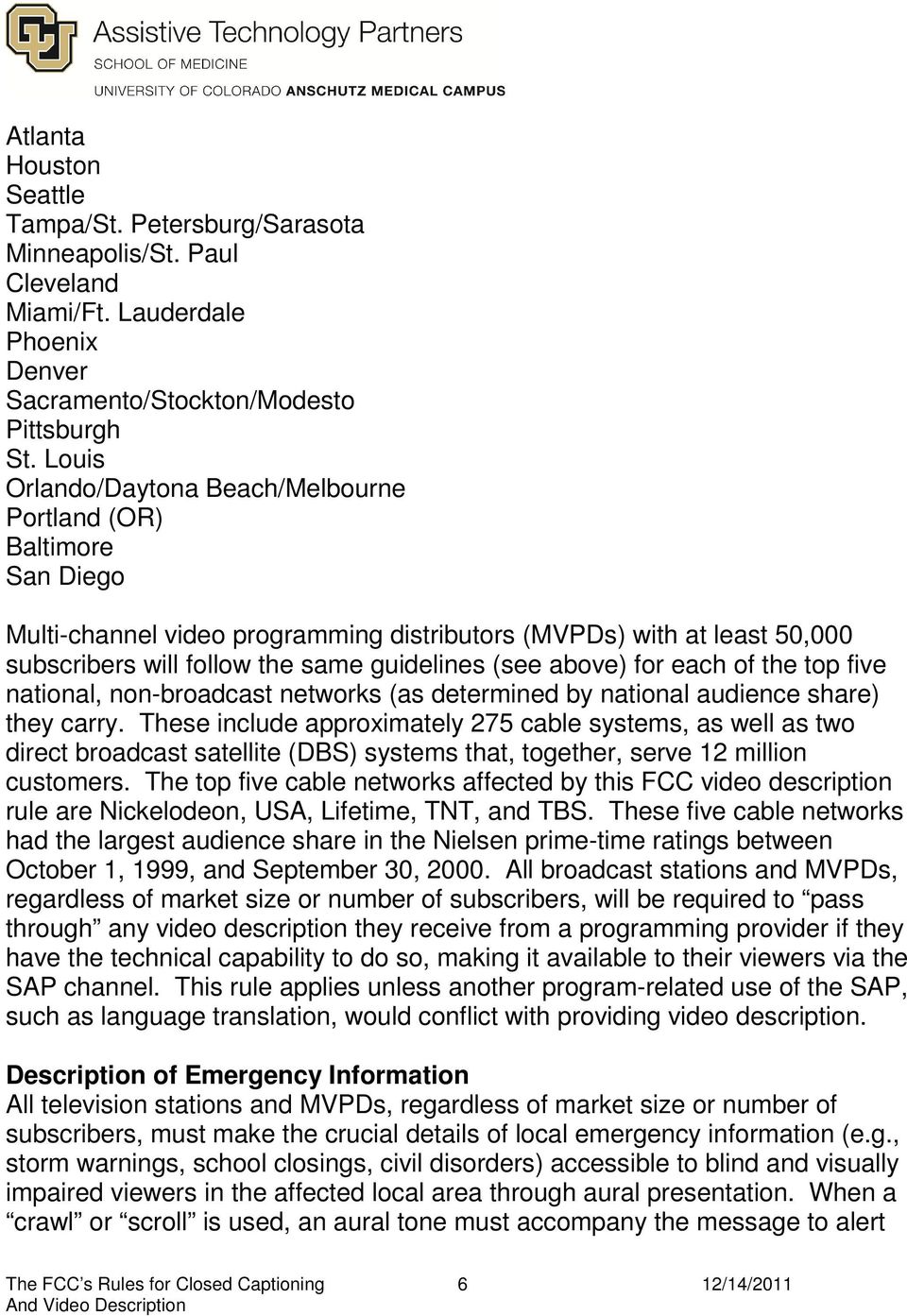
5 - Programming that is exempt but which actually contains captions can count toward compliance up to January 1, 2006, except for those programs aired between 2 a.m. and 6 a.m. - If two or more networks or sources of programming share a single channel, each network or source must be in compliance with the rules on an individual basis. - Spanish-language programming must be closed captioned, but it has a 12- year transition for new, nonexempt programming and a 14-year transition for pre-rule, nonexempt language programming. Summary of FCC Rules Regarding Video Description On July 21, 2000, the Federal Communications Commission (FCC) adopted an initial set of video-description rules designed to increase the accessibility of both television and televised emergency information to viewers with visual disabilities. While these rules will be of significant benefit to audiences who are blind or visually impaired, they will not impose an undue burden, financial or otherwise, on producers and distributors of television programming. This move by the FCC took place in conjunction with the 10 th anniversary of the Americans with Disabilities Act, which was enacted by the FCC on July 26, The rules, which take effect between April and June 2002, are as follows: Affiliates of the top four commercial broadcast networks (ABC, CBS, Fox, NBC) in the top 25 television markets will be required to provide 50 hours of described prime-time or children s programming per calendar quarter, which is approximately four hours per week. PBS stations already air approximately 10 hours of described programming per week and are therefore exempt from the new rule. The following are the top 25 television markets affected by this video description rule: New York Los Angeles Chicago Philadelphia San Francisco/Oakland/San Jose Boston Dallas/Fort Worth Washington, D.C. Detroit The FCC s Rules for Closed Captioning 5 12/14/2011
6 Atlanta Houston Seattle Tampa/St. Petersburg/Sarasota Minneapolis/St. Paul Cleveland Miami/Ft. Lauderdale Phoenix Denver Sacramento/Stockton/Modesto Pittsburgh St. Louis Orlando/Daytona Beach/Melbourne Portland (OR) Baltimore San Diego Multi-channel video programming distributors (MVPDs) with at least 50,000 subscribers will follow the same guidelines (see above) for each of the top five national, non-broadcast networks (as determined by national audience share) they carry. These include approximately 275 cable systems, as well as two direct broadcast satellite (DBS) systems that, together, serve 12 million customers. The top five cable networks affected by this FCC video description rule are Nickelodeon, USA, Lifetime, TNT, and TBS. These five cable networks had the largest audience share in the Nielsen prime-time ratings between October 1, 1999, and September 30, All broadcast stations and MVPDs, regardless of market size or number of subscribers, will be required to pass through any video description they receive from a programming provider if they have the technical capability to do so, making it available to their viewers via the SAP channel. This rule applies unless another program-related use of the SAP, such as language translation, would conflict with providing video description. Description of Emergency Information All television stations and MVPDs, regardless of market size or number of subscribers, must make the crucial details of local emergency information (e.g., storm warnings, school closings, civil disorders) accessible to blind and visually impaired viewers in the affected local area through aural presentation. When a crawl or scroll is used, an aural tone must accompany the message to alert The FCC s Rules for Closed Captioning 6 12/14/2011
7 those with visual disabilities to turn on a radio, SAP channel, or designated digital channel. These rules apply equally to all emergency announcements made during regularly scheduled newscasts, unscheduled newscasts that preempt regular programming, and continuing coverage of existing situations. Rebroadcasts of Described Programming Broadcast stations and MVPDs may count previously aired described programming toward their quarterly minimum requirement one additional time during either the same or a subsequent quarter. In addition, once a commercial broadcast station or MVPD has aired a particular program with description, all subsequent broadcasts of that program on the same network or channel must contain video description. The subsequent airing rule may be waived if the SAP channel is being used for another service related to that program, such as language translation. Filing a Complaint Regarding Closed Captioning or Video Description Should your local participating station or program distributor fail to abide by the above rules for providing closed captioning or video description, you should first file a written complaint with that program distributor. Complaints must be filed by the end of the calendar quarter following the quarter in which the violation occurred; they must be resolved within 45 days following the end of the calendar quarter in which the violation occurred or within 45 days following the receipt of the complaint, whichever is later. If an attempt to resolve any disputes directly with the program distributor fails, you may then file a formal complaint with the FCC s Consumer Information Bureau (CIB), certifying that you have tried in good faith to resolve the dispute. You may also contact the CIB to file informal complaints or to obtain information about how ( /voice) or TELL-FCC ( /TTY). Complete complaint procedures can be found in the FCC documents or on the FCC s web site at Media Access Group at WGBH 125 Western Ave. Boston, MA / (Voice/TTY) The FCC s Rules for Closed Captioning 7 12/14/2011

8 For more information contact: Assistive Technology Partners 601 East 18 th Avenue, Suite 130 Denver, CO office fax TTY toll free This publication may be reproduced without the written permission of ATP provided that the source is appropriately credited. The FCC s Rules for Closed Captioning 8 12/14/2011

PART 79 CLOSED CAPTIONING OF VIDEO PROGRAMMING
 D Definitions... 78.5 E Eligibility for license... 78.13 Emission designator... 78.104 Emissions; emission limitations... 78.103 Equal employment opportunities... 78.75 Equipment changes... 78.109 Equipment
DAVIS WRIGHT TREMAINE LLP GUIDE TO THE FCC CLOSED CAPTIONING RULES FOR TELEVISION PROGRAMMING
 DAVIS WRIGHT TREMAINE LLP GUIDE TO THE FCC CLOSED CAPTIONING RULES FOR TELEVISION PROGRAMMING RESPONSIBILITY FOR COMPLIANCE WITH CAPTIONING REQUIREMENTS FOR VIDEO ON TELEVISION The Federal Communications
THE 2013 ENTERTAINMENT, MEDIA & ADVERTISING MARKET RESEARCH HANDBOOK
 THE 2013 ENTERTAINMENT, MEDIA & ADVERTISING MARKET RESEARCH HANDBOOK th 13 Edition December 2012 362 pages ISBN# 1-57783-185-3 PART I: MARKET SUMMARY CONTENTS 1 MARKET ASSESSMENT: ADVERTISING 1.1 Advertising
MEDIA BUREAU SUBJECT MATTER EXPERT LIST
 MEDIA BUREAU SUBJECT MATTER EXPERT LIST Contact a Subject Matter Expert by Email or Phone. ALL PRESS INQUIRIES [email protected] 202-418-8165 en Español http://www.fcc.gov/espanol 888-225-5322 Abuse
BROADCAST EXCLUSIVITY RULES
 United States Government Accountability Office Report to Congressional Requesters April 2015 BROADCAST EXCLUSIVITY RULES Effects of Elimination Would Depend on Other Federal Actions and Industry Response
Video Streaming Licenses and Franchising Law
 Introduction This is the sixth in a series of white papers issued by the committee in its process of reviewing the Communications Act for update. This paper focuses on regulation of the market for video
System Characteristics. The HSN generally shall have at least the following. (1) Modern design when built, utilizing an architecture that will permit
 6. SYSTEM FACILITIES, EQUIPMENT AND SERVICES (a) System Characteristics. The HSN generally shall have at least the following characteristics: (1) Modern design when built, utilizing an architecture that
Before the Federal Communications Commission Washington, D.C. 20554 ) ) ) ) ) ) ) ) )
 Before the Federal Communications Commission Washington, D.C. 20554 In the Matter of Closed Captioning of Video Programming Telecommunications for the Deaf and Hard of Hearing, Inc. Petition for Rulemaking
Captioning Matters: Best Practices Project
 Captioning Matters: Best Practices Project 1 High-quality readable, understandable, and timely captions are the desired end result of everyone involved in the world of broadcast captioning. TV networks,
The Closed Captioning Handbook
 The Closed Captioning Handbook Gary D. Robson AMSTERDAM BOSTON LONDON NEW YORK OXFORD PARIS SAN DIEGO SAN FRANCISCO SINGAPORE SYDNEY TOKYO Focal Press is an Imprint of Elsevier Focal Press is an imprint
Testimony of. R. Stanton Dodge Executive Vice-President and General Counsel of DISH Network L.L.C. Satellite Video 101. Before the
 Testimony of R. Stanton Dodge Executive Vice-President and General Counsel of DISH Network L.L.C. On Satellite Video 101 Before the House of Representatives Committee on Energy and Commerce Subcommittee
 INFORMATION ONLY ORDINANCE No. Require activation of closed captioning on televisions in public areas (Ordinance, Amend Chapter 23.01) The City of Portland ordains: Section 1. The Council finds:
Understanding the Ratings Game. Connie Ledoux Book, Ph.D. [email protected] Presentation to NATOA Annual Conference New Orleans, 2009
 Understanding the Ratings Game Connie Ledoux Book, Ph.D. [email protected] Presentation to NATOA Annual Conference New Orleans, 2009 Pop Quiz Can you trust your gut instinct when it comes to television and
ACCESS CHARGE A fee charged subscribers or other telephone companies by a local exchange carrier for the use of its local exchange networks.
 Glossary of Telecommunications Terms (Source: Federal Communications Commission) ACCESS CHARGE A fee charged subscribers or other telephone companies by a local exchange carrier for the use of its local
Before the FEDERAL COMMUNICATIONS COMMISSION WASHINGTON, DC 20554
 Before the FEDERAL COMMUNICATIONS COMMISSION WASHINGTON, DC 20554 In the Matter of ) ) Promoting Innovation and Competition in the ) MB Docket No. 14-261 Provision of Multichannel Video Programming ) Distribution
(Lincoln, Nebraska) David Sillman
 Line 21: Closed Captioning of Television Programs A Progress Report: A Paper Presented at the 1978 Symposium on Research and Utilization of Educational Media for Teaching the Deaf (Lincoln, Nebraska) By
Home Model Legislation Telecommunications and Information. Cable and Video Competition Act
 Search GO LOGIN LOGOUT HOME JOIN ALEC CONTACT ABOUT MEMBERS EVENTS & MEETINGS MODEL LEGISLATION TASK FORCES ALEC INITIATIVES PUBLICATIONS NEWS Model Legislation Civil Justice Commerce, Insurance, and Economic
Telecommunications / Real Estate
 Telecommunications / Real Estate December 2007 ALBANY AMSTERDAM ATLANTA BOCA RATON BOSTON CHICAGO DALLAS DELAWARE DENVER FORT LAUDERDALE HOUSTON LAS VEGAS LOS ANGELES MIAMI NEW JERSEY NEW YORK ORANGE COUNTY
Broadcasters and video distributors are finding new ways to leverage financial and operational benefits of supporting those with hearing disabilities.
 MICHAEL GROTTICELLI, BROADCAST ENGINEERING EXTRA / 07.02.2014 04:47 PM Closed Captioning Mandate Spurs Business For Vendors Broadcasters and video distributors are finding new ways to leverage financial
FCC CABLE RULES. (b) Nothing in this rule should be construed to prevent or prohibit:
 CODE OF FEDERAL REGULATIONS TITLE 47 -- TELECOMMUNICATION CHAPTER I -- FEDERAL COMMUNICATIONS COMMISSION SUBCHAPTER C -- BROADCAST RADIO SERVICES PART 76--CABLE TELEVISION SERVICE 76.309 Customer Service
PART II - CODE OF ORDINANCES Chapter 50 - TELECOMMUNICATIONS ARTICLE II. CABLE TELEVISION
 Sec. 50-19. Purpose and scope of article. Sec. 50-20. Definitions. Sec. 50-21. Cable television advisory board. Sec. 50-22. Franchise Required. Sec. 50-23. Same Granting of application; revocation of.
digital GRPs of Digital s New Metric
 digital GRPs The What, Why and How of Digital s New Metric digital GRPs The What, Why and How of Digital s New Metric What is a Digital GRP? See pages 4 6 How is it calculated? See page 6 Why does it matter?
Testimony of Patrick Gottsch Founder and Chairman RFD-TV. Before the U.S. House Committee on the Judiciary
 Testimony of Founder and Chairman RFD-TV Before the U.S. House Committee on the Judiciary Hearing on Competition in the Video and Broadband Markets: the Proposed Merger of Comcast and Time Warner Cable
Municipal Lobbying Ordinance
 Municipal Lobbying Ordinance Los Angeles Municipal Code Section 48.01 et seq. Prepared by City Ethics Commission CEC Los Angeles 00 North Spring Street, 4 th Floor Los Angeles, CA 9001 (13) 978-1960 TTY
OTT/MVPD NPRM OVERVIEW
 Connecting America s Public Sector to the Broadband Future WHAT ARE THE IMPLICATIONS OF OVER-THE-TOP (OTT) FOR CABLE FRANCHISING? by Tim Lay enatoa 1875 Eye Street, NW, Suite 700 Washington, DC 20006 www.spiegelmcd.com
Rate Increase FAQs. Q. I refuse to pay more money for lousy service. If you are experiencing trouble with your service please call us.
 Rate Increase FAQs Q. Why are rates going up? TV networks continue to demand major increases in the costs we pay them to carry their networks. We negotiate to keep costs as low as possible and will continue
2015 NFL Annual Selection Meeting R P O CLUB PLAYER POS COLLEGE ROUND 2
 ROUND 2 2 1 33 TENNESSEE 2 2 34 TAMPA BAY 2 3 35 OAKLAND 2 4 36 JACKSONVILLE 2 5 37 NEW YORK JETS 2 6 38 WASHINGTON 2 7 39 CHICAGO 2 8 40 NEW YORK GIANTS 2 9 41 ST. LOUIS 2 10 42 ATLANTA 2 11 43 CLEVELAND
Ken Nippes VP/Media Director, Cramer-Krasselt, New York. Jonathan Lichter Chief Strategy Officer, Kelly, Scott & Madison, Chicago
 Achieving Reach in a Fragmented Media World Ken Nippes VP/Media Director, Cramer-Krasselt, New York Jonathan Lichter Chief Strategy Officer, Kelly, Scott & Madison, Chicago Charlie Holmes VP/GM Satellite
The February 2009 Digital Television Transition: The State of Digital Readiness in the U.S. October 2008
 The February 2009 Digital Television Transition: The State of Digital Readiness in the U.S. October 2008 Introduction All full-power U.S. television stations are required to discontinue use of their analog
ORDINANCE NO. NOW, THEREFORE, THE CITY COUNCIL OF THE CITY OF HERCULES DOES HEREBY ORDAIN AS FOLLOWS:
 ORDINANCE NO. ADDING SECTION 6-1.34 TO CHAPTER 1, TITLE 6 OF THE HERCULES CITY CODE, WHICH IMPLEMENTS THE PROVISIONS OF THE DIGITAL INFRASTRUCTURE AND VIDEO COMPETITION ACT OF 2006, CODIFIED IN CALIFORNIA
New Retirement Mindscape
 New Retirement Mindscape 2012 City Pulse index Abstract Since 2010, Ameriprise Financial has polled Americans in the 30 largest U.S. metropolitan areas to determine where people feel the most prepared
BILL DRAFT 2005-RBxz-36B: Video Service Competition Act
 BILL DRAFT 2005-RBxz-36B: Video Service Competition Act BILL ANALYSIS Committee: Revenue Laws Study Committee Date: May 2, 2006 Introduced by: Summary by: Cindy Avrette Version: Draft Committee Counsel
Univision Business Breakfast At Last
 Q4 2014 & YEAR END HIGHLIGHTS UCI TOTAL REACH SCORE KEY ANNOUNCEMENTS Univision Corporate Research developed the UCI Total Reach Score to estimate the Univision Communication Inc (UCI) total unduplicated
Atlanta Rankings 2014
 Atlanta Rankings Major National Magazine and Study Rankings BUSINESS FACILITIES Metro Business Rankings Lowest Cost of Doing Business 2. Orlando, FL 3. Charlotte, NC 4. San Antonio, TX 5. Tampa, FL 6.
www.tvk24.com Jan 2015
 Available Nationwide / 24-Hour Korean American Network www.tvk24.com Jan 2015 About the Networks Launched in 2005, Television Korea 24, Inc., ( TVK24 ) operates two networks, TVK and TVK2. TVK is the first
The Housing Downturn in the United States 2009 First Quarter Update
 The Housing Downturn in the United States 2009 First Quarter Update May 2009 TABLE OF CONTENTS The Housing Downturn in the United States: 2009 First Quarter Update Introduction The Housing Downturn: National
Let the Free Market Work and Reject Government Intervention In the Local Television Market
 Let the Free Market Work and Reject Government Intervention In the Local Television Market Cable s Monopoly May be Broken But the System Isn t From 1992 until the mid-2000s, cable companies were the only
This handbook provides EAS participants summary instructions for conducting EAS notifications and tests of national, state and local alerts.
 2 The Emergency Alert System (EAS) is a national public warning system that requires broadcasters, cable television systems, wireless cable systems, wireline video providers, satellite digital audio radio
RADIO TELEVISION HONG KONG
 This performance pledge summarizes the services provided by Radio Television Hong Kong (RTHK) and the standards you can expect. It also explains the steps you can take if you have a comment or a complaint.
DEVELOPING AND UTILIZING ELECTRONIC MEDIA
 1 CHAPTER 7-2/E DEVELOPING AND UTILIZING ELECTRONIC MEDIA Summary In summary, the term electronic media encompasses television, radio and telephone. Television and radio are commonly referred to as broadcast
TAMPA INTERNATIONAL AIRPORT
 Albany Southwest Airlines 73W 332 0900 1150 1,130 143...7 Albany Southwest Airlines 73W 1811 0900 1150 1,130 143 12345.. Albany Southwest Airlines 73W 6066 1110 1400 1,130 143...6. Atlanta Delta Air Lines
BILL NO. ORDINANCE NO.
 BILL NO. ORDINANCE NO. AN EMERGENCY ORDINANCE OF THE CITY OF FRESNO, CALIFORNIA, ADDING SECTION 9-235 OF THE FRESNO MUNICIPAL CODE RELATING IMPLEMENTATION OF THE DIGITAL INFRASTRUCTURE AND VIDEO COMPETITION
The Digital Television Transition
 Federal Communications Commission The Digital Television Transition Montana State Legislature Energy and Telecommunications Interim Committee July 16, 2008 Roger Goldblatt Policy Outreach Advisor Consumer
Before the Federal Communications Commission Washington, D.C. 20554 ) ) ) ) ) ) ) ) ) REPORT ON CABLE INDUSTRY PRICES
 Before the Federal Communications Commission Washington, D.C. 20554 In the Matter of Implementation of Section 3 of the Cable Television Consumer Protection and Competition Act of 1992 Statistical Report
Zillow Negative Equity Report
 Overview The housing market is finally showing signs of life, with many metropolitan areas having hit the elusive bottom and seeing home value appreciation, however negative equity remains a drag on the
Implementing Closed Captioning for DTV
 GRAHAM JONES National Association of Broadcasters Washington, DC ABSTRACT The Federal Communications Commission (FCC) rules impose obligations on broadcasters for captioning of digital television (DTV)
A Guide to Sales Tax in New York State for Broadcasters
 Publication 825 A Guide to Sales Tax in New York State for Broadcasters Pub 825 (5/08) About this publication This publication provides television and radio broadcasters (broadcasters) with information
Trade Show Labor Rate Benchmarking Survey
 2011 Trade Show Labor Rate Benchmarking Survey EXHIBITOR COSTS IN 41 U.S. CITIES labor drayage audio visual exhibitor services eventmarketing.com eventmarketing.com Produced by in association with eventmarketing.com
Assistive Technology for Individuals Who Are Hearing Impaired
 Assistive Technology for Individuals Who Are Hearing Impaired Hearing impairments are the most common form of chronic physical disability in the US. Hearing loss may be mild or severe; it may be present
LOCAL RADIO STATION MODEL VULNERABILITY ASSESSMENT CHECKLIST. Developed by the Toolkit Working Group for the Media Security and Reliability Council
 LOCAL RADIO STATION MODEL VULNERABILITY ASSESSMENT CHECKLIST Developed by the Toolkit Working Group for the Media Security and Reliability Council November 16, 2004 INDEX A. Introduction...1 1. Scope...1
TOWN OF RAYMOND, MAINE CABLE TELEVISION ORDINANCE Adopted 11/06/2000
 TOWN OF RAYMOND, MAINE CABLE TELEVISION ORDINANCE Adopted 11/06/2000 Be it ordained by the Town of Raymond, acting by and through its Board of Selectmen acting as its Municipal Officers, that the following
An Introduction. The Twenty-First Century Communications and Video Accessibility Act establishes multiple content accessibility requirements.
 An Introduction The Twenty-First Century Communications and Video Accessibility Act establishes multiple content accessibility requirements. On October 8, 2010 President Obama signed legislation designed
The Strategic Assessment of the St. Louis Region
 The Strategic Assessment of the St. Louis Region 7th Edition, 2015 WHERE The 7th Edition of Where We Stand (WWS) presents 222 rankings comparing St. Louis to the 50 most populated metropolitan areas in
EMERGENCY ALERT SYSTEM
 EMERGENCY ALERT SYSTEM San Diego County Operational Area Issued JANUARY 1998 Major Revision JANUARY 2006 Minor Revision June 21, 2012 Prepared by the San Diego Local Emergency Communications Committee
BROADCASTING ACT (CHAPTER 28) Code of Practice for Television Broadcast Standards
 BROADCASTING ACT (CHAPTER 28) Code of Practice for Television Broadcast Standards 1 In exercise of the powers conferred by section 6 of the Broadcasting Act (Cap. 28), the Media Development Authority of
Case 2:10-cv-01512 Document 1 Filed 09/20/10 Page 1 of 5
 Case 2:10-cv-01512 Document 1 Filed 09/20/10 Page 1 of 5 UNITED STATES DISTRICT COURT WESTERN DISTRICT OF WASHINGTON AT SEATTLE IVI, INC., v. Plaintiff, COMPLAINT FOR DECLARATORY JUDGMENT OF COPYRIGHT