
How To Fund A School In Florida
|
|
|
- Evelyn Campbell
- 5 years ago
- Views:
Transcription
1 FUNDING FOR FLORIDA SCHOOL DISTRICTS STATISTICAL REPORT

2 The Funding for Florida School Districts Statistical Report is a description of the state program for financing public schools in Florida. The report was prepared by the Office of Funding and Financial Reporting in the Bureau of School Business Services, Florida Department of Education. For additional information, call Users of this report are encouraged to reproduce this document for their own use. This report is available at

3 TABLE OF CONTENTS Page # Overview of School District Funding... 1 Florida Education Finance Program (FEFP)... 7 FEFP Calculation Schedule...22 Public Education Capital Outlay (PECO) Funds...23 Capital Outlay and Debt Service (CO&DS) Funds...25 Workforce Development Education Fund...26 Adults With Disabilities Funds...32 Funds for Student Transportation...33 Student Transportation Calculation Schedule FEFP Second Calculation Funding Summary...38
4 OVERVIEW OF SCHOOL DISTRICT FUNDING Article IX, section 1 of the Florida Constitution establishes the State of Florida s commitment to funding K-12 education, as follows: The education of children is a fundamental value of the people of the State of Florida. It is, therefore, a paramount duty of the state to make adequate provision for the education of all children residing within its borders. Adequate provision shall be made by law for a uniform, efficient, safe, secure and high quality system of free public schools that allows students to obtain a high quality education In 1973 the Florida Legislature enacted the Florida Education Finance Program (FEFP) and established the state policy on equalized funding to guarantee to each student in the Florida public education system the availability of programs and services appropriate to his or her educational needs that are substantially equal to those available to any similar student notwithstanding geographic differences and varying local economic factors. To equalize educational opportunities, the FEFP formula recognizes: (1) varying local property tax bases; (2) varying education program costs; (3) varying costs of living; and (4) varying costs for equivalent educational programs due to sparsity and dispersion of the student population. The FEFP is the primary mechanism for funding the operating costs of Florida school districts. As noted herein, there are other sources of funding; however, the FEFP is the foundation for financing Florida s K-12 educational programs. A key feature of the FEFP is that it bases financial support for education upon the individual student participating in a particular educational program rather than upon the number of teachers or classrooms. FEFP funds are primarily generated by multiplying the number of full-time equivalent (FTE) students in each of the funded education programs by cost factors to obtain weighted FTE students. Weighted FTE students are then multiplied by a base student allocation and by a district cost differential to determine the base funding from state and local FEFP funds. Program cost factors are determined by the Florida Legislature and represent relative cost differences among the FEFP programs. In addition to the base funding allocation, two major allocations within the FEFP are the Supplemental Academic Instruction Allocation and Exceptional Student Education (ESE) Guaranteed Allocation, which are explained on page 18. Scholarship payments for education provided by private schools are available pursuant to the provisions of two programs. (1) John M. McKay Scholarships for Students with Disabilities Program This program provides parents of students with disabilities the option to enroll their children in another public school within or adjacent to their home district or to apply for a scholarship to attend a participating private school. Participants must have been reported for funding in a school district during the prior October and February FTE surveys in order to be eligible. Scholarship amounts are based on the lesser of the amount the student would have generated for district funding or the amount of applicable private school fees. (2) Florida Tax Credit Scholarships These scholarships are funded directly by private voluntary contributions to nonprofit scholarship-funding organizations for students who qualify for free or reduced-price school lunches under the National School Lunch Act. In accordance with section , Florida Statutes (F.S.), up to $357 million in tax credits for participating corporations is authorized for In order to be eligible for Florida tax credit scholarships, a student must have been reported for funding in a school district during the prior October and February surveys or received a scholarship from an eligible nonprofit scholarship-funding organization during the previous school year. Source of Funds for School Districts The following paragraphs provide background information regarding financial support for Grades K-12 education in Florida. School districts in received 4.1 percent of 1
5 their financial support from state sources, 47.2 percent from local sources (including the Required Local Effort portion of the FEFP) and 12.7 percent from federal sources. State Support Funds for state support to school districts are provided primarily by legislative appropriations. The major portion of state support is distributed through the FEFP. State funds appropriated to finance the FEFP total $7,499,962,17. Included in this total is $7,87,439,923 from the General Revenue Fund, $242,352,82 from the Educational Enhancement Trust Fund and $17,169,274 from the State School Trust Fund. Although taxes from a number of sources are deposited in the General Revenue Fund, the predominant tax source is the 6 percent sales tax on goods and services. In addition to these funds, $3,13,13,776 is provided in the class size reduction allocation for operations. Included in this amount is $2,823,166,322 from the General Revenue Fund, $13,776,356 from the Educational Enhancement Trust Fund and $86,161,98 from the State School Trust Fund. The Florida Legislature established the Education Enhancement Trust Fund, which includes the net proceeds of the Florida Lottery and the tax proceeds on slot machines in Broward and Miami-Dade counties. The amount of $134,582,877 was appropriated from the Educational Enhancement Trust Fund for the District Lottery and School Recognition Program. Lottery proceeds were also used to fund the $155,882,941 appropriation that provides the cash and debt service requirements for the Classrooms First and 1997 School Capital Outlay Bond Program, $152,836,215 for debt service for the Class Size Reduction and Educational Facilities Lottery Revenue Bond Program and $82,412,34 for school district workforce education, as defined in section 14.2(26), F.S. Article IX, section 1 of the Florida Constitution establishes a limit of 18 students in PreK through grade 3 classrooms, 22 students in grades 4-8 classrooms and 25 students in grades 9-12 classrooms. The Class Size Reduction categorical was established to fund this requirement exclusively from state funds. The Florida Constitution authorizes certain revenues to be used by the school districts for capital outlay purposes. Article XII, section 9(d) of the Florida Constitution guarantees a stated amount for each district annually from proceeds of licensing motor vehicles, referred to as Capital Outlay and Debt Service or CO&DS funds. Additionally, Article XII, section 9(a)(2) of the Florida Constitution provides that school districts may share in the proceeds from gross receipts taxes, referred to as Public Education Capital Outlay or PECO funds, as provided by legislative appropriation. Minor state funding sources include the race track funds (revenue provided to designated school districts from pari-mutuel wagering pursuant to chapter 55, F.S.), which are collected by the Florida Department of Business and Professional Regulation and divided equally among Florida counties, in accordance with section 212.2(6)(d)6.a., F.S. The allocation of these funds is to the counties, which may share the funds with school districts, in lieu of funds distributed from the Pari-mutuel Wagering Trust Fund under section , F.S., prior to July 1, 2. Other funding sources are tax receipts from state forests, provided to certain school boards in accordance with section 589.8, F.S., and proceeds from mobile home licenses, which are deposited into the License Tax Collection Trust Fund and distributed to local governments pursuant to section 32.81, F.S. Local Support Local revenue for school support is derived almost entirely from property taxes levied by Florida s 67 counties, each of which constitutes a school district. Each school board participating in the state allocation of funds for the current operation of schools must levy the millage set for its required local effort from property taxes. The Florida Legislature set the amount of $7,179,517,373 as adjusted required local effort for Each district s share of the state total required local effort is determined by a statutory procedure that is initiated by certification of the property tax valuations of each district by the Florida Department of Revenue. This certification occurs no later than two working days prior to July 19. No later than July 19, the Florida Commissioner of Education (the Commissioner) certifies each district s required local effort millage rate. These rates are primarily determined by dividing the dollar amount of required local effort by 96 percent of the aggregated taxable value for school purposes of all districts. Certifications vary due to the use of assessment ratios designed to equalize the effect on the FEFP of differing 2

6 levels of property appraisal in the counties. Millage rates are also adjusted because required local effort may not exceed 9 percent of a district s total FEFP entitlement. Based on the 214 tax roll provided by the Florida Department of Revenue, the Commissioner certified the required millage of each district on July 11, 214. The state average millage was set at 5.89 and certifications for the 67 school districts varied from mills (Santa Rosa) to mills (Monroe) due to the assessment ratio adjustment and the 9 percent limitation. The 9 percent limitation reduced the required local effort of seven districts. The districts and their adjusted millage rates were: Collier (3.327), Franklin (3.55), Martin (4.89), Monroe (1.865), Sarasota (4.519), Sumter (3.913) and Walton (2.85). In accordance with section (4)(e), F.S., the Florida Department of Education is required to calculate the Prior Period Funding Adjustment Millage (PPFAM), which is levied by a school district if, in a prior year, the full amount of required local effort funds were not collected due to changes in property values, or if a prior year s final taxable value has not been certified for the 214 tax levy. The Commissioner calculates the amount of the unrealized required local effort funds from the prior period and the millage required to generate that amount. This levy is in addition to the required local effort millage certified by the Commissioner, but does not affect the calculation of the current year s required local effort. The funds generated by this levy are not included in the district s FEFP allocation. School boards may set discretionary tax levies of the following types: (1) Current operation The Florida Legislature set the maximum discretionary current operating millage for at.748 mills, pursuant to section (1), F.S. School boards may levy an additional capital outlay millage not to exceed.25 mills pursuant to section (3)(a), F.S., in lieu of levying an equivalent amount of the discretionary current operating millage. (2) Capital outlay and maintenance School boards may levy up to 1.5 mills as prescribed in section (2), F.S. and may share a portion of the levy with charter schools for expenditures identified in section (2), F.S. Section (2)(a)-(j), F.S., authorizes school boards to expend the funds raised by the 1.5-mill capital outlay levy for the following: The educational plant Costs of construction, renovation, remodeling, maintenance and repair of the educational plant. This also includes the maintenance, renovation and repair of leased facilities to correct deficiencies. Expenditures that are directly related to the delivery of student instruction Purchase, lease or lease-purchase of equipment, educational plants and construction materials directly related to the delivery of student instruction. Conversion of space Rental or lease of existing buildings or space within existing buildings, originally constructed or used for purposes other than education, for conversion to use as educational facilities. A new school s library media center collection Opening day collection for the library media center of a new school. School buses Purchase, lease-purchase or lease of school buses or the payment to a private entity to offset the cost of school buses. Servicing of payments related to lease-purchase agreements Servicing of payments related to lease-purchase agreements issued for any purpose under authority of prior enactments of this law. Costs associated with the lease-purchase of equipment, educational plants and school buses may include the issuance of certificates of participation and the servicing of payments related to such certificates. Only three-fourths of the proceeds from this millage can be obligated to lease-purchase agreements, unless the lease-purchase agreements were entered into before June 3, 29. 3
7 Equipment, computers, enterprise resource software Purchase or lease of new and replacement equipment: enterprise resource software applications that are classified as capital assets in accordance with definitions of the Governmental Accounting Standards Board, have a useful life of at least five years and are used to support district-wide administration or state-mandated reporting requirements; computer hardware, including electronic hardware and other hardware devices necessary for gaining access to or enhancing the use of electronic content and resources or to facilitate the access to and the use of a school district s digital classroom plan pursuant to section , F.S. In addition, section (5), F.S., authorizes school boards to expend up to $1 per unweighted full-time equivalent student from revenue generated by the 1.5 mill capital outlay millage levy for: (a) (b) The purchase, lease-purchase or lease of driver s education vehicles; motor vehicles used for the maintenance or operation of plants and equipment; security vehicles; or vehicles used in storing or distributing materials and equipment. Payment of the cost of premiums, as defined in section , F.S., for property and casualty insurance necessary to insure school district educational and ancillary plants. As used in this paragraph, casualty insurance has the same meaning as in section (1)(d), (f), (g), (h) and (m). This means that casualty insurance may only be for burglary and theft, glass, boiler and machinery, leakage and fire extinguishing equipment and elevators. Operating revenues that are made available through the payment of property and casualty insurance premiums from revenues generated under this subsection may be expended only for nonrecurring operational expenditures of the school district. Violation of these expenditure provisions will result in an equal dollar reduction of FEFP funds in the year following an audit citation. Pursuant to section (3)(a), F.S., if revenue from the 1.5 mill levy is insufficient to make payments due under a lease-purchase agreement entered into prior to June 3, 29, by a district school board, an amount up to.25 mills of the taxable value for school purposes within the school district shall be legally available for such payments, notwithstanding other restrictions on the use of such revenues imposed by law. This additional levy must be made in lieu of levying an equivalent amount of the.748 discretionary operating millage for operations authorized in section (1), F.S. In addition to levies established by the school board, qualified electors may vote an additional millage levy for operations and/or capital outlay purposes for a period not to exceed two years, pursuant to Article VII, section 9 of the Florida Constitution and section (1), F.S. Sections (9) and (2), F.S., provide for an additional levy, not to exceed four years, for operational purposes to be authorized by the electorate through a local referendum or in conjunction with a general election. This voted levy and the levies established by the school board must not exceed 1 mills in total. This levy is distinguished from the constitutional authority for voted millage noted in the previous paragraph because it is for operations only, may be approved for up to four years instead of two years and is included in the 1-mill limit established by the state constitution. School districts are authorized to sell bonds for capital outlay projects to be repaid from local property taxes. The authority for the issuance of the bonds and the repayment from local property taxes is Article VII, section 12 of the Florida Constitution, section 2.1(3)(e), F.S., and sections 11.4 through 11.55, F.S. Budgeted revenues from local taxes are determined by applying millage levies to 96 percent of the school taxable value of property. School board adoption of millage levies is governed by the advertising and public meeting requirements of chapter 2, F.S. (Determination of Millage). 4

8 SCHEDULE OF MILLAGES Type of Millage Statutory Authority Established By Uses Required Local Effort Section (4), F.S. Commissioner Operating Prior Period Funding Section (4)(e), F.S. Commissioner Operating Adjustment Current Operating Section (1), F.S. School Board Operating Discretionary Maximum.748 Mills Local Capital Section (2), F.S. School Board Capital improvements Improvement Maximum 1.5 Mills Capital Improvement Discretionary Maximum.25 Mills Section (3)(a), F.S. School Board Lease-purchase payments or to meet other critical fixed capital outlay needs in lieu of operating discretionary millage Operating or Capital (Not Section (1), F.S. Voter Not specified to Exceed Two Years) Referendum Additional Millage (Not to Section (2), F.S. Voter Not specified Exceed Four Years) Debt Service Section 2.1(3)(e), F.S.; Article VII, section 12 of the Florida Constitution Referendum Voter Referendum Debt service School boards are authorized under section (6), F.S., to levy a sales surtax of up to.5 percent for capital outlay purposes if approval is obtained by referendum. This surtax may take effect on the first day of any month, but may not take effect until at least 6 days after the date of approval by the electors. The resolution providing for imposition of the surtax shall set forth a plan for use of the proceeds for fixed capital expenditures or fixed capital costs associated with the construction, reconstruction or improvement of school facilities and campuses that have a useful life expectancy of five or more years. The plan shall address any land acquisition, land improvement, design and related engineering costs. Additionally, the plan shall include the costs of retrofitting and providing for technology implementation, including hardware and software, for the various sites within the school district. Surtax revenues may be used for the purpose of servicing bond indebtedness to finance authorized projects and any interest that accrues thereto may be held in trust to finance such projects. Neither the proceeds of the surtax nor any interest accrued thereto shall be used for operational expenditures. The Florida Department of Revenue distributes the surtax revenue to the school board imposing the tax. The governing authority in each county is authorized under section (2), F.S., to levy a discretionary sales surtax of.5 percent or 1 percent, if approval is obtained by referendum. If the governing bodies of the municipalities representing a majority of the county s population adopt uniform resolutions establishing the rate of the surtax and calling for a referendum on the surtax, the levy of the surtax shall be placed on the ballot and shall take effect if approved by a majority of the electors of the county voting in the referendum on the surtax. The surtax may not be levied for more than 15 years. The proceeds of the surtax authorized by this subsection and any accrued interest shall be expended by the school district to finance, plan and construct infrastructure. 5

9 Developmental research schools (lab schools) at state universities are classified for funding as special school districts, as is the Florida Virtual School (FLVS). Because these special districts have no taxing authority, the state provides the same dollar amount per student for the.748 discretionary operating millage revenues as is generated for district students by the tax base of the district where the school is located. For , the contribution for the discretionary operating millage is $15,68,625 ( FEFP Second Calculation). There is no required local effort for special school districts; therefore, special districts are funded entirely with state funds. Federal Support The Florida State Board of Education may approve plans for cooperating with the federal government in carrying out any phase of the education program and must provide for the proper administration of funds apportioned to the state from federal appropriations. The Commissioner is responsible for recommending ways of cooperating with the federal government on any phase of the education program in which cooperation is desirable. The Commissioner recommends policies for administering funds appropriated from federal sources to the state for any education purpose and provides for the execution of plans and policies. School districts receive funds from the federal government directly and through the state as an administering agency. School districts may receive federal funds from various agencies such as the Department of Labor, Veterans Administration, Department of Interior, Department of Education, Department of Defense and Department of Agriculture. Federal funding also supports No Child Left Behind programs, which establish accountability measures for public schools to ensure that students in all schools are reaching proficiency in reading and math; Individuals with Disabilities Education Act programs, which support education services for students with physical and mental challenges; Workforce Investment Act entitlement programs (for detail regarding Workforce Development Education programs, see page 26); and Carl D. Perkins Vocational and Technical Education Act programs, which improve the quality of career and technical education in Florida. Federal funds are typically used to supplement state and local funds authorized by the Florida Legislature to support various education programs. 6
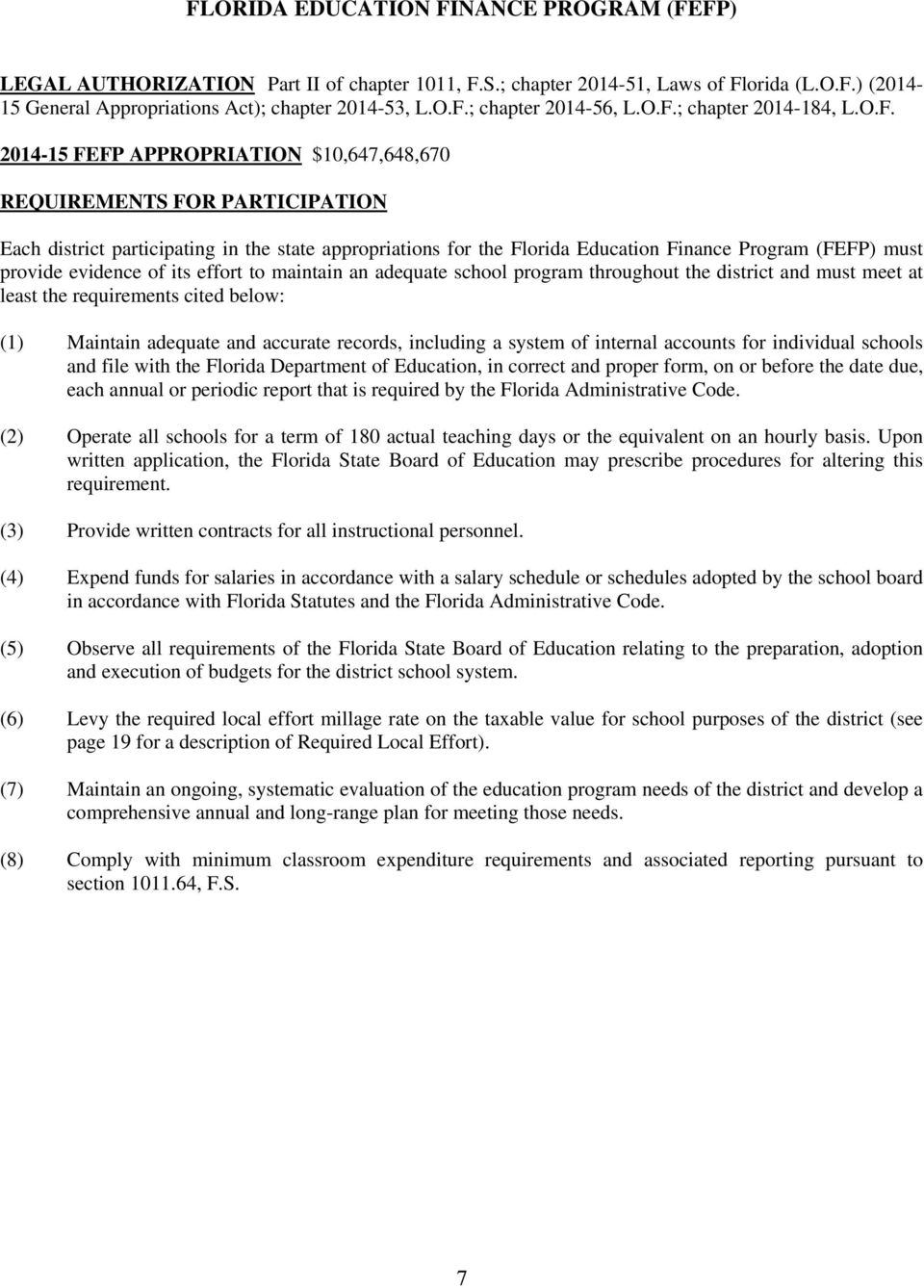
10 FLORIDA EDUCATION FINANCE PROGRAM (FEFP) LEGAL AUTHORIZATION Part II of chapter 111, F.S.; chapter , Laws of Florida (L.O.F.) ( General Appropriations Act); chapter , L.O.F.; chapter , L.O.F.; chapter , L.O.F FEFP APPROPRIATION $1,647,648,67 REQUIREMENTS FOR PARTICIPATION Each district participating in the state appropriations for the Florida Education Finance Program (FEFP) must provide evidence of its effort to maintain an adequate school program throughout the district and must meet at least the requirements cited below: (1) Maintain adequate and accurate records, including a system of internal accounts for individual schools and file with the Florida Department of Education, in correct and proper form, on or before the date due, each annual or periodic report that is required by the Florida Administrative Code. (2) Operate all schools for a term of 18 actual teaching days or the equivalent on an hourly basis. Upon written application, the Florida State Board of Education may prescribe procedures for altering this requirement. (3) Provide written contracts for all instructional personnel. (4) Expend funds for salaries in accordance with a salary schedule or schedules adopted by the school board in accordance with Florida Statutes and the Florida Administrative Code. (5) Observe all requirements of the Florida State Board of Education relating to the preparation, adoption and execution of budgets for the district school system. (6) Levy the required local effort millage rate on the taxable value for school purposes of the district (see page 19 for a description of Required Local Effort). (7) Maintain an ongoing, systematic evaluation of the education program needs of the district and develop a comprehensive annual and long-range plan for meeting those needs. (8) Comply with minimum classroom expenditure requirements and associated reporting pursuant to section , F.S. 7
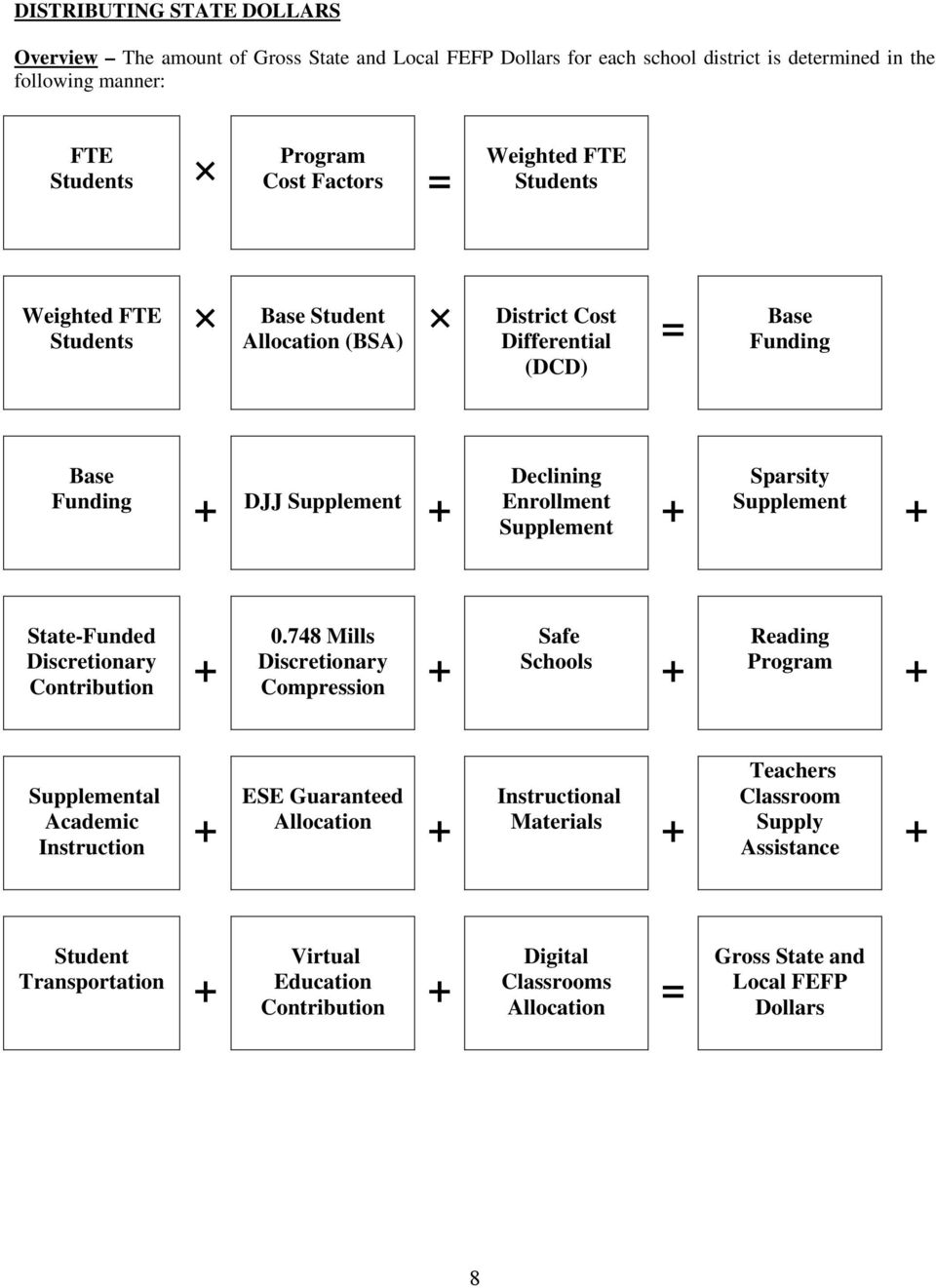
11 DISTRIBUTING STATE DOLLARS Overview The amount of Gross State and Local FEFP Dollars for each school district is determined in the following manner: FTE Program Weighted FTE Students Cost Factors Students = Weighted FTE Base Student District Cost Base Students Allocation (BSA) Differential = Funding (DCD) Base Declining Sparsity Funding DJJ Supplement Enrollment Supplement Supplement State-Funded Discretionary Contribution.748 Mills Discretionary Compression + + Safe Schools Reading Program + + Supplemental Academic Instruction ESE Guaranteed Allocation Instructional Materials Teachers Classroom Supply Assistance Student Transportation Virtual Education Contribution Digital Classrooms Allocation + + = Gross State and Local FEFP Dollars 8
12 The Net State FEFP Allocation for the support of school district education activities is derived from Gross State and Local FEFP dollars in the following manner: Gross State and Required Gross State Local FEFP Local = FEFP Effort Gross State FEFP Adjustments + = Net State FEFP Allocation The Gross State and Local FEFP dollars, less the Required Local Effort, result in the Gross State FEFP. Adjustments, whether positive or negative, are then added to obtain the Net State FEFP Allocation. The Total State Allocation for the support of school district education activities is derived from the Net State FEFP Allocation in the following manner: Net State FEFP Allocation + Categorical Program Funds Total = State Finance Program Categorical program funds, which include Florida School Recognition, District Lottery and Class Size Reduction funds, and any Special Allocations are added to the Net State FEFP Allocation to obtain the Total State Finance Program. The following sections describe each component of the funding formula. The last section of this document presents the FEFP Second Calculation Funding Summary as an example of the FEFP calculation. FTE Students A full-time equivalent (FTE) student for FEFP funding purposes is one student in membership in one or more FEFP programs for a school year or its equivalent. The time equivalent for a school year varies with the school and student as shown below. (1) Standard school (a) Student in grades 4 through 12 9 hours of instruction (b) Student in kindergarten through grade 3 or in an authorized prekindergarten Exceptional Student Education (ESE) program 72 hours of instruction 9

13 (2) Double-session school or a school using an experimental calendar approved by the Florida Department of Education (a) Student in grades 4 through hours of instruction (b) Student in kindergarten through grade 3 or in an authorized prekindergarten ESE program 63 hours of instruction Funding for FTE membership in programs scheduled beyond the regular 18-day term is limited as described later in this section. For purposes of calculating the full-time equivalent student membership, a student is considered in membership until he or she withdraws or until the eleventh consecutive school day of his or her absence. A student is eligible for full-time equivalent reporting if both of the following conditions are satisfied: (1) The student is in program membership at least one day during the survey period in an approved course of study as defined in the Course Code Directory, excluding non-instructional activities as defined in the Florida Administrative Code, and (2) The student is in attendance at least one day during the survey period or one of the six scheduled meetings preceding the survey period when students were in attendance in school. Note: For year-round schools, if the student s track is out of school during survey week, the last week the track was in session becomes survey week. The FTE generated by a student for the purposes of FEFP funding is limited to 1. FTE during the 18-day school year. For information on how to report FTE for students in all programs, please see the FTE General Instructions manual available at under FTE Information. Dual enrollment is the enrollment of an eligible secondary student or home education student in a postsecondary course at a Florida public secondary school or eligible Florida private secondary school (section , F.S.). Credit must be earned at both institutions. The course must offer credit leading to a high school diploma and a career certificate or an associate or baccalaureate degree. Career education dual enrollment is available for secondary students seeking a degree or certificate from a complete job preparatory program, but is not intended to sustain student enrollment in isolated career courses. Early admission is a form of dual enrollment through which eligible secondary students enroll in an eligible postsecondary institution on a full-time basis in courses that are creditable toward the high school diploma and the associate or baccalaureate degree. Participation in the early admission program is limited to students who have completed a minimum of six semesters of full-time secondary enrollment, including studies undertaken in the ninth grade. Dual enrollment students earn the Grades 9-12 Basic Cost Factor at the home school while dually enrolled elsewhere. Each of these forms of dual enrollment is included in the calculation of full-time equivalent students. Section , F.S., requires school districts to pay public postsecondary institutions the standard tuition rate per credit hour when dual enrollment course instruction takes place on a postsecondary institution s campus and the course is taken during the fall or spring term. When dual enrollment course instruction is provided at a high school site by postsecondary institution faculty, school districts must reimburse postsecondary institutions the proportion of salary and benefits to provide the instruction. School districts are not responsible for any costs to postsecondary institutions for dual enrollment courses that are offered by postsecondary institutions but provided on high school sites by school district faculty. Subject to annual appropriation by the Florida Legislature, public postsecondary institutions shall receive an amount of funding equivalent to the standard tuition rate per credit hour for each dual enrollment course taken 1

14 by a student during the summer term. Specific appropriation 126 of chapter , L.O.F., provides an annual appropriation for the fiscal year of $4,79,125. Students in grades K-12 who are enrolled for more than six semesters in career education such as practical arts, family and consumer sciences courses as defined in section 13.1(4)(a), F.S., shall not be counted as full-time equivalent students for this instruction. Students in grades 6-8 who are enrolled in career education courses shall be counted as Basic Grades 6-8. Only students in grades 9-12 who are enrolled in career education courses will be eligible for the weighted funding. Rule 6A-1.451(4), Florida Administrative Code (FAC), provides that, during the year, at least four full-time equivalent student membership surveys be conducted under the administrative direction of, and on the schedule provided by, the Commissioner. Section (1)(a), F.S., specifies that the number of full-time equivalent student membership surveys shall not exceed nine in a fiscal year. The Commissioner has established four FTE student enrollment surveys for the school year and these surveys are scheduled for July 7-11, 214; October 13-17, 214; February 9-13, 215; and June 15-19, 215. The Commissioner has the authority to establish for any school district or school an alternate period for a fulltime equivalent student membership survey within nine weeks subsequent to the regular statewide survey period. Evidence must be submitted by the school district indicating that an abnormal fluctuation in student membership may occur at the time of the statewide survey period to warrant an alternate survey period. The Commissioner must limit consideration of abnormal fluctuation to changes of more than 25 percent in any school or 5 percent in any district between the full-time equivalent student membership at the time of the regular statewide survey and the alternate survey period. The abnormal fluctuation must be caused by factors such as major student boycotts; civil disturbances; in- or out-migration in agricultural, industrial or federal installations or contractors; or providential causes beyond the control of the district school board. Consistent with the rules of the Florida State Board of Education, district school boards are required to request alternate FTE surveys for Department of Juvenile Justice (DJJ) programs experiencing fluctuations in student enrollment. Any request for an alternate survey period must be made prior to the original survey period. Classification for special program FTE requires: (1) proper qualification of students, (2) proper qualification of teachers and (3) appropriate subject matter in accordance with Florida State Board of Education Rules. A student in DJJ programs and cooperative education or other types of programs incorporating on-the-job training, including apprenticeship, shall not be counted for more than 25 hours per week in all programs. FTE Recalibration and the Common Student Identifier All FTE student enrollment is capped at 1. FTE for the year except FTE reported by DJJ students beyond the 18-day school year. School districts report all FTE student enrollment and the department combines all FTE student enrollment reported for the student by all school districts, including the FLVS. The department then recalibrates all reported FTE student enrollment for each student to 1. FTE if the total reported FTE exceeds 1.. When a student is served by multiple school districts or moves from one district to another, that student should retain the same student identifier in every school district. The process for calculating FTE within a single survey has the following provisions: 1. If a student identifier is reported by more than one school district, then all reported FTE is gathered, recalibrated and funded. 2. If a student identifier is reported by only one school district, and there is no student record with similar demographics, then the FTE is recalibrated and funded only to the reporting school district. 11

15 3. If a student identifier is reported by only one school district, and there is a student record with similar or matching demographics reported by another school district, and at least one of the school districts reported less than.2 FTE, then all reported FTE is gathered, recalibrated and funded. 4. If a student identifier is reported by only one school district and there is a student record with similar or matching demographics reported by another school district, none of the school districts reported less than.2 FTE, and the student identifiers do not have entry codes during survey week, then the FTE will be recalibrated and funded separately. 5. If a student identifier is reported by only one school district and there is a student record with similar or matching demographics reported by another school district, none of the school districts reported less than.2 FTE, and at least one of the student identifiers has an entry code during survey week, then all reported FTE is gathered, recalibrated and funded. The process for calculating FTE across multiple surveys has the following provisions: If a student identifier is reported in both surveys 2 and 3, then the FTE for the student identifier is processed in a manner similar to that for a single survey. For a student identifier that is not reported in both surveys 2 and 3, the FTE for that student identifier is gathered, recalibrated to.5 FTE and funded. For more detailed information regarding FTE recalibration and the common student identifier, please see the FTE General Instructions manual available at under FTE Information. Program Cost Factors and Weighted FTE Program cost factors assure that each program receives an equitable share of funds in relation to its relative cost per student. Through the annual program cost report, districts report the expenditures for each FEFP program. The cost per FTE student of each FEFP program is used to produce an index of relative costs, with the cost per FTE of Basic, Grades 4-8, established as the 1. base. In order to protect districts from extreme fluctuation in program cost factors, the Florida Legislature typically uses a three-year average in computing cost factors. Multiplying the FTE students for a program by its cost factor produces weighted FTE. This calculation weights the FTE to reflect the relative costs of the programs as represented by the program cost factors. Program cost factors established for use in are as follows: Cost Factors (1) Basic Programs 11 Kindergarten and Grades 1, 2 and Grades 4, 5, 6, 7 and Grades 9, 1, 11 and (2) Programs for Exceptional Student Education 111 Kindergarten and Grades 1, 2 and 3 with ESE Services Grades 4, 5, 6, 7 and 8 with ESE Services Grades 9, 1, 11 and 12 with ESE Services Support Level Support Level (3) 13 English for Speakers of Other Languages (4) 3 Programs for Grades 9-12 Career Education

16 ESE students in Levels 4 and 5 are reported with the appropriate cost factor (weight) for their respective levels. ESE students who are not classified in Level 4 or 5 are reported in the applicable Basic Program with ESE services. Additional funding for these students is provided by the ESE Guaranteed Allocation component of the FEFP formula. To provide for the planned use of FEFP funds, the Florida Legislature has established the following combination of programs during the 18-day regular school year and summer school: Group Program Group Title 1 Basic Education Programs 2 Exceptional Education for Support Levels 4 and 5 English for Speakers of Other Languages Grades 9-12 Career Education Programs Only DJJ students, Juveniles Incompetent to Proceed (JITP) program students, students who have completed credit through the FLVS and virtual instruction programs and virtual charter schools for the purpose of credit recovery and course completion are eligible for funding through summer school FTE student reporting. Weighted FTE Cap Program Group 2 has an enrollment ceiling (cap) that is established based on each district s estimates (as modified by legislative policy) of FTE in each FEFP program. District estimates are reviewed and approved by a state enrollment estimating conference. The appropriated FTE in each program is multiplied by the program s cost factor. The resulting weighted FTE, aggregated by program group, establishes the group cap. After actual FTE is reported, districts with Group 2 FTE in excess of the cap receive basic funding (program cost factor of 1.). A statewide cap of 336, weighted FTE was set for Group 2 for the fiscal year. Additional Weighted FTE All FTE provided in this section is in addition to the recalibrated FTE calculation mentioned on page 11. Small District ESE Supplement Supplemental funding is provided for districts that have fewer than 1, FTE and fewer than three FTE students in ESE Support Levels 4 and 5. This supplement is limited to the statewide value of weighted FTE. The Commissioner shall set the value of the supplemental FTE based on documented evidence of the difference in the cost of the service and the FEFP funding. The supplemental value for a district shall not exceed three FTE for each of these support levels (ESE Support Levels 4 and 5). Small, Isolated High School Supplement High schools with at least 28 students and no more than 1 students in grades 9-12 and that are no closer than 28 miles to the nearest high school may qualify for an isolated school supplement. This supplement is allocated to each eligible school that attained a state accountability performance grade of C or better for its most recent school grade. Districts with qualifying schools must levy the maximum discretionary operating millage in order to receive the supplement. 13

17 Bonus FTE Programs An additional value of.16 FTE shall be reported by school districts for each student in Advanced Placement classes who earns a score of three or higher on each College Board Advanced Placement (AP) Subject examination, provided he or she has been taught in an AP class in the prior year. A value of.16 additional FTE is to be calculated for each student enrolled in an International Baccalaureate (IB) course who receives a score of four or higher on the subject examination. An Advanced International Certificate of Education (AICE) student may also earn an additional.16 if he or she receives a score of E on a full-credit subject exam or an additional.8 FTE if he or she is enrolled in a half-credit class and earns a score of E or higher on the subject exam. A value of.3 FTE should be calculated for each student who receives an IB or AICE diploma. From the funding generated by the bonus FTE of these programs, sections (1)(l), (m) and (n), F.S., require districts to distribute bonuses to certain classroom teachers as follows: (l) (m) (n) International Baccalaureate A bonus of $5 is earned by an IB teacher for each student in each IB course who receives a score of four or higher on the International Baccalaureate examination. An additional bonus of $5 is earned by the IB teacher in a school designated with a performance grade category of D or F who has at least one student scoring four or higher on the IB subject examination. Bonuses awarded to a teacher may not exceed $2, per school year. However, the maximum bonus shall be $3, if at least 5 percent of the students enrolled in a teacher s course earn a score of four or higher on the examination in a school designated with a grade of A, B, or C, or if at least 25 percent of the students enrolled in a teacher s course earn a score of four or higher on the examination in a school designated with a grade of D or F. Bonuses awarded under this paragraph shall be in addition to any regular wage or other bonus the teacher received or is scheduled to receive. For such courses, the teacher shall earn an additional bonus of $5 for each student who has a qualifying score up to the maximum of $3, in any given school year. Advanced International Certificate of Education A teacher earns a $5 bonus for each student in the full-credit AICE course who receives a score of E or higher on the subject exam and a $25 bonus for each student in each half-credit AICE course who receives a score of E or higher on the subject examination. Additional bonuses of $5 and $25 for full-credit and half-credit courses, respectively, shall be awarded to AICE teachers in a school designated with a performance grade category of D or F who have at least one student passing the subject examination in that class. The maximum additional bonus in a given school year is $5 for those teachers who teach half-credit courses and $2, for those teachers who teach full-credit courses. Advanced Placement A $5 bonus is earned by an AP teacher for each student in each AP course who receives a score of three or higher on the College Board AP Examination. An additional bonus of $5 is earned by the AP teacher in a school designated with a performance grade category of D or F who has at least one student scoring three or higher on the College Board AP subject examination. Bonuses awarded to a teacher may not exceed $2, per school year. However, the maximum bonus shall be $3, if at least 5 percent of the students enrolled in a teacher s course earn a score of three or higher on the examination in a school with a grade of A, B, or C, or if at least 25 percent of the students enrolled in a teacher s course earn a score of three or higher on the examination in a school with a grade of D or F. Bonuses awarded under this paragraph shall be in addition to any regular wage or other bonus the teacher received or is scheduled to receive. For such courses, the teacher shall earn an additional bonus of $5 for each student who has a qualifying score up to the maximum of $3, in any given school year. Industry-Certified Career and Professional Academy Program Pursuant to section (1)(o), F.S., an additional value of.1 or.2 FTE student membership shall be calculated for each student who completes an industry-certified career or professional academy program under 14

18 section (1)(b), F.S., and who is issued the highest level of industry certification identified annually in the Industry Certification Funding List approved under rule 6A-6.573, FAC, adopted by the Florida State Board of Education. A value of.2 full-time equivalent student membership shall be calculated for each student who is issued an industry certification that has a statewide articulation agreement for college credit approved by the Florida State Board of Education. For industry certifications that do not articulate for college credit, the Florida Department of Education shall assign an FTE of.1 for each certification. Such value shall be added to the total FTE student membership in secondary career education programs in the subsequent year for courses that were not provided through dual enrollment. A teacher earns a bonus in the amount of $25 for each student who attained a CAPE industry certification on the CAPE Industry Certification Funding List with a weight of.1 FTE. A teacher earns a bonus in the amount of $5 for each student who attained a CAPE industry certification on the CAPE Industry Certification Funding List with a weight of.2 FTE. Bonuses awarded pursuant to this paragraph shall be provided to teachers who are employed by the school district in the year in which the additional FTE student membership calculation is included in the calculation. Bonuses shall be calculated based upon the associated weight of a CAPE industry certification on the CAPE Industry Certification Funding List for the year in which the certification is earned by the student. Any bonus awarded to a teacher under this paragraph may not exceed $2, in any given school year and is in addition to any regular wage or other bonus the teacher received or is scheduled to receive. Base Student Allocation The base student allocation from state and local funds is determined annually by the Florida Legislature and is a component in the calculation of Base Funding. For the fiscal year, the base student allocation is $4, District Cost Differential Section (2), F.S., requires the Commissioner to annually compute District Cost Differentials (DCDs) by adding each district s Florida Price Level Index for the most recent three years and dividing the sum by three. The result is multiplied by.8 and divided by 1 and.2 is added to the product to obtain the DCD. This serves to limit the factor s adjustment to 8 percent of the index (i.e., the approximate percentage of district salary costs to total operating costs). The three-year averaging reduces the immediate impact on districts of sudden changes in the index. The following DCDs were established for : Alachua.983 Liberty.941 Baker.9769 Madison.9261 Bay.9644 Manatee 1.15 Bradford.9723 Marion.9635 Brevard 1.66 Martin 1.8 Broward Monroe Calhoun.937 Nassau.99 Charlotte.9855 Okaloosa.9852 Citrus.9538 Okeechobee.9667 Clay.9932 Orange 1.21 Collier Osceola.9867 Columbia.968 Palm Beach 1.29 Miami-Dade Pasco.994 DeSoto.9742 Pinellas 1.23 Dixie.94 Polk

19 Base Funding Duval Putnam.963 Escambia.973 St. Johns.9848 Flagler.9556 St. Lucie.9914 Franklin.935 Santa Rosa.962 Gadsden.949 Sarasota 1.49 Gilchrist.9571 Seminole.9943 Glades.9687 Sumter.9642 Gulf.9417 Suwannee.9393 Hamilton.9321 Taylor.9338 Hardee.9668 Union.9637 Hendry.9742 Volusia.9739 Hernando.9746 Wakulla.9545 Highlands.952 Walton.9726 Hillsborough 1.11 Washington.9362 Holmes.9333 Wash. Special.9362 Indian River.9928 FAMU.9592 Jackson.9372 FAU Palm Beach 1.29 Jefferson.9373 FAU St. Lucie.9914 Lafayette.9285 FSU Broward Lake.9744 FSU Leon.9592 Lee UF.983 Leon.9592 Florida Virtual School 1. Levy.9558 Base Funding is derived from the product of the weighted FTE students, multiplied by the Base Student Allocation and the District Cost Differential. For the fiscal year, the Florida Legislature included in base funding $48 million to provide continued funding for the Teacher Salary Allocation in specific appropriation 87 of chapter 213-4, L.O.F., and section 26 of chapter , L.O.F., for the same purpose as in the original appropriation. Department of Juvenile Justice (DJJ) Supplement The total K-12 weighted full-time equivalent student membership in juvenile justice education programs in each school district shall be multiplied by the amount of the state average class-size reduction factor multiplied by the district s cost differential. An amount equal to the sum of this calculation shall be allocated in the FEFP to each school district to supplement other sources of funding for students in juvenile justice education programs. Declining Enrollment Supplement The declining enrollment supplement is determined by comparing the unweighted FTE for the current year to the unweighted FTE of the prior year. In those districts where there is a decline in unweighted FTE, 25 percent of the decline is multiplied by the prior-year base funding per unweighted FTE. This amount is the declining enrollment supplement for the district. Sparsity Supplement The FEFP recognizes the relatively higher operating cost of smaller districts due to sparse student populations through a statutory formula in which the variable factor is a sparsity index. This index is computed by dividing the FTE of the district by the number of permanent senior high school centers (not to exceed three). By General Appropriations Act proviso, participation is limited to districts of 24, or fewer FTE students. There are four 16

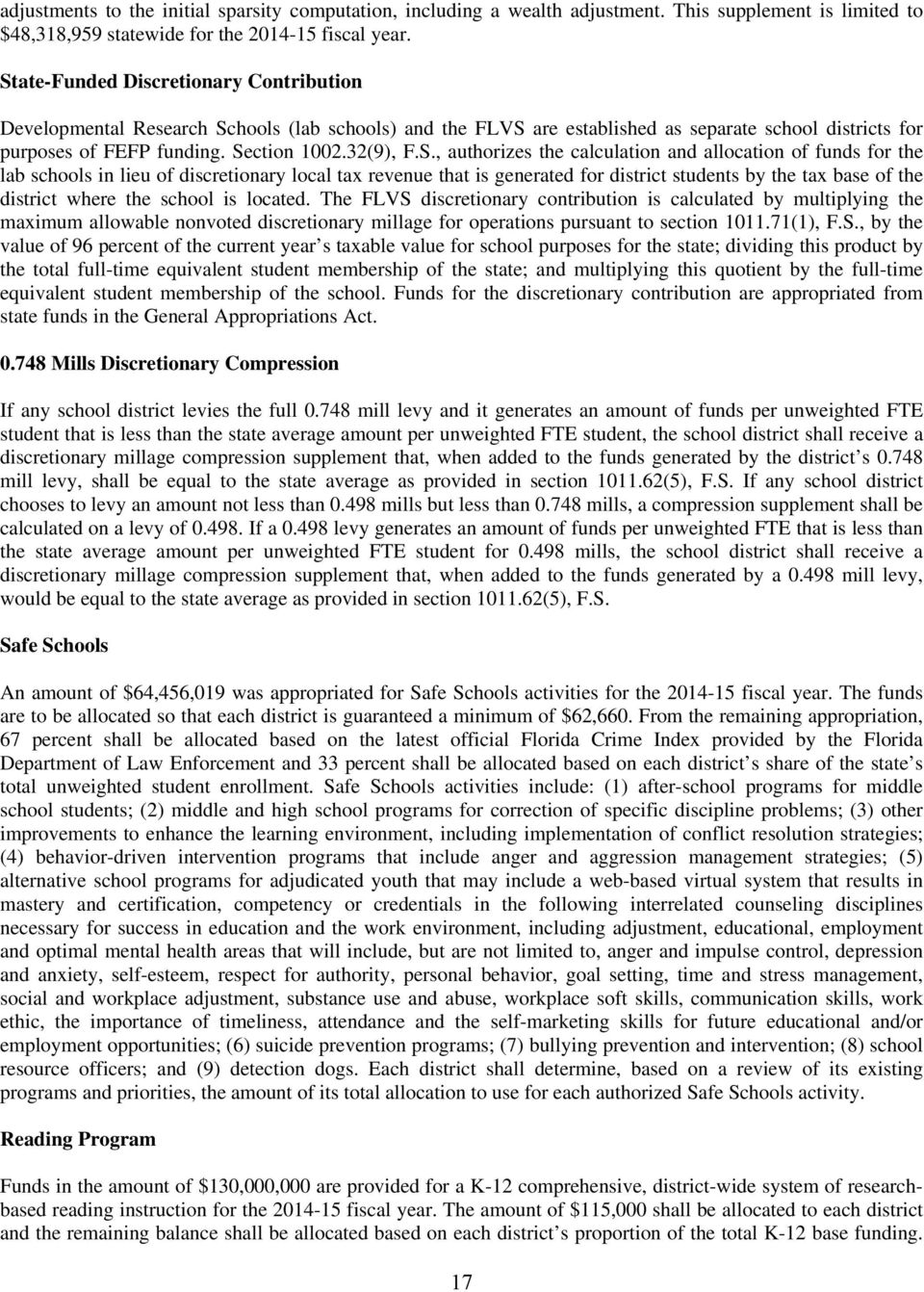
20 adjustments to the initial sparsity computation, including a wealth adjustment. This supplement is limited to $48,318,959 statewide for the fiscal year. State-Funded Discretionary Contribution Developmental Research Schools (lab schools) and the FLVS are established as separate school districts for purposes of FEFP funding. Section 12.32(9), F.S., authorizes the calculation and allocation of funds for the lab schools in lieu of discretionary local tax revenue that is generated for district students by the tax base of the district where the school is located. The FLVS discretionary contribution is calculated by multiplying the maximum allowable nonvoted discretionary millage for operations pursuant to section (1), F.S., by the value of 96 percent of the current year s taxable value for school purposes for the state; dividing this product by the total full-time equivalent student membership of the state; and multiplying this quotient by the full-time equivalent student membership of the school. Funds for the discretionary contribution are appropriated from state funds in the General Appropriations Act..748 Mills Discretionary Compression If any school district levies the full.748 mill levy and it generates an amount of funds per unweighted FTE student that is less than the state average amount per unweighted FTE student, the school district shall receive a discretionary millage compression supplement that, when added to the funds generated by the district s.748 mill levy, shall be equal to the state average as provided in section (5), F.S. If any school district chooses to levy an amount not less than.498 mills but less than.748 mills, a compression supplement shall be calculated on a levy of.498. If a.498 levy generates an amount of funds per unweighted FTE that is less than the state average amount per unweighted FTE student for.498 mills, the school district shall receive a discretionary millage compression supplement that, when added to the funds generated by a.498 mill levy, would be equal to the state average as provided in section (5), F.S. Safe Schools An amount of $64,456,19 was appropriated for Safe Schools activities for the fiscal year. The funds are to be allocated so that each district is guaranteed a minimum of $62,66. From the remaining appropriation, 67 percent shall be allocated based on the latest official Florida Crime Index provided by the Florida Department of Law Enforcement and 33 percent shall be allocated based on each district s share of the state s total unweighted student enrollment. Safe Schools activities include: (1) after-school programs for middle school students; (2) middle and high school programs for correction of specific discipline problems; (3) other improvements to enhance the learning environment, including implementation of conflict resolution strategies; (4) behavior-driven intervention programs that include anger and aggression management strategies; (5) alternative school programs for adjudicated youth that may include a web-based virtual system that results in mastery and certification, competency or credentials in the following interrelated counseling disciplines necessary for success in education and the work environment, including adjustment, educational, employment and optimal mental health areas that will include, but are not limited to, anger and impulse control, depression and anxiety, self-esteem, respect for authority, personal behavior, goal setting, time and stress management, social and workplace adjustment, substance use and abuse, workplace soft skills, communication skills, work ethic, the importance of timeliness, attendance and the self-marketing skills for future educational and/or employment opportunities; (6) suicide prevention programs; (7) bullying prevention and intervention; (8) school resource officers; and (9) detection dogs. Each district shall determine, based on a review of its existing programs and priorities, the amount of its total allocation to use for each authorized Safe Schools activity. Reading Program Funds in the amount of $13,, are provided for a K-12 comprehensive, district-wide system of researchbased reading instruction for the fiscal year. The amount of $115, shall be allocated to each district and the remaining balance shall be allocated based on each district s proportion of the total K-12 base funding. 17
21 From these funds, at least $15,, shall be used to provide an additional hour of intensive reading instruction beyond the normal school day for each day of the entire school year for the students in the 3 lowest performing elementary schools based on the state reading assessment pursuant to sections 18.22(3) and (9), F.S. This additional hour of instruction must be provided by teachers or reading specialists who are effective in teaching reading. Students enrolled in these schools who have level 5 reading assessment scores may choose to participate in the additional hour of instruction on an optional basis. ESE centers shall not be included in the 3 schools. Pursuant to section 18.32, F.S., the Florida State Board of Education shall withhold funds from a school district that fails to comply with this requirement. Supplemental Academic Instruction The Supplemental Academic Instruction (SAI) component of the FEFP formula provides funding of $642,89,342 for the fiscal year. From these funds, at least $75,,, together with funds provided in the district s research-based reading instruction allocation and other available funds, shall be used by districts with one or more of the 3 lowest performing elementary schools based on the statewide, standardized English Language Arts assessment to provide an additional hour of instruction beyond the normal school day for each day of the entire school year for intensive reading instruction for the students in each of these schools. This additional hour of instruction must be provided by teachers or reading specialists who are effective in teaching reading. Students enrolled in these schools who have level 5 reading assessment scores may choose to participate in the additional hour of instruction on an optional basis. ESE centers shall not be included in the 3 schools. The Florida Department of Education shall provide guidance to school districts for documentation of the expenditures for the additional hour of instruction to ensure that all local, state and federal funds are maximized for the total instructional program. School districts shall submit a report to the Florida Department of Education in a format prepared by the department that includes summary information, including funding sources, expenditures and student outcomes for each of the participating schools, which shall be submitted to the Speaker of the House, President of the Senate and Governor by September 3, 215. Pursuant to section 18.32, F.S., the Florida State Board of Education shall withhold funds from a school district that fails to comply with this requirement. Exceptional Student Education (ESE) Guaranteed Allocation ESE services for students whose level of service is less than Support Levels 4 and 5 are funded through the ESE Guaranteed Allocation. The students generate FTE funding using the appropriate Basic Program weight for their grade level. This allocation provides for the additional services needed for exceptional students. District allocations from the appropriation of $95,781,688 for the fiscal year are not recalculated during the year. School districts that have provided education services in for exceptional education students who are residents of other districts shall not discontinue providing such services without the prior approval of the Florida Department of Education. Instructional Materials Funds in the amount of $223,382,911 are provided to purchase instructional materials. This includes $165,, to purchase instructional content, as well as electronic devices and technology equipment and infrastructure. The remainder is for core subject instructional materials. Instructional Materials funding also provides $11,795,824 for library/media materials, $3,224,192 for science lab materials and supplies, $1,, for dual enrollment instructional materials and $3,15,624 for digital instructional materials for students with disabilities. The funds are allocated to the districts based on the formula in section , F.S. 18
22 Florida Teachers Classroom Supply Assistance Program This appropriation provides an allocation to each school district based on the prorated total of each school district s share of the total K-12 unweighted FTE student enrollment. Pursuant to section , F.S., the funds are to be used only by classroom teachers for the purchase of classroom instructional materials and supplies for use in teaching students. An appropriation of $45,286,75 was allocated for the Florida Teachers Classroom Supply Assistance Program in In 213, the Florida Legislature changed the name of the Florida Teachers Lead Program to the Florida Teachers Classroom Supply Assistance Program. Student Transportation To provide the equitable distribution of funds for safe and efficient transportation services in school districts in support of student learning, $424,875,855 was appropriated for Student Transportation in The formula for allocating the funds is outlined in section , F.S., and contains the following provisions in the state allocation for student transportation: 1) students with special transportation needs earn a higher rate of funding than base students; 2) base funding for each district is established by the district's proportionate share of the total statewide students eligible for transportation; and 3) indices are applied that modify the base funding amount to reward more efficient bus utilization, compensate for rural population density and adjust funding based on the cost of living. Virtual Education Contribution The virtual education contribution shall be allocated pursuant to the formula provided in section (11), F.S. The contribution shall be based on $5,23 per FTE student. Required Local Effort The district required local effort is subtracted from the state and local FEFP dollars. The amount of required local effort that each district must provide to participate in the FEFP is calculated as described in the following paragraphs. Adjusted required local effort from ad valorem taxes for was set in the Second Calculation at $7,179,758,192. Using the certified 214 tax roll from the Florida Department of Revenue, the Commissioner computed and certified the required local effort millage rate for each district. For the current fiscal year FEFP calculation, each district s contribution for required local effort is the product of the certified mills times 96 percent of the taxable value for school purposes of the district. Section (4), F.S., directs the Commissioner to adjust required local effort millage rates if the millage would produce more than 9 percent of a district s total FEFP entitlement. As previously noted in the discussion about local support on pages 2-3, the certified millage rates of seven districts were reduced in accordance with this provision. The amount produced by applying the average computed required local effort millage rate of 5.89 to the certified tax roll is adjusted by an equalization factor for each district in accordance with section (4)(b), F.S. The purpose of this adjustment is to offset variations among districts in the level of assessment of property. The Florida Department of Revenue provides the Commissioner with its most recent determination of the assessment level of the prior year s assessment roll for each district and for the state. A millage rate is computed based on the positive or negative variation of each district from the state average assessment level. The millage rate resulting from application of this equalization factor is added to the state average required local effort millage. The sum of these two rates becomes each district s certified required local effort millage (see page 2, Local Support). 19
23 As explained on page 6, developmental research schools and the FLVS have no taxing authority. Therefore, state funds are used to provide the required local effort, as well as equivalent discretionary local revenue, for these schools. Adjustments The Florida Department of Education is authorized to make prior-year adjustments in the allocation of funds to a district for adjudication of litigation, arithmetical errors, assessment roll change, FTE student membership errors or allocation errors revealed in an audit report. If state revenue collections are not sufficient to fund the amount appropriated for the FEFP, a special session may be held to reduce the appropriation and allocations. If the program calculates an amount that exceeds the appropriation, a proration of available funds will be deducted from districts calculated funding in proportion to each district s relative share of state and local FEFP dollars. This procedure preserves equity in the distribution of available dollars. Categorical Program Funds Categorical program funds are added to the FEFP allocation that is distributed to districts. Categorical programs include the Class Size Reduction Program and the District Lottery and School Recognition Program. Class Size Reduction As a result of the voter-approved amendment to Article IX, section 1, of the Florida Constitution, regarding class size reduction, additional operating and capital outlay funds were appropriated to assist districts in their efforts to not exceed the class size maximums. Beginning with the school year, Florida classrooms could have no more than 18 students in grades PreK-3, 22 students in grades 4-8 and 25 students in grades If a district school board determines that it is impractical, educationally unsound or disruptive to student learning, students who enroll after the October student membership survey may be temporarily assigned to a class that exceeds the maximums cited above. Up to three students may be assigned to a teacher in grade group K-3. Up to five students may be assigned to a teacher in grade groups 4-8 and The district school board must develop a plan that provides that the school will be in full compliance by the next October student survey. For , the class size reduction appropriation is $3,13,13,776 for operations, which is used by districts primarily to hire teachers to meet class size requirements. The class size reduction allocation factors for the fiscal year for the operating categorical program are as follows: $1,325.1 (grades PreK-3), $93.8 (grades 4-8) and $95.98 (grades 9-12) per weighted FTE student. District Lottery and School Recognition Program Funds An amount of $134,582,877 was appropriated for school recognition funds and district discretionary lottery funds for the fiscal year. The first priority in the use of the funds is the Florida School Recognition Program, which is authorized by section 18.36, F.S. The Florida School Recognition Program provides monetary awards to schools that earn an A grade, improve at least one performance grade from the previous year or sustain the previous year s improvement of more than one letter grade. The Florida Legislature provided for awards of up to $1 per student for the school year, which are to be used for nonrecurring bonuses to the faculty and staff, nonrecurring expenditures for educational equipment or materials or for temporary personnel to assist the school in maintaining or improving student performance. The school's staff and school advisory council (SAC) must decide to spend these funds for one or any combination of these three purposes. If the school s staff and SAC cannot reach agreement by February 1, the awards must be equally distributed to all classroom teachers currently teaching in the school. 2
24 District Discretionary Lottery and School Recognition Program funds remaining after funding the Florida School Recognition Program are allocated to school districts based on each district s proportionate share of the FEFP base funding entitlement (WFTE x BSA x DCD). School boards must allocate up to $5 per unweighted FTE student to be used at the discretion of the SAC or, in the absence of such a committee, at the discretion of the staff and parents of the school. These moneys may not be used for capital improvements or for any project or program that has a duration of more than one year; however, a school advisory council or parent advisory committee may independently determine that a program or project funded in a prior year should receive funds in a subsequent year. If there are insufficient funds remaining to fully fund the SACs, then the funds are prorated to the SACs. Also, see sections (5)(c) and , F.S., relative to school advisory councils and expenditure of these funds. No funds shall be released for any purpose from the Educational Enhancement Trust Fund to any school district in which one or more schools do not have an approved school improvement plan pursuant to section 11.42(18), F.S., or do not comply with school advisory council membership composition requirements pursuant to section (1), F.S. 21
25 FEFP CALCULATION SCHEDULE The FEFP is calculated five times throughout the year to arrive at each year s final appropriation. These calculations are as follows: (1) First Calculation This calculation is completed by the Florida Legislature. District allocations for July 1 are based on this calculation. (2) Second Calculation This calculation is made upon receipt of the certified tax roll from the Florida Department of Revenue as provided for in section (4), F.S. District allocations for July 26 through December 26 are based on this calculation. (3) Third Calculation This calculation is made upon receipt of districts October survey FTE. District allocations for January 1 through April 26 are based on this calculation. (District current-year July and October and prior-year June FTE amounts are summed with a February estimate derived from annualization factors provided by each school district.) (4) Fourth Calculation This calculation is made upon receipt of districts February FTE and estimated June FTE. District allocations for May 1 through June 26 are based on this calculation. (5) Final Calculation This calculation is made upon receipt of districts June FTE. Prior-year adjustments in the following fiscal year are completed based on a comparison of this Final Calculation to the Fourth Calculation. With each calculation, districts are sent a detailed report of the input data and results. Summary pages from the Second Calculation are included at the end of this publication. 22
26 PUBLIC EDUCATION CAPITAL OUTLAY (PECO) FUNDS Background Pursuant to Article XII, section 9(a)(2) of the Florida Constitution, the Public Education Capital Outlay (PECO) and Debt Service Trust Fund consists of revenues derived from the collection of the gross receipts tax on utilities, including transfers from the Communications Services Tax and through the issuance of bonds supported by these revenues. School districts, Florida colleges, state universities and other education agencies receive PECO funds to construct new facilities or to perform maintenance, renovation and/or repairs on existing facilities. These funds are also used for site acquisitions and site improvements. New School Construction (Survey-Recommended Needs) Each year, Florida public school districts complete a Five-Year District Facilities Work Plan identifying the need for construction of new education facilities as well as major additions, renovations or repairs necessary to extend the useful life of buildings. Each public school district has local control over the allocation of funds to meet public school district facility needs. The projects to be funded by the district must be included in the district s educational plant survey, as approved by the Florida Department of Education. A portion of this appropriation is allocated to the university developmental research (lab) schools and represents the local millage equivalent to be used for fixed capital outlay purposes. Legal Authorization Section 12.32(9)(e), F.S., and section (3), F.S Appropriation $4,798,454 appropriated to university developmental research schools Maintenance, Repair and Renovation School districts receive a portion of PECO funds for remodeling, renovation, maintenance, repairs and site improvements for existing satisfactory facilities. These funds assist school districts in expanding or upgrading educational plants to prolong the useful life of the facilities. Charter schools meeting the criteria in section , F.S., also receive PECO funds for capital outlay needs from this appropriation category. Legal Authorization Sections (1)(b) and (1), F.S Appropriation $75,, appropriated to charter schools $53,, appropriated to public schools. Of these funds, $3,, is provided for school districts in which the average annual percent increase in the district s capital outlay full-time equivalent student membership over the previous five years is 2.5 percent or greater. Special Facilities PECO funds may be appropriated to school districts lacking sufficient resources to meet urgent construction needs. The proposed projects must be deemed a critical need and must be recommended for funding by the Special Facilities Construction Committee, consisting of representatives from the Florida Department of Education, the Governor s Office, district school boards and district superintendents. The school districts must adopt a resolution committing available local capital outlay revenue to the project for a three-year period. Legal Authorization Section (2), F.S. 23
27 Appropriation $59,686,264 appropriated for the following projects: $7,87,913 Glades County School District (second of three years) $9,226,362 Washington County School District (first of three years) $7,6, Madison County School District (first of two years) $11,471,79 Levy County School District (first of three years) $7,, Calhoun County School District (first of three years) $6,3, Holmes County School District (first of three years) $1,217,28 Dixie County School District (first of three years) 24
28 CAPITAL OUTLAY AND DEBT SERVICE (CO&DS) FUNDS Background Pursuant to Article XII, section 9(d), of the Florida Constitution, the first proceeds from the tax on motor vehicle licenses are available to school districts and Florida colleges for capital outlay purposes. The number of instruction units determines the annual allocation of these funds for each school district and Florida college. For school districts, each instruction unit for the base year equals $6 and each growth unit, or the increase in instruction units of the current year over the base year, is valued at $8. Both base instruction units and growth instruction units for Florida colleges are worth $4. A school district or Florida college may elect to bond its allocation or receive the funds as cash, in which case it is commonly referred to as flow-through funds. CO&DS funds may be used for capital outlay projects included on a school district s or college s Project Priority List, which is developed from the educational plant survey as approved by the Florida Department of Education. Legal Authorization Article XII, section 9(d), Florida Constitution Appropriation $28,, appropriated for both school districts and Florida colleges 25
29 WORKFORCE DEVELOPMENT EDUCATION FUND Note: Workforce Development Education Fund programs are administered by the Division of Career and Adult Education, formerly the Division of Workforce Education. Requirements for Participation Funds appropriated must be used for the delivery of Workforce Development Education programs by school districts and shall be used for no other purpose. Workforce Development Education programs include adult general education programs, technical certificate programs, applied technology diploma programs and apprenticeship programs. Please note that state funds can no longer be spent on continuing workforce education programs. Distributing State Dollars The distribution of funds for was identified with a specific appropriation for each school district, with the exception of performance-based incentive funds that will be distributed during the fiscal year in accordance with the proviso language. Lifelong Learning may be offered at the discretion of the district, but is not to be reported for funding under the Workforce Development Education Fund or under the FEFP. Such courses and activities may be supported by: (1) a fee sufficient to pay part or all of the costs; (2) local funds; or (3) a combination of fees and state and local funds. Lifelong Learning means a noncredit course or activity offered by a school district that seeks to address community social and economic issues related to health and human relations, government, parenting, consumer economics and senior citizens (section 14.2(18), F.S.). Lifelong Learning includes making school media centers and school athletic facilities available for public use during after-school hours. Legal Authorization Specific appropriation items 13, 12, and 122, chapter , L.O.F. ( General Appropriations Act); section 111.8, F.S Appropriations $369,544,488 Workforce Development Funds $4,982,722 Performance-Based Incentive Funds Funds in Specific Appropriation 12 shall be provided by the Florida Department of Education to district workforce education programs for students who earn industry certifications during the fiscal year. Funding shall be based on students who earn industry certifications in the following occupational areas: health, science to include surgical technology, orthopedic technology, dental assisting technology, practical nursing, medical coder/biller, medical assisting, certified nursing assistant, emergency medical technician and paramedic, clinical lab technician, EKG technician, pharmacy technician, and clinical hemodialysis technician; automative service technology; auto collision repair and refinishing; medium/heavy-duty truck technician; cyber security; cloud virtualization; network support services; computer programming; computer-aided drafting; advanced manufacturing; electrician; and welding; or, industry certifications for Federal Aviation Administration airframe mechanics and power plant mechanics; and heating, ventilation and air conditioning technician. Funding is limited to one certification per student per academic year for programs that are not linked to occupations on the Florida Statewide Demand Occupations List. On June 1, 215, if any funds remain, the balance shall be allocated for performance in adult general education programs based on student performance as measured by learning gains, placements and special populations served indexed to the proportional share of the funds available. These performance funds shall not be awarded for certifications earned continuing workforce education programs. Industry certifications earned by students enrolled in the academic year who were eligible to be included in the funding allocation for the fiscal year and were not included in the 26
30 final disbursement due to the early data reporting deadline may be reported by districts and included in the Florida Department of Education s allocation of funds for the fiscal year. School districts shall maintain documentation for student attainment of industry certifications that are eligible for performance funding. The Auditor General shall verify compliance with this requirement during scheduled operational audits of the school districts. If a district is unable to comply, the district shall refund the performance funding to the state. Adult Fees The General Appropriations Act amended the tuition and fees policies for The following schedule reflects current fees: Workforce Education Program Tuition Range Per Contact Hour* Resident: Career Certificate (Postsecondary Adult Vocational - PSAV) or Applied Technology Diploma $2.22 to $2.33 Tuition Plus Out-of-State Fee for Non- $8.86 to $9.78 Residents: Resident: Adult General Education $3 per semester or $45 per half year * There are 3 contact hours in one credit hour. Adult General Education Block Tuition Effective July 1, 214, section 19.22(3)(c), F.S., was amended to include the following language: For adult general education programs, a block tuition of $45 per half year or $3 per term shall be assessed. Each district school board and Florida College System institution board of trustees shall adopt policies and procedures for the collection of and accounting for the expenditure of the block tuition. All funds received from the block tuition shall be used only for adult general education programs. Students enrolled in adult general education programs may not be assessed the fees authorized in subsection (5), subsection (6), or subsection (7). Fees for Continuing Workforce Education Effective July 1, 21, section 19.22(3)(b), F.S., was amended to include the following language: Fees for continuing workforce education shall be locally determined by the district school board or Florida College System institution board. Expenditures for the continuing workforce education program provided by the Florida College System institution or school district must be fully supported by fees. Enrollments in continuing workforce education courses may not be counted for purposes of funding full-time equivalent enrollment. Districts will be required to report fiscal and enrollment information on students in Continuing Workforce Education (CWE). Fee (Tuition) Statutes The following are the current statutory references to workforce fees: Section 19.22, F.S. Workforce education postsecondary student fees Section 19.25, F.S. Fee exemptions Section 19.26, F.S. Fee waivers Section 19.27, F.S. Deferral of fees 27
31 Standard Tuition for Career Certificate/Applied Technology Diploma Programs For , the standard tuition is the same as the tuition for for Career Certificates/Applied Technology diplomas. Each district school board may adopt a tuition amount that varies within the range of five percent below to five percent above the standard tuition and out-of-state fee, if applicable (section 19.22(3)(e), F.S.). Residency for Tuition Purposes Section 19.22(3)(a), F.S., provides for the following: Except as otherwise provided by law, fees for students who are nonresidents for tuition purposes must offset the full cost of instruction. Residency of students shall be determined as required in s (emphasis added). Fee-nonexempt students enrolled in vocational-preparatory instruction shall be charged fees equal to the fees charged for adult general education programs. Each Florida College System institution that conducts collegepreparatory and vocational-preparatory instruction in the same class section may charge a single fee for both types of instruction. For all students in career certificate and applied technology diploma prorams, a determination of residency for tuition purposes must be made according to the requirements in section 19.21, F.S. Districts must identify students as residents for tuition purposes in the Workforce Development Information System (WDIS) data reporting system using the Adult Fee Status data element. Financial Aid Fee School districts are permitted to collect, for financial aid purposes, up to an additional 1 percent of the student fees collected for workforce development education programs as stated in section 19.22(5), F.S. Capital Improvement Fee School districts are permitted to collect a separate capital improvement fee for capital improvements, technology enhancements or equipping buildings that may not exceed five percent of the tuition fee for resident students or five percent of the tuition and out-of-state fee for nonresident students. For additional information, see section 19.22(6), F.S. Technology Fee School districts are permitted to collect a separate technology fee. Section 19.22(7), F.S., states, Each district school board and Florida College System board of trustees is authorized to establish a separate fee for technology, not to exceed 5 percent of tuition per credit hour or credit-hour equivalent for resident students and not to exceed 5 percent of tuition and the out-of-state fee per credit hour or credit-hour equivalent for nonresident students. Other Fees Section 19.22, F.S., states, in subsections (8) and (9): (8) Each district school board and Florida College System institution board of trustees is authorized to establish specific fees for workforce development instruction not reported for state funding purposes or for workforce development instruction not reported as state funded full-time equivalent students. District school boards and 28
32 Florida College System institution boards of trustees are not required to charge any other fee specified in this section for this type of instruction. (9) Florida College System institution boards of trustees and district school boards are not authorized to charge students enrolled in workforce development programs any fee that is not specifically authorized by statute. In addition to tuition, out-of-state, financial aid, capital improvement, and technology fees, as authorized in this section, Florida College System institution boards of trustees and district school boards are authorized to establish fee schedules for the following user fees and fines: laboratory fees; parking fees and fines; library fees and fines; fees and fines relating to facilities and equipment use or damage; access or identification card fees; duplicating, photocopying, binding, or microfilming fees; standardized testing fees; diploma replacement fees; transcript fees; application fees; graduation fees; and late fees related to registration and payment. Such user fees and fines shall not exceed the cost of the services provided and shall only be charged to persons receiving the service. Fee Exemptions Most fee exemptions are defined in section 19.25, F.S. Included in this statute are exemptions for: A student enrolled in a dual enrollment or early admission program pursuant to section 17.27, F.S., , F.S., or section 17.21, F.S. A student enrolled in an approved apprenticeship program, as defined in section , F.S. A student in the custody of the Florida Department of Children and Families (DCF) or adopted from DCF, under certain conditions. A student who is homeless. Additional Exemptions Include: A student who is a dependent of a deceased or disabled veteran pursuant to section 295.1, F.S., through section 295.5, F.S. A student who is a dependent of a deceased special risk member pursuant to section (3), F.S., and section (3), F.S. A student who was a victim of wrongful conviction under section 961.6(1)(b), F.S. Fee Waivers Fee Waivers are defined in section 19.26, F.S. School districts may provide fee waivers for programs funded through Workforce Development Education appropriations for up to eight percent of the fee revenues that would otherwise be collected. The following waivers were added for school district adult programs for 214: Out-of-State Fee Waiver for Honorable Discharged Veterans Chapter 214-1, L.O.F., provides for an out-of-state fee waiver for honorably discharged veterans known as the Congressman C.W. Bill Young Tuition Waiver Act. Effective July 1, 214, a career center operated by a school district under section 11.44, F.S., or charter technical career center shall waive out-of-state fees for an honorable discharged veteran of the United States Armed Forces, the United States Reserve Forces or the National Guard who physically resides in this state while enrolled in the institution. Tuition and fees charged to a veteran who qualifies for the out-of-state fee waiver may not exceed the tuition and fees charged to a resident student. The waiver is applicable for 11 percent of the required credit hours of the degree or certificate program in which the student is enrolled. In addition, the law requires the career center or charter technical career center to report to the Board of Education the number value of all fee waivers granted annually under this law. 29
33 Tuition Waivers for Purple Heart Recipients Chapter , L.O.F., amends section 19.26, F.S., to include career centers operated by school districts and charter technical career centers in the section of law providing a tuition waiver for recipients of a Purple Heart or another combat decoration superior in precedence. The tuition waiver must be provided to recipients who meet the following conditions: 1) enrolled full-time, part-time or in summer school in a program that terminates in an associate or a baccalaureate degree, a college credit certificate or a career certificate; 2) is currently, and was at the time of the military action that resulted in the award of the Purple Heart or other combat decoration superior in precendence, a resident of Florida; 3) submits to the career center the DD-214 form issued at the time of separation from service as documentation that the student has received a Purple Heart or another combat decoration superior in precedence. If the DD-214 is not available, other documentation may be acceptable if recognized by the United States Department of Defense or the United States Department of Veterans Affairs as documenting the award. The waiver is applicable for 11 percent of the number of required credit hours (or equivalent) of the degree or certificate program for which the student is enrolled. Out-of-State Fee Waiver for Recent High School Graduates, including those graduates who are undocumented for federal immigration purposes Chapter , L.O.F., provides for an out-of-state fee waiver for the students who meet the following conditions: Attended a secondary school in this state for three consecutive years immediately before graduating from a high school in this state; Applied for enrollment in an institution of higher education within 24 months after high school graduation; and Submitted an official Florida high school transcript as evidence of attendance and graduation. The tuition and fees charged to a student who qualifies for this waiver may not exceed the tuition and fees charged to a resident student. The waiver is applicable to 11 percent of the required credit hours of the degree or certificate program in which the student is enrolled. Each career center or charter technical career center shall report to the State Board of Education the number and value of all fee waivers granted annually under this law. Pursuant to the Congressman C.W. Bill Young Tuition Waiver Act, centers must prioritize the enrollment of a veteran who is granted an out-of-state fee waiver over a student who is granted an out-of-state fee waiver under this law. Differential Out-of-State Fee Section 19.22(4), F.S., provides that a district school board that has a service area that borders another state may implement a plan for a differential out-of-state fee. Applied Academics for Adult Education (formerly known as Career Preparatory Instruction) The Applied Academics for Adult Education program is designed to prepare students for academic, technical and personal success. It includes career assessment, basic skills related instruction, workforce readiness instruction and competency training. The department considers Career Preparatory instruction as an Adult Education course. Students receiving this instruction must be charged the adult general education block tuition. 3
34 District Indirect Costs In 212, the following language was added to the proviso for Specific Appropriation 16 in the General Appropriations Act: A school district shall not assess district level indirect costs against a workforce program in excess of the required level authorized in section 11.21, Florida Statutes. Certification by the Superintendent of Data Reporting for Enrollment and Performance The following language was added to the proviso for the specific appropriations for Workforce Development Funds in the General Appropriations Act: District superintendents shall certify that workforce education enrollment and performance data used for funding allocations to districts is accurate and complete in accordance with reporting timelines established by the Florida Department of Education. Upon certification, the district data shall be considered final for purposes of use in state funding formulas. After the final certification, the Florida Department of Education may request a supplemental file in the event that a district has reported a higher level of enrollment or performance than was actually achieved by the district. 31
35 Requirements for Participation ADULTS WITH DISABILITIES FUNDS Funds appropriated will be distributed to Florida College System institutions and school districts for programs serving adults with disabilities. Any program that was funded in the fiscal year will be eligible for continuation funding if the program has made satisfactory progress and the application reflects effective use of resources as defined by the Florida Department of Education. The Florida Department of Education has the authority to redistribute any funds due to unsatisfactory progress, ineffective use of resources or discontinued programs. These funds are administered by the Florida Division of Vocational Rehabilitation. Distribution of State Dollars The funds are distributed to eligible school districts and Florida College System institutions as specified in specific appropriation item 36 of chapter , L.O.F. Legal Authorization Chapter , specific appropriation item 36, L.O.F. ( General Appropriations Act) Appropriations $9,117,278 School Districts $876,26 Florida College Programs 32
36 FUNDS FOR STUDENT TRANSPORTATION Overview The student transportation funding formula provides funds to 67 school districts based on each district s pro rata share of eligible state-transported students. Eligible transported charter school students may be included in the districts student transportation funding claims. The formula includes an additional weight for the transportation of students with disabilities requiring specialized transportation services. In addition to students transported by public school buses, the funding formula includes students transported to and from school on local general purpose transportation systems (public transit). The formula also includes students transported to and from school in private passenger cars and boats when the transportation is for certain isolated students or for students with disabilities, when the need is documented on the student s Individual Education Plan (IEP). Adjustments to each district s share of state transportation funds are made for cost of living differences, the percent of population outside of urban centers and efficiency (as defined by average bus occupancy or the average number of students transported per day, per bus). Requirements for Participation A school district must participate in the FEFP to be eligible to receive funds from the state student allocation for transportation of eligible school district or charter school students. Legal Authorization Section , F.S. Chapter Final Conference Report on House Bill 51 ( General Appropriations Act) Sections , F.S Appropriation $424,875,855 Students Eligible for Transportation Funding Students in membership in kindergarten through grade 12 and in exceptional student education programs below kindergarten are eligible for transportation funding if one of the following conditions is met: (1) The student lives two or more miles from the school. (2) The student is classified as a student with a disability under the Individuals with Disabilities Education Act (IDEA), regardless of distance (excluding gifted students). K-12 students identified under the categories Specific Learning Disabilities, Speech Impaired or Language Impaired who live less than two miles from their assigned school are eligible only if transportation services are required by the student s Individual Educational Plan. (3) The student/parent or infant is enrolled in the Teenage Parent Program (TAP). (4) The student is enrolled in a state-funded prekindergarten program (IDEA or TAP), regardless of distance from home to school. Prekindergarten children not enrolled in IDEA programs or whose parent or parents are not enrolled in a TAP program, are not eligible for state transportation funding. Prekindergarten students in the following programs are ineligible for transportation funding under section , F.S., unless the students are also disabled or in a TAP program. These ineligible groups include, but are not limited to, students in Prekindergarten Title I, federally funded Prekindergarten Migrant Programs, Prekindergarten Early Intervention, Head Start, Voluntary Prekindergarten and Readiness Coalition programs. 33
37 (5) The student is a career or exceptional student being transported from one school center to another where appropriate programs are provided. Dually enrolled students, as defined by section , F.S., who attend a university, state college or career center, are included. (6) The student meets the criteria for hazardous walking as stated in section 16.23, F.S. Only elementary school students are eligible for funding under the hazardous walking category. (7) Summer transportation funding is only available for non-residential DJJ students and students with disabilities requiring extended school year services, as documented on their IEPs. DISTRIBUTING STUDENT TRANSPORTATION DOLLARS The two major components of the state transportation funding formula are the district s base allocation factor and the district s ESE allocation factor. These factors are determined in the following manner: District Base Allocation Factor Base Allocation Students Adjusted Adjusted Adjusted Adjusted Total July + October + February + June = Adjusted Students Students Students Students Students The adjusted student count is determined by applying an adjustment factor to the number of transported students equal to the number of days in term divided by 18 days. Total Florida Price Average Bus Rurality District Base Adjusted x Level Index x Occupancy x Index Factor = Allocation Students Factor Index Factor Factor The district base allocation factor is determined by multiplying the district s total adjusted transported students by factors that make adjustments for the district s Florida Price Level Index (FPLI), the district s Average Bus Occupancy Index (ABO) and the district s Rurality Index. Each factor is designed to affect the base allocation by no more or less than 1 percent. District Exceptional Student Education Allocation Factor Exceptional Student Allocation Adjusted Adjusted Adjusted Adjusted Total July ESE + October ESE + February + June ESE = Adjusted ESE Students Students ESE Students Students Students 34
38 The exceptional allocation student count is determined by applying an adjustment factor to the number of transported students equal to the number of days in term divided by 18 days. Total Total Adjusted ESE x Factor = Weighted Students of 1.8 Adjusted ESE Students The district s total weighted adjusted transported ESE students are determined by multiplying the district s total adjusted ESE students by a factor of 1.8. Total Florida Price Average Bus Rurality District ESE Weighted x Level Index x Occupancy x Index Factor = Allocation Adjusted Factor Index Factor Factor ESE Students The district ESE allocation factor is determined by multiplying the district s total weighted adjusted transported ESE students by factors that make adjustments for the district s FPLI, the district s ABO and the district s Rurality Index. Each factor is designed to affect the base allocation by no more or less than 1 percent. Using these major components, the amount of transportation dollars for each school district is calculated as follows: District ESE Cost per District ESE Allocation x Student = Allocation Factor Total Total of All Total Base Transportation - Districts ESE = Allocation Appropriation Allocations The district s ESE transportation allocation is determined by multiplying the district s allocation factor by an average per-student cost for transportation as determined by the Florida Legislature. The sum of the districts ESE allocations is then subtracted from the total transportation appropriation to determine the total base allocation. 35
39 District Base Total of All District Base Allocation District Base = Proration Factor Allocation Factor Factors District Base Total Base District Base Proration x Allocation = Allocation Factor The district s base proration factor is determined by dividing the district s base allocation factor by the total state base allocation factor. To determine the district base allocation, the total base allocation is multiplied by the district base proration factor. District Base Allocation + District ESE Allocation = Total District Allocation The total district allocation is determined by adding the district base allocation to the district ESE allocation. 36
40 STUDENT TRANSPORTATION CALCULATION SCHEDULE The transportation calculation is performed four times throughout the year in order to establish each school district s transportation categorical allocation. These calculations are scheduled as follows: (1) First Calculation This calculation is completed immediately after the annual legislative session. It is based on each school district s number of eligible students transported from the transportation surveys for July, preceding fiscal year; October, preceding fiscal year; February, preceding year; and June, second preceding fiscal year. (2) Second Calculation This calculation is completed upon receipt of the transported student count for the October survey. It is based on each school district s number of eligible students transported from the transportation surveys for July, current fiscal year; October, current fiscal year; and June, preceding fiscal year. The October transported student count is used for the February count. (3) Third Calculation This calculation is completed upon receipt of the transported student count for the February survey. It is based on each school district s number of eligible students transported from the transportation surveys for July, current fiscal year; October, current fiscal year; February, current fiscal year; and June, preceding fiscal year. (4) Final Calculation This calculation is completed upon receipt of the transported student count for the June survey. It is based on each school district s number of eligible students transported from the transportation surveys for July, current fiscal year; October, current fiscal year; February, current fiscal year; and June, current fiscal year. Upon request, districts are sent a detailed report of the input data and results. 37
41 FEFP Second Calculation Florida Department of Education Page 4 of 43 Detail 1 7/14/ FEFP Second Calculation Prekindergarten through Grade 12 Funding Summary - Page $4, Funded Times District Declining State-Funded.748 Unweighted Weighted Funded Weighted Cost Base Enrollment Sparsity Discretionary Mills FTE FTE 1 FTE Differential Funding 2 Supplement Supplement Contribution Compression District Alachua 27, , ,62, ,568,938 1,882,322 2 Baker 4, , ,21, ,743,792 84, ,322 1,35,84 3 Bay 26, , ,824, ,523,57 4 Bradford 2, , ,49, ,144,988 95, ,76 523,75 5 Brevard 7, , ,994, ,47,419 6,137,622 6 Broward 261, ,81.9 1,144,223, ,17,884,45 7 Calhoun 2, , ,541, ,88,28 1,544, ,424 8 Charlotte 15, , ,964, ,993,53 339,753 9 Citrus 14, , ,477, ,591, ,858 1,988,871 1 Clay 34, , ,359, ,323, ,685 7,289,75 11 Collier 44, , ,317, ,484, Columbia 1, , ,67, ,379,88 14,239 1,261,154 2,225, Miami-Dade 352, , ,537,897, ,56,811, DeSoto 4, , ,231, ,79, ,19 883, Dixie 2, , ,4, ,497,86 982,99 474, Duval 127, , ,982, ,79, ,578 12,79, Escambia 4, , ,34, ,86,467 19,279 4,942, Flagler 12, , ,17, ,81,37 65,117 1,117, Franklin 1, , ,96, ,741,861 42,76 11,96 2 Gadsden 5, , ,61, ,457,774 22,295 1,956,39 1,98, Gilchrist 2, , ,31, ,557,812 1,672, , Glades 1, ,63.1 6,572, ,366,479 9,99 896, ,94 23 Gulf 1, , ,835, ,378,883 11,14 1,43, Hamilton 1, , ,11, ,619,364 1,23 925,537 87, Hardee 5, , ,339, ,597, ,923 1,44, Hendry 6, , ,199, ,445,867 87,292 1,842,29 1,435, Hernando 21, , ,425, ,52, ,995 1,941,466 2,962,23 28 Highlands 12, , ,726, ,243,955 7,178 2,5,74 1,457, Hillsborough 22, , ,42, ,355,527 28,727,273 3 Holmes 3, , ,636, ,726,526 11,636 2,232, , Indian River 17, , ,167, ,611, Jackson 6, , ,179, ,472,89 264,436 2,942,431 1,385, Jefferson ,868, ,626,37 12, , Lafayette 1, , ,9, ,651,259 12, , , Lake 4, , ,97, ,563,542 24,173 4,264,56 36 Lee 87, , ,671, ,442, Leon 33, , ,849, ,858,332 3,678 2,673, Levy 5, , ,35, ,275,652 72,636 2,846, ,86 39 Liberty 1, , ,32, ,925,287 45,524 96, ,758 4 Madison 2, , ,33, ,567,98 62, , , Manatee 45, , ,64, ,7, Marion 41, , ,13, ,552, ,28 5,241,88 43 Martin 18, , ,743, ,88,87 18,11 44 Monroe 8, , ,58, ,735, Nassau 11, , ,259, ,786, ,49 2,174, Okaloosa 3, , ,545, ,568,974 1,21,43 47 Okeechobee 6, , ,922, ,25,832 95, ,442 1,423,6 48 Orange 188, , ,483, ,246,817 7,384,66 49 Osceola 58, , ,169, ,775,41 9,722,752 5 Palm Beach 181, , ,492, ,649, Pasco 67, , ,676, ,799,41 11,536, Pinellas 12, , ,649, ,678,83 53 Polk 96, , ,992, ,94,176 19,7, Putnam 1, , ,447, ,765,499 73,227 2,7,462 1,732,12 55 St. Johns 33, , ,575, ,317,55 56 St. Lucie 38, , ,279, ,875,75 594,938 3,174, Santa Rosa 25, , ,713, ,346,818 57,673 4,77, Sarasota 41, , ,316, ,21, Seminole 63, , ,91, ,326,22 213,336 5,67,8 6 Sumter 8, , ,937, ,686, Suwannee 5, , ,681, ,183,18 51,72 1,922,15 1,218,25 62 Taylor 2, , ,478, ,718,99 29, , ,31 63 Union 2, , ,85, ,449, ,96 746, Volusia 61, , ,773, ,784,192 4,57, Wakulla 4, , ,41, ,435,912 4,75 652,729 1,182, Walton 8, , ,147, ,211, Washington 3, , ,223, ,315,72 1,834,95 697,87 68 Washington Special , ,39 69 FAMU Lab School ,18, ,935,83 34, ,341 38,425 7 FAU - Palm Beach ,3, ,147, ,52 576, FAU - St. Lucie 1, , ,147, ,94, , , FSU Lab - Broward ,975, ,45, ,97 73 FSU Lab - Leon 1, , ,14, ,814,678 3,242 94, , , UF Lab School 1, , ,691, ,611,773 17, ,42 372,591 75, Virtual School 32, , ,454, ,454,611 13,24,77 189,11 Total 2,722, ,948, ,889,296,997 11,898,76,2 4,357,114 48,318,959 15,68, ,641, Additional Weighted FTE for the Small District ESE Supplement, Isolated Schools, Advanced Placement, International Baccalaureate, Advanced International Certificate of Education, Unpaid High School Credits, and the Industry Certified Career Education Supplement Additional FTE are included in the Weighted FTE. 2. Weighted FTE x BSA x DCD (column 2 x column 3 x column 4) 38
42 FEFP Second Calculation Florida Department of Education Page 5 of 43 Detail 2 7/14/ FEFP Second Calculation Prekindergarten through Grade 12 Funding Summary - Page 2 Teachers ESE Supplemental DJJ Classroom Safe Guaranteed Academic Reading Supplemental Instructional Supply Schools Allocation Instruction Allocation Allocation Materials Transportation Assistance District Alachua 796,455 1,91,61 7,66,744 1,314,279 24,51 2,363,992 4,87,7 461,74 2 Baker 124,112 1,18,118 1,87,38 316, ,35 1,178,241 79,763 3 Bay 79,656 8,43,43 7,455,216 1,33,61 155,981 2,327,697 4,263, ,19 4 Bradford 113,686 1,22, , , ,546 76,97 49,25 5 Brevard 1,629,95 26,743,489 18,78,765 3,38, ,29 6,124,694 1,318,189 1,183,685 6 Broward 6,19,616 85,782,345 53,32,26 12,58, ,758 21,54,887 29,2,125 4,49,311 7 Calhoun 83,58 82, ,646 25,585 19,11 45,73 36,887 8 Charlotte 394,755 5,836,877 3,489,22 788,172 1,352,4 3,65, ,72 9 Citrus 351,113 6,48,965 3,267, , ,445 1,163,29 3,588, ,921 1 Clay 586,823 1,894,94 9,437,52 1,658,6 2,883,575 6,413, , Collier 734,24 19,669,83 8,695,439 2,129, ,522 3,775,429 6,989, , Columbia 294,799 3,845,212 3,855, ,93 833,993 2,12,92 169,14 13 Miami-Dade 9,948, ,62, ,666,569 16,36,282 46,153 28,547,21 23,925,7 5,935,63 14 DeSoto 153,183 2,13,48 1,64,8 316,46 44, , ,448 79, Dixie 17, , ,282 21, ,4 57,23 34,87 16 Duval 3,337,712 44,234,324 29,6,798 5,854, ,633 1,234,63 19,137,369 2,144, Escambia 1,271,612 13,85,153 9,299,252 1,857, ,871 3,18,447 9,923,47 676,92 18 Flagler 279,877 5,625,85 2,752, , ,871 3,938,494 29, Franklin 84, , , ,37 14, ,629 19,866 2 Gadsden 168,396 1,633,93 1,157,95 333, ,141 1,673,876 88, Gilchrist 92, , , , , ,128 42, Glades 85, , , ,942 12, ,389 25, Gulf 11, , ,212 19, , ,698 3,3 24 Hamilton 98,269 47,15 344,87 182, , ,887 27, Hardee 144,775 1,731,91 1,156, ,31 418,442 1,126,297 88,27 26 Hendry 196,961 2,246,935 1,52,91 45, ,411 1,364, , Hernando 476,866 8,425,328 5,121,624 1,43,795 1,759,5 4,436, , Highlands 341,367 3,82,214 2,481,13 617,32 991,474 2,456,818 23, Hillsborough 3,435,57 74,329,679 39,528,422 9,248,22 7,7 16,74,513 34,121,399 3,41,233 3 Holmes 16,323 1,, ,63 244,819 26,4 633,45 53, Indian River 388,177 4,817,55 3,576, ,486 1,457,91 3,74, , Jackson 165,492 2,14,62 1,324, ,839 24, ,262 1,694,738 14, Jefferson 82, , , ,991 71, ,167 15, Lafayette 74, ,45 27,73 162,446 95, ,731 19, Lake 89,139 12,311,766 9,548,85 1,875,259 3,231,93 8,262,3 69,63 36 Lee 1,657,519 37,792,729 18,496,67 4,46, ,858 7,284,773 2,69,44 1,472,33 37 Leon 1,62,183 16,41,791 9,181,74 1,551, ,47 2,623,727 5,162, , Levy 124,487 1,98,276 1,257, , ,142 1,548,839 89, Liberty 76, ,13 288, , , ,91 332,36 23,212 4 Madison 114,492 1,161, , ,591 16,421 21,76 562,219 4, Manatee 1,122,413 18,625,981 9,222,952 2,172, ,41 3,772,117 6,734,23 773, Marion 851,2 14,947,445 12,478,81 1,854, ,136 3,336,489 1,249, ,7 43 Martin 4,219 6,619,61 3,73, ,294 41,873 1,76,473 3,757,917 37, Monroe 315,933 2,968,432 1,798, ,525 5, ,495 1,252,93 136, Nassau 217,46 2,832,583 2,488,34 592, ,37 2,641, , Okaloosa 585,684 11,6,758 8,54,772 1,457,88 249,817 2,554,185 5,921,895 59, Okeechobee 25,679 2,71,385 1,599,794 38,48 232, ,361 1,634,738 16, Orange 4,823,345 51,573,416 4,278,48 8,696, ,953 15,61,93 27,91,59 3,174, Osceola 1,77,367 15,493,798 12,77,625 2,683,271 42,243 5,58,627 1,89, ,528 5 Palm Beach 4,23,917 65,24,545 34,651,2 8,496, ,334 14,516,518 24,315,431 3,54, Pasco 1,363,447 26,89,737 18,96,564 3,142, ,296 5,68,398 15,163,43 1,144, Pinellas 3,34,488 42,216,876 2,832,564 4,691,812 41,73 8,68,837 12,37,42 1,734,29 53 Polk 1,942,229 33,62,31 22,548,786 4,36, ,897 7,783,53 2,526,31 1,622, Putnam 311,528 3,283,996 2,765, , ,488 2,373, , St. Johns 583,13 9,835,69 6,51,859 1,67, ,51 2,846,431 8,61,452 57, St. Lucie 783,371 15,164,573 9,15,643 1,766, ,911 3,215,222 9,443, , Santa Rosa 38,977 8,23,38 7,628,436 1,189,65 8,317 2,253,912 5,914,62 426, Sarasota 1,4,546 21,42,28 8,387,92 1,983,863 3,422,376 6,138, , Seminole 1,248,717 18,19,723 15,251,564 2,933,75 5,17,217 1,95,794 1,75,715 6 Sumter 189,4 2,948,447 1,69, , ,7 1,81, , Suwannee 161, ,769 1,239,91 351, ,771 1,386,584 97, Taylor 113, ,837 68, , , ,397 44, Union 88, ,866 5,46 211,387 34, , ,529 38, Volusia 1,615,22 22,13,9 16,98,814 2,775, ,28 4,974,395 1,325,98 1,27, Wakulla 135,614 1,478, ,74 323,459 41,716 1,691,365 83, Walton 221,171 2,24,427 1,384, ,784 32,778 71,794 1,881, , Washington 112, , ,941 25, , ,694 55, Washington Special ,636 99, ,554 17,699 7,845 1, FAMU Lab School 66,18 17,629 35, ,746 39,459 8,68 7 FAU - Palm Beach 69,787 9, , ,36 241,68 16, FAU - St. Lucie 73, , , , ,235 24, FSU Lab - Broward 67, ,96 141, ,62 52,42 11, FSU Lab - Leon 74, ,54 284, , ,763 28,22 74 UF Lab School 7, , , ,43 114,14 18, Virtual School 453,835 1,496,724 2,984,651 Total 64,456,19 95,781, ,89,342 13,, 7,26, ,382, ,875,855 45,286,75 39
43 FEFP Second Calculation Florida Department of Education Page 6 of 43 Detail 3 7/14/ FEFP Second Calculation Prekindergarten through Grade 12 Funding Summary - Page 3 District 1 Alachua 2 Baker 3 Bay 4 Bradford 5 Brevard 6 Broward 7 Calhoun 8 Charlotte 9 Citrus 1 Clay 11 Collier 12 Columbia 13 Miami-Dade 14 DeSoto 15 Dixie 16 Duval 17 Escambia 18 Flagler 19 Franklin 2 Gadsden 21 Gilchrist 22 Glades 23 Gulf 24 Hamilton 25 Hardee 26 Hendry 27 Hernando 28 Highlands 29 Hillsborough 3 Holmes 31 Indian River 32 Jackson 33 Jefferson 34 Lafayette 35 Lake 36 Lee 37 Leon 38 Levy 39 Liberty 4 Madison 41 Manatee 42 Marion 43 Martin 44 Monroe 45 Nassau 46 Okaloosa 47 Okeechobee 48 Orange 49 Osceola 5 Palm Beach 51 Pasco 52 Pinellas 53 Polk 54 Putnam 55 St. Johns 56 St. Lucie 57 Santa Rosa 58 Sarasota 59 Seminole 6 Sumter 61 Suwannee 62 Taylor 63 Union 64 Volusia 65 Wakulla 66 Walton 67 Washington 68 Washington Special 69 FAMU Lab School 7 FAU - Palm Beach 71 FAU - St. Lucie 72 FSU Lab - Broward 73 FSU Lab - Leon 74 UF Lab School 75 Virtual School Virtual Education Contribution Digital Classrooms Allocation Gross State & Local FEFP Required Local Effort Taxes Proration To Appropriation Net State FEFP ,84 471, ,749,717 63,247,387 (43,676) 84,458, ,38 27,24,395 4,145,698 (7,989) 22,87,78 38, , ,738,576 72,288,26 (41,899) 69,48,417 5, ,545 17,575,47 4,416,752 (5,195) 13,153,523 44, , ,241, ,665,264 (114,768) 235,461,61 82,761 2,291 17, ,266 8,148 48,166 1,656 94, ,724 41,815 1,542 5, ,516 41, ,693 9,924 27,898 6,147 4,639 35, ,12 114,233 6,129 37,259 2, ,29 74,314 2,649 49, , , ,353 85,338 82,78 2,491 5,57 8,13 118,35 294,49 2,433 19, ,334 1,156 6,659 5,794 1,489 18,969,38 2,367, , , , ,63 68, ,233 3,1, , ,717 1,28,79 574,79 35,65 259, ,675 27, , , ,88 292,277 35, ,82 347,597 1,887, , ,24 3, , , , ,17 519, , , , , , , , , ,573 31,95 1,774,86 723,82 1,716, ,616 1,82,932 1,29, , , , ,91 584, , , ,9 271, ,54 743,467 29,32 314, , , , , , , ,921 1,385,485,681 13,56,569 81,912,788 78,151, ,154, ,27,442 56,768,244 1,893,543,37 26,961,223 12,316, ,416, ,756,882 66,811,585 6,63,546 3,513,392 15,683,74 9,192,849 1,64,427 9,513,419 28,557,82 38,484, ,419,392 64,46,551 1,17,26,629 19,28,245 92,148,447 36,766,671 5,911,779 7,17,1 214,276, ,38,281 18,812,8 32,186,99 9,245,182 14,453, ,978, ,432,2 98,7,661 43,659,448 59,312, ,14,22 35,793,936 1,2,994,18 311,262, ,17, ,22, ,746, ,23,357 58,956, ,199,9 26,576, ,88, ,469, ,75,837 41,125,892 3,788,86 14,991,112 13,565, ,94,474 27,67,261 4,578,197 19,245, ,864 3,32,44 6,346,49 7,97,173 4,164,536 9,655,696 7,48, ,753,72 74,675,772 2,47,919 67,656,158 41,296,438 45,65, ,894,242 12,129,149 1,179,124,47 6,934,157 2,496, ,735,237 79,672,1 37,62,875 5,943,82 6,832,64 3,178,343 2,827,399 6,368,576 3,732,76 7,131,565 9,3,512 37,968,435 23,187, ,45,278 2,3,96 7,785,828 7,731,738 3,11,821 1,228,651 82,823, ,159,971 74,68,383 8,45,547 1,138,125 3,362,27 137,424,918 76,983,294 88,828,819 39,291,61 34,57,339 76,877,37 7,875, ,158,811 96,171, ,598,713 15,429, ,589, ,254,195 17,227,734 98,373,242 82,383,886 43,931,35 23,815,58 134,477,629 37,17,25 7,711,679 6,514,178 1,258,478 14,881,377 5,674,511 36,514,686 4,45,99 (49,562) (4,9) (24,214) (23,12) (56,83) (71,25) (16,781) (559,748) (7,97) (3,641) (24,389) (64,75) (19,75) (1,952) (9,2) (4,636) (2,717) (2,975) (2,812) (8,442) (11,376) (35,6) (19,55) (327,247) (5,678) (27,24) (1,869) (1,748) (2,74) (63,342) (141,312) (53,45) (9,515) (2,733) (4,273) (72,418) (65,457) (29,177) (12,96) (17,533) (48,511) (1,581) (296,494) (92,12) (289,156) (112,634) (16,736) (154,672) (17,428) (52,382) (61,66) (4,229) (66,946) (99,829) (12,157) (9,11) (4,432) (4,1) (96,45) (8,18) (11,995) (5,689) (244) (976) (1,876) (2,337) (1,231) (2,854) (2,84) (51,67) 644,4,347 11,58,641 14,232,416 36,832, ,492,675 24,61,95 44,622, ,859,152 2,19,96 9,816, ,477, ,2,77 29,728,96 658,512 23,671,732 12,5,761 6,362,733 3,692,876 5,777,91 21,417,75 29,469,567 8,415,951 41,253,73 741,654,14 16,92,471 21,335,379 29,24,64 2,88,21 5,786, ,389,47 158,736,998 16,78,247 23,771,928 8,14,324 11,87,533 17,48, ,383,251 9,842,665 4,354,941 25,237,883 87,178,339 27,98,144 52,538, ,999, ,282, ,48,85 224,996, ,821,49 41,711,676 78,774, ,131,716 92,116,693 22,587,146 23,128,379 4,96,71 23,68,26 8,472,52 12,32, ,927,52 21,987,57 4,51,516 14,834, ,62 3,31,68 6,344,533 7,94,836 4,163,35 9,652,842 7,46,9 172,72,5 Total 22,241,627 4,, 14,684,6,947 7,179,758,192 (4,34,738) 7,499,962,17 4
44 FEFP Second Calculation Florida Department of Education Page 7 of 43 Detail 4 7/14/ FEFP Second Calculation Prekindergarten through Grade 12 Funding Summary - Page 4 District 1 Alachua 2 Baker 3 Bay 4 Bradford 5 Brevard 6 Broward 7 Calhoun 8 Charlotte 9 Citrus 1 Clay 11 Collier 12 Columbia 13 Miami-Dade 14 DeSoto 15 Dixie 16 Duval 17 Escambia 18 Flagler 19 Franklin 2 Gadsden 21 Gilchrist 22 Glades 23 Gulf 24 Hamilton 25 Hardee 26 Hendry 27 Hernando 28 Highlands 29 Hillsborough 3 Holmes 31 Indian River 32 Jackson 33 Jefferson 34 Lafayette 35 Lake 36 Lee 37 Leon 38 Levy 39 Liberty 4 Madison 41 Manatee 42 Marion 43 Martin 44 Monroe 45 Nassau 46 Okaloosa 47 Okeechobee 48 Orange 49 Osceola 5 Palm Beach 51 Pasco 52 Pinellas 53 Polk 54 Putnam 55 St. Johns 56 St. Lucie 57 Santa Rosa 58 Sarasota 59 Seminole 6 Sumter 61 Suwannee 62 Taylor 63 Union 64 Volusia 65 Wakulla 66 Walton 67 Washington 68 Washington Special 69 FAMU Lab School 7 FAU - Palm Beach FAU - St. Lucie FSU Lab - Broward FSU Lab - Leon UF Lab Virtual School Lottery and School Recognition 1 Allocation Total State Funding Taxes.748 Discretionary Local Effort Total Local Funding Net State FEFP 84,458,654 22,87,78 69,48,417 13,153, ,461,61 644,4,347 11,58,641 14,232,416 36,832, ,492,675 24,61,95 44,622, ,859,152 2,19,96 9,816, ,477, ,2,77 29,728,96 658,512 23,671,732 12,5,761 6,362,733 3,692,876 5,777,91 21,417,75 29,469,567 8,415,951 41,253,73 741,654,14 16,92,471 21,335,379 29,24,64 2,88,21 5,786, ,389,47 158,736,998 16,78,247 23,771,928 8,14,324 11,87,533 17,48, ,383,251 9,842,665 4,354,941 25,237,883 87,178,339 27,98,144 52,538, ,999, ,282, ,48,85 224,996, ,821,49 41,711,676 78,774, ,131,716 92,116,693 22,587,146 23,128,379 4,96,71 23,68,26 8,472,52 12,32, ,927,52 21,987,57 4,51,516 14,834, ,62 3,31,68 6,344,533 7,94,836 4,163,35 9,652,842 7,46,9 172,72,5 1,94,581 44,833 1,345,874 27,578 4,541,214 14,462,922 49, , ,78 1,786,191 2,723, ,61 2,218,55 44,755 71,234 6,13,344 1,197,681 81,44 38, ,682 22,537 66,46 66,738 15,31 84,295 15, , ,771 1,55,28 138, , ,222 6,811 1, ,88 4,398,698 1,392,912 23,155 8,334 21,725 1,959,354 1,25,426 1,212,9 4, ,37 1,929,498 59,98 9,448,55 2,529,948 1,32,169 3,388,17 5,25,281 2,836,889 12,231 2,445,29 894,211 1,72,272 2,229,226 4,494, ,753 52,643 84, ,334 2,681, , ,648 68, ,77 93, ,967 74, , ,124 37,585 Class Size Reduction 29,8,99 5,17,163 3,117,316 3,184,682 79,766,232 3,775,915 2,321,47 16,757,13 15,222,94 37,968,318 5,587,179 1,873, ,333,465 5,146,29 2,221, ,94,59 44,48,794 13,6,3 1,254,747 5,79,917 2,758,459 1,719,897 1,98,882 1,743,64 5,612,37 7,459,132 23,132, 12,946, ,612,871 3,339,527 19,623,224 6,62, ,1 1,198,879 44,429,972 98,293,715 36,353,165 5,725,938 1,354,258 2,456,614 52,13,139 43,669,955 2,469,836 9,236,93 11,969,848 33,397,458 6,625, ,281,688 64,463,1 29,78,665 75,132, ,813,788 16,475,923 11,566,23 36,597,355 41,266,222 26,964,58 46,541,551 69,197,292 8,775,594 5,994,278 2,876,724 2,455,655 66,474,623 5,314,338 8,751,329 3,45,4 497,728 1,36,161 1,639, ,945 1,665,33 1,13, ,353,334 28,85,74 1,871,67 16,365, ,769,56 959,639,184 13,879,532 31,756,875 52,79, ,247,184 77,372,696 55,728,538 1,133,411,122 25,21,6 12,19, ,484, ,267,182 43,536,7 1,952,83 29,661,331 15,479,757 8,149,9 5,668,496 7,536,536 27,113,74 37,79,425 14,93,488 54,372, ,772,3 2,38,24 41,577,244 35,821,571 3,847,22 6,995, ,777, ,429, ,824,324 29,728,21 9,538,916 13,565, ,453,44 189,258,632 31,525,41 13,992,686 37,779,38 122,55,295 34,592, ,269, ,992, ,663, ,1,52 345,6, ,134,32 53,397,93 117,816,66 166,292,149 12,783,473 71,357, ,82,226 13,315,57 29,114,947 11,433,339 14,871, ,83,28 27,628,897 13,224,493 18,353, ,411 3,851,566 7,473,917 9,698,62 5,127,65 11,53,66 8,274, ,9,59 Required Local Effort 63,247,387 4,145,698 72,288,26 4,416, ,665,264 74,675,772 2,47,919 67,656,158 41,296,438 45,65, ,894,242 12,129,149 1,179,124,47 6,934,157 2,496, ,735,237 79,672,1 37,62,875 5,943,82 6,832,64 3,178,343 2,827,399 6,368,576 3,732,76 7,131,565 9,3,512 37,968,435 23,187, ,45,278 2,3,96 7,785,828 7,731,738 3,11,821 1,228,651 82,823, ,159,971 74,68,383 8,45,547 1,138,125 3,362,27 137,424,918 76,983,294 88,828,819 39,291,61 34,57,339 76,877,37 7,875, ,158,811 96,171, ,598,713 15,429, ,589, ,254,195 17,227,734 98,373,242 82,383,886 43,931,35 23,815,58 134,477,629 37,17,25 7,711,679 6,514,178 1,258,478 14,881,377 5,674,511 36,514,686 4,45,99 9,249,8 62,569 1,954, ,822 22,439,34 11,253, ,112 9,993,445 6,157,13 6,866,481 48,763,719 1,857, ,857,287 1,36, ,79 39,7,661 11,379,555 5,333,43 1,252,232 1,46,44 47,28 426,734 1,34,461 57,741 1,8,278 1,336,766 5,824,526 3,448,21 53,63,37 343,682 1,299,125 1,148,4 44, ,44 12,395,424 46,265,825 1,876,349 1,249, , ,192 2,61,249 11,466,249 13,587,721 15,758,776 5,26,616 11,92,645 1,145,374 69,263,451 14,94,78 14,759,887 16,9,848 46,873,546 2,95,592 2,6,15 14,445,7 12,341,98 6,222,429 33,736,237 2,362,2 7,76,89 1,139, , ,82 2,748,35 829,659 9,583,54 639,64 72,496,467 4,766,267 83,242,82 5,76, ,14,568 85,929,598 2,36,31 77,649,63 47,453,451 52,471, ,657,961 13,986,766 1,333,981,694 7,97,471 2,862, ,85,898 91,51,655 42,396,278 7,195,314 7,879,8 3,648,371 3,254,133 7,43,37 4,33,447 8,211,843 1,34,278 43,792,961 26,635, ,648,315 2,643,778 81,84,953 8,88,138 3,542,498 1,416,55 95,219, ,425,796 85,556,732 9,655,268 1,35,74 3,859, ,486,167 88,449,543 12,416,54 55,5,377 39,83,955 87,97,15 9,2, ,422,262 11,265, ,358,6 121,52,32 365,463, ,349,787 19,827, ,818,312 94,725,794 5,153, ,551, ,839,829 44,93,114 8,851,216 7,455,744 1,442, ,629,412 6,54,17 46,98,19 5,44,163 Total State and Local Funding 187,849,81 32,851, ,114,49 21,442, ,873,624 1,81,568,782 16,239,563 19,46,478 1,163,62 238,718,85 343,3,657 69,715,34 2,467,392,816 33,18,531 14,971, ,29, ,318,837 85,932,978 9,147,397 37,54,411 19,128,128 11,43,223 13,71,533 11,839,983 35,325,583 47,419,73 147,886,449 81,8,132 1,4,42,318 23,24,18 122,662,197 44,71,79 7,389,52 8,411, ,997, ,855,27 229,381,56 39,383,289 1,844,656 17,425,91 318,939, ,78, ,941,941 69,43,63 76,862,993 21,475,31 43,613,454 1,297,691, ,257,792 1,32,22, ,521,84 71,523, ,484,89 73,225,814 23,634, ,17,943 17,937,252 38,99,74 431,66,55 57,48,171 37,966,163 18,889,83 16,314, ,712,62 34,133,67 59,322,683 23,397, ,411 3,851,566 7,473,917 9,698,62 5,127,65 11,53,66 8,274, ,9,59 State 7,499,962,17 134,582,877 3,13,13,776 1,647,648,67 7,179,758,192 1,74,3,698 8,254,58,89 18,91,77,56 1. Distributed under revenue code 3344 for Discretionary Lottery and revenue code 3361 for School Recognition. Not considered FEFP for reporting and funds distribution. 41
2013-14 FUNDING FOR FLORIDA SCHOOL DISTRICTS STATISTICAL REPORT. Florida Department of Education
 213-14 FUNDING FOR FLORIDA SCHOOL DISTRICTS Florida Department of Education STATISTICAL REPORT The Funding for Florida School Districts Statistical Report is a description of the state program for financing
FUNDING AND FINANCIAL MANAGEMENT OF FLORIDA S PUBLIC CHARTER SCHOOLS
 T TECHNICAL ASSISTANCE PAPER No: 2009-03 FUNDING AND FINANCIAL MANAGEMENT OF FLORIDA S PUBLIC CHARTER SCHOOLS This manual describes the funding of Florida s public charter schools and related budget issues.
For Sales of Neopost Brand equipment off the Neopost USA contract, please use your county to find the Authorized dealer near you.
 For Sales of Neopost Brand equipment off the Neopost USA contract, please use your county to find the Authorized dealer near you. Alachua Lee Baker Bay Bradford Brevard Broward Calhoun 8369 NW 12 th Street
Workforce Innovation and Opportunity Act
 Workforce Innovation and Opportunity Act Workforce Policy & Investment Board Policy Direction Establishes state policy that Regional Workforce Boards (RWB) must follow in the delivery of workforce services
Help for Members Finding a New 2015 Health Plan
 Help for Members Finding a New 2015 Health Plan Need help picking a new 2015 health plan? Here are the 10 most popular Florida Blue plans that members just like you are picking: BlueSelect Everyday 443
CAPITAL PROJECTS PLAN for 2015-16 FISCAL YEAR Based upon Chapter 2015-232, Laws of Florida
 State University System (SUS) Specific Appropriation 18 Maintenance, Repair, Renovation and Remodeling University of Florida 14,072,792 Florida State University 4,902,384 Florida Agricultural and Mechanical
Florida Legislative Committee on Intergovernmental Relations
 1 or 2 Percent Tax - s. 125.0104(3)(c), F.S. Alachua Imposed Levy 2% Jun. 1, 1987 - Baker Imposed Levy 2% May 1, 2000 - Bay (select zip codes only) Imposed Levy 2% Mar. 1, 1986 - Bradford Imposed Levy
30.8% Florida Information Technology Industry Labor Market Industry Profile
 30.8% Florida Information Technology Industry Labor Market Industry Profile Labor Market Information Source: Florida Agency for Workforce Innovation, Labor Market Statistics Center Prepared May 2007 Florida
FLORIDA WORKFORCE INNOVATION AND OPPORTUNITY ACT ASSET MAP
 FLORIDA WORKFORCE INNOVATION AND OPPORTUNITY ACT ASSET MAP Local Delivery and Administrative Structure Prepared For: CareerSource Florida Michelle Dennard Vice President of Policy 1580 Waldo Palmer Lane,
Salaries of Elected County Constitutional Officers and School District Officials for Fiscal Year 2011-12
 Salaries of Elected County Constitutional Officers and School District Officials for Fiscal Year 2011-12 September 2011 The Florida Legislature s Office of Economic and Demographic Research Salaries of
Florida. Information Technology Industry. Source: Florida Agency for Workforce Innovation, Bureau of Labor Market Statistics Center
 L a b o r M a r k e t I n d u s t r y P r o f i l e Florida Information Technology Industry Source: Florida Agency for Workforce Innovation, Bureau of Labor Market Statistics Center Florida Information
Florida Tax Credit. Scholarship Program. February 2015 Quarterly Report. Florida Department of Education Office of K-12 School Choice
 Florida Tax Credit Scholarship Program February 2015 Quarterly Report The Florida Tax Credit (FTC) Scholarship Program was established in 2001 to encourage private, voluntary contributions from corporate
Florida Health Care Industry Labor Market Industry Profile. wi aagency for Workforce Innovation 30.8%
 Florida Health Care Industry Labor Market Industry Profile wi aagency for Workforce Innovation Labor Market Information 30.8% Source: Florida Agency for Workforce Innovation, Labor Market Statistics Center
Florida County Detention Facilities Average Inmate Population February 2012
 Florida County Detention Facilities Average Inmate Population February 2012 Kenneth S. Tucker Secretary Prepared by: Florida Department of Corrections Bureau of Research and Data Analysis 501 Calhoun Street
Florida County Detention Facilities Average Inmate Population January 2012
 Florida County Detention Facilities Average Inmate Population January 2012 Kenneth S. Tucker Secretary Prepared by: Florida Department of Corrections Bureau of Research and Data Analysis 501 Calhoun Street
Single Sign On. District IT Staff SSO Admins Providing Access to PMRN through SSO. www.fldoe.org
 Single Sign On For: Re: District IT Staff SSO Admins Providing Access to PMRN through SSO PMRN Access through SSO Users must have a state ID populated in their SSO account (provided in the identity file
Developmental Screening and School Readiness in Florida We Thought You d Never ASQ: How Our State Streamlined Screening for Children Birth to Five
 Developmental Screening and School Readiness in Florida We Thought You d Never ASQ: How Our State Streamlined Screening for Children Birth to Five Kimberly Allen, M.Ed. Noelle Bee, M.S. Michelle Craig,
Supreme Court of Florida
 Supreme Court of Florida No. AOSC13-48 IN RE: ELECTRONIC FILING OF CRIMINAL CASES IN THE TRIAL COURTS OF FLORIDA VIA THE FLORIDA COURTS E-FILING PORTAL ADMINISTRATIVE ORDER The Florida Supreme Court's
How Medicaid Is Changing in Florida for Those Needing Nursing Home, Assisted Living Facility, and At-Home Care
 Q &A for Advocates: How Medicaid Is Changing in Florida for Those Needing Nursing Home, Assisted Living Facility, and At-Home Care What Is Managed Care? In traditional Medicaid, a consumer can seek care
Florida. Information Technology Industry. 2015 Edition. Source: Florida Department of Economic Opportunity, Bureau of Labor Market Statistics
 L a b o r M a r k e t I n d u s t r y P r o f i l e Florida Information Technology Industry 2015 Edition Source: Florida Department of Economic Opportunity, Bureau of Labor Market Statistics Florida Information
POVERTY IN FLORIDA. POVERTY IN FLORIDA 1990 2000 1990 2000 Change. 2000 Census Reports. Florida Legislature. Office of Economic & Demographic Research
 2000 Census Reports Florida Legislature Office of Economic & Demographic Research POVERTY IN FLORIDA October 2002 The overall poverty rate for persons in Florida as measured in the 2000 Census was 12.5
2014 ANNUAL REPORT FLORIDA S DOMESTIC MARIJUANA ERADICATION PROGRAM
 2014 ANNUAL REPORT FLORIDA S DOMESTIC MARIJUANA ERADICATION PROGRAM A partnership coordinated by the Drug Enforcement Administration (DEA), and the Florida Department of Agriculture and Consumer Services
Medicare Plans. Plan Options
 Medicare Plans 2015 Medicare Plans IMPORTANT: Your current Medicare Plan will no longer be available after December 31, 2014 and you will need to make a Medicare Plan selection for the 2015 plan year.
Mortgage Delinquency and Foreclosure Trends Florida
 Mortgage Delinquency and Foreclosure Trends Florida Fourth Quarter 2011 This report for Florida is part of the Mortgage Delinquency and Foreclosure Trends series, released quarterly, which provides information
Christine A. Bono, MA Program Associate. Elizabeth Shenkman, PhD Principal Investigator. June 2001 Tallahassee, Florida
 THE ACTUAL VERSUS EXPECTED HEALTH CARE USE AMONG HEALTHY KIDS ENROLLEES A REPORT PREPARED FOR THE HEALTHY KIDS BOARD OF DIRECTORS Christine A. Bono, MA Program Associate Elizabeth Shenkman, PhD Principal
Florida Cooperative Extension Service s Customer Satisfaction Survey Protocol. Glenn D. Israel 1
 Florida Cooperative Extension Service s Customer Satisfaction Survey Protocol Glenn D. Israel 1 In 1997, thirteen or fourteen counties were randomly selected for the annual customer satisfaction survey
REQUEST FOR INFORMATION RFI No.: 15-0015 FOR CONTRACTOR REPAIR MANAGEMENT PROGRAM
 REQUEST FOR INFORMATION RFI No.: 15-0015 FOR CONTRACTOR REPAIR MANAGEMENT PROGRAM This is a Request for Information (RFI) issued by Citizens Property Insurance Corporation ( Citizens ). Citizens is seeking
Florida Education Finance Program (FEFP)
 F l o r i d a H o u s e o f R e p r e s e n t a t i v e s Florida Education Finance Program (FEFP) EDUCATION FACT SHEET 2010-11 What is the Florida Education Finance Program? The Florida Education Finance
Table of Contents. Why Are Changes Being Made to Florida s Medicaid Program?... 3. What Is Managed Care?... 3
 Table of Contents Why Are Changes Being Made to Florida s Medicaid Program?... 3 What Is Managed Care?... 3 When Will These Changes to Florida Medicaid Occur?... 3 What Is the Goal of the Florida Managed
Marketing and Information Department 390 North Orange Ave., Suite 1300 Orlando, FL 32801 407/316-4500 Fax: 407/316-4599 PARTNER INFORMATION
 Marketing and Information Department 390 North Orange Ave., Suite 1300 Orlando, FL 32801 407/316-4500 Fax: 407/316-4599 PARTNER INFORMATION Small Business Administration 7A Loan Guarantee Program How It
Florida PTA State Office
 Florida PTA State Office 2014 1747 Orlando Central Parkway Orlando, Florida 32809 Phone: 800-373-5782 or 407-855-7604 FAX: 407-240-9577 E-Mail: [email protected] Web Site: www.floridapta.org www.floridapta.org
FTE General Instructions 2014-15
 Florida Department of Education Bureau of Education Information and Accountability Services and Office of Funding and Financial Reporting FTE General Instructions 2014-15 Questions and comments regarding
DEPARTMENT PAGE SECTION 1 - EDUCATION ENHANCEMENT EDUCATION, DEPARTMENT OF... 1 SECTION 2 - EDUCATION (ALL OTHER FUNDS) EDUCATION, DEPARTMENT OF...
 DEPARTMENT PAGE SECTION 1 - EDUCATION ENHANCEMENT EDUCATION, DEPARTMENT OF...................... 1 SECTION 2 - EDUCATION (ALL OTHER FUNDS) EDUCATION, DEPARTMENT OF...................... 6 SECTION 3 - HUMAN
Introduction to the Florida Standards Consortium for the Development and Delivery of Professional Development on Tools to Support the Standards
 Introduction to the Florida Standards Consortium for the and Delivery of on Tools to Support the Standards Introduction Through the Federal Race to the Top Grant, the Florida Department of Education has
FLORIDA DEPARTMENT OF AGRICULTURE AND CONSUMER SERVICES DIVISION OF FORESTRY FLORIDA WILDFIRE AIR OPERATIONS PLAN
 FLORIDA DEPARTMENT OF AGRICULTURE AND CONSUMER SERVICES DIVISION OF FORESTRY FLORIDA WILDFIRE AIR OPERATIONS PLAN CONTENTS: Purpose Tactical Operations State-wide Suppression Priorities for Aircraft Temporary
FLORIDA DEPARTMENT OF EDUCATION
 FLORIDA DEPARTMENT OF EDUCATION STATE BOARD OF EDUCATION F. PHILIP HANDY, Chairman John L. Winn Commissioner of Education T. WILLARD FAIR, Vice Chairman Members DONNA G. CALLAWAY JULIA L. JOHNSON ROBERTO
Florida. Logistics & Distribution Industry. Source: Florida Department of Economic Opportunity, Bureau of Labor Market Statistics
 L a b o r M a r k e t I n d u s t r y P r o f i l e Florida Logistics & Distribution Industry Source: Florida Department of Economic Opportunity, Bureau of Labor Market Statistics Florida Logistics and
Economic Development Incentives Report
 The Florida Legislature Office of Economic and Demographic Research 850.487.1402 http://edr.state.fl.us Economic Development Incentives Report A summary of the local governments responses to the new reporting
Florida Life Sciences Industry
 L a b o r M a r k e t I n d u s t r y P r o f i l e Florida Life Sciences Industry Source: Florida Department of Economic Opportunity, Bureau of Labor Market Statistics Florida Life Sciences Industry Cluster
Florida. Aviation & Aerospace Industry. 2015 Edition. Source: Florida Department of Economic Opportunity, Bureau of Labor Market Statistics
 L a b o r M a r k e t I n d u s t r y P r o f i l e Florida Aviation & Aerospace Industry 2015 Edition Source: Florida Department of Economic Opportunity, Bureau of Labor Market Statistics Florida Aviation
Understanding School Choice in Alachua County: Funding School Choice in Florida
 Understanding School Choice in Alachua County: Funding School Choice in Florida Florida has been a leader in developing both public and private school alternative programs to address the challenges of
Table of Contents. Florida Population Atlas 1
 Florida Population Atlas 1 Table of Contents About the Florida Population Atlas... 2 Explanation of Florida Population Characteristics and Trends..2-5 Figures & Maps... 6-30 Florida Population Characteristics
WellCare Health Plans, Inc. Florida Overview
 WellCare Health Plans, Inc. Florida Overview December 3, 2015 WellCare Health Plans, Inc. Company Snapshot OUR PRESENCE Founded in 1985 in Tampa, Fla.: Serving 3.8 million members nationwide. 339,000 contracted
Ì6941360Î694136 LEGISLATIVE ACTION... The Committee on Higher Education (Negron) recommended the following:
 Senate Comm: RCS 03/23/2015 LEGISLATIVE ACTION...... House The Committee on Higher Education (Negron) recommended the following: 1 2 3 4 5 6 7 8 9 10 Senate Amendment (with title amendment) Delete everything
2014 County Ballot Issues Results General Election November 4th
 Moving Alachua County Forward One Percent Transportation Sales Surtax Tourist Development Tax Valorem Tax Exemptions for New Businesses and Expansions of Existing Businesses One-half Cent Sales Surtax
Report Compiled by the Florida Department of Highway Safety and Motor Vehicles
 Report Compiled by the Florida Department of Highway Safety and Motor Vehicles 2009 Florida Quick Facts: Definitions: Bicycle A vehicle propelled solely by human power or a motorized bicycle propelled
Choosing a Managed Care Plan for Medicaid Long-Term Care
 A Guide for Florida Advocates Choosing a Managed Care Plan for Medicaid Long-Term Care How Is Florida Medicaid Changing its Long-Term Care Services? From August 2013 through March 2014, the Florida Medicaid
Florida s Centers of Independent Living
 Florida s Centers of Independent Living History The movement toward independent living began in 1962, when Ed Roberts started an independent living program for persons with disabilities on a US college
Florida Paralegal Salary Survey
 Florida Paralegal Salary Survey Florida Alliance of Paralegal Associations, Inc. P.O. Box 31-75 Miami, Florida 3331-75 www.fapainc.org The Voice of The Florida Paralegal November 1, 1 Dear Florida Paralegal:
Addendum #1 BID NO.: ITN 2013-44
 FLORIDA DEPARTMENT OF EDUCATION BUREAU OF CONTRACTS, GRANTS AND PROCUREMENT MANAGEMENT SERVICES 325 West Gaines Street 332 Turlington Building Tallahassee, Florida 32399-0400 Addendum #1 BID NO.: ITN 2013-44
Lloyd s of London Dwelling Program
 Lloyd s of London Dwelling Program Effective 10/26/2015 I.B. GREEN & ASSOCIATES, INC. TOLL FREE: 877-IBGREEN SPECIALTY INSURANCE MARKETS 877-424-7336 P.O. BOX 492000 Leesburg, FL. 34749-2000 Phone (352)
Residential Treatment Services for Children in the Dependency System Under Managed Care
 Residential Treatment Services for Children in the Dependency System Under Managed Care Residential Mental Health Treatment in Florida (Ch. 39 & 394 F.S.) March 10, 2015 1 Presenter: Heather Allman, LCSW
REPORT AND RECOMMENDATIONS OF THE FLORIDA TANGIBLE PERSONAL PROPERTY TAX TASK FORCE
 REPORT AND RECOMMENDATIONS OF THE FLORIDA TANGIBLE PERSONAL PROPERTY TAX TASK FORCE November 2011 ReportandRecommendationsoftheFlorida TangiblePersonalPropertyTaxTaskForce Theadvaloremtaxationoftangiblepersonalproperty(TPP)inFloridaraisesapproximately$1.8
FIREMAN S FUND PERSONAL INSURANCE FLORIDA HOMEOWNERS and COLLECTIONS COVERAGE NEW AND RENEWAL BUSINESS GUIDELINES PRESTIGE HOME PREMIER HO3, HO4, HO6
 FIREMAN S FUND PERSONAL INSURANCE HOMEOWNERS and COLLECTIONS COVERAGE NEW AND RENEWAL BUSINESS GUIDELINES PRESTIGE HOME PREMIER HO3, HO4, HO6 All features and coverages must be present to be eligible for
Early Head Start (Serving Pregnant Women and Children Birth to Age 3)
 Alachua Baker Episcopal Children's Services Head Start/Early Head Start 8443 Baymeadows Rd. Suite 1 Jacksonville, Florida 32256 (904) 726-1500 Ext. 236 Bay Brevard Early Education and Care, Inc. Head Start/Early
Florida Department of Health County Health Department
 Florida Department of Health County Health Department Contact Information for Submitting Home Health Agency, Nurse Registry, Hospice and Home Medical Equipment Provider Comprehensive Emergency Management
County Ballot Issues General Election November 4. Alachua County. Brevard County
 Moving Alachua County Forward One Percent Transportation Sales Surtax Economic Development Ad Valorem Tax Exemptions for New Businesses and Expansions of Existing Businesses One-half Cent Sales Surtax
Florida College System Community College and Technical Center MIS Selection Criteria Accountability 2014 V1.0
 Florida College System Community College and Technical Center MIS Selection Criteria Accountability 2014 V1.0 1 Florida College System Community College and Technical Center MIS Selection Criteria Accountability
Fatherhood Programs (county by county list)
 Fatherhood Programs (county by county list) Alachua County 2100 NW 53rd Ave Gainesville, FL 32652 (352) 377 5690 Family Preservation 1731 NW 6th Street. Ste 1 Gainesville, FL 32609 (352) 213 6561 Baker
The Impact of FAFSA Completion on Florida s College Going Rates
 The Impact of FAFSA Completion on Florida s College Going Rates TROY MILLE R FLORIDA COLLEGE ACCES S NE TWORK About the Florida College Access Network Our Mission: To create and strengthen a statewide
MED145 Deliverable 1.4 Interim Report. Presented to
 MED145 Deliverable 1.4 DY14 Interim Report MED145 Deliverable 1.4 Interim Report Presented to by April 7, 2014 Family Data Center College of Medicine University of Florida i Table of Contents Introduction...
2013-14. Orange County Tax Collector Annual Report Fiscal Year 2012-2013
 2013-14 Orange County Tax Collector Annual Report Fiscal Year 2012-2013 www.octaxcol.com www.octaxcol.com What s New By the Numbers Future Initiatives Remembering Earl K. Wood Welcome to the Inaugural
Domestic Security Funding
 Domestic Security Funding Karen Richardson Owen Roach Michael Day Nikki Hines Chanda Brown Carolyn Washington Vacant Larry White Andrea Becraft Owen Roach State Agencies Region 1 Region 2 Region 3 Region
The Need for Housing for Homeless Persons
 The Need for Housing for Homeless Persons September 2001 Prepared for Florida Housing Finance Corporation 227 N. Bronough St., Suite 5000 Tallahassee, Florida 32301-1329 Prepared by Shimberg Center for
CHARTER GOVERNMENT. Clerk Buddy Irby (Alachua) Clerk Bob Inzer (Leon) Clerk Barry Baker, (Suwannee) Susan Churuti, Esq. (Bryant Miller Olive)
 CHARTER GOVERNMENT Clerk Buddy Irby (Alachua) Clerk Bob Inzer (Leon) Clerk Barry Baker, (Suwannee) Susan Churuti, Esq. (Bryant Miller Olive) The Florida Constitution In 1821 Andrew Jackson issues first
FLORIDA EMERGENCY MANAGEMENT NETWORK
 FLORIDA NETWORK FLORIDA DIVISION OF FIELD OFFICE AREA COORDINATORS Since they are constantly in the field and may be difficult to reach, the following seven field office area coordinators may also be reached
Financing Education In Minnesota 2013-14. A Publication of the Minnesota House of Representatives Fiscal Analysis Department
 Financing Education In Minnesota 2013-14 A Publication of the Minnesota House of Representatives Fiscal Analysis Department November 2013 Financing Education in Minnesota 2013-14 A Publication of the Minnesota
Responsibility for the Education of Exceptional Students in Residential Treatment Facilities Needs Clarification
 April 2008 Report No. 08-27 Responsibility for the Education of Exceptional Students in Residential Treatment Facilities Needs Clarification at a glance Approximately 2,850 exceptional students were in
EMBARGOED UNTIL 10:00 AM CONTACT: WARREN MAY THURSDAY, MARCH 8, 2007 (850) 245-7130
 Charlie Crist Governor Monesia T. Brown Director EMBARGOED UNTIL 10:00 AM CONTACT: WARREN MAY THURSDAY, MARCH 8, 2007 (850) 245-7130 FLORIDA S JANUARY UNEMPLOYMENT RATE 3.3 PERCENT ~The unemployment rate
REPORT ON SIGNIFICANT FINANCIAL TRENDS AND FINDINGS IDENTIFIED IN CHARTER SCHOOL AND CHARTER TECHNICAL CAREER CENTER 2012-13 FISCAL YEAR AUDIT REPORTS
 REPORT NO 2015-004 JULY 2014 REPORT ON SIGNIFICANT FINANCIAL TRENDS AND FINDINGS IDENTIFIED IN CHARTER SCHOOL AND CHARTER TECHNICAL CAREER CENTER 2012-13 FISCAL YEAR AUDIT REPORTS This review was coordinated
(1) Bases the computations for steps 1, 2 and 5 on net enrollment only, eliminating the adjusted enrollment limits;
 STATE OF WEST VIRGINIA EXECUTIVE SUMMARY OF THE PUBLIC SCHOOL SUPPORT PROGRAM BASED ON THE FINAL COMPUTATIONS FOR THE 2011-12 YEAR The Public School Support Program (PSSP) is a plan of financial support
Most Students Receive College Credit for Accelerated Courses; Programs Reduce University Class Time
 March 2006 Report No. 06-26 Most Students Receive College Credit for Accelerated Courses; Programs Reduce University Class Time at a glance Florida s public community colleges and universities generally
Essential Programs & Services State Calculation for Funding Public Education (ED279):
 Essential Programs & Services State Calculation for Funding Public Education (ED279): Maine s Funding Formula for Sharing the Costs of PreK-12 Education between State and Local: 1. Determine the EPS Defined
Florida Public Virtual Schools Questions and Answers 2014-15
 Florida Public Virtual Schools Questions and Answers 2014-15 General Information About Virtual (Online) Education Virtual Education Options for 2014-15 District Virtual Instruction Program (VIP) District
Dual Enrollment. Frequently Asked Questions. General
 Dual Enrollment Dual enrollment is an acceleration mechanism that allows students to pursue an advanced curriculum relevant to their individual postsecondary interests. Each year, over 50,000 students
CHARTER SCHOOLS. The Board authorizes the Superintendent to create all procedures necessary to carry out this policy.
 Pursuant to Florida Statute 1002.33, The School Board of Broward County, Florida (The Board), authorizes the establishment of charter schools and as such, charter schools shall adhere to the aforementioned
Issue Brief 2011-214 December 2010
 Committee on Education Pre-K - 12 Statement of the Issue The Florida Senate Issue Brief 2011-214 December 2010 PERFORMANCE PAY School districts enter into negotiated bargaining agreements with labor organizations
STATE OF WEST VIRGINIA EXECUTIVE SUMMARY OF THE PUBLIC SCHOOL SUPPORT PROGRAM BASED ON THE FINAL COMPUTATIONS FOR THE 2014-15 YEAR
 STATE OF WEST VIRGINIA EXECUTIVE SUMMARY OF THE PUBLIC SCHOOL SUPPORT PROGRAM BASED ON THE FINAL COMPUTATIONS FOR THE 2014-15 YEAR The Public School Support Program (PSSP) is a plan of financial support
2011-12 Progr ams Offered by CIP for Selected Program
 2011-12 Progr ams Offered by CIP for Selected Program LEA LEA LEA Name School School Name Enrollment Program Level Type D 3 Bay 481 TOM P. HANEY VOCATIONAL TECHNICAL CENTER 1 Secondary D 3 Bay 481 TOM
Genworth 2015 Cost of Care Survey Florida
 Cost of Care Survey 2015 Genworth 2015 Cost of Care Survey State-Specific Data 118928FL 04/01/15 Homemaker Services Hourly Rates USA $8 $20 $40 $44,616 2% Whole State $10 $18 $29 $41,184 2% Cape Coral
BUDGET. September 10, 2013
 BUDGET 2013 2014 September 10, 2013 CHARLOTTE COUNTY PUBLIC SCHOOLS 2013-2014 ANNUAL BUDGET Dr. Doug Whittaker Superintendent of Schools Educational Support Services Murdock Center 1445 Education Way Port