
2004 Edition Accreditation Manual with Interpretive Guidelines by Program Type for Post Secondary and Higher Degree Programs in Nursing
|
|
|
- Rodney Bradford
- 10 years ago
- Views:
Transcription
1

2 2004 Edition Accreditation Manual with Interpretive Guidelines by Program Type for Post Secondary and Higher Degree Programs in Nursing A publication of the National League for Nursing Accrediting Commission, Inc. This publication is organized in two sections: the first section contains the accreditation processes and procedures and Commission Policies, and the second section provides guidelines and specific documentation needed to show compliance for each nursing program type. Information provided in this publication is accurate as of August Significant changes occurring between publications are reprinted in electronic media, print media, and on the NLNAC website. NLNAC 61 Broadway-33 rd Floor New York City, NY Phone: Ext.153 Fax: Web site: The trademarks NATIONAL LEAGUE FOR NURSING ACCREDITING COMMISSION and NLNAC are owned by the National League for Nursing, Inc., and are being used pursuant to license. i

3 TABLE OF CONTENTS SECTION I: ACCREDITATION MANUAL I. INTRODUCTION NLNAC Mission Purpose Goals Recognition 2 Benefits of Accreditation Philosophy of Accreditation. 4 History of Nursing Accreditation NLNAC Products and Services Persons Responsible for Accreditation II. THE COMMISSION Overall Structure of the Commission... 9 Board of Commissioners.. 9 Members of the Board of Commissioners 10 NLNAC Organizational Structure III. ACCREDITATION STANDARDS AND CRITERIA FOR ACADEMIC QUALITY OF POSTSECONDARY AND HIGHER DEGREE PROGRAMS IN NURSING NLNAC Definition of Quality.. 12 NLNAC Accreditation Standards. 13 Understanding standards and criteria in the evaluation of nursing education units. 13 Standards and Criteria Planning for Systematic Program Evaluation (SPE) Elements for SPE including Assessment of Student Academic Achievement. 17 IV. ACCREDITATION PROCESSES AND PROCEDURES Planning for Accreditation Initial Accreditation. 18 Continuing Accreditation Accreditation of Programs within Multi-Campus Institution Evaluation Process Staff Consultation Self Study Self Study Report Guidelines for Writing the Self Study Section One: Executive Summary.. 22 Section Two: Standards I - VI and Criteria Section Three: Standard VII and Criterion Educational Effectiveness. 23 Section Four: Appendix Submitting the Self Study Report Formatting the Self-Study Report 24 ii

4 The Site Visit Multiple Nursing Programs Within an Institution Collaborative Visit With Another Accrediting Agency.. 25 Coordinated Visit With Other Agencies Length of Visit Assignment of Site Visit Team Appointment of Team Chairperson Responsibilities of the Team Chairperson Responsibilities of the Team Member Nursing Education Unit Responsibilities 27 Agenda for the Visit Visiting Off-Site Campuses Sample Agenda for Accreditation Visit Visit Arrangements 30 Housing Travel.. 30 Food 30 Fees. 30 The Site Visitors Report.. 31 The Report General Information Site Visit Information Evaluation of Standards and Criteria Staff Review Evaluation Review Panel 32 Assignments of the Evaluation Review Panel Members Conduct of the Meeting Nursing Program Representative Attendance at the ERP Meeting Evaluation Review Panel Procedures 34 Commission.. 35 Time Line for Evaluation Process Program Evaluators Eligibility for Selection as Program Evaluator Site Visitor Evaluation Review Panel Member.. 37 Appeal Panel Member V. GENERAL POLICIES Policy #1: Conflict of Interest Ethical Imperatives Ethical Guidelines Responsibilities of Program Seeking Accreditation Responsibility of Site Visitors, Commissioners and Staff. 40 Actions to be Avoided by Program Evaluators and Commissioners. 40 Confidentiality and Communications.. 41 Disclosure Memorandum 41 Policy # 2: Representation on Evaluation Review Panels and Commission Clinician/Practitioner Representation.. 42 Public Members Policy # 3: Eligibility for Accreditation iii

5 Policy # 4: Types of Commission Actions on Applications for Accreditation Initial Accreditation. 44 Continuing Accreditation 44 Accreditation with Condition or Warning Status Focused Report 45 Policy # 5: Notification of Commission Decisions The Program Other Groups to be Informed 48 Information Provided the Secretary, US Department of Education Policy # 6: Delay/Advancement of Continuing Accreditation Visit or Delay of an Interim Report Policy # 7: Withdrawal Voluntary Withdrawal from NLNAC Accreditation. 50 NLNAC Withdrawal of Accreditation.. 50 Policy # 8: Opportunities for Third Party Comments on Programs Scheduled for Evaluation Policy # 9: Public Disclosure About the Program/School 51 Policy # 10: Appeal Process Decisions Eligible for Appeal Notice of Appeal Appointment of an Appeal Panel Procedures for Governing the Appeal Process Documents for the Hearing The Hearing. 53 The Decision 53 Policy # 11: Public Notice of Proposed Policy Changes. 54 Policy # 12: Records on File 54 VI. MONITORING POLICIES AND PROCEDURES Policy # 13: Interim Report Purpose 55 Review Process Guide for Preparation of Interim Report Organization of the Interim Report Program Actions.. 56 Format. 57 Submission.. 57 Policy # 14: Reporting Changes 57 Substantive Change Change in Ownership Branch Campus Policy # 15: Distance Education Definition of Distance Education Considerations for Implementing Distance Education Policy # 16: Program Closing Closing an Accredited Program.. 62 Preparation of Closing Report Policy # 17: State Board of Nursing Approval Policy # 18: Accreditation Status of the Governing Organization.. 64 Policy # 19: Focused Visit Policy # 20: Complaints Against an Accredited Program Policy # 21: Complaints Against the National League for Nursing Accrediting Commission iv

6 Policy # 22: Program Accreditation Status in Relation to State and Other Accrediting Agency Actions Policy # 23: Public Notice Of Proposed New Or Revised Standards and Criteria.. 69 Policy # 24: Assessment Of The Adequacy Of Standards And Criteria, NLNAC Process and Practices 69 The Process Of Review.. 69 Aspects of the Review Reliability of NLNAC Processes 70 Communications and Broad Consultation Practices Planned use of Data Analysis Evaluation of Site Visit Annual Report. 71 NLNAC Ongoing Systematic Program of Review What Will Be Evaluated: NLNAC Standards And Criteria.. 73 NLNAC Processes NLNAC Communications And Broad Consultation v

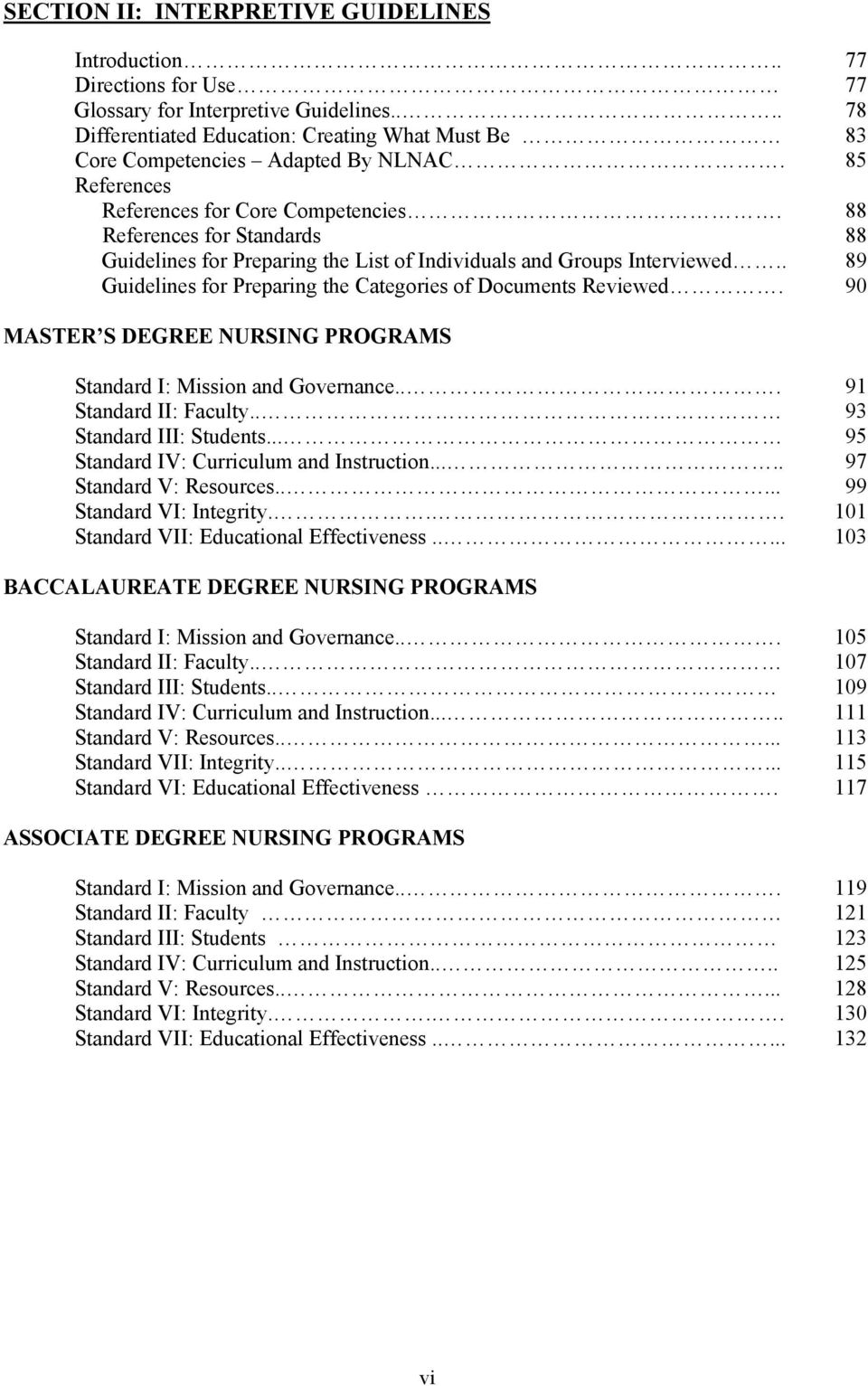
7 SECTION II: INTERPRETIVE GUIDELINES Introduction.. 77 Directions for Use 77 Glossary for Interpretive Guidelines Differentiated Education: Creating What Must Be 83 Core Competencies Adapted By NLNAC. 85 References References for Core Competencies. 88 References for Standards 88 Guidelines for Preparing the List of Individuals and Groups Interviewed.. 89 Guidelines for Preparing the Categories of Documents Reviewed. 90 MASTER S DEGREE NURSING PROGRAMS Standard I: Mission and Governance Standard II: Faculty.. 93 Standard III: Students Standard IV: Curriculum and Instruction Standard V: Resources Standard VI: Integrity Standard VII: Educational Effectiveness BACCALAUREATE DEGREE NURSING PROGRAMS Standard I: Mission and Governance Standard II: Faculty Standard III: Students Standard IV: Curriculum and Instruction Standard V: Resources Standard VII: Integrity Standard VI: Educational Effectiveness. 117 ASSOCIATE DEGREE NURSING PROGRAMS Standard I: Mission and Governance Standard II: Faculty 121 Standard III: Students 123 Standard IV: Curriculum and Instruction Standard V: Resources Standard VI: Integrity Standard VII: Educational Effectiveness vi
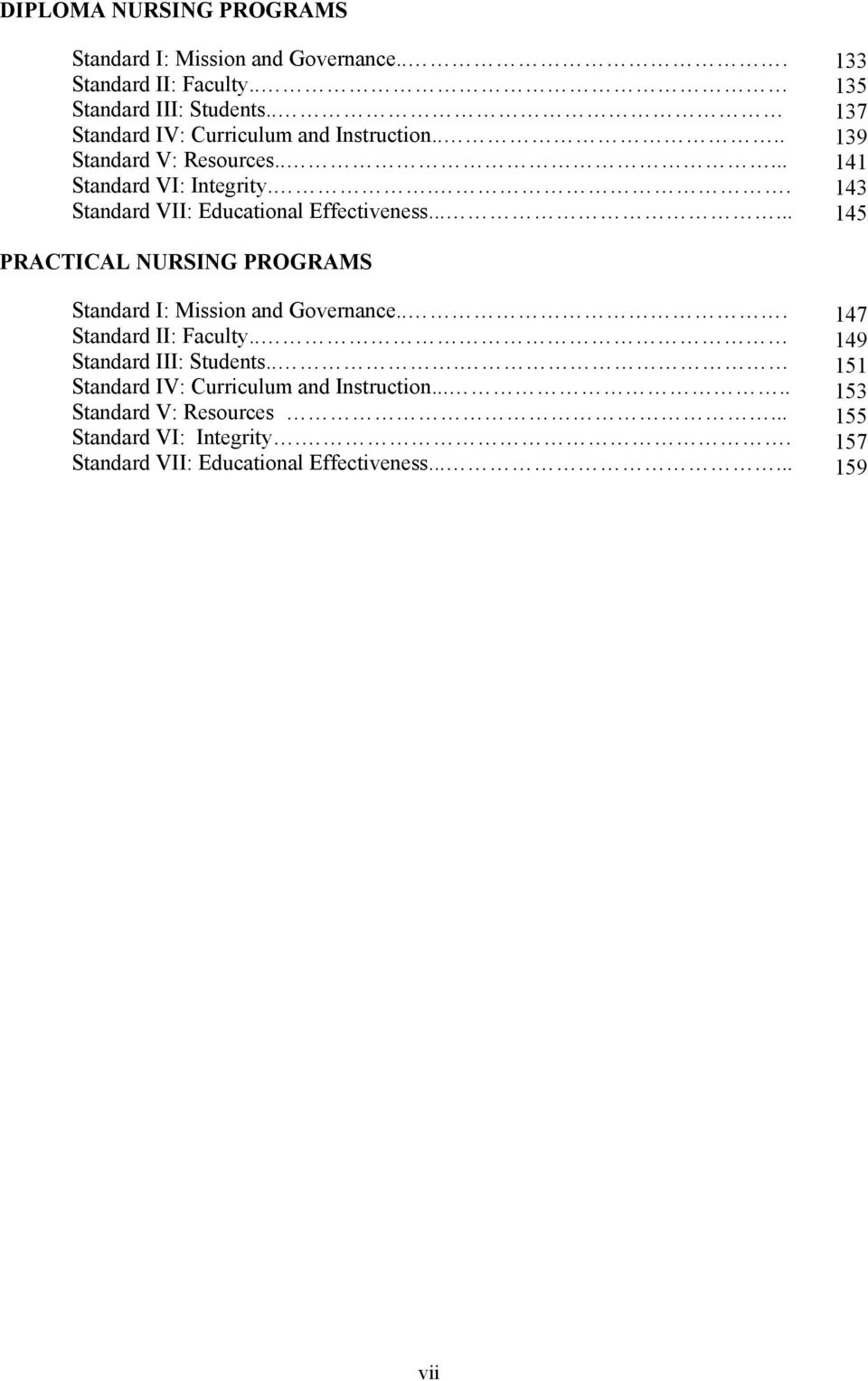
8 DIPLOMA NURSING PROGRAMS Standard I: Mission and Governance... Standard II: Faculty.. Standard III: Students.. Standard IV: Curriculum and Instruction.... Standard V: Resources..... Standard VI: Integrity... Standard VII: Educational Effectiveness PRACTICAL NURSING PROGRAMS Standard I: Mission and Governance... Standard II: Faculty.. Standard III: Students... Standard IV: Curriculum and Instruction..... Standard V: Resources... Standard VI: Integrity.. Standard VII: Educational Effectiveness vii
9

10 I. INTRODUCTION MISSION The National League for Nursing Accrediting Commission (NLNAC) supports the interests of nursing education, nursing practice, and the public by the functions of accreditation. Accreditation is a voluntary, self-regulatory process by which non-governmental associations recognize educational institutions or programs that have been found to meet or exceed standards and criteria for educational quality. Accreditation also assists in the further improvement of the institutions or programs as related to resources invested, processes followed, and results achieved. The monitoring of certificate, diploma, and degree offerings is tied closely to state examination and licensing rules, and to the oversight of preparation for work in the profession. PURPOSE To provide specialized accreditation for programs of nursing education, both post-secondary and higher-degree, which offer either a certificate, a diploma, or a recognized professional degree (Master s, Baccalaureate, Associate, Diploma, and Practical Nursing). GOALS Promulgate a common core of standards and criteria for the accreditation of nursing programs. Strengthen educational quality through assistance to associated nursing education units, by evaluation processes, functions, publications, and research. Advocate self-regulation in nursing education. Promote peer review. Foster educational equity, access, opportunity, mobility, and preparation for employment based upon type of nursing education. Serve as gatekeeper to Title IV-HEA programs for which NLNAC is the accrediting agency. These include some practical nursing and all hospital diploma programs eligible to participate in programs administered by the U.S. Department of Education (USDOE) or other federal agencies. NLNAC Accreditation Manual 2004 Edition Section I I: Introduction p.1

11 RECOGNITION The National League for Nursing Accrediting Commission is recognized as the accrediting body for all types of nursing education by: U.S. Department of Education (USDOE) U.S. Uniformed Nursing Services (USUNS) Veterans Health Administration, Department of Veteran Affairs (VHA) National Council of State Boards of Nursing (NCSBN) State Boards of Nurse Examiners (SBNE) Council for Higher Education Accreditation (CHEA) Association of Specialized and Professional Accreditors (ASPA) Pan American Health Organization (PAHO) U.S. Department of Health and Human Services, Bureau of Health Professions, Division of Nursing (USHHS) Employers National, regional and specialized accreditors that provide oversight in regard to federal funding eligibility must be reviewed by the U.S. Department of Education to ensure that the accrediting body meets specific standards established by Congress. The U.S. Secretary of Education is charged with review of accrediting bodies and providing recognition to those accrediting agencies that meet the Secretary s criteria. Students in institutions or programs accredited by a USDOE recognized agency are eligible for federal financial aid assistance and other needed resources. NLNAC also meets the recognition standards of The Council for Higher Education Accreditation (CHEA). CHEA, a non-governmental organization, recognizes regional, specialized, and professional accrediting bodies to ensure quality, accountability, and improvement in higher education. p.2 Section I-I: Introduction NLNAC Accreditation Manual 2004 Edition

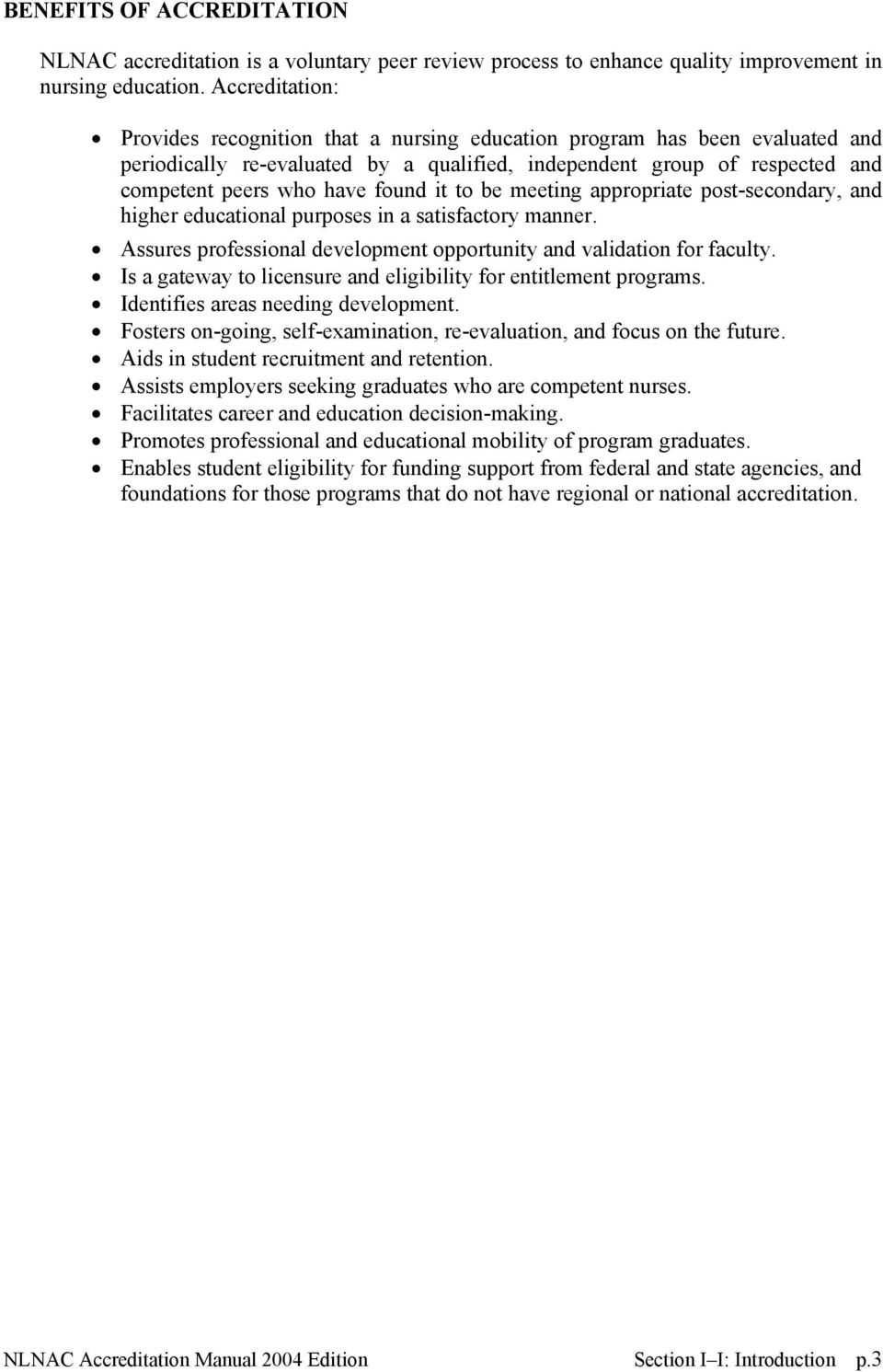
12 BENEFITS OF ACCREDITATION NLNAC accreditation is a voluntary peer review process to enhance quality improvement in nursing education. Accreditation: Provides recognition that a nursing education program has been evaluated and periodically re-evaluated by a qualified, independent group of respected and competent peers who have found it to be meeting appropriate post-secondary, and higher educational purposes in a satisfactory manner. Assures professional development opportunity and validation for faculty. Is a gateway to licensure and eligibility for entitlement programs. Identifies areas needing development. Fosters on-going, self-examination, re-evaluation, and focus on the future. Aids in student recruitment and retention. Assists employers seeking graduates who are competent nurses. Facilitates career and education decision-making. Promotes professional and educational mobility of program graduates. Enables student eligibility for funding support from federal and state agencies, and foundations for those programs that do not have regional or national accreditation. NLNAC Accreditation Manual 2004 Edition Section I I: Introduction p.3
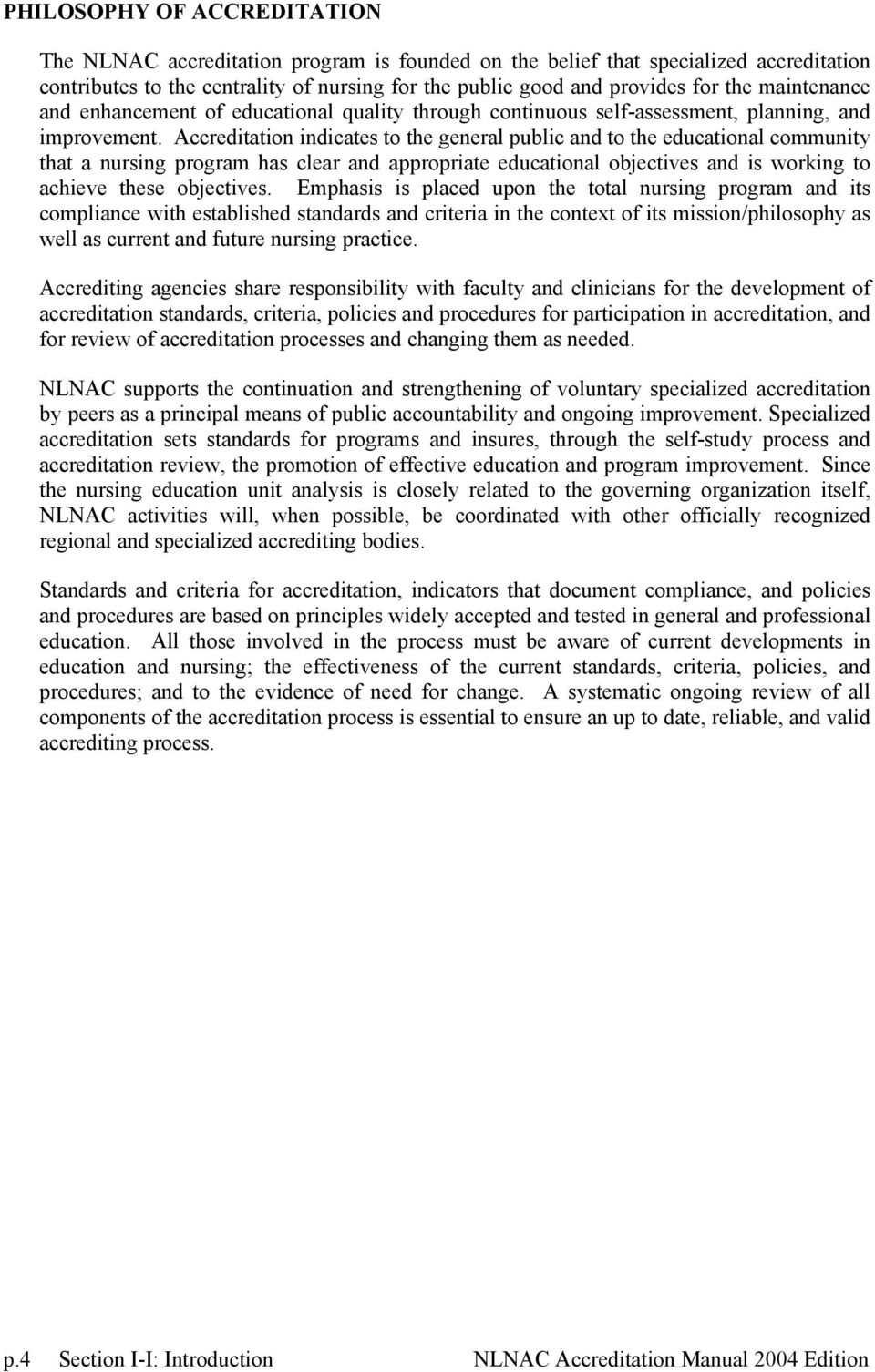
13 PHILOSOPHY OF ACCREDITATION The NLNAC accreditation program is founded on the belief that specialized accreditation contributes to the centrality of nursing for the public good and provides for the maintenance and enhancement of educational quality through continuous self-assessment, planning, and improvement. Accreditation indicates to the general public and to the educational community that a nursing program has clear and appropriate educational objectives and is working to achieve these objectives. Emphasis is placed upon the total nursing program and its compliance with established standards and criteria in the context of its mission/philosophy as well as current and future nursing practice. Accrediting agencies share responsibility with faculty and clinicians for the development of accreditation standards, criteria, policies and procedures for participation in accreditation, and for review of accreditation processes and changing them as needed. NLNAC supports the continuation and strengthening of voluntary specialized accreditation by peers as a principal means of public accountability and ongoing improvement. Specialized accreditation sets standards for programs and insures, through the self-study process and accreditation review, the promotion of effective education and program improvement. Since the nursing education unit analysis is closely related to the governing organization itself, NLNAC activities will, when possible, be coordinated with other officially recognized regional and specialized accrediting bodies. Standards and criteria for accreditation, indicators that document compliance, and policies and procedures are based on principles widely accepted and tested in general and professional education. All those involved in the process must be aware of current developments in education and nursing; the effectiveness of the current standards, criteria, policies, and procedures; and to the evidence of need for change. A systematic ongoing review of all components of the accreditation process is essential to ensure an up to date, reliable, and valid accrediting process. p.4 Section I-I: Introduction NLNAC Accreditation Manual 2004 Edition
14 HISTORY OF NURSING ACCREDITATION 1893 The American Society of Superintendents of Training Schools for Nurses, forerunner of the National League for Nursing, was founded for the purpose of establishing and maintaining a universal standard of training for nurses National League of Nursing Education published Standard of Curriculum for Schools of Nursing Accrediting activities in nursing education were begun by many different organizations National League of Nursing Education published A Curriculum Guide for Schools of Nursing, the last of its type by the organization National League of Nursing Education initiated accreditation for programs of nursing education for registered nursing The formation of National Nursing Accrediting Service unifying accreditation activities in nursing. It was discontinued in 1952 when accreditation activities were consolidated under the National League for Nursing The U.S. Department of Education recognized the National League for Nursing and included it on the initial list of recognized accrediting agencies. NLN (later NLNAC), has been continually recognized by the U.S. Department of Education since this date The NLN Board of Directors established a policy charging each educational council with the responsibility for developing its own accreditation program. The program was conducted through the NLN three membership units: the Council of Baccalaureate and Higher Degree Programs; the Council of Diploma and Associate Degree Programs; (the Diploma and Associate Degree Programs separated into two councils in 1965), and the Council of Practical Nursing Programs (1966). The accreditation program and services were administered by NLN professional staff Federal funding for nursing education under the Nurse Training Act was contingent upon the compliance of schools of nursing with Title VI of the Civil Rights Act of Council on Post-secondary Accreditation (COPA) recognized the NLN Accreditation Program Outcome criteria were incorporated into Standards and Criteria for all accredited programs NLN Board of Governors approved the recommendation of the NLN Accreditation Committee to institute core standards and criteria NLN Board of Governors approved establishment of an independent entity within the organization to be known as the National League for Nursing Accrediting Commission (NLNAC). NLNAC Accreditation Manual 2004 Edition Section I I: Introduction p.5

15 HISTORY OF NURSING ACCREDITATION (continued) 1997 January, the NLNAC began operations with sole authority and accountability for carrying out the responsibilities inherent in the accreditation processes. Fifteen Commissioners were appointed: nine nurse educators, three nursing service executives, and three public members. The Commissioners assumed responsibilities for the management, financial decisions, policy making, and general administration of the NLNAC. The peer review process was strengthened with the formation of program specific Evaluation Review Panels NLNAC continued collaborative work with specialty organizations to strengthen application of standards for advanced practice nursing programs. Advanced practice nurses were invited to serve as clinicians in the site visit teams January, the U.S. Department of Education Secretary renewed NLNAC recognition as a nationally recognized accrediting agency for nursing education January, NLNAC received continuing recognition by the Council for Higher Education Accreditation (CHEA) NLNAC was incorporated as a subsidiary of the National League for Nursing U.S. Department of Education renewed NLNAC recognition as a nationally recognized accrediting agency for nursing education. p.6 Section I-I: Introduction NLNAC Accreditation Manual 2004 Edition

16 PRODUCTS AND SERVICES Initial accreditation and continuing accreditation of approximately 200 nursing programs per year Continuous monitoring of approximately 1500 programs per year NLNAC Accreditation Manual with Interpretive Guidelines by Program Type for Post Secondary and Higher Degree Programs in Nursing NLNAC Interpretive Guidelines for standards and Criteria by program type o Master s Degree Programs in Nursing o Baccalaureate Degree Programs in Nursing o Associate Degree Programs in Nursing o Diploma Programs in Nursing o Practical Nursing Programs NLNAC Directory of Accredited Nursing Programs Forums o Self-Study o Program Evaluator Consultation/Mentoring Annual Report and Analysis NLNAC website; NLNAC Accreditation Manual 2004 Edition Section I I: Introduction p.7

17 PERSONS RESPONSIBLE FOR ACCREDITATION Board of Commissioners Volunteer Program Evaluators Site Visitors (Nurse Educators and Clinicians) Evaluation Review Panelists Appeal Panelists Professional Staff Title Name Phone Ext. Executive Director Barbara R. Grumet, JD 451 Deputy Director Carol Gilbert, PhD, RN 407 Deputy Director Ngozi O. Nkongho, PhD, RN 465 Administrative Staff Title Name Phone Ext. Director of Finance & Ricki DeSantis 362 Operations Administrator for Joe Luiz Ortiz 493 Accounting & Information Systems Support Staff Title Name Phone Ext. Special Assistant Anthony Bugay 261 Special Assistant Alex Mariquit 247 Special Assistant Jocelyn Pineda 319 Administrative Assistant Dolores Caggiano 253 Administrative Assistant Yvonne Lopez 409 Administrative Assistant Michael Philips 114 p.8 Section I-I: Introduction NLNAC Accreditation Manual 2004 Edition

18 II. THE COMMISSION OVERALL STRUCTURE OF THE COMMISSION NLNAC is governed by fifteen Commissioners who are elected by the members of NLN at the NLN annual meeting. The legal basis for the foundation and structure of the Commission is outlined in the Bylaws and the Articles of Incorporation. NLNAC is incorporated under the laws of the state of New York. BOARD OF COMMISSIONERS Nine (9) Commissioners are nurse educators representing NLNAC accredited programs, three (3) Commissioners represent the public, and three (3) Commissioners represent nursing service. Commissioners are diversified and assure balanced representation from across identified constituencies insofar as possible. No Governor, officer, or employee of the National League for Nursing or employee of NLNAC may serve as a Commissioner. The Board of Commissioners set accreditation policy, makes accreditation decisions and makes administrative, budget and policy decisions. Commissioners serve as chairperson of the program specific evaluation review panels. Decision of accreditation status is made by the Commissioners, based on review of program materials, site visitors and recommendation of the Evaluation Review Panel. NLNAC Accreditation Manual 2004 Edition Section I-II: Commission p.9

19 MEMBERS OF THE BOARD OF COMMISSIONERS NURSE EDUCATORS: Term Janice R. Ellis, PhD, RN Director and Professor Associate Degree Nursing Program Shoreline Community College Seattle, Washington Janice R. Ingle, DSN, RN (Retired) Dean of Health Sciences Southern Union State Community College Opelika, Alabama Frances D. Monahan, PhD, RN Professor Department of Nursing SUNY Rockland Community College Suffern, New York Term Annette Hallman, PhD, RN, C Director Covenant School of Nursing Lubbock, Texas Grace Newsome, EdD, APRN, RN, BC, FNP Professor of Nursing North Georgia College & State University Dahlonega, Georgia Marilyn K. Smidt, MSN, RN Director of Nursing Programs Grand Rapids Community College Grand Rapids, Michigan Term Patricia R. Forni, PhD, RN, FAAN Professor College of Nursing University of Oklahoma Health Sciences Center Oklahoma City, Oklahoma Phyllis Turner, PhD, RN Senior Researcher School of Nursing East Carolina University Greenville, North Carolina Ann B. Schlumberger, EdD, RN Chairperson and Professor Department of Nursing University of Arkansas at Little Rock Little Rock, Arkansas NURSING EXECUTIVES: Term T. Charlene Robertson, MSN, RN Chief Nurse Executive (Retired) Memorial Healthcare System Chattanooga, Tennessee Term Lois A. Manning, MSN, MS, PHN, RN Director of Public Health Nursing Ventura County Public Health Department Oxnard, California Term Patricia R. Messmer, PhD, RN, BC, FAAN Nurse Researcher Miami Children s Hospital Miami, Florida PUBLIC MEMBERS: Term Raymond S. Andrews, Jr., JD Trustee Donaghue Medical Research Foundation West Hartford, Connecticut Term Robert Sintich, EdD Provost Dean of Academic and Student Services Warren County Community College Washington, NJ Term Robert E. Parilla, PhD Senior Consultant Academic Search Consultation Service President Emeritus Montgomery College Gaithersburg, Maryland p.10 Section I-II: Commission NLNAC Accreditation Manual 2004 Edition

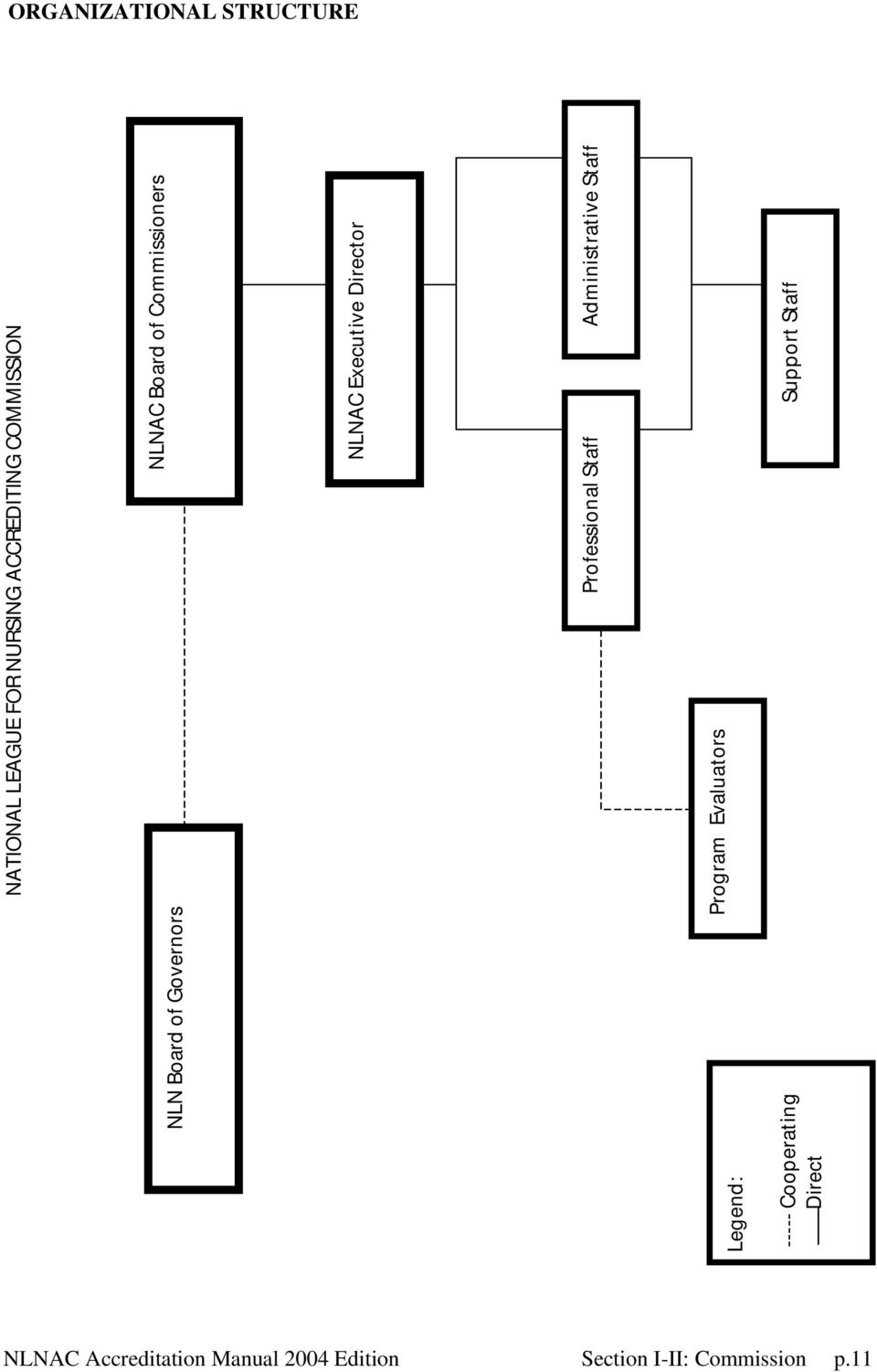
20 ORGANIZATIONAL STRUCTURE NATIONAL LEAGUE FOR NURSING ACCREDITING COMMISSION NLN Board of Governors NLNAC Board of Commissioners NLNAC Executive Director Professional Staff Administrative Staff Legend: Program Evaluators Cooperating Direct Support Staff NLNAC Accreditation Manual 2004 Edition Section I-II: Commission p.11
21 III. ACCREDITATION STANDARDS AND CRITERIA FOR ACADEMIC QUALITY OF POST SECONDARY AND HIGHER DEGREE PROGRAMS IN NURSING A. NLNAC Definition of Quality The core values of accreditation emphasize learning, community, responsibility, integrity, value, quality, and continuous improvement through reflection and analysis. They require that the nursing program measures itself by exacting standards, honors high aspiration and achievement, and expects all persons associated with the program to recognize its responsibility to provide a supportive and humane environment in which people interact with each other in a spirit of cooperation, openness, and mutual respect. Accreditation standards are agreed upon rules to measure quantity, extent, value, and quality. Criteria are statements which identify the variables that need to be examined in evaluation of a standard. NLNAC criteria are presented to peer reviewers as statements that represent an accurate description of an accredited program. Peer review is a long established and effective component of program evaluation in education settings. In education, peer review is used too help determine which programs to accredit. Peer reviewers know the current thinking in the various program types, the curriculum rules and conventions, and are trained to identify program compliance with standards and criteria. Program specific expertise is preserved at the point of criteria documentation, program evaluation conducted by peers from like programs at the time of the site visit, during evaluation review panel deliberations, and upon appeal. Quality in education ensures high levels of opportunity for student learning and student achievement. Accreditation is an affirmation of certain values central to thinking about postsecondary and higher education appropriate mission, organization structures, processes, functions, and resources aligned with core values and each other, collegiality, and continuous self-improvement. NLNAC accredits all types of nursing education programs in a variety of post-secondary and higher education settings, including vocational technical agencies, community college, hospitals, proprietary schools, professional schools, seminaries, colleges and universities, and other institutions which offer diplomas, certificates, and/or academic degrees. p.12 Section I-III: Standards & Criteria NLNAC Accreditation Manual 2004 Edition
22 B. NLNAC Accreditation Standards: I. Mission/Governance There are clear and publicly stated missions and/or philosophy and purposes appropriate to post-secondary or higher education in nursing. VII. Educational Effectiveness There is an identified plan for systematic evaluation including assessment of student academic achievement. II. Faculty There are qualified and credentialed faculty, appropriate to accomplish the nursing education unit purposes and strengthen its educational effectiveness. VI. Integrity Integrity is evident in the practices and relationships of the nursing education unit. III. Students The teaching and learning environment is conducive to student academic achievement. V. Resources Resources are sufficient to accomplish the nursing education unit purposes. IV. Curriculum and Instruction The curriculum is designed to accomplish its educational and related purposes. C. Understanding standards and criteria in the evaluation of nursing education units. The singular function of nursing is the improvement of the human condition. Each certificate, diploma, or degree has an identifiable, discrete set of specific outcomes. Post-secondary and higher education provide for the development of the learner s ability to think for oneself, to master analytical problem solving, to apply scientific knowledge, and to make value judgments within the context of the specific program type. Thus, education requires a broad academic orientation, and depth and breadth of intellectual skills translated into competencies so as to fulfill nursing s function in all types of nursing from practical nursing through advanced practice nursing at the master s level. Standards: agreed upon rules for the measurement of quantity, extent, value, and quality. Criteria: statements which identify the variables that need to be examined in evaluation of a standard NLNAC Accreditation Manual 2004 Edition Section I-III: Standards & Criteria p.13
23 D. Standards and Criteria STANDARDS I. Mission & Governance There are clear and publicly stated mission and/or philosophy and purposes appropriate to post-secondary or higher education in nursing. CRITERIA 1. Mission and/or philosophy of the nursing education unit is congruent with that of the governing organization, or differences are justified by the nursing education unit purposes. 2. Faculty, administrators, and students participate in governance as defined by the governing organization and the nursing education unit. 3. Nursing education unit is administered by a nurse who is academically and experimentally qualified, and who has authority and responsibility for development and administration of the nursing education unit. 4. Policies of the nursing education unit are consistent with those of the governing organization, or differences are justified by nursing education purposes. II. Faculty There are qualified and credentialed faculty, appropriate to accomplish the nursing education unit purposes and strengthen its educational effectiveness. 5. Faculty members (full and part-time) are academically and experientially qualified, and maintain expertise in their areas of responsibility. 6. Number and utilization of full- and part-time faculty meet the needs of the nursing education unit to fulfill its purposes. 7. Faculty performance is periodically evaluated to assure ongoing development and competence. 8. The collective talents of the faculty reflect scholarship through teaching, application, and the integration and discovery of knowledge as defined by the institution and the nursing education unit. III. Students The teaching and learning environment is conducive to student academic achievement. 9. Student policies of the nursing education unit are congruent with those of the governing organization, publicly accessible, non-discriminatory, and consistently applied; differences are justified by the nursing education unit purposes. 10. Students have access to support services administered by qualified individuals that include, but are not limited to: health, counseling, academic advisement, career placement, and financial aid. 11. Policies concerned with educational and financial records are established and followed. p.14 Section I-III: Standards & Criteria NLNAC Accreditation Manual 2004 Edition
24 STANDARDS IV. Curriculum & Instruction The curriculum is designed to accomplish its educational and related purposes. V. Resources Resources are sufficient to accomplish the nursing education unit purposes. CRITERIA 12. Curriculum developed by nursing faculty flows from the nursing education unit philosophy/mission through an organizing framework into a logical progression of course outcomes and learning activities to achieve desired program objectives/outcomes. 13. Program design provides opportunity for students to achieve program objectives and acquire knowledge, skills, values, and competencies necessary for nursing practice. 14. Practice learning environments are selected and monitored by faculty and provide opportunities for a variety of learning options appropriate for contemporary nursing. 15. Fiscal resources are sufficient to support the nursing education unit purposes commensurate with the resources of the governing organization. 16. Program support services are sufficient for the operation of the nursing education unit. 17. Learning resources are comprehensive, current, developed with nursing faculty input, and accessible to faculty and students. 18. Physical facilities are appropriate to support the purposes of the nursing education unit. VI. Integrity Integrity is evident in the practices and relationships of the nursing education unit. 19. Information about the program intended to inform the general public, prospective students, current students, employers and other interested parties, is current, accurate, clear, and consistent. 20. Complaints about the program are addressed and records are maintained and available for review. 21. Compliance with Higher Education Reauthorization Act Title IV eligibility and certification requirements is maintained. VII. Educational Effectiveness There is an identified plan for systematic evaluation including assessment of student academic achievement. 22. There is a written plan for systematic program evaluation that is used for continuous program improvement. 23. Student academic achievement by program type is evaluated by: graduation rates, licensure/certification pass rates, job placement rates, and program satisfaction. NLNAC Accreditation Manual 2004 Edition Section I-III: Standards & Criteria p.15
25 PLANNING FOR SYSTEMATIC PROGRAM EVALUATION (SPE) Principles Systematic program evaluation involves the process of determining whether the various parts and the entire program are in fact, achieving its mission, goals, objectives, and outcomes. Multiple indicators are used to determine program effectiveness in the preparation of competent nurses. A central concern of accreditation is that the evaluation and assessment processes be directed toward achievement of program goals and result in program improvement on an ongoing basis. Programs develop overall evaluation plans unique to their own needs and interests as a means of coordinating outcomes with goals and objectives. They must select methods of assessment to generate data relevant to their individual outcomes and establish levels of achievement, and is the results of the evaluation findings for improving program quality. Program goals and objectives should be evaluated in terms of: o educational appropriateness o relevance to constituent needs o expectations of practitioners in the field o relation to the program mission o relevance to the expectations of and responsibilities to the publics that nursing aims to serve NLNAC does not mandate specific evaluation techniques, procedures or use of specific instruments for outcomes assessment by programs. NLNAC encourages programs to select assessment methods that are based upon the evaluation question being addressed within the context of their own evaluation. Program evaluation in this framework facilitates program revision and improvement, supports decisions regarding curriculum change, enhancement of approaches to teaching, changing clinical teaching sites, and finding new role models. It also allows the faculty and staff to address student perceptions about inconsistencies among what the faculty teach, what students see in actual practice, and what work place requirements exist. Furthermore, it encourages program selfexamination as well as auditing of what occurs. p.16 Section I-III: Standards & Criteria NLNAC Accreditation Manual 2004 Edition
26 Elements for Systematic Program Evaluation Including Assessment of Student Academic Achievement AREA ACTIVITY The Plan: Component Levels of Achievement Frequency Assessment Methods Identify specific components with Standards and Criteria Define expected levels of achievement for each component Establish time frames for assessment of all plan components Select and/or develop procedures, and/or instruments/tools to measure each component Implementation of the Plan: Results of Data Collection & Analysis Data collected as prescribed Data analyzed and aggregated Data trended Verification that evaluation findings are used in decision making for program development, revision, and maintenance NLNAC Accreditation Manual 2004 Edition Section I-III: Standards & Criteria p.17
27 IV. ACCREDITATION PROCESSES AND PROCEDURES PLANNING FOR ACCREDITATION Nursing education units considering accreditation should contact NLNAC to be assigned a member of the professional staff as their mentor. The mentor service is provided to facilitate faculty self review and planning. The faculty and administrative officers of the program decide when the program is ready for initial evaluation. The decision should be based on an in-depth self-study of the program in relation to the NLNAC standards and criteria. When the NLNAC Commission grants accreditation to a program, all students who graduated during or after the semester the site visit was performed will be recognized as graduates of an accredited nursing program. Initial Accreditation A governing organization that offers a program not previously accredited by the Commission initiates the process through its chief executive officer. The chief executive officer of the governing organization for the nursing education unit must authorize the NLNAC to conduct the accreditation process by submitting the official authorization form sent from the Commission. Preferably, this communication should be made at least a year in advance of the time when the faculty believes that eligibility conditions will have been met and the program will be ready for an accreditation evaluation. A nursing program may withdraw its application for initial accreditation and discontinue the process at any time up to six weeks prior to the date of the site visit. Once the site visit occurs, the nursing program is not eligible to withdraw from the process. Continuing Accreditation Planning for continued accreditation is an ongoing process. A program must be visited and reevaluated at specified intervals to ensure continuing compliance with the accreditation standards and criteria. The NLNAC staff notifies the program of a pending visit approximately one year in advance. Dates for the site visits are scheduled in consultation with the nurse administrator as the program must be in full operation during the visit. Once the site visit occurs, the nursing program is not eligible to withdraw from the process. Official authorization to conduct the NLNAC accreditation process is secured from the chief executive officer of the governing organization and the nurse administrator for the nursing education unit. The program will receive an authorization from the NLNAC approximately one year before the visit is to take place. If the nurse administrator of an NLNAC accredited program chooses to cancel the accreditation process, notification of cancellation must be submitted in writing to the Commission, which will p.18 Section I-IV: Processes & Procedures NLNAC Accreditation Manual 2004 Edition
28 then take formal action and remove the program from the official list of the NLNAC accredited programs. If a program is notified about its need to comply with a Commission action and does not respond, the program will be removed from the official list of NLNAC accredited programs by the Commission at its next scheduled meeting. Accreditation of Programs within Multi-Campus Institutions When a governing organization has multiple campuses and is accredited as one institution, the nursing education units may choose to seek NLNAC accreditation either as one unit, or as separate units. If the nursing education units choose to separate accreditation, all nursing education units offering the same program type must stand for accreditation. The decision should be based on the following consideration: The governing organization s legal regional accrediting body policy on accrediting institutions with multiple campuses. If the regional accrediting body allows each campus of a multi-campus institution to have its own administrative structure and offer its own curriculum, the nursing education units may seek accreditation as separate entities. The governing organization s governance and administrative structure. If the governing organization offers separate curricula on each campus, and has separate faculty and administrative structures to provide these curricula, the nursing education units may seek accreditation as separate units offering the same program type. If the nursing education units are run as a single unit, with one administrative structure, facility, and curriculum, the nursing education units should seek accreditation as a single program offered at multiple sites. The State Board of Nursing policy on governing organizations with multiple campuses. If the State Board of Nursing permits governing organizations with multiple campuses to offer separate nursing programs on each campus, all nursing education units may seek separate accreditations. If a governing organization with multiple campuses decides to seek separate NLNAC accreditation for each campus, each nursing education unit pays full annual accreditation fees and site visit fees, as a separate entity. Each nursing education unit then stands for accreditation individually and submits its own self-study and has a separate visit, review process by the evaluation panel and action by the Commission. NLNAC Accreditation Manual 2004 Edition Section I-IV: Processes and Procedures p.19
29 EVALUATION PROCESS The NLNAC accreditation process includes the following steps: Staff consultation Program preparation of the Self-Study Report (periodic report on ongoing evaluation) Team site visit for program evaluation by program-specific site visitors Team Report (Site Visitor Report) Staff review Evaluation Review Panel with program-specific expertise Staff review and referral to the Commission Commission accreditation decision Appeal panel (when appropriate) The NLNAC process for the evaluation of nursing education programs is a comprehensive fourstep process, with the self-study as the first step. The second step is the site visit. In the third step, a peer evaluation review panel examines the reports written by and about the program. The final step is a review of the process and the decision on accreditation status by the NLNAC Board of Commissioners. Each site visit is conducted by a team of nursing educators with program specific expertise and a clinician (2-3 site visitors). Each evaluation review panel is composed of program evaluators (educators) representing specific program types, different geographic locations, and diverse institutional types and sizes. The evaluation review panel meets twice a year, except the diploma panel, which meets once a year. The panels make recommendations for initial and continuing accreditation status to the Commission. The Commission reviews the accreditation process, accepts staff reports, makes decisions about recommendations on applications for initial and continuing accreditation, and provides programmatic advice. STAFF CONSULTATION NLNAC professional staff is available to assist a program preparing for an accreditation visit in whatever way best meets the needs of the nursing faculty. Programs applying for initial accreditation will be assigned an NLNAC professional staff member as a mentor to assist the program in it s preparation for accreditation at the time the program contacts NLNAC of its intent to apply for initial accreditation. Applicants for initial accreditation are expected to attend a self-study forum. Dates and locations are posted on the NLNAC website ( p.20 Section I-IV: Processes & Procedures NLNAC Accreditation Manual 2004 Edition
30 SELF-STUDY Programs applying for accreditation must conduct a self-study to determine to what extent the program meets the accreditation standards and criteria. This systematic approach to data collection provides a basis for: Identifying the strengths of the program; Diagnosing difficulties in the program; Making decisions about needed improvements and program growth through continuous scrutiny, examination, re-examination, and redefinition. The process of self-study represents the combined effort of governing organization administrators, nursing education unit administrators, faculty, staff, students, and other individuals concerned with the nursing program. All those concerned with the program should participate in the self-study process. Broad participation leads to an understanding of the total program. The self-study process includes the following activities based on the nursing education unit s program evaluation plan: A thorough exploration of the mission and/or philosophy, purposes and services of the program An assessment of the validity of the mission and/or philosophy and purposes of the program in relation to current trends and needs in nursing education and practice An evaluation of the extent to which the nursing program is achieving its mission and/or philosophy and purposes based on an analysis of all its activities A careful consideration of various ways and means by which the mission and/or philosophy and purposes may be more fully attained. Conclusions derived from the ongoing data accumulation and review have two benefits: A basis for continuing development and improvement of the program and its services A basis for evidence of how both the program s stated mission and/or philosophy and purposes, and the accreditation standards and criteria are being met These findings should be clearly set forth in the self-study report to be submitted to the Commission. Self-Study Report The self-study report is the primary document used by the site visit team, the evaluation review panels, and the Board of Commissioners to understand the nursing program. The report must be based upon the NLNAC accreditation standards and criteria in effect at the time of the review. (Accreditation standards and criteria become effective on the Commission approval date. Programs scheduled for review within twelve months of revision of the standards and criteria may elect to use the current or the former version of the standards and criteria). NLNAC Accreditation Manual 2004 Edition Section I-IV: Processes and Procedures p.21
31 Faculty and administrators are responsible for presenting evidence that clearly indicate how the standards and criteria are being met. Members of the site visit team will use the self-study report in preparation for their visit to the program. Guidelines for Writing the Self -Study The self-study report is written by the nursing education unit using the most recent edition of the NLNAC Accreditation Manual with Interpretative Guidelines by Program Type for Post Secondary and Higher Degree Programs in Nursing. The self-study document must include program history, context, and self-evaluation related to the standards and criteria, and program plans for future development and improvement. Program-specific presentation of the standards and criteria and glossary can be found in the Interpretative Guidelines section of this document. There are four sections to the self-study report: Section One: Executive Summary Section Two: Standards and Criteria: Mission & Governances, Faculty, Students, Curriculum & Instruction, Resources, Integrity Section Three: Standards and Criteria: Educational Effectiveness Section Four: Appendix Section One: Executive Summary The Executive Summary is a brief presentation of the nursing education unit, how it fits within the governing organization, and the extent to which it is in compliance with the NLNAC Standards and Criteria. In addition to offering basic demographic information about the nursing education unit and the governing organization, it puts the nursing program into focus within its institution and its community. It offers key evidence demonstrating how the program is in compliance with each of the Standards for accreditation. Finally, it presents an analysis of the nursing education unit s strengths and areas needing improvement. Content a) General Information: Program type(s) being reviewed, purpose(s) of the visit, date of the visit; name and address of governing organization; name, credentials, and title of chief executive officer of governing organization; name of governing organization accrediting body and accreditation status (date of last review and action); name and address of nursing education unit; name, credentials, and title of nurse administrator of the nursing education unit; telephone, fax number, and address of nurse administrator; name of State Board of Nursing and approval status (date of last review and action); NLNAC standards and criteria used to prepare the self-study report. b) Introduction: Place the nursing program in context by describing how it fits within the nursing education unit (if more than one program is offered) and how the nursing education unit fits within the governing organization and community, student population (number of full- and part-time students, by program type) and faculty cohort (number of full- and part-time, by program type). p.22 Section I-IV: Processes & Procedures NLNAC Accreditation Manual 2004 Edition
32 c) History of the Nursing Education Unit: Year nursing program(s) was/were established; length of program(s) in credits and time; history of the nursing education unit; NLNAC accreditation history (include date of initial accreditation); differentiated education; number of campuses or satellite sites offering the nursing program(s) and distance education offerings (if appropriate); other nursing accreditation (e.g. Council on Certification of Nurse Anesthetists, Nurse Midwifery). d) Summary of Standards and Criteria: An overview reflecting the major findings that demonstrate program compliance with each standard. e) Analysis and Summary of Strengths and Areas Needing Improvement: Conclusions with a listing of strengths, areas needing improvement and future plans. Section Two: Standards I-VI and Criteria 1-21 Section two provides the opportunity for the nursing education unit to demonstrate the extent to which it is in compliance with the Standards: Mission and Governance, Faculty, Students, Curriculum and Instruction, Resources, and Integrity. The self-study report is expected to address each standard and its relevant criteria using all of the items listed in the Documentation confirms subsection for each criterion. The use of the Documentation confirms items assures that the program has fully addressed all aspects of each criterion. The Interpretative Guidelines section provides the Documentation confirms subsection for each criterion within each standard. The narrative presentation should be clear and succinct. Tables, graphs, and/or presentations of sections of the nursing education unit s evaluation plan may also be used as a means to simplify and organize information to demonstrate trends and changes over time. Suggestions of material/indicators and Tables that may facilitate the presentation of each standard are also offered in the Interpretative Guidelines section of the Manual. Nursing education units submitting one self-study report for a multiple program visit are expected to address each program type offered, beginning with the most basic program and progressing to the most advanced program, demonstrating the extent to which each is meeting each criterion. Faculty are expected to clearly differentiate between the educational programs offered. Section Three: Standard VII and Criteria Educational Effectiveness This section is a presentation of the nursing education unit s plan for systematic evaluation of the unit and the results of the ongoing assessment. In addition to the presentation of the plan, the narrative should address how findings related to all the standards have been used for program maintenance, revision and development. When addressing criterion 23, the discussion should include all four achievement measures. Section Four: Appendix The appendix is for supplemental materials that support information discussed within the body of self-study report. NLNAC Accreditation Manual 2004 Edition Section I-IV: Processes and Procedures p.23
33 Submitting the Self-Study Report The administrator of the nursing education unit sends one (1) paper copy and one (1) electronic copy of the self-study report, and one (1) copy of the current catalog (paper or electronic) to each member of the site visit team. These reports must be received by the team six weeks prior to the scheduled date of the site visit. Six (6) paper and (six) electronic copies of the self-study report and six (6) copies (paper or electronic) of the current catalog, and one copy of the Executive Summary (first section of the self-study) in a separate folder are to be sent to the National League for Nursing Accrediting Commission, 61 Broadway, 33 rd Floor, New York, NY If the nursing education unit is having a multiple program visit, six (6) copies of the items listed above should be sent for each program being reviewed. The materials must be received in New York six weeks prior to the scheduled date of the site visit. The self-study reports and catalogs become the property of NLNAC. Formatting the Self-Study Report Page Length: The Self-Study Report is expected to be no more than 200 pages for a single program or 300 pages for a multiple program report, inclusive of the appendix, but excluding the written plan for systemic program evaluation. The report is to be typed back to back on standard letter white paper (8 ½ x 11 inches). Margins: A margin of at least 1 inch on the top, bottom and right hand side of the page; 1 ½ inches on the left hand side of the page to allow for binding is usual. Typeface: The type is expected to be dark, clear, and readable with a font size of 11 or 12. Spacing and Pagination: The text should be double-spaced. The pages should be numbered consecutively, inclusive of the whole presentation (text, appendices, etc.). THE SITE VISIT The purpose of the accreditation visit is to evaluate the nursing education unit by clarifying, verifying, and amplifying program materials as presented in the self-study report. Based on these data, site visitors will make a recommendation relative to the accreditation status of the program(s). The visit is an essential part of the accreditation process. It gives the school an opportunity to demonstrate and highlight information in the self-study report, as well as provide for interaction among all concerned: administrators, faculty, students, staff, and site visitors. In addition, it allows site visitors an opportunity to see first-hand what is being presented. The site visitors verify congruency between the self-study report and the actual practices of the program so that the Evaluation Review Panel Members and Commissioners have a clear and complete understanding of the program. p.24 Section I-IV: Processes & Procedures NLNAC Accreditation Manual 2004 Edition
34 Multiple Nursing Programs within an Institution NLNAC encourages nursing education units offering more than one type of program (e.g. master s, baccalaureate and associate degree programs) to request that all programs be reviewed for accreditation at the same time. The nursing education unit will prepare one self-study. NLNAC professional staff will work with the nurse administrator to establish one visiting team whose recommendations for each program s accreditation status will be reviewed by the appropriate peer evaluation review panel. Collaborative Visit with Another Accrediting Agency At times, another specialized or regional accrediting agency requests the opportunity to have an accreditation visit in collaboration with NLNAC. NLNAC encourages such a practice and will work with the nurse administrator to facilitate the collaborative visit so that one self-study and one visiting team composed of representatives from each agency can be established. Recent examples of such collaboration have included site visits with the Council on Certification of Nurse Anesthetists (CRNA) and Nurse Midwifery (CNM). Each agency will write its own evaluation report of the visit, and will assess compliance with appropriate accreditation standards and criteria independently. Coordinated Visit with Other Agencies The NLNAC welcomes the opportunity to cooperate with recognized accrediting or approval agencies in accreditation activities. The decision to request a coordinated visit rests with the governing organization or the nursing education unit. At the request of the nursing administrator, the NLNAC visit will be coordinated with the other agency whenever feasible. However, since the policies of accrediting/approval bodies differ with regard to the intervals between revisits, it is not always possible for NLNAC to schedule its visit to a nursing education unit in conjunction with another agency. The representative from another agency is not a member of the NLNAC site visit team. The NLNAC team and the other representative may participate jointly in such activities as conferences with faculty, students, and other groups. Many of the activities of the NLNAC team and of the representative will necessarily be carried out separately, since the purposes of NLNAC accreditation may differ from those of other accrediting/approval bodies. The final analysis and conclusions of the NLNAC team is done exclusively by the team as is the NLNAC Exit Meeting. Length of Visit Accreditation visits are usually scheduled for three days. The length depends on several factors: size and complexity of the nursing education unit; geographical locations of the various resources used for student learning experiences; combination of nursing program types into one visit; and coordination of the visit with other agencies. Correspondences from NLNAC will indicate the inclusive dates of the visit. NLNAC Accreditation Manual 2004 Edition Section I-IV: Processes and Procedures p.25
35 Assignment of Site Visit Team The NLNAC staff will select a team and notify the nurse administrator in advance of the visit. The nurse administrator is invited to contact NLNAC staff if a possible conflict of interest is identified among team members. If a team member becomes ineligible or unable to serve, another site visitor with comparable qualifications will be appointed. NLNAC staff will assign site visitors using the guidelines listed below. The team member will: Have experience with the type of program to be visited. Come from a state other than the one in which the site visit will take place. Have experience with programs and governing organizations of similar size, Carnegie Classification, and setting (urban, suburban, and rural). In addition, Graduate programs offering advance practice nursing options will have at least one team member with current advanced practice certification. The evaluation team is made up of two or more members, depending upon the complexity of the setting and/or the diversity of educational programs to be visited. One member is designated chairperson of the team. Appointment of Team Chairperson A Site visitor is eligible to be a team chairperson for an accreditation visit once she/he has served in the role of team member a minimum of three times. The first time a Site visitor assumes the role of team chairperson, an experienced chairperson who also serves as a team member will mentor the evaluator. Responsibilities of the Team Chairperson The team chairperson assumes the following responsibilities: Acts as official spokesperson for the team Coordinates the planning with the team members Conducts the team orientation session and subsequent team meetings and conferences Receives the electronic file from the nurse administrator listing: o information on the all individuals and groups interviewed by the team and o all documents made available in the display room. Allocates responsibilities for various activities to insure optimum utilization of team members and adequate coverage of all areas during the visit, including interviews and conferences with key personnel on and off campus Requests additional information as necessary Notifies the nurse administrator of the arrival of the team and plans the time for the first meeting Conducts periodic conferences with the nurse administrator Arranges for the exit meeting with the nurse administrator and any persons the nurse administrator invites to be present Collates and edits the Site Visitor Report to assure completeness and clarity Sends the completed Site Visitor Report, electronically and hardcopy to NLNAC within one week following the site visit p.26 Section I-IV: Processes & Procedures NLNAC Accreditation Manual 2004 Edition
36 Is available for telephone contact by the Evaluation Review Panel at the time of the program s review. (In the event that the team chair is not available at the time of review, a member of the site visit team will be contacted). Assumes the additional responsibilities stated under Responsibilities of the team member Responsibilities of the Team Members The team member assumes the following responsibilities: When the NLNAC accreditation information packet is received: Reviews contents of the packet including: Accreditation Manual with Interpretative Guidelines by Program Type for Post Secondary and Higher Degree Programs in Nursing Site visitor memo When the materials from the school are received: Reviews the Self-Study Report prior to arriving at the school; Notes areas which need clarification or amplification; Develops a plan for verification; Upon arrival at the site: Assumes responsibility to collect data cooperatively and make observations; Contributes to the content and participate in the writing of the Site Visitor Report; Participates in the Exit meeting with the nurse administrator and any persons invited to be present. After the visit: Retains a copy of the Self-Study Report, Catalog, and Site Visitors Report and any other resource materials used/developed during the site visit until the Commission s decision is finalized Reviews materials in preparation for possible contact by the Evaluation Review Panel if made the team contact person or in the absence of the team chair. Nursing Education Unit Responsibilities Provide the team chair with an electronic file that list the names, credentials, and titles of individuals and group members interviewed by the site visitors (see Guidelines for preparing the list of individuals and groups interviewed, classes attended, clinical agencies and facilities visited; pp.89). Provide the team chair with an electronic file listing all documents available in the display room by defined category (see Guidelines for preparing the categories of documents reviewed pp.90). Provide computers and printer(s) for the team to use throughout the visit Establish a room in which materials for the site visitors are assembled, and the team can read and work during the period of the visit. Obtain any necessary written permissions required prior to the visit: e.g., review of records and visits to clinical agencies. NLNAC Accreditation Manual 2004 Edition Section I-IV: Processes and Procedures p.27
37 Materials must be assembled and organized by standard and include: o Annual reports to the chief administrator of the governing organization and to the Boards of Nursing o Budgets o Class and clinical schedules for the week of the visit o Complete course outlines, including samples of examinations and evaluation forms o Faculty handbook o Faculty vitae o Minutes of faculty and committee meetings for the past two to three years o Latest accrediting agency report and approval letter for the governing organization o Results of standardized tests, National Council Licensing Examination, and/or certification examinations o Most recent State Board report(s) to the program and approval letter o Samples of student and faculty projects o Student handbook o Clinical agency contracts o Other materials the faculty deems essential to the site visitors understanding of the nursing education unit and its program(s). These materials will be used during the visit and will be left with the nursing education unit upon the completion of the visit. Site visitors will ask to review records of faculty, students, and recent graduates. The student records include both academic and financial aid. These records will be reviewed in the offices where they are filed. Agenda for the Visit A tentative agenda for the visit is prepared by the nursing education unit and sent to the site visit team chairperson, along with a copy of the class and clinical laboratory schedules and the technology assessment form at least six weeks prior to the scheduled visit. Upon arrival at the site, the team meets to discuss the conduct of the visit. On the first day, site visitors meet with the nurse administrator to review the plans for the visit. Site visitors need to set time aside each day of the visit for reading essential materials and preparing and writing the Site Visitors Report. Activities usually planned to take place during the visit include: Preliminary, interim, and closing meetings with the nurse administrator (and assistants) Meeting with faculty Meetings with administrative officers of the institution Meeting with nursing students Meeting with the public for third party comments; review of written third party comments Meeting with nursing service personnel as appropriate Visits to appropriate facilities and resources Visits to selected clinical agencies to observe and meet with students Review of curricular and other materials prepared by the faculty Review of appropriate records of faculty, students, and recent graduates Request for additional data to clarify and amplify the self-study Classroom and clinical observation p.28 Section I-IV: Processes & Procedures NLNAC Accreditation Manual 2004 Edition
38 Visiting Off-Site Campus(es) Programs with off-site campuses must discuss with the site visit team chairperson, prior to the visit, alternative methods for the visiting team to evaluate those campuses, as it is not required that all campuses be visited by the team (e.g., off-site faculty can visit the main campus, or participate in the faculty meeting via a conference call, or campus facilities can be viewed through a slide show or video presentations). Sample Agenda for Accreditation Visit Day One Welcome meeting with nurse administrator, associates/assistants, and available faculty Conference with nurse administrator 1 Conference with the Chief Executive Officer of the governing organization (30 minutes 2 ) Conference with other administrative persons of the institution, i.e., Academic Dean, Finance officer (30-60 minutes/person) Conference with support personnel i.e., : counseling, admissions officer, financial aid officer (30-60 minutes/person) (may be arranged as a group) Conference with Librarian; Tour of Library/Learning Resource center (60 minutes) Meet with students (60 minutes) Tour educational facilities Read materials in "display room" Day Two Tour of clinical agencies 3 Day Three Exit Meeting 4 Conference with Nursing Service Representatives i.e., nurse administrators, nurse managers, graduates Meet with Nursing Faculty (2-3 hours) Observe classroom activities Conference with General Education Faculty (if appropriate) Review student faculty records Meet with members of the Public Read materials in "display room" 1. The team chairperson will arrange to meet with the nurse administrator at the beginning and end of each day and periodically throughout the day. 2. Time frames are only provided as a guide. 3. Clinical units for selected visitation should have students present and prepared to meet with site visitors. It may be helpful for site visitors to have had the conference with the total faculty prior to visiting the clinical agencies. 4. Accreditation visit activities may overflow into the third day. NLNAC Accreditation Manual 2004 Edition Section I-IV: Processes and Procedures p.29
39 Visit Arrangements Housing Area Responsibility Nursing Education Unit Site Visitor Nurse administrator will make Individual site visitors will pay for hotel reservations for the site the hotel accommodations and be visitors and notify each team reimbursed by NLNAC member. Each visitor is to have a separate hotel room in close proximity to each other. Availability of restaurant facilities is essential. Travel Food Fees The program is responsible for arrangements for transportation to and from the airport/hotel if inadequate transportation or great distance makes this necessary or desirable. Any intra-visit travel expenses and arrangements are the responsibility of the program. NLNAC will bill the program according to the prevailing fee schedule prior to the accreditation visit. Payment is expected prior to the visit or the accreditation visit will be cancelled. All persons traveling on NLNAC business are expected to use common carriers (tourist class or equivalent rates). Reservations whether by air, bus or train are to be reserved and purchased through the NLNAC designated travel representative at least six weeks in advance of the site visit. Airline availabilities, transportation arrangements from airports, bus or train stations, is the responsibility of the site visitor. A written request to use a personal automobile is required in advance of the visit. The site visitor will receive authorization. Reimbursement is based on current NLNAC policy. Food during the visit is the responsibility of each reviewer and will be reimbursed by NLNAC after the visit based on current NLNAC policy. p.30 Section I-IV: Processes & Procedures NLNAC Accreditation Manual 2004 Edition
40 THE SITE VISITORS REPORT The team chairperson is responsible for presenting a complete and well organized report. Team members will provide the chairperson with comments, ideas, and draft responses prior to leaving the site visit. The information will be related to areas that the team member evaluated during the site visit. The Report Site visitors prepare a Site Visitors Report which includes verification of data documentary statements, and additional descriptive material essential to a clear and concise picture of all aspects of the program. It includes the site visitors statements of the findings for each of the accreditation standards and criteria. The report also includes the team s recommendation(s) for the accreditation status of the program(s) reviewed. The Site Visitors Report is based on the findings of the site visitors. The report is intended to verify, clarify, and amplify the self-study report of the nursing education unit. Site visitors review all materials on site and include comments about the materials under the appropriate standard within the Site Visitors Report. Team chairpersons are asked not to attach documents since the information will be commented on within the body of the report. If the team chairperson believes that it is absolutely necessary to include a document to clarify an aspect of the program, it will become part of the Site Visitors Report. The Site Visitors Report is prepared in typed narrative format and includes the following Sections: General Information Background data including: program type; purpose of visit; date of visit; name, city, and state of governing organization; program name; credentials, and title of chief executive officer; name of governing organization accrediting body and date of last review and action; name, city and state of nursing education unit; name, credentials, and title of nurse administrator; telephone and fax number and address of nurse administrator; current State Board of Nursing approval status (date of last review and action); current NLNAC accreditation status (date of last review and action). Site Visit Information Name, credentials, title, affiliation and address of the site visitors NLNAC criteria used Program(s) demographics Third Party Comment Statement A brief explanation of how the accreditation visit was conducted: e.g., people interviewed, categories of documents reviewed, coordinated visit. NLNAC Accreditation Manual 2004 Edition Section I-IV: Processes and Procedures p.31
41 Evaluation of Standards and Criteria Site visitors will assess the extent to which the nursing education unit is in compliance with the standards and criteria. Each criterion is addressed by the team to insure that all the Documentation confirms are addressed and sufficiently support the nursing education unit's assessment that the criterion has been met. The site visitors are not expected to repeat all the information provided within the self-study report, catalogs, and other materials. Their task is to clarify, amplify, and verify information. At times, the team will need to provide extended discussion and documentation to support their conclusions in other situations. They will refer to the self-study and briefly summarize their findings. Comments addressing specific strengths and areas needing development are included for each standard. The site visitors will conclude the report with a recommendation for accreditation status (See Policy #4). Staff Review The site visit team chairperson submits the Site Visitors Report to NLNAC headquarters for review by the professional staff within one week following the site visit. If any questions are raised, the team chairperson is contacted for clarification. A draft copy of the report is mailed to the nurse administrator of the nursing education unit for review and correction of "errors of fact" within eight weeks after the conclusion of the site visit. The completed Response Form must be received by NLNAC within two weeks after the nursing education unit receives the draft report. Substantive comments are shared with the team chairperson who then decides whether the report is to be changed. The corrected, final report will become part of the permanent materials relating to the accreditation visit, as will the Response Form submitted by the nurse administrator. The final report will be sent to the nurse administrator, with copies for the chief executive officer of the governing organization, and the site visitors prior to the Evaluation Review Panel meeting where the program is reviewed. EVALUATION REVIEW PANEL There are four standard peer Evaluation Review Panels (ERP) appointed by the Commission (Master s and Baccalaureate degree, Associate degree, Diploma, and Practical Nursing). The role of the ERP is to assure that the process of peer evaluation is carried out according to the accreditation standards and criteria. They review the findings of the visit team as presented in the Site Visitors Report and make a recommendation for accreditation status to the Commission. The role of the Evaluation Review Panel is to validate the work of the site visitors and extend it by noting points of agreement and raising any questions where disagreement or a lack of clarity exists. In the latter case, site visitors are available by telephone during panel deliberations and may enter into discussion with the panel to assure an accurate understanding of the Site Visitors Report. The aim is to promote a seamless review which has integrity and which does justice to p.32 Section I-IV: Processes & Procedures NLNAC Accreditation Manual 2004 Edition
42 the program under review. The role of the professional staff is to facilitate the work of both review groups. Panelists do not do a de novo review of the program(s). Rather, they determine the adequacy of the evidence to support each standard and criterion. The purpose is to see that the standards and criteria are applied consistently across all programs reviewed by the panel. Finally, they make a recommendation to the Commission on the accreditation status of each Program. Assignments of the Evaluation Review Panel Members To facilitate panel discussion, two or three panel members present each program reviewed: Presenter One The first presenter studies the Self-Study Report, the Site Visitor Report, the School Catalog and the program response to the Site Visitor Report, and presents an evaluation based on the information found in these documents. Presenter Two Presenter Three The second presenter focuses on the Site Visitor Report while reviewing the self-study report and the school catalogs. An evaluation is presented based upon the analysis. The third presenter analyzes the materials and presents a short evaluation using the Site Visitor Report as the primary document. Presenters are concerned with the evidence that affirms that the Site Visitor Report accurately reflects the status of the program in meeting the standards and criteria. The narrative reports discuss compliance with the standards, program strengths and areas needing development. Conduct of the Meeting NLNAC Commissioners serve as chairpersons for the Evaluation Review Panel meetings. A program's review commences with the presentation of presenter one, followed by presenter two, adding additional information not already covered. The third presenter offers additional material where appropriate. All evaluation review panel members are responsible for reviewing program materials and discussing information presented on each program. The findings of the panel deliberations for each program are presented in the Evaluation Review Panel summary that is forwarded to the Board of Commissioners. The goal of the entire peer evaluation is to render an honest and fair recommendation to the Commission regarding the accreditation status of the program. The full Commission makes the final accreditation decision at its next regularly scheduled meeting. The Commission decision that is sent to the nurse administrator includes the Evaluation Review Panel Summary. NLNAC Accreditation Manual 2004 Edition Section I-IV: Processes and Procedures p.33
43 Nursing Program Representative Attendance at the Evaluation Review Panel Meeting The nurse administrator and whomever she/he invites may attend the Evaluation Review Panel deliberation about the program in person and/or telephone conference. The attendees are observers during the presentation of the program, panel deliberations, and vote, and will not be asked to respond to questions or to clarify information. No documents relative to developments occurring after the site visit may be used during this deliberation. At the conclusion of the panel deliberations, the nurse administrator is invited to address the panel. Evaluation Review Panel Procedures Panel Composition Voting Conflict of Interest 8-25 Peer Members Majority of members present A panel member does not participate when she/he: was site visitor for the program under review is resident in the same state served as a consultant or is otherwise associated with the program or institution Presentation (approximately 30 minutes/program or minutes/multiple program) Presenter One: Introduction and presentation Presenter Two: Add information not stated by first presenter Presenter Three: Add information only if something has not been stated Information is presented by standard with each criterion addressed. Panelist role is to verify information presented in the Site Visitor Report; to determine if the process has been carried out appropriately; and to affirm that the site visitors have covered all aspects. Panelists will identify program compliance with the standards, strengths (i.e., exemplary practices which serve to commend the program) and program areas needing development. Discussion The full panel considers the findings. Site visitors will be contacted by telephone if a question raised by a panel member needs further clarification. A motion and second are made to recommend the accreditation status of the program to the NLNAC Board of Commissioners. Motion is open for discussion by the members of the panel. The question is called and followed by a vote on the motion. Program Representative(s) are invited to address the panel after the deliberations are concluded. p.34 Section I-IV: Processes & Procedures NLNAC Accreditation Manual 2004 Edition
44 COMMISSION The Commission has the sole authority to determine the accreditation status or withhold accreditation from applicant programs. The Commission, composed of experts in education, nursing education, administration, nursing service, and public members bases its decisions on the complete and consistent application of the accreditation standards and criteria within and across program types. In all cases, the applicant will be given the rationale for any decision. In cases where accreditation is denied, the applicant has the opportunity to present their case in a full and impartial hearing before an Independent Appeal Panel. Timeline for Evaluation Process PROCESS COMPONENT TIMELINE Planning for Accreditation Initial: One year in advance, official authorization from the chief executive to initiate the accreditation process is received by NLNAC. A mentor is assigned to assist programs applying for initial accreditation or programs on warning. Continuing: One year in advance, NLNAC staff notifies the nursing education unit of a pending visit. Official authorization from the chief executive officer is received by NLNAC. Self-Study Report The administrator of the nursing education unit sends one (1) paper or electronic copy of the self-study report and one (1) paper or electronic copy of the current catalog to each of the site visitors in the team. These reports must be received six weeks prior to the scheduled date of the site visit. Six (6) paper and electronic copies of the self-study report, six (6) paper or electronic copies of the current catalog, and one copy of the Executive Summary (first section of the self-study) in a separate folder are to be sent to the NLNAC office. If the nursing education unit is having a multiple program visit, six (6) copies of the items listed above should be sent for each program being reviewed. The materials must be received in New York six weeks prior to the scheduled date of the site visit. The self-study reports and catalogs become the property of NLNAC. Site Visit Fall Cycle: September October/November Spring Cycle: January March Team Report Team Chairperson: One week following the visit, the Site Visitor Report is due at NLNAC. NLNAC Professional Staff: Within eight weeks after the site visit, a draft copy of the report is mailed to the nurse administrator to review for errors of fact. Nurse Administrator: Two weeks from receipt of draft report, the corrected Report Response Form must be received by NLNAC. NLNAC: Prior to the Evaluation Review Panel meeting, a copy of the Final Site Visitors Report is mailed to the nurse administrator, chief executive officer, and site visit team members. Evaluation Review Panel Spring Panel Meeting: June Fall Panel Meeting: January/February Commission Decision Spring Cycle: July Fall Cycle: February Nursing education unit will receive Commission decision and Evaluation Review Panel Summary within 30 days of the Board of Commissioners meeting. NLNAC Accreditation Manual 2004 Edition Section I-IV: Processes and Procedures p.35
45 PROGRAM EVALUATORS Program evaluators are: site visitors, evaluation review panel members, and appeal panel members. They make recommendations to the Board of Commissioners. Program evaluators are knowledgeable about the current thinking within the various program types, appropriate curricula, rules, conventions and current trends in healthcare, nursing education and/or nursing practice. Eligibility For Selection as Program Evaluator In order to be eligible to be selected as an NLNAC Program Evaluator, the individual must satisfy the following requirements: 1) Academic Credentials: Master s Degree Programs: earned doctoral degree from a regionally accredited College/University and Master s degree with a major in nursing Baccalaureate Degree Programs: earned doctoral degree and Master s degree with a major in nursing Associate Degree Programs: Master s degree with a major in nursing Diploma Programs: Master s degree with a major in nursing Practical Nursing Programs: Master s degree with a major in nursing Nurse Clinician: Master s degree with a major in nursing 2) Experience: Nurse Educator Full time faculty appointment or administrator in an NLNAC accredited program* Nurse Clinician Clinical appointment in nursing services 3) Knowledge of: Post secondary and/or Higher education Curriculum and instruction Current issues in nursing education and practice Philosophy and processes of specialized accreditation 4) Expertise in: Communication Group dynamics Computer Literacy Management Professional expertise 5) Contributions in: Scholarship/Research Practice Community service Institutional service Professional service *Note: 1. Program Evaluators must be from NLNAC accredited nursing programs. 2. Current program evaluators who have accepted a part time faculty or administrative position or who have retired, may continue to serve as program evaluators for up to three (3) years. p.36 Section I-IV: Processes & Procedures NLNAC Accreditation Manual 2004 Edition
46 Site Visitor Selection All site visitors are current faculty and/or administrators of NLNAC accredited programs, or nurse clinicians and are selected through mechanisms and criteria established by the Commission. Individuals identified by staff, nominated by a colleague, or self nominated, must submit letter of interest, current resume, and a letter of recommendation. After NLNAC staff review, individuals will be invited to become a site visitor and attend a site visitor training forum. Appointment Site visitors are eligible to serve for an indefinite period of time based on the following criteria: Receive positive site visit performance evaluations; Remain current with the accreditation process by attendance at site visitor training forums and participation in site visits on a regular basis; Eligibility A site visitor who retires may continue to serve as a site visitor up to three additional years if she/he remains current in nursing education and the accreditation process by attendance at site visitor training forums, and participation in site visits on a regular basis. A site visitor who is no longer affiliated with a nursing education program or nursing service will be ineligible to continue as a site visitor. A site visitor who holds a position in a nursing program not accredited by the National League for Nursing Accrediting Commission will be ineligible to continue as a site visitor. Evaluation Site visitors are evaluated by the members of the site visit team and the nursing education unit following each site visit. Preparation In order to assure consistency in the application of the accreditation standards and criteria, site visitors are expected to attend one Program Evaluator Forum (conducted on an annual basis) every four years. Briefing Sessions are conducted by telephone conference call for all site visitors prior to their assigned site visit each accreditation cycle. Honorarium An honorarium will be provided to the site visitor. Evaluation Review Panel Member Selection Evaluation review panel members and alternate panel members are program specific and are appointed by the NLNAC Board of Commissioners. The NLNAC professional staff reviews candidates based on information from current evaluation review panel members, site visitors, Commissioners and accredited programs and recommends their names to the Commission. Evaluation review panel members and alternate panel members must be current site visitors of NLNAC Accreditation Manual 2004 Edition Section I-IV: Processes and Procedures p.37
47 NLNAC accredited programs. Approximately one-third of the evaluation review panel member terms expire in any one year. Appointment Evaluation review panel members serve for a three-year term and may be appointed to a second consecutive term. Alternate evaluation review panel members may serve indefinitely. Panel vacancies are filled by program specific evaluators, selected from the list of alternate panel members to complete the unexpired term. An evaluation review panel member who retires may serve out the existing term, but will not be eligible for reappointment. Preparation Evaluation review panel members are expected to attend site visitors forums. Prior to each Evaluation Review Panel meeting a Briefing Session is held to orient new panel members and update the continuing panel members. Appeal Panel Member Selection Appeal panel members have knowledge and experience with the peer review process. The nurse educator members are currently active in nursing education. Evaluation review panel members and Commissioners cannot serve as an appeal panel member. Appointment The Panel consists of individuals drawn from a NLNAC Commission approved list of the individuals qualified to serve as appeal panel members. p.38 Section I-IV: Processes & Procedures NLNAC Accreditation Manual 2004 Edition
48 V. GENERAL POLICIES POLICY #1: CONFLICT OF INTEREST Services as staff member, consultant, site visitor, evaluation review panel members, commission member, or appeal panel member, create situations which can cause conflicts of interest, prompt ethical questions, or raise issues regarding the objectivity and credibility of the accreditation process. The National League for Nursing Accrediting Commission has adopted the following rules to avoid such occurrences. Ethical Imperatives Site visitors, evaluation review panel members, commissioners, staff and appeal panel members will not participate in any decision-making capacity for a nursing education unit if they have: a close, active personal association with a program being considered for official action by the National League for Nursing Accrediting Commission. been on the faculty or staff, have been a student, or served as a consultant on accreditation matters. jointly authored research or literature, or have participated in a common consortium or have special research involvement with current program faculty. served in evaluation roles regarding the same institution, including membership on state visit teams, regional accreditation teams, or evaluation committees for boards of trustees or regents. been paid as consultants, served as a commencement speaker, received an honorary degree, or otherwise profited or appeared to profit from service to the program. maintained close personal or professional relationships with individuals. a relative, or where they have former graduate advisees or advisors. Ethical Guidelines Responsibilities of Program Seeking Accreditation It is the responsibility of each program to facilitate a thorough and objective appraisal of its education unit. Programs are allowed to veto site visitor team members if it can be demonstrated in writing that a potential conflict of interest exists. Any perceived inadequacies of the National League for Nursing Accrediting Commission procedures or processes should be reported by the program to the Executive Director at the time of the occurrence, rather than withheld until after action has been taken. NLNAC Accreditation Manual 2004 Edition Section I-V: General Policies p.39
49 Responsibilities of Site Visitors, Commissioners and Staff Any Commissioner or Evaluation Review Panel member who was a member or a chairperson of a site team of a program under consideration, or is from the same state, must absent her/himself from the Evaluation Review Panel or Commission discussion about the program. When the program of an evaluation review panel member is being considered for accreditation or appeal, the individual may not serve on the Evaluation Review Panel, or Appeal Panel during that accreditation cycle. When a program of a Commissioner is being considered for accreditation or appeal, the Commissioner will absent her/himself from the portion of the Commission meeting agenda concerned with the evaluation of that program(s). Commissioners and program evaluators will be reminded of the confidentiality of all information pertaining to the review of applications and the need to avoid any actions that might give the appearance of a conflict of interest, or could reasonable be perceived as affecting reviewer or commissioners objectivity. At each level of review, reviewers and staff are required to not accept membership on a team or to absent themselves from the room during the review of any application if their presence would constitute or appear to constitute a conflict of interest. To avoid the appearance of a conflict of interest, serving as a site visitor for a competing specialized accrediting agency shall preclude serving as site visitor or commissioner for NLNAC. A site visitor or Evaluation Review Panel member who has served in a similar capacity for a competing specialized accrediting agency may be eligible to serve as an NLNAC site visitor or Evaluation Review Panel member after a period of two years has elapsed since the last review activity for the competing organization. Actions to be avoided by the Program Evaluators and Commissioners Advertising of one s status as a program evaluator, evaluation review panelist, commissioner, or appeal panel member for the purpose of building a consulting clientele. Soliciting of consultation arrangements with programs preparing for accreditation review. Engaging in consultation to the extent that it results in conflict of interest, including serving as a consultant to a program one has recently visited as a member of an accreditation site visit team. Implying definitive answers on the National League for Nursing Accrediting Commission policies and procedures. p.40 Section I-V: General Policies NLNAC Accreditation Manual 2004 Edition
50 Confidentiality and Communications All elements of the National League for Nursing Accrediting Commission accreditation process, including the content of questions and answers, discussions, interpretations, and analyses, are to be treated in the most private and professional manner. Both ethical and legal considerations demand that information acquired through the accreditation process not be used for purposes other than accreditation matters, unless permission is obtained from the program. Documents, reports, and other materials prepared by the program for National League for Nursing Accrediting Commission action should be treated as private documents in the absence of specific policies which make clear the degree and extent of their exposure. NLNAC will release documents in response to a valid court order. All materials pertinent to the applications under review are privileged communications prepared for use by evaluators, commissioners, and NLNAC staff, and may not be shown or discussed elsewhere. Under no circumstances may a reviewer or staff member or Commissioner advice deans, program directors, faculty, or anyone else of the Commission s decision or discuss the review proceedings. Except prior to and during the site visit or evaluation review panel meeting there shall not be direct communication between reviewers and applicant institutions. Any need for additional information from institutions must be directed to the NLNAC Executive Director or appropriate Deputy Director, who will handle all such communications. Disclosure Memorandum CONFLICT OF INTEREST AND CONFIDENTIALITY STATEMENT (To be signed prior to each assignment or at each meeting; signed by staff annually) TO: Site Visit Team Member, Evaluation Review Panel Member, Commissioner, Appeal Panel Member, and NLNAC Staff DATE: (Each NLNAC activity) I have received and read the statement on Conflict of Interest. I understand that the aim is to avoid any actions, which may give the appearance that a conflict of interest exists. Thus, I will leave the room in cases where I believe I may have a conflict. Since it is sometimes difficult to decide these matters, I will ask questions should a suspected conflict arise. In addition, I understand that: (1) material furnished for review purposes and discussion during a site visit or review meeting in considered privileged information.; (2) I will not vote on any program status in which I am in conflict* ; (3) I will not go on a site visit to a program in which I am in conflict**; and (4) I absent myself, and do not participate in the discussion of, visit to, or vote on, any program in which I or, to my knowledge, my spouse, relative, or close professional associate has an interest as an employee, consultant, officer, or in any other collaboration. *not applicable to site visit team members **not applicable to evaluation review panelists NLNAC Accreditation Manual 2004 Edition Section I-V: General Policies p.41
51 POLICY #2: REPRESENTATION ON EVALUATION REVIEW PANELS AND THE COMMISSION The evaluation, policy, and decision making bodies of NLNAC are composed of educators, administrators, clinicians/practitioners, and members of the public. Clinician/Practitioner Representation Practitioners in nursing are defined by state boards of nursing as all licensed nurses who work for pay. This also includes the registered nurse who provides or oversees services to people or communities. All are responsible and accountable for organizing, planning, assigning and overseeing patient care. Master s prepared nurse clinicians, whose primary place of employment is other than nursing education, are included on site visit teams. The individual will have primary responsibility for verifying that the program prepares its students for contemporary nursing practice. Advanced Practice Nurses (APN) in the U.S. include the clinical nurse specialist, the nurse practitioner, the certified registered nurse anesthetist, and the certified nurse midwife. (NCSBN, 1992; AACN, 1996) Some nursing authorities would prefer to broaden the definition of APN to add the category of nurse administrator prepared at an advanced level, since this individual is essential for creating the environment for the practice of professional nursing. Master s prepared nurse clinicians, who may also work as advanced practice nurses, are eligible to serve as site visitors. Public Members Public members on the Board of Commissioners will have no connection to the discipline of nursing or to nursing education units. Individuals representing the public will not be: An employee, member of the governing body, owner, or shareholder of, or consultant to a program that either is accredited by or has applied for accreditation by NLNAC; Affiliated with or associated with NLNAC or NLN; A spouse, parent, child, or sibling of an individual identified in the above statements. p.42 Section I-V: General Policies NLNAC Accreditation Manual 2004 Edition
52 POLICY #3: ELIGIBILITY FOR ACCREDITATION A nursing education program is eligible for initial or continuing accreditation when the following conditions exist: The governing organization offering the program is legally authorized to grant the credential (degree, diploma, or certificate) to the program seeking accreditation. The governing organization offering the program and granting the credential is accredited by an appropriate agency. o If the program is administered by a college, university, or technical institution which is part of the system of higher education, and grants a diploma, certificate, associate, baccalaureate, or master s degree in nursing, then the governing organization must be accredited by one of the following agencies (Middle States Association, New England Association, North Central Association, Northwest Association, Southern Association, Western Association; Accrediting Bureau of Health Education Schools; Accrediting Commission of Career Schools and Colleges of Technology; Accrediting Commission of the Distance Education and Training Council; New York State Education Department for Hospital Based Nursing Programs offering the Associate degree; and Joint Commission on Accreditation of Health Care Organization). o If the program is administered by a hospital and grants a diploma, then the hospital must be approved by the Joint Commission on Accreditation of Health Care Organizations (JCAHO) or the Healthcare Facilities Accreditation Program (HFAP) of the American Osteopathic Association. o If the program is administered by a vocational school and grants a certificate, then the school must be approved by the appropriate state agency for vocational education. o If the school is independent and has state approval to grant an associate, baccalaureate, or master s degree in nursing, then the school must be accredited by one of the following agencies (Middle States Association; New England Association; North Central Association; Northwest Association; Southern Association; Western Association; Accrediting Bureau of Health Education Schools; Accrediting Commission of Career Schools and Colleges of Technology; Accrediting Commission of the Distance Education and Training Council; New York State Education Department for Hospital Based Nursing Programs offering the Associate Degree). The program must be currently approved without qualification by the state agency that has legal authority for education programs in nursing. This policy is not applicable to those programs in nursing over which the state board of nursing has no jurisdiction (i.e., selective master s degree programs or programs admitting previously licensed nurses). The program has one class of students in the final semester or quarter at the time of the site visit or has graduates of the program. When a governing organization has multiple campuses and is accredited as one institution, the nursing education units may choose to seek NLNAC accreditation as one unit, or as separate units. If accreditation is sought as separate units, all nursing education units offering the same program type must be evaluated for accreditation for any one of them to be accredited. NLNAC Accreditation Manual 2004 Edition Section I-V: General Policies p.43
53 POLICY #4: TYPES OF COMMISSION ACTIONS ON APPLICATIONS FOR ACCREDITATION A nursing program is considered for initial or continuing accreditation by the NLNAC Commissioners when it demonstrates compliance with the standards of accreditation. Initial Accreditation Granted: Initial accreditation* of a nursing program is granted when the program demonstrates compliance with all NLNAC accreditation standards. Next review is in five (5) years. *accreditation effective as of the accreditation cycle in which the visit took place. Denied: Initial accreditation of a nursing program is denied when a program does not demonstrate compliance with all NLNAC accreditation standards. The program may reinitiate the accreditation process at any time. Continuing Accreditation Granted: Continuing accreditation of a nursing program is granted when the program is in compliance with all accreditation standards. Next review in eight (8) years. Denied: Continuing accreditation with conditions is granted when the program is found to be in non-compliance with one or two accreditation standards. Next review in two (2) years Master s, Baccalaureate, Associate and Diploma Programs, and eighteen (18) months for Practical Nursing Programs. Continuing accreditation of a nursing program with warning is granted when the program is found to be in non-compliance with three or more of the accreditation standards. Continuing accreditation of a nursing program with removal of condition status is granted when the program is found to be in compliance with all accreditation standards. Next review in six (6) years for the Master s, Baccalaureate, Associate and Diploma Programs, and six and one half (6 1 / 2 ) years for Practical Nursing Programs. Continuing accreditation of a nursing program with a removal of warning status is granted when the program is found to be in compliance with all accreditation standards. Next review in eight (8) years. Continuing accreditation is withdrawn when a program with conditions or warning status is reviewed and found to be in continued non-compliance with accreditation standards. The program is removed from the list of accredited programs. It may reinitiate the application process for initial accreditation at any time. p.44 Section I-V: General Policies NLNAC Accreditation Manual 2004 Edition
54 Accreditation with Condition or Warning Status The Commission places conditions on a program s continuing accreditation when the program has been found to be in non-compliance with one or two accreditation standards. The conditions include the Commission request for a Focused Report or a Focused Report and Focused Visit within the specified period of time addressing the standard(s) with which the program has been found to be in non-compliance. The Focused Report or Focused Report and Focused Visit Report, and the Evaluation Review Panel summary will constitute the basis for Commission action to either accept the report, finding the program in compliance with all NLNAC standards or not accept the report as the program is still in non-compliance. Programs in compliance will be granted continuing accreditation. Next review in six (6) years for Master s, Baccalaureate, Associate and Diploma Programs, and six and one half (6 1 / 2 ) years for Practical Nursing Programs. The Commission places an accredited program on warning status when the program has been found to be in non-compliance with more than two accreditation standards. When a program has been placed on warning status, the Commission must request a new selfstudy report with a revisit within the specified period of time. The new self-study, site visitor s report, and evaluation review panel summary will constitute the basis for the Commission action to remove the warning status and grant continuing accreditation for eight years, or to remove the program from the list of accredited programs. The maximum conditional or warning status period for Master s, Baccalaureate, Associate Degree, and Diploma Programs is two years from the site visit. If full compliance with the accreditation standard(s) is not demonstrated within two years, accreditation will be withdrawn. The maximum conditional or warning status period for Practical Nursing Programs is Eighteen (18) months from the site visit. If full compliance with the accreditation standard(s) is not demonstrated within eighteen months, accreditation will be withdrawn. Focused Report Purpose: To provide the nursing education unit the opportunity to demonstrate paper compliance with a specific accreditation standard(s). Assignment Process: A Focused Report may be recommended to the Commission by: the site visit team, the peer evaluation review panel, or a Commissioner as part of the accreditation review when it is found that the nursing program is out of compliance with one or two of the NLNAC accreditation standards. The decision to assign a nursing education unit a Focused Report is made by the Commission after review of the recommendation(s) and other documents associated with the accreditation review process. NLNAC Accreditation Manual 2004 Edition Section I-V: General Policies p.45
55 Review Process: Focused Reports are reviewed by the peer Evaluation Review Panel to establish whether the nursing education unit has demonstrated compliance with the identified one or two NLNAC standards. The panel recommendation regarding compliance with the NLNAC standards is forwarded to the Commission for action. Based on the Focused Report and the recommendation of the peer Evaluation Review Panel, the decision regarding the accreditation status of the nursing program is made by the Commission. Decision options: Affirm program accreditation, program in compliance with all NLNAC standards. Next accreditation site visit in six years for Master s, Baccalaureate, Associate and Diploma Programs, and six and one half (6 1 / 2 ) years for Practical Nursing Programs. Remove the nursing program from the list of accredited programs; program not in compliance with NLNAC standard(s) Report Protocol: 1. Organization: The report is to be presented in two sections, Introduction and Presentation of the identified NLNAC standard(s) 2. Content Introduction o Name and address of governing organization o Name, credentials, and title of the chief executive officer of governing organization o Name of institutional accrediting body, date of last review and action taken o Name and address of educational unit in nursing education unit o Name, credentials, title, telephone number, fax number, and address of the administrator of the nursing education unit o Name of State of Board of Nursing, date of last review and action taken o Date of most recent NLNAC accreditation visit and action taken o Year the nursing program was established o Total number of full- and part-time faculty teaching in the specified nursing program a completed Faculty Profile form (see Interpretive Guidelines by Program Type: Faculty Standard) o Total number of full & part-time students currently enrolled in the specified nursing program o Length of program in semester or quarter credits, hours, or weeks Presentation of the identified NLNAC standard(s) o State the identified NLNAC standard o State the evidence of non-compliance (see Site Visitors Report, summary of the identified standard) o Offer a narrative addressing the current NLNAC interpretive guidelines for the standard, with emphasis on the areas of non-compliance. o Include all the criteria for the standard, and the Documentation confirms sections for each of the criteria p.46 Section I-V: General Policies NLNAC Accreditation Manual 2004 Edition
56 o If the Curriculum and Instruction standard is to be presented, include brief syllabi for all nursing courses rather than full syllabi. Each course syllabus should include: Course title and course description Total course hours (theory hours and, as appropriate, laboratory and/or clinical hours) Name(s), credentials and title(s) of faculty responsible for the course Course objectives Teaching methods and evaluation methods unique to the course. For clinical nursing courses, describe the sequential arrangement of the theoretical content and related major clinical laboratory experiences, including a typical plan for the planned clinical laboratory experiences. Indicate the type of patient units and any other major agencies used. Placement of course and/or number of times course is presented to each class and the number of students enrolled at any one time o If the Educational Effectiveness standard is to be presented, include the entire program evaluation plan. 3. Format The number of text pages should not exceed fifty (50). The appendix has no page limit. The report should be typed on both sides of the page, double-spaced, using 1 inch margins, and bound securely. All pages, including the appendices are to be numbered consecutively, and collated according to a table of contents. Each copy of the report should have a title page. Do not send confidential records (e.g., faculty transcripts, student records) without written permission from the subject record. 4. Submission Six (6) paper and electronic copies of the focused report and six (6) paper or electronic copies of the current school catalog are to be sent to NLNAC on or before the date indicated in the NLNAC Board of Commission accreditation status letter. Submission dates o Reports due in the Fall should be submitted by November 1 st o Reports due in the Spring should be submitted by March 15th NLNAC Accreditation Manual 2004 Edition Section I-V: General Policies p.47
57 POLICY #5: NOTIFICATION OF COMMISSION DECISIONS An applicant for accreditation explicitly agrees that if accreditation is granted, all records pertaining to that program may be made available to the Secretary, U.S. Department of Education, and all the state licensing agency, as appropriate. The Commission will submit to the Secretary of Education information regarding a program s compliance with Federal student aid program requirements if the Secretary requests such information, or the Commission believes that the program is failing to meet its Title IV responsibilities, or is involved in fraud and abuse with respect to its activities. Prior to submission of information the program will be provided an opportunity to comment on Commission findings. Within 60 days of a final negative action, the Commission will make available to the Secretary of Education, appropriate state and recognized accrediting agencies, and the public upon request, a brief statement summarizing the reasons for the negative action determination and the comments, if any, made by the program with regard to the Commission decision. The Program Within 30 days of the commission meeting, the Commission staff will notify by letter, the nurse administrator, chief executive officer of the governing organization, the site visit team, Evaluation Review Panel members and at the same time the Secretary, U.S. Department of Education, informing them of the program s accreditation status, including any strengths and areas needing development made by the Commission at the conclusion of the its meeting. The written report of the review process assesses the program s compliance with respect to NLNAC standards. Other Groups to be Informed State Boards of Nursing DOE Case Management Teams Regional Accrediting Associations Some State Departments of Education Council of Higher Education Accreditation (CHEA) Higher Education Publications, Inc. p.48 Section I-V: General Policies NLNAC Accreditation Manual 2004 Edition
58 Information Provided the Secretary, U.S. Department of Education The following information will be reported to the Secretary at the same time it is reported to the nursing education unit. Report Category Final Accreditation Decision Initial Accreditation o Granted o Denied, with reasons Continuing Accreditation o Granted without restriction o Granted with Condition o Granted with Warning Status o Denial, with reasons Outcome of Appeal, with reasons Withdrawal Time for Submission Programs Affected By Requirements Commission Annually M B A D P Meeting Within 30 Days March & X X X X X February, July August Summary of Major Accreditation Activities As Necessary X X X X X Directory of Accredited Programs X X X X X Substantive Changes X X X X X All Accredited Programs Title IV Participants Complaints X X X X X Against Accredited Programs Against NLNAC Title IV Participant Compliance X X Comprehensive Loan Repayment Plan Default Rates Adverse Financial or Compliance Audits Fraud or Abuse Proposed Changes: (which alter the scope of recognition or compliance with As Necessary requirements) Policy Procedures Standards and Criteria 3 years Legend M=Master s Degree, B=Baccalaureate Degree, A=Associate Degree, D=Diploma, P=Practical Nursing NLNAC Accreditation Manual 2004 Edition Section I-V: General Policies p.49
59 POLICY #6: DELAY/ADVANCEMENT OF CONTINUING ACCREDITATION VISIT OR DELAY OF AN INTERIM REPORT 1 The nurse administrator of the programs(s) may formally request a delay or rescheduling of a visit or a continuing accreditation. The NLNAC Executive Director makes the decision to grant or deny the request based on the reason(s) provided. Generally, the time frame considered for delaying a visit is six months (one accreditation cycle). Delays are not granted to programs 2 : On warning Having outstanding Interim Reports requested by the Commission 3 1. Delay of Interim Report applies to programs reviewed prior to the Fall 2003 accreditation cycle 2. If the request for a delay is made after the authorization form has been received, a processing fee is applicable. 3. If a program does not submit the interim report by the date requested the program will be presented to the Commission at the next Commission meeting and recommended to be placed on warning. POLICY #7: WITHDRAWAL Voluntary Withdrawal From NLNAC Accreditation Accredited programs voluntarily withdrawing from NLNAC accreditation will notify the Executive Director of their decision. When a nursing program voluntarily withdraws from NLNAC, the program s accreditation will continue through the end of its accreditation cycle. At that point the program will be removed from NLNAC Directory of Accredited Nursing Programs and the school files purged. The program is accredited until: VISIT DUE DATE ACCREDITATION STATUS ENDS Spring June 30 Fall December 31 NLNAC Withdrawal of Accreditation NLNAC accreditation may be withdrawn if a program refuses an accreditation or focused visit or fails to submit the self-study, interim 4 or focused report as specified by the Commission. The program will be removed from the NLNAC Directory of Accredited Nursing Programs and the school files purged. The NLNAC reserves the right to withdraw recognition of accreditation of any program that, after due notice, fails to meet its financial obligations. Such withdrawal and recognition will be recorded as expiration of accreditation in NLNAC official files. Payment of annual accreditation and service fees to NLNAC is an obligation for recognition of accreditation status. 4. This policy is applicable to all programs reviewed prior to the Fall 2003 Accreditation cycle. Beginning in Fall 2003, see pp p.50 Section I-V: General Policies NLNAC Accreditation Manual 2004 Edition
60 POLICY #8: OPPORTUNITIES FOR THIRD PARTY COMMENTS ON PROGRAMS SCHEDULED FOR EVALUATION As part of ongoing efforts to make the accreditation process responsive to a broad range of constituents, the National League for Nursing Accrediting Commission invites third party comments on programs being reviewed for initial or continuing accreditation. The NLNAC welcomes comments from interested individuals from the nursing community, students, and graduates, as well as the public at large. The Commission expects a sincere and thoughtful attempt by programs undergoing review to identify their public and invite public comment on the program. NLNAC requires programs to publish basic information about the visit in appropriate outlets [e.g. nursing program newsletter, governing organization publication, website, local newspapers, local radio, posting at clinical agencies used by the program(s)]. During the accreditation visit a time is to be set aside for the site visit to meet with interested members of the public. In addition, the public may submit comments in writing to the nurse administrator to be shared with the site visitors. Comments received by NLNAC will be shared with the nurse administrator and the site visitors. POLICY #9: PUBLIC DISCLOSURE ABOUT THE PROGRAM When a nursing education program makes a public disclosure of its accreditation status, it must accurately cite each program (i.e., master s, baccalaureate, associate degree, diploma, practical nursing). The public disclosure must include the name, address, and telephone number of the National League for Nursing Accrediting Commission. If the program publishes incorrect or misleading information about its accreditation status or any action by the National League for Nursing Accrediting Commission relative to its accreditation status, the program must immediately provide public correction via a news release or other media. Furthermore, if a governing organization or program elects to make public the contents of its reports from either program evaluation or the Commission, it must provide full sentences and context. Should its statements be misinterpreted, the program must correct this misinterpretation through a clarifying release to the same audience that received the information. When it is determined that an institution is in violation of this policy, the Executive Director informs the governing organization through a formal letter. If the violation is not corrected, the Executive Director shall report the matter to the Commission for appropriate action. NLNAC Accreditation Manual 2004 Edition Section I-V: General Policies p.51
61 POLICY #10: APPEAL PROCESS The purpose of the appeal process is to provide the opportunity for review of the accreditation process. Decisions Eligible for Appeal Denial of Initial Accreditation Denial of Continuing Accreditation Notice of Appeal A nursing program that has been denied initial or continuing accreditation status may appeal the decision within thirty (30) days of receipt of notice of such denial by filing a written notice of appeal via hand delivery or certified or registered mail. The notice of appeal shall be sent by the chief executive officer of the appellant governing organization to the NLNAC Executive Director. Upon receipt of the notice, the prior accreditation status of the nursing program shall be maintained until the disposition of the appeal. The appeal process will be completed within ninety (90) days of receipt by the NLNAC of the governing organization s notice of appeal. The notice of appeal fee must accompany the written notice of the appeal. The appeal process fee must be paid prior to scheduling the hearing. Appointment of an Appeal Panel Within ten (10) working days of receipt of the notice of appeal, the Executive Director shall appoint an Appeal Panel. The Panel will consist of individuals drawn from a Commission approved list maintained by the NLNAC of persons qualified to serve as appeal panel members. The appellant governing organization will have the opportunity to review the proposed panel members for any conflicts of interest. Such conflicts must be reported to the NLNAC Executive Director within ten working days. The Appeal panel will consist of three members: two nurse educators from the same program type, and one non-nurse educator. In order to qualify for the Appeal Panel, an individual will be currently active in education with knowledge and experience of the peer review process. The nurse educator members will be current site visitors. Evaluation Review Panel members and Commissioners may not serve on the Appeal Panel. Procedures for Governing the Appeal Process The Executive Director will deliver the formal charge to the Appeal Panel when it convenes after which he/she will exclude him/herself from the proceedings. The Panel will select a chairperson who will be responsible for ensuring effective implementation of the process and for filing the Panel s recommendation with the Executive Director. Two representatives of the program under review may appear before the Panel. One will be the chief executive officer or designee of the governing organization and the other, the program dean or director. Governing organization representatives as well as the NLNAC, have the right to be assisted by their respective counsels. Although attorneys may be present and advise their clients, the Appeal Panel shall not be bound by the technical rules of evidence usually employed in legal proceedings. p.52 Section I-V: General Policies NLNAC Accreditation Manual 2004 Edition
62 Documents for the Hearing The appellant program may submit for the hearing any documentation or written arguments that are temporally related and relevant to the concerns cited by the Commission. A copy of all documents submitted in evidence for the hearing shall be received by each Panel member at least three weeks prior to the scheduled hearing. Such documents will include the program file, the record of Commission action, and any written materials submitted by the appellant program. The documents comprising the program file, the record of commission action, together with oral and written presentation to the Appeal Panel, shall be the basis for the discussion and recommendation of the Appeal Panel. The Hearing The Appeal Panel shall meet and review the written record, and receive the oral presentation. Presentations, not to exceed sixty minutes in length, shall be limited to clarification of the record, arguments to address compliance by the program with the published accreditation standards and criteria, and review of the administrative procedures leading to the denial decision. While conducting their review, the Panel will consider only information in the record at the times the Commission imposed the decision for denial. Proceedings before the Appeal Panel are not of an adversarial nature as typical in a court of law, but rather, provide an administrative mechanism for peer review of a denial of an accreditation decision about a nursing program. While an attorney representing the program may participate in the proceedings, witnesses may not be crossexamined and objections to testimony are not permitted. The Decision Based upon a review of all oral and written information presented, the Panel will determine by a majority vote whether the accreditation process has been properly implemented. The chairperson of the Appeal Panel verbally informs the representative(s) of the school of the recommendation to be made to the Commission and the reason for the recommendation. The recommendation to the Commission shall be one of the following: Affirm the Commission decision to deny; Advise that the Commission grant continuing accreditation with a revisit in eight (8) years; Advise that the Commission grant initial accreditation with a revisit in five (5) years. The NLNAC staff will communicate in writing, the Commission s decision and its basis to the chief executive officer of the governing organization, with a copy to the dean/director of the nursing program within 30 days. A copy of the decision letter will be forwarded to the appeal panel members and the US Department of Education, and one will be maintained in the NLNAC office. NLNAC Accreditation Manual 2004 Edition Section I-V: General Policies p.53
63 POLICY #11: PUBLIC NOTICE OF PROPOSED POLICY CHANGES NLNAC provides notice of proposed new or revised policies. Interested parties are given an opportunity to comment prior to implementation. POLICY #12: RECORDS ON FILE The following materials for each program are maintained by the National League for Nursing Accrediting Commission: Self-Study Report (two most recent) Program Catalog (most recent) Site Visitors Report (two most recent) Program Response Form Evaluation Review Panel Summary of Deliberations (two most recent) Commission action on accreditation status (two accreditation cycles) Initial Accreditation letter Correspondence Reports: (as appropriate) o Interim Report o Focused Visit Report p.54 Section I-V: General Policies NLNAC Accreditation Manual 2004 Edition
64 VI. MONITORING POLICIES AND PROCEDURES POLICY #13: INTERIM REPORT (This policy applies to programs reviewed prior to the Fall 2003 Accreditation Cycle) Purpose The interim report is a request for specified information recommended to the Commission by either the Site Visit Team or the Evaluation Review Panel. An interim report is requested when the Commission identifies a need for specific information from the program which can be provided in written form to monitor how the program is progressing in addressing certain changes or patterns of concern, or to receive evidence that program plans reached fruition as expected by the program and the NLNAC. A request for an interim report includes: The pattern(s) of concern to be addressed in a report (preferably no more than three); A specific due date (usually 2-3 years); Rationale for the recommendation. Review Process Interim reports are reviewed by the peer Evaluation Review Panel. The panel determines if the report addresses the conditions that triggered the request for the program to file the report. The panel makes a recommendation for Commission action. The range of actions open to the Commission include: affirmation of the next accreditation site visit date; lengthening of the time to the next accreditation visit placing the program on conditional or warning status requiring a focused visit in the near future to evaluate specific area(s) of concern not effectively addressed in the report. Guide for Preparation of Interim Report The interim report is to present a clear, concise discussion addressing the patterns of concern requested by the Commission. It is to be developed in two sections: Introduction and Program Actions. Introduction: Program Actions: Briefly describe the program and give the demographic data Provide discussion, documentation and the progress made regarding the identified pattern(s) of concern NLNAC Accreditation Manual 2004 Edition Section I-VI: Monitoring Policies p.55
65 Organization of the Interim Report Introduction: Name and address of nursing education unit Name and address of governing organization Name, credentials, title, telephone number, fax number, and address of the administrator of the nursing education unit Name, credentials, and title of the chief executive officer of governing organization Name of the State Board of Nursing, date of the last review and action taken Date of most recent NLNAC accreditation and action taken Name of institutional accrediting body, date of last review and action taken Year number of full- and part-time faculty o A completed Faculty Profile form (see Interpretive Guidelines by Program Type: Faculty Standard) Total number of full- and part-time students currently enrolled Length of program in credit/quarter hours or in weeks, excluding vacations Program Actions for each pattern of concern: State the patterns of concern identified by the Commission Using the Site Visitor Report, state the specific components of the identified concern(s) Offer a narrative addressing the current NLNAC interpretive guidelines for the Standard and Criteria involved with emphasis on specific components noted above Include all the criteria for the standard(s) and the Documentation confirms sections for each of the criteria involved. The presentation of evidence within the narrative is essential. If the Curriculum and Instruction standard is to be presented, include brief descriptions for all nursing courses rather than full syllabi. Each course description should include: o Course title and course description o Total course hours (theory hours, as appropriate, laboratory hours and/or clinical hours o Name(s), credentials and title(s) of faculty responsible for the course o Course objectives o Teaching methods and evaluation methods unique to the course. o For clinical nursing courses, describe the sequential arrangement of the theoretical content and related major clinical laboratory experiences and include a typical plan for the planned clinical laboratory experiences. Indicate the type of patient units and any other major agencies used. o Placement of course and/or number of times course is presented to each class and the number of students enrolled at any one time If the educational Effectiveness Standard is to be presented, include the entire program evaluation plan p.56 Section I-VI: Monitoring Policies NLNAC Accreditation Manual 2004 Edition
66 Format: The number of text pages and attachments is expected to be no more than fifty (50) excluding the program evaluation plan if requested. The report should be typed on both sides of the page, double spaced using inch margins and bound securely. All pages, including the appendices are to be numbered consecutively and collated according to the table contents. Each copy of the report should have a title page and a Table of Contents. All reports must include a completed Faculty Profile Form. If minutes are used as supporting documentation for a pattern of concern, include sample page of the discussion and vote. Do not include complete sets of minutes. Submission: Six (6) paper and electronic copies of the interim report and six (6) paper and electronic copies of the current school catalog are to be sent to NLNAC on or before the date indicated in the NLNAC Board of Commissioners accreditation status letter. Submission Dates o Reports due in the Fall should be submitted by November 1 st o Reports due in the Spring should be submitted by March 15th POLICY #14: REPORTING CHANGES It is the responsibility of each program to notify the National League for Nursing Accrediting Commission of major changes, to insure maintenance of accreditation status and protection of students. Failure to report changes places the accreditation status of the program(s) in jeopardy. The National League for Nursing Accrediting Commission reserves the right to reconsider the accreditation status of a nursing program at any time. Substantive Change Any program proposing a substantive change in the ownership or form of control, mission, program offerings, curriculum, credentials conferred, length of program, or establishment of a branch campus must report it to the NLNAC and obtain prior approval. The process must be followed immediately after the proposed change has been approved internally by the school, but no later than four months before the planned implementation date. Accompanying this notification the program must include a detailed report for review by the NLNAC staff that speaks to the change, what drove the change and address each one of the NLNAC Standards and Criteria that are/or could be impacted by this change. After reviewing the information that the program has sent regarding a planned substantive change, NLNAC staff will notify the program if there are other reporting requirements. As a result of the review a focused visit may be requested. On the basis of the findings, the NLNAC staff may recommend to the Commission a change in the date of the next regularly scheduled accreditation visit. Minor changes to program operations may only require notification to the NLNAC. If a program questions whether or not a change is substantive or minor, it should seek a ruling from an NLNAC professional staff member. NLNAC Accreditation Manual 2004 Edition Section I-VI: Monitoring Policies p.57
67 Substantive Change Notification Required within 4 Months Prior to Implementation Change in ownership, legal status or form of control Change in mission or objectives Implementation of distance education Addition of courses or programs different in context or method of delivery from what was previously offered and accepted Addition of programs with a different level of credentials Significant change in length of program and fees in relation to program and credentials Changes in method of academic measurements (clock or credit or vice-versa), or change in the number of clock or credit hours Establishment of a branch campus Closing Other Substantive Changes Notification Required Immediately Change in State Board of Nursing approval status (see Policy # 17) Adverse action by appropriate institutional accrediting agency (see Policy #18) Identified pattern of declining performances on NCLEX, certifying examinations, and/or employment rates Title IV Participant Compliance: Default rate in student loan program that exceeds threshold set by legislation, regulation, and policies Fraud and abuse Adverse action following financial or compliance audits, program review, or other information that becomes available Usual Approval Process Focused Visit required within six months after a change of ownership Staff Recommendation/Focused Visit Staff Recommendation based on NLNAC standards, criteria, and principles of distance education Staff Recommendation Staff Recommendation/Focused Visit Staff Recommendation Staff Recommendation Staff Recommendation Mandatory Site Visit for Title IV Diploma Programs and some Practical Nursing Programs Closing Report including teach out agreement Usual Approval Process Submission of all reports required by State Board of Nursing and copies of all correspondence from/to the State Board of Nursing regarding approval status; review of rationale for adverse action to determine need for further monitoring, possible change in accreditation status to warning Review of rationale for adverse action to determine need for further monitoring Submission of a Report addressing factors that resulted in the decline and strategies developed to address the problem and all reports required by State Board of Nursing. Staff Recommendation/Site Visit p.58 Section I-VI: Monitoring Policies NLNAC Accreditation Manual 2004 Edition
68 Change in Ownership The nursing program must notify NLNAC no later than four (4) months prior to a change of ownership. NLNAC Staff will make a focused visit within six (6) months after a change which also resulted in a change of control. Branch Campus NLNAC will extend accreditation to the nursing program at the branch campus after determining that the site has sufficient educational, financial, operational, management, and physical resources to satisfy program specific standards and criteria for accreditation. If required, a focused visit will be scheduled no later than six months after establishment of the branch campus*. * Branch campus as defined by the U.S. Department of Education means any location of an institution of higher education other than the main campus, at which the institution offers at least 50% of an educational program. Programs for which NLNAC acts as Title IV funding gatekeeper are required to have an on-site visit in addition to a report when branch campuses are added. NLNAC requires that all such nursing programs submit a business plan describing the: educational program to be offered at the branch campus; projected revenues and expenditures and cash flow at the branch campus; operation, management, and physical resources at the branch campus. NLNAC Accreditation Manual 2004 Edition Section I-VI: Monitoring Policies p.59
69 POLICY #15: DISTANCE EDUCATION Definition of Distance Education* North Central Association of Colleges defines distance education as an educational process in which the majority of the instruction occurs when a student and instructor are not in the same place. Instruction may be synchronous or asynchronous. Distance education may employ correspondence study, or audio, video, or computer technologies. When a program implements a distance education program, NLNAC must be notified within four (4) months prior to the planned implementation. NLNAC will review the substantive change based on standards and criteria of accreditation as well as the following principles of distance education: Considerations for Implementing Distance Education NLNAC believes the quality of distance education learning depends upon: who designs, teaches, and evaluates curriculum; the competence of the teacher and the quality of the support services; the currency of the offerings the provision for faculty/student and student/student interaction. There are several standards that the NLNAC recommends that faculty consider in evaluating the usage of distance education within the nursing education unit. Standards: Students Students must have: access to the range of student services appropriate to support the program(s), including admissions, financial aid, academic advising, delivery of course materials, placement, and counseling. knowledge and equipment necessary to use technology employed in the program and are provided with assistance when experiencing difficulty using the required technology. means for resolving student complaints. advertising, recruiting, and admissions information that adequately and accurately represents the program(s), requirements, and services available. Standard: Faculty and Curriculum and Instruction Curriculum and Instruction allows for: interaction between students and faculty and among students. faculty responsibility for and oversight of distance education, ensuring both the rigor of program(s) and the quality of instruction. technology that is appropriate to the nature and objectives of the program(s) currency of materials, programs, and courses. policies are that clear concerning the ownership of materials, faculty compensation, copyright issues, and the utilization of revenue derived from the creation and production of software, telecourses, or other media products. faculty support services specifically related to distance education. faculty development for faculty who teach in distance education program(s). p.60 Section I-VI: Monitoring Policies NLNAC Accreditation Manual 2004 Edition
70 Standard: Resources Library and Learning Resources assure that students have: access to and can effectively use appropriate library resources. their use of learning resources monitored. laboratories, facilities, and equipment appropriate to the courses or program(s). Fiscal and Physical provision is made for: equipment and technical expertise required for distance education. long-range planning, budgeting, and policy development processes that reflect the facilities, staffing, equipment, and other resources essential to the viability and effectiveness of the distance education program. Standard: Educational Effectiveness Evaluation and assessment are conducted to assure that: student capability to succeed in distance education program(s) and application of the information to admission and recruiting policies and decisions. effectiveness of its distance education programs (including assessment of student learning outcomes, student retention, and student satisfaction) and comparison to campus-based programs. integrity of student work and the credibility of the degree and credits awarded. * North Central Association of Colleges (2000) Guidelines for Distance Education. Chicago: Author.Available: NLNAC Accreditation Manual 2004 Edition Section I-VI: Monitoring Policies p.61
71 POLICY #16: PROGRAM CLOSING Closing an Accredited Program To safeguard the validity of accreditation and to assure maintenance of a program quality, the following policies are applied when the NLNAC is notified that an accredited program is closing; When the decision is made to close a program in nursing, a report that fully describes the plan for closing including a teach out agreement is to be submitted to the NLNAC. Based upon the information provided in the report, the accreditation status of the program, and the date of the next scheduled accreditation visit, the Commission will take one of the following actions: When the program is accredited without qualifications, the Commission will: o cancel the next visit and continue accreditation until closing o or reaffirm the originally scheduled visit. When the program is on warning, the Commission will: o extend the warning status if the program is scheduled to close within 12 months after the scheduled visit. o and determine the date of a next visit if the program is scheduled to close beyond a year after the scheduled visit. If a program planning to close fails to submit a closing report to the NLNAC or comply with Commission request(s), such action will constitute a declaration of choice to have accreditation status withdrawn, and the Commission will take action to that effect. If a program previously scheduled to close, extends its operation beyond the original date, a site visit is scheduled at the earliest convenient date. The procedure to be followed will depend upon the status of the program at the time the announcements about the closing the change of plans were made. If a program closed in the interim between Commission meetings and without prior notice to NLNAC, the closing automatically terminates NLNAC accreditation. p.62 Section I-VI: Monitoring Policies NLNAC Accreditation Manual 2004 Edition
72 Preparation of the Closing Report Introduction: Name and address of governing organization Name, credentials, and title of the chief executive officer of governing organization Name of institutional accrediting body, date of last review and action taken Name and address of nursing education unit Name, credentials, title, telephone number, fax number, and address of the administrator of the nursing education unit Name of State Board of Nursing, date of last review and action taken Date of most recent NLNAC accreditation visit and action taken Year the nursing program was established Total number of full- and part-time faculty teaching in the specified nursing program o a completed faculty profile (see Interpretive Guidelines by Program Type) Total number of full & part-time students currently enrolled in the specified nursing program Length of program in semester or quarter credits, hours, or weeks Information Related to Closing: In narrative form, address the following: The ways and means for completing the designed curriculum including timetable and assurances that there will be adequate numbers of appropriately qualified faculty; include the teach-out agreement. A teach-out agreement is an agreement with another nursing program assuring all current student opportunity to successfully complete their nursing education. The NLNAC approves the teach-out agreement if it: o Is consistent with program type criteria. o Provides for the equitable treatment of students by ensuring that: Students are provided, without additional charge, all of the instruction promised by the closed institution prior to closure but not provided to the student because of the closure. The teach-out institution is geographically proximate to the closed institution and can demonstrate compatibility of its program structure and scheduling to that of the closed institution. Provisions made for retention or phasing out of each faculty position necessary to carry out instructional activities; Arrangements for continuation of essential student services (i.e., library, counseling, financial aid, health, and housing); Specific plans for the maintenance of the records pertinent to the school and each graduate, such as student files, notification of graduates, provision for security and confidentiality, and processing of requests for information. NLNAC Accreditation Manual 2004 Edition Section I-VI: Monitoring Policies p.63
73 Format: The number of text pages should not exceed fifty (50). The appendix has no page limit. The report should be typed on one side of the page, double-spaced, using inch margins, and bound securely. All pages, including the appendices are to be numbered consecutively, and collated according to a table of contents. Each copy of the report should have a title page. do not send confidential records (e.g., faculty transcripts, student records) without written permission from the subject of record. Submission: Two (2) paper and electronic copies of the closing report are to be sent to NLNAC on or before the date indicated in the NLNAC staff letter acknowledging the program notice of its closing. POLICY #17: STATE BOARD OF NURSING APPROVAL If the program in nursing has a change in its State Board of Nursing approval status, the administrator of the program shall immediately submit to the NLNAC a report explaining the reasons for the decision, a copy of the letter received from the Sate Board of Nursing, and a report of program plans to correct the situation. Monitoring action will be determined following review of the materials. The accreditation status of the nursing program may be changed to accreditations with conditions or warning. POLICY #18: ACCREDITATION STATUS OF THE GOVERNING ORGANIZATION If a governing organization which offers an NLNAC accredited program loses its accreditation by an appropriate accrediting agency, the administrator of the nursing program shall immediately submit to the NLNAC a report explaining the reasons for the decision, the effect of the decision on the program in nursing, and plans made by the governing organization to become fully reinstated. Monitoring action to be taken will be determined following review of materials submitted. POLICY #19: FOCUSED VISIT A focused visit is made by NLNAC professional staff to review a situation that needs monitoring or a substantive change. The focused visit is usually one day in length. The nursing education unit assumes all costs of the focused visit. NLNAC may also conduct a focused visit to institutions that participate in Title IV financial aid compliance programs where NLNAC is the gatekeeper. Generally, NLNAC will evaluate faculty, resources, and facilities. p.64 Section I-VI: Monitoring Policies NLNAC Accreditation Manual 2004 Edition
74 POLICY #20: COMPLAINTS AGAINST AN ACCREDITED PROGRAM NLNAC reviews any complaint it receives against an accredited program or the NLNAC itself, which is related to the standards, criteria, or procedures; and resolves the compliant in a timely, fair, and equitable manner, using established time lines for each step of the complaint procedure. A complaint is an expression of dissatisfaction about something or someone that is the cause or subject of protest. NLNAC will only act on complaints about program quality that may, if substantiated, indicate areas of non-compliance with accreditation standards and criteria. As a formal allegation against a party, program, nursing education unit or governing organization, it is expressed as a written, signed statement by the complainant. It may be concerned with an individual s, programs, nursing education unit and/or governing organization s rights, the interpretation or application of rules, regulations, or policies of an accredited program. In addition, it may include concerns from recognized state or federal agencies. In addressing a complaint the National League for Nursing Accrediting Commission does not serve as arbitrator or mediator of internal disputes within nursing programs or between nursing programs. It will not intervene on behalf of an individual complainant regarding such matters as admission, progression, grades, appointment, promotion, or dismissal of faculty members or students. Its role is to ensure that the policies and procedures of an institution regarding complaints are implemented fairly and as written, or if not present, to make certain that such policies and procedures of a program, nursing education unit or governing organization are developed and implemented. A potential complainant should use all available means at the program, nursing education unit or governing organization before filing a complaint with NLNAC. A complaint may be filed by any of the following representatives of NLNAC communities of interest including: Student(s) currently enrolled in an accredited nursing program, nursing education unit or governing organization; Applicant(s) to an accredited nursing program or nursing education unit; Other interested parties. NLNAC Accreditation Manual 2004 Edition Section I-VI: Monitoring Policies p.65
75 PROCEDURE 1. The complaint is presented to NLNAC as a written, signed, and dated statement with supporting evidence. 2. NLNAC responds to the complainant in writing that a copy of the complainant is being forwarded to the nurse administrator, and if appropriate, the chief executive officer of the governing organization. 3. NLNAC sends a copy of the complaint to the nurse administrator along with a request for verification that the complainant has used all available institutional avenues to address the complaint. 4. The nurse administrator s response to the complaint is submitted to NLNAC. 5. If the analysis by NLNAC finds that the policies and procedures have been implemented fairly and as written, the Executive Director will complete the file by sharing this finding in writing with the complainant and the nurse administrator. 6. If the analysis by the NLNAC finds that (a) the policies and procedures were not in place or (b) the policies and procedures had not been implemented fairly and/or completely, the complaint will be submitted to the commission for corrective action. TIME LINE 2. Within fourteen (14) days of receipt 3. Within fourteen (14) days of receipt 4. Within thirty (30) days 5. Within fourteen (14) days 6. Within fourteen (14) days 7. The Board of Commissioners can (a) accept the recommended corrective action; (b) change the accreditation status; (c) request a focused visit; (d) place the program on conditional or warning status. 7. At the next scheduled meeting, Complaints are to be referred to a subsequent Commission meeting if the next scheduled meeting does not allow the fourteen (14) to thirty (30) day response time by the NLNAC Executive Director and the thirty (30) day response time by the nurse administrator. p.66 Section I-VI: Monitoring Policies NLNAC Accreditation Manual 2004 Edition
76 POLICY #21: COMPLAINTS AGAINST THE NATIONAL LEAGUE FOR NURSING ACCREDITING COMMISSION The Executive Committee of the National League for Nursing Accrediting Commission receives complaints made against NLNAC staff, Commissioners, appeal panels or program evaluators with respect to monitoring of a program s compliance with NLNAC standards and criteria or adherence to accreditation procedures. When such a complaint is received, the Executive Committee appoints a special committee to investigate the complaint in a timely, fair, and equitable manner. Commissioners shall not participate in any capacity, either as a member of the Executive Committee, or special committee if they have close, active association with the subject of the complaint or the complainant. PROCEDURE 1. The complaint is presented to NLNAC as a written, signed and dated statement. 2. All written complaints received regarding monitoring of a program s compliance with NLNAC standards and criteria or adherence to accreditation procedures, shall be forwarded to the Chair of the Commission. 3. The Chair will review the complaint and may request, as necessary, additional information from the complainant or the Commission staff. 4. The Chair will appoint a special committee of three people from among the members of the Commission to study the matter and summarize its findings for presentation to the Commission. 5. The special committee presents its findings to the Commission for action. TIMELINE 2. Within ten (10) days of receipt 3. Within ten (10) days of receipt 4. Within fourteen (14) days 5. At the next scheduled meeting The special committee presentation is to be referred to a subsequent Commission meeting if the next scheduled meeting does not allow a thirty (30) day review time by the special committee. 6. The Board of Commissioners can (a) affirm that policies and procedures have been applied appropriately; (b) recommend changes be made. 7. The complainant will be notified of action 7. Within thirty (30) days of the Commission taken by the Commission. meeting NLNAC Accreditation Manual 2004 Edition Section I-VI: Monitoring Policies p.67
77 POLICY #22: PROGRAM ACCREDITATION STATUS IN RELATION TO STATE AND OTHER ACCREDITING AGENCY ACTIONS NLNAC accredits only those programs in institutions that are legally authorized under applicable state law to provide a program of education beyond the secondary level and have institutional accreditation. NLNAC does not grant initial accreditation status to a program when the governing organization in which the program resides has: o been denied accreditation, been placed on public probationary status or had its accreditation revoked by a recognized accrediting agency. o had its legal authority to provide postsecondary education suspended, revoked or terminated by a state agency. NLNAC does not grant continuing accreditation status to a program when the governing organization is: o subject to an adverse action by a recognized institutional accrediting agency potentially leading to the suspension, revocation, or termination of its accreditation. o subject to an adverse action by a state agency potentially leading to the suspension, revocation, or termination of the governing organization s legal authority to provide postsecondary education o threatened by loss of accreditation, and due process procedures required by the action have not been completed. o threatened by suspension, revocation, or termination by a state agency of the governing organization s legal authority to provide postsecondary education, and due process procedures required by the action have not been completed. NLNAC does not grant initial or continuing accreditation status to a program during a period in which the nursing education unit: o is the subject of an adverse action by a state agency potentially leading to the suspension, revocation, or termination of approval. o has been notified of a threatened loss of approval, and due process procedures required by the action have not been completed. o has been denied approval, been placed on public probationary status or had its approval revoked by a state agency. o had its legal authority to provide nursing education suspended, revoked or terminated by a state agency. If NLNAC grants initial or continuing accreditation to a program notwithstanding the actions of a recognized institutional accrediting agency or a state agency, NLNAC will provide to the Secretary, US Department of Education, an explanation, consistent with NLNAC accrediting standards, as to why it granted accreditation. If NLNAC is notified that the governing organization of an accredited program has received an adverse action or been placed on probationary status by a recognized institutional accrediting agency or a state agency, NLNAC will promptly review the program to determine what action should be taken by NLNAC. If NLNAC is notified that an accredited nursing program has received an adverse action or been placed on probationary status by a state agency, NLNAC will promptly review the program to determine what action should be taken by NLNAC. p.68 Section I-VI: Monitoring Policies NLNAC Accreditation Manual 2004 Edition
78 POLICY #23: PUBLIC NOTICE OF PROPOSED NEW OR REVISED STANDARDS AND CRITERIA Standards and criteria and interpretive guidelines are developed, reviewed, and revised periodically by means of procedures that involve continuous input from accredited schools, by program type, and identified communities of interest. NLNAC ensures the circulation of proposed revisions to the standards and criteria and the opportunity for comment from interested parties. POLICY #24: ASSESSMENT OF THE ADEQUACY OF STANDARDS AND CRITERIA, NLNAC PROCESS, AND PRACTICES NLNAC maintains an ongoing systematic program of review designed to ensure that: (1) the Standards and Criteria are valid and reliable indicators of the education provided by a program it accredits, and are relevant to the educational needs of affected students 1 ; (2) NLNAC processes are reliable and, assess knowledge and consistency of observations, applications, decisions, and perceptions 2 ; and (3) there are broad communications and consultations across constituencies 3. The findings from the ongoing review are used for development, maintenance, and revision of the NLNAC standards and criteria, processes and practices. Evidence to support ongoing systematic review appears in Commission minutes, annual reports, the NLNAC Newsletter, NLNAC web page, and at NLNAC forums. 1. Table pp Table pp Table pp.75 The Process of Review Is comprehensive Occurs at regular intervals Examines each standard and its accompanying criteria as a whole Involves all relevant constituencies in the review Affords relevant constituencies meaningful opportunity to provide input into the review Requires that needed changes be made promptly in order to improve NLNAC s effectiveness, efficiency, and consumer friendliness of NLNAC products and services Aspects of the Review A full review of the NLNAC standards and criteria every three years with: Review ongoing data analysis Review literature for trends in evaluation, nursing practice and nursing education Review regulations of USDOE Distribute draft versions to constituency for comment Review comments and revise draft Distribute draft versions for comment Review comments and revise draft as needed Commission adaptation of revised Standards and Criteria NLNAC Accreditation Manual 2004 Edition Section I-VI: Monitoring Policies p.69
79 Reliability of NLNAC Processes Analysis of internal consistency and reliability of the accreditation status recommendation/decision across the three levels of review per program type and among all five program types per accreditation review cycle. Identification of strengths and areas needing development by criterion per program type across the three levels of review and among the five program types per accreditation review cycle and trended over time. Analysis of the perceived effectiveness of the planning and conduct of the accreditation site visit by the nursing program and the site visit teams per program type, per accreditation review cycle. Communication and Broad Consultation Practices: Solicitation of comments on proposed new or revised policies from all interested parties. Report of the Annual Report findings to constituents (NLNAC Newsletter and website) as aggregate data trended over time. Broad consultation across constituencies Planned use of Data Analysis Maintain validity and relevance of the NLNAC standards and criteria Maintain reliability of the NLNAC accreditation processes and practices Continue to identify and disseminate information in appropriate arenas regarding specific education needs of programs and program evaluators as groups Continue to identify and disseminate information in appropriate arenas regarding specific developmental needs for individual programs and program evaluators Continue to identify and disseminate information in appropriate arenas regarding areas in which change needs to be facilitated Evaluation of the Site Visit The nursing program, team chair and team member(s) are given a site visit evaluation form to complete. The information is used to: improve the quality of accreditation process. identify the site visitors to recruit for team chairs. identify site visitors and chairs that may require special consideration. The NLNAC staff analyzes the data each cycle, using the information to improve the process. The data is reported in aggregate form, which is trended over time. p.70 Section I-VI: Monitoring Policies NLNAC Accreditation Manual 2004 Edition
80 Annual Report All accredited programs are required to submit an Annual Report. The Annual Report will request at a minimum, the following information: enrollment figures, graduation figures, substantive change, complaints against the program, outcomes, job placement rates, and NCLEX and certification examination pass rates. Programs with Title IV-HEA responsibilities must also submit information regarding compliance with its Title IV responsibilities and the result of financial or compliance audits. The NLNAC Staff will review the information to assure that programs continue to comply with policies and report requirements. Significant changes will be referred to the NLNAC Commissioners, who can consider rescheduling or reaffirming the date for the accreditation visit or requesting a report. Data will be compiled by the individual program for monitoring purposes and reported in aggregate form, trended over time. The annual report form is sent electronically in February of each year. Programs may respond online, or by downloading the form, and submitting it by fax to NLNAC. NLNAC Accreditation Manual 2004 Edition Section I-VI: Monitoring Policies p.71
81
82 NLNAC ONGOING SYSTEMATIC PROGRAM OF REVIEW What will be Evaluated: Standards and Criteria Statement: NLNAC will in an ongoing manner assess and revise as needed the Standards and Criteria for Accreditation of Nursing Programs to insure their adequacy to evaluate the quality of the nursing program and its relevance for student educational needs. Expected level of Achievement: Equal or greater than 80% of the identified constituent groups of interest rate the NLNAC Standards and Criteria for the Accreditation of Nursing Programs appropriate to evaluate quality and relevance of nursing education program. Evidence: Accreditation Manual Interpretive Guidelines for Standards and Criteria Responsibility: Professional Staff Accredited Programs Evaluation Review Panel Members Commissioners Time/Frequency Cycle: Every three years Components Assessment Method Report of Findings Commission Decision Development Maintenance Revision/ Clarification Each standard, and each criterion under each standard. Phase I Formation of a Task Force representing all program types Review of data analysis regarding reliability and validity of current Standards and Criteria Review literature for trends in evaluation, nursing practice, nursing education, and healthcare Develop Draft I Standards and Criteria Distribute Draft I Standards and Criteria for comment to: all NLNAC accredited nursing programs, site visitors, nurse administrators and faculty, evaluation review panel members, commissioners, NLN Board of Governors and CEO, and other selected individuals and/or groups having an interest in nursing education and practice Phase II Review comments from communities of interest Develop Draft II Standards and Criteria Approval by Board of Commissioners Phase III Distribute Draft II Standards and Criteria to communities of interest Review of comments from communities of interest Final Draft of Standards and Criteria prepared by Task Force Adoption of Standards and Criteria by Board of Commissioners Distribution of Standards and Criteria to all accredited nursing programs and communities of interest Implementation of Standards and Criteria NLNAC Accreditation Manual 2004 Edition Section I-VI: Monitoring Policies p.73
83 NLNAC ONGOING SYSTEMATIC PROGRAM OF REVIEW What will be Evaluated: NLNAC Processes Statement: NLNAC will in an ongoing manner assess and revise (as needed) the processes of accreditation to insure their adequacy to consistently apply the Standards and Criteria for Accreditation of Nursing Programs.* Expected level of Achievement: There will be at least 90% consistency in accreditation status recommendations/decisions across the three levels of review. Evidence: NLNAC Mission Statement Philosophy of Accreditation Annual Budget Monthly Budget Report Curriculum Vitae Policies Focused Reviews Program Evaluator Reports Responsibility: Professional Staff Site Visitors Evaluation Review Panel Members Commissioners Components Assessment Method Report of Findings Time/Frequency Cycle: Every two years Commission Decision Development Maintenance Revision/ Clarification Staff consultation Critique Training Principles of peer review Selection Common Practices Site Visit Knowledge of Accreditation Consistency of observations Content of Self Studies Evaluation Consultation Evaluation Panel Proceedings Consistency of decisions Commission Proceedings Consistency of decisions Data Bases Records maintenance Budget Annual Monthly Audit Policies Staff Review and report of relevance and applicability Commission action * This means the extent to which inferences made using data from NLNAC evaluation processes are appropriate and justified by the evidence and are indications that the processes are measuring what they purport to measure. p.74 Section I-VI: Monitoring Policies NLNAC Accreditation Manual 2004 Edition
84 NLNAC ONGOING SYSTEMATIC PROGRAM OF REVIEW What will be Evaluated: NLNAC Communications and Broad Consultation Statement: The Commission will regularly seek data on NLNAC effectiveness from consultants, educational programs, Commissioners, evaluators, and the public. Expected level of Achievement: Any pattern of comments identifying lack of effectiveness of NLNAC will result in staff Review of the concern. Evidence: Accreditation Manual with Interpretive Guidelines Orientation Handbook Directory of Accredited Programs Forums Website Newsletter Responsibility: Professional Staff Accredited Programs Site Visitors Evaluation Review Panel Members Commissioners NLN Education Advisory Council Time/Frequency Cycle: Every two years Components Assessment Method Website Number of hits Number of site visits Frequency of responses to requests for comment Report of Findings Commission Decision Development Maintenance Revision/ Clarification Questions posed regarding Standards and Criteria Analysis of question(s) Frequency Communications with Nursing Education Units, Nurse Administrators, Major Organizations, NLN Nursing Education Advisory Councils Frequency and content of communications Annual Report Call for consultants Responses Satisfaction with Standards and Criteria NLN Nursing Education Advisory Council Reponses Annual Report Complaints Evaluation of complaints Appeal Process Reversal of decisions NLNAC Accreditation Manual 2004 Edition Section I-VI: Monitoring Policies p.75
85
86 Introduction: The purpose of the Interpretive Guidelines is to provide nursing education units with specific information to facilitate their development of a Self-Study Report that presents their uniqueness and excellence while effectively demonstrating their compliance with nationally established standards and criteria for nursing education. The Guide is presented in six chapters: General Information, Master s Degree Nursing Programs, Baccalaureate Degree Nursing Programs, Associate Degree Nursing Programs, Diploma Nursing Programs, and Practical Nursing Programs. The General Information chapter provides information applicable to all program types while the subsequent chapters are program specific. Directions for Use: The program specific chapters in this section are to be used in the preparation of Sections Two and Three of the Self-Study Report as discussed in the Guidelines for Writing the Self-Study (pp.22). Each program specific chapter presents the seven standards with their accompanying criteria. As will be seen, each criterion is followed by a sub-section identified as Documentation confirms. The statements listed in this sub-section establish the level of expectation required for each criterion to be met and are therefore program specific. When presenting each standard in the report, all the criteria within that standard must be addressed. Further, to assure completeness of the presentation, all of the Documentation confirms subsection statements per criterion must be addressed. The presentation should include specific examples of how each criterion has been met. The evidence may be included within the body of the report or in the appendix. Material not discussed in the report may be included in an appendix or placed in the document room for review by the site visitors. This is one way a nursing education unit can balance the need to offer a full presentation of the program with the page limitation requirement. As noted above, the use of tables and charts may be a very effective tool in your presentation. In this regard each standard includes a list of suggested Tables. These lists are offered strictly as suggestions. The only table required is the Faculty Profile Form. A listing entitled Suggested Indicators is also provided for each standard. Again, these listings are offered strictly as suggestions. They are provided to stimulate your thinking regarding how to effectively demonstrate that the criteria are met. NLNAC Interpretive Guidelines 2004 Edition Section II-General Information p.77
87 GLOSSARY FOR INTERPRETIVE GUIDELINES Administrative Services Management services that directly support the function of the nursing education unit, such as: information technology, institutional research, finance. Advanced Practice Nurse (APN) A clinical nurse specialist, nurse practitioner, certified registered nurse anesthetist, and certified nurse midwife. Benchmark Level of achievement; means by which programs can compare themselves. Branch Campus Branch campus as defined by the U.S. Department of Education means any location of an institution of higher education other than the main campus, at which the institution offers at least 50% of an educational program. Chief Executive Officer The official who has the primary responsibility of carrying out the administrative policies of the governing organization. Clerical Services Office services that support the functioning of the nursing education unit, such as; secretarial. Cognates Non-nursing courses that are foundational to the nursing courses in the program(s) under review. Competencies See Educational Objectives Complaint An expression of dissatisfaction about something or someone that is the cause or subject of protest. A formal allegation against a party or institution usually expressed in a written, signed statement. Comprehensive Library Demonstrates depth and scope of its parts as well as specialized sources of information; interlibrary, telefacsimile, and other technology for locating and storing documents; documentation of resources for access to holdings as well as ownership of holdings; analysis of aggregate print and electronically published resources; collections of reinforcing materials that are current and comprehensive enough to meet the nursing unit purposes; electronic representation of documents and online catalogs; and assistance for the use of library services, for accessing and manipulating information and electronic reference sources, and for facilitating skill development. Credentialing: Accreditation The method which education is defined by a voluntary, non governmental process that uses peer review to determine if academic programs meet public confidence. Institutional accreditation evaluates an entire institution as a whole. Specialized accreditation evaluates particular unit or schools within the institution. Approval The term generally referred to by most state boards of nursing to describe authorization of nursing education programs meeting minimal standards as defined in the Nurse Practice Act or State Rules and Regulations. Certification The process by which an organization, association, voluntary agency or state licensing board grants recognition that an individual predetermined standards and criteria specified for practice in an area of specialization. Licensure The process by which a governmental agency gives affirmation to the public that the individuals engaged in an occupation or profession have minimal education, qualifications, and competencies necessary to practice in a safe manner. p.78 Section II: General Information NLNAC Interpretive Guidelines 2004 Edition
88 Criteria Statements which identify the variables that need to be examined in evaluation of a standard. Curriculum Integrity The presentation of a program of study that flows from the institutional mission through the program philosophy to the student outcomes. It is demonstrated by: A statement of philosophy that reflects the mission of the institution and the program, the contemporary reality of clinical practice in health care, and the program s fundamental beliefs about human beings and how they learn. A curriculum design that reflects an organizing framework which provides the basis for the program planning, implementation, and evaluation, identifies educational objectives; and drives selection of the content, scope, and sequencing of course work. Didactic instruction and supervised practice that follow a plan documenting the learning experiences appropriate for the development of the competencies required for graduation and that delineates the instructional content and methods used to develop and evaluate competencies. Evaluation tools and methods consistent with the objectives and competencies of the didactic and clinical components of the program, and that provide regular feedback to students and faculty with timely indicators of student progress and academic standing. Student access to current, up-to-date learning resources (including but not limited to) instructional aids, classrooms and laboratories; a supply of current books, journals, periodicals, computers, software, and other materials needed to meet the requirements of the curriculum (i.e. libraries, on-line services, interlibrary loan centers), in sufficient quantity to facilitate the program s educational objectives; teaching methods; number of students; safety/health standards of the institution; efficient operation of the program; and achievement of program goals. Differentiated Education The articulation, by each program type, as to how graduates of the program have been educated to acquire knowledge, skill, and ethical qualities. It is the identification of skills and core competencies needed and the educational experiences that reflect those skills and core competencies. Distance Education An educational process in which the majority of the instruction occurs when a student and instructor are not in the same place. Instruction may be synchronous or asynchronous. Distance education may employ correspondence study, or audio, video, or computer technologies. Diversity Variety within any specified category; Examples: cultural, racial, ethnic, gender, educational and experiential background. Documentation confirms Statements that focus on a stated accreditation criterion in order to assist the nursing program in addressing that criterion to its fullest. All areas under Documentation confirms are to be addressed in the Self-Study. Educational Objectives Terminal objectives; competencies, behaviors, characteristics of the graduate at the completion of the program of study. NLNAC Interpretive Guidelines 2004 Edition Section II-General Information p.79
89 Faculty: Adjunct Person who has been contracted to teach a specific course (theory/clinical) or component of a course but has primary commitment to another institution. Credentials Nursing faculty have a minimum of a master s degree with a major in nursing from a regionally accredited institution. Nursing faculty that do not hold the graduate degree in nursing, are expected to have a baccalaureate degree in nursing and an educational plan to obtain a master s degree within a reasonable timeframe (five years or less). Expertise How a faculty member maintains currency in both educational and clinical practices. Examples: certification, continuing education, formal advanced education, clinical practice, research, and publications. Full-time Person who teaches nursing and has full-time faculty employment status as defined by the governing organization and the nursing education unit. Ideally, full-time faculty have a major commitment to the governing organization and to the nursing education unit, and handle most of the governance activities and committee work, such as: advisement and counseling; curriculum planning, maintenance, and revision; and program evaluation. Non-Nurse Professional A person who is not a nurse and is teaching a nursing course, such as: dietician, pharmacologist, or physiologist. Part-time Person who teaches nursing and who has part-time faculty employment status as defined by the governing organization and the nursing education unit. Usually the individual has a narrower set of responsibilities than full-time faculty. Time Utilization Percentages of time that reflect the manner in which the governing organization or nursing education unit characterizes, structures, and documents the nature of faculty workload. Categories frequently used are: teaching, advisement, administration, committee activity, research and other scholarship activity, and service/practice. Focused Visit A visit to a nursing education unit, typically by a member of the NLNAC professional staff to assess an area(s) of identified concern. Gatekeeper A person or an agency that is responsible to monitor compliance with Higher Education Reauthorization Act Title IV. Guidelines for Nursing Practice A set of guidelines approved by a nationally recognized nursing organization for use in the development and evaluation of nursing curriculum, including but not limited to: American Nurses Association Practice Standards Associate Degree Competencies (NLN) Criteria for Evaluation of Nurse Practitioner Programs (National Task Force on Quality Nurse Practitioner Education) Essentials of Baccalaureate Education for Professional Nursing Practice (AACN) Essentials of Master s Education for Advanced Practice Nursing (AACN) Institute of Medicine, Health Professions education: A Bridge to Quality PEW Health Commission Competencies Statement on Clinical Nurse Specialist Practice and Education p.80 Section II: General Information NLNAC Interpretive Guidelines 2004 Edition
90 Governing Organization The institution with overall responsibility and authority for the nursing education unit (ex: college, university, hospital, career center). Graduate Degree An academic degree that is higher than a baccalaureate degree, either a master s degree and/or earned doctoral degree considered to be terminal in nature, one of which must be in nursing. The doctoral degree is considered to be a terminal degree. Interdisciplinary Collaboration The interaction of nursing students with healthcare professionals from other allied health and health care disciplines; the interaction of nursing faculty with other disciplines in the mutual creation and delivery of a course(s); the delivery of courses open to both nursing and non-nursing majors with the specific intent to provide an understanding of the respective disciplines. Learning Activities/Experience Opportunities provided that facilitate student achievement of the course/program objective. Mission/Philosophy The governing organization and/or nursing education unit statement that designates fundamental beliefs and characteristics and provides guidance and direction for the program(s) and services offered. Nurse Administrator The individual with responsibility and authority for the administrative and instructional activities of the nursing education unit within the governing organization (e.g., Dean, Chairperson, Director). Nursing Doctorate A post baccalaureate degree that provides for entry into professional nursing practice and preparation for initial licensure and may include advanced nursing knowledge. The nursing doctorate is not considered a terminal degree. Nursing Education Unit A school, division, department, or other specific unit offering a nursing program(s) within the structure of the governing organization. Organizing Framework A set of concepts, derived from the program philosophy that are ordered in a logical and meaningful manner so as to direct the delivery of the curriculum. Parent Institution See Governing organization. Prerequisite Course A course that is required prior to the taking of another course. The first course provides a foundation for the following course(s). A prerequisite course is included in the total credit count if all students take the course and there are no alternative ways to meet the requirement. Program Outcomes Performance indicators that reflect the extent to which the purposes of the nursing education unit are met and by which program effectiveness is documented. Program Type A nursing education program that offers either a certificate, diploma, or recognized degree. NLNAC accredits five types of nursing education programs; master s, baccalaureate, associate degree, diploma and practical nursing. NLNAC Interpretive Guidelines 2004 Edition Section II-General Information p.81
91 Public Any individual not included in a specifically defined group included on the site visit Agenda who might wish to share comments regarding the nursing program, e.g., patients (individual or families), area residents, area politicians, faculty at large (non-nursing), students at large (non-nursing), and clinical agency personnel. Scholarship NLNAC endorses the Boyer s definition of scholarship. Boyer (1990) challenged all disciplines to embrace the full scope of academic work, moving beyond an exclusive focus on traditional and narrowly defined research as the only legitimate avenue to further the knowledge of the discipline and to obtain rewards for professional performance. He proposed that scholarship involves the following four areas, each which is critical to academic work: discovery, where new and unique knowledge is generated; teaching, where the teacher creatively builds bridges between his or her own understanding and the student s learning; application, where the emphasis is on use of new knowledge in solving society s problems; and integration, where new relationships among disciplines are discovered. These four aspects of scholarship are salient to academic nursing, where each specific area supports the values of a profession committed to both social relevance and scientific advancement. Standard Agreed upon rules to measure quantity, extent, value, and quality. Student Academic Achievement Graduation Rates Number of students who graduate within a defined period of time. Job Placement Rates Number of graduates employed in a position for which the program prepared them six to nine months after graduation. Licensure/Certification Pass Rates Performance on National Council Licensure Examination (NCLEX) or Certification Examination for first-time writers. Program Satisfaction Adequacy of the program(s) as perceived by graduates and or employers. Total Credit Number of credits required for graduation (includes pre and co-requisites). Systematic Program Evaluation A written document that reflects the process of comprehensive, ongoing systematic evaluation of all program components based on NLNAC standards and criteria. Systematic evaluation includes two parts: the plan and its implementation. The plan contains at a minimum, components, levels of achievement, timeframes, and methods for assessment. Implementation of the plan reflects the collection, analysis, aggregation, and trending of data and the utilization of the findings in decision making for program improvement. p.82 Section II: General Information NLNAC Interpretive Guidelines 2004 Edition
92 DIFFERENTIATED EDUCATION: CREATING WHAT MUST BE The NLNAC accredits all types of nursing education programs master s and baccalaureate degree programs, associate degree programs, diploma programs, and practical nursing programs. The purpose of the degree, certificate, or diploma is to organize educational experiences and establish academic expectations. Thus program types are vastly different. To ignore, or diminish the differences would mean that nursing education, as we know it is misleading the public, and in so doing puts the entire health care system in jeopardy. The added value of the degree, compared to other credentials, is its provision for an experience that includes general education, a major, and education for a profession. The qualities and conditions that distinguish the nursing education program types are: the amount and extent of general education; the scientific knowledge, characteristics of reasoning, ethical and clinical judgment and decision-making, and interpersonal and technological skills integral to nurses clinical expertise, roles, and scopes of nursing; the complexity, intensity, and length of the program of study; the concentration on research on the practice of nursing, and the spirit of inquiry; the identification, formulation, and evaluation of possible solutions to a broad range of society s needs that are problematic, uncommon, or complex; the opportunity to practice nursing in a variety of health care structures offering a broad spectrum of help including preventive and rehabilitation services, health counseling and education, direct care and comfort, coordination of care and case management, planning and focus on integrating care across multiple settings, and implementing new models of care delivery; the legally defined scope of practice for which the program s graduates are prepared; the range of identified essential services the graduate is expected to safely provide; the organizations and regulations by societies that maintain standards of the practice of nursing by different types of clinician; community sanctions in the form of a license or permit which serves as a social contract with society (LPN, RN, Advanced Practitioner); the particular culture (commitment and investment of time; formal and informal networks; relationships, experiences, and linkages); the complexity, comprehensiveness, structure, and process of parent institution in which different program types are based, and the range of expectation and conflicting demands on dimensions of the faculty role in teaching and learning, research and scholarship, the practice of nursing care, and public and community service. Acceptance of these different qualities and conditions is enabling. Such acceptance demands acknowledgement of the concept of differentiated nursing practice. Differentiated practice describes the system of sorting roles, functions, and work of nurses according to education, clinical experience, and defined competence and decision-making skills required by different client needs and settings in which nursing is practiced. What this means is identifying the skills and core competencies needed, the best educational experiences and care that reflect those skills and core competencies, and accreditation policies that demand active participation in developing, measuring, and promoting educational outcomes for different practice domains and core competencies for nursing practice. NLNAC Interpretive Guidelines 2004 Edition Section II-General Information p.83
93 In defining the nursing identity each program type is expected to articulate how graduates have been educated to acquire wisdom, skill, and ethical qualities including: technical and interpersonal competencies that are important to performance after graduation and that are likely to endure; communications, computation, and technological literacy that enable the gaining and applying of new knowledge and skills as needed; ability to arrive at informed clinical judgments meaning to effectively define problems, gather and evaluate information related to those problems, and develop solutions to manage multiple problems; ability to function in a diverse community, including knowledge of different cultural and economic contexts; a range of attitudes and dispositions including self awareness, empathy, flexibility, and adaptability; ability to deploy all of the above to address specific problems in complex, real-world settings and conditions in which the development of workable solutions are required. Problems that persist in health care demand solutions. Nursing can offer coherence amid the commotion by competing interests, and expertise in managing and solving complex care problems. Nursing can provide such solutions when nursing identity is formed by a combination of knowledge, attitudes, competencies, activities, and clinical decision-making abilities. Graduates of different types of programs must know what they know; their attitudes, competencies, activities, and decision-making abilities; and the meaning of integrity and morality. The emerging health care market will value services furnished by nurses to the extent that nursing services are needed, and as nurses make a contribution to outcomes; controlling or lowering costs, enhancing consumer satisfaction, and improving the quality of life in promotion of health for all age groups as well as competency for personal care; prevention of health problems that endanger productivity, ability to cope, and life satisfaction; reduction of the impact of health problems that endanger individuals, families, groups, and communities; and assistance in the diagnosis and treatment of illness. Further, becoming and remaining marketable means that one must be constantly learning since the need to broaden knowledge and skills is never-ending. This means more than continuing education. It means perpetual education an unending quest for more and better information, whether for career development, lifestyle enhancement, or simply for the sheer pleasure of expanding one s horizons. This way of thinking has a number of implications, including gaining an education and a moral skill set, and attitude toward life-long learning and collaboration, and positioning to provide a range of health related services. Nurses who do not keep upgrading their skills will be left behind by workplace changes either in low-wage, dead-end positions, or underemployed or unemployed. Agencies that fail to support nurses in their quest for new skills will be outclassed by their more enlightened competitors. Lifelong learning is the only answer for a competitive future. p.84 Section II: General Information NLNAC Interpretive Guidelines 2004 Edition
94 CORE COMPETENCIES NLNAC supports the Pew Health Commission Competencies for 2005, the 21 Competencies for The Twenty-First Century, an adaptation of which is referred to below, as the bases for preparing the practitioner of the future to meet society s evolving health care needs. NLNAC also recognizes the Institute of Medicine s competencies for the health professions published in Health Professions Education: a Bridge to Quality (2003.) It is essential that each nursing program interpret these skills and competencies in the content, context, function, and structure of their own program. In this way an outcome based approach to nursing education can be assured while integrating patientcentered care, interdisciplinary teams, evidence-based practice and quality improvement and information technology (when appropriate) into every nursing program. Nurses should: Care for community s health (population-based health and the skills associated with it) o have broad understanding of determinants of health (i.e., environment, socioeconomic conditions, behavior, genetics) o be able to work with others in the community to integrate a range of services and activities that promote, protect, and improve health o take as the unit of analysis the whole population (apply the concepts and tools of epidemiology to a variety to contexts ranging from individual patient encounters to the management of complex systems) o apply knowledge of the new sciences o advocate for public policy that promotes and protects the health of the public Expand access of effective care o participate in efforts to insure access to healthcare of individuals, families, and communities, and to improve the public s health Provide evidence-based, clinically competent, contemporary care o possess up-to-date clinical skills to control costs and improve quality; and incorporate the psychosocial-behavioral perspective into a full range of clinical practice competencies. This orientation shapes how institutions think about population values within entire systems of care. o demonstrate critical thinking, reflection, and problem-solving skills Understand the role and emphasize primary care o be willing and able to function in new healthcare settings and interdisciplinary team arrangements designed to meet the health needs of the public o participate in coordinated care o work effectively as interdisciplinary team members in organized settings that emphasize high quality cost-effective, integrated services (i.e., primary care, acute care, chronic, long-term degenerative, debilitating disease management, rehabilitative care, assistive living support), and nursing case management o insure cost-effective, appropriate care and quality of care and health outcomes o incorporate and balance cost and quality in making decisions o understand the development and use of managed systems of care as the principal mechanism for making healthcare more responsive to cost, consumer satisfaction, and health outcomes NLNAC Interpretive Guidelines 2004 Edition Section II-General Information p.85
95 Develop outcomes measurement to assure o continuity of continuum of care (across sites, levels, and episodes of care) o comprehensiveness of care o active management of clinical quality o accountability o satisfaction (patient or family wants, demands, willingness to pay) o health status (covered lives and defined populations) o costs (predictability and savings in unit costs and resources consumption) o management of interactions between and among components of the integrated network of services o efficiency (i.e., wait for service) Insure care that balances individual, professional, system, and societal needs Practice prevention and wellness care o emphasize primary and secondary preventive strategies (i.e., occupational health, wellness centers, self-care programs, and health education and health promotion programs Involve patients and families in the decision-making processes o expect patients, families, and communities to participate in decisions regarding their personal health, and in evaluating its quality and accessibility o practice relationship-centered care with individuals and families Promote healthy life-styles o help individuals, families, and communities maintain and promote healthy behavior Assess and use communications and technology effectively and appropriately o understand and apply increasingly complex, costly technology appropriately Improve the healthcare system operations and accountability o understand that determinants and operating of the health care system from a broad, political, economic, social, and legal perspective o create strategic partnerships o partner with communities in health care decisions Understand the role of the physical environment o be prepared to assess, prevent, and negate the impact of environment hazards on the health of the population Exhibit ethical behaviors in all professional activities o embrace a personal ethic of social responsibility and service o provide counseling for patients in situations where ethical issues arise o participate in discussions of ethical issues in health care as they affect communities, society, and health professions p.86 Section II: General Information NLNAC Interpretive Guidelines 2004 Edition
96 Manage information o understand that the changes that are coming about are made possible in large measure by the explosion of the information and communication technologies o advances in data collection, storage, analysis, and distribution capacities will permit population management of health care in real time o powerful tools for linking and quickly analyzing large data sets will facilitate more systematic and intensive management o technology will lead to better access to information by consumers, enabling them to assume increasing levels of responsibility for their own health care o enhance the leadership to make transformation successful o develop informed leadership integrated across the various functions within nursing Accommodate expanded accountability o be responsive to increasing levels of public, governmental, and third party participation in, and scrutiny of the shape and direction of the health care o refrain from resisting inevitable changes in health care o practice leadership in the transformation to provide continuous improvement of the health care system Participate in a racially and culturally diverse society o appreciate the growing diversity of population, and the need to understand health status and health care through differing cultural values o provide culturally sensitive care to a diverse society Continue to learn and to help others to learn o anticipate changes in health care, and respond by redefining, changing, and maintaining competencies throughout one s practice life NLNAC Interpretive Guidelines 2004 Edition Section II-General Information p.87
97 References for Core Competencies Board on Health Care Services (HCS), Division of Health Care Services (HCS), Institute of Medicine (2003), Health Professions Education: A Bridge to Quality. Washington, DC, Chapter 3, Available: Boyer, E. L. (1990). Scholarship reconsidered : Priorities for the Professoriate (Carnegie Foundation for the Advancement of Teaching). Princeton, NJ : Princeton University Press. North Central Association of Colleges (2000) Guidelines for Distance Education. Chicago: Author. Available: O Neil, E. H., & the Pew Health Professions Commission (1998). Recreating health professional practice for a new century. San Francisco: Pew Health Professions Commission. Pew Health Professions Commission (1995). Critical challenges: Revitalizing the health professions for the 21 st century. San Francisco: UCSF Center for the Health Professions. Available: References for Standards American Association of Colleges of Nursing (1998). The essentials of baccalaureate education for professional nursing practice. Washington, DC: Author American Association of Colleges of Nursing (1996). The essentials of master s education for advanced practice nursing. Washington, DC: Author. Coxwell, G. & Gillerman, H. (Eds.). (2000). Educational competencies for graduates of associate degree nursing programs. New York and Sudbury, MA: NLN Press and Jones and Bartlett Publishers. National Association of Clinical Nurse Specialists (2004). Statement on Clinical Nurse Specialist Practice and Education (2 nd Edition). Harrisburg, PA: Author National Task Force On Quality Nurse Practitioner Education (2002). Criteria for evaluation of nurse practitioner programs. Washington, DC: Author. p.88 Section II: General Information NLNAC Interpretive Guidelines 2004 Edition
98 Guidelines For Preparing The List Of Individuals And Groups Interviewed Classes Attended Clinical Agencies And Facilities Visited Introduction To insure the accuracy of this information, the nursing program is asked to prepare a listing of all individual and groups interviewed, and course numbers and names of classes to be attended, and names of clinical agencies to be visited. The list should be generated on a computer system so that it can be down loaded onto a disk for the site visitors when they arrive on-site. Directions Using the following category listings (bold, italicized) prepare a file listing: The name, credentials, and title for all individuals and groups of individuals interviewed. For classes attended state course name and number. For clinical agencies and or facilities visited provide the agency or facility full name. Individual Conference: Group Conference: Class(es) Attended: Clinical Agencies and Facilities: Name of Individual, Credentials, Title, and Position or Area of Responsibility EXAMPLE: PERSONS INTERVIEWED John Jones, PhD, President Robert White, MS, Vice President of Finance and Administration Name of the Group, Number in Attendance, and Short Description (Do not list names of individuals representing the various groups) EXAMPLE: GROUP MEETING Nursing Faculty, n=20, Members representing all program courses Alumnae, n=10, All graduated within the last three years Nursing Students, n=6, First level students Course Number and Title EXAMPLE: CLASSES ATTENDED N250: Health Assessment Throughout the Life Span N350: Adult Health Nursing III Full Name of the Institution EXAMPLE: AGENCIES AND FACILITIES VISITED Blue Moon Hospital and Medical Center Tri-City Health Department Norwich State Psychiatric Hospital NLNAC Interpretive Guidelines 2004 Edition Section II-General Information p.89
99 Guidelines For Preparing The Categories Of Documents Reviewed Introduction To insure the accuracy of this information, the nursing program is asked to prepare a listing of all documents available in the document display room The list should be generated on a computer system so that it can be down loaded onto a disk for the site visitors when they arrive on-site. Directions: Using the following category listings (bold, italicized) prepare a file listing all documents available in the document display room for the site visit team Catalog/Handbook/Manuals College Catalog 2004 Faculty Handbook Student Manual Department of Nursing Minutes Curriculum Committee Minutes Faculty Development Committee Minutes External Constituencies State Board of Nurse Examiners Report, 2002 Regional Accrediting Agency Report, 2000 Nursing/Institution Documents Budget Report 2002, 2003, 2004 Agency Contracts Student Records Faculty Curriculum Vitae Course Materials Course Syllabi Clinical Evaluation Tools p.90 Section II: General Information NLNAC Interpretive Guidelines 2004 Edition
100 NLNAC STANDARDS AND CRITERIA MASTER S DEGREE PROGRAMS I. Mission and Governance There are clear and publicly stated mission and/or philosophy and purposes appropriate to postsecondary or higher education in nursing. 1. Mission and/or philosophy of the nursing education unit is congruent with that of the governing organization, or differences are justified by the nursing education purposes. a. philosophy/mission of the program in nursing is congruent with the mission and purposes of the governing organization. b. program purposes and objectives/competencies are: congruent with the program philosophy/mission; clearly stated; publicly accessible; appropriate to legal requirements and scope of practice; and consistent with contemporary beliefs of the profession, including graduate/advanced practice nursing. c. commitment to cultural, racial, and ethnic diversity of the community in which the institution and the nursing education unit exist. d. programming for distance education is congruent with the philosophy and purposes of the governing organization and nursing education unit. 2. Faculty, administrators, and students participate in governance as defined by the parent organization and nursing education unit. a. participation in governance of the parent organization. b. participation in governance of the nursing education unit. 3. Nursing education unit is administered by a nurse who is academically and experientially qualified, and who has authority and responsibility for development and administration of the program. a. academic credentials of the nurse administrator are a graduate degree with a major in nursing and an earned doctorate from a regionally accredited institution; explain acceptance of other graduate credentials for the nurse administrator. b. knowledge of the program type is reflected in the experience of the nurse administrator. c. authority and administrative responsibilities are documented within the position of the nurse administrator. d. nurse administrator has adequate time to fulfill the role responsibilities. NLNAC Interpretive Guidelines 2004 Edition Section II: Master s Degree p.91
101 4. Policies of the nursing education unit are consistent with those of the governing organization, or differences are justified by nursing education purposes. a. congruency between policies affecting nursing faculty and staff and governing organization: non-discrimination; faculty appointment/hiring; academic rank; grievance procedures; promotion; salary and benefits; tenure; rights and responsibilities; termination; and workload. b. accessibility of faculty policies. c. rationale for policies that differ from governing organization. Suggested Indicators: Nursing unit and governing organization mission and/or philosophy statement Institutional policies Catalog Organizational chart Bylaws State Board of Nursing Regulations Curriculum vitae, transcripts, license of nurse administrator Position description of nurse administrator Institutional/faculty handbook/manual Regional accrediting body approval letter and report State Board of Nursing approval letter and report; other regulatory agency approval letter Professional Nursing Standards Suggested Tables: Comparison of governing organization and nursing education unit s mission and/or philosophy and purposes Participation on committees of the governing organization Participation on committees of the nursing education unit Policies which differ from the governing organization p.92 Section II: Master s Degree NLNAC Interpretive Guidelines 2004 Edition
102 II. Faculty There are qualified and credentialed faculty, appropriate to accomplish the nursing education unit purposes and strengthen its educational effectiveness. 5. Faculty members (full- and part-time) are academically and experientially qualified, and maintain expertise in their areas of responsibility*. a. nursing faculty are credentialed with a minimum of a master s degree with a major in nursing, with the majority holding earned doctorates from regionally accredited institutions. b. rationale for acceptance of other than the minimum required graduate credential. c. faculty credentials meet the requirements of the governing organization and any state agency which has legal authority for educational programs in nursing. d. academic and experiential preparation and variety of faculty backgrounds (full- and part-time) are appropriate for responsibilities of the nursing education unit. e. expertise of non-nurse faculty is appropriate to the area of responsibility. f. maintenance of faculty expertise in their areas of responsibility: teaching, service, clinical practice, and/or scholarship. g. direct coordination, role development, and/or clinical management of advanced practice programs options is the responsibility of faculty certified in the respective area. 6. Number and utilization of full- and part-time faculty meet the needs of the nursing education unit to fulfill its purposes. a. faculty/student ratios in the classroom and supervised clinical practice are sufficient to insure adequate teaching, supervision, and evaluation. b. utilization of full- and part-time faculty is consistent with the mission/philosophy of the governing institution and purposes of the nursing education unit (teaching, scholarship, service, practice, administration). c. number and type of faculty are adequate to carry out the purposes and objectives of the graduate program. 7. Faculty performance is periodically evaluated to assure ongoing development and competence. a. process for faculty performance evaluation. b. evaluation of faculty includes teaching, scholarship, service and practice. NLNAC Interpretive Guidelines 2004 Edition Section II: Master s Degree p.93
103 8. The collective talents of the faculty reflects scholarship through teaching, application, and the integration and discovery of knowledge as defined by the institution and within the nursing education unit. a. scholarship is defined by the institution and the nursing education unit. b. faculty record of scholarship. Suggested Indicators: Credentials of faculty (i.e., curriculum vitae, transcripts, license) State Board of Nursing Rules and Regulations Faculty requirements of governing organization Faculty Profile form Faculty files/personnel records Documentation of faculty continuing education Documentation of selection, orientation, monitoring, and evaluation of preceptors Institutional/faculty handbook/manual Teaching assignments: class and clinical practice Faculty/student ratio Full-time/Part-time faculty ratio Samples of performance evaluation forms (i.e., student, self, peer, administration) Faculty and staff appointment to state, national, international panels Collective bargaining agreement, if appropriate Faculty participation in scholarly academies; attainment of awards; attainment of internal or external recognition for excellence in teaching, community or professional service or practice Number of faculty and dollar amount of scholarship support Suggested Tables: Faculty continuing education Faculty/student ratio: classroom and clinical Full/part-time faculty ratio *REQUIRED FACULTY PROFILE FORM TO BE INCLUDED IN SELF-STUDY REPORT Governing Organization: Nursing Program: Faculty Name FT/PT Date of Initial Appointment Rank Bachelor Degree Institution Granting Degree Graduate Degrees Institution Granting Degrees Area of Clinical Expertise,,,,,,,,,,,,,,,,,,,,,,,,,,,,,,,,,,,,,,,,,,,,,,,,,,,,,,,,,,,,,,,,,,,,,,,,,,,,,, Academic Teaching (T) and Other (O)Areas of Responsibility T,,,,,,,,,, O,,,,,,,,,, p.94 Section II: Master s Degree NLNAC Interpretive Guidelines 2004 Edition
104 III. Students The teaching and learning environment is conducive to student academic achievement. 9. Student policies of the nursing education unit are congruent with those of the governing organization, publicly accessible, non-discriminatory, and consistently applied; differences are justified by the nursing education unit purposes. a. congruency, availability, and accessibility of student policies with the governing organization and nursing education unit, including but not limited to: non-discrimination; selection and admission; academic progression; student evaluation/grading; retention; withdrawal/dismissal; graduation requirements; grievance/complaints and appeal procedures; financial aid; transfer of credit; recruitment; and health requirements. b. rationale for policies that differ from the governing organization policies. c. process by which policies are changed and communicated to students. d. admission and academic progression policies specific to graduate education and advanced practice program options are established by faculty who teach in the graduate program and are congruent with national standards, nursing education unit purposes, and governing organization. 10. Students have access to support services administered by qualified individuals that include, but are not limited to: health, counseling, academic advisement, career placement, and financial aid. a. availability of student support services. b. academic/experiential qualifications of individuals responsible for student services. c. distance education students have access to appropriate range of student services. NLNAC Interpretive Guidelines 2004 Edition Section II: Master s Degree p.95
105 11. Policies concerned with educational and financial records are established and followed. a. procedures for maintenance of educational records. b. procedures for maintenance of financial records. Suggested Indicators: Student handbook/manual Demographic profile of admitted students Published student academic and non-academic policies Catalog and other publications Student retention/attrition rates Satisfaction survey results of students, graduates, alumni, employer Curriculum vitae of student support personnel Performance on certification examinations by year Number/percentage of students participating in scholarship and creative and community activities Students served by special support and student disability services Family Education Rights and privacy Act (FERPA) American with Disabilities Act (ADA) requirements Suggested Tables: Demographic profile of student population Student policies which differ from the governing organization p.96 Section II: Master s Degree NLNAC Interpretive Guidelines 2004 Edition
106 IV. Curriculum and Instruction The curriculum is designed to accomplish its educational and related purposes. 12. Curriculum developed by nursing faculty flows from the nursing education unit philosophy/mission through an organizing framework into a logical progression of course outcomes and learning activities to achieve desired program objectives/outcomes. a. integrity of the curriculum addressing all tracks specifically as evidenced by congruence among the philosophy, organizing framework, program objectives, curriculum design, course progression, and outcome measures. b. a logical, sequential curriculum plan addressing all tracks that builds on knowledge and competencies of baccalaureate education and reflects master s level education. c. a set of guidelines for master s and where appropriate advanced practice nursing approved by a recognized nursing organization are utilized. d. interdisciplinary collaboration is evident in the curriculum. e. didactic instruction and supervised practice follow a plan that: documents course content and learning experiences appropriate for the development of competencies required for graduation at the master s/advanced practice level; delineates instructional methods used to develop advanced practice competencies; and is adequate for advance practice nursing students to meet accepted criteria for certification eligibility. f. evaluation tools and methods: are consistent with course objectives/outcomes and competencies of the didactic and clinical components of the graduate program; provide for regular feedback to students and faculty with timely indicators of student progress and academic standing; are consistently applied; and are written and available to students. g. technology used is appropriate to meet student learning needs, course objectives/outcomes and course requirements. h. regular review of the rigor, currency, and cohesiveness of nursing courses by faculty. 13. Program design provides opportunity for students to achieve program objectives and acquire knowledge, skills, value, and competencies necessary for nursing practice. a. curriculum provides for attainment of knowledge and skill sets in the current master s/advanced practice of nursing, nursing theory, research, community concepts, health care policy, finance, health care delivery, critical thinking, communications, professional role development, therapeutic interventions, and current trends in health care. b. program leads students to develop professional ethics, values and accountability. c. students are able to achieve the objectives in the established and published program length. NLNAC Interpretive Guidelines 2004 Edition Section II: Master s Degree p.97
107 d. Program completion results in student eligibility to sit for advanced practice certification and/or apply for advanced practice licensure where applicable. e. clock and credit hours are consistent with published guidelines for master s/advanced practice nursing curricula. 14. Practice learning environments are selected and monitored by faculty and provide opportunities for a variety of learning options appropriate for contemporary nursing. Documentations confirms: a. agreements and contracts with practice sites are current and specify expectations and responsibilities for all parties. b. adequacy of facilities used for advanced clinical practice. c. clinical resources support sufficient numbers and varieties of graduate level experiences. Suggested Indicators: Course syllabi Curriculum plan(s) Class/clinical evaluation tools Professional nursing standards Description of implemented interdisciplinary collaboration Description of alternative methods to deliver academic program Description of indices to enhance teaching Educational use of technology Student records Meeting minutes Survey results from selected constituencies (i.e., student, graduate, employer satisfaction) Sample of student papers and projects Class/clinical schedules Class/clinical observations Clinical agency contracts, affiliation agreements Faculty and student evaluations of clinical agencies Suggested Tables: Curriculum plan Philosophy, organizing framework, program objectives/outcomes/competencies Clinical agencies and their approval status p.98 Section II: Master s Degree NLNAC Interpretive Guidelines 2004 Edition
108 V. Resources Resources are sufficient to accomplish the nursing education unit purposes. 15. Fiscal resources are sufficient to support the nursing education unit purposes and commensurate with the resources of the governing organization. a. fiscal allocations from institutional funds, not including grants, gifts, and other restricted sources are: comparable with other units in the institution; and sufficient for the program to achieve its goals and objectives. b. responsibility and authority of the nurse administrator and involvement of the nursing faculty in budget preparations are evident. c. resources are adequate to support faculty development, research, instruction, practice activities, and community and public service. 16. Program support services are sufficient for the operations of the nursing education unit. a. administrative services are available as needed. b. clerical services are available as needed. 17. Learning resources are comprehensive, current, developed with nursing faculty input, accessible to faculty and students. a. instructional aids, technology, software and hardware, and technical support are: available in sufficient quantity and quality to be consistent with program objectives and teaching methods; and available to assist students and faculty experiencing difficulty using technology. b. learning resources (library, skills laboratory, computer laboratory, etc.) are current and comprehensive to meet nursing education unit purposes. c. learning resources are adequate and accessible. d. mechanisms by which nursing faculty have input into the development and maintenance of learning resources. NLNAC Interpretive Guidelines 2004 Edition Section II: Master s Degree p.99
109 18. Physical facilities are appropriate to support the purposes of the nursing education unit. a. physical facilities include classrooms, laboratories, multi-media facilities, conference rooms, and office space. b. physical facilities, instructional and non-instructional, are adequate for the nursing education unit at whatever site the graduate nursing program is offered. Suggested Indicators: Financial statements and other documents and financial records (i.e., program budget) Instructional and non-instructional space Visit to library, computer center, study skills center, learning laboratories, facilities, etc. Access to library, information system, and communication systems Institutional partnerships/linkages Suggested Tables: Nursing education unit budget Nurse administrator and faculty salaries p.100 Section II: Master s Degree NLNAC Interpretive Guidelines 2004 Edition
110 VI. Integrity Integrity is evident in the practices and relationships of the nursing education unit. 19. Information about the program, intended to inform the general public, prospective students, current students, employers and other interested parties, is current, accurate, clear, and consistent. a. policies and procedures are published for all education activities that have implications for the health and safety of clients, students, and faculty. b. published documents about the program are current, accurate, clear, and consistent. c. accurate representation of the program to its public(s) and provision of sufficient information to insure accountability and consumer choice is stated in the catalog/published documents: reflecting the mission and/or philosophy and purposes of the program; providing current and accurate information about admission policies; tuition and fees; financial aid; graduation; licensing requirements; academic policies; academic calendar; student services; program length; clearly representing the program and career opportunities through program documents and publications, advertising, website, recruitment, admission materials, and course syllabi; and providing clear statements of institutional accreditation status; name, address, and telephone number of the National League for Nursing Accrediting Commission as the accrediting agency of the nursing program. d. communication of accurate and consistent information about: definition of clock and credit hours for lecture, clinical experiences, independent study, and other activities ratio of clock hours to credit hours; and specific credit hours required for each course. 20. Complaints about the program are addressed and records are maintained and available for review. a. complaints about the program are documented indicating number, type and resolution of complaints. b. process of complaint resolution is available for review. NLNAC Interpretive Guidelines 2004 Edition Section II: Master s Degree p.101
111 21. Compliance with Higher Education Reauthorization Act Title IV eligibility and certification requirements is maintained. Documentations confirms: a. a written, comprehensive student loan repayment program addresses student loan information, counseling, monitoring, and cooperation with lenders. b. students are informed of their ethical responsibilities regarding financial assistance. Suggested Indicators: Catalog Recruitment materials Student handbook/manual Most recent accreditation/approval reports Published tuition and fees NLNAC Annual Report Record of notification to NLNAC any substantive change Record of student complaints within the nursing education unit or to NLNAC Annual report of ombudsperson Evidence that students are made aware of their ethical responsibilities regarding financial assistance they received from public or private sources Comprehensive student loan repayment program Suggested Tables: Tuition and fees Type, number and resolution of formal complaint(s) p.102 Section II: Master s Degree NLNAC Interpretive Guidelines 2004 Edition
112 VII. Educational Effectiveness: There is an identified plan for systematic evaluation including assessment of student academic achievement. 22. There is a written plan for systematic program evaluation that is used for continuous program improvement. a. program evaluation of the nursing education unit, as defined by the institution and the unit, demonstrates how and to what extent the program is attaining NLNAC standards and criteria. b. plan contains, at a minimum: expected levels of achievement, time frames, and methods for assessment. c. data are collected, analyzed, aggregated, and trended. d. evaluation findings are used for decision making for program improvement. e. strategies are taken or will be taken to address the area(s) identified as needing improvement. 23. Student academic achievement by program type is evaluated by: graduation rates, licensure/certification pass rates, job placement rates, and program satisfaction. a. measurement by graduation rates of students who complete the program within a defined period of time. b. measurement by performance of licensing/certification examinations of program graduates. c. measurement by job placement rates of master s degree graduates within one year after graduation. d. measurement by program satisfaction as measured by graduates and/or employers. e. data are collected, analyzed, aggregated, and trended. f. evaluation findings are used for decision making for program improvement. g. strategies are taken or will be taken to address the area(s) identified as needing improvement. Suggested Indicator: In self-study report, include systematic plan for program evaluation and assessment of outcomes with documentation of use for program improvements. Suggested Tables: Graduation rates Certification pass rates Job placement rates Program satisfaction NLNAC Interpretive Guidelines 2004 Edition Section II: Master s Degree p.103
113
114 NLNAC STANDARDS AND CRITERIA BACCALAUREATE DEGREE PROGRAMS I. Mission and Governance There are clear and publicly stated mission and/or philosophy and purposes appropriate to postsecondary or higher education in nursing. 1. Mission and/or philosophy of the nursing education unit is congruent with that of the governing organization, or differences are justified by the nursing education purposes. a. philosophy/mission of the program in nursing is congruent with the mission and purposes of the governing organization. b. program purposes and objectives/competencies are: congruent with the program philosophy/mission; clearly stated; publicly accessible; appropriate to legal requirements and scope of practice; and consistent with contemporary beliefs of the profession. c. commitment to cultural, racial, and ethnic diversity of the community in which the institution and the nursing education unit exist. d. programming for distance education is congruent with the philosophy and purposes of the governing organization and nursing education unit. 2. Faculty, administrators, and students participate in governance as defined by the parent organization and nursing education unit. a. participation in governance of the parent organization. b. participation in governance of the nursing education unit. 3. Nursing education unit is administered by a nurse who is academically and experientially qualified, and who has authority and responsibility for development and administration of the program. a. academic credentials of the nurse administrator are a graduate degree with a major in nursing and an earned doctorate from a regionally accredited institution; explain acceptance of other graduate credentials for the nurse administrator. b. knowledge of the program type is reflected in the experience of the nurse administrator. c. authority and administrative responsibilities are documented within the position of the nurse administrator. d. nurse administrator has adequate time to fulfill the role responsibilities. NLNAC Interpretive Guidelines 2004 Edition Section II: Baccalaureate Degree p.105
115 4. Policies of the nursing education unit are consistent with those of the governing organization, or differences are justified by nursing education purposes. a. congruency between policies affecting nursing faculty and staff and governing organization: non-discrimination; faculty appointment/hiring; academic rank; grievance procedures; promotion; salary and benefits; tenure; rights and responsibilities; termination; and workload. b. accessibility of nursing education unit policies. c. rationale for policies that differ from governing organization. Suggested Indicators: Nursing unit and governing organization mission and/or philosophy statement Institutional policies Catalog Organizational chart Bylaws State Board of Nursing Regulations Curriculum vitae, transcripts, license of nurse administrator Position description of nurse administrator Institutional/faculty handbook/manual Regional accrediting body approval letter and report State Board of Nursing approval letter and report; other regulatory agency approval letter Suggested Tables: Comparison of governing organization and nursing education unit s mission and/or philosophy and purposes Participation on committees of the governing organization Participation on committees of the nursing education unit Policies which differ from the governing organization p.106 Section II: Baccalaureate Degree NLNAC Interpretive Guidelines 2004 Edition
116 II. Faculty There are qualified and credentialed faculty, appropriate to accomplish the nursing education unit purposes and strengthen its educational effectiveness. 5. Faculty members (full- and part-time) are academically and experientially qualified, and maintain expertise in their areas of responsibility*. a. nursing faculty are credentialed with a minimum of a master s degree with a major in nursing. b. rationale for acceptance of other than the minimum required graduate credential. c. faculty credentials meet the requirements of the governing organization and any state agency which has legal authority for educational programs in nursing. d. academic and experiential preparation and variety of faculty backgrounds (full- and part-time) are appropriate for responsibilities of the nursing education unit. e. expertise of non-nurse faculty is appropriate to the area of responsibility. f. maintenance of faculty expertise in their areas of responsibility: teaching, service, clinical practice, and/or scholarship. 6. Number and utilization of full- and part-time faculty meet the needs of the nursing education unit to fulfill its purposes. a. faculty/student ratios in the classroom and supervised clinical practice are sufficient to insure adequate teaching, supervision, and evaluation. b. utilization of full- and part-time faculty is consistent with the mission/philosophy of the governing institution and purposes of the nursing education unit (teaching, scholarship, service, practice, administration). c. number and type of faculty are adequate to carry out the purposes and objectives of the program. 7. Faculty performance is periodically evaluated to assure ongoing development and competence. a. process for faculty performance evaluation. b. evaluation of faculty includes teaching, scholarship, service and practice. NLNAC Interpretive Guidelines 2004 Edition Section II: Baccalaureate Degree p.107
117 8. The collective talents of the faculty reflects scholarship through teaching, application, and the integration and discovery of knowledge as defined by the institution and within the nursing education unit. a. scholarship is defined by the institution and the nursing education unit. b. faculty record of scholarship. Suggested Indicators: Credentials of faculty (i.e., curriculum vitae, transcripts, license) State Board of Nursing Rules and Regulations Faculty requirements of governing organization Faculty Profile form Faculty files/personnel records Documentation of faculty continuing education Documentation of selection, orientation, monitoring, and evaluation of preceptors Institutional/faculty handbook/manual Faculty/student ratio Full-time/Part-time faculty ratio Teaching assignments: class and clinical practice Observation of classes and clinical practice areas Samples of performance evaluation forms (i.e., student, self, peer, administration) Faculty and staff appointment to state, national, international panels Collective bargaining agreement, if appropriate Faculty participation in scholarly academies; attainment of awards; attainment of internal or external recognition for excellence in teaching, community or professional service or practice Number of faculty and dollar amount of scholarship support Suggested Tables: Faculty continuing education Faculty/student ratio: classroom and clinical Full/part-time faculty ratio *REQUIRED FACULTY PROFILE FORM TO BE INCLUDED IN SELF-STUDY REPORT Governing Organization: Nursing Program: Faculty Name FT/PT Date of Initial Appointment Rank Bachelor Degree Institution Granting Degree Graduate Degrees Institution Granting Degrees Area of Clinical Expertise,,,,,,,,,,,,,,,,,,,,,,,,,,,,,,,,,,,,,,,,,,,,,,,,,,,,,,,,,,,,,,,,,,,,,,,,,,,,,, Academic Teaching (T) and Other (O) Areas of Responsibility T,,,,,,,, O,,,,,,,, p.108 Section II: Baccalaureate Degree NLNAC Interpretive Guidelines 2004 Edition
118 III. Students The teaching and learning environment is conducive to student academic achievement. 9. Student policies of the nursing education unit are congruent with those of the governing organization, publicly accessible, non-discriminatory, and consistently applied; differences are justified by the nursing education unit purposes. a. congruency, availability, and accessibility of student policies with the governing organization and nursing education unit, including but not limited to: non-discrimination; selection and admission; academic progression; student evaluation/grading; retention; withdrawal/dismissal; graduation requirements; grievance/complaints and appeal procedures; financial aid; transfer of credit; recruitment; health requirements; and validation of prior learning/articulation b. rationale for policies that differ from the governing organization policies. c. process by which policies are changed and communicated to students. d. admission and academic progression policies are established by faculty who teach in the baccalaureate program and are congruent with the nursing education unit purposes and governing organization. 10. Students have access to support services administered by qualified individuals that include, but are not limited to: health, counseling, academic advisement, career placement, and financial aid. a. availability of student support services. b. academic/experiential qualifications of individuals responsible for student services. c. distance education students have access to appropriate range of student services. NLNAC Interpretive Guidelines 2004 Edition Section II: Baccalaureate Degree p.109
119 11. Policies concerned with educational and financial records are established and followed. a. procedures for maintenance of educational records. b. procedures for maintenance of financial records. Suggested Indicators: Student handbook/manual Demographic profile of admitted students Published student academic and non-academic policies Catalog and other publications Satisfaction survey results of students, graduates, alumni, employer Curriculum vitae of student support personnel Students served by special support and student disability services Family Education Rights and privacy Act (FERPA) American with Disabilities Act (ADA) requirements Suggested Tables: Demographic profile of student population Student policies which differ from the governing organization p.110 Section II: Baccalaureate Degree NLNAC Interpretive Guidelines 2004 Edition
120 IV. Curriculum and Instruction The curriculum is designed to accomplish its educational and related purposes. 12. Curriculum developed by nursing faculty flows from the nursing education unit philosophy/mission through an organizing framework into a logical progression of course outcomes and learning activities to achieve desired program objectives/outcomes. a. integrity of the curriculum as evidenced by congruence among the philosophy, organizing framework, program objectives, curriculum design, course progression, and outcome measures. b. a logical, sequential curriculum plan where course content increases in difficulty and complexity. c. a set of guidelines for professional nursing practices approved by a nursing organization are utilized. d. courses in the sciences and humanities provide the foundation for the nursing curriculum. e. interdisciplinary collaboration is evident in the curriculum. f. didactic instruction and supervised practice follow a plan. Course syllabi: documents course content and learning experiences appropriate for the development of competencies required for graduation; and delineates instructional methods used to develop competencies. g. evaluation tools and methods: are consistent with course objectives/outcomes and competencies of the didactic and clinical components of the baccalaureate degree program; provide for regular feedback to students and faculty with timely indicators of student progress and academic standing; are consistently applied; and are written and available to students. h. technology used is appropriate to meet student learning needs, course objectives/outcomes and course requirements. i. regular review of the rigor, currency, and cohesiveness of nursing courses by faculty. 13. Program design provides opportunity for students to achieve program objectives and acquire knowledge, skills, value, and competencies necessary for nursing practice. a. curriculum provides for attainment of knowledge and skill sets in the current practice of nursing, nursing theory, research, community concepts, health care policy, finance, health care delivery, critical thinking, communications, therapeutic interventions, and current trends in health care. b. program leads students to develop professional ethics, values and accountability. c. students can achieve the objectives in the established and published program length. d. majority of course work in nursing is at the upper division level. NLNAC Interpretive Guidelines 2004 Edition Section II: Baccalaureate Degree p.111
121 14. Practice learning environments are selected and monitored by faculty and provide opportunities for a variety of learning options appropriate for contemporary nursing. Documentations confirms: a. agreements and contracts with practice sites are current and specify expectations and responsibilities for all parties. b. facilities used for clinical practice are adequate. c. clinical resources support sufficient numbers and varieties of baccalaureate degree level experiences. Suggested Indicators: Course syllabi Curriculum plan(s) Class/clinical evaluation tools Professional nursing standards Description of implemented interdisciplinary collaboration Description of alternative methods to deliver academic program Description of indices to enhance teaching Educational use of technology Student records Meeting minutes Survey results from selected constituencies (i.e., student, graduate, employer satisfaction) Sample of student papers and projects Class/clinical schedules Class/clinical observations Clinical agency contracts, affiliation agreements Faculty and student evaluations of clinical agencies Suggested Tables: Curriculum plan Philosophy, organizing framework, program objectives/outcomes/competencies Clinical agencies and their approval status p.112 Section II: Baccalaureate Degree NLNAC Interpretive Guidelines 2004 Edition
122 V. Resources Resources are sufficient to accomplish the nursing education unit purposes. 15. Fiscal resources are sufficient to support the nursing education unit purposes and commensurate with the resources of the governing organization. a. fiscal allocations from institutional funds, not including grants, gifts, and other restricted sources are: comparable with other units in the institution; and sufficient for the program to achieve its goals and objectives. b. responsibility and authority of the nurse administrator and involvement of the nursing faculty in budget preparations are evident. c. resources are adequate to support faculty development, research, instruction, practice activities, and community and public service. 16. Program support services are sufficient for the operations of the nursing education unit. a. administrative services are available as needed. b. clerical services are available as needed. 17. Learning resources are comprehensive, current, developed with nursing faculty input, accessible to faculty and students. a. instructional aids, technology, software and hardware, and technical support are: available in sufficient quantity and quality to be consistent with program objectives and teaching methods; and available to assist students and faculty experiencing difficulty using technology. b. learning resources (library, skills laboratory, computer laboratory, etc.) are current and comprehensive to meet nursing education unit purposes. c. learning resources are adequate and accessible. d. mechanisms by which nursing faculty have input into the development and maintenance of learning resources. NLNAC Interpretive Guidelines 2004 Edition Section II: Baccalaureate Degree p.113
123 18. Physical facilities are appropriate to support the purposes of the nursing education unit. a. physical facilities include classrooms, laboratories, multi-media facilities, conference rooms, and office space. b. physical facilities, instructional and non-instructional, are adequate for the nursing education unit at whatever site the undergraduate nursing program is offered. Suggested Indicators: Financial statements and other documents and financial records (i.e., program budget) Instructional and non-instructional space Visit to library, computer center, study skills center, learning laboratories, facilities, etc. Access to library, information system, and communication systems Suggested Tables: Nursing education unit budget Nurse administrator and faculty salaries p.114 Section II: Baccalaureate Degree NLNAC Interpretive Guidelines 2004 Edition
124 VI. Integrity Integrity is evident in the practices and relationships of the nursing education unit. 19. Information about the program, intended to inform the general public, prospective students, current students, employers and other interested parties, is current, accurate, clear, and consistent. a. policies and procedures are published for all education activities that have implications for the health and safety of clients, students, and faculty. b. published documents about the program are current, accurate, clear, and consistent. c. accurate representation of the program to its public(s) and provision of sufficient information to insure accountability and consumer choice is stated in the catalog/published documents: reflecting the mission and/or philosophy and purposes of the program; providing current and accurate information about admission policies; tuition and fees; financial aid; graduation; licensing requirements; academic policies; academic calendar; student services; program length; representing the program and career opportunities through program documents and publications, advertising, website, recruitment, admission materials, and course syllabi; and providing clear statements of institutional accreditation status; name, address, and telephone number of the National League for Nursing Accrediting Commission as the accrediting agency of the nursing program. d. communication of accurate and consistent information about: definition of clock and credit hours for lecture, clinical experiences, independent study, and other activities ratio of clock hours to credit hours; and specific credit hours required for each course. 20. Complaints about the program are addressed and records are maintained and available for review. a. complaints about the program are documented indicating number, type, and resolution of complaints. b. process of complaint resolution is available for review. NLNAC Interpretive Guidelines 2004 Edition Section II: Baccalaureate Degree p.115
125 21. Compliance with Higher Education Reauthorization Act Title IV eligibility and certification requirements is maintained. Documentations confirms: a. a written, comprehensive student loan repayment program addresses student loan information, counseling, monitoring, and cooperation with lenders. b. students are informed of their ethical responsibilities regarding financial assistance. Suggested Indicators: Catalog Recruitment materials Student handbook/manual Most recent accreditation/approval reports Published tuition and fees NLNAC Annual Report Record of notification to NLNAC of any substantive change Record of student complaints within the nursing education unit or to NLNAC Annual report of ombudsperson Evidence that students are made aware of their ethical responsibilities regarding financial assistance they received from public or private sources Comprehensive student loan repayment program Suggested Tables: Tuition and fees Type, number and resolution of formal complaint(s) p.116 Section II: Baccalaureate Degree NLNAC Interpretive Guidelines 2004 Edition
126 VII. Educational Effectiveness: There is an identified plan for systematic evaluation including assessment of student academic achievement. 22. There is a written plan for systematic program evaluation that is used for continuous program improvement. a. program evaluation of the nursing education unit, as defined by the institution and the unit, demonstrates how and to what extent the program is attaining NLNAC standards and criteria. b. plan contains, at a minimum: expected levels of achievement, time frames, and methods for assessment. c. data are collected, analyzed, aggregated, and trended. d. evaluation findings are used for decision making for program improvement. e. strategies are taken or will be taken to address the area(s) identified as needing improvement. 23. Student academic achievement by program type is evaluated by: graduation rates, licensure/certification pass rates, job placement rates, and program satisfaction. a. measurement by graduation rates of students who complete the program within a defined period of time. b. measurement by performance of licensure examinations of program graduates. c. measurement by job placement rates of baccalaureate degree graduates within one year after graduation. d. measurement by program satisfaction as measured by graduates and/or employers. e. data are collected, analyzed, aggregated, and trended. f. evaluation findings are used for decision making for program improvement. g. strategies are taken or will be taken to address the area(s) identified as needing improvement. Suggested Indicator: In self-study report, include systematic plan for program evaluation and assessment of outcomes with documentation of use for program improvements. Suggested Tables: Graduation rates NCLEX pass rates Job placement rates Program satisfaction NLNAC Interpretive Guidelines 2004 Edition Section II: Baccalaureate Degree p.117
127
128 NLNAC STANDARDS AND CRITERIA ASSOCIATE DEGREE PROGRAMS I. Mission and Governance There are clear and publicly stated mission and/or philosophy and purposes appropriate to post secondary or higher education in nursing. 1. Mission and/or philosophy of the nursing education unit is congruent with that of the governing organization, or differences are justified by the nursing education purposes. a. philosophy/mission of the program in nursing is congruent with the mission and purposes of the governing organization. b. program purposes and objectives/competencies are: congruent with the program philosophy/mission; clearly stated; publicly accessible appropriate to legal requirements and scope of practice; and consistent with contemporary beliefs of the profession. c. commitment to cultural, racial, and ethnic diversity of the community in which the institution and the nursing education unit exist. d. programming for distance education is congruent with the philosophy and purposes of the governing organization and nursing education unit. 2. Faculty, administrator, and students participate in governance as defined by the parent organization and nursing education unit. a. participation in governance of the parent organization. b. participation in governance of the nursing education unit. 3. Nursing education unit is administered by a nurse who is academically and experientially qualified, and who has authority and responsibility for development and administration of the program. a. academic credentials of the nurse administrator is a graduate degree with a major in nursing; explain acceptance of other graduate credentials for the nurse administrator. b. knowledge of the program type is reflected in the experience of the nurse administrator. c. authority and administrative responsibilities are documented within the position of the nurse administrator. d. nurse administrator has adequate time to fulfill the role responsibilities. NLNAC Interpretive Guidelines 2004 Edition Section II: Associate Degree p.119
129 4. Policies of the nursing education unit are consistent with those of the governing organization, or differences are justified by nursing education purposes. a. congruency between policies affecting nursing faculty and staff and governing organization: non-discrimination; faculty appointment/hiring; academic rank; grievance procedures; promotion; salary and benefits; tenure; rights and responsibilities; termination; and workload. b. accessibility of nursing education unit policies. c. rationale for policies that differ from governing organization. Suggested Indicators: Nursing unit and governing organization mission and/or philosophy statement Institutional policies Catalog Organizational chart Bylaws State Board of Nursing Regulations Curriculum vitae, transcripts, license of nurse administrator Position description of nurse administrator Institutional/faculty handbook/manual Regional accrediting body approval letter and report State Board of Nursing approval letter and report; other regulatory agency approval letter Suggested Tables: Comparison of governing organization and nursing education unit s mission and/or philosophy and purposes Participation on committees of the governing organization Participation on committees of the nursing education unit Policies which differ from the governing organization p.120 Section II: Associate Degree NLNAC Interpretive Guidelines 2004 Edition
130 II. Faculty There are qualified and credentialed faculty, appropriate to accomplish the nursing education unit purposes and strengthen its educational effectiveness. 5. Faculty members (full- and part-time) are academically and experientially qualified, and maintain expertise in their areas of responsibility*. a. nursing faculty are credentialed with a minimum with a master s degree with a major in nursing. b. rationale for acceptance of other than the minimum required graduate credential. c. faculty credentials meet the requirements of the governing organization and any state agency which has legal authority for educational programs in nursing. d. academic and experiential preparation and variety of faculty backgrounds (full- and part-time) are appropriate for responsibilities of the nursing education unit. e. expertise of non-nurse faculty is appropriate to the area of responsibility. f. maintenance of faculty expertise in their areas of responsibility, such as: teaching, service, clinical practice, and/or scholarship. 6. Number and utilization of full- and part-time faculty meet the needs of the nursing education unit to fulfill its purposes. a. faculty/student ratios in the classroom and supervised clinical practice are sufficient to insure adequate teaching, supervision, and evaluation. b. utilization of full- and part-time faculty is consistent with the mission/philosophy of the governing institution and purposes of the nursing education unit (teaching, scholarship, service, practice, administration). c. number and type of faculty are adequate to carry out the purposes and objectives of the program. 7. Faculty performance is periodically evaluated to assure ongoing development and competence. a. process for faculty performance evaluation. b. evaluation of faculty is in keeping with the mission/philosophy of the nursing education unit and includes areas such as: teaching, scholarship, service and practice. NLNAC Interpretive Guidelines 2004 Edition Section II: Associate Degree p.121
131 8. The collective talents of the faculty reflects scholarship through teaching, application, and the integration and discovery of knowledge as defined by the institution and within the nursing education unit. a. scholarship is defined by the institution and the nursing education unit. b. faculty record of scholarship. Suggested Indicators: Credentials of faculty (i.e., curriculum vitae, transcripts, license) State Board of Nursing Rules and Regulations Faculty requirements of governing organization Faculty Profile form Faculty files/personnel records Documentation of faculty continuing education Institutional/faculty handbook/manual Faculty/student ratio Full-time/Part-time faculty ratio Samples of performance evaluation forms (i.e., student, self, peer, administration) Faculty and staff appointment to state, national, international panels Collective bargaining agreement, if appropriate Faculty participation in scholarly academies; attainment of awards; attainment of internal or external recognition for excellence in teaching, community or professional service or practice Number of faculty and dollar amount of scholarship support Suggested Tables: Faculty continuing education Faculty/student ratio: classroom and clinical Full/part-time faculty ratio *REQUIRED FACULTY PROFILE FORM TO BE INCLUDED IN SELF-STUDY REPORT Governing Organization: Nursing Program: Faculty Name FT/PT Date of Initial Appointment Rank Bachelor Degree Institution Granting Degree Graduate Degrees Institution Granting Degrees Area of Clinical Expertise,,,,,,,,,,,,,,,,,,,,,,,,,,,,,,,,,,,,,,,,,,,,,,,,,,,,,,,,,,,,,,,,,,,,,,,,,,,,,, Academic Teaching (T) and Other (O) Areas of Responsibility T,,,,,,,, O,,,,,,,, p.122 Section II: Associate Degree NLNAC Interpretive Guidelines 2004 Edition
132 III. Students The teaching and learning environment is conducive to student academic achievement. 9. Student policies of the nursing education unit are congruent with those of the governing organization, publicly accessible, non-discriminatory, and consistently applied; differences are justified by the nursing education unit purposes. a. congruency, availability, and accessibility of student policies with the governing organization and nursing education unit, including but not limited to: non-discrimination; selection and admission; academic progression; student evaluation/grading; retention; withdrawal/dismissal; graduation requirements; grievance/complaints and appeal procedures; financial aid; transfer of credit; recruitment; health requirements; and validation of prior learning/articulation b. rationale for policies that differ from the governing organization policies. c. process by which policies are changed and communicated to students. d. admission and academic progression policies are established by faculty who teach in the associate degree program and are congruent with the nursing education unit purposes and governing organization. 10. Students have access to support services administered by qualified individuals that include, but are not limited to: health, counseling, academic advisement, career placement, and financial aid. a. availability of student support services. b. academic/experiential qualifications of individuals responsible for student services. c. distance education students have access to appropriate range of student services. NLNAC Interpretive Guidelines 2004 Edition Section II: Associate Degree p.123
133 11. Policies concerned with educational and financial records are established and followed. a. procedures for maintenance of educational records. b. procedures for maintenance of financial records. Suggested Indicators: Student handbook/manual Demographic profile of admitted students Published student academic and non-academic policies Catalog and other publications Satisfaction survey results of students, graduates, alumni, employer Curriculum vitae of student support personnel Annual campus safety compared to national average Student served by special support and student disability services Family Education Rights and privacy Act (FERPA) American with Disabilities Act (ADA) requirements Suggested Tables: Demographic profile of student population Student policies which differ from the governing organization p.124 Section II: Associate Degree NLNAC Interpretive Guidelines 2004 Edition
134 IV. Curriculum and Instruction The curriculum is designed to accomplish its educational and related purposes. 12. Curriculum developed by nursing faculty flows from the nursing education unit philosophy/mission through an organizing framework into a logical progression of course outcomes and learning activities to achieve desired program objectives/outcomes. a. integrity of the curriculum as evidenced by congruence among the philosophy, organizing framework, program objectives, curriculum design, course progression, and outcome measures. b. a logical, sequential curriculum plan where course content increases in difficulty and complexity c. a set of guidelines for professional nursing practices approved by a nursing organization are utilized. d. courses in the sciences and humanities provide the foundation for the nursing curriculum. e. interdisciplinary collaboration is evident in the curriculum. f. didactic instruction and supervised practice follow a plan. Course syllabi: documents course content and learning experiences appropriate for the development of competencies required for graduation; and delineates instructional methods used to develop competencies; g. evaluation tools and methods: are consistent with course objectives/outcomes and competencies of the didactic and clinical components of the associate degree program; provide for regular feedback to students and faculty with timely indicators of student progress and academic standing; are consistently applied; and are written and available to students. h. technology used is appropriate to meet student learning needs, course objectives/outcomes and course requirements. i. Regular reviews of the rigor, currency, and cohesiveness of nursing courses by faculty. 13. Program design provides opportunity for students to achieve program objectives and acquire knowledge, skills, value, and competencies necessary for nursing practice. a. curriculum provides for attainment of knowledge and skill sets in the current practice of nursing, community concepts, health care delivery, critical thinking, communications, therapeutic interventions, and current trends in health care. b. program leads students to develop professional ethics, values and accountability. c. students can achieve the objectives in the established and published program length. d. total credits provide a balanced distribution of credits with no more than 60% of the total credits allocated to nursing courses e. Total credits in the curriculum are within the generally accepted limits of semester credits or quarter credits (this credit range used a 1:1 credit to contact hour ratio for theory, and a 1:3 credit hour ratio for clinical learning experiences)*. NLNAC Interpretive Guidelines 2004 Edition Section II: Associate Degree p.125
135 *If credits for clinical learning experiences are allocated at a rate other than 1:3, include a table in the self -study that converts the clinical learning experience credit allocation to 1:3 to effectively demonstrate the total program credits based on the above stated assumptions Total Program Credits Course Number Credits Theory credits Clinical credits Clinical credits Based on a 1:3 ratio Total. p.126 Section II: Associate Degree NLNAC Interpretive Guidelines 2004 Edition
136 14. Practice learning environments are selected and monitored by faculty and provide opportunities for a variety of learning options appropriate for contemporary nursing. Documentations confirms: a. agreements and contracts with practice sites are current and specify expectations and responsibilities for all parties. b. facilities used for clinical practice are adequate. c. clinical resources support sufficient numbers and varieties of associate degree level experiences. Suggested Indicators: Course syllabi Curriculum plan(s) Class/clinical evaluation tools Professional nursing standards Description of implemented interdisciplinary collaboration Description of alternative methods to deliver academic program Educational use of technology Student records Meeting minutes Survey results from selected constituencies (i.e., student, graduate, employer satisfaction) Sample of student papers and projects Class/clinical schedules Class/clinical observations Clinical agency contracts, affiliation agreements Faculty and student evaluations of clinical agencies Suggested Tables: Curriculum plan Philosophy, organizing framework, program objectives/outcomes/competencies Clinical agencies and their approval status NLNAC Interpretive Guidelines 2004 Edition Section II: Associate Degree p.127
137 V. Resources Resources are sufficient to accomplish the nursing education unit purposes. 15. Fiscal resources are sufficient to support the nursing education unit purposes and commensurate with the resources of the governing organization. a. fiscal allocations from institutional funds, not including grants, gifts, and other restricted sources are: comparable with other units in the institution; and sufficient for the program to achieve its goals and objectives. b. responsibility and authority of the nurse administrator and involvement of the nursing faculty in budget preparations are evident. c. resources are adequate to support faculty development and instruction. 16. Program support services are sufficient for the operations of the nursing education unit. a. administrative services are available as needed. b. clerical services are available as needed. 17. Learning resources are comprehensive, current, developed with nursing faculty input, accessible to faculty and students. a. instructional aids, technology, software and hardware, and technical support are: available in sufficient quantity and quality to be consistent with program objectives and teaching methods; and available to assist students and faculty experiencing difficulty using technology. b. learning resources (library, skills laboratory, computer laboratory, etc.) are current and comprehensive to meet nursing education unit purposes. c. learning resources are adequate and accessible. d. mechanisms by which nursing faculty have input into the development and maintenance of learning resources. p.128 Section II: Associate Degree NLNAC Interpretive Guidelines 2004 Edition
138 18. Physical facilities are appropriate to support the purposes of the nursing education unit. a. physical facilities include classrooms, laboratories, multi-media facilities, conference rooms, and office space. b. physical facilities, instructional and non-instructional, are adequate for the nursing education unit at whatever site the associate degree program is offered. Suggested Indicators: Financial statements and other documents and financial records (i.e., program budget) Instructional and non-instructional space Visit to library, computer center, study skills center, learning laboratories, facilities, etc. Access to library, information system, and communication systems Suggested Tables: Nursing education unit budget Nurse administrator and faculty salaries NLNAC Interpretive Guidelines 2004 Edition Section II: Associate Degree p.129
139 VI. Integrity Integrity is evident in the practices and relationships of the nursing education unit. 19. Information about the program, intended to inform the general public, prospective students, current students, employers and other interested parties, is current, accurate, clear, and consistent. a. policies and procedures are published for all education activities that have implications for the health and safety of clients, students, and faculty. b. published documents about the program are current, accurate, clear, and consistent. c. accurate representation of the program to its public(s) and provision of sufficient information to insure accountability and consumer choice is stated in the catalog/published documents: reflecting the mission and/or philosophy and purposes of the program; providing current and accurate information about admission policies; tuition and fees; financial aid; graduation; licensing requirements; academic policies; academic calendar; student services; program length; clearly representing the program and career opportunities through program documents and publications, advertising, website, recruitment, admission materials, and course syllabi; and providing clear statements of institutional accreditation status; name, address, and telephone number of the National League for Nursing Accrediting Commission as the accrediting agency of the nursing program. d. communication of accurate and consistent information about: definition of clock and credit hours for lecture, clinical experiences, independent study, and other activities; ratio of clock hours to credit hours; and specific credit hours required for each course. 20. Complaints about the program are addressed and records are maintained and available for review. a. complaints about the program are documented indicating number, type, and resolution of complaints. b. process of complaint resolution is available for review. p.130 Section II: Associate Degree NLNAC Interpretive Guidelines 2004 Edition
140 21. Compliance with Higher Education Reauthorization Act Title IV eligibility and certification requirements is maintained. Documentations confirms: a. a written, comprehensive student loan repayment program addresses student loan information, counseling, monitoring, and cooperation with lenders. b. students are informed of their ethical responsibilities regarding financial assistance. Suggested Indicators: Catalog Recruitment materials Student handbook/manual Most recent accreditation/approval reports Published tuition and fees NLNAC Annual Report Record of notification to NLNAC of any substantive change Record of student complaints within the nursing education unit or to NLNAC Annual report of ombudsperson Evidence that students are made aware of their ethical responsibilities regarding financial assistance they received from public or private sources Comprehensive student loan repayment program Suggested Tables: Tuition and fees Type, number and resolution of formal complaint(s) NLNAC Interpretive Guidelines 2004 Edition Section II: Associate Degree p.131
141 VII. Educational Effectiveness: There is an identified plan for systematic evaluation including assessment of student academic achievement. 22. There is a written plan for systematic program evaluation that is used for continuous program improvement. a. program evaluation of the nursing education unit, as defined by the institution and the unit, demonstrates how and to what extent the program is attaining NLNAC standards and criteria. b. plan contains, at a minimum: expected levels of achievement, time frames, assessment methods. c. data are collected, analyzed, aggregated, and trended. d. evaluation findings are used for decision making for program improvement. e. strategies are taken or will be taken to address the area(s) identified as needing improvement. 23. Student academic achievement by program type is evaluated by: graduation rates, licensure/certification pass rates, job placement rates, and program satisfaction. a. measurement by graduation rates of students who complete the program within a defined period of time. b. measurement by performance of licensure examinations of program graduates. c. measurement by job placement rates of associate degree graduates within one year after graduation. d. measurement by program satisfaction as measured by graduates and/or employers. e. data are collected, analyzed, aggregated, and trended. f. evaluation findings are used for decision making for program improvement. g. strategies are taken or will be taken to address the area(s) identified as needing improvement. Suggested Indicator: In self-study report, include systematic plan for program evaluation and assessment of outcomes with documentation of use for program improvements. Suggested Tables: Graduation rates NCLEX pass rates Job placement rates Program satisfaction p.132 Section II: Associate Degree NLNAC Interpretive Guidelines 2004 Edition
142 NLNAC STANDARDS AND CRITERIA DIPLOMA PROGRAMS I. Mission and Governance There are clear and publicly stated mission and/or philosophy and purposes appropriate to postsecondary or higher education in nursing. 1. Mission and/or philosophy of the nursing education unit is congruent with that of the governing organization, or differences are justified by the nursing education purposes. a. philosophy/mission of the program in nursing is congruent with the mission and purposes of the governing organization. b. program purposes and objectives/competencies are: congruent with the program philosophy/mission; clearly stated; publicly accessible; appropriate to legal requirements and scope of practice; and consistent with contemporary beliefs of the profession. c. commitment to cultural, racial, and ethnic diversity of the community in which the institution and the nursing education unit exist. d. programming for distance education is congruent with the philosophy and purposes of the governing organization and nursing education unit. 2. Faculty, administrator, and students participate in governance as defined by the parent organization and nursing education unit. a. participation in governance of the parent organization. b. participation in governance of the nursing education unit. 3. Nursing education unit is administered by a nurse who is academically and experientially qualified, and who has authority and responsibility for development and administration of the program. a. academic credentials of the nurse administrator is a graduate degree with a major in nursing; explain acceptance of other graduate credentials for the nurse administrator. b. knowledge of the program type is reflected in the experience of the nurse administrator. c. authority and administrative responsibilities are documented within the position of the nurse administrator. d. nurse administrator has adequate time to fulfill the role responsibilities. NLNAC Interpretive Guidelines 2004 Edition Section II: Diploma Programs p.133
143 4. Policies of the nursing education unit are consistent with those of the governing organization, or differences are justified by nursing education purposes. a. congruency between policies affecting nursing faculty and staff and governing organization: non-discrimination; faculty appointment/hiring; academic rank; grievance procedures; promotion; salary and benefits; tenure; rights and responsibilities; termination; and workload. b. accessibility of nursing education unit policies. c. rationale for policies that differ from governing organization. Suggested Indicators: Nursing unit and governing organization mission and/or philosophy statement Institutional policies Catalog Organizational chart Bylaws State Board of Nursing Regulations Curriculum vitae, transcripts, license of nurse administrator Position description of nurse administrator Institutional/faculty handbook/manual Regional accrediting body approval letter and report State Board of Nursing approval letter and report; other regulatory agency approval letter Suggested Tables: Comparison of governing organization and nursing education unit s mission and/or philosophy and purposes Participation on committees of the governing organization Participation on committees of the nursing education unit Policies which differ from the governing organization p.134 Section II: Diploma Programs NLNAC Interpretive Guidelines 2004 Edition
144 II. Faculty There are qualified and credentialed faculty, appropriate to accomplish the nursing education unit purposes and strengthen its educational effectiveness. 5. Faculty members (full- and part-time) are academically and experientially qualified, and maintain expertise in their areas of responsibility*. a. nursing faculty are credentialed with a minimum of a master s degree with a major in nursing. b. rationale for acceptance of other than the minimum required graduate credential. c. faculty credentials meet the requirements of the governing organization and any state agency which has legal authority for educational programs in nursing. d. academic and experiential preparation and variety of faculty backgrounds (full- and part-time) are appropriate for responsibilities of the nursing education unit. e. expertise of non-nurse faculty is appropriate to the area of responsibility. f. maintenance of faculty expertise in their areas of responsibility, such as: teaching, service, clinical practice, and/or scholarship. 6. Number and utilization of full- and part-time faculty meet the needs of the nursing education unit to fulfill its purposes. a. faculty/student ratios in the classroom and supervised clinical practice are sufficient to insure adequate teaching, supervision, and evaluation. b. utilization of full- and part-time faculty is consistent with the mission/philosophy of the governing institution and purposes of the nursing education unit (teaching, scholarship, service, practice, administration). c. number and type of faculty are adequate to carry out the purposes and objectives of the program. 7. Faculty performance is periodically evaluated to assure ongoing development and competence a. process for faculty performance evaluation. b. evaluation of faculty is in keeping with the mission/philosophy of the nursing education unit and includes areas such as: teaching, practice, service and scholarship. NLNAC Interpretive Guidelines 2004 Edition Section II: Diploma Programs p.135
145 8. The collective talents of the faculty reflect scholarship through teaching, application, and the integration and discovery of knowledge as defined by the institution and within the nursing education unit. a. scholarship is defined by the institution and the nursing education unit. b. faculty record of scholarship. Suggested Indicators: Credentials of faculty (i.e., curriculum vitae, transcripts, license) State Board of Nursing Rules and Regulations Faculty requirements of governing organization Faculty Profile form Faculty files/personnel records Documentation of faculty continuing education Institutional/faculty handbook/manual Faculty/student ratio Full-time/Part-time faculty ratio Samples of performance evaluation forms (i.e., student, self, peer, administration) Faculty and staff appointment to state, national, international panels Collective bargaining agreement, if appropriate Faculty participation in scholarly academies; attainment of awards; attainment of internal or external recognition for excellence in teaching, community or professional service or practice Number of faculty and dollar amount of scholarship support Suggested Tables: Faculty continuing education Faculty/student ratio: classroom and clinical Full/part-time faculty ratio *REQUIRED FACULTY PROFILE FORM TO BE INCLUDED IN SELF-STUDY REPORT Governing Organization: Nursing Program: Faculty Name FT/PT Date of Initial Appointment Rank Bachelor Degree Institution Granting Degree Graduate Degrees Institution Granting Degrees Area of Clinical Expertise,,,,,,,,,,,,,,,,,,,,,,,,,,,,,,,,,,,,,,,,,,,,,,,,,,,,,,,,,,,,,,,,,,,,,,,,,,,,,, Academic Teaching (T) and Other (O) Areas of Responsibility T,,,,,,,, O,,,,,,, p.136 Section II: Diploma Programs NLNAC Interpretive Guidelines 2004 Edition
146 III. Students The teaching and learning environment is conducive to student academic achievement. 9. Student policies of the nursing education unit are congruent with those of the governing organization, publicly accessible, non-discriminatory, and consistently applied; differences are justified by the nursing education unit purposes. a. congruency, availability, and accessibility of student policies with the governing organization and nursing education unit, including but not limited to: non-discrimination; selection and admission; academic progression; student evaluation/grading; retention; withdrawal/dismissal; graduation requirements; grievance/complaints and appeal procedures; financial aid; transfer of credit; recruitment; health requirements; and validation of prior learning/articulation b. rationale for policies that differ from the governing organization policies. c. process by which policies are changed and communicated to students. d. admission and academic progression policies are established by faculty who teach in the diploma nursing program and are congruent with the nursing education unit purposes and governing organization. 10. Students have access to support services administered by qualified individuals that include, but are not limited to: health, counseling, academic advisement, career placement, and financial aid. a. availability of student support services. b. academic/experiential qualifications of individuals responsible for student services. c. distance education students have access to appropriate range of student services. NLNAC Interpretive Guidelines 2004 Edition Section II: Diploma Programs p.137
147 11. Policies concerned with educational and financial records are established and followed. a. procedures for maintenance of educational records. b. procedures for maintenance of financial records. Suggested Indicators: Student handbook/manual Demographic profile of admitted students Published student academic and non-academic policies Catalog and other publications Satisfaction survey results of students, graduates, alumni, employer Curriculum vitae of student support personnel Annual campus safety compared to national average Students served by special support and student disability services Family Education Rights and privacy Act (FERPA) American with Disabilities Act (ADA) requirements Suggested Tables: Demographic profile of student population Student policies which differ from the governing organization p.138 Section II: Diploma Programs NLNAC Interpretive Guidelines 2004 Edition
148 IV. Curriculum and Instruction The curriculum is designed to accomplish its educational and related purposes. 12. Curriculum developed by nursing faculty flows from the nursing education unit philosophy/mission through an organizing framework into a logical progression of course outcomes and learning activities to achieve desired program objectives/outcomes. a. integrity of the curriculum as evidenced by congruence among the philosophy, organizing framework, program objectives, curriculum design, course progression, and outcome measures. b. a logical, sequential curriculum plan where course content increases in difficulty. c. a set of guidelines for professional nursing practices approved by a nursing organization are utilized. d. courses in the sciences and humanities provide the foundation for the nursing curriculum. e. interdisciplinary collaboration is evident in the curriculum. f. didactic instruction and supervised practice follow a plan. Course syllabi: documents course content and learning experiences appropriate for the development of competencies required for graduation; and delineates instructional methods used to develop competencies. g. evaluation tools and methods: are consistent with course objectives/outcomes and competencies of the didactic and clinical components of the diploma program; provide for regular feedback to students and faculty with timely indicators of student progress and academic standing; are consistently applied; and are written and available to students. h. technology used is appropriate to meet student learning needs, course objectives/outcomes and course requirements. i. regular reviews of the rigor, currency, and cohesiveness of nursing courses by faculty. 13. Program design provides opportunity for students to achieve program objectives and acquire knowledge, skills, value, and competencies necessary for nursing practice. a. curriculum provides for attainment of knowledge and skill sets in the current practice of nursing, community concepts, health care delivery, critical thinking, communications, therapeutic interventions, and current trends in health care. b. evidence that program leads students to develop professional ethics, values and accountability. c. students are able to achieve the objectives in the established and published program length. d. clock and clinical hours meet individual state board of nursing/state department of education requirements. NLNAC Interpretive Guidelines 2004 Edition Section II: Diploma Programs p.139
149 14. Practice learning environments are selected and monitored by faculty and provide opportunities for a variety of learning options appropriate for contemporary nursing. Documentations confirms: a. agreements and contracts with practice sites are current and specify expectations and responsibilities for all parties. b. facilities used for clinical practice are adequate. c. clinical resources support sufficient numbers and varieties of diploma level experiences. Suggested Indicators: Course syllabi Curriculum plan(s) Class/clinical evaluation tools Professional nursing standards State Board of Nursing report Description of implemented interdisciplinary collaboration Description of alternative methods to deliver academic program Educational use of technology Student records Meeting minutes Survey results from selected constituencies (i.e., student, graduate, employer satisfaction) Sample of student papers and projects Class/clinical schedules Class/clinical observations Clinical agency contracts, affiliation agreements Faculty and student evaluations of clinical agencies Suggested Tables: Curriculum plan(s) Philosophy, organizing framework, program objectives/outcomes/competencies Clinical agencies and their approval status p.140 Section II: Diploma Programs NLNAC Interpretive Guidelines 2004 Edition
150 V. Resources Resources are sufficient to accomplish the nursing education unit purposes. 15. Fiscal resources are sufficient to support the nursing education unit purposes and commensurate with the resources of the governing organization. a. fiscal allocations from institutional funds, not including grants, gifts, and other restricted sources are: comparable with other units in the institution; and sufficient for the program to achieve its goals and objectives. b. responsibility and authority of the nurse administrator and involvement of the nursing faculty in budget preparations are evident. c. resources are adequate to support faculty development and instruction. 16. Program support services are sufficient for the operations of the nursing education unit. a. administrative services are available as needed. b. clerical services are available as needed. 17. Learning resources are comprehensive, current, developed with nursing faculty input, accessible to faculty and students. a. instructional aids, technology, software and hardware, and technical support are: available in sufficient quantity and quality to be consistent with program objectives and teaching methods; and available to assist students and faculty experiencing difficulty using technology. b. learning resources (library, skills laboratory, computer laboratory, etc.) are current and comprehensive to meet nursing education unit purposes. c. learning resources are adequate and accessible. d. mechanisms by which nursing faculty have input into the development and maintenance of learning resources. NLNAC Interpretive Guidelines 2004 Edition Section II: Diploma Programs p.141
151 18. Physical facilities are appropriate to support the purposes of the nursing education unit. a. physical facilities include classrooms, laboratories, multi-media facilities, conference rooms, and office space. b. physical facilities, instructional and non-instructional, are adequate for the nursing education unit at whatever site the diploma nursing program is offered. Suggested Indicators: Financial statements and other documents and financial records (i.e., program budget) Instructional and non-instructional space Visit to library, computer center, study skills center, learning laboratories, facilities, etc. Access to library, information system, and communication systems Suggested Tables: Nursing education unit budget Nurse administrator and faculty salaries p.142 Section II: Diploma Programs NLNAC Interpretive Guidelines 2004 Edition
152 VI. Integrity Integrity is evident in the practices and relationships of the nursing education unit. 19. Information about the program, intended to inform the general public, prospective students, current students, employers and other interested parties, is current, accurate, clear, and consistent. a. policies and procedures are published for all education activities that have implications for the health and safety of clients, students, and faculty. b. published documents about the program are current, accurate, clear, and consistent. c. accurate representation of the program to its public(s) and provision of sufficient information to insure accountability and consumer choice is stated in the catalog/published documents: reflecting the mission and/or philosophy and purposes of the program; providing current and accurate information about admission policies; tuition and fees; financial aid; graduation; licensing requirements; academic policies; academic calendar; student services; program length; clearly representing the program and career opportunities through program documents and publications, advertising, website, recruitment, admission materials, and course syllabi; and providing clear statements of institutional accreditation status; name, address, and telephone number of the National League for Nursing Accrediting Commission as the accrediting agency of the nursing program. d. communication of accurate and consistent information about: definition of clock and credit hours for lecture, clinical experiences, independent study, and other activities ratio of clock hours to credit hours; and specific credit hours required for each course. 20. Complaints about the program are addressed and records are maintained and available for review. a. complaints about the program are documented indicating number, type, and resolution of complaints. b. process of complaint resolution is available for review. NLNAC Interpretive Guidelines 2004 Edition Section II: Diploma Programs p.143
153 21. Compliance with Higher Education Reauthorizations Act Title IV eligibility and certification requirements is maintained. Documentations confirms: a. a written, comprehensive student loan repayment program addresses student loan information, counseling, monitoring, and cooperation with lenders. b. students are informed of their legal/ethical responsibilities regarding financial assistance. c. for schools for which NLNAC is the gatekeeper: findings of student loan default rate, financial aid audit, and program financial reviews. Suggested Indicators: Catalog Recruitment materials Student handbook/manual Most recent accreditation/approval reports Published tuition and fees NLNAC Annual Report Record of notification to NLNAC of any substantive change Record of student complaints within the nursing education unit or to NLNAC Evidence that students are made aware of their ethical responsibilities regarding financial assistance they received from public or private sources Comprehensive student loan repayment program Suggested Tables: Tuition and fees Type, number and resolution of formal complaint(s) p.144 Section II: Diploma Programs NLNAC Interpretive Guidelines 2004 Edition
154 VII. Educational Effectiveness: There is an identified plan for systematic evaluation including assessment of student academic achievement. 22. There is a written plan for systematic program evaluation that is used for continuous program improvement. a. program evaluation of the nursing education unit, as defined by the institution and the unit, demonstrates how and to what extent the program is attaining NLNAC standards and criteria. b. plan contains, at a minimum: expected levels of achievement, time frames, and assessment methods. c. data are collected, analyzed, aggregated, and trended. d. evaluation findings are used for decision making for program improvement. e. strategies are taken or will be taken to address the area(s) identified as needing improvement. 23. Student academic achievement by program type is evaluated by: graduation rates, licensure/certification pass rates, job placement rates, and program satisfaction. a. measurement by graduation rates of students who complete the program within a defined period of time. b. measurement by performance of licensure examinations of program graduates. c. measurement by job placement rates of diploma graduates within one year after graduation. d. measurement by program satisfaction as measured by graduates and/or employers. e. data are collected, analyzed, aggregated, and trended. f. evaluation findings are used for decision making for program improvement. g. strategies are taken or will be taken to address the area(s) identified as needing improvement. Suggested Indicator: In self-study report, include systematic plan for program evaluation and assessment of outcomes with documentation of use for program improvements. Suggested Tables: Graduation rates NCLEX pass rates Job placement rates Program satisfaction NLNAC Interpretive Guidelines 2004 Edition Section II: Diploma Programs p.145
155
156 NLNAC STANDARDS AND CRITERIA PRACTICAL NURSING PROGRAMS I. Mission and Governance There are clear and publicly stated mission and/or philosophy and purposes appropriate to postsecondary or higher education in nursing. 1. Mission and/or philosophy of the nursing education unit is congruent with that of the governing organization, or differences are justified by the nursing education purposes. a. philosophy/mission of the program in nursing is congruent with the mission and purposes of the governing organization. b. program purposes and objectives/competencies are: congruent with the program philosophy/mission; clearly stated; publicly accessible; appropriate for scope of practice; and consistent with contemporary beliefs of the profession. c. commitment to cultural, racial, and ethnic diversity of the community in which the institution and the nursing education unit exist. d. programming for distance education is congruent with the philosophy and purposes of the governing organization and nursing education unit. 2. Faculty, administrator, and students participate in governance as defined by the parent organization and nursing education unit. a. participation in governance of the parent organization. b. participation in governance of the nursing education unit. 3. Nursing education unit is administered by a nurse who is academically and experientially qualified, and who has authority and responsibility for development and administration of the program. a. academic credentials of the nurse administrator is a graduate degree with a major in nursing; explain acceptance of other graduate credentials for the nurse administrator. b. knowledge of the program type is reflected in the experience of the nurse administrator. c. authority and administrative responsibilities are documented within the position of the nurse administrator. d. nurse administrator has adequate time to fulfill the role responsibilities. NLNAC Interpretive Guidelines 2004 Edition Section II: Practical Nursing p.147
157 4. Policies of the nursing education unit are consistent with those of the governing organization, or differences are justified by nursing education purposes. a. congruency between policies affecting nursing faculty and staff and governing organization: non-discrimination; faculty appointment/hiring; academic rank, if appropriate; grievance procedures; promotion; salary and benefits; tenure, if appropriate; rights and responsibilities; termination; and workload. b. accessibility of nursing education unit policies. c. rationale for policies that differ from governing organization. Suggested Indicators: Nursing unit and governing organization mission and/or philosophy statement Institutional policies Catalog Organizational chart Bylaws State Board of Nursing Regulations Curriculum vitae, transcripts, license of nurse administrator Position description of nurse administrator Institutional/faculty handbook/manual Regional accrediting body approval letter and report State Board of Nursing approval letter and report; other regulatory agency approval letter Suggested Tables: Comparison of governing organization and nursing education unit s mission and/or philosophy and purposes Participation on committees of the governing organization Participation on committees of the nursing education unit Policies which differ from the governing organization p.148 Section II: Practical Nursing NLNAC Interpretive Guidelines 2004 Edition
158 II. Faculty There are qualified and credentialed faculty, appropriate to accomplish the nursing education unit purposes and strengthen its educational effectiveness. 5. Faculty members (full- and part-time) are academically and experientially qualified, and maintain expertise in their areas of responsibility*. a. nursing faculty are credentialed with a minimum of a master s degree with a major in nursing. b. rationale for acceptance of other than the minimum required graduate credential. c. faculty credentials meet the requirements of the governing organization and any state agency which has legal authority for educational programs in nursing. d. academic and experiential preparation and variety of faculty backgrounds (full- and part-time) are appropriate for responsibilities of the nursing unit. e. expertise of non-nurse faculty is appropriate to the area of responsibility. f. maintenance of faculty expertise in their areas of responsibility, such as: teaching, service, clinical practice, and/or scholarship. 6. Number and utilization of full- and part-time faculty meet the needs of the nursing education unit to fulfill its purposes. a. faculty/student ratios in classroom and supervised clinical practice are sufficient to insure adequate teaching, supervision, and evaluation. b. utilization of full- and part-time faculty is consistent with the mission/philosophy of the governing institution and purposes of the nursing education unit (teaching, scholarship, service, practice, administration.) c. Number and type of faculty are adequate to carry out the purposes and objectives of the program. 7. Faculty performance is periodically evaluated to assure ongoing development and competence. a. process for faculty performance evaluation. b. evaluation of faculty is in keeping with the mission/philosophy of the nursing education unit and includes areas such as: teaching, scholarship, service and practice. NLNAC Interpretive Guidelines 2004 Edition Section II: Practical Nursing p.149
159 8. The collective talents of the faculty reflects scholarship through teaching, application, and the integration and discovery of knowledge as defined by the institution and within the nursing education unit. a. scholarship is defined by the institution and the nursing education unit. b. faculty record of scholarship. Suggested Indicators: Credentials of faculty (i.e., curriculum vitae, transcripts, license) Individual plans for meeting the academic credential of a master s in nursing degree State Board of Nursing Rules and Regulations Faculty requirements of governing organization Faculty Profile form Faculty files/personnel records Documentation of faculty continuing education Institutional/faculty handbook/manual Faculty/student ratio Full-time/Part-time faculty ratio Samples of performance evaluation forms (i.e., student, self, peer, administration) Faculty and staff appointment to state, national, international panels Collective bargaining agreement, if appropriate Faculty participation in scholarly academies; attainment of awards; attainment of internal or external recognition for excellence in teaching, community or professional service or practice Number of faculty and dollar amount of scholarship support Suggested Tables: Faculty continuing education Faculty/student ratio: classroom and clinical Full/part-time faculty ratio *REQUIRED FACULTY PROFILE FORM TO BE INCLUDED IN SELF-STUDY REPORT Governing Organization: Nursing Program: Faculty Name FT/PT Date of Initial Appointment Rank Bachelor Degree Institution Granting Degree Graduate Degrees Institution Granting Degrees Area of Clinical Expertise,,,,,,,,,,,,,,,,,,,,,,,,,,,,,,,,,,,,,,,,,,,,,,,,,,,,,,,,,,,,,,,,,,,,,,,,,,,,,, Academic Teaching (T) and Other (O) Areas of Responsibility T,,,,,,, O,,,,,,, p.150 Section II: Practical Nursing NLNAC Interpretive Guidelines 2004 Edition
160 III. Students The teaching and learning environment is conducive to student academic achievement. 9. Student policies of the nursing education unit are congruent with those of the governing organization, publicly accessible, non-discriminatory, and consistently applied; differences are justified by the nursing education unit purposes. a. congruency, availability, and accessibility of student policies with the governing organization and nursing education unit, including but not limited to: non-discrimination; selection and admission; academic progression; student evaluation/grading; retention; withdrawal/dismissal; graduation requirements; grievance/complaints and appeal procedures; financial aid; transfer of credit; recruitment; and health requirements. b. rationale for policies that differ from the governing organization policies. c. process by which policies are changed and communicated to students. d. admission and academic progression policies are established by faculty who teach in the practical nursing program and are congruent with the nursing education unit purposes and governing organization. 10. Students have access to support services administered by qualified individuals that include, but are not limited to: health, counseling, academic advisement, career placement, and financial aid. a. availability of student support services. b. academic/experiential qualifications of individuals responsible for student services. c. distance education students have access to appropriate range of student services. NLNAC Interpretive Guidelines 2004 Edition Section II: Practical Nursing p.151
161 11. Policies concerned with educational and financial records are established and followed. (by the institution or nursing education unit.) a. procedures for maintenance of educational records. b. procedures for maintenance of financial records. Suggested Indicators: Student handbook/manual Demographic profile of admitted students Published student academic and non-academic policies Catalog and other publications Student records Process for student health care coverage Satisfaction survey results of students, graduates, alumni, employer Curriculum vitae of student support personnel Annual campus safety compared to national average Students served by special support and student disability services Family Education Rights and privacy Act (FERPA) American with Disabilities Act (ADA) requirements Suggested Tables: Demographic profile of student population Student policies which differ from the governing organization p.152 Section II: Practical Nursing NLNAC Interpretive Guidelines 2004 Edition
162 IV. Curriculum and Instruction The curriculum is designed to accomplish its educational and related purposes. 12. Curriculum developed by nursing faculty flows from the nursing education unit philosophy/mission through an organizing framework into a logical progression of course outcomes and learning activities to achieve desired program objectives/outcomes. a. integrity of the curriculum as evidenced by congruence among the philosophy, organizing framework, program objectives, curriculum design, course progression, and outcome measures. b. a logical, sequential curriculum plan where course content increases in difficulty and complexity c. a set of guidelines for nursing practices approved by a nursing organization. d. content in the sciences and humanities provide the foundation for the nursing curriculum. e. interdisciplinary collaboration is evident in the curriculum. f. course syllabi delineate instruction methods and clinical experiences that describe course content and learning experiences appropriate for the attainment of expected competencies. g. didactic instruction and supervised practice follow a plan. Course syllabi: documents course content and learning experiences appropriate for the development of competencies required for graduation; and delineates instructional methods used to develop competencies. h. evaluation tools and methods: are consistent with course objectives/outcomes and competencies of the didactic and clinical components of the practical nursing program; provide for regular feedback to students and faculty with timely indicators of student progress and academic standing; are consistently applied; and are written and available to students. i. technology used is appropriate to meet student learning needs, course objectives/outcomes and course requirements. j. regular reviews of the rigor, currency, and cohesiveness of nursing courses by faculty. 13. Program design provides opportunity for students to achieve program objectives and acquire knowledge, skills, value, and competencies necessary for nursing practice. a. curriculum provides for attainment of knowledge and skill sets in the current practice of practical nursing, community concepts, health care delivery, critical thinking, communications, therapeutic interventions, and current trends in health care. b. program leads students to develop ethics, values and accountability. c. students are able to achieve the objectives in the established and published program length. d. clock and clinical hours meet individual state board of nursing/state department of education requirements. NLNAC Interpretive Guidelines 2004 Edition Section II: Practical Nursing p.153
163 14. Practice learning environments are selected and monitored by faculty and provide opportunities for a variety of learning options appropriate for contemporary nursing. Documentations confirms: a. agreements and contracts with practice sites are current and specify expectations and responsibilities for all parties. b. facilities used for clinical practice are adequate. c. clinical resources support sufficient numbers and varieties of practical nursing level experiences. Suggested Indicators: Course syllabi Curriculum plan(s) Class/clinical evaluation tools Professional nursing standards Evidence of collaboration with other health care disciplines Description of alternative methods to deliver academic program Educational use of technology Student records Meeting minutes Survey results from selected constituencies (i.e., student, graduate, employer satisfaction) Sample of student papers and projects Class/clinical schedules Class/clinical observations Clinical agency contracts, affiliation agreements Faculty and student evaluations of clinical agencies Suggested Tables: Curriculum plan Philosophy, organizing framework, program objectives/outcomes/competencies Clinical agencies and their approval status p.154 Section II: Practical Nursing NLNAC Interpretive Guidelines 2004 Edition
164 V. Resources Resources are sufficient to accomplish the nursing education unit purposes. 15. Fiscal resources are sufficient to support the nursing education unit purposes and commensurate with the resources of the governing organization. a. fiscal allocations from institutional funds, not including grants, gifts, and other restricted sources are: comparable with other units in the institution; and sufficient for the program to achieve its goals and objectives. b. responsibility and authority of the nurse administrator and involvement of the nursing faculty in budget preparations are evident. c. Resources are adequate to support faculty development and instruction. 16. Program support services are sufficient for the operations of the nursing education unit. a. administrative services are available as needed. b. clerical services are available as needed. 17. Learning resources are comprehensive, current, developed with nursing faculty input, accessible to faculty and students. a. instructional aids, technology, software and hardware, and technical support are: available in sufficient quantity and quality to be consistent with program objectives and teaching methods; and available to assist students and faculty experiencing difficulty using technology. b. learning resources (library, skills laboratory, computer laboratory, etc.) are current and comprehensive to meet nursing education unit purposes. c. learning resources are adequate and accessible. d. mechanisms by which nursing faculty have input into the development and maintenance of learning resources. NLNAC Interpretive Guidelines 2004 Edition Section II: Practical Nursing p.155
165 18. Physical facilities are appropriate to support the purposes of the nursing education unit. a. physical facilities include classrooms, laboratories, multi-media facilities, conference rooms, and office space. b. physical facilities, instructional and non-instructional, are adequate for the nursing education unit at whatever site the practical nursing program is offered. Suggested Indicators: Financial statements and other documents and financial records (i.e., program budget) Instructional and non-instructional space Visit to library, computer center, study skills center, learning laboratories, facilities, etc. Access to library, information system, and communication systems Suggested Tables: Nursing education unit budget Nurse administrator and faculty salaries p.156 Section II: Practical Nursing NLNAC Interpretive Guidelines 2004 Edition
166 VI. Integrity Integrity is evident in the practices and relationships of the nursing education unit. 19. Information about the program, intended to inform the general public, prospective students, current students, employers and other interested parties, is current, accurate, clear, and consistent. a. policies and procedures are published for all education activities that have implications for the health and safety of clients, students, and faculty. b. published documents about the program are current, accurate, clear, and consistent. c. accurate representation of the program to its public(s) and provision of sufficient information to insure accountability and consumer choice is stated in the catalog/published documents: reflecting the mission and/or philosophy and purposes of the program; providing current and accurate information about admission policies; tuition and fees; financial aid; graduation; licensing requirements; academic policies; academic calendar; student services; program length; clearly representing the program and career opportunities through program documents and publications, advertising, website, recruitment, admission materials, and course syllabi; and providing clear statements of institutional accreditation status; name, address, and telephone number of the National League for Nursing Accrediting Commission as the accrediting agency of the nursing program. d. communication of accurate and consistent information about: definition of clock and credit hours for lecture, clinical experiences, independent study, and other activities ratio of clock hours to credit hours; and specific credit hours required for each course. 20. Complaints about the program are addressed and records are maintained and available for review. a. complaints about the program are documented indicating number, type, resolution of complaints. b. process of complaint resolution is available for review. NLNAC Interpretive Guidelines 2004 Edition Section II: Practical Nursing p.157
167 21. Compliance with Higher Education Reauthorizations Act Title IV eligibility and certification requirements is maintained. Documentations confirms: a. a written, comprehensive student loan repayment program addresses student loan information, counseling, monitoring, and cooperation with lenders. b. students are informed of their legal/ethical responsibilities regarding finical assistance. c. for schools for which NLNAC is the gatekeeper: findings of student loan default rate, financial aid audit, and program financial reviews. Suggested Indicators: Catalog Recruitment materials Student handbook/manual Most recent accreditation/approval reports Published tuition and fees NLNAC Annual Report Record of notification to NLNAC of any substantive change Record of student complaints within the nursing education unit or to NLNAC Evidence that students are made aware of their ethical responsibilities regarding financial assistance they received from public or private sources Comprehensive student loan repayment program Suggested Tables: Tuition and fees Type, number and resolution of formal complaint(s) p.158 Section II: Practical Nursing NLNAC Interpretive Guidelines 2004 Edition
168 VII. Educational Effectiveness There is an identified plan for systematic evaluation including assessment of student academic achievement. 22. There is a written plan for systematic program evaluation that is used for continuous program improvement. a. program evaluation of the nursing education unit, as defined by the institution and the unit, demonstrates how and to what extent the program is attaining NLNAC standards and criteria. b. plan contains, at a minimum: expected levels of achievement, time frames, assessment methods. c. data are collected, analyzed, aggregated, and trended. d. evaluation findings are used for decision making for program improvement. e. strategies are taken or will be taken to address the area(s) identified as needing improvement. 23. Student academic achievement by program type is evaluated by: graduation rates, licensure/certification pass rates, job placement rates, and program satisfaction. a. measurement by graduation rates of students who complete the program within a defined period of time. b. measurement by performance of licensure examinations of program graduates. c. measurement by job placement rates of practical nursing graduates within one year after graduation. d. measurement by program satisfaction as measured by graduates and/or employers. e. data are collected, analyzed, aggregated, and trended. f. evaluation findings are used for decision making for program improvement. g. strategies are taken or will be taken to address the area(s) identified as needing improvement. Suggested Indicator: In self-study report, include systematic plan for program evaluation and assessment of outcomes with documentation of use for program improvements. Suggested Tables: Graduation rates NCLEX pass rates Job placement rates Program satisfaction NLNAC Interpretive Guidelines 2004 Edition Section II: Practical Nursing p.159
169
2005 Edition Accreditation Manual with Interpretive Guidelines by Program Type for Post Secondary and Higher Degree Programs in Nursing
 2005 Edition Accreditation Manual with Interpretive Guidelines by Program Type for Post Secondary and Higher Degree Programs in Nursing A publication of the National League for Nursing Accrediting Commission,
ACCREDITATION STANDARDS AND CRITERIA FOR ACADEMIC QUALITY OF POST-SECONDARY AND HIGHER DEGREE PROGRAMS IN NURSING
 III. ACCREDITATION STANDARDS AND CRITERIA FOR ACADEMIC QUALITY OF POST-SECONDARY AND HIGHER DEGREE PROGRAMS IN NURSING A. NLNAC Definition of Quality The core values of accreditation emphasize learning,
NLNAC STANDARDS AND CRITERIA BACCALAUREATE DEGREE PROGRAMS
 NLNAC STANDARDS AND CRITERIA BACCALAUREATE DEGREE PROGRAMS I. Mission and Governance There are clear and publicly stated mission and/or philosophy and purposes appropriate to postsecondary or higher education
How To Manage Nursing Education
 NLNAC STANDARDS AND CRITERIA ASSOCIATE DEGREE PROGRAMS I. Mission and Governance There are clear and publicly stated mission and/or philosophy and purposes appropriate to postsecondary or higher education
Frequency of Assessment. Every three years and at any time of change of mission/philo sophy of the parent institution or the program.
 BSN PROGRAM CCNE Standard I: The mission, philosophy, and expected outcomes of the program are congruent with those of the parent institution, reflect professional nursing standards and guidelines, and
Mississippi Nursing Degree Programs Accreditation Standards Effective June 1, 2015
 Mississippi Nursing Degree Programs Accreditation Standards Effective June 1, 2015 Office of Academic and Student Affairs 3825 Ridgewood Road Jackson, Mississippi 39211 662.432.6501 http://www.mississippi.edu/nursing/
ACEN 2013 STANDARDS AND CRITERIA ASSOCIATE
 STANDARD 1 Mission and Administrative Capacity The mission of the nursing education unit reflects the governing organization s core values and is congruent with its mission/goals. The governing organization
ACEN Accreditation Manual POLICIES. A publication of the Accreditation Commission for Education in Nursing
 A publication of the Accreditation Commission for Education in Nursing REVISED: November 2015 ACEN 3343 Peachtree Road NE, Suite 850 Atlanta, Georgia 30326 Phone: 404.975.5000 Fax: 404.975.5020 Website:
ACEN 2013 STANDARDS AND CRITERIA CLINICAL DOCTORATE
 CLINICAL DOCTORATE STANDARD 1 Mission and Administrative Capacity The mission of the nursing education unit reflects the governing organization s core values and is congruent with its mission/goals. The
Quis custodiet ipsos custodes? Who will guard the guardians? Assessing Quality
 Quis custodiet ipsos custodes? Who will guard the guardians? Assessing Quality 2 nd Athens International Conference on University Assessment October 12, 2007 Patricia O Brien, Deputy Director Commission
Last Review: Outcome: Next Review:
 SITE VISIT REPORT , Program Type: Purpose of Visit: Date of Visit: Master's I. GENERAL INFORMATION Nursing Education Unit
TABLE OF CONTENTS Licensure and Accreditation of Institutions and Programs of Higher Learning ARTICLE ONE Policies and Procedures
 Board of Governors for Higher Education Sec. 10a-34 page 1 (12-96) TABLE OF CONTENTS Licensure and Accreditation of Institutions and Programs of Higher Learning ARTICLE ONE Policies and Procedures Introduction....
ACEN 2013 STANDARDS AND CRITERIA MASTER S and POST-MASTER S CERTIFICATE
 STANDARD 1 Mission and Administrative Capacity The mission of the nursing education unit reflects the governing organization s core values and is congruent with its mission/goals. The governing organization
CHAPTER 6 STANDARDS FOR NURSING EDUCATION PROGRAMS
 CHAPTER 6 STANDARDS FOR NURSING EDUCATION PROGRAMS Section 1: Statement of Purpose. (a) To foster the safe and effective practice of nursing by graduates of nursing education programs by setting standards
CHAPTER 6 STANDARDS FOR NURSING EDUCATION PROGRAMS
 Section 1. Statement of Purpose. CHAPTER 6 STANDARDS FOR NURSING EDUCATION PROGRAMS (a) To foster the safe and effective practice of nursing by graduates of nursing education programs by setting standards
Standards for Accreditation of Master s Programs in Library and Information Studies. Introduction
 Standards for Accreditation of Master s Programs in Library and Information Studies Adopted by approval of the Council of the American Library Association, February 2, 2015 Purpose of Accreditation Introduction
Regulations for Licensure and Accreditation of Institutions and Programs of Higher Learning
 Note: These regulations are in effect while being revised to comply with Public Act 13-118. All references to the Board of Governors for Higher Education, Department of Higher Education and Commissioner
GUIDELINES FOR THE PREPARATION OF THE SELF-STUDY REPORT UTILIZING THE 2013 ACEN STANDARDS AND CRITERIA
 GUIDELINES FOR THE PREPARATION OF THE SELF-STUDY REPORT UTILIZING THE 2013 ACEN STANDARDS AND CRITERIA PURPOSE This guide provides the program with a review of the Standards and Criteria offering explanations
Standards for Accreditation of Master's Programs in Library & Information Studies
 Standards for Accreditation of Master's Programs in Library & Information Studies Adopted by the Council of the American Library Association January 15, 2008 Office for Accreditation American Library Association
RE: Revised Standards for Accreditation of Master s Programs in Library and Information Studies
 EBD #10.9 2013-2014 TO: ALA Executive Board RE: Revised Standards for Accreditation of Master s Programs in Library and Information Studies ACTION REQUESTED/INFORMATION/REPORT: For information purposes.
ACCREDITATION CRITERIA
 ACCREDITATION CRITERIA Policies, Procedures, and Standards Effective April 9, 2015 ACCREDITING COUNCIL FOR INDEPENDENT COLLEGES AND SCHOOLS 750 First Street, N.E., s Suite 980 s Washington, DC 20002-4223
STANDARDS FOR ACCREDITATION
 STANDARDS FOR ACCREDITATION OF POST-GRADUATE CRNA FELLOWSHIPS January 2014 Copyright 2014 by the Council on Accreditation of Nurse Anesthesia Educational Programs 222 S. Prospect Avenue, Park Ridge, Illinois,
CPME 120 STANDARDS AND REQUIREMENTS FOR ACCREDITING COLLEGES OF PODIATRIC MEDICINE
 CPME 120 STANDARDS AND REQUIREMENTS FOR ACCREDITING COLLEGES OF PODIATRIC MEDICINE COUNCIL ON PODIATRIC MEDICAL EDUCATION This document is concerned with ensuring the quality and improvement of colleges
Additional Location See Branch Campus/Off-Campus Instructional Site.
 GLOSSARY Additional Location See Branch Campus/Off-Campus Instructional Site. Administrative Capacity Administrative services available to the governing organization and nursing education unit that directly
The Value of National Accreditation
 The Value of National Accreditation 2015 Table of Contents What is Accreditation... 3 Functions of Accreditation... 4 Types of Accrediting Agencies... 5 What Does it Mean to be a Recognized Accrediting
1.1 The mission/philosophy and outcomes of the nursing education unit are congruent with those of the governing organization.
 STANDARD 1 Mission and Administrative Capacity The nursing education unit s mission reflects the governing organization s core values and is congruent with its strategic goals and objectives. The governing
3343 Peachtree Road NE, Suite 850 Atlanta, GA 30326 (404) 975-5000 www.acenursing.org
 3343 Peachtree Road NE, Suite 850 Atlanta, GA 30326 (404) 975-5000 www.acenursing.org ABOUT THE ACEN MISSION The Accreditation Commission for Education in Nursing (ACEN) supports the interests of nursing
ISSUE PAPER. Fourth in a series of Issue Papers released at the request of Chairman Charles Miller to inform the work of the Commission
 A NATIONAL DIALOGUE: The Secretary of Education s Commission on the Future of Higher Education ISSUE PAPER Fourth in a series of Issue Papers released at the request of Chairman Charles Miller to inform
Cerritos College Associate Degree Nursing Program
 Cerritos College Associate Degree Nursing Program The California Board of Registered Nursing 2010-2011 Annual School Report reflected that 61% of nursing programs in California are Associate Degree programs.
ACEN 2013 STANDARDS AND CRITERIA CLINICAL DOCTORATE
 STANDARD 1 Mission and Administrative Capacity The mission of the nursing education unit reflects the governing organization s core values and is congruent with its mission/goals. The governing organization
GLOSSARY OF DEFINITIONS AND ACRONYMS USED IN ACCREDITATION
 GLOSSARY OF DEFINITIONS AND ACRONYMS USED IN ACCREDITATION AABC: American Association of Bible Colleges. AACRAO: American Association of Collegiate Registrars and Admissions Officers. Academic Credit:
National Nursing Accreditation Information to support accreditation process
 National Nursing Accreditation Information to support accreditation process The MDCH Task Force on Nursing Education (2009) recommended that all nursing education programs in Michigan be required to have
244 CMR: BOARD OF REGISTRATION IN NURSING 244 CMR 6.00: APPROVAL OF NURSING EDUCATION PROGRAMS AND THE GENERAL CONDUCT THEREOF
 244 CMR 6.00: APPROVAL OF NURSING EDUCATION PROGRAMS AND THE GENERAL CONDUCT THEREOF Section 6.01: Definitions 6.02: Public Notice of Nursing Education Program Approval Status 6.03: Nursing Education Programs
Council for Higher Education Accreditation. Recognition of Accrediting Organizations. Policy and Procedures
 Council for Higher Education Accreditation Recognition of Accrediting Organizations Policy and Procedures Approved by the CHEA Board of Directors September 28, 1998 Revised by the CHEA Board of Directors
4. Appendices - supplemental information that supports the documentation related to the standards provided in the report.
 Oklahoma Board of Nursing 2915 North Classen Boulevard, Suite 524 Oklahoma City, OK 73106 (405) 962-1800 GUIDELINES FOR SURVEY VISITS OF NURSING EDUCATION PROGRAMS Preparing for the Survey Visit Each nursing
02 DEPARTMENT OF PROFESSIONAL AND FINANCIAL REGULATION STANDARDS FOR EDUCATIONAL PROGRAMS IN NURSING TABLE OF CONTENTS INTRODUCTION...
 02 DEPARTMENT OF PROFESSIONAL AND FINANCIAL REGULATION 380 STATE BOARD OF NURSING Chapter 7: STANDARDS FOR EDUCATIONAL PROGRAMS IN NURSING TABLE OF CONTENTS Page INTRODUCTION... 1 1. PHILOSOPHY OF THE
Glossary of Accreditation
 Academic An individual whose current responsibilities focus primarily on the curricular aspects of an educational institution or program. Depending on the nature of the institution, this definition may
STANDARDS FOR ACCREDITATION
 STANDARDS FOR ACCREDITATION OF POST-GRADUATE FELLOWSHIPS The projected date for implementation of all standards, following further revision and approval, is January 2015. Draft 2 1 May 29, 2013 January
Transnational Association of Christian Colleges and Schools
 Transnational Association of Christian Colleges and Schools Steps Toward Accreditation Transnational Association of Christian Colleges and Schools (TRACS) is recognized by the United States Department
Master of Science in Nursing. Learning Outcomes
 Master of Science in Nursing Director: Katherine Willock Program Accreditation: Commission on Collegiate Nursing Education Program Mission: The curriculum of the MSN is designed to prepare professional
How To Set Up A Nursing Education Program In Wyoming
 CHAPTER VI6 STANDARDS FOR NURSING EDUCATION PROGRAMS Section 1. Statement of Purpose. (a) The purpose of the bboardthese Board Rules are in adoptinged to rules and regulations in this Chapter is to implement
Accreditation Standards and Rules and Regulations for Mississippi Nursing Degree Programs
 Accreditation Standards and Rules and Regulations for Mississippi Nursing Degree Programs Revised July 1, 1992 Revised July 1, 1993 Amended April 1995 Amended June 1998 Amended July 1999 Revised November
STANDARDS FOR NURSING EDUCATION PROGRAMS. (a) The purpose of the board in adopting rules and regulations in this Chapter
 CHAPTER VI STANDARDS FOR NURSING EDUCATION PROGRAMS Section 1. Statement of Purpose. is: (a) The purpose of the board in adopting rules and regulations in this Chapter programs. (i) To serve as a guide
S TANDARDS R EQUIREMENTS. for Accreditation. of Affiliation. and. Middle States Commission on Higher Education THIRTEENTH EDITION
 S TANDARDS for Accreditation and R EQUIREMENTS of Affiliation THIRTEENTH EDITION Middle States Commission on Higher Education StandardS for accreditation and requirements of affiliation thirteenth edition
IAC 7/2/08 Nursing Board[655] Ch 2, p.1. CHAPTER 2 NURSING EDUCATION PROGRAMS [Prior to 8/26/87, Nursing Board[590] Ch 2]
![IAC 7/2/08 Nursing Board[655] Ch 2, p.1. CHAPTER 2 NURSING EDUCATION PROGRAMS [Prior to 8/26/87, Nursing Board[590] Ch 2]](/thumbs/26/9126685.jpg "IAC 7/2/08 Nursing Board[655] Ch 2, p.1. CHAPTER 2 NURSING EDUCATION PROGRAMS [Prior to 8/26/87, Nursing Board[590] Ch 2]") IAC 7/2/08 Nursing Board[655] Ch 2, p.1 CHAPTER 2 NURSING EDUCATION PROGRAMS [Prior to 8/26/87, Nursing Board[590] Ch 2] 655 2.1(152) Definitions. Approval means recognition status given to nursing education
IAC 7/2/08 Nursing Board[655] Ch 2, p.1 CHAPTER 2 NURSING EDUCATION PROGRAMS [Prior to 8/26/87, Nursing Board[590] Ch 2] 655 2.1(152) Definitions. Approval means recognition status given to nursing education
15. Policy on Institutions Participating in Title IV Programs
 15. Policy on Institutions Participating in Title IV Programs This policy sets forth the Accrediting Commission s procedures for the institutions to seek to establish eligibility to participate in, Federal
How To Recognize And Recognize The American Health Education Accrediting Agency, American Association Of Health Education
 Promoting Educational Excellence: Best Practices, Best Results 1 OVERVIEW OF THE ACCREDITING BUREAU OF HEALTH EDUCATION SCHOOLS Formed in 1964 as the Accrediting Bureau of Medical Laboratory Schools, the
EFFECTIVE NEBRASKA HEALTH AND HUMAN SERVICES 172 NAC 97 12/9/06 REGULATION AND LICENSURE
 TITLE 172 CHAPTER 97 PROFESSIONAL AND OCCUPATIONAL LICENSURE APPROVAL OF BASIC NURSING PROGRAMS IN NEBRASKA TABLE OF CONTENTS SUBJECT SECTION PAGE Accreditation of Controlling Institution 004 4 Administration
Johns Hopkins University (JHU) School of Nursing (SON) Master Evaluation Plan (MEP)
 Johns Hopkins University (JHU) School of Nursing (SON) Master Evaluation Plan (MEP) The SON MEP focuses on congruence between SON and JHU goals, and between SON academic s and professional nursing standards;
Procedures: Music Therapy Supplement
 NATIONAL ASSOCIATION OF SCHOOLS OF MUSIC Procedures: Music Therapy Supplement Intended for use only by institutions seeking accreditation or reaccreditation which offer baccalaureate and/or graduate degree
Applying the NLN CNEA Standards to Your Program
 1 Conflicts of Interest and Disclosures 2 Applying the NLN CNEA Standards to Your Program Neither the planners or presenters indicated that they have any real or perceived vested interest that relate to
Guidelines for Massachusetts Early Educator Preparation Programs Participating in the Early Childhood Educator Scholarships Program.
 Guidelines for Massachusetts Early Educator Preparation Programs Participating in the Early Childhood Educator Scholarships Program Background The Departments of Higher Education and Early Education and
STAFFING. a. Changes from nine dimensions of nursing to four dimensions/career paths with nine criteria.
 Department of Veterans Affairs VA HANDBOOK 5005/27 Washington, DC 20420 Transmittal Sheet March 17, 2009 STAFFING 1. REASON FOR ISSUE: To revise Department of Veterans Affairs (VA) qualification standard
This page is intentionally blank in the pdf version available online. With this blank page, you will be able to print the document on both sides and
 This page is intentionally blank in the pdf version available online. With this blank page, you will be able to print the document on both sides and it will match the printed version available from TRACS.
CANDIDACY FOR ACCREDITATION
 CANDIDACY FOR ACCREDITATION The Meaning of Candidacy The Candidate for Accreditation program offers certain postsecondary institutions the opportunity to establish a formal, publicly recognized relationship
Dr. Eduardo M. Ochoa. Assistant Secretary for Postsecondary Education United States Department of Education
 Dr. Eduardo M. Ochoa Assistant Secretary for Postsecondary Education United States Department of Education Overview of Remarks The higher education and quality assurance systems in the US Governmental
Principles of Accreditation:
 Principles of Accreditation: Foundations for Quality Enhancement Commission on Colleges Southern Association of Colleges and Schools 1866 Southern Lane Decatur, Georgia 30033-4097 404-679-4501 404-679-4558
DIPLOMAT PHARMACY, INC. Corporate Governance Guidelines
 DIPLOMAT PHARMACY, INC. Corporate Governance Guidelines Effective October 9, 2014 A. Purpose The Board of Directors (the "Board") of the Company has adopted the following Corporate Governance guidelines
The Midwives Council of Hong Kong. Handbook for Accreditation of Midwives Education Programs/ Training Institutes for Midwives Registration
 The Midwives Council of Hong Kong Handbook for Accreditation of Midwives Education Programs/ Training Institutes for Midwives Registration January 2012 Revised in November 2013 Contents Page I Preamble
Commission on Peer Review and Accreditation
 Commission on Peer Review and Accreditation Network of Schools of Public Policy, Affairs, and Administration ACCREDITATION STANDARDS For Master s degree programs Adopted October 16, 2009 at the NASPAA
APPROVAL PROCESS FOR NURSE PRACTITIONER EDUCATION PROGRAMS
 APPROVAL PROCESS FOR NURSE PRACTITIONER EDUCATION PROGRAMS 2015 This Regulatory Document was approved by ARNNL Council in 2015. Approval Process for Nurse Practitioner Education Programs Table of Contents
Council for Interior Design Accreditation
 Mission The Council for Interior Design Accreditation provides the foundation for future excellence in the interior design profession by setting standards for education and accrediting academic programs
Accreditation Handbook March 2015 Edition
 Accreditation Handbook March 2015 Edition Northwest Commission on Colleges and Universities 8060 165 th Avenue NE, Suite 100, Redmond, WA 98052 Phone: 425/558-4224 Fax: 425/376-0596 www.nwccu.org First
KECK SCHOOL OF MEDICINE GOVERNANCE DOCUMENT June 20, 2011
 I. EXECUTIVE AUTHORITY KECK SCHOOL OF MEDICINE GOVERNANCE DOCUMENT June 20, 2011 As a non-profit public benefit corporation, the University of Southern California (USC) is governed by the Board of Trustees.
Procedures for Accreditation of Baccalaureate and Graduate Degree Nursing Programs
 Procedures for Accreditation of Baccalaureate and Graduate Degree Nursing Programs Commission on Collegiate Nursing Education One Dupont Circle, NW Suite 530 Washington, DC 20036-1120 http://www.aacn.nche.edu/ccne-accreditation
DEPARTMENT OF REGULATORY AGENCIES. Division of Professions and Occupations
 DEPARTMENT OF REGULATORY AGENCIES Division of Professions and Occupations 3 CCR 716-1 CHAPTER 2 RULES AND REGULATIONS FOR APPROVAL OF NURSING EDUCATION PROGRAMS STATEMENT OF BASIS: The authority for the
ABHE Programmatic Accreditation Standards. Conditions of Eligibility
 www.abhe.org ABHE Programmatic Accreditation Standards Adopted by the ABHE Delegate Assembly February 20, 2015 Conditions of Eligibility To be considered for programmatic accreditation, an institution
The Johns Hopkins University School of Nursing FACULTY BYLAWS
 The Johns Hopkins University School of Nursing FACULTY BYLAWS Article I. Preamble The Bylaws of the Faculty of the Johns Hopkins University School of Nursing shall be utilized to facilitate the governance
CONSTITUTION COLLEGE OF ENGINEERING UNIVERSITY OF FLORIDA PREAMBLE
 CONSTITUTION COLLEGE OF ENGINEERING UNIVERSITY OF FLORIDA This Constitution is intended to be consistent with Florida law, the University Constitution and the regulations of the University of Florida Board
School of Nursing Framework to Foster Diversity 2010-2015 (2009 Draft)
 School of Nursing Framework to Foster Diversity 2010-2015 (2009 Draft) School of Nursing Framework to Foster Diversity 2010-2015 INTRODUCTION The School of Nursing The Penn State University Board of Trustees
Health Informatics 2010. Master s Degree. Standards and Interpretations for Accreditation of Master s Degree Programs in Health Informatics
 Health Informatics 2010 Master s Degree Standards and Interpretations for Accreditation of Master s Degree Programs in Health Informatics Who We Are The Commission on Accreditation for Health Informatics
An Overview of U.S. Accreditation
 AccreditationCHEA Council for Higher Education An Overview of U.S. Accreditation Judith S. Eaton Revised August 2012 An Overview of U.S. Accreditation 1 The Council for Higher Education Accreditation Mission
Nursing Education Accreditation and Academic Progression August 2015
 Nursing Education Accreditation and Academic Progression August 2015 The following participants were convened in Washington DC August 6, 2015 to discuss the national nursing education accrediting agencies
PROGRAM REVIEW REPORT
 PROGRAM REVIEW REPORT Florida Gulf Coast University School of Nursing BSN and MSN Programs January 26, 2005 Table of Contents Introduction...3 Components of the Program Review...5 1. Mission(s) and purpose...5
CORPORATE GOVERNANCE GUIDELINES OF PERFORMANCE FOOD GROUP COMPANY
 CORPORATE GOVERNANCE GUIDELINES OF PERFORMANCE FOOD GROUP COMPANY The Board of Directors is committed to achieving business success and enhancing longterm shareholder value while maintaining the highest
SACS REQUIREMENTS AND STANDARDS. Core Requirements
 SACS REQUIREMENTS AND STANDARDS Core Requirements 2.1 The institution has degree-granting authority from the appropriate government agency or agencies. (Degree-granting Authority) 2.2 The institution has
BOARD AND CEO ROLES DIFFERENT JOBS DIFFERENT TASKS
 BOARD AND CEO ROLES DIFFERENT JOBS DIFFERENT TASKS Introduction Local boards of trustees and chief executive officers play different roles and have different responsibilities in leading their districts.
CORPORATE GOVERNANCE GUIDELINES
 I. Introduction CORPORATE GOVERNANCE GUIDELINES The Board of Trustees of Urban Edge Properties (the Trust ), acting on the recommendation of its Corporate Governance and Nominating Committee, has developed
SELF STUDY TEMPLATE Standards for Accreditation of Baccalaureate and Graduate Degree Nursing Programs
 SELF STUDY TEMPLATE Standards for Accreditation of Baccalaureate and Graduate Degree Nursing Programs STANDARD I PROGRAM QUALITY: MISSION AND GOVERNANCE The mission, goals, and expected aggregate student
ARTICLE I Definitions
 Revised November 2014 By-Laws of Florida Council of Independent Schools, Inc. ARTICLE I Definitions Section 1. Definition of an Independent School An independent school is a mission-based educational institution
Ttuhsc el paso Gayle Greve Hunt school of nursing FACULTY GOVERNANCE
 Ttuhsc el paso Gayle Greve Hunt school of nursing FACULTY GOVERNANCE GGHSON FACULTY assembly The purpose of the Faculty Assembly shall be to: Facilitate involvement of the faculty in communication and
INSTITUTIONAL ACCREDITATION SELF STUDY GUIDE INTRODUCTION
 INSTITUTIONAL ACCREDITATION SELF STUDY GUIDE INTRODUCTION Degree granting institutions in New York State may designate the New York State Board of Regents and the Commissioner of Education as their nationally
16.12.3.3 STATUTORY AUTHORITY: Nursing Practice Act, Section 61-3-26 NMSA 1978 Comp. [1-1-98; 16.12.3.3 NMAC - Rn, 16 NMAC 12.3.
 TITLE 16 CHAPTER 12 PART 3 OCCUPATIONAL AND PROFESSIONAL LICENSING NURSING AND HEALTH CARE RELATED PROVIDERS NURSING EDUCATIONAL PROGRAMS 16.12.3.1 ISSUING AGENCY: New Mexico Board of Nursing. [1-1-98;
HIGHER EDUCATION. Education Should Strengthen Oversight of Schools and Accreditors
 United States Government Accountability Office Report to the Ranking Member, Committee on Education and the Workforce, House of Representatives December 2014 HIGHER EDUCATION Education Should Strengthen
Eligibility Procedures and Accreditation Standards for Accounting Accreditation. Innovation Impact Engagement
 Exposure Draft Accounting Accreditation Standards (November 15, 2012) FOR AACSB MEMBER REVIEW NOT FOR PUBLIC DISTRIBUTION Eligibility Procedures and Accreditation Standards for Accounting Accreditation
HIM 2012. Baccalaureate Degree. Standards and Interpretations for Accreditation of Baccalaureate Degree Programs in Health Information Management
 HIM 2012 Baccalaureate Degree Standards and Interpretations for Accreditation of Baccalaureate Degree Programs in Health Information Management Who We Are The Commission on Accreditation for Health Informatics
SUBSTANTIVE CHANGE FOR ACCREDITED INSTITUTIONS OF THE COMMISSION ON COLLEGES. - Policy Statement -
 Commission on Colleges Southern Association of Colleges and Schools 1866 Southern Lane Decatur, Georgia 30033-4097 SUBSTANTIVE CHANGE FOR ACCREDITED INSTITUTIONS OF THE COMMISSION ON COLLEGES - Policy
Standards for Accreditation of. Baccalaureate and. Nursing Programs
 Standards for Accreditation of Baccalaureate and Graduate Degree Nursing Programs Amended April 2009 Standards for Accreditation of Baccalaureate and Graduate Degree Nursing Programs Amended April 2009
Connecticut State Colleges and Universities. CCSU Department of Social Work
 Connecticut State Colleges and Universities CCSU Department of Social Work Baccalaureate Social Work Program CSWE Self-Study for Reaffirmation Submitted July 2014 Volume 1: EPAS Narrative & Supporting
University Of Alaska Anchorage College Of Health Department Of Human Services. Criteria and Guidelines For Faculty Evaluation
 University Of Alaska Anchorage College Of Health Department Of Human Services Criteria and Guidelines For Faculty Evaluation This document is to be used in conjunction with the UNAC and UAFT Collective
How To Understand The American Nurses Credentialing Center
 GLOSSARY This glossary includes selected definitions that are frequently used in the American Nurses Credentialing Center s (ANCC) Accreditation Program criteria and explanation of the accreditation process.