
Sun Integrated Lights Out Manager 2.0 User s Guide
|
|
|
- Opal Aleesha Richards
- 10 years ago
- Views:
Transcription
1 Sun Integrated Lights Out Manager 2.0 User s Guide Sun Microsystems, Inc. Part No September 2008, Revision A Submit comments about this document at:
2 Copyright 2008 Sun Microsystems, Inc., 4150 Network Circle, Santa Clara, California 95054, U.S.A. All rights reserved. Sun Microsystems, Inc. has intellectual property rights relating to technology embodied in the product that is described in this document. In particular, and without limitation, these intellectual property rights may include one or more of the U.S. patents listed at and one or more additional patents or pending patent applications in the U.S. and in other countries. U.S. Government Rights - Commercial software. Government users are subject to the Sun Microsystems, Inc. standard license agreement and applicable provisions of the FAR and its supplements. This distribution may include materials developed by third parties. Parts of the product may be derived from Berkeley BSD systems, licensed from the University of California. UNIX is a registered trademark in the U.S. and in other countries, exclusively licensed through X/Open Company, Ltd. Sun, Sun Microsystems, the Sun logo, Java, docs.sun.com and Solaris are trademarks or registered trademarks of Sun Microsystems, Inc., or its subsidiaries, in the U.S. and other countries. All SPARC trademarks are used under license and are trademarks or registered trademarks of SPARC International, Inc. in the U.S. and other countries. Products bearing SPARC trademarks are based upon architecture developed by Sun Microsystems, Inc. The OPEN LOOK and Sun(TM) Graphical User Interface was developed by Sun Microsystems, Inc. for its users and licensees. Sun acknowledges the pioneering efforts of Xerox in researching and developing the concept of visual or graphical user interfaces for the computer industry. Sun holds a non-exclusive license from Xerox to the Xerox Graphical User Interface, which license also covers Sun s licensees who implement OPEN LOOK GUIs and otherwise comply with Sun s written license agreements. DOCUMENTATION IS PROVIDED "AS IS" AND ALL EXPRESS OR IMPLIED CONDITIONS, REPRESENTATIONS AND WARRANTIES, INCLUDING ANY IMPLIED WARRANTY OF MERCHANTABILITY, FITNESS FOR A PARTICULAR PURPOSE OR NON-INFRINGEMENT, ARE DISCLAIMED, EXCEPT TO THE EXTENT THAT SUCH DISCLAIMERS ARE HELD TO BE LEGALLY INVALID. Copyright 2008 Sun Microsystems, Inc., 4150 Network Circle, Santa Clara, California 95054, Etats-Unis. Tous droits réservés. Sun Microsystems, Inc. détient les droits de propriété intellectuels relatifs à la technologie incorporée dans le produit qui est décrit dans ce document. En particulier, et ce sans limitation, ces droits de propriété intellectuelle peuvent inclure un ou plus des brevets américains listés à l adresse et un ou les brevets supplémentaires ou les applications de brevet en attente aux Etats - Unis et dans les autres pays. Cette distribution peut comprendre des composants développés par des tierces parties. Des parties de ce produit pourront être dérivées des systèmes Berkeley BSD licenciés par l Université de Californie. UNIX est une marque déposée aux Etats-Unis et dans d autres pays et licenciée exclusivement par X/Open Company, Ltd. Sun, Sun Microsystems, le logo Sun, Java, docs.sun.com et Solaris sont des marques de fabrique ou des marques déposées de Sun Microsystems, Inc., ou ses filiales, aux Etats-Unis et dans d autres pays. Toutes les marques SPARC sont utilisées sous licence et sont des marques de fabrique ou des marques déposées de SPARC International, Inc. aux Etats-Unis et dans d autres pays. Les produits portant les marques SPARC sont basés sur une architecture développée par Sun Microsystems, Inc. L interface d utilisation graphique OPEN LOOK et Sun(TM) a été développée par Sun Microsystems, Inc. pour ses utilisateurs et licenciés. Sun reconnaît les efforts de pionniers de Xerox pour la recherche et le développement du concept des interfaces d utilisation visuelle ou graphique pour l industrie de l informatique. Sun détient une license non exclusive de Xerox sur l interface d utilisation graphique Xerox, cette licence couvrant également les licenciés de Sun qui mettent en place l interface d utilisation graphique OPEN LOOK et qui, en outre, se conforment aux licences écrites de Sun. LA DOCUMENTATION EST FOURNIE "EN L ETAT" ET TOUTES AUTRES CONDITIONS, DECLARATIONS ET GARANTIES EXPRESSES OU TACITES SONT FORMELLEMENT EXCLUES, DANS LA MESURE AUTORISEE PAR LA LOI APPLICABLE, Y COMPRIS NOTAMMENT TOUTE GARANTIE IMPLICITE RELATIVE A LA QUALITE MARCHANDE, A L APTITUDE A UNE UTILISATION PARTICULIERE OU A L ABSENCE DE CONTREFACON.
3 Contents Preface xv 1. Introduction to ILOM 1 What Is ILOM? 1 What Does ILOM Do? 2 ILOM on the SP and CMM 3 ILOM Interfaces 4 ILOM Management Network 5 ILOM Connection Methods 5 Roles for ILOM User Accounts 6 Preconfigured ILOM Administrator Account 7 ILOM Features 7 New Features in ILOM Other Management Tools Establish Initial Communication With ILOM 11 About ILOM s Initial Setup 12 Initial Setup Worksheet 12 DHCP IP Assignment Considerations 14 Sun Server Platform DHCPDISCOVER Packet Broadcast 15 Requirements for DHCP Assignment 15 iii
4 SP Network Interface MAC Address 15 Post DHCP Requirements 17 Static IP Assignment Considerations 18 Requirements for Static IP Assignment 18 Serial Device - Terminal Emulation Software Settings 19 Post Static IP Assignment 19 Management Network IP Address Configuration 20 ILOM Network Port Assignment 20 Hostname Identity for Server SP and CMM 22 System Identifier Text String for Sun Servers 22 Assign IP Addresses to the Sun Server Platform SP Interfaces 23 Assign DHCP IP Addresses Using an Ethernet Management Connection 23 Assign a Static IP Address to Server SP Using a Serial Connection 25 Assign Static IP Address to CMM Using a Serial Connection 27 Edit IP Address Assignments Using an Ethernet Management Connection 29 Edit Existing IP Addresses in ILOM Using the Web Interface 29 Edit Existing IP Addresses in ILOM Using the CLI 30 Assign Hostname or System Identifier 33 Assign Hostname and System Identifier Using the Web Interface 33 Assign Hostname and System Identifier Using the CLI ILOM Command-Line Interface and Log In 37 CLI Overview 38 CLI Hierarchical Architecture 38 CLI Command Syntax 40 CLI Commands 41 Command Options 41 Command Targets 42 Command Properties 42 iv Sun Integrated Lights Out Manager 2.0 User s Guide September 2008

5 Command Execution 42 Execute Commands Individually 42 Execute Combined Commands 43 Connect to ILOM Using the CLI 43 Log In to ILOM 44 Log Out of ILOM ILOM Web Interface and Log In 45 Web Interface Overview 45 Browser and Software Requirements 46 Web Interface Components 47 Navigation Tab Components 48 Connect to ILOM Using the Web Interface 51 Log In to ILOM 51 Upload the SSL Certificate 54 Set the Session Time-Out 55 Log Out of ILOM Manage User Accounts 57 Guidelines for Managing User Accounts 59 User Account Roles and Privileges 59 Preconfigured ILOM Administrator Accounts 60 Change ILOM Root Account Password Using the Web Interface 60 Change ILOM Root Account Password Using the CLI 63 Single Sign On 63 Enable or Disable Single Sign On Using the CLI 63 Enable or Disable Single Sign On Using the Web Interface 64 Manage User Accounts Using the CLI 64 Add a User Account Using the CLI 65 Contents v
6 Modify a User Account Using the CLI 65 Delete a User Account Using the CLI 65 View a List of User Accounts Using the CLI 65 View Individual User Account Using the CLI 66 Configure a User Account Using the CLI 66 Targets, Properties, and Values 66 View a List of User Sessions Using the CLI 67 View an Individual User Session Using the CLI 67 Manage User Accounts Using the Web Interface 68 Add User Accounts and Set Privileges Using the Web Interface 68 Modify a User Account Using the Web Interface 71 Delete a User Account Using the Web Interface 74 View User Sessions Using the Web Interface 75 Active Directory 76 User Authentication and Authorization 76 Determining User Authorization Levels 77 Typical Uses of Active Directory 77 Active Directory Web Interface 78 Active Directory Configuration Properties 79 Naming Conventions for Active Directory Group Information 80 Active Directory Tables 81 Administrator Groups and Operator Groups Tables 83 User Domains Table 83 Alternate Servers Table 84 Configure Active Directory Settings 84 Edit Active Directory Tables Using the Web Interface 85 Edit Administrator Groups Table Using the CLI 89 Edit Operator Groups Table Using the CLI 90 vi Sun Integrated Lights Out Manager 2.0 User s Guide September 2008

7 Edit User Domains Table Using the CLI 91 Edit Alternate Servers Table Using the CLI 92 About Active Directory Properties 93 ipaddress Property 94 defaultrole Property 94 logdetail Property 94 port Property 94 state Property 95 strictcertmode Property 95 timeout Property 95 certfilestatus Property 96 getcertfile Property 96 Diagnosing Authentication and Authorization Events 97 View Authentication and Authorization Events Using the CLI 97 View Authentication and Authorization Events Using the Web Interface 98 Set Certificate Validation Using the CLI 98 Upload, Remove, or Restore a Certificate Using the CLI 99 Enable strictcertmode Using the CLI 99 Check certfilestatus Using the CLI 99 Set Certificate Validation Using the Web Interface 100 Upload a Certificate Using the Web Interface 101 Check Certificate File Status Using the Web Interface 101 Enable Strict Certificate Mode Using the Web Interface 101 Lightweight Directory Access Protocol 102 About LDAP 102 LDAP Clients and Servers 102 LDAP Servers Directory Organization 103 Contents vii

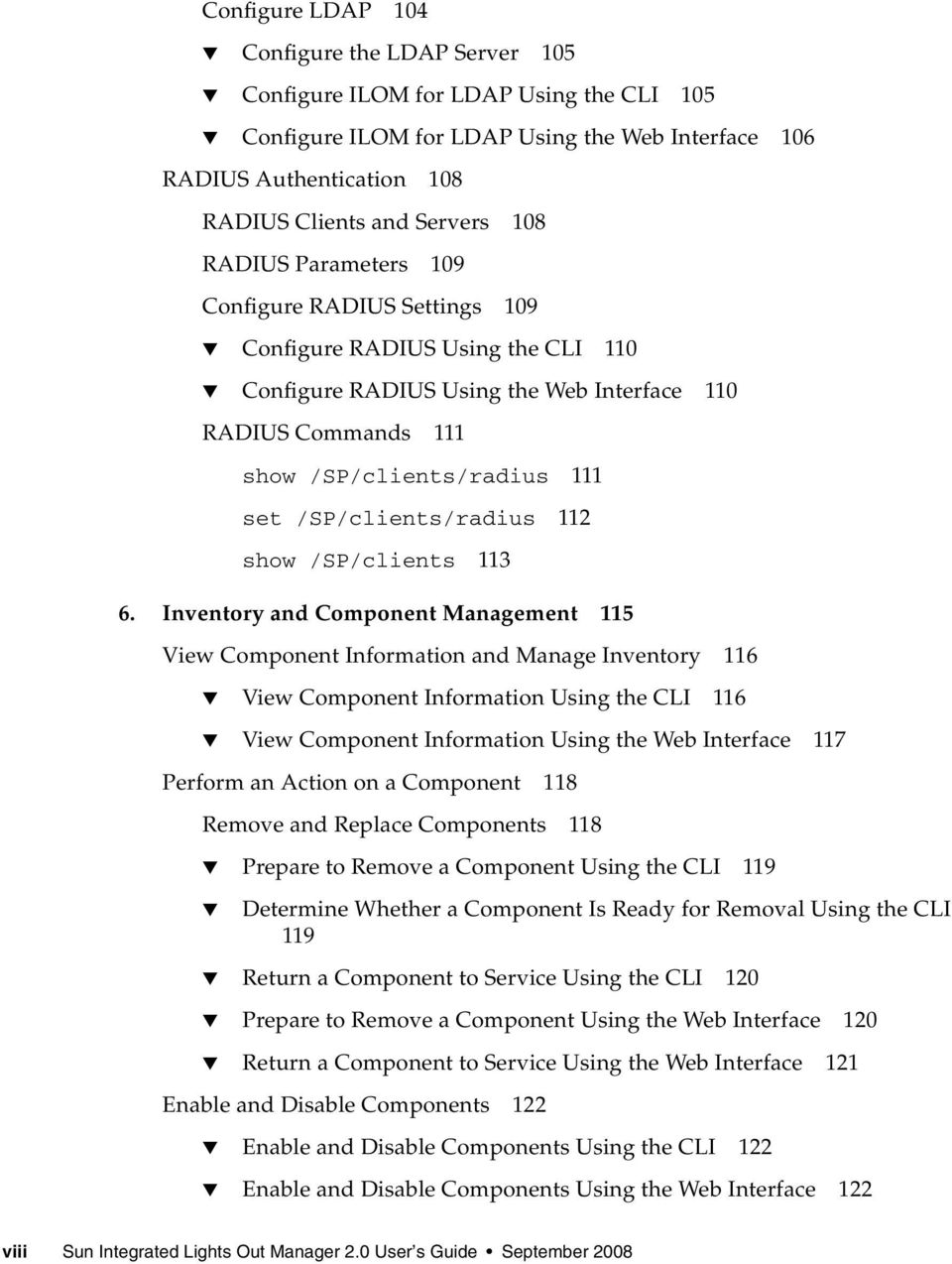
8 Configure LDAP 104 Configure the LDAP Server 105 Configure ILOM for LDAP Using the CLI 105 Configure ILOM for LDAP Using the Web Interface 106 RADIUS Authentication 108 RADIUS Clients and Servers 108 RADIUS Parameters 109 Configure RADIUS Settings 109 Configure RADIUS Using the CLI 110 Configure RADIUS Using the Web Interface 110 RADIUS Commands 111 show /SP/clients/radius 111 set /SP/clients/radius 112 show /SP/clients Inventory and Component Management 115 View Component Information and Manage Inventory 116 View Component Information Using the CLI 116 View Component Information Using the Web Interface 117 Perform an Action on a Component 118 Remove and Replace Components 118 Prepare to Remove a Component Using the CLI 119 Determine Whether a Component Is Ready for Removal Using the CLI 119 Return a Component to Service Using the CLI 120 Prepare to Remove a Component Using the Web Interface 120 Return a Component to Service Using the Web Interface 121 Enable and Disable Components 122 Enable and Disable Components Using the CLI 122 Enable and Disable Components Using the Web Interface 122 viii Sun Integrated Lights Out Manager 2.0 User s Guide September 2008
9 Configure Policy Settings 122 Configure Policy Settings Using the CLI 123 Configure Policy Settings Using the Web Interface System Monitoring and Alert Management 125 About System Monitoring 126 Sensor Readings 127 Obtain Sensor Readings Using the Web Interface 127 Obtain Sensor Readings Using the CLI 129 Power Monitoring Interfaces 131 Power Monitoring Terminology 132 System Indicators 132 Supported System Indicator States 133 View and Manage Indicators Using the Web Interface 134 View and Manage Indicators Using the CLI 135 ILOM Event Log 136 Event Log Timestamps and ILOM Clock Settings 136 Supported Clock Settings 137 View or Set Clock Settings Using the Web Interface 137 View and Set Clock Settings Using the CLI 137 Syslog Information 138 Fault Management 139 View Fault Status Using the Web Interface 140 View Fault Status Using the CLI 141 ILOM Service Snapshot Utility 142 Monitor System Power, Sensors, Indicators, and ILOM Event Log 142 Monitor System Total Power Consumption Using the CLI 143 Monitor System Actual Power Using the CLI 144 Monitor Individual Power Supply Consumption Using the CLI 145 Contents ix

10 Monitor Available Power Using the CLI 146 Monitor Permitted Power Consumption Using the CLI 146 Determine the State of Indicators Using the Web Interface 147 Obtain Sensor Readings Using the Web Interface 148 View or Clear the ILOM Event Log Using the Web Interface 148 View or Clear the ILOM Event Log Using the CLI 150 View and Configure Clock Settings Using the Web Interface 152 Configure Remote Syslog Receiver IP Addresses Using the Web Interface 153 Configure Remote Syslog Receiver IP Addresses Using the CLI 154 Run the Snapshot Utility Using the CLI 155 Run the Snapshot Utility Using the Web Interface 156 About Alert Management 158 Alert Rule Configuration 158 Alert Rule Property Definitions 159 Manage Alert Rule Configurations Using the ILOM Web Interface 161 Prerequisites 162 Modify an Alert Rule Configuration Using the Web Interface 162 Disable an Alert Rule Configuration Using the Web Interface 163 Generate Alert Tests Using the Web Interface 164 Manage Alert Rule Configurations Using the ILOM CLI 164 CLI Commands for Managing Alert Rule Configurations 165 Prerequisites 167 Modify Alert Rule Configurations Using the CLI 167 Disable an Alert Rule Configuration Using the CLI 168 Generate Alert Tests Using the CLI 169 Configure SMTP Client for Notification Alerts 170 Enable SMTP Client Using the Web Interface 170 Enable SMTP Client Using the CLI 171 x Sun Integrated Lights Out Manager 2.0 User s Guide September 2008

11 8. Configure ILOM Communication Settings 173 Manage ILOM Network Settings Using the CLI 174 About Network Settings 174 View Network Settings Using the CLI 174 Configure Network Settings Using the CLI 175 Targets, Properties, and Values 175 Serial Port Settings 176 View Serial Port Settings Using the CLI 176 Configure Serial Port Settings Using the CLI 177 Targets, Properties, and Values 177 Enable HTTP or HTTPS Web Access Using the CLI 178 Targets, Properties, and Values 178 Configure Secure Shell Settings 179 Establish a Secure Remote Connection to Run CLI Commands 179 View the Current Key Using the CLI 180 Enable or Disable SSH Using the CLI 181 Enable or Disable SSH Using the Web Interface 181 Generate a New Key Using the CLI 182 Generate a New Key Using the Web Interface 182 Restart the SSH Server Using the CLI 183 Restart the SSH Server Using the Web Interface 183 Manage ILOM Network Settings Using the Web Interface 183 View Network Settings Using the Web Interface 184 Configure Network Settings Using the Web Interface 184 Display Serial Port Settings Using the Web Interface 186 Configure Serial Port Settings Using the Web Interface 187 Enable HTTP or HTTPS Web Access Using the Web Interface 187 Contents xi

12 9. Intelligent Platform Management Interface 189 IPMI Overview 189 ILOM and IPMI 190 Using IPMItool 190 IPMI Alerts 191 IPMItool Examples 192 View a List of Sensors and Their Values 192 View Details About a Single Sensor 193 Power On the Host 193 Power Off the Host 193 Power Cycle the Host 193 Shutdown the Host Gracefully 193 View Manufacturing Information for FRUs 194 View the IPMI System Event Log Simple Network Management Protocol 197 SNMP Overview 198 How SNMP Works 199 SNMP Management Information Base Files 199 Alerts and SNMP Traps 200 Manage SNMP Users With the CLI 201 Add an SNMP User Account Using the CLI 201 Edit an SNMP User Account Using the CLI 201 Delete an SNMP User Account Using the CLI 201 Add or Edit an SNMP Community Using the CLI 202 Delete an SNMP Community Using the CLI 202 Targets, Properties, and Values 202 Configure SNMP Trap Destinations Using the CLI 203 xii Sun Integrated Lights Out Manager 2.0 User s Guide September 2008

13 Manage SNMP Users Using the Web Interface 204 Configure SNMP Settings Using the Web Interface 204 Add or Edit an SNMP User Account Using the Web Interface 206 Delete an SNMP User Account Using the Web Interface 207 Add or Edit an SNMP Community Using the Web Interface 208 Delete an SNMP Community Using the Web Interface 208 Configure SNMP Trap Destinations Using the Web Interface 209 SNMP Examples 209 View and Configure SNMP Settings 210 Obtain Information Using snmpget or snmpwalk net-snmp Commands 211 Set Information Using snmpset 212 Receive Traps Using snmptrapd Update ILOM Firmware 213 Firmware Update Process 214 ILOM Firmware Update Overview 214 View ILOM Version Information Using the CLI 215 Using the CLI Through the Management Ethernet Port 215 Using the CLI Through the Serial Port 215 View ILOM Version Information Using the Web Interface 216 Download New Firmware 217 Downloading New Firmware on x64-based Systems 217 Downloading New Firmware on SPARC-Based Systems 217 Update ILOM Firmware Using the CLI 218 Update ILOM Firmware Using the Web Interface 219 Update ILOM Firmware Using Sun xvm Ops Center 221 Reset ILOM SP 221 Reset SP to Factory Defaults Using the CLI 222 Reset SP to Factory Defaults Using the Web Interface 222 Contents xiii
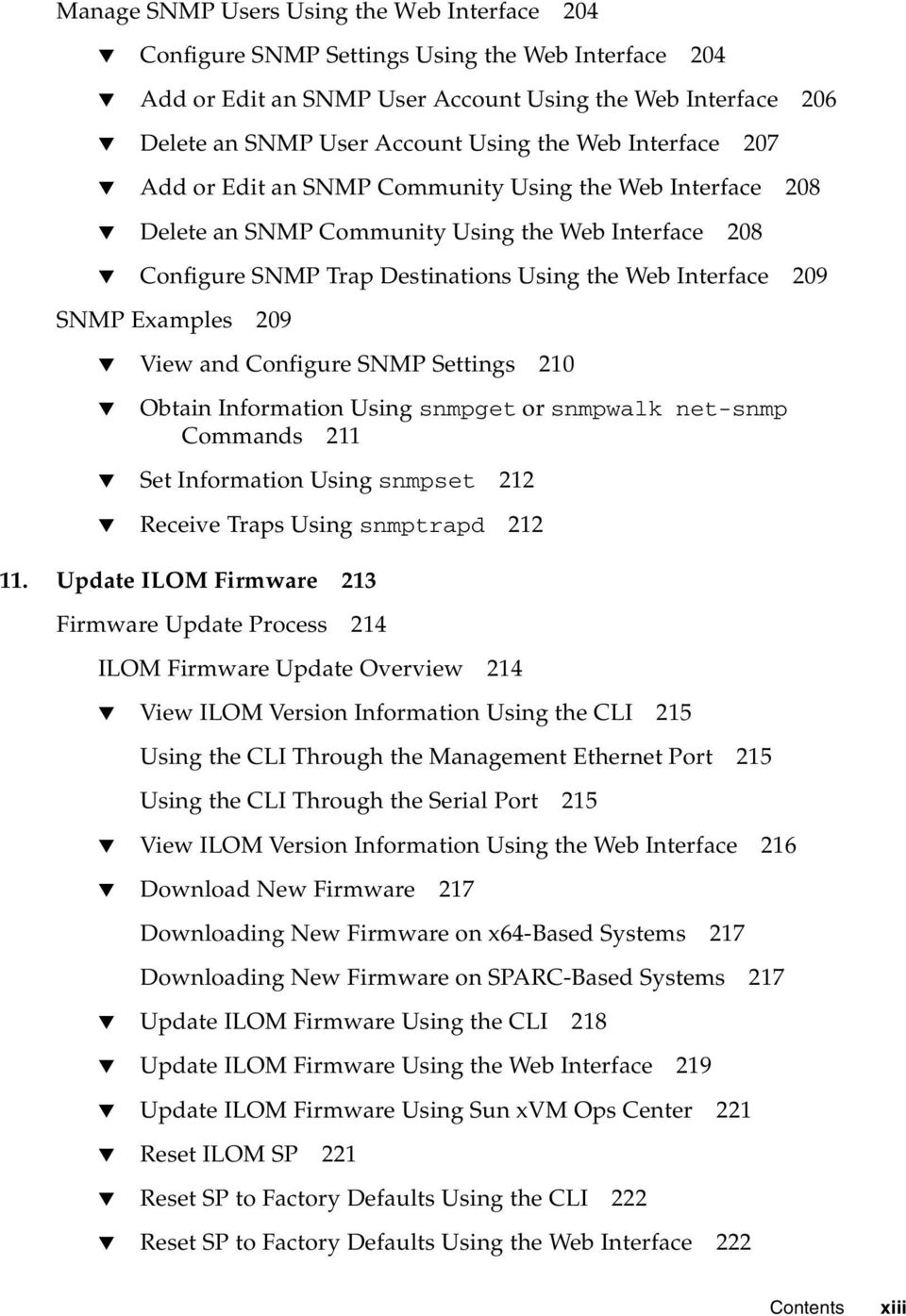
14 12. Remote Management of x64 Servers Using the Sun ILOM Remote Console 223 Sun ILOM Remote Console Overview 224 Single or Multiple Remote Host Server Management Views 224 Installation Requirements 226 Network Communication Ports and Protocols 227 Administrator Role User Account Sign In Authentication Required 227 Launch and Configure ILOM for Remote Management 228 Connect to the ILOM Web Interface 228 Configure ILOM Remote Control Settings Using the Web Interface 229 Launch and Configure Sun ILOM Remote Console for Remote x64 Server Management 232 Launch the Sun ILOM Remote Console Using the ILOM Web Interface 232 Add a New Server Session 234 Start, Stop, or Restart Device Redirection 234 Redirect Keyboard and Mouse Devices 235 Control Keyboard Modes and Key Send Options 235 Redirect Storage Devices 236 Exit the Sun ILOM Remote Console 238 CD and Diskette Redirection Operation Scenarios 238 A. ILOM Command-Line Interface Reference 241 CLI Command Quick Reference 241 CLI Command Reference 247 B. Glossary 263 Index 281 xiv Sun Integrated Lights Out Manager 2.0 User s Guide September 2008
15 Preface Sun Integrated Lights Out Manager 2.0 User s Guide discusses ILOM features and tasks that are common to Sun rackmounted servers or blade servers that support ILOM. You can access these features or perform these tasks in the same way, regardless of the Sun server platform that ILOM is managing. Other user documents present ILOM features and tasks that are specific to the server platform you are using. You can find the ILOM platform-specific information within the documentation set that accompanies your system. Before You Read This Document This User s Guide provides detailed information about the ILOM features and functions that are common to all server platforms managed by ILOM. To fully understand the information and perform the tasks discussed in this User s Guide, you should use this document in conjunction with the ILOM documentation that comes with your specific server platform. How This Document Is Organized This document includes the following information: Chapter 1 provides an overview of ILOM features and functions. Chapter 2 explains how to establish initial communication with ILOM and what type of tasks you can perform with different connections. xv
16 Chapter 3 describes how to use the ILOM command-line interface (CLI) and how to log in to ILOM using the CLI. Chapter 4 describes how to use the ILOM web interface and how to log in to ILOM using the web interface. Chapter 5 explains how to manage user accounts using the ILOM CLI or web interface, as well as how to configure Active Directory, LDAP, and RADIUS. Chapter 6 describes how to view and modify component information, how to prepare to remove components and return components to service, and how to configure policy settings. Chapter 7 explains how to monitor the system using sensors, indicators, and event logs and also describes how to manage alerts. Chapter 8 presents an overview of ILOM network settings and the tasks you need to perform to configure the network settings using the ILOM CLI or web interface. Chapter 9 describes the Intelligent Platform Management Interface and IPMItool. Chapter 10 explains how SNMP works and how to manage SNMP users using the ILOM CLI or web interface. Chapter 11 explains how to upgrade and reset ILOM firmware using the ILOM CLI or web interface. Chapter 12 describes the ILOM Remote Console application and how to launch and configure the Remote Console to remotely manage a server platform. Appendix A presents a reference to ILOM CLI commands and explains how to use the commands. Appendix B is a glossary that provides the definitions of some words and phrases used in this User s Guide. xvi Sun Integrated Lights Out Manager 2.0 User s Guide September 2008

17 Typographic Conventions Typeface * AaBbCc123 AaBbCc123 AaBbCc123 Meaning The names of commands, files, and directories; on-screen computer output. What you type, when contrasted with on-screen computer output. Book titles, new words or terms, words to be emphasized. Replace command-line variables with real names or values. Examples Edit your.login file. Use ls -a to list all files. % You have mail. % su Password: Read Chapter 6 in the User s Guide. These are called class options. You must be superuser to do this. To delete a file, type rm filename. * The settings on your browser might differ from these settings. Related Documentation You should use this document in conjunction with the ILOM platform supplement documentation that comes with your specific platform. Preface xvii
18 Documentation, Support, and Training Sun Function Documentation Support Training URL Third-Party Web Sites Sun is not responsible for the availability of third-party web sites mentioned in this document. Sun does not endorse and is not responsible or liable for any content, advertising, products, or other materials that are available on or through such sites or resources. Sun will not be responsible or liable for any actual or alleged damage or loss caused by or in connection with the use of or reliance on any such content, goods, or services that are available on or through such sites or resources. Sun Welcomes Your Comments Sun is interested in improving its documentation and welcomes your comments and suggestions. You can submit your comments by going to: Please include the title and part number of your document with your feedback: Sun Integrated Lights Out Manager 2.0 User s Guide, part number xviii Sun Integrated Lights Out Manager 2.0 User s Guide September 2008

19 CHAPTER 1 Introduction to ILOM Sun Integrated Lights Out Manager (ILOM) 2.0 is the system management firmware you can use to monitor, manage, and configure a variety of Sun server platforms. This chapter includes the following sections: What Is ILOM? on page 1 What Does ILOM Do? on page 2 ILOM on the SP and CMM on page 3 ILOM Interfaces on page 4 ILOM Management Network on page 5 ILOM Connection Methods on page 5 Roles for ILOM User Accounts on page 6 Preconfigured ILOM Administrator Account on page 7 ILOM Features on page 7 New Features in ILOM 2.0 on page 9 Other Management Tools on page 10 What Is ILOM? Sun s Integrated Lights Out Manager (ILOM) provides advanced service processor hardware and software that you can use to manage and monitor your Sun servers. ILOM s dedicated hardware and software is preinstalled on a variety of Sun x64- based Sun Fire servers, Sun Blade Modular Systems, and Sun Blade server modules, as well as on SPARC-based servers. ILOM is a vital management tool in the data center and can be used to integrate with other data center management tools already installed on your systems. 1

20 Sun is currently transitioning many systems to support ILOM so that customers will have a single, consistent, and standards-based service processor (SP) across Sun s product lines. For customers, this means you will have: Single, consistent system management interfaces for operators Rich protocol and standards support Broadening third-party management support System management functions integrated into Sun servers at no extra cost What Does ILOM Do? ILOM enables you to actively manage and monitor the server independently of the operating system state, providing you with a reliable Lights Out Management (LOM) system. With ILOM, you can proactively: Learn about hardware errors and faults as they occur Remotely control the power state of your server View the graphical and non-graphical consoles for the host View the current status of sensors and indicators on the system Determine the hardware configuration of your system Receive generated alerts about system events in advance via IPMI PETs, SNMP Traps, or Alerts. The ILOM SP runs its own embedded operating system and a dedicated Ethernet port, which together provide out-of-band management capability. In addition, you can access ILOM from the server s host operating system that Sun supports (Solaris, Linux, and Windows). Using ILOM, you can remotely manage your server as if you were using a locally attached keyboard, monitor, and mouse. ILOM automatically initializes as soon as power is applied to your server. It provides a full-featured, browser-based web interface and has an equivalent command-line interface. There is also an industry-standard SNMP interface and IPMI interface. You can easily integrate these management interfaces with other management tools and processes that you may have working already with your servers, such Sun xvm Ops Center. This easy-to-use system management platform for Solaris and Linux provides the tools you need to efficiently manage systems on your network. Sun xvm Ops Center can discover new and existing systems on your network, update firmware and BIOS configurations, provision the operating environment with off the shelf distributions or Solaris images, manage updates and configuration changes, 2 Sun Integrated Lights Out Manager 2.0 User s Guide September 2008
21 and remotely control key aspects of the service processor such as boot control, power status, and indicator lights. For more information about xvm Ops Center, go to: In addition, you can integrate ILOM with these third-party management tools: Altiris Deployment Server 6.8 BMC Patrol CA Unicenter Network and Systems Management (NSM) HP OpenView Operations for UNIX HP OpenView Operations for Windows HP Systems Insight Manager IBM Director 1.0 IBM Tivoli Enterprise Console IBM Tivoli Monitoring (ITM) IBM Tivoli Netcool/OMNIbus Microsoft System Management Scalent Virtual Operating Environment (V/OE) IPMItool for Microsoft Windows 2003 A description of these third-party system management tools and their support for Sun systems is available at: ILOM on the SP and CMM ILOM is supported on a variety of Sun server platforms, including rackmounted servers and server modules (blades) enclosed in a modular chassis system. ILOM firmware is preinstalled on the service processor (SP) of your rackmounted server or server module, or on the Chassis Monitoring Module (CMM) that is part of the modular chassis system. ILOM supports two ways to manage a system: using the SP directly or using the CMM, if you are using a modular chassis system. Chapter 1 Introduction to ILOM 3
22 Using the service processor directly Communicating directly with the rackmounted server SP or server module SP enables you to manage individual server operations. This approach may be useful in troubleshooting a server module or rackmounted server, or controlling access to specific servers in your data center. Using the Chassis Monitoring Module If you are using a modular chassis system, managing the system from the CMM enables you to set up and manage components throughout the entire modular chassis system, or to drill down to manage the individual blade server SP. ILOM Interfaces ILOM is available through a variety of interfaces. Web interface The web interface provides an easy-to-use browser interface that enables you to log in to the SP and to perform system management, monitoring, and IPMI tasks. For information about the ILOM web interface, see Chapter 4. Command-line interface (CLI) The command-line interface enables you to operate ILOM using keyboard commands and adheres to industry-standard DMTF-style CLI and scripting protocols. You can connect a terminal or PC running terminal emulator software directly to the system serial port, or connect to the Ethernet network management port using a Secure Shell (SSH). For information about the CLI, see Chapter 3. Remote Console The ILOM Remote Console (JavaRConsole) enables you to access your server s console remotely. It redirects the keyboard, mouse, and video screen, and can redirect input and output from the local machine s CD and diskette drives. For information about the Remote Console, see Chapter 12. Intelligent Platform Management Interface (IPMI) Using IPMI v1.5 and v2.0 and the IPMItool utility, you can manage and configure devices using a CLI to retrieve information from the system s Baseboard Management Controller (BMC). With IPMItool, you can monitor the status of hardware components remotely, monitor system logs, receive reports about replaceable components, and redirect the server console. For more information about IPMI, see Chapter 9. Simple Network Management Protocol (SNMP) interface ILOM also provides an SNMP v3.0 interface (with limited support for SNMP v1 and SNMP v2c) for external data center management applications such as Sun Sun xvm Ops Center, or third-party applications such as Hewlett-Packard OpenView and IBM Tivoli. For more information about SNMP, see Chapter Sun Integrated Lights Out Manager 2.0 User s Guide September 2008
23 ILOM Management Network Your Sun server platform comes with a network management port and a data port. These separate, physical Ethernet connections are for ILOM and the operating systems that run on the host hardware. You can choose to manage your server platform with ILOM by connecting to the dedicated network management port. If you choose to connect to ILOM through the network management port, traffic destined for ILOM is separate from any data transfers the operating system host makes. No data traffic passes through the network port. This allows management traffic to be completely isolated on a separate network, if desired. The location and labeling of the network management port is specific to your system. In addition, the type of server platform determines how internal management communications are provided. For example, on a blade server system, the network port provides a connection to all CMMs and SPs in the chassis. Refer to your platform documentation to determine how your system provides its management communications. If you choose not to use ILOM and the network management port to manage your server, many of the advanced features, such as environmental monitoring, IPMI management, and the web interface, will be unavailable. You can use the data port of the host operating system to access third-party network management applications, SNMP tools, or operating system utilities, however these solutions only have a limited view of the platform. You also can manage your server locally by connecting through the server s serial port using a PC or terminal running terminal emulator software. Note that without some manner of direct connection to ILOM, you will be unable to remotely manage your Sun server platform. ILOM Connection Methods The way you connect to ILOM depends on your server platform. Chapter 1 Introduction to ILOM 5
24 The following table lists the different methods you can use to connect to ILOM. TABLE 1-1 ILOM Connection Methods Connection Method Rack Mounted Blade Supported Interface Description Ethernet network management connection Serial connection, through server or blade Serial connection, through CMM Yes Yes CLI and web interface Connect to the Ethernet network management port. You must know ILOM s IP address. This method supports a web interface and a command-line interface. Yes Yes CLI only Connect directly to the serial management port on the server or blade. If needed, use a serial adapter cable to connect to the serial port. This method supports only a command-line interface. No Yes CLI only Connect to the serial port on the CMM. This method supports only a command-line interface. Note ILOM supports a maximum of 10 active sessions, including serial, Secure Shell (SSH), and web interface sessions. To access the management network using the ILOM web interface or CLI, you need the IP address for the CMM or the SP you want to manage. Each CMM and SP is assigned a unique IP address during the initial system setup. To assign the initial IP addresses for SPs and CMMs, see Chapter 2. Roles for ILOM User Accounts ILOM user accounts have defined roles that determine ILOM user access and rights. Administrators can manage user accounts using the ILOM web interface or CLI. The roles assigned to ILOM accounts are: Administrator Enables access to all ILOM features, functions, and commands. Operator Enables access to fully manage and monitor the host system, and also provides read-only access to ILOM configuration. 6 Sun Integrated Lights Out Manager 2.0 User s Guide September 2008
25 Preconfigured ILOM Administrator Account ILOM is preinstalled with one preconfigured Administrator account: User name: root Password: changeme The preconfigured Administrator account, known as root, cannot be deleted or changed, other than resetting its default password (changeme). This account provides built-in administrative privileges (read and write access) to all ILOM features, functions, and commands. The first time you access ILOM, at the SP or CMM level, you will need to log in as root with the default changeme password. After you have logged in to ILOM and established network connectivity to the system, you should consider resetting the default changeme password that is associated with the ILOM root account. To prevent your system from unauthorized access, reset this password on each SP and CMM installed in your system. For information about resetting the ILOM root account password, see Reset ILOM SP on page 221. ILOM Features TABLE 1-2 shows the ILOM features and tasks that are common to Sun systems supporting ILOM. For information about whether the feature is supported on your system, consult the user documentation provided with your Sun server platform. TABLE 1-2 ILOM Features Feature Customer Benefit INTERFACES Web interface Command-line interface Provides a browser-based user interface based on Sun standard. Supports industry-standard CLIs and scripting protocols: DMTF SMASH CLP. Reuses existing scripts with Sun systems, automates tasks using familiar interfaces. Chapter 1 Introduction to ILOM 7
26 TABLE 1-2 ILOM Features (Continued) Feature System management interfaces Customer Benefit Supports industry-standard SNMP v1, v2c, v3 and IPMI v1.5 and v2.0. Platform MIB enables platform management using SNMP in addition to IPMI. Control MIB enables custom or third-party management applications to integrate with ILOM. Provides access to remote system using the ILOM Remote Console. SECURITY SSH 2.0 support LDAP, MSFT Active Directory, RADIUS User management Reset root password capability SSL certificate Enables secure access to the CLI. Supports industry-standard authentication and authorization protocols for easy integration into existing environments. Supports Administrator and Operator roles with configurable access levels for greater security and control of systems. Prevents unauthorized access to the system. Password is reset to default using a push button or jumper. Enables secure communications using default SSL certificate and self-signing key for HTTPS access. LOCAL AND REMOTE ACCESS Access to SP while host is powered down Dedicated network management port Remote Console Editable hostname data field Web interface turns on or off Enables continuous ILOM operation regardless of the state of the host operating system. Separates network management traffic from data network traffic. Provides a simple web interface to access remote systems. No need to log in to the SP to start the Remote Console. Allows Administrators to use the hostname data field in addition to the IP address for system identification. Restricts ILOM access and enables only CLI access. MONITORING AND LOGGING SNMP and IPMI monitoring and control Event logging Monitors components using industry-standard SNMP commands and the IPMI IPMItool utility. Provides a consistent method for logging all service data. 8 Sun Integrated Lights Out Manager 2.0 User s Guide September 2008
27 TABLE 1-2 ILOM Features (Continued) Feature Configurable alert thresholds event notification Hardware and system-related errors, as well as ECC memory errors, reported into SP logs, Syslog, and remote log-host POWER CONTROL Forced power-off Graceful shutdown and power cycling Remote power on and power off FIRMWARE Firmware versions identified from web interface or CLI Firmware updates using web interface or CLI CONFIGURATION Manual SP configuration, including IP address, through BIOS interface, serial or Ethernet SP ports, or host OS SP IP address programmable from local keyboard and monitor Customer Benefit Enables users to configure the SP to send an IPMI PET alert when system thresholds are crossed. Provides quick and convenient notification of events. Enables faster fault diagnosis and isolation, reducing downtime. Enables emergency power off of the system. Enables users to shut down the host operating system before system power-off. Enables users to control system power remotely. Provides a simple way to identify firmware versions. Provides simple procedures to update firmware. Simplifies initial configuration. Facilitates manual IP configuration for systems in a data center. New Features in ILOM 2.0 Active Directory alerts New updated Sun-specific MIBs SNMP Traps Internationalization of the Remote Console Chapter 1 Introduction to ILOM 9
28 Other Management Tools Sun servers support a variety of system management tools that you can use to administer the system. In addition to ILOM, these system management tools include: Sun xvm Ops Center Sun xvm Ops Center is a comprehensive system management tool that you can purchase separately. This tool offers flexible capabilities that simplify infrastructure management of SPARC, x64 Sun Fire servers, and Sun Blade Server Modules. With Sun xvm Ops Center, IT administrators can monitor, maintain, and provision multiple systems remotely from any Sun Sun xvm Ops Center. For more information about Sun xvm Ops Center, see the following site: Third-party system management tools Sun systems support both SNMP (v1, v2c, v3) and IPMI (v1.5 and v2.0) to integrate third-party system management tools like HP Systems Insight Manager and IBM Tivoli. A listing of some of the key third-party system management tools and their support for Sun x64 systems is available at: 10 Sun Integrated Lights Out Manager 2.0 User s Guide September 2008
29 CHAPTER 2 Establish Initial Communication With ILOM You can establish communication with ILOM through a console connection to the serial management port on the server or CMM, or through an Ethernet connection to the network management port on the server or CMM. The type of connection you establish to ILOM determines which type of tasks you can perform. For example, to remotely access the full range of system management functionality in ILOM, you will require both an Ethernet connection and an IP assignment to the server SP and, if applicable, to the CMM. This chapter includes the following sections: About ILOM s Initial Setup on page 12 Initial Setup Worksheet on page 12 DHCP IP Assignment Considerations on page 14 Static IP Assignment Considerations on page 18 Management Network IP Address Configuration on page 20 ILOM Network Port Assignment on page 20 Hostname Identity for Server SP and CMM on page 22 System Identifier Text String for Sun Servers on page 22 Assign IP Addresses to the Sun Server Platform SP Interfaces on page 23 Assign DHCP IP Addresses Using an Ethernet Management Connection on page 23 Assign a Static IP Address to Server SP Using a Serial Connection on page 25 Assign Static IP Address to CMM Using a Serial Connection on page 27 Edit IP Address Assignments Using an Ethernet Management Connection on page 29 Edit Existing IP Addresses in ILOM Using the Web Interface on page 29 Edit Existing IP Addresses in ILOM Using the CLI on page 30 Assign Hostname or System Identifier on page 33 11
30 About ILOM s Initial Setup Prior to establishing communication with ILOM, you should consult the following topics: Initial Setup Worksheet on page 12 DHCP IP Assignment Considerations on page 14 Static IP Assignment Considerations on page 18 Management Network IP Address Configuration on page 20 ILOM Network Port Assignment on page 20 Hostname Identity for Server SP and CMM on page 22 System Identifier Text String for Sun Servers on page 22 Initial Setup Worksheet Use the following worksheet in TABLE 2-1 to gather the information that you will need to initially establish communication with ILOM. 12 Sun Integrated Lights Out Manager 2.0 User s Guide September 2008
31 TABLE 2-1 Initial Setup Worksheet to Establish Communication With ILOM Information for Setup Requirement Description Local Serial Console Connection Optional - if using DHCP to assign initial IP address Manadatory - if DHCP server is not utilized to assign initial IP address If you are not utilizing a DHCP server to assign IP addresses to the server SP or CMM, you must establish a local serial console connection to ILOM via the serial management port on the server or Chassis Monitoring Module (CMM). For more information about how to attach a serial console to a server or CMM, consult the user documentation provided with the Sun server platform. Remote Ethernet Management Connection SP IP Assignment Optional Mandatory Attach a network (Ethernet) cable to the network management port on the server or the CMM. The label appearing on the network management port may be different depending on the server platform. Some server and CMM network management ports are labeled NET MGT or MGT. If you have a question about the network management port label, or how to attach an Ethernet cable to the management port, consult the user documentation provided with the Sun server platform. To access ILOM s full range of management functionality, you must connect your local area network to the network management port of a server or CMM. Note that a network management port is provided on all Sun rackmount standalone servers. However, this port is not provided on Sun Blade Server Modules. Ethernet communication with blade server modules is through the network management port on the CMM. Decide whether to assign DHCP or static IP address(es) to the server SP(s) or CMM(s). All remote system management communication with ILOM is through the server SP or CMM management network. For more information, see the following topics: DHCP IP Assignment Considerations on page 14 Static IP Assignment Considerations on page 18 Assign IP Addresses to the Sun Server Platform SP Interfaces on page 23 Chapter 2 Establish Initial Communication With ILOM 13
32 TABLE 2-1 Initial Setup Worksheet to Establish Communication With ILOM (Continued) Information for Setup Requirement Description ILOM Interface Mandatory When establishing (or modifying) an IP address on a server SP or CMM, you will use one of the following ILOM interfaces: Command-line interface (CLI) - use to establish the initial IP address. Ifan IP address has not been assigned to the server SP or CMM, you can connect to ILOM to assign the IP address via a local serial console. The CLI is typically used for all tasks performed in ILOM over a serial connection (local serial console, terminal emulation application, or remote SSH connection). Web interface - use to edit an existing IP address. If an IP address has been assigned to the server SP or CMM and a LAN connection is established to the MGT port, you can connect to ILOM to edit the existing IP address(es) assigned using the web interface. The web interface is typically used for all tasks performed in ILOM over an Ethernet management connection. For more information about ILOM interfaces, see Chapter 3 and Chapter 4. ILOM Firewall Access SP Hostname Assignment System Identifier Assignment Optional Optional Optional Consult ILOM s network port usage for Ethernet networks requiring firewall access. For more information, see ILOM Network Port Assignment on page 20. You can optionally assign a meaningful hostname to a server SP. For more information, see Hostname Identity for Server SP and CMM on page 22 or Assign Hostname or System Identifier on page 33. You can optionally assign a system identifier (meaningful name) to a Sun server. For more information, see Hostname Identity for Server SP and CMM on page 22 or Assign Hostname or System Identifier on page 33 DHCP IP Assignment Considerations If you are planning to use a Dynamic Host Configuration Protocol (DHCP) server to assign an IP address to a server SP or CMM, consult the following topics: Sun Server Platform DHCPDISCOVER Packet Broadcast on page 15 Requirements for DHCP Assignment on page 15 SP Network Interface MAC Address on page 15 Post DHCP Requirements on page Sun Integrated Lights Out Manager 2.0 User s Guide September 2008
33 Sun Server Platform DHCPDISCOVER Packet Broadcast The Sun server SP or CMM automatically broadcasts a DHCPDISCOVER packet when power is applied to the Sun server platform. If you have an established DHCP server on the network, the DHCP server automatically returns a DHCPOFFER packet containing IP address(es) and other network configuration information to the requesting server SP(s) or CMM(s). Note You can choose to have a DHCP server assign Ethernet IP address(es) for you, or you can configure the DHCP server to assign specific Ethernet IP address(es) by providing the MAC address of the SP(s). For more information, consult the DHCP server user documentation. For more information about how to obtain the MAC address of the server SP or CMM, see SP Network Interface MAC Address on page 15. Requirements for DHCP Assignment The following conditions must be present to assign IP address(es) to the Sun server SP interfaces using a DHCP server: An Ethernet cable must be plugged into the server management port or CMM management port. A DHCP server must be connected to the same subnet as the Sun server platform. The DHCP server must be configured to accept new media access control (MAC) addresses. The DHCP configuration setting in ILOM must be enabled. This setting is enabled by default. SP Network Interface MAC Address If you are planning to use a DHCP server to assign IP address(es) to the SP network interface(s), you might need the MAC address of the server SP or CMM. You can obtain the service processor MAC address via one of the methods described in TABLE 2-2. Chapter 2 Establish Initial Communication With ILOM 15
34 TABLE 2-2 Methods for Obtaining SP MAC Address ILOM Category Method Description Rackmount server SP Blade server SP CMM All View internal label View internal label Customer Information Sheet Typically, the MAC address label for the server SP on the management network appears on a sticker attached to the server. If the MAC address does not appear on a sticker attached to the server, consult the user documentation provided with the Sun server platform. Typically, the MAC address label for the CMM on the management network appears on a sticker attached to the CMM. If the MAC address does not appear on a sticker attached to the CMM, consult the user documentation provided with the Sun server platform. Refer to the Customer Information Sheet provided with the Sun server platform. 16 Sun Integrated Lights Out Manager 2.0 User s Guide September 2008
35 Post DHCP Requirements After the DHCP server has assigned IP address(es) to the SP network interface(s), you can identify the IP address(es) that were assigned by the DHCP server using one of the methods specified in TABLE 2-3. TABLE 2-3 Method Methods for Identifying IP Address(es) Assigned by DHCP Server Description DHCP log file (Note that this log file is not part of ILOM, it is the log file on the DHCP server.) Serial console connection Open the DHCP log file and do the following: 1. Locate the MAC address of the service processor in the MAC address field. 2. Identify the IP value assigned in the IP address field that corresponds to the MAC address in the MAC address field. 3. Use the IP address you identified in Step 2 to remotely communicate with ILOM using the web interface. Tip. Typically, DHCP log file entries are individual lines with the following comma-separated fields: ID, Date, Time, Description, IP Address, Host Name, MAC Address. Establish a serial console connection to the serial port on the server or CMM. Log in to ILOM as root using the CLI and type one of the following commands: For rackmount standalone servers: show /SP/network For a chassis blade server module: show /CH/BLn/SP network For a chassis CMM in slot 0: show /CMM/network/CMM0 For chassis CMM in slot 1: show /CMM/network/CMM1 Chapter 2 Establish Initial Communication With ILOM 17
36 Static IP Assignment Considerations If you are planning to assign static IP address(es) to a server SP or CMM, consult the following topics: Requirements for Static IP Assignment on page 18 Serial Device - Terminal Emulation Software Settings on page 19 Post Static IP Assignment on page 19 Requirements for Static IP Assignment To initially assign a static IP address to a server SP or CMM, you must satisfy the requirements described in TABLE 2-4. TABLE 2-4 Requirements for Static IP Assignment Requirements Step Description Establish serial console connection Configure serial port settings Assign static IP address using the ILOM CLI 1 Establish a serial console connection to the server SP or CMM by connecting a terminal or PC running terminal emulation software to the serial port of a server or CMM. For more information about how to attach a serial terminal or PC to a serial port on a server or CMM, consult the user documentation provided with the Sun server platform. Note that for Sun server platforms that have CMMs, you can configure the static IP address for the blade SPs installed in the chassis using the CMM ILOM commandline interface. 2 Configure the required serial settings for the terminal device or terminal emulation software. For more information, see Serial Device - Terminal Emulation Software Settings on page Assign the static IP address using the ILOM CLI. For more information, see the following topics that apply to your system configuration: Assign a Static IP Address to Server SP Using a Serial Connection on page 25. or Assign Static IP Address to CMM Using a Serial Connection on page Sun Integrated Lights Out Manager 2.0 User s Guide September 2008
37 Serial Device - Terminal Emulation Software Settings When connecting to ILOM using a serial console, you will need to configure the terminal device or terminal emulation software to use the following serial settings: 8N1: eight data bits, no parity, one stop bit 9600 baud Disable hardware flow control (CTS/RTS) Disable software flow control (XON/XOFF) The following CLI show commands enable you to view properties and values associated with a server or CMM external serial port: show <target> Examples: For a CMM: show /CMM/serial/external For a rackmount server: show /SP/serial/external For a blade server module: show /CH/BLn/SP/serial/external Post Static IP Assignment You can remotely manage IP addresses using the ILOM web interface or CLI after satisfying these requirements: IP address assignment to a server SP or CMM Established Ethernet connection to the server or CMM network management port For more information about managing the assignment of IP addresses using an Ethernet network management connection, see Edit IP Address Assignments Using an Ethernet Management Connection on page 29. Chapter 2 Establish Initial Communication With ILOM 19
38 Management Network IP Address Configuration ILOM s IP connections are typically configured to the SP network interface, which enables you to separate management traffic and data traffic. The DHCP or static IP address(es) that you assign to a server SP or CMM are known as the management network IP address(es), not to be confused with the data network IP address(es). Note that the data network IP addresses are configured after installing a host operating system on a server. It is important to distinguish the data network IP addresses from the management network IP addresses since they serve different purposes. All future references, in this guide, to the management network IP addresses will be referred to as the IP address of the server SP or IP address of the CMM. Typically, these references are presented when providing instructions for connecting to the ILOM web interface or the ILOM CLI. For more information about ILOM s management network, see ILOM Management Network on page 5. For information about assigning data network IP addresses to a server, consult the user documentation provided with the host operating system. ILOM Network Port Assignment TABLE 2-5 and TABLE 2-6 identify the default network ports used by ILOM. Most of these network ports are configurable. When configuring firewall security access to ILOM, you should configure these ports with the appropriate ports that are currently being used by the firewall service. TABLE 2-5 Direct Server SP ILOM Port Assignment Ports Protocols Applications 80 HTTP over TCP SP - ILOM user configurable port 443 HTTPS over TCP SP - ILOM user configurable port 5120 TCP SP - ILOM Remote Console: CD 5123 TCP SP - ILOM Remote Console: Diskette 5121 TCP SP - ILOM Remote Console: Keyboard and Mouse 7578 TCP SP - ILOM Remote Console: Video 22 SSH over TCP SSH - Secure Shell 69 TFTP over UDP TFTP - Trivial File Transfer Protocol 123 NTP over UDP NTP - Network Time Protocol 20 Sun Integrated Lights Out Manager 2.0 User s Guide September 2008
39 TABLE 2-5 Direct Server SP ILOM Port Assignment (Continued) 161 SNMP over UDP SNMP - Simple Network Management Protocol 162 IPMI over UDP IPMI - Platform Event Trap (PET) (outgoing port) 389 LDAP over UDP/TCP 514 Syslog over UDP Syslog - (outgoing port) LDAP - Lightweight Directory Access Protocol (user configurable port) 546 DHCP over UDP DHCP - Dynamic Host Configuration Protocol (client) 623 IPMI over UDP IPMI - Intelligent Platform Management Interface 1812 RADIUS over UDP RADIUS - Remote Authentication Dial In User Service TABLE 2-6 Direct CMM ILOM Network Port Assignment Ports Protocols Applications 80 HTTP over TCP CMM - ILOM (user configurable port) 443 HTTPS over TCP CMM - ILOM (user configurable port) HTTP over TCP CMM - ILOM drill-down (BL0-BL9) HTTPS over TCP CMM - ILOM drill-down (BL0-BL9) 22 SSH over TCP SSH - Secure Shell 69 TFTP over UDP TFTP - Trivial File Transfer Protocol 123 NTP over UDP NTP - Network Time Protocol 161 SNMP over UDP SNMP - Simple Network Management Protocol 389 LDAP over UDP/TCP 514 Syslog over UDP Syslog - (outgoing port) LDAP - Lightweight Directory Access Protocol (user configurable port) 546 DHCP over UDP DHCP - Dynamic Host Configuration Protocol (client) 1812 RADIUS over UDP RADIUS - Remote Authentication Dial In User Service Chapter 2 Establish Initial Communication With ILOM 21
40 Hostname Identity for Server SP and CMM As an alternative to an IP address, you can use a hostname to identify a particular server SP or CMM in your network. You can also use the hostname to establish a connection with the server SP ILOM or CMM ILOM. Typically, this type of system identification and connection requires you to associate the hostname with the IP address of the server SP (or CMM) in your naming service (such as DNS, NIS, SMB). If you use hostnames in your network environment to identify server SPs or CMMs, you can optionally apply the same identification in ILOM to a server SP or CMM by entering the hostname of the server SP (or CMM) on the System Identification page. For more information see, Assign Hostname and System Identifier Using the Web Interface on page 33. System Identifier Text String for Sun Servers The system identifier is a text string that you can set to help you identify components of a Sun system. For example, you could create a system identifier that identifies the location of a system, a particular server in a rack, or details about the purpose of a system. System identifiers are also included in SNMP traps. These system identifiers can help you associate the trap with the particular ILOM instance running on the system. When you set a system identifier in ILOM, you can use any text characters to describe the system or component with the exception of quotation marks. For more information about how to specify a system identifier in ILOM, see Assign Hostname or System Identifier on page Sun Integrated Lights Out Manager 2.0 User s Guide September 2008
41 Assign IP Addresses to the Sun Server Platform SP Interfaces Use the following procedures to assign IP address(es) to the SP network interface(s) on a Sun server platform: Assign DHCP IP Addresses Using an Ethernet Management Connection on page 23 Assign a Static IP Address to Server SP Using a Serial Connection on page 25 Assign Static IP Address to CMM Using a Serial Connection on page 27 Assign Hostname and System Identifier Using the Web Interface on page 33 Assign Hostname and System Identifier Using the CLI on page 35 Assign DHCP IP Addresses Using an Ethernet Management Connection Follow these steps to assign IP addresses using DHCP: 1. Verify that your DHCP server is configured to accept new media access control (MAC) addresses. Consult the documentation supplied with your DHCP server software. 2. Verify that an Ethernet cable is connected to one of the following ports: Ethernet port (NET MGT) port on the CMM, if applicable Ethernet port (MGT) on a rackmount standalone server, if applicable. Note Provided that ILOM was not configured previously with a static IP address, ILOM automatically broadcasts a DHCPDISCOVER packet with the ID of its SP network interface(s) MAC address(es). If ILOM was previously configured with a static IP address, you must disable the static IP address setting on the Network Settings tab. For more information about editing IP address settings, see Edit IP Address Assignments Using an Ethernet Management Connection on page The DHCP server on your network returns the DHCPOFFER packet containing the IP address and other information. The service processor then manages its lease of IP addresses assigned by the DHCP server. 4. Use one of the following methods to obtain the DHCP IP address(es) assigned to the SP network interface(s): Chapter 2 Establish Initial Communication With ILOM 23
42 ILOM-CMM using serial connection Using a serial console attached to the rear panel of the CMM, log in to ILOM as an Administrator. For example, at the Login prompt, you could type the preconfigured Administrator user name root and its default password changeme, then press Enter. To set the working directory for the active CMM, type: cd /CMM/network/CMM0 To view the active CMM IP address, type: show To drill-down and view the IP addresses of each blade, type: show /CH/BL0/SP/network Note CMM0 represents the CMM installed in slot CMM0. BL0 represents the blade installed in slot BL0. To specify the target CMM or blade, you must specify the number of the slot in which the module is installed. Blade slots range from 0 to 9. CMM slots range from 0 to 1. ILOM - Server SP using serial connection Using a serial console attached to the front panel of a blade, log in to ILOM as an Administrator. For example, at the Login prompt, you could type the preconfigured Administrator user name root and its default password changeme, then press Enter. To view the blade SP IP address, type: show /SP/network DHCP server logs For more information, see Post DHCP Requirements on page 17, or consult the DHCP server documentation for details. 24 Sun Integrated Lights Out Manager 2.0 User s Guide September 2008
43 Assign a Static IP Address to Server SP Using a Serial Connection Follow these steps to assign a static IP address to a server SP, using a serial connection: 1. Establish a local serial console connection to the server SP. Attach a serial console to the serial port on the server or CMM. For more information, consult the user documentation provided with the Sun server platform. 2. Configure the following settings in the terminal window that appears on the connected serial console: 8N1: eight data bits, no parity, one stop bit 9600 baud Disable hardware flow control (CTS/RTS) Disable software flow control (XON/XOFF) 3. Press Enter to establish a connection between the serial console and the SP interface. Eventually the ILOM Login prompt appears. For example: host name Login: 4. Log in to ILOM as an Administrator by entering an Administrator user name and password, then press Enter. Note You can log in to ILOM using the preconfigured Administrator account shipped with ILOM: root/changeme. For more details, see Preconfigured ILOM Administrator Account on page 7. The default prompt appears (->). The system is ready to receive CLI commands to establish network settings. 5. Type the following command to set the working directory: cd /SP/network Chapter 2 Establish Initial Communication With ILOM 25
44 6. Use the following CLI commands to specify the IP, NetMask, and Gateway addresses. Command set pendingipaddress= Description and Example Type this command followed by the static IP address that you want to assign to the server SP. For example, typing: set pendingipaddress= instructs ILOM to assign as the IP address to the server SP. set pendingipnetmask= Type this command followed by the static NetMask address that you want to assign to the server SP. For example, typing: set pendingipnetmask= instructs ILOM to assign as the NetMask address to the server SP. set pendingipgateway= Type this command followed by the static Gateway address that you want to assign to the server SP. For example, typing: set pendingipgateway= instructs ILOM to assign as the Gateway address to the server SP. setpendingipdiscovery= Type the following command to instruct ILOM to set a static IP address on the server SP. set pendingipdiscovery=static set commitpending=true Type this command (true) to assign the network settings specified. For example: set pendingipaddress= set pendingipnetmask= set pendingipgateway= set commitpending=true Typically, after assigning (or changing) an IP address the connection made to ILOM using the former IP address will timeout. Use the newly assigned IP address to connect to ILOM. 26 Sun Integrated Lights Out Manager 2.0 User s Guide September 2008
45 Assign Static IP Address to CMM Using a Serial Connection Follow these steps to assign a static IP address to a CMM, using a serial connection: 1. Verify that the serial connection to an active CMM is operational. For information about attaching a serial console to a CMM, consult the user documentation provided with the Sun server platform. 2. Log in to ILOM as an Administrator by entering an Administrator user name and password, then press Enter. Note You can log in to ILOM using the preconfigured Administrator account shipped with ILOM: root/changeme. For more details, see Preconfigured ILOM Administrator Account on page 7. The default prompt appears (->) and the system is ready for you to run the CLI commands to establish network settings. 3. To set a static IP address on the CMM through the ILOM CLI, type the following command to set the working directory: cd /CMM/network/CMM0 Note CMM0 refers to the CMM installed in slot CMM0. The target CMM is specified by referencing the slot number of the CMM. Chapter 2 Establish Initial Communication With ILOM 27
46 4. Use the following commands to specify the IP, NetMask, and Gateway addresses. Command set pendingipaddress= Description and Example Type this command followed by the static IP address that you want to assign to the CMM. For example, typing: set pendingipaddress= instructs ILOM to assign as the CMM IP address. set pendingipnetmask= Type this command followed by the static NetMask address that you want to assign to the CMM. For example, typing: set pendingipnetmask= instructs ILOM to assign as the CMM NetMask address. set pendingipgateway= Type this command followed by the static Gateway address that you want to assign to the CMM. For example, typing: set pendingipgateway= instructs ILOM to assign as the CMM Gateway address. set pendingipdiscovery= set commitpending=true Type the following command to tell ILOM that you want to set a static IP address. set pendingipdiscovery=static Type this command (true) to assign the network settings specified. Example: set pendingipaddress= set pendingipnetmask= set pendingipgateway= set comitpending=true If you connected to ILOM through a remote SSH connection, the connection made to ILOM using the former IP address will timeout. Use the newly assigned IP address to connect to ILOM. 28 Sun Integrated Lights Out Manager 2.0 User s Guide September 2008
47 Edit IP Address Assignments Using an Ethernet Management Connection Use the following procedures to manage service processor(s) IP assignment(s) over an Ethernet management connection: Edit Existing IP Addresses in ILOM Using the Web Interface on page 29 Edit Existing IP Addresses in ILOM Using the CLI on page 30 Edit Existing IP Addresses in ILOM Using the Web Interface Follow these steps to edit existing IP address(es), using the ILOM web interface, that previously have been assigned to a server SP or CMM: 1. Using a browser-based client, type the IP address of the server SP or CMM in the browser address box then press Enter. The ILOM Login screen appears. 2. In the ILOM Login screen, log in as an Administrator by entering an Administrator user name and password. Tip You can log in to ILOM using the preconfigured Administrator account shipped with ILOM: root/changeme. For more details, see Preconfigured ILOM Administrator Account on page 7. The ILOM interface appears. 3. In the right pane of the ILOM interface, click Configuration --> Network. The Network Settings page for the server or CMM appears. Chapter 2 Establish Initial Communication With ILOM 29
48 FIGURE 2-1 ILOM Server SP - Network Settings Page FIGURE 2-2 ILOM CMM - Network Settings Page 4. To edit IP addresses assigned to the SP interfaces, do the following: a. Select the radio button for Use the Following IP Address. b. Enter values for IP Address, Subnet Mask, and Gateway in the text boxes. c. Click Save for your new settings to take effect. Typically, after assigning (or changing) an IP address the connection made to ILOM using the former IP address will timeout. Use the newly assigned IP address to connect to ILOM Edit Existing IP Addresses in ILOM Using the CLI Follow these steps to edit existing IP address(es), using the ILOM CLI, that previously have been assigned to a server SP or CMM: 1. Establish a local serial console connection or SSH connection to the server SP or CMM: 30 Sun Integrated Lights Out Manager 2.0 User s Guide September 2008
49 Local Serial Console Connection Attach a serial console to the serial port on the server or CMM. For more information, consult the user documentation provided with the Sun server platform. or Remote - Secure Shell (SSH) Connection Establish a Secure Shell connection to the server SP or CMM. From the remote client, establish a secure connection as root to the server SP or CMM. For example, you can establish a secure connection from a remote SSH client to the server SP by typing the following: ssh -l root server_ip_address Password: changeme The default prompt appears (->) and the system is ready for you to run the CLI commands to establish network settings. 2. Type one of the following commands to set the SP working directory: For a rackmount standalone server: cd /SP/network For a chassis server blade server module: cd /SP/network For a chassis CMM in slot 0: cd /CMM/network/CMM0 For a chassis CMM in slot 1: cd /CMM/network/CMM1 3. Type the show command to view the IP address(es) assigned, for example: For a rackmount standalone server: show /SP/network For a chassis blade server module: show /CH/BLn/SP network For a chassis CMM in slot 0: show /CMM/network/CMM0 For chassis CMM in slot 1: show /CMM/network/CMM1 Chapter 2 Establish Initial Communication With ILOM 31
50 4. Type the following commands to change the existing IP assigned address. Command set pendingipaddress= Description and Example Type this command followed by the static IP address that you want to assign to the server SP or CMM. For example, typing: set pendingipaddress= instructs ILOM to assign as the IP address to the server SP. set pendingipnetmask= Type this command followed by the static NetMask address that you want to assign to the server SP or CMM. For example, typing: set pendingipnetmask= instructs ILOM to assign as the NetMask address to the server SP (or CMM). set pendingipgateway= Type this command followed by the static Gateway address that you want to assign to the server SP or CMM. For example, typing: set pendingipgateway= instructs ILOM to assign as the Gateway address to the server SP (or CMM). setpendingipdiscovery= Type the following command to tell ILOM that you want to set a static IP address on the server SP or CMM. set pendingipdiscovery=static set commitpending=true Type this command (true) to assign the network settings specified. For example: set pendingipaddress= set pendingipnetmask= set pendingipgateway= set commitpending=true If you connected to ILOM through a remote SSH connection, the connection made to ILOM using the former IP address will timeout. Use the newly assigned IP address to connect to ILOM. 32 Sun Integrated Lights Out Manager 2.0 User s Guide September 2008
51 Assign Hostname or System Identifier If you use hostnames to identify Sun server SPs or CMMs in your network, you can configure ILOM to present this same identification (hostname) of the server SP or CMM in its banner. In addition, you can configure ILOM with a meaningful text string that will help you to identify the system in your network. For detailed instructions for assigning a hostname or system identification text string in ILOM, see: Assign Hostname and System Identifier Using the Web Interface on page 33 Assign Hostname and System Identifier Using the CLI on page 35 For additional information about hostname assignments or examples of system identifier text strings, see Hostname Identity for Server SP and CMM on page 22 or System Identifier Text String for Sun Servers on page 22. Assign Hostname and System Identifier Using the Web Interface Follow these steps to assign a hostname or system identifier in ILOM using the web interface: 1. Using a browser-based client, type the IP address of the server SP in the browser address box then press Enter. The ILOM Login dialog appears. 2. In the ILOM Login dialog, log in as an Administrator by entering an Administrator user name and password. The ILOM interface appears. 3. Select System Information --> Identification Information. The Identification Information page appears. Chapter 2 Establish Initial Communication With ILOM 33
52 FIGURE 2-3 Identification Information Page 4. In the SP Hostname field, type the SP hostname. The hostname can consist of alphanumeric characters and can include hyphens. 5. In the SP System Identifier field, type the text that you will use to identify the system. The system identifier can consist of a text string using any standard keyboard keys except quotation marks. 6. Click Save for your settings to take effect. 34 Sun Integrated Lights Out Manager 2.0 User s Guide September 2008
53 Assign Hostname and System Identifier Using the CLI Follow these steps to assign a hostname or system identifier in ILOM using the CLI: 1. Establish a local serial console connection or SSH connection to the server SP or CMM: Local Serial Console Connection Attach a serial console to the serial port on the server or CMM. For more information, consult the user documentation provided with the Sun server platform. or Remote - Secure Shell (SSH) Connection Establish a Secure Shell connection to the server SP or CMM. From the remote client, establish a secure connection as root to the server SP or CMM. For example, you can establish a secure connection from a remote SSH client to the server SP by typing the following: ssh -l root server_ip_address Password: changeme The default prompt appears (->) and the system is ready for you to run the CLI commands to establish network settings. 2. To set the SP hostname and system identifier text, at the command prompt, type: -> set /SP hostname=text_string -> set /SP system_identifier=text_string The hostname can consist of alphanumeric characters and can include hyphens. The system identifier can consist of a text string using any standard keyboard keys except quotation marks. Chapter 2 Establish Initial Communication With ILOM 35
54 36 Sun Integrated Lights Out Manager 2.0 User s Guide September 2008
55 CHAPTER 3 ILOM Command-Line Interface and Log In The ILOM command-line interface (CLI) enables you to use keyboard commands to configure and manage many ILOM features and functions. Any task that you can perform using the ILOM web interface has an equivalent ILOM CLI command. This chapter includes the following sections: CLI Overview on page 38 CLI Hierarchical Architecture on page 38 CLI Command Syntax on page 40 Command Execution on page 42 Execute Commands Individually on page 42 Execute Combined Commands on page 43 Connect to ILOM Using the CLI on page 43 Log In to ILOM on page 44 Log Out of ILOM on page 44 Note Syntax examples in this chapter use the target starting with /SP/, which could be interchanged with the target starting with /CMM/ depending on your Sun server platform. Subtargets are common across all Sun server platforms. 37
56 CLI Overview The ILOM command-line interface (CLI) is based on the Distributed Management Task Force specification, Server Management Command-Line Protocol Specification, version 11.0a.8 Draft (DMTF CLP). You can view the entire specification at the following site: The DMTF CLP provides a management interface for one or more servers regardless of server state, method of access, or installed operating system. The DMTF CLP architecture models a hierarchical namespace, a predefined tree that contains every managed object in the system. In this model, a small number of commands operate on a large namespace of targets, which can be modified by options and properties. This namespace defines the targets for each command verb. CLI Hierarchical Architecture The following table lists the various hierarchy methods you can use with the ILOM CLI, depending on the particular Sun server platform that you are using. TABLE 3-1 Target Type ILOM Target Types Description * /SP The targets and properties below this target type are used for configuring the ILOM service processor (SP) and for viewing logs and consoles. * /CMM On blade platforms, this target type replaces /SP and is used for configuring the ILOM Chassis Monitoring Module (CMM). 38 Sun Integrated Lights Out Manager 2.0 User s Guide September 2008
57 TABLE 3-1 Target Type ILOM Target Types (Continued) Description * /SYS The targets and properties below this target type provide inventory, environmentals, and hardware management. The targets directly correspond to nomenclature for all hardware components, some of which are printed onto the physical hardware. * /CH On blade platforms, this target type replaces /SYS and provides inventory, environmentals, and hardware management at the chassis level. The target types directly correspond to nomenclature names for all hardware components, some of which are printed onto the the physical hardware. * /HOST The targets and properties below this target type are used for monitoring and managing the host operating system. This is only available for use with SPARC systems. Note Your access to some of these subtrees within the hierarchy is dependent on the Sun server platform you are using. Service processors can access two namespaces: the /SP namespace and the overall system namespace /SYS or /HOST for SPARC-based systems. In the /SP namespace, you can manage and configure the service processor. In the /SYS or /HOST namespace you can access other information for managed system hardware. Chapter 3 ILOM Command-Line Interface and Log In 39
58 FIGURE 3-1 /SP Example of the ILOM CLI Target Tree For information about user privilege levels, see Roles for ILOM User Accounts on page 6. CLI Command Syntax When using the ILOM CLI, information is entered in the following order: Command syntax: <command> <options> <target> <properties> The following sections include more information about each part of the syntax. 40 Sun Integrated Lights Out Manager 2.0 User s Guide September 2008
59 CLI Commands The ILOM CLI supports the DMTF CLP commands listed in the following table. CLI commands are case-sensitive. TABLE 3-2 Command cd create delete exit help load reset set show start stop version CLI Commands Description Navigates the object namespace. Sets up an object in the namespace. Removes an object from the namespace. Terminates a CLI session. Displays Help information for commands and targets. Transfers a file from an indicated source to an indicated target. Resets the state of the target. Sets target properties to the specified value. Displays information about targets and properties. Starts the target. Stops the target. Displays the version of service processor running. Command Options The ILOM CLI supports the following options, but note that not every command supports every option. The help option can be used with any command. TABLE 3-3 CLI Options Option Long Form Short Form Description -default Causes the command to perform its default functions only. -destination Specifies the destination for data. -display -d Shows the data the user wants to display. -force -f Specifies that the action will be performed immediately. -help -h Displays Help information. Chapter 3 ILOM Command-Line Interface and Log In 41
60 TABLE 3-3 CLI Options (Continued) Option Long Form Short Form Description -level -l Executes the command for the current target and all targets contained through the level specified. -output -o Specifies the content and form of command output. ILOM only supports -o table, which displays targets and properties in tabular form. -script -source Skips warnings or prompts normally associated with the command. Indicates the location of a source image. Command Targets Every object in your namespace is a target. Command Properties Properties are the configurable attributes specific to each object. Command Execution To execute most commands, specify the location of the target and then enter the command. You can perform these actions individually, or you can combine them on the same command line. Execute Commands Individually 1. Navigate to the namespace using the cd command. For example: cd /SP/services/http 42 Sun Integrated Lights Out Manager 2.0 User s Guide September 2008
61 2. Enter the command, target, and value. For example: set port=80 or set prop1=x set prop2=y Execute Combined Commands Using the syntax <command><target>=value, enter the command on a single command line. For example: set /SP/services/http port=80 or set /SP/services/http prop1=x prop2=y The following table provides an example and description of the individual and combined command execution methods.. TABLE 3-4 Executing an Individual Command and a Combined Command Command Syntax Execute command individually: > cd /SP/services/http > set port=80 Execute combined command: > cd /SP/services/http port=80 Command Description Navigate to the namespace /SP/services/http Enter the command, target, and value: set port to 80 In the namespace /SP/services/http, set target port to 80 Connect to ILOM Using the CLI This section describes how to log in to and log out of ILOM. You should first refer to Assign IP Addresses to the Sun Server Platform SP Interfaces on page 23 to configure ILOM before logging in to the ILOM CLI. ILOM supports from 5 to 10 active sessions depending on your platform, including serial, SSH, and web interface sessions. Telnet connections to ILOM are not supported. Chapter 3 ILOM Command-Line Interface and Log In 43
62 Log In to ILOM You can access the ILOM CLI remotely through a Secure Shell (SSH) or serial connection. Secure Shell connections are enabled by default. The following procedure shows an example using an SSH client on a UNIX system. Use an appropriate SSH client for your operating system. The default user name is root and default password is changeme. Follow these steps to log in to ILOM using the default enabled SSH connection: 1. Type this command to log in to ILOM: $ ssh root@ipaddress where ipaddress is the IP address of the server SP. 2. Type this password when prompted: Password: changeme After you log in to ILOM using the default user name and password, you should change the the ILOM root account password (changeme). For information about changing the root account password, see Change ILOM Root Account Password Using the CLI on page 63. Log Out of ILOM Follow this step to log out of ILOM: Type this command to log out of ILOM: -> exit 44 Sun Integrated Lights Out Manager 2.0 User s Guide September 2008
63 CHAPTER 4 ILOM Web Interface and Log In ILOM supports an easy-to-use web interface that runs on many web browsers. You can use this web interface to access all the features and functions provided by ILOM. This chapter includes the following sections: Web Interface Overview on page 45 Browser and Software Requirements on page 46 Web Interface Components on page 47 Navigation Tab Components on page 48 Connect to ILOM Using the Web Interface on page 51 Log In to ILOM on page 51 Upload the SSL Certificate on page 54 Set the Session Time-Out on page 55 Log Out of ILOM on page 56 Web Interface Overview The ILOM web interface is accessible through a browser and uses a Sun standard interface. The ILOM web interface enables you to monitor and manage local and remote systems. One of the most powerful features of ILOM is the ability to redirect the server's graphical console to a local workstation or laptop system. When you redirect the host console, you can configure the local system's keyboard and mouse to act as the server's mouse and keyboard. You can also configure the diskette drive or CD-ROM drive on the remote system as a device virtually connected to your Sun system. You can access these features using the ILOM Remote Console application. For more information about the Remote Console, see Chapter 12. The web interface provides user accounts that have defined roles and privileges. For information about privilege levels, see Roles for ILOM User Accounts on page 6. 45
64 Browser and Software Requirements The web interface has been tested successfully with recently released Mozilla, Firefox, and Internet Explorer web browsers, and may be compatible with other web browsers. You can launch only one instance of the ILOM web interface in a single browser. If you attempt to launch multiple instances of the ILOM web interface in the same browser, only the first instance of the web interface will display. The following operating systems and web browsers are known to be compatible with ILOM: Solaris (9 and 10) Mozilla 1.4 and 1.7 Firefox 1.x and above Linux (Red Hat, SuSE, Ubuntu) Mozilla 1.x and above Firefox 1.x and above Opera 6.x and above Microsoft Windows (98, 2000, XP, Vista) Internet Explorer 5.5, 6.x, 7.x Mozilla 1.x and above Firefox 1.x and above Opera 6.x and above Macintosh (OSX v10.1 and above) Internet Explorer 5.2 Mozilla 1.x and above Firefox 1.x and above Safari - all Note ILOM comes preinstalled on your Sun system and includes the Remote Console application. To run the ILOM Remote Console, you must have the Java 1.5 runtime environment (JRE 1.5) or later version of the JRE software installed on your local client. To download the JRE software, go to For more information about the Remote Console, see Chapter Sun Integrated Lights Out Manager 2.0 User s Guide September 2008
65 Web Interface Components The ILOM web interface main page is shown below. FIGURE 4-1 ILOM Web Interface Main Page Each web interface page has three main sections: the masthead, the navigation tabs, and the content area. Note If you are using the ILOM web interface on a Chassis Monitoring Module (CMM), there is another component in the web interface called the Navigation Pane. The masthead provides the following buttons and information on each page of the web interface: About button Click to view product and copyright information. User field Displays the user name of the current user of the web interface and the user s role. Server field Displays the host name of the ILOM SP or CMM. Refresh button Click to refresh the information in the content area of the page. The Refresh button does not save new data that you may have entered or selected on the page. Log Out button Click to end the current session of the web interface. Note Do not use the Refresh button on your web browser when you are using the web interface. Chapter 4 ILOM Web Interface and Log In 47
66 The ILOM web interface navigation structure includes tabs and second-level tabs that you can click to open a specific page. When you click the main tab, second-level tabs are displayed, providing you with further options. For additional information, see Navigation Tab Components on page 48. The content area is where you find information about the specific topic or operation. Navigation Tab Components The following table describes the various tabs and sub-tabs within the most common ILOM components in the web interface. In the cross-referenced sections in this User s Guide, you can find more detail about how to use the features and functions on the weg pages that appear when you select a tab. Note The ILOM web interface navigation tabs differ slightly depending on the features implemented on a specific platform. Therefore, you may have access to different tabs than those described in the following table. Refer to your ILOM Supplement for your specific platform for information about the ILOM interface for your system. TABLE 4-1 ILOM Web Interface Tabs Main Tab Sub-Tabs What You Can Do For More Information in This User s Guide System Information Versions System Monitoring Session Time-Out Components Identification Information Sensor Readings View the version of ILOM that is running Set the amount of idle time that the ILOM session will remain active View the names, types, and status of the components that ILOM is monitoring Enter or change the SP identification information View the name, type, and reading of the sensors View ILOM Version Information Using the Web Interface on page 216 Set the Session Time-Out on page 55 View Component Information Using the Web Interface on page 117 Assign Hostname and System Identifier Using the Web Interface on page 33 Sensor Readings on page Sun Integrated Lights Out Manager 2.0 User s Guide September 2008
67 TABLE 4-1 ILOM Web Interface Tabs (Continued) Main Tab Sub-Tabs What You Can Do For More Information in This User s Guide Configuration Indicators Event Logs System Management Access --> Web Server System Management Access --> SNMP System Management Access --> SSL Certificate System Management Access --> SSH Server Alert Management Network Serial Port Clock Settings Syslog SMTP Client Policy View the name and status of the indicators and LEDs View various details about each particular event, including the event ID, class, type, severity, date and time, and description of the event Edit or update the web server settings, such as the HTTP web server or the HTTP port Edit or update SNMP settings View information about the default SSL certificate or find and enter a new SSL certificate Configure Secure Shell (SSH) server access and key generation View details about each alert and change the list of configured alerts View and edit the network settings for ILOM View and edit the baud rate of the internal and external serial ports View and edit the time and NTP settings Configure the server addresses to which the syslog messages will be sent Configure the state of the SMTP client, which is used for sending notifications of alerts Enable or disable settings that control the behavior of the system, such as power-on policies System Indicators on page 132 ILOM Event Log on page 136 Enable HTTP or HTTPS Web Access Using the Web Interface on page 187 Configure SNMP Settings Using the Web Interface on page 204 Upload the SSL Certificate on page 54 Enable or Disable SSH Using the Web Interface on page 181 Manage Alert Rule Configurations Using the ILOM Web Interface on page 161 View Network Settings Using the Web Interface on page 184 Display Serial Port Settings Using the Web Interface on page 186 Event Log Timestamps and ILOM Clock Settings on page 136 Configure Remote Syslog Receiver IP Addresses Using the Web Interface on page 153 Enable SMTP Client Using the Web Interface on page 170 Configure Policy Settings on page 122 Chapter 4 ILOM Web Interface and Log In 49
68 TABLE 4-1 ILOM Web Interface Tabs (Continued) Main Tab Sub-Tabs What You Can Do For More Information in This User s Guide User Management Remote Control Maintenance User Accounts Active Sessions LDAP RADIUS Add, delete, or modify local ILOM user accounts View the users currently logged in to ILOM, as well as the type of session users have initiated Configure ILOM access for LDAP users Configure ILOM access for RADIUS users Add User Accounts and Set Privileges Using the Web Interface on page 68 View User Sessions Using the Web Interface on page 75 Configure ILOM for LDAP Using the Web Interface on page 106 Configure RADIUS Using the Web Interface on page 110 Active Directory Configure Active Directory settings Configure Active Directory Settings on page 84 Redirection Remote Power Control Manage the host remotely by redirecting the system console to your local machine Control the system power Mouse Mode Settings Select a mode for your local mouse to use while managing the host remotely Firmware Upgrade Reset SP Configuration Management Data Collector Start the process to obtain an upgrade of the ILOM firmware Start the process to reset the service processor (SP) Manage the SP configuration Use the Snapshot utility to collect environmental, log, error, and FRUID data and send it to a USB thumbdrive, and external host using the CLI, or as a downloaded file Configure ILOM Remote Control Settings Using the Web Interface on page 229 Configure ILOM Remote Control Settings Using the Web Interface on page 229 Configure ILOM Remote Control Settings Using the Web Interface on page 229 Update ILOM Firmware Using the Web Interface on page 219 Reset ILOM SP on page 221 Reset SP to Factory Defaults Using the Web Interface on page 222 Run the Snapshot Utility Using the Web Interface on page Sun Integrated Lights Out Manager 2.0 User s Guide September 2008
69 Connect to ILOM Using the Web Interface This section describes how to log in to and log out of the web interface, as well as how to upload an SSL certificate and set the session time-out. Log In to ILOM This section describes how to log in to the ILOM web interface. Note ILOM boots automatically when a Sun system is connected to an AC power supply or when a server module is inserted into a powered chassis. If the management Ethernet is not connected, or if ILOM's Dynamic Host Configuration Protocol (DHCP) process fails due to the absence of a DHCP server on the management network, ILOM might take longer to start. Disabling the use of the browser proxy server (if used) for access to the management network can make the web interface response time faster. You need the IP address of ILOM. For information on viewing and setting the IP address, see Assign IP Addresses to the Sun Server Platform SP Interfaces on page 23. Follow these steps to log in to the ILOM web interface: 1. To log in to the web interface, type the IP address of ILOM into your web browser. The web interface Login page appears. Chapter 4 ILOM Web Interface and Log In 51
70 FIGURE 4-2 Login Page 2. Type your user name and password. You can use the default user name and password. Default user name root Default password changeme The default user name and password are lowercase characters. One local user ID is predefined with the user name root assigned with the role Administrator. You cannot delete this user ID or change its role attributes. The initial password changeme is also provided. This password is required to log in to the command-line interface (CLI), Secure Shell (SSH), and the web interface. 3. Click Log In. The web interface Versions page appears. 52 Sun Integrated Lights Out Manager 2.0 User s Guide September 2008
71 FIGURE 4-3 Versions Page After you have logged in to ILOM and established network connectivity to the system, you should reset the default password (changeme) that is associated with the ILOM root account to protect your system from unauthorized access. For information about resetting the ILOM root account password, see Change ILOM Root Account Password Using the Web Interface on page 60. Chapter 4 ILOM Web Interface and Log In 53
72 Upload the SSL Certificate ILOM provides a default SSL certificate and self-signed key for HTTPS access. Optionally, you can upload a different SSL certificate and matching private key. Ensure that you can access the new certificate and key through your network or local file system. Follow these steps to upload the SSL certificate: 1. Log in to ILOM. 2. Select Configuration --> System Management Access --> SSL Certificate. The SSL Certificate Upload page appears. FIGURE 4-4 SSL Certificate Upload Page 3. Type the file name of the new SSL certificate or click the Browse button to search for a new SSL certificate. The file name has a.pem file extension. The service processor does not support pass-phrase encrypted certificates. 54 Sun Integrated Lights Out Manager 2.0 User s Guide September 2008
73 4. Click the Upload button to obtain the selected SSL certificate. The SSL Certificate Upload Status dialog box appears. 5. Once you have uploaded the certificate and private key, click the OK button to reset the ILOM web server and begin using the new SSL certificate. The ILOM web server must be reset for the new certificate to take effect. Set the Session Time-Out The session time-out setting does not persist after you log out of the current ILOM session. You must reset the session time-out each time you log in to the ILOM web interface. Follow these steps to set the amount of time an ILOM session will remain idle before logging out: 1. Log in to ILOM. 2. Select System Information --> Session Time-Out. The Session Time-Out Page appears. Chapter 4 ILOM Web Interface and Log In 55
74 FIGURE 4-5 Session Time-Out Page 3. From the Session Time-Out drop-down list, select the amount of time that the ILOM session will remain idle when there is no ILOM activity. If your session is inactive for the selected amount of time, you will be logged out of ILOM automatically. Log Out of ILOM To log out of the web interface, click the Log Out button. The Log Out button is located in the top right corner of the web interface. 56 Sun Integrated Lights Out Manager 2.0 User s Guide September 2008
75 CHAPTER 5 Manage User Accounts ILOM supports up to 10 user accounts. One of these accounts is the preconfigured Administrator account, which provides read and write access to all ILOM features, functions, and commands. Using the ILOM web interface or command-line interface (CLI) you can add, modify, or delete user accounts. This chapter includes the following sections: Guidelines for Managing User Accounts on page 59 User Account Roles and Privileges on page 59 Preconfigured ILOM Administrator Accounts on page 60 Change ILOM Root Account Password Using the Web Interface on page 60 Change ILOM Root Account Password Using the CLI on page 63 Single Sign On on page 63 Enable or Disable Single Sign On Using the CLI on page 63 Enable or Disable Single Sign On Using the Web Interface on page 64 Manage User Accounts Using the CLI on page 64 Add a User Account Using the CLI on page 65 Modify a User Account Using the CLI on page 65 Delete a User Account Using the CLI on page 65 View a List of User Accounts Using the CLI on page 65 View Individual User Account Using the CLI on page 66 Configure a User Account Using the CLI on page 66 View a List of User Sessions Using the CLI on page 67 View an Individual User Session Using the CLI on page 67 Manage User Accounts Using the Web Interface on page 68 Add User Accounts and Set Privileges Using the Web Interface on page 68 Modify a User Account Using the Web Interface on page 71 57
76 Delete a User Account Using the Web Interface on page 74 View User Sessions Using the Web Interface on page 75 Active Directory on page 76 User Authentication and Authorization on page 76 Determining User Authorization Levels on page 77 Typical Uses of Active Directory on page 77 Active Directory Web Interface on page 78 Active Directory Configuration Properties on page 79 Active Directory Tables on page 81 Diagnosing Authentication and Authorization Events on page 97 Set Certificate Validation Using the CLI on page 98 Set Certificate Validation Using the Web Interface on page 100 Lightweight Directory Access Protocol on page 102 Configure the LDAP Server on page 105 Configure ILOM for LDAP Using the CLI on page 105 Configure ILOM for LDAP Using the Web Interface on page 106 RADIUS Authentication on page 108 RADIUS Clients and Servers on page 108 RADIUS Parameters on page 109 Configure RADIUS Using the CLI on page 110 Configure RADIUS Using the Web Interface on page 110 RADIUS Commands on page 111 Note Syntax examples in this chapter use the target starting with /SP/, which could be interchanged with the target starting with /CMM/ depending on your Sun server platform. Subtargets are common across all Sun server platforms. 58 Sun Integrated Lights Out Manager 2.0 User s Guide September 2008
77 Guidelines for Managing User Accounts Apply the following general guidelines when you manage user accounts: ILOM supports a maximum of 10 user accounts, one of which is the preconfigured Administrator account. The preconfigured Administrator account cannot be deleted. If all 10 user accounts are configured, you must delete an existing user account before you can add a new user account. Only accounts with Administrator privileges are allowed to add, modify, or delete user accounts. However, a user with Operator privileges can modify his or her own password. The user name of an account must be at least four characters and no more than 16 characters. User names are case sensitive and must start with an alphabetical character. You can use alphabetical characters, numerals, hyphens, and underscores. Do not include spaces in user names. You can either configure local accounts or you can have ILOM authenticate accounts against a remote user database, such as Active Directory, LDAP, or RADIUS. With remote authentication, you can use a centralized user database rather than configuring local accounts on each ILOM instance. In addition, remote authentication lets you change a user s password on the server once. User Account Roles and Privileges User accounts have two defined roles. Each role grants certain privileges to the ILOM user. User roles and privileges include: Administrator Enables access to all ILOM features, functions, and commands. Operator Enables limited access to ILOM features, functions, and commands. In general, Operators cannot change configuration settings. Chapter 5 Manage User Accounts 59
78 Preconfigured ILOM Administrator Accounts Preconfigured ILOM Administrator accounts, also known as fixed user accounts, include: User name: root Password: changeme The user name, root, cannot be deleted or changed, other than resetting its password (changeme). This account offers built-in administrative privileges (read and write access) to all ILOM features, functions, and commands. The first time you access ILOM, at the SP level or CMM level, you will need to log in as root with the default password changeme. After you have logged in to ILOM and established network connectivity to the system, you should consider resetting the password (changeme) associated with the ILOM root account to protect your system from unauthorized access. If you are using a blade server system, reset this password on each CMM and blade installed in the system chassis. For more information about resetting the ILOM root account password, see Change ILOM Root Account Password Using the Web Interface on page 60. Change ILOM Root Account Password Using the Web Interface Follow these steps to change the password for the root account: 1. Open a web browser and type the IP address of a server SP or CMM. The Login page for the ILOM web interface appears. 2. In the ILOM Login page, do the following: a. Type the default user name (root) and password (changeme). b. Click Log In. The ILOM web interface appears. 3. In the ILOM web interface, do the following: To change the preconfigured Administrator password click the device in the left navigation pane, then proceed to Step Sun Integrated Lights Out Manager 2.0 User s Guide September 2008
79 To change the preconfigured Administrator password at the blade SP level, click the appropriate blade in the left navigation pane, then proceed to Step In the ILOM web interface, click User Management --> User Accounts. The User Account Settings page appears. FIGURE 5-1 User Account Settings Page 5. In the User Account Settings page, select the radio button next to root then click Edit. A security message appears. Chapter 5 Manage User Accounts 61
80 6. Click OK to continue. The User Account Password dialog appears. FIGURE 5-2 User Account Password Dialog 7. In the User Account password dialog, do the following: a. Select the box next to Change. b. In the New Password text box, type the new password. c. In the Confirm Password text box, type the new password again. d. Click Save. The new password identified in Step 6b and Step 6c is activated for the root Administrator account. 8. If necessary, repeat Step 2 through Step 6d to change the password for each installed device. 62 Sun Integrated Lights Out Manager 2.0 User s Guide September 2008
81 Change ILOM Root Account Password Using the CLI Type the following command to change the ILOM root account password: -> set /SP/users/root password=password For example: -> set /SP/users/root password=password Changing password for user /SP/users/root... Enter new password again: ******** New password was successfully set for user /SP/users/root Single Sign On Note The Single Sign On service is supported on x64-based systems and SPARCbased server modules (blades) running ILOM 2.x. Single Sign On is not supported on SPARC-based rackmount servers running ILOM 2.x. Single Sign On is a convenient authentication service that reduces the number of times you need to enter a password to gain access to ILOM. Single Sign On is enabled by default. As with any authentication service, authentication credentials are passed over the network. If this is not desirable, consider disabling the Single Sign On authentication service. Enable or Disable Single Sign On Using the CLI Only Administrators can disable or enable Single Sign On. Type the following command to enable or disable single sign on: > set /SP/services/sso state=disabled enabled Chapter 5 Manage User Accounts 63
82 Enable or Disable Single Sign On Using the Web Interface Follow these steps to enable or disable Single Sign On: 1. Log in to the ILOM web interface as Administrator. 2. Select User Management --> User Accounts. The User Account Settings page is displayed. 3. Click the check box next to Enable Single Sign On to enable the feature, or deselect the check box to disable the feature. FIGURE 5-3 User Account Settings Page With Single Sign On Enabled Manage User Accounts Using the CLI This section describes how to manage user accounts using the ILOM command-line interface (CLI). 64 Sun Integrated Lights Out Manager 2.0 User s Guide September 2008
83 Add a User Account Using the CLI Type the following command to add a local user account: > create /SP/users/username password=password role= administrator operator For example: -> create /SP/users/davemc Creating user... Enter new password: ******** Enter new password again: ******** Created /SP/users/davemc Modify a User Account Using the CLI Type the following command to modify a local user account: > set /SP/users/username password=password role= administrator operator Delete a User Account Using the CLI 1. Type the following command to delete a local user account: > delete /SP/users/username For example: Are you sure you want to delete /SP/users/davemc (y/n)? 2. Type y to delete, or n to cancel. View a List of User Accounts Using the CLI Type the following command to display information about all local user accounts: > show -display targets /SP/users For example: -> show -display targets /SP/users /SP/users Targets: root davemc Chapter 5 Manage User Accounts 65
84 View Individual User Account Using the CLI Type the following command to display information about one specific user account: > show /SP/users/username For example: -> show /SP/users/davemc /SP/users/davemc Targets: Properties: role = Operator password = ***** Commands: cd set show Configure a User Account Using the CLI Use the set command to change targets, properties, passwords, and values for configured user accounts. Type the following command to configure a local user account: > set <target> [<property>=value] Targets, Properties, and Values The following targets, properties, and values are valid for local user accounts. TABLE 5-1 Valid Targets, Properties, and Values for Local User Accounts Target Property Value Password Default /SP/users/username role administrator operator operator password <string> For example, to change the role for user1 from Administrator to Operator type: > set /SP/users/user1 role=operator 66 Sun Integrated Lights Out Manager 2.0 User s Guide September 2008
85 To change the password for user1, type: > set /SP/users/user1 password Changing password for user /SP/users/user1/password... Enter new password:******** Enter new password again:******** New password was successfully set for user /SP/users/user1 Note You must have Administrator privileges to change user properties. View a List of User Sessions Using the CLI Type the following command to display information about all local user sessions: > show /SP/sessions For example: -> show /SP/sessions /SP/sessions Targets: 108 Properties: Commands: cd show View an Individual User Session Using the CLI Type the following command to display information about an individual user session: > show /SP/sessions/108 For example: -> show /SP/sessions/108 /SP/sessions/108 Targets: Properties: username = root starttime = Tue Jun 5 10:04: type = shell Chapter 5 Manage User Accounts 67
86 Commands: cd show Manage User Accounts Using the Web Interface This section describes how to add, modify, and delete user accounts using the web interface. Add User Accounts and Set Privileges Using the Web Interface 1. Log in to the ILOM web interface as a user with Administrator privileges. Only accounts with Administrator privileges are allowed to add, modify, or delete user accounts. However, Operators can modify their own password. If a new user is given Administrator privileges, those privileges are also automatically granted for the command-line interface (CLI) and Intelligent Platform Management Interface (IPMI) to ILOM. 2. Select User Management --> User Accounts. The User Account Settings page appears. 3. In the Users table, click Add. The Add User dialog appears. 68 Sun Integrated Lights Out Manager 2.0 User s Guide September 2008
87 FIGURE 5-4 Add User Dialog 4. Complete the following information: a. Type a user name in the User Name field. b. Type a password in the Password field. The password must be at least 8 characters and no more than 16 characters. The password is case-sensitive. Use alphabetical, numeric, and special characters for better security. You can use any character except a colon. Do not include spaces in passwords. c. Retype the password in the Confirm Password field to confirm the password. d. From the Role drop-down list, select Administrator or Operator. Chapter 5 Manage User Accounts 69
88 FIGURE 5-5 Add User Dialog With Populated Fields e. When you are done entering the new user s information, click Save. The User Account Settings page is redisplayed. The new user account and associated information is listed on the User Account Settings page. FIGURE 5-6 User Account Settings Page Showing New User 70 Sun Integrated Lights Out Manager 2.0 User s Guide September 2008
89 Modify a User Account Using the Web Interface This section describes how to modify an ILOM user account. Modifying a user account can change the user s password, and their network and serial privileges. Note Only accounts with Administrator privileges are allowed to add, modify, or delete user accounts. However, Operators can modify their own password. If a new user is given Administrator privileges, those privileges are also automatically granted to the user for the command-line interface (CLI) and Intelligent Platform Management Interface (IPMI) to ILOM. 1. Log in to ILOM as an Administrator to open the web interface. 2. Select User Management --> User Accounts. The User Account Settings page appears. Chapter 5 Manage User Accounts 71
90 FIGURE 5-7 User Account Settings Page 3. In the Users table, select a radio button next to the user account you want to modify. 4. Click Edit. The Edit User dialog appears. 72 Sun Integrated Lights Out Manager 2.0 User s Guide September 2008
91 FIGURE 5-8 Edit User Dialog 5. Modify the password if needed. a. Select the Change check box if you want to change the user password. If you do not want to change the password, deselect the check box. b. Type a new password in the New Password field. The password must be between 8 and 16 characters. The password is casesensitive. Use alphabetical, numeric, and special characters for better security. You can use any character except a colon. Do not include spaces in passwords. c. Retype the password in the Confirm New Password field to confirm the password. 6. From the Role drop-down list, select Administrator or Operator. 7. After you have modified the account information, click Save for your changes to take effect, or click Close to return to the previous settings. The User Account Settings page is redisplayed. Chapter 5 Manage User Accounts 73
92 Delete a User Account Using the Web Interface 1. Log in to ILOM as an Administrator to open the web interface. 2. Select User Management --> User Accounts. The User Account Settings page appears. 3. Select the radio button next to the user account you want to delete. Note You cannot delete the root account. FIGURE 5-9 User Account Settings Page 4. In the Users table, click Delete. The confirmation dialog opens. 74 Sun Integrated Lights Out Manager 2.0 User s Guide September 2008
93 FIGURE 5-10 Delete User Configuration Dialog 5. Click OK to delete the account or click Cancel to stop the process. The User Account Settings page opens with the user account you deleted no longer listed. View User Sessions Using the Web Interface 1. Log in to the ILOM web interface. 2. Select User Management --> Active Sessions. The Active Sessions page appears. You can find the user name, the date and time that the user initiated the session, and the types of session of the users currently logged in to ILOM. FIGURE 5-11 Active Sessions Page Chapter 5 Manage User Accounts 75
94 Active Directory ILOM supports Active Directory, the distributed directory service included with Microsoft Windows Server 2003 and Microsoft Windows 2000 Server operating systems. Like an LDAP directory service implementation, Active Directory is used to authenticate user credentials. Using Active Directory, network administrators also can securely add, modify, and delete policies and software across an organization. In addition, Active Directory uses a centralized directory service database system, called a directory store, which enables administrators to locate information about users, devices, and resources on the network. User Authentication and Authorization Active Directory provides both authentication of user credentials and authorization of user access levels to networked resources. Active Directory uses authentication to verify the identity of a user, a device, or other entity in a computer system, before that entity can access system resources. Active Directory uses authorization to grant specific access privileges to a user in order to control a user s rights to access networked resources. User access levels are configured or learned from the server based on the user s group membership in a network domain, which is a group of hosts identified by a specific Internet name. A user can belong to more than one domain. Active Directory authenticates users in the order in which the user s domains were configured. 76 Sun Integrated Lights Out Manager 2.0 User s Guide September 2008
95 Determining User Authorization Levels Once authenticated, the user s authorization level can be determined in the following ways. In the simplest case, the user authorization of either Operator or Administrator is learned directly through the Active Directory s configuration of the SP. Access and authorization levels are dictated by the defaultrole property. Setting up users in the Active Directory database requires only a password with no regard to group membership. On the SP, the defaultrole will be set to either administrator or operator. All users authenticated through Active Directory are assigned the privileges associated with the Administrator or Operator user based solely on this configuration. A more integrated approach is also available by querying the server. For configuration, the SP Administrative Group Tables and Operator Group Tables (see Active Directory Tables on page 81) must be configured with the corresponding group names from the Active Directory server that will be used to determine access levels. Up to five Active Directory groups can be entered to designate an Administrator and another five can be used to assign Operator privileges. Group membership of the user is used to identify the proper access level of either Administrator or Operator by looking up each group name in the configured Active Directory tables on the SP. If the user s group list is not in either of the defined SP user groups, then access is denied. Typical Uses of Active Directory Active Directory is typically used for one of three purposes: Internal directory Internal directories are used within the corporate network for publishing information about users and resources within the enterprise. External directory External directories typically are located on servers in the perimeter network at the boundary between the corporate local area network (LAN) and the public Internet. Application directory Application directories store private directory data that is relevant only to the application in a local directory, perhaps on the same server as the application, without requiring any additional configuration to Active Directory. Chapter 5 Manage User Accounts 77
96 Active Directory Web Interface To configure Active Directory, you need to enter basic data (such as primary server, port number, and certificate mode) and optional data (such as alternate server or event or severity levels). You can enter this data using the Active Directory configuration page of the ILOM web interface or the CLI. FIGURE 5-12 shows a sample display of the Active Directory web interface. FIGURE 5-12 Active Directory Web Interface There are four tables at the bottom of the Active Directory page (see FIGURE 5-13) that represent the following configuration options: User Domains Administrator Groups Operator Groups Alternate Servers See the section, Active Directory Tables on page 81 for more information. 78 Sun Integrated Lights Out Manager 2.0 User s Guide September 2008
97 Active Directory Configuration Properties TABLE 5-2 describes the settings you must configure to use the Active Directory. TABLE 5-2 Active Directory Configuration Settings (Global Variables) Property (Web) Property (CLI) Default Description State state Enabled Enabled Disabled Role defaultrole None None Administrator Operator Access role granted to all authenticated users for the simple configuration case. By default, this access role is not configured so that the more integrated approach is enabled by default. Access level is obtained from the Active Directory server. IP Address ipaddress IP address of the Active Directory server. Port port Port used to communicate with the server or enter autoselect. Indicates use of the standard port (port=0) for transactions. Available in the unlikely event of a non-standard TCP port being used. Timeout timeout 4 Timeout value in seconds. Number of seconds to wait for individual transactions to complete. The value does not represent the total time of all transactions because the number of transactions can differ depending on the configuration. This property allows for tuning the time to wait when a server is not responding or is unreachable. Strict Certificate Mode strictcertmode Enabled Enabled Disabled If enabled, the server certificate contents are verified by digital signatures. Log Detail logdetail (none) Specifies the amount of diagnostics that go into the event log. Entries include none, high, medium, low, and trace. Chapter 5 Manage User Accounts 79
98 TABLE 5-2 Active Directory Configuration Settings (Global Variables) (Continued) Property (Web) Property (CLI) Default Description NA getcertfile (none) Method used to upload a certificate file if needed. TFTP Server NA (none) The TFTP server used to retrieve the certificate file. Path and File Name Save/Retrieve Certificate Restore Certificate Remove Certificate NA (none) The full path name and file name of the certificate file on the server. NA (none) Retrieves the certificate specified from the TFTP server. NA (none) Used when a certificate file has been uploaded over an existing certificate file. The existing file is stored as a backup copy. The restore process takes the backup copy and makes it the current copy. NA (none) Used to remove the existing certificate. The remove process cannot remove a certificate if Strict Certificate Mode is enabled. NA = Not Applicable Note Certificate File Status is not a configurable parameter. Naming Conventions for Active Directory Group Information Active Directory configured group information supports the standard Distinguished Name (DN) format as well as simple group names. Group information can be configured in the following ways: The original Distinguished Name is supported. The Distinguished Name must match one of the groups configured on the Active Directory Server that will be used to assign access levels to the users associated with the group. For example: 'CN=SpAdmin,OU=Groups,DC=domain,DC=sun,DC=com' 'CN=SpOper,OU=Groups,DC=domain,DC=sun,DC=com' 80 Sun Integrated Lights Out Manager 2.0 User s Guide September 2008
99 A simple group name can be used where the authenticated user's domain is searched for the particular group. For example: 'SpAdmin' whichis the simple group name (a pre-windows 2000 domain name The domain can be specified along with the group name in an NT-style format. You can use either the full Distinguished Name domain or the simple domain name. For example: 'DC=domain,DC=sun,DC=com\SpAdmin' which is the full DN domain and group name 'domain\spadmin' which is the Windows NT-style domain and group name Active Directory Tables The four tables in the bottom half of the Active Directory web interface (FIGURE 5-13) are used to configure domains, groups, and alternate servers in order to authenticate and authorize users. These tables store information about: Administrator Groups Operator Groups User Domains Alternate Servers The Administrator Groups and Operator Groups tables contain the names of the Microsoft Active Directory groups in the Distinguished Name (DN) format. If a user is a member of a particular group, then the user is granted access as either an Operator or an Administrator. User Domains are the authentication domains used to authenticate a user. When the user logs in, the name used is formatted in the specific domain name format template that appears in the cell by default. User authentication is attempted based on the user domain data entered and the login name provided by the user. In the following figures and tables, default data shows the expected format of the Active Directory data. Chapter 5 Manage User Accounts 81
100 FIGURE 5-13 Active Directory Tables 82 Sun Integrated Lights Out Manager 2.0 User s Guide September 2008
101 Administrator Groups and Operator Groups Tables TABLE 5-3 and TABLE 5-4 show samples of fully qualified Distinguished Names for the Administrator Groups and Operator Groups tables. For more information about the Distinguished Name format, see LDAP Servers Directory Organization on page TABLE 5-3 ID Administrator Groups Table Name 1 CN=SpSuperAdmin,OU=Groups,DC=davidc,DC=example,DC=sun,DC=com TABLE 5-4 ID Operator Groups Table Name 1 CN=SpSuperOper,OU=Groups,DC=davidc,DC=example,DC=sun,DC=com User Domains Table TABLE 5-5 provides sample data for the User Domains table. The domain listed in entry 1 shows the principle format that is used in the first attempt to authenticate the user. Entry 2 shows the complete Distinguished Name, which Active Directory would use if the attempt to authenticate the first entry failed. Chapter 5 Manage User Accounts 83
102 Note In the example below, <USERNAME> represents a user s login name. TABLE 5-5 Name User Domains Table Domain 1 <USERNAME>@davidc.example.sun.com 2 CN=<USERNAME>,CN=Users,DC=davidc,DC=example,DC=sun,DC=com Alternate Servers Table The Alternate Servers table provides redundancy and authentication. The alternate servers have the same rules and requirements as the top-level certificate mode. Each server has its own certificate status, and its own certificate command to retrieve the certificate if it is needed. In FIGURE 5-14, the top-level server is listed first, as ID 1. FIGURE 5-14 Allternate Servers Table Configure Active Directory Settings Before you can use Active Directory you need to configure the settings on the Active Directory page. 1. Log in to ILOM as Administrator to open the web interface. 84 Sun Integrated Lights Out Manager 2.0 User s Guide September 2008
103 2. Select User Management --> Active Directory. The Active Directory page appears. Active Directory configuration settings and the Active Directory tables are displayed. See FIGURE FIGURE 5-15 Active Directory Configuration Settings 3. Configure the Active Directory settings. Refer to TABLE 5-2 for a description of each setting. 4. Click Save for your settings to take effect. Edit Active Directory Tables Using the Web Interface Follow this procedure to modify information for Administrator Groups, Operators Groups, User Domains, or Alternate Servers. 1. Log in to ILOM as Administrator to open the web interface. 2. Select User Management --> Active Directory. The Active Directory page appears. 3. At the bottom of the Active Directory page, select the radio button next to the type of information you want to edit and click Edit. The appropriate page appears: Edit Active Directory Administrator Groups page (FIGURE 5-16), Edit Active Directory Operator Groups page (FIGURE 5-17), Edit Active Directory User Domains page (FIGURE 5-18), and Edit Active Directory Alternate Servers page (FIGURE 5-19). Each Edit page provides one or more fields for adding or editing information. Chapter 5 Manage User Accounts 85
104 FIGURE 5-16 Active Directory Administrator Groups Edit Page FIGURE 5-17 Active Directory Operator Groups Edit Page 86 Sun Integrated Lights Out Manager 2.0 User s Guide September 2008
105 FIGURE 5-18 Active Directory User Domains Edit Page [ FIGURE 5-19 Active Directory Alternate Servers Edit Page 4. In the Edit page, add or edit the information you want to modify. Chapter 5 Manage User Accounts 87
106 5. In the User Domains table, enter the information in the Name field as text. Use the <USERNAME> substitution marker to hold a place for the user s name. For example: domain = <USERNAME>davemcdomain.example.sun.com domain = CN=<USERNAME>,CN=Users,DC=davemcdomain,DC=example,DC= sun, DC=com The user would be allowed access to ILOM with either supplied name as the following examples show. CODE EXAMPLE 5-1 Active Directory Login With Principle Format /home/dchase> ssh -l davemcdomain 10.x.xxx.xxx Password:******* Sun(TM) Integrated Lights Out Manager Version 2.0 Copyright 2007 Sun Microsystems, Inc. All rights reserved. -> CODE EXAMPLE 5-2 Active Directory Login With Distinguished Name /home/dchase> ssh -l David A. Engineer 10.x.xxx.xxx Password:******* Sun(TM) Integrated Lights Out Manager Version 2.0 Copyright 2007 Sun Microsystems, Inc. All rights reserved. -> 6. Click Save to have your changes take effect. The Active Directory page reappears. 88 Sun Integrated Lights Out Manager 2.0 User s Guide September 2008
107 Edit Administrator Groups Table Using the CLI 1. Log in to the ILOM CLI as Administrator or Operator. 2. Type the following command to display Administrator Groups: -> show /SP/clients/activedirectory/admingroups For example: -> show /SP/clients/activedirectory/admingroups SP/clients/activedirectory/admingroups Targets: Properties: 3. Type the following command to display properties for a specific Administrator Group: -> show /SP/clients/activedirectory/admingroups/1 For example: -> show /SP/clients/activedirectory/admingroups/1 /SP/clients/activedirectory/admingroups/1 Targets: Properties: name = CN=SpSuperAdmin,OU=Groups,DC=davidc,DC= example,dc=sun,dc=com 4. Use the set command to modify properties. For example: -> set name=cn=spsuperadmin,ou=groups,dc=davidc,dc=sun,dc=com Set 'name' to 'CN=spSuperAdmin,OU=Groups,DC=davidc,DC=sun,DC=com' Chapter 5 Manage User Accounts 89
108 Edit Operator Groups Table Using the CLI Follow this procedure to edit information in the Operator Groups table using the ILOM CLI. 1. Log in to the ILOM CLI as Administrator or Operator. 2. Type the following command to display Operator Groups: -> show /SP/clients/activedirectory/opergroups For example: -> show /SP/clients/activedirectory/opergroups /SP/clients/activedirectory/opergroups Targets: Properties: 3. Type the following command to display properties for a specific Operator Group: -> show /SP/clients/activedirectory/opergroups/1 For example: -> show /SP/clients/activedirectory/opergroups/1 /SP/clients/activedirectory/opergroups/1 Targets: Properties: name = CN=SpSuperOper,OU=Groups,DC=davidc,DC= example,dc=sun,dc=com 90 Sun Integrated Lights Out Manager 2.0 User s Guide September 2008
109 4. Use the set command to modify properties. For example: -> set name=cn=spsuperoper,ou=groups,dc=davidc,dc=sun,dc=com Set 'name' to 'CN=spSuperOper,OU=Groups,DC=davidc,DC=sun,DC=com' Edit User Domains Table Using the CLI Follow this procedure to edit information in the User Domains table using the ILOM CLI. 1. Log in to the ILOM CLI as Administrator. 2. Type the following command to display User Domains: -> show /SP/clients/activedirectory/userdomains For example: -> show /SP/clients/activedirectory/userdomains /SP/clients/activedirectory/userdomains Targets: Properties: 3. Type the following command to display properties for a specific User Domain: -> show /SP/clients/activedirectory/userdomains/1 Chapter 5 Manage User Accounts 91
110 For example: -> show /SP/clients/activedirectory/userdomains/1 /SP/clients/activedirectory/userdomains/1 Targets: Properties: domain = <USERNAME>@davidc.example.sun.com 4. Use the set command to modify properties. For example: -> set [email protected] Set 'domain' to '[email protected]' Edit Alternate Servers Table Using the CLI Follow this procedure to edit information in the Alternate Servers table using the ILOM CLI. 1. Log in to the ILOM CLI as Administrator. 2. Type the following command to display Alternate Servers: -> show /SP/clients/activedirectory/alternateservers For example: -> show /SP/clients/activedirectory/alternateservers /SP/clients/activedirectory/alternateservers Targets: Properties: Commands: cd show set 92 Sun Integrated Lights Out Manager 2.0 User s Guide September 2008
111 3. Type the following command to display properties for a specific Alternate Server: -> show /SP/clients/activedirectory/alternateservers/1 For example: -> show /SP/clients/activedirectory/alternateservers/1 /SP/clients/activedirectory/alternateservers/1 Targets: Properties: certfilestatus = certificate not present; certificate.backup not present; getcertfile = (none) ipaddress = port = 0 4. Use the set command to modify properties. For example: -> set /SP/clients/activedirectory/alternateservers/1 port=1 About Active Directory Properties There are nine Active Directory properties available in the CLI: ipaddress defaultrole logdetail port state strictcertmode timeout certfilestatus getcertfile Chapter 5 Manage User Accounts 93
112 ipaddress Property Server IP address of the Active Directory server. -> show /SP/clients/activedirectory address /SP/clients/activedirectory Properties: address = defaultrole Property Possible values = administrator, operator, or none. -> show /SP/clients/activedirectory defaultrole /SP/clients/activedirectory Properties: defaultrole = Administrator logdetail Property Debug event level for the Active Directory authentication module that controls how much information goes into the event log. Possible values = none, high, medium, low, trace -> show /SP/clients/activedirectory logdetail /SP/clients/activedirectory Properties: logdetail = trace port Property TCP port of the Active Directory server (0-auto ) Possible values: integer between 0 and 65535, where 0 = autoselect. -> show /SP/clients/activedirectory port /SP/clients/activedirectory Properties: port = 0 94 Sun Integrated Lights Out Manager 2.0 User s Guide September 2008
113 state Property Administrative mode of Active Directory authentication module. Possible values = enabled, disabled -> show /SP/clients/activedirectory state /SP/clients/activedirectory Properties: state = enabled strictcertmode Property Strict certificate validation requiring a local copy of the certificate before it can be enabled. Possible values = enabled, disabled: -> show /SP/clients/activedirectory strictcertmode /SP/clients/activedirectory Properties: strictcertmode = disabled timeout Property Timeout value in seconds. Default is set to 4. Number of seconds to wait for individual transactions to complete. The value does not represent the total time of all transactions because the number of transactions can differ depending on the configuration. This property allows for tuning the time to wait when a server is not responding or is unreachable. -> show /SP/clients/activedirectory timeout /SP/clients/activedirectory Properties: timeout = 4 Chapter 5 Manage User Accounts 95
114 certfilestatus Property certfilestatus is a view-only property that should reflect the current certificate state, as well as a backup copy of the certificate. Neither is required to exist if strictcertmode is disabled. However, for the strictcertmode to be enabled, a certificate must be loaded. The backup certificate is always optional and is only stored when an existing certificate is about to be overwritten. -> show /SP/clients/activedirectory certfilestatus -> show /SP/clients/activedirectory certfilestatus Properties: certfilestatus = certificate not present;certificate.backup not present; getcertfile Property Use the set getcertfile command to upload, remove, or restore a certificate file if needed. For specific instructions see Upload, Remove, or Restore a Certificate Using the CLI on page Sun Integrated Lights Out Manager 2.0 User s Guide September 2008
115 Diagnosing Authentication and Authorization Events You can view messages from the system event log to determine how user authentication and authorization was obtained. You can set the event log to capture the following detail levels: None No logging of any message types High Critical events only Medium Major and critical events Low Minor, medium, and critical events Trace Debug events View Authentication and Authorization Events Using the CLI You can configure Active Directory log detail from the top level by setting the logdetail variable to one of the desired event levels. Type the following command to configure the event log detail: -> set /SP/clients/activedirectory logdetail=event_log_detail Where event_log_detail is either none, high, medium, low, ortrace. For example: Set 'logdetail' to 'trace' Chapter 5 Manage User Accounts 97
116 Summary information as well as detailed query information is displayed about user authentication and authorization information. The example below shows a detailed 'trace' level debug listing. The most recent events are at the top of the log. -> cd /SP/logs/event /SP/logs/event -> show -> cd event /SP/logs/event -> show list ID Date/Time Class Type Severity Mon Apr 6 01:41: ActDir Log minor (ActDir) authentication status: auth-ok 48 Mon Apr 6 01:41: ActDir Log minor (ActDir) server-authenticate: auth-success idx 0 server Mon Apr 6 01:41: ActDir Log debug (ActDir) accesslvl administrator View Authentication and Authorization Events Using the Web Interface 1. Log in to ILOM as Administrator to open the web interface. 2. Select User Management --> Active Directory. The Active Directory page appears. 3. Use the Log Detail drop-down list box to select the level of log detail you want to view. Set Certificate Validation Using the CLI Certificate validation enables the secure passing and protecting of data over the network. Certificate validation is optional depending on the security level that your system requires. 98 Sun Integrated Lights Out Manager 2.0 User s Guide September 2008
117 Upload, Remove, or Restore a Certificate Using the CLI 1. Log in as Administrator to the ILOM CLI. 2. Use these commands to upload, remove, or restore a certificate: To upload a certificate, type the following: -> set getcertfile=tftp://ip address/file-path/filename To remove or restore a certificate, type the following: -> set getcertfile=remove restore For example: -> set getcertfile=remove The existing certificate file that had been uploaded will be removed. The restore only works if a certificate file was overwritten. The intent is to save one backup file when a certificate is uploaded. If something goes wrong, the old file can be restored. Enable strictcertmode Using the CLI By default, strictcertmode is disabled. When this variable is disabled, the channel is secure, but limited validation of the certificate is performed. If strictcertmode is enabled, then the server s certificate must have already been uploaded to the server so that the certificate signatures can be validated when the server certificate is presented. 1. Log in to the ILOM CLI as Administrator. 2. To enable strictcertmode, type the following: -> set strictcertmode=enabled Check certfilestatus Using the CLI 1. Log in to the ILOM CLI as Administrator. Chapter 5 Manage User Accounts 99
118 2. To check the status of the certificate, type the following: -> show /SP/clients/activedirectory certfilestatus For example: -> show /SP/clients/activedirectory certfilestatus -> show /SP/clients/activedirectory certfilestatus Properties: certfilestatus = certificate not present;certificate.backup not present; Set Certificate Validation Using the Web Interface The following procedures describe how to secure the Active Directory connection using the web interface. FIGURE 5-20 shows the security properties of Active Directory and the sequence in which data must be entered. FIGURE 5-20 Security Properties of Active Directory and the Sequence of Data Entry 100 Sun Integrated Lights Out Manager 2.0 User s Guide September 2008
119 Upload a Certificate Using the Web Interface 1. Log in to ILOM as Administrator to open the web interface. 2. Select User Management --> Active Directory. The Active Directory page appears. FIGURE 5-20 illustrates the order in which to populate the security fields. 3. Enter the TFTP Server and Path and File Name. See FIGURE 5-20, items 1a and 1b. 4. Click the Retrieve Certificate button to initiate the transfer of the certificate. See FIGURE 5-20, item 2. Note The options to restore and remove are available as needed, and can be executed by clicking the Restore Certificate button or the Remove Certificate button. Check Certificate File Status Using the Web Interface 1. Log in to ILOM as Administrator to open the web interface. 2. Select User Management --> Active Directory. The Active Directory page appears. See FIGURE 5-20, item Verify the Certificate File Status. Enable Strict Certificate Mode Using the Web Interface 1. Log in to ILOM as Administrator to open the web interface. 2. Select User Management --> Active Directory. The Active Directory page appears. See FIGURE 5-20, item Click the check box next to Enable to enable Strict Certificate Mode. 4. Click Save for your changes to take effect. Chapter 5 Manage User Accounts 101
120 Lightweight Directory Access Protocol ILOM supports Lightweight Directory Access Protocol (LDAP) authentication for users, based on the OpenLDAP software. LDAP is a general-purpose directory service. A directory service is a centralized database for distributed applications designed to manage the entries in a directory. Thus, multiple applications can share a single user database. For more detailed information about LDAP, see About LDAP LDAP is based on a client-server model. LDAP provides the directory, and the clients use the directory service to access entries. The data stored in a directory can be distributed among several LDAP servers. Data in LDAP is organized hierarchically, starting at a root and branching down into individual entries. Entries at the top level of the hierarchy represent larger organizations, and under the larger organizations are entries for smaller organizations. At the bottom of the hierarchy are entries for individual people or resources. LDAP Clients and Servers In the LDAP client-server model, LDAP servers make information about people, organizations, and resources accessible to LDAP clients. Clients make changes to the LDAP database using a client utility, usually bundled with the LDAP server. When a change is made to the LDAP database, all client applications see the change immediately, so there is no need to update each distributed application. For example, to update an entry in the directory, an LDAP client submits the Distinguished Name of the entry with updated attribute information to the LDAP server. The LDAP server uses the Distinguished Name (dn) to find the entry and performs a modify operation to update the entry in the directory. The updated information is immediately available to all the distributed applications using that LDAP server. An LDAP client can perform the following operations, among others: Search for and retrieve entries from the directory. Add new entries to the directory. Update entries in the directory. 102 Sun Integrated Lights Out Manager 2.0 User s Guide September 2008
121 Delete entries from the directory. Rename entries in the directory. To perform any of these LDAP operations, an LDAP client needs to establish a connection with an LDAP server. LDAP specifies the use of TCP/IP port number 389, although servers may run on other ports. Your Sun server can be a client of an LDAP server. In order to use LDAP authentication, you need to create a user on your LDAP server that your Sun server can authenticate, or bind to, so the client has permission to search the proper directory on the LDAP server. LDAP Servers Directory Organization Data in LDAP is organized hierarchically, as shown in FIGURE FIGURE 5-21 LDAP Directory Structure Each entry is uniquely identified by a Distinguished Name (dn). A DN consists of a name that uniquely identifies the entry at that hierarchical level and a path that traces the entry back to the root of the tree. Chapter 5 Manage User Accounts 103
122 For example, the DN for jsmith is: dn: uid=jsmith, ou=people, dc=sun.com Here, uid represents the user ID of the entry, ou represents the organizational unit in which the entry belongs, and dc represents the larger organization in which the entry belongs. The following diagram shows how Distinguished Names are used to identify entries uniquely in the directory hierarchy. FIGURE 5-22 LDAP Distinguished Names Configure LDAP To use LDAP, you must configure your LDAP server, according to your LDAP server's documentation. You must also configure your ILOM, using either the ILOM CLI or the web interface. The following procedure requires detailed knowledge of your LDAP server configuration. Before you begin, gather basic network information about your LDAP server, including its IP address. Note This task is similar to configuring LDAP as a name service for Linux or Solaris. 104 Sun Integrated Lights Out Manager 2.0 User s Guide September 2008
123 Configure the LDAP Server 1. Ensure that all users authenticating to ILOM have passwords stored in "crypt" format or the GNU extension to crypt, commonly referred to as "MD5 crypt." For example: userpassword: {CRYPT}ajCa2He4PJhNo or userpassword: {CRYPT}$1$pzKng1$du1Bf0NWBjh9t3FbUgf46. ILOM only supports LDAP authentication for passwords stored in these two variations of the crypt format. 2. Add object classes posixaccount and shadowaccount, and populate the required property values for this schema (RFC 2307). TABLE 5-6 LDAP Property Values Required Property uid uidnumber gidnumber userpassword homedirectory loginshell Description User name for logging in to ILOM Any unique number Any unique number Password Any value (this property is ignored by ILOM) Any value (this property is ignored by ILOM) 3. Provide ILOM access to user accounts on your LDAP server. Either enable your LDAP server to accept anonymous binds, or create a proxy user on your LDAP server that has read-only access to all user accounts that will authenticate through ILOM. See your LDAP server documentation for more details. Configure ILOM for LDAP Using the CLI 1. Enter the proxy user name and password. Type: > set /SP/clients/ldap binddn="cn=proxyuser, ou=people, ou=sales, dc=sun, dc=com" bindpw=password 2. Enter the IP address of the LDAP server. Type: > set /SP/clients/ldap ipaddress=ldapipaddress Chapter 5 Manage User Accounts 105
124 3. Assign the port used to communicate with the LDAP server; the default port is 389. Type: > set /SP/clients/ldap port=ldapport 4. Enter the Distinguished Name of the branch of your LDAP tree that contains users and groups. Type: > set /SP/clients/ldap searchbase="ou=people, ou=sales, dc=sun, dc=com" This is the location in your LDAP tree that you want to search for user authentication. 5. Set the state of the LDAP service to enabled. Type: > set /SP/clients/ldap state=enabled 6. To verify that LDAP authentication works, log in to ILOM using an LDAP user name and password. Note ILOM searches local users before LDAP users. If an LDAP user name exists as a local user, ILOM uses the local account for authentication. Configure ILOM for LDAP Using the Web Interface 1. Log in to ILOM as an Administrator to open the web interface. 2. Select User Management --> LDAP. The LDAP Settings page appears. 106 Sun Integrated Lights Out Manager 2.0 User s Guide September 2008
125 FIGURE 5-23 LDAP Settings Page 3. Enter the following values: State Select the Enabled check box to authenticate LDAP users. Role The default role of LDAP users. Select Operator or Administrator from the drop-down list. IP Address The IP address of the LDAP server. Port The port number on the LDAP server. Searchbase Type the branch of your LDAP server to search for users. Bind DN Type the Distinguished Name (DN) of a read-only proxy user on the LDAP server. ILOM must have read-only access to your LDAP server to search for and authenticate users. Bind Password Type the password of the read-only user. 4. Click Save. 5. To verify that LDAP authentication works, log in to the ILOM using an LDAP user name and password. Note The ILOM searches local users before LDAP users. If an LDAP user name exists as a local user, the ILOM uses the local account for authentication. Chapter 5 Manage User Accounts 107
126 RADIUS Authentication ILOM supports Remote Authentication Dial-In User Service (RADIUS) authentication. RADIUS is an authentication protocol that facilitates centralized user administration. RADIUS provides many servers shared access to user data in a central database, providing better security and easier administration. A RADIUS server can work in conjunction with multiple RADIUS servers and other types of authentication servers. RADIUS Clients and Servers RADIUS is based on a client-server model. The RADIUS server provides the user authentication data and can grant or deny access, and the clients send user data to the server and receive an accept or deny response. In the RADIUS client-server model, the client sends an Access-Request query to the RADIUS server. When the server receives an Access-Request message from a client, it searches the database for that user's authentication information. If the user's information is not found, the server sends an Access-Reject message and the user is denied access to the requested service. If the user's information is found, the server responds with an Access- Accept message. The Access-Accept message confirms the user's authentication data and grants the user access to the requested service. All transactions between the RADIUS client and server are authenticated by the use of specific text string password known as a shared secret. The client and server must each know the secret because it is never passed over the network. You must know the shared secret to configure RADIUS authentication for ILOM. In order to use RADIUS authentication with ILOM, you must configure ILOM as a RADIUS client. 108 Sun Integrated Lights Out Manager 2.0 User s Guide September 2008
127 RADIUS Parameters TABLE 5-7 describes the RADIUS parameters for the web interface and the CLI. TABLE 5-7 RADIUS Web Interface and CLI Settings Web Interface CLI Description State state enabled disabled Enable to authenticate RADIUS users. Role defaultrole administrator operator Sets the default role for all RADIUS users Administrator or Operator. IP Address ipaddress ipaddress The IP address of the RADIUS server. Port port portnum The port number used to communicate with the RADIUS server. The default port is Shared Secret secret text The shared secret used to gain access to RADIUS. Configure RADIUS Settings If you need to provide ILOM access beyond the 10 local user accounts, and after the RADIUS server has been properly configured, you can configure ILOM to use RADIUS authentication. Before completing this procedure, collect the appropriate information about your RADIUS environment, as described in Manage User Accounts on page 57. Chapter 5 Manage User Accounts 109
128 Configure RADIUS Using the CLI 1. Log in to the ILOM CLI as a user with Administrator privileges. 2. Navigate to /SP/clients/radius. See RADIUS Commands on page Set the parameters shown in TABLE 5-7. Configure RADIUS Using the Web Interface 1. Log in to the ILOM as Administrator to open the web interface. 2. Select User Management --> RADIUS. The RADIUS Settings page appears. FIGURE 5-24 RADIUS Settings Page 3. Complete the settings. For details, see TABLE Click Save for your changes to take effect. 110 Sun Integrated Lights Out Manager 2.0 User s Guide September 2008
129 RADIUS Commands This section describes the RADIUS commands. show /SP/clients/radius This command is available to Administrators and Operators. Purpose Use this command to view the properties associated with RADIUS authentication. Syntax show /SP/clients/radius Properties defaultrole This is the role assigned to all RADIUS users: Administrator or Operator. ipaddress IP address of your RADIUS server. port Port number used to communicate with your RADIUS server. The default port is secret This is the shared secret used to gain access to your RADIUS server. state This setting is enabled or disabled to allow or deny access to your RADIUS users. Chapter 5 Manage User Accounts 111
130 Example -> show /SP/clients/radius -> /SP/clients/radius Targets: Properties: defaultrole = Operator ipaddress = port = 1812 secret = (none) state = enabled Commands: cd set show set /SP/clients/radius This command is available to Administrators. Purpose Use this command to configure the properties associated with RADIUS authentication on a service processor. Syntax set /SP/clients/radius [defaultrole=[administrator Operator] ipaddress=radiusserverip port=port# secret=radiussecret state= [enabled disabled]] Properties defaultrole You must assign a permission level that will apply to all RADIUS users, either Administrator or Operator. ipaddress IP address of your RADIUS server. 112 Sun Integrated Lights Out Manager 2.0 User s Guide September 2008
131 port Port number used to communicate with your RADIUS server. The default port is secret Enter the shared secret used to gain access to your RADIUS server. This is also known as an encryption key. state Choose enabled or disabled to allow or deny access to your RADIUS users. Example -> set /SP/clients/radius state=enabled ipaddress= Set 'state' to 'enabled' Set 'ipaddress' to ' show /SP/clients This command is available to Administrators and Operators. Purpose Use this command to view clients that can receive data from a service processor, including LDAP, NTP, RADIUS, and SYSLOG clients. Syntax show /SP/clients Chapter 5 Manage User Accounts 113
132 Example -> show /SP/clients /SP/clients Targets: ldap ntp radius syslog Properties: Commands: cd show Note Users with Operator privileges can only view the ntp and syslog targets. The radius and ldap targets remain hidden. 114 Sun Integrated Lights Out Manager 2.0 User s Guide September 2008
133 CHAPTER 6 Inventory and Component Management With ILOM, you can view component details such as the component name, type, and fault status. In addition, you can use ILOM to prepare to remove and install components. This chapter includes the following sections: View Component Information and Manage Inventory on page 116 View Component Information Using the CLI on page 116 View Component Information Using the Web Interface on page 117 Perform an Action on a Component on page 118 Prepare to Remove a Component Using the CLI on page 119 Determine Whether a Component Is Ready for Removal Using the CLI on page 119 Return a Component to Service Using the CLI on page 120 Prepare to Remove a Component Using the Web Interface on page 120 Return a Component to Service Using the Web Interface on page 121 Enable and Disable Components on page 122 Enable and Disable Components Using the CLI on page 122 Enable and Disable Components Using the Web Interface on page 122 Configure Policy Settings on page 122 Configure Policy Settings Using the CLI on page 123 Configure Policy Settings Using the Web Interface on page
134 Note Syntax examples in this chapter use the target starting with /SP/, which could be interchanged with the target starting with /CMM/ depending on your Sun server platform. Subtargets are common across all Sun server platforms. View Component Information and Manage Inventory The following procedures explain how to view component information. Both Administrators and Operators can view component information. View Component Information Using the CLI 1. Log in to the ILOM CLI as an Administrator or Operator. 2. At the command prompt, type: -> show component_name type For example: -> show /SYS/MB type Properties: type = Motherboard Commands: show The properties that display inventory information are outlined in the following list. The properties that you are able to view depend on the target type you use. fru_part_number fru_manufacturer fru_serial_number fru_name fru_description fru_version chassis_serial_number chassis_part_number product_name 116 Sun Integrated Lights Out Manager 2.0 User s Guide September 2008
135 product_serial_number product_part_number customer_frudata View Component Information Using the Web Interface 1. Log in to the ILOM web interface as an Administrator or Operator. 2. Select System Information --> Components. The Component Management page appears. FIGURE 6-1 Component Management Page 3. Click on the name of a component in the Component Management Status table. A dialog box appears with information about the selected component. Chapter 6 Inventory and Component Management 117
136 FIGURE 6-2 Component Information Dialog Perform an Action on a Component In addition to viewing inventory, you can also perform the following actions on components: Prepare to Remove/Return to Service See Remove and Replace Components on page 118. Enable/Disable See Enable and Disable Components on page 122. Clear Fault See Fault Management on page 139. Remove and Replace Components You can replace many components while a system is running by using a remove and replace procedure. The procedure involves removing and inserting modules into a system. Before removing a module from a system, you must prepare the module by using the ILOM CLI or web interface. 118 Sun Integrated Lights Out Manager 2.0 User s Guide September 2008
137 Prepare to Remove a Component Using the CLI 1. Log in to the ILOM CLI as an Administrator or Operator. 2. At the ILOM command prompt, type: > set <target> prepare_to_remove_action=true For example: -> set /CH/RFM0 prepare_to_remove_action=true Set prepare_to_remove_action to true Determine Whether a Component Is Ready for Removal Using the CLI After you prepare the component for removal, you can verify that it is ready to be physically removed. 1. Log in to the ILOM CLI as an Administrator or Operator. 2. At the ILOM command prompt, type: > show <target> prepare_to_remove_status For example: -> show /CH/RFM0 prepare_to_remove_status Properties: prepare_to_remove_status = Ready NotReady Commands: cd set show start stop The Ready NotReady statement in the example shows whether the device is ready to be removed. Chapter 6 Inventory and Component Management 119
138 Return a Component to Service Using the CLI If you have already prepared a component for removal, and you wish to undo the action, you can do so remotely. 1. Log in to the ILOM CLI as an Administrator or Operator. 2. At the ILOM command prompt, type: > set <target> return_to_service_action=true For example: -> set /CH/RFM0 return_to_service_action=true Set return_to_service_action to true Prepare to Remove a Component Using the Web Interface 1. Log in to the ILOM web interface as an Administrator or Operator. 2. Select System Information --> Components. The Component Management page appears. FIGURE 6-3 Component Management Page 120 Sun Integrated Lights Out Manager 2.0 User s Guide September 2008
139 3. Select the radio button next to the component that you want to remove. Components without radio buttons cannot be removed. 4. From the Actions drop-down list, select Prepare to Remove. Return a Component to Service Using the Web Interface 1. Log in to the ILOM web interface as an Administrator or Operator. 2. Select System Information --> Components. The Component Management page appears. 3. Select the radio button next to the component you want to return to service. 4. From the Actions drop-down list, select Return to Service. Enable and Disable Components Depending on your Sun Server platform, you may be able to enable or disable certain components. See your Sun server platform-specific documentation for more details. Enable and Disable Components Using the CLI 1. Log in to the ILOM CLI as an Administrator. 2. At the ILOM command prompt, type: -> set /SYS/MB/CMP0/P0/C0 component_state=enabled disabled Enable and Disable Components Using the Web Interface 1. Log in to the ILOM web interface as an Administrator. Chapter 6 Inventory and Component Management 121
140 2. Select System Information --> Components. The Component Management page appears. 3. Select the radio button next to the component you want to enable or disable. 4. From the Actions drop-down list, select either Enable or Disable. The component is enabled or disabled, depending on your selection. Configure Policy Settings Policies are settings that control the behavior of the system. Policies are shipped with system default settings, which you can easily modify using the ILOM CLI or web interface. Configure Policy Settings Using the CLI 1. Log in to the ILOM CLI as an Administrator. 2. At the ILOM command prompt, type: > show /CMM/policy For example -> show /CMM/policy /CMM/policy Targets: Properties: Policy1Name = enabled Policy2Name = enabled Policy2Name = enabled Commands: cd set show 3. At the ILOM command prompt, type: > set /CMM/policy For example -> set /CMM/Policy1Name=enabled /CMM/Policy1Name=enabled 122 Sun Integrated Lights Out Manager 2.0 User s Guide September 2008
141 Configure Policy Settings Using the Web Interface Depending on the Sun server platform you are using, you may have the ability to configure policy settings. 1. Log in to the ILOM web interface as an Administrator. 2. Select Configuration --> Policy. The Policy Configuration window appears. 3. Select the radio button next to the policy that you want to modify. 4. Select Enable or Disable from the Actions drop-down list. FIGURE 6-4 Policy Configuration Page Chapter 6 Inventory and Component Management 123
142 124 Sun Integrated Lights Out Manager 2.0 User s Guide September 2008
143 CHAPTER 7 System Monitoring and Alert Management The system monitoring features in ILOM enable you to proactively monitor the health of your system. The alert management features in ILOM enable you to receive advance notice of events occurring on your system. You can view and manage the system monitoring and alert management features in ILOM from either the ILOM web interface or command-line interface (CLI). This chapter includes the following topics: About System Monitoring on page 126 Sensor Readings on page 127 Power Monitoring Interfaces on page 131 System Indicators on page 132 ILOM Event Log on page 136 Event Log Timestamps and ILOM Clock Settings on page 136 Syslog Information on page 138 Fault Management on page 139 ILOM Service Snapshot Utility on page 142 Monitor System Power, Sensors, Indicators, and ILOM Event Log on page 142 Monitor System Total Power Consumption Using the CLI on page 143 Monitor System Actual Power Using the CLI on page 144 Monitor Individual Power Supply Consumption Using the CLI on page 145 Monitor Available Power Using the CLI on page 146 Monitor Permitted Power Consumption Using the CLI on page 146 Determine the State of Indicators Using the Web Interface on page 147 Obtain Sensor Readings Using the Web Interface on page 148 View or Clear the ILOM Event Log Using the Web Interface on page
144 View or Clear the ILOM Event Log Using the CLI on page 150 View and Set Clock Settings Using the CLI on page 137 View and Configure Clock Settings Using the Web Interface on page 152 Configure Remote Syslog Receiver IP Addresses Using the Web Interface on page 153 Configure Remote Syslog Receiver IP Addresses Using the CLI on page 154 Run the Snapshot Utility Using the CLI on page 155 Run the Snapshot Utility Using the Web Interface on page 156 About Alert Management on page 158 Alert Rule Configuration on page 158 Alert Rule Property Definitions on page 159 Manage Alert Rule Configurations Using the ILOM Web Interface on page 161 Prerequisites on page 162 Modify an Alert Rule Configuration Using the Web Interface on page 162 Disable an Alert Rule Configuration Using the Web Interface on page 163 Generate Alert Tests Using the Web Interface on page 164 Manage Alert Rule Configurations Using the ILOM CLI on page 164 CLI Commands for Managing Alert Rule Configurations on page 165 Modify Alert Rule Configurations Using the CLI on page 167 Disable an Alert Rule Configuration Using the CLI on page 168 Configure SMTP Client for Notification Alerts on page 170 Enable SMTP Client Using the Web Interface on page 170 Enable SMTP Client Using the CLI on page 171 About System Monitoring The system monitoring features in ILOM enable you to easily determine the health of the system and to detect errors, at a glance, when they occur. For instance, in ILOM you can: Obtain instantaneous sensor readings about system component temperatures, current, voltage, speed, and presence. For more information, see Sensor Readings on page 127. Monitor real-time power consumption. For more information, see Power Monitoring Interfaces on page Sun Integrated Lights Out Manager 2.0 User s Guide September 2008
145 Determine the state of indicators throughout the system. For more information, see System Indicators on page 132. Identify system errors and view event information in the ILOM event log. For more information, see ILOM Event Log on page 136. View the fault state of a system component. Note that this feature is currently available on the all Sun server platforms with the exception of the Sun Fire X4100 or X4200 series servers. For more information, see Fault Management on page 139 Receive generated notices about system events in advance via IPMI PET alerts, SNMP Trap alerts, or Notification alerts. For more information, see About Alert Management on page 158. Sensor Readings All Sun server platforms are equipped with a number of sensors that measure voltage, temperatures, fan speeds, and other attributes about the system. Each sensor in ILOM contains nine properties describing various settings related to a sensor such as sensor type, sensor class, sensor value, as well as the sensor values for upper and lower thresholds. ILOM regularly polls the sensors in the system and reports any events it encounters about sensor state changes or sensor threshold crossings to the ILOM event log. Additionally, if an alert rule was enabled in the system that matched the crossing threshold level, ILOM would automatically generate an alert message to the alert destination defined. Obtain Sensor Readings Using the Web Interface In the ILOM web interface, you can obtain instantaneous sensor readings about system FRUs (field-replaceable units) or other system inventory on the System Monitoring --> Sensor Readings page. Chapter 7 System Monitoring and Alert Management 127
146 FIGURE 7-1 Sensor Readings Page The Sensor Readings page lists the readings for each sensor by name, type, and reading. For further information about a threshold sensor, click a threshold sensor name on the page to view other threshold properties. For example, if you clicked the threshold sensor name /SYS/T_AMB, the following dialog appears displaying additional information about this sensor. 128 Sun Integrated Lights Out Manager 2.0 User s Guide September 2008
147 FIGURE 7-2 Sensor Properties Dialog for/sys/t_amb For more information about how to obtain sensor readings from the ILOM web interface, see Determine the State of Indicators Using the Web Interface on page 147. Obtain Sensor Readings Using the CLI In the ILOM CLI, you can obtain instantaneous sensor readings about system FRUs and other system inventory within the /SYS or /CH namespace. Both of these namespaces support two classes of sensor readings that you can access. These classes are known as Threshold Sensor Readings and Discrete Sensor Readings. A brief summary describing both of these classes follows. Threshold Sensors Threshold sensors provide a sensor property value, as well as upper and lower noncritical and critical predefined thresholds. Threshold sensors typically include temperature readings, voltage readings, or fan readings. To obtain sensor readings using the ILOM CLI, you must use the cd command to navigate to the sensor target then use the show command to display the sensor properties. Chapter 7 System Monitoring and Alert Management 129
148 For example, on some server platforms, you can specify the following path to obtain a temperature reading of a server s intake: show cd /SYS/T_AMB The properties describing the sensor target appear. For example: Type = Sensor Class = Threshold Sensor Value = degree C Upper = non-recov_threshold = degree C Upper critical_threshold = degree C Upper noncritical_threshold = degree C Lower non_recov_threshold = 0.00 degree C Lower critical_threshold = 0.00 degree C Lower noncritical_threshold = 0.00 degree C For specific details about the type of threshold sensor targets you can access, as well as the paths to access them, consult the user documentation provided with the Sun server platform. Discrete Sensors Discrete sensors offer a set of well-defined values associated with the sensor target. Discrete sensors typically provide information about an entity presence, entity fault, or a power supply state. To obtain a discrete sensor reading using the ILOM CLI, you must use the cd command to navigate to the sensor target then use the show command to display the target properties. For example, on some Sun server platforms, you can determine whether a hard disk drive is present in slot 0 by specifying the following path: show cd /SYS/HDD0_PRSNT The properties describing the discrete sensor target appear. For example: Type = Entity Presence Class = Discrete Indicator Value = Present 130 Sun Integrated Lights Out Manager 2.0 User s Guide September 2008
149 For specific details about the type of discrete sensor targets you can access, as well as the paths to access them, consult the user documentation provided with the Sun server platform. Power Monitoring Interfaces Power Monitoring interfaces enable monitoring of real-time power consumption. The service processor (SP) or individual power supply can be polled at any instance to retrieve and report data with accuracy to within one minute of the time the power usage occurred. Note The power management interfaces described in this section may or may not be implemented on the platform that you are using. See your ILOM platformspecific documentation for implementation details. You can find the ILOM platformspecific documentation within the documentation set for your system. You can monitor available power, actual power, and permitted power. Available power is the maximum power that a system is capable of consuming. By default, this is a sum of the maximum power that each processor, I/O module, memory module, and other components is capable of consuming or the maximum power that the power supplies in the system can draw. Some systems may be able to guarantee a lower maximum consumption than the available power at any instant in time. This guaranteed maximum is referred to as permitted power. Actual power consumption can be monitored for individual power supplies or for all power supplies in a chassis or rack. Actual power consumption can be measured on rackmounted servers, server modules (blade servers), and chassis monitoring modules (CMMs). Power Monitoring interfaces enable you to perform the following tasks: View the total power that is pulled into the system s power supplies from an external source (actual power). View any raw sensors that measure voltage or current drawn by an individual power supply. View the maximum input power the power supplies are capable of consuming (available power). View maximum power consumption permitted by the system (permitted power). Chapter 7 System Monitoring and Alert Management 131
150 Power Monitoring Terminology TABLE 7-1 defines the terminology used in power monitoring. TABLE 7-1 Power Management Terms Term Definition Applies to CMM Applies to Service Processor Actual Power The input power measured in watts. This is the actual power consumed by all the power supplies in the system. Yes Yes Permitted Power The maximum power that the server will permit to be used at any time. Yes Yes Available Power The input power capacity in watts. The definition of this term differs depending on whether you are using these interfaces with a rackmounted server or a server module. This is because rackmounted servers have their own power supplies; server modules do not. Yes Yes On a rackmounted server, available power is defined as the sum of all the power that the power supplies can provide. On a server module, available power is defined as the amount of power the chassis is willing to provide to the server module. System Indicators System indicator LEDs are generally illuminated on the system by ILOM based on the Sun server platform policy. Typically the system indicator LEDs are illuminated by ILOM when any of the following conditions occur: Fault or error is detected on a component. Field-replacement unit (FRU) requires service. Hot-plug module is ready for removal. Activity is occurring on FRU or system. You can view the states of system indictors from the ILOM web interface or the ILOM CLI. Additionally, in some instances, you might be able to modify the state of a system indicator. 132 Sun Integrated Lights Out Manager 2.0 User s Guide September 2008
151 Supported System Indicator States ILOM supports the following system indicator states: Off Normal operating status. Service is not required. Steady On Component is ready for removal. Slow Blink Component is changing state. Fast Blink Helps locate system in a data center. Standby Blink Component is ready for activation, but is not operational at this time. Types of System Indicator States ILOM supports two types of system indicator states: Customer Changeable and System Assigned. Customer Changeable States Some system indicator LEDs in ILOM offer customer changeable states. Typically, these types of system indicators provide operational states of various system components. The type of states presented is determined by the system indicator. For example, depending on the system indicator, the following customer changeable states might be present: Off Normal operating status. Service is not required. Fast Blink Helps locate system in a data center. For more information about viewing and managing system indicators from the ILOM web interface or CLI, see View and Manage Indicators Using the Web Interface on page 134 or View and Manage Indicators Using the CLI on page 135. System Assigned States System assigned indicators are not customer configurable. These types of system indicators provide ready-only values about the operational state of a component. On most Sun server platforms, system assigned indicators are Service Action Required LEDs. These types of LEDs are typically illuminated when any of the following conditions are detected: Fault or error is detected on a system component. Hot-plug module is ready for removal. Field-replacement unit (FRU) requires service. Chapter 7 System Monitoring and Alert Management 133
152 View and Manage Indicators Using the Web Interface In the ILOM web interface, you view and manage system indicators on the Indicators page. This page lists the system indicators by name and status. System indicators offering customer changeable states appear with a radio button. To modify a customer changeable indicator state, select the radio button then select a state from the Actions drop-down list. FIGURE 7-3 Indicators Page For more information about how to obtain instantaneous sensor readings using the ILOM web interface, see Obtain Sensor Readings Using the Web Interface on page Sun Integrated Lights Out Manager 2.0 User s Guide September 2008
153 View and Manage Indicators Using the CLI In the ILOM CLI, all system indicators are accessible in the /SYS or /CH namespace. Typically you will use the cd command to navigate to the system indicator target then the show command to view the target s properties. You can change the state of a system indicator by using the set command. The set command is only supported for system indicators offering a customer changeable state. To determine whether you can change the state of a system indicator, use the cd command to navigate to the indicator target, then use the show command to view the system indicator properties. For example: show cd /SYS/indicator_target or cd /CH/indicator_target Targets, properties, and commands associated with the system indicator appear, for example: Targets: Properties: Type = indicator Value = Off Commands: cd set show If the set command appears in the Commands list, you can modify the state of the system indicator. To modify the state of the system indictor, use the following syntax: set value=state_name For more information about which system indicators are supported on your system, and the paths for accessing them, consult the user documentation provided with the Sun server platform. Chapter 7 System Monitoring and Alert Management 135
154 ILOM Event Log The ILOM event log enables you to view information about any event that occurred on the system. Some of these events can include ILOM configuration changes, software events, warnings, alerts, component failure, as well as IPMI events. The type of events recorded in the ILOM event log is determined by the Sun server platform. For specific information about which events are recorded in the ILOM event log, consult the user documentation provided with the Sun server platform. You can view and manage the ILOM event log from either the ILOM web interface or CLI. For more information about how to view and manage the ILOM event log, see View or Clear the ILOM Event Log Using the Web Interface on page 148 or View or Clear the ILOM Event Log Using the CLI on page 150. FIGURE 7-4 ILOM Event Log Example Event Log Timestamps and ILOM Clock Settings ILOM captures timestamps in the event log based on the host server UTC/GMT timezone. However, if you view the event log from a client system that is located in a different timezone, the timestamps are automatically adjusted to the timezone of the client system. Therefore, a single event in the ILOM event log might appear with two timestamps. 136 Sun Integrated Lights Out Manager 2.0 User s Guide September 2008
155 Supported Clock Settings In ILOM, you can choose to manually configure the ILOM clock based on the UTC/GMT timezone of the host server, or you can choose to synchronize the ILOM clock with other systems on your network by configuring the ILOM clock with an NTP server IP address. View or Set Clock Settings Using the Web Interface You can view or set the ILOM clock settings in the ILOM web interface on the Configuration --> Clock Settings page. FIGURE 7-5 Clock Settings Page For more information about how to view and set clock settings from the ILOM web interface, see View and Configure Clock Settings Using the Web Interface on page 152. View and Set Clock Settings Using the CLI You can view the ILOM clock settings from the ILOM CLI by using the show command. For example, on some server platforms, you can display the clock setting by specifying the following path: show /SP/clock You can manually configure the ILOM clock setting from the CLI using the following set command syntax: set target property_name=value Chapter 7 System Monitoring and Alert Management 137
156 You can also, in the ILOM CLI, configure the ILOM clock settings to synchronize with other systems on your network by setting an IP address of an NTP server. For example, on some Sun server platforms, you could type the following path to set the IP address of an NTP server, and then enable NTP synchronization. Set NTP server IP address example: set /SP/clients/ntp/server/1 address=ip_address Enable synchronization example: set /SP/clock usentpserver=enabled For more information about how to configure the ILOM clock settings from the ILOM CLI, consult the user documentation provided with the Sun server platform. In addition, consult your Sun server platform user documentation for platform specific clock information about whether: The current time in ILOM persists across reboots of the SP. The current time in ILOM can be synchronized with the host at host boot time. There is a real-time clock element that stores the time. Syslog Information Syslog is a standard logging facility used in many environments. Syslog defines a common set of features for logging events and also a protocol for transmitting events to a remote log host. You can use syslog to combine events from multiple instances of ILOM within a single place. The log entry contains all the same information that you would see in the local ILOM event log, including class, type, severity, and description. For information about configuring ILOM to send syslog to one or two IP addresses, see Configure Remote Syslog Receiver IP Addresses Using the Web Interface on page 153 or Configure Remote Syslog Receiver IP Addresses Using the CLI on page Sun Integrated Lights Out Manager 2.0 User s Guide September 2008
157 Fault Management Most Sun server platforms include the fault management software feature in ILOM. This feature enables you to proactively monitor the health of your system hardware, as well as diagnose hardware failures as they occur. In addition to monitoring the system hardware, the fault management software monitors environmental conditions and reports when the system's environment is outside acceptable parameters. Various sensors on the system components are continuously monitored. When a problem is detected, the fault management software automatically: Illuminates the Server Action Required LED on the faulted component. Updates the ILOM management interfaces to reflect the fault condition. Records information about the fault in the ILOM event log. You can view the status of faulted components from the ILOM web interface or ILOM CLI. For more information, see: View Fault Status Using the Web Interface on page 140 View Fault Status Using the CLI on page 141. The type of system components and environmental conditions monitored by the fault management software are determined by the Sun server platform. For more details about which components are monitored by the fault management software, consult the user documentation provided with the Sun server platform. Note The ILOM fault management feature is currently available on some Sun server platforms. Refer to your platform ILOM Supplement or other platform documentation to determine whether your platform supports the ILOM fault management features. Chapter 7 System Monitoring and Alert Management 139
158 View Fault Status Using the Web Interface In the ILOM web interface, you can view the system components currently in a fault state using the Fault Management page. FIGURE 7-6 Fault Management Page Example The Fault Management page lists faulted components by ID, FRU, and TimeStamp. You can access additional information about the faulted component by clicking the faulted component ID. For example, if you clicked the faulted component ID 0(CH/PS3/EXTERNAL/AC_INPUT), the following dialog appears displaying additional details about the faulted component. 140 Sun Integrated Lights Out Manager 2.0 User s Guide September 2008
159 Alternatively, in the ILOM web interface, you can identify the fault status of a component on the Component Management page. FIGURE 7-7 Component Management Page - Fault Status For more information about the ILOM fault management features offered on you system, consult the user documentation provided with the Sun server platform. View Fault Status Using the CLI In the ILOM CLI, you can view the fault status of component(s) by using the show command. For example, depending on the Sun server platform, you can specify one of the following paths: show /SP/faultmgmt show /CH/faultmgmt In addition, the alias, show faulty, is a shortcut for the following ILOM commandline interface (CLI) command string: -> show -o table -level all /SP/faultmgmt The alias produces the same output as the above command. Thus, it enables you to view all active faults in the system in a concise, tabular form. For example, it produces output similar to the folllowing: -> show faulty Target Property Value /SP/faultmgmt/0 fru /SYS/MB /SP/faultmgmt/0 timestamp Jan 16 12:53:00 /SP/faultmgmt/0/ sunw-msg-id NXGE U faults/0 /SP/faultmgmt/0/ uuid e19f07a5-580e-4ea0-ed6a-f663aa61 faults/0 54d5 /SP/faultmgmt/0/ timestamp Jan 16 12:53:00 faults/0 Chapter 7 System Monitoring and Alert Management 141
160 For more information about the ILOM fault management features offered on your system, consult the user documentation provided with the Sun server platform. ILOM Service Snapshot Utility Note The Service Snapshot utility is supported only on x64-based systems running ILOM 2.x. The Service Snapshot utility is not supported on SPARC-based systems running ILOM 2.x. The ILOM Service Snapshot utility gathers SP state data. The utility collects log files, runs various commands and collects their output, and sends the data collection as a downloaded file to a user-defined location. This utility enables you to produce a snapshot of the SP at any instant in time and you can run the utility using either the ILOM command-line interface (CLI) or the ILOM web interface. The CLI and web interface procedures follow. Note The purpose of the ILOM Service Snapshot utility is to collect data for use by Sun Services to diagnose problems. Customers should not run this utility unless requested to do so by Sun Services. You can access the ILOM Service Snapshot utility from either the web interface or the CLI. For more information, see: Run the Snapshot Utility Using the CLI on page 155 Run the Snapshot Utility Using the Web Interface on page 156 Monitor System Power, Sensors, Indicators, and ILOM Event Log Refer to the following procedures to monitor system sensors, system indicators, as well as events in the ILOM event log. Monitor System Total Power Consumption Using the CLI on page 143 Monitor System Actual Power Using the CLI on page 144 Monitor Individual Power Supply Consumption Using the CLI on page 145 Monitor Available Power Using the CLI on page 146 Monitor Permitted Power Consumption Using the CLI on page Sun Integrated Lights Out Manager 2.0 User s Guide September 2008
161 Determine the State of Indicators Using the Web Interface on page 147 Obtain Sensor Readings Using the Web Interface on page 148 View or Clear the ILOM Event Log Using the Web Interface on page 148 View or Clear the ILOM Event Log Using the CLI on page 150 View and Configure Clock Settings Using the Web Interface on page 152 Configure Remote Syslog Receiver IP Addresses Using the Web Interface on page 153 Configure Remote Syslog Receiver IP Addresses Using the CLI on page 154 Monitor System Total Power Consumption Using the CLI This interface enables you to view the total power that is pulled into the system s power supplies from an external source. This is the power that the customer pays for. The power source can be either AC or DC. On a rackmounted server, this is the input power consumed by the server. On a server module, this is the input power consumed by the server module. It does not include the power consumed by the shared components. On a chassis monitoring module (CMM), this is the input power consumed by the entire chassis or shelf all server modules, network express modules (NEMs), fans, and other components. The Power Consumption sensor supports the show command. Syntax show target property To view total power consumption using the CLI, follow these steps: 1. Log in to the ILOM CLI as Administrator. 2. Type the show command to display the total power consumption. For example: -> show /SYS/VPS -> show /SYS/VPS property Chapter 7 System Monitoring and Alert Management 143
162 TABLE 7-2 lists and describes the properties of the Total Power Consumption sensor for the CLI. TABLE 7-2 Property Power Consumption Sensor Properties for CLI Value type Power Unit class Threshold Sensor value Total consumed power in watts upper_nonrecov_threshold 100% of /SP/powermgmt available_power upper_critical_threshold 90% of /SP/powermgmt available_power upper_noncritical_threshold 80% of /SP/powermgmt available_power lower_noncritical_threshold NA lower_critical_threshold NA lower_nonrecov_threshold NA Note All platforms support the /SYS/VSP sensor to report power consumption. However, the threshold properties are platform specific. Your system might not support all the thresholds listed in TABLE 7-2 for this sensor. Therefore, some platforms might not receive an event if an usupported threshold is crossed. Refer to your platform ILOM Supplement for your platform-specific information. In addition to the properties listed in TABLE 7-2, the total power consumption property actual_power can be accessed using the /SP/powermgmt target using the show command. The actual_power property is the same as /SYS/VPS in that /SYS/VPS is a sensor that has a threshold and actual_power is just the value returned by the sensor. Monitor System Actual Power Using the CLI To use the actual_power property to view total power consumption using the CLI, follow these steps: 1. Log in to the ILOM CLI as Administrator. 2. Type the show command to display the total power consumption. For example: -> show /SP/powermgmt actual_power 144 Sun Integrated Lights Out Manager 2.0 User s Guide September 2008
163 Monitor Individual Power Supply Consumption Using the CLI This interface enables you to access any raw sensors that measure voltage or current drawn by an individual power supply. In addition, virtual sensors that represent the power supply "input power" (power consumed from an external AC or DC source) and "output power" (power drawn by the system s components) can be accessed. For the CLI, each power supply contains the following sensors: INPUT_POWER OUTPUT_POWER All sensors support the show command. Syntax show target property To monitor total power consumption per power supply using the CLI, follow these steps: 1. Log in to the ILOM CLI as Administrator. 2. Type the show command to display the total power consumption. For example: -> show /SYS/PS1 INPUT_POWER OUTPUT_POWER (for CLI on rackmounted systems) -> show /CH/PS1 INPUT_POWER OUTPUT_POWER (for CLI on CMM) TABLE 7-3 lists and describes the properties of the CLI sensors. Both sensors, INPUT_POWER and OUTPUT_POWER, have the same properties. TABLE 7-3 Property Individual Power Supply Consumption Sensor Properties Value type class value upper_nonrecov_threshold upper_critical_threshold upper_noncritical_threshold Power Unit Threshold Sensor <total consumed power in watts, for example, "1400"> N/A N/A N/A Chapter 7 System Monitoring and Alert Management 145
164 TABLE 7-3 Property Individual Power Supply Consumption Sensor Properties (Continued) Value lower_noncritical_threshold lower_critical_threshold lower_nonrecov_threshold N/A N/A N/A Monitor Available Power Using the CLI This interface enables you to view available power. On a server module, this is the amount of power guaranteed available to the server module by the chassis. The system contains one property: available_power. The property supports the show command and returns the value <input available power in watts>. Syntax show target property To view total available power using the CLI, follow these steps: 1. Log in to the ILOM CLI as Administrator. 2. Type the show command to display the available power. For example: -> show /SP/powermgmt available_power (for rackmounted systems) -> show /CMM/powermgmt available_power (for CMM) Monitor Permitted Power Consumption Using the CLI This interface enables you to view permitted power consumption. The permitted power consumption is the maximum input power the server guarantees it will consume at any instant. This value cannot be changed directly, but can change based on the power policy and budget, and chassis available power. The system contains one property: permitted_power. This property supports the show command and returns the value <maximum permitted power consumption in watts>. 146 Sun Integrated Lights Out Manager 2.0 User s Guide September 2008
165 Syntax show target property To monitor permitted power consumptions using the CLI, follow these steps: 1. Log in to the ILOM CLI as Administrator. 2. Type the show command to display the permitted power consumption. For example: -> show /SP/powermgmt permitted_power (for rackmounted systems) -> show /CMM/powermgmt permitted_power (for CMM) Determine the State of Indicators Using the Web Interface Follow these steps to determine the state of system indicators from the ILOM web interface: 1. Open a web browser and type the IP address of the server SP or CMM. The Login page for the ILOM web interface appears. 2. In the ILOM Login page, enter a user name and password then click OK. The ILOM web interface appears. 3. In the web interface page, select System Monitoring --> Indicators. The Indicators page appears. Note If the server is powered off, many indicators will appear as no reading. 4. In the Indicators page, do the following: a. Locate the name of the indicator you want to view. b. To toggle the state of an indicator, click the radio button associated with the indicator that you want to toggle, then click the Actions drop-down list box and select either Turn LED Off or Set LED to Fast Blink. A dialog appears prompting you to confirm the change. c. Click OK to confirm the change. Chapter 7 System Monitoring and Alert Management 147
166 Obtain Sensor Readings Using the Web Interface Follow these steps to obtain sensor readings from the ILOM web interface: 1. Open a web browser and type the IP address of the server SP or CMM. The Login page for the ILOM web interface appears. 2. In the ILOM Login page, enter a user name and password then click OK. The ILOM web interface appears. 3. In the web interface page, click System Monitoring --> Sensors Readings. The Sensor Readings page appears. Note If the server is powered off, many components will appear as no reading. 4. In the Sensor Readings page, do the following: a. Locate the name of the sensor you want to view. b. Click the name of the sensor to view the property values associated with that sensor. For specific details about the type of discrete sensor targets you can access, as well as the paths to access them, consult the user documentation provided with the Sun server platform. View or Clear the ILOM Event Log Using the Web Interface Follow these steps to view or clear events in the ILOM event log using the ILOM web interface: 1. Open a web browser and type the IP address of the server SP or CMM. The Login page for the ILOM web interface appears. 2. In the ILOM Login page, enter a user name and password then click OK. The ILOM web interface appears. 3. In the web interface page, select System Monitoring --> Event Logs. The Event Log page appears. 4. In the Event Log page, perform any of the following: 148 Sun Integrated Lights Out Manager 2.0 User s Guide September 2008
167 . Page through entries Use the page navigation controls at the top and the bottom of the table to navigate forward and back through the available data in the table. Note that selecting a larger number of entries might cause the web interface to respond slower than selecting a smaller number of entries. View the entries in the display by scrolling through the list The following table provides descriptions about each column appearing in the log. Column Label Description Event ID The number of the event, in sequence from number 1. Class/Type Severity Date/Time Description Audit/ Log Commands that result in a configuration change. Description includes user, command, command parameters, and success/fail. IPMI/Log Any event that is placed in the IPMI SEL is also put in the management log. Chassis/State For changes to the inventory and general system state changes. Chassis/Action Category for shutdown events for server module/chassis, hot insert/removal of a FRU, and Reset Parameters button pushed. FMA/Fault For Fault Management Architecture (FMA) faults. Description gives time of fault as detected by FMA and suspect component. FMA/Repair For FMA repairs. Description gives component. Critical, Major, or Minor. The day and time the event occurred. If the Network Time Protocol (NTP) server is enabled to set the ILOM time, the ILOM clock will use Universal Coordinated Time (UTC). A description of the event. Clear the event log To clear the event log, click the Clear Event Log button. A confirmation dialog appears. In the confirmation dialog, click OK to clear the entries. Note The ILOM event log accumulates many types of events, including copies of IPMI entries. Clearing the ILOM event log will clear all entries in the log, including the IPMI entries. However, clearing the ILOM event log entries will not clear the actual entries posted directly to an IPMI log. Chapter 7 System Monitoring and Alert Management 149
168 View or Clear the ILOM Event Log Using the CLI Follow these steps to view or clear events in the system event log using the ILOM CLI: 1. Establish a local serial console connection or SSH connection to the server SP or CMM: Local Serial Console Connection Attach a serial console to the serial port on the server or CMM. For more information, consult the user documentation provided with the Sun server platform. or Remote - Secure Shell (SSH) Connection Establish a Secure Shell connection to the server SP or CMM. From the remote client, establish a secure connection as root to the server SP or active CMM. For example, you can establish a secure connection from a remote SSH client to the server SP by typing the following: ssh -l root server_ip_address Password: changeme The default command prompt appears (->). 2. Type one of the following command paths to set the working directory: For a rackmount server SP: cd /SP/logs/event For a blade server SP in chassis: cd /CH/BLn/SP/logs/event For a CMM: cd /CMM/logs/event 3. Type the following command path to display the event log list. show list The contents of the event log appears. An example follows Sun Integrated Lights Out Manager 2.0 User s Guide September 2008
169 . 4. In the event log, perform any of the following tasks: Scroll down the list to view entries Press any key except q. The following table provides descriptions about each column appearing in the log. Column Label Description Event ID The number of the event, in sequence from number 1. Class/Type Severity Date/Time Description Audit/ Log Commands that result in a configuration change. Description includes user, command, command parameters, and success/fail. IPMI/Log Any event that is placed in the IPMI SEL is also put in the management log. Chassis/State For changes to the inventory and general system state. Chassis/Action Category for shutdown events for server module/chassis, hot insert/removal of a FRU, and Reset Parameters button pushed. FMA/Fault For Fault Management Architecture (FMA) faults. Description gives time of fault as detected by FMA and suspect component. FMA/Repair For FMA repairs. Description gives component. Critical, Major, or Minor The day and time the event occurred. If the Network Time Protocol (NTP) server is enabled to set the ILOM time, the ILOM clock will use Universal Coordinated Time (UTC). A description of the event. Dismiss the event log (stop displaying the log) Press the q key. Clear entries in the event log Perform these steps: a. Type: set clear=true A confirmation message appears. b. Type one of the following: To clear the entries. Type: y. To cancel clearing the log. Type: n. Note The ILOM event log accumulates many types of events, including copies of IPMI entries. Clearing the ILOM event log will clear all entries in the log, including the IPMI entries. However, clearing the ILOM event log entries will not clear the actual entries posted directly to an IPMI log. Chapter 7 System Monitoring and Alert Management 151
170 View and Configure Clock Settings Using the Web Interface You need the IP address of your NTP servers to complete this procedure. 1. Open a web browser and type the IP address of the server SP or CMM. The Login page for the ILOM web interface appears. 2. In the ILOM Login page, enter a user name and password then click OK. The ILOM web interface appears. 3. In the web interface page, click Configuration --> Clock Settings. The Clock Settings page appears. 4. In the clock settings page, do one of the following: View the existing settings. Manually configure the date and time of the host server SP: a. In the Date text box, type the date in the format mm/dd/yy. b. In the Time drop-down list boxes, set the hour and minutes. Configure an IP address of an NTP server and enable synchronization. a. Select the Enabled check box next to Synchronize Time Using NTP. b. In the Server 1 text box, type the IP address of the primary NTP server you want to use. c. (Optional) In the Server 2 text box, type the IP address of the secondary NTP server you want to use. 5. Click Save for your changes to take effect. Configure Remote Syslog Receiver IP Addresses Using the Web Interface Follow these steps to configure a remote syslog receiver IP address in ILOM using the web interface. 1. Open a web browser and type the IP address of the server SP or CMM. The Login page for the ILOM web interface appears. 2. In the ILOM Login page, enter a user name and password then click OK. The ILOM web interface appears. 152 Sun Integrated Lights Out Manager 2.0 User s Guide September 2008
171 3. In the ILOM web interface, select Configuration --> Syslog. The Syslog page appears. FIGURE 7-8 Syslog Page 4. In the IP Address 1 and 2 fields, type the IP addresses for the two locations to which you want to send syslog data. 5. Click Save for your settings to take effect. Chapter 7 System Monitoring and Alert Management 153
172 Configure Remote Syslog Receiver IP Addresses Using the CLI Follow these steps to configure a remote syslog receiver IP address using the CLI: 1. Establish a local serial console connection or SSH connection to the server SP or CMM: Local Serial Console Connection Attach a serial console to the serial port on the server or CMM. For more information, consult the user documentation provided with the Sun server platform. or Remote - Secure Shell (SSH) Connection Establish a Secure Shell connection to the server SP or CMM. From the remote client, establish a secure connection as root to the server SP or active CMM. For example, you can establish a secure connection from a remote SSH client to the server SP by typing the following: ssh -l root server_ip_address Password: changeme The default command prompt appears (->). 2. Type one of the following command paths to set the working directory: For a rackmount server SP: cd /SP/clients/syslog For a blade server SP in chassis: cd /CH/BLn/SP/clients/syslog For a CMM: cd /CMM/clients/syslog 3. Type the show command to display the syslog properties. The properties appear. For example, accessing the syslog properties for the first time on an SP would appear as follows: /SP/clients/syslog Targets: Properties: destination_ip1 = destination_ip2 = Commands: cd set show 154 Sun Integrated Lights Out Manager 2.0 User s Guide September 2008
173 4. Use the set command to identify a destination IP address for IP 1 (and, if applicable, IP 2). For example to set an IP destination to IP address , you would type: set destination_ip1= Press Enter for the setting to take effect. The results of setting the IP address appear. For example, if you set the destination IP address to , the following would appear: Set destination_ip1 to Run the Snapshot Utility Using the CLI Note The ILOM Service Snapshot utility is supported only on x64-based systems running ILOM 2.x. The Service Snapshot utility is not supported on SPARC-based systems running ILOM 2.x To run the ILOM Service Snapshot utility using the CLI: 1. Log in to CLI as Administrator or Operator. For example: ssh -l root server_ip_address Password: password Chapter 7 System Monitoring and Alert Management 155
174 2. Type these commands: ->set /SP/diag/snapshot/dataset=data ->set /SP/diag/snapshot/dump_uri=URI Where data and URI are one of the following: Variable Option Description data normal Specifies that ILOM, operating system, and hardware information is to be collected. URI full normal-logonly or fulllogonly Any valid target directory location Specifies that all data is to be collected ("full" collection). Note - Using this option may reset the running host. Specifies that only log files are to be collected. Specifies the URI of the target directory. The URI format is as follows: protocol://username:password@host/directory For example, to store the snapshot information in the directory named data on the host, define the URI as follows: ftp://joe:mypasswd@host_ip_address/data The directory data is relative to the user s login, so the directory would probably by /home/joe/data. Run the Snapshot Utility Using the Web Interface Note The ILOM Service Snapshot utility is supported only on x64-based systems running ILOM 2.x. The Service Snapshot utility is not supported on SPARC-based systems running ILOM 2.x To run the ILOM Service Snapshot utility using the web interface: 1. Open a browser window and type the IP address of the server SP or CMM. The Login page for the ILOM web interface appears. 2. In the ILOM Login page, enter a user name and password then click OK. The ILOM web interface appears. 156 Sun Integrated Lights Out Manager 2.0 User s Guide September 2008
175 3. Select the Maintenance --> Data Collector tabs. The Data Collector window appears (see FIGURE 7-9.) FIGURE 7-9 Snapshot Data Collector Window 4. Select the desired Data Set radio button: Normal or Full. Note that selecting Full may reset the system. 5. Select the desired Log Collection Only radio button: Enable or Disable. 6. Click Run. A Save As dialog box appears. 7. In the dialog box, specify the directory to which to save the file and the file name. 8. Click OK. The file is saved to the specified directory. Chapter 7 System Monitoring and Alert Management 157
176 About Alert Management Alerts provide advance warning of possible system failures. Each Sun server platform is equipped with a number of sensors that measure voltages, temperatures, and other service-related attributes about the system. ILOM automatically polls these sensors and posts any events crossing a threshold to a ILOM event log, as well as generates alert message(s) to one or more customer-specified alert destinations. Caution ILOM tags all events or actions with LocalTime=GMT (or UTC). Browser clients show these events in LocalTime. This can cause apparent discrepancies in the event log. When an event occurs in ILOM, the event log shows it in UTC, but a client would show it in LocalTime. For more information about ILOM timestamps and clock settings, see Event Log Timestamps and ILOM Clock Settings on page 136. Alert Rule Configuration In ILOM you can configure up to 15 alert rules using the ILOM web interface or CLI. For each alert rule you configure in ILOM, you must define three or more properties about the alert depending on the alert type. The alert type defines the messaging format and the method for sending and receiving an alert message. ILOM supports these three alert types: IPMI PET alerts SNMP Trap alerts Notification alerts All Sun server platforms support all three alert types with the exception of the Sun Chassis Monitoring Module (CMM). The Sun Chassis Monitoring Module supports SNMP Trap alerts and Notification alerts but it does not currently support IPMI PET alerts. A brief discussion about each alert type, as well as the other properties you can use to define an alert rule is discussed further in the following section, Alert Rule Property Definitions on page Sun Integrated Lights Out Manager 2.0 User s Guide September 2008
177 Alert Rule Property Definitions ILOM offers up to five property values for defining an alert rule, they are as follows: Alert Type Alert Level Alert Destination SNMP Version (SNMP Trap alerts only) SNMP Community Name or User Name (SNMP Trap alerts only) For more information about each of these property values, see TABLE 7-4. TABLE 7-4 Properties for Defining Alert Rules Property Name Requirement Description Alert Type Mandatory The alert type property specifies the message format and the delivery method that ILOM will use when creating and sending the alert message. You can choose to configure one of the following alert types: IPMI PET Alerts. IPMI Platform Event Trap (PET) alerts are supported on all Sun server platforms and modules, with the exception of a Sun Chassis Monitoring Module (CMM). For each IPMI PET alert you configure in ILOM, you must specify an IP address for an alert destination and one of four supported alert levels. Note that the alert destination specified must support the receipt of IPMI PET messages. If the alert destination does not support the receipt of IMPI PET messages, the alert recipient will not be able to decode the alert message. SNMP Trap Alerts. ILOM supports the generation of SNMP Trap alerts to a customer-specified IP destination. All destinations specified must support the receipt of SNMP Trap messages. Note that SNMP Trap alerts are supported on rackmount servers and blade server modules. Notification Alerts. ILOM supports the generation of Notification alerts to a customer-specified address. To enable the ILOM client to generate Notification alerts, ILOM initially requires you to configure the name of the outgoing SMTP server that would be sending the alert messages. For more information, see Enable SMTP Client Using the Web Interface on page 170. Alert Destination Mandatory The alert destination property specifies where to send the alert message. The alert type determines which destination you can choose to send an alert message. For example, IPMI PET and SNMP Trap alerts must specify an IP address destination. Notification alerts must specify an address. If the proper format is not entered for an alert destination, ILOM will report an error. Chapter 7 System Monitoring and Alert Management 159
178 TABLE 7-4 Properties for Defining Alert Rules (Continued) Property Name Requirement Description Alert Level Mandatory Alert levels act as a filter mechanism to ensure alert recipients only receive the alert messages that they are most interested in receiving. Each time you define an alert rule in ILOM, you must specify an alert level. The alert level determines which events generate an alert. The lowest level alert generates alerts for that level and for all alert levels above it. ILOM offers the following alert levels with Minor being the lowest alert offered: Minor. This alert level generates alerts for informational events, lower and upper non-critical events, upper and lower critical events, and, upper and lower non-recoverable events. Major. This alert level generates alerts about upper and lower non-critical events, upper and lower critical events, and, upper and lower nonrecoverable events. Critical. This alert level generates alerts for upper and lower critical events and upper and lower non-recoverable events. Down. This alert level generates alerts for only upper non-recoverable and lower non-recoverable events. Disabled. Disables the alert. ILOM will not generate an alert message. All the alert levels will enable the sending of a alert with the exception of Disabled. Important. ILOM supports alert level filtering for all IPMI traps and Notification traps. ILOM does not support alert level filtering for SNMP traps. To enable the sending of an SNMP trap (but not filter the SNMP trap by alert level) you can choose anyone of the following options: minor, major, critical, ordown. To disable the sending of an SNMP trap, you must choose the disabled option. SNMP Version Optional The SNMP version property enables you to specify which version of an SNMP trap that you are sending. You can choose to specify: 1, 2c, or 3. This property value only applies to SNMP trap alerts. SNMP Community Name or User Name Optional The SNMP community name or user name property enables you to specify the community string or SNMP v3 user name used in the SNMP trap alert. For SNMP traps v1 or v2c, you can choose to specify a community name value for a an SNMP alert. For SNMP v3, you can choose to specify a user name value for an SNMP alert. Important. If you choose to specify an SNMP v3 user name value, you must define this user in ILOM as an SNMP user. If you do not define this user as an SNMP user, the trap receiver will not be able to decode the SNMP trap alert. For more information about defining an SNMP user in ILOM, see Chapter Sun Integrated Lights Out Manager 2.0 User s Guide September 2008
179 For more information about how to manage and create alert rule configurations in ILOM, see the following sections: Manage Alert Rule Configurations Using the ILOM Web Interface on page 161. Manage Alert Rule Configurations Using the ILOM CLI on page 164. Configure SMTP Client for Notification Alerts on page 170. Manage Alert Rule Configurations Using the ILOM Web Interface You can enable, modify, or disable any alert rule configuration in ILOM from the Alert Settings web interface page. All 15 alert rule configurations presented on this page are disabled by default. The Actions drop-down list box on the page enables you to edit the properties associated with an alert rule. To enable an alert rule on this page, you must define an alert type, alert level, and a valid alert destination. The Alert Settings page also presents a Send Test Alert button. This test alert feature enables you to verify that each alert recipient specified in an enabled alert rule receives an alert message. FIGURE 7-10 Alert Settings Page For additional information about how to create and manage alert rule configurations in ILOM using the web interface, see the following sections: Prerequisites on page 162. Modify an Alert Rule Configuration Using the Web Interface on page 162. Chapter 7 System Monitoring and Alert Management 161
180 Disable an Alert Rule Configuration Using the Web Interface on page 163. Generate Alert Tests Using the Web Interface on page 164. Prerequisites If you a defining an Notification alert, the outgoing server that will be used to send the notification must be configured in ILOM. If an outgoing server is not configured, ILOM will not be able to successfully generate Notification alerts. If you are defining an SNMP Trap alert with the version set to SNMP v3, the SNMP user name must be defined in ILOM as an SNMP user. If the user is not defined in ILOM as an SNMP user, the SNMP alert user will not be able to decode the SNMP alert message. For more information about defining SNMP users in ILOM, see Chapter 10. To create, modify, or disable an alert rule in ILOM, you must log in to ILOM with an Administrator account. Modify an Alert Rule Configuration Using the Web Interface Use the following procedure to modify an alert rule configuration in ILOM: 1. Open a web browser and type the IP address of the server SP or CMM. The Login page for the ILOM web interface appears. 2. In the ILOM Login page, enter an Administrator user name and password then click OK. The ILOM web interface appears. 3. In the web interface page, select Configuration --> Alert Management. Note Alternatively, you can manage alert rule configurations for a server SP from the CMM web interface. To manage alert rule configuration for a server SP from the CMM, select the server SP (blade) in the left frame of the page, then in the right frame of the page, click Configuration -->Alert Management. The Alert Settings page appears. 4. In the Alert Settings page, do the following: a. Select the radio button for alert rule you want to create or edit. 162 Sun Integrated Lights Out Manager 2.0 User s Guide September 2008
181 b. In the Actions drop-down list box, select Edit. A dialog appears displaying the properties value associated with the alert rule. c. In the properties dialog box, specify values for an alert type, alert level, and alert destination. If the alert type you specify is an SNMP Trap, then you can optionally define a community name or user name value for authenticating the receipt of the alert message. For more information about the property values you can specify for an alert rule, see Properties for Defining Alert Rules on page 159. d. Click Save to apply the values specified and to close the properties dialog. Disable an Alert Rule Configuration Using the Web Interface Use the following procedure to disable an alert rule configuration in ILOM: 1. Open a web browser and type the IP address of the server SP or CMM. The Login page for the ILOM web interface appears. 2. In the ILOM Login page, enter an Administrator user name and password then click OK. The ILOM web interface appears. 3. In the web interface page, select Configuration --> Alert Management. Note Alternatively, you can manage alert rule configurations for a server SP from the CMM web interface. To manage alert rule configuration for a server SP from the CMM, select the server SP (blade) in the left frame of the page, then in the right frame of the page, click Configuration -->Alert Management. The Alert Settings page appears. 4. In the Alert Settings page, select the radio button for the alert rule you want to modify then click Edit in the Actions drop-down list box. A dialog appears presenting properties you can define about the alert rule. 5. In the properties dialog box, select Disabled in the Alert Levels drop-down list box. Chapter 7 System Monitoring and Alert Management 163
182 Generate Alert Tests Using the Web Interface You can test each enabled alert rule configuration in ILOM by sending a test alert. To generate test alerts to destinations specified in ILOM s alert rule configurations, follow this procedure: 1. Open a web browser and type the IP address of the server SP or CMM. The Login page for the ILOM web interface appears. 2. In the ILOM Login page, enter an Administrator user name and password then click OK. The ILOM web interface appears. 3. In the web interface page, select Configuration --> Alert Management. Note Alternatively, you can manage alert rule configurations for a server SP from the CMM web interface. To manage alert rule configuration for a server SP from the CMM, select the server SP (blade) in the left frame of the page, then in the right frame of the page, click Configuration -->Alert Management. The Alert Settings page appears. 4. In the Alert Settings page, click the Send Test Alert button. ILOM generates test alerts to each of the alert rule configurations enabled on the Alert Settings page. Manage Alert Rule Configurations Using the ILOM CLI You can enable, modify, or disable any alert rule configuration in ILOM from the command-line interface (CLI). All 15 alert rule configurations defined in ILOM are disabled by default. To enable alert rule configurations in ILOM, you must set values for the following properties: alert type, alert level, and alert destination. You can also generate test alerts to any enabled alert rule configuration in ILOM from the CLI. This test alert feature enables you to verify that the alert recipient(s) specified in an enabled alert rule configuration receives the alert message. 164 Sun Integrated Lights Out Manager 2.0 User s Guide September 2008
183 For more information about managing and creating alert rule configurations in ILOM using the CLI, see the following sections: CLI Commands for Managing Alert Rule Configurations on page 165 Prerequisites on page 167 Modify Alert Rule Configurations Using the CLI on page 167 Disable an Alert Rule Configuration Using the CLI on page 168 Generate Alert Tests Using the CLI on page 169 CLI Commands for Managing Alert Rule Configurations TABLE 7-5 identifies CLI commands that you will typically need to use to manage alert rule configuration using the ILOM CLI. TABLE 7-5 CLI Commands for Managing Alert Rule Configurations CLI Command show Description The show command enables you to display any level of the alert management command tree by specifying either the full or relative path. Examples: To display an alert rule along with its properties using a full path, you would type the following at the command prompt: show /SP/alertmgmt/rules/1 /SP/alertmgmt/rules/1 Properties: community_or_username = public destination = level = minor snmp_version = 1 type = snmptrap Commands: cd set show Chapter 7 System Monitoring and Alert Management 165
184 TABLE 7-5 CLI Commands for Managing Alert Rule Configurations (Continued) CLI Command Description To display a single property using the full path, you would type the following at the command prompt: show /SP/alertmgmt/rules/1 type Properties: type = snmptrap Commands: set show To specify a relative path if the current tree location is /SP/alertmgmt/rules, you would type the following command at the command prompt: show 1/SP/alertmgmt/rules/1 Targets: Properties: community_or_username = public destination = level = minor snmp_version = 1 type = snmptrap Commands: cd set show cd set The cd command enables you to set the working directory. To set alert management as a working directory on a server SP, you would type the following command at the command prompt: cd /SP/alertmgmt The set command enables you to set values to properties from any place in the tree. You can specify either a full or relative path for the property depending on the location of the tree. For example: For full paths, you would type the following at the command path at the prompt: set /SP/alertmgmt/rules/1 type=ipmipet For relative path (tree location is /SP/alertmgmt), you would type the following command path at the command prompt: set rules/1 type=ipmipet For relative path (tree location is /SP/alertmgmt/rules/1), you would type the following command path at the command prompt: set type=ipmipet 166 Sun Integrated Lights Out Manager 2.0 User s Guide September 2008
185 Prerequisites If you are defining an Notification alert, the outgoing server that will be used to send the notification must be configured in ILOM. If an outgoing server is not configured, ILOM will not be able to successfully generate Notification alerts. If you are defining an SNMP Trap alert with the version set to SNMP v3, the SNMP user name must be defined in ILOM as an SNMP user. If the user is not defined in ILOM as an SNMP user, the SNMP alert user will not be able to decode the SNMP alert message. For more information about defining SNMP users in ILOM, see Chapter 10. To create, modify, or disable an alert rule in ILOM, you must log in to ILOM with an Administrator account. Modify Alert Rule Configurations Using the CLI 1. Establish a local serial console connection or SSH connection to the server SP or CMM: Local Serial Console Connection Attach a serial console to the serial port on the server or CMM. For more information, consult the user documentation provided with the Sun server platform. or Remote - Secure Shell (SSH) Connection Establish a Secure Shell connection to the server SP or CMM. From the remote client, establish a secure connection as root to the server SP or active CMM. For example, you can establish a secure connection from a remote SSH client to the server SP by typing the following: ssh -l root server_ip_address Password: changeme The default command prompt appears (->). 2. Type one of the following command paths to set the working directory: For a rackmount server: cd /SP/alertmgmt For a blade server module: cd /SP/alertmgmt For a chassis CMM: cd /CMM/alertmgmt Chapter 7 System Monitoring and Alert Management 167
186 3. Type the show command to view properties associated with an alert rule. For example, to view the properties associated with the first alert rule, you would type one of the following: For a rackmount server: show /SP/alertmgmt/rules/1 For a blade sever module: show /CH/BLn/SP/alertmgmt/rules/1 For a chassis CMM: show /CMM/alertmgmt/CMM/rules/1 4. Type the set command to assign values to properties associated with an alert rule. For example, to set IPMI PET as the alert type for rule 1, you would type the following command paths: set type=ipmipet Note To enable an alert rule configuration, you must specify a value for the alert type, alert level, and alert destination. If you are defining an SNMP alert type, you can optionally define a value for authenticating the receipt of SNMP trap alerts. For more information about each of the property values you can define for an alert rule, see TABLE 7-4 Properties for Defining Alert Rules on page 159. Disable an Alert Rule Configuration Using the CLI Use the following procedure to disable alert rule configurations in ILOM from the CLI: 1. Establish a local serial console connection or SSH connection to the server SP or CMM: Local Serial Console Connection Attach a serial console to the serial port on the server or CMM. For more information, consult the user documentation provided with the Sun server platform. or Remote - Secure Shell (SSH) Connection Establish a Secure Shell connection to the server SP or CMM. From the remote client, establish a secure connection as root to the server SP or active CMM. 168 Sun Integrated Lights Out Manager 2.0 User s Guide September 2008
187 For example, you can establish a secure connection from a remote SSH client to the server SP by typing the following: ssh -l root server_ip_address Password: changeme The default command prompt appears (->). 2. Use the cd command to set the working directory to the alert management rule you want to disable. For example: For a rackmount server SP, type: cd /SP/alertngnt/rules/n For a blade server SP, type: cd /CH/BLn/SP/alertmgmt/rules/n For a chassis CMM, type: cd /CMM/alertmgmt/CMM/rules/n where n equals a specific alert rule number, which can be 1 to To disable the alert rule, type the following command: set level=disable Generate Alert Tests Using the CLI You can test each enabled alert rule configuration in ILOM by sending a test alert. To generate test alerts to destinations specified in ILOM s alert rule configurations follow this procedure: 1. Establish a local serial console connection or SSH connection to the server SP or CMM: Local Serial Console Connection Attach a serial console to the serial port on the server or CMM. For more information, consult the user documentation provided with the Sun server platform. or Remote - Secure Shell (SSH) Connection Establish a Secure Shell connection to the server SP or CMM. From the remote client, establish a secure connection as root to the server SP or active CMM. For example, you can establish a secure connection from a remote SSH client to the server SP by typing the following: ssh -l root server_ip_address Password: changeme The default command prompt appears (->). Chapter 7 System Monitoring and Alert Management 169
188 2. Use the cd command to set the working directory to the alert management rules. For example: For a rackmount server SP, type: cd /SP/alertmgmt/rules For a blade server SP, type: cd /CH/BLn/SP/alertmgmt/rules For a chassis CMM, type: cd /CMM/alertmgmt/CMM/rules 3. Type the following command to generate a test alert: set testalert=true Configure SMTP Client for Notification Alerts To generate configured Notification alerts, you must enable the ILOM client to act as an SMTP client to send the alert messages. To enable the ILOM client as an SMTP client, you must specify the IP address and port number of an outgoing SMTP server that will process the notifications. For more information about how to configure an SMTP client for notification alerts in ILOM, see the following sections: Enable SMTP Client Using the Web Interface on page 170 Enable SMTP Client Using the CLI on page 171 Prerequisite: Prior to enabling the ILOM client as an SMTP client, you should gather the IP address and port number of the outgoing SMTP server. Enable SMTP Client Using the Web Interface Follow these steps to configure an SMTP client in ILOM using the web interface: 1. Open a web browser and type the IP address of the server SP or CMM. The Login page for the ILOM web interface appears. 2. In the ILOM Login page, enter an Administrator user name and password then click OK. The ILOM web interface appears. 3. In the web interface page, select Configuration --> SMTP Client. 170 Sun Integrated Lights Out Manager 2.0 User s Guide September 2008
189 4. In the SMTP Client page, specify the following settings to enable the sending of Notification alerts. SMTP Setting SMTP State SMTP Server IP SMTP Port Description Select this check box to enable this state. Type the IP address of the outgoing SMTP server that will process the notifications. Type the port number of the outgoing SMTP server. 5. Click Save to apply the SMTP settings. Enable SMTP Client Using the CLI Follow these steps to configure an SMTP client in ILOM using the CLI: 1. Establish a local serial console connection or SSH connection to the server SP or CMM: Local Serial Console Connection Attach a serial console to the serial port on the server or CMM. For more information, consult the user documentation provided with the Sun server platform. or Remote - Secure Shell (SSH) Connection Establish a Secure Shell connection to the server SP or CMM. From the remote client, establish a secure connection as root to the server SP or active CMM. For example, you can establish a secure connection from a remote SSH client to the server SP by typing the following: ssh -l root server_ip_address Password: changeme The default command prompt appears (->). 2. Use the cd command to set the working directory to clients/smtp. For example: For a rackmount server SP, type: cd /SP/clients/smtp For a blade server SP, type: cd /CH/BLn/SP/clients/smtp For a chassis CMM, type: cd /CMM/clients/smtp Chapter 7 System Monitoring and Alert Management 171
190 3. Type the show command to display the SMTP properties. For example, accessing the SMTP properties for the first time on an SP would appear as follows: show /SP/clients/smtp Targets Properties address = port = 25 state = enabled Commands: cd set show 4. Use the set command to specify an IP address for the SMTP client or to change the port or state property value. For example: set address= Press Enter for the change to take effect. For example, if you typed set address= the following result would appear: Set address= Sun Integrated Lights Out Manager 2.0 User s Guide September 2008
191 CHAPTER 8 Configure ILOM Communication Settings Advanced ILOM communication settings include network, serial port, and web configuration. This chapter includes the following sections: Manage ILOM Network Settings Using the CLI on page 174 View Network Settings Using the CLI on page 174 Configure Network Settings Using the CLI on page 175 View Serial Port Settings Using the CLI on page 176 Configure Serial Port Settings Using the CLI on page 177 Enable HTTP or HTTPS Web Access Using the CLI on page 178 Configure Secure Shell Settings on page 179 Establish a Secure Remote Connection to Run CLI Commands on page 179 View the Current Key Using the CLI on page 180 Enable or Disable SSH Using the CLI on page 181 Enable or Disable SSH Using the Web Interface on page 181 Generate a New Key Using the CLI on page 182 Generate a New Key Using the Web Interface on page 182 Restart the SSH Server Using the CLI on page 183 Restart the SSH Server Using the Web Interface on page 183 Manage ILOM Network Settings Using the Web Interface on page 183 View Network Settings Using the Web Interface on page 184 Configure Network Settings Using the Web Interface on page 184 Display Serial Port Settings Using the Web Interface on page 186 Configure Serial Port Settings Using the Web Interface on page 187 Enable HTTP or HTTPS Web Access Using the Web Interface on page
192 Note Syntax examples in this chapter use the target starting with /SP/, which could be interchanged with the target starting with /CMM/ depending on your Sun server platform. Subtargets are common across all Sun server platforms. Manage ILOM Network Settings Using the CLI This section describes how to configure the network settings for ILOM using the ILOM command-line interface (CLI). About Network Settings Network settings have two sets of properties: pending and active. The active settings are currently in use by ILOM. These settings are read-only. If you want to change settings, enter the updated settings as the pending settings (pendingipaddress or pendingipgateway), then set the commitpending property to true. This prevents accidental disconnections for both port and network settings. Note Ensure that the same IP address is always assigned to ILOM by either assigning a static IP address to your ILOM after initial setup, or configuring your DHCP server to always assign the same IP address to ILOM. This enables ILOM to be easily located on the network. View Network Settings Using the CLI 1. Log in to the ILOM CLI as an Administrator or Operator. 2. At the command prompt, type: > show /SP/network 174 Sun Integrated Lights Out Manager 2.0 User s Guide September 2008
193 Configure Network Settings Using the CLI Use the set command to change properties and values for network settings. 1. Log in to the ILOM CLI as an Administrator. 2. At the command prompt, type: > set /SP/network Targets, Properties, and Values The following target, properties, and values are valid for ILOM network settings. TABLE 8-1 ILOM Network Target, Properties, and Values Target Property Value Default /SP/network ipaddress ipdiscovery ipgateway ipnetmask macaddress These read-only values are updated by the system MAC address of ILOM commitpending pendingipaddress pendingipdiscovery pendingipgateway pendingipnetmask true (none) <ipaddress none> dhcp static <ipaddress none> <ipdotteddecimal> (none) none dhcp none Example To change the IP address for ILOM, type: -> set /SP/network pendingipaddress=nnn.nn.nn.nn commitpending=true Note Changing the IP address will disconnect your active session if you are connected to ILOM over a network. Chapter 8 Configure ILOM Communication Settings 175
194 To change the network settings from DHCP to static assigned settings, type: -> set /SP/network pendingipdiscovery=static pendingipaddress= nnn.nn.nn.nn pendingipgateway=nnn.nn.nn.nn pendingipnetmask=nnn.nn.nn.nn commitpending=true Note Settings take effect as soon you set commitpending to true. Serial Port Settings The serial port provides access to the ILOM web interface, the command-line interface (CLI), and the system console stream using serial port redirection. The internal serial port is the connection between the host server and ILOM that allows an ILOM user to access the host serial console. The ILOM internal serial port speed must match the speed of the serial console port on the host server, often referred to as serial port 0, COM1, or /dev/ttys0. Note Normally, the host serial console settings match ILOM s default settings (9600 baud, 8N1 [eight data bits, no parity, one stop bit], no flow control). The external serial port is the RJ-45 serial port on ILOM. Typically the internal and external serial port connections should run at the same speed to avoid flow control issues when connecting to the host console from the ILOM external serial port. View Serial Port Settings Using the CLI 1. Log in to the ILOM CLI as an Administrator or Operator. 2. At the command prompt: Type the following command to display settings for the external serial port: -> show /SP/serial/external Type the following command to display settings for the host serial port: -> show /SP/serial/host Note The /SP/serial/host target is supported only on x64-based systems. SPARC-based servers implement a virtual console and not a physical console. 176 Sun Integrated Lights Out Manager 2.0 User s Guide September 2008
195 Configure Serial Port Settings Using the CLI Use the set command to change properties and values for serial port settings. Port settings have two sets of properties: pending and active. The active settings are the settings currently in use by the ILOM. These settings are read-only. If you want to change settings, enter the updated settings as the pending settings, then set the commitpending property to true. This prevents accidental disconnections for both port and network settings. 1. Log in to the ILOM CLI as an Administrator or Operator. 2. At the command prompt type: -> set target [propertyname=value] Targets, Properties, and Values The following targets, properties, and values are valid for ILOM serial ports. TABLE 8-2 Valid Targets, Properties, and Values for ILOM Serial Ports Target Property Value Default /SP/serial/external commitpending true (none) (none) flowcontrol none none pendingspeed <decimal> 9600 speed /SP/serial/host commitpending true (none) (none) pendingspeed <decimal> (none) speed Example To change the speed (baud rate) for the host serial port from 9600 to 57600, type: For x64-based systems -> set /SP/serial/host pendingspeed=57600 commitpending=true For SPARC-based systems -> set /SP/serial/external pendingspeed=57600 commitpending=true Note On x64-based systems, the speed of the host serial port must match the speed setting for serial port 0, COM1, or /dev/ttys0 on the host operating system for ILOM to communicate properly with the host. Chapter 8 Configure ILOM Communication Settings 177
196 Enable HTTP or HTTPS Web Access Using the CLI ILOM supports both HTTP or HTTPS connections. ILOM enables you to automatically redirect HTTP access to HTTPS. ILOM also enables you to set the HTTP and HTTPS ports. 1. Log in to the ILOM CLI as a an Administrator. 2. At the command prompt, type: -> set /SP/services/http The properties are located in /SP/services/http and /SP/services/https. Targets, Properties, and Values The following shows the valid targets, properties, and values for HTTP andhttp TABLE 8-3 Valid Targets, Properties, and Values for HTTP and HTTPS Target Property Value Default /SP/services/http secureredirect enabled disabled enabled servicestate enabled disabled port <portnum> 80 /SP/services/https servicestate enabled disabled port <portnum> 443 disabled enabled The following lists the possible settings HTTP, HTTPS, and automatic redirect. TABLE 8-4 Possible Settings for HTTP, HTTPS, and Automatic Redirect Desired State Target Property Value Enable HTTP only /SP/services/http secureredirect disabled /SP/services/http servicestate enabled /SP/services/https servicestate disabled Enable HTTP and HTTPS /SP/services/http secureredirect disabled /SP/services/http servicestate enabled /SP/services/https servicestate enabled 178 Sun Integrated Lights Out Manager 2.0 User s Guide September 2008
197 TABLE 8-4 Possible Settings for HTTP, HTTPS, and Automatic Redirect (Continued) Desired State Target Property Value Enable HTTPS only /SP/services/http secureredirect disabled /SP/services/http servicestate disabled /SP/services/https servicestate enabled Automatically redirect HTTP to HTTPS /SP/services/http secureredirect enabled /SP/services/http servicestate disabled /SP/services/https servicestate enabled Configure Secure Shell Settings Secure Shell (SSH) is the standard protocol used to access a secure remote connection to the ILOM command-line interface (CLI). Using SSH ensures that all management interactions with ILOM are encrypted and secure. Both ends of the server connection are authenticated using digital keys, and passwords are protected by encryption. The ILOM connection is protected by RSA and DSA key encryption. Establish a Secure Remote Connection to Run CLI Commands You will need to establish a secure connection from a remote SSH client to the server SP. To establish a secure connection, type the following: ssh -l username server_ip_address Password: ******** The default prompt appears (->) and the system is ready for you to run the CLI commands to establish network settings. Chapter 8 Configure ILOM Communication Settings 179
198 View the Current Key Using the CLI The need to view keys constitutes advanced configuration; most of the time, you will not need to view keys. You can either view the whole public key, or the abbreviated fingerprint of the key. Note All of the properties below /SP/services/ssh/keys/rsa dsa are read only To view the RSA key, type: -> show /SP/services/ssh/keys/rsa For example: /SP/services/ssh/keys/rsa Targets: Properties: fingerprint = ca:c0:05:ff:b7:75:15:a0:30:df:1b:a1:76:bd:fe:e5 length = 1024 publickey AAAAB3NzaC1yc2EAAAABIwAAAIEAthvlqgXbPIxN4OEvkukKupdFPr8GDaOsKGg BESVlnny4nX8yd8JC/hrw3qDHmXIZ8JAFwoLQgjtZCbEsgpn9nNIMb6nSfu6Y1t TtUZXSGFBZ48ROmU0SqqfR3i3bgDUR0siphlpgV6Yu0Zd1h3549wQ+RWk3vxqHQ Ffzhv9c= Commands: cd show To view the DSA key, type: -> show /SP/services/ssh/keys/dsa For example: /SP/services/ssh/keys/dsa Targets: Properties: fingerprint = 6a:90:c7:37:89:e6:73:23:45:ff:d6:8e:e7:57:2a:60 length = 1024 publickey = AAAAB3NzaC1kc3MAAACBAInrYecNH86imBbUqE+3FoUfm/fei2ZZtQzqrMx5zBm bhfiafdrqkeoq7gqjc9jqbo7ajlxwk2vzzkg3ntnmqhz/hwhvdho2kaolbtafgc flidzgvxi4i3phvb6anmtlbqi2ailaa7jvq8degbyatyr9a/pf5vtac/tq70o/j AAAAFQCIUavkex7wtEhC0CH3s25ON0I3CwAAAIBNfHUop6ZN7i46ZuQOKhD7Mkj gdhy+8mtbkupvfxqfre9zw9yrbzcnsod8xeeieyp+puo5k5djvkzqsqrtvoaxyy qewyzmfe7stutugw/xemyjq+xqbwaioaqskdimvnha3msg8pkjywp8eimxd3riu 180 Sun Integrated Lights Out Manager 2.0 User s Guide September 2008
199 PTzkV632uBxzwSwfAQAAAIAtA8/3odDJUprnxLgHTowc8ksGBj/wJDgPfpGGJHB B1FDBMhSsRbwh6Z+s/gAf1f+S67HJBTUPsVSMz+czmamc1oZeOazT4+zeNG6uCl u/5/jmjsdkguc1fcoxtbfqfo/fkjyr0ecwau7l4kjvwossydhj0pmhaseeceber lg== Commands: cd show Enable or Disable SSH Using the CLI If you do not want to provide access over the network, or if you do not want to use SSH, type the following: -> set /SP/services/ssh state=enabled disabled Enable or Disable SSH Using the Web Interface 1. Log in to ILOM as an Administrator. 2. Select Configuration --> System Management Access --> SSH Server. 3. From the SSH Server drop-down list, select Enabled or Disabled. FIGURE 8-1 SSH Server Settings Page Chapter 8 Configure ILOM Communication Settings 181
200 Generate a New Key Using the CLI 1. Set the key type by typing the following: -> set /SP/services/ssh generate_new_key_type=dsa rsa 2. Set the action to true. -> set /SP/services/ssh generate_new_key_action=true The fingerprint and key will look different. Generate a New Key Using the Web Interface 1. Log in to ILOM as an Administrator. 2. Select Configuration --> System Management Access --> SSH Server. 3. Select RSA by clicking the Generate RSA Key button, or select DSA by clicking the Generate DSA Key button. Confirm or cancel your selection by clicking OK or Cancel when you are prompted. FIGURE 8-2 Confirmation Dialog [ Restart the SSH Server Using the CLI A new key will not take effect until the SSH server is restarted. Note Restarting will end any existing SSH connections. To restart the SSH server, type the following: -> set /SP/services/ssh restart_sshd_action=true 182 Sun Integrated Lights Out Manager 2.0 User s Guide September 2008
201 Restart the SSH Server Using the Web Interface A new key will not take effect until the SSH server is restarted. Note Restarting will end any existing SSH connections. 1. Log in to ILOM as an Administrator. 2. Select Configuration --> System Management Access --> SSH Server. 3. From the SSH Server drop-down list, select Restart SSH Server. Manage ILOM Network Settings Using the Web Interface This section describes how to configure the network parameters for ILOM using the ILOM web interface. ILOM automatically configures its IP settings using the Dynamic Host Configuration Protocol (DHCP). If your network does not support this protocol, you need to set the parameters manually. View Network Settings Using the Web Interface 1. Log in to ILOM as Administrator or Operator to open the ILOM web interface. 2. Select Configuration --> Network. From the Network Settings page, you can view MAC addresses and configure network addresses for the server s Chassis Monitoring Modules and service processors. Note DHCP is the default mode, but you can manually configure each IP address, Netmask, and Gateway. Chapter 8 Configure ILOM Communication Settings 183
202 Configure Network Settings Using the Web Interface 1. Log in to ILOM as an Administrator to open the ILOM web interface. 2. Select Configuration --> Network. The Network Settings page appears. FIGURE 8-3 Network Settings Page 3. Complete the information in the Network Settings page. Use the descriptions in the following table when completing the information. TABLE 8-5 Item Network Settings Page Fields Description MAC Address Obtain an IP Address Automatically (use DHCP) The ILOM s media access control (MAC) address is set at the factory. The MAC address is a hardware address that is unique to each networked device. ILOM s MAC address is provided on a label on the server or CMM, on the Customer Information Sheet included on the ship kit, and in the BIOS Setup screen. Click the radio button to have the DHCP obtain an IP address. 184 Sun Integrated Lights Out Manager 2.0 User s Guide September 2008
203 TABLE 8-5 Item Network Settings Page Fields (Continued) Description IP Address Subnet Mask Gateway Type ILOM s IP address. The IP address is a unique name that identifies the system on a TCP/IP network. Type the subnet mask of the network on which ILOM resides. Type ILOM s gateway access address. 4. Click Save for your settings to take effect. Settings are considered pending until you click Save. Changing the IP address will end your ILOM session. You are prompted to close your web browser. 5. Log back in to ILOM using the new IP address. Note If you changed the network settings, you may need to log back in with a new browser session. Display Serial Port Settings Using the Web Interface 1. Log in to the ILOM web interface as an Administrator or Operator. 2. Select Configuration --> Serial Port. The Serial Port Settings page appears. Chapter 8 Configure ILOM Communication Settings 185
204 FIGURE 8-4 Serial Port Settings Page 3. View the baud rate for the external serial port. Configure Serial Port Settings Using the Web Interface This section describes how to configure the ILOM serial port. The default settings are 9600 baud and no flow control. 1. Log in to ILOM as an Administrator to open the ILOM web interface. 2. Select Configuration --> Serial Port. The Serial Port Settings page appears. 186 Sun Integrated Lights Out Manager 2.0 User s Guide September 2008
205 3. Select the baud rate for the internal serial port from the Internal Serial Port Baud Rate drop-down list. This setting must match the setting for serial port 0, COM1 or /dev/ttys0 on the host operating system. The baud rate value must match the speed that was specified for the BIOS serial redirection feature (default is 9600 baud) and the speed used for the boot loader and operating system configuration. To connect to the system console using ILOM, ILOM must be set to its default settings (9600 baud, 8N1 [eight data bits, no parity, one stop bit], no flow control). 4. Select the baud rate for the external serial port from the External Serial Port Baud Rate drop-down list. This setting must match the baud rate on the RJ-45 serial port on the Sun server. 5. Click Save for your changes to take effect, or click Cancel to return to the previous settings. Enable HTTP or HTTPS Web Access Using the Web Interface This section describes how to view and modify web server settings. ILOM provides the option to control access to the web interface. There are four choices: HTTP only HTTPS only HTTP and HTTPS HTTPS and HTTP automatically redirected to HTTPS HTTPS is enabled by default. 1. Log in to ILOM as an Administrator to open the ILOM web interface. 2. Select Configuration --> System Management Access --> Web Server. The Web Server Settings page appears. Chapter 8 Configure ILOM Communication Settings 187
206 FIGURE 8-5 Web Server Settings Page 3. Select the HTTP or HTTPS web server. To enable HTTP Select Enabled from the drop-down list. You can also select: Redirect HTTP Connection to HTTPS HTTP connections are automatically redirected to HTTPS. Disabled Turn HTTP off. To enable HTTPS Select the HTTPS Web Server Enabled check box. The HTTPS web server is enabled by default. Note If you disable HTTP or select Redirect HTTP Connection to HTTPS, and then disable HTTPS, you will be unable to access the ILOM web interface. To restore access, use the CLI /SP/services/http or /SP/services/https commands, as described in Enable HTTP or HTTPS Web Access Using the CLI on page Assign an HTTP or HTTPS port number. 5. Click Save for your settings to take effect. 188 Sun Integrated Lights Out Manager 2.0 User s Guide September 2008
207 CHAPTER 9 Intelligent Platform Management Interface ILOM supports the Intelligent Platform Management Interface (IPMI), which enables you to use a command-line interface to monitor and control your server platform, as well as to retrieve information about your server platform. This chapter includes the following sections: IPMI Overview on page 189 ILOM and IPMI on page 190 Using IPMItool on page 190 IPMI Alerts on page 191 IPMItool Examples on page 192 IPMI Overview The Intelligent Platform Management Interface (IPMI) is an open industry-standard interface that was designed primarily for out-of-band management of server systems over a number of different types of networks. IPMI functionality includes fieldreplaceable unit (FRU) inventory reporting, system monitoring, logging of system events, system recovery (including local and remote system resets and power on and power off capabilities), and alerting. IPMI functions independently of the main processor and operating system. The independent monitoring, logging, and access functions available through IPMI provide a certain amount of manageability that is built into the platform hardware. IPMI also supports systems when there is no system management software available for a particular operating system or when you elect not to install or load the system management software. 189
208 ILOM is compliant with IPMI v1.5 and v2.0. Additional information, including detailed specifications about IPMI, is available at the following sites: ILOM and IPMI IPMI defines a specific way for embedded management subsystems to communicate. IPMI information is exchanged through Baseboard Management Controllers (BMCs), which are located on IPMI-compliant hardware components. Using low-level hardware intelligence rather than the operating system has two main benefits: first, this configuration enables out-of-band server management, and second, the operating system is not burdened with transporting system status data. The service processors (SPs) on your server or blades are IPMI v2.0 compliant. You can acess IPMI functionality through the command line using the IPMItool utility either in-band or out-of-band. Additionally, you can generate IPMI-specific traps from the ILOM web interface, or manage the SP s IPMI functions from any external management solution that is IPMI v1.5 or v2.0 compliant. Using IPMItool IPMItool is an open-source, simple command-line interface (CLI) utility for managing and configuring IPMI-enabled devices. IPMItool can manage the IPMI functions of either the local system or a remote system. You can use the IPMItool utility to perform IPMI functions with a kernel device driver or over a LAN interface. You can download IPMItool from this site: You can do the following with IPMItool: Read the Sensor Data Record (SDR) Repository. Print sensor values. Display the contents of the System Event Log (SEL). Print field-replaceable unit (FRU) inventory information. Read and set LAN configuration parameters. Perform remote chassis power control. 190 Sun Integrated Lights Out Manager 2.0 User s Guide September 2008
209 Detailed information about IPMItool is provided in a man page that is available from this site: IPMI Alerts ILOM supports alerts in the form of IPMI Platform Event Trap (PET) alerts. Alerts provide advance warning of possible system failures. Alert configuration is available from the SP on your server or blade. IPMI PET alerts are supported on all Sun server platforms and modules, with the exception of the Chassis Monitoring Module (CMM). Each Sun server platform is equipped with a number of IPMI-compliant sensors that measure voltages, temperatures, and other service-related attributes of the system. ILOM automatically polls these sensors and posts any events crossing a threshold to an ILOM event log. In addition, ILOM generates alert messages to one or more alert destinations that you specify with IP address(es). The alert destination specified must support the receipt of IPMI PET messages. If the alert destination does not support IPMI PET messages, the alert recipient will not be able to decode the alert message. When configuring IPMI PET alerts, you must also specify an alert level, which filters alert messages so that alert recipients only recieve those messages that they are most interested in receiving. ILOM provides five alert levels, with Minor being the lowest alert offered: Minor Generates alerts for informational events, upper and lower lower non-critical events, upper and lower critical events, and, upper and lower nonrecoverable events. Major Generates alerts about upper and lower non-critical events, upper and lower critical events, and, upper and lower non-recoverable events. Critical Generates alerts for upper and lower critical events and upper and lower non-recoverable events. Down Generates alerts for only upper non-recoverable and lower nonrecoverable events. Disabled Disables the alert. ILOM will not generate an alert message. For information about managing alert rule configurations, including how to modify an alert rule, disable and alert rule, and generate a test alert, see Manage Alert Rule Configurations Using the ILOM Web Interface on page 161 and Manage Alert Rule Configurations Using the ILOM CLI on page 164. For a description of ILOM CLI commands for managing alert rule configurations, see CLI Commands for Managing Alert Rule Configurations on page 165. Chapter 9 Intelligent Platform Management Interface 191
210 IPMItool Examples The following are examples of how you can use IPMItool. In the examples, is the IP address of ILOM. The interface can be bmc, lan, or lanplus on Solaris systems; open on Linux systems; and ms on Windows systems. When you use the ipmitool command on a Windows system, you need to add the.exe extension to the ipmitool command (ipmitool.exe). The commands are common to all platforms. However, the output (sensor names, values, thresholds, and so forth) are platform specific. View a List of Sensors and Their Values $ ipmitool -H I lanplus -U root -P changeme sdr list /SYS/T_AMB 24 degrees C ok /RFM0/FAN1_SPEED 7110 RPM ok /RFM0/FAN2_SPEED 5880 RPM ok /RFM1/FAN1_SPEED 5880 RPM ok /RFM1/FAN2_SPEED 6360 RPM ok /RFM2/FAN1_SPEED 5610 RPM ok /RFM2/FAN2_SPEED 6510 RPM ok /RFM3/FAN1_SPEED 6000 RPM ok /RFM3/FAN2_SPEED 7110 RPM ok /RFM4/FAN1_SPEED 6360 RPM ok /RFM4/FAN2_SPEED 5610 RPM ok /RFM5/FAN1_SPEED 5640 RPM ok /RFM5/FAN2_SPEED 6510 RPM ok /RFM6/FAN1_SPEED 6180 RPM ok /RFM6/FAN2_SPEED 6000 RPM ok /RFM7/FAN1_SPEED 6330 RPM ok /RFM7/FAN2_SPEED 6330 RPM ok /RFM8/FAN1_SPEED 6510 RPM ok /RFM8/FAN2_SPEED 5610 RPM ok Note The above output was shortened. The actual output displays 163 sensors. 192 Sun Integrated Lights Out Manager 2.0 User s Guide September 2008
211 View Details About a Single Sensor $ ipmitool -H v -I lanplus -U root -P changeme sensor get /SYS/T_AMB Locating sensor record... Sensor ID : /SYS/T_AMB (0x8) Entity ID : 41.0 Sensor Type (Analog) : Temperature Sensor Reading : 24 (+/- 0) degrees C Status : ok Lower Non-Recoverable : Lower Critical : Lower Non-Critical : Upper Non-Critical : Upper Critical : Upper Non-Recoverable : Assertions Enabled : lnc- lcr- lnr- unc+ ucr+ unr+ Deassertions Enabled : lnc- lcr- lnr- unc+ ucr+ unr+ Power On the Host $ ipmitool -H v -I lanplus -U root -P changeme chassis power on Power Off the Host $ ipmitool -H v -I lanplus -U root -P changeme chassis power off Power Cycle the Host $ ipmitool -H v -I lanplus -U root -P changeme chassis power cycle Shutdown the Host Gracefully $ ipmitool -H v -I lanplus -U root -P changeme chassis power soft Chapter 9 Intelligent Platform Management Interface 193
212 View Manufacturing Information for FRUs $ ipmitool -H v -I lanplus -U root -P changeme fru print FRU Device Description : Builtin FRU Device (ID 0) Board Product : ASSY,ANDY,4SKT_PCI-E,BLADE Board Serial : Board Part Number : Board Extra : AXX_RevE_Blade Product Manufacturer : SUN MICROSYSTEMS Product Name : ILOM FRU Device Description : /SYS (ID 4) Chassis Type : Rack Mount Chassis Chassis Part Number : Chassis Serial : 00:03:BA:CD:59:6F Board Product : ASSY,ANDY,4SKT_PCI-E,BLADE Board Serial : Board Part Number : Board Extra : AXX_RevE_Blade Product Manufacturer : SUN MICROSYSTEMS Product Name : SUN BLADE X8400 SERVER MODULE Product Part Number : Product Serial : Product Extra : ffffffffffffff0003baf15c5a FRU Device Description : /P0 (ID 5) Product Manufacturer : ADVANCED MICRO DEVICES Product Part Number : 0F21 Product Version : 2 FRU Device Description : /P0/D0 (ID 6) Product Manufacturer : MICRON TECHNOLOGY Product Name : 1024MB DDR 400 (PC3200) ECC Product Part Number : 18VDDF12872Y-40BD3 Product Version : 0300 Product Serial : D50209DA Product Extra : 0190 Product Extra : 0400 FRU Device Description : /P0/D1 (ID 7) Product Manufacturer : MICRON TECHNOLOGY Product Name : 1024MB DDR 400 (PC3200) ECC Product Part Number : 18VDDF12872Y-40BD3 Product Version : 0300 Product Serial : D50209DE Product Extra : 0190 Product Extra : Sun Integrated Lights Out Manager 2.0 User s Guide September 2008
213 View the IPMI System Event Log $ ipmitool -H I lanplus -U root -P changeme sel list 100 Pre-Init Time-stamp Power Unit #0x78 State Deasserted 200 Pre-Init Time-stamp Power Supply #0xa2 Predictive Failure Asserted 300 Pre-Init Time-stamp Power Supply #0xba Predictive Failure Asserted 400 Pre-Init Time-stamp Power Supply #0xc0 Predictive Failure Asserted 500 Pre-Init Time-stamp Power Supply #0xb4 Predictive Failure Asserted /05/ :03:24 Power Supply #0xa3 Predictive Failure Deasserted /05/ :03:25 Power Supply #0xaa Predictive Failure Deasserted /05/ :03:25 Power Supply #0xbc Predictive Failure Deasserted /05/ :03:26 Power Supply #0xa2 Predictive Failure Asserted a00 04/05/ :03:26 Power Supply #0xa8 Predictive Failure Deasserted b00 04/05/ :03:26 Power Supply #0xb6 Predictive Failure Deasserted c00 04/05/ :03:26 Power Supply #0xbb Predictive Failure Deasserted d00 04/05/ :03:26 Power Supply #0xc2 Predictive Failure Deasserted e00 04/05/ :03:27 Power Supply #0xb0 Predictive Failure Deasserted f00 04/05/ :03:27 Power Supply #0xb5 Predictive Failure Deasserted /05/ :03:27 Power Supply #0xba Predictive Failure Asserted /05/ :03:27 Power Supply #0xc0 Predictive Failure Asserted /05/ :03:28 Power Supply #0xa9 Predictive Failure Deasserted /05/ :03:28 Power Supply #0xae Predictive Failure Deasserted /05/ :03:28 Power Supply #0xb4 Predictive Failure Asserted /05/ :03:28 Power Supply #0xbe Predictive Failure Deasserted Chapter 9 Intelligent Platform Management Interface 195
214 196 Sun Integrated Lights Out Manager 2.0 User s Guide September 2008
215 CHAPTER 10 Simple Network Management Protocol ILOM supports the Simple Network Management Protocol (SNMP), which is used to exchange data about network activity. SNMP is an open, industry-standard protocol. This chapter includes the following sections: SNMP Overview on page 198 How SNMP Works on page 199 SNMP Management Information Base Files on page 199 Alerts and SNMP Traps on page 200 Manage SNMP Users With the CLI on page 201 Add an SNMP User Account Using the CLI on page 201 Edit an SNMP User Account Using the CLI on page 201 Delete an SNMP User Account Using the CLI on page 201 Add or Edit an SNMP Community Using the CLI on page 202 Delete an SNMP Community Using the CLI on page 202 Configure SNMP Trap Destinations Using the CLI on page 203 Manage SNMP Users Using the Web Interface on page 204 Configure SNMP Settings Using the Web Interface on page 204 Add or Edit an SNMP User Account Using the Web Interface on page 206 Delete an SNMP User Account Using the Web Interface on page 207 Add or Edit an SNMP Community Using the Web Interface on page 208 Delete an SNMP Community Using the Web Interface on page 208 Configure SNMP Trap Destinations Using the Web Interface on page 209 SNMP Examples on page 209 View and Configure SNMP Settings on page
216 Obtain Information Using snmpget or snmpwalk net-snmp Commands on page 211 Set Information Using snmpset on page 212 Receive Traps Using snmptrapd on page 212 Note Syntax examples in this chapter use the target starting with /SP/, which could be interchanged with the target starting with /CMM/ depending on your Sun server platform. Subtargets are common across all Sun server platforms. SNMP Overview Simple Network Management Protocol (SNMP) is an open technology that enables the management of networks and devices, or nodes, that are connected to the network. Using SNMP, data travels between a managed device (node) and a networked management station. A managed device can be any device that runs SNMP, such as hosts, routers, web servers, or other servers on the network. SNMP messages are sent over IP using the User Datagram Protocol (UDP). Any management application that supports SNMP can manage your server. ILOM supports SNMP versions 1, 2c, and 3. Using SNMP v3 is strongly advised since SNMP v3 provides additional security, authentication, and privacy beyond SNMP v1 and v2c. SNMP is a protocol, not an operating system, so you need an application to utilize SNMP messages. Your SNMP management software may provide this functionality, or you can use an open source tool like net-snmp, which is available at: Both management stations and agents use SNMP messages to communicate. Management stations can send and receive information. Agents can respond to requests and send unsolicited messages in the form of traps. Management stations and agents use the following functions: Get GetNext GetResponse Set Trap 198 Sun Integrated Lights Out Manager 2.0 User s Guide September 2008
217 How SNMP Works SNMP functionality requires the following two components: Network management station A network management station hosts management applications, which monitor and control managed nodes. Managed node A managed node is a device such as a server, router, or hub that hosts SNMP management agents that are responsible for carrying out requests from management stations, such as an SP running ILOM. The management station monitors nodes by polling management agents for the appropriate information using queries. Managed nodes can also provide unsolicited status information to a management station in the form of a trap. SNMP is the protocol used to communicate management information between management stations and agents. The SNMP agent is preinstalled on your Sun server platform and runs on ILOM, so all SNMP management occurs through ILOM. To utilize this feature, your operating system must have an SNMP client application. SNMP Management Information Base Files The base component of an SNMP implementation is the Management Information Base (MIB). A MIB is a text file that describes a managed node s available information and where it is stored. The tree-like, hierarchical system classifies information about resources in a network. The MIB defines the variables that the SNMP agent can access. When a management station requests information from a managed node, the agent receives the request and retrieves the appropriate information from the MIBs. The MIB provides access to the server s network configuration, status, and statistics. The following SNMP MIBs are used with ILOM: The system and snmp groups from SNMPv2 MIB (RFC1907) SNMP-FRAMEWORK-MIB (RFC2271.txt) SNMP-USER-BASED-MIB (RFC 2574) SNMP-MPD-MIB (RFC 2572) The entphysicaltable from the ENTITY-MIB (RFC2737) SUN-PLATFORM-MIB Chapter 10 Simple Network Management Protocol 199
218 This MIB represents an inventory of server and chassis hardware, including all the sensors and indicators along with their status. SUN-ILOM-CONTROL-MIB This MIB represents a Sun SP or CMM configuration such as user or access management, alerts, and more. SUN-HW-TRAP-MIB This MIB describes the hardware-related traps that a Sun SP or CMM may generate. SUN-ILOM-PET-MIB This MIB describes the IPMI Platform Event Traps (PETs) that a Sun SP may generate. See About Alert Management on page 158 for more information about PETs. Alerts and SNMP Traps Using ILOM, you can configure up to 15 alert rules. For each alert rule that you configure in ILOM, you must define three or more properties about the alert, depending on the type of alert. The alert type defines the message format and the method for sending and receiving an alert message. ILOM supports these three alert types: IPMI PET alerts, notification alerts, or SNMP traps. ILOM supports the generation of SNMP trap alerts to a user-specified IP address. All destinations that you specify must support the receipt of SNMP trap messages. ILOM has a preinstalled SNMP agent that supports SNMP trap delivery to an SNMP management application. To use this feature, you must do the following: Integrate and save the platform-specific MIBs into your SNMP directory. Inform your management station about your server. Configure ILOM to send SNMP traps to your management station. There are no trap destinations configured by default. By default, agents listen to port 161 for SNMP requests and agents send traps to port 162. However, you can configure the SNMP trap destination port to any valid port. 200 Sun Integrated Lights Out Manager 2.0 User s Guide September 2008
219 Manage SNMP Users With the CLI You can add, delete, or configure SNMP user accounts and communities using the ILOM command-line interface (CLI). Note When working in the ILOM CLI, if Set Requests is disabled, all SNMP objects are read-only. Add an SNMP User Account Using the CLI 1. Log in to the ILOM CLI as Administrator. 2. To add an SNMP v3 read-only user account, type the following command: create /SP/services/snmp/users/username authenticationpassword= password Edit an SNMP User Account Using the CLI 1. Log in to the ILOM CLI as Administrator. 2. To edit an SNMP v3 user account, type the following command: edit /SP/services/snmp/users/username authenticationpassword=password Note When changing the parameters of SNMP users, you must provide a value for authenticationpassword, even if you are not changing the password. Delete an SNMP User Account Using the CLI 1. Log in to the ILOM CLI as Administrator. 2. To delete an SNMP v3 user account, type the following command: delete /SP/services/snmp/users/username Chapter 10 Simple Network Management Protocol 201
220 Add or Edit an SNMP Community Using the CLI 1. Log in to the ILOM CLI as Administrator. 2. To add an SNMP v1/v2c community, type the following command: create /SP/services/snmp/communities/communityname Delete an SNMP Community Using the CLI 1. Log in to the ILOM CLI as Administrator. 2. To delete an SNMP v1/v2c community, type the following command: delete /SP/services/snmp/communities/communityname Targets, Properties, and Values The following table lists the targets, properties, and values that are valid for SNMP user accounts. TABLE 10-1 SNMP User Account Targets, Properties, and Values Target Property Value Default /SP/services/snmp/ communities/ communityname permissions ro rw ro /SP/services/snmp/users/ username authenticationprotocol authenticationpassword* MD5 SHA <string> MD5 (null string) permissions ro rw ro privacyprotocol none DES none privacypassword* <string> (null string) /SP/services/snmp engineid = none <string> (null string) port = 161 <integer> 161 sets = enabled enabled disabled disabled v1 = disabled enabled disabled disabled v2c = disabled enabled disabled disabled v3 = disabled enabled disabled enabled * If the privacyprotocol property has a value other than none, then a privacypassword must be set. An authenticationpassword must be provided when creating or modifying users (SNMP v3 only). 202 Sun Integrated Lights Out Manager 2.0 User s Guide September 2008
221 For example, to change the privacyprotocol for user a1 to DES you would type: -> set /SP/services/snmp/users/al privacyprotocol=des privacypassword=password authenticationprotocol=sha authenticationpassword=password Your changes would be invalid if you typed only: -> set /SP/services/snmp/users/al privacyprotocol=des Note You can change SNMP user permissions without resetting the privacy and authentication properties. Configure SNMP Trap Destinations Using the CLI Follow these steps to configure the destinations to which the SNMP traps are sent. 1. Log in to the ILOM CLI as Administrator. 2. Type the show comand to display the current settings of the alert rule. For example: -> show /SP/alertmgmt/rules/1 /SP/alertmgmt/rules/1 Targets: Properties: community_or_username = public destination = destination_port = 0 level = disable snmp_version = 1 type = snmptrap Commands: cd set show 3. Go to the /SP/alertmgmt/rules/snmp directory. Type: -> cd /SP/alertmgmt/rules/snmp 4. Choose a rule (from targets 1 through 15) for which you would like to configure a destination for SNMP traps, and go to that directory. For example: -> cd 4 Chapter 10 Simple Network Management Protocol 203
222 5. Within that rule directory, type the set command to change the rule properties. For example: -> set type=snmptrap level=critical destination=ipaddress destination_port=0 snmp_version=2c community_or_username= public Manage SNMP Users Using the Web Interface This section describes how to use the ILOM web interface to manage SNMP users and communities. Configure SNMP Settings Using the Web Interface Follow these steps to configure SNMP settings: 1. Log in to ILOM as an Administrator to open the web interface. You can modify SNMP settings only when logged in to ILOM with Administrator privileges. 2. Select Configuration --> System Management Access --> SNMP. The SNMP Settings page appears. 204 Sun Integrated Lights Out Manager 2.0 User s Guide September 2008
223 FIGURE 10-1 SNMP Settings Page 3. Type the port number in the Port text field. 4. Select or clear the Set Requests check box to enable or disable the Set Requests option. If Set Requests is disabled, all SNMP objects are read-only. 5. Select a check box to enable SNMP v1, v2c, or v3. SNMP v3 is enabled by default. You can enable or disable v1, v2c, and v3 protocol versions. 6. Click Save. Note At the bottom of the page, you can also add, edit, or delete SNMP communities or users, as shown in FIGURE FIGURE 10-2 SNMP Communities and Users Chapter 10 Simple Network Management Protocol 205
224 Add or Edit an SNMP User Account Using the Web Interface Follow these steps to add or edit an SNMP v3 user account: 1. Log in to ILOM as an Administrator to open the web interface. You can add an SNMP user or user account only when logged in to ILOM with Administrator privileges. 2. Select Configuration --> System Management Access --> SNMP. The SNMP Settings page appears. 3. Click the Users link or scroll down to the SNMP Users list. 4. Click Add or Edit under the SNMP Users list. The Add dialog box or the Edit dialog box appears as shown in FIGURE FIGURE 10-3 Add SNMP User Dialog 206 Sun Integrated Lights Out Manager 2.0 User s Guide September 2008
225 5. Type a user name in the User Name text field. The user name can include up to 35 characters. It must start with an alphabetic character and cannot contain spaces. 6. Select either Message Digest 5 (MD5) or Secure Hash Algorithm (SHA) in the Authentication Protocol drop-down list. 7. Type a password in the Authentication Password text field. The authentication password must contain 8 to 16 characters, with no colons or space characters. It is case-sensitive. 8. Retype the authentication password in the Confirm Password text field. 9. Select read-only (ro) or read-write (rw) in the Permissions drop-down list. 10. Select DES or None in the Privacy Protocol drop-down list. 11. Type a password in the Privacy Password text field. The privacy password must contain 8 to 16 characters, with no colons or space characters. It is case-sensitive. 12. Retype the password in the Confirm Password text field. 13. Click Save. Delete an SNMP User Account Using the Web Interface Follow these steps to delete an SNMP v3 user account: 1. Log in to ILOM as an Administrator to open the web interface. You can modify SNMP settings only when logged in to accounts with Administrator privileges. 2. Select Configuration --> System Management Access --> SNMP. The SNMP Settings page appears. 3. Click the Users link or scroll down to the SNMP Users list. 4. Select the radio button of the SNMP user account to delete. 5. Click Delete under the SNMP User s List. A confirmation dialog box opens. 6. Click OK to delete the user account. Chapter 10 Simple Network Management Protocol 207
226 Add or Edit an SNMP Community Using the Web Interface Follow these steps to add or edit an SNMP v1 or v2c community: 1. Log in to ILOM as an Administrator to open the web interface. You can add or edit SNMP communities only when logged in to accounts with Administrator privileges. 2. Select Configuration --> System Management Access --> SNMP. The SNMP Settings page appears. 3. Click the Communities link or scroll down to the Communities list. 4. Click the Add or Edit button for the SNMP Communities list. The Add or Edit dialog box appears. 5. Type the name of the community in the Community Name field. The community name can contain up to 35 characters. It must start with an alphabetic character and cannot contain a space. 6. Select read-only (ro) or read-write (rw) in the Permissions drop-down list. 7. Click Save. Delete an SNMP Community Using the Web Interface Follow these steps to delete an SNMP v1 or v2c community: 1. Log in to ILOM as an Administrator to open the web interface. You can delete an SNMP community only when logged in to accounts with Administrator privileges. 2. Select Configuration --> System Management Access --> SNMP. The SNMP Settings page appears. 3. Click the Communities link or scroll down to the Communities list. 4. Select the radio button of the SNMP community to delete. 5. Click Delete. A confirmation dialog box appears. 6. Click OK to delete the SNMP community. 208 Sun Integrated Lights Out Manager 2.0 User s Guide September 2008
227 Configure SNMP Trap Destinations Using the Web Interface Follow these steps to configure the destinations to which the SNMP traps are sent. 1. Log in to ILOM as an Administrator to open the web interface. You can configure SNMP trap destinations only when logged in to accounts with Administrator privileges. 2. Select Configuration --> Alert Management. The Alert Settings page appears. This page shows the table of configured alerts. 3. To modify an alert, select an alert radio button. 4. From the Actions drop-down list, select Edit. The Create or Modify Alert dialog appears. 5. In the dialog, select the level of the alert from the drop-down list. 6. In the Type drop-down list, select SNMP Trap. 7. Specify the SNMP Trap destination IP address, destination port (selecting Autoselect sets the destination port to the default port 162), SNMP version, or community or user name. 8. Click Save for your changes to take effect. SNMP Examples This section includes various examples of using net-snmp to query the SNMP agent on an ILOM SP. To begin, download and install the latest version (version or higher) of net-snmp that works with the operating system of your management station: net-snmp installs all the standard MIBs (SNMPv2-MIB, SNMP-FRAMEWORK-MIB and ENTITY-MIB) that ILOM supports. You must download the SUN-PLATFORM- MIB.mib, SUN-ILOM-CONTROL-MIB.mib, SUN-HW-TRAP-MIB.mib and SUN- ILOM-PET-MIB.mib files and place those files in the directory where net-snmp tools load MIBs. See the following URL for additional information: TUT:Using_and_loading_MIBS Chapter 10 Simple Network Management Protocol 209
228 For additional information about SNMP, go to the following URLs: View and Configure SNMP Settings Configure your SP or CMM as described in the previous sections and then follow these steps to view and configure SNMP settings: 1. Go to the /SP/services/snmp directory by typing: -> cd /SP/services/snmp 2. Within that directory, type the show command to view SNMP settings. -> show /SP/services/snmp Targets: communities users Properties: engineid = none port = 161 sets = disabled v1 = disabled v2c = disabled v3 = enabled Commands: cd set show 3. Configure SNMP settings. For example: Set v2c to enabled by typing: -> set v2c=enabled Set sets to enabled by typing: -> set sets=enabled 210 Sun Integrated Lights Out Manager 2.0 User s Guide September 2008
229 4. View the communities by typing: -> show communities -> show communities /SP/services/snmp/communities Targets: public Properties: Commands: cd create delete show 5. View the public communities by typing: -> show communities/public -> show communities/public /SP/services/snmp/communities/public Targets: Properties: permission = ro Commands: cd set show 6. Create private communities with read/write access by typing: -> create communities/private permission=rw Obtain Information Using snmpget or snmpwalk net-snmp Commands 1. Type the the snmpget command to obtain specific information. For example: $ snmpget -v 2c -c public -m ALL <sp_ip> sysobjectid.0 sysuptime.0 syslocation.0 SNMPv2-MIB::sysObjectID.0 = OID:SUN-FIRE-SMI-MIB::sunBladeX8400ServerModule SNMPv2-MIB::sysUpTime.0 = Timeticks: (17523) 0:02:55.23 SNMPv2-MIB::sysLocation.0 = STRING: Chapter 10 Simple Network Management Protocol 211
230 2. Type the snmpwalk command to obtain information about discrete components. For example: $ snmpwalk -v 2c -c public -m ALL <sp_ip> entphysicalname ENTITY-MIB::entPhysicalName.1 = STRING: /SYS ENTITY-MIB::entPhysicalName.2 = STRING: /SYS/OK2RM ENTITY-MIB::entPhysicalName.3 = STRING: /SYS/SERVICE ENTITY-MIB::entPhysicalName.4 = STRING: /SYS/OK ENTITY-MIB::entPhysicalName.5 = STRING: /SYS/LOCATE ENTITY-MIB::entPhysicalName.6 = STRING: /SYS/LOCATE_BTN ENTITY-MIB::entPhysicalName.7 = STRING: /SYS/POWER_BTN ENTITY-MIB::entPhysicalName.8 = STRING: /SYS/T_AMB ENTITY-MIB::entPhysicalName.9 = STRING: /SYS/P0 Set Information Using snmpset Type the snmpset command to change the location of devices. For example: $ snmpset -v 2c -c private -m ALL <sp_ip> syslocation.0 s "<location>" For example: SNMPv2-MIB::sysLocation.0 = STRING: ILOM Dev Lab Receive Traps Using snmptrapd Type the snmptrapd command to receive trap information. For example: $ /usr/sbin/snmptrapd -m ALL -f -Lo SNMP trap example: :46:41 ban3c9sp4 [ ]: SNMPv2-MIB::sysUpTime.0 = Timeticks: (1418) 0:00:14.18 SNMPv2-MIB::snmpTrapOID.0 = OID: SUN-HW-TRAP-MIB::sunHwTrapPowerSupplyError SUN-HW-TRAP-MIB::sunHwTrapSystemIdentifier.0 = STRING: SUN-HW-TRAP-MIB::sunHwTrapChassisId.0 = STRING: ban6c4:: SUN-HW-TRAP-MIB::sunHwTrapProductName.0 = STRING: SUN-HW-TRAP-MIB::sunHwTrapComponentName.0 = STRING: /PS3/FAN_ERR SUN-HW-TRAP-MIB::sunHwTrapAdditionalInfo.0 = STRING: Predictive Failure Asserted SUN-HW-TRAP-MIB::sunHwTrapAssocObjectId.0 = OID: SNMPv2-SMI::zeroDotZero 212 Sun Integrated Lights Out Manager 2.0 User s Guide September 2008
231 CHAPTER 11 Update ILOM Firmware The ILOM firmware update process enables you to install new ILOM firmware and update other modules for your platform, such as BIOS on x64, OpenBoot PROM, and Hypervisor software on SPARC. This chapter includes the following sections: Firmware Update Process on page 214 ILOM Firmware Update Overview on page 214 View ILOM Version Information Using the CLI on page 215 View ILOM Version Information Using the Web Interface on page 216 Download New Firmware on page 217 Update ILOM Firmware Using the CLI on page 218 Update ILOM Firmware Using the Web Interface on page 219 Update ILOM Firmware Using Sun xvm Ops Center on page 221 Reset ILOM SP on page 221 Reset SP to Factory Defaults Using the CLI on page 222 Reset SP to Factory Defaults Using the Web Interface on page
232 Firmware Update Process Review these cautions and these guidelines when updating the firmware. Caution Shut down your host operating system before proceeding. ILOM attempts to shut down the OS gracefully. If a graceful shutdown is not possible, ILOM forces a shutdown, which could cause filesystem corruption. Caution ILOM enters a special mode to load new firmware. No other tasks can be performed in ILOM until the firmware upgrade is complete and the ILOM is reset. To ensure a successful update, do not attempt to modify the ILOM configuration, or use other ILOM Web, CLI, SNMP, or IPMI interfaces, during the flash update process. Wait until after the update succeeds before making further ILOM configuration changes. The update process requires less than 20 minutes to complete. The firmware update process takes about five minutes to complete. During this time, no other tasks should be performed in ILOM. A network failure during the firmware file upload results in a time-out. This causes ILOM to reboot with the currently installed version of ILOM firmware. When updating to a later firmware release, the preserve configuration option (when enabled) saves your existing configuration in ILOM and restores the configuration after the update process is completed. ILOM Firmware Update Overview 1. View ILOM version information. 2. Download the new firmware image. 3. Copy the image to a TFTP server for a CLI update or to a local file system for a web interface update. 4. Log in as any user with Administrator privileges. 5. Update the firmware on each service processor (SP) and/or Chassis Monitoring Module (CMM) in the system using the CLI or the web interface. 6. When the firmware update is complete, the system automatically reboots. 214 Sun Integrated Lights Out Manager 2.0 User s Guide September 2008
233 View ILOM Version Information Using the CLI You can view ILOM version information using either of the following methods: Using the CLI Through the Management Ethernet Port Using the CLI Through the Serial Port Using the CLI Through the Management Ethernet Port 1. Connect an RJ-45 Ethernet cable to the NET MGT Ethernet port. Establish an SSH connection using the following command: # ssh -l root sp_ip_address where sp_ip_address is the IP address of the server s service processor. Enter the default password when you are prompted: changeme 2. After you have successfully logged in, the SP displays its default command prompt: -> 3. Type the version command, which returns output similar to the following: -> version SP firmware version: 2.0 SP firmware build number: SP firmware date: Tue Sep 13 12:50:37 PDT 2007 SP filesystem version: The ILOM (SP) firmware version and build number are listed above. Using the CLI Through the Serial Port 1. Configure your terminal device or the terminal emulation software running on a laptop or PC to the following settings: 8N1: eight data bits, no parity, one stop bit 9600 baud Disable hardware flow control (CTS/RTS) Disable software flow control (XON/XOFF) 2. If needed, connect a dongle cable to the server module. Chapter 11 Update ILOM Firmware 215
234 3. Connect a serial cable from the RJ-45 SER MGT port on the server module dongle or server s back panel to your terminal device or PC. 4. Press Enter on the terminal device to establish a connection between that terminal device and the server s SP. The SP displays a login prompt. SUNSP0003BA84D777 login: Here, 0003BA84D777 is the Ethernet MAC address of the SP. This will be different for each server. 5. Log in to the ILOM SP and type the default user name (root) with the default password (changeme). After you have successfully logged in, the SP displays its default command prompt: -> 6. Type the version command, which returns output similar to the following: -> version SP firmware version: 2.0 SP firmware build number: SP firmware date: Tue Sep 13 12:50:37 PDT 2007 SP filesystem version: The ILOM firmware version and build number are listed above. View ILOM Version Information Using the Web Interface 1. Log in to the ILOM web interface. 2. Select System Information -->Version. The current firmware version information appears. 216 Sun Integrated Lights Out Manager 2.0 User s Guide September 2008
235 Download New Firmware The procedure to download the new firmware image differs between x64-based systems and SPARC-based systems. Follow the procedure below that applies to your platform. Downloading New Firmware on x64-based Systems Download the flash image.ima file using these steps: 1. Naviage to 2. Locate the Hardware Drivers section. 3. Click the X64 Servers and Workstations. 4. Click the link for the Integrated Lights Out Manager (ILOM) Server software release version that you want. 5. Click Download. 6. Select the Platform and Language for your download. 7. Enter your Username and Password. If you do not have a Username and Password, you can register free of charge by clicking Register Now. 8. Click Accept License Agreement. 9. Click the appropriate firmware image file name: ilom.firmware.ima For example: ilom.x r26980.ima 10. Go to Update ILOM Firmware Using the CLI on page 218 or Update ILOM Firmware Using the Web Interface on page 219. Downloading New Firmware on SPARC-Based Systems 1. Naviage to 2. Click Accept to accept the License Agreement. 3. Click on Patches and Updates. Chapter 11 Update ILOM Firmware 217
236 4. Under the heading Download Product-Specific Patches, click on Product Patches. 5. Under the heading Hardware, in the PROM row, click on Sun System Firmware. 6. Select the latest firmware update for your server. Confirm your choice by clicking on the associated Readme link and read the patch update information. 7. Click HTTP to download the zip file package. 8. Put the zip package on a TFTP server that is accessible from your network. 9. Unzip the package. 10. Go to Update ILOM Firmware Using the CLI on page 218 or Update ILOM Firmware Using the Web Interface on page 219. Update ILOM Firmware Using the CLI 1. Log in to the ILOM CLI through the Management Ethernet Port (see Using the CLI Through the Management Ethernet Port on page 215) or the serial port (see Using the CLI Through the Serial Port on page 215). 2. From the ILOM CLI, use the following command: -> load -source tftp://tftpserver/ilom.firmware.xxx where tftpserver is the TFTP server that contains the update and ilom.firmware.xxx is the firmware image file, for example: ilom.x r26980.ima 3. At the prompt for confirming that you want to load the specified file, type y for yes or n for no. 4. At the preserve configuration prompt, type y for yes or n for n. The system loads the specified firmware file then automatically reboots to complete the firware update. 5. Reconnect to the ILOM server SP or CMM using an SSH connection. 6. Verify that the proper firmware version was installed. Type: -> version For example: -> load -source tftp://xxx.xxx.xxx.xxx/ilom.filename.xxx NOTE: A firmware upgrade will cause the server and ILOM to 218 Sun Integrated Lights Out Manager 2.0 User s Guide September 2008
237 be reset. It is recommended that a clean shutdown of the server be done prior to the upgrade procedure. An upgrade takes about 6 minutes to complete. ILOM will enter a special mode to load new firmware. No other tasks can be performed in ILOM until the firmware upgrade is complete and ILOM is reset. Are you sure you want to load the specified file (y/n)? y Do you want to preserve the configuration (y/n)? y Preserving configuration. Please wait. Done preserving configuration. Firmware update is complete. ILOM will now be restarted with the new firmware. Update ILOM Firmware Using the Web Interface Note The web interface screens and options that are available to you during the firmware upgrade process might differ from the information presented in this procedure. Refer to your platform ILOM Supplement for platform-specific information. 1. Log in to the ILOM web interface as Administrator. 2. Select Maintenance --> Firmware Upgrade. The Firmware Upgrade page appears. FIGURE 11-1 Firmware Upgrade Page Chapter 11 Update ILOM Firmware 219
238 3. Click Enter Upgrade Mode. A dialog box appears asking you to confirm that you want to enter Upgrade mode. 4. Click OK to enter Upgrade mode or Cancel to exit the process. ILOM stops its normal operation and prepares for a flash upgrade. 5. Enter the path to the new ILOM flash image file in the Select Image File to Upload field or click Browse to locate and select the firmware update file. Files with either.pkg or.ima extensions can be used. 6. Click Upload or Cancel to exit the process. The selected file is uploaded and verified as the correct image update for your SP or CMM. This process takes about one minute with a fast network connection. The Verify Firmware Image page appears. 7. In the Verify Firmware Image page, click OK. 8. Select Preserve Configuration to keep your existing ILOM configuration settings. If you do not preserve your configuration, the settings will be overwritten by the firmware defaults. 9. Click Start Upgrade or click Cancel to exit the process. When you click Start Upgrade, a progress screen indicates that the firmware image is being updated. Once the update progress reaches 100%, the firmware update is complete. When the update is complete, the system automatically reboots. 10. After the SP and/or CMM finishes rebooting, use your browser to reconnect to ILOM. Note The ILOM web interface might not refresh properly after the update completes. If the ILOM web page looks wrong, is missing information, or displays an error message, you may be viewing a cached version of the page from the version previous to the update. Clear your browser cache and refresh your browser before continuing. 220 Sun Integrated Lights Out Manager 2.0 User s Guide September 2008
239 Update ILOM Firmware Using Sun xvm Ops Center You can use the Sun xvm Ops Center to update your ILOM firmware. Follow the instructions for the Sun xvm Ops Center at: Reset ILOM SP After updating the ILOM/BIOS firmware, you must reset the ILOM SP. To reset the ILOM SP, you can do any of the following: From the ILOM SP web interface, navigate to the Maintenance tab and the Reset SP tab, and then click the Reset SP button. FIGURE 11-2 Reset Service Processor Page ; From the ILOM CLI, use the following command: reset /SP Using IPMItool, use the following command: ipmitool -U root -P password -H SP-IP bmc reset cold where SP-IP is the IP address of the service processor. Reset the ILOM SP by shutting down the host, then removing and restoring AC power cords to the system. Chapter 11 Update ILOM Firmware 221
240 Reset SP to Factory Defaults Using the CLI 1. Log in to the ILOM CLI as Administrator. 2. Type the following command: -> set reset_to_defaults=option Where option is: All - (For x64-based systems and SPARC-based systems) Select this option if you want to erase the existing ILOM configuration file. When the ILOM reboots, the configuration file that was included in the SP firmware is used. Factory - (For x64-based systems only) Select this option if you want to erase the existing configuration file and the internal log files. When the SP reboots, the configuration file that was included in the SP firmware is used instead and the log files are erased. None - (For x64-based systems and SPARC-based systems) Select this option if you want to cancel the request you initiated previously. To cancel a previously initiated reset operation, you must initiate a reset operation with the None option before the ILOM SP reboots. Reset SP to Factory Defaults Using the Web Interface 1. Log in to the ILOM web interface as Administrator. 2. Select Maintenance --> Configuration Management. The Configuration Management page appears. 3. In the Reset Defaults drop-down list box, select one of these options: All - (For x64-based systems and SPARC-based systems) Select this option if you want to erase the existing ILOM configuration file. When the ILOM reboots, the configuration file that was included in the SP firmware is used. Factory - (For x64-based systems only) Select this option if you want to erase the existing configuration file and the internal log files. When the SP reboots, the configuration file that was included in the SP firmware is used instead and the log files are erased. None - (For x64-based systems and SPARC-based systems) Select this option if you want to cancel the request you initiated previously. To cancel a previously initiated reset operation, you must initiate a reset operation with the None option before the ILOM SP reboots. 4. Click Reset Defaults. The SP configuration is restored to the factory settings. 222 Sun Integrated Lights Out Manager 2.0 User s Guide September 2008
241 Chapter 11 Update ILOM Firmware 223
242 CHAPTER 12 Remote Management of x64 Servers Using the Sun ILOM Remote Console The Sun ILOM Remote Console is supported on all Sun x64 processor-based servers. The Sun ILOM Remote Console is currently not supported on Sun SPARC servers. This chapter includes the following sections: Sun ILOM Remote Console Overview on page 224 Single or Multiple Remote Host Server Management Views on page 224 Installation Requirements on page 226 Network Communication Ports and Protocols on page 227 Administrator Role User Account Sign In Authentication Required on page 227 Launch and Configure ILOM for Remote Management on page 228 Connect to the ILOM Web Interface on page 228 Configure ILOM Remote Control Settings Using the Web Interface on page 229 Launch and Configure Sun ILOM Remote Console for Remote x64 Server Management on page 232 Launch the Sun ILOM Remote Console Using the ILOM Web Interface on page 232 Add a New Server Session on page 234 Start, Stop, or Restart Device Redirection on page 234 Redirect Keyboard and Mouse Devices on page 235 Control Keyboard Modes and Key Send Options on page 235 Redirect Storage Devices on page 236 Exit the Sun ILOM Remote Console on page 238 CD and Diskette Redirection Operation Scenarios on page
243 Sun ILOM Remote Console Overview The Sun ILOM Remote Console is a Java application that you can launch from the ILOM web interface. When you use the Sun ILOM Remote Console, you can remotely redirect and control the following devices on a remote x64 host server: Keyboard Mouse Video console display Storage devices or images (CD/DVD, floppy device) The Sun ILOM Remote Console enables the devices on your local client to behave as if they were directly attached to the remote host server. For instance, the redirection functionality, using a network connection to the remote host server, enables you to do the following: Install software from your local media drive to a remote host server. Run command-line utilities on a remote host server from a local client. Access and run GUI-based programs on a remote host server from a local client. Remotely configure x64 processor-based server features from a local client. Remotely manage x64 processor-based server policies from a local client. Remotely monitor x64 processor-based server elements from a local client. Perform almost any x64 processor-based software task from a local client that you normally could perform while sitting at a remote host server. Single or Multiple Remote Host Server Management Views The Sun ILOM Remote Console supports both single and multiple remote server management views. Single and multiple server management views are currently supported on all x64 processor-based servers. Single x64 Remote Server Management View You can launch the Sun ILOM Remote Console to manage a single remote host server from one window and utilize the remote Keyboard, Video, Mouse, Storage (KVMS) features. 224 Sun Integrated Lights Out Manager 2.0 User s Guide September 2008
244 Note Single remote server management views are supported when you connect to the IP address of any x64 server service processor (SP). For more information, see Launch and Configure Sun ILOM Remote Console for Remote x64 Server Management on page 232. FIGURE 12-1 Single Server Management View Multiple x64 Remote Server Management Views You can launch the Sun ILOM Remote Console to manage multiple remote x64 servers from one window and utilize the remote Keyboard, Video, Mouse, Storage (KVMS) features. Note Multiple remote server management views are supported when you either: (1) connect to the IP address of any x64 blade server chassis Chassis Monitoring Module (CMM); or (2) add a new Sun ILOM Remote Control session to manage another remote x64 server. For more information, see Launch and Configure Sun ILOM Remote Console for Remote x64 Server Management on page 232. Chapter 12 Remote Management of x64 Servers Using the Sun ILOM Remote Console 225
245 FIGURE 12-2 Multiple Server Management Views Installation Requirements The Sun ILOM Remote Console does not require you to install any additional hardware or software. It is built into the ILOM software. However, to run the Sun ILOM Remote Console, you must have the following software installed on your local client: Web browser Supported browsers include: Internet Explorer 6.0 or later; Mozilla or later; Mozilla Fire Fox 1.0 or later. JRE 1.5 or higher (Java 5.0 or higher) To download the Java 1.5 runtime environment, see Sun Integrated Lights Out Manager 2.0 User s Guide September 2008
246 Network Communication Ports and Protocols The Sun ILOM Remote Console communicates to a remote host server SP using the following network ports and protocols. TABLE 12-1 SP ILOM Remote Console Network Ports and Protocols Port Protocol SP - ILOM Remote Console 5120 TCP CD 5123 TCP Diskette 5121 TCP Keyboard and mouse 7578 TCP Video Note When remotely managing servers using the CMM ILOM, you must configure access to all of the SP Remote Console ports (5120, 5121, 5123, nd 7578). Administrator Role User Account Sign In Authentication Required To launch the Sun ILOM Remote Console from the ILOM web interface, you must initially log in to ILOM with an Administrator role account (Administrator rolebased user name and password). If you signed in to ILOM with an Operator role account and attempted to launch the Sun ILOM Remote Console, ILOM will prompt you to sign in with a valid Administrator role account using the Login dialog. If you initially signed in to ILOM with an Administrator role account and launched the Sun ILOM Remote Console, the redirection page for the Sun ILOM Remote Console automatically appears. However, the Sun ILOM Remote Console will prompt you to sign in each time you stop and start the redirection, or restart the redirection. Note If the Single Sign On feature is disabled in ILOM, users with Administrator role privileges will be prompted to sign in to ILOM again using the Login dialog. For additional information about the Single Sign On feature, see Single Sign On on page 63. Chapter 12 Remote Management of x64 Servers Using the Sun ILOM Remote Console 227
247 Launch and Configure ILOM for Remote Management Prior to launching the Sun ILOM Remote Console, you must launch the ILOM web interface and configure ILOM for remote management. Connect to the ILOM web interface You must connect to the ILOM web interface of the server (SP or CMM) that you want to remotely manage. For instructions, see Connect to the ILOM Web Interface on page 228. Configure ILOM remote control settings Prior to remotely managing a Sun x64 server using the Sun ILOM Remote Console, you must initially configure ILOM settings for remote management: console redirection, supported mouse mode, remote host power states, as well as start-up PC-Check diagnostic tests. For more information, see Configure ILOM Remote Control Settings Using the Web Interface on page 229. Note Typically you will set up the remote management control settings once in ILOM with the exception of the remote host power states. Connect to the ILOM Web Interface Follow these steps to connect to the ILOM web interface: 1. Open a web browser and specify the IP address of an x64 server SP or x64 CMM that you want to remotely manage, then press Enter. The ILOM Login page appears. 228 Sun Integrated Lights Out Manager 2.0 User s Guide September 2008
248 FIGURE 12-3 ILOM Login Page 2. In the ILOM Login page, enter the user name and password of a valid Administrator role account, then press Enter. Tip The preconfigured Administrator role account shipped with ILOM is root/ changeme. For additional information about this preconfigured account, see Preconfigured ILOM Administrator Accounts on page 60. Configure ILOM Remote Control Settings Using the Web Interface Prerequisite: Established connection to the remote host server ILOM web interface (SP or CMM). For instructions, see Connect to the ILOM Web Interface on page 228. Follow these steps to configure ILOM settings for remote management: 1. In the CMM or SP ILOM web interface, click the Remote Control tab. For the SP ILOM web interface. The Remote Control page appears displaying four sub-tabs: Redirection, Remote Power Control, Mouse Mode Settings, and Diagnostics. Chapter 12 Remote Management of x64 Servers Using the Sun ILOM Remote Console 229
249 FIGURE 12-4 SP ILOM Remote Control Tab For the CMM ILOM web interface. The Remote Control page appears displaying two sub-tabs: Redirection and Remote Power Control. FIGURE 12-5 CMM ILOM Remote Control Tab Note Alternatively, you can configure the remote control settings for each server SP associated with the CMM. To access the remote control settings for other server SPs listed in the CMM ILOM web interface, click the server SP in the left frame of the page, then click the Remote Control tab in the right frame of the page. 230 Sun Integrated Lights Out Manager 2.0 User s Guide September 2008
250 2. In the Remote Control page, set the following remote control settings. TABLE 12-2 Setting Remote Control Settings Action Console Redirection Settings Click the Redirection tab and select one of the following console color redirection options: 8-bit. Select 8-bit redirection for slower network connections. 16-bit. Select 16-bit redirection for faster network connections. Mouse Mode Settings (SP Setting Only) Power State Settings Click the Mouse Mode Settings tab and select one of the following mouse mode settings: Absolute. Select Absolute Mouse Mode for best performance when you are using Solaris or Windows operating systems. Absolute is the default. Relative. Select Relative Mouse Mode when you are using a Linux operating system. Note that newer Linux operating systems (RHEL v5 or SUSE v10, or later) support Absolute mode. Click the Remote Power Control tab to select one of the following host server power states: Immediate Power Off. Select Immediate Power Off to immediately turn off the power to the remote host server. Graceful Shutdown and Power Off. Select Graceful Shutdown and Power Off to attempt to shut down the OS gracefully prior to powering off the remote host server. Power On. Select Power On to turn on full power to the remote host server. Power On is the default. Power Cycle. Select Power Cycle to immediately turn off the power on the remote host server, then apply full power to the remote host server. Reset. Select Reset to immediately reboot the remote host server. PC-Check Diagnostic Settings (SP Setting Only) Note: The PC-Check setting is supported on some x64 systems. Refer to your platform ILOM Supplement to determine whether PC-Check is supported on a specific platform. Click the Diagnostics tab to enable or disable the following PC- Check diagnostic settings: Disabled. Select Disabled if you do not want to run PC-Check diagnostic tests when starting a remote host server. Enabled. Select Enabled if you want to run basic PC-Check diagnostic tests upon start-up of the remote host server. These basic diagnostic tests typically take 3 minutes to complete. Extended. Select Extended if you want to run extended PC- Check diagnostic tests upon start-up of the remote host server. These extended diagnostic tests typically take 30 minutes to complete. Manual. Select Manual if you want to determine which PC- Check diagnostic tests to run upon start-up of the remote host server. Chapter 12 Remote Management of x64 Servers Using the Sun ILOM Remote Console 231
251 Launch and Configure Sun ILOM Remote Console for Remote x64 Server Management To manage an x64 server remotely, you must launch the Sun ILOM Remote Console and configure the console features, as needed, for remote management. For more information, see these procedures: Launch the Sun ILOM Remote Console Using the ILOM Web Interface on page 232 Add a New Server Session on page 234 Start, Stop, or Restart Device Redirection on page 234 Redirect Keyboard and Mouse Devices on page 235 Control Keyboard Modes and Key Send Options on page 235 Redirect Storage Devices on page 236 Start, Stop, or Restart Device Redirection on page 234 Exit the Sun ILOM Remote Console on page 238 Launch the Sun ILOM Remote Console Using the ILOM Web Interface Prerequisites: Established connection to the ILOM web interface (SP or CMM). For instructions, see Connect to the ILOM Web Interface on page 228. Configured ILOM Remote Control Settings. For instructions, see Configure ILOM Remote Control Settings Using the Web Interface on page 229. To launch the Sun ILOM Remote Console using the ILOM web interface, follow these steps: 1. In the ILOM web interface for either a server SP or CMM SP, click the Remote Control tab. The Remote Console page appears. 232 Sun Integrated Lights Out Manager 2.0 User s Guide September 2008
252 2. In the Remote Console page, click the Redirection tab. The Redirection page appears. 3. In the Redirection page, click Launch Redirection. A certificate warning message might appear stating that the name of the site does not match the name on the certificate. If this message appears, click Run to continue. The Sun ILOM Remote Console window appears. If you connected to an x64 server SP then one server session tab appears. If you connected to an x64 CMM then multiple server session tabs could appear (one tab for each server in the chassis). FIGURE 12-6 Sun ILOM Remote Console Note If applicable, you can alternatively launch the Sun ILOM Remote Console for each server SP listed in the CMM ILOM web interface. To launch the Sun ILOM Remote Console for a server associated with a CMM, click the server SP in left frame of the page, then click Remote Console --> Redirection --> Launch Redirection. Chapter 12 Remote Management of x64 Servers Using the Sun ILOM Remote Console 233
253 Add a New Server Session Prerequisite: Established connection to the Sun ILOM Remote Console. For instructions, see Launch the Sun ILOM Remote Console Using the ILOM Web Interface on page 232. Follow these steps to add a new server session to the ILOM Remote Console: 1. In the Sun ILOM Remote Console window, select Redirection --> New Session. The New Session Creation dialog appears. 2. In the New Session Creation dialog, type the IP address of a remote host x64 server SP, then click OK. The Login dialog appears. 3. In the Login dialog, type an Administrator account user name and password. A session tab for the newly added remote host server appears in the tab set of the Sun ILOM Remote Console. Start, Stop, or Restart Device Redirection Prerequisite: Established connection to the Sun ILOM Remote Console. For instructions, see Launch the Sun ILOM Remote Console Using the ILOM Web Interface on page 232. Follow these steps to start, stop, or restart the redirection of devices: 1. In the Sun ILOM Remote Console window, click the Redirection menu. 2. In the Redirection menu, specify, if necessary, any of the following redirection options: Start Redirection Restart Redirection Stop Redirection Select Start Redirection to enable redirection of devices. Start Redirection is enabled by default. Select Restart Redirection to stop and start redirection of devices. Typically, this option is used when a valid redirection is still established. Select Stop Redirection to disable the redirection of devices A confirmation message appears confirming that you want to change the redirection setting. 3. In the Confirmation message, click Yes to proceed or No to cancel the operation. 234 Sun Integrated Lights Out Manager 2.0 User s Guide September 2008
254 Redirect Keyboard and Mouse Devices Prerequisite: Established connection to the Sun ILOM Remote Console. For instructions, see Launch the Sun ILOM Remote Console Using the ILOM Web Interface on page 232. Follow these steps to redirect a remote host server keyboard and mouse to your local client: 1. In the Sun ILOM Remote Console window, do the following: a. Select Devices --> Mouse to enable or disable mouse redirection. Enable (checkmark) is the default. b. Select Devices --> Keyboard to enable or disable keyboard redirection. Enable (checkmark) is the default. Control Keyboard Modes and Key Send Options Prerequisite: Established connection to the Sun ILOM Remote Console. For instructions, see Launch the Sun ILOM Remote Console Using the ILOM Web Interface on page 232. Follow these steps to control keyboard modes and individual key send options: 1. In the Sun ILOM Remote Console window, click the Keyboard menu. 2. In the Keyboard menu, specify, if necessary, any of the following keyboard settings. Auto-keybreak Mode Stateful Key Locking Left Alt Key Select Auto-keybreak Mode to automatically send a keybreak after every key press. Use this option to help resolve keyboard problems over slow network connections. The Auto-keybreak Mode is enabled by default. Select Stateful Key Locking if your client uses stateful key locking (Solaris with XSun, OSX). Stateful Key Locking applies to these three lock keys: Caps Lock, Num Lock, and Scroll Lock. Select the Left Alt Key to toggle the left Alt Key on or off. Chapter 12 Remote Management of x64 Servers Using the Sun ILOM Remote Console 235
255 Right Alt Key F10 Control Alt Delete Control Space Caps Lock Select Right Alt Key to toggle the right Alt Key on or off for non-us keyboards. When enabled, this option allows you to type the third key character on a key. This keyboard option provides the same capabilities of an Alt Graph key. Select F10 to apply the F10 function key (typically used in BIOS). Select Control Alt Delete to send the Control-Alt-Delete sequence. Select Control Space to send a Control-Space sequence to enable input on remote host. Select Caps Lock to send the Caps Lock key to enable input with Russian and Greek keyboards. Redirect Storage Devices Prerequisites: Established connection to the Sun ILOM Remote Console. For instructions, see Launch the Sun ILOM Remote Console Using the ILOM Web Interface on page 232. For Solaris client systems, you must perform the following steps prior to redirecting storage devices: If Volume Manager is enabled, you will need to disable this feature. Assign root privilege to the processor that is running the Sun ILOM Remote Console by entering these commands: su to root ppriv -s +file_dac_read pid_javarconsole Refer to CD and Diskette Redirection Operation Scenarios on page 238 for more information. Follow these steps to redirect a storage device or ISO image: 1. In the Sun ILOM Remote Console window, select the Devices menu. 2. In the Devices menu, do the following: 236 Sun Integrated Lights Out Manager 2.0 User s Guide September 2008
256 a. Enable the appropriate storage device or image setting. CD-ROM Floppy CD-ROM Image Floppy Image Select CD-ROM to enable the local CD device. This option causes your local CD-ROM drive to behave as though it were a CD device directly attached to the remote host server. Select Floppy to enable the local floppy device. This option causes your local floppy drive to behave as though it were a floppy device directly attached to the remote host server. Select CD-ROM Image to specify the location of a CD-ROM image on your local client or network share. Select Floppy Image to specify the location of a floppy image on your local client or network share. Tip There are only two choices for CD/DVD redirection. You can choose to either redirect a CD-ROM drive or redirect a CD-ROM image. Tip If you are installing software from distribution CD/DVD, insert the CD/DVD into the redirected drive and select CD-ROM drive. Tip If you are installing software from an ISO image, place the ISO image on your local client or network shared file system then select CD-ROM image. A dialog appears prompting you to specify a storage drive location or image file location. b. To specify the storage drive location or image file location, do one of the following: In the Drive Selection dialog, select or type a drive location, then click OK. or In the File Open dialog, browser to the location of the image, then click OK. 3. To reuse these storage settings on the host at a later time, click Devices --> Save as Host Default. Chapter 12 Remote Management of x64 Servers Using the Sun ILOM Remote Console 237
257 Exit the Sun ILOM Remote Console Follow these steps to exit the Sun ILOM Remote Console and close any remote server sessions that might have remained opened: 1. In the Sun ILOM Remote Console window, select the Redirection menu. 2. In the Redirection menu, select Quit. CD and Diskette Redirection Operation Scenarios Use the information in TABLE 12-3 to help identify different case scenarios in which the CD drive or diskette drive redirection functionality might behave during a Remote Console session. TABLE 12-3 Remote Console Operation With DVD Drive and Diskette Drive Case Status DVD As Seen by Remote Host Diskette As Seen by Remote Host 1 Remote Console application not started, or Remote Console started but DVD/diskette redirection not started 2 Remote Console application started with no medium present in the drive 3 Remote Console application started with no medium, then medium is inserted 4 Remote Console application started with medium inserted 5 Remote Console application started with medium present, then medium is removed DVD device present. No medium indication is sent to the host from ILOM when the hosts asks. DVD device present. When the host asks, which may be automatic or when you access the device on the host, the remote client sends a status message. In this case, since there is no medium, the status is no medium. DVD device present. When the hosts asks (automatic or manual), the remote client sends a status message as medium present and also indicates the medium change. Same as case 3. Same as case 3. Next command from the host will get a status message indicating medium not present. Diskette device present. No medium indication is sent to the host from ILOM when the host asks. Diskette device present. When the host asks (for example, you double-click on a drive), the remote client sends a status message. In this case since there is no medium, the status is no medium. Diskette device present. When the host asks (manual), the remote client sends a status message as medium present and also indicates the medium change. Next command from the host will get a status message indicating medium not present. 238 Sun Integrated Lights Out Manager 2.0 User s Guide September 2008
258 TABLE 12-3 Remote Console Operation With DVD Drive and Diskette Drive (Continued) Case Status DVD As Seen by Remote Host Diskette As Seen by Remote Host 6 Remote Console application started with image redirection Same as case 3. Same as case 3. 7 Remote Console application started with image, but redirection is stopped (which is the only way to stop ISO redirection) Driver knows DVD redirection stopped, so it sends a medium absent status on the next host query. Driver knows DVD redirection stopped so it sends a medium absent status on the next diskette query. 8 Network failure The software has a keep alive mechanism. The software will detect keep-alive failure since there is no communication and will close the socket, assuming the client is unresponsive. Driver will send a no medium status to the host. 9 Client crashes Same as case 8. Same as case 8. The software has a keep alive mechanism. The software will detect unresponsive client and close the socket, as well as indicate to the driver that the remote connection went away. Driver will send a no medium status to the host. Chapter 12 Remote Management of x64 Servers Using the Sun ILOM Remote Console 239
259 240 Sun Integrated Lights Out Manager 2.0 User s Guide September 2008
260 APPENDIX A ILOM Command-Line Interface Reference This appendix contains the following sections: CLI Command Quick Reference on page 241 CLI Command Reference on page 247 CLI Command Quick Reference This section contains the most common ILOM commands used to administer your Sun server from the command-line interface (CLI). Note Syntax examples in this chapter use the target starting with /SP/, which could be interchanged with the target starting with /CMM/ depending on your Sun server platform. Subtargets are common across all Sun server platforms. TABLE A-1 Command Syntax and Usage Content Typeface Description Your input Onscreen output Fixed-width bold Fixed-width regular Text that you type. Type it exactly as shown. Text that the computer displays 241
261 TABLE A-1 Command Syntax and Usage (Continued) Content Typeface Description Variable Italic Replace these with a name or value you choose. Square brackets [ ] Vertical bars Text in square brackets is optional. Text separated by a vertical bar represents the only available values. Select one. TABLE A-2 General Commands Description Show all valid targets Log out of the CLI Display the version of ILOM firmware running on ILOM Display clock information Display all of the CLI commands Display the active ILOM sessions Display information about commands and targets Display information about a specific command Update ILOM and BIOS firmware Display a list of ILOM event logs Command help targets exit version show /SP/clock show /SP/cli/commands show /SP/sessions help help create load -source tftp://newspimage show /SP/logs/event/list TABLE A-3 User Commands Description Add a local user Delete a local user Change a local user's properties Command create /SP/users/user1 password=password role=administrator operator delete /SP/users/user1 set /SP/users/user1 role=operator 242 Sun Integrated Lights Out Manager 2.0 User s Guide September 2008
262 TABLE A-3 Description User Commands (Continued) Command Display information about all local users Display information about LDAP settings Change LDAP settings show -display [targets properties all] -level all /SP/users show /SP/clients/ldap set /SP/clients/ldap binddn=proxyuser bindpw=proxyuserpassword defaultrole=administrator operator ipaddress=ipaddress TABLE A-4 Description Network and Serial Port Setting Commands Command Display network configuration information show /SP/network Change network properties for ILOM. Changing certain network properties, like the IP address, will disconnect your active session set /SP/network pendingipaddress=ipaddress pendingipdiscovery=dchp static pendingipgateway=ipgateway pendingipnetmask=ipnetmask commitpending=true Display information about the external serial port Change the external serial port configuration Display information about the serial connection to the host Change the host serial port configuration. Note: This speed setting must match the speed setting for serial port 0, COM1 or /dev/ttys0 on the host operating system show /SP/serial/external set /SP/serial/external pendingspeed=integer commitpending=true show /SP/serial/host set /SP/serial/host pendingspeed=integer commitpending=true Appendix A ILOM Command-Line Interface Reference 243
263 TABLE A-5 Description Alert Management Commands Command Display information about alerts. You can configure up to 15 alerts Configure an IPMI PET alert Configure a v3 SNMP trap alert show /SP/alertmgmt/rules/ set /SP/alertmgmt/rules/ type=ipmipet destination=ipaddress level= down critical major minor set /SP/alertmgmt/rules/ type=snmptrap snmp_version=3 comunity_or_username=username destination=ipaddress level= down critical major minor Configure an alert set /SP/alertmgmt/rules/ type= destination= _address level= down critical major minor TABLE A-6 Description System Management Access Commands Command Display information about HTTP settings Change HTTP settings, such as enabling automatic redirection to HTTPS Display information about HTTPS access Change HTTPS settings Display SSH DSA key settings Display SSH RSA key settings show /SP/services/http set /SP/services/http port=portnumber secureredirect enabled disabled servicestate=enabled disabled show /SP/services/https set /SP/services/https port=portnumber servicestate= enabled disabled show /SP/services/ssh/keys/dsa show /SP/services/ssh/keys/rsa 244 Sun Integrated Lights Out Manager 2.0 User s Guide September 2008
264 TABLE A-7 Description SNMP Commands Command Display information about SNMP settings. By default, the SNMP port is 161 and v3 is enabled show /SP/services/snmp engineid=snmpengineid port=snmpportnumber sets=enabled disabled v1=enabled disabled v2c=enabled disabled v3=enabled disabled Display SNMP users Add an SNMP user Delete an SNMP user Display information about SNMP public (read-only) communities Add this device to an SNMP public community Delete this device from an SNMP public community Display information about SNMP private (read-write) communities Add this device to an SNMP private community Delete this device from an SNMP private community show /SP/services/snmp/users create /SP/services/snmp/users/snmpusername authenticationpassword=password authenticationprotocol=md5 SHA permissions=rw ro privacypassword=password privacyprotocol=none DES delete /SP/services/snmp/users/snmpusername show /SP/services/snmp/communities/public create /SP/services/snmp/communities/ public/comm1 delete /SP/services/snmp/communities/ public/comm1 show /SP/services/snmp/communities/private create /SP/services/snmp/communities/ private/comm2 delete /SP/services/snmp/communities/ private/comm2 TABLE A-8 Host System Commands Description Start the host system or chassis power Stop the host system or chassis power (graceful shutdown) Stop the host system or chassis power (forced shutdown) Command start /SYS or start /CH stop /SYS or stop /CH stop [-f force] /SYS or stop [-f force] /CH Appendix A ILOM Command-Line Interface Reference 245
265 TABLE A-8 Description Host System Commands (Continued) Command Reset the host system or chassis Start a session to connect to the host console Stop the session connected to the host console (graceful shutdown) Stop the session connected to the host console (forced shutdown) reset /SYS or reset /CH start /SP/console stop /SP/console stop [-f force] /SP/console TABLE A-9 Description Clock Settings Commands Command Set ILOM clock to synchronize with a primary NTP server Set ILOM clock to synchronize with a secondary NTP server set /SP/clients/ntp/server/1 address=ntpipaddress set /SP/clients/ntp/server/2 address=ntpipaddress2 246 Sun Integrated Lights Out Manager 2.0 User s Guide September 2008
266 CLI Command Reference This section provides reference information about the CLI commands. Using the cd Command Use the cd command to navigate the namespace. When you cd to a target location, that location then becomes the default target for all other commands. Using the -default option with no target returns you to the top of the namespace. Typing cd -default is the equivalent of typing cd /. Typing just cd displays your current location in the namespace. Typing help targets displays a list of all targets in the entire namespace. Syntax cd target Options [-default] [-h help] Targets and Properties Any location in the namespace. Examples To create a user named emmett, cd to /SP/users, then execute the create command with /SP/users as the default target. -> cd /SP/users -> create emmett To find your location, type cd. -> cd /SP/users Appendix A ILOM Command-Line Interface Reference 247
267 Using the create Command Use the create command to set up an object in the namespace. Unless you specify properties with the create command, they are empty. Syntax create [options] target [propertyname=value] Options [-h help] Targets, Properties, and Values TABLE A-10 Targets, Properties and Values for create Command Valid Targets Properties Values Default /SP/users/username password <string> (none) role administrator operator operator /SP/services/snmp/communities /communityname permissions ro rw ro /SP/services/snmp/user/ username authenticationprotocol authenticationpassword MD5 <string> MD5 (null string) permissions ro rw ro privacyprotocol none DES DES privacypassword <string> (null string) Example -> create /SP/users/susan role=administrator 248 Sun Integrated Lights Out Manager 2.0 User s Guide September 2008
268 Using the delete Command Use the delete command to remove an object from the namespace. You will be prompted to confirm a delete command. Eliminate this prompt by using the -script option. Syntax delete [options] [-script] target Options [-h help] [-script] Targets TABLE A-11 Targets for delete Command Valid Targets /SP/users/username /SP/services/snmp/communities/communityname /SP/services/snmp/user/username Examples -> delete /SP/users/susan -> delete /SP/services/snmp/communities/public Using the exit Command Use the exit command to terminate a session to the CLI. Syntax exit [options] Options [-h help] Appendix A ILOM Command-Line Interface Reference 249
269 Using the help Command Use the help command to display Help information about commands and targets. Using the -o output terse option displays usage information only. The -o output verbose option displays usage, description, and additional information including examples of command usage. If you do not use the -o output option, usage information and a brief description of the command are displayed. Specifying command targets displays a complete list of valid targets for that command from the fixed targets in /SP and /SYS. Fixed targets are targets that cannot be created by a user. Specifying command targets legal displays copyright information and product use rights. Syntax help [options] command targets Options [-h help] [-o output terse verbose] Commands cd, create, delete, exit, help, load, reset, set, show, start, stop, version Examples -> help load The load command is used to transfer a file from a server to a target. Usage: load -source URL target -source: Specify the location to get a file. -> help -output verbose reset The reset command is used to reset a target. Usage: reset [-script] target Available options for this command: -script: Do not prompt for yes/no confirmation and act as if yes were specified. 250 Sun Integrated Lights Out Manager 2.0 User s Guide September 2008
270 Using the load Command Use the load command to transfer an image file from a source, indicated by a Uniform Resource Indicator (URI), to update ILOM firmware. The URI can specify a protocol and credentials used for the transfer. Only the TFTP protocol is supported, so the URI must begin with tftp://. If credentials are required and not specified, the command prompts you for a password. Using the -script option eliminates the prompt for a yes or no confirmation and the command acts as if yes were specified. Note Use this command to update your ILOM firmware and BIOS. Syntax load -source URI Options [-h help] [-script] Example -> load -source tftp://ip_address/newmainimage Note A firmware upgrade will cause the server and ILOM to be reset. It is recommended that a clean shutdown of the server be done prior to the upgrade procedure. An upgrade takes about five minutes to complete. ILOM will enter a special mode to load new firmware. No other tasks can be performed in ILOM until the firmware upgrade is complete and ILOM is reset. -> load -source tftp://archive/newmainimage Are you sure you want to load the specified file (y/n)? y File upload is complete. Firmware image verification is complete. Do you want to preserve the configuration (y/n)? n Updating firmware in flash RAM:. Firmware update is complete. ILOM will not be restarted with the new firmware. Appendix A ILOM Command-Line Interface Reference 251
271 Using the reset Command Use the reset command to reset the state of the target. You will be prompted to confirm a reset operation. Eliminate this prompt by using the -script option. Note The reset command does not affect the power state of hardware devices. Syntax reset [options] target Options [-h help] [-script] Targets TABLE A-12 Targets for reset Command Valid Targets /SP /SYS Examples -> reset /SP -> reset /SYS 252 Sun Integrated Lights Out Manager 2.0 User s Guide September 2008
272 Using the set Command Use the set command to specify the properties of the target. Syntax set [options] target [propertyname=value] Options [-h help] Targets, Properties, and Values TABLE A-13 Targets, Properties, and Values for set Command Valid Targets Properties Values Default /SP/users/username password <string> (none) role administrator operator operator /SP/alertmgmt/rules testalert true (none) /SP/alertmgmt/rules/ rulename (rulename = 1 through 15) community_or_username destination level <string> _address down critical major minor public (none) (none) snmp_version 1 2c 3 3 type ipmipet snmptrap (none) /SP/clock usentpserver enabled disabled disabled datetime day month date time year <string> /SP/services/http port <integer> 80 secureredirect enabled disabled enabled servicestate enabled disabled disabled /SP/services/https port <integer> 443 servicestate enabled disabled disabled /SP/services/snmp engineid <hexadecimal> IP address port <integer> 161 sets enabled disabled disabled v1 enabled disabled disabled v2c enabled disabled disabled v3 enabled disabled enabled /SP/services/snmp/ communities/private permission ro rw rw Appendix A ILOM Command-Line Interface Reference 253
273 TABLE A-13 Targets, Properties, and Values for set Command (Continued) Valid Targets Properties Values Default /SP/services/snmp/ communities/public permission ro rw ro /SP/services/snmp/user /username authenticationprotocol authenticationpassword MD5 <string> MD5 (null string) permissions ro rw ro privacyprotocol none DES DES privacypassword <string> (null string) /SP/services/ssh generate_new_key_action true (none) generate_new_key_type rsa dsa (none) restart_sshd_action true (none) state enabled disabled enabled /SP/services/sso state enabled disabled enabled /SP/users/username role administrator operator (none) password <string> (none) /SP/clients/ activedirectory state certfilestatus enabled disabled <string> disabled (none) defaultrole <string> (none) getcertfile <string> (none) ipaddress <string> (none) port <string> (none) strictcertmode enabled disabled disabled timeout <integer> (none) /SP/clients/ activedirectory/ admingroups/n where n is 1-5 /SP/clients/ activedirectory/ opergroups/n where n is 1-5 /SP/clients/ activedirectory/ userdomains/n where n is 1-5 name <string> (none) name <string> (none) domain <string> (none) 254 Sun Integrated Lights Out Manager 2.0 User s Guide September 2008
274 TABLE A-13 Targets, Properties, and Values for set Command (Continued) Valid Targets Properties Values Default /SP/clients/ldap binddn <username> (none) bindpw <string> (none) defaultrole administrator operator operator ipaddress <ipaddress> none (none) port <integer> 389 searchbase <string> (none) state enable disabled disabled /SP/clients/ntp/server/ [1 2] address <ipaddress> (none) /SP/clients/radius defaultrole ipaddress port secret state administrator operator <ipaddress> none <integer> <string> none enable disabled operator (none) 1812 (none) disabled /SP/clients/smtp address <ipaddress> IP address port <integer> 25 state enabled disabled enabled SP/clients/syslog destination_ip1 <ipaddress> IP address destination_ip2 <ipaddress> IP address /SP/network commitpending true (none) pendingipaddress <ipaddress> none (none) pendingdiscovery dhcp static dhcp pendingipgateway <ipaddress> none (none) pendingipnetmask <IP dotted decimal> /SP/serial/external commitpending true (none) flowcontrol none none pendingspeed <integer from list> 9600 speed <integer from list> 9600 /SP/serial/host commitpending true (none) pendingspeed <integer from list> 9600 speed 9600 /SP/ system_identifier <string> (none) /SP/ hostname <string> default is based on MAC address Appendix A ILOM Command-Line Interface Reference 255
275 Examples -> set /SP/users/susan role=administrator -> set /SP/clients/ldap state=enabled binddn=proxyuser bindpw=ez24get Using the show Command Use the show command to display information about targets and properties. Using the -display option determines the type of information shown. If you specify -display targets, then all targets in the namespace below the current target are shown. If you specify -display properties, all property names and values for the target are shown. With this option you can specify certain property names, and only those values are shown. If you specify -display all, all targets in the namespace below the current target are shown, and the properties of the specified target are shown. If you do not specify a -display option, the show command acts as if -display all were specified. The -level option controls the depth of the show command and it applies to all modes of the -display option. Specifying -level 1 displays the level of the namespace where the object exists. Values greater than 1 return information for the target's current level in the namespace and the <specified value> levels below. If the argument is -level all, it applies to the current level in the namespace and everything below. The -o output option specifies the output and form of command output. ILOM only supports -o table. When you use the -o table option, the output is formatted in a condensed, three-column table of targets, properties, and values. The alias, show components, is a shortcut for the following CLI command: -> show -o table -level all /SYS component_state The show components alias produces the same output as the above command. Thus, it enables you to restrict the table output to a single property below each target. Syntax show [options] [-display targets properties all] [-level value all] target [propertyname] Options [-d -display] [-l level] [-o output] 256 Sun Integrated Lights Out Manager 2.0 User s Guide September 2008
276 Targets and Properties TABLE A-14 Targets for show Command Valid Targets Properties /SYS /SP /SP/alertmgmt/rules/ rulename (rulename = 1 through 15) /SP/clients/ activedirectory /SP/clients/ activedirectory/ admingroups/n where n is 1-5 /SP/clients/ activedirectory/ opergroups/n where n is 1-5 /SP/clients/ activedirectory/ userdomains/n where n is 1-5 /SP/clients/ldap /SP/clients/ntp/server/[1 2] community username destination level snmp_version type state certfilestatus defaultrole getcertfile ipaddress port strictcertmode timeout name name domain binddn bindpw defaultrole ipaddress port searchbase state ipaddress Appendix A ILOM Command-Line Interface Reference 257
277 TABLE A-14 Valid Targets /SP/clock Targets for show Command (Continued) Properties datetime usentpserver /SP/logs/event /SP/network /SP/serial/external /SP/serial/host /SP/services/http /SP/services/https /SP/services/snmp /SP/services/snmp/communities/private /SP/services/snmp/communities/public /SP/services/snmp/users/username /SP/services/ssh /SP/services/ssh/keys/dsa clear ipaddress ipdiscovery ipgateway ipnetmask macaddress pendingipaddress pendingdiscovery pendingipgateway pendingipnetmask flowcontrol pendingspeed speed pendingspeed speed port secureredirect servicestate port servicestate engineid port sets v1 v2c v3 permissions permissions password role state fingerprint length publickey 258 Sun Integrated Lights Out Manager 2.0 User s Guide September 2008
278 TABLE A-14 Valid Targets Targets for show Command (Continued) Properties /SP/services/ssh/keys/rsa /SP/services/sso /SP/sessions /SP/sessions/sessionid /SP/users/username fingerprint length publickey state username starttime date starttime source type user role password Examples -> show -display properties /SP/users/susan /SP/users/susan Properties: role = Administrator -> show /SP/clients -level 2 /SP/clients Targets: ldap ntp Properties: Commands: cd show /SP/clients/ldap Targets: Appendix A ILOM Command-Line Interface Reference 259
279 Properties: binddn = cn=manager,dc=sun,dc=com bindpw = secret defaultrole = Operator ipaddress = port = 389 searchbase = ou=people,dc=sun,dc=com state = disabled Commands: cd show /SP/clients/ntp Targets: server Properties: Commands: cd show -> show components Target Property Value /SYS/FRU1 component_state Enabled /SYS/FRU2 component_state Disabled /SYS/FRU3 component_state Enabled -> show -o table -level all /SP/sessions Target Property Value /SP/sessions/90 username root /SP/sessions/90 starttime Tue Apr 10 10:57: /SP/sessions/90 type shell 260 Sun Integrated Lights Out Manager 2.0 User s Guide September 2008
280 Using the start Command Use the start command to turn on the target or to initiate a connection to the host console. Using the -script option eliminates the prompt for a yes or no confirmation and the command acts as if yes were specified. The -f force option specifies that the action will be performed immediately. Syntax start [options] target Options [-h help] [-script] [-f force] Targets TABLE A-15 Valid Targets Targets for start Command Description /SYS or /CH /SP/console Starts (powers on) the system or chassis. Starts an interactive session to the console stream. Examples -> start /SP/console -> start /SYS Using the stop Command Use the stop command to shut down the target or to terminate another user's connection to the host console. You will be prompted to confirm a stop command. Eliminate this prompt by using the -script option. The -f force option specifies that the action will be performed immediately. Syntax stop [options] [-script] target Options [-f force] [-h help] Appendix A ILOM Command-Line Interface Reference 261
281 Targets TABLE A-16 Valid Targets Targets for stop Command Description /SYS or /CH /SP/console Perform an orderly shutdown, followed by a power off of the specified system or chassis. Use the -force option to skip the orderly shutdown and force an immediate power off. Terminate another user's connection to the host console. Examples -> stop /SP/console -> stop -force /SYS Using the version Command Use the version command to display ILOM version information. Syntax version Options [-h help] Example -> version version SP firmware version: SP firmware build number: 4415 SP firmware date: Mon Mar 28 10:39:46 EST 2007 SP filesystem version: Sun Integrated Lights Out Manager 2.0 User s Guide September 2008
282 APPENDIX B Glossary A access control list (ACL) address address resolution Address Resolution Protocol (ARP) Administrator agent alert Alert Standard Format (ASF) A software authorization mechanism that enables you to control which users have access to a server. Users can define ACL rules that are specific to a particular file or directory, granting or denying access to one or more users or groups. In networking, a unique code that identifies a node in the network. Names such as host1.sun.com are translated to dotted-quad addresses, such as by the Domain Name Service (DNS). A means for mapping Internet addresses into physical media access control (MAC) addresses or domain addresses. A protocol used to associate an Internet Protocol (IP) address with a network hardware address (MAC address). The person with full access (root) privileges to the managed host system. A software process, usually corresponding to a particular local managed host, that carries out manager requests and makes local system and application information available to remote users. A message or log generated by the collection and analysis of error events. An alert indicates that there is a need to perform some hardware or software corrective action. A preboot or out-of-band platform management specification that enables a device, such as an intelligent Ethernet controller, to autonomously scan ASFcompliant sensors on the motherboard for voltage, temperature, or other 263
283 excursions and to send Remote Management and Control Protocol (RMCP) alerts according to the Platform Event Trap (PET) specification. ASF was intended primarily for out-of-band management functions for client desktops. ASF is defined by the Distributed Management Task Force (DMTF). authentication authorization The process that verifies the identity of a user in a communication session, or a device or other entity in a computer system, before that user, device, or other entity can access system resources. Session authentication can work in two directions. A server authenticates a client to make access-control decisions. The client can authenticate the server as well. With Secure Sockets Layer (SSL), the client always authenticates the server. The process of granting specific access privileges to a user. Authorization is based on authentication and access control. B bandwidth baseboard management controller (BMC) baud rate bind BIOS (Basic Input/Output System) bits per second (bps) A measure of the volume of information that can be transmitted over a communication link. Often used to describe the number of bits per second a network can deliver. A device used to manage chassis environmental, configuration, and service functions, and receive event data from other parts of the system. It receives data through sensor interfaces and interprets this data by using the sensor data record (SDR) to which it provides an interface. The BMC provides another interface to the system event log (SEL). Typical functions of the BMC are to measure processor temperature, power supply values, and cooling fan status. The BMC can take autonomous action to preserve system integrity. The rate at which information is transmitted between devices, for example, between a terminal and a server. In the Lightweight Directory Access Protocol (LDAP), this refers to the authentication process that LDAP requires when users access the LDAP directory. Authentication occurs when the LDAP client binds to the LDAP server. System software that controls the loading of the operating system and testing of hardware at system power on. BIOS is stored in read-only memory (ROM). The unit of measurement for data transmission speed. 264 Sun Integrated Lights Out Manager 2.0 User s Guide September 2008
284 boot loader A program contained in read-only memory (ROM) that automatically runs at system power-on to control the first stage of system initialization and hardware tests. The boot loader then transfers control to a more complex program that loads the operating system. C cache certificate Certificate Authority (CA) Chassis Monitoring Module (CMM) client command-line interface (CLI) A copy of original data that is stored locally, often with instructions or the most frequently accessed information. Cached data does not have to be retrieved from a remote server again when requested. A cache increases effective memory transfer rates and processor speed. Public key data assigned by a trusted Certificate Authority (CA) to provide verification of an entity s identity. This is a digitally signed document. Both clients and servers can have certificates. Also called a public key certificate. A trusted organization that issues public key certificates and provides identification to the owner of the certificate. A public key Certificate Authority issues certificates that state a relationship between an entity named in the certificate, and a public key that belongs to that entity, which is also present in the certificate. A typically redundant, hot-pluggable module that works with the service processor (SP) on each blade to form a complete chassis management system. In the client/server model, a system or software on a network that remotely accesses resources of a server on a network. A text-based interface that enables users to type executable instructions at a command prompt. console Coordinated Universal Time (UTC) core file A terminal, or dedicated window on a screen, where system messages are displayed. The console window enables you to configure, monitor, maintain, and troubleshoot many server software components. The international standard for time. UTC was formerly called Greenwich Meridian Time (GMT). UTC is used by Network Time Protocol (NTP) servers to synchronize systems and devices on a network. A file created by the Solaris or Linux operating system when a program malfunctions and terminates. The core file holds a snapshot of memory, taken at the time the fault occurred. Also called a crash dump file. Appendix B Glossary 265
285 critical event customer-replaceable unit (CRU) A system event that seriously impairs service and requires immediate attention. A system component that the user can replace without special training or tools. D Data Encryption Standard (DES) Desktop Management Interface (DMI) digital signature Digital Signature Algorithm (DSA) direct memory access (DMA) directory server A common algorithm for encrypting and decrypting data. A specification that sets standards for accessing technical support information about computer hardware and software. DMI is hardware and operating system (OS) independent, and can manage workstations, servers, or other computing systems. DMI is defined by the Distributed Management Task Force (DMTF). A certification of the source of digital data. A digital signature is a number derived from a public key cryptographic process. If the data is modified after the signature was created, the signature becomes invalid. For this reason, a digital signature can ensure data integrity and detection of data modification. A cryptographic algorithm specified by the Digital Signature Standard (DSS). DSA is a standard algorithm used to create digital signatures. The transfer of data directly into memory without supervision of the processor. In the Lightweight Directory Access Protocol (LDAP), a server which stores and provides information about people and resources within an organization from a logically centralized location. Distinguished Name (DN) In the Lightweight Directory Access Protocol (LDAP), a unique text string that identifies an entry s name and location within the directory. A DN can be a fully qualified domain name (FQDN) that includes the complete path from the root of the tree. 266 Sun Integrated Lights Out Manager 2.0 User s Guide September 2008
286 Distributed Management Task Force (DMTF) domain domain name Domain Name Server (DNS) Domain Name System (DNS) Dynamic Host Configuration Protocol (DHCP) A consortium of over 200 companies that authors and promotes standards for the purpose of furthering the ability to remotely manage computer systems. Specifications from the DTMF include the Desktop Management Interface (DMI), the Common Information Model (CIM), and the Alert Standard Format (ASF). A grouping of hosts that is identified by a name. The hosts usually belong to the same Internet Protocol (IP) network address. The domain also refers to the last part of a fully qualified domain name (FQDN) that identifies the company or organization that owns the domain. For example, sun.com identifies Sun Microsystems as the owner of the domain in the FQDN docs.sun.com. The unique name assigned to a system or group of systems on the Internet. The host names of all the systems in the group have the same domain name suffix, such as sun.com. Domain names are interpreted from right to left. For example, sun.com is both the domain name of Sun Microsystems, and a subdomain of the top-level.com domain. The server that typically manages host names in a domain. DNS servers translate host names, such as into Internet Protocol (IP) addresses, such as A distributed name resolution system that enables computers to locate other computers on a network or the Internet by domain name. The system associates standard Internet Protocol (IP) addresses, such as , with host names, such as Machines typically get this information from a DNS server. A protocol that enables a DHCP server to assign Internet Protocol (IP) addresses dynamically to systems on a Transmission Control Protocol/Internet Protocol (TCP/IP) network. E enhanced parallel port (EPP) Ethernet A hardware and software standard that enables systems to transmit data at twice the speed of standard parallel ports. An industry-standard type of local area network (LAN) that enables real-time communication between systems connected directly through cables. Ethernet uses a Carrier Sense Multiple Access/Collision Detection (CSMA/CD) Appendix B Glossary 267
287 algorithm as its access method, wherein all nodes listen for, and any node can begin transmitting data. If multiple nodes attempt to transmit at the same time (a collision), the transmitting nodes wait for a random time before attempting to transmit again. event externally initiated reset (XIR) A change in the state of a managed object. The event-handling subsystem can provide a notification to which a software system must respond when it occurs, but which the software did not solicit or control. A signal that sends a soft reset to the processor in a domain. XIR does not reboot the domain. An XIR is generally used to escape from a hung system in order to reach the console prompt. A user can then generate a core dump file, which can be useful in diagnosing the cause of the hung system. F failover Fast Ethernet field-replaceable unit (FRU) file system File Transfer Protocol (FTP) firewall firmware The automatic transfer of a computer service from one system, or more often a subsystem, to another to provide redundant capability. Ethernet technology that transfers data up to 100M bits per second. Fast Ethernet is backward-compatible with 10M-bit per second Ethernet installations. A system component that is replaceable at the customer site. A consistent method by which information is organized and stored on physical media. Different operating systems typically have different file systems. File systems are often a tree-structured network of files and directories, with a root directory at the top and parent and child directories below root. A basic Internet protocol based on Transmission Control Protocol/Internet Protocol (TCP/IP) that enables the retrieving and storing of files between systems on the Internet without regard for the operating systems or architectures of the systems involved in the file transfer. A network configuration, usually both hardware and software, that protects networked computers within an organization from outside access. A firewall can monitor or prohibit connections to and from specified services or hosts. Software that is typically used to help with the initial booting stage of a system and with system management. Firmware is embedded in read-only memory (ROM) or programmable ROM (PROM). 268 Sun Integrated Lights Out Manager 2.0 User s Guide September 2008
288 fully qualified domain name (FQDN) The complete and unique Internet name of a system, such as The FQDN includes a host server name (www) and its top-level (.com) and second-level (.sun) domain names. A FQDN can be mapped to a system s Internet Protocol (IP) address. G gateway Gigabit Ethernet graphical user interface (GUI) A computer or program that interconnects two networks and then passes data packets between the networks. A gateway has more than one network interface. Ethernet technology that transfers data up to 1000M bits per second. An interface that uses graphics, along with a keyboard and mouse, to provide easy-to-use access to an application. H host host ID host name hot plug hot swap A system, such as a backend server, with an assigned Internet Protocol (IP) address and host name. The host is accessed by other remote systems on the network. Part of the 32-bit Internet Protocol (IP) address used to identify a host on a network. The name of a particular machine within a domain. Host names always map to a specific Internet Protocol (IP) address. Describes a component that is safe to remove or add while the system is running. However, before removing the component, the system administrator must prepare the system for the hot-plug operation. After the new component is inserted, the system administrator must instruct the system to reconfigure the device into the system. Describes a component that can be installed or removed by simply pulling the component out and putting a new component into a running system. The system either automatically recognizes the component change and configures it or requires user interaction to configure the system. However, in neither case is a reboot required. All hot-swappable components are hot pluggable, but not all hot-pluggable components are hot swappable. Appendix B Glossary 269
289 Hypertext Transfer Protocol (HTTP) Hypertext Transfer Protocol Secure (HTTPS) The Internet protocol that retrieves hypertext objects from remote hosts. HTTP messages consist of requests from client to server and responses from server to client. HTTP is based on Transmission Control Protocol/Internet Protocol (TCP/IP). An extension of HTTP that uses Secure Sockets Layer (SSL) to enable secure transmissions over a Transmission Control Protocol/Internet Protocol (TCP/IP) network. I in-band system management Integrated Lights Out Manager (ILOM) Intelligent Platform Management Interface (IPMI) Internet Control Message Protocol (ICMP) Server management capability that is enabled only when the operating system is initialized and the server is functioning properly. An integrated hardware, firmware, and software solution for in-chassis or inblade system management. A hardware-level interface specification that was designed primarily for outof-band management of server systems over a number of different physical interconnects. The IPMI specification describes extensive abstractions regarding sensors. This enables a management application running on the operating system (OS) or in a remote system to comprehend the environmental makeup of the system and to register with the system s IPMI subsystem to receive events. IPMI is compatible with management software from heterogeneous vendors. IPMI functionality includes Field Replacable Unit (FRU) inventory reporting, system monitoring, logging, system recovery (including local and remote system resets and power on and off capabilities), and alerting. An extension to the Internet Protocol (IP) that provides for routing, reliability, flow control, and sequencing of data. ICMP specifies error and control messages used with the IP. 270 Sun Integrated Lights Out Manager 2.0 User s Guide September 2008
290 Internet Protocol (IP) Internet Protocol (IP) address IPMItool The basic network layer protocol of the Internet. IP enables the unreliable delivery of individual packets from one host to another. IP does not guarantee that the packet will be delivered, how long it will take, or if multiple packets will be delivered in the order they were sent. Protocols layered on top of IP add connection reliability. In Transmission Control Protocol/Internet Protocol (TCP/IP), a unique 32-bit number that identifies each host or other hardware system on a network. The IP address is a set of numbers separated by dots, such as , which specifies the actual location of a machine on an intranet or the Internet. A utility used to manage IPMI-enabled devices. IPMItool can manage IPMI functions of either the local system or a remote system. Functions include managing field-replaceable unit (FRU) information, local area network (LAN) configurations, sensor readings, and remote system power control. J Java (TM) Web Start application A web application launcher. With Java Web Start, applications are launched by clicking on the web link. If the application is not present on your system, Java Web Start downloads it and caches it onto your system. Once an application is downloaded to its cache, it can be launched from a desktop icon or browser K kernel Keyboard Controller Style (KCS) interface keyboard, video, mouse, storage (KVMS) The core of the operating system (OS) that manages the hardware and provides fundamental services, such as filing and resource allocation, that the hardware does not provide. A type of interface implemented in legacy personal computer (PC) keyboard controllers. Data is transferred across the KCS interface using a per-byte handshake. A series of interfaces that enables a system to respond to keyboard, video, mouse, and storage events. Appendix B Glossary 271
291 L lights out management (LOM) Lightweight Directory Access Protocol (LDAP) Lightweight Directory Access Protocol (LDAP) server local area network (LAN) local host Technology that provides the capability for out-of-band communication with the server even if the operating system is not running. This enables the system administrator to switch the server on and off; view system temperatures, fan speeds, and so forth; and restart the system from a remote location. A directory service protocol used for the storage, retrieval, and distribution of information, including user profiles, distribution lists, and configuration data. LDAP runs over Transmission Control Protocol/Internet Protocol (TCP/IP) and across multiple platforms. A software server that maintains an LDAP directory and service queries to the directory. The Sun Directory Services and the Netscape Directory Services are implementations of an LDAP server. A group of systems in close proximity that can communicate via connecting hardware and software. Ethernet is the most widely used LAN technology. The processor or system on which a software application is running. M major event Management Information Base (MIB) man pages A system event that impairs service, but not seriously. A tree-like, hierarchical system for classifying information about resources in a network. The MIB defines the variables that the master Simple Network Management Protocol (SNMP) agent can access. The MIB provides access to the server s network configuration, status, and statistics. Using SNMP, you can view this information from a network management station (NMS). By industry agreement, individual developers are assigned portions of the tree structure to which they may attach descriptions that are specific to their own devices. Online UNIX documentation. 272 Sun Integrated Lights Out Manager 2.0 User s Guide September 2008
292 media access control (MAC) address Message Digest 5 (MD5) minor event Worldwide unique, 48-bit, hardware address number that is programmed in to each local area network interface card (NIC) at the time of manufacture. A secure hashing function that converts an arbitrarily long data string into a short digest of data that is unique and of fixed size. A system event that does not currently impair service, but which needs correction before it becomes more severe. N namespace Network File System (NFS) Network Information Service (NIS) network interface card (NIC) network management station (NMS) network mask Network Time Protocol (NTP) node nonvolatile memory In the tree structure of a Lightweight Directory Access Protocol (LDAP) directory, a set of unique names from which an object name is derived and understood. For example, files are named within the file namespace and printers are named within the printer namespace. A protocol that enables disparate hardware configurations to function together transparently. A system of programs and data files that UNIX systems use to collect, collate, and share specific information about machines, users, file systems, and network parameters throughout a network of computer systems. An internal circuit board or card that connects a workstation or server to a networked device. A powerful workstation with one or more network management applications installed. The NMS is used to remotely manage a network. A number used by software to separate the local subnet address from the rest of a given Internet Protocol (IP) address. An Internet standard for Transmission Control Protocol/Internet Protocol (TCP/IP) networks. NTP synchronizes the clock times of networked devices with NTP servers to the millisecond using Coordinated Universal Time (UTC). An addressable point or device on a network. A node can connect a computing system, a terminal, or various peripheral devices to the network. A type of memory that ensures that data is not lost when system power is off. Appendix B Glossary 273
293 O object identifier (OID) OpenBoot (TM) PROM OpenIPMI Operator out-of-band (OOB) system management A number that identifies an object s position in a global object registration tree. Each node of the tree is assigned a number, so that an OID is a sequence of numbers. In Internet usage the OID numbers are delimited by dots, for example, In the Lightweight Directory Access Protocol (LDAP), OIDs are used to uniquely identify schema elements, including object classes and attribute types. A layer of software that takes control of an initialized system after the poweron self-test (POST) successfully tests components. OpenBoot PROM builds data structures in memory and boots the operating system. An operating system-independent, event-driven library for simplifying access to the Intelligent Platform Management Interface (IPMI). A user with limited privileges to the managed host system. Server management capability that is enabled when the operating system network drivers or the server are not functioning properly. P parity permissions physical address Platform Event Filtering (PEF) A method used by a computer for checking that data received matches data sent. Also refers to information stored with data on a disk that enables the controller to rebuild data after a drive failure. A set of privileges granted or denied to a user or group that specify read, write, or execution access to a file or directory. For access control, permissions state whether access to the directory information is granted or denied, and the level of access that is granted or denied. An actual hardware address that matches a memory location. Programs that refer to virtual addresses are subsequently mapped to physical addresses. A mechanism that configures the service processor to take selected actions when it receives event messages, for example, powering off or resetting the system or triggering an alert. 274 Sun Integrated Lights Out Manager 2.0 User s Guide September 2008
294 Platform Event Trap (PET) port port number power cycling power-on self-test (POST) Preboot Execution Environment (PXE) Privacy Enhanced Mail (PEM) protocol proxy A configured alert triggered by a hardware or firmware (BIOS) event. A PET is an Intelligent Platform Management Interface (IPMI)-specific, Simple Network Management Protocol (SNMP) trap, which operates independently of the operating system. The location (socket) to which Transmission Control Protocol/Internet Protocol (TCP/IP) connections are made. Web servers traditionally use port 80, the File Transfer Protocol (FTP) uses port 21, and Telnet uses port 23. A port enables a client program to specify a particular server program in a computer on a network. When a server program is started initially, it binds to its designated port number. Any client that wants to use that server must send a request to bind to the designated port number. A number that specifies an individual Transmission Control Protocol/Internet Protocol (TCP/IP) application on a host machine, providing a destination for transmitted data. The process of turning the power to a system off then on again. A program that takes uninitialized system hardware and probes and tests its components at system startup. POST configures useful components into a coherent, initialized system and hands it over to the OpenBoot PROM. POST passes to OpenBoot PROM a list of only those components that have been successfully tested. An industry-standard client/server interface that enables a server to boot an operating system (OS) over a Transmission Control Protocol/Internet Protocol (TCP/IP) network using Dynamic Host Configuration Protocol (DHCP). The PXE specification describes how the network adapter card and BIOS work together to provide basic networking capabilities for the primary bootstrap program, enabling it to perform a secondary bootstrap over the network, such as a TFTP load of an OS image. Thus, the primary bootstrap program, if coded to PXE standards, does not need knowledge of the system s networking hardware. A standard for Internet electronic mail that encrypts data to ensure privacy and data integrity. A set of rules that describes how systems or devices on a network exchange information. A mechanism whereby one system acts on behalf of another system in responding to protocol requests. Appendix B Glossary 275
295 public key encryption A cryptographic method that uses a two-part key (code) that is made up of public and private components. To encrypt messages, the published public keys of the recipients are used. To decrypt messages, the recipients use their unpublished private keys, which are known only to them. Knowing the public key does not enable users to deduce the corresponding private key. R real-time clock (RTC) reboot redirection Remote Management and Control Protocol (RMCP) remote procedure call (RPC) remote system reset root root directory router RSA algorithm A battery-backed component that maintains the time and date for a system, even when the system is powered off. An operating system-level operation that performs a system shutdown followed by a system boot. Power is a prerequisite. The channeling of input or output to a file or device rather than to the standard input or output of a system. The result of redirection sends input or output that a system would normally display to the display of another system. A networking protocol that enables an administrator to respond to an alert remotely by powering the system on or off or forcing a reboot. A method of network programming that enables a client system to call functions on a remote server. The client starts a procedure at the server and the result is transmitted back to the client. A system other than the one on which the user is working. A hardware-level operation that performs a system power-off, followed by a system power-on. In UNIX operating systems, the name of the superuser (root). The root user has permissions to access any file and carry out other operations not permitted to ordinary users. Roughly equivalent to the Administrator user name on Windows Server operating systems. The base directory from which all other directories stem, either directly or indirectly. A system that assigns a path over which to send network packets or other Internet traffic. Although both hosts and gateways do routing, the term router commonly refers to a device that connects two networks. A cryptographic algorithm developed by RSA Data Security, Inc. It can be used for both encryption and digital signatures. 276 Sun Integrated Lights Out Manager 2.0 User s Guide September 2008
296 schema Definitions that describe what type of information can be stored as entries in the directory. When information that does not match the schema is stored in the directory, clients attempting to access the directory might be unable to display the proper results. S Secure Shell (SSH) Secure Sockets Layer (SSL) sensor data record (SDR) serial console server certificate Server Message Block (SMB) protocol service processor (SP) A UNIX shell program and network protocol that enables secure and encrypted log in and execution of commands on a remote system over an insecure network. A protocol that enables client-to-server communication on a network to be encrypted for privacy. SSL uses a key exchange method to establish an environment in which all data exchanged is encrypted with a cipher and hashed to protect it from eavesdropping and alteration. SSL creates a secure connection between a web server and a web client. Hypertext Transfer Protocol Secure (HTTPS) uses SSL. To facilitate dynamic discovery of features, the Intelligent Platform Management Interface (IPMI) includes this set of records. They include software information, such as how many sensors are present, what type they are, their events, threshold information, and so on. The sensor data records enable software to interpret and present sensor data without any prior knowledge about the platform. A terminal or a tip line connected to the serial port on the service processor. A serial console is used to configure the system to perform other administrative tasks. A certificate used with Hypertext Transfer Protocol Secure (HTTPS) to authenticate web applications. The certificate can be self-signed or issued by a Certificate Authority (CA). A network protocol that enables files and printers to be shared across a network. The SMB protocol provides a method for client applications to read and write to files on and request services from server programs in the network. The SMB protocol enables you to mount file systems between Windows and UNIX systems. The SMB protocol was designed by IBM and subsequently modified by Microsoft Corp. Microsoft renamed the protocol the Common Internet File System (CIFS). A device used to manage chassis environmental, configuration, and service functions, and receive event data from other parts of the system. It receives data through sensor interfaces and interprets this data by using the sensor data Appendix B Glossary 277
297 record (SDR) to which it provides an interface. The SP provides another interface to the system event log (SEL). Typical functions of the SP are to measure processor temperature, power supply values, and cooling fan status. The SP can take autonomous action to preserve system integrity. session time-out Simple Mail Transfer Protocol (SMTP) Simple Network Management Protocol (SNMP) subnet subnet mask superuser system event log (SEL) A specified duration after which a server can invalidate a user session. A Transmission Control Protocol/Internet Protocol (TCP/IP) used for sending and receiving . A simple protocol used to exchange data about network activity. With SNMP, data travels between a managed device and a network management station (NMS). A managed device can be any device that runs SNMP, such as hosts, routers, web servers, or other servers on the network. A working scheme that divides a single logical network into smaller physical networks to simplify routing. The subnet is the portion of an Internet Protocol (IP) address that identifies a block of host IDs. A bit mask used to select bits from an Internet address for subnet addressing. The mask is 32 bits long and selects the network portion of the Internet address and one or more bits of the local portion. Also called an address mask. A special user who has privileges to perform all administrative functions on a UNIX system. Also called root. A log that provides nonvolatile storage for system events that are logged autonomously by the service processor or directly with event messages sent from the host. T Telnet threshold time-out The virtual terminal program that enables the user of one host to log in to a remote host. A Telnet user of one host who is logged in to a remote host can interact as a normal terminal user of the remote host. Minimum and maximum values within a range that sensors use when monitoring temperature, voltage, current, and fan speed. A specified time after which the server should stop trying to finish a service routine that appears to be hung. 278 Sun Integrated Lights Out Manager 2.0 User s Guide September 2008
298 transmission control block (TCB) Transmission Control Protocol/Internet Protocol (TCP/IP) trap Trivial File Transport Protocol (TFTP) Part of the Transmission Control Protocol/Internet Protocol (TCP/IP) that records and maintains information about the state of a connection. An Internet protocol that provides for the reliable delivery of data streams from one host to another. TCP/IP transfers data between different types of networked systems, such as systems running Solaris, Microsoft Windows, or Linux software. TCP guarantees delivery of data and that packets will be delivered in the same sequence in which they were sent. Event notification made by Simple Network Management Protocol (SNMP) agents by their own initiative when certain conditions are detected. SNMP formally defines seven types of traps and permits subtypes to be defined. A simple transport protocol that transfers files to systems. TFTP uses User Datagram Protocol (UDP). U Universal Serial Bus (USB) user account User Datagram Protocol (UDP) user identification (userid) user identification number (UID number) user name An external bus standard that supports data transfer rates of 450M bits per second (USB 2.0). A USB port connects devices, such as mouse pointers, A record of essential user information that is stored on the system. Each user who accesses a system has a user account. A connectionless transport layer protocol that adds some reliability and multiplexing to the Internet Protocol (IP). UDP enables one application program to deliver, via IP, datagrams to another application program on another machine. The Simple Network Management Protocol (SNMP) is usually implemented over UDP. A unique string identifying a user to a system. The number assigned to each user accessing a UNIX system. The system uses UID numbers to identify, by number, the owners of files and directories. A combination of letters, and possibly numbers, that identifies a user to the system. Appendix B Glossary 279
299 W web server wide area network (WAN) Software that provides services to access the Internet or an intranet. A web server hosts web sites, provides support for HTTP/HTTPS and other protocols, and executes server-side programs. A network consisting of many systems that provides file transfer services. A WAN can cover a large physical area, sometimes worldwide. X X.509 certificate The most common certificate standard. X.509 certificates are documents containing a public key and associated identity information, digitally signed by a Certificate Authority (CA). X Window System A common UNIX window system that enables a workstation or terminal to control multiple sessions simultaneously. 280 Sun Integrated Lights Out Manager 2.0 User s Guide September 2008
300 Index A Active Directory about domains and groups, 81 address Property, 94 configuration properties, 79 defaultrole Property, 94 determining user authorization levels, 77 logdetail Property, 94 overview, 76 port Property, 94 purposes used for, 77 state Property, 95 strictcertmode Property, 95 timeout Property, 95, 96 typical uses, 77 User Authentication and Authorization, 76 Active Directory Web Interface, 78 Administrator account default username and password, 60 Administrator role defined, 6 required to launch Remote Console, 227 alerts CLI commands for managing alerts, 165 defining an alert rule, 159, 161 delivering SNMP traps, 200 disabling an alert rule, 163 generating notification, 170 generating test alerts, 164 modifying an alert rule, 162 specifying destination, 159 types of levels, 160 types supported, 158, 159, 200 warnings for system failures, 158 Altiris Deployment Server, 3 B baud rate, setting, 187 BIOS configurations updating, 2 blade server modules, configuring IP addresses editing through an Ethernet connection, 29 to 30 initializing through DHCP, 23 to 24 through static assignment, 25 to 26 set command (ILOM), table of options, 26 C Chassis Monitoring Module (CMM) managing with ILOM, 4 Chassis Monitoring Module (CMM), configuring IP addresses editing through an Ethernet connection, 29 to 30 initializing through DHCP, 23 to 24 through static assignment, 27 to 28 CLI command syntax cd command, 247 create command, 248 delete command, 249 exit command, 249 help command, 250 load command, 251 reset command, 252 set command,
301 show command, 256 start command, 261 stop command, 261 version command, 262 CLI commands alert management commands, 244 clock settings commands, 246 general commands, 242 host system commands, 245 network and serial port commands, 243 SNMP commands, 245 syntax, 241 system access commands, 244 user commands, 242 clock settings setting using the CLI, 137 setting using the web interface, 137, 152 command-line interface (CLI) command quick reference, 241 to 246 command reference, 247 commands syntax, 40 ILOM target types, 38 logging in to ILOM, 44 logging out of ILOM, 44 overview, 4, 37 specification based on, 38 using hierarchical architecture, 38 D data network compared to management network, 5, 20 device redirection behavior during Remote Console session, 238 discrete sensors obtaining readings, 130 distinguished names used with LDAP, 104 Dynamic Host Configuration Protocol (DHCP) requirements for assigning IP address, 15 using to assign an IP address, 14 E Ethernet management port connecting to ILOM, 6, 13 label on server, 13 event log capturing timestamps, 136 types of events displayed, 136 viewing and clearing using the CLI, 150 viewing and clearing using the web interface, 148 F fault management monitoring and diagnosing hardware, 139 viewing faulted components, 140 to 142 field-replaceable units (FRUs) obtaining sensor readings, 127 firmware updating, 2 firmware update process overview, 214 H hardware redirecting keyboard and mouse, 235 host serial console, 176 HP OpenView, 3 HP Systems Insight Manager, 3 HTTP or HTTPS web access enabling using the CLI, 178 enabling using the web interface, 187 to 188 I IBM Director, 3 IBM Tivoli, 3 ILOM capabilities, 2 description, 1 user interfaces supported, 2 ILOM service processor what it runs on, 2 Integrated Lights Out Manager (ILOM) commands set command, blades, table of options, 26 configuring for Remote Console, 228 connecting to, 6 features of, 7 initial setup, 12 interfaces, 4 logging in using the web interface, 51 new 2.0 features, 9 preconfigured Administrator account logging in, Sun Integrated Lights Out Manager 2.0 User s Guide September 2008
302 redirecting keyboard and mouse, 235 Remote Console, configuring and launching, 233 resetting SP using the web interface, 221 roles assigned to accounts, 6 root account password, 60 system monitoring features, 126 updating firmware using the CLI, 218 updating firmware using the web interface, 219 to 220 using Sun N1 System Manager, 10 using third-party tools, 10 viewing version using the web interface, 216 Intelligent Platform Management Interface (IPMI) Baseboard Management Controller, 190 functionality, 189 overview, 4, 189 Platform Event Trap alerts, 191 using IPMItool, 190 versions compliant with ILOM, 190 internal serial port, 176 Internet Protocol (IP) address assigning a static IP address, 18 identifying DHCP assigned address, 15 IP address assignment editing using the CLI, 30 to 32 editing using the web interface, 29 to 30 for DHCP assigned addresses, 23 to 24 for static assigned addresses to CMM, 27 to 28 for static assigned addresses to SP, 25 to 26 IPMItool examples of how to use, 192 to 195 functions of, 190 references for, 191 L LDAP client operations, 102 client-server model, 102 configuring ILOM for LDAP, 105 to 107 configuring the LDAP server, 105 directory structure, 102 to 104 distinguished names, 104 overview, 102 logging in to ILOM using the CLI, 44 using the web interface, 51 logging out of ILOM using the CLI, 44 using the web interface, 56 M Management Information Base (MIB) description of, 199 supported MIBs used with ILOM, 199 to 200 management network assigning IP addresses, 20 compared to data network, 5 overview, 5 media access control (MAC) address obtaining for SP or CMM, 15 N namespaces accessed by SP, 39 network management port connecting to ILOM, 5 network port assignment identifying for SP and CMM, 20 to 21 network settings configuring using the CLI, 175 configuring using the web interface, 184 to 185 pending and active properties, 174 viewing using the CLI, 174 viewing using the web interface, 184 O Operator role, 6 out-of-band management, 2 P PC Check Diagnostic setting configuring for Remote Console, 231 power monitoring available power, 146 monitoring individual power supply consumption, 145 monitoring permitted power consumption, 146 monitoring system actual power, 144 monitoring system total power consumption, 143 power monitoring actual power, 131 available power, 131 interfaces, 131 Index 283
303 terminology, 132 R RADIUS client-server model, 108 commands, 111 to 112 configuration parameters, 109 configuring, 110 default port number, 113 overview, 108 Remote Console adding new server session, 234 configuring remote control settings, 229 to 231 connecting using the web interface, 228 to 229 controling device redirection, 234 exiting the application, 238 installation requirements, 226 launching using the web interface, 232 to 233 network ports and protocols, 227 overview, 4, 224 redirecting keyboard and mouse, 235 redirecting storage device or ISO image, 236 to 237 remote control settings, 231 signing in as Administrator, 227 single and multiple server views, 224 to 225 using keyboard control modes, 235 root account password changing using the CLI, 63 changing using the web interface, 60 S Scalent Virtual Operating Environment, 3 sensor readings classes supported, 129 monitoring and diagnosing faults, 139 obtaining using the CLI, 129 obtaining using the web interface, 127 types of data reported, 127 serial console connection configuring serial settings, 19 serial management port connecting to ILOM, 13 serial port settings configuring using the CLI, 177 configuring using the web interface, 187 default setting, 187 displaying using the web interface, 186 internal and external ports, 176 pending and active properties, 177 viewing using the CLI, 176 serial port, external setting baud rate, 187 serial port, internal setting baud rate, 187 service processor (SP) managing with ILOM, 4 set command (ILOM) blade options, table of, 26 Simple Network Management Protocol (SNMP) agents functions, 198 Management Information Base, 199 management station monitoring, 199 overview, 4, 198 usage examples, 209 to 212 versions supported, 198 single sign on enabling or disabling using the CLI, 63 enabling or disabling using the web interface, 64 overview, 63 using to launch the Remote Console, 227 SNMP traps configuring destinations using the CLI, 203 configuring destinations using the web interface, 209 example of, 212 SNMP user accounts managing using the web interface, 204 to 208 managing with the CLI, 201 to 204 targets, properties, and values of, 202 Solaris 10 Operating System, configuring the factory-installed OS using a Secure Shell (SSH) connection, 179 procedure, 168, 169, 171 ssh command (Solaris) connecting to a SP, 31, 35, 150, 154, 167, 169, 171, 179 SSH settings key encryption using the CLI, 180 static IP address requirements for assigning, 18 system indicators customer changeable states, 133 illuminating conditions, 132 system assigned states, Sun Integrated Lights Out Manager 2.0 User s Guide September 2008
304 viewing using the CLI, 135 viewing using the web interface, 134 system monitoring features overview, 126 T threshold sensors obtaining readings, 129 U uploading SSL certificate using the web interface, 54 user accounts adding and setting privileges using the web interface, 68 adding using the CLI, 65 Administrator privileges, 59 configuring using the CLI, 66 deleting using the CLI, 65 deleting using the web interface, 74 modifying using the CLI, 65 modifying using the web interface, 71 number of accounts supported, 59 roles assigned, 6 specifying names for, 59 viewing a list of, 65 viewing a specific account, 66 viewing an individual session using the CLI, 67 viewing using the CLI, 67 viewing using the web interface, 75 W web interface buttons, 47 logging in, 51 overview, 4, 45 supported browsers, 46 types of access, 187 uploading SSL certificate, 54 Index 285
305 286 Sun Integrated Lights Out Manager 2.0 User s Guide September 2008
N1 Grid Service Provisioning System 5.0 User s Guide for the Linux Plug-In
 N1 Grid Service Provisioning System 5.0 User s Guide for the Linux Plug-In Sun Microsystems, Inc. 4150 Network Circle Santa Clara, CA 95054 U.S.A. Part No: 819 0735 December 2004 Copyright 2004 Sun Microsystems,
Sun Management Center 3.6 Version 5 Add-On Software Release Notes
 Sun Management Center 3.6 Version 5 Add-On Software Release Notes For Sun Fire, Sun Blade, Netra, and Sun Ultra Systems Sun Microsystems, Inc. www.sun.com Part No. 819-7977-10 October 2006, Revision A
Sun TM SNMP Management Agent Release Notes, Version 1.6
 Sun TM SNMP Management Agent Release Notes, Version 1.6 Sun Microsystems, Inc. www.sun.com Part No. 820-5966-12 December 2008, Revision A Submit comments about this document by clicking the Feedback[+]
Sun Management Center 3.6 Version 4 Add-On Software Release Notes
 Sun Management Center 3.6 Version 4 Add-On Software Release Notes For Sun Fire, Sun Blade, Netra, and Sun Ultra Systems Sun Microsystems, Inc. www.sun.com Part No. 819-4989-10 July 2006, Revision A Submit
Sun StorEdge Availability Suite Software Point-in-Time Copy Software Maximizing Backup Performance
 Sun StorEdge Availability Suite Software Point-in-Time Copy Software Maximizing Backup Performance A Best Practice Sun Microsystems, Inc. 4150 Network Circle Santa Clara, CA 95054 U.S.A. 650-960-1300 Part
Sun SNMP Management Agent Release Notes, Version 1.5.5
 Sun SNMP Management Agent Release Notes, Version 1.5.5 Sun Microsystems, Inc. www.sun.com Part No. 820-0174-15 June 2008, Revision A Submit comments about this document at: http://www.sun.com/hwdocs/feedback
Solaris 9 9/05 Installation Roadmap
 Solaris 9 9/05 Installation Roadmap This document is a guide to the DVD-ROM, CD-ROMs, and documents involved in installing the Solaris 9 9/05 software. Unless otherwise specified, this document refers
Sun Management Center Change Manager 1.0.1 Release Notes
 Sun Management Center Change Manager 1.0.1 Release Notes Sun Microsystems, Inc. 4150 Network Circle Santa Clara, CA 95054 U.S.A. Part No: 817 0891 10 May 2003 Copyright 2003 Sun Microsystems, Inc. 4150
Sun N1 Service Provisioning System User s Guide for Linux Plug-In 2.0
 Sun N1 Service Provisioning System User s Guide for Linux Plug-In 2.0 Sun Microsystems, Inc. 4150 Network Circle Santa Clara, CA 95054 U.S.A. Part No: 819 4885 10 April 2006 Copyright 2006 Sun Microsystems,
Sun StorEdge A5000 Installation Guide
 Sun StorEdge A5000 Installation Guide for Windows NT Server 4.0 Sun Microsystems, Inc. 901 San Antonio Road Palo Alto, CA 94303-4900 USA 650 960-1300 Fax 650 969-9131 Part No. 805-7273-11 October 1998,
SCSI Sense Key Error Guide
 SCSI Sense Key Error Guide Sun Microsystems, Inc. www.sun.com Part No. 817-5918-10 February 2004, Revision A Submit comments about this document at: http://www.sun.com/hwdocs/feedback Copyright 2004 Sun
Sun StorEdge Enterprise Backup Software 7.2
 Sun StorEdge Enterprise Backup Software 7.2 Update Guide Sun Microsystems, Inc. www.sun.com Part No. 819-4089-10 September 2005, Revision A Submit comments about this document at: http://www.sun.com/hwdocs/feedback
Sun Fire B10n Content Load Balancing Blade Product Notes
 Sun Fire B10n Content Load Balancing Blade Product Notes Sun Microsystems, Inc. 4150 Network Circle Santa Clara, CA 95054 U.S.A. 650-960-1300 Part No. 817-0628-10 June 2003, Revision A Submit comments
Solaris 10 Documentation README
 Solaris 10 Documentation README Sun Microsystems, Inc. 4150 Network Circle Santa Clara, CA 95054 U.S.A. Part No: 817 0550 10 January 2005 Copyright 2005 Sun Microsystems, Inc. 4150 Network Circle, Santa
Sun StorEdge RAID Manager 6.2.21 Release Notes
 Sun StorEdge RAID Manager 6.2.21 Release Notes formicrosoftwindowsnt Sun Microsystems, Inc. 901 San Antonio Road Palo Alto, CA 94303-4900 USA 650 960-1300 Fax 650 969-9131 Part No. 805-6890-11 November
Sun Management Center 3.5 Update 1b Release Notes
 Sun Management Center 3.5 Update 1b Release Notes Sun Microsystems, Inc. 4150 Network Circle Santa Clara, CA 95054 U.S.A. Part No: 819 3054 10 June 2005 Copyright 2005 Sun Microsystems, Inc. 4150 Network
Sun Fire 6800/4810/4800/3800 Systems Firmware 5.13.3 Release Notes
 Sun Fire 6800/4810/4800/3800 Systems Firmware 5.13.3 Release Notes Sun Microsystems, Inc. 4150 Network Circle Santa Clara, CA 95054 U.S.A. 650-960-1300 Part No. 816-7909-10(v2) October 2002, Revision A
Sun GlassFish Enterprise Manager SNMP Monitoring 1.0 Installation and Quick Start Guide
 Sun GlassFish Enterprise Manager SNMP Monitoring 1.0 Installation and Quick Start Guide Sun Microsystems, Inc. 4150 Network Circle Santa Clara, CA 95054 U.S.A. Part No: 820 7189 January 2009 Copyright
RAID Controller PCI Card for the Sun Fire V60x and V65x Servers Release Notes
 RAID Controller PCI Card for the Sun Fire V60x and V65x Servers Release Notes CAUTION: Read this document before installing the RAID Controller PCI Card. Failure to use the correct firmware version with
Upgrading the Solaris PC NetLink Software
 Upgrading the Solaris PC NetLink Software By Don DeVitt - Enterprise Engineering Sun BluePrints OnLine - January 2000 http://www.sun.com/blueprints Sun Microsystems, Inc. 901 San Antonio Road Palo Alto,
Getting StartedWith Sun Java System Application Server 9.1 Update 2
 Getting StartedWith Sun Java System Application Server 9.1 Update 2 Student Guide Sun Microsystems, Inc. 4150 Network Circle Santa Clara, CA 95054 U.S.A. August 2008 Copyright 2008 Sun Microsystems, Inc.
Sun StorEdge N8400 Filer Release Notes
 Sun StorEdge N8400 Filer Release Notes Sun Microsystems, Inc. 901 San Antonio Road Palo Alto, CA 94303 U.S.A. 650-960-1300 Part No. 806-6888-10 February 2001, Revision A Send comments about this document
Optimizing Solaris Resources Through Load Balancing
 Optimizing Solaris Resources Through Load Balancing By Tom Bialaski - Enterprise Engineering Sun BluePrints Online - June 1999 http://www.sun.com/blueprints Sun Microsystems, Inc. 901 San Antonio Road
Sun Cluster 2.2 7/00 Data Services Update: Apache Web Server
 Sun Cluster 2.2 7/00 Data Services Update: Apache Web Server Sun Microsystems, Inc. 901 San Antonio Road Palo Alto, CA 94303-4900 U.S.A. 650-960-1300 Part No. 806-6121 July 2000, Revision A Copyright 2000
Sun Ultra TM. 5 and Ultra 10 Product Notes. Sun Microsystems, Inc. 901 San Antonio Road Palo Alto, CA 94303-4900 U.S.A.
 Sun Ultra TM 5 and Ultra 10 Product Notes Sun Microsystems, Inc. 901 San Antonio Road Palo Alto, CA 94303-4900 U.S.A. 650-960-1300 Part No. 806-6750-11 November 2000, Revision A Send comments about this
Netra Data Plane Software Suite 2.0 Update 2 Release Notes
 Netra Data Plane Software Suite 2.0 Update 2 Release Notes Sun Microsystems, Inc. www.sun.com Part No. 820-5213-11 July 2008, Revision A Submit comments about this document at: http://www.sun.com/hwdocs/feedback
Sun Enterprise Optional Power Sequencer Installation Guide
 Sun Enterprise Optional Power Sequencer Installation Guide For the Sun Enterprise 6500/5500 System Cabinet and the Sun Enterprise 68-inch Expansion Cabinet Sun Microsystems, Inc. 901 San Antonio Road Palo
Sun Java System Connector for Microsoft Outlook 7.2 Installation Guide
 Sun Java System Connector for Microsoft Outlook 7.2 Installation Guide Sun Microsystems, Inc. 4150 Network Circle Santa Clara, CA 95054 U.S.A. Part No: 819 4409 10 March 2007 Copyright 2007 Sun Microsystems,
Brocade SilkWorm 4100 FC Switch Release Notes
 Brocade SilkWorm 4100 FC Switch Release Notes For Installation in Sun Storage Area Networks, 4.4.0b Firmware Sun Microsystems, Inc. www.sun.com Part No. 819-1672-10 April 2005, Revision A Submit comments
Sun StorEdge Network FC Switch-8 and Switch-16 Release Notes
 Sun StorEdge Network FC Switch-8 and Switch-16 Release Notes Sun StorEdge SAN 3.0 Release Sun Microsystems, Inc. 901 San Antonio Road Palo Alto, CA 94303-4900 U.S.A. 650-960-1300 Part No. 816-0842-12 February
SunFDDI 6.0 on the Sun Enterprise 10000 Server
 SunFDDI 6.0 on the Sun Enterprise 10000 Server Sun Microsystems, Inc. 901 San Antonio Road Palo Alto, CA 94303-4900 USA 650 960-1300 Fax 650 969-9131 Part No.: 806-3610-11 November 1999, Revision A Send
Solaris 9 Installation Roadmap
 Solaris 9 Installation Roadmap This document is a guide to the DVD, CDs and documents involved in installing the Solaris 9 software. Unless otherwise specified, this document refers to both DVDs and CDs
Start Here. Installation and Documentation Reference. Sun StorEdgeTM 6120 Array
 Start Here Installation and Documentation Reference Sun StorEdgeTM 6120 Array 1 Access the Online Documentation These documents and other related documents are available online at http://www.sun.com/documentation
Sun Fire V20z Server Release Notes
 Sun Fire V20z Server Release Notes Sun Microsystems, Inc. 4150 Network Circle Santa Clara, CA 95054 U.S.A. 650-960-1300 Part No. 817-5252-10 March, 2004 Revison A Submit comments about this document at:
Installation and Configuration
 Installation and Configuration Sun Ray Connector forvmwareview Manager 1.1 Sun Microsystems, Inc. 4150 Network Circle Santa Clara, CA 95054 U.S.A. Part No: 820 7454 March 2009 Copyright 2009 Sun Microsystems,
How To Start A Glassfish V3 Application Server Quick Start 7.2.2 (Windows) On A Microsoft Server (Windows 7)
 GlassFish v3 Application Server Quick Start Guide Sun Microsystems, Inc. 450 Network Circle Santa Clara, CA 95054 U.S.A. Part No: 80 4836 0 April 008 Copyright 008 Sun Microsystems, Inc. 450 Network Circle,
Veritas Storage Foundation 5.0 Software for SPARC
 Veritas Storage Foundation 5.0 Software for SPARC Release Note Supplement Sun Microsystems, Inc. www.sun.com Part No. 819-7074-10 July 2006 Submit comments about this document at: http://www.sun.com/hwdocs/feedback
Service Level Definitions and Interactions
 Service Level Definitions and Interactions By Adrian Cockcroft - Enterprise Engineering Sun BluePrints OnLine - April 1999 http://www.sun.com/blueprints Sun Microsystems, Inc. 901 San Antonio Road Palo
Solaris Bandwidth Manager
 Solaris Bandwidth Manager By Evert Hoogendoorn - Enterprise Engineering Sun BluePrints Online - June 1999 http://www.sun.com/blueprints Sun Microsystems, Inc. 901 San Antonio Road Palo Alto, CA 94303 USA
Sun GlassFish Enterprise Manager Performance Monitor 1.0 Getting Started Guide
 Sun GlassFish Enterprise Manager Performance Monitor 1.0 Getting Started Guide Sun Microsystems, Inc. 4150 Network Circle Santa Clara, CA 95054 U.S.A. Part No: 820 7194 10 January 2009 Copyright 2009 Sun
Sun Ray, Smart Cards, and Citrix
 Sun Ray, Smart Cards, and Citrix Enabling Sun Ray Smart Card Pass-through to Citrix Sun Microsystems, Inc. 4150 Network Circle Santa Clara, CA 95054 U.S.A. 650-960-1300 May 2004, Version 1.0 Copyright
Sun StorEdge T3 Dual Storage Array - Part 1
 Sun StorEdge T3 Dual Storage Array - Part 1 Installation, Planning, and Design By Mark Garner - Enterprise Engineering Sun BluePrints OnLine - February 2001 http://www.sun.com/blueprints Sun Microsystems,
Scrubbing Disks Using the Solaris Operating Environment Format Program
 Scrubbing Disks Using the Solaris Operating Environment Format Program By Rob Snevely - Enterprise Technology Center Sun BluePrints OnLine - June 2000 http://www.sun.com/blueprints Sun Microsystems, Inc.
Sun Fire V480 Server Product Notes
 Sun Fire V480 Server Product Notes Sun Microsystems, Inc. 4150 Network Circle Santa Clara, CA 95054 U.S.A. 650-960-1300 Part No. 816-0905-14 September 2002, Revision A Send comments about this document
Sun Grid Engine 5.2.3 Release Notes
 Sun Grid Engine 5.2.3 Release Notes Sun Microsystems, Inc. 901 San Antonio Road Palo Alto, CA 94303-4900 U.S.A. 650-960-1300 Part No. 816-2082-10 July 2001 For more information, go to http://www.sun.com/gridware
Brocade 5300 Switch Hardware Release Notes
 Brocade 5300 Switch Hardware Release tes For Installation in a Sun Storage Area Network Sun Microsystems, Inc. www.sun.com Part. 820-4925-10 May 2008, Revision A Submit comments about this document at:
Sun Integrated Lights Out Manager Supplement for the Sun Fire X4450 Server
 Sun Integrated Lights Out Manager Supplement for the Sun Fire X4450 Server Sun Microsystems, Inc. www.sun.com Part No. 820-4997-10 September 2008, Revision A Submit comments about this document at: http://www.sun.com/hwdocs/feedback
Sun StorEdge SAN Foundation Release Notes
 Sun StorEdge SAN Foundation Release Notes Version 4.1 Sun Microsystems, Inc. 4150 Network Circle Santa Clara, CA 95054 U.S.A. 650-960-1300 Part No. 817-0071-10 October 2002, Revision 01 Send comments about
Brocade 300 Switch Hardware Release Notes
 300 Switch Hardware Release Notes For Installation in a Sun Storage Area Network Sun Microsystems, Inc. www.sun.com Part No. 820-4923-11 November 2008, Revision A Submit comments about this document at:
Sun Integrated Lights Out Manager (ILOM) 3.0 Supplement for the Sun Fire X4150, X4250 and X4450 Servers
 Sun Integrated Lights Out Manager (ILOM) 3.0 Supplement for the Sun Fire X4150, X4250 and X4450 Servers Sun Microsystems, Inc. www.sun.com Part No. 820-7842-11 November 2009, Revision A Submit comments
ProjectWebSynergy Milestone 4 Release Notes
 ProjectWebSynergy Milestone 4 Release Notes Beta Sun Microsystems, Inc. 4150 Network Circle Santa Clara, CA 95054 U.S.A. Part No: 820 6876 Copyright 2008 Sun Microsystems, Inc. 4150 Network Circle, Santa
HelloWorld SOAP Sample:
 HelloWorld SOAP Sample: Accessing Stateless Session Enterprise JavaBeans Technology Sun Microsystems, Inc. 901 San Antonio Road Palo Alto, CA 94303 U.S.A. 650-960-1300 Copyright 2002 Sun Microsystems,
JumpStart : NIS and sysidcfg
 JumpStart : NIS and sysidcfg By Rob Snevely - Enterprise Technology Center Sun BluePrints OnLine - October 1999 http://www.sun.com/blueprints Sun Microsystems, Inc. 901 San Antonio Road Palo Alto, CA 94303
How To Write A Release Note For Sun Open Telecommunications Platform 1.1.1
 Sun OpenTelecommunications Platform 1.1 Release Notes Sun Microsystems, Inc. 4150 Network Circle Santa Clara, CA 95054 U.S.A. Part No: 820 1135 May 2007 Copyright 2007 Sun Microsystems, Inc. 4150 Network
Automating Centralized File Integrity Checks in the Solaris 10 Operating System
 Automating Centralized File Integrity Checks in the Solaris 10 Operating System Glenn Brunette, Client Solutions Sun BluePrints OnLine March 2005 A Sun BluePrints Cookbook http://www.sun.com/blueprints
Java Management Extensions SNMP Manager API
 Java Management Extensions SNMP Manager API Sun Microsystems, Inc. 901 San Antonio Road Palo Alto, CA 94303 U.S.A. 650-960-1300 August 1999, Draft 2.0 Copyright 1999 Sun Microsystems, Inc., 901 San Antonio
Comparing JavaServer Pages Technology and Microsoft Active Server Pages
 Comparing JavaServer Pages Technology and Microsoft Active Server Pages An Analysis of Functionality Sun Microsystems, Inc. 901 San Antonio Road Palo Alto, CA 94303 1 (800) 786.7638 1.512.434.1511 Copyright
Power Savings in the UltraSPARC T1 Processor
 Power Savings in the UltraSPARC T1 Processor David Greenhill, Distinguished Engineer Jerome Alabado, Staff Engineer Sun Microsystems Inc. December 2005 Sun Microsystems, Inc. 4150 Network Circle Santa
Exploring the iplanet Directory Server NIS Extensions
 Exploring the iplanet Directory Server NIS Extensions By Tom Bialaski - Enterprise Engineering Sun BluePrints OnLine - August 2000 http://www.sun.com/blueprints Sun Microsystems, Inc. 901 San Antonio Road
Sun Enterprise 420R Server Product Notes
 Sun Enterprise 420R Server Product Notes Sun Microsystems, Inc. 901 San Antonio Road Palo Alto, CA 94303-4900 USA 650 960-1300 Fax 650 969-9131 Part No. 806-1082-12 May 2001, Revision A Send comments about
Service Level Agreement in the Data Center
 Service Level Agreement in the Data Center By Edward Wustenhoff Sun Professional Services Sun BluePrints OnLine - April 2002 http://www.sun.com/blueprints Sun Microsystems, Inc. 4150 Network Circle Santa
Sun Remote System Control (RSC) Installation Guide
 Sun Remote System Control (RSC) Installation Guide Sun Microsystems, Inc. 901 San Antonio Road Palo Alto,CA 94303-4900 U.S.A. 650-960-1300 Part No. 806-3987-10 February 2000, Revision A Send comments about
Sun Fire 6800/4810/4800/3800 Systems Platform Administration Manual
 Sun Fire 6800/4810/4800/3800 Systems Platform Administration Manual Firmware Release 5.15.0 Sun Microsystems, Inc. 4150 Network Circle Santa Clara, CA 95054 U.S.A. 650-960-1300 Part No. 817-0999-10 April
A Strategy for Managing Performance
 A Strategy for Managing Performance John Brady, Sun Professional Services Sun BluePrints OnLine December 2002 http://www.sun.com/blueprints Sun Microsystems, Inc. 4150 Network Circle Santa Clara, CA 95045
LAN-Free Backups Using the Sun StorEdge Instant Image 3.0 Software
 LAN-Free Backups Using the Sun StorEdge Instant Image 3.0 Software Art Licht, Sun Microsystems, Inc. Sun BluePrints OnLine June 2002 http://www.sun.com/blueprints Sun Microsystems, Inc. 4150 Network Circle
Sun Ray Server Software 3 Release Notes
 Sun Ray Server Software 3 Release Notes for the Linux Operating System Sun Microsystems, Inc. 4150 Network Circle Santa Clara, CA 95054 U.S.A. 650-960-1300 Copyright 2004, Sun Microsystems Part No. 817-6813-10
Sun Blade 1500 Workstation Product Notes
 Sun Blade 1500 Workstation Product Notes (Silver) Silver Sun Microsystems, Inc. www.sun.com Part No. 817-5131-13 April 2005, Revision A Submit comments about this document at: http://www.sun.com/hwdocs/feedback
How To Use Alom On A Pc Or Macbook With A Microsoft Powerbook 2.5 (Powerbook 2) On A Microtune 2.2 (Powerstation 2) (Powerclock) (For Macbook 2 With A
 Advanced Lights Out Management (ALOM) CMT v1.1 Guide Sun Microsystems, Inc. www.sun.com Part No. 819-3250-11 March 2006, Revision A Submit comments about this document at: http://www.sun.com/hwdocs/feedback
Netra X4200 M2 Server Site Planning Guide
 Netra X4200 M2 Server Site Planning Guide Sun Microsystems, Inc. www.sun.com Part No. 820-0069-12 May 2008, Revision A Submit comments about this document at: http://www.sun.com/hwdocs/feedback Copyright
Sun Fire 6800/4810/4800/3800 Systems Software Release Notes
 Sun Fire 6800/4810/4800/3800 Systems Software Release Notes Sun Microsystems, Inc. 901 San Antonio Road Palo Alto, CA 94303-4900 USA 650 960-1300 Fax 650 969-9131 Part No.: 816-2553-10 (v2) October 2001,
Managing NFS Workloads
 Managing NFS Workloads By Richard McDougall, Adrian Cockcroft and Evert Hoogendoorn - Enterprise Engineering Sun BluePrints OnLine - April 1999 http://www.sun.com/blueprints Sun Microsystems, Inc. 901
Deployment Example 1: Access Manager 7.1 Load Balancing, Distributed Authentication UI, and Session Failover
 Deployment Example 1: Access Manager 7.1 Load Balancing, Distributed Authentication UI, and Session Failover Sun Microsystems, Inc. 4150 Network Circle Santa Clara, CA 95054 U.S.A. Part No: 820 2278 11
Reducing the Backup Window With Sun StorEdge Instant Image Software
 Reducing the Backup Window With Sun StorEdge Instant Image Software Selim Daoud, Sun Professional Services, Switzerland Sun BluePrints OnLine July 2002 http://www.sun.com/blueprints Sun Microsystems, Inc.
Sun Blade 100 and Sun Blade 150 Workstations
 Sun Blade 100 and Sun Blade 150 Workstations Differences Sun Microsystems, Inc. 4150 Network Circle Santa Clara, CA 95054 U.S.A. 650-960-1300 Part No. 990-1211-10 June 2002, Revision 01 Send comments about
Sun Cobalt Control Station. Using the LCD Console
 Sun Cobalt Control Station Using the LCD Console Copyright 1997-2001 Sun Microsystems, Inc., 901 San Antonio Road, Palo Alto, California 94303-4900 U.S.A. All rights reserved. Sun Microsystems, Inc. has
Important Note on New Product Names
 Important Note on New Product Names As part of Sun s new developer product strategy, we have changed the names of our development tools from Sun WorkShop to Forte Developer products. The products, as you
Sun StorEdge network FC switch-8 and switch-16 Release Notes
 Sun StorEdge network FC switch-8 and switch-16 Release Notes Sun Microsystems, Inc. 901 San Antonio Road Palo Alto, CA 94303-4900 U.S.A. 650-960-1300 Part No. 806-6924-14 February 2001, Revision A Send
SUN SEEBEYOND ebam STUDIO RELEASE NOTES. Release 5.1.2
 SUN SEEBEYOND ebam STUDIO RELEASE NOTES Release 5.1.2 Copyright 2006 Sun Microsystems, Inc., 4150 Network Circle, Santa Clara, California 95054, U.S.A. All rights reserved. Sun Microsystems, Inc. has intellectual
Third Party System Management Integration Software
 Third Party System Management Integration Software Monitoring Sun Servers in an IBM Tivoli Monitoring Environment Servers supported: Sun SPARC Enterprise Servers A complete and current list of supported
Java Dynamic Management Architecture for Intelligent Networks
 Java Dynamic Management Architecture for Intelligent Networks Sun Microsystems, Inc. 901 San Antonio Road Palo Alto, CA 94303 1 (800) 786.7638 +1.512.434.1511 Copyright 1998 Sun Microsystems, Inc., 901
Sun Ray Connector for Windows OS, Version 2.1 Release Notes
 Sun Ray Connector for Windows OS, Version 2.1 Release Notes Sun Microsystems, Inc. www.sun.com Part No.820-3777-12 October 2008, Revision A Submit comments about this document at: http://www.sun.com/hwdocs/feedback
Sun Fire V480 Server Setup and Rackmounting Guide
 Sun Fire V480 Server Setup and Rackmounting Guide Sun Microsystems, Inc. 901 San Antonio Road Palo Alto, CA 94303-4900 U.S.A. 650-960-1300 Part No. 816-0902-10 February 2002, Revision A Send comments about
SUN SEEBEYOND egate INTEGRATOR RELEASE NOTES. Release 5.1.1
 SUN SEEBEYOND egate INTEGRATOR RELEASE NOTES Release 5.1.1 Copyright 2006 Sun Microsystems, Inc., 4150 Network Circle, Santa Clara, California 95054, U.S.A. All rights reserved. Sun Microsystems, Inc.
Sun Fire 6800/4810/4800/ 3800 Systems Product Notes
 Sun Fire 6800/4810/4800/ 3800 Systems Product Notes Sun Microsystems, Inc. 901 San Antonio Road Palo Alto, CA 94303-4900 USA 650 960-1300 Fax 650 969-9131 Part No.: 806-7217-10 March 2001, Revision A Send
Disaster Recovery Requirements Analysis
 Disaster Recovery Requirements Analysis By Stan Stringfellow - Special to Sun BluePrints OnLine Sun BluePrints OnLine - July 2000 http://www.sun.com/blueprints Sun Microsystems, Inc. 901 San Antonio Road
Sun GlassFish Mobility Platform 1.1 Deployment Guide
 Sun GlassFish Mobility Platform 1.1 Deployment Guide Sun Microsystems, Inc. 4150 Network Circle Santa Clara, CA 95054 U.S.A. Part No: 820 7205 February 2009 Copyright 2009 Sun Microsystems, Inc. 4150 Network
Sun Fire T2000 Server Administration Guide
 Sun Fire T2000 Server Administration Guide Sun Microsystems, Inc. www.sun.com Part No. 819-2549-12 January 2007, Revision A Submit comments about this document at: http://www.sun.com/hwdocs/feedback Copyright
Developing a Security Policy
 Developing a Security Policy By Joel Weise - SunPS SM Global Security Practice and Charles R. Martin - SunPS Java Centers Sun BluePrints OnLine - December 2001 http://www.sun.com/blueprints Sun Microsystems,
Gigabyte Management Console User s Guide (For ASPEED AST 2400 Chipset)
 Gigabyte Management Console User s Guide (For ASPEED AST 2400 Chipset) Version: 1.4 Table of Contents Using Your Gigabyte Management Console... 3 Gigabyte Management Console Key Features and Functions...
Sun OpenSSO Enterprise 8.0 Administration Guide
 Sun OpenSSO Enterprise 8.0 Administration Guide Part No: 820 3885 11 March 2009 Copyright 2009 Sun Microsystems, Inc. 4150 Network Circle, Santa Clara, CA 95054 U.S.A. All rights reserved. Sun Microsystems,
Sun SM Remote Services Net Connect Solaris TM 9 4/04
 Sun SM Remote Services Net Connect Solaris TM 9 4/04 Installation and Activation Guide Sun Microsystems, Inc. www.sun.com Part No. 916-1586 Revision 1.0 May 25, 2004 Submit comments about this document
Service Level Management in the Data Center
 Service Level Management in the Data Center By Edward Wustenhoff Sun Professional Sun BluePrints OnLine - March 2002 http://www.sun.com/blueprints Sun Microsystems, Inc. 4150 Network Circle Santa Clara,
N1 Grid Engine 6 Release Notes
 N1 Grid Engine 6 Release Notes Sun Microsystems, Inc. 4150 Network Circle Santa Clara, CA 95054 U.S.A. Part No: 817 5678 10 June 2004 Copyright 2004 Sun Microsystems, Inc. 4150 Network Circle, Santa Clara,
Distributed Application Management using Jini Connection Technology
 Distributed Application Management using Jini Connection Technology The Jini Technology Enabled Applications Manager provides a framework, utilizing Jini and JavaSpaces technologies, for selecting and
Consolidation in the Data Center
 Consolidation in the Data Center David Hornby, Global Sales Organization Ken Pepple, Enterprise Services Sun BluePrints OnLine September 2002 http://www.sun.com/blueprints Sun Microsystems, Inc. 4150 Network
Solaris Security Toolkit 4.2 Administration Guide
 Solaris Security Toolkit 4.2 Administration Guide Sun Microsystems, Inc. www.sun.com Part No. 819-1402-10 July 2005, Revision A Submit comments about this document at: http://www.sun.com/hwdocs/feedback
Using Linux mdadm Multipathing with Sun StorEdge Systems
 Using Linux mdadm Multipathing with Sun StorEdge Systems Sun Microsystems, Inc. www.sun.com Part No. 819-2452-10 April 2005, Revision A Submit comments about this document at: http://www.sun.com/hwdocs/feedback
Sun StorEdge RAID Manager 6.22 User s Guide
 Sun StorEdge RAID Manager 6.22 User s Guide Sun Microsystems, Inc. 901 San Antonio Road Palo Alto, CA 94303-4900 USA 650 960-1300 Fax 650 969-9131 Part No. 806-0478-10 September 1999, Revision A Send comments