
London Metropolitan Business School
|
|
|
- Kerry Lindsey
- 10 years ago
- Views:
Transcription
1 North Campus London Metropolitan Business School MA International Marketing Communications (IMCo) Postgraduate Course Handbook For admission in INTMKC-N

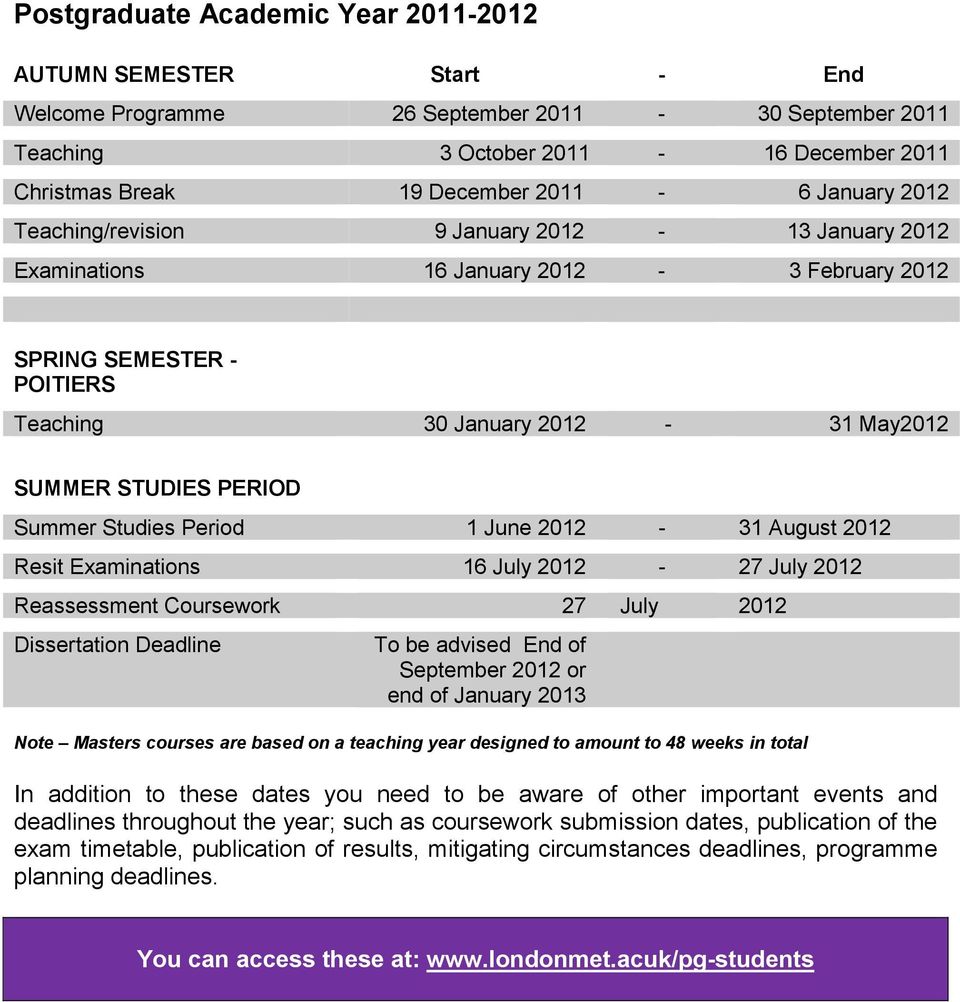
2 Postgraduate Academic Year AUTUMN SEMESTER Start - End Welcome Programme 26 September September 2011 Teaching 3 October December 2011 Christmas Break 19 December January 2012 Teaching/revision 9 January January 2012 Examinations 16 January February 2012 SPRING SEMESTER - POITIERS Teaching 30 January May2012 SUMMER STUDIES PERIOD Summer Studies Period 1 June August 2012 Resit Examinations 16 July July 2012 Reassessment Coursework 27 July 2012 Dissertation Deadline To be advised End of September 2012 or end of January 2013 Note Masters courses are based on a teaching year designed to amount to 48 weeks in total In addition to these dates you need to be aware of other important events and deadlines throughout the year; such as coursework submission dates, publication of the exam timetable, publication of results, mitigating circumstances deadlines, programme planning deadlines. You can access these at:
3 1 KEY CONTACTS LONDON METROPOLITAN BUSINESS SCHOOL Course Leader: Gisele Guarisco Course Leader s Office: SH310 (Stapleton House) and MG608 (Moorgate) Course Leader s telephone number: Course Leader s address: [email protected] Course administrator: Rose Baillie Course administrator s office: SH126 Course administrator s telephone number: Course administrator s address: [email protected] Postgraduate Office: SH126 Administration Manager of the Postgraduate Office: Sara Carruthers Main Campus teaching location: North ESCEM POITIERS If you have any questions regarding non-academic issues please contact: Maggy Sourisseau International Student Exchanges Office A106, tel: / [email protected] If you have any administrative questions about the course please contact: Valérie Akerman Office A108 tel: [email protected]

4 If you have any questions regarding academic issues please contact: Peter Forte, the course leader of the programme in Poitiers, Office A120 tel: [email protected] 2

5 3 CONTENTS 1.0 WELCOME TO YOUR COURSE AND FACULTY 1.1 Using Your Handbook 1.2 Introduction to the Course 1.3 Key Features of Postgraduate Courses 1.4 Introduction to your Faculty 1.5 Location and Faculty Facilities supporting the course 1.6 Learning and Teaching on the Course 1.7 Research in your Faculty 2.0 BEING A STUDENT 2.1 Welcome Programme Checklist 2.2 Your first semester 2.3 Attendance, academic engagement and employment 2.4 Studying 2.5 Building Careers 2.6 Enrolment and Re-enrolment 2.7 Credit for previous learning 2.8 Module registration, course planning and approval 2.9 Your Timetable 2.10 Publication of Results and Transcripts 3.0 MANAGING YOUR ACADEMIC LIFE ON-LINE 3.1 Your University IT Account 3.2 Communication 3.3 Your Contact Details 3.4 Evision 3.5 WebLearn Online module resources 3.6 StARS 3.7 Course Committees 3.8 Students views on modules and courses 3.9 Postgraduate representation through the Students Union 4.0 SOURCES OF INFORMATION AND ADVICE 4.1 Postgraduate Office 4.2 Postgraduate Course Leader 4.3 Module Lecturers 4.5 Student Success through Learning Development 4.6 Student Services 4.7 Disabilities and Inclusion 4.8 Placements/study abroad 5.0 DISSERTATION OR PROJECT 5.1 Registration 5.2 Supervision Arrangements 5.3 Topic approval 5.4 Planning and Timing 5.5 Submission 6.0 MARKING AND ASSESSMENT 6.1 Academic Regulations 6.2 Marking and grades 6.3 Your responsibilities concerning Assessment 6.4 Academic Misconduct 6.5 Assessment Feedback 6.6 Submission of coursework 6.7 Examination Timetable

6 6.8 Past Examination Papers 6.9 Mitigating Circumstances 6.10 Assessment Board Appeals 6.11 Action in the event of failure to pass a module 6.12 University Criteria for Awards 6.13 Withdrawal from a module 6.14 Intermission of Studies 6.15 Mode of Study 6.16 Course Transfers 7.0 STUDY RESOURCES AND FACILITIES 7.1 Libraries and Special Collections 7.2 Academic Liaison Librarians and Subject Guides 7.3 Student feedback 7.4 ICT Services and Media Resources 7.5 Open Language Programme 8.0 COURSE SPECIFICATION 9.0 USEFUL INFORMATION 10.0 DIRECTORY OF MODULES FOR THE COURSE 11.0 INDEX OF KEY SOURCES OF INFORMATION 11.1 Relevant University Procedures 11.2 Useful online information 4

7 1 1.0 WELCOME TO YOUR COURSE AND FACULTY This is the Course Handbook for the MA International Marketing Communications. The staff of the London Metropolitan Business School warmly welcome you to London Metropolitan University and to the study of International Marketing Communications. 1.1 Using Your Handbook Your Course Handbook contains a wealth of information. Some of it will be of more relevance to you later in the course than at the start of your studies. You can access your Course Handbook either by logging into your Evision account or via the University s website at: We recommend that you read this Course Handbook thoroughly and carefully, as it covers many of the questions you will have about your course. Sections 3 and 4 in particular will help you locate the advice you will need. Section 11.1 contains an Index of key sources of information that you may need to access during your course. For more detailed information you will sometimes need to consult other sources, including: University Student Handbook - for details of important University regulations and procedures. It also provides information on university life and the support services available. The University Student Handbook can be accessed at: PostGrad-Line a comprehensive on-line source of postgraduate course and module information available at: Postgraduate students webpage a comprehensive on-line resource for postgraduate students. Provides information about your course, timetables, details of timeslots and room numbers for most taught modules. Once you have completed enrolment and registration, you can view and print your personal timetable Please see: The Course Specification (Section 8 of this handbook) defines the key features of your course, its aims, structure and learning outcomes, and includes all the modules you must study for the award. All postgraduate courses are governed by the University s Academic Regulations ( It is your responsibility to be fully aware of the regulations which govern your studies as a postgraduate student of the University. Your course may in addition have some course specific regulations or may be governed by a Professional Body. Where relevant these are included in paragraph 32 of the Course Specification, contained within Section 8 of this handbook. You should also note that occasionally, the details in this Handbook, including the Course Specification, may be amended or revised, in order to improve the Course. The University is reviewing postgraduate education as part of its commitment to enhancing learning. This will not affect full-time students completing in September However, it is possible that this may affect a small number of part-time students. In the event of this occurring, any students affected will be advised during We would encourage you to participate as a Student Representative (see Section 3.6). We welcome your comments about the course or any suggestions for improvements. We wish you every success in your studies.

8 2 1.2 Introduction to the Course The MA in International Marketing Communications is an international programme which will offer you considerable variety in terms of course content, thematic approaches and teaching and learning styles. The philosophy of the programme is to provide an advanced education in International Marketing Communications to those who have studied business or some comparable subject as an undergraduate, or to those who have not studied business but who have significant work experience. The programme is designed to enable you to study a range of modules whose themes lie at the heart of international marketing communications management and practice. You will also write a dissertation on a related topic of your choice and have the opportunity to undertake a work internship. Perhaps most significantly of all, you will enjoy the benefit of conducting part of your studies in another country. We expect that the diversity of cultural backgrounds of the student body, together with the opportunity to study in two distinctive learning environments, will contribute significantly both to the global themes within the curriculum and to the overall student experience. The course is structured as follows: During the Autumn semester you will be based at London Metropolitan University where you will study three core modules in Marketing Communications, Marketing Research and Service Sector Marketing. During the Spring Semester you will be based at the ESCEM School of Business and Management in Poitiers, where you will study eight modules which develop various themes of marketing communications in an international context International Sales & Negotiation, Public Relations, International Brand Management, International Advertising, New Media Marketing Communications and Web design, Sponsorship, Digital Communications Management and Corporate Strategy. During the summer you will have the opportunity to undertake a work internship and will commence work on your dissertation. Different aspects of the course structure are explained in more detail in the pages which follow. The course is known at ESCEM, and increasingly in London, as IMCo. 1.3 Key Features of Postgraduate Courses The Course Specification (see Section 8) details your course curriculum and structure and you should study this carefully. Many features are defined by the Postgraduate Regulatory Framework, part of the University s Academic Regulations (see Section 11.1 of this handbook for details), which sets out general features common to almost all Masters courses. (i) Full-time students starting Masters programmes in the Autumn semester are taught over a 48- week year (an autumn and a spring semester and a summer studies period), requiring approximately 40 hours of study per week. For full-time students starting courses in February the workload is similar but is distributed over a longer study period and normally completed at the end of the following Spring semester. Part-time students undertake the equivalent overall workload over a longer period of study, normally at least two years. (ii) The standard Masters award requires 180 credits at level M: normally 120 credits for the taught elements and 60 credits for the Dissertation or Project. There are some exceptions to the rule, such as specified Masters courses in Human Resource Management, which require 180 credits, and the MBA at 220 credits.
9 3 (iii) Most postgraduate modules are equivalent to 20 credits. Typically, a full-time student studies modules equivalent to 60 credits per semester (normally 3 modules), with 15 weeks of teaching, revision and assessment activities for each module. (iv) The taught elements of postgraduate courses are mainly compulsory core modules and normally include one concerned with research methodology and project development and practice, in preparation for the dissertation or project. Some courses may include designate modules, which can be chosen from a specified list for the course, or elective modules, which can be chosen from any available at postgraduate level. (v) All taught modules and the dissertation or project module, are marked on a percentage scale, with a pass/fail threshold of 50%. (vi) Based on the final aggregate of average percentage results, Masters awards are graded as: Masters (50-59%), Masters with Merit (60 69%), or Masters with Distinction (70% plus) (vii) While most students will aim to achieve the full Masters qualification, all Masters courses offer the subsidiary awards of Postgraduate Certificate or Postgraduate Diploma (both available with Merit or with Distinction) for students unable to complete their full programme of study. The full list of awards and their requirements is as follows: Award Credits at level M Modules Required Masters 180 credits (Level 7) 6 modules + dissertation (60 credits) Postgraduate Diploma 120 credits (Level 7) 6 modules Postgraduate Certificate 60 credits (Level 7) 3 modules 1.4 Introduction to your Faculty Following its launch in August 2007, London Metropolitan Business School (LMBS) is now one of the largest Business Schools in Europe with ambitions and capabilities to match this international profile. With approximately 200 full-time academic staff, over 9,000 students, and over 100 courses at undergraduate and postgraduate levels, the formation of LMBS has enabled us to build on our already well established reputation as one of the largest and most successful providers of business and management education in the country. The School is located across both University campuses and we are the only UK business school located in the city of London. Our vision is to be the leading international business school in our chosen markets, through innovation and the development of global networks. Our mission is to enable individuals and organisations to realise their potential through the provision of excellent business and management education. LMBS offers an extensive range of undergraduate, postgraduate, professional and executive courses within eight subject groups. These are: Accounting and Business Law Business Analysis, Information Systems, Transport and Logistics Economics Finance and Financial Services Human Resource Management Management, Strategy and Leadership Marketing and Communications Tourism, Sport and Creative Industries

10 4 We currently offer over 60 postgraduate courses in the above subject areas. In addition to general business and management courses such as the MBA and MA Management, there are more specialist courses in disciplines such as financial derivatives and corporate governance and courses serving specific industry sectors such as events management and transport. We also award Professional Doctorates and PhDs. We regularly review our course portfolio, and recent new postgraduate courses have included Aviation Management, Project Management and Digital and Experiential Marketing. A number of our courses are run jointly with Business Schools in Europe, Asia and North America so that students have the opportunity to study in two countries and even obtain dual awards. Currently postgraduate students account for 30% of our student body and we aim to continue to be a provider of first choice for postgraduate/post-experience study. 1.5 Location and Faculty Facilities supporting the course LMBS is based on both campuses. At the City campus, the School is located in the Moorgate building. At the North campus, the School is located in Stapleton House. Teaching mainly takes place in these buildings but large classes may be timetabled in other University buildings on the respective campuses. A key feature of the LMBS student experience is the provision of resources to enhance learning. As well as well-stocked libraries and modern ICT labs using cutting-edge technology, our facilities include a Bloomberg Research Trading Room where you can get hands-on experience of a dealing room, and a flight simulator on which aviation students can get experience of landing an aircraft. All courses are supported by a virtual learning environment, Weblearn, and we continue to invest in learning materials and platforms. Currently we are working with our counterparts at the Universities of Cambridge and Nottingham to develop electronic learning resources. Accommodation and facilities for students at each site include lecture theatres, classrooms, learning resources, administrative and student support facilities and refreshment and social facilities. At Moorgate and Stapleton House you can also find the offices of our employer engagement unit Business Works - which has links with a large number of companies and organisations and can assist students to obtain work placements and internships. Business School students also benefit from the modern facilities in the wider University. These include the Graduate School, designed by the world renowned architect Daniel Libeskind, and new sports and fitness facilities located in the state of the art Science Centre. 1.6 Learning and Teaching on the Course LMBS endeavours to provide students with an excellent learning experience that is current, academically challenging and vocationally relevant. An emphasis is also placed upon developing students personal transferable skills and attributes in order that they can progress to rewarding careers. We work in partnership with students to develop their knowledge and skill set, provide valueadded experiences, and enhance their future employment opportunities. From this year, students will be required to prepare, in conjunction with their tutors, and where appropriate their employer, a personal development plan as part of their studies. There is also a programme of study skills support and cultural orientation workshops for the first few weeks of the semester. It is important that students avail themselves of the opportunity these provide for preparing for advanced study at postgraduate level. The most recent subject review of our teaching, student support and course provision by the UK Government s Quality Assurance Agency awarded business and management education top marks and so placed it in the top 5% of UK Business Schools. In addition, the School s commitment to teaching has been recognized nationally and is reflected in the award of National Teaching Fellowships, Lecturer of the Year, and other awards to staff.

11 5 The Business School also has strong links with employers and professional bodies. We encourage students to take advantage of opportunities for gaining work experience whilst on their course. To this end our Business Works unit has extensive links with industry and can assist students in obtaining placements and internships. Recent employers we have worked with include Air France, Arsenal Football Club, Barclays Bank, BBC Worldwide, Chester Boyd, HSBC, Limelight Projects, Orient Express and the Hilton Hotel Group. We can also help students secure work experience abroad. Recent overseas based employers of our students include: Disney Florida and Paris, Rail Europe, DICR Europe Ltd, Eurocity Consultants (Brussels), Dunas Hotel (Grand Canaria), Siemens (Germany), Orient Express Hotels and Trains and Cruises Worldwide. Professional bodies we work with include the Association of Chartered Certified Accountants, Chartered Institute of Management Accountants, Chartered Institute of Marketing, Chartered Institute of Public Relations, Chartered Institute of Purchasing and Supply, Chartered Institute of Personnel and Development, British Academy of Management and Royal Aeronautical Society. Many of our courses lead to membership of these and other professional bodies. Our graduates can be found working in many countries and in all sectors of the economy. Some of the organisations where our students have found employment include: BP, Coutts Bank, Daiwa, Deloitte and Touche, Deutsche Morgan Grenfell, Forte UK, Marks and Spencer, Rank Xerox, Royal Bank of Scotland, and Virgin. Course leaders and other faculty members can often provide information leading to important contacts with prospective employers. 1.7 Research in your Faculty Research is a very important aspect of the Business School s work. It underpins the curriculum, sustains excellence in our teaching, supports consultancy, promotes relations with national and international partners and sustains an academic and intellectual ethos within the School. Research in the Business School is wide ranging in terms of the issues we address. We are, however, developing a distinctive profile and reputation around a number of research themes which characterise our mission, values and subject strengths, including financial services, entrepreneurship, social enterprise, cultural and creative industries, world markets, governance, sustainability, corporate social responsibility, employment and equal opportunities, business analysis, professional and managerial practice and pedagogy. Through multi and inter-disciplinary research we can address real-world problems which are rarely amenable to single disciplinary solutions. Our partnerships with corporate, public sector and other educational organisations also provide us with a strong base for carrying out policy and practice-based and transnational research. Research in the Business School is mainly organised around a number of Research Centres. Currently these are: Cities Institute Management Research Centre (MRC) Comparative Organisation and Equality Research Centre (COERC) Centre for International Business and Sustainability (CIBS) Centre for Corporate Responsibility (CCR) Transport Research and Consultany (TRaC) Centre for Research in Marketing (CERMARK) Centre for Business Education Research (CEBER) Centre for Research in Cultural Industries Management (CeRCIM) Centre for Europe, Middle East and Africa (EMEA): Banking, Economics and Finance Centre for Research in African Business (proposed) These Centres undertake pure and applied research and consultancy in their fields. They also organise workshops, seminars and conferences, often with a strong international dimension, produce working papers and reports and publish articles in academic and practitioner journals. Senior staff are also represented on the editorial boards of these publications.

12 6 Our research activity is funded partly by the University itself, and partly externally by bodies such as the European Commission, UK Research Councils, Trusts and Foundations. We also carry out applied research and consultancy for a range of clients in the public, private and voluntary sectors. Some examples of our many recent and current projects and research areas are: Employee reward policy and practice trends internationally Current trends in expatriation practice Equality, diversity and inclusion in the workplace Visitor research in London s Royal Parks Voice and value debates and knowledge dissemination Nonprofit, social and arts marketing Digital and internet aspects of fundraising Role of tourism in poverty alleviation in Africa and SE Asia Monetary rules for the open economy Central Bank independence and economic performance in industrial and developing countries Learning, jobs, human capital and growth Pricing American-style derivatives Corporate rules, distributive justice and efficiency Corporate Social Responsibility in UK local authorities IT governance and business intelligence Analysis of business success in London s Olympic zone and hinterland Foreign direct investment and political stability Economics of film production and distribution Analysis of problem-based learning in economics teaching General equilibrium model for credit and market risk Japanese management practices Management implication of NHS reforms Trends in HRM in the Nigerian employment system Diversity and equality in the voluntary sector Leadership styles and their impact on corporate social responsibility Communication of new product development in firms Factors influencing the internationalisation of retailing firms Patient satisfaction in public and private health care Enterprise education for black minority ethnic young people Visitor management strategies in tourism Online consumer behaviour in the hospitality sector Sustainable tourism indicators for the Caribbean There are often opportunities for students themselves to participate in this research and inspiration for students dissertation topics can often be found by discussing such research projects with tutors. If you would like to know more about the work of the research centres and Institutes in the University, speak to your course leader. The Business School offers postgraduate students many opportunities to extend their academic and professional development beyond the immediate boundaries of their course. In addition to work placements and internships, there are regular conferences, seminars and workshops, presentations and talks by outside speakers, industry and professional body events, student competitions and business challenges, visits and social activities. You are encouraged to engage in these activities which will add value to your CV. Details can be obtained from your course leader and from the LMBS web pages.

13 7 2.0 BEING A STUDENT Undertaking study at postgraduate level is likely to involve new and different methods of working compared to your previous experience. You will study more specialised subject matter at a more advanced level, relatively quickly and over a shorter period. You will be expected to pursue your studies with a greater degree of independence than at undergraduate level and to set your own learning objectives within the framework of the course. The remainder of this section highlights the general features and expectations associated with postgraduate study. 2.1 Welcome Programme Checklist Following the Welcome Programme and Course Introductory Meeting, you should check that you have received the following: an ID card (including library number and computer network username) an address a course timetable the location of your Postgraduate Office the location of your Faculty Administrative Office the location of your main learning centre and IT facilities the name of your Course Leader If you arrived late you will still need to obtain the items above and there will be a late Welcome session for you. Contact your designated Postgraduate Office to ensure you know what to do and where to go to get started. Classes commence from Monday 3 October 2011, immediately following the Welcome Programme. 2.2 Your first semester After your welcome, you will find yourself in the first week of formal teaching, where you will meet the module lecturers, who will often be giving the main lecture for the module, and other teaching staff, who may be taking seminars or workshop groups. In this period you will also undertake an induction process/programme which will normally last between 1-3 weeks depending upon your course, which will help guide you through your semester and prepare you for your Masters Level course more generally. This induction period will be specifically designed with your disciplinary area in mind and will be different from course to course. However, at course level you should expect to receive information on the following as a minimum: a) Welcome and Induction by Course Leader to the course b) Introduction to course materials and handbooks c) Guidance on student/staff roles, rights, responsibilities and expectations d) Further support with understanding any timetabling information e) Course specific requirements regarding Library etc f) Role of the Postgraduate Offices g) Any Health & Safety requirements e.g. Lab protocols h) Specific Study Skills as necessary i) Mitigating Circumstances j) Policy on Plagiarism k) Personal Tutorial arrangements l) Election of Student Representatives (STARS) In addition, your Course Leader will be able to point you in the direction of other introductory materials or sessions run by other University departments, for example, Library Services, Student Services or the Students Union.
14 8 This induction schedule will culminate in one of two social events hosted by the University and the Students Union. These will take place three weeks into your first semester and you are welcome to attend one of these sessions which will be held at both campuses. Your first semester usually involves mainly compulsory (core) modules covering essential subject contents and skills elements in your area of study. During this first semester you will meet with your Course Leader who will discuss your study programme and advise you on how to plan your studies for the second semester if you did not do this at the start of the course. 2.3 Attendance, academic engagement and employment Your success depends upon full and regular attendance at all classes, seminars, lectures, workshops, tutorials and the completion of all of your module assessment(s), including your dissertation. Our records show that students who do not attend all their classes are at very high risk of failure. The University s Academic Regulations make it clear that attendance and full academic engagement are requirements of your registration on your course. The content of modules is progressive, so if you miss a session you will need to catch up. However, we do recognise that for some postgraduate students there may be occasions where your absence is unavoidable; in such circumstances, we strongly recommend that you contact your Course Leader or Module Tutor/Lecturer. If you are having ongoing difficulties with attendance or committing fully to your postgraduate studies please contact your Postgraduate Office for advice on what to do. Please note - for international students, the University is required by the UK Border Agency (UKBA) to confirm that you are in regular attendance. The University looks carefully at the evidence of your attendance and academic engagement and full-time students who fall below these requirements can find themselves being moved to a part-time programme. This can have serious implications for you and your course. In the case of part-time students, if you fail to meet attendance and academic engagement requirements the University may withdraw you from some of your modules. In some circumstances this can also lead to you being required to leave your course. We recognise that you may need to undertake part-time work, but strongly advise you not to take employment of more than 15 hours a week if you are a full time student (should you need to take employment of more than 15 hours per week we recommend you register as a part-time student). The University s Employment Service, in Student Services, can help you find a suitable part-time job that can enhance your employability and complement your studies. ( 2.4 Studying As a postgraduate student, you will be seeking to develop your learning at more advanced level and your course will provide many opportunities to acquire new knowledge and skills. To make the most of these you will need to develop a strategy for your studies, planning ahead, managing your time effectively and reflecting on your learning. Assessment is an important feature of study at postgraduate level. Each module booklet sets out detailed assessment requirements and learning outcomes, providing a focus for your studies. There are various forms of assessment and modules often involve a combination of examination and coursework or presentation. It is important that you understand clearly the expectations and deadlines for each item of assessment. You should be aware that all the various coursework assessments and examinations have to be completed for the achievement of your final award. In addition to attending the timetabled sessions, you will need to study in your own time. You should expect to spend hours per week on each module, making a 40 hour per week commitment for a full-time student. Part-time students need to plan a similar time commitment for each module, but will generally be taking fewer modules at any one time.

15 9 Independent study is particularly important when planning work for your dissertation or project. This is a substantial piece of work, to be developed and completed over a relatively lengthy period, with much of the writing concentrated in the final stages. Working closely with your assigned supervisor, you will need to plan your work carefully, with initial discussion to define the topic, preparatory research and reading, planning the structure of the research and final report, writing and re-writing particular sections and drafts. Please be respectful of the learning environment and remember to switch off your mobile phone before entering all classes and study areas. In summary: plan your learning strategy; allocate enough time; attend all of your module lectures, tutorials and other sessions; start assignments well in advance; seek advice and help when you need to; use the learning resources offered; and, enjoy the learning experience! 2.5 Building Careers At London Metropolitan University we pride ourselves in taking seriously your future employment potential. Whether you are studying for a postgraduate qualification in order to seek employment, developing an existing career or to engage with new career opportunities we will prepare and support you in this transition by developing the attributes and skills that employers need and by training your mind to deal with complex questions. Your course has been designed with the involvement of employers at a variety of levels and for many of you, your award will be accredited by a professional body recognised directly or indirectly by the industry to which it serves. All Masters level qualifications will enable you to specialise or to become more highly specialised in an area of employment or practice related to a particular profession. All of our Masters graduates will normally be equipped to continue academic study at a higher level, for example for a PhD or a professional doctorate. Graduates of a Masters level qualification will typically develop a range of key skills including: being able to use initiative and take responsibility, solve problems in creative and innovative ways, make decisions in challenging situations, continue to learn independently and to develop professionally, including the ability to pursue further research where appropriate, and communicate effectively, with colleagues and a wider audience, in a variety of media. These skills have been identified by the government as being critical in curtailing the continued shortage of higher level skills within the wider UK economy and we believe that you will be best placed following graduation in developing your career aspirations. You need to be effective and adaptable in challenging times, so we offer a range of services to support you including a career planning service. To see more details on how we prepare you for employability visit: Enrolment and Re-enrolment Enrolment is an annual process. The first time you enrol you will need to provide evidence of your identity and the qualifications which formed the basis of your offer from the University. You will also need to pay your tuition fees or demonstrate how these will be paid. The University ID card you receive at enrolment contains your library number and computer network username and allows entry to the University s buildings. Provided you fully completed the enrolment requirements your card should work throughout the year. If it stops working then please seek advice from your Postgraduate Office. By signing the enrolment form you confirm that you accept and will follow the University s regulations If you are studying on a part-time basis over more than one academic year or need to return to complete your studies, you will need to re-enrol online usually from around mid-august. Re-enrolment is necessary for your ID card to be reactivated for the new academic year. There will be a deadline for this so it is important that you complete this before the start of the next academic year.

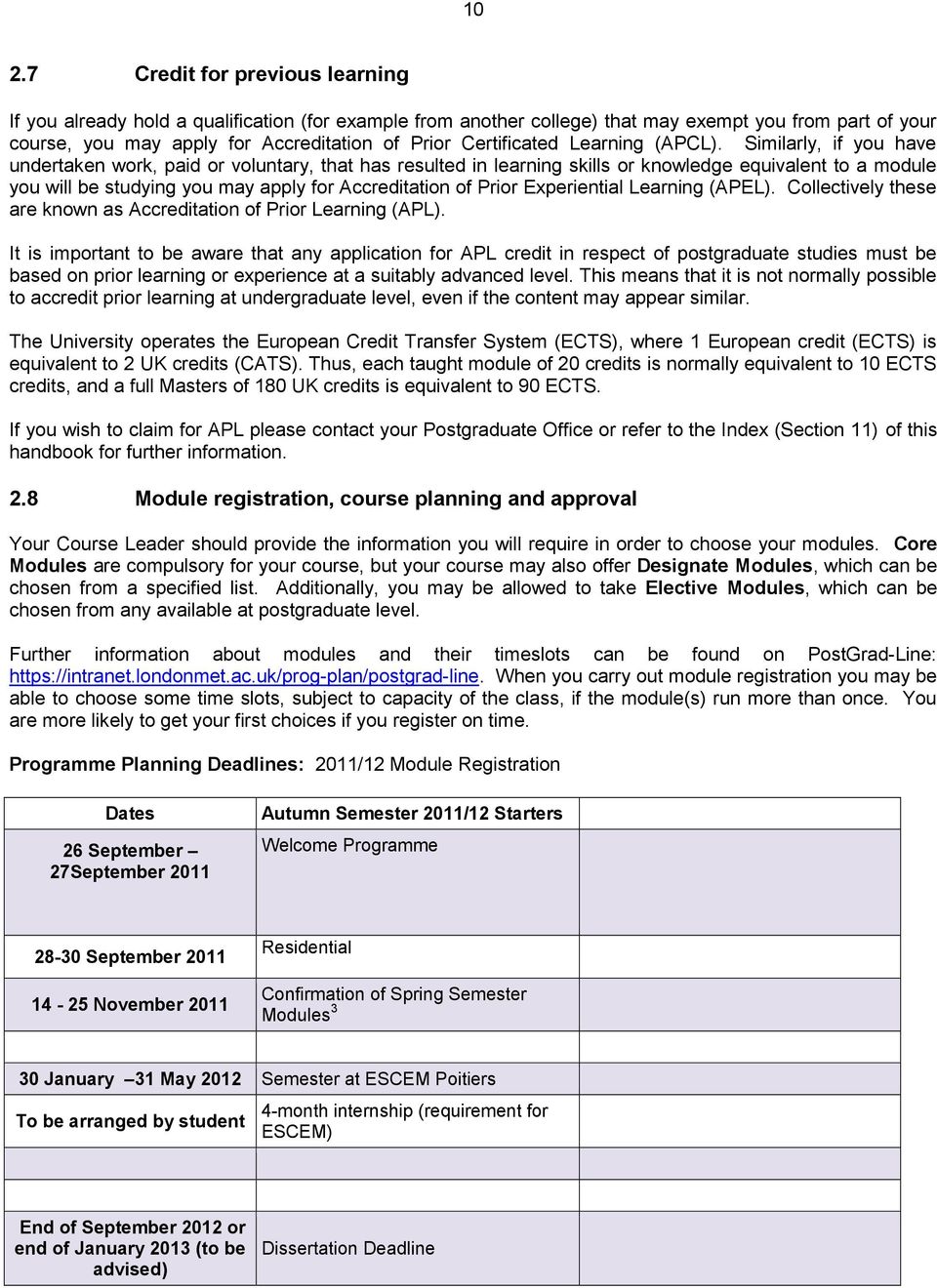
16 Credit for previous learning If you already hold a qualification (for example from another college) that may exempt you from part of your course, you may apply for Accreditation of Prior Certificated Learning (APCL). Similarly, if you have undertaken work, paid or voluntary, that has resulted in learning skills or knowledge equivalent to a module you will be studying you may apply for Accreditation of Prior Experiential Learning (APEL). Collectively these are known as Accreditation of Prior Learning (APL). It is important to be aware that any application for APL credit in respect of postgraduate studies must be based on prior learning or experience at a suitably advanced level. This means that it is not normally possible to accredit prior learning at undergraduate level, even if the content may appear similar. The University operates the European Credit Transfer System (ECTS), where 1 European credit (ECTS) is equivalent to 2 UK credits (CATS). Thus, each taught module of 20 credits is normally equivalent to 10 ECTS credits, and a full Masters of 180 UK credits is equivalent to 90 ECTS. If you wish to claim for APL please contact your Postgraduate Office or refer to the Index (Section 11) of this handbook for further information. 2.8 Module registration, course planning and approval Your Course Leader should provide the information you will require in order to choose your modules. Core Modules are compulsory for your course, but your course may also offer Designate Modules, which can be chosen from a specified list. Additionally, you may be allowed to take Elective Modules, which can be chosen from any available at postgraduate level. Further information about modules and their timeslots can be found on PostGrad-Line: When you carry out module registration you may be able to choose some time slots, subject to capacity of the class, if the module(s) run more than once. You are more likely to get your first choices if you register on time. Programme Planning Deadlines: 2011/12 Module Registration Dates 26 September 27September 2011 Autumn Semester 2011/12 Starters Welcome Programme September November 2011 Residential Confirmation of Spring Semester Modules 3 30 January 31 May 2012 Semester at ESCEM Poitiers To be arranged by student 4-month internship (requirement for ESCEM) End of September 2012 or end of January 2013 (to be advised) Dissertation Deadline
17 Your Timetable The University timetable operates from 9.00 am to 9.00 pm, Monday to Friday. You will be given a course timetable at the Course Introductory Session. This gives timeslots and rooms for all modules on your course. Once you have registered your modules you can get a print out of your individual timetable for the current semester at: Your timetable will change each semester, and will be available on the web shortly before the start of each semester. If you do not have a course timetable please contact your Postgraduate Office without delay Publication of Results and Transcripts At the end of each semester Assessment Boards confirm marks and awards. The Postgraduate Offices are responsible for providing these results to you via Evision. (refer 3.4 below) An official transcript will be posted to you at your home address on the completion of your course. There is no charge for this end of course transcript but a fee will be payable for any subsequent transcripts. For reason of employment or to provide proof of study at the University during your course, you may need a formal transcript, stamped by the Postgraduate Office. There is a fee for these transcripts, payable at the time of request. Requests should be made to the Postgraduate Office, who aim to produce transcripts within 5 working days of request.
18 MANAGING YOUR ACADEMIC LIFE ON-LINE 3.1 Your University IT Account You use the same account to access all University IT systems. Your account name is printed at the top of on the ID card that you receive at enrolment and is 7 characters in length (e.g. ABC1234). Your password will be set initially to be your date of birth (DDMMYYYY) so you should change to something secure when you first log in. You can change your password and set details for resetting your password at: Communication We do our best to keep you informed of what you need to know at all times. We use the Web to provide much of the information you need so it is essential to familiarise yourself with the University website. At other times we will use to contact you so it is essential that you check your University on a regular basis. 3.3 Your Contact Details The University will contact you by letter, phone, or , perhaps to arrange a meeting, to provide you with information, or to respond to a query. It is therefore essential that you keep your contact details up to date on your student Evision account. Increasingly, we use to communicate and keep you informed. You will also have been allocated a University address, which is your 7 character account (see 3.1 above) e.g. [email protected]. Even if you already have an account that you will continue to use you should regularly check your London Met account or set up an auto forward, as important messages will be sent to your University address. 3.4 Evision Evision is the University s online facility that allows you to access your personal student record, and is where you print your coursework coversheets and other forms that you may need. You also re-enrol via Evision and view information showing your attendance at classes. You can view your: Personal and contact details (can be updated online) Registered modules Enrolment and progression Tuition fee details Record of coursework deadlines and submissions Mitigating Circumstances decisions Module results (available from notified date of publication) Details of final award For more information please check: WebLearn Online module resources WebLearn provides online support for your modules, enabling you to communicate with your tutor and other students. Course materials, information and assessments are available on WebLearn as well as study programmes materials and such as Writing and Communicating at University. WebLearn requires your user name and password and can be accessed at:

19 13 THE STUDENT VOICE 3.6 StARS Feedback from students is vital to the University to find out how well the teaching, guidance and other services are working. This is obtained in different ways, including via Student Academic Representatives (StARs) who, supported by the Students Union, provide direct feedback from students on the course and raise any issues on their behalf. You will have the opportunity to stand for election as a StAR or to elect a fellow student. 3.7 Course Committees A Course Committee is normally convened each semester to review a set of modules and courses and provide quality assurance. Key staff, including module and course lecturers, attend these meetings and student input is received via your StARs. 3.8 Students views on modules and courses Students views are obtained by a variety of means such as focus groups and web-based questionnaires. While staff welcome informal feedback from students, module lecturers will produce formal monitoring reports which cover areas such as teaching, student feedback and assessment. Reports and action points agreed are available from both module and course reviews. 3.9 Postgraduate representation through the Students Union The University is proud to work with the Students Union which now has a Postgraduate Officer whom you may wish to contact about any student, pastoral or social issue. To contact the Students Union please access:

20 SOURCES OF INFORMATION AND ADVICE 4.1 Postgraduate Office The Postgraduate Office is the key administrative service to support you in your studies throughout your time at the University. You will be assigned to the Postgraduate Office linked to your course, normally in the building where the subject teaching staff are located. It will be here that you go with timetable queries, to plan your modules, to hand in your coursework, to collect letters you may need, and to ask any questions about your studies. You should also contact your Postgraduate Office in relation to the following issues: Queries about your enrolment status or the fees that you have been charged; Queries about your timetable or the modules that are registered for you; If your ID card is not working; Submit a module query, a claim for mitigating circumstances, an appeal, or get advice about examination arrangements; Advice on claiming credit for previous study or experience; Help you contact your course leader; Obtain standard letters and council tax exemption certificates; Visa extension letters for international students; Advice on the consequences of withdrawing. Each group of courses has a Course Administrator and you will become familiar with them throughout your time at the University. Your Postgraduate Office will also contact you if you are missing classes or not submitting work on time. The offices are normally open throughout the academic year but can also be contacted by phone or see When contacting your Postgraduate Office, please always quote your student number as it enables staff to access your information quickly and so respond to your query. 4.2 Postgraduate Course Leader Course leaders are the main contacts for personal academic advice, including programme planning and approval, and are also responsible for the day-to-day organisation of their course and liaising with academic and administrative staff. They can be a source of valuable advice for other matters also and should be tour first port of call if problems arise. They are able to: provide you with academic advice on all aspects of your studies and progress explain the implications of assessment results and associated feedback on your academic performance advise you on managing and planning your studies; refer you to Student Services for support regarding personal problems, housing, health and finance Your Course Leader can also write you a reference, for a job application for example. 4.3 Module Lecturers Module lecturers are members of academic staff who lead the modules contributing to your programme of study and are key to your learning experience. They should be your first port of call for advice on any topics you do not understand following a lecture or seminar. All Module lecturers have office hours these are set times during the week when they are available for consultation. For each module there will be a Module Booklet.

21 15 Gisèle Guarisco Course Leader MAIMC London Room Ext MG SH Rose Baillie Course Administrator SH 403b 3823 Dr Marwa Gad Mohsen Dr Diana Luck Dr Graham Hankinson Jan Bamford Dr Marwa Gad Mohsen Module Leader Marketing Research Module Leader Marketing Communications Module Leader Service Sector Marketing Institutional Liaison Tutor LMBS/ESCEM Module Leader Dissertation SH uk SH 108a 3873 SH SH 108b 3894 SH uk 4.5 Student Success through Learning Development Some students may need extra help with their studies, sometimes for a particular module or, more generally, across their programme. This might include help with presentations, essay writing and critical analysis. It is always best to seek help in good time and to take advantage of the range of additional classes, courses and resources available. For the full range of study and skills programmes and to find out more about the Learning Development Unit, please visit: Student Services We provide a range of advice, information, guidance and counselling services to support you in achieving your academic aims, We provide advice on issues including. Academic Financial Personal Faith Careers/employment Disability Accommodation Student development Extra curricular activities Visit our web site to find out how we can help you make your time at London Met both enjoyable and successful 4.7 Disabilities and Inclusion The Student Advisers (Disability and Inclusion) can assist you if you have a disability, long-term medical or mental health condition or Specific Learning Difficulties (e.g. dyslexia). Support can include: Special examination arrangements
22 16 Help with finding an academic support worker Screening if you think you have a Specific Learning Difficulty Assistance to apply for study-related funding If you are eligible for support, the Advisers can help you obtain a range of adjustments depending on the level of need identified. This may include: Practical Assistance: specialist tutors (specific learning difficulties), note-takers, or communication support Specific Adjustments to Study-Related Services: extended library loans (week loans only) or accessibility related rooming adjustments Teaching-Related Adjustments: internal needs assessment report to identify needs to Academic Staff Assessment Specific Adjustments: exam adjustments, coursework certificates or alternative assessment arrangements. Please Note There are some aspects of course assessment that cannot be changed. These are known as competence criteria. To be identified as competence criteria the assessed items must be essential to the course and all students must be able to fulfil these criteria. Although in such situations it may not be possible to alter the format of the assessment, you may still be entitled to adjustments (e.g. extra time or an amanuensis). Placement support If you are required, as part of your course, to go on placement, we can provide assistance to ensure that the placement is suitable for you and for any required adjustments to be discussed and organised as appropriate. You may be entitled to government allowances. You are strongly advised to contact us for help with funding applications. For full information on the types of funding available: Placements/study abroad project Boost your career with an accredited professional work placement You will be aware that in addition to qualifications, relevant professional experience can help you progress in your career. Employers are interested in graduates who have extended their learning experience by practically applying academic knowledge in the workplace. BusinessWorks at LMBS offers students the opportunity to take an assessed work placement project within their postgraduate degree programme to enhance their professional knowledge and competencies. 20 credit work placement project optional module (MNPW89N) This elective module requires you to undertake a 30 day or 210 hours work-based project in a working environment related to your subject, either during the summer or part-time during the semester. Often students are able to use their current employment for the module or can work with a Careers Consultant to help them find suitable experience. The assessment leads you to explore the business environment through the application of academic knowledge, to reflect upon your personal development and consider your future career plans. BusinessWorks has offices at both North and City campus. In addition to assisting students with work placements, we provide guidance on how to access a variety of self-development opportunities to help you develop essential professional skills and enjoy your time at University.
23 17 Moorgate: Rooms MGS Tel: / 1671 / 1461 Stapleton House: Room SHG-36 Tel: / Follow us on [email protected] 5.0 DISSERTATION OR PROJECT 5.1 Registration You register for your Masters Dissertation or Project in the same way as for your other modules - see section 2.8 Module Registration, Course Planning and Approval. Once you are registered for your dissertation/project, you are expected to submit it in the period for which you are registered. The University s standard assessment arrangements and mitigating circumstances procedures apply (see below for information on withdrawal and mitigating circumstances). Formal requirements for your dissertation are set out in detail in the Dissertation/Project Module Booklet for your course. Please note that some postgraduate courses will require you to have passed research methods before you can begin your Dissertation/Project. The main aspects are summarised below: 5.2 Supervision Arrangements If you have registered through London Metropolitan University, you will be assigned to a supervisor during the course of the Spring semester, and once you have completed a satisfactory dissertation proposal. The dissertation proposal is written as an assessed coursework component of the Marketing Research module. The role of the supervisor is to act as a learning resource for the students. The amount of actual supervisory contact time will vary between disciplines but you should expect to receive as a minimum at least 4 hours contact with your supervisor. You are expected to actively engage with your supervisor, agreeing times and attending supervision sessions where practicable, but at least remaining in contact and responding to communications. General information and guidance on dissertation work is posted on the WebLearn site for the module. This is where London Metropolitan-registered students will first be advised of the name of their designated supervisor. Please note that supervision allocation arrangements may differ between campuses. London Metropolitan-registered students who are pursuing a work placement away from London should be prepared to maintain contact with their supervisor by or other suitable means. 7.3 Topic approval Choosing a good topic is a critical to the success of the dissertation. Students are expected to develop their own topics. They can come from any area of International Marketing Communications but they must be focused and realistic. Help is given in the Marketing Research module in choosing a topic and developing a research plan. Students should also consult one of the many useful text books on this subject, for example: Business Research Projects, A.D. Jankowicz, 2005 Thompson Learning. It may be that you will wish to consider changing your topic following completion of your dissertation proposal, perhaps as a result of the experience gained during your work placement. You should discuss this with your dissertation supervisor.
24 18 You should also consult the University s Code of Good Research Practice which can be accessed on the Graduate School s website at: to see whether these guidelines raise any issues for your own research, and discuss them with your supervisor You should also consult the University s Code of Good Research Practice which can be accessed at: to see whether these guidelines raise any issues for your own research, and discuss them with your supervisor. 5.4 Planning and Timing The dissertation proposal is written in the first semester of study. At the end of the second semester in Poitiers, students enrolled on the MA International Marketing Communications programme have a choice between 3 options: 1. Do their dissertation for the end of September 2012 and do their internship thereafter. 2. Do their internship first and start their dissertation in September to hand it in January Do the internship and the dissertation simultaneously and hand in the dissertation at the end of September Submission You must submit two copies of your dissertation/ project. One copy will be available for you to collect after marking and the other may be kept by the University, for reference. Both copies should be securely bound so that pages cannot easily be removed, lost or replaced. It is helpful if at least one of the copies is bound with front and rear boards rigid enough to hold the dissertation upright on a shelf, and has a navy blue cover with gold lettering. (Your Postgraduate Office can provide a list of thesis binders. You should expect to pay around per volume). The submission date will be at the end of September or at the end of January, depending on whether you elect to do your internship first and dissertation second, the other way around or the placement and the dissertation simultaneously. Dissertations/Projects must be submitted at your Postgraduate Office (If you have registered through London Metropolitan University) 6.0 MARKING AND ASSESSMENT 6.1 Academic Regulations The University s Academic Regulations govern all aspects of assessment and those concerning postgraduate assessment can be found in Section 4.2 ( 6.2 Marking and grades The University provides you with marks and grades for the work that you submit for assessment. The detailed requirements of assessment in each module are specified in module booklets, together with indicative assessment criteria associated with different levels of performance and results. Each component of assessed work is assigned a percentage mark with a pass/fail threshold at 50%.
25 19 At postgraduate level, degrees are awarded according to the overall average mark obtained for all modules and the dissertation, with classification thresholds for each grade of award as follows: 70% and above Masters degree with Distinction 60% % Masters degree with Merit 50% % Masters degree 0% % Fail At the end of each semester, module results and awards are confirmed by Assessment Boards (Subject Standards Boards and Awards Boards). Assessment Boards uphold the academic standards of your course and ensure that each student is treated fairly and equally through the assessment process. 6.3 Your responsibilities concerning Assessment You have a responsibility to ensure that all coursework assessments are completed in accordance with the published deadlines and that all examinations are attended in accordance with the published timetable. While there are opportunities to be re-assessed in assignments and examinations (see 6.11 below) you should be aware that, under the University s Academic Regulations, if you pass the module on reassessment your overall module mark will be capped at the bare pass mark level of 50%. 6.4 Academic Misconduct You are also responsible for ensuring that all work submitted is your own, and that it is appropriately referenced. The University does not tolerate cheating of any kind. You are strongly advised to familiarise yourself with the Academic Misconduct Procedures, which list a range of categories of academic misconduct and associated penalties, covering instances of academic misconduct (plagiarism, collusion, exam cheating). From the outset of your studies you should receive information and guidance on referencing conventions and group work activities and on how to ensure that you do not contravene the University s Procedures. If you are unsure about referencing, paraphrasing or group work activities, you should seek advice as soon as possible from the Module Tutor, your PAA or the Students Union. An interactive guide on preventing plagiarism containing student views on plagiarism, interactive demonstrations on how to reference and quizzes can be accessed at: Further information can be accessed at: Assessment Feedback Assessment feedback is a critical part of your learning experience and supports successful achievement on your course. Feedback can be: diagnostic it provides an indicator of your aptitude and preparedness for study and can identify your strengths and weaknesses. formative it provides you with feedback on progress on your work. The work may or may not contribute to the overall module grade. summative it provides a measure of achievement or failure in respect of your performance in relation to intended learning outcomes for a piece of assessment. During your course you will probably receive feedback in a number of different forms. in teaching sessions to the whole class or to you individually; orally or in writing; written using a feedback sheet on your work; during the module as well as at the end.
26 20 Your assessment tasks may be set for submission during the semester or towards the end of the semester. You should note carefully the following details For coursework submitted up to the end of teaching week 9 of a semester i) Your marked coursework and accompanying feedback should normally be returned to you during module sessions. Alternative arrangements may be made, for example, where the assessment involves bulky pieces of coursework. For coursework submitted after teaching week 9 of a semester i) Your tutor s feedback (without the coursework) will be available for collection either from your module lecturer or from the Postgraduate Office. ii) The marked work with your tutor s comments will be available for collection two weeks after the formal publication of the result. iii) Any unclaimed work will be kept for a period of 6 months following publication of the result, after which it will be destroyed. All arrangements for coursework and feedback return will normally be stated in module booklets. This should include: due dates for coursework submission; dates when coursework feedback will be distributed in class (for work submitted up to the end of week 9); dates when coursework feedback can be collected from the module lecturer or the Postgraduate Centre (for work submitted after week 9); the format by which assessment feedback will be given; the process by which coursework can be collected two weeks following the publication of the result concerned. 6.6 Submission of coursework When handing in coursework you must ensure that you have understood and followed all the instructions provided by the module lecturer. Your coursework should be accompanied by a securely attached barcoded coursework coversheet printed from Evision. Unless you are given formal guidance to do otherwise (e.g. for some design work or work to be submitted via WebLearn), written coursework must be submitted only to the Postgraduate Office in the building that the module is taught. Work handed in to tutors prior to, or on the confirmed coursework deadline date, does not constitute a valid submission and will not be processed. It is important that you retain both your submission receipt (this is an electronic receipt sent to your University address and also available to view on your Evision account) and a copy of the coursework until the results are published on Evision. Full details of the coursework submission process, including how to obtain coursework cover sheets, can be accessed at: Examination Timetable Examinations take place during Weeks 13, 14 and 15 of each semester and during the Summer Reassessment period in July. (See inside cover of this handbook for 2010/11 dates). The examination timetable is published three weeks prior to the start of each examination period at:
27 Past Examination Papers These are available online at: Mitigating Circumstances Students who are unable to attend an examination must contact their Postgraduate Office on or before the date of the exam. A claim should also be made under the procedures for Mitigating Circumstances which, if accepted, will result in an opportunity to redo the exam without penalty in the summer period. Students who are unable to submit coursework by the due date should also make a claim under the mitigating circumstances process but are also expected, where possible, to submit the assignment within two weeks of the due date with an explanation of the reasons for lateness. Students who do not submit assessment and do not notify the University of the reasons for this in advance will not be eligible for reassessment and may be required to leave the course. For further information access: If you think you are likely to need to make a claim under these procedures you are advised to contact your Postgraduate Office in advance of the due date. Claims of mitigating circumstances must be submitted to the Postgraduate Office on the appropriate form, attaching independent supporting evidence of the particular circumstances that affected your studies. Forms should be printed from: The deadlines for the submission of claims are published at: but also on notice boards outside the Postgraduate Office. Prior to submitting a claim for Mitigating Circumstances you are strongly advised to familiarise yourself with the Mitigating Circumstances Criteria (Section 10.3 of the Academic Regulations), which can be found at: Assessment Board Appeals There are only three grounds on which students may appeal against the outcome of an assessment board decision. These are very specific and an appeal may not be made in respect of an academic judgement or in respect of a rejected claim of mitigating circumstances. The University operates a strict 5 working day deadline for submission of appeals, following the publication of the result(s) concerned. Refer to the Index (Section 11.1) for sources of further information. Appeals in respect of impaired academic performance due to mitigating circumstances may be made only in relation to an exam or to an assessed piece of work that was submitted by the published deadline. If successful, the assessment/reassessment concerned will be voided and any mark achieved must be surrendered. A further assessment/reassessment will then be granted, at the next opportunity, in place of the voided attempt. Such appeals WILL NOT be considered in relation to work submitted during the late coursework period (as defined in 6.9 above). Prior to submitting an Appeal you should familiarise yourself with the Procedures for the submission of Appeals (Section 10.4 of the Academic Regulations), which can be found at:
28 Action in the event of failure to pass a module Reassessment A student who attempts the final component of assessment in a module shall normally be entitled to be reassessed on one occasion in any module for which a failing mark has been awarded. Reassessment takes place during the summer resit period following the academic session in which the module was taken. However, reassessment of a dissertation shall take place at the next available assessment point (i.e. January for September submissions, May for January submissions and September for May submissions). Under the University s Academic Regulations, if you pass the module following reassessment, your overall module mark will be capped at the bare pass. A student who does not attempt the final component of assessment in a module will only be permitted reassessment if they have notified the University (normally in advance of the date of submission/date of examination). Where the reasons given are documented and meet the criteria for Mitigating Circumstances (see Section 6.9), a student will be entitled to be assessed during the summer period as if for the first time and will be entitled to the full range of marks for the module. Where a request for a deferral of assessment is made but the claim does not satisfy the criteria for Mitigating Circumstances, the University may agree a reassessment opportunity but any passing module mark will be capped at a bare pass. If you have received failing marks in three or more modules (60 credits) in a level you will be required to undertake a review of your academic performance with your Course Leader or nominee. On the basis of this review, you may be required to leave the course or seek admission on to a different course. You should ensure that you familiarise yourself with the University regulations on reassessment (Section 4.2 of the Academic Regulations), which can be found at: Retaking a module If, after reassessment, you still have not passed a module, you may need to re-register and to take the whole module again. You are only permitted to re-register any module on one occasion and a fee may be charged for re-registrations University Criteria for Awards The Postgraduate Awards Framework, the list of all of the University s postgraduate awards, can be found at the beginning of Section 4.1 of the Academic Regulations. Section 4.2 of the Academic Regulations details the minimum criteria for all the University s postgraduate awards. WITHDRAWAL, INTERRUPTION OR TRANSFER 6.13 Withdrawal from a module Normally once you have a registered programme for the academic year it cannot be changed. You have until the end of week 2 of the first semester to withdraw from a module without academic or financial penalty. After this point you are expected to complete every module registered against your record and to pay any fee due for your registered programme. For further information and advice please contact your Postgraduate Office. Withdrawal from a module is not permitted after Week 2 of the first semester and students with unforeseen circumstances, which prevent completion of an assessment or a module, should submit a claim of mitigating circumstances. (See section 6.9). Requests to substitute modules for the second semester of study must be submitted by the University s specified deadline for such requests and shall be subject to University approval. Such requests shall only be considered where there is no reduction in the total number of modules registered.
29 Intermission of Studies There may be circumstances that arise in the year that make it difficult for you to continue on your course or part of your course. If this is the case you should in the first instance, contact your Postgraduate Office, who will advise you of the options available to you. You may need to see your Course Leader and/or Student Services. Intermission of studies is only possible in exceptional cases and you will need to provide evidence of your circumstances that confirms it is not possible for you to continue on your course. Intermission can have as financial implications (where applicable) and on your status in the UK if you are an international student. During an approved intermission of studies you will not be eligible to sit examinations, submit coursework or undertake any other form of assessment. The maximum period of intermission permitted is two years and the maximum period in which to qualify for a Masters degree (including any agreed intermission) is six years. If you intermit without prior approval you will be deemed to have withdrawn from your course and you may not be allowed to recommence at a later date. For further details go to: Mode of Study Your mode of study is determined by the University based on the number of modules that you have registered for a particular semester (Refer to Section 4.1, Regulation 13 of the Academic Regulations). While students are permitted to change their mode of study at the end of a semester, they must be clearly registered as either full-time or part-time for each whole semester. This is because the funds allocated to the University by the Higher Education Funding Council (England) relate to the number of students registered in each mode. You should be aware that a change in mode of study is a formal University process and you should therefore seek advice from your Postgraduate Office or Student Services before making any decision Course Transfers If you intend to change course, you should seek advice from your Postgraduate Office.
30 STUDY RESOURCES AND FACILITIES 7.1 Libraries and Special Collections We hope you will make full use of the study facilities, specialist library staff and extensive range of print and electronic resources available to support your studies and help you succeed. London Met students have access to our five libraries located at Calcutta House, Commercial Road, Holloway Road, Ladbroke House and Moorgate and two internationally acclaimed special collections. The Special Collections are The Trades Union Congress Library Collections which is a major research library for the study of all aspects of trade unions, employment and collective bargaining both historical and contemporary coverage. This is located on the ground floor of the Holloway Road library. The Women s Library, located next to Calcutta House building, is the oldest and most extensive collection of women s history in Europe. It is also a cultural centre and students are encouraged to attend the busy public events programme discounts for students are available. The Collections are reference only but they are an excellent source of information for essays especially for dissertations. For more information go to: All University libraries have a large range of up-to-date information and resources. The electronic resources include e-journals, e-books, and databases, which are also accessible outside the University, via the library catalogue at: Holloway Road library, re-designed in early 2011, houses plenty of new computers, comfy informal learning spaces, techno booths, teaching rooms and a café area. All the libraries have open access networked PCs and printers, copying and media facilities to support your studies. In designated areas you can get wireless access to the Internet using your own laptop look out for the MetNet signs. All the libraries offer group and silent learning zones and there are group study rooms which can be booked. To save you time, there are many self-service facilities including borrowing and returning items, renewals and reservations. The web based catalogue is easy to use and can be accessed both on and off campus. Information on our services, library opening hours, borrowing rights, resources and contacts can be found at: Academic Liaison Librarians and Subject Guides Academic liaison librarians are qualified to provide learning support and information skills training and ensure that the appropriate information resources you need are available throughout your course. Your librarian can help you acquire valuable information literacy skills which will enable you to locate, retrieve, evaluate and use the most relevant resources for your research for specific assignments and projects. This is done in a variety of ways from drop-in workshop sessions to bespoke course group sessions planned in conjunction with academic staff and based on your learning objectives. They publish guides and online tutorials to resources specific to your subject area which are a good starting point when you need support. You can talk to your academic liaison librarian in person during one of the regular drop-in sessions at all libraries or, if you prefer, send an with your enquiry. They are always happy to help. For further information:
31 25 To access subject guides and find your academic liaison librarian go to: Student feedback Library Services are always looking at ways to improve what we offer you and welcome your views. Please go to our Comments and Suggestions link on our web pages or your Learning Resources Manager ICT Services and Media Resources Many classrooms are equipped with fixed Audio-Visual installations, including overhead projector, PC, whiteboard and screen. The University has a number of computer studios, offering both specialist and general-purpose software, running mainly on PCs, but some on Apple Macs. Access ICT facilities can only be accessed through using individually assigned IDs and passwords. General-purpose PC and Mac studios are provided and supported by IT support staff. Most are open-access to students except when booked for teaching. Support staff Support is provided throughout the day through dedicated onsite teams, with Student Helpdesks located in Tower Building, Calcutta House, Commercial Road, Eden Grove, Ladbroke House, Moorgate and Spring House. Telephone support is available evenings and weekends every day of the year. Details can be found on the support webpage: Opening Hours For full details of opening hours, refer to: Students can access many of the University s computing facilities from home or another workplace via the Internet. Student Printing Laser printing is available throughout the University. A fee is charged. FURTHER LEARNING OPPORTUNITIES 7.5 Open Language Programme In addition to their main programme of study, the University offers all postgraduate students the opportunity through the Open Language Programme, to learn (or gain fluency in) one of a wide range of languages. For the majority of courses an additional fee payment is charged should you wish to pursue this. Before registering for an OLP module you will need to be assessed so that you can be placed at the appropriate level; these assessments are made by the Open Language Programme at key points in the year. The languages available are usually: Arabic, French, German, Italian, Japanese, Mandarin Chinese and Spanish. Learning is achieved through a combination of taught sessions and independent study packs, both of which are essential to make real progress. For further information please visit:
32 COURSE SPECIFICATION MA International Marketing Communications 8.1 Name of course and highest award MA International Marketing Communications (ESCEM) 8.2 Scheme Postgraduate 8.3 Total credit for course Possible interim awards PGDip in International Marketing Communications PGCert in International Marketing Communications 8.5 Awarding/validating institution/body London Metropolitan University 8.6 Teaching institution London Metropolitan University/ ESCEM 8.7 Course also accredited by ESCEM School of Business & Management 8.8 Professional body exemptions/accreditation None 8.9 External subject benchmarks QAA Business & Marketing 8.10 UCAS code (undergraduate only) 8.11 London Met course code PMST 8.12 Route code INTMKC-N 8.13 JACS code 8.14 Source of funding HEFCE 8.15 Approved to run from September Mode of attendance Full-time 8.17 Expected duration of course Full-time 18 months 8.18 Organised work experience/sandwich year/year abroad Internship within course 8.19 Career education, information and guidance
33 27 Students assume primary responsibility for their career planning and this process is formalised through the construction and development of personal development plans. The process of personal development planning is formally assisted and supported by a variety of University wide and course specific mechanisms and networks Admissions Autumn 8.21 Teaching location North and Poitiers 8.22 Home academic department London Metropolitan Business School 8.23 Course Leader Michael Yorke 8.24 Main educational aims of the course To teach the core disciplines of International Marketing Communications To develop skills relating to the practical application of International Marketing Communications information to business decision making; this includes collection, analysis and interpretation of information from a wide variety of media and the organisation of knowledge in a meaningful managerial way. To enable students to become independent learners The MA International Marketing Communications seeks to address the needs of a growing number of people who wish to develop their understanding of International Marketing Communications, or formalise, through acquiring a postgraduate qualification, their past International Marketing Communications work experience. Developments in both International Marketing Communications practice and International Marketing Communications as a discipline have reflected these changes, such that more attention is now given to the International Marketing Communications of services and specialist attention is devoted to global communications activity within particular sectors. Pressures for global responsiveness in many markets have increased. This has led to a range of global communications strategies and the proliferation of global brands. The dynamic tension between globalisation and pressures for local responsiveness is becoming increasingly important, and provides further stimulus for changes in communications practice and analysis. Other stimuli for change include the direct and indirect implications of developments in information technology, which has produced increased interest in customer profiling, e-marketing, and new forms of International Marketing Communications research. A central philosophy underpinning the programme is the study of International Marketing Communications within an applied decision-making context. The MA International Marketing Communications will seek to take advantage of student s work experience, knowledge of International Marketing Communications, and undergraduate level intellectual skills to provide a rigorous programme of study at masters level. The student experience will be considerably enriched by the inherent internationalism of the programme design and delivery. The aims of the MA in International Marketing Communications: a) To orientate students to the issues, challenges and opportunities presented by the international marketplace in general and the global communications sector in particular;
34 28 b) To enable students to acquire and develop the theoretical knowledge and application skills that will assist them to enhance their careers in a variety of International Marketing Communications disciplines; c) To provide opportunities for postgraduate education which will benefit students from a wide and increasingly diverse range of marketing backgrounds; d) To foster a critical awareness and understanding of contemporary issues in International Marketing Communications management and theory; e) To enable students to select an area of interest and engage in in-depth study through the dissertation; f) To enable students to gain first-hand experience of the commercial environment through the completion of a relevant work internship; g) To enhance student s intellectual, research, inter-personal and applied decision-making skills within a rigorous academic programme Course learning outcomes Students successfully completing the MA International Marketing Communications will be able to: (i) Use the relevant analytical and creative skills of International Marketing Communications; (ii) Demonstrate that they have the underpinning knowledge and understanding of the theories, concepts and research relevant to International Marketing Communications; (iii) Develop the ability to communicate the ideas and concepts of International Marketing Communications; (iv) Critically evaluate the International Marketing Communications environment and consider the appropriate strategic response to this environment; (v) Demonstrate a range of interpersonal, self-management and consultancy skills relevant to International Marketing Communications.
35 Teaching/learning strategies and methods A variety of teaching and learning methods will be used to reflect the diverse range of modules available within the award, and the two modes of study. Methods will include lectures, seminars, individual and group mini-projects activities, videos, guest lectures, syndicate tutorials, presentations and case study based learning. Three key principles will underpin the teaching/learning strategies in the Programme s modules. Firstly, that the diversity of experiences that students bring to the course will be used to positively enhance the collective student experience. This will be achieved by utilising a variety of group, team and syndicate activities drawn together, where possible, with plenary sessions. Additionally, independent study will play a critical role in ensuring that students with different market knowledge and experience will use individual routes to achieve the common learning outcomes in each module. Secondly, teaching/learning methods are designed to ensure that students understanding of International Marketing Communications takes place in an applied decision-making context. In order to achieve this some modules will make extensive use the case study method of learning, whilst others will use mini-project based activities. In each case the underlying principle is to utilise, translate and apply appropriate theory, concepts, frameworks and empirical evidence into realistic decision-making context. The critical linking of theory to practice is a fundamental characteristic of the postgraduate award in International Marketing Communications. Finally, teaching/leaning methods reflect the need, given the pace of changing in the International Marketing Communications environment, for students to be able to rapidly interpret, synthesise and analyse ideas and information. This principle is reflected in the requirement that students should reflect on their learning, that they should contextualise it within their current and past work experience, and that they should comment on the presentations and work of other students on the programme. In other words: 1 Theory and practice on this course, at both campuses, are inextricably linked and you will need to demonstrate the capacity to absorb the theory and apply the practice. 2 You should expect, and positively embrace, a range of teaching and learning experiences this means that you will have to adapt to the different techniques used by lecturers from different backgrounds. 3 It also means that you will have to adapt your way of learning according to the place of study. 4 When you are asked for your feedback, please remember that it is against these aims that you should measure your experience Assessment The table below describes the form of assessment that will be adopted in each of the programme s modules across both campuses. It shows that a range of assessment devices is used on the MA International Marketing Communications, but each form of assessment is devised in relation to the principles underlying the teaching and learning of the programme. Some of the modules will look to the student s work experience to determine the nature of the assessment. Case study assessment is adopted in a number of modules, and often reports, requiring relevant International Marketing Communications skills, are a major component of the assessment. There will be both formative and summative assessments, which will be designed focussing on the needs of all students, and in line with university disability policy.
36 30 MA INTERNATIONAL MARKETING COMMUNICATIONS ASSESSMENT DESIGN Modules taken at LMU MKP002N MKP030N MKP009N ESCM4MV07 Module Marketing Communications Marketing Research (IMC) Service Sector Marketing International Sales & Negotiation Assessment Components Coursework 100% Individual dissertation proposal 60%; Group marketing research report 40% Coursework 100%(Individual report 60%; group coursework 40%) Group Project 50%; Examination 50% Details Case analysis and presentations. In-class exam. Proposal detailing aims & objectives of the Dissertation. Report solving a Marketing research problem. Group presentation Market Study Modules taken at ESCEM ESCM4MV08 Public Relations Group Project 50%; Examination 50% ESCM4MV09 International Brand Management Markstrat group position 25%; Thematic presentation 25%; ESCM4MV10 ESCM4MV11 International advertising Internet Marketing communications & web design Group presentation 50% Group Project 50%; Examination 50% Group Project 50%; Examination 50% ESCM4MV12 Sponsorship Group Project 50%; Examination 50% ESCM4MV13 The Future ofthe FutureGroup of Marketing Project 50%; and Marketing andagencies Examination 50% Agencies ESCM4M Corporate Strategy 2 Group Projects (50% SS01 each) Group Project 50%; Examination 50% Registered via campus of programme entry Registered via ESCEM Dissertation triple weighted module Internship Coursework 100% Individual, supervised, 15,000 words Host organisation evaluation 7.29 Cognitive/intellectual skills By the end of the course, the student is expected to develop higher order skills that are reflected in their ability to: 1. Carry out independent and scholarly research and investigation. The objective is to develop the student at both module and course level an ability to use the knowledge provide analysis and evaluation, and to think through the practical application of these within the industry
37 31 2. Develop and apply intellectual skills and critical thinking to synthesise and evaluate concepts, ideas and theories common to the discipline of international marketing communications 3. Develop an awareness of, and sensitivity to, issues of culture as they are likely to impact the international communications environment 4. Carry out a critical review of literature and be aware of alternative approaches to the study undertaken 5. Apply basic skills of seeking, handling and interpreting statistical information 7.30 Practical skills Graduates are expected to be able to demonstrate a range of cognitive and intellectual skills together with techniques specific to business and management. They should also demonstrate relevant personal and interpersonal skills QAA website By the end of the course, students will have the ability to: 1. Use information technology to access sources of information, for example scanning and organising data from online journal databases, online newspapers such as the Financial Times and the Economist, and Government department policies, to inform themselves and their peers. 2. To be able to communicate effectively in a range of contexts online using a Virtual Learning Environment; orally during group presentations; written both as a group and as an individual. These skills may be demonstrated in Presentations, contributions in seminars, contributing to group assignments, writing for a variety of audiences. This would incorporate higher level skills such as two way communication, listening, negotiating, persuading others, team working and managing time, sensitivity to diversity in people and in different situations. 3. Design, plan, organise, research and deliver a research project 4. Use computer packages to manage numerical data, to interpret data and to apply the results in a meaningful way to a business context. Skill 1 and 4 will be developed through IT workshops which are part of the Marketing Research module in the IT studios, either with the tutor or individually. Students will be expected to access material for research purposes from a range of sources - online and libraries. The staff will arrange sessions with librarians to give students an overview of the range of material available, and each module has a reading list, from which students are expected to read widely. Skill 2 is incremental the more students become familiar with various methods of teaching and learning, the better their skills will become. These skills can be developed informally (as in contributing to class discussion in the classroom or online) or more formally for example in assessed presentations or coursework. Skill 3 is developed through the research methods module, supervisor guidance during the dissertation and meetings with the subject librarians. The dissertation can be entirely theory based, or applied to a business problem, with the agreement of the supervisor Key/transferable skills including employability and professional practice Ethics and value management; recognising ethical situations, applying ethical and organisational values to situations and choices QAA. The practitioner field of International Marketing Communications is guided by the ethical code developed by professional institutes (such as the Chartered Institute of Public Relations) and these principles are directly introduced in the ethics of Market Research and information access.
38 32 The teaching team will take opportunities in all modules to provide students the opportunity to reflect on their own ethical stance. For example, in MKP030N Marketing Research the student must reflect on their own role as a researcher and the boundaries of ethical research in International Marketing Communications. QAA Benchmarking Course outcomes were formulated with reference to the following QAA Benchmarking statement(s) Specialist Masters degrees A (Career entry) These programmes are normally designed for career preparation in a clearly defined type of job or profession. They aim to prepare individuals to be operationally effective in the specialist subject area or as a preparation for an academic career in that subject area. Entry requirements often but do not always require a previous degree that is relevant or cognate to the specialism. They do not usually require previous work experience although some students enter after several years in a job. The degrees offer in-depth study (often in full-time mode) in a particular specialist area and often include ancillary subjects relevant to the specialism (perhaps a specialism: ancillary ratio of 70:30). The content of the programme usually has a strong theoretical base but it should also provide a range of skills relevant to practice. They may be sub-categorised into those that are professionally oriented leading to a job in a company/organisation and those that are academically or research oriented. B (Career development) These programmes are designed to develop or enhance professional competence in individuals who are already experienced and who wish to build on that experience through a structured programme of study. Entry requirements may include a cognate prior qualification and will normally require relevant work experience. The process and content of the programme will have an emphasis on practice (based on theory) and will take a critical perspective on both current practice and likely future developments. Skills for all Masters programmes Graduates are expected to be able to demonstrate a range of cognitive and intellectual skills together with techniques specific to business and management. They should also demonstrate relevant personal and interpersonal skills. These include: a Critical thinking and creativity: managing creative processes in self and others; organising thoughts, analysis, synthesis, critical appraisal. This includes the capability to identify assumptions, evaluate statements in terms of evidence, detect false logic or reasoning, identify implicit values, define terms adequately and generalise appropriately. b Problem solving and decision making: establishing criteria, using appropriate decision techniques including identifying, formulating and solving business problems; the ability to create, identify and evaluate options; the ability to implement and review decisions. c Information and knowledge: scanning and organising data, abstracting meaning from information and sharing knowledge. d Numeracy and quantitative skills including the use of models of business situations; qualitative research skills. e Effective use of Communication and Information Technology (CIT). f Two-way communication: listening, negotiating and persuading or influencing others; oral and written communication, using a range of media, including the preparation of business reports. g Personal effectiveness: self-awareness and self-management; time management; sensitivity to diversity in people and different situations; the ability to continue learning.
39 33 h Effective performance within a team environment and the ability to recognise and utilise individuals' contributions in group processes; team selection, delegation, development and management. i Leadership and performance management: selecting appropriate leadership style for situations; setting targets, motivating, monitoring performance, coaching and mentoring, continuous improvement. j Ethics and value management: recognising ethical situations, applying ethical and organisational values to situations and choices. k Ability to conduct research into business and management issues. l Learning through reflection on practice and experience MA International Marketing Communications Course structure diagram Autumn Semester Level Semester Code Title Status Credit Points Masters Autumn MKP002N Marketing Communications Autumn MKP030N Marketing Research (IMC) c c 20 Autumn MKP009N Service Sector Marketing c CATS (=10 ECTS) Notes PG Diploma PG Certificate Any combination of modules to the value of 120 points Any combination of modules to the value of 60 points
40 34 Modules delivered at ESCEM Poitiers (Spring Semester) Level Semester Code Title Sta tus Credit Points Spring ESCM4 MV07 International Sales & Negotiation C 3 ECTS Notes ESCM4 MV08 Public Relations C 3 ESCM4 MV09 ESCM4 MV10 International Brand Management International Advertising C 3 C 3 ESCM4 MV11 ESCM4 MV12 Internet Marketing Communications & Web Design C 3 Sponsorship C 3 ESCM4 MV13 The future of marketing and agencies C 3 ESCM4 MSS01 Corporate Strategy C 3 Summer Work Internship 6 Summer Dissertation C 25/ Assessment diagram Assessment London Metropolitan Modules ESCEM modules MKP002N MKP030N MKP009N MKPP25N ESCM4MV07 ESCM4MV08 ESCM4MV09 ESCM4MV10 ESCM4MV11 ESCM4MV12 ESCM4MV13 ESCM4MSS01 Examination (40) Individual Coursework Group Presentation/Project Project/Dissertation 100
41 The curriculum The London Metropolitan element of the curriculum is structured around four modules: MKP002N Marketing Communications MKP030N Marketing Research (IMC) MKP009N Service Sector Marketing MKPP25N Dissertation These modules provide the common ground on which the modules studied at ESCEM are dependent. MKP002N introduces students to the basic frameworks of integrated marketing communications, several of which are then explored in a global context at ESCEM in the Spring semester. MKP030N is a research methods module that is designed specifically for IMC marketing students. In MKP030N students are introduced to the basic approaches to marketing research. In this module the student writes the proposal for the dissertation which is completed in the dissertation module MKPP25N. ESCEMregistered students will also have the opportunity of applying their dissertation proposal work to their dissertations developed under ESCEM supervision in the Spring semester. MKP009N introduces students to the dynamics of service sector businesses and the distinctive context of their marketing support requirements. MKPP25N is the Dissertation module and is covered in detail in Section 10 of this Handbook Regulations The course conforms to the University s regulations for the postgraduate award framework 9.0 USEFUL INFORMATION 10.0 DIRECTORY OF MODULES FOR THE COURSE
42 INDEX OF KEY SOURCES OF INFORMATION 11.1 Relevant University Procedures: Procedure Academic Misconduct Full procedure in the Academic Regulations (Section 10.5) Full Procedure & notes in the University s Student Handbook Further information/guidance available at: Appeals against decisions of Assessment Boards APL Procedures (Section 10.4) (Section 10.1) (Notes only) Limits to the amount of APL, which can be claimed, are detailed within the Awards Framework and Regulations that regulate your course. Complaints Procedure Fees and enrolments (Section 9) Fees: Enrolment: Intermission (Suspension of Studies) Mitigating Circumstances Postgraduate Assessment Regulations Postgraduate Awards Framework, Scheme Regulations & Course Structure (Section 9.1) (Section 10.3) (Section 4.2) (Section 4.1) (including deadlines)
43 11.2 Useful online information: Faculties and Professional Service Departments Academic Regulations Examination Timetable (and Exam Track) Evision Learning Development Unit Postgraduate Offices Postgraduate Students PostGrad-Line Programme Planning Student Handbook Student Services Timetable information WebLearn
London Metropolitan Business School
 LONDON NORTH CAMPUS London Metropolitan Business School Msc International Sports Management Postgraduate Course Handbook For admission in 2011-2012 INTSMA-N Postgraduate Academic Year 2011-2012 AUTUMN
London Metropolitan Business School
 City Campus London Metropolitan Business School MA International Business and Banking Postgraduate Course Handbook For admission in 2011-2012 INTBBA-N Postgraduate Academic Year 2011-2012 AUTUMN SEMESTER
London Metropolitan Business School
 North Campus London Metropolitan Business School MA Digital and Experiential Marketing Postgraduate Course Handbook For admission in 2011-2012 DIEXMA-N Postgraduate Academic Year 2011-2012 AUTUMN SEMESTER
London Metropolitan Business School
 City Campus London Metropolitan Business School MA Project Management Postgraduate Course Handbook For admission in 2011-2012 PROJMA-C Postgraduate Academic Year 2011-2012 AUTUMN SEMESTER Start - End Welcome
CITY CAMPUS. London Metropolitan Business School. MSc Computer Applications in Accounting
 CITY CAMPUS London Metropolitan Business School MSc Computer Applications in Accounting Course Handbook For admission in 2009-2010 The Postgraduate Academic Year 2009-2010 AUTUMN SEMESTER Start - End Welcome
MA in Human Resource Management
 CITY CAMPUS London Metropolitan Business School MA in Human Resource Management Course Handbook For admission in 2009-2010 The Postgraduate Academic Year 2009-2010 AUTUMN SEMESTER Start - End Welcome Programme
London Metropolitan Business School
 City Campus London Metropolitan Business School Business Management Single Honours Degree Course Handbook For admission to Certificate Level in 2011-2012 BMG4C Undergraduate Academic Year 2011-2012 AUTUMN
How To Manage Your University Career
 North Campus London Metropolitan Business School Business Operations Management Joint Honours Degree Course Handbook For admission to Certificate Level in 2011-2012 Joint Honours Degree students need also
London Metropolitan Business School
 City Campus London Metropolitan Business School Aviation Management & Operations (Pilots Pathway) Foundation Degree Course Handbook For admission to Certificate Level in 2011-2012 AVMOPP-C Undergraduate
Department of Applied Social Sciences
 North CAMPUS Department of Applied Social Sciences MSc Practice Education (Advanced Social Work) Course Handbook For admission in 2009-2010 The Postgraduate Academic Year 2009-2010 AUTUMN SEMESTER Start
London Metropolitan Business School
 NORTH CAMPUS London Metropolitan Business School in co-operation with ESCEM School of Business & Management, Poitiers MA International Business Management Course Handbook For admission in 2009-2010 The
Course Handbook MSc Computer Networking
 Tower Course Handbook MSc Computer Networking Faculty of Life Sciences and Computing For admission in 2014-2015 Postgraduate Academic Year 2014-2015 Autumn Semester Starts Ends Welcome Programme (Enrolment/induction)
Course Handbook. MSc Computer Forensics and IT Security
 Tower Site Course Handbook MSc Computer Forensics and IT Security Faculty of Life Sciences and Computing For admission in 2013-2014 Postgraduate Academic Year 2013-2014 Autumn Semester Starts Ends Welcome
Course Handbook. MSc Network Management and Security
 Tower Course Handbook MSc Network Management and Security Faculty of Life Sciences and Computing For admission in 2014-2015 Postgraduate Academic Year 2014-2015 Autumn Semester Starts Ends Welcome Programme
A Guide to Master Of Science - The Longest Steps
 North Campus Faculty of Architecture and Spatial Design MSc Architecture, Energy & Sustainability Postgraduate Course Handbook For admission in 2011-2012 ARCHES-N Postgraduate Academic Year 2011-2012 AUTUMN
Course Handbook MSc Health Psychology
 Tower Course Handbook MSc Health Psychology Faculty of Life Sciences and Computing For admission in 2014-2015 Postgraduate Academic Year 2014-2015 Autumn Semester Starts Ends Welcome Programme (Enrolment/induction)
Course Handbook MSc in Forensic Psychology
 North Campus Course Handbook MSc in Forensic Psychology Faculty of Life Sciences and Computing For admission in 2012-2013 Postgraduate Academic Year 2012-2013 Autumn Semester Starts Ends Induction Programme
Course Handbook MSc Software Engineering
 North Campus Course Handbook MSc Software Engineering Faculty of Life Sciences and Computing For admission in 2012-2013 Postgraduate Academic Year 2012-2013 Autumn Semester Starts Ends Induction Programme
Course Handbook MA TESOL and Applied Linguistics
 Tower Site Course Handbook MA TESOL and Applied Linguistics Faculty of Social Sciences and Humanities For admission in 2014-2015 Postgraduate Academic Year 2014-2015 Autumn Semester Starts Ends Welcome
Course Handbook MSc Criminology
 Tower Site Course Handbook MSc Criminology Faculty of Social Sciences and Humanities For admission in 2013-2014 Postgraduate Academic Year 2013-2014 Autumn Semester Starts Ends Welcome Programme (Enrolment/induction)
Course Handbook MA Architectural History, Theory and Interpretation
 Aldgate Site Course Handbook MA Architectural History, Theory and Interpretation Sir John Cass Faculty of Art, Architecture and Design For admission in 2014-2015 Postgraduate Academic Year 2014-2015 Autumn
Course Handbook Doctor of Business Administration
 Moorgate Site Course Handbook Doctor of Business Administration Faculty of Business and Law For admission in 2014-2015 Postgraduate Academic Year 2014-2015 Autumn Semester Starts Ends Welcome Programme
Course Handbook MSc Applied Psychology
 Tower Course Handbook MSc Applied Psychology Faculty of Life Sciences and Computing For admission in 2014-2015 Postgraduate Academic Year 2014-2015 Autumn Semester Starts Ends Welcome Programme (Enrolment/induction)
Postgraduate Course Handbook For admission in 2011-2012
 North Campus Faculty of Computing MSc Software Engineering Postgraduate Course Handbook For admission in 2011-2012 SFTENG-N Postgraduate Academic Year 2011-2012 AUTUMN SEMESTER Start - End Welcome Programme
Course Handbook Master of Public Administration
 City Campus Course Handbook Master of Public Administration Faculty of Social Sciences and Humanities For admission in 2013-2014 Postgraduate Academic Year 2013-2014 Autumn Semester Starts Ends Welcome
How To Be A Successful Student At London Metrophyan University
 City Campus Course Handbook Foundation Degree (FdA) Interior Design The Cass Faculty of Art, Architecture & Design For admission to Certificate Level in 2012-2013 Undergraduate Academic Year 2012-2013
Course Handbook Foundation Degree (FdA) Public Health and Social Care
 North Campus Course Handbook Foundation Degree (FdA) Public Health and Social Care Faculty of Social Sciences and Humanities For admission to Certificate Level in 2012-2013 Undergraduate Academic Year
Course Handbook. BA (Hons) Early Childhood Studies
 Holloway Site Course Handbook BA (Hons) Early Childhood Studies Faculty of Social Sciences and Humanities For admission to Certificate Level in 2014-2015 Undergraduate Academic Year 2014-2015 Activity
Course Handbook MSc Forensic Science
 North Campus Course Handbook MSc Forensic Science Faculty of Life Sciences and Computing For admission in 2012-2013 Postgraduate Academic Year 2012-2013 Autumn Semester Starts Ends Induction Programme
Course Handbook MSc Blood Science (Distance learning)
 Tower Course Handbook MSc Blood Science (Distance learning) Faculty of Life Sciences and Computing For admission in 2014-2015 Postgraduate Academic Year 2014-2015 Autumn Semester Starts Ends Welcome Programme
National Research University Higher School of Economics London Metropolitan University. Dual Degree Master of Public Administration
 National Research University Higher School of Economics London Metropolitan University Dual Degree Master of Public Administration This joint master s degree is an excellent example of what can be achieved
How To Study At Newcastle University Business School
 Operations and Supply Chain Management MSc/MSc (Dual Award) Programme Handbook 2014 2015 Newcastle University Business School: Postgraduate Handbook 2014 2015 Summary of programme commitments The University
Sports Management. Profile. The summary - programme advertising leaflet
 Sports Management Final award Intermediate awards available UCAS code Details of professional body accreditation Relevant QAA Benchmark statements Date specification last updated MSc Postgraduate Diploma;
How To Get A Degree At London Metrophyan University
 Holloway Site Course Handbook BSc (Hons) Computer Forensics and IT Security Faculty of Life Sciences and Computing For admission to Certificate Level in 2014-2015 Undergraduate Academic Year 2014-2015
Course Handbook. BSc (Hons) Social Work
 North Campus Course Handbook BSc (Hons) Social Work Faculty of Social Sciences and Humanities For admission to Certificate Level in 2012-2013 Undergraduate Academic Year 2012-2013 Activity Starts Ends
Computer Animation Joint Honours Degree. Faculty of Computing. Course Handbook For admission to Certificate Level in 2011-2012
 North Campus Faculty of Computing Computer Animation Joint Honours Degree Joint Honours Degree students need also to obtain a Joint Joint Honours Degree students need also to obtain a Course Handbook for
Course Handbook. BA (Hons) Early Childhood Studies
 North Campus Course Handbook BA (Hons) Early Childhood Studies Faculty of Social Sciences and Humanities For admission to Certificate Level in 2012-2013 Undergraduate Academic Year 2012-2013 Activity Starts
6.2 Regulations for Graduate Certificate and Graduate Diploma
 6.2 Regulations for Graduate Certificate and Graduate Diploma Introduction 1 The University s courses are designed to prepare students for progression to Masters level work or equivalent professional work.
How To Get A Human Resource Management Masters Degree At Newcastle University Business School
 Human Resource Management MA Programme Handbook 2014 2015 Newcastle University Business School: Postgraduate Handbook 2014 2015 Summary of programme commitments The University s Student Charter is available
Course Handbook. BA (Hons) Graphic Design
 Aldgate Site Course Handbook BA (Hons) Graphic Design Sir John Cass Faculty of Art, Architecture and Design For admission to Certificate Level in 2014-2015 Undergraduate Academic Year 2014-2015 Activity
PROGRAMME SPECIFICATION MA/MSc Psychology of Education and the MA Education (Psychology)
 PROGRAMME SPECIFICATION MA/MSc Psychology of Education and the MA Education (Psychology) Awarding Institution: Institute of Education, University of London Teaching Institution: Institute of Education,
Advanced International Business Management MA/MSc (Dual Award)
 Advanced International Business Management MA/MSc (Dual Award) Programme Handbook 2014 2015 Newcastle University Business School: Postgraduate Handbook 2014 2015 Summary of programme commitments The University
AWARDING INSTITUTION/BODY:
 B1: Programme Specification PROGRAMME TITLE: MSc in Applied Sport and Exercise Psychology/MSc Sport and Exercise Psychology (with PgDiploma exit award) PLEASE NOTE. This specification provides a concise
PROGRAMME SPECIFICATION
 PROGRAMME SPECIFICATION KEY FACTS Programme name Master of Public Health Award Master of Public Health (MPH) School Health Sciences Department or equivalent Health Services Research and Management Programme
Early Childhood Education and Care
 Early Childhood Education and Care Final award BA Honours Intermediate awards available Cert HE, Dip HE, BA UCAS code 1L89 Details of professional body accreditation N/A Relevant QAA Benchmark statements
UNIVERSITY OF EAST LONDON. POSTGRADUATE PROGRAMME SPECIFICATION MSc Business Psychology. Alternative locations for studying this programme:
 UNIVERSITY OF EAST LONDON POSTGRADUATE PROGRAMME SPECIFICATION MSc Business Psychology Final award Intermediate awards available Mode of delivery Details of professional body accreditation Relevant QAA
UNIVERSITY OF EAST LONDON. POSTGRADUATE PROGRAMME SPECIFICATION MRes Clinical research. Final award Intermediate awards available N/A.
 UNIVERSITY OF EAST LONDON POSTGRADUATE PROGRAMME SPECIFICATION MRes Clinical research Final award Intermediate awards available MRes PGCert. Mode of delivery Details of professional body accreditation
Your course opportunities CENTRE FOR CAREER & PERSONAL DEVELOPMENT. Faculty of Education
 Your course opportunities CENTRE FOR CAREER & PERSONAL DEVELOPMENT Faculty of Education 2 Centre for Career & Personal Development A place for career building Faculty of Education Centre for Career & Personal
Operations Management, Logistics and Accounting MSc
 Operations Management, Logistics and Accounting MSc Programme Handbook 2014 2015 Newcastle University Business School: Postgraduate Handbook 2014 2015 Summary of programme commitments The University s
Finance and Law with Islamic Finance MSc
 Finance and Law with Islamic Finance MSc Programme Handbook 2014 2015 Newcastle University Business School: Postgraduate Handbook 2014 2015 Summary of programme commitments The University s Student Charter
PROGRAMME SPECIFICATION POSTGRADUATE PROGRAMMES
 PROGRAMME SPECIFICATION POSTGRADUATE PROGRAMMES KEY FACTS Programme name Economic Evaluation in Healthcare Award MSc School School of Arts and Social Sciences Department or equivalent Department of Economics
PROGRAMME SPECIFICATION
 PROGRAMME SPECIFICATION 1 Awarding Institution Newcastle University 2 Teaching Institution Newcastle University 3 Final Award MSc 4 Programme Title Innovation, Creativity and Entrepreneurship 5 Programme
Programme Specification. MSc Human Resource Management. Valid from: September 2015 Faculty of Business
 Programme Specification MSc Human Resource Management Valid from: September 2015 Faculty of Business SECTION 1: GENERAL INFORMATION Awarding body: Teaching institution and location: Final award: Programme
International Economics and Finance MSc
 International Economics and Finance MSc Programme Handbook 2014 2015 Newcastle University Business School: Postgraduate Handbook 2014 2015 Summary of programme commitments The University s Student Charter
Awarding Institution: Institute of Education, University of London. Teaching Institutions: Institute of Education, University of London
 PROGRAMME SPECIFICATION MSc Psychology of Education Awarding Institution: Institute of Education, University of London Teaching Institutions: Institute of Education, University of London Details of accreditation
London Metropolitan Business School
 City Campus London Metropolitan Business School Doctor of Business Administration (DBA) Postgraduate Course Handbook For admission in 2011-2012 DOCDBA-C 1 CONTENTS Page WELCOME TO YOUR COURSE AND FACULTY...
Programme Specification. MSc Accounting. Valid from: September 2014 Faculty of Business
 Programme Specification MSc Accounting Valid from: September 2014 Faculty of Business 1 SECTION 1: GENERAL INFORMATION Awarding body: Teaching institution and location: Final award: Programme title: Interim
PROGRAMME SPECIFICATION POSTGRADUATE PROGRAMMES
 PROGRAMME SPECIFICATION POSTGRADUATE PROGRAMMES KEY FACTS Programme name Political and Public Policy Journalism Award MA School School of Arts and Social Sciences Department or equivalent Journalism Programme
MA in Education (Dance Teaching) Programme Specification
 MA in Education (Dance Teaching) 1. Awarding Body University of Bath (subject to final agreement) 2. Teaching Institution (if different) 3. Final Award MA in Education (Dance Teaching) 4. Programme title/route/pathway
Operations, Logistics and Supply Chain Management MSc
 Operations, Logistics and Supply Chain Management MSc Programme Handbook 2014 2015 Newcastle University Business School: Postgraduate Handbook 2014 2015 Summary of programme commitments The University
Programme name Civil Engineering, Civil Engineering with Industrial Placement
 PROGRAMME SPECIFICATION KEY FACTS Programme name Civil Engineering, Civil Engineering with Industrial Placement Award BEng (Hons) School School of Mathematics, Computer Science and Engineering Department
MA in International Development
 MA in International Development Overview International development is an exciting field of study at the forefront of international affairs exploring questions of poverty, inequality, social orders and
Quantitative Finance and Risk Management MSc
 Quantitative Finance and Risk Management MSc Programme Handbook 2014 2015 Newcastle University Business School: Postgraduate Handbook 2014 2015 Summary of programme commitments The University s Student
Foundation Degree (Arts) International Hospitality Management
 Foundation Degree (Arts) International Programme Specification Programme Code: 2C44 Programme valid from September 2014 Valid for delivery at: University of Derby Derby College (from September 2015) CONTENTS
Part one: Programme Specification
 Part one: Programme Specification Course record information Name and level of final award: Name and level of intermediate awards: Awarding body/institution: Status of awarding body/institution: Location
Programme Specification 2015/16
 Programme Specification 2015/16 1. Awarding body University of Surrey 2. Teaching institution (if different) N/A 3. Final award BSc (Hons) 4. Programme title/route/pathway International Events Management
Henley Business School at Univ of Reading. Post-Experience Postgraduate Programmes
 MBA (full-time) For students entering in 2014/5 Awarding Institution: Teaching Institution: Relevant QAA subject Benchmarking group(s): Faculty: Programme length: Date of specification: Programme Director:
MA/Postgraduate Diploma in Counselling
 MA/Postgraduate Diploma in Counselling Awarding Institution: The University of Reading Teaching Institution: The University of Reading Faculty of Economic and Social Sciences Programme length: 36 months