
Wellnomics Risk Management Software 2.7.1
|
|
|
- Ethelbert Dennis
- 10 years ago
- Views:
Transcription
1 User's Guide Wellnomics Risk Management Software Wellnomics Ltd Ref: 1088/01/ Note: Many of the materials referred to in this document are copyright of Wellnomics Limited. Contents of this document and any other documents provided by Wellnomics Limited should not be divulged to, or provided to, any other third party outside The Client or its contracted consultants.

2 Copyright statement Copyright Wellnomics Ltd. All rights reserved. No part of this Wellnomics Ltd manual may be reproduced, stored in a retrieval system or transmitted in any form or by any means, electronic, mechanical, photocopying or otherwise without prior permission from Wellnomics Ltd. Trademark Wellnomics and Wellnomics Breaks & Exercises (WorkPace ) are registered trademarks of Wellnomics Ltd. Third Party Trademark Attribution Windows, Windows NT Microsoft Word and Microsoft Excel are either registered trademarks or trademarks of Microsoft Corporation in the United States and/or other countries. All other products mentioned herein are for identification purposes only and may be registered trademarks or trademarks of their respective companies. All other brand names or trademarks are the property of their respective owners. Disclaimer WELLNOMICS LTD PROVIDES THE SOFTWARE "AS IS" WITHOUT WARRANTIES OF ANY KIND INCLUDING WARRANTIES OF MERCHANTABILITY, FITNESS FOR A PARTICULAR PURPOSE, OR NON-INFRINGEMENT OF INTELLECTUAL PROPERTY. Neither Wellnomics Ltd nor any of its directors, agents, consultants, contractors, employees, distributors or dealers shall in any event be liable for any indirect, incidental or consequential damages arising from the use of this SOFTWARE or from the use of any instructions, advice or recommendations given by the SOFTWARE or made verbally or in writing by Wellnomics Ltd, or any of its directors, agents, consultants, contractors, employees, distributors or dealers. Wellnomics Ltd may make improvements and/or changes to the SOFTWARE and/or to any instructions, advice and/or recommendations associated with the SOFTWARE at any time without notice. Your risk of injury may be affected by workstation design, keyboard design, posture, chair design, time worked without rest breaks, type of work, activities outside the workplace, and individual physiology. The SOFTWARE should in no way be considered a substitute for treatment by a qualified physician. If you have a pre-existing medical condition, please consult your physician prior to using this product. If discomfort develops or continues, discontinue use and consult a qualified physician. Wellnomics Ltd reserves the right to make periodic changes, enhancements, revisions and alterations of any kind to the SOFTWARE price and/or the Online help and Manual without any prior notice to any person, institution, or organization. WorkPace and Wellnomics Risk Management have a significant reliance upon Microsoft software, utilities and operating systems. Between significant version releases of such products Microsoft issue a large number of Service Packs and Software Updates, often at short notice. Experience has indicated that Service Packs and Software Updates can have unexpected impacts on operational systems not necessarily covered by the supporting documentation. As a software vendor Wellnomics Ltd endeavors to check the impact of such Service Packs and Software Updates, however we are unable to replicate all of our client s technical environments and configurations. This can lead to situations where our own tests reveal no problems but some customer s installations exhibit detrimental effects from installing the Service Pack or Software Update. For the above reasons you are strongly advised to investigate, in a test environment, the impact of a Service Pack or Software Update on the operation of the Wellnomics applications, as well as any other applications likely to be affected, prior to applying to an operational / live system.

3 Contents Contents 3 1 About this Guide 5 2 Wellnomics Risk Management Overview 7 3 Getting Started 9 4 Using System Help 9 5 My Risk Profile 11 Risk Report Training and Assessment Tasks More Information 15 Computer Use... Breaks... WorkPace Settings... Notes... Risk Category History My Staff 21 View WorkPace Data Detail Assess > View Assessment Completion Quick Links Train 25 Train Train Train Train 9 > Schedule Training... > View Scheduled Training... > View Status... > Training and Assessment Completion Assess 33 Assess > Schedule Assessment Assess > Scheduling Assessments for Individuals Assess > View Assessment Completion Identify 43 Identify Identify Identify Identify > High Risk Users... > Top Recommendations... > Top Risk Factors... > Compare Analyze 51 Analyze Analyze Analyze Analyze Analyze Analyze > Overall Risk... > Risk Categories... > Risk Factors... > Statistics... > Export Data... > Assessment Reference Point (ARP) Compliance Act69 Act > Send Risk Messages Act > Change User Settings Profiles Tools 77 Find User... Delegated Reporting... Manage Groups... Suspend Users... Change Password... Preferences... Report on Behalf Admin 91

4 4 Wellnomics Risk Management Software Local Administration Manage Organizational Groups Policy Configuration Help > About Install Wellnomics WorkPace Logging into Wellnomics Risk Management 115 Keep me logged in Forgot my password Welcome Page FAQ 117 How have the risk calculation algorithms been designed? How does the Wellnomics system calculate the Risk Levels? How has the risk reduction advice been determined? How do Risk Levels relate to the likely development of computer related Discomfort? Why are the Risk Levels for some users shown as unknown? Can I see the Risk Levels for a particular day? What security measures are in place on the Wellnomics server? Glossary of Terms Wellnomics Ergonomics Reference Guide 123 Computer Use Breaks Speed and Intensity Posture & Workstation Risk Factors Discomfort Work Environment Individual Index 159

5 About this Guide 5 1 ABOUT THIS GUIDE This guide is for users of the Wellnomics Risk Management Website. This Guide is presented in the order of the menus used in Wellnomics Risk Management. Note that depending upon the modules enabled for use, the configuration of the system and the role and privacy settings of the reader, not all menu items may be visible or accessible to the reader. Note: We recommend that you read this guide to maximize your knowledge and understanding of Wellnomics Risk Management before using the software.

6 6 Wellnomics Risk Management Software 2.7.1

7 Wellnomics Risk Management Overview 7 2 WELLNOMICS RISK MANAGEMENT OVERVIEW Wellnomics Risk Management is a health and safety management solution for analyzing, managing, and tracking risks associated with prolonged computer use. It is designed to give organizations the ability to: Assess the risk levels associated with computer use for each user and view this data at a corporate, group or individual level. Identify the risk factors at individual, group and corporate level. Provide specific advice for each individual user on how to address and reduce their risk levels. Provide training and awareness to individual users on maintaining their risks within acceptable levels over the long term. Provide ongoing reporting on risk levels within the organization and track trends against targets. At a high level Wellnomics Risk Management aims to implement the following closed loop Health and Safety process: Wellnomics Risk Management implements the above process through the following functions: Gathering data through measurement of computer use by Wellnomics WorkPace. Wellnomics WorkPace runs on each user s computer and measures the amount of time they spend on the computer each day. This information is fed to the Wellnomics server and used for calculating Risk Levels. Gathering data through questionnaire-based assessments (if enabled). Users can be asked to complete an online questionnaire regarding specific work environments, equipment and conditions that have an impact on their risk levels. (This is an optional module). From the data that is collected Wellnomics Risk Management determines whether or not specific Risk Factors are present for each user. These Risk Factors are classified into different Risk Categories and a Risk Level is computed for each Risk Category. The Risk Category levels are then used to determine a user s Overall Risk. A manager, or Health and Safety Officer can report on the Risk Levels for groups or individual users and determine the most common Risk Factors present. Individual users can be ed an individual report of their own Risk Factors including suggestions on how to address them. The user can log into Wellnomics Risk Management and see their own Risk Report and read further advice on addressing their risk levels. Users who have not addressed their Risk Levels within an acceptable period of time can be reminded with another . The reporting process is repeated on a periodic basis to ensure Risk Levels are reduced over time and maintained at acceptable levels.

8 8 Wellnomics Risk Management Software 2.7.1

9 Getting Started 9 3 GETTING STARTED You will be sent a link to your Risk Profile page. By default, this link will automatically log you in to the system. Note: If auto login has been disabled, see Logging into Wellnomics Risk Management on page 115 Depending on the registration key that has been issued to your company, some features of Wellnomics Risk Management that are discussed in this guide may not be available to you. 4 USING SYSTEM HELP Wellnomics Risk Management contains a comprehensive help file system that can be accessed in two ways: Context Sensitive Help Accessing Help using the? button on the toolbar of each page will access help that relates specifically to the page contents Help File Index Accessing Help via the menu option (Help > Contents) opens up the Help file index. The structure of the index is based on the Wellnomics Risk Management menu system and therefore a user needs to make reference to the menu system to find appropriate help content. Note that the Help file index contains all of the system help files and therefore may contain references to menu items not available to all users.

10 10 Wellnomics Risk Management Software 2.7.1

11 My Risk Profile 11 5 MY RISK PROFILE This is sometimes referred to as your "Home" page in Wellnomics Risk Management. It shows your risk levels based on the data that has been received and analyzed from your Wellnomics WorkPace data and the responses to the Assessments you have completed - (if you are using Wellnomics Risk Management Assessments). If Assessments are being used, details of Assessments and Training that have been scheduled for you are shown by the presence of the "Start Assessments/Training" buttons. If an assessment button is displayed with the label "Not available" the assessment is in a stand down period during which time it cannot be completed. The wording alongside the button will indicate the date when it will next be available for completion e.g. Assessment next available on 20th December From the More Information section on this page you can also link to reports which detail your current risks and recommendations, your WorkPace data, your compliance with the breaks that you are prompted to take, and historical risk reports and risk factors. Note: If you have just started using Wellnomics WorkPace, you will have to wait until after next Sunday before your risk is calculated, because risks are calculated weekly. Prior to this case, your risk may show as Unknown. An accurate picture of your risks is not available until your Wellnomics WorkPace data has synchronized with Wellnomics Risk Management for four weeks. The Risks shown are: Overall Risk This is your current overall risk of developing computer use related injury. It is calculated by combining your risks across all the Risk Categories that are measured. Computer Use This is a measurement of the risks associated with your computer use patterns. Data from your Wellnomics WorkPace program is used to generate this result. Speed and Intensity Measures the risks associated with how quickly and intensively you use your computer. Breaks This is a measurement of how diligent you are about taking the breaks prompted by Wellnomics WorkPace. Your risk level increases the more often you ignore the break prompts.
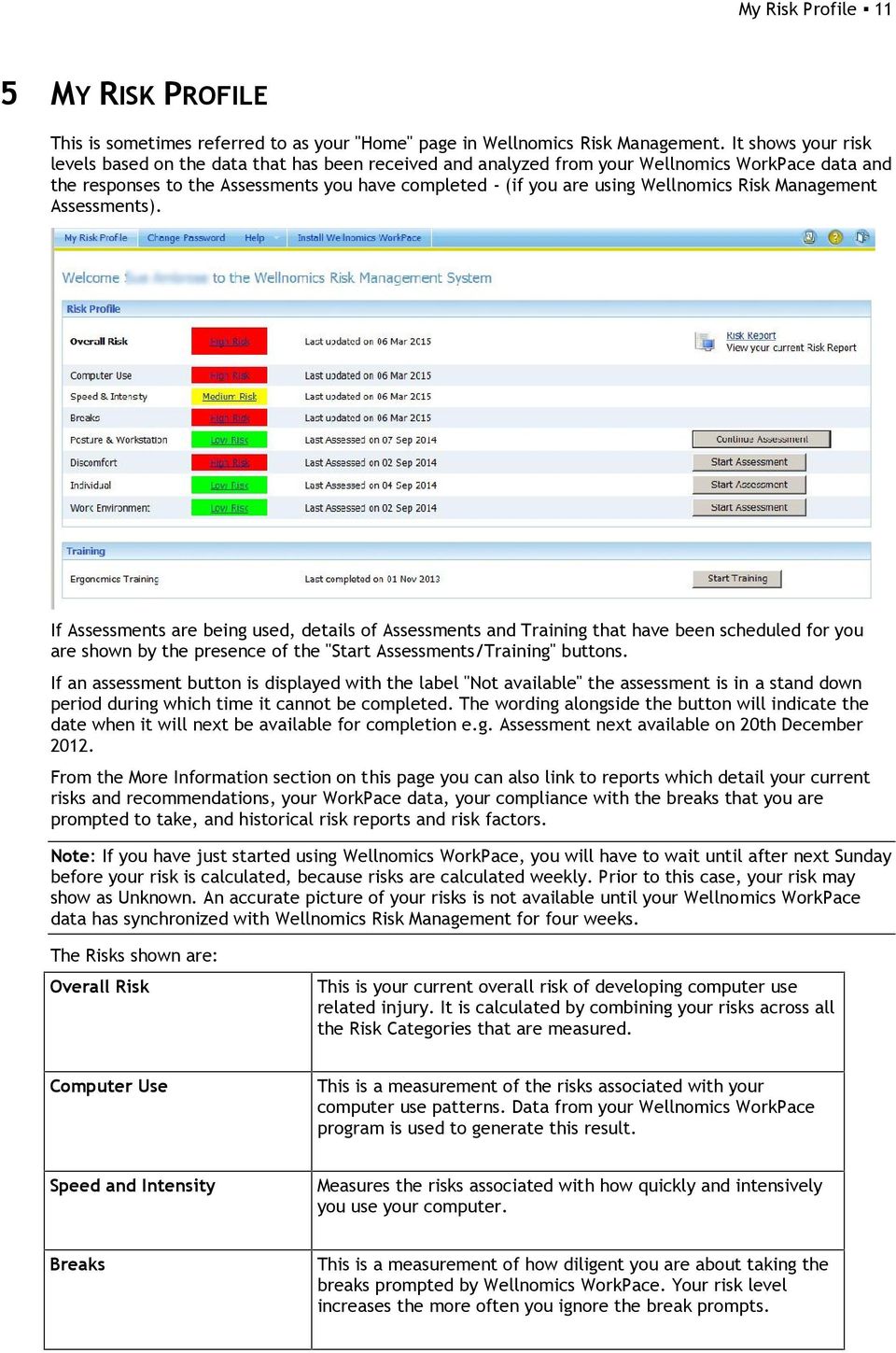
12 12 Wellnomics Risk Management Software If you are using the Wellnomics Assessments, you will have Risk Levels for the following categories. These are based on your responses to the Wellnomics Risk Management Assessments. Posture and WorkStation Measures the risks associated with your workstation setup and use. Discomfort Measures the risks associated with your existing and past symptoms related to computer use. Individual Assesses your individual physical characteristics and how they affect your risk of developing computer use related injuries. Work Environment Looks at your workload and work pressure and assesses the risks associated with this. If any of your Risk Levels are shown as Unknown, it will be because there is insufficient WorkPace or Assessment data recorded for your risk to be accurately calculated. In the case of WorkPace data (the Computer Use, Speed & Intensity and Breaks Risk Categories) the following messages may appear against the risk levels: No Data or Data Out of Date WorkPace has to send data to the Wellnomics server regularly so that it can calculate your risk for the Computer Use, Speed & Intensity and Breaks Risk Categories. If no data is received by the Wellnomics server the risks for these Risk Categories cannot be calculated and will display as Unknown. See below for suggestions on how to resolve problems with No Data or Data Out of Date. Message Explanation Resolution No Data No WorkPace data has Check WorkPace is installed on your computer ever been received by the If WorkPace is installed, make sure it is communicating Wellnomics server correctly with the server. To check this: 1, Double click the WorkPace icon in the System Tray to open the WorkPace Console. 2, From the menu select Server > Connect Now 3, From the menu select View > Communication Log 4, Scroll to the bottom of the log text. If there are any errors (text with the word WARNING in the front), Contact your IT department or Wellnomics Support for additional assistance. You may like to copy and paste this text into your to help with troubleshooting.

13 My Risk Profile 13 Data Out of Date No WorkPace data has been received by the Wellnomics server in the last 4 weeks Check that WorkPace hasn't been uninstalled from your computer If WorkPace is installed, have you been away on leave or not using your computer for 4 weeks or more? If so, a few days after you resume normal computer use you should see this error disappear and your risks being calculated again. If the above doesn't match your situation, check that WorkPace is still communicating with the Wellnomics server. To check this: 1, Double click the WorkPace icon in the System Tray to open the WorkPace Console. 2, From the menu select Server > Connect Now 3, From the menu select View > Communication Log 4, Scroll to the bottom of the log text. If there are any errors (text with the word WARNING in the front), Contact your IT department or Wellnomics Support for additional assistance. You may like to copy and paste this text into your to help with troubleshooting. Insufficient data WorkPace data has been This message is displayed during the first week that received however there is WorkPace data has been received and processed by the insufficient data to server. The WorkPace associated risk category values are calculate the risk category not calculated until the end of the first week (Sunday values night by default) and will not be visible until after this calculation has occurred. Until this has happened the risk category values will show as Unknown. Note: It can take a while for your data to be synchronized to the Wellnomics server. This means that if any changes are made it may take a few days before you see any changes to your Risk Profile. From the My Risk Profile page, you can drill down for further information about your risks and WorkPace data: Click on RSI Risk Report (see page 14) to go to a report that details your current overall risk and recommendations and advice for reducing your risks in each category. Click on the Risk Level for any one of the Risk Categories to go to that section of the Risk Report for recommendations and advice for reducing your risks in this area. See the More Information (see page 15) section for reports relating to your Wellnomics WorkPace data records and settings along with a history of your Risk Category levels and Overall Risk Level over time.

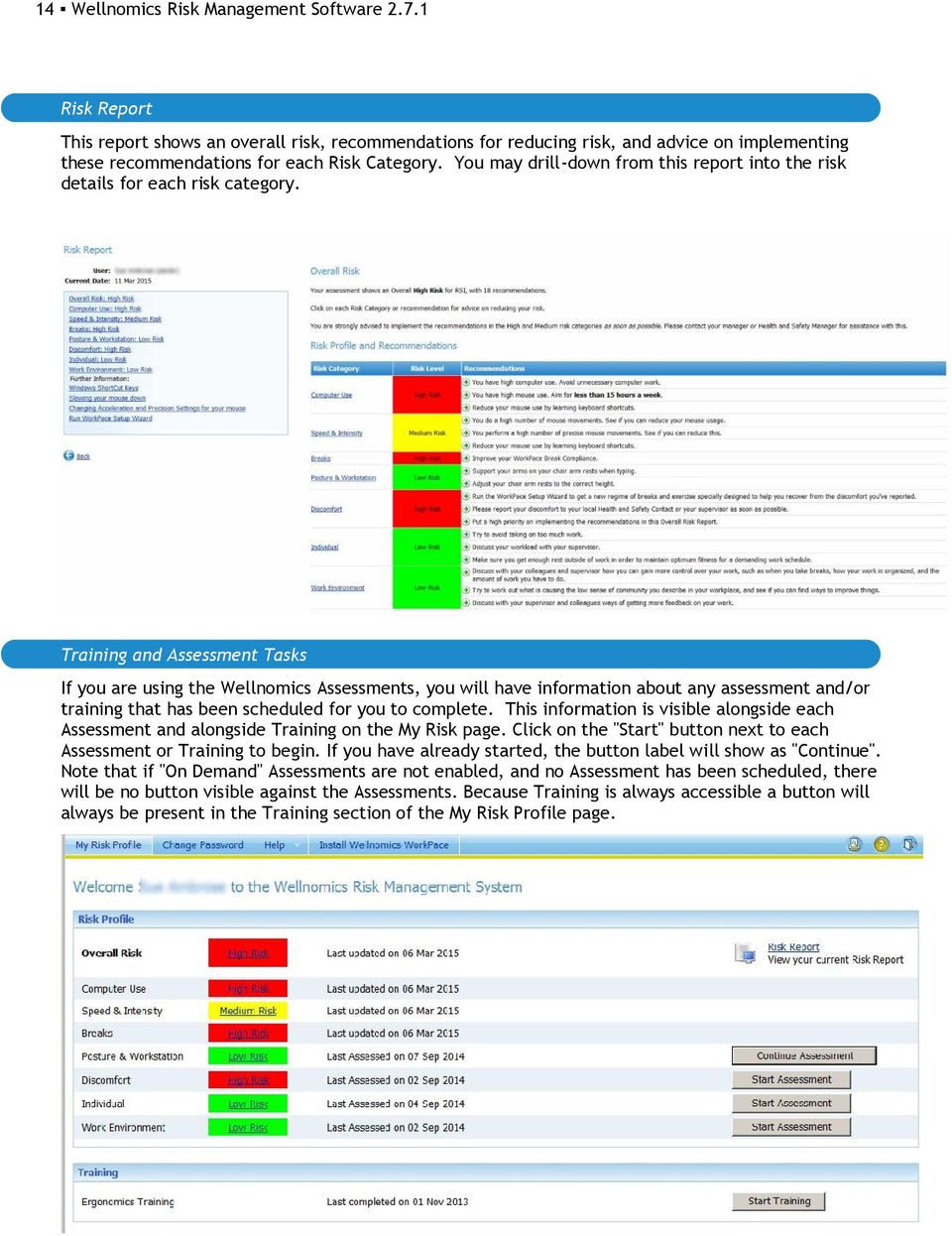
14 14 Wellnomics Risk Management Software Risk Report This report shows an overall risk, recommendations for reducing risk, and advice on implementing these recommendations for each Risk Category. You may drill-down from this report into the risk details for each risk category. Training and Assessment Tasks If you are using the Wellnomics Assessments, you will have information about any assessment and/or training that has been scheduled for you to complete. This information is visible alongside each Assessment and alongside Training on the My Risk page. Click on the "Start" button next to each Assessment or Training to begin. If you have already started, the button label will show as "Continue". Note that if "On Demand" Assessments are not enabled, and no Assessment has been scheduled, there will be no button visible against the Assessments. Because Training is always accessible a button will always be present in the Training section of the My Risk Profile page.
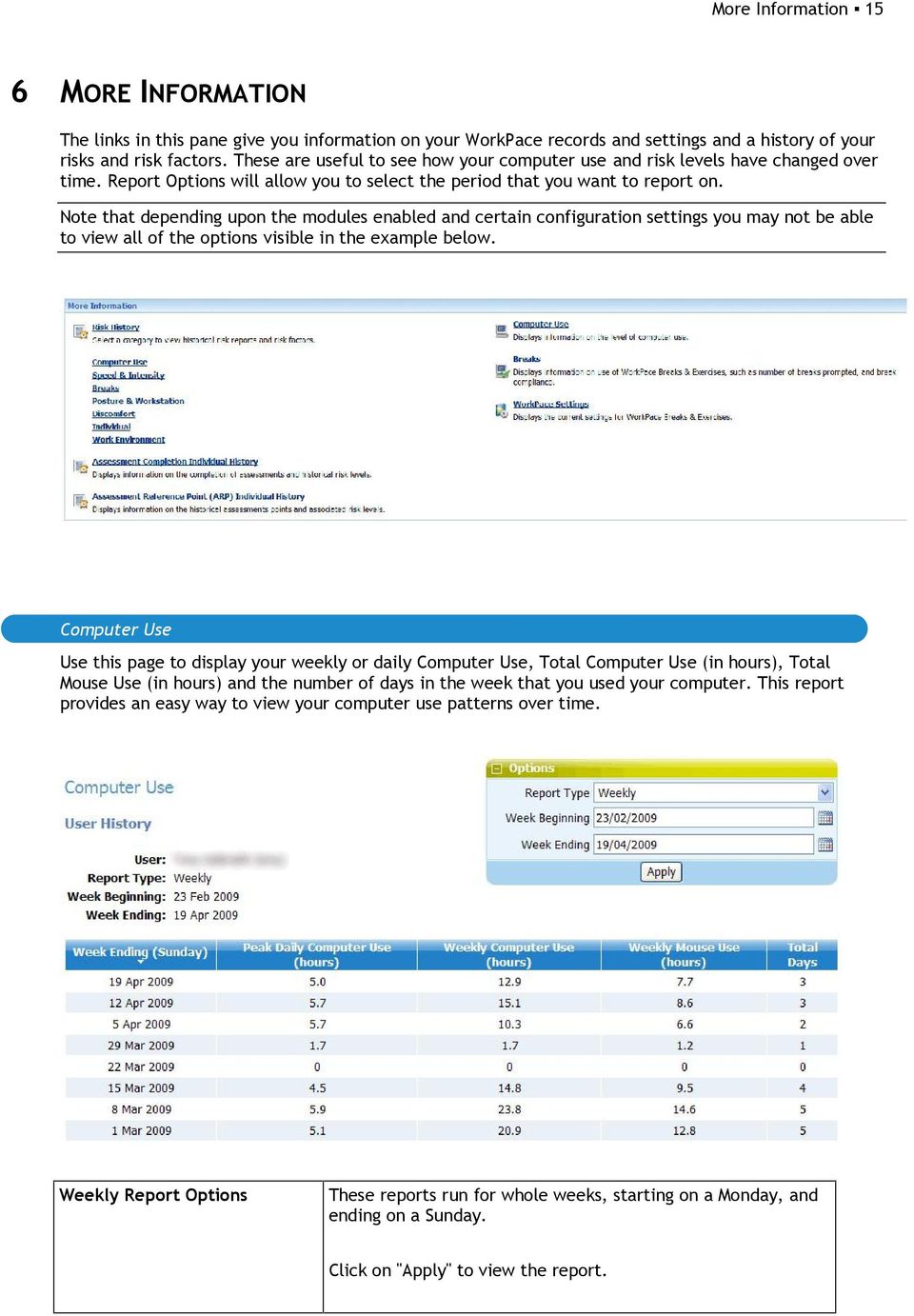
15 More Information 15 6 MORE INFORMATION The links in this pane give you information on your WorkPace records and settings and a history of your risks and risk factors. These are useful to see how your computer use and risk levels have changed over time. Report Options will allow you to select the period that you want to report on. Note that depending upon the modules enabled and certain configuration settings you may not be able to view all of the options visible in the example below. Computer Use Use this page to display your weekly or daily Computer Use, Total Computer Use (in hours), Total Mouse Use (in hours) and the number of days in the week that you used your computer. This report provides an easy way to view your computer use patterns over time. Weekly Report Options These reports run for whole weeks, starting on a Monday, and ending on a Sunday. Click on "Apply" to view the report.
16 16 Wellnomics Risk Management Software Daily Report Options These reports return data on a day by day basis between the dates entered in the "To" and 'From" date fields. Click Apply to show the report. You can export this report to an Excel spreadsheet, or a Word document, and save it for further use. You can print this report by selecting the Print button to put the information into a printable format. Note: The Print and Export options detailed above are available on all system reports where the relevant icons are displayed. Depending on how your system is configured, you may not see the Logout button on the right. Breaks Use this page to display your weekly or daily Micropause prompts and Rest Break prompts and your compliance with these prompts. For more information, see Breaks. If your Breaks percentage is consistently low, you may want to rerun the WorkPace Setup Wizard if this is available to you. A link to instructions for doing this is on your Risk Report page, (select My Risk Profile>RSI Risk Report>Run WorkPace Setup Wizard). Weekly Report Options These reports run for whole weeks, starting on a Monday, and ending on a Sunday. Click Apply to show the report. Daily Report Options These reports return data on a day by day basis between the dates entered in the "To" and "From" date fields. Click Apply to show the report.

17 More Information 17 WorkPace Settings Your Breaks and Exercises are determined by your Wellnomics WorkPace settings and the Settings Profile (see page 71) that you are assigned to. You can use it to look back and see what changes have been made to your settings. For example, if you think that you are currently getting more Breaks prompts, you can go back and see if your settings have changed. Notes This page shows a record of s and system messages that have been sent to you through Wellnomics Risk Management. Notes are also added if your Settings Profile is changed so that you can see when it changed, and who changed it. If you are a Manager, or have been assigned a role of Local Administrator, or Administrator, you can also see a record of s that you have sent to your staff. You can also make manual additions to the notes section by clicking on the Add Note button and adding any relevant text. Once added, it is possible to either amend or delete the note for a period of 24 hours after which it is locked from further editing. Risk Category History Use these options to select a category to view historical risk reports and risk factors. Overall Risk History and Risk Category Histories These reports show the history of your Overall Risk along with the histories of each of the risk categories that make up your Overall Risk. To display the history of Overall Risk or any of the related risk categories click on the relevant category, amend the date range as required and click Apply to view the history.

18 18 Wellnomics Risk Management Software Note: Because risks are calculated on a weekly basis the date ranges that can be selected are restricted Mondays (Week Beginning) and Sundays (Week Ending) Computer Use, Speed & Intensity, and Breaks Risk Categories If you are operating Wellnomics Risk Management with WorkPace (also known as Module 1) then you will see options to display the history for these risk categories. Posture and Workstation History If you are running Assessments within Wellnomics Risk Management, then you will also see this report. Use this page to view your historical Posture and Workstation risk level and reports. You can also see which Risk Factors you had present for any given week and view a full Risk Report. See also Posture & Workstation on page 142. Discomfort History If you are running Assessments within Wellnomics Risk Management, then you will also see this report. Use this page to view your historical Discomfort risk level and reports. You can also see which Risk Factors you had present for any given week and view a full Risk Report. See also Discomfort Risk Category on page 145. Individual History If you are running Assessments within Wellnomics Risk Management, then you will also see this report. Use this page to view your historical Individual risk level and reports. You can also see which Risk Factors you had present for any given week and view a full Risk Report. See also Individual Factors Risk Category on page 58 Work Environment History If you are running Assessments within Wellnomics Risk Management, then you will also see this report. Use this page to view your historical Work Environment risk level and reports. You can also see which Risk Factors you had present for any given week and view a full Risk Report. See also Work Environment Risk on page 59

19 More Information 19 Assessment Completion Individual History This link takes you to a complete list of all of your completed Assessments, in date order with the most recent at the top. Assessment Reference Point (ARP) Individual History Note: This link is only visible if Assessment Reference Points (ARPs) have been configured for use in your system by the Wellnomics Administrator. See Admin >> Policy Configuration >> Assessments >> Assessment Policy This page displays the Assessment Reference Points (ARP) dates and related data for a user. If there is more than one ARP the dates will be listed in the Date column. The remainder of the page displays data relating to the Assessment Reference Point date you have highlighted in the Date column. The Assessment Reference Point (ARP) User History page has the following columns: Assessment Reference Point (ARP) User History Explanation of columns:date: This holds the ARP dates, if there is more than one date listed, clicking on the dates will display the relevant information for that date in the remaining columns of the report. Category: This column lists the Risk Categories (enabled in the system) and Overall Risk. Assessment Completion Date: The dates in this column relates to the Risk Category dates relevant to this Assessment Reference Point. Risk Level at ARP: This indicates the risk levels each Risk Category as at the dates in the Assessment Completion Date column. Current: This is the current risk profile (as at the date of viewing)

20 20 Wellnomics Risk Management Software 2.7.1

21 My Staff 21 7 MY STAFF This page is available to Managers and those who have been assigned a Local Administrator or Wellnomics Administrator role. It provides a quick overview of their staff's risk levels, how up to date their WorkPace data is and how many staff have completed any assessments scheduled for them. Links under the "Suggested Actions" heading allow you to drill down for more detail and send s to staff with recommendations and advice for reducing their level of risk. The My Staff Page Select the group that you want to report on from the Report Options box. There are two charts on this page: An Overall Risk Summary for the group of staff that you have selected. (If you have staff who show as Unknown, it means that their WorkPace data is either absent (never received) or out of date (more than 4 weeks old), and/or none of their assessments have been completed. Quick Links takes you to links for: Training: Find out who needs training, and schedule it for them. Assessments: Find out who needs to do assessments, and schedule them. Reporting and Action: Find out what your staff's risk levels are, who has high risk, why they are at risk, and what advice and recommendations have been made to them for reducing their risk levels. Advanced Features: Perform advanced features.
22 22 Wellnomics Risk Management Software Suggested Actions: These options allow you to view a table showing a Risk Category breakdown for users at a particular Risk Level. You can also view their Risk Report. The View Unknown Risk Users report is useful for identifying which users are Unknown. View All Risk Level Users shows you a report of all users and their risk levels. The Send Risk Messages link allows you to send an to staff to alert them to their risks. WorkPace Data and Assessment Completion Summary. Shows the percentage of users whose WorkPace data is up to date and the number of staff in this group who have completed Assessments that have been scheduled for them. (If you are not using Assessments, then the Assessment details will not show). Suggested Actions: The Suggested Actions allow you to view a chart of your staff's WorkPace data status (View WorkPace Data Detail), with further links that identify which users data is up to date, out of date or absent (no data). You can also view a chart of which scheduled Assessments have been completed by staff, with a link to charts that show when the Assessments were completed. The Schedule Assessments link takes you to a page that allows you to select staff to complete assessments, and send them an to let them know they have outstanding assessments. View WorkPace Data Detail This report is useful for identifying which users have up to date data in Wellnomics Risk Management, and when data was last received from their WorkPace program. This report is available to Managers and users who have been assigned a Local Administrator or Administrator role. Data Out of Date and No Data - Definitions Data out of Date The server has received data for this user, but the last synchronization was more than 4 weeks ago. Possible causes: 1. The user has been absent (not using their computer) for the last 4 weeks. 2. WorkPace has been uninstalled from the user's computer. 3. Something has changed which means that WorkPace is no longer able to communicate with the server. Get user to check for errors in the WorkPace Communication Log (View > Communication Log).
23 My Staff 23 No Data The server has never received a synchronization from WorkPace for this user. Possible causes: 1. WorkPace is not installed on the user's computer. Check if this user has WorkPace installed. 2. WorkPace is installed, but is setup incorrectly and so cannot communicate with the server. Ask the user to check for errors by opening WorkPace on their computer and selecting View > Communication Log. Suggested Actions: Click on these links to list users for each Data status, and to find out when data was last received by Wellnomics Risk Management. WorkPace Data Status User Lists These tables show a list of users, whether their WorkPace records are up to date in Wellnomics Risk Management and when the data was last received. Assess > View Assessment Completion This feature is accessible from the Assess Menu and the View Assessment Completion option. It is also accessible from the My Staff page using the View Assessment Completion link under Suggested Actions. The initial display is a Summary by group, using the last used group selection. The charts can be restricted by different groups using the standard group selection option. The feature allows a summary of available assessments to be viewed as horizontal bar charts indicating the proportion of Complete and Incomplete Assessments by Assessment type. Note that this feature is designed to identify users that have or have not completed assessments for the first time. Subsequent assessments cannot be identified using this feature, instead, use the Training and Assessment Completion Report (which is accessible under both the Assess and the Training menus) to identify the completion of assessments between specified dates.
24 24 Wellnomics Risk Management Software Options available from this page: Subject to privacy settings it is possible to view a user list for each of the displayed assessments by clicking on the link next to each of the assessment types. Note that if you do not have the required level of access these links will not be visible to you. The user list will display: User ID, First Name, lat Name, Supervisor Last Completion Date (for the Assessment Type) The Assessment Type The risk category level on completion of the assessment Quick Links Use these links to quickly move around Wellnomics Risk Management.
25 Train 25 8 TRAIN In This Chapter: Train > Schedule Training... Train > View Scheduled Training... Train > View Status... Train > Training and Assessment Completion Train > Schedule Training This page is available to Managers and those who have been assigned a Local Administrator or Administrator role. Whilst Training is available to all users on demand (users can start and complete training at any time) it is possible for Managers and Administrators to schedule training for all users or groups of users and to send reminders to users to complete training that has been scheduled. Use this page to schedule training for groups of staff that you have responsibility for. Note: If a user has training currently scheduled, they cannot be scheduled again. Training Name Enter a name to identify the training being scheduled. For example, 'Initial Staff Ergonomics Training'. Group Select the group to do the training. For example, 'Direct Reports', or 'Everyone'. Due to be completed by Click the calendar icon and select the date that training is to be completed by. This date will show on the user s My Risk Profile page. Exclude Users who have completed training since Check the box to enter a date that will exclude users who have recently completed training. For example, if a user completed training in the last week, then you may not want them to do more training now. Click the calendar icon to select the date which you want to use as a cut-off point for recent training. Next Click to go to the Training Confirmation Page. Schedule Training Confirmation Use this page to confirm scheduled training for users, and send them an with a link to the training.
26 26 Wellnomics Risk Management Software Included A tick in this column indicates that this user will be notified and included in the training that has been scheduled. Users that are found to have completed training since the date specified on the previous page in the Exclude Users who have completed training since field, will be excluded from this training session, and show a cross in this field. User ID, First Name, Last Name The User ID and name of the user who will do the training. Existing Training Scheduled by The name of the person who scheduled training for this user, if it has already been scheduled. For example, training may have been scheduled by someone else in the same group. Existing Training Due by The date that existing scheduled training should be completed by. Confirm New Training Click to send an to the user asking them to complete the training. Train > View Scheduled Training Use this page to view details of scheduled training for users. This training can be rescheduled or cancelled, and you can send reminders to users. Note: Training does not affect the Risk Levels of users. Training Name The name given to the training course when it was scheduled. Due Date The date that training should be completed by.
27 Train 27 Training Status The status of the training, one of: Open, Complete, or Not Started. Open the scheduled completion date for the training is still in the future. Complete: All users that were scheduled to complete training have done so. Not Started: None of the scheduled users have started the training Total Users The number of users scheduled in this training session. Users not Started The number of users that have not started the training. Users in Progress The number of users who have completed part of the training. Users Completed The numbers of users who have finished the training. Details Click the Details button to display details for the training, and links to allow you to: Cancel training Reschedule training Send an reminder Scheduled Training Details Use this page to view details of the training that has been scheduled. It displays a list of users that were included in the trainin session along with details of their status of completion of the training. At the bottom of the page are options to Cancel or Reschedule the training along with an option to send reminders about the training Reschedule Training Use this option to change the due date for a training session. Enter a new due date for a user, or group of users and click the Reschedule Training button to send an to tell them that there has been a change. Cancel Training Use this option to cancel a scheduled training session. Note: Training can be done by users at any time from their My Risk Profile page. Send Reminder Use this option to send an reminder users that have yet to complete their training. Train > View Status Use this page to view a list of users that have been scheduled for training, the date they completed their last training session, and when the currently scheduled training is due to be completed.
28 28 Wellnomics Risk Management Software To change the Group you are reporting on: Click the drop-down arrow next to the Report Group field to open a list of available groups. Select the group you want to view the report for, and click Apply. Train > Training and Assessment Completion This function is available to Managers and those who have been assigned a Local Administrator or Administrator role. This feature is accessible from the Analyze Menu and the Training and Assessment Completion option. The feature displays a report that summarizes historical training and assessment completion or noncompletion (depending upon the options selected) for one or all assessment categories and/or training
29 Train 29 Filter Options available from this page:group Use this option to restrict the list by available groups From This is the start of the reporting date range which is used to select relevant records for the tabular report results (see below). Note that the date range includes this specified "from" date. To This is the end of the reporting date range which is used to select relevant records for the tabular report results (see below). Note that the date range includes this specified "to" date. Category This allows the listing (see below) to be restricted by available Assessment Categories or Training. Any combination of available Assessments and Training can be selected by checking the appropriate boxes accessed by clicking on the drop down arrow on the right of the field. Status This allows the list to be restricted to:completed will display only those results where a completion date for the selected Assessment Types (and/or Training) falls within the selected From: To: date range. Not Completed - will display only those results where a completion date for the selected Assessment Types (and/or Training) does not fall within the selected date range. ALL - will display all users in the group and indicate against each Assessment type and/or Training whether or not completion has occurred within the reported time period. Symbols (û and ü ) are used to indicate completion or non completion Note that report table layout changes depending upon whether Completed, Not Completed or All is selected Apply This button applies the options chosen above and re-lists the relevant records in the tabular report view which is displayed.
30 30 Wellnomics Risk Management Software The Tabular Report Display Once the report options have been selected and "Applied", the report listing is in a tabular format which displays a user list of those users that meet the report options criteria. If the display exceeds what can be listed on a single page, options for subsequent pages are listed at the foot of the report and are displayed as a string of available page numbers. Each of the columns in the report can be sorted in either ascending or descending order by repeatedly clicking on the column header. When the Status is set to Completed or Not Completed, a summary bar above the column headers indicates the percentage of users that meet the report Status criteria i.e. Completed or Not Completed. This percentage is based on the proportion of all possible users (as defined by the filters used) that have either completed or not completed the Assessments and/or Training specified, within the date range selected The Report Columns Where Status = Completed or Not Completed User ID The user's unique ID First Name This is the user's first name Last Name This is the user's second name. Supervisor ID This is the unique system identifier for the user's supervisor.
31 Train 31 The Report Columns Where Status = All User ID The user's unique ID First Name This is the user's first name Last Name This is the user's second name. Supervisor ID This is the unique system identifier for the user's supervisor. Risk Categories Completion of an Assessment or of Training (within the specified date range) is indicated by the symbol. Non completion within the specified date range is indicated by the symbol.
32 32 Wellnomics Risk Management Software 2.7.1
33 Assess 33 9 ASSESS In This Chapter: Assess > Schedule Assessment Assess > Scheduling Assessments for Individuals Assess > View Assessment Completion Assess > Schedule Assessment Use this page to schedule an Assessment for you, or groups of staff that you have responsibility for. For scheduling Assessments for individuals see Scheduling Assessments for Individuals Please see the Wellnomics IT Administration Guide for references to policy administration relating to Assessments. The operation of the Schedule Assessment facility is based on the settings for Assessments that are configured in the Wellnomics Administration menu (see Admin >> Policy Configuration >> Assessments >> Assessments Policy for details.) The Schedule Assessment facility allows users that have been scheduled an Assessment to access and complete Assessments on their Wellnomics Risk Management home page. Note that if On Demand Assessments are enabled, users can access and complete Assessments without them first being scheduled. If On Demand Assessments are not enabled, scheduled Assessments are accessed using the Start button that appears next to the relevant Assessment on the user s My Risk page. The schedule Assessment facility uses a wizard to go through the steps necessary for successful scheduling, these steps are:1. Select Criteria: This allows the initial list of users, who are to receive scheduled Assessments, to be created. 2. Confirm User Selection: This displays the list of users that have been selected in Step 1 to be reviewed, and if required edited, prior to scheduling. By default all users identified in Step 1 are included in the list for scheduling. Note that if the initial selection criteria in Step 1 included more than one Assessment Category then a user will be listed more than once. 3. Set Schedule Details: This allows the selection of the Assessment Due Date and the option to send scheduled users an notifying them of the scheduled Assessment(s). 4. Confirmation: This confirms all selections in Steps 1 to 3 and Confirm (create) the scheduled Assessments or to revisit previous stages and make amendments prior to confirmation.
34 34 Wellnomics Risk Management Software Step 1: Select Criteria The following selection criteria are available: Group Click the drop-down arrow next to the Report Group field to open a list of available groups. Select the group you want to schedule assessments for. Category Check the boxes for the Assessments Types you wish to schedule assessments for. At least one Assessment Type must be selected. Scheduled Status Checking only the Not Scheduled box will select users that have never previously been scheduled an Assessment, or have never started an Assessment on demand (but only for those Assessments selected in the Category section). Checking only the Scheduled box will select users that have previously been scheduled to complete an Assessment (but only for those Assessment Categories selected in the Category section). Checking both Not Scheduled and Scheduled will allow all users to be included (subject to all other criteria being satisfied)
35 Assess 35 Category Risk Level At least one box must be checked to select users. To include all users check all boxes. Check the boxes to include which Risk Levels are to be included for those Assessment categories previously selected. For user records selected, both the Assessment Category and the Category Risk Level must be satisfied e.g. If Posture and WorkStation and Discomfort are selected at the Category stage and High and Medium as the Category Risk Levels then only user records that are either High or Medium Risk for both Posture and WorkStation and Discomfort will be selected. Overall Risk Level At least one box must be checked to select users. To include all users check all boxes. Check the relevant boxes to include (checked) or exclude (unchecked) users based on their Overall Risk (as at the previous Sunday) Last Completed This selection relates to whether a user has or has not completed an Assessment (of the types selected under Category) in the past, and when in the past. The N/A radio button (default position) means that users are not excluded based on previous Assessments. The Before radio button (used in connection with the enabled date field below) will select only those users that have completed Assessments (of the types selected under Category) before the date configured. The After radio button (used in connection with the enabled date field below) will select only those users that have completed Assessments (of the types selected under Category) after the date configured.
36 36 Wellnomics Risk Management Software Due Date This selection allows users to be selected based on their Assessment Due Dates created as a result of previously scheduled Assessments. Note that even if a user has completed a scheduled Assessment their most recent scheduled Assessment Due Date, for each Assessment Category, is retained. This Due Date parameter is applied to each of the Assessment Categories selected under Category. The N/A radio button (default position) means that users are not excluded based on previous Assessment due dates. The Before radio button (used in connection with the enabled date field below) will select only those users that have Assessment Due Date(s) (for the types selected under Category) before the date configured. The After radio button (used in connection with the enabled date field below) will select only those users that have Assessment Due Date(s) (for the types selected under Category) after the date configured. Next Once the selection criteria has been completed click on the Next button to view a table of the users that match the criteria. Step 2: Confirm User Selection The users selected as a result of the decisions made at Step 1 are displayed in a tabular format. All selected users are displayed and a scroll bar is available if the list exceeds the viewable page. If more than Assessment type was selected in Step 1 then a user may appear more than once in the table.
37 Assess 37 The following options are available: Sort Columns All columns in the table are sort able in either ascending or descending order by repeatedly clicking on the column header. Include/Exclude Users By default all identified users are selected for assessment scheduling as indicated by the checked box in the first column of the table (entitled Include). To exclude a user uncheck the "Include" checkbox next to their name. Previous/Next Once editing of the user list is complete (if applicable) Click on the Next button to proceed to Step 3: Set Schedule Details. If it is necessary to re-define the selection criteria click on the Previous button to revisit Step 1: Select Criteria. Previously selected criteria will be re-displayed. Step 3: Set Schedule Details This allows selection of the Assessment Due date and the option to send included users with an notifying them of the scheduled assessment(s). The following options are available: Assessment Due Date Use this date to set the Assessment Due Date for the Assessments selected in Step 1 Category. Note that if the Due Date is less than the configured Assessment Creation Warning Period (configured in the IT Administration Website Policy Configuration) then a warning will be generated to advise of this e.g. (This Assessment is due to be completed in less than 4 weeks). Notwithstanding this warning, it is still possible to continue with the scheduling of the Assessments.
38 38 Wellnomics Risk Management Software Users Checking this box will send an to all selected users advising them of the scheduling of the assessment(s) along with the Assessment Due Date(s). Previous Use this button to return to Step 2 of the process. Next Use this button to progress to Step 4 of the process. Step 4: Confirmation This confirms all selections in Steps 1 to 3 and the Confirm button creates the scheduled assessments. To revisit previous stages and make amendments prior to confirmation select Previous. The Confirmation screen summarizes the selection criteria applied and indicates the number of assessments that will be scheduled and the number of users that will be subject to the scheduling upon final confirmation. The configured Assessment Due Date and confirmation of the function are also detailed. The following Options are available: Previous Use this button to return to Step 3 of the process. Confirm Use this button to confirm the scheduling of the selected assessments for the users identified. Once scheduling is a complete a confirmation message assessments successfully scheduled will appear at the top of the page.
39 Assess 39 Assess > Scheduling Assessments for Individuals Wellnomics Risk Management allows assessments to be scheduled for individuals. From the Tools menu go to Find User and enter your selection criteria. If a single record matches your selection you will be taken to the User Summary page for the individual. If more than one user matches your selection criteria a list of users will be displayed in tabular format. Click on the relevant user ID to display the User Summary for the individual. In the Training and Assessments part of the User Summary, a Schedule Assessment shortcut leads to a short Schedule Assessment wizard. Note that the user is automatically added to the wizard. This Schedule Assessment wizard has 2 steps:step 1: Select Criteria This has the following options:category Check the boxes for the Assessment Categories you wish to schedule Assessments for. At least one Assessment Category must be selected. Assessment Due Date Use this date to set the Assessment Due Date for the Assessments selected in Step 1 Category. Note that if the Due Date is less than the configured Assessment Creation Warning Period (configured in the IT Administration Website Policy Configuration) then a warning will be generated to advise of this e.g. (This Assessment is due to be completed in less than 4 weeks). Notwithstanding this warning, it is still possible to continue with the scheduling of the Assessments. User Checking this box will send an to the selected user advising them of the scheduling of the Assessment(s) along with the Assessment Due Date(s). Next Use this to progress to Step 2 Step 2: Confirmation This step confirms the selections made in the previous step and has the following options:previous Use this button to return to Step 1 of the process Confirm Use this button to confirm the scheduling of the selected Assessments for the users identified. Once scheduling is complete a confirmation message "Assessments successfully scheduled" will appear at the top of the page.
40 40 Wellnomics Risk Management Software Assess > View Assessment Completion This feature is accessible from the Assess Menu and the View Assessment Completion option. It is also accessible from the My Staff page using the View Assessment Completion link under Suggested Actions. The initial display is a Summary by group, using the last used group selection. The charts can be restricted by different groups using the standard group selection option. The feature allows a summary of available assessments to be viewed as horizontal bar charts indicating the proportion of Complete and Incomplete Assessments by Assessment type. Note that this feature is designed to identify users that have or have not completed assessments for the first time. Subsequent assessments cannot be identified using this feature, instead, use the Training and Assessment Completion Report (which is accessible under both the Assess and the Training menus) to identify the completion of assessments between specified dates. Options available from this page: Subject to privacy settings it is possible to view a user list for each of the displayed assessments by clicking on the link next to each of the assessment types. Note that if you do not have the required level of access these links will not be visible to you. The user list will display: User ID, First Name, lat Name, Supervisor Last Completion Date (for the Assessment Type) The Assessment Type The risk category level on completion of the assessment
41 Assess 41 Current Assessment Completion - Tabular View The tabular view is accessible from the initial View Assessment Completion option selected from the Assess menu option or the My Staff page using the View Assessment Completion link under Suggested Actions. Once the tabular view is displayed a number of options are available to refine the displayed list of user s and their assessment details. The options are:group Use this option to restrict the list by available groups. Category This allows the list to be restricted by available Assessment Category. Category Risk Level This allows the list to be restricted by the Category Risk Level these Risk levels apply to the Assessments Categories selected in the previous field. Apply Click here to re-display the user table to take account of any of the changes made above. At the foot of the displayed user list there is an option for actions: Schedule Assessment for Listed Users This link leads to the Schedule Assessment Wizard. The parameters required to duplicate the list of users in the Assessment Completion User List is automatically passed thorough to the Schedule Assessment Wizard
42 42 Wellnomics Risk Management Software 2.7.1
43 Identify IDENTIFY In This Chapter: Identify > High Risk Users... Identify > Top Recommendations... Identify > Top Risk Factors... Identify > Compare Identify > High Risk Users This report shows who your high risk users are on a week ending date that you specify. You can also click on the icon in the Risk Report column to view a full Risk Report for a user. Clicking on the User ID in the first column will take you to the User Summary page for the user. This report is available to Managers and users who have been assigned a Local Administrator or Administrator role. Group Select the group that you want to view the report for by clicking the drop-down arrow next to the Report Group. Week Ending In the Week Ending field, either enter the date for the last day of the week that you want to report on, or select the date by clicking on the calendar icon. Note: These reports display data in weekly periods, from a Monday to a Sunday. So, for example, if you select a date that is a Tuesday, then the report date will default to the following Sunday of that week.
44 44 Wellnomics Risk Management Software Identify > Top Recommendations This report provides a quick way to analyze the most common recommendations given to your staff for reducing their risk levels. You can then identify who the users are, and view a full Risk Report (see page 14) for each user. The results are sorted in descending order by the number of users that have each recommendation. Users with Recommendation Click on any of the "user number" links in the Users column to display a list of users with the recommendation shown, and the date of their last assessment (subject to access rights - access to individual data is required). You may click Risk Report (see page 14) to display the RSI Risk Report for this user.
45 Identify 45 Identify > Top Risk Factors This report shows which risk factors are most prevalent for a group of staff that you select, for a given date. It is a good way of finding out why your staff are at risk. Users with Risk Factor Click on any of the "user number" links in the Users column to display a list of users with the risk factor shown, and the date of their last assessment (subject to access rights - access to individual data is required). You may click Risk Report (see page 14) to display the RSI Risk Report for this user. Identify > Compare This utility provides the user with the ability to compare a variety of risk criteria against HR field criteria e.g. Department, Country etc. Note that in order to use HR field data in this way, the fields first have to be configured as "Enumerable" (see Admin > Policy Configuration > HR Data Field Management) The criteria that can be selected to determine the "Compare" view are: Group The week ending date of the data of interest Enumerable HR fields e.g. Country, Department, (entered into the Compare field)
46 46 Wellnomics Risk Management Software Various Risk criteria e.g. Overall Risk, Risk Categories, Risk Factors (entered into the Show field) Once the criteria has been selected and the "View Report" link clicked, the information is presented as a series of horizontal bar charts (representing the risk criteria) subdivided by the values associated with the HR field selected in the Compare field. See instructions for use below In the Report Options box, select the Group that you want to report on, for example 'My Staff'. Choose a date in the week that you want to report on. In the Comparison Options window, select the filter that you want to use. These filters match the fields that are made available from the HR import file. For further information, see the Wellnomics Risk Management IT Administration Guide. In the Show field, select the level of risk detail that you want to report on, one of Overall Risk, Risk Category, or Risk Factor. If Risk Category or Risk Factor is chosen, you can then select the category and/or factor that you want to report on. Click to view the report.
47 Identify 47 View Overall Risk Report This report allows you to make comparisons between sections of a selected group. You can also view the chart as a table. View Overall Risk Table The report allows you to make comparisons between sections of a selected group based on Overall Risk. You can also go back to view the data as a chart.
48 48 Wellnomics Risk Management Software View Risk Category Report When selecting to Compare using the show Risk Category option, you are presented with a selection of Risk Categories to select from: Note: Depending upon the modules enabled for use in your system you may not see all of the Risk Categories shown above. The report allows you to make comparisons between sections of a selected group based on Risk Categories. You can also view the chart as a table.
49 Identify 49 View Risk Category Table The report allows you to make comparisons between sections of a selected group based on Risk Categories. You can also go back to view the data as a chart. View Risk Factor Report When selecting to Compare using the show Risk Category and Risk Factor options, you are presented with a list of Risk Factors to select from. These risk factors are related to the Risk Category you select in the Select Risk Category field: The report allows you to make comparisons between sections of a selected group based Risk Factors. You can also view the chart as a table.
50 50 Wellnomics Risk Management Software View Risk Factor Table The report allows you to make comparisons between sections of a selected group based on Risk Factors. You can also go back to view the data as a chart.
51 Analyze ANALYZE In This Chapter: Analyze > Overall Risk... Analyze > Risk Categories... Analyze > Risk Factors... Analyze > Statistics... Analyze > Export Data... Analyze > Assessment Reference Point (ARP) Compliance Analyze > Overall Risk This report shows the Overall Risk Levels for users in a group for a week that you specify. You can click on the User List link to list the users in this group, and their individual overall Risk Levels. Overall Risk User List Subject to privacy settings, use this page to display a list of Users and their Overall Risk. You can click on Risk Report to see the risk factors and recommendations given to this user.
52 52 Wellnomics Risk Management Software Overall Risk Individual History Clicking on the user's ID will display their Overall Risk History. This report is useful for seeing how a user's Overall Risk has changed over time.
53 Analyze 53 Analyze > Risk Categories This report lets you quickly see what risk levels are present in each Risk Category for users in a group for a week that you specify. You can click on the User List link to list the users in this group, and their individual Risk Levels. This report is available to Managers and users who have been assigned a Local Administrator or Administrator role. Risk Categories User List This list shows the users with a particular Overall Risk Level and identifies their Risk Level for each of the Categories. You can open their Risk Report by clicking on the link in that column.
54 54 Wellnomics Risk Management Software Risk Categories User History You can click on the User ID column to view the User Summary and a full history of risk category levels over time. Analyze > Risk Factors These reports show the Risk Factors for each Risk Category for the nearest whole week to the date selected in the Report Options panel. Group Select the group that you want to view the report for by clicking the drop-down arrow next to the Report Group. Week Ending In the Week Ending field, either enter the date for the last day of the week that you want to report on, or select the date by clicking on the calendar icon. Note: These reports display data in weekly periods, from a Monday to a Sunday. So, for example, if you select a date that is a Tuesday, then the report date will default to the following Sunday of that week. User List Click to view the levels of risk for each reported category, for each user in the selected group (availability is subject to your privacy access level). These reports allow you to quickly identify prevalent areas of risk. Computer Use This page shows a chart of the risk factors present for the users in the selected group. This report allows you to quickly identify prevalent areas of risk. User List Use this page to view a list of Users with risk factors for this Risk Category. Group Select the group that you want to view the report for by clicking the drop-down arrow next to the Report Group. In the Week Ending field, either enter the date for the last day of the week that you want to report on, or select the date by clicking on the calendar icon. Week Ending Note: These reports display data in weekly periods, from a Monday to a Sunday. So, for example, if you select a date that is a Tuesday, then the report date will default to the following Sunday of that week. Click Apply to show the report. User Name Click to show the Risk Factor history of this user, and link to a Risk Report.
55 Analyze 55 First Name Last Name The first name of the user. The last name of the user. Risk Factors Present The number of Risk Factors present for this user out of the total number of Risk Factors that apply to this category. Risk Report Click to display a Risk Report for this user. Risk Factors Use this page to see which Risk Factors are present for this user. Speed & Intensity This page shows the risks associated with how quickly and intensely the selected group uses the computer. User List Use this page to view a list of Users with risk factors for this Risk Category. Group Select the group that you want to view the report for by clicking the drop-down arrow next to the Report Group. In the Week Ending field, either enter the date for the last day of the week that you want to report on, or select the date by clicking on the calendar icon. Week Ending Note: These reports display data in weekly periods, from a Monday to a Sunday. So, for example, if you select a date that is a Tuesday, then the report date will default to the following Sunday of that week. Click Apply to show the report. User Name First Name Last Name Click to show the Risk Factor history of this user, and link to a Risk Report. The first name of the user. The last name of the user. Risk Factors Present The number of Risk Factors present for this user out of the total number of Risk Factors that apply to this category. Risk Report Click to display a Risk Report for this user. Risk Factors Use this page to see which Risk Factors are present for this user.
56 56 Wellnomics Risk Management Software Breaks This page shows a chart of the risk distributions for each of the Risk Factors for the Breaks category for the selected group of users. User List Use this page to view a list of Users with risk factors for this Risk Category. Group Select the group that you want to view the report for by clicking the drop-down arrow next to the Report Group. In the Week Ending field, either enter the date for the last day of the week that you want to report on, or select the date by clicking on the calendar icon. Week Ending Note: These reports display data in weekly periods, from a Monday to a Sunday. So, for example, if you select a date that is a Tuesday, then the report date will default to the following Sunday of that week. Click Apply to show the report. User Name First Name Last Name Click to show the Risk Factor history of this user, and link to a Risk Report. The first name of the user. The last name of the user. Risk Factors Present The number of Risk Factors present for this user out of the total number of Risk Factors that apply to this category. Risk Report Click to display a Risk Report for this user. Risk Factors Use this page to see which Risk Factors are present for this user. Posture & Workstation This page shows the risks associated with the Posture and Workstation practices of the selected group. User List Use this page to view a list of Users with risk factors for this Risk Category. Group Select the group that you want to view the report for by clicking the drop-down arrow next to the Report Group.
57 Analyze 57 In the Week Ending field, either enter the date for the last day of the week that you want to report on, or select the date by clicking on the calendar icon. Week Ending Note: These reports display data in weekly periods, from a Monday to a Sunday. So, for example, if you select a date that is a Tuesday, then the report date will default to the following Sunday of that week. Click Apply to show the report. User Name First Name Last Name Click to show the Risk Factor history of this user, and link to a Risk Report. The first name of the user. The last name of the user. Risk Factors Present The number of Risk Factors present for this user out of the total number of Risk Factors that apply to this category. Risk Report Click to display a Risk Report for this user. Risk Factors Use this page to see which Risk Factors are present for this user. Discomfort This page shows the risk distributions for each of the Risk Factors for the Discomfort category for the users in the selected group. The Risk Factors are a breakdown of the Discomfort category into its constituent parts. User List Use this page to view a list of Users with risk factors for this Risk Category. Group Select the group that you want to view the report for by clicking the drop-down arrow next to the Report Group. In the Week Ending field, either enter the date for the last day of the week that you want to report on, or select the date by clicking on the calendar icon. Week Ending Note: These reports display data in weekly periods, from a Monday to a Sunday. So, for example, if you select a date that is a Tuesday, then the report date will default to the following Sunday of that week. Click Apply to show the report.
58 58 Wellnomics Risk Management Software User Name First Name Last Name Click to show the Risk Factor history of this user, and link to a Risk Report. The first name of the user. The last name of the user. Risk Factors Present The number of Risk Factors present for this user out of the total number of Risk Factors that apply to this category. Risk Report Click to display a Risk Report for this user. Risk Factors Use this page to see which Risk Factors are present for this user. Individual This page shows the risk distributions for each of the Risk Factors for the Individual category for the users in the currently selected group. User List Use this page to view a list of Users with risk factors for this Risk Category. Group Select the group that you want to view the report for by clicking the drop-down arrow next to the Report Group. In the Week Ending field, either enter the date for the last day of the week that you want to report on, or select the date by clicking on the calendar icon. Week Ending Note: These reports display data in weekly periods, from a Monday to a Sunday. So, for example, if you select a date that is a Tuesday, then the report date will default to the following Sunday of that week. Click Apply to show the report. User Name First Name Last Name Click to show the Risk Factor history of this user, and link to a Risk Report. The first name of the user. The last name of the user. Risk Factors Present The number of Risk Factors present for this user out of the total number of Risk Factors that apply to this category. Risk Report Click to display a Risk Report for this user.
59 Analyze 59 Risk Factors Use this page to see which Risk Factors are present for this user. Work Environment This page shows the risk distributions for each of the Risk Factors for the Work Environment category for the users in the currently selected group. The Risk Factors are a breakdown of the Work Environment category into its constituent parts. User List Use this page to view a list of Users with risk factors for this Risk Category. Group Select the group that you want to view the report for by clicking the drop-down arrow next to the Report Group. In the Week Ending field, either enter the date for the last day of the week that you want to report on, or select the date by clicking on the calendar icon. Week Ending Note: These reports display data in weekly periods, from a Monday to a Sunday. So, for example, if you select a date that is a Tuesday, then the report date will default to the following Sunday of that week. Click Apply to show the report. User Name First Name Last Name Click to show the Risk Factor history of this user, and link to a Risk Report. The first name of the user. The last name of the user. Risk Factors Present The number of Risk Factors present for this user out of the total number of Risk Factors that apply to this category. Risk Report Click to display a Risk Report for this user. Risk Factors Use this page to see which Risk Factors are present for this user. Analyze > Statistics These reports show the Risk Factors for each Risk Category for the nearest whole week to the date selected in the Report Options panel. Computer Use Use this report to see Computer Use statistics for a group that you specify. There are two types of report available from this page: daily or weekly reports.
60 60 Wellnomics Risk Management Software Daily reports show data that is calculated on a daily basis. These reports are useful if you want a report on a specific period, for example 1st to 31st July. Weekly reports show the results for data collected for whole weeks beginning on a Monday, and ending on a Sunday with averages displayed in weeks rather than days. Click on any of the column headings to sort on that column. You can click on the User ID to show statistics for individual users. Breaks Use this page to list statistics showing how compliant users are with taking their prompted breaks and exercises. There are two types of report available from this page: daily or weekly reports.
61 Analyze 61 Daily reports show data that is calculated on a daily basis. These reports are useful if you want a report for a specific period, for example 1st to 31st July. Weekly reports show the results for data collected for whole weeks beginning on a Monday, and ending on a Sunday with averages displayed in weeks rather than days. Click on a column heading to sort on that column. You can click on the User ID to show statistics for individual users. Analyze > Export Data This feature allows users with access to define parameters for the export of raw data for either Computer Use, Breaks, or Application Usage. Computer Use This feature is available to those who have been assigned a reporting role with Statistics Level access. It allows data relating to computer usage recorded in WorkPace to be exported from Wellnomics Risk Management to Microsoft Excel. From here it may be subjected to analysis or moved to another 3rd party product for analysis e.g. SPSS etc.
62 62 Wellnomics Risk Management Software This feature allows the user to define a limited number of parameters prior to exporting the data. Group Use this option to restrict the list by available groups. From The start of the date range for data you wish to export. To The end date of the date range you wish to export. Export The statistics that you wish to export: - daily statistics - daily statistics for each computer used - totals for each statistic over the period - totals for each statistic and computer used over the period Include all HR fields Checking this box allows HR related data (as contained in the imported HR file) to be appended to each line of the export. This allows such data to be analyzed in external applications. If there is no intention to use this data for analysis this box should not be checked, as it has the potential to add a significant amount of data (and therefore additional time to compile) to the export file. Export Link Clicking on the Export link will begin the data compilation. Depending on the options you have selected, this may take some time to complete. Breaks This feature is available to those who have been assigned a reporting role with Statistics Level access. It allows data relating to breaks recorded in WorkPace to be exported from Wellnomics Risk Management to Microsoft Excel. From here it may be subjected to analysis or moved to another 3rd party product for analysis e.g. SPSS etc. This feature allows the user to define a limited number of parameters prior to exporting the data. Group Use this option to restrict the list by available groups. From The start of the date range for data you wish to export. To The end date of the date range you wish to export. Export The statistics that you wish to export: - daily statistics for each computer used - totals for each statistic over the period - totals for each statistic and computer used over the period
63 Analyze 63 Include all HR fields Checking this box allows HR related data (as contained in the imported HR file) to be appended to each line of the export. This allows such data to be analyzed in external applications. If there is no intention to use this data for analysis this box should not be checked, as it has the potential to add a significant amount of data (and therefore additional time to compile) to the export file. Export Link Clicking on the Export link will begin the data compilation. Depending on the options you have selected, this may take some time to complete. Application Usage Application Usage This feature is available to those who have been assigned a reporting role with Statistics Level access. It allows data relating to application usage recorded in WorkPace to be exported from Wellnomics Risk Management to Microsoft Excel. From here it may be subjected to analysis or moved to another 3rd party product for analysis e.g. SPSS etc. Some points to note about the Application Usage feature:the feature can only be used if application related data is being recorded in Wellnomics WorkPace. The recording of Application Usage Statistics can be enabled/disabled in WorkPace in the Recording Options configuration panel (accessed in WorkPace via Statistics >> Recording Options. Application Usage Statistics recording is limited to the top 20 (in terms of time) applications used by each user each day. The application list may therefore differ day to day for the same user. The data output will be by user, per day and data relating to up to 20 applications will be identified per user per day of use. This can result in very large data files being created e.g. for a single user for one year this could result in 4800 rows of data (48 weeks x 5 days x 20 applications). For this reason it may take some time to create and export data files using this feature. Users should be aware of this when setting their filter options. This feature allows the user to define a limited number of parameters prior to exporting the data. Group Use this option to restrict the list by available groups. From The start of the date range for data you wish to export. To The end date of the date range you wish to export.
64 64 Wellnomics Risk Management Software Export The statistics that you wish to export: - daily statistics - daily statistics for each computer used - totals for each statistic over the period - totals for each statistic and computer used over the period Exclude applications used less than...minutes per day This allows minor applications (in terms of time used) to be excluded from the compiled data for each user. The default time is 5 minutes. If this is increased it will exclude more applications. If this is decreased it will allow more minor applications to be listed, but only up to a maximum of 20 applications per user per day. In order to control the amount of data that has to be processed, users are advised not to reduce this value to below 5 minutes per day. Include all HR fields Checking this box allows HR related data (as contained in the imported HR file) to be appended to each line of the export. This allows such data to be analyzed in external applications. If there is no intention to use this data for analysis this box should not be checked, as it has the potential to add a significant amount of data (and therefore additional time to compile) to the export file. Export Link Clicking on the Export link will begin the data compilation. Depending on the options you have selected, this may take some time to complete. Exporting to Microsoft Excel Please note the following Microsoft Excel row limits when exporting: Pre Excel 97 limit is 16,384 rows Excel limit is 65,536 rows Excel 2007 present is 1,048,576 rows Analyze > Assessment Reference Point (ARP) Compliance This function is available to Managers and those who have been assigned a Local Administrator or Administrator role if Assessment Reference Points have been configured for use. This feature is accessible from the Identify Menu and Assessment Reference Point (ARP) Compliance option.
65 Analyze 65 The feature displays a report that identifies users that have (or have not) completed all of their available (i.e. system enabled) Assessment questionnaires and hence have had an Assessment Reference Point created, within a defined date period. Filter Options available from this page:group Use this option to restrict the list by available groups From The start of the date range you wish to report on To The end of the date range you wish to report on. Note that if a user has more than one Assessment Reference Point within the date range being reported on only the most recent will be displayed in the report. Overall Risk as of This allows the user to report on the Overall Risk as at a defined date and this is displayed in the last column of the processed report (see below). The report automatically displays the Overall Risk value as at the date the reported Assessment Reference Point was created. Display Training (checkbox) Checking this box will add an additional column "Training Completion Date" to the standard report showing the last date that Wellnomics Risk Management training was completed. Note that this is for information only, Training is not relevant to the creation of an Assessment Reference Point. This field does not have a filtering function therefore If no Training has been completed by a reported user this column will be blank for that user.
66 66 Wellnomics Risk Management Software Show Not Completed (checkbox) If this box is not checked then the report will list those users that have an Assessment Reference Point within the date range being reported. Checking the box will list those users that do not have an Assessment Reference Point within the date range and Group being reported on ARP Event Where more than one Assessment Reference Point (ARP) exists for a user within the reporting period there is the option to report on either the earliest or the latest event in the period. First in Period selects the earliest ARP (where more than one exists per user). Last in Period selects the latest ARP (where more than one exists per user) Apply This button applies the options chosen above and re-lists the relevant records in the tabular report view which is displayed.
67 Analyze 67 The Report The report displays the following columns :User ID, First Name, Last Name: Identifies the user. Clicking on the User ID field will take you to an Assessment Reference Point History for that user (see below). Note that if a user has more than one Assessment Reference Point within the date range being reported on only the most recent will be displayed in the report. Additional ARPs can be viewed via the Assessment Reference Point History for that user via the User ID link. Supervisor: The supervisor or manager as defined within the HR import file (staff list). Overall Risk at ARP: The Overall Risk for the user as at the date the Assessment Reference Point was created (see next column). Note that if the "Show Not Completed" checkbox is checked this column does not appear in the report. ARP Date: The date the Assessment Reference Point was created. Note that if the "Show Not Completed" checkbox is checked this column does not appear in the report. Overall Risk as on XXXX: This is the Overall Risk of the user as at the date specified in the "Overall Risk as of" parameter in the options panel. Training Completion Date: NB This column is only displayed if the Display Training checkbox is checked in the options panel. This is the last date that the user completed Ergonomics Training in Wellnomics Risk Management
68 68 Wellnomics Risk Management Software 2.7.1
69 Act ACT In This Chapter: Act > Send Risk Messages Act > Change User Settings Profiles Act > Send Risk Messages Use this feature to identify staff members that you wish to notify of their Risk Levels and Recommendations. The Risk Factors that are present combine into the Risk Category and ultimately the Overall Risk. The Risk Management process operates as follows: 1 For each of the users in the selected Group, Wellnomics Risk Management determines whether or not there are Recommendations currently present for each Risk Category. 2 The manager identifies these users and uses Wellnomics Risk Management to send them an . This gives the user a list of recommendations that will help them address their Risk Factors. Once the is sent Wellnomics Risk Management records those users that have been sent an for the Risk Categories selected through the users Action Log. The users are once again eligible to be reminded via about their risks once the Risk Reminder Period of time has elapsed. The system administrator configures the Risk Reminder Period on a systemwide level. Typically this period is 2 weeks. The Send Risk Messages function operates as a 4-step Wizard. Your progress through each stage of the wizard is highlighted near the top of the screen. Step 1: Select Criteria The first step of the wizard allows you to select the users who will receive the Risk Message and the Risk Categories that will be included in the . The page contains the following: Date Displays today's date, the date at which the Assessments data (if used) is current. Note that the Computer Use, Speed and Intensity, and Breaks data used in the message is dated as at the previous Sunday (when such data is subject to weekly updating).
70 70 Wellnomics Risk Management Software Group Overall Risk Level Allows selection of the group to which the will be sent. Select which Overall Risk Level users are to receive the Risk Message. The table below the selection criteria lists the following information: Risk Category: The individual risk categories that contribute to the Overall Risk Level. Users with Recommendations Present: The number of users that have recommendations present for this Risk Category. Users Already ed: The users that you have already reminded about their recommendations. Users Due to be ed: The number of users that will be ed with details of recommendations to reduce their Risk Levels for this Risk Category. Include Category in ?: Check the box or boxes for the Risk Category that you want to send recommendation reminder s for. For example, you may only want to remind users about the recommendations for reducing Posture and WorkStation risks. The Next Button takes you to the next stage of the Wizard. If you do not have access to individual users, the next stage will be Confirmation (Step 3). If you do have access to individual user details, the next step will be the User List. Step 2: User List This page provides a tabular view of the users to be ed (one on each row) along with the details of the number of recommendations per Risk Category (displayed in columns) that will be included in the . Note that the User List will contain a maximum of 100 users. This is because the User List stage of the wizard does not provide any options for the user to select or configure, and is simply designed to give the opportunity to view previews of the s about to be sent. The Back Button takes you to the previous stage of the Wizard. The Next Button takes you to the next stage of the Wizard. Step 3: Confirmation This page provides a summary of the number of users to be ed and Risk Categories to be included in the . This page has the following options: The Back Button takes you to the previous stage of the Wizard. The Select Criteria button returns the user back to Step 1 (Select Criteria) of the Wizard. The Send Button sends the s detailed in the on-screen summary to the server for posting. Step 4: Send Complete This page provides confirmation of the number of s sent along with details of the Risk Categories covered. It also provides confirmation of the creation of an entry into the action log of each of the users ed. Within this page you have the following options: Send More: Returns the user to the first page of the Wizard where new criteria can be selected. Finish: Returns the user to their Home page (as defined by Preferences). User List Use this page to display a list of users and the number of recommendations they have for each category.
71 Act 71 User Name The name of the User to be ed. Click on the name to display a summary for this user. Preview Click to preview the that will be sent. Act > Change User Settings Profiles Wellnomics Risk Management ships with nine Settings Profiles: WRM 1 - Start in Quiet Mode (no alerts) WRM 1a - Lock to Quiet Mode (no alerts) WRM 2 - Standard Breaks WRM 3 - Effective Settings Enforced WRM 4 - Micropause Compliance Enforced WRM 5 - Micropause and Break Compliance Enforced WRM 6 - Recovery Settings - Low WRM 7 - Recovery Settings - Medium WRM 8 - Recovery Settings - High The Wellnomics Administrator can create more if needed. For more information about this, see Settings Profiles. Managers can run a report to find High Risk Users who need to be moved to a more effective Settings Profile.
72 72 Wellnomics Risk Management Software To do this: Select Act>Change User Settings Profiles from the menu Select the Group and Risk Levels that you want to report on. For example, you may want to identify all Users with a High Overall Risk, who are currently using either of the default Settings Profiles. Select the Settings Profile that you want to move the users to from the drop-down list. For example, you may want to move High Risk Users to the next level Settings Profile "WRM Effective Settings Enforced". Click "Move Selected Users to Settings Profile". A confirmation page is displayed. Check that the information is correct and click "Yes" to change the Settings Profile for these users. A message is displayed when the user's profiles are successfully updated. Note: Once the settings profiles of a list of users has been changed it is not possible to "undo" the changes made Continue to monitor users and change their Settings Profiles accordingly. A note is created in the User's Actions log to tell them when their Settings Profile was change, and by whom. Settings Profiles The table below lists the Settings Profiles in the order that they should be used. Each Settings Profile is based on the previous settings with additional enforcements. WRM 1 Start in Quiet Mode (no alerts) WRM 1a Lock to Quiet Mode (no alerts) WRM 2 Standard Breaks Data is collected and synchronized with Wellnomics Risk Management, but no alerts are displayed to the user. The user may however, change their settings from the WorkPace console. Data is collected and synchronized with Wellnomics Risk Management, but no alerts are displayed to the user. The user may not change any of their settings in the WorkPace console. Micropauses and Rest Breaks are turned on, and can't be turned off by users through the WorkPace console. Users can set whether they can ignore prompts for breaks, and how many times they can ignore them.
73 Act 73 WRM 3 Effective Settings Enforced Micropauses and Rest Breaks are turned on, and can't be turned off by users through the WorkPace console. Exercises are prompted during Rest Breaks. The interval between micropauses can be set by the user to between 2 and 8 minutes and must last for between 5 and 30 seconds. The interval between Rest Breaks can be set by the user to between 10 and 60 minutes and must last for between 5 and 30 minutes. A Daily Limit is set for each user. The user can set the time that they can spend using the computer each day to between 1 and 6 hours. A Weekly limit is set for each user. The user can set the time that they can spend using the computer each week to between 5 and 35 hours. Users can set whether they can ignore prompts for breaks, and how many times they can ignore them. Micropauses and Rest Breaks are turned on, and can't be turned off Micropause Compliance by users through the WorkPace console. Exercises are prompted during Rest Breaks. Enforced WRM 4 The interval between micropauses can be set by the user to between 2 and 8 minutes and must last for between 5 and 30 seconds. The interval between Rest Breaks can be set by the user to between 10 and 60 minutes and must last for between 5 and 30 minutes. A Daily Limit is set for each user. The user can set the time that they can spend using the computer each day to between 1 and 6 hours. A Weekly limit is set for each user. The user can set the time that they can spend using the computer each week to between 5 and 35 hours. Users cannot ignore micropause prompts.
74 74 Wellnomics Risk Management Software WRM 5 Micropause And Break Compliance Enforced Micropauses and Rest Breaks are turned on, and can't be turned off by users through the WorkPace console. Exercises are prompted during Rest Breaks. The interval between micropauses can be set by the user to between 2 and 8 minutes and must last for between 5 and 30 seconds. The interval between Rest Breaks can be set by the user to between 10 and 60 minutes and must last for between 5 and 30 minutes. A Daily Limit is set for each user. The user can set the time that they can spend using the computer each day to between 1 and 6 hours. A Weekly limit is set for each user. The user can set the time that they can spend using the computer each week to between 5 and 35 hours. Users cannot ignore micropause prompts, and can only ignore 1 rest break prompt. WRM 6 Recovery Settings Low Micropauses and Rest Breaks are turned on, and can't be turned off by users through the WorkPace console. Exercises are prompted during Rest Breaks. The interval between micropauses can be set by the user to between 2 and 4.5 minutes and must last for between 10 and 60 seconds. The interval between Rest Breaks can be set by the user to between 10 and 45 minutes and must last for between 6 and 30 minutes. A Daily Limit is set for each user. The user can set the time that they can spend using the computer each day to between 1 and 6 hours. A Weekly limit is set for each user. The user can set the time that they can spend using the computer each week to between 10 and 30 hours. Users can ignore 1 micropause prompt, and up to 2 rest break prompts.
75 Act 75 WRM 7 Recovery Settings Medium Micropauses and Rest Breaks are turned on, and can't be turned off by users through the WorkPace console. Exercises are prompted during Rest Breaks. The interval between micropauses can be set by the user to between 2 and 3.5 minutes and must last for between 12 and 60 seconds. The interval between Rest Breaks can be set by the user to between 10 and 45 minutes and must last for between 6 and 30 minutes. A Daily Limit is set for each user. The user can set the time that they can spend using the computer each day to between 1 and 4 hours. A Weekly limit is set for each user. The user can set the time that they can spend using the computer each week to between 10 and 20 hours. Users cannot ignore micropause prompts. They can ignore up to 2 rest break prompts. WRM 8 Recovery Settings High Micropauses and Rest Breaks are turned on, and can't be turned off by users through the WorkPace console. Exercises are prompted during Rest Breaks. The interval between micropauses can be set by the user to between 2 and 3 minutes and must last for between 30 and 60 seconds. The interval between Rest Breaks can be set by the user to between 10 and 15 minutes and must last for between 20 and 30 minutes. A Daily Limit is set for each user. The user can set the time that they can spend using the computer each day to between 1 and 2.5 hours. A Weekly limit is set for each user. The user can set the time that they can spend using the computer each week to between 5 and 12.5 hours. Users cannot ignore micropause prompts. They can ignore up to 1 rest break prompts.
76 76 Wellnomics Risk Management Software 2.7.1
77 Tools TOOLS In This Chapter: Find User... Delegated Reporting... Manage Groups... Suspend Users... Change Password... Preferences... Report on Behalf Find User Use this page to find a user and view their Risk Profile. Note: You can enter the first part of a User ID, or name and press Enter and Wellnomics will search for users who match the search criteria. If there is only one match, you will be taken to the user's Risk Profile page. If there is more than one match, a list of users is displayed and you can select from the list. To find a User: Type in either their User ID, or the First Name, or Last Name of the user you wish to find. The User ID is a user's unique identification in Wellnomics Risk Management. It comes from the Human Resources file that is imported into the IT Administration website. Click Find. If there is more than one match for your search criteria, a list of users will be displayed. Click on the user you wish to view. The User Summary page is displayed To exit, choose a different option from the menu. User Summary This page is the manager or administrators view of the users My Risk profile page. It shows the user's current risk overview, and the status of their scheduled assessments and training (if these are in use). Click the RSI Risk Report link to show the user's overall RSI risk, recommendations for improvement and a profile of each Risk Category. The User Summary can be accessed from any reports where users are listed by clicking on the User ID link in the first column of reports Note: This page contains a link (Schedule Assessment) that allows Assessments to be scheduled for just this user.
78 78 Wellnomics Risk Management Software Delegated Reporting This feature allows Managers and Local Administrators to assign other users to run reports on their behalf by allowing that user to "impersonate them" for the purposes of reporting. Before Delegated Reporting can be configured and used it must first be enabled at system level by the Wellnomics Administrator (see Admin > Policy Administration > Delegated Reporting). Assigning Reporting Delegates Before a user can report on behalf of a Manager/Local Administrator, they must first assign that user the delegated reporting function. This is done in the Add or Remove Delegates page (Tools > Delegated Reporting > Assign Reporting Delegates). This page can also be used to view and amend previously delegated users. A Manager/Local Administrator can delegate reporting to more than one user; the users can be either - end users or Managers. Adding a Delegate Find User Use the User ID, First Name and last Name fields to identify the user or users you wish to delegate the reporting function to. Available Users Users that the match the search criteria will be listed in the Available Users pane. Note that if a wildcard (* character) is used in any of the search fields all possible users will be listed. Use the Add>> button to move on or more users to the Delegates. Save Use this to button Save any changes you have made since accessing the page. Cancel Use this button to Cancel any changes you have made since accessing the page. Removing Existing Delegates Removing Existing Delegates If you wish to remove users from the list of Delegates, highlight the user(s) in the Delegates pane and Click on the <<Remove button. Click on the Save button to save your changes.
79 Tools 79 Reporting on Behalf of a Manager/Local Administrator In order to act on behalf of a Manager/Local Administrator an end user first needs to select the menu option "Report on Behalf". If the user wishing to Report on Behalf is themselves a Manager they will find the menu option under Tools > Delegated Reporting > Report on Behalf. If the user wishing to Report on Behalf is not a Manager the menu option will appear as a tab on the main menu bar. The Report on Behalf menu takes the user to the Delegated Reporting Report on Behalf page where the user selects the Manager/Local Administrator they wish to report on behalf of. Highlight the relevant Manager/Local Administrator and click on the Go button. The user is prompted by a dialogue "Are you sure you want to start delegated reporting". If the user selects OK they are given access to the reporting functions of the user they are reporting on behalf of. A yellow banner, visible at the top of all pages viewed during the "reporting on behalf of" session, indicates the nature of the session e.g. Mickey Mouse reporting on behalf of Donald Duck. An End button is available at the end of this status bar which is used to end the session, at which time the user will be returned to their own access and permissions (see below). Points to Note When Reporting on Behalf All reports, whether exported or printed will display, in the heading, the nature of the user e.g. Mickey Mouse (mmouse) on behalf of Donald Duck (dduck) Access to the My Risk page of the user being reported on behalf of is not visible to the delegated reporter. Ending a "Report on Behalf" Session In order to end a "report on behalf" session click on the End button located on the right of the session status banner. A dialogue "Are you sure you want to end delegated reporting?" is displayed. Click on the OK button to return to normal access and permissions or Cancel to resume reporting on behalf. Manage Groups Use this page to view your current Wellnomics groups and to rename, edit or create your personal groups.
80 80 Wellnomics Risk Management Software Current Groups The name of the group: Me The currently logged in user (you). Direct Reports All users for who you are the direct Supervisor. This is defined in the organizational structure information which is updated into the database regularly (through the HR Import). If the group is not correct it may be because the organizational structure information is incorrect or out of date. All Staff Under Me All users under you in the organizational hierarchy. This includes your direct reports. If none of your direct reports are themselves Supervisors, you will not see this group. Everyone All users in the Wellnomics database. Only available to a Wellnomics Administrator. Groups Other Than Those Named Above The groups named above (Me, Direct reports, All Staff Under Me and Everyone (if applicable) are created automatically by the system and updated on each HR file import (staffing) update. These groups have the Type description of System Groups. Any groups that you have created for your own use will be listed after these automatically created System Groups. Note that you cannot edit or delete system created groups. Groups you create yourself will be allocated a type of either Select HR Fields or Select User Local Administrator Type Groups If you have been assigned a Local Administrator role by a Wellnomics Administrator the Local Administrator groups that you can report on will be listed below those you have created for your own use and will have the Type description of Local Administrator Users in Group The number of users in this group.
81 Tools 81 The type of group: Type System These groups are automatically created for you according to the organizational structure information. Select HR Field Custom groups that you have created based on HR Fields. Note that these groups will only contain users that you have access to. These groups are automatically updated with changes in the HR file (staff file) Select User Custom groups that you have created based on individually Selected Users, HR field based groups where users have been removed, or HR Fields plus individually selected users. Note that you can only create groups containing users that you have access to. Edit/Delete Allows Groups which you have created to be edited or deleted. Editing includes the ability to rename a group. Note: You can only Edit (including renaming) or Delete groups that you have created. You cannot therefore Edit or Delete System or Local Administrator type groups Add New Group Click to add a new group. Editing and Deleting Groups As a user, you have the option to Edit the groups you have created. In this context edit means either re-naming the group or changing the users in the group: Renaming a Group Amending the contents of a Group Editing a Select HR Fields Type Group Edit Click on the Edit button next to the Group you wish to edit Highlight the Filter by HR Fields tab Group Name You can amend the Group name in this field. If there are no other changes. Select the SAVE or SAVE AND CLOSE button to confirm changes
82 82 Wellnomics Risk Management Software Edit New values are added by moving the required value from the Available pane to the Selected pane and clicking on the OK button. The Selected Users list on the right of the page will be refreshed to reflect the users that match the new selection. Existing values can be removed by moving the required value from the Selected pane to the Available pane and clicking on the OK button. The Selected Users list on the right of the page will be refreshed to reflect the users that match the new selection. If there are no other changes. Select the SAVE or SAVE AND CLOSE button to confirm changes Delete Use this button to Delete a field type altogether. If there are no other changes. Select the SAVE or SAVE AND CLOSE button to confirm changes Add field Use this button to add additional fields to those already selected. Note that provided no users have been manually added or removed from the Select Users list the group will continue to be called a Select HR Fields Group and behave in a dynamic manner i.e. it will be automatically updated with changes in the HR data. If there are no other changes. Select the SAVE or SAVE AND CLOSE button to confirm changes. Note that adding more values for an HR field can only ADD users to the Group Members table i.e. a user becomes available to add to Selected Users list if they match any of the field values and not all of the values. Remove This button is available against every Selected User. Use this button to remove individual users from the Group. Note that if one or more users are removed from a previously dynamic HR Field Type Group will become a Select Users Group (see below) and will no longer be automatically updated with changes to the HR data file. A warning is displayed when an existing HR Fields group is about to be changed to a Select Users group. If there are no other changes. Select the SAVE or SAVE AND CLOSE button to confirm changes.
83 Tools 83 Editing a Select Users Type Group Note that these instructions cover editing Select Users groups created either solely through selecting individual users or through a combination of Individual User selection and HR Field criteria. Edit Click on the Edit button next to the Group you wish to edit Highlight the Select Individual Users tab Group Name You can amend the Group name in this field. If there are no other changes. Select the SAVE or SAVE AND CLOSE button to confirm changes Find Use the User ID, First Name or Last Name fields to search for and Add additional users. See How To Use Searching below. Remove This button is available against every Group Member. Use this button to remove individual users from the Group. Note that if one or more users are removed from a previously dynamic HR Field Type Group will become a static Group. If there are no other changes. Select the SAVE or SAVE AND CLOSE button to confirm changes. Adding or If you wish to add multiple users based on HR field criteria you can do Removing Users so by clicking on the Filter by HR Fields tab and selecting appropriate based on HR Fields fields and field values thereby adding users that match the HR field criteria to Selected Users list. See "Creating a New Select HR Fields Type Group" for further details on how to add HR fields and field values Alternatively you can remove users by removing previously chosen field criteria and values. Select the SAVE or SAVE AND CLOSE button to confirm changes. Add New Group Types of Groups It is possible to create the following type of Groups:-
84 84 Wellnomics Risk Management Software One based solely on the HR field data. Note: This type of group is Dynamic in that the contents will change as the HR file (staff list) changes. These Groups are described as "Select HR Field" in the Type column of the Manage Groups page. One based solely on selected individual users (to which you have access). Note: This type of group is static in nature in that the contents are fixed and are independent of changes to the HR file (staff list) other than where a user is removed from the HR file e.g. they have left the organization. These Groups are described as "Select Users" in the Type column of the Manage Groups page. One based on a combination of HR data selected users and individually selected users. Note: This type of group is static in nature in that the contents are fixed and are independent of changes to the HR file (staff list) other than where a user is removed from the HR file e.g. they have left the organization. These Groups are described as "Select Users" in the Type column of the Manage Groups page. Creating Groups Creating Filter by HR Fields Click on the Add New Local Administration Group button Enter a Group name (this can be done later at the point of saving, if necessary) up to 50 characters. Click on the Filter by HR Fields Tab to highlight it. Click on the down arrow next to the field next to the field in the HR field column to expand the HR field choices Click on the first field on which you wish to select users e.g. Department The "Available" pane will indicate the field values available. The field adjacent to the SEARCH button will allow you to search for values where values are too numerous (see How to Use Searching below) Use your mouse to highlight one or more field values. You can use the standard Shift and/or Ctrl keys to do multiple selections. Once your field values are highlighted, click on the DOWN arrow below the "Available" pane to move the selected values to the "Selected" pane below. Note that it is possible to de-select field values by highlighting them in the "Selected" pane and clicking on the UP arrow. This will move the values back into the "Available" pane. Click on the OK button next to the "Selected" pane to confirm your selections Users that meet your field and values selections will be displayed in the Selected Users table on the right of the screen. If desired, members can be removed from the Selected Users table using the "Remove" button next to their name. If you do this the Group will cease to behave as a dynamic Group and become a static Group
85 Tools 85 If you wish to add additional field selections to your group click on the "Add HR Field" button and repeat the field selection process. Note that adding more fields only has the potential to reduce the number of users already selected. For a user to be selected where more than one field is specified they must match the field values for all of the fields Selection Using Supervisor ID Field When this field is chosen the Select By HR Fields page re-draws to optimize searching by Supervisor Name. Once one or more Supervisors are selected and added to the "Selected" pane it is necessary to confirm: Whether the group is to be created from the selected Supervisor's Direct Reports or All Staff Under. The default selection is Direct reports. To change this to All Staff Under, click on the adjacent radio button. Whether the group should also contain the Supervisor (or Supervisors) upon whom the group is based. Check the "Include Supervisor" checkbox to include Supervisors. Note: It is not possible to create groups based on a combination of Supervisor ID Direct Reports AND All Staff Under Note that Groups based solely on HR fields act as dynamic groups unless they have been edited by adding or removing individual members from the Group. Once you have finished your field selections you must name your group if you haven't already done so before selecting either Save or Save and Close Options to: SAVE - Saves your created group and leaves the Create New Groups page onscreen. SAVE AND CLOSE - Saves your created group and exits to the Manage Groups page. CANCEL - Cancels your selections and returns to the Manage Groups page. Select Individual Users Enter a Group name (this can be done later at the point of saving if necessary) Click on the Select Individual Users Tab to highlight it Search for users using the following options: User ID which will allow you to create a group by hand-picking users and adding them to the group one by one. (The User ID is a user's unique identification in Wellnomics Risk Management. It comes from the Human Resources file that is imported into the IT Administration website.) First Name which will allow you to create a group by hand-picking users and adding them to the group one by one. Last Name which will allow you to create a group by hand-picking users and adding them to the group one by one. As users are identified, either individually or using the multiple selection options (use of Shift and/or Ctrl), click on the Add>> button to add them to the Group Members list on the right of the screen Note: Groups created using the Select Individual Users tab will act as a static Group.
86 86 Wellnomics Risk Management Software A Combination of HR field and Select Individual Users This type of Group, created through a combination of both HR Field criteria AND Select Individual Users will act as a static Group. To create such a combination group: Create a group based on HR fields as described above but do not SAVE or SAVE and CLOSE. Click on the Select Individual Users Tab Search for and Add individually Selected Users as described above. Note that if a User has already been added to the Group Members table through the HR File option they will not appear in the Available Users list in the Select Users tab, even if they match the User search criteria you have used. Once you have finished adding Users Click on either the SAVE or SAVE and CLOSE buttons to confirm your selections. Suspend Users This feature allows Wellnomics Administrators and Local Administrators to remove selected users from groups and reports. There are occasions when users are legitimately in the HR file but are known to be inactive for a temporary or even permanent period. e.g. a user on long term sick leave, secondment, sabbatical, maternity leave etc. The Overall Risk for such users can become Unknown if their WorkPace related data goes out of date i.e. after a period of 4 or more weeks of no data. Such users can adversely affect the distribution of Overall Risk if they make up a significant proportion of the group in which they are contained. The Suspend User feature allows such users to remain in the HR import file but to be excluded from reports in which they would otherwise be included. Suspending a User
87 Tools 87 In order to suspend a user it is first necessary to find the user using the search criteria of User ID and/or First Name and/or Last Name. A search for users that are not currently suspended is carried out using the fields on the left side of the Suspend user page. Users that match the search criteria are listed in the Available Users pane. In order to exclude the user, highlight the entry in the Available Users pane and move them to the Suspended Users pane by clicking on the Add >> button. Note that users are suspended (and an entry added to the user s Action Log) immediately after they are added to the Suspended Users list. Repeat searches are possible to continue to add users to the Suspended Users list. It is possible to return to the list at any time to add more users to the Suspended Users list. Unsuspending a User When you wish a user to be made "active" again i.e. "unsuspending them" you can do so by finding them in the Suspended Users list, highlighting them and clicking on the << Remove button. To find users in the Suspended users list use the search fields on the right side of the Suspend Users page. Once a user is identified (using the User ID and/or the First Name and/or the Last Name search criteria), highlight them and click on the << Remove button to move them out of the Suspended user list. Note that immediately you move a suspended user out of the suspended user list they will immediately become "active" and an entry will be added to their Action Log. Notes on Suspending/Unsuspending Users Once Suspended, a user cannot access Wellnomics Risk Management until they have been removed from the Suspended Users list. When a suspended user attempts to access the system the following warning will be displayed:"your ability to log in to your account is currently suspended. Please contact your manager" An entry will be added to the user s Action Log each time they are suspended or unsuspended. Someone delegated to report on behalf of a user that is subsequently suspended will be able to continue to run reports on behalf of that user during the period of suspension. The following options are available in the Suspend User Page: Note that this page has a left and right side pane with associated search fields. These fields operate independently with the left side allowing searching for existing users that need to be suspended and the right side allowing searching for suspended users so that they can be "unsuspended" User ID Enter a unique value here to find a single user that matches the entered User ID. Click on the Search button to display any user that matches the User ID. Any matching user will be displayed in the Available Users pane First Name Enter a first name for a user here. Click on the Search button to display any users that match the first name criteria. Any matching users will be displayed in the Available Users pane Last Name Enter a first name for a user here. Click on the Search button to display any users that match the first name criteria. Any matching users will be displayed in the Available Users pane Search Use this button to execute the search based on the criteria entered into the User ID, First Name or Last Name fields
88 88 Wellnomics Risk Management Software Clear Use this button to clear entries in the search criteria fields and any users from the available users list Add >> Use this button to add highlighted users in the Available Users list to the Suspended Users list << Remove Use this button to remove highlighted from the Suspended Users list, effectively "unsuspending them" Change Password The change password option is only available when a system has been set up using Form Authentication. For systems set up for Single Sign On a password, and the changing of a password, is not relevant and will not be visible in the user interface. To change your password: Enter your current password into the 'Old Password' field. Enter your new password in the 'New Password' field. Retype your new password in the 'Confirm New Password' field. Click Save. The password is checked to ensure it is a valid password. If the password is invalid, you will be asked to choose another password. Once the password is saved, you must use it next time you login to the Wellnomics System. Preferences Use this page to select which page you want to show as your first Wellnomics Page, and how many rows you want displayed on page lists and reports. If a list or report has too many rows to fit on a page, it will split into several pages. You can then use the Next and Previous links to navigate through the pages.
89 Tools 89 Report on Behalf This menu item will be visible if a Manager or Local Administrator has delegated you (an end user with no reporting staff) to report on their behalf. Note that more than one manager/local Administrator can delegate their reporting ability to you. In order to report on behalf of a manager: Click on the Report on Behalf menu item In the Delegated Reporting page use the drop down arrow to find and select the Manager you wish to report on behalf of. Click on the Go button You will now see a dialogue that asks "Are you sure you want to start delegated reporting?" If you wish to proceed click on the OK button, if not click Cancel. Your reporting on behalf of session will now begin. This is signified by the presence of the status bar above the Wellnomics logo which is visible throughout the reporting session. During the reporting on behalf session you will have access to the Manager's reporting pages and groups however you will not be able to create new groups or edit existing groups. All reports created will be titled with: Created by: "your name" on behalf of "the name of the manager on whose behalf you are reporting" When you wish to end your reporting on behalf of session, click on the END button on the status bar at the top of the page. A dialogue asks "Are you sure you want to end delegated reporting?" If you wish to end the session, click on OK at which point you will be returned to your My Risk Profile page. If you click on Cancel, you will be returned to your reporting on behalf of session.
90 90 Wellnomics Risk Management Software 2.7.1
91 Admin ADMIN In This Chapter: Local Administration Manage Organizational Groups Policy Configuration Local Administration Manage Roles The Manage Roles screen allows the Wellnomics Administrator to view and edit any of the active users in order to make them Local Administrators. Users may be sorted in order of Unique ID, First Name, Last Name, their assigned Roles/Rights or their Access Levels. Note that only users that have been assigned a Local Administration Role will have entries in the Roles/Rights and Access Levels Columns. Sorting on these columns therefore is the same as sorting (searching for) Local Administrators To re-sort the user list, simply click on any of the column headings. Each subsequent click on the same column header will alternate the order between ascending and descending order. Selecting the Edit button for a user will allow the Wellnomics Administrator to specify if user has Local Administrator permissions. Once the permission has been granted (using the Local Administrator Checkbox) It is then possible to determine which Roles / Rights and Access Levels are applicable to each user. Note that unless otherwise amended, the following defaults are applied to a user given Local Administrator status:roles / Rights Send Risk Messages = YES View Everyone Group = NO Change Global User Settings Profile = YES Change Individual Settings Profile = YES Access Levels - Those configured in the Data and Privacy Access Levels (See Admin > Policy Configuration > Data and Privacy Access Levels).
92 92 Wellnomics Risk Management Software More Refined Role for Local Administrators: Points to Note The upgrade to Wellnomics Risk Management will not change the existing Local Administrators configuration or behavior. If a local Administrator has had their data access and privacy levels amended from the default (as configured in Data and Privacy Access Levels) and that default is subsequently changed, the new defaults will be globally applied to all existing Local Administrators. Manage Local Administration Groups This function, which is available to Administrators through the Admin >> Local Administration >> Manage Local Administration Groups menu option, allows Wellnomics Administrators to create groups for use by Local Administrators. Manage Local Administration Groups page - Use this page to view your current Local Administration Groups and to rename, edit or create groups. Creating a New Local Administration Group Click on the Add New Local Administration Group Types of Groups It is possible to create the following type of Groups: One based solely on the HR field data. Note: This type of group is Dynamic in that the contents will change as the HR file (staff list) changes. These Groups are described as "Select HR Field" in the Type column of the Manage Groups page. One based solely on selected individual users (to which you have access). Note: This type of group is static in nature in that the contents are fixed and are independent of changes to the HR file (staff list) other than where a user is removed from the HR file e.g. they have left the organization. These Groups are described as "Select Users" in the Type column of the Manage Groups page. One based on a combination of HR data selected users and individually selected users. Note: This type of group is static in nature in that the contents are fixed and are independent of changes to the HR file (staff list) other than where a user is removed from the HR file e.g. they have left the organization. These Groups are described as "Select Users" in the Type column of the Manage Groups page. Creating Groups Creating Filter by HR Fields Click on the Add New Local Administration Group button Enter a Group name (this can be done later at the point of saving, if necessary) up to 50 characters.
93 Admin 93 Click on the Filter by HR Fields Tab to highlight it. Click on the down arrow next to the field next to the field in the HR field column to expand the HR field choices Click on the first field on which you wish to select users e.g. Department The "Available" pane will indicate the field values available. The field adjacent to the SEARCH button will allow you to search for values where values are too numerous (see How to Use Searching below) Use your mouse to highlight one or more field values. You can use the standard Shift and/or Ctrl keys to do multiple selections. Once your field values are highlighted, click on the DOWN arrow below the "Available" pane to move the selected values to the "Selected" pane below. Note that it is possible to de-select field values by highlighting them in the "Selected" pane and clicking on the UP arrow. This will move the values back into the "Available" pane. Click on the OK button next to the "Selected" pane to confirm your selections Users that meet your field and values selections will be displayed in the Selected Users table on the right of the screen. If desired, members can be removed from the Selected Users table using the "Remove" button next to their name. If you do this the Group will cease to behave as a dynamic Group and become a static Group If you wish to add additional field selections to your group click on the "Add HR Field" button and repeat the field selection process. Note that adding more fields only has the potential to reduce the number of users already selected. For a user to be selected where more than one field is specified they must match the field values for all of the fields Selection Using Supervisor ID Field When this field is chosen the Select By HR Fields page re-draws to optimize searching by Supervisor Name. Once one or more Supervisors are selected and added to the "Selected" pane it is necessary to confirm: Whether the group is to be created from the selected Supervisor's Direct Reports or All Staff Under. The default selection is Direct reports. To change this to All Staff Under, click on the adjacent radio button. Whether the group should also contain the Supervisor (or Supervisors) upon whom the group is based. Check the "Include Supervisor" checkbox to include Supervisors. Note: It is not possible to create groups based on a combination of Supervisor ID Direct Reports AND All Staff Under Note that Groups based solely on HR fields act as dynamic groups unless they have been edited by adding or removing individual members from the Group. Once you have finished your field selections you must name your group if you haven't already done so before selecting either Save or Save and Close Options to: SAVE - Saves your created group and leaves the Create New Groups page onscreen. SAVE AND CLOSE - Saves your created group and exits to the Manage Groups page.
94 94 Wellnomics Risk Management Software CANCEL - Cancels your selections and returns to the Manage Groups page. Select Individual Users Enter a Group name (this can be done later at the point of saving if necessary) Click on the Select Individual Users Tab to highlight it Search for users using the following options: User ID which will allow you to create a group by hand-picking users and adding them to the group one by one. (The User ID is a user's unique identification in Wellnomics Risk Management. It comes from the Human Resources file that is imported into the IT Administration website.) First Name which will allow you to create a group by hand-picking users and adding them to the group one by one. Last Name which will allow you to create a group by hand-picking users and adding them to the group one by one. As users are identified, either individually or using the multiple selection options (use of Shift and/or Ctrl), click on the Add>> button to add them to the Group Members list on the right of the screen Note: Groups created using the Select Individual Users tab will act as a static Group. A Combination of HR field and Select Individual Users This type of Group, created through a combination of both HR Field criteria AND Select Individual Users will act as a static Group. To create such a combination group: Create a group based on HR fields as described above but do not SAVE or SAVE and CLOSE. Click on the Select Individual Users Tab Search for and Add individually Selected Users as described above. Note that if a User has already been added to the Group Members table through the HR File option they will not appear in the Available Users list in the Select Users tab, even if they match the User search criteria you have used. Once you have finished adding Users Click on either the SAVE or SAVE and CLOSE buttons to confirm your selections.
95 Admin 95 Editing and Deleting Groups As a Wellnomics Administrator you have the option to Edit Local Administration Groups. In this context edit means either re-naming the group or changing the users in the group. In the Manage Local Administration Groups page existing groups are displayed in a tabular format containing the following:- Group - The name of the group assigned at the time the group was created Users in Group - The number of users in the group. Note that for dynamic groups (see below) this number may change from time to time Type - The Type of group which is a result of the way in which the group was originally created or subsequently amended (see "Creating New Groups") Editing a Select HR Fields Type Group Click on the Edit button next to the Group that you wish to edit Highlight the Filter by HR Fields tab Group Name You can amend the Group name in this field. If there are no other changes. Select the SAVE or SAVE AND CLOSE button to confirm changes Edit Click on the Edit button. New values are added by moving the required value from the Available pane to the Selected pane and clicking on the OK button. The Selected Users list on the right of the page will be refreshed to reflect the users that match the new selection. Existing values can be removed by moving the required value from the Selected pane to the Available pane and clicking on the OK button. The Selected Users list on the right of the page will be refreshed to reflect the users that match the new selection. If there are no other changes. Select the SAVE or SAVE AND CLOSE button to confirm changes Delete Use this button to Delete a field type altogether. If there are no other changes. Select the SAVE or SAVE AND CLOSE button to confirm changes
96 96 Wellnomics Risk Management Software Add field Use this button to add additional fields to those already selected. Note that provided no users have been manually added or removed from the Selected Users list the group will continue to be called a Select HR Fields Group and behave in a dynamic manner i.e. it will be automatically updated with changes in the HR data. If there are no other changes. Select the SAVE or SAVE AND CLOSE button to confirm changes. Note that adding more values for an HR field can only ADD users to the Group Members table i.e. a user becomes available to add to Selected Users list if they match any of the field values and not all of the values. Remove This button is available against every Selected User. Use this button to remove individual users from the Group. Note that if one or more users are removed from a previously dynamic HR Field Type Group will become a Select Users Group (see below) and will no longer be automatically updated with changes to the HR data file. A warning is displayed when an existing HR Fields group is about to be changed to a Select Users group. If there are no other changes. Select the SAVE or SAVE AND CLOSE button to confirm changes. Editing a Select User Type Group Note: These instructions cover editing Select Users Groups created either solely through selecting individual users or through a combination of Individual User selection and HR Field criteria. Edit Click on the Edit button next to the Group you wish to edit Highlight the Select Individual Users tab Group Name You can amend the Group name in this field. If there are no other changes. Select the SAVE or SAVE AND CLOSE button to confirm changes Find Use the User ID, First Name or Last Name fields to search for and Add additional users. See How To Use Searching below.
97 Admin 97 Remove This button is available against every Group Member. Use this button to remove individual users from the Group. Note that if one or more users are removed from a previously dynamic HR Field Type Group will become a static Group. If there are no other changes. Select the SAVE or SAVE AND CLOSE button to confirm changes. Adding or Removing Users based on HR Fields If you wish to add multiple users based on HR field criteria you can do so by clicking on the Filter by HR Fields tab and selecting appropriate fields and field values thereby adding users that match the HR field criteria to Selected Users list. See "Creating a New Select HR Fields Type Group" for further details on how to add HR fields and field values Alternatively you can remove users by removing previously chosen field criteria and values. Select the SAVE or SAVE AND CLOSE button to confirm changes. Assign Groups to Local Administrators Once Local Administration Groups have been defined you may assign any of the Local Administrators to these groups. Presently, Karen Larkin (example user) is the only user designated with the Local Administrator role. Click on the Assign Groups button to view a list of the available Local Administrator Groups.
98 98 Wellnomics Risk Management Software Select the appropriate group from the list at the left and click on the Add >> button to add the group to the column at the right. If you wish to remove previously assigned groups, highlight the group in the Assigned Local Administration Groups pane and click on the << Remove button to move it to the Available Local Administration Groups pane. Click on the Save button to proceed. Manage Organizational Groups This feature allows the Wellnomics Administrator to override the global privacy configuration in Admin > Policy Configuration > Data and Privacy Access for some users. For example: If your privacy settings allow managers to access individual user data by default you can still disable this access for a sub-set of users creating a new Organization Group for these users. Under Admin > Manage organization groups the Wellnomics Administrator will see:
99 Admin 99 Clicking on the Edit button will reveal the following details: Note from the above that this default group contains no restrictions. The checking of the box "Viewing of individual user data allowed" indicates that unless restricted under the global privacy configuration in Admin > Privacy Configuration > Data and Privacy Access Levels, there is no restriction on what user data can be viewed by a Supervisor, Local Administrator or Wellnomics Administrator. Should there be a requirement to block access to user data for specific users that can be defined as a group then a new organizational group can be added. The following example illustrates the potential uses of this configuration feature: A specific country (e.g. France) has different privacy requirements to the rest of the organization, no access to individual user data is allowed. The default organizational privacy requirements are set up in Admin > Policy Configuration > Data and Privacy Access Levels. Use the "Manage organizational groups" feature to add a new organizational group. Specify a group for all the users that are located in France and DO NOT check the "Viewing of individual user data allowed" checkbox. If you wish to take advantage of this feature please contact [email protected] for advice and assistance. Note that this feature will be further enhanced in future releases to allow configuration by organizational group for access to Modules and other configuration options that are currently only configurable at a global level. Policy Configuration Risk Warnings This setting allows the Wellnomics Administrator to set the minimum period of time (The Risk Reminder Period) before reminder s are able to be resent to users to address their Risk Factors.
100 100 Wellnomics Risk Management Software Risk Reminder Period: The minimum frequency (in weeks) that users may be reminded to address their Risk Factors. Assessments If your company has been issued with a registration key that includes access to assessment questionnaires, then this screen controls the policy on how these assessments are to be delivered and managed. Allow On Demand Assessments: Allow users to initiate their own assessments without being scheduled to do so. Assessment Creation Warning Period: The minimum number of weeks that the users will be given to complete an assessment once scheduled. If an assessment is scheduled which has a period less than this value then a warning will be given. The warning can be ignored. Assessment Due Soon Period: Ignore - No longer relevant
101 Admin 101 Sends an to the user's supervisor upon the completion of Send an to a user's supervisor upon completion of an assessment. an assessment: Enable Assessment Reference Points (ARPs): Checkbox to enable the use of Assessment Reference Points (ARPs) Assessment Period Start Month This is a 12month period which starts on the 1st day of the configured month. Only assessments competed in the same 12 month period are considered for the creation of an Assessment Reference Point. Assessment Qualifying Period This is the period during which completed assessments are considered for the creation of an ARP. If the number of days between assessment dates (completed in the same 12 month period, as defined above) is greater than the configured number for Assessment Qualifying Period, then an Assessment Reference Point is NOT created. Check this box to automatically send an to a supervisor Send an to a user's supervisor upon completion of when the system creates an Assessment Reference Point for a user an ARP Send an to end user upon completion of an ARP Check this box to automatically send an to the user when the system creates an Assessment Reference Point for the user. An entry is also added to the user's Action Log Data & Privacy Access Levels Role There are three roles that may be used to establish distinct data viewing rights for reporting users within Wellnomics Risk Management. Wellnomics Administrator: This refers to a user who has been identified as a Wellnomics Administrator in the User Roles section of the IT Administration Website.
102 102 Wellnomics Risk Management Software Supervisor: A Supervisor refers to anyone who has users reporting to them in the reporting structure, as defined in the HR Import process. Local Administrator: A Local Administrator is assigned by the Wellnomics Administrator to be responsibility for a selected group(s) of users within the organization. Data Access Level This level determines how much detail is visible for each user group or individual. Overall Risk: Only the overall risk level for a group or individual will be shown. Risk Categories: Only the overall risk and risk categories for a group or individual will be shown. Risk Factors: The overall risk, risk categories and risk factors for a group or individual will be shown. However, detailed statistics are not visible. Statistics: All information, from overall risk level right down to detailed statistics for a group or individual will be shown. Privacy Access Level This level determines whether reporting is available down to the individual, or restricted to group level only. Group: Reports are restricted to a group level only (No data shown on individuals). Individual: Reports are shown down to the individual user level. Minimum Group Size Restricting the Privacy Access Level to group level only is designed to prevent users in this role from obtaining information on individual users. This access restriction may be compromised if the group in question contains just a single user, or a very small number of users. Minimum Group Size: Set to 3 by default, this may be increased so that information about groups of users smaller than a set size is not visible. Enable End User access This setting is ticked "on" by default. If un-ticked, access to the reporting website is restricted to Administrators and Supervisors only.
103 Admin 103 Delegated Reporting This Delegated Reporting feature allows a user that is a manager or Local Administrator to delegate their reporting functions to another user and for that user to run reports as if they were the Manager/Local Administrator. In order for this feature to be used the Wellnomics Administrator must enable it at system level through the menu option Admin > Policy Configuration > Delegated Reporting. HR Data Field Management The HR Data Field Management screen is used to manage three separate functions: Display Name Is Exportable Is Enumerable Display Name Using the Edit button, the Wellnomics Administrator is able to modify the text that will be displayed as the title for most of the fields listed in the HR Import file. Is Exportable If a field is marked as Is Exportable, then data from this HR field is included in any report exported to Microsoft Word or Excel. Note: In order to make use of the ability to export to , the field must be configured as exportable. Is Enumerable The Wellnomics Portal website provides a Compare Groups function for Managers and Administrators. This allows risk comparison reporting using sub-groups which are automatically generated based on sets of common data contained within a selected HR field. For example, in the HR Import file below the Department field can be enumerated into 4 separate sets for comparison reports: (blank / empty) Support Sales Admin UID First Name Last Name CL412 Chris Lake SupUID LoginID Department Location ZAMBOZO\chris22 [email protected] Dallas REMOTE\chris BG884 Bruce Gomez CL412 ZAMBOZO\bruce99 [email protected] Support Dallas AK441 Alex King BG884 ZAMBOZO\aking1 [email protected] Dallas Support
104 104 Wellnomics Risk Management Software JD123 Janice Dixon BG884 OFFICE\jdixon Support Houston HY663 Harry Yates CL412 ZAMBOZO\hy663 Sales Dallas KB45 Kelly Brown HY663 OFFICE\kelly45 Sales Houston MK226 Matt Knox HY663 REMOTE\mattk Sales Denver JS93 Jim Sutton HY663 REMOTE\js93 Sales Calgary JT237 Jay Tan CL412 ZAMBOZO\jaytan1 Admin Dallas KH08 Karen Larkin JT237 ZAMBOZO\klarkin Admin Dallas SO943 Steve Owens JT237 ZAMBOZO\sowens Admin Dallas However, due to the processing required to enumerate through every value of each field and compare it against every other value, it is recommended that not all fields be made available in the Wellnomics Portal website for comparison reporting. In fact, no fields are enumerable for group comparison unless specifically identified in the Enumerable HR Fields screen. Use the Enumerable HR Fields screen to set the Is Enumerable property for only the fields you wish to allow for sub-group comparison reporting. Only fields that have a limited number of available values are suitable for configuring as Enumerable. HR fields that contain Unique or many possible values e.g. Date of Birth, are not suitable for configuration as Enumerable. Please Note: The Domain name is extracted from the users LoginID field. To allow support for multiple domain membership it is possible that users may belong to more than a single domain, and as such may be included across multiple sub-groups where Domain is used for group comparison reports. The field must be configured to be exportable before the export to feature can be used i.e. the export to icon is not visible until is configured as Exportable Settings Profiles During the synchronization process the Wellnomics Server may update Wellnomics WorkPace with selected settings. These settings control many things such as the ability of the user to exit Wellnomics WorkPace, minimum Micropause durations, etc. The settings are divided into two separate categories; Group and User Settings, and the parameters for these settings are inherited from the settings specified in two separate XML files. Group Settings - BaseGroupSettings.xml User Settings - BaseUserSettings.xml
105 Admin 105 Please see Settings Control for more details on settings control files. Wellnomics Risk Management now ships with nine built in Settings Profiles: WRM 1 - Start in Quiet Mode (no alerts) WRM 1a - Lock to Quiet Mode (no alerts) WRM 2 - Standard Breaks WRM 3 - Effective Settings Enforced WRM 4 - Micropause and Compliance Enforced WRM 5 - Micropause and Break Compliance Enforced WRM 6 - Recovery Settings Low WRM 7 - Recovery Settings Medium WRM 8 - Recovery Settings High There are two default Settings Profiles used for users of Wellnomics WorkPace in a Wellnomics Risk Management environment. Wellnomics Risk Management determines which of the two Settings Profiles should be applied the first time the user synchronizes with the server. 1. New WorkPace Users The specified Settings Profile shown here will be applied to new WorkPace users, when WorkPace connects to the Wellnomics Risk Management server for the first time from a PC that has no existing user history or settings files (.usr and.raw) on that PC. As there will be no pre-existing WorkPace settings on the user s PC, the initial synchronization process will apply the full range of WorkPace settings that are specified on the server including any Locked, RangeLocked, and RangeLocked defaults that may be defined in that Settings Profile. 2. Existing WorkPace Users The specified Setting Profile shown here will be applied to existing WorkPace users (Standalone, or Central Network installation types), when WorkPace connects to the Wellnomics Risk Management server for the first time from a PC that has existing history or settings files (.usr and.raw) on that PC.
106 106 Wellnomics Risk Management Software As there will already be pre-existing WorkPace settings on the PC, the initial synchronization process will only apply those WorkPace settings that are specified on the server as being "locked". That is, Locked and RangeLocked. Any RangeLocked default settings specified in the settings profile will be ignored. You can see which Group and User Settings file has been associated with each profile and the number of users who currently belong to each profile. The table below lists the Settings Profiles in the order that they should be used. Most Settings Profiles are based on the previous settings with additional enforcements. WRM 1 Start in Quiet Mode (no alerts) WRM 1a Lock to Quiet Mode (no alerts) WRM 2 Standard Breaks Data is collected and synchronized with Wellnomics Risk Management, but no alerts are displayed to the user. The user may however, change their settings from the WorkPace console. Data is collected and synchronized with Wellnomics Risk Management, but no alerts are displayed to the user. The user may not change any of their settings in the WorkPace console. Micropauses and Rest Breaks are turned on, and can't be turned off by users through the WorkPace console. Users can set whether they can ignore prompts for breaks, and how many times they can ignore them. WRM 3 Effective Settings Enforced Micropauses and Rest Breaks are turned on, and can't be turned off by users through the WorkPace console. Exercises are prompted during Rest Breaks. The interval between micropauses can be set by the user to between 2 and 8 minutes and must last for between 5 and 30 seconds. The interval between Rest Breaks can be set by the user to between 10 and 60 minutes and must last for between 5 and 30 minutes. A Daily Limit is set for each user. The user can set the time that they can spend using the computer each day to between 1 and 6 hours. A Weekly limit is set for each user. The user can set the time that they can spend using the computer each week to between 5 and 35 hours. Users can set whether they can ignore prompts for breaks, and how many times they can ignore them.
107 Admin 107 Micropauses and Rest Breaks are turned on, and can't be Micropause Compliance turned off by users through the WorkPace console. Exercises are prompted during Rest Breaks. Enforced WRM 4 The interval between micropauses can be set by the user to between 2 and 8 minutes and must last for between 5 and 30 seconds. The interval between Rest Breaks can be set by the user to between 10 and 60 minutes and must last for between 5 and 30 minutes. A Daily Limit is set for each user. The user can set the time that they can spend using the computer each day to between 1 and 6 hours. A Weekly limit is set for each user. The user can set the time that they can spend using the computer each week to between 5 and 35 hours. Users cannot ignore micropause prompts. WRM 5 Micropause And Break Compliance Enforced Micropauses and Rest Breaks are turned on, and can't be turned off by users through the WorkPace console. Exercises are prompted during Rest Breaks. The interval between micropauses can be set by the user to between 2 and 8 minutes and must last for between 5 and 30 seconds. The interval between Rest Breaks can be set by the user to between 10 and 60 minutes and must last for between 5 and 30 minutes. A Daily Limit is set for each user. The user can set the time that they can spend using the computer each day to between 1 and 6 hours. A Weekly limit is set for each user. The user can set the time that they can spend using the computer each week to between 5 and 35 hours. Users cannot ignore micropause prompts, and can only ignore 1 rest break prompt.
108 108 Wellnomics Risk Management Software WRM 6 Recovery Settings Low Micropauses and Rest Breaks are turned on, and can't be turned off by users through the WorkPace console. Exercises are prompted during Rest Breaks. The interval between micropauses can be set by the user to between 2 and 4.5 minutes and must last for between 10 and 60 seconds. The interval between Rest Breaks can be set by the user to between 10 and 45 minutes and must last for between 6 and 30 minutes. A Daily Limit is set for each user. The user can set the time that they can spend using the computer each day to between 1 and 6 hours. A Weekly limit is set for each user. The user can set the time that they can spend using the computer each week to between 10 and 30 hours. Users can ignore 1 micropause prompt, and up to 2 rest break prompts. WRM 7 Recovery Settings Medium Micropauses and Rest Breaks are turned on, and can't be turned off by users through the WorkPace console. Exercises are prompted during Rest Breaks. The interval between micropauses can be set by the user to between 2 and 3.5 minutes and must last for between 12 and 60 seconds. The interval between Rest Breaks can be set by the user to between 10 and 45 minutes and must last for between 6 and 30 minutes. A Daily Limit is set for each user. The user can set the time that they can spend using the computer each day to between 1 and 4 hours. A Weekly limit is set for each user. The user can set the time that they can spend using the computer each week to between 10 and 20 hours. Users cannot ignore micropause prompts. They can ignore up to 2 rest break prompts.
109 Admin 109 WRM 8 Recovery Settings High Micropauses and Rest Breaks are turned on, and can't be turned off by users through the WorkPace console. Exercises are prompted during Rest Breaks. The interval between micropauses can be set by the user to between 2 and 3 minutes and must last for between 30 and 60 seconds. The interval between Rest Breaks can be set by the user to between 10 and 15 minutes and must last for between 20 and 30 minutes. A Daily Limit is set for each user. The user can set the time that they can spend using the computer each day to between 1 and 2.5 hours. A Weekly limit is set for each user. The user can set the time that they can spend using the computer each week to between 5 and 12.5 hours. Users cannot ignore micropause prompts. They can ignore up to 1 rest break prompts. You may create your own Custom Group and User Settings Control files, each containing a different configuration of settings for different groups of users. Please see Settings Control for more details on settings control files. Once a new set of Settings Control files have been created, a Settings Control Profile must be created. To manage existing and new control profiles please select Settings Profiles from the Policy Configuration menu. Edit Selecting the Edit button for a profile will allow the Wellnomics Administrator to modify the profile name and the file names used as the Group and User Settings files. Delete Selecting the Delete button for a profile will allow the Wellnomics Administrator to Delete that profile - as long as there are no current users shown for that profile. Please Note: Assigning users or groups of users to these Settings Control Profiles is a function performed by Wellnomics Administrators and Managers through Act >> Change User Settings Profiles menu. To add a new profile, click on the Add New Profile link.
110 110 Wellnomics Risk Management Software When adding a Profile give your new profile a descriptive name and indicate which Group and User Settings XML files should be used (Group and User Settings XML files may be used by more than one Settings Profile). Click on the Add button to save your new Settings Control Profile. Select Assessments This configuration allows a Wellnomics Administrator to determine which modules are in use (available to users). Only those modules purchased and permitted by the Registration Key can be enabled or disabled. Modules that are not permitted by the registration key are visible but grayed out. If you wish to enable modules that are inaccessible please contact [email protected], The Enable Module configuration allows Wellnomics Administrators to deploy modules as and when required. It is envisaged that this configuration will be used to enable previously disabled modules rather than to disable (turn off) modules that have previously been used - see below. The Effect of Enabling (Turning On) New Modules When a new module is enabled it will become visible to the end users. If it is an Assessment then the risk value for that Assessment will be displayed as Unknown until data has been collected for the risk value to be calculated. Depending upon the method of calculating Overall Risk, the Overall Risk value can change to Unknown when a module is enabled until such time that the risk value for the module has been calculated. If you do not wish the Overall Risk value to change to Unknown when enabling a new module ensure that Overall Risk is set to calculate on ANY Risk Category (see Appendix II of the Wellnomics Risk Management IT Administration Guide) The Effect of Disabling Modules If a module has been enabled and data has been collected and a risk value calculated, the Overall Risk will also be re-calculated. If the module is then disabled, the data for the disabled data is removed however THE OVERALL RISK IS NOT AUTOMATICALLY RECALCULATED. Please contact [email protected] for advice BEFORE disabling a previously enabled module
111 Admin 111 Show Active Users By Default, all users are shown in the reports based on the system or custom group selected at the time. However, not all users included in the HR Import (required to establish lines of reporting structure) are actively using Wellnomics Risk Management and so will not have risk or statistical calculations associated to them. This may lead to large sets of 'Unknown' data, which could affect the clarity of the reports. The Show Active Users function will filter out all WorkPace inactive users so that only active users are displayed. Please Note: An active user is someone who has synchronized their Wellnomics WorkPace data with Wellnomics Risk Management at any point in time. Welcome Page The Welcome Page feature allows the Wellnomics Administrator to create and maintain a page designed to welcome both new and existing users as they enter the Wellnomics Risk Management portal site. The Welcome Page editor is accessible from the Admin menu in the Portal site (Admin > Policy Configuration > Welcome Page) and allows the Wellnomics Administrator to add both formatted text and images to either a welcome message or disclaimer area on the Welcome Page.
112 112 Wellnomics Risk Management Software Please note: Save your work often! Working within the Welcome Page editor window is not detected as web browser activity as far as the system timeout is concerned, so (depending on your system timeout settings) spending extended periods of time designing your welcome page before clicking on the "Save" button may cause a timeout error. Install Wellnomics WorkPace page The Install Wellnomics WorkPace page feature allows the Wellnomics Administrator to create and maintain a page designed to instruct users on how they may obtain the Wellnomics WorkPace software. The Install Wellnomics WorkPace page editor is accessible from the Admin menu in the Portal site (Admin > Policy Configuration > Install Wellnomics WorkPace page) and allows the Wellnomics Administrator to add both formatted text and images to the instruction page.
113 Admin 113 Please note: Save your work often! Working within the editor window is not detected as web browser activity as far as the system timeout is concerned, so (depending on your system timeout settings) spending extended periods of time designing your page before clicking on the "Save" button may cause a timeout error.
114 114 Wellnomics Risk Management Software HELP > ABOUT The About page contains a summary of your Wellnomics Risk Management registration details as well as our mission statement plus links to further information. 16 INSTALL WELLNOMICS WORKPACE This menu item displays instructions on how the user may obtain and install the Wellnomics WorkPace desktop software. The content of this page may be customized in Admin > Policy Configuration > Install Wellnomics WorkPace page.
115 Logging into Wellnomics Risk Management LOGGING INTO WELLNOMICS RISK MANAGEMENT By default a user is automatically logged into Wellnomics Risk Management and taken to their Risk Profile page. If auto login has been disabled each user must log in manually. Please consult with your IT Administrator, or the person who is responsible for administering Wellnomics Risk Management within your organization, for the correct URL link to your Wellnomics Portal website. For example, the link may be similar to Enter your address and your unique Wellnomics password (not your Windows password) in the spaces provided, before clicking on the Login button to proceed. Note: Your Windows address has been imported into Wellnomics Risk Management to ensure that only validated users are granted access to the system. If this is your first time logging into Wellnomics Risk Management you must first establish a password. Please see Forgot my password on page 115 for further information. Keep me logged in Selecting this option will allow you to navigate away from the Wellnomics Risk Management website and return without needing to re-enter through the Log in page. Note: If you choose to log out of Wellnomics Risk Management by clicking on the icon in the menu, you will have to log back in through the Log in page. Forgot my password If you have forgotten your Wellnomics Risk Management password, please enter your address and click on the OK button. An will be sent to you with further instructions.
116 116 Wellnomics Risk Management Software Welcome Page The Welcome Page feature allows the Wellnomics Administrator to create and maintain a page designed to welcome both new and existing users as they enter the Wellnomics Risk Management portal site. The Welcome Page editor is accessible from the Admin menu in the Portal site (Admin > Policy Configuration > Welcome Page) and allows the Wellnomics Administrator to add both formatted text and images to either a welcome message or disclaimer area on the Welcome Page. Please note: Save your work often! Working within the Welcome Page editor window is not detected as web browser activity as far as the system timeout is concerned, so (depending on your system timeout settings) spending extended periods of time designing your welcome page before clicking on the "Save" button may cause a timeout error.
117 FAQ FAQ In This Chapter: How have the risk calculation algorithms been designed? How does the Wellnomics system calculate the Risk Levels? How has the risk reduction advice been determined? How do Risk Levels relate to the likely development of computer related Discomfort?117 Why are the Risk Levels for some users shown as unknown? Can I see the Risk Levels for a particular day? What security measures are in place on the Wellnomics server? How have the risk calculation algorithms been designed? The risk calculation algorithms have been developed in conjunction with a team of international experts at the TNO Scientific Research Institute in the Netherlands. They are the result of a three year study analyzing data and results from over 50 scientific research papers on office ergonomics and computer use related risks. This has resulted in the only scientifically validated computer use risk assessment tool on the market. How does the Wellnomics system calculate the Risk Levels? The Risk Levels are calculated using algorithms that combine the Risk Factors present for that user. These algorithms take into account the relative importance of the different Risk Factors and their interrelationship in terms of whether multiple factors have a multiplying effect or an additive one. How has the risk reduction advice been determined? The advice given by the Wellnomics Risk Management system has been compiled by the TNO Scientific Research Institute in the Netherlands and is based on a three year study of over 50 scientific research papers and the current state-of-the-art advice from leading experts within the field. How do Risk Levels relate to the likely development of computer related Discomfort? The Wellnomics Risk Management system uses a three level scale for describing risk, namely High, Medium and Low. These are relative ratings and do not map directly onto an actual probability of developing computer related discomfort or injuries. This is because this relationship cannot be determined due to the lack of sufficient scientific data and that some factors that can contribute to the risk are outside of the scope of the system (e.g. individual physiology). This means that although a user may have a Low risk rating it does not mean there is no chance of them developing discomfort. Similarly High risk users are not guaranteed to developed discomfort, however it is known that their chances are higher. For this reason it is important to address all Risk Factors present where possible even in Low risk users. Why are the Risk Levels for some users shown as unknown? The Wellnomics Risk Management system needs data to compute the Risk Levels. If the data is not available, the Risk Level is shown as unknown. For the Computer Use Category and Breaks Category this will be because either the user is not running Wellnomics WorkPace on their computer or WorkPace is not communicating correctly with the Wellnomics Risk Management server. Please ensure these users are running Wellnomics WorkPace to enable data collection. For a Risk Category based on questionnaires it will be because the user has not completed the relevant assessment questionnaire. Can I see the Risk Levels for a particular day? No. The Wellnomics Risk Management system is based on computing Risk Levels on a weekly basis (Monday through to Sunday). This is because data for a single day is not sufficient to draw significant conclusions. Whenever a date is selected for a report, the report is shown for the nearest complete week prior to the date.
118 118 Wellnomics Risk Management Software What security measures are in place on the Wellnomics server? The Wellnomics Risk Management server has been designed from the ground up with security in mind. It uses the following security measures: Communication between the server and the browser uses 128-bit SSL. Communication between the server and the Wellnomics WorkPace clients uses 128-bit SSL (if configured to do so). The system enforces the password policy set by the administrator (e.g. password length, requiring a mix of alphanumeric characters).
119 19 GLOSSARY OF TERMS Discomfort Risk Category This Risk Category assesses the risks associated with the user s existing discomfort, for example discomfort in the arms or neck and eye strain. A Assessment A questionnaire used to collect information from a user to assess the risk in a particular area. For example the Assessment for the Posture & WorkStation Category collects data on the user s workstation equipment, setup and use. G Group A Group is a subset of users within the Wellnomics system, as defined through the Group Builder or automatically created, as System Groups, through the HR import process. Assessment Reference Point (ARP) A point in time where the Wellnomics Risk Management system records the risk profile for the user based on the completion of all available Assessments. Assessment Status The state of progress a user has made towards completing an Assessment. This can be one of Not Started, Started or Complete. Group Builder The Group Builder allows a Wellnomics Administrator to define a subset of users as a Group. H High Risk A high Risk Level means that recommendations should be implemented as soon as possible. Assessments A collection of individual Assessment questionnaires. Home Page B The end user s home page showing a summary of their Risk Levels, User Notes, Statistics and Assessments. Breaks Risk Category This Risk Category assesses the risks associated with not taking enough breaks from the computer and adherence to the break regime settings for Wellnomics WorkPace. HR Import Human Resource (HR) Import refers to the process of importing HR data into the Wellnomics Risk Management system. Every user of the system must be imported via the HR Import process. C Computer Use Risk Category The HR Import process requires a Comma Separated (CSV) file which contains a set of fields describing each user of the system. For example the CSV file would contain the user's first name, last name and department amongst other details. This Risk Category assesses the risks associated with the amount of time spent using a computer as measured directly by the Wellnomics WorkPace component. D Data out of Date A status message shown next to the Computer user, Speed and Intensity and Breaks risk categories that indicates that the data is more than 4 weeks old. This may be because the user has not been active or because there is a problem with the communication between WorkPace and the server. I Individual Risk Category This Risk Category assesses the risks associated with the individual s physical characteristics, for example age and fitness levels. It is measured by an Assessment. L Low Risk A low Risk Level means that no immediate action is required; however any identified risk factors should be addressed if possible.
120 120 Wellnomics Risk Management Software M R Management Report Report Options Panel The report available to the manager showing the distribution of Risk Levels and Risk Factors within their Group, as well as advice for addressing these risks. The panel shown in the top-right area of the page. This panel allows the adjustment of the Report Options such as the Group and Date selected for the currently viewed report. Medium Risk A medium Risk Level means that the recommendations need to be implemented in the next couple of months. N Not Synchronized A risk summary that shows as Not Synchronized indicates that the WorkPace data for a user is not being picked up by the Wellnomics server. This may be because of a new user has been added to the system, or because of a server error. To check details of a user's synchronization, open their WorkPace program and select View>Communications Log. O Risk Category A Risk Category measures risk within a specific area or activity, for example Computer Use or Breaks. A Risk Category contains a combination of underlying Risk Factors. All Risk Categories are combined to produce the Overall Risk for an individual. Risk Factor A Risk Factor is a condition that, if present, contributes towards the risk within a Risk Category and ultimately contributes towards the Overall Risk. A Risk Factor is defined as either Present or Not Present (or Unknown). For example not having an adjustable chair is considered a Risk Factor. Risk Factors Overall Risk The Overall Risk is a top-level risk measurement for an individual user measuring the relative risk of that user developing computer use related injuries. It is composed as a weighted combination of each underlying Risk Category. Overall Risk is classified as three levels - High Risk, Medium Risk, and Low Risk. P A collection of individual Risk Factor conditions. Risk Level The level of risk determined by the Wellnomics Risk Management system for a particular Risk Category or Overall Risk. The possible levels are High Risk, Medium Risk, and Low Risk. Risk Levels Personal Risk Report The report available to each user customized to present their personal Risk Factors and recommendations for addressing these. Posture & Workstation Risk Category This Risk Category assesses the risks associated with the user s posture and workstation setup, for example the height of their desk and their chair setup. It is measured by an Assessment. A collection of individual Risk Level determinations. Risk Management Refers to the process of managing computer use related risks. Risk Reminder Period The period (in weeks) before which a user can be reminded again to address any currently present Risk Factors.
121 Glossary of Terms 121 S User Notes User notes are notes maintained by the system on each user. These are added to whenever a manager actions an item. Settings Profile A Settings Profile is a group of options that determine the behavior of the Wellnomics WorkPace component. For example whether or not breaks are enforced and the duration of breaks. Each user is assigned to one of these profiles. Speed & Intensity Risk Category This Risk Category assesses the risks associated with the speed and intensity of computer use as measured by the Wellnomics WorkPace component. Statistics These are the raw computer use data measurements made by the Wellnomics WorkPace component. Example statistics include the time spent using the computer, the number of keystrokes typed and mouse usage information. Synchronized Synchronized indicates that WorkPace data for users is being received and analyzed by the Wellnomics server. See also Not Synchronized. T Top Recommendations The list of the most common recommendations given to the currently selected Group of users. Top Risk Factors The list of the most common Risk Factors present in the currently selected Group of users. U Unknown The Wellnomics Risk Management system relies on collecting data to determine whether or not Risk Factors are present. If the data is not available the Risk Factors, the Risk category and possibly the Overall Risk is classified as Unknown. User History A week by week summary of the user s Risk Levels for the selected Risk Category. W Wellnomics Portal This describes the web based component of the Wellnomics Server that provides the framework within which the user communicates and interfaces with the Wellnomics data held on the database server. Wellnomics Risk Management The system developed by Wellnomics Limited for the purpose of identifying and managing the risks associated with developing computer use related injuries. It consists of the Wellnomics Server and Wellnomics WorkPace clients. Wellnomics Server The Wellnomics Server is the central component of the Wellnomics Risk Management system. It consists of a database and the Wellnomics Portal. The database stores the Risk Level information for each user of the system and the Portal makes access to the data and underlying functionality available via a Web browser. It has been developed using the Microsoft.Net framework. Wellnomics WorkPace Wellnomics WorkPace is the client side component of the Wellnomics Risk Management system. It is installed on each user s computer and advises the user on the appropriate time to take micropauses and breaks. It also communicates with the Wellnomics Risk Management system and updates the computer use statistics for each user. Work Environment Risk Category This Risk Category assesses the risks associated with the user s workload and work environment, for example the level of pressure and stress at work. It is measured by an Assessment.
122 122 Wellnomics Risk Management Software 2.7.1
123 Wellnomics Ergonomics Reference Guide WELLNOMICS ERGONOMICS REFERENCE GUIDE The causes of computer related injuries are complex and involve many factors, such as the level of computer use, workstation ergonomics, work load and stress levels, and physical fitness. Ideally, Wellnomics Risk Assessment needs information on all these factors to correctly assess risks and provide recommendations best suited to each individual. Wellnomics Risk Assessment operates in three steps. Automated assessment of computer use: Data is gathered by WorkPace over a 4 week period and analyzed to capture typical computer activity. This allows Wellnomics Risk Management to calculate indicative statistics on computer usage. For example, the average time spent at the computer each day, how often breaks are taken and how many mouse-clicks or keystrokes are done. To create this profile the software compiles daily summary statistics on computer activity. These statistics can be viewed as they are being compiled by looking under the Analyze > Statistics menu in the web portal for the product. Online Assessments: Once an accurate profile of normal computer use has been compiled, each office worker is asked to complete several online assessment questionnaires. These assess many other factors that can't be measured from your computer activity, such as posture, workstation ergonomics, stress levels, physical fitness, and also any existing symptoms of discomfort. Each assessment section takes between 5 and 10 minutes to complete. Personal Risk Report and Recommendations: Once Wellnomics Risk Management has all the information it needs this information is passed through a special 'expert system' which calculates each person's unique risk profile. The result is a personalized report showing their risks for developing RSI, and recommendations for addressing any risks found. The report, and the risk factors that Wellnomics Risk Management assesses, is divided into six categories: Risk Category Description Computer Use Measures how much time you spend at the computer, your level of mouse and keyboard use, and whether you take sufficient breaks. High levels of computer use, with few breaks leads to a higher risk. Speed & Intensity Evaluates the speed and intensity of your computer work. For example, does your work require high keystroke rates, intensive or high precision mouse work (e.g. CAD), or continuous repetition of the same tasks. The more intensely you are using the computer the more stress is placed on your body, and the quicker fatigue occurs. Breaks Analyses how well you are complying with the break and work load guidelines WorkPace provides. Looks at your micropause and break compliance, and whether WorkPace settings are set correctly.
124 124 Wellnomics Risk Management Software Posture & Workstation Assesses the ergonomics of your workstation (covering your chair, desk, screen, mouse and keyboard), and assesses your posture when using the computer. Poor workstation ergonomics and poor posture can result in an increased risk. Discomfort Assesses any existing symptoms of discomfort you may have as a result of your computer use. Looks at the severity of any discomfort present, which body regions are affected, and what impact any symptoms may have had on your work. People with existing discomfort and symptoms have an increased risk of injury. Individual Looks at individual factors such as your physical fitness level, how easily you're able to relax, and how hard you push yourself when tired. These factors help determine your level of muscle fatigue and how quickly you recover from fatigue. Work Environment Evaluates some of the more non-physical aspects of your work environment, such as work pressure, stress and levels of management and co-worker support available to you in your job. These factors greatly affect how the body responds to physical risk factors. The report provides a rating for each risk category (of High, Medium, or Low risk), together with an overall High/Medium/Low risk rating. If someone is found to have a Medium or High level of risk in any category, they will be given recommendations on how to reduce these risks. Reports can be run to analyze risk and the incidence of specific risk factors across your department or organization. Computer Use This Risk Category looks at how much time the user spends on the computer, their time spent using the mouse and keyboard, their peaks in usage, and whether they are taking sufficient natural breaks. All Risk Factors are based upon usage averaged over the last four weeks of computer use. This means that a user has to have a sustained pattern of high use before being flagged as at risk. Occasional periods of higher than normal use (e.g. 1 week) will not be sufficient to influence risk. Long periods spent using the computer, high mouse use and a lack of sufficient breaks are known to be important risk factors for musculoskeletal symptoms. However, if a user has any of these three Risk Factors present and does not have WorkPace Breaks & Exercises enabled, then this is a sign that these need to be enabled for them. If a user has these three Risk Factors present and does have WorkPace Breaks & Exercises enabled, then it may be that their Breaks & Exercises settings are incorrect, or they are ignoring too many break warnings. See later Breaks section for Risk Factors covering these issues.
125 Wellnomics Ergonomics Reference Guide 125 Very High Computer Use Users with this risk factor have computer use of more than 30 hours per week (6 hours per day on average). This puts them in the top 1.5% of computer users, well above the normal population average for computer use of hours per week. This level of computer use significantly increases the risk for developing RSI symptoms. Continuing with such high levels of computer use should be avoided. Due to their high level of exposure these computer users should be your first priority for implementing RSI prevention measures. Recommendations Ensure management is aware of these users' very high computer use. Talk with management to identify the reasons behind these users' very high use and investigate ways of reducing their workload at the computer, or mitigating its effects. Computer use over 30 hours per week (6 hours per day) normally indicates overtime is being worked (more than 40 hours per week). You may need to consider limiting ongoing overtime which involves extended computer use Try to limit computer use to less than 25 hours a week (5 hours a day) by spreading workload over more working days or workers and/or by job or task redesign. Try to improve the organization of tasks and jobs so that these long hours won't be necessary. You could also consider hiring more (part-time) employees or cutting out tasks all together. Encourage management and users to avoid very long days on the computer. Often users with high use will have one or two days each week of particularly high use, perhaps 6-8 hours in one day (possibly working late to get something finished). Such high peaks in computer use cause a raised risk of RSI symptoms and should be avoided if possible. If peaks in work load are difficult to avoid, other ways to reduce the risk should be considered. For example, allowing a late start following an extended computer work day which was required to meet deadlines. Ensure that other risk factors present for these users are addressed. It may be difficult to reduce these users' computer use significantly, but you can still minimize their overall risks by ensuring that all other aspects of their work environment are as good as possible. For example, you should ensure that: these users are well trained about good workstation ergonomics and RSI prevention their posture and workstation ergonomics are excellent stress is well managed Regularly survey these users for symptoms of discomfort related to their computer use. If any raised levels of discomfort are found, take immediate remedial action to reduce their workload, and provide support. If you find raised symptom levels ask the users to run the WorkPace Setup Wizard. This will provide them with a specially designed recovery / rehabilitation breaks and exercise regime to help reduce their symptoms. Explain to the users with symptoms why taking more frequent breaks is important, and that it will not reduce their productivity in the long term, even if it takes a while to get used to. Criteria for Very High Computer Use: Using the computer for more than 30 hours per week over the last 4 weeks. High Computer Use Users with this risk factor have computer use of 25 hours to 30 hours a week (between 5 hours and 6 hours a day on average). This puts them in the top 6% of computer users, well above the normal population average for computer use of hours per week. This level of computer use increases the risk of developing RSI symptoms. Computer use above this level for long periods should be avoided.
126 126 Wellnomics Risk Management Software Due to their higher exposure levels these computer users should be a high priority for implementing RSI prevention measures. Recommendations Ensure management are aware of these users' high computer use. It is possible some of these users are working overtime regularly (more than 40 hours per week at work). You may need to consider limiting ongoing overtime which involves extended computer use. Try to limit users' computer use to less than 25 hours a week (5 hours a day) by spreading workload over more working days or workers and/or by job or task redesign. Try to improve the organization of tasks and jobs so that these long hours won't be necessary. You could also consider hiring more (part-time) employees or cutting out tasks all together. Encourage management and users to avoid very long days on the computer. Often users with high use will have one or two days each week of particularly high use, perhaps 6-8 hours in one day (possibly working late to get something finished). Such high peaks in computer use cause a raised risk of RSI symptoms and should be avoided if possible. If peaks in work load are difficult to avoid, other ways to reduce the risk should be considered. For example, allowing a late start following an extended computer work day which was required to meet deadlines. Ensure that other risk factors present for these users are addressed. It may be difficult to reduce these users' computer use significantly, but you can still minimize their overall risks by ensuring that all other aspects of their work environment are as good as possible. For example, you should ensure that: these users are well trained about good workstation ergonomics and RSI prevention their posture and workstation ergonomics are excellent stress is well managed Regularly survey these users for symptoms of discomfort related to their computer use. If any raised levels of discomfort are found, take remedial action to reduce their workload, and provide support. If raised symptom levels are found also ask the user to run the WorkPace Setup Wizard. This will provide them with a specially designed recovery / rehabilitation breaks and exercise regime designed to reduce their symptoms. Explain to the users with symptoms why taking more breaks more often is important, and it will not reduce their productivity long term, even if it takes a while to get used to. Criteria for High Computer Use: Using the computer for 25 hours - 30 hours per week over the last 4 weeks. Medium-High Computer Use Users with this risk factor have computer use of 20 hours to 25 hours a week (between 4 hours and 5 hours a day on average). This puts them in the top 20% of computer users and above the normal population average for computer users of hours per week. This level of computer use may increase the risk of users developing RSI symptoms. These computer users should be a higher than average priority for RSI prevention measures. Recommendations You may wish to make management aware that these users have higher than average computer use. Encourage management and users to spread computer work evenly over the week and to avoid peaks in computer use.
127 Wellnomics Ergonomics Reference Guide 127 Ensure that other risk factors present for these users are addressed. For example, you should ensure that: these users are well trained about good workstation ergonomics and RSI prevention their posture and workstation ergonomics are excellent stress is well managed You may wish to survey these users for symptoms of discomfort related to their computer use. If any raised levels of discomfort are found, take remedial action to address these symptoms. If raised symptom levels are found you may wish to ask the users to run the WorkPace Setup Wizard. This will provide them with a specially designed recovery / rehabilitation breaks and exercise regime to help reduce their symptoms. Explain to the users with symptoms why taking more frequent breaks is important, and that it will not reduce their productivity in the long term, even if it takes a while to get used to. These users should have a higher than average priority for other RSI prevention initiatives. For example (i) training about good ergonomics and RSI prevention, (ii) workstation assessments, and (iii) monitoring of stress levels. Criteria for Medium-High Computer Use: Using the computer for 20 hours - 25 hours per week over the last 4 weeks. Very High Mouse Use Users with this risk factor have very high mouse use of more than 25 hours per week (more than 5 hours per day on average). This puts them in the top 0.1% of computer users, with mouse use more than double the normal population average of 6-10 hours per week. Such a very high level of mouse use significantly increases the risk for developing RSI symptoms. Continuing with such high levels of mouse use should be avoided if at all possible. Users with this high level of mouse use should be your first priority for implementing RSI prevention measures. Recommendations Ensure management is aware of these users' very high mouse use. Talk with management to identify the reasons for these users' very high mouse use and investigate ways of reducing it, or mitigating its effects. Mouse use over 25 hours per week (5 hours per day) normally indicates overtime is being worked (more than 40 hours per week). You may need to consider limiting ongoing overtime which involves extended computer use. Try to limit users mouse use to less than 15 hours a week (3 hours a day). Some ways you can do this are by: Spreading workload over more workers. Job or task redesign to replace mouse intensive tasks with tasks requiring less mouse use. Hiring more (part-time) employees or cutting out some mouse-intensive tasks all together. Discussing with managers whether there are alternative software applications that can be used for tasks, applications which require less intensive mouse use, and possibly support keyboard shortcuts better. Encourage users to learn keyboard shortcuts for their common tasks. See online help for a good list of Windows keyboard shortcuts. If a lot of the mouse use is due to one particular application (e.g. CAD or graphic design software) see if you can find a list of specific keyboard shortcuts for this application in its online help or manual (search for 'keyboard shortcuts' or 'shortcut keys').
128 128 Wellnomics Risk Management Software Encourage users to learn good techniques for using the mouse. For example, by: Not to leave their hand holding the mouse when they're not using it. Alternating between the left and right hands. For example, using the mouse in the left hand in the morning, and right hand in the afternoon. This can spread the load. Remember though - it can take a while for people to get used to using their other hand on the mouse. Users should buildup gradually over time, and adjust the mouse speed settings if they need to, to make it easier to use the mouse in their other hand. See Tips on using the mouse for more tips on good technique when using the mouse. Ensure that other risk factors present for these users are addressed. If it is difficult to reduce these users' mouse use significantly you can still minimize their overall risks by ensuring that all other aspects of their work environment are as good as possible. For example, you should ensure that: these users are well trained about good workstation ergonomics and RSI prevention their posture and workstation ergonomics are excellent stress is well managed Regularly survey these users for symptoms of discomfort related to their high mouse use. If any raised levels of discomfort are found, take immediate remedial action to reduce their workload, and provide support. If you find raised symptom levels ask the users to run the WorkPace Setup Wizard. This will provide them with a specially designed recovery / rehabilitation breaks and exercise regime to help reduce their discomfort. Explain to the users with discomfort why taking more frequent breaks is important, and that it will not reduce their productivity in the long term, even if it takes a while to get used to. Criteria for Very High Mouse Use: Using the mouse for more than 25 hours per week over the last 4 weeks. High Mouse Use Users with this risk factor have mouse use of 20 hours to 25 hours a week (between 4 hours and 5 hours a day on average). This puts them in the top 0.5% of computer users, with mouse use double the normal population average of 6-10 hours per week. Such a high level of mouse use significantly increases the risk for developing RSI symptoms. Continuing with such high levels of mouse use should be avoided if at all possible. Users with this high level of mouse use should be your first priority for implementing RSI prevention measures. Recommendations Ensure management is aware of these users' high mouse use. Talk with management to identify the reasons for these users' high mouse use and investigate ways of reducing it, or mitigating its effects. Mouse use over 20 hours per week (4 per day) can indicate overtime is being worked (more than 40 hours per week). You may need to consider limiting ongoing overtime which involves extended computer use. Try to limit users mouse use to less than 15 hours per week (3 hours per day). Some ways you can do this are by:
129 Wellnomics Ergonomics Reference Guide 129 Spreading workload over more workers. Job or task redesign to replace mouse intensive tasks with tasks requiring less mouse use. Hiring more (part-time) employees or cutting out some mouse-intensive tasks all together. Discussing with managers whether there are alternative software applications that can be used for tasks, applications which require less intensive mouse use, and possibly support keyboard shortcuts better. Encourage users to learn keyboard shortcuts for their common tasks. See online help for a good list of Windows keyboard shortcuts. If a lot of the mouse use is due to one particular application (e.g. CAD or graphic design software) see if you can find a list of specific keyboard shortcuts for this application in its online help or manual (search for 'keyboard shortcuts' or 'shortcut keys'). Encourage users to learn good techniques for using the mouse. For example, by: Not to leave their hand holding the mouse when they're not using it. Alternating between the left and right hands. For example, using the mouse in the left hand in the morning, and right hand in the afternoon. This can spread the load. Remember though - it can take a while for people to get used to using their other hand on the mouse. Users should buildup gradually over time, and adjust the mouse speed settings if they need to, to make it easier to use the mouse in their other hand. See Tips on using the mouse for more tips on good technique when using the mouse. Ensure that other risk factors present for these users are addressed. If it is difficult to reduce these users' mouse use significantly you can still minimize their overall risks by ensuring that all other aspects of their work environment are as good as possible. For example, you should ensure that: these users are well trained about good workstation ergonomics and RSI prevention their posture and workstation ergonomics are excellent stress is well managed Regularly survey these users for symptoms of discomfort related to their high mouse use. If any raised levels of discomfort are found, take immediate remedial action to reduce their workload, and provide support. If you find raised symptom levels ask the users to run the WorkPace Setup Wizard. This will provide them with a specially designed recovery / rehabilitation breaks and exercise regime to help reduce their discomfort. Explain to the users with discomfort why taking more frequent breaks is important, and that it will not reduce their productivity in the long term, even if it takes a while to get used to. Criteria for High Mouse Use: Using the mouse for 20 hours - 25 hours per week over the last 4 weeks. Medium-High Mouse Use Users with this risk factor have mouse use of 15 hours to 20 hours a week (between 3 hours and 4 hours a day on average). This puts them in the top 6% of computer users, with mouse use significantly higher than the normal population average of 6-10 hours per week. Such a high level of mouse use puts these users at an increased risk for developing RSI symptoms. Continuing with such high levels of mouse use for long periods should be avoided.
130 130 Wellnomics Risk Management Software Users with this high level of mouse use should be a high priority for implementing RSI prevention measures. Note The advice and recommendations that appear in the users risk report refer to this risk factor as High Mouse Use (the same as for the High Mouse Use risk factor described above; the term MediumHigh Mouse Use does not appear in Risk Reports) Recommendations Ensure management is aware that these users are high mouse users. Talk with management to identify the reasons for these users' high mouse use and investigate ways of reducing it where possible, or mitigating its effects. Try to limit users mouse use to less than 15 hours a week (3 hours a day). Some ways you can do this are by: Spreading workload over more workers. Job or task redesign to replace mouse intensive tasks with tasks requiring less mouse use. Hiring more (part-time) employees or cutting out some mouse-intensive tasks all together. Discussing with managers whether there are alternative software applications that can be used for tasks, applications which require less intensive mouse use, and possibly support keyboard shortcuts better. Encourage users to learn keyboard shortcuts for their common tasks. See online help for a good list of Windows keyboard shortcuts. If a lot of the mouse use is due to one particular application (e.g. CAD or graphic design software) see if you can find a list of specific keyboard shortcuts for this application in its online help or manual (search for 'keyboard shortcuts' or 'shortcut keys'). Encourage users to learn good techniques for using the mouse. For example, by: Not to leave their hand holding the mouse when they're not using it. Alternating between the left and right hands. For example, using the mouse in the left hand in the morning, and right hand in the afternoon. This can spread the load. Remember though - it can take a while for people to get used to using their other hand on the mouse. Users should buildup gradually over time, and adjust the mouse speed settings if they need to, to make it easier to use the mouse in their other hand. See Tips on using the mouse for more tips on good technique when using the mouse. Ensure that other risk factors present for these users are addressed. If it is difficult to reduce these users' mouse use significantly you can still minimize their overall risks by ensuring that all other aspects of their work environment are as good as possible. For example, you should ensure that: these users are well trained about good workstation ergonomics and RSI prevention their posture and workstation ergonomics are excellent stress is well managed Regularly survey these users for symptoms of discomfort related to their high mouse use. If any raised levels of discomfort are found, take immediate remedial action to reduce their workload, and provide support. If you find raised symptom levels ask the users to run the WorkPace Setup Wizard. This will provide them with a specially designed recovery / rehabilitation breaks and exercise regime to help reduce their symptoms. Explain to the users with symptoms why taking more frequent breaks is important, and that it will not reduce their productivity in the long term, even if it takes a while to get used to. Criteria for Medium-High Mouse Use:
131 Wellnomics Ergonomics Reference Guide 131 Using the mouse for 15 hours - 20 hours per week over the last 4 weeks. Very High Keyboard Use Users with this risk factor have very high keyboard use of more than 30 hours per week (more than 6 hours per day on average). This puts them in the top 0.1% of computer users, with keyboard use more than far higher than the normal population average of 3-6 hours per week. Such a very high level of keyboard use significantly increases the risk for developing RSI symptoms. Continuing with such high levels of keyboard use should be avoided if at all possible. Users with this high level of keyboard use should be your first priority for implementing RSI prevention measures. Recommendations See recommendations for Very High Computer Use. Criteria for Very High Keyboard Use: Using the keyboard for more than 30 hours per week over the last 4 weeks. High Keyboard Use Users with this risk factor have keyboard use of 25 hours to 30 hours a week (between 5 hours and 6 hours a day on average). This puts them in the top 0.1% of computer users, with keyboard use far higher than the normal population average of 3-6 hours per week. Such a high level of keyboard use significantly increases the risk for developing RSI symptoms. Continuing with such high levels of keyboard use should be avoided if at all possible. Users with this high level of keyboard use should be your first priority for implementing RSI prevention measures. Recommendations See recommendations for Risk Factor Very High Computer Use. Criteria for High Keyboard Use: Using the keyboard for 25 hours - 30 hours per week over the last 4 weeks. Medium-High Keyboard Use Users with this risk factor have keyboard use of 20 hours to 25 hours a week (between 4 hours and 5 hours a day on average). This puts them in the top 0.1% of computer users, with keyboard use far higher than the normal population average of 3-6 hours per week. Such a high level of keyboard use significantly increases the risk for developing RSI symptoms. Continuing with such high levels of keyboard use should be avoided if at all possible. Users with this high level of keyboard use should be your first priority for implementing RSI prevention measures. Recommendations See recommendations for Risk Factor High Computer Use. Criteria for Medium-High Keyboard Use: Using the keyboard for 20 hours - 25 hours per week over the last 4 weeks.
132 132 Wellnomics Risk Management Software High Peak Computer Use Users with this risk factor have been regularly exceeding 6 hours computer use in a day. Normally this level of computer use is only achieved when working long hours (much longer than 8 hours). High peaks in computer use can increase a user's risk of developing RSI symptoms. Recommendations Ensure management is aware of these users' high peaks in computer use. Talk with management to identify the reasons behind these users' long hours at the computer (such as working late to get something finished). Encourage management and users to spread their computer work evenly over the week. If the peaks in work load are difficult to avoid other ways to reduce the risk should be considered. For example, allowing a late start following an extended computer work day which was required to meet deadlines. Ensure that the Daily Limit warning in WorkPace is enabled and set to 6 hours or less. Consider increasing the Enforcement Level for the WorkPace Daily Limit, perhaps to Medium or Medium-High. You could also consider using a WorkPace Settings Profile to set minimum Daily Limit settings for these users. Ensure that other risk factors present for these users are addressed. For example, you should ensure that: these users are well trained about good workstation ergonomics and RSI prevention their posture and workstation ergonomics are excellent stress is well managed Regularly survey these users for symptoms of discomfort related to their computer use. If any raised levels of discomfort are found, take immediate remedial action to reduce their workload, and provide support. If you find raised symptom levels ask the users to run the WorkPace Setup Wizard. This will provide them with a specially designed recovery / rehabilitation breaks and exercise regime to help reduce their symptoms. Explain to the users with symptoms why taking more frequent breaks is important, and that it will not reduce their productivity in the long term, even if it takes a while to get used to. Criteria for High Peak Computer Use: Computer use of more than 6 hours on an average of 2 or more days per week over the last 4 weeks. Insufficient rest breaks Users with this risk factor have been taking insufficient rest breaks on an average of 5 or more occasions per week. At these times they worked longer than 1 hour at the computer without at least a 5 minute break. This exceeds the recommended break limits set by guidelines in many countries. Regular long work periods without sufficient breaks can increase the risk of users developing RSI symptoms. Recommendations These users are waiting too long before taking breaks or switching to non-computer tasks. Educate these users on taking regular breaks and encourage them to spread their workload at the computer evenly across the day and week. For example, Instead of spending the first few hours each day replying to s, spread this work out into 3-4 sessions across the day.
133 Wellnomics Ergonomics Reference Guide 133 Some users can organize their schedule by dedicating certain days of the week to 'computer work' (e.g. writing reports). It is much better to spread this computer work out evenly across the week. Ensure that these users are using WorkPace. Using WorkPace correctly should eliminate this risk factor by ensuring users are reminded to take enough breaks. If these users are already using WorkPace then it is likely they either have ineffective WorkPace settings, or that they're ignoring too many WorkPace Break reminders (i.e. they have poor WorkPace Break compliance). Check these users WorkPace Break Settings and Break compliance and take action if need be. For advice on changing WorkPace Settings and improving Break compliance see the separate Management Recommendations for these risk factors. Note: When taking a break users should try to change their posture and relax or stretch their muscles. Preferably they should stand up and walk away from their desk, then perhaps do some non-computer activities (such as reading, writing or filing) Criteria for Insufficient rest breaks Working longer than 1 hour without at least a 5 minute break on an average of 5 or more occasions a week over the last 4 weeks. Insufficient micropauses Users with this risk factor have been taking insufficient micropauses (micro-breaks) on an average of 20 or more occasions per week. At these times they worked intensively without pausing at least 5 seconds in every 10 minutes. This is recommended as the minimum pause time for effective micropauses (micro-breaks) Rest breaks every hour are not sufficient by themselves to fully recover from muscle fatigue. Taking plenty of Micropauses as well is therefore important to help prevent buildup of fatigue over the day, and to aid continuous muscle recovery. Recommendations Educate these users on the importance of taking micropauses (micro-breaks). Note that for Micropauses to be beneficial the users must actually relax their muscles, either resting their arms and hands on the desk, or dropping them at their sides. See online help for more on taking Micropauses correctly Investigate if these users are working under high work pressure, which may cause them to work intensely with few pauses. Ensure that these users are using WorkPace. Using WorkPace correctly should eliminate this risk factor by ensuring users are reminded to take enough Micropauses. If these users are already using WorkPace then it is likely they either have ineffective WorkPace settings, or that they're ignoring too many WorkPace Micropause reminders (i.e. they have poor WorkPace Micropause compliance). Check these users WorkPace Break Settings and Micropause compliance and take action if need be. For advice on changing WorkPace Settings and improving Micropause compliance see the separate Management Recommendations for these risk factors. Criteria for Insufficient Micropauses Not taking enough micropauses (micro-breaks) of at least 5 seconds every 10 minutes on an average of 20 or more occasions a week over the last 4 weeks. Breaks This Risk Category is designed specifically for those with Wellnomics WorkPace Breaks & Exercises enabled. It assesses whether the Breaks and Exercises settings are set correctly and whether the user is complying with break prompts. The aim is to ensure that users are taking sufficient breaks, and in a way which meets the recommended break levels set by regulations and guidelines for VDU users.
134 134 Wellnomics Risk Management Software Note that many of the risk factors in this Risk Category only occur if the user's computer use is above minimum levels. For example, if someone only users the computer for 30 minutes a day, then whether they take all their WorkPace prompted micropauses isn't so much of an issue, as their computer use isn't high enough to create a significant risk. Break compliance becomes most important for high computer users. Marginal Micropause Compliance Users with this risk factor have been ignoring more than 25% of their Micropauses. Recommendations For advice on helping users to reduce Micropause warnings by adapting their work habits, see risk factor Poor Micropause Compliance. Criteria WorkPace Micropause compliance less than 75% over the last 4 weeks (where at least 4 Micropauses prompted per week) Marginal WorkPace Break Compliance Users with this risk factor have been ignoring more than 25% of their WorkPace Breaks. This means the user is occasionally working long periods without sufficient breaks. Recommendations For advice on helping users to reduce WorkPace Break warnings by changing their work habits, see risk factor Poor WorkPace Break Compliance. Criteria WorkPace Break compliance less than 75% over the last 4 weeks (where at least 3 breaks prompted per week) Poor Micropause Compliance Users with this risk factor have been taking less than 50% of their Micropauses. Note that the average user sees just 3-4 Micropause reminders a day. Users will be interrupted more often if they're working long hours and intensively at the computer, or if they're not taking enough natural breaks. Recommendations Investigate if there are reasons for this poor Micropause compliance, such as high work pressure and feeling unable to take breaks, or unhappiness with using WorkPace. If there are high work pressures talk to management about improving employee awareness of the importance of taking Micropauses when prompted. Employees and management must be aware of the benefits of Micropauses, and understand that they do not reduce productivity (and can actually improve productivity). You may wish to provide the information under What are Micropauses, and why are they needed? to staff as a refresher. This explains why Micropauses are important. Explain to users how to take advantage of natural pauses in their work. For example, taking their hand off the mouse when not using it, relaxing their hands on the desk when reading text on screen, waiting for a software program to finish a task, or when thinking. Note that WorkPace only provides reminders if not enough natural Micropauses are being taken. If a user is seeing lots of Micropause reminders this is telling them they're not taking enough natural pauses.
135 Wellnomics Ergonomics Reference Guide 135 Note: Remember that the key to Micropauses being effective is relaxing the muscles to restore blood flow and promote recovery. If the user does not relax their shoulder, arm and hand muscles when taking Micropauses, then they won't be effective. See What are Micropauses, and why are they needed? for more information. If necessary, explain to users and management your organization's policies on RSI prevention and taking breaks. Ensure management understand they have a responsibility to ensure their staff can take enough Micropauses. Ensure users also understand they have a personal responsibility to comply with RSI prevention initiatives such as the Micropause warnings given by WorkPace. As a last resort, you can use Settings Control to lock Micropauses so they cannot be ignored (by setting the Micropause Enforcement Level to high). See Wellnomics Administrator's Guide for instructions on doing this. Note: To avoid user annoyance at having the Micropause Enforcement Level increased it's very important you inform users before taking this step, and explain why. The users' managers should also be involved in making this decision and support it. Having Micropauses enforced can be quite effective if introduced correctly and well supported by management and work design (e.g. performance bonuses not linked to keystroke output, users doing non-time-critical tasks that can tolerate a 5-8 second pause). Many organizations using WorkPace do successfully use the highest Micropause Enforcement Level as the default for all users, guaranteeing good Micropause compliance. Criteria WorkPace Micropause compliance less than 50% (with at least 4 Micropauses prompted per week). Poor WorkPace Break Compliance Users with this risk factor have been ignoring more than 50% of their WorkPace Breaks. This means the user is regularly working long periods without sufficient breaks, which increases their risk of RSI symptoms. Recommendations Investigate if there are reasons for these users' poor WorkPace Break compliance, such as high work pressure and feeling unable to take breaks, or unhappiness with using WorkPace. If there are high work pressures talk to management about improving employee awareness of the importance of taking WorkPace Breaks when prompted. Employees and management must be aware of the benefits of breaks, and understand that they do not reduce productivity (and can actually improve productivity). You may wish to ask staff to review the WorkPace Multimedia Training again, as this explains the benefits of breaks. If possible, try to get management and users to break up their work into alternating periods of computer work, and non-computer work (i.e. away from the computer). Encourage users to take advantage of natural breaks in their work. Note that WorkPace only provides reminders if not enough natural breaks are being taken. If a user seeing lots of break reminders this is telling them they're not taking enough natural breaks. Encourage users to keep the WorkPace compliance Indicator (the 'smiley face' icon in the Windows System Tray, or WorkPace Status Panel) smiling. If necessary, explain to users and management your organization's policies on RSI prevention and taking breaks. Ensure management understand they have a responsibility to ensure their staff can take enough breaks. Ensure users also understand they have a personal responsibility to comply with RSI prevention initiatives such as the break warnings given by WorkPace.
136 136 Wellnomics Risk Management Software As a last resort, you can use Settings Control to increase the WorkPace Break Enforcement Level (for example, to Medium - (only 1 ignore allowed) or to Medium-High (postpone only)). This will limit the number of times users can ignore breaks. Note: To avoid user annoyance at having the WorkPace Break Enforcement Level increased it's very important you inform users before taking this step, and explain why. The users' managers should also be involved in making this decision and support it. Having WorkPace Breaks enforced can be effective if introduced correctly and well supported by management and work design (e.g. performance bonuses not linked to keystroke output, users doing non-time-critical tasks that can tolerate a 5 minute break at unpredictable times). Criteria WorkPace Break Compliance less than 50% (with at least 4 breaks prompted per week). Ineffective Settings: Micropauses turned off Users with this risk factor have disabled their Micropauses. This means they won't be reminded to take Micropauses (micro-breaks). As Micropauses are very important to preventing fatigue they should always be enabled. Recommendations By default Micropauses are always enabled. Users have likely disabled their Micropauses to avoid being interrupted by warnings. For advice on helping users to reduce Micropause warnings by changing their work habits, see risk factor Poor Micropause Compliance. Note: With Settings Control you can lock Micropauses on so they cannot be disabled. See Wellnomics Administrator's Guide for instructions on doing this. Criteria WorkPace Micropauses turned off. Ineffective Settings: Micropause Duration too long Users with this risk factor have increased their Micropause Interval to greater than 8 minutes. The optimum value for the Micropause Interval is about 5-7 minutes. Taking lots of Micropauses (microbreaks) is a key method to avoid the buildup of fatigue during the day. Increasing the Micropause Interval means less Micropauses will be taken. Recommendations For advice on helping users to reduce Micropause warnings by changing their work habits, see risk factor Poor Micropause Compliance. Note that with Settings Control you can restrict the Micropause Interval to a maximum allowable value (for example, 8 minutes). See Wellnomics Administrator's Guide for instructions on doing this. Criteria WorkPace Micropause Interval Setting > 8 minutes (with Micropause Duration setting < 8 seconds) Ineffective Settings: WorkPace Breaks turned off Users with this risk factor have disabled their WorkPace Break warnings. This means they will never be reminded to take breaks. Recommendations By default WorkPace Breaks are always enabled. Users have likely disabled their Breaks to avoid being interrupted by warnings.
137 Wellnomics Ergonomics Reference Guide 137 For advice on helping users to reduce WorkPace Break warnings by changing their work habits, see risk factor Poor WorkPace Break compliance. Note that you can use Settings Profiles to lock the WorkPace Break warnings on so they cannot be disabled. See Wellnomics Administrator's Guide for instructions on doing this. Criteria WorkPace Breaks turned off. Ineffective Settings: WorkPace Break Interval too long Users with this risk factor have increased their WorkPace Break Interval to more than 1 hour. Most regulatory guidelines for computer use specify that breaks should be taken at least once an hour. Consequently these users' settings do not comply with guidelines. Recommendations By default WorkPace Break Interval is longer than 1 hour. Users have likely increased the Interval to reduce the number of break warnings they get. For advice on helping users to reduce WorkPace Break warnings by changing their work habits, see risk factor Poor WorkPace Break compliance. Note that you can use Settings Profiles to restrict the WorkPace Break Interval to a maximum allowable value (for example, 1 hour). See Wellnomics Administrator's Guide for instructions on doing this. Criteria WorkPace Break Interval Setting is more than 1 hour. Ineffective Settings: WorkPace Break Duration too short Users with this risk factor have reduced their WorkPace Break Duration to less than 5 minutes. Most regulatory guidelines for computer use specify that breaks of at least 5 minutes every hour should be taken. Consequently these users' settings do not comply with guidelines. Recommendations For advice on helping users to reduce WorkPace Break warnings by changing their work habits, see risk factor Poor WorkPace Break Compliance. Note that you can use Settings Profiles to restrict the WorkPace Break Duration to a minimum allowable value (for example, 5 minutes). See Wellnomics Administrator's Guide for instructions on doing this. Criteria WorkPace Break Duration Setting is < 5 minutes (and WorkPace Break Interval Setting is > 30 minutes) OR WorkPace Break Duration Setting is < 3 minutes (and WorkPace Break Interval Setting is 30 minutes) Ignoring too many Daily Limit warnings Users with this risk factor have been ignoring Daily Limit warnings on more than 4 days over the previous 4 weeks. This means they are regularly working long days at the computer with their usage exceeding their preset safe working limits. High peak usage like this can increase the risk of RSI symptoms.
138 138 Wellnomics Risk Management Software Recommendations Investigate the reasons for these users poor Daily Limit compliance. For example, high workloads or regular deadlines that require working late. It's possible that some users have recovery settings with a lowered Daily Limit (e.g. to 3 hours). If so, then either this limit needs to be raised, or, if the user still has RSI symptoms, you may need to work with management on lowering their workload at the computer, or giving them reduced working hours to allow them to recover from their RSI symptoms. Note that for users with significant RSI symptoms strictly controlling the level of computer use is key to preventing symptoms worsening and avoiding future lost work time injuries. If there are high workloads or deadline pressures, talk to management about this. Encourage users (and management) to smooth out peaks in computer work. If a task requires intensive computer use, spread it out over several days. For example, aim for two days of 3 hours at the computer instead of one day of 6 hours. If a user works part-time, consider getting them to work more days and less hours per day. For example, aim for 4 half-days instead of 2 full days. If necessary, explain to users and management the organization's policies on RSI prevention and safe working limits. Ensure management understand they have a responsibility to ensure their staff don't exceed safe limits. Ensure users understand they have a personal responsibility to comply with RSI prevention initiatives and the WorkPace warnings enforcing these. Criteria WorkPace Daily Limit warnings were ignored on more than 4 days over the last 4 weeks. Too much time with WorkPace on standby Users with this risk factor have been putting WorkPace on Standby too much. During Standby WorkPace continues monitoring computer use, but doesn't prompt for any breaks. Standby can be useful if the user needs to avoid being interrupted for a short while. For example, when: Giving a presentation. Demonstrating something on your computer to another person. Doing some critical work that must not be interrupted. WorkPace can only be put on Standby for a limited period of 15 minutes, 30 minutes or 1 hour, after which WorkPace automatically resumes giving reminders. If a user does not like being prompted for breaks they may use Standby more often than necessary, in order to avoid being interrupted WorkPace. This will reduce the effectiveness of WorkPace by allowing the user to continue working for long periods without taking breaks. Recommendations Find out why these users are using Standby so much. For example: Are they doing a lot of work in which interruptions are detrimental (e.g. giving presentations) Are they getting too many interruptions because their WorkPace Settings are too strict? Do they not understand the importance of breaks and using WorkPace
139 Wellnomics Ergonomics Reference Guide 139 If it is because users are finding it irritating to be interrupted by WorkPace, then educate the users on the importance of breaks and their benefits, and encourage them to use the WorkPace Status Panel to track when breaks are next due and then take voluntary breaks before WorkPace prompts them. If they take lots of voluntary breaks they will seldom be interrupted by WorkPace If you still have problems with Standby being used too much, you can disable the Standby option using WorkPace Settings Profiles. See the WorkPace Administrator's Guide for instructions on doing this. Criteria WorkPace being put on standby for an average of more than 1 hour a week, and more than 20% of the user's time at the computer, over the last 4 weeks. Ignoring too many Dutch regulation break warnings Users with this risk factor have been ignoring more than 4 Dutch Regulation breaks a week. This means they're regularly working long periods with insufficient breaks and not complying to regulatory requirements for breaks. Recommendations For advice on helping users to reduce break warnings by changing their work habits, see risk factor Poor WorkPace Break Compliance. Criteria More than 4 Dutch Regulation breaks (for computer use more than 1 hour without a 5 min break, or more than 2 hours without a 10 min break) per week were ignored over the last 4 weeks. Speed and Intensity Whereas the Computer Use risk category evaluates the duration of keyboard and mouse use, Speed & Intensity evaluates the intensity of the work done during these periods. A higher intensity of activity, such as high typing speeds and fast or precise mouse work, has been shown to increase muscle strain and be associated with increased musculoskeletal symptoms. There is not currently enough scientific evidence to set exact safe limits for intensity factors. However, the evidence does indicate a likely dose-response relationship for these factors - meaning the higher the intensity, the higher the increased risk. Exactly what threshold should be used to determine 'safe' or 'unsafe' is yet to be determined. Because of this, Wellnomics Risk Management uses a population comparison approach to identify those users whose Speed & Intensity at the computer is much higher than average, and therefore likely to represent an increased risk. The thresholds at which risks are flagged are based at the 90th percentile compared against the normal population of computer users. This means that a Speed & Intensity Risk Factor is only present if the user is in the top 10% of computer users for this statistic as compared against the average computer user (not just against computer users in your organization). Your organization may, of course, have a higher or lower proportion of users than normal with a high intensity of work. For example, if your organization has a lot of data entry workers or copy typists then your level of computer users with the High typing speed Risk Factor may be greater than average (i.e. more than 10%). High Typing Speed Users with this risk factor have a high typing speed, with more than 14,000 keystrokes per hour. This places them in the top 10% of computer users for typing speed.
140 140 Wellnomics Risk Management Software High typing speeds have been found to be associated with increased loading of shoulder muscles, and an increased risk of complaints. For this reason very high typing speeds should be avoided, or at least compensated for by paying special attention to mitigating any other risk factors present for these users. Note that there is not enough scientific evidence to set exact safe typing speed limits. Instead, Wellnomics identifies users with much higher typing speeds than the average, as these users are more likely to be in a higher risk population. Recommendations You may wish to suggest to these users that they limit their typing speed to less than 14,000 keystrokes an hour. Note that WorkPace provides a feature (called the Typing Speed Limit) that can warn users when they are exceeding a high typing speed for long periods. It may be difficult to get these users to reduce their typing speed. High typing speed may be a key requirement of their job (for example, as a data entry operator or copy typist). If it is not practical to reduce typing speeds, at least make sure that these users are a higher priority for other ergonomics interventions. If these users are also high computer users (with computer use of 15 hours a week or more) it is recommended you encourage these users to learn touch typing (i.e. typing with all 10 fingers and without looking at the keyboard). Touch typing spreads the load across your fingers and allows a more relaxed hand and forearm position. It is also more efficient and accurate when learned well. Touch typing can have other benefits with regard to posture and head position (the user no longer needs to look down at the keyboard regularly to see where the keys are). Criteria Greater than 14,000 keystrokes per hour over the last 4 weeks, placing the user in the top 10% compared to a normal population for this statistic. Must also have average computer use of at least 5 hours per week before this risk factor is flagged. High level of mouse clicks Users with this risk factor have a very high level of mouse clicking - in the top 10% of computer users. These users are doing more than 1,250 clicks per hour on average, which means their work must require a much higher amount of mouse clicking than normal. This high level of mouse clicking can cause increased muscle and tendon loads. Recommendations Try to find out why these users have such a high mouse click rate. Is it something about the type of work they are doing? Can this work be adjusted to reduce the amount of mouse clicking required? Some tips that may help users to reduce the amount of mouse clicking required are: Using keyboard shortcuts instead of the mouse for common tasks. (See Further Information section for a list of common Windows keyboard shortcuts) Changing the Windows mouse and application settings so users can use single clicks instead of double clicks. (See Further Information section for instructions on how to do this). Criteria Number of mouse clicks greater than 1,250 clicks per hour over the last 4 weeks, placing the user in the top 10% compared to a normal population for this statistic. Must also have average computer use of at least 5 hours per week before this risk factor is flagged.
141 Wellnomics Ergonomics Reference Guide 141 High level of mouse movements (direction changes/min) Users with this risk factor have a much higher intensity of mouse usage than normal users. They are doing more than 1,850 mouse movement direction changes per hour, placing them in the highest 10% of users for this activity. This means these users are either using highly mouse intensive applications, or they are trying to work very quickly - speeding up their normal mouse activity. Intensive mouse use like this can caused increased muscle and tendon loading in the arm and hand. Recommendations Try to find out why these users have such a high number of mouse movements. Is it related to the type of work they are doing? Can this work be adjusted to reduce the level of mouse movements required? If special applications are being used (such as CAD or graphic design), check the manuals to see if there are keyboard alternatives for common actions in the application that require lots of mouse movements. Get users to think about whether there are common activities they're doing that require a lot of mouse movement. If there is, try one of the following: Look in the application's online help for an alternate, more efficient way of doing that activity. For example, if moving many objects one at a time, perhaps there is a way to select them all, then move them together. Use the keyboard to select and move objects. Many applications let you use the Arrow keys (or Shift-Arrow or Ctrl-Arrow) to move selected objects around. Use keyboard shortcuts instead of the mouse. (See Further Information section for a list of common Windows keyboard shortcuts.) It may be just that the user is working very quickly - doing normal activities but trying to do them as quickly as possible. If so, encourage the user to slow down a bit. Criteria Number of mouse movements of greater than 1,850 movements per hour over the last 4 weeks, placing the user in the top 10% compared to a normal population for this statistic. Must also have average computer use of at least 5 hours per week before this risk factor is flagged. High use of mouse drag Users with this risk factor use mouse drag (moving the mouse while holding down a mouse button) far more than normal users. For these users more than 12% of their mouse use is mouse-drag actions, which puts them in the highest 10% of computer users for this activity. Mouse drag actions can require significantly greater muscle tension in the hand and forearm than normal mouse movements. Recommendations Try to find out why these people use mouse drag so much. Is it related to the type of work they are doing? Can this work be adjusted to reduce the amount of mouse drag required? If special applications are being used (such as CAD or graphic design), check the manuals to see if there are keyboard alternatives for the common activities in the application that require mouse dragging. Encourage users to find alternate ways of moving or selecting items. For example, some alternatives that can be used in many applications are: Using the PageUp and PageDn keys to move through a document instead of dragging the slider bar. Using Ctrl-C and Ctrl-V to Copy and Paste text or objects instead of 'dragging and dropping' using the mouse.
142 142 Wellnomics Risk Management Software Using the keyboard to select and move objects instead of the mouse. Many applications let you use the Arrow keys (or Shift-Arrow or Ctrl-Arrow) to move objects around. (First select or highlight the object, then use these keys to move). Tip: To make navigation and moving objects with the keyboard easier, see Further Information section for advice on optimizing the keyboard's auto-repeat settings. Criteria More than 12% of mouse use involved doing a mouse drag action (holding down mouse button while moving the mouse) over the last 4 weeks, placing the user in the top 10% compared to a normal population for this statistic. Must also have average computer use of at least 5 hours per week before this risk factor is flagged. High level of precise mouse work Users with this risk factor are doing a lot of precise mouse movements. They are in the highest 10% of computer users for this risk factor. This means these users are likely doing a lot of very precise mouse work requiring small movements and high positioning accuracy. This may be related to doing specialist mouse work such as CAD or graphic design. Precise mouse work can place a higher strain on the hand and forearm muscles. This is because of the high level of muscle tension needed to position the mouse accurately, and make controlled small movements. Recommendations Try to find out why these users' work requires such high mouse precision. Is it related to the type of work they are doing? Can this work be adjusted to reduce the level of mouse precision required? If special applications are being used (such as CAD or graphic design), check the manuals to see if there are keyboard alternatives for the common actions in the application that require high mouse precision. Some options for reducing the need for precise mouse work, or reducing the strain caused by precise work are listed below. Reduce the mouse speed (and turn off acceleration) to make it easier for the hand to make precise movements. See Further Information section for instructions on how to adjust mouse speed and turn off mouse acceleration. Use the keyboard to select and move items. Many applications let you use the Arrow keys (or Shift-Arrow or Ctrl-Arrow) to move selected items around. Use keyboard shortcuts instead of the mouse. (See Further Information section for a list of common Windows keyboard shortcuts.) Try out a different type of input device, such as a touchpad or tablet, which may be better suited to precise mouse work. Criteria High level of small/precise mouse movements, with mouse precision index of 14.5 or higher over last 4 weeks, placing the user in the top 10% compared to a normal population for this statistic. Must also have average computer use of at least 5 hours per week before this risk factor is flagged. Posture & Workstation Risk Factors This risk category covers risk factors that are normally covered in a traditional workstation assessment. This focuses on postural factors involving the neck, shoulders, and arms. The online assessment asks additional questions to identify potential causes of postural risk factors, such as an incorrectly setup workstation. All of these risk factors have been shown to be correlated with an increased risk of upper body discomfort and musculoskeletal injuries.
143 Wellnomics Ergonomics Reference Guide 143 Head bent forward (>45º): Neck flexion This is when a position is adopted where the head is rotated downwards on the neck more than 45 degrees. This may be because: the position of documents is too low (For example, no document holder being used) the user is looking at the keyboard while typing the screen position is too low a laptop or notebook computer is being used (which can cause the screen to be too low) This can result in strain on upper neck muscles, ligaments and joints and consequently discomfort. Head bent backwards: Neck extension This is when a position is adopted where the head is tipped backwards on the neck. This may be because: bifocal glasses are being used the screen position is too high This can result in strain on upper neck muscles, ligaments and joints and consequently discomfort. Head turned sideways (>45º): Neck rotation This is when a position is adopted where the head is turned to one side more than a quarter turn. This may be because: A document or screen is positioned to one side A doorway with frequent visitors is located to the side or behind the workstation resulting in frequent turning of the head and neck to see who is there This can result in strain on upper neck muscles, ligaments and joints and consequently discomfort. Forward head posture (Anterior position of the head i.e. leaning forward, head sticking out) This is when a position is adopted where the head is pushed forward on the neck, sometimes called protraction or a poking chin. This may be due to leaning forward or sticking the chin forward, in an effort to see something better This can result in strain on upper neck muscles, ligaments and joints and consequently discomfort. Shoulder Elevation This is when a position is adopted where the shoulders are shrugged towards the ears. This may be due to: desk being too high mouse being placed too far away keyboard being too high telephone being held between the shoulder and the ear chair armrests being too high stress / tension This can result in strain on upper neck and shoulder muscles, tendons, ligaments and joints and consequently discomfort.
144 144 Wellnomics Risk Management Software Upper arm raised (Upper arm elevation) This is when a position is adopted where the upper arms are lifted or positioned forward of the main body. This may be due to: desk being too high mouse being placed too far away keyboard being too high telephone being held between the shoulder and the ear chair armrests being too high stress / tension This can result in strain on upper neck and shoulder muscles, tendons, ligaments and joints and consequently discomfort. Reaching with arm (Upper Arm Rotation) This is when a position is adopted where the lower arm, when bent at the elbow, is positioned away from the trunk. This may be due to: the mouse being placed too far to one side the way the mouse is used the position of the chair armrests This can result in strain on upper neck and shoulder muscles, tendons, ligaments and joints and consequently discomfort. Insufficient Forearm Support This is when a position is adopted where there is little or no support for the forearms while working. This may be due to: the configuration of the desk the height of the chair the placement of equipment e.g. the keyboard or mouse are too close to the desk edge to allow space for forearm support on the desk or too far away from desk to allow forearm support on chair arm rests. Lack of forearm support can increase musculoskeletal loading of the trunk, shoulders and arms and consequently discomfort. For more information on the latest advice on forearm support see the Wellnomics white paper Forearm support during keyboard and mouse use. Wrist bent to side (Wrist ulnar abduction) This is when a position is adopted where the wrist, when the palm is facing down, is bent towards the little finger side too much. This may be due to: laptop being used with no external keyboard position of the mouse
145 Wellnomics Ergonomics Reference Guide 145 the way the mouse is used typing technique arm rest position This can result in strain on elbow, forearm, wrist and hand muscles, tendons, ligaments and joints and consequently discomfort. Wrist bent up (Wrist extension) This is when a position is adopted where the wrist, when the palm is facing down, is raised up too much. This may be because: the body of the mouse is too high of the way the mouse is used the keyboard is tilted forward, i.e. the keyboard has high legs at the back the keyboard is too thick This can result in strain on elbow, forearm, wrist and hand muscles, tendons, ligaments and joints and consequently discomfort. Wrist bent down (Wrist flexion) This is when a position is adopted where the wrist, when the palm is facing down, is bent down too much. This may be because: the keyboard is tilted backwards, i.e. the keyboard has high legs at the front the keyboard is positioned too low This can result in strain on elbow, forearm, wrist and hand muscles, tendons, ligaments and joints and consequently discomfort. Discomfort Upper body discomfort can hamper work activities and reduce productivity. It is also an early warning sign of potential musculoskeletal injury. A prior history of discomfort related to computer use is also a strong predictor of future problems. In other words, if an employee has had problems before they are at greater risk of future problems. This risk category uses the scientifically validated Visual Analogue Scale to identify any existing symptoms of discomfort, their severity, and which body areas are affected. Priority should be placed on any employees who have significant discomfort in one or more body areas. Immediate steps should be taken to reduce this discomfort, and address the causes. To help pinpoint the causes of discomfort read the recommendations below for each body area. You should also review the risk factors in other risk categories. A high risk in the Discomfort risk category will often be the result of risk factors being present in other risk categories. For example, neck discomfort may be caused by Posture & Workstation risk factors such as neck flexion or neck rotation. Neck Discomfort Neck discomfort is commonly reported by computer users. They may be related to: posture and workstation factors, e.g. screen placement, workstation height work environment factors e.g. work demands, stress individual factors e.g. past history of discomfort, levels of physical activity
146 146 Wellnomics Risk Management Software Neck discomfort may affect work performance and absenteeism. Shoulder Discomfort Shoulder Discomfort is commonly reported by computer users. They may be related to: posture and workstation factors, e.g. workstation height, mouse position work environment factors e.g. limited influence over rest breaks individual factors e.g. past history of Discomfort, level of physical activity Shoulder discomfort may affect work performance and absenteeism. Upper Back Discomfort Upper back discomfort is reported by computer users. They may be related to: posture and workstation factors, e.g. workstation height, the chair computer use behavior e.g. working too long without a break individual factors e.g. past history, level of physical activity Upper back discomfort may affect work performance and absenteeism. Lower Back Discomfort Lower back discomfort is commonly reported by people in general but can be associated with computer use. They may be related to: posture and workstation factors, e.g. the chair computer use behavior e.g. working too long without a break work environment factors e.g. stress individual factors e.g. past history of discomfort, levels of physical activity Lower back discomfort may affect work performance and absenteeism. Forearm Discomfort Forearm discomfort is commonly reported by computer users. They may be related to: posture and workstation factors, e.g. forearm support, mouse and keyboard position work environment factors e.g. high work demands, work load surges individual factors e.g. past history of discomfort, levels of physical activity Forearm discomfort may affect work performance and absenteeism. Wrist / Hand Discomfort Wrist/hand discomfort is reported by computer users. They may be related to: posture and workstation factors, e.g. forearm support, mouse and keyboard position
147 Wellnomics Ergonomics Reference Guide 147 work environment factors e.g. overtime, low job control individual factors e.g. past history of discomfort, levels of physical activity Wrist/hand discomfort may affect work performance and absenteeism. Head Discomfort (headaches) Headaches are commonly reported by people in general but can be associated with computer use. They may be related to: visual discomfort. See risk factor Eye strain neck discomfort. See risk factor: Neck discomfort environmental conditions, e.g. lighting, glare posture and workstation factors, e.g. screen placement computer use behavior e.g. working too long without break work environment factors e.g. work demands individual factors e.g. visual deficiencies, stress Headaches may affect work performance and absenteeism. Eye Strain Visual discomfort is commonly reported by computer users and may include symptoms of sore eyes, blurry vision, red eyes, tired eyes, dry eyes and headaches. It may be related to: environmental conditions, e.g. lighting, humidity posture and workstation factors, e.g. screen placement, screen quality computer use behavior e.g. working too long without a break individual factors e.g. undetected visual deficiencies Visual discomfort may affect work performance and absenteeism. High Risk Rating for Discomfort Assessment Action should be taken as soon as possible to address the discomfort reported by these users. Recommendations Ensure that the individual(s) concerned implement the recommendations given under each category in their risk assessment report. Particularly those categories that are given a High or Medium risk rating. Follow up on any requests from employees regarding the implementation of these recommendations e.g. alternative equipment, discussion of work demands or work feedback requirements, information regarding an employee assistance program. Take particular note of any High or Medium ratings in other risk categories. These may give you pointers to the causes of this discomfort. For advice on addressing likely causes of discomfort, identify the top risk factors in the High or Medium risk categories, and then see the recommendations under each of these specific risk factors. Criteria Frequent or continuous ( All the time ) discomfort rated at 4 or more (out of 10 on the Visual Analog Scale) in one or more body areas.
148 148 Wellnomics Risk Management Software Medium Risk Rating for Discomfort Assessment Action should be taken where possible to help alleviate the discomfort reported by these users. Recommendations Encourage the individual(s) concerned to implement the recommendations given under each category in their risk assessment report. Particularly those categories that are given a High or Medium risk rating. Follow up on any requests from employees regarding the implementation of these recommendations e.g. alternative equipment, discussion of work demands or work feedback requirements, information regarding an employee assistance program. Take particular note of any High or Medium ratings in other risk categories. These may give you pointers to the causes of this discomfort. For advice on addressing likely causes of discomfort, identify the top risk factors in the High or Medium risk categories, and then see the recommendations under each of these specific risk factors. Criteria Occasional ( Sometimes ) discomfort rated at 4 or more (out of 10 on the Visual Analog Scale) in one or more body areas OR Frequent or continuous ( All the time ) discomfort rated at 1 or more (out of 10 on the Visual Analog Scale) in one or more body areas. Work Environment Issues in the work environment can be sources of stress for the employee. Stress has been shown to have an important influence on the development and persistence of musculoskeletal discomfort and disorders. These issues are technically referred to as "work environment factors". Including a focus on these issues is increasingly seen as best practice in any office ergonomics program. These issues have also been shown to influence many other aspects of individual productivity and organizational success, such as absenteeism, staff turnover and employee job satisfaction. The benefits of addressing work environment issues can therefore be far greater than just reducing the risks of musculoskeletal disorders. Recommendations from experts are provided below to guide you in taking appropriate action for any work environment risk factors identified in your department or organization. For more background on work risk factors see "Wellnomics white paper - Psychosocial risk factors, what are they and why are they important". High Mental Load Workers perceive the mental requirements of the job to be high. For example, Working intensely High information processing demands High mental load is associated with a greater risk of developing musculoskeletal discomfort and disorders. Studies have shown that mental performance drops off after one hour of sustained concentration on a task. Just like physical exercise, best performance is achieved when effort is alternated with rest. It is important that tasks which require a high degree of mental effort are varied with other less mentally demanding tasks. If this is not possible frequent, short breaks are important to maintain optimal performance.
149 Wellnomics Ergonomics Reference Guide 149 The demands of work with a high mental load can also be mitigated by a healthy work life balance and physical activity. Recommendations Design mentally demanding jobs to include tasks which have variable mental loads. For example, consider Requesting that staff do their own photocopying, filing or other simple administrative tasks. Scheduling meetings in the middle part of the day rather than at the beginning or end of the day so that intensive periods of work are broken up. Requesting that each staff member participates in a role outside of their key role e.g. be a member of the H&S, social or product evaluation committee or be a First Aid or Fire warden. Ensure that staff have opportunities for regular breaks and encourage them to take these breaks. Make sure you use Wellnomics WorkPace Breaks & Exercises to help you with encouraging this. Encourage a healthy work life balance amongst staff. For some recommendations on achieving this see advice under risk factor High tendency to continue in the Individual Factors risk category. Encourage physical activity. For some recommendations on achieving this see advice under risk factors Low physical activity and Low physical fitness or low muscle strength in the Individual Factors risk category. Criteria User answers "often" or "higher" to questions assessing mental load. Based upon Copenhagen Psychosocial Questionnaire (COPSOQ). High Work Demands Workers perceive the physical and mental requirements of the job to be high. For example, Working very fast High work load Constant time pressures Pressure to work overtime High work demands are associated with a greater risk of developing musculoskeletal discomfort and disorders. Ensuring that employees are managing the demands of their work satisfactorily is therefore very important to preventing these problems, as well as optimizing performance. Coping with the demands of work is helped by a healthy work life balance and physical activity. Recommendations Try as much as possible to spread work load and responsibilities amongst team members. Ensure that targets can be realistically met. In setting targets consider quantity of work, quality of work, and the situations under which the work is being done. Set targets in consultation with team members and review them regularly If an individual is reporting high work demands and is having difficulties meeting realistic targets consider if they need: further or more specific training assistance in managing personal matters e.g. a referral to an employee assistance program
150 150 Wellnomics Risk Management Software Encourage a healthy work life balance amongst staff. For some recommendations on achieving this see advice under risk factor High tendency to continue in the Individual Factors risk category. Encourage physical activity. For some recommendations on achieving this see advice under risk factors Low physical activity and Low physical fitness or low muscle strength in the Individual Factors risk category. Criteria User answers "often" or "higher" to questions assessing work demands. Based upon Copenhagen Psychosocial Questionnaire (COPSOQ). Low Job Control Workers perceive they have a low amount of input into the way they do their work. For example, Little or no control over work speed Little or no opportunity to schedule own work Limited break opportunity Poor task variation Little or no opportunity to make own decisions Low job control is associated with a greater risk of developing musculoskeletal discomfort and disorders. Having some control over work speed, work schedule, some task variation, opportunities to take regular breaks and some input in decision making is important for people to enjoy their jobs, perform well and avoid musculoskeletal discomfort and disorders. Recommendations Consider if any work routines can be altered to provide more control for staff e.g. consider The way the work is allocated; can workers select a proportion of their work from a than have it just given to them? menu rather More flexible working hours e.g. slightly later start or earlier finish to allow children or from school or to allow peak hour traffic to be avoided. to be taken to Allowing allocated breaks within a range of time to accommodate workflow and personal preference e.g. 10 minute morning break to be taken sometime between 9 am and 10:30 am Flexibility over how the work is done with performance measures based on successful outcomes. Be creative! And ask your staff how the role might work better for them. Ensure there are realistic standards for work load and achievement. Consider if more variety can be added to the role e.g. reduce the amount of division of work; for example, in a call center allow the call taker to perform some of the follow ups required rather than allocating this part to another person. Consider clear pathways for achievement based advancement. Ensure that regular breaks are built into the work process and the time that these take are considered in the performance targets. Make sure you use Wellnomics WorkPace Breaks & Exercises to help you with this. Provide an employee suggestion box or web-based equivalent so that staff can have input into their roles and the organization in an anonymous way if preferred. Ideas from the suggestion box should be presented, discussed with staff and implemented where appropriate.
151 Wellnomics Ergonomics Reference Guide 151 Whenever possible staff should be well informed and consulted about any issues pertaining directly to their roles. Criteria User answers "sometimes" or "lower" to questions assessing level of job control. Based upon Copenhagen Psychosocial Questionnaire (COPSOQ). Low Social Support from Colleagues Workers perceive that they receive a low level of support from co-workers. Poor social support is associated with an increased risk of musculoskeletal discomfort and disorders. A supportive working environment is important to optimize performance and to reduce the risk of musculoskeletal problems. It is important to try and establish why staff may be feeling unsupported. Are others too busy to help or listen to problems? Is the work considered too specialized for others to help? Is there a shared understanding not to 'bother' colleagues or managers with questions? Recommendations If the lack of support available is a workload or time pressure issue try as much as possible to spread work load and responsibilities amongst team members. If the lack of support is due to a lack of specialist skill consider if support can be provided from another area of the organization if support can be provided external to the organization e.g. a mentoring program if support can be provided to an individual e.g. an employee assistance program If the lack of support may be due to a historic culture that colleagues should not be bothered consider Discussing with staff how better support can be provided for them to do their work. How could this be done? What procedure should be followed, e.g. informal, a web based post system or regular meetings? Consider organizing a team building event. Consider entering a corporate sports event or competition. Criteria User answers "sometimes" or "lower" to questions assessing level of social support from colleagues. Based upon Copenhagen Psychosocial Questionnaire (COPSOQ). Low Sense of Community Workers feel that they are not really part of a community at work. For example, Poor general atmosphere at work Poor co-operation and relationships between colleagues Poor social support is associated with an increased risk of musculoskeletal discomfort or disorders. A friendly, considerate atmosphere within your work group is important to working successfully together. It is important to try and establish why staff may feel that the working environment is not optimal.
152 152 Wellnomics Risk Management Software Is it due mainly to a clash of personalities between several people? Or clashes between groups with different views? Is it due to people not really knowing each other that well due to conflicting work schedules or new employees entering into established work groups? Is it due to organizational change which has resulted in uncertainty? Recommendations Try to resolve issues of personality clashes by considering: Careful arrangement of work groups and project groups to have compatible people working together where possible. Full consultation with affected parties to see if conflicts can be resolved and ground rules established. In serious cases, specialized assistance may be required e.g. from the Human Resources department or an Organizational Psychologist. Try to resolve issues of unfamiliarity between team members by considering: Regular group meetings at a time all can attend. Team building and social events. An induction program for new employees that includes specific introductions to team members and a group social event e.g. morning team or lunch together. Try to resolve issues of organizational change and uncertainty by considering Full consultation with affected parties to ensure all staff are well informed. Utilizing experts to assist staff in the change process e.g. from the Human Resources department, Organizational Psychologist or employee assistance program. Consider organizing a team building event. Consider entering a corporate sports event or competition. Try to make the workplace fun e.g. celebrate people s birthdays, have a regular shared morning tea or lunch, arrange a sweepstake for an upcoming event. Be creative! Show an interest in employees out of work lives e.g. their family, hobbies and congratulate employees who excel in their out of work pursuits. Lead by example and be friendly and considerate to all. Criteria User answers "sometimes" or "lower" to questions assessing sense of community at work. Based upon Copenhagen Psychosocial Questionnaire (COPSOQ). Lack of Feedback at Work Workers perceive that they receive a low level of feedback from colleagues and immediate superiors. For example, Little or no opportunity to talk about work performance with colleagues or managers A perception of poor co-worker support is associated with an increased risk of musculoskeletal discomfort or disorders. To perform well and be satisfied by their work people need good information on what is expected of them, including feedback on their work performance. Feedback provides opportunities for staff to improve their performance, if necessary. It can also be reassuring for people to know that they are doing well and that they are on the right track. Recommendations Ensure that all staff are provided with constructive feedback about their work performance.
153 Wellnomics Ergonomics Reference Guide 153 The format of feedback should be decided, in part, through discussions with staff. Consider: The style e.g. formal, informal The frequency of each style e.g. informally weekly and formally annually The process e.g. , meeting The ground rules. These may include, for example, that feedback will: not be personal but objective be constructive and always include something positive include realistic and achievable improvement requests include opportunity for discussion include ways to achieve improvements e.g. training include a review process If you are unsure about how to provide feedback or are experiencing difficulties with the process seek help e.g. from the HR department or through further training Criteria User answers "sometimes" or "lower" to questions assessing feedback at work. Based upon Copenhagen Psychosocial Questionnaire (COPSOQ). Lack of Sufficient Leadership Workers perceive that their immediate superiors show a poor level of leadership. For example, Perceived poor ability of managers to plan work well and to solve problems A perceived lack of good leadership is associated with an increased risk of musculoskeletal discomfort or disorders. Good management support and leadership is important for having healthy and productive work groups. Recommendations Meet with your staff and ask for feedback regarding work planning and problem solving management. Consider: Discussing what style of management would be beneficial to all Focusing on specific work examples to ensure that the discussions are objective and personally critical are not Utilizing experts to assist facilitation of the discussions e.g. from the Human Resources department or an Organizational Psychologist If you are unsure about how to provide appropriate leadership or are experiencing difficulties with this role seek help e.g. from senior colleagues, the HR department or through further training. Criteria User answers "sometimes" or "lower" to questions assessing leadership. Based upon Copenhagen Psychosocial Questionnaire (COPSOQ).
154 154 Wellnomics Risk Management Software High Work Stress Workers perceive their work to be stressful and they are experiencing signs of work stress. For example, High levels of fatigue High levels of emotional tiredness High levels of frustration Poor work-life balance High perceived work stress is associated with an increased risk of upper limb problems and symptoms of stress can be associated with musculoskeletal problems. People may experience stress for a variety of reasons, both work and personal. Some of these reasons may be highlighted in the Individual Factors assessment, e.g. having a high commitment to work a tendency to continue to work regardless of the circumstances difficulties in achieving a good work life balance and in other sections of the Work Environment Factors assessment e.g. High work demands Low job control Low social support from colleagues Personal, out of work issues are also likely to impact on the experience of stress. Having high perceived work stress makes employees more likely to develop musculoskeletal discomfort and disorders. It is important that signs of stress are recognized and addressed as well as possible. Recommendations Be open to discuss the individual s feelings of work stress. Try to address any specific work environment factors identified e.g. work demands, control over work, social support. See advice provided for the specific work environment risk factors that have been identified in the assessments. Try to address any specific individual factors identified e.g. a tendency to continue, poor work life balance. See advice provided for the specific Individual risk factors that have been identified the assessments. Recommend that the individual seeks help from experts e.g. their doctor, the employee assistance program. Criteria User answers "sometimes" or "higher" to questions assessing work stress. Based upon Copenhagen Psychosocial Questionnaire (COPSOQ). Individual Musculoskeletal discomfort and disorders that are related to work have a multi-factorial origin. As well as environmental factors such as workstation setup and workload there are individual factors unique to each person which can also affect that person's risk level. These factors can reinforce each other or be mediated by cultural or societal factors (such as those assessed by the work environment factors risk category). Individual factors include things about a person that they can't change, e.g. gender; things that they can change, e.g. fitness and muscle strength, and some factors that may be difficult to change, e.g. coping strategies and personality traits.
155 Wellnomics Ergonomics Reference Guide 155 Of the many attributes that can vary between individuals six have been shown to have a significant correlation with an increased risk of discomfort and injury. Each of these risk factors is explained below, together with recommendations for addressing or mitigating the effects of this risk factor. In practice it may be difficult to address some of these risk factors. In this case it is simply a matter of placing a higher priority on these people for other preventative measures, ensuring that their overall risk does not exceed safe levels. For more background on the Individual Factors risk category see Wellnomics white paper Individual factors: What are they and why are they important? Increased Risk Due to Female Gender Females are more at risk of developing musculoskeletal discomfort or disorders. Although this increased risk has been proven extensively in many studies the exact reasons for the increased risk remain unclear. Recommendations None. Criteria Gender = Female High Sensitivity to Stress or Commitment Individuals who have a tendency to feel very stressed and those who are very committed to their work have an increased risk of developing musculoskeletal discomfort and disorders. A sustained stress response may result in increased muscle tension, reduce the ability of the musculoskeletal system to recover during or after work and increase the central nervous system s response to discomfort. Over commitment to work may result in less leisure time and consequently less time to rest and recuperate both mentally and physically. Recommendations Being highly committed to their work is an admirable quality and makes for valuable employees. One potential drawback of such focus and dedication is that it can have a negative impact on health in the long term. A good balance between work and relaxation is important to maintain a good working and private life. It is important that work load and responsibilities are distributed evenly amongst team members so that an increased work load does not fall to one or two individuals. Another thing that can help is to make sure that staff take full advantage of their leisure time. Encourage relaxing activities that provide a change from work and which really helps employees to recharge their batteries. Adequate recovery from mental fatigue is just as important for maintaining 'mental fitness' as adequate recovery from physical fatigue is. The same principles apply. Try as much as possible to spread work load and responsibilities amongst team members Encourage a work-life balance amongst staff. You can do this by: Not expecting regular overtime Allowing for flexible hours where possible Encouraging leisure activities by joining corporate events or having work teams entered into local sports competitions Supporting and congratulating employees who excel in their out of work pursuits Showing an interest in employees out of work lives e.g. their family, hobbies Setting a positive example of a good work-life balance as a manager
156 156 Wellnomics Risk Management Software Criteria Agree or Strongly Agree with 4-5 of the 6 questions on sensitivity to stress and high commitment High Tendency to Continue Working Employees with this risk factor indicate a tendency to work overtime, and keep working outside normal working hours. Individuals who have a tendency to continue to work regardless of the circumstances have an increased risk of developing musculoskeletal discomfort and disorders, especially if it means they are spending extra long hours at a computer. An individual s tendency to continue may result in risky biomechanical and cognitive processes, for example adopting poor postures, continuing to work without breaks and working through symptoms of discomfort. A tendency to continue working may also result in less leisure time and consequently less time to rest and recuperate both mentally and physically. Recommendations It is important to work out why these employees feel they need to continue working so hard. Is it because: High work demands? A company culture that expects people to work lots of overtime? High standards they have for themselves? They enjoy their work so much that they find it hard to put it down. If the main reason is 1 or 2, then your organization should consider the implications of this and identify ways to reduce the causes of overwork. Continuous overwork can increase the risk of musculoskeletal discomfort and disorders. If the main reason is 3 or 4 then it is a matter of making sure that staff aim for balance. High standards and/or a strong interest in work are very healthy and often indicators of highly valued employees. But if taken too far, can affect health in the long term. Some suggestions for addressing this risk factor are listed below: Try as much as possible to spread work load and responsibilities amongst team members to reduce work demands. Try as much as possible to spread the workload over a period of time and avoid large surges and peaks in workload. Ensure that workload and performance expectations are reasonable and matched to the individual s skill levels. If improved performance is required from an individual formulate a consultative professional development plan to develop staff competencies. Monitor overtime hours and encourage reasonable working hours. If overtime is required in the short term, then once the period is over reward the extra effort with time-in-lieu or another appropriate recognition of extra effort. Encourage a work-life balance amongst staff. You can do this by: Not expecting regular overtime Allowing for flexible hours where possible Encouraging leisure activities by joining corporate events or having work teams entered into local sports competitions Supporting and congratulating employees who excel in their out of work pursuits Showing an interest in employees out of work lives e.g. their family, hobbies
157 Wellnomics Ergonomics Reference Guide 157 Setting a positive example of a good work-life balance as a manager Criteria Answers highest level on questions designed to assess tendency to continue working. Low physical activity Individuals who have low levels of physical activity are at greater risk of developing musculoskeletal disorders. Exercise can prevent and reduce musculoskeletal discomfort so the absence of exercise increases an individual s risk of discomfort. Recommendations Encourage physical activity amongst your staff. Some simple ideas to help with this are listed below: Getting off the bus early and walking Parking the car further away from the office and walk Where possible, travel to work and appointments by bicycle or by foot (in combination with public transport), instead of driving Taking the stairs instead of the lift Walking briskly Walking at lunchtimes and during breaks Initiation of group exercise at breaks e.g. stretching or walking Considering using 'sit-stand' desks to reduce prolonged sitting Walking as much as possible during work, e.g. to the coffee machine, to the copier, printer or fax and to your mailbox Walking outside when two or three people are meeting and few notes need to be made Regular breaks from computer work to walk away from desks or perform exercises to stretch or relax your muscles. (Make sure you use WorkPace to help you with this. WorkPace has many good exercises that you can do in working time at your computer) Provide an exercise facility or subsidized gym membership Provide shower and change facilities Display posters to encourage physical activity. Enter corporate events or enter a work group in a local sports competition Arrange exercise based team building events e.g. orienteering, rock climbing, kayaking Acknowledge the physical activity achievements of staff As a manager, lead by example! Criteria Does physically demanding activity less than 5 times a week and participates in exercise less than 3 times a week. Low Physical Fitness or Low Muscle Strength Individuals who have low levels of physical fitness or muscle strength are more susceptible to developing discomfort because bodies and muscles are less resistant to fatigue and less able to recover quickly.
158 158 Wellnomics Risk Management Software Strength training and all-round physical exercise (e.g. walking, cycling, and swimming) can prevent and reduce musculoskeletal discomfort so the absence of fitness and muscle strength increases an individual s risk of discomfort. Recommendations Maintaining a good level of fitness and muscle strength will help staff stay healthy. This can be achieved by either: 1 Performing at least 20 minutes of exercise three times a week. this exercise should be strenuous enough that you sweat, or 2 Doing 30 minutes of moderate physical activity, such as walking or gardening, at least 5 days a week. "Just 30 minutes of physical activity taken regularly will benefit the health of everyone." US Surgeon General 1996 See risk factor Low Physical Activity for some ideas on how to encourage greater fitness and muscle strength amongst your staff. Criteria User rates their fitness or muscle strength as poor. Low Overall Physical Capacity to Cope with Workload Individuals who have a tendency to continue to work regardless of the circumstances have an increased risk of developing musculoskeletal discomfort and disorders. An individual s tendency to continue may result in risky biomechanical and cognitive processes, for example adopting poor postures, continuing to work without breaks and working through Symptoms of discomfort. A tendency to continue working may also result in less leisure time and consequently less time to rest and recuperate both mentally and physically. Recommendations See risk factors Low Physical Activity and Low Fitness or Low Muscle Strength for some ideas on addressing this risk factor. Criteria Either low physical activity, Low physical fitness or low muscle strength
159 21 INDEX A A Combination of HR field and Select Individual Users 86, 94 About this Guide 5 Act 69 Act > Change User Settings Profiles 71 Act > Send Risk Messages 69 Add New Group 83 Adding a Delegate 78 Admin 91 Analyze 51 Analyze > Assessment Reference Point (ARP) Compliance 64 Analyze > Export Data 61 Analyze > Overall Risk 51 Analyze > Risk Categories 53 Analyze > Risk Factors 54 Analyze > Statistics 59 Application Usage 63 Assess 33 Assess > Schedule Assessment 33 Assess > Scheduling Assessments for Individuals 39 Assess > View Assessment Completion 23, 40 Assessment 119 Assessment Completion Individual History 19 Assessment Reference Point (ARP) 119 Assessment Reference Point (ARP) Individual History 19 Assessment Status 119 Assessments 100, 119 Assign Groups to Local Administrators 97 B Breaks 16, 56, 60, 62, 133 Breaks Risk Category 119 C Can I see the Risk Levels for a particular day? 117 Cancel Training 27 Change Password 88 Computer Use 15, 54, 59, 61, 124 Computer Use Risk Category 119 Computer Use, Speed & Intensity, and Breaks Risk Categories 18 Creating a New Local Administration Group 92 Creating Filter by HR Fields 84, 92 Creating Groups 84, 92 Current Assessment Completion - Tabular View 41 D Data & Privacy Access Levels 101 Data out of Date 119 Delegated Reporting 78, 103 Discomfort 57, 145 Discomfort History 18 Discomfort Risk Category 119 E Editing a Select HR Fields Type Group 95 Editing a Select User Type Group 96 Editing and Deleting Groups 95 Eye Strain 147 F FAQ 117 Find User 77 Forearm Discomfort 146 Forgot my password 115 Forward head posture (Anterior position of the head i.e. leaning forward, head sticking out) 143 G Getting Started 9 Group 119 Group Builder 119 H Head bent backwards Neck extension 143 Head bent forward (>45º) Neck flexion 143 Head Discomfort (headaches) 147 Head turned sideways (>45º) Neck rotation 143 Help > About 114 High Computer Use 125 High Keyboard Use 131 High level of mouse clicks 140 High level of mouse movements (direction changes/min) 141 High level of precise mouse work 142 High Mental Load 148 High Mouse Use 128 High Peak Computer Use 132 High Risk 119 High Risk Rating for Discomfort Assessment 147 High Sensitivity to Stress or Commitment 155 High Tendency to Continue Working 156 High Typing Speed 139 High use of mouse drag 141 High Work Demands 149 High Work Stress 154 Home Page 119 How do Risk Levels relate to the likely development of computer related Discomfort? 117 How does the Wellnomics system calculate the Risk Levels? 117 How has the risk reduction advice been determined? 117 How have the risk calculation algorithms been designed? 117 HR Data Field Management 103 HR Import 119 I Identify 43 Identify > Compare 45 Identify > High Risk Users 43 Identify > Top Recommendations 44 Identify > Top Risk Factors 45 Ignoring too many Daily Limit warnings 137 Ignoring too many Dutch regulation break warnings 139 Increased Risk Due to Female Gender 155 Individual 58, 154 Individual History 18 Individual Risk Category 119 Ineffective Settings Micropause Duration too long 136 Install Wellnomics WorkPace 114 Install Wellnomics WorkPace page 112 Insufficient Forearm Support 144 Insufficient micropauses 133 Insufficient rest breaks 132 K Keep me logged in 115 L Lack of Feedback at Work 152 Lack of Sufficient Leadership 153 Local Administration 91 Logging into Wellnomics Risk Management 115 Low Job Control 150 Low Overall Physical Capacity to Cope with Workload 158 Low physical activity 157 Low Physical Fitness or Low Muscle Strength 157 Low Risk 119 Low Sense of Community 151 Low Social Support from Colleagues 151 Lower Back Discomfort 146 M Manage Groups 79 Manage Local Administration Groups 92 Manage Organizational Groups 98 Manage Roles 91 Management Report 120 Marginal Micropause Compliance 134 Marginal WorkPace Break Compliance 134 Medium Risk 120 Medium Risk Rating for Discomfort Assessment 148 Medium-High Computer Use 126 Medium-High Keyboard Use 131 Medium-High Mouse Use 129 More Information 15 My Risk Profile 11 My Staff 21 N Neck Discomfort 145 Not Synchronized 120 Notes 17
160 160 Wellnomics Risk Management Software O Overall Overall Overall Overall V Risk 120 Risk History and Risk Category Histories 17 Risk Individual History 52 Risk User List 51 P Personal Risk Report 120 Policy Configuration 99 Poor Micropause Compliance 134 Poor WorkPace Break Compliance 135 Posture & Workstation 56 Posture & Workstation Risk Category 120 Posture & Workstation Risk Factors 142 Posture and Workstation History 18 Preferences 88 Q Quick Links 24 R Reaching with arm (Upper Arm Rotation) 144 Removing Existing Delegates 78 Report on Behalf 89 Report Options Panel 120 Reporting on Behalf of a Manager/Local Administrator 79 Reschedule Training 27 Risk Categories User History 54 Risk Categories User List 53 Risk Category 120 Risk Category History 17 Risk Factor 120 Risk Factors 55, 56, 57, 58, 59, 120 Risk Level 120 Risk Levels 120 Risk Management 120 Risk Reminder Period 120 Risk Report 14 Risk Warnings 99 S Schedule Training Confirmation 25 Scheduled Training Details 27 Select Assessments 110 Select Individual Users 85, 94 Send Reminder 27 Settings Profile 121 Settings Profiles 72, 104 Shoulder Discomfort 146 Shoulder Elevation 143 Show Active Users 111 Speed & Intensity 55 Speed & Intensity Risk Category 121 Speed and Intensity 139 Statistics 121 Suspend Users 86 Synchronized 121 T The Tabular Report Display 30 Too much time with WorkPace on standby 138 Tools 77 Top Recommendations 121 Top Risk Factors 121 Train 25 Train > Schedule Training 25 Train > Training and Assessment Completion 28 Train > View Scheduled Training 26 Train > View Status 27 Training and Assessment Tasks 14 Types of Groups 83, 92 U Unknown 121 Upper arm raised (Upper arm elevation) 144 Upper Back Discomfort 146 User History 121 User List 54, 55, 56, 57, 58, 59, 70 User Notes 121 User Summary 77 Users with Recommendation 44 Users with Risk Factor 45 Using System Help 9 Very High Computer Use 125 Very High Keyboard Use 131 Very High Mouse Use 127 View Overall Risk Report 47 View Overall Risk Table 47 View Risk Category Report 48 View Risk Category Table 49 View Risk Factor Report 49 View Risk Factor Table 50 View WorkPace Data Detail 22 W Welcome Page 111, 116 Wellnomics Ergonomics Reference Guide 123 Wellnomics Portal 121 Wellnomics Risk Management 121 Wellnomics Risk Management Overview 7 Wellnomics Server 121 Wellnomics WorkPace 121 What security measures are in place on the Wellnomics server? 118 Why are the Risk Levels for some users shown as unknown? 117 Work Environment 59, 148 Work Environment History 18 Work Environment Risk Category 121 WorkPace Data Status User Lists 23 WorkPace Settings 17 Wrist / Hand Discomfort 146 Wrist bent down (Wrist flexion) 145 Wrist bent to side (Wrist ulnar abduction) 144 Wrist bent up (Wrist extension) 145
Microsoft Dynamics GP. Electronic Signatures
 Microsoft Dynamics GP Electronic Signatures Copyright Copyright 2007 Microsoft Corporation. All rights reserved. Complying with all applicable copyright laws is the responsibility of the user. Without
2002 Blackbaud, Inc. This publication, or any part thereof, may not be reproduced or transmitted in any form or by any means, electronic, or
 041902 2002 Blackbaud, Inc. This publication, or any part thereof, may not be reproduced or transmitted in any form or by any means, electronic, or mechanical, including photocopying, recording, storage
Microsoft Dynamics GP. Electronic Signatures
 Microsoft Dynamics GP Electronic Signatures Copyright Copyright 2006 Microsoft Corporation. All rights reserved. Complying with all applicable copyright laws is the responsibility of the user. Without
Multicurrency Bank Reconciliation 9.0
 Multicurrency Bank Reconciliation 9.0 An application for Microsoft Dynamics ΤΜ GP 9.0 Furthering your success through innovative business solutions Copyright Manual copyright 2006 Encore Business Solutions,
Microsoft Dynamics GP. Pay Steps for Human Resources Release 9.0
 Microsoft Dynamics GP Pay Steps for Human Resources Release 9.0 Copyright Copyright 2006 Microsoft Corporation. All rights reserved. Complying with all applicable copyright laws is the responsibility of
Microsoft Dynamics GP. Check Printing
 Microsoft Dynamics GP Check Printing Copyright Copyright 2008 Microsoft Corporation. All rights reserved. Complying with all applicable copyright laws is the responsibility of the user. Without limiting
ORACLE USER PRODUCTIVITY KIT USAGE TRACKING ADMINISTRATION & REPORTING RELEASE 3.6 PART NO. E17087-01
 ORACLE USER PRODUCTIVITY KIT USAGE TRACKING ADMINISTRATION & REPORTING RELEASE 3.6 PART NO. E17087-01 FEBRUARY 2010 COPYRIGHT Copyright 1998, 2009, Oracle and/or its affiliates. All rights reserved. Part
Signup instructions for the End User
 Wellnomics Risk Management Server Hosted by Wellnomics Ltd Signup instructions for the End User Wellnomics Risk Management is a series of assessments, designed to help you to manage your exposure to computer-based
Administration and Business Collaboration. User Manual
 Administration and Business Collaboration User Manual Copyright 2007 by Eurekify Ltd., 8 Hasadna Street Raanana 43651, ISRAEL. All Rights Reserved. This document maybe used in its complete form only and
Microsoft Small Business Financials. Small Business Center Integration
 Microsoft Small Business Financials Small Business Center Integration Copyright Copyright 2005 Microsoft Corporation. All rights reserved. Complying with all applicable copyright laws is the responsibility
Baylor Secure Messaging. For Non-Baylor Users
 Baylor Secure Messaging For Non-Baylor Users TABLE OF CONTENTS SECTION ONE: GETTING STARTED...4 Receiving a Secure Message for the First Time...4 Password Configuration...5 Logging into Baylor Secure Messaging...7
Microsoft Dynamics GP. Audit Trails
 Microsoft Dynamics GP Audit Trails Copyright Copyright 2007 Microsoft Corporation. All rights reserved. Complying with all applicable copyright laws is the responsibility of the user. Without limiting
Patient Portal Users Guide
 e-mds Solution Series Patient Portal Users Guide Version 7.0 How to Use the Patient Portal CHARTING THE FUTURE OF HEALTHCARE e-mds 9900 Spectrum Drive. Austin, TX 78717 Phone 512.257.5200 Fax 512.335.4375
formerly Help Desk Authority 9.1.3 HDAccess User Manual
 formerly Help Desk Authority 9.1.3 HDAccess User Manual 2 Contacting Quest Software Email: Mail: Web site: [email protected] Quest Software, Inc. World Headquarters 5 Polaris Way Aliso Viejo, CA 92656 USA
Business Portal for Microsoft Dynamics GP. Project Time and Expense Administrator s Guide Release 10.0
 Business Portal for Microsoft Dynamics GP Project Time and Expense Administrator s Guide Release 10.0 Copyright Copyright 2007 Microsoft Corporation. All rights reserved. Complying with all applicable
Microsoft Dynamics GP. Engineering Data Management Integration Administrator s Guide
 Microsoft Dynamics GP Engineering Data Management Integration Administrator s Guide Copyright Copyright 2007 Microsoft Corporation. All rights reserved. Complying with all applicable copyright laws is
Microsoft Dynamics GP. Project Accounting Billing Guide
 Microsoft Dynamics GP Project Accounting Billing Guide Copyright Copyright 2007 Microsoft Corporation. All rights reserved. Complying with all applicable copyright laws is the responsibility of the user.
Microsoft Dynamics GP. Manufacturing Planning Functions
 Microsoft Dynamics GP Manufacturing Planning Functions Copyright Copyright 2007 Microsoft Corporation. All rights reserved. Complying with all applicable copyright laws is the responsibility of the user.
Audit Management Reference
 www.novell.com/documentation Audit Management Reference ZENworks 11 Support Pack 3 February 2014 Legal Notices Novell, Inc., makes no representations or warranties with respect to the contents or use of
Strategic Asset Tracking System User Guide
 Strategic Asset Tracking System User Guide Contents 1 Overview 2 Web Application 2.1 Logging In 2.2 Navigation 2.3 Assets 2.3.1 Favorites 2.3.3 Purchasing 2.3.4 User Fields 2.3.5 History 2.3.6 Import Data
Getting Started Guide. Trimble Accubid Enterprise Software
 Getting Started Guide Trimble Accubid Enterprise Software Revision A August 2013 F Toronto Office Trimble Canada Ltd. 7725 Jane Street Concord, Ontario L4K 1X4 Copyright and Trademarks 2005-2013 Trimble
formerly Help Desk Authority 9.1.3 HDAccess Administrator Guide
 formerly Help Desk Authority 9.1.3 HDAccess Administrator Guide 2 Contacting Quest Software Email: Mail: Web site: [email protected] Quest Software, Inc. World Headquarters 5 Polaris Way Aliso Viejo, CA 92656
TOPS Internet Backup Service User Guide
 TOPS Internet Backup Service User Guide By TOPS Software, LLC Clearwater, Florida Document History Version Edition Date Document Software Trademark Copyright First Edition 09 2006 TOPS IBF AA 3.2.1 The
Microsoft Dynamics GP. Project Accounting Cost Management Guide
 Microsoft Dynamics GP Project Accounting Cost Management Guide Copyright Copyright 2008 Microsoft Corporation. All rights reserved. Complying with all applicable copyright laws is the responsibility of
AdventNet ManageEngine SupportCenter Plus :: User Guide. Table Of Contents INTRODUCTION... 3 REQUEST... 4. Creating a New Request...
 Table Of Contents INTRODUCTION... 3 REQUEST... 4 Creating a New Request... 5 Quick Create...5 Contact Details...5 Classifying Request Category...5 Prioritizing Request...6 Describe Request...6 Add Attachments
Virtual EMS User Guide
 EMS Workplace 5.1 EMS Campus 2.1 EMS Enterprise 5.1 EMS Legal 5.1 Dean Evans & Associates, Inc. Copyright Copyright 2009 Dean Evans & Associates, Inc. All rights reserved. No part of this document may
Setup and Configuration Guide for Pathways Mobile Estimating
 Setup and Configuration Guide for Pathways Mobile Estimating Setup and Configuration Guide for Pathways Mobile Estimating Copyright 2008 by CCC Information Services Inc. All rights reserved. No part of
Microsoft Dynamics GP. Electronic Signatures
 Microsoft Dynamics GP Electronic Signatures Copyright Copyright 2011 Microsoft. All rights reserved. Limitation of liability This document is provided as-is. Information and views expressed in this document,
Business Objects Version 5 : Introduction
 Business Objects Version 5 : Introduction Page 1 TABLE OF CONTENTS Introduction About Business Objects Changing Your Password Retrieving Pre-Defined Reports Formatting Your Report Using the Slice and Dice
Dell Statistica Document Management System (SDMS) Installation Instructions
 Dell Statistica Document Management System (SDMS) Installation Instructions 2015 Dell Inc. ALL RIGHTS RESERVED. This guide contains proprietary information protected by copyright. The software described
Welcome to MaxMobile. Introduction. System Requirements. MaxMobile 10.5 for Windows Mobile Pocket PC
 MaxMobile 10.5 for Windows Mobile Pocket PC Welcome to MaxMobile Introduction MaxMobile 10.5 for Windows Mobile Pocket PC provides you with a way to take your customer information on the road. You can
SUCCESSFACTORS LEARNING USER OVERVIEW REFERENCE GUIDE
 SUCCESSFACTORS LEARNING USER OVERVIEW REFERENCE GUIDE SuccessFactors, Inc. 4401 Wilson Boulevard, Suite 400 Arlington, VA 22203 Tel: (703) 678-0000 www.successfactors.com Confidential and Proprietary For
User Guide for TASKE Desktop
 User Guide for TASKE Desktop For Avaya Aura Communication Manager with Aura Application Enablement Services Version: 8.9 Date: 2013-03 This document is provided to you for informational purposes only.
TimeValue Software Due Date Tracking and Task Management Software
 User s Guide TM TimeValue Software Due Date Tracking and Task Management Software File In Time Software User s Guide Copyright TimeValue Software, Inc. (a California Corporation) 1992-2010. All rights
Supply Chain Finance WinFinance
 Supply Chain Finance WinFinance Customer User Guide Westpac Banking Corporation 2009 This document is copyright protected. Apart from any fair dealing for the purpose of private study, research criticism
BLUECIELO MERIDIAN ASSET MANAGEMENT MODULE 2014
 BLUECIELO MERIDIAN ASSET MANAGEMENT MODULE 2014 User's Guide Manual BlueCielo ECM Solutions bluecieloecm.com December 09 2014 LEGAL NOTICE 2014 BlueCielo ECM Solutions B. V. Polarisavenue 1 2132 JH Hoofddorp
Resource Online User Guide JUNE 2013
 Resource Online User Guide JUNE 2013 CHASE PAYMENTECH SOLUTIONS MAKES NO WARRANTY OF ANY KIND, EITHER EXPRESSED OR IMPLIED, WITH REGARD TO THIS MATERIAL, INCLUDING, BUT NOT LIMITED TO, THE IMPLIED WARRANTIES
Microsoft Dynamics GP. Project Accounting Accounting Control Guide
 Microsoft Dynamics GP Project Accounting Accounting Control Guide Copyright Copyright 2007 Microsoft Corporation. All rights reserved. Complying with all applicable copyright laws is the responsibility
Dell Statistica 13.0. Statistica Enterprise Installation Instructions
 Dell Statistica 13.0 2015 Dell Inc. ALL RIGHTS RESERVED. This guide contains proprietary information protected by copyright. The software described in this guide is furnished under a software license or
EMC Documentum Webtop
 EMC Documentum Webtop Version 6.5 User Guide P/N 300 007 239 A01 EMC Corporation Corporate Headquarters: Hopkinton, MA 01748 9103 1 508 435 1000 www.emc.com Copyright 1994 2008 EMC Corporation. All rights
for Sage 100 ERP Business Insights Overview Document
 for Sage 100 ERP Business Insights Document 2012 Sage Software, Inc. All rights reserved. Sage Software, Sage Software logos, and the Sage Software product and service names mentioned herein are registered
User Manual for Web. Help Desk Authority 9.0
 User Manual for Web Help Desk Authority 9.0 2011ScriptLogic Corporation ALL RIGHTS RESERVED. ScriptLogic, the ScriptLogic logo and Point,Click,Done! are trademarks and registered trademarks of ScriptLogic
RedBlack CyBake Online Customer Service Desk
 RedBlack CyBake Online Customer Service Desk Publication Date: June 2014 Copyright Copyright 2014 RedBlack Software Ltd. All rights reserved. Complying with all applicable copyright laws is the responsibility
Microsoft Access 2010 handout
 Microsoft Access 2010 handout Access 2010 is a relational database program you can use to create and manage large quantities of data. You can use Access to manage anything from a home inventory to a giant
Microsoft Dynamics GP. Field Service - Preventive Maintenance
 Microsoft Dynamics GP Field Service - Preventive Maintenance Copyright Copyright 2010 Microsoft Corporation. All rights reserved. Complying with all applicable copyright laws is the responsibility of the
Sample- for evaluation purposes only! Advanced Outlook. TeachUcomp, Inc. A Presentation of TeachUcomp Incorporated. Copyright TeachUcomp, Inc.
 A Presentation of TeachUcomp Incorporated. Copyright TeachUcomp, Inc. 2012 Advanced Outlook TeachUcomp, Inc. it s all about you Copyright: TeachUcomp, Inc. Phone: (877) 925-8080 Web: http://www.teachucomp.com
Personal Call Manager User Guide. BCM Business Communications Manager
 Personal Call Manager User Guide BCM Business Communications Manager Document Status: Standard Document Version: 04.01 Document Number: NN40010-104 Date: August 2008 Copyright Nortel Networks 2005 2008
TASKE Call Center Management Tools
 TASKE Call Center Management Tools Version 7 Integrating and Configuring Blue Pumpkin PrimeTime and PrimeTime Skills TASKE Technology Inc. Copyright 2000, TASKE Technology Inc. All rights reserved. Printed
Microsoft Dynamics GP. Purchase Order Enhancements
 Microsoft Dynamics GP Purchase Order Enhancements Copyright Copyright 2007 Microsoft Corporation. All rights reserved. Complying with all applicable copyright laws is the responsibility of the user. Without
TheFinancialEdge. Fast! Guide
 TheFinancialEdge Fast! Guide 101811 2011 Blackbaud, Inc. This publication, or any part thereof, may not be reproduced or transmitted in any form or by any means, electronic, or mechanical, including photocopying,
Richmond Systems. SupportDesk Web Interface User Guide
 Richmond Systems SupportDesk Web Interface User Guide 1 Contents SUPPORTDESK WEB INTERFACE...3 INTRODUCTION TO THE WEB INTERFACE...3 FEATURES OF THE WEB INTERFACE...3 HELPDESK SPECIALIST LOGIN...4 SEARCHING
formerly Help Desk Authority 9.1.2 Quick Start Guide
 formerly Help Desk Authority 9.1.2 Quick Start Guide 2 Contacting Quest Software Email: Mail: Web site: [email protected] Quest Software, Inc. World Headquarters 5 Polaris Way Aliso Viejo, CA 92656 USA www.quest.com
Security Analytics Engine 1.0. Help Desk User Guide
 2015 Dell Inc. ALL RIGHTS RESERVED. This guide contains proprietary information protected by copyright. The software described in this guide is furnished under a software license or nondisclosure agreement.
Online Statements. About this guide. Important information
 Online Statements About this guide This guide shows you how to: View online statements, including CommBiz Activity Statements (Billing summaries) and online statements for Transaction Accounts, Credit
Table of Contents INTRODUCTION... 2 HOME... 3. Dashboard... 5 Reminders... 8 Announcements... 12 Preferences... 13 Recent Items... 15 REQUESTS...
 Table of Contents INTRODUCTION... 2 HOME... 3 Dashboard... 5 Reminders... 8 Announcements... 12 Preferences... 13 Recent Items... 15 REQUESTS... 16 Request List View... 17 Requests based on Filters...
NetBak Replicator 4.0 User Manual Version 1.0
 NetBak Replicator 4.0 User Manual Version 1.0 Copyright 2012. QNAP Systems, Inc. All Rights Reserved. 1 NetBak Replicator 1. Notice... 3 2. Install NetBak Replicator Software... 4 2.1 System Requirements...
Release 2.0. Cox Business Online Backup Quick Start Guide
 Cox Business Online Backup Quick Start Guide Release 2.0 Cox Business Online Backup Quick Start Guide i IMPORTANT: You must notify Cox in advance if you would like to move or relocate your telephone Service.
Corporate Telephony Toolbar User Guide
 Corporate Telephony Toolbar User Guide 1 Table of Contents 1 Introduction...6 1.1 About Corporate Telephony Toolbar... 6 1.2 About This Guide... 6 1.3 Accessing The Toolbar... 6 1.4 First Time Login...
EXPRESSPATH PROVIDER PORTAL USER GUIDE AUGUST 2013
 EXPRESSPATH PROVIDER PORTAL USER GUIDE AUGUST 2013 2013-2020 Express Scripts, Inc. All rights reserved. No part of this publication may be reproduced or transmitted in any form or by any means, electronic
Business Portal for Microsoft Dynamics GP. Requisition Management User s Guide Release 10.0
 Business Portal for Microsoft Dynamics GP Requisition Management User s Guide Release 10.0 Copyright Copyright 2007 Microsoft Corporation. All rights reserved. Complying with all applicable copyright laws
ShoreTel Contact Center Using ShoreWare Agent Toolbar
 ShoreTel Contact Center Using ShoreWare Agent Toolbar USER GUIDES RELEASE 6 Document and Software Copyrights Copyright 1998 2010 ShoreTel, Inc. All rights reserved. Printed in the United States of America.
Microsoft Dynamics GP. Payment Document Management
 Microsoft Dynamics GP Payment Document Management Copyright Copyright 2007 Microsoft Corporation. All rights reserved. Complying with all applicable copyright laws is the responsibility of the user. Without
TROUBLESHOOTING GUIDE
 Lepide Software LepideAuditor Suite TROUBLESHOOTING GUIDE This document explains the troubleshooting of the common issues that may appear while using LepideAuditor Suite. Copyright LepideAuditor Suite,
Monitoring Network DMN
 Monitoring Network DMN User Manual Table of contents Table of contents... 2 1. Product features and capabilities... 3 2. System requirements... 5 3. Getting started with the software... 5 3-1 Installation...
Welcome to GIFTS Online Mobile... 3
 Legal Notice The software described in this document is furnished under a license agreement. The software may be used or copied only in accordance with the terms of the agreement. No part of this document
ShoreTel Enterprise Contact Center 8 Using Agent Toolbar
 ShoreTel Enterprise Contact Center 8 Using Agent Toolbar November 2012 Legal Notices Document and Software Copyrights Copyright 1998-2012 by ShoreTel Inc., Sunnyvale, California, USA. All rights reserved.
AvePoint Tags 1.1 for Microsoft Dynamics CRM. Installation and Configuration Guide
 AvePoint Tags 1.1 for Microsoft Dynamics CRM Installation and Configuration Guide Revision G Issued August 2014 Table of Contents About AvePoint Tags for Microsoft Dynamics CRM... 3 Required Permissions...
POINT OF SALES SYSTEM (POSS) USER MANUAL
 Page 1 of 24 POINT OF SALES SYSTEM (POSS) USER MANUAL System Name : POSI-RAD System Release Version No. : V4.0 Total pages including this covering : 23 Page 2 of 24 Table of Contents 1 INTRODUCTION...
HDAccess Administrators User Manual. Help Desk Authority 9.0
 HDAccess Administrators User Manual Help Desk Authority 9.0 2011ScriptLogic Corporation ALL RIGHTS RESERVED. ScriptLogic, the ScriptLogic logo and Point,Click,Done! are trademarks and registered trademarks
Telephony Toolbar Corporate. User Guide
 Telephony Toolbar Corporate User Guide Release 7.1 March 2011 Table of Contents 1 About This Guide...7 1.1 Open Telephony Toolbar - Corporate... 7 1.2 First Time Login... 8 1.3 Subsequent Use... 11 2 Using
BID2WIN Workshop. Advanced Report Writing
 BID2WIN Workshop Advanced Report Writing Please Note: Please feel free to take this workbook home with you! Electronic copies of all lab documentation are available for download at http://www.bid2win.com/userconf/2011/labs/
USER MANUAL APPLICATION MONITOR. Version 1.5 - March 2015
 USER MANUAL APPLICATION MONITOR Version 1.5 - March 2015 USER MANUAL IP2Archive 1.5 Application Monitor Disclaimer This manual and the information contained herein are the sole property of EVS Broadcast
FORD MOTOR COMPANY OF AUSTRALIA LTD
 Microcat MARKET Ford Australia User Guide Product developed and supported by: Catalogue information provided by: FORD MOTOR COMPANY OF AUSTRALIA LTD Contents Getting started... 2 Microcat MARKET overview...
Integrated Accounting System for Mac OS X and Windows
 Integrated Accounting System for Mac OS X and Windows Program version: 6.2 110111 2011 HansaWorld Ireland Limited, Dublin, Ireland Preface Books by HansaWorld is a powerful accounting system for the Mac
Patriot Systems Limited www.patriotsystems.com
 COPYRIGHT 1997 - The Patriot Systems Ltd. Patriot Alarm Monitoring Automation Package is licensed for use on one computer, by the original person, or company, or organization whose name is registered with
formerly Help Desk Authority 9.1.3 Upgrade Guide
 formerly Help Desk Authority 9.1.3 Upgrade Guide 2 Contacting Quest Software Email: Mail: Web site: [email protected] Quest Software, Inc. World Headquarters 5 Polaris Way Aliso Viejo, CA 92656 USA www.quest.com
FOR WINDOWS FILE SERVERS
 Quest ChangeAuditor FOR WINDOWS FILE SERVERS 5.1 User Guide Copyright Quest Software, Inc. 2010. All rights reserved. This guide contains proprietary information protected by copyright. The software described
NYS OCFS CMS Contractor Manual
 NYS OCFS CMS Contractor Manual C O N T E N T S CHAPTER 1... 1-1 Chapter 1: Introduction to the Contract Management System... 1-2 CHAPTER 2... 2-1 Accessing the Contract Management System... 2-2 Shortcuts
GP REPORTS VIEWER USER GUIDE
 GP Reports Viewer Dynamics GP Reporting Made Easy GP REPORTS VIEWER USER GUIDE For Dynamics GP Version 2015 (Build 5) Dynamics GP Version 2013 (Build 14) Dynamics GP Version 2010 (Build 65) Last updated
ADP Workforce Now Security Guide. Version 2.0-1
 ADP Workforce Now Security Guide Version 2.0-1 ADP Trademarks The ADP logo, ADP, and ADP Workforce Now are registered trademarks of ADP, Inc. Third-Party Trademarks Microsoft, Windows, and Windows NT are
Microsoft Dynamics SL (Solomon)
 Microsoft Dynamics SL (Solomon) Integrated Product Deferred Revenue Processing v6.5b Copyright Notice Print Date: April 2007 The information contained in this document is subject to change without notice.
Blue Moon Industries. Warehouse Management Integration. for Microsoft Dynamics GP Manhattan Associates' ILS.Net Release 10.0
 Blue Moon Industries Warehouse Management Integration for Microsoft Dynamics GP Manhattan Associates' ILS.Net Release 10.0 Copyright Manual copyright 2008 Blue Moon Industries. All rights reserved. Your
Active Directory Change Notifier Quick Start Guide
 Active Directory Change Notifier Quick Start Guide Software version 3.0 Mar 2014 Copyright 2014 CionSystems Inc., All Rights Reserved Page 1 2014 CionSystems Inc. ALL RIGHTS RESERVED. This guide may not
How To Sync Between Quickbooks And Act
 QSalesData User Guide Note: In addition to this User Guide, we have an extensive Online Video Library that you can access from our website: www.qsalesdata.com/onlinevideos Updated: 11/14/2014 Installing
TOPS v3.2.1 Calendar/Scheduler User Guide. By TOPS Software, LLC Clearwater, Florida
 TOPS v3.2.1 Calendar/Scheduler User Guide By TOPS Software, LLC Clearwater, Florida Document History Version Edition Date Document Software Trademark Copyright First Edition Second Edition 02 2007 09-2007
BillQuick Agent 2010 Getting Started Guide
 Time Billing and Project Management Software Built With Your Industry Knowledge BillQuick Agent 2010 Getting Started Guide BQE Software, Inc. 2601 Airport Drive Suite 380 Torrance CA 90505 Support: (310)
Table of Contents INTRODUCTION...2 HOME PAGE...3. Announcements... 6 Personalize... 7 Reminders... 9 Recent Items... 11 SERVICE CATALOG...
 Table of Contents INTRODUCTION...2 HOME PAGE...3 Announcements... 6 Personalize... 7 Reminders... 9 Recent Items... 11 SERVICE CATALOG...12 REQUEST...14 Request List View... 15 Creating a New Incident...
Appointment Scheduler
 Appointment Scheduler User s Guide While every attempt is made to ensure both accuracy and completeness of information included in this document, errors can occur, and updates or improvements may be implemented
Blackbaud Sphere & The Raiser s Edge Integration Guide
 Blackbaud Sphere & The Raiser s Edge Integration Guide 101311 Blackbaud Sphere 2011 Blackbaud, Inc. This publication, or any part thereof, may not be reproduced or transmitted in any form or by any means,
Virtual CD v10. Network Management Server Manual. H+H Software GmbH
 Virtual CD v10 Network Management Server Manual H+H Software GmbH Table of Contents Table of Contents Introduction 1 Legal Notices... 2 What Virtual CD NMS can do for you... 3 New Features in Virtual
User's Guide. Using RFDBManager. For 433 MHz / 2.4 GHz RF. Version 1.23.01
 User's Guide Using RFDBManager For 433 MHz / 2.4 GHz RF Version 1.23.01 Copyright Notice Copyright 2005 Syntech Information Company Limited. All rights reserved The software contains proprietary information
DocAve 6 Service Pack 1 Job Monitor
 DocAve 6 Service Pack 1 Job Monitor Reference Guide Revision C Issued September 2012 1 Table of Contents About Job Monitor... 4 Submitting Documentation Feedback to AvePoint... 4 Before You Begin... 5
The Raiser s Edge & Microsoft Office Integration Guide
 The Raiser s Edge & Microsoft Office Integration Guide 013112 2012 Blackbaud, Inc. This publication, or any part thereof, may not be reproduced or transmitted in any form or by any means, electronic, or
AT&T Conferencing Add-in for Microsoft Outlook v10.5
 AT&T Conferencing Add-in for Microsoft Outlook v10.5 July 2014 2014 AT&T Intellectual Property. All rights reserved. AT&T, the AT&T logo and all other AT&T marks contained herein are trademarks of AT&T
How To Set Up Total Recall Web On A Microsoft Memorybook 2.5.2.2 (For A Microtron)
 Total Recall Web Web Module Manual and Customer Quick Reference Guides COPYRIGHT NOTICE Copyright 1994-2009 by DHS Associates, Inc. All Rights Reserved. All TOTAL RECALL, TOTAL RECALL SQL, TOTAL RECALL
Spambrella SaaS Email Encryption Enablement for Customers, Domains and Users Quick Start Guide
 January 24, 2015 Spambrella SaaS Email Encryption Enablement for Customers, Domains and Users Quick Start Guide Spambrella and/or other noted Spambrella related products contained herein are registered
How To Log On To The Help Desk On Manageengine Service Desk Plus On Pc Or Mac Or Macbook Or Ipad (For Pc Or Ipa) On Pc/ Mac Or Ipo (For Mac) On A Pc Or Pc Or Mp
 Service Desk Plus: User Guide Introduction ManageEngine ServiceDesk Plus is comprehensive help desk and asset management software that provides help desk agents and IT managers, an integrated console to
Welcome to MaxMobile. Introduction. System Requirements
 MaxMobile 10.5 for Windows Mobile Smartphone Welcome to MaxMobile Introduction MaxMobile 10.5 for Windows Mobile Smartphone provides you with a way to take your customer information on the road. You can
Trend Micro Incorporated reserves the right to make changes to this document and to the products described herein without notice.
 Trend Micro Incorporated reserves the right to make changes to this document and to the products described herein without notice. Before installing and using the software, please review the readme files,
Asset Track Getting Started Guide. An Introduction to Asset Track
 Asset Track Getting Started Guide An Introduction to Asset Track Contents Introducing Asset Track... 3 Overview... 3 A Quick Start... 6 Quick Start Option 1... 6 Getting to Configuration... 7 Changing