
graduate catalog
|
|
|
- Doris Wilson
- 10 years ago
- Views:
Transcription
1 graduate catalog GRADUATE CATALOG gradcatalog.uconn.edu THE GRADUATE SCHOOL WEBSITE grad.uconn.edu

2 Graduate Catalog UConn letter from the DEAN KENT HOLSINGER The University of Connecticut offers graduate degrees in more than 100 subject areas, and we enroll nearly 7000 students in doctoral, masters, and certificate programs. The Graduate School is the focal point for all of this activity. We work with each graduate student who applies for admission, with advisory committees to facilitate students progress towards a degree, and most importantly, we celebrate with you and your significant others when you graduate. The Graduate School offers a wide variety of services to complement the discipline-specific training you will receive within your department or program. We work closely with the Graduate Student Senate, the Graduate Students of Color Association, and the Postdoc Association to enrich the community of scholars and to strengthen friendships and professional interactions across disciplinary boundaries. The University of Connecticut provides a rich, welcoming environment for graduate study, and we remain committed to the progress and well-being of all our students. Should you consider applying to the University of Connecticut for graduate work, please explore our guide to graduate programs. If you ve just been accepted, you ll want to read our guide, What you need to know before you enroll. If you re already here, we are delighted, and we know you have made a great choice. You ll find links to helpful resources on the Current Students page on The Graduate School website. Whatever your reason for viewing our catalog, I hope you ll find what you re looking for. If you don t, please visit our online Graduate Catalog, or visit the Contact Us page of our website to find the appropriate staff member that can best assist you. -Kent Holsinger Vice Provost for Graduate Education and Dean of the Graduate School. Graduate Catalog gradcatalog.uconn.edu The Graduate School Website grad.uconn.edu

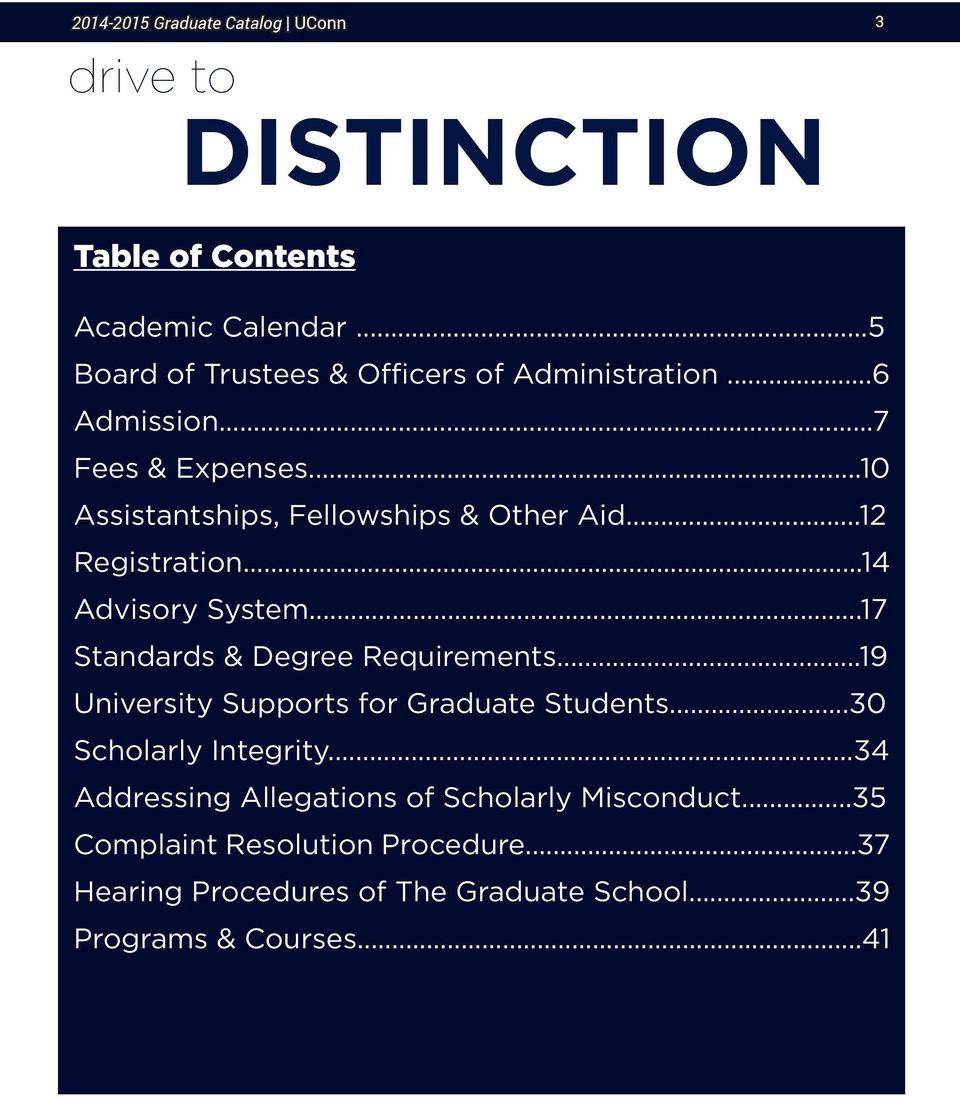
3 Graduate Catalog UConn 3 drive to DISTINCTION Table of Contents Academic Calendar...5 Board of Trustees & Officers of Administration...6 Admission...7 Fees & Expenses...10 Assistantships, Fellowships & Other Aid...12 Registration...14 Advisory System...17 Standards & Degree Requirements...19 University Supports for Graduate Students...30 Scholarly Integrity...34 Addressing Allegations of Scholarly Misconduct...35 Complaint Resolution Procedure...37 Hearing Procedures of The Graduate School...39 Programs & Courses...41
4 4 COMMUNITY Graduate Catalog UConn COLLABORATION PREPARATION

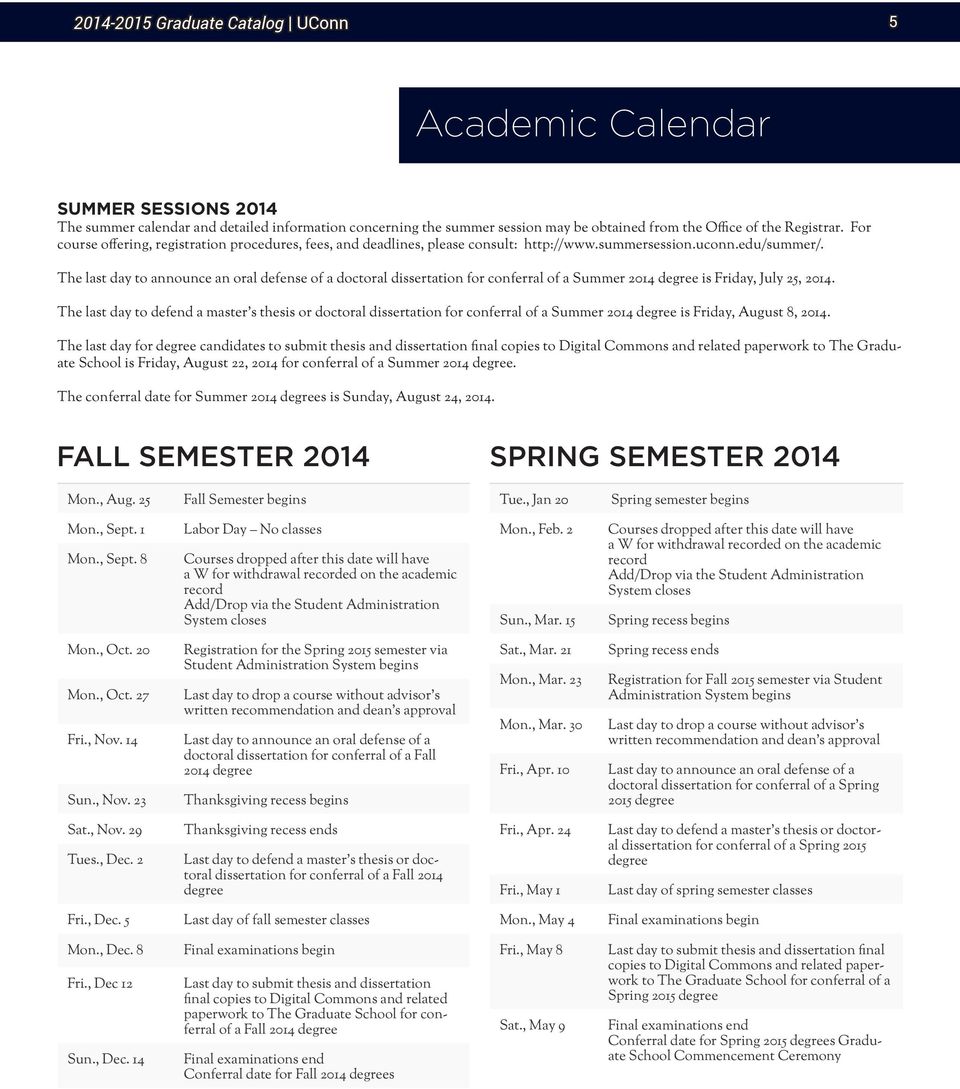
5 Graduate Catalog UConn 5 Academic Calendar SUMMER SESSIONS 2014 The summer calendar and detailed information concerning the summer session may be obtained from the Office of the Registrar. For course offering, registration procedures, fees, and deadlines, please consult: The last day to announce an oral defense of a doctoral dissertation for conferral of a Summer 2014 degree is Friday, July 25, The last day to defend a master s thesis or doctoral dissertation for conferral of a Summer 2014 degree is Friday, August 8, The last day for degree candidates to submit thesis and dissertation final copies to Digital Commons and related paperwork to The Graduate School is Friday, August 22, 2014 for conferral of a Summer 2014 degree. The conferral date for Summer 2014 degrees is Sunday, August 24, FALL SEMESTER 2014 SPRING SEMESTER 2014 Mon., Aug. 25 Fall Semester begins Tue., Jan 20 Spring semester begins Mon., Sept. 1 Mon., Sept. 8 Labor Day No classes Courses dropped after this date will have a W for withdrawal recorded on the academic record Add/Drop via the Student Administration System closes Mon., Feb. 2 Sun., Mar. 15 Courses dropped after this date will have a W for withdrawal recorded on the academic record Add/Drop via the Student Administration System closes Spring recess begins Mon., Oct. 20 Mon., Oct. 27 Fri., Nov. 14 Sun., Nov. 23 Registration for the Spring 2015 semester via Student Administration System begins Last day to drop a course without advisor s written recommendation and dean s approval Last day to announce an oral defense of a doctoral dissertation for conferral of a Fall 2014 degree Thanksgiving recess begins Sat., Mar. 21 Mon., Mar. 23 Mon., Mar. 30 Fri., Apr. 10 Spring recess ends Registration for Fall 2015 semester via Student Administration System begins Last day to drop a course without advisor s written recommendation and dean s approval Last day to announce an oral defense of a doctoral dissertation for conferral of a Spring 2015 degree Sat., Nov. 29 Tues., Dec. 2 Thanksgiving recess ends Last day to defend a master s thesis or doctoral dissertation for conferral of a Fall 2014 degree Fri., Apr. 24 Fri., May 1 Last day to defend a master s thesis or doctoral dissertation for conferral of a Spring 2015 degree Last day of spring semester classes Fri., Dec. 5 Last day of fall semester classes Mon., May 4 Final examinations begin Mon., Dec. 8 Fri., Dec 12 Sun., Dec. 14 Final examinations begin Last day to submit thesis and dissertation final copies to Digital Commons and related paperwork to The Graduate School for conferral of a Fall 2014 degree Final examinations end Conferral date for Fall 2014 degrees Fri., May 8 Sat., May 9 Last day to submit thesis and dissertation final copies to Digital Commons and related paperwork to The Graduate School for conferral of a Spring 2015 degree Final examinations end Conferral date for Spring 2015 degrees Graduate School Commencement Ceremony
6 Graduate Catalog UConn Board of Trustees & Officers of Administration Members of the Board of Trustees Louise M. Bailey (Secretary of the Board) Rose A. Barham (Student Trustee) Andy F. Bessette Charles F. Bunnell Shari G. Cantor Richard T. Carbray, Jr. Sanford Cloud, Jr. Michael K. Daniels (Student Trustee) Andrea Dennis-LaVigne, D.V.M. Marilda L. Gandara, Esq. Mary Ann Handley (Governor s Representative) Juanita T. James Thomas E. Kruger, Esq. Rebecca Lobo The Honorable Dannel P. Malloy (President), Governor of Connecticut Donny Marshall Lawrence D. McHugh (Chair) Denis J. Nayden Stefan Pryor, Commissioner, Department of Education Steven K. Reviczky, Commissioner, Department of Agriculture Thomas D. Ritter, Esq. Officers of Administration Susan Herbst, Ph.D., President of the University Mun Y. Choi, Ph.D., Provost and Executive Vice President for Academic Affairs Frank Torti, M.D., M.P.H., Executive Vice President for Health Affairs Jeffrey Seemann, Ph.D., Vice President for Research The Graduate School Kent E. Holsinger, Ph.D., Vice Provost for Graduate Education and Dean of the Graduate School Sandra M. Chafouleas, Ph.D., Associate Dean of the Graduate School Storrs and Regional Barbara E. Kream, Ph.D., Associate Dean of the Graduate School Health Center Melanie Chenette, M.S., Program Specialist Graduate Advocacy Officer Anne Lanzit, B.S., Program Administrator Admissions Lisa Pane, M.A., Systems Administrator Information Technology Charmane Thurmand, M.A., Graduate Diversity Officer Ann Wilhelm, M.B.A., M.S., Database Manger Terra A. Zuidema, B.A., Program Manager Records Graduate Faculty Council The Graduate Faculty Council is the legislative body of The Graduate School. It establishes academic policy for graduate education, except for those areas reserved to the Board of Trustees, to the University Senate, or to the faculties of other colleges and schools. The sixty (60) members, representing specific content areas derived from constituent Fields of Study, are elected to serve three (3) year terms. The membership includes two (2) voting student members chosen by the Graduate Student Senate. The President, the Provost, the Vice Provost for Graduate Education and Dean of The Graduate School, and certain other administrative officers of The Graduate School are non-voting, ex-officio members. The Council, representing the Graduate Faculty at large, exercises legislative authority in such areas as admissions criteria, curricular and degree requirements, new course approval, academic program review, and the like. The Executive Committee The Executive Committee has both executive and advisory responsibilities to the Graduate Faculty Council and to the Vice Provost for Graduate Education and Dean of the Graduate School. Its membership is drawn from the Graduate Faculty Council and from the Graduate Faculty at large. The Dean serves as chair. The Executive Committee is the steering committee for the Graduate Faculty Council. It advises the Vice Provost on matters of policy and regulatory interpretation, approves plans of study and dissertation prospectuses, and considers on the basis of academic merit proposals to modify or to create Fields of Study and areas of concentration. Members include: Richard W. Bass, Ph.D., Professor of Music Sandra M. Chafouleas, Ph.D., Associate Dean of The Graduate School Storrs and Regional (ex-officio) Sylvain De Guise, D.M.V., Ph.D., Associate Professor of Pathobiology Kelly Dennis, Ph.D., Associate Professor of Art and Art History Etan Markus, Ph.D., Professor, Psychology Kent E. Holsinger., Ph.D., Vice Provost for Graduate Education and Dean of The Graduate School (ex- officio), Chair Kelly Jones, (ex-officio) Secretary Barbara E. Kream, Ph.D., Associate Dean of the Graduate School Health Center (ex-officio) Joseph J. LoTurco, Ph.D., Professor of Physiology and Neurobiology Shayla C. Nunnally, Ph.D., Assistant Professor of Political Science Lynn Puddington, Ph.D., Associate Professor of Medicine Janet Watson, Ph.D., Associate Professor, History

7 Graduate Catalog UConn 7 7 Admission To study for a graduate degree, a student must be admitted by the Dean of The Graduate School. No coursework taken before the date of admission to The Graduate School may be included on a plan of study for a graduate degree unless specific approval has been granted by the Dean of The Graduate School. Unless students complete appropriate coursework for credit in the semester or summer for which they have been admitted, or a written request for a deferral has been submitted to and approved by The Graduate School before the end of that semester or summer, the admission becomes invalid. If this occurs, the student must apply for readmission with no certainty of being accepted. Students may earn a graduate degree only in a program to which they have been admitted. Ordinarily, a student is granted admission to pursue graduate study in one (1) field at a time. A student may be permitted with approval to enroll concurrently in two (2) different programs. There are several approved dual degree programs providing the opportunity for the student to pursue work toward two (2) degrees simultaneously. These programs often involve the sharing of a limited and specified number of course credits between the two (2) degrees. The list of dual degree programs offered by The Graduate School and the other participating schools and colleges within the University (e.g., the Schools of Law, Medicine, and Dental Medicine) can be found in the index under Dual Degree Programs. In some cases, separate applications must be filed for each of the two (2) degree programs. To be admitted to Regular status and to begin studies, an applicant must hold a baccalaureate from a regionally accredited college or university or present evidence of the equivalent. The applicant must submit to The Graduate School official transcripts covering all previous work, undergraduate and graduate, which must be of at least the following quality: a cumulative grade point average of 3.0 for the entire undergraduate record, or 3.0 for the last two (2) years, or 3.5 GPA or higher in the entire final year. The grade point average is computed on the basis of the following scale: A = 4.0, B = 3.0, C = 2.0, D = 1.0, F = 0. Applicants from foreign colleges and universities must meet equivalent standards of eligibility and are expected to submit official transcripts showing all work completed. All advanced post-baccalaureate coursework is considered, as well. Failure to send transcripts from all educational institutions, regardless of whether or not a degree was received, may be grounds for cancellation of admission. Applicants to most programs are encouraged to submit test scores from the General Test of the Graduate Record Examinations (GRE) directly to The Graduate School. Letters of recommendation, usually three (3), preferably from members of the academic profession, are required by most departments. Meeting the minimum requirements does not guarantee admission. Applicants must show promise of superior achievement and must have specific preparation for the course of study they wish to undertake. If their records indicate deficiencies, applicants may be refused admission or required either to take background courses without graduate credit or to demonstrate by examination that they have acquired the requisite knowledge or skills for graduate study. In addition, since each graduate program has a limited number of places, the successful applicant must have a record competitive with those of other applicants in the same field. Regular and Provisional Status Application procedures and required credentials for admission to Regular status are specified above. Occasionally students who hold the baccalaureate but do not qualify fully for admission to Regular status may give evidence of ability in their chosen field sufficiently convincing to warrant their Provisional admission to a master s degree program only. (Applicants are not admitted Provisionally to a doctoral program.) If a Provisional student s initial 12-credits of completed coursework (excluding 1000 s-level courses) meet the minimum scholastic requirement of The Graduate School, she/he is accorded Regular status. Otherwise, she/he is subject to dismissal. In situations where special consideration is warranted, and only upon the specific request of the major advisor, the Dean of The Graduate School may approve changing a student to Regular status if at least 9-credits of advanced coursework have been completed with superior grades. Regular, not Provisional, status is required for degree conferral. Language-Conditional Status International graduate applicants whose English language proficiency does not meet the minimum standard to qualify for Regular admission (an internet based score of 79 or greater, or a written test score of at least 550, on the TOEFL (Test of English as a Foreign Language), an overall band score of 6.5 on the IELTS (International English Language Testing System), or an overall score of 53 on the PTE Academic test may be admitted at the master s level as Language-Conditional Students. Those admitted on F-1 visas must be fully academically admissible as a Regular student (see above). The applicant will have twelve (12) months to meet the language requirement by receiving a Certificate of English Proficiency from UCAELI (University of Connecticut English Language Institute) and/or receiving a passing English proficiency score. Admission to the D.P.T. Program The Department of Physical Therapy offers study leading to the degree of Doctor of Physical Therapy. In addition to the standard requirements of The Graduate School, applicants must have the required prerequisite courses which include cellular biology, comparative anatomy and physiology (8-credits), general chemistry (8-credits), general psychology, pre-calculus or calculus, statistics, and general physics (8-credits). Additional coursework in areas including biology of human health and disease, organic chemistry with lab, human development, human genetics, biochemistry, fundamentals of nutrition, nutrition for exercise and sport, developmental psychology, physiological psychology, abnormal psychology, and pathology may enhance preparation for success in the program. Admission to the D.M.A. Program Applicants are expected to demonstrate outstanding musical ability and to have a superior record of previous performance and scholarship. A completed master s degree is required for admission. Holding a master s degree from this or from any other institution, however, does not

8 8 Admission Graduate Catalog UConn render the applicant automatically admissible to the D.M.A. program. Areas of Concentration offered are Conducting and Performance. A personal audition is required as part of the application process. Inquiries should be addressed to: Director of Graduate Studies, Department of Music, 876 Coventry Road, Unit 1012, Storrs, CT Admission to Ph.D. Programs Applicants to Ph.D. programs are expected to demonstrate outstanding ability and to show on the record of previous scholarship and experience that they are likely to do superior creative work in their respective fields. Holding a master s degree from this or any other institution does not render the applicant automatically admissible to a doctoral program. Certain master s programs, on the other hand, are open only to applicants likely to qualify for doctoral study. In general, doctoral applicants must meet all admission requirements for the master s degree as Regular graduate students and must present evidence that they are capable of doing independent work of distinction. Visiting Students Individuals who otherwise would qualify for admission with Regular status but who do not seek a degree from this University may be permitted to take courses for an unspecified time if their work here meets standards of The Graduate School. Visiting students may be working toward an advanced degree at another institution, in which case they are presumed to be fully qualified to pursue degree work at this University. Others may wish to take courses as visiting students for personal enrichment. Post-Baccalaureate and Certificate Programs University of Connecticut Certificate programs are designed to deliver valuable, real-world expertise to students in specialized academic niche areas. Our certificate programs are conceived and developed by outstanding full-time faculty, and we offer two (2) types of certificate programs: post-baccalaureate certificates and graduate certificates. A post-baccalaureate certificate program may consist entirely of undergraduate courses (courses numbered ), or it may also include some graduate coursework (courses numbered 5000 or above). A graduate certificate consists entirely of graduate courses. To receive a certificate, students must first (1st) apply for admission to a certificate program through The Graduate School and must then satisfy the requirements of the certificate program to which they have been admitted. To be admitted to either type of certificate program and to begin studies, an applicant must hold an earned baccalaureate degree from a regionally accredited college or university or present evidence of the equivalent. The applicant must submit to The Graduate School official transcripts covering all previous work, undergraduate, and graduate, which must be of at least the following quality: a cumulative grade point average (GPA) of 3.0 for the entire undergraduate record, or 3.0 GPA for the last two (2) years, or 3.5 GPA or higher in the entire final year. Non-degree students may take up to 6-credits before being formally admitted to an UConn certificate program. Currently matriculated UConn students are encouraged to apply for admission to a certificate program well before all of the required courses are complete. If a student earns a certificate and is subsequently admitted to a related graduate degree program, all credits from the certificate may be counted toward the graduate degree, subject to the approval of graduate program faculty in that area of concentration. The terminal date associated with the degree will be determined using the date of the first (1st) certificate class as the initial date of enrollment for the degree. Occasionally students who hold a baccalaureate degree but do not qualify for admission to a certificate program may be granted Provisional admission, based on a recommendation from the program. If such a student does not meet the minimum academic standards of The Graduate School after completing 3-credits, the student is subject to dismissal and will be allowed to enroll only upon recommendation from the program. Non-Degree Study Individuals with appropriate preparation who have not been admitted to any of the admissions categories described above may take courses as non-degree students. All non-degree students are presumed to be taking courses for reasons other than earning a certificate, Sixth-Year diploma in professional education, or a graduate degree at the University. Should they later be admitted to a graduate degree program at the University, usually no more than 6-credits will be acceptable toward the degree. Credits accepted toward graduate degree must be of B (not B-) quality or higher. For further information, contact the Office of the Registrar at: or Admission of University Faculty and Staff University of Connecticut faculty members who hold tenure or a rank higher than instructor leading to tenure ordinarily may not earn a graduate degree at this institution. Exceptions to this policy may be made by the Dean of The Graduate School, with the advice of the Executive Committee of the Graduate Faculty Council. New England Regional Student Program The University of Connecticut participates in a regional program administered by the New England Board of Higher Education. This program, known as the New England Regional Student Program, permits qualified residents of the New England states to study with reduced out-of-state tuition privileges. The purpose of the program is to expand opportunities in higher education for New England residents by making available on a substantially equal basis to all students those programs not commonly offered at every institution. This practice tends to reduce duplication of courses and thus to utilize most efficiently the higher educational facilities in each state. Detailed information about this program can be obtained from The Graduate School at: or from the New England Board of Higher Education, 45 Temple Place, Boston, MA or at: nebhe.org. Application Processing Fee A non-refundable fee of $75 for electronic submission must accompany the application. It may not be applied toward other charges. This fee must accompany every application submitted except for a doctoral degree program to follow immediately a master s degree program in the same field at this University. (Fees are subject to change without notice.) Application Deadlines Applicants are advised to check with appropriate academic departments concerning deadlines, and they are advised to submit their applications for admission as early as possible. At a minimum, applicants should file the application for admission several months in advance of the first (1st) semester of coursework. In no case will applications for admission to a particular semester be accepted after the first (1st) day of classes in that semester. All credentials, including official transcripts covering all undergraduate and graduate work taken up to the time of application, as well as the non-refundable processing fee, must also have been received by deadline dates.

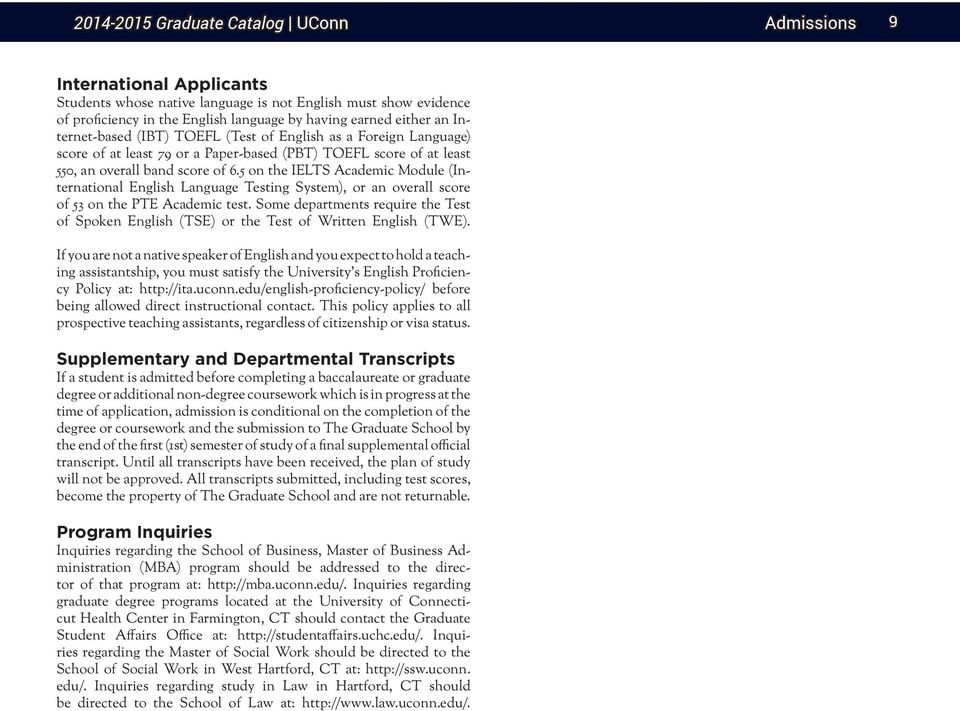
9 Graduate Catalog UConn Admissions 9 International Applicants Students whose native language is not English must show evidence of proficiency in the English language by having earned either an Internet-based (IBT) TOEFL (Test of English as a Foreign Language) score of at least 79 or a Paper-based (PBT) TOEFL score of at least 550, an overall band score of 6.5 on the IELTS Academic Module (International English Language Testing System), or an overall score of 53 on the PTE Academic test. Some departments require the Test of Spoken English (TSE) or the Test of Written English (TWE). If you are not a native speaker of English and you expect to hold a teaching assistantship, you must satisfy the University s English Proficiency Policy at: before being allowed direct instructional contact. This policy applies to all prospective teaching assistants, regardless of citizenship or visa status. Supplementary and Departmental Transcripts If a student is admitted before completing a baccalaureate or graduate degree or additional non-degree coursework which is in progress at the time of application, admission is conditional on the completion of the degree or coursework and the submission to The Graduate School by the end of the first (1st) semester of study of a final supplemental official transcript. Until all transcripts have been received, the plan of study will not be approved. All transcripts submitted, including test scores, become the property of The Graduate School and are not returnable. Program Inquiries Inquiries regarding the School of Business, Master of Business Administration (MBA) program should be addressed to the director of that program at: Inquiries regarding graduate degree programs located at the University of Connecticut Health Center in Farmington, CT should contact the Graduate Student Affairs Office at: Inquiries regarding the Master of Social Work should be directed to the School of Social Work in West Hartford, CT at: edu/. Inquiries regarding study in Law in Hartford, CT should be directed to the School of Law at:
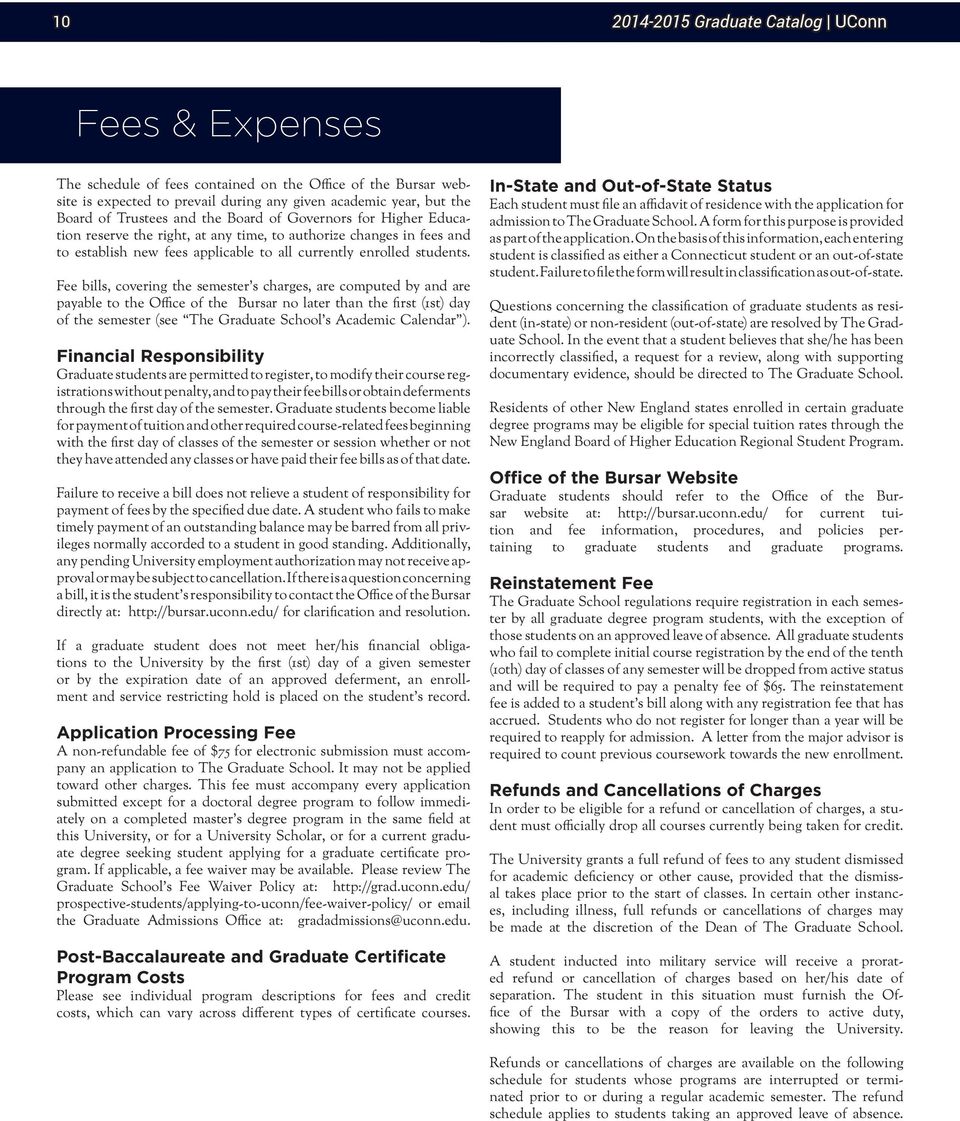
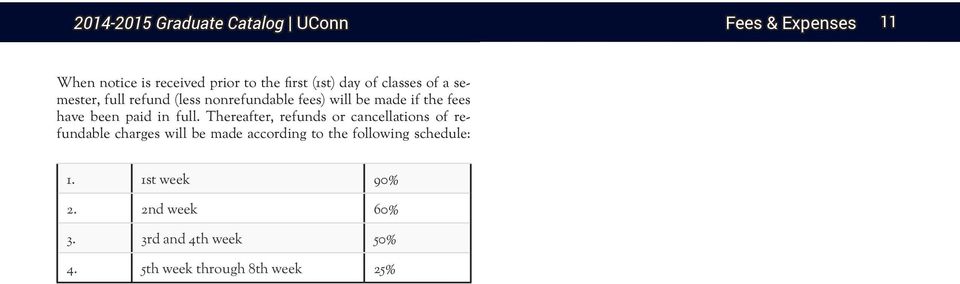
10 Graduate Catalog UConn Fees & Expenses The schedule of fees contained on the Office of the Bursar website is expected to prevail during any given academic year, but the Board of Trustees and the Board of Governors for Higher Education reserve the right, at any time, to authorize changes in fees and to establish new fees applicable to all currently enrolled students. Fee bills, covering the semester s charges, are computed by and are payable to the Office of the Bursar no later than the first (1st) day of the semester (see The Graduate School s Academic Calendar ). Financial Responsibility Graduate students are permitted to register, to modify their course registrations without penalty, and to pay their fee bills or obtain deferments through the first day of the semester. Graduate students become liable for payment of tuition and other required course-related fees beginning with the first day of classes of the semester or session whether or not they have attended any classes or have paid their fee bills as of that date. Failure to receive a bill does not relieve a student of responsibility for payment of fees by the specified due date. A student who fails to make timely payment of an outstanding balance may be barred from all privileges normally accorded to a student in good standing. Additionally, any pending University employment authorization may not receive approval or may be subject to cancellation. If there is a question concerning a bill, it is the student s responsibility to contact the Office of the Bursar directly at: for clarification and resolution. If a graduate student does not meet her/his financial obligations to the University by the first (1st) day of a given semester or by the expiration date of an approved deferment, an enrollment and service restricting hold is placed on the student s record. Application Processing Fee A non-refundable fee of $75 for electronic submission must accompany an application to The Graduate School. It may not be applied toward other charges. This fee must accompany every application submitted except for a doctoral degree program to follow immediately on a completed master s degree program in the same field at this University, or for a University Scholar, or for a current graduate degree seeking student applying for a graduate certificate program. If applicable, a fee waiver may be available. Please review The Graduate School s Fee Waiver Policy at: prospective-students/applying-to-uconn/fee-waiver-policy/ or the Graduate Admissions Office at: [email protected]. Post-Baccalaureate and Graduate Certificate Program Costs Please see individual program descriptions for fees and credit costs, which can vary across different types of certificate courses. In-State and Out-of-State Status Each student must file an affidavit of residence with the application for admission to The Graduate School. A form for this purpose is provided as part of the application. On the basis of this information, each entering student is classified as either a Connecticut student or an out-of-state student. Failure to file the form will result in classification as out-of-state. Questions concerning the classification of graduate students as resident (in-state) or non-resident (out-of-state) are resolved by The Graduate School. In the event that a student believes that she/he has been incorrectly classified, a request for a review, along with supporting documentary evidence, should be directed to The Graduate School. Residents of other New England states enrolled in certain graduate degree programs may be eligible for special tuition rates through the New England Board of Higher Education Regional Student Program. Office of the Bursar Website Graduate students should refer to the Office of the Bursar website at: for current tuition and fee information, procedures, and policies pertaining to graduate students and graduate programs. Reinstatement Fee The Graduate School regulations require registration in each semester by all graduate degree program students, with the exception of those students on an approved leave of absence. All graduate students who fail to complete initial course registration by the end of the tenth (10th) day of classes of any semester will be dropped from active status and will be required to pay a penalty fee of $65. The reinstatement fee is added to a student s bill along with any registration fee that has accrued. Students who do not register for longer than a year will be required to reapply for admission. A letter from the major advisor is required to count previous coursework towards the new enrollment. Refunds and Cancellations of Charges In order to be eligible for a refund or cancellation of charges, a student must officially drop all courses currently being taken for credit. The University grants a full refund of fees to any student dismissed for academic deficiency or other cause, provided that the dismissal takes place prior to the start of classes. In certain other instances, including illness, full refunds or cancellations of charges may be made at the discretion of the Dean of The Graduate School. A student inducted into military service will receive a prorated refund or cancellation of charges based on her/his date of separation. The student in this situation must furnish the Office of the Bursar with a copy of the orders to active duty, showing this to be the reason for leaving the University. Refunds or cancellations of charges are available on the following schedule for students whose programs are interrupted or terminated prior to or during a regular academic semester. The refund schedule applies to students taking an approved leave of absence.
11 Graduate Catalog UConn Fees & Expenses 11 When notice is received prior to the first (1st) day of classes of a semester, full refund (less nonrefundable fees) will be made if the fees have been paid in full. Thereafter, refunds or cancellations of refundable charges will be made according to the following schedule: 1. 1st week 90% 2. 2nd week 60% 3. 3rd and 4th week 50% 4. 5th week through 8th week 25%
12 Graduate Catalog UConn Assistantships, Fellowships & Other Aid The University of Connecticut supports the Council of Graduate Schools Resolution Regarding Graduate Scholars, Fellows, Trainees, and Assistants: Acceptance of an offer of financial support (such as a graduate scholarship, fellowship, traineeship, or assistantship) for the next academic year by a prospective or enrolled graduate student completes an agreement that both student and graduate school expect to honor. In that context, the conditions affecting such offers and their acceptance must be defined carefully and understood by all parties. Students are under no obligation to respond to offers of financial support prior to April 15; earlier deadlines for acceptance of such offers violate the intent of this Resolution. In those instances in which a student accepts an offer before April 15, and subsequently desires to withdraw that acceptance, the student may submit in writing a resignation of the appointment at any time through April 15. However, an acceptance given or left in force after April 15 commits the student not to accept another offer without first obtaining a written release from the institution to which a commitment has been made. Similarly, an offer by an institution after April 15 is conditional on presentation by the student of the written release from any previously accepted offer. It is further agreed by the institutions and organizations subscribing to the above Resolution that a copy of this Resolution should accompany every scholarship, fellowship, traineeship, and assistantship offer. Source: Support for graduate students engaged in degree study at the University of Connecticut comes from many sources. Two (2) general types of financial aid support are available: (1) aid based on academic merit; and (2) aid based on demonstrated financial need. 1. Awards based on academic merit include: Graduate Assistantships (for teaching or research), University Predoctoral Fellowships, and Dissertation Fellowships. Application for merit aid such as graduate assistantships should be made directly to the academic department. Students interested in scholarships and fellowships offered through The Graduate School should monitor the website for appropriate application procedures and deadlines. 2. Need-based financial aid includes: Federal Direct Stafford Loans (FDSL), Federal Work-Study (FWS), and University of Connecticut Tuition Remission Grants. Citizens or permanent residents of the United States apply for need-based financial aid by completing the Free Application for Federal Student Aid (FAFSA) on the web at: each year. The University of Connecticut s one (1) time deadline each year is March 1 (May 1, for entering graduate students). Note: International students are not eligible to receive need-based financial aid. All need-based financial aid recipients and merit-based award recipients must meet Satisfactory Academic Progress (SAP) requirements, which are based on federal regulations. These requirements include maintenance of an appropriate grade point average (3.00) and satisfactory completion of a percentage (75%) of the number of credit hours attempted in each award year, as well as not exceeding published credit maximums for the student s program plan. A warning is sent to students once they have reached their degree minimums. A complete text of this policy is available at: Assistantships, fellowships, and other awards from University sources are used in combination with need-based aid to calculate final need-based financial aid amounts offered either for a semester or an academic year. Additional information regarding need-based financial aid for graduate students is available from the Office of Student Financial Aid Services at: For example, information is provided concerning benefits under the various educational assistance programs provided by the Veterans Affairs and Military Programs. Graduate Assistantships, Fellowships, and Internships Many graduate students engaged in full-time degree study at the University of Connecticut hold graduate assistantships for teaching or research, whereas others hold fellowships, traineeships, or internships. Support from any of these sources is subject to terms of the funding source and to approval by The Graduate School. A brief definition of each is as follows: An assistantship (teaching assistantship or research assistantship) is awarded to a graduate student who provides teaching or research support to the University that is a part of her/his academic program. In recognition of this support, the tuition of the student is provided by the grant/contract funding agency (for research assistants) or the University (for teaching assistants). Note that all assistantships must be administered through an academic department. A fellowship is awarded to a graduate student to pursue her/ his academic program, but does not require the student to provide any teaching or research support to the institution. The tuition of a student receiving a fellowship must be paid by the student, the granting organization, the department and/ or school/college, or by the University with prior approval. An example of this can be found in the Policy on Competitive Federal Graduate Awards at: An internship is an experiential job placement designed to enhance the knowledge, skills, and abilities of a student, enhance their employability, and requires a student to perform specific work at the host s site. The tuition payment is the responsibility of the student, the host, or the external funding specifically designated for this purpose. Note: Holders of an assistantship, fellowship, or in-

13 Graduate Catalog UConn Assistantships, Fellowships & Other Aid 13 ternship are responsible for associated fees. The following information provides more details regarding assistantships, fellowships, and other forms of aid available through the University. Other sources may be available upon further inquiry, and graduate students are encouraged to seek opportunities for external sources of support, such as prestigious national fellowships. For more information please refer to the Office of National Scholarships and Fellowships (ONS&F) website at: Graduate Assistantships Graduate students, who meet the criteria listed below, are eligible. Appointments are ordinarily made for the nine (9) month period, August 23 through May 22, but shorter appointments may be made for a variety of reasons. Recipients serve the University as teaching assistants, readers, or laboratory and research assistants. Graduate assistants ordinarily take fewer than the usual number of courses per year because of this added workload. To be appointed, to retain an appointment, or to be reappointed, a student must have been accorded Regular (not Provisional) status, must have been maintaining a cumulative average of at least B (3.00) in any coursework taken, must be eligible to register (i.e., must not have more than three viable grades of Incomplete on her/his academic record), must be enrolled in a graduate degree program scheduled to extend through the entire period of the appointment or reappointment, and must be a full-time student, counting coursework and/or its equivalent together with assistantship duties (See Course Loads. ), throughout the period. The holder of a full assistantship devotes one-half of available time to studies and one-half (approximately twenty [20] hours per week) to assistantship duties, whereas the holder of a half assistantship devotes three-quarters of available time to studies and one-quarter (approximately ten [10] hours per week) to assistantship duties. Assistantships are not available for less than ten [10] hours per week. Graduate assistants divide their full-time efforts between study and assistantship responsibilities. As a result, they may not hold concurrent employment outside the University without the written consent of their major advisor. Stipend rates for graduate assistants in programs based at Storrs or a regional campus are graduated in terms of progress toward the advanced degree and experience. All graduate assistants in programs based at the Health Center are awarded the same stipend. Nine (9) month rates for Storrs and the regional campuses can be found at: payroll.uconn.edu/. Twelve (12) month rates for the Health Center can be found at: Tuition (but not the General University Fee, the Graduate Matriculation Fee, or other fees) is waived for graduate assistants. (See Tuition, for possible proration.) If an assistantship begins or terminates during the course of a semester, tuition will be prorated on a weekly schedule charged for that portion of the semester when the assistantship is not in force, waived when it is in force. This often results in an adjustment of the tuition charges, including partial assessment (if the student is registered throughout the semester for coursework for which tuition is charged) or a partial refund (if tuition has been paid). A graduate assistant is eligible for health insurance. Graduate assistants should be aware that it is necessary to complete the proper forms to enroll in health insurance. Health insurance does not take effect automatically. The University requires that all students have health insurance. If you have other health insurance and do not want the GA Student Health Insurance plan, you may waive the coverage by using the GA Online Enrollment/ Waiver Application located at: Graduate assistants at Storrs and regional campuses may be appointed on a twelve (12) month basis, with the stipend being increased proportionately. There are, however, no additional benefits or waiver of tuition. When graduate assistants at Storrs or a regional campus become eligible for a Level II or Level III stipend, their department may request an increase by filing a new employment authorization effective at any time after the student attains eligibility. In no case shall the increase become effective later than the August 23 appointment start date following the date on which the student becomes eligible. Additional Sources of Financial Support Many additional sources of funding for graduate education exist through both internal and external opportunities. Opportunities to seek external funding can be found through the Office of National Scholarships & Fellowships at: uconn.edu/. A searchable database of opportunities can be accessed through the website, in addition to resources helpful to graduate students seeking to prepare competitive applications. Additional internal awards are available in many programs, and students are encouraged to seek information about awards on program websites. Although not exhaustive, The Graduate School website maintains a list of internal funding opportunities. Stipend rates for graduate assistants are graduated in terms of progress toward the advanced degree and experience. Level 1: For graduate assistants with at least the baccalaureate. Level 2: For experienced graduate assistants in a doctoral program with at least the master s degree or its equivalent in the field of graduate study. Equivalency consists of twenty-four credits of appropriate course work beyond the baccalaureate completed at the University of Connecticut, together with admission to a doctoral program. Level 3: For students with experience as graduate assistants who have at least the master s degree or its equivalent and who have passed the doctoral general examination.
14 Graduate Catalog UConn Registration Applicants admitted on the basis of an expected baccalaureate or graduate degree must have completed all requirements for that degree prior to the start of classes. University of Connecticut seniors must have completed the baccalaureate prior to the start of classes. Otherwise they must continue to register as undergraduates, even though admitted to The Graduate School and registering for graduate courses. Occasionally, a University of Connecticut senior planning to enter The Graduate School has less than a full course load remaining to complete for graduation. Such a student may take advanced courses along with the remaining undergraduate courses and may count those advanced courses toward the graduate degree. Inclusion of up to 6-credits of such coursework is permissible under the following conditions: (1) the work is completed with grades of B or above; (2) the student is later admitted to Regular status in The Graduate School; (3) the work is approved as part of the graduate plan of study; and (4) the student presents a written statement from the Office of the Registrar certifying that the work was not counted toward the baccalaureate degree. Advance registration and fee payments are accepted on the assumption that students will remain eligible to continue, having met the scholastic standards of The Graduate School and by having complied with its regulations. The following instructions apply to students registering for most courses conducted on the Storrs campus. All degree-seeking students must register for courses using the Student Administration System and pay all fees either at the Bursar s Office at: edu/ or online using the Student Administration System. All course charges (applicable tuition and fees) are due and payable by the close of business on the first (1st) day of the semester. Late fees and the reinstatement fee are assessed after that time. Part-time students who are not degree-seeking students must register through the Office of the Registrar at: Both new and continuing students should make appointments with their major advisors to determine the courses in which they plan to enroll. Dates for registration are contained in The Graduate School s Academic Calendar. Depending upon course selections, most students should be able to register using the Student Administration System. Problems encountered during registration (including enrollment in restricted courses) may be brought to The Graduate School. Graduate students are permitted to register, to modify their course registrations without penalty, and to pay their fee bills or obtain deferments through the first (1st) day of the semester. Graduate students become liable for payment of tuition and other required course-related fees, however, beginning with the first (1st) day of classes of the semester or session whether or not they have attended any classes or have paid their fee bills as of that date. Continuous Registration Master s, doctoral, Sixth-Year in education, and graduate certificate students must begin their programs with coursework and must maintain registration continuously each semester thereafter (except summer sessions) until all requirements for the degree have been completed. Registration may be maintained either by taking coursework for credit or by registering for one (1) of the four (4) non-credit Continuing Registration courses. These include Special Readings at the master s (GRAD 5998) or doctoral (GRAD 6998) level, Master s Thesis Preparation (GRAD 5999), and Doctoral Dissertation Preparation (GRAD 6999). Other zero-credit courses may be substituted, if appropriate. Non-credit registration requires payment of University fees. International students should consult with The Graduate School prior to registering for zero-credit courses. Per U.S. immigration regulations, students with F-1 and J-1 status are permitted to register for zero-credits only in their final semester of degree study. Continuous Registration is granted with the consent of the student s major advisor and the student s international advisor. Failure to maintain Continuous Registration during the spring and fall semester results in the student s inactivation. Reinstatement is possible within a year of last registration and payment of all fees. (See Reinstatement Fee in the Fees & Expenses Section of the catalog.) The consequences associated with matriculation via Continuing Registration rather than credit courses are addressed in the Course Loads section below. Neither enrollment for Continuing Registration nor payment for it is required for any semester, during the first ten (10) class days of which the student completes all requirements for a degree, if it is the only degree the student is pursuing. Any currently matriculated student taking coursework at another institution, either for transfer to a University of Connecticut graduate degree program or for any other reason, must register for Continuing Registration as specified above in any affected semester. Enrollment in Continuing Registration is not required during the summer. To receive most forms of summer financial aid for study or research, a student must register for either 5-credits of coursework in each of two (2) summer sessions or one (1) of the full-time research courses, GRAD 5960 (Full-time Master s Research) or GRAD 6960 (Full-time Doctoral Research). For summer registration, permission numbers for GRAD 5960 and 6960 are issued by The Graduate School. Registration Deadlines All graduate students registering with the University must have their initial registration in place no later than the close of business of the first (1st) day of classes each semester. Additions to and deletions from a student s class schedule may occur freely throughout the first ten (10) business days of the term. Students who do not complete an initial registration by the close of business of the first (1st) day of classes are subject to a late registration fee. Course Loads The number of credits and choice of courses for which a student registers is a matter to be discussed by the student and the major advisor. Graduate students may enroll in up to 20-credits per semester. If a student has extenuating circumstances which require them to take more than 20-credits, the major advisor must send a written request to The Graduate School for approval. A student may be
15 Graduate Catalog UConn Registration 15 classified as a full-time student in one of three (3) ways: (1) enroll in 9- or more credits of coursework; (2) enroll in 6- or more credits of coursework while holding a graduate assistantship (50% or greater); or (3) enroll in one (1) of the four (4) special purpose 3-credit courses. These courses include GRAD 5960 (Full-time Master s Research), GRAD 6960 (Full-time Doctoral Research), GRAD 5930 (Master s Level Directed Studies), and GRAD 6930 (Doctoral Level Directed Studies). The former two (2) courses may be taken by students who have completed all requirements for the respective degree except the research component and who have no other obligations at the University (i.e., no other coursework and no graduate assistantship). The latter two (2) courses denote a full-time, off-campus directed project, such as an internship, field work, or other special activity. Students in GRAD 5930 or GRAD 6930 may hold graduate assistantships if those assistantships are in direct support of their studies. Such an assistantship may not be a standard teaching assistantship. To be classified as half-time, the student s course credit load must be between 5- and 8-credits per semester. A credit load of fewer than 5-credits per semester is a part-time load. These criteria apply to all registered students at the University. The currently defined Continuing Registration courses (GRAD 5998, 5999, 6998, and 6999) are zero-credit placeholder courses denoting part-time study and do not count toward the credit load requirement for half-time or full-time enrollment status. Degree-seeking students who do not need to be certified by the University as holding at least half-time enrollment status may use these courses to maintain registration on a part-time basis. Students holding graduate assistantships must register for 6- or more credits per semester. Such students are considered to be full-time students. In addition to courses offered by each department, a student s credit load may include GRAD 5950 (Thesis Research), GRAD 6950 (Dissertation Research), and other equivalent research courses defined by The Graduate School, including seminar and other colloquium courses that are not part of the plan of study. These variable credit courses carry S or U (Satisfactory or Unsatisfactory) grading, with the student s major advisor as the instructor of record. Auditing Courses Students who do not wish to register for credit may be permitted to register as auditors under the following conditions: (1) they pay the appropriate tuition and fees for courses; (2) they obtain the consent of the instructor; (3) they audit only courses for which there are adequate classroom or laboratory facilities; and (4) in the case of students in degree programs, they obtain consent from their major advisors. All permissions and registrations for auditing courses must be filed in The Graduate School. Courses audited are entered on the student s permanent record, but such courses cannot be used toward fulfilling requirements for a graduate degree at the University. The privileges of an auditor in a course are limited specifically to attending and listening. Auditors must attend class regularly. The auditor assumes no obligation to do any of the work required of the course and is not expected to take any of the instructor s time. In addition, the auditor does not submit any work, and is neither eligible to take any tests or examinations nor able to receive grades on all or any part of the course. Students should not sit-in on classes for which they do not register as auditors. No audit enrollment request will be approved after the ninth (9th) week of the semester. Adding a Course After the beginning of a semester or summer session, a student may not add a course if the instructor feels that elapsed time might preclude its successful completion. For degree-seeking students, courses added after the tenth (10th) day of a semester or after the fifth (5th) day of a summer session term must be submitted to The Graduate School. Certain exceptions to this policy exist. Students in the Sixth- Year Program must obtain permission from the Associate Dean of the School of Education. Students in part-time M.B.A. programs conducted at locations other than Storrs must obtain permission from the director of the program at their location. Students in Social Work must follow the procedures in effect at the School of Social Work. Dropping a Course Discontinuance of attendance or notice to an instructor or to an advisor does not constitute cancellation of course registration, and may result in a failing grade on the student s permanent record. Before terminating class attendance, the student should ensure that the course has been dropped officially. Until this has been done, the student is obligated to complete all work. No grade is recorded for courses officially dropped, but a mark of W is recorded to signify Withdrawal from a course after the tenth (10th) day of the semester or after the first (1st) week of a summer session course. Cancellation of course registration does not automatically drop a course from a plan of study, nor does approved deletion of a course from a plan of study cause cancellation of course registration. The procedures are separate and unrelated. During the first nine (9) weeks of a semester or prior to the midpoint of a summer session course, a course may be dropped by the following procedure. Students registered directly by The Graduate School at Storrs must file a properly completed and signed Schedule Revision Request form with The Graduate School. This form is available on The Graduate School s website at: Non-degree students register and drop courses through the Office of the Registrar at: After the first (1st) nine (9) weeks of a semester or the midpoint of a summer session course, students ordinarily are not allowed to drop a course. If, however, a student must drop a course because of illness or other compelling reason beyond the student s control, the student must request special permission as early as possible and well before the last day of classes. Permission to drop a course or to change from participant to auditor is granted only for good cause. All students must obtain permission from The Graduate School. Permission is granted only on the major advisor s written recommendation, which must be convincing and sufficiently specific regarding reasons beyond the control of the student. The recommendation should be accompanied by properly completed and signed Schedule Revision Request form for the course(s) to be dropped. Students in the M.B.A. programs must obtain permission from the director of the program. Under no circumstances is a student at any location or in any program permitted to drop a course after the course has officially ended. Policy on Leave of Absence from Graduate Studies Definition of a graduate student: A graduate student is defined as any individual who holds admission to The Graduate School to pursue a graduate certificate or graduate degree, as well as any other individual enrolled in a graduate-level course who is not strictly enrolled in an undergraduate degree or an undergraduate certificate program.

16 16 Registration Graduate Catalog UConn Under compelling personal or medical reasons, a graduate student may request a leave of absence from her/his graduate program for a period of up to twelve (12) months or one (one) calendar year. The request for a leave of absence must be made in writing using the Request for Leave of Absence from Graduate Studies form on The Graduate School s website at: The completed application form must bear the signatures of the student, the student s major advisor, and the department or program head. The completed application form is to be submitted to The Graduate School for review and approval at least thirty (30) days before the leave of absence is to commence, or the earliest date possible in extenuating circumstances. Information provided in the application for a personal leave of absence must address the specific reason(s) prompting the request. Examples could include, but are not limited to, (1) family leave and (2) financial hardship. Applications for a medical leave of absence require documentation from an appropriate health care provider, which must be submitted along with the form titled Request for Leave of Absence from Graduate Studies. In certain cases, the Dean of The Graduate School may request that a student provide documentation from an appropriate health care provider which certifies that the student has medical clearance to resume study at the conclusion of an approved leave of absence. In addition, consultation with university offices may be appropriate. For example, consultation related to assessment of the safety of the student s work environment may be requested by contacting the Division of Environmental Health and Safety at: and accommodations and services for students with disabilities may be discussed with the Center for Students with Disabilities at: When the student is on an approved leave of absence for the full duration of a fall or spring semester, she/he is not required to register for any credit or non-credit course. Requests submitted during an academic session will be reviewed on a case-by-case basis to determine the most appropriate mechanism for recording the period of leave (e.g., requests made prior to the open enrollment closing date may be dated to cover the entire semester). An approved leave of absence indicates that the student status will be recorded as inactive for the duration of the requested period of leave, and as such, the student will not have access to university services as a graduate student. In addition, the terminal date (the date determined by The Graduate School by which it is expected that all degree requirements will be completed) of any student granted a leave of absence will be extended by a period of time equivalent to the duration of the approved leave of absence. Thus, the period of the approved leave of absence will not be considered when calculating the time the student has spent working toward the completion of the degree. In contrast, a student who chooses to maintain Continuous Registration will maintain active status, which means the student will continue to pay associated fees, have access to university services as a graduate student, and the terminal date for degree requirements is not extended. Thus, the decision to choose a leave of absence versus Continuous Registration to maintain active status must be weighed accordingly. The refunds and cancellation of charges information found in the Fees and Expenses section of the catalog applies to students taking an approved leave of absence. dropped. Failure to do so will be considered a status violation and it will result in termination of the student s SEVIS record. It is strongly recommended that the student hold an advisory meeting with an international advisor if she/he is considering requesting a leave of absence. The leave of absence can be extended up to a maximum of one (1) additional twelve (12) month period. The request must be re-submitted using the previously described procedures, and ultimately approved by The Graduate School. An extended leave of absence cannot exceed two (2) full calendar years (24 months) in duration. In such cases in which a student needs leave for more than a total of two (2) calendar years, the student must reapply for admission to The Graduate School with no assurance of acceptance. Approval of a leave of absence does not assure or guarantee that a graduate program, an academic department, The Graduate School, or the University would be in a position to provide financial support or a graduate assistantship to any graduate student upon their return to studies following an approved leave of absence. Students returning to studies after a leave of absence must work with appropriate faculty advisors and program personnel to resume their degree programs. Reinstatement from an approved leave of absence will occur at the beginning of the appropriate academic term. To request Reinstatement from an approved leave of absence, the student should complete the form titled Request for Reinstatement from Leave of Absence from Graduate Studies on The Graduate School s website at: and submit it to The Graduate School. The University of Connecticut does not tolerate discrimination prohibited by federal and state law, including but not limited to sex discrimination, pregnancy-related discrimination, and disability discrimination. To ensure compliance with federal and state laws, including Title IX and the Americans with Disabilities Act (ADA), the University has designated a Title IX Coordinator and ADA Coordinator, who is charged with monitoring compliance with Title IX and the ADA and ensuring that reports of sex and disability discrimination are investigated and addressed by the University. For more information regarding the University s non-discrimination, anti-harassment, and non-retaliation policies, please visit the Office of Diversity and Equity s website at: or call Dropping all Courses The general policies and procedures regarding dropping a course (above) apply to dropping all courses, whether the student wishes to remain active in the graduate degree program or to withdraw permanently from it. Permission from The Graduate School is needed for the student either to remain active in the program or to leave in good standing. No refund is possible unless all coursework for credit is dropped. International students are strongly encouraged to thoroughly evaluate the implications of each decision on their student status. International students must obtain authorization from an international advisor at International Student and Scholar Services before any course is
17 Graduate Catalog UConn Advisory System Degree programs are planned by the advisory committee after consultation with the student. There is considerable flexibility in meeting special needs insofar as these are consistent with the regulations of The Graduate School. A degree program may entail coursework in more than one (1) field of study, but each program must include a coherent emphasis within one (1) existing field of study and area of concentration, if applicable. A major advisor must be appointed at the appropriate level by the Dean of The Graduate School, by authorization of the President of the University, to advise in a particular field of study or area of concentration. In applying for admission, an applicant may indicate a preference for a particular major advisor. If at the time of admission an applicant expresses no preference, or if the preferred advisor is unable to accept, another advisor may be appointed. Since consistency of direction is important, a durable relationship between the student and advisor should be formed as early as possible. Occasionally, it may be desirable or appropriate for a student s degree program to be directed by co-major advisors [not more than two (2)]. Each co-major advisor must hold an appropriate Graduate Faculty appointment in the student s field of study and area of concentration (if applicable). If a change of major advisor becomes necessary for any reason, the student must file a special form, bearing the signatures of the former advisor and the new advisor, with the Graduate School. The signature of the former major advisor is requested for informational purposes only and does not, in any way, signify permission or consent on the part of the former major advisor. The Change of Major Advisor form can be found on The Graduate School s website at: If a major advisor decides that it is not possible to continue as a student s major advisor and wishes to resign, The Graduate School must be notified in writing as soon as possible. The student is then provided with a reasonable opportunity to arrange for a new major advisor. If a new major advisor is not identified within six (6) weeks of the resignation of the former major advisor, the student s graduate degree program status is terminated. A student whose status has been terminated may request a hearing before the Associate Dean of The Graduate School by filing a written request within thirty (30) days of receipt of the letter of termination. The advisory committee of a master s degree student is formed after consultation between the major advisor and the student. The advisory committee must include at least two (2) associate advisors, one (1) of whom must hold a current appointment to the Graduate Faculty. An associate advisor must possess suitable academic or scientific credentials in the student s field of study. The advisory committee should be formed before the student has completed 12-credits of degree program coursework and shall then supervise the remainder of the student s degree program. The advisory committee of a doctoral degree student is formed after consultation between the student and the major advisor and shall consist of at least two (2) associate advisors with suitable academic or scientific credentials. The major advisor and at least one (1) associate advisor shall be members of the Graduate Faculty appointed to advise doctoral students in the student s field of study and area of concentration, if applicable. In addition to the three (3) or more members, another member, ordinarily a member of the Graduate Faculty outside the student s field of study but in a related field may be appointed by the Dean. If the advisory committee consists of three (3) members, decisions must be unanimous. If the advisory committee consists of four (4) or more members, decisions are considered adopted if there are no more than one (1) negative vote, although the major advisor must always vote in the affirmative. Advisory committee decisions involving the outcome of the General Examination, approval of the dissertation proposal, oral defense of the dissertation, or approval of the dissertation itself, must be a unanimous vote. A member of the University of Connecticut s Graduate Faculty who has retired from active service may be considered for appointment as Major Advisor for a newly-admitted master s or doctoral student. Application is made to the Executive Committee of the Graduate Faculty Council and requires submission of a curriculum vitae and letters of support as well as the endorsement of the appropriate department or program head. The retired faculty member must present substantial evidence of ongoing research and scholarly activity in the field. Separate application is required for each newly-admitted student for whom a retired faculty member wishes to serve as major advisor. Such appointments are made by the Dean with the advice of the Executive Committee. A current graduate student may not serve as a member of another graduate student s advisory committee. If deemed appropriate by a graduate student s major advisor, the major advisor may request that a suitably qualified external associate advisor be appointed to the student s advisory committee by writing to The Graduate School. The request should be accompanied by a curriculum vitae for the individual being recommended for appointment. Such appointments are made on the basis of advanced training and significant experience in the field of study. An appointment as external associate advisor is limited to an individual student s advisory committee and does not imply in any way membership on the Graduate Faculty of the University. Ordinarily, not more than one (1) external associate advisor is appointed to any master s or doctoral student s advisory committee. The major advisor and at least one (1) associate advisor on any doctoral student s advisory committee must be members of the University s Graduate Faculty. The major advisor of any master s or doctoral student is responsible for coordinating the supervisory work of the advisory committee. Therefore, when the major advisor is to be on leave or is not in residence, it is the major advisor s responsibility to appoint an acting major advisor. The acting major advisor must be a member of the University s Graduate Faculty or be fully eligible for such an appointment. The acting major advisor will assume all duties and responsibilities of the major advisor for the duration of the appointment. The major advisor will inform The Graduate School of the appointment and provide any information that may be required concerning the credentials of the acting major advisor.

18 18 Advisory System Graduate Catalog UConn Students advisory committees are accountable directly to the Dean of The Graduate School. For advisory committees of doctoral students, it is required that the written consent be obtained from The Graduate School before any changes are made in the membership of an advisory committee which has been duly established.

19 Graduate Catalog UConn Standards & Degree Requirements The general academic standards and degree requirements of The Graduate School apply to all graduate students enrolled in certificate and degree programs. Some programs have additional requirements that are more detailed or tailored to the needs of the specific program. Students should acquaint themselves with all of the standards and degree requirements for their degree program, as specified in both the Graduate Catalog and official graduate program handbooks. Undergraduate and non-degree students taking a graduate course should consult the appropriate catalog for regulations that apply to them. Course Grades Instructors are required to file grades with the University Registrar for all credit-bearing courses taken by a student. Although instructors are free to set the standard of performance expected in their courses, the following uniform scale is published to encourage general agreement on the meaning of grades: The letter A signifies work of distinction. The letter B represents work of good quality, such as is expected of any successful graduate student. The letter C represents work below the standard expected of graduate students in their area of study. It is recognized that work of C quality in a supporting area may be of benefit to students and that they should not be discouraged by the grading system from including some supporting work in their programs. Such work shall be identified on the plan of study. Plus and minus values may be assigned to all but failing grades, are entered on the permanent record, and are computed into the student s grade point average. A grade of D+, D, or D- signifies work of unsatisfactory quality. If a graduate student receives any form of a D grade, the course may not remain on the plan of study and the student s eligibility to continue in the degree program is reviewed by the student s advisory committee. The grade of F or U signifies failure in the course and necessitates a recommendation by the advisory committee to The Graduate School as to whether or not the student shall be permitted to continue graduate study. Final grades of S (Satisfactory) or U (Unsatisfactory) are associated only with certain courses designated as such by the Executive Committee of the Graduate Faculty Council. Certain foreign language courses designed under method (2) for fulfillment of a doctoral language requirement also may carry the S or U grading option, if chosen by the student. (See Foreign Language; Related or Supporting Area of Study. ) An S is not computed into the student s grade point average whereas a U is viewed as an F. Graduate students are not permitted to take any course, undergraduate or graduate, on a Pass/Fail basis. A mark of I (Incomplete) is assigned if a student has been doing work of acceptable quality but, for some reason satisfactory to the instructor, has not completed all of the work required to earn credit for a course by the end of the semester or session. If a student whose work in a course throughout the semester has been of satisfactory quality fails to take a required final examination in the course because of illness or other serious cause, the instructor is permitted to give a mark of X (Absent) and may, with the permission of The Graduate School, reschedule the examination. If the student s work up to the time of the examination was not clearly of passing quality, the instructor is to enter a mark of F or U if a required final examination is missed. Note: Beginning with the fall 2004 semester, the symbol I or X is replaced by the final course grade on the permanent academic record when the student completes all required work for the course and the instructor reports the final grade to the Registrar. Prior to the fall 2004 semester, the symbols I and X appear together with final course grades on students permanent academic records. The letter W signifies withdrawal from a course after either the tenth (10th) day of a semester course or the first week of a summer session course. Except in extraordinary cases where academic factors or extreme or unusual circumstances warrant it, this mark is not deleted from the permanent academic record. The letter N signifies that no grade was reported by the instructor for an individual student duly registered for a course. The letter T indicates that course credit has been accepted in transfer from another institution. The letter R is an administrative symbol signifying that a student is registered. Any zero-credit course (e.g., GRAD 5998, 5999, 6998, or 6999) for which a student registers appears on the permanent academic record with the letter R as the grade. Students are required to maintain in their course program at least a B (3.00) average, for which a grade point average will be computed using the following scale: A+ 4.3 A 4.0 A- 3.7 B+ 3.3 B 3.0 B- 2.7 C+ 2.3 C 2.0 C- 1.7 D+ 1.3 D 1.0 D- 0.7 F 0

20 20 Standards & Degree Requirements Graduate Catalog UConn Maintenance of good academic standing in The Graduate School requires a cumulative grade point average of 3.00 or higher at all times while enrolled in a graduate program. An official transcript of an individual s graduate academic career, however, includes grade point average calculations based on all coursework completed during the student s graduate career (including any 1000 s level courses). Credits completed elsewhere and accepted in transfer by The Graduate School do not affect the student s University of Connecticut grade point average in any way. Whenever a student s cumulative average falls below 3.00, the program is to be reviewed by the student s advisory committee to determine whether or not the student shall be permitted to continue graduate study. If all work required to change a mark of I or X is not submitted to the University Registrar within twelve (12) months following the end of the semester or session for which the mark was recorded, or within a shorter period of time specifically designated by the instructor, no credit is allowed for the course. For grades of I, it is the student s responsibility to reach and to maintain an understanding with the instructor concerning the timely completion of the work. For grades of X, it is the student s responsibility to seek the required permission to take the final examination from The Graduate School as soon as possible after it has been missed. Upon the recommendation of the instructor to The Graduate School, a limited extension of an Incomplete may be granted. The Graduate School is not obligated to approve an extension if the instructor of the course no longer is a faculty member at the University of Connecticut. If more than three (3) courses have been left incomplete, the student may be required to complete those still viable before being allowed to register for additional coursework. Too many permanent Incompletes on the record may be grounds for the student s termination or dismissal. An employment authorization for a graduate assistantship appointment may not be approved for a student who has four (4) or more viable incomplete courses on her/his academic record. For further information, the reader is referred to the document Key to the Transcript, available from the Office of the Registrar. Final Grade Appeals The Graduate School endorses the process for appealing a final course grade as described in the University Senate By- Laws. Information regarding the process can be found at: Information on termination of status, academic dismissal, and academic dismissal procedures can be found in the Termination of Status and Academic Dismissal Section. POST-BACCALAUREATE AND CERTIFICATE PROGRAMS A certificate from the University of Connecticut provides post-baccalaureate students with critical knowledge in a specific field or niche. UConn s certificate programs may be offered face-to-face, entirely online, or in a blended/hybrid format. Those that involve a substantial online component are predominantly administered through UConn ecampus. Post-baccalaureate and graduate certificates can often be completed in a single year, allowing working professionals to update their skill sets or expand into an emerging area quickly. Both post-baccalaureate and graduate certificate programs are offered through The Graduate School. Students are awarded certificates based upon completion of a well-defined program of coursework. A certificate is not a degree. Rather, it is a focused series of courses that, when completed, demonstrates competence in a coherent academic specialty. Completion of a certificate program does not guarantee admission to any graduate degree program. Detailed information concerning criteria and procedures may be obtained from certificate program coordinators. To be awarded a certificate, a student must satisfactorily complete (grades of B [not B-] or higher) a specified set of courses consisting of 12- to 15-credits. In certain cases where the appropriate programs have obtained specific prior approval, one (1) 3-credit course may be used simultaneously to satisfy course requirements in two (2) different certificate programs. In a small number of cases where detailed justification has been provided, a certificate program may require as few as 9-credits. A student may enroll in a certificate program on either a parttime or a full-time basis, but the student must complete the requirements for the certificate within three (3) years of initial enrollment. Admission to a certificate program does not guarantee admission to a related degree program, but if a certificate student is admitted to a degree program, all credits from the certificate may be counted toward the graduate degree, subject to the approval of graduate program faculty in that area of concentration. The terminal date associated with the degree will be determined using the date of the first (1st) certificate class as the initial date of enrollment for the degree. Students should contact graduate program coordinators to determine whether credits earned as part of a certificate program satisfy degree requirements of any particular degree program. MASTER S DEGREE PROGRAMS Master s degree programs are offered in a broad range of fields throughout the University. A master s degree program represents the equivalent of at least one (1) year of fulltime study beyond the baccalaureate (or its equivalent). The Master of Arts degree usually is awarded to qualified candidates in the humanities, the social sciences, education, and other non-scientific fields. The Master of Fine Arts is a terminal degree in the fields of Art and Dramatic Arts. The Master of Science degree is awarded to candidates in the natural, physical, mathematical, pharmaceutical, nutritional, and agricultural sciences, as well as Accounting, Nursing, and Engineering. Other master s degrees awarded include the Master of Business Administration, the Master of Dental Science, the Master of Engineering, the Master of Music, Master of Professional Studies, the Master of Public Administration, the Master of Public Health, and the Master of Social Work. Time Limits The student is expected to register for coursework with reasonable regularity and to complete all requirements for the degree within a moderate span of time to assure continuity and adequate familiarity with developments in the field of study. (See Continuous Registration. ) The Graduate School requires a minimum of 24-credits for a master s program. Some programs may require more than 24-credits. Ordinarily, the master s degree should be completed within three (3) years. In any event, all work for the master s degree must be completed within six (6) years from the beginning of the student s matriculation in the degree program. Failure to complete the work within

21 Graduate Catalog UConn Standards & Degree Requirements 21 this period or failure to maintain Continuous Registration (See Continuous Registration. ) as required may result in termination. A one-time extension of the student s terminal date of no longer than two (2) years is considered only when there is substantial evidence that the student has made regular and consistent progress toward completion of degree requirements. A detailed recommendation to extend the terminal date must be signed by the major advisor and submitted in a timely manner to the Dean of the Graduate School. Thesis and Non-Thesis Master s Degrees Master s degrees may be earned under either of two (2) plans, as determined by the advisory committee. The Thesis plan emphasizes research activities while the Non-Thesis plan requires comprehensive understanding of a more general character. Non-Thesis plans in the Masters of Fine Arts emphasize research that culminates in a final Research Project. The Thesis plan requires no fewer than 15-credits of advanced coursework and no fewer than nine (9) additional credits of Master s Thesis Research (GRAD 5950 or GRAD 5960), as well as the writing and oral defense of a thesis. The Non-Thesis plan requires no fewer than 24-credits of advanced coursework and a comprehensive final examination. In either case, advisory committees may require more than the minimum number of credits. Transfer Credit Advanced coursework taken on a non-degree basis at the University may account for up to 25% of the course credits required toward a master s degree plan of study provided the following conditions are met: (1) courses are graduate level; (2) the grades earned in such coursework are B (not B-) or higher; (3) such coursework is within the time limit for completion of master s degree requirements; and (4) such credits have not been applied toward any other degree, at the University of Connecticut or elsewhere (already completed or to be completed in the future). In any event, inclusion of non-degree coursework on the plan of study requires the consent of the advisory committee. Up to 25% of the credits required for a University of Connecticut master s degree program may be accepted in transfer from other institutions provided these conditions are met: (1) the major advisor or the advisory committee indicates its approval of the transfer of credit(s) by signing the Plan of Study and the Transfer Credit Request Form as appropriate for the degree program; (2) the courses must be at a level appropriate for a graduate degree and offered by an accredited institution; (3) such course work is within the six-year limit for completion of master s degree requirements; and (4) the grades earned in any courses to be transferred must be B (not B-) or higher. Official transcripts of any course work to be transferred must be on file in The Graduate School. Once the approved Plan of Study or program plan is submitted to The Graduate School and official transcripts indicating satisfactory completion of the course work to be transferred are received, the transfer of credit is noted on the student s permanent University of Connecticut academic record. Any credits transferred to a graduate degree program at the University of Connecticut must not have been or be used toward a degree elsewhere (already completed or to be completed in the future). Students admitted to study for the degree of Doctor of Philosophy may earn a Master of Arts or Master of Science degree, if one is offered specifically in their field of study, under either the Thesis or the Non-Thesis Plan. Students also may apply for this degree if they have on file a fully approved Ph.D. plan of study including at least twenty-four (24) completed credits of suitable content coursework taken at this University and have passed a master s final examination. They also may apply for this degree if they have completed at least 24-credits on an approved Ph.D. plan of study, have passed the doctoral General Examination, and have been recommended by their major advisor or by the Dean of The Graduate School for award of the Master s degree. More than one (1) master s degree may not be awarded at this institution to an individual student unless the degree titles are different or unless the degrees are earned in substantially different fields of study. The same course may not be offered for credit toward more than one (1) degree, except in the case of officially approved dual degree programs. Plan of Study and Program Plans To become a candidate for a master s degree, the student must have on file with The Graduate School an approved plan of study or program plan approved by their advisory committee or major advisor as appropriate for the degree program. The student may not take the final examination for the degree before the plan of study or program plan has been prepared and approved. The plan of study must be prepared and signed by the student and the members of the advisory committee, and submitted no later than the beginning of their final semester to The Graduate School. Failure to present the plan on time may prolong the period of study for the degree. Before drawing up and approving the plan of study, the major advisor should have on file and should consult for guidance a set of transcripts of all undergraduate and graduate work the student has taken. The advisory committee may require that the student take an exploratory examination to guide the committee in formulating the plan of study. Certain master s degree programs submit program plans for individual students at the conclusion of master s study rather than a plan of study. Program plans require the approval of the major advisor. Courses elected shall be consistent with the student s objectives and related to the field in which the degree is to be taken. The plan of study shall consist largely of courses at the 5000 s level or above. Not more than 6-credits at the 3000 s or 4000 s level may be accepted. In addition to the minimum number of course credits required for the degree, the advisory committee may require the student to take other courses with or without graduate credit, depending on the student s objectives and previous preparation. Course credit by examination is not allowed as a means of accumulating credits to meet the requirements for advanced degrees at this institution. Once the approved plan of study or program plan is submitted to The Graduate School, any request for change must be submitted to The Graduate School on the official form bearing the signatures of the major advisor, the members of the advisory committee, and the student as appropriate. Successful completion of all work indicated on the approved plan of study or program plan is a fundamental prerequisite to the conferral of the degree. The Master s Thesis The advisory committee must approve the topic and scope of the thesis and, upon its completion, ascertain that it represents an independent investigation of a significant topic and is an important contribution to ongoing research in the candidate s field. The thesis must be acceptable in literary style and organization. Specifications for preparation of the thesis can be obtained at The Graduate School or from The Graduate School s website at: It is the student s ultimate responsibility to be certain that the thesis conforms to the specification.
22 22 Standards & Degree Requirements Graduate Catalog UConn The thesis must be dated as of the calendar year in which all requirements for the degree are completed. The Graduate School requires the electronic submission of the thesis though Digital Commons, a University repository for public access. The final copy must meet all specifications outlined on The Graduate School s website. The Thesis Submission Checklist must be submitted to The Graduate School once it has been signed by a Homer D. Babbidge Library designated staff member together with an approval page bearing original signatures of all members of the advisory committee. Once a thesis is bound, it becomes the property of the Homer D. Babbidge Library. No restrictions that limit or delay the accessibility, use, or distribution of the results of a master s student s research are acceptable if such delays are inconsistent with an embargo period requested by the student or if they interfere with the timely completion of a student s academic program. Final Examination Near the close of the candidate s period of study not later than one (1) year after the completion of coursework or the thesis the student must pass a final examination under the jurisdiction of the advisory committee. The student may not take the final examination before Regular graduate status has been granted. The advisory committee has discretion to determine whether the examination shall be written, oral, or both. Invitation to participate in an oral examination is issued by the advisory committee, although members of the faculty may attend. The examination must be completed by the published deadlines for the appropriate conferral period for the degree to be granted with that conferral date. The decision as to whether a student has passed or failed the examination rests solely with the advisory committee, which shall take into account the opinions of other participating faculty members. The vote of the advisory committee must be unanimous. Following the examination, the major advisor shall communicate the results to the student and send a report on the official form to The Graduate School. If the student has failed the examination or if the advisory committee considers the result of the examination inconclusive, the committee has the option of requiring the student to retake it. In such cases, the recommendation must reach The Graduate School promptly, and any re-examination must take place within twelve (12) months from the date of the original examination. Under the Thesis plan, the examination may center on the candidate s research and its relation to the field of study as a whole, but may have a wider scope. Under the Non-Thesis plan, the examination shall be comprehensive and designed to assess the candidate s mastery of the field and ability to integrate the knowledge acquired. The final examination for M.F.A. candidates may include a focus on the candidate s research project and its relationship to the field. THE DOCTOR OF MUSICAL ARTS DEGREE The D.M.A. degree is the highest practice-oriented degree offered by The Graduate School in the field of Music. The program leading to its attainment is intended to give persons of outstanding ability the opportunity to become creative contributors in musical performance and scholarship. Award of the degree testifies to broad mastery of the art of music, an ability to practice that art on an exceptionally high level, and acquisition of appropriate research skills. While certain minimum requirements are set by The Graduate School and the Music Department, it is important for students to realize that work toward this degree is not merely a matter of accumulating course credits or satisfying other requirements. The degree will be conferred only after the advisory committee and the Graduate Music Faculty are convinced that the student is able to demonstrate consummate artistry in a public forum, and has developed independence of judgment and mature scholarship. Time Limits The equivalent of at least two (2) years of full-time study beyond the Master s degree is required. All work must be completed within seven (7) years of the beginning of the student s matriculation in the degree program. The general examination shall be passed within four (4) years of the beginning of doctoral study. Failure to complete the work within the periods specified or failure to maintain Continuous Registration (See Continuous Registration. ) will require re-evaluation of the entire program and may result in a notice of termination. A five (5) year time limit applies to the acceptance of foreign language courses. (See Foreign Language. ) A one (1) time extension of a student s terminal date of no longer than two (2) years is considered only when there is substantial evidence that the student has made regular and consistent progress toward completion of degree requirements. A detailed recommendation to extend the terminal date must be signed by the major advisor and submitted in a timely manner to the Dean. Residence Requirement A graduate student can fulfill the special demands of a doctoral program only by devoting a continuous period of time to concentrated study, practice, and research with a minimum of outside distraction or employment. The D.M.A. student must complete one (1) year (two [2] semesters) of full-time study in residence. This residence period must be completed through registration for and completion of appropriate course loads or research at the Storrs campus. Students ordinarily must register for full-time student status during the residence period (See Course Loads. ). The principal criterion for full-time study as required for fulfillment of the doctoral residence requirement is whether the student is in fact devoting essentially full-time effort to studies, without undue distraction caused by outside employment. It is left to the advisory committee to determine whether a student s outside employment is a distraction that prevents the student from devoting essentially full-time effort to the planned program. The advisory committee will record this determination on the plan of study, along with a description of the nature, extent, and period(s) of outside employment during the residence period. Plan of Study The plan of study must be prepared; signed by the student, the members of the advisory committee, and the Director of Graduate Studies in Music; and then submitted to The Graduate School for approval when 18-credits of coursework have been completed. The student may not take the general examination before the plan of study has been fully approved. Failure to present the plan on time may prolong the period of study for the degree. Before formulating and signing the plan, the major advisor should have transcripts of all of the student s undergraduate and graduate work on file and should consult them for guidance. The advisory committee may require that the student take an exploratory examination to guide the committee in formulating the plan of study. A limited number of credits at the 3000 s or 4000 s level (not more than six [6]) may be accepted. The degree ordinarily requires at
23 Graduate Catalog UConn Standards & Degree Requirements 23 least 60-credits. The plan will designate any foreign language(s) in which the student is to be tested. Course credit by examination is not allowed as a means of accumulating credits to meet the requirements for advanced degrees at this institution. At least 15-credits of GRAD 6950 Doctoral Dissertation or GRAD 6960 Full -time Doctoral Dissertation Research must appear on the plan of study. This effort represents the research for the D.M.A. dissertation, which is an essential component of the student s program. Up to 12-credits of coursework taken on a non-degree basis at the University of Connecticut may be included on a D.M.A. plan of study provided the following conditions are met: (1) the grades earned in such coursework are B (not B-) or higher; (2) such coursework is within the seven (7) year limit for completion of D.M.A. degree requirements; and (3) such credits have not been applied toward any other degree here or elsewhere (already completed or to be completed in the future). In any event, inclusion of non-degree coursework on the plan of study requires the consent of the advisory committee and is subject to the approval of The Graduate School. After approval of the plan, any request for change must be submitted in advance to The Graduate School on an official form bearing the signatures of the members of the advisory committee and the student. Such requests are subject to approval by The Graduate School. The successful completion of all work indicated on the approved plan of study is a fundamental prerequisite to conferral of the degree. Once the plan of study is approved, the student and the advisory committee should reevaluate it regularly and modify it, following the established procedure, if appropriate. Foreign Language Students in all areas of concentration shall be required to have a competent reading knowledge of at least one (1) foreign language appropriate to the general area of study. Students should plan to meet the language requirement early in their graduate career and well before they begin preparation for the general examination. Methods for establishing evidence of reading competence are the same as those for the Ph.D. (See explanation of the Foreign Language requirement under The Doctor of Philosophy Degree. ) Transfer Credit Transfer of credit for coursework completed at other institutions is approved only after the student has demonstrated the ability to do acceptable graduate work at the University of Connecticut. Such ability must be demonstrated by successful completion of graduate level University of Connecticut coursework. The maximum number of credits accepted from accredited institutions is twelve (12), provided it is of at least B (not B-) quality and contributes to the objectives of the proposed doctoral program. Such graduate work may be approved for transfer provided that the general examination is to be passed and all degree requirements are to be completed within the prescribed period of seven (7) years from the beginning date of the earliest course, wherever taken, listed on the approved doctoral plan of study. (See Time Limits. ) Transfer credit is not granted for individual courses used for a degree elsewhere (already completed or to be completed in the future). Instead, consideration is given to that degree program as an entity when the doctoral plan of study is being prepared. Evaluation of Performance The advisory committee shall evaluate continually the student s performance. Any graduate student whose scholastic performance does not meet the minimum requirements of The Graduate School may be subject to dismissal. The first (1st) recital for all D.M.A. students, except for those in conducting, is considered to be a qualifying recital, and must be presented during the first year of D.M.A. study. The hearing for this recital is evaluated by the full performance faculty. Any student who does not demonstrate an appropriate level of performance in this hearing and recital is subject to dismissal. General Examination The general examination shall be taken near the end of the course program. Before arrangements for the examination are made, the foreign language requirement(s) should have been met and the plan of study must have been approved by the Executive Committee of the Graduate Faculty Council. The examination is comprehensive in nature and incorporates elements of music history and literature, music theory, performance practice, and practical application of these constituent components. The examination is under the jurisdiction of the student s advisory committee and contains both written and oral components. Not fewer than five (5) faculty members, including all members of the advisory committee, constitute the examining committee and participate in the examination. The final decision as to whether or not the student has passed the examination is determined solely by majority vote of the examining committee. After the examination, the major advisor communicates the results to the candidate and sends the official report on the examination to The Graduate School. D.M.A. Dissertation Proposal Before preparation of the D.M.A. dissertation is well under way, the student must file a proposal describing the intended research with the Graduate Studies Committee of the Music Department. Failure to file the proposal early may result in wasted effort on a document if changes are required in the project. The proposal must be approved by the Graduate Studies Committee in Music at least four (4) months before the filing of the D.M.A. dissertation and it must be approved by the Executive Committee of the Graduate Faculty Council at least three (3) months before the filing of the D.M.A. dissertation. Candidacy, Recitals, and D.M.A. Dissertation Preparation Upon passing the general examination, the foreign language requirements, and (in the case of all students except conducting majors) the qualifying recital, the student becomes a candidate for the degree Doctor of Musical Arts. Students are notified of their advancement to candidacy. Students in every D.M.A. area of concentration except conducting must present three (3) full-length recitals during the course of study for the degree. The first of these is considered a qualifying recital, which must be preceded by a pre-recital hearing. This hearing must be presented on a designated date at least three (3) weeks before the scheduled recital, and is adjudicated by the full performance faculty. Hearings for subsequent degree recitals may be held at the discretion of the major advisor or applied instructor. These recitals and concerts represent the culmination of the performance aspect of this degree, and will be judged according to the highest levels of
24 24 Standards & Degree Requirements Graduate Catalog UConn musical artistry. Majors in conducting must appear in concert as conductors with an appropriate departmental ensemble. Appearances in multiple concerts are permitted provided that the amount of music prepared and performed is equal to a whole concert appearance. A written dissertation representing research into some aspect of music performance, repertoire, or pedagogy is an important requirement of this degree. The D.M.A. dissertation is under the immediate supervision of a member of the music theory or music history faculty, and secondarily under the supervision of the advisory committee. It must be acceptable in literary style and organization. It is the student s responsibility to be certain that the dissertation conforms exactly to the specifications prescribed by the student s advisory committee. The D.M.A. dissertation receives no academic credit, although the 15-credits of GRAD 6950 are associated with its preparation. This document will uphold the highest standards of scholarship, identical to those required of Ph.D. dissertations. The advisory committee will set a date for completion of the D.M.A. dissertation, allowing time for each advisor to make suggestions for revisions, and then will set a date for the final examination, allowing time for the student to make those revisions. In some cases, further revision of the dissertation may be required by the advisory committee as a result of the final examination. Final approval of the dissertation following the examination is indicated by the original signatures of all members of the advisory committee on the dissertation s final approval page. This must be submitted to The Graduate School following the examination. Final approval pages must be received at The Graduate School by the conferral period deadline in August, December, or May. The technical specifications for the preparation of the D.M.A. dissertation are identical to the specifications for the preparation of the Ph.D. dissertation (See Candidacy and Dissertation Preparation. ). No restrictions that limit or delay the accessibility, use, or distribution of the results of any student s research are acceptable, if such delays interfere with the timely completion of a student s academic program. Final Examination The final examination is oral and under the jurisdiction of the advisory committee. It deals mainly with the subject matter of the D.M.A. dissertation. It is held by the conferral period deadline in August, December, or May. Invitation to participate in the examination is issued by the advisory committee, although any member of the faculty may attend. Not fewer than five (5) members of the faculty, including all members of the candidate s advisory committee, must participate in the final examination unless written approval for a lesser number has been secured in advance from the Dean of The Graduate School. The decision as to whether a candidate has passed or failed the examination rests solely with the advisory committee, which will take into account the opinions of any other participating faculty members. The vote of the advisory committee must be unanimous. Following the examination, the major advisor communicates the results to the student and verifies that the official report has been completed and signed for submission to The Graduate School. THE DOCTOR OF PHILOSOPHY DEGREE The Ph.D. is the highest degree offered by the University. The program leading to its attainment is intended to give persons of outstanding ability the opportunity to become creative contributors in a scholarly field. Award of the degree testifies to broad mastery of an established subject area, acquisition of acceptable research skills, and a concentration of knowledge in a specific field. Although certain minimum requirements are set by The Graduate School, it is important for students to realize that work toward this degree is not merely a matter of accumulating course credits or of satisfying other requirements. The degree will be conferred only after the advisory committee and the Graduate Faculty are convinced that the student has developed independence of judgment and mature scholarship in the chosen field. An individual may not earn more than one (1) Ph.D. degree in a single field of study at this institution. Time Limits All work must be completed within a period of eight (8) years of the beginning of the student s matriculation in the degree program, or, if the student entered with a master s degree in the same or a closely related field, the doctorate must be completed within seven (7) years. Failure to complete the work within the periods specified or failure to maintain Continuous Registration (See Continuous Registration. ) will require reevaluation of the student s entire program and may result in a notice of termination. A one-time extension of the student s terminal date of no longer than two (2) years is considered only when there is substantial evidence that the student has made regular and consistent progress toward completion of degree requirements. A detailed recommendation to extend the terminal date must be signed by the major advisor and submitted in a timely manner to the Dean of the Graduate School. Plan of Study The Graduate School requires a minimum of at least 30-credits of content coursework beyond the baccalaureate (or its equivalent) or at least 15-credits of content coursework beyond the master s degree in the same or a closely-related field of study (exclusive of any required Related Area). The plan of study should be completed, signed by the student and advisory committee members, and submitted to The Graduate School for approval no later than when 18-credits of coursework have been completed. Courses elected should be consistent with the student s objectives and related to the field in which the degree will be taken. Plans of study will consist largely of courses at the 5000 s level or above. A limited number of credits at the 3000 s or 4000 s level (ordinarily not more than six [6]) may be accepted. In addition to the content coursework and any required Related Area included in the plan of study, satisfactory completion of at least 15-credits of GRAD 6950 Doctoral Dissertation Research or Grad 6960 Full-Time Doctoral Dissertation Research is required. The plan of study for some programs also may designate a foreign language(s) in which the student is required to demonstrate reading knowledge and any courses comprising a Related Area. Course credit by examination is not allowed as a means of accumulating credits to meet the requirements for advanced degrees at this institution.
25 Graduate Catalog UConn Standards & Degree Requirements 25 Up to 12-credits of coursework taken on a non-degree basis at the University may be included on a Ph.D. plan of study provided the following conditions are met: (1) the grades earned in such coursework are B (not B-) or higher; (2) such coursework is within the time limit for completion of Ph.D. degree requirements; and (3) such credits have not been applied toward any other degree here or elsewhere (already completed or to be completed in the future). In any event, inclusion of non-degree coursework on the plan of study requires the written consent of the advisory committee and is subject to the approval of The Graduate School. After approval of the plan, any request for change must be submitted to The Graduate School on an official form bearing the signatures of the members of the advisory committee and the student. Such requests are subject to approval by The Graduate School. The successful completion of all work indicated on the approved plan of study is a fundamental prerequisite to the conferral of the degree. Transfer Credit p to 30-credits of letter-graded, graduate-level academic work completed at accredited institutions may be accepted by The Graduate School in transfer provided the grade earned in any course to be transferred is B (not B-) or higher and any course to be transferred was taken within the time limit prescribed for the student s degree program. Official transcripts must be on file with The Graduate School to document any and all coursework accepted in transfer. Transfer credit is not granted for individual courses used toward a degree elsewhere (already completed or to be completed in the future). Transfer of credit toward the Ph.D. degree requires the approval of both the advisory committee and The Graduate School. Submission by the advisory committee of the completed Transfer Credit Request form together with the signed Ph.D. plan of study is required. Related Area and/or Foreign Language Requirement For all fields of study except those listed in the following paragraph, satisfactory completion of at least one Related Area or demonstrated reading proficiency of at least one appropriate language other than English is required. Fields of study which require neither a Related Area nor demonstrated reading knowledge of a language other than English currently include: Biomedical Engineering, Biomedical Science, Cell Biology, Chemical Engineering, Chemistry, Civil Engineering, Computer Science and Engineering, Ecology and Evolutionary Biology, Economics, Educational Psychology, Environmental Engineering, Human Development and Family Studies, Linguistics, Materials Science, Materials Science and Engineering, Molecular and Cell Biology, Pathobiology, Philosophy, Physics, Plant Science, Political Science, and Statistics. If a related or supporting area is required, the courses chosen must comprise a coherent unit of advanced (i.e., 4000 s level or above) work outside the major field of study (or area of concentration, if appropriate). Coursework toward the Related Area normally is taken outside the student s home department. The courses must be approved by the advisory committee as a part of the plan of study. With few exceptions, they must be taken at this institution. With the consent of the advisory committee, a 3-credit advanced course in mathematics or statistics passed satisfactorily at this institution may fulfill the otherwise 6-credit minimum requirement if the student s preparation contains a suitably advanced prerequisite course (i.e., equivalent to a 4000 s level University of Connecticut course) passed satisfactorily at this or another institution (although no course credits will be accepted in transfer). For a specific language to be considered appropriate there must exist a significant body of literature written in that language in the student s field. Students should plan to meet any language requirement early in their graduate careers and usually well before they begin preparation for the General Examination. One of five (5) methods below may be used to establish evidence of reading competence in an approved language. The advisory committee may designate which method shall be used or may leave the choice of method up to the student. For methods (1) through (3), courses and examinations will not be accepted if passed more than five (5) years prior to submission of the plan of study for approval. 1. The student may pass both semesters of an approved one(1) year reading or intermediate course in the language with grades equivalent to C (not C-) or higher. This requirement will be considered to be met if, in light of previous preparation, the student is permitted by the instructor to enter directly into the second semester of the one (one) year sequence and earns a grade of C (not C-) or higher. The courses may be taken by graduate students on a Satisfactory/Unsatisfactory basis, with a grade of Satisfactory denoting performance at the level of C (not C-) or higher. Courses approved for this purpose include French , German , and Spanish Alternatively, the student may pass a course in a foreign language or literature at or above the 3000 s level, provided that the reading for the course is required to be done in the language. Language courses taken at other institutions are not accepted. However, the student may consider option (2) below. 2. The student may pass an examination set by a member of the University faculty (or, if approved by the advisory committee and The Graduate School, a faculty member at another college or university) designated by the student s advisory committee and approved by the head of the department in which the major advisor holds an appointment. The examiner may be a member of the same department but may not be a member of the student s advisory committee. The examination will include, but need not be limited to, the translation of a passage approximately 400 words in length. The use of a dictionary may be permitted at the option of the examiner. The translation is to be written in English unless permission is granted by the Executive Committee of the Graduate Faculty Council to write it in another language. Such permission is granted only if it is deemed in the best interest of the student and if an acceptable examiner is available. The examiner will choose the passage from among books or articles submitted by the major advisor. The passage may be the same for a group of students in the same field or may be selected individually for each student. The examination must be supervised and have a reasonable time limit. The result of the examination, whether passed or failed, must be reported to The Graduate School on the official form bearing the signature of the examiner. 3. A doctoral reading examination passed at another graduate school of approved standing may be accepted in transfer (subject to the above five [5] year limitation) provided the examination was taken prior to the student s enrollment in The Graduate School. 4. The student may establish evidence of competence in the language through an official transcript stating that the baccalaureate or a higher degree was earned with that language as the major. 5. The student may establish evidence of competence in the language through documentation that it is the student s native language, learned in childhood and
26 26 Standards & Degree Requirements Graduate Catalog UConn used primarily through at least secondary school. Evaluation of Performance The advisory committee continually evaluates the student s performance. Any graduate student whose scholastic record does not meet the minimum requirements of either the program and/or The Graduate School may be subject to dismissal. General Examination The doctoral General Examination usually is undertaken when the student has completed at least 75% of the content coursework listed on the approved plan of study. The student may not take the General Examination before the plan of study has been approved. The General Examination is under the jurisdiction of the student s advisory committee unless the members of the Graduate Faculty in a student s field of study have voted to assign jurisdiction for all or part of the examination to a differently constituted examining committee. The examination may be written, oral, or both. All members of the advisory committee must participate in any oral examination. A student is examined in the several facets of her/ his field of study, not merely in the particular area of concentration. Advisory or examining committees may give a series of cumulative examinations, to be taken at intervals over the student s period of study. For practical purposes, the final part of such a series shall be regarded as the General Examination, and its scope may be limited as the advisory or examining committee may judge appropriate. The examining committee includes at least one (1) faculty member representing each of the major areas addressed in the examination. Not fewer than five (5) faculty members, including all members of the student s advisory committee, must participate in the examination. All examiners are invited to submit questions and to evaluate answers, but the final decision as to whether or not the student has passed the examination shall rest solely with the advisory committee unless the members of the Graduate Faculty in a student s field of study have voted to assign this authority to a differently constituted examining committee. After the examination, the Report on the General Examination, indicating the result of the entire examination and the names of all faculty members participating, must be signed by the members of the advisory committee and submitted to The Graduate School no later than the date of the submission of the Dissertation Proposal for final approval by The Graduate School (see below). Dissertation Proposal The Dissertation Proposal is to be prepared in consultation with the members of the advisory committee before the research is well underway. The Dissertation Proposal, bearing the signatures of the members of the student s advisory committee as well as the signature of the department or program head verifying satisfactory review by two (2) experts (see the following paragraph) who are not members of the advisory committee, should be submitted to The Graduate School for final approval by the time the student has completed the ninth credit of GRAD 6950 or The Graduate School will not grant final approval of the Dissertation Proposal without proof of any required IRB, IA- CUC, or human stem cell approval granted by SCRO. In any event, the approved Dissertation Proposal must be on file in The Graduate School before the public announcement of the oral defense of the dissertation. When the Dissertation Proposal has been completed and signed by the student and also has been approved by the members of the advisory committee, the proposal then is submitted to the head of the department or program to which the student was admitted. The department or program head appoints reviewers from outside the advisory committee to conduct a critical evaluation of the Dissertation Proposal. The use of at least one (1) reviewer from outside the University is encouraged. Reviewers may be appointed to evaluate an individual student s proposal, or they may be appointed to a committee responsible for reviewing all proposals in a particular field of study or group of related fields of study. Dissertation Proposals are reviewed with the following questions in mind: 1. Is the proposal well written, well organized, and well argued? 2. Does the proposal describe a project of appropriate scope? 3. Does the student demonstrate knowledge of the subject and an understanding of the proposed method of investigation? 4. Does the student show awareness of the relevant research by others? 5. Does the student consider how the proposed investigation, if successful, will contribute to knowledge? The department or program head s signature on the proposal when the review is completed confirms that the results of the review were favorable. The evaluation may take the form of a reading of the proposal or attendance at an oral presentation and discussion of the proposal. A copy of the signed approval form and Dissertation Proposal must be received by The Graduate School when the review process has been completed. Receipt by The Graduate School of the approved Dissertation Proposal and any required IRB, IACUC, or SCRO approval is a basic requirement for eligibility to schedule the oral defense of the dissertation and for conferral of the doctoral degree. Candidacy, Dissertation Preparation, and Final Oral Defense Upon approval of the plan of study, passing the General Examination, and approval of the Dissertation Proposal by the Executive Committee of the Graduate Faculty Council, the student becomes a candidate for the degree of Doctor of Philosophy. A dissertation representing a significant contribution to ongoing research in the candidate s field is a primary requirement. The preparation of the dissertation is under the immediate and continuous supervision of the advisory committee, and it must meet all standards prescribed by the committee and by The Graduate School. It must be acceptable in literary style and organization. Specifications for its preparation may be obtained at The Graduate School or from The Graduate School website. It is the student s ultimate responsibility to be certain that the dissertation conforms to the specifications. The oral defense of the dissertation must be announced publically by means of the University events online calendar at least two (2) weeks prior to the date of the defense. At this time, electronic tentative approval of the dissertation and an electronic working copy of the entire dissertation must be filed with The Graduate School (or with Health Center, if appropriate). Not fewer than five (5) members of the faculty, including all members of the candidate s advisory committee, must participate in the final examination, unless written approval for a lesser number has been secured in advance from the Dean of The Graduate School. The decision regarding whether a candidate has passed, conditionally passed, or failed the examination rests solely with the advisory committee, which will take into account the opinions of other par-
27 Graduate Catalog UConn Standards & Degree Requirements 27 ticipating faculty members and other experts. The vote of the advisory committee must be unanimous. Following the examination, the major advisor communicates the results to the student and verifies that the official report has been completed and signed for submission to The Graduate School (or to the Health Center, if appropriate). The abstract and dissertation must be dated as of the calendar year in which all requirements for the degree are completed. The Graduate School requires the electronic submission of the dissertation though Digital Commons, a University repository for public access. The final copy must meet all specifications outlined on The Graduate School website. The Dissertation Submission Checklist must be submitted to The Graduate School once it has been signed by a Homer Babbidge Library designated staff member together with an approval page bearing original signatures of all members of the advisory committee. Once a dissertation is bound, it becomes the property of the Homer D. Babbidge Library. No restrictions that limit or delay the accessibility, use, or distribution of the results of a doctoral student s research are acceptable if such delays are inconsistent with an embargo period requested by the student or if they interfere with the timely completion of a student s academic program. CONFERRAL OF DEGREES Conferral Degree conferral requires that the student be in good academic standing and that all requirements for the degree have been completed satisfactorily by the deadline specified in The Graduate School s Academic Calendar. Degrees are conferred three times each year in August, December, and May. However, the only graduate Commencement ceremony is held annually in May. Students who qualify for degree conferral receive their diplomas by mail, normally within three (3) months following conferral. Application for the Degree Formal application for a degree to be conferred must be filed online by the degree candidate using the Student Administration System. Information and instructions can be found on The Graduate School s website under the section titled Current Students. If filing is not timely, conferral is delayed to the next conferral period, even though all other degree requirements may have been completed on time. Commencement The graduate Commencement ceremony is held once each year at the end of the spring semester. Individuals who have had degrees conferred at the end of the previous summer or fall semester, and candidates for degrees who complete degree requirements by the end of the spring semester may participate in the annual Commencement ceremony. Academic regalia appropriate for the University of Connecticut degree being conferred is strictly required for all who participate in the ceremony. Information concerning the Commencement ceremony, including academic regalia and guest tickets, is made available by the midspring semester, and can be found on The Graduate School s website. POLICY ON LEAVE OF ABSENCE FROM GRADUATE STUDIES Definition of a graduate student: A graduate student is defined as any individual who holds admission to the Graduate School to pursue either a graduate certificate or graduate degree, as well as any other individual enrolled in a graduate-level course who is not strictly enrolled in an undergraduate degree or an undergraduate certificate program (p 239). Under compelling personal or medical reasons, a graduate student may request a leave of absence from his or her graduate program for a period of up to 12 months (one calendar year). The request for a leave of absence must be made in writing using the Request for Leave of Absence from Graduate Studies form on The Graduate School s website at: The completed application form must bear the signatures of the student, the student s major advisor, and the department or program head. The completed application form is to be submitted to The Graduate School for review and approval at least thirty (30) days before the leave of absence is to commence, or the earliest date possible in extenuating circumstances. Information provided in the application for a personal leave of absence must address the specific reason(s) prompting the request. Examples could include, but are not limited to, (a) family leave and (b) financial hardship. Applications for a medical leave of absence require documentation from an appropriate health care provider, which must be submitted along with the form titled Request for Leave of Absence from Graduate Studies. In certain cases, the Dean of the Graduate School may request that a student provide documentation from an appropriate health care provider which certifies that the student has medical clearance to resume study at the conclusion of an approved leave of absence. In addition, consultation with university offices may be appropriate. For example, consultation related to assessment of the safety of the student s work environment may be requested by contacting the Division of Environmental Health and Safety at: and accommodations and services for students with disabilities may be discussed with the Center for Students with Disabilities at: When the student is on an approved leave of absence for the full duration of a fall or spring semester, she/he is not required to register for any credit or non-credit course. Requests submitted during an academic session will be reviewed on a case- by-case basis to determine the most appropriate mechanism for recording the period of leave (e.g., requests made prior to the open enrollment closing date may be dated to cover the entire semester). An approved leave of absence indicates that the student status will be recorded as inactive for the duration of the requested period of leave, and as such, the student will not have access to university services as a graduate student. In addition, the terminal date (the date determined by The Graduate School by which it is expected that all degree requirements will be completed) of any student granted a leave of absence will be extended by a period of time equivalent to the duration of the approved leave of absence. Thus, the period of the approved leave of absence will not be considered when calculating the time the student has spent working toward the completion of the degree. In contrast, a student who chooses to maintain Continuous Registration will maintain active status, which means the student will continue to pay associated fees, have access to university services as a graduate student, and the terminal date for degree requirements is not extended. Thus, the decision to choose a
28 28 Standards & Degree Requirements Graduate Catalog UConn leave of absence versus Continuous Registration to maintain active status must be weighed accordingly. The refunds and cancellation of charges information found in the Fees and Expenses section of the catalog applies to students taking an approved leave of absence. International students are strongly encouraged to thoroughly evaluate the implications of each decision on their student status. International students must obtain authorization from an international advisor at International Student and Scholar Services before any course is dropped. Failure to do so will be considered a status violation and it will result in termination of the student s SEVIS record. It is strongly recommended that the student hold an advisory meeting with an international advisor if she/he is considering request for a leave of absence. The leave of absence can be extended up to a maximum of one additional 12-month period. The request must be re-submitted using the previously described procedures, and ultimately approved by the Graduate School. An extended leave of absence cannot exceed two full calendar years (24 months) in duration. In such cases in which a student needs leave for more than a total of two calendar years, the student must reapply for admission to the Graduate School with no assurance of acceptance. Approval of a leave of absence does not assure or guarantee that a graduate program, an academic department, The Graduate School, or the University would be in a position to provide financial support or a graduate assistantship to any graduate student upon their return to studies following an approved leave of absence. Students returning to studies after a leave of absence must work with appropriate faculty advisors and program personnel to resume their degree programs. Reinstatement from an approved leave of absence will occur at the beginning of the appropriate academic term. To request Reinstatement from an approved leave of absence, the student should complete the form titled Request for Reinstatement from Leave of Absence from Graduate Studies on The Graduate School s website at: and submit it to The Graduate School. The University of Connecticut does not tolerate discrimination prohibited by federal and state law, including but not limited to sex discrimination, pregnancy-related discrimination, and disability discrimination. To ensure compliance with federal and state laws, including Title IX and the Americans with Disabilities Act (ADA), the University has designated a Title IX Coordinator and ADA Coordinator, who is charged with monitoring compliance with Title IX and the ADA and ensuring that reports of sex and disability discrimination are investigated and addressed by the University. For more information regarding the University s non-discrimination, anti-harassment, and non-retaliation policies, please visit the Office of Diversity s website at: or call TERMINATION OF STATUS AND ACADEMIC DISMISSAL To remain in good standing, a student must at all times have a major advisor and be within the degree time limits for the degree she/he is seeking. Once a student s plan of study has been approved by The Graduate School, the student at all times must have a duly constituted advisory committee, minimally including a major advisor. (Refer to the Advisory System section for additional information regarding the advisory committee.) A student s major advisor may resign from the advisory committee by written notice to The Graduate School and the student. If the student does not identify a new major advisor within thirty (30) business days of the resignation, the student s graduate degree program status is terminated. A graduate student and the major advisor must always be cognizant of the time limits associated with the student s degree. (Refer to Standards and Degree Requirements indicated under Time Limits for specific degree programs.) The student, the major advisor, and the graduate program director and/or department head are notified of the date by which requirements must be completed when The Graduate School sends approved copies of the student s plan of study. Any request to extend the date by which requirements must be completed must be submitted in writing to The Graduate School, and must be accompanied by a written endorsement from the major advisor. Extensions of the terminal date are granted by The Graduate School only on the basis of substantial evidence that the student is making consistent and satisfactory progress toward the completion of degree requirements, and with certification by the major advisor that the student is likely to complete within the requested extension period. If an extension is granted, it establishes a new terminal degree date for the student. Whenever a student s graduate degree program status is terminated, the student receives notice from The Graduate School. The student may appeal the termination under the provisions outlined below under the Academic Dismissal and Termination of Status Appeal Procedures sections. Academic Dismissal A graduate student s progress in a degree program must be monitored regularly by the student s advisory committee. If at any time, a student s academic performance, progress in a graduate degree program, or professional development and/or suitability is judged by the advisory committee to be unsatisfactory to the degree that dismissal is warranted, the advisory committee must submit its written recommendation that the student be dismissed on such grounds. A student may be dismissed if she/he: 1. Fails to maintain the minimum cumulative grade point average required by The Graduate School (3.00); 2. Receives a grade of D+, D, D-, F, or U in any course; 3. If required, fails to satisfy a foreign language requirement for a degree; 4. If enrolled in a doctoral program, fails the doctoral general examination; 5. If enrolled in a doctoral program, fails to produce an acceptable doctoral dissertation proposal; 6. Performs unsatisfactorily in any aspect of the research or writing for a master s thesis or doctoral dissertation; 7. Fails the final examination for the master s or doctoral degree; or 8. Fails to satisfy any other requirement of the student s graduate degree program. The major advisor submits the written recommendation for academic dismissal to The Graduate School on behalf of the entire advisory committee, indicating the specific judgment on which the advisory committee s recommendation is based. For a student who does not have an established advisory committee, the major advisor alone submits the recommendation. Whenever a student is dismissed on academic grounds, the student receives notice from The Graduate School. The student may appeal the termination under the provisions outlined below.
29 Graduate Catalog UConn Standards & Degree Requirements 29 Academic Dismissal and Termination of Status Appeal Procedures If a student wishes to appeal termination or academic dismissal, the student must submit a written request to the appropriate Associate Dean (whether for Storrs and the regional campuses or the Health Center) regarding the intent to appeal within ten (10) business days of receipt of the notification. The intent to appeal must include a clear statement regarding the grounds for seeking an appeal (e.g., extenuating circumstances that warrant reconsideration). The Associate Dean will notify the major advisor and graduate program/department of the student s intent to appeal the academic dismissal or termination of status within five (5) business days. At that time, the major advisor and/or graduate program/department will be asked to provide supporting documentation regarding the academic dismissal or termination of status. 1. On a claim of error in the appeal procedure; 2. On a claim of new evidence or information material to the case that was not available at the time of the appeal; or 3. On a claim of substantive error arising from misinterpretation of evidence in the appeal. The Dean of The Graduate School shall have the authority to dismiss an appeal not sought on one (1) or more of these three (3) grounds. The Dean of The Graduate School has twenty (20) business days to complete and provide notice regarding the outcome of the appeal. The decision of the Dean of The Graduate School concerning an appeal shall be final. Within twenty (20) business days of filing the intent to appeal, the student must submit complete documentation supporting the appeal. This written documentation includes (1) a statement describing the extenuating circumstances that warrant reconsideration; (2) a description of a plan for removing barriers to successful program completion; and (3) all supporting documentation, clearly organized and labeled. Appeals will not be reviewed if the information in the request is incomplete. The written request should be completed using the Appeal for Graduate Academic Dismissal and Termination of Status form, available through request or on The Graduate School s website at: The written request is submitted to the appropriate Associate Dean. The Associate Dean will review the written appeal within ten (10) business days to determine whether the request should be considered by an Appeal Committee. The Appeal Committee will be composed of three (3) members [two (2) members of the graduate faculty and one (1) graduate student]. The Associate Dean of the Graduate School will select members of the Appeal Committee. No member of the Appeal Committee may be a member of the student s program/department, nor may any member of the Appeal Committee have personal or professional associations with the student or advisory committee members. At the discretion of the Associate Dean, an in-person meeting with the student and the major advisor and/or graduate program/department may be requested to provide further information or clarification regarding the written documentation. Each Appeal Committee member will review the appeal and report to the Associate Dean whether the termination of status or dismissal is warranted. The Associate Dean will render a decision based on a review the appeal and the Committee member reports and will notify the student of the decision within twenty (20) business days of the decision to proceed to an Appeal Committee. The notification will include a description of the facts leading to the decision. The decision of the Associate Dean to uphold the academic dismissal or termination will stand unless the student files an appeal to the Dean of The Graduate School. This appeal must be received in writing, and must specify the specific grounds for the appeal, within ten (10) business days of the issuing of the decision from the Associate Dean. An appeal is not a new hearing. It is a review of the record of the original appeal. An appeal may be sought on the following three grounds:
30 Graduate Catalog UConn University Supports for Graduate Students A wide variety and continuum of support services are offered at the University of Connecticut that can be accessed by graduate students. Although not considered to be exhaustive, the following offers an alphabetical listing of University contacts for graduate students who may be seeking supports to facilitate successful graduate study. Graduate students are also encouraged to visit the Division of Student Affairs website at: for additional information about University services for students. Bailey Agencies, Inc. Bailey Agencies, Inc. manages insurance coverage plans for all graduate assistants and fellows of UCONN/UCHC. Graduate students are encouraged to contact this agency with any questions regarding coverage, provider availability, enrollment, ID cards, and policy. Website: Address: 15 Thames Street, Suite100, Groton, CT Phone: , ext [email protected] Center for Career Development The Center for Career Development at the University is dedicated to excellence through offering the highest levels of service to our students, across all schools, colleges, campuses, and disciplines. Office staff supports the intellectual growth of students by providing programs and experiences that promote self-awareness and engagement as they identify a course of study and pursue opportunities to become contributing members of the state, national, and world communities. Through partnership with employers, alumni, faculty, and staff, students are connected to quality career development resources, internships, experiential learning, and post-graduate opportunities. Website: Address: Wilbur Cross Building, Room 201, 233 Glenbrook Road, U-4051, Storrs, CT Phone: [email protected] Center for Students with Disabilities (CSD) The Center for Students with Disabilities offers a variety of accommodations and services to students with documented permanent and temporary injuries and conditions. Additional programs are offered to prepare students to enter college as well as for life beyond college. Website: Address: Wilbur Cross Building, Room 204, 233 Glenbrook Road, U-4174, Storrs, CT Phone: [email protected] Division of Environmental Health and Safety The goal of the Division of Environmental Health and Safety is to promote and maintain a safe and healthful environment by ensuring the highest level of environmental health and safety services for faculty, staff, students, and visitors at the University. Graduate students can find information about relevant policies and procedures governing safety in their workplace, including checklists to guide thinking through various issues. In addition, personal consultation related to assessment of the safety of the student s work environment can be provided by staff. Website: Address: 3102 Horsebarn Hill Road, U-4097, Storrs, CT Phone: [email protected] Office of Student Financial Aid Services (OSFAS) The Office of Financial Aid Services provides information regarding the costs of attendance, student employment, and financial literacy. Website: Address: Wilbur Cross Building, 233 Glenbrook Road, U-4116, Storrs, CT Phone: [email protected] Office of the Controller, Bursar s Office The Bursar s Office is committed to ensuring financial integrity in the receipt, collection, and deposit of all revenues, including tuition, fees, fellowships, scholarships and stipends, while providing the highest level of professional, efficient, and responsive customer service. Website: Address: Wilbur Cross Building, 233 Glenbrook Road, U- 4100, Storrs, CT Phone:
31 Graduate Catalog UConn University Supports 31 Office of Diversity and Equity (ODE) The Office of Diversity and Equity ensures the University s commitment and responsibility to foster diverse and inclusive working and learning environments. Their work focuses on ensuring compliance with the University s Non-Discrimination policies (please see website at: and also state and federal laws and regulations related to equal opportunity and affirmative action. ODE s major areas of focus include Americans with Disabilities Act (Title I) Compliance, Affirmative Action, Discrimination, Diversity, Education and Training, Search Process Compliance, and Title IX Compliance, including sexual violence awareness. Although oversight is provided by ODE, specific resources regarding sexual violence are maintained at: Website: Address: 241 Glenbrook Road, Wood Hall, U-4175, Storrs, CT Phone: [email protected] Office of Global Affairs The Office of Global Affairs includes the following units: Study Abroad: The University offers over 300 study abroad programs in 65 countries on six continents. Begin your journey by exploring their website at: International Students and Scholar Services(ISSS): ISSS supports the greater internationalization of the University through the development and delivery of services and programs that help our international students, scholars, faculty and staff accomplish their academic and professional goals at UConn. Services provided include: (1) ensuring compliance with U.S. immigration regulations governing visa; (2) sponsoring international students, scholars, faculty, and staff; (3) providing quality service and assistance with immigration and intercultural matters to UConn sponsored visa holders and their families through advising, programs, workshops and events; (4) serving as the resource for academic and administrative units; (5) hiring and sponsorship of international students, scholars, faculty and staff; (6) providing on-going orientation and support services designed to foster cultural adjustment to the U.S., and; (7) building links within the UConn community. For more information visit our website at: Global Partnerships: The University enters into a limited number of partnerships with institutions of higher education abroad. Most of these partnerships revolve around particular projects, but some are general, laying the foundation for more focused activities in the future. Search the UConn Global Database, consult the Interactive Map to learn more about our global presence, or visit our website at: The University American English Language Institute (UCAELI): UCAELI supports the greater internationalization of the University through the development and delivery of services and programs that help our international students, scholars, faculty and staff accomplish their academic and professional goals at UConn. For more information visit us at: Website: global.uconn.edu. Dean of Students Office (DOS) The primary function of the Dean of Students Office is to help students and their families get answers and solutions to those tough college-life questions or problems that students may have. Question and problems may include life decisions (personal or academic), navigating the bureaucracy of a large institution and/or learning self-advocacy. In addition, the website maintains a page with helpful UConn web links. Website: Address: Wilbur Cross Building, Room 203, 233 Glenbrook Road, U-4062, Storrs, CT Phone: [email protected] Payroll Department The primary function of the Payroll Department is processing bi-weekly payments to employees of the University. Other special services provided include, but are not limited to, worker s compensation administration, wage verifications and social security earnings reports, moving expense reimbursements, and non-resident alien tax consultation. The Payroll Department may also be contacted with questions regarding salary and deductions or to complete the various forms available from our office. Such forms include: Federal and State W-4 forms, I-9 form, Direct Deposit Authorization Agreement form, Salary Amendment Agreement form (for tax deferred products), and the Personal Information Change form. Website: Address: Budds Building, 343 Mansfield Road, U-1111, Storrs, CT Phone: Residential Life (Student Housing) The primary role of the Department of Residential Life is to provide assistance with campus housing. Housing options vary widely for graduate students at the University. The primary decision which will guide your housing need is whether you want or need to be located on-campus, close to campus, or find something in a more urban area. Website: Address: Rome Commons, Ground Floor, 626 Gilbert Road Extension, U-1022, Storrs, CT Phone: In addition, resources for assisting in your off-campus housing search include: Off-Campus Student Services: Off-Campus Student Housing (UConn Sponsored): offcampushousing.uconn.edu/
32 32 University Supports Graduate Catalog UConn The Renter s Directory (Off-Campus Housing): Student Health Services Student Health Services provides primary level health care for both medical and mental health. Student Health Services is a fully accredited ambulatory health care facility. Students are offered both in- and out-patient services, as well as health care treatment for non-emergency conditions. Services include the following: Primary Medical Care Women s Clinic Men s Health Nutrition Services Counseling & Mental Health Clinical Research Health Education Sports Medicine Orthopedics Physical Therapy Club Sports Athletic Training Website: shs.uconn.edu Address: Hilda May Williams Student Health Services Building, 234 Glenbrook Road, U-4011, Storrs, CT Phone: [email protected] Ombuds Office UConn Ombuds Office serves as a neutral resource and provides confidential and informal assistance to members of the campus community. The Ombuds Office is not a designated reporting office for UConn, but is available to discuss a variety of workplace concerns confidentially to the extent permitted by law. The Ombuds Office supplements but does not substitute for any of the other resources included on this list. Persons can contact the Ombudsman, Jim Wohl, at any point during an issue when a confidential conversation or source of information may be needed. Website: Address: Homer D. Babbidge Library, 2nd Floor, Room 2189, 369 Fairfield Way, U-1257, Storrs, CT Phone: / Secure Fax: [email protected] Veterans Affairs and Military Programs Veterans Affairs and Military Programs provide support for returning armed forces personnel as they adjust to the academic and social terrain at the University. The office assists student veterans in accessing services on-campus and in the surrounding community. The University is an institution that enhances its support towards and celebration of its student veteran population. Website: Address: Arjona Building, Room 340, 337 Mansfield Road, Unit 1264, Storrs, CT Phone: [email protected] Parking Services Parking Services is committed to providing effective parking solutions for University students, employees, and visitors. The Parking Services Office manages all parking activities on-campus including the assignment of parking permits, the administration of parking citations, the operations of the parking garages, and the maintenance of all parking areas. Parking at the Storrs campus is in high demand and is strictly regulated. Carpools and the use of public transportation are encouraged. Website: Address: 3 North Hillside Road, U-6199, Storrs, CT Phone: [email protected] Research Compliance Services (RCS) The University of Connecticut is committed to the highest standards of integrity in fulfilling its mission to expand human knowledge and benefit society through research. All research activities undertaken by faculty, staff, and students at UConn will be conducted in accordance with strict ethical principles and in compliance with federal, state, and institutional regulations and policies. The Office of Research Compliance Services (RCS) reports to the Vice President for Research. RCS is responsible for providing support and training to faculty, students and staff in order to meet these requirements and maintain a robust research compliance program at UConn. Website: Address: Nathan L. Whetten Graduate Center, 438 Whitney Road Extension, U-1246, Storrs, CT Phone: [email protected] Office of the Vice Provost for Diversity In order to develop an inclusive community for instruction, research and outreach, the University embraces diversity and cultivates leadership, integrity, and engaged citizenship among our students, faculty, and staff. This collegial and vibrant environment promotes and nurtures perspectives that are enabled through differences in culture, experience, and values. To achieve this goal, the university emphasizes diversity in the recruitment, retention, and advancement of students, faculty, and staff. Initiatives to support these goals are provided through the Office of the Vice Provost for Diversity. Website: Address: Wilbur Cross Building, 233 Glenbrook Road, U- 4258, Storrs, CT
33 Graduate Catalog UConn University Supports 33 Phone: Office of National Scholarships & Fellowships (ONS&F) The Office of National Scholarships & Fellowships advises and mentors high-achieving students who are competing for prestigious national and international scholarships and fellowships. ONS&F is part of the University of Connecticut s Enrichment Programs and is open to all graduate and undergraduate students, including students at the regional campuses. Website: Address: Rowe Center for Undergraduate Education, 368 Fairfield Way, U-4147, Storrs, CT Phone: [email protected] Division of Public Safety The division of public safety includes the police department, locksmith department, fire department and the fire marshal and building inspector for the University of Connecticut. Website:
34 Graduate Catalog UConn Scholarly Integrity Scholarly activity at the graduate and postdoctoral level takes many forms, including, but not limited to, classroom activity, laboratory or field experience, writing for publication, presentation, and forms of artistic expression. Integrity in all of these activities is of paramount importance, and The Graduate School of the University of Connecticut requires that the highest ethical standards in teaching, learning, research, and service be maintained. Scholarly integrity encompasses both research integrity and the ethical understanding and skill required of researchers/scholars in domestic, international, and multicultural contexts. It also addresses ethical aspects of scholarship that influence the next generation of researchers as teachers, mentors, supervisors, and successful stewards of grant funds (Council of Graduate Schools, Research and Scholarly Integrity in Graduate Education: A Comprehensive Approach, 2012). The Graduate Faculty Council, in accordance with the provisions of its By-Laws, has adopted this policy concerning scholarly integrity in graduate education and research and has approved the procedures set forth herein for addressing alleged violations. The Dean of The Graduate School shall coordinate the reporting, investigation, and determination of alleged breaches of scholarly integrity by graduate students and postdoctoral scholars in accordance with this policy. Members of the Graduate Faculty have primary responsibility to foster an environment in which the highest ethical standards prevail. All members of the University community have a responsibility to uphold the highest standards of scholarship, which encompasses activities of teaching, research, and service, and to report any violation of scholarly integrity of which they have knowledge. Instructors have a responsibility to take reasonable steps to prevent scholarly misconduct in their courses and to inform students of course-specific requirements. Note: Student misconduct other than scholarly misconduct, as defined herein, is governed by The Student Code, which is administered under the direction of the Office of the Provost. Enforcement of its provisions is the responsibility of the Director of Community Standards. At the Health Center, student misconduct other than scholarly misconduct is governed by the Health Center Rules of Conduct. Distorted reporting involves any omission or misrepresentation of the information necessary and sufficient to evaluate the validity and significance of research, at the level appropriate to the context in which the research is communicated (D. Fanelli, Nature, 494:149; 2013). Fabrication or Falsification of Grades involves any form of falsification of coursework or tampering with grades, e.g., a student making unauthorized changes to her/his own grades or an instructor consciously misreporting grades of students. Misrepresentation involves taking an examination for another student, submitting work done by another individual as one s own, submitting the same work for evaluation in two or more courses without prior approval, unauthorized use of previously completed work or research for a thesis, dissertation, or publication, or making false, inaccurate, or misleading claims or statements when applying for admission to The Graduate School or in any scholarly or research activity, including publication. Academic or Research Disruption involves unauthorized possession, use, or destruction of examinations, library materials, laboratory or research supplies or equipment, research data, notebooks, or computer files, or it might involve tampering with, sabotage of, or piracy of computer hardware, computer software, or network components. Fabrication or Falsification in Research involves falsification of, tampering with, or fabricating results or data. Research Violations include violation of protocols governing the use of human or animal subjects, breaches of confidentiality, obstruction of the research progress of another individual, or disregard for applicable University, local, State, or federal regulations. Professional Misconduct involves violation of standards governing the professional conduct of students in particular fields (e.g., pharmacy, nursing, education, counseling, therapy). Deliberate Obstruction involves hindering investigation of any alleged act of scholarly misconduct. Aiding or Abetting involves actions that assist or encourage another individual to plan or commit any act of scholarly misconduct. Definitions of Scholarly Misconduct Scholarly misconduct is broadly defined as a failure to uphold standards of scholarly integrity in teaching, learning, research, or service. For the purpose of this Policy, scholarly misconduct shall be deemed to include, but not be limited to, the following types of misconduct. The list is not intended to be exhaustive, but does identify major categories of scholarly misconduct, and provides illustrations where appropriate. Cheating involves dishonesty during a course, on an examination required for a particular degree, or at other times during graduate study, e.g., copying the work of another student. Plagiarism involves using another person s language, thoughts, data, ideas, expressions, or other original material without acknowledging the source. (adapted from Council of Writing Program Administrators, Defining and Avoiding Plagiarism: The WPA Statement on Best Practices, 2003).
35 Graduate Catalog UConn Addressing Allegations of Scholarly Misconduct Allegations of scholarly misconduct will be addressed in accordance with the procedures set forth below. If a graduate student accused of scholarly misconduct is part of a combined degree program, the appropriate Associate Dean of The Graduate School (whether for Storrs and the regional campuses or the Health Center) and the academic leader of the other degree program will determine whether the complaint will be addressed in accordance with these procedures or in accordance with those of the other degree program, using the procedures of the program to which the alleged misconduct is more germane. Misconduct Allegedly Committed Within an Academic Course When an instructor or relevant dean or department head believes that an act of scholarly misconduct within an academic course has occurred, the procedures set forth below shall be followed: 1. The instructor, dean or department head who believes that scholarly misconduct has occurred within an academic course (the Complainant) shall retain all evidence of the alleged misconduct in its original form. Original papers or other materials need not be returned to the accused student. Copies of the accused student s work will be provided to her/him upon request. All instructors within the course shall be notified of the allegation and the proposed academic consequences before the student is notified of the alleged misconduct. 2. Within thirty (30) business days of becoming aware of alleged misconduct, the Complainant shall notify the accused student in writing of the allegation of misconduct and the sanctions to be imposed. The notice shall be sent by the Complainant to the accused student by , to the student s official University address, and by first class mail, postage prepaid, to the mailing address on file with the University. The notification shall advise the student that she/he has ten (10) business days from the date the notice is sent via to contact the Complainant to address the alleged misconduct and/or request a hearing and that if she/he fails to do so, the sanctions described in the notice shall be imposed. The Complainant will provide a copy of the written notification sent to the accused student to The Graduate School, and also will maintain a copy. 3. The accused student may request a hearing by filing a written request with the appropriate Associate Dean of The Graduate School (whether for Storrs and the regional campuses or the Health Center). The written request will be structured using the Graduate Hearing Request form available on The Graduate School s website at: The Associate Dean shall notify the Complainant of the receipt of accused student s request for a hearing within five (5) business days. The Complainant shall within five (5) business days forward to the Associate Dean information supporting the allegation. 4. The Graduate Hearing Procedures will be used to evaluate the request for a hearing and to determine whether a hearing will be held. 5. A student who has been notified that she/he has been accused of scholarly misconduct may not withdraw from the course in which the alleged misconduct has occurred without the approval of the Dean of The Graduate School. If a semester concludes before a scholarly misconduct matter is resolved, the student shall receive a temporary I (Incomplete) grade in the course until the instructor submits the appropriate grade. Misconduct Allegedly Committed Outside of an Academic Course A substantial portion of graduate and postdoctoral study takes place in contexts where they are not students within a course (e.g., serving as a teaching or research assistant, working as an intern, conducting research and disseminating findings, and taking a written or oral general exam). Allegations of scholarly misconduct committed outside of an academic course will be addressed according to the procedures described in this section. When any person (the Complainant) believes that an act of scholarly misconduct outside of an academic course has occurred, the procedures set forth below shall be followed: The Complainant shall retain the evidence of the alleged misconduct in its original form. Within thirty (30) business days of becoming aware of alleged misconduct, the Complainant shall notify the accused person in writing of the allegation of misconduct and the course of action to be taken. The course of action will include sanctions and if appropriate, referral to entities inside or outside the University for further investigation.1 The notice shall be sent by the Complainant to the accused person by , to the student s official University address, and by first class mail, postage prepaid, to the mailing address on file with the University. The notification shall advise the person that she/ he has ten (10) business days from the date the notice is sent via to provide writing request for a hearing through The Graduate School and that if she/he fails to do so, the sanctions described in the notice will be imposed. The Complainant will provide a copy of the written notification sent to the accused student to The Graduate School, and also will maintain a copy. If the person decides to request a hearing through The Graduate School, the Graduate Hearing Request form, available on The Graduate School s website at: must be submitted to the Associate Dean within ten (10) business day from the date of the notification. The Associate Dean shall notify the Complainant of the receipt of accused student s request for a hearing within five (5) business days. The Complainant shall within five (5) business days after notice of the request for hearing is sent forward to the Associate Dean copies of information supporting the allegation. The procedures for evaluating the request for and determining referral for a hearing will follow the guidelines set forth in the Graduate Hearing Procedures. 1 Examples of referrals to inside or outside the University include:
36 36 Addressing Scholarly Misconduct Graduate Catalog UConn Cases involving allegations of research misconduct on a sponsored project by graduate students or postdoctoral scholars enrolled at Storrs or regional campuses will be referred to the Vice President for Research for review under the Policy on Alleged Misconduct in Research. Cases involving allegations of research misconduct by students enrolled at the Health Center will be referred to the Research Integrity Officer for action under the Policy on Review of Alleged Misconduct of Research. Cases involving alleged violation of standards governing the codes of conduct for students in professional fields (e.g., pharmacy, nursing, education, counseling, and therapy) may be subject to additional review by other entities inside or outside the University (e.g., professional organizations, credentialing boards).
37 Graduate Catalog UConn Complaint Resolution Procedure The University of Connecticut is a community of scholars committed to integrity, freedom of inquiry and intellectual pursuit, respect for individuals and the rights of others, and tolerance for both individual differences and differing points of view. Accordingly, a fundamental responsibility of The Graduate School is to foster durable, harmonious, and productive working relationships among graduate students, postdoctoral scholars, faculty members, staff, and administrators. This document describes the procedure by which graduate students and postdoctoral scholars can seek resolution of complaints resulting from their interactions with faculty, administrators, academic programs or departments, or other graduate students or postdoctoral scholars. Consistent with the University s Non-Retaliation Policy at: retaliation against any person who makes or participates in the investigation of a complaint under this policy is strictly forbidden. Note: These procedures do not apply to matters addressed by other existing University policies or procedures including, but not limited to, allegations of scholarly misconduct, conduct proscribed by The Student Code, harassment, complaints of retaliation and/or retaliation, and conflicts of interest. The Associate Dean of The Graduate School with jurisdiction (Storrs or the Health Center) may at her/his sole discretion determine that a complaint falls under the jurisdiction of the Responsibilities of Student Life: The Student Code, the Policy on Scholarly Integrity in Graduate Education and Research, the Policy Statement on Harassment, the Policy on Conflict of Interest in Research, or any other existing University policy that provides for resolution of complaints. Should the Associate Dean determine that the complaint should be addressed through other procedures, she/he will notify the parties involved and refer the complaint to the appropriate University officials. The University of Connecticut Health Center has a separate Office of Postdoctoral Affairs with jurisdiction over any complaints raised by postdoctoral fellows at the Health Center. 1. Categories of Complaints to Which This Procedure Applies Complaints to which this procedure applies include, but are not limited to the following: Unfair application of policies includes differential application of policies or regulations within a particular degree program or department that is not commensurate with individual differences in skills, contributions, or performance; A hostile environment involves personal conflict or behavior within a laboratory, degree program, or department that has the effect of interfering with a person s performance; Note: A hostile environment claim may be referred to another office for resolution if it arises because a person is a member of a protected class under the University s harassment policy. Unfair decisions relate to differential work assignments, allocation of research resources, allocation of financial support, or allocation of authorship that are not commensurate with individual differences in skills, contributions, or performance; and Interference or intimidation includes actions or behaviors that limit, impede, or delay a person s completion of a task or degrade her/his performance in any aspect of her/his scholarly work. 2. Filing a Complaint A graduate student or postdoctoral scholar may file a complaint with The Graduate School when she/he believes that actions or behaviors governed by this procedure have occurred and when attempts to resolve her/his complaint either through direct communication with the individual(s) involved or through applicable procedures in the graduate program, department, school, or college have failed. To be addressed under this procedure, a complaint must be filed in writing using the Graduate Hearing Request form, available on The Graduate School s website at: edu/. As noted on the form, the complaint must minimally include: A detailed description of the actions or behaviors governed by this procedure giving rise to the complaint, including documentary evidence (e.g., correspondence, notes, descriptions of interactions, and dates of occurrence) supporting the allegation; A description of actions already attempted to resolve the complaint (e.g., correspondence with the person(s) against whom the complaint is lodged; records of meetings with graduate program directors, department heads, or deans); and The names and signatures of those lodging the complaint. Complaints may not be filed anonymously under this procedure. Anonymous complaints may be filed through the Workplace Alert Program at: welcome, but The Graduate School may or may not become involved in the resolution of anonymous complaints. If The Graduate School does become involved, it may be unable to resolve the complaint unless the Complainant discloses her/his identity. 3. Evaluating and Hearing the Complaint The procedures for hearing the complaint will follow the guidelines set forth in the Graduate Hearing Procedures, with the following clarifications as specified for evaluation and hearing of a complaint. As noted in the procedures, the Associate Dean will consider information provided by the Complainant describing prior attempts to resolve the complaint and may at her/his sole discretion choose to validate that information through a request for additional clarification and/or communications with other parties to the complaint. The Associate Dean will ordinarily decline to convene a hearing committee unless there is evidence that prior attempts at resolution have failed. In rare cases, the actions or behaviors alleged in the complaint may be sufficiently extreme that it would be unreasonable to expect the Complainant to attempt a prior resolution. If the Associate Dean decides not to convene a Hearing Committee, the decision cannot be appealed. However, the Complainant will be encouraged to seek resolution through direct communication with the person(s) against whom the complaint is directed and/or through procedures available through the relevant graduate program, department, school or college, and university, as applicable. If these attempts at resolution fail, the Complainant may file a new complaint no sooner than thirty (30) business days after the notice declining convene a Hearing Committee was sent.
38 38 Complaint Resolution Procedure Graduate Catalog UConn If the Associate Dean decides to convene a Hearing Committee, note that the Hearing Committee s decision will specify clearly whether the complaint has been found to have merit. If the complaint is found to have merit, the Dean of The Graduate School will consult with appropriate University officials to implement an appropriate remedy. A version of this policy was first approved and adopted by the Graduate Faculty Council on October 17, It was modified on May 23, 2008, March 27, 2013, and January 24, 2014.
39 Graduate Catalog UConn Hearing Procedures of The Graduate School Attempts by all parties to resolve disputes are strongly encouraged before pursuing a request for a hearing through The Graduate School. Assistance with problem-solving and mediation toward resolution should be pursued at local levels (e.g., program, department, and/or school) and also is available through the University Ombudsman, Jim Wohl at: In the event that a resolution is not reached following such efforts, either party may submit a written request to pursue a hearing through The Graduate School using the Graduate Hearing Request form available on The Graduate School s website at: edu/. Information on the form must provide sufficient detail to allow the Associate Dean to determine whether a hearing is warranted. The Associate Dean (whether for Storrs and the regional campuses or the Health Center) will review the information submitted, may request additional clarification, and will consider all relevant information in determining whether the case should be referred to a Hearing Committee. In particular, evidence of good faith effort at mediation will be considered. Within twenty (20) business days of receiving the written request, the Associate Dean will determine whether the case should be referred to a Hearing Committee. If the case is forwarded for hearing, both parties will be notified of the reason for the hearing and scheduled hearing date. The hearing will be scheduled by the Associate Dean no later than thirty (30) business days after notification to proceed with the hearing request. For good cause shown, the Associate Dean may reschedule the hearing at the request of either the person(s) filing the hearing request or the person(s) against whom the hearing is requested. If the person(s) filing the hearing request fails to appear at the hearing, the issue will be dismissed. If the person(s) against whom the hearing is requested fails to appear at the hearing, the Hearing Committee will hear evidence from the person(s) filing the hearing request and render its finding. A finding that arises from a party s failure to appear at the hearing may be appealed in writing to the Associate Dean of The Graduate School, but only on the grounds that extreme circumstances prevented the party s attendance at the hearing. Should the appeal be accepted, the Associate Dean will determine a new period within which a hearing must be held, and no further extensions will be granted. The Hearing Committee shall be composed of three (3) voting members [two (2) members of the graduate faculty and one (1) graduate student]. The Associate Dean of The Graduate School (whether for Storrs and the regional campuses or the Health Center) will select members of the Hearing Committee. The Associate Dean shall conduct the hearing as a non-voting member. No member of the Hearing Committee may be a member of the program/department of either party to the hearing, nor may any member of the Hearing Committee have personal or professional associations with the parties. Both parties will be notified in writing of the composition of the Hearing Committee at least ten (10) business days prior to the scheduled hearing, and any objections to the appointment of any committee member on the grounds that the member s participation would jeopardize a fair hearing must be provided to the Associate Dean no later than five (5) business days prior to the hearing date. The Associate Dean conducting the hearing will determine whether any objections have merit and will decide whether a panel member will be seated. The hearing, although formal, is not a court proceeding. As such, the Hearing Committee will not be bound by the procedures and rules of evidence of a court of law. The Hearing Committee will determine whether the issue has merit, and will determine the appropriate response if merit is found. The Hearing Committee s decision shall be made by majority vote. Any finding shall be based on clear and convincing evidence submitted at the hearing. The hearing will occur in private, and it will be audio recorded. The Graduate School will maintain a copy of the recording through the end of the appeal process only. Either party may invite one (1) person to attend the hearing as a support person. The support person may be consulted throughout the hearing, but the support person shall not be permitted to directly participate in the hearing. Either party may invite witnesses to provide testimony. Both parties shall submit the names of support persons and any witnesses whose testimony they intend to offer to the Associate Dean conducting the hearing at least ten (10) business days in advance of the hearing. The Associate Dean shall provide a list of all persons expected to be present (members of each party, witnesses, and support persons) to the Hearing Committee and both parties at least five (5) business days before the scheduled hearing date. All documentary evidence to be submitted by either party should be clearly identified and provided to The Graduate School using the Graduate Hearing Documentary Evidence Coversheet at least ten (10) business days before the hearing. The Coversheet is available on The Graduate School s website at: under Forms. New evidence will be allowed at the hearing only if permitted at the sole discretion of the Associate Dean. To be allowed the party seeking to introduce new evidence must provide sufficient copies of additional evidence [at least five (5)] for review at the hearing. In all cases, the evidence must be clearly organized and labeled to be allowed for consideration. The Graduate School will maintain one (1) complete copy of all evidence submitted. The Associate Dean will conduct the hearing in accordance with the following procedures: The Associate Dean will identify the person(s) filing the hearing request, the person(s) against whom the hearing is requested, the witnesses and the support persons (if any), and the members of the Hearing Committee. Note: Witnesses will be present in the hearing room only
40 40 Hearing Procedures Graduate Catalog UConn during the period in which their oral testimony is provided. The Associate Dean will state the issue, as set forth in the notification sent to both parties. Both parties will be offered the opportunity to make brief opening statements. Each opening statement should consist of a brief summary and position as documented on the Graduate Hearing Request form and/or Graduate Hearing Documentary Evidence Coversheet. It should not involve lengthy discussion or presentation of evidence. The person filing the hearing request may present evidence to support her/his position, which may include written statements, personal testimony, oral testimony of witnesses, and physical exhibits. The person(s) against whom the hearing is requested may present evidence to support her/his position, which may include written statements, personal testimony, oral testimony of witnesses, and physical exhibits. The Committee will be offered the opportunity to question both parties and all witnesses. At all times, all questions by the Committee or from any party must be addressed through the Associate Dean as the Hearing Chair. The person(s) filing the hearing request will be offered the opportunity to present a summation. The person(s) against whom the hearing is requested will be offered the opportunity to present a summation. case that was not available at the time of the hearing; and On a claim of substantive error arising from misinterpretation of evidence presented at the hearing. The Dean of The Graduate School shall have the authority to dismiss an appeal not sought on one (1) or more of these three (3) grounds. If an appeal is upheld, the Dean of The Graduate School may determine an appropriate course of action or return the case to the Hearing Committee with instructions to guide additional deliberations. The Dean of The Graduate School has thirty (30) business days to complete and provide notice regarding the outcome of the appeal. The decision of the Dean of The Graduate School concerning an appeal shall be final. A version of this policy was first approved and adopted by the Board of Trustees on November 10, It was amended on April 24, This version was approved and adopted by the Board of Trustees on March 26, During the hearing either party: May decline to make statements. A refusal to answer questions shall not be interpreted unfavorably with respect to that party s position; and May decline to appear at the hearing. The refusal of person(s) against whom the issue is lodged shall not be interpreted as evidence that the issue is valid. At the conclusion of the hearing, the Hearing Committee shall deliberate and render a decision. The decision will be sent to both parties, the major advisor, the graduate program coordinator and/ or department head, the Dean of the school or college in which the issue occurred, and to the Dean of The Graduate School within ten (10) business days from the date of the hearing. The notice shall be sent to the all parties by , to the official University address, and if appropriate, by first class mail, postage prepaid, to the mailing address on file with the University. The Hearing Committee s decision will specify clearly: Whether the issue has merit. If so, the appropriate course of action. A written appeal can be filed with the Dean of The Graduate School within ten (10) business days after notification of the Hearing Committee s decision is sent. An appeal is not a new hearing. It is a review of the record of the original hearing. In order to prepare an appeal, the person filing the hearing request shall have the right to review the records of the hearing, including the audio recording. This review of records, including the audio recording, is limited to the purpose for preparation of the appeal only. An appeal may be sought on the following three (3) grounds: On a claim of error in the hearing procedure; On a claim of new evidence or information material to the
41 Graduate Catalog UConn Programs & Courses Programs All graduate degrees at the University of Connecticut except the M.D., D.M.D., Pharm.D., and J.D. are awarded through The Graduate School. Only those fields of study and areas of concentration identified in the preceding list are recognized by the University and The Graduate School. For many of the programs, special requirements (over and above those of The Graduate School) that are generally applied to all students in that program are outlined. However, each student s program is non-departmental in that the advisory committee alone, in supervising it, is directly responsible to the Dean of The Graduate School. Course Instructor Students should consult the schedule of classes contained in the PeopleSoft database or contact the departmental office at the time of registration to obtain information concerning course instructor(s). For a complete listing of the degree programs offered, please visit: Course Offerings The lists found at gradcatalog.uconn.edu include most of the graduate courses that the University has approved for offering. However, not all courses listed are offered every semester or every year. For actual current offerings, students should consult the appropriate schedule of classes which can be accessed from The Graduate School s registration website. Descriptions of undergraduate courses are contained in the Undergraduate Catalog. The University reserves the right to change announced offerings. Course Numbering System Undergraduate courses are numbered Courses numbered are primarily for freshmen, courses numbered are primarily for sophomores, courses numbered are primarily for juniors, and courses numbered are primarily for seniors. A limited number of credits of coursework completed at the 4000-level (usually not more than six [6]) may be applied, with the approval of the student s advisory committee, toward a graduate degree program provided certain conditions are met (See Standards and Degree Requirements. ). Graduate courses are numbered This Catalog contains listings of graduate-level courses only. Courses numbered are primarily for master s degree students, and courses numbered are primarily for doctoral students. Course Semesters Class schedules for each semester and session can be accessed from the University s PeopleSoft website. Not all courses are offered every semester or every year. Information concerning the availability of particular courses may be obtained also from departmental and program offices. Courses carrying hyphenated numbers are full-year courses extending over two (2) semesters. The first (1st) semester of such courses is always prerequisite to the second (2nd), but the student may receive credit for the first (1st) semester without continuing with the second (2nd). Course Prerequisites All course prerequisites must be met before a student is permitted to register for the particular course. If, however, the instructor of a course is convinced that the student has the equivalent of such a prerequisite, the instructor may admit the student by providing the student with a unique PeopleSoft permission number (which is valid only for that student to use in registering for the course in question).
GRADUATE CATALOG gradcatalog.uconn.edu THE GRADUATE SCHOOL WEBSITE grad.uconn.edu
 GRADUATE CATALOG gradcatalog.uconn.edu THE GRADUATE SCHOOL WEBSITE grad.uconn.edu 2 2015-2016 Graduate Catalog UConn letter from the DEAN KENT HOLSINGER The University of Connecticut offers graduate degrees
Graduate Programs Manual Shawnee State University
 Graduate Programs Manual Shawnee State University INTRODUCTION The following is a guide to graduate programs at Shawnee State University (SSU). SSU retains the right to change its course offerings, academic
Please refer to www.ubalt.edu/gradadmission for the current address to which all application supporting materials should be mailed.
 ADMISSION Office of Graduate Admission Academic Center, Room 117 Tel: 410.837.6565, 1.877.ApplyUB (toll free) Fax: 410.837.4793 Email: [email protected] Web: www.ubalt.edu/gradadmission Office of
Florida Gulf Coast University General Graduate Academic Policies
 I. Graduate Admission Policies Florida Gulf Coast University General Graduate Academic Policies A. Graduate Admission Requirements Applicants to graduate degree programs or post-baccalaureate professional
Graduate Student Handbook
 Graduate Student Handbook Department of Chemistry and Biochemistry Auburn University Revised Apr. 2008 I. INTRODUCTION General regulations for graduate students at Auburn University are covered in the
ACADEMIC REGULATIONS FOR MASTER'S DEGREE PROGRAMS
 Additional Requirements 1. At least six hours of electives must be completed to present a minimum total of 120 semester hours. 2. A cumulative grade point average of 2.0, including a minimum of 2.0 in
Doctor of Philosophy in Industrial Organizational Psychology
 Doctor of Philosophy in Industrial Organizational Psychology 1 Doctor of Philosophy in Industrial Organizational Psychology Work leading to the degree of Doctor of Philosophy (PhD) is designed to give
Department of Computer Science Academic Policies
 Department of Computer Science Academic Policies January 2012 This manual describes the academic policies for the Master of Science Degree in Computer Science, Master of Science Degree in Computer Information
NORTHEASTERN UNIVERSITY College of Social Sciences and Humanities Department of History REGULATIONS GOVERNING GRADUATE STUDY IN HISTORY
 NORTHEASTERN UNIVERSITY College of Social Sciences and Humanities Department of History REGULATIONS GOVERNING GRADUATE STUDY IN HISTORY Applicable to Students Matriculating in September 2014 The Department
DEPARTMENT OF CHEMISTRY AND BIOCHEMISTRY
 UNIVERSITY OF NOTRE DAME DEPARTMENT OF CHEMISTRY AND BIOCHEMISTRY GUIDE TO GRADUATE STUDIES 2014 2015 CONTENTS Chapter Page 1. INTRODUCTION 3 2. DEGREE REQUIREMENTS FOR THE DOCTOR OF PHILOSOPHY 3 3. ACADEMIC
Admissions. Admissions Application Procedures. Visiting Campus. English Language Competency Requirement for All Applicants
 University of Illinois at Chicago 1 Admissions Mailing Address: Office of Undergraduate Admissions (MC 018) University of Illinois at Chicago Suite 1100 Student Services Building 1200 West Harrison Street
Admission to the College of Graduate Studies
 30 Admission to the College of Graduate Studies Admission to the College of Graduate Studies The University welcomes applications from individuals qualified for graduate study. Admission to graduate studies
AFFIRMATION OF COMMUNITY RESPONSIBILITY
 AFFIRMATION OF COMMUNITY RESPONSIBILITY Illinois College is committed to the development and welfare of every member of our community: students, faculty, staff, and administration. To achieve the working
UNIVERSITY OF CINCINNATI
 UNIVERSITY OF CINCINNATI DEPARTMENT OF BIOLOGICAL SCIENCES GRADUATE HANDBOOK Revised June 2014 TABLE OF CONTENTS PREFACE...4 A. The Graduate School...4 B. The Department of Biological Sciences...4 1. Director
Department of Computer Science Academic Policies
 Department of Computer Science Academic Policies Version 4 August 2008 This manual describes the academic policies for the Master of Science Degree in Computer Science, Master of Science Degree in Computer
ADMISSION REQUIREMENTS PROGRAM REQUIREMENTS. Of interest to PH.D. IN COMPUTER SCIENCE PROGRAM DEGREE PROGRAMS APPLICATIONS REGISTRATION
 PH.D. IN COMPUTER SCIENCE PROGRAM ADMISSION REQUIREMENTS PROGRAM REQUIREMENTS ADMISSION REQUIREMENTS FOR THE PH.D. IN COMPUTER SCIENCE A student can be admitted into one of the following graduate degree
Departmental Requirements and Procedures for Graduate Degrees in Physiology and Neurobiology
 Departmental Requirements and Procedures for Graduate Degrees in Physiology and Neurobiology Effective: September, 2013 to Present TABLE OF CONTENTS A. Research and Rotations 1 B. Curriculum 1 C. Advisory
Masters Program in Political Science:
 Masters Program in Political Science: Frequently Asked Questions Division of Political Science Mark O. Hatfield School of Government www.pdx.edu/hatfieldschool/political- science (Updated, September 2011)
MASTERS HANDBOOK IN MUSIC EDUCATION
 MASTERS HANDBOOK IN MUSIC EDUCATION M.M. IN MUSIC EDUCATION Admission Standards To be admitted to the Master of Music degree program in Music Education on a regular status, an applicant must have a bachelor
GRADUATE APPLICATION INSTRUCTIONS
 201/201 GRADUATE APPLICATION INSTRUCTIONS All applicants must submit all of the required materials listed below to complete their applications for review. Do not send materials/credentials to departments.
graduate academic policies and procedures
 graduate academic policies and procedures These pages contain information on policies, procedures, and regulations that are specific to graduate study at Columbia College Chicago. Students should check
RULES, REGULATIONS AND FORMS PERTAINING TO GRADUATE PROGRAMS IN PSYCHOLOGY DEPARTMENT OF PSYCHOLOGY UNIVERSITY OF NEW ORLEANS 2015-2016
 RULES, REGULATIONS AND FORMS PERTAINING TO GRADUATE PROGRAMS IN PSYCHOLOGY DEPARTMENT OF PSYCHOLOGY UNIVERSITY OF NEW ORLEANS 2015-2016 Revised, August 2008 1 TABLE OF CONTENTS I. Admission 4 A. Criteria
The Masters of Arts Program in Politics The Wilf Family Department of Politics Graduate School of Arts & Science New York University.
 The Masters of Arts Program in Politics The Wilf Family Department of Politics Graduate School of Arts & Science New York University Student Handbook Last Revised August 2014 Welcome to the Wilf Family
Graduate Studies Policies Manual
 Graduate Studies Policies Manual Policy Number GP-03 02-Mar-2014 Responsible Office: DVC Research & Grad. Studies Page of this Policy 1 of 1 3. Overview Outlines the framework that governs students pathway
Graduate School Handbook
 Graduate School Handbook Edition 2014-15 version 1 Graduate School The Ohio State University 250 University Hall 230 North Oval Mall Columbus, OH 43210-1366 (614) 292-6031 Fax (614) 292-3656 www.gradsch.osu.edu
DOCTORAL DEGREES ADMISSION REQUIREMENTS
 DOCTORAL DEGREES Ball State University offers programs leading to the doctor of philosophy degree (PhD), the doctor of education degree (EdD), the doctor of arts degree (DA), and the doctor of audiology
University of Delaware. Program Policy Document
 University of Delaware Ph.D. in Economic Education A Joint Program of the Department of Economics and the School of Education Program Policy Document Fall 2009 GRADUATE PROGRAM POLICY STATEMENT FOR PH.D
Graduate School Policies and Procedures
 Graduate School Policies and Procedures Mission Statement: The mission of the Graduate School is to promote excellence in graduate education and to facilitate educational opportunities for graduate students.
MASTERS DEGREES. Master's Degree Programs at Missouri S&T. Master of Science Degree With Thesis. Time Limits for Earning a Master s Degree
 Missouri University of Science and Technology 1 MASTERS DEGREES Master's Programs at Missouri S&T Missouri S&T offers three programs leading to master of science degrees: the master of science with thesis
Students select at time of application the option to which they would like to be admitted.
 German Graduate Program Ph.D. and MA Degree Requirements Revised: Sept 2008; Jan 2009; March 2014 Graduate Council Approved: Feb 18, 2009; Aug 14, 2014 Master s Degree Requirements 1) Admissions requirements
Biomedical Sciences Graduate Program Guidelines
 Biomedical Sciences Graduate Program Guidelines 1111 West 17 th Street Tulsa, OK 74107-1898 Table of Contents Section Page Number Program Description 3 1. Master of Science (M.S.) in Biomedical Sciences
POLICY FOR APPLICANTS FOR UNDERGRADUATE ADMISSION: Degree and Non-Degree 11/16/2015. Policy Statement
 OFFICIAL POLICY 12.1.6 POLICY FOR APPLICANTS FOR UNDERGRADUATE ADMISSION: Degree and Non-Degree 11/16/2015 Policy Statement Undergraduate Admissions Policy Statement: In support of the statement of institutional
COLLEGE OF WILLIAM AND MARY ANTHROPOLOGY GRADUATE PROGRAM PROCEDURES
 1 COLLEGE OF WILLIAM AND MARY ANTHROPOLOGY GRADUATE PROGRAM PROCEDURES TABLE OF CONTENTS PROGRAM OVERVIEW 2 ADMINISTRATIVE STRUCTURE. 2 ADMISSION TO THE PROGRAM 3 Page MASTER OF ARTS 1. Introduction. 4
Coastal Carolina University Catalog 2004/2005 ADMISSIONS
 ADMISSIONS 25 ADMISSION INFORMATION The Office of Admissions is committed to marketing the University and attracting students who seek to attend a comprehensive liberal arts institution. As a team, we
Admissions ADMISSION REQUIREMENTS
 Admissions Admission to Northwest University is granted to applicants meeting the University admissions requirements without regard to sex, race, color, age, national or ethnic origin, or physical disability.
Graduate Catalog 2013-2014 Financial Assistance / 23. Financial Assistance
 Graduate Catalog 2013-2014 Financial Assistance / 23 Financial Assistance Financial assistance is available to qualified students in all fields of study in the form of (1) graduate assistantships where
Rules and Regulations for the Pursuit of Academic Degrees * in the Graduate School
 Rules and Regulations for the Pursuit of Academic Degrees * in the Graduate School ARTICLE I. ADMISSIONS Section 1. Admission to the Graduate School Any graduate with a minimum cumulative grade point average
Tulane University. Graduate Program in. Student Handbook
 Tulane University Graduate Program in Student Handbook Contents Earth and Environmental Sciences Graduate Program Procedures for Graduate Study 3 Admission Requirements 3 Financial Support 3 Categories
ADMISSION REQUIREMENTS BY PROGRAM
 ADMISSION REQUIREMENTS BY PROGRAM MASTER OF ARTS IN COUNSELING Candidates for admission to the Master of Arts in Counseling program must meet the following criteria: 1. Have earned an undergraduate degree
Tuition and Fees 2014-2015. Academic and Registration Info
 Tuition and Fees 2014-2015 Academic and Registration Info North Idaho College 31 2014-2015 REGISTRATION Registration is the official process of enrolling in classes. NIC is on a 16-week Fall/Spring Semester,
Virginia Tech School of Education Graduate Requirements and Procedures
 Virginia Tech School of Education Graduate Requirements and Procedures Approved by the School of Education Graduate Task Force, 5.07.08 Effective 8.25.08, Updated 8.19.09 Revisions approved by SOE Leadership
Academic Policies and Procedures
 Academic Policies and Procedures Academic policies can be changed at any time by the University of North Texas Health Science Center School of Public Health (UNTHSC-SPH). Students should review the Student
FALL 2014 SPRING 2015
 ELECTRICAL, COMPUTER, & ENERGY ENGINEERING GRADUATE STUDY GUIDE FALL 2014 SPRING 2015 University of Colorado at Boulder Department of Electrical, Computer & Energy Engineering Graduate Office Campus Box
Graduate Student. Handbook
 Graduate Student Handbook Contents 3 Your main CCAS Contacts Your faculty advisor Your CCAS program coordinator 4 Registration 7 Academic Standing Continuing Research and Continuous Enrollment Leave of
GRADUATE DEGREE REGULATIONS
 Graduate Regulations-Spring 2014 1 GRADUATE DEGREE REGULATIONS DEPARTMENT OF PSYCHOLOGY UNIVERSITY OF FLORIDA GRADUATE DEGREE REGULATIONS 1 I. GENERAL INFORMATION 2 A. Graduate Advisor/Supervisory Committee.
How To Get A Degree From Fiu
 FLORIDA INTERNATIONAL UNIVERSITY DEPARTMENT OF BIOLOGICAL SCIENCES This graduate manual is intended for the informational use of graduate students in the Department of Biological Sciences only. Its purpose
Department of Electrical and Computer Engineering. The University of Texas. San Antonio DOCTORAL PROGRAM ACADEMIC POLICIES AND PROCEDURES.
 Department of Electrical and Computer Engineering The University of Texas San Antonio DOCTORAL PROGRAM ACADEMIC POLICIES AND PROCEDURES August 2012 (Date of approval: Aug. 24, 2011) 1 I. Ph.D. Program
Graduate Coordinator s Handbook
 Graduate Coordinator s Handbook Revised September 2008 TABLE OF CONTENTS PREFACE... v I. APPOINTMENT AND ROLE OF THE GRADUATE COORDINATOR... 1 II. GRADUATE ADMISSIONS... 2 Application for Admission...
GRADUATE AND POSTBACCALAUREATE ADMISSIONS
 CAL POLY POMONA CATALOG 2011-2012 GRADUATE AND POSTBACCALAUREATE ADMISSIONS APPLICATION PROCEDURES All graduate and postbaccalaureate applicants (e.g., master s degree applicants, those seeking credentials,
THE UNIVERSITY OF TEXAS AT EL PASO GRADUATE SCHOOL. Advisor s Handbook
 THE UNIVERSITY OF TEXAS AT EL PASO GRADUATE SCHOOL Advisor s Handbook Table of Contents General Degree Requirements.......3 Enrollment Verification....3 Registration 4 Academic Standing......5 Graduation..5
Graduate School. Admission to Graduate School Doctoral Program. Arriving at the Admission Score. Steps for Admission
 Dr. Angela Spaulding, interim dean Killgore Research Center, Room 102 WTAMU Box 60215 (806)651-2730 Fax (806)651-2733 www.wtamu.edu/graduateschool [email protected] Admission to Graduate School
political Science Degree Requirements and Requirements
 UWM Political Science Department Graduate Program Policies A. Political Science at UWM B. M.A. C. Ph.D. D. Transfer of Credits E. Incompletes F. Scheduling Completion of M.A. and Ph.D. Degrees G. Fellowship
DEPARTMENT OF POLITICAL SCIENCE MICHIGAN STATE UNIVERSITY
 DEPARTMENT OF POLITICAL SCIENCE MICHIGAN STATE UNIVERSITY PH.D. HANDBOOK Last Updated, September 2010 1 INTRODUCTION One of the main missions of the Department of Political Science at MSU is the education
DEPARTMENT OF GEOGRAPHY AND GRADUATE SCHOOL POLICIES AND PROCEDURES AFFECTING GRADUATE STUDENTS. MA/MS Degree
 DEPARTMENT OF GEOGRAPHY AND GRADUATE SCHOOL POLICIES AND PROCEDURES AFFECTING GRADUATE STUDENTS MA/MS Degree July 2008 University of Georgia Athens, GA 30602-2502 (This document is also available at the
Guide to Graduate Studies Department of Political Science University of Colorado REVISED DECEMBER 2015
 Guide to Graduate Studies Department of Political Science University of Colorado REVISED DECEMBER 2015 Applying to the Political Science Department Graduate Program Application Deadline: December 14 th,
Mechanical Engineering and Aeronautical and Astronautical Engineering Graduate Programs Handbook
 Mechanical Engineering and Aeronautical and Astronautical Engineering Graduate Programs Handbook 2015-2016 Edition Department of Mechanical and Aerospace Engineering The Ohio State University N350 Scott
DEPARTMENT OF BIOLOGICAL SCIENCES GRADUATE POLICIES & PROCEDURES MANUAL
 DEPARTMENT OF BIOLOGICAL SCIENCES GRADUATE POLICIES & PROCEDURES MANUAL This graduate manual is intended for the informational use of graduate students in the Department of Biological Sciences only. Its
Admission Information and Requirements
 Admission Information and Requirements Admission Contacting the Office of Admission Office of Admission Butler University 4600 Sunset Ave. Indianapolis, IN 46208-3485 Local: (317) 940-8100 Fax: (317) 940-8150
Admissions. Campus Visits and Admission Application
 Admissions Campus Visits and Admission Application Several opportunities are available for prospective students to gain a personal view of life on the Hannibal-LaGrange University campus. Tours, entertainment,
Regulation of Florida A&M University
 Regulation of Florida A&M University 2.015 Admissions. (1) General Policies. (a) Florida A&M University (FAMU) uses the common application form for undergraduate admission to any one of the state universities.
GUIDE TO GRADUATE EDUCATION AT KENT STATE UNIVERSITY ACADEMIC YEAR 2014-15
 GUIDE TO GRADUATE EDUCATION AT KENT STATE UNIVERSITY ACADEMIC YEAR 2014-15 Table of Contents Table of Contents... 2 I. PREFACE... 4 II. ADMISSIONS... 5 2.1. GENERAL INFORMATION.5 2.2. ADMISSIONS CRITERIA...
KU School of Education Graduate Student Handbook
 KU School of Education Graduate Student Handbook 2011-2012 Graduate Student Responsibility All graduate students are responsible for informing themselves of requirements of the Graduate School as stated
UNIVERSITY OF COLORADO AT BOULDER
 2001 THE GRADUATE SCHOOL UNIVERSITY OF COLORADO AT BOULDER 2001 ed. Graduate School Rules 1 Graduate School Rules University of Colorado at Boulder Graduate School Rules Rev. 1998, draft effective fall
GUIDELINES FOR CERTIFICATE PROGRAMS
 GUIDELINES FOR CERTIFICATE PROGRAMS These guidelines are intended to increase uniformity at GW in the use of the terms for certificate programs and related non-degree programs and to set guidelines for
Admissions. Office of Admissions. Admission. When to Apply. How to Apply. Undergraduate Admission Directly from High School
 Iowa State University 2015-2016 1 Admissions Office of Admissions Director Katharine Johnson Suski Admission When to Apply Applicants for the fall semester are encouraged to apply during the fall of the
General University Academic Information
 General University Academic Information 43 General University Academic Information Academic Rules and Regulations The general policies, procedures and minimum requirements for advanced degrees are stated
3359-60-06.2 Graduate student standards. (A) International students.
 3359-60-06.2 Graduate student standards. (A) International students. (1) An international student is normally admitted only in the fall, and all credentials should be received by the graduate school by
How To Get A Computer Science Degree At Mississippi State
 Mississippi State University 1 Computer Science and Engineering Department Head: Dr. Donna Reese Graduate Coordinator: Dr. T.J. Jankun-Kelly 300 Butler Hall Box 9637 Mississippi State, MS 39762-9637 Telephone:
DOCTORAL HANDBOOK IN MUSIC EDUCATION
 DOCTORAL HANDBOOK IN MUSIC EDUCATION Admission Standards To be admitted to the doctoral program in music education, an applicant must have a master s degree in music education or a total of 30 credits
Requirements for Master s Degrees
 To receive the master s degree at San Diego State University, the candidate must complete the following general requirements as well as the more specific requirements listed in the appropriate sections
Ph.D. PROGRAMS in ENGINEERING at BOSTON UNIVERSITY (Ph.D. Handbook)
 Ph.D. PROGRAMS in ENGINEERING at BOSTON UNIVERSITY (Ph.D. Handbook) A Guide for Students and Faculty 2010/2011 Academic Year College of Engineering Graduate Programs Office 48 Cummington Street 2nd Floor
How To Get A Degree At Famu
 Florida A&M University Graduate Policies and Procedures Each graduate program has a different mission, and some programs may have requirements additional to or different from those in the Graduate School.
GEDIZ UNIVERSITY UNDERGRADUATE EDUCATION AND EXAMINATION REGULATIONS PART ONE
 GEDIZ UNIVERSITY UNDERGRADUATE EDUCATION AND EXAMINATION REGULATIONS PART ONE Aim, Scope, Basis and Definitions Aim ARTICLE 1 (1) The aim of these regulations is to stipulate the procedure and principles
Materials Science and Engineering
 Materials Science and Engineering Graduate Program Requirements The Department of Materials Science and Engineering at the University of Utah offers three graduate degrees: Master of Science (M.S.) Thesis
ADMISSION REQUIREMENTS AND PROCEDURES
 ADMISSION REQUIREMENTS AND PROCEDURES Changes to some admission requirements have occurred, edits are indicated below in red. Santa Fe University of Art and Design is an academically challenging institution
Purdue University Department of Communication. Graduate Student Manual 2009-2010
 Purdue University Department of Communication Graduate Student Manual 2009-2010 Updated May 2010 1 Table of Contents I. Introduction... 1 II. Admission... 4 III. Major Professor and Committees... 5 IV.
Phone: (480) 965-3590 or (480) 965-1729. E-mail: [email protected]. Internet: http://engineering.asu.edu/ecee
 The Blue Graduate Student Guide School of Electrical, Computer, and Energy Engineering Electrical Engineering Program Ira A. Fulton Schools of Engineering Arizona State University Phone: (480) 965-3590
Policies and Procedures
 1 Policies and Procedures Observance of Bulletin Requirements A student, except a classified graduate student, who remains in continuous attendance in regular sessions and continuing in the same curriculum
PART FOUR. Requirements for Master s Degrees Requirements for Doctoral Degrees
 PART FOUR Requirements for Master s Degrees Requirements for Doctoral Degrees Requirements for Master s Degrees To receive the master s degree at San Diego State University, the candidate must complete
G E N E R A L I N F O R M A T I O N F O R G R A D U A T E S T U D E N T S
 G E N E R A L I N F O R M A T I O N F O R G R A D U A T E S T U D E N T S This supersedes previous announcements by the Department of Philosophy. All regulations are to be interpreted in conformity with
GUIDE TO GRADUATE PROGRAMS. AGRONOMY and SOIL SCIENCE THE DEPARTMENT OF CROP AND SOIL SCIENCES THE PENNSYLVANIA STATE UNIVERSITY UNIVERSITY PARK, PA
 GUIDE TO GRADUATE PROGRAMS in AGRONOMY and SOIL SCIENCE Updated July 2011 THE DEPARTMENT OF CROP AND SOIL SCIENCES THE PENNSYLVANIA STATE UNIVERSITY UNIVERSITY PARK, PA Guide to Graduate Programs in Agronomy
Electrical & Computer Engineering Graduate Handbook
 Electrical & Computer Engineering Graduate Handbook July 2012 I. Message from the Chairman On behalf of the Electrical and Computer Engineering (ECE) faculty and staff, I would like to welcome you to our
DOCTORAL DEGREE PROGRAM GUIDE
 DOCTORAL DEGREE PROGRAM GUIDE Purpose of the Degree The Doctoral degree in Political Science is intended to prepare students for academic careers in research and teaching, and professional careers in public
American University. Academic Rules and Regulations for Graduate Students
 American University Academic Rules and Regulations for Graduate Students Ratified May 13, 2015 by American University Faculty Senate Effective August 31, 2015 for all American University students enrolled
Graduate Academic Policies and Procedures
 Graduate Academic Policies and Procedures Graduate Programs Sarah Lawrence offers 11 distinctive master s degree programs in the arts, humanities, and sciences: The Art of Teaching (Master of Science in
General Information Academic Regulations 49
 General Information Academic Regulations 49 Academic Regulations Students are responsible for informing themselves of the academic regulations, requirements and policies set forth in this Bulletin and