
School of Social Work
|
|
|
- Nathaniel Stewart
- 10 years ago
- Views:
Transcription
1 Colorado State University College of Applied Human Sciences School of Social Work Doctoral Student Handbook Vicky Buchan Ph.D. Program Director Colorado State University does not discriminate on the basis of race, age, color, religion, national origin, gender, sexual orientation, veteran status, or disability. Welcome to the School of Social Work at Colorado State University!
2 It is a pleasure to welcome you to the PhD in social work. You are joining a vibrant school that includes a BSW, MSW, and now a PhD program. Since 2002, we have been admitting students into an Interdisciplinary PhD located in the School of Education and while this arrangement was very productive, the faculty felt it was important to work on a program within the School of Social Work. The Social Work PhD program was approved by the Governing Board and The Colorado Commission on Higher Education in the summer of Colorado is surrounded by eight states that do not have Ph.D. programs in Social Work, so we are anxious to serve this region of the country. The School of Social Work at CSU is known for admitting excellent students; we have been identified as 13th out of all graduate social work programs in the country for selectivity at the MSW level. An emphasis is placed on providing students with challenging learning environments at all educational levels. The doctoral curriculum provides the necessary preparation for our graduates to become productive teachers, researchers, and scholars. Our faculty pursues active research agendas and provides the opportunity to participate in grants, contracts, and teaching while you are pursuing your degree. Whether you are a Colorado native or an international student, whether you are pursuing your studies full time or part time, the School of Social work welcomes you to our learning community. Victoria V. Buchan, MSW, PhD Director of the Doctoral Program and Professor (970) Education Building [email protected] ALL STATEMENTS MADE IN THIS AND SIMILAR PUBLICATIONS DISTRBUTED GENERALLY TO PROSPECTIVE OR ADMITTED STUDENTS SHALL BE FOR INFORMATIONAL PURPOSES ONLY AND SHOULD NOT BE INTERPRETED AS BEING CONTRACTUAL FOR ANY PURPOSE. Colorado State University reserves the right at any time, without notice, to change, modify, or cancel any course, program, procedure, policy, financial requirement, or disciplinary arrangement set forth in this handbook whenever, in its sole discretion, it determines such action to be appropriate. Furthermore, Colorado State will not be responsible for any failure to present or complete any course or program or to perform any other activity, function, or obligation mentioned in this handbook. 2
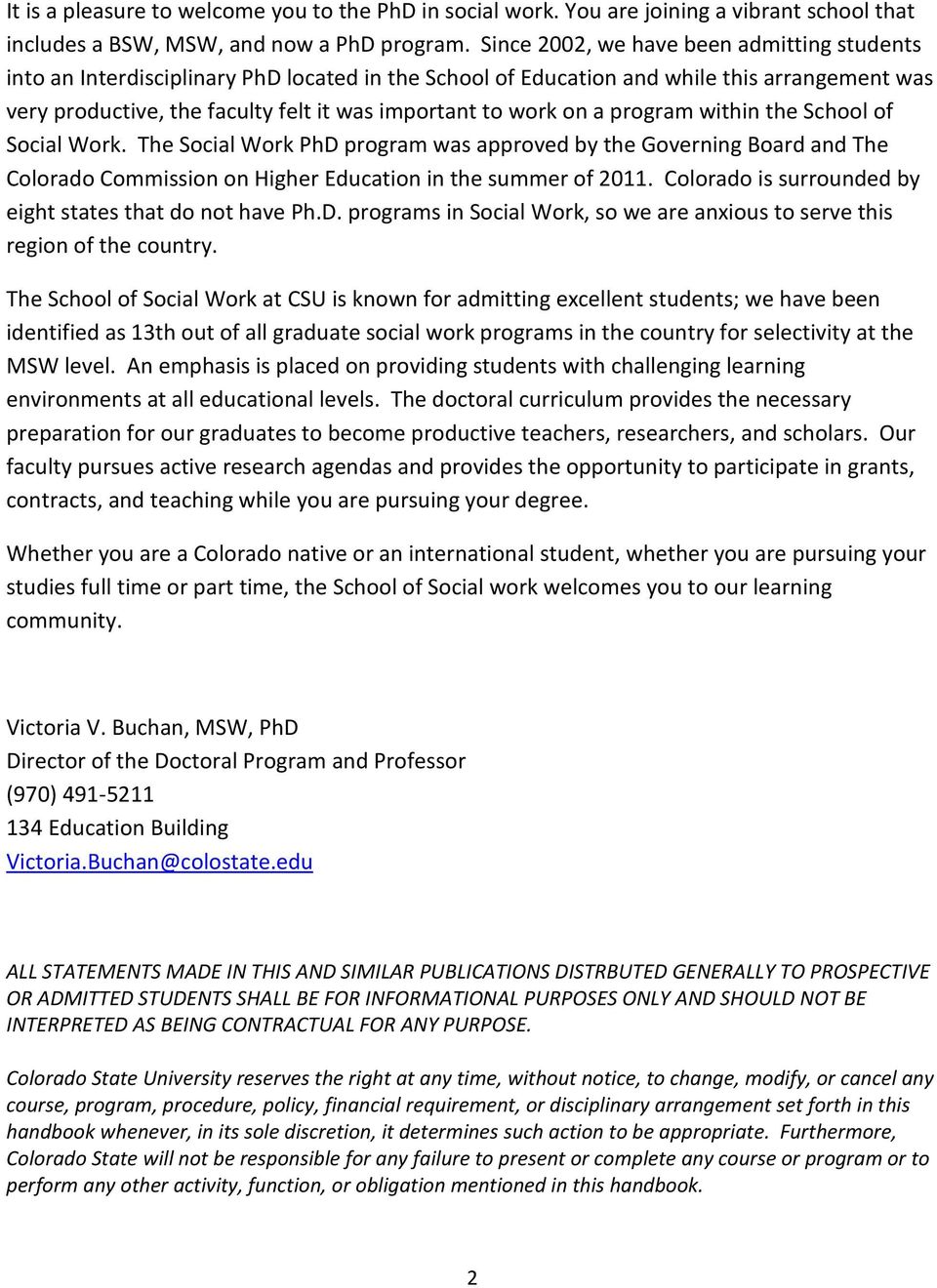
3 Table of Contents SCHOOL AND PROGRAM OVERVIEW... 4 THE SCHOOL OF SOCIAL WORK HISTORY... 4 SCHOOL OF SOCIAL WORK MISSION... 7 SCHOOL GOALS AND OBJECTIVES... 7 DOCTORAL PROGRAM GOALS AND OBJECTIVES... 7 PHD PROGRAM CURRICULUM OVERVIEW... 9 CURRICULUM... 9 COURSE DESCRIPTIONS POSSIBLE PLAN OF STUDY PROGRESS TO THE DOCTORATE INTRODUCTION ADMISSION REGISTRATION PROGRAM OF STUDY PRELIMINARY EXAMINATIONS DISSERTATION PROPOSAL DISSERTATION Human Subjects in Research GRADUATION RESPONSIBILITY FOR MEETING DEADLINES AND REQUIREMENTS DOCTORAL STUDENT CHECKLIST FINANCIAL ASSISTANCE FINANCIAL AID GRADUATE STUDENT EMPLOYMENT POLICIES AND PROCEDURES STUDENT ASSOCIATION ACADEMIC DISHONESTY DISPUTE RESOLUTION PROCEDURES... Error! Bookmark not defined. GRADUATE SCHOOL APPEALS PROCEDURE... Error! Bookmark not defined. PROCESS FOR ADDRESSING STUDENT CONCERNS RESOURCES
4 SCHOOL AND PROGRAM OVERVIEW THE SCHOOL OF SOCIAL WORK HISTORY Throughout its history, the School of Social Work at Colorado State University has made a continuous effort to develop and maintain a program that is responsive to three distinct, but related interests: 1) the profession of social work as represented by the Council on Social Work Education s Educational Policy and Accreditation Standards, 2) the human services agencies and clients in the state, the region, and the nation, and 3) the land-grant oriented mission and goals of Colorado State University. The following abbreviated history of social work education at Colorado State demonstrates how these three interests have merged to create and shape the social work education programs offered today. BSW In the mid-1960s, the U.S. government initiated a program (administered by state social services agencies) to increase the supply of social workers by making funds available through Title XX of the Social Security Act (and predecessor legislation) designed to encourage universities to create baccalaureate-level social work education programs. Although Colorado State University (CSU) had previously offered a few social work courses in its Department of Sociology, these courses did not constitute a program that would prepare a graduate for social work practice. In 1968, the Colorado Department of Social Services and CSU entered an agreement to create a full baccalaureate social work major that would be housed in the Department of Sociology, delivered by a faculty of professional social workers, and funded with Title XX funds supporting 75% of the program costs. The agreement anticipated that the cost of operating the program would gradually shift to the university and by 1977 it would be fully funded by CSU. A total of 150 students initially declared the social work major, and the first graduating class received the BA in social work in In 1970, the Council on Social Work Education initiated a process of accreditation for baccalaureate social work education by granting approval status to 151 schools that met the established criteria. CSU was one of the first universities to attain that national recognition. Four years later approval was upgraded to professional accreditation, and again, CSU was among the first 135 baccalaureate social work education programs to achieve full accreditation which has been maintained continuously since that time. Enrollment surged to a high of 375 majors during the mid-1970s, and it was necessary to cap the major at 325 students because new resident instruction resources were devoted to taking over the agreed-upon increasing percentage of program costs rather than funding new faculty positions to meet the growing student demand. In 1976, an outreach innovation was introduced aimed primarily at assisting public social services workers to improve their competencies and credentials. Again making use of federal funds available through Title XX, a distance education program was developed, designed to 4

5 help persons who possessed baccalaureate degrees in other disciplines obtain a second bachelor s degree in social work. Achieving this second bachelor s degree also allowed these students to complete a master s degree in social work in a reduced period of time (i.e., advanced standing) in many MSW programs throughout the United States. MSW Program In 1981, social work became an independent department. By that time, the new department s programs were completely funded by the university, and plans were initiated to create a master s level social work education program (MSW). It was determined that the second bachelor s degree would be phased out and its resources devoted to developing the MSW. At that time, no MSW programs existed in the states of Idaho, Montana, Wyoming, North Dakota, or South Dakota, and the only other accredited social work education program in Colorado was the MSW program offered at The University of Denver (DU). Given CSU s land-grant mission to serve people throughout Colorado, the recognized needs of the neighboring states that did not offer the MSW, the proposed MSW program was oriented to preparing advanced generalist social workers especially capable of responding to the human services needs of small towns and rural areas or communities that were undergoing rapid transition (e.g., energy boom/bust towns, urban sprawl). That focus was later expanded to include preparation to serve residents in urban areas, especially along the Front Range. In July 1984, the MSW program was approved by the Colorado Commission on Higher Education and in June 1985, it was accepted into candidacy for accreditation by the Council on Social Work Education. Eligibility for initial accreditation was achieved in 1986, and full accredited status was granted in The first class of 18 master s level graduates received their degrees in CSU School of Social Work further expanded its outreach efforts by admitting a cohort of 27 students living in the Western Slope to the MSW program in Students took their graduate courses in Grand Junction over a four-year period.. The first Southern Distance MSW cohort (Colorado Springs) of students graduated in December In January 2010, the first Central MSW cohort (Brighton) was admitted. The Central MSW program was initiated in response to a growing demand for our weekend distance MSW from across the state of Colorado and beyond. In 2002, the name of the Department of Social Work was officially changed to the School of Social Work to more accurately reflect the increased breadth of activities across the national and in international arenas. PhD Program Since the middle 1990 s faculty in the School of Social Work have explored various options related to establishing a PhD program in Social Work. In 2002, the School of Social Work requested the opportunity to join the Interdisciplinary PhD program within the School of Education. A curriculum for a Social Work concentration was proposed and accepted by the School of Education s Graduate Committee. The first cohort of PhD students with a desire to 5

6 pursue the Interdisciplinary degree with a Social Work concentration was admitted in the fall of Since that time, student cohorts have been admitted every other year. In the fall of 2006 a committee of faculty in Social Work began the application process to develop a PhD in Social Work. Final approval for the proposal was received in the summer of 2011 from the Board of Governors and the Colorado Commission on Higher Education. The first cohort of students for the PhD in Social Work was admitted for the fall of Outreach Consistent with its roots in supporting the human services agencies, the CSU School of Social Work has devoted considerable effort to outreach activities. Substantial collaborations have been in the areas of research, curriculum development for and provision of statewide training to county child welfare and child protection workers. The school also supports other service and research oriented programs including the Human Services Assessment Project (HSAP) that provides assistance to social agencies in program evaluation, Human Animal Bond in Colorado (HABIC) demonstrating the potential of animal assisted human services, and primary prevention activities intended to improve the health and safety of farmers and ranchers in the region through a key role in the High Plains/ Intermountain Center for Agricultural Health and Safety (HICAHS). The Social Work Research Center was approved in 2004 representing collaboration between Colorado State University (School of Social Work) and community partners. The mission of the Center is to serve the people of the State of Colorado, as well as at national and international levels, in the area of social work. The Center provides support to faculty, students, and community partners. It also facilitates training, mentoring and program development services to social welfare agencies, governmental departments, community groups, students, and faculty. In 2006, the Social Work Center for Lifelong Learning and Outreach Education (CLOE) was established. The Center for Life Long Learning and Outreach Education develops, administers, and integrates degree and non-degree educational programs that extend outside the oncampus degree programs of the School of Social Work. In July 2009, the Community Organizing to Reach Empowerment (CORE) Center was welcomed as a center into the School of Social Work. The CORE Center is a community-based program serving north Fort Collins residents with evidence-based interventions to low income Latino children and families in northern Fort Collins. The programs of the Colorado State University School of Social Work have reflected continuing responsiveness to the needs and interests of the region, the profession of social work, and the university. 6

7 SCHOOL OF SOCIAL WORK MISSION The Mission of the School of Social Work, in accordance with Colorado State University s and the College of Applied Human Sciences mission, and in compliance with the CSWE Accreditation Standards (2008) requirements for the Council of Social Work Education, is to: Prepare undergraduate and graduate students for professional social work practice and professional leadership within a multicultural, global environment that is based on the concepts of human rights, social and economic justice, religious and spiritual tolerance, and the elimination of oppressive social conditions for all people; Advanced social work practice knowledge that integrates research-informed, evidencebased practice principles; Develop students application of critical thinking skills in classroom learning and field education practice situations; Improve the welfare of the community and human service organizations in Colorado, the nation, and the international community; Further the goals of the university, the college, the School of Social Work, and the social work profession. SCHOOL GOALS AND OBJECTIVES As an integral member of Colorado State University and the College of Applied Human Sciences, the School s goals are articulated in a manner that is congruent with the goals of the university and college. The following goals are organized to reflect the association of the School of Social Work to university aims. A. Provide a high-quality undergraduate and graduate education experience; B. Create an environment that contributes to faculty and student professional and educational development; C. Promote a regional, national, and global perspective that advances social and economic justice using interdisciplinary problem-solving efforts; D. Develop and provide innovative educational outreach teaching and student learning opportunities for the MSW Program; E. Enhance and ensure the acquisition of resources needed to achieve the goals and objectives set forth by the School of Social Work. DOCTORAL PROGRAM GOALS AND OBJECTIVES 1. Provide a high quality doctoral education in social work. a. Prepare master s graduates to become productive social work faculty. 7

8 b. Prepare these graduates to become leaders in social work research, education, and administration in higher education. 2. Create a culture of excellence in research and scholarship. a. Provide doctoral students with opportunities to work with faculty on research/grant projects. b. Provide doctoral students with research mentoring related to specific topics of interest. c. Enhance the research and publication capability within the School of Social Work through additional doctoral level GRA opportunities. 3. Conduct research responsive to the educational and developmental needs of regional human service systems. a. Prepare competent social work researchers to develop and evaluate policies and programs in the human services. b. Provide regional human service systems access to collaborative research opportunities via research practicum or dissertation research. 4. Contribute to the enrichment of academic life at Colorado State University. a. Promote the involvement of students in multidisciplinary approaches to learning by utilizing cognates/concentrations. b. Facilitate interdisciplinary collaboration through the strategic involvement of faculty outside social work to support students in the dissertation process. 5. Provide an environment that values and supports diversity in students, staff, and faculty. a. Recruit doctoral students, staff and faculty of diverse backgrounds and beliefs. b. Retain students of diverse backgrounds and beliefs by providing support for their differing needs. c. Provide an environment that values and is conducive to open discussion of differences in which students, faculty and staff feel respected, safe and challenged. 6. Expand the research capacity in the School of Social Work by assuring the material and financial resources necessary. a. Continuously strive to add funded GRA positions to provide financial support to PhD students. b. Continue to ensure that new faculty positions include requirements related to research expertise and ongoing grant funding. 8

9 PHD PROGRAM CURRICULUM OVERVIEW CURRICULUM The curriculum leading to the degree of Doctor of Philosophy in Social Work combines a core curriculum in social work with outside coursework drawn from related disciplines and includes thorough training in research methodology and data analysis. At the same time, the curriculum allows the student reasonable flexibility in tailoring programs of study to his or her special area(s) of interest under the guidance of their advisor and committee. The curriculum includes 21 credits in the School of Social Work (including 6 teaching credits), 15 credits in research courses, credits toward the dissertation, and 9 elective credits in a related discipline. Students complete a minimum of 57 hours of coursework beyond their MSW. Course Categories and Requirements Category Requirements Social Work Courses SOWK 701 Contemporary Issues in Social Work Education 3 cr SOWK 702 Social Welfare Policy Interpretation and 3 cr Analysis in the US and Selected Countries SOWK 703 Theoretical Analysis of Social Work Practice 3 cr SOWK 704 Theoretical Foundations of Social Work 3 cr SOWK 784 Supervised College Teaching (One undergraduate 6 cr course, one graduate course) SOWK 792 Seminar 3 cr Research Courses - SOWK 799 Dissertation cr EDRM 700 Quantitative Research Methods 3 cr EDRM 704 Qualitative Research Methods 3 cr *Additional research courses may be in the School of Education or elsewhere in the University as approved by advisor. Please note EDRM courses are subject to change, please check with course catalog and advisor. 3 Additional 3 Credit Research Methods Courses* 9 cr EDRM 701 Applied Linear Models EDRM 702 Foundations of Educational Research EDRM 703 Applied Longitudinal Data Analysis EDRM 705 Qualitative Data Analysis EDRM 706 Analysis of Relationships EDRM 707 Quantitative Data Collection Methods/Analysis EDRM 708 Narrative Inquiry EDRM 711 Ethnographic Research EDRM 792 Seminar SOWK 786 Elective Courses Interdisciplinary electives from the following departments: 9 cr Economics, Education, Human Development and Family Studies, Psychology, Sociology, Political Science 9

10 COURSE DESCRIPTIONS SOWK 701 Contemporary Issues in Social Work Education Issues and trends currently impacting professional education for social work practice. SOWK 702 Social Welfare Policy Interpretation and Analysis in the US and Selected Countries Social welfare policy analysis and impact on professional social work practice. SOWK 703 Theoretical Analysis of Social Work Practice Social work practice theories; building, evaluating and teaching for social work educators. SOWK 704 Theoretical Foundations of Social Work Nature and processes of theory building in social work. Issues of epistemology, logic, politics and moral philosophy. SOWK 786 Research Practicum SOWK 784 Supervised College Teaching SOWK 792 Seminar SOWK 795 Seminar EDRM 700 Quantitative Research Methods Design, data analysis, interpretation of results, and evaluation of educational research studies. EDRM 704 Qualitative Research Methods Examination of qualitative research theory, methods, and applications to education and the social sciences. EDRM 701 Applied Linear Models General linear model application in educational research emphasizing conceptual understanding and characteristics of non-experimental designs. EDRM 702 Foundations of Educational Research Philosophical, theoretical, and ethical foundations of educational research. EDRM 703 Applied Longitudinal Data Analysis Methods and empirical applications of individual growth modeling and discrete-time event history analysis in educational research. EDRM 705 Qualitative Data Analysis 10

11 Examination of qualitative methods of data analysis, data presentation, and use of computer. EDRM 706 Analysis of Relationships Analysis of variance applications in educational research; experimental design and analysis of data from experiments. EDRM 707 Quantitative Data Collection Methods/Analysis Selection or development of questionnaires, tests, structured interviews, and observations. Reliability and validity. Reporting educational studies. EDRM 708 Narrative Inquiry Theory, methods, and design of narrative approaches to research including data collection and analysis applications. EDRM 711 Ethnographic Research Theoretical underpinnings, research design, ethics, and practical application of ethnographic research in naturalistic settings. EDRM 792 Seminar Various Topics POSSIBLE PLAN OF STUDY The following is a possible plan of study. There is no typical plan of study but this gives an idea of how the coursework might be structured. Many students enroll on a part-time basis and take only one or two courses per semester. Other students are able to meet requirements over the summer. All students will vary depending on their personal schedule and availability of courses. Year 1 Fall Spring SOWK 701 SOWK 702 EDRM 700 Research Methods Course EDRM 704 Research Methods Course Year 2 Fall Spring SOWK 703 SOWK 704 Research Methods Course SOWK 784 Or Elective SOWK

12 Year 3 Fall Spring SOWK 784 SOWK 799 Elective SOWK 792 Elective Year 4 Fall Spring SOWK 799 SOWK 799 SOWK 799 SOWK 799 INTRODUCTION PROGRESS TO THE DOCTORATE Earning the Doctor of Philosophy degree involves considerably more than the completion of credits through coursework. You must also apply the skills and knowledge learned in the classroom towards the dissertation which represents a distinct, higher-level, and culminating effort. Milestones in the process include Admission, Registration, Plan of Study, Preliminary Examinations, Dissertation Proposal, Dissertation, and Graduation. Each of these milestones will be discussed in further detail in this section. ADMISSION In order to be officially admitted, you must complete the application process for the School of Social Work and the Graduate School online application. Enrollment in graduate-level classes either on or off the campus does not constitute admission to the Ph.D. program. Ph.D. applications are due January 15th of the spring term prior to fall admission. Admission is considered invalid if you do not enroll in the term the admission notification indicates and you do not officially request a change in the admission term. As part of your application process, you are required to schedule an interview with the director of the PhD program to develop your plan of study and complete the SOWK 02 form. An inperson interview is preferred, but a phone interview is acceptable for out-of-town applicants. Registration for all courses in your Ph.D. program should be planned with your assigned advisor in order to make certain they will fit within your plan of study. Please follow registration procedures as outlined in the Colorado State University General Catalog, located at Each student should have completed course work or demonstrate competence in research methods and other areas listed. A statistics course is required within the two years prior to admission. If the graduate committee determines the student does not have a sufficient background in any of these areas, the committee may prescribe additional course work. 12

13 Courses taken to meet these prerequisite requirements cannot be used to meet program requirements. A maximum of 10 additional credits taken after completion of the master's degree can be transferred into the program if appropriate. The decision as to whether or not post-master s coursework may be transferred into your Ph.D. program is solely at the discretion of your advisor and your graduate committee. All courses to be applied toward fulfilling the requirements for a doctoral degree must have been completed within the ten years immediately preceding the date of completion of requirements for the doctoral degree. REGISTRATION Make an appointment with your faculty advisor. For first year students, this will be the program director. You can register for the appropriate courses on RamWeb, Address and changes must be kept current with the School of Social Work and Office of Admissions and Records. All students admitted to a graduate program at Colorado State University are required to be continuously registered in the fall and spring semester throughout their degree programs. This policy applies from the time of first enrollment through the graduation term. Students may fulfill this requirement by registering for any graduate credit-bearing course (regular or nonregular). As an alternative, students may opt for a Continuous Registration (CR) status. Students graduating in summer term are required to be registered for at least one credit or CR. The availability of the CR option shall not supersede any other registration requirements to which students may be subject. For example, a student s advisory committee may require additional course work. The credit registration requirement for graduate assistantships applies to all students appointed to these positions There is a ten-year time limit for completion of doctoral degrees. PROGRAM OF STUDY You and your advisor will work together to select your Graduate Committee. You should choose your committee with care as the members will pass judgment on your abilities as a student, a researcher, and a professional. Guidelines selecting members include selecting individuals who: (a) understand the content area in your specialization; (b) have a history of working well together; (c) have research interests similar to yours; and (d) complement each other well in their coverage of the knowledge you want to attain in your program of study. Your selection of graduate committee members should be finalized on the GS-6 Form and must be approved by the Director of Graduate Programs and the CSU Graduate School. 13

14 The committee must consist of at least four faculty members who include: (1) Advisor from the School of Social Work; (2) Two members from the School of Social Work (serving as co-advisor or committee member); (3) An outside committee member from an outside department. Regardless of how carefully you may have selected committee members, you may encounter a need to replace a committee member. This is a common occurrence, especially during the dissertation phase of your Ph.D. program. To make such a request you should have a wellconsidered and justifiable reason and complete the GS9A Form. You are required to plan your program of study with your advisor and the Form SOWK 02 is completed, this is usually done during the admission process. It will then be approved by your graduate committee. This generally takes place prior to your fourth regular semester registration. Form SOWK-02 is tailored to the unique requirements of the Social Work Ph.D. Once you have completed the SOWK-02, you should transfer the information to the CSU Graduate School GS-6 Form. The GS-6 will be presented to your graduate committee in a formal meeting. The GS-6 Form constitutes a contract for the actual courses that you will be required to complete for your degree. If you make changes to your Program of Study you do not need to submit a new GS-6. The changes can be implemented with approval of your advisor, then when you apply for graduation, complete a GS-25 form with the new Program of Study. Changes must be approved by your advisor prior to submitting the form the Director of Graduate Programs. The GS25 should only be submitted in the term in which you will be graduating. You must maintain a minimum grade point average of 3.0 in the courses listed in your Program of Study. You must complete each course on the Program of Study with a grade of C or better, or with a grade of S if the course is offered on a pass/fail grading basis. PRELIMINARY EXAMINATIONS The preliminary exams are considered qualifying examinations that are indicative that you are ready to conduct your dissertation research. The exams take place after almost all of your coursework is completed. In addition it shall be administered at least two terms before the defense. Your advisor and graduate committee will develop, administer, and evaluate the preliminary examinations. The examinations consist of content from your coursework and research subject matter. The Oral Follow-up to the Preliminary Exams is scheduled within 5 weeks after the written exam is completed. All committee members attend this meeting. The objective of the preliminary examinations is to enable the Ph.D. student to analyze, critique, and synthesize knowledge gained from course work and experiences in the program of study. The written exams and oral follow-up also enable the faculty to assess this has taken place. In addition, the oral follow-up provides closure on this phase of the doctoral program and allows the committee to welcome the student into doctoral candidacy, the dissertation 14

15 phase of the program. The GS16 must be submitted upon successful completion of the preliminary exams. DISSERTATION PROPOSAL Following or during completion and approval of the preliminary examinations, the student will prepare the dissertation proposal. It usually will consist of the first three chapters of your dissertation, which are typically the introduction, literature review, and methodology. If the dissertation research is based on a faculty member s project, issues about co-authorship of material to be published from the dissertation are to be discussed and an agreement specified in writing as part of the dissertation proposal. If circumstances change during the course of the dissertation research, the written agreement will be revised. When the advisor and the student agree that the proposal is complete, it will be circulated to committee members. The student will arrange a meeting of the committee for final discussion and approval of the proposal. This meeting will be open to the student body and faculty to attend. If the committee approves the proposal, a SOWK-09 form will be signed by all committee members and submitted to the School of Social Work. The student will need to distribute the proposal so that members have sufficient time to consider both it AND the qualifying exam materials. The discussion of the qualifying materials must be completed and the student must be considered to have passed the oral part of the qualifying examinations BEFORE discussion of the dissertation. Approval of the dissertation proposal signifies that members of the dissertation advisory committee believe that it sets forth a satisfactory plan for research study. Approval of the proposal requires the unanimous approval of all members of the student s committee as evidenced by their signing a SOWK-09 form, which is filed with the Program Director. DISSERTATION Please refer to the Colorado State University Thesis Manual information about the format, submission process, and responsibilities of advisors and students. This publication is available on the web at Dissertation-Manual.pdf. The Final Oral Dissertation Defense must be held prior to the end of the eleventh week of the graduating term for Fall or Spring semester and by the end of the fifth week of the eight-week summer term. Voting at all final examinations shall be limited to the members of your committee and a majority vote is necessary to pass the examination. Signatures of all committee members are required on the GS-24 Form indicating whether they vote to pass or fail. 15

16 All Final Oral Dissertation Defenses are open to the public. Doctoral students are encouraged to attend several dissertation defense meetings during their program to better understand the process prior to defending their own work. Student s must submit a Thesis/Dissertation Submission Form and the Survey of Earned Doctorates confirmation certificate to the Graduate School and then submit their dissertation electronically at this website You should also submit a bound copy of your dissertation to your advisor and the School of Social Work. Human Subjects in Research The University is required to comply with the federal regulations governing review of research that involves human subjects. Annually we must assure the Office for Human Research Protections (OHRP) that the University is complying with the requirements of 45 CFR 46. This is an NIH reference, but has been incorporated virtually verbatim into the regulations of 16 other federal agencies; additionally, the regulations state that the University will apply the same standards to all projects involving human subjects, regardless of funding or funding source. Activities are to be reviewed as proposals and may not wait until funding for the activity is forthcoming. No dissertation using human subjects will be accepted by the Graduate School without an IRB approval number. Information on obtaining an IRB number and use of human subjects can be found at the Office of the Vice-President for Research Website at: This includes any activity involving human subjects is subject to review, including soliciting questionnaires and surveys, videotaping activities, audio taping, observing behavior, and obtaining individually identifiable data about a person. Prior to submitting your application, you must attend a training on campus or online. Information about training availabilities can be found on the IRB website. Applications are due by 5:00pm on the 2nd Thursday of each month. Submit the application via eprotocol. Following the meeting (on the 3rd Thursday of each month), an from eprotocol regarding the IRB's determination will be sent to the PI (and all personnel listed on the protocol) within 10 working days. A researcher may not initiate human participant involvement (including recruitment and/or records access) until an IRB approval number for the project is received. 16

17 GRADUATION To apply for graduation you must complete the GS-25 Form and have it signed by your advisor and the Director of the Graduate Programs. This is due to the CSU Graduate School by the end of the sixth week of the graduation term for fall or spring semester and by the first week of the eight-week summer session for those graduating that term. You must be enrolled for a minimum of one credit in the term in which you graduate. In addition, you must show evidence that you have submitted a manuscript to a refereed journal at some point during your doctoral program. You must submit the manuscript and to the School of Social Work prior to graduation. This form must also be signed by your advisor and by the Director of Graduate Programs. You are requested to attend the graduation ceremony where you will be hooded by your advisor at the Graduate School ceremony. Ceremonies are held at the end of the Fall and Spring terms. Summer graduates are requested to attend the Spring ceremonies. RESPONSIBILITY FOR MEETING DEADLINES AND REQUIREMENTS Although your advisor and others will be helpful to you in understanding the various requirements, deadlines, and standards leading to your graduation, the final responsibility for meeting them rests with you, the student. It is your personal responsibility to become informed about everything required of you to earn your Ph.D. 17
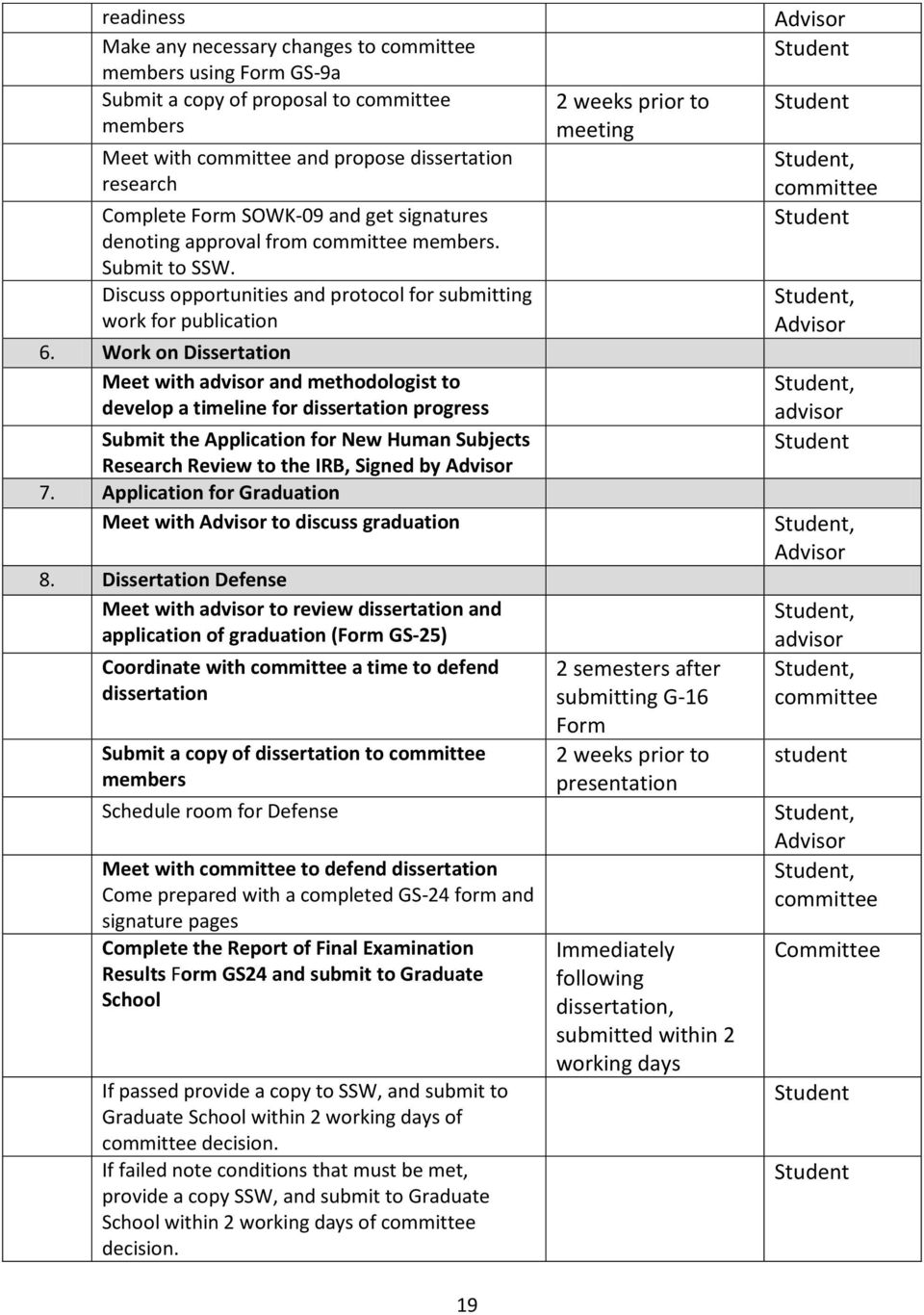
18 DOCTORAL STUDENT CHECKLIST These nine steps are assistive guidelines. Completion of all steps does not guarantee graduation or degree. Sufficient time should be allotted for all forms requiring signatures. Nine Step Doctoral Process Step Timing Responsibility 1. Admission 2. Enrollment and Registration Discuss coursework and program of study Retrieve, Renew, Confirm RamWeb ID: Student ( Visit RamWeb to register for classes, view Student additional account information, and Graduate School guidelines: ( 3. Committee and Program of Study Identify Committee Determine Program of Study Meet with advisor to discuss coursework and program of study Complete and submit GS-6 to SSW 4. Moving to Candidate Status Meet with Advisor to discuss order, content, and scheduling of exams Research and Content Preliminary Exams Complete the Exams Committee Members will read and evaluate exam using SOWK-07 and SOWK -08. Schedule Oral Follow-Up Meeting Oral Follow-Up Meet with committee to discuss outcomes Complete Graduate School Report of Preliminary Examinations for the Ph.D. Degree GS-16 Coordinate date for dissertation proposal 5. Dissertation Proposal Meet with advisor to discuss expectations and Prior to registering for fourth semester courses Within 5 weeks of receiving exam Within 3 weeks of receiving completed exam Within 2 working days of committee decision Student, Advisor Student, Advisor Student Student, Advisor Student Committee Student, Committee Committee Student, 18

19 readiness Make any necessary changes to committee members using Form GS-9a Submit a copy of proposal to committee members Meet with committee and propose dissertation research Complete Form SOWK-09 and get signatures denoting approval from committee members. Submit to SSW. Discuss opportunities and protocol for submitting work for publication 6. Work on Dissertation Meet with advisor and methodologist to develop a timeline for dissertation progress Submit the Application for New Human Subjects Research Review to the IRB, Signed by Advisor 7. Application for Graduation Meet with Advisor to discuss graduation 8. Dissertation Defense Meet with advisor to review dissertation and application of graduation (Form GS-25) Coordinate with committee a time to defend dissertation Submit a copy of dissertation to committee members Schedule room for Defense Meet with committee to defend dissertation Come prepared with a completed GS-24 form and signature pages Complete the Report of Final Examination Results Form GS24 and submit to Graduate School If passed provide a copy to SSW, and submit to Graduate School within 2 working days of committee decision. If failed note conditions that must be met, provide a copy SSW, and submit to Graduate School within 2 working days of committee decision weeks prior to meeting 2 semesters after submitting G-16 Form 2 weeks prior to presentation Immediately following dissertation, submitted within 2 working days Advisor Student Student Student, committee Student Student, Advisor Student, advisor Student Student, Advisor Student, advisor Student, committee student Student, Advisor Student, committee Committee Student Student
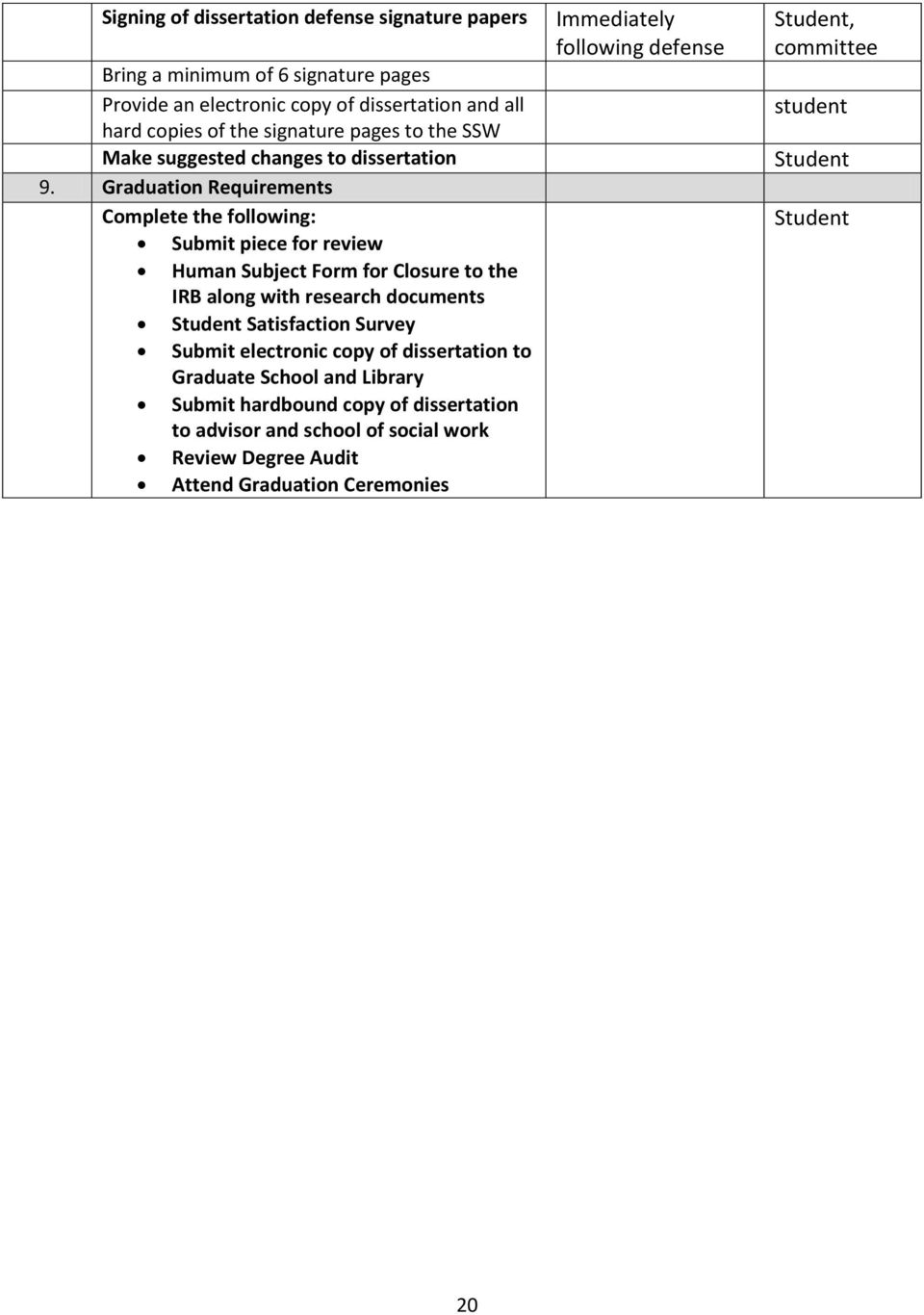
20 Signing of dissertation defense signature papers Bring a minimum of 6 signature pages Provide an electronic copy of dissertation and all hard copies of the signature pages to the SSW Make suggested changes to dissertation 9. Graduation Requirements Complete the following: Submit piece for review Human Subject Form for Closure to the IRB along with research documents Student Satisfaction Survey Submit electronic copy of dissertation to Graduate School and Library Submit hardbound copy of dissertation to advisor and school of social work Review Degree Audit Attend Graduation Ceremonies Immediately following defense Student, committee student Student Student 20
21 FORMS CHECKLIST Student Name Student ID Forms in bold face type are required. Form Number Form Title Date submitted SOWK-01 Graduate Assistantship Application GS6 Program of Study SOWK-02 Program of Study SOWK-03 Petition for Waiver of PhD Requirements SOWK-04 Application for Approval of Research Practicum SOWK-05 Enrollment for Supervised College Teaching SOWK-06 Application for Approval of Independent Study SOWK-07 Intent to Complete Content Preliminary Exam SOWK-08 Intent to Complete Research Preliminary Exam GS16 Report of Preliminary Examination for the Ph.D. Degree SOWK-09 Committee Approval of Dissertation Proposal GS24 Report of Final Examination Results GS25 Application for Graduation FINANCIAL ASSISTANCE 21
22 FINANCIAL SERVICES Please refer to Colorado State University s office of Financial Services ( for information on tuition, scholarships, and loans. GRADUATE STUDENT EMPLOYMENT If funding allows, the School of Social Work will provide to Graduate Research Assistant positions to selected PhD students. There will be a separate application for this process. STUDENT ASSOCIATION POLICIES AND PROCEDURES The DSWSA is your student organization on campus. The mission of DSWSA is to bring together Doctoral Social Work students at CSU for the purpose of enhancing their educational experience, participating in community action projects, and promoting social interaction among colleagues in non-university settings. Students may elect representatives to the following School of Social Work standing committees: (a) School Council (2 representatives) (b) Curriculum and Program Evaluation Committee (1 representative) (c) Student Affairs (1 representative) (d) Student Advisory Team (SAT) (open participation) (e) Ad hoc committees as needed Students are encouraged to participate in all non-executive session activities of these committees. Representation on school committees provides an excellent opportunity for students to impact educational policy and stay informed about student issues. ACADEMIC INTEGRITY The foundation of a university is truth and knowledge, each of which relies in a fundamental manner upon academic integrity and is diminished significantly by academic misconduct. Academic integrity is conceptualized as doing and taking credit for one s own work. A pervasive attitude promoting academic integrity enhances the sense of community and adds value to the educational process. All within the University are affected by the cooperative commitment to academic integrity. Faculty/instructors shall work to enhance a culture of academic integrity at the University (see the Colorado State University General Catalog for the academic integrity Policy). 22
23 Academic misconduct (see examples below) undermines the educational experiences at Colorado State University, lowers morale by engendering a skeptical attitude about the quality of education, and negatively affects the relationship between students and instructors. Instructors are expected to use reasonably practical means of preventing and detecting academic misconduct. Any student found responsible for having engaged in academic misconduct will be subject to academic penalty and/or University disciplinary action. Students are expected to share responsibility for the academic integrity of the University by reporting incidents of academic misconduct. Examples of academic misconduct include (but are not limited to): Cheating in the classroom - Cheating includes using unauthorized sources of information and providing or receiving unauthorized assistance on any form of academic work. Examples include copying the work of another student on an exam, problem set, or quiz; taking an exam or completing homework for another student; possessing unauthorized notes, study sheets, answer codes, programmed calculators, or other materials during an exam; and falsifying exams or other graded paper results. Plagiarism - Plagiarism includes the copying of language, structure, ideas, or thoughts of another, and representing them as one s own without proper acknowledgement. Examples include a submission of purchased research papers as one s own work; paraphrasing and/or quoting material without properly documenting the source. Unauthorized possession or disposition of academic material - Unauthorized possession or disposition of academic materials includes the unauthorized selling or purchasing of examinations or other academic work; stealing another student s work; unauthorized entry to or use of material in a computer file; theft or mutilation of library materials; and using information from or possessing exams that an instructor did not authorize for release to students. Falsification - Falsification encompasses an untruth, either verbal or written, in one s academic work. Examples include receiving unauthorized assistance or working as a group on a take-home exam, independent exam or other academic work without authorization or lying to avoid taking an exam or turning in other academic work. Furthermore, falsification of any University document is a violation of academic integrity. Examples include student identification numbers, transcripts, grade sheets, credentials, University status, or letters of recommendation. Forging a signature is another specific example of falsification. Facilitation of cases of academic dishonesty - Facilitation of any act of academic dishonesty including cheating, plagiarism, and/or falsification of documents also constitutes violation of CSU s academic integrity. Examples include knowingly discussing specific content of a test or examination you have taken with another student who has 23
24 not yet taken that test or examination or facilitating, by sharing one s own work, a student s efforts to cheat on an exam or other academic work. A student s individual graduate advisory committee or an appropriate School graduate committee may recommend immediate dismissal or appropriate lesser penalty where the committee determines that the student has engaged in behavior that is in violation of the NASW Code of Ethics (see SOSW website) or academic dishonesty including but not limited to such acts as cheating, plagiarism, and falsification of data or documents. Such a recommendation must be documented in writing with substantive justification for the recommended action. It must be referred to the Director for approval and the Dean of the Graduate School for final action. The Dean shall secure the concurrence of the University Discipline Officer for any penalty imposed. The student may appeal such action through the existing Graduate School appeals procedure (Graduate and Professional Bulletin). Procedures for Dealing with Academic Misconduct If an instructor has evidence that a student has engaged in an act of academic misconduct, the instructor will notify the student of the concern and make an appointment to discuss the allegations with the student. The student will be given the opportunity to give his/her position on the matter. If the student admits to engaging in academic dishonesty or if the instructor judges that the preponderance of the evidence supports the allegation of academic misconduct, the instructor may then assign an academic penalty. Examples of academic penalties include receiving a reduced grade for the work, a failing grade in the course, or a lesser penalty as the instructor deems appropriate. The instructor shall notify the student in writing of the infraction and the academic penalty to be imposed. A copy of this notification shall be sent to the Office of Conflict Resolution and Student Conduct Services. Instructors have a responsibility to report to Conflict Resolution and Student Conduct Services all cases of academic misconduct in which a penalty is imposed. Incidents which the faculty member considers major infractions should be accompanied by a recommendation that a hearing be conducted to determine whether an additional university disciplinary action should be taken. If the student disputes the allegation of academic misconduct, he/she should request a hearing with the Office of Conflict Resolution and Student Conduct Services. The request must be submitted no later than 30 calendar days after the first day of classes of the next regular semester following the date the grade for the course was recorded. If no appeal is filled with in the time period, the decision of the faculty member will be final. If, after making reasonable efforts, the instructor is unable to contact the student or collect all relevant evidence before final course grades are assigned, he/she shall assign an interim grade of incomplete and notify the student of the reason such grade was given. 24
25 A hearing will be conducted with the Office of Conflict Resolution and Student Conflict Services to determine whether a preponderance of evidence exists in support of the allegations of academic misconduct. If the hearing results in a finding of insufficient evidence to support the allegations or clears the student of the charges, the faculty member will determine a grade based on academic performance and without reflection of the academic misconduct charge and change any previously assigned grade accordingly. If the hearing results in finding of academic misconduct, the Hearing Officer and faculty member will confer regarding appropriate sanctions. The faculty member will make the final determination regarding academic penalties, which may include, among other options, assigning a reduced grade for the course, assigning a failing grade in the course, or other lesser penalty as the course instructor deems appropriate. The Hearing Officer will make the final determination regarding University disciplinary sanctions. For further details, refer to the current on-line Graduate and Professional Bulletin published by the CSU Graduate School Office. ( PROCESS FOR ADDRESSING STUDENT CONCERNS Philosophy of the Grievance Process It is the responsibility of an academic school and the faculty to insure that the learning environment is welcoming and respectful to students, faculty, and administrative staff. Students are expected to adhere to the standards of conduct and personal integrity that are in harmony with the NASW Code of Ethics, the educational goals of the institution, and university regulations and to respect the rights, privileges, and property of other people, as outlined in the CSU General Catalog, under Student Rights and Responsibilities. ( Any student or faculty member having a concern which needs thinking through is encouraged to do so with anyone they choose. This enables clarification of whether a problem exists about which he/she may desire to proceed further. The early identification of a grievance is a responsible step toward its resolution. To enable faculty, students, and the school to operate responsibly and sensitively, it is important to keep lines of communication open, to resolve difficulties at as early and as low a level as possible, and to encourage constructive input to maximize and humanize the operation of the program. A grievance process provides due process to both students and faculty. The process must be designed so neither the student nor the faculty member has the inside track to problem resolution. The purpose of the process is to acknowledge legitimate concerns about grades and other academic matters and eliminate harassment and other forms of intimidation, as well as to protect faculty members against unjust and unfair accusations. If students perceive they have been treated unfairly, the grievance process is provided as a way for students to be heard and to be answered with concern and respect. Because faculty play a major role in evaluating the performance of students, there is an inherent power difference between faculty and students. Faculty must be exceptionally vigilant in their use of language, jokes, and other forms of communication that can be misconstrued as intimidation or 25
26 harassment. Administrators or faculty have a heavier responsibility [to eliminate sexual harassment and other forms of personal abuse] because of the roles they play in the creation and maintenance of a campus environment conducive to teaching, learning, and creativity (Appendix 1, Academic Faculty and Administrative Professional Staff Manual). Definition of a Concern A concern exists if a student believes there is an issue. The student may be any person associated with the school, and/or taking a school course. The concern may relate to academic matters such as a grade, acceptance into a professional program, or other issues. A concern may also be defined as treatment by a faculty member such that one or both parties experience the behavior as personal abuse. If the concern is related to sexual harassment or the University s personal abuse policy, the procedures outlined in Appendix 1, Academic Faculty and Administrative Professional Staff Manual should be followed. Identification of the Concern and the Informal Resolution Process If a student (or students) decides that the concern warrants action, the first step is to communicate in person or in writing the concern to the person (or persons) with whom the student has concern. The student should communicate in writing or in person with the faculty member about this situation within no more than 10 working days of the incident/event. Because a power differential exists between students and faculty, the student may wish to have another person accompany him/her if there is a face-to-face discussion. The Formal Grievance Procedure University Policy / Student Rights and Responsibilities If the informal communication with the faculty members does not resolve the problem, the student may begin the formal grievance process by submitting a written statement to the chair of the School s Student Affairs and Admissions Committee. This written statement must outline the basis for the complaint and the student should attach any corresponding information needed for documentation. At a minimum, the documentation shall include: 1. The date and particulars of the incident/event in which the student feels aggrieved; 2. A summary of steps that have been taken to deal with the situation; 3. The desired outcome(s) that is/are being sought. The student(s) making the appeal shall deliver the complaint to the chair of the Student Affairs and Admissions Committee and the date of its receipt must be recorded on the document and initialed by both the student and committee chair. That date becomes the starting point for the formal grievance process. The chair of the Student Affairs and Admissions Committee will notify the faculty member of the formal grievance within no more than five working days of its 26
27 receipt. The faculty member will have no more than five working days to prepare a written response to the grievance and submit that statement to the committee chair. From this point until the conclusion of the process the committee chair shall be responsible for monitoring the process, maintaining copies of all documentation provided, and preparing a record of the actions taken. By agreement of both parties, or in the event of pressing emergencies, subject to the written approval of the School Director, the time limits can be extended for reasonable time periods, but should not exceed thirty working days. In the event that parties to the grievance are absent from campus, the chair of the Student Affairs and Admissions Committee may grant up to an additional thirty days at any phase of the process. If the appeal is filed during a summer session, no action will be taken until the beginning of the fall semester. If either party pursues outside legal action, the school grievance process shall immediately cease. If the Student Affairs and Admissions Committee does not find from the written materials that the issue has been resolved, in no more than ten working days after receiving the response from the faculty member, the committee will appoint a grievance hearing committee composed of three faculty members and two students to address the complaint. The hearing committee members are to be jointly selected by the Student Affairs and Admissions Committee and the school s director. Anyone directly involved in the grievance or who has previously reviewed the situation with the student or faculty member will be disqualified from serving on the hearing committee. The hearing committee shall hold hearings on the complaint in no more than ten working days after its appointment. Either party may be accompanied to the hearing by a person of her/his choice who can support the student or faculty member s position. In order to maintain confidentiality in the process, and yet to insure a thorough review of the grievance, it is the hearing committee s responsibility to solicit input from persons named by each party. It is suggested, for the sake of clarity and due process, that the hearing committee utilize consultation from the University Ombudsman during this process. Within five days of the conclusion of the hearing, the hearing committee will provide each affected party, the chair of the Student Affairs and Admissions Committee, and the school director with a written statement of its decision regarding the merits of the complaint. Should either party disagree with the hearing committee s decision, s/he may appeal to the school director within no more than five working days of date of the committee s report. The school director will then review the case within no more than ten working days and provide a written decision regarding the merits of the complaint. The school director may agree with or overturn the hearing committee s decision. Should either party disagree with the school director s decision, s/he may appeal to the Dean of the College of Applied Human Sciences within no more than five working days of date of the 27
28 School Director s report. In that case, the Dean will review the matter within no more than ten working days and produce a written decision regarding the merits of the complaint. The Dean may agree with or overturn the decision. Should either party disagree with the Dean s findings, s/he may appeal within no more than five working days by submitting all written documentation to the Provost/Academic Vice-President. The decision of the Provost/Academic Vice-President shall be final, in so far as the University s grievance process permits. 28
29 RESOURCES Dissertation Manual: Manual.pdf Graduate School Forms Database: Dissertation Submission Site: Graduate School Timeline: Ramweb: Graduate School Bulletin: Faculty and Staff: Academic Calendar: Health Network: Library: 29
School of Social Work
 Colorado State University College of Applied Human Sciences School of Social Work Doctoral Student Handbook Vicky Buchan Ph.D. Program Director Colorado State University does not discriminate on the basis
DEGREE REQUIREMENTS & ACADEMIC GUIDELINES
 Sam Houston State University 1 DEGREE REQUIREMENTS & ACADEMIC GUIDELINES Graduate Degree Requirements (p. 1) Academic Expectations and Guidelines (p. 3) Graduate programs are typically regarded as either
LLED Doctoral Program Requirements
 LLED Doctoral Program Requirements Students are responsible for information on the Graduate School website. See, especially the Graduate Bulletin and the Graduate School s Academic Regulations & Procedures
G E N E R A L I N F O R M A T I O N F O R G R A D U A T E S T U D E N T S
 G E N E R A L I N F O R M A T I O N F O R G R A D U A T E S T U D E N T S This supersedes previous announcements by the Department of Philosophy. All regulations are to be interpreted in conformity with
GRADUATE DEGREE REGULATIONS
 Graduate Regulations-Spring 2014 1 GRADUATE DEGREE REGULATIONS DEPARTMENT OF PSYCHOLOGY UNIVERSITY OF FLORIDA GRADUATE DEGREE REGULATIONS 1 I. GENERAL INFORMATION 2 A. Graduate Advisor/Supervisory Committee.
DOCTOR OF PHILOSOPHY (Ph.D.) DEGREE PROGRAMS IN EDUCATIONAL ADMINISTRATION with an emphasis in HIGHER EDUCATION ADMINISTRATION
 DOCTOR OF PHILOSOPHY (Ph.D.) DEGREE PROGRAMS IN EDUCATIONAL ADMINISTRATION with an emphasis in HIGHER EDUCATION ADMINISTRATION Department of Educational Leadership & Policies College of Education University
political Science Degree Requirements and Requirements
 UWM Political Science Department Graduate Program Policies A. Political Science at UWM B. M.A. C. Ph.D. D. Transfer of Credits E. Incompletes F. Scheduling Completion of M.A. and Ph.D. Degrees G. Fellowship
COLLEGE OF BUSINESS GRADUATE PROGRAMS MBA STUDENT HANDBOOK
 COLLEGE OF BUSINESS GRADUATE PROGRAMS MBA STUDENT HANDBOOK Hattiesburg Campus College of Business The University of Southern Mississippi 118 College Drive, # 5021 Hattiesburg, MS 39406 P: 601.266.4659
DOCTORAL PROGRAM DEPARTMENT OF BIOLOGICAL SCIENCES TEXAS TECH UNIVERSITY Revised December 2013
 DOCTORAL PROGRAM DEPARTMENT OF BIOLOGICAL SCIENCES TEXAS TECH UNIVERSITY Revised December 2013 The Department of Biological Sciences offers doctoral degree programs in Biology and Zoology for students
Interdisciplinary Studies Doctorate. Graduate Student Handbook
 Interdisciplinary Studies Doctorate Graduate Student Handbook Graduate College April 2015 Introduction The Interdisciplinary Studies Doctorate at Western Michigan University is a unique degree that offers
Appendix A. Educational Policy and Accreditation Standards
 Appendix A Educational Policy and Accreditation Standards A new Educational Policy and Accreditation Standards has been approved by the CSWE Board of Directors in April 2008. Preamble Social work practice
Educational Policy and Accreditation Standards
 Educational Policy and Accreditation Standards Copyright 2001, Council on Social Work Education, Inc. All rights reserved. Sections renumbered December 2001, released April 2002, corrected May 2002, July
2. Educational Policy and Accreditation Standards
 2. Educational Policy and Accreditation Standards Preamble Social work practice promotes human well-being by strengthening opportunities, resources, and capacities of people in their environments and by
DEPARTMENT OF EDUCATIONAL PSYCHOLOGY GRADUATE STUDENT / ADVISOR HANDBOOK DOCTORAL DEGREE PROGRAM. College of Education. University of Arizona
 1 DEPARTMENT OF EDUCATIONAL PSYCHOLOGY GRADUATE STUDENT / ADVISOR HANDBOOK DOCTORAL DEGREE PROGRAM College of Education University of Arizona Revised March 2014 2 DOCTORAL PLAN OF STUDY AND DEGREE FORMS
STUDENT HANDBOOK. Master of Arts Degree in Education Special Education Emphasis
 Master of Arts Degree in Education Special Education Emphasis STUDENT HANDBOOK Cal Poly Pomona College of Education & Integrative Studies (CEIS) Department of Education 1 THE UNIVERSITY MISSION STATEMENT
COLLEGE OF VISUAL ARTS AND DESIGN Department of Art Education and Art History DOCTORAL PROGRAM IN ART EDUCATION PROCEDURES MANUAL
 COLLEGE OF VISUAL ARTS AND DESIGN Department of Art Education and Art History DOCTORAL PROGRAM IN ART EDUCATION PROCEDURES MANUAL Revised 3/2008 HEJC MANUAL FOR DOCTORAL STUDENTS IN ART EDUCATION The information
GRADUATE STUDENT INFORMATION MECHANICAL AND INDUSTRIAL ENGINEERING DEPARTMENT
 GRADUATE STUDENT INFORMATION MECHANICAL AND INDUSTRIAL ENGINEERING DEPARTMENT 2013/2014 September 2013 (This edition supersedes all previous editions) Table of Contents I PURPOSE AND SCOPE... 3 II THE
M.A. Counseling Psychology 2015 2016 Program Guidebook
 M.A. Counseling Psychology 2015 2016 Program Guidebook NOTE: 1) This guidebook is subject to change. If it does, students will be notified via email and will be provided with the revised version. 2) Policies
PROCEDURES MANUAL FOR DOCTORAL STUDENTS. Ed.D. Human Resource & Workforce Development Education
 PROCEDURES MANUAL FOR DOCTORAL STUDENTS Ed.D. Human Resource & Workforce Development Education Department of Rehabilitation, Human Resources and Communication Disorders Graduate Studies The purpose of
Neuroscience Program Handbook UNIVERSITY OF WYOMING DOCTORAL GRADUATE NEUROSCIENCE PROGRAM
 Neuroscience Program Handbook UNIVERSITY OF WYOMING DOCTORAL GRADUATE NEUROSCIENCE PROGRAM The overarching goal of the Neuroscience Program and its faculty are to provide students with a highly competitive
How To Get A Phd In Engineering
 Department of Electrical and Computer Engineering Boise State University DOCTORAL PROGRAM ACADEMIC POLICIES AND PROCEDURES 1 I. Ph.D. Program Areas of Study The Department of Electrical and Computer Engineering
DOCTORAL DEGREE PROGRAM GUIDE
 DOCTORAL DEGREE PROGRAM GUIDE Purpose of the Degree The Doctoral degree in Political Science is intended to prepare students for academic careers in research and teaching, and professional careers in public
Graduate Programs - Withdrawal and Penalties
 GRADUATE STUDENT POLICIES Graduate Student Policies CONTENTS ACADEMIC INTEGRITY, SUMMARY... 3 ACADEMIC PROBATION... 3 ADDING AND/OR DROPPING COURSES... 4 CHANGE OF ADDRESS... 5 CHANGE OF ADVISER... 5 CHILDREN...
SOCIAL WORK, MASTER OF (M.S.W.) WITH A CONCENTRATION IN ADMINISTRATION, PLANNING AND POLICY PRACTICE
 VCU 1 SOCIAL WORK, MASTER OF (M.S.W.) WITH A CONCENTRATION IN ADMINISTRATION, PLANNING AND POLICY PRACTICE Program accreditation Council on Social Work Education Program goal The VCU School of Social Work
Master of Library and Information Science (MLIS)
 St. Catherine University 1 Master of Library and Information Science (MLIS) Mission The Master of Library and Information Science (MLIS) program at St. Catherine educates students in the principles, practices
Graduate Student Handbook
 Graduate Student Handbook College of Agricultural and Life Sciences Institute of Food and Agricultural Sciences 2015-2016 2 Department of Family, Youth and Community Sciences This brief handbook specifies
Masters Program Handbook
 Masters Program Handbook Last Edited: November, 2014 Table of Contents I. Overview and VCU Graduate Bulletin 1 II. Mandatory Orientation 2 III. Registration 2 A. VCU e-services 2 B. Advising Requirements
Graduate Handbook. School of Architecture 2014-2015. [email protected]. [email protected]. [email protected]
 School of Architecture 2014-2015 Graduate Handbook CONTACT: Graduate Program Director Ramesh Krishnamurti [email protected] Graduate Program Coordinator Darlene Covington-Davis [email protected] Graduate
The current (2015-2016) Marketing Ph.D. Committee consists of Greg M. Allenby (Committee Chair), Xiaoyan Deng, Nino Hardt, and Rebecca Walker Reczek.
 Marketing Ph.D. Program Handbook 1. Marketing Ph.D. Program Structure and Committees Graduate Faculty and the Marketing Ph.D. As a doctoral student, you are enrolled in the Graduate School of the Ohio
DEPARTMENT OF NURSING C.W.POST CAMPUS LONG ISLAND UNIVERSITY UNDERGRADUATE STUDENT HANDBOOK
 DEPARTMENT OF NURSING C.W.POST CAMPUS LONG ISLAND UNIVERSITY UNDERGRADUATE STUDENT HANDBOOK C.W. POST CAMPUS DEPARTMENT OF NURSING UNDERGRADUATE STUDENT HANDBOOK TABLE OF CONTENTS MISSION STATEMENT FOR
This program is offered entirely ONLINE throughout the United States and in approved international locations.
 West Virginia University 1 Special Education Degrees Offered Master of Arts in Special Education Doctor of Education with a major in Special Education MASTER OF ARTS IN SPECIAL EDUCATION OVERVIEW The graduate
Ph.D. Literacy Studies
 GRADUATE SCHOOL OF EDUCATION Ph.D. Literacy Studies Faculty: Elizabeth Bifuh-Ambe, Ph.D. Lorraine Dagostino, Ph.D. MinJeong Kim, Ph.D. Jay Simmons, Ph.D. Ph.D. Literacy Studies OVERVIEW The UMass Lowell
DSU DOCTORAL PROGRAM HANDBOOK
 DSU DOCTORAL PROGRAM HANDBOOK DELTA STATE UNIVERSITY CLEVELAND, MISSISSIPPI 38733 NONDISCRIMINATION Delta State University is committed to a policy of equal employment and educational opportunity for all
Graduate School Policies and Procedures
 Graduate School Policies and Procedures Mission Statement: The mission of the Graduate School is to promote excellence in graduate education and to facilitate educational opportunities for graduate students.
Doctor of Philosophy Program Handbook
 Higher Education Doctor of Philosophy Program Handbook College of Education Graduate Education and Research Texas Tech University Box 41071 Lubbock, TX 79409-1071 (806) 742-1997 Fax (806) 742-2197 www.educ.ttu.edu
MASTER S PROGRAM EDUCATION STUDENT HANDBOOK IN MATHEMATICS AN OVERVIEW OF THE PROGRAM AND THE SOUTHERN CONNECTICUT STATE UNIVERSITY
 MASTER S PROGRAM IN MATHEMATICS EDUCATION STUDENT HANDBOOK AN OVERVIEW OF THE PROGRAM AND THE CAPSTONE REQUIREMENTS SOUTHERN CONNECTICUT STATE UNIVERSITY Prepared by Dr. Alain D Amour Graduate Coordinator
Ph.D. Education: Leadership in Education
 GRADUATE SCHOOL OF EDUCATION Ph.D. Education: Leadership in Education Faculty: Michaela Colombo, Ed.D. James Nehring, Ed.D. Stacy Szczesiul, Ed.D. Phitsamay Uy, Ed.D. Ph.D. Education: Leadership in Education
Entomology Graduate Degree Program Requirements
 Entomology Graduate Degree Program Requirements This document serves as a basic guide for entomology graduate students regarding policies and guidelines. All Entomology graduate students must meet two
KU School of Education Graduate Student Handbook
 KU School of Education Graduate Student Handbook 2011-2012 Graduate Student Responsibility All graduate students are responsible for informing themselves of requirements of the Graduate School as stated
Program of Study Ph.D. in Community Health Promotion University of Arkansas. Introduction
 DOCTOR OF PHILOSOPHY DEGREE: COMMUNITY HEALTH PROMOTION GRADUATE MANUAL DEPARTMENT OF HEALTH, HUMAN PERFORMANCE, & RECREATION 1 Program of Study Ph.D. in Community Health Promotion University of Arkansas
SOCIAL WORK, MASTER OF (M.S.W.) WITH A CONCENTRATION IN CLINICAL PRACTICE
 VCU 1 SOCIAL WORK, MASTER OF (M.S.W.) WITH A CONCENTRATION IN CLINICAL PRACTICE Program accreditation Council on Social Work Education Program goal The VCU School of Social Work offers a graduate professional
SCHOOL OF SOCIAL WORK MISSION SCHOOL OF SOCIAL WORK GOALS: Teaching:
 Southern University at New Orleans School of Social Work Master of Social Work Degree Program 6400 Press Drive, Room 211 New Science Building New Orleans, Louisiana 70126 (504) 286-5376 FAX (504) 286-5387
DOCTORAL DEGREE PROGRAM
 DOCTORAL DEGREE PROGRAM Introduction The Department of Curriculum and Instruction offers the Doctor of Philosophy in Education degree with a Concentration in Curriculum and Instruction. This program is
ELECTRICAL ENGINEERING GRADUATE STUDENT HANDBOOK
 ELECTRICAL ENGINEERING GRADUATE STUDENT HANDBOOK Master of Science Doctor of Philosophy Department of Electrical and Computer Engineering College of Engineering North Carolina A&T State University McNair
Academic Policies and Procedures
 Academic Policies and Procedures Academic policies can be changed at any time by the University of North Texas Health Science Center School of Public Health (UNTHSC-SPH). Students should review the Student
CLINICAL PSYCHOLOGY HANDBOOK
 College of Humanities and Social Sciences Department of Psychology CLINICAL PSYCHOLOGY HANDBOOK 1 Table of Contents Introduction... 3 Training Objectives and Evaluation Tools... 3 General Rules and Guidelines...
Family and Consumer Sciences Education (FCSE) Doctor of Philosophy
 Family and Consumer Sciences Education (FCSE) Doctor of Philosophy The Ph.D. degree program is designed to prepare individuals for faculty positions in higher education and other professional leadership
DOCTOR of PHILOSOPHY STUDENT HANDBOOK 2014-2015
 DOCTOR of PHILOSOPHY STUDENT HANDBOOK 2014-2015 School of Criminology and Criminal Justice University of Nebraska Omaha 6001 Dodge Street CPACS Suite 218 Omaha, NE 68182-0149 (402) 554-2610 www.unomaha.edu/criminaljustice
Requirements for a Graduate Degree (M.S. or Ph.D.) in Oceanography at the University of Maine
 Requirements for a Graduate Degree (M.S. or Ph.D.) in Oceanography at the University of Maine Mission Statement The University of Maine's Oceanography Program creates and communicates integrated understanding
DEPARTMENT OF CHEMISTRY AND BIOCHEMISTRY
 UNIVERSITY OF NOTRE DAME DEPARTMENT OF CHEMISTRY AND BIOCHEMISTRY GUIDE TO GRADUATE STUDIES 2014 2015 CONTENTS Chapter Page 1. INTRODUCTION 3 2. DEGREE REQUIREMENTS FOR THE DOCTOR OF PHILOSOPHY 3 3. ACADEMIC
MASTER OF EDUCATION (M.Ed.) PROGRAMS
 MASTER OF EDUCATION (M.Ed.) PROGRAMS 1. M.ED. PROGRAM GRID..................... 90 2. MASTER OF EDUCATION (GENERAL)........ 90 a. Statement of Purpose.................... 90 b. Admission Requirements.................
Handbook for Graduate Programs in Environmental Health Science
 University of Georgia Handbook for Graduate Programs in Environmental Health Science A guide for the MS and PhD degrees in Environmental Health Science for the Academic Year 2015 / 2016 1 The information
DOCTORAL PROGRAM HANDBOOK DELTA STATE UNIVERSITY CLEVELAND, MISSISSIPPI 38733
 DSU Doctoral Program Handbook 1 DOCTORAL PROGRAM HANDBOOK DELTA STATE UNIVERSITY CLEVELAND, MISSISSIPPI 38733 NONDISCRIMINATION Delta State University is committed to a policy of equal employment and educational
Department of Biodiversity, Earth and Environmental Science College of Arts and Sciences Graduate Student Handbook
 Department of Biodiversity, Earth and Environmental Science College of Arts and Sciences Graduate Student Handbook Table of Contents I. Introduction II. Graduate Program and Requirements A. The Doctor
1. Development of a Plan of Study approved by the appropriate faculty or program adviser;
 Oakland University Graduate Council PhD Minimum Program Requirements The Doctor of Philosophy (Ph.D.) degree is awarded by Oakland University on the basis of evidence that the candidate has achieved a
Graduate Programs. Bunce School of Education Emerson E. Evans School of Business College of Professional and Applied Studies
 Anniversary Hall 740.245.7167 office; 740.245.7175 fax Bob Evans Farms Hall 740.245.7167 office; 740.245.7175 fax 740.245.7352 office; 740.245.7123 fax Graduate Programs Bunce School of Education Emerson
Graduate Student HANDBOOK. Rehabilitation Counseling Program
 Graduate Student HANDBOOK Rehabilitation Counseling Program 2014-2015 Dear Rehabilitation Counseling Students, On behalf of the Rehabilitation Counseling faculty, staff, and second year students, I would
The Masters of Arts Program in Politics The Wilf Family Department of Politics Graduate School of Arts & Science New York University.
 The Masters of Arts Program in Politics The Wilf Family Department of Politics Graduate School of Arts & Science New York University Student Handbook Last Revised August 2014 Welcome to the Wilf Family
PhD Program Details. 1. Residency Requirements. 2. Registration Requirements. For students matriculating after Sept 1, 2004.
 PhD Program Details For students matriculating after Sept 1, 2004. There are three stages of admission to the doctoral program: admission to graduate study when the student first matriculates, admission
Graduate Programs in Education and Human Development
 Graduate Programs in Education and Human Development Department of Curriculum and Instruction Two master s degree options and a doctorate degree are offered in Curriculum and Instruction. The Master of
NATIONAL CATHOLIC SCHOOL OF SOCIAL SERVICE Baccalaureate Study in Social Work Goals and Assessment of Student Learning Outcomes
 NATIONAL CATHOLIC SCHOOL OF SOCIAL SERVICE Baccalaureate Study in Social Work Goals and Assessment of Student Learning Outcomes In keeping with the social teachings and values of the Roman Catholic Church,
Master of Arts in Higher Education (both concentrations)
 Higher Education Dickinson Hall, Room 419 (501) 569-3267 Master of Arts and Doctor of Education The Master of Arts in Higher Education is designed for those individuals who are interested in entering or
PHD - RURAL STUDIES PROGRAM HANDBOOK SCHOOL OF ENVIRONMENTAL DESIGN AND RURAL DEVELOPMENT
 PHD - RURAL STUDIES PROGRAM HANDBOOK SCHOOL OF ENVIRONMENTAL DESIGN AND RURAL DEVELOPMENT 2015-2016 THE HANDBOOK - PURPOSE This Handbook is designed both to assist the incoming graduate students and to
The University of Mississippi. Doctoral Degrees
 The University of Mississippi Doctoral Degrees GENERAL REQUIREMENTS FOR ALL HIGHER DEGREES Degrees higher than the baccalaureate are granted at The University of Mississippi because of special attainments
Stanford University Department of Communication Degree Requirements & Department Procedures for Ph.D. Students and Ph.D. Advisors (October 10, 2015)
 Stanford University Department of Communication Degree Requirements & Department Procedures for Ph.D. Students and Ph.D. Advisors (October 10, 2015) Table of Contents 1. Introduction 2. Departmental Graduate
PhD Manual Part 4 - Program of Studies PROGRAM OF STUDIES
 PROGRAM OF STUDIES A doctoral student's program of study is tailored to develop the student's particular abilities, interests, and goals. An ongoing process of coursework and professional experience is
COMPUTER SCIENCE & COMPUTER ENGINEERING GRADUATE STUDENT HANDBOOK Fall 2015
 COMPUTER SCIENCE & COMPUTER ENGINEERING GRADUATE STUDENT HANDBOOK Fall 2015 University of Arkansas JBHT 504 Fayetteville, Arkansas 72701 www.csce.uark.edu telephone 479-575-6197 fax 479-575-5339 Graduate
PROGRAM HANDBOOK Doctor of Education Higher Education Community College Administration
 PROGRAM HANDBOOK Doctor of Education Higher Education Community College Administration College of Education Graduate Education and Research Texas Tech University Box 41071 Lubbock, TX 79409-1071 (806)
Doctor of Education Higher Education with Concentration in Community College Administration Program Handbook
 Doctor of Education Higher Education with Concentration in Community College Administration Program Handbook College of Education Graduate Education and Research Texas Tech University Box 41071 Lubbock,
Department of Epidemiology & Biostatistics. MSc Student Handbook
 Department of Epidemiology & Biostatistics MSc Student Handbook Table of Contents Program Timeline... 1 Full-Time MSc Students... 1 Registration Period... 1 Progress Requirements... 2 Review of Student
How To Get A Degree From Fiu
 FLORIDA INTERNATIONAL UNIVERSITY DEPARTMENT OF BIOLOGICAL SCIENCES This graduate manual is intended for the informational use of graduate students in the Department of Biological Sciences only. Its purpose
DOCTORAL HANDBOOK IN MUSIC EDUCATION
 DOCTORAL HANDBOOK IN MUSIC EDUCATION Admission Standards To be admitted to the doctoral program in music education, an applicant must have a master s degree in music education or a total of 30 credits
Mechanical Engineering Program. Policies and Procedures
 Mechanical Engineering Program Policies and Procedures For M.S. and Ph.D. Degrees in Mechanical Engineering At the University of California, Merced Submitted by: Ashlie Martini Chair of the Mechanical
DEPARTMENT OF MATHEMATICS AND STATISTICS GRADUATE STUDENT HANDBOOK. April 2015
 DEPARTMENT OF MATHEMATICS AND STATISTICS GRADUATE STUDENT HANDBOOK April 2015 Postal address: Department of Mathematics and Statistics, Washington State University, Pullman, WA 99164-3113 Voice: 509-335-8645
2015-2016 BEHAVIORAL SCIENCE MANUAL
 2015-2016 BEHAVIORAL SCIENCE MANUAL BEHAVIORAL SCIENCE DOCTORAL PROGRAM University of North Texas Academic Year 2015-2016 Program Description... 1 Program Faculty... 2 Application and Admission Requirements...
UAF-UAA Joint PhD Program in Clinical-Community Psychology with Rural, Indigenous Emphasis Outcomes Assessment Goals, Objectives, and Benchmarks
 Page 1 of 16 UAF-UAA Joint PhD Program in Clinical-Community Psychology with Rural, Indigenous Emphasis Outcomes Assessment Goals,, and Benchmarks Mission The PhD Program in Clinical-Community Psychology
GEORGIA STATE UNIVERSITY
 REV June 2015 GEORGIA STATE UNIVERSITY Handbook of Information and Procedures Page Contents 1 Overview 3 Application Checklist 5 Ph.D. Assistantship Opportunities 6 Course Teaching & Course Credit 7 The
Technology Courses. The following chart outlines the required courses in each of these three categories for the Ph.D. curriculum:
 ITP PH.D. PROGRAM CONTENTS Overview... 2 Course Requirements... 3 Core Course Requirement... 4 Technology Course Requirement... 5 Business/Economic/Policy Course Requirement... 6 Preliminary Exam... 7
Graduate Programs Manual Shawnee State University
 Graduate Programs Manual Shawnee State University INTRODUCTION The following is a guide to graduate programs at Shawnee State University (SSU). SSU retains the right to change its course offerings, academic
MASTER OF SOCIAL WORK
 MASTER OF SCHOOL OF Program Delivery The MSW Program accepts students as full-time or part-time students to begin in fall or spring semesters. Students entering with a degree other than the BSW must complete
Department of Electrical and Computer Engineering. The University of Texas. San Antonio DOCTORAL PROGRAM ACADEMIC POLICIES AND PROCEDURES.
 Department of Electrical and Computer Engineering The University of Texas San Antonio DOCTORAL PROGRAM ACADEMIC POLICIES AND PROCEDURES August 2012 (Date of approval: Aug. 24, 2011) 1 I. Ph.D. Program
Adapted with permission from the University of Texas at Austin School of Social Work Standards for Social Work Education. Revised 10/12/2013.
 STANDARDS FOR SOCIAL WORK EDUCATION Adapted with permission from the University of Texas at Austin School of Social Work Standards for Social Work Education. Revised 10/12/2013. Criteria for Evaluating
Council on Social Work Education. Curriculum Policy Statement for Baccalaureate Degree Programs in Social Work Education
 Council on Social Work Education Curriculum Policy Statement for Baccalaureate Degree Programs in Social Work Education B1.0 SCOPE AND INTENT OF THE CURRICULUM POLICY STATEMENT B1.1 This document sets
Texas State University. Sociology Department. Handbook. MA with a Major in Sociology. MS with a Major in Applied Sociology. 7 th Edition (2015)
 Texas State University Sociology Department Handbook MA with a Major in Sociology MS with a Major in Applied Sociology 7 th Edition (2015) Chair: Dr. Susan Day Director of Graduate Programs: Dr. Patti
Chapter 6. The Graduate Program of Study
 Chapter 6. The Graduate Program of Study The Graduate College Handbook outlines the general requirements for completion of a graduate degree at ISU. Faculty in a major field have the responsibility for
Virginia Tech Department of Accounting and Information Systems Ph.D. Program GENERAL INFORMATION
 Virginia Tech Department of Accounting and Information Systems Ph.D. Program GENERAL INFORMATION Virginia Tech's Doctoral Program in Accounting and Information Systems is a Ph.D. degree in Business Administration
COLLEGE OF WILLIAM AND MARY ANTHROPOLOGY GRADUATE PROGRAM PROCEDURES
 1 COLLEGE OF WILLIAM AND MARY ANTHROPOLOGY GRADUATE PROGRAM PROCEDURES TABLE OF CONTENTS PROGRAM OVERVIEW 2 ADMINISTRATIVE STRUCTURE. 2 ADMISSION TO THE PROGRAM 3 Page MASTER OF ARTS 1. Introduction. 4
Table of Contents. Department and University Contacts 1
 Table of Contents Department and University Contacts 1 The M.A. Program in Advertising 2 Introduction to the M.A. Program in Advertising 2 Admission Status 2 Program Prerequisites 2 Basic Program Requirements
Texas A&M University-Commerce Bachelor of Social Work (BSW) Student Handbook
 Texas A&M University-Commerce Bachelor of Social Work (BSW) Student Handbook Department of Social Work P. O. Box 3011 Commerce, TX 75429-3011 (903) 468-8100 www.tamu-commerce.edu/socialwork 1 Texas A&M
College of Engineering and Applied Science Department of Computer Science
 College of Engineering and Applied Science Department of Computer Science Guidelines for Doctor of Philosophy in Engineering Focus Area: Security Last Updated October 2012. I. INTRODUCTION The College
Doctor of Philosophy in Social Work
 GRADUATE FACULTY COUNCIL DOC. NO. 1051 Approved November 20, 2006 RECOMMENDATION OF THE GRADUATE CURRICULUM COMMITTEE AND THE FACULTY OF THE DEPARTMENT OF SOCIAL WORK FOR GRADUATE SCHOOL BULLETIN COPY
Ph.D. PROGRAM IN HIGHER EDUCATION School of Education Indiana University
 Ph.D. PROGRAM IN HIGHER EDUCATION School of Education Indiana University The Ph.D. program prepares students for careers in higher education emphasizing research and related scholarly activities. Toward
Florida Gulf Coast University General Graduate Academic Policies
 I. Graduate Admission Policies Florida Gulf Coast University General Graduate Academic Policies A. Graduate Admission Requirements Applicants to graduate degree programs or post-baccalaureate professional
DOCTOR OF PHILOSOPHY in POLITICAL SCIENCE 2013-2014
 DOCTOR OF PHILOSOPHY in POLITICAL SCIENCE 2013-2014 NOTE: THESE RULES ARE IN EFFECT FOR GRADUATE COHORTS STARTING IN THE FALL OF 2013. Department of Political Science Graduate Program 447 Philip G. Hoffman
Ph.D. in Adult Education Graduate Handbook
 Ph.D. in Adult Education Graduate Handbook Department of Lifelong Education, Administration, and Policy College of Education 1 November 2010 University of Georgia, Athens, Georgia 1 TABLE OF CONTENTS Program
ADMISSION REQUIREMENTS PROGRAM REQUIREMENTS. Of interest to PH.D. IN COMPUTER SCIENCE PROGRAM DEGREE PROGRAMS APPLICATIONS REGISTRATION
 PH.D. IN COMPUTER SCIENCE PROGRAM ADMISSION REQUIREMENTS PROGRAM REQUIREMENTS ADMISSION REQUIREMENTS FOR THE PH.D. IN COMPUTER SCIENCE A student can be admitted into one of the following graduate degree
Dissertation Handbook
 Dissertation Handbook Revised July 1, 2014 University of the Rockies 555 E. Pikes Peak Avenue Colorado Springs, Colorado 80903-3612 (719) 442-0505 www.rockies.edu QUICK GUIDE SYMBOLS AND ABBREVIATIONS
Department of Teaching, Learning, &Teacher Education
 University of Nebraska-Lincoln College of Education & Human Sciences Department of Teaching, Learning, &Teacher Education Masters Degree Programs Master of Education Master of Arts For further information: