
TLB Annual Report 2010
|
|
|
- Tracy Conley
- 10 years ago
- Views:
Transcription
1 TLB Annual Report 2010

2

3 1,181,600 European households The renewable energy projects we finance generated electricity for 1,181,600 European households, avoiding 1,624,373 tonnes of CO 2 emissions.

4 TlB Important data for Triodos Bank s shareholder and depository receipt holders. Annual General Meeting of Shareholders 20 May 2011 Ex-dividend date 25 May 2011 Dividend payment date 25 May 2011

5 Annual Report 2010 Triodos Bank NV. Page Key figures 4 Triodos Group structure Executive Board report 11 Corporate Governance 24 Supervisory Board report 29 Annual Accounts 2010 of Triodos Bank 33 Board of SAAT report 119 About this report 122 Production 123 Addresses 124 For more information about Triodos Bank s impact in 2010 please visit our online annual report at 3

6 Key figures in EUR Amounts in millions of EUR Financial Equity* Number of depository receipt holders 16,991 14,778 11,797 12,084 9,039 Funds entrusted 3,039 2,585 2,077 1,617 1,356 Number of accounts 278, , , , ,318 Loans 2,128 1,661 1,270 1, Number 17,283 14,438 9,381 6,181 3,977 Balance sheet total* 3,495 2,985 2,363 1,885 1,539 Funds under management** 2,122 1,876 1,378 1,429 1,282 Total assets under management* 5,617 4,861 3,741 3,314 2,821 Total income Operating expenses* Value adjustments to receivables Value adjustments to participating interests Operating result before taxation* Taxation on operating result* Net profit* Solvency (BIS ratio)* 14.7% 16.5% 13.0% 16.8% 13.5% Operating expenses/total income* 76% 80% 75% 81% 80% Return on equity in %* 3.4% 4.1% 5.0% 5.6% 5.0% Per share (in EUR) Net asset value at year end* Net profit* + *** Dividend
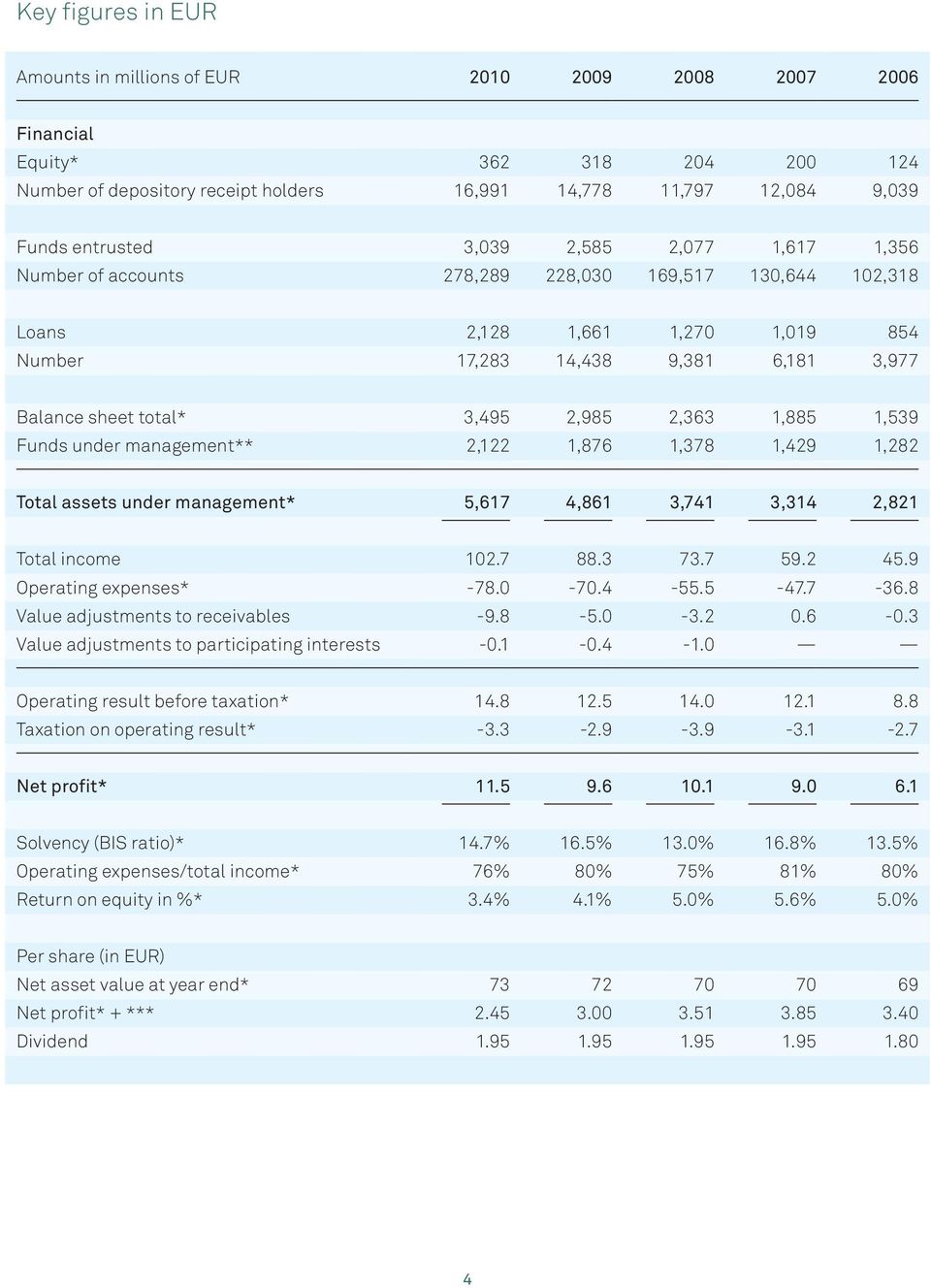
7 Social Number of co-workers at year end**** Co-worker turnover 11% 10% 14% 18% 20% Women as percentage of management team 35% 27% 29% 33% 33% Training costs per fte in EUR 1,521 1,318 1,240 1, Ratio between the highest and the lowest salary Environment Emission of (1,000 kg)***** 2,800 2,604 2,097 1,454 1,163 CO 2 compensation 100% 100% 100% 100% 100% * With effect from 2010, the accounting policy for pensions has changed. This is in connection with the release of the pension provision which was required under the previous accounting policy. The comparative figures for 2009 have been adjusted to reflect this change in accounting policy. ** Including funds under management with affiliated parties that have not been included in the consolidation. *** The figure of net profit per share is calculated on the average number of issued shares in circulation during the financial year. **** Concerns all co-workers employed by Triodos Bank NV, excluding co-workers employed by the joint venture Triodos MeesPierson. The comparable figure for 2009 has been adjusted. ***** The CO 2 calculation method was changed in 2009 and the comparable figure for 2008 has been recalculated. 5
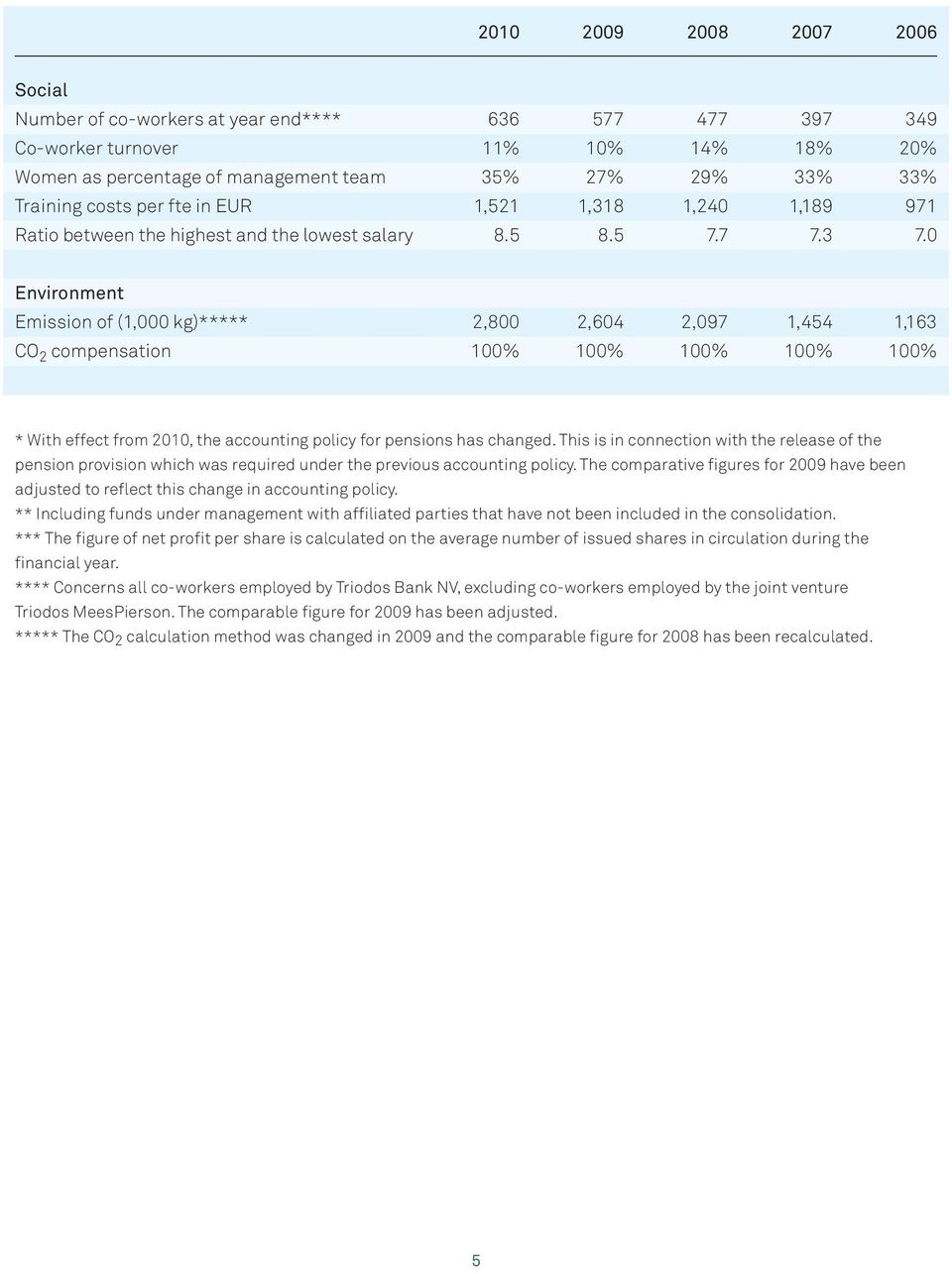
8 Key figures in pounds Amounts in millions of pounds # Financial Equity* Number of depository receipt holders 16,991 14,778 11,797 12,084 9,039 Funds entrusted 2,615 2,295 1,978 1, Number of accounts 278, , , , ,318 Loans 1,831 1,475 1, Number 17,283 14,438 9,381 6,181 3,977 Balance sheet total* 3,008 2,652 2,251 1,382 1,033 Funds under management** 1,827 1,665 1,312 1, Total assets under management* 4,835 4,317 3,563 2,430 1,894 Total income Operating expenses* Value adjustments to receivables Value adjustments to participating interests Operating result before taxation* Taxation on operating result* Net profit* Solvency (BIS ratio)* 14.7% 16.5% 13.0% 16.8% 13.5% Operating expenses/total income* 76% 80% 75% 81% 80% Return on equity in %* 3.4% 4.1% 5.0% 5.6% 5.0% Per share (in GBP) Net asset value at year end* Net profit* + *** Dividend

9 Social Number of co-workers at year end**** Co-worker turnover 11% 10% 14% 18% 20% Women as percentage of management team 35% 27% 29% 33% 33% Training costs per fte in GBP 1,309 1,171 1, Ratio between the highest and the lowest salary Environment Emission of CO 2 (1,000 kg)***** 2,800 2,604 2,097 1,454 1,163 CO 2 compensation 100% 100% 100% 100% 100% # Converted to pounds sterling at the mid-market exchange rate applying at each year end. * With effect from 2010, the accounting policy for pensions has changed. This is in connection with the release of the pension provision which was required under the previous accounting policy. The comparative figures for 2009 have been adjusted to reflect this change in accounting policy. ** Including funds under management with affiliated parties that have not been included in the consolidation. *** The figure of net profit per share is calculated on the average number of issued shares in circulation during the financial year. **** Concerns all co-workers employed by Triodos Bank NV, excluding co-workers employed by the joint venture Triodos MeesPierson. The comparable figure for 2009 has been adjusted. ***** The CO 2 calculation method was changed in 2009 and the comparable figure for 2008 has been recalculated. 7

10 Key figures in dollars Amounts in millions of dollars # Financial Equity* Number of depository receipt holders 16,991 14,778 11,797 12,084 9,039 Funds entrusted 4,060 3,723 2,890 2,380 1,786 Number of accounts 278, , , , ,318 Loans 2,843 2,393 1,768 1,500 1,125 Number 17,283 14,438 9,381 6,181 3,977 Balance sheet total* 4,670 4,301 3,289 2,775 2,026 Funds under management** 2,835 2,701 1,918 2,104 1,689 Total assets under management* 7,505 7,002 5,207 4,879 3,715 Total income Operating expenses* Value adjustments to receivables Value adjustments to participating interests Operating result before taxation* Taxation on operating result* Net profit* Solvency (BIS ratio)* 14.7% 16.5% 13.0% 16.8% 13.5% Operating expenses/total income* 76% 80% 75% 81% 80% Return on equity in %* 3.4% 4.1% 5.0% 5.6% 5.0% Per share (in USD) Net asset value at year end* Net profit* + *** Dividend
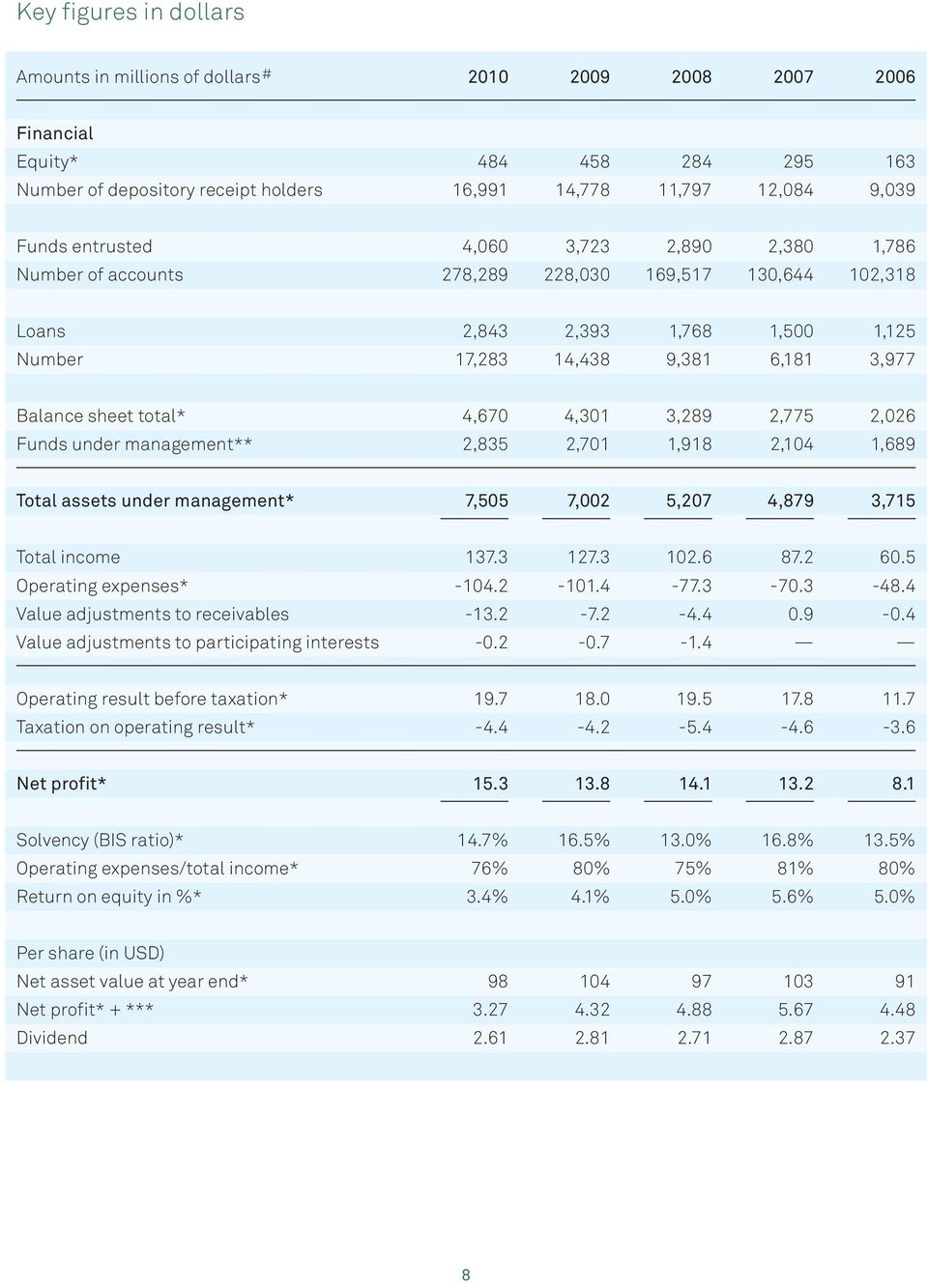
11 Social Number of co-workers at year end**** Co-worker turnover 11% 10% 14% 18% 20% Women as percentage of management team 35% 27% 29% 33% 33% Training costs per fte in USD 2,032 1,899 1,719 1,750 1,279 Ratio between the highest and the lowest salary Environment Emission of CO2 (1,000 kg)***** 2,800 2,604 2,097 1,454 1,163 CO 2 compensation 100% 100% 100% 100% 100% # Converted to US-dollars at the mid-market exchange rate applying at each year end. * With effect from 2010, the accounting policy for pensions has changed. This is in connection with the release of the pension provision which was required under the previous accounting policy. The comparative figures for 2009 have been adjusted to reflect this change in accounting policy. ** Including funds under management with affiliated parties that have not been included in the consolidation. *** The figure of net profit per share is calculated on the average number of issued shares in circulation during the financial year. **** Concerns all co-workers employed by Triodos Bank NV, excluding co-workers employed by the joint venture Triodos MeesPierson. The comparable figure for 2009 has been adjusted. ***** The CO 2 calculation method was changed in 2009 and the comparable figure for 2008 has been recalculated. 9

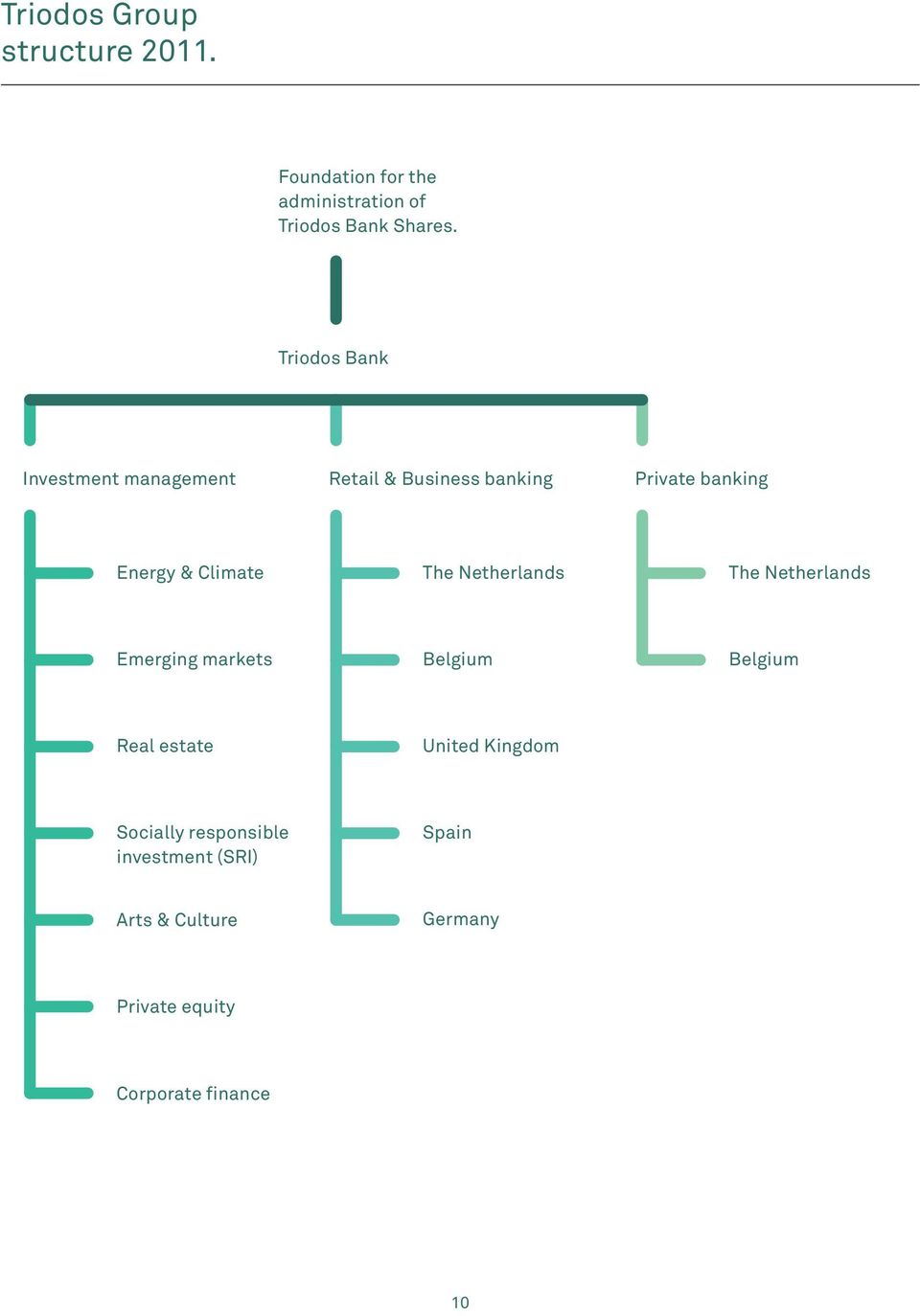
12 Triodos Group structure Foundation for the administration of Triodos Bank Shares. Triodos Bank Investment management Retail & Business banking Private banking Energy & Climate The Netherlands The Netherlands Emerging markets Belgium Belgium Real estate United Kingdom Socially responsible investment (SRI) Spain Arts & Culture Germany Private equity Corporate finance 10
13 Executive Board report. Introduction Sustainable change The world is changing. The institutions we relied on to solve our biggest problems in the past no longer have the conviction, or the means, to deal with the challenges we face in the future. Conventional thinking supposes that as climate change, for example, is a worldwide phenomenon it requires our most powerful organisations to respond to it. For most of us, that means governments. Governments used to play a central role driving the sustainability agenda. But as their focus shifts to balancing budgets in a post financial-crisis world, others from civil society and business are stepping in to play the principal role in building a sustainable future. Triodos Bank wants to be at the forefront of these developments. Governments refocus Evidence suggests some governments are shifting their focus away from solving our biggest social and environmental problems in favour of pressing economic priorities. This can mean cost cutting measures that impact sustainability policy. In Germany, for example, the life-span of nuclear reactors has been extended by the German authorities, revising a previous agreement. Some commentators argue that this is largely driven by political and budgetary concerns and may lead to less investment in renewable energies. In Spain, the Government proposed ending a feed-in tariff for solar projects in While this has yet to become law, its implications for the industry could be significant. At the same time in the Netherlands, Triodos Bank has wrestled with the implications of a new government s decision to withdraw a tax break linked to green funds that invest in environmental projects. This is not all bad news. While governments still have an important role to play, and should continue to actively engage in driving the sustainability agenda forward, other institutions and individuals may be better placed to deliver concrete change. Business and civil society take centre stage Business and civil society are increasingly replacing governments as the key players in sustainability. Dutch energy company, Eneco, for example, has called for the removal of all energy subsidies not just renewable energy, but nuclear, coal and other conventional sources of energy. This type of thinking, if it s followed by action, could create a genuinely level playing field with benefits for the renewable energy industry. People as well as companies are also increasingly taking responsibility. Across Europe political activism is on the increase with large-scale protests in Germany in particular. If this discontent is channeled into positive, entrepreneurial initiatives there is enormous potential for good ideas to become viable businesses serving receptive markets not only in renewable energy but in the organics and other sustainable sectors. New international approaches Business and civil society have started to occupy the sustainability landscape in Europe. These developments build on Europe s big idea of a social market economy that combines private enterprise, which harnesses the power of consumers, and government regulation to deliver better outcomes. In other parts of the world important new economic approaches have also developed. They include: American sustainable capitalism which aims to embrace the benefits of capitalism but with a long-term view. And China s long-term strategy on energy needs where government plays a fundamental role in delivering large-scale change. Sustainable capitalism is interesting not least because it argues that capitalism can only efficiently allocate resources if you have a proper view of the broader context, including people s well being and dignity and the planet s capacity to support us. This has practical implications. For Triodos Bank, and many others, it means there must be a price-tag or tax on carbon emissions, for example. Sustainable 11
14 capitalism has great potential but should not become an ideology, because change will not come from embracing ideologies. Triodos Bank s role These ideas raise questions about the kind of bank Triodos wants to be. Do we help businesses that want to become more sustainable, and not just reward the ones that already are? New Resource Bank in the US, in which Triodos Bank is a cornerstone investor, supports enterprises that want to become more sustainable but don t know how, for example. It has developed a very practical sustainability toolkit, designed to move conventional businesses to a more sustainable future. All our efforts aim to deliver our mission to improve people s quality of life. To do this means continually increasing our impact. So in 2010 we focused on lending more of the savings and investments that have been entrusted to the bank in ever-larger volumes. This led to a marked increase in our impact, as lending in particular grew in all our branches. However, we need to get the balance right between savings and loans, ensuring a healthy balance between the deposits we attract and the proportion of them that we lend out. This is particularly important in a period where we have successfully attracted high volumes of deposits in some countries. We are fortunate that we can take advantage of a European network where a surplus of deposits in one country can be used productively in another. But we also want to finance more projects than before, including the breakthrough sustainable businesses of the future. We actively manage this process to make sure that we continue to grow in a balanced way. We know that our impact is of most interest to our stakeholders, from customers and depository receipt holders to our co-workers. So this year s annual report focuses more closely on the themes that run as threads through all our work, regardless of where in the world they happen. While why and how we do what we do is of fundamental importance, what we do also matters a great deal. We want to make this more visible. For instance, Triodos Bank s work in energy and climate allows us to play our part in dealing with the challenge of climate change, energy security and access to energy in the developing world. Given existing and emerging technologies, and the availability of capital despite the financial downturn, transitioning towards a low carbon economy is possible. But it requires a concerted effort from many organisations, businesses, producers and consumers. The financial sector is one and should play a central role. Investment decisions must not be guided anymore by short-term financial interests. Instead, they should combine long-term financial, environmental and social considerations. For us that means financing sustainable projects through our energy and climate funds, and lending across all our European branches. In 2010, that meant our combined lending and investments in renewable energy projects generated 4,136,000 MWh of clean green energy, or the equivalent of 1,181,600 European households, avoiding 1,624,373 tonnes of CO 2 emissions. We are also active in other areas such as arts and culture because personal creative expression is a fundamental human need, and can create and safeguard human dignity. Art can express things that can t be put into words. There are many powerful examples of people who live in difficult circumstances, whose freedom is restricted for instance, finding other forms of self-expression. On a personal level, art can inspire and encourage change. At the level of society as a whole, art can bridge divisions and establish links between individuals and groups. A lively cultural sector cannot be fully dependent on government subsidies but must find a range of forms of finance. Triodos Bank wants to be a catalyst for developing cultural entrepreneurship. We want to invest in artists, institutions and cultural entrepreneurs that build bridges with society and that are socially relevant. And we want this work to reach people and influence their quality of life. The number of people who experience arts and culture is not the only measure of its value but, it says 12

15 something about its impact. In million people attended events and cultural events and venues financed by Triodos Bank. We also work actively and extensively on the world stage and, since 1994, in microfinance in particular. Microfinance is the provision of financial services to low-income households and small and mediumsized enterprises in developing countries. Access to these services has a fundamental impact on the lives of millions of people. It enables them to build their assets gradually, develop microenterprises, enhance their income earning capacity, and provide a cushion against unforeseen circumstances in the future. As microfinance becomes integrated into mainstream financial systems, it also faces problems found in the finance industry in general. In some countries strong, even aggressive growth and increased competition has led to overheating and to over-indebtedness of clients. In some cases the focus on serving clients is no longer the priority. We started investing in developing countries because we recognized that sustainable development, and addressing poverty issues in particular, was a global issue. We believe that the key to sustainable development in developing countries is an allinclusive financial sector that improves lives by providing transparent, financial services in a responsible way. And we firmly believe that focusing on the interests of clients is the only way to achieve long-term sustainable financial results. In 2010 through specialised microfinance funds we provided finance to over 85 upcoming and well-established microfinance institutions in 43 countries. We also held equity stakes in 19 leading and innovative microfinance institutions. The microfinance institutions in our portfolio reach 7.4 million loan clients of which 67% are women and 54% of whom live in rural areas as well as 5.2 million savings clients. As well as direct impact through our finance we developed a number of new tools in 2010 to help us increase our customer numbers and serve them better when they join us. These included the launch of a new website across the group, and a new visual identity which meant changes to all our communications, from our magazine to the way people manage their money online with us. We backed this up with improvements to our systems behind the scenes, ensuring we continue to have a robust and professional infrastructure as we grow. We continued to increase our role influencing public EUR 5.6 billion The total amount of assets under management by Triodos Bank and the investment funds grew by 15% to EUR 5.6 billion. 13
16 debate about sustainability, speaking at a large number of international, regional and local events, from the Club of Rome to bespoke events for local organic farmers. Our profile in the on and offline media continues to grow in all the countries and sectors where we work, providing an important platform to share our opinion and engage in debate about the sustainability agenda. We opened new regional offices in Spain, grew our new office in Germany rapidly, moved to a bigger office in the Netherlands and made preparations to do the same in the UK; all as part of efforts to stimulate and professionally manage growing demand for our work across Europe. The challenges ahead Triodos Bank has always been about getting things done. As a small bank with big impact ambitions, we want to bring sustainability closer to people s day to day needs, which means growing ourselves and influencing more of the world around us. However while orthodox thinking has suggested big problems need big organisations to solve them, there s increasing evidence that smaller organisations are better placed to deal with today s urgent social, environmental and cultural challenges. Increasingly jobs are created from small and medium-sized enterprise, for example, rather than the dominant international corporates of the past. In many ways small has become the new big. We intend to play our part as a bank, working with networks of other similarly sized, values-focused institutions. Our work in the Global Alliance for Banking on Values is an example of what this means in practice. In 2010 this network of the world s leading sustainable banks, which Triodos Bank co-founded in 2009, expanded and announced a commitment to touch the lives of a billion people by Because smaller Statement of funds entrusted per branch Amounts in millions of EUR EUR % EUR % The Netherlands 1, , Belgium United Kingdom Spain Germany Total 3, , Statement of funds entrusted per category Amounts in millions of EUR EUR % EUR % Saving accounts 1, , Deposits and time accounts Other funds entrusted Total 3, ,

17 organisations, acting together, have the potential to deliver on the scale our challenges demand. This work is urgent; from increasing evidence of social change, and the pressure it brings on communities and individuals, to the ever more obvious impact of climate change. The latter has moved beyond technical debate about whether climate change is happening, or not, to how we adapt to it. We want Triodos Bank, and its partners, to play a central role financing grounded solutions to these problems. We want to do this directly, through our work in Europe and in emerging markets around the world, and by positively influencing others around us. We hope this report which we are producing online for the first time to provide you with more meaningful information in a more environmentally-friendly way provides you with a compelling picture of how we went about this in Results Triodos Bank is committed to sustainable development, with a focus on people s quality of life. Quality of life includes, but extends beyond, the well-being of individuals, to social relationships and how we treat the environment. It does not contradict entrepreneurship and financial return, but puts them in a broader context. Indeed, this is the added value that Triodos Bank contributes. Social and economic developments underline the interest in Triodos Bank s focus on quality, people and nature. Triodos Bank is responding to this by broadening and deepening its activities. The following are the main results achieved in 2010: Triodos Bank (Group) The total amount of assets under management including Triodos Bank and the investment funds grew by EUR 0.7 billion, or 15%, to EUR 5.6 billion. The net profit for 2010 is EUR 11.5 million, 20% above Triodos Bank increased its share capital by EUR 34 million, or 13% thanks to a depository receipt issue, marketed to Triodos Bank retail customers and investors only. Triodos Bank finances enterprises that augment the use of renewable resources in particular, and supports projects that reduce the demand for energy and encourage cleaner use of fossil fuels. By the end of 2010, Triodos Group and its climate and energy investment funds were financing over 306 projects 7.4 million + Our specialised microfinance funds provide finance to 85 microfinance institutions in 43 countries, serving 7.4 million loan clients. 15
18 across Europe (275 in 2009), with a generating capacity of 1,624 MW of energy (950 in 2009). The number of co-workers increased by 10% to 636 in 2010 (577 in 2009). A framework for job classification, or job families, was introduced in the Netherlands and will be rolled out across the group in the coming two years. In 2010 a visionary leadership programme, and an improved management development programme also started, to better equip Triodos Bank s leaders for the future. A framework for measuring Triodos Bank s wider social, cultural and environmental impact through its financing activities, was also established in 2010, and a pilot project to measure and monitor the impact of our loans in the UK branch initiated. European Branch Network Triodos Bank s balance sheet total grew by 17% to EUR 3.5 billion thanks to a steady growth of the funds entrusted and a successful share issue. Growth of between 15 to 20% was expected. The funds entrusted increased by EUR 454 million, or 18%, against expected growth between 15 to 20%. Savers continued to respond to the financial crisis and wider discontent about the way banks have handled their responsibilities and rewarded their employees by turning to Triodos Bank as a positive alternative. This resulted in higher growth than expected, in The Netherlands and Belgium. This was due in part to a growing profile, and account opening processes that are more efficient and tailored for local audiences. Growth of the loan portfolio amounted to EUR 467 million, or 28%. Expected growth was between 35 and 40%. Early in the year we refined our projections down, given the economic climate. Triodos Bank s total number of customers increased by 18%. Expected growth was between 15% and 20%. By the end of 2010, Triodos Bank had a total of 285,000 customers. Triodos Investment Management Triodos Investment Management is responsible for 20 funds, totalling EUR 1.8 billion assets under management. Total growth of the investment funds was EUR 166 million, up 10%, against a target of between 25 and 30%. The impact of uncertainty around tax benefits for the Triodos Groenfonds and Triodos Cultuurfonds was responsible, in part, for lower growth than expected. Triodos Private Banking Private Banking increased its entrusted funds by 37% to EUR 606 million, exceeding a target of between 20 and 25% (EUR 249 million of these funds are accounted for on the balance sheet of the Dutch branch). Triodos Bank Divisions Triodos Bank s activity is split between three core divisions. They are Retail and Business Banking, delivered through a diversified network of European branches, responsible for around 77% of Triodos Bank s business income in 2010; Triodos Investment Management, the 100% owned subsidiary of Triodos Bank, makes up 21% of the bank s overall business income; and Triodos Private Banking, providing services to wealthier people and groups, the most recent division and to date available in the Netherlands and Belgium. European Branch Network (Retail and Business Banking) Developing a European branch network is fundamental to Triodos Bank. It allows it to build and share expertise. It brings a credible set of services to thousands of business and personal customers, and it grows sustainable banking s scale and impact. And while the values that bind its customers and co-workers are the same, there are important differences. Regulations, tax incentives and government approaches to sustainability are sometimes markedly different in diverse markets was a turbulent year for banking, the wider economy and millions of individuals and businesses across Europe. An acute economic downturn prompted widespread government austerity 16

19 measures in general, and rethinking around sustainability policy in particular. This was felt powerfully in all the European countries where we work. Growth continued despite, and sometimes as a continuing result of the crisis and the fall-out from it. Triodos Bank in the Netherlands continued to expand rapidly, growing by more than 2,000 customers per month, and made secure purchases online possible via the bank. The Spanish branch also grew in all areas, implementing a new ICT platform, and successfully positioned itself as a first bank for Spanish clients. While the German branch, in its first full year of operation, attracted around 1,000 customers. Lending was up in all branches, with particularly growth in Belgium, the UK and Spain in In the United Kingdom lending was up by 25%, to over GBP 300 million. In Belgium the branch financed its 150th wind turbine during the year. At the same time the German branch made approximately EUR 24 million in new loans. The financial crisis also prompted many people to reassess their banks and their finances. Some looked for a different approach, and found Triodos Bank as a credible, transparent and increasingly logical place to put their money. In the Dutch branch, funds entrusted were up by EUR 228 million, exceeding expectations of EUR 125 million. In Belgium they grew by 12% up by EUR 86 million, while the Belgian Private Banking activities grew by 28% up to EUR 49 million. Triodos Investment Management In addition to impact savings and payments, impact investment is an important activity at Triodos Bank. Investments take place through investment funds or investment institutions bearing the Triodos name and are managed by Triodos Investment Management BV, a 100% subsidiary of Triodos Bank. These funds and investments are not on Triodos Bank s balance sheet. The funds publish separate annual reports and each has its own Annual General Meeting of Shareholders. There were 20 investment funds in 2010, in which individuals and institutions could invest depending on the fund. The funds invest in different themes such as microfinance, sustainable trade, organic agriculture, climate and energy, sustainable real estate, arts and culture, or in listed companies with above average environmental, social and governance (ESG) performance. In organic farming and sustainable food, Triodos Investment Management enhanced the quality of the production and consumption of food products by financing 167 farms, suppliers and distributors. In arts and culture, it financed EUR 140 million in 25 projects. In real estate, it increased the quality and sustainability of the built environment by sustainably upgrading 15 buildings. 87 microfinance institutions were able to offer a variety of financial services to low-income people in developing countries because EUR 249 million was invested in them by the Emerging Markets funds. Triodos Private Banking Private Banking offers a broad range of financial and non-financial services to wealthier people, foundations, associations and religious institutions. Sustainable asset management is the core service within Triodos Private Banking, and includes both Triodos investment funds and private asset management. Triodos Research, an experienced specialist department, selects which businesses are eligible for investment. With financial markets recovering in 2010 and sustainable banking increasingly popular with private investors, Private Banking increased its entrusted funds substantially and delivered a profit for the first time, ahead of plan. Products and services Triodos Bank s products and services offer investors and savers the opportunity to finance new and existing companies that contribute to the improvement of the environment or create social or cultural added value. Potential borrowers are first assessed on the added value they create in these areas. The commercial feasibility of a prospective loan is then assessed and a decision made about 17

20 whether it is a responsible banking option. The criteria Triodos Bank uses to assess companies can be viewed on Triodos Bank s websites. Lending The growth of the loan portfolio is an important indicator of the contribution Triodos Bank makes towards a more sustainable economy. All the sectors the Bank works in qualify as sustain able and the companies and projects it finances contribute to realising Triodos Bank s mission. In 2010, there was no reason to compare the sustainability levels of the various sectors and base a core policy on the outcome of this. The Bank s main focus remains on the existing sectors in which it has already developed considerable expertise. natural food shops. Environmental technology, such as recycling companies and nature conservation projects, is also represented. Social (28%, 2009: 31%) This sector includes loans to traditional businesses and innovative enterprises and service providers with clear social objectives, such as social housing, loans to fair trade business and health care institutions. Culture (14%, 2009: 15%) This sector covers loans to organisations working in education, retreat centres, religious groups, cultural centres and organisations, and artists. The lending sectors above describe the main sectors Triodos Bank is involved in. Parts of these sectors are also financed by both Triodos Bank itself and its investment funds (see investments). In 2010, the loan portfolio grew by 28% to EUR 2,128 million (2009: 31%). This EUR 467 million growth was lower than expectations of 35%-40%. The loan portfolio as a percentage of the total amount of funds entrusted rose to 70% (2009: 64%), so Triodos Bank met its goal to lend 70% of its funds entrusted. Outstanding loans per sector in 2010 Environment (49%, 2009: 50%) This sector consists of renewable energy pro jects such as wind and solar power, biomass and hydroelectric projects. It also includes organic agri culture, and projects across the entire agricultural chain, from farms, processors and wholesale companies to The quality of the loan book remained satisfactory notwithstanding the economic recession. However, a number of sectors related to agricultural production and organic waste, including energy production based on biomass, were more affected by the economic recession due to the long lasting depression in demand and high price volatility. The increased loan loss provisions resulted in EUR 9.8 million (2009: EUR 5.0 million) value adjustments, of which EUR 4.8 million (EUR 3.3 million) relate to biomass energy projects. Although the impact on the results is material, the net exposure to the biomass energy sector only represents 1.3% (EUR 27.6 million) of the total loan book. This contributed to the loan loss provision of 0.52% of the average loan book (2009:0.34%). Our long-term benchmark for provisions is 0.25%. These provisions are taken as a preventive measure to protect the bank against potential defaults by borrowers. 18

21 Savings and payments Savings enable Triodos Bank to finance companies and organisations that benefit people, the environment and culture. An increase of the funds entrusted is an important indicator of Triodos Bank s ability to attract sufficient funds to finance sustainable organisations. This has continued to happen as large numbers of people have moved away from a discredited mainstream banking industry, in search of a more transparent alternative, that s more closely connected to the real economy. The branches offer a variety of products and services to meet this demand from a Spanish debit card and German credit card that emphasise responsible consumption, to a successful new online product range in the UK. By offering our savers, in some countries, the opportunity to donate part of the interest they receive to a charity, many social organisations receive support every year. In 2010, 271 organisations (2009: 463) received total donations of EUR 0.4 million (2009: EUR 0.5 million) in this way. Investments In addition to savings and payments, investment is an important activity at Triodos Bank. Investment takes place through investment funds or investment institutions bearing the Triodos name, and are managed by Triodos Investment Management BV. These funds and investments are not on Triodos Bank s balance sheet. The increase in total funds entrusted to Triodos Investment Management, while lower than anticipated, reflects investors appetite for investments that are linked to broad themes, such as renewable energy, sustainable real estate or organic agriculture. Financial results In 2010, Triodos Bank s income grew by 16% to EUR 103 million (2009: EUR 88 million). Triodos Investment Management contributed EUR 21 million to this figure (2009: EUR 19 million). In 2010, commission income amounted to 34% (2009: 33%) of our total income in line with expectations. In 2010, the ratio of operating expenses is 76% (2009: 80%). In 2009, the ratio was higher than expected as a result of the cost of a contribution to the Dutch deposit guarantee system due to the collapse of the Dutch DSB Bank. Net profit of EUR 11.5 million was up by 20% (2009: EUR 9.6 million). Earnings per share, calculated using the average number of outstanding shares during the financial year, were EUR 2.45 (2009: EUR 3.00), a 18% decrease. The profit is placed at the disposal of the share holders. Triodos Bank proposes a dividend of EUR 1.95 per share (2009: EUR 1.95). This means that the pay-out ratio (the percentage of total profit distributed as dividends) will be 80% (2009:65%). The medium-term objective is to grow the return on equity to 7% of Triodos Bank s equity in normal economic conditions. This target was not projected for 2010 per se, but should be seen as a realistic, long-term average for the type of banking activity that Triodos Bank engages in. The mature branches (The Netherlands, Belgium and the United Kingdom) have proven that they can achieve this level of profitability. As a consequence of a troubled economic and financial climate, leading to above average provisions in the loan portfolio, new investments such as a new branch in Germany, and growth in the number of savings customers in particular, the profit remained below 7% in 2010, as expected. 28%+ The loan portfolio grew by EUR 467 million or 28%. 19
22 The time frame within which Triodos Bank realises this 7% profit objective depends on the opportunities it chooses to, and can, take advantage of in a market where sustainable development will be highlighted in the coming years. In the current market, delivering this profit objective is subject to considerable uncertainty. Triodos Investment Management is managing 20 investment funds, totalling EUR 1.8 billion. Together these funds make a substantial contribution to the bank s profit. Net profit in 2010 was EUR 3.8 million (2009: EUR 3.6 million). The number of depository receipt holders increased from 14,778 to 16,991. Equity increased by 14% from EUR 318 million to EUR 362 million. In 2010, maintaining an internal market for the buying and selling of depository receipts for shares continued to operate effectively. At the end of 2010, the net asset value for each depository receipt was EUR 73, increasing from 72 at the end of From the start of 2008, the BIS ratio (capital adequacy ratio), an important measure of a bank s solvency, has been calculated according to the Basel II guidelines. At the end of 2010 the BIS ratio was 14.7% (2009: 16.5%), a decrease that was due to the high growth of the loan book during the year. This percentage is well above the regulatory minimum of 8%. Risk and compliance Risk Management Managing risk is a fundamental part of banking. While some banks assess risk as part of a profitmaximising strategy, Triodos Bank manages risk as part of a joined-up approach to make sure it delivers financially on a sustainable, long-term basis. In 2010 we have taken the necessary measures to comply with the Dutch Banking Code as explained below (see Compliance with the Dutch Banking Code), and explain when we don t as the code requires. In 2010 we improved the monitoring of credit risk with new policies and reporting, and a strengthening of the central credit risk organisation. Our Interest Rate Risk management has been upgraded, introducing a number of quantitative metric tools besides qualitative expert opinion approaches. Internal Audit will now report to the Chief Financial Officer and not the Chief Executive Officer, as required by the code. However, Internal Audit will regularly report to the Chief Executive Officer about relevant developments. Significant progress has been made to embed risk management throughout the organisation. All business units performed strategic risk assessments to identify and manage potential risks that could impede the realisation of their business objectives. The outcome of these assessments were used as input for the Executive Board s own risk assessment and determination of Triodos Bank s risk appetite, or Number of statement of depository receipts per holder Amounts in millions of EUR Depository receipt holders Issued capital ,154 7, ,805 6, , ,001 and more Total 16,991 14,
23 the willingness to take risk in achieving its business objectives. During the year, two internal stress test scenarios were executed with satisfactory results. We also voluntarily checked Triodos Bank s resistance against the so called European banks stress test with a positive outcome. In the coming years we will continue to stress test our results, liquidity and capital against new developments and scenarios. The Risk Management section of the annual report provides a description of the main risks related to the strategy of the company, a description of the design and effectiveness of the internal risk management and control systems for the main risks during the financial year, and a description of any major failings in the internal risk management and control systems which have been discovered in the financial year. These issues have been discussed on a regular basis with the Audit and Risk Committee and the Supervisory Board. Capital requirements and Basel III regulations At the same time as our lending and savings grow, we are and will continue to be strongly capitalised. This has become an important issue as demands for capital increase following the financial crisis. We aim for a solvency ratio of at least 12%, well above our own internal economic capital calculations, in order to guarantee a healthy and safe risk profile for our depositors. Economic capital is calculated as a result of the yearly Internal Capital Adequacy Assessment Process, which is reviewed by the Dutch Central Bank Regulations too are changing, such as those developed by the Basel Committee on Banking Supervision, designed to build a more resilient banking sector by strengthening the solvency of the banks and introducing strict liquidity requirements. Triodos Bank already complies with both new capital and liquidity requirements, as recently published by the Basel Committee, and better known as Basel III. The regulations are required to be fully implemented by We will need the support of existing and new investors in the future to keep meeting these requirements as we continue to grow. In 2010 we successfully raised capital from our own investors and customers, exceeding targets and raising over EUR 34 million. This has helped us to maintain a capital adequacy ratio of 14.7%, at the end of 2010, well above requirements. In Control statement The Executive Board is responsible for designing, implementing and maintaining an adequate system for internal control over financial reporting. Financial reporting is the product of a structured process carried out by various functions and branches under the direction and supervision of the financial management of Triodos Bank. The Executive Board is responsible for the risk management function and compliance function. The risk management function develops and executes risk policies and procedures involving identification, measurement, assessment, mitigation and monitoring of the financial and non-financial risks and works together with management to ensure adequate adherence to these risk management policies and procedures. The compliance function plays a key role in monitoring Triodos Bank s adherence to external rules and regulation and internal policies. The adequate functioning of the risk management and compliance function as part of the internal control system is under discussion with the Audit and Risk Committee. Triodos Bank s Internal Audit function provides additional assurance to the Executive Board by independently and objectively evaluating the adequacy and effectiveness of Triodos corporate governance, internal controls, compliance and risk management systems. The Executive Board, under supervision of the Supervisory Board and its Audit and Risk Committee, is responsible for determining the overall internal audit work and for monitoring the integrity of these systems. In 2011, risk management will extend and formalise the enterprise risk management framework that will be the basis for an integrated in control statement 21
24 process. The Executive Board indicates that this process should lead to a statement providing positive assurance in the coming years. On the basis of the above, Triodos Bank s Executive Board states that, with reasonable assurance, regarding its financial reporting risks, as per the end of the 2010 financial year, it has no indication that the risk management and control systems have not functioned adequately and effectively. The risk management and control systems provide reasonable, but not absolute, assurance regarding the reliability of financial reporting and the preparation and fair presentation of its financial statements. Compliance and integrity Triodos Bank has internal policies, rules and procedures to guarantee that management complies with relevant laws and regulations regarding customers and business partners. In addition, the Compliance department independently monitors the extent to which Triodos Bank complies with its rules and procedures. External aspects of the Compliance department primarily concern accepting new customers, monitoring financial transactions and preventing money laundering. Internal aspects primarily concern checking private transactions by co-workers, preventing and, where necessary, transparently managing conflicts of interest, and safeguarding confidential information. Further it concerns raising and maintaining awareness of for example financial regulations, compliance procedures and fraud and anti-corruption measures. Triodos Bank has a European compliance team led from the head office in Zeist. Compliance officers are present in every branch. The head of the Compliance department reports to the Executive Board. There were no significant incidents in 2010 concerning compliance and integrity. Triodos Bank was not involved in any material legal proceedings or sanctions associated with non-compliance with legislation or regulations in terms of financial supervision, corruption, advertisements, competition, privacy or product liability. Transparency and reporting Triodos Bank has used the guidelines of the Global Reporting Initiative (GRI) since GRI was established in 1997 by the United Nations and the Coalition for Environmentally Responsible Economics (CERES). GRI wants to organise reporting on sustainability in a consistent manner and, in this way, make performance objective and make comparison easier. Triodos Bank is an organisational stakeholder of GRI. This Annual Report uses the G3 (version 3) guidelines and the new financial sector supplements developed in We aim to consistently report to GRI s highest level (A+). Sustainability policy Sustainability considerations are shared at all levels of Triodos Bank and are an integral part of its management. Social and environmental aspects are taken into account in all Triodos Bank s decisions. Therefore, unlike many other organisations, Triodos Bank does not have a separate department that continuously focuses on sustainability or corporate social responsibility. Triodos Bank employs specific criteria to ensure the sustainability of products and services. The Bank employs both positive criteria to ensure it is actively doing good and negative criteria for exclusion, to ensure it doesn t do any harm. The negative criteria exclude loans and investments in sectors or activities that are damaging to society. The positive criteria identify leading businesses and encourage their contributions to a sustainable society. Twice a year, these criteria are tested and adjusted if necessary. Triodos Bank has also defined sustainability principles for its internal organisation. These 22
25 are included in its Business Principles. All sustainability criteria referred to can be found on Triodos Bank s websites. The Dutch Banking Code The Dutch Banking Code (Banking Code) came into force as of January 1, Triodos Bank subscribes to the Banking Code, implemented it during 2010, and wholeheartedly embraces its goal to develop more transparent and responsible banking. The full comply-or-explain statement, as required under the Banking Code, can be accessed at Triodos Bank s website. The main themes of the Banking Code and the way they are addressed by Triodos Bank are detailed in the Corporate Governance chapter on page 24. Prospects for 2011 Triodos Bank (Group) Excluding unforeseen circumstances, Triodos Bank expects to achieve a positive result for At the same time we recognise that the economic downturn that has resulted from the financial crisis will continue in 2011 and presents continuing challenges for sustainable entrepreneurs and businesses active in the real economy. European branch network Triodos Bank s balance sheet total is expected to continue to grow by between 15 and 20%. All branches will broaden their customer base. The number of customers is expected to grow by between 15 and 20% across the Group. The loan portfolio and the funds entrusted are expected to increase by between 20 and 25%. Triodos Bank has a healthy growth ambition but does not want to realise it at all costs. The loans granted in 2011 will reflect our efforts to finance frontrunners in their fields; the entrepreneurs developing the sustainable industries of the future. We expect the levels of provisions for loans to return to their long-term average. Triodos Investment Management Triodos Investment Management is well positioned for further growth, with increasing demand from investors in impact investment. Investor interest is in both existing funds as well as new ones in various areas such as energy efficiency, renewable energy, arts and culture and sustainable food and agriculture. Growth prospects in funds with fiscal benefits in The Netherlands have become more uncertain, in the light of government decisions to change the financial benefits associated with them. In total however, we foresee a growth in funds under management of between 10 and 20% for Private Banking We expect interest in our private banking offering in The Netherlands and Belgium to continue to be high and anticipate growth of between 20 and 25%. In conclusion In 2011, Triodos Bank will actively contribute to a more sustainable future, by responding to the social, environmental and cultural challenges we face over the short, medium and long-term. In particular we expect to grow our financing of renewable energy projects and other innovations worldwide that effectively reduce our dependence on fossil fuels. Our environmental activity is, however, only one part of our growing impact. We will communicate the results of our work even more clearly and more often. We will do this by playing an active role in the public debate but also as a creative practitioner; a change agent financing meaningful projects on the ground. Zeist, 24 February 2011 Triodos Bank Executive Board Pierre Aeby* Peter Blom*, Chair Michael Jongeneel * Statutory Director under the articles of association 23
26 Corporate Governance. How Triodos Bank directs, administers and controls its work says a lot about who the organisation is. It has developed processes and policies, and implemented laws, to both meet its obligations and reflect its mission. Triodos Bank chooses not to list on a stock exchange, for example, to avoid a system that puts making as much profit as possible or profit maximisation above all else. Instead it runs a professional, profitable sustainable bank that investors invest in through a special structure. Details of the Dutch Corporate Governance Code and the Banking Code are explained below. More information about Triodos Bank s structure are available in the online annual report. Dutch Corporate Governance Code The Dutch Corporate Governance Code ( the Code ) does not apply directly to Triodos Bank NV, as Triodos Bank s depository receipts are not listed on any regulated market. Never theless, Triodos Bank endorses the principles of the Dutch Corporate Governance Code. The full comply-or-explain statement as required under the Code can be accessed at Triodos Bank s website. Triodos Bank generally complies with the principles and best practices of the Code. However, it has also made a well-considered decision to deviate from specific points. The first deviation relates to voting rights on shares. To protect Triodos Bank s mission and objectives as much as possible, depository receipt holders are not Number of statement of depository receipts per holder Amounts in Depository receipt holders Issued capital millions of EUR ,154 7, ,805 6, , ,001 and more Total 16,991 14, Number of depository receipts per country Depository receipts x 1,000 Depository receipt holders The Netherlands 3,614 3,323 10,802 10,071 Belgium ,168 2,780 United Kingdom ,316 1,096 Spain , Germany Total 4,987 4,421 16,991 14,778 24
27 allowed to exercise voting rights on the underlying shares, which are instead exercised by The Foundation for the Administration of Triodos Bank Shares (SAAT), as outlined on page 119. Also, depository receipt holders cannot make recommendations for appointments of members of the Board of SAAT. The second deviation relates to the term of office of the Statutory Directors. This term is not limited to a period of four years, because Triodos Bank feels that this would not serve the long-term development of the company. The third deviation relates to the fact that the Supervisory Board of Triodos Bank has an integrated Nomination and Compensation Committee and so does not provide for a separate nomination committee and remuneration committee. Further, Triodos Bank deviates from the Code s best practice to submit all proposals to the General Meeting of Shareholders for material amendments to the Articles of Association separate agenda items. The reason for this is that Triodos Bank wants to retain the possibility, to be exercised at the discretion of the Executive Board and the Supervisory Board, to submit a proposal for multiple amendments to the Articles of Asso ciation as a single agenda item if there is a strong degree of interrelatedness between these pro posed amendments. Finally, a number of provisions of the Code regarding executive remuneration do not apply to Triodos Bank, as it does not have any share plans or option schemes. The total costs for executive remuneration, which consists of wages and pension elements only, is shown in the annual report. Dutch Banking Code In response to the financial crisis, the Netherlands Bankers Association (NVB) drew up the Banking Code in The aim of the code is to restore damaged consumer confidence in the financial sector. It consists of a number of recommendations and principles aimed at ensuring the very best performance by banks. The code came into effect on 1 January Triodos Bank, as a financial institution based in the Netherlands, has signed up to the code, and since then has focused considerable attention on implementing it. We will monitor, identify and address any occasions when we do not comply with the code on an ongoing basis. The code s primary focus is on governance and puts the interests of the customer at the heart of a bank s activity which ties in fully with Triodos Bank s vision and Business Principles. The customer was and remains a key stakeholder in all our activity. The Dutch Banking Code (Banking Code) came into force as of January 1, Triodos Bank subscribes to the Banking Code and implemented it during The full comply-or-explain statement, as required under the Banking Code, can be accessed at Triodos Bank s website. Below please find a summary of the main themes of the Banking Code and the way they are addressed by Triodos Bank. Risk Management Risk management is a key priority for Triodos Bank. As such the policy, procedures and tasks and responsibilities of the Executive Board and the various departments in this field comply with the recommendations contained in the code. Wherever desirable, the regulations were further tightened up in 2009 and For example, in 2010, the Audit Committee of the Supervisory Board was expanded to become an Audit and Risk Committee. This committee will meet four times a year from The CFO was given final responsibility for the development and implementation of risk policy. The regulations of the Audit and Risk Committee are an integral part of the regulations of the Supervisory Board and can be found on Triodos Bank s main website. The Head of Internal Audit reports directly to the Executive Board. The first point of contact is the CFO. The Head of Internal Audit has direct access to the chair of the Audit and Risk Committee and the CEO. In 2010, the Product Approval Process was described in accordance with the recommendations of the 25
28 code. This process not only guarantees that careful consideration is given to the risks for Triodos Bank from the products in question but also that the interests of, and risks for customers, are explicitly considered. The risk management function within Triodos Bank is the object of permanent evaluation, improvement and innovation. A start was made in 2010 on the establishment of an integrated Enterprise Risk Management system that is due to be completed during Remuneration Triodos Bank operates a remuneration policy that ties in well with the principles of the code, with a bonus policy that goes one step further than it. The salary system at Triodos Bank is based on the conviction that the results of the bank are dependent on the combined effort of everyone working in it. Partly against that background, Triodos Bank does not operate a system of variable remuneration. This helps to prevent Triodos Bank s co-workers working more for their own gains than in the interests of the bank and its customers. This in turn means that people are recruited who deliberately opt for Triodos Bank and its objectives. Exceptional performances do receive additional remuneration, in individual cases. These rewards are never announced in advance on condition that specific targets are achieved, but in individual cases, are determined after the event, and are limited to a maximum of two monthly salaries. The remuneration of the Executive Board and managing directors is well below the median as required by the code. If Triodos Bank has achieved good results, all co-workers receive an identical end-of-year bonus. Each co-worker received EUR 300 in Finally, Triodos Bank restricts the differences in remuneration between the highest and lowestearned salary. There is no share option scheme at Triodos Bank for co-workers, members of the Executive Board, the Supervisory Board or the Board of SAAT, as a matter of principle. Given its values, Triodos Bank considers that a share option scheme is not an appropriate instrument for rewarding performance. Customer Focus The funds entrusted to Triodos Bank by its customers are lent to businesses and organisations whose aim is to create a more sustainable society. We ensure full transparency in respect of this policy. We believe that the key to successful banking lies in maintaining long-term relationships with the individuals and businesses borrowing or saving money from us. And we have embedded this principle within the organisation, in the following way: Triodos Bank specifically ensures that only those products are offered that favour Triodos Bank s customers, and are provided with balanced and clear product information. Triodos Bank does not operate a system of variable remuneration. This prevents financial incentives being linked to the attraction and investment of EUR 34 million Triodos Bank increased its share capital by EUR 34 million, or 13%. 26
29 funds of our customers. Triodos Bank provides full transparency about where our customers savings are used. This offers customers the opportunity to call Triodos Bank to account for its policy. A comprehensive list of the projects and businesses in which the customers savings are invested, is available via the Triodos Bank website, allowing customers to see exactly how their money has been used. Education The code highlights the importance of permanent education for Executive Board members and Supervisory Board members of banks to ensure that they remain permanently informed about the latest developments in the financial sector, and recommends a programme of permanent education. Triodos Bank has focused considerable attention on this. In 2009 and early 2010, Triodos Bank developed a structural programme of permanent education comprising multi-day meetings supervised by external experts. These meetings help provide in-depth training on the subjects referred to in the code, including duty of risk management, business model, governance and sector development. A deliberate choice was made to run a combined programme for the Supervisory Board and the Executive Board, with a view to promoting communication and understanding between both bodies. The Chair of the Supervisory Board is responsible for implementation of the education programme. Banker s Declaration We believe that handling money brings special responsibilities for all co-workers with it, not just its management. So Triodos Bank fully supports the code s recommendation to explicitly formulate these responsibilities. In 2010, all managing directors and Executive Board members signed the Triodos Bank bankers declaration, confirming their undertaking to exercise their role in the spirit of the text of the declaration. Our Business Principles are an important framework for the way in which we do business, and serve as the guiding principles for our co-workers in their day-to-day decision-making processes. The Triodos Bank bankers declaration therefore ties in fully with these Principles. Following the introduction of the Banking Code, we once again assessed and further tightened up the Business Principles in The Business Principles are an integral part of the contracts of employment of all Triodos Bank Statement of institutions with a participating interest of 3% or more in percentage Delta Lloyd Levensverzekering NV Stichting Grafische Bedrijfspensioenfondsen Coöperatieve Centrale Raiffeisen-Boerenleenbank BA Stichting Pensioenfonds ABP Friesland Bank NV NAGRON Nationaal Grondbezit BV Beheersmaatschappij Breesaap PGGM Pensioenfonds Z&W The above institutions are the largest of the total of 12 (2009: 13) institutions that have a participating interest of at least 1%. Their total participating interest is 41.9% (2009: 46.8%). 27
30 co-workers. In addition, the Business Principles are included in the introduction programme for new co-workers. Corporate Governance Code and Banking Code Statement In accordance with the Dutch Decree implementing further accounting standards for the content of annual reports dated 23 December 2004 (as amended on 20 March 2009) and the Dutch Decree implementing further accounting standards for the content of annual reports of banks dated 1 June 2010, the Executive Board of Triodos Bank NV has drafted a Corporate Governance Code and Banking Code Statement. This statement forms part of the 2010 Annual Report and is valid as of its date. The statement can be found on governance. 28
31 Supervisory Board report. Triodos Bank is the only independent, sustainable bank offering a wide range of integrated lending and investment opportunities for sustainable sectors in a number of European countries. In this sense it is unique. Its governance structure reflects this uniqueness, and the Supervisory Board is an integral part of it. The Supervisory Board s primary responsibility is the supervision and review of the development of Triodos Bank s operations while fulfilling its mission. Highlights continued to be a difficult economic year for many European countries, and for many developing countries. Austerity measures in much of Europe started to impact people s livelihoods, and led to changes to Government policy and in many cases diminishing financial support for the sustainability sector. In this challenging environment, the Board is pleased that Triodos Bank has been able to continue to grow and develop. The Supervisory Board and the Executive Board discussed the development of the organisation s activities in the context of a continuing economic downturn at several meetings during the year. This includes the balance between growth in savings and loans, which includes its impact on profitability. In this context, but not limited to this particular issue, Triodos Bank s return on equity will require further attention in the near future. In the view of the Board Triodos Bank s profitability is key for its further growth. Several discussions also took place to explore Triodos Bank s role as an opinion leader, and as a catalyst to stimulate public debate on sustainable banking and the sustainability agenda in general. The organisation s wider influence continues to grow in all the countries where it s active and it has become part of broader debates beyond these borders. The Board recognises the importance of this work and expects it to continue to develop and grow. The Banking Code came into force in The Netherlands on 1 January Triodos Bank complied with most of the requirements of the Code prior to When it did not comply it explained why not, as the code requires. Triodos Bank values the Code very highly and puts effort in to implementing it. As a result, members of the Executive Board and all managing directors have signed a Banker s Oath, required by the Code. Triodos Bank has made the oath an integral part of its business principles, and the Supervisory Board has monitored this process. Activities of the Supervisory Board During its meetings and contacts with the Executive Board, the Supervisory Board discussed: Current and future developments, such as an overview of the financial and economic markets; Global Alliance for Banking on Values; market share situation in countries with Triodos Bank branches, with a particular focus on the new entry in Germany and the changing environment for renewable energy investments in The Netherlands and Spain. Finance, risk and audit issues, including minutes of the Audit and Risk committee; auditor s reports; capital raising issue; quarterly and annual reports; loan reports; Triodos Bank s stress test; Dutch Central Bank matters; and Basel III regulations. Corporate governance and compliance issues, such as salaries; self-evaluation; appointment of new members of the Supervisory Board; the Banking Code; and the renewal of the Supervisory Board rules and charter. A review of the 2009 annual report with the external auditor. Other issues discussed during the year included: Establishing a long-term agenda for (strategic) issues to be discussed in the Supervisory Board over the next four years. Nomination and Compensation committee minutes and issues, such as an external report on executive compensation. It was decided to make some upward changes in the remuneration packages of senior staff in cases where the difference with market averages is too large, and with the benefit of the 29
32 findings of a remuneration consultant. Other strategic issues, such as Triodos Bank s international expansion and specific participations in other sustainable (financial) institutions. Triodos Bank s involvement in the sustainable real estate market. Triodos Bank has decided to gradually reduce its involvement in this sector, based on market developments. Triodos Bank s position in the biomass market. Certain loans in this market did not develop according to Triodos Bank s expectations and adequate provisions were taken for them. Investment in a new office building, due to the growth of Triodos Bank s workforce. Triodos Ventures acquisition agreement with SBI, a leading international advisory firm in the inclusive finance industry. The Supervisory Board s supervision and review activities are based on the Executive Board s written reports as well as presentations by senior staff. The quality of these reports has further improved during the year. The Supervisory Board is satisfied with the quality of the reports and the level of information provided. Composition of the Supervisory Board Triodos Bank s articles of association determine that the Supervisory Board shall consist of three or more members. At present, it consists of eight. During 2010, the composition of the Supervisory Board changed as follows: At the Annual General Meeting of Shareholders held on 21 May 2010, current members Ms Scheltema and Mr Lamers, whose term had expired, were reappointed for another period of four years. This will be Mr Lamers final term according to Triodos Bank s articles of association. Ms Van der Weerdt joined the Supervisory Board at the Annual General Meeting of Shareholders in 2010, and undertook an introduction programme for new board members. Mr Van den Hoogenband is at the end of his first term of employment and is eligible for re-appointment. The Board supports the re-appointment of Mr Van den Hoogenband for a second term of four years. Please visit for a full description of all members of the Supervisory Board Meetings of the Supervisory Board The Supervisory Board met six times in With the exception of two meetings all board members attended these meetings. In April Mr Eguiguren and Mr Lamers, and in the November meeting Mr Lamers and Mr Voortman, were absent. All meetings were held jointly with the Executive Board. Throughout the year, the Chair of the Supervisory Board was in close contact with the Chief Executive Officer, and the Chair of the Audit and Risk Committee was in close contact with the Chief Financial Officer. Most Supervisory board meetings were preceded by a presentation by a senior manager from the bank about their area of responsibility, followed by a discussion. This allowed the Board to gain a deeper insight in to the different activities of Triodos Bank and to get to know its senior management better. A meeting was also held with the Board of SAAT, the Executive Board and the business unit s Managing Directors, at which all Supervisory Board members were present, to discuss Triodos Bank s future positioning in the food and agriculture market. Various members of the Supervisory Board also attended local client and/or Depository Receipt Holders meetings in the United Kingdom, Belgium and Spain. Supervisory Board members who live in the countries in which Triodos Bank operates, also maintained informal contacts with local Managing Directors and senior co-workers. The external auditor was present at the meeting at which the annual report was discussed and agreed. The Vice-Chair also participated in a meeting with the Banking Code monitoring committee. 30
33 Independence Throughout the year, all members of the Supervisory Board were independent from the Company under the terms of the Dutch Corporate Governance Code; the composition of the Board was such that members were able to act critically and independently of one another and of the Executive Board and any particular interest. Self-evaluation The Supervisory Board decided to perform its annual self evaluation with an independent consultant. Interviews took place during the last quarter of The results will be discussed in the Supervisory Board s February 2011 meeting. A great deal of effort was put in to the preparation of this first evaluation so no internal evaluation took place during The scope of the evaluation included the functioning of the Committees and the individual Board Members. The Supervisory Board met once without the Executive Board, to discuss the effectiveness of both Boards and the relationship between the two. In general, the Supervisory Board judged its own effectiveness to have improved and is determined to continue this progress. Committees of the Supervisory Board The Supervisory Board has two committees as set out in the Corporate Governance chapter: the Audit and Risk Committee, and the Nomination and Compensation Committee. Both committees met separately throughout the year. Their main considerations and conclusions were shared with the full Supervisory Board. The composition of the Committees is as follows: Audit & Risk Committee -Ms M.A. Scheltema (Chair) -Mr M. Eguiguren Huerta -Mr J. Lamers Nomination and Compensation Commitee -Mr M.M. Frank (Chair) -Mr H. Voortman Audit and Risk Committee During the year, at the request of the Supervisory Board, the Audit Committee decided to broaden its scope and to include responsibility for the supervision of the risk management framework and related activities to its mandate. It has revised its name to the Audit and Risk committee to reflect this change. This committee met on three occasions in 2010 with the Chief Financial Officer as the representative of Triodos Bank s Executive Board, and with the Head of Internal Audit. In addition, one meeting was held with the external auditor, without the Executive Board being present. The Audit and Risk Committee reviewed, among other things, Triodos Bank s overall control framework, the quarterly results, the findings of the Internal Auditor, important accounting decisions and treasury management. An in-depth discussion was held on the topic of the necessary independence of the external auditor, Triodos Bank s internal regulations and a strategic review of the internal audit effort. The Audit and Risk Committee has been designated to perform the tasks attributed to risk committees by the Banking Code. Nomination and Compensation Committee The Nomination and Compensation Committee met on five occasions during the year. This committee supervises the remuneration packages of the Executive Board and monitors the remuneration of senior positions in Triodos Bank. The committee s activities in this area are limited because Triodos Bank continues not to offer bonus or share option schemes to either its Board members or co-workers. During 2010 the committee has executed an in depth review of the compensation structure for the members of the Executive Board and Supervisory Board, with the help of an outside consultant. According to the Supervisory Board s principles and best practices, the same consultant should not be used to review the compensation structure of both Boards. But on this occasion they were, to ensure the policies for both Boards are properly aligned. In addition, the committee had a leading role in the 31
34 selection process of a new Supervisory Board member and in the selection of the external consultant for the self-evaluation of the Supervisory Board. The committee prepared the first (two day) session of a permanent education programme for the Supervisory Board and the Executive Board which draws on the expertise of a variety of highly qualified external consultants, including practicing and retired senior bankers, accountants and academics. This permanent education programme serves as implementation of the requirement of creating a lifelong learning programme pursuant to the Banking Code. In 2010 it addressed a number of issues in depth including risk management, the business model, governance as it relates to the Executive and Supervisory Boards in particular, and developments in the wider financial sector. Zeist, 24 February 2011 Hans Voortman, Chair 3.3 million In 2010 the cultural venues and events Triodos Bank finances were attended by 3.3 million people 32
35 Annual Accounts 2010 Triodos Bank NV. Page Consolidated balance sheet as at 31 December Consolidated profit and loss account for Consolidated statement of comprehensive income for Consolidated statement of changes in the equity for Consolidated cashflow statement for Notes to the consolidated financial statements 41 Segment reporting 70 Solvency 78 Risk management 80 Company balance sheet as at 31 December Company profit and loss account for Company statement of changes in the equity for Notes to the company s financial statements 108 Other information
36 Consolidated balance sheet as at 31 December before appropriation of profit Reference* in thousands of EUR Assets Cash 1 44,814 49,073 Banks 2 595, ,079 Loans 3 2,127,643 1,660,935 Interest-bearing securities 4 586, ,018 Shares Participating interests 6 2,623 2,532 Intangible fixed assets 7 14,646 13,974 Property and equipment 8 32,106 29,500 Other assets 9 21,319 5,652 Prepayments and accrued income 10 68,993 49,872 Total assets 3,494,620 2,985,638 Liabilities Banks 11 23,983 9,560 Funds entrusted 12 3,038,676 2,584,617 Other liabilities 13 6,817 9,886 Accruals and deferred income 14 39,910 39,943 Provisions Subordinated liabilities 16 22,800 22,800 Equity , ,450 Total equity and liabilities 3,494,620 2,985,638 Contingent liabilities 18 43,090 37,119 Irrevocable facilities , , , ,376 * References relate to the notes starting on page 44. These form an integral part of the consolidated annual accounts. 34
37 Consolidated profit and loss account for in thousands of EUR Reference* Income Interest income ,848 98,425 Interest expense 21-38,030-45,708 Interest 66,818 52,717 Commission income 22 36,027 30,071 Commission expense Commission 35,179 29,377 Result on financial transactions ,772 Other income ,470 Other income 705 6,242 Total income 102,702 88,336 Expenses Co-worker and other administrative expenses 26 73,111 65,225 Depreciation, amortisation and value adjustments of tangible and intangible fixed assets 27 4,851 5,163 Operating expenses 77,962 70,388 Value adjustments to receivables 28 9,843 4,980 Value adjustments to participating interests Total expenses 87,924 75,836 Operating result before taxation 14,778 12,500 Taxation on operating result 29-3,269-2,923 Net profit 11,509 9,577 Amounts in EUR Net profit per share Dividend per share
38 Consolidated statement of comprehensive income for in thousands of EUR Net result 11,509 9,577 Revaluation of property, equipment and participating interest after taxation Exchange rate results from business operations abroad after taxation Total amount recognised directly in equity Total comprehensive income 11,641 9,557 36
39 This page was intentionally left blank 37
40 Consolidated statement of changes in the equity for in thousands of EUR Share capital Share premium Equity as at 1 January ,075 25,071 Change in accounting policy for pensions Increase of share capital 72,366 29,024 Stock dividend 2,588-2,588 Revaluation of property, equipment and participation interest after taxation Exchange rate results from business operations abroad after taxation Profit appropriation for previous financial year, addition to the other reserves Profit appropriation for previous financial year, dividend Dividend not distributed in cash Transfer to statutory reserve for development costs Purchasing or sale of own depository receipts Result for financial year Equity as at 31 December ,029 51,507 Increase of share capital 24,191 10,191 Stock dividend 4,132-4,132 Revaluation of property, equipment and participation interest after taxation Exchange rate results from business operations abroad after taxation Profit appropriation for previous financial year,addition to the other reserves Profit appropriation for previous financial year, dividend Dividend not distributed in cash Transfer to statutory reserve for development costs Purchasing or sale of own depository receipts Result for financial year Equity as at 31 December ,352 57,566 38
41 Revaluation reserve Statutory reserve Other reserve Retained earnings Total equity 28 5,906 16,931 10, ,151 4,137 4, , ,470-4,470-5,670-5,670 3,634 3, ,251 1,251 9,577 9, ,762 29,532 9, ,450 34, ,602-8,602 5,801 5, ,509 11, ,867 35,763 11, ,116 39
42 Consolidated cashflow statement for in thousands of EUR Cashflow from operating activities Net profit 11,509 9,577 Adjustments for: Depreciation, adjusted for depreciation charged on to related parties 4,850 5,163 Value adjustments to receivables 9,843 4,980 Value adjustments to participating interests Exchange rate differences on property and equipment Movements in provisions Other movements in accrued and deferred items -19,154 2,257 Cashflow from business operations 7,102 22,721 Movement in banks, deposits not on demand 128, ,567 Movement in loans -476, ,794 Movements in shares -1 Movement in banks, liabilities not on demand 14, Movement in funds entrusted 454, ,938 Other movements from operating activities -18, CASHFLOW FROM OPERATING ACTIVITIES 109, ,445 Cashflow from investment activities Net investments in: Interest-bearing securities -75, ,804 Participating interests -78 Intangible fixed assets -2,723-3,785 Property and equipment -5,404-4,215 CASHFLOW FROM INVESTMENT ACTIVITIES -83, ,804 Cashflow from financing activities Increase in equity 34, ,390 Payment of cash dividend -2,801-2,036 Purchases of depository receipts for own shares 444 1,251 CASHFLOW FROM FINANCING ACTIVITIES 32, ,605 Net cashflow 57, ,246 Cash and cash equivalents at beginning of the year 358, ,003 Cash and cash equivalents at the end of the year 415, ,249 On demand deposits with central banks 44,814 49,073 On demand deposits with banks 370, ,176 Cash and cash equivalents at the end of the year 415, ,249 40
43 Notes to the consolidated financial statements. in thousands of EUR General The Annual Accounts were prepared in accordance with the legal requirements for the Annual Accounts of banks contained in Section 14 Title 9 Book 2 of The Netherlands Civil Code. The Annual Accounts relate to the thirtieth financial year of Triodos Bank NV. Consolidation principles The financial data for Triodos Bank NV and group companies have been fully consolidated. The financial data for joint ventures have been consolidated pro rata to the participating interest held, if consolidation is necessary in order to provide a transparent overview of the assets and result of Triodos Bank NV. In accordance with Section 2:402 of The Netherlands Civil Code, the company profit and loss account just contains a breakdown of the net result into the Result on participating interests and the Other result. Statement of equity participations in accordance with Sections 2:379 and 2:414 of The Netherlands Civil Code: Kantoor Buitenzorg BV in Zeist, participating interest 100%, group company, fully consolidated; Kantoor Nieuweroord BV in Zeist, participating interest 100%, group company, fully consolidated; Stichting Triodos Beleggersgiro in Zeist, participating interest 100%, group company, fully consolidated; Triodos Assurantiën BV in Zeist, participating interest 100%, group company, fully consolidated; Triodos Cultuurbank BV in Zeist, participating interest 100%, group company, fully consolidated; Triodos Custody BV in Zeist, participating interest 100%, group company, fully consolidated; Triodos Finanz GmbH in Frankfurt am Main, participating interest 100%, group company, fully consolidated; Triodos Investment Management BV in Zeist, participating interest 100%, group company, fully consolidated; Triodos MeesPierson Sustainable Investment Management BV in Zeist, participating interest 50%, joint venture with joint control, consolidated pro rata to the participating interest held; Triodos Nieuwbouw BV in Zeist, participating interest 100%, group company, fully consolidated. Accounting principles General Unless stated otherwise, assets are stated at cost, whereby in the case of receivables a provision for doubtful debt is recognised. Transactions in foreign currencies Assets and liabilities related to transactions denominated in foreign currencies are converted at the spot rate on the balance sheet date. Transactions and the resulting income and charges in foreign currencies are converted at the rate applicable on the transaction date. The resulting exchange rate differences are accounted for in the profit and loss account under Result on financial transactions. Business operations abroad Assets and liabilities relating to activities in business units abroad located outside the Eurozone are converted at the spot rate as at balance sheet date. Income and expenses for activities in foreign business units outside the Eurozone will be converted at the exchange rate as at transaction date. Any exchange rate differences arising from this will be charged or credited directly to the equity. Change in accounting policy for pensions Up to January 1, 2010 the accounting treatment of the company s pension schemes varied according to their characteristics and risks. For defined contribution pension schemes where the company only has a commitment to pay an agreed contribution to the pension administrator, the pension expenses consisted of the contributions owed for the financial year. For all other pension schemes, the defined benefit pension schemes, the difference between the present value of the future pension rights and the fair value of the invested pension contributions was calculated as at the balance sheet date. The pension expenses of defined benefit pension schemes was calculated actuarially 41
44 based on the movement in the present value of the future pension rights, the fair value of the invested pension contributions and the actuarial results. In 2009 the Dutch Accounting Standards Board issued guideline Employee benefits Pensions. As of January 1, 2010 application of the revised standard is mandatory, resulting in a change in accounting policy. This statement requires companies to present pension costs based on their commitments to their pension administrator. The contribution to be paid to the administration company is recognised as an expense in the profit and loss account and any premiums payable at the balance sheet date are recognised as a liability on the balance sheet date. Furthermore, at the balance sheet date companies should assess the extent to which there are additional commitments to the pension manager or employees. This change in accounting policy has increased the bank s equity in 2009 by EUR 4.1 million. This is in connection with the release of the pension provision which was required under the previous accounting policy. The comparative figures for 2009 in the profit and loss account have been adjusted to reflect this change in accounting policy. The adjusted net result for the year ended 31 December 2009 is EUR 0.1 million higher than was presented in the 2009 Annual Report. Banks and loans Receivables on banks and the loans are valued at amortised cost, after deduction of a provision for doubtful debts. The value adjustment for doubtful debts is determined per item, with the value of the collateral provided being taken into account. Government paper and interest-bearing securities All government paper and interest-bearing securities are held in the investment portfolio. They are stated at redemption value after deduction of provisions for doubtful debts. Differences between the acquisition price and the redemption value are amortised over the remaining life of the securities. Realised changes in the value are recognised in the profit and loss account. Shares Shares are not held in the trading portfolio and are valued at cost. Participating interests Participating interests where significant influence can be exercised will be valued at net asset value. Participating interests where no significant influence can be exercised will be carried at current value. In the case of a participating interest that is listed on an active stock exchange, the current value will be deemed to be equal to the most recently published stock exchange price. In the case of a participating interest not listed on an active stock exchange or where there is no regular price quotation, the current value will be determined to the best of one s ability using all available data, including an annual report audited by an external auditor, interim financial information from the institution and any other relevant data provided to Triodos Bank. Unrealised changes in the value of participating interests where no significant influence can be exercised are recognised in equity via the revaluation reserve, with the exception of changes in value below the acquisition price, which will be recognised directly in the profit and loss account. Realised changes in the value will be recognised in the profit and loss account. Exchange rate differences resulting from the conversion of foreign currencies will be charged or credited directly to the equity. Intangible fixed assets Intangible fixed assets are stated at acquisition price or cost of manufacture minus amortisation. The amortisation will be determined in line with the estimated useful life. Goodwill paid by Triodos Bank for the establishment of the branch in Spain will be amortised over a period of ten years. The remaining amortisation period is four years. Goodwill paid by Triodos Fonds Management for the acquisition of management and research activities will be amortised over five years. The remaining amortisation period is one year. No 42
45 impairment for goodwill was recognised. The development costs for the banking system will be written off over the estimated useful life from the moment the system is used. The current end-of-life date is December No impairment was recognised. Management contracts paid by Triodos Bank when acquiring the participating interest in Triodos Investment Management BV will be written off over a period of 20 years. The remaining depreciation period is sixteen years. No impairment was recognised. Computer software that has been purchased will be written off over its useful life. This period will not exceed five years. Property and equipment Property under development is valued at the lower of the expenditure and the expected replacement cost upon completion. The expenditure consists of payments made to third parties. Property for own use is stated at the current cost, which is derived from the replacement cost. A valuation is carried out at least every five years by an external appraiser. The buildings for own use are depreciated according to the straight-line method on the basis of an estimated useful economic life of 40 years. Land for own use is not depreciated. Equipment is stated at acquisition price less straight-line depreciation on the basis of estimated useful economic life. The depreciation periods vary from three to ten years. Provisions The provisions mainly consist of a provision for major building maintenance. Purchases of depository receipts for own shares The purchasing and reissuing of depository receipts for own shares is charged or credited respectively to the Other reserves. Any balance remaining after the re-issuing of all own depository receipts purchased shall be placed at the disposal of the Annual General Meeting. Own depository receipts for shares may be purchased up to 2% of the issued and paid-up share capital. A decision to purchase own depository receipts may be made if the supply of existing depository receipts exceeds the demand for new depository receipts. For this, authority has been given to management by the Annual General Meeting. Derivatives Triodos Bank arranges risk cover for clients by means of derivatives. Valuation and determination of results for derivative financial instruments used to cover risks, i.e. hedging, is carried out using the same principles used for the underlying securities. Income and expenses arising from the financial instruments are charged or credited to the profit and loss account during the term of the contract. Income and expenses Income and expenses are attributed to the period to which they relate or to the period in which the service was provided. Interest income and commissions from lending are not accounted for in the profit and loss account if the collection of the interest and commission is doubtful. Taxation on operating result Taxes are calculated on the pre-tax result on the basis of the applicable profit tax rates. Exempted profit items, deductible items, additions and differences between the balance sheet value and the fiscal value of particular assets and liabilities are taken into account. Deferred tax items arising from differences between the balance sheet value and the fiscal value are valued at nominal value. Earnings per share Earnings per share is calculated on the basis of the weighted average number of shares outstanding. In calculating the weighted average number of shares outstanding: Own shares held by Triodos Bank are deducted from the total number of shares in issue; 43
46 The computation is based on monthly averages. Cash flow statement The cashflow statement sets out the movement in Triodos Bank s funds, broken down into operating activities, investment activities and financing activities. The funds consist of cash and the on demand deposits with banks. The cashflow statement is produced using the indirect method. The use of estimates and assumptions in the preparation of the financial statements The preparation of the consolidated financial statements requires Triodos Bank to make estimates and assumptions that affect the reported amounts of assets and liabilities and the contingent assets and liabilities at the balance sheet date, and the reported income and expenses for the financial year. It mainly concerns the methods for determining the provisions for doubtful debts, determining the fair value of assets and liabilities and determining impairments. This involves assessing the situations on the basis of available financial data and information. Although these estimates with respect to current events and actions are made to the best of management s knowledge, actual results may differ from the estimates. Estimates and underlying assumptions are reviewed on a regular basis. Revisions to accounting estimates are recognised in the period in which the estimate is revised or in the period of revision and future periods if the revision impacts both the reporting period and future periods. For further details about these accounting principles, please refer to the corresponding notes to the financial statements. Assets 1. Cash This item consists of the on demand deposits with central banks. 2. Banks On demand deposits with banks 370, ,176 Deposits with banks 224, , , ,079 The on demand deposits can be freely disposed of. 44
47 Banks classified by residual maturity: Payable on demand 370, ,176 1 to 3 months 222, ,632 3 months to 1 year 107,271 1 to 5 years Longer than 5 years 2,000 1, , ,079 The balance sheet value of the banks as at 31 December can be broken down as follows: ABN Amro 110, ,134 Banco Cooperativo 8,432 Banesto 109 7,835 Barclays 68,257 56,525 Co-operative Bank 23,236 22,520 Dexia Bank 66,281 7,383 DZ Bank 12, Friesland Bank 20,000 30,000 ING Bank 83,302 62,748 KBC Bank 12,076 16,491 Van Lanschot Bank 1,638 20,826 Lloyds TSB 33,217 Nationwide Building Society 23,236 5,630 Rabobank 129, ,979 Royal Bank of Scotland 9,766 13,148 SNS Bank 20,000 Other 7,638 9, , ,079 45
48 3. Loans Loans 2,148,267 1,671,327 Provision for doubtful debts -20,624-10,392 2,127,643 1,660,935 This relates to loans to the private sector, excluding those to banks and those securitised in bonds. Loans classified by residual maturity: Payable on demand 89,080 72,737 1 to 3 months 55,667 57,523 3 months to 1 year 213, ,098 1 to 5 years 537, ,603 Longer than 5 years 1,252, ,366 2,148,267 1,671,327 The movement of the provision for doubtful debts is as follows: Balance sheet value as at 1 January 10,392 7,449 Addition 12,076 6,215 Write-off ,685 Release -1, Exchange rate differences Balance sheet value as at 31 December 20,624 10,392 The provision does not relate to contingent liabilities and irrevocable facilities not reported on the balance sheet. EUR 0.6 million of the addition to the provision relates to interest that has been invoiced for but that has not been received (2009: EUR 0.6 million). 46
49 4. Interest-bearing securities Dutch Government bonds 265, ,246 Belgian Government bonds 142, ,924 Spanish Government bonds 6,348 6,348 Other bonds 172, , , ,018 The balance sheet value of the other bonds as at 31 December can be broken down as follows: Nederlandse Financieringsmaatschappij voor Ontwikkelingslanden (FMO), The Netherlands 60,000 60,000 SNS Bank (government guaranteed), The Netherlands 29,000 29,000 Brussels Region, Belgium 15,000 15,000 De Société Publique de Gestion de l Eau (SPGE), Belgium 15,000 15,000 Dexia Bank (government guaranteed), Belgium 13,000 13,000 Vlaamse gemeenschap, Belgium 13,000 13,000 Rabobank, The Netherlands 10,000 10,000 NIBC Bank (government guaranteed), The Netherlands 10,000 10,000 Nederlandse Waterschapsbank, The Netherlands 6,000 6,000 Cultuurinvest, Belgium 1,000 1,000 Ethias Vie, Belgium , ,500 Part of the value of securities is used as collateral for a possible debit balance, amounting to EUR 5.0 million at the Dutch Central Bank (2009: EUR 5.0 million), 21 million at a bank in the Netherlands (2009: nil) and EUR 11.6 million (2009: EUR 11.6 million) at a bank in Belgium. The security for drawn loans amounts to EUR 6.3 million (2009: EUR 6.3 million) at a bank in Spain. The government bonds reported in this item are stock exchange listed. The other bonds are unlisted. In connection with differences between the acquisition prices and redemption values, as at 31 December 2010 an amount of EUR 18,6 million (2009: EUR 9.3 million) has been included under Prepayments and accrued income and an amount of EUR 0.5 million (2009: EUR 0.7 million) has been included under Accruals and deferred income. 47
50 The movement in interest-bearing securities is as follows: Balance sheet value as at 1 January 511, ,214 Purchase 185, ,354 Repayments -60,846-20,220 Sale -48,500-52,330 Balance sheet value as at 31 December 586, , Shares S.W.I.F.T. SCRL 3 3 Ampere Equity Fund BV 0 0 SEPA Biogasanlage Hattingen GmbH The shares in S.W.I.F.T. SCRL are held in the framework of the Bank s participation in S.W.I.F.T. payment transactions. The shares in Ampere Equity Fund BV are held in the framework of the Triodos Investment Management activities. The shares in SEPA Biogasanlage Hattingen GmbH are held in conjunction with a granted loan. The movement in shares is as follows: Balance sheet value as at 1 January 3 3 Purchase 1 Sales Balance sheet value as at 31 December
51 6. Participating interests Other participating interests 2,623 2,532 This relates to a participating interest in New Resource Bank, San Francisco, Merkur Bank, Copenhagen and Cultura Bank, Oslo, where no significant influence can be exercised. The movement in this item is as follows: Balance sheet value as at 1 January 2,532 3,020 Acquisitions 78 Revaluation Exchange rate results on foreign currencies Balance sheet value as at 31 December 2,623 2, Intangible fixed assets Goodwill paid Development costs for information systems 10,793 9,967 Management contracts 3,174 3,375 Computer software ,646 13,974 The goodwill paid relates to: Goodwill that Triodos Fonds Management paid to Triodos Investment Management in 2004 to acquire research activities; Goodwill that Triodos Bank paid to Triodos Investments España in 2004, 2005 and an addition in 2009 to buy off the rights to the future profit made by the branch in Spain. 49
52 The movement in goodwill paid is as follows: Purchase value as at 1 January Cumulative amortisation as at 1 January Balance sheet value as at 1 January Purchase 199 Amortisation Balance sheet value as at 31 December The development costs for information systems The development costs for information systems contain costs for the development of the Bank s ICT system. The movement in the development costs for the information systems item is as follows: Purchase value as at 1 January 17,056 13,611 Cumulative amortisation as at 1 January -7,089-4,398 Balance sheet value as at 1 January 9,967 9,213 Capitalised expenses 2,510 3,445 Amortisation -1,684-1,353 Impairments -1,338 Balance sheet value as at 31 December 10,793 9,967 Management contracts The management contracts relate to contracts for the management of funds by Triodos Investment Management. When it acquired its participating interest in Triodos Investment Management, Triodos Bank paid a sum for this to Triodos Holding. 50
53 The movement in management contracts is as follows: Purchase value as at 1 January 4,030 4,030 Cumulative amortisation as at 1 January Balance sheet value as at 1 January 3,375 3,576 Amortisation Balance sheet value as at 31 December 3,174 3, Property and equipment Property for own use 22,735 22,406 Equipment 9,371 7,094 32,106 29,500 The movement in the property for own use is as follows: Purchase value as at 1 January 24,514 22,838 Cumulative revaluation as at 1 January Cumulative depreciation as at 1 January -1,673-1,337 Balance sheet value as at 1 January 22,406 21,066 Purchase 648 1,676 Depreciation Balance sheet value as at 31 December 22,735 22,406 51
54 The movement in equipment is as follows: Purchase value as at 1 January 14,862 12,517 Cumulative depreciation as at 1 January -7,768-6,116 Balance sheet value as at 1 January 7,094 6,401 Purchase ,569 Sale Depreciation -2,480-1,856 Exchange rate differences 2 10 Balance sheet value as at 31 December 9,371 7, Other assets The other assets include a claim regarding the deposit guarantee scheme in the amount of EUR (2009: nil). 10. Prepayments and accrued income This item includes sums still outstanding and not yet invoiced, advanced payments and various accrued and deferred items, including a deferred tax item amounting to EUR 3.0 million (2009: EUR 3.0 million). The deferred tax item mainly relates to losses incurred by the German and Spanish branch still to be off-set against future taxable profits. Liabilities 11. Banks Deposits from banks 23,983 9,560 This item concerns credits held by Kreditanstalt für Wiederaufbau, Germany and Instituto de Crédito Oficial, Spain, for interest-subsidised loans in the renewable energy sector. 52
55 Deposits with banks classified by residual maturity: Payable on demand to 3 months months to 1 year to 5 years 6,843 3,326 Longer than 5 years 15,370 5,392 23,983 9, Funds entrusted Savings accounts 2, ,962,088 Other funds entrusted 839, ,529 3,038,676 2,584,617 Funds entrusted classified by residual maturity: Payable on demand 2,497,806 2,097,124 1 to 3 months 93, ,489 3 months to 1 year 167, ,035 1 to 5 years 223, ,010 Longer than 5 years 55,998 13,959 3,038,676 2,584, Other liabilities This item consists of various amounts payable, including Dutch and foreign taxation and social security contributions totalling EUR 2.5 million (2009: EUR 2.4 million). 53
56 14. Accruals and deferred income This item includes any receivables still to be invoiced, advance payments already received and various accruals and deferrals and deferred tax liability items in the amount of EUR 4.2 million (2009: EUR 3.6 million). The deferred tax item mainly relates to future profits of the German and Spanish branch that will be taxed in The Netherlands. 15. Provisions Major building maintenance Other provisions The movement of the provisions is as follows: Balance sheet value as at 1 January 382 6,244 Reclassification related to disposal of business -48 Allocation Withdrawal Release -75-6,007 Balance sheet value as at 31 December The release in 2009 relates for an amount of EUR 6 million to the change in accounting policy for pensions. 16. Subordinated liabilities This relates to a 10-year bond loan as at 12 July The nominal interest rate is 5.625% and the issue price is %. The bonds are subordinated to all other liabilities. During the life of the bond loan, the Bank can purchase and cancel bonds, subject to the consent of the Dutch Central Bank. 54
57 The movement in subordinated liabilities is as follows: Balance sheet value as at 1 January 22,800 22,800 Withdrawal Balance sheet value as at 31 December 22,800 22, Equity The equity stated on the consolidated balance sheet is equal to that stated on the parent company balance sheet. For a breakdown, please see the Notes to the company Annual Accounts. Fair values The following table sets out the fair value of the financial instruments held as at 31 December The fair value of interest-bearing securities is the market value. The fair value of banks, loans, funds entrusted with a fixed interest term and the subordinated loan has been determined by calculating the net present value of interest and redemption, taken into account market interest rates as at the end of the year. The fair value of the other items is assumed to be equal to the balance sheet value. The fair value of the remaining assets also includes the deferred tax item for the difference between the balance sheet value and fair value. The premium and discount not yet written off for the interest-bearing securities has been included on the balance sheet value of the interest-bearing securities. 55
58 Balance sheet Fair value Balance sheet Fair value Value value Assets Cash 44,814 44,814 49,073 49,073 Banks 595, , , ,458 Loans 2,127,643 2,169,387 1,660, ,869 Interest-bearing securities including premiums/discounts 604, , , ,382 Shares Participating interests 2,623 2,623 2,532 2,532 Other 118, ,109 * 89,704 82,884 * 3,494,116 3,535,000 2,984,910 3,015,201 Liabilities Banks 23,983 23,983 9,560 9,560 Funds entrusted 3,038,676 3,049,258 2,584,617 2,593,196 Other 69,341 71,456 72,283 74,073 Equity 362, , , ,450 Revaluation 28,187 19,922 3,494,116 3,535,000 2,984,910 3,015,201 * The fair value is negatively impacted by the tax effect of all fair value adjustments which has been posted as other Contract value 2010 Fair value 2009 Contract value 2009 Fair value Derivatives Currency forward contracts (sale of foreign currencies) 175, , , ,592 Currency forward contracts (purchase of foreign currencies) 175, , , , , , , ,657 56
59 The estimated fair values provided by financial institutions are not comparable on an individual basis, due to the major differences in valuation methods and the many estimated values. The lack of an objective method of valuation means that estimated fair values are highly subjective in respect of the assumed lives and interest rates used. This is why readers should be wary of using the information in this part of the Notes to compare the fair values of different financial institutions with one another. Off-balance sheet liabilities 18. Contingent liabilities This item relates to credit-substitute guarantees and non-credit-substitute guarantees that are partly secured by blocked accounts for the same amount. 19. Irrevocable facilities These relate to the total liabilities in respect of irrevocable undertakings, which may lead to a further loan. Other off-balance sheet liabilities In addition to the contingent liabilities and irrevocable facilities reported on the balance sheet, the deposit guarantee scheme and the investor compensation scheme is applicable as stated in Article 3:259 of the Act on Financial Supervision. Rental commitments in thousands of EUR Location Amount per annum Residual term Zeist, The Netherlands months Zeist, The Netherlands months Brussels, Belgium months Bristol, United Kingdom months Bristol, United Kingdom months Barcelona, Spain months Bilbao, Spain 13 3 months Madrid, Spain 17 3 months Sevilla, Spain 45 6 months Valencia, Spain months Valladolid, Spain months Zaragoza, Spain 14 6 months Frankfurt, Germany months 57
60 Lease commitments in thousands of EUR Lease commitments have been entered between 31 and 48 months with an annual charge of EUR 645, for a remaining period of 26 months with an annual charge of EUR 20 and for a remaining period of 23 month with an annual charge of EUR 5. Commitments for software use in thousands of EUR The following commitments have been entered for software use: for a period of 24 months with an annual charge of EUR 114 and a reimbursement which varies according to the extent of registered volumes; a one-off payment of EUR 10 in 2011and a fixed annual payment of EUR 16; a one-off payment of EUR 71 in 2011; a one-off payment of EUR 164 in 2011and a fixed annual payment of EUR 27; for a period of at least 3 years and an variable annual charge of approximately EUR 260; for a period of at least 5 years and an variable annual charge of approximately EUR 250. Other Commitments In 2010 Triodos Bank signed a joint operating agreement with a real estate developer. The objective of this agreement is to realise a new office building for Triodos Bank before the first quarter of Income 20. Interest income Loans 77,187 64,342 Banks 7,189 16,578 Interest-bearing securities 20,253 17,454 Other investments ,848 98,425 The interest income includes revenues derived from financial loans and related transactions, as well as related commissions, which by their nature are similar to interest payments. The interest-bearing securities item includes transaction results in the amount of EUR 2.2 million (2009: 2.0 million). 58
61 21. Interest expense Funds entrusted 36,080 44,060 Subordinated liabilities 1,297 1,269 Banks Other ,030 45, Commission income Guarantee commission Share register 3,314 2,710 Administrative expenses charged on 3,791 3,847 Payment transactions 2,062 1,367 Lending 2,563 1,582 Insurance brokerage 266 Asset Management 2,769 1,881 Management fees 20,840 17,634 Research fees 9 Capital issues for third parties Other commission income ,027 30, Commission expense Commission to agents Asset Management Other commission expense
62 24. Result on financial transactions Exchange results for foreign currency transactions Transaction results on currency forward contracts Result on unwinding interest rate contract 1, , Other income This relates to fees for other services performed and book profits from the sale of assets. 60
63 Expenses 26. Co-worker and other administrative expenses Co-worker costs: Salary expenses 30,922 26,512 Pension expenses 3,849 3,512 Social security expenses 5,308 3,988 Temporary co-workers 3,282 4,148 Other staff costs 3,735 2,765 Capitalised co-worker costs -1,694-2,481 45,402 38,444 Other administrative expenses: Office costs 3,278 3,033 IT costs 3,751 2,733 External administration costs 2,821 1,907 Travel and lodging expenses 2,068 1,886 Fees for advice and auditor 2,499 2,778 Advertising charges 6,263 6,195 Accommodation expenses 4,044 3,236 Other costs 2,985 5,013 27,709 26,781 73,111 65,225 Average number of co-workers on a full-time basis
64 Pension expenses Pension expenses, defined contribution schemes 2,035 1,682 Pension expenses, defined benefit pension schemes 1,814 1,830 3,849 3,512 The pension expenses for defined contribution schemes are based on the contributions owed for the financial year. The accounting policy regarding the pension expenses for defined benefit pension schemes has been changed. Up to January1, 2010 the pension expenses for defined benefit pension schemes are based on the change in the pension rights granted. From January 1, 2010 the contribution to be paid to the administration company is recognised as an expense in the profit and loss account. The comparative figure for 2009 has been adjusted to reflect this change in accounting policy. The pension expenses for the defined benefit pension schemes are EUR 102,000 lower than was presented in the 2009 Annual report. Pension scheme per country Triodos Bank s pension scheme in The Netherlands is a combination of a defined benefit pension scheme and a defined contribution scheme. For the part of the gross annual salary up to EUR 48,716 a defined pension scheme applies; the obligation vis-à-vis the participating co-workers consists of the granting of the accrued pension. For the part of the gross annual salary above EUR 48,716, a defined contribution schemes applies; the commitment to the participating co-workers consists of the paying the outstanding contribution. In The Netherlands, co-workers of related parties participate in the pension scheme, too. The total pension commitment and the resulting expenses are reported with Notes in the consolidated Annual Accounts of Triodos Bank NV. Part of the expenses are charged on to related parties, based on their share of the total salaries of the participating co-workers. The Triodos Bank pension schemes in Belgium, the United Kingdom, Spain and Germany are defined contribution schemes that have been placed with life insurance companies in those countries. The commitment to the participating co-workers consists of paying the outstanding contribution. Participation in the pension scheme is obligatory for co-workers in Belgium and Spain. In Belgium, the co-workers contribution is 2% of the salary and the employer s contribution is 6%. In Spain, the pension contribution is 1.5% of the salary, paid in full by the employer. In the United Kingdom and Germany, participation in the pension scheme is voluntary. In the United Kingdom, the co-workers contribution varies between 0% and 10% of the salary. The employer s contribution amounts to 3% or 10% of the salary. 88% of the co-workers in the United Kingdom participate in the pension scheme. In Germany, the co-workers contribution is 3.33% of the salary and the employer s contribution is 6.67%. 100% of the co-workers in Germany participate in the pension scheme. 62
65 Other expenses The other expenses include expenses regarding the deposit guarantee scheme in the amount of EUR 0.3 million (2009: EUR 2.6 million). Remuneration policy The salary system employed by Triodos Bank is based on the principle that the income is generated by the joint efforts of all co-workers. Salaries are set based on: A system of job evaluation that is itself based on the tasks and difficulty of the position concerned; Restrictions on the difference between the lowest and highest final salaries at Triodos Bank. The salaries paid to the members of the Executive Board are set by the Supervisory Board s Nomination and Compensation Committee. The basic principles of the Triodos Bank salary system are taken into account, whereby such a salary is offered that sufficient members of qualified management personnel can be attracted and retained. The remuneration paid to Supervisory Board members and members of the Foundation for the Administration of Triodos Bank Shares (SAAT) Board of Trustees is set at the Annual General Meeting of Shareholders. The table below provides the loans that have been granted to the members of the Executive Board. Amount outstanding Average interest rate Repayments Amount outstanding Average interest rate Repayments Pierre Aeby % No other loans, advances or guarantees have been granted to members of the Executive Board, Supervisory Board members or members of SAAT s Board of Trustees. For reasons of principle, no share option scheme is offered to members of the Executive Board, Supervisory Board members or members of SAAT s Board of Trustees. Remuneration paid to the Executive Board The accounting policy regarding the pension expenses for defined benefit pension schemes has been changed. Up to January1, 2010 the pension expenses for defined benefit pension schemes are based on the change in the pension rights granted. From January 1, 2010 the contribution to be paid to the administration company is recognised as an expense in the profit and loss account. The comparative figure for 2009 has been adjusted to reflect this change in accounting policy. From January 1, 2010 the salary expenses of the Executive Board is presented without the reimbursement of expenses. The comparative figure for 2009 has been adjusted. 63
66 The remuneration paid to the members of the Executive Board is as follows: Salary expenses Pension expenses Social expenses The salary expenses of the Executive Board may be broken down as follows: Pierre Aeby* Peter Blom* Michael Jongeneel * Statutory director 64
67 Remuneration paid to the Supervisory Board The remuneration paid to the Supervisory Board is as follows: Amounts in EUR 2010 Remuneration 2010 Fees for Committees 2010 Compensation for travel time 2010 Total 2009 Total Tineke Bahlmann (until 15th May 2009) 3,750 Marjatta van Boeschoten (until 15th May 2009) 5,625 David Carrington (from 15th May 2009) 10,000 3,500 13,500 8,250 Marcos Eguiguren 10,000 3,604 3,000 16,604 16,250 Marius Frank 10, ,302 11,063 Mathieu van den Hoogenband 10,000 10,000 10,687 Jan Lamers 10,000 3,604 3,000 16,604 15,125 Margot Scheltema 10,000 4,208 14,208 12,250 Hans Voortman (Chair) 15,000 2,000 17,000 15,688 Carla van der Weerdt (from 21 May 2010) 6,042 6,042 81,042 15,718 9, ,260 98,688 The fees paid to Supervisory Board members were changed in the Annual General Meeting held on 21 May The following fees apply: EUR 10,000 per annum for an ordinary member; EUR 15,000 per annum for the Chair; EUR 4,000 per annum for a member of the Audit & Risk Committee; EUR 5,000 per annum for the chair of the Audit & Risk Committee; EUR 2,000 per annum for members of the Nomination and Compensation Committee; EUR 2,500 per annum for the chair of the Nomination and Compensation Committee; EUR 500 per meeting (to a maximum of EUR 10,000 per annum) as compensation for travelling time for those Supervisory Board members who live abroad. Ms. van der Weerdt has been a member of the Supervisory Board since 21 May 2010, and Mr. Carrington has been a member of the Supervisory Board since 15 May Ms. Bahlmann and Ms. van Boeschoten retired from their positions as members of the Supervisory Board as at 15 May
68 Mr. Lamers, Mr. Eguiguren and Ms. Scheltema are the members of the Audit & Risk Committee. Mr. Frank and Mr. Voortman are the members of the Nomination and Compensation Committee. Remuneration of the Board of Trustees of SAAT The remuneration for the members of the Board of Trustees of the Foundation for the Administration of Triodos Bank Shares, is as follows (amounts in EUR): 2010 Remuneration 2010 Compensation for travel time 2010 Total 2009 Total Jan van Apeldoorn (until 21 May 2010) 1,187 1,187 2,813 Marjatta van Boeschoten (from 15 May 2009) 3,000 2,000 5,000 3,875 Frans de Clerck (from 21 May 2010) 1,813 2,000 3,813 Luis Espiga 3,000 2,000 5,000 5,313 Philip Martyn (until 15 May 2009) Chris Maryns-van Autreve (until 21 May 2010) 1,187 1,000 2,187 5,313 Jan Nijenhof (chair) 5,000 5,000 4,625 Max Rutgers van Rozenburg (acting chair) 3,000 3,000 2,813 Josephine de Zwaan (from 21 May 2010) 1,813 1,813 20,000 7,000 27,000 24,752 The fees paid to members of the SAAT Board of Trustee were not changed in The following fees apply: EUR 3,000 per annum for an ordinary member; EUR per annum for the chairperson; EUR 500 per meeting (with a maximum of 10 meetings per annum) as compensation for travelling time for those Board members who live abroad. Mr. Martyn has waived his fee for the year Ms. van Boeschoten has been a member of the SAAT Board of Trustee since 15 May Mr. Martyn retired from his position as member of the SAAT Board of Trustee as at 15 May
69 27. Depreciation, amortisation and value adjustments of intangible and tangible fixed assets Amortisation of intangible fixed assets 2,052 1,633 Impairment of intangible fixed assets 1,338 Depreciation of property and equipment 2,799 2,192 4,851 5,163 Depreciation has been reduced by the part that is charged on to related parties. 28. Value adjustments to receivables This item consists of expenses associated with write-downs on loans and other receivables. In 2010, there is an expense item of EUR 9.8 million (2009: expense of EUR 5.0 million). 29. Taxation on operating result Taxation to be paid 3,185 2,243 Deferred taxation ,269 2,923 67
70 The connection between the statutory and the effective taxation rate is as follows: Result before taxation 14,778 12,500 Statutory tax rate 25.5% 25.5% Statutory tax amount 3,768 3,188 Difference arising from other tax rates abroad, exemptions and non-deductible items Restatement of deferred taxation items as the result of amended tax rates Effective tax amount 3,269 2,923 Effective tax rate 22.1% 23.4% Fiscal entity Triodos Bank, as a parent company, forms a tax entity for turnover tax and corporate income tax purposes with Triodos Assurantiën, Triodos Cultuurbank, Triodos Investment Management, Kantoor Buitenzorg and Kantoor Nieuweroord as subsidiaries. The method chosen for the setting-off of taxation between Triodos Bank and the subsidiaries is that of proceeding as if the legal entities were independently liable to pay tax. In fact, the legal entities are jointly and severally liable for the tax liabilities of the companies belonging to the tax entity. Related parties Triodos Bank has links with the following legal entities: Triodos Bank provides services to Sustainalytics, Triodos Real Estate Development and Triodos Fair Share Fund at competitive rates. The services relate to the secondment of co-workers, management services, administration, accommodation, ICT and advertising. Triodos Bank holds funds of and provides banking services to related parties at competitive rates. Triodos Bank provides credit facilities and bank guarantees to investment funds and international funds at competitive rates. Triodos Bank lets office accommodation to Triodos Facet at a competitive lease. Triodos Bank has acted as a guarantor for Triodos Groenfonds at a competitive guarantee commission. Triodos Bank and Triodos Investment Management carry out management activities for investment funds and receive a competitive management fee for these activities. Triodos Custody performs custodial services for Triodos Fair Share Fund at a competitive fee. Triodos Bank distributes and registers securities, issued by investment funds and placed with customers of Triodos Bank, at competitive rates. 68
71 Triodos Bank performs currency transactions for investment funds and international funds at competitive rates. Triodos Investment Management provided services to Sicav II and Triodos Real Estate Investment BV regarding the launch of new investment funds at a competitive fee. Triodos Bank receives compensation from Triodos Groenfonds for lower interest rates on loans that were acquired from Triodos Groenfonds. Triodos Investment Management and Triodos Mees Pierson obtains information for research into sustainability from Sustainalytics at competitive rates. Triodos Bank rented a part of the year 2010 an office building owned by Triodos Vastgoedfonds at a competitive lease. Triodos Mees Pierson passes on a share of the received administration fee to Sustainalytics as remuneration for their share in the performed administration activities. Triodos Mees Pierson manages an investment portfolio of Triodos Groenfonds at a competitive management fee. 69
72 Segment reporting. Key figures 2010 by branch and business unit in thousands of EUR Bank The Netherlands Bank Belgium Bank United Kingdom Bank Spain Funds entrusted 1,460, , , ,269 Number of accounts 169,919 40,806 31,451 35,008 Loans 761, , , ,557 Number 13,606 1, Balance sheet total 1,595, , , ,831 Funds under management Total assets under management 1,595, , , ,831 Total income 33,177 18,768 11,699 14,012 Operating expenses -22,758-12,854-8,648-10,892 Value adjustments to receivables -2,966-4, ,339 Value adjustments to participations Operating result 7,453 1,126 2,306 1,781 Taxation on operating result -1, Net profit 5,689 1,487 1, Average number of co-workers on a full-time basis Operating expenses/total income 69% 68% 74% 78% 70
73 Bank Germany Total banking activities Investment Management Private Banking Other Elimination intercompany transactions Total 20,310 3,043,155-4,479 3,038,676 1, , ,289 87,946 2,128, ,127, ,283 17, ,887 3,637, , ,601 3,497,620 1,757, ,776 8,077 2,122, ,887 3,637,698 1,757, , , ,601 5,619,757 2,076 79,732 21,007 2,476 1,409-1, ,702-4,955-60,107-15,708-1,845-1,546 1,244-77,962-9, , ,879 9,787 5, , ,910-1, ,269-1,996 7,877 3, , % 75% 75% 75% 76% 71
74 Key figures 2009 by branch and business unit in thousands of EUR Bank The Netherlands Bank Belgium Bank United Kingdom Bank Spain Funds entrusted 1,232, , , ,667 Number of accounts 135,350 36,374 29,683 26,563 Loans 587, , , ,838 Number 11,365 1, Balance sheet total 1,361, , , ,555 Funds under management Total assets under management 1,361, , , ,555 Total income 28,746 15,017 10,505 10,459 Operating expenses -20,166-10,718-8,514-9,640 Value adjustments to receivables -2,222-1, Value adjustments to participations Operating result 6,358 3,044 1, Taxation on operating result -1, Net profit 4,737 2, Average number of co-workers on a full-time basis Operating expenses/total income 70% 71% 81% 92% With effect from 2010, the accounting policy for pensions has changed. This coincides with the release of the pension provision which was required under the previous accounting policy. The comparative figures for 2009 have been adjusted due to this change in accounting policy. 72
75 Bank Germany Total banking activities Investment Management Private Banking Other Elimination intercompany transactions Total 394 2,596,777-12,160 2,584, , ,030 63,825 1,660,935 1,660, ,438 14,438 66,696 3,066, , ,875 2,985,638 1,591, ,394 8,077 1,879,774 66,696 3,066,761 1,591, , , ,875 4,865, ,827 19,157 1,676 5,099-2,423 88,336-2,634-51,672-14,318-1,764-5,057 2,423-70,388-4, , ,534 8,651 4, , ,794-1, ,923-1,734 6,857 3, , ,634% 80% 75% 105% 80% 73
76 Lending by sector in 2010 after intercompany eliminations in thousands of EUR Total The Netherlands Belgium amount % number amount % number amount Environment Organic farming 99, % , % 427 4,846 Organic food 65, % , % ,506 Renewable energy 715, % , % ,762 Sustainable property 126, % , % ,316 Environmental technology 32, % 114 6, % 34 10,825 1,039, % 2, , % 1, ,255 Social Retail non-food 18, % 147 5, % 95 1,633 Production 13, % 121 5, % 68 5,342 Professional services 69, % , % ,254 Social housing 95, % , % 171 2,598 Healthcare 290, % , % ,029 Social projects 68, % % 17 11,419 Fair trade 6, % 45 2, % 12 1,486 Development cooperation 33, % 33 27, % , % , % 1, ,347 Culture Education 65, % , % 90 8,987 Child care 26, % , % 112 2,370 Arts and culture 98, % , % ,031 Philosophy of life 56, % , % 38 1,650 Recreation 63, % , % 100 2, , % 1, , % ,795 Private loans 97, % 11,136 68, % 10,643 27,521 Municipality loans 83, % 4 83, % 4 Total 2,127, % 17, , % 13, ,918 74
77 Belgium United Kingdom Spain Germany % number amount % number amount % number amount % number 1.0% 66 43, % , % % 7 2.3% 71 10, % 63 16, % 68 1, % % , % , % , % % 271 5, % 17 8, % % 2.3% 56 13, % 16 1, % 8 0.0% 64.2% , % , % , % % 26 10, % % 1 1, % 3 1.2% % 4 1, % 7 0.0% 3.3% 58 34, % 47 2, % % 4 0.6% 25 23, % % 8, % % , % 76 52, % 71 26, % % 58 14, % 73 42, % % 0.3% 7 1, % % 9 0.0% 0.1% % 1 5, % % 22.8% , % , % , % % 102 7, % 36 9, % 25 17, % % % % 1 0.0% 3.7% 116 9, % 48 4, % % 0.4% 12 36, % 128 6, % % 3 0.6% 22 7, % 27 18, % % 7.1% , % , % 96 18, % % % 1, % % % 0.0% 0.0% 0.0% 100.0% 1, , % , % , %
78 Lending by sector in 2009 in thousands of EUR Total The Netherlands Belgium amount % number amount % number amount Environment Organic farming 81, % , % 311 3,321 Organic food 63, % , % ,135 Renewable energy 572, % , % ,900 Sustainable property 82, % , % ,973 Environmental technology 24, % 102 6, % 30 11, , % 2, , % 1, ,304 Social Retail non-food 17, % 122 4, % 79 1,979 Production 9, % 105 6, % 70 1,270 Professional services 49, % , % 142 3,856 Social housing 99, % , % 246 2,816 Healthcare 239, % , % ,006 Social projects 53, % % 17 10,877 Fair trade 8, % 50 4, % 17 1,615 Development cooperation 30, % 44 22, % 18 1, , % 1, , % 1,075 66,570 Culture Education 61, % , % 92 8,797 Child care 25, % , % 124 2,486 Arts and culture 69, % , % ,260 Philosophy of life 45, % 195 9, % 44 1,161 Recreation 53, % , % 77 2, , % 1, , % ,863 Private loans 51, % 8,716 37, % 8,403 12,854 Municipality loans 19, % 1 19, % 1 Total 1,660, % 14, , % 11, ,591 76
79 Belgium United Kingdom Spain Germany % number amount % number amount % number amount % number 0.9% 64 36, % , % % 1 2.8% 57 10, % 63 15, % % 53.9% , % , % , % % 149 5, % 17 5, % % 3.4% 50 4, % 16 1, % 6 0.0% 68.5% , % , % , % % 23 10, % % 1 0.0% 0.4% % 12 1, % 9 0.0% 1.1% 44 27, % 41 2, % % 0.8% 27 11, % % 8, % % , % 66 44, % 61 26, % % 82 12, % 63 29, % % 0.5% 8 1, % % 8 0.0% 0.3% % 1 5, % 8 0.0% 18.7% , % , % , % % 94 10, % 43 8, % 25 10, % % % % 1 0.0% 5.1% 146 8, % 40 4, % % 2 0.3% 13 28, % 120 6, % % 5 0.6% 16 3, % 12 17, % % 9.2% , % , % 81 11, % % % % % 0.0% 0.0% 0.0% 0.0% 100.0% 1, , % , % , % 75 77
80 Solvency in thousands of EUR The solvency is calculated according to the Basel II guidelines The tier 1 capital and own funds can be specified as follows: Share capital 249, ,029 Share premium 57,566 51,507 Statutory reserve 7,867 6,762 Other reserve 35,763 29,532 Retained earnings 11,509 9,577 Minus: proposed dividend -9,725-8,608 Minus: intangible fixed assets -14,646-13,974 Tier 1 capital (a) 337, ,825 Revaluation reserve Subordinated liabilities after deduction of discount 22,694 22,680 Own funds (b) 360, ,548 Capital requirements (c) 196, ,642 Surplus of own funds (b-c) 164, ,906 Tier 1 ratio (a/c * 8%) 13.8% 15.3% BIS ratio (b/c * 8%) 14.7% 16.5% The capital requirements can be specified as follows: Capital requirement for credit risk 183, ,578 Capital requirement for market risk Capital requirement for operational risk 13,239 11, , ,642 78
81 The capital requirement for credit risk is 8% of the risk-weighted value of assets, off-balance sheet items and derivatives Risk-weighted assets 1,929,175 1,608,853 Risk-weighted off-balance sheet items 343, ,934 Risk-weighted derivatives 16,919 9,934 2,289,510 1,794,721 Capital requirement percentage 8% 8% Capital requirement amount for credit risk 183, ,578 The capital requirement for market risk exclusively concerns exchange rate risk in the case of Triodos Bank. The capital requirement is 8% of the net open foreign currency position if the net open foreign currency position is more than 2% of the actual own funds. The capital requirement is zero if the net open foreign currency position is less than 2% of the actual own funds Bottom line of 2% of the actual own funds 7,225 6,371 Net open foreign currency position 2,120 1,593 Capital requirement percentage 0% 0% Capital requirement amount for market risk The capital requirement for operational risk is 15% of the average income of the previous three years Total income 2007 n/a 59,213 Total income ,737 73,737 Total income ,336 88,336 Total income ,702 n/a Average income previous three years 88,258 73,762 Capital requirement percentage 15% 15% Capital requirement amount for operational risk 13,239 11,064 79
82 Risk management in thousands of EUR Risk governance Triodos Bank uses and maintains a framework of systems, procedures, limits, reports and checks to manage the risks it faces. The structure and organisation of its business processes comply with the applicable legislation and regulations for financial institutions and Triodos Bank s sustainability aims. The three lines of defence model is the basis for managing the risks within the Triodos Group. The branches, business units and departments are responsible for managing their own risks (first line of defence). Group and local risk managers (second line of defence) support and advise the branches, business units and departments in embedding these processes in the organisation. Finally, Group Audit (third line of defence) periodically assesses the design and effectiveness of internal processes and controls. Risks are monitored by various departments and committees at group level. Risk Management consists of various risk disciplines. These various risk disciplines are coordinated by the Head of Group Risk Management. The Head of Group Risk Management reports directly to the Chief Financial Officer who is Supervisory Board Audit and Risk Committee Executive Board Group audit Group risk management/ Enterprise risk (incl strategic and reputation risk) Operational risk/ IT risk Credit risk Liquidity risk/ Interest rate risk/ Foreign exchange risk Legal and compliance risk Local risk managers Local risk managers Local risk managers Local risk managers 80
83 responsible for risk management within the Executive Board of Triodos Bank. Risk Management s primary task is to support the business in identifying, assessing, mitigating and monitoring their risks. Risk Management also analyses risks, prepares policies and guidelines and coordinates the management of the various risks facing Triodos Bank. Further responsibilities of the Head of Group Risk Management are to make sure that all business units and departments embed a coherent enterprise risk management framework. This framework integrates the individual approach of the different risk categories and coordinates the management of all financial and non-financial risks Triodos Bank faces. It also guarantees that professional knowledge in a number of relevant fields is properly managed. Local Risk Managers at each of Triodos Bank s business units are appointed to align the overall enterprise risk framework into the business. Risk management policies are approved by Triodos Bank s Executive Board on the advice of the responsible risk manager. The Executive Board has assigned the advisory responsibility for: Balance sheet management and related risks to the Assets and Liabilities Committee (Alco). The Alco meets every month. Large loan approvals and counterparty and concentration risk to the Executive Board Credit Committee (the EBCC). The EBCC meets every week. The Audit and Risk Committee of the Supervisory Board supervises the risk management activities of Triodos Bank. Regulatory requirements Triodos Bank implemented the capital framework of the Basel Committee on Banking Supervision and reports according to the requirements stipulated by Basel II. Basel II Pillar I has different approaches to the capital calculations regarding credit, operational and market risks. In view of its size and stage of development, Triodos Bank has currently opted to implement the less advanced capital calculation methods. The Standard Approach for assigning capital is used to calculate credit risk and market risk. The Basic Indicator Approach is used to calculate the capital requirements for operational risk. The options chosen by Triodos Bank will not diminish its efforts to continue to improve and fine-tune its internal risk management system based on more advanced capital calculation methodologies. As part of Pillar II of Basel II, Triodos Bank also implemented the Internal Capital Adequacy Assessment Process (ICAAP). The ICAAP reflects the capital adequacy strategy of Triodos Bank and is used for the review by the Dutch Central Bank as part of Pillar II requirements. The ICAAP is based on the level of risks Triodos Bank is prepared to take in order to realise its strategic objectives, the so called risk appetite. The risk appetite indicates the maximum risk that Triodos Bank considers acceptable to implement its business strategy in order to protect itself against events that could have an adverse effect on profitability, liability capital and the depository receipt price. Pillar III of Basel II concerns the disclosure of solvency risks. Its purpose is to make data on solvency and the connected risk profile of the organisation available to stakeholders. In line with regulations, this data is published where desirable or necessary in this annual report. The Dutch Banking Code explicitly mentions that the Executive Board is responsible for adopting, implementing, monitoring and, where necessary, adjusting Triodos Bank s overall risk management framework. Triodos Bank implemented the recommendations set out by this Code. The same code recommends the creation of a risk committee as a sub-committee of the Supervisory Board. Triodos Bank has opted to assign this task to the Audit Committee, which has been renamed as the Audit & Risk Committee (SB A&RC). This committee has been established and meets four 81
84 times a year. The Executive Board delivers an integrated risk report to the SB A&RC to enable them to execute adequately their supervisory responsibilities on the risk profile of the bank, including the capital allocation and liquidity impact. A new product approval process, that assesses all new products and markets against Triodos Bank s risk appetite and its duty of care to clients has been approved and will come into force in the first quarter of A lifelong learning program for members of the Executive Board and Supervisory Board has been set up and implemented. Capital management The aim of capital management is to guarantee that sufficient capital is available to meet Triodos Bank s capital needs for implementation of its business strategy. Triodos Bank works with rolling three year capital planning. The Asset and Liability Committee monitors and advises the Executive Board about the capital adequacy. The Asset and Liability Committee monthly assesses whether the available capital is sufficient to support current and future activities. In 2010, the available capital was always sufficient. In the middle of 2010 new equity of EUR 34,382 was issued to support further future growth. Business strategy, risk appetite, and capital planning form the basis for the process of: Capital measurement (ICAAP): measuring the risks resulting in an estimate of the demand for capital. Capital contingency and stress testing: managing the supply of and demand for capital Capital allocation: allocating capital to the different branches, business units and departments. Capital measurement The capital measured at Triodos Bank concerns both the external requirements in accordance with the results of Pillar I under Basel II and the internal demand for capital in accordance with the results of Pillar II under Basel II. The results of Pillar I and Pillar II add up to Economic Capital, which expresses the need of capital to cover Triodos Bank business activities. Therefore Economic Capital supports business decision-making at all levels within banking organisations. The Economic Capital 2010 is determined by the following risks: Credit risk (counterparty risk and concentration risk) Operational risk Market risk (foreign exchange risk and interest rate risk) For non-quantifiable risks a buffer is held on top of the Economic Capital. The Dutch Central Bank may require Triodos Bank to hold additional capital on top of this outcome based on their supervisory review and evaluation process (SREP). For detailed calculations see the Solvency chapter (page 78) in this annual account. Capital contingency and stress testing Capital Contingency is set up to ensure that Triodos Bank maintains sufficient capital to meet its regulatory capital requirements under stressed situations. A Capital Contingency Plan is set up for Triodos Group in case a capital crisis is foreseen. The Capital Contingency Plan sets out actions and activities to strengthen short term capital position under stressed circumstances. Twice a year the capital position is stressed based on a number of scenarios. Capital allocation The total liability capital (equity and subordinated loan) is allocated to business units in proportion to the economic capital, based on their risk profile. Credit risk Credit risk relates primarily to counterparty s potential inability to meet its obligations towards Triodos Bank and the losses that might be incurred as a result. Credit risk concerns both payment arrears and negative changes due to a counterparties lower credit rating. Credit risk also includes concentration risk in the credit portfolio, which is the risk Triodos Bank faces that large (connected) individual exposures and significant exposures to groups of counterparts whose likelihood of default is driven by common underlying factors, e.g. sector, economy, geographical location 82
85 and instrument type fail to meet their obligations. Credit risk relates to all financial assets like loans, deposits with financial institutions and bonds. Triodos Bank manages credit risk from two perspectives: Primary at the individual level focusing on the direct relation with the counterparty Globally at the portfolio level in order to manage the concentration of risks per sector, country or region; Loans Loans are provided to businesses and projects that contribute to achieving Triodos Bank s mission. Given that this involves a small number of sectors, higher sector concentration is inherent to the loan portfolio. Concentration on the existing sectors is acceptable because Triodos Bank has considerable expertise in these sectors and actively invests in increasing knowledge within the organisation. Risk is also reduced by the spread of the loan portfolio in the different countries and the high quality of securities (collateral) against outstanding loans. Principal collateral are mortgage registrations for business or private properties, securities from public authorities, companies or private individuals, and rights of lien on movables, such as office equipment, inventories, receivables and/or contracts for projects. Lending is primarily the responsibility of local branches, which maintain close relationship to their customers. Lending decisions are made by local credit committees in each of the branches. Each local credit committee is authorised to make decisions within agreed parameters and limits set by the Executive Board. Based on advice of the Executive Board Credit Committee, the Executive Board decides on loans that exceed these limits. All business loans in the portfolio are periodically reviewed on an individual basis. The frequency depends on the debtor s creditworthiness, the degree of market exposure and the market in which the debtor operates. The credit committee of the branch concerned discusses and, if necessary, takes action with respect to overdue payments from debtors. If there is any doubt regarding the continuity of the debtor s core operations and/or a debtor fails to settle agreed interest and repayment instalments for a prolonged period, this debtor falls under the category of doubtful debtors and will be managed intensively. Provisions for loan losses are taken for doubtful debtors for the difference between the total amount of the debtor s outstanding liability to Triodos Bank and the future expected cash flows discounted at the original effective interest rate of the contract. In 2010, the net additions to the provision for doubtful debts, as a percentage of the average loan portfolio, was 0.52% (2009: 0.34%). The total of provisions related to the outstanding credits is 1.0% (2009: 0.6%) as at the end of the year. Loan risk is reported each month to the Executive Board Credit Committee, and quarterly to the Supervisory Board. Governments and Financial institutions Monies not invested in loans to customers are invested for liquidity purposes in bonds or placed with other banks. Policy is to invest in the country were the money was raised. The Executive Board may deviate from this policy, after consultation with the Asset and Liability Committee. The bond portfolio of Triodos Bank is mainly comprised of government, and government guaranteed bonds. Triodos Bank also invests in a limited number of other types of high grade bonds issued by regional authorities, and financial institutions. Banks are selected on the basis of their creditworthiness and screened on their sustainability performance by the Triodos Research department. Exceptions can occur, if the number of selected banks in a country is not sufficient to place Triodos Bank s liquidities. In such cases, deposit notice periods will not exceed three months. All counterparty limits for banks are granted by the Executive Board after advice from them Executive Board Credit Committee. Triodos Bank uses Fitch and/or Moody s credit rating to assess the counterparty risk related to bonds and financial institutions, if available. 83
86 Risk weighted value An overview of the credit risk position within Triodos Bank, based on risk-weighted assets, off-balance sheet items and derivatives, is given in the following tables which are divided by the following criteria: exposure class, sector and country. Risk-weighted value per exposure class (asset class) 2010 Exposure class Net exposure value Credit risk mitigation Fully adjusted exposure value Risk-weighted value Central governments and central banks 489, , ,853 Regional governments and local authorities 151,060 18, ,401 2,438 Banks 739,319-28, , ,176 Corporates 1,897, ,977 1,754,813 1,373,277 Retail exposures 82,081-11,883 70,198 43,085 Secured by property 799,488-5, , ,399 Past due items 62,094-13,620 48,474 62,538 Other items 60,597 60,597 60,597 Total 4,281,582 4,281,582 2,289,510 Whereof: Assets 3,479,364 3,479,364 1,929,175 Off-balance sheet items 778, , ,416 Derivatives 24,187 24,187 16,919 Total 4,281,582 4,281,582 2,289,510 84
87 2009 Exposure class Net exposure value Credit risk mitigation Fully adjusted exposure value Risk-weighted value Central governments and central banks 408, , ,304 Regional governments and local authorities 56,386 3,568 59, Banks 805,803-64, , ,453 Corporates 1,304, ,704 1,198,649 1,035,406 Retail exposures 64,776-7,609 57,167 34,777 Secured by property 651,064-4, , ,518 Past due items 24,671-1,794 22,877 31,107 Other items 47, ,379 47,379 Total 3,363,106 3,363,106 1,794,721 Whereof: Assets 2,970,816 2,970,816 1,608,853 Off-balance sheet items 375, , ,934 Derivatives 16,914 16,914 9,934 Total 3,363,106 3,363,106 1,794,721 The net exposure value is a sum of: Assets excluding intangible assets, excluding discount of subordinated liabilities (included under prepayments and accrued income) and after deducting discount of bonds (included under accruals and deferred income); Off-balance sheet items, consisting of contingent liabilities and irrevocable facilities; Derivatives, valued at the credit risk equivalent, which is based on the additional costs or the lost revenues of a substitute transaction in the event that the counterparty does not fulfil its obligations. Credit risk mitigation relates to received collaterals (guarantees and pledged funds entrusted). As a result, the credit risk shifts from the exposure class of the direct counterparty to the exposure class of the collateral provider. This results in the fully adjusted exposure value for each exposure class. The risk-weighted value is calculated by multiplying the fully adjusted exposure value with the risk weight and the conversion factor. Basel II guidelines state the definition of the exposure classes, the risk weights and conversion factors. Risk weights depend on the exposure class and the credit rating of the direct counterparty or the collateral provider. The risk weights per exposure class used by Triodos Bank are: Central governments and central banks: 0%; 85
88 Regional governments and local authorities: 0% for Dutch governments, 20% for foreign governments; the percentage depends on national legislation; Public sector entities: 100%; Banks: 0% for exposures secured by pledged funds entrusted of Triodos Bank; 20% or 50% for exposures of or guaranteed by other banks, depending on the original term to maturity of the exposure; Corporates: 100%; Retail exposures: 75% or 100%; Secured by property: 35% for exposures secured by residential property, 50% or 100% for exposures secured by non residential property; Past due items: 50% or 100% for exposures secured by residential property; 100% or 150% for other exposures; the percentage depends on the amount of bad debt provisions that have been formed; Other items (participating interests, property and equipment and other assets without counterparties): 100%. Conversion factors only apply to off-balance sheet items. The conversion factors used by Triodos Bank are: Contingent liabilities: 0.5 or 1.0, depending on the nature of the issued guarantee; Irrevocable facilities: 0.2 or 0.5, depending on the original term to maturity of the credit facility. Risk-weighted value per sector Sector Risk-weighted value % Risk-weighted value % Banks and financial intermediation 206, , Basic materials 13, ,125 Construction and infrastructure Consumer products (non-food) 6,475 4,876 Retail 22, ,779 1 Services 272, , Healthcare and social work 247, , Agriculture and fishing 100, ,740 5 Media 5,593 6,659 Utilities 738, , Private individuals 62, ,632 2 Leisure and tourism 80, ,196 3 Transport and logistics 10,254 7,185 Real estate 196, ,053 6 Insurance and pension funds Food and beverages 52, ,830 3 Other sectors 272, , Total 2,289, ,794,
89 The sectors are defined in the Basel II guidelines. Risk-weighted value is attributed to the sector of the direct counterparty. Risk-weighted value per country Country Risk-weighted value % Risk-weighted value % Belgium 494, , Denmark 6,253 8,394 France 56, ,836 2 Germany 85, ,131 3 Ireland 26, ,866 Italy 3,492 3,494 Luxembourg 4, The Netherlands 735, , Norway 82 Spain 473, , United Kingdom 403, , United States 1,484 1,489 Total 2,289, ,794, Risk-weighted value is attributed to the country of the direct counterparty. 87
90 Maturity per exposure class (asset class) The following tables provide an overview of the remaining maturity of the assets per exposure class. The payable on demand and indefinite maturities include accrued interest and fees, doubtful debt provisions and balance sheet items with no or unknown maturity Payable on demand and indefinite 2 days or more and shorter than 3 months More than 3 months and shorter than 1 year More than 1 year and shorter than 5 years More than 5 years Total assets Central governments and central banks 56,922 15,020 38, , , ,979 Regional goverments and local authorities 1,073 75,000 50,987 24, ,060 Banks 376, ,923 34,222 88,963 2, ,907 Corporates 62,555 17, , , ,949 1,188,622 Retail exposures 6, ,212 8,194 31,903 48,734 Secured by property 19,637 10,312 28, , , ,371 Past due items 33, ,070 9,799 16,622 62,094 Other items 60,597 60,597 Total 617, , , ,209 1,403,946 3,479,364 88
91 2009 Payable on demand and indefinite 2 days or more and shorter than 3 months More than 3 months and shorter than 1 year More than 1 year and shorter than 5 years More than 5 years Total assets Central governments and central banks 61,689 9,967 51, , , ,254 Regional goverments and local authorities ,000 27,981 8,000 56,386 Banks 314, , , ,539 1, ,079 Corporates 52,256 25,447 78, , , ,295 Retail exposures 6, ,561 7,290 21,918 38,948 Secured by property 28,237 6,224 17,086 96, , ,458 Past due items 10, ,229 10,599 24,671 Other items 47,725 47,725 Total 522, , , ,087 1,119,087 2,970,816 Bad debts and overdue receivables The following tables provide an overview of the bad debts and overdue receivables per sector and country. Bad debts are loans we expect will not be fully repaid in accordance with the original loan contract. Provisions for loan losses are taken for bad debts for the difference between the future expected cash flows discounted at the original effective interest rate of the contract and the total amount of the debtor s outstanding liability to Triodos Bank. Overdue receivables are loans overdue for more than 90 days. 89
92 Bad debts and overdue receivables per sector Bad debts at year end Basic materials 2,205 1,814 Construction and infrastructure Consumer products (non-food) Retail Services 2,256 1,386 Healthcare and social work 1,423 2,595 Agriculture and fishing 17,994 4,690 Media Utilities 21,037 17,580 Private individuals Leisure and tourism 9,569 3,401 Transport & logistics Real estate 1,845 Food and beverages Other sectors 4,956 4,299 Total 63,131 37,035 Bad debts and overdue receivables per country Bad debts at year end Belgium 11,488 8,555 France Germany 2,947 3,105 Ireland 1,275 The Netherlands 35,710 16,994 Spain 6,235 5,544 United Kingdom 5,476 2,837 Total 63,131 37,035 90
93 Provision for bad debts at year end Value adjustments in the year Overdue receivables (excl. bad debts) at year end , , , ,348 1, ,509 2,309 3,678 1,679 1, ,941 3, ,059 4,159 4,638 2,958 3, , ,065 4, , ,752 3,499 2,060 1, ,920 1,609 20,624 10,392 9,843 4,980 40,229 19,362 Provision for bad debts at year end Value adjustments in the year Overdue receivables (excl. bad debts) at year end ,834 2,035 4,789 1,255 3, , , ,953 5,631 2,966 2,221 5,824 3,746 2, , ,938 10,232 1,613 1, ,111 3,963 20,624 10,392 9,843 4,980 40,229 19,362 91
94 Operational risk In the course of its normal business, Triodos Bank runs operational risks. These risks relate to losses Triodos Bank could incur as a result of inadequate or failing internal processes, systems, human behaviour or external events. Triodos Bank tries to limit these risks as much as possible by making sure there are clear policies, reports and procedures in place for all business processes. Numerous control measures are embedded in IT-systems and recorded in monitoring procedures and work instructions. Training, level of experience and involvement of the co-workers all support this, because people are key in the success of a risk management process. The operational risk framework uses several tools and technologies to identify, measure, mitigate and monitor risks on an operational, tactical and strategic level. This process takes into account our duty of care to clients, and Triodos Bank s substantial objective, such as screening for environmental criteria. A special part of Operational Risk Management is Information Security and Business Continuity. Activities to manage risks related to these subjects are executed under the responsibility of the Chief Operating Officer. Local Operational Risk Managers have a functional reporting line to Group Operational Risk Management to ensure the overall operational risk profile of the organisation. The Basic Indicator Approach is used for the capital calculation of operational risk, in accordance with Basel II. The operational risk framework is in line with the principles mentioned in the Sound Practices for the Management and Supervision of Operational Risk. These sound practices give guidelines to the qualitative implementation of operational risk management and are advised by the Bank of International Settlements. Foreign exchange risk Foreign exchange risk is the current or prospective risk to earnings and capital that arises from adverse movements in foreign exchange rates. Triodos Bank s base currency is the Euro. The UK Branch balance sheet and profit and loss are denominated in GBP. Triodos Bank aims to avoid net currency positions, with the exception of those arising from strategic investments. The term positions in foreign currencies reflect mainly the currency derivatives for Triodos Investment Funds which are nearly fully hedged. The foreign exchange risk is monitored monthly in the Asset and Liability Committee. Limits are agreed by the Executive Board based on a proposal made by the Asset and Liability Committee. 92
95 The following table shows Triodos Bank s foreign currency position in thousands of EUR as at 31 December Cash position Debit Cash position Credit Term position Debit Term position Credit Net position Debit Net position Credit GBP 482, , USD 1, , ,350 1,640 MXN KES 2,226 2,226 PEN 13,822 13,822 ZAR Total 483, , , ,211 2,120 Net open foreign currency position (total of net positions debit and credit): Cash position Debit Cash position Credit Term position Debit Term position Credit Net position Debit Net position Credit GBP 390, ,621 5,484 5, USD 5, , ,013 1,593 MXN 1,550 1,550 PEN 11,570 11,570 PHP ZAR Total 395, , , ,077 1, Net open foreign currency position (total of net positions debit and credit): Interest rate risk Interest rate risk is the current or prospective risk that earnings and/or capital are negatively affected by interest rate changes in the financial markets. This risk is inherent to banking business. Triodos Bank uses various indicators to measure the interest rate risk. The interest rate risk position is monitored by the Asset and Liability Committee on a monthly basis. The interest rate risk is managed with an interest risk model, using guidelines and limits and by performing various interest rate stress scenarios. Limits are agreed by the Executive Board based on a proposal made by the Asset and Liability Committee. 93
96 Overview of interest rate risk indicators: Earnings at Risk: a short term indicator, which shows the effect of the change of interest earnings over one year and two years in case of an interest shock of plus or minus 2% (200 basic points) on the interest income of Triodos Bank. Economic Value of Equity at Risk: a long-term indicator, which represents the change of value of the Economic Value of Equity (which is the net present value of the cash flows of all assets and liabilities) in case of an interest rate shock of plus or minus 2% (200 basic points). Outlier Criterion: the Economic Value of Equity at Risk in % of the Actual own Funds. This indicates the effect of interest rate shocks on the Actual own Funds. Cushion: shows the difference between the Economic Value of Equity and the Actual own Funds. Modified Duration of Equity: an indicator that expresses the sensitivity of the Economic Value of Equity in case of an interest rate change of 1%. Overview of interest rate risk indicators used by Triodos Bank as at the end of the year for all currencies Base case represents the expected results of Interest Earnings and Economic Value of Equity in an unchanged interest environment. Amounts in millions Base case Base case Rising interest rate (+200 bp) % 2009 % Actual own Funds Earnings at Risk 1 year % % Earnings at Risk 2 year % % Economic Value of Equity at Risk % % Outlier Criterion 10.6% 9.8% Cushion Modified Duration of Equity The calculations for these indicators are based on contractual maturities and interest rates. However saving and current accounts have a non-defined interest maturity. In the past years the calculations for interest rate risk concerning saving and current accounts were mainly based on assumptions on qualitative grounds, or expert opinion. To improve the substantiation of the model assumptions, a quantitative assessment of the interest rate sensitivity of our saving accounts and current accounts was executed. The outcome of this assessment is used in the calculations for interest rate risk as from For comparison purposes the outcome of 2009 has been recalculated, and is also based on these new quantitative parameters. The model used for the quantitative measurement of savings and current accounts predicts future volumes based on connections found in historical data over a period of 17 years, taking into consideration the statistical significance of that data. The model combines the relationship between client interest rates and market interest rates and outflow predictions. 94
97 Decreasing interest rate (-200 bp) 2010 % 2009 % % % % % % % 10.6% 9.8%
98 The following table sets out the remaining interest-rate term of the financial instruments held as at 31 December Floatingrate <= 3 months <= 1 year <= 5 years > 5 years Total Interest-bearing assets Cash 44,814 44,814 Banks 370, ,925 2, ,800 Loans 550, , , , ,506 2,127,643 Interest-bearing securities 25, , , , ,727 Total 966, , , , ,508 3,372,984 Interest-bearing liabilities Banks 840 1, ,239 15,309 23,983 Funds entrusted 12, , ,387 1,052, ,425 3,022,172 Subordinated liabilities 22,694 22,694 Total 12, , ,783 1,059, ,428 3,068,849 96
99 2009 Floatingrate <= 3 months <= 1 year <= 5 years > 5 years Total Interest-bearing assets Cash 49,073 49,073 Banks 322, , ,271 1, ,079 Loans 469, , , , ,796 1,660,935 Interest-bearing securities 14,966 71, , , ,584 Total 841, , , , ,516 2,892,671 Interest-bearing liabilities Banks 1, ,764 5,137 9,560 Funds entrusted , , , ,184 2,568,995 Subordinated liabilities 22,680 22,680 Total , , , ,001 2,601,235 Notes: Only interest-bearing assets and liabilities are reported in this table, which results in differences with the balance sheet figures. Interest-bearing securities and subordinated liabilities are valued at balance sheet value including bond premium and after deduction of discounts. Funds entrusted without a fixed interest-rate term in the maturity calendar is the outcome of the quantitative savings and current account model, as mentioned before has been recalculated based on this new model. All other interest-bearing assets and liabilities are reported as floating-rates or are broken down in the maturity calendar by their remaining contractual interest-rate term. Liquidity risk Liquidity risk refers to the risk that Triodos Bank is unable to fulfil its obligations to its customers at a particular point in time without incurring unacceptable losses. Funds entrusted are attracted for Triodos Bank s lending operations. The surplus is deposited with financial institutions or government (guaranteed) bonds. Triodos Bank is characterised by a high degree of liquidity, and is funded entirely by deposits from private customers and small and medium sized enterprises. As a result, Triodos Bank does not need to rely on funding from the wholesale market. Therefore, Triodos Bank s liquidity was not affected by the challenges the wholesale market faced during the recent financial crisis for its funding. Triodos Bank regularly assesses its liquidity position based on stress scenarios. The outcomes of these stress tests were satisfactory. Actions to be taken to manage our liquidity position in case of a future liquidity crisis are described in a Liquidity Contingency Plan. 97
100 Every month, Triodos Bank s liquidity position is monitored by the Asset and Liability Committee. Intraday liquidity is monitored by the branches through cash flow forecasting. Each week their position is reported to Group Treasury and reported to the CFO. Limits are agreed by Triodos Bank s Executive Board based on a proposal made by the Asset and Liability Committee. The following tables set out the actual and required liquidity of the financial instruments held as at 31 December Receivable or payable on demand <= 3 months <= 1 year <= 5 years > 5 years Total Actual liquidity and amounts receivable in the maturity calendar (weighted amounts): Cash 44,814 44,814 Banks 370, ,633 1, ,308 Loans 22,267 85, , , ,390 Interest-bearing securities 478,303 60,500 1, ,803 Derivatives 14,027 70, ,596 1, ,275 Total 893, , , , ,747 2,286,590 Required liquidity and amounts payable in the maturity calendar (weighted amounts): Banks ,159 13,833 21,249 Funds entrusted 324,306 26,070 39,416 49,395 12, ,282 Other liabilities 3,308 3,308 Subordinated liabilities 22,800 22,800 Contingent liabilities 2,382 2,382 Irrevocable facilities 73,494 73,494 Derivatives 14,017 70, ,237 1, ,841 Total 403,910 40, , ,791 50, ,356 98
101 2009 Receivable or payable on demand <= 3 months <= 1 year <= 5 years > 5 years Total Actual liquidity and amounts receivable in the maturity calendar (weighted amounts): Cash 49,073 49,073 Banks 309, ,069 95, ,689 Loans 23,009 47, , , ,436 Interest-bearing securities 421,897 60,000 1, ,397 Derivatives 38,690 52, ,818 5, ,496 Total 780, , , , ,365 2,046,091 Required liquidity and amounts payable in the maturity calendar (weighted amounts): Banks ,993 4,853 8,604 Funds entrusted 264,931 31,593 37,964 39,153 2, ,498 Other liabilities 1,977 1,977 Subordinated liabilities 22,800 22,800 Contingent liabilities 2,018 2,018 Irrevocable facilities 33,825 33,825 Derivatives 38,626 52, ,632 5, ,995 Total 302,751 70,455 90, ,778 35, ,717 Notes: The Interest-bearing securities, recognized as collateral by the European Central Bank (ECB eligible), are valued at fair value and reported as receivable on demand. Other interest-bearing securities are valued at redemption value and reported in the maturity calendar. Derivatives are the amounts receivable or payable for currency forward contracts. Amounts in foreign currency are converted at the spot rate on the balance sheet date. Amounts for actual liquidity and required liquidity are weighted in accordance with the reports to the Dutch Central Bank. The weights used are the following: Actual liquidity Cash: 100%; Banks: 100% for demand deposits; 90% for fixed term deposits; Loans: 0% for demand deposits; 40% for redemptions receivable; Interest-bearing securities: 95% for ECB eligible bonds issued or guaranteed by governments; 90% for ECB 99
102 eligible bonds issued by banks or other institutions; 100% for other bonds; Derivatives: 100%. Required liquidity Banks: 100% for demand deposits; 90% for fixed term deposits; Funds entrusted: 10% for savings accounts without fixed term; 20% for fixed term savings accounts; 20% for other funds entrusted without fixed term; 40% for other funds entrusted with fixed term; Other liabilities: 20%; Subordinated liabilities: 100%; Contingent liabilities: 5% or 10%, depending on the nature of the issued guarantee; Irrevocable facilities: 10%; Derivatives: 100%. In 2010 two new liquidity ratios have been announced in the light of the new Basel III requirements: The Liquidity Coverage Ratio (LCR): to ensure an adequate level of unencumbered, high-quality assets that can be converted into cash to meet liquidity needs over a 30-day time horizon under an acute liquidity stress scenario specified by supervisors. The Net Stable Funding Ratio (NSFR): to ensure an adequate level of medium and long-term funding of the assets and activities of banks over a one-year time horizon. These ratios are not yet made compulsory by supervisors. The observation period for LCR starts in 2011 and the minimum standard will be set by The observation period for NSFR starts in 2012 and the minimum standard will be set by However, given the importance of these two ratios Triodos Bank already includes these indicators in its internal reporting and measurement of liquidity risk. 100
103 Liquidity coverage ratio Amounts in millions EUR Risk weights 2010 Total amount 2010 Risk weighted amount 2009 Total amount 2009 Risk weighted amount Stock of high quality liquid assets: Central Bank reserves 100% Government bonds 100% Total stock of high quality liquid assets Cash outflows: Deposits from non-financial institutions 10% 2, , Deposits from financial institutions 100% Fixed term deposits maturing within one month 10% Undrawn committed credit and liquidity facilities non-financial institutions 5% Undrawn committed credit and liquidity facilities financial institutions 100% Total cash outflow Cash inflows: Loan payments of fully performing loans 100% Maturing deposits 100% Sight (including overnight deposits) 100% Total cash inflow Net cash outflow Liquidity Coverage Ratio Negative Negative The Liquidity Coverage Ratio must be more than 100%. This means that Net cash outflow is covered by High quality liquid assets. A negative outcome of the Liquidity Coverage Ratio means that the total cash outflow is already covered by total cash inflow. 101
104 Net Stable Funding Ratio Amounts in millions EUR Risk weights 2010 Total amount 2010 Risk weighted amount 2009 Total amount 2009 Risk weighted amount Available stable funding Equity 100% Liabilities > 1 year 100% Deposits from non-financial institutions 80% 2,388 1,910 1,966 1,573 Fixed term deposits < 1 year 80% Total available stable funding 2,782 2,336 Required stable funding Government bonds with a rating of at least AA 5% ECB eligible bonds with a rating of at least AA 20% 15 3 Loans to non-financial corporate clients having a residual maturity of less than 1 year 50% All other assets 100% 2,168 2,168 1,744 1,744 Undrawn committed credit and liquidity facilities 5% Total required stable funding 2,339 1,859 Net stable funding ratio 119% 126% The Net Stable Funding Ratio must be more than 100%. This means that the available stable funding covers the required stable funding. Legal and compliance risk Triodos Bank has internal policies, rules and procedures to guarantee that management complies with relevant laws and regulations regarding customers and business partners. In addition, the Compliance department independently monitors the extent to which Triodos Bank complies with its rules and procedures. External aspects of the Compliance department primarily concern accepting new customers, monitoring financial transactions and preventing money laundering. Internal aspects primarily concern checking private 102
105 transactions by co-workers, preventing and, where necessary, transparently managing conflicts of interest, and safeguarding confidential information. Triodos Bank has a European compliance team led from the head office in Zeist. Compliance officers are present in every branch. The head of the Compliance department reports to the Executive Board. There were no significant incidents in 2010 concerning compliance and integrity. Triodos Bank was not involved in any material legal proceedings or sanctions associated with non-compliance with legislation or regulations in terms of financial supervision, corruption, advertisements, competition, privacy or product liability. Strategic and reputation risk Triodos Bank has a clearly defined mission derived from its articles of association and works according to the values that are described in its business principles. Within the organisation, there is a lot of investment in co-workers training, awareness raising and involvement with the topics and principles that are most important to Triodos Bank. Triodos Bank s reputation is a strategic pillar, as confidence in Triodos Bank is vital to its provision of services. Triodos Bank s reputation is very important, so any risks to it are managed very carefully. This includes training of co-workers, reporting all related activities as transparently as possible, and carefully choosing partners for collaboration. In times of crisis, Triodos Bank s aim is to provide timely and accurate information and to actively communicate on any issues. 103
106 Company balance sheet as at 31 December Before appropriation of profit in thousands of EUR Reference* Assets Cash 44,814 49,073 Banks , ,891 Loans 2,090,473 1,652,935 Interest-bearing securities 586, ,018 Shares Participating interests 32 27,388 26,853 Intangible fixed assets 33 11,443 10,552 Property and equipment 34 15,653 13,709 Other assets 34,283 19,413 Prepayments and accrued income 64,831 44,401 Total assets 3,464,642 2,987,848 Liabilities Banks 23,983 9,560 Funds entrusted 35 3,013,167 2,587,879 Other liabilities 5,828 9,758 Accruals and deferred income 36,518 39,032 Provisions ,079,726 2,646,598 Subordinated liabilities 22,800 22,800 Capital , ,029 Share premium reserve 38 57,566 51,507 Revaluation reserve Statutory reserve 40 7,867 6,762 Other reserves 41 35,763 29,532 Retained earnings 11,509 9,577 Equity 362, ,450 Total equity and liabilities 3,464,642 2,987,
107 Contingent liabilities 43,090 37,119 Irrevocable facilities 734, , , ,376 * References relate to the notes starting on page 108. These form an integral part of the consolidated annual accounts. Company profit and loss account for 2010 In thousands of EUR Result on participating interests after taxation 4,158 4,660 Other result after taxation 7,351 4,917 Net profit 11,509 9,
108 Company statement of changes in the equity for in thousands of EUR Share Capital Share premium Equity as at 1 January ,075 25,071 Change in accounting policy for pensions Increase of share capital 72,366 29,024 Stock dividend 2,588-2,588 Revaluation of property, equipment and participation interest after taxation Exchange rate results from business operations abroad after taxation Profit appropriation for previous financial year, addition to the other reserves Profit appropriation for previous financial year, dividend Dividend not distributed in cash Transfer to statutory reserve for development costs Purchasing or sale of own depository receipts Result for financial year Equity as at 31 December ,029 51,507 Increase of share capital 24,191 10,191 Stock dividend 4,132-4,132 Revaluation of property, equipment and participation interest after taxation Exchange rate results from business operations abroad after taxation Profit appropriation for previous financial year, addition to the other reserves Profit appropriation for previous financial year, dividend Dividend not distributed in cash Transfer to statutory reserve for development costs Purchasing or sale of own depository receipts Result for financial year Equity as at 31 December ,352 57,
109 Revaluation reserve Statutory reserve Other reserve Retained earnings Total equity 28 5,906 16,931 10, ,151 4,137 4, , ,470-4,470-5,670-5,670 3,634 3, ,251 1,251 9,577 9, ,762 29,532 9, ,450 34, ,602-8,602 5,801 5, ,509 11, ,867 35,763 11, ,
110 Notes to the company s financial statements. in thousands of EUR General The accounting principles for valuation and determination of results are the same as those for the consolidated Annual Accounts. In accordance with Section 2:402 of The Netherlands Civil Code, the company profit and loss account only contains a breakdown of the net result into the result on participating interests and the Other result. For those items not included in these Notes, please see the Notes to the consolidated Annual Accounts. Assets 30. Banks On demand deposits with banks 364, ,988 Deposits with banks 224, , , ,891 The on demand deposits can be freely disposed of. 31. Shares S.W.I.F.T. SCRL The movement in shares is as follows: Balance sheet value as at 1 January 3 3 Purchase Sales Balance sheet value as at 31 December
111 32. Participating interests Participating interests in group companies 24,117 23,888 Other participating interests 3,271 2,965 27,388 26,853 This relates to equity participations that are held long-term for business operation purposes. The statement of equity participations in accordance with Section 2:379 of The Netherlands Civil Code is included under the accounting principles for consolidation in the Notes to the consolidated Annual Accounts. The movement in this item is as follows: Balance sheet value as at 1 January 26,853 26,118 Acquisitions 94 Result on participating interests 4,158 4,660 Transfer from or to provision for negative equity of participating interests Dividend paid -3,700-2,530 Revaluation Exchange rate result on foreign currency Balance sheet value as at 31 December 27,388 26, Intangible fixed assets Goodwill paid Development costs for information systems 10,783 9,946 Computer software ,443 10,
112 Goodwill paid Goodwill paid relates to the goodwill that Triodos Bank paid to Triodos Investments España in 2004, 2005 and 2009 to buy off the rights to the future profit made by the Spanish branch. The movement in goodwill paid is as follows: Purchase value as at 1 January Cumulative depreciation as at 1 January Balance sheet value as at 1 January Purchase 200 Depreciation Balance sheet value as at 31 December Development costs for information systems The development costs for information systems relate to the development costs for the banking system. The movement in the development costs for the information systems item is as follows: Purchase value as at 1 January 17,004 13,559 Cumulative depreciation as at 1 January -7,058-4,377 Balance sheet value as at 1 January 9,946 9,182 Capitalised expenses 2,511 3,445 Depreciation -1,674-1,343 Impairments -1,338 Balance sheet value as at 31 December 10,783 9,
113 34. Property and equipment Property for own use 8,788 8,760 Equipment 6,865 4,949 15,653 13,709 The movement in the property for own use is as follows: Balance sheet value as at 1 January 8,760 7,462 Purchase 90 1,345 Depreciation Balance sheet value as at 31 December 8,788 8,760 The movement in equipment is as follows: Purchase value as at 1 January 10,543 8,424 Cumulative depreciation as at 1 January -5,594-4,291 Balance sheet value as at 1 January 4,949 4,133 Purchase 4,078 2,344 Sale Depreciation -2,151-1,460 Exchange rate differences 2 10 Balance sheet value as at 31 December 6,865 4,
114 Liabilities 35. Funds entrusted Savings accounts 2,169,416 1,953,190 Other funds entrusted 843, ,689 3,013,167 2,587,879 The Other funds entrusted item includes an amount of EUR 4.0 million (2009: EUR 12.9 million) for deposits from consolidated participating interests. 36. Provisions Provision for negative equity of participating interests Other provisions The movement of the provisions is as follows: Balance sheet value as at 1 January 369 7,184 Reclassification related to disposal of business -48 Allocation Withdrawal Release ,999 Balance sheet value as at 31 December The release in 2009 relates to the change in accounting policy for pensions. 112
115 37. Capital The authorised capital totals EUR 1 billion and is divided into 20 million shares, each with a nominal value of EUR 50. At year-end, there were 4,987,038 shares (2009: 4,420,588 shares), each of EUR 50, issued to and fully paid up by Stichting Administratiekantoor Aandelen Triodos Bank. As at the same date, Stichting Administratiekantoor Aandelen Triodos Bank had also issued 4,987,038 depository receipts (2009: 4,420,588 depository receipts), each of EUR 50. The movement in the number of shares is as follows: Number of shares as at 1 January 4,420,588 2,921,508 Increase of share capital 483,814 1,447,329 Stock dividend 82,636 51,751 Number of shares as at 31 December 4,987,038 4,420, Share premium reserve This item includes the share premium reserve, which is composed of deposits that exceed the nominal capital, after deduction of capital transfer tax. The full balance of the share premium reserve has been recognised as such for tax purposes. 39. Revaluation reserve The revaluation reserve relates to the unrealised value adjustments in respect of the acquisition price for participating interests and property for own use. After the transfer of land and buildings to the subsidiaries Kantoor Buitenzorg and Kantoor Nieuweroord, these value adjustments are included under the balance sheet item Participating interests. 40. Statutory reserve Development costs 11,062 10,073 Conversion differences -3,195-3,311 7,867 6,
116 Development costs The movement in the statutory reserve for development costs is as follows: Balance sheet value as at 1 January 10,073 9,182 Transfer of other reserve Balance sheet value as at 31 December 11,062 10,073 Conversion differences The movement in the statutory reserve for conversion differences is as follows: Balance sheet value as at 1 January -3,311-3,276 Exchange results on participating interests Balance sheet value as at 31 December -3,195-3, Other reserves The movement in other reserves includes purchasing of its own depository receipts. At year-end 2010, Triodos Bank hadn t purchased any depository receipts (2009: 6,197). Auditor s fees The table below specifies the fees of the KPMG audit firm that were charged in the financial year. The column Other KPMG network specifies the fees that were invoiced by KPMG units with the exception of KPMG Accountants NV. Up to January 1, 2010 the fees of the foreign KPMG audit firms were presented under KPMG Accountants NV. From January 1, 2010 the fees of the foreign KPMG audit firms are presented as Other KPMG network. The comparative figures for 2009 have been adjusted. 114
117 2010 KPMG Accountants NV Other KPMG network Total KPMG network Audit of the financial statements Other audit-related engagements Tax-related advisory services Other non-audit services Total KPMG Accountants NV Other KPMG network Total KPMG network Audit of the financial statements Other audit-related engagements Tax-related advisory services Other non-audit services Total Zeist, 24 February 2011 Supervisory Board David Carrington Marcos Eguiguren Marius Frank Mathieu van den Hoogenband Jan Lamers Margot Scheltema Hans Voortman, Chair Carla van der Weerdt Executive Board Pierre Aeby* Peter Blom*, Chair Michael Jongeneel * Statutory director 115
118 Other information. Profit appropriation As set out in the Articles of Association, the appropriation of profit is as follows: Part of the profit as reported in the adopted profit and loss account shall be used by the Executive Board to form or add to the reserves to the extent that this is deemed desirable. The remaining profit shall be distributed to the shareholders, unless the General Meeting decides otherwise. All depository receipts issued up to and including 20 May 2011 are entitled to the final dividend for the financial year The results of Triodos Bank NV are taken into consideration in the issue price. The proposed appropriation of profit is based on the number of depository receipts issued as at 31 December 2010, minus the number of depository receipts purchased by Triodos Bank. The final proposal will be submitted at the Annual General Meeting of Depository Receipt Holders. The proposed appropriation of profit (in thousands of EUR) is as follows: Net profit 11,509 Addition to the other reserves -1,784 Dividend (EUR 1.95 per depository receipt) 9,725 Branches In addition to its head office in The Netherlands, Triodos Bank has branches in Belgium, the United Kingdom, Spain and Germany. Independent auditor s report To the annual general meeting of depository receipt holders of Triodos Bank N.V. Report on the financial statements We have audited the accompanying financial statements of Triodos Bank NV, Zeist, which are included on pages 33 to 115 of this report, which comprise the consolidated and company balance sheet as at 31 December 2010, the consolidated and company profit and loss account for the year then ended and the notes, comprising a summary of the accounting policies and other explanatory information. Management s responsibility Management is responsible for the preparation and fair presentation of the financial statements and for the preparation of the executive board report, both in accordance with Part 9 of Book 2 of the Netherlands Civil Code. Furthermore, management is responsible for such internal control as it determines is necessary to enable the preparation of the financial statements that are free from material misstatement, whether due to fraud or error. 116
119 Auditor s responsibility Our responsibility is to express an opinion on these financial statements based on our audit. We conducted our audit in accordance with Dutch law, including the Dutch Standards on Auditing. This requires that we comply with ethical requirements and plan and perform the audit to obtain reasonable assurance about whether the financial statements are free from material misstatement. An audit involves performing procedures to obtain audit evidence about the amounts and disclosures in the financial statements. The procedures selected depend on the auditor s judgment, including the assessment of the risks of material misstatement of the financial statements, whether due to fraud or error. In making those risk assessments, the auditor considers internal control relevant to the entity s preparation and fair presentation of the financial statements in order to design audit procedures that are appropriate in the circumstances, but not for the purpose of expressing an opinion on the effectiveness of the entity s internal control. An audit also includes evaluating the appropriateness of accounting policies used and the reasonableness of accounting estimates made by management, as well as evaluating the overall presentation of the financial statements. We believe that the audit evidence we have obtained is sufficient and appropriate to provide a basis for our audit opinion. Opinion In our opinion, the financial statements give a true and fair view of the financial position of Triodos Bank NV as at 31 December 2010 and of its result for the year then ended in accordance with Part 9 of Book 2 of the Netherlands Civil Code. Report on other legal and regulatory requirements Pursuant to the legal requirements under Section 2:393 sub 5 at e and f of the Netherlands Civil Code, we have no deficiencies to report as a result of our examination whether the management board report, to the extent we can assess, has been prepared in accordance with part 9 of Book 2 of this Code, and if the information as required under Section 2:392 sub 1 at b h has been annexed. Further, we report that the management board report, to the extent we can assess, is consistent with the financial statements as required by Section 2:391 sub 4 of the Netherlands Civil Code. Amstelveen, 24 February 2011 KPMG ACCOUNTANTS N.V. P.A.M. de Wit RA 117
120 Foundation for the Administration of Triodos Bank Shares (SAAT). Statement of the shares taken in trust and the issued depository receipts of Triodos Bank NV as at 31 December in thousands of EUR Triodos Bank NV shares taken in trust, having a nominal value of EUR 50 each 249, ,029 Issued depository receipts of Triodos Bank NV, having a nominal value of EUR 50 each 249, ,029 Zeist, 24 February 2011 Board of Trustees Marjatta van Boeschoten Frans de Clerck Luis Espiga Jan Nijenhof, Max Rutgers van Rozenburg, Chair Josephine de Zwaan Independent auditor s report Introduction We have audited the above statement that shows the position as at 31 December 2010 in respect of the shares placed in trust and the depository receipts of Triodos Bank NV shares issued by the Stichting Administratiekantoor Aandelen Triodos Bank, Zeist. This statement is the responsibility of the Foundation s management. Our responsibility is to express an opinion on this statement, based on our audit. Scope We conducted our audit in accordance with Dutch law, including the Dutch Standards on Auditing and we believe that our audit provides a reasonable basis for our opinion. Opinion In our opinion, this statement provides a true and fair view of the Triodos Bank NV shares placed in trust and the issued depository receipts of Triodos Bank NV shares as at 31 December Amstelveen, 24 February 2011 KPMG ACCOUNTANTS N.V. P.A.M. de Wit RA 118
121 Board of SAAT report. The Stichting Administratiekantoor Aandelen Triodos Bank (Foundation for the Administration of Triodos Bank Shares) Origin and objective The Foundation for the Administration of Triodos Bank Shares (SAAT) has all Triodos Bank NV s shares under its management. It issues depository receipts to private individuals and institutions who want to participate in Triodos Bank s equity. The depository receipts for shares are registered and nonexchangeable. Voting rights are exercised by the Board of SAAT at the Triodos Bank Annual General Meeting, where it acts as the shareholder. This structure was chosen to protect Triodos Bank s identity and mission. The developments in the economy and financial markets have demonstrated the value and prudence of Triodos Bank s sustainable approach to banking lending only to ethical organisations working in the real economy. Apart from the formal position of SAAT and its role, it is clear that the best protection of Triodos Bank lies in its leadership remaining solidly in the hands of qualified directors and supervisors; directors and supervisors who lead the process of growth and development of the bank firmly based on its values and its mission. In view of this SAAT has the right to vote in favour or against the appointment of the members of the Supervisory Board in its role as sole shareholder of Triodos Bank NV. SAAT voted in favour of the appointment of Ms. Carla van der Weerdt as member of the Supervisory Board in Board The Board is guided by the ethical objectives of Triodos Bank as contained in its Articles of Association and formulated in the mission statement. The Board is independent, and plays an important role in maintaining the mission and independence of the bank. To avoid conflicts of interest members of Triodos Bank s Executive Board and Supervisory Board are not allowed to serve on the Board of SAAT. The members of the Board are appointed by the Annual General Meeting of Depository Receipt Holders. It is agreed that they in principle can serve on the Board for a maximum of four periods of three years. The present composition of the Board can be found in the online annual report at The remuneration and compensation for travel time of the members of the Board of Trustees of SAAT can be found in the Annual Accounts. Responsibility The responsibility of SAAT and its Board covers three key areas: to preserve the mission of Triodos Bank to ensure the independence of Triodos Bank to guard and administer the economic rights of the depository receipt holders and to pass on any returns on the investment in shares to them. Activities The Board met with the Executive Board four times during 2010, and also took part in meetings with members of the Supervisory Board and Triodos senior management to discuss the Bank s role in society. During the meetings of the Board, the general state of affairs within Triodos Bank was discussed from the perspective of how it implements its mission: encouraging real awareness of money matters as a means to achieve social renewal. Other issues discussed included what it means to be a sustainable shareholder and the effects of the credit crisis and general economic developments on Triodos Bank. The Board of SAAT meets with Triodos Bank s Executive Board and attends customer days in the countries where Triodos Bank is active, and its directors attend other public meetings, to gain an insight into how the Bank handles such issues in practice, and to maintain and strengthen the connection to its mission. The development and continuing growth of Triodos Bank requires an active Board. During visits to the branches in Belgium, Spain and the UK members of the Board spoke with co-workers and clients to update their view of how Triodos Bank works in those countries. Many other formal and informal occasions offered opportunities 119
122 to exchange views with Triodos Bank s closest stakeholders, including clients, depository receipt holders, external relations and co-workers. For example, a day s visit was made to the Zonnehoeve in Flevoland in The Netherlands one of Triodos Bank s long time clients in the field of bio-dynamic agriculture together with members of the Supervisory Board and senior management of Triodos Bank. The event provided an opportunity to discuss aspects of agriculture and food production and the possible role Triodos Bank might play in this field. Commitment The importance of the constant support of depository receipt holders is essential for Triodos Bank and its further development. This will only be possible if depository receipt holders continue to feel involved in, and connected to, Triodos Bank and its mission. As well as this direct interaction, media coverage and public discussions featuring Triodos Bank and its co-workers act as an important source of information for the Board. Members of the Board from Belgium, the UK and Spain are specifically asked to maintain close contact with the local branches and their clients and share their informed perspectives in the meetings of the full Board. For the time being information about developments in Germany are shared with the Board by the Executive Board. On the basis of the information available to SAAT the Board concludes that Triodos Bank succeeded in effectively carrying out its mission in Special thanks go to Triodos Bank s co-workers in all departments, and at all levels for this effort. Further growth of Triodos Bank in general, and growth of the issued capital in particular, will need a continuing active dialogue between depository receipt holders and the bank. The Board likes to see that these conversations take place and help make sure that we combine both growth and increased impact, with a strong mission. To do this the Board will in the near future look for new, younger members and a healthy balance of men and women. Developments The Board wants to ensure its composition matches Triodos Bank s needs as it develops. Needless to say that the Board needs to adapt the way it is working accordingly. To achieve this the Board has been working to redefine its role and working practises in 2010, in line with the Executive and Supervisory Boards. SAAT is an independent foundation but at the same time it is part of the governance structure of Triodos Bank. It needs to develop as Triodos Bank grows in size and social impact. So a process of repositioning and strengthening of SAAT was started during the year. To this end Ms. Josephine de Zwaan, who is a lawyer by profession, and former Triodos Bank director Frans de Clerck joined the Board of SAAT in Even more than in the past SAAT intends to achieve a more visible position, and actively exercise its responsibilities as outlined earlier in this report. At the same time it recognises the importance of impact in areas like evaluating Triodos Bank s lending and investment policy and transparency, and effectiveness in delivering social renewal and sustainable development. Due to his health SAAT Chairman Jan Nijenhof was unable to take part in the activities of the Board in In December he decided to step back from this role, with effect from 1 January 2011, and asked Max Rutgers van Rozenburg, with the full consent of the fellow members of the Board, to chair the Board. Mr Rutgers van Rozenburg had already taken on this responsibility as vice chairman during the Chairman s absence, and took on the Chairmanship role formally on 1 January Under his leadership a revision of the Board s way of working was started. Jan Nijenhof remains on the Board to work with the other members of the Board on the further development of its working processes and to contribute to the execution of its tasks. His present term ends in 2011 and he is seeking re-election as a Board member for another three year period. 120
123 The Board of SAAT fully supports his re-election. Jan Nijenhof is a committed and able Board member and since his election to the Board in 2005 acquired a great deal of knowledge about, and experience with, Triodos Bank. His expertise is of great value to SAAT and it is very much appreciated that he is willing to work inside SAAT for another three year period. Zeist, 24 February 2011 On behalf of the Board, Max Rutgers van Rozenburg, Chair 121
124 About this report. This is the audited version of the 2010 Annual Report. Additional information can be found online at The 2010 Annual Report is an integrated annual and sustainability report covering the activities of Triodos Bank NV in The Netherlands, Belgium, the UK, Spain, and Germany, as presented in the Triodos Group Structure. The report covers the period from 1 January to 31 December Triodos Bank s previous annual and sustainability report was published in April 2010 and covered the 2009 calendar year. The reporting in the 2010 financial year is based on the same principles as the 2009 report. Any changes in the methods of calculation used are explained in the text. When preparing the Triodos Bank Annual Report, a study group examines how the most recent reporting guidelines and best practices can be used to improve the report in the future. External experts verify the data included in this report. KPMG Accountants NV verifies the financial data in accordance with the legal requirements. There is no legal framework for the verification of the environmental and social data included in the report, although the key indicators used to measure social and environmental performance are also verified by KPMG. Global Reporting Initiative Triodos Bank used the Global Reporting Initiative s third generation (GRI 3) guidelines (as published in October 2006) for the third time in the preparation of the 2010 Annual Report. For the second time we will use the GRI Financial Sector Supplements that have been updated in Triodos Bank uses these guidelines to try and ensure a high degree of comparability between its report and those of other companies that use them. The bank s ambition is to do this at A+ level. This has been checked and confirmed by the GRI. The GRI Content Index and the GRI Application Level Check Statement can be found online at 122
125 Production. Triodos Bank NV 2010 Annual Report Published April 2011 Text Triodos Bank Concept & Art Direction Michael Nash Associates, London, United Kingdom Design and layout Studio van Waert, Westbroek, The Netherlands Printing Drukkerij Pascal, Utrecht, The Netherlands Circulation 1,000 copies Contact If you have comments or questions about this report, please contact your local office of Triodos Bank. Addresses are provided on page 124. This document can be downloaded from and 123
126 Addresses. International head office Nieuweroordweg 1, Zeist PO Box AB Zeist, The Netherlands Telephone +31 (0) Branches The Netherlands Utrechtseweg 44, Zeist PO Box AB Zeist, The Netherlands Telephone +31 (0) Belgium Hoogstraat 139/ Brussels, Belgium Telephone +32 (0) United Kingdom Brunel House 11 The Promenade, Clifton Bristol BS8 3NN, United Kingdom Telephone +44 (0) Edingburgh Regional office 32 Annandale Street Lane Edinburgh EH7 4LS, United Kingdom Telephone +44 (0) Spain C/ José Echegaray 5 Parque Empresarial Las Rozas Madrid Telephone Catalonia & Balearic Islands Regional office Avenida Diagonal 418 bajos Casa de Les Punxes Barcelona Telephone Andalucia Regional office C/ Cardenal Ilundain Seville Telephone Madrid Regional office C/ Ferraz Madrid Telephone Castile and León Regional office Acera de Recoletos 2 Casa Mantilla Valladolid Telephone Valencia Regional office C/ Del Justícia Valencia Telephone Aragón Regional office Avenida César Augusto Zaragoza Telephone Basque Country Regional office C/ Lersundi Bilbao Telephone Germany Mainzer Landstr. 211 D Frankfurt am Main Telephone +49 (0) Fax +49 (0)
127
128 Sustainable banking promotes a conscious use of money that is transparent about its environmental, cultural and social impact. Loans and investments are made with the support of depositors and investors who want a more sustainable society, thus helping to ensure that the needs of the today s generations don t compromise the needs of future ones.
Executive Summary. The core energy policy is as follows:
 Executive Summary Energy management must become more sustainable and less dependent on increasingly scarce fossil fuels. Energy is a fundamental element of the economy, and the Netherlands must do more
mr. M.G.F.M.V. Janssen Secretary to the Managing Board T: +31 20 557 52 30 I: www.kasbank.com
 Date: 27 August 2015 For information: mr. M.G.F.M.V. Janssen Secretary to the Managing Board T: +31 20 557 52 30 I: www.kasbank.com Growth of 20% in net result, excluding non-recurring items, to EUR 8.3
Rating Methodology for Domestic Life Insurance Companies
 Rating Methodology for Domestic Life Insurance Companies Introduction ICRA Lanka s Claim Paying Ability Ratings (CPRs) are opinions on the ability of life insurance companies to pay claims and policyholder
Ref: B15.01 Eumedion response draft revised OECD principles on corporate governance
 Organisation for Economic Co-operation and Development (OECD) Corporate Governance Committee 2, rue André Pascal 75775 Paris Cedex 16 France The Hague, 2 January 2015 Ref: B15.01 Subject: Eumedion response
NEWCASTLE BUILDING SOCIETY ANNOUNCES FINANCIAL RESULTS FOR THE YEAR ENDED 31 DECEMBER 2013
 Stock Exchange Announcement Strictly embargoed until 9.00 a.m. Tuesday 25 th February 2014 NEWCASTLE BUILDING SOCIETY ANNOUNCES FINANCIAL RESULTS FOR THE YEAR ENDED 31 DECEMBER 2013 Newcastle Building
Revised May 2007. Corporate Governance Guideline
 Revised May 2007 Corporate Governance Guideline Table of Contents 1. INTRODUCTION 1 2. PURPOSES OF GUIDELINE 1 3. APPLICATION AND SCOPE 2 4. DEFINITIONS OF KEY TERMS 2 5. FRAMEWORK USED BY CENTRAL BANK
Remuneration Policy BinckBank N.V.
 Remuneration Policy BinckBank N.V. This document is a translation of the Dutch original and is provided as a courtesy only. In the event of any disparity, the Dutch version shall prevail. No rights may
PRESS RELEASE. Ana Botín: Santander is well positioned to face the challenges. We will lead change GENERAL SHAREHOLDERS MEETING
 PRESS RELEASE GENERAL SHAREHOLDERS MEETING Ana Botín: Santander is well positioned to face the challenges. We will lead change Banco Santander has room for growth within our customer base and in our ten
Investment for charities. Good thinking. Well applied.
 Investment for charities Good thinking. Well applied. 1 2 Balancing capital preservation and income generation Royal London Asset Management (RLAM) has around 200 charity clients from a wide variety of
Your investment in the LGS Account-Based Pension Plan is not guaranteed. The value of your investment can rise or fall.
 Statement Fact How we invest your money This Fact Sheet is dated 6 January 2016. It provides additional information not contained in the PDS and therefore forms part of the Local Government Super (LGS)
We also assign a D- bank financial strength rating (BFSR) to the bank. The rationale for this rating mirrors that for the BCA.
 Moody s Investors Service Ltd CREDIT OPINION MORTGAGE AND LAND BANK OF LATVIA Summary Rating Rationale In accordance with Moody s rating methodology for government-related issuers (GRIs), we assign A2/Prime-1
Roche Finance Europe B.V. - Financial Statements 2013
 Roche Finance Europe B.V. - Financial Statements 2013 0 Financial Statements 2011 Roche Finance Europe B.V. Management Report 1. Review of the year ended 31 December 2013 General Roche Finance Europe B.V.,
Public consultation on Building a Capital Markets Union
 Case Id: 6793f8c7-c6ef-45dd-8987-665fe5775337 Date: 13/05/2015 23:30:38 Public consultation on Building a Capital Markets Union Fields marked with * are mandatory. Introduction The purpose of the Green
Financial report 2014. Deutsche Bahn Finance B.V. Amsterdam
 Financial report 2014 Deutsche Bahn Finance B.V. Table of contents Annual report of the directors 3 Balance sheet as at 31 December 2014 4 Profit and loss account for the year ended 31 December 2014 6
SCP Issues for Business and Industry
 SCP Issues for Business and Industry Introduction Business and industry are key players in the SCP agenda. They are at the core of production and are also key organizational consumers. As the most important
Unaudited financial report for the. sixt-month period ended 30 June 2015. Deutsche Bahn Finance B.V. Amsterdam
 Unaudited financial report for the sixt-month period ended 30 June 2015 Deutsche Bahn Finance B.V. Table of contents Annual report of the directors 3 Balance sheet as at 30 June 2015 4 Profit and loss
YEARENDED31DECEMBER2013 RISKMANAGEMENTDISCLOSURES
 RISKMANAGEMENTDISCLOSURES 2015 YEARENDED31DECEMBER2013 ACCORDINGTOCHAPTER7(PAR.34-38)OFPARTCANDANNEXXIOFTHECYPRUSSECURITIES ANDEXCHANGECOMMISSIONDIRECTIVEDI144-2007-05FORTHECAPITALREQUIREMENTSOF INVESTMENTFIRMS
LHT S ASSET MANAGEMENT STRATEGY 2015-20. It s My Home
 LHT S ASSET MANAGEMENT STRATEGY 2015-20 It s My Home 0 ASSET MANAGEMENT STRATEGY 2015-20 It s My Home Contents Page No 1. WHAT DOES OUR ASSET MANAGEMENT STRATEGY AIM TO DO? 2 2. WHY IS ASSET MANAGEMENT
Renewable Energy Fund
 For discussion purposes only not suitable for retail clients Renewable Energy Fund Trusted Alternatives Summary Document April 2013 Under The Enterprise Investment Scheme Summary Document The following
ASF: The French Association of Specialised Finance Companies
 ASF: The French Association of Specialised Finance Companies Created under the regulatory framework of the banking act of 24 January 1984, the ASF (the French Association of Specialised Finance Companies)
Climate Change and. Environment Position. Statement. and 2017 Action Plan. action. Statement. Action Plan. September 2014
 1 action September 2014 Westpac Group has a long-standing commitment to operating sustainably. 3 Helping future generations For us, this is about helping future generations live better lives in a healthy
The Ethical Property Family s Quintessentials
 The Ethical Property Family s Quintessentials The Quintessentials are the Ethical Property family s definition of how it aspires to conduct its business and how it makes itself accountable for ethical
How To Improve Profits At Bmoi
 Bank of America Merrill Lynch Banking and Insurance CEO Conference London, 29 September 2009 Good morning. I d like to thank Bank of America Merrill Lynch for letting us speak this morning. Before I talk
Principles for An. Effective Risk Appetite Framework
 Principles for An Effective Risk Appetite Framework 18 November 2013 Table of Contents Page I. Introduction... 1 II. Key definitions... 2 III. Principles... 3 1. Risk appetite framework... 3 1.1 An effective
Ordina does not have a one-tier board. In view of the above, a limited number of the Code s best practices do not apply.
 CORPORATE GOVERNANCE STATEMENT This is a statement regarding corporate governance as meant in article 2a of the decree on additional requirements for annual reports (Vaststellingsbesluit nadere voorschriften
Summary of the Impact assessment for a 2030 climate and energy policy framework
 Summary of the Impact assessment for a 2030 climate and energy policy framework Contents Overview a. Drivers of electricity prices b. Jobs and growth c. Trade d. Energy dependence A. Impact assessment
REPORT OF THE SUPERVISORY BOARD ON OPERATION IN 2013 AND ORIENTATION FOR 2014
 JSC BANK FOR FOREIGN TRADE OF VIET NAM Address: 198 Tran Quang Khai St, Ha No Business Registration No. 0100112437 (8 th revision dated 1 st August, 2013) SOCIALIST REPUBLIC OF VIETNAM Independence - Freedom
The firm. of the future. Accelerating sustainable progress. Your business technologists. Powering progress
 The firm of the future Accelerating sustainable progress Your business technologists. Powering progress At Atos we strive to create the firm of the future. We believe that bringing together people, technology
The EMU and the debt crisis
 The EMU and the debt crisis MONETARY POLICY REPORT FEBRUARY 212 43 The debt crisis in Europe is not only of concern to the individual debt-ridden countries; it has also developed into a crisis for the
Schroders Investment and Corporate Governance: Schroders Policy
 January 2013 Schroders Investment and Corporate Governance: Schroders Policy Contents Investment and Corporate Governance: Schroders Policy 2 Corporate Governance: The Role and Objectives of Schroders
CONSULTATION ON PROMOTING SOCIAL INVESTMENT FUNDS AS PART OF THE SOCIAL BUSINESS INITIATIVE. European Commission s Consultation
 CONSULTATION ON PROMOTING SOCIAL INVESTMENT FUNDS AS PART OF THE SOCIAL BUSINESS INITIATIVE European Commission s Consultation Response by RESEAU FINANCEMENT ALTERNATIF Chaussée d'alsemberg 303-309 1190
Corporate Governance. R esponse. T arget. A ddress. M anagement
 S trategy M anagement A ddress R esponse T arget Enforcement of Ethical Business Practices Risk and Crisis Management Code of Conduct Ethical Corporate Culture Strengthening Transparency and Management
Our approach to investments on the stock market
 TlB Our approach to investments on the stock market Introduction Triodos Bank is one of the world s leading sustainable banks. Its mission is to make money work for positive change. In addition to its
Rating Criteria for Finance Companies
 The broad analytical framework used by CRISIL to rate finance companies is the same as that used for banks and financial institutions. In addition, CRISIL also addresses certain issues that are specific
Deutsche Bank UK Banks Conference 07 April 2011 Chris Lucas, Group Finance Director
 Deutsche Bank UK Banks Conference 07 April 2011 Chris Lucas, Group Finance Director Slide: Name Slide Thanks very much, it s a great pleasure to be here today and I d like to thank our hosts Deutsche Bank
Charities and investment matters: a guide for trustees
 Charities and investment matters: a guide for trustees October 2011 Contents 1. Introduction 2 2. Executive summary 4 3. The legal framework for financial investment 6 4. Setting a charity s investment
Corporate Governance Guidelines
 Corporate Governance Guidelines 1. Introduction Entra ASA ( Entra ), and together with its subsidiaries, ( the group ) will be subject to the reporting requirements on corporate governance set out in 3
Financial sector leadership on natural capital
 Financial sector leadership on natural capital The Natural Capital Declaration A commitment by financial institutions to mainstream natural capital in financial products and in accounting, disclosure and
Lecture 4: The Aftermath of the Crisis
 Lecture 4: The Aftermath of the Crisis 2 The Fed s Efforts to Restore Financial Stability A financial panic in fall 2008 threatened the stability of the global financial system. In its lender-of-last-resort
pggm.nl PGGM Remuneration Guidelines for Portfolio Companies
 pggm.nl PGGM Remuneration Guidelines for Portfolio Companies 2 December 2014 Preamble For a long time now, shareholders have focussed on remuneration policies and structures. We believe that the time has
Corporate Governance. The benefits of good practice for private companies in the GCC February 2013
 Corporate Governance The benefits of good practice for private companies in the GCC February 2013 Contents 01 Introduction 02 What is corporate governance? 03 The benefits of good corporate governance
APUC Supply Chain Sustainability Policy
 APUC Supply Chain Sustainability Policy Vision APUC aims to be a leader, on behalf of client institutions, in driving forward the sustainable procurement agenda (please see Appendix 1 for the commonly
AUDIT REPORT, SUMMARY. Summary. Vattenfall a competitive leader in energy transition? (RiR 2015:6) SWEDISH NATIONAL AUDIT OFFICE
 AUDIT REPORT, SUMMARY 1 Summary Vattenfall a competitive leader in energy transition? (RiR 2015:6) SWEDISH NATIONAL AUDIT OFFICE 1 Vattenfall a competitive leader in energy transition? The Swedish National
ACCELERATING THE TRANSFORMATION
 Paris, September 12, 2011 ACCELERATING THE TRANSFORMATION SOCIETE GENERALE: THE HARD FACTS GIIPS: we have a low, declining and manageable sovereign exposure of EUR 4.3 billion Legacy assets: we accelerated
Luxembourg Life Assurance for International Investors
 Luxembourg Life Assurance for International Investors 2 3 CONTENTS 4 Luxembourg Life Assurance for International Investors 4 A truly international focus 6 Maximum protection 8 Solutions designed for sophisticated
Rolls Royce s Corporate Governance ADOPTED BY RESOLUTION OF THE BOARD OF ROLLS ROYCE HOLDINGS PLC ON 16 JANUARY 2015
 Rolls Royce s Corporate Governance ADOPTED BY RESOLUTION OF THE BOARD OF ROLLS ROYCE HOLDINGS PLC ON 16 JANUARY 2015 Contents INTRODUCTION 2 THE BOARD 3 ROLE OF THE BOARD 5 TERMS OF REFERENCE OF THE NOMINATIONS
Paper F9. Financial Management. Fundamentals Pilot Paper Skills module. The Association of Chartered Certified Accountants
 Fundamentals Pilot Paper Skills module Financial Management Time allowed Reading and planning: Writing: 15 minutes 3 hours ALL FOUR questions are compulsory and MUST be attempted. Do NOT open this paper
CONSULTATION PAPER CP 41 CORPORATE GOVERNANCE REQUIREMENTS FOR CREDIT INSTITUTIONS AND INSURANCE UNDERTAKINGS
 CONSULTATION PAPER CP 41 CORPORATE GOVERNANCE REQUIREMENTS FOR CREDIT INSTITUTIONS AND INSURANCE UNDERTAKINGS 2 PROPOSAL 1.1 It is now widely recognised that one of the causes of the international financial
As of July 1, 2013. Risk Management and Administration
 Risk Management Risk Control The ORIX Group allocates management resources by taking into account Group-wide risk preference based on management strategies and the strategy of individual business units.
Accounting and Reporting Policy FRS 102. Staff Education Note 14 Credit unions - Illustrative financial statements
 Accounting and Reporting Policy FRS 102 Staff Education Note 14 Credit unions - Illustrative financial statements Disclaimer This Education Note has been prepared by FRC staff for the convenience of users
A Guide to Woodland Carbon for Business
 A Guide to Woodland Carbon for Business Contents: 1. Investing in Woodland Carbon: an overview 2. Why Woodland Carbon? 3. How much does it cost? 4. Woodland Carbon Code 5. Woodland Carbon compliance 6.
Growing the Green Economy
 Growing the Green Economy Labour Green Economy Paper.indd 1 05/02/2016 17:44 Our Plan Establish a green infrastructure fund worth 1bn. We recognise the need to fund immediate action on climate change.
Good for Harvard, good for the world: Why HMC embraced ESG with a passion
 By Simon Hoyle Fiduciary Investors Symposium Harvard, Harvard University www.top1000funds.com October 28, 2014 Good for Harvard, good for the world: Why HMC embraced ESG with a passion Harvard Management
Improving access to finance for small and medium-sized enterprises
 Report by the Comptroller and Auditor General Department for Business, Innovation & Skills and HM Treasury Improving access to finance for small and medium-sized enterprises HC 734 SesSIon 2013-14 1 November
Draft Scope 2 Accounting Guidance: What it could mean for corporate decisions to purchase environmental instruments
 Draft Scope 2 Accounting Guidance: What it could mean for corporate decisions to purchase environmental instruments September 2014 Corporate Scope 2 accounting has traditionally been relatively straight
RATING METHODOLOGY FOR STOCK BROKING FIRMS
 RATING METHODOLOGY FOR STOCK BROKING FIRMS Stock Broking Firms perform an important role in the capital market by facilitating trades for all categories of investors. The role of intermediaries like Stock
Roche Capital Market Ltd Financial Statements 2009
 R Roche Capital Market Ltd Financial Statements 2009 1 Roche Capital Market Ltd, Financial Statements Reference numbers indicate corresponding Notes to the Financial Statements. Roche Capital Market Ltd,
Core Principles for Effective Banking Supervision: New Edition Released
 News Bulletin September 17, 2012 Core Principles for Effective Banking Supervision: New Edition Released Last Friday, September 14, 2012, the Basel Committee on Banking Supervision published a new set
DBS BANK (HONG KONG) LIMITED
 DBS BANK (HONG KONG) LIMITED INTERIM FINANCIAL DISCLOSURE STATEMENT FOR THE SIX MONTHS ENDED 30 JUNE 2004 TABLE OF CONTENTS Page Unaudited consolidated profit and loss account 2 Unaudited consolidated
www.statewide.com.au/join
 How we invest your money Employer-sponsored and personal superannuation members. This document was prepared on 3 August 2015. The information in this document forms part of the Statewide product disclosure
Implementing Good Corporate Governance in Banks
 TRAINING PROGRAMME In questions of power, let no more be heard of confidence in man, but bind him down from mischief by the chains of the constitution. Thomas Jefferson Implementing Good Corporate Governance
Regulatory Standards of Governance and Financial Management
 Regulatory Standards of Governance and Financial Management 5. Regulatory Standards of Governance and Financial Management Introduction 5.1. This section sets out our Regulatory Standards of Governance
MISSION VALUES. The guide has been printed by:
 www.cudgc.sk.ca MISSION We instill public confidence in Saskatchewan credit unions by guaranteeing deposits. As the primary prudential and solvency regulator, we promote responsible governance by credit
Corporate Governance Report
 Corporate Governance Report Chairman s introduction From 1 January 2015 until 31 December 2015, the company applied the 2014 edition of the UK Corporate Governance Code (the Code ). 1. BOARD COMPOSITION
GUIDELINES ON CORPORATE GOVERNANCE FOR LABUAN BANKS
 GUIDELINES ON CORPORATE GOVERNANCE FOR LABUAN BANKS 1.0 Introduction 1.1 Good corporate governance practice improves safety and soundness through effective risk management and creates the ability to execute
The Business Case For SBA 7a Lending For Community Banks
 The Business Case For SBA 7a Lending For Community Banks How Community Banks Can Prudently Make Loans to Small Business By: Joanne Thompson SBA OneSource, LLC This paper examines the business reasons for
Pension & Investment Options. A Guide to Irish Life Corporate Business Pension Funds
 Pension & Investment Options A Guide to Irish Life Corporate Business Pension s Your Click into Pensions Irish Life Corporate Business offers a wide range of online tools to keep you up to date with pension
CROSSWORD CYBERSECURITY PLC
 Registered number: 08927013 CROSSWORD CYBERSECURITY PLC AUDITED CONSOLIDATED FINANCIAL STATEMENTS FOR THE PERIOD ENDED 31 DECEMBER 2014 COMPANY INFORMATION DIRECTORS T Ilube J Bottomley Professor D Secher
FOURTH SUPPLEMENT TO THE BASE PROSPECTUS IN RESPECT OF THE STRUCTURED PRODUCTS PROGRAMME FOR THE ISSUANCE OF NOTES ABN AMRO BANK N.V.
 27 June FOURTH SUPPLEMENT TO THE BASE PROSPECTUS IN RESPECT OF THE STRUCTURED PRODUCTS PROGRAMME FOR THE ISSUANCE OF NOTES ABN AMRO BANK N.V. (Registered at Amsterdam, The Netherlands) ABN AMRO Structured
Warmer Healthier Homes: A Consultation Paper on a new Fuel Poverty Strategy for Northern Ireland
 Warmer Healthier Homes: A Consultation Paper on a new Fuel Poverty Strategy for Northern Ireland A Response by the Chartered Institute of Housing in Northern Ireland September 2010 The Chartered Institute
Subsidising Biomass Electricity - Contracts for Difference and what they mean for dedicated and converted biomass power stations
 January 2014 Subsidising Biomass Electricity - Contracts for Difference and what they mean for dedicated and converted biomass power stations New Government support for renewable electricity, and hence
Success story: Feed-In Tariffs Support renewable energy in Germany
 Success story: Feed-In Tariffs Support renewable energy in Germany This document will show how this success story has been brought about and is made up of the following sections: 1. What is a Feed-In Tariff?
N Brown Group plc Interim Report 2013
 N Brown Group plc Interim Report 2013 2013 4CUSTOMER CENTRIC SEGMENTS FINANCIAL SUMMARY Financial Highlights 2013 2012 Revenue 409.6m 379.3m Operating profit 48.4m 45.7m Adjusted profit before taxation*
GUIDANCE NOTE FOR DEPOSIT-TAKERS. Operational Risk Management. March 2012
 GUIDANCE NOTE FOR DEPOSIT-TAKERS Operational Risk Management March 2012 Version 1.0 Contents Page No 1 Introduction 2 2 Overview 3 Operational risk - fundamental principles and governance 3 Fundamental
ETI PERSPECTIVE 2020: A FIVE YEAR STRATEGY
 ETI PERSPECTIVE 2020: A FIVE YEAR STRATEGY Introduction This document is the final and Board approved version of ETI s strategic directions based on the ETI Board meeting discussion of 12 th March 2015.
MISSION OF THE FARM CREDIT ADMINISTRATION
 Testimony of the Honorable Kenneth A. Spearman Chairman and Chief Executive Officer Farm Credit Administration Before the Subcommittee on Agriculture, Rural Development, Food and Drug Administration, and
INVESTMENT POLICY April 2013
 Policy approved at 22 April 2013 meeting of the Board of Governors (Minute 133:4:13) INVESTMENT POLICY April 2013 Contents SECTION 1. OVERVIEW SECTION 2. INVESTMENT PHILOSOPHY- MAXIMISING RETURN SECTION
Prof Kevin Davis Melbourne Centre for Financial Studies. Current Issues in Bank Capital Planning. Session 4.4
 Enhancing Risk Management and Governance in the Region s Banking System to Implement Basel II and to Meet Contemporary Risks and Challenges Arising from the Global Banking System Training Program ~ 8 12
Good afternoon, and thanks to the Energy Dialogue for your kind invitation to speak today.
 Good afternoon, and thanks to the Energy Dialogue for your kind invitation to speak today. Europe is at the forefront of a global transition to a cleaner energy economy. At the same time globally energy
Response to the Energy White Paper Issues Paper PREPARED BY EMC ENGINEERING FOR THE AUSTRALIAN GOVERNMENT DEPARTMENT OF INDUSTRY
 Response to the Energy White Paper Issues Paper PREPARED BY EMC ENGINEERING FOR THE AUSTRALIAN GOVERNMENT DEPARTMENT OF INDUSTRY i P a g e www.energym adeclean.com CONTENTS
OECD GUIDELINES FOR PENSION FUND GOVERNANCE
 OECD GUIDELINES FOR PENSION FUND GOVERNANCE These Guidelines were approved by the Working Party on Private Pensions on 5 June 2009. OECD GUIDELINES FOR PENSION FUND GOVERNANCE 1 I. GOVERNANCE STRUCTURE
Report of the Alternative Investment Expert Group: Developing European Private Equity
 Report of the Alternative Investment Expert Group: Developing European Private Equity Response from The Association of Investment Trust Companies The Association of Investment Trust Companies (AITC) welcomes