
Broward County Public Schools Information & Technology Plan
|
|
|
- Henry Pope
- 10 years ago
- Views:
Transcription
1 Broward County Public Schools Information & Technology Plan PATRICIA GOOD - Chair DONNA P. KORN Vice Chair ROBIN BARTLEMAN ABBY M. FREEDMAN LAURIE RICH LEVINSON ANN MURRAY DR. ROSALIND OSGOOD NORA RUPERT January 2014 ROBERT W. RUNCIE, Superintendent of Schools MAURICE WOODS, Chief Strategy and Operations Officer TONY HUNTER, Chief Information Officer

2 Table of Contents 1. Introduction a) Overview...02 b) Planning Approach Future State a) I&T Vision and Mission...06 b) Technology Strategic Planning Assumptions...07 c) I&T Imperatives Aligned to District Strategic Goals Strategic Plan Implementation Roadmap a) Strategic Direction and Technology Initiatives...11 b) Prioritized Strategic Initiatives...19 c) Initiatives Implementation Timeframe...21 d) High-level Investment Estimate Appendix a) Detailed Initiative Descriptions...24 b) Key Assessment Findings
3 Introduction Overview The Information & Technology (I&T) Strategic Plan for Broward County Public Schools (BCPS) provides a road map for the deployment of technology to support the District s overall strategic goals over the next three to five years This plan sets out to accomplish the following: To describe the vision and mission for technology deployment in the District To define the key technology objectives needed to support the District s three strategic goals of high quality instruction, continuous improvement and effective communications To assess where the District is today and provide recommendations to meet District goals To identify a set of prioritized strategic initiatives and technology investments and a road map for implementation over the next three to five years This plan was developed over a three month period by the Chief Information Officer (CIO) with guidance from the I&T Strategic Planning Advisory Council and Gartner Consulting The information needed to develop this plan was gathered through: Extensive interviews with internal and external school District stakeholders: principals, teachers, students, District staff and administrators, external community members and business partners Two District-wide surveys: Teacher Survey (1,432 responses), Student Survey (9,599 responses) Internal I&T User Applications Survey: 91 responses received (76% response rate) Workshops with the Technology Advisory Council, the I&T Strategic Planning Advisory Council and I&T staff 2

4 Introduction I&T Strategic Planning Advisory Council Members District Committee Chair Representatives Dr. Joel Levine (Technology Advisory Committee Chair) Jodi Klein (District Advisory Committee) Jeanne Jusevic (Diversity Committee) Teachers Carin Ramirez (Teacher, Lyons Creek Middle School) Candice Fleming (Teacher, Harbordale Elementary) Beatriz Ramirez (Teacher, Flanagan High School) Principals Camille Pontillo (Principal, Coral Park Elementary School) Jack Vesey (Principal, Westglades Middle School) John LaCasse (Principal, Nova High School) David Watkins (Principal, Whiddon-Rogers Edu. Center) Andrew Bronstein (Assistant Principal, Margate S.T.E.M. Magnet Middle School) Community Members and Industry Partners Lois Greene (Community Member) Lakshman Charanjiva (CIO of FPL) Ben Slivka (Industry Partner) Instruction and Interventions Department Jose Dotres (CAO) Dr. Jeanine Gendron (STEM & Instructional Resources) Dr. Leonid Rabinovich (STEM & Instructional Resources, Blended Learning Team) Audit Department Mark Magli (Manager, Property & Inventory Control) Talent Development Bethany Fee (Talent Development, Professional Development Support) Information & Technology Tony Hunter (CIO, I&T) Myra Burden (Technology Planning & Policy) Angela Coluzzi (Network Integration) Doug Pearce (Technical Support Services) Gartner Consulting David Irwin, Michael Kinara, Vasya Dostoinov 3

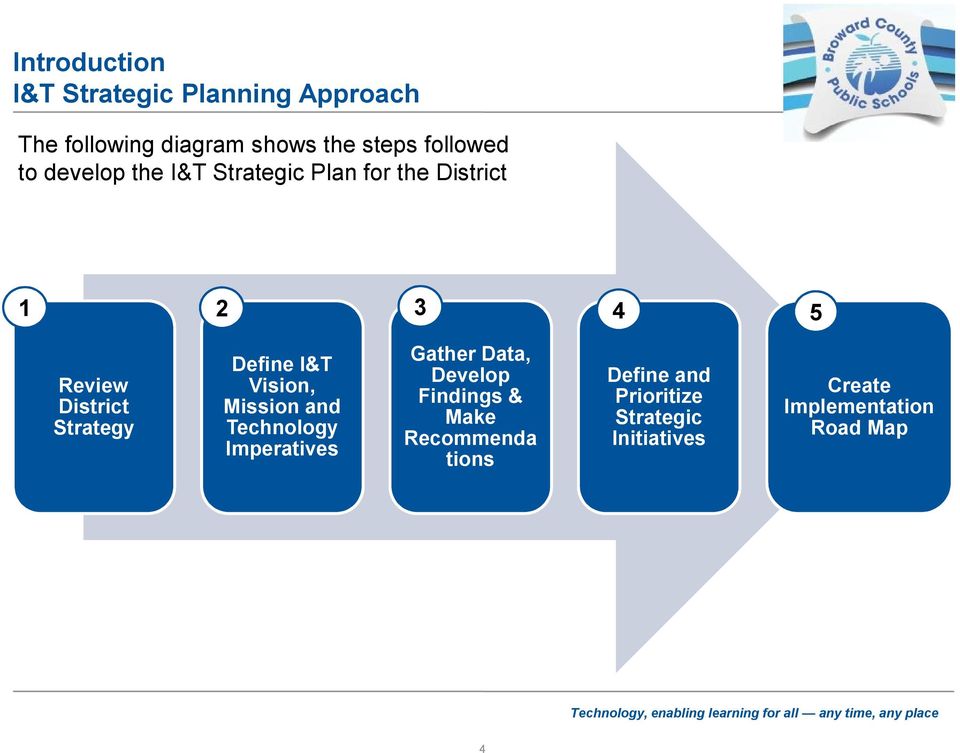
5 Introduction I&T Strategic Planning Approach The following diagram shows the steps followed to develop the I&T Strategic Plan for the District Review District Strategy Define I&T Vision, Mission and Technology Imperatives Gather Data, Develop Findings & Make Recommenda tions Define and Prioritize Strategic Initiatives Create Implementation Road Map 4
6 Future State I&T Vision and Mission I&T Planning Assumptions I&T Goals Aligned to District Strategic Goals 5
7 I&T Vision and Mission The I&T vision and mission represents the ideal future and purpose of technology deployment at the District Broward County Public Schools I&T Vision Broward County Public Schools I&T Mission To proactively provide current, sustainable and resilient information technology needed to facilitate high quality instruction, continuous improvement and effective communications across the District 6

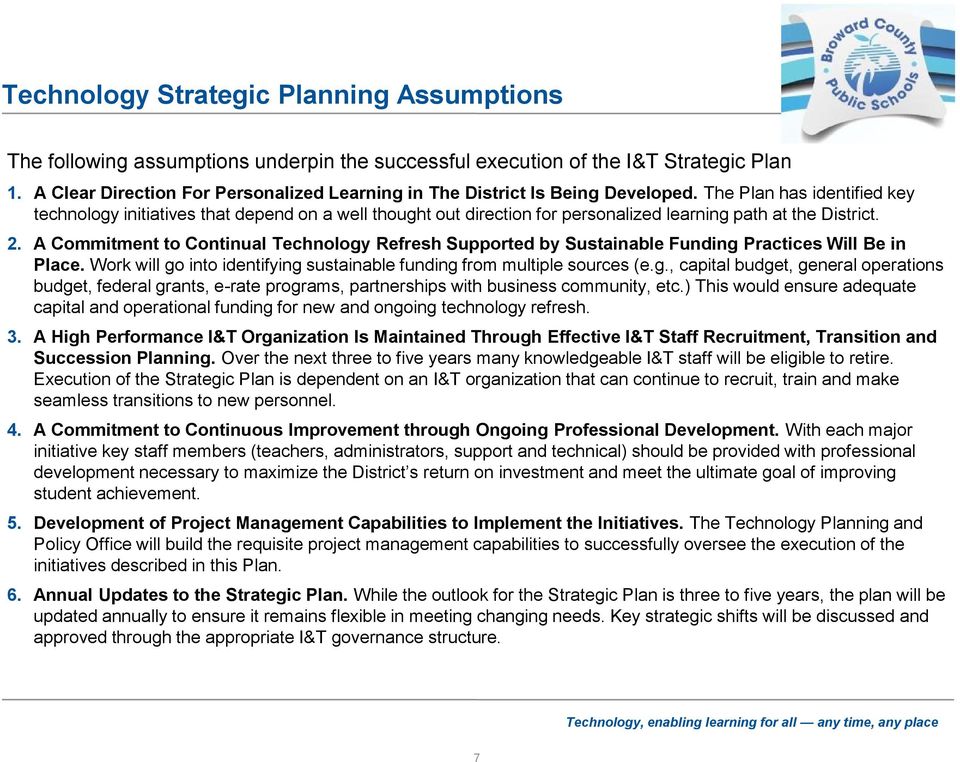
8 Technology Strategic Planning Assumptions The following assumptions underpin the successful execution of the I&T Strategic Plan 1. A Clear Direction For Personalized Learning in The District Is Being Developed. The Plan has identified key technology initiatives that depend on a well thought out direction for personalized learning path at the District. 2. A Commitment to Continual Technology Refresh Supported by Sustainable Funding Practices Will Be in Place. Work will go into identifying sustainable funding from multiple sources (e.g., capital budget, general operations budget, federal grants, e-rate programs, partnerships with business community, etc.) This would ensure adequate capital and operational funding for new and ongoing technology refresh. 3. A High Performance I&T Organization Is Maintained Through Effective I&T Staff Recruitment, Transition and Succession Planning. Over the next three to five years many knowledgeable I&T staff will be eligible to retire. Execution of the Strategic Plan is dependent on an I&T organization that can continue to recruit, train and make seamless transitions to new personnel. 4. A Commitment to Continuous Improvement through Ongoing Professional Development. With each major initiative key staff members (teachers, administrators, support and technical) should be provided with professional development necessary to maximize the District s return on investment and meet the ultimate goal of improving student achievement. 5. Development of Project Management Capabilities to Implement the Initiatives. The Technology Planning and Policy Office will build the requisite project management capabilities to successfully oversee the execution of the initiatives described in this Plan. 6. Annual Updates to the Strategic Plan. While the outlook for the Strategic Plan is three to five years, the plan will be updated annually to ensure it remains flexible in meeting changing needs. Key strategic shifts will be discussed and approved through the appropriate I&T governance structure. 7
9 Technology Imperatives Aligned to District Goals (1 of 2) The following strategic technology imperatives represent the most important strategic actions regarding the technology implementation over the next three to five years to meet BCPS s strategic goals. These imperatives provide the guidance needed by the District to make decisions regarding what specific technology initiatives and projects to deploy. They are aligned to the District's three strategic goals. Technology Will Support Goal 1: High-Quality Instruction By: 1. Providing the technology that enables the transformation of teaching and learning through personalized learning 2. Providing technology to ensure effective and continuous provision of professional development through online, blended and face-to-face options designed to deliver learning opportunities that integrate technology, curriculum and pedagogy 3. Maintaining a consistent and sustainable baseline standard of technology infrastructure and support in every school that is accessible by every student and is continually updated 4. Meeting the specialized technical requirements of District education programs such as magnet schools, ESE programs, ESOL/ELL programs, Virtual Schools, Adult Education, Career Technical Education and STEM. 5. Providing access to the breadth and depth of student information and instructional decision-making data maintained at the classroom level, school-level and District-level in a user friendly and secure manner 6. Developing and maintaining close collaborative relationships between academic and I&T operational areas 8

10 Technology Imperatives Aligned to District Goals (2 of 2) Technology Will Support Goal 2: Continuous Improvement By: 1. Increasing District-wide productivity through increased administrative efficiency enabled by reliable technology systems to all schools and within all departments 2. Providing departments, parents, students, and the community user friendly access to student and administrative data and information to positively impact administrative and academic decision making at all levels within the District 3. Supporting District-wide operational resiliency through effective security practices, disaster preparedness and business continuity planning 4. Building and utilizing effective project management practices to ensure timely, cost-effective and quality deployment of academic, administrative and technological projects 5. Assessing and aligning I&T staff resources, partnerships and third party contracts to facilitate timely delivery and support of technology initiatives Technology Will Support Goal 3: Effective Communication By: 1. Ensuring a reliable and secure core communications infrastructure for the District telephony, data networks, video, and web services 2. Providing a technology platform that supports community engagement and collaboration (this includes parent engagement and education, business partnerships and community relationships) 3. Supporting innovative use of technology for District-wide communication, e.g., use of social media and social collaboration platforms 4. Deploying a platform for the communication of student and administrative data and information to those that need it 5. Providing technology tools that enable robust but user friendly analytics 9

11 Strategic Plan Implementation Road Map Key Strategic Directions and Associated Technology Initiatives Prioritized Initiatives Implementation Time Frame High-Level Technology Investment Estimate 10
12 Strategic Direction and Initiatives Goal 1: Support High Quality Instruction (Slide 1 of 2) This section presents the key strategic recommendations based on Gartner s assessment of the current environment and input from District stakeholders. The recommendations are implemented through actionable initiatives Information & Technology Strategy Directions 1. Invest in critical next generation core technology infrastructure needed to meet the District s needs over the next five years a) Increase wired and wireless bandwidth capability in all schools and administrative offices b) Built necessary storage, server and backup systems c) Refresh outdated computers and technology in all schools and administrative offices d) Define strategy for bring-your-own-device (BYOD) programs (dependent on personalized learning strategy and infrastructure capacity) e) Provide focused assistance to students who need network connectivity outside the school 2. Based on personalized learning strategy, support effort to equip and configure classrooms with the necessary peripheral/supporting technology and equipment a) Define personalized learning technology and equipment requirements and develop a plan for classroom updates 3. Define sustainable refresh strategy for technology infrastructure and digital resources that accounts for the Total Cost of Ownership (TCO) a) Well defined plan to identify TCO of investments and plan to identify funding from multiple sources (capital budget, general operations budget, grants, e- rate programs, partnerships with business community, etc.) Strategic Initiatives 1. District-wide Wireless Network Infrastructure Upgrade 2. District Core Central Technical Infrastructure Capacity Upgrade 3. Virtual Desktop Project (VDI) Enables Anywhere Desktop Access 4. School Computer Refresh Initiative 5. Digital Classroom Peripheral Technology and Upgrade Project 6. Digital Divide Connectivity Program 11

13 Strategic Direction and Initiatives Goal 1: Support High Quality Instruction (Slide 2 of 2) Information & Technology Strategy Directions 4. Implement common platform for access to instructional content, assessments and applications enabled by a single sign-on a) Implement a single robust student and teacher portal for instructional content, data and transactional applications that integrates efficient single-sign 5. Define staffing strategy to support infrastructure and education technology integration a) Support integrated technology and curriculum professional development for teachers and staff b) Formalize a three-tier technology support program for District schools which would address the roles for (1) a media specialist; (2) an I&T support specialist (for general support Microtech); (3) an instructional technology specialist. (Note: strategy will define how these roles are fulfilled in schools considering limited resources) Strategic Initiatives 7. Single Sign-on and Portal Development Project 8. Integrated Technology Professional Development Program 9. School Technology Support Enhancement Initiative 12

14 Strategic Direction and Initiatives Goal 2: Enable Continuous Improvement (1 of 4) Information &Technology Strategy Directions 1. Enhance District efficiency through support of more automated shared services a) Automation of paper-based processes e.g., end-of-period accounts receivable, payroll processes, transcripts requests and access, report cards generation and distribution b) Consolidated process that are currently duplicated across the district, e.g., print services 2. Streamline asset management across the District using automated tools and business processes a) Build a business case and implement a modern inventory management tool that is flexible, easy to access and enables real-time updating and auditing of assets 3. Leverage potential economies of scale through well-coordinated technology licensing and contract management services a) Reduce redundancies and enable better Instructional Application Licensing and Contract Management across all schools 4. Enable access to integrated student and administrative data that is currently maintained in siloed/standalone systems a) Continue the strategy of providing integrated and user friendly access to student related data from multiple sources b) Enhance data warehouse capabilities and implement user friendly dashboard and query tools c) Implement system to allow student, parent and teacher access to and use of formative and summative assessment data Strategic Initiatives 1. District Shared Service/Business Process Automation Initiative 2. Asset Management Initiative 3. Coordinated Vendor License and Contract Management Program 4. Integrated Data Strategy Program 13

15 Strategic Direction and Initiatives Goal 2: Enable Continuous Improvement (2 of 4) Information & Technology Strategy Directions 5. Reduce cost and increase efficiency through application rationalization within I&T and move to greater use of commercially available applications to mitigate against legacy software development skills shortage in the future a) Examine applications still on legacy platforms that can be consolidated and whose functionality can be combined in newer, more functional systems (e.g., on SAP or other systems) 6. Migrate district systems off current mainframe platforms a) Current SAP environment relies on a non-legacy IBM mainframe to support the SAP database instance. Migration will avoid the mainframe skills gap expected in about 5 years b) Appropriate time and investment in training will be needed for the SAP Basis staff and system administrators to effectively support the refreshed SAP system platform c) IBM VSE mainframe maintenance costs are expected to be very high. Migrating off the VSE based mainframe would eliminate the operational cost spending d) Limited skills exist to support the IBM VSE environment. A skills gap is expected in about 5 years and migration planning should begin immediately to ensure availability of key resources during an actual migration effort Strategic Initiatives 5. Application Rationalization Initiative 6. Mainframe phase out for SAP and other legacy application hosting 14

16 Strategic Direction and Initiatives Goal 2: Enable Continuous Improvement (3 of 4) Information & Technology Strategy Directions 7. Implement a modernized Student Information System (SIS) to replace TERMS and other ancillary systems. Functionality potentially includes: Student Data/Demographics Registration and Enrollment Scheduling Attendance Gradebook or Gradebook Integration Grades and Transcripts Special Education Behavior Records School Fee Management Health and Medical Records Teacher Portal Parent and Student Portal Administrator Portal State Reporting Standard and Ad Hoc Reporting Data Analysis and Assessment Language Support Other Capabilities: o Data Warehouse o Transportation o Nutrition Programs 8. Implement a District-wide Digital Learning Platform (DLP) to support Personalized Learning. Functionality potentially includes: Content Access Curriculum/Content Management Design and Development Curriculum User Evaluation Learning/Student Management Instructional Design Plan Book/Lesson Plans Gradebook Integration Portfolio Management Online Assessments Class Data Management Assessment Capabilities Item Creation and Storage Scoring Results Processing Professional Development Individual Development Plans Staff Development Plans Collaboration Tools Strategic Initiatives 7. Student Information System Modernization Program 8. Digital Learning Platform Implementation Program 15

17 Strategic Direction and Initiatives Goal 2: Enable Continuous Improvement (4 of 4) Information & Technology Strategy Directions 9. Optimize information technology organization structure to be less internally siloed and more customer-oriented a) Enable a less siloed cross-functional processes and structure b) Enhance roles for business relationship managers 10. Update Current Disaster Recovery and Business Impact Analysis a) This is critical as the District relies more on technology. These plans have not been updated in a while and need to be addressed to ensure they meet current and future requirements 11. Clearly define an I&T governance structure that will focus on consistent technology decision making across the District: a) Strategic governance: technology strategy, policy, major technology investment funding b) Operational governance: funding allocation, priority setting, resource management, project oversight and monitoring c) Technical governance: establishment of technology standards, coordination of infrastructure, forum for collaboration between the District and individual school information technology departments d) Utilize the above governance structure to work with technical schools to ensure mutually beneficial deployment of technology 12. Develop technology management baseline guidance for school principals a) Computing device guidance, technology funding practices b) Instructional application options c) Student management guidance on issues like cyber bullying, etc. d) Available District capabilities of technology support/vendor management e) Catalog of available technology tools and services Strategic Initiatives 9. I&T Realignment Program 10. Disaster Recovery and Business Impact Analysis 11. Technology Governance Project 12. School Technology Baseline Education Specifications Project 16

18 Strategic Direction and Initiatives Goal 3: Facilitate Effective Communications Information & Technology Strategy Directions 1. Develop and execute a plan to provide students with addresses and access to a collaboration platform a) Recommend cloud-based student and collaboration platform b) Work with school stakeholders to develop acceptable use policies, etc. 2. Continue to make telephony upgrades at schools and administrative offices a) This involves converting remaining buildings to Voice over IP (VoIP) infrastructure 3. Conduct parent and community technology education and outreach a) Develop, implement, or leverage existing venues to communicate technology objectives and plans to the wider BCPS stakeholders (e.g., parents, community groups, etc.) 4. Develop partnerships with the business community a) Opportunities for student technology funding and sponsorship b) Technology internships, etc. 5. Enhance flexibility for schools to manage individual school websites and provide basic services while maintaining common look and feel across the District. a) Online events and payments b) Student, teacher and parent portal access Strategic Initiatives 1. Student and Collaboration Platform Initiative 2. Community Technology Outreach Program (Parents, Business Community, etc.) 3. School Website Enhancement Program 17

19 Strategic Plan Implementation Road Map Strategic Initiatives Aligned to District Strategic Goals The diagram shows the alignment of the strategic initiatives to the three District strategic goals 18

20 Strategic Plan Implementation Road Map Strategic Initiative Prioritization Methodology Ranking Definitions: Impact: Degree to which the results of an initiative will impact the success of instructional, financial, strategic goals. Urgency: Time in which results or change is needed from an initiative Challenge: Degree of difficulty to implement an initiative due to financial, resource or external Prioritization Process The I&T Strategic Planning Advisory Council Members provided input into the strategic initiative prioritization. Each initiative s priority score is the sum of its impact and urgency scores Both the impact and the urgency scores have a 1 5 scale, where 5 is very high and 1 is very low. E.g., an initiative with score of 5 for impact and 5 for urgency will have a total priority score of 10 Each initiative is then assigned a challenge score on a scale of 1 3, where 3 is very challenging and 1 is less challenging 19

21 Strategic Plan Implementation Road Map Initiative Implementation Time Frame This chart displays the high-level time frame for the deployment of the identified initiatives over the next three to five years (plan will be updated annually). The start of individual initiatives is determined by the relative priority of the initiative. Strategy & Planning Phase Requirements Gathering &or System Selection Phase Initiative Implementation/Project Execution Phase 20
22 Strategic Plan Implementation Road Map Initiatives: Prioritized based on Impact and Urgency Definitions: Impact: Degree to which the results of an initiative will impact the success of instructional, financial, strategic goals. Urgency: Time in which results or change is needed from an initiative High Impact/Low Urgency High Impact/High Urgency Challenge: Degree of difficulty to implement an initiative due to financial, resource or external Legend: Impact High Implementation Challenge Projects Medium Implementation Challenge Projects Low Implementation Challenge Projects Low Impact/Low Urgency Urgency Low Impact/High Urgency 21
23 High-Level 5 Year Strategic Technology Investment Estimate The strategic investment represents a high-level view of the potential funding needed to execute these initiatives over the next three to five years. This equates to a range of about $200 to $275 million over five years (not including the cost of existing internal resources or additional hires who would work on these initiatives). Decisions on the execution of each new initiative should be vetted through the recommended governance structure and should be based on a business case, ROI analysis and other factors such as funding availability. 22
24 Appendix Detailed Initiative Descriptions 23
25 Detailed Initiative Descriptions 24
26 Strategic Plan Implementation Road Map Initiative Implementation Time Frame This chart displays the high-level time frame for the deployment of the identified initiatives over the next three to five years (plan will be updated annually). The start of individual initiatives is determined by the relative priority of the initiative. Strategy & Planning Phase Requirements Gathering &or System Selection Phase Initiative Implementation/Project Execution Phase 25
27 Initiative 1 District-wide Computer Refresh Initiative Project Description This initiative seeks to replace all outdated computers in schools and administrative offices over a period of 18 months followed by a consistent ongoing refresh cycle that will replace District-wide computers on a regular schedule. This initiative includes any one-to-one student computing ratio activities Business Benefits/Rationale Ensures students have access to computers that help them acquire the technology skills required for college and career readiness Ensures student have access to computers that can handle personalized learning and instructional software requirements Ensures students have access to computers that meet common core curriculum for technology skills and online assessment requirements Develop computer replacement and refresh plan that: Activities Estimated Time Frame and Estimated Cost Estimated Cost: $48 $65 million over 5 years Determines standard computing device configurations based on student needs and grade levels Establishes criteria for determining computing refresh priorities (i.e., which schools or grades to upgrade in priority order) Determine replacement and refresh schedules Establish ongoing computer refresh budget and funding streams and review current computing device vendor pricing, contacts and licenses Begin implementation of replacement computers based on established plan Critical Success Factors/Key Performance Indicators Understanding of true cost for replacement and ongoing maintenance of computing devices Consistent multiyear computer refresh funding stream Buy-in from school principals and teachers on refresh priorities and support requirements START Dependencies Ongoing Effort > Qtr 1 Qtr 2 Qtr 3 Qtr 4 Qtr 1 Qtr 2 Qtr3 Qtr 4 Qtr 1 Qtr 2 Qtr3 Qtr 4 Establishment of District-wide support and maintenance structure for computing environment Development of District-wide personalized learning strategic plan 26
28 Initiative 2 Technology Governance Project Project Description This project aims to clearly define an I&T governance structure that will focus on consistent technology decision making across the District Business Benefits/Rationale Improved decision making and customer service An existing approval framework that facilitates agreement, collaboration and transparency An effective mechanism to articulate I&T strategy and initiatives that fosters efficiency and cost effectiveness through collaboration Activities 27 Estimated Time Frame and Estimated Cost Estimated Cost: None Develop committee charters for the following governance bodies: (1) Strategic governance: technology strategy, policy, major technology investment funding; (2) Operational governance: funding allocation, priority setting, resource management, project oversight and monitoring; (3) Technical governance: establishment of technology standards, coordination of infrastructure, forum for collaboration between the District and individual school information technology departments Establish roles and responsibilities Receive approval of the charter from the School Board Build governance principles, decision frameworks and shared service development guidelines in collaboration with EPMO Establish CIO membership across other governance committees Establish sub-committee structures as appropriate (e.g., BI, security) Critical Success Factors/Key Performance Indicators Formal charter, roles and processes for the governance committees are written and adopted Governance committee members represent key areas, namely BCPS I&T, business office, technical coordinators, teachers and principals. Roles are filled by senior staff with the authority to provide strategic leadership and organization support START END Qtr 1 Qtr 2 Qtr 3 Qtr 4 Qtr 1 Qtr 2 Qtr3 Qtr 4 Qtr 1 Qtr 2 Qtr3 Qtr 4 I&T Realignment Program Dependencies
29 Initiative 3 Teacher & Support Staff Professional Development Project Description This program will develop and execute a training plan for teacher and technology support staff. It would be an integrated professional program that trains on how to pedagogy changes with technology. It would blend curriculum, technology resource and student management techniques. Business Benefits/Rationale Ensures that high quality instruction is enabled by technology through delivery of comprehensive support to teachers and staff on using technology in the everyday classroom Ensures that measurable improvements in student achievement are visible Activities Develop and execute a detailed training plan that would cover the following areas: 28 Estimated Time Frame and Estimated Cost Estimated Cost: $17 $27 million over 5 years Device Specific Training (On Specific New Standardized Devices): How to use the these computing devices in a classroom setting including common productivity applications and classroom and device management strategies Support for Microtechs, computer teachers, and media specialists: Includes device specific configuration, administration and support In-depth for standardized devices. Pedagogy and leadership of technology infused classroom instruction: Pedagogy of technology infused classroom instruction, where has it been successful, models of organizing students, time, and space (one computer classroom, clusters of computers, 1-1- and blended learning models relevant here), relationship to Marzano School leadership and management of technology infused classroom instruction: Leadership strategies for supporting and monitoring technology infused classrooms, observation protocols and rubrics, relationship to Danielson Professional development and coaching strategies: Coaching and support strategies and tools, working with teachers, strategies for supervising and supporting teachers and students in using technology, best practices in evaluating the effectiveness of technology Implement PD in cooperation with school principals over five year period. Critical Success Factors/Key Performance Indicators Priority given to developing a comprehensive and executable plan that is ongoing plan integrated will all other teacher PD Dedicated funding and time given to professional development START Qtr 1 Qtr 2 Qtr 3 Qtr 4 Qtr 1 Qtr 2 Qtr3 Qtr 4 Qtr 1 Qtr 2 Qtr3 Qtr 4 Dependencies Development of District-wide personalized learning strategic plan Completion of technology replacement and refresh plan. END
30 Initiative 4 School Wireless Network Upgrade Project Description The goal of this project is to enhance the wireless network infrastructure in all schools within Broward County in order to meet the technological specifications required for new technology requirements (e.g., online assessments and personalized learning) Business Benefits/Rationale Creates improved wireless network flexibility and scalability to meet growing bandwidth requirements Helps achieve educational and business objectives in all schools within Broward County Public School District Activities Estimated Time Frame and Estimated Cost Estimated Cost: $17 $20 million over 5 years Establish business, I&T and wireless network requirements for the technology-infused academic/personalized learning using a threetier upgrade framework (i.e., legacy wireless network upgrades, infrastructure device upgrades, and software upgrades) Measure user satisfaction and productivity improvement against business case and acceptable criteria; establish road map for the District-wide deployment Design a robust wireless network architecture Begin to deploy upgraded wireless infrastructure across the district Critical Success Factors/Key Performance Indicators Documentation of academic improvements to be supported by wireless network infrastructure improvements in District schools Comprehensive District-wide network architecture and deployment design START END Qtr 1 Qtr 2 Qtr 3 Qtr 4 Qtr 1 Qtr 2 Qtr3 Qtr 4 Qtr 1 Qtr 2 Qtr3 Qtr 4 Dependencies Formalized business and I&T requirements Updated wide-area and Internet vendor contracts Infrastructure monitoring and management processes and reporting Upgraded capacity of the District s core central technical infrastructure 29
31 Initiative 5 District Core Central Technical Infrastructure Capacity Upgrade Project Description This project aims to modernize the core network infrastructure, physical end-user device management and data center facility environment with a focus on providing appropriate scale, performance, availability and serviceability to meet the District business and academic requirements Business Benefits/Rationale Creates scalability to meet growing bandwidth requirements Helps achieve educational and business objectives in all schools within Broward County School District Define a hosting strategy for more stable data center facilities Conduct mainframe phase-out activities (initiative 22) Update the data center technology and infrastructure Activities Estimated Time Frame and Estimated Cost Estimated Cost: $47 $60 million Review and update the cabling infrastructure as needed based on network analysis to gain better understanding of network traffic patterns and associated operational and functional requirements Procure and upgrade network hardware in schools per the newly developed network architecture and the technology refresh cycle Measure and communicate performance requirements as part of the district-wide deployment design process Update network workload and discovery details to populate asset management database and infrastructure monitoring platform with newly deployed hardware Critical Success Factors/Key Performance Indicators Clear documentation of network bandwidth and technical requirements Reliable data center facility power and cooling to establish reliable network infrastructure START END Qtr 1 Qtr 2 Qtr 3 Qtr 4 Qtr 1 Qtr 2 Qtr3 Qtr 4 Qtr 1 Qtr 2 Qtr3 Qtr 4 Dependencies Updated wide-area and internet service provider vendor contracts Infrastructure monitoring and management processes and reporting 30
32 Initiative 6 SAP Gap Analysis and Implementation Project Description The objective of this project is to (1) carry out a gap analysis of existing SAP capabilities with the goal of determining which additional SAP functionality may be leveraged in order to help the District achieve its business objectives and (2) Based on the gap analysis begin to roll-out new SAP functionality to meet application needs Business Benefits/Rationale Leverages existing SAP capabilities Potentially improves business processes Eliminates process redundancies and duplications START Estimated Time Frame and Estimated Cost END Qtr 1 Qtr 2 Qtr 3 Qtr 4 Qtr 1 Qtr 2 Qtr3 Qtr 4 Qtr 1 Qtr 2 Qtr3 Qtr 4 Activities Estimated Cost: $10 $12 million Understand current use of SAP use (assessment of business objectives and technical/business benefits; integration with critical applications; review design) Define desired future state which should include activities like integration with other applications, SAP capabilities, SAP governance, SAP architectural style, technical requirements. The result would be a functional gap analysis Based on the gap analysis, determine which additional functionalities are needed and determine if the functionality is part of an existing BCPS SAP portfolio Begin process of implementing new SAP functionality to meet application needs Critical Success Factors/Key Performance Indicators Dependencies Decisions about the purchased but dormant SAP modules are made SAP users are consulted and buy-in from relevant stakeholders is achieved Decisions about the upgrade of the asset management system are taken into consideration Business process are optimized 31
33 Initiative 7 Digital Learning Platform (DLP) Implementation Project Description This initiative will involve the development of a project plan for the deployment of a Digital Learning Platform (DLP). It will also include all the steps to deploy the DLP for use across the District. A DLP is a software system designed to deliver, track, report on and manage learning content, learner progress and learner interactions and can be used for students, teacher and administrators. Business Benefits/Rationale Improves and streamlines teaching administration processes and easily tracks the progress of students individually on a day-to-day basis Offers a variety of teaching approaches by delivering engaging and motivating training that can be scaled for a wider reach out to a large number of learners Facilitates easy and secure exchange of learning data Delivers flexible access by students to training resources, multiple learning channels and multiple media formats Activities START Estimated Time Frame and Estimated Cost END Qtr 1 Qtr 2 Qtr 3 Qtr 4 Qtr 1 Qtr 2 Qtr3 Qtr 4 Qtr 1 Qtr 2 Qtr3 Qtr 4 Estimated Cost: $6.9 $9.2 million over 5 years Determine lessons learned from current DLP deployment as part of Digital Five Initiative Document additional DLP business requirements for supporting teacher PD Update business case for use of current pilot DLP Review long-term contract and license terms License or subscribe to an approved DLP and begin implementation of an expanded rollout Critical Success Factors/Key Performance Indicators Dependencies Close coordination with school and District academic leadership None Appropriate Service Level Agreement and contract terms established for software delivery services (software as a service model) 32
34 Initiative 8 Student and Staff and Productivity Tools Project Description This project aims to replace the current District system with cloud-based services, collaboration and productivity tools accessible by both staff and students. Business Benefits/Rationale Creates potential significant savings for BCPS as a result of migrating to a cloud-based service from an internally hosted solution Offers other advantages of cloud deployments such as automated vendor-supplied upgrades, redeployment of I&T staff, boxes with large capacity and built-in disaster recovery services Activities START Estimated Time Frame and Estimated Cost END Qtr 1 Qtr 2 Qtr 3 Qtr 4 Qtr 1 Qtr 2 Qtr3 Qtr 4 Qtr 1 Qtr 2 Qtr3 Qtr 4 Estimated Cost: $0.5 $1 million initial cost Develop migration plan Select a migration implementation partner with ample experience with Office 365 (the District's preferred product) Clean up the old system prior to migration (junk and non-essential ) Conduct extensive end-user communication, training and support activities Ensure network remediation, such as adding points of presence and prioritizing network traffic to ensure smooth transition to cloud Deploy new system based on migration plan Critical Success Factors/Key Performance Indicators Dependencies Evaluation of cloud services using six core criteria: economics, infrastructure alignment, features, migration effort, support/slas, security/legal/privacy None 33
35 Initiative 9 Digital Divide Connectivity Program Project Description The aim of this program is to create and implement a plan to offer Internet connectivity to BCPS students outside the classroom. Business Benefits/Rationale Facilitates equal internet connectivity to learning resources for all students Ensures the completeness of Broward s personalized learning strategy vision Activities Estimated Time Frame and Estimated Cost START Estimated Cost: $2.2 $4.3 million END Qtr 1 Qtr 2 Qtr 3 Qtr 4 Qtr 1 Qtr 2 Qtr3 Qtr 4 Qtr 1 Qtr 2 Qtr3 Qtr 4 Designate a governance body/committee to create and design the program Develop a internet connectivity plan after consulting students, teachers, parents and community stakeholders Validate strategy with the key BCPS leadership Roll out the plan with full support from the BCPS community Critical Success Factors/Key Performance Indicators Dependencies Positive feedback about Internet connectivity from the BCPS community Development of District-wide personalized learning strategic plan 34
36 Initiative 10 Community Outreach Project Description The goal of this project is to create a formal venue for BCPS to communicate the progress and implementation of I&T strategic initiatives to the District s stakeholders (e.g., parents, community organizations, etc.) in an effort to retain buy-in and community support Business Benefits/Rationale Creates a venue for BCPS to regularly communicate with the Broward County community Keeps parents and guardians informed about critical I&T-related decisions impacting their children and their education Activities Establish a committee that will be responsible for developing the outreach strategy Validate strategy with the appropriate internal BCPS stakeholders Implement strategy Review and revise strategy at regular intervals Critical Success Factors/Key Performance Indicators The wider Broward County community has a defined method to communicate and offer feedback about BCPS s technology initiatives BCPS compiles and reviews the solicited and unsolicited feedback on a regular basis and reports findings to the community None START Estimated Time Frame and Estimated Cost END Qtr 1 Qtr 2 Qtr 3 Qtr 4 Qtr 1 Qtr 2 Qtr3 Qtr 4 Qtr 1 Qtr 2 Qtr3 Qtr 4 Estimated Cost: None Dependencies 35
37 Initiative 11 Update Disaster Recovery Plan Based on a Business Impact Analysis (BIA) Project Description This project focuses on updating the BCPS strategy for disaster recovery management based on complete Business Impact Analysis (BIA). The activities involved in I&T DRM are: network recovery, hardware recovery, desktop recovery, software recovery, data recovery, telecommunications recovery, and information security recovery all based on administrative and academic expectations Business Benefits/Rationale Optimizes a recovery approach and minimizes extended downtime from a disaster as a result of having a well-defined disaster recovery management strategy based on expectations that are defined by the school District administrators Activities Estimated Time Frame and Estimated Cost START END Qtr 1 Qtr 2 Qtr 3 Qtr 4 Qtr 1 Qtr 2 Qtr3 Qtr 4 Qtr 1 Qtr 2 Qtr3 Qtr 4 Estimated Cost: $200K $250K Complete a BIA (Business Impact Assessment) Identify the scope of the core applications BCPS wants to consider for the DR plan Create a small team to conduct the BIA. Team should be comprised of technical, administrative and academic personnel. Work with this team to identify application criticality and impact to business in the event of an outage Update the Recovery Time and Point Objectives (RTOs and RPOs) of each application and the associated dependencies for each application Document the findings in the form of a BIA Update the current Disaster Recovery Strategy based on the BIA Assess application architecture and associated technical infrastructure relative to the defined RTO and RPOs from the BIA Categorize applications into appropriate groups ranging from applications that are architected to meet their RTO/RPO requirements to application that fall outside of their RTO/RPO requirements (based on current state application & infrastructure architecture). Address the High Availability (HA) application gaps and the standby application gaps. Leverage clustering technologies, load balancing and synchronous data replication for HA application where possible. Develop investment plan as needed to bridge current state application availability gaps Critical Success Factors/Key Performance Indicators Dependencies Engaging the proper I&T, administration and academic users and leaders to accurately understand application recovery tolerance Maintaining a complete and updated BIA, Maintaining the I&T-DRM strategy as living document Disaster Recovery Management is one component under business continuity management. A Business Continuity Management plan should be defined first (as guidance to the DRM plan) that includes all business operations and non-i&t recovery activities 36
38 Initiative 12 Desktop Anywhere (Virtual Desktop Infrastructure) Project Description This initiative involves building the infrastructure at BCPS to enable staff and students to access the District s technology resources from any device and from any location with an Internet connection Business Benefits/Rationale Reduces the cost and complexity of managing thousands of physical desktops Supports a bring your own device (BYOD) policy Increases security by removing content interference from the endpoint device Enables easier migrations of Windows upgrades by doing these centrally without touching end-user devices START Estimated Time Frame and Estimated Cost END Qtr 1 Qtr 2 Qtr 3 Qtr 4 Qtr 1 Qtr 2 Qtr3 Qtr 4 Qtr 1 Qtr 2 Qtr3 Qtr 4 Estimated Cost: $8.5 $12 million over 5 years Activities Evaluate and Gather Information: Determine the business case and highlight several areas in which additional information is required to support planning activities and provide sufficient confidence to proceed with an proof of concept (POC) activity Proof Of Concept (POC): The POC validates that the technology can address requirements outlined in the evaluation phase Segmenting Users: Logical grouping of users who will benefit from this technology Product Selection: Choose a vendor product that best meets BCPS requirements and can also be a good long-term partner Pilot Preparation and Deployment: Establish the first production deployment and assess this in a live environment Deployment: This should be a phased approach across the targeted user base Critical Success Factors/Key Performance Indicators Dependencies Ensure leverage of recent improvements in virtual desktop technologies that support cost-efficient virtual desktop deployment Build internal skills to manage this environment in close coordination with a reliable vendor partner 37
39 Initiative 13 Realign and Define I&T Organization Project Description The objective of this project is to realign the current I&T organization to improve the efficiency, quality, and customer satisfaction Business Benefits/Rationale Shapes the organization to become more flexible and responsive to shifting District requirements Increases productivity through better alignment of skills and competencies to service delivery capabilities Uses organizational design best practices to define an effective future state that takes into account the evolving I&T strategy Separates operational work from development project work Activities Estimated Time Frame and Estimated Cost Estimated Cost: None Map current state to target state organization structure including new or existing jobs Based on mapping, perform activities related to defining the organization design structure Perform transition planning activities related to starting the overall transition process Perform activities related to change management Critical Success Factors/Key Performance Indicators START Efficiency Does pursuit of efficiency opportunities require reorganization or simply project/process work? Effectiveness Are shortfalls in effectiveness the result of lack of engagement, underfunding or structural deficiencies? Does the structure need to change, or do new functions, capabilities or people simply need to be added to enhance effectiveness? Productivity Are projects adhering to time, cost and quality measures? Managing change What structural or personnel changes are needed? Interweaving Structure and Governance in I&T Management and the I&T Organization END Qtr 1 Qtr 2 Qtr 3 Qtr 4 Qtr 1 Qtr 2 Qtr3 Qtr 4 Qtr 1 Qtr 2 Qtr3 Qtr 4 Dependencies Ensure roles and responsibilities for all I&T processes are created and documented before determining realignment requirements 38
40 Initiative 14 Asset Management System Project Description This initiative includes development of an overall plan for upgrading the District's asset management system and processes. It will streamline asset management across the District using automated tools and business processes. The initiative will build a business case for modern inventory management tool that is flexible, easy to access and enables real-time updating and auditing of assets Business Benefits/Rationale Enables assessment of management processes that reduce workload on school leadership Enhances accounting and management of the District s assets, decreases operational costs to maintain asset information, and creates more cost-effective audit processes Estimated Time Frame and Estimated Cost START Estimated Cost: $1 $1.5 million initial cost (Note: timescale starts in 2015) END 2015* Qtr 1 Qtr 2 Qtr 3 Qtr 4 Qtr 1 Qtr 2 Qtr3 Qtr 4 Qtr 1 Qtr 2 Qtr3 Qtr 4 Activities Determine business process improvements for streamlining District-wide asset management operations Define key functional and technical system requirements Assess potential systems in relation to desired business process improvements and key functional requirements Procure and implement a new asset management system Critical Success Factors/Key Performance Indicators Dependencies Buy-in from key stakeholders that includes internal audit and school leadership Application rationalization SAP System Gap Analysis 39
41 Initiative 15 Student Information System (SIS) Modernization Program Project Description Replace TERMS as a District-wide SIS. This would involve a detailed examination of the effort, time and cost for such a program and a comparison against the potential long-term strategic benefits to the District. Based on the business case, the appropriate SIS solution will be determined and implemented as part of this program Business Benefits/Rationale Reduce risk of outdated technology and loss of experienced staff Ability to consistently keep up with technology improvements through a defined path for system upgrades and technology enhancements. Greater business process efficiency through the automation of manual/unintegrated student administration systems and processes Enhanced ability to respond to business changes though a highly configurable systems that does not require complicated programming Improved user responsiveness through the deployment of Webenabled, self-service capabilities Significantly enhanced student information/data management to support operational and policy decision making Activities Estimated Time Frame and Estimated Cost Estimated Cost: $9.1 $11.9 million over 5 years Builds a business case to outline the rational, benefits, risks, and implementation costs and total cost of ownership of a new SIS. Determine the appetite for change among stakeholders and willingness to commit to, support and execute such a program Develop business and technical requirements Craft a Request for Proposal and select a SIS product and system integrator to implement the system Begin phased implementation of modernized SIS Critical Success Factors/Key Performance Indicators Ensure system-wide stakeholder involvement in the study obtain the approval of the business case Objective business case & systems requirements development Dependencies Student data strategy completed START END Qtr 1 Qtr 2 Qtr 3 Qtr 4 Qtr 1 Qtr 2 Qtr3 Qtr 4 Qtr 1 Qtr 2 Qtr3 Qtr 4 40
42 Initiative 16 Integrated Data and Analytics Program Project Description Through this project, BCPS will formulate a fully attributed and integrated data analytics program for both student and business system/operational data (information governance, organization and roles, information life cycle, enabling infrastructure) that contains a set of actionable (prioritized, dependent, leveled, and time-phased) recommendations to develop the target state. This will then be followed by activities to execute and start producing integrated data that meets the District s requirements Business Benefits/Rationale Improves student data quality, accessibility, reliability, and facilitates data decision-making Reduces duplication of data and to improve reporting Increases trust in data as measured by confidence in the department responsible for student data management Increases accountability for data reliability and quality Activities Estimated Time Frame and Estimated Cost START Estimated Cost: $1.5 $2 million END Qtr 1 Qtr 2 Qtr 3 Qtr 4 Qtr 1 Qtr 2 Qtr3 Qtr 4 Qtr 1 Qtr 2 Qtr3 Qtr 4 Establish the underlying BCPS need for student and administrative data, establish a common understanding of its data capabilities, and assess them against best practices Based on academic needs, formulate the associated data goals and develop the target state. Establish a comprehensive view of the current and target state components required for achieving BCPS goals and identify activities to bridge the gaps Develop a road map laying out the major sequence of activities and events to implement the desired target state as well as provide implementation design Begin implementation of the program Critical Success Factors/Key Performance Indicators Dependencies Clear documentation of the all needed data and how this data will be used to improve high quality instruction Formulation of consisted data definitions, standards and management processes Development of data requirements as determined by the District-wide personalized learning strategic plan 41
43 Initiative 17 Digital Classroom Technology Project Description This initiative seeks to upgrade all other technology equipment, apart from computing devices, that are required in a digital classroom. This includes equipment such as smart boards, projectors, audio visual equipment, specialized media development computing devices, etc. In this context,the digital classroom is defined as a classroom that is designed to enhance the quality of instruction using effective technology tools and providing access to the tools needed to develop student technology skills Business Benefits/Rationale Provides access to technology enhanced equipment that enhances the quality of instruction at the District Provides access to technology tools needed to develop specialized skills for digital audio visual development Develop digital classroom technology equipment plan that: Activities Determines standard equipment requirements based on student needs and grade levels Estimated Time Frame and Estimated Cost Estimated Cost: $25 $35 million over 5 years Establishes criteria for determining deployment priorities (i.e., which schools or grades to deploy equipment in priority order) Determine deployment and refresh schedules Establish ongoing initiative budget and funding streams Review current equipment vendor pricing, contacts and licenses Begin systematic installation of digital classroom technology Critical Success Factors/Key Performance Indicators Understanding of true cost for purchase and ongoing maintenance of equipment Consistent multiyear equipment refresh funding stream Buy-in from school principals and teachers on deployment priorities and support requirements START Dependencies END Qtr 1 Qtr 2 Qtr 3 Qtr 4 Qtr 1 Qtr 2 Qtr3 Qtr 4 Qtr 1 Qtr 2 Qtr3 Qtr 4 Establishment of District-wide support and maintenance structure for equipment environment Development of District-wide personalized learning strategic plan 42
44 Initiative 18 Technology Educational Specifications Project Description This project will define baseline specifications and guidance for managing education technology. It will provide guidance for school principals by offering a menu of options that will enable them to make their own decisions about the following: computing devices, technology funding practices, instructional application options, etc. It will also define available District capabilities for technology support/vendor management and provide a catalog of available technology tools and services. It will also provide guidance on student management policy issues like cyber bullying, etc. Business Benefits/Rationale Offers a menu of choices regarding standards that ensures all schools can build and maintain a baseline standard of technology capabilities while still enabling them to make their own decisions Offers guidance and education on technology management issues Activities START Estimated Time Frame and Estimated Cost END Qtr 1 Qtr 2 Qtr 3 Qtr 4 Qtr 1 Qtr 2 Qtr3 Qtr 4 Qtr 1 Qtr 2 Qtr3 Qtr 4 Estimated Cost: Staff time Setup working group comprising of stakeholder representatives to research and develop baseline standards Review and approve baseline standards, menu of options and guidance materials Communicate with and educate school leadership Devise mechanism to evaluate baseline technology deployment at schools Critical Success Factors/Key Performance Indicators Dependencies Buy-in of baseline standards and options by school leadership Well defined funding mechanisms to enable schools to meet these minimal standards Availability of internal I&T staff to devote time to work on this initiative 43
45 Initiative 19 Coordinated Vendor License and Contract Management Program Project Description This project aims to reduce redundancies and enable better Instructional Application Licensing and Contract Management across all Broward County Public Schools Business Benefits/Rationale Lowers licensing, training, and potentially system administration costs START Estimated Time Frame and Estimated Cost END Qtr 1 Qtr 2 Qtr 3 Qtr 4 Qtr 1 Qtr 2 Qtr3 Qtr 4 Qtr 1 Qtr 2 Qtr3 Qtr 4 Activities Conduct District-wide inventory of all existing software licenses and I&T vendors Consolidate a list of software packages and licenses that can be used to fill the academic needs Negotiate vendor discounts Leverage economies of scale and joint purchasing Inform and coach school leaders on available district-wide contracts Critical Success Factors/Key Performance Indicators Documentation of Licensing cost savings of when compared to a prior reporting period Successful negotiation of discounts with vendors None Estimated Cost: None (results in monetary savings to BCPS) Dependencies 44
46 Initiative 20 Business Application Rationalization Initiative Project Description This project aims to create a road map for a reduction/elimination of high cost/risk of an unresponsive collection of applications. This can include cleanup, overhaul, replacement, retirement, modernization or consolidation of applications. Business Benefits/Rationale Reduces application maintenance costs by eliminating or replacing redundant applications Improves responsiveness by eliminating layers of changes to legacy applications Aligns application portfolio to District objectives Activities Estimated Time Frame and Estimated Cost Estimated Cost: $250K $300K Develop strategy: Define the target direction and business imperatives for the portfolio based on the District strategy. Efficiently assess the portfolio with respect to business contribution, technical condition, operational cost, and architecture characteristics. Provide an actionable, prioritized and time-sequenced strategy to achieve the portfolio strategy and ensure a common understanding of project results to all stakeholders Design solution: Synthesize objectives for modernization based on enterprise context, technology requirements, and guiding principles. Define an agreed-upon direction of the applications and infrastructure and analyze just enough current state to understand gaps between the target and costs for the road map. Structure the optimal approach to incrementally migrate from current to target and understand rough order magnitude capital costs Buy-in from all stakeholders Critical Success Factors/Key Performance Indicators Repeatable discipline established to continually manage and optimize the application portfolio for greater performance Application portfolio responsive to market trends and changes (i.e., social networking, mobile accessibility, cloud computing, big data) None START END Qtr 1 Qtr 2 Qtr 3 Qtr 4 Qtr 1 Qtr 2 Qtr3 Qtr 4 Qtr 1 Qtr 2 Qtr3 Qtr 4 Dependencies 45
47 Initiative 21 District Shared Services Identification Project Description Shared services as a delivery model in which a shared-service center, supported by dedicated people, processes and technologies, acts as a consolidated provider of a defined services for use by multiple departments. This project would seek to identify services that today are manually duplicated across the District (e.g., accounts receivable. printing services ) and determine the potential to execute the services in a more effective manner Business Benefits/Rationale Reduces the cost of identified services through standardized systems and automated processes provided by a single entity rather than duplicated services provided by multiple entities Increases the efficiency and quality of services through focused planning, vendor management and dedicated resources Activities START Estimated Time Frame and Estimated Cost END Qtr 1 Qtr 2 Qtr 3 Qtr 4 Qtr 1 Qtr 2 Qtr3 Qtr 4 Qtr 1 Qtr 2 Qtr3 Qtr 4 Estimated Cost: $ 3 $5 million over 5 years Identify potential services (e.g., accounts receivable processing at BCPS) and build business case for sharing a service Determine which services should be deployed; in what order? Determine sharing model (How many centers? Will they be virtual or physical? Will the services be optional or mandatory?) Determine sourcing vehicle (Who delivers? Internally or externally) How will services be funded ( How much? Should chargeback be used? If so, what chargeback mechanism?) Determine governance (Who decides? How will sponsorship and governance work?) Build change management plan (How to change? Designing the change program) Critical Success Factors/Key Performance Indicators Dependencies Leadership engagement Clear scope of what services will be shared None Well developed capabilities and skills (includes project management) for managing shared services Draft Services and Organizational Plan 46
48 Initiative 22 Mainframe Phase-Out Project Description The goal of this initiative is to migrate district systems off the current mainframe platforms. This would be a multiphase program to 1) move the SAP system off the current DB2 on z/os platform, and 2) move business applications off the IBM VSE environment Business Benefits/Rationale Mitigate effect of loss of personnel with the scarce skills needed to maintain legacy mainframe environments Exploit the cost effectiveness, efficiency, scalability, reliability, and skill availability of newer platforms Activities START Estimated Time Frame and Estimated Cost END Qtr 1 Qtr 2 Qtr 3 Qtr 4 Qtr 1 Qtr 2 Qtr3 Qtr 4 Qtr 1 Qtr 2 Qtr3 Qtr 4 Estimated Cost: The cost of this initiative is included in the Core Infrastructure Upgrade initiative (Initiative 5) Validate future application and database infrastructure Define management services and tools Assess all aspects of licensing and support that will influence costs of new platform Define plan for x86 virtualization for consolidation, high availability and clustering Define plan for data migration Update disaster recovery plan Procure and install new equipment Critical Success Factors/Key Performance Indicators Dependencies Well documented multi-phase migration plan Clear documentation and underlying data structures and the quality of data. Understanding of the requirements for future business applications that will be hosted on the new environment Clear definition of potential cost savings and risk mitigation 47
49 Initiative 23 Single Sign-On (SSO) & Unified Portal Project Description The project will develop a strategy and implement a technology solution that enables users to access various systems and software resources by signing-on once based on a user s access permissions, it also provides a single integration point for accessing these systems Business Benefits/Rationale A well-executed SSO strategy reduces password-related support incidents and provides users with improved convenience and more efficient authentication processes Reduces user frustration of having to log in multiple times, having to remember multiple passwords to access multiple applications and navigate through multiple screens and windows Activities Estimated Time Frame and Estimated Cost START Estimated Cost: $ 4 $ 7 million (Note: timescale starts in 2015) END 2015* Qtr 1 Qtr 2 Qtr 3 Qtr 4 Qtr 1 Qtr 2 Qtr3 Qtr 4 Qtr 1 Qtr 2 Qtr3 Qtr 4 Assess the Current Environment and Pain Points: The first step is to scope the problem space by identifying the user population and use cases that require a solution, and to inventory the target systems, their architectures and anticipated lifetimes Evaluate anticipated changes to in-scope applications: Determine which applications used today still be in scope in one year, two years or three years (e.g., current SIS, asset management system)? If an application will be retired, replaced or have its user base significantly reduced within one to two years, then it may be removed from consideration Assess currently owned services or solutions that can be leveraged to reduce the in-scope applications: Determine what tools BCPS currently owns that could help reduce the problem space? BCPS may possesses an infrastructure, such as Active Directory, a password management/synchronization tool or a Web access management (WAM) tool that could be better leveraged Select and deploy solutions to resolve the remaining requirements: Many tools are available in the market and close evaluation is needed to select that one that best meets BCPS s needs Critical Success Factors/Key Performance Indicators Dependencies Ensure proper steps are taken to identify applications and users that need extra security and need additional authentication steps Selection of the most appropriate Identity Management Systems that will enable access to BCPS s multiple platforms Clear understanding of SIS, DLP and SAP application strategy as these are key systems that would need convenient access but contain sensitive data 48
50 Initiative 24 Legacy Business Application Migration Project Description The project will modernize legacy business applications that need to be migrated off the mainframes (does not include SAP). This will be based on the plan that is an outcome of the Business Application Rationalization initiative. Business Benefits/Rationale Begin to implement cost efficient modern applications which better meet the district s needs Eliminates process redundancies and duplications Remove risk of losing the skills to maintain the legacy applications Estimated Time Frame and Estimated Cost Estimated Cost: $ 1 $ 1.5 million START END Qtr 1 Qtr 2 Qtr 3 Qtr 4 Qtr 1 Qtr 2 Qtr3 Qtr 4 Qtr 1 Qtr 2 Qtr3 Qtr 4 Activities For every application, use the results from the Application Rationalization engagement to baseline understanding of its current use (assessment of business objectives and technical/business benefits; integration with critical applications; review design) Define current issues desired and future functionality which should include activities like integration with other applications, individual application capabilities, individual application governance, individual application architectural style, technical requirements. The result would be a functional gap analysis Define application business and technical requirements Review, procure and implement business applications available on the market Critical Success Factors/Key Performance Indicators Dependencies Willingness to review and change business processes that these applications support Completion of the Application Rationalization Initiative Well defined business and technical requirements for replacement applications 49
51 Initiative 25 School Website Enhancement Program Project Description The goal of this project is to supply design options and create mandatory standards for all schools within the District that wishes to develop their own website and standardize the look and feel of existing individual school web sites. Standardization may include attributes like graphics, URL standards, approved and unapproved content, etc. Business Benefits/Rationale Offers consistency of user experience which subsequently improves communication with website users Offers legal protection to the District by ensuring that only approved content is placed on school websites Provides flexibility to individual schools by allowing them to tailor their web sites to their needs Develop design options, standards, and verbiage Activities Validate options, standards, and verbiage with the chosen internal BCPS stakeholders Launch initiative Estimated Time Frame and Estimated Cost START Estimated Cost: $100K $200K END Qtr 1 Qtr 2 Qtr 3 Qtr 4 Qtr 1 Qtr 2 Qtr3 Qtr 4 Qtr 1 Qtr 2 Qtr3 Qtr 4 Critical Success Factors/Key Performance Indicators Dependencies BCPS receives positive (solicited or unsolicited) feedback from stakeholders and users about web site navigation experience None 50
52 Key Assessment Findings 51
53 Key Assessment Findings: User Access to Technology 1. Strategic Movement Toward Personalized Learning: There is a clear movement at the District to build personalized learning capabilities, beginning with the Digital 5 and other similar initiatives. This is a clear indication that the District s technology infrastructure will need to support this strategy as it expands. 2. Outdated Computing Environment at Schools: All school stakeholders reported a large inventory of outdated computers and software that has not been refreshed since the latest investments were made anywhere between 5 7 years ago. This equipment is not meeting current needs and users have expressed an urgent need for replacements. Stakeholders voiced the need to institutionalize a priority-driven I&T refresh plan. 3. Users Reported Stable but Increasingly Slower Wireless Infrastructure at Schools: Wireless infrastructure has been established in all but 17 schools; however, users report that increased use has slowed down the network performance. 4. Concerns about Student Internet Connectivity Away from School: A greater reliance on the Internet to deliver and receive assignments has raised concerns about the students ability to access the Internet outside the school environment. While the District should not be responsible for offering Internet access outside the school, academic stakeholders are concerned about being able to track the students ability to access the Web at home. 52
54 Key Assessment Findings: User Access to Technology 5. Concern About Access to Technology for Special Needs Students: Stakeholders have indicated that the strategic plan needs to address technology needs of students with special needs (e.g., students with disabilities, ESOL students, etc.) 6. Need for Technology Training as an Integrated & Continuous Part of Teacher and Staff Professional Development (PD): Stakeholders have expressed that any future teacher and staff PD must include technology as an integrated part of classroom instruction. This include computer basics and strategies for how technology can be effectively used in the classroom. 7. Need for Increased Teacher Collaboration: The stakeholders voiced a strong need to institute a formal online collaboration environment in which teaching best practices, lesson plans, etc. can be shared (beyond what is currently available through BEEP). 8. Lack of a Single Entry Point for Users to Application and Technology Resources: Users reported that it is very cumbersome to access multiple applications and record many different usernames and passwords. There is an opportunity to use an intranet site as a sole entry point to all applications. 9. Some Interest in Bring-Your-Own-Device (BYOD) Programs: There is some interest in piloting additional BYOD programs across all District schools; however, stakeholders expressed that such a program also needs to address any equality and access issues that will likely surface. 53
55 Key Assessment Findings: School Technology Management & Support 1. Need for Strategic Guidance on Technology Investment at Schools: Though schools technology budgets, there have been inconsistent investments in technology across the District. Some principals have stated that outside of an overall lack of funding, this is due to a lack of guidance on how to make technology choices and unclear District-wide expectations for the upkeep of technology. 2. Need for Guidance with Implementing Technology Use Policy: With rapidly changing end user technology, principals and educational stakeholders have expressed a need for clearer guidance about how to implement policy and acceptable use of technology (e.g., issues of cyber-bullying, preventing loss of computers that are taken home, etc.) Especially for issues that spill over from home. 3. Inconsistent I&T Support levels at the School Level: Three levels of I&T-related support have been articulated for schools: (1) general assistance with technology use; (2) curriculum development; (3) media specialists. At present, these roles are not well defined or are combined (e.g., micro techs) who may lack the necessary training and skills to perform these roles effectively. 4. Inconsistent District-Wide Asset Inventory Management: There is no systematic approach to tracking and reporting I&T assets and inventory (and other inventory in general) as well as tracking support and maintenance requirements. The current asset management system (CSCS) does not offer real time asset tracking and dashboard/console management 5. Need for More Coordinated Education Software Management: Current licensing and contract management of education software used at schools is not consistent, potential for cost savings and better vendor management as a result of a more coordinated approach across the District. 54
56 Key Assessment Findings: External Relationships 1. Communicating Objectives to the Wider Broward County Community: BCPS I&T needs to find a method to clearly communicate the I&T Strategic Plan's objectives to the wider Broward County community and, especially, include parents in technology decision making and have a mechanism for receiving feedback. 2. Unclear Obligations for I&T Support to Charter Schools: Some services are provided to charter schools (e.g., state reporting) and I&T has had to take over assets for defunct charter schools. There are opportunities to provide revenue generating services to charter schools. 55
57 Key Assessment Findings: Organization and Governance 1. Shift from Self-Directed Teams to CIO Leadership Seen as Positive: For a number of years, each I&T team within the I&T organization was self-directed, interviewees expressed that while self directed teams may have worked before, current disruptive changes in technology require focused technology leadership championing the role of technology in education transformation within the District. 2. I&T Organizational Structure Not Fully Aligned to Meet Academic and Business Needs: Current I&T organizational structure is operating in functional silos. Opportunity exists to examine the current model to ensure that it aligns to better serve the needs of I&T customers and incorporates current I&T organizational best practices. 3. Inconsistent I&T Decision Making Governance Process: Technology decision-making is distributed within several levels at the school District (schools, departments and I&T). This has resulted in inconsistent technology decision making. Governance should define the role and use of advisory committees and other internal District committees involving technology 4. Technical/Adult Education Schools Making Independent Technology Choices: BCPS s technical and adult education schools have begun making independent technology choices (SIS and Digital Learning Platform [DLP] Selection) as they perceive that I&T has not been proactive in modernizing its system environment and meeting their needs. 56
58 Key Assessment Findings: Applications 1. Well Established SAP Application, Opportunity to Leverage More Functionality: When SAP was implemented, a number of different modules were purchased. Currently, not all of them are being used; some of these could provide much needed functionality. There is consensus that adequate training should be received on using these modules once they are turned on. Additionally, some existing applications, such as service desk software, could be integrated with SAP. 2. TERMS SIS Stable but Inflexible Due to Aging Architecture: While TERMS has been reliably serving the needs of BCPS, it does not currently provide the functionality available in more modern SISs. It is maintained in-house and its underlying aging architecture prevents quick functionality upgrades and poses a skill risk as over the next five years as support staff may retire. 3. Reliable but Aging and Disparate Application Portfolio: Users expressed that they are overburdened with the number of applications they have to access in order to generate reports, perform queries, etc. Opportunity exists to rationalize the current portfolio with the intent of simplifying and reducing the number of technology and business applications currently in use and obtaining buy-in for each application that will be retained. 4. In-House Developed and Maintained Application Environment: This has limited the ability to exploit the functionality of modern Commercial Off-The-Shelf (COTS) applications. Opportunity exists to source applications externally (including the cloud). 57
Douglas County School District. Information Technology. Strategic Plan 2014-17
 Douglas County School District Information Technology Strategic Plan 2014-17 Introduction About the Strategic Plan About the Division The goal of the Douglas County School District is to prepare students
The University of Alabama at Birmingham. Information Technology. Strategic Plan 2011 2013
 The University of Alabama at Birmingham Information Technology Strategic Plan 2011 2013 Table of Contents Message from the Vice President... 3 About UAB... 4 About UAB Information Technology Meeting needs
Dell Connected Learning for Schools. Transforming Education for the Digital Age
 Dell Connected Learning for Schools Transforming Education for the Digital Age This document was created to provide Dell s point of view for primary and secondary schools and contains the following sections:
Office of the Superintendent of Schools MONTGOMERY COUNTY PUBLIC SCHOOLS Rockville, Maryland. May 30, 2013
 DISCUSSION 5.0 Office of the Superintendent of Schools MONTGOMERY COUNTY PUBLIC SCHOOLS Rockville, Maryland May 30, 2013 MEMORANDUM To: From: Subject: Members of the Board of Education Joshua P. Starr,
Minnetonka Public Schools Technology Plan
 Minnetonka Public Schools Technology Plan 2012-2015 Table of Contents State Technology Planning Requirements... 1 Summary of Audit Results... 3 Current Technology Reflections... 5 Instructional Overview...
Information Technology Services. Roadmap 2014-2016
 Information Technology Services Roadmap 2014-2016 Introduction This document charts the direction for Humboldt State University s Information Technology Services department over the next three years. It
The Baltimore County Public Schools 2015-2019 Technology Plan
 2015-2019 Technology Plan Prepared by: The Department of Information Technology Plan Origination Date: March 2014 Plan Updated April 2015 Version 2.0 The guiding document of Baltimore County Public Schools
state of south dakota Bureau of Information & Telecommunications Provide a Reliable, Secure & Modern Infrastructure services well-designed innovative
 Strategic Plan 2015-2017 state of south dakota Bureau of Information & Telecommunications 1GOAL ONE: Provide a Reliable, Secure & Modern Infrastructure services security technology assets well-designed
Strategic Plan FY 2014-2016
 Strategic Plan FY 2014-2016 CONTENTS SUMMARY 3 ACADEMIC SERVICES 4 DATA MANAGEMENT & REPORTING 6 COMMUNICATIONS & COLLABORATION 7 IT SERVICES 8 INFRASTRUCTURE 9 SECURITY 10 BRAND BUILDING 11 INITIATION
University of Wisconsin - Platteville UNIVERSITY WIDE INFORMATION TECHNOLOGY STRATEGIC PLAN 2014
 University of Wisconsin - Platteville UNIVERSITY WIDE INFORMATION TECHNOLOGY STRATEGIC PLAN 2014 Strategic PRIORITIES 1 UNIVERSITY WIDE IT STRATEGIC PLAN ITS is a trusted partner with the University of
Cisco Unified Communications and Collaboration technology is changing the way we go about the business of the University.
 Data Sheet Cisco Optimization s Optimize Your Solution using Cisco Expertise and Leading Practices Optimizing Your Business Architecture Today, enabling business innovation and agility is about being able
K-12 Technology Support Requirements
 A White Paper from K-12 Technology Support Requirements To continuously improve the quality, depth and breadth of K-12 Technology Support - consider an opportunity to explore alternative models for providing
Optimos Enterprise Helpdesk Automation Solution Case Study
 Optimos Enterprise Helpdesk Automation Solution Case Study IT Help Central National Science Foundation Optimos Incorporated 4455 Brookfield Corporate Drive Chantilly, VA 20151 Telephone: (703) 488-6900
Master Data Management Enterprise Architecture IT Strategy and Governance
 ? Master Data Management Enterprise Architecture IT Strategy and Governance Intertwining three strategic fields of Information Technology, We help you Get the best out of IT Master Data Management MDM
2013-2016. Three Year District Technology Plan. Pasco School District #1 July 1, 2013 to June 30, 2016
 2013-2016 Three Year District Technology Plan Pasco School District #1 July 1, 2013 to June 30, 2016 Development History August 2012 November 2012 December 2012 December 2012 February 2013 March 2013 April
Technology in the Boston Public Schools
 Technology in the Boston Public Schools Office of Instructional & Information Technology Type Date Here Melissa Dodd Type Presenter Name/Contact Here Chief Information Officer 1 BPS Technology Vision Why
Information Technology Strategic Plan 2014-2017
 Information Technology Strategic Plan 2014-2017 Leveraging information technology to create a competitive advantage for UW-Green Bay Approved December 2013 (Effective January 2014 December 2017) Contents
A Final Report for City of Chandler Strategic IT Plan Executive Summary
 A Final Report for City of Chandler 6 January 2004 Table of Contents 1. Executive Summary... 1 1.1 Background... 2 1.2 Chandler Business and IT Context... 3 1.3 Chandler s IT Strategic Direction... 5 1.4
2015 Strategic Business Plan Franklin County Data Center Ishreth Sameem, CIO
 2015 Strategic Business Plan Franklin County Data Center Ishreth Sameem, CIO Mission The Franklin County Data Center partners with County agencies to deliver cost efficient business solutions and provide
Oxford City Council ICT Strategy 2015 2018
 Oxford City Council ICT Strategy 2015 2018 1 Contents 2 Overview... 2 3 OCC Business Drivers... 2 4 ICT Principles... 3 4.1 Business Requirements... 3 4.2 Information Management... 3 4.3 Applications...
Deloitte and SuccessFactors Workforce Analytics & Planning for Federal Government
 Deloitte and SuccessFactors Workforce Analytics & Planning for Federal Government Introduction Introduction In today s Federal market, the effectiveness of human capital management directly impacts agencies
Instructional Technology Initiative Task Force: Vision, Mission, & Core Values
 Instructional Technology Initiative Task Force: Vision, Mission, & Core Values Our Vision: All schools use technology as a tool to differentiate and personalize instruction, increase academic rigor, and
04 Executive Summary. 08 What is a BI Strategy. 10 BI Strategy Overview. 24 Getting Started. 28 How SAP Can Help. 33 More Information
 1 BI STRATEGY 3 04 Executive Summary 08 What is a BI Strategy 10 BI Strategy Overview 24 Getting Started 28 How SAP Can Help 33 More Information 5 EXECUTIVE SUMMARY EXECUTIVE SUMMARY TOP 10 BUSINESS PRIORITIES
EMC PERSPECTIVE. The Private Cloud for Healthcare Enables Coordinated Patient Care
 EMC PERSPECTIVE The Private Cloud for Healthcare Enables Coordinated Patient Care Table of Contents A paradigm shift for Healthcare IT...................................................... 3 Cloud computing
Information Technology Strategic Plan 2013 9/23/2013
 Information Technology Strategic Plan 2013 9/23/2013 Unit Mission Statement: Information Technology Shared Services is dedicated to providing unparalleled service and support to the UC Davis College of
Qlik UKI Consulting Services Catalogue
 Qlik UKI Consulting Services Catalogue The key to a successful Qlik project lies in the right people, the right skills, and the right activities in the right order www.qlik.co.uk Table of Contents Introduction
Begin Your BI Journey
 Begin Your BI Journey As part of long-term strategy, healthcare entities seek opportunities for continuous improvement in order to meet the changing needs of their patients while also maintaining compliance
Cisco Unified Communications Predeployment, Deployment, and Postdeployment Service Bundle
 Cisco Unified Communications Predeployment, Deployment, and Postdeployment Service Bundle Successfully deploy a secure, resilient Cisco Unified Communications solution, accelerating business advantage.
Section 4 MANAGEMENT CONTROLS AND PROCESSES. Section 4
 Section 4 MANAGEMENT CONTROLS AND PROCESSES Section 4 MANAGEMENT CONTROLS AND PROCESSES MANAGEMENT CONTROLS AND PROCESSES FEATURED IN THIS SECTION 4.1 Information Management Framework... 1 4.2 Strategic
FLORENCE SCHOOL DISTRICT TWO DISTRICT TECHNOLOGY PLAN. 2121 South Pamplico Highway, Pamplico, South Carolina 29583
 FLORENCE SCHOOL DISTRICT TWO DISTRICT TECHNOLOGY PLAN 2010 2015 Robert E. Sullivan Jr., Superintendent Mark A. Parker, Information Technology Coordinator 2121 South Pamplico Highway, Pamplico, South Carolina
STATEMENT OF. Dr. David McClure Associate Administrator Office of Citizen Services and Innovative Technologies General Services Administration
 STATEMENT OF Dr. David McClure Associate Administrator Office of Citizen Services and Innovative Technologies General Services Administration BEFORE THE HOUSE COMMITTEE ON OVERSIGHT AND GOVERNMENT REFORM
GRAND ERIE DISTRICT SCHOOL BOARD
 D-2-c GRAND ERIE DISTRICT SCHOOL BOARD TO: FROM: RE: John Forbeck, Director of Education & Secretary David Abbey, Assistant Superintendent of Education Information Technology Services Annual Report DATE:
Best Practices for Implementing a Comprehensive Online/Blended Learning
 Center for Educational Leadership and Technology Leadership, Learning, and Technology for the 21 st Century Best Practices for Implementing a Comprehensive Online/Blended Learning By Antonio Pagán and
Analytics Strategy Information Architecture Data Management Analytics Value and Governance Realization
 1/22 As a part of Qlik Consulting, works with Customers to assist in shaping strategic elements related to analytics to ensure adoption and success throughout their analytics journey. Qlik Advisory 2/22
Explore the Possibilities
 Explore the Possibilities 2013 HR Service Delivery Forum Best Practices in Data Management: Creating a Sustainable and Robust Repository for Reporting and Insights 2013 Towers Watson. All rights reserved.
Information Technology Strategic Plan
 Information Technology Strategic Plan IT Strategic Plan Benefits Establishes strategic IT goals, assures corporate alignment Benefits of executive/it engagement in plan development Sets an agreed vision
Wilhelmenia Ravenell IT Manager Eli Lilly and Company
 Wilhelmenia Ravenell IT Manager Eli Lilly and Company Agenda Introductions The Service Management Framework Keys of a successful Service management transformation Why transform? ROI and the customer experience
Department of Technology Services
 Department of Technology Services 2016-2019 Strategic Plan DTS Dept. of Technology Services Utah Code 63F- 1-203 explicitly requires the Chief Information Officer (CIO) to prepare an executive branch strategic
Domain 1 The Process of Auditing Information Systems
 Certified Information Systems Auditor (CISA ) Certification Course Description Our 5-day ISACA Certified Information Systems Auditor (CISA) training course equips information professionals with the knowledge
Maximize potential with services Efficient managed reconciliation service
 RECONCILIATION IntelliMatch Operational Control services Optimize. PRODUCT SHEET Maximize potential with services Efficient managed reconciliation service Overview At its best, technology provides financial
High-Performing Information Systems Aligned With Utility Business Strategy [Project #4316]
![High-Performing Information Systems Aligned With Utility Business Strategy [Project #4316]](/thumbs/27/11349355.jpg "High-Performing Information Systems Aligned With Utility Business Strategy [Project #4316]") High-Performing Information s Aligned With Utility Business Strategy [Project #4316] ORDER NUMBER: 4316 DATE AVAILABLE: June 2013 PRINCIPAL INVESTIGATORS: David W. Harris, Esteban Azagra, Rod van Buskirk,
High-Performing Information s Aligned With Utility Business Strategy [Project #4316] ORDER NUMBER: 4316 DATE AVAILABLE: June 2013 PRINCIPAL INVESTIGATORS: David W. Harris, Esteban Azagra, Rod van Buskirk,
VA Office of Inspector General
 VA Office of Inspector General OFFICE OF AUDITS AND EVALUATIONS Department of Veterans Affairs Audit of Office of Information Technology s Strategic Human Capital Management October 29, 2012 11-00324-20
Department of Human Resources
 Workforce Services Workforce Policy and Planning Department Management/ Human Resource Information Systems Employee Relations Employment Compensation and Workforce Analysis Employee Benefits Organizational
Instructional and Information Technology Strategic Plan Update. June 1, 2015
 Instructional and Information Technology Strategic Plan Update June 1, 2015 Context Strategic Plan Drivers Why create a new plan now? IT Strategy 2012-15 is expiring Technology has evolved Signficant portion
2013 Marzano School Leader Evaluation Model Rubric
 2013 Marzano School Leader Evaluation Model Rubric Exclusive partners with Dr. Robert J. Marzano for the Teacher Evaluation Model and School Leader Evaluation Model Learning Sciences International 175
Office of Information Technology. County of Dallas FY2014 FY2018 Information Technology Strategic Plan
 Office of Information Technology County of Dallas Letter from the Office of Information Technology This Information Technology Strategic Plan is the culmination of hard work and collaboration by County
Technology Plan Saugus Public Schools 2014-2017 http://www.saugus.k12.ma.us
 Technology Plan Saugus Public Schools 2014-2017 http://www.saugus.k12.ma.us Executive Summary This document contains the Three-Year Technology Plan for the Saugus Public Schools developed by a technology
IT Strategic Plan INFRASTRUCTURE PROPERTIES AND PLANNING
 IT Strategic Plan INFRASTRUCTURE PROPERTIES AND PLANNING 2016-2019 Purpose The purpose of this document is to provide the general scope and direction for information technology (IT) in Infrastructure Properties
California Information Technology Strategic Plan
 California Information Technology Strategic Plan 2013 Update Edmund G. Brown Jr. Governor Carlos Ramos Secretary of Technology Focusing on Outcomes Table of Contents Message from the Secretary of California
BI STRATEGY FRAMEWORK
 BI STRATEGY FRAMEWORK Overview Organizations have been investing and building their information infrastructure and thereby accounting to massive amount of data. Now with the advent of Smart Phones, Social
Dynamic Service Desk. Unified IT Management. Solution Overview
 I T S E R V I C E + I T A S S E T M A N A G E M E N T INFRASTRUCTURE MANAGEMENT Dynamic Service Desk Unified IT Management Achieving business and IT alignment requires having insight into hardware and
U.S. Nuclear Regulatory Commission
 U.S. Nuclear Regulatory Commission 2011 Data Center Consolidation Plan and Progress Report Version 2.0 September 30, 2011 Enclosure Contents 1 Introduction... 2 2 Agency Goals for Data Center Consolidation...
Global Solution Services Overview
 O V E R V I E W Corporate Headquarters 750 Central Expressway, Santa Clara, California 95050-2627 USA Contact Information: + 1 408 970 1000 www.hds.com / [email protected] Asia Pacific and Americas 750 Central
DISTRICT VIRTUAL INSTRUCTION PROGRAM GUIDELINES AND PROCEDURES 2014-15
 DISTRICT VIRTUAL INSTRUCTION PROGRAM GUIDELINES AND PROCEDURES 2014-15 GENERAL INFORMATION, PROCEDURES, RULES, AND REGULATIONS GENERAL SCHOOL INFORMATION Broward Virtual School (BVS) is a Broward County
Red Hat Cloud, HP Edition:
 Red Hat Cloud, HP Edition: Private IaaS Clouds 2 Red Hat Cloud 2 Red Hat Enterprise Virtualization 3 Red Hat Enterprise Linux 3 Red Hat Network Satellite 3 HP CloudSystem Matrix and HP Converged Infrastructure
Office of the Auditor General AUDIT OF IT GOVERNANCE. Tabled at Audit Committee March 12, 2015
 Office of the Auditor General AUDIT OF IT GOVERNANCE Tabled at Audit Committee March 12, 2015 This page has intentionally been left blank Table of Contents Executive Summary... 1 Introduction... 1 Background...
Traffic Visibility Networking (TVN) can Simplify and Scale IT Operations in a Networked World
 Traffic Visibility Networking (TVN) can Simplify and Scale IT Operations in a Networked World January 2012 Prepared by: Zeus Kerravala Traffic Visibility Networking (TVN) can Simplify and Scale IT Operations
WHITE PAPER: STRATEGIC IMPACT PILLARS FOR EFFICIENT MIGRATION TO CLOUD COMPUTING IN GOVERNMENT
 WHITE PAPER: STRATEGIC IMPACT PILLARS FOR EFFICIENT MIGRATION TO CLOUD COMPUTING IN GOVERNMENT IntelliDyne, LLC MARCH 2012 STRATEGIC IMPACT PILLARS FOR EFFICIENT MIGRATION TO CLOUD COMPUTING IN GOVERNMENT
Small Business. Leveraging SBA IT resources to support America s small businesses
 Small Business Administration Information Technology Strategic Plan ( ITSP) 2012-2016 Leveraging SBA IT resources to support America s small businesses Message from the Chief Information Officer The Small
Expert Reference Series of White Papers. Understanding Data Centers and Cloud Computing
 Expert Reference Series of White Papers Understanding Data Centers and Cloud Computing 1-800-COURSES www.globalknowledge.com Understanding Data Centers and Cloud Computing Paul Stryer, Global Knowledge
APPENDIX 3 TO SCHEDULE 8.1
 APPENDIX 3 TO SCHEDULE 8.1 TO THE COMPREHENSIVE INFRASTRUCTURE AGREEMENT 1.0 Transition Services and Affected Employees The highest priority in the design of Northrop Grumman s transition plan is to transfer
How IT Can Help Companies Make Better, Faster Decisions
 How IT Can Help Companies Make Better, Faster Decisions How It Can Help Companies Make Better Faster Decisions Of the many different groups that make up a business organization sales, finance, human resources
1 Executive Summary... 3. 2 Document Structure... 5. 3 Business Context... 6
 Contents 1 Executive Summary... 3 2 Document Structure... 5 3 Business Context... 6 4 Strategic Response... 8 4.1 Platform... 8 4.2 Network... 10 4.3 Unified Communications... 11 5 Implementation status...
Monroe County Department of Education. Technology Plan
 Monroe County Department of Education Technology Plan Madisonville Tennessee 2011-2013 Office of Technology Gary Sharp, Director III. SYSTEM-WIDE GOALS AND OBJECTIVES Instructional Technology A. GOAL I:
CITY OF BOULDER IT GOVERNANCE AND DECISION-MAKING STRUCTURE. (Approved May 2011)
 CITY OF BOULDER IT GOVERNANCE AND DECISION-MAKING STRUCTURE (Approved May 2011) I. Citywide IT Mission, Goals and Guiding Principles The following mission, goal and principle statements are applied throughout
Windows 7 Upgrade Risk Mitigation Planning: Ensuring Windows 7 Upgrade Success
 November 2010 Windows 7 Upgrade Risk Mitigation Planning: Ensuring Windows 7 Upgrade Success By: Robert Schaper, Laplink Software Enterprise Solutions Contents Introduction 2 Risk and Cost 2 Upgrade Strategies
HR - A STRATEGIC PARTNER Evolution in the adoption of Human Capital Management systems
 www.wipro.com HR - A STRATEGIC PARTNER Evolution in the adoption of Human Capital Management systems FUTURE READY SYSTEM FOR AN INSPIRED WORKFORCE Anand Gupta, Director, Oracle Cloud Services, Wipro Table
Cisco Data Center Optimization Services
 Cisco Data Center Optimization Services Evolve your data center solutions to support business growth, deliver nextgeneration services, and maintain competitive advantage with Cisco Data Center Optimization
DENVER PUBLIC SCHOOLS. EduStat Case Study. Denver Public Schools: Making Meaning of Data to Enable School Leaders to Make Human Capital Decisions
 DENVER PUBLIC SCHOOLS EduStat Case Study Denver Public Schools: Making Meaning of Data to Enable School Leaders to Make Human Capital Decisions Nicole Wolden and Erin McMahon 7/19/2013. Title: Making Meaning
DHS IT Successes. Rationalizing Our IT Infrastructure
 TESTIMONY OF Richard A. Spires Chief Information Officer U.S. Department of Homeland Security Before the House Committee on Oversight and Government Reform February 27, 2013 Chairman Issa, Ranking Member
Information Technology
 Attachment A-1b BOARD MONITORING REPORT - INFORMATION TECHNOLOGY EXECUTIVE SUMMARY Purpose Purpose The Houston Independent School District (HISD) exists to strengthen the social and economic foundation
System/Data Requirements Definition Analysis and Design
 EXECUTIVE SUMMARY This document provides an overview of the Systems Development Life-Cycle (SDLC) process of the U.S. House of Representatives. The SDLC process consists of seven tailored phases that help
Office of the Chief Information Officer
 Office of the Chief Information Officer Business Plan: 2012 2015 Department / Ministère: Executive Council Date: November 15, 2012 1 P a g e This Page Left Intentionally Blank 2 P a g e Contents The Business
Information Technology Plan 2010 2011
 Information Technology Plan 2010 2011 September 2010 The FY10-11 IT plan was developed through collaboration with IT staff and engagement with IT governance groups. In the budget-constrained environment,
Migration Planning and Execution:
 WHITE PAPER: FDCCI INDUSTRY DAY MIGRATION PLANNING AND EXECUTION Migration Planning and Execution: CA Technologies Services for Effective Data Center Consolidation SEPTEMBER 2011 Table of Contents Executive
Cloud Based Device Management Using Enterprise Mobility Suite Production Pilot Service Definition Document
 Microsoft Services - GCloud 7 Catalogue Cloud Based Device Management Using Enterprise Mobility Suite Production Pilot Service Definition Document 1 Overview of the Service 1.1 Service Objectives The 2
Documentation for data centre migrations
 Documentation for data centre migrations Data centre migrations are part of the normal life cycle of a typical enterprise. As organisations expand, many reach a point where maintaining multiple, distributed
Managing Public Cloud Workloads
 Managing Public Cloud Workloads CHALLENGES AND BEST PRACTICES Page 1 of 10 Large companies are shifting more aggressively to the public cloud today for running a variety of production applications at scale.
IBM Business Analytics for Higher Education. 2012 IBM Corporation
 IBM Business Analytics for Higher Education The external pressures on higher education institutions aren t subsiding Expectation of improved student performance Complex operations Lack of decision-quality
Mitel Professional Services Catalog for Contact Center JULY 2015 SWEDEN, DENMARK, FINLAND AND BALTICS RELEASE 1.0
 Mitel Professional Services Catalog for Contact Center JULY 2015 SWEDEN, DENMARK, FINLAND AND BALTICS RELEASE 1.0 Contents MITEL PROFESSIONAL SERVICES DELIVERY METHODOLOGY... 2 CUSTOMER NEEDS... 2 ENGAGING