
Master s in Public Health Student Handbook
|
|
|
- Jacob Oswin Sims
- 10 years ago
- Views:
Transcription
1 Master s in Public Health Student Handbook SCHOOL OF HEALTH PROFESSIONS Phone: [email protected] Web: andrews.edu/shp DEPARTMENT OF PUBLIC HEALTH, NUTRITION & WELLNESS Phone: [email protected] Web: andrews.edu/publichealth MASTERS IN PUBLIC HEALTH Phone: Web: andrews.edu/shp/publichealth/programs/mph Updated: August P a g e
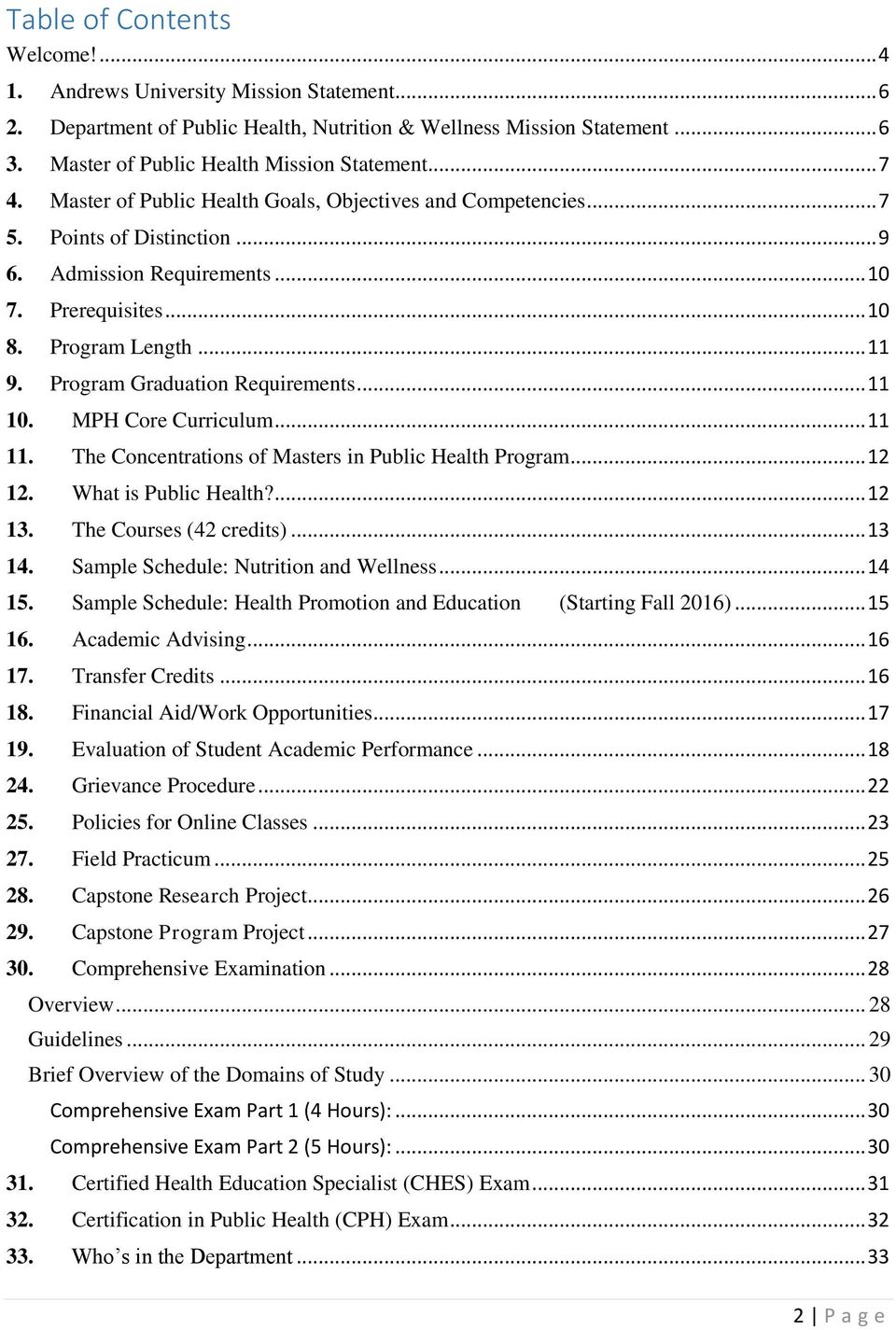
2 Table of Contents Welcome! Andrews University Mission Statement Department of Public Health, Nutrition & Wellness Mission Statement Master of Public Health Mission Statement Master of Public Health Goals, Objectives and Competencies Points of Distinction Admission Requirements Prerequisites Program Length Program Graduation Requirements MPH Core Curriculum The Concentrations of Masters in Public Health Program What is Public Health? The Courses (42 credits) Sample Schedule: Nutrition and Wellness Sample Schedule: Health Promotion and Education (Starting Fall 2016) Academic Advising Transfer Credits Financial Aid/Work Opportunities Evaluation of Student Academic Performance Grievance Procedure Policies for Online Classes Field Practicum Capstone Research Project Capstone Program Project Comprehensive Examination Overview Guidelines Brief Overview of the Domains of Study Comprehensive Exam Part 1 (4 Hours): Comprehensive Exam Part 2 (5 Hours): Certified Health Education Specialist (CHES) Exam Certification in Public Health (CPH) Exam Who s in the Department P a g e
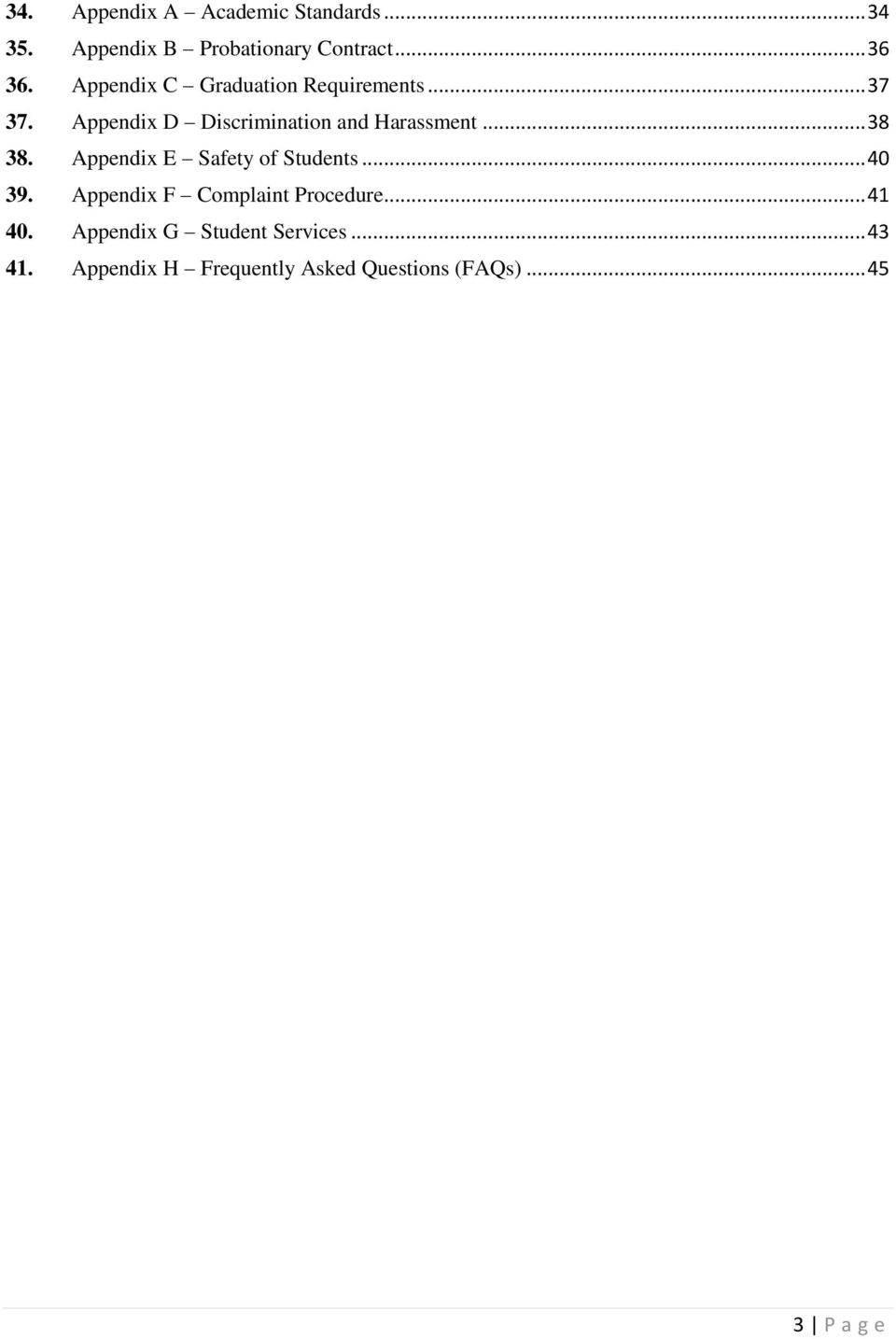
3 34. Appendix A Academic Standards Appendix B Probationary Contract Appendix C Graduation Requirements Appendix D Discrimination and Harassment Appendix E Safety of Students Appendix F Complaint Procedure Appendix G Student Services Appendix H Frequently Asked Questions (FAQs) P a g e
4 Welcome! Welcome to the Andrews University Masters in Public Health (MPH) program! You have made an excellent choice for your career and profession. This is the beginning of your 42 credit journey. During this time you will experience many things that will enable you bring a positive impact to the health of communities. You will learn to work with communities and you will have the opportunity to reflect on your own health and lifestyle choices. Your classes and field work are designed to challenge your critical thinking, to inspire and motivate you, and to equip you with professional skills required to improve the health of communities. You will have the opportunity to learn with students from all over the world while gaining insight and understanding to work with people of other cultures. As a faculty, we are here to guide you on this journey. Please feel free to visit, call, or us to assist you in meeting your educational need and professional goals. Take full advantage of the resources and educational experiences offered by our program a program preparing you to become a distinguished public health professional. Please carefully read this handbook and consult it frequently. It will guide and orient you on many issues related to your academic progress. It contains information about the courses you will need to take, important dates, policies, expectations and other important information. Thank you for choosing the MPH Program at Andrews University! Sincerely with God s Richest Blessings, MPH Faculty Sherine Brown-Fraser, PhD, RD, CPT - Department Chair & Associate Professor Dixon Anjejo, DrPH - MPH Program Director & Associate Professor M. Alfredo Mejia, DrPH, MS, RD - MDiv/MPH Liaison & Associate Professor Jasel McCoy, DrPH(c), MS, MBA - Assistant Professor 4 P a g e

5 5 P a g e

6 1. Andrews University Mission Statement Andrews University, a distinctive Seventh-day Adventist institution, transforms its students by educating them to seek knowledge and affirm faith in order to change the world. Andrews University students will: Seek Knowledge as they... Engage in intellectual discovery and inquiry Demonstrate the ability to think clearly and critically Communicate effectively Understand life, learning, and civic responsibility from a Christian point of view Demonstrate competence in their chosen disciplines and professions Affirm Faith as they... Develop a personal relationship with Jesus Christ Deepen their faith commitment and practice Demonstrate personal and moral integrity Embrace a balanced lifestyle, including time for intellectual, social, spiritual, and physical development Apply understanding of cultural differences in diverse environments Change the World as they go forth to... Engage in creative problem-solving and innovation Engage in generous service to meet human needs Apply collaborative leadership to foster growth and promote change Engage in activities consistent with the worldwide mission of the Seventh-day Adventist Church 2. Department of Public Health, Nutrition & Wellness Mission Statement The mission of the Department of Public Health, Nutrition & Wellness at Andrews University is to prepare dietetic, nutrition, wellness, and fitness professionals for service in their church, society, and the world and to influence the community at large to affirm the Adventist lifestyle, including the vegetarian diet and the benefits of regular exercise and physical fitness. 6 P a g e

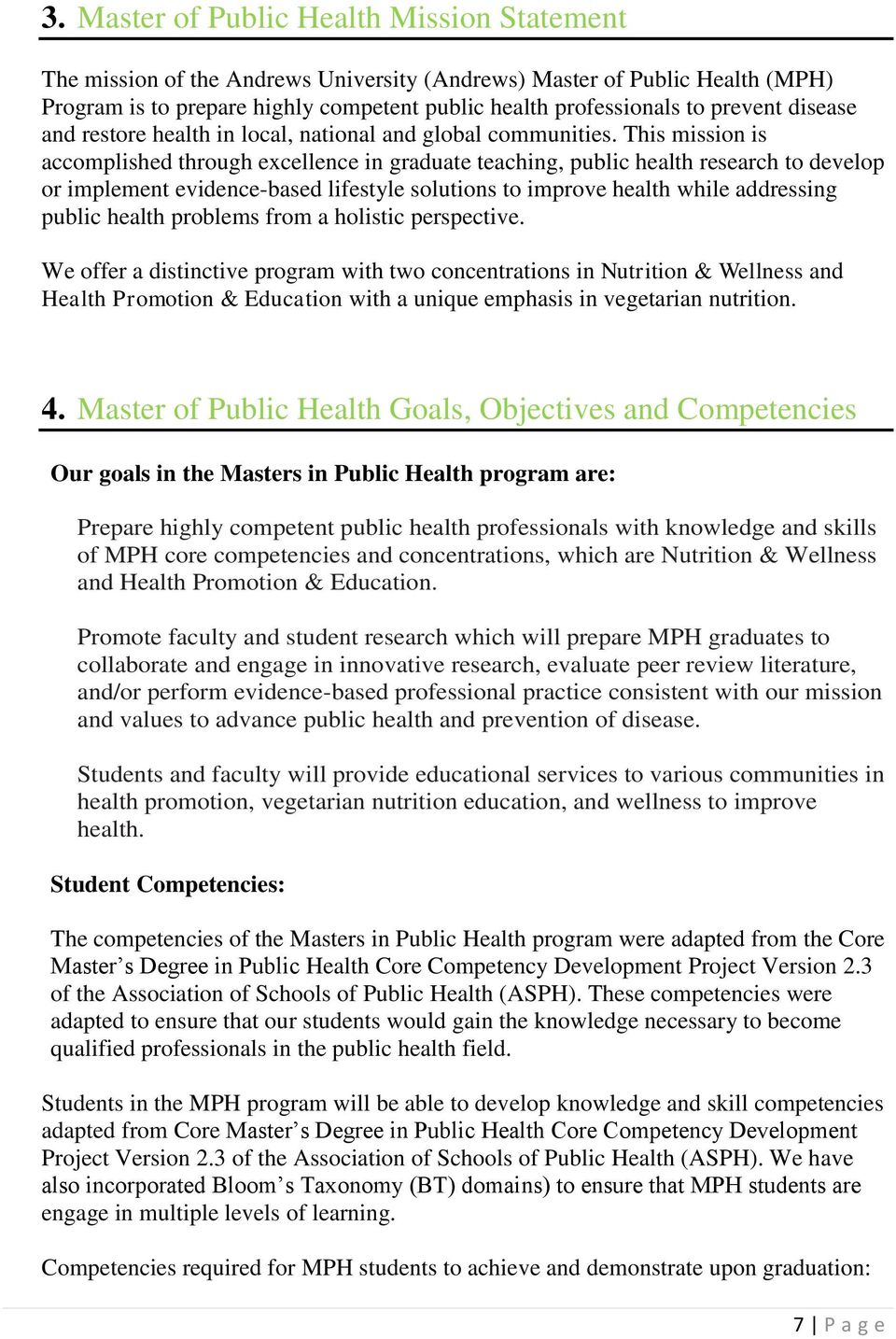
7 3. Master of Public Health Mission Statement The mission of the Andrews University (Andrews) Master of Public Health (MPH) Program is to prepare highly competent public health professionals to prevent disease and restore health in local, national and global communities. This mission is accomplished through excellence in graduate teaching, public health research to develop or implement evidence-based lifestyle solutions to improve health while addressing public health problems from a holistic perspective. We offer a distinctive program with two concentrations in Nutrition & Wellness and Health Promotion & Education with a unique emphasis in vegetarian nutrition. 4. Master of Public Health Goals, Objectives and Competencies Our goals in the Masters in Public Health program are: Prepare highly competent public health professionals with knowledge and skills of MPH core competencies and concentrations, which are Nutrition & Wellness and Health Promotion & Education. Promote faculty and student research which will prepare MPH graduates to collaborate and engage in innovative research, evaluate peer review literature, and/or perform evidence-based professional practice consistent with our mission and values to advance public health and prevention of disease. Students and faculty will provide educational services to various communities in health promotion, vegetarian nutrition education, and wellness to improve health. Student Competencies: The competencies of the Masters in Public Health program were adapted from the Core Master s Degree in Public Health Core Competency Development Project Version 2.3 of the Association of Schools of Public Health (ASPH). These competencies were adapted to ensure that our students would gain the knowledge necessary to become qualified professionals in the public health field. Students in the MPH program will be able to develop knowledge and skill competencies adapted from Core Master s Degree in Public Health Core Competency Development Project Version 2.3 of the Association of Schools of Public Health (ASPH). We have also incorporated Bloom s Taxonomy (BT) domains) to ensure that MPH students are engage in multiple levels of learning. Competencies required for MPH students to achieve and demonstrate upon graduation: 7 P a g e
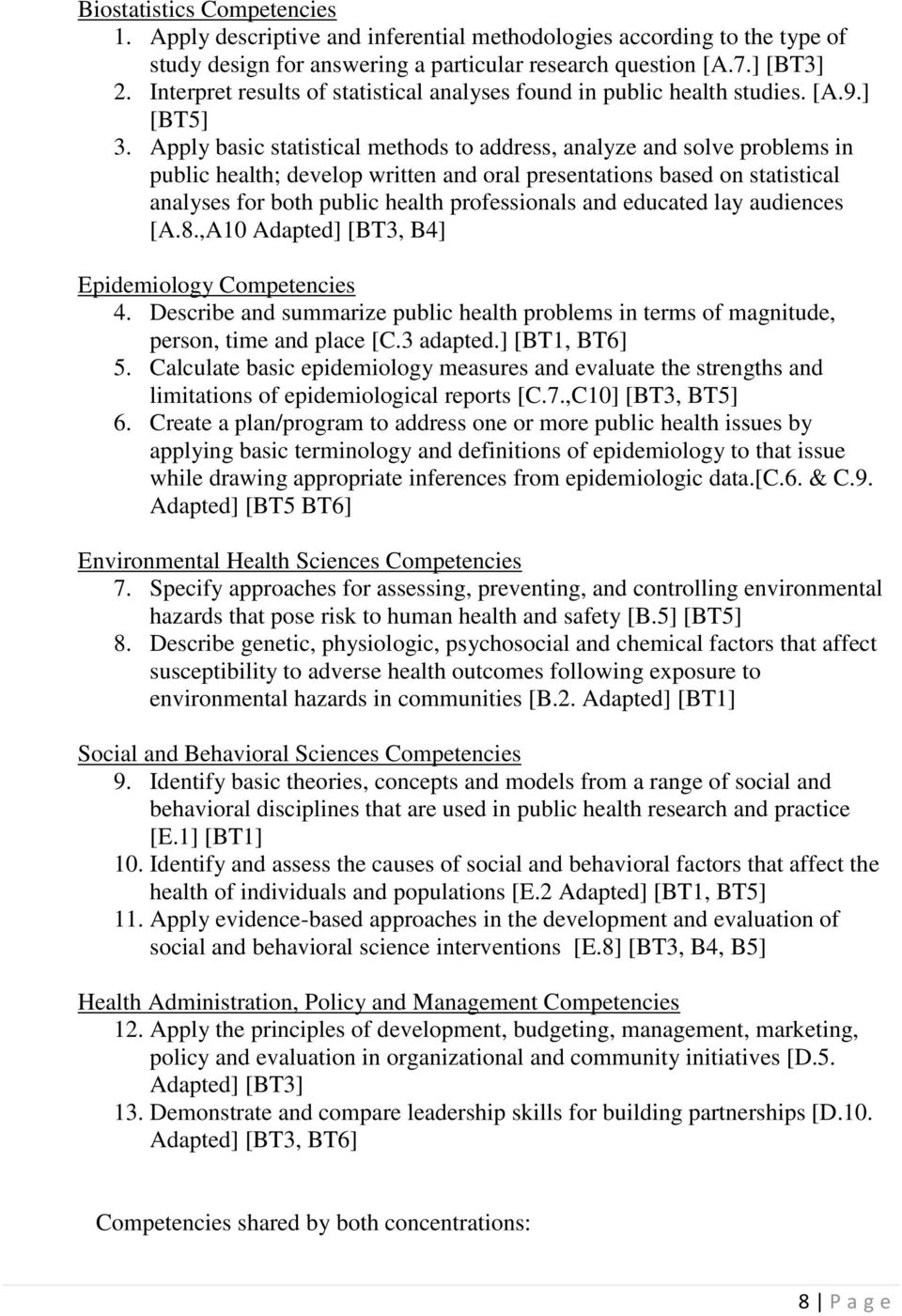
8 Biostatistics Competencies 1. Apply descriptive and inferential methodologies according to the type of study design for answering a particular research question [A.7.] [BT3] 2. Interpret results of statistical analyses found in public health studies. [A.9.] [BT5] 3. Apply basic statistical methods to address, analyze and solve problems in public health; develop written and oral presentations based on statistical analyses for both public health professionals and educated lay audiences [A.8.,A10 Adapted] [BT3, B4] Epidemiology Competencies 4. Describe and summarize public health problems in terms of magnitude, person, time and place [C.3 adapted.] [BT1, BT6] 5. Calculate basic epidemiology measures and evaluate the strengths and limitations of epidemiological reports [C.7.,C10] [BT3, BT5] 6. Create a plan/program to address one or more public health issues by applying basic terminology and definitions of epidemiology to that issue while drawing appropriate inferences from epidemiologic data.[c.6. & C.9. Adapted] [BT5 BT6] Environmental Health Sciences Competencies 7. Specify approaches for assessing, preventing, and controlling environmental hazards that pose risk to human health and safety [B.5] [BT5] 8. Describe genetic, physiologic, psychosocial and chemical factors that affect susceptibility to adverse health outcomes following exposure to environmental hazards in communities [B.2. Adapted] [BT1] Social and Behavioral Sciences Competencies 9. Identify basic theories, concepts and models from a range of social and behavioral disciplines that are used in public health research and practice [E.1] [BT1] 10. Identify and assess the causes of social and behavioral factors that affect the health of individuals and populations [E.2 Adapted] [BT1, BT5] 11. Apply evidence-based approaches in the development and evaluation of social and behavioral science interventions [E.8] [BT3, B4, B5] Health Administration, Policy and Management Competencies 12. Apply the principles of development, budgeting, management, marketing, policy and evaluation in organizational and community initiatives [D.5. Adapted] [BT3] 13. Demonstrate and compare leadership skills for building partnerships [D.10. Adapted] [BT3, BT6] Competencies shared by both concentrations: 8 P a g e
9 Nutrition and Wellness Competencies 1. Design and develop evidence-based education initiatives for prevention of chronic diseases and health promotion by applying knowledge acquired from courses emphasizing nutrition, wellness and vegetarian nutrition. [BT3, BT6] Program Planning Competencies 2. Plan, develop, implement and evaluate a health and wellness education initiative/program to inform, educate, and motivate people about health. [BT4 BT6] Competencies specific to the MPH in Nutrition and Wellness Concentration: Research Competencies 3. Develop and evaluate research designs using public health methodology, biostatistics, and/or epidemiology to address research questions in public health [BT4] Competencies specific to the MPH in Health Promotion and Education Concentration: Diversity and Culture Competencies 4. Develop and compare public health programs and strategies responsive to diverse cultural values and traditions of communities being served [BT4, BT5] 5. Points of Distinction Unique: First and only online MPH program in Nutrition and Wellness with a unique emphasis in vegetarian nutrition & lifestyle. Convenient: Totally Online Program. Great for working professionals. Great Value: Scholarship: 50% Tuition Reduction. Strong Core: Public health core competencies provided. o Intro to Public Health. Epidemiology. Biostatistics. Health Behavior. Health Policy Administration. Environmental Health. Quality Education: Program will train you to evaluate and quantify health needs of a population group, while simultaneously providing the knowledge and skills to create and implement research-based community programs in preventive health and wellness. 9 P a g e
![vegetarian nutrition. [BT3, BT6] Program Planning Competencies 2.](/docs-images/57/6160125/images/page_9.jpg "Plan, develop, implement and evaluate a health and wellness education initiative/program to inform, educate, and motivate people about health.")
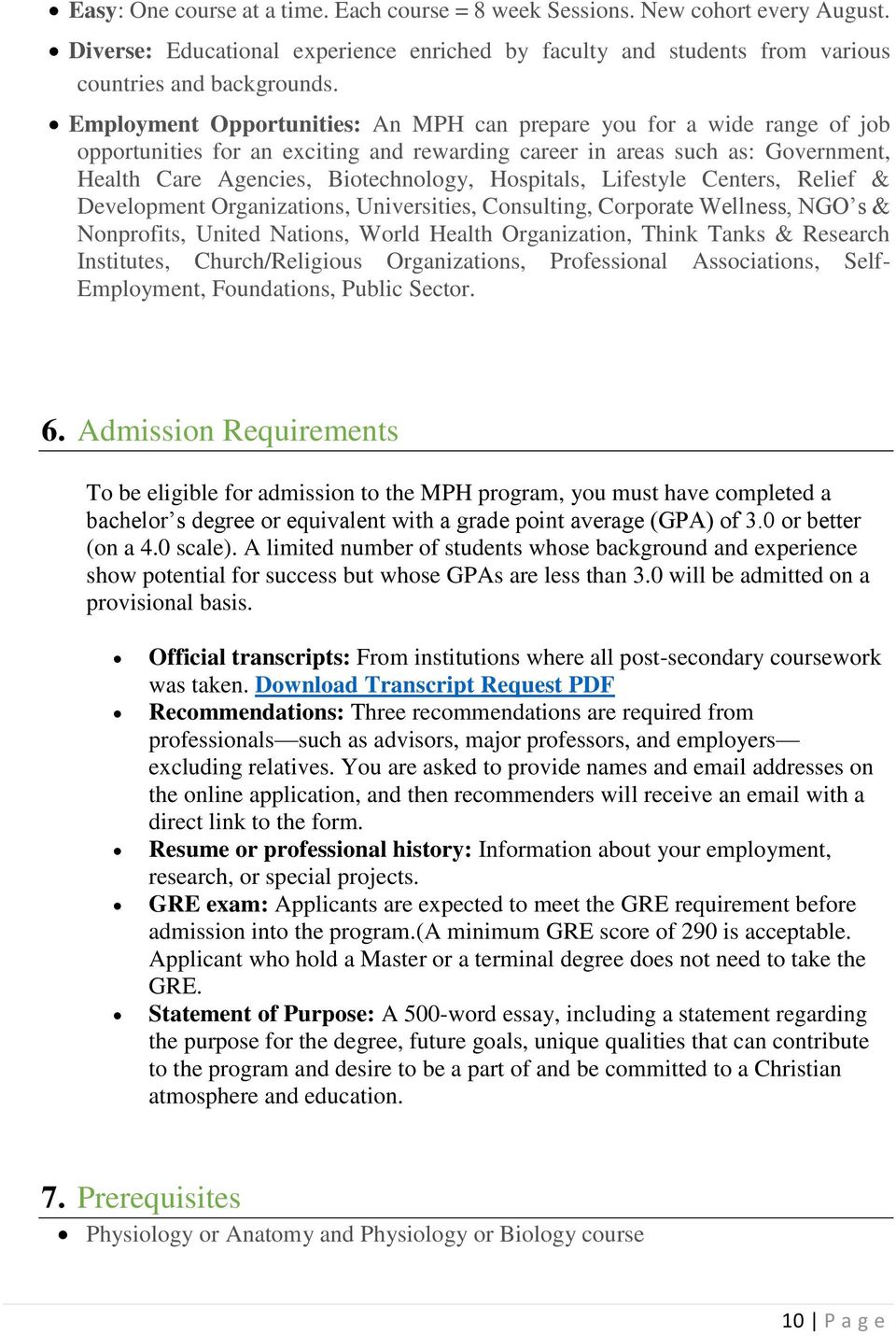
10 Easy: One course at a time. Each course = 8 week Sessions. New cohort every August. Diverse: Educational experience enriched by faculty and students from various countries and backgrounds. Employment Opportunities: An MPH can prepare you for a wide range of job opportunities for an exciting and rewarding career in areas such as: Government, Health Care Agencies, Biotechnology, Hospitals, Lifestyle Centers, Relief & Development Organizations, Universities, Consulting, Corporate Wellness, NGO s & Nonprofits, United Nations, World Health Organization, Think Tanks & Research Institutes, Church/Religious Organizations, Professional Associations, Self- Employment, Foundations, Public Sector. 6. Admission Requirements To be eligible for admission to the MPH program, you must have completed a bachelor s degree or equivalent with a grade point average (GPA) of 3.0 or better (on a 4.0 scale). A limited number of students whose background and experience show potential for success but whose GPAs are less than 3.0 will be admitted on a provisional basis. Official transcripts: From institutions where all post-secondary coursework was taken. Download Transcript Request PDF Recommendations: Three recommendations are required from professionals such as advisors, major professors, and employers excluding relatives. You are asked to provide names and addresses on the online application, and then recommenders will receive an with a direct link to the form. Resume or professional history: Information about your employment, research, or special projects. GRE exam: Applicants are expected to meet the GRE requirement before admission into the program.(a minimum GRE score of 290 is acceptable. Applicant who hold a Master or a terminal degree does not need to take the GRE. Statement of Purpose: A 500-word essay, including a statement regarding the purpose for the degree, future goals, unique qualities that can contribute to the program and desire to be a part of and be committed to a Christian atmosphere and education. 7. Prerequisites Physiology or Anatomy and Physiology or Biology course 10 P a g e
11 Two nutrition courses One Chemistry course Introductory or General Statistics (prerequisite for PBHL 511-Biostatistics) College Algebra 8. Program Length This online MPH is a part-time program (two classes per semester). The program s duration is 3 years. 9. Program Graduation Requirements Students will complete all their prerequisites within the first two semesters after they start their program. The MPH graduates will complete a total of 42 credits which includes coursework, practicum and projects. In addition to completion of coursework, students are required to complete the following culminating activities: Culminating Activities: Students are required to demonstrate the ability to integrate specific areas of public health: administration and leadership, epidemiology, biostatistics, social and behavioral science, environmental health, health education, diversity and culture, and vegetarian nutrition during culminating activity experiences. o The Culminating Activity includes: A written comprehensive exam Field practicum experience Research or program project after completion of all courses Professional portfolio An exit interview with the MPH Program Director (or Department Chair) at the conclusion of the program. 10. MPH Core Curriculum PBHL Biostatistics Credits: 3 PBHL Principles of Epidemiology Credits: 3 PBHL Principles of Environmental Health Credits: 3 PBHL Principles of Health Behavior Credits: 3 PBHL Principles of Health Administration Credits: 3 11 P a g e

12 PBHL 500- Introduction to Public Health Credits: 2 (for all students enrolled after summer 2014) 11. The Concentrations of Masters in Public Health Program The Masters in Public Health Program has two concentrations: 1. Nutrition and Wellness 2. Health Promotion and Education. The Nutrition and Wellness concentration is an online program that allows for the convenience of learning from wherever you are. This concentration is scheduled to be completed in three years on a part-time basis (two classes per semester). The Nutrition and Wellness concentration will prepare health professionals for service and advocacy in the community and church by building knowledge and skills necessary to enhance the health of human populations and promote a healthy lifestyle through personal and community efforts. Students will develop both quantitative and qualitative skills in areas such as biostatics and an understanding of epidemiology to measure health outcomes with a unique emphasis in vegetarian nutrition. The Health Promotion and Education concentration is taught on Andrews main campus and is part of the Master of Divinity/Master of Public Health dual degree. This concentration is scheduled to be completed in two years on a full-time basis. The MDiv/MPH was created to prepare students for various forms of ministry in which clinical and administrative skills in public health and theology are needed; to enable students to integrate both theological and public health knowledge, values and skills into a multifaceted approach to Christian service, thereby enhancing their usefulness as instruments of the Holy Spirit; and to sensitize students to nontraditional ministry opportunities by exposing them to theories and practice skills related to nutrition and wellness, environmental health, and health behaviors. 12. What is Public Health? Public health is the prevention of disease, promotion of health, and prolonging the lives of the population as a whole. Public health allows individuals to take a health message out to the community to help those in need. Public health is the science of protecting and improving the health of entire populations using quantitative and qualitative data. Centers of Disease Control and Prevention (CDC) Foundation, P a g e

13 SDA Public Health Insight- Lessen Suffering & God s Helping Hand: The work of health reform is the Lords means for lessening suffering in our world. Teach the people that they can act as Gods helping hand by cooperating with the Master Worker in restoring physical and spiritual health. - 9 Testimonies, EGW. The Master in Public Health program at Andrews University is unique in that we educate our students to bring the health message out to their communities with a special emphasis in the vegetarian lifestyle. We also bring the Adventist teachings into the classroom to enhance our student s connection between the church and a healthy lifestyle. 13. The Courses (42 credits) MPH Core Curriculum PBHL 500 Introduction to Public Health PBHL 511 Biostatistics PBHL 521 Principles of Epidemiology PBHL 525 Principles of Environmental Health PBHL 531 Principles of Health Behavior PBHL 535 Principles of Health Administration 2 credits 3 credits 3 credits 3 credits 3 credits 3 credits Total: 17 credits MPH Concentration Common Required Courses FTES 510 Fitness and Health Promotion 2 credits FDNT 520 Vegetarian Nutrition and Disease Prevention 3 credits FDNT 565 Current Issues in Nutrition and Wellness 2 credits PBHL 540 Grant Writing 2 credits PBHL 545 Program Planning and Evaluation 3 credits PBHL 580 Field Practicum 1 credits Total: 13 credits MPH Nutrition and Wellness Concentration Specific Courses FDNT 560 Health Research Methods FDNT 680 Research Seminar PBHL 646 Integration of Spirituality in Health Care PBHL 698 Capstone Research Project 3 credits 2 credits 3 credits 4 credits Total: 12 credits MPH Health Promotion and Education Concentration Specific Courses PBHL 526 Cultural Competence and Minority Health 2 credits PBHL 546 Adventist Health and Healing 3 credits PBHL 550 Addiction Prevention and Treatment 3 credits PBHL 555 Health Promotion and Education Seminar 2 credits PBHL 697 Capstone Program Project 2 credits Total: 12 credits 13 P a g e

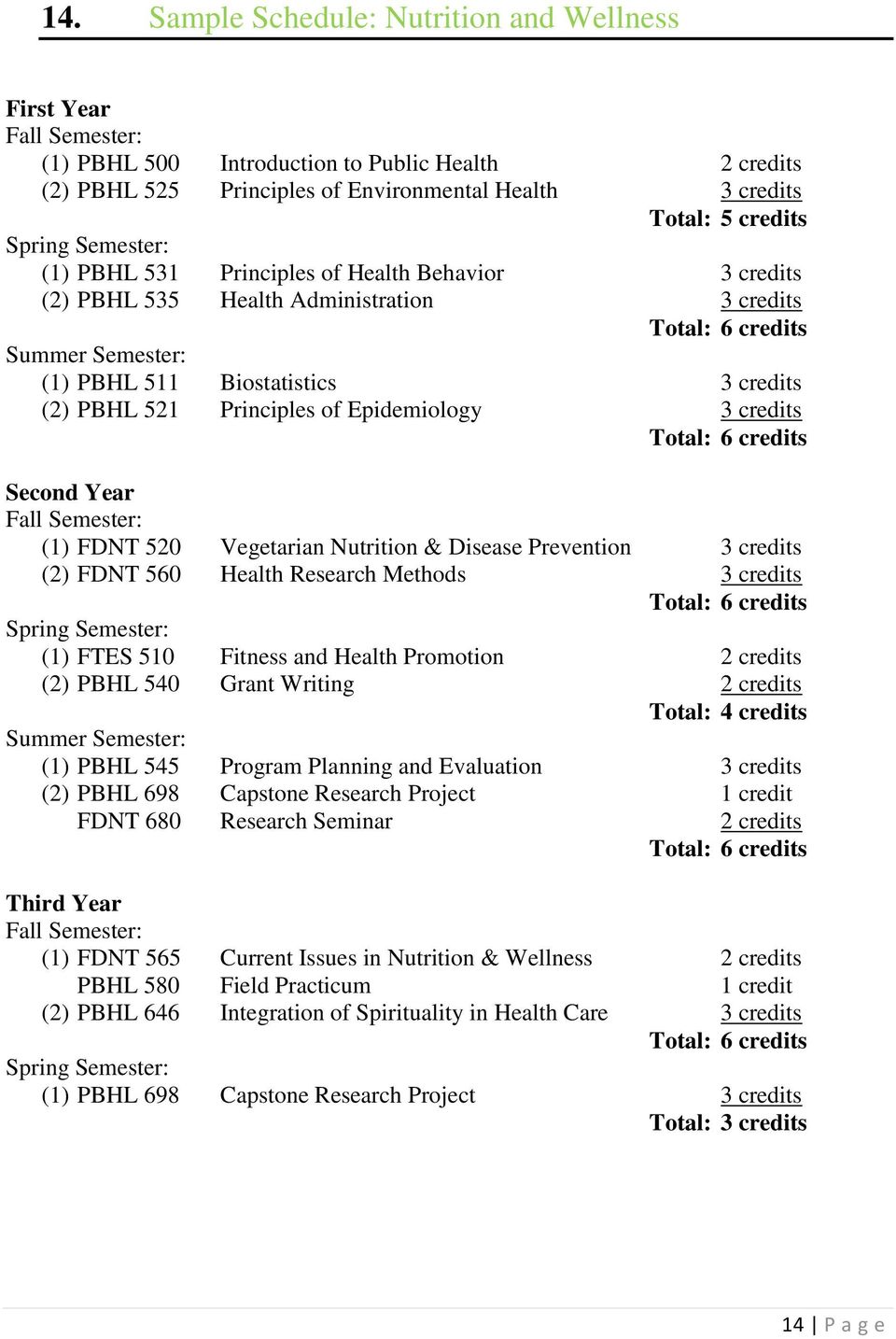
14 14. Sample Schedule: Nutrition and Wellness First Year Fall Semester: (1) PBHL 500 Introduction to Public Health 2 credits (2) PBHL 525 Principles of Environmental Health 3 credits Total: 5 credits Spring Semester: (1) PBHL 531 Principles of Health Behavior 3 credits (2) PBHL 535 Health Administration 3 credits Total: 6 credits Summer Semester: (1) PBHL 511 Biostatistics 3 credits (2) PBHL 521 Principles of Epidemiology 3 credits Total: 6 credits Second Year Fall Semester: (1) FDNT 520 Vegetarian Nutrition & Disease Prevention 3 credits (2) FDNT 560 Health Research Methods 3 credits Total: 6 credits Spring Semester: (1) FTES 510 Fitness and Health Promotion 2 credits (2) PBHL 540 Grant Writing 2 credits Total: 4 credits Summer Semester: (1) PBHL 545 Program Planning and Evaluation 3 credits (2) PBHL 698 Capstone Research Project 1 credit FDNT 680 Research Seminar 2 credits Total: 6 credits Third Year Fall Semester: (1) FDNT 565 Current Issues in Nutrition & Wellness 2 credits PBHL 580 Field Practicum 1 credit (2) PBHL 646 Integration of Spirituality in Health Care 3 credits Total: 6 credits Spring Semester: (1) PBHL 698 Capstone Research Project 3 credits Total: 3 credits 14 P a g e
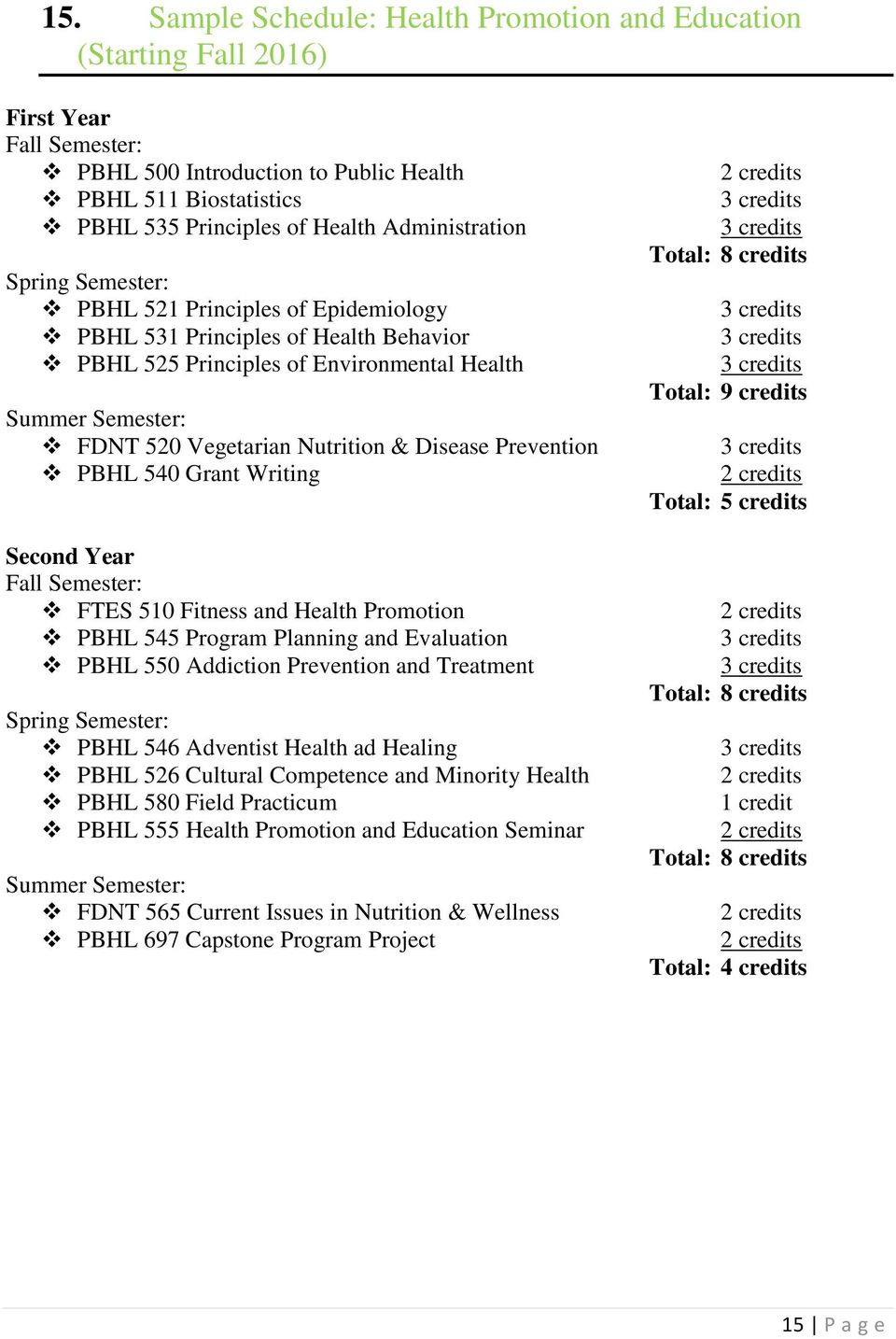
15 15. Sample Schedule: Health Promotion and Education (Starting Fall 2016) First Year Fall Semester: PBHL 500 Introduction to Public Health PBHL 511 Biostatistics PBHL 535 Principles of Health Administration Spring Semester: PBHL 521 Principles of Epidemiology PBHL 531 Principles of Health Behavior PBHL 525 Principles of Environmental Health Summer Semester: FDNT 520 Vegetarian Nutrition & Disease Prevention PBHL 540 Grant Writing Second Year Fall Semester: FTES 510 Fitness and Health Promotion PBHL 545 Program Planning and Evaluation PBHL 550 Addiction Prevention and Treatment Spring Semester: PBHL 546 Adventist Health ad Healing PBHL 526 Cultural Competence and Minority Health PBHL 580 Field Practicum PBHL 555 Health Promotion and Education Seminar Summer Semester: FDNT 565 Current Issues in Nutrition & Wellness PBHL 697 Capstone Program Project 2 credits 3 credits 3 credits Total: 8 credits 3 credits 3 credits 3 credits Total: 9 credits 3 credits 2 credits Total: 5 credits 2 credits 3 credits 3 credits Total: 8 credits 3 credits 2 credits 1 credit 2 credits Total: 8 credits 2 credits 2 credits Total: 4 credits 15 P a g e
16 16. Academic Advising When a student is admitted into either the Nutrition and Wellness or Health Promotion and Education concentrations, he or she is assigned an advisor. Unless a student requests a change of advisor, their assigned advisor will become their permanent advisor. Although it is desirable to stay with one s permanent advisor, it is the student s right to change advisors at any time during his or her course of study. The Department Chair must be consulted if a student wishes to change advisors and the Chair is responsible for reassignment. It is the student s responsibility to make contact with his or her advisor at least once a semester regarding courses to be taken. Your advisor will help you: Develop a plan of study Advise you each semester about courses to be taken the following semester 17. Transfer Credits Students who have transferred into Andrews University from another college or university will have their transfer credit evaluated by our Articulation Office. Credits must be articulated in order to determine what transfer credit has an Andrews credit equivalent and can count toward the student's degree progress. If you have questions regarding degree progress after transferring, please consult your academic advisor and the Andrews University Bulletin to see degree requirements. For transfer credit questions, advanced placement or credit by examination questions, processes or troubleshooting, please [email protected]. For questions regarding academic petitions for transfer credit, students must consult with their academic dean's office. Please note: A student may not transfer more than 20% of the credits needed in order to obtain their MPH from Andrews University. This means that in a 42 credit program, a student may not transfer more than 8 credits. 16 P a g e

17 18. Financial Aid/Work Opportunities Tuition Fees The total credits for the MPH program is 42 credits. The cost of tuition per graduate credit is listed on the Andrews University website at: Nutrition and Wellness concentration tuition has a 50% tuition reduction of the standard Master s tuition/credit and will be adjusted each academic year. Health Promotion and Education concentration has a 33% tuition reduction of the standard Master s tuition/credit and will be adjusted each academic year. Professional Fee There is a professional fee of $400 per semester for all MPH students. Financial Aid Advisors Individualized help is available from your financial advisor and can be found on your finvue account. Advisors are assigned based on the first letter of your last name. You are welcome to contact your representative by or phone. A-C & VA Students D-K Fares Magesa Mersha [email protected] du [email protected] L-Q Rowley Kayla du [email protected] R-Z Brummett Qaisar Ayaz du [email protected] du Please use link for additional details regarding financial aid Grants and Scholarships A limited amount of funds is available each year to assist students with tuition. The criteria is based on need. Students should submit a letter stating their financial need for the academic year to the program director by Aug 15 (include the amount requested and reason for assistance). Requests submitted later will be considered if funds are available. Graduate grants will be awarded by semester. Withdrawal & Refund Policy for Face-to-Face course The withdrawal & Refund Policy for face-to-face courses follows the Academic Calendar schedule. The Academic Calendar can be found on the Office of Academic Records website, Withdrawal & Refund Policy for Online Courses Withdrawal and refund policy differs slightly for interactive and self-paced online courses. Details are below. 17 P a g e

18 Interactive online courses Consult the academic calendar for yearly registration events to determine deadlines for tuition and distance fee refunds, when drop/add fees are in effect, and what grades are assigned when you decide to withdraw. Self-paced online courses: withdrawal policy is calculated on the number of days from your start date. Withdrawal & Refund Timeline Calendar Tuition Distance Fee Drop/Add Fee Transcript Grade Days 1-15 Full refund Full refund No charge No Grade Assigned % refund No refund Charged W Grade Assigned % refund No refund Charged W Grade Assigned No refund No refund Charged W Grade Assigned 151+ No refund No refund Cannot Drop A-F Grade Assigned 19. Evaluation of Student Academic Performance Students earn degrees by completing the prescribed number and kinds of credits for the relevant degree. Credits are earned only if all of the requirements for the course are completed and an acceptable grade is received. A student earns no credit for a course in which he/she does not receive an acceptable grade. Grading System The authority to determine grades rests with the professor of the course. Quality points (on a 4.00 scale) are given to each letter grade (A-F) for use in computing a student s grade-point average (GPA). The GPA is the average number of quality points earned per credit hour in all courses which are assigned grades A-F 18 P a g e

19 Grading Scale Letter Grade Percentage A % A % B % B 83-87% B % C % C 73-77% C % D % D 60-67% F 0-59% Grade Issuance Course Grades Course grades are issued by the course (lecture/lab) instructor, course coordinator, or program administrator. Explanation of the grading process for each course is detailed in the respective course outline. The grades are normally submitted to the Records Office when all students have completed all of the assignments and the instructor has finished grading these assignments. Posting Scores Students wishing to know their final grade before the University posts the official grade on the Web may contact the instructor to receive their grade. Grade Problems Only the instructor, course coordinator, or program administrator are allowed to discuss grades with the student(s). Any grades given to the student by means other than the official university postings are considered unofficial and are not binding. Grading problems not resolved by the instructor must be taken to the program administrator. If you have a DG or Incomplete and need your grade to be changed, contact your 19 P a g e

20 instructor or program administrator. Instructors are responsible for submitting final grades to Academic Records. Deferred Grade (DG) Participants in courses whose requirements are not completed by the end of the university marking period may receive a deferred grade or DG under certain circumstances. These circumstances will be determined by course instructor and program administrator. The permanent grade is submitted later when the grading process is completed. Incomplete (I) Students who are unable to complete a course in the time frame established by the program will receive an INCOMPLETE (I) rather than a DG. Prior to the issuance of the I, the student should have been in contact with the instructor as to the circumstances necessitating this. The student is required to establish a timeframe that he/she will be able to complete the work by, with the course instructor. Once this has been established, the student must adhere to this timeline. Failure to do so will result in the grade defaulting to the percentage earned up to the point of the missing work. All I s must be cleared within a 1 year time period Access to Grades Course grades are available one week after graduation through your Vault account. Please contact instructors regarding your grades or about changing your grade, not the Office of Academic Records. 20. Academic Integrity Masters of Public Health students are expected to submit all work in compliance with Andrews University s Code of Academic Integrity Academic Integrity University learning thrives on the rigor of individual investigation, the authentic exchange of ideas, and a corporate commitment to integrity and mutual respect. It requires all members of the academic community to behave honestly speaking truthfully to colleagues, co-learners and teachers and completing all homework, tests, papers and projects with integrity. Andrews University anchors its practices in the teachings of the Bible as well as in widely established and honorable academic traditions. Much as the apostle Paul calls us to authenticity in our Christian walk, so the educational institution demands of its participants true and accurate selfrepresentation. In Ephesians, Paul invites believers to be renewed in the spirit of your minds, and to clothe yourselves with the new self, created according to 20 P a g e

21 the likeness of God in true righteousness and holiness (Eph. 4:23 24, NRSV). As scholars and as Christ s servants, we build His living body through our honesty in all things, both small and great. To that end, Andrews University s students pledge to learn and grow together, committing to the following standards and affirming honesty as a core component of an Andrews University education. Andrews University Bulletin Online. Academic dishonesty includes but is not limited to the following: Falsifying or presenting falsified documents Plagiarizing Misusing copyrighted material and/or violating licensing agreements Using media from any source or device, including the internet, in ways that mislead, deceive or defraud Presenting another person's work as one's own Using materials other than those specifically allowed by the teacher or program during a quiz or examination Stealing, accepting or studying from stolen quizzes or examination materials Obtaining information from another student or any other source during a regular or take-home test or quiz Assisting others in acts of academic dishonesty, such as falsifying attendance records or providing unauthorized course materials Acting deceitfully in any other academic matter 21. General Principles The University is committed to principles of trust, accountability, clear expectations and consequences. It is also committed to redemptive efforts, which are meaningful only in light of these principles. Students will be granted due process and the opportunity for an appeal. Academic dishonesty offenses generally are subject to incremental disciplinary actions. Some first offenses, however, receive severe penalties, including dismissal from the University or degree cancellation. Some offenses are subject to legal action, in addition to university disciplinary action. Discipline may be retroactive if academic dishonesty becomes apparent after the student leaves a course, a program, or the University. If evidence of academic dishonesty becomes apparent after a degree has been granted, the degree may be annulled and a notification affixed to the student's official 21 P a g e
22 transcript record. 22. General Disciplinary The following is a non-comprehensive list of possible actions apart from dismissal from the University: denial or revocation of admission; warning from a teacher, a department chair, program director or academic dean; a lower or failing grade on an assignment, test or course; suspension or dismissal from the course; suspension or dismissal from the academic program. For further details please visit: Writing and Referencing APA (American Psychological Association) style is most commonly used to cite sources within the social sciences. Referencing in papers, presentations and other formats using outside sources should follow the APA format. It is strongly recommended that students purchase an APA publication manual for detailed guidance regarding proper writing and referencing. Proper referencing is essential for maintaining academic integrity. The use of APA writing style communicates a high level of professionalism in one s academic work. 24. Grievance Procedure The student grievance policy, which was created by the faculty to protect students rights and give them an opportunity to defend themselves against unfair criticism and treatment. The following protocol has been established to address potential problems should a student feel that his/her academic or personal rights have been violated. The student should first address his/her concern with the person thought to have made the violation (e.g. faculty, other student, field liaison, field instructor, or advisor). Students are encouraged to make every attempt to use professional discretion, integrity, respect and impartial judgment in resolving issues amongst themselves and colleagues. If, after talking to the individual involved, the problem continues and the student's concern is with: o A faculty member or another student, the student should then discuss the matter with his/her advisor 22 P a g e
23 If the problem remains unresolved, the student may request a meeting with the Department of Public Health, Nutrition and Wellness faculty, whose responsibility it is to resolve the issue or make a formal recommendation regarding the handling of the problem. The Dean of the School of Health Professions will be notified of the faculty s decision. If the student questions the committee s decision, he/she can discuss the matter with the Dean. However, the decision of the School of Health Professions committee is final. Records of the proceedings and the committee s decision will be sealed and placed in the student s file. o These records cannot be shared with others without the student s written permission. A Grievance can be filed online at: 8RHW83nPPBfehTTq- WXBPbU1eJ3SSSh8XmK48/viewform?formkey=dHRPY3B4dnlCQ0V1S2plQkhS U1g3YWc6MQ A Confidential Complain Form can be accessed online at: Policies for Online Classes Students are expected to participate in all instructional activities. Online courses are no different from classroom courses in this regard. Student "attendance" in online courses will be defined as active participation in the course as described in the individual course syllabus. Online courses will, at a minimum have weekly mechanisms for student participation, which can be documented by any or all of the following methods: student tracking records in Moodle, submission of assignments; and communication with the instructor (example: ). Discussion boards are example of online activity designed to facilitate student participation and engagement Students who do not log on to the course within the drop/add period for the course will be dropped from the course. (Drop/add and withdrawal dates are listed in the published semester schedule and College Catalog). Students who fail to maintain active participation in an online course as defined in the course syllabus will be processed in accordance with the College's current attendance policy. Course orientations are required (mandatory) in some courses. Refer to the course syllabus for specific information. Class meetings are required (mandatory) in some 23 P a g e
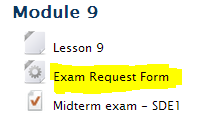
24 courses. Refer to the course syllabus for specific information about class or lab meetings requirements. 26. Procedures for Scheduling Online Proctored Exams Examination Scheduling & Proctoring When to Schedule For self-paced online courses, request the next exam as soon as you have submitted all assignments preceding the exam request link. Be prepared to take the exam within two weeks. For interactive online courses, the course lists a date by which you need to send in the request for each exam. Be prepared to take the exam by the deadline stated in the course. How to Request Log in to your course in Find the exam request link, which should be in the module you have just completed, or the very next one. Click on the Exam Request link (see example below). Fill out the form. Make sure the Andrews ID number, proctor s and name are correct before submitting. Who Can Proctor If you live near Andrews University, come to the School of Distance education to take exams. Exams will not be released to proctors with addresses within 25 miles of Andrews University. If you live at or near a school, college, or university, arrange to use their testing center or request the registrar to be your testing proctor. If you live away from a school, select and contact a teacher, church officer, or other professional to proctor your exam(s). No relative, fellow student, or 24 P a g e
25 fiancé(e) is acceptable as a proctor, regardless of qualifications. It is your responsibility to check with the proctor that the testing site will have a computer available with high-speed Internet access. Length of Time to Receive Exam If you have not received an confirming your exam release within 2-3 business days, call or [email protected] to check the request was received. How to Take the Exam It is your responsibility to arrange the time and place to take the exam before your deadline, in the presence of your proctor. Present a photo ID if the proctor does not know you personally. Log in to learninghub.andrews.edu Select the course you are taking the exam in. Click on the exam link which is in the module directly below the exam request form you filled in (e.g. Midterm exam in Module 9). Click Attempt Quiz Click Start Quiz Your Proctor will now enter the password and click Start. Note how much time you have, and what materials are allowed, if any. Save often and pace yourself to finish within the time allowed. Kicked Out of Exam Procedure If the exam time has not expired you can go back into the exam and continue taking it. You work will be saved up to the last item saved. If the time has expired, call , or [email protected] to have the exam reset. An expired exam cannot be reopened to finish. It must be retaken. How Long it Takes to Receive Grades Griggs aims for a one week turn-around time for grading. If it has been longer than a week and you do not see the grade on Moodle, please first contact the instructor. Retaking Exams If you are eligible to retake an exam, fill in the same exam request form, checking the option to request an alternate exam. There is a $50 fee for an alternate exam. Follow payment instructions on the exam request form in your course space. 27. Field Practicum The field practicum allows students to develop public health concepts and skills to demonstrate the application of these skills through a practice experience relevant to the students areas of specialization. In addition, students are expected 25 P a g e
26 to develop competencies which may assist in the preparation for the Certified Public Health and Certified Health Educator Specialist Exams. This field practicum will be planned, supervised, evaluated and will serve as the practice experience. A student qualifies for practicum after they have 1) completed all the course work (or concurrently during their last semester of course work on a case-by-case basis), 2) passed the final exam in Program Planning and Evaluation (PBHL 545), and 3) MPH faculty have discussed and approved the readiness of the student. Practicum requirements must be completed prior to graduation either on a full-time or part-time basis. Completing the practicum experience on a full-time basis in a concentrated block of time is ideal but not always feasible. Students must plan accordingly and discuss their readiness with an academic advisor. Completing the practicum experience on a full-time basis in a concentrated block of time may be ideal but not always feasible. Therefore, students may begin their practicum experience after Public Health and Nutrition and Wellness core courses have been completed. Generally, this will be at the end of the spring semester of the 2 nd year. Students should plan accordingly and discuss their readiness with an academic advisor. Practicum requirements must be completed prior to graduation. More information about the practicum experience can be found in the Student Practicum Handbook 28. Capstone Research Project The Capstone Research Project meets partial fulfillment of the requirement for the master s degree and is part of the requirements for the MPH culminating activities within the Nutrition and Wellness Concentration. This culminating experience is intended to provide the opportunity for students to address a public health question or issue of their interest that draws from their academic experience. It provides students with the opportunity to apply, integrate, and synthesize knowledge and experience obtained during their academic course of study to a question or problem of public health relevance. In some cases the Capstone Research Project idea or opportunity may evolve from the student s field practicum. The Capstone Research Project must be completed near the end of the program so that students have the advantage of drawing on and synthesizing their academic experience. However, students should develop ideas as soon as possible. Students should look for opportunities while completing their coursework to develop their ideas and plan projects. It is strongly recommended that students discuss project ideas with their academic advisor during the spring or summer semester of their 26 P a g e
27 second year. The project must meet the Andrews University Standards for Written Work. One copy of each report is submitted to the instructor under whose supervision it was prepared. The report then becomes the property of the Department of Public Health, Nutrition, & Wellness. Completed and signed approval forms for the project(s) must be filed in the Office of Academic Records no later than 12:00pm EST (noon) on Friday, one week before graduation, unless an earlier time is specified by the Department of Public Health, Nutrition, & Wellness. Students should complete their Capstone Research Project before writing the comprehensive examinations. If students need time for project preparation beyond the semester(s) when regular project credits are accumulated, they may register for project continuation. Project continuation is a non-credit enrollment status that requires a small fee for each semester of registration. More information on the Capstone Research Project can be found in the Capstone Project Handbook. 29. Capstone Program Project The Capstone Program Project meets partial fulfillment of the requirement for the master s degree and is part of the requirements for the MDiv/MPH culminating activities within the Health Promotion & Education concentration. This culminating experience is intended to provide the opportunity for students to address a public health question or issue of their interest that draws from their academic experience. It provides students with the opportunity to apply, integrate, and synthesize knowledge and experience obtained during their academic course of study to a question or problem of public health relevance. In some cases the Capstone Program Project idea or opportunity may evolve from the student s field practicum. The Capstone Program Project must be completed near the end of the program so that students have the advantage of drawing on and synthesizing their academic experience. However, students should develop ideas as soon as possible. Students should look for opportunities while completing their coursework to develop their ideas and plan projects. It is strongly recommended that students discuss project ideas with their academic advisor during the spring or summer semester of their first year. 27 P a g e
28 The project must meet the Andrews University Standards for Written Work. One copy of each project is submitted to the instructor under whose supervision it was prepared. The report then becomes the property of the Department of Public Health, Nutrition, & Wellness. Completed and signed approval forms for the project(s) must be filed in the Office of Academic Records no later than 12:00pm EST (noon) on Friday, one week before graduation, unless an earlier time is specified by the Department of Public Health, Nutrition, & Wellness. Students should complete their Capstone Program Project before writing the comprehensive examinations. If students need time for project preparation beyond the semester(s) when regular project credits are accumulated, they may register for project continuation. Project continuation is a non-credit enrollment status that requires a small fee for each semester of registration. More information on the Capstone Program Project can be found in the Capstone Project Handbook. 30. Comprehensive Examination The Comprehensive Examination (CE) is a written examination of the knowledge that students have gathered throughout their program. This examination will ask students to synthesize and apply their knowledge. Master s Degree students are not permitted to sit for the CE until they have officially advanced to degree candidacy. The CE is written between two days. The first day will take approximately four (4) hours and the second day will take approximately five (5) hours. Overview The Master in Public Health (MPH) Comprehensive Exam is the last step in completing the Culminating Experience. This exam allows you to combine the knowledge that you have gained throughout your program in order to apply it to real world situations. The Comprehensive Exam also allows the MPH faculty to gauge whether or not each a student is ready to graduate from the program and represent themselves, as well as the program, as a public health professional. The Comprehensive Exam is listed as class FDNT 670 and is a Satisfactory/Unsatisfactory course. Each student who wishes to take the 28 P a g e
29 Comprehensive Exam must register for this course along with the other courses for their final semester. Late registration could cause delay in completion of the program and graduation. The following is a guide that will help you prepare for your Comprehensive Exam. It will explain the how the exam is to be taken, the format, what you will need to do prior, as well as questions for areas that you may be asked to apply during the Comprehensive Exam. If you have any questions, please contact your Academic Advisor. Guidelines The MPH Comprehensive Exam will take place over two days. The first day will cover the concentration area. Each student will be give four (4) hours to complete the first day. The second day will focus on a comprehensive application of the competencies acquired during the MPH program to solve a public health problem. Each student will be given five (5) hours to complete the second day. The Comprehensive Exam is an essay exam that will ask you to apply the knowledge that you have gained throughout your MPH program. To make sure that you receive the maximum amount of points, please remember to fully answer each question to the best of your ability. This will allow the faculty to better understand whether or not you truly understand the material. In order to answer each question completely, it is advised that when opening the Comprehensive Exam, you take a moment to read each question carefully. This will allow you to know which questions will need more time than others. Comprehensive Exams can be (1) type written using the computer, or if there is special circumstances, can (2) hand written, scanned, and ed to Dr. Dixon Anjejo, [email protected]. Dr. Dixon Anjejo and Dr. M. Alfredo Mejia will score the Comprehensive Exams with the aid of Dr. Sherine Brown-Fraser. Please speak to you Academic Advisor to find out when you will be able to find out if you have passed the Comprehensive Exam. Each student is allowed three attempts at passing the Comprehensive Exam. First Attempt Each student is allowed to up to one (1) question per day rated as Unsatisfactory. The student will be given the opportunity to rewrite the question(s) within two (2) weeks after receiving notice from the Program Director. A rewrite will receive a rating of either Satisfactory or Unsatisfactory. If the question(s) is rated Unsatisfactory the student will receive a Fail for that particular date. If two or more questions on either of the days are evaluated as Unsatisfactory, the student will receive a Fail for the day and must rewrite that particular day on the next scheduled time. 29 P a g e
30 Second Attempt If a student must rewrite either or both of the days at the next scheduled exam time, all questions must be rated as Satisfactory. No opportunities will be given to do a rewrite on any questions that receive an Unsatisfactory rating. Third Attempt Students who fail one or more questions the second attempt must submit a remediation plan to the Program Director and petition the graduate school for permission to retake days one, two, or both a third time. If permission is granted, and the student fails the third attempt, the student will be dropped from the program. Brief Overview of the Domains of Study Comprehensive Exam Part 1 (4 Hours): Students in this concentration are expected to demonstrate sound knowledge of the content relevant to their concentration area. MPH in Nutrition and Wellness concentration. Students taking an MPH in Nutrition and Wellness need to demonstrate sound knowledge in nutrition and wellness by clearly articulating salient issues in their field of thier specialty. They should learn, understand and articulate well content and materials covered in FDNT 565 Current Issues in Nutrition and Wellness, FDNT 520 Vegetarian Nutrition and Disease Prevention and FTES 510 Fitness and Health Promotion. This core knowledge in the area of expertise should integrate elements from other disciplines, including epidemiology and research methodologies, and behavioral theories. MPH in Health Promotion and Education concentration. Students taking an MPH in Health Promotion and Education need to demonstrate sound knowledge in the area of health promotion and education by clearly articulating salient issues in their field of their specialty. They should learn, understand and articulate well content and materials covered in FDNT 565 Current Issues in Nutrition and Wellness, FDNT 520 Vegetarian Nutrition and Disease Prevention and FTES 510 Fitness and Health Promotion, PBHL 550 Addictions Prevention and Treatment and PBHL 546 Adventist Health and Healing. This core knowledge in the area of expertise should integrate elements from other disciplines, including epidemiology and research methodologies, and behavioral models and theories. Comprehensive Exam Part 2 (5 Hours): MPH in Nutrition and Wellness concentration. Students are expected to demonstrate sound knowledge of the MPH core courses and integrate this knowledge with the knowledge of their specialty domain to solve public health problems. This section of the test is intended to allow each student creatively 30 P a g e
31 demonstrate his/her overall understanding the competencies acquired in the MPH program while solving specific public health problems in a target population. Students need to integrate their knowledge in Program Planning and Evaluation, Principles of Health Administration, Epidemiology, Principles Health Behavior, Principles of Environmental Health, Health Research Methods, with their knowledge of the area of specialization in nutrition and wellness to develop a culturally sensitive, cost effective, feasible program to solve a specific public health problem in a given population. The section of the test provides the students an opportunity to demonstrate full integration of all their public health skills and creativity to solve public health issues. MPH in Nutrition and Health Promotion and Education concentration. Students are expected to demonstrate sound knowledge of the MPH core courses and integrate this knowledge with the knowledge of their specialty domain to solve public health problems. This section of the test is intended to allow each student creatively demonstrate his/her overall understanding the competencies acquired in the MPH program while solving specific public health problems in a target population. Students need to integrate their knowledge in Program Planning and Evaluation, Principles of Health Administration, Epidemiology, Principles Health Behavior, Principles of Environmental Health, Health Research Methods, with their knowledge of the area of specialization in nutrition and wellness to develop a culturally sensitive, spiritually sensitive, cost effective, feasible program to solve a specific public health problem in a given population. The section of the test provides the students an opportunity to demonstrate full integration of all their public health skills and creativity to solve public health issues. 31. Certified Health Education Specialist (CHES) Exam The Certified Health Education Specialist (CHES) examination is a competency-based tool used to measure possession, application and interpretation of knowledge in the Seven Areas of Responsibility for Health Education Specialists delineated by A Competency-Based Framework for Health Education Specialists The exam reflects the entry-level Sub-competencies of these Areas of Responsibility. The CHES exam has met national standards in credentialing and has been accredited by the National Commission of Certified Agencies accreditation since 2008 Consisting of 165 multiple-choice questions (150 scored and 15 pilot tested), the CHES examination is offered in paper-and-pencil format at college campuses throughout the United States. While there are approximately P a g e
32 testing sites currently registered, any campus with a testing service is eligible to become a testing site For more information on the CHES, please go to Certification in Public Health (CPH) Exam The Certified in Public Health (CPH) exam covers the five core areas of knowledge offered in CEPH accredited schools and programs as well as cross cutting areas relevant to contemporary public health. The examination was crafted to assess a person s knowledge of these competencies, regardless of his or her academic concentration. The CPH exam is a timed exam, consisting of 200 questions. You have 4 hours to complete the exam. All questions on the exam are multiple choice and single-best answer. Questions include matching items; a series of questions related to a common vignette; and associated pictorials or charts. For more information on the CPH, please go to 32 P a g e
33 33. Who s in the Department School of Health Professions Dean, School of Health Professions Assistant to the Dean Administrative Assistant Dr. Emmanuel Rudatsikira Deby Andvik Carmelita Arthur Department of Public Health, Nutrition, & Wellness Department Chair Administrative Assistant Dr. Sherine Brown-Fraser Jiyeon Stuart Master of Public Health Master of Public Health Program Director MDiv/MPH Liaison MPH Faculty Member Dr. Dixon Anjejo Dr. M. Alfredo Mejia Prof Jasel McCoy 33 P a g e
34 34. Appendix A Academic Standards Students enrolled in graduate programs governed by the School of Graduate Studies & Research should note the following standards of scholarship. Minimum Standards of Scholarship. Candidates for graduate degrees must satisfactorily fulfill the course of study for the degree program they select subject to these standards: A minimum GPA of 3.00 (4.00 system) is required in those courses that apply to the degree. No course with a grade of C- or lower may count toward a graduate degree. Some departments may require a higher satisfactory grade in certain courses. If a student receives an unsatisfactory grade as defined by the School of Graduate Studies & Research, the course may be repeated once. The credits and quality points earned in the most recent course will be used to calculate the GPA. Credit by examination is not accepted toward a graduate degree. Candidates for a master s degree must pass comprehensive examinations and/or formally defend a master s thesis or an acceptable alternative for a particular program as approved by the Graduate Council. Candidates for specialist and doctoral degrees must pass comprehensive examinations. Standards for Progression. In addition to the following standards, master s students should consult the appropriate section of the Andrews University bulletin and their respective handbook. The cumulative GPA must be at least 3.00 calculated using all graduate work taken at Andrews University including courses taken for other degrees, courses taken prior to the time limits for degrees, and courses taken PTC. Exceptions to this standard must be recommended by the dean/graduate program coordinator and approved by the dean of the School of Graduate Studies & Research. A student whose cumulative GPA drops below 3.00 in any given semester is placed on academic probation. Such a student must work with the advisor to develop a schedule of courses that ensures the student will raise his/her cumulative GPA above the required 3.00 in a timely manner normally, the following semester. The dean/graduate program coordinator of the school/college must approve such a plan. A student who does not meet such a plan may not continue except by the recommendation of the dean/graduate program coordinator and approval by the dean of the School of Graduate Studies & Research. Normally, students who accumulate more than 12 semester credits below B- (including U) are not allowed to continue. Petitions for exceptions must 34 P a g e
35 include a plan to maintain the required GPA for the degree and be approved by the appropriate dean/graduate program coordinator of the college/school and the dean of the School of Graduate Studies & Research. Students who have been accepted provisionally to a degree program must meet the planned schedule for removing any deficiencies or earning a minimum GPA. o English-language deficiencies must be met by the time the student has completed no more than 50% of his/her course work for a master s or specialist degree or 25% of his/her course work for a doctoral degree. o Undergraduate deficiencies, specifically missing prerequisites must be completed within the first two semesters after starting the program. o A minimum GPA equal to the GPA requirements for graduation from the program must be met by the time the student has completed 9 graduate credits. o A student who does not meet this schedule is not allowed to continue except by the recommendation of the dean/ graduate program coordinator and approval by the dean of the School of Graduate Studies & Research. Students on academic probation or provisional status may not: o Register for project credit except by permission from the dean/graduate program coordinator of the college/school. o Advance to degree candidacy or take comprehensive examinations. 35 P a g e
36 35. Appendix B Probationary Contract PROBATIONARY CONTRACT Student s Name: Instructor: The following conditions must be met: Professor s name (Please print) Professor s signature/date 36 P a g e
37 36. Appendix C Graduation Requirements Advancement to Candidacy Upon completion of 50% of course work, a student must apply for advancement to degree candidacy. Forms are available at the office of the appropriate dean or graduate program coordinator. The forms should be completed by the student, approved by the advisor and the department chair, and returned to the office of the dean or graduate program coordinator. At the time a student files an application for advancement to degree candidacy, he/she must have: o Received regular admission status o Applied for graduation o Completed all curriculum and English-language deficiencies that may have existed o Demonstrated foreign-language proficiency where required. A student who has completed 75% of his/her program is not allowed to register for further course work until the advancement to degree candidacy forms have been filed with the appropriate dean or graduate program coordinator. After a student has been advanced to degree candidacy, he/she may then request to take the comprehensive examinations. An application form for the comprehensive examinations is sent to the student at the time of notification of advancement to degree candidacy. Students are required to complete all outstanding prerequisites based on the timeline given to them at the time of admission and complete the required coursework of 42 credits. Students are also required to complete the culminating activities which include the Field Practicum, Capstone Research Project or Capstone Program Project, and Comprehensive Examination. 37 P a g e
38 37. Appendix D Discrimination and Harassment Discrimination and Harassment - Including Sexual Harassment Andrews University affirms that every human being is valuable in the sight of God. The University expects students, employees and guests to treat each other and the wider community with respect and dignity, and will not tolerate discrimination of harassment. Students have the right to supportive academic, work and residential settings that are free from conduct that could create a hostile, intimidation or offensive environment. Students and employees should report inappropriate, erratic, harassing, threatening or violent behavior, no matter how mild or severe, that may jeopardize the health or safety of an individual or community or that disrupts the mission/ or normal processes of the University. This allows the University to address behavioral concerns in a timely manner Discrimination: Andrews University prohibits discrimination against any student on the basis of race, color, national origin, sex, religion, age, disability or any other legally protected characteristic. Discrimination that occurs because of a legally protected characteristics may violate the policies of the University even if the discriminatory behavior is not unlawful. Sexual orientation, which is not a legally protected characteristics, is regarded by the University in a manner consistent with the position of the Seventh-day Adventist Church, which makes a distinction between orientation and behavior. Sexual orientation is not to be consideration in issue related to academic, work or residential environments except as necessary to upholding the University s commitment to moral propriety as understood by the Seventh-day Adventist Church. However, promoting or engaging in certain behaviors is prohibited in the University Cod of Student Conduct. Harassment: Andrews University prohibits harassment of any kind. Harassment is often based upon an intentional intolerance or disparagement of personal characteristics such as race, color, national origin, sex, sexual orientation, religion, age or disability, or any legally protected characteristic. Harassment occurs when a person or group engages in unwelcome conduct so severe and/ or pervasive that is unreasonably interferes with an individual s work or academic performance or creates an intimidating, hostile or offensive academic, work or residential environment. Harassment is prohibited whether it takes place on campus, off campus, or in cyberspace. This definition of harassment should not be construed to infringe on the right of faculty, staff and students to discuss, inquire, express and petition within the limits. Sexual Harassment: Like other forms of harassment that are based on an individual s legally protected characteristic, sexual harassment is a form of discrimination, and it is strictly prohibited. 38 P a g e
39 Unlawful sexual harassment takes one of two forms: 1) quid pro quo harassment or 2) hostile environment harassment. Quid pro quo harassment typically involves an exchange of sexual favors for some benefit, and it most often occurs where there is a power differential (e.g., professor and student or boss and employee). Hostile environment harassment can occur when conduct is so sever and/ or pervasive that it unreasonably interferes with an individual s work or academic performance or creates an intimidating, hostile or offensive work or academic environment. Both kinds of harassment are prohibited. The following are types of behavior which may constitute sexual harassment: Unwelcome sexual advances or requests for sexual favors Unwelcome touching Showing/displaying sexually suggestive or objectifying pictures or words Sexually suggestive jokes Other unwanted verbal, visual or physical conduct of a sexual nature may constitute sexual harassment when: Submission to such conduct is made either explicitly or implicitly as a term or condition of an individual s employment, academic achievement or advancement Submission to or rejection of such conduct is used, threatened or insinuated as the basis for decisions affection employment, wages promotion, assigned duties or academic standing of an individual. Such conduct has the purpose or effect of interfering with an individual s ability to carry out his or her responsibilities. What to do about Discrimination or Harassment If you witness or experience behavior which you think is inappropriate, you should do something about it. The following steps are suggestions you may want to consider. Every circumstance is different, however, and the important thing is that you do take some steps to correct the behavior. Indicate assertively to the alleged harasser that such conduct is offensive, unwelcome and should be stopped immediately (studies show that most harassers will stop if they know their behavior is offending someone). Document a written report of the incident noting date, time, location; identifying alleged harasser and witnesses; and giving a detailed description of the unwanted behavior incident. Submit the report to one of the following: academic advisor or dean (if classroomrelated), work supervisor or human resources director (if work-related), residence hall dean or Student Life (if peer-related or you are unsure who to report to). Andrews University takes seriously any reports it receives of sexual and other forms of unlawful harassment or discrimination. A process is available for an investigation to be conducted and, where necessary, for corrective action to be taken. Any student who makes, in good faith, a complaint/ report. 39 P a g e
40 38. Appendix E Safety of Students Andrews University takes the safety of its students seriously. Signs identifying emergency protocol are posted throughout buildings. Instructors will provide guidance and direction to students in the classroom in the event of an emergency affecting that specific location. It is important that you follow these instructions and stay with your instructor during any evacuation or sheltering emergency. 40 P a g e
41 39. Appendix F Complaint Procedure If a candidate feels that his/her academic rights have been violated, he/she should speak directly with the relevant professor. If the candidate is unsatisfied with the professor s response, he/she may appeal to the department chairperson. Following a decision by the department chairperson, the candidate (or professor) may appeal to the appropriate academic dean, followed by an appeal to the Office of the Provost (based on Student Handbook). Resolution of Grade Complaints In keeping with the Andrews University Working Policy (2:437:6), candidates who dispute a grade received for a course (providing that the candidate believes the grade was assigned as a result of carelessness, arbitrariness, or capriciousness) should seek a resolution through the following steps: The candidate should seek a resolution in person with the instructor of the course. If this does not result in a satisfactory resolution, the candidate may seek resolution through the instructor s immediate supervisor. If this step fails to resolve the dispute, the candidate may file a written grade complaint with the instructor s immediate supervisor, normally the department chair. The chair must render a written report of his/her findings. A candidate who does not receive a report or remains dissatisfied may file a written grade grievance with the Dean of the School of Health Professions. After reviewing all the facts about the case, the Dean may choose to issue a final decision in the case or appoint a Grade Review Committee of three faculty members, who will investigate the matter and recommend a resolution to the Dean. The Dean will then issue a final decision, taking into account the recommendations of the Grade Review Committee. Resolution of Conflict with a University or SHP Academic Policy If a candidate feels that he/she has been adversely affected by a policy, he/she should follow this protocol: The candidate should discuss the policy with his/her faculty advisor. If the advisor is unable to help resolve the conflict, the candidate should discuss it with the department chair. If this does not yield satisfactory results, the candidate should take the matter to the Dean of the School of Health Professions. If this does not yield satisfactory results, and the conflict is with an academic policy, the candidate may take the matter to the SHP Academic Policies and Curricula Committee. If the problem remains unresolved, the candidate may discuss the matter with the Provost. The Provost s written decision will be considered final. At any step along the way a candidate may consult with either of two University Ombudspersons. The University Ombudspersons facilitate understanding, communication, and resolution of conflicts. The University Ombudsperson may help by identifying and explaining relevant university policies, procedures, and problemsolving channels. The Ombudsperson will also help the candidate to explore options 41 P a g e
42 or help identify University programs and resources that might be helpful. The Ombudsperson does not get involved in the following situations: o If the candidate wants legal advice or legal representation o If the candidate has a non-university related disagreement or problem o If the candidate wants to file a grievance or make a formal complaint o If the candidate wants someone to represent him/her in formal University procedures. (See Ombudspersons in the current Student Handbook.) Resolution of a Conflict with a Faculty Member If a conflict arises between a candidate and a faculty member, the protocol below should be followed: The candidate should first seek resolution with the faculty member. If the candidate feels that this may affect him/her adversely, he/she should consult with his/her advisor. If the candidate feels that either 1 or 2 would be counterproductive, he/she may take the conflict directly to the Dean of the School of Health Professions. If the above procedures fail to resolve the situation, the candidate may take the problem to the Provost. If this does not bring a satisfactory resolution, the candidate has the right to take the matter to the President of the University. The President s decision is final in this type of conflict. At any step along the way a candidate may consult with either of two University Ombudspersons. The University Ombudspersons facilitate understanding, communication, and resolution of conflicts. The University Ombudsperson may help by identifying and explaining relevant university policies, procedures, and problemsolving channels. The Ombudsperson will also help the candidate to explore options or help identify University programs and resources that might be helpful. The Ombudsperson does not get involved in the following situations: o If the candidate wants legal advice or legal representation o If the candidate has a non-university related disagreement or problem o If the candidate wants to file a grievance or make a formal complaint o If the candidate wants someone to represent him/her in formal University procedures. (See Ombudspersons in the current Student Handbook.) Record of Formal Appeals The office of the Dean of the School of Education keeps a record on file of formal appeals that have arisen in the SHP. 42 P a g e
43 40. Appendix G Student Services Online Resources VAULT is the secure campus account system which contains registration, and financial information. Please access Vault to do the following: prevue: enrollment profile finvue: all financial elements ivue: complete student profile School of Distance Learning The following are resources available through the School of Distance Education to support your learning. Technology Help Contact Center: Live Chat Online or call (269) o password, , general AU online service access questions Andrews Moodle: [email protected] or (269) o Moodle login, course navigation or technical questions about doing assignments Academic Help Consortium Admissions and Registration Support: [email protected] or (269) Undergraduate Distance Degree Advising: [email protected] or (269) Graduate Distance Degree Information: [email protected] or (269) Specific Course Questions Contact course instructor, using or phone included on the course home page o questions about assignments, grades and feedback, scheduling, incompletes General Questions School of Distance Education: [email protected] or (800) Tips for Best Service Include your full name, student ID, course name and specific lesson or course page. Details such as the type of computer (MAC or PC) and browser (Chrome, Firefox, Safar, etc.) used, or a screen shot/image can expedite solutions 43 P a g e
44 Library All registered students have free (login required) access to the James White Library via phone, fax, or the Internet. Services include: Access to the James White Library Catalog and other library catalogs. Writing Center The Writing Center is open to help you with your writing. Student consultants assist university students with most kinds of writing assignments. The Writing Center is located in Nethery Hall 134. Tutoring hours vary semester by semester. Stop by and sign up for an appointment or call to schedule a meeting with a consultant. [email protected] Guest Services Phone: (269) Fax: (269) [email protected] Counseling and Testing Center Phone: (269) Located in Bell Hall 123 the Counseling and Testing Center assists students, without charge, in reaching their maximum potential when confronted by social, intellectual, or emotional problems. Professional Counselors and doctoral students in counseling are available for any student by appointment or immediately, if necessary. Campus Ministries Phone: (269) Located in the Student Center, the Campus Ministries office helps create an atmosphere where the University family can become an interdependent community whose highest purpose is service to Christ and humanity. It directs and coordinates the chapel and assembly programs, the Student Missions program, ADRA, Task Force, The Way Sabbath School, Church services, and BRANCH. Through the Pastoral Care Program, it provides pastoral and counseling visits, Bible studies, Engaged Encounter seminars, and Marriage Enrichment seminars. 44 P a g e
45 41. Appendix H Frequently Asked Questions (FAQs) How long do I have to finish my degree? Andrews University allows students up to six (6) years or eighteen (18) semesters to complete a Master s degree. However, because of courses are only offered during specific semesters, it is advisable to stay on track and complete your program within the scheduled time as listed above in the sample course schedule. How long do I have to finish an online class? Self-paced courses (for prerequisites) must be completed within 180 days, which is nearly six months after the selected start date. Students have both the privilege and responsibility of setting their own pace; they may finish within as little as one or two months if studying intensely. Remember that graduation or financial aid accepted may impose earlier deadlines. It is the student's responsibility to plan a pace of study to meet their personal deadline. (Applies generally to prerequisites offered by the School of Distance Education). Applies to MPH Nutrition and Wellness Concentration Interactive online courses have fixed start and end dates listed in the 8 week online calendar for the MPH in Nutrition and Wellness concentration. Most follow the Andrews four-month semester; summer courses are often offered as intensives within one or two months. If you cannot meet the deadlines for assignments and exams listed in the course space and syllabus, withdraw before the drop/add date. How much time is needed to complete a course online? Schedule 35 hours of focused study time for every semester credit. For example, to complete a 3-credit class successfully, schedule 100+ hours. This time will be spent reading assigned pages, watching videos, completing assignments, projects, discussions online, or exams, or communicating with your instructor. If you want to finish a 3-credit class in 8 weeks, 12+ hours are needed per week; to finish a 3- credit class in 24 weeks, 3+ hours per week will do it. How does financial aid impact my course end date? Andrews degree students using financial aid must complete courses within the semester they register for any type of course, including self-paced online courses. For Pell Grants specifically, students must complete at least 50% of all lessons in all enrolled self-paced courses before their Pell Grant can be disbursed. It is the student's responsibility to meet this requirement, which supersedes the end date automatically 45 P a g e
46 given for self-paced courses. What if I can't finish before the course end date? An Incomplete grade may be issued at a course end date in the event of (documented) illness or unavoidable circumstances, NOT because of negligence or inferior performance. How do Incompletes work? Students with extenuating circumstances may contact the course instructor prior to the course end date to request an incomplete grade. The instructor will arrange an Incomplete Contract with the student that should include: a list of work to be completed the date by which each assignment will be submitted revised course completion date, prior to the last day of the next semester, on which the instructor will calculate the grade based on all work received by that date The Incomplete Contract is processed by the Instructor with the Records office. Students should save a copy of the in which the incomplete contract terms are established with the instructor. As there will be no reminders about the changed end date, the student takes full responsibility for handing in any outstanding work by this date, and if not done, accepting the contracted grade issued. Remember that the number of I s on a student s record affects the student s class and workload, and must be removed before graduation. See the Andrews current bulletin for more information. Is there a fee for an Incomplete? The student s Andrews University account will be billed the Incomplete fee of $32. Payment is required before a transcript can be released. Degree students will see this posted to their account. Guest students may call the Cashier at (269) to pay during business hours. Be sure to state your name, Andrews ID#, and that you are paying an Incomplete fee. Incompletes: In the event of illness or unavoidable extenuating circumstances, students may be issued an Incomplete (I) grade. The course instructor must be contacted and an Incomplete Contract Form must be submitted. The instructor will assign a timeline with a finish date for the student to complete the required work for a final grade. The student will see an I for incomplete on their grade summary/transcripts until, in the event the required work and deadlines are finished, the instructor submits the final 46 P a g e
47 grade to Academic Records. 47 P a g e
Andrews University. Online Masters in Public Health Student Handbook
 Andrews University Online Masters in Public Health Student Handbook SCHOOL OF HEALT H PROFESSIONS Phone: 269-471-6318 Email: [email protected] Web: andrews.edu/shp DEPARTMENT OF PUBLIC HEALTH & WELL
Interdisciplinary Studies Doctorate. Graduate Student Handbook
 Interdisciplinary Studies Doctorate Graduate Student Handbook Graduate College April 2015 Introduction The Interdisciplinary Studies Doctorate at Western Michigan University is a unique degree that offers
COLLEGE OF BUSINESS GRADUATE PROGRAMS MBA STUDENT HANDBOOK
 COLLEGE OF BUSINESS GRADUATE PROGRAMS MBA STUDENT HANDBOOK Hattiesburg Campus College of Business The University of Southern Mississippi 118 College Drive, # 5021 Hattiesburg, MS 39406 P: 601.266.4659
DEGREE REQUIREMENTS & ACADEMIC GUIDELINES
 Sam Houston State University 1 DEGREE REQUIREMENTS & ACADEMIC GUIDELINES Graduate Degree Requirements (p. 1) Academic Expectations and Guidelines (p. 3) Graduate programs are typically regarded as either
HANDBOOK. Educational Specialist Students. fv{ééä Éy Xwâvtà ÉÇ. for. TÇwÜxãá hç äxüá àç UxÜÜ xç fñü Çzá? ` v{ ztç
 HANDBOOK for Educational Specialist Students fv{ééä Éy Xwâvtà ÉÇ TÇwÜxãá hç äxüá àç UxÜÜ xç fñü Çzá? ` v{ ztç SPECIALIST CANDIDATE HANDBOOK INTRODUCTION This Handbook has been published to help students
COLLEGE OF VISUAL ARTS AND DESIGN Department of Art Education and Art History DOCTORAL PROGRAM IN ART EDUCATION PROCEDURES MANUAL
 COLLEGE OF VISUAL ARTS AND DESIGN Department of Art Education and Art History DOCTORAL PROGRAM IN ART EDUCATION PROCEDURES MANUAL Revised 3/2008 HEJC MANUAL FOR DOCTORAL STUDENTS IN ART EDUCATION The information
Florida Gulf Coast University General Graduate Academic Policies
 I. Graduate Admission Policies Florida Gulf Coast University General Graduate Academic Policies A. Graduate Admission Requirements Applicants to graduate degree programs or post-baccalaureate professional
Graduate Academic Policies and Procedures
 Graduate Academic Policies and Procedures Graduate Programs Sarah Lawrence offers 11 distinctive master s degree programs in the arts, humanities, and sciences: The Art of Teaching (Master of Science in
GRADUATE PROGRAM IN THEOLOGY MASTER OF ARTS IN CATHOLIC THEOLOGY
 GRADUATE PROGRAM IN THEOLOGY MASTER OF ARTS IN CATHOLIC THEOLOGY The Theology Program at Our Lady of Holy Cross College offers a Master of Arts in Catholic Theology (MACT). This degree is designed to be
Program of Study Ph.D. in Community Health Promotion University of Arkansas. Introduction
 DOCTOR OF PHILOSOPHY DEGREE: COMMUNITY HEALTH PROMOTION GRADUATE MANUAL DEPARTMENT OF HEALTH, HUMAN PERFORMANCE, & RECREATION 1 Program of Study Ph.D. in Community Health Promotion University of Arkansas
How To Become A Diabetic Nurse
 School of Nursing Doctor of Nursing Practice DNP Program Coordinator: R. Morgan The Doctor of Nursing Practice (DNP) degree at King is designed for nurses seeking a terminal degree in nursing practice.
Department of Computer Science Academic Policies
 Department of Computer Science Academic Policies Version 4 August 2008 This manual describes the academic policies for the Master of Science Degree in Computer Science, Master of Science Degree in Computer
General Academic Information
 General Academic Information Academic Honors Academic Load Transcript Evaluation Academic Standards of Progress Cancellation of Previous Academic Record Class Attendance Policy Final Grades and Records
Undergraduate Programs. Graduate Programs 244 ANDREWS UNIVERSITY
 244 ANDREWS UNIVERSITY God calls students to live by principles of good health as stewards of His gift of life. God calls students to develop and maintain supportive personal and professional relationships
www.usc.edu/dept/ise Ph.D. Handbook 2013-2014
 www.usc.edu/dept/ise Ph.D. Handbook 2013-2014 DISCLAIMER This handbook is produced by the Daniel J. Epstein Department of Industrial and Systems Engineering as an unofficial guide to graduate studies in
MEDICINE, DOCTOR OF (M.D.)/ PUBLIC HEALTH, MASTER OF (M.P.H.) [COMBINED]
![MEDICINE, DOCTOR OF (M.D.)/ PUBLIC HEALTH, MASTER OF (M.P.H.) [COMBINED]](/thumbs/24/3931939.jpg "MEDICINE, DOCTOR OF (M.D.)/ PUBLIC HEALTH, MASTER OF (M.P.H.) [COMBINED]") VCU 1 MEDICINE, DOCTOR OF (M.D.)/ PUBLIC HEALTH, MASTER OF (M.P.H.) [COMBINED] Program accreditation Liaison Committee on Medical Education (M.D.) Council on Education for Public Health (M.P.H.) Program
VCU 1 MEDICINE, DOCTOR OF (M.D.)/ PUBLIC HEALTH, MASTER OF (M.P.H.) [COMBINED] Program accreditation Liaison Committee on Medical Education (M.D.) Council on Education for Public Health (M.P.H.) Program
HANDBOOK FOR GRADUATE NURSING STUDENTS Supplement to the Ferris State University Code of Student Community Standards
 FERRIS STATE UNIVERSITY COLLEGE OF HEALTH PROFESSIONS SCHOOL OF NURSING HANDBOOK FOR GRADUATE NURSING STUDENTS Supplement to the Ferris State University Code of Student Community Standards JULY 2012 TABLE
Southeastern Oklahoma State University. Graduate Studies Handbook. for. Master of Education Degree in Reading Specialist
 Southeastern Oklahoma State University Graduate Studies Handbook for Master of Education Degree in Reading Specialist Revised: April, 2009 Reading Specialist Program Handbook Department of Educational
DOCTOR OF PHILOSOPHY (Ph.D.) DEGREE PROGRAMS IN EDUCATIONAL ADMINISTRATION with an emphasis in HIGHER EDUCATION ADMINISTRATION
 DOCTOR OF PHILOSOPHY (Ph.D.) DEGREE PROGRAMS IN EDUCATIONAL ADMINISTRATION with an emphasis in HIGHER EDUCATION ADMINISTRATION Department of Educational Leadership & Policies College of Education University
Graduate Programs. Bunce School of Education Emerson E. Evans School of Business College of Professional and Applied Studies
 Anniversary Hall 740.245.7167 office; 740.245.7175 fax Bob Evans Farms Hall 740.245.7167 office; 740.245.7175 fax 740.245.7352 office; 740.245.7123 fax Graduate Programs Bunce School of Education Emerson
ANDREWS UNIVERSITY SCHOOL OF EDUCATION
 ANDREWS UNIVERSITY SCHOOL OF EDUCATION MS: EDUCATION CANDIDATE HANDBOOK Special Education/Learning Disabilities This Handbook has been published to assist in the planning and execution of the Special Education
MASTER OF SCIENCE DEGREE: COMMUNITY HEALTH PROMOTION DEPARTMENT OF HEALTH, HUMAN PERFORMANCE, & RECREATION
 MASTER OF SCIENCE DEGREE: COMMUNITY HEALTH PROMOTION DEPARTMENT OF HEALTH, HUMAN PERFORMANCE, & RECREATION The Community Health Promotion Program at the University of Arkansas Page 1 Welcome to the Master
GRADUATE PROGRAMS PURPOSE STATEMENT AMERICAN COUNCIL ON EDUCATION DEGREE PROGRAMS DISTANCE LEARNING TRANSFER COURSES GRADING SYSTEM
 GRADUATE PROGRAMS PURPOSE STATEMENT Graduate education in the School of Adult and Continuing Education (ACE) is grounded in the mission of Barry University. Students educational experiences contribute
Graduate Programs in Education and Human Development
 Graduate Programs in Education and Human Development Department of Curriculum and Instruction Two master s degree options and a doctorate degree are offered in Curriculum and Instruction. The Master of
Self-Paced Online (Correspondence) Courses Policies and Procedures 2015-2016
 Self-Paced Online (Correspondence) Courses Policies and Procedures 2015-2016 The Nature of Self-Paced Online (Correspondence) Coursework Self-Paced Online (Correspondence) Courses are taught by instructors
Criminal Justice Graduate Program Handbook Department of Criminal Justice College of Arts and Sciences
 Criminal Justice Graduate Program Handbook Department of Criminal Justice College of Arts and Sciences Fayetteville State University 1200 Murchison Road Fayetteville, North Carolina 28301 Phone: 910-672-1478
MASTER OF SCIENCE PUBLIC HEALTH SCIENCES HANDBOOK FOR FACULTY AND STUDENTS PENNSYLVANIA STATE UNIVERSITY COLLEGE OF MEDICINE HERSHEY, PENNSYLVANIA
 MASTER OF SCIENCE in PUBLIC HEALTH SCIENCES HANDBOOK FOR FACULTY AND STUDENTS PENNSYLVANIA STATE UNIVERSITY COLLEGE OF MEDICINE HERSHEY, PENNSYLVANIA I. INTRODUCTION HANDBOOK FOR FACULTY AND STUDENTS PENN
Guide to Graduate Studies Department of Political Science University of Colorado REVISED DECEMBER 2015
 Guide to Graduate Studies Department of Political Science University of Colorado REVISED DECEMBER 2015 Applying to the Political Science Department Graduate Program Application Deadline: December 14 th,
graduate academic policies and procedures
 graduate academic policies and procedures These pages contain information on policies, procedures, and regulations that are specific to graduate study at Columbia College Chicago. Students should check
Policies and Procedures Manual
 Policies and Procedures Manual for Master of Arts in Health Promotion Candidates Office of Graduate Studies 104 Marsh Hall http://www/concord.edu/graduate [email protected] 304-384-6223 TABLE OF CONTENTS
Academic Policies and Procedures
 Academic Policies and Procedures Academic policies can be changed at any time by the University of North Texas Health Science Center School of Public Health (UNTHSC-SPH). Students should review the Student
California University Online Distance elearning Simplified Student Handbook. CONTENTS I. Introduction Welcome Mission Statement
 California University Online Distance elearning Simplified Student Handbook CONTENTS I. Introduction Welcome Mission Statement II. Open Distance elearning Program Overview Open Distance elearning Defined
PHD NURSING PROGRAM INFORMATION
 PHD NURSING PROGRAM INFORMATION INTRODUCTION The PhD Program is designed for MSN or BSN graduates who are interested in earning a doctoral degree in nursing. The primary focus of the PhD Program is scientific
Department of Computer Science Academic Policies
 Department of Computer Science Academic Policies January 2012 This manual describes the academic policies for the Master of Science Degree in Computer Science, Master of Science Degree in Computer Information
PROGRAM SPECIFIC INFORMATION RN to BSN PROGRAM
 PROGRAM SPECIFIC INFORMATION RN to BSN PROGRAM Purposes The faculty believes there are diverse pathways toward the achievement of the BSN degree. The faculty of the RN-BSN program committed to educational
I. Master s Degree Requirements: A. Completion of appropriate course work as defined by the student s area (Behavioral Neuroscience, Clinical, or
 I. Master s Degree Requirements: A. Completion of appropriate course work as defined by the student s area (Behavioral Neuroscience, Clinical, or Cognitive). Students are to fill out the area course check-list
Master of Arts in Psychology
 Master of Arts in Psychology Introduction This handbook describes the major milestones, program regulations and requirements that students will encounter as they complete the Master s program in Psychology
Masters Program Handbook
 Masters Program Handbook Last Edited: November, 2014 Table of Contents I. Overview and VCU Graduate Bulletin 1 II. Mandatory Orientation 2 III. Registration 2 A. VCU e-services 2 B. Advising Requirements
New Student Orientation Master of Science in Management and Leadership
 Master of Science in Management and Leadership Page 1 New Student Orientation Master of Science in Management and Leadership Contents: Welcome Academic Catalog, Courses, Registration Attendance, Admin
HANDBOOK FOR GRADUATE NURSING STUDENTS Supplement to the Ferris State University Code of Student Community Standards
 FERRIS STATE UNIVERSITY COLLEGE OF HEALTH PROFESSIONS SCHOOL OF NURSING HANDBOOK FOR GRADUATE NURSING STUDENTS Supplement to the Ferris State University Code of Student Community Standards JULY 2015 TABLE
The University of Mississippi School of Education
 The University of Mississippi School of Education Master s Degree in Literacy Education Department of Teacher Education Educators as Reflective Professionals Graduate Handbook Revised Fall 2012 1 Table
Area of focus: ADMISSIONS INFORMATION PACKET
 Master of Public Health (MPH) PROGRAM Area of focus: Community Health Education ADMISSIONS INFORMATION PACKET Department of Health Science & Human Ecology 5500 University Parkway San Bernardino, CA 92407
Course registration Students may register for courses of study and drop or add courses only with the approval of the MLS director.
 Master of Liberal Studies (MLS) graduate students must meet the following minimums, deadlines and course or grade requirements to graduate in good standing from the university. These policies are based
political Science Degree Requirements and Requirements
 UWM Political Science Department Graduate Program Policies A. Political Science at UWM B. M.A. C. Ph.D. D. Transfer of Credits E. Incompletes F. Scheduling Completion of M.A. and Ph.D. Degrees G. Fellowship
MASTER S PROGRAM EDUCATION STUDENT HANDBOOK IN MATHEMATICS AN OVERVIEW OF THE PROGRAM AND THE SOUTHERN CONNECTICUT STATE UNIVERSITY
 MASTER S PROGRAM IN MATHEMATICS EDUCATION STUDENT HANDBOOK AN OVERVIEW OF THE PROGRAM AND THE CAPSTONE REQUIREMENTS SOUTHERN CONNECTICUT STATE UNIVERSITY Prepared by Dr. Alain D Amour Graduate Coordinator
This program is offered entirely ONLINE throughout the United States and in approved international locations.
 West Virginia University 1 Special Education Degrees Offered Master of Arts in Special Education Doctor of Education with a major in Special Education MASTER OF ARTS IN SPECIAL EDUCATION OVERVIEW The graduate
Master of Business Administration
 Master of Business Administration Online Master of Business Administration Accreditation Program Courses Admission Tuition Information Financial Aid About Northwest University Phone: Email: Web: Mail:
DOCTORAL DEGREE PROGRAM
 DOCTORAL DEGREE PROGRAM Introduction The Department of Curriculum and Instruction offers the Doctor of Philosophy in Education degree with a Concentration in Curriculum and Instruction. This program is
The Masters of Arts Program in Politics The Wilf Family Department of Politics Graduate School of Arts & Science New York University.
 The Masters of Arts Program in Politics The Wilf Family Department of Politics Graduate School of Arts & Science New York University Student Handbook Last Revised August 2014 Welcome to the Wilf Family
Master of Arts (MA) in Health Education
 Master of Arts in Health Education Handbook 1 of 14 College of Health and Human Performance Department of Health Education and Promotion Master of Arts (MA) in Health Education MA Program Contacts: Director
PH.D. PROGRAM IN COMPUTATIONAL SCIENCE CONCENTRATION IN COMPUTATIONAL BIOLOGY & BIOINFORMATICS (Quantitative Biology)
 PH.D. PROGRAM IN COMPUTATIONAL SCIENCE CONCENTRATION IN COMPUTATIONAL BIOLOGY & BIOINFORMATICS (Quantitative Biology) Conducted Jointly by San Diego State University Claremont Graduate University Degree
What are the Program and Course Regulations
 What are the Program and Course Regulations (GWC) 2 General Program Time Limits The Offer of Admission will define the program term time limits for the Ph.D. programs. The number of terms specified in
GUIDELINES FOR ADVISING MPH STUDENTS Master of Public Health, MPH One University Place, Rensselaer, NY 402-0283
 GUIDELINES FOR ADVISING MPH STUDENTS Master of Public Health, MPH One University Place, Rensselaer, NY 402-0283 The following is a summary of key policies and procedures that should be used by Faculty
Instructional Technology Master of Education Program Handbook 2014-2015
 Instructional Technology Master of Education Program Handbook 2014-2015 College of Education Graduate Education and Research Texas Tech University Box 41071 Lubbock, TX 79409-1071 (806) 742-1997 Fax (806)
PROGRAM HANDBOOK Doctor of Education Higher Education Community College Administration
 PROGRAM HANDBOOK Doctor of Education Higher Education Community College Administration College of Education Graduate Education and Research Texas Tech University Box 41071 Lubbock, TX 79409-1071 (806)
G E N E R A L I N F O R M A T I O N F O R G R A D U A T E S T U D E N T S
 G E N E R A L I N F O R M A T I O N F O R G R A D U A T E S T U D E N T S This supersedes previous announcements by the Department of Philosophy. All regulations are to be interpreted in conformity with
MASTER OF SCIENCE DEGREE: KINESIOLOGY GRADUATE MANUAL DEPARTMENT OF HEALTH, HUMAN PERFORMANCE & RECREATION
 MASTER OF SCIENCE DEGREE: KINESIOLOGY GRADUATE MANUAL DEPARTMENT OF HEALTH, HUMAN PERFORMANCE & RECREATION M.S. in Kinesiology (Adapted Movement & Exercise Science Concentrations) University of Arkansas
Handbook for Graduate Programs in Environmental Health Science
 University of Georgia Handbook for Graduate Programs in Environmental Health Science A guide for the MS and PhD degrees in Environmental Health Science for the Academic Year 2015 / 2016 1 The information
MPH PROGRAM. Area of focus: Community Health Education ADMISSIONS INFORMATION PACKET. Fall 2009
 MPH PROGRAM Area of focus: Community Health Education ADMISSIONS INFORMATION PACKET Fall 2009 Department of Health Science & Human Ecology 5500 University Parkway San Bernardino CA 92407 (909) 537-5339)
COURSE SELECTION PLANNING GUIDE
 COURSE SELECTION PLANNING GUIDE MASTER OF DIVINITY AND MASTER OF ARTS This document is intended to guide in planning a course of study in the Master of Divinity or Master of Arts programs and can be consulted
Digital Handbook: About the Master of Arts in History 2015-2016 Contact: Paul Christopher Anderson, Graduate Coordinator
 Digital Handbook: About the Master of Arts in History 2015-2016 Contact: Paul Christopher Anderson, Graduate Coordinator 2 About the Master of Arts The program offers courses in all areas of historical
Graduate Student Handbook
 Graduate Student Handbook Department of Exercise Science and Health Promotion Boca Campus Revised May 17, 2014 INDEX 1. Flow chart of Student actions... 3 2. Departmental Policies... 4 3. Selecting a study
COLLEGE OF HEALTH & HUMAN SERVICES
 COLLEGE OF HEALTH AND HUMAN SERVICES 195 COLLEGE OF HEALTH & HUMAN SERVICES The College of Health and Human Services provides quality education for professional practice in a variety of areas associated
SYLLABUS FOR ADM 689. Spring 2010, Summer 2010, Fall 2010
 SYLLABUS FOR ADM 689 Spring 2010, Summer 2010, Fall 2010 Course Title: Capstone Project Credit hours: 3 Offered: 10 weeks in Summer, 16 weeks in Fall, and Spring Instructors: Instructor varies depending
Department of Education School of Education & Human Services Master of Arts in Teaching Policy Manual
 Department of Education School of Education & Human Services Master of Arts in Teaching Policy Manual Prepared by: Dr. Stacey Brown Hobbs, PDS Liaison AY 2015-2016 TABLE OF CONTENTS Introduction... 2 Program
COLLEGE OF WILLIAM AND MARY ANTHROPOLOGY GRADUATE PROGRAM PROCEDURES
 1 COLLEGE OF WILLIAM AND MARY ANTHROPOLOGY GRADUATE PROGRAM PROCEDURES TABLE OF CONTENTS PROGRAM OVERVIEW 2 ADMINISTRATIVE STRUCTURE. 2 ADMISSION TO THE PROGRAM 3 Page MASTER OF ARTS 1. Introduction. 4
DSU DOCTORAL PROGRAM HANDBOOK
 DSU DOCTORAL PROGRAM HANDBOOK DELTA STATE UNIVERSITY CLEVELAND, MISSISSIPPI 38733 NONDISCRIMINATION Delta State University is committed to a policy of equal employment and educational opportunity for all
Proposal for Dual Degree Program Master of Education in Higher Education (M.Ed.) / Master of Public Policy and Administration (MPPA)
 Proposal for Dual Degree Program Master of Education in Higher Education (M.Ed.) / Master of Public (MPPA) The Center for Public and the Higher Education Master s program in the School of Education propose
Graduate Studies in. Civic Leadership. Linda Peek Schacht Executive Director, Nelson and Sue Andrews Institute for Civic Leadership
 Graduate Studies in Civic Leadership Linda Peek Schacht Executive Director, Nelson and Sue Andrews Institute for Civic Leadership Graduate Studies in Civic Leadership Master of Arts Linda Peek Schacht,
Table of Contents. Department and University Contacts 1
 Table of Contents Department and University Contacts 1 The M.A. Program in Advertising 2 Introduction to the M.A. Program in Advertising 2 Admission Status 2 Program Prerequisites 2 Basic Program Requirements
Graduate Student. Handbook
 Graduate Student Handbook Contents 3 Your main CCAS Contacts Your faculty advisor Your CCAS program coordinator 4 Registration 7 Academic Standing Continuing Research and Continuous Enrollment Leave of
Exercise and Nutrition Science
 Graduate Studies in Exercise and Nutrition Science Dr. Karen Robichaud Director of Graduate Studies in Exercise and Nutrition Science Graduate Studies in Exercise and Nutrition Science Master of Science
GRADUATE HANDBOOK: Online Master s Degree in Family and Human Development
 GRADUATE HANDBOOK: Online Master s Degree in Family and Human Development GUIDE TO GRADUATE PROGRAM PROCEDURES T. DENNY SANFORD SCHOOL OF SOCIAL AND FAMILY DYNAMICS ARIZONA STATE UNIVERSITY PO BOX 873701
Henry B. Tippie School of Management Student Policies and Procedures Handbook Hong Kong MBA Program (HK MBA) The University of Iowa February 2015
 Henry B. Tippie School of Management Student Policies and Procedures Handbook Hong Kong MBA Program (HK MBA) The University of Iowa February 2015 108 John Pappajohn Business Building, Suite C300 Iowa City,
GRADUATE DEGREE REGULATIONS
 Graduate Regulations-Spring 2014 1 GRADUATE DEGREE REGULATIONS DEPARTMENT OF PSYCHOLOGY UNIVERSITY OF FLORIDA GRADUATE DEGREE REGULATIONS 1 I. GENERAL INFORMATION 2 A. Graduate Advisor/Supervisory Committee.
Southwest Baptist University
 Doctoral Program in Educational Leadership Application Packet Southwest Baptist University College of Education and Social Sciences Department of Graduate Studies in Education Page 1 Overview of Program
MPH Program Policies and Procedures Manual
 MPH Program Policies and Procedures Manual Curriculum and Advising Academic Advising Academic advisors are appointed by the chairs, in consultation with the MPH Director Curriculum Decisions All changes
DUAL ENROLLMENT STUDENT GUIDE
 DUAL ENROLLMENT STUDENT GUIDE Contents KCAD General Information... 3 About... 3 Mission... 3 As a college within Ferris State University, Kendall College of Art and Design (KCAD) prepares students for
Graduate Studies in. Civic Leadership. Linda Peek Schacht Executive Director, Nelson and Sue Andrews Institute for Civic Leadership
 Graduate Studies in Civic Leadership Linda Peek Schacht Executive Director, Nelson and Sue Andrews Institute for Civic Leadership Graduate Studies in Civic Leadership Master of Arts Linda Peek Schacht,
MPH PROGRAM. Area of focus: Community Health Education ADMISSIONS INFORMATION PACKET
 MPH PROGRAM Area of focus: Community Health Education ADMISSIONS INFORMATION PACKET Department of Health Science & Human Ecology 5500 University Parkway San Bernardino, CA 92407 (909) 537-5339 http://health.csusb.edu
New Student Orientation Master of Arts in Clinical Mental Health Counseling
 Master of Arts in Clinical Mental Health Counseling Page 1 New Student Orientation Master of Arts in Clinical Mental Health Counseling Contents: Welcome Academic Catalog, Courses, Registration Attendance,
DOCTOR OF PHILOSOPHY in POLITICAL SCIENCE 2013-2014
 DOCTOR OF PHILOSOPHY in POLITICAL SCIENCE 2013-2014 NOTE: THESE RULES ARE IN EFFECT FOR GRADUATE COHORTS STARTING IN THE FALL OF 2013. Department of Political Science Graduate Program 447 Philip G. Hoffman
Department of Education School of Education & Human Services Master of Education Policy Manual
 Department of Education School of Education & Human Services Master of Education Policy Manual Prepared by: Elizabeth C. Monahan, Director MED Programs Dr. Stacey Brown Hobbs, PDS Liaison AY 2015-2016
Academic Information. Academic Credit. Credit Earned at Carl Sandburg College. Credit for Courses Completed at Other Colleges and Universities
 Carl Sandburg College 1 Academic Information Academic Credit Credit Earned at Carl Sandburg College The unit of credit measure is the semester hour which approximates the effort expended in 50 minutes
Heritage University M.Ed. in Counseling
 Heritage University M.Ed. in Counseling A Master of Education Degree in Counseling is designed for students who wish to pursue graduate education beyond the bachelor level. The Counseling program offers
Graduate Student Handbook
 Graduate Student Handbook Department of Global and Community Health College of Health and Human Services Academic Year 2013-2014 Welcome to the Department of Global and Community Health at George Mason
Graduate Programs Manual Shawnee State University
 Graduate Programs Manual Shawnee State University INTRODUCTION The following is a guide to graduate programs at Shawnee State University (SSU). SSU retains the right to change its course offerings, academic
GRADUATE ACADEMIC POLICIES
 GRADUATE ACADEMIC POLICIES GRADUATION REQUIREMENTS Students must complete their graduate degree program with a minimum GPA of 3.0, a B, on work attempted at Pfeiffer University. Not more than two (2) grades
Program in Rehabilitation Counseling
 Program in Rehabilitation Counseling The RC Profession Work and working are highly valued in our society. Rehabilitation Counselors provide and coordinate services for individuals with a range of physical,
Business Psychology Department 2014 2015 Program Guidebook
 Business Psychology Department 2014 2015 Program Guidebook PhD Business Psychology (IO and Consulting Track) MA Industrial/Organizational Psychology (Internship, Thesis, and ARP Tracks) PhD Organizational
Graduate Studies Program. Student Handbook
 Graduate Studies Program Student Handbook Effective January 2016 This publication may not be duplicated in any way without the express written consent of the publisher. The information contained herein
Robert Stempel College of Public Health and Social Work Picture Page
 Graduate Catalog 2010-2011 Robert Stempel College of Public Health and Social Work 545 Robert Stempel College of Public Health and Social Work Picture Page 546 Robert Stempel College of Public Health and
SOCIOLOGY DEPARTMENT Graduate Program Handbook (updated May 2004)
 SOCIOLOGY DEPARTMENT Graduate Program Handbook (updated May 2004) The information provided below is for the convenience of students entering the Master s program. in sociology and the Dual Degree program