
Economics and Business Administration mastercourses. Study Guide 2006/2007
|
|
|
- Terence Elliott
- 10 years ago
- Views:
Transcription
1 Economics and Business Administration mastercourses Study Guide 2006/2007

2

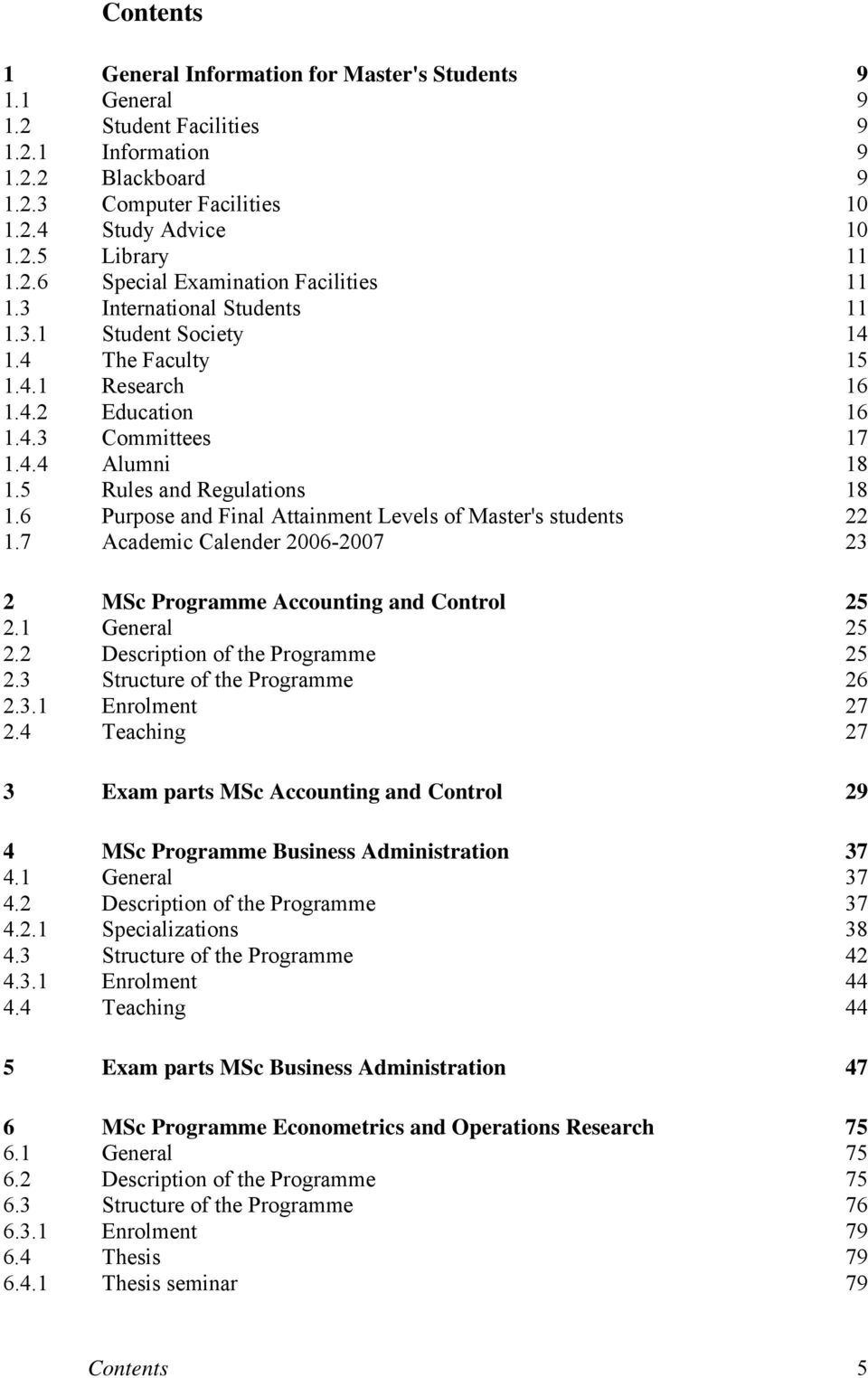
3 Contents 1 General Information for Master's Students General Student Facilities Information Blackboard Computer Facilities Study Advice Library Special Examination Facilities International Students Student Society The Faculty Research Education Committees Alumni Rules and Regulations Purpose and Final Attainment Levels of Master's students Academic Calender MSc Programme Accounting and Control General Description of the Programme Structure of the Programme Enrolment Teaching 27 3 Exam parts MSc Accounting and Control 29 4 MSc Programme Business Administration General Description of the Programme Specializations Structure of the Programme Enrolment Teaching 44 5 Exam parts MSc Business Administration 47 6 MSc Programme Econometrics and Operations Research General Description of the Programme Structure of the Programme Enrolment Thesis Thesis seminar 79 Contents 5
4 6.4.2 Writing the thesis Teaching Entry requirements 83 7 Exam parts MSc Econometrics and Operations Research 85 8 MSc Programme Economics General Description of the Programme Structure of the Programme Enrolment Teaching Exam parts MSc Economics MSc Programme Economics: Spatial and Transport Economics General Description of the Programme Structure of the Programme Enrolment Teaching Self-study programme Exam parts MSc Economics: Spatial and Transport Economics MSc Programme Finance General Description of the Programme Structure of the Programme Enrolment Teaching Exam parts MSc Finance MSc Programme Finance: Honours Track Quantitative Finance General Description of the Programme Structure of the Programme Teaching Goals of the Programme Entrance Requirements Exam parts MSc Finance: Honours Track Quantitative Finance MSc Programme Marketing General Description of the Programme 161

5 16.3 Structure of the Programme Enrolment Teaching Exam parts MSc Marketing MPhil Research Master Programme Tinbergen Institute The Graduate Programme Admission requirements Information and application Premasters Economische Wetenschappen en Bedrijfskunde De premasteropleiding Programmabeschrijving Werkvormen Programma premasters Premaster Accounting and Control Premaster Business Administration Premaster Finance Premaster Marketing Praktische regels ten aanzien van de premasteropleiding Informatievoorziening Onderwijs- en examenregeling Regels en richtlijnen voor tentamens en examens (Rules and Regulations) Extra tentamentijd Studievoortgangscontrole Toelatingsvoorwaarden premaster Assessment Meer informatie Exam parts Premasters Overgangsregelingen Overgangsregeling Bedrijfswetenschappen Overgangsregeling doctoraal naar bachelor-masterstructuur Overgangsregeling Economie Overgangsregeling Econometrie & OR 212 Contents 7

6 8 Economics and Business Administration mastercourses

7 1 General Information for Master's Students 1.1 General Address Vrije Universiteit Amsterdam Faculty of Economics and Business Administration De Boelelaan HV Amsterdam (0) Faculty Board Prof. dr. H. Verbruggen, dean Prof. dr. J.W. Gunning, research Mr. P. Sneep, MSc, education Mr. R. Zandvliet, student-representative Managing Director Mr. F.A.M. Snijders, MSc 1.2 Student Facilities Information Most information concerning your studies you will find in this study guide and on the departmental website If you cannot find the information you need, you can visit the programme secretariat on the second floor of the main building, room 2A-16. Its staff can provide additional information on exams, registration, diplomas, et cetera. On the notice boards and monitor screens across the secretariat you find time schedules, exam results and other information relevant to your studies. It is important to check the notice boards regularly. Important information on registration, deadlines or changes in the programme is sent to you by . Every student is provided with his own faculty address. Information is sent to this address only! As you are also responsible for proper maintenance of your account, be certain to check this regularly. Information is also published in the departmental section of the University's newspaper Ad Valvas. This paper appears every Thursday and can be collected free of charge from several distribution points in the main building. Every student is supposed to be familiar with announcements made in Ad Valvas. Finally, relevant course information is published on Blackboard. You are advised to check this regularly Blackboard Blackboard is the faculty's digital learning environment. A large part of the teaching is supported by this. Blackboard is used to hand out assignments, lecture sheets, additional literature and information on courses. Students are normally required to General Information for Master's Students 9

8 hand in assignments through Blackboard. All students are required to be familiar with this programme. Manuals can be found on the faculty website: Computer Facilities The Faculty has ten computer rooms with circa 200 computers available to students. They are located on the third floor and in rooms 1A-19 and 1B-04/14. All computers are equipped with standard software relevant to economic and business sciences. All students have free use of the computer network. This includes storage capacity on the network. Students all have their personal faculty address. Opening hours are: Monday to Thursday from , Friday from and Saturday from hrs. The computer rooms may be closed for personal use when they are needed for teaching purposes. During holidays, the computer rooms are closed in the evenings. The computer helpdesk will assist you if you experience difficulties. It also sells computer disks, printing credits etc. The helpdesk is located in room 3A-16. Problems or questions can also be reported by University ICT-resources Besides faculty facilities, the University offers computer facilities that are relevant to students of all faculties. Examples of this are TIS (the automated Examination Information System), Blackboard, changing personal information such as address, etc. Apart from a faculty user name and password, you will therefore also receive a University user name and password, the so-called VU-net-ID. For questions concerning this, students are referred to the Central Students' Desk in the hall of the main building. For more information visit the University s digital helpdesk at Study Advice The Faculty has four study advisors for student counselling. They offer assistance in planning your studies, and give information on courses and the programmes. They may also offer help when students are confronted with exceptional personal circumstances that hamper their progress. The study advisers for Economics and Business Administration are: Ms. Karin Loos, MA Ms. Ella Noordhoek, MA vacancy The study advisors can be contacted on Monday, Tuesday, Thursday and Friday from hours or by appointment in room 2A-24. Contact is also possible by telephone on the same days from hours and by [email protected]. The study advisor for Econometrics & Operations Research is: Dr. R. Nobel, [email protected], consultation by appointment only. 10 Economics and Business Administration mastercourses
9 1.2.5 Library The University has a well-stocked library, with a large collection of books and journals for economic sciences and business administration. The Economics department of the library is located on the third and fourth floor of the main building. Access is only possible via the entrance on the third floor. The lending library is open daily from hrs. During holidays, opening times may differ. Many journals and articles are also available electronically. for use elsewhere at the university or at home via the internet. For more information see the library's website: Library instructions are an integral part of the first-year study programme. Students may also make use of other faculty libraries, such as Psychology (2nd floor) Social Sciences (7th floor), or Sciences (6th floor of the Science building) Special Examination Facilities If you are dyslexic or suffer from a physical or sensory disability that may hinder you when taking exams, you can contact one of the study advisors to see what special facilities are available. Your request must be accompanied by a medical certificate, issued no more than one year previously, from a physician or a psychologist. In cases of dyslexia, your request should be accompanied by a statement from a generally recognised dyslexia testing institute. If your request is granted, you should report to the programme secretariat (room 2A-16) 40 minutes prior to the commencement of the examination. 1.3 International Students The faculty is fortunate to welcome many international students to its Master's programmes. An experienced International Office will help you register and settle in quickly into your new surroundings. The International Officer in charge of the coordination of the Master's programmes for international students is Ms. M. Wichink Kruit, MSc room 2E-70 (2nd floor of the main building) [email protected], Telephone: (0) In written correspondence you can use the address below: Vrije Universiteit Amsterdam Faculty of Economics and Business Administration, 2A-20 De Boelelaan HV Amsterdam The Netherlands International students are advised to contact her on arrival in the Netherlands. She will assist you with any queries you might have and will help you register. You can of course also contact her beforehand if you have any questions. Below you will find the most important details on visa, housing and registration. Please make sure you have read them carefully before setting out for Holland. General Information for Master's Students 11
10 Residence permit and visa requirements The rules for obtaining a residence permit vary, depending on your country of origin. Please check the information below at the Dutch embassy in your own country, or surf to Details of the procedure outlined in this section may have changed by the time you read this. Once you have received the letter of admission to the programme, the Office of International Affairs will apply, on your behalf, for an Authorisation for Temporary Stay (Machtiging tot Voorlopig Verblijf or MVV) and health insurance (which is compulsory for all foreigners) if applicable. All foreign students staying in the Netherlands for more than three months must have a residence permit. Students who are nationals of another European Union country, or those from Norway, Iceland, Australia, Canada, Japan, Liechtenstein, Monaco, New Zealand, the United States or Switzerland can apply for a residence permit after they arrive in the Netherlands. If you are from a country other than those listed above then you must have an Authorisation for Temporary Stay (MVV) before entering the Netherlands. The Office of International Affairs will apply, on your behalf, to the Immigration and Naturalisation Service (IND) for an MVV. Once this permit has been issued, you can obtain your entry-visa to the Netherlands at the Dutch embassy or consulate in your home country. Without an Authorization for Temporary Stay, you will not be able to obtain a residence permit once you have arrived in the Netherlands. In order to obtain the permit you will require: a valid passport two recent colour photos a letter of acceptance as a student of the Vrije Universiteit adequate health insurance proof that you have accommodation proof of your ability to cover all study costs and other expenses, e.g. in the form of a grant or allowance. Health insurance Before coming to the Netherlands, you should contact your own insurance company to find out whether it can provide extra medical cover for your stay abroad and whether you can take out a personal public liability policy. If you cannot obtain supplementary coverage in your home country, then you can take out a policy through the faculty's International Affairs Officer. To this end, the VU has concluded an agreement with Lippmann, a Dutch insurance company. This provides for supplementary medical expenses and a public liability policy. Without health insurance you will not be accepted for the MVV procedure (see above). Checklists Before travelling to the Netherlands you must have: a valid passport a visa or Authorisation for Temporary Stay (MVV), if applicable a letter of acceptance confirming that you are taking part in a master programme at the Faculty of Economics and Business Administration of the Vrije Universiteit Amsterdam. 12 Economics and Business Administration mastercourses

11 proof that you have the financial means to cover your stay in the Netherlands a birth certificate (in English) or a passport if you are married, a marriage certificate three recent colour passport photos a medical insurance policy with extra medical cover for treatment abroad, and a personal public liability policy. If you cannot obtain supplementary cover in your own country, you can take out a policy through the International Affairs Officer (see above, under 'Health Insurance'). On arrival in the Netherlands Once you have arrived in the Netherlands you must contact the faculty's International Affairs Officer and ask for a letter confirming your status at the VU register at the Student Admissions, Examinations and General Course Information office register with the local authority (civil register) if you intend to stay for more than four months. In order to register, you will need your passport and the proof of application for your residence permit as well as a birth certificate (in English) and, if you are married, a marriage certificate. Accommodation The Vrije Universiteit has a limited number of rooms available for foreign students. The standard furnishing of these study bedrooms includes a bed, a desk and cupboard. Bathroom and kitchen facilities are shared. Upon arrival, students are required to pay a deposit and the first month's rent in advance. Each master student is guaranteed a room, which will be reserved by the Office of International Affairs. All applications for accommodation must be received before the 1st June deadline. Faculty registration Following your arrival, you should first contact the Office of International Affairs in order to complete your registration. The best way to contact the International Officer is by [email protected]. In writing please use the address above. When registering, you must bring the following documents with you (unless you have already sent them by post): a valid passport a visa or Authorisation for Temporary Stay (MVV) copy of (the proof of application for) your residence permit proof of registration at the municipality certified copy of your bachelor's diploma proof of payment of the tuition fee photographs Information Information about the Netherlands can be found in the booklets entitled An introduction to Living in Holland and Practical Guide to Living in Holland, both of which can be ordered from Nuffic (Netherlands Organization for International Cooperation in Higher Education). General Information for Master's Students 13

12 1.3.1 Student Society Aureus Aureus is the study association for all students of the Faculty of Economics and Business Administration at the Vrije Universiteit, except for econometrics students. Aureus functions as an intermediary between the students, the faculty and business life. It has 3000 members of which 125 are actively involved in our organization. Together the organize an array of activities, offering members self-development opportunities and valuable social contacts. Aureus aims to offer all Economics and Business students additional value during their studies by organizing academic, career, international and social activities in which they can participate In this way students get to know fellow-students, learn vital job-application skills, gain organizational experience and get in touch with business life. Bookstore The Aureus Bookstore - room 2A-11 - offers study books, subtracts and summaries to Aureus members with a discount of 10-15%. The bookstore opening hours: Monday Tuesday Friday Membership To become an Aureus member you only have to pay a on- time membership fee of 35,-. After payment you are an Aureus member for the entire duration of your study period. The bookstore discounts add up so quickly that the membership fee can be earned back well within six months! Furthermore the passive membership enables you to make use of the Aureus intranet where you can find old exams and the internship database. Subscription forms can be found at the Aureus Bookstore. Active Membership All Aureus activities are organized by active members. They can be seen as the employees of Aureus. Becoming an active member of Aureus gives you the opportunity to gain great organizational experience, get to know other students and cooperate with renowned names in Dutch business life. You learn how to work in a team and how to set up an activity successfully. It is a greatest opportunity to put into practice what you learn in class! Aureus organizes monthly drinks for its active members and an active-member-weekend once a year. If you wish to become an active Aureus member, fill in the subscription form in the Aureus Bookstore, drop by the office - room 6A-03 - or send an to [email protected]. International Aureus organizes several activities aimed especially at International Business Administration students and English speaking participants. Examples of this are: - European Study Trip - SVS International Research Project - Amsterdam Career Days - exchange activities - introduction week 14 Economics and Business Administration mastercourses
13 These activities are organized by English-speaking students and are conducted in English as well. Are you interested in organizing or participating in one of these activities, write an to Contact Study association Aureus, de Boelelaan 1105, room 2A-11, 1081 HV Amsterdam, tel , Kraket Kraket organizes study-related activities for students of Econometrics and Operations Research. Business excursions to for example Price Waterhouse Coopers, ING, KLM or other enterprises serving as prospective working environment for econometrists are part of the programme. It also organizes study travels abroad. Kraket also publishes Aenorm, the faculty magazine on Econometrics, in which staff, students and alumni publish regularly on a variety of econometrical topics. The society works closely together with other student societies for students of Econometrics of other universities. Finally, Kraket makes sure that there is enough room for entertainment, drinks, sports tournaments and fun in general. Membership is cheap and gives you a 10% discount on study books, available from the Kraket bookshop. Kraket is located on the first floor of the main building, room 1a [email protected], website: Faculty Student Council The Faculty Student Council (FSC) represents the interests of all faculty students. It consists of five members, yearly elected by students of the faculty through the University's election procedure. It participates together with members of staff in the joint assembly, which advises on, or approves of, decisions made by the Faculty Board. The FSC is also responsible for student participation in various committees, including a student representative attending meetings of the Faculty Board. All students can contact the FSC directly at [email protected]. 1.4 The Faculty The Faculty of Economics of the Vrije Universiteit was established in In 1987 the Faculty merged with the Faculty of Actuarial Science and Econometrics to form the Faculty of Economics, Business Administration and Econometrics. Currently the Faculty is referred to as FEWEB (which stands for the Dutch equivalent of Faculty of Economics and Business Administration). FEWEB is a medium-sized faculty, with approximately 3000 students, 1500 postdoctoral students and about 400 academic and non-academic members of staff. The faculty is headed by the Faculty Board, consisting of the dean, the director of education and the director of research. A student-representative attends the Faculty Board meetings in an advisory capacity. General Information for Master's Students 15
14 Members of staff are organized into eight departments, each headed by a professor. These departments are responsible for the research and education programmes of the faculty: Department of Economics and Development Economics Department of Accounting Department of Finance Department of Management and Organization Sciences Department of Marketing Department of Spatial Economy Department of Econometrics and Operations Research Department of Information Sciences and Logistics Research Research at the faculty is organized into 16 research programs. All education programs are supported by scientific research. The major research fields of the faculty are regional economics, labour economics, econometrics and development economics. In these areas the faculty has relatively large, internationally outstanding research groups. Furthermore, there are four research institutes affiliated to the faculty: The Tinbergen Tinbergen Institute (TI) is the graduate school and institute for economic research of the economics departments of Erasmus Universiteit Rotterdam (EUR), Universiteit van Amsterdam (UvA) and Vrije Universiteit Amsterdam (VU). It was founded in 1987 by these three economics departments and is located in both Amsterdam and Rotterdam. TI currently has an annual influx of around 25 MPhil students, who receive training and supervision from the Institute s senior research fellows. Centre for World Food Studies (SOW-VU): concerned with contract research in the field of food supply. Amsterdam Centre for Business and Economic Research (AMBER): concerned with contract research for companies and not-for-profit organisations in the fields of general economics and business economics. Amsterdam Research Centre in Accounting (ARCA): carries out research into financial accounting, management accounting and auditing Education The Faculty offers four undergraduate, seven full-time master, two part-time master and thirteen post-master programmes. Three undergraduate-programmes and the parttime and post-master programmes are taught in Dutch, the bachelor's programme International Business Administration and the full-time Master's programmes are in English. Admission to any of the post-master programmes is dependent on the master you have taken. It leads to further specialisation and professional education. For more information on the post-master programmes see the website: For more information on Research and Education you can contact Onderwijscentrum VU, 16 Economics and Business Administration mastercourses

15 telephone: , website: Undergraduate programmes (Dutch-taught) BSc in Economics and Business BSc in Econometrics and Operations Research BSc in Business Administration Undergraduate programme IBA (English-taught) Bsc in International Business Administration Master's programmes full-time (English-taught) MSc in Accounting and Control MSc in Business Administration MSc in Econometrics and Operations Research MSc in Economics MSc in Economics: Spatial and Transport Economics MSc in Finance, both regular and honours track Quantitative Finance MSc in Marketing MPhil in Economics, Econometrics or Finance (two-year research master) Masterprogrammes part-time (Dutch-taught) MSc in Accounting and Control (in combination with post-master programme Accountancy) MSc in Business Administration Post-Master programmes (Dutch-taught) Chartered accountant (Registeraccountant) Registered Controller Controller in public en non-profit sector Certified Management Accountant Certified Financial Manager Chartered Financial Analyst Register EDP-Auditor Management Consultant Change Management Treasury Management Financial and Investments Specialist Research and Education (teacher training programme, full-time and part-time) Committees There are several committees, often including student members, active within the faculty. These advise the Faculty Board. The Faculty places great emphasis on student participation. Any student following a course of study within the Faculty is eligible to participate in a committee. This usually involves the intercession of the Faculty s Student Council. The following committees are of importance to students: Programme Committee These committees advise the Faculty Board on issues relating to teaching, such as the design of the programme, the Academic and Examination Regulations, and General Information for Master's Students 17

16 bottlenecks in teaching. The programme committee consists of members of the academic staff and students. Each programme has its own programme committee. Examination Board The examination board is responsible for maintaining proper procedure during examinations and examinations, and for awarding the results. The examination board makes decisions concerning exemptions, and gives approval for the inclusion of extra-faculty optional subjects in the examination programme. In addition, they can consent to departures from normal procedure on the ground of exceptional circumstances. The examination board consists of members of the academic staff. Students can contact the examination board via Library Committee The library committee consists of four members appointed from among the academic staff, and one student appointed at the intercession of the faculty's Student Council. The library committee's task is to make recommendations concerning any written information pertaining to the Faculty s teaching and research activities, and regarding the way in which the Faculty s funds for collection building are dispensed Alumni All alumni receive the faculty s relation magazine Vuurwerk and the University s alumni magazine Gewoon Bijzonder twice a year. In addition, activities for graduates are organised regularly to promote contact between graduate economists, econometricians, and the staff of the Faculty. For us to contact you it is important that we have your proper address. If you wish to remain informed, send any change of address also to: Vrije Universiteit Amsterdam; alumni bureau; attn. Ms Charlotte Vroon, room 1H-62; De Boelelaan 1091; 1081 HV Amsterdam; Netherlands. Econometrics Alumni Association The Econometrics Alumni Association at the Vrije Universiteit Amsterdam was founded in Its purpose is to help graduates to stay in touch, both with one another and with the Econometrics Department. In addition to publishing the alumni newsletter Econometristen in Actie (Econometricians in Action), the Association organizes an annual reunion which is attended by many graduates who are keen to find out how everyone is getting on. A list of graduates is also published. The alumni can all use this to find out what their contemporaries are doing these days, and where they are working. 1.5 Rules and Regulations All formal rules pertaining to teaching and examinations are laid down in the Academic and Examination Regulation. This document is accessible via the faculty's website: Below you will find a summary of the most important rules and regulations. 1. Registration for exams Students must register for exams at least eight days prior to the commencement of the examination in question. Registration is by means of the University's registration system TIS. TIS is accessible via 18 Economics and Business Administration mastercourses

17 Failure to register may result in your being unable to take part in the exam. You can only take part if there is room in the examination hall and if there are sufficient examination papers. You can only get the result of your exam after you have paid a fine. Only in very exceptional cases can the examination board deviate from this examination registration regulation, at the request of the student concerned. 2. Examination timetable Students are given details of the examination timetable well in advance. This is done via the website When drawing up the timetable for examinations, the examination board can only take in account those public holidays and other free days that have been designated as such by the Executive Board of the Vrije Universiteit. 3. Starting times and examination halls On the day of the examination, the starting times and examination hall layout will be displayed on the monitors or notice-boards in the hall near the programme secretariat. Information displayed on the monitor is also accessible via the faculty website: 4. Code of conduct for examinations 1. During a written examination, students are required to hand over their university registration card (or other means of identity bearing a photograph) so that their student number can be checked against the list of students registered for the examination 2. During written examinations, students are required to follow the invigilator's instructions concerning the maintenance of order in the examination room 3. There is no free choice in seating: seating is allocated 4. You may only bring with you: pen, pencil, pencil sharpener, eraser, ruler and calculator. Sometimes a graphic calculator may be used, subject to approval by the examiner. Other attributes may not be used and may not be present on your writing desk 5. Students arriving after the examination has started may be excluded from participating in the examination 6. Students may not leave the examination room until one hour after the start of the examination 7. The use of mobile phones during the written examination is prohibited. 8. You will not be permitted to leave the examination hall within one hour of the start of the examination 9. Students must hand in their examination papers to one of the invigilators and are required to sign the list of registered examination candidates 10. Students are prohibited from removing examination writing paper after the examination has ended 11. At the end of the examination students must remain seated until the invigilators have collected all examination papers General Information for Master's Students 19

18 12. If fraudulent acts are detected during a written examination, the relevant article of the Academic and Examination Regulations comes into effect 5. Examinations 1. The descriptions of each subject in the study guide include details of the examination format used for that course 2. The material to be covered by the test includes lecture material, which can also be available in written or digital form 3. Components can be tested by means of a written examination, an oral examination, a testamur, a practical, or a combination of these 4. Students are restricted to the examination format used in the academic year in which the component is taken 5. In special cases, the Examination Board can grant students or examiners permission to use a different examination format and/or a different number of examination opportunities 6. At their written request, students who suffer from a physical or sensory disability are offered the opportunity to sit the examinations in a way that, as far as possible, takes account of their particular disability. The facilities available for this purpose consist of examinations whose nature and/or duration are attuned to the situation of the individual concerned. Practical aids may also be provided 7. The request referred to in paragraph 6 should be submitted by students to the study advisor each time they register for an examination during which their disability is to be taken into account. The request should be accompanied by a medical certificate, issued no more than one year previously, from a physician or a psychologist. In cases of dyslexia, the student's request should be accompanied by a statement from a generally recognised dyslexia testing institute. If the student's request is granted, the student should report to the programme secretariat 40 minutes prior to the commencement of the examination. 8. If the examination board grants permission for students to use an additional examination opportunity, the examination format is decided on by the examiner 6. Fraud In cases of fraud, the examination board awards the student in question a mark of zero points. The examination board can also bar the student from sitting one or more future examinations for that programme, for a period of no more than twelve months. 7. Examinations can also cover lecture notes Insofar as a given examination component includes teaching, questions may also be asked concerning the material covered in the lecture notes for the most recent academic year. 8. Marking and inspection of exams 1. A period of ten working days is allowed for the marking of written examination papers. 20 Economics and Business Administration mastercourses

19 2. In case of an oral examination, the examiner informs students of their result immediately following the examination and hands them a written statement. 3. In case of components consisting of simulation games, business games, tutorials or practical courses, the examiner determines the final results within ten working days following the termination of the course. 4. After receiving the final results from the examiner, the programme secretariat carries out checks and publishes the results via the lists (in which students are identified only by their student number) which are posted on the notice-board and via the Examination Information System. 9. Assessment 1. The assessment of a completed examination component is given in whole points, or consists of the qualification pass or fail 2. Constituent marks are given in the decimal system, ending in one decimal 3. In the case of a testamur, which consists of component examinations or several components with constituent marks, rounding off is applied to the final mark 4. If averaging or rounding off of constituent marks is needed tot establish the final mark for a completed examination component, this is done according to the regulations as specified in Regulations and Guidelines 5. Students are considered to have passed a given examination component if they are awarded a mark of 6 or higher, or the qualification pass 10. Sitting the same examination more than once If a student sits the examination for a given subject more than once, then it is the most recent mark that counts. 11. Period of Validity 1. Successfully completed components of the Master's programmes remain valid for two years. The Examination Board can extend a component's period of validity in special cases. 2. Successfully completed components of the pre-master's programmes are valid until 31 August of the academic year in which the results were issued. The Examination Board can extend a component's period of validity in special cases. 3. A completed pre-master's programme certificate remains valid for five years. 12. Non-validity of examination results Sometimes students must have express permission from the examination board to sit a given examination. This applies, for instance, if you want an extra opportunity to sit the examination, if you want to take the examination in a non-standard way (e.g. oral rather than written) or if you have failed to satisfy the registration requirements for examinations. In such cases, lecturers (examiners) are not permitted to conduct General Information for Master's Students 21

20 examinations nor, as the case may be, to announce the results of an examination without the express permission of the examination board. If, in such cases, an examiner announces the results without the permission of the examination board, students cannot appeal to the examination board concerning the validity of the examination results. 13. Decisions Examination Board Students who submit a request to the examination board can request a verbal exemption from the administrative secretary of the examination board on the day after it meets. A written reply will be sent by as soon as possible. Examination Board decisions of a general nature are published in the university newspaper, Ad Valvas, and on the Faculty s homepage. 14. Final Examination of the Master's Programme 1. A student has passed the final examination of the Master's Programme if he has passed each examination component in the Master's Programme and if the results are valid at that time. 2. The examination board determines the result of the final examination on the last working day of the month in which the student applies for the final examination 3. Notwithstanding the provisions stated in paragraph 2 the examination board can institute an investigation into the student's knowledge and/or skills when the individual results give cause to this. 4. When the examination results of a component are no longer valid when determining the final result, the examination board can impose an extra or additional examination before determining the final result 5. Candidates who complete the examination successfully will be awarded the degree of 'Master of Science'. 6. The Master's degree is awarded in accordance with the Examination Board's regulations. 15. Concluding the pre-master's programme Provided that all results have been properly recorded, the Examination Board awards a pre-master's programme certificate to all students who have passed every test in the pre-master's programme. 16. Right of appeal Students who dispute the assessment are advised to contact one of the study advisors as soon as possible. The study advisors can advise them on which procedures to follow. In case mediation fails, the Examination Board will pronounce a verdict. Following the verdict of the Examination Board, the student in question has the option of lodging a further appeal with the university's Examination Appeals Board. 1.6 Purpose and Final Attainment Levels of Master's students The Faculty of Economic Science and Business Administration has formulated the following purpose and final attainment levels for all master's students: 22 Economics and Business Administration mastercourses

21 All Master's students must develop into honourable academics, responsible practicians and responsible members of society. Highest priority is given to achievement of the highest possible level of know-how and expertise in the field of the relevant Master's programme. All Master's students must be able to operate at an academic level in terms of intellectual development and the quality of their work. The following attainment targets have been formulated on the basis of these general principles. Every Master's graduate: must have the know-how and command of the theoretical and methodological domain of the Master's programme, both in terms of breadth and depth must be capable of conducting scientific research and be able to set up, conduct and report on a research project in a scientifically-responsible manner (demonstrating a scientific approach when describing, explaining and predicting phenomena) knows how to access scientific information and is capable of studying and evaluating such information critically (has the required attitude for life-long learning and professional development) knows how to tackle practical problems, whether social or academic, creatively and systematically. Must be capable of using his theoretical and methodological knowledge to clarify or solve a problem (Must have a problem-solving attitude.) knows how to present his findings clearly, both orally and in writing, without losing sight of quality. must be able to operate at an academic level in terms of intellectual development (logical, well-considered, critical, creative, ethical and independent). must be able to operate at an academic level in terms of the quality of his work. Must be able to set up and execute projects logically, systematically and independently, and has the required social and communication skills. Must also have the practical skills necessary for setting up as a professional (languages, ICT, presentation and writing skills, independence etc.). must be able to communicate on attitudes and values and is aware of the ethical aspects and social context of his work, both in the academic and in professional practice. 1.7 Academic Calender The planning for the academic year is as follows: lectures for period self-study period exams period lectures for period self-study period and resits period exams period lectures for period exams period 3 General Information for Master's Students 23
22 lectures for period self-study period and resits periods 2 and exams period lectures for period self-study period and resits period exams period lectures for period exams and resits period 5 and resits period 6 No lectures or examinations will be held on the following dates: 25 December January 2007: Christmas Holidays Friday 6 April: Good Friday Monday 9 April: Easter Monday 30 April: Queen's Birthday Thursday 17 and Friday 18 May: Ascension Day; Bank Holiday Monday 17 June: Whitsun 15 July - 03 September: Summer Holidays 24 Economics and Business Administration mastercourses
23 2 MSc Programme Accounting and Control 2.1 General The Master's programme in Accounting and Control provides advanced study of accounting and financial management. The programme is an academic one, approaching Accounting and Control from a scientific angle. It deals with all aspects of generating, reporting and using financial data in organisations, thus offering the student a thorough grounding in the field of financial management ('controlling'), financial reporting and auditing. The subjects covered include the provision of financial information, financial planning, financial operations management, the drawing up of the annual financial report and auditing the annual accounts. 2.2 Description of the Programme The master's programme takes one year. The first semester aims at providing the student with a thorough knowledge of the core courses in Accounting and Control, such as Advanced Management Accounting, Advanced Financial Reporting and Empirical Research in Accounting. This last course introduces the student to advanced research methods and academic skills needed in carrying out scientific research. It also serves as preparation for writing the master's thesis. The first semester also provides room for specialisation. By choosing two specialisation courses, the student can opt for four areas of specialisation: Accountancy, Controlling, Information Management and Accounting Research. Students not opting for any of these four areas of specialisation are free to specialise according to their own wishes by choosing other master courses taught in the faculty. After approval of the examination board, it is also possible to fill the area of specialisation with courses taught outside the faculty. At the end of the first semester, students start writing their master's theses. The second semester offers the core course Corporate Law and an integration project, in which accounting is placed within the context of Corporate Governance and Risk Management. It also provides room for the second specialisation course. At the end, students finish writing their master's theses. To this end the student carries out an independent academic research project and reports on this in his thesis. Carrying out the research project and writing the thesis takes about three months. The master's thesis is written individually. Students are, however, required to take part in the concomitant thesis seminar, in which the research findings of the students are periodically presented and critically discussed. Specialisation Accountancy This specialisation provides an in-depth training into managing administrative organizations, drawing up annual financial reports and financial management. It provides the student with the theoretical framework and professional skills to fulfil financial positions in large organizations, where they often act as counterpart of the external accountant. It also qualifies students for admission to the post-master programme of chartered accountant. Students wishing to specialise in Accountancy MSc Programme Accounting and Control 25
24 take three specialisation courses: Audit Theory, Financial Accounting Theory and Control & Audit. They write a master's thesis of 12 ects. Specialisation Controlling This specialisation aims at providing the student with a thorough knowledge of generating and using financial and economic data used for internal decision making in organizations. It leads to positions such as Financial Manager or (assistant) Controller in both commercial and non-profit organizations. It also gives direct admission to the post-master programme Registered Controller. Subjects include Corporate Finance and Management Control. This specialisation can only be attented by students who have knowledge of Corporate Finance at at least intermediate level. Completion of the third-year course Corporate Finance (BSc Economics and Business) is a prerequisite for attending the Master's course Corporate Finance. Specialisation Information Management Information Management provides the student with in-depth knowledge of the design and operation of automated information systems. Graduates are employed as system designer of IT-specialist. Graduates also qualify for entrance to the post-master programme of EDP-auditor. Courses in this specialisation are Management of Information Systems and either Financial Accounting Theory or Control & Audit. Specialisation Accounting Research The Accounting Research variant provides students with training as researcher in the field of Accounting, Control and Auditing. They will become thoroughly familiar with research in these areas and acquire the skills and research methods used in academic research. Graduates are employed as researcher, both academic and in financial organizations. 2.3 Structure of the Programme Period 1 (Sept-Oct) Period 2 (Nov-Dec) Period 3 (January) Period 4 (Febr-Mar) Period 5 (Apr-May) Period 6 (June) Empirical Research in Accounting Advanced Financial Reporting Advanced Management Accounting Specialisation course / optional course (1) Thesis Corporate Law Specialisation course / optional course (2) Corporate Governance, Risk Management and Control Thesis and thesis seminar 1) Thesis 26 Economics and Business Administration mastercourses
25 1) Students opting for the specialisation Accountancy take the third specialisation course Control & Audit in this period. This replaces part of the thesis: they write a master's thesis of 12 ects. All other students take two specialisation courses and write a thesis of 18 ects. Specialisations Accounting and Control Specialisation Specialisation courses: period Leads to post-master programme (Dutchtaught): Accountancy Audit Theory Financial Accounting Theory Control & Audit Controlling Corporate Finance 1 Management Control Information Management Management of Information Systems Choice between: - Financial Accounting Theory - Control & Audit Chartered Accountant Registered Controller EDP-auditor Completition of the third-year course Corporate Finance is a prerequisite for attending this course at Master's level Enrolment For many optional courses from other master's programmes, you need to register in advance in order to be admitted. You can do so at For instructions, see Announcements in the opening screen. More information on the contents of courses can be found in your study guide. Remember that you do not have to restrict yourself to the courses above; you are free to select any other optional course, as long as it is at Master's level. 2.4 Teaching The academic year is divided into six teaching periods: four periods of eight weeks and two periods of four weeks. The programme's study load is 60 credits. Credits are expressed in ects: European Credit Transfer System. Each credit amounts to circa 28 hours studying. Tuition is mostly carried out in small groups. Much attention is paid to an active method of studying. This includes writing study papers, working out cases and preparing practical assignments. In this way students become familiar with the application of advanced theory to practical work. It also serves to integrate the theory studied in the individual courses into a comprehensive body of knowledge. Papers are written both individually and in groups of two or three students, thus furthering the students' ability to work in teams. Much time is also devoted to presentation and discussion of one's work to fellowstudents and staff and group discussion of e.g. research papers. The small-scale tuition environment provides an excellent opportunity for guidance and feedback by staff and other students. Apart from developing the student's communicative skills in oral and written presentation, much attention is paid to the development of critical judgement in assessing research work of others. Tuition and supervision of the thesis is carried out by senior members of staff who are actively engaged in research themselves. Thus, the student is offered a unique MSc Programme Accounting and Control 27
26 opportunity to become familiar with the latest scientific developments in top-level academic research. Assessment is based on papers and reports handed in during the course, on participation during lectures and tutorials and on a written exam. Examinations are held at the end of each teaching period. Resits are held at the end of the next period. 28 Economics and Business Administration mastercourses
27 3 Exam parts MSc Accounting and Control subject Advanced Financial Reporting 4.1 code contact 36 hours (36 lecture) and discussion sessions based on assignments. period 1 lecturers prof.dr. C. Camfferman RA; drs. A. Bavelaar aim Enable students to understand and apply International Financial Reporting Standards. content This course is intended for students who have a solid grounding in financial accounting. The course will build on this to develop an understanding of the way International Financial Reporting Standards (IFRS) affect present-day financial reporting by large enterprises in the European Union and many other countries. Apart from a brief introduction to the work and status of the International Accounting Standards Board, the course consists of a review of most of the extant International Financial Reporting Standards. The emphasis will be on understanding the key accounting issues in each standard, so that students, upon completing the course, will be enabled to use the standards with confidence to find the answers to specific reporting questions, and to read financial statements based on International Standards. Students are expected to study some standards by themselves. More complex topics or topics that will be less familiar will be the subject of lectures and/or assignments. literature International Financial Reporting Standards Bound Volume, London: International Accounting Standards Committee Foundation, 2006 examination format written interim examination entry requirements A knowledge of financial accounting equivalent to Financial Accounting 3.1 will be assumed. subject Advanced Management Accounting code lecturer prof.dr. T.L.C.M. Groot (and other lecturers) contact 24 hours (24 lecture) period 2 aim Students will learn more advanced management accounting theories and methods, applying statistics and use computer software for cost calculation, profitability analysis and decision making under uncertainty. content Advanced techniques will be applied to short term planning problems, estimating linear and non-linear cost behavior, decision making under uncertainty, cost allocation, variance investigation and capital budgeting. Each week students are asked to solve a case, using Excel's linear programming, matrix calculation and regression analysis tools. literature Hirsch Jr, M. L., Advanced Management Accounting. London/Singapore: Thomson Learning, 2000 examination format written interim examination and cases for bonuspoints. Exam parts MSc Accounting and Control 29
28 subject Audit Theory code contact 36 hours (36 lecture) workgroups and teamwork(cases) period 2 co-ordinator dr. P.W.A. Eimers RA aim An introduction into auditing with applications to different audit settings, like financial audit, legal audit, environmental audit and operational audit. We will discuss the fundamentals of audit activity, and the organizational as well as professional aspects of audit work. Special attention will be given to the financial audit and to the specific institutional settings in which financial audits take place. We conclude this course by analyzing developments in markets for audit services by approaching the audit profession form an economic standpoint. content Audit and assurance theory (Flint, agency-theorie, assurance framework, ISAE 3000) Assurance services: differences in services provided and the way in which these services are produced Economic approaches of auditing: production functions, pricing, audit quality, auditor independence, and auditor liability issues Institutional arrangements of the auditing function: legal provisions, ethical issues, international auditing standards, oversight of the auditing profession, the relation between auditor and internal audit committee literature Hayes et al, Principles of Auditing, an introduction to International Standards on Auditing, 2004 Flint, Philosophy and Principles of Auditing. 1988, Hampshire: Macmillan (relevant chapters available on Blackboard) IAASB, Handbook of International Auditing, Assurance, and Ethics Pronouncements, 2006 (available on Blackboard) A selection of articles in academic journals examination format written interim examination subject Control and Audit code contact 24 hours (24 lecture) period 5 co-ordinator prof.dr. O.C. van Leeuwen lecturers prof.dr. O.C. van Leeuwen; prof.dr. R.J.M. Dassen aim Assess risks within the organisation and design and assess an internal control system to mitigate these risks. Assess risks in relation to the reliability of financial information and design and assess internal controls to mitigate these risks. Design a program to audit these internal controls. content Students will practice applying theoretical knowledge of the design of internal control systems in several types of organizations. We will practice with different types of organizations like trading companies, manufacturing and service companies. The students will work with practical cases. Using the same format, students will practice at the same time examining and 30 Economics and Business Administration mastercourses
29 testing the operating effectiveness of internal controls for financial audit purposes. This will be based on international auditing standards. form of tuition The course will be given in six lectures of each four hours. The lectures are divided in a theoretical part of two hours and a practical part of two hours. Subjects of the theoretical part are the theory of 'Accounting Information Systems' and 'Auditing' and the relationship between these subjects. In the practical part students will present an at home prepared case. The cases will be prepared by small teams of students. The sheet presentation must be put on Blackboard before Wednesday. One of the teams members presents the sheets in the lecture. The teacher inspects all the presentations and gives a grade for the presentation. Furthermore students will get a grade for their participation in the lectures. The results gained during the lectures are 50% of the total rating for this course. If this average rating is less than a five, it is not allowed to take part in the examination. literature Hayes et al., Principles of Auditing, An introduction to International Standards on auditing. Prentice Hall, last edition Vaassen, Accounting Information Systems, a managerial approach. Wiley, last edition The Committee of Sponsoring Organizations of the Treadway Commission, Enterprise Risk Management-Integrated Framework If any, other literature will be given during the lectures examination format written interim examination Presence in the lectures and participation is a part of the examination. If presence and participation are sufficient a written examiniation follows. entry requirements you either passed the bachelor Vu examination of Accounting Information Systems or the Overall toets (OAT) and did the examinition of Audit Theory subject Corporate Finance code lecturers Prof.dr. A.B. Dorsman; prof.dr.ir. H.A. Rijken contact 36 hours (12 working group, 24 lecture) period 2 aim Achieve advanced knowledge in the theory and practice of corporate finance. content This course elaborates on the course corporate finance in the bachelors program. We will start off with a short review of the theory of Modigliani and Miller. Thereafter we introduce comprehensively the concepts of the operational cash flow and the finance cash flow of a company. Within the framework of these concepts we will pay attention to the issues on capital structure from the perspective of both the equity holders and the debt holders. A range of corporate financing options, like subordinated bond and convertibles, will be reviewed. In the second part of the course we will address topics like how to value companies, how to measure value creation, timing of mergers and acquisitions and (executive) performance measurement. As these topics appear frequently in the news, substantial attention will be given to real life cases (agency questions and restructuring cases in practice) during the course. Exam parts MSc Accounting and Control 31
30 examination format written interim examination paper entry requirements Corporate Finance 3.2 subject Corporate Governance, Risk Management and Control code contact 24 hours (24 lecture) workgroups and cases period 5 co-ordinator prof.dr. O.C. van Leeuwen aim This course aims at gaining an in-depth understanding about the relation between the top stucture of an organization, the quality of the information tot control that organization and how companies organize internal control systems in order to enhance the quality of this information. In assuring good corporate governance practices, the roles of management and oversight bodies and the role internal audit departments will be explained. Internal control measures are also discussed in relation with management control systems and techniques. A final theme is the way in which management can provide an 'in control statements' such as requested in the Sarbanes-Oxley act content The main topics are: Corporate governance structures, international differences in corporate governance systems and practices, corporate governance practices in different industries and in non-profit organizations Risk management: methodes and techniques for assessing and controlling business risks In-control statements: how can corporate management assure the integrity and reliability of business information for accounting and control literature To be decided later A syllabus containing a series of articles and cases examination format written interim examination Presence in the lectures and participation is a part of the examination. If presence and participation are sufficient a written examiniation follows. entry requirements you either passed the bachelor Vu examination of Accounting Information Systems or did the Overall toets (OAT) subject Corporate Law code co-ordinators prof.mr. J.B. Huizink; mr. J.E. Brink-van der Meer lecturer mr. P.A. Ledeboer contact 36 hours (12 casecollege, 24 lecture) period 4 aim Corporate Law deals with the key issues in international company law. The objective of this course is to broaden the perspective and understanding of the participants of differences in legal approaches to commercial organisations and deepen their knowledge and insight of international influences (on Dutch law), especially the law of the European Union on 32 Economics and Business Administration mastercourses
31 company and corporation law. content The course is organized around six clusters: Introduction and basics of European Company Law Internal Governance of companies Directors and supervisory directors; shareholders and minority protection Transnational mergers and protective devices; regulation of stock exchanges Introduction Dutch company law/capital protection Director's liability / Corporate governance examination format written interim examination 50 %, presentation 30 %, paper/assignment 20 %. subject Empirical Research in Accounting code contact 36 hours (12 discussion group, 24 lecture) The course will consist of lectures and discussion classes, which include student presentations. The lectures will provide an overview of the method to be discussed. During the discussion classes empirical research papers employing the particular research method will be presented and discussed. period 1 co-ordinator drs. M. Schoute aim The purpose of this course is to explore and provide an understanding of the different research methods employed in accounting research. At the end of the course the student should have a strong enough understanding of the different methods discussed to be able to interpret and critically evaluate empirical accounting studies. content Empirical research in accounting relates to financial accounting, management accounting and auditing. In this accounting research a wide variety of research methods is used. This variety stems from the diversity of theories used, topics and questions studied and the research methods researchers have at hand. Some general patterns can be observed though. For instance, while financial accounting research often builds on publicly available data archives, management accounting research often builds on company specific data. This difference partly stems from the difference in questions these domains of accounting are interested in, but also to the availability of data. The course starts with an overview of the types of questions studied in empirical financial and managerial accounting research and the types of methods and data used for analysis. After this overview the remainder of the course is structured following the research methods most frequently employed in accounting research. Each method will be studied in depth in relation to the type of question it is suitable for. In this analysis, the focus will lie on both the use of the method and the (accounting) domain it is being used in. Academic papers from academic accounting journals are studied and discussed to provide a deeper understanding of the strengths, weaknesses and boundaries of the method and of the application by the authors. literature The literature used during this course is twofold. The first part consists of overview papers of the research methods discussed. The second part consists of research papers in which the respective methods are applied. examination format written interim examination Exam parts MSc Accounting and Control 33
32 Students' evaluation will be based on three parts: 1 review reports on (and a presentation of) research papers 2 an assignment in the form of a (limited) empirical study 3 a written exam at the end of the course entry requirements none subject Financial Accounting Theory code contact 36 hours (36 lecture) and discussion sessions based on assignments. period 4 lecturer prof.dr. C. Camfferman RA aim Provide students with an overview of the main approaches to research and theory building in financial accounting. content Financial Accounting has a rich tradition of theory and research. The richness stems in part from the tension between, on the one hand, the fact that financial accounting evolves in practice and must to some extent be taken as it is, and, on the other hand, the fact that it claims to be a rational, purposive activity that can be researched and criticized from that perspective. This tension has given rise to various research approaches or streams of thought, some of which will be dealt with in this course. Topics include: the distinction between the 'measurement' and 'information' interpretations of financial accounting; understanding the significance of (im)perfect and (in)efficient markets for financial accounting; market-based research: measuring 'value relevance' of accounting information; understanding accounting choice: contracting cost; principal-agent and economic consequences; institutional issues in financial accounting; accounting as a social phenomenon. literature Scott, W., Financial Accounting Theory. 4th edition, Toronto: Pearson, 2006 A selection of articles from the research literature examination format written interim examination entry requirements A knowledge of financial reporting equivalent to Advanced Financial Reporting 4.1 will be assumed. subject Management Control code contact 24 hours (24 lecture) Integrated and interactive approach, combining lectures with case and paper presentations period 4 co-ordinator dr. H.C. Dekker lecturers dr. H.C. Dekker; drs. P.C.M. Claes aim The aim of this course is to acquire a thorough understanding of the components of management control systems, their effects on human behavior, their interrelationships and design criteria. content The contents of this course can be divided into two sections. The first section deals with the control function of management and management control 34 Economics and Business Administration mastercourses
33 system design. This section includes topics such as the cause of control problems and the need for MCS in organizations, management control alternatives and their effects on behavior, and the determinants of MCS design. The second section of the course uses these insights to study MCS in three distinct organization forms: performance measurement and incentive compensation in profit seeking firms management control in public sector organizations management control in interfirm alliances and joint-ventures In analyzing the control function in these three distinct areas of organizational activity, articles from the accounting literatureare critically studied, reviewed and presented. form of tuition This course consists of a combination of lectures, team case presentations and discussions, and individual reviews and presentations of academic articles. literature Merchant, K.A., & W.A. van der Stede, Management Control Systems: Performance Measurement, Evaluation and Incentives. Prentice Hall A selection of academic articles examination format written interim examination case reviews, academic paper reviews, case and paper presentations entry requirements To be able to participate in this Master course students are required to have sufficient knowledge of management accounting & control. Necessary courses students should have taken are Management Accounting 3.4 (Ec.) or Management Accounting & Control 3.1 (B.A.). subject Management of Information Systems code contact 24 hours (12 working group, 12 lecture) period 2 co-ordinator dr. R. Brohm aim The purpose of this course is to get the student acquainted with the strategic issues surrounding the management of information systems in the organization. The learning objectives are: To identify opportunities for the strategic use of information systems in the organization by means of a 'business case' To understand the IT organization needed to develop and implement strategic information systems To understand the strategic management issues during IT project implementation, with specific attention to IT outsourcing, and project escalation content The course starts with an introduction of the strategic importance of information systems. A number of classic examples are covered, together with newer examples. We then discuss a number of frameworks to systematically identify opportunities for the strategic use of IT. The student will learn how to justify a strategic information system through the application of these frameworks. literature To be announced on Blackboard. examination format written interim examination and cases. Exam parts MSc Accounting and Control 35
34 36 Economics and Business Administration mastercourses
35 4 MSc Programme Business Administration 4.1 General The Master's programme in Business Administration focuses on a combination of strategic issues and organizational concerns in Business Services. The programme takes in four specializations: Finance, Banking & Insurance; Transport, Distribution & Logistics; E-business & Knowledge Management and Management Studies. The Master's programme in Business Administration aims at students who have acquired a broad knowledge in the field of Business Administration and offers them the opportunity to become a specialist in one of its areas. As the programme is an academic one, it provides the student with rigorous academic training and acquaints him with state-of-the-art theoretical background. 4.2 Description of the Programme The master's programme takes one year and consists of a number of general courses and a number of specialization courses. At the start of the programme, each student makes a choice for his area of specialization from one of the four following: Finance, Banking & Insurance; Transport, Distribution & Logistics; E-business & Knowledge Management; Management Studies. Each specialization consists of two core courses and two track courses. The first core course provides the student with a first orientation on his area of specialization. Following that, the student takes a second specialization course and chooses one of the tracks belonging to his specialization. The tracks offer further in-depth expertise in the area chosen. Apart from the courses offered in the specializations, there are courses obligatory for all masters's students. Each student takes a course in Strategy, Control and Design, in which for instance complex questions of strategic organizational design are studied, and Academics Skills and Competencies, in which students are familiarized with advanced research methods, data collection and carrying out scientific research. Students also attend a course in Ethics, in which problems of integrity in organizations are studied, and the student's ability at recognizing and analyzing these problems is practised. All students also attend the compulsory Management Integration Project and make a start with the thesis. Finally, students have room for one optional course. The latter may be chosen from master courses taught within the faculty and serves to give room to widening one's academic interest. After approval of the examination board, it is also possible to opt for a course taught outside the faculty. A large part of the programme is devoted to carrying out an independent research project and reporting on this in the master's thesis. To this end the student carries out an independent academic research project and reports on this in his thesis. Carrying MSc Programme Business Administration 37
36 out the research project and writing the thesis takes about three months. The master's thesis is written individually, however, students may be required to take part in the concomitant thesis seminar, in which the research findings of the students are periodically presented and critically discussed. Guidelines for participating in the thesis seminars and writing the master's thesis are laid down in Manual Master's Thesis Business Administration. The manual can be found on Blackboard Specializations Specialization Finance, Banking and Insurance The department of Finance offers Master s students Business Administration two possibilities of specialization. Core courses taken by all students in Finance Banking and Insurance are Finance, Banking and Insurance and Strategic Financial Management. Students can specialize in Finance (F) or in Banking and Insurance (BI). The contents of these two tracks are described below. Students conclude the tracks by writing a Master s thesis. They are recommended to develop a research plan in which theoretical research (academic literature) is combined with empirical research. This can be done in the optional course Capita Selecta (see the next paragraph Structure of the Programme). Track Finance The two courses Advanced Financial Reporting and Treasury and Corporate Risk Management offered in this track focus on the financial management function at corporates. Modern financial management at corporates involves the financing decision itself (see strategic financial management), financial reporting, treasury and risk management. This track aims to provide the student an overview of these key areas of a CFO. The department of finance encourages students to write a thesis in the area of finance. Track Banking & Insurance In this track we will deepen the knowledge on Banking & Insurance you received from the courses FBI and Strategic Financial Management. The first course, Pension and Insurance Management, focuses on risk management, one of the core processes of financial institutions. Whereas the course FBI considers the global environment, the second course, European Financial Integration, deepens the understanding of European financial markets. Europe offers many business opportunities for financial institutions. The aim is to analyze and evaluate strategic options for expansion (for example through mergers & acquisitions). After you have finished the track Banking & Insurance you are equipped to: Analyze risk management systems at financial institution level; Understand how European financial markets work and how you can measure financial integration; Develop business proposals for expansion in Europe; Have interesting job opportunities at Financial Institutions. Specialization Transport, Distribution and Logistics The departments Information & Logistics and Spatial Economics offer Master students two possibilities of specialization. The core courses to the specialization are Transport, Distribution & Logistics, with an introduction to the two tracks, and Advanced Transport, Distribution & Logistics, with in depth knowledge of modes of transportation and the implementation of Supply Chain Management. Students can 38 Economics and Business Administration mastercourses
37 then specialize in the Transport Sector or in Distribution Logistics & Supply Chain Management. The contents of these two tracks are described below. After finishing the tracks students write a thesis in the area of their specialization. You may in some cases combine that with an empirical assignment during the optional course Capita Selecta (see the next paragraph Structure of the Programme). Track Transport Sector This track offers the student the possibility to become familiar with strategic problems faced by companies in the transport sector. We distinguish between different modalities, but the airline industry and shipping receive special attention. Common issues such as fare structures receive special attention. The two courses in this track are Network Analysis and Airline Business. After you have finished the track Transport you have: A broad knowledge of the transport field; Are aware of recent scientific developments in this field; Are able to understand similarities in the behaviour of transport companies belonging to different sectors. Track Distribution Logistics & Supply Chain Management National and multinational companies offer many jobs for specialists in Demanddriven Supply Chain Management. In this track we will deepen the knowledge on DL & SCM you received from the courses TDL and Advanced TDL. SCM is impossible without advanced information systems. In the track we look at the suitability of Warehouse-, Transport and Order management systems from a user s point of view. In the second topic the design and operation of Supply Chains is modelled and decision making tools for Supply Chain Management are discussed and evaluated. The two courses in this track are Supply Chain Execution and Decision Making in Supply Chains. After you have finished the track Distribution Logistics & SCM you are equipped to: Analyze logistical problems at company level and at supply chain level; You know the pitfalls and opportunities for companies to cooperate in SCM; You can design and implement Supply Chain tools; Have job perspective at Logistics Service Providers, Manufacturers, Wholesalers and Retailers. Specialization E-Business and Knowledge Management Information technology has become an indispensable asset to shape modern organizations. It provides the means for many organizational innovations. The specialization E-Business and Knowledge Management discusses the impact and value of these innovations. Examples of this are: New ways of communications between business partners as in electronic business; New ways of attracting consumers and doing business as for example with marketing and sales via websites; New ways of sharing information and knowledge as in knowledge management. Although these innovations are based on technology, realizing these changes in organizations is in many cases an organizational challenge rather than a merely technical one. This specialization focuses mainly on organizational issues. The two MSc Programme Business Administration 39
38 core courses in this specialization are E-Business and IT-Industry, which contains an introduction to the two tracks, and Management of Information Systems. Students finish the track with a thesis on one of the various topics related to the track. It is strongly recommended to write this thesis based on an empirical (quantitative or qualitative) research study. The empirical research can be the main part of optional course Capita Selecta (see the next paragraph Structure of the Programme). It is the intention of the supervisors to help students conduct high quality research that can be published or presented at a conference. Track E-Business Students of the E-Business (EB) track develop a thorough understanding of the role of technology innovation in the networked economy. Traditional organizations are transformed into network organizations that are enabled by technological innovations such as online services, Internet marketing channels and mobile devices. This track offers students a broad range of career opportunities as business analyst in companies as well as government organizations to transform their organization from a traditional to a networked one, and to improve their online and mobile service delivery. Courses in this track are Interactive Marketing and Interorganizational Systems. After you have finished the track E-Business you have acquired knowledge in the fields of: Design of innovative online and mobile services Marketing analysis of online and mobile services Development of business models for technology innovation Strategy and change management of technology innovation Track Knowledge & Organization Students specializing in the Knowledge & Organization-track develop a broad view on the role of knowledge within and between organizations. Private as well as public organizations all recognize the central importance of knowledge as their key resource. As a result, this interest is growing rapidly into a relatively new and very promising discipline focusing amongst others on topics such as knowledge management, (online) communities, resource based theory of the firm, organizational learning and social networks. The field is multi-disciplinary and finds connections with information systems, marketing, human resource management, strategic management, technology and innovation as well as related fields such as regional economics. Students specializing in this discipline will be able to analyze and consult organizations in managing and supporting knowledge, in the strategic value of knowledge, and in scanning knowledge processes and opportunities within the organization as well as in relation to its environment. As the discipline is also of rapidly evolving within organization theory, students will also learn how to study knowledge within and between organizations. Due to its multi-disciplinary character, this track offers students a broad range of career opportunities, such a Management Consultant, Human Resource Manager, or a (PhD) research position. Courses in this track are Organization, Development and Change and Knowledge Management. Specialization Management Studies The department Management and Organization offers Master students three possibilities of specialization. Student can specialize in Human Recourses Management (HRM), in Strategy and Organization (S&O) and in Management Consulting (MC). The three tracks are presented below. Common in these tracks are the core courses: Management Studies, with an introduction into the three tracks, and 40 Economics and Business Administration mastercourses
39 Organization, Development and Change. The final part of the Master s program is the Master s thesis. In this assignment, students apply and intensify theories and skills to study or solve problems in their area of specialization, thus applying, integrating and extending the body of knowledge so far acquired. Note: It is strongly recommended to write a thesis in combination with an empirical assignment. This can be done as the main part of the optional course Capita Selecta (see the next paragraph Structure of the Programme). Track Human Resources Management The HRM track offers the possibility to specialize in human resources management. The HRM track is a starting point for professional careers in the field of HRM. HRM professionals have extensive and varied employment opportunities at both national and international level. These opportunities are not limited to traditional personnel department work. Rather, this track guarantees a broad spectrum of possibilities, such as a career in consulting firms, service organizations, governmental organizations, or other organizations in which policy and practices around HRM are a key part of the organizational strategy. The two courses offered in this track are Performance Management and Control and Human Resource for Business Services. After you have finished the track human resources management you are trained to: Analyze the domain of HRM in complex social situations (familiarity with case study research); Evaluate complex HRM issues in organizational contexts (articulation of acceptable criteria and norms); Legitimize HRM-recommendations by means of sound argumentation; Recognize different interests concerning HR policies and practices of the stakeholders in and around the organization; Make recommendations in order to improve the employment relationships between employer and employee. Track Strategy, Organization & Innovation Students specializing in the Strategy, Organization and Innovation track develop a broad view on the functioning of organizations in their environment. They are able to analyze and deconstruct the various functions of an organization, to analyze the interdependencies between them, and to define and redefine their functions in serving customers, stakeholders and others groups in the environment. This is achieved through the two courses in this track: Strategy and Innovation and Organization and Innovation. Students joining the SOI-track are prepared for a first job as management assistant, junior manager, and junior coordinator in organizations. They are focused on the development and improvement of the service-facilities of their organization, and obtained knowledge in the field of: Strategy and strategy development; The design of strategies and organizational structures; The implementation of strategies and organizational structures; The analysis of the organization s environment; The development of innovative services for various markets. Track Management Consulting The final specialization is in management consulting. As a consultant you should not only be able to analyze, but often you have to articulate recommendations as well. You have to decide what is better or worse. You have to convince your client. The MSc Programme Business Administration 41
40 track management consulting prepares you for a first job as junior consultant, junior policy adviser or junior consultant in a staff role. Employers can be governments, large firms and consulting companies. Courses in this track are Policy Evaluation and Policy Advice and Knowledge Management. After you have finished the track management consulting you are trained to: Analyze complex social situations (familiarity with case study research); Evaluate complex social situations (articulation of acceptable criteria and norms); Legitimize recommendations by means of sound argumentation; Recognize different interest of your client/stakeholders; Deal with resistance to change. You should have knowledge of: Possible interventions in management domains like strategy, organization design, HRM, knowledge management etc.; Different consultant roles, skills and approaches; Different schools in change management. 4.3 Structure of the Programme Period 1 (Sept-Oct) Period 2 (Nov-Dec) Period 3 (January) Period 4 (Febr-Mar) Period 5 (Apr-May) Period 6 (June) Specialization course (1) Strategy, Control & Design Specialization course (2) Track course (1) Ethics Academic Skills & Competencies Managerial Integration Project; start thesis Track course (2) Optional course Thesis Thesis 3 ects 3 ects 42 Economics and Business Administration mastercourses
41 Specialization and track courses: Specialization Finance, Banking & Insurance Finance, Banking and Insurance Strategic Financial Management Plus one of the following two tracks Period 1 2 Track Finance Advanced Financial Reporting (Business Administration) Treasury and Corporate Risk Management Track Banking and Insurance Pension and Insurance Management European Financial Integration 2 4 Specialization Transport, Distribution & Logistics Transport, Distribution &Logistics Advanced Transport, Distribution & Logistics Plus one of the following two tracks 1 2 Track Transport Network Analysis The Airline Business Track Distribution Logistics and Supply Chain Management Supply Chain Execution Decision Making in Supply Chains 2 4 Specialization E-Business & Knowledge Management E-Business & IT-Industry Management of Information Systems Plus one of the following two tracks 1 2 Track E-Business Interactive Marketing Interorganizational Systems Specialization Management Studies Management Studies Organization, Development and Change Plus one of the following three tracks Track HRM Performance Management & Control Human Resource for Business Services Track Management Consulting Policy Evaluation and Policy Advice Knowledge Management Track Knowledge & Organization Organization, Development and Change Knowledge Management Track Strategy, Organisation and Innovation Organization and Innovation Strategy and Innovation Optional courses Capita Selecta Business Administration Real Estate Management Organizing Differences Advanced Cross-Cultural Management Entrepreneurship and Small Business Development MSc Programme Business Administration 43
42 Capita Selecta The objective of the Capita Selecta courses is to discuss state-of the-art research on various topics within Business Administration. In these courses, one particular research topic will be analyzed in depth; this topic depends on the track of the specialization chosen. Thus, students can choose from Capita Selecta E-Business, Finance, HRM, Transport etc. Topics of the Capita Selecta courses will be announced two months before the start. Literature will consist of articles, to be announced by the lecturer. Depending on the lecturer, students can also be involved in ongoing research. Furthermore, it is possible - even recommended - to incorporate the subject of the Capita Selecta course into the master thesis Enrolment For all courses in MSc Business Administration, you need to register in advance in order to be admitted. You can do so at For instructions, see Announcements in the opening screen. More information on the contents of courses can be found in your study guide. As regards the optional courses, remember that you do not have to restrict yourself to the courses above; you are free to select any other optional course, as long as it is at Master's level. 4.4 Teaching The academic year is divided into six teaching periods: four periods of eight weeks and two periods of four weeks. The programme's study load is 60 credits. Credits are expressed in ects: European Credit Transfer System. Each credit amounts to circa 28 hours studying. Tuition is for a large part carried out in small groups. Much attention is paid to an active method of studying. This includes writing study papers, working out cases and preparing practical assignments. In this way students become familiar with the application of advanced theory to practical work. It also serves to integrate the theory studied in the individual courses into a comprehensive body of knowledge. Papers are written both individually and in groups of two or three students, thus furthering the students' ability to work in teams. Much time is also devoted to presentation and discussion of one's work to fellowstudents and staff and group discussion of e.g. research papers. The small-scale tuition environment provides an excellent opportunity for guidance and feedback by staff and other students. Apart from developing the student's communicative skills in oral and written presentation, much attention is paid to the development of critical judgement in assessing research work of others. Tuition and supervision of the thesis is carried out by senior members of staff who are actively engaged in research themselves. Thus, the student is offered a unique opportunity to become familiar with the latest scientific developments in top-level academic research. 44 Economics and Business Administration mastercourses
43 Assessment is based on papers and reports handed in during the course, on participation during lectures and tutorials and on a written exam. Examinations are held at the end of each teaching period. Resits are held in the next period. MSc Programme Business Administration 45
44 46 Economics and Business Administration mastercourses
45 5 Exam parts MSc Business Administration subject Academic Skills and Competencies code credits 3 contact 7 hours (3 tutorial, 4 lecture) period 3 co-ordinator dr. R. Brohm aim This course prepares the student with some of the analytical techniques required for the masters thesis. literature Boje, David M., Narrative Methods for Organizational and Communication Research. London: Sage, 2001 examination format written interim examination entry requirements Participants should have passed the courses Business Research Methods (1st year course) Advanced Business Research Methods (3rd year course) or any equivalent of these subject Advanced Cross Cultural Management code contact 24 hours (12 seminar, 12 lecture) period 5 co-ordinators prof.dr. A.M.R. Trompenaars; S.N. Khapova MBA aim Learning objectives - knowledge: Increase awareness of own cultural assumptions and respect for other cultural perspectives Develop and expand knowledge and understanding about the basic drives behind national and organizational cultural differences, the impact of cultural differences on cross cultural issues in organizations, and methodology issues in cross cultural research Acquire an understanding of the effectiveness of different strategies of international managers Learning objectives - skills: Apply a methodology to elicit, chart and reconcile cultural dilemmas that occur in a business context Clarify the cultural factors influencing their project assignments by applying models used in cross cultural research Diagnose the influence of cultural differences that play a role in intercultural relationships content This course addresses principles and models of cross cultural management issues in organizations. In addition, the course strives to develop personal skills in effectively dealing with cross cultural differences and similarities in an international business context. Furthermore, this course aims at showing how cultural diversity, as opposed to single cultural orientations is more effective at creating lasting solutions to business dilemmas. The first few lectures will look at the fundamentals of culture. Here we will focus on outlining the scientific context of the field of cross cultural management and explain the relevance of culture in society and business. We Exam parts MSc Business Administration 47
46 will then introduce several cultural models including the Trompenaars & Hampden-Turner (1998) culture model to look at national and corporate cultural differences. Based upon this knowledge we will then introduce the dilemma reconciliation theory to learn how we can benefit from cultural differences and resolve them. During the remaining lectures we will apply culture to some business topics such as leadership, strategy development, human resource management, marketing management and change management. form of tuition The course consists of 6 lectures and 6 seminars. The lectures are meant to provide input for students to enable them to apply their acquired knowledge on a number of practical assignments discussed in the seminars. A spiral learning approach will be adopted whereby the fundamentals of culture are constantly related to different business topics. Three assignments will be introduced during the seminars. First is a case study discussion that involves an interactive discussion between two teams of a case study assigned for that week. Second is a cross-cultural business case-study project. Teams will present their projects during the final seminar. The third assignment involves an individual research project. literature Trompenaars, F. & P. Woolliams, Business Across Cultures. West Sussex: Capstone Publishing, 2003 Additional readings to be announced, including a syllabus with password to Intercultural Awareness Questionnaire and Culture Compass cd-rom examination format assignment the final grade for this course will be determined by a combination of two team assignments 40 %, a case study discussion and cross-cultural business case study project together 60 % entry requirements n.a. subject Advanced Financial Reporting 4.1 code contact 36 hours (36 lecture) and discussion sessions based on assignments. period 2 lecturers prof.dr. C. Camfferman RA; drs. A. Bavelaar aim Enable students to understand and apply International Financial Reporting Standards. content This course is intended for students who have a solid grounding in financial accounting. The course will build on this to develop an understanding of the way International Financial Reporting Standards (IFRS) affect present-day financial reporting by large enterprises in the European Union and many other countries. Apart from a brief introduction to the work and status of the International Accounting Standards Board, the course consists of a review of most of the extant International Financial Reporting Standards. The emphasis will be on understanding the key accounting issues in each standard, so that students, upon completing the course, will be enabled to use the standards with confidence to find the answers to specific reporting questions, and to read financial statements based on International Standards. Students are expected to study some standards by themselves. More complex topics or topics that will be less familiar will be the subject of lectures and/or 48 Economics and Business Administration mastercourses
47 assignments. literature International Financial Reporting Standards Bound Volume, London: International Accounting Standards Committee Foundation, 2006 examination format written interim examination entry requirements A knowledge of financial accounting equivalent to Financial Accounting 3.1 will be assumed. subject Advanced Transport, Distribution and Logistics 4.2 code contact 36 hours (12 casecollege, 24 lecture) guest and case lectures period 2 co-ordinators prof.dr. A.R. van Goor; prof.dr. P. Rietveld aim This course also consists of two components of equal size. In the transport lectures we go more in depth on the topics we selected in TDL. The emphasis will be laid on airline companies, using the book from Doganis, but we will discuss also more general transport topics such as safety, the environment, price discrimination. In the logistics part we continue the vision of a demand driven supply chain. Where in the Bachelor topic Introduction to TDL the focus is on decision problems of an individual company, in the Masters, the cooperation between shippers, transport companies and logistics service providers is the central theme. In Advanced TDL you have to apply your knowledge on real life couples of cooperating companies (joining the EVO SCM network and/or the IMCC Chain Competence Center). content DL/SCM part Related to the different steps in the integrated DSCM model, we can raise a number of interesting questions with respect to the collaboration between two or more companies: Strategy: how are the strategies of the chain partners aligned in the format of alliances and collaboration? Missions: are the missions of the chain partners solely formulated in terms of marketing. Sales and costs, or do environmental issues and sustainability also play a role? Structure: how should networks within TDL be designed and equipped? Control: which control systems should be used in the planning and execution of flows of persons, goods and services? Information: how should the information systems of the TDL partners be linked? Organization: Supply Chain managers are process-oriented and replace functional managers in the areas of purchasing, sales, logistics and controlling. Performance: how is performance of a combination of organizations measured? On one of these and others topics in groups of 2 or 3 students the students who choose a TDL direction, have to search the literature. Statements about your findings are addressed to the company's representatives. You conclude with recommendations to your guest-companies. Transport part Exam parts MSc Business Administration 49
48 With a focus on international airlines, we discuss airline marketing, forecasting demand, product planning, price policies and fare structures and will pay special attention to the economics of air freight. Further, and this in a broader transport setting, we focus on typical issues such as price discrimination, measurement of customer satisfaction etc. Students who choose a transport direction, are expected to write a short paper about a transport direction topic. literature Doganis, Flying off course, third edition, chapters 7-11 Reader on Blackboard with selected articles examination format written interim examination 70 %, working papers or a similar assignment 30 % entry requirements Transport, Distribution and Logistics. subject Airline Business code contact 24 hours (24 lecture) and working groups period 4 co-ordinator dr. A.J.H. Pels lecturer dr. M. Lijesen aim The aviation sector is a popular topic in the media. Airport noise, airport expansion, airport privatization, airline alliances, airline bankruptcies, new aircraft design etc. etc. frequently are the topic of heated debate. This course looks at recent developments in the airline industry from a scientific perspective. The deregulation of the aviation markets in 1978 (in the U.S.) and in the 1980s and 1990s (E.U.) led to some drastic changes in airline strategies and management styles. The origins and consequences of the of these changes are considered in this course. Why did you pay more (or less) for your ticket than the person sitting next to you in the aircraft. Why do KLM and easyjet have different network types? Why is it so important for KLM to enter an alliance agreement? By the end of this course, the student can answer such questions, and explain recent developments in the airline industry using basic economic knowledge on pricing, cost structures, and network design. Furthermore, the insights can be used to explain developments in other transportation sectors. content Airline pricing, airline cost and network design are three important aspects that will be discussed throughout the course; each of these aspects will return in a number of lectures. The lectures specifically deal with the following topics: Airline markets Airline pricing Airline output and market structure Airline cost Network design Network competition Home carrier advantage Network management Revenue management A working group (competition game or computer assignment, based on the 50 Economics and Business Administration mastercourses
49 literature number of students) is planned following the lectures on network design and competition. A short essay is written following this working group; this is part of the examination Stephen Holloway, Straight and level: practical airline economics. Aldershot: Ashgate, 2003 examination format written interim examination essay entry requirements participants are expected to have basic familiarity with theories of pricing and cost (discussed duting introduction TDL). A short fresh-up lecture is available. subject Decision Making in Supply Chains code co-ordinator dr. I.F.A. Vis contact 24 hours (12 working group, 12 lecture) period 4 aim In todays highly competitive markets supply chains face the challenge to increase the flexibility to react on changes in customer's demand and to decrease costs, inventories and lead times. To meet these demands logistics and supply chain managers need to solve complex decision problems. These decision problems concern the design, planning and control of logistics processes in single companies and between cooperating companies in the supply chain. These processes occur, for example, at hospitals, airports, distribution centres and factories. Applications can be found in the area of service industries, design and control of production processes and information systems. One approach to deal with complex decision problems is simulation. With simulation one can mimic the behaviour of real-life situations on a computer. Simulation is a technique to model proposed or existing processes. A simulation model gives the opportunity to make key decisions quickly before implementing changes in an existing system or building a new system. In designing or redesigning and analysing logistics processes in supply chains simulation is one of the most frequently used tools. This course aims to provide you with knowledge and experience in simulation to deal with complex logistics decision problems. content In this course you learn to use discrete simulation as a tool for analysing, modelling and improving logistics processes in supply chains. You will gain hands-on experience in creating computer simulation models for operations such as a hospital emergency room, an airport, a distribution centre and a factory. By following lectures and by using a simulation tool, you are able to: understand basic principles of simulation perform statistical analyses on input data and results model processes validate and verify models design experiments run experiments document on results interpret the results. Exam parts MSc Business Administration 51
50 form of tuition The course consists of a mixture of plenary lectures, workshops and practiceoriented cases. In the lectures the basic principles of building models, simulation and statistical analyses will be treated. The workshops serve to provide you with feedback while you are working on your case assignments. literature Recommended: Kelton, W.D., R.P. Sadowski & D.T. Sturrock, Simulation with Arena. 3rd edition, McGraw-Hill, 2004 examination format written interim examination cases and an oral defence or a written exam, depending on the number of students following this course. entry requirements Students specialising in Transportation, Distribution and Logistics of the Master programme Business Administration can follow this course without any additional entry requirements. All other students first need to contact the coordinator to discuss admission to this course. subject E-Business and IT Industry code contact 24 hours (24 lecture) period 1 co-ordinator prof.dr.ir. J.W.M. Gerrits (and guest lecturers) aim Students know what the important developments in the industry are Students know what challenges managers of companies in the industry are faced with. Students have detailed knowledge of a specific area as a starting point for their master thesis. content Defining the Industry. The industry consists of all companies in IT, telecom and e-business services: Hardware manufacturers & software developers Telecommunication providers & networking providers Hosting providers & ASPs IT outsourcing providers IT-consultants, business consultants & strategy consultants Implementation consultants (e.g. for ERP and CRM) Website agencies Advertising agencies These companies are discussed in detail in the bachelors' course. The course gives a short overview. Main trends in the industry: these trends are introduced in the lectures. Lectures are either based on theory, e.g. network economics or are guest lectures to illustrate the challenges for management. literature Articles. examination format oral interim examination paper subject Entrepreneurship and Small Business Development code contact 24 hours (24 lecture) The course consists of a combination of lectures (seminars) and assignments, which allows the students to translate theoretical concepts into practical 52 Economics and Business Administration mastercourses
51 experiences. The course will provide students with ample opportunities to gain practical experience regarding topics and issues being taught. period 5 lecturers drs. E.A.H. Kleijn; prof.dr. A.R. Thurik aim The aim of this course is to create insight into the role of entrepreneurship in modern economies, and into the management of small businesses and new ventures. content Small businesses are important for innovation, employment creation and economic growth, exploiting market niches and variation, economic dynamics and market functioning. The small business sector is also an important environment for entrepreneurship. The course focuses on aspects of small business management, such as small business finance, management and leadership, business plans, etc. The seminar also deals with the different stages of small business development - start-up, growth, consolidation, cashing -and the specific challenges these stages pose for the owner-manager (entrepreneur). Special attention will be paid to the concept of entrepreneurship: the role of risk and uncertainty, entrepreneurship as a source of innovation, and ways of corporate entrepreneurship (e.g. intrapreneurship and extrapreneurship). literature Recommended: Carter, Sara & Dylan Jones-Evans, Enterprise & Small Business. Pearson Education, 2000 Kirby, David, Entrepreneurship. McGraw-Hill, 2002 examination format written interim examination and oral examination, on the basis of literature and assignments. subject Ethics code credits 3 contact 16 hours (8 working group, 8 lecture) period 3 co-ordinator prof.dr. E.J.J.M. Kimman aim To become competent in describing moral problems To be able to analyze moral problems in organizations To know how to apply concepts of moral philosophy content Moral philosophy and organization ethics. Each author likes to state which questions are fundamental for a disicipline, such as economics, law, or ethics. It seems that classical ethics is about four fundamental questions. The course, however, is about organizational ethics. That is not a rather limited form of ethics but, on the contrary, a quite new field of ethics. The course briefly will explore questions such as these: What should I do if I wish to live a moral life? How should our society look like if we wish to live in a world of peace and justice? How should corporations and non-profit organizations be managed in such way that they proceed in a morally acceptable manner? What is Corporate Social Responsibility? What is the ethics of professions such as medicine, law, accountancy, politics, etc.? In Ethics five competences will be considered: Exam parts MSc Business Administration 53
52 How to recognize and describe a moral problem To know the difference between principles, values, and norms To know the main traditional modes of arguing To distinguish between the responsibility of participants or employees of an organization and the responsibility of the organization and its management To be able to connect the concept of a pluriform society with the need for professional and business ethic. literature to be made available during 1st lectures. examination format written interim examination subject European Financial Integration code contact 24 hours (24 lecture) period 4 co-ordinator prof.dr. D. Schoenmaker lecturers drs. L.A. van Eerden; prof.dr. D. Schoenmaker aim Europe increasingly determines the environment in which managers of financial firms and policy-makers operate. The purpose of this course is to get the student acquainted with the economic and legal drivers of European integration. The emphasis will be on European integration of financial markets and institutions. content The course starts with an introduction of the European Union (EU). The economic dynamics of the EU are analyzed with the Single Market (1992) and the Economic and Monetary Union (1999) as important milestones. Also the use of legal instruments (e.g. Regulations and Directives) to foster integration is reviewed. The main part of the course deals with European integration in the field of financial services. Central themes are: 1. Degree of integration Are financial markets already integrated in Europe? Which strategies can financial institutions apply to achieve their expansion in Europe? What are the challenges and barriers to European expansion? 2. Financial supervision, competition and corporate governance rules How can financial stability be fostered at the European level? What instruments can be applied to open national markets? How dominant are the large US investment banks in Europe? How are national corporate governance codes applied throughout Europe? In the last part of the course, we use case-studies to illustrate the process of integration. Examples are the merger of national stock exchanges (e.g. Euronext) and the emergence of pan-european banks and insurance companies. literature To be announced. examination format written interim examination 100 %, closed book. Bonus grade for optional assignment (0, ½, 1). Minimum grade for exam (5). 54 Economics and Business Administration mastercourses
53 subject Finance, Banking and Insurance code co-ordinator drs. L.A. van Eerden lecturer prof.dr. D. Schoenmaker contact 26 hours (26 lecture) and assignments. period 1 aim The aim of this course is to provide students with theoretical knowledge and practical insight in the management of business processes in banking. Basically, the course is dealing with strategic and commercial choices, the translation of banking strategies to business processes and the implementation of change. Further, the course intends to develop practical skills in dealing with complex management problems in quickly changing institutions. The course is linked to the third year BA-program: Introduction to Finance, Banking and Insurance. It is a core course in the specialization Finance, Banking and Insurance. content In the last fifteen years banking business has been subject to encompassing structural and operational change. Far-reaching changes in the traditional product portfolio, a more market-oriented financial intermediation and the use of new financial information technologies have forced banks to strategic and operational reorientation. This necessity has been strengthened by the introduction of new capital adequacy measures for international operating banks. The high level of internationalization in financial markets has created a growing global level playing field, especially for the main segments of the market. In this global financial environment, consolidation in banking and other financial institutions is becoming a major trend in the financial service industry. These developments are at the roots of changes in market structures and are forcing new strategic choices and operational renewals in banking business processes. In this course particular attention will be paid to the development of competitive positions of banks. The program has a strong micro focus in which there will be, as far as possible, an accent on developments in European banking (related to global developments). Topics: Financial market structures and performance of banks: Actual developments in European banking Basics of market structures in banking Efficiency in (European) banking: financial services production processes, input and output measurement Scale- en scope-effects Strategic management in banks: Strategic choices: products, marketing and channels of distribution Strategic choices: forms of cooperation between banks and insurance companies European mergers and acquisitions Implementation of strategy in business processes New regulation in banking and international competition: The new capital adequacy measures of 2004 (Basle-2) Basle-2 and international competition in banking Management of operational risk in banks Exam parts MSc Business Administration 55
54 Risk management in financial conglomerates literature To be announced. examination format written interim examination 60 %, closed book. Assignment 40 %. Minimum grade for exam (5) and assignment (5). entry requirements knowledge on the level of the text books: Koop, Gary, Analysis of Economic Data. 2nd edition, Chichester: Wiley, 2005 Ross, Westerfield & Jordan, Fundamentals of Corporate Finance Boston, McGraw-Hill, 2003 Kohn, Meir, Financial Institutions and Markets. 2nd edition, Oxford: Oxford University Press, 2004 Mishkin, Frederic S., The Economics of Money, Banking and Financial Markets. Boston: Pearson, 2004 subject Human Resource for Business Services code coördinatoren dr. E.C. van der Sluis-den Dikken; dr. S.G.M. van de Bunt-Kokhuis contact 24 hours (12 seminar, 12 lecture) An indiviudally written essay (max. 20 pages) will examine the course. The essay has to be written individually and has to deal with an HRD-affair as discussed during one of the seminars. Next to this, it is required that the HRD-affair is analysed from a theoretical perspective and illustrated by a practical example. period 4 aim This course seeks to establish the emerging role of HRD and to provide frameworks and guidelines for practitioners and students in a range of learning contexts. The program allows delegates to develop a strategic understanding of the role of human resource development (HRD) in modern business organizations and its integration with other strategies. It has been designed to develop the competence in and awareness of the latest developments in HRD practice. content The course builds on the body of knowledge in the field, where appropriate, and provides new approaches to encompass the major themes impacting on individuals and organizations for the 21 st century. HR directors are playing an increasingly important role in developing learning and development processes in order to enhance the contribution of 'knowledge workers' to the strategic development of an enterprise. To facilitate this requires an in depth knowledge of strategic decision making processes from which, in the past, HRD practitioners have been largely excluded. In a series of seminars major themes in the leading-edge HRD research field will be presented. Examples of themes that will be discussed are: the learning and development of HR as discussed in recent scientific literature, current international and crosscultural HR-issues, Life long learning as part of HRM/D, and HRM/D as part of organization strategy. During the seminars the focus lies on the development and learning of young professionals in service firms in today's knowledge economy. In this way the course deals with the management of developmental organizational processes in business services. form of tuition For the aim of the course, a series of interactive seminars will be organized. 56 Economics and Business Administration mastercourses
55 During these seminar series leading-edge HRD research and current practices will be will be addressed by the course coordinators and expert guest speakers. Simultaneously with the lectures, students work on a team assignment in which they discuss self-defined propositions. Each proposition is related to one specific HRD-theme and is discussed from both a theoretical and practical perspective. literature John Walton, Strategic Human Resource Development, Prentice Hall. 1999, ISBN a selection of leading-edge scientific articles on current HRD issues examination format written interim examination A final written exam -60 %- including open-ended questions referring to the prescribed course literature and a team assignment - 40% max. 8 pages - will examine the course. Each team consisting of 3 or 4 members formulates two propositions per lecture. This results in a final team assignment consisting in a total of 16 propositions. subject Interactive Marketing code co-ordinator dr. T. Verhagen contact 24 hours (24 working group) week period 2 aim Building expertise in the field of Interactive Marketing Understand how knowledge in the field of interactive marketing is developed by analyzing articles published in academic journals Being able to choose an appropriate subject for writing a conference paper (work-in-progress paper) Being able to review and comment the preliminary papers (work-inprogress papers) written by your colleagues Develop and work-out a conference paper (work in progress paper) in the field of Interactive Marketing. This paper might function as backbone for writing one's Master's thesis in the Spring of 2007 content In the first three weeks, an area in Interactive Marketing will be introduced. Topics include online advertising, one-to-one marketing, online retailing, permission marketing, online branding, e-satisfaction, e-loyalty, service marketing and hypermedia marketing. Articles from well-established scientific journals will be read and discussed. Students work in teams and individually. Teams hand in discussion points and present one or two articles in front of their colleagues. On an individual base, participants start working on a conference paper (work-in-progress paper) and review the work-inprogress of colleagues. In the last three weeks, participants continue working on their papers. To obtain additional feedback, participants can volunteer for a presentation and discussion of the most important sections of their own work-in-progress. These sections include: (a) introduction/motivation, (b) research objectives and problem statement, c) literature study, (d) development of a theoretical framework to solve the problem statement, including development of hypothesizes, (e) research method proposed, (f) expected academic and managerial contributions. Exam parts MSc Business Administration 57
56 form of tuition Tutorials: 2 x 2 hours per week literature Articles will be made available on Blackboard. examination format presentation Team presentation 15 %, paper review 10 %, paper 75 % entry requirements Students should have knowledge of marketing basics. Knowledge in the field of E-Business / E-Commerce is recommended but not required. subject Interorganizational Systems code contact 24 hours (24 lecture) period 4 coördinator prof.dr. Y.H. Tan aim More and more goods and services are no longer produced in hierarchically structured organizations but in flexible network organizations. Network organizations are more agile and can better respond to fast-moving customer needs. Typical examples of network organizations are: consumer-drive value chains, electronic marketplaces, online auctions and IT outsourcing. Interorganizational systems (IOS) are essential for the success of network organizations. Inter-organizational systems are information systems that support (1) the exchange of electronic documents (purchase order, invoice etc.) and (2) business process integration between different organizations. The focus of the course is on the technological as well organizational aspects of inter-organizational systems that are needed to create network organizations. Also we will study the different strategic approaches to make network organizations successful. Furthermore, management, planning and control aspects of network organizations will be addressed. Though technology is an important topic in this course the course has mainly a managerial focus. content We will study how inter-organizational information systems can support communication and coordination processes between companies in a network organization. Relevant technologies will be discussed such as Enterprise Application Integration (EAI), Extended Enterprise Resource Planning (EERP), Application Service Providing (ASP) and Web Services. Collaborative Planning Forecasting and Replenishment (CPFR) is meant to improve the coordination of activities of individual companies in a network organization; in particular by sharing data about the customer demand on the one side and the logistic processes within the chain on the other side. Interorganizational systems play an essential role in the successful implementation of CPFR. Furthermore, we will pay attention to the integration of customer processes in network structures that are supported by Customer Relationship Management (CRM). Information systems that cross the boundaries of firms offer customers the opportunity to integrate more upstream in the supply chain. Related to this inter-organizational decision support systems will be studied. Another topic that will be studied is the balance between trust and control in network organizations. Traditionally, paper-based documents such as contracts and trade documents were used for control between companies. The challenge is to develop new electronic control mechanisms that create trust in dynamically changing business relations in network organizations. 58 Economics and Business Administration mastercourses
57 form of tuition The course consists of lectures and case sessions. Students are required to write a paper in teams. Results of the paper have to be presented by the teams during the case sessions. We also intend to give students hands-on experience with topics that are relevant for inter-organizational systems. literature Articles, to be announced later on. examination format paper presentation written interim examination subject Knowledge Management code co-ordinators prof.dr. M.H. Huysman; dr. B.J. van den Hooff contact 24 hours (24 lecture) period 4 aim Learn about theoretical aspects concerning knowledge and organizations Gain hands-on experience with academic research (interviews and statistics) and consultancy practices (writing and presenting a report with findings and recommendations) content Knowledge management is a relatively new field within organizations, both in practice as in terms of theory. Knowledge management is about ways to manage knowledge processes such that organizations are better able to learn. It is a multi-disciplinary field, using and contributing to theories on organizational strategy (e.g. ideas taken from the resource based theories of the firm) human resource management and development (e.g. addressing motivational issues related to knowledge) and from the field of information systems (how to support knowledge sharing and development with IT, such as intranets, expert finding systems). Part I of the course concentrates on the theory of knowledge management. Students are asked to read various research articles on organizational learning; intellectual, human and social capital; critical aspects of managing knowledge; IT to support knowledge sharing and knowledge creations; social network analysis. This literature will be discussed in relation with various business cases on knowledge management. This part of the course will be concluded with the writing individual assignments in which the literature is combined. Part II of the course concentrates on bringing the theory into practice by conducting knowledge management research at a company. Central to this research is a knowledge management scan. The scan is used to analyse formal and informal knowledge management practices in organizations. By means of interviews and questionnaires, students are asked to analyse the present knowledge processes within an organization. Qualitative and quantitative (SPSS) analyses methods are used to diagnose the current practices. Teams of students write a consultancy report based on their research findings and give recommendations for the future. At the end of the course, students will present these findings and recommendations at the company. literature Compulsory: reader with scientific articles Recommended reading: M.H. Huysman & D. De Wit, Knowledge sharing in practice. Boston: Kluwer Academics, 2002 Exam parts MSc Business Administration 59
58 examination format assignment Written assignments: individual case assignments 50%, individual participation 10%, final report 40% remarks Students are expected to come to class prepared. Preparation includes: hand in a completed assignment; familiarization with required readings and readiness to participate in class discussions. Non-attendance during part I of the course is only allowed once. Hands-on experience with SPSS is needed. Within the, this course is very time-consuming, and requires students to be active already at the start of the course. Also, the 2nd part of the course (conducting research at a company) requires flexibility in scheduling meetings e.g. with the company (kick-off and end presentation meetings) interviewees, team members and lecturer. subject Management of Information Systems code contact 24 hours (12 working group, 12 lecture) period 2 co-ordinator dr. R. Brohm aim The purpose of this course is to get the student acquainted with the strategic issues surrounding the management of information systems in the organization. The learning objectives are: To identify opportunities for the strategic use of information systems in the organization by means of a 'business case' To understand the IT organization needed to develop and implement strategic information systems To understand the strategic management issues during IT project implementation, with specific attention to IT outsourcing, and project escalation content The course starts with an introduction of the strategic importance of information systems. A number of classic examples are covered, together with newer examples. We then discuss a number of frameworks to systematically identify opportunities for the strategic use of IT. The student will learn how to justify a strategic information system through the application of these frameworks. literature To be announced on Blackboard. examination format written interim examination and cases. subject Management Studies code contact 24 hours (12 seminar, 12 lecture) period 1 co-ordinator dr. C.J. Vinkenburg aim To provide students with: An introduction to the management studies domain An overview of the content of the three tracks within the management studies specialisation: 1. human resource management 60 Economics and Business Administration mastercourses
59 2. strategy and organisation 3. management consulting Insight into the activities of practioners and researchers in this domain Insight into the process of consulting as a core activity within this domain content This course is mandatory for students who specialize in Management Studies. The course provides students with an overview of the domain of management studies, including relevant disciplines, business processes, and examples of research performed in this domain. The three tracks constituting the management studies specialization will be introduced and explained. During the seminars, students will learn more about the consulting process as a core activity in this domain. After this course, students will be able to choose one of the track within the management studies specialization. form of tuition During this course, the management studies domain and the three tracks will be illustrated in hearing lectures and guest lectures. For the seminars, teams of students will work actively on assignments dealing with different parts of the consulting process. During the course, students will write an individual paper about the consulting process incorporating knowledge about management studies and the track of their choice. literature To be announced. examination format paper 75 % assignment 25 % subject Network Analysis code co-ordinator dr. T. de Graaff contact 24 hours (24 lecture) and working groups period 2 aim Firms and consumers typically operate in various types of networks. These can be both physical networks (such as transport and communication networks) and non-physical networks (such as information networks). The main objective of this course is to give you a basic understanding of economic network theory, which enables you to identify the relevance and consequences of networks for firms as well as for consumers. After following this course, you: have a basic understanding of the fundamental economic principles underlying applied network theory understand the role and behavior of various agents (government, consumers and firms) within network sectors are able to understand the economic impacts that various forms of networks (i.e., transport networks, consumer networks, information networks, clustering of firms) have on the nature, size and behaviour of firms are able to determine optimal firm and consumer behaviour conditional on the nature of the network and have used applied network theory with a (stylized) case study, in order to determine optimal firm behavior in combination with the nature Exam parts MSc Business Administration 61
60 of the network content The economic principles behind networks and their consequences for both firms and consumers form the backbone of this course. The lectures specifically deal with the following topics: basic applied network theory government interventions in network sectors clustering and spill-over effects between firms network sectors (e.g. telecom, transportation, energy) information and communication goods switching costs and lock-in effects network externalities the economics behind standard setting A working group is planned following the lectures on applied network theory and government interventions. An essay is written when following this working group and is part of the examination. literature C. Shapiro & H.R. Varian, Information Rule. Boston Harvard Business, 1999 syllabus examination format written interim examination and essay entry requirements participants are expected to have basic familiarity with economic theory (discussed during introduction TDL). subject Organization and Innovation code contact 24 hours (24 lecture) and interactive assignment sessions. period 4 coördinator drs. J.K. Verduijn aim In the track course Organization and Innovation students gain further (theoretical) insight in a number of topics related to organization and/or innovation. Ideally, the topic will be in line with the topic of the student's master thesis (for an overview of topics: see blackboard). The course will - in that case be a substantial contribution to the Theory chapter of the master thesis. At the start of the course, the student will in cooperation with the course coordinator and/or the thesis supervisor - choose a topic and instructor. The student will take the initiative to make further arrangements with their instructor as to what theory will be included and what the (oral) exam date will be. As well, a list of literature will be determined by student and instructor. content The determined list of literature will be the basis for an oral exam and a paper. The paper (10-15 pages) has to be handed in no later than the time of the oral exam. The paper will be a discussion of the literature studied. The acquired theoretical knowledge and insight based on the literature chosen for this course will be assessed through an oral exam (date, time and location to be determined in collaboration with the course instructor). The student prepares a number of topics to be discussed during the exam. And of course, the instructor will bring in his/her own topics that can be either directly or indirectly associated with the conducted literature study. 62 Economics and Business Administration mastercourses
61 literature To be chosen with the supervisor. examination format oral interim examination 50 % paper 50 % subject Organization, Development and Change code co-ordinator drs. G.P. Melker lecturer drs. G.P. Melker (and prof.dr. L.I.A. de Caluwé, a.o.) contact 24 hours (12 seminar, 12 lecture) period 2 aim After this course, students will be able to: Define and explain important terms and concepts from the fields of organization development and change management Describe organizational change processes and organization development in such terms Compare different significant theoretical approaches Know and compare different intervention methods Identify and analyze problems regarding an organizational change process Find solutions for these problems by applying theoretical knowledge and making use of research data Making propositions for the use of specific interventions to solve these problems content The course Organization Development & Change will concentrate on acquiring knowledge and insight in development and changes within organizations. During lectures special attention will be given to general characteristics of organizational change processes and different views in respect to change. The course will also address the different phases of a change process and the accompanying roles and tasks of the consultant. The use of different kinds of interventions will be addressed extensively. The lectures are providing a background, and they are introducing alternative views which may help students to interpret Cummings and Worley critically. In the weekly seminars students have to make and present assignments in which they recommend appropriate changes supported by sound argumentation based on interpretation of the literature. literature Cummings, Th.G., & Ch. Worley, Organization Development & Change, Mason: Thomson South-western, 2005, several chapters Articles, will be announced later on examination format assignment paper subject Organizing Differences code contact 24 hours (24 lecture) + individual consultation hours period 5 Exam parts MSc Business Administration 63
62 co-ordinators drs. D.A. Driver-Zwartkruis; dr. P.J. Peverelli aim introduce the student to the role of differences in an organisation assist the student with gaining a complex understanding of organisation theory and the actual practice in contemporary work environments enhance the student's understanding of the significance of the quantitative, qualitative, emotional and behavioural factors involved in managing differences heighten the student's awareness to the inter-relationship of employee relations and organisational structures (both formal and informal structures content Although there are as many definitions of organisations as there are researchers in this field, all definitions include at least one item: an organisation is a group of actors co-ordinating their resources and activities to execute a certain task in a more efficient way than when doing it individually. Traditional theories stress the need for the actors involved to share to a certain extent a perception of reality. As a result, management theories based on those definitions also focus on unifying perceptions, team building, etc. Contrariwise, from an organisation theoretical approach actors differ in many respects. They differ according to gender, race, religion, place of birth (different countries or different regions of same country), age, education, membership or social networks, etc. These differences are bound to affect the organising processes. Classical management theories tend to regard these differences as a necessary evil, something that exists, but needs to be contained. They often talk in terms of formal and informal processes, in which the former refers to regular co-ordinated actions controlled by the managers and the latter to the informal uncontrollable interactions. In this course we maintain the position that differences between actors are an organic aspect of healthy organising processes, these differences are regarded as the motor of the sustenance of organisations. Management is thus positioned as the tool for perceiving and appreciating differences between actors, and thereby creating value from those differences. The first half of the course will be spent with an introduction to a number of current models of organisational diversity. The second half of the course requires two written exercises, one individual essay report and one case study group report. * Each year, another source of difference will be highlighted as the central theme (TBA). form of tuition lectures, response hour, case study literature Best, Shaun, Understanding Social Divisions. London: Sage, 2005 Relevant scientific articles examination format paper one critical incident- essay report, and one case study report- film entreevoorwaarden recommended: Organisation Perspectives & Dynamics subject Pension and Insurance Management code contact 36 hours (12 casecollege, 24 lecture) students can use simple asset-liability software to determine and evaluate integral asset-liability policies. period 2 64 Economics and Business Administration mastercourses
63 lecturer prof.dr. C.G.E. Boender aim Provide insight in the determination of the integral production- and investment policy (ALM), risk management, and regulation of pension funds and insurance companies. content Definition of pension and insurance products Regulation and accounting rules Market value of liabilities, including embedded options Full description of the asset-liability problem of pension funds and insurance companies: Objectives and constraints, available policy instruments, and risk factors which have to be taken in to account. Special emphasis on the investment policy: State dependent asset allocation, duration, and derivatives-strategies Objectives and methodology of asset-liability projects Cases literature Reader examination format written interim examination 60 % and 40 % based on the participation in the cases. subject Performance Management and Control code contact 23 hours (12 working group, 11 lecture) period 2 co-ordinator prof.dr. P.G.W. Jansen lecturers prof.dr. T.L.C.M. Groot; prof.dr. P.G.W. Jansen; dr. A.A. de Waal; dr. G.J. Schuiling; drs. L. Kerklaan aim In this course we will focus on theories, processes and practices of Performance Management and Control (PMC). By studying leading-edge research and best practices in PMC, the student will be able to analyze and design PMC problems in practice and argue the validity of his/her PMC design using scientific literature. content In a series of teaching classes or lectures the following topics will be discussed: theories and practices of performance management, performance management in professional services organizations, performance appraisal and measurement, internal performance and external contribution, balanced score card, critical success factors, performance indicators, commitment and performance, the dimensions of work performance, performance management, and performance driven behaviour. These themes will be studied from two perspectives: an economic perspective, and a psychological perspective. These topics will be integrated and applied in a design project of an actual PMC system. Students have to work (in teams) at the analysis and redesign for a PMC system and present and discuss their 'work in progress' during six weekly seminars. The design has to be made in the context of an actual organization. This context can be obtained by actually contacting an organization, or by using documents from newspapers, journals, or other sources. Combination of an economic perspective and a psychological perspective in handling the design question is mandatory. Topics from the lectures and the literature have to be integrated into the design. The design should both be feasible, and Exam parts MSc Business Administration 65
64 arguable on account of the literature as discussed during the course. Students have to search for, and use, additional relevant literature. form of tuition Six lectures (teaching classes) on obliged literature. Teachers will discuss the obliged literature shortly. Six seminars are planned (in week 1, 2, 3, 5, 6, and 7) during which student groups present and discuss their design projects. In addition, there is room for further explanation and discussion of the obliged literature. Each seminar lasts max. 3 hours.each group has to present their work in progress several times. An outline of the presentation should be submitted through Blackboard to both the other students and the teacher before the seminar. Students will have to provide constructive feedback. Teachers will act as discussion guide ('chair') and design coach.participation at these project sessions is mandatory. The supervisor using an attendance list will register students' presence. If individual absenteeism exceeds 25 percent of the seminars the student will be expelled from the seminar, and he/she will get a seminar grade of 1. As the total number of project sessions is six, students cannot be absent from more than 1 session. Presence at the first meeting of the seminar in the 1st week is mandatory. literature Groot, T.L.C.M, Management Control, Vrije Universiteit Amsterdam, Faculty of Economics and Business Administration, 2006 Jansen, P.G.W. Performance management and control. Vrije Universiteit Amsterdam, Faculty of Economics and Business Administration, new edition available October, 1st, 2006 De Waal, A.A., Strategic performance management. Palgrave MacMillan, 2005, ISBN examination format written interim examination entry requirements Knowledge at the level of the 3rd year course Advanced HRM( ). remarks The final course grade is determined as follows: Individual written examination on assigned literature, consisting of 9 open questions: 3 regarding the management control perspective, 3 the behavioral perspective, and 3 the practical/design perspective. Minimum required grade is 5.0 Design assignment ('design project'), with two fellow-students, of an actual performance management and control system. Minimum required grade is 5.0 If at least one of the grades is below the minimum of 5.0, the final grade is equal to the lowest of both grades. If both grades are larger than or equal to the minimum of 5.0, the final graded is determined as 60%*(1) + 40%*(2). The minimum for the final grade is 5.5 subject Policy Evaluation and Policy Advice code contact 24 hours (12 seminar, 12 lecture) period 2 co-ordinator drs. O. Bouwmeester aim After this course students will be familiar with writing and analyzing consultant advice or evaluation reports. Students will be able to: Analyze structure, argumentation and empirical or theoretical support of advice reports 66 Economics and Business Administration mastercourses
65 Apply and discuss academic criteria and consultant criteria to evaluate an advice report Draw conclusions from an evaluation in order the formulate an advice Write an second opinion on an policy advice or evaluation report content Students have to analyze a political or management discussion that relates to a policy advice or an evaluation report written by consultants. At the start of the course students will get an introduction in writing an advice (Minto) and analyzing arguments (Toulmin). In order to prove the empirical and theoretical support of the report, students have to do desk research and they have to prove their ideas in two interviews: one with the author of the report, one with the client or with an expert. In the case of a second opinion it is necessary to discuss the questions and criticisms one has formulated with the author of the report at least. form of tuition In the first weeks students get a general introduction, they have to select a report and they have to make a proposal. The last three weeks the concept papers (second opinions) will be discussed and reviewed in small parallel groups. literature Majone, Giandomenico, Evidence, Argument and Persuasion in the Policy Process. Londen: Yale University Press, Articles will be announced in the course manual examination format paper assignments and oral examination entry requirements General requirements of track courses in the track management consulting, which means participation in the specialization management studies. subject Real Estate Management code co-ordinator dr. J. Rouwendal lecturers dr. F.R. Bruinsma; drs. R. Vreeker; drs. J.E.C. Dekkers; drs. E. Koomen contact 24 hours (24 lecture) period 5 aim Real Estate Management aims to give an introduction to the functioning of the market for real estate by studying the determinants for succesful development of various kinds of real estate. Attention will be focused on the development of the Amsterdam South Axis. content The buildings we see around us are an important part of the total stock of real estate and since these buildings are durable, real estate investment has important implications for the distribution of firms, households and facilities over space. Price formation in the real estate market is strongly connected with price formation for land. In the Netherlands, the use of land is strongly regulated, hence the use of land is strongly determined by the public sector. Topics discussed during this course include the different sections of this market (housing, offices, industrial buildings), the different types of agents who operate in this market (users, building companies, development companies, investors, real estate agents and the government), renting versus owning, speculation and government policy. Much emphasis is laid on the development of the Amsterdam South Axis. Apart from a visit of the site the student assignments will be directed towards this case study project. Exam parts MSc Business Administration 67
66 literature Schmitz, Adrienne, & Deborah L. Brett, Real Estate Market Analysis, Urban Land Institute, 2001 Additional material will be available on Blackboard examination format assignment 25 % written interim examination 75 % subject Strategic Financial Management code contact 24 hours (24 lecture) including case discussions. period 2 lecturers ir. F.W. van den Berg; prof.dr. A.A. Buckley aim To achieve advanced knowledge of the concepts and practice of strategic financial management. This course therefore aims to provide the student both a practical and conceptual understanding of: Capital raising by corporations in the public and private equity markets (incl. IPO) Valuation (CAPM) of bonds and shares, and mergers & acquisitions (M&A) by corporations Optimal capital structure (WACC) International finance, fx hedging This is not a basic finance course: students are supposed to have a solid back ground in financial management /corporate finance. They should be familiar with concepts like leverage, cost of capital, risk return relationship, valuation of bonds and shares, capital budgeting, financial statement analysis. content The topics to be covered will be approached within the value-based management framework and in the context of a stakeholder analysis of debt holders, equity holders and management. Related topics considered are corporate valuation (publicly and privately held), measurement of corporate value creation (incl. EVA), capital structure framework, liquidity management, primary public capital market, venture capital market, corporate debt, corporate governance, financial markets, mergers and acquisitions, and divestitures incl. equity carve outs and spin-offs. The course should be useful for students considering careers in (investment) banking, corporate finance advisory, private equity investment, venture capital, investment management and investment research (for e.g. pension funds, insurance companies, investment funds) form of tuition Teaching consists of lectures, class room discussions and case participation. Students are expected to actively participate in case discussions. literature To be announced beforehand on Blackboard. examination format written interim examination entry requirements Equivalent knowledge of Corporate Finance as covered in 1st and 2nd year courses on basis of Fundamentals of Corporate Finance by Ross, Westerfield & Jordan. Students must be familiar with Financial Accounting and Corporate Finance. 68 Economics and Business Administration mastercourses
67 subject Strategy and Innovation code contact 24 hours (12 worklecture, 12 lecture) period 2 co-ordinator dr.ir. I.S. Lammers lecturer dr.ir. I.S. Lammers (a.o.) aim The course Strategy & Innovation is compulsory for students who have chosen the track Strategy, Organization and Innovation. The aim of this course is to provide students with in-depth scientific knowledge into the practice of innovation management. This will provide them with a solid theoretical base that will help them choose and define the topic for their master thesis. In the course, students will be exposed to a broad array of scientific research into the innovation management phenomenon. Topics include: classic studies on innovation, new product development, new services development, network-based innovation, creativity, adoptive capacity, innovation networks, diffusion, adoption and implementation of innovations, the impact of policy and government on innovation climate, open innovation. You will read, discuss and evaluate both historical and state of the art theories on innovations that will give you an overview of this dynamic field. Theories are illustrated with cases into the history and current practice of innovation management. form of tuition The course consists of a combination of lectures and individual assignments. In the lectures, the issues in innovation management will be discussed. Students will specialize in one innovation topic, on which they will write a working paper. The workshops are designed to provide students with feedback on the progress of their paper. literature Course manual, reader with articles, to be announced on Blackboard examination format written interim examination and working paper subject Strategy, Control and Design code contact 24 hours (24 lecture) including Design Labs period 1 co-ordinator dr.ir. B.A.G. Bossink lecturer dr.ir. B.A.G. Bossink aim The first learning objective of this course is to gain knowledge and understanding of concepts, theories related to the design perspective on strategies, organizations, and management. After following this course, you will be able to: discuss the history, theoretical perspective and nature of strategy, organization, and management from a design perspective discuss the relevant theoretical notions that are interwoven with the design perspective The second learning objective of this course is to be able to design an effective strategy, organization structure, and management process in a scientific way. After following this course, you will be able to: Exam parts MSc Business Administration 69
68 evaluate the effectiveness of a given organizational strategy, organizational design, and management tactics on a theoretical as well as an empirical level construct designs and redesigns for organizational strategies, organizational structures, and organizational management systems develop large and small management action in the context of organizational strategies, structures and management systems content Important topics in the course are structural contingency theory, institutional theory, resource dependency theory, transaction cost theory, strategy and organization design, the open system approach of organizations, the strategy design process, design concepts, methods and methodologies. Within these domains of interest, different design topics are being discussed: strategic choice, adaptation of strategy, organizational effectiveness, strategy-structure implications, and environmental uncertainty. form of tuition Lectures and Design Labs. The theory is examinated in an individual exam (60%). The application of the theory is graded in a group-based design assignment (40%). literature Goold, M., & A. Campbell, Designing Effective Organizations: How to Create Structured Networks. San Fransisco: Jossey-Bass, 2002 Articles on Blackboard examination format written interim examination and group assignment subject Supply Chain Execution code contact 36 hours (12 worklecture, 24 lecture) (guest) lectures, working papers, company visit. period 2 co-ordinator prof.dr. A.R. van Goor lecturer drs. J. van den Berg (and prof.dr.g. Kant) aim In the Master topic TDL, attention has been given to the design and implementation of demand driven supply chains in relation to transport and logistics. As a result of supply chain planning, we have to study the problems and solutions we will meet when a company executes that planing. That topic is named Supply Chain Execution. content In theory and practice, many control tools were developed for transportation and logistics. In different types of software, these tools can be recognized. On e of the problems with these solutions regards the fact that sub-optimal decisions are made within the TDL sector. In line with the three sub-systems, which we usually distinguish within distribution logistics, in SC Execution, we make the distinction in: Transport Management Systems (TMS) Warehouse Management Systems (WMS) Inventory Management Systems (IMS) All these logistics systems are driven by customer orders in an Order Management System (OMS) and have to be connected to different organizations by means of Advanced Planning Systems (APS). We will give some more information on the topics that will be treated in the five mentioned systems. 70 Economics and Business Administration mastercourses
69 TMS - typical topics that have to be distinguished in this context are: Purchasing of transport capacity with aid of tenders, requests for proposal and transport marketplaces Transport planning: route planning, capacity allocation and capacity planning Transport administration: cost calculation of trips, transport control, tracking & tracing WMS - many companies have implemented a WMS to improve the productivity in the (European) warehouses. Topics are: Selection of warehouse sites, outsourcing warehouses selection of WMS vendors Layout of a warehouse, warehouse equipment Warehouse planning and administration: inbound, stocking, order picking and the control of the process IMS - the principles of inventory control are well known and will not be repeated in this course. We focus on the interfaces between IMS, WMS and TMS, driven by order management. With regard to this subject, we meet questions on performance management and ICT. But also a relation to Customer Relationship Management (CRM). APS - these systems are the umbrella over the ERP-systems of the different chain partners in transport and distribution logistics. Manugistics and Industri Mathematik are some famous APS-vendors. form of tuition Working papers, guest lectures, company visit. literature Reader on Blackboard with selected articles. examination format written interim examination 70 % paper 30 % entry requirements TDL & ATDL subject Transport, Distribution and Logistics code contact 36 hours (36 lecture) (guest) lectures, working papers, company visits. period 1 co-ordinators prof.dr. A.R. van Goor; dr. J.N. van Ommeren aim This course consists of two components of equal size: a logistics component and a transport component. From a logistical point of view, we embrace the vision of a demand driven supply chain. Where in the Bachelor topic Introduction to TDL the focus is on decision problems of an individual company, in the Masters, the cooperation between shippers, transport companies and logistics service providers is the central theme. In the transport component, the emphasis will be on strategies / behavior of companies operating in the transport sector (airports, airlines, harbors, railway companies, shipping companies, etc) with an emphasis on shipping companies and sea harbors. content In the transport lectures, we give an overview of the shipping market covering the transport system, the demand for sea transport, the merchant fleet, how transport is provided, the role of ports, shipping company Exam parts MSc Business Administration 71
70 organizations and political influences. We distinguish between general cargo and bulk cargo. We provide further detailed information on the shipping market cycle and explain how the overall shipping market can be explained through four related markets (freight, second-hand ships, new ships and ships for demolishing). The supply, demand and determination of freight rates and the links with market dynamics is discussed. Costs, revenue and financial performance are linked to how ships are financed. The economics of shipbuilding, scrapping and ships design are needed to understand operational efficiency. As we have mentioned before, in the logistical part of the course, the focus will be on demand driven Supply Chain Management. After an introduction to the concepts of SCM, we will discuss the design and implementation of supply networks. Developing and maintaining SC relationships in the form of strategic alliances and other types of collaboration is the starting point. SCM will be treated as Business Sciences at chain-level. SC Purchasing, SC-ICT and SC-Marketing are important interfaces with SC-Logistics. So, the management of the flow of information and materials across the supply chain is the reflection of the TDL aspects in this course. After the introduction of an integrated DSCM concept, we will discuss the differences of traditional chains and E-business chains. Downstream and upstream solutions are mentioned. For the design of the supply chain, the ideas of a logistics concept are customized. For the operation of supply chains, the metrics of the SCOR-model are used. The course will be concluded with future challenges in SCM. literature Goor, A.R. van, M.J. & W. Ploos van Amstel, European Distribution & Supply Chain Logistics. part C, Groningen: Stenfert Kroese / Wolters, 2003 Stopford, M., Maritime Economics, 2nd edition, Routledge, 2002 Electronic reader with selected articles examination format written interim examination 70 % practical report 30 % subject Treasury and Corporate Risk Management code contact 36 hours (36 lecture) period 4 co-ordinator prof.dr. M. van der Nat lecturers prof.dr. M. van der Nat; drs. H.F.N.C. Buysse (and Prof. dr. A. Buckley) aim This course elaborates on the course corporate finance in the bachelor's program. We will start off with a short review of the theory of Modigliani and Miller. Thereafter we introduce comprehensively the concepts of the operational cash flow and the finance cash flow of a company. Within the framework of these concepts we will pay attention to the issues on capital structure from the perspective of both the equityholders and the debtholders. A range of corporate financing options, like subordinated bond and convertibles, will be reviewed. In the second part of the course we will address topics like how to value 72 Economics and Business Administration mastercourses
71 companies, how to measure value creation, timing of mergers and acquisitions and (executive) performance measurement. As these topics appear frequently in the news, substantial attention will be given to real life cases (agency questions and restructuring cases in practice) during the course. examination format written interim examination Exam parts MSc Business Administration 73
72 74 Economics and Business Administration mastercourses
73 6 MSc Programme Econometrics and Operations Research 6.1 General The Master's programme in Econometrics and Operations Research is an academic programme focusing on the development and application of quantitative methods for analysing economic issues in a broad sense. It is a successful preparation for a professional career in which mathematics, statistics and ICT are used in analysing and solving complex issues in general economics, and business and financial economics. Econometrist are also employed as experts in optimizing strategic and operational business processes like transport flows, stock management and operating systems Econometrists can be found working at the central banks of Europe, at federal banks in the United States, at central government agencies and ministries, financial institutions, consultancy firms and in the majority of listed companies. The components of the Master's programme correspond closely with the department's research interests, which means that many of the latest scientific developments in areas like financial econometrics, logistics and game theory find their way directly into the teaching programme. Students also benefit from having the opportunity to study in small groups and work closely with the academic staff. 6.2 Description of the Programme The master's programme takes one year. At the beginning of the programme, students make a choice for either of the two specializations in the programme: Econometrics and Mathematical Economics or Operations Research and Business Econometrics. The two track differ with respect to the core courses that are offered. Further, ample room is provided for optional courses. Students can elect three courses from a selected list of courses from economics, econometrics or mathematics / computer sciences. After approval of the examination board, it is also possible to select other master s courses taught within the faculty or even to opt for a course taught outside the faculty. Specialization Econometrics and Mathematical Economics This specialisation adds to the fundamentals of a thorough knowledge of econometric and mathematical economic methods. By an appropriate choice of the optional courses, emphasis can be put on a specialization such as financial econometrics. The core courses belonging to this track are Advanced Econometrics, Strategic and Cooperative Decision Making and Computational Econometrics Specialization Operations Research and Business Econometrics This specialisation focuses on the analysis and optimisation of business processes and strategic and operational issues associated with this. Students can further specialize in various areas by appropriate choice of optional courses. The core courses in this track are Simulation and Stochastic Systems, Strategic and Cooperative Decision Making and Combinatorial Optimization. MSc Programme Econometrics and Operations Research 75
74 In the first semester, students take the first two specialisation courses and two optional courses from a designated list. The first semester is concluded with a case study, in which students will apply the theory studied to practical cases in the field of the specialisation chosen. Students carry out a small research project in teams of two or three students. The results will be presented to an audience of staff and fellowstudents, and must be adequately defended. Apart from honing the student's skills in practical application of advanced theory, the research project aims at strengthening the student's academic and professional skills such as writing, presenting and defending research. Students also receive further training in the use of quantitative and ICT-methods in solving problems. In the second semester the student attends his third specialisation course and has the possibility to choose his third and final optional course. This can again be chosen from the list provided. After approval of the examination board, it is also possible to select other master s courses taught within the faculty or even to opt for a course taught outside the faculty. The larger part of the second semester is devoted to writing the master's thesis. To this end the student carries out an independent academic research project and reports on this in his thesis. Carrying out the research project and writing the thesis takes about three months. The master's thesis is written individually. Students are, however, required to take part in the concomitant thesis seminar, in which the research findings of the students are periodically presented and critically discussed. See paragraph 4 for detailed guidelines on writing the thesis. 6.3 Structure of the Programme Specialization Econometrics and Mathematical Economics Period 1 (Sept-Oct) Advanced Econometrics Optional course (from designated list) Period 2 (Nov-Dec) Period 3 (January) Period 4 (Febr-Mar) Period 5 (Apr-May) Period 6 (June) Strategic and Cooperative Decision Making Optional course (from designated list) Case study Computational Econometrics Optional course (from designated list) Thesis and thesis seminar Thesis 12 ects 76 Economics and Business Administration mastercourses
75 Selected optional courses for Econometrics and Mathematical Economics (NB for course descriptions of Economics courses, see relevant Master's programme in this guide) Period 1 (Sept-Oct) from Economics Advanced Marketing Research Financial Markets and Institutions Investments Microeconomics for policy from Mathematics / Computer Science Asymptotic Statistics Stochastic Processes for Finance from Operations Research /Business Econometrics: Simulation and stochastic systems part 1, 3 ects part 1, 3 ects Period 2 (Nov-Dec) Period 4 (Febr-Mar) Period 5 (Apr-May) from Economics Advanced Macroeconomics Business Marketing Consumer Marketing Corporate Finance from Mathematics / Computer Science Asymptotic Statistics Stochastic Processes for Finance from Economics Derivatives and Asset Management Empirical Finance and Security Analysis Regional and Urban Economics Firm Behaviour and Market Structures Globalization, Growth and Development Labour Economics from Mathematics / Computer Science Data-Mining Techniques Grondslagen waarschijnlijkheidsrekening Mathematical System Theory from Operations Research / Business Econometrics: Combinatorial optimization from Mathematics / Computer Science Data-Mining Techniques Grondslagen waarschijnlijkheidsrekening Mathematical System Theory part 2, 3 ects part 2, 3 ects part 1, 3 ects part 1, 3 ects part 1, 3 ects part 2, 3 ects part 2, 3 ects part 2, 3 ects MSc Programme Econometrics and Operations Research 77
76 Specialization Operations Research and Business Econometrics (NB for course descriptions of Economics courses, see relevant Master's programme in this guide) Period 1 (Sept-Oct) Simulation and Stochastic Systems Optional course (from designated list) Period 2 (Nov-Dec) Period 3 (January) Period 4 (Febr-Mar) Period 5 (Apr-May) Period 6 (June) Strategic and Cooperative Decision Making Optional course (from designated list) Case Study Combinatorial Optimization Optional course (from designated list) Thesis and thesis seminar Thesis 12 ects Selected optional courses for Operations Research and Business Econometrics Period 1 (Sept-Oct) from Economics Investments Transport, Distribution and Logistics from Mathematics / Computer Science Control of Stochastic Systems in Continuous Time Evolutionary Computing Neural Networks Performance Analysis of Communication Networks from Econometrics / Mathematical Economics: Advanced econometrics part 1, 3 ects part 1, 3 ects part 1, 3 ects Period 2 (Nov-Dec) Period 4 (Febr-Mar) Period 5 (Apr-May) from Economics Pension and Insurance Management Environmental Economics Supply Chain Execution from Mathematics / Computer Science Control of Stochastic Systems in Continuous Time Neural Networks Performance Analysis of Communication Networks from Economics Derivatives and Asset Management Decision Making in Supply Chains Transport Economics from Mathematics / Computer Science Data-Mining Techniques Grondslagen waarschijnlijkheidsrekening from Econometrics / Mathematical Economics: Computational Econometrics from Mathematics / Computer Science Data-Mining Techniques Grondslagen waarschijnlijkheidsrekening part 2, 3 ects part 2, 3 ects part 2, 3 ects part 1, 3 ects part 1, 3 ects part 2, 3 ects part 2, 3 ects 78 Economics and Business Administration mastercourses
77 NB: for the specialisation Operations Research and Business Econometrics it is also possible to take optional courses from the National Network Mathematical Operations Research (LNMB): Advanced linear programming (periods 1 and 2) Queueing theory (periods 4 and 5) Scheduling (periods 4 and 5) Nonlinear programming (periods 4 and 5) Enrolment For the optional courses from economics and business administration, you need to register in advance in order to be admitted. You can do so at For instructions, see Announcements in the opening screen. More information on the contents of courses can be found in your study guide. 6.4 Thesis The aim of the Master s thesis is to practice the art of conducting independently applied academic research and to record the results of this work. The master's thesis must have a more complex research question than the bachelor's thesis. You can formulate thesis subjects for yourself. In addition, lecturers often have a list of themes suitable for use by interested students. More information on the possibilities for theses is available from the thesis coordinator prof.dr.ir. C.A.G.M. van Montfort ([email protected]). At the start of work on the thesis, the student is given support by the thesis supervisor. Following this, a thesis proposal is drawn up and a thesis committee is formed in consultation with the supervisor. In most cases the committee consists of two or three lecturers from the Econometrics department and possibly a lecturer from another department. At the end the thesis is defended by the student at a thesis meeting, after which the committee issues its final verdict. A few general remarks: Before you start it is advisable to contact the designated supervisor. He will be able to help you with the choice of a theme and with its further development. Discuss the timetable with the supervisor so that you can take account of any absences on his part. This certainly applies to the summer months, but may also be important at other times of the year, too. The thesis should be submitted in its definitive form to the thesis committee and in a sufficient number of copies. The thesis committee has fourteen days to assess the final version of the thesis. You cannot apply for the examination until the supervisor judges the thesis to be of sufficient quality Thesis seminar Every month a meeting is arranged for all students (and supervisors) who are engaged in producing a thesis. When beginning his thesis, each student gives a brief account of the thesis statement. Students whose theses have been approved by the thesis supervisor hold a final presentation lasting about half an hour. At each thesis meeting one student also acts as designated discussant. The student is expected to ask a MSc Programme Econometrics and Operations Research 79
78 meaningful question and not to spend a lot of time going through the thesis in detail (guideline: take about half a day to familiarize yourself with your fellow student s final report). The members of the thesis committee also act as discussant. All students engaged in a thesis receive a monthly invitation to the meetings. Each student is expected to attend the final presentations at a minimum of three thesis meetings; an attendance list will be kept. Students currently starting a thesis and students who have nearly finished their thesis are requested to contact the coordinator prof.dr.ir. C.A.G.M. van Montfort Writing the thesis Below we provide various instructions regarding four main points that are important when writing a thesis: Thesis statement Begin with the most precise formulation possible of the theme. Try to formulate questions which the theme raises for you before you start your research. Make a list of points which you are sure you want to deal with in your thesis, and continue to add to this list. After a while you will be able to order and filter out this list and convert it into a plan that serves as the basis for your thesis. Structure of the thesis Choose a title that covers the content and above all do not make it too long. Generally speaking the thesis will need to contain between 20 and 40 pages of text, not including tables, bibliographies and other appendices. Construct your argument logically. In most cases the following structure is sufficient: an introduction in which you describe your field of research in general terms and define the concepts with which you will be working; you can also provide an overview of research already published in the same field; a statement of the theme in which you explain which issues you will be dealing with and which delineate the theme of your thesis; an exposition in which you set out your own argument, discuss divergent views and briefly state how you intend to prove your argument; a summary in which you indicate the results of your research in a few brief points. It is useful to begin the thesis with an abstract in which the content of the thesis is briefly described. This short account of the content enables potentially interested persons to establish quickly if the thesis contains material relevant for them. Divide your thesis into sections that correspond to the logical units of your argument. The chapters need not all be of the same length. Divide up long chapters using sections or subheadings. Write in clear, not overly complicated sentences. Try to avoid mistakes of construction, stylistic howlers, commonplaces and barbarisms. Do not use foreign words when this is not necessary. Do not claim more than you can substantiate. Use an even style, do not switch between official, scientific and popular idioms. The complete thesis contains: Title sheet stating the following: place, date and name of author and members of the thesis committee; List of contents; 80 Economics and Business Administration mastercourses
79 Text, the pages of which are numbered sequentially; Appendices. Your thesis should include a bibliography of the literature you have consulted, ordered alphabetically by the authors names. For each work state the following information: for books: author s name (without titles), title, edition, place and year of publication, possibly with indication of the consulted sections; for articles: author s name (without titles), title of article, name of journal, volume number, year, possibly with indication of the consulted sections. When giving literature references mention only the names of the relevant authors (without initials), with the corresponding number in the bibliography given in brackets. In the case of a literal quotation you can also cite the relevant page. Do not use any abbreviations such as id. and ibid. if you need to refer to the same title more than once, but instead a key word from the title. Footnotes are numbered sequentially and provided either at the end of the thesis text or at the bottom of each page. Typographical principles The thesis should be typed on sheets of A4 size, with a line spacing of 1.5 and a margin of 4 to 5 cm Important words can be accentuated by underlining or by using a different lettertype. However, such methods should be used sparingly. Accentuation is used to draw attention: the more you use it, the less the particular words are noticed Avoid abbreviations in the text such as: e.g. N.B. Do not replace words in the text with a letter or combinations of letters (such as M.S. for mathematical statistics ) You may use widely recognized letter combinations for names of organizations, such as SER, EU, NATO. Do not use dots between the letters. You may also abbreviate the names of less well-known organizations as long as you state the full name in a footnote accompanying the first usage Punctuation is an aid to reading. Use it where necessary to distinguish sentences and clauses. Research You can search for literature in two ways: either systematically, such as in the systematic catalogue of the University Library, the systematic lists of content and indexes of textbooks, or alternatively using the snowball method whereby you begin with a book, look up the literature to which the book refers, and continue in this manner. The first method is more effective. It provides more complete information (and allows you, to a fair extent, to check the completeness of your information) and results in fewer superfluous and thus disruptive titles. However, the second method can sometimes work faster and is unavoidable if you are moving into territory which is new to you. When using this method you should start with a recently published book. Make a note of everything you want to remember; do not rely too much on your memory. Note separate quotations on loose sheets written on one side, ring-folder sheets or cards of a fixed size so that you can later order your information in various ways. Never forget to state clearly in your note where you found the quotation. Directly note the title of the consulted book in accordance with the rules, and for your own use add the library reference number; this will save you a lot of searching when you want to check the source again at a later date. MSc Programme Econometrics and Operations Research 81
80 Do not spout all the information that you have collected, but only the items which are really important and which you need to support your argument. When reproducing material you can use one of two methods. Either literally quoting sections of text, or rephrasing them in your own words. The first method is necessary only when something essential would be lost in a non-literal account (such as subjective formulation, choice of words). Rephrasing in your own words forces you to understand what you are writing, and is a good means of checking whether you have really understood what you are quoting. Literal reproduction of sections of text can be a very mechanical process, and as a consequence you may later find yourself with a mass of quotes of which you no longer know why you wrote them down. Start to prepare a text extract only when you have an overview of the entire work, enabling you to differentiate between main and subsidiary aspects. 6.5 Teaching The academic year is divided into six teaching periods: four periods of eight weeks and two periods of four weeks. The programme's study load is 60 credits. Credits are expressed in ects: European Credit Transfer System. Each credit amounts to circa 28 hours studying. Tuition is carried out in small groups. Much attention is paid to an active method of studying. This includes writing study papers, working out cases and preparing practical assignments. In this way students become familiar with the application of advanced theory to practical work. It also serves to integrate the theory studied in the individual courses into a comprehensive body of knowledge. Papers are written both individually and in groups of two or three students, thus furthering the students' ability to work in teams. Much time is also devoted to presentation and discussion of one's work to fellowstudents and staff and group discussion of e.g. research papers. The small-scale tuition environment provides an excellent opportunity for guidance and feedback by staff and other students. Apart from developing the student's communicative skills in oral and written presentation, much attention is paid to the development of critical judgement in assessing research work of others. Tuition and supervision of the thesis is carried out by senior members of staff who are actively engaged in research themselves. Thus, the student is offered a unique opportunity to become familiar with the latest scientific developments in top-level academic research. Assessment is based on papers and reports handed in during the course, on participation during lectures and tutorials and on a written exam. Examinations are held at the end of each teaching period. Resits are held at the end of the next period. 82 Economics and Business Administration mastercourses
81 6.6 Entry requirements To enter the programme, students need a Bachelor degree in Econometrics and Operations research. Students with other, related, Bachelor degrees are invited to apply as well; in their case the examination board will decide on whether the programme may be entered conditional on a timely and successful completion of specific additional (deficiency) courses (simultaneous with the programme) or whether a complete deficiency programme has to be completed before entrance is allowed. The entry level for admission is indicated by the following: Students with a Bachelor s degree that provides a thorough knowledge in mathematics and statistics (such as Econometrics, Mathematics, Management Science, Operations Research, Computer Science, Physics, Industrial Engineering, Electrical Engineering, Quantitative Economics) should have passed courses on Linear Algebra, Mathematical Analysis, Probability Theory and Statistics at the level mentioned on the prerequisites page of the faculty's website (Masterprogrammes>Econometrics>entry requirements). Furthermore, the candidate should have sufficient knowledge of the specific topics of the selected subprogram Econometrics or Operations Research respectively. The required level is indicated by the listed books on the prerequisites page. In case of deficiencies it is your responsibility to acquire this knowledge, a possibility being to follow the core courses from the final Bachelor year Econometrics and Operations Research before commencing the master program. Experience in programming in C/C++, Java, Matlab or a similar computer language. An excellent command of English. If English is not the student's native language, there are two acceptable ways to demonstrate English proficiency: 1. hold a degree from an institution at which English is the language of instruction 2. score of at least 580 on the TOEFL (Test of English as a Foreign Language) test (237 on the computer-based test) (with a TWE score of 4.5), or an average of 6.5 on the IELTS (International English Language Testing System) test MSc Programme Econometrics and Operations Research 83
82 84 Economics and Business Administration mastercourses
83 7 Exam parts MSc Econometrics and Operations Research subject Advanced Econometrics code lecturers dr. M. Ooms; prof.dr. S.J. Koopman contact 28 hours (8 tutorial, 20 lecture) period 1 aim To gain a detailed understanding of econometric theory and methods. content This course focuses on a number of selected topics in econometrics. In particular, exact inference, asymptotic and bootstrap tests, finite sample and (robust) confidence interval estimation, nonlinear regression, Gauss Newton Regression, Panel data, Maximum Likelihood for selected models. literature Davidson, Russell & James G. MacKinnon, Econometric Theory and Methods. Oxford University Press, 2004 examination format written interim examination subject Advanced Macroeconomics code contact 36 hours (36 lecture) period 2 lecturers prof.dr. E.J. Bartelsman; dr. P.A. Gautier; dr. E.I. Motchenkova content This course provides coverage at an advanced level of the building blocks of macro economics. Models of economic growth will be built up from intertemporal optimisation decisions of firms and households. The basic model will be extended to take into account the effects on growth of investment in knowledge (R&D, education). Next, the course will present the tools of Real Business Cycle analysis and recent applications. Finally, the course will present the current state of work in New Keynesian economics and its implications for cyclical fluctuations, the functioning of the labor market and the conduct of monetary policy. literature Romer, David Advanced Macro Economics. 3rd edition, McGraw Hill examination format written interim examination and problem sets. subject Advanced Marketing Research code lecturer dr. L.J. Paas contact 36 hours (12 working group, 24 lecture) period 1 aim Obtain rigorous knowledge of the most important multivariate dataanalysis techniques used in marketing research Applying multivariate data analysis techniques in SPSS and to interpreting the output Develop the ability to select the correct data analysis technique for a substantive problem and gain knowledge of important marketing applications Exam parts MSc Econometrics and Operations Research 85
84 content Nowadays, sound knowledge of marketing research and data analysis techniques is necessary for marketers working in either practice or academics. This course offers students thorough insight in the most important data analysis techniques. It also teaches them how to pursue the analyses in the statistical software package SPSS. The course will discuss at least the following techniques: Factor analysis, scale construction, linear regression analysis, discriminant analysis, logistic regression, MANOVA and cluster analysis. During the tutorials, students will exercise the usage of the techniques and the interpretation of (SPSS) output. During the lectures, several examples will be given of the usage of the data analysis techniques on marketing problems. Students are required to make assignments in which they will analyze market research data from a real life topic. literature Hair, Anderson, Tatham & Black, Multivariate Data Analysis. 5th edition, McGraw Hill, Pearson Education 1998 Articles will be made available on Blackboard examination format written interim examination 70 % assignment 30 % subject Asymptotic Statistics code lecturer dr.ir. G. Jongbloed period 1 and 2 content The course starts with a review of various concepts of stochastic convergence (e.g. convergence in probability or in distribution), and properties of the multivariate normal distribution. Then the asymptotic properties of various statistical procedures are studied, including chi-square tests, moment estimators, M-estimators (including MLE), and kernel density estimators. The examples are chosen according to importance in practical applications, and the theory is motivated by practical relevance, but the subjects are presented in theorem-proof form. The asymptotic optimality of these procedures, based on the "local asymptotic normality" of statistical models or Assouad's lemma, is not discussed during the course hours, but can be studied for extra credits: 8 (400323) rather than 6. form of tuition Lectures, Problem sessions. literature Lecture notes. A.W. van der Vaart, Asymptotic Statistics. Cambridge University Press, mode of assessment Written exam on the material of the lectures and problems sessions for 6 cp. Extension with 2 points to 8 cp (code ) through an oral exam on additional material. entry requirements Prerequisites: Wiskundige Analyse II (400088),Algemene Statistiek (40004), or equivalent. Measure theory recommended. target audience 3W, mmath, mbmi remarks Also see the website for more information. As this course is part of the joint national master programme registration via 86 Economics and Business Administration mastercourses
85 Location VU. subject Business Marketing code contact 36 hours (36 lecture) period 2 co-ordinator drs. J.W.C. Arts aim Acquire knowledge of and insight into focal areas within the field of business to business marketing Being able to apply marketing theory to business practice contexts by means of cases content Imagine a firm that exists without exchanging value (goods or services) with other firms. It is almost impossible. In today's business world, many firms market their goods and services to other firms, i.e. to business markets. This course is targeted at the issues, challenges, and trends that firms face that are operating in business markets. This course provides insight into the needs and demands of firms, their behavior, and discusses the theoretical and managerial implications of such behavior for marketing. Specifically, the learning objectives involve the attainment of understanding of the concepts and theories of business marketing through a selection of articles. In addition, the course focus is on competence, e.g., the ability to effectively use and apply these concepts in cases. The course will focus exclusively on business markets, and will address a wide variety of topics such as business relationships, outsourcing, ingredient branding, channels, negotiation, and pricing. In addition, the course will introduce a number of recent developments in business marketing (e.g. bundling). Cases will focus primarily on specific issues in business markets. Active participation of the students during case discussions is required. form of tuition Lectures and discussion groups. literature Syllabus, selection of articles Other literature, to be announced shortly before to the start of the course examination format written interim examination 60 % and various assignments 40 % entry requirements Students with basic knowledge of marketing research, such as: Bachelor Economie: Marketing 1.1, 1.2 and Marktkunde 1 Bachelor Bedrijfswetenschappen: Services Marketing pre-master students: Marketing (and Thesis) subject Case Study code lecturers prof.dr. S.J. Koopman; prof.dr. G.T. Timmer contact 24 hours (12 working group, 12 lecture) period 3 aim Practicing methods of econometrics and operational research using real-life case studies. content Students can opt for two variants of this course: Exam parts MSc Econometrics and Operations Research 87
86 Financial Econometrics, period 3, Koopman: This part focuses on the measurement and modelling of volatility in time series of financial returns. An introduction will be given of generalised autoregressive conditional heteroskedasticity (GARCH) models for the forecasting of volatility in daily (or lower frequency) financial returns. The Stochastic Volatility (SV) model is considered as an alternative approach that is more closely related to financial theory for option pricing. The merits of both models will be investigated empirically using up-to-date financial time series. The final aim is to use the models for forecasting volatility and pricing options and other financial derivatives. Case-work is done in small groups and when a sufficiently large number of groups can be formed, a volatility forecast competition will be part of the course. Optimization, period 3, Timmer: In this variant participants will be trained in all aspects relevant in real-life problems in business econometrics and operations research. That is to formulate and shape the complex and confusing problem characteristics into a manageable problem definition; to translate this problem definition into quantitative models; to select and/or develop dedicated computational methods; to carry out the required calculations and to report the results. Participants work on a real-life case from business econometrics and operations research in small groups. Progress and approach are frequently discussed to stimulate that a further approach is chosen leading to a successful outcome and learning experience. Standard lectures will guide the student through the computational aspects of statistical estimation, simulation and optimisation methods. To gain further insights in the practical detail, computer programs for the implementation of some computer-intensive methods will be developed. literature selection of articles and papers. examination format essay subject Combinatorial Optimization code contact 24 hours (6 active participation, 18 lecture) period 4 lecturer Unknown (Lecturer: dr. J. dos Santos Gromicho) aim To acquire an overview of the many combinatorial optimization models that are relevant in Logistics. Learn how to identify those optimization problems and realize the difficulties involved in finding an optimal solution for them. Moreover, acquire a sound knowledge of both exact and heuristic solution techniques for such computationally complex problems.this course is interwoven with the course Case study, Optimization content Combinatorial Optimization deals with situations where the best alternative has to be selected out of a finite set. Because the set is finite this may seem trivial. However although being finite, the number of elements may be huge, and it may be far from easy to find the best or even a good solution. We cover Combinatorial Optimization models, such as the Travelling Salesman Problem, Steiner Trees, Set Covering, etc., which are important for many practical problems related to transportation, telecommunication, production and activity planning. 88 Economics and Business Administration mastercourses
87 Foundations of the computational complexity theory will be explained, which shows that most of these problems are too hard to solve optimally in a reasonable time. Therefore, apart from exact methods like Branch & Bound, cutting planes, emphasis will also be given to heuristics. The heuristics will be illustrated on a broad class of practical problems especially from logistic and transportation sectors. literature Papadimitriou, Christos H., & Steiglitz, Combinatorial Optimization (Algorithms And Complexity), Kenneth Dover Publications, 1999, ISBN paperback Recommended literature: Zbigniew Michalewicz & D.B. Fogel, How To Solve It (Modern Heuristics: Modern Heuristics). Springer-Verlag, 1999, ISBN examination format oral interim examination and essay. entry requirements Optimization, period 3. subject Computational Econometrics code contact 24 hours (6 tutorial, 18 lecture) period 4 lecturers prof.dr. S.J. Koopman; dr. A.F. de Vos aim To gain insights in computational aspects of advanced econometric methods, in theory and practice. content This course focuses on the advances of computational methods for econometrics. A methodology of econometric programming is explored for a number of selected topics in econometrics and time series analysis. In particular, nonparametric regression, Monte Carlo importance sampling methods and state space methods are studied. Some computer programs need to be developed for the implementation of computer-intensive methods. literature Monahan, J., Numerical methods of statistics. Cambridge University Press, 2001 Durbin, J. & S.J. Koopman, Time Series Analysis by State Space Methods. Oxford University Press, 2001 examination format written interim examination and essays subject Consumer Marketing code lecturer dr. V. Melnyk contact 36 hours (36 lecture) period 2 co-ordinator dr. H. van Herk aim Acquire knowledge of and insight into concepts that are important to effective consumer marketing management (e.g., branding, advertising and pricing) Being able to analyze various consumer buying models. Emphasis is placed on the behavioural, psychological and motivational theories as well as risk perception Exam parts MSc Econometrics and Operations Research 89
88 content In the business world, the importance of what is known as 'customer focus' cannot be overstated. It is widely recognized as a key to success in the marketplace. This course provides insight into how people behave as consumers and discusses the theoretical and managerial implications of such behaviour for firms. Specifically, the learning objectives involve the attainment of understanding of the concepts and theories of consumer marketing through textbook and selected articles. In addition, the course focus is on competence, e.g., the ability to effectively use and apply these concepts in cases. The course will focus exclusively on consumer markets, and will address in greater depth many of the consumer marketing concepts introduced in the Consumer Behaviour course. In addition, the course will introduce a number of recent developments in consumer marketing. Cases will focus primarily on fast moving consumer goods, consumer technologies, and services. Active participation of the students during case discussions is required. form of tuition Lectures and case discussions literature Book to be announced Articles via Blackboard Cases provided by the co-ordinator examination format written interim examination entry requirements Bachelor or pre-master and bachelor's or pre-master's course Consumer Behaviour. subject Control of Stochastic Systems in Continuous-Time code lecturer prof.dr.ir. J.H. van Schuppen period 1 and 2 aim The aim is to provide an introduction to the basic concepts and results of control and system theory. for stochastic systems in continuous time. The motivation for the course is control and signal processing problems as these arise in engineering, economics, physics, and biology. The program of the course is: (1) The concept of a stochastic system, the properties of such systems, and the characterization of the equivalence class of dynamic systems representing observed trajectories. (2) Online estimation of the state trajectory on the basis of output signals by methods of filtering theory. (3) Online control of the stochastic system by feedback solved by methods of control synthesis including dynamic programming. content Stochastic systems described by stochastic differential equations are mathematical models for phenomena with irregular fluctuations. Examples from engineering and economics will be used throughout the course. Properties of such stochastic systems will be explored, such as the existence and properties of an invariant measure. The optimal stochastic control problem for such a system is to determine a control law such that the closed-loop system meets prespecified control objectives. The dynamic programming approach to optimal stochastic control problems will be presented because it yields global necessary and sufficient conditions for optimality. Examples of optimal stochastic control 90 Economics and Business Administration mastercourses
89 problems will be treated such as linear-quadratic-gaussian systems, Markov chains, and jump process systems. For mathematical finance the portfolio selection problem of Samuelson-Merton and the Black-Scholes equation will be treated. The filtering problem is to determine the conditional distribution of the state conditioned on the past of the observed process. The Kalman filter and the Benes filter will be treated as examples. Finally stochastic control problems with partial observations will be discussed in which there is available for control not the state but only an observed process related to the state. form of tuition Lectures in class; the language of the class is English. literature Lecture notes will be distributed during the semester. mode of assessment Oral exam in combination with weekly homework sets. entry requirements Measure and integration theory. Stochastic processes in a measure theoretic formulation. Stochastic differential equations. (At the University of Amsterdam the course `Stochastic Integration' covers the prerequisites of the course.) target audience Master level students in mathematics and economics. European students in these subjects visiting the VU are particularly welcome. subject Corporate Finance code lecturers dr. A.B. Dorsman; prof.dr.ir. H.A. Rijken contact 36 hours (12 working group, 24 lecture) period 2 aim Achieve advanced knowledge in the theory and practice of corporate finance. content This course elaborates on the course corporate finance in the bachelors program. We will start off with a short review of the theory of Modigliani and Miller. Thereafter we introduce comprehensively the concepts of the operational cash flow and the finance cash flow of a company. Within the framework of these concepts we will pay attention to the issues on capital structure from the perspective of both the equity holders and the debt holders. A range of corporate financing options, like subordinated bond and convertibles, will be reviewed. In the second part of the course we will address topics like how to value companies, how to measure value creation, timing of mergers and acquisitions and (executive) performance measurement. As these topics appear frequently in the news, substantial attention will be given to real life cases (agency questions and restructuring cases in practice) during the course. examination format written interim examination paper entry requirements Corporate Finance 3.2 subject Data Mining Techniques code period 4 and 5 lecturer dr. W.J. Kowalczyk Exam parts MSc Econometrics and Operations Research 91
90 content The course will provide a survey of basic data mining techniques and their applications for solving real life problems. After a general introduction to Data Mining we will discuss some "classical" algorithms like Naive Bayes, Decision Trees, Association Rules, etc., and some recently discovered methods like boosting, Support Vector Machines, co-learning. In the second part of the course a number of most successful applications of data mining will be discussed: marketing, fraud detection, text and Web mining, bioinformatics. In addition to lectures there will be an extensive practical part, where students will experiment with various data mining algorithms and data sets. The grade for the course will be based on these practical assignments (i.e., there will be no final examination). form of tuition Lectures and compulsory practical work. literature Ian H. Witten, Eibe Frank, Data Mining: Practical Machine Learning Tools and Techniques with Java Implementations, Morgan Kaufman, Additionally, a collection of articles in electronic form. mode of assessment Computerpracticum. entry requirements Vereist voor deelname aan het tentamen: Kansrekening en Statistiek of Algemene Statistiek. Aanbevolen: Machine Learning. target audience mbmi, mcs, mai subject Derivatives and Asset Management code contact 24 hours (24 lecture) period 4 lecturer guest lecturers (invited speakers Janwillem Engel, Theo Kocken, Joeri Potters-contact person.) content In today s financial world, the role of derivatives is paramount. Banks use them to manage their balance sheet and trading activities, corporate treasuries need them for mitigation of international trade risk, insurance companies actively apply them on a strategic level to hedge long term interest rate exposures and pension funds use derivatives for protection against a shortfall in funding level. The last decade, derivatives trading worldwide has exploded to levels well over that of all the bond and equity trading in the world. A thorough understanding of all aspects surrounding derivatives is therefore indispensable for anyone pursuing a job in a financial function. This understanding can be achieved by: knowing the different types of derivatives and understanding their possible applications understanding and applying arbitrage free valuation techniques understanding the product providers on the one hand and end users and the most relevant applications on the other hand skills to apply these products in a simulation context In this module, the following subjects will therefore be treated: Product description of a broad range of relevant lineair products (futures, forwards, swaps) and non lineair products (options) Financial Markets (liquidity, volume, different players and applications) Arbitrage free valuation of derivatives (valuation techniques and market specific aspects such as implied volatility) Greeks and hedging techniques 92 Economics and Business Administration mastercourses
91 Application of derivatives by end users (e.g. hedging equity and interest rate risk for a pension fund, identifying embedded options in insurance contracts). form of tuition The program consists of six sessions (dates and times to be announced). In the morning session, theory will be discussed. In the afternoon, the emphasis will be on case studies. The cases are mandatory and make up for 35 % of the total result (the remaining 65 % can be achieved via the written exam) literature Options, Futures and other Derivatives, 5th Edition, John Hull Handouts Selection of relevant articles examination format written interim examination 65 %; case studies 35 % entry requirements Students entering this course should be familiar with the basic corporate finance principles and techniques (e.g. Brealey & Myers, Principles of corporate finance, 2002) and investment management concepts (e.g. Bodie, Kane & Marcus, Investments, 1996). This also ensures a basic level of information on derivatives and pricing methodologies is already absorbed. Furthermore, basis knowledge of mathematics and statistics for finance bachelor programs is assumed, since these are important tools to understand these products, pricing and risk management. subject Empirical Finance and Security Analysis code lecturer dr. R.G.W. Kraussl contact 36 hours (12 active participation, 24 lecture) period 4 aim This course offers students the opportunity to study advanced empirical research methods in finance. The objective is to increase the students' ability to understand and to apply empirical methods in finance. The course represents an integration of theory, methods and examples using EViews 5.1 to facilitate the practice of empirical finance. The aim of the course is to enable students to undertake their own quantitative research projects in practice. content The course concentrates on the following issues: tests for information efficiency, market microstructure, credit risk, event study analysis, portfolio valuation, fixed incomes, ARCH and GARCH modeling and switching models. form of tuition Teaching consists of lectures and both classroom discussions and computer exercises. Students are expected to actively participate in all classroom discussions. The purpose of the compulsory computer exercises is to give students the practical skills for solving empirical finance problems. literature The precise literature will be made public at the start of the course The literature will include a reading list of current articles examination format written interim examination Examination consists of two parts: a number of compulsory computer exercises (40%) and a final exam (60%). entry requirements Students should have a sound knowledge of introductory econometrics & statistics and be familiar with key concepts of corporate finance, investments Exam parts MSc Econometrics and Operations Research 93
92 and financial markets. Anthony, M., N.L. Biggs, Mathematics for Economics and Finance. Cambrige University Press,1996 Berenson, M.L., D.M. Levine & T.C. Krehbiel, Basic Business Statistics - Concepts and Applications. 10th edition, Prentice Hall, 2005 Bodie, Z., A. Kane, & A.J. Marcus, Investments. 6th edition, McGraw- Hill, 2004 Brealey, R.A., S.C. Myers, & F. Allen, Principles of Corporate Finance. 8th edition, McGraw-Hill, 2005 subject Evolutionary Computing code period 1 lecturer prof.dr. A.E. Eiben aim To learn about computational methods based on Darwinian principles of evolution. To illustrate the usage of such methods as problem solvers and as simulation, respectively modelling tools.to gain hands-on experience in performing experiments. content The course is treating various algorithms based on the Darwinian evolution theory. Driven by natural selection (survival of the fittest), an evolution process is being emulated and solutions for a given problem are being "bred". During this course all "dialects" within evolutionary computing are treated (genetic algorithms, evolutiestrategieën, evolutionary programming, genetic programming, and classifier systems). Applications in optimisation, constraint handling and machine learning are discussed. Specific subjects handled include: various genetic structures (representations), selection techniques, sexual and asexual genetic operators, (self-)adaptivity. If time permits, subjects in Artificial Life and Artificial Societies, and Evolutionary Art will be handled. Hands-on-experience is gained by a compulsory pogramming assignment. form of tuition Oral lectures and compulsory pogramming assignment. literature Eiben, A.E., Smith, J.E., Introduction to Evolutionary Computing. Springer, 2003 ISBN Slides available from mode of assessment Written exam and pogramming assignment (weighted average). target audience mbmi, 3AI, mai, mcs, mpdcs subject Financial Markets and Institutions code lecturer prof.dr. A.F.P. Bakker contact 36 hours (12 tutorial, 24 lecture) Students will be required to prepare the lectures by studying the literature in advance and are expected to be able to present brief summaries and issues for discussion in class. Two short papers have to be written for the case studies. period 1 aim The course aims at gathering a distinct knowledge of the actual functioning of international financial markets and institutions, the interaction between major market participants and the institutional and regulatory environment in 94 Economics and Business Administration mastercourses
93 which they operate. In the course clear links are established from theory to practice. After the course students should be able to apply theoretical and analytical concepts to topical financial market issues and to formulate business and policy oriented recommendations for financial institutions and regulators. content The course will be organised as a mixture of interactive lectures and case studies for which students in small groups have to prepare a short paper and an annotated power point presentation. The lectures take as a starting point the monetary strategies of major central banks and their impact on the functioning of financial markets. Decision-making processes in central banks will be discussed in the context of the interaction between the money, capital, foreign exchange and equity markets. Possible policy responses to asset price boom-bust cycles will be analysed. Pertinent issues are the role of central banks and supervisory authorities in maintaining financial stability and preventing systemic crises.in the second part of the course new risk management techniques and risk mitigation devices, such as collateralisation, securitisation and credit risk transfer instruments, will be analysed in the context of the new Basle II framework. Special attention will be devoted to technological innovation and developments in payment and settlement systems as well as to their systemic implications. Trends in international financial markets and sectors will help to understand the strategic business choices which banks and other financial institutions face. A special topic is the role of specialised institutions, such as credit rating agencies, hedge funds and pension funds. The lectures finish with an analysis of international financial crises and mechanisms for crisis prevention and resolution, including the role of international institutions such as the International Monetary Fund. literature A list of articles will be provided. examination format paper case study, short paper and power point presentation 30 %, class participation 5 %. written interim examination 65 % entry requirements Students should have followed a bachelor course in Money and Banking. The following books indicate the level of knowledge which is required: Mishkin, Frederic S., The Economics of Money, Banking and Financial Markets. 7th Edition, Addison Wesley Hubbard, R. Glenn, Money, the Financial System and the Economy. 5th edition Addison Wesley subject Firm Behavior and Market Structures code contact 36 hours (36 lecture) period 4 lecturer dr. E.I. Motchenkova content Aspiring entrepreneurs and policy makers both are interested in the interplay between competition, innovation, and growth. Policy makers try to foster a market environment with ample supply of venture finance and highly educated workers and with a level playing field for firms. Entrepreneurs Exam parts MSc Econometrics and Operations Research 95
94 attempt to survive and grow by supplying innovative products and services in a marketplace populated by competitors. This course is designed to give students an overview of the mainstream theory of Industrial Organization. After the course students should have a good overview of the main issues that industrial economists worry about. The course is primarily theoretical. At the same time, a number of empirical and experimental results will be discussed. The objectives of this course are: To provide students with insights in the organization of markets. To study the determinants of the actions taken by firms and track the interaction between their actions and market outcomes. To make students acquainted with the theory of industrial economics, by applying methods from welfare analysis and game theory, and with the analysis of strategic behavior of agents under asymmetric information. literature Tirole, Jean, The Theory of Industrial Organization, MIT Press,1988 examination format written interim examination (closed books) entry requirements Microeconomics course. subject Globalization, Growth & Development code contact 24 hours (24 lecture) period 4 co-ordinators dr. C.T.M. Elbers; prof.dr. J.W. Gunning content Globalization poses both challenges and offers opportunities to rich and poor countries. The course focuses on a number of themes that have been central in the academic and public discussion of recent trends in the world economy. Among them are: Relationship between growth, trade and poverty Trends in inequality within and between countries Intellectual property rights Environmental and labour standards Volatility of terms-of-trate Financial stability More topics in globalization are introduced in the course in the form of student presentations. form of tuition Lectures, Student Presentations and Discussions. literature Selected articles. entry requirements Advanced Macroeconomics 4.2 and International Economics 3.2 naam Grondslagen waarschijnlijkheidsrekening code studiepunten 6 periode 4 en 5 docent dr. K. van Harn inhoud De cursus begint met een op maattheorie gebaseerde behandeling van allerlei probabilistische begrippen zoals kansruimten, stochastische grootheden en hun kansverdelingen, onafhankelijkheid van eventualiteiten, van collecties eventualiteiten, van experimenten en van 96 Economics and Business Administration mastercourses
95 stochastische grootheden. Belangrijke resultaten zijn hier het lemma van Borel-Cantelli, de consistentiestelling van Kolmogorov en diens 0-1-wet. De laatste stelling geeft, samen met het op Lebesgue-integratie gebaseerde verwachtingsbegrip, aanleiding tot verschillende wetten van grote aantallen; het is dan nodig eerst in te gaan op bijna zekere convergentie en convergentie in waarschijnlijkheid van stochastische variabelen. Na behandeling van convergentie in verdeling van stochastische variabelen en zwakke convergentie van kansmaten, komen een eenduidigheidsstelling, een omkeerstelling en een continuïteitsstelling aan de orde, zowel voor de verdelingsfunctie als voor de karakteristieke functie van een stochastische variabele. Tenslotte wordt aandacht besteed aan limietstellingen voor maxima en sommen van onafhankelijke stochastische variabelen, zoals de Centrale Limietstelling, en wordt kort stilgestaan bij stabiele en oneindig deelbare verdelingen. werkwijze Hoorcollege met vraagstukkenpraktikum. literatuur Collegedictaat. toetsing Tussentijdse toetsen met opdrachten. doelgroep 3W, 4W, 4Ect voorkennis Vereist voor deelname aan het tentamen: Kansrekening I en II (400189, ) en Maat- en Integratietheorie (400045). subject Investments code lecturer prof.dr. A. Lucas contact 36 hours (12 case study tutorial, 24 lecture) Assignements and cases prepared by students are discussed interactively in groups. period 1 aim This course aims to deepen students' knowledge in the field of security analysis, asset allocation, and portfolio management. After completition of the course, students should (i) have a thorough understanding of the functioning of financial markets, (ii) be able to understand and apply asset allocation issues for both institutional and private investors, (iii) master the techniques for portfolio management of individual securities, (iv) have an academic, critical attitude towards the use of competing techniques in investment problems. Students should also be able to implement their analyses in standard software, such as microsoft Excel. content Starting from basic (undergraduate) Investments knowledge, this course centers around the issues of asset allocation and porfolio management. The first component of the course is asset allocation and the construction of optimal portfolios. Starting from the well-known mean variance (MV) framework, the course deals with extensions of the standard framework in various directions, including down-side risk measures, dynamic portfolio strategies, multi-period portfolio choice, asset/liability management, and performance attribution and management. The course then proceeds with portfolio management for individual securities. For a proper choice of investment products, a correct decomposition of products into their risk constituents is essential. Such an approach complements well-known Exam parts MSc Econometrics and Operations Research 97
96 fundamental analysis. The course deals in depth with various techniques for pricing, risk decomposition, and security analysis. Due attention is paid to return predictibility and the cross-sectional variation of risk premia. As part of the course, students have to apply all techniques themselves to empirical data in a set of case studies. The data will be made available to students at the start of the course. literature The precise literature will be made public at the start of the course. The literature will include a reading list of current articles from both academic and more professionally oriented journals. Background reading: Zvi Bodie, Alex Kane & Alan J. Marcus: Investments, latest edition, Irwin, Burr Ridge. This is the entry level for this course. Students should be familiar with the material in this book Richard C. Grinold, Ronald N. Kahn Active Portfolio Management: A Quantitative Approach for Producing Superior Returns and Selecting Superior Returns and Controlling Risk. examination format written interim examination entry requirements Students should be familiar with corporate finance and investments at the level of Brealey & Myers, Principles of Corporate Finance, and Bodie, Kane & Marcus, Investments. Undergraduate level knowledge of statistics and time series analysis is also required (e.g., Berenson, Levine, Krehbiel, 2002: Basic Business Statistics), as is familiarity with a relevant software package, such as microsoft Excel (or any other package at the student's discretion), to perform estimation and optimization. It is the students' own responsibility to resolve any deficiencies in any of these areas. remarks This course may have an in-depth empirical follow-up by choosing an appropriate Investments team-research-project during the January / February period. subject Labour Economics code contact 36 hours (36 lecture) period 4 co-ordinator dr. A.P. van Vuuren content Labour Economics: modern theory and practice Comparing the economies between the North-American countries and Europe shows that there is a large difference between (un)employment figures and education levels. In general, education levels are higher in the North-American countries while the unemployment figures are lower. This course provides an analysis of recent theories in labour economics that focus on labour supply, involuntary unemployment, wage determination, and (private) investments in education. In addition, the course focuses on the impact of government policy such as unemployment benefits and the tax system. The emphasis is not on technical derivations but rather on the underlying economic argumentation. The course enables students to get well acquainted with the recent scientific literature on the functioning of the labour market as well as with the empirical policy oriented literature. literature Cahuc, Piere & André Zylberberg, Labor Economics. MIT Press, 2004 examination format written interim examination 98 Economics and Business Administration mastercourses
97 subject Mathematical System Theory code period 4 and 5 docent prof.dr. A.C.M. Ran content Many phenomena are characterized by dynamic behaviour where we are interested in a certain input/output behaviour. Examples are to be found in the exact and natural sciences (mechanics, biology, ecology), in engineering (air- and spacecraft design, mechanical engineering) as well as in economics and econometrics (macro-economical models, conjucture, trend and seasonal influences in demand and supply, production systems). Systems theory is concerned with modeling, estimation and control of dynamical phenomena. During the course the following subjects will be treated: models and representations (linear systems, input-output, state space, transfer function, stochastic systems, spectrum), control (stabilisation, feedback, pole placement, dynamic programming, the LQ problem), and identification and prediction (parameter estimation, spectral analysis, Kalman-filter, model reduction). Applications are in the area of optimal control and prediction. form of tuition There is a lecture of two hours each week. In addition, there is a one-hour practicum, in which there is the possibility to ask questions about the compulsary computerpracticum. The practicum makes use of the Matlab package. literature Heij, Chr., Ran, A.C.M. and van Schagen, F., Introduction to Mathematical Systems Theory To appear, Birkhauser Verlag mode of assessment The computerpracticum counts for 70 %, the oral examination concerns the theory and counts for 30 %. target audience 3W, mbwi, mmath subject Microeconomics for Policy code contact 36 hours (12 working group, 24 lecture) period 1 co-ordinator dr. S. Hochguertel aim Prepare the theoretical groundwork for microeconomic policy courses elsewhere in the MSc Economics curriculum. content After reviewing analytical methods (calculus and game theory), the course will cover both classical economic analyses and recent theories of the economics of information and incentives. Classical topics include consumer choice and demand, market structure, partial and general equilibrium analysis, welfare theory, market failure, equity issues and second-best approaches to policy. Economics of information includes the economics of risk and insurance under symmetric, and in particular, under asymmetric information. Economics of incentives studies contracts between ill-informed principals and well-informed agents. We further prepare for a number of core policy fields such as: concepts and measurement of household welfare, issues of taxation and social policy, and competition policy and regulation of industry. literature Key texts and reading list (articles), to be announced later. Exam parts MSc Econometrics and Operations Research 99
98 examination format written interim examination 75 % ; workshop participation and homework assignments 25%. entry requirements Familiarity with Microeconomics at the level of Varian, H.R. Intermediate Microeconomics. 6th edition, W.W. Norton, 2003 subject Neural Networks code period 1 lecturer dr. E. Marchiori aim Introduce the student to the most popular neural network models and their applications. content The course provides an introduction to the basic neural networks architectures and learning algorithms. The following main topics are covered: single layer perceptrons, LMS algorithm, multilayer perceptrons, radial-basis function networks, support vector machines, self-organizing maps, discrete Hopfield model, brainstate- in-a-box model. Moreover, typical applications of neural networks are discussed. form of tuition Lectures. literature Slides available during the course. No obligatory text book. See for suggested text books. mode of assessment Assignments and written examination. entry requirements None. target audience 3AI, 3I, 3BWI, mcs, mbmi remarks Lectures in English. Students are required to sign up for this course at Blackboard. subject Performance Analysis of Communication Networks code period 1 and 2 lecturers dr. T. Kielmann; prof.dr. R.D. van der Mei aim Knowledge: The student will acquire basic knowledge of: quantitative models for predicting and analyzing the performance of communication networks; traffic models; traffic management techniques; performance evaluation and approximation techniques, performance measurement techniques. Skills: The student will gain experience in the development and analysis of performance models and will learn how to tackle practical performance problems arising in the telecommunications industry. content Over the past few years the use of communication services (WWW, mobile voice telephony, mobile Internet access, PC banking, on-line ticket reservation, on-line games, peer-to-peer applications, video services) has experienced tremendous growth. Consequently, communication networks are expected to handle huge amounts of (digital) information, and in many situations the available amounts of transmission or processing capacity is a limiting factor, which in many cases leads to degradation of the Quality of Service (QoS). A key factor for the commercial success of communication 100 Economics and Business Administration mastercourses
99 services in the competitive telecommunications market is the ability to deliver a high and predictable QoS level to the customers (in terms of response times, throughput and availability) in a cost-effective manner. Typical questions that will be addressed during the course are: What does the traffic in the network look like? How can we measure performance of the network? How many customers can a given network handle with good quality? How can we predict the performance of a service in the network? How do we deal with traffic problems in the network? In addition to the basic theory of performance models for communication networks, the application of the theory to solve practical problems will play a central role. form of tuition The course is 2 hours per week. Practical homework assignments will be distributed bi-weekly. literature Reader. mode of assessment On the basis of both the homework assignments and a written exam. entry requirements Basic knowledge of stochastics and computer networks. target audience mbwi, mcs, mpdcs, mect subject Regional and Urban Economics code co-ordinators dr. H.L.F. de Groot; dr. J. Rouwendal contact 36 hours (12 tutorial, 24 lecture) period 4 aim The aim of this course is to provide students with an advanced introduction in the field of regional and urban economics. Students learn the theoretical and empirical methods applied in the field, and get a good understanding of the fundamental questions that are adddressed in the field and the current state of affairs in the literature. They are trained to critically read and properly understand contributions in the leading journals in the field. content This course covers advanced topics in theoretical and empirical research on regional and urban economics. Key issues are location and potential reasons for clustering of economic activity, spatial interaction (migration, trade and commuting), patterns of regional economic convergence and divergence, the role of geographic factors in explaining regional economic growth performance, the impact of (spatial) externalities of knowledge production, urban size and growth, urban land use, housing markets and the functioning of regional labor markets. The topics are addressed from a theoretical as well as an empirical perspective. literature Brakman, S., H. Garretsen & C. van Marrewijk, An Introduction to Geographical Economics. Cambrdige, MA.: Cambridge University Press, 2001 Additional literature for more specialized topics will be announced at the start of the course examination format written interim examination 75 % assignment 25 % Exam parts MSc Econometrics and Operations Research 101
100 subject Simulation and Stochastic Systems code contact 36 hours (12 working group, 24 lecture) and programming tutorials period 1 co-ordinator dr. A.A.N. Ridder aim The main objective of this course is to learn how to develop and execute a simulation study of a stochastic system. This incorporates all aspects of an operations research study: modeling, analysing, programming, writing a report and presenting. A secondary objective is to learn stochastic models such as queueing systems. content The course gives a comprehensive treatment of the important aspects of discrete event simulations and its applications to queueing and manufacturing models. The topics covered include simulation modeling and programming, model validation and verification, random number generators, generating random variates, statistical analysis, variance reduction techniques, Markov Monte Carlo simulation, and simulation optimisation. There will be weekly assignments in which the students apply some simulation aspect to small problems either by theoretical analysis, or by programming. Towards the end of the course the student gets assigned a larger project that involves an actual simulation study. The programming of the assignments and the project should be done in C, C++, Java or Matlab. literature Ross, S.M., A Course in Simulation, 3rd edition, Academic Press, 2002 examination format written interim examination homework problems, final project entry requirements Stochastic Modelling; Programming experience. subject Stochastic Processes for Finance code lecturer dr. J.H. van Zanten period 1 and 2 content Financial institutions trade in risk, and it is therefore essential to measure and control such risks. Financial instruments such as options, swaps, forwards, caps and floors, etc. play an important role in risk management, and to handle them one needs to be able to price them. This course gives an introduction to the mathematical tools and theory behind risk management. A "stochastic process" is a collection of random variables, indexed by a set T. In financial applications the elements of T model time, and T is the set of natural numbers (discrete time), or an interval in the positive real line (continuous time). "Martingales" are processes whose increments over an interval in the future have zero expectation given knowledge of the past history of the process. They play an important role in financial calculus, because the price of an option (on a stock or an interest rate) can be expressed as an expectation under a so-called martingale measure. In this course we develop this theory in discrete and continuous time, with an emphasis on the second. Most models for financial processes in continuous time are based on a special Gaussian process, called Brownian motion. We discuss some properties of this process and introduce "stochastic integrals" 102 Economics and Business Administration mastercourses
101 with Brownian motion as the integrator. Financial processes can next be modeled as solutions to "stochastic differential equations". After developing these mathematical tools we turn to finance by applying the concepts and results to the pricing of derivative instruments, by studying models for the "term structure of interest rates", and to risk measurement and management. Foremost, we develop the theory of no-arbitrage pricing of derivatives, which are basic tools for risk management. literature Lecture notes. Alison Etheridge, Financial Calculus. Martin Baxter and Andrew Rennie, Financial Calculus: an Introduction to Derivatives Pricing. mode of assessment Computer assignments / Written examination. entry requirements Introductory probability theory and statistics, calculus. target audience mbmi, SFM remarks website: subject Strategic and Cooperative Decision Making code lecturers dr. J.R. van den Brink; prof.dr.ir. G. van der Laan contact 36 hours (8 working group, 28 lecture) period 2 aim The aim of this course is to learn and apply methods and techniques from cooperative and noncooperative game theory to economic and managerial problems. Students should be able to understand and to apply results that recently appeared in the international journals. content In this course we study strategic and cooperative decision making in situations where more than one party or agent is involved. In these situations the outcome is the result of the individual decisions made by the agents. In strategic decision theory we focus on the decisions made by the agents, where each agent takes account of the fact that its decision influences the outcome, and therefore the decision problem of the other agents. Agents behave strategically if each agent tries to behave in a way that is best for itself. In cooperative decision theory we focus on the outcome (and not on the individual decisions), taking into account the interests of all agents. We study different criteria that an outcome can satisfy, such as efficiency or equity, and look how to find a compromise between these criteria when they are conflicting. The methods we use to analyse and solve these problems borrow from (non-cooperative and cooperative) game theory, general equilibrium theory and social choice theory. The topics come from the field of economics and operations research and include: bargaining problems, auctions, cost sharing and allocation problems, operations research games, market games, assignment problems, profit distribution, voting problems, score rules, location problems and networks. literature Moulin, H., Fair Division and Collective Welfare. MIT Press, A reader including a selection of recent articles examination format written interim examination and presentations. entry requirements Mathematical Economics 1 & 2. Exam parts MSc Econometrics and Operations Research 103
102 104 Economics and Business Administration mastercourses
103 8 MSc Programme Economics 8.1 General The Master's programme in Economics is a high quality one-year programme designed for the professional economist. Questions illustrating the range of problems dealt with by economics are for instance: How effective are large-scale public-sector retraining programmes in reducing unemployment? Why does poverty persist? How effective are government interventions designed to assist households exposed to income shocks? Does economic development imply the deterioration of the environment and bio-diversity, and how might this affect welfare in its broader sense? The Master's programme in Economics will equip students with the essential tools of economics and teach them how to apply these tools in real-life situations. The Master's programme in Economics is built on the input of three major research programmes: Applied Labour Economics; Farms & Firms: the Microeconomics of Poverty, Risk & Development; and Spatial Economics. These research programmes are fundamental in character, with a strong focus on practical implementation in policy. In 2002 the main elements of these programmes were evaluated as top level' by the panel of international experts responsible for the national assessment of Dutch university research. Members of the Vrije Universiteit's Economics Department contribute actively to the policy debate in the Netherlands and are regularly called upon to apply their expertise to the implementation and evaluation of large-scale public programmes. The research teams at the Vrije Universiteit have strong links with the research school at the renowned Tinbergen Institute. They also participate in other interdepartmental programmes, such as the UNIGIS programme, and the MSc in Health Sciences run by the Department of Earth and Life Sciences. 8.2 Description of the Programme The master's programme takes one year. The first semester aims at providing the student with a thorough knowledge of the fundamentals of Economics with three core courses: Advanced Methods for Applied Economic Research, Microeconomics for Policy and Advanced Macroeconomics. In addition to this, the student can choose his specialisation by opting for the first of three specialisation courses. There are four areas of specialisation. Choice for any of these fields also determines the specialisation courses to be chosen. However, it is not mandatory to specialize, courses can also be chosen freely from all specializations. In that case, no specialization will be mentioned on the degree. Development Economics (applies basic tools of economics to key policy issues in developing countries and transition economies. The focus is on determinants of economic growth and poverty and the design of effective policy measures. NB: this specialization is a joint initiative of the Vrije Universiteit Amsterdam (VU) and the University of Amsterdam (UvA). This means that lectures can take place at either University. MSc Programme Economics 105
104 International and Macoeconomic Policy (focus is on trade, growth and development, the European market, economic relations with developing countries, and international economic relations.) Spatial Economics (deals with e.g. the effectiveness of measures to improve the accessibility of cities, the economic and environmental consequences of expanding airports, the competitive position of cities and its relation to real estate value etc.) Social Economic Policy (focus is on the effect of institutions like social security and health care on employability, poverty, health, salaries, behaviour of employers, employees and the role of the government in this.) The first half year is concluded, in period 3, with a research project. During this research project, you are asked to write a critical literature review on a coherent set of scientific papers. The ultimate goal of this exercise is to strengthen some essential practical skills that characterize a good economist, namely the ability to master a certain field of literature and to identify the relative contributions of different articles to this field, as well as to identify remaining blind spots and the ability to present this knowledge in a structured way, both as a written report and in the form of an oral presentation. The project also serves as a preparation for the master's thesis, to be written at the end of the programme. Students are strongly encouraged to write that thesis on the same (broadly defined) topic as is chosen for this research project. In the second semester the student attends further specialisation courses. If a student does not wish to specialize, he can also choose courses offered in the other specializations, thus broadening his academic interest rather than studying one specialization in depth. One course may in that case also be chosen from other master courses taught within the faculty to give room to widening one's academic interest. After approval of the examination board, it is also possible to opt for a course taught outside the faculty. The larger part of the second semester is devoted to writing the master's thesis. To this end the student carries out an independent academic research project and reports on this in his thesis. Carrying out the research project and writing the thesis takes about three months. The master's thesis is written individually. Students are, however, required to take part in the concomitant thesis seminar, in which the research findings of the students are periodically presented and critically discussed. 106 Economics and Business Administration mastercourses
105 8.3 Structure of the Programme Period 1 (Sept-Oct) Period 2 (Nov-Dec) Period 3 (January) Period 4 (Febr-Mar) Period 5 (Apr-May) Period 6 (June) Advanced Methods for Applied Economic Research Microeconomics for Policy Advanced Macroeconomics Specialisation course (1) Research project, based on one of the courses from periods 1 and 2 Specialisation course (2) Specialisation course (3) Thesis and thesis seminar Thesis 12 ects For the specialization courses, one can choose from the courses presented below. Specialization is not obligatory, however. You are free to select from other specializations. Specialisation courses Specialisation Specialisation Courses Period Development Economics Microeconomics for Development Globalization, Growth and Development Human Development (UvA) International and Macroeconomic Policy Spatial Economics Social Economic Policy Policy Coordination and Decision-making in the EU Globalization, Growth and Development Firm Behaviour and Market Structures Environmental Economics Regional and Urban Economics Transport Economics The Welfare State and Health Economics Labour Economics Firm Behaviour and Market Structures Enrolment For the specialization courses mentioned above, you need to register in advance in order to be admitted. This also holds for many courses taken from other master's programmes. You can register at For instructions, see Announcements in the opening screen. A course may be cancelled in case of insufficient participation. More information on the contents of courses can be found in your study guide. As regards optional courses, remember that you do not have to restrict yourself to the courses above; you are free to select any other optional course, as long as it is at Master's level. MSc Programme Economics 107
106 8.4 Teaching The academic year is divided into six teaching periods: four periods of eight weeks and two periods of four weeks. The programme's study load is 60 credits. Credits are expressed in ects: European Credit Transfer System. Each credit amounts to circa 28 hours studying. Tuition is carried out in small groups. Much attention is paid to an active method of studying. This includes writing study papers, working out cases and preparing practical assignments. In this way students become familiar with the application of advanced theory to practical work. It also serves to integrate the theory studied in the individual courses into a comprehensive body of knowledge. Papers are written both individually and in groups of two or three students, thus furthering the students' ability to work in teams. Much time is also devoted to presentation and discussion of one's work to fellowstudents and staff and group discussion of e.g. research papers. The small-scale tuition environment provides an excellent opportunity for guidance and feedback by staff and other students. Apart from developing the student's communicative skills in oral and written presentation, much attention is paid to the development of critical judgement in assessing research work of others. Tuition and supervision of the thesis is carried out by senior members of staff who are actively engaged in research themselves. Thus, the student is offered a unique opportunity to become familiar with the latest scientific developments in top-level academic research. Assessment is based on papers and reports handed in during the course, on participation during lectures and tutorials and on a written exam. Examinations are held at the end of each teaching period. Resits are held at the end of the next period. 108 Economics and Business Administration mastercourses
107 9 Exam parts MSc Economics subject Advanced Macroeconomics code contact 36 hours (36 lecture) period 2 lecturers prof.dr. E.J. Bartelsman; dr. P.A. Gautier; dr. E.I. Motchenkova content This course provides coverage at an advanced level of the building blocks of macro economics. Models of economic growth will be built up from intertemporal optimisation decisions of firms and households. The basic model will be extended to take into account the effects on growth of investment in knowledge (R&D, education). Next, the course will present the tools of Real Business Cycle analysis and recent applications. Finally, the course will present the current state of work in New Keynesian economics and its implications for cyclical fluctuations, the functioning of the labor market and the conduct of monetary policy. literature Romer, David Advanced Macro Economics. 3rd edition, McGraw Hill examination format written interim examination and problem sets. subject Advanced Methods for Applied Economic Research code contact 36 hours (36 lecture) period 1 lecturers dr. B. van der Klaauw; dr. A.P. van Vuuren content The focus is on research methods used in micro economic policy analyses. We discuss methods for the analyses of cross-sectional and panel data and illustrate regression techniques and techniques for the analyses of qualitative data (the decision of mode of transportation, the decision whether or not to invest, the decision of whether or not to work etc). The methods are demonstrated by applications in labour economics, public economics, transport economics and health care analyses. This course also deals with the evaluation of programmes or interventions by large bodies like governments, hospitals or firm. The government, for instance, spends a substantive amount of money on a number of social programs targeted at bringing the unemployed back to work. Evaluation of the effectiveness of these programs is essential, yet not trivial because of selective application, self- selection by the unemployed and heterogeneous responses. We discuss the relevant methods and illustrate these with practical examples of recently implemented governmental programmes. literature Wooldridge, J.M., Introductory Econometrics. South Western examination format written interim examination subject Environmental Economics code contact 36 hours (36 lecture) Exam parts MSc Economics 109
108 period 2 lecturers prof.dr. C.A.A.M. Withagen; prof.dr. J.C.J.M. van den Bergh content This course consists of two parts. The first part comprises lectures by the teachers based on an advanced textbook (Perman et al.). The second part is devoted to group discussions based on readings of classical articles, which are presented by the students. The lectures offer a treatment of modern economic theories and methods to study the relationship between natural resources, environmental quality, economic structure, economic change, and environmental policy. The student is expected to develop a thorough understanding of relevant economic, environmental and ethical aspects, and of the link between theory, methods and empirical analysis. The aim is to set the stage for the application of methods, such as modelling and valuation techniques. The following topics will be dealt with: fundamental biological and physical aspects of environmental processes and problems environmental ethics and welfare economics the economics of non-renewable and renewable resources advanced topics in environmental policy theory (including instrument selection) theory and methods of monetary valuation of environmental change models for the analysis of environmental policy international environmental problems. The basis of the second part of the course is formed by a collection of classic articles edited by R.N. Stavins. All students have to read a selection of the articles. In addition, students have to select one theme (i.e. part of the book by Stavins) and then read all articles listed under it. They should write a paper of 4 pages that synthesizes their understanding of the theme as reflected in the readings. The conclusions of this paper are to be presented for the group, and should stimulate a group discussion. literature Perman, R., Y. Ma, J. McGilvray & M. Common, Natural Resource & Environmental Economics. 3rd edition, UK: Addison Wesley, Longman Ltd. Stavins, R.N., (ed.). Economics of the Environment: Selected Readings. 5th edition. New York: W.W. Norton, 2005, ISBN (paperback), 650 pages examination format written interim examination subject Firm Behavior and Market Structures code contact 36 hours (36 lecture) period 4 lecturer dr. E.I. Motchenkova content Aspiring entrepreneurs and policy makers both are interested in the interplay between competition, innovation, and growth. Policy makers try to foster a market environment with ample supply of venture finance and highly educated workers and with a level playing field for firms. Entrepreneurs attempt to survive and grow by supplying innovative products and services in a marketplace populated by competitors. This course is designed to give 110 Economics and Business Administration mastercourses
109 students an overview of the mainstream theory of Industrial Organization. After the course students should have a good overview of the main issues that industrial economists worry about. The course is primarily theoretical. At the same time, a number of empirical and experimental results will be discussed. The objectives of this course are: To provide students with insights in the organization of markets. To study the determinants of the actions taken by firms and track the interaction between their actions and market outcomes. To make students acquainted with the theory of industrial economics, by applying methods from welfare analysis and game theory, and with the analysis of strategic behavior of agents under asymmetric information. literature Tirole, Jean, The Theory of Industrial Organization, MIT Press,1988 examination format written interim examination (closed books) entry requirements Microeconomics course. subject Globalization, Growth & Development code contact 24 hours (24 lecture) period 4 co-ordinators dr. C.T.M. Elbers; prof.dr. J.W. Gunning content Globalization poses both challenges and offers opportunities to rich and poor countries. The course focuses on a number of themes that have been central in the academic and public discussion of recent trends in the world economy. Among them are: Relationship between growth, trade and poverty Trends in inequality within and between countries Intellectual property rights Environmental and labour standards Volatility of terms-of-trade Financial stability More topics in globalization are introduced in the course in the form of student presentations. form of tuition Lectures, Student Presentations and Discussions. literature Selected articles. entry requirements Advanced Macroeconomics 4.2 and International Economics 3.2 subject Human Development code contact 21 hours (21 lecture) period 4 and 5 docent prof.dr. J. van der Gaag (UvA) aim An active study of the advanced literature of the human development aspects of development economics, the branch of economics that focusses on the specific economic problems of less developed nations. A thourough exercise in independently formulating and studying relevant research issues and analysing in a constructive and critical manner the problems of development Exam parts MSc Economics 111
110 economics in the human development context. content The course starts with the long recognized observation that development is more than economic growth. UNDP has its Human Development Index (built from economic, health and education indicators), the World Bank has its Human Development Network (covering health education and social protection), and the world development community as a whole has its Development Millennium Goals, of which only one (poverty reduction) is purely economic. This course will provide the student with a thorough economic understanding of the various dimensions of human development. Based on the foundations of the economics of education, the economics of health (and health care), and the economics of poverty, we will study the various dimensions of human development and their interaction with poverty alleviation. Measurement issues of human development and of poverty will be introduced, as well as comprehensive policies that lead to or hamper human development. At the end, using the notion of human development, the student should be able to analyze the socio-economic status of a country, and, based on that information, sketch the broad outline of a viable human development policy. form of tuition This course is taught at the University of Amsterdam (UvA) in March and April See for further and precise information about location, time of the lectures and the exam the UvA website: www1.fee.uva.nl/roosters. UvA code for Human Developent is (7 lectures of three hours on Tuesday hours; period 7 March until 18 April 2007) literature reader examination format written interim examination with essay question. subject Labour Economics code contact 36 hours (36 lecture) period 4 co-ordinator dr. A.P. van Vuuren content Labour Economics: modern theory and practice Comparing the economies between the North-American countries and Europe shows that there is a large difference between (un)employment figures and education levels. In general, education levels are higher in the North-American countries while the unemployment figures are lower. This course provides an analysis of recent theories in labour economics that focus on labour supply, involuntary unemployment, wage determination, and (private) investments in education. In addition, the course focuses on the impact of government policy such as unemployment benefits and the tax system. The emphasis is not on technical derivations but rather on the underlying economic argumentation. The course enables students to get well acquainted with the recent scientific literature on the functioning of the labour market as well as with the empirical policy oriented literature. literature Cahuc, Piere & André Zylberberg, Labor Economics. MIT Press, 2004 examination format written interim examination 112 Economics and Business Administration mastercourses
111 subject Microeconomics for Development code contact 36 hours (36 lecture) period 2 co-ordinator prof.dr. J.W. Gunning content This course is in two parts covering rural households and manufacturing firms. The lectures on rural households cover agricultural production, rural savings and investment decisions, intra-household allocation, farm household models, poverty traps, social capital in rural societies and public policy under market imperfections. The concepts and measurement of poverty and vulnerability will be extensively discussed. For firms the course covers firm dynamics, industrial organisation (contract theory and applications), imperfect contract enforcement, trading in networks, clustering and exporting. A central focus is the way government regulation and taxation affects the functioning of firms. For both parts of the course extensive use will be made of empirical evidence (survey data). literature To be announced. examination format written interim examination entry requirements Microeconomics for Policy, code Advanced Methods for Applied Economic Research, code subject Microeconomics for Policy code contact 36 hours (12 working group, 24 lecture) period 1 co-ordinator dr. S. Hochguertel aim Prepare the theoretical groundwork for microeconomic policy courses elsewhere in the MSc Economics curriculum. content After reviewing analytical methods (calculus and game theory), the course will cover both classical economic analyses and recent theories of the economics of information and incentives. Classical topics include consumer choice and demand, market structure, partial and general equilibrium analysis, welfare theory, market failure, equity issues and second-best approaches to policy. Economics of information includes the economics of risk and insurance under symmetric, and in particular, under asymmetric information. Economics of incentives studies contracts between ill-informed principals and well-informed agents. We further prepare for a number of core policy fields such as: concepts and measurement of household welfare, issues of taxation and social policy, and competition policy and regulation of industry. literature Cowell, Frank, Microeconomics: Principles and analysis. Oxford University Press, ISBN Reading list (articles), to be announced later. examination format written interim examination 75 % ; workshop participation and homework assignments 25%. entry requirements Familiarity with Microeconomics at the level of Varian, H.R. Intermediate Microeconomics. 6th edition, W.W. Norton, 2003 Exam parts MSc Economics 113
112 subject Policy Coordination and Decision Making in the EU code contact 36 hours (36 lecture) and discussion of summary papers by participants period 2 lecturers dr. E.I. Motchenkova; prof.dr. F.A.G. den Butter content In the near future more and more decisions with respect to national policies will (for the Netherlands) no longer be taken in The Hague but in Brussels by the EU, and in Frankfurt by the ECB. Therefore economic policy coordination has become a topic in economics of utmost importance. For reasons of time consistency monetary policy (including exchange rate policy) is delegated to an independent European Central Bank. This series of lectures provides further insight into how, in the context of the EU, welfare gains can be achieved from policy coordination. How can (asymmetric) shocks be absorbed by coordinated EU policies and to what extent can it be left to national policies for reasons of subsidiarity? Can policy competition be an adequate alternative to policy coordination or will it lead to a 'race to the bottom?' How about the open method of coordination and closer cooperation as alternatives to the tradition method of decision making in the EU? Attention will also be payed to recent developments in the European convention and to reforms in the common agricultural policy and the cohesion funds. literature Textbook to be announced Reader examination format written interim examination entry requirements Bachelor's in Economics with sufficient knowledge of Macroeconomics and Microeconomics. subject Regional and Urban Economics code co-ordinators dr. H.L.F. de Groot; dr. J. Rouwendal contact 36 hours (12 tutorial, 24 lecture) period 4 aim The aim of this course is to provide students with an advanced introduction in the field of regional and urban economics. Students learn the theoretical and empirical methods applied in the field, and get a good understanding of the fundamental questions that are adddressed in the field and the current state of affairs in the literature. They are trained to critically read and properly understand contributions in the leading journals in the field. content This course covers advanced topics in theoretical and empirical research on regional and urban economics. Key issues are location and potential reasons for clustering of economic activity, spatial interaction (migration, trade and commuting), patterns of regional economic convergence and divergence, the role of geographic factors in explaining regional economic growth performance, the impact of (spatial) externalities of knowledge production, urban size and growth, urban land use, housing markets and the functioning of regional labor markets. The topics are addressed from a theoretical as well as an empirical perspective. 114 Economics and Business Administration mastercourses
113 literature Brakman, S., H. Garretsen & C. van Marrewijk, An Introduction to Geographical Economics. Cambrdige, MA.: Cambridge University Press, 2001 Additional literature for more specialized topics will be announced at the start of the course examination format written interim examination 75 % assignment 25 % subject The Welfare State and Health Economics code contact 36 hours (36 lecture) period 2 lecturers dr. A.P. van Vuuren; prof.dr. M. Lindeboom content This course discusses the Welfare State and social insurances and policies in the field of unemployment, disability, pensions, sickness and the provision of health care. The design of social insurances is complicated by a trade-off between providing a decent coverage to the population and the existence of moral hazard and adverse selection problems. Together with economic and demographic changes such as aging this provides challenges for policy makers. There exist marked differences in institutions of the Welfare Systems across OECD countries and these differences may be of relevance in explaining across country variation in relevant social outcomes. In this course, we will consider the contribution economists can make to the design of equitable and efficient social policies in the presence of such challenges. literature To be announced. examination format written interim examination subject Transport Economics code period 4 co-ordinators dr. A.J.H. Pels; prof.dr. E.T. Verhoef aim The aim of this course is to provide students with an advanced knowledge of contemporary transport economics, considering both intra-city transport (e.g. urban transit, congested road traffic) and inter-city transport (notably aviation). Students learn the theoretical and empirical methods applied in the field, and in related fields such as traffic engineering, and get a good understanding of the fundamental (policy) questions that are addressed in the field, the methods with which these are addressed, and the current state of affairs in the literature. They are trained to critically read and properly understand contributions in the leading journals in the field. content This course covers advanced topics in theoretical and empirical research on urban transport economics. Key issues are aggregate and disaggregate demand analysis; discrete-choice analysis (basic and advanced); valuation of travel time, trip scheduling and uncertainty; cost functions and scale economies for various modes; congestion analysis in static and dynamic formulations; network equilibrium and optimum for deterministic and Exam parts MSc Economics 115
114 stochastic network models; first-best and second-best pricing in static and dynamic networks; investment analysis under first-best and second-best pricing; cost-benefit analysis; and industrial organization aspects of intra-city (e.g. roads and transit) and inter-city (e.g. airports and airlines) transport. The topics are addressed from a theoretical as well as an empirical perspective. literature Small, K.A. and E.T. Verhoef, The Economics of Urban Transportation. Routledge, 2006 Additional literature for more specialized topics will be announced at the start of the course examination format written interim examination 75 % assignment 25 % 116 Economics and Business Administration mastercourses
115 10 MSc Programme Economics: Spatial and Transport Economics 10.1 General The Master's programme in Spatial and Transport Economics is a high quality oneyear programme designed for the professional economist with an interest in spatial, transport or environmental economics. The Master is firmly grounded in economics, but allows the students to have a relatively strong multidisciplinary orientation. It addresses highly relevant and strongly interrelated policy issues in today's modern societies, such as regional development, urban problems, transport policies and environmental degradation. As such, it is concerned with virtually every aspect of our society in which factors such as space, distance and networks are critical factors. Illustrative questions that will be addressed are: How effective are pricing schemes in fighting congestion? How can typical urban problems such as poverty, crime and segregation be understood and tackled? How effective are European Cohesion Funds in fostering regional economic development? How can sustainable climate change policies be developed? What are the impacts of climate change on safety and risks of flooding? The programme will equip students with the essential tools of economics and other disciplines to study such questions both from a theoretical viewpoint and in an applied context. The Master's programme in Spatial and Transport Economics is built on the input of two major research programmes: Regional Economics and Networks and Environmental Economics. These research programmes are fundamental in character, with a strong focus on practical implementation in policy. In 2002 the main elements of these programmes were evaluated as 'world level' by the panel of international experts responsible for the national assessment of Dutch university research. Also in terms of size, the spatial economics research group at VU is one of the largest university-based research groups within its domain in the world. Members of the teaching staff contribute actively to policy debates in the Netherlands and are regularly called upon to apply their expertise to the implementation and evaluation of public policy in their fields of specialization. They also hold strong links with the research school at the Tinbergen Institute, and furthermore participate in other interdepartmental programmes, such as the UNIGIS programme, and the MSc in Environmental and Resource Management run by the Faculty of Earth and Life Sciences Description of the Programme The master's programme takes one year and encompasses 60 credits (ects). The programme is divided into 6 teaching periods. The first period aims at providing the student with a thorough knowledge of the fundamentals of economic theory and research methods for spatial, transport and environmental applications. The two compulsory courses covering these matters are Advanced Methods for Applied Spatial Economic Research, and Microeconomics for Spatial Policy. Both courses overlap for exactly 50% with the corresponding courses from the Master of Science in MSc Programme Economics: Spatial and Transport Economics 117
116 Economics (Advanced Methods for Applied Economic Research, and Microeconomics for Policy). From period 2 onwards, the student can choose between various core courses and optional courses, under the constraints (1) that at least two out of the three available core courses should be followed; and (2) at most one optional course originating from the Master of Business Administration can be followed (for a standard study programme of 60 ects). See the tables below for the core and optional courses offered. In total, the student should follow at least four such courses. The programme offers the possibility to specialise into the directions of Spatial Economics, Transport Economics, or Environmental Economics. Full specialisation (i.e., exclusively choosing courses from one direction only) is neither required nor possible for all three directions. Moreover, to give room to widening one's academic interest, one course may in fact be chosen from other master courses taught within the faculty, or after approval of the examination board also outside the faculty. The first half year is concluded, in period 3, with a research project. During this research project, you are asked to write a critical literature review on a coherent set of scientific papers. The ultimate goal of this exercise is to strengthen some essential practical skills that characterize a good economist, namely the ability to master a certain field of literature and to identify the relative contributions of different articles to this field, as well as to identify remaining blind spots, and the ability to present this knowledge in a structured way, both as a written report and in the form of an oral presentation. The project also serves as a preparation for the master's thesis, to be written at the end of the programme. Students are strongly encouraged to write that thesis on the same (broadly defined) topic as is chosen for this research project. In period 4, the student attends further core and/or optional courses. The final and larger part of the second half year is devoted to writing the master's thesis. To this end, the student carries out an independent academic research project and reports on this in his thesis. Carrying out the research project and writing the thesis takes about three months. The master's thesis is written individually. Students are, however, required to take part in the concomitant thesis seminar, in which the research findings of the students are periodically presented and critically discussed. 118 Economics and Business Administration mastercourses
117 10.3 Structure of the Programme The table below summarizes the structure of the Programme. Period 1 (Sept-Oct) Period 2 (Nov-Dec) Period 3 (January) Period 4 (Febr-Mar) Period 5 (Apr-May) Period 6 (June) Advanced Methods for Applied Research in Spatial Economics Microeconomics for Spatial Policy Core course/optional course (1) Core course/optional course (2) Research Project Core course /optional course (3) Core course /optional course (4) Thesis and thesis seminar Thesis and thesis seminar 12 ects Core courses: choice of at least two of the following, also taught in MSc Economics Period 2 Environmental Economics (Nov-Dec) Period 4 (Febr-Mar) Regional and Urban Economics Transport Economics Optional courses: Choice of one or two of the following ( NB you may choose no more than one from the courses in italics) Period 2 (Nov-Dec) Applied Spatial Economics Network Analysis a Applied Transport Economics Period 4 (Febr-Mar) Period 5 (Apr-May) Airline Business a Environmental Economics and Policy b Real Estate Management a Geographic Information Systems a from MSc Business Administration b from MSc Environmental Resource Management. This optional course comprises part A of a longer course and starts in period 3. MSc Programme Economics - Spatial and Transport Economics 119
118 Enrolment For all courses mentioned above, you need to register in advance in order to be admitted. This also holds for many courses taken from other master's programmes. You can register at For instructions, see Announcements in the opening screen. A course may be cancelled in case of insufficient interest. More information on the contents of courses can be found below. As regards optional courses, remember that you do not have to restrict yourself to the courses above; you are free to select any other optional course, as long as it is at Master's level Teaching The academic year is divided into six teaching periods: four periods of eight weeks and two periods of four weeks. The programme's study load is 60 credits. Credits are expressed in ects: European Credit Transfer System. Each credit amounts to circa 28 hours studying. Tuition is carried out in small groups. Much attention is paid to an active method of studying. This includes writing papers, preparing practical assignments, making presentations in class, etc. In this way students become familiar with the application of advanced theory to practical work. It also serves to integrate the theory studied in the individual courses into a comprehensive body of knowledge. Much time is also devoted to presentation and discussion of one's work to fellowstudents and staff, and group discussion of research papers. The small-scale tuition environment provides an excellent opportunity for guidance and feedback by staff and other students. Apart from developing the student's communicative skills in oral and written presentation, much attention is paid to the development of critical judgement in assessing research work of others. Tuition and supervision of the thesis is carried out by senior members of staff who are actively engaged in research themselves. Thus, the student is offered a unique opportunity to become familiar with the latest scientific developments in top-level academic research. Assessment is based on papers and reports handed in during the course, on participation during lectures and tutorials, and on written exams. Examinations are held at the end of each teaching period. Resits are held at the end of the next period Self-study programme Some students who are admitted directly to the MSc Spatial and Transport Economics will be advised to do a self-study programme during the summer months before classes start. The self-study should bring them to the level required to be able to follow the Master's courses successfully without further help. Self-study means that a book (or parts of it) should have been studied independently by the student during summer. During the first weeks of September, response lectures 120 Economics and Business Administration mastercourses
119 will then be given, during which specific questions or difficulties can be discussed that students encountered while studying the book. These response lectures include a test-exam. Students who are advised to follow (a part of) the self-study programme are expected to follow these lectures and to take these test-exams. The self-study is not formally part of the Master, and can never replace a required pre-master or tailor-made preparatory two-year programme. The self-study programme can be advised for five topics, and encompass the following texts: Micro Economics Varian, H.R., Intermediate Microeconomics: A Modern Approach. 5th edition, New York: W.W. Norton & Company, 2006, chapters 1-6; 14-16; 18-25; 27; & 36 Econometrics Stock, J.H. & M.W. Watson, Introduction to Econometrics. New York: Addison Wesley, 2002, chapters 1 7 Regional Economics McCann, P., Urban and Regional Economics. Oxford: Oxford University Press, 2001 Transport Economics Boyer, K.D., Principles of Transportation Economics. Reading: Addison Wesley, 1997 Environmental Economics Kahn, J.R., The Economic Approach to Environmental and Natural Resources. 2nd edition, Forth Worth: The Dryden Press, 1998, parts I, II & III These texts can be considered as representative for the expected and required entry level for the core and specialisation courses in the respective specialisations. MSc Programme Economics - Spatial and Transport Economics 121
120 122 Economics and Business Administration mastercourses
121 11 Exam parts MSc Economics: Spatial and Transport Economics subject Advanced Methods for Applied Research in Spatial Economics code contact 36 hours (12 tutorial, 24 lecture) period 1 lecturers dr. B. van der Klaauw; prof.dr. P. Rietveld; dr. A.P. van Vuuren aim The aim of the course is to provide students with an advanced introduction to research methods in spatial economics. Students are trained to critically read and properly understand contributions in the leading journals in the field. Further on, they are trained to properly apply the methods to empirical data. content This course focuses on research methods used in the domain of spatial economics at an advanced level. Special attention will be paid to the use of these methods for policy analysis. The methods are demonstrated by applications in various fields of economic policy with an emphasis on transport, regional and environmental economics. The first three weeks the lectures coincide with the lectures of Advanced Methods for Applied Economic Research, code During these weeks, the following topics are discussed: Basic concepts in matrix algebra, probability and statistics Regression models; hypothesis testing, instrumental variables Analysis of panel data The last three weeks differ between the two courses, where this course will deal with topics that are of special interest in urban, regional, environmental and transport economics and policy: Spatial interaction models; the gravity model Spatial econometrics Revealed and Stated preference methods (including design) form of tuition There will be two lectures each week during which the teacher explains the essential materials. During the tutorials the students will be given opportunity to apply the methods to real world data sets. literature Wooldridge, J.M., Introductory Econometrics, Pearson Additional literature will be announced at the start of the course examination format written interim examination subject Airline Business code contact 24 hours (24 lecture) and working groups period 4 co-ordinator dr. A.J.H. Pels lecturer dr. M. Lijesen aim The aviation sector is a popular topic in the media. Airport noise, airport expansion, airport privatization, airline alliances, airline bankruptcies, new aircraft design etc. etc. frequently are the topic of heated debate. This course looks at recent developments in the airline industry from a scientific perspective. The deregulation of the aviation markets in 1978 (in the U.S.) Exam parts MSc Economics: Spatial and Transport Economics 123
122 and in the 1980s and 1990s (E.U.) led to some drastic changes in airline strategies and management styles. The origins and consequences of the of these changes are considered in this course. Why did you pay more (or less) for your ticket than the person sitting next to you in the aircraft. Why do KLM and easyjet have different network types? Why is it so important for KLM to enter an alliance agreement? By the end of this course, the student can answer such questions, and explain recent developments in the airline industry using basic economic knowledge on pricing, cost structures, and network design. Furthermore, the insights can be used to explain developments in other transportation sectors. content Airline pricing, airline cost and network design are three important aspects that will be discussed throughout the course; each of these aspects will return in a number of lectures. The lectures specifically deal with the following topics: Airline markets Airline pricing Airline output and market structure Airline cost Network design Network competition Home carrier advantage Network management Revenue management A working group (competition game or computer assignment, based on the number of students) is planned following the lectures on network design and competition. A short essay is written following this working group; this is part of the examination literature Stephen Holloway, Straight and level: practical airline economics. Aldershot: Ashgate, 2003 examination format written interim examination essay entry requirements participants are expected to have basic familiarity with theories of pricing and cost (discussed during introduction TDL). A short fresh-up lecture is available. subject Applied Spatial Economics code contact 36 hours (12 tutorial, 24 lecture) period 2 co-ordinator dr. J. Rouwendal aim The aim of this course is to introduce the students to applications of spatial economics in the context of (policy) evaluation. content This course covers advanced topics in the economic evaluation of policies, with a strong focus on Cost Benefit Analysis (CBA), and on applications with a strong spatial or transport dimension. The course starts with a discussion of the welfare economic foundations of economic policy evaluation. Subsequently, we discuss various extensions, among which: the current state-of-the art practice of CBA applications (as, for example, laid out in OEI-documents for The Netherlands, and the Sactra report for 124 Economics and Business Administration mastercourses
123 the UK), illustrated by CBAs of projects like the Zuiderzeelijn or Betuwelijn general versus partial equilibrium techniques, and input-output analysis; with a strong emphasis on pitfalls and challenges in the measurement of so-called indirect effects the use of stated preference techniques, survey design and discrete choice models in the valuation of unpriced goods and 'bads', such as environmental pollution and safety the evaluation of spatial planning policy and regional labor market effects of policy measures form of tuition There will be two lectures each week in which the focal point is on the teachers's explanation of the essential material. Active participation of the students is, however, expected in all lectures: class discussions and making small exercises to better comprehend the material will be part of all lectures. The tutorials will be devoted to discussion of problem sets, empirical assignments, and presentation of papers by students. literature To be announced. examination format written interim examination 75 % assignment 25 % subject Applied Transport Economics code contact 36 hours (12 tutorial, 24 lecture) period 2 lecturers prof.dr. E.T. Verhoef; prof.dr. P. Rietveld aim This course aims to provide students with an advanced knowledge of applied transport economics. While of course addressing the essential theoretical backgrounds, the course focuses on case studies and therewith on the question of how to apply theory in practical, empirical cases, and to what extent theoretical expectations are indeed fulfilled in real transport markets. content This course covers key topics in contemporary empirical transport research and policies. Key issues are discrete choice demand analysis; firm production and cost in the short and long run; competition, concentration and market power; regulation, deregulation and efficiency; transport investment; welfare effects of public-sector pricing and investment; congestion pricing; transport and land use; and public health effects of transport. form of tuition There will be two lectures each week in which the emphasis is on the teachers's explanation of the essential material. Active participation of the students is, however, expected in all lectures: class discussions and making small exercises to better comprehend the material will be part of all lectures. Moreover, students are expected to prepare case studies from the book and present them in class. The tutorials will be devoted to discussion of problem sets and exercises from the book, where active participation of students is again required. literature McCarthy, Patrick, Transportation Economics: Theory and Practice - A Case Study Approach. Oxford: Blackwell examination format written interim examination Exam parts MSc Economics: Spatial and Transport Economics 125
124 75 % assignment 25 % subject Environmental Economics code contact 36 hours (36 lecture) period 2 lecturers prof.dr. C.A.A.M. Withagen; prof.dr. J.C.J.M. van den Bergh content This course consists of two parts. The first part comprises lectures by the teachers based on an advanced textbook (Perman et al.). The second part is devoted to group discussions based on readings of classical articles, which are presented by the students. The lectures offer a treatment of modern economic theories and methods to study the relationship between natural resources, environmental quality, economic structure, economic change, and environmental policy. The student is expected to develop a thorough understanding of relevant economic, environmental and ethical aspects, and of the link between theory, methods and empirical analysis. The aim is to set the stage for the application of methods, such as modelling and valuation techniques. The following topics will be dealt with: fundamental biological and physical aspects of environmental processes and problems environmental ethics and welfare economics the economics of non-renewable and renewable resources advanced topics in environmental policy theory (including instrument selection) theory and methods of monetary valuation of environmental change models for the analysis of environmental policy international environmental problems. The basis of the second part of the course is formed by a collection of classic articles edited by R.N. Stavins. All students have to read a selection of the articles. In addition, students have to select one theme (i.e. part of the book by Stavins) and then read all articles listed under it. They should write a paper of 4 pages that synthesizes their understanding of the theme as reflected in the readings. The conclusions of this paper are to be presented for the group, and should stimulate a group discussion. literature Perman, R., Y. Ma, J. McGilvray & M. Common, Natural Resource & Environmental Economics. 3rd edition, UK: Addison Wesley, Longman Ltd. Stavins, R.N., (ed.). Economics of the Environment: Selected Readings. 5th edition. New York: W.W. Norton, 2005, ISBN (paperback), 650 pages examination format written interim examination subject Environmental Economics and Policy code lecturers prof.dr. J.C.J.M. van den Bergh; dr. D. Huitema; prof.dr. F.G.H. Berkhout credits Economics and Business Administration mastercourses
125 period 3 and 4 aim The purpose of this course is to give an overview of policy instruments and institutional arrangements for managing environmental problems from an interdisciplinary perspective, involving economics, policy analysis, law, and the management sciences. The root cause of environmental problems is that not all costs falling on economic agents are borne by those responsible for generating them. The problem will be conceptualised in this course through the notion of externalities. There are various instruments and institutional arrangements for addressing such externalities. Criteria for their selection and evaluation will be discussed. Applications of environmental policies to the Netherlands, as well as to global problems will be discussed. At the end of this course the students are able to judge how well certain policy instruments and institutional arrangements perform in terms of effectiveness, efficiency and the distribution of welfare in society. content Block A. The economic approach to environmental policy This block will present the economic approach to environmental policy, as it has been developed in the field of environmental economics. After having participated in this first block, students should be able to answer the following questions: What is the fundamental nature of environmental problems from an economic perspective, in relation to notions like externalities, public goods and free riding, and what does this imply for the feasibility of (easy) solutions? Under which conditions is environmental regulation necessary or not (Coase theorem)? Which criteria should be used to select environmental policy instruments, and to what extent are such criteria complementary or conflicting (normative theory)? Which policy instruments are available, and what are their (dis)advantages in view of the selection criteria (in general or in particular applications)? What are critical and debatable assumptions of core policy insights within environmental economics? Block B: Policy science and system innovation This block focuses on environmental decision making by a variety of societal actors, recognizing that current environmental policy making becomes increasingly a process that (i) requires involvement of both the governmental as well as the private actors, (ii) does not solely depend on technological advances, and (iii) reveals strong interlinkages between local and global strategies and actions. The learning objectives are to gain insight into: The working of governmental policymaking, including agenda setting, implementation and evaluation; The way the private sector deals with environmental issues, including the way private actors steer innovation and how they influence governmental environmental policies; The concepts of industrial transformation and transition management. literature Kahn, J.R. (2005). The Economic Approach to Environmental and Natural Resources with Economic Applications, South-Western Exam parts MSc Economics: Spatial and Transport Economics 127
126 publishers, 3rd edition, Chapters 3, 5, 6, 8, 9, 14, 17. Birkland, Th.A. (2005). An Introduction to the Policy Process. M.E. Sharpe, Armonk, NY Reader 'Policy and management' (about 700 pages). mode of assessment A policy paper; The course ends with a comprehensive open book exam; The exam weighs two thirds and the paper one third. Students must pass both (5.5 or higher). remarks Students are strongly recommended to have followed: Analysis of Environmental Problems (code ) or Environmental and Energy Policy Tools (code ). subject Geographic Information Systems code contact 36 hours (12 tutorial, 24 lecture) period 5 lecturers drs. J.E.C. Dekkers; prof.dr. H.J. Scholten aim For economists, the spatial-economic market model of Von Thünen ( ) was a major breakthrough in their 'spatial thinking'. During this course, we will see how this spatial thinking has evolved from Von Thünen's time to the world of today.the aim of this course in Geographical Information Science is to make students understand the value of location as a key factor in applied research, in particular in the fields of regional, urban, transport and environmental economics. The students will be introduced into the theoretical and methodological issues of GIScience and GISystems and they will get some basic training in how GIS can assist and extend research. At the end of the course students will carry out an economic analysis, while: applying relevant theories and concepts as discussed during the lectures; using GIS software in their analysis. And finally, at the end of the course, students will be able to explain what GIS is and how it can be used in business processes, in government policy planning and in scientific analysis. content This course introduces students to the role of location in business and location. It focuses on the informational value of location and on how to use the factor location when doing analysis. The following list of core issues will be discussed during the lectures and practiced with during the tutorial/practical hours and the GIS assignment: Introduction to GIS Spatial data and spatial databases Setting up GIS research Types of spatial analysis Visualisation of results using GIS form of tuition There will be two lectures each week in which the focal point is on the explanation of the essential material. Active participation of the students is expected in all lectures: class discussions and making small exercises to better comprehend the material will be part of all lectures. The tutorial/practical part will consist of some computer training using GIS software and doing some GIS research in small groups. literature Longley, P.A., M.F. Goodchild, D.J. Maguire & D.W. Rhind, Geographic Information Systems and Science. Chichester, UK: Wiley, Economics and Business Administration mastercourses
127 (Note: this book will be made available electronically). Additional literature for more specialized topics will be announced at the start of the course examination format written interim examination 75 % assignment 25 % entry requirements Wherever possible, this course provides links with the core courses Regional and Urban Economics, Transport Economics and Environmental Economics, for instance by discussing empirical research from these fields during the lectures. subject Microeconomics for Spatial Policy code contact 36 hours (12 tutorial, 24 lecture) period 1 lecturers dr. S. Hochguertel; prof.dr. E.T. Verhoef; dr. A.J.H. Pels aim The aim of this course is to equip the student with the microeconomic toolbox that is required to be able to structure and analyze economic and policy questions in the fields of urban, regional, transport and environmental economics from the economic viewpoint. These tools are indispensible to successfully follow the remainder of the programme. content The first three weeks the lectures coincide with the lectures of Microeconomics for policy, code During these weeks, the following topics are discussed: Calculus Basic game theory Consumer behaviour Demand, consumer surplus General equilibrium Social welfare The last three weeks differ between the two courses, where this course will deal with topics that are of special interest in urban, regional, environmental and transport economics and policy: Applied welfare analysis: Cost-Benefit Analysis Cost functions: economies of scale, scope, density and networks Market structures Product and price differentiation (including spatial competition) Market failures and public policy Government failures: Policy coordination and competition form of tuition There will be two lectures each week in which the emphasis is on the teacher's explanation of the essential material. Active participation of the students is, however, expected in all lectures: class discussions and making small exercises to better comprehend the material will be part of all lectures. The tutorials will be devoted to discussion of problem sets and exercises, where active participation of students is again required. literature For the first three weeks: textbook and various papers, as described for the course Microeconomics for policy, code For the last three weeks:carlton, D.W. & J.M.Perloff. Modern Industrial Exam parts MSc Economics: Spatial and Transport Economics 129
128 Organization. 4th edition, Pearson An additional reader will be made available examination format written interim examination 75 % take-home interim examination 25 % entry requirements Participants are expected to have a basic understanding of microeconomic theory (bachelor level, e.g. Varian's Intermediate Microeconomics). subject Network Analysis code co-ordinator dr. T. de Graaff contact 24 hours (24 lecture) and working groups period 2 aim Firms and consumers typically operate in various types of networks. These can be both physical networks (such as transport and communication networks) and non-physical networks (such as information networks). The main objective of this course is to give you a basic understanding of economic network theory, which enables you to identify the relevance and consequences of networks for firms as well as for consumers. After following this course, you: have a basic understanding of the fundamental economic principles underlying applied network theory understand the role and behavior of various agents (government, consumers and firms) within network sectors are able to understand the economic impacts that various forms of networks (i.e., transport networks, consumer networks, information networks, clustering of firms) have on the nature, size and behaviour of firms are able to determine optimal firm and consumer behaviour conditional on the nature of the network and have used applied network theory with a (stylized) case study, in order to determine optimal firm behavior in combination with the nature of the network content The economic principles behind networks and their consequences for both firms and consumers form the backbone of this course. The lectures specifically deal with the following topics: basic applied network theory government interventions in network sectors clustering and spill-over effects between firms network sectors (e.g. telecom, transportation, energy) information and communication goods switching costs and lock-in effects network externalities the economics behind standard setting A working group is planned following the lectures on applied network theory and government interventions. An essay is written when following this working group and is part of the examination. 130 Economics and Business Administration mastercourses
129 literature C. Shapiro & H.R. Varian, Information Rule. Boston Harvard Business, 1999 syllabus examination format written interim examination and essay entry requirements participants are expected to have basic familiarity with economic theory (discussed during introduction TDL). subject Real Estate Management code co-ordinator dr. J. Rouwendal lecturers dr. F.R. Bruinsma; drs. R. Vreeker; drs. J.E.C. Dekkers; drs. E. Koomen contact 24 hours (24 lecture) period 5 aim Real Estate Management aims to give an introduction to the functioning of the market for real estate by studying the determinants for succesful development of various kinds of real estate. Attention will be focused on the development of the Amsterdam South Axis. content The buildings we see around us are an important part of the total stock of real estate and since these buildings are durable, real estate investment has important implications for the distribution of firms, households and facilities over space. Price formation in the real estate market is strongly connected with price formation for land. In the Netherlands, the use of land is strongly regulated, hence the use of land is strongly determined by the public sector. Topics discussed during this course include the different sections of this market (housing, offices, industrial buildings), the different types of agents who operate in this market (users, building companies, development companies, investors, real estate agents and the government), renting versus owning, speculation and government policy. Much emphasis is laid on the development of the Amsterdam South Axis. Apart from a visit of the site the student assignments will be directed towards this case study project. literature Schmitz, Adrienne, & Deborah L. Brett, Real Estate Market Analysis. Urban Land Institute, 2001 Additional material will be available on Blackboard examination format assignment 25 % written interim examination 75 % subject Regional and Urban Economics code co-ordinators dr. H.L.F. de Groot; dr. J. Rouwendal contact 36 hours (12 tutorial, 24 lecture) period 4 aim The aim of this course is to provide students with an advanced introduction in the field of regional and urban economics. Students learn the theoretical and empirical methods applied in the field, and get a good understanding of Exam parts MSc Economics: Spatial and Transport Economics 131
130 the fundamental questions that are adddressed in the field and the current state of affairs in the literature. They are trained to critically read and properly understand contributions in the leading journals in the field. content This course covers advanced topics in theoretical and empirical research on regional and urban economics. Key issues are location and potential reasons for clustering of economic activity, spatial interaction (migration, trade and commuting), patterns of regional economic convergence and divergence, the role of geographic factors in explaining regional economic growth performance, the impact of (spatial) externalities of knowledge production, urban size and growth, urban land use, housing markets and the functioning of regional labor markets. The topics are addressed from a theoretical as well as an empirical perspective. literature Brakman, S., H. Garretsen & C. van Marrewijk, An Introduction to Geographical Economics. Cambrdige, MA.: Cambridge University Press, 2001 Additional literature for more specialized topics will be announced at the start of the course examination format written interim examination 75 % assignment 25 % subject Transport Economics code period 4 co-ordinators dr. A.J.H. Pels; prof.dr. E.T. Verhoef aim The aim of this course is to provide students with an advanced knowledge of contemporary transport economics, considering both intra-city transport (e.g. urban transit, congested road traffic) and inter-city transport (notably aviation). Students learn the theoretical and empirical methods applied in the field, and in related fields such as traffic engineering, and get a good understanding of the fundamental (policy) questions that are addressed in the field, the methods with which these are addressed, and the current state of affairs in the literature. They are trained to critically read and properly understand contributions in the leading journals in the field. content This course covers advanced topics in theoretical and empirical research on urban transport economics. Key issues are aggregate and disaggregate demand analysis; discrete-choice analysis (basic and advanced); valuation of travel time, trip scheduling and uncertainty; cost functions and scale economies for various modes; congestion analysis in static and dynamic formulations; network equilibrium and optimum for deterministic and stochastic network models; first-best and second-best pricing in static and dynamic networks; investment analysis under first-best and second-best pricing; cost-benefit analysis; and industrial organization aspects of intra-city (e.g. roads and transit) and inter-city (e.g. airports and airlines) transport. The topics are addressed from a theoretical as well as an empirical perspective. literature Small, K.A. and E.T. Verhoef, The Economics of Urban Transportation. Routledge, 2006 Additional literature for more specialized topics will be announced at the 132 Economics and Business Administration mastercourses
131 start of the course examination format written interim examination 75 % assignment 25 % Exam parts MSc Economics: Spatial and Transport Economics 133
132 134 Economics and Business Administration mastercourses
133 12 MSc Programme Finance 12.1 General The Master's programme in Finance is an intensive yet flexible programme which is geared towards corporate, institutional and governmental financial management, focusing on the functioning of international financial markets. After an advanced and comprehensive introduction to the various areas of finance, the student can specialise in his own field of interest, ranging from corporate financial management to quantitative asset management. After completion, the student will have developed into an academic financial specialist with a keen interest in financial economics, solid analytical skills, and a multidisciplinary outlook Description of the Programme The master's programme takes one year. The first semester aims at providing the student with a thorough knowledge of the core courses in Finance, viz., Corporate Finance, Investments, and Financial Markets and Institutions. In each semester the programme allows for the choice of one optional course. At least of these has to chosen from a list of selected finance courses. Thus, students can opt for either specialising in-depth in financial economics with two finance courses or widening their field of interest by choosing only one finance course combined with a course from one of the faculty's other master programmes. After approval of the examination board, it is also possible to take a master's course taught outside the faculty. These courses are not necessarily taught in periods 2 and 4. The first semester is concluded with a research project, in which the theory studied in the core courses is applied. Students carry out a research project in small teams of circa three students. This project can focus on either fundamental research or on more applied academic research. Apart from writing a research paper, students also have to present their findings and participate actively in discussions on the research carried out by others. The second semester offers the core course Treasury and Corporate Risk Management and allows room for the second optional course. The second semester also prepares the students for writing their master's theses. To this end students individually carry out an independent academic research project and report on this in their theses. Carrying out the research project and writing the thesis takes about three months. Students are required to take part in the concomitant thesis seminar, in which the research findings of the students are periodically presented and critically discussed. MSc Programme Finance 135
134 12.3 Structure of the Programme Period 1 (Sept-Oct) Period 2 (Nov-Dec) Period 3 (January) Period 4 (Febr-Mar) Period 5 (Apr-May) Period 6 (June) Financial Markets and Institutions Investments Corporate Finance Optional course (1) Research project Treasury and Corporate Risk Management Optional course (2) Thesis and thesis seminar Thesis 12 ects At least one of the optional courses in periods 2 and 4 has to be taken from the following: Period 2 (Nov-Dec) Pension and Insurance Management Advanced Management Accounting Period 4 (Febr-Mar) Derivatives and Asset Management Empirical Finance and Security Analysis International Financial Law European Financial Integration (from MSc Bus. Adm.) Enrolment For optional courses taken from other master's programmes, you often need to register in advance in order to be admitted. You can do so at For instructions, see Announcements in the opening screen. More information on the contents of courses can be found in your study guide. Remember that you do not have to restrict yourself to the courses above; you are free to select one other optional course, as long as it is at Master's level Teaching The academic year is divided into six teaching periods: four periods of eight weeks and two periods of four weeks. The programme's study load is 60 credits. Credits are expressed in ects: European Credit Transfer System. Each credit amounts to circa 28 hours studying. Tuition is carried out in small groups. Much attention is paid to an active method of studying. This includes writing papers, working out cases and preparing practical assignments. In this way students become familiar with the application of advanced theory to practical work. It also serves to integrate the theory studied in the individual 136 Economics and Business Administration mastercourses
135 courses into a comprehensive body of knowledge. Papers are written both individually and in groups of two or three students, thus furthering the students' ability to work in teams. Much time is also devoted to presentation and discussion of one's work to fellowstudents and staff and group discussion of e.g. research papers. The small-scale tuition environment provides an excellent opportunity for guidance and feedback by staff and other students. Apart from developing the student's communicative skills in oral and written presentation, much attention is paid to the development of critical judgement in assessing research work of others. Tuition and supervision of the thesis is carried out by senior members of staff who are actively engaged in research themselves. Thus, the student is offered a unique opportunity to become familiar with the latest scientific developments in top-level academic research. Assessment is based on papers and reports handed in during the course, on participation during lectures and tutorials and on a written exam. Examinations are held at the end of each teaching period. Resits are held at the end of the next period. MSc Programme Finance 137
136 138 Economics and Business Administration mastercourses
137 13 Exam parts MSc Finance subject Advanced Management Accounting code lecturer prof.dr. T.L.C.M. Groot (and other lecturers) contact 24 hours (24 lecture) period 2 aim Students will learn more advanced management accounting theories and methods, applying statistics and use computer software for cost calculation, profitability analysis and decision making under uncertainty. content Advanced techniques will be applied to short term planning problems, estimating linear and non-linear cost behavior, decision making under uncertainty, cost allocation, variance investigation and capital budgeting. Each week students are asked to solve a case, using Excel's linear programming, matrix calculation and regression analysis tools. literature Hirsch Jr, M. L., Advanced Management Accounting. London/Singapore: Thomson Learning, 2000 examination format written interim examination and cases for bonuspoints. subject Corporate Finance code lecturers dr. A.B. Dorsman; prof.dr.ir. H.A. Rijken contact 36 hours (12 working group, 24 lecture) period 2 aim Achieve advanced knowledge in the theory and practice of corporate finance. content This course elaborates on the course corporate finance in the bachelors program. We will start off with a short review of the theory of Modigliani and Miller. Thereafter we introduce comprehensively the concepts of the operational cash flow and the finance cash flow of a company. Within the framework of these concepts we will pay attention to the issues on capital structure from the perspective of both the equity holders and the debt holders. A range of corporate financing options, like subordinated bond and convertibles, will be reviewed. In the second part of the course we will address topics like how to value companies, how to measure value creation, timing of mergers and acquisitions and (executive) performance measurement. As these topics appear frequently in the news, substantial attention will be given to real life cases (agency questions and restructuring cases in practice) during the course. examination format written interim examination paper entry requirements Corporate Finance 3.2 Exam parts MSc Finance 139
138 subject Derivatives and Asset Management code contact 24 hours (24 lecture) period 4 lecturer guest lecturers (invited speakers Janwillem Engel, Theo Kocken, Joeri Potters-contact person.) content In today s financial world, the role of derivatives is paramount. Banks use them to manage their balance sheet and trading activities, corporate treasuries need them for mitigation of international trade risk, insurance companies actively apply them on a strategic level to hedge long term interest rate exposures and pension funds use derivatives for protection against a shortfall in funding level. The last decade, derivatives trading worldwide has exploded to levels well over that of all the bond and equity trading in the world. A thorough understanding of all aspects surrounding derivatives is therefore indispensable for anyone pursuing a job in a financial function. This understanding can be achieved by: knowing the different types of derivatives and understanding their possible applications understanding and applying arbitrage free valuation techniques understanding the product providers on the one hand and end users and the most relevant applications on the other hand skills to apply these products in a simulation context In this module, the following subjects will therefore be treated: Product description of a broad range of relevant lineair products (futures, forwards, swaps) and non lineair products (options) Financial Markets (liquidity, volume, different players and applications) Arbitrage free valuation of derivatives (valuation techniques and market specific aspects such as implied volatility) Greeks and hedging techniques Application of derivatives by end users (e.g. hedging equity and interest rate risk for a pension fund, identifying embedded options in insurance contracts). form of tuition The program consists of six sessions (dates and times to be announced). In the morning session, theory will be discussed. In the afternoon, the emphasis will be on case studies. The cases are mandatory and make up for 35 % of the total result (the remaining 65 % can be achieved via the written exam) literature Options, Futures and other Derivatives, 5th Edition, John Hull Handouts Selection of relevant articles examination format written interim examination 65 %; case studies 35 % entry requirements Students entering this course should be familiar with the basic corporate finance principles and techniques (e.g. Brealey & Myers, Principles of corporate finance, 2002) and investment management concepts (e.g. Bodie, Kane & Marcus, Investments, 1996). This also ensures a basic level of information on derivatives and pricing methodologies is already absorbed. Furthermore, basis knowledge of mathematics and statistics for finance bachelor programs is assumed, since these are important tools to understand these products, pricing and risk management. 140 Economics and Business Administration mastercourses
139 subject Empirical Finance and Security Analysis code lecturer dr. R.G.W. Kraussl contact 36 hours (12 active participation, 24 lecture) period 4 aim This course offers students the opportunity to study advanced empirical research methods in finance. The objective is to increase the students' ability to understand and to apply empirical methods in finance. The course represents an integration of theory, methods and examples using EViews 5.1 to facilitate the practice of empirical finance. The aim of the course is to enable students to undertake their own quantitative research projects in practice. content The course concentrates on the following issues: tests for information efficiency, market microstructure, credit risk, event study analysis, portfolio valuation, fixed incomes, ARCH and GARCH modeling and switching models. form of tuition Teaching consists of lectures and both classroom discussions and computer exercises. Students are expected to actively participate in all classroom discussions. The purpose of the compulsory computer exercises is to give students the practical skills for solving empirical finance problems. literature The precise literature will be made public at the start of the course The literature will include a reading list of current articles examination format written interim examination Examination consists of two parts: a number of compulsory computer exercises (40%) and a final exam (60%). entry requirements Students should have a sound knowledge of introductory econometrics & statistics and be familiar with key concepts of corporate finance, investments and financial markets. Anthony, M., N.L. Biggs, Mathematics for Economics and Finance. Cambrige University Press,1996 Berenson, M.L., D.M. Levine & T.C. Krehbiel, Basic Business Statistics - Concepts and Applications. 10th edition, Prentice Hall, 2005 Bodie, Z., A. Kane, & A.J. Marcus, Investments. 6th edition, McGraw- Hill, 2004 Brealey, R.A., S.C. Myers, & F. Allen, Principles of Corporate Finance. 8th edition, McGraw-Hill, 2005 subject European Financial Integration code contact 24 hours (24 lecture) period 4 co-ordinator prof.dr. D. Schoenmaker lecturers drs. L.A. van Eerden; prof.dr. D. Schoenmaker aim Europe increasingly determines the environment in which managers of financial firms and policy-makers operate. The purpose of this course is to get the student acquainted with the economic and legal drivers of European integration. The emphasis will be on European integration of financial Exam parts MSc Finance 141
140 markets and institutions. content The course starts with an introduction of the European Union (EU). The economic dynamics of the EU are analyzed with the Single Market (1992) and the Economic and Monetary Union (1999) as important milestones. Also the use of legal instruments (e.g. Regulations and Directives) to foster integration is reviewed. The main part of the course deals with European integration in the field of financial services. Central themes are: 1. Degree of integration Are financial markets already integrated in Europe? Which strategies can financial institutions apply to achieve their expansion in Europe? What are the challenges and barriers to European expansion? 2. Financial supervision, competition and corporate governance rules How can financial stability be fostered at the European level? What instruments can be applied to open national markets? How dominant are the large US investment banks in Europe? How are national corporate governance codes applied throughout Europe? In the last part of the course, we use case-studies to illustrate the process of integration. Examples are the merger of national stock exchanges (e.g. Euronext) and the emergence of pan-european banks and insurance companies. literature To be announced. examination format written interim examination 100 %, closed book. Bonus grade for optional assignment (0, ½, 1). Minimum grade for exam (5). subject Financial Markets and Institutions code lecturer prof.dr. A.F.P. Bakker contact 36 hours (12 tutorial, 24 lecture) Students will be required to prepare the lectures by studying the literature in advance and are expected to be able to present brief summaries and issues for discussion in class. Two short papers have to be written for the case studies. period 1 aim The course aims at gathering a distinct knowledge of the actual functioning of international financial markets and institutions, the interaction between major market participants and the institutional and regulatory environment in which they operate. In the course clear links are established from theory to practice. After the course students should be able to apply theoretical and analytical concepts to topical financial market issues and to formulate business and policy oriented recommendations for financial institutions and regulators. content The course will be organised as a mixture of interactive lectures and case studies for which students in small groups have to prepare a short paper and an annotated power point presentation. The lectures take as a starting point the monetary strategies of major central banks and their impact on the functioning of financial markets. Decision-making processes in central banks 142 Economics and Business Administration mastercourses
141 will be discussed in the context of the interaction between the money, capital, foreign exchange and equity markets. Possible policy responses to asset price boom-bust cycles will be analysed. Pertinent issues are the role of central banks and supervisory authorities in maintaining financial stability and preventing systemic crises.in the second part of the course new risk management techniques and risk mitigation devices, such as collateralisation, securitisation and credit risk transfer instruments, will be analysed in the context of the new Basle II framework. Special attention will be devoted to technological innovation and developments in payment and settlement systems as well as to their systemic implications. Trends in international financial markets and sectors will help to understand the strategic business choices which banks and other financial institutions face. A special topic is the role of specialised institutions, such as credit rating agencies, hedge funds and pension funds. The lectures finish with an analysis of international financial crises and mechanisms for crisis prevention and resolution, including the role of international institutions such as the International Monetary Fund. literature A list of articles will be provided. examination format paper case study, short paper and power point presentation 30 %, class participation 5 %. written interim examination 65 % entry requirements Students should have followed a bachelor course in Money and Banking. The following books indicate the level of knowledge which is required: Mishkin, Frederic S., The Economics of Money, Banking and Financial Markets. 7th Edition, Addison Wesley Hubbard, R. Glenn, Money, the Financial System and the Economy. 5th edition Addison Wesley subject International Financial Law code lecturer prof.mr. J.B. Huizink contact 36 hours (12 active participation, 24 lecture) and discussion based on assignments period 4 aim Markets are regulated by law, the financial market in particular. The same goes for financial transactions. Anyone active in the market should be aware of that. The objective of the course is to promote that awareness by demonstrating aspects of legal regulation. content The course will concentrate on five subjects: mergers and acquisitions, securities law, market supervision, financial transactions and collateral, insolvency and restructuring. Market and transactions are more and more cross-border, so is the law regulating them. Much attention is paid to European law (that is why essentials of European institutional law are presented) and the law of important markets as the English and American market. literature Reader consisting of legislative texts, articles and parts of books introducing the subjects. Exam parts MSc Finance 143
142 examination format written interim examination 60 %, results of assignments / papers 40 % subject Investments code lecturer prof.dr. A. Lucas contact 36 hours (12 case study tutorial, 24 lecture) Assignements and cases prepared by students are discussed interactively in groups. period 1 aim This course aims to deepen students' knowledge in the field of security analysis, asset allocation, and portfolio management. After completition of the course, students should (i) have a thorough understanding of the functioning of financial markets, (ii) be able to understand and apply asset allocation issues for both institutional and private investors, (iii) master the techniques for portfolio management of individual securities, (iv) have an academic, critical attitude towards the use of competing techniques in investment problems. Students should also be able to implement their analyses in standard software, such as microsoft Excel. content Starting from basic (undergraduate) Investments knowledge, this course centers around the issues of asset allocation and porfolio management. The first component of the course is asset allocation and the construction of optimal portfolios. Starting from the well-known mean variance (MV) framework, the course deals with extensions of the standard framework in various directions, including down-side risk measures, dynamic portfolio strategies, multi-period portfolio choice, asset/liability management, and performance attribution and management. The course then proceeds with portfolio management for individual securities. For a proper choice of investment products, a correct decomposition of products into their risk constituents is essential. Such an approach complements well-known fundamental analysis. The course deals in depth with various techniques for pricing, risk decomposition, and security analysis. Due attention is paid to return predictibility and the cross-sectional variation of risk premia. As part of the course, students have to apply all techniques themselves to empirical data in a set of case studies. The data will be made available to students at the start of the course. literature The precise literature will be made public at the start of the course. The literature will include a reading list of current articles from both academic and more professionally oriented journals. Background reading: Zvi Bodie, Alex Kane & Alan J. Marcus: Investments, latest edition, Irwin, Burr Ridge. This is the entry level for this course. Students should be familiar with the material in this book Richard C. Grinold, Ronald N. Kahn Active Portfolio Management: A Quantitative Approach for Producing Superior Returns and Selecting Superior Returns and Controlling Risk. examination format written interim examination entry requirements Students should be familiar with corporate finance and investments at the level of Brealey & Myers, Principles of Corporate Finance, and Bodie, 144 Economics and Business Administration mastercourses
143 Kane & Marcus, Investments. Undergraduate level knowledge of statistics and time series analysis is also required (e.g., Berenson, Levine, Krehbiel, 2002: Basic Business Statistics), as is familiarity with a relevant software package, such as microsoft Excel (or any other package at the student's discretion), to perform estimation and optimization. It is the students' own responsibility to resolve any deficiencies in any of these areas. remarks This course may have an in-depth empirical follow-up by choosing an appropriate Investments team-research-project during the January / February period. subject Pension and Insurance Management code contact 36 hours (12 casecollege, 24 lecture) students can use simple asset-liability software to determine and evaluate integral asset-liability policies. period 2 lecturer prof.dr. C.G.E. Boender aim Provide insight in the determination of the integral production- and investment policy (ALM), risk management, and regulation of pension funds and insurance companies. content Definition of pension and insurance products Regulation and accounting rules Market value of liabilities, including embedded options Full description of the asset-liability problem of pension funds and insurance companies: Objectives and constraints, available policy instruments, and risk factors which have to be taken in to account. Special emphasis on the investment policy: State dependent asset allocation, duration, and derivatives-strategies Objectives and methodology of asset-liability projects Cases literature Reader examination format written interim examination 60 % and 40 % based on the participation in the cases. subject Research Project code contact 160 hours (160 working group) team work, including group presentations period 3 co-ordinator dr. F. Hamelink aim This course will allow students to apply their knowledge acquired so far to applied research projects in various fields of finance. Working in teams of 3-4, students will investigate a well delimited area by reviewing relevant existing academic as well as practitioners oriented literature. They will empirically apply the theory to real life data. Students will be encouraged to gather information from various sources, including from practitioners in the industry via for example surveys. Students will have to draw upon the material taught both during their undergraduate degree and during their Exam parts MSc Finance 145
144 Master in Finance program. content Before the end of Period 2, students will be requested to form groups and make a choice from a provided list of projects. This will be communicated via blackboard and VU- . Each project includes a detailed description, allowing the students to have some understanding of the implications of the topic. The projects will cover various areas in finance, both in the area of financial markets and corporate finance. A few projects requiring a strong background in econometrics will also be provided for participants of the Quantitative Finance Track. Starting references from the relevant academic literature will be provided, but students should actively look for additional relevant literature. Between the end of Period 2 and the beginning of this course in January (period 3), students will prepare an initial set-up for their project and carry out a preliminary literature review on their subject. They will present this setup to the other students in class during the start of period 3. The actual research can then go ahead at full speed during the actual four weeks of period 3. During this initial preparation period, as well as during period 3, individual meetings with the lecturer can be organized.during period 3, each group will be required to: make an concise initial, kick-off presentation make an intermediate presentation to all other groups make a final presentation to all other groups at the end of the period write up a research paper (usually 40 to 80 pages), written as a scientific paper, presenting their research, which includes the literature overview and the empirical findings. Writing style and layout should follow those of one of the major academic Finance journals (Journal of Finance, Journal of Financial Economics, Review of Financial Studies) Students are encouraged to strengthen their applied research outcomes by input from practitioners from the financial industry. form of tuition individual meetings with each group plenary sessions for presentations of research set-up and (intermediate) results. literature A literature review will be required for each project. Starting references will be provided. entry requirements Students should have a good overall knowledge of the various topics taught in the courses so far. A strong econometric background will be required for the Quantitative Finance Track projects. Other projects may be more intensive in computing. All projects will require some work with real life data, for which students may choose an appropriate software package of their liking (Excel, or more sophisticated econometric / statistical software). subject Treasury and Corporate Risk Management code contact 36 hours (36 lecture) period 4 co-ordinator prof.dr. M. van der Nat lecturers prof.dr. M. van der Nat; drs. H.F.N.C. Buysse (and Prof. dr. A. Buckley) aim This course elaborates on the course corporate finance in the bachelor's 146 Economics and Business Administration mastercourses
145 program. We will start off with a short review of the theory of Modigliani and Miller. Thereafter we introduce comprehensively the concepts of the operational cash flow and the finance cash flow of a company. Within the framework of these concepts we will pay attention to the issues on capital structure from the perspective of both the equityholders and the debtholders. A range of corporate financing options, like subordinated bond and convertibles, will be reviewed. In the second part of the course we will address topics like how to value companies, how to measure value creation, timing of mergers and acquisitions and (executive) performance measurement. As these topics appear frequently in the news, substantial attention will be given to real life cases (agency questions and restructuring cases in practice) during the course. examination format written interim examination Exam parts MSc Finance 147
146 148 Economics and Business Administration mastercourses
147 14 MSc Programme Finance: Honours Track Quantitative Finance 14.1 General For students with an appropriate quantitatively oriented university bachelor degree, we offer a programme in Quantitative Finance. This is an Honours Track within the MSc Finance programme. Upon successful completion, students obtain an MSc in Finance, Quantitative Honours Track. The honours track is a cooperation between three of the University's renowned international research groups from two faculties (Economic Sciences and Mathematical Sciences). The programme trains you in three different disciplines, namely Finance, Econometrics, and Mathematics. The three disciplines are offered in an integrated programme, focusing on problems and questions in financialeconomics, and treating technical methodology and techniques as indispensable instruments in addressing these problems. The staff members involved have strong connections with the financial sector, and many of them hold part-time positions outside the university at major financial institutions and corporations (e.g., ABP, ABN AMRO, De Nederlandsche Bank, ING, KPMG, ORTEC). This benefits students in achieving the program s dual objective: (i) gaining knowledge of recent scientific advances, and (ii) learning how to apply this knowledge in practice. Many research questions in financial economics are characterised by a high degree of complexity that can only be successfully answered using quantitative methods. Typical examples include advanced risk management decisions (modelling risks; optimal use of derivative products like options), dynamic asset management decisions (investment policy decisions that optimally react to economic developments), and product development (pricing insurance products and financial derivatives of nonstandard risks, e.g. hurricane, earthquake and flooding risk). The programme in Quantitative Finance will equip the student with the proper skills and attitude to be successful in this area. The program offers students a range of options with respect to future employment possibilities and follow-up studies. The MSc degree in Quantitative Finance should enable them to find positions as for example banker, financial analyst, financial consultant, risk manager, or financial government specialist at both national and international corporates, financial institutions, and governmental organizations. Such positions will generally be characterized by a strong emphasis on quantitative analysis and the use of mathematical modelling tools. The degree also opens up the possibility to enter more specialized graduate (post-master) financial teaching programs, such as for example the Treasury Management program or the Financial Analyst and Asset Management program, both hosted by this University. The programme requires the student to have strong analytical and communicative skills, a proper background in basic mathematics, econometrics/statistics, and finance, a proactive attitude, and an intrinsic interest in learning and applying new quantitative techniques to financial problems. MSc Programme Finance: Honours Track Quantitative Finance 149
148 14.2 Description of the Programme The programme takes 12 months or 84 credits. It aims at giving students a broad overview of the various areas of quantitative finance. Moreover, through optional courses students can opt to either broaden their perspectives by following courses from related, non-finance fields in mathematics and economics, or to specialize themselves in specific finance areas. All students must demonstrate their ability to set up and carry out academic research by writing a Master's thesis. In periods 1 and 2 of the program, students are provided with an overview of the basic building blocks of quantitative finance. It consists of 4 mandatory core courses of 6 credits each. The course on Investments deepens students knowledge on asset management issues as seen from the perspective of the (large) investors. Departures from the basic textbook paradigm are treated using contemporary papers from the literature. Exercises and case material help students in grasping a thorough understanding the material. The exercises allow for variation to stimulate each student to extend his or her own frontier. The course on Stochastic Processes for Finance introduces students to stochastic calculus issues and their application to modelling asset price processes and term structures. This course is the mathematical backbone for the subsequent analysis of financial derivatives. The course on Advanced Econometrics brings students up to date with various ways of analyzing and modelling empirical financial data. The (empirical) models developed are used in later stages as input for financial decision making. The course in Financial Risk Management surveys the area of financial risk management and the application of quantitative techniques in this area. Finally, periods 1 and 2 provide room for attending one of the three optional courses in the programme. In consecutive period 3 students get the opportunity to implement their acquired knowledge into an advanced case or research project. Cases are usually taken from real-life situations, are complex, and require students to think open-mindedly about alternative approaches to the problem. The research projects are carried out in teams, thus giving students a taste of the potential of team work. Oral and written presentation skills are also further stimulated during the project. The intensive research period is supervised by an experienced member of staff who guides the students as they deepen their understanding of the research problem at hand. Period 4 contains two final core courses. The course on Computational Econometrics introduces students to many combinatorial optimization models and acquaints them with a sound knowledge of both exact and heuristic solution techniques for computationally complex problems. The derivatives course provides students with asset pricing issues and the more fundamental economic interpretation and application of material treated in the Stochastic Calculus course in periods 1 and 2. Optional courses are scheduled for periods 1 and 5. For choices, see the next paragraph: Structure of the Programme. The optional courses allow students to further specialize, or broaden their perspective, either in methodological aspects or in terms of financial applications. Depending on when your preferred courses are scheduled, it is worthwhile to further concentrate your electives in a specific period thus altering your study load in a particular period. 150 Economics and Business Administration mastercourses
149 As of period 5, students start writing their academic thesis. Each student has to carry out a research project individually. To facilitate this, two structures have been put in place. Firstly, a short introductory course on contemporary research methodology for finance is provided with typical examples from the front of the academic literature. Secondly, students are allocated to peer groups that discuss research progress, problem setting, set-up, and preliminary and final results on a regular basis. This sharpens students communication skills in presenting their work to others. Moreover, it also creates a synergetic learning environment in which their academic awareness is stimulated by assessing the quality of both others and their own research project. Thesis projects can be combined with internships. The larger part of the thesis is written in the summer period, in which no lectures are scheduled Structure of the Programme Period 1 (Sept-Oct) Period 2 (Nov-Dec) Period 3 (January) Period 4 (Febr-Mar) Period 5 (Apr-May) Period (June-Aug) Advanced Econometrics Investments Stochastic Processes for Finance Optional course (1) Stochastic Processes for Finance Financial Risk Management (QF) Optional course (1) Integrating research project Derivatives and Asset Management Computational Econometrics Optional course (2) Optional course (3) Start thesis and thesis seminar Thesis see period 2 see period 2 18 ects Optional course can be taken from the Master's programme in Finance, Econometrics, Mathematics and Business Mathematics and Informatics. Electives taken from Master's programmes (e.g. Accounting and Control, Business Studies, Economics) or Master's programmes at other universities can also be included in your curriculum after approval of the Master's in Quantitative Finance programme committee. You can thus create your own future career profile. Depending on your choice, the period in which the optional course is taught may vary, thus influencing your study load in any particular period Teaching The programme comprises seven periods: five teaching periods and two project periods. The programme s study load is 84 credits. Credits are expressed in ects: European Credit Transfer System. Each credit amounts to circa 28 hours studying. As Quantitative Finance is a honours programme, it comprises 84 credits rather than the standard 60, and it takes longer as it includes the summer months July and August. Tuition is carried out in small groups. Much attention is paid to an active method of studying. This includes writing papers, working out cases and preparing practical MSc Programme Finance: Honours Track Quantitative Finance 151
150 assignments. Lectures, practical exercises, computer assignments, research projects, and cases, are all employed to deepen students knowledge of research methods and methodologies in the field of finance, and stimulate their critical academic attitude towards quantitative research problems encountered in a real-life context. In this way students become familiar with the application of advanced theory to practical work. It also serves to integrate the theory studied in the individual courses into a comprehensive body of knowledge. Papers are written both individually and in groups of two or three students, thus furthering the students' ability to work in teams. Much time is also devoted to presentation and discussion of one's work to fellowstudents and staff and group discussion of e.g. research papers. The small-scale tuition environment provides an excellent opportunity for guidance and feedback by staff and other students. Apart from developing the student's communicative skills in oral and written presentation, much attention is paid to the development of critical judgement in assessing research work of others. Tuition and supervision of the thesis is carried out by senior members of staff who are actively engaged in research themselves. Thus, the student is offered a unique opportunity to become familiar with the latest scientific developments in top-level academic research. Assessment is based on papers and reports handed in during the course, on participation during lectures and tutorials and on a written exam. Examinations are held at the end of each teaching period. Resits are held at the end of the next period Goals of the Programme In addition to the Purpose and Final Attainment Levels of Master s Students outlined in chapter 1 of this study guide, students who have successfully completed the honours track: have a profound knowledge of different mathematical and statistical tools that can be applied in modelling and studying problems in finance; have a thorough understanding of both the theory, practice, and institutional setting of financial economics, such that they can enter into sufficiently high-level positions in the financial sector or into financial positions at non-financial corporates, institutions, or governmental and international organizations; are able to read the scientific literature in their field of expertise; are able to translate practical problems using their understanding of theory into a more abstract framework suitable for academic analysis; have the necessary quantitative and computer skills to carry out financial research; can set up, structure, and successfully manage a research project, both individually and as a team effort; can translate their academic findings and research results back into implications relevant in a direct practical context; can clearly present and communicate the results, both orally and in writing. 152 Economics and Business Administration mastercourses
151 14.6 Entrance Requirements To enter the program, students need a Bachelor degree in Econometrics, Economics with a demonstrated quantitative interest, or Applied Mathematics. The program also invites applications of students in Mathematics, Physics, or related sciences with a strong emphasis on quantitative methods and modeling. Students from other universities are encouraged to apply as well. All students should meet mathematics and statistics standards, as well as knowledge of basic investment theory. The entry level is indicated by the following standard text books: Investments: Bodie, Kane, Marcus (1996): Investments. Calculus: Edwards, C.H., and D.E. Penney (2002): Calculus with analytic Geometry (with early transcendentals, matrix version). Prentice Hall. Probability: Ross, S.M. (2002): A first course in Probability. Prentice Hall. Statistics/Econometrics: Rice, J. (1995, 2nd ed.): Mathematical Statistics and data analysis. Duxbury Press. Some programming experience is also needed, e.g., in C(++), JAVA, Ox, Matlab, Gauss, Visual Basic or any other suitable programming language. Students should show that their curriculum has brought them to this level. In case of deficiencies, the programme director and examination board decide whether the program may be entered conditional on a timely and successful completion of specific additional (deficiency) courses (simultaneously with the program), or whether a complete deficiency program has to be completed before entrance is allowed. MSc Programme Finance: Honours Track Quantitative Finance 153
152 154 Economics and Business Administration mastercourses
153 15 Exam parts MSc Finance: Honours Track Quantitative Finance subject Advanced Econometrics code lecturers dr. M. Ooms; prof.dr. S.J. Koopman contact 28 hours (8 tutorial, 20 lecture) period 1 aim To gain a detailed understanding of econometric theory and methods. content This course focuses on a number of selected topics in econometrics. In particular, exact inference, asymptotic and bootstrap tests, finite sample and (robust) confidence interval estimation, nonlinear regression, Gauss Newton Regression, Panel data, Maximum Likelihood for selected models. literature Davidson, Russell & James G. MacKinnon, Econometric Theory and Methods. Oxford University Press, 2004 examination format written interim examination subject Computational Econometrics code contact 24 hours (6 tutorial, 18 lecture) period 4 lecturers prof.dr. S.J. Koopman; dr. A.F. de Vos aim To gain insights in computational aspects of advanced econometric methods, in theory and practice. content This course focuses on the advances of computational methods for econometrics. A methodology of econometric programming is explored for a number of selected topics in econometrics and time series analysis. In particular, nonparametric regression, Monte Carlo importance sampling methods and state space methods are studied. Some computer programs need to be developed for the implementation of computer-intensive methods. literature Monahan, J., Numerical methods of statistics. Cambridge University Press, 2001 Durbin, J. & S.J. Koopman, Time Series Analysis by State Space Methods. Oxford University Press, 2001 examination format written interim examination and essays subject Derivatives and Asset Management code contact 24 hours (24 lecture) period 4 lecturer guest lecturers (invited speakers Janwillem Engel, Theo Kocken, Joeri Potters-contact person.) content In today s financial world, the role of derivatives is paramount. Banks use them to manage their balance sheet and trading activities, corporate treasuries need them for mitigation of international trade risk, insurance companies actively apply them on a strategic level to hedge long term interest rate Exam parts MSc Finance: Honours Track Quantitative Finance 155
154 exposures and pension funds use derivatives for protection against a shortfall in funding level. The last decade, derivatives trading worldwide has exploded to levels well over that of all the bond and equity trading in the world. A thorough understanding of all aspects surrounding derivatives is therefore indispensable for anyone pursuing a job in a financial function. This understanding can be achieved by: knowing the different types of derivatives and understanding their possible applications understanding and applying arbitrage free valuation techniques understanding the product providers on the one hand and end users and the most relevant applications on the other hand skills to apply these products in a simulation context In this module, the following subjects will therefore be treated: Product description of a broad range of relevant lineair products (futures, forwards, swaps) and non lineair products (options) Financial Markets (liquidity, volume, different players and applications) Arbitrage free valuation of derivatives (valuation techniques and market specific aspects such as implied volatility) Greeks and hedging techniques Application of derivatives by end users (e.g. hedging equity and interest rate risk for a pension fund, identifying embedded options in insurance contracts). form of tuition The program consists of six sessions (dates and times to be announced). In the morning session, theory will be discussed. In the afternoon, the emphasis will be on case studies. The cases are mandatory and make up for 35 % of the total result (the remaining 65 % can be achieved via the written exam) literature Options, Futures and other Derivatives, 5th Edition, John Hull Handouts Selection of relevant articles examination format written interim examination 65 %; case studies 35 % entry requirements Students entering this course should be familiar with the basic corporate finance principles and techniques (e.g. Brealey & Myers, Principles of corporate finance, 2002) and investment management concepts (e.g. Bodie, Kane & Marcus, Investments, 1996). This also ensures a basic level of information on derivatives and pricing methodologies is already absorbed. Furthermore, basis knowledge of mathematics and statistics for finance bachelor programs is assumed, since these are important tools to understand these products, pricing and risk management. subject Financial Risk Management QF 4.2 code contact 21 hours (21 lecture) and excercises period 2 co-ordinator to be announced aim This course provides students with an overview of modern quantitative risk management techniques, products and markets. content This course is concerned with modern techniques of financial risk 156 Economics and Business Administration mastercourses
155 management. Theory will be complemented by real life examples and case studies. We review various types of risk: market risk, credit risk and operational risk. The course is split into two parts, each of which lasts three weeks. In the first part of the course, we consider the measurement of the market risk, concentrating on downside-risk measures such as VaR (value-at-risk) and the expected shortfall. In addition, we look at stress testing as well as several other market risk measures. Further, we discuss how to manage the market risk of a firm using financial derivatives, such as futures, swaps and options, by standard hedging techniques. The examples in this part of the course will come from financial, insurance and commodity (in particular, energy) markets. The first part of the course is concluded by studying newly developed methods in measuring and managing operational risk. In the second part of the course we focus on financial instruments to manage interest rate and credit risk. Special attention will be paid to swaps, (Bermudan) swaptions, CDSs and CDOs and more exotic derivatives. We do not only discuss the application of these products to hedge financial risks, but also study the various methodologies to price (and hedge) these products. literature The compulsory readings will include relevant papers. Precise readings will be announced before the start of the period. Background reading: Jorion, Value at Risk. McGraw-Hill, 2001 Stultz, Risk Management and Derivatives. Thomson, 2003 Stultz, Risk Management Hull Options, Futures and other Derivatives. 5th edition 2004 examination format written interim examination 60 %, computer exercises 40 % and sit-in. remarks This course is only accessible for students in the Quantitative Finance Honours Track. Other students should first ask for permission to follow this course via the co-ordinator. The number of participants may be limited.note that this course has a strong quantitative focus. Students should at least be familiar with the material in the courses Investments 4.1, Advanced Econometrics, and the first part of the course Stochastic Processes for Finance. This course is a complement to the course on Derivatives and Asset Management, taught in period 4. subject Investments code lecturer prof.dr. A. Lucas contact 36 hours (12 case study tutorial, 24 lecture) Assignements and cases prepared by students are discussed interactively in groups. period 1 aim This course aims to deepen students' knowledge in the field of security analysis, asset allocation, and portfolio management. After completition of the course, students should (i) have a thorough understanding of the functioning of financial markets, (ii) be able to understand and apply asset allocation issues for both institutional and private investors, (iii) master the techniques for portfolio management of individual securities, (iv) have an academic, critical attitude towards the use of competing techniques in Exam parts MSc Finance: Honours Track Quantitative Finance 157
156 investment problems. Students should also be able to implement their analyses in standard software, such as microsoft Excel. content Starting from basic (undergraduate) Investments knowledge, this course centers around the issues of asset allocation and porfolio management. The first component of the course is asset allocation and the construction of optimal portfolios. Starting from the well-known mean variance (MV) framework, the course deals with extensions of the standard framework in various directions, including down-side risk measures, dynamic portfolio strategies, multi-period portfolio choice, asset/liability management, and performance attribution and management. The course then proceeds with portfolio management for individual securities. For a proper choice of investment products, a correct decomposition of products into their risk constituents is essential. Such an approach complements well-known fundamental analysis. The course deals in depth with various techniques for pricing, risk decomposition, and security analysis. Due attention is paid to return predictibility and the cross-sectional variation of risk premia. As part of the course, students have to apply all techniques themselves to empirical data in a set of case studies. The data will be made available to students at the start of the course. literature The precise literature will be made public at the start of the course. The literature will include a reading list of current articles from both academic and more professionally oriented journals. Background reading: Zvi Bodie, Alex Kane & Alan J. Marcus: Investments, latest edition, Irwin, Burr Ridge. This is the entry level for this course. Students should be familiar with the material in this book Richard C. Grinold, Ronald N. Kahn Active Portfolio Management: A Quantitative Approach for Producing Superior Returns and Selecting Superior Returns and Controlling Risk. examination format written interim examination entry requirements Students should be familiar with corporate finance and investments at the level of Brealey & Myers, Principles of Corporate Finance, and Bodie, Kane & Marcus, Investments. Undergraduate level knowledge of statistics and time series analysis is also required (e.g., Berenson, Levine, Krehbiel, 2002: Basic Business Statistics), as is familiarity with a relevant software package, such as microsoft Excel (or any other package at the student's discretion), to perform estimation and optimization. It is the students' own responsibility to resolve any deficiencies in any of these areas. remarks This course may have an in-depth empirical follow-up by choosing an appropriate Investments team-research-project during the January / February period. subject Stochastic Processes for Finance code lecturer dr. J.H. van Zanten period 1 and 2 content Financial institutions trade in risk, and it is therefore essential to measure and control such risks. Financial instruments such as options, swaps, forwards, caps and floors, etc. play an important role in risk management, and to 158 Economics and Business Administration mastercourses
157 handle them one needs to be able to price them. This course gives an introduction to the mathematical tools and theory behind risk management. A "stochastic process" is a collection of random variables, indexed by a set T. In financial applications the elements of T model time, and T is the set of natural numbers (discrete time), or an interval in the positive real line (continuous time). "Martingales" are processes whose increments over an interval in the future have zero expectation given knowledge of the past history of the process. They play an important role in financial calculus, because the price of an option (on a stock or an interest rate) can be expressed as an expectation under a so-called martingale measure. In this course we develop this theory in discrete and continuous time, with an emphasis on the second. Most models for financial processes in continuous time are based on a special Gaussian process, called Brownian motion. We discuss some properties of this process and introduce "stochastic integrals" with Brownian motion as the integrator. Financial processes can next be modeled as solutions to "stochastic differential equations". After developing these mathematical tools we turn to finance by applying the concepts and results to the pricing of derivative instruments, by studying models for the "term structure of interest rates", and to risk measurement and management. Foremost, we develop the theory of no-arbitrage pricing of derivatives, which are basic tools for risk management. literature Lecture notes. Alison Etheridge, Financial Calculus. Martin Baxter and Andrew Rennie, Financial Calculus: an Introduction to Derivatives Pricing. mode of assessment Computer assignments / Written examination. entry requirements Introductory probability theory and statistics, calculus. target audience mbmi, SFM remarks website: Exam parts MSc Finance: Honours Track Quantitative Finance 159
158 160 Economics and Business Administration mastercourses
159 16 MSc Programme Marketing 16.1 General The Master's programme in Marketing combines in-depth academic study with practical application. The programme focuses on aspects of strategic marketing. Students are taught to analyse, apply and rework the latest marketing knowledge. They can specialise in either consumer marketing or business-to-business marketing. Through interactive learning methods, with a strong emphasis on cases and practical assignments, the student will develop his ability to put marketing theory into practice. Furthermore, much attention is paid to developing the student's research skills. The student concludes the master's programme by carrying out an independent research project and writing a master's thesis Description of the Programme The master's programme takes one year. The first semester aims at providing the student with a thorough knowledge of the fundamentals of marketing theory and its application. The core courses Marketing Strategy and Advanced Marketing Research help the student to acquire a sound basis in marketing strategy and research. He proceeds with familiarizing himself with both Consumer Marketing and Business Marketing. In all courses students apply theory to complex situations, by means of business cases. Period 3 is devoted to an integration project, in which students carry out a marketing project for an existing company. The results will be presented to an audience of staff, fellow-students and the company's representatives. Apart from honing the student's skills in practical application of advanced theory, the managerial integration project aims at giving the student an insight into the professional practice of a marketing specialist. In period 4 we further focus on academic research. In the academic seminar, students are taught to analyse critically scientific publications and discuss these in depth with staff and fellow-students. Academic seminars are taught by staff members who are actively engaged in carrying out research themselves, thus offering the student stateof-the-art academic research training. At the end of the seminar, the student is well equipped to write a research proposal, which will serve as input for his master's thesis. Carrying out the research project and writing the thesis takes about three months. Students take part in the concomitant thesis seminar, in which the research findings of the students are periodically presented and critically discussed. Furthermore, students have room for one optional course in this semester. This course may be chosen from master courses taught within the faculty and serves to give room to widening one's academic interest. After approval of the examination board, it is also possible to opt for a course taught outside the faculty. MSc Programme Marketing 161
160 16.3 Structure of the Programme Period 1 (Sept-Oct) Period 2 (Nov-Dec) Period 3 (January) Period 4 (Febr-Mar) Period 5 (Apr-May) Period 6 (June) Marketing Strategy Advanced Marketing Research Consumer Marketing Business Marketing Managerial Integration Project Marketing Academic Seminar Optional course Thesis and thesis seminar Thesis 12 ects Recommended optional courses Airline Business (from MSc Business Administration) Corporate Law (from MSc Accounting and Control) Human Resources for Business Services (from MSc Business Administration) Knowledge Management (from MSc Business Administration) Organization and Innovation ( from MSc Business Administration) Regional and Urban Economics (from MSc Economics) Enrolment For many of the optional courses mentioned above, you need to register in advance in order to be admitted. You can do so at For instructions, see Announcements in the opening screen. More information on the contents of courses can be found in your study guide. Remember that you do not have to restrict yourself to the courses above; you are free to select any other optional course, as long as it is at Master's level Teaching The academic year is divided into six teaching periods: four periods of eight weeks and two periods of four weeks. The programme's study load is 60 credits. Credits are expressed in ects: European Credit Transfer System. Each credit amounts to circa 28 hours studying. Tuition is for a large part carried out in small groups. Much attention is paid to an active method of studying. This includes writing study papers, working out cases and preparing practical assignments. In this way students become familiar with the application of advanced theory to practical work. It also serves to integrate the theory studied in the individual courses into a comprehensive body of knowledge. Papers are written both individually and in groups of two or three students, thus furthering the students' ability to work in teams. 162 Economics and Business Administration mastercourses
161 Much time is also devoted to presentation and discussion of one's work to fellowstudents and staff and group discussion of e.g. research papers. The small-scale tuition environment provides an excellent opportunity for guidance and feedback by staff and other students. Apart from developing the student's communicative skills in oral and written presentation, much attention is paid to the development of critical judgement in assessing research work of others. Tuition and supervision of the thesis is carried out by senior members of staff who are actively engaged in research themselves. Thus, the student is offered a unique opportunity to become familiar with the latest scientific developments in top-level academic research. Assessment is based on papers and reports handed in during the course, on participation during lectures and tutorials and on a written exam. Examinations are held at the end of each teaching period. Resits are held at the end of the next period. MSc Programme Marketing 163
162 164 Economics and Business Administration mastercourses
163 17 Exam parts MSc Marketing subject Academic Seminar Marketing code contact 24 hours (24 working group) presentation, discussion points, written research proposal. period 4 co-ordinator dr. L.J. Paas (a.o.) aim understand how scientific knowledge is developed by analyzing articles published in scientific journals building expertise in an area of marketing being able to choose an appropriate subject for the Masters thesis develop a research proposal for the Masters thesis content In the first four weeks an area in marketing will be introduced. Articles from top scientific journals will be read and discussed in this period. Students work individually and in teams of two people. Each individual student hands in discussion points for every article. In addition, each team presents one article for the whole group.next, each student develops a research proposal. In this proposal the following points are addressed: analysis of the literature in the area identification of gaps in the literature formulation of a problem statement development of a theoretical framework to solve the problem statement description of the research methodology form of tuition lectures and tutorials literature academic papers examination format presentation discussion points and written assignment. entry requirements students in the Masters program, who have completed: Marketing Strategy Advanced Marketing Research Consumer Marketing Business Marketing subject Advanced Marketing Research code lecturer dr. L.J. Paas contact 36 hours (12 working group, 24 lecture) period 1 aim Obtain rigorous knowledge of the most important multivariate dataanalysis techniques used in marketing research Applying multivariate data analysis techniques in SPSS and to interpreting the output Develop the ability to select the correct data analysis technique for a substantive problem and gain knowledge of important marketing applications content Nowadays, sound knowledge of marketing research and data analysis Exam parts MSc Marketing 165
164 techniques is necessary for marketers working in either practice or academics. This course offers students thorough insight in the most important data analysis techniques. It also teaches them how to pursue the analyses in the statistical software package SPSS. The course will discuss at least the following techniques: Factor analysis, scale construction, linear regression analysis, discriminant analysis, logistic regression, MANOVA and cluster analysis. During the tutorials, students will exercise the usage of the techniques and the interpretation of (SPSS) output. During the lectures, several examples will be given of the usage of the data analysis techniques on marketing problems. Students are required to make assignments in which they will analyze market research data from a real life topic. literature Hair, Anderson, Tatham & Black, Multivariate Data Analysis. 5th edition, McGraw Hill, Pearson Education 1998 Articles will be made available on Blackboard examination format written interim examination 70 % assignment 30 % subject Business Marketing code contact 36 hours (36 lecture) period 2 co-ordinator drs. J.W.C. Arts aim Acquire knowledge of and insight into focal areas within the field of business to business marketing Being able to apply marketing theory to business practice contexts by means of cases content Imagine a firm that exists without exchanging value (goods or services) with other firms. It is almost impossible. In today's business world, many firms market their goods and services to other firms, i.e. to business markets. This course is targeted at the issues, challenges, and trends that firms face that are operating in business markets. This course provides insight into the needs and demands of firms, their behavior, and discusses the theoretical and managerial implications of such behavior for marketing. Specifically, the learning objectives involve the attainment of understanding of the concepts and theories of business marketing through a selection of articles. In addition, the course focus is on competence, e.g., the ability to effectively use and apply these concepts in cases. The course will focus exclusively on business markets, and will address a wide variety of topics such as business relationships, outsourcing, ingredient branding, channels, negotiation, and pricing. In addition, the course will introduce a number of recent developments in business marketing (e.g. bundling). Cases will focus primarily on specific issues in business markets. Active participation of the students during case discussions is required. form of tuition Lectures and discussion groups. literature Syllabus, selection of articles 166 Economics and Business Administration mastercourses
165 Other literature, to be announced shortly before to the start of the course examination format written interim examination 60 % and various assignments 40 % entry requirements Students with basic knowledge of marketing research, such as: Bachelor Economie: Marketing 1.1, 1.2 and Marktkunde 1 Bachelor Bedrijfswetenschappen: Services Marketing pre-master students: Marketing (and Thesis) subject Consumer Marketing code lecturer dr. V. Melnyk contact 36 hours (36 lecture) period 2 co-ordinator dr. H. van Herk aim Acquire knowledge of and insight into concepts that are important to effective consumer marketing management (e.g., branding, advertising and pricing) Being able to analyze various consumer buying models. Emphasis is placed on the behavioural, psychological and motivational theories as well as risk perception content In the business world, the importance of what is known as 'customer focus' cannot be overstated. It is widely recognized as a key to success in the marketplace. This course provides insight into how people behave as consumers and discusses the theoretical and managerial implications of such behaviour for firms. Specifically, the learning objectives involve the attainment of understanding of the concepts and theories of consumer marketing through textbook and selected articles. In addition, the course focus is on competence, e.g., the ability to effectively use and apply these concepts in cases. The course will focus exclusively on consumer markets, and will address in greater depth many of the consumer marketing concepts introduced in the Consumer Behaviour course. In addition, the course will introduce a number of recent developments in consumer marketing. Cases will focus primarily on fast moving consumer goods, consumer technologies, and services. Active participation of the students during case discussions is required. form of tuition Lectures and case discussions literature Book to be announced Articles via Blackboard Cases provided by the co-ordinator examination format written interim examination entry requirements Bachelor or pre-master and bachelor's or pre-master's course Consumer Behaviour. subject Managerial Integration Project Marketing code contact 32 hours (32 lecture) period 3 co-ordinator to be announced Exam parts MSc Marketing 167
166 aim Learning students how market information can be analyzed and used in developing strategic marketing plans Applying marketing theory to actual marketing situations Developing an understanding of dynamics in a given competitive arena content Students will work in teams to develop strategic growth plans for a real-life company. The ambition is, for example to grow the sales of the company by 10% in a 4-years period or reach a minimum market share. For this purpose the students will search for, and analyze, market - and competitor information. The marketing plans will be presented to, and evaluated by, other teams. The examination of the teams will be based upon both the quality of the marketing plans for the respective companies and on that of the evaluation of the plans of other teams (please find more detail below). The course starts by a session in which the objectives and ways-of-working of the course are being discussed. Furthermore, the students will receive some background on the markets studied. While preparing the strategic plans, students are in the position to ask for coaching on pre-specified moments. In a sequence of three sessions (Assignment 1 through 3), the teams present (elements of) the strategic growth plans to fellow student teams. After this, the student teams receive the plans from other teams on the same product category and prepare a written evaluation and a presentation (Assignment 4). form of tuition Plenary sessions (introduction, theoretical background and explanation on assignments), group sessions (presentation and discussion of assignments), coaching sessions. literature Literature as used in the courses Strategic Marketing and Advanced Marketing Research Book on SPSS (e.g., Landau, 2004; De Vocht, 2003; Stevens, 2002) Selected articles examination format assignment The teams will be examined on the assignments, which comprise the strategic growth plans and the evaluations of strategic plans. In addition, the presentations are part of the examination as well. Grading of the assignments and presentations: In order to get a final grade for the course, each team will have to finish of all assignments and must have presented at least one assignment entry requirements Students in the Masters program, who have completed: Marketing Strategy Advanced Marketing Research subject Marketing Strategy code co-ordinator prof.dr. R.T. Frambach contact 36 hours (36 lecture) period 1 aim Acquire knowledge of and insight into focal areas within the field of marketing strategy Being able to apply marketing strategy theory to business practice contexts content Strategic marketing focuses on the process of creating superior value for 168 Economics and Business Administration mastercourses
167 customers relative to competing offerings. Firms that provide customer value in a consistently superior way show higher performance than their competitors. Therefore, understanding this process is of crucial importance to firm survival. In this course, we will focus on the process of creating sustainable competitive advantage through customer value delivery. Also, we will explore drivers of customer value in-depth in order to enhance our understanding of how managers can enhance their firm's performance. As such, topics such as innovation, branding, market orientation, pricing, and value strategies will be discussed extensively. We will do so based on stateof-the-art knowledge on these areas as well as cases and examples from business practice. literature Academic papers. examination format written interim examination entry requirements Bachelor or pre-master education. Exam parts MSc Marketing 169
168 170 Economics and Business Administration mastercourses
169 18 MPhil Research Master Programme 18.1 Tinbergen Institute Tinbergen Institute (TI) is the graduate school and institute for economic research of the economics departments of Erasmus Universiteit Rotterdam (EUR), Universiteit van Amsterdam (UvA) and Vrije Universiteit Amsterdam (VU). It was founded in 1987 by these three economics departments and is located in both Amsterdam and Rotterdam. TI currently has an annual influx of around 25 MPhil students, who receive training and supervision from the Institute s senior research fellows. Tinbergen Institute is accredited by the Royal Netherlands Academy of Arts and Sciences (KNAW). Such accreditation is evidence of the high quality of academic training and research at the Institute. The high quality of the graduate programme at TI is ensured by selecting lecturers from among the best researchers of the three participating economics departments. In addition, internationally renowned experts are invited to serve as guest lecturers. The small scale of the Institute provides a lively atmosphere, one in which students and lecturers easily interact The Graduate Programme The Institute provides an international community of excellent students with a highly valued five-year graduate programme. The graduate programme consists of two years of intensive coursework and research in the Master of Philosophy in Economics (MPhil) programme and three years of PhD thesis research. The MPhil programme has been accredited by the Dutch and Flemish Accreditation Organisation for higher education (NVAO). All courses are taught in English on the institute s premises in Amsterdam and Rotterdam. The first year of the MPhil programme provides rigorous training in the core subjects and tools of economics, namely microeconomics, macroeconomics, mathematics, statistics and econometrics. Performance in the core courses is assessed by formal written exams; homework assignments and computational exercises may contribute to the final grade. The second year allows students to specialize in at least two research fields, e.g. econometrics, finance, labour economics or economic theory. Half of the second year is spent on specialised coursework; the other half on supervised thesis research. The MPhil thesis can serve as a starting point for PhD research. Students who perform well in the MPhil programme are expected to transfer to the three-year PhD programme. The Director of Graduate Studies helps MPhil students by matching them with suitable supervisors chosen from among the TI research fellows. The Institute s PhD students are employed as PhD researchers ( promovendi ) by the economics department of EUR, UvA or VU. These are fulltime positions that come with all the benefits of employment, including a good salary. MPhil Research Master Programme 171
170 Admission requirements Completed online application form (via > Graduate School > Applications) (Original) GRE test results* Two signed letters of recommendation (in sealed envelopes!) Letter of intent/statement of academic interest Curriculum vitae Transcript(s) of your course work if applicable in your case: TOEFL/IELTS test results* Chinese nationals are required to register with the Netherlands Education Support Office (NESO ) in Beijing to obtain a NESO Certificate. *Only original GRE, TOEFL or IELTS test results, sent by the testing organization, will be accepted by the Admission Board in order to take a final decision on acceptance. Tinbergen Institute s institution code for both tests is Information and application Please visit for the most recent information on the application deadlines, application requirements, graduate school programme, scholarships, etc. For more specific questions please contact the graduate school coordinator via [email protected]. 172 Economics and Business Administration mastercourses
171 19 Premasters Economische Wetenschappen en Bedrijfskunde 19.1 De premasteropleiding De premasteropleiding duurt maximaal één jaar en is bestemd voor studenten die in bezit zijn van een passende HBO-vooropleiding. Het doel van de opleiding is de student voor te bereiden op het volgen van een academische master. Naast vakinhoudelijke aspecten, wordt er aandacht besteed aan typische academische componenten. Deze worden in een academische masteropleiding als bekend verondersteld, maar zijn in het hbo vaak niet of onvoldoende aan bod gekomen Programmabeschrijving De opleiding bestaat uit vakken die voor elke student verplicht zijn, zoals Wetenschapsleer, Kwantitatieve methoden en Methoden van onderzoek. Daarnaast volgt elke student vakken die specifiek voorbereiden op de gekozen master. Deze zijn in elke opleiding verschillend. De opleiding wordt voornamelijk in het Nederlands gegeven, een aantal vakken wordt echter in het Engels aangeboden. De studieboeken zijn bij vrijwel alle vakken in het Engels. Elke premaster wordt afgesloten met het schrijven van een Academic paper, ook wel scriptie genoemd. De eisen die hieraan worden gesteld zijn gelijk aan de eisen die aan de academische bachelorscriptie worden gesteld. Bij het schrijven van je Academic paper word je bij veel afdelingen ingedeeld in scriptiewerkgroepen. Je wordt in deze werkgroepen begeleid bij het schrijven van je scriptie. De indeling gebeurt meestal op basis van onderwerp. Een uitgebreide beschrijving van de eisen die aan je scriptie gesteld worden, de begeleiding en de procedure om je in te schrijven voor een scriptiewerkgroep vind je in de Handleiding Bachelorscriptie Economie of Handleiding Bachelorscriptie Bedrijfswetenschappen. Deze kun je vinden op Blackboard. Je mag alleen deelnemen aan de scriptiewerkgroepen, of het scriptietraject als je alle afgesloten examenonderdelen tot dan toe hebt gehaald. De studielast is bij elke premaster verschillend. Deze wordt uitgedrukt in studiepunten volgens het European Credit Transfer System (ects). Eén ects staat gelijk aan ongeveer 28 uur studie. Een volledig studiejaar telt 60 ects, eens studielast van 1680 uur. De studielast van een premasteropleiding varieert in het algemeen tussen de 40 en 45 ects. De overgebleven tijd kan indien nodig besteed worden aan het wegwerken van achterstanden. In de praktijk heb je ongeveer 12 tot 14 uur college per week. De rest van de tijd is bestemd voor zelfstudie en opdrachten. Na succesvolle voltooiing in één jaar, heb je direct toegang tot de door jou gekozen master. De masteropleiding wordt afgesloten met het internationaal erkende diploma Master of Science gevolgd door de specialisatie, bijvoorbeeld MSc in Finance of MSc in Marketing Werkvormen In de premaster worden verschillende werkvormen aangeboden. Je krijgt te maken met hoorcolleges, een werkcollege en activerende werkvormen zoals casecolleges en Premasters Economische Wetenschappen en Bedrijfskunde 173
172 practica. Voor een gedetailleerde beschrijving van de werkvormen wordt verwezen naar de vakomschrijvingen. In de hoorcolleges behandelt de docent de hoofdlijnen uit de stof. Tevens geeft hij of zij - waar mogelijk - praktische en actuele voorbeelden. Hoorcolleges worden gegeven in grote groepen. Dit betreft in de meeste gevallen alle studenten van het studiejaar. In werkcolleges bestudeer je in kleine groepen een academisch onderwerp. Hierbij voer je een onderzoek uit en je rapporteert de resultaten schriftelijk en mondeling. Werkcolleges worden gegeven in kleine groepen van 12 tot 24 studenten. Verder zal in kleine groepjes of individueel aan een essay of paper worden gewerkt. Hierbij kan ook een caseuitwerking horen Programma premasters Premaster Accounting and Control Het premasterprogramma Accounting and Control is opgebouwd volgens onderstaande tabel. Als je in bezit bent van een HBO RA of AA-diploma, dan geldt een afwijkend programma. Dit vind je daaronder. Periode Vak ects Periode 1 (sept-okt) Financial Accounting 3.1 Management Accounting Kwantitatieve methoden (statistiek 1) Wetenschapsleer en Methodologie 3 ects zie per. 2 Periode 2 (nov-dec) Periode 3 (januari) Periode 4 (feb-mrt) Periode 5 (apr-mei) Kwantitatieve methoden (statistiek 2) Kwantitatieve methoden (wiskunde) Wetenschapsleer en Methodologie Methoden en Technieken van Bedrijfseconomisch onderzoek Werkcollege Accounting (variant boekhouden) Methoden en Technieken van Bedrijfseconomisch onderzoek Financial Statement Analysis Werkcollege Accounting (variant boekhouden) Academic Paper 3 ects 3 ects 3 ects zie per. 4 zie per. 5 9 ects 174 Economics and Business Administration mastercourses
173 Premaster hbo ra/aa Periode Vak ects Periode 1 (sept-okt) Financial Accounting 3.1 Kwantitatieve methoden (statistiek 1) 3 ects Periode 2 (nov-dec) Periode 3 (januari) Wetenschapsleer en methodologie Kwantitatieve methoden (statistiek 2) Kwantitatieve methoden (wiskunde) Wetenschapsleer en methodologie zie per. 2 3 ects 3 ects 3 ects Methoden en Technieken van Bedrijfseconomisch onderzoek zie per. 4 Periode 4 (feb-mrt) Periode 5 (apr-mei) Methoden en Technieken van Bedrijfseconomisch onderzoek Academic paper 9 ects Als je na de master Accounting and Control wilt doorstromen naar de postdoctorale opleiding Accountancy (opleiding tot registeraccountant) is het mogelijk om tijdens de premaster de vakken Accounting Information Systems (, periode 5) en Belastingrecht (12 ects, periode 1 t/m 4) te volgen. Je hebt dan geen deficiënties bij toelating. Het is ook mogelijk deze vakken tijdens de postdoctorale opleiding te volgen Premaster Business Administration In het premasterprogramma Business Administration word je voorbereid op één van de vier specialisaties in het masterprogramma, te weten: Finance, Banking and Insurance Transport, Distribution and Logistics E-Business and Knowledge Management Management Studies Om en goede aansluiting met de master te waarborgen, kies je daarom in de premaster een voorbereidingstrack op één van deze specialisaties. Elk voorbereidingstrack bestaat uit drie vakken die speciaal gekozen zijn om een goede aansluiting met de specialisatie in de master te garanderen. Zie hiervoor het overzicht hieronder. Studenten wordt sterk geadviseerd zich bij de keuze van de specialisatie te baseren op hun vooropleiding. Als deze bijvoorbeeld weinig tot geen finance-vakken bevat, is een keuze voor Finance, Banking and Insurance niet zinvol. Naast de specialisatievakken horen tot het progamma de verplichte onderdelen Kwantitatieve methoden Wetenschapsleer en Filosofie Methoden en technieken voor bedrijfseconomisch onderzoek Academic Paper Premasters Economische Wetenschappen en Bedrijfskunde 175
174 Het premasterprogramme Business Administration is als volgt opgebouwd: Periode Vak ects Periode 1 (sept-okt) Kwantitatieve Methoden (statistiek 1) Wetenschapsleer en methodologie Advanced HRM (MS) Management Accounting and Control (FBI) Strategic Management and the Strategy Process (MS) Business Intelligence (EB) European Distribution and Supply Chain Logistics 3 ects zie per. 2 Periode 2 (nov-dec) Kwantitatieve Methoden (statistiek 2) Kwantitatieve Methoden (QBA) Wetenschapsleer en methodologie Organization Perspectives and Dynamics (FBI - EB - MS) Enterprise Systems (FBI - TDL - EB) 3 ects 3 ects 3 ects Periode 3 (januari) Methoden en Technieken van Bedrijfseconomisch onderzoek Zie per. 4 Periode 4 (febr-mrt) Periode 5 (apr-mei) Methoden en Technieken van Bedrijfseconomisch onderzoek Financial Risk Management (FBI) Organization Design (MS) Logistics (TDL) Purchasing and E-procurement (TDL) E-business (EB) Academic paper 9 ects Het onderstaande schema geeft de vakken per specialisatie. Waar van toepassing, vind je achter de vakken de specialisatie waartoe zij behoren.: Specialisatie Vak periode Finance, Banking and Insurance - Management Accounting and Control - keuze uit Organization Perspectives and Dynamics óf Enterprise Systems - Financial Risk Management Transport, Distribution and Logistics E-Business and Knowledge Management Management Studies - European Distribution and Supply Chain Logistics - Enterprise Systems - Keuze uit Logistics of Purchasing and E- procurement - Business Intelligence - keuze uit Organization Perspectives and Dynamics óf Enterprise Systems - E-business - keuze uit Advanced HRM of Strategic Management and the Strategy Process - Organization Perspectives and Dynamics - Organization Design Economics and Business Administration mastercourses
175 Inschrijven voor vakken Let op: Om deel te kunnen nemen aan de keuzevakken, moet je van te voren inschrijven. Dit kan via Lees eerst de instructies onder announcements. De inschrijving stopt ca. een maand voordat een vak begint. Als je niet op tijd bent ingeschreven, heb je geen garantie dat je kunt deelnemen Premaster Finance Het premasterprogramma Finance is als volgt opgebouwd: Periode Vak ects Periode 1 Kwantitatieve methoden (statistiek 1) 3 ects (sept-okt) Wetenschapsleer en methodologie zie per. 2 Periode 2 (nov-dec) Periode 3 (januari) Kwantitatieve methoden (statistiek 2) Kwantitatieve methoden (wiskunde) Wetenschapsleer en methodologie Corporate Finance ects 3 ects 3 ects Methoden en Technieken van financieel economisch onderzoek zie per. 4 Periode 4 (feb-mrt) Periode 5 (apr-mei) Methoden en Technieken van financieel economisch onderzoek Investments Werkcollege Corporate Finance Academic paper 9 ects Premaster Marketing Het premasterprogramma Marketing is als volgt opgebouwd: Periode vakken ects Periode 1 (sept-okt) Periode 2 (nov-dec) Kwantitatieve methoden (statistiek 1) Wetenschapsleer en methodologie Marketing 3.1 Consumer Behavior 3.1 Kwantitatieve methoden (statistiek 2) Kwantitatieve methoden (wiskunde) Wetenschapsleer en methodologie 3 ects zie per. 2 3 ects 3 ects 3 ects Periode 3 (januari) Methoden en Technieken van Bedrijfseconomisch onderzoek Zie per. 4 Periode 4 (feb-mrt) Periode 5 (apr-mei) Methoden en Technieken van Bedrijfseconomisch onderzoek Werkcollege Marketing Academic paper 9 ects Premasters Economische Wetenschappen en Bedrijfskunde 177
176 19.3 Praktische regels ten aanzien van de premasteropleiding Informatievoorziening Berichtgeving aan studenten over praktische zaken ten aanzien van hun studie verloopt in eerste instantie via het studiesecretariaat. Raadpleeg hier dus de monitoren regelmatig. Je vindt er roosters, en roosterwijzigingen, uitslagen, data van inschrijvingen voor colleges, etc. Belangrijke studieinformatie krijg je ook regelmatig per . Post wordt alleen gestuurd naar het account dat je van de faculteit krijgt. Je bent verplicht dit account regelmatig te raadplegen en goed te beheren. Veel informatie over vakken, tenslotte, krijg je via de digitale leeromgeving Blackboard. Deze moet je dus ook regelmatig raadplegen. Veel informatie kun je natuurlijk ook vinden op de website van de faculteit ( en de mededelingen in Ad Valvas Onderwijs- en examenregeling In de Academic and Examination Regulations staan alle formele regels met betrekking tot het onderwijs en de examens van de premasteropleiding vermeld. Zo zijn hier onder andere opgenomen: het doel van de opleiding, de samenstelling van de onderwijsprogramma s en de regels met betrekking tot de tentamens. Deze laatste regels staan verder uitgewerkt in de Rules and Regulations (R&R). Beide regelingen kun je raadplegen op de facultaire website ( De belangrijkste punten worden hierna vermeld. 1. Tentamens, correctie en inzage De uitslag van een schriftelijk tentamen moet na 10 werkdagen zijn vastgesteld. Vervolgens heb je recht op inzage in het beoordeelde werk. De inzage vindt meestal plaats op één of meer vaste tijdstippen. Deze worden bekend gemaakt door de examinator. Tijdens de inzage kun je kennisnemen van de vragen en opgaven, de standaarduitwerkingen en de normering. 2. Becijfering Alle examenonderdelen moeten met een voldoende worden afgesloten. Een voldoende wordt gedefinieerd als 5,5 of hoger. 3. Meerdere malen afleggen van een tentamen Als een tentamen voor een vak meerdere malen wordt afgelegd telt het laatst behaalde resultaat. 4. Geldigheidsduur premasterresultaten Behaalde examenonderdelen uit het premasterjaar zijn geldig tot het einde van het eerste inschrijvingsjaar (31 augustus). De geldigheid van een voltooide premaster is vijf jaar. 5. Deelname academic paper Voor deelname aan de begeleidingscolleges voor het academic paper geldt de ingangseis dat je alle afgesloten examenonderdelen tot dan toe moet hebben behaald. 178 Economics and Business Administration mastercourses
177 6. Afronden van de premasteropleiding Bij succesvolle voltooiing van de premaster binnen één jaar, krijg je een verklaring van de faculteit. Hiermee heb je direct toegang tot de gelijknamige masteropleiding. Wanneer de premaster niet voltooid is, krijg je een officiële cijferlijst, met daarop de behaalde vakken en de datum waarop deze behaald zijn Regels en richtlijnen voor tentamens en examens (Rules and Regulations) De belangrijkste punten uit de R&R worden hieronder beschreven. De volledige tekst kan worden geraadpleegd op de facultaire website ( 1. Aanmelding voor tentamens Elke deelname aan een schriftelijk tentamen moet uiterlijk 8 kalenderdagen voor de desbetreffende tentamendatum worden aangevraagd via het geautomatiseerde Tentamen Informatie Systeem (TIS). Je kunt je inschrijven via de website Als je je niet op tijd hebt ingeschreven kun je in principe niet deelnemen aan het tentamen. Hierop kan een uitzondering gemaakt worden als er voldoende ruimte in de tentamenzaal is en er voldoende opgaven zijn. In dat geval kun je de uitslag alleen krijgen als je een boete hebt betaald. Bij hoge uitzondering kan de examencommissie op verzoek van een belanghebbende student afwijken van deze tentamenaanmeldingsregeling. 2. Tentamenrooster Het tentamenrooster wordt ruim van te voren bekend gemaakt bij de studenten. Dit gebeurt via de website en via het studiesecretariaat. Bij het opstellen van het tentamen- en examenrooster kan de examencommissie slechts rekening houden met feestdagen en overige vrije dagen die als zodanig door het bestuur van de Vrije Universiteit zijn aangewezen. 3. Aanvangstijden en zalen De aanvangstijden en zaalindeling staan op de dag van het tentamen vermeld op de elektronische mededelingenborden in de hal bij het studiesecretariaat en op de facultaire website. 4. Tentamencode Je dient je tijdens het tentamen te legitimeren met een geldig legitimatiebewijs (paspoort, rijbewijs, gemeentelijk identiteitsbewijs, studentenchipkaart, OVjaarkaart); Er is in de tentamenzaal geen vrije plaatskeuze; De enig toegestane attributen bij het afleggen van een tentamen zijn potlood, pen, gum, puntenslijper, lineaal en calculator. Bij sommige vakken is het gebruik van een grafische rekenmachine toegestaan. Dit wordt door de docent meegedeeld; Als je na het aanvangstijdstip van het tentamen arriveert, heb je in principe geen recht op deelname; Je mag de tentamenzaal niet binnen één uur na het aanvangstijdstip verlaten; Je moet na afloop van het tentamen op je plaats blijven zitten tot de toezichthouder alle tentamens heeft opgehaald; Je bent verplicht het te beoordelen werk aan de toezichthouder te overhandigen alvorens de tentamenzaal te verlaten. Premasters Economische Wetenschappen en Bedrijfskunde 179
178 5. Fraude In het geval van fraude kent de examencommissie aan de desbetreffende student het cijfer 0 toe; tevens kan de examencommissie de student voor een periode van maximaal een jaar uitsluiten van deelname aan een of meer toekomstige tentamens van de opleiding. 6. Tentamen ook over collegedictaat Voorzover in een examenonderdeel onderwijs wordt verzorgd, behoort de collegestof uit het meest recente studiejaar tot de bronnen waaruit vragen mogen worden gesteld. 7. Ongeldigheid tentamenresultaten Er zijn gevallen waarin een tentamen slechts met uitdrukkelijke toestemming van de examencommissie mag worden afgelegd, op straffe van ongeldigheid van het tentamenresultaat. Dat is onder meer het geval indien je een extra tentamengelegenheid wenst, een tentamen op andere wijze dan regulier wenst af te leggen (bijvoorbeeld mondeling in plaats van schriftelijk) of je niet voldaan hebt aan de aanmeldingsverplichting voor tentamens. Het is docenten (examinatoren) niet toegestaan in deze gevallen tentamen af te nemen c.q. de uitslag van een tentamen bekend te maken dan na uitdrukkelijke toestemming van de examencommissie. Indien een examinator in voorkomende gevallen zonder toestemming van de examencommissie toch een resultaat bekendmaakt, kun je je als student daarop niet beroepen tegenover de examencommissie teneinde geldigheid van het tentamenresultaat te bepleiten. 8. Besluiten van de examencommissie Een student die een verzoek aan de examencommissie richt, kan daags na de vergadering mondeling uitsluitsel vragen bij de ambtelijk secretaris van de examencommissie; een schriftelijk antwoord wordt zo spoedig mogelijk per opgestuurd. Besluiten van de examencommissie met een meer algemene strekking worden gepubliceerd in het universitaire informatieblad Ad Valvas, alsmede op de facultaire homepage. 9. Recht van beroep Als je het oneens bent met een beslissing van een examinator of een commissie neem dan zo spoedig mogelijk nadat de desbetreffende beslissing kenbaar is gemaakt contact op met één van de studieadviseurs. De studieadviseurs kunnen je informeren over de beroepsmogelijkheden en -procedures. Zie voor de beroepsmogelijkheden ook hetgeen hierover is vermeld in het instellingsspecifieke deel van het studentenstatuut Extra tentamentijd In sommige gevallen is het mogelijk om een half uur extra tentamentijd te krijgen. Wanneer je tot één van de volgende groepen behoort, kun je hiervoor contact opnemen met de studieadviseurs: 1. Studenten die dyslectisch zijn: Ben je op de middelbare school (of daarna) op dyslexie getest? Wanneer je een verklaring van bijvoorbeeld een schoolbegeleidingsdienst kunt laten zien, kun je in aanmerking komen voor een half uur extra tentamentijd. 180 Economics and Business Administration mastercourses
179 2. Studenten die een buitenlandse vooropleiding of VASVU hebben. Studenten met een buitenlandse vooropleiding of studenten die hebben deelgenomen aan het voorbereidend jaar van het VASVU kunnen voor een beperkte termijn in aanmerking komen voor extra tentamentijd. Procedure 1. Iedere keer wanneer je je inschrijft voor tentamens, moet je de extra tentamentijd aanvragen bij een van de studieadviseurs. Je naam wordt bij honorering van je verzoek vermeld op een lijst en doorgegeven aan het studiesecretariaat. 2. Op de dag van het tentamen zelf moet je je 40 minuten voordat het tentamen begint bij het studiesecretariaat (2A-16) aanmelden Studievoortgangscontrole Voldoende behaalde examenonderdelen leveren studiepunten op. Hierbij wordt het European Credit Transfer Systeem (ECTS) gebruikt. Bij dit systeem bestaat één cursusjaar uit 60 ECTS-punten. Deze 60 ECTS-punten staan voor een studiebelasting van 1680 uur. Voor 1 ECTS moet je dus ongeveer 28 uur studeren. Je studievoortgang wordt gemeten in behaalde ECTS punten. Elk jaar omstreeks maart en voor 1 oktober krijg je van de examencommissie een overzicht van je studievoortgang. Als je de norm, die is vastgelegd in de Wet op de studiefinanciering, niet haalt dan wordt je naam voor 1 november doorgegeven aan de Informatie Beheer Groep (IBG). De Dienst Studentzaken van de VU informeert je in dat geval tijdig - voor 1 november- over de gevolgen en je beroepsmogelijkheden Toelatingsvoorwaarden premaster Onderstaande hbo-opleidingen geven toegang tot een pre-masterprogramma. Een assessment hierbij is verplicht. Na succesvolle afronding van het programma krijg je het recht op toegang tot de bijbehorende master. Je ontvangt na afronding van het pre-masterprogramma dus geen officieel getuigschrift. Het pre-masterprogramma moet binnen één jaar afgerond worden, anders vervallen alle resultaten en vindt geen toelating tot de master plaats. Accountancy (RA, AA) Hoger Onderwijs Financiële en Zakelijke Dienstverlening/ Hoger Onderwijs Financiële Sector Bedrijfseconomie Bedrijfskundige Informatica Fiscale Economie Commerciële Economie Logistiek en Economie Management, Economie en Recht Small Business & Retail Management Hoger Hotel Onderwijs International Business and Languages International Business and Management Studies De volgende hbo-opleidingen bieden alléén toegang tot het pre-masterprogramma Business Administration: Technische Bedrijfskunde Premasters Economische Wetenschappen en Bedrijfskunde 181
180 Logistiek en Technische Vervoerskunde Informatiedienstverlening en Management Als je een andere dan één van bovenstaande hbo-opleidingen hebt afgerond, beslist de examencommissie over de toelating tot het pre-masterprogramma of de bacheloropleiding. Je moet dan voor 1 juni een verzoek tot toelating bij de examencommissie van de masteropleiding indienen. Het verzoek tot toelating moet gericht worden aan: Vrije Universiteit Amsterdam Faculteit der Economische Wetenschappen en Bedrijfskunde t.a.v. de Examencommissie (+ naam masteropleiding) Kamer 2A-20 De Boelelaan HV Amsterdam [email protected] Assessment Als je met een hbo-diploma in wilt stromen in een van de pre-masterprogramma s, ben je verplicht een assessment af te leggen. Het assessment is een diagnostische toets om zicht te krijgen op je capaciteiten aan het begin van het jaar en een idee te krijgen van de mate van geschiktheid voor een wetenschappelijke masteropleiding. Bij de uitslag krijg je van de faculteit een studieadvies over je geschiktheid. De uitkomst van het assessment kan er toe leiden dat je toch beter een andere opleiding kunt gaan volgen. Het assessment bestaat uit de volgende onderdelen: een cognitieve capaciteitentest (verbale en numerieke vaardigheden, perceptueel/ruimtelijk inzicht en logisch redeneren); een toets gericht op rekenkundige onderzoeksvaardigheden (wiskunde/statistiek en methoden en technieken); een toets gericht op het begrijpen van een tekst in de Engelse taal; een wetenschappelijke casus; een motivatie- en leerstijlvragenlijst. Het assessment wordt digitaal afgenomen en neemt een dagdeel in beslag. Er wordt geen specifieke voorbereiding verlangd Meer informatie Meer informatie en de oorspronkelijke regelingen zijn te vinden in: WHW, artikel 7.12 vierde lid, 7.13 Statuut VU, hoofdstuk II; Faculteitsreglement; Academic and Examination Regulations (Onderwijs- en examenregeling) Rules and Regulations (Regels en richtlijnen voor tentamens en examens) En op de website van de faculteit: Economics and Business Administration mastercourses
181 20 Exam parts Premasters subject Advanced Human Resource Management code contact 24 hours (12 seminar, 12 lecture) period 1 co-ordinator drs. Z. Sasovova aim In the last decades several views on managing human resources have been developed, investigated, and applied. During this course a number of these views will be discussed. The aim is to familiarize students with the developments in the field of the Human Resource Management (HRM). The themes that will be addressed are related to trends in management thinking: From the early systems thinking, via a variety of behavioral and economic perspectives to the current strategic view on HRM and social network theories. content In the course Advanced Human Resource Management, theoretical models and main ideas behind Human Resource Management will be discussed, as they have been developed over time. Several theoretical concepts on HRM will be treated from a historical point of view. In addition to the historical developments, the views on the field of Human Resource Management can be subdivided into three broad categories according to the reference disciplines of their origin (psychology, economics, and sociology). All three categories will be handled, and the main attention will be given to the descriptive models. The basic concepts of the original theories will be treated together with their applications in the field of HRM. form of tuition Lectures and group seminars. During the lectures the obligatory literature will be addressed. In addition, a few guest lectures will be given by professionals from the HRM-practice. In the group seminars individual essays will be discussed and criticized. Both grades need to have a minimum score of 5.0 to pass the course. literature An up-to-date reader that is composed of 8 conceptual articles on HRM, published in acknowledged international journals. examination format written interim examination 60 % of the final grade. The exam will consist of open questions requiring short answers testing both in-depth knowledge and understanding of the material. essay 40% of the final grade. The intention of the essay is the application of the theoretical knowledge by addressing a current situation from HRM practice from at least two theoretical perspectives on Human Resource Management. The essay comprises a maximum of 5 pages and needs to be structured in such a way that on the basis of the discussed theories, one can give recommendations in a logic manner about the self chosen situation from practice. Furthermore, it is requested to use additional literature to gain own insights on the discussed Human Resource Management theories. entry requirements Basic knowledge of human resource management processes and practices is assumed (equivalent to the 2nd year course Human Resource Management). Exam parts Premasters 183
182 subject Business Intelligence code contact 18 hours (6 tutorial, 12 lecture) period 1 co-ordinator drs. J.F.M. Feldberg lecturers prof.dr. A.E. Eiben; drs. J.F.M. Feldberg aim The primary aim of this course is to establish an elementary frame of reference concerning business intelligence. Despite the fact that the course focus is primarily managerial and not technical, an important objective is to train students in the successful application of a popular decision support tool (Cognos Powerplay). By means of 'learning by doing' elementary skills in the usage of decision support systems are acquired. Students completing this course successfully, will be able to actively collaborate in sensible thinking and deciding about the benefits, development, application, and implementation of business intelligence solutions. The realization of business objectives and sustainable competitive advantage are keywords in this context. In addition to this, the frame of reference offers a point of departure for further self-study to deepen and broaden the knowledge offered. content Modern organizations, in particular the management of these organizations, tend to suffer more from an overload of data than from a lack of data. To a great extent this overload is caused by the overwhelming growth of information systems in organizations. Enterprise Systems (ERP), Customer Relationship Systems (CRM) as well as the growing number of Internetbased applications (e.g. e-commerce) are all important sources for the explosion of financial, production, marketing and other business data. The challenge for most organizations is to develop and build systems that support the transformation of the collected data into knowledge. To be successful in this transformation processes organizations have to develop the capability to aggregate, analyze and use data to make informed decisions. This course deals with the theory concerning business intelligence as well as with the application of business intelligence solutions. To be able to successfully implement business intelligence solutions, one has to have knowledge about their functioning and proficiency in using them, as well as knowledge about their field of application, e.g., how to select, transform, integrate, condense, store and analyze relevant data. This course uses the term 'business intelligence' in a broad sense. A narrow interpretation would only deal with software solutions ('data warehousing' and 'online analytical processing'). The broad interpretation - to be used in this course - also includes: theories concerning decision making, related decision support systems and their application for management, i.e., data warehousing, online analytical processing and data mining. literature Book (to be announced) Various papers. examination format written interim examination 65% practical test (weekly) business intelligence tutorial tests (35%). All tests and exams will be administered through a digital test environment. recommended Basic course in Information Systems, f.e. on the level of Laudon & 184 Economics and Business Administration mastercourses
183 background knowledge Laudon, Management Information Systems, Managing the Digital Firm. 9th edition, Prentice Hall, 2004 O'Brien, James A., 'Introduction to Information Systems', 12th edition, Mc Graw Hill, 2005 naam Consumer Behaviour code studiepunten 6 contacturen 24 (24 hoorcollege) Twee maal twee uur hoorcolleges per week periode 1 docent dr. J. Boter doel Aan het einde van dit onderdeel is de student bekend met de belangrijkste wetenschappelijke inzichten in consumentengedrag. Daarbij ligt de nadruk op de psychologie van de consument en de invloed van de omgeving op het koopgedrag. Tevens is de student in staat deze kennis te vertalen naar het marketingbeleid van een organisatie. inhoud Marketing begint en eindigt met de consument. Het begint bij het bepalen van consumentenbehoeften en eindigt bij het bepalen van tevredenheid na aankoop. Het verkrijgen van inzicht in koopgedrag van consumenten is daarom essentieel voor een succesvol marketingbeleid. Binnen de (micro-)economie ligt de nadruk veelal op het keuzegedrag van een rationele consument, die bereid is een bepaalde prijs te betalen voor goederen. Echter, vaak is het keuzegedrag van consumenten niet rationeel, maar wordt het beïnvloed door vooroordelen, reclame, of het bij een groep willen horen. In het vak consumentengedrag ligt de nadruk juist op deze minder rationele aspecten van keuzegedrag. Om deze aspecten te begrijpen en erop te kunnen inspelen worden in de cursus theorieën uit bijvoorbeeld de psychologie gebruikt, zoals theorieën over geheugen, leren, perceptie, attitude en motivatie. Consumentengedrag, dat eerder in de studie kort is behandeld, wordt in deze cursus verder uitgediept, deels aan de hand van extra artikelen en cases. Daarbij ligt de nadruk op inzicht in en toepassing van de verschillende theorieën. literatuur Solomon, Bamossy and Askegaard, Consumer Behaviour; A European Perspective. Harlow: Pearson Education, 2006, ISBN Collegematerialen en artikelen worden ter beschikking gesteld op Blackboard toetsing schriftelijk tentamen 60 % en wekelijkse opdrachten 40 % entreevoorwaarden Hetvolgende wordt bekend verondersteld: Bachelor Economie: Marketing 1.1 en Marketing 1.2 of Bachelor Bedrijfswetenschappen: Marketing of Toelating tot het Premaster programma voor de Master of Marketing naam Corporate Finance code studiepunten 6 contacturen 36 (12 activerende werkvormen, 24 hoorcollege) periode 2 Exam parts Premasters 185
184 docenten dr. A.B. Dorsman; prof.dr.ir. H.A. Rijken doel Introductie in de theorie en de praktijk van ondernemingsfinanciering en een introductie in de waardecreatie bij ondernemingen inhoud Het college zal bestaan uit een mix van theoretische concepten en praktijk. Gestart wordt met het Modigliani en Miller raamwerk voor de ondernemingsfinanciering (irrelevantie solvabiliteit voor de waarde van de onderneming en de dividendpolitiek). Vervolgens wordt dit concept verder uitgebouwd met vennootschapsbelasting en faillissementskosten. Ook wordt in ruime mate aandacht besteed aan de bepaling van de kasstroom en de kostenvoet. Ook komt ruim aan bod het waarderen van ondernemingen en het bepalen of ondernemingen waarde creëren. In de bijbehorende werkcolleges zal theorie worden toegepast met het uitwerken van opgaven en praktijkcases. werkwijze activerende werkvormen 1 x per week 2 uur hoorcollege 2 x per week 2 uur literatuur Brealey and Myers Principles of Corporate, 7th edition NB: het is de principles variant Eventuele andere literatuur wordt tijdens het college bekendgemaakt. doelgroep Dit vak is een kernvak voor studenten Economie en een keuzevak voor studenten BWS en andere richtingen. Het is een toelatingsvoorwaarde voor de Master of Finance en het vak Corporate Finance 4.2. opmerkingen Het vak wordt gedoceerd in het Nederlands. naam E-Business code studiepunten 6 contacturen 24 (24 hoorcollege) indien mogelijk zal de cursus worden ondersteund middels activerende werkvormen gericht op het werken met mainstream E-Business toepassingen. periode 4 coördinator dr. T. Verhagen doel Het doel van het college is om basiskennis bij te brengen op het gebied van E-Business. E-Business wordt beschouwd vanuit een management perspectief. Aan de orde komt wat E-business is, wat de belangrijkste E- business vormen zijn, en welke aspecten een rol spelen bij het laten slagen van E-Business activiteiten. Ook wordt er ruim aandacht besteed aan de koppeling tussen theorie en praktijk. Hoewel de primaire focus van deze cursus B2C zal zijn, komen ook belangrijke B2B aspecten aan de orde. inhoud In de colleges zullen de navolgende thema's en onderwerpen vanuit diverse vakgebieden - bedrijfseconomie, marketing, informatiekunde - worden uitgediept: E-Business modellen E-Marketplaces E-Business strategie E-Marketing en CRM Mobile commerce E-Government Back-office integration (ERP) Effectief website design Online research 186 Economics and Business Administration mastercourses
185 In de collegeserie zal naast de theorie ook ruimte zijn voor gastsprekers die de E-Business praktijk toelichten. literatuur Turban, e.a., Electronic Commerce: A Managerial Perspective, Upper Saddle River: Prentice Hall. De editie wordt later bekendgemaakt. Aanvullende artikelen worden via de digitale leeromgeving dan wel dmv een reader ter beschikking gesteld toetsing schriftelijk tentamen open vragen. naam Enterprise Systems code studiepunten 6 contacturen 24 (24 hoorcollege) periode 2 docent dr. E.R.K. Spoor doel Aan het eind van de cursus is de student in staat om, gefundeerd op wetenschappelijk onderzoek, uiteen te zetten wat Enterprise Systems voor organisaties (kunnen) betekenen, welke veranderingen de selectie, invoering en exploitatie van deze systemen in organisaties teweegbrengen en met welke modellen deze veranderingen zijn te verklaren. inhoud Enterprise Systems (ES) zijn complexe bedrijfsbrede informatiesystemen, die in de regel modulair zijn opgebouwd en instelbaar zijn met behulp van honderden parameters. Een ES heeft de pretentie een 'standaard pakket' te zijn. Het is echter slechts de visie van de leverancier van het ES op de processen in een bedrijfssegment. Leveranciers noemen zo'n visie ook wel een 'industry-solution' of 'branche-solution'. De verschillen die de leverancier tussen (potentiële) klanten in een segment ervaart of voorziet worden in het pakket vertaald naar modules en parameters. Daarmee is het pakket in bepaalde mate instelbaar voor de individuele organisatie. Ideaal dus, zou op het eerste gezicht kunnen worden geconcludeerd. Maar zo eenvoudig blijkt het niet te zijn. In de praktijk ervaren bedrijven, die willen overgaan op een ES, grote discrepanties tussen hun bedrijfsprocessen en de ondersteuning die ES-pakketten voor deze processen kunnen bieden. En toch worden ES erg veel en steeds meer toegepast, vooral bij grote bedrijven. Waarom kiest een bedrijf voor een ES? Zijn er alternatieven? En als er een ES wordt gekozen, wat moet er dan worden aangepast: de bedrijfsprocessen of het ES-pakket? Wat zijn de consequenties? Deze keuzes zijn moeilijk en de gevolgen kunnen enorm zijn. Het college behandelt enterprise systems eerst vanuit de leverancier. Aan orde komen: de architectuur en inrichting van ES, de opkomst van servicegeoriënteerde architecturen en de gevolgen voor de ES-markt, het implementatietraject en de projectinrichting. Daarna wordt de medaille omgedraaid en staat de problematiek van de invoering en het gebruik van een enterprise system, bezien vanuit de organisatie, centraal. Ervaringen met deze systemen en problemen met aanpassing van de organisatie en/of het ES laten zich vertalen naar ideeën over succes. Verschillende manieren om tegen organisatorische verandering aan te kijken geven een ondergrond voor de rol van creativiteit in het veranderingsproces, voor het omgaan met tegenstellingen tijdens de implementatie en voor het lastige proces van het kiezen van een ES. Exam parts Premasters 187
186 Beide kanten van de medaille geven een beeld van het spanningsveld tussen de leverancier met diens generieke oplossing en de organisatie met diens specifieke procesvoering. werkwijze Gedurende de collegeweken kunnen studenten deelnemen aan een cyclus van wekelijkse opdrachten. Studenten ontvangen iedere week via Blackboard een aantal vragen over de te bestuderen literatuur. De antwoorden op die vragen, ingeleverd via Blackboard, worden wekelijks nagekeken en van een cijfer voorzien. Studenten kunnen hiermee 40 procent van hun eindcijfer verdienen. Deelname is niet verplicht. literatuur Een aantal artikelen., welke op Blackboard ter beschikking worden gesteld. toetsing schriftelijk tentamen 60% van het eindcijfer. opdracht 40 % van het eindcijfer. opmerkingen Als het gemiddelde cijfer van de opdrachten lager is dan het tentamencijfer, of als er niet is deelgenomen aan de opdrachten, dan telt alleen het tentamencijfer. naam European Distribution and Supply Chain Logistics code studiepunten 6 contacturen 30 (6 werkcollege, 24 hoorcollege) periode 1 docent prof.dr. A.R. van Goor doel Door samenwerking op Europese schaal met leveranciers en afnemers is het distributiebeleid voor veel ondernemingen drastisch gewijzigd. In dit vak gaan we in op de logistieke aspecten waarmee producenten, retailers en logistieke dienstverleners te maken krijgen als ze overgaan van nationale distributie op Europese distributie. inhoud Distribution and Supply Chain Management: Trends in European Distribution Trends in Supply Chain Management Fundamentals of European Distribution Logistics: Integrated Concept European Distribution Logistics Distribution Logistics and Product Characteristics European Transport Network European Warehousing and Site Selection Inventory Management and DRP Cost Management Economic Trade Off Decisions Pipeline Management Contract logistics European Distribution Strategy Development Approach ICT in European Distribution Logistics Demand and Supply Chain Management: Integrated Concept DSCM E-business and E-Logistics Efficient Replenishment Upstream Advanced Planning and Scheduling Supply Chain Control and Realization 188 Economics and Business Administration mastercourses
187 literatuur A.R. van Goor, M.J. Ploos van Amstel and W. Ploos van Amstel. European Distribution & Supply Chain Logistics, 2003, Wolters/ Stenfert Kroese, Groningen Reader (electronisch) met geselecteerde artikelen toetsing schriftelijk tentamen 70% van het eindcijfer. werkstuk 30% van het eindcijfer. opmerkingen Met name voor studenten die een specialisatie TDL overwegen wordt strongly advised om dit vak te volgen. Logistieke dienstverleners (het accent bij Intro TDL) maken gebruik van alle concepten, die in dit vak (EDSCL) worden besproken. Maar dit vak vormt een zelfstandig en afgerond geheel en behoort eigenlijk tot de bagage van alle BWS-studenten. Het vak EDSCL heeft geen overlap met het vak Logistics. naam Financial Accounting code studiepunten 6 contacturen 36 (36 hoorcollege) afgewisseld met behandeling van vraagstukken en cases periode 1 docent drs. P.W. Boone doel Dit kernvak bouwt voort op de basiskennis uit het vak Financial Accounting en boekhouden. Het doel is om de kennis van de externe financiële verslaggeving uit te breiden en te verdiepen door behandeling van enkele van de meer complexe problemen die zich hierbij in de praktijk voordoen. Uitgangspunt hierbij is de huidige internationele regelgeving op dit gebied. Na het volgen van dit vak beschikt de student over de kennis en vaardigheden om zich een gefundeerd oordeel te vormen over veel van de vraagstukken rond verslaggeving zoals die de laatste jaren met enige regelmaat in het nieuws verschijnen. inhoud Inleiding institutioneel kader externe verslaggeving: het 'conceptual framework' van de International Accounting Standards Board (IASB), inleiding op International Financial Reporting Standards (IFRS) van de IASB, de geconsolideerde jaarrekening en de verwerking van fusies, overnames en deelnemingen. Verder komen ook specifieke onderwerpen aan bod (o.a. immateriële vaste activa en impairment, belastingen, leasing, vreemde valuta). literatuur Klaassen, J., & M.N. Hoogendoorn, Externe verslaggeving, 6e druk. Groningen: Stenfert Kroese, 2004, ISBN syllabus Externe Verslaggeving twee jaarrekeningen toetsing schriftelijk tentamen opmerkingen Dit vak (FA) behoort tot de ingangseisen van de master Accounting & Control (A&C) Het werkcollege bij het kernvak kent 2 varianten: variant Boekhouden (behoort tot de ingangseisen PGO-opleiding Accountancy) variant Management Accounting (welk kan worden gekozen indien naast het kernvak Financial Accounting óók het keuzevak Management Exam parts Premasters 189
188 Accounting is gevolgd) subject Financial Risk Management code contact 24 hours (24 lecture) and active participation period 4 co-ordinator ir. F.W. van den Berg aim This course expands on financial topics covered in the first and second year. While in Financial Management / Corporate Finance the financial function of an industrial or trading corporation is analyzed, we concentrate in this course on Financial Markets and Financial Institutions and how these institutions protect themselves against financial risk (credit, foreign exchange, interest rate, international, operational etc.). The structure of financial markets is also analyzed. Hedging of (financial) risk through various advanced instruments (derivatives et al) is explained. The aim is to prepare students for a (possible) career in the FBI sector: Finance, Banking (commercial and investment) and Insurance, incl. pension funds, investments funds, stock markets, Euronext, DNB, ECB, AFM etc. content The following topics, issues and concepts will be dealt with: Determination and management of various financial risks, such as Liquidity risk, Sovereign risk, Insolvency risk, Interest Rate risk, Foreign Exchange risk etc. including concepts as Value-at-Risk, Stress Test, Gap analysis, Immunization, (Modified) Duration, Disintermediation, Securitization Asset Liability Management (at basic level) and (International) Financial Risk Management (incl. application of derivatives such as swaps, options, futures and forwards) to hedge against the volatility of interest rates and exchange rates Credit extension by banks: credit analysis, risk classification, financing need projections, credit classification, pricing, collateral, procedures, covenants, legal lending contracts Financial products: types of loans such as mortgages, revolving credits, term loans; convertible / subordinated bonds, commercial paper, money market instruments, trade credit, preference shares, venture capital, mezzanine financing, warrants Several Financial Scandals which are (partly) the result of insufficient control, such as: Barings - Nick Leeson; junk bonds - Michael Milken; Savings & Loans banks in USA; Wall Street crash '29 - '33; Octobre 1987 crash; LTCM - Long Term Capital Mgt.; problems with Continental Illinois Bank, Penn Square Bank, Bankers Trust Co., BCCI, Herstatt Bank, Credit Lyonais / Slavenburg Bank; insider trading - Ivan Boesky; derivatives problems with Orange County / Procter & Gamble form of tuition Lectures, discussions, videos. literature Saunders, Anthony & Marcia Millon Cornett, Financial Institutions Management: A Risk Management Approach. 5th edition, McGraw-Hill, 2005/6 examination format written interim examination entry requirements This course is a core course for Business Administration students 190 Economics and Business Administration mastercourses
189 specializing in Finance, Banking & Insurance (FBI). Students must be familiar with Corporate Finance / Financial Management as covered in the 1st and 2nd year. Pre-master students (from a finance, economics, accounting or equivalent background) must familiarize themselves with this material beforehand. This not a basic finance course, knowledge of financial accounting and corporate finance is a prerequisite. naam Financial Statement Analysis code studiepunten 6 contacturen 34 (24 hoorcollege, 10 casecollege) periode 4 docent drs. E. de With doel Accounting-informatie vormt in veel organisaties de kern van de financiële informatieverstrekking aan managers, vermogensverschaffers, beleggers en andere partijen. Het doel van dit keuzevak is om de student te leren dit soort informatie te analyseren en te gebruiken, door het aanbieden van zowel een fundamenteel denkkader als praktische technieken. inhoud Financial Statement Analysis (FSA) houdt zich bezig met het analyseren van financiële informatie van ondernemingen, met name informatie uit de financiële overzichten. Na een inleiding wordt aandacht besteed aan 'standard setting'. Vervolgens worden de belangrijkste elementen van de jaarrekening (balans, resultatenrekening en kasstroomoverzicht) behandeld. Daarna wordt begonnen aan de daadwerkelijke analyse van de jaarrekening. Deze analyse bestaat uit vier onderdelen: Strategy Analysis, Accounting Analysis, Financial Analysis en Prospective Analysis. Aan het einde van de collegecyclus wordt ingegaan op twee toepassingen: kredietwaardigheidsonderzoek en waardering van acquisities. Bij het laatste onderwerp wordt ook kort aandacht besteed aan reële opties. literatuur Palepu, Krishna G., Paul M. Healey, & Victor L. Bernard, Business Analysis and Valuation: Using Financial Statements, Text Only, 3rd edition. Thomsom/South Western, 2004, ISBN toetsing schriftelijk tentamen entreevoorwaarden Financial Accounting 3.1 opmerkingen De case-colleges (activerende werkvormen) houden in dat gedurende tien colleges cases worden behandeld. Door het vooraf voldoende uitwerken van deze cases kunnen bonuspunten worden behaald. De cases zijn ontleend aan de jaarrekeningen van toonaangevende Amerikaanse en Nederlandse beursfondsen, zoals Microsoft, Mc Donald's, Wal-Mart, Dell Computer, Procter & Gamble, Philips, Shell en Akzo Nobel. Dit vak behoort tot de ingangseisen van de master Accounting & Control en is ook een toelatingseis voor de postgraduate opleidingen tot registeraccountant en registercontroller. subject Investments code contact 24 hours (24 lecture) Lectures (4 hours), Excercise classes (2 hours) and case assignments. period 4 Exam parts Premasters 191
190 co-ordinator prof.dr. J.M.G. Frijns lecturers prof.dr. J.M.G. Frijns; prof.dr. A. Lucas aim This course aims to make students familiar with the insights from investments and portfolio management theory. Students also have to be able to apply these insights in practical situations involving portfolio decisions and investment management for both individuals and institutions. content Investment decisions take a prominent role in everyday life. We can think of investment decisions taken by institutional investors (banks, insurance companies, pension funds, mutual funds), but also financial decisions taken by individual households (additional pension savings, saving for ones children's education (and how), buying a house, etc.) Investment theory is also strongly linked with risk management. The importance of sound decision making in this field has been underlined by recent experiences on financial markets, law suits involving complex financial products for retail clients, the debate about the (in)solidity of pensions, etc. The Investments course aims to provide an overview of the principles of investment analysis. A framework is developed that allows one to address a variety of (at first sight) completely different investment problems in a unified way. The theoretical underpinnings are developed from modern portfolio theory, with mean-variance optimization and the CAPM as key ingredients. The second component of the course deals with the empirical research for financial markets and the actual mechanisms driving these markets. Factor models for returns on financial products are very important here. The third component consists of valuation and risk attribution (including performance attribution) for individual financial products as well as portfolios of these products. literature Bodie, Z., A. Kane, & A.J. Marcus, Investments, 6th edition. McGraw Hill, examination format written interim examination Exam questions are meant to test the candidate's theoretical insight as well as analytical and computational skills. entry requirements Students are expected to be familiar with: Economics and business students: Finance 1.5, 2.2 and 2.5; Quantitative Methods 1.2 Business Administration students (BWS): Financial Accounting and Bookkeeping, Financial Management 2.4, Quantitative Business Analysis, Statistics or any equivalent of these courses Students are at an advantage if they also completed Financial Modelling 2.2 and Research Methods for Economics and Finance remarks The course is taught in English. naam Kwantitatieve methoden voor Accounting, Marketing en Finance, pre- Master code studiepunten 6 contacturen 72 (36 practicum, 36 hoorcollege) periode 1 en 2 coördinator drs. K. van den Hoeven doel Deelnemers aan dit vak hebben tijdens hun voorgaande opleiding(en) in het algemeen al enige kennis op het gebied van de Statistiek opgedaan. Deze 192 Economics and Business Administration mastercourses
191 kennis wordt bij dit vak uitgebreid en verdiept. Op het gebied van de Wiskunde is de voorkennis in het algemeen veel geringer. Daarom wordt tevens aandacht besteed aan een aantal essentiële wiskundige basistechnieken. Na behalen van dit (totale) vak is de kennis van 'Kwantitatieve methoden' qua inhoud en niveau vergelijkbaar met die van studenten die het bachelor diploma Economie hebben behaald. Hieronder volgt voor de drie onderdelen enige nadere detaillering. inhoud Statistiek 1 + Statistiek 2 docent drs. K. van den Hoeven code resp inhoud Bij deze onderdelen wordt het boek 'Basic Business Statistics' (zie rubriek literatuur) gebruikt. Aan de hoofdstukken 1 t/m 6 wordt weinig aandacht meer besteed. De inhoud van deze hoofdstukken wordt - gezien de inhoud van de vooropleiding(en) - grotendeels bekend verondersteld. De hoofdstukken 7 t/m (waarin met name `schatten en toetsen alsmede elementaire 'regressierekening' aan de orde komen) zullen gedeeltelijk worden behandeld en vormen tezamen met de hoofdstukken 1 t/m 6 het vak Statistiek 1. Het vak Statistiek 2 betreft de hoofdstukken 10 t/m 16. Deze hoofdstukken zullen (nagenoeg) compleet worden besproken. In Statistiek 2 worden derhalve allerlei algemene principes van statistische modellering behandeld. Er komen uitbreidingen van het (reeds behandelde) lineaire regressiemodel met één verklarende variabele aan de orde waaronder situaties met meerdere verklarende (en dummy) variabelen. Naast het schatten van parameters zal ook aandacht worden besteed aan het toetsen van parameters en het voorspellen op basis van het geschatte model. Daarnaast worden ook de veronderstellingen van het model kritisch belicht. Vervolgens wordt aandacht besteed aan de analyse van tijdreeksen. Tijdreeksgegevens worden in de praktijk veel gebruikt om voorspellingen voor toekomstige ontwikkelingen te doen. De beginselen van 'business forecasting' en eenvoudige methoden van voorspellen zullen worden behandeld en worden toegepast in allerlei praktijkvoorbeelden uit de marketing, bedrijfskunde, financiering, accountancy en algemene economie literatuur Berenson, Mark L., David M. Levine & Timothy C. Krehbiel, Basic Business Statistics, Concepts and Applications. Prentice-Hall International Inc, 10e druk, ISBN , hoofdstuk 1 t/m 16. toetsing schriftelijk tentamen voor Statistiek 1 en Statistiek 2 afzonderlijk. Wiskunde docent dr. B. Heidergott code inhoud Bij de bestudering van bedrijfskundige en economische vraagstukken wordt veel gebruik gemaakt van methoden uit de wiskunde die ons in staat stellen om op een exacte en logische wijze problemen op te lossen. Men denke bijvoorbeeld aan bedrijfseconomische problemen zoals winstmaximalisatie onder bepaalde (lange termijn) voorwaarden, aan financieel economische problemen zoals het waarderen van verwachte toekomstige rendementen of aan micro-economische problemen zoals het tot stand komen van evenwichtsprijzen en het bepalen van marginale kosten. Maar men kan ook denken aan het zogenaamde handelsreizigersprobleem waarin we bijvoorbeeld zoeken naar de kortste route voor een Exam parts Premasters 193
192 brommerbestuurder om pizza's af te leveren op een aantal adressen in het centrum van Amsterdam. Het zal blijken dat in ogenschijnlijk verschillende situaties veelal dezelfde soort wiskundige technieken gebruikt kunnen worden. In deze cursus wordt een aantal van dergelijke wiskundige methoden uit de doeken gedaan en gebruikt in sommige eerder aangegeven probleemstellingen. literatuur Anthony, Martin & Norman Biggs, Mathematics for Economics and Finance, Methods and Modelling. Cambridge University Press, ISBN , hoofdstuk 1 t/m 13, 21, 22, 25 en 26. werkwijze Het vak Kwantitatieve methoden bestaat uit drie afzonderlijk te behalen onderdelen van elk 3 ects: Statistiek 1 - periode 1, code Statistiek 2 - periode 2, code Wiskunde - periode 2, code In elk van de drie onderdelen wordt gedurende een periode van 6 weken 4 uur per week onderwijs verzorgd (2 uur hoorcollege en 2 uur practicum). De drie onderdelen hebben verder jaarlijks elk twee tentamengelegenheden. Statistiek 1 wordt getentamineerd in week 8 van periode 1 met een herkansing in week 7 van periode 2. De onderdelen Statistiek 2 en Wiskunde hebben beide een tentamen in week 8 van periode 2 met een herkansing in het voorjaar van 2007 (in week 7 van periode 4). Een onderdeel is behaald indien de score 5.5 of hoger is gescoord. Het eindcijfer Kwantitatieve methoden is het (ongewogen) rekenkundige gemiddelde van de behaalde cijfers voor de drie onderdelen, waarbij verder is bepaald dat elk van de drie onderdelen 'voldoende' dient te zijn. toetsing schriftelijk tentamen naam Kwantitatieve methoden voor Business Administration, pre-master code studiepunten 0 contacturen 72 (36 practicum, 36 hoorcollege) periode 1 en 2 coördinator drs. K. van den Hoeven doel Deelnemers aan dit vak hebben tijdens hun voorgaande opleiding(en) in het algemeen al enige kennis op het gebied van de Statistiek opgedaan. Deze kennis wordt bij dit vak uitgebreid en verdiept. Het onderdeel QBA houdt zich bezig met het geven van inzicht in het gebruik van kwantitatieve beslissingsmethoden voor management vraagstukken. Na behalen van dit (totale) vak is de kennis van 'Kwantitatieve methoden' qua inhoud en niveau vergelijkbaar met die van studenten die het bachelordiploma Bedrijfswetenschappen hebben behaald. Hieronder volgt voor de drie onderdelen enige nadere detaillering: inhoud Statistics I + Statistics II docent dr. J.M. Sneek code resp inhoud Bij deze onderdelen wordt het boek 'Basic Business Statistics' (zie rubriek literatuur) gebruikt. Aan de hoofdstukken 1 t/m 6 wordt weinig aandacht meer besteed. De inhoud van deze hoofdstukken wordt - gezien de inhoud van de vooropleiding(en) - grotendeels bekend verondersteld. De hoofdstukken 7 t/m (waarin met name 'schatten en toetsen' 194 Economics and Business Administration mastercourses
193 alsmede elementaire 'regressierekening' aan de orde komen) zullen gedeeltelijk worden behandeld en vormen tezamen met de hoofdstukken 1 t/m 6 het vak Statistics I. Het vak Statistics II betreft de hoofdstukken 10 t/m 15. Deze hoofdstukken zullen (nagenoeg) compleet worden besproken. In Statistics II worden derhalve allerlei algemene principes van statistische modellering behandeld. Er komen uitbreidingen van het (reeds behandelde) lineaire regressiemodel met één verklarende variabele aan de orde waaronder situaties met meerdere verklarende (en dummy) variabelen. Naast het schatten van parameters zal ook aandacht worden besteed aan het toetsen van parameters en het voorspellen op basis van het geschatte model. Daarnaast worden ook de veronderstellingen van het model kritisch belicht. Vervolgens wordt - zo mogelijk - nog aandacht besteed aan de analyse van tijdreeksen. literatuur Berenson, Mark L., David M. Levine & Timothy C. Krehbiel, Basic Business Statistics, Concepts and Applications. Prentice-Hall International Inc, 10e druk, ISBN , hoofdstuk 1 t/m 15. toetsing schriftelijk tentamen voor Statistics I en Statistics II afzonderlijk. Quantitatieve Business Analysis (QBA) docent prof dr.ir. C.A.G.M. van Montfort, dr. J.R. van den Brink code inhoud In dit vak ligt het accent op beslisbomen en spelbomen. Beslisbomen en spelbomen zijn moderne managementgereedschappen voor het analyseren van financiële beslissingssituaties onder onzekerheid en voor het analyseren van onderhandelingssituaties met meerdere partijen. Deze kwantitatieve analysemethoden zullen worden behandeld in het kader van praktische toepassingen. De volgende onderwerpen komen aan bod: Beslissingsbomen, risicohoudingen, utility functions, verwachte waarde van perfecte informatie, verwachte waarde van imperfecte informatie, gevoeligheidsanalyse, spelbomen, extensieve en normale vormen, strategieën, dominante strategieën, pure en gemengde Nash-evenwichten, sub-game perfecte Nash-evenwichten, Cournot-evenwichten, etc. literatuur De volgende literatuur is verplicht voor het tentamen: K. van Montfort & J.R. van den Brink, Quantitative Business Analyses. London: Pearson Publishing, ISBN Sheets van hoorcolleges op Blackboard toetsing schriftelijk tentamen werkwijze Het vak Kwantitatieve methoden bestaat uit drie afzonderlijk te behalen onderdelen van elk 3 ECTS: Statistics I periode 1, code Statistics II periode 2, code Quantitative Business Analysis (QBA), periode 2, code In elk van de drie onderdelen wordt gedurende een periode van 6 weken 4 uur per week onderwijs verzorgd (2 uur hoorcollege en 2 uur practicum). De drie onderdelen hebben verder jaarlijks elk twee tentamengelegenheden. Statistics I wordt getentamineerd in week 8 van periode 1 met een herkansing in week 7 van periode 2. De onderdelen Statistics II en QBA hebben beide een tentamen in week 8 van periode 2 met een herkansing in het voorjaar van 2007 (in week 7 van periode 4). Een onderdeel is behaald indien de score 5.5 of hoger is gescoord. Het eindcijfer Kwantitatieve methoden is het Exam parts Premasters 195
194 (ongewogen) rekenkundige gemiddelde van de behaalde cijfers voor de drie onderdelen, waarbij verder is bepaald dat elk van de drie onderdelen 'voldoende' dient te zijn. subject Logistics code contact 36 hours (12 casecollege, 24 lecture) period 4 docent prof.dr. A.R. van Goor (and Ir. H.M. Visser) aim The introduction of a number of logistics concepts that can be used for a logistics screening of production, trade and distribution companies To be able to calculate with different logistics tools A first introduction into Supply Chain Management. content A.Logistics concept of purchasing, production, physical distribution and reverse logistics Terms and definitions in logistics; logistics costs Competitive strategy and logistics Interfaces with marketing, procurement and ICT Integrated logistics concept Demand forecasting and inventory control Purchasing logistics and E-procurement Production logistics, MRP, JIT, en OPT Distribution logistics, DRP, E-logistics Reverse logistics B.Supply Chain Management Terms and definitions Supply Chain Logistics SCM trends and research literature Visser, H.M. e.a., Logistics: Principles & Practise, Groningen: Wolters, 2006, ISBN Electronic reader with selected articles examination format written interim examination 70% cases 30%. naam Management Accounting code lecturers drs. E. de With; drs. A.C. Guldemond studiepunten 6 contacturen 34 (24 hoorcollege, 10 casecollege) periode 1 doel Dit vak bouwt voort op de basiskennis uit de vakken Management Accounting 1.2 en 2.1. Het doel van het keuzevak Management Accounting is het verwerven van kennis en inzicht op het gebied van de financieeleconomische berichtgeving aan interne belanghebbenden, vooral managers. inhoud Management Accounting houdt zich bezig met de problematiek van de financieel-economische berichtgeving aan interne belanghebbenden bij de organisatie. Drie onderwerpen worden bij het keuzevak Management 196 Economics and Business Administration mastercourses
195 Accounting uitgebreid behandeld: kostprijsberekening van producten (product costing) management control (accounting for planning and control) beslissingscalculaties (accounting for decision making) Bij onderdeel 1 komen aan de orde onderwerpen als job costing, process costing, activity-based costing, de kostenplaatsenmethode, de integrale kostenmethode, de variabele kostenmethode, throughput costing en de allocatie van gemeenschappelijke kosten. Ook wordt aandacht besteed aan strategisch kostenmanagement. Bij onderdeel 2 wordt aandacht besteed aan de management control structuur, het management control proces, budgettering, flexibele budgetten en standaarden, verschillenanalyse, interne verrekenprijzen en prestatiemeting en -beoordeling. Speciale aandacht wordt besteed aan Economic Value Added (EVA) en de Balanced Scorecard (BSC). In het kader van management control wordt ook aandacht besteed aan gedragsaspecten. Bij onderdeel 3 worden enkele vormen van beslissingscalculaties besproken, zoals het zelf maken of uitbesteden, vervangingsbeslissingen, knelpuntscalculaties en verkoopprijsbeslissingen. Er wordt aan het eind van de collegecyclus ingegaan op investeringsbeslissingen, waardebepaling van acquisities en reële opties. literatuur Horngren, Charles T., Srikant Datar & George Foster, Cost Accounting, A Managerial Emphasis. 12th edition, Upper Saddle River, New Jersey: Prentice Hall, 2006 toetsing schriftelijk tentamen entreevoorwaarden geen. Het is wel wenselijk om het vak Management Accounting in de eerste twee jaar van de bachelorstudie te hebben gevolgd. opmerkingen De casecolleges (activerende werkvormen) houden in dat gedurende tien colleges cases worden behandeld. Door het vooraf voldoende uitwerken van deze cases kunnen bonuspunten worden behaald. Dit vak behoort tot de ingangseisen van de master Accounting & Control en is ook een toelatingseis voor de postgraduate opleidingen tot registeraccountant en registercontroller. subject Management Accounting and Control code contact 24 hours (12 casecollege, 12 lecture) in which 16 assigments are made period 1 co-ordinator dr. H.C. Dekker lecturer dr. H.C. Dekker aim The activity of managing organizations consists of two major functions: planning and control. Planning is the management activity of deciding about what objectives the company will pursue and about how, to what extent and within which time period these objectives will be achieved. Control includes all managerial activities focused on stimulating employees behaviors in such a way that organizational objectives will be realized in an effective and efficient way. Both managerial activities will be explored during this course. In particular, the course will focus on (1) the analysis of information focused on short-term and the long-term decision making, and (2) management Exam parts Premasters 197
196 accounting for the control of organizational activities. content The contents of this course can be divided into two sections. The first section deals with methods and techniques for planning and decision making for the short term and long term. This section includes topics such as the analysis of cost data, cost allocation, modern production systems and techniques, and short-term planning and decision making. The second section of the course deals with management control issues and is focused more on the behavioral aspects of planning and control systems. Topics included in this section are strategic control systems, performance management systems, transfer pricing and value-based management systems. form of tuition This course is a combination of lectures and case discussions during the lectures. Cases to be worked out during the course. Written exam at the end of the course. literature Horngren, C.T., S.M. Datar & G. Foster, Cost Accounting, A Managerial Emphasis. 11th edition, Upper Saddle River, NJ, Pearson Education, 2003 Selected articles examination format written interim examination assignment naam Marketing 3.1 pre-master code studiepunten 6 contacturen 24 (24 hoorcollege) periode 1 docent drs. W. de Vries doel Gedegen kennis verkrijgen van strategische marketing modellen Het kunnen toepassen van marketingmodellen in theorie en in praktijk inhoud Bij dit vak staat de marketing van ontastbare diensten centraal. De financiële sector, de reiswereld en de Belastingdienst zijn hier voorbeelden van. Maar er zijn inmiddels veel organisaties actief als dienstverlener, want ongeveer 75% van de beroepsbevolking is werkzaam als dienstverlener. Daar waar het product in feite niet is waar te nemen (door de ontastbaarheid) spelen begrippen als subjectiviteit en imago een zeer belangrijke rol. Een dienstverlener zal als geen ander de ervaringen en de verwachtingen van de klant dienen te managen. De marketing mix die bij dit vak wordt behandeld, bestaat dan ook niet meer uit slechts 4 P's, maar uit zes. Toegevoegd zijn: personeel en proces. Na bestuderen van de literatuur dient u inzicht te hebben in diverse nieuwe begrippen, zoals kwaliteitsperceptie, prosumerschap, blueprinting, yield management, etc. U dient deze begrippen natuurlijk te kennen, maar ook te kunnen vertalen naar diverse dienstverleners die werkzaam zijn in Nederland. Daarnaast wordt ruimschoots aandacht besteed hoe u dergelijke begrippen kunt vertalen in een implementatieplan. werkwijze een hoorcollege à vier uur per week literatuur De Vries jr & van Helsdingen, Dienstenmarketing Management. 4e druk, Stenfert Kroese, ISBN Artikelen (syllabus verkrijgbaar bij docent in tweede hoorcollege) Collegedictaat toetsing schriftelijk tentamen 198 Economics and Business Administration mastercourses
197 bonuspunt (1,0 punt) verkrijgbaar door inleveren van extra opdracht (details op eerste college). Mogelijkheid vervalt indien u niets heeft ingeleverd op de inleverdatum. entreevoorwaarden studenten met marketingkennis op het HBO niveau naam Methoden en technieken van AE/FE (algemeen economisch/financieel economisch) onderzoek, pre-master code studiepunten 6 contacturen 36 (18 activerende werkvormen, 18 hoorcollege) hoorcollege en practicum in de pc-zaal periode 3 en 4 docent dr. E. Vogelvang doel De doelstelling van de cursus is studenten te leren om zelfstandig een economische hypothese te vertalen naar een economisch model om daarna deze hypothese op een correcte wijze met behulp van econometrische en statistische methoden te toetsen. Indien men deze aanpak van kwantitatief economisch onderzoek beheerst, dan is een tweede belangrijk aspect van deze cursus dat de studenten in staat zijn om gepubliceerd kwantitatief economisch onderzoek op zijn waarde te schatten. inhoud Introductie van een aantal basisprincipes die voor het opzetten, verrichten en publiceren van economisch onderzoek relevant zijn. De student moet zich enige basiskennis van de matrixrekening eigenmaken. In de daarop volgende colleges worden verschillende modellen t.b.v. economisch onderzoek besproken. Dit betreft zowel causale economische modellen als tijdreeksmodellen. Er worden schatters van de onbekende parameters van die modellen bepaald, diverse toetsen besproken en hun eigenschappen bestudeerd. Men weet dan wanneer een methode of een toets wel of niet gebruikt mag worden. De gebruiksmogelijkheden van de modellen, zoals het berekenen van voorspellingen, het berekenen van elasticiteiten ed. zijn onderdelen van de cursus. De praktische relevantie van de theoretisch besproken onderwerpen staat voorop en wordt toegelicht met diverse toepassingen. Het softwarepakket EViews en echte economische data zullen worden gebruikt in een empirische opdracht. Deze opdracht simuleert het doen van een kwantitatief economisch onderzoek. literatuur Vogelvang B., Econometrics, Theory and Applications with EViews. PrenticeHall/Harlow: Pearson Education/Financial Times, 2005 toetsing schriftelijk tentamen Cijfer voor een schriftelijk (open-boek) tentamen. Inleveren van een voldoende verslag van het practicum is verplicht. entreevoorwaarden Studenten moeten de inhoud van de colleges Kwantitatieve Methoden voor aanvang van deze cursus paraat hebben. naam Methoden en technieken van BE (bedrijfeconomisch) onderzoek, pre- Master code docent dr. E. Wiersma studiepunten 6 contacturen 36 (12 werkcollege, 24 hoorcollege) periode 3 en 4 Exam parts Premasters 199
198 doel Het leren van op de wetenschappelijke praktijk gerichte onderzoeksvaardigheden. Dit houdt in dat de student voldoende methodologische bagage heeft voor het plannen, uitvoeren, analyseren, rapporteren en beoordelen van onderzoek. Het gaat derhalve zowel om het opdoen van methodologische kennis als om het leren gebruiken van het statistische software pakket SPSS. literatuur Cooper, D.R., & P.S. Schindler, Business Research Methods. 9e druk, McGraw-Hill-Irwin, 2003 toetsing schriftelijk tentamen werkstuk subject Organization Design code contact 24 hours (24 lecture) including Design Labs period 4 co-ordinator dr.ir. B.A.G. Bossink aim The first learning objective of this course is to gain knowledge and understanding of concepts, theories related to the design perspective on organizations. After following this course you will be able to: discuss the history, theoretical perspective and nature of organization from a design perspective discuss the key organizational configurations and their relation to organizational contingencies The second learning objective of this course is to be able to design an effective organization structure and process in a scientific way. After following this course, you will be able to: evaluate the effectiveness of a given organizational design in terms of fit between the organization and its contingencies recognize in a real life situation the relevant contingencies that are of influence on the structure of an organization use the prescribed design method to (re)design an effective organization structure for an organizational setting of your own choice develop an implementation plan content An organization design consists of a choice for an organizational configuration. This choice can be supplemented with choices for the degree of formalization, media richness, coordination systems, control procedures, etc. The course focuses on the design and development of a strategic organization design within the meta-theoretical boundaries of the contingency approach. Important concepts that have to be taken into account are: dynamic fits, contingency factors, design factors, environmental elements and total design fit. literature Burton, R.M. & B. Obel, Strategic Organizational Diagnosis and Design: the Dynamics of Fit. Boston: Kluwer Academic Publishers, 2004 examination format interim examination The theory is examinated in an individual exam 60 %. The application of the theory is graded in a group-based design assignment 40 %. 200 Economics and Business Administration mastercourses
199 subject Organization Perspectives and Dynamics code contact 24 hours (24 lecture) and group project period 2 co-ordinators dr. P.J. Peverelli; drs. J.K. Verduijn aim After following this course, students will have gained insight in all aspects of basic organizing processes. They will be able to observe, analyze and discuss how complex organizational structures emerge from such basic processes. content The study of organisations is a theoretical field of study distinct from more practical fields like: general management, organisational behaviour, human resource management, etc. It is a basic science studying the ways human actors organise themselves into groups of various degrees of complexity. Organisation theory is not the study of organisations. Groups of actors referred to as 'organisations' in every day parlance are only one part of the groups introduced in this course. Organisation theory is therefore a necessary tool not only for students of business administration, but also for those of a wide range of other academic fields, including: sociology, cultural anthropology, public administration, education, philosophy, etc. As this course is part of the business administration program, we will concentrate on offering tools to study and understand enterprises and their environment from an organisational perspective. The main theme of this course will be the perspective that human organising is a continuous process of ongoing interaction between actors in their quest to make sense of the world. As a result of this process, groups of actors who frequently interact around a specific theme will gradually be perceived by the actors themselves and other actors as entities. Such entities are given generic names like: gangs, pressure groups, tribes, associations, enterprises, industrial sectors, nations, etc. The members of a specific group will have a shared view on reality, at least on that part of reality relevant to their common task. This shared reality will determine the actions they take. Most actors will be members of a number of such groups. During social interaction in one group, actors can access the shared reality of other groups. This can alter the shared reality of the group in which the current interaction is taking place. Multiple group membership (referred to as multiple inclusion) is therefore considered the motor of organisational change. Often, however, actors start perceiving the shared reality of one group as the one and only reality. As a result, they are less susceptible to other realities and in some instances even actively block access to alternative realities. In organisation theory this is referred to as reification or fixation. Reifications are the major cause of organisational problems. Identifying social structures, the members of the structures (actors), the nature of the shared realities, the multiple group membership of actors and occurrences of reification are the core tasks of the organisation scientist. The main aim of this course is to teach students these basic concepts and to train them in exploring complex organisational processes. Although this introduction emphasises theory, attention will be paid to practical applications of the theory as well. These practical applications include firms, Exam parts Premasters 201
200 but also a few larger structures, in particular industrial clusters. form of tuition 7 lectures + non-obligatory reflection sessions literature reader examination format paper group paper 40 % written interim examination 60 % naam Purchasing and E-Procurement code studiepunten 6 contacturen 36 (12 werkcollege, 24 hoorcollege) periode 4 coördinator prof.dr. J.H.A. Harink doel Inkoop betreft alles waar een organisatie - vroeg of laat - een factuur voor ontvangt. En dat gaat niet alleen om een scala aan goederen (pc's, kantoormeubilair, etc.), maar ook om vele diensten (schoonmaak, tijdelijk personeel, etc.). Gemiddeld wordt meer dan 70% van de omzet van een organisatie ingekocht bij leveranciers. Bij handelsbedrijven betreft dit bijna 100%. Inkoop wordt hierbij steeds belangrijker voor een organisatie. Daarnaast vertaalt een besparing op inkoop zich direct door naar een verhoging van de winst. Dit alles zorgt ervoor dat de inkoop steeds meer aandacht krijgt binnen organisaties en vast onderdeel wordt van de agenda van vele managers. Daarmee is inkoop dus relevant voor alle bedrijfskundige disciplines! inhoud Het vak Purchasing & E-Procurement richt zich op het inkopen van goederen en diensten in de brede zin van het woord. Zowel het traditionele inkoopproces als het elektronisch inkopen komen uitgebreid aan bod. Onderwerpen die zullen worden behandeld zijn: Het toenemende belang van inkoop: waarom wint inkoop zo snel aan populariteit? Het inkoopproces: hoe koopt een organisatie in? Leveranciersmanagement: hoe werkt een organisatie optimaal samen met leveranciers? De organisatie van inkoop: wie koopt er binnen een organisatie in? Wordt dat centraal, decentraal of anders gedaan? En wat is de rol van de Chief Purchasing Officer (CPO)? E-procurement: hoe kan het internet worden gebruikt bij inkoop? De selectie en invoering van e-procurement: hoe bepaalt een organisatie wat zij met het internet moet gaan doen? Inkoopcontrol: hoe kan een organisatie gericht haar inkoop verbeteren? Inkoop als onderdeel van facility management: hoe worden medewerkers van een organisatie optimaal bediend? E-marketplaces: wat moet een organisatie hiermee doen? Inkoopethiek: hoe gedraagt een inkopende organisatie zich netjes? literatuur Harink, J.H.A., E-procurement, de kinderschoenen ontgroeid. Arko Uitgeverij, 2004, ISBN Lennartz, R.E., A. Trompetter & R.A.F. Veeke, Inkoopmanagement in facilitaire omgevingen. Samsom, 2000, ISBN toetsing schriftelijk tentamen 202 Economics and Business Administration mastercourses
201 70% van het eindcijfer paper 30% van het eindcijfer opmerkingen Enkele hoorcolleges worden gegeven door gerenommeerde gastdocenten, uit het bedrijfsleven of van andere universiteiten. Op deze wijze wordt een kwalitatief hoogwaardige en afwisselende collegereeks aangeboden. subject Strategic Management and the Strategy Process code contact 24 hours (24 lecture) lectures plus group presentation period 1 co-ordinator drs. M.M. Rietdijk lecturer drs. M.M. Rietdijk aim After this course students are able to: Describe and explain recent approaches of strategic management - as scientific field - and apply these to problems in the professional field of strategic management Search, select and critically assess scientific publications in the field of strategic management Analyse the strategy process in an organization, to facilitate strategic conversations and to formulate and implement a strategy Present and write a group report content This course is focused on recent developments in the scientific field of strategic management and the professional application of Scenario planning. Scenario planning helps organizations develop more then one long term perspective on their environment and core business.the course follows Environmental Analysis and Structuring Organizations from the first year and Strategy Development, Implementation and Evaluation from the second year. In the first part of this course you will study different strategic schools. During the second part you will learn to formulate and implement strategy by the Scenario learning approach. You will deepen and apply your knowledge about Strategic Management at a real life firm. form of tuition Group presentation of preliminary report. literature Heijden, Kees van der, Scenarioplanning. 2nd edition, Wiley, 2005 Articles on Backboard Recommended for Dutch students: Rietdijk, M., & M. Van Winden, Slag om de toekomst. Balans, 2003 examination format written interim examination about the book and (guest)lectures 60 % ; group presentation (sufficient/insufficient), group report 40 % naam Werkcollege Accounting, variant boekhouden code docent drs. P.W. Boone studiepunten 6 contacturen 36 (18 activerende werkvormen, 18 hoorcollege) 2 uur hoorcollege en 2 uur activerende werkvormen per week. Exam parts Premasters 203
202 periode 3 en 5 doel Het inzicht geven in de wijze waarop financiële gegevens worden vastgelegd en verwerkt in het financiële informatiesysteem, ten behoeve de rapportage aan interne belanghebbenden (met het oog op het beheersen van de interne bedrijfsactiviteiten) en het verstrekken van informatie aan externe belanghebbenden (zoals aandeelhouders en verschaffers van vreemd vermogen) en daarnaast ook aan de belastingdienst. inhoud Bij dit vak/werkcollege komt de structuur en inrichting van het comptabele systeem aan de orde, ten behoeve van de verwerking en toerekening van opbrengsten en kosten, alsmede de kostenbeheersing. Voor de (geconsolideerde ) jaarrekening vormen de internationale accountingregels van de International Accounting Standards Board (IASB) het uitgangspunt. Verder wordt afzonderlijk aandacht besteed aan de fiscaal financiële verslaggeving vanuit het administratieve systeem. literatuur J.M.J. Blommaert & A.M.M. Blommaert, Accounting en het interne systeem. Groningen: Stenfert Kroese, 2002, ISBN J.M.J. Blommaert & A.M.M. Blommaert, Accounting en jaarverslag. Groningen: Stenfert Kroese, 2003, ISBN J.M.J. Blommaer, A.M.M. Blommaert & R.E.C.M. Niessen, Accounting en belastingen. Groningen: Stenfert Kroese, 2002, ISBN toetsing schriftelijk tentamen en uitwerking opgaven. opmerkingen Dit werkcollege Accounting, variant boekhouden, hoort bij het kernvak Financial Accounting. Er is ook een werkcollege variant Management Accounting, dat gekozen kan worden indien naast het kernvak Financial Accounting óók het keuzevak Management Accounting is gevolgd. naam Wetenschapsleer en methodologie pre-master code studiepunten 3 contacturen 24 (10 werkcollege, 14 hoorcollege) periode 1 en 2 docent dr. C.H. Krijnen (e.a.) doel Inzicht verwerven in de aard van wetenschappelijk onderzoek en de beslissingen die ten aanzien van de criteria voor waarheid, betrouwbaarheid en geldigheid van kennisclaims genomen moeten worden. Inzicht hierin is verbonden met verschillende filosofische opvattingen aangaande die beslissingen. inhoud De algemene formulering wetenschappelijk onderzoek moet verder gepreciseerd worden. Om aan te sluiten bij kennisgebieden of disciplines waarin de studenten min of meer thuis zijn, is ervoor gekozen om specifiek aandacht te geven aan wetenschappelijk onderzoek in het veld van management & organisatie. Met dat onderzoek zijn noties verbonden als: methode, begripsvorming, contextualiteit van wetenschap, oorzakelijkheid, toepassing van kennis, enz. De cursus gaat nader op de betekenis van dergelijke noties in. werkwijze hoorcollege: er worden 7 hoorcolleges gegeven waarin opgegeven teksten worden besproken als ondersteuning voor de eigen bestudering. werkcollege: deelname aan een werkgroep als de tweede vorm van onderwijs is niet verplicht, maar kan wel maximaal 1 bonuspunt opleveren. Bij 204 Economics and Business Administration mastercourses
203 deelname moet voor iedere bijeenkomst van een werkgroep een opgave gemaakt worden. Er zijn vijf bijeenkomsten. literature de teksten en de sheets en aantekeningen van de hoorcolleges komen beschikbaar op Blackboard toetsing schriftelijk tentamen Exam parts Premasters 205
204 206 Economics and Business Administration mastercourses
205 21 Overgangsregelingen 21.1 Overgangsregeling Bedrijfswetenschappen Met ingang van september 2007 wordt een curriculumwijziging ingevoerd in de opleiding Bedrijfswetenschappen. Dit zal gefaseerd gebeuren. Vooruitlopend hierop zal in het eerste jaar een aantal elementen doorgevoerd worden. Belangrijkste wijziging is de invoering van het vak Business Administration in the Service Industry (BASI). Nieuw vak: In periode 1.1 wordt een nieuw vak geïntroduceerd: BASI. Het oude vak Products, Services and Business Processes (PSBP; periode 1.4) komt hiermee te vervallen. Studenten die in een deelresultaat PSBP (tentamen of case) hebben behaald (resultaat 5.0) kunnen dit vak afronden door het nog openstaande onderdeel PSBP te vervangen door het daarbij behorende onderdeel van BASI. Naamswijzigingen: Het oude vak ICT Resources (periode 1.5) wordt vervangen door een nieuw vak Business Information Technology. Het oude vak Environmental Analysis and Structuring Organizations wordt vervangen door een nieuw vak Structuring Organizations (periode 1.1) Inhoudelijk zullen deze vakken aangepast worden. Studenten die deelresultaten (resultaat 5.0) hebben behaald van de oude vakken (tentamen of case) kunnen de vakken afronden door det nog openstaande onderdelen te vervangen door de daarbij behorende onderdelen van het nieuwe vak. Vak in Academisch jaar wordt in Academisch jaar vervangen door: Case PSBP Case BASI (periode 1) Tentamen PSBP Tentamen BASI (periode 1) Case ICT Resources Case Business Information Technology Tentamen ICT Resources Tentamen Business Information Technology Case Environmental Analysis and Case Structuring Organizations Structuring Organizations Tentamen Environmental Analysis and Tentamen Structuring Organizations Structuring Organizations Tot Slot: Voorheen werd Organization Behaviour in periode 1 gegeven; vanaf 1 september 2006 wordt dit vak in periode 4 gegeven Overgangsregeling doctoraal naar bachelor-masterstructuur Zoals bekend is al het onderwijs in de vakken van de oude doctoraalopleiding beëindigd. Voor de doctoraalstudenten oude stijl geldt een overgangsregeling. Deze Overgangsregelingen 207
206 vind je hieronder. De opleiding BFS is geheel beëindigd. Studenten BFS volgen de overgangsregeling economie. Het doctoraalexamen oude stijl kan tot uiterlijk 31 augustus 2007 worden afgelegd. Als je dan niet bent afgestudeerd, zul je in moeten stromen in de bachelormasterstructuur. Dit kan betekenen dat je andere vakken moet doen en vakken moet inhalen om aan de vereisten van de mastertitel te voldoen. Je wordt dan BSc (Bachelor of Science) in Economics of MSc (Master of Science). Overigens mag je met een mastergetuigschrift ook de titel doctorandus voeren Overgangsregeling Economie Onderstaande tabel geeft aan welke vrijstellingen je krijgt op basis van je oude propedeuse en doctoraalvakken als je instroomt in de bacheloropleiding: Overgang van opleiding oude stijl naar bacheloropleiding Economie Vakken uit de opleiding Vrijstelling vakken in de bacheloropleiding economie oude stijl economie Accounting (7,2 ects) Management Accounting 1.2 Financial Accounting 1.5 Management Accounting 2.1 Accounting toets/opdrachten Elementair Boekhouden Elementair boekhouden en financiële rekenkunde (4,2 ects) Financiering (7,2 ects) Financiering-toets Organisatie en Leiding (7,2 ects) Management Accounting 1.2 Financial Accounting 1.5 deel boekhouden Financial Accounting 1.5 deel boekhouden Financieel modelleren Financiering 1.5 Financiering 2.2 Financiering 2.5 Financiering 1.5 Management en organisatie 1.1 Management en organisatie 2.1 Management en organisatie 2.5 Organisatie en Leiding (4,2 ects) Management en organisatie 1.1 Management en organisatie 2.1 Macro Economie (7,2 ects) Macro Economie 2.4 Keuzevak jaar 3 () Micro Economie (7,2 ects) Micro Economie 1.1 Micro Economie 1.2 Micro Economie 2.1 Micro Economie-toets (2,8 ects) Kwantitatieve Methoden I (8,6 ects) Kwantitatieve Methoden I-toets Kwantitatieve Methoden II (5,7 ects) Micro Economie 1.1 Kwantitatieve methoden 1.2 (Wiskundige Methoden) Keuzevakjaar 3 () Kwantitatieve methoden 1.2 (Wiskundige Methoden) Kwantitatieve methoden 1.1 (Beschrijvende Statistiek) Kwantitatieve methoden 1.4 (Schatten en Toetsen) Kwantitatieve Methoden II-toets Kwantitatieve methoden 1.1 (Beschrijvende Statistiek Informatietechnologie (5,7 ects) Practicum Kwantitatieve methoden ICT periode 1.3 Informatiesystemen 2.1 Informatiesystemen Economics and Business Administration mastercourses
207 IT-practicumdeel (2,8 ects) IT-theoriedeel (2,8 ects) Financiële Rekenkunde (1,4 ects) Geld- en Bankwezen en Economie van de Collectieve Sector (7,2 ects) Practicum Kwantitatieve methoden ICT periode 1.3 Informatiesystemen Informatiesystemen 2.2 Financieel modelleren 2.2 Macro Economie (Economie v/d collectieve sector) 1.4 Macro Economie 1.5 GB/ECS-toets Macro Economie (Economie v/d collectieve sector) 1.4 Internationale Economische Internationale Economie Betrekkingen en Ontwikkelingseconomie 2.5 Ontwikkelingseconomie (7,2 ects) Inleiding Geschiedenis (2,8 ects) Geschiedenis van Economische Instituties 1.4 Inleiding Marktkunde (7,2 ects) Marketing 1.1 Marketing 1.2 Marketing 2.2 Economische Filosofie en Economische Filosofie periode Wetenschapsleer Wetenschapsleer (5,7 ects) en methodologie (3e jaar) Economische Ethiek of Economische ethiek periode 2.6 Christ. Sociaal denken (4,2 ects) Inleiding recht (4,2 ects) Inleiding vermogensrecht 2.4 Financiële rekenkunde (4,2 ects) Keuzeruimte jaar 3 cq vrijstelling in masterjaar Voortgezet boekhouden (5,7 Werkcollege bij kernvak Accounting, variant ects) boekhouden Computerboekhouden (1,4 ects) Keuzeruimte jaar 3 cq vrijstelling in masterjaar M&T AE/FE (7,2 ects) M&T AE/FE jaar 3 M&T BE (7,2 ects) M&T BE jaar 3 Economische modellen (7,2 Toegepaste kwantitatieve economie ects) Ontw. econ. denken ((4,2 ects) Keuzevak jaar 3 Regionale economie I (7,2 ects) Ruimtelijke economie ruimtelijke economie 2.4 Bedrijfsspel (2,8 ects) Bedrijfsspel practicum 2.3 Werkcollege met werkstuk (5,7 Cursus rapporteren practicum ects) Thema practicum 1.1 Overige vakken Keuzeruimte jaar 3 cq vrijstelling in masterjaar Studenten oude stijl die hun doctoraal examen willen afleggen, kunnen college volgen in overeenkomstige vakken nieuwe stijl en deelnemen aan de desbetreffende tentamens volgens onderstaande tabel. Wanneer de studielast afwijkt - vakken oude stijl kennen doorgaans een studiebelasting van 200 uur (7,2 ects), terwijl deze bij de vakken nieuwe stijl 168 uur () bedraagt - geldt dat studenten maximaal vier vakken nieuwe stijl van mogen laten tellen als oud vak van 7,2 ects bij het vaststellen van de uitslag. Wanneer een student 5 vakken aflegt voor en deze wil laten meetellen als oud vak van 7,2 ects, dan dient hij een aanvullend 6-puntsvak in het examenprogramma op te nemen. De overgangsregeling wordt gepubliceerd onder voorbehoud: er kunnen geen rechten aan ontleend worden. Overgangsregelingen 209
208 Vervangende vakken voor doctoraal oude stijl Economie Vak oude stijl Vervangend vak Jaar en opleiding Auditing Auditing mastervak Accounting and Control Bedrijfsethiek Geen vervangend vak Bedrijfspsychologie I Advanced HRM 3e jaar bws Bedrijfspsychologie II HRM mastervak bws Belastingrecht (incl Belastingrecht (12 ects) 3 e jaar keuzevak werkcollege) Beleggingsleer Investments (met 3e jaar economie aanvullende literatuur) Beleidspracticum AE Arbeid, zorg en welzijn 3 e jaar keuzevak BIV/ AO Accounting Info Systems 3e jaar economie BOS Business Intelligence 3e jaar bws Computerboekhouden Wordt in voor het laatst gegeven, daarna geen vervangend vak meer Christelijk sociaal denken Economische Ethiek 2e jaar economie Economische ethiek Economische Ethiek 2e jaar economie Ec. sociale gesch. I Econ. soc. geschiedenis 3 jaar keuzevak Ec. sociale gesch. II Individuele regeling; mondeling tentamen Econ. modellen Toegepaste kwantitatieve 3 e jaar keuzevak economie Economische orde I Industriële organisatie 3e jaar keuzevak Economische orde II Individuele regeling Econometrie I Inleiding econometrie 2e jaar econometrie Econometrie II Toegepaste econometrie 3e jaar econometrie Electronic Commerce E-business 3e jaar keuzevak Ec. collectieve sector I Arbeid, zorg en welzijn 3e jaar keuzevak Ec. collectieve sector II Policy Coordination and Decision Making in the EU mastervak economie Enterprise Systems Enterprise Systems 3e jaar keuzevak Financial Accounting Financial Accounting Theory mastervak Accounting and Control Financial and Management Accounting 3e jaar economie Keuze uit: - kernvak Financial Accounting - keuzevak Management Accounting - keuzevak Financial Statement Analysis - Management Accounting and Control (3e jaar bws) Financial English Geen vervangend vak Financiële rekenkunde Geen vervangend vak Financiering I Corporate Finance 3e jaar economie Financiering II Corporate Finance (Msc mastervak Finance Finance) Grondslagen Derivatives and Asset mastervak Finance aandelenderivaten Management Inleiding recht Inleiding vermogensrecht 2e jaar economie International Financial Law Corporate Law Internationale economie I Internationale economie 3e jaar economie Internationale economie II Globalisation, Growth and mastervak economie Development Kwantitatieve informatica Individuele regeling; mastervak Accounting and Control 210 Economics and Business Administration mastercourses
209 mondeling tentamen Logistiek Logistiek 3e jaar keuzevak Macro-economie I Macro-economics 3e jaar economie Macro-economie II Macro-economics mastervak Economics Management Accounting Advanced Management Accounting mastervak Accounting and Control Management and Management en 3e jaar economie Organisation: lectures organisatie Management of Information Systems Interorganizational Systems mastervak Business Administration Marktkunde I Marketing 3e jaar economie Marktkunde II Marketing Strategy mastervak Marketing Micro-economie I Micro-economics 3e jaar economie Micro-economie II Micro-economics for mastervak Economics Policy Midden en kleinbedrijf Midden en kleinbedrijf 3e jaar keuzevak Milieueconomie en - Milieu-economie en 3e jaar keuzevak management I management Milieueconomie en - Environmental Economics mastervak Economics management II Mon. bancaire Financial Markets and mastervak Finance vraagstukken Institutions MT van BKE onderzoek MT van BE onderzoek 3e jaar economie MT van BE onderzoek MT van BE onderzoek 3e jaar economie MT van AE/FIN MT van AE/FIN 3e jaar economie onderzoek onderzoek Netwerk- en informatieeconomie gen vervangend vak Onderzoekspracticum AE Methods for Applied mastervak Economics Economic Research Ontwikkeling economisch Geen vervangend vak denken Ontwikkelingseconomie I Ontwikkelingseconomie 3e jaar keuzevak Ontwikkelingseconomie II Individuele regeling; mondeling tentamen Organisatie en leiding I Management en 3e jaar economie organisatie Organisatie en leiding II Strategie en omgeving 3e jaar keuzevak Practicum BE externe verslaggeving Wordt in nog gegeven, daarna geen vervangend vak Practicum BKE en BE Bedrijfseconomisch 3e jaar keuzevak practicum Recht I Corporate Law mastervak Accounting and Control Recht II Individuele regeling Regionale economie I Urban Economics 3e jaar keuzevak Regionale economie II Spatial Economics mastervak keuzevak Risico en verzekering Pension and Insurance mastervak Finance Management Rurale ontwikkeling I Geen vervangend vak; individuele regeling Rurale ontwikkeling II Individuele regeling Statistische analyse I Geen vervangend vak; individuele regeling Statistische analyse II Individuele regeling Treasury management Treasury and Corporate mastervak Finance Risk Management Vervoerseconomie I Transport and Network 3e jaar keuzevak Overgangsregelingen 211
210 Economics Vervoerseconomie II Transport Economics mastervak keuzevak VOBO Werkcollege bij kernvak 3e jaar keuzevak Accounting, variant boekhouden Wiskunde voor economen Individuele regeling 21.4 Overgangsregeling Econometrie & OR Voor studenten econometrie oude stijl geldt dat zij college volgen in overeenkomstige vakken nieuwe stijl en deelnemen aan de desbetreffende tentamens volgens onderstaande tabel. Deze overgangsregeling doctoraalvakken bachelormastervakken wordt gepubliceerd onder voorbehoud: er kunnen geen rechten aan ontleend worden. Vervangende vakken voor doctoraal oude stijl Econometrie Vakken wiskundige economie Individuele vakken Algemeen evenwichtsmodellen Speltheorie en industriële organisatie Beide vakken Mogelijkheid 1 Nieuw vak Jaar Periode TI-cursus + aanvullende opdrachten Master TI 3+4 Wiskundige economie (zonder deel 'Alg.evenw.') + keuzevak Strategisch gedrag en industriële organisatie + aanvulling combinatie van beide bovenstaande mogelijkheden Mogelijkheid 2 Wiskundige economie + keuzevak Strategisch gedrag en industriële organisatie + Strategic and Cooperative Decision Making caput 'Wiskundige economie' mogelijkheid 1: 'los' caput mogelijkheid 2: combinatie met Alg. Evenw. + Spelth./industr.org. zo mogelijk "Strategic and Cooperative Decision Making"; indien dat reeds bij mogelijkheid 2 is gekozen: individuele oplossing Wiskundige economie + keuzevak Strategisch gedrag en industriële organisatie + Strategic and Cooperative Decision Making + mini-scriptie Jaar 3 Jaar 3 Jaar 3 Jaar 3 mastervak mastervak 2 Jaar 3 Jaar 3 mastervak Vakken Bedrijfseconometrie Bedrijfseconometrie I mogelijkheid 1: als Math.programmeren al is behaald mogelijkheid 2: als ook Math. programmeren nog moet worden gevolgd en Nieuw vak Jaar Periode literatuurstudie + opdracht beide vakken samen vervangbaar door: Convexe Analyse en Optimalisering Jaar Economics and Business Administration mastercourses
211 Stochastische OR nog niet is opgevoerd als apart vak Bedrijfseconometrie II + Deterministische optimalisering (deel 1+ deel 2) Stochastische OR (deel 1 + deel 2) Business Econometrics + extra opdracht Jaar Jaar mastervak 3 Vakken Econometrie Nieuw vak Jaar Periode individuele vakken: Econometrie A Econometrie (deel 1 + deel 2) + aanvulling Econometrie B Advanced Econometrics + aanvulling Jaar mastervak 1 caput: 'Econometrie' Computational Econometrics mastervak 4 3 vakken samen: Ectrie A + Ectrie B + caput Ectrie Econometrie (deel 1 + deel 2) + Advanced Econometrics + Computational Econometrics + Keuzevak Jaar 3 Mastervak Mastervak Mastervak Vakken Besliskunde Nieuw vak Jaar Periode Mathematische programmering Mogelijkheid 1: als Bedrijfseconometrie I al is behaald mogelijkheid 2: als ook Bedrijfseconometrie I nog moet worden gevolgd Convexe Analyse en Optimalisering + Deterministische optimalisering (deel 1 + deel 2) beide vakken samen vervangbaar door: Convexe Analyse en Optimalisering + Deterministische optimalisering (deel 1 + deel 2) + Stochastische OR (deel 1 + deel 2) Jaar 2 Jaar 3 Jaar 2 Jaar 3 Jaar Simulatietechnieken Simulation and Stochastic Systems mastervak 1 Stochastische modellering Stochastische OR (deel 1 + deel 2) + Jaar aanvullende opdrachten caput: 'Besliskunde' individuele regeling of Combinatorische Optimalisering mastervak 4 capita: Nieuw vak Jaar Periode Bayesiaanse individuele regeling beslissingsanalyse Risk-management blijft bestaan Jaar Overgangsregeling tweedejaarsvakken naar bacheloropleiding Econometrie Oud vak Nieuw vak Jaar Periode Inleiding bedrijfseconometrie Inleiding bedrijfseconometrie ( ; 3 ects) Integratiepracticum 3, Bedrijfseconometrie-deel; 4 ects) Jaar 2 Jaar 2 Inleiding econometrie Inleiding econometrie () Jaar Overgangsregelingen 213
212 Inleiding programmeren Inleiding programmeren, incl. Integratiepracticum 3, programmeerdeel (8 ects) Jaar 2 Jaar Numeriek programmeren Numeriek programmeren Jaar () Toegepaste stochastiek Simulatie (3 ects) Jaar 2 5 Financiering 0 Financiering 2.2 ( ; 3 ects) + Financiering 2.4 ( ; 3 ects) Jaar 2 Jaar Algemene statistiek Algemene statistiek () Jaar C/C++ Wiskundige analyse II Kan als keuzevak bij wiskunde/informatica Analyse I (3 ects) (= Analyse-I BWI) 4 Jaar 2 1 Overgangsregeling bachelorstudenten die vóór 2003 gestart zijn Met ingang van het studiejaar kunnen de vier econometrische hoofdvakken Deterministische optimalisering, Econometrie, Stochastische OR en Wiskundige economie in twee zelfstandige delen - deel 1 en deel 2 - behaald worden. Tevens wordt het toegestaan om niet alle vier de hoofdvakken compleet te doen. Van minimaal twee hoofdvakken dienen wel beide delen te worden afgelegd. Zie hiervoor het programma van jaar drie in deze gids. Voor de bepaling van het eindcijfer geldt het volgende: Als men alleen deel 1 doet, moet men daarvoor minimaal een 5,5 halen; Als men zowel deel 1 als deel 2 doet, moet men voor deel 1 minimaal een 5,5 en voor deel 2 minimaal een 5,0 halen. Het eindcijfer wordt dan over de twee delen gezamenlijk vastgesteld en zal gelijk zijn aan het gemiddelde over de twee afzonderlijke cijfers. Uiteraard moet dit gemiddelde minimaal een 5,5 zijn. Voor het vak Wiskundige economie geldt bovendien dat de inhoud van de delen 1 en 2 qua inhoud omgewisseld zijn. Studenten die in deel 1 niet gehaald hebben, dienen dus vanaf 1 september 2005 deel 2 te doen. Studenten die in deel 2 niet gehaald hebben, moeten dus vanaf 1 september 2005 deel 1 herkansen. 214 Economics and Business Administration mastercourses
213 Index Aanmelding voor tentamens, 179 Aanvangstijden en zalen, 179 Academic paper, 173, 174, 175, 176, 178 Ad valvas, 9, 22, 178, 180 Appeal, 22 Assessment, 21, 22, 28, 45, 82, 105, 108, 117, 120, 137, 152, 163, 181, 182 Becijfering, 178 Beroep, 180 Blackboard, 9, 10, 30, 31, 38, 90, 146, 167, 173, 178, 194 Conduct, 19, 22, 23, 40 Decisions examination boar, 22 Departments, 16, 39, 171 Doctoraalexamen oude stijl, 208 Dyslexia, 11, 20 Ects, 26, 27, 42, 44, 76, 77, 78, 82, 107, 108, 118, 119, 120, 136, 151, 162, 173, 174, 175, 176, 177, 181, 194, 195, 208, 209, 213, 214 address, 9, 10 Examencommissie, 179, 180, 181, 182 Examinations, 13, 18, 19, 20, 21, 22, 24, 28, 45, 82, 108, 120, 137, 152, 163 Extra tentamentijd, 180, 181 Faculty student council, 15 Fraud, 20 Fraude, 180 Geldigheidsduur premasterresultaten, 178 Master's programme in accounting and control, 25 Master's programme in business administration, 37 Master's programme in econometrics and operations research, 75 Master's programme in economics, 105 Master's programme in finance, 135, 151 Master's programme in marketing, 161 Ongeldigheid tentamenresultaten, 180 Overgang van opleiding oude stijl naar bacheloropleiding economie, 208 Overgangsregeling bachelorstudenten die vóór 2003 gestart zijn, 214 Overgangsregeling tweedejaarsvakken naar bacheloropleiding econometrie, 213 Post-master programmes, 16, 17 Premasteropleiding, 173, 178, 179 Premasterprogramma accounting and control, 174 Premasterprogramma business administration, 175 Premasterprogramma finance, 177 Premasterprogramma marketing, 177 Programme secretariat, 9, 11, 19, 20, 21 Purpose and final attainment levels, 22, 152 Registration for exams, 18 Research, 9, 10, 14, 15, 16, 17, 18, 23, 25, 26, 27, 28, 37, 38, 40, 41, 42, 44, 47, 59, 63, 75, 76, 77, 78, 79, 80, 81, 82, 83, 85, 86, 87, 105, 106, 107, 108, 117, 118, 119, 120, 123, 128, 135, 137, 146, 149, 150, 151, 152, 161, 163, 165, 167, 168, 171, 186 Roosters, 112, 178 Student counselling, 10 Index 215
214 Studiebelasting, 181, 209 Studiesecretariaat, 178, 179, 181 Study advisors, 10, 11, 22 Teacher training programme, 17 Tentamencode, 179 Tentamenrooster, 179 Tentamens, correctie en inzage, 178 Toegang tot een pre-masterprogramma, 181 Track, 17, 37, 38, 39, 40, 41, 42, 43, 44, 75, 95, 110, 146, 149, 152 Undergraduate programme iba (english-taught), 17 Undergraduate programmes, 17 Validity, 21, 22 Vervangende vakken voor doctoraal oude stijl econometrie, 212 Vervangende vakken voor doctoraal oude stijl economie, 210 Werkvormen, 173, 174, Economics and Business Administration mastercourses
Economics and Business Administration. Study Guide 2009/2010
 Economics and Business Administration Study Guide 2009/2010 Contents 1 General Information for Master's Students 9 1.1 General 9 1.2 Student Facilities 9 1.2.1 Information 9 1.2.2 Blackboard 9 1.2.3 Computer
TEACHING AND EXAMINATION REGULATIONS MASTER S DEGREE PROGRAMME AEROSPACE ENGINEERING DELFT UNIVERSITY OF TECHNOLOGY 2014-2015
 TEACHING AND EXAMINATION REGULATIONS MASTER S DEGREE PROGRAMME AEROSPACE ENGINEERING DELFT UNIVERSITY OF TECHNOLOGY 2014-2015 TER MSc 2014-2015 1 Table of Contents Section 1 - General... 3 Article 1 -
Faculty of Science Course and Examination Regulations Master s Programmes
 Faculty of Science Course and Examination Regulations Master s Programmes valid from September 01, 2016 These Course and Examination Regulations have been drawn up in accordance with the Higher Education
Faculty of Science Course and Examination Regulations Master s Programmes
 Faculty of Science Course and Examination Regulations Master s Programmes valid from September 01, 2010 These course and examination regulations have been drawn up in accordance with Section 7.13 of the
Academic and Examination Regulations (OER) Master s degree programme International Business Law. Academic year 2012-2013
 Academic and Examination Regulations (OER) Master s degree programme Academic year 2012-2013 VU University Amsterdam Faculty of Law Section 1 - General provisions Article 1. Scope of application of these
TEACHING AND EXAMINATION REGULATIONS (TER) in accordance with Article 7.13 of the [Dutch] Higher Education and Scientific Research Act [WHW]
![TEACHING AND EXAMINATION REGULATIONS (TER) in accordance with Article 7.13 of the [Dutch] Higher Education and Scientific Research Act [WHW]](/thumbs/40/21856043.jpg "TEACHING AND EXAMINATION REGULATIONS (TER) in accordance with Article 7.13 of the [Dutch] Higher Education and Scientific Research Act [WHW]") TEACHING AND EXAMINATION REGULATIONS (TER) in accordance with Article 7.13 of the [Dutch] Higher Education and Scientific Research Act [WHW] 2015-2016 3 TU MASTER S DEGREE PROGRAMME CONSTRUCTION MANAGEMENT
TEACHING AND EXAMINATION REGULATIONS (TER) in accordance with Article 7.13 of the [Dutch] Higher Education and Scientific Research Act [WHW] 2015-2016 3 TU MASTER S DEGREE PROGRAMME CONSTRUCTION MANAGEMENT
Curriculum for The Master of Science in Economics and Business Administration (cand.merc.)
 Curriculum for The Master of Science in Economics and Business Administration (cand.merc.) Esbjerg, Kolding, Odense, Sønderborg 2009, 1 of 21 This curriculum has been prepared under powers conferred by
TILBURG LAW SCHOOL TEACHING AND EXAMINATION REGULATIONS OF THE ONE- YEAR MASTER S PROGRAMS AT TILBURG LAW SCHOOL
 TILBURG LAW SCHOOL TEACHING AND EXAMINATION REGULATIONS OF THE ONE- YEAR MASTER S PROGRAMS AT TILBURG LAW SCHOOL 2015-2016 ACADEMIC YEAR Teaching and Examination Regulations Master s Programs TLS 2015-2016
Contents MSc in Business Administration, Accounting and Auditing
 Please note: Only the original study guide in Danish language has legal validity in matters of discrepancy. Contents MSc in Business Administration, Accounting and Auditing PREFACE... 2 USEFUL ADDRESSES...
Rules governing masters studies at the Reykjavík University School of Law
 Rules governing masters studies at the Reykjavík University School of Law Article 1 Masters Degree in Law The Reykjavík University School of Law confers the academic title of Master of Legal Studies (
Teaching and Examinations Regulations 2015. International Bachelor in History (IB History)
 Teaching and Examinations Regulations 2015 International Bachelor in History (IB History) Erasmus School of History, Culture and Communication Erasmus University Rotterdam Table of Contents Page Section
Regulations for examinations 2013-2014. Master of Public Health/ International Course on Health and Development
 2013-2014 Royal Tropical Institute / Faculty of Earth and Life Sciences Regulations for examinations 2013-2014 Master of Public Health/ International Course on Health and Development A. General provisions
Faculty of Arts. 5. Registration for course units and study progress supervision
 Faculty of Arts Teaching and Examination Regulations 2014-2015 Research Master s degree programmes in History (CROHO 60139) and International Relations (CROHO 60820) Specialization Modern History and International
Course and Examination Regulations
 Course and Examination Regulations valid from September 1, 2013 Master s Programme International Relations and Diplomacy These course and examination regulations have been drawn up in accordance with Article
Part A: General information for all Master s degree programmes for academic year 2015-2016 Content:
 Faculty of Arts Teaching and Examination Regulations (OER) Part A: General information for all Master s degree programmes for academic year 2015-2016 Content: 1. General provisions 2. Admission 3. Content
Teaching and Assessment Regulations Language & Communication Research Master s Programme 2010-2011 Tilburg University
 Language & Communication Research Master s Programme 2010-2011 Tilburg University Section 1. General Provisions Article 1.1 Applicability of the Regulations These regulations apply to the educational programme
Education and Assessment Regulations Language and Communication Research Master s Programme Tilburg University 2007-2008 1
 Education and Assessment Regulations Tilburg University 2007-2008 1 Section 1 General Provisions Article 1.1 Applicability of the regulations These regulations apply to the educational programme and the
Teaching and Examination Regulations 2015-2016. MASTER's Degree Programmes in Culture, organization and management
 Teaching and Examination Regulations 2015-2016 MASTER's Degree Programmes in Culture, organization and management Disclaimer: This translation is provided for information purposes only. In the event of
KLU Fact Sheet 2014. International Office. Head of International Office. Ms. Ulrike Schneider
 International Office KLU Fact Sheet 2014 International Office Head of International Office Ms. Ulrike Schneider Associate Dean of International Affairs & Adjunct Professor of Management Prof. Matthias
TEACHING AND EXAMINATION REGULATIONS PART B: programme specific section MASTER S PROGRAMME IN FORENSIC SCIENCE
 UNIVERSITY OF AMSTERDAM FACULTY OF SCIENCE TEACHING AND EXAMINATION REGULATIONS PART B: programme specific section Academic year 2015 2016 MASTER S PROGRAMME IN FORENSIC SCIENCE Chapter 1 Article 1.1 Article
Academic and Examination Regulations (OER) Master s degree programme Law and Politics of International Security. Academic year 2012-2013
 Academic and Examination Regulations (OER) Master s degree programme Law and Politics of International Security Academic year 2012-2013 VU University Amsterdam Faculty of Law Section 1 - General provisions
Curriculum for the Master of Science (MSc) in Social Sciences in Comparative Public Policy and Welfare Studies
 Curriculum for Master of Science (MSc) in Social Sciences in Comparative Public Policy and Welfare Studies Odense 2013 1 of 19 This curriculum has been prepared under powers conferred by The Ministry of
Exchange Programmes: Key data 2015-2016 CONTACTS CAMPUS LEUVEN & CAMPUS KORTRIJK
 Exchange Programmes: Key data 2015-2016 Full legal name if the institution ERASMUS code Rector KU Leuven B LEUVEN01 Prof. Dr. Rik TORFS Address Naamsestraat 22 box 5000 Postal code and town Country 3000
Linguistics: Neurolinguistics and Models of Grammar
 Faculty of Arts Teaching and Examination Regulations 2008-2009 Research Master s degree in Linguistics: Neurolinguistics and Models of Grammar Contents 1. General provisions 2. Structure of the degree
Degree Charter Life Sciences Academic year 2015 2016. 1a Education at the HAN University of Applied Sciences
 Degree Charter Life Sciences Academic year 2015 2016 Part 1 Study Guide 1a Contents Contents Introduction... 3 Study periods and holidays, academic calendar 2015 2016... 5 Educational principles of the
International Exchange Programmes Fact Sheet 2014 2015 Lille & Nice Campuses
 International Campus in Lille Mailing address : ESPEME/EDHEC Business School 24 Avenue Gustave Delory CS 50411 59057 Roubaix Cedex 1, France International Exchange Programmes Fact Sheet 2014 2015 Lille
Degree Charter Life Sciences Bachelor Degree Programme Academic year 2014 2015. Education at the HAN University of Applied Sciences
 Degree Charter Life Sciences Bachelor Degree Programme Academic year 2014 2015 Part 1 Education at the HAN University of Applied Sciences 1 Contents Contents Introduction... 3 General Guidelines... 3 Study
Regulation on doctoral studies at the Agricultural University of Iceland
 Regulation on doctoral studies at the Agricultural University of Iceland Art. 1. Terms and scope. This Regulation refers to the doctoral studies at the Agricultural University of Iceland which is carried
Bachelor s Programme in International Business Administration
 Bachelor s Programme in International Business Administration www.vu.nl/programmes A wider perspective International Business Administration: a high-quality, small-scale, teamoriented and interactive programme
Education and Examination Regulations of the Masters
 Education and Examination Regulations of the Masters Programmes Nijmegen School of Management, 2008-2009 Business Administration Public Administration Economics Social and Political Sciences of the Environment
Rules for the PhD Programme at the Graduate School, Arts
 Rules for the PhD Programme at the Graduate School, Arts Table Of Contents 1. Purpose, structure, etc.... 1 1.1. Purpose... 1 1.2. Organisation... 1 2. Admission etc. to the PhD programme... 2 2.1. The
Part one: Programme Specification
 Part one: Programme Specification Course record information Name and level of final award: Name and level of intermediate awards: Awarding body/institution: Status of awarding body/institution: Location
INSTITUTIONAL FACT SHEET
 INSTITUTIONAL FACT SHEET UNIVERSITY OF MANNHEIM Schloss 68131 Mannheim Germany INTERNATIONAL OFFICE University of Mannheim 68131 Mannheim Phone: +49 (0) 621 181 1151 www.uni-mannheim.de Fax: +49 (0) 621
Sports Management. Profile. The summary - programme advertising leaflet
 Sports Management Final award Intermediate awards available UCAS code Details of professional body accreditation Relevant QAA Benchmark statements Date specification last updated MSc Postgraduate Diploma;
Period 3. Academic Calendar 2015-2016 School of Business and Economics. Period 1. Period 2. New Year. Christmas
 Academic Calendar 2015-2016 School of Business and Economics Thursday 27 and Friday 28 August 2015: Compulsory Introduction Days for Fall / Year students July August 6 7 8 9 10 11 12 13 14 15 16 17 18
EDUCATION AND EXAMINATION REGULATIONS PART B: programme-specific section MASTER S PROGRAMME SYSTEM AND NETWORK ENGINEERING
 UNIVERSITY OF AMSTERDAM FACULTY OF SCIENCE EDUCATION AND EXAMINATION REGULATIONS PART B: programme-specific section Academic year 2014-2015 MASTER S PROGRAMME SYSTEM AND NETWORK ENGINEERING Chapter 1 Article
Arts, Humanities and Social Science Faculty
 MA in Public Policy (full-time) For students entering in 2014/5 Awarding Institution: Teaching Institution: Relevant QAA subject Benchmarking group(s): Faculty: Programme length: Date of specification:
Stenden University of Applied Sciences (Stenden Hogeschool)
 Stenden University of Applied Sciences (Stenden Hogeschool) Teaching and Examination Regulation 2013 2014 Master degree s programme International Service Management Croho nr. 70134 Fulltime Part-time [Advice
Programme name Mathematical Science with Computer Science Mathematical Science with Computer Science with Placement
 PROGRAMME SPECIFICATION KEY FACTS Programme name Mathematical Science with Computer Science Mathematical Science with Computer Science with Placement Award BSc (Hons) School School of Mathematics, Computer
Table of Content School of Life Sciences
 Table of content Table of Content 1 School of Life Sciences 9 1.1 Introduction 9 1.1.1 What to find in this study guide 9 1.2 Degree programmes and study areas 9 1.2.1 Bachelor programmes 9 1.2.2 Master
Graduate Program Policies and Procedures
 The University of British Columbia Department of Physics & Astronomy Graduate Program Policies and Procedures May 2007 Table of Contents 1 Introduction 4 2 Programs 4 3 Admissions 4 3.1 Eligibility 4 3.2
Call for Applicants (Non-Greek Nationals) PROGRAMME 2014-2015 DOCTORAL/POSTDOCTORAL RESEARCH IN GREECE
 HELLENIC REPUBLIC MINISTRY OF EDUCATION & RELIGIOUS AFFAIRS ------ STATE SCHOLARSHIPS FOUNDATION (Ι.Κ.Υ.) DIRECTORATE FOR SPECIAL PROGRAMMES, INTERNATIONAL SCHOLARSHIPS UNIT FOR FOREIGNERS AND CULTURAL
Academic Regulations for MBA Master of Business Administration
 Academic Regulations for MBA Master of Business Administration September 2014 Academic Regulations for MBA 2014 2 Contents ACADEMIC REGULATATIONS FOR MASTER OF BUSINESS ADMINISTRATION MBA... 3 General...
International Bachelor in Communication and Media (IBCoM)
 Teaching and Examination Regulations 2013 International Bachelor in Communication and Media (IBCoM) Erasmus School of History, Culture and Communication Erasmus Universiteit Rotterdam 1 TABLE OF CONTENTS
Relevant QAA subject Benchmarking group(s): Master's degrees in business and management, 2007 Henley Business School at Univ of Reading
 MSc in Entrepreneurship and Management (full-time) For students entering in 2014/5 Awarding Institution: University of Reading Teaching Institution: University of Reading Relevant QAA subject Benchmarking
Msc Thesis Project Civil Engineering and Management
 Msc Thesis Project Civil Engineering and Management Preface This brochure contains information about the graduation process. Although an effort is made to present the information as accurately as possible,
Curriculum for the Master of Laws (LL.M.) at the University of Copenhagen
 Curriculum for the Master of Laws (LL.M.) at the University of Copenhagen This document is a translation produced solely for guidance purposes. The Danish language version of this document is the only
INFORMATION ABOUT ADMISSION REQUIREMENTS AND APPLICATION PROCEDURES
 INFORMATION ABOUT ADMISSION REQUIREMENTS AND APPLICATION PROCEDURES INTERNATIONAL APPLICANTS MSC IN SPORT MANAGEMENT Application deadline: 1 March 2014 1 2 Content 1. Introduction... 4 2. Program description
Master in Atelier History III (6 ECTS) Themed Lecture (12 ECTS)* Semester 2 Period 1 Period 2 Period 3 Thesis (18 ECTS) Electives (12 ECTS) **
 Part B of the Teaching and Examination Regulations for the Master's degree programme in History, 2014-2015, 60 ECTS credits Section 1 General provisions Article 1.1 Applicability of the Regulations These
REGULATIONS FOR THE DEGREES OF MPHIL, PHD AND DRPH
 REGULATIONS FOR THE DEGREES OF MPHIL, PHD AND DRPH 1. QUALIFICATIONS FOR ADMISSION 1.1 The normal minimum entrance qualification for registration is: (e) an Upper Second-Class Honours degree of a UK university,
Rules and Guidelines for the Medical Informatics Examinations Board 1/11
 Rules and Guidelines for the Medical Informatics Examinations Board Bachelor's and Master's programmes in Medical Informatics Adopted on 16 December 2013; Effective from 1 January 2014 Version 1.0 (within
TEACHING AND EXAMINATION REGULATIONS (TER) (see Article 7.13 of the Higher Education and Research Act) 2015-2016. 3TU MASTER s DEGREE PROGRAMME
 TEACHING AND EXAMINATION REGULATIONS (TER) (see Article 7.13 of the Higher Education and Research Act) 2015-2016 3TU MASTER s DEGREE PROGRAMME SYSTEMS AND CONTROL DELFT UNIVERSITY OF TECHNOLOGY UNIVERSITY
1. Awarding Institution: Imperial College London. 2. Teaching Institution: Imperial College London
 Programme Specification for the MSc in Mathematics and Finance PLEASE NOTE. This specification provides a concise summary of the main features of the programme and the learning outcomes that a typical
PROGRAMME SPECIFICATION MA/MSc Psychology of Education and the MA Education (Psychology)
 PROGRAMME SPECIFICATION MA/MSc Psychology of Education and the MA Education (Psychology) Awarding Institution: Institute of Education, University of London Teaching Institution: Institute of Education,
Programme name Mathematical Science with Computer Science Mathematical Science with Computer Science with Placement
 PROGRAMME SPECIFICATION KEY FACTS Programme name Mathematical Science with Computer Science Mathematical Science with Computer Science with Placement Award MMath School School of Mathematics, Computer
UNIVERSITEIT VAN AMSTERDAM. Faculty of Science CERTIFICATION OF THE SUPPLEMENT. Purpose of this document. Student information
 bachelor Diploma Supplement UNIVERSITEIT VAN AMSTERDAM Faculty of Science Purpose of this document This supplement provides a description of the nature, level, content and status of the studies that were
General Syllabus for Ph.D. Studies in Political Science at Stockholm University (this is a translation of the original document in Swedish)
 General Syllabus for Ph.D. Studies in Political Science at Stockholm University (this is a translation of the original document in Swedish) Adopted by the Faculty of Social Sciences on 3 April 2012, Revised
INFORMATION ABOUT ADMISSION REQUIREMENTS AND APPLICATION PROCEDURES INTERNATIONAL APPLICANTS MSC IN ENGINEERING LOGISTICS
 INFORMATION ABOUT ADMISSION REQUIREMENTS AND APPLICATION PROCEDURES INTERNATIONAL APPLICANTS MSC IN ENGINEERING LOGISTICS Application deadline: 1 February 2015 1 Content 1. Introduction... 3 2. Program
Post-graduate Programmes in Construction. Chartered Institute of Building; Royal Institution of Chartered Surveyors
 MSc Construction Management (full-time) For students entering in 2014/5 Awarding Institution: Teaching Institution: Relevant QAA subject Benchmarking group(s): Faculty: Programme length: Date of specification:
DUAL DEGREE PROGRAM: PENN LAW / SCIENCES PO
 DUAL DEGREE PROGRAM: PENN LAW / SCIENCES PO Master Finance et Stratégie Institut d Etudes Politiques de Paris Master of Laws / LLM Program University of Pennsylvania Law School 2014 2016 TABLE OF CONTENTS
Awarding Institution: Institute of Education, University of London. Teaching Institutions: Institute of Education, University of London
 PROGRAMME SPECIFICATION MSc Psychology of Education Awarding Institution: Institute of Education, University of London Teaching Institutions: Institute of Education, University of London Details of accreditation
Course and Examination Regulations
 Course and Examination Regulations Valid from 1 September 2015 Executive Master s Programme Cyber Security These course and examination regulations have been drawn up in accordance with Section 7.13 of
Application Information
 Application Information MSc Occupational Therapy (Pre-registration) School of Rehabilitation and Health Sciences Faculty of Health and Social Sciences 2016-2017 Entry Start date: January 2017 Application
Subject Examination and Academic Regulations for the Research on Teaching and Learning Master s Programme at the Technische Universität München
 Page 1 The version is provided merely as a convenience and is not intended to be a legally binding document. Subject Examination and Academic Regulations for the Research on Teaching and Learning Master
EDUCATION AND EXAMINATION REGULATIONS PART B: programme-specific section MASTER S PROGRAMME IN INFORMATION STUDIES
 UNIVERSITY OF AMSTERDAM FACULTY OF SCIENCE EDUCATION AND EXAMINATION REGULATIONS PART B: programme-specific section Academic year 2014-2015 MASTER S PROGRAMME IN INFORMATION STUDIES Chapter 1 Article 1.1
Università degli Studi di Bari
 Dipartimento amministrativo per la ricerca, la didattica e le relazioni esterne Area servizi innovativi per la didattica e gli studenti Tel. +39.080.5714834 +39.080.5714847 Settore III Mobilità internazionale
The PhD programme in Economics and Business at NBMU School of Economics and Business. The programme consists of the following programme options:
 1 ECONOMICS AND BUSINESS The Regulations for the Degree of Philosophiae Doctor (PhD) at the Norwegian University of Life Sciences apply for the PhD education. The regulations concern the objectives of,
Regulations. PhD programmes in Philosophy. Faculty of Philosophy
 Regulations PhD programmes in Philosophy Faculty of Philosophy Contents 1. General provisions 2. Structure of the PhD programme (training and research) 3. Admission and selection procedure 4. Dispute resolution
PROGRAMME SPECIFICATION COURSE TITLE: MSc Advanced Accounting
 PROGRAMME SPECIFICATION COURSE TITLE: MSc Advanced Accounting PLEASE NOTE. This specification provides a concise summary of the main features of the course and the learning outcomes that a typical student
UCD ARCHITECTURE- PROFESSIONAL DIPLOMA (ARCHITECTURE) COURSE INFORMATION 2011/12
 UCD ARCHITECTURE- PROFESSIONAL DIPLOMA (ARCHITECTURE) COURSE INFORMATION 2011/12 PROGRAMME DESCRIPTOR UCD Course Code: PDARCH002 -Major T157 The Professional Diploma (Architecture) is the final professional
Application Information
 Application Information MSc Occupational Therapy (Pre-registration) School of Rehabilitation and health Sciences Faculty of Health and Social Sciences 2015-2016 Entry Start date: January 2016 Application
How To Complete A Third Cycle Programme In Business Administration
 1 14 September 2012 Reg. No EHL 2012/99 - Department of Business Administration Third-Cycle Studies in Business Administration for the Degree of Doctor at Lund University This syllabus was adopted by the
UNIVERSITY OF TRIESTE UNIVERSITY OF UDINE ACADEMIC REGULATIONS MASTER DEGREE PROGRAMMEME IN PHYSICS. Master Degree Programme Section LM-17
 UNIVERSITY OF TRIESTE UNIVERSITY OF UDINE ACADEMIC REGULATIONS MASTER DEGREE PROGRAMMEME IN PHYSICS Master Degree Programme Section LM-17 DM 270/2004, art.12 R.D.A. art. 5 1 Art. 1 General rules and objectives
INFORMATION ABOUT ADMISSION REQUIREMENTS AND APPLICATION PROCEDURES
 INFORMATION ABOUT ADMISSION REQUIREMENTS AND APPLICATION PROCEDURES INTERNATIONAL APPLICANTS MSC IN EVENT MANAGEMENT Application deadline: 1 February 2016 Announcement for admission in 2016 will first
AGREEMENT GOVERNING A DOUBLE MASTER DEGREE EDUCATIONAL PROGRAMME & THE AWARDING OF A DOUBLE Msc DIPLOMA
 In the framework of the GENERAL AGREEMENT ON ACADEMIC AND CULTURAL COOPERATION AGREEMENT GOVERNING A DOUBLE MASTER DEGREE EDUCATIONAL PROGRAMME, organized by Northwestern Polytechnical University (Xi an,
Royal Institution Chartered Surveyors, Chartered Institute of Building (CIOB)
 MSc Construction Cost Management (full-time) For students entering in 2014/5 Awarding Institution: Teaching Institution: Relevant QAA subject Benchmarking group(s): Faculty: Programme length: Date of specification: