
Severity of Work Disability and Work
|
|
|
- Ellen Conley
- 10 years ago
- Views:
Transcription
1 DISCUSSION PAPER SERIES IZA DP No Severity of Work Disability and Work Umut Oguzoglu July 2009 Forschungsinstitut zur Zukunft der Arbeit Institute for the Study of Labor

2 Severity of Work Disability and Work Umut Oguzoglu University of Manitoba and IZA Discussion Paper No July 2009 IZA P.O. Box Bonn Germany Phone: Fax: Any opinions expressed here are those of the author(s) and not those of IZA. Research published in this series may include views on policy, but the institute itself takes no institutional policy positions. The Institute for the Study of Labor (IZA) in Bonn is a local and virtual international research center and a place of communication between science, politics and business. IZA is an independent nonprofit organization supported by Deutsche Post Foundation. The center is associated with the University of Bonn and offers a stimulating research environment through its international network, workshops and conferences, data service, project support, research visits and doctoral program. IZA engages in (i) original and internationally competitive research in all fields of labor economics, (ii) development of policy concepts, and (iii) dissemination of research results and concepts to the interested public. IZA Discussion Papers often represent preliminary work and are circulated to encourage discussion. Citation of such a paper should account for its provisional character. A revised version may be available directly from the author.

3 IZA Discussion Paper No July 2009 ABSTRACT Severity of Work Disability and Work * This paper analyzes the effect of severity of disability on labour force participation by using a self-reported work limitation scale. A dynamic labour force participation model is used to capture the feedback effect of past participation on current participation. The results suggest that net of persistence and unobserved heterogeneity, differences in severity levels explain a significant portion of the variance in the participation rates among disabled individuals. Moreover, the disability is shown to have longer lasting adverse effects on female participation and work limited women will be more likely to benefit from the work requirements imposed on Disability Support Pension recipients. JEL Classification: J28, I12, C81 Keywords: severity, work disability, labour force participation Corresponding author: Umut Oguzoglu University of Manitoba Department of Economics 647 Fletcher Argue Bld. Winnipeg MB Canada [email protected] * This paper uses the confidentialised unit record file (release 6) of the Household, Income and Labour Dynamics in Australia (HILDA) survey. The HILDA Survey project was initiated and is funded by the Australian Department of Family and Community Services (FaCS) and is managed by the Melbourne Institute of Applied Economic and Social Research. The findings and views reported in this paper, however, are those of the authors and should not be attributed to either FaCS or the Melbourne Institute. The author also thanks Lixin Cai, Julia Witt, Nicholas Carroll and ALMR Workshop participants and two anonymous referees for valuable comments and acknowledge the financial support of the Australian Research Council, which partially funded this research through a Discovery Project Grant (DP ).

4 1 Introduction This paper analyzes the impact of severity of work limitations on labour force participation by using six waves of the Household, Income and Labour Dynamics in Australia (HILDA) Survey. In order to group work limited individuals into separate severity categories, I use a novel feature of HILDA: the self-reported work limitation scales. The impact of work limitation of varying degrees is then estimated using a dynamic panel data model of labour force participation that explicitly controls for lagged participation and unobserved heterogeneity. Since labour force behaviour is highly persistent, static models may over-estimate the role of current disability for individuals who are out of work force in the previous period(s). Naturally, non-participation in the past may be due to past health conditions, a fact that is controlled in the estimations. Similar models were recently used by Kapteyn et al. (2008) for the US, and by Oguzoglu (2009) for Australia to measure a global disability effect. However, ignoring the distinction between people with some limitation and people who are incapable of work disregards an important dimension of disability (Bound et al. (1995)). For severely limited individuals, not to participate in the labour force may not be a choice but an absolute requirement of their health condition. Therefore, variation in severity levels can explain changes in labour force participation decisions that can not be picked up by general disability status alone. There is international evidence on the impact of severity of functional disability (i.e. limitation in daily activities) on labour force outcomes (Hum and Simpson (1996); Wilkins (2004); Gannon (2005)). However, studies that employ the severity of work limitation directly are rare. O Donnell (1998) controls for incapacity to work explicitly by a latent index of capacity, specified to be a linear function of observed characteristics. Jones (2006) reports that for the work limited individuals, severity, as measured by the number of health problems, is strongly significant and negative in the probit model of employment status. 2
5 The approach taken in this paper is highly policy relevant due to its ability to present the intertemporal effect of disability on labour force participation. That is, not only can the decline in the participation at time t due to work limitation be captured, but also the impact on future participation levels -due to a feedback effect coming from lagged participation- and recovery paths can be reported. This is important for policy makers whose aim is to speed up the recovery process for individuals who are temporarily incapacitated by health shocks. The effectiveness of one such policy, work requirements for the Disability Support Pension (DSP) recipients, will be demonstrated in this paper. Another contribution of the paper is that it decomposes the participation gap between not-disabled and disabled persons into two components: a gap due to disability and a gap due to differences in human capital. The aim is to provide a measure for the efficient allocation of resources that are devoted to promote sustainable employment among the disabled. The remainder of the paper is organised as follows: section 2 introduces the data source and describes the sample used. Section 3 describes the econometric model; section 4 reports estimation results and model simulations, section 5 concludes. 2 Data The data used for this paper come from the first six waves of the Household, Income and Labour Dynamics in Australia (HILDA) Survey. Details of this survey are documented in Watson and Wooden (2004). In the first wave, 7,683 households representing 66 percent of all in-scope households were interviewed, generating a sample of 15,127 persons who were at least 15 years old and eligible for interviews, of whom 13,969 were successfully interviewed. Subsequent interviews for later waves were conducted one year apart. In addition to the data collected through personal interviews, each person completing a personal interview was also given a self-completion questionnaire to be returned upon completion by mail or handed 3

6 back to the interviewer at a subsequent visit to the household. The HILDA attrition rates for waves 2 to 6 were 13.2, 9.6, 8.4, 5.6 and 5.1 percent respectively. The HILDA survey contains detailed information on each individual s labour market activities and history. Socio-demographic characteristics of the respondents and information indicating health status are also recorded. In each wave, respondents are asked the following question to assess if they have a long-term health condition: [ ] do you have any long-term health condition, impairment or disability that restricts you in your everyday activities, and has lasted or is likely to last, for 6 months or more? While this question is asked, specific examples of long-term health conditions were shown on a card. These include, among many others, limited use of fingers or arms, or problems with eyesight that could not be corrected with glasses or contact lenses. Furthermore, individuals with long term health conditions are also asked if their condition is work limiting. (Does your condition limit the type of work or the amount of work you can do? ). Finally, the degree (or severity) of work limitation is identified using the following HILDA question [ ] could you pick a number between 0 and 10 to indicate how much your condition(s) limit(s) the amount of work you can do? where an answer of 0 means not at all and 10 means the respondent is unable to do any work. In addition to the information collected from the face-to-face interviews, HILDA contains more detailed questions, such as Short Form 36 health status questions (SF-36), in the selfcompleted questionnaire (SCQ) 1. The survey items in the SF-36 are scored such that 8 scale scores are given: physical functioning, role physical, bodily pain, general health perceptions, 1 SCQ response rates for HILDA is around 90 percent, more specifically they are 93.5, 89.2, 92.3, 91.9, 89.9 and 90.8 for waves 1 to 6. 4

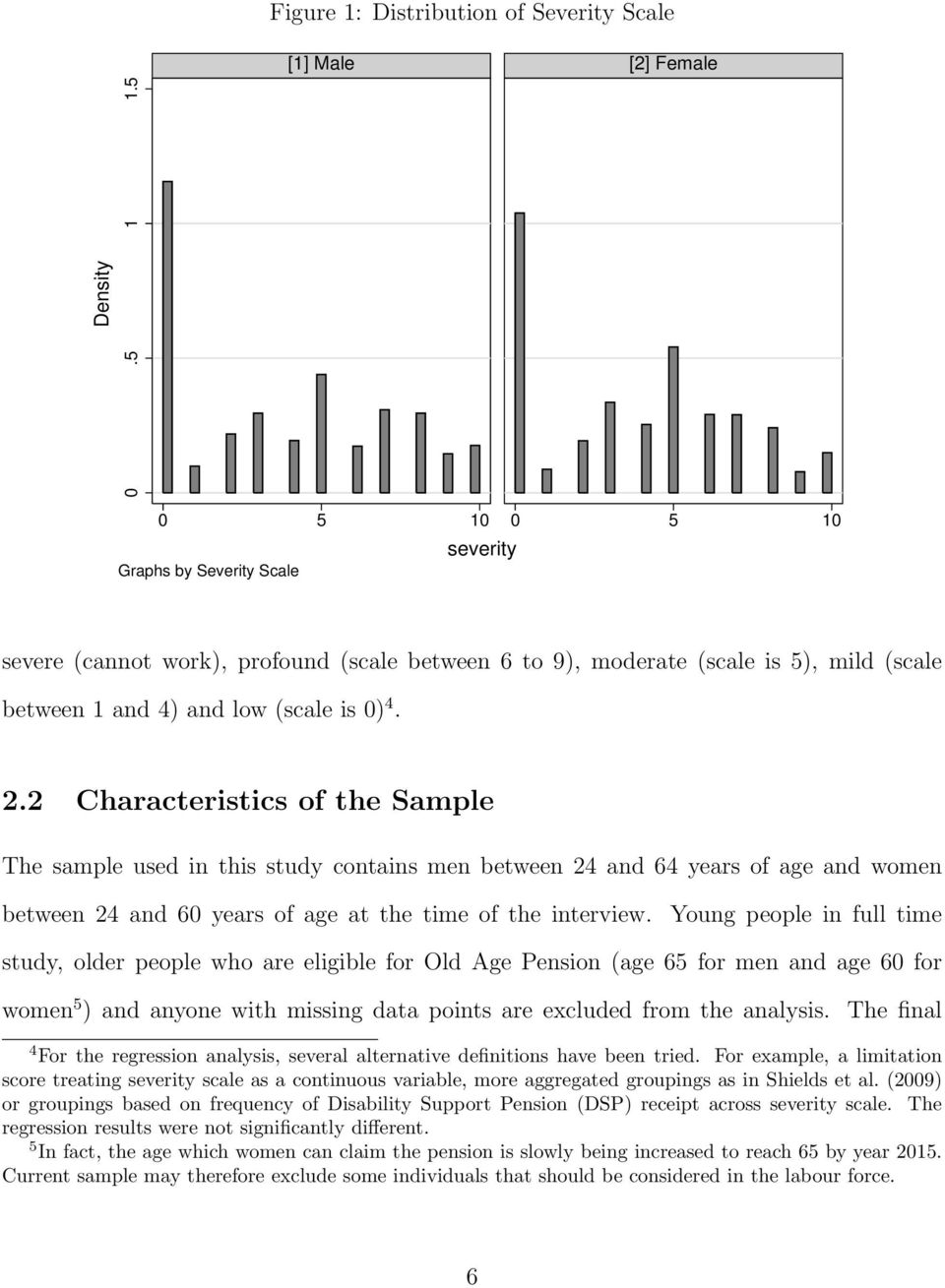
7 vitality, social functioning, role emotional, and mental health. Physical functioning index is shown to be the most valid SF-36 scales for measuring physical health (Ware (2000)). 2.1 Severity Categories In order to help the tractability of the descriptive and multivariate analysis, the sample was divided into mutually exclusive severity categories. Unfortunately, there is no natural cut-off point in the scale provided by HILDA. This is a common problem for the studies that group individuals using a raw limitation scale and the decision is often made arbitrarily 2. For example, Hum and Simpson (1996) develop a severity index for the Labour Market Activity Survey (LMAS) by assigning scores 0 (no disability), 1 (partial disability) or 2 (full disability) to different health conditions and summing these scores to construct four categories (no disability, mild, moderate and severe). Statistics Canada provides categories that represent deciles of a global severity index using the Participation and Activity Limitation Survey (PALS). Using Survey of Income and Program Participation (SIPP), DeLeire (2001) divides disabled individuals into activity and work limited, and only activity limited categories 3. Although the HILDA survey offers much richer severity measure than the aforementioned datasets its potential has not being fully exploited. Only two examples are from happiness literature, namely Shields et al. (2009) and Headey and Wooden (2004). These studies construct three categories; those who could not work (severe), those with a not work-limiting disability (mild) and those with reported work limitation scale between 1 to 9 (moderate). In order to decide the cut-off points for the severity categories, I followed a visual approach. Individuals with limitation scales similar in density are grouped together. Figure (1) represents the distribution of the scale. The severity groups are constructed as follows: 2 ABS provides clear definition of severity categories based on daily activity limitations. However, details on activity limitation was collected only once in wave 4, therefore can not be used in our current analysis 3 Activity limitations include: getting around the house, getting out of bed or chair, bathing, dressing, eating and using the toilet. 5

8 Figure 1: Distribution of Severity Scale [1] Male [2] Female Density Graphs by Severity Scale severity severe (cannot work), profound (scale between 6 to 9), moderate (scale is 5), mild (scale between 1 and 4) and low (scale is 0) Characteristics of the Sample The sample used in this study contains men between 24 and 64 years of age and women between 24 and 60 years of age at the time of the interview. Young people in full time study, older people who are eligible for Old Age Pension (age 65 for men and age 60 for women 5 ) and anyone with missing data points are excluded from the analysis. The final 4 For the regression analysis, several alternative definitions have been tried. For example, a limitation score treating severity scale as a continuous variable, more aggregated groupings as in Shields et al. (2009) or groupings based on frequency of Disability Support Pension (DSP) receipt across severity scale. The regression results were not significantly different. 5 In fact, the age which women can claim the pension is slowly being increased to reach 65 by year Current sample may therefore exclude some individuals that should be considered in the labour force. 6
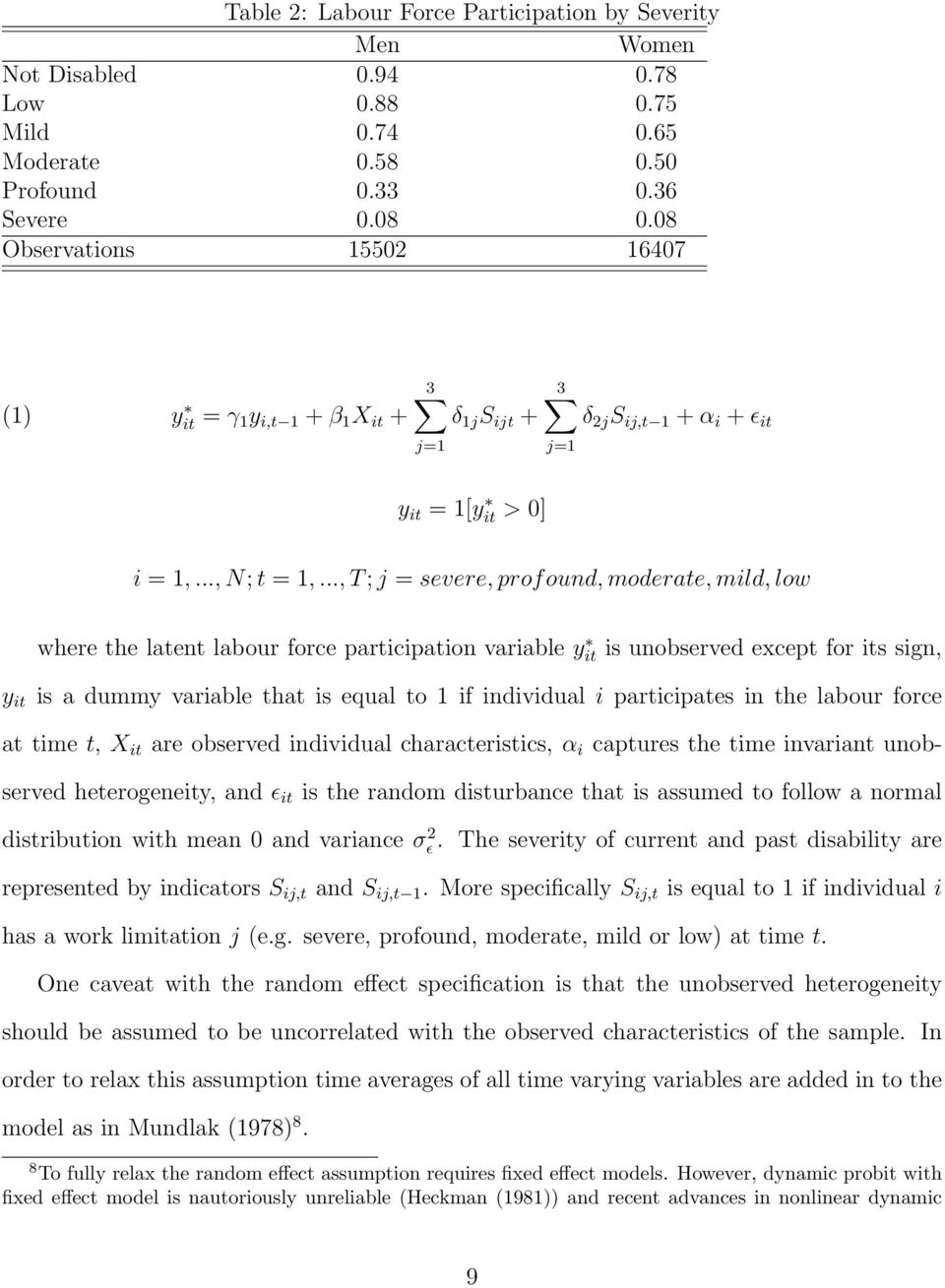
9 sample consists of an unbalanced sample of 4387 male and 4545 female respondents that were observed at least two consecutive waves during the first six waves of HILDA 6. Table 1 describes the demographic and disability characteristics of the sample. The demographic information provided in Table 1 is later used in the labour force participation model and is standard in the literature. Namely, they include age, marital and immigration status, racial background, educational attainment, state of residence, employment and unemployment history, the household s non-labour income and indicators for dependent children and partner s labour force status. The relationship between severity of work limitations and labour force participation is represented in Table 2. It is apparent that ill health is associated with worse labour force performance. For example, compared to 94 percent of not-disabled men, only 74 percent of the mildly limited and 58 percent of the moderately limited persons are labour force participants. The participation rate for severely limited is 8 percent. Similarly, compared to 78 percent of not-disabled women only 65 percent of mildly limited, 50 percent of the moderately limited and 36 percent of profoundly limited women are in the labour force. Severely limited women s participation rate is again around 8 percent 7. 6 The sample restriction is primarily dictated by the regression methodology used. The results using a balanced sample were similar and are available upon request. 7 These participation rates are still unexpectedly high for the severe category. Various possibilities were investigated. It was initially suspected that the severely work limited labour force participant must have been unemployed, self-employed or with significantly short working hours or, simply, unable to fully comprehend the interview questions. However, after careful study of the data none of these speculations turned out to be correct. The models estimated in this paper may therefore underestimate the effect of severe limitations. 7
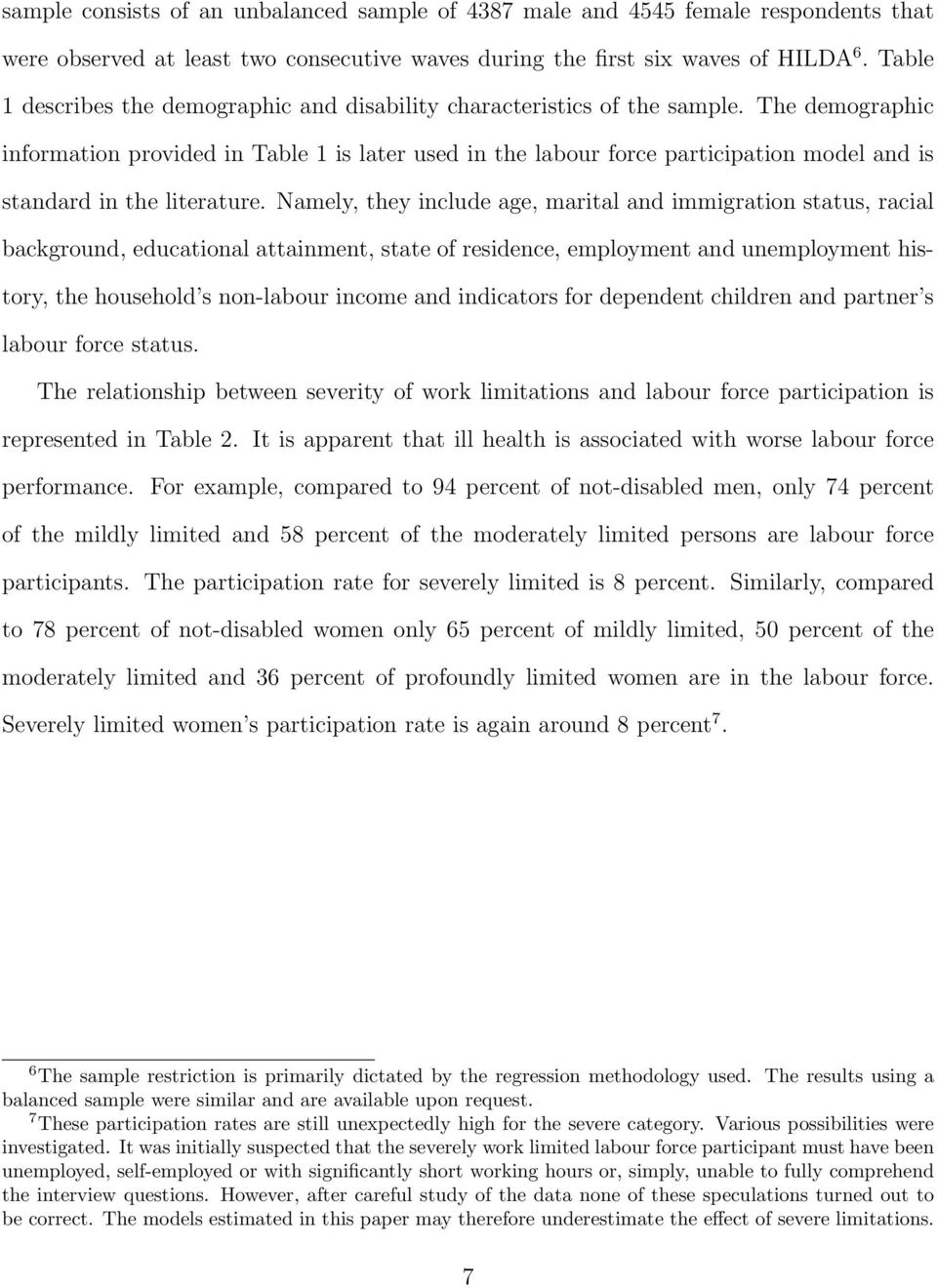
10 Table 1: Mean of the Demographic Variables Variable Definition MEN WOMEN nodisab 1 if Not Disabled low 1 if Disabled without work limitations mild 1 work limited (scale is between 1-4) moderate 1 work limited (scale is 5) profound 1 if work limited (scale between 6-9) severe 1 if work limited (scale is 10) age (Age 24)/ age2 (Age 24) 2 / aust 1 if Australian Born atsi 1 if Aboriginal or Torres Strait Islander nesb 1 if Immigrant from Non-English Background esb 1 if Immigrant from English Background mcity 1 if Reside in Major city NSW 1 if from New South Wales VIC 1 if from Victoria QLD 1 if from Quensland SA 1 if from South Australia WA 1 if from Western Australia TAS 1 if from Tasmania NT 1 if from Northern Terretories bachplus 1 if BA or higher othps 1 if Other post secondary schooling highed 1 if High shool diploma nothi 1 if No High School diploma mar 1 if Married or de facto kid04 1 if Have dependent child 0-4 years old kid514 1 if Have dependent child 5-14 years old mark04 1 if Married and have Dep. Child 0-4 yrs old mark514 1 if Married and have Dep. Child 5-14 yrs old nrkids Number of kids in household unemphst Percentage of time spent unemployed after education workexp Percentage of time spent employed after education lothinc Logarithm of non-labour income prtinlf 1 if partner is in labour force Note: Above figures are based on pooled sample of six waves. 3 Methodology The dynamic panel data model capturing labour force behaviour of person i at time t can be represented as follows: 8
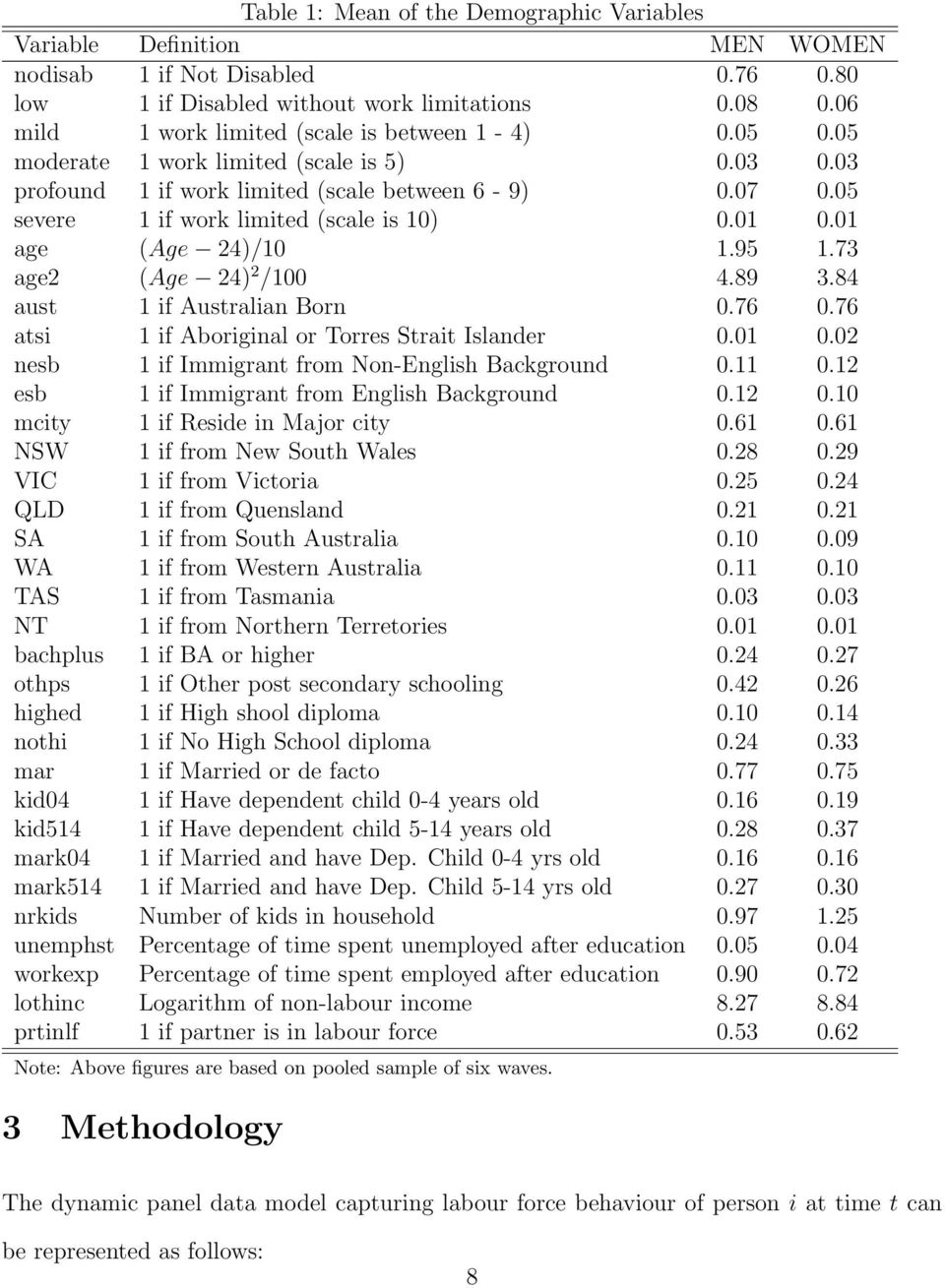
11 Table 2: Labour Force Participation by Severity Men Women Not Disabled Low Mild Moderate Profound Severe Observations (1) yit = γ 1 y i,t 1 + β 1 X it + δ 1j S ijt + δ 2j S ij,t 1 + α i + ɛ it j=1 j=1 y it = 1[y it > 0] i = 1,..., N; t = 1,..., T ; j = severe, profound, moderate, mild, low where the latent labour force participation variable y it is unobserved except for its sign, y it is a dummy variable that is equal to 1 if individual i participates in the labour force at time t, X it are observed individual characteristics, α i captures the time invariant unobserved heterogeneity, and ɛ it is the random disturbance that is assumed to follow a normal distribution with mean 0 and variance σ 2 ɛ. The severity of current and past disability are represented by indicators S ij,t and S ij,t 1. More specifically S ij,t is equal to 1 if individual i has a work limitation j (e.g. severe, profound, moderate, mild or low) at time t. One caveat with the random effect specification is that the unobserved heterogeneity should be assumed to be uncorrelated with the observed characteristics of the sample. In order to relax this assumption time averages of all time varying variables are added in to the model as in Mundlak (1978) 8. 8 To fully relax the random effect assumption requires fixed effect models. However, dynamic probit with fixed effect model is nautoriously unreliable (Heckman (1981)) and recent advances in nonlinear dynamic 9
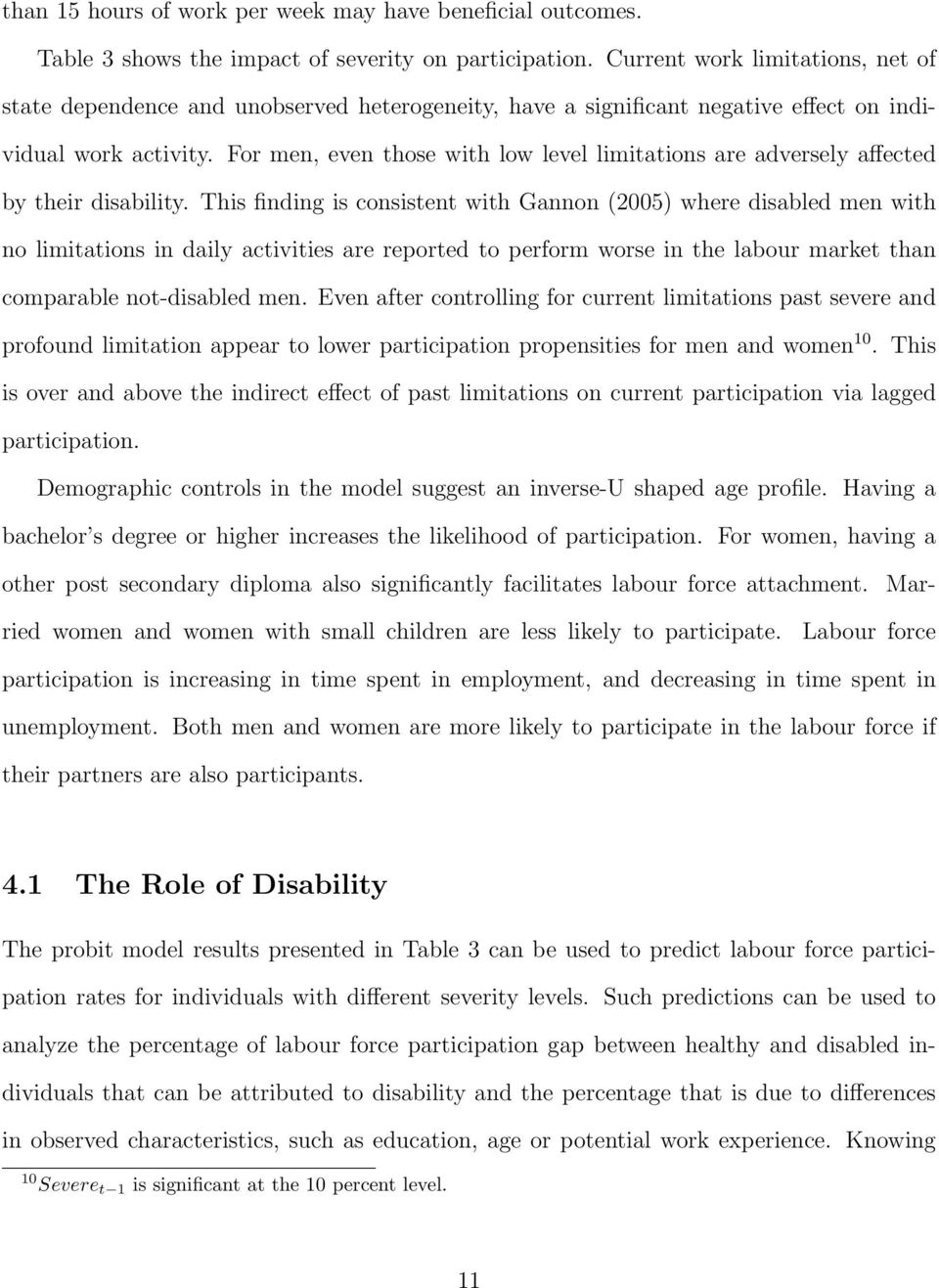
12 Another complication with the estimation of (1) is due to the initial conditions problem. Due to the dynamic nature of (1), current labour force participation status depends on the initial labour force status which -for most of the individuals in the sample- predates the start of the data collection and, therefore, is unknown. Treating initial conditions as exogenous variables leads to inconsistent model estimates (Heckman (1981)). Wooldridge (2005) suggests that consistent parameters can be obtained if one forms the likelihood function conditional on the initial observation of the dependent variables, y it. This method requires the inclusion of the dependent variable from the first wave as an explanatory variable. The main advantage of this approach is that estimation can be carried out using standard panel probit procedures in existing software such as STATA 9. 4 Results In Table 3, results from the dynamic panel data estimation are reported. Models are estimated for men and women separately. According to the results, lagged participation is highly significant. This implies that, independent of health status, individuals who participate in the labour force now are expected to be participants in the future. Put another way, regardless of how individuals became non-participants, it is difficult for them to get back into the labour force. This finding is in support of policies designed to encourage participation among the disabled population, such as job network assistance, specialist disability assistance and vocational rehabilitation services, which are made available by the Australian government. Similarly, work requirements imposed on DSP recipients who can supply more fixed effect models, such as Honore and Kyriazidou (2000), are not fit to handle rich datasets. A linear probability model based on the System GMM estimator (Arellano and Bover (1995)) was investigated. However, Sargan test rejected the validity of instruments used in the estimation. 9 An other approach suggested by Heckman (1981) is to approximate the initial conditions with a static probit model using information from the first wave. The dynamic equation (1) and the initial condition equation can then be simultaneously estimated using Full Information Maximum Likelihood. The Heckman method is computationally more demanding than the Wooldridge approach and it ran into convergence problems when it was employed to estimate (1). 10

13 than 15 hours of work per week may have beneficial outcomes. Table 3 shows the impact of severity on participation. Current work limitations, net of state dependence and unobserved heterogeneity, have a significant negative effect on individual work activity. For men, even those with low level limitations are adversely affected by their disability. This finding is consistent with Gannon (2005) where disabled men with no limitations in daily activities are reported to perform worse in the labour market than comparable not-disabled men. Even after controlling for current limitations past severe and profound limitation appear to lower participation propensities for men and women 10. This is over and above the indirect effect of past limitations on current participation via lagged participation. Demographic controls in the model suggest an inverse-u shaped age profile. Having a bachelor s degree or higher increases the likelihood of participation. For women, having a other post secondary diploma also significantly facilitates labour force attachment. Married women and women with small children are less likely to participate. Labour force participation is increasing in time spent in employment, and decreasing in time spent in unemployment. Both men and women are more likely to participate in the labour force if their partners are also participants. 4.1 The Role of Disability The probit model results presented in Table 3 can be used to predict labour force participation rates for individuals with different severity levels. Such predictions can be used to analyze the percentage of labour force participation gap between healthy and disabled individuals that can be attributed to disability and the percentage that is due to differences in observed characteristics, such as education, age or potential work experience. Knowing 10 Severe t 1 is significant at the 10 percent level. 11
14 Table 3: Dynamic Labour Force Participation Model MEN WOMEN LF Participation LF P t (0.0898) (0.0561) Severe (0.236) (0.259) P rofound (0.0965) (0.0855) Moderate (0.112) (0.0963) Mild (0.0985) (0.0846) Low (0.0889) (0.0759) Severe t (0.208) (0.288) P rofound t (0.102) (0.0887) Moderate t (0.116) (0.0996) Mild t (0.102) (0.0869) Low t (0.0923) (0.0768) Age (0.0545) (0.0411) Age Squared (0.0291) (0.0292) ATSI (0.238) (0.149) Non ENG Background (0.0950) (0.0681) ENG Background (0.0898) (0.0734) Major City (0.0636) (0.0472) NSW (0.228) (0.157) VIC (0.229) (0.158) QLD (0.230) (0.159) SA (0.240) (0.168) WA (0.239) (0.165) TAS (0.266) (0.198) NT (0.386) (0.306) Bachelor or Higher Educat (0.0908) (0.0621) Other Post Sec. Sch (0.0702) (0.0564) Completed Year (0.111) (0.0678) Married (0.188) (0.149) Have 0-4 yrs old children (0.592) (0.126) Have 5-14 yrs old children (0.244) (0.108) Married X 0-4 yrs children (0.592) (0.129) Married X 5-14 yrs children (0.228) (0.0988) Number of Kids (0.0445) (0.0269) Unemployment History (0.174) (0.136) Experience (0.208) (0.101) Log(Other HH Income) (0.0138) (0.0108) Partner in LF (0.103) (0.0901) Initial LF Status (0.133) (0.0808) Constant (0.337) (0.227) lnsig2u Constant (0.192) (0.123) 12 Observations Models include time dummies and time averages of time varying variables Standard errors in parentheses p < 0.05, p < 0.01, p < 0.001

15 the proportion of non-participation that can be attributed to disability has very important policy implications since it determines how the budget should be allocated between disability prevention, health recovery, and investment on human capital investment. The methodology used here is similar to an Oaxaca Decomposition that is commonly used to examine wage differentials (Oaxaca (1973)). Table 4 reports the total predicted gap, the gap due to disability and the gap due to observed characteristics separately for different severity and gender groups. The dynamic panel data model predicts the total participation gap between healthy and severely disabled persons as 96 percent and 80 percent for men and women, respectively. Nearly half of this gap can be explained by differences in observed characteristics between the two male samples. For women, however, almost 90 percent (0.71/0.80) of the gap is due to disability. Similarly, profoundly limited men were predicted to have on average 70 percent lower participation rates than the healthy male sample, of which around 58 percent is due to disability. For women with profound limitations, observed characteristics can explain only 16 percent of the total gap (24 percent). For men, the predicted total gap between the not-disabled sample and moderate, mild and low samples are 37, 17 and 4 percent respectively. Again, the majority of this gap seems to be related to differences in characteristics other than disability. Moderately and mildly limited women were predicted to have 11 and 2 percent lower participation rates than not-disabled women; this gap is almost entirely due to disability. For the low sample, the model does not predict any significant participation gap. In Table 4, it also appears that the proportion of non-participation attributable to disability is decreasing in severity for men. 4.2 Simulations In this section, I simulate the intertemporal labour force response to a work limitation shock across various severity levels using the estimated parameters of (1). The aim here is to show that the indirect impact of past limitations on current labour force participation due 13

16 Table 4: Oaxaca Decomposition of Predicted Participation Gap MEN Total Gap Gap due to Charactheristics Gap due to Disability Severe Profound Moderate Mild Low WOMEN Severe Profound Moderate Mild Low Note:Total Gap is the predicted participation gap by the model. Gap due to disability is the difference between predicted rates where 2 groups only differ in limitation status. Gap due to characteristic is the difference between two predicted rates where groups only differ in observed characteristics. Random effects are set to zero. to a decline in past participation, may be substantial. Due to this feedback effect, a one-off health shock may alter future levels of work activity even if and individual s health recovers after one period. In order to show this possibility, I simulate the intertemporal participation response over 10 years. Figure 2 represents the simulated response after a work limitation shock at time t, and I assume that at t + 1 the individual no longer has a work limitation. The impact of different severity levels is simulated for an average men and for an average women separately 11. Figure 2 shows that recovery from a severe work limitation shock takes on average 5 years for women and 3 years for men. Similarly, the full impact of profound limitations takes two to four years to be realised. This implies that the decline in current work activity, in response to a one-off shock, may have severe long-run consequences due to the persistent nature of labour force behaviour. Encouraging labour force attachment among work limited 11 All the control variables are set to their respective gender s sample averages. Random effects are set to zero 14

17 individuals while they are recovering is, therefore, crucial. Note that Figure 2 represents a scenario where an individual s health recovers fully from the shock within only one year. In particular, for severely or profoundly limited individuals, it would be more likely that some or all of their health limitations would persist in the next period. Therefore, the long run impact of work limitation is probably more severe than is pictured in Figure 2. Such a scenario is presented in Figure 3 where an individual who is severely work limited at t becomes moderately work limited at t + 1. Figure 3 presents two cases: in the first, I assume that the individual participates while moderately work limited. This situation mimics the recently introduced work requirements by the Australian government for disabled people who are able to work more than 15 hours per week. For the second case, the work requirement is omitted. Figure 3 shows that women with severe work limitations may significantly benefit from the work requirements once their health improves. The recovery for women who were exposed to the labour market while they were moderately limited is two years faster than those who were not required to participate in a work activity. For men, the labour force exposure does not seem to alter the recovery path much. 4.3 Endogeneity of Work Limitation There is disagreement in the literature on the reliability of self-reported health data. Although some studies are confident with the self-reported work limitation (Stern (1989); Dwyer and Mitchell (1999); Benitez-Silva et al. (2004); Cai (2009)) other research presents concerns about misreporting due to psychological, social and economic incentives that leads to the justification bias (Kerkhofs and Lindeboom (1995); Kreider (1999)). Namely, since ill health is one of the most socially acceptable reasons to exit work, individuals may report health problems in order to justify their labour market performance. In order to control for this possibility, a physical functioning index based on SF-36 health status questions is used 15

18 Figure 2: Labour Force Response to a Work Limitation Shock 16

19 Figure 3: Labour Force Response With and Without Work Requirement 17

20 as an instrument for the severity measure used in the previous section 12. This approach is similar to the one taken by Stern (1989); Cai and Kalb (2006) and Campolieti (2002). The main idea here is that while answering to specific health questions (such as difficulty in carrying groceries or walking 100 meters), individuals would be less inclined to misreport in order to rationalize their labour force status. Therefore, the physical functioning index (albeit self-reported) can be less likely to be subject to systematic reporting errors than self-reported work limitation data, particularly if individuals have frequent visits to health professionals (Campolieti (2002)). One problem with specific health measures is that they are not a perfect proxy for work capacity and often underestimate the role of health in employment behaviour. However, Bound (1991) suggests that the biases within global and specific health measures may work in opposite directions, and so to supply accurate measures of the disability effect. In order to test the robustness of model estimates to the endogeneity assumption, I introduce a health reporting function that links observed severity levels to observed characteristics of the sample. The health reporting equation can be written as follows: (2) Sev it = β 2 Z it + δ 3 H it + ν it where Sev it is an ordinal variable that indicates the self-reported severity categories. It takes 6 values depending on the disability status of the individual (severe, profound, moderate, mild, low and not disabled). H it is the detailed health information provided by the physical functioning index. Z it are observed characteristics, and ν it is the random disturbance that follows ν it (0, σν). 2 The estimation of the model is carried out in two steps. First, (2) is estimated using a 12 Physical functioning index ranges from 0 to 100, where 100 indicates perfect health. 18

21 pooled ordered probit. The predicted values from this estimation are used in the estimation of dynamic labour force equation (1) in lieu of S ij,t and S ij,t 1. A practical problem with this approach is that (2) provides a continuous index of severity rather than separate severity categories. Hence, the coefficient estimates of this section are not directly comparable to the results provided in Table 3. In order to demonstrate the impact of endogeneity correction on the estimates, I also estimate the model by including Sev it without correction. The results for the health variables are provided in Table According to the results, the negative impact of the current disability, after controlling for the endogeneity of the measure, is still highly significant for both men and women. However, although the uncorrected measure for the lagged severity is still significant, the coefficient for the endogeneity corrected measure is no longer significant for men. This implies that significance assigned to direct effect of past severe and profound limitations in the previous section should be taken with caution. Nevertheless, even if past limitations do not have a significant direct effect, their impact via persistence channels can be substantial. The lagged severity is still significant for women after controlling for endogeneity. 5 Conclusion In this study, the effect of self-reported work limitations on labour force participation was investigated by allowing heterogeneity in severity levels. Results from the dynamic labour force participation model shows a strong association between current and past labour force participation, implying that, regardless of how people become non-participants, it is very hard for them to get back into the work force. However, low participation levels of work limited individuals cannot be explained by their relatively weaker attachment to the labour 13 Full results for the participation model and the severity model are available upon requests. Severity model contains the same observed characteristics excluding the information about dependent children 19
22 Table 5: Endogeneity Corrected Model Estimates Table MEN WOMEN Uncorrected Corrected Uncorrected Corrected LF Participation LF P t (0.0896) (0.0913) (0.0561) (0.0559) Severity (0.0218) (0.0551) (0.0185) (0.0378) Severity t (0.0119) (0.0563) (0.0193) (0.0381) Initial LF Status (0.133) (0.145) (0.0809) (0.0822) Constant (0.337) (0.374) (0.230) (0.247) lnsig2u (0.190) (0.186) (0.122) (0.120) Observations Models include all controls used in Model 1 Standard errors in parentheses p < 0.05, p < 0.01, p < force alone. After controlling for state dependence, observed and unobserved characteristics, the impact of current limitations are still highly significant. This impact is not uniform across severity levels which emphasises the heterogeneous nature of the disabled population. The estimation results are shown to have important policy and budgetary implications. This is accomplished in two ways. First, the predicted participation gap between healthy and limited individuals is decomposed to measure the proportion that is due to disability. The results were strikingly dissimilar across men and women. For men, 40 to 50 percent of the predicted gap is shown to be related to observed characteristics such as age, education or employment history. For women, however, the gap is almost entirely due to work limitations. This may be due to double-discrimination disabled women may face in the labour market 20
23 (Deegan and Brooks (1985)), lack of social support available for disabled women (Katz et al. (2000)) or unobserved gender specific factors that affect health reporting (Oguzoglu (2009)). Another interesting finding is that the proportion of non-participation that is attributable to health appears to be decreasing in severity for men. The negative impact of a one-time work limitation shock is demonstrated to be long lasting. According to model simulations, work limited individuals labour force status appears to suffer long after their health recovers fully. Again, the recovery path is not uniform across severity levels or gender. Severely and profoundly limited men are expected to return to their pre-shock participation levels in 3 years. The recovery takes up to 5 years for women. The findings in this paper are in support of policies that are designed to keep nearly disabled individuals attached to the work force. One such policy, work requirements for DSP recipients, is expected to produce positive outcomes. However, a one-fit-for-all policy will probably fail to reach to its full potential due to the heterogeneous nature of the disabled group. For men, building up incentives that encourages return-to-work should go hand in hand with education and training (or re-training). For work limited women, whose work activity suffers more and longer than men s, the solution might be harder and may require more aggressive policies. In this regard, both side of the labour market should be convinced that there are long-run benefits of not losing temporarily-disabled women to permanent inactivity. 21
24 References M. Arellano and O. Bover. Another look at the instrumental variable estimation of errorcomponents models. Journal of econometrics, 68(1):29 52, H. Benitez-Silva, M. Buchinsky, H.I.U.M.A.N. Chan, S. Cheidvasser, and J. Rust. How large is the bias in self-reported disability? Journal of Applied Economics, 19: , J. Bound. Self-Reported Versus Objective Measures of Health in Retirement Models. The Journal of Human Resources, 26(1): , J. Bound, M. Schoenbaum, and T. Waidman. Race and Education Differences in Disability Status and Labor Force Participation. Journal of Human Resources, 30:S227 S267, L. Cai. Is self-reported disability status endogenous to labour force status? Applied Economics Letters, 16(5): , L. Cai and G. Kalb. Health status and labour force participation: evidence from Australia. Health Economics, 15(3):241, M. Campolieti. Disability and the labor force participation of older men in Canada. Labour Economics, 9(3): , M.J. Deegan and N.A. Brooks. Women and disability: The double handicap. Transaction Publishers, T. DeLeire. Changes in Wage Discrimination Against People with Disabilities: Journal of Human Resources, 36(1): , D.S. Dwyer and O.S. Mitchell. Health problems as determinants of retirement: Are self-rated measures endogenous? Journal of Health Economics, 18(2): , B. Gannon. A dynamic analysis of disability and labour forceparticipation inireland1995ˆ Health Econ, 14: , B. Headey and M. Wooden. The Effects of Wealth and Income on Subjective Well-Being and Ill-Being*. The Economic Record, 80(s1):24 33, J.J. Heckman. The Incidental Parameters Problem and the Problem of Initial Conditions in Estimating a Discrete Time-Discrete Data Stochastic Process and Some Monte Carlo Evidence. In Structural Analysis of Discrete Data with Econometric Applications. London : MIT Press, B.E. Honore and E. Kyriazidou. Panel data discrete choice models with lagged dependent variables. Econometrica, pages , D. Hum and W. Simpson. Canadians with Disabilities and the Labour Market. Canadian Public Policy-Analyse de Politiques, pages ,
25 M.K. Jones. Is there employment discrimination against the disabled? Economics Letters, 92(1):32 37, A. Kapteyn, J.P. Smith, and A. van Soest. Dynamics of work disability and pain. Journal of Health Economics, 27(2): , S.J. Katz, M. Kabeto, and K.M. Langa. Gender disparities in the receipt of home care for elderly people with disability in the United States. Journal of American Medical Association, 284(23): , M. Kerkhofs and M. Lindeboom. Subjective health measures and state dependent reporting errors. Health Economics, 4: , B. Kreider. Latent Work Disability and Reporting Bias. Journal of Human Resources, 34 (4): , Y. Mundlak. On the Pooling of Time Series and Cross Section Data. Econometrica, 46(1): 69 85, R. Oaxaca. Male-female wage differentials in urban labor markets. International Economic Review, pages , O. O Donnell. The Effect of Disability on Employment Allowing for Work Incapacity. University of Kent at CAnterbury Department of Economics Working Paper Series, 46(98-13), U. Oguzoglu. Dynamics of Work Limitation and Work in Australia. forthcoming in Health Economics, M.A. Shields, S. Wheatley Price, and M. Wooden. Life satisfaction and the economic and social characteristics of neighbourhoods. Journal of Population Economics, 22:1 23, S. Stern. Measuring the Effect of Disability on Labor Force Participation. Journal of Human Resources, 24(3):361 95, J.E. Ware. SF-36 Health Survey: Manual and interpretation guide. The Health Institute, New England Medical Center, N. Watson and M. Wooden. The HILDA Survey Four Years On. The Australian Economic Review, 37(3): , R. Wilkins. The Effects of Disability on Labour Force Status in Australia. The Australian Economic Review, 37(4): , J.M. Wooldridge. Simple solutions to the initial conditions problem in dynamic, nonlinear panel data models with unobserved heterogeneity. Journal of Applied Econometrics, 20 (1):39 54,
Dynamics of Disability and Work in Canada
 D I S C U S S I O N P A P E R S E R I E S IZA DP No. 6603 Dynamics of Disability and Work in Canada Umut Oguzoglu May 2012 Forschungsinstitut zur Zukunft der Arbeit Institute for the Study of Labor Dynamics
Disability and Job Mismatches in the Australian Labour Market
 D I S C U S S I O N P A P E R S E R I E S IZA DP No. 6152 Disability and Job Mismatches in the Australian Labour Market Melanie Jones Kostas Mavromaras Peter Sloane Zhang Wei November 2011 Forschungsinstitut
Revealing Taste-Based Discrimination in Hiring: A Correspondence Testing Experiment with Geographic Variation
 D I S C U S S I O N P A P E R S E R I E S IZA DP No. 6153 Revealing Taste-Based Discrimination in Hiring: A Correspondence Testing Experiment with Geographic Variation Magnus Carlsson Dan-Olof Rooth November
Revisiting Inter-Industry Wage Differentials and the Gender Wage Gap: An Identification Problem
 DISCUSSION PAPER SERIES IZA DP No. 2427 Revisiting Inter-Industry Wage Differentials and the Gender Wage Gap: An Identification Problem Myeong-Su Yun November 2006 Forschungsinstitut zur Zukunft der Arbeit
The Wage Return to Education: What Hides Behind the Least Squares Bias?
 DISCUSSION PAPER SERIES IZA DP No. 8855 The Wage Return to Education: What Hides Behind the Least Squares Bias? Corrado Andini February 2015 Forschungsinstitut zur Zukunft der Arbeit Institute for the
Human Capital and Ethnic Self-Identification of Migrants
 DISCUSSION PAPER SERIES IZA DP No. 2300 Human Capital and Ethnic Self-Identification of Migrants Laura Zimmermann Liliya Gataullina Amelie Constant Klaus F. Zimmermann September 2006 Forschungsinstitut
Is Temporary Agency Employment a Stepping Stone for Immigrants?
 D I S C U S S I O N P A P E R S E R I E S IZA DP No. 6405 Is Temporary Agency Employment a Stepping Stone for Immigrants? Elke Jahn Michael Rosholm March 2012 Forschungsinstitut zur Zukunft der Arbeit
The Life-Cycle Motive and Money Demand: Further Evidence. Abstract
 The Life-Cycle Motive and Money Demand: Further Evidence Jan Tin Commerce Department Abstract This study takes a closer look at the relationship between money demand and the life-cycle motive using panel
Fixed Effects Bias in Panel Data Estimators
 DISCUSSION PAPER SERIES IZA DP No. 3487 Fixed Effects Bias in Panel Data Estimators Hielke Buddelmeyer Paul H. Jensen Umut Oguzoglu Elizabeth Webster May 2008 Forschungsinstitut zur Zukunft der Arbeit
Leadership at School: Does the Gender of Siblings Matter?
 DISCUSSION PAPER SERIES IZA DP No. 6976 Leadership at School: Does the Gender of Siblings Matter? Giorgio Brunello Maria De Paola October 2012 Forschungsinstitut zur Zukunft der Arbeit Institute for the
Risk Aversion and Sorting into Public Sector Employment
 DISCUSSION PAPER SERIES IZA DP No. 3503 Risk Aversion and Sorting into Public Sector Employment Christian Pfeifer May 2008 Forschungsinstitut zur Zukunft der Arbeit Institute for the Study of Labor Risk
Temporary Work as an Active Labor Market Policy: Evaluating an Innovative Program for Disadvantaged Youths
 D I S C U S S I O N P A P E R S E R I E S IZA DP No. 6670 Temporary Work as an Active Labor Market Policy: Evaluating an Innovative Program for Disadvantaged Youths Christoph Ehlert Jochen Kluve Sandra
Social Security Eligibility and the Labor Supply of Elderly Immigrants. George J. Borjas Harvard University and National Bureau of Economic Research
 Social Security Eligibility and the Labor Supply of Elderly Immigrants George J. Borjas Harvard University and National Bureau of Economic Research Updated for the 9th Annual Joint Conference of the Retirement
Sport and Physical Recreation Participation Among Persons with a Disability
 Sport and Physical Recreation Participation Among Persons with a Disability Some Data from the 2002 General Social Survey National Centre for Culture and Recreation Statistics Report prepared for the Standing
PRELIMINARY DRAFT: PLEASE DO NOT QUOTE
 PRELIMINARY DRAFT: PLEASE DO NOT QUOTE An Analysis of the Differential Impacts of Overskilling by Educational Pathway: Is Vocational Education a Safer Route? Kostas Mavromaras 1,3 Seamus McGuinness 2 and
Council of Ambulance Authorities
 Council of Ambulance Authorities National Patient Satisfaction Survey 2015 Prepared for: Mojca Bizjak-Mikic Manager, Data & Research The Council of Ambulance Authorities Prepared by: Dr Svetlana Bogomolova
Do Migrants Get Good Jobs in Australia? The Role of Ethnic Networks in Job Search
 DISCUSSION PAPER SERIES IZA DP No. 3489 Do Migrants Get Good Jobs in Australia? The Role of Ethnic Networks in Job Search Stéphane Mahuteau P.N. (Raja) Junankar May 2008 Forschungsinstitut zur Zukunft
Australian Catholic Schools 2012
 Australian Catholic Schools 2012 Foreword Australian Catholic Schools 2012 is the tenth annual report on enrolment trends in Catholic schools from the NCEC Data Committee. As with previous editions, this
Handling attrition and non-response in longitudinal data
 Longitudinal and Life Course Studies 2009 Volume 1 Issue 1 Pp 63-72 Handling attrition and non-response in longitudinal data Harvey Goldstein University of Bristol Correspondence. Professor H. Goldstein
Statistical appendix. A.1 Introduction
 A Statistical appendix A.1 Introduction This appendix contains contextual information to assist the interpretation of the performance indicators presented in the Report. The following four key factors
Performance Related Pay and Labor Productivity
 DISCUSSION PAPER SERIES IZA DP No. 2211 Performance Related Pay and Labor Productivity Anne C. Gielen Marcel J.M. Kerkhofs Jan C. van Ours July 2006 Forschungsinstitut zur Zukunft der Arbeit Institute
An update on the level and distribution of retirement savings
 ASFA Research and Resource Centre An update on the level and distribution of retirement savings Ross Clare Director of Research March 2014 The Association of Superannuation Funds of Australia Limited (ASFA)
Chapter 5: Analysis of The National Education Longitudinal Study (NELS:88)
 Chapter 5: Analysis of The National Education Longitudinal Study (NELS:88) Introduction The National Educational Longitudinal Survey (NELS:88) followed students from 8 th grade in 1988 to 10 th grade in
Copayments in the German Health System: Does It Work?
 DISCUSSION PAPER SERIES IZA DP No. 2290 Copayments in the German Health System: Does It Work? Boris Augurzky Thomas K. Bauer Sandra Schaffner September 2006 Forschungsinstitut zur Zukunft der Arbeit Institute
Do Supplemental Online Recorded Lectures Help Students Learn Microeconomics?*
 Do Supplemental Online Recorded Lectures Help Students Learn Microeconomics?* Jennjou Chen and Tsui-Fang Lin Abstract With the increasing popularity of information technology in higher education, it has
Life Satisfaction and Relative Income: Perceptions and Evidence
 DISCUSSION PAPER SERIES IZA DP No. 4390 Life Satisfaction and Relative Income: Perceptions and Evidence Guy Mayraz Gert G. Wagner Jürgen Schupp September 2009 Forschungsinstitut zur Zukunft der Arbeit
Priority Areas of Australian Clinical Health R&D
 Priority Areas of Australian Clinical Health R&D Nick Pappas* CSES Working Paper No. 16 ISSN: 1322 5138 ISBN: 1-86272-552-7 December 1999 *Nick Pappas is a Henderson Research Fellow at the Centre for Strategic
THE IMPACT OF CHILDHOOD HEALTH AND COGNITION ON PORTFOLIO CHOICE
 THE IMPACT OF CHILDHOOD HEALTH AND COGNITION ON PORTFOLIO CHOICE Dimitris Christelis, Loretti Dobrescu, Alberto Motta 214-2010 5 The Impact of Childhood Health and Cognition on Portfolio Choice Dimitris
Business Cycles and Divorce: Evidence from Microdata *
 Business Cycles and Divorce: Evidence from Microdata * Judith K. Hellerstein 1 Melinda Sandler Morrill 2 Ben Zou 3 We use individual-level data to show that divorce is pro-cyclical on average, a finding
Council of Ambulance Authorities
 Council of Ambulance Authorities Patient Satisfaction Survey 2013 Prepared for: Mojca Bizjak-Mikic Manager, Data & Research The Council of Ambulance Authorities Prepared by: Natasha Kapulski Research Associate
Aboriginal and Torres Strait Islander Health Workers / Practitioners in focus
 Aboriginal and Torres Strait Islander Health Workers / Practitioners in focus i Contents Introduction... 1 What is an Aboriginal and Torres Strait Islander Health Worker?... 2 How are Aboriginal and Torres
Contact us. Hoa Bui T: + 61 (02) 9335 8938 E: [email protected]. Briallen Cummings T: + 61 (02) 9335 7940 E: [email protected]. www.kpmg.com.
 Contact us Hoa Bui T: + 61 (02) 9335 8938 E: [email protected] Briallen Cummings T: + 61 (02) 9335 7940 E: [email protected] www.kpmg.com.au No reliance This report should not be regarded as suitable
4. Work and retirement
 4. Work and retirement James Banks Institute for Fiscal Studies and University College London María Casanova Institute for Fiscal Studies and University College London Amongst other things, the analysis
Education and Wage Differential by Race: Convergence or Divergence? *
 Education and Wage Differential by Race: Convergence or Divergence? * Tian Luo Thesis Advisor: Professor Andrea Weber University of California, Berkeley Department of Economics April 2009 Abstract This
WORK DISABILITY AND HEALTH OVER THE LIFE COURSE
 WORK DISABILITY AND HEALTH OVER THE LIFE COURSE Axel Börsch-Supan, Henning Roth 228-2010 19 Work Disability and Health over the Life Course Axel Börsch-Supan and Henning Roth 19.1 Work disability across
APPROXIMATING THE BIAS OF THE LSDV ESTIMATOR FOR DYNAMIC UNBALANCED PANEL DATA MODELS. Giovanni S.F. Bruno EEA 2004-1
 ISTITUTO DI ECONOMIA POLITICA Studi e quaderni APPROXIMATING THE BIAS OF THE LSDV ESTIMATOR FOR DYNAMIC UNBALANCED PANEL DATA MODELS Giovanni S.F. Bruno EEA 2004-1 Serie di econometria ed economia applicata
Discrimination against Indigenous Australians: A snapshot of the views of non-indigenous people aged 25 44
 Discrimination against Australians: A snapshot of the views of non- people aged 25 44 www.beyondblue.org.au 1300 22 4636 Background From July 2014 beyondblue is rolling out a national campaign that highlights
How to Develop a Sporting Habit for Life
 How to Develop a Sporting Habit for Life Final report December 2012 Context Sport England s 2012-17 strategy aims to help people and communities across the country transform our sporting culture, so that
Marketing Mix Modelling and Big Data P. M Cain
 1) Introduction Marketing Mix Modelling and Big Data P. M Cain Big data is generally defined in terms of the volume and variety of structured and unstructured information. Whereas structured data is stored
Breast and cervical cancer screening in Great Britain: Dynamic interrelated processes
 Labeit and Peinemann Health Economics Review (2015) 5:32 DOI 10.1186/s13561-015-0065-3 RESEARCH Open Access Breast and cervical cancer screening in Great Britain: Dynamic interrelated processes Alexander
The Problem of Overskilling in Australia and Britain
 DISCUSSION PAPER SERIES IZA DP No. 3136 The Problem of Overskilling in Australia and Britain Kostas Mavromaras Seamus McGuinness Nigel O Leary Peter Sloane Yi King Fok November 2007 Forschungsinstitut
Information Bulletin AN INCREASING INDIGENOUS POPULATION? IMPLICATIONS FOR THE CRIMINAL JUSTICE SYSTEM. Justine Doherty
 Information Bulletin OFFICE OF CRIME STATISTICS No 32 April 2002 AN INCREASING INDIGENOUS POPULATION? IMPLICATIONS FOR THE CRIMINAL JUSTICE SYSTEM Justine Doherty ATTORNEY-GENERAL S DEPARTMENT Introduction
2003 National Survey of College Graduates Nonresponse Bias Analysis 1
 2003 National Survey of College Graduates Nonresponse Bias Analysis 1 Michael White U.S. Census Bureau, Washington, DC 20233 Abstract The National Survey of College Graduates (NSCG) is a longitudinal survey
The Impact of Health on Individual Retirement Plans
 ISSN 1397-4831 WORKING PAPER 04-7 Mona Larsen and Nabanita Datta Gupta The Impact of Health on Individual Retirement Plans: a Panel Analysis comparing Selfreported versus Diagnostic Measures Department
Why Do Self-Employed Immigrants in Denmark and Sweden Have Such Low Incomes?
 DISCUSSION PAPER SERIES IZA DP No. 1280 Why Do Self-Employed Immigrants in Denmark and Sweden Have Such Low Incomes? Pernilla Andersson Eskil Wadensjö August 2004 Forschungsinstitut zur Zukunft der Arbeit
ORU Analyses of Immigrant Earnings in Australia, with International Comparisons
 DISCUSSION PAPER SERIES IZA DP No. 4422 ORU Analyses of Immigrant Earnings in Australia, with International Comparisons Barry R. Chiswick Paul W. Miller September 2009 Forschungsinstitut zur Zukunft der
The Determinants of Performance Appraisal Systems: A Note (Do Brown and Heywood s Results for Australia Hold Up for Britain?)
 DISCUSSION PAPER SERIES IZA DP No. 3065 The Determinants of Performance Appraisal Systems: A Note (Do Brown and Heywood s Results for Australia Hold Up for Britain?) John T. Addison Clive R. Belfield September
Employment-Based Health Insurance: 2010
 Employment-Based Health Insurance: 2010 Household Economic Studies Hubert Janicki Issued February 2013 P70-134 INTRODUCTION More than half of the U.S. population (55.1 percent) had employment-based health
AMERICA'S YOUNG ADULTS AT 27: LABOR MARKET ACTIVITY, EDUCATION, AND HOUSEHOLD COMPOSITION: RESULTS FROM A LONGITUDINAL SURVEY
 For release 10:00 a.m. (EDT) Wednesday, March 26, 2014 USDL-14-0491 Technical information: (202) 691-7410 [email protected] www.bls.gov/nls Media contact: (202) 691-5902 [email protected] AMERICA'S YOUNG
STATISTICAL ANALYSIS OF UBC FACULTY SALARIES: INVESTIGATION OF
 STATISTICAL ANALYSIS OF UBC FACULTY SALARIES: INVESTIGATION OF DIFFERENCES DUE TO SEX OR VISIBLE MINORITY STATUS. Oxana Marmer and Walter Sudmant, UBC Planning and Institutional Research SUMMARY This paper
FIXED EFFECTS AND RELATED ESTIMATORS FOR CORRELATED RANDOM COEFFICIENT AND TREATMENT EFFECT PANEL DATA MODELS
 FIXED EFFECTS AND RELATED ESTIMATORS FOR CORRELATED RANDOM COEFFICIENT AND TREATMENT EFFECT PANEL DATA MODELS Jeffrey M. Wooldridge Department of Economics Michigan State University East Lansing, MI 48824-1038
Public and Private Sector Earnings - March 2014
 Public and Private Sector Earnings - March 2014 Coverage: UK Date: 10 March 2014 Geographical Area: Region Theme: Labour Market Theme: Government Key Points Average pay levels vary between the public and
What It s Worth: Field of Training and Economic Status in 2009
 What It s Worth: Field of Training and Economic Status in 2009 Household Economic Studies Issued February 2012 P70-129 INTRODUCTION The relationship between educational attainment and economic outcomes
Stress and wellbeing in Australia survey 2013
 Stress and wellbeing in Australia survey 2013 The state of the nation two years on, and Special feature on working Australians October 2013 Lynne Casey PhD MAPS National Psychology Week is an initiative
Australia. Old Age, Disability, and Survivors. Australia. Exchange rate: US$1.00 equals 1.32 Australian dollars (A$). Qualifying Conditions
 Australia Exchange rate: US$1.00 equals 1.32 Australian dollars (A$). Old Age, Disability, and Survivors First laws: 1908 (old-age and disability) and 1942 (widows). Current laws: 1991 (social security),
How To Study Health Insurance Coverage By Race And Ethnicity
 DISCUSSION PAPER SERIES IZA DP No. 3708 Race, Ethnicity and the Dynamics of Health Insurance Coverage Robert W. Fairlie Rebecca A. London September 2008 Forschungsinstitut zur Zukunft der Arbeit Institute
The frequency of visiting a doctor: is the decision to go independent of the frequency?
 Discussion Paper: 2009/04 The frequency of visiting a doctor: is the decision to go independent of the frequency? Hans van Ophem www.feb.uva.nl/ke/uva-econometrics Amsterdam School of Economics Department
Credit Card Market Study Interim Report: Annex 4 Switching Analysis
 MS14/6.2: Annex 4 Market Study Interim Report: Annex 4 November 2015 This annex describes data analysis we carried out to improve our understanding of switching and shopping around behaviour in the UK
Markups and Firm-Level Export Status: Appendix
 Markups and Firm-Level Export Status: Appendix De Loecker Jan - Warzynski Frederic Princeton University, NBER and CEPR - Aarhus School of Business Forthcoming American Economic Review Abstract This is
Introduction. Dr Christine Bennett, Chief Medical Officer, Bupa
 M AY 2 0 1 1 B u pa H e a lt h watc h P o l l Introduction The Bupa Healthwatch Poll (May ) looks at the Australian community s healthcare concerns and compares the findings against earlier Bupa Healthwatch
Around 15,500 Kirklees residents in their 60s are working and are likely to retire from work in the next few years.
 Retirement Headlines Around 15,500 Kirklees residents in their 60s are working and are likely to retire from work in the next few years. Experience of retirement varies with differing levels of access
The economic consequences of accidents at work
 The economic consequences of accidents at work Abstract This paper investigates the economic consequences of workplace accidents for workers in the UK labour market using data from the British Household
DI beneficiary/ SSI recipient stream. SSA central office conducts outreach mailing. Individual contacts office? Yes
 SSI applicant stream DI beneficiary/ SSI recipient stream Claim representative takes application; describes Project NetWork SSA central office conducts outreach mailing No Individual on benefit roll 2-5
THE RESPONSIBILITY TO SAVE AND CONTRIBUTE TO
 PREPARING FOR RETIREMENT: THE IMPORTANCE OF PLANNING COSTS Annamaria Lusardi, Dartmouth College* THE RESPONSIBILITY TO SAVE AND CONTRIBUTE TO a pension is increasingly left to the individual worker. For
Decomposing Mortgage Portfolio Risk: Default, Prepayment, and Severity YUFENG DING
 Decomposing Mortgage Portfolio Risk: Default, Prepayment, and Severity YUFENG DING NOVEMBER 19, 2010 Overview» The loss on a mortgage portfolio is an aggregate of the losses of the loans in the portfolio»
Composite performance measures in the public sector Rowena Jacobs, Maria Goddard and Peter C. Smith
 Policy Discussion Briefing January 27 Composite performance measures in the public sector Rowena Jacobs, Maria Goddard and Peter C. Smith Introduction It is rare to open a newspaper or read a government
Expansion of Higher Education, Employment and Wages: Evidence from the Russian Transition
 Expansion of Higher Education, Employment and Wages: Evidence from the Russian Transition Natalia Kyui December 2012 Abstract This paper analyzes the effects of an educational system expansion on labor
Number, Timing, and Duration of Marriages and Divorces: 2009
 Number, Timing, and Duration of Marriages and Divorces: 2009 Household Economic Studies Issued May 2011 P70-125 INTRODUCTION Marriage and divorce are central to the study of living arrangements and family
A New Way To Assess Damages For Loss Of Future Earnings
 A New Way To Assess Damages For Loss Of Future Earnings Richard Lewis, Robert McNabb and Victoria Wass describe research which reveals claimants to have been under-compensated by tort This article summarises
A RESPONSE TO SHAPING OUR FUTURE A DISCUSSION STARTER FOR THE NEXT NATIONAL STRATEGY FOR VOCATIONAL EDUCATION AND TRAINING 2004-2010
 A RESPONSE TO SHAPING OUR FUTURE A DISCUSSION STARTER FOR THE NEXT NATIONAL STRATEGY FOR VOCATIONAL EDUCATION AND TRAINING 2004-2010 March 2003 1 This response to Australian National Training Authority
1.17 Life expectancy at birth
 1.17 Life expectancy at birth The life expectancy of Aboriginal and Torres Strait Islander males and females for a given period. Data sources Life expectancy estimates for the years 2005 2007 presented
MULTIPLE REGRESSION AND ISSUES IN REGRESSION ANALYSIS
 MULTIPLE REGRESSION AND ISSUES IN REGRESSION ANALYSIS MSR = Mean Regression Sum of Squares MSE = Mean Squared Error RSS = Regression Sum of Squares SSE = Sum of Squared Errors/Residuals α = Level of Significance