
Medical Service Corps Handbook
|
|
|
- Barnard Washington
- 10 years ago
- Views:
Transcription
1 Medical Service Corps Handbook Quick Reference 2013 Providing Integral Leaders to Enable Army Medicine. Since its inception in 1917, the Medical Service Corps (MSC) has been paving the way for Army Medicine. Now with 29 Areas of Concentration (AOC) and subspecialties, the MSC is the most diverse Corps in the Army. As such, we have created this handbook as a resource to guide newly commissioned Officers through the Corps and the Army, familiarize veteran field-grades to the lesser-known aspects of the MSC, and everyone in between. INSIDE AOC Breakdown P.1 Compensation and Benefits P.2 Strategic Plan P.3 Introduction to Army Life P.4 CAREER PROGRESSION Whether you re a 70B or a 71E, your career is moving forward and it is up to you to keep up. Find out what you can do to make sure it stays on track. AOC TRACKING Not sure what other AOC s have to offer or interested in the roles and responsibilities of your fellow MSC Officers? Take a look and learn a little more about the Silver Caduceus!

2 Table of Contents Branch Codes Introduction History of the Medical Service Corps Life as an Army Officer History of the AMEDDC&S Long Term Health Educational and Training Opportunities in the Medical Service Corps Human Resources Command Information Compensation and Benefits MSC Strategic Plan A Health Care Administration B Health Services Administration C Health Services Comptroller D Health Information Systems E Patient Administration F Human Resources H Medical Plans and Operations K Medical Logistics J Aeromedical Evacuation A Medical Maintenance A Microbiology B Biochemistry E Clinical Laboratory Services F Research Psychology A Nuclear Medial Science Officer B Entomology C Audiology D Environmental Science and Engineering E Pharmacy F Optometry G Podiatry A Social Work B Clinical Psychology Office of the Chief, MSC Military Biographies Curriculum Vitae The Army Song Glossary/Abbreviations The AMEDD Officer U.S. Army Medical Department Health care professionals who serve as Officers in the U.S. Army Medical Department (AMEDD) enjoy a wide range of opportunities and financial incentives. There are benefits, tangible and intangible, available to officers who choose to serve full-time in the Army. Active Army professionals are members of a multidisciplinary team focused on providing the best health care possible. Training begins at the AMEDD Center & School and offers a wide array of experience and opportunities within your respective field. You`ll also have opportunities to develop even more specialized skills than those you already have. From continuing education courses and seminars to clinical research and teaching, you`ll be able to enhance your level of expertise. The AMEDD Center & School offers 5 Masters Degree Programs and 7 Doctoral Programs to those who qualify. 2

3 The Medical Service Corps: The Corps of Opportunity & Diversity MFA % Officers Active Duty (2013) Medical Service Corps Branch Codes (Medical Functional Areas) Health Care Administration Career Fields (MFA 67A) 70A Health Care Administrator 70B Field Medical Assistant 70C Health Services Comptroller 70D Health Services Systems Manager 70E Patient Administrator 70F Health Services Human Resource Manager 70H Health Services Operation Officer 70K Health Services Materiel Officer 70K9I Health Services Facilities Planner* 70K8X Medical Acquisitions* * special skill identifiers Laboratory Science Career Fields (MFA 67B) 71A Microbiologist, Parasitologist, and Immunologist 71B Biochemist and Physiologist 71E Clinical Laboratory Officer 71F Research Psychologist MFA 67A MFA 67B 7.8 MFA 67C 10.0 MFA 67D 10.0 Separate AOCs Pharmacist 3.18 Optometrist 2.94 Podiatrist 0.6 Aeromedical 7.2 Demographics Female 31 Male 68.9 Total Strength 4994 Behavioral Science Career Fields (MFA 67D) 73A Social Work Officer 73B Clinical Psychologist Separate Areas of Concentration (AOCs): 67E Pharmacist Officer 67F Optometrist Officer 67G Podiatrist Officer 67J Aeromedical Evacuation Officer Preventive Medicine Science Career Fields (MFA 67C) 72A Nuclear Medical Science Officer 72B Entomologist 72C Audiologist 72D Environmental Science and Engineering 3

4 The History of the U.S. Army Medical Service Corps The Medical Service Corps The Medical Service Corps is an important national resource with a long and distinguished history. With varied academic backgrounds and disciplines, these officers have been widely recognized and highly regarded leaders during peace and war throughout the world. The Medical Service Corps is an integral component of Army Medicine and is made up of over 10,000 active duty and Reserve officers who are serving 27 specialties ranging from clinical providers to scientists to health care administrators. Being a diverse corps makes us in high demand globally. The strength of the corps is our commissioned officers, warrant officers, NCOs, families and retirees. Our corps is an extremely well trained and equipped force; we ensure our officers have the tools to deliver the best healthcare to our patients and lead our Nation to health. The story of the U.S. Army Medical Corps is evolutionary. Precursors such as Revolutionary War apothecaries and officers of the Civil War Ambulance Corps evolved into the World War I Sanitary Corps, which was established on 30 June 1917, as a temporary part of the Medical Department based on authority provided by 18 May 1917 Act of Congress. This Corps, which rapidly expanded to nearly 3,000 officers during the war, enabled the relief of physicians from a variety of administrative, technical and scientific duties. The Sanitary Corps was demobilized following the war. Later, on 4 June 1920, the Army needed a permanent medical ancillary organization and the Medical Administrative Corps (MAC) was established and by 1945 had 22,000 officers. On 12 July 1943, the Pharmacy Corps was established as a Regular Army branch and finally on 4 August 1947, the Sanitary, Administrative and Pharmacy Corps were replaced by the Medical Service Corps consisting of four sections: Pharmacy, Supply and Administration Medical Allied Sciences, 4
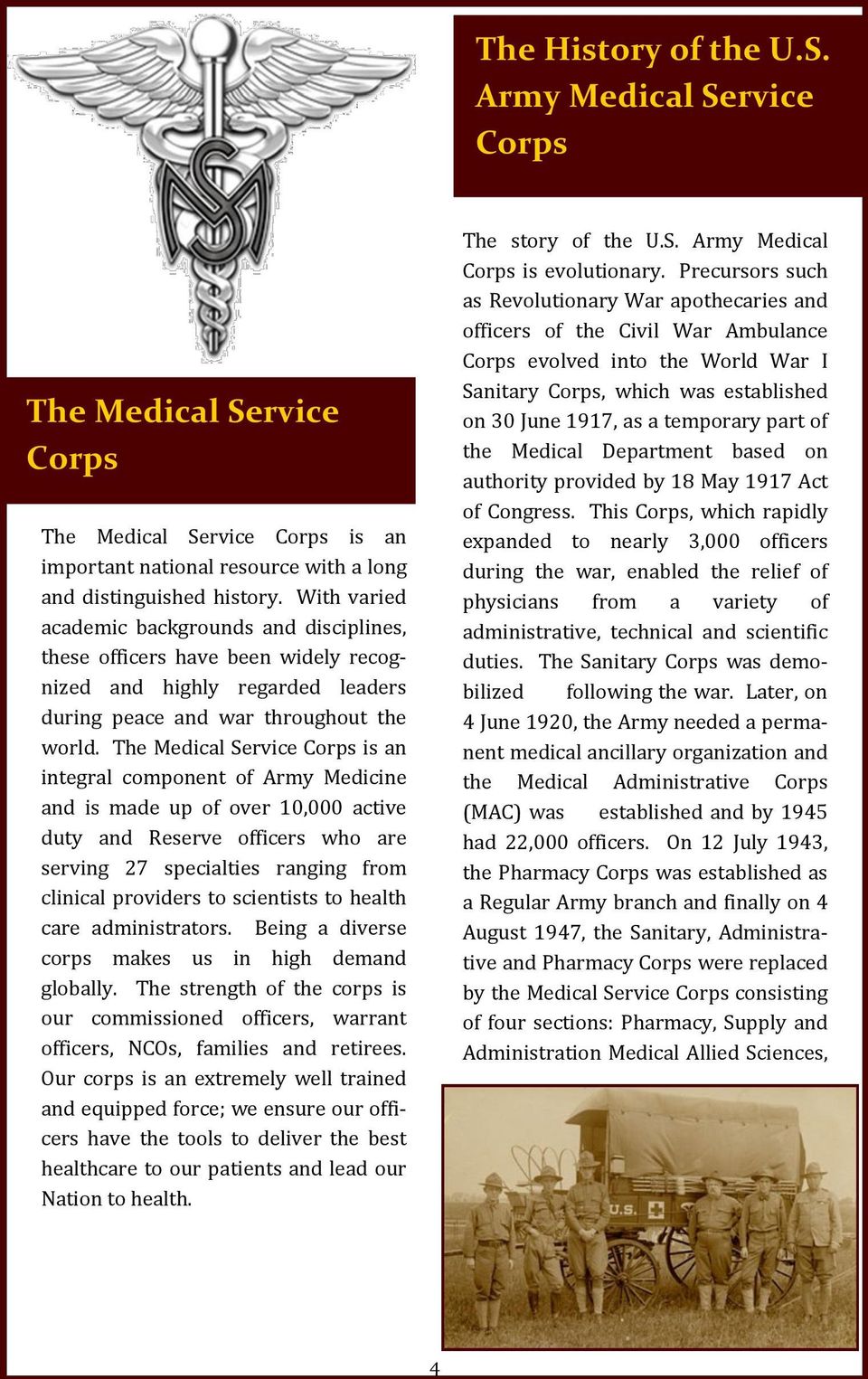
5 Sanitary Engineering, and Optometry. During the Korean War in 1950, the Medical Service Corps aviators were assigned to the first helicopter evacuation detachment in Korea, units that presaged the revolutionary role of the helicopter ambulance. Today, MSCs provide the administrative, planning, programming and budgeting of every Army Medical Department effort. They maintain the Army s wartime medical capability through command of its field medical establishment. They operate what may be the most effective logistical system anywhere in the world. In countless ways, the men and women of the Medical Service Corps are the forefront of the Army Medical Department s humanitarian role in national defense. Our Mission: Provide uniquely qualified administrative, clinical, and scientific Leaders to best enable Army Medicine. Vision: The trusted Corps, optimizing Military Health. Officers in the Army are managers, problem-solvers, key-influencers, and planners who lead other Soldiers in all situations. To become an Army officer you must: Life as an Army Officer in the Medical Service Corps Be a United States citizen Have received the required education and licensure depending on the specialty Have a strong academic standing Be at least 19 years old and be able to be commissioned before your 42 nd birthday Be in good physical condition and pass a full medical examination In the Army, you are a highly respected officer. The Medical Service Corps officer is essential in treating and helping the overall health of Soldiers and their families. Upon entering into the 5

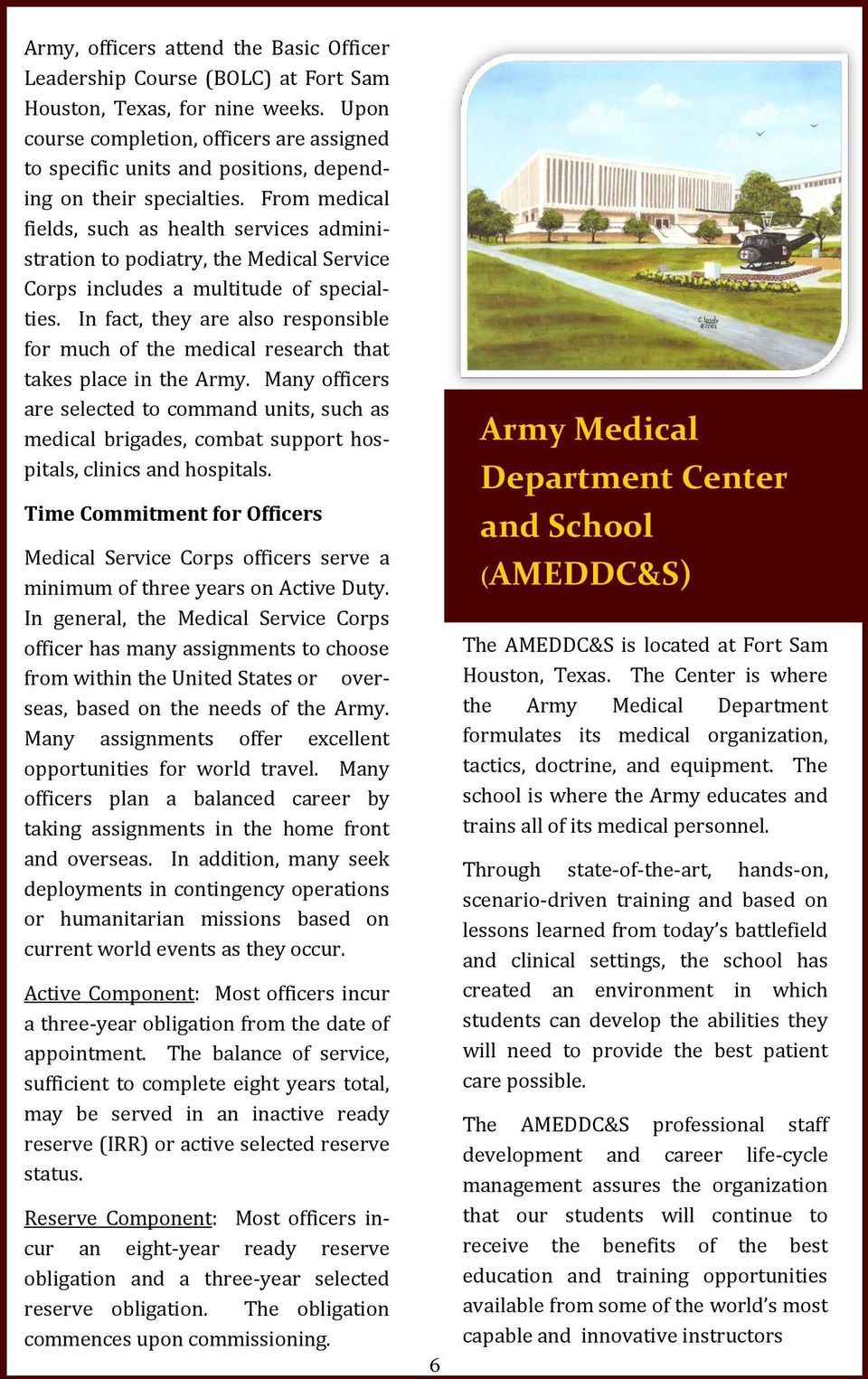
6 Army, officers attend the Basic Officer Leadership Course (BOLC) at Fort Sam Houston, Texas, for nine weeks. Upon course completion, officers are assigned to specific units and positions, depending on their specialties. From medical fields, such as health services administration to podiatry, the Medical Service Corps includes a multitude of specialties. In fact, they are also responsible for much of the medical research that takes place in the Army. Many officers are selected to command units, such as medical brigades, combat support hospitals, clinics and hospitals. Time Commitment for Officers Medical Service Corps officers serve a minimum of three years on Active Duty. In general, the Medical Service Corps officer has many assignments to choose from within the United States or overseas, based on the needs of the Army. Many assignments offer excellent opportunities for world travel. Many officers plan a balanced career by taking assignments in the home front and overseas. In addition, many seek deployments in contingency operations or humanitarian missions based on current world events as they occur. Active Component: Most officers incur a three-year obligation from the date of appointment. The balance of service, sufficient to complete eight years total, may be served in an inactive ready reserve (IRR) or active selected reserve status. Reserve Component: Most officers incur an eight-year ready reserve obligation and a three-year selected reserve obligation. The obligation commences upon commissioning. 6 Army Medical Department Center and School (AMEDDC&S) The AMEDDC&S is located at Fort Sam Houston, Texas. The Center is where the Army Medical Department formulates its medical organization, tactics, doctrine, and equipment. The school is where the Army educates and trains all of its medical personnel. Through state-of-the-art, hands-on, scenario-driven training and based on lessons learned from today s battlefield and clinical settings, the school has created an environment in which students can develop the abilities they will need to provide the best patient care possible. The AMEDDC&S professional staff development and career life-cycle management assures the organization that our students will continue to receive the benefits of the best education and training opportunities available from some of the world s most capable and innovative instructors
7 and staff members. There are five major organizations that comprise the AMEDDC&S: The Academy of Health Sciences (AHS) is our school. It is a very large and complex school-house that is part vocational institution, part community college, and part major university. The AHS conducts 315 courses of which 41 are taught in the Medical Education Training Campus (METC). The AMEDDC&S is accredited by the Council of Occupational Education, and all programs of instruction are reviewed by the American Council on Education. Students attending courses at the AMEDDC&S can get undergraduate and graduate college credits. The Academy of Health Sciences Graduate School also conducts seven doctoral and five masters degree programs. The 32 nd Medical Brigade is the home of all Army personnel assigned to AMEDDC&S. During the year, the brigade is home to more than 20,000 students receiving medical education and training. The Medical Capabilities Integration Center (MCIC) is the center of the AMEDDC&S. The MCIC envisions and designs the organizations, tactics, doctrine and equipment that will provide the medical support on the battlefield. The Noncommissioned Officer Academy (NCOA) is our center for non-commissioned officer (enlisted) professional military leadership education. The Academy teaches courses at both the entry and advanced levels. 7 The AMEDD Personnel Proponent Directorate (APPD) does the force modeling. The Army Medical Department has over 130,000 military and civilian members who work in 200 different officer, warrant officer, enlisted, and civilian specialties. The directorate ensures that the Army s medical force is properly structured to accomplish the Army Medical Department s many missions. History: The AMEDDC&S traces its lineage to the Medical Field Service School (MFSS) established in 1920 at Carlisle Barracks, Pennsylvania. The mission of the MFSS was to train doctors, dentists, and nurses in their duties as Army officers. In 1924, the MFSS conducted the first p r o f e s s i o n a l c o u r s e s f o r noncommissioned officers and Privates First Class. The MFSS moved to Fort Sam Houston in 1946 and was located in the 9 th Infantry Regiment quadrangle. In 1972 a reorganization of the MFSS resulted in the re-designation of the MFSS as the Academy of Health Sciences and consolidated the Army s medical training, making it one of the largest medical training centers in the world. In 1991, it was re-designated as the Army Medical Department Center and School, with the Academy of Health Sciences becoming the school arm.

8 scores, consultant endorsements, and program options. Long Term Health Education and Training (LTHET) The Long Term Health Education and Training program selects active duty officers to enter graduate-level training for the subsequent academic year. For the Reserve Component, this program applies to a limited population of Active Guard Reserve (AGR) officers. To apply for LTHET, officers must be in good standing and normally have no less than five years and no more than 13 years of active federal commissioned service. The LTHET program is an opportunity for officers to attend a top university while remaining on active duty status. Once a year, a military personnel message (MILPER) is generated for officers to apply to a graduate program with a limited tuition cap of $15,000/year. The application deadline is found within the same message. A board of senior Army Medical Department officers and civilians will then review each packet for completeness, pre-requisites, undergraduate grade point average (GPA), Graduate Record Examination (GRE) or Graduate Management Admission Test (GMAT) 8 In the LTHET application, qualified officers are allowed to request two different programs; a first and second choice. For example, an officer could apply for the Homeland Security Master s degree program as their first choice and the Army-Baylor Master s degree in Health Administration as their second. The board will review all applications for Homeland Security and rank order each applicant. If six officers applied for two seats, only two will be accepted. The other four will be considered for their second choice. All applicants must take the standardized tests, GRE or GMAT, regardless of university requirements. The test score cannot be older than five years from the projected date of admission. Statistically, the GRE or GMAT score is the best indicator of success in a graduate program; therefore, these tests must be taken seriously by studying appropriately and meeting the required benchmark. All applicants must have a compete packet to include: Department of Army (DA) Form 3838; official DA photo on record, official transcripts and an endorsement letter from the respective consultant by the deadline date. Other

9 requirements will be stated in the MILPER message, as appropriate. ALL LTHET programs may require a specific utilization tour. Applying officers should discuss possible utilization tours with their consultants and assignment officers before starting the program. Active duty service obligation (ADSO) s will vary depending on the type of program and the length (in months or years) of the program. Opportunities in the Medical Service Corps If you are interested in the Medical Service Corps (MSC), contact a local Army Recruiter or find one at Members of the public with questions about Army Medical Department headquarters should contact the MEDCOM Assistance Group at: army.mil website. Medical Service Corps Benefits Officers in the Medical Service Corps are eligible for a comprehensive benefits package including: 30 paid vacation days earned annually Maternity and Paternity leave Tax deferred investment plan Employer funded retirement after 20 years of qualifying service Possible Location of Service In support of Army Medicine s readiness and health missions, the Medical Service Corps officers serve in a variety of settings supporting our war-fighters in overseas contingency operations and leading the Nation in health. 9 We strengthen the health of our Nation by improving the health of the Army. We provide global support from combat operations to humanitarian assistance and disaster relief missions in places as far reaching as Africa, Haiti, Southeast Asia, Central & South America and the Caribbean. We also have medical treatment facilities providing care to Soldiers and their families at: Combat Support Hospitals Army Medical Centers Army Community Hospitals Army Health Clinics Joint Task Force Medical Elements Army Battalion Aid Stations Research Centers and Laboratories Patient Centered Medical Homes Several locations of service throughout the United States and Overseas include: Alabama Alaska Arizona California Colorado Florida Georgia Hawaii Kansas Kentucky Louisiana Maryland Missouri New Mexico New York North Carolina Oklahoma Pennsylvania South Carolina Texas Virginia Washington D.C. Washington Japan Southwest Asia Central and South America Caribbean Europe Korea

10 Human Resources Command Information ACTIVE DUTY ASSIGNMENT OFFICE TELEPHONE NUMBER Branch Chief/All Colonel Positions (502) Deputy Branch Chief (502) A/70F and USAREC (502) A/B/E/F, 67E/F/G, Acquisition Officers (502) H/70E (502) J/70D/AC/RC and Project Warrior (502) A/B/C/D/E, 73A/B (502) C/70K/WO 670A (502) LT (P) AND CPTs 70B/05A CO Command (502) ALL Active Duty LT 70B (502) RESERVE ASSIGNMENT OFFICE LTC AGR; LTC & COL IRR & IMA (502) MAJ AGR, IRR & IMA (502) LT-CPT: AGR, IRR & IMA (502) ALL AGR, IRR, and IMA (502) HUMAN RESOURCES ASSISTANT 70A/C/D/E/F/H/K, 67J, AND WO 670A (AD) (502) A/B/E/F, 67E/F/G, 72A-E and 73A-B (AD) (502) B (Active Duty Only) (502) ALL AGR, IRR, IMA & TPU (502) All MSC TPU Officers (404) 469- DEPARTMENT OF THE ARMY US ARMY HUMAN RESOURCES COMMAND ATTN: AHRC-OPH-M 1600 SPEARHEAD DIVISION AVENUE DEPT #260 FORT KNOX, KY

11 OTHER INFORMATION HRC Website MS Branch Website Medical Service Corps Home Page A Healthcare Recruiter: MSC Silver Caduceus Society Accession Boards and Schools: AGR, IRR, IMA AGR: Army Guard Reserves IRR: Individual Ready Reserves IMA: Individual Mobilization Augmentee GENERAL branches/officer/health/medicalservices/ index.htm medicalservicecorps.amedd.army.mil/ scs.html (502) TPU: Troop Program Units AD: Active Duty CO: Company Compensation and Benefits Health care professionals who serve as officers in the U.S. Army Medical Department enjoy a wide range of opportunities and financial incentives. There are benefits, tangible and intangible, available to officers who choose to serve full-time in the Army. These benefits are also conferred upon those who choose to serve when needed and maintain careers in their communities as part of the Reserve Component. Active Army professionals are members of a multidisciplinary team focused on providing the best health care possible. Here, healthcare providers are focused on providing healthcare and focus less on running a practice, hiring employees, processing insurance, purchasing equip- 11 ment, stockpiling supplies, or paying malpractice insurance. You will also have opportunities to develop even more specialized skills than those you already have. From continuing education courses and seminars to clinical research and teaching, you will be able to enhance your level of expertise. Plus, the U.S. Army offers scholarships and student loan repayment assistance to students and recent graduates in many health care fields. You have many career options. Learn more about the benefits that come with serving your country. Thrift Savings Plan (TSP) The Thrift Savings Plan (TSP) is a Federal Government-sponsored retirement savings and investment plan. The National Defense Authorization Act for Fiscal Year 2001 extended participation in the TSP, which was originally only for Federal civilian employees, to members

12 of the uniformed services, and members began enrolling on 9 October The TSP offers the same type of savings and tax benefits that many private corporations offer their employees under so-called "401(k)" plans. The retirement income that you receive from your TSP account will depend on how much you have contributed to your account during your working years and the earnings on those contributions. For more information on the TSP, visit the official TSP website at It is important to remember the TSP is for long-term retirement savings. There are penalties for early withdrawals. So if you are seeking short-term saving options, consider U.S. Savings Bonds. They are a convenient way to help save for homes, education, automobiles, or vacations. Post 9/11 GI Bill The Post-9/11 GI Bill was created by law in July of The Post 9/11 GI Bill provides educational benefits for service-members who have served on active duty for 90 or more days since 10 September These benefits are tiered based on the number of days served on active duty, creating a benefit package that gives current and previously activated National Guard and Reserve members the same benefits as active duty servicemembers. The education benefits include up to 100% Tuition and Fee Coverage, a monthly living (housing) stipend, up to $1,000 a year for books and supplies, a onetime relocation allowance, the option to transfer benefits to family members and other benefits. 12 Benefit Transferability-Post 9/11 GI Bill: The Department of Defense is authorized to allow individuals who, on or after 1 August 2009, have served at least 6 years in the Armed Forces and who agree to serve at least another 4 years in the Armed Forces to transfer unused entitlement to their spouse or dependents. The Department of Defense may, by regulation, impose additional eligibility requirements. Leave Benefits Time away from duties and training is critical for the continued well-being of Soldiers. The Army provides a number of benefits that provide Soldiers with the opportunity to have time away from their jobs. Active duty Soldiers are eligible to participate in various leave programs. Active duty Soldiers earn 2.5 days of annual leave (paid vacation) for each month of service, for a total of 30 days per year. Housing Benefits The Army also provides allowances to offset the cost of living. These allowances are monies provided for specific needs, such as food or housing when the government does not provide for

13 that specific need. Most allowances are not taxable, which is an additional imbedded benefit of military pay; however, base salary is taxable. In general, active duty officers and enlisted Soldiers are eligible for some degree of the allowances stated. Basic Allowance for Housing (BAH): BAH offsets the cost of housing when Soldiers live off base. The intent of BAH is to provide uniformed service members accurate and equitable housing compensation based on housing costs in local civilian housing markets, and is payable when government quarters are not provided. The BAH rates are based on the Soldiers' geographic duty location, pay grade, and dependency status. BAH is the second-largest piece of compensation for most Soldiers. Overseas Housing Allowance (OHA): OHA is used to compensate members for the majority of housing expenses incurred while stationed overseas. Allowance rates are periodically updated based on new cost data and review of currency fluctuations. OHA is comprised of three components: Basic Allowance for Subsistence (BAS): The Basic Allowance for Subsistence (BAS) is used to pay for food for Enlisted Soldiers and Officers. For officers the BAS is the same across the board and within a few hundred dollars Clothing Allowance: Officers are entitled to an initial uniform allowance. Officers get a one time payment of $400 after commissioning to buy uniforms and insignia. 13 Cost of Living Allowance (COLA): Soldiers assigned to high-cost locations in the continental U.S. or a tour of duty outside the continental United States are paid a Cost of Living Allowance. This allowance is intended to offset the higher costs of food, transportation, clothing, and other non-housing items. COLA rates are based on the Soldiers' rank, duty location, and dependent status. Unlike other allowances, COLA is considered taxable; however, an additional amount is included to cover the average tax rate. Managed-Care Health Insurance The Managed-care health insurance option is available to all eligible military beneficiaries that are not entitled to Medicare (age 65 or older) in the continental United States and Overseas. All Soldiers receive prime health care in military treatment facilities or from an equivalent managed-care group in the civilian sector. Active duty Soldiers and authorized Family members are eligible for TRICARE Prime coverage. TRICARE covers eligible children until age 21. For TRICARE coverage beyond the age of 21, college students must be enrolled full-time at an accredited institution of higher education and the sponsor must provide more than 50% of the student's financial support up to the age of 23. Servicemember Group Life Insurance (SGLI) Servicemembers' Group Life Insurance (SGLI) is a life insurance program for Soldiers and their Family members

14 provided by the Department of Veterans Affairs. It is one of a number of low cost insurance programs that were developed to provide insurance benefits for Soldiers who may not otherwise be eligible to receive insurance benefits from private companies due to risks involved in military service or a service connected disability. Soldiers on Active Duty are eligible for full-time SGLI coverage. Coverage is in effect during a period of active duty service and for 120 days following separation or release. SGLI coverage is available in $50,000 increments up to the maximum of $400,000. Soldiers are automatically covered for the maximum insurance amount unless they reduce or decline coverage in writing. Soldiers covered under SGLI are also covered under Servicemembers' Group Life Insurance Traumatic Injury Protection Program (TSGLI). The included TSGLI coverage will pay a benefit of between $25,000 and $100,000 depending on the loss directly resulting from the traumatic injury. Retirement Benefits Officers who have completed 20 years of active service are eligible to receive Retired Pay at the end of their career in the Army. The Date of Initial Entry into Military Service (DIEMS) determines which of the three retirement systems an officer falls under. Retired Pay amount and requirements depend on whether an officer qualifies for active duty retired pay or non-regular retired pay (Reserve Component). 14 The active duty military retirement plan is a defined benefit plan that is based on the Soldier's years of service (YOS) and the basic pay being earned near the end of the Soldier's career. To qualify for regular retirement, the Soldier must complete at least 20 years of active duty or equivalent. With retirement, the Soldier and dependents are eligible for medical care, post-exchange facilities and other benefits. HEALTH PROFESSIONS SCHOLARSHIP PROGRAM (HPSP) The Army offers one of the most g en e ro us a nd co m pr e h en s iv e scholarships in the healthcare field. It is called the F. Edward Herbert Armed Forces Health Professions Scholarship Program (HPSP). Whether you want to become an Optometrist, Clinical Psychologist, or other medical professional; you could earn a full-tuition scholarship with a monthly stipend through the Army s HPSP, if you qualify. To be eligible, you must be a citizen of the United States; be enrolled in or have a letter of acceptance to an accredited graduate program in the United States or Puerto Rico; meet eligibility criteria for appointment as a commissioned officer in the U.S. Army Reserve; and maintain full-time student status during the entire length of the program. You will incur a

15 Breakdown of Army Benefits ACTIVE AMEDD BENEFITS Training to become a leader among your peers Paid continuing education, including clinical specialization courses Travel opportunities, including humanitarian missions around the world No-cost or low-cost medical and dental care for you and your family Noncontributory retirement benefits with 20 years of qualifying service 30 days of paid vacation earned annually No premiums for malpractice insurance Rank and privileges of an officer in the U.S. Army Commissary and post exchange shopping privileges A flexible, portable retirement savings and investment plan similar to a 401(k) RESERVE AMEDD BENEFITS Paid continuing education, including specialized training courses Training to become a leader among your peers Travel opportunities, including humanitarian missions Low-cost life and dental insurance Noncontributory retirement benefits at age 60 with 20 years of qualifying service Networking opportunities Rank and privileges of an officer in the U.S. Army Commissary and post exchange shopping privileges A flexible, portable retirement savings and investment plan similar to a 401(k) service obligation that will be served consecutively. For example, a student who had a 4-year Reserve Officer Training Corps (ROTC) scholarship and accepts a 3- year HPSP will serve for 7 years on active duty. The first 4 years will count towards repaying the ROTC obligation, and the last 3 years count toward repaying the HPSP obligation. Once you graduate, you 15 will become a member of one of the most comprehensive and dynamic healthcare organization in the world The U.S. Army Medical Department. ACTIVE DUTY HEALTH PROFESSION LOAN REPAYMENT PROGRAM (ADHPLRP) The Army also offers ADHPLRP for direct accession and/or as a retention incentive

16 to maintain adequate numbers of commissioned officers on active duty who are qualified in the various health professions. Up to $40,000 (pre-tax) per year in loan repayment funding for qualified educational loans is available for each selected eligible applicant, for a contract period of up to three years. Participants will incur an active duty service obligation (ADSO) of a minimum of two years consecutively from other obligations, not concurrently, with any other active duty service obligation. Up to 100 officers may be selected to receive loan repayment under this program. If more than 100 applicants are received, then Human Resources Command, Health Services Division, will apply the Office of the Surgeon General guidance to determine an order of merit list (OML). Officers considered ineligible to apply for or receive retention benefit through ADHPLRP include: current and former Health Professions Scholarship Program (HPSP) or financial assistance program (FAP) recipients who received full (4 year) scholarship, participants in Reserve incentive programs and graduates of Uniformed Services University of Health Sciences (USUHS). The maximum award amount is prescribed annually by the Secretary of Defense, and therefore, may change depending on fiscal uncertainly. MEDICAL SERVICE CORPS SPECIAL PAY Optometry Retention Bonus (ORB) is a discretionary pay given to Medical Service Corps officers who are licensed Optometry Officers serving on active duty for periods of at least 2 years. Corps officers who are licensed Pharmacy Officers serving on active duty for periods of at least 2 years. The annual rate is established as a flat rate regardless of creditable service. The POSP is paid as an annual lump sum and is taxable in the tax year payment. Licensed Clinical Psychologist Incentive Pay (IP) is a discretionary pay given to Medical Service Corps officers who are licensed Clinical Psychologists serving on active duty for periods of at least 1 year. Licensed Clinical Psychologist Retention Bonus (RB) is a discretionary pay given to Medical Service Corps officers who are licensed Clinical Psychologists serving on active duty for periods of at least 2, 3, or 4 years. Non-Physician Health Care Provider Board Certified Pay (NPBCP) is a discretionary pay not an entitlement, paid to Medical Service Corps officers who have a post baccalaureate degree in the providers specialty and certified by a professional board. Several specialties include: Audiologist/Speech Pathologist, Clinical Psychologist, Optometrist, Pharmacist, Podiatrist, Nuclear Medicine, and Social Work officers. The amount is determined by years of credible service and is paid monthly. Providers must submit evidence of re-certification in order to continue receiving NPBCP. Pharmacy Officer Special Pay (POSP) is a discretionary pay given to Medical Service 16

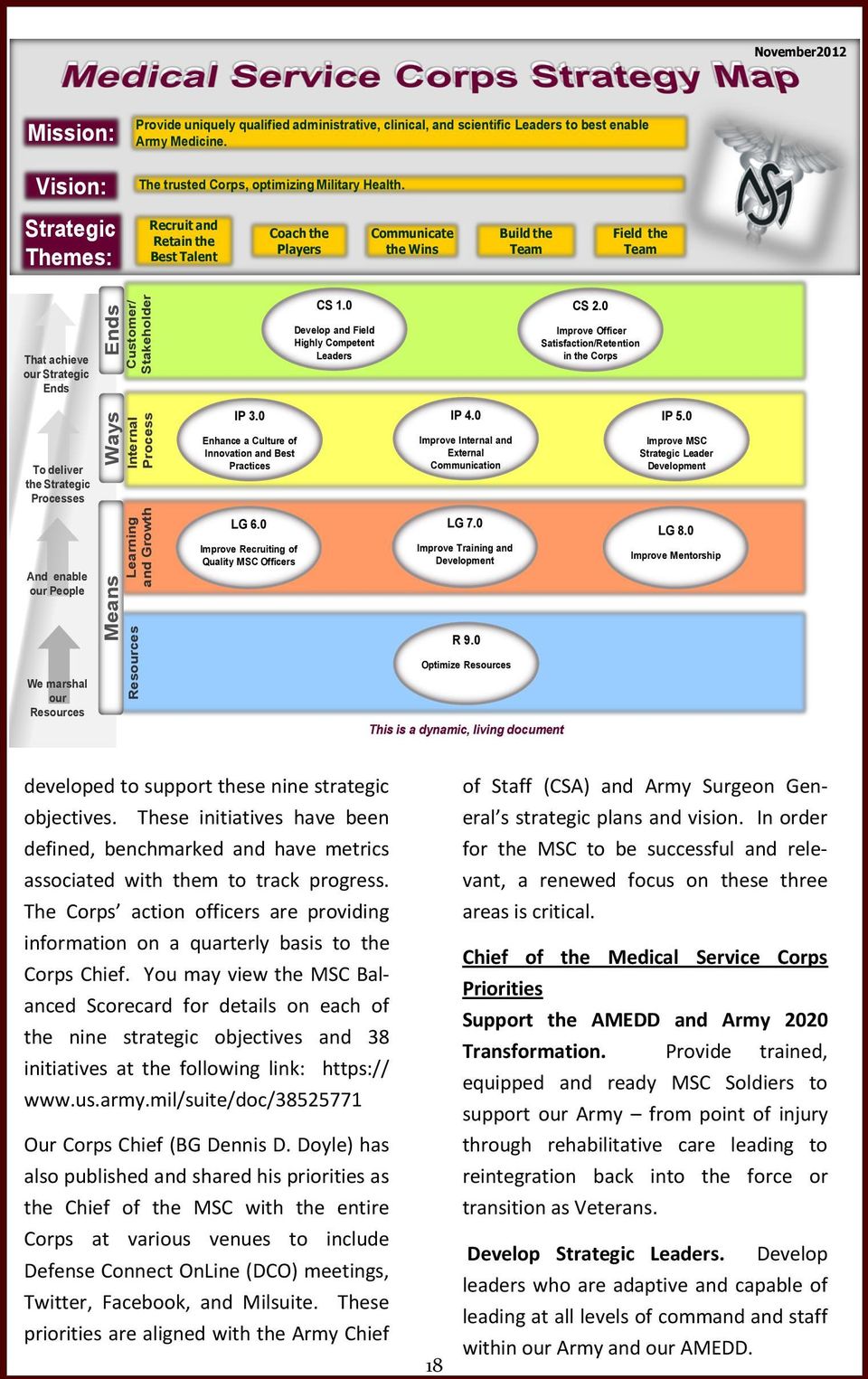
17 Medical Service Corps Strategic Plan Annually, the Corps Chief assembles a team of Planning Conference. MSC Leaders at a Strategic The most recent team consisted of our Assistant Corps Chiefs (ACC), Area of Concentration (AOC) Consultants, HRC MSC Branch Chief, incoming AMEDD Personnel Proponent Directorate (APPD) Director, AMEDD Recruiting Brigade Commander, OTSG/ MEDCOM Human Resource Director/G1, senior Army Reserve and National Guard representatives, the Corps Specific Branch Proponent Officer (CSBPO) and the Deputy Corps Chief. The objective of the conference was to update the MSC Strategic Plan. The outcome of the threeday facilitated workshop yielded a revised MSC Mission Statement, Vision, Strategy Map and Balanced Scorecard. While many changes were made, our five strategic themes remained intact as they continue to accurately reflect the overall focus and direction for the MSC. The Strategy Map illustrates the updated mission, vision, retained themes and nine refined strategic objectives developed by the working group. The MSC Strategic Plan has nine (9) strategic objectives. We will focus on these strategic objectives during the next 3-5 years: Strategic Objectives 1. Develop and Field Highly Competent Leaders. Improve the Corps support to Army Medicine s talent management by providing properly developed leaders at the right time Improve Officer Satisfaction/ Retention in the Corps. Improve MSC Officer and Family Member satisfaction by understanding, managing and exceeding their expectations. 3. Enhance A Culture of Innovation and Best Practices. Implement best practices and increase the body of knowledge. 4. Improve Internal and External Communication. Communicate the wins to our Customers and Stakeholders. Leverage existing communication platforms to increase the sharing of information and create a two way flow of dialog. 5. Improve MSC Strategic Leader Development. Optimize strategic planning and leader development by involving and engaging MSC Officers at all ranks. 6. Improve Recruiting of Quality MSC Officers. Support the recruitment of quality MSC professionals with a propensity to serve through aggressive, responsive and criteria-based accession incentives benefits and other initiatives. 7. Improve Training and Development. Improve and increase opportunities for education, training and professional development to groom our Officers. 8. Improve Mentorship. Mentorship is essential for MSC Officers. Effective mentorship can positively increase the level of competency of our Officers and improve satisfaction in the Corps. 9. Optimize Resources. Appropriately leverage the talents, skills, knowledge and experiences of MSC Officers to effectively distribute our people. There were 38 separate initiatives



18 Learning and Growth Internal Process Resources Ends Customer/ Stakeholder November2012 Mission: Vision: Provide uniquely qualified administrative, clinical, and scientific Leaders to best enable Army Medicine. The trusted Corps, optimizing Military Health. Strategic Themes: Recruit and Retain the Best Talent Coach the Players Communicate the Wins Build the Team Field the Team CS 1.0 CS 2.0 That achieve our Strategic Ends Develop and Field Highly Competent Leaders Improve Officer Satisfaction/Retention in the Corps To deliver the Strategic Processes And enable our People Means Ways IP 3.0 Enhance a Culture of Innovation and Best Practices LG 6.0 Improve Recruiting of Quality MSC Officers IP 4.0 Improve Internal and External Communication LG 7.0 Improve Training and Development R 9.0 IP 5.0 Improve MSC Strategic Leader Development LG 8.0 Improve Mentorship We marshal our Resources Optimize Resources This is a dynamic, living document developed to support these nine strategic objectives. These initiatives have been defined, benchmarked and have metrics associated with them to track progress. The Corps action officers are providing information on a quarterly basis to the Corps Chief. You may view the MSC Balanced Scorecard for details on each of the nine strategic objectives and 38 initiatives at the following link: Our Corps Chief (BG Dennis D. Doyle) has also published and shared his priorities as the Chief of the MSC with the entire Corps at various venues to include Defense Connect OnLine (DCO) meetings, Twitter, Facebook, and Milsuite. These priorities are aligned with the Army Chief 18 of Staff (CSA) and Army Surgeon General s strategic plans and vision. In order for the MSC to be successful and relevant, a renewed focus on these three areas is critical. Chief of the Medical Service Corps Priorities Support the AMEDD and Army 2020 Transformation. Provide trained, equipped and ready MSC Soldiers to support our Army from point of injury through rehabilitative care leading to reintegration back into the force or transition as Veterans. Develop Strategic Leaders. Develop leaders who are adaptive and capable of leading at all levels of command and staff within our Army and our AMEDD.
19 Reinforce the Profession of Arms. Ensure the professional development programs critical to the sustainment of our high quality force; foster MSC Soldiers committed to the Army Profession. The diversity of our Corps uniquely positions us to make significant contributions to the operational and generating forces of the Army and Army Medicine as a whole. Our strategy is to maintain the things we do best, increase leader development opportunities, improve communication synchronization, leverage opportunities in both military and civilian education, and recognize the value of our people. We have a tremendous legacy on which to build upon and the future of our Corps is bright. "I am deeply honored to serve you as the Chief of the 'best and most powerful Corps in the world!' The AMEDD and the Army rely on us every day." Brigadier General Dennis D. Doyle, 17th Chief, U.S. Army Medical Service Corps Healthcare Administrator 70A Healthcare Administrators (HCA) are responsible for providing health care management and leadership to the Army s health care facilities. As an officer, you ll have the opportunity to enhance your skills in one of the world s largest health care organizations. Health care administrators serve in a variety of critical roles throughout the entire spectrum of military health care, as they plan, direct, manage, support and lead healthcare organizations. Typical assignments range from health care management positions in garrison-based medical and dental facilities, serving as department administrators, Business Operations managers, or Deputy Commanders for Administration (DCA), to positions in the Operational Force as Executive Officers or Deputy Commanders for Administration, serving worldwide. There are also many immaterial positions to include Inspector General, Commander, and policy positions serving in major Army commands. JOB DUTIES Coordinates care delivered by the health care consortium to include Army, Navy, Air Force and U.S. VA Healthcare Advises commanders on health care delivery and the management of health care facilities 19

20 Establishes and implements policies/ procedures affecting the U.S. Army Medical Department and Military Health System Manage the clinical business processes to ensure the viability of a healthcare organization in both operational and institutional Participate at all levels of command in establishing and implementing policies and procedures affecting Army Medicine REQUIREMENTS Must be a graduate of the Army Medical Department Basic Officer Leadership Course (BOLC) and Captain Career Course (CCC). Master s degree in Health Care Administration (CAHME accredited program) or Master s degree in Business Administration (AACSB accredited program) Minimum of 3 years experience in a fixed medical/dental facility or field activity Must be between 21 and 42 years of age (may request a waiver) Permanent U.S. residency KEY FACTS AND OPPORTUNITIES Fellowships and training with civilian industry, such as, fellowship with the American Hospital Association, RAND Corporation, Congressional Liaison, and Joint Internships Command at health clinics, medical centers, brigades, combat support hospitals, Joint staff or Chief of Staff Qualifying Master s degree in Health Care Administration or Health Service Administration Master s/ 20 Doctor of Philosophy (PhD); Health Care Economics; operations research/systems analysis, and business administration U.S. Army Baylor University Program in Health Care Administration ASSIGNMENTS Many assignments worldwide to include: National Capital Military Medical Center (D.C.), Brooke Army Medical Center (San Antonio, TX); Madigan Army Medical Center (Washington); Landstuhl Regional Medical Center (Germany); etc. Health Services Administration 70B Health Services Administration officers work at the operation level, plans, coordinates, monitors, evaluates and advises unit commanders and staff in both medical and non-medical areas of patient evacuation, treatment and tracking, preventive medicine, organizational administration, supply, training, operations, transportation, and maintenance. This is an entry level area of concentration and in six to eight years you will be reclassified into a more specific specialty prior to promotion to Major. JOB DUTIES Plan, coordinate and monitor the treatment of our patients Advise unit commanders/staff in medical/non-medical areas of patient evacuation, treatment and tracking Practice preventive medicine,

21 organized administrative actions, supply equipment, train staff and maintain equipment REQUIREMENTS Bachelor s degree Must be between 21 and 42 years of age (may request a waiver) Permanent U.S. residency TRAINING Job training for Medical Service Corps officers includes completing an Officer Basic Leadership Course; which introduces you to the Army Health Care system, Army doctrine and basic Soldier/ leader skills. KEY FACTS AND OPPORTUNITIES Opportunities exist to reclassify for healthcare administration (70A), comptroller (70C), health services systems management (70D), patient administration (70E), human resources (70F), plans, operations, intelligence/security and training (70H), or medical logistics (70K) positions May attend military or civilian schools to attain a projected area of concentration Highly encouraged for officers to compete for and obtain the Expert Field Medical, Airborne, and Air Assault badges and Ranger tab training and testing COMPENSATION Pay for continuing education Retirement benefits with 20 years of qualifying service 21 Flexible and portable retirement savings and investment plan similar to a 401(k) EDUCATION BENEFITS In the Army, qualified students can earn full-tuition, merit-based scholarships, allowances for books and fees, plus an annual stipend for living expenses. Learn more about educational opportunities at Health Services Comptroller 70C These officers provide a wide range of expertise for resource management to include financial, budgeting, programming, manpower management analysis, medical expenses reporting, commercial activities and internal control. They make extensive use of multiple financial databases, managed care reports and analyses. Logistical knowledge is necessary to generate data-driven recommendations for the Army Medical Department and must also be able to interpret fiscal law and comptroller general decisions. JOB DUTIES Prepares, consolidates, and analyzes financial data and management information systems Advises commanders on all aspects of the Planning, Programming, Budgeting, and Execution System processes Prepares and distributes reports and financial statement of status of funds, and budget purposes
22 Develops and plans policies for effective and economical utilization of manpower resources Directs disbursement and receipt of Army Medical Department funds REQUIREMENTS Master s/phd degree in Business Admin istration or r ela ted administrative areas from an accredited program Must be between 21 and 42 years of age (may request a waiver) Permanent U.S. residency TRAINING Job training for Medical Service Corps Officers includes completing an Officer Basic Leadership Course, which introduces you to the Army Health Care system, Army doctrine and basic Soldier/ leader skills. KEY FACTS AND OPPORTUNITIES Earn a Master s degree at Syracuse University, Army Comptroller Program Defense Resource Management Course Professional Military Comptroller Course Financial Management Education Program COMPENSATION In addition to the many privileges that come from being on the U.S. Army health care team, you ll also be rewarded with: Pay for continuing education Retirement benefits with 20 years of qualifying service 22 Flexible, portable retirement savings and investment plan similar to a 401(k) Health Information Systems 70D Health Services Information managers work in the area of health care information management. Develops strategy, policy, and plans for the d e v e l o p m e n t, i m p l e m e n t a t i o n, operation, and evaluation of clinical/ patient oriented information systems and the administration of support for medical information systems. Leads the role in improving clinical and administrative processes to achieve business objectives and organizational strategy for information management. Provides consultative services and detailed technical analysis on planning, development, implementing, operating, maintaining, securing, and disposing of information systems and networks at medical activities. JOB DUTIES Advises commanders as a health care information management officer; health services systems analyst; clinical systems, and clinical informatics Establishes and implements policies/ procedures affecting the U.S. Army Medical Department and Military Health System Integrates telecommunications, automation, visual information, and printing equipment in support of individual or multiple medical
23 treatment facilities and biomedical research laboratories Enables efficient, effective, and innovative information technology across the Army Medical Department, The Military Health System, and in partnership with the federal and private sector in peace and in war REQUIREMENTS Must be a graduate of the Army Medical Department Basic Officer Leadership Course and Captain Career Course Complete the Medical Information Management Course Complete an internship program under the supervision of a senior health services information manager Must possess a Bachelor s degree. Permanent U.S. residency KEY FACTS AND OPPORTUNITIES Civilian graduate-level degree programs (Master s or Doctoral) in information management Doctoral degree in information m a n a g e m e n t, i n f o r m a t i o n technology management, and operational research/systems analysis Patient Administration 70E Patient Administrators plan, organize, and direct services that support hospital operations in a variety of military health care settings. Patient Administration is a core component of a hospital s infrastruc- ture for patient accountability, medical records management, inpatient and outpatient coding, billing and collections, patient movement, patient privacy, line of duty processing, and the Integrated Disability Evaluation System (IDES). Patient Administrators advise unit commanders on issues pertaining to Soldier medical readiness and serve as the principal advisor to hospital commanders and leadership in both the field and fixed settings on all matters related to this service. JOB DUTIES Provides patient accountability, admission and disposition services, patient registration, birth registrations, Decedent Affairs services, Line of Duty initiation Provides outpatient and inpatient coding services Manages both paper-based and electronic health records Administers the hospital s Privacy program, ensures proper release of medical information Coordinates closely with units, the Veteran s Administration, Soldiers, the Physical Disability Agency, and other hospital staff in the administration of the Physical Disability Evaluation System Serves as an integral partner in the tracking and movement of patients from theater as well as within CONUS for all movement that requires support from the Global Patient Movement Requirement Center 23
24 Serves as the Medical Regulating Officer (MRO) in a theater of operations Manages the Uniform Business Office of the hospital to ensure accurate billing and collections, as well as maintenance of the Patient Trust Fund and Treasury office Serves as committee chairman for the Record of Care Functional Management Team for Joint Commission purposes and ensures all Joint Commission standards related to Patient Administration are met REQUIREMENTS Must be a graduate of the Army Medical Department Basic Officer Leadership Course and Captain Career Course Successfully completed the Army Medical Department Patient Administration Course Bachelor s degree in Health Care science Minimum of 3 years experience in a fixed medical/dental facility or field activity Must be between 21 and 42 years of age (may request a waiver) Permanent U.S. residency KEY FACTS AND OPPORTUNITIES Master s degree at the University of Pittsburgh Program in Health Information System or U.S. Army-Baylor University Program in Health and Business Administration Established programs in Health Information Systems prepares professionals responsible for the development 24 and management of health information systems consistent with the clinical, fiscal, administrative, ethical and legal requirements of health care institutions Other training opportunities available include inspector general, federal health care executives, operation research/systems analysis, civilian personnel management, medical information management, project management course, functional proponent course, emergency management, and the joint medical planner course ASSIGNMENTS Many assignments worldwide to include: Medical Centers, Medical Activities, Medical Brigades, Combat Support Hospitals, the Army Medical Department Center and School, Patient Administration Systems and Biostatistics Activity, Regional Medical commands, and the U.S. Army Medical Command. Human Resources 70F Health Services Human Resources Administrators are responsible for all aspects of health services human resources management to include matters/policies pertaining to all assigned military personnel, Department of Defense civilian personnel, and contractors. Plans, develops, and directs human resources systems that support and implement programs concerning the components of the human resources management life cycle to include
25 management, accessions, personnel operations, personnel requisitioning, casualty reporting, awards, promotions and reductions, classification and reclassifications, assignments, finance and special pays, evaluation reports, reenlistment, elimination and separation. JOB DUTIES Manages the activities of personnel operational elements providing su p port to org anizations, headquarters, and individuals Trains military and civilian personnel in personnel services support and organizational administration Plans, develops, and direct administrative management activities and services in medical organization, which include distribution, publications, correspondence, record and file management, and desktop publishing Manage the human capital distribution plan and business strategy for the future of the Army Medical Department Participate at all levels of command in establishing and implementing policies and procedures affecting Army Medicine REQUIREMENTS Must be a graduate of the Army Medical Department Basic Officer Leadership Course and Captain Career Course Must have successfully completed the Army Medical Department Human Resources Manager Course Minimum of 3 years experience in a fixed medical/dental facility or field activity 25 Must be between 21 and 42 years of age (may request a waiver) Permanent U.S. residency KEY FACTS AND OPPORTUNITIES Apply for the opportunity to serve as an intern in The Office of the Surgeon General or the Army Medical Department Personnel Proponency Directorate (APPD), or an opportunity to take part in a Training with Industry (TWI) experience Positions as adjutant (apprentice), director, general staff, human resources officers, career manager, troop commander, and health service recruiter Director of Human Resources, Office of the Surgeon General Qualifying civilian-funding education for Master s degree in Human Resources Management, labor relations, international business, organizational behavior, marketing, e d u c a t i o n, h e a l t h c a r e administration, and operational research and systems analysis ASSIGNMENTS Many assignments worldwide to include: National Capital Military Medical Center (Washington, D.C.) Brooke Army Medical Center (San Antonio, TX) Madigan Army Medical Center (Washington) Tripler Army Medical Center (Hawaii) Landstuhl Regional Medical Center (Germany)
26 Medical Plans, Operations, Intelligence, Security, and Training 70H A Medical Operations Officer plans and directs the activities of the field and institutional medical operations. These Medical Officers coordinate staff functions pertaining to health services plans, operations, intelligence, security and training. In addition, these officers direct and exercise staff supervision of units engaged in production, acquisition, storage, and distribution of medical equipment, repair parts, and supplies. The Medical Operations Officer also serves as an advisor to commanders and their staffs on the subject of supporting Health Services operations. JOB DUTIES Coordinates plans, operations, intelligence, security and training at various level of field and medical operations Numerous assignments with duties as Chief of Staff or assistant, medical planner, special forces group, training operations research analyst, and executive officers at all levels of echelon for the Army Medical Department Establishes and consults with commanders as a medical planner and plans/training officer Manage as a force health protection officer at various joint Department of Defense assignments Participate at all levels of command 26 in establishing and implementing policies and procedures affecting Army Medicine REQUIREMENTS Must be a graduate of the Army Medical Department Basic Officer Leadership Course and Captain Career Course Bachelor s and Master s degree in Health Care Administration, or related field as officer moves into higher ranks, respectively Minimum of 3 years experience in a fixed medical/dental facility or field activity Must be between 21 and 42 years of age (may request a waiver) Permanent U.S. residency KEY FACTS AND OPPORTUNITIES Courses available to obtain skills in Strategic Intelligence, Operations Research/Systems Analysis and Training Development Opportunities for positions in Operational Research; Operational Management; Healthcare Planning; Health Care Policy and Management, International Policy; International Humanitarian Assistance; Government and International Public Administration; Homeland Security and Intelligence; Government with Homeland Security Concentration; National Security; Emergency Management and Disaster Preparedness Qualifying master s degree offered for Army and civilian programs, for Health Care Education Administration; Health Care Technology;
27 Health Services Materiel Officers plan, coordinates, controls and manages the functional areas pertaining to the highly specialized and technical materiel, facilities, and services utilized in support of the health care delivery system. Commands or exercises staff responsibility for units engaged in medical supply, medical facilities, medical maintenance, blood storage and distribution, optical fabrication and production and medical service operations and other logistical support. Master s in Public Health; and History of Military Medicine from school of choice (SOC) Opportunities for assignments worldwide to include National Capital Region, Washington State, Hawaii, Alaska, Puerto Rico, Europe (Germany, Belgium), Korea, Japan, and Africa) Inter-Agency Institute for Health Care Executives post graduate seminar as a senior officer Medical Planner expert at various joint echelons of medical care in the theater combat medical system Medical Logistics 70K JOB DUTIES Plans and directs activities of personnel and units responsible for the receipt, storage, inventory management, and issue of all medical supplies Responsible for ensuring service support functions to include 27 life-cycle facility management Directs and supervises collection, evacuation, and accountability for all classes of supply classified as salvage, surplus, abandoned, or uneconomically repairable Develop and plan policies for effective utilization and expenditures of materiel management Advises commanders on logistics and facility planning matters and unit mission capabilities Plans, directs, and implements the multifunctional areas of materiel management and their integration into overall Department of Defense logistics systems Engaged in production, acquisition, receipts, storage and preservation, issue and distribution of medical equipment, medical repair parts, and medical supplies A Health Facility Planner (70K9I) may be responsible for planning, programming, design management, design review, and construction management for health care facilities REQUIREMENTS Must be a graduate of the Army Medical Department Basic Officer Leadership Course and Captain Career Course Successfully complete the Health Services Materiel Officers Course To hold a position as Lieutenant Colonel and Colonel level, should possess a Master s/phd degree in a discipline related to business, logistics, acquisitions, technology management, supply chain
28 management, clinical engineering, health facility planning, architecture, mechanical/engineer, construction management, or health care administration Must be between 21 and 42 years of age (may request a waiver) Permanent U.S. residency KEY FACTS AND OPPORTUNITIES Numerous positions for all ranks to include chief of logistics, commander, medical logistics company, S-4, contracting officer, medical logistics programmer, medical logistics planner, medical logistics staff officer, hospital materiel officer, health facility planning officer Opportunities to complete short courses such as hospital medical logistics course and the systems course Certification for various specialized skills for acquisition logistics programs, contracting, program m a n a g e m e n t, i n s t a l l a t i o n management, and health care facility Many assignments in the above listed positions to include Germany, Korea, Japan, Thailand, Saudi Arabia, Kenya, Hawaii, Alaska and Italy in addition to multiple CONUS assignments. 28 Aeromedical Evacuation 67J Serve as a specially trained aeromedical evacuation aviator in a variety of key positions. Pilots assigned to aircraft on aeromedical evacuation missions who supervise in-flight treatment to sustain human life and relieve suffering. Possess full knowledge of the Army Medical Department and aviation doctrine, organization, and equipment. Tactically employ medical aircraft, personnel, and equipment in support of land combat operations in varying tactical, terrain, and climatic environments using a variety of flying techniques and equipment. Serve in key aeromedical evacuation billets applying MEDEVAC operational expertise to staffing actions related to aeromedical evacuation. JOB DUTIES Duties include Army Medical Department and aviation staff positions at various levels, service schools and or training centers, instructor, aviation maintenance and safety, research and development Plans and executes intra-theater tactical, operational, and strategic air medical evacuation within a theater of operations Supports aeromedical evacuation for joint coalition and allied partners, employees/contractors, interagency personnel, detainees, enemy prisoners of war and host nation, nongovernment organizations and military working dogs Executes emergency medical re-
29 supply as well as homeland security medical evacuation support Executes advisory and consultant duties with Army aviation units, medical evacuation program management, and other roles, as required REQUIREMENTS Must possess a bachelor s degree from an accredited college/ university in a discipline acceptable to The Surgeon General of the Army Medical Department Before awarding of the 67J AOC, must be a graduate of the Army Medical Department Basic Officer Leadership Course, Flight School XXI, and should complete the Army Medical Evacuation Doctrine Course (2C-F7 Course). Must successfully maintain qualifications for unrestricted utilization as an Aeromedical Evacuation Officer Officers must have successfully completed the Aviation Captain Career Course along with the AMEDD 67J Branch Training Course or the Army Medical Department Captain Career Course prior to promotion to MAJ To hold executive positions at the Lieutenant Colonel and Colonel levels, must have successfully completed the U.S. Army Intermediate Level Education or Command and General Staff Officer s Course (whichever is the contemporary term) and, later, a Senior Service College. Should possess a Masters degree from an accredited program acceptable to The Surgeon 29 General in a discipline related to one of the AOCs in the 70 MFA Various licensure requirements depending on the level of training/ experience: Army Aviator; Senior Aviator; and Master Aviator Must be a permanent U.S. resident KEY FACTS AND OPPORTUNITIES Opportunities exist to apply for short courses in aviation safety, acquisition and aircraft maintenance Longer term schooling opportunities include: the School of Advanced Military Studies, Training with Industry, Master s degree programs in Aviation Management and Systems Safety, Acquisition, Public Administration, Strategic Studies, Defense Studies, Homeland Security, Program Management Maintenance, Aviation Research, Financing/ Budgeting, Education, and Personnel Management Many operational and professional assignments around the world which include, but not limited to, the following: A e r o m e d i c a l Consultant E v a c u a t i o n Director, Medical Evacuation Proponency Directorate Combat Aviation Brigade Executive Officer, Deputy Commander for Operations and Operations Officer Aviation and Army Medical Department Battalion Commander Aviation and Army Medical Department Battalion Executive and Operations Officer
30 Various Command opportunities (AMEDD Recruiting, Training CO/BN/BDE, Clinics & Hospitals and Warrior Transition Battalion (MAJ/LTC/COL level through BDE) Commander, Air Ambulance Unit Platoon/Section Leader, Air Ambulance Unit Aeromedical Evacuation Staff Officer at all levels Aeromedical Operations Officer Medical Aviation Research and Development Staff Officer Safety, research and development Advisory duty with Reserve Component Aviation units ASSIGNMENTS Assignments include but are not limited to Hawaii, Alaska, Honduras, Germany, Saudi Arabia, Japan and the Republic of Korea. Medical Maintenance 670A Health Services Maintenance Technicians are specialty trained warrant officers in the Army Medical Department (AMEDD). This is the only single tracked specialtytrained clinical engineer warrant officer performing life cycle management of highly specialized medical equipment and medical equipment systems; including skill, knowledge and abilities to manage Defense Acquisition System activities and sustainment programs for the readiness of medical equipment and related information systems. Responsible for the maintenance management requirements and execution for both the operational 30 and institutional medical activities. These officers supervise the technical and tactical performance of the biomedical equipment specialist, the Property Book office, Capital Expense Program, medical supply specialist, Department of the Army Civilians and contractors. They provide guidance and technical expertise to the commander and staff on all issues concerning medical equipment lifecycle management. JOB DUTIES Principle equipment and technology manager for medical maintenance and property management for both fixed and field medical facilities Responsible for ensuring service support functions to include life-cycle medical maintenance management Supervises the technical and tactical performance of a myriad of enlisted medical maintenance skills (MOSs) Participates in the process of procuring medical equipment and serves as a technical consultant to the hospital staff for maintenance and procurement matters Trains hospital staff in the proper care and operator maintenance of medical equipment Teach, coach and mentor staff in the proper care, use and operator maintenance of medical equipment and medical systems REQUIREMENTS Must meet general eligibility requirements of AR Must be a Sergeant in a promotable status/e-5 (Promotable) or above
31 Must hold military occupation skill 68A (Biomedical Equipment Specialist) or equipment) Must have 6 college level English credits Must have 6 college level Computer Science or Information Technology Credits Must have an accredited associate s degree in technology business and/ or management accepted by the Surgeon General Must have GT score of 110 or higher Active/Guard/Reserve Army, Air Force, and Navy enlisted personnel, must currently hold or have held the primary military occupational specialty for 68A (medical equipment repairer) or equivalent training, have completed the Warrior Leaders Course (WLC) or Primary Leadership Development Course (PLDC) and the Advanced Leader Course (ALC) or Basic Noncommissioned Officers Course (BNCOC) for 68CMF and have a minimum of 48 months experience in the 68A field, with a minimum of 12 months serving in a supervisory capacity (shop foreman/team leader/ncoic) Must have less than 12 years active duty military service (may request a waiver) Must be E-5 (P) for Air Force and Navy applicants; this means individual must be officially listed on the E-6 promotion list Letter of Recommendation from a senior Health Service Maintenance Technician Permanent U.S. residency 31 KEY FACTS AND OPPORTUNITIES Opportunities to complete short courses for various maintenance refresher course Long Term Health Education Training (LTHET) school of choice Master s degree programs in Clinical Biomedical Engineering; Business Administration/Technology Management, Health Care Administration from the Army-Baylor program, and programs available in the same disciplines at the Baccalaureate level; U.S. Army Medical Logistics Management and Health Facility Planning Opportunities to obtain professional certification in one of the following areas relevant to medical equipment and technology management: Certified Biomedical Equipment Technician (CBET); Certified Radiology Equipment Specialist (CRES); Certified Laboratory Equipment Specialist (CLES); Project Management Professional (PMP); Certified Radiology Equipment Specialist (CRES); and Clinical Engineer Many assignments in the above listed positions include Germany, Korea, Japan, Thailand, Saudi Arabia, Kenya, Hawaii, Alaska and Italy in
32 Microbiology 71A Microbiologists are responsible for the planning, resourcing, execution and/or acquisition of clinical laboratory testing or medical research and development consistent with unit mission. These officers supervise test, provide consultation and expert advice, and manage laboratory operations. They provide many interesting duties Army-wide to include both medical and non-medical; with a primary focus on the prevention, detection, diagnosis and/or treatment of infectious disease threats to our Armed Forces. JOB DUTIES Many assignments worldwide to include section, branch, department, or division chiefs at clinical and medical research laboratory where the specialty of microbiology, virology, bacteriology, parasitology, immunology or molecular biology is required Developmental leadership from staff scientist to chief of area medical laboratory, project manager, laboratory director, medical center director, deputy commander and command Supervise tests, provides expert consultation advice and conducts research REQUIREMENTS Must be a graduate of the Army Medical Department Basic Officer Leadership Course an entry level 32 course to learn about the Army Health Care System, Army doctrine and basic Soldier/leader skills Master s degree in microbiology or related field from an accredited program Clinical/diagnosis positions, the American Board of Medical Microbiology (PhD level) and the Board of the National Registry of Microbiologists (MS level) or American Society of Clinical Pathology (MS level) are recommended, but not required Evidence of continuing education through course work, seminars, workshop, and attendance at professional meetings Some key positions are restricted to a PhD and master s degree in science, therefore, required to complete a PhD program for successful career progression Must be between 21 and 42 years of age (may request a waiver) Permanent U.S. residency KEY FACTS AND OPPORTUNITIES Opportunities to complete short courses such as, Annual Medical Laboratory Sciences; continuing medical education conferences from various associations to include American Society for Microbiology, American Society of Tropical Medicine and Hygiene, and Infection Diseases Society of America Many opportunities to be the principal investigator for research on the field of microbiology Acquisition training leading to management, development or
33 acquisition assignments pertinent to microbiology Many assignments worldwide to include Kenya, Thailand, Japan, Germany, Korea, Guam, Puerto Rico, and throughout the U.S. Biochemistry 71B Biochemists and Physiologists are responsible for the planning and execution of clinical laboratory testing, medical research and development, forensic toxicology and drug testing. Individuals in this AOC may be specialized in chemistry and biochemistry disciplines, physiology, toxicology, or research pharmacology. JOB DUTIES Assignments worldwide to include section, branch, department, or division chiefs at various medical centers and community hospitals, research laboratories, advanced product development groups, forensic drug testing laboratories, and in the deployed environment Developmental leadership positions from staff scientist to commander of an area medical laboratory, project manager, laboratory commander, clinical laboratory center director, commander forensic toxicology drug laboratory Lead research projects, supervise scientific staff, conduct research in a wide array of areas in support of the war-fighter, provide expert consultation and advice on the 33 conduct of research Provide leadership and subject matter expertise (SME) in clinical chemistry and reference chemistry; lead Core Laboratory Group in the clinical laboratory Lead Forensic toxicology drug testing laboratories and provide highly technical SME in forensic drug testing Serve as scientific SME for the DoD and other federal agencies REQUIREMENTS Biochemists or Toxicologists require a master s degree with specialization in biochemistry or other chemistry specialty To function as a physiologist, officers require a PhD in a physiological science specialty Some key positions require a PhD; therefore, 71Bs are strongly encouraged to complete a PhD program for successful career progression Must be between 21 and 42 years of age (may request a waiver) Permanent U.S. residency is required The American Board of Clinical Chemistry and the National Registry in Clinical Chemistry are indicators of expertise in the area of clinical chemistry KEY FACTS AND OPPORTUNITIES Opportunities exist in basic and applied research programs and to serve as a principal investigator in an Army research laboratory. Some areas of study include biological and chemical defense, vaccine,
34 therapeutic and diagnostic product development, military operational medicine, environmental medicine (physiology), infectious disease research, and combat casualty care research Opportunities in lead clinical chemistry sections Opportunities in lead forensic drug testing laboratories Opportunities thru Long Term Health Education and Training (LTHET) to apply for a PhD program in biochemistry, pharmacology, physiology, molecular biology, toxicology, analytical and clinical chemistry, and medicinal chemistry May attend the Society of Armed Forces Medical Laboratory Sciences (Tri-Service) short course Various courses available through the American Society for Clinical Pathology, American Chemical Society, and the Federation of American Societies for Experimental Biology Fellowships in clinical pharmacology and clinical chemistry, and fellowships with the Food and Drug Administration (FDA) Many assignments worldwide to include Washington D.C., Boston, Germany, Japan, and Hawaii Clinical Laboratory Services 71E The Clinical Laboratory Officer is responsible for the operation of laboratories that conduct analysis of fluids or other samples derived from the 34 human body in order to aid in the diagnosis or treatment of diseases. These officers serve as laboratory managers and provide leadership, planning, execution, and quality management for clinical laboratories, blood banks, medical research facilities, and product development. JOB DUTIES Officers provide testing supervision; diagnostic consultation and expert advice; conduct and direct research; and manage operations and resources to include fiscal and personal assets They ensure compliance with numerous federal regulatory requirements and national accreditation standards 71E s require extensive knowledge of CLIA/CLIP, FDA, OSHA, CDD, CAP, AABB, AATB, and TJC requirements and guidelines Many assignments worldwide to include section, branch, department, or division chiefs at various medical centers, community hospitals, clinics, and in the field, to include Combat Support Hospital laboratories and Blood Support Detachments Developmental leadership positions from Laboratory Section OIC, BSD Executive Officer, Assistant MEDCEN Laboratory Manager, MEDDAC laboratory manager, BSD Commander, Chief of MEDCEN Blood Services, Instructor AMEDDC&S, Lab Officer at DCDD or USAMMA, Chief of Laboratory Operations at a MEDCEN, Chief of Armed Services Blood Donor Center, MLT Program Manager
35 METC, Chair Diagnostics Department METC, Deputy Lab Program Manager MEDCOM, Director Center for Clinical Laboratory Medicine TMA, and Laboratory Program Manager Positions available in unified and joint operations assignments working with Army, Navy and Air Force, such as, Armed Services Blood Program, Center for Clinical Laboratory Medicine, Medical Education Training Command and others 71E s also serve in AOC immaterial positions at various levels to include Area Medical Laboratory, Program Manager, Executive Officer, Chief of Staff, Assignments Officer, Deputy Commander and Commander REQUIREMENTS A bachelor s degree from an accredited program acceptable to the Surgeon General Certification as a Medical Laboratory Scientist or Medical Technologist by an organization acceptable to the Surgeon General currently the American Society of Clinical Pathology or American Medical Technologists Must be between 21 and 42 years of age (may request a waiver) KEY FACTS AND OPPORTUNITIES Opportunities to apply for Long Term Health Education Training (LTHET) in Clinical Laboratory Sciences (MS, PhD), Tri-Service Blood Bank Fellowship (MS), Health Information Technology (MS), or Microbiology (PhD and reclassification to 71A) 35 Attend the Annual Medical Laboratory Sciences (Tri-Service) short course (SAFMLS) Various training events available through Clinical Laboratory Management Association, American Society of Medical Technology, and the American Association of Blood Banks Opportunity to serve in positions of considerable authority and responsibility when compared to peers in civilian sector Variety of global assignments to include laboratory assignments in H a w a i i, K o r e a, G e r m a n y, Afghanistan, Thailand, Kenya, and throughout the continental U.S. Army Blood Program- 71E8T The mission of the Army Blood Program is to provide quality blood support for Soldiers and their Families worldwide. The Army Blood Program collects, processes, and provides blood, plasma, and platelets for transfusion during peacetime and war at different military treatment facilities world-wide. The program has ten (10) blood donor centers that collect from 100,000 donors per year. This is nearly half of the 225,000 units of blood, plasma, and platelets donated annually to the Department of Defense. Army donor centers ship nearly 50,000 units of red cells and frozen plasma to the Armed Services Whole Blood Processing Laboratories (ASWBPL) in support of Overseas Contingency Operations (OCO) each year. The
36 Army Blood Program s 28 FDA registered transfusion services provides about 40,000 of these blood products for patient care in our non-deployed hospitals each year. The Army Blood Banks and Blood Donor Centers collect approximately 73,000 units of blood and transfused 32,500 units of blood annually. They also support shipping blood products to the combat theater of operations, to include packed red blood cells and frozen plasma. Maintaining quality and ensuring regulatory compliance is a key pillar of the program. The Army Blood Program conducts numerous internal audits at all levels to include local, regional, and program level. All facilities are inspected through external agencies such as the FDA and the American Association of Blood Banks (AABB). Additionally, the Army Blood Program provides guidance to the facilities regarding new procedures and industry requirements through program policy letters. The Army Blood Program remains actively engaged in the research and advanced development of blood products and efforts to improve blood safety. National and International Blood Bank governing bodies have noted that the Army s Research and Development efforts in providing new blood products and improving blood safety are cutting edge and transformational for the industry. Recent research efforts led to the first new additive solution Additive Solution 7 (AS-7) approved by the U.S. Food and Drug Administration in 30 years which provides a fresher longer shelf-life for red blood cell products. Other efforts include 36 Pathogen Inactivation of Whole Blood, Rapid Transfusion Transmitted Disease Diagnostics, Freeze-Dried Plasma, and Cryo-Preserved Plasma. The Army Blood Program also focuses on developing and mentoring Soldiers and civilian leadership. This is accomplished by attending professional conferences within the U.S. blood industry, and by participation in national committees. The Army Blood Program remains actively engaged in the advanced development of blood products and efforts to improve blood safety. Research Psychology 71F Research Psychologists plan and execute programs of research to determine the effects of physiological, psychological, and social variables on the health and performance of military personnel and develop research-based programs and products to maximize the health, performance, and fitness of servicemembers. JOB DUTIES Conducts basic and applied research to promote psychological resilience, neurological functioning, and operational readiness in order to promote force health protection and readiness across the continuum of care Develops evidence-based strategies to diagnose, prevent, and mitigate the effects of psychological demands and other military stressors to enhance the health and well-being
37 of servicemembers Participates at all levels of command in researching and implementing policies and procedures affecting DoD healthcare delivery Publishes research findings in peer reviewed academic journals Presents research findings at academic conferences/meetings and to DoD leadership Provides instruction on courses r e l a t e d t o o r g a n iz a t ional management, research methods, and other areas of the social sciences REQUIREMENTS Possess a Doctorate in a Psychology discipline, or related behavioral science, with a strong research emphasis from an accredited university Must be a graduate of the Army Medical Department Basic Officer Leadership Course Must be between 21 and 42 years of age (may request a waiver) Permanent U.S. residency KEY FACTS AND OPPORTUNITIES Opportunities exist to apply for White House, Congressional, RAND Corp, and Pentagon fellowships and internships. ASSIGNMENTS Walter Reed Army Institute of Research (Silver Spring, MD), U.S. Army Medical Research Unit Europe (Sembach, Germany), Uniformed Services University of the Health Sciences (Bethesda, MD), U.S. Army Medical Research Institute of Chemical Defense (Aberdeen Proving Ground, MD), U.S. Army War College 37 (Carlisle Barracks, PA), U.S. Army Aeromedical Research Laboratory (Ft. Rucker, AL), U.S. Army Research Institute of Environmental Medicine (Natick, MA), U.S. Army Medical Research and Materiel Command (Ft. Detrick, MD), National Defense University (Washington, D.C.), U.S. Military Academy (West Point, NY), Pentagon (Washington, D.C.), U.S. Army Medical Research and Materiel Command (Ft. Detrick, MD), Army Nuclear Medical Science Officer 72A A 72A is a Soldier scientist who applies a professional balance of technical and military expertise to safeguard the war-fighters health with world class radiological hygiene in peace, war and on humanitarian missions. These men and women serve with courage, honor, integrity, and pride while they protect individuals, real property, and the environment from radiological hazards. The vision of the 72A is to anticipate health physics and CBRNE threats through the leadership of empowered officers with compassion and respect for one another and for those we serve. In order to meet the various aspects of this mission, 72As have to blend formal education, assignment diversity, continuing education and professional certification. JOB DUTIES Capabilities Integration Center (Ft. Eustis, VA), US Army Institute of Surgical Research (Ft. Sam Houston, TX), and Tripler Army Medical Center (Honolulu, HI) 72A roles are in medical health physics, deployment health physics, homeland defense, emergency
38 response, radiation dosimetry, radiation research, education and training, support to DA radiation safety, and national and international scientific collaborations. Almost half of the 72A positions are located within MEDCOM s medical treatment facilities where they serve as medical health physicists. radioactive materials or producing 38 In these assignments, the 72A s serve as the radiation safety officer (RSO), ensuring the protection of patients, workers, and the general public from the use of radiation and radioactive materials in medical diagnosis, therapy, and research. The majority of these medical health physics positions in hospitals are companygrade officer positions where the 72A develops and hones their technical skills so they are ready to perform their go to war mission of assessing radiological risks and protecting others against radiation during military operations. Senior officers fill positions at the larger medical centers where they can develop and mentor junior Nuclear Medical Science Officers and develop state of the art policies and procedures for the more complex applications of radiation in medicine. One of the critical roles 72As fill during wartime operations is to serve as combat theater RSOs. Among their many duties and responsibilities, theater RSOs provide radiation safety training for deployed units, manage physical security screening systems using ionizing radiation, issue and exchange personnel dosimeters, investigate incidents involving radiation exposure, recover and safeguard orphan radioactive sources, and perform routine measurements of ambient radiation levels conducting base camp assessment. These multimedia surveys include laboratory analysis of soil, water, and air samples. Senior 72As are assigned to a number of positions related to the Chemical, Biological, Radiological, Nuclear and Explosive (CBRNE) aspects of homeland defense. Some 72As are actively engaged in conducting radiation research and providing radiation education and training. REQUIREMENTS Formally, a Master s degree in health physics, medical physics, nuclear engineering, or a related radiological science from an accredited program is required; however, a limited number of high quality candidates with a strong science background and/or experience with radiation are accepted under an education waiver Must be between 21 and 42 years of age (may request a waiver) Permanent U.S. residency KEY FACTS AND OPPORTUNITIES Unique education and training opportunities to include two fully funded Master s degree programs start each year and a PhD program starts every other year
39 Attend the short courses, such as, Radiological Hazards Operator s course, X-ray Survey course, Nuclear Weapon Orientation course, Nuclear Hazards Training course, Senior Officer Nuclear course, and more. Certification from the American Board of Health Physics is highly encouraged Many assignments worldwide to include positions in Germany, Korea, Japan and Hawaii Entomology 72B Army Entomologists are among Public Health professionals serving to protect the health of all service members, Department of Defense (DoD) Civilians, Family Members, communities, and other supported nationalities through policy, disease vector surveillance, control of vertebrate and non-vertebrate pests, research, disease prevention, and public health initiatives. JOB DUTIES Plans, leads, manages, advises, directs, and participates in operational consultative, training, product development, public health capabilities and research in medical entomology to ensure effective control of disease vectors and pests that globally affect human health, morale, and the environment Serves as USD (I&E), DoD Armed Forces Pest Management Board Director, Deputy Director, Contingency Liaison Officer, 39 Research Liaison Officer or Information Services Officer in the execution of the DoD Pest Management Plan Serves as Defense Logistics Agency leader on pest management and natural and cultural resources policy and compliance Provides world-wide medical and veterinary entomology expertise, vector identification/pathogen detection, surveillance and control of vector borne and other pest hazards in the support, execution, and sustainment of force health protection Trains DoD personnel for certification/recertification in pest control strategies/pesticide applications in accordance with the U.S. Environmental Protection Agency and the Federal Insecticide, Fungicide, and Rodenticide Act (FIFRA) Designs and conducts research on disease vectors and infectious diseases of military importance Serves in various worldwide Army TDA and TOE level assignments, to include Joint Assignments, as special staff, commander, executive officer, operations officer, chief/director, Uniformed Services University of Health Sciences professor and course instructor, AMEDDC&S and METC REQUIREMENTS Must be a graduate of the Army Medical Department Basic Officer Leadership Course (BOLC) Requires a MS or PhD degree from
40 an accredited entomology or biological sciences program. In rare cases, a bachelor s degree combined with appropriate course work may be accepted; these officers must be academically qualified for graduate work and obtain an MS degree for retention. For retention at the field grade level, professional certification in a Public Health specialty area is required Must be between 21 and 42 years of age (may request a waiver); meet medical fitness and security requirements Required to maintain DoD Pesticide Application and professional certifications throughout the duration of career KEY FACTS AND OPPORTUNITIES Prefer officer attend Principles of Military Preventive Medicine Course immediately after BOLC and obtain initial DoD Pest Management/ Pesticide Application Certification Research assignments include the United States Army Institute of Infectious Diseases (USAMRIID); Walter Reed Army Institute of Research (WRAIR) and subordinate labs in Kenya, Thailand, and Tbilisi Other assignments include Office of the Surgeon General/USAMEDCOM, US Army Public Health Command, Forces Command, Preventive Medicine Detachments, Area Medical Laboratory, and Medical Commands (Deployment Support); Health Care Facilities and others Long Term Health Education and Training opportunities to earn entomology graduate degrees or to participate in a Training-With- Industry (TWI) experience are available through a competitive board selection process Serve as a member on one or more of the twelve standing committees operated as a function of the DoD AFPMB Earn skill qualification badges (e.g., Airborne, Air Assault, etc.) and the Expert Field Medical Badge Audiologist 72C Audiologists provide services in support of the Army Hearing Program (AHP) that include hearing readiness, hearing conservation, clinical services, and operational services for all military personnel and civilian personnel routinely exposed to hazardous noise. JOB DUTIES Hearing Readiness Ensure Soldiers have the required hearing capability to perform their duties Conduct monitoring audiometry, assign hearing readiness classification, educate on the effects of noise exposure, and provide fitting and training on hearing protection and communication devices Hearing Conservation - Manage a comprehensive program for all noise -exposed personnel. Program components are: noise hazard identification, engineering controls, hearing protectors, monitoring audiometry, health education, program enforcement, and program 40
41 evaluation Serves as a course director, Council for Accreditation of Occupational Hearing Conservationists (CAOHC) to train and certify technicians Clinical Services - Perform audiologic and balance evaluations to quantify auditory injury and to determine auditory fitness for duty, develop and implement audiologic treatment, rehabilitation, and management plan Determine and assign hearing profile as appropriate, provide training and counseling regarding hearing health Operational Services - Provide policy guidance on hearing conservation, communicate with medical units on hearing-related issues, monitor and analyze hearing loss trends of deployed Soldiers, provide consultation and on-site technical assistance to support noise evaluations, provide clinical services in theater, serve as subject matter expert for hearing protection and communication devices May serve in Army research laboratories and be involved in studies related to communication, audition, and hearing health May serve in senior staff positions with the Army Medical Department REQUIREMENTS Minimum of a Doctoral degree (e.g., AuD, ScD, or PhD) from an educational program accredited by the American Speech-Language Hearing Association s (ASHA) Council on Academic Accreditation in Audiology and Speech Pathology (CAA) or the 41 Council on Higher Education Accreditation (CHEA) A Master s degree in audiology from an ASHA CAA- accredited program may be considered Audiology licensure from a U.S. State, District of Columbia, Commonwealth, territory, or jurisdiction Waiver requests to the doctoral degree requirements will be reviewed and adjudicated by the Audiology Consultant to The Surgeon General Must be between 21 and 42 years of age (may request a waiver) Permanent U.S. residency KEY FACTS AND OPPORTUNITIES Centrally funded postgraduate advanced degrees at the PhD and master s degree level with subsequent utilization in an appropriate command, staff, or technical application assignment Annual and periodic specialty w o r k s h o p s, c o u r s e s, a n d conferences Manage large research and development (R&D) efforts in laboratories and provide staff assistance related to human performance, training and personnel issues Many assignments worldwide to include positions in Germany, Korea, and Hawaii COMPENSATION Typical compensation for commissioned officers; eligible for professional pay if national certification is maintained.
42 Environmental Science and Engineering 72D Environmental Science and Engineering Officers focus on scientific work in environmental health, public health, industrial hygiene, vector ecology, and environmental engineering. These officers identify potential health threats, developing courses of action and advising commanders of risks and countermeasures to protect our Army. JOB DUTIES Plans, leads, manages, advises, directs, and participates for control of potential health hazards; development of environmental health, public health, industrial hygiene, integrated pest management, and environmental engineering criteria and standards Trained to determine effective met hods of health - threat assessment, conduct disease and environmental surveillance, and develop countermeasures to meet potential and actual threats Promotes policies, programs, practices, and operations directed toward the prevention of diseases, and illness D e s i g n s a n d f o r m u l a t e s recommendations to preserve and enhance health and environment conditions to include air, water, food sanitation, waste water, noise, solid and hazardous waste treatment, and institutional hygiene 42 REQUIREMENTS Must be a graduate of the Army Medical Department Basic Officer Leadership Course (BOLC). Require at a minimum a Bachelor s degree from an educational program accredited by the Council on Education for Public Health (CEPH) or an agency acceptable to The Surgeon General of the Army with a m a jo r i n p u b l i c h e alth, environmental health, industrial hygiene, environmental science, e p i d e m iology, and s afety management For promotion and retention at the field grade level, state, or national registration or certification in a specialty area relevant to public health is required Must be between 21 and 42 years of age (may request a waiver); meet medical fitness and security requirements KEY FACTS AND OPPORTUNITIES Long Term Health Education and Training opportunities to earn entomology graduate degrees or to participate in a Training-With- Industry (TWI) experience are available through a competitive board selection process for PhD and master s degree level with utilization in an appropriate command, staff, or technical application assignment A n n u a l a n d p e r i o d i c specialty-specific workshops, courses, and conferences are available Attend the Military Principle of Preventive Medicine course, and
43 Department of Defense Pest Management Course Additional courses available include Pest Management Certification Course, Radiological Hazard Operators Training Course (RHOT), Basic Waste Management Course and Health Risk Communication Course Various prominent assignments across the United States Army Medical Department to include Brigade Combat Team Environmental Science and Engineering Officer (ESEO), Preventive Medicine Detachment Executive Officer, and many other courses for collateral duties and career progression Earn skill qualification badges (e.g., Airborne, Air Assault, etc.) and the Expert Field Medical Badge Pharmacy 67E Army Pharmacists practice pharmaceutical care in a wide variety of hospitals to include large medical centers, community hospitals and clinics. During deployment pharmacists may serve as division pharmacy officers, consultants, administrative, and clinical pharmacists. Typical assignments include Walter Reed National Military Medical Center, Brooke Army Medical Center, Madigan Army Medical Center, Tripler Army Medical Center, and numerous others. JOB DUTIES Plans, implements, directs, executes and evaluates pharmaceutical activities Offers services in clinical and 43 consultative pharmacy Pharmacy service administration, ambulatory and inpatient pharmacy operations REQUIREMENTS Diploma from a school of pharmacy acceptable to the Surgeon General Must be between 21 and 42 years of age (may request a waiver) License to practice in the United States Must be a U.S. citizen TRAINING Job training for Medical Service Corps Officers includes completing the Officer Basic Leadership Course, which introduces you to the Army Health Care system, Army doctrine and basic Soldier/ leader skills. KEY FACTS AND OPPORTUNITIES Take advantage of accredited residencies from American Society of Hospital Pharmacists (ASHP) Obtain master s or Doctor in Philosophy (PhD) degrees in many areas of pharmacy or health care Be a leader in various pharmacy operations to include director (Chief), officer-in-charge, and special staff officer Manage effective medication therapy management (MTM) with the highest measure of safety and efficacy Acquire clinical and administrative skills that will promote your advancement in the field COMPENSATION In addition to the many privileges
44 that come from being on the U.S. Army health care team, you ll also be rewarded with: A pharmacy accession bonus, paid in full at your first assignment Health Professions Loan Repayment, which can be used to pay down qualifying pharmacy school loans Opportunities to apply for training with industry, residencies, and further schooling, if board selected Pay for continuing education and training Flexible, portable retirement savings and investment plan similar to a 401 (k), the Thrift Saving Plan (TSP) Optometry 67F Serve as an independent primary health care provider (doctorate), in various fixed and field medical organizations as an Army Optometrist. Optometrists examine, diagnose, treat, and manage diseases, injuries, and disorders of the visual system, the eye, and associated structures as well as identify related systemic conditions affecting the eye. JOB DUTIES Duties include staff and leadership positions throughout the Army Medical Department Optometrists prescribe medications, provide low vision and traumatic brain injury vision rehabilitation, and perform certain minor surgical procedures 44 Counsel patients regarding surgical and non-surgical options that meet their visual and ocular needs related to their occupations, vocations, and lifestyles Consultation in such areas as vision conservation, refractive surgery, combat eye protection, vision readiness and occupational and aviation visual requirements Senior officer positions in command and strategic positions in the Army Medical Department (AMEDD) REQUIREMENTS Must be a graduate of an accredited school of optometry acceptable to The Surgeon General of the Army Must possess a current and unrestricted license to practice optometry in the United States, U.S. Territories and Commonwealths, or the District of Columbia Job training for Medical Service Corps officers includes completing a Basic Officer Leadership Course, which introduces you to the Army Health Care system, Army doctrine and basic Soldier/leader skills Professional qualifications for unrestricted practice must be met; encouraged to obtain board certification and fellowship in the American Academy of Optometry Must be between 21 and 42 years of age (may request a waiver) Permanent U.S. residency KEY FACTS AND OPPORTUNITIES Opportunities exist to apply for short courses in Federal Service Optometry Symposium and Army
45 military courses Longer term schooling opportunities: Optometry Residency programs, Master s degree programs in Clinical Optometric Management (Master s of Business Administration, Master s in Healthcare Administration and Master s in Public Health), PhD in physiological optics and other visual related areas Leadership positions include: officer -in-charge, chief, or commander for clinics, services, or departments in the Army and DoD hospitals and medical centers ASSIGNMENTS Assignments include: Staff Optometrist, Chief of Optometry, Medical Detachment (Optometry) FORSCOM operational/ combat units, Research, Residency Director, Occupational Vision, AMEDDC&S/METC Faculty, Command, Clinical leadership positions. Management, and AMEDD Podiatry 67G Serves as an independent provider (Doctor of Podiatric Medicine-DPM); examines, diagnoses, and treats or prescribes courses of treatment for patients suffering from diseases, injuries, or disorders of the feet and ankles. Podiatric care includes inpatient and outpatient surgical and nonsurgical treatment and consultative services. JOB DUTIES S u p e r v i s e s a d m i n i s t r a t i v e requirements for podiatry clinics Provides surgical/nonsurgical treatment and consultative services Provides direct patient care for conditions affecting the foot, ankle and structure of the leg Trains to performs full-body history and physical examinations in any setting for any patient undergoing DPM care Orders and administers anesthesia and sedatives during surgical procedures for any diseases of the foot and ankle Prescribes and fits orthotics, insoles, and custom-made shoes; takes and interprets X-rays and other imaging studies REQUIREMENTS Doctor of Podiatric Medicine (DPM) from any of the nine accredited colleges acceptable to the Surgeon General Completion of a one-year surgical residency accredited by the Residency Review Committee for the America Podiatric Medical Association Successful completion of Podiatry National Board, part I, II, and III; current state license from any states including Puerto Rico; a valid Podiatric Medicine and Surgery (PM&S) Must be between 21 and 42 years of age (may request a waiver) Permanent U.S. residency 45
46 KEY FACTS AND OPPORTUNITIES Opportunities exist to apply short term training, consisting of both m e d i c a l c o u r s e s a n d / o r administrative/executive courses Longer term schooling opportunities may be available, such as MBA/MPH and/or fellowship training Be able to be an officer-in-charge, chief, or commander for services, departments, clinics and medical centers May obtain special pay for continuing education Eligible for Board Certification pay, if Board Certified by the American Board of Podiatric Surgery (ABPS) and/or the American Board of Podiatric Medicine (ABPM) ASSIGNMENTS Assignments include: Korea, Germany, Hawaii, Washington, Texas, Oklahoma, Missouri, Kentucky, Georgia, South Carolina, North Carolina, New York, Washington, D.C., and many more. Social Work 73A Social Work Officers are licensed under their respective states at the highest clinical level. Licensed Clinical Social Work (LCSW) Officers provide direct and non-direct clinical services to include: individual, group, marital/couple, family therapy, crisis intervention, disaster relief, critical event debriefing, teaching and training, supervision, research, 46 administration, consultation, and policy development. Their social work practice is guided by the Social Work professions code of ethics, Army Social Work Values and Army Officers Code of Ethics. These functions are performed to enhance and sustain unit readiness and the social and psychological well-being of Soldiers, their eligible family members and Department of Army Civilians. JOB DUTIES Provides clinical individual, group, marital/couple, family therapy, crisis intervention, disaster relief, critical event debriefing counseling, crisis intervention, disaster relief, and critical event debriefing Teaches, trains, mentors, supervises, performs research, administrative consultation and policy development in various military settings Performs social work officer functions in behavioral health support for commanders at all levels; clinical skills in case management, domestic violence, unit needs assessment, command consultation, combat operational stress, suicide prevention and substances abuse Conducts research on conditions of military importance and supervises and participates in graduate medical education and training of other medical personnel needed to sustain a robust and readily available force Publishes research findings in peer reviewed academic journals Provides instruction on courses r e l a t e d t o o r g a n iz a t ional management, research methods,
47 and other areas of the social sciences REQUIREMENTS Must have a Master s degree in social work from an accredited program that is acceptable to The Surgeon General of the Army Must be licensed at the highest level Must graduate from the AMEDD Basic Officer Leadership Course Must be between 21 and 42 years of age (may request a waiver) Permanent U.S. residency KEY FACTS AND OPPORTUNITIES Attend various courses to include the Family Advocacy Staff Training Course and Family Advocacy Staff Training Advanced Course Many assignments available to force structure and force generation military units, such as unit commander, program manager, combat operational stress planning, a n d h ea l t hca r e e xe c ut i v e management Opportunities to apply for LTHET for a Doctoral degree in social worker; social work fellowship in Child and Family Practice Program, Critical Incident Debriefing and Substance Abuse Certification Compete for White House and Congressional Fellowships Numerous assignments worldwide to include medical treatment facilities and community mental health activities, medical brigades, department chiefs. COMPENSATIONS Board Certification pay 47 Clinical Psychology 73B Clinical Psychologists aim to reduce the distress and improve the psychological well-being of the patient/population. They provide behavioral healthcare within the professional standards of clinical psychology. They use psychological methods and research to make positive changes to the Armed Forces. Clinical psychologists often work alongside other professionals in multidisciplinary teams in order to tackle complex patient problems. JOB DUTIES Conducts basic and applied research to promote psychological resilience, neurological functioning, and operational readiness in order to promote force health protection and readiness across the continuum of care Develops evidence-based strategies to diagnose, prevent, and mitigate the effects of psychological demands and other military stressors to enhance the health and well-being of servicemembers Participates at all levels of command in researching and implementing policies and procedures affecting DoD healthcare delivery Publishes research findings in peer reviewed academic journals Presents research findings at academic conferences/meetings and to DoD leadership Provides instruction on courses related to organizational management, research methods, and other
48 areas of the social sciences REQUIREMENTS Possess a Doctorate in a Psychology discipline, or related behavioral science, with a strong research emphasis from an accredited university Must be a graduate of the Army Medical Department Basic Officer Leadership Course Must be between 21 and 42 years of age (may request a waiver) Permanent U.S. residency KEY FACTS AND OPPORTUNITIES Opportunities exist to apply for White House, Congressional, RAND Corp, and Pentagon fellowships and internships. ASSIGNMENTS Assignments include: Walter Reed Army Institute of Research (Silver Spring, MD), U.S. Army Medical Research Unit Europe (Sembach, Germany), Uniformed Services University of the Health Sciences (Bethesda, MD), U.S. Army Medical Research Institute of Chemical Defense (Aberdeen Proving Ground, MD), U.S. Army War College (Carlisle Barracks, PA), U.S. Army Aeromedical Research Laboratory (Ft. Rucker, AL), U.S. Army Research Institute of Environmental Medicine (Natick, MA), U.S. Army Medical Research and Materiel Command (Ft. Detrick, MD), National Defense University (Washington, D.C.), U.S. Military Academy (West Point, NY), Pentagon (Washington, D.C.), U.S. Army Medical Research and Materiel Command (Ft. Detrick, MD), Army Capabilities Integration Center (Ft. Eustis, VA), U.S. Army Institute of Surgical Research (Ft. Sam Houston, TX), and Tripler Army Medical Center (Honolulu, HI). 48 Office of the Chief, Medical Service Corps (OCMSC) OFFICE OF THE CHIEF, MEDICAL SERVICE CORPS, DEPUTY CORPS CHIEF What is the responsibility of the MSC Deputy Corps Chief? The Deputy Corps Chief (DCC) manages the day to day activities for the Office of the Chief, Medical Service Corps (OCMSC) for the Corps Chief. The MS, DCC responsibilities are to assist the MS Corps Chief and provide guidance on initiatives, policy, standards, procedures, missions and programs on all aspect of life cycle management for the MS Corps. This includes MS Officer recruitment, utilization, leader development, promotion, education, training, assignments, retention, separation, and retirement. The MS, DCC is responsible to synchronize, collaborate and coordinate all aspect of the MSC Strategic Map and balanced-scored card activity for the Corps Chief and MS Senior Leaders in support of 2020 Army Medicine Campaign Plan. The MS, DCC also assists the MS Corps Chief in monitoring performance of officers to professional quality and ensure the highest standards of administrative and allied health service support. The MS, DCC works closely with the Assistant Corps Chiefs from various medical functional areas in the Corps as well as MS Office of the Surgeon General Consultants. In addition to all the responsibilities of a busy OCMSC office, the MS, DCC represents the MS Corps
49 Chief in all functions to include meetings and strategic level events. MEDICAL SERVICE CORPS EXECUTIVE OFFICER AND SPECIAL ASSISTANTS TO THE CORPS CHIEF Who is the support staff for the Medical Service Corps? The main support staff for the MSC office is the Executive Officer and special assistants/interns. The Executive Officer is a Lieutenant Colonel or Major promotable who supports the MSC Office in all matters for the Corps Chief. The special assistants to the Corps Chief are Captains who have demonstrated potential in coordinating and executing activities with the Army Medical Department. What are the scope and functions of the Executive Officer? Performs the branch executive function for the Medical Service Corps Chief Ensures the Corps battle rhythm synchronizes with the AMEDD and The Surgeon General Serves to organize all Medical Service Corps activities with the AMEDD and other Corps Serves as a liaison for various societies related to the Medical Service Corps, to include the Silver Caduceus Association and the former Corps Chiefs Symposium Leads the maintenance of the annual historical reports for the Corps involving all areas of concentration (AOCs) Performs site visits with the Corps Chief and Deputy Corps Chief worldwide Develops special assistants for higher responsibilities in their careers by providing guidance, ensuring execution of Corps specific activities and policies What skills are required to be the Executive Officer of the Corps? The position is filled by a Medical Service Corps Lieutenant Colonel or Major promotable, preferably in the 70F and 70H Medical Functional Areas. The officer should have knowledge and experience with plans, operations, intelligence, security, training and personnel, as well as experience in working at an executive level office position. The Executive Officer executes the office for the MSC and Corps Chief, and assists in the preparation of speeches and presentations. The position is responsible for managing budgetary expenditure for the MSC office for the Corps Chief What are the duties and responsibilities of the Executive Officer? Responsible for maintaining and distributing the Medical Service Corps fiscal year calendar and battle rhythm Prepares the annual report for the Corps with input from Consultants and Assistant Corps Chiefs Prepares correspondences for the Corps Chief, such as Star Notes for selection to various schools/courses, field grade promotions, board memberships, and condolences Prepares boards and serves as a 49
50 recorder for Award of Excellence (AOE), Junior Officer Week (JOW), and the A Proficiency Designator awarded by The Surgeon General Compiles information for and publishes the Medical Service Corps Directory Coordinates weekly and quarterly Consultant meetings with the Corps Chief and Deputy Corps Chief Manages all budgetary expenditures and Corps fiscal funding allotments, such as marketing, for the Medical Service Corps Office Prepares and mails retirement recognition items to include certificates, medallions, Star Notes, and spouse certificates Gathers information, prepares and publishes quarterly newsletter and disseminates throughout the Corps Provides logistical support and representation for three annual rotations of the Reserve Officers Training Corps (ROTC) Leader Development and Assessment Course (LDAC), to include Warrior Forge s Branch Day Maintains the MSC Website, Facebook, milsuite, and other social networking sites to enhance communication within the Corps Provides strategic support in all functions for the Medical Service Corps Office to include the MSC Strategic Planning Conference, Talent Management Initiatives, Campaigns, and senior leader engagements Special assistants to the Corps Chief are 50 responsible for planning, coordinating and executing MSC activities with the Army Medical Department Center and School, U.S. Army Medical Command, Fort Sam Houston, and other commands and staffs throughout the Department of Defense. These officers are directly responsible to the Chief, Medical Service Corps, and work closely with the Executive Officer. ARMY MEDICAL DEPARTMENT CORPS SPECIFIC BRANCH PROPONENT OFFICER (CSBPO) What is the CSBPO? This is a Colonel selected by each respective Corps Chief. In some, but not all cases, this officer will also be the Deputy Corps Chief. Based on the size and scope of the Medical Service Corps, the CSBPO and the Deputy Corps Chief are two separate positions in direct support of the Corps Chief. What are the scope and functions of the CSBPO? Perform the branch proponent function for the Medical Service Corps Chief Ensure integration of Army Medical Department (AMEDD) issues of the Corps addressed in all proponent categories (branch, functional, specified, and personnel) Serve as a member of the AMEDD Proponent Steering Committee chaired by the Commander, AMEDDC&S (Army Medical Department Center and School), with the function of ensuring integration of all AMEDD Proponency issues
51 Develop AMEDD and Corps specific policy direction and overall management principles associated at all functional elements (e.g., treatment, prevention, Research & Development) with an integrated Army-wide health service system for periods of peace, war and military operations other than war Function as a team leader in developing and maintaining strategies and plans of the respective Corps and assure integration of the plans of the respective corps into the AMEDD strategic vision Perform worldwide site visits as required to initiate/integrate programs, resolve conflict, and provide appropriate corps representation What skills are required to be the CSBPO of the Corps? The position is filled by a Medical Service Corps Colonel, preferably in the 67B, 67C, or 67D Medical Functional Areas or 67E, 67F, or 67G Areas of Concentration. The officer should have knowledge and experience in working with the Office of the Chief, MSC, and Corpslevel issues, as well as policy development and strategic planning. The CSBPO represent the MSC and Corps Chief at various events and meetings. Since the MSC consists solely of commissioned officers, this position must be filled by a senior MSC officer rather than civilian or contract personnel. What are the significant duties and responsibilities of the CSPBO? Responsible for assisting the Chief, Medical Service Corps, with the life cycle management of over 10,000 active and reserve component MSC Officers Prepare and present recommendations to the Corps Chief on Corps-wide policy decisions and long term Corps strategic planning Coordinate, collaborate and communicate with proponency officers, internal and external to the AMEDD, to ensure that specific Corps issues are properly staffed and integrated Monitor and provide policy input to the Army Medical Department Long Term Health Education and Training (LTHET) Program Collaborate with the Center for Professional Education and Training (CPET) to oversee the MSC LTHET budget Serve on various MSC specialty boards, sometimes as President Coach, mentor, and teach Medical Service Corps Officers the way ahead and important Corps issues Synchronize, coordinate, collaborate, and communicate directly with the Office of The Surgeon General/Medical Command One Staff 51
52 Military Biographies A brief military biography is short and concise containing information about the life and times of a person to help understand past military history and accomplishments quickly. A reader can discover the beginning and formation of a prominent figure without too many details. The brief military format contains military and civilian education, assignment highlights, awards and decorations, and marital status. The brief military bio is roughly 300 words or less, and may should contain a military photo. (Example: CPT Joshua P. Duke) Captain Joshua P. Duke Captain Joshua P. Duke graduated cum laude from The Citadel, The Military College of South Carolina, with a Bachelors of Science in Business Administration. CPT Duke was commissioned through the Reserve Officers Training Corps (ROTC) at The Citadel, South Carolina in His service began as Medical Platoon Leader, 6th Squadron, 8 th Cavalry Regiment, 4 th Brigade Combat Team (BCT), 3D Infantry Division (ID), Fort Stewart, Georgia. He subsequently served in support of Operation Iraqi Freedom (OIF) from Upon return he continued to serve 4 th BCT, 3ID, within the 703 rd BSB as the Charlie Company Executive Officer. CPT Duke continued serving 4 th BCT, 3ID, as the Brigade Medical Operations Officer in support of Operation New Dawn (OND), Iraq in He also performed duties as the Brigade Logistics Officer (BDE S4) of 4 th BCT, 3ID and as the 703 rd BSB Support Operations Medical Operations Officer during his final two years at Fort Stewart, Georgia. In 2012, CPT Duke was assigned as the Special Assistant to the Chief, Medical Service Corps (MSC) at Joint Base San Antonio (JBSA) Fort Sam Houston, Texas. His military education includes Army Medical Department (AMEDD) Officer Basic Course and the AMEDD Captains Career Course. His awards and decorations include the Bronze Star Medal, Army Commendation Medal, Army Achievement Medal, Meritorious Unit Citation, National Defense Service Ribbon, Iraqi Campaign Ribbon, Global War on Terrorism Service Ribbon, Army Service Ribbon, and Army Overseas Service Ribbon. He has also been awarded the Expert Field Medical Badge. CPT Duke has been happily married to his wife, Mollie B. Duke, since January,
53 Curriculum Vitae A Curriculum Vitae (CV) is a comprehensive list of your experiences, accomplishments, and the products of your work. Unlike a résumé, which is one to two pages in length, the CV grows throughout your professional career; therefore, CVs have no page limit. The most prolific professionals have CVs that are dozens of pages long. Be concise and remember that anyone who reads your CV will read it as part of a large stack of other CVs. Make yours stand out by staying relevant and includ- ing only pertinent details. Fully express your accomplishments and skills, but make every word count. Although all entries must be described, do not use more than a few lines for any one entry. Omit irrelevant personal information and accomplishments. Do not include information about your age, marital status, height/weight, number of children, ethnicity, political affiliations, or other personal attributes. Allow yourself to be judged only on your professional merits and not on your personal characteristics. It is also recommended not to attach a photo and to allow others to proof-read your CV for grammar, spelling, and style. (Example: COL Thomas C. Delk) COLONEL Thomas C. Delk Home Address XXX St San Antonio, TX Telephone: (210) XXX-XXXX Cell: (210) XXX-XXXX @ .com PROFESSIONAL EXPERIENCE Medical Service Corps Specific Branch Proponency Officer 2011-Present U.S. Army Medical Department Center & School, Fort Sam Houston, Texas Environmental Science Staff Officer/Deputy Consultant for AOC 72D (Environmental Science & Engineering Officer) Proponency Office for Preventive Medicine, U.S. Army Medical Command, Fort Sam Houston, Texas Commander U.S. Army Center for Health Promotion and Preventive Medicine-South, Fort Sam Houston, Texas Chief, Force Protection Branch/Combat Developer Directorate of Combat & Doctrine Development, U.S. Army Medical Department Center & School, Fort Sam Houston, Texas 53
54 Deputy Chief, Department of Occupational Health and Epidemiology U.S. Army Center for Health Promotion and Preventive Medicine-Europe, Landstuhl, Germany Preventive Medicine Plans and Operations Officer Office of the Command Surgeon, U.S. Army, Europe (USAREUR) and 7 th Army, Heidelberg, Germany Chief, Industrial Hygiene Division U.S. Army Center for Health Promotion and Preventive Medicine-West, Fort Lewis, Washington Preventive Medicine Staff Officer 2001 Headquarters, Stabilization Force (SFOR), Sarajevo, Bosnia-Herzegovina Health Hazard Assessment Officer U.S. Army Center for Health Promotion and Preventive Medicine, Aberdeen Proving Ground, Maryland Detachment Commander th Preventive Medicine Detachment, U.S. Army, Camp Walker, Taegu, Republic of Korea Executive Officer Environmental Engineering (LC) Detachment, 5th Preventive Medicine Unit, U.S. Army, Yongsan, Seoul, Republic of Korea Environmental Science Officer Preventive Medicine Section, 7th Light Infantry Division, Fort Ord, California Chief, Environmental Health Section Silas B. Hays Army Community Hospital, Fort Ord, California Chemical Laboratory Technician U.S. Army Product Assurance and Development Laboratory, Pine Bluff Arsenal, Arkansas Johnston Island Chemical Activity, U.S. Army, Johnston Island, Hawaii EDUCATION 1999 Master of Science in Public Health in Industrial Hygiene (Summa Cum Laude), University of Alabama Birmingham, Alabama Thesis: Comparison of Predicted Hearing Loss Based on 3 Db and 5 db Exchange Rate Noise Exposures to Measured Hearing Loss Among Industrial Welders 54
55 1989 Bachelor of Science in Environmental Health Sciences (Magna Cum Laude), University of Arkansas at Little Rock, Little Rock, Arkansas U.S. Army Command and General Staff College, Fort Leavenworth, Kansas 2007 Battalion/Brigade Pre-Command Course 2002 Command and General Staff Officer Course (CGSOC) 1997 Combined Arms and Service Staff School (CAS 3 ) 2002 The Joint Staff and Naval School of Health Sciences, Bethesda National Naval Medical Center, Maryland Joint Medical Planners Course 2003 The NATO School (Supreme Headquarters Allied Powers Europe), Oberammergau, Germany NATO Staff Officers Orientation Course 2007 U.S. Army Judge Advocate General s School, Charlottesville, Virginia Senior Officer Legal Orientation Course 2006 The Defense Medical Readiness Training Institute, Fort Sam Houston, Texas Homeland Security Medical Executive Course U.S. Army Medical Department Center and School, Fort Sam Houston, Texas 2007 AMEDD Pre-Command Course 1998 Combat Casualty Care Course (C4) 1996 Intermediate Industrial Hygiene Topics Course (Honor Graduate) 1994 Officer Advanced Course (Distinguished Honor Graduate) 1992 AMEDD Company Grade Pre-Command Course 1991 Military Principles of Preventive Medicine Course 1991 Basic Industrial Hygiene Techniques Course 1989 Officer Basic Course (Distinguished Honor Graduate) 1983 U.S. Army Chemical School, Fort McClellan, Alabama Chemical Laboratory Procedures Course (Honor Graduate) 55
56 PROFESSIONAL QUALIFICATION, CREDENTIALS OR BOARD CERTIFICATION 2000 Certified Industrial Hygienist, American Board of Industrial Hygiene 1995 Registered Environmental Health Specialist, National Environmental Health Association MEMBERSHIP, ASSOCIATION AND AFFILATIONS Order of Military Medical Merit U.S. Army Medical Department Regiment Delta Omega Honorary Society Phi Kappa Phi Honorary Society American Industrial Hygiene Association National Environmental Health Association AWARDS 1999 University of Alabama at Birmingham School of Public Health Outstanding Master s Student Award University of Arkansas at Little Rock 1989 Outstanding Senior for the College of Natural Sciences 1989 Outstanding Senior for the Department of Biology 1988 ROTC Distinguished Military Graduate 1988 George C. Marshall Leadership Award U.S. Army Medical Department A Proficiency Designator 1994 Medical Service Corps Carmack Medal U.S. Army Defense Meritorious Service Medal Meritorious Service Medal (with 7 Oak Leaf Clusters) Army Commendation Medal (with 4 Oak Leaf Clusters) Army Achievement Medal (with 2 Oak Leaf Clusters) Army Good Conduct Medal National Defense Service Medal (2 nd Award) Armed Forces Expeditionary Medal (2 nd Award) Global War on Terrorism Expeditionary Medal Global War on Terrorism Service Medal Korean Defense Service Medal Armed Forces Service Medal NCO Professional Development Ribbon Army Service Ribbon Overseas Service Ribbon (3 rd Award) NATO Medal (2 nd Award) Expert Field Medical Badge Basic Parachutist Badge 56
57 The Army Song Verse: March along, sing our song, with the Army of the free. Count the brave, count the true, who have fought to victory. We're the Army and proud of our name! We're the Army and proudly proclaim: Chorus: First to fight for the right, And to build the Nation's might, And The Army Goes Rolling Along. Proud of all we have done, Fighting till the battle's won, And the Army Goes Rolling Along. Refrain: Then it's hi! hi! hey! The Army's on its way. Count off the cadence loud and strong; For where'er we go, You will always know That The Army Goes Rolling Along. 57
58 GLOSSARY/ABBREVIATIONS: AABB American Association of Blood Bank BAH Basic Allowance for Housing BAS Basic Allowance for Subsistence AACSB Association to Advance Collegiate School of Business AATB American Association of Tissue Banks AD Active Duty CAHME ADHPLRP Commission on Accreditation of Healthcare Active Duty Health Professional Loan Repayment Management Education Program ADSO Active Duty Service Obligation AGR Army Guard Reserve BDE Brigade BN Battalion BOLC Basic Officer Leadership Course CAP College of American Pathologists CBRNE Chemical, Biological, Radiological, Nuclear, and Explosive AHS Academy of Health Sciences AMEDD Army Medical Department CCC Captains Career Course CDD Cell Death Differentiation AMEDDC&S Army Medical Department Center and School AOC Area Of Concentration APPD Army Medical Department Personnel Proponent Directorate AR Army Regulation CLIA Clinical Laboratory Improvement Act CLIP Clinical Laboratory Improvement Program CO Company COL Colonel 58
59 COLA Cost Of Living Allowance CPT Captain CSBPO Corps Specific Branch Proponent Officer DA Department of the Army DCC Deputy Corps Chief DCO Defense Connect On-Line DIEMS Date of Initial Entry Into Military Service FDA Food and Drug Administration GI Government Issue GMAT Graduate Management Admission Test GPA Grade Point Average GRE Graduate Record Examination HPSP Health Professions Scholarship Program IMA Individual Mobilization Augmentee IMO Information Management Officer I&E Installation and Environment IRR Individual Ready Reserve LT Lieutenant LTC Lieutenant Colonel LTHET Long Term Health Education and Training MAJ Major MCIC Medical Capabilities Integration Center METC Medical Education Training Campus MFA Medical Functional Areas MFSS Medical Field Service School MILPER Military Personnel Message MS Master of Science MSC Medical Service Corps NCO Noncommissioned Officer NCOA Noncommissioned Officer Academy 59
60 OHA Overseas Housing Allowance OML Order of Merit List OSHA Occupational Safety and Health Administration RSO Radiation Safety Officer SGLI Servicemember Group Life Insurance SME Subject Matter Expert TDA Table of Distribution and Allowance TOE Table of Organization and Equipment TPU Troop Program Unit TSP Thrift Saving Plan USAREC United States Army Recruiting Command USD Office of the Under Secretary of Defense USUHS Uniformed Services University of Health Sciences YOS Years of Service ARMY REFERENCES: Army Publishing Directorate DA PAM 600-4: Army Medical Department Officer Development AR 25-50: Preparing and Managing Corresponding AR 27-10: Legal Services, Military Justice AR 40-1: Composition, Mission, and Functions of the Army Medical Department AR 40-3: Medical, Dental, and Veterinary Care AR 40-5: Preventive Medicine AR 40-29: Medical Examination of Applicants for United States Services Academies, Reserve Officer Training Corps (ROTC) Scholarship Programs, including 2-And 3- Year College Scholarship Programs (CSP), and the Uniform Service University of The Health Sciences (USUHS) AR 40-61: Medical Logistics AR 40-68: Clinical Quality Management AR : Military Awards WO Warrant Officer 60
61 Paving the Way for the Medical Service Corps Mentorship Mentorship starts with YOU. Whether in the capacity of mentoring others or seeking out mentors, only your actions determine what you get out of it. Be proactive when looking for guidance; most people are humbled and appreciative to be considered a mentor. And as a mentor, it is your responsibility to challenge your mentee and nurture that relationship throughout their careers. Active Participation in Your Local Silver Caduceus Chapter The Medical Service Corps Officer is not just a job title but an individual thread in the fabric of the Corps. We hold the MSC together and interact with everyone in Office of the Chief, Medical Service Corps some fashion. It is important to maintain open lines of communication between us and each other to bounce off ideas. Every Officer is highly capable alone, but imagine what we can accomplish when united. Educate the Non-AMEDD It is our responsibility to edify our Army counterparts and those not familiar with the Medical Service Corps on our mission and how we provide support Stanley Road, Suite 276 Joint Base San Antonio, Fort Sam Houston, Texas (210) (210) [email protected] Medical Service Corps Home Page: Chief, Medical Service Corps Twitter Page: Chief, Medical Service Corps Facebook Page: Service-Corps-Chief/ Chief, Medical Service Corps Blog: Publication from the Office of the Chief, Medical Service Corps Serving to Heal, Honored to Serve Medical Service Corps, Silver Strong! 61
Medical Service Corps Handbook
 Medical Service Corps Handbook Quick Reference 2014 Providing Integral Leaders to Enable Army Medicine Since its inception in 1917, the Medical Service Corps (MSC) has been paving the way for Army Medicine.
ARMY RESERVE HEALTH CARE TEAM
 DENTAL CORPS A MORE DIVERSE PRACTICE THE TEAM APPROACH TO HEALTH CARE When you join the Army Health Care Team you become a member of one of the largest comprehensive health care systems in the country.
ARMY RESERVE HEALTH CARE TEAM
 DENTAL CORPS A MORE DIVERSE PRACTICE In the Army Reserve, depending on your specialty, you would help provide total dental care in every major area of dentistry: diagnosis, oral surgery, fixed and removable
ARMY MEDICAL SERVICE CORPS
 AN EXCITING CAREER IS WAITING FOR YOU Since the inception of the Medical Service Corps on May 19, 1917, our officers have served with distinction and pride and have made many significant contributions
COMPARISON OF PAY AND BENEFITS ELIGIBILITY FOR ACTIVE-DUTY PERSONNEL AND NATIONAL GUARD AND RESERVE PERSONNEL ON ACTIVE DUTY
 COMPARISO OF PA AD BEEFITS ELIGIBILIT FOR ACTIVE-DUT PERSOEL AD ATIOAL GUARD AD RESERVE PERSOEL O ACTIVE DUT A Report Prepared by the Federal Research Division, Library of Congress under an Interagency
ARMY VETERINARY CORPS
 ARMY VETERINARY CORPS intended to teach you about the Army and the Veterinary Corps, and prepare you for service in your first assignment. This is not regular Army basic training. BOLC provides basic branch
ARMY VETERINARY CORPS
 ARMY VETERINARY CORPS Corps, and prepare you for service in your first assignment. This is not regular Army basic training. OBLC provides basic branch orientation to newly commissioned AMEDD officers.
BLDG 1010 LIGGETT AVE FORT LEWIS, WA 98433-9500
 UNR Nurse Cadet Guide 1 WESTERN REGION HEADQUARTERS BLDG 1010 LIGGETT AVE FORT LEWIS, WA 98433-9500 PHONE / FAX WESTERN REGION NURSE COUNSELOR (253) 967-9619 / 9815 8th BRIGADE NURSE COUNSELOR (256) 955-0859
U.S. ARMY NAF EMPLOYEE RETIREMENT PLAN
 U.S. ARMY NAF EMPLOYEE RETIREMENT PLAN March 2014 INTRODUCTION This booklet is published by the U.S. Army NAF Employee Benefits Office. It is intended to provide you with useful information about the U.S.
United States Army Clinical Psychology Programs SGT Kenneth Collins US Army Medical Recruiter Contact INFO: 517-803-7989
 Madigan Army Medical Center Joint Base Lewis-McChord, WA Walter Reed National Military Medical Center Bethesda, MD Tripler Army Medical Center Honolulu, HI Eisenhower Army Medical Center Ft. Gordon, GA
Funding for your degree in health care. Providing the freedom to excel. HEALTH CARE EDUCATION OPPORTUNITIES
 Funding for your degree in health care. Providing the freedom to excel. HEALTH CARE EDUCATION OPPORTUNITIES Physicians, dentists and nurses. Health care administrators, health care scientists and clinical
ARMY MEDICAL SPECIALIST CORPS
 So right from the start, you ll enjoy the pay, prestige and privileges that come with your rank along with the many professional benefits that only a system of this magnitude can offer. WE LL SCHOOL YOU
ARMY NURSE CORPS WHY JOIN THE ARMY? A TEAM OF DEDICATED PROFESSIONALS
 has established a two-year scholarship using the Health Professions Scholarship Program (HPSP). Army nurses, regardless of specialty, care for an extremely diverse patient population in advanced medical
Student Veteran Resources
 Student Veteran Resources Marine and Family Programs, Personal & Professional Development, Education & Career Services. You can reach us at 645-3486/7160 or take a look at the programs we offer by visiting
AIR FORCE CLINICAL SOCIAL WORK SCHOLARSHIP PROGRAM
 AIR FORCE CLINICAL SOCIAL WORK SCHOLARSHIP PROGRAM The Scholarship: Pays up to two years of academic study in your MSW program Pays for all tuition, fees, supplies, books, and any special equipment that
VOLUME 7A, CHAPTER 7: SPECIAL PAY FOR PHARMACY OFFICERS, OPTOMETRISTS, AND VETERINARIANS SUMMARY OF MAJOR CHANGES
 VOLUME 7A, CHAPTER 7: SPECIAL PAY FOR PHARMACY OFFICERS, OPTOMETRISTS, AND VETERINARIANS SUMMARY OF MAJOR CHANGES All changes are denoted by blue font. Substantive revisions are denoted by an asterisk
LT Matt DeShazo Medical Service Corps, United States Navy Navy Medical Officer Program Manager Office: (410) 761-7419 Cell: (215) 409-8226 Email:
 LT Matt DeShazo Medical Service Corps, United States Navy Navy Medical Officer Program Manager Office: (410) 761-7419 Cell: (215) 409-8226 Email: [email protected] NAVY MEDICINE More than 4,300
FAQ. Army Nurse Corps Frequently Asked Questions
 FAQ Army Nurse Corps Frequently Asked Questions 1 General Questions and Concerns: What is Army ROTC? Army ROTC (AROTC) is an elective curriculum you take along with your required college classes. It prepares
- Chapter 36 Military Track Medical Students in Emergency Medicine
 < Previous Section Next section > - Chapter 36 Military Track Medical Students in Emergency Medicine Resident Author: Dan S. Mosely, MD (San Antonio Uniformed Services Health Education Consortium) Faculty
FAQ. Corps. Frequently Asked. United States Army Cadet Command. [email protected] Cell: (570)389-2123
 Army Nurse Corps FAQ Frequently Asked Questions United States Army Cadet Command BRITON D ORNDORF CONTRACTOR, COMtek Bloomsburg University [email protected] Cell: (570)389-2123 General Questions and
Air Force Health Professions
 Air Force Health Professions Air Force Medical Corp Health Professions Scholarship Program Prepared for: Prospective Applicant Prepared by: Michael LaBrie, SSgt, USAF Recruiter for New England and Europe
VOLUME 7A, CHAPTER 5: SPECIAL PAY AND BONUSES FOR MEDICAL AND OTHER HEALTH PROFESSIONAL OFFICERS SUMMARY OF MAJOR CHANGES
 VOLUME 7A, CHAPTER 5: SPECIAL PAY AND BONUSES FOR MEDICAL AND OTHER HEALTH PROFESSIONAL OFFICERS SUMMARY OF MAJOR CHANGES All changes are denoted by blue font. Substantive revisions are denoted by an asterisk
FY 2014 ARMY MEDICAL DEPARTMENT RECRUITING PROGRAM GUIDE
 FY 2014 ARMY MEDICAL DEPARTMENT RECRUITING PROGRAM GUIDE Updated 18 Nov 2013 FY 2014 Army Medical Department Recruiting Guide Initial Issue as of: 18 Sep 2013 Change 1: 20 Sep 2013-Clarified AN bonuses
San Diego Military Advisory Council (SDMAC) Positon Paper on the Report of the Military Compensation and Retirement Modernization Commission
 San Diego Military Advisory Council (SDMAC) Positon Paper on the Report of the Military Compensation and Retirement Modernization Commission Background: The National Defense Authorization Act of FY2013
Subtitle B Innovations in the Health Care Workforce
 H. R. 3590 474 (B) licensed registered nurses who will receive a graduate or equivalent degree or training to become an advanced education nurse as defined by section 811(b). ; and (2) by adding at the
ROY A. SWIFT, Ph.D., FAOTA Phone: 202.331.3617 Fax: 202.293.9287 [email protected]
 ROY A. SWIFT, Ph.D., FAOTA Phone: 202.331.3617 Fax: 202.293.9287 [email protected] PROFILE Executive with Senior Leadership and Management Experience in Government, Military and Non- Profit Organizations
FY 2015 ARMY MEDICAL DEPARTMENT RECRUITING PROGRAM GUIDE
 FY 2015 ARMY MEDICAL DEPARTMENT RECRUITING PROGRAM GUIDE Updated 23 October 2014 FY 2015 Army Medical Department Recruiting Guide PURPOSE: The purpose of the FY 2015 Army Medical Department Recruiting
DELEGATION AGREEMENT. U.S. Office of Personnel Management and Department of Health and Human Services
 DELEGATION AGREEMENT U.S. Office of Personnel Management and Department of Health and Human Services The U.S. Office of Personnel Management (OPM), under the authority of sections 1104 and 5371 of title
Department of Defense INSTRUCTION
 Department of Defense INSTRUCTION NUMBER 1322.19 March 14, 2013 USD(P&R) SUBJECT: Voluntary Education Programs in Overseas Areas References: See Enclosure 1. 1. PURPOSE. This instruction: a. Reissues DoD
Spouse Benefits of the Post-9/11 GI Bill
 Spouse Benefits of the Post-9/11 GI Bill Contents Introduction... 3 New GI Bill Offers New Opportunities for Military Spouses... 3 Post-9/11 GI Bill Transferability Explained... 3 Post-9/11 Transferee
EDWARD G. LEWIS 556 East Gill Way, Superior, Colorado 80027-8002 Tel: 303-494-6537; Fax: 303-494-0645; E-Mail: [email protected]
 556 East Gill Way, Superior, Colorado 80027-8002 Tel: 303-494-6537; Fax: 303-494-0645; E-Mail: [email protected] PROFESSIONAL EXPERIENCE 2001 - Present Member, Board of Directors, National Veterans Business
Garnishments and Involuntary Allotments
 Authoritative Sources: Department of Defense 7000.14-R, Vol. 3, Chapter 3 Department of Defense 7000.14-R, Vol. 7A, Chapter 40 Department of Defense 7000.14-R, Vol. 7A, Chapter 44 Department of Defense
Specific Topics of The Post-9/11 GI Bill
 Specific Topics of The Post-9/11 GI Bill Overview Eligibility Criteria Benefit Levels ( Eligibility Matrix ) Entitlement Elections Period of Eligibility Yellow Ribbon Program Modifications to the Post
Purpose of Mandatory and Discretionary Tuition and Fee Waivers
 Purpose of Mandatory and Discretionary Tuition and Fee Waivers Tuition and fee waivers are an agreement between the student and the university to reduce or eliminate tuition and/or fees. All Illinois public
VETERANS INFORMATION BOOKLET
 VETERANS INFORMATION BOOKLET BC3 107 College Drive, Butler, PA 16002 Purpose: This booklet is intended to help you when enrolling and applying for your veterans educational benefits at BC3. We urge you
Army Medical Department Officer Development and Career Management
 Department of the Army Pamphlet 600 4 Personnel General Army Medical Department Officer Development and Career Management Headquarters Department of the Army Washington, DC 27 June 2007 UNCLASSIFIED SUMMARY
Veteran, Dependent, and Survivor Scholarship
 47 Federal Assistance Grants and Services for Veterans The Department of Labor and the Department of Veterans Affairs provide outpatient medical services, hospital care, housing, as well as job development
Find unrivaled experience and status NURSE CORPS
 Find unrivaled experience and status NURSE CORPS The greatest reward for nearly every nurse is the joy of serving others. But in the Navy Nurse Corps, when you work to improve the lives of others, you
Defense Health Program Operation and Maintenance Fiscal Year (FY) 2010 Budget Estimates Education and Training
 Fiscal Year (FY) 21 Budget Estimates I. Description of Operations Financed: This Budget Activity Group is comprised of three primary categories that provide support for education and training opportunities
How To Plan An Army Medicine
 MEDCOM Comprehensive Behavioral Health System of Care (CBHSOC) School Behavioral Health Program Michael E. Faran, MD, PhD Child, Adolescent and Family Behavioral Health Office HQ, USA MEDCOM 1 AGENDA Overview
Department of Defense INSTRUCTION
 Department of Defense INSTRUCTION NUMBER 1215.13 May 5, 2015 USD(P&R) SUBJECT: Ready Reserve Member Participation Policy References: See Enclosure 1 1. PURPOSE. In accordance with the authority in DoD
Department of Defense INSTRUCTION
 Department of Defense INSTRUCTION NUMBER 1322.24 October 6, 2011 ASD(HA) SUBJECT: Reference: Medical Readiness Training (a) DoD Directive 5124.02, Under Secretary of Defense for Personnel and Readiness
FY 2011 ARMY MEDICAL DEPARTMENT RECRUITING
 FY 2011 ARMY MEDICAL DEPARTMENT RECRUITING PROGRAM GUIDE Updated 10 Nov 2010 FY 2011 Army Medical Department Recruiting Guide Initial Issue as of: 10 Nov 2010 PURPOSE: The purpose of the FY 2011 Army Medical
Department of Defense INSTRUCTION
 Department of Defense INSTRUCTION NUMBER 6000.11 May 4, 2012 USD(P&R) SUBJECT: Patient Movement (PM) References: See Enclosure 1 1. PURPOSE. This Instruction: a. Reissues DoD Instruction (DoDI) 6000.11
Subject: Military Personnel Strengths in the Army National Guard
 United States General Accounting Office Washington, DC 20548 March 20, 2002 The Honorable John McHugh Chairman The Honorable Vic Snyder Ranking Member Military Personnel Subcommittee Committee on Armed
PH.D. IN BUSINESS ADMINISTRATION
 PH.D. IN BUSINESS ADMINISTRATION Intellectual Discovery AND INNOVATION join a nationally ranked program that is accredited by AACSB International, placing the UTSA College of Business in the top five percent
Defense Health Program Fiscal Year (FY) 2016 Budget Estimates Operation and Maintenance Education and Training
 I. Description of Operations Financed: This Budget Activity Group is comprised of three primary categories that provide support for education and training opportunities for personnel within the : Health
OCS (Officer Candidate School)
 OCS (Officer Candidate School) (Prior Service): Currently Serving Guard Members To be eligible for the OCS program, applicants must: (1) Be a U.S. or Naturalized Citizen (Applicant must provide original
Survivor Benefit Information of Military. Shirley Pratt MOPH NSO Annual Training March 2014, Orland FL
 Survivor Benefit Information of Military KIA Personnel Shirley Pratt MOPH NSO Annual Training March, Orland FL Deaths on Active Duty - Survivor Benefits The Department of Veterans Affairs (VA) has a variety
Military Personnel Requirements for Civilian Education
 Army Regulation 621 108 Education Military Personnel Requirements for Civilian Education Headquarters Department of the Army Washington, DC 26 March 2007 UNCLASSIFIED SUMMARY of CHANGE AR 621 108 Military
UNIVERSITY OF SOUTH ALABAMA MILITARY SCIENCE 1
 UNIVERSITY OF SOUTH ALABAMA MILITARY SCIENCE 1 Military Science Department Information Department of Military Science website http://www.southalabama.edu/armyrotc Military Science Our Mission: To commission
Angela Marie Ross 7000 Fannin, Suite 690 Houston, Texas 77030 Phone 713-500-3991 [email protected]. Curriculum Vitae
 Angela Marie Ross 7000 Fannin, Suite 690 Houston, Texas 77030 Phone 713-500-3991 [email protected] Curriculum Vitae Current Position/Title and Rank Assistant Professor, University of Texas Health
David J. Berteau Senior Vice President and Director of International Security Program, Center for Strategic & International Studies
 David J. Berteau Senior Vice President and Director of International Security Program, Center for Strategic & International Studies David J. Berteau is senior vice president and director of the CSIS International
2013 Demographics PROFILE OF THE MILITARY COMMUNITY
 2013 Demographics PROFILE OF THE MILITARY COMMUNITY Acknowledgements ACKNOWLEDGEMENTS This report is published by the Office of the Deputy Assistant Secretary of Defense (Military Community and Family
LAW STUDENTS AND THE MARINE CORPS
 LAW STUDENTS AND THE MARINE CORPS The Marine Corps offers many opportunities to the undergraduate (PLC Law) and graduate law students (OCC Law). Students accepted into the Law Option of the Marine Officer
Department of Defense INSTRUCTION. DoD Information Assurance Scholarship Program
 Department of Defense INSTRUCTION NUMBER 8145.01 January 17, 2012 DoD CIO SUBJECT: DoD Information Assurance Scholarship Program References: See Enclosure 1 1. PURPOSE. This Instruction: a. Implements
DEPARTMENT OF THE NAVY HEADQUARTERS UNITED STATES MARINE CORPS 3000 MARINE CORPS PENTAGON WASHINGTON, DC 20350-3000
 DEPARTMENT OF THE NAVY HEADQUARTERS UNITED STATES MARINE CORPS 3000 MARINE CORPS PENTAGON WASHINGTON, DC 20350-3000 MCO 1560.21E MMEA-85 MARINE CORPS ORDER 1560.21E From: To: Subj: Commandant of the Marine
2012 Demographics PROFILE OF THE MILITARY COMMUNITY
 2012 Demographics PROFILE OF THE MILITARY COMMUNITY Acknowledgements ACKNOWLEDGEMENTS This report is published by the Office of the Deputy Assistant Secretary of Defense (Military Community and Family
VA Certification Request Form
 VA Certification Request Form Directions Students eligible for VA benefits MUST complete and sign this form and return it to your Faulkner School Certifying Official before we will certify your enrollment.
FY 2012 ARMY MEDICAL DEPARTMENT RECRUITING PROGRAM GUIDE
 FY 2012 ARMY MEDICAL DEPARTMENT RECRUITING PROGRAM GUIDE Updated 3 Apr 2012 FY 2012 Army Medical Department Recruiting Guide Initial Issue as of: 25 Sep 2011 5 Oct 2011 update includes AR Medical-Surgical
Healthcare Options for Veterans
 Healthcare Options for Veterans January 2015 Introduction The U.S. Department of Defense (DoD) and the Department of Veterans Affairs (VA) offer comprehensive health coverage to active members of the military
ARMY NATIONAL GUARD PRE-RETIREMENT BRIEFING
 ARMY NATIONAL GUARD PRE-RETIREMENT BRIEFING SSG Jeremiah Macioroski(RPAM NCO) Oregon Army National Guard JFHQ Salem, OR 503-584-3685 [email protected] Agenda What Now? The RSO Program ID
DoD Financial Management Regulation Volume 10, Chapter 11 February 1996 CHAPTER 11 PAYMENT AS REIMBURSEMENT FOR PERSONAL EXPENDITURES
 CHAPTER 11 PAYMENT AS REIMBURSEMENT FOR PERSONAL EXPENDITURES 1101 PERSONAL EXPENSES 110101. General A. Military and civilian personnel should avoid using their own funds to pay for the government's obligations.
SECRETARY OF THE NAVY SECRETARY OF THE AIR FORCE. SUBJECT: Revised Interim Policy for the Health Professions Loan Repayment Program (HPLRP)
 [Categorical Listing] [Numerical Listing] 1 MAR 1999 MEMORANDUM FOR: SECRETARY OF THE ARMY SECRETARY OF THE NAVY SECRETARY OF THE AIR FORCE SUBJECT: Revised Interim Policy for the Health Professions Loan
NASA DESK GUIDE ON THE EMPLOYMENT OF NONCITIZENS
 NASA DESK GUIDE ON THE EMPLOYMENT OF NONCITIZENS Agency Workforce Management and Development Division Office of Human Capital Management NASA Headquarters DG-08 August 2006 Table of Contents Page Section
VOLUME 7A, CHAPTER 60: HEALTH PROFESSIONS SCHOLARSHIP PROGRAM FOR ACTIVE SERVICE SUMMARY OF MAJOR CHANGES. All changes are denoted by blue font.
 VOLUME 7A, CHAPTER 60: HEALTH PROFESSIONS SCHOLARSHIP PROGRAM FOR ACTIVE SERVICE SUMMARY OF MAJOR CHANGES All changes are denoted by blue font. Substantive revisions are denoted by an asterisk (*) symbol
THE STATE OF ILLINOIS BILL TEXT. Copyright 2006 by State Net(R), All Rights Reserved. 2005 IL S.B. 931 ILLINOIS 94TH GENERAL ASSEMBLY SENATE BILL 931
 THE STATE OF ILLINOIS BILL TEXT Copyright 2006 by State Net(R), All Rights Reserved. 2005 IL S.B. 931 ILLINOIS 94TH GENERAL ASSEMBLY SENATE BILL 931 BILL TRACKING REPORT: 2005 Bill Tracking IL S.B. 931
You CAN work in New Mexico after you graduate AND earn money towards your educational debt
 UNIVERSITY OF NEW MEXICO HEALTH SCIENCES CENTER FAMLY AND COMMUNITY MEDICINE CENTER FOR COMMUNITY PARTNERSHIPS RECRUITMENT AND RETENTION DO YOU WANT YOUR EDUCATION LOAN DEBT REPAID? DO YOU WANT TO STAY
U.S. Public Health Service Commissioned Corps. U.S. Public Health Service Commissioned Corps Opportunities
 U.S. Public Health Service Commissioned Corps U.S. Public Health Service Commissioned Corps BEST KEPT SECRETS ENVIRONMENTAL HEALTH OFFICERS BEST KEPT SECRETS U.S. Public Health Service Commissioned Corps
DEPARTMENT OF DEFENSE MILITARY PROGRAMS
 DEPARTMENT OF DEFENSE MILITARY PROGRAMS MILITARY PERSONNEL ACTIVE AND RESERVE FORCES These appropriations finance the personnel costs of the Active, Reserve, and Guard forces of the Army, Navy, Air Force,
FACT SHEET. General Information about the Defense Contract Management Agency
 FACT SHEET General Information about the Defense Contract Management Agency Mission: We are the independent eyes and ears of DoD and its partners, delivering actionable acquisition insight from the factory
VA Programs designed specifically to encourage medical professionals to work at rural VA s.
 VA Programs designed specifically to encourage medical professionals to work at rural VA s. The Office of Rural Health (ORH) is committed to the recruitment, education, training and retention of the rural
As of September 2008. Englewood, New Jersey
 BIOGRAPHICAL SUMMARY As of September 2008 MEILI, William Clifford Colonel, Judge Advocate General's Corps, USAR Place of Birth: Englewood, New Jersey Mandatory Removal Date: 1 December 2011 Current Status:
Agenda. Introduction Current Survivor Benefits Overview Future Benefits - Planning Ahead
 Agenda Introduction Current Survivor Benefits Overview Future Benefits - Planning Ahead Survivor Benefit Plan (SBP) Insurance Social Security VA Benefits Retirement Savings Navy Mutual Aid Association
Minimum Quarter Units
 Nursing Science and Health-Care Leadership Graduate Group (NSHL) Master s Entry Program in Nursing (MEPN) MASTER OF SCIENCE IN NURSING DEGREE REQUIREMENTS Graduate Council Approval: January 9, 05 Master
STUDENT FINANCIAL SERVICES
 STUDENT FINANCIAL SERVICES Jacksonville State University offers a broad program of financial aid to assist as many qualified students as possible. Since the University cannot meet the financial needs of
FISCAL YEAR 2013 MEDICAL SERVICE CORPS OFFICER SPECIAL PAY PLAN
 FISCAL YEAR 2013 MEDICAL SERVICE CORPS OFFICER SPECIAL PAY PLAN A. PURPOSE. To promulgate pay rates and policy for the Navy Medical Service Corps Officer special pay program. B. APPLICABILITY. The provisions
Fact Sheet: Building the First Link to the Force of the Future
 Fact Sheet: Building the First Link to the Force of the Future On his first day in office, Secretary Carter announced his goal to build the Force of the Future in order for the Department of Defense to
Massachusetts State Veteran's Benefits
 Massachusetts State Veteran's Benefits The state of Massachusetts provides several veteran benefits. This section offers a brief description of each of the following benefits. Housing Benefits Financial
NAVAL RESERVE OFFICERS TRAINING CORPS SCHOLARSHIP CONTRACT Privacy Act Statement
 SCHOLARSHIP CONTRACT Privacy Act Statement AUTHORITY: The authority to request this information is contained in: 5 USC 301 (Authorizing Forms and Regulations), Executive Order 9397 (Use of Social Security
Department of Defense INSTRUCTION
 Department of Defense INSTRUCTION NUMBER 1215.07 January 24, 2013 Incorporating Change 1, September 23, 2013 USD(P&R) SUBJECT: Service Credit for Non-Regular Retirement References: See Enclosure 1 1. PURPOSE.
Compensation Flexibilities
 Compensation Flexibilities INTRODUCTION The Federal Government uses its competitive advantage to attract and keep candidates who will contribute to the success of the organization. The compensation flexibilities
Federal Health Care Workforce Education and Training Programs
 1 Federal Health Care Workforce Education and Training Programs Presented by: Kathleen M. King Director, Health Care US Government Accountability Office February 20, 2015 2 Table of Contents Overview of
Professional Education and Training Programs of the Army Medical Department
 Army Regulation 351 3 Schools Professional Education and Training Programs of the Army Medical Department Headquarters Department of the Army Washington, DC 15 October 2007 UNCLASSIFIED SUMMARY of CHANGE
U.S. Military Awards & Decorations
 U.S. Military Awards & Decorations How to Request & Replace Military s www.legalhelpforveterans.com About the Firm Legal Help for Veterans, PLLC is a law firm dedicated to assisting our Nation s veterans
Servicemembers' and Veterans' Group Life Insurance Programs
 Department of Veterans Affairs Servicemembers' and Veterans' Group Life Insurance Programs FORTY-FOURTH ANNUAL REPORT YEAR ENDING JUNE 30, 2009 Supervised by the Secretary of Veterans Affairs Veterans
GAO MILITARY EDUCATION. Improved Oversight and Management Needed for DOD s Fellowship and Training-with-Industry Programs
 GAO United States Government Accountability Office Report to Congressional Committees April 2012 MILITARY EDUCATION Improved Oversight and Management Needed for DOD s Fellowship and Training-with-Industry
Soldiers, Families, and Army Civilians. 12-05 Army Health Care
 Soldiers, Families, and Army Civilians 1 1 1 1 0 1 1-0 Army Health Care High quality health care is a critical aspect of caring for Soldiers and their Families and is imperative for sustaining the Army.
2014 Demographics PROFILE OF THE MILITARY COMMUNITY
 Demographics PROFILE OF THE MILITARY COMMUNITY ACKNOWLEDGEMENTS This report is published by the Office of the Deputy Assistant Secretary of Defense (Military Community and Family Policy), under contract
GAO. DEFENSE INFRASTRUCTURE Funding Risks in Services 1999 Central Training Programs
 GAO United States General Accounting Office Report to the Chairman, Committee on the Budget, House of Representatives February 1999 DEFENSE INFRASTRUCTURE Funding Risks in Services 1999 Central Training