
IHE IT Infrastructure Technical Framework Supplement. Healthcare Provider Directory (HPD) Trial Implementation
|
|
|
- Brittany Kelley
- 10 years ago
- Views:
Transcription
1 Integrating the Healthcare Enterprise 5 IHE IT Infrastructure Technical Framework Supplement 10 Healthcare Directory (HPD) 15 Trial Implementation 20 Date: August 31, 2015 Author: IHE ITI Technical Committee [email protected] 25 Please verify you have the most recent version of this document. See here for Trial Implementation and Final Text versions and here for Public Comment versions.

2 Foreword This is a supplement to the IHE IT Infrastructure Technical Framework V11.0. Each supplement undergoes a process of public comment and trial implementation before being incorporated into the volumes of the Technical Frameworks. This supplement is published on August 31, 2015 for trial implementation and may be available for testing at subsequent IHE Connectathons. The supplement may be amended based on the results of testing. Following successful testing it will be incorporated into the IT Infrastructure Technical Framework. Comments are invited and may be submitted at This supplement describes changes to the existing technical framework documents. Boxed instructions like the sample below indicate to the Volume Editor how to integrate the relevant section(s) into the relevant Technical Framework volume. Amend Section X.X by the following: Where the amendment adds text, make the added text bold underline. Where the amendment removes text, make the removed text bold strikethrough. When entire new sections are added, introduce with editor s instructions to add new text or similar, which for readability are not bolded or underlined. General information about IHE can be found at: Information about the IHE IT Infrastructure domain can be found at: Information about the structure of IHE Technical Frameworks and Supplements can be found at: and The current version of the IHE Technical Framework can be found at:
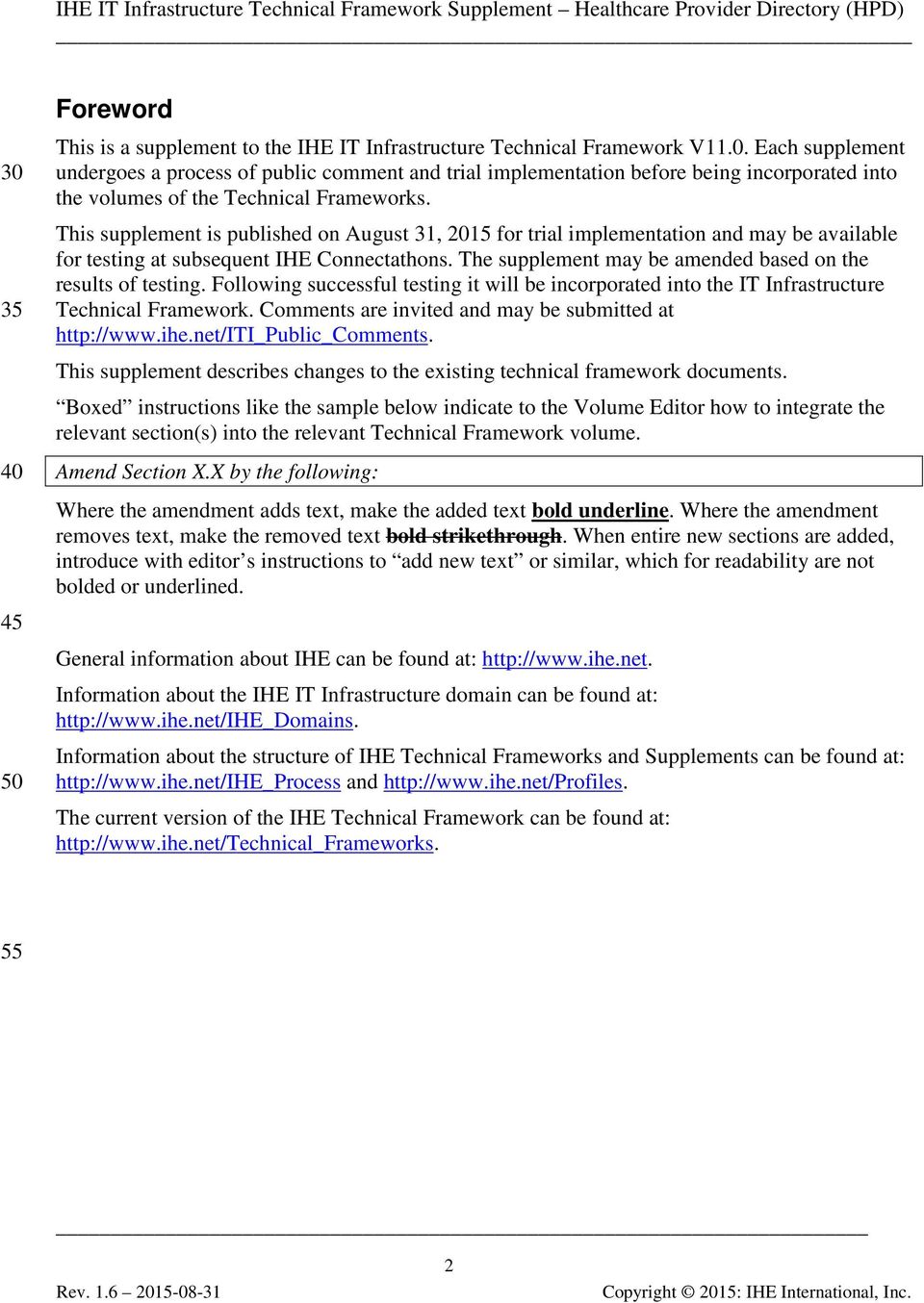
3 CONTENTS Introduction... 5 Open Issues and Questions... 5 Closed Issues... 5 Volume 1 Integration Profiles History of Annual Changes Dependencies among Integration Profiles Health Care (HPD) Health Directory (HPD) Integration Profile Actors/ Transactions Actors Information Directory Information Source Information Consumer HPD Integration Profile Options Information Feed Option Federation Option Healthcare Directory (HPD) Process Flow Use Cases Information Query Transaction Use Cases Information Feed Transaction Use Cases Information Query Federation Use Cases Detailed Interactions Detail Interactions Transactions Detail Interactions Entities and Attributes Detail Interactions Federation HPD Security Considerations Appendix A: Actor Summary Definitions Appendix B: Transaction Summary Definitions Glossary Volume 2b - Transactions Information Query Scope Use Case Roles Referenced Standards Interaction Diagram Information Query Request Trigger Events Message Semantics HPD Schema Structure HPD Schema Content Object Classes
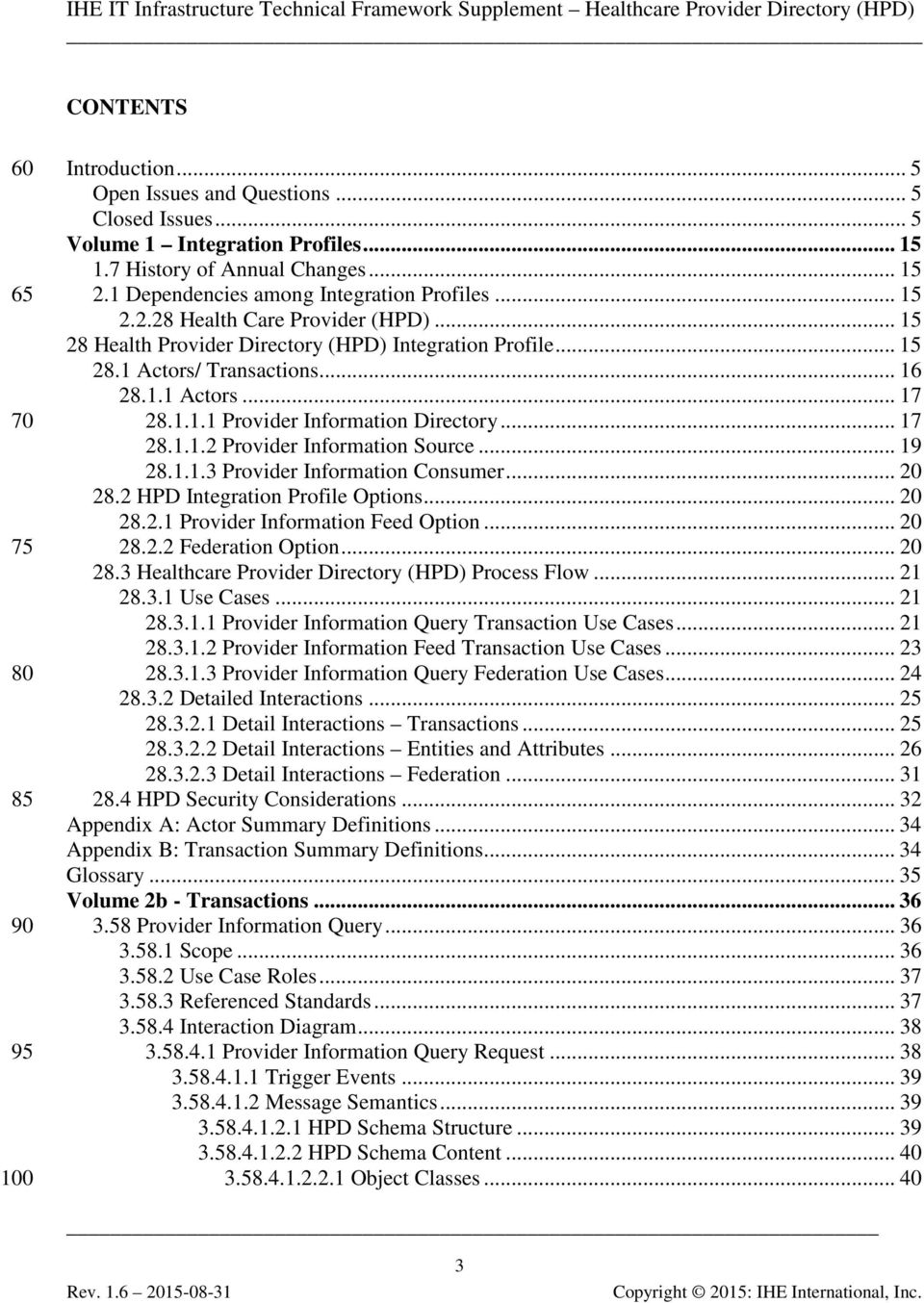
4 Individual Organizational Relationships Federation Option - Data Elements Status Code Values Coding Address Elements Expected Actions Information Query Response Trigger Events Message Semantics Expected Actions Security Considerations Protocol Requirements Information Feed Scope Use Case Roles Referenced Standards Interaction Diagram Information Feed Request Trigger Events Message Semantics Schema Structure Expected Actions Information Feed Response Trigger Events Message Semantics Expected Actions Security Considerations Security Audit Considerations Information Source audit message Information Directory audit message Protocol Requirements

5 Introduction This introduces the Healthcare Directory (HPD) Profile that supports queries against, and management of, healthcare provider information that may be publicly shared in a directory structure. HPD directory structure is a listing of the following two categories of healthcare providers that are classified by provider type, specialties, credentials, demographics and service locations. Individual A person who provides healthcare services, such as a physician, nurse, or pharmacist. Organizational Organization that provides or supports healthcare services, such as hospital, Healthcare Information Exchange (HIE), Managed Care, Integrated Delivery Network (IDN), and Association. This profile is scoped to include the following: Two transactions Information Feed Information Query Three Actors Information Directory Information Consumer Information Source Environments where a single Information Directory is sufficient for providing responses to Information Feeds and Information Query transactions. Open Issues and Questions HPD029: Issue: We would like to have an alternative to DSML. Any alternative suggestions to DSML are welcome Closed Issues HPD001: Issue: Comparison of standards identifies two groups of candidate standards. HL7 V3 Directory and LDAP and its extensions (PWP, ISO/TS 21091). Resolution: 2/18/10 (updated during July F2F: 7/12/10) Based on the research that was done the HPD will be based on LDAP and the use of ISO schema. LDAP considerations: HPD is likely to have a high volume of lookups. For small deployments, this will lead to efficient use of system resources. For very large 5

6 deployments, LDAP is likely to be the best or only viable option: LDAP Schema extensibility makes it easy to add in new objects and attributes and to update the capabilities of existing ones: Good tooling support: LDAP is much more extensively implemented and there are many products and open source solutions designed for LDAP deployment, and so use of LDAP simplifies application integration: HPD Profile shall consider applying DSMLv2 to express LDAP requests and responses in SOAP bindings. DSMLv2 is a systematic translation of LDAP s ASN.1 grammar (defined by RFC 2251) into XML-Schema. Furthermore, LDAP standard is commonly used for the personnel directories within organizations. information has quite an overlap with the personnel information; therefore, the reuse of this standard and available software tooling on LDAP is preferable. Federation is supported via an option. HL7 v3 standard consideration: Our research did not identify open tools that support HL7 v3 provider schema. The perceived complexity of HL7 v3 interfaces could pose barrier to implementation. Other significant challenge is that there is a limited implementation of HL7 v3 provider or personnel directory in production environments. HPD002: Issue: Are transactions for subscribe and notify critically needed or should this be scoped to future work? Resolution (2/4/10): Transactions for subscribe and notify are not critically needed for this version, and are not part of the scope of this profile. They were identified to meet the need of consumers who would like to keep a local copy of the HPD (or a subset of the HPD) current. HPD003: Issue: Does a data modeling tool need to be identified, and if so, which one should we use, and why? Resolution (2/4/10) A data modeling tool does not need to be identified. The data model is not being built for the profile. Entities and attributes are being identified in this document. The data format will be defined by the Information Directory Actor. HPD004: Issue: Do we need to include Privileges at an organization as an attribute to be defined in this standard? Resolution (2/18/10) This profile does not include Privileges because the privileges change frequently and have inconsistent meanings within each organization. Also, in many organizations Privileges are associated with 6

7 HPD005: different areas of the organization. In some, a provider may have multiple different privileges associated with different departments. Issue: Do we need to include Role as an attribute of provider? Resolution (2/18/10) This profile does not include Role because the role has an inconsistent meaning to different organizations. A use case has not been identified where this would be a necessary piece of information. HPD006: Issue: How will attributes which contain content that is not the most recent content, be handled? Possibilities where this might be an issue are: Name Addresses Identifiers Credentials Specialty Resolution (4/22/10): Where it makes sense, each of these attributes will have a status which will identify the content as inactive or active. There will be no need to mark Name as active or inactive. Primary name will be designated, and all other names are included, whether they are currently being used or not. HPD007: Issue: How will we identify the limited number of locations of a provider, if the provider works at a subset of the locations of an organization? Resolution (4/22/10): A provider address must be associated with the provider directly and cannot be derived from the address of the organization provider that this individual is a member of. HPD008: Issue: How will global identifiers be handled? This discussion came up as a result of a discussion on NPI numbers. Resolution (3/15/10) NPI numbers cannot be used as unique identifiers for multiple reasons; Not all s have NPI numbers; Some providers have multiple NPI numbers; Registration to NPI is self-directed; NPI is not a global identifier. Global identifiers will be handled by providing the capability for multiple identifiers, including an identifier type which defines the type of identifier. There is no specification of particular identifiers. Identifier type will be defined regionally or nationally. 7

8 HPD009: Issue: Should the Validation attribute structure be included in the schema for the initial profile, or be extended in a later update of the profile? This attribute structure indicates whether or not validation of this information has been done (Flag), when the validation was done (Date), who did the validation (Source). The validation attribute structure can be included for multiple areas in the schema, but most importantly for overall validation of the Organization and Individual attributes, the Relationship information, and the Certification, Specialty, and Degree information. Resolution (4/26/10): The validation attribute will NOT be included in the schema for the initial profile. It is assumed that the HPD Actor will validate the feed. That needs to be clearly stated in the document (see Section ). HPD0010: Issue: Currently, language, as a multiple attribute, is associated with Individual only. Should language be considered an attribute for Organizational? A Use Case has not been defined for this. Resolution (4/26/10): Language should be considered an attribute for Organizational as well as Individual. A Use Case has been added to reflect this. HPD0011: Issue: How should addresses be defined so that the definition meets global needs? Resolution: (4/26/10): Change Zip Code to postal code. Otherwise, represent the address as currently defined, minimum requirement is $addr, but we will allow all of the defined fields. HPD0012: Issue: Categories have been identified that have a set of values specified by a standard. Those standard specifications were originally included in this document in Section Some of the existing standards do not include all of the values required for this profile. How will those values be extended? Resolution (4/22/10, updated 7/16/10): The specification examples for the values were removed in most cases, as the values will ultimately be defined by international, national, or regional organizations. HPD0013: Issue: The following Category attributes do not have agreed to value definitions: Identifiers Addresses Resolution (4/22/10): 8

9 Identifiers The values will be defined by national or regional organizations. Addresses This profile only addresses three address types, each of which is a separately defined attribute in the auxiliary class (Billing Address, Mailing Address, and Practice Address). HPD0014: Issue: Currently Department has been included as an attribute for Organizational. Should this be kept? There is no Use Case for this. Resolution (4/26/10): Department can be handled as another Organization, if the HPD Actor determines that the department should be included. This will allow for more flexibility in the HPD. An Organizational which is a department can be a member of another Organizational, such as a hospital. This will be controlled by the Organizational Type. HPD0015: Issue: Currently Contact has been included as an attribute for Organizational to store contact information for only clinical contacts and not administrative contacts as ISO only allows for clinical contacts. Should an administrative contact be required? If needed, should it be a single contact, or multiple contacts? If a single contact, then Contact Type would not be required. There is no Use Case for this. Resolution (4/26/10): Multiple contacts will be required. Administrative person is out of scope of this profile, however, since Department has become an Organizational, Contact for Department could be set up to be an Administrative Role. Contact name may be a role or a name. The profile schema should define this as close to person information as possible, including name/role, address, phone number (including fax, and phone number). HPD0016: Issue: Currently Specialty Role has been included as an attribute for Organizational. Should this be kept? Resolution (4/07/10) Specialty is associated with the Organizational provider. However, the role such as Primary Care, Consulting, etc., which is defined as the functional involvement of the provider with the clinical activity, changes frequently. It is difficult to maintain currency of the data. Also, there is no Use Case defined that demands this attribute. HPD0017: Issue: Does the Feed transaction include only Add and Change, or does it also include Deactivate and Delete? Resolution (4/20/10, updated 7/16/10) LDAP standard has a delete method, as well as a method for Add and Modify (Update). This profile provides operation for Add, 9

10 Update and Delete. Any existing record can be deactivated using the LDAP Modify method and marking the status of provider as Inactive. An entry can also be deleted from HPD permanently using the LDAP Delete method. Once an entry is deleted from HPD, it cannot be queried. It is an implementer s choice whether to allow delete method for deleting a provider entry. HPD0018: Issue raised during a discussion of Section Feed Request: As of 4/20/10 the profile reflects the decision made at the F2F in February that for a Feed request, the only response provided by the HPD Actor would be an acknowledgement that the transaction has been received. Data administration issues such as data reconciliation, data validation, data integrity, etc., associated with the Add/Update/Delete operations are considered back-end processes for the purpose of this profile and proposed to be addressed by the policies and procedures of the organization managing the HPD. The profile would not provide any guidance on any expected actions or back-end processes to be executed, or policies to be followed by the HPD Actor. If that is the case then this transaction would be an optional transaction. This may have been misunderstood, or an invalid conclusion and needs re-addressing by the IHE committee. Resolution (4/26/10, updated May, 2010): Initially, this was thought to be a required transaction for the Information Directory Actor, however, it was later realized that Transaction Feed is an optional transaction, and it is reflected as such in the document. If the Information Feed Transaction is implemented then the required actions for the HPD Actor are that the HPD Actor is required to have a policy to conform to LDAP specification for processing add, delete, and update. The HPD Actor must have a policy to validate feeds and handle data integrity prior to publishing the date. HPD0019: Issue: Transaction Names have not been finalized. The names identified here (as of 4/20/01) do not conform to what is typically used in IHE. Recommendations are Replace Add/Update with Feed Replace HPD Lookup with Information Query Resolution (4/22/10): Transactions have been renamed. HPD020: Issue: For the Feed request transaction, do we use LDAP or SOAP? Discussion was initiated, but resolution was not documented. Resolution (4/22/01) The profile defines SOAP but LDAP can also be used. HPD021: 10

11 Issue: Currently "Degrees" has been added as a separate attribute for Individual. We realize, if we consolidate "Degrees" with "Credentials", then we only need to add a single structure class, HPDCredential. If we consolidate "Degrees" with "Credentials" and add type to the HPDCredential class to distinguish the two, then the profile is simpler. NOTE: "Degrees" is not valid for Organizational provider. What approach should we take? Resolution (04/28/10): Degrees (i.e., Medical Degree, PharmD, PHD, etc.) will be included in HPDCredential, distinguished by type. HPD022: Issue: In previous discussion it had been agreed that "TYPE" would be included with the "Name" attribute, and that the Type value set would be the values in HL standard (with some exceptions). It has now been determined that including TYPE would add complexity to how the names are currently stored in the schema. Is Type necessary for Name, or is it sufficient to provide the capability for multiple names, without identifying TYPE. Resolution 4/28/10: We do not need to include TYPE for name. This means we will not be able to distinguish between aka (also known as), maiden name, and others. This discussion has been dealt with in the PWP Profile, and therefore does not need to be dealt with again, here. A reference to the PWP schema regarding Name will be included in the document. HPD023: Issue: This issue was identified as a result of Issue HPD011. Do we need to define a Delivery Address? This is the preferred address where deliveries are to be made. Resolution (4/28/10 updated July 2010 F2F): This profile does not define a delivery address as part of the schema. The consensus at the July 2010 F2F was that this directory would not be used for this purpose. A provider who is sending deliveries would know where those deliveries are to go. HPD024: Issue: Use of Address Structure: First Option is to make an address as an attribute with syntax dstring *( "$" dstring ) similar to that of the postal code but additionally enforce format of key=value that allows for key to be of different kinds: address status and address components. This would allow adding new types without redefining the schema and allow us to search for &(status=primary, city=nowheresville). Second option is to have two different attributes as LDAP Postal Address syntax to distinguish primary and other addresses. E.g., hpdprimarypracticeaddress and hpdpracticeaddress. In this 11

12 option, the Address Status attribute is not maintained and assumes Primary Address as always active. Third option is to search based on a value stored in a subordinate Address object. In that case, we have to obtain that object and then perform a second search on the object's parent's DN to obtain the entire entry making provider search based on address inefficient. Resolution (4/26/10): First Option HPD025: Issue: For "memberof" query, ex: find the organizations that this provider is a memberof. Who is responsible for defining how many "memberof" relationship levels should be searched, and returned. 1) Should the HPD always search and return all levels, 2) Should the HPD only search one level at a time, and have the Consumer request subsequent searches, 3) Should the consumer identify "up to" how many levels the HPD should search 4) Should the consumer identify "up to" what type of organization to search to. Resolution (4/28/10): This is determined by the LDAP standards and will not be defined in this profile. HPD026: Issue: Profile name (HPD) and Actor name (HPD) make this profile confusing. Resolution (4/30/10): Profile name will stay the same. Actor names change as follows: Healthcare Directory (HPD) Actor Information Directory Directory Source Information Source Directory Consumer Information Consumer Feed Information Feed Information Query Information Query HPD027: Issue: The Information Query transaction is dependent on the System Directory for Document Sharing (SDDS) Profile for some of the use cases identified. SDDS has been delayed, and will not be ready for release for Public Comment before the deadline. Resolution: 7/12/2010: Profile HPD to store system URL pointing to a) Web services Definition Language (WSDL) defining the service end points. However, the automatic processing of WSDL in an interoperable manner by the Information Consumer is out of scope of this profile. b) System directory end point c) other emerging standard. 12

13 HPD028: While SDDS Profile is still in development, HPD implementer can choose to implement an option a as stated above. Once SDDS Profile is published, option b would reference system endpoints maintained in the SDDS. Issue: The Information Feed returns only an acknowledgement, and not results of the action (whether the action was successful or not). There is a concern that ACID properties that guarantee Information Feed transaction is processed reliably are not adhered to in this profile. ACID properties are defined as Atomicity, Consistency, Isolation, and Durability. Atomicity means that the Information Directory allows updates to Information Feed transaction either all or none. These updates from the source's perspective are not atomic in the sense that the changes may not be completed based on Information Directory s policy decisions. Lack of atomicity may mean that only some of the changes might be applied to the directory. Consistency--One would hope that this property would be assured. You don't want an inconsistent directory. Isolation--In a typical database I start a transaction, perform a number of operations, and then commit the transaction. These transactions might occur simultaneously and it is important that changes in one transaction would not be seen in another simultaneous or overlapping transaction. Of course it is possible that the changes in these simultaneous transactions may be inconsistent with one another, which would mean that some of these transactions would be automatically aborted and the client would know this. Durability--It does not appear that we have durability in HPD. So, for example when a source has its update acknowledged, one has no assurance that the update was performed even if policy would have permitted it. If the database crashed after acknowledgement, but before processing completed then it would lose the feed's update. This leaves the source unsure of the final contents of the Information Directory. Resolution: 7/12/2010: IHE agrees with the validity of the concern as noted in this open issue. The data management issues related to handling of Information Feed in all or in part, or none immediately or with delays, thus affecting the ACID properties of the Information Directory, are currently considered as complex and not yet fully identified. The implications of such issues are suggested to be further explored during the HPD trial implementation period and a feedback from trial implementation shall be provided by the implementers to IHE. In the current version, HPD Profile proposes that such issues shall be managed by back office procedures that are currently beyond the scope this profile. It is also noted that a back office procedure and governance policies between the Information Source 13

14 and the Information Directory need to be established for results handling associated with the processing of the Information Feed

15 Volume 1 Integration Profiles History of Annual Changes Add the following bullet to the end of the bullet list in Section 1.7 Added the HPD Profile which supports a healthcare provider directory Dependencies among Integration Profiles Add the following to Table 2-1 HPD None - None Add the following section to Section Health Care (HPD) The Healthcare Directory Profile supports management (persistence and access) of healthcare provider information in a directory structure. HPD directory structure is a listing of the following two categories of healthcare providers that are classified by provider type, specialties, credentials, demographics and service locations: Individual A person who provides healthcare services, such as a physician, nurse, or pharmacist. Organizational s Organizations that provide or support healthcare services, such as hospitals, Counseling Organizations (e.g., Drug, Alcohol) Healthcare Information Exchanges (HIEs), Managed Care, Integrated Delivery Networks (IDNs), and Associations. Add Section Health Directory (HPD) Integration Profile This profile introduces the Healthcare Directory which supports management (persistence and access) of healthcare provider information in a directory structure. HPD directory structure is a listing of the following two categories of healthcare providers that are classified by provider type, specialties, credentials, demographics and service locations: Individual A person who provides healthcare services, such as a physician, nurse, or pharmacist. 15

16 Organizational An organization that provides or supports healthcare services, such as hospitals, Counseling Organizations (e.g., Drug, Alcohol) Healthcare Information Exchanges (HIEs), Managed Care, Integrated Delivery Networks (IDNs), and Associations. Typical provider information maintained by the directory is demographics, address, credential and specialty information as well as electronic endpoint to facilitate trusted communications with a provider. The directory can also maintain relationships. Some examples of a relationship are: a Health Information Exchange (HIE) and its members: Integrated Delivery Networks and their care delivery members, hospitals and their practitioners, hospitals and their sub organizations including departments, physician Practice Groups and their practitioners, practitioners and the hospitals they are associated with (members of), and Medical Associations and their members. Different kinds of data sources and consumers interface with the Information Directory to: Send new and updated provider information Query provider information It is intended that provider information comes from authorized international, regional, state and national sources, as stewards of the most accurate and current data. Some identified sources are: State licensing bureaus National Associations Commercial registries Delivery Networks Information Exchanges, etc. The scope of this profile focuses initially on the minimum foundational attribute set required for defining a provider information directory, resulting in a usable work product as well as recommendations for future phase expansions. This profile is readily adaptable and scalable to production environments needing to operate trusted provider directory services that link multiple endpoints spanning enterprise, regional, national, and global jurisdictions. This profile is extendable to information not explicitly defined in the profile Actors/ Transactions Figure shows the actors directly involved in the HPD Integration Profile and the relevant transactions between them. Other actors that may be indirectly involved due to their participation in other related profiles, etc. are not necessarily shown. 16
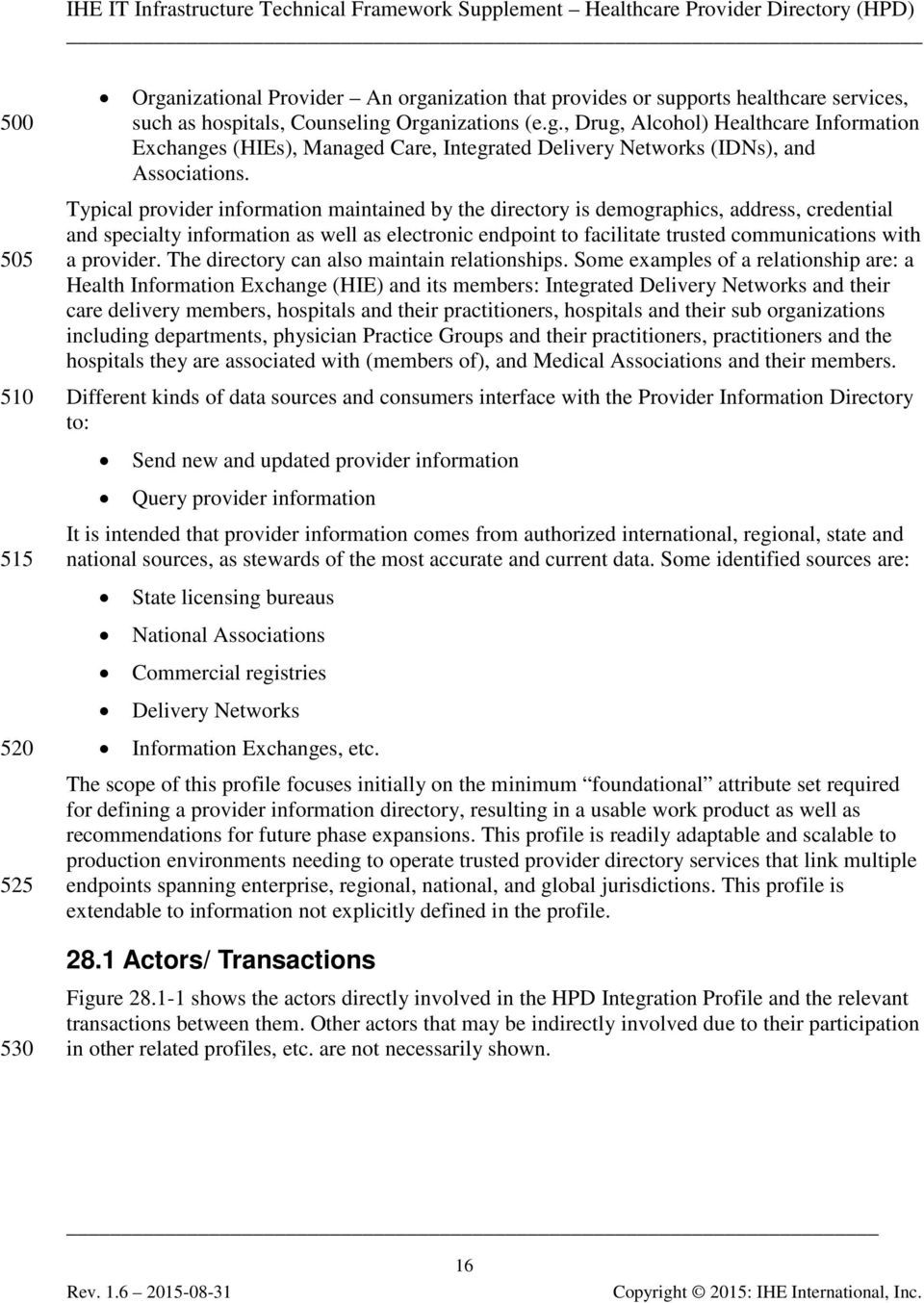
17 Information Source Information Feed [ITI-59] Information Directory Information Query [ITI-58] Information Consumer Figure : HPD Profile Actor Diagram 535 Table lists the transactions for each actor directly involved in the HPD Profile. In order to claim support of this Integration Profile, an implementation must perform the required transactions (labeled R ). Transactions labeled O are optional. A complete list of options defined by this Integration Profile and that implementations may choose to support is listed in ITI TF-1: Table : HPD Integration Profile - Actors and Transactions Actors Transactions Optionality Section in Vol. 2b Information Directory Information Query R 3.58 Information Feed O 3.59 Information Consumer Information Query R 3.58 Information Source Information Feed R Actors Information Directory The Information Directory performs the function of processing Information Query to search for providers based on a search criteria received from the Information Consumer. The Information Directory also performs the function of processing the Information Feed received from the Information Source. Both functions are described briefly below: 17

18 Information Query: The Information Directory responds to a Information Query request from the Information Consumer. The Information Query request includes search criteria for the provider and the type of information the Information Consumer is looking to receive in the response. The Information Directory shall return zero, one, or more providers (individual or organization) based on the search criteria. Information Feed: The Information Feed specifies one or more of the following actions: An Add to add new provider entries A Delete to delete any existing entries An Update to modify or update any existing entries Upon receiving the Information Feed, the Information Directory acknowledges to the source that the information has been received. This acknowledgement does not imply that the contributed directory entry information has been processed and the directory has been updated. This is a workflow management process, which is usually dependent on the type of directory information, and the policies associated with the vetting of the information, its availability constraints, and many other factors which are beyond the scope of this profile. This may be subject to the development of future profiling within IHE. Additionally, a directory may not choose to trust any authoritative sources other than itself. Therefore, this transaction is optional for the Information Directory. This profile does not restrict Information Directory to receive feeds in formats other than what is profiled by this specification
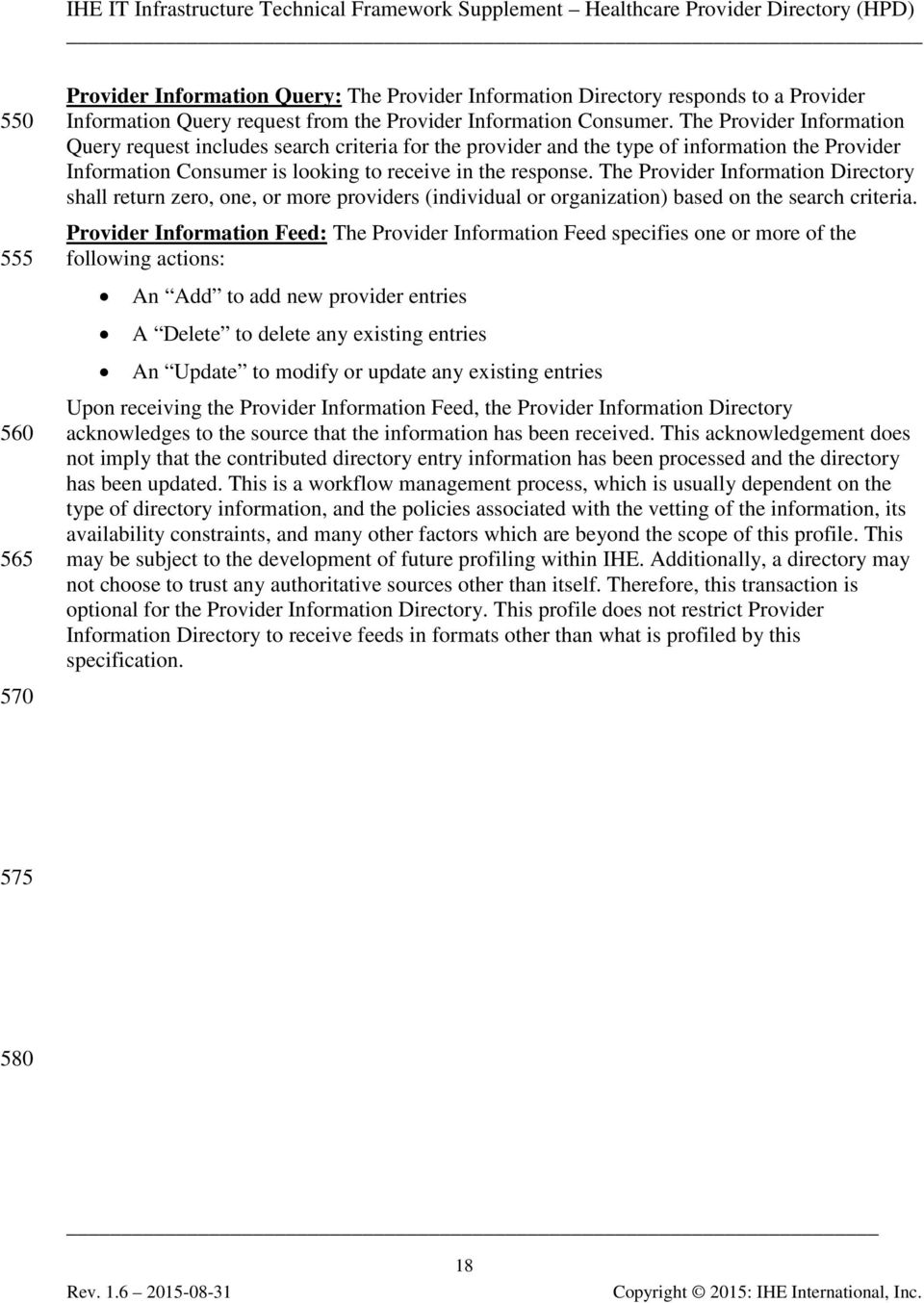
19 585 Information Entities and Attributes: The following diagram illustrates examples of supporting provider entries with or without relationships in a Information Directory. s without relationships Individual Individual Individual Individual Organizational Individual Organizational Organizational Organizational Organizational Organizational Organizational Organizational Organizational Organizational Various member of relationship possibilities Individual Individual Individual Individual Individual Individual Figure : Different Information Directory Structures The schema of directory is flexible and allows for a variation of structures to support relationships between providers. As depicted in the right half of the figure above, an Organizational provider defined at a top level could be a Health Exchange (HIE) or an Integrated Delivery Network (IDN). Underneath this organizational provider, it has multiple members listed both as the individual (practitioners, etc.) and as organizational (hospitals, labs, pharmacies, etc.) providers. Additionally, an organization provider (hospital) holds a relationship with individual providers (physicians, nurses, etc.) who practice at this hospital, and organizational providers that represent departments or sub-organizations. The left half of the figure shows that individual or organizational provider can be maintained stand-alone without any relationship to other providers Information Source The Information Source sends a Information Feed to the Information Directory. The feed consists of Add, Update, or Delete requests, a single request at a time, or in batches. After initiating the Information Feed transaction, the Information Source receives an acknowledgement from the Information Directory indicating that the Information Feed transaction has been received. The acknowledgement does not include the result of the Information Feed request. The Information Source 19

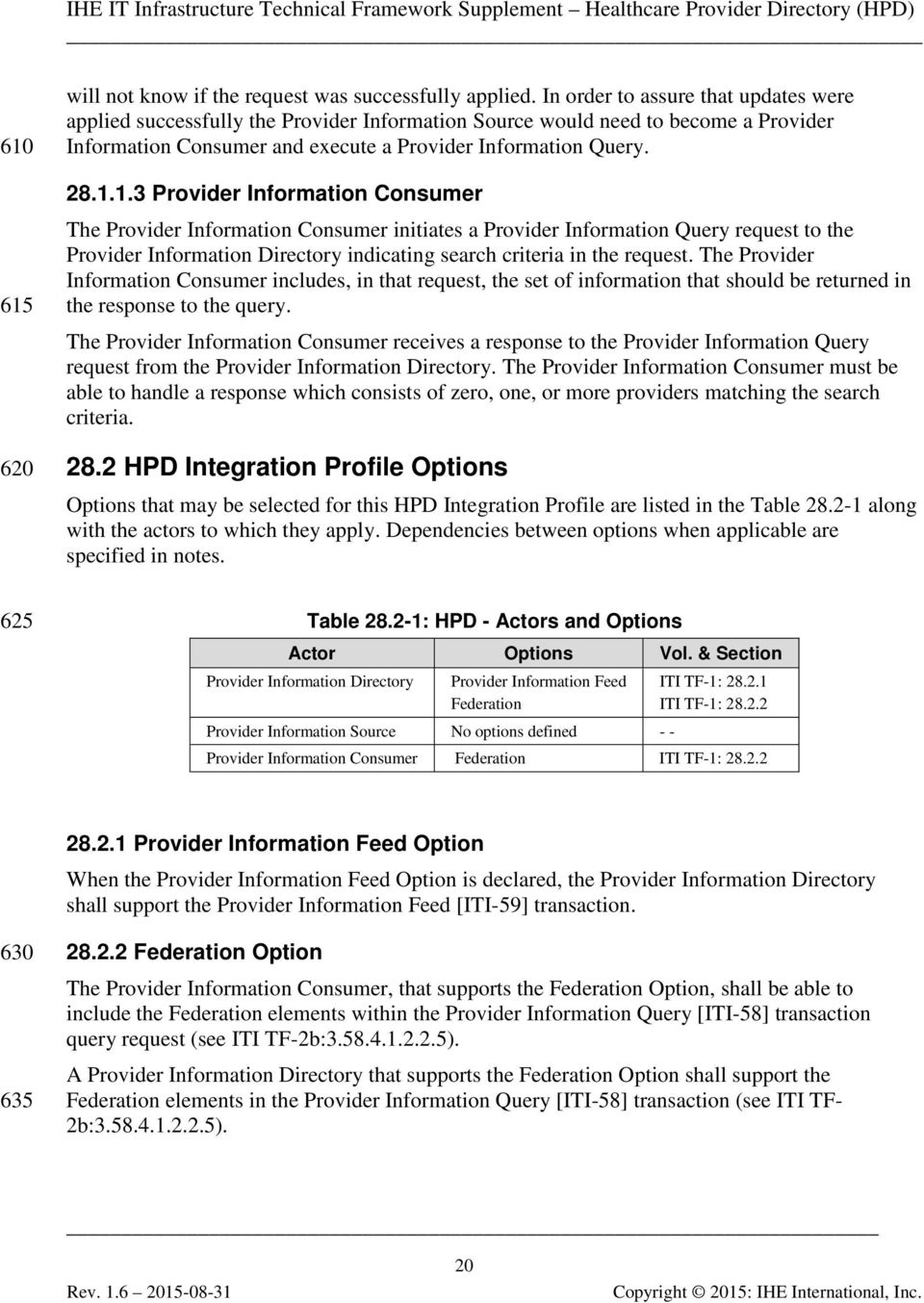
20 will not know if the request was successfully applied. In order to assure that updates were applied successfully the Information Source would need to become a Information Consumer and execute a Information Query Information Consumer The Information Consumer initiates a Information Query request to the Information Directory indicating search criteria in the request. The Information Consumer includes, in that request, the set of information that should be returned in the response to the query. The Information Consumer receives a response to the Information Query request from the Information Directory. The Information Consumer must be able to handle a response which consists of zero, one, or more providers matching the search criteria HPD Integration Profile Options Options that may be selected for this HPD Integration Profile are listed in the Table along with the actors to which they apply. Dependencies between options when applicable are specified in notes. 625 Table : HPD - Actors and Options Actor Options Vol. & Section Information Directory Information Feed Federation ITI TF-1: ITI TF-1: Information Source No options defined - - Information Consumer Federation ITI TF-1: Information Feed Option When the Information Feed Option is declared, the Information Directory shall support the Information Feed [ITI-59] transaction Federation Option The Information Consumer, that supports the Federation Option, shall be able to include the Federation elements within the Information Query [ITI-58] transaction query request (see ITI TF-2b: ). A Information Directory that supports the Federation Option shall support the Federation elements in the Information Query [ITI-58] transaction (see ITI TF- 2b: ). 20
21 28.3 Healthcare Directory (HPD) Process Flow Use Cases Information Query Transaction Use Cases Yellow Pages Lookup: A patient is referred to an endocrinology specialist for an urgent lab test. The referring physician needs to get the contact data of close-by endocrinologists in order to ask whether one of them can perform this test in their own lab. The patient prefers a female endocrinologist who can converse in Spanish regarding medical information. Current Situation: The physician has a card catalog with names of local endocrinology specialists. Office staff calls each in turn to ask if they are available to run the test. Each is questioned regarding their availability and ability to speak Spanish. Presumably the card catalog name would indicate the Gender of the physician. Use of HPD: As a Information Consumer, a computer application running in the office of physician is used to lookup provider information. The office staff enters the specialty, geographic indicators like zip code, city or state, language and gender. The application sends a query request to the Information Directory which returns information about every provider satisfying the search, in particular the physical and electronic address, and contact information. An appropriate endocrinologist is chosen based on the attributes included in the response, an appointment is made, and the referral documentation is electronically sent to the physician using the electronic address specified. Query providers and their associations for Social Services Disability Determination: A citizen, as a claimant, applies for disability benefits from the Social Services Department. This disability is due to a medical condition. In order to receive benefits, an application must be made, medical evidence must be provided, and a determination made on the claim. Some of the medical evidence is more than six months old, and the doctor providing the service has since retired. Some medical evidence comes from a physician who works in a clinic that has multiple office locations. Some of the medical evidence comes from a hospital that has since merged with another, and changed its name. Some of the medical evidence comes from a physician who has recently moved his offices to a different location. The claimant, in the claim, includes a list of the providers seen (names or practices) and other medical services he has obtained, related to his disability. The Social Services department needs to gather medical evidence from all the reported providers, and wants to direct their queries to the specific providers mentioned. For that purpose, the Social Services department needs to obtain the provider s contact information, electronic address, and provider s relationship with other organizations such as an HIE, for each of the providers supplied by the claimant. 21
22 Current Situation: The Claims Processor searches through an electronic file or card catalog of providers to look up providers that the claimant has named. If the Claims Processor finds a provider in the file, or catalog, the Claims Processor faxes a request for medical evidence along with a release form signed by the patient. Often research has to be done before a fax number can be determined (phone calls need to be made, or additional contact information needs to be identified). If the Claims Processor does not find a provider in the file, or catalog, extensive research may need to be done before the correct provider is identified. This must be done for every provider on the claim. Because limited or outdated information is often given by the claimant, identifying each provider can take quite a long time, substantially delaying the process and the disability determination. Use of HPD: The disability software application collects healthcare services provider data from a list of filed claims. Acting as Information Consumer, this application sends a query request to the Information Directory for each provider on the claim. The Information Directory returns information about the providers, in particular, the electronic address where the Medical Evidence Requests (MERs) are serviced for that provider. Emergency Responders Identification in planning for an emergency event: Emergency response planning requires the identification of potential providers who can assist in an emergency. s must meet specific credentialing criteria and must be located within a reasonable distance of the emergency event. Current Situation: The planners of the emergency event search for potential provider participants by manually initiating searches on the internet, contacting associations for candidates, and looking through the local yellow pages. Once phone number contact information for these providers is identified, contact is initiated. Use of HPD: Using HPD, an emergency planning team member can initiate a single search for a list of providers based on specialty, geographic indicators like zip code, city or state, and other criteria. The Information Directory returns information about every provider satisfying the search, including addresses. An can be generated to all identified providers requesting participation. Other Information Query Use cases which refine the requirements introduced above: Authorization and lookup during an emergency event: During Hurricane Katrina, health care volunteers were turned away from disaster sites because there was no means available to verify their credentials. At an emergency site, the Information Directory can be queried to quickly identify and grant permission to credentialed providers to enter the scene. Forwarding of Referral Documents to a Specialist: A primary care provider (PCP) needs to send referral documents (e.g., CDA /CCD ) to a specialist. The PCP knows the name and phone number of the Specialist, but needs to identify the electronic address such as where the patient's documentation should be sent. Forwarding of Referral Documents to a Hospital: A PCP refers a patient to the Hospital for admission. The PCP needs to send various documentation to the Hospital to be part of their EHR 22
23 when the patient arrives. The PCP needs to identify the Hospital s electronic address such as or service end point where the patient s documentation should be sent. Keeping agency provider information current: A German government agency dealing with healthcare services for its constituents wishes to keep its agency s healthcare provider information current. The agency determines that it will use the Information Directory to access the most current provider information. The German agency only requires a subset of the Information Directory available information. On a regular basis, the Information Directory provides, to the agency, a list of the updated information needed. Providing Personal Health records to a new Primary Care Physician: An individual has changed health plans. As a result that individual must change his Primary Care Physician. The individual has a Personal Health Record and would like to provide that information to his new Primary Care Physician. The individual needs to determine where to have the Personal Health Record transmitted to. Certificate Retrieval: National regulations in many European countries require that an electronically transmitted doctor s letter be encrypted in a way that only the identified receiver is able to decrypt. In order to encrypt the letter, the sender has to discover the encryption certificate of the receiver. Language Retrieval: An individual who only speaks Italian requires healthcare services at an Outpatient Clinic. That individual would like to be able to communicate with the Clinic personnel, if at all possible. The individual, or his caregiver, needs to determine which clinic supports Italian and provides the service that is required Information Feed Transaction Use Cases Add : The following are a list of possible events that would result in the addition of a Healthcare to the Information Directory. A provider adds himself/herself to the Information Directory. An agent for the provider adds the provider to the Information Directory. An HIE, not yet in the Information Directory, adds itself, its Organizations (hospitals, etc.), the Organization s associated departments, and its providers to the Information Directory. An entity already on the Information Directory, like an HIE or Organization, adds providers (Individual or Organization). A credentialing organization has credentialed new members and would like to add them to the Information Directory (s may not exist; this should be an add request.). Update : The following are a list of possible events that would result in the updating of a Healthcare to the Information Directory. 23
24 A provider updates information for themselves: adds/deletes/changes his/her location, or adds/deletes a relationship, changes his/her name, adds/deletes/updates a credential, adds/deletes/updates identifiers. A provider retires and wishes to dissociate himself/herself from the Information Directory. Information Directory does not allow delete to preserve the historical information, but allows deactivating of a provider entry. An agent for the provider updates information for the provider: adds/deletes/changes the provider location, or adds/deletes a relationship, changes the provider name, adds/deletes/updates a credential, adds/deletes/updates identifiers. A credentialing organization has renewed credentials for its members. An entity already on the Information Directory, like an HIE or Organization, has modified information (Individual or Organization). The location has changed, providers have disassociated themselves with the organization, a new location has been added, or a provider has retired. Current Situation: Healthcare provider directories which are maintained via a push process, meaning additions and changes are sent to the directory on a regular basis, for processing: May receive adds and updates from only one source or Must have the capability for different modes of communications if it receives updates from more than one source. If a single source of healthcare provider information pushes adds and updates to multiple directories, then that source may need to communicate with each healthcare provider directory differently. Use of HPD: The Information Directory is maintained by receiving information in the standardized format regardless of the source pushing that information. Adding another source is transparent to the Information Directory. If a single source pushes data to multiple Information Directories that subscribe to the HPD Profile then only one form of communication is required. Adding another Information Directory would be transparent to the source Information Query Federation Use Cases 1. A State HIE would like to establish a common service that can be used by providers to look up other providers for referrals without requiring prior knowledge of other existing directories within the state. The State HIE will onboard the directory operators along with their local Directories so that they can be accessed via a single service. This can also be a service provided by other local or regional HIEs. 2. A State HIE would like to establish a service that can query other state directories for provider information on behalf of providers within the state for out-of-state referrals, 24
25 disaster response, and other uses. Any state would only query the established directories for each state. This service can also be provided by other local or regional multi-state HIEs. 3. A national directory operator would like to provide a service for providers across the nation to query for information about other providers locally or nationally. 4. A local directory operator would like to play the role of provider data aggregator and expose a standards compliant service for multiple local directories which support proprietary protocols for query. 5. ehealth Exchange would like to create a directory of all the electronic service endpoints of the participants so that they can be discovered for health information exchange purposes Detailed Interactions Detail Interactions Transactions As described in Figure , there are two main interactions with the Information Directory. One is the Information Source Actor s interaction with the Information Directory, and the other is the Information Consumer Actor s interaction with the Information Directory. Information Source initiates a Information Feed transaction and receives a Information Feed acknowledgement indicating that the Information Feed transaction has been received. The Information Directory processes the Information Feed request, but does not indicate to the Information Source whether or not the Information Feed was successfully processed. The data management actions taken by the Information Directory associated with the Information Feed transaction are outside the scope of this profile. Information Consumer initiates a Information Query request to the Information Directory, identifying search criteria and specifying the types of information the consumer is looking for. The Information Directory searches for content matching the search criteria and returns the types of information requested. The Information Directory may return zero, one, or many response elements depending on what is found to match the search criteria. 25
26 Information Source Information Feed Request Information Directory Information Consumer Information Feed acknowledgement Information Query Request Information Query Response 820 Figure : Basic Process Flow in HPD Profile Detail Interactions Entities and Attributes The following tables show a summary of the entities and attributes found in the Information Directory. The healthcare providers that this profile deals with are classified into two groups. 1. Organizational An organization that provides or supports healthcare services, such as hospitals, Healthcare Information Exchanges (HIEs), Integrated Delivery Networks (IDNs), and Associations (Table ). 2. Individual A person who provides healthcare services, such as a physician, nurse, or pharmacist (Table ). In addition to information about the healthcare providers, the HPD schema also provides the ability to manage relationships between organizational providers and other organizational providers, and between individual providers and organizational providers. This means that the HPD schema can be used to feed and query the following: 1. What other organizational providers an organizational provider is a member of 2. What other organizational providers are members of a particular organizational provider 3. What organizational providers an individual provider is a member of 4. What individual providers are members of a particular organizational provider 26
27 An Organizational or an Individual shall not have a member of relationship with an Individual. Organizational Attributes The figure below depicts the data model pertaining to an Organizational as defined by the Information Directory. The cardinality 0..N implies an attribute is optional but could have many values. 1..N implies that an attribute is required and could have many values. has (1..N) Name has (0..N) Organizational Owns (0..N) Relationship Group Identifier has (0..N) Credential Specialty has (0..N) is composed of (0..N) is a member of (0..N) is a member of (1..N) is a member of (0..N) Individual Is located at (0..N) Sub-Organizational provider e.g. Department Addresses Figure : Organizational Entity and its Attributes An Organizational has attributes to capture information related to Address, Name, Identifier, Credential and Specialty that are further described in the table below. An Organizational may be composed of multiple Organizational s such as departments (or any business structure for an organization). These are depicted as sub- Organizational s in this figure. The relationship between organizations is maintained through the concept of Relationship groups. An Organizational provider can own one or many Relationship groups. A Relationship group could have one or more members of both provider types: organizational and individual. Sub-organizations such as departments are associated with their parent organization through Relationship group. The table below provides a summarized description of the attributes of the Organizational. A field by field level description may be found in the specification of the transactions in ITI TF-2b:
28 Attribute Type Status Table : Organizational Attributes Description The type of organization represented. Some values are: Hospitals HIEs IDNs Associations Labs Clinics, Departments Pharmacies Practice The status of this organization. Active This organization is currently in existence. Inactive This organization is no longer in existence Name Contact Electronic Service URI Medical Records Delivery Address Address Language Credential Specialty Identifier This attribute contains multiple names for an organization. Multiple individuals who can be contacted in reference to this organization, including a phone number and address. An individual role can be included in the name, instead of an individual. Reference to an entry in a systems directory or to a services definition page where this organization has its electronic access points defined. Electronic mailing address of an organization where medical or administrative records can be sent. Physical address information for an organization. Each type of address can be primary or secondary. Addresses that are no longer valid are marked as Inactive. Billing Address One primary address-the preferred billing address for the organization Multiple secondary billing addresses Multiple inactive addresses which were once used as billing addresses but are no longer valid. Mailing Address One primary address-the preferred mailing address for the organization Multiple secondary mailing addresses Multiple inactive addresses which were once used as mailing addresses but are no longer valid. Practice Address Multiple primary addresses-all locations where healthcare services are provided There are no secondary practice addresses Multiple inactive addresses which were once used as practice addresses but are no longer valid. Language(s) that an Organization supports. This includes certifications or licenses earned by an organization. Organization s specialization, a specific medical service, a specialization in treating a specific disease. Some specialties are: Psychiatry Radiology Endocrinology National, Regional or local identifier that uniquely identifies an organization, that may be publicly shared. Some examples are: National Identifier # 28
29 Attribute Certificate Relationship Description Tax ID # Various kind of certificates (encryption, signing, attribute) information for the organization. Business associations either between an organization and an individual provider or between an organization and another organization. There can be multiple types of relationship but this profile generically categorizes all relationship as member-of. 865 Individual Attributes The figure below depicts the data model as it pertains to Individual s defined by the Information Directory. The cardinality 0..N implies an attribute is optional but could have many values. 1..N implies that an attribute is required and could have many values. Individual has (1..N) Name has (0..N) has (0..N) has (0..N) is a member of (0..N) Identifier Relationship Group owns (0..N) Organizational Credential is located at (0..N) Specialty Addresses 870 Figure : Individual Entity and its Attributes Individual has information related to Address, Name, Identifier, Credential and Specialty as described in the table below. The relationship between individual and an organizational provider is modeled using the concept of group. As shown in the figure, an organizational provider can own one or multiple groups. Each group could have several individual members. The table below provides a high-level description of the attributes of the Individual. A field by field level description may be found in the specification of the transactions in volume ITI-TF-2b:
30 Attribute Type Status Name Language Gender Medical Records Delivery Address Electronic Service URI Address Credentials Table : Individual s Attributes Description Type of individual provider. Some values are: Physician Pharmacist Nurse Nurse Practitioner Physical Therapist The status of this individual. Active currently practicing Inactive currently not practicing Retired Deceased Names that a provider has, or is, known by. Language(s) that the provider is fluent in. Electronic mailing address of an individual where medical or administrative records can be sent. Electronic mailing addresses to receive general purpose communication but not related to medical records. Reference to an entry in a systems directory or to a services definition page where this individual provider has its electronic access points defined. Physical address information for an individual. An address can be designated as primary or secondary. Addresses that are no longer valid are marked as Inactive. Three types of addresses are supported: Billing Address One primary address-the preferred billing address for the individual Multiple secondary billing addresses Multiple inactive addresses which were once used as billing addresses but are no longer valid. Mailing Address One primary address-the preferred mailing address for the individual Multiple secondary mailing addresses Multiple inactive addresses which were once used as mailing addresses but are no longer valid. Practice Address Multiple primary addresses-all locations where the individual provides healthcare services There are no secondary practice addresses Multiple inactive addresses which were once used as practice addresses but are no longer valid. Includes certification(s), license(s) and degree(s) earned by an individual provider. Information includes the Credential #, the name of credential, issuing authority, issue date, valid dates. Some examples are: Preventive Cardiology Diabetes Counseling PharmD 30
31 Attribute Specialty Identifiers Certificate Relationship Description MD Individual s specialization, a specific medical service, a specialization in treating a specific disease. Some types are: Psychiatry Radiology Endocrinology National, Regional or local identifier that uniquely identifies an individual that is okay to be publicly shared. Some examples are: National Identifier # Tax ID # Hospital Issued Identifier The profile does not include sensitive identifiers such as Drivers license or Social Security Number, as only publicly shared information is included Various kind of certificate information (encryption, signing, attribute) for the individual. Business associations with an organization. There can be multiple types of relationship but this profile generically categorizes all relationship as member-of Detail Interactions Federation This section will identify the actors in a federated directory environment and interactions between them. 1 2a Information Consumer 5 2b e.g. Health IT system (EHR) 4 Information Directory A (Acting as an aggregator) Information Consumer 2c 3a 3b Information Directory 1 Information Directory 2 3d Information Directory B 3c Information Directory Figure Federation Actor Interactions 895 In Figure , there is a single Information Consumer querying two Information Directory Actors (A & B) for information. Information Directory A in-turn queries Information Directories 1, 2, and 3 and then aggregates the responses from all three directories before returning the aggregated response to the Information Consumer. 31
32 On the other hand, Information Directory B is a directory that has no federation partners and provides the response based on the directory data that it owns. A detailed step-by-step description of the events is described below: 1. Healthcare provider uses their HealthIT system to locate a provider 2a. The Information Consumer (the HealthIT system) sends the request to a Information Directory A which federates multiple directory sources as shown in the diagram 2b. The Information Consumer (the HealthIT system) can also send a request to a Information Directory B that does not federate the request to any other directory sources. 2c. The Information Directory A federates the request to a set of known additional Information Directories (1, 2, and 3). 3(a, b, c, d). Information Directories provide a complete response, an error, or an incomplete response. 4. Information Directory A aggregates responses (including complete responses, errors, and incomplete responses) and provides the response to the Information Consumer. 5. The Information Consumer (the HealthIT system) receives the responses, including incomplete and error responses, and presents the data to the user HPD Security Considerations This profile assumes that the provider information being dealt with here is information that may be publicly shared and therefore this profile does not include specific security mechanisms that would be required based on the policies where this profile is implemented. However it includes the necessary capability to be combined with one or more security and privacy profiles developed by IHE or other entities. This section provides an overview of the typical risks that should be mitigated if desired, and recommends the corresponding IHE profile(s) that should be combined with HPD. IHE requires that HPD schema be validated against national privacy regulations, and possibly other state and contractual requirements for publicly sharing provider information. If there is any information, in part, or whole, as defined by the HPD Profile schema or any extensions to the given schema, that is considered private or sensitive, then appropriate security and privacy procedures shall be considered to protect that information. For general IHE risks and threats please see ITI TF-1: Appendix G. Some categories of risks currently identified for consideration are: The possibility of inaccurate or unverified provider data being fed to the Information Directory. Accidental release of provider information protected by additional regulation or law. 32
33 Malicious attacks to the data, modifying the data either in transmission or at the Information Source or at Information Directory sites. Policies and procedures for the verification, validation, and reconciliation of data are ineffective or inconsistent. Any activity performed on HPD data by Information Consumer with the expectation that data are authoritative. For instance, PHI could be transmitted to a FAX number, a mailing address, or a health internet address with the expectation that the addresses are authoritative. The following shall be considered by implementers of the profile, as part of the planning process for implementation: Implement and enforce policies and procedure to validate the provider information before it is stored and published by Information Directory The Audit Trail and Node Authentication (ATNA) Profile should be considered to ensure that nodes in a network are authenticated. The ATNA Profile to capture and record audit trail events related to the Information Feed transaction. The Enterprise User Authentication (EUA) Profile to authenticate Information Source and/or Information Consumer if access to query or feed information is limited and controlled. If HPD is going to be public, open and searchable by anyone, the user authentication may not be applicable. The Cross-Enterprise User Assertion (XUA) to assert Information Consumer credentials for the purpose of enforcing Role Based Access Control (RBAC) and protecting any non-public sensitive information if access to query information is limited and controlled. The Personnel White Pages (PWP) Profile provides a repository that may be used to hold system users' identification data. The best practices for Infrastructure and Network Security: Protecting Application and Data zone by the Demilitarized zone (DMZ) The best practices of operations management for network monitoring, intrusion detection and secured data backups. Implementers may follow these IHE profiles to fulfill some of their security needs. It is understood that institutions must implement policy and workflow steps to satisfy enterprise needs and to comply with regulatory requirements. The HPD implementer is further advised that many risks associated with physical security, operational management cannot be mitigated by the HPD Profile and instead responsibility for mitigation is transferred to the HPD implementer. 33
34 Appendix A: Actor Summary Definitions Information Directory - Supports a directory of healthcare providers. The directory can include: Only Individual s Only Organizational s Organizational s and Individual s Information Source - Submits healthcare provider data to a Information Directory and receives an acknowledgement that the submission has been received. Information Consumer - Accesses healthcare provider data from a Information Directory. Appendix B: Transaction Summary Definitions Information Feed - Supports the addition or update of provider data in a Information Directory. Information Query - Supports the ability to query a Information Directory for information about providers 34
35 985 Glossary Add the following terms to the Glossary: None 35
36 Volume 2b - Transactions Add Sections 3.58 and Information Query This section corresponds to transaction ITI-58 of the IHE Technical Framework. This transaction is used by the Information Consumer and Information Directory Actors Scope This transaction supports the ability to lookup information about healthcare providers from a healthcare provider directory on the following: Individual A person who provides healthcare services, such as a physician, nurse, or pharmacist. Organizational An organization that provides or supports healthcare services, such as hospitals, Healthcare Information Exchanges (HIEs), Managed Care, Integrated Delivery Networks (IDNs), and Associations. Relationship between providers. The scope of this transaction considers one type of relationship; member of. Examples of this relationship are: 1. Hospitals, clinics, labs, other organization providers, and physicians are members of an HIE 2. A list of physicians are members of a hospital 3. A physician is a member in a list of organization providers The summary of the current minimal foundational attributes that are in scope for this transaction are defined in Tables and A provider directory entry shall contain all required attributes and some or all of the optional attributes. A Information Directory shall be able to act on all of the attributes. General definitions of the attributes can be found in ITI TF-1:
37 Use Case Roles Information Consumer Information Directory Information Query Actor: Information Consumer Role: Sends lookup request to the Information Directory. Receives response from the Information Directory. The consumer only queries for the information that is meaningful for its purpose. Actor: Information Directory Role: Receives lookup requests from the Information Consumer. Fulfills those requests and returns requested information on zero to many Organization and Individual s Referenced Standards LDAP (Lightweight Directory Access Protocol), an open standard built on the X.500 framework, is adopted by this profile as the minimal specifications for exchange standards of provider information. Furthermore, the International Organization for Standards (ISO), defined as ISO 21091, is referenced to define the attributes of health professionals and organizations to represent health care regulatory information, clinical credentials, multiple affiliations, etc. By leveraging the ISO and the underlying LDAP standard, this schema and associated transactions are designed for interoperable communications. The usage of standard LDAP schema makes the adoption of HPD by the HIT vendors easier and extensible with respect to their existing implementations. This transaction schema applies DSMLv2 to express LDAP requests and responses in SOAP bindings. DSMLv2 is a systematic translation of LDAP s ASN.1 grammar (defined by RFC 2251) into XML-Schema. DSMLv2 provides advantages in the adoption of this transaction for an interoperable electronic exchange. First, tools for marshaling XML into SOAP messages are readily available, making development much easier. Second, firewalls are often configured to allow HTTP and HTTPS protocols to pass. This make it possible for DSML, carried in the HTTP or HTTPs protocol, to become the method for carrying provider information on the internet in an interoperable manner. 37
38 The Information Query transaction will conform to the following standard specifications: Health informatics Directory services for health care providers, subjects of care, and other entities (ISO/TS 21091) IETF LDAP v3 [RFC 2068, RFC 2251, RFC 2256, RFC 2985, RFC 2798, RFC 2985, RFC 5646, RFC 4512, RFC 4517] DSMLv2 SOAP Interaction Diagram Information Directory Information Consumer Information Query Request Information Query Response 1050 Figure : Basic Process Flow for Information Query Information Query Request Information Consumer initiates a Information Query Request to the Information Directory. The Information Query Request includes search parameters and defines the response set that is expected to be returned. 38
39 Trigger Events This message is sent from a Information Consumer to a Information Directory to get additional information about an Individual or an Organizational or a list of providers. The Information Consumer shall provide search information and identify the information that the Information Consumer is interested in receiving in response Message Semantics The Information Query request uses SOAP based DSMLv2 batchrequest message to express a query. The query operation for looking up provider entries in the Information Directory shall be done through the use of searchrequest operation. For querying individuals, the base object is HCProfessional and for querying organizations, the base object is HCRegulatedOrganization. The relationships can be looked up by querying the groupofnames object. The searchrequest allows specifying a list of attributes to be returned for matching query. If this list is empty or a special value of * is used, then all user attributes are returned. The request transaction shall support all LDAP standard search filters. This transaction does not limit any restriction on the search scope, size limit, time limit or list of attributes. If needed, those can be constrained by the Information Directory implementer. The examples for Information Query Request transaction can be found online on the IHE FTP site, see ITI TF-2x: Appendix W HPD Schema Structure The HPD schema defines LDAP organizationalunit (OU) containers to organize the information on s. Object classes within OU represent Individual, Organization and Relationships that are managed using the schema from ISO/TS and LDAP. The directory naming context shall be o=hpd Owner, dc=hpd where HPD Owner value shall be replaced with the name of organization hosting the Healthcare Directory. There are nodes that are subordinate to dc=hpd. ou=hcprofessional for storing individual provider information. ou=hcregulatedorganization containing information on an organizational provider and its relevant information. ou=relationship a groupofnames for holding the member-of relationships among providers. Groups holding the members that are related are represented by standard LDAP groupofnames class. Each Group has a group owner organization that owns the relationship and has group members that are Individual and Organization providers. ou=hpdcredential to include health related credentials of providers. The Directory Information Tree for this transaction is shown in the following diagram. 39
40 Figure : Transaction Information Tree HPD Schema Content This section describes the mapping of the HPD schema attributes and ISO 21091/LDAP standard object classes. The HPD schema extends the ISO schema to include other attributes that are not covered by ISO Object Classes HCProfessional This is an object class defined by ISO to store information about Individual provider. Object Class: HCProfessional Superior Object Class: InetOrgPerson 40
41 1105 OID: Object Class Type: Structural 1110 HCRegulatedOrganization This is an object class defined by ISO to store information about Organization provider. Object Class: HCRegulatedOrganization Superior Object Class: Organization OID: Object Class Type: Structural HPD The HPD schema defines an Auxiliary object class HPD to include additional provider attributes (for both Individual and Organizational ) that are not defined in the ISO schema. Being an Auxiliary object, the HPD class attributes can be mixed-in with HCProfessional and HCRegulatedOrganization object classes. This class has the object class, top, as its superior. The OID for this class is assigned by IHE. Object Class: Superior Object Class: HPD top OID: Object Class Type: Auxiliary 1125 Table : HPD Optional Attributes Attribute OID Description Syntax hpdstat us hpdlan guagesupported Maintain status of provider in directory Values are defined in Table Languages that the provider supports Recommended best practice is to use RFC 5646 [RFC 5646] which, in conjunction with ISO 639 [ISO639], defines two- and threeletter primary language tags with optional subtags. Examples include "en" or "eng" for English, "akk" for Akkadian, and "en-gb" for English used in the United Kingdom." Directory String Directory String Matching rules Case Ignore Match Case Ignore Match, Case Ignore Substrings Match Multi- Valued S M 41
42 Attribute OID Description Syntax hpdbill ingaddress hpdmai lingaddress hpdpra cticeaddress hpdmedicalrec ordsdeliverye mailaddress memberof hpdcredential hpdleg aladdress hpdhasaservic e The provider billing address field. It shall be represented in the format described in Section The provider mailing address field.. It shall be represented in the format described in Section The provider practice address field.. It shall be represented in the format described in Section Electronic mailing address of provider where medical records can be sent Group to which provider is a member of. A provider can be a member of zero, one or many groups. The Information Directory shall reuse existing LDAP functionality that offers memberof as an operational attribute. See for details. Detailed Health related credentials earned by provider; DN to one or more credential entries in the HPDCredential object class Legal address (e.g., the address where the provider has registered the business, receives legal correspondence, other based on local convention) It shall be represented in the format described in Section Reference to descriptions of electronic services supported by the, See HPDElectronicServices. Postal Address Postal Address Postal Address String DN DN Postal Address DN Matching rules Case Ignore Match, Case Ignore Substrings Match Case Ignore Match, Case Ignore Substrings Match Case Ignore Match, Case Ignore Substrings Match Case Ignore Match Case Ignore Match Case Ignore Match Case Ignore Match, Case Ignore Substrings Match Case Ignore Match Multi- Valued M M M S M M S M 1130 HPDCredential HPDCredential is defined as a Structure object class to contain credential attributes (for both Individual and Organizational ). This class has the object class, top, as its superior. The OID for this class is assigned by IHE. 42
43 1135 Object Class: HPDCredential Superior Object Class: top OID: Object Class Type: Structure Table : HPDCredential Mandatory Attributes Matching Attribute OID Description Syntax rules credentialtype credentialname credentialnumber Type of Credential<degree, certificate, credential> Degree is not a valid type for Organizational s credential Name of Credential, degree, or certification that belongs to provider. Follows the ISO21091 naming format as that of the HCStandardRole: credentialname@organization_do main_name where credentialname is the standard name of the credential, and organization_domain_name is the domain name of the organization for those credentials local to the organization, or credential@locality where credential is the standard name of the structural role if applicable to the Locality (i.e., state). Credential Identifier Follows the ISO UID format: (Issuing Authority OID: ID) The issuing authority OID could be used to identify the issuing agency, state and country. ID is the national/regional identifier assigned to the provider s credential. E.g., a certificate number. Directory String Directory String Directory String Case Ignore Match Case Ignore Match Case Ignore Match Multi- Valued S S S 43
44 1140 Table : HPDCredential Optional Attributes Matching Attribute OID Description Syntax rules credentialdescrip tion credentialissueda te credentialrenewa ldate credentialstatus Additional information on the credential Date when credential was issued to the provider Date when credential is due renewal Values are defined in Table Directory String Date Date Directory String Case Ignore Match Case Ignore Match Case Ignore Match Case Ignore Match Multi- Valued S S S S HPDMembership HPDMembership is defined as a Structure object class to contain membership attributes associated with an Individual and an Organizational. Specifically it holds the Electronic Services which the individual leverages within an organization. This class has the object class, top, as its superior. Object Class: Superior Object Class: HPDMembership top OID: Object Class Type: Structure Table : HPDMembership Mandatory Attributes Attribute OID Description Syntax hpdmemberid hpdhasa hpdhasanorg Unique Identifier for this Membership relationship String Matching rules Case Ignore Match Reference to Individual DN Case Ignore Match Reference to Organizational DN Case Ignore Match Multi- Valued S S S Table : HPDMembership Optional Attributes Attribute OID Description Syntax hpdhasaservice Only present if this electronic service information is specific to the Individual-Organization relationship DN Matching rules Case Ignore Match Multi- Valued M 44
45 Attribute OID Description Syntax telephonenumber Only present when this telephone number is specific to the Individual-Organization relationship facsimiletelepho nenumber mobile pager mail Only present when this facsimile number is specific to the Individual-Organization relationship Only present when this mobile number is specific to the Individual-Organization relationship Only present when this pager number is specific to the Individual-Organization relationship Used for general purpose communication. Only present when this general purpose is specific to the Individual- Organization relationship. Telephon enumber Telephon enumber Telephon enumber Telephon enumber String Matching rules telephonenu mbermatch telephonenu mbermatch telephonenu mbermatch telephonenu mbermatch Case Ignore Match Multi- Valued M HPDElectronic Service HPDElectronic Service is defined as a Structure object class to contain attributes that describe an electronic service for health information exchange. These attributes include the service type, the service address and possible payloads. This class has the object class, top, as its superior. Object Class: Superior Object Class: HPDElectronicService top OID: Object Class Type: Structure M M M M 1165 Table : HPDElectronicService Mandatory Attributes Attribute OID Description Syntax hpdserviceid hpdserviceaddre ss An identifier assigned by the provider directory whose purpose is to uniquely identify a unique Electronic Service Object. The electronic service address possibly in URI or address form String String Matching rules Case Ignore Match Case Ignore Match Multi- Valued S S 45
46 Table : HPDElectronicService Optional Attributes Matching Attribute OID Description Syntax rules hpdintegrationpr ofile hpdcontentprofil e hpdcertificate A string which describes the integration profile. Values are defined through local configuration. A string which describes the content profile preferred in situations when content is being pushed to the service. Content not conforming to one of the specified content profiles may result in unpredictable results. When IHE content profiles are used, this is the formatcode. Values are defined through local configuration. Public Digital Certificate for this service String String Binary Case Ignore Match Case Ignore Match Not Applicable Multi- Valued M M M Individual Entries for Individual in the Information Directory use the attributes of HCProfessional object class that extends from inetorgperson object class. HPD, HPDCredential and Natural Person (described in RFC 2985) auxiliary object classes are mixed-in to define additional attributes. HPD Concept Unique Entry Identifier LDAP Syntax Table : Individual Mapping Object Class Attribute Single/ within Object Multi Class Valued Optio nality Comments String inetorgperson uid S R RDN Format as defined by ISO Section 9.2 (Issuing Authority Name:ID) 46
47 HPD Concept Identifiers Type Type description Status LDAP Syntax Object Class Attribute within Object Class Single/ Multi Valued Optio nality Comments String HCProfessional hcidentifier M R Format as defined by ISO (Issuing Authority:Type:I D:Status) Type values will be defined by national or regional organizations. Status is defined in Section String HCProfessional hcprofession M R The values will be defined by national or regional organizations. An example of possible types is the list of Individuals or Groups Values from the Healthcare Taxonomy Published by the American Medical Association twice a year. An example of this document can be found at the following reference URL: a.com/downloads /Glossaries/taxono my_80.pdf. String inetorgperson description M R The definitions will be defined by national or regional organizations. See Type for more information. String HPD hpdstatus S O Values found in Table
48 HPD Concept Primary Name Title First name Middle Name Last Name Known names LDAP Syntax Object Class Attribute within Object Class Single/ Multi Valued Optio nality Comments String inetorgperson displayname S R Use of language tag and HL7 Name Data Type (XCN) as per ITI TF-2a: String inetorgperson title S O Use of language tag and HL7 Name Data Type (XCN) as per ITI TF-2a: String inetorgperson givenname M R2 Use of language tag and HL7 Name Data Type (XCN) as per ITI TF-2a: String inetorgperson initials M O Use of language tag and HL7 Name Data Type (XCN) as per ITI TF-2a: String inetorgperson sn M R Use of language tag and HL7 Name Data Type (XCN) as per ITI TF-2a: String inetorgperson cn M R Use of language tag and HL7 Name Data Type (XCN) as per ITI TF-2a
49 HPD Concept Language Supported Gender medical records deliver address e- mail address LDAP Syntax Object Class Attribute within Object Class String HPD hpdlangua gesupported Single/ Multi Valued Optio nality Comments M O Supported written or spoken language for a person. Values for this attribute type MUST conform to the definition of the Accept- Language header field defined in [RFC2068] with one exception: the sequence "Accept- Language" ":" should be omitted. The following example indicates that this person supports French, supports British English 80%, and general English 70%. (e.g., fr, engb;q=0.8, en;q=0.7) String Natural Person gender S O Using Natural Person auxiliary class as defined in RFC 2985 String HPD hpdmedicalrecord sdelivery add ress S O Intended for sending medical records via String inetorgperson mail M O Intended for general purpose communication 49
50 HPD Concept S-MIME Certificate Signing Certificate User Certificate Electronic Service URI Creation Date Last Update Date LDAP Syntax Object Class Attribute within Object Class Binary inetorgperson usersmimecertific ate Binary HCProfessional hcsigningcertificat e Single/ Multi Valued Optio nality Comments M O RFC2798: PKCS#7 SignedData used to support S/MIME; typically used for encrypting MIME messages over an . Other purposes and constraints can be found by looking inside the certificates. M O Public key and certificate for the user s nonrepudiation signing certificate used for health transactions Binary inetorgperson usercertificate M O RFC2256: X.509 user certificate for general purpose use; purposes and constraints can be found by looking inside the certificates String groupofurls labeleduri M O Points to a service entry in a systems directory or to a webservices definition page defining the end points of services. Date N/A createtimestamp S R This is an operation attribute that LDAP directory server maintains to capture the time when an entry was created. Date N/A modifytimestamp S R This is an operation attribute that that LDAP directory server maintains to capture the time when an entry was modified. 50
51 HPD Concept Facility Name Mailing Address Billing Address Practice Address Practice Organizatio n Business Phone Mobile Phone Pager Fax Credential LDAP Syntax Object Class Attribute within Object Class String inetorgperson physicaldeliveryof ficename Postal Address Postal Address Postal Address HPD HPD HPD hpdmailin gaddress hpdbilling Address hpdpractic eaddress Single/ Multi Valued Optio nality Comments M R2 This attribute contains the facility name that a postal service uses to identify a provider s facility. M R2 Mailing address M O Business billing or legal address M R2 Practice or Service address DN HCProfessional HcPracticeLocation M O DN of organization the provider practices Telephone Number Telephone Number Telephone Number Facsimile Telephone Number inetorgperson telephonenumber M R2 As per ITI TF- 2a:3.24 inetorgperson mobile M R2 As per ITI TF- 2a:3.24 Business Mobile inetorgperson pager M R2 As per ITI TF- 2a:3.24 inetorgperson facsimiletelephone M R2 Number DN HPD hpdcredential M O Detailed Health related credentials earned by provider 51
52 1175 HPD Concept Specialty Relationship Legal Address Electronic Service LDAP Syntax Object Class Attribute within Object Class Single/ Multi Valued Optio nality Comments String HCProfessional hcspecialisation M O A major Grouping i.e., Dermatology, Oncology, Dental, Internal Med. (Issuing Authority: Code System: Code: CodeDisplayNam e) Populate with ISO defined medical specialties. May also be populated with other specialties specified by jurisdiction or organization DN HPD memberof M O Groups to which this provider belongs; In search scenarios, it is desirable for a Information Consumer to be able to determine which organizations this individual provider is a member of. Postal Address HPD hpdlegala ddress DN HPD hpdhasaservice M O S O Organizational Object Classes: HCRegulatedOrganization, HPD Entries for Organization in the Information Directory uses the attributes of HCRegulatedOrganization object class that extends from Organization object class. HPD and uidobject (described in RFC 4517, Section 3.14) auxiliary object classes are used to define additional attributes. 52
53 HPD Concept Unique Entity Identifier Org Identifiers Organization known names Organization Name Table : Organizational Mapping Object Class Attribute Single/ within Multi Object Valued Class LDAP Syntax Optio nality Comments String uidobject uid S R RDN Format as defined by ISO Section 9.2 (Issuing Authority Name:ID) String HCRegulatedOrganization hcidentifier M R Format as defined by ISO (Issuing Authority:Type:ID: Status) Type values will be defined by national or regional organizations. Status is defined in Section String Organization O M R2 Organization known name. Use of language tag and HL7 Name Data Type (XCN) as per ITI TF-2a: String HCRegulatedOrganization HcRegistere dname Org Type String Organization businesscat egory M R The legal name of the entity as registered with the health care regulating authority. Use of language tag and HL7 Name Data Type (XCN) as per ITI TF-2a: M O The values will be defined by national or regional organizations. An example is the list of Non Individual Values from the Healthcare Taxonomy Published by the American Medical Association twice a year. An example of this document can be found at the 53
54 HPD Concept LDAP Syntax Object Class Attribute within Object Class Single/ Multi Valued Optio nality Comments following reference URL: com/downloads/gl ossaries/taxonomy_ 80.pdf. Org Type Description String Organization description M O The description shall be defined by national or regional organizations. See Org Type for more information. Org Status String HPD hpd Status Org Contact DN HCRegulatedOrganization ClinicalInfo rmationcon tact Org Practice Address Org Billing Address Org Mailing Address Org Credentials Language Supported Postal Address Postal Address Postal Address HPD HPD HPD hpd PracticeAdd ress hpd BillingAddr ess hpd MailingAdd ress DN HPD hpdcredenti al String HPD hpd LanguageSu pported S O Values found in Table M O Clinical contacts; DN to HCProfessional entry M R2 Practice or Service address M O Business billing or legal address M R2 Mailing address M O Detailed Health related credentials earned by provider; Degree is not a valid type for Organizational M O Language that the organization supports. Values for this attribute type MUST conform to the definition of the Accept-Language header field defined in [RFC2068] with one exception: the sequence "Accept- Language" ":" should be omitted. 54
55 HPD Concept LDAP Syntax Object Class Attribute within Object Class Org Specialty String HCRegulatedOrganization HcSpecialis ation Electronic Service URI Signing Certificate Organization Certificate Single/ Multi Valued Optio nality Comments The following example indicates that this person supports French, supports British English 80%, and general English 70%. (e.g., fr, engb;q=0.8, en;q=0.7) M O (Issuing Authority: Code System: Code: CodeDisplayName) Populate with ISO defined medical specialties. May also be populated with other specialties specified by jurisdiction or organization String groupofurls labeleduri M O Points to a service entry in a systems directory or to a webservices definition page defining the end points of services. Binary HCRegulatedOrganization HcSigningC ertificate Binary HCRegulatedOrganization HcOrganiza tioncertific ates M O Public key and certificate for the user s nonrepudiation signing certificate used for health transactions M O Used for storing health care organization certificates; Certificate purposes and constraints can be found by looking inside the certificates. Org Business Phone Telephon e Number Organization telephonen umber M R2 Org Fax Facsimile Telephon e Number Organization facsimiletel ephonenum ber M R2 55
56 HPD Concept Relationship LDAP Syntax Object Class Attribute within Object Class Single/ Multi Valued Optio nality Comments DN HPD memberof M O Groups to which this provider belongs; In search scenarios, it is desirable for a Information Consumer to be able to determine which organizations this organization provider is a member of. Creation Date Date N/A createtimes tamp Last Update Date Electronic Service Legal Address Date N/A modifytime stamp DN HPD hpdhasase rvice Postal Address HPD hpd LegalAddre ss S R This is an operation attribute that LDAP directory server maintains to capture the time when an entry was created. S R This is an operation attribute that that LDAP directory server maintains to capture the time when an entry was modified. M O S O Relationships The profile schema allows maintaining relationships between providers. The scope of this transaction considers one type of relationship; Member Of. Examples of this relationship are: 1. Hospitals, clinics, labs, other organization providers, and physicians are members of an HIE 2. A list of physicians are members of a hospital 3. A number of hospitals, practitioners are members of an Integrated Delivery Network 4. Departments or clinics are organizations which are members of a Hospital 5. A physician is a member of one or more organization providers 56
57 What organizational providers are at the root of a provider hierarchy Search for all organizational providers whose memberof attribute is empty. A real root organization must additionally appear as owner in at least one relationship entry. This means that the transaction schema can be used to determine the following: 1. What other organizational providers an organizational provider is a member of Attribute memberof in the Organization schema (see Section ) 2. What other organizational providers are members of a particular organizational provider Through use of groupofnames schema (an LDAP standard object class) 3. What organizational providers an individual provider is a member of Attribute memberof in the Individual schema (see Section ) 4. What individual providers are members of a particular organizational provider Through use of groupofnames (an LDAP standard object class) In the current schema, it is not possible to attach any extra information to the DN value to show the business reason for the relationship. It is also important to note that an Individual provider cannot be an owner of the group as an Organizational or an Individual shall not have a member of relationship with an Individual. Relationships in this transaction are represented by LDAP objects using the groupofnames class. Owner attribute references the DN of an organization that owns the group, while member attribute references the DN of an individual or an organization that is a member of the owner organization. A provider entry must exist in the directory before adding it to a groupofnames entry that this provider is a member of. HPD Concept Relationship Name LDAP Syntax Table : Relationship Mapping Object Class Attribute within Object Class Single/ Multi Valued Option ality Comments String groupofnames cn S R Name of the relationship group. The name value is not defined, but it makes sense to derive it from the owning organization entry. 57
58 HPD Concept Owning organization Member providers LDAP Syntax Object Class Attribute within Object Class Single/ Multi Valued Option ality Comments DN groupofnames owner S R2 Reference to the organizational provider that owns this group, i.e., superior to the members of this group. Note that the groupofnames object class defines this attribute as being optional DN groupofnames member M O References to organizational or individual providers that are members of this group, i.e., subordinate to the group owner LDAP servers usually implement the memberof attribute to be operational as defined in RFC 4512, Section 3.4. This means that the LDAP server calculates the inverse relationship of member entries in a groupofnames relationship and provides this inverse relationship as readonly attribute in a search result. The Information Source shall add or remove a provider relationship reference by adding or removing the DN of the provider from the member attribute of the corresponding groupofnames entry. Particularly, the Information Source shall not add or remove a provider relationship reference directly by modifying the memberof attribute of that provider Federation Option - Data Elements Information Directory and Information Consumer Actors that support the Federation Option shall implement the data structures and data elements defined in this section. All of the data related to federation are provided as part of control elements within the request and response messages. The data structures within the control elements are described in the HPDFederatedStructures.xsd schema available through ITI TF-2x: Appendix W. Federation Data Elements in Information Query Request If the Information Consumer supports the Federation Option it shall be able to include in the Information Query Request a FederatedRequestData element within the DSML 58
59 batchrequest/searchrequest/control element. An example control element is shown in the snippet below. <searchrequest> <control type= criticality= false > <controlvalue xsi:type= xsd:base64binary > Base64 encoded data conforming to FederatedRequestData element </controlvalue> </control> </searchrequest> The control element s type attribute shall contain which is the FederatedRequestOID and tells the Information Directory that a Information Query transaction shall be federated if the Information Directory is configured for federation. A searchrequest element shall not contain more than one control element with FederatedRequestOID. There shall be a single FederatedRequestData element within the control. The criticality attributed of the control element shall always be set to "false". FederatedRequestData The FederatedRequestData structure contains data elements that allow the Information Consumer to provide to the Information Directory identifiers used during federation. The contents of the FederatedRequestData element are: federatedrequestid - This is a required globally unique request id of type GUID that is created by the Information Consumer who initiates a Information Query transaction. There shall be a single federatedrequestid within the federatedrequestdata element. The federatedrequestid shall be forwarded by all intermediaries that federate the request to additional directories. In other words it should not be modified. Use of the federatedrequestid ensures that there are no loops during federation, where a request is sent back to an originator of the request. directoryid -The optional directoryid element contains a non-empty string which is used to identify the specific directory to which a request would be sent by an intermediary. There shall be at most a single directoryid within the FederatedRequestData element. In case of no intermediaries, the directoryid, if present, will be the same as the destination directoryid. This is intended to be used for searches after the consumer has determined the directory which potentially has the required information. An example of the FederatedRequestData element, prior to base64 encoding, is: <FederatedRequestData> <federatedrequestid>5464a392-13aa-475a-b36e-4b9e87db44bf 59
60 </federatedrequestid> </FederatedRequestData> Federation Data Elements in Information Query Response Federation Data Elements are present in multiple places within the Query Response: 1. A SearchResultEntryMetadata element is associated with each entry returned in the query response. 2. A single FederatedSearchResponseData element holds a list of FederatedResponseStatus elements, each of which holds the result of a directory participating in the search response. SearchResultEntryMetadata The SearchResultEntryMetadata element describes identifiers for the directory which provided the associated entry in the response. It is within the searchresultentry/control element which is part of the searchresponse element of DSML. <searchresultentry>. <control type= criticality= false > <controlvalue xsi:type= xsd:base64binary > Base64 encoded data conforming to SearchResultEntryMetadata element </controlvalue> </control> </searchresultentry> The control element s type attribute shall contain which is the FederatedEntryResponseOID and tells the Information Consumer that this control contains identifiers for the associated directory. There shall be a single SearchResultEntryMetadata element within the control. The criticality attribute of the control element shall always be set to "false". The SearchResultEntryMetadata element contains two values: directoryid - This required element indicates the identity of the directory which provided the associated entry in the response. Note: This could be used by the Information Consumer to target subsequent queries without broadcasting or federating to all the directories. directoryuri - This optional element indicates the endpoint address of the directory which provided the response. The element shall contain a URI. Note: This could be used by the Information Consumer to target subsequent queries without broadcasting or federating to all the directories Note: In a federated environment, where the directories that are being federated are not compliant with HPD Interface, then the Directory ID and URI will correspond to the directory which is performing the federation. 60
61 An example of the SearchResultEntryMetadata element, prior to base64 encoding, is: 1320 <SearchResultEntryMetadata> <directoryid>dummyorganization TestDirectory-1234</directoryId> <directoryuri> </directoryuri> </SearchResultEntryMetadata> FederatedSearchResponseData Each directory that is part of the federation could potentially return a different success/error result code. The Information Directory shall aggregate these individual status responses and return them back to the Information Consumer within the FederatedSearchResponseData element, which contains a list of federatedresponsestatus elements, each of which describes the return status of a participating directory. There will be as many elements within FederatedSearchResponseData as the number of directories being federated. It is within the searchresultdone/control element which is part of the searchresponse element in DSML. <searchresultdone> <control type= criticality= false > <controlvalue xsi:type= xsd:base64binary > Base64 encoded data conforming to FederatedSearchResponseData </controlvalue> </control> </searchresultdone> The control element s type attribute shall contain which is the FederatedResponseOID and tells the Information Consumer that this control contains results from each federated directory. The criticality attribute of the control element shall always be set to "false". There shall be a single FederatedSearchResponseData element within the control which contains a list of federatedresponsestatus elements. Each federatedresponsestatus element contains four values: federatedrequestid - This required element shall contain the same value as was received in the federatedrequestid element in the query request. This is provided by the Information Directory back to Information Consumer to help with the correlation of requests and responses. directoryid This required element indicates the identity of the directory which provided a part of the response 61
62 resultcode This required element shall contain the LDAPResultCode from DSML specification indicating success or failures. The following error codes shall be used LDAPResultCode of loopdetect shall be used when a federation loop is detected by using the FederatedRequestId. LDAPResultCode of unwillingtoperform shall be used when a directory is not willing to execute the query due to any purpose. For all other scenarios, individual Information Directories shall use an applicable LDAPResultCode from the DSML specification. The Information Directory which is federating across multiple directories shall return an LDAPResultCode of success when all directories return success and shall use the value other when any of the directories in the federation have an error. resultmessage This optional element contains a textual description for the resultcode. An example of the FederatedSearchResponseData element, prior to base64 encoding, is below: <FederatedSearchResponseData> <federatedresponsestatus> <federatedrequestid>5464a392-13aa-475a-b36e-4b9e87db44bf </federatedrequestid> <directoryid>dummyorganization TestDirectory-1234</directoryId> <resultcode>success</resultcode> <resultmessage>operation successful</resultmessage> </federatedresponsestatus> </FederatedSearchResponseData> Status Code Values Table defines the value sets for the different status attributes. Not all values are valid for each status attribute. The first column lists the attribute. A Y in any other column in the row indicates that the value identified in the header of the row is valid for that attribute. Active The information related to this attribute is currently true. An active Individual is an Individual who is currently a participant in the healthcare field as defined by the metadata about this Individual. Inactive The information related to this attribute was true at one time, but is currently not true. An inactive Individual is an Individual who once participated in the healthcare field as defined by the metadata about this Individual. Retired The information related to this Individual was true at one time. The Individual is currently no longer working. 62
63 Deceased - The information related to this Individual was true at one time. The Individual is no longer living. Revoked An action was taken against the provider (Individual or Organizational) to remove the information related to this attribute, which was true at one time, but is currently no longer valid. This implies an action taken by someone other than the provider. Suspended An action was taken against the provider (Individual or Organizational) to put on hold the information related to this attribute, which was true at one time. Primary Most important, and still valid. Secondary Valid, but not most important. Table : Status Code Category Values Status Attribute Active Inactive Retired Deceased Revoked Suspended Primary Secondary Individual Y Y Y Y Organizational Y Y Address Y Y Y Credential Y Y Y Y Identifier Y Y Y Y Coding Address Elements Postal Addresses in general use the LDAP syntax as described in RFC 4517, Section , i.e., address elements are delimited by a DOLLAR ( $ ) character. Address elements shall additionally be coded in a form element=value as explained in Table These elements should be used when applicable, and may be extended when necessary, e.g., for jukyo hyoji addresses. It is recommended that implementations should specify as many of the optional elements as possible to enable effective searching. Table : Coding Address Elements Attribute element Required Description addr Y The addr element shall contain the full textual mailing address. Elements of this address like city, state, country shall use the same code values as specified below. The overall format for this element will be defined by national or regional organizations. status Y The status attribute shall contain a value as specified in in Table
64 Attribute element Required Description streetnumber N The streetnumber element shall contain the house number on the street streetname N The streetname element shall contain the name of the street, unless otherwise specified by a national or regional organization. city N The city element shall contain the name of the city. City values will be defined by national or regional organizations. An example of a possible list of City values may be found in the World Gazetteer. Reference URL: CDH GC05 Cities in US and Canada CDH GC06 Large Cities in US and Canada DCH GC07S- Large Cities in the world (population > 20,000) state N The state element shall contain the state code and shall use code values based on the ISO Standard 3166, unless otherwise specified by a national or regional organization. postalcode N The postalcode element shall contain the postal code of the address, unless otherwise specified by a national or regional organization. country N The country element shall contain the country code and shall use code values based on the ISO Standard 3166, unless otherwise specified by a national or regional organization Example: status=primary $ addr = 1221 Circle Lane Nowheresville CA US $ streetnumber=1221 $ streetname=circle Lane $ city=nowheresville $ state=ca $ postalcode= $ country=us Expected Actions The Information Directory shall search the directory for the provider information that meets the criteria in the Information Query request. Information Directory shall accept queries using any of the attributes in the HPD data model. If their backend implementations do not have the associated data element in their database those query fields shall be ignored. The Information Directory shall return all required attributes and may return other attributes that are present within their database. Information Directory shall support all the DSML filters within the DSML specification except Extensible filters. A Information Directory that supports the Federation Option shall: 64
65 not perform federation when the federation controls are NOT specified in the request. This means that if no federation controls are in the request, the Information Directory shall search locally for requests and not further route the query. route federation requests containing directoryid to the associated directory route federation requests without a directoryid to an appropriate collection of directories, which may be only itself. allow searches for the entire sub-tree of HPD root (dc=hpd). This allows federated queries to be successful without requiring Information Consumers to use RDNs (for e.g., "o=example") specific to a directory. use the federatedrequestid to prevent cycles in a federated environment. Loops occur between directories when they federate with each other (e.g., Consumer A invokes Directory B which federates to Directory C which federates to Directory D which may federate back to Directory B). A Information Directory supporting the Federation Option may optionally honor the sizelimit and timelimit parameters specified by a Information Consumer in a batchrequest depending on local policies. Note: Information Directory supporting the Federation Option may choose to implement federation by consuming Information Feeds [ITI-59] and creating a local cache with additional services such as de-duplication and normalization of data. These types of deployments are supported by the transaction. Also Information Directory may use various policies of their choice for caching and data governance and IHE does not limit these choices in any way Information Query Response The Information Directory responds to a Information Query Request initiated by the Information Consumer. The Information Directory will provide the response set requested. The response set may have zero to many providers based on the search criteria. If no providers are found then an empty response set is returned. If one provider is found then one record is returned. If more than one provider meets the criteria specified then a list of providers is returned. The Information Consumer shall make use of the returned information as appropriate for its use Trigger Events This message is sent from a Information Directory once the directory search resulting from a Information Query request has been completed Message Semantics Information Query Response uses SOAP based DSMLv2 batchresponse message of searchresponse element type to send response for searchrequest. 65
66 The Information Query Response shall contain the requestid to associate the response to the Information Query Request. The examples for Information Query Response can be found online on the IHE FTP site, see ITI TF-2x: Appendix W Expected Actions There is no defined expected action to be taken by the Information Consumer once the response has been received. The Information Consumer processes the response in accordance with the functions of its application. In a federated environment, the Information Consumer may obtain multiple entries for the same provider based on the number of relationships the provider has with different organizations and if those organizations are exposing their directories as part of the federation. In this environment, a Information Consumer should have policies in place to handle duplicate entries. A Information Consumer may choose to specify the sizelimit and timelimit parameters for a batchrequest indicating the actor s preference; however, a Information Directory may not honor these parameters. Hence the Information Consumer that supports the Federation Option shall be capable of handling responses from Information Directories that do not honor these parameters Security Considerations No transaction specific security considerations Protocol Requirements The Information Query request and response will be transmitted using Synchronous Web Services Exchange, according to the requirements specified in ITI TF-2x: Appendix V. The following WSDL snippet describes the type for this message: <types> <xsd:schema targetnamespace="urn:oasis:names:tc:dsml:2:0:core" xmlns:dsml="urn:oasis:names:tc:dsml:2:0:core"> <xsd:include schemalocation="../schema/dsml/dsmlv2.xsd "/> </xsd:schema> </types> <message name="informationrequestmessage"> <documentation> Information Query/Feed Request Message</documentation> <part name="body" element="dsml:batchrequest" /> </message> <message name="informationresponsemessage"> <documentation> Information Query/Feed ResponseMessage</documentation> 66
67 1515 <part name="body" element="dsml:batchresponse"/> </message> The following WSDL snippets specify the Information Query Port Type and Binding definitions, according to the requirements specified in ITI TF-2x: Appendix V <porttype name="informationdirectory_porttype"> <operation name="informationqueryrequest"> <input message="tns:informationrequestmessage" wsaw:action="urn:ihe:iti:2010:informationquery"/> <output message="tns:informationresponsemessage" wsaw:action="urn:ihe:iti:2010:informationqueryresponse"/> </operation> </porttype> Informative WSDL for the Information Directory is available online on the IHE FTP site, see ITI TF-2x: Appendix W Information Feed This section corresponds to transaction ITI-59 of the IHE IT Infrastructure Technical Framework. This transaction is used by the Information Source and Information Directory Actors Scope The Information Feed specifies one or more of the following actions: An Add to add new provider entries A Delete to delete any existing provider entries An Update to modify or update any existing provider entries Two categories of healthcare providers are included in the Information Feed: Individual A person who provides healthcare services, such as a physician, nurse, or pharmacist. Organizational An organization that provides or supports healthcare services, such as hospitals, Healthcare Information Exchanges (HIEs), Integrated Delivery Networks (IDNs), and Associations. The summary of the current minimal foundational attributes that are in scope for this transaction are defined in Tables and A provider directory entry shall contain all required attributes and some or all of the optional attributes. A Information Directory shall be able to act on all of the attributes. General definitions of the attributes can be found in ITI TF-1:
68 Use Case Roles Information Source Information Directory Information Feed Actor: Information Source Role: Sends add, update, and delete of provider information to the Information Directory. Receives acknowledgements from the Information Directory that the feed transaction has been received. The source only feeds the information that is meaningful for its purpose. Actor: Information Directory Role: Receives add, update, and delete information from the Information Source. Performs data management operations as per its policies and procedures. Informs the Information Source that this information has been received Referenced Standards LDAP (Lightweight Directory Access Protocol), an open standard built on the X.500 framework, is adopted by this profile as the minimal specifications for exchange standards of provider information. Furthermore, the International Organization for Standards (ISO) defined as ISO is referenced to define the attributes of health professionals and organizations to represent health care regulatory information, clinical credentials, multiple affiliations, etc. By leveraging the ISO and the underlying LDAP standard, this schema and associated transactions are designed for interoperable communications. The usage of standard LDAP schema makes the adoption of HPD by the HIT vendors easier and extensible with respect to their existing implementations. This transaction schema applies DSMLv2 to express LDAP requests and responses in SOAP bindings. DSMLv2 is a systematic translation of LDAP s ASN.1 grammar (defined by RFC 2251) into XML-Schema. DSMLv2 provides advantages in the adoption of this transaction for an interoperable electronic exchange. First, tools for marshaling XML into SOAP messages are readily available, making development much easier. Second, firewalls are often configured to allow HTTP and HTTPS protocols to pass. This make it possible for DSML, carried in the HTTP or HTTPs protocol, to become the method for carrying provider information on the internet in an interoperable manner. 68
69 The Information Feed transaction will conform to the following standard specifications: Health informatics Directory services for health care providers, subjects of care, and other entities (ISO/TS 21091) IETF LDAP v3 DSMLv2 SOAP Interaction Diagram Information Source Information Directory Information Feed Information Feed Acknowledgement Information Feed Request The Information Source initiates a Information Feed Request message. The request includes Organizational and/or Individual information to be added, updated or deleted in a Information Directory. Upon receiving the Information Feed Request, the Information Directory acknowledges to the source that the information has been received. The Information Feed Request specifies one or more of the following actions: An Add to add new entries A Delete to delete any existing entries from directory An Update to modify or update any existing entries 69
70 The Information Directory shall support the implementation of Add/Update/ and Delete operations. However, these data administration operations that include data maintenance, data reconciliation, data validation, and data integrity checks are considered back-end processes by this profile and are therefore governed by the policies and procedures of the organization managing the Information Directory and not by this profile. It is for this reason that the Information Source is not notified of the Add/Update/Delete status Trigger Events This message is sent from a Information Source to a Information Directory when a (Organizational or Individual) is to be added to the Information Directory, or when provider information expected to be on the Information Directory is to be updated or deleted Message Semantics The Information Feed request uses the SOAP-based DSMLv2 batchrequest message to express a Information Feed request through the following four LDAP operations: 1. An add operation allows for creating new provider entries in the Information Directory as defined by addrequest element. As per the LDAP standard, new entry shall provide the distinguished name (DN) of the provider entry to be created and a set of attributes related to provider, including all required attributes. A new groupofnames object representing a member of relationship is added using addrequest element. A new group entry shall provide the DN for group and the DN for group owner, an organization that owns a relationship with its members. If the DN of group member (Individual or Organization) is known at the time of add, then the member DN shall be provided in the add operation. An organization entry must exist in the directory before adding a groupofnames entry that this organization owns. 2. An update operation allows for updating an existing provider entry as defined by the modifyrequest element. To update an existing entry the distinguished name (DN) of the entry to be modified must be specified along with a set of modifications (add, delete, replace) to be applied. The add modification operation allows for adding a new attribute values for an existing provider entry; the replace modification operation replaces an existing attribute value with the new value; the delete modification operation deletes an attribute value from the directory. The modifyrequest command allows for adding a new member to an existing memberof group using an add modification operation. Feed must specify member (provider) DN and group DN to add a member to its group. A provider entry must exist in the directory before adding it to a groupofnames entry that this provider is a member of. The delete modification operation allows for deleting a member from its existing group. Any existing provider entry can be deactivated using this command and marking the status of provider as Inactive. 70
71 An update operation allows for updating an existing provider entry or a group entry as defined by the moddnrequest command to rename the distinguished name of an existing entry. The rename entry must specify the distinguished name of the entry to be renamed and the new distinguished name for the entry. 4. A delete operation for physically removing a provider entry or a groupofnames entry from the Information Directory as defined by delrequest type. The deleted entry only provides the distinguished name of the entry to be deleted. Once deleted from directory, the entry cannot be queried in the directory. Once an entry is deleted from HPD, it is removed permanently and cannot be queried. It is an implementer s choice to allow delete method for physically deleting a provider entry The examples for Information Feed Request can be found online on the IHE FTP site, see ITI TF-2x: Appendix W Schema Structure This schema uses the HPD schema defined in Section Expected Actions Upon receiving the Information Feed Request, the Information Directory shall perform one or more of the following actions: An Add to add new entries A Delete to delete any existing entries from a directory An Update to modify or update any existing entries The data administration operations that include data maintenance, data reconciliation, data validation, and data integrity checks are considered back-end processes by this profile and shall be executed as defined by the policies and procedures of the organization managing the Information Directory. The Information Directory shall perform a requested operation of add/update/delete on the Information Feed in all or in part, immediately or with delays, depending on the data administration policy or processing procedures of the Information Directory. Although the Information Directory is required to support the full HPD schema, it is up to a data administrator to populate a whole or sub-set of information received in the feed. The Information Directory is not required to operate on ACID (atomicity, consistency, isolation, durability) properties for this transaction that guarantees that Information Feed is processed reliably. Once the provider information is published on a Information Directory, it implies that the information has been validated and can be provided in response to subsequent query requests. In order to assure that updates were done successfully the Information Source would need to become a Information Consumer and execute a Information Query. 71
72 Information Feed Response The Information Directory responds to the Information Feed Request by issuing a Information Feed Response, which is a simple acknowledgement that the request has been received. The acknowledgement does not indicate to the Information Source whether or not the Information Feed Request was successful Trigger Events This message is sent by a Information Directory to the Information Source whenever the Information Directory receives an Add/ Update / Delete request, irrespective of whether the request was processed successfully or not. The Information Directory maintenance activities to process the request are outside of the scope of this transaction Message Semantics Information Feed response uses SOAP based DSMLv2 batchresponse message of LDAPResult element type to send acknowledgements for four LDAP operations: Add, Modify, Rename (modify DN) and Delete. The resultcode for an acknowledgement shall be reported as 0 to imply acknowledgement. The response shall not contain any errormessage element as any processing errors are not in scope. Any errors that occur prior to the processing of the Information Feed Request shall be communicated via a SOAP Fault. <xsd:complextype name="ldapresult"> <xsd:complexcontent> <xsd:extension base="dsmlmessage"> <xsd:sequence> <xsd:element name="resultcode" type="resultcode"/> <xsd:element name="errormessage" type="xsd:string" minoccurs="0"/> <xsd:element name="referral" type="xsd:anyuri" minoccurs="0" maxoccurs="unbounded"/> </xsd:sequence> </xsd:extension> </xsd:complexcontent> </xsd:complextype> Examples of the Information Feed Response transaction can be found online on the IHE FTP site as referenced in the ITI TF-2x: Appendix W Expected Actions There is no expected action to be taken by the Information Source once the response has been received Security Considerations No transaction specific security considerations. 72
73 Security Audit Considerations 1715 The profile recommends but does not require auditing for the Patient Information Feed. The Information Feed transaction does not require auditing of the returned result because the result contains only acknowledgement. Implementers are free to audit more extensively if it is desired. If the actors choose to audit, the actors involved shall record audit events according to the following: Information Source audit message Field Name Opt Value Constraints Event EventID M EV(110106, DCM, "Export") AuditMessage/ EventIdentification EventActionCode M R (Read) EventDateTime M not specialized EventOutcomeIndicator M not specialized EventTypeCode M EV( ITI-59, IHE Transactions, Information Feed ) Source ( Information Source) (1) Human Requestor (0..n) Destination ( Information Directory) (1) Audit Source ( Information Source) (1) (1..n) 1720 Where: Source AuditMessage/ ActiveParticipant Human Requestor (if Known) AuditMessage/Active Participant UserID M the process ID as used within the local operating system in the local system logs. AlternativeUserID U not specialized UserName U not specialized UserIsRequestor M true RoleIDCode M EV(110153, DCM, Source ) NetworkAccessPointTypeCode M 1 for machine (DNS) name, 2 for IP address NetworkAccessPointID M The machine name or IP address UserID M Identity of the human that initiated the transaction. AlternativeUserID U not specialized UserName U not specialized UserIsRequestor M false RoleIDCode U Access Control role(s) the user holds that allows this transaction. NetworkAccessPointTypeCode U not specialized NetworkAccessPointID U not specialized 73
74 Destination AuditMessage/ ActiveParticipant UserID M SOAP endpoint URI. AlternativeUserID U not specialized UserName U not specialized UserIsRequestor M false RoleIDCode M EV(110152, DCM, Destination ) NetworkAccessPointTypeCode M 1 for machine (DNS) name, 2 for IP address NetworkAccessPointID M The machine name or IP address 1725 Audit Source AuditMessage/AuditSourc eidentification (AuditMessage/ ParticipantObjectIdenti fication) AuditSourceID U not specialized AuditEnterpriseSiteID U not specialized AuditSourceTypeCode U not specialized ParticipantObjectTypeCode M 1 (Person) or 3 (Organization) ParticipantObjectTypeCodeRole M 15 () ParticipantObjectDataLifeCycle U not specialized ParticipantObjectIDTypeCode M EV(99SupHPD-ISO21091, IHE, ISO Identifier ) ParticipantObjectSensitivity U not specialized ParticipantObjectID M The provider ID in ISO format (Issuing Authority:Type:ID:Status) ParticipantObjectName U not specialized ParticipantObjectDetail U not specialized Information Directory audit message Field Name Opt Value Constraints Event EventID M EV(110107, DCM, "Import") AuditMessage/ EventIdentification EventActionCode M C (Create) or U Update EventDateTime M not specialized EventOutcomeIndicator M not specialized EventTypeCode M EV( ITI-59, IHE Transactions, Information Feed ) Source ( Information Source) (1) Human Requestor (0..n) Destination ( Information Directory) (1) Audit Source ( Information Directory) (1) (1..n)
75 Where: Source AuditMessage/ ActiveParticipant UserID M not specialized AlternativeUserID U not specialized UserName U not specialized UserIsRequestor M true RoleIDCode M EV(110153, DCM, Source ) NetworkAccessPointTypeCode M 1 for machine (DNS) name, 2 for IP address NetworkAccessPointID M The machine name or IP address 1735 Human Requestor (if known) AuditMessage/ ActiveParticipant Destination AuditMessage/ ActiveParticipant UserID M Identity of the human that initiated the transaction. AlternativeUserID U not specialized UserName U not specialized UserIsRequestor M false RoleIDCode U Access Control role(s) the user holds that allows this transaction. NetworkAccessPointTypeCode U not specialized NetworkAccessPointID U not specialized UserID M SOAP endpoint URI. AlternativeUserID U the process ID as used within the local operating system in the local system logs. UserName U not specialized UserIsRequestor M false RoleIDCode M EV(110152, DCM, Destination ) NetworkAccessPointTypeCode M 1 for machine (DNS) name, 2 for IP address NetworkAccessPointID M The machine name or IP address Audit Source AuditMessage/ AuditSourceIdentification AuditSourceID U not specialized AuditEnterpriseSiteID U not specialized AuditSourceTypeCode U not specialized (AuditMessage/ ParticipantObjectIdenti fication) ParticipantObjectTypeCode M 1 (Person) or 3 (Organization) ParticipantObjectTypeCodeRole M 15 () ParticipantObjectDataLifeCycle U not specialized ParticipantObjectIDTypeCode M EV(99SupHPD-ISO21091, IHE, ISO Identifier ) ParticipantObjectSensitivity U not specialized ParticipantObjectID ParticipantObjectName U not specialized ParticipantObjectDetail U not specialized M The provider ID in ISO format (Issuing Authority:Type:ID:Status) 75
76 Protocol Requirements The Information Feed request and response will be transmitted using Synchronous Web Services Exchange, according to the requirements specified in ITI TF-2x: Appendix V. The following WSDL snippet describes the type for this message: <types> <xsd:schema targetnamespace="urn:oasis:names:tc:dsml:2:0:core" xmlns:dsml="urn:oasis:names:tc:dsml:2:0:core"> <xsd:include schemalocation="../schema/dsml/dsmlv2.xsd "/> </xsd:schema> </types> <message name="informationrequestmessage"> <documentation> Information Query/Feed Request Message</documentation> <part name="body" element="dsml:batchrequest" /> </message> <message name="informationresponsemessage"> <documentation> Information Query/Feed ResponseMessage</documentation> <part name="body" element="dsml:batchresponse"/> </message> 1760 The following WSDL snippets specify the Information Feed Port Type and Binding definitions, according to the requirements specified in ITI TF-2x: Appendix V <porttype name="informationdirectory_porttype"> <operation name="informationfeedrequest"> <input message="tns:informationrequestmessage" wsaw:action="urn:ihe:iti:2010:informationfeed"/> <output message="tns:informationresponsemessage" wsaw:action="urn:ihe:iti:2010:informationfeedresponse"/> </operation> </porttype> Informative WSDL for the Information Feed is available online on the IHE FTP site, see ITI TF-2x: Appendix W. 76
Healthcare Provider Directories. Eric Heflin, CTO/CIO Healtheway & CTO HIETexas
 Healthcare Directories Eric Heflin, CTO/CIO Healtheway & CTO HIETexas 1 HPD Introduction Business Context Problem statement Definition Selected Use Cases Scope Value Technical Implementation Actors Options
Social Security Administration (SSA) Experience with Provider Directory HIT Security and Privacy WG
 Social Security Administration (SSA) Experience with Provider Directory HIT Security and Privacy WG Presenters: Shanks Kande, Nitin Jain Date: 04/06/2011 1 Social Security Administration Use of Provider
IHE IT Infrastructure Technical Framework Supplement. Delayed Document Assembly. Trial Implementation
 Integrating the Healthcare Enterprise 5 IHE IT Infrastructure Technical Framework Supplement Delayed Document Assembly 10 Trial Implementation 15 Date: August 20, 2010 Author: Karen Witting Email: [email protected]
Structured Data Capture (SDC) Trial Implementation
 Integrating the Healthcare Enterprise 5 IHE Quality, Research, and Public Health Technical Framework Supplement 10 Structured Data Capture (SDC) 15 Trial Implementation 20 Date: October 27, 2015 Author:
IHE Pharmacy Technical Framework Supplement. Pharmacy Medication List (PML) Trial Implementation
 Integrating the Healthcare Enterprise 5 IHE Pharmacy Technical Framework Supplement 10 Pharmacy Medication List (PML) 15 Trial Implementation 20 Date: September 29, 2014 Author: IHE Pharmacy Technical
IHE Eye Care Technical Framework Supplement. Unified Eye Care Workflow Refractive Measurements (U-EYECARE Refractive) Draft for Public Comment
 Integrating the Healthcare Enterprise 5 IHE Eye Care Technical Framework Supplement 10 Unified Eye Care Workflow Refractive Measurements (U-EYECARE Refractive) 15 Draft for Public Comment 20 Date: April
Electronic Health Network - Case Study Consent2Share Share with Confidence
 Electronic Health Network - Case Study Consent2Share Share with Confidence Jan 2015 About Consent2Share Complying with privacy regulations in an electronic environment is a very complex process. The Consent2Share
Structured Data Capture (SDC) Draft for Public Comment
 Integrating the Healthcare Enterprise 5 IHE Quality, Research, and Public Health Technical Framework Supplement 10 Structured Data Capture (SDC) 15 Draft for Public Comment 20 Date: June 6, 2014 Author:
IHE IT Infrastructure Technical Framework Supplement. On-Demand Documents. Trial Implementation
 Integrating the Healthcare Enterprise 5 IHE IT Infrastructure Technical Framework Supplement 10 On-Demand Documents 15 Trial Implementation 20 Date: October 25, 2013 Author: ITI Technical Committee Email:
Clinical Mapping (CMAP) Draft for Public Comment
 Integrating the Healthcare Enterprise 5 IHE Patient Care Coordination Technical Framework Supplement 10 Clinical Mapping (CMAP) 15 Draft for Public Comment 20 Date: June 1, 2015 Author: PCC Technical Committee
IHE Patient Care Coordination (PCC) Technical Framework Supplement. Referral/Order Linking (ROL) Trial Implementation
 Integrating the Healthcare Enterprise 5 IHE Patient Care Coordination (PCC) Technical Framework Supplement 10 Referral/Order Linking 15 Trial Implementation 20 Date: November 4, 2014 Author: IHE PCC Technical
IHE IT Infrastructure Technical Framework Supplement. Secure Retrieve (SeR) Trial Implementation
 Integrating the Healthcare Enterprise 5 IHE IT Infrastructure Technical Framework Supplement 10 Secure Retrieve (SeR) 15 Trial Implementation 20 Date: August 31, 2015 Author: IHE ITI Technical Committee
Expanded Support for Medicaid Health Information Exchanges
 Expanded Support for Medicaid Health Information Exchanges Joint Public Health Forum & CDC Nationwide Webinar April 21, 2016 CDC EHR Meaningful Use Webpage-Joint Public Health Forum & CDC Nationwide Webinars
New York ehealth Collaborative. Health Information Exchange and Interoperability April 2012
 New York ehealth Collaborative Health Information Exchange and Interoperability April 2012 1 Introductions Information exchange patient, information, care team How is Health information exchanged Value
IHE Radiology Technical Framework Supplement. Imaging Object Change Management (IOCM) Trial Implementation
 Integrating the Healthcare Enterprise 5 10 IHE Radiology Technical Framework Supplement Imaging Object Change Management 15 Trial Implementation 20 Date: May 17, 2011 Author: Kinson Ho, David Heaney Email:
IHE Patient Care Device Technical Framework Supplement. Medical Equipment Management Device Management Communication (MEMDMC) Trial Implementation
 Integrating the Healthcare Enterprise 5 IHE Patient Care Device Technical Framework Supplement 10 Medical Equipment Management Device Management Communication (MEMDMC) 15 Trial Implementation 20 Date:
IHE IT Infrastructure Technical Framework Supplement 2007-2008
 ACC, HIMSS and RSNA Integrating the Healthcare Enterprise 5 10 IHE IT Infrastructure Technical Framework Supplement 2007-2008 Template for XDS Affinity Domain Deployment Planning 15 20 Draft for Trial
Request for Proposal (RFP) Supporting Efficient Care Coordination for New Yorkers: Bulk Purchase of EHR Interfaces for Health Information
 Request for Proposal (RFP) Supporting Efficient Care Coordination for New Yorkers: Bulk Purchase of EHR Interfaces for Health Information ISSUE DATE: April 10, 2013 RESPONSE DUE DATE: May 3, 2013 Region:
Public Health Reporting Initiative Functional Requirements Description
 Public Health Reporting Initiative Functional Requirements Description 9/25/2012 1 Table of Contents 1.0 Preface and Introduction... 2 2.0 Initiative Overview... 3 2.1 Initiative Challenge Statement...
uently Asked NextGen Questions Share Frequently Asked uently Asked Questions Frequently Asked FAQ Pre-General Release (April-June 2014)
 uestions Frequently Asked Questions Fre uestions Frequently Asked Questions Fre uestions FAQ Frequently Asked Questions Fre uestions Frequently Asked Questions Fre uestions Frequently Asked Questions Fre
The Direct Project Overview
 The Direct Project Overview October 11, 2010 Abstract: The Direct Project specifies a simple, secure, scalable, standards-based way for participants to send authenticated, encrypted health information
HIMSS Interoperability Showcase 2011
 Interoperability will bind together a wide network of real-time life critical data that not only transform but become healthcare. Health Information Interoperability Challenges Healthcare and healthcare
Statewide Send and Receive Patient Record Exchange. Technical Specification
 Statewide Send and Receive Patient Record Exchange Technical Specification Version 1.1 January 10, 2013 Technical Specification Statewide Send and Receive Patient Record Exchange Version: [1.1] Revision
Direct Secure Messaging: Improving the Secure and Interoperable Exchange of Health Information
 Direct Secure Messaging: Improving the Secure and Interoperable Exchange of Health Information Within the healthcare industry, the exchange of protected health information (PHI) is governed by regulations
IHE IT Infrastructure Technical Framework Supplement. Document Encryption (DEN) Trial Implementation
 Integrating the Healthcare Enterprise 5 IHE IT Infrastructure Technical Framework Supplement 10 Document Encryption (DEN) 15 Trial Implementation 20 Date: August 19, 2011 Author: ITI Technical Committee
HIMSS Interoperability Showcase 2011
 Interoperability will bind together a wide network of real-time life critical data that not only transform but become healthcare. Health Information Interoperability Challenges and Integrating Healthcare
IHE IT Infrastructure Technical Committee White Paper. Template for XDS Affinity Domain Deployment Planning
 Integrating the Healthcare Enterprise 5 IHE IT Infrastructure Technical Committee White Paper 10 Template for XDS Affinity Domain Deployment Planning 15 20 Version 15.0 December 2, 2008 Copyright 2008
EHR Standards Landscape
 EHR Standards Landscape Dr Dipak Kalra Centre for Health Informatics and Multiprofessional Education (CHIME) University College London [email protected] A trans-national ehealth Infostructure Wellness
IHE IT Infrastructure Technical Framework Supplement. Cross-Community Fetch (XCF) Trial Implementation
 Integrating the Healthcare Enterprise 5 IHE IT Infrastructure Technical Framework Supplement 10 Cross-Community Fetch (XCF) 15 Trial Implementation 20 Date: August 31, 2015 Author: Email: ITI Technical
Clinical Document Exchange Integration Guide - Outbound
 Clinical Document Exchange Integration Guide - Outbound Integrate your healthcare IT system with Practice Fusion s Electronic Health Record (EHR) System Table of Contents 1 Introduction... 2 2 Integration
IHE Radiology Technical Framework Supplement. Trial Implementation
 Integrating the Healthcare Enterprise 5 IHE Radiology Technical Framework Supplement 10 Management of Radiology Report Templates (MRRT) 15 Trial Implementation 20 Date: April 21, 2015 Authors: IHE Radiology
Health Information Exchange in NYS
 Health Information Exchange in NYS Roy Gomes, RHIT, CHPS Implementation Project Manager 1 Who is NYeC? 2 Agenda NYeC Background Overview and programs Assist providers transitioning from paper to electronic
HIE Services & Pricing
 Services Available at No Cost Health Information Exchange Services & Pricing Package Effective: December 11, 2015 0 Interface Connection Details Services Available at No Cost HealthlinkNY Web Portal The
IHE ITI Technical Framework Supplement. Internet User Authorization (IUA) Trial Implementation
 Integrating the Healthcare Enterprise 5 IHE ITI Technical Framework Supplement 10 Internet User Authorization (IUA) 15 Trial Implementation 20 Date: August 31, 2015 Author: ITI Technical Committee Email:
Authorized. User Agreement
 Authorized User Agreement CareAccord Health Information Exchange (HIE) Table of Contents Authorized User Agreement... 3 CareAccord Health Information Exchange (HIE) Polices and Procedures... 5 SECTION
IHE IT Infrastructure Technical Framework Supplement. XAD-PID Change Management (XPID) Trial Implementation
 Integrating the Healthcare Enterprise 5 IHE IT Infrastructure Technical Framework Supplement 10 XAD-PID Change Management 15 Trial Implementation 20 Date: August 19, 2011 Author: ITI Technical Committee
Setting the World on FHIR
 Setting the World on FHIR W. Ed Hammond. Ph.D., FACMI, FAIMBE, FIMIA, FHL7 Director, Duke Center for Health Informatics Director, Applied Informatics Research, DHTS Director of Academic Affairs, MMCi Program
Developers Integration Lab (DIL) System Architecture, Version 1.0
 Developers Integration Lab (DIL) System Architecture, Version 1.0 11/13/2012 Document Change History Version Date Items Changed Since Previous Version Changed By 0.1 10/01/2011 Outline Laura Edens 0.2
HIE Services & Pricing
 Services Available at No Cost Health Information Exchange Services & Pricing Package Services Available at No Cost Services Available at No Cost HealthlinkNY Web Portal The HealthlinkNY Web Portal is available
New Jersey Department of Health. Electronic Laboratory Reporting On-Boarding Manual. Version 1.4
 New Jersey Department of Health On-Boarding Manual Version 1.4 Table of Contents 1. Introduction 3 1.1 Purpose 3 1.2 Scope 3 1.3 Definitions, Acronyms and Abbreviations 4 1.4 References 5 1.5 Overview
Eligible Professionals please see the document: MEDITECH Prepares You for Stage 2 of Meaningful Use: Eligible Professionals.
 s Preparing for Meaningful Use in 2014 MEDITECH (Updated December 2013) Professionals please see the document: MEDITECH Prepares You for Stage 2 of Meaningful Use: Professionals. Congratulations to our
How To Use Direct Messaging
 Demystifying Direct Messaging Orion Health Whitepaper Author: Paul de Bazin, Integration Portfolio Manager Table of Contents 1! Introduction... 3! 2! Background... 3! 2.1! Standard Use Cases... 3! 3! Direct
Health Care Homes Certification Assessment Tool- With Examples
 Guidelines: Health Care Homes Certification Assessment Form Structure: This is the self-assessment form that HCH applicants should use to determine if they meet the requirements for HCH certification.
API Architecture. for the Data Interoperability at OSU initiative
 API Architecture for the Data Interoperability at OSU initiative Introduction Principles and Standards OSU s current approach to data interoperability consists of low level access and custom data models
ConCert by HIMSS Certification: An Overview
 ConCert by HIMSS Certification: An Overview This paper provides an introduction to the ConCert by HIMSS certification program. An overview of the 2015 Certification Pilot program is also provided along
Realizing ACO Success with ICW Solutions
 Realizing ACO Success with ICW Solutions A Pathway to Collaborative Care Coordination and Care Management Decrease Healthcare Costs Improve Population Health Enhance Care for the Individual connect. manage.
HL7 and Meaningful Use
 HL7 and Meaningful Use Grant M. Wood HL7 Ambassador HIMSS14 2012 Health Level Seven International. All Rights Reserved. HL7 and Health Level Seven are registered trademarks of Health Level Seven International.
IBM Software. IBM Initiate: Delivering Accurate Patient and Provider Identification for Canadian Electronic Health Records
 IBM Software IBM Initiate: Delivering Accurate Patient and Provider Identification for Canadian Electronic Health Records IBM Initiate: Delivering Accurate Patient and Provider Identification for Canadian
IHE IT Infrastructure White Paper. A Service-Oriented Architecture (SOA) View of IHE Profiles. Public Comment
 Integrating the Healthcare Enterprise 5 IHE IT Infrastructure White Paper 10 A Service-Oriented Architecture (SOA) View of IHE Profiles Public Comment 15 20 Date: September 28, 2009 Author: Joshua Painter
Advanced Solutions for Accountable Care Organizations (ACOs)
 Advanced Solutions for Accountable Care Organizations (ACOs) Since our founding more than 21 years ago, Iatric Systems has been dedicated to supporting the quality and delivery of healthcare, while helping
RelayClinical Service Feature Guide RelayClinical Notify
 RelayClinical Service Feature Guide RelayClinical Notify Release 15.11 November 2015 Health Connections Brought to Life Table of Contents Overview... 3 Benefits... 3 Models... 3 Alternate Deployment Option...
Navigating the Trends in Health Care Today. MEDITECH Solutions for Meaningful Use and Interoperability
 Navigating the Trends in Health Care Today MEDITECH Solutions for Meaningful Use and Interoperability Certification Update EHRs Meeting ONC 2014 Standards "There is no such thing as being 'Stage 1 Certified'
Introduction to Service Oriented Architectures (SOA)
 Introduction to Service Oriented Architectures (SOA) Responsible Institutions: ETHZ (Concept) ETHZ (Overall) ETHZ (Revision) http://www.eu-orchestra.org - Version from: 26.10.2007 1 Content 1. Introduction
LDAP Directory Integration with Cisco Unity Connection
 CHAPTER 6 LDAP Directory Integration with Cisco Unity Connection The Lightweight Directory Access Protocol (LDAP) provides applications like Cisco Unity Connection with a standard method for accessing
Voice Documentation in HIPAA Compliance
 Voice Documentation in HIPAA Compliance An OAISYS White Paper Americas Headquarters OAISYS 7965 South Priest Drive, Suite 105 Tempe, AZ 85284 USA www.oaisys.com (480) 496-9040 CONTENTS 1 Introduction 2
PATIENT IDENTIFICATION AND MATCHING INITIAL FINDINGS
 PATIENT IDENTIFICATION AND MATCHING INITIAL FINDINGS Prepared for the Office of the National Coordinator for Health Information Technology by: Genevieve Morris, Senior Associate, Audacious Inquiry Greg
Structured Data Capture (SDC) The Use of Structured Data Capture for Clinical Research
 Structured Data Capture (SDC) The Use of Structured Data Capture for Clinical Research July 2015 S&I Initiative Coordinator: Ed Hammond HHS/ONC Sponsor: Farrah Darbouze SDC Overview Launched in 2013 in
Prepared by Noam H. Arzt, PhD HLN Consulting, LLC
 Architectures and Transport Mechanisms for Health Information Interchange of Clinical EHR Data for Syndromic Surveillance A Report from the International Society for Disease Surveillance Prepared by Noam
A Framework for Testing Distributed Healthcare Applications
 A Framework for Testing Distributed Healthcare Applications R. Snelick 1, L. Gebase 1, and G. O Brien 1 1 National Institute of Standards and Technology (NIST), Gaithersburg, MD, State, USA Abstract -
DATA QUALITY DATA BASE QUALITY INFORMATION SYSTEM QUALITY
 DATA QUALITY DATA BASE QUALITY INFORMATION SYSTEM QUALITY The content of those documents are the exclusive property of REVER. The aim of those documents is to provide information and should, in no case,
WHAT IS THE SHIN-NY?
 WHAT IS THE SHIN-NY? Table of Contents Executive Summary... 2 What is the SHIN-NY?... 3 Statewide Health Information Network of New York (SHIN-NY) at a Glance... 4 How Will the SHIN-NY Benefit Patients
Interoperability: White Paper. Introduction. PointClickCare Interoperability - 2014. January 2014
 White Paper PointClickCare Interoperability - 2014 Interoperability: In healthcare, interoperability is where multiple technology platforms and software applications are able to connect, communicate, and
South Carolina Health Information Exchange (SCHIEx)
 South Carolina Health Information Exchange (SCHIEx) Interoperability Services Guide Draft September, 2011- v1.5 Himabindu Bolisetty Interoperability Services Lead (CareEvolution) Ian Cassel Interoperability
Digital Policy Management Framework for Attribute-Based Access Control
 Digital Policy Management Framework for Attribute-Based Access Control Contract Milestone Task 12.1 19 December 2014 The Johns Hopkins University Applied Physics Laboratory Table of Contents Executive
IHE Radiology Technical Framework Supplement. Clinical Decision Support Order Appropriateness Tracking (CDS-OAT) Trial Implementation
 Integrating the Healthcare Enterprise 5 IHE Radiology Technical Framework Supplement 10 Clinical Decision Support Order Appropriateness Tracking (CDS-OAT) 15 Trial Implementation 20 Date: June 12, 2015
Meaningful Use - HL7 Version 2
 Meaningful Use - HL7 Version 2 HL7 Version 2 and Surveillance Your Ambassadors Today Anna Orlova, PhD, Executive Director, Public Health Data Standards Consortium and Johns Hopkins University Lori Reed-Fourquet,
Introduction to Directory Services
 Introduction to Directory Services Overview This document explains how AirWatch integrates with your organization's existing directory service such as Active Directory, Lotus Domino and Novell e-directory
EHRs vs. Paper-based Systems: 5 Key Criteria for Ascertaining Value
 Research White Paper EHRs vs. Paper-based Systems: 5 Key Criteria for Ascertaining Value Provided by: EHR, Practice Management & Billing In One www.omnimd.com Before evaluating the benefits of EHRs, one
ehealth Interoperability Lab
 MOTION Modeling and Testing for System and Service Solutions ehealth Interoperability Lab The Intelligent Medical Technology for Tomorrow » The key problem of ehealth is lack of interoperability. Systems
Health IT Interoperability: HITSP Overview, Update and Discussion
 Health IT Interoperability: HITSP Overview, Update and Discussion July, 2008 Jamie Ferguson KP Health IT Strategy & Policy Health IT Strategy & Policy Agenda Overview Introductory Overview of HITSP HITSP
IHE IT Infrastructure White Paper. Health Information Exchange: Enabling Document Sharing Using IHE Profiles
 Integrating the Healthcare Enterprise IHE IT Infrastructure White Paper Health Information Exchange: Enabling Document Sharing Using IHE Profiles Date: January 24, 2012 Author: Email: Karen Witting, John
EMR Technology Checklist
 Patient Accessibility/Scheduling/Account Maintenance: Able to interact with schedule through an online portal pre register VIP status to move patient to the front of the line Access and pre registration
E-HEALTH PLATFORMS AND ARCHITECTURES
 E-HEALTH PLATFORMS AND ARCHITECTURES E-Government Andreas Meier Nicolas Werro University of Fribourg Alfredo Santa Cruz 19.01.2007 Contents 1. Introduction 2. Existing Capabilities and Strategic Approach