
How To Get Compensation From A Jury In Qld
|
|
|
- Lilian Osborne
- 5 years ago
- Views:
Transcription
1 Personal Injury Self Help Kit Supported by

2 The purpose of this kit This kit has been developed to help people pursue public liability personal injury claims, where the injury sustained is due to another person's negligence. Legislative changes in limited the compensation available for the pain and suffering associated with injuries sustained as a result of someone else's negligence. This kit is designed for smaller public liability personal injury claims where it would not be economically viable for a private law firm to act, or where a private law firm is not prepared, due to the risk involved, to act on a no winno fee basis. The kit attempts to reduce the complex procedures of the related legislation to a set of steps a person can take to self-represent their claim prior to going to court. The kit is designed to be used in conjunction with on-going assistance from community legal services. You can locate your local community legal service on the Queensland Association of Independent Legal Services (QAILS) website or by phoning (07) This publication deals with matters of a technical nature in general terms only and does not represent legal advice. While every effort has been made to ensure accuracy, the law is complex and constantly changing. The information provided in this publication is accurate as at the date of publication. No responsibility is accepted for loss incurred by any person acting or refraining from action in reliance upon any material contained or omitted in this publication. First Edition, February Suncoast Community Legal Service Inc. Page 1

3 Index 1 INTRODUCTION 4 Who can make a claim using this kit? Can I make a claim if I am under 18 or have an intellectual disability? What types of claims should this kit not be used for? What legislation applies? What about a public liability/occupier s liability claim? What about a civil assault claim? Types of compensation available Limits on the amounts of compensation that can be claimed 2 THE ISSUES 9 Liability Quantum 3 THE PIPA CLAIM PROCESS 10 4 MAKING A CLAIM: THE PART 1 NOTICE OF CLAIM FORM 12 Serving the Part 1 Notice Can there be more than one respondent? When to send the Part 1 Notice What if the Part 1 Notice has not been sent in time? Time limits you need to be aware of 5 COMPLETING THE PART 1 NOTICE OF CLAIM FORM 16 Question by question guide to completion Documents you must attach to the Part 1 Notice Signing the Part 1 Notice Response to the Part 1 Notice Has the respondent been correctly identified? Is the Part 1 Notice compliant? 6 THE PART 2 NOTICE OF CLAIM FORM 22 Serving the Part 2 Notice When to send the Part 2 Notice Response to the Part 2 Notice Page 2
4 7 COMPLETING THE PART 2 NOTICE OF CLAIM FORM 23 Question by question guide to completion Offer to settle Documents you should attach to the Part 2 Notice Signing the Part 2 Notice 8 GATHERING THE EVIDENCE 27 Liability evidence When to get the liability evidence Medico-legal evidence When to get the medico-legal evidence 9 RESPONDENT MUST ATTEMPT TO RESOLVE THE CLAIM CALCULATION OF DAMAGES 31 General damages Multiple and dominant injuries Past expenses Refunds Future expenses Past economic loss Future economic loss Loss of superannuation Unpaid care and assistance 11 DUTY TO MITIGATE LOSS SETTLEMENT 40 Making an offer to settle Assessment and balancing risk 13 COMPULSORY CONFERENCE 43 What will happen at the compulsory conference? Pitfalls of informal negotiations 14 GLOSSARY ACKNOWLEDGEMENTS 47 Page 3
5 1 INTRODUCTION Have you sustained a personal injury in Queensland and the injury was caused by someone else s fault or negligence? If so, this self-help kit can assist you to complete the relevant forms, access information about the claim making process, inform you of the time limits and help define some of the legal jargon that is commonly used. You can use the kit where: You ve sustained an injury It happened in Queensland It was someone else s fault or negligence You can t use this kit where: The injury occurs at work The injury is caused in a car accident The injury is caused by a medical procedure Examples of personal injuries covered by this kit: Slipping on a wet supermarket floor and sustaining an injury Tripping over an uneven footpath and sustaining an injury Being assaulted by someone else and sustaining an injury Before using this kit there are other sources of information that you should always consider. Some solicitors offer a free initial consultation or advertise a no win, no fee approach. Whether a solicitor is prepared to act for you on a no win, no fee basis or not will depend on your prospects of success and on the likely value of the claim. A solicitor will not always take Page 4

6 on a case simply because you have sustained injuries and there is negligence involved. It is recommended that you contact a solicitor before you use this kit and see if they are able to act on your behalf. The Queensland Law Society can provide you with a list of solicitors who work in your local area. You can contact the Queensland Law Society on or (07) or visit the website at If you need further assistance or have any queries relating to your claim or the process, you can also contact your local community legal service. You can locate your local community legal service on the Queensland Association of Independent Legal Services (QAILS) website or by phoning (07) Who can make a claim using this kit? This kit can be used for guidance in making a claim if: 1. A person ( the claimant ) has sustained a personal injury; 2. The injury happened in Queensland; 3. The resulting injury was someone else s fault ( the respondent ); and 4. The time limits for commencing a claim have not expired (refer to page 15). Can I make a claim if I am under 18 or have an intellectual disability? A person under the age of 18 years has until their 21 st birthday (3 years from turning 18) to initiate a claim. Continued over page Page 5

7 Alternatively, a claim can be made by their parent or a legal guardian (known as a litigation guardian ) before they turn 18. Once a person turns 18, they are able to continue their claim without the need for a litigation guardian. A person who has an intellectual disability will always need a litigation guardian to bring a claim on their behalf. If you are under 18 or have an intellectual disability, it is recommended you (or your guardian) seek legal advice from your community legal service or a solicitor as soon as the injury has occurred. What types of claims should this kit not be used for? 1. Workplace accidents Claims for personal injury sustained during the course of a worker s employment are dealt with under separate legislation. For more information please contact your employer s workers compensation insurer. 2. Motor vehicle accidents If the injuries are caused due to the fault of the driver of a motor vehicle, then you should contact the Motor Accident Insurance Commission on (07) Your claim will be dealt with through the Compulsory Third Party scheme. 3. Medical Negligence For injuries caused by medical negligence a similar but separate process to that described in this kit is applicable. However the complexity of these matters means they are best dealt with by solicitors who specialise in medical negligence. You can contact the Queensland Law Society on for referral to a suitable firm. Alternatively a complaint to the Health Quality and Complaints Commission which is contactable on may assist with the resolution of your matter. Page 6

8 What legislation applies? The legislation which applies to claims for which this kit can be used for guidance is the: Personal Injuries Proceedings Act 2002 (Qld) ( PIPA ) and Personal Injuries Proceedings Regulation 2002 (Qld); and Civil Liability Act 2003 (Qld) and Civil Liability Regulation 2003 (Qld). What about a public liability/occupier s liability claim? If you sustain an injury on land or on premises and the injury is caused by the negligence of the occupier of that land or premises, then a claim will require you to clearly show that the occupier exposed you to a risk of injury that they knew or ought to have known of, and failed to take reasonable steps to prevent your injury. These claims could involve dealing with an insurance company as the occupier may have public liability insurance. What about a civil assault claim? This type of claim allows someone who has been assaulted by another individual or individuals, to claim compensation from that person or persons. In limited circumstances, a government department, venue or employer can also be claimed against. Examples of civil assault claims The State of Queensland may be responsible for assaults carried out by police officers A licensed premises may be responsible for an assault carried out on its property A security company may be responsible for the actions of a bouncer A school may be responsible for an assault by a teacher Page 7
9 Types of compensation available This will depend on the circumstances of each case, including how serious the injury is and the effect of the injury on your life. You may be able to receive monetary compensation for: Pain and suffering and loss of enjoyment of life; Past and future medical, rehabilitation, medication and travel expenses; Past and future loss of earnings from employment or self-employment; Past and future paid and unpaid domestic care and assistance; and Hurt and humiliation (if the injury was caused by an assault). Limits on the amounts of compensation that can be claimed There are restrictions placed on some types of compensation that can be claimed, and these restrictions can be categorised as follows: Compensation for pain and suffering is capped and must be calculated using tables contained in the Civil Liability Regulation 2002 (Qld); Compensation for past and future expenses must be reasonable and linked directly to the injury sustained; and Compensation for unpaid domestic care and assistance can only be claimed where you require the unpaid services for at least 6 hours a week, for at least 6 months. Page 8
10 2 THE ISSUES In any claim for personal injury, the two main issues to be determined are: 1. the liability of the respondent for the injured person s injuries; and 2. how much, in monetary terms, the claim is worth (quantum). Liability Your personal injury claim will only succeed if you are successful in showing that the respondent owed you a duty of care, and that they failed to meet the standard of care expected in relation to that particular duty. TIP A preliminary assessment of your prospects of success regarding liability should be made prior to commencing any claim. This will ensure you do not waste time and money pursuing a claim which has little or no prospects of success. It is recommended you obtain some legal advice about the respondent s liability for the incident prior to proceeding with your claim. It is also recommended you consolidate this advice by requesting information and/or records from the respondent after you have commenced your claim. Generally speaking, a respondent will only release information and records to you after you have commenced your claim. However, even without such information and records a preliminary assessment of your prospects can and should still be made, based on the circumstances of your accident. Quantum If the advice you obtain suggests the respondent s negligence would be found to have caused your injuries, only then should you begin collecting the evidence required to support your quantum claim, that is, your claim for compensation (see pages for further details). Page 9

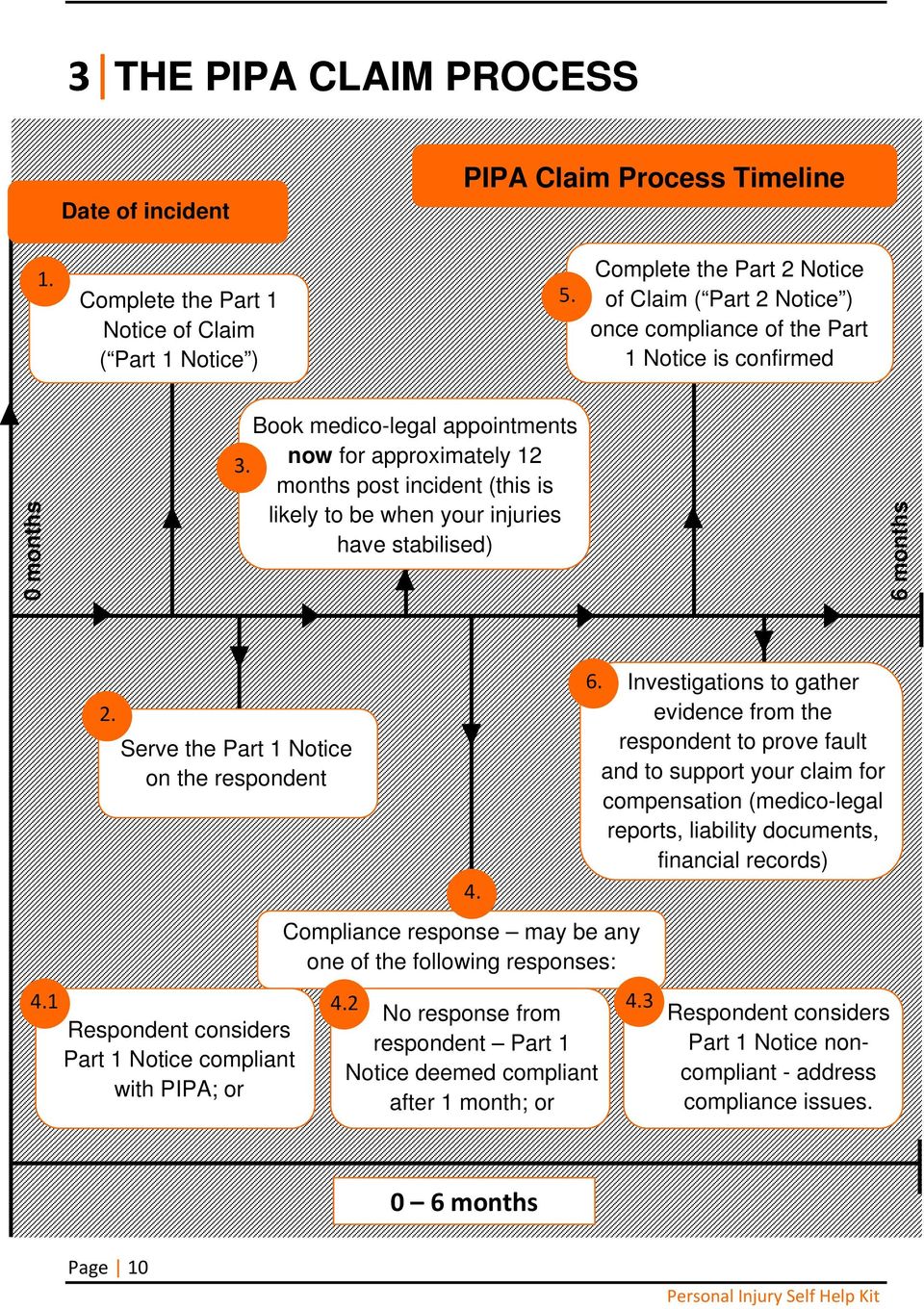
11 3 THE PIPA CLAIM PROCESS Date of incident PIPA Claim Process Timeline 1. Complete the Part 1 Notice of Claim ( Part 1 Notice ) 5. Complete the Part 2 Notice of Claim ( Part 2 Notice ) once compliance of the Part 1 Notice is confirmed 0 months Book medico-legal appointments 3. now for approximately 12 months post incident (this is likely to be when your injuries have stabilised) 6 months Serve the Part 1 Notice on the respondent Respondent considers Part 1 Notice compliant with PIPA; or Compliance response may be any one of the following responses: No response from respondent Part 1 Notice deemed compliant after 1 month; or 6. Investigations to gather evidence from the respondent to prove fault and to support your claim for compensation (medico-legal reports, liability documents, financial records) 4.3 Respondent considers Part 1 Notice noncompliant - address compliance issues. 0 6 months Page 10
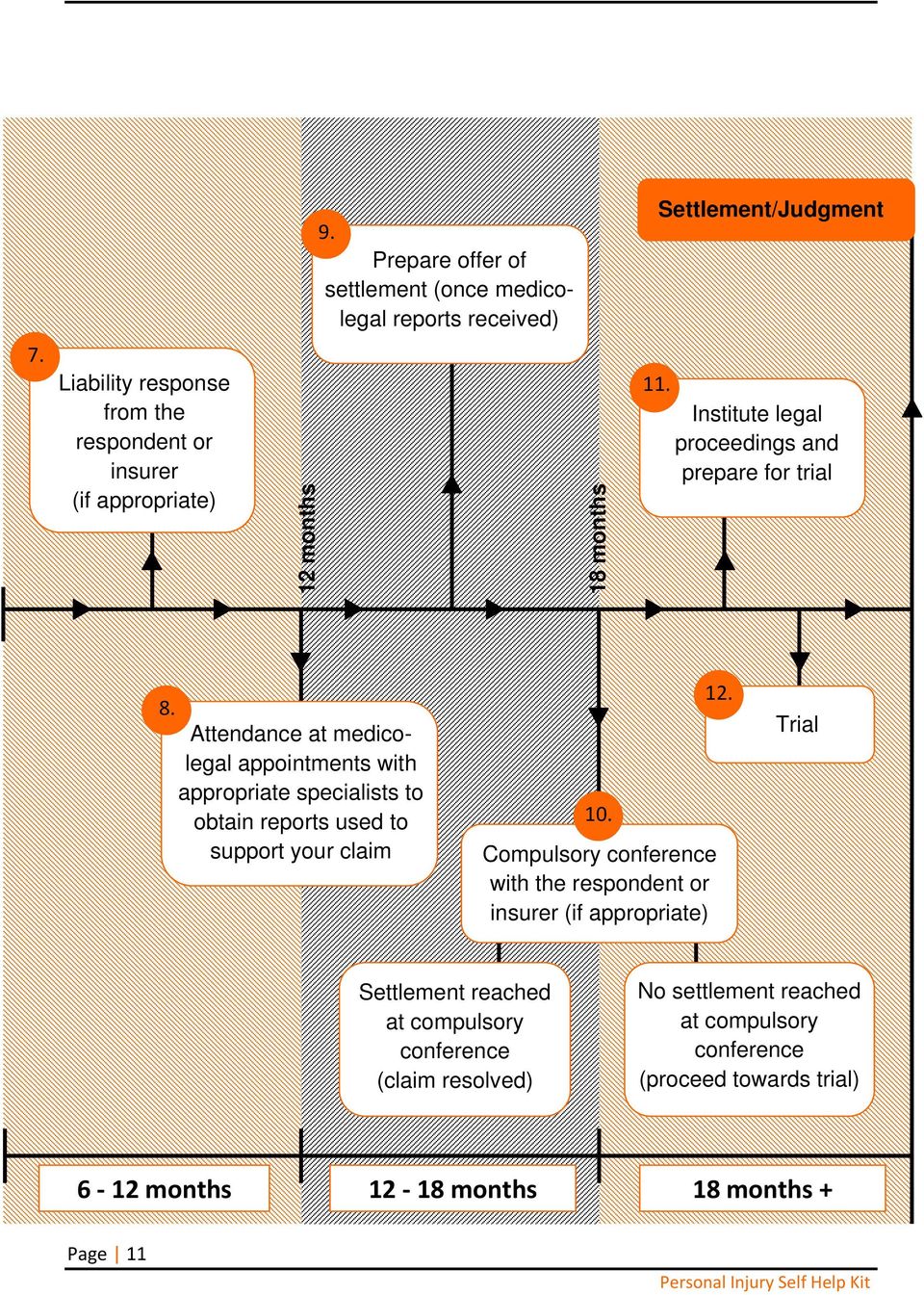
12 9. Prepare offer of settlement (once medicolegal reports received) Settlement/Judgment 7. Liability response from the respondent or insurer (if appropriate) 12 months 18 months 11. Institute legal proceedings and prepare for trial 8. Attendance at medicolegal appointments with appropriate specialists to obtain reports used to support your claim 10. Compulsory conference with the respondent or insurer (if appropriate) 12. Trial Settlement reached at compulsory conference (claim resolved) No settlement reached at compulsory conference (proceed towards trial) 6 12 months months 18 months + Page 11
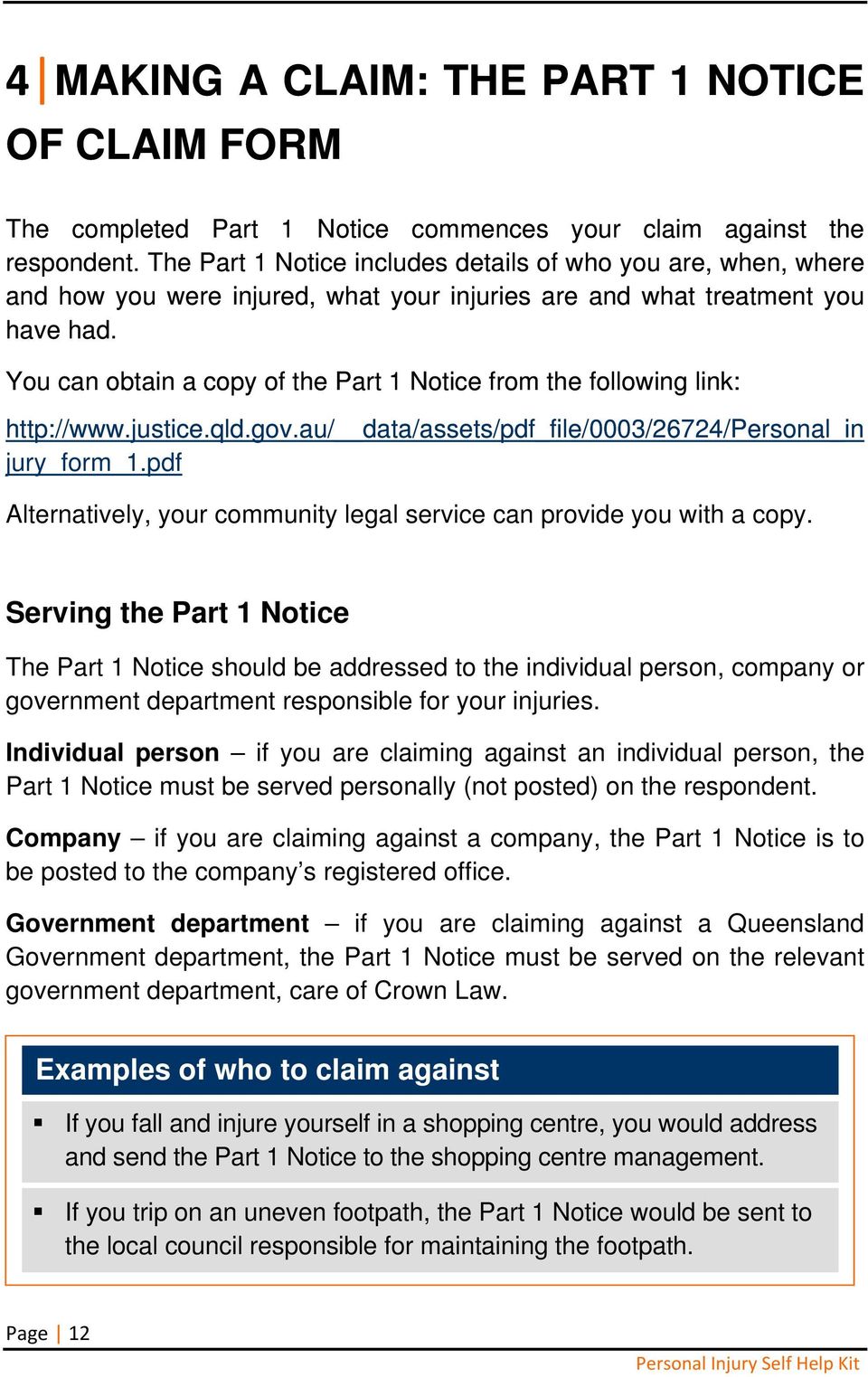
13 4 MAKING A CLAIM: THE PART 1 NOTICE OF CLAIM FORM The completed Part 1 Notice commences your claim against the respondent. The Part 1 Notice includes details of who you are, when, where and how you were injured, what your injuries are and what treatment you have had. You can obtain a copy of the Part 1 Notice from the following link: data/assets/pdf_file/0003/26724/personal_in jury_form_1.pdf Alternatively, your community legal service can provide you with a copy. Serving the Part 1 Notice The Part 1 Notice should be addressed to the individual person, company or government department responsible for your injuries. Individual person if you are claiming against an individual person, the Part 1 Notice must be served personally (not posted) on the respondent. Company if you are claiming against a company, the Part 1 Notice is to be posted to the company s registered office. Government department if you are claiming against a Queensland Government department, the Part 1 Notice must be served on the relevant government department, care of Crown Law. Examples of who to claim against If you fall and injure yourself in a shopping centre, you would address and send the Part 1 Notice to the shopping centre management. If you trip on an uneven footpath, the Part 1 Notice would be sent to the local council responsible for maintaining the footpath. Page 12
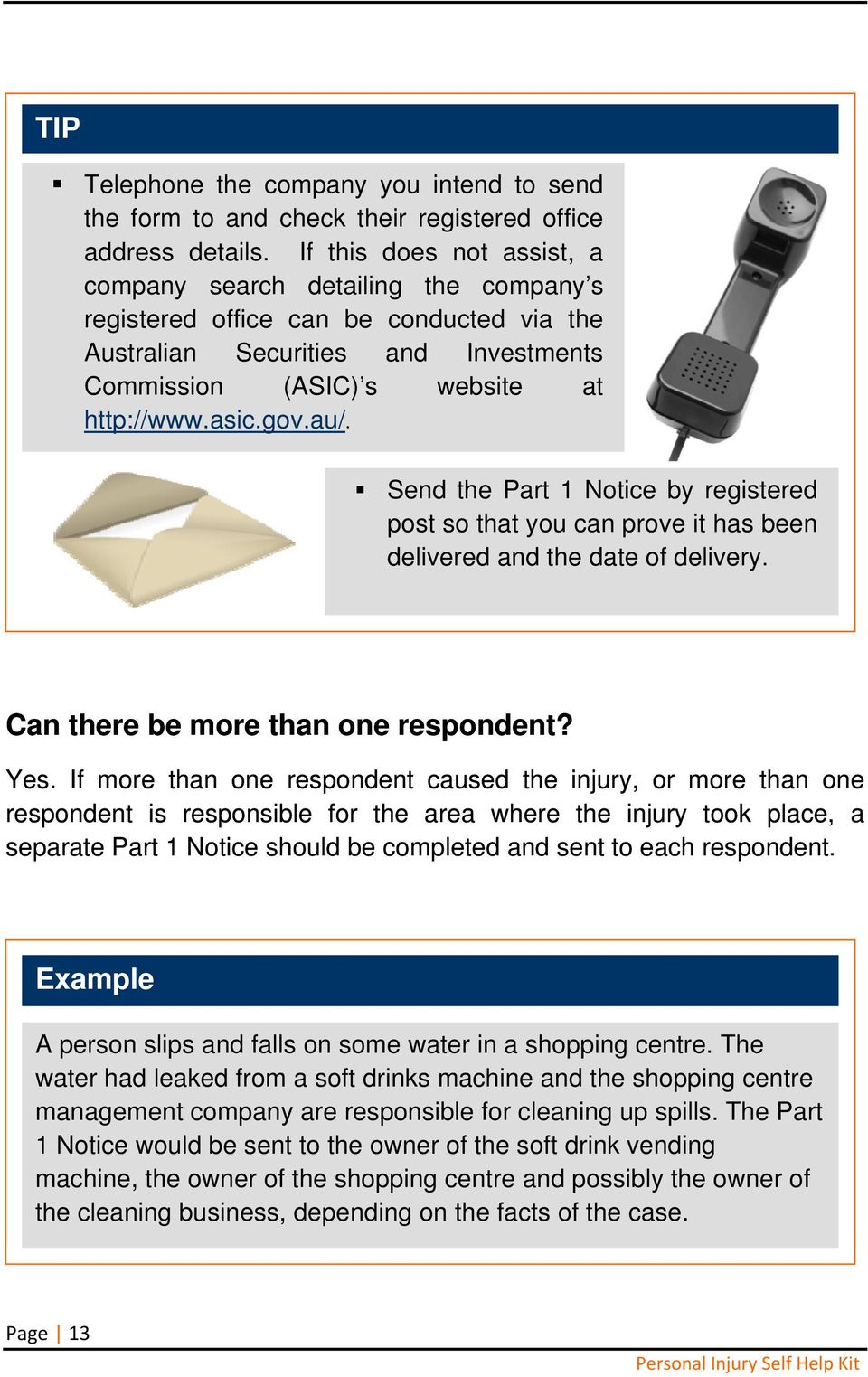
14 TIP Telephone the company you intend to send the form to and check their registered office address details. If this does not assist, a company search detailing the company s registered office can be conducted via the Australian Securities and Investments Commission (ASIC) s website at Send the Part 1 Notice by registered post so that you can prove it has been delivered and the date of delivery. Can there be more than one respondent? Yes. If more than one respondent caused the injury, or more than one respondent is responsible for the area where the injury took place, a separate Part 1 Notice should be completed and sent to each respondent. Example A person slips and falls on some water in a shopping centre. The water had leaked from a soft drinks machine and the shopping centre management company are responsible for cleaning up spills. The Part 1 Notice would be sent to the owner of the soft drink vending machine, the owner of the shopping centre and possibly the owner of the cleaning business, depending on the facts of the case. Page 13
15 When to send the Part 1 Notice The Part 1 Notice should be received by the respondent within 9 months of the injury occurring or within one month of a solicitor being instructed, whichever is the earlier date. Instructing a solicitor means retaining their services and not just requesting a one-off consultation or advice session. What if the Part 1 Notice has not been sent in time? If you want to make a claim, you must still send the Part 1 Notice, even though it is late, together with an explanation as to why there has been a delay. The excuse for the delay must be reasonable in the circumstances, and should be included as an annexure to the Part 1 Notice or be presented separately to the Part 1 Notice in a particular form known as a statutory declaration. An example of the correct form for a Queensland statutory declaration is available as a word document at data/assets/word_doc/0003/88554/gen-f-qld- stat-dec.doc. You can also obtain a blank form from your local courthouse. You can find the address of your closest courthouse at Examples of reasonable delays The injured person was not aware of the extent of their injuries within the 9 month period The injured person did not realise the injury would produce permanent effects until all treatments had been tried Page 14

16 Time limits you need to be aware of Time limits are very important in personal injury claims. You can lose your right to claim compensation if you fail to take the necessary steps within the required time frames. The time limit for bringing an injury claim in Queensland is three (3) years from the date of the injury or, in some cases, when the extent of the injuries sustained as a result of the accident become apparent. If you sustained an injury close to three years ago, you should urgently seek legal advice. If the three-year period has already passed, a claim may still be able to be made in very limited circumstances. Page 15

17 5 COMPLETING THE PART 1 NOTICE OF CLAIM FORM Question by question guide to completion Respondent s details - on page 2, complete the name of the respondent, using the name of the relevant individual, company and/or business name. Also complete the address of the respondent. Question 1 & 2: Complete your details, and any previous names you have been known by, including a maiden name. Question 3: Complete any requirement for an interpreter. Question 4: Complete the details of any law firm you have formally retained to act on your behalf with respect to the claim for personal injury (if applicable). Question 5: Complete the name and address of any other respondent you have sent a Part 1 Notice to. Question 6: Identify any Queensland Government department you believe is responsible for the injury. Question 7: Complete the date, time, place and weather conditions when the incident occurred. Question 8: Draw a diagram of the incident on a separate piece of paper and attach it to the Part 1 Notice. Question 9: Provide a brief description of the incident. Question 10: Provide details of any emergency services entity who attended at the time of the incident. Question 11: Provide a description of what you were doing when the incident took place. Page 16

18 Question 12 & 13: Complete details of any protective device which was available to use at the time you sustained the injury and whether you used it. Question 14: Provide the identity of any person who witnessed the incident in which you sustained the injury. TIP Witnessed means they actually saw the incident with their own eyes Question 15: Provide details of any medication or drug (prescription or otherwise) you took in the 12 hours before the time of the incident. You should seek legal advice if the information requested could be potentially incriminating. Question 16: Provide details of any alcohol you consumed in the 12 hours before the time of the incident. Question 17: Provide the details of the person, company or government department you believe caused the incident or is responsible for the incident (ie: the respondent). These details should be the same as the respondent s details completed on page 2 of the Part 1 Notice. Example A person who slips on a pool of water in a supermarket aisle would say the supermarket is at fault because they allowed the pool of water to sit in the aisle, and none of the employees of the supermarket checked the aisle for pools of water or cleaned up the water. Page 17 Continued over page

19 Question 18: Complete why you say the respondent is responsible for the incident. Question 19: Provide the details of any person (apart from the respondent) who may have caused the injury. Question 20: Provide a detailed list of all injuries you sustained in the incident and any which have developed as a consequence of the incident. Question 21 & 22: Complete the details of any hospitals you attended for treatment and the dates you were admitted for that treatment. Question 23: Provide the details of any health care providers you have been treated by because of the incident, and the treatment they gave you. Question 24: Provide details of any injuries, disabilities or illnesses you have suffered, before or after the incident, which may have an impact on the disabilities caused in the incident, or the amount of compensation you may be entitled to. Example A person slips in a supermarket aisle, and injures their left elbow. Two years earlier they had suffered a left elbow injury playing tennis, had seen their doctor and received physiotherapy treatment. Details of the tennis injury should be included in the Part 1 Notice. Question 25: Provide details of any type of claim you have made for social security, income protection, WorkCover, or any other form of benefit, where the claim for benefits has been made because of the injury. Page 18

20 Documents you must attach to the Part 1 Notice You must attach the following to the Part 1 Notice: Any medical reports or certificates relating to the injuries sustained in the incident; Any reports relating to your medical history; Any incident report, photograph or diagram relating to the incident and its causes; Witness statements relating to the incident; and A diagram of the incident (question 8). Signing the Part 1 Notice The Part 1 Notice must be signed in front of a qualified witness such as a solicitor, Justice of the Peace (JP), or Commissioner for Declarations. JPs are often available at libraries or courthouses to provide this service. You can find a JP using this link: Your signature on the Part 1 Notice authorises the respondent to access information about you that would otherwise be protected by privacy laws. Accordingly, after serving the Part 1 Notice, the respondent will be able to access information about you from: Medical and rehabilitation providers; Government authorities; and Your employer. Page 19

21 Response to the Part 1 Notice The respondent must reply to the Part 1 Notice within one calendar month of receiving it. TIP If you send the Part 1 Notice by registered post, you will have a card showing when the respondent received it. If you put the date one month after that date in your calendar, you will know when the response from the respondent is due. The responses to be provided by the respondent at this time must say: 1. Whether the respondent has been correctly identified in the Part 1 Notice; and 2. Whether the Part 1 Notice is compliant with the Personal Injuries Proceedings Act 2002 (Qld). Has the respondent been correctly identified? The respondent s response must tell you whether: They are the proper respondent; or They cannot decide if they are the proper respondent; or They are not the proper respondent. If you receive the first of these three responses then the respondent has to provide a compliance response. If you get either of the other responses, you should seek legal advice as to how to proceed. Page 20
22 Is the Part 1 Notice compliant? The respondent must tell you whether they consider the Part 1 Notice to be compliant. This means that they are satisfied you have answered the questions in the Part 1 Notice correctly, that it is properly signed and witnessed, and that all relevant documents have been attached. If the respondent says the form is not compliant, they must tell you in their letter what part of the Part 1 Notice does not comply, and how you can fix this. You have one calendar month from the time you get the respondent s letter setting out non-compliance issues, to fix non-compliance. If the respondent does not confirm compliance after you have taken reasonable steps to remedy non-compliance, then you will have to seek an order from the court deeming the Part 1 Notice compliant. Page 21
23 6 THE PART 2 NOTICE OF CLAIM FORM The Part 2 Notice provides the respondent with information about the financial losses you have incurred because of the injury sustained in the incident. It also provides further details of the treatment you have received and the nature of your injuries. Serving the Part 2 Notice The Part 2 Notice should be addressed and mailed to the respondent (or their insurer if appropriate). Unlike the Part 1 Notice, there is no requirement that the Part 2 Notice be served personally. When to send the Part 2 Notice The Part 2 Notice should be received by the respondent within 2 months of the date the respondent provided their initial response to the Part 1 Notice, or if no response has been provided, then within 2 months of the date the Part 1 Notice was given to the respondent. Response to the Part 2 Notice If you make an offer of settlement in the Part 2 Notice, the respondent may make a counter offer to you. There is no compliance response issued by the respondent after serving the Part 2 Notice. Page 22
24 7 COMPLETING THE PART 2 NOTICE OF CLAIM FORM Question by question guide to completion Question 26: Complete the details of your employment before and at the date of injury. Question 27: Complete what educational qualifications you have, as well as where and when you attained them. Question 28: Tick the box to indicate if you have lost any income, from any source, because of the incident. If you have not, go directly to question 47. Question 29: Tick the box to indicate if you are still losing income at the date of filling in the form. Question 30: Tick the box to indicate whether you have returned to work since the incident. If you have, go direct to question 32. Question 31: Indicate when you expect to return to work, if you know. Question 32: Complete the details of your employment, or self-employment, in the three years up to the incident. If you need more space, use a separate sheet of paper and attach it to the Part 2 Notice. TIP Using a table annexed to the Part 2 Notice is often a useful way to present this information. Question 33: Complete the details of your accountant if applicable. Continued over page Page 23
25 Question 34: Complete the details of the periods of time you have been off work since the incident. If you need more space, use a separate sheet of paper and attach it to the form. Question 35: Complete the details of any changes in your work duties or earnings since the incident. Question 36 & 37: Complete the details of losses of earnings from selfemployment if applicable. If you need more space, use a separate sheet of paper and attach it to the form. If you are not self-employed, go directly to question 40. Question 38: Indicate whether your business is still operating. Question 39: Complete the details of any person hired to replace you. Question 40 & 41: Complete the details of losses of earnings from employment. If you need more space, use a separate sheet of paper and attach it to the form. Question 42 & 43: Complete details of any second job you had at the date of injury and any earnings from that job. Question 44: Complete any details of any firm arrangement you had made to enter or cease employment, alter your duties, working hours or earnings before the incident. Question 45: Provide a statement of any economic loss you have suffered from the incident. Question 46: Provide details of any payment you have received, from any source, because of the incident. Give as much detail as possible about reference numbers from any insurer, government authority or lender. Question 47: Provide details of any treatment provider you have seen since delivering the Part 1 Notice. If you need more space, use a separate sheet of paper and attach it to the Part 2 Notice. Page 24
26 Questions 48 52: Complete details about any recommended rehabilitation and what has been provided. Question 53: Provide details of any disabilities you have sustained in the incident. You should include loss of range of movement, pain, restrictions on the ability to walk or lift objects etc. Provide as much detail as possible about any impacts of any injuries you sustained in the incident. TIP If you need more space, use a separate sheet of paper and attach it to the Part 2 Notice. Question 54: This is where you have to indicate whether you are ready to make the respondent an offer to settle your claim. This is a very important question. Offer to settle If you are not ready to make an offer to settle, you must provide a reason. The usual reason provided is that you do not yet have all of the medical evidence available to make an informed decision. Or maybe your injuries have not yet stabilised. Stabilisation is when injuries are no longer deteriorating, or have reached maximum improvement after reasonable treatment. Often injuries will not have stabilised within the time frames for completing the Part 2 Notice. If you are ready to make an offer to settle, answer the question yes and attach a separate sheet of paper with an offer to settle your claim. See pages for details of how to calculate your offer of settlement. Page 25
27 Documents you should attach to the Part 2 Notice You should attach the following to the Part 2 Notice: Taxation documents for the three full financial years before the incident. You should only attach these if you are making a claim for loss of earnings from employment or self-employment; Any medical documents you did not attach to the Part 1 Notice; and Any other documents relevant to the claim which you did not provide with the Part 1 Notice. Signing the Part 2 Notice Follow the same instructions as for the Part 1 Notice. Your signature will again authorise the respondent to obtain documents about you from various sources. Page 26
28 8 GATHERING THE EVIDENCE Liability evidence To make a meaningful assessment of your prospects of success you should request information and/or records from the respondent and if applicable, other relevant bodies. The respondent is obliged to disclose this information. Examples of the types of information and/or records you should request Details of the systems in place at the time of the incident (if any) designed by the respondent to reduce the risk of injury or harm; Details of whether those systems are accepted systems of risk management in the industry; and/or Any relevant police or other departmental records available which might assist with proving a respondent s negligence. Ultimately, if you would not be able to satisfy a court that the respondent s negligence caused your injuries, you should not proceed with a claim. This is because you are only entitled to recover compensation from the respondent in circumstances where their negligence caused your injuries. When to get the liability evidence? You should get the liability evidence as soon as possible after serving the respondent with the Part 1 Notice, and prior to obtaining other evidence like medico-legal evidence. This will ensure you do not waste time and money pursing a claim which has little or no prospects of success. Page 27
29 Medico-legal evidence To calculate what amount of compensation (damages) you can seek for your injuries, you will need to provide medico-legal evidence. The best evidence is written reports from independent specialists who are not involved in the day-to-day treatment of your injuries. Example A person with a torn ligament in their knee would get a report from an orthopaedic surgeon, preferably one who specialises in knee surgery or the lower limbs. The specialist you see for medico-legal purposes will not treat your injuries, however they will be able to assess your injuries and provide a written report about how they affect you in your employment and day to day life. Unfortunately, specialists often charge substantial sums to write such reports. You do not need to get a referral from your general practitioner in order to see a specialist for medico-legal purposes. However, not all specialists provide medico-legal reports so you might like to consult with your general practitioner or solicitor regardless, as they may be able to recommend an appropriate specialist to contact for a medico-legal report. A medico-legal report should address: The diagnosis of the injury sustained in the incident; How the injury was caused; A brief medical history including whether there was any damage to the area of the body prior to the incident; What treatment is going to be required for the injury; Page 28
30 The prognosis, or what outcome is expected; Whether the injury has stabilised; What disabilities the person has because of the injuries; An assessment of whole person impairment in accordance with the American Medical Association Guides, 5 th Edition; and The impact of that impairment on the person s domestic and occupational activities. When to get the medico-legal evidence You should get the medico-legal evidence only after your injuries have stabilised. Medico-legal reports are expensive and they may not be accepted by the respondent if your injuries have not yet stabilised. Further, reports are only useful for calculating an offer when the specialist can confidently give an opinion on permanent disability. An injury is most likely to be stable when all courses of rehabilitation have been completed. Except in unusual circumstances, it is generally the case that an injury should be stable one year after the injury occurred, or six months after the last operation. Page 29
31 9 RESPONDENT MUST ATTEMPT TO RESOLVE THE CLAIM PIPA imposes an obligation on respondents to attempt to resolve claims. Within 6 months of receiving a complying Part 1 Notice, the respondent must: 1. take all reasonable steps to inform themselves or itself of the circumstances of the incident; 2. provide you with a response as to whether liability for the circumstances of the incident is admitted or denied, and whether contributory negligence is alleged against you; and 3. make an offer of settlement. It is usually the case that respondents (or their insurers) will deny all liability for the circumstances of the incident, and in the alternative allege 100% contributory negligence against you. Contributory negligence is when an injured person fails to take reasonable care for his or her own safety and well-being, and contributes to their own injuries or in some way causes the incident which causes their injuries. Any offer of settlement accompanying a response denying liability and claiming that you contributed to your own injuries, is almost always nil. Notwithstanding such a response by a respondent (or their insurer), it is often the case that a commercial settlement can be reached at the compulsory conference. Page 30
32 10 CALCULATION OF DAMAGES There are well-established principles used in the calculation of damages in personal injury claims. Damages are assessed in the different categories as set out below. General damages These are damages you can recover for the pain, suffering and loss of enjoyment of life caused by the injury. These damages must be calculated by using the compensation tables in the Civil Liability Regulation 2003 (Qld) ( the Regulations ). TIP Since 1 July 2009, the Regulations have been updated annually. The date of the incident causing your injury will determine which version of the Regulations you should use. All versions of the Regulations are available at You can also get copies at your local community legal service. To use the Regulations, you match your injury to one of the injury categories set out in the tables. Every type of injury is described in the tables. How to use the compensation tables A person suffers a wrist injury causing a fracture requiring internal screw fixation. There is a section in the tables dealing specifically with wrist injuries. Start at the most serious wrist injury category and work towards the more minor wrist injury categories until you find a good match for your injury based on the descriptions provided. Page 31 Continued over page
33 The table will provide a range of Injury Scale Values known as ISVs. The descriptions of the injuries in the tables will help to identify where in the ISV range to place the particular injury. Once you have decided on a particular ISV for the injury, you can convert it to a dollar value by using the conversion tables available at The tables are also available at your local community legal service. Multiple and dominant injuries The situation is more complex where a person has sustained multiple injuries in an incident. You need to assess which injury is the dominant, or most severe one in order to calculate the general damages. This is done by categorising each of the injuries by using the compensation tables, and then working out which injury has the highest top end of the ISV range. This is the dominant injury. Once you know the dominant injury, you then determine whether the combination of all of the injuries would be adequately covered by using the ISV at the top of the dominant injury s ISV range. If not, then you can add a 25% uplift to the ISV, but only from the top of the range. Page 32
34 Example A person sustains a fracture of their hip when they slip and fall over on the footpath. They suffer significant pain and lose mobility. Eventually they require a full hip replacement, which is only partially successful and is likely to require revisionary surgery. While they await the surgery, they develop an adjustment disorder with depression as a consequence of the pain and lack of mobility. There is psychiatric evidence which confirms the psychological injury is connected to the physical symptoms. The hip injury would come within item 127 in the Regulations, attracting a range of ISVs between As the hip replacement is likely to need revision, the hip injury would be assigned an ISV close to the top of the range (say 23). The adjustment disorder is assigned an 8% degree of permanent impairment by a psychiatrist. It would come within item 12, moderate mental disorder, which attracts a range of ISVs between 2-10 and would be likely to be assigned an ISV of 7. The hip injury would be the dominant injury as it has the highest ISV of the two injuries. Simply adding together the values of the two injuries ( = 30) is not permissible as it will exceed the top of the range (25) however, it is permissible to seek an uplift of 25% to be applied to the top of the range (25) for the dominant injury which would produce a figure of 31, calculated as follows 25 + (25% of 25) 6.25 = 31. ISV's must be whole numbers. Page 33
35 Past expenses As previously mentioned in relation to the attachment of documents to the Part 2 Notice, you can claim for past out of pocket expenses reasonably associated with the injury. These will usually include costs of: Medical treatment; Rehabilitation; Medications; Equipment required because of the injury; Travel associated with the above; and Paid care or other services, such as lawn-mowing. TIP It is vital that you keep all of your receipts when paying for these expenses. Refunds You should include any refunds that you may be required to pay back, in your offer of settlement. Government authorities like Medicare, Centrelink, WorkCover Queensland and CRS Australia are entitled to a refund for any amounts they have paid on your behalf, in relation to your injury. You should also find out if there is any amount owing to any hospital for any treatment you received, or any benefits paid by your private health insurer. You can write to each of these possible refundable bodies to find out what, if any, amount you owe them. If you do not factor in these sums when you make offer of settlement, you may well find yourself out of pocket for those amounts as the bodies mentioned will expect to be reimbursed. Page 34
36 Future expenses You can claim for future expenses if you can show that they will be necessarily incurred because of your injuries. The best way to demonstrate this is by way of a supporting medico-legal report. Alternatively, you can make a calculation by projecting your current expenses into the future, for the period you expect to continue to pay those expenses. To calculate the period for which you may pay the expense into the future (ie: the period of your expected lifespan), you can use the prospective life tables. These tables are available at your local community legal service, or at All future expenses have to be calculated using the 5% discount tables. This discounts the amount paid for future expenses. To calculate future expenses, take the following steps: 1. Calculate your future expenses; 2. Reduce your future expenses to a weekly figure; 3. Calculate how many years you are likely to pay the expenses, based on medical reports or look at the prospective life tables for an indication of your life expectancy; 4. Go to the 5% discount tables and locate the multiplier with the corresponding number of years; and 5. Multiply the multiplier by the expense per week. The result will be the future cost of the expense, properly discounted. Continued over page Page 35
37 Example A person has been paying $13 per week for pain medication, and their doctor says they will need to use the medication into the foreseeable future. The person is 55 years old, and expects to live another 25 years. The calculation would be: $13/week x 754 (multiplier for 25 years) = $9,802. Past economic loss If you have lost income from employment or self-employment as a result of the injuries, you can claim for those losses. Calculate the number of days work you have lost (including part days and loss of overtime) and claim that figure. You simply multiply the days lost by the daily rate of pay you were receiving in employment prior to the injury. All calculations must be net of tax. TIP In order to claim past economic loss you will need to provide evidence of what your income was prior to the incident. The best way to prove this is to provide your income tax returns for the 3 years prior to the incident and payslips for the period shortly before the incident. If you were not working at the date of the injury, but had plans to return to work, then you may be able to claim for the loss of the ability to do that work, for the period between the injury and making the claim. You will need to provide evidence (usually a letter from the person who was going to Page 36
38 employ you) showing what sort of work you were going to do, for how many hours (on average) a week, and the amount you would have been paid. Future economic loss You can claim for any future loss of income from employment or selfemployment as a result of the injuries. This is usually a significant part of any damages sum. The best way to show you will lose income from the injuries is to obtain a medico-legal report addressing what impact your injuries will have on your ability to work. This is usually best assessed by an occupational therapist. The same principles for claiming future economic loss apply even if you were not working at the date of the injury, but had plans to return to work. Future loss of income claimed on a loss per week basis also has to be calculated by using the 5% discount tables as previously demonstrated. In some cases, where income is inconsistent and/or other health or personal circumstances apply, a global lump sum approach should be considered. Seek legal advice. Loss of superannuation You can claim for loss of superannuation benefits that you would have been paid during periods when you have lost income, both past and future. To calculate these amounts, you simply multiply the past and future economic loss amounts by the superannuation rate which would have been paid by your employer during the relevant period. This is usually the Australian Government s superannuation guarantee rate. If you were not working at the time of the incident, then the default position is to claim superannuation on the basis of the superannuation guarantee rate in effect during the relevant period. Loss on superannuation benefits cannot be claimed if you are claiming economic loss on the basis of self-employment. Page 37
39 Unpaid care and assistance If your family or friends provide unpaid care and assistance which you require as a result of your injuries, you can claim an equivalent amount to the cost of paying a commercial provider. There is a threshold which needs to be met before being eligible to claim this category of compensation. You must require the unpaid services for at least 6 hours a week, for at least 6 months. If you are going to require unpaid services in the future, your calculation again uses the 5% discount tables. To make this calculation, multiply the weekly cost of the commercial equivalent of the service by the multiplier corresponding to the number of years for which you will require the services (ie: your life expectancy from the prospective life tables). Example The injured person did all of the mowing and gardening before the injury and cannot do it now because of the injury. A family member has performed these duties since the incident. The injured person may be able to claim the amount equal to how much it would have cost to employ a gardener to do the work, provided the threshold is met. Page 38
40 11 DUTY TO MITIGATE LOSS All claimants have a duty to attempt to reduce or limit any loss they incur as a result of an incident. This is called mitigation of loss. Genuine attempts to mitigate loss may enhance your claim. Failure to mitigate loss may disadvantage your claim. Example A person who fractures their ankle on a footpath may have difficulties working in their job as a shop assistant as they are required to be on their feet all day. Instead of ceasing work altogether, the injured person may undertake training to work within another area of the company, or seek alternative work which does not require long periods of standing. Page 39
41 12 SETTLEMENT Making an offer to settle Once you have calculated your claim for compensation (damages), you will be in a position to make an offer of settlement to the respondent (or their insurer) to settle your claim. You are also in a much better position to assess any offer that you might receive from the respondent (or their insurer). An offer to settle a personal injuries claim is a way of avoiding going to court. The respondent agrees to pay a certain amount of money to avoid being taken to court. This is referred to as a compromise or settlement of the claim. The process is usually called settlement negotiations. These can take place at any time, and can be initiated either by you or the respondent. In some ways, the process is something like you would find in a negotiation to buy (and sell) a house or a car. The person doing the selling (in a personal injuries claim this is the injured person) often begins by putting a higher price on the item they are selling (their right to take the respondent to court) than they are actually prepared to end up selling for. At the same time, the person doing the buying (the respondent) usually wants to get away with paying the least amount possible, and begins by making offers lower than they might end up being prepared to pay or being ordered to pay by a court. Therefore, your first offer is usually higher than what a court might quantify the claim as being, and usually higher than what you would agree to accept to avoid going to court. The respondent s first offer is usually not their best (highest) offer. However, these are general statements and will not apply to every case. Page 40
42 Assessment and balancing of risk The thing that distinguishes settlement negotiations in a personal injuries claim from negotiating to buy a car or house, is the way that various risks have to be taken into account. When you negotiate to buy a car, you can inspect it, do background checks to see it is not stolen property and have it looked at by a mechanic to determine any defects. All of these factors go into assessing the price you might pay for the car. Some of the most significant risks involved in personal injuries litigation are: A judge may not be satisfied that the respondent was negligent, or at fault for the injury, which means you lose the case and get no compensation at all. If this happens you can be made to pay a proportion of the legal costs which the respondent has paid to defend the claim in court. Even if a judge says the respondent is at fault for the injury, and you win the case, the judge might award a lot less by way of compensation than the amount you calculated. If this happens you can sometimes still be made to pay some of the respondent s legal costs. This can happen if you could have settled the claim earlier (before going to court) by accepting the mandatory final offer (MFO, see comments on pages 44 and 45) from the respondent where the MFO was more than the amount the judge thinks the claim is worth. Page 41
43 There is no way of knowing which judge might end up having to decide the case, and different judges have different attitudes towards personal injury claims. Even in a case where the respondent has admitted they are at fault for your injury, there is no guarantee that you will win your case in court. Respondents can admit liability in the pre-court process and then deny it later on if the claim goes to court. As the injured person, these risks usually act as a type of discount on an assessment of your entitlement to compensation, lowering the expectations of what you might be willing to accept to settle the claim. Other factors you should take into account in making and assessing offers are: the likely costs of continuing with a claim and taking it to court; and the delays involved with progressing or resolving a claim. From the point of view of the respondent, an assessment of how much a claim is worth is usually made by considering: the likelihood that the respondent would be found to be at fault; the medical evidence showing what the injuries are and how they affect you; the other evidence you will rely on to show what your losses are, for example, invoices for treatment you have paid for; and the likely costs of defending a claim in the court. Page 42
44 13 COMPULSORY CONFERENCE As an injured party, you are entitled to have a compulsory conference. Generally, you cannot start court proceedings unless you have been to a compulsory conference. However, parties may agree NOT to hold a conference or a court may order that it is not required. The compulsory conference has the advantage of making the respondent comply with certain formal requirements. The compulsory conference is a meeting where you get to meet the respondent (or their insurer, or representatives) and attempt to negotiate a settlement of the claim. This is not the only opportunity to try to negotiate a settlement, and settlement discussions can happen between the parties at any time. There are however some pitfalls with other informal negotiation methods (see page 45 for further details). Any party may call for the conference to be held at a time and place convenient to the parties. The conference can be held after 6 months has passed since the respondent was given a complying Part 1 Notice. If you are attending a compulsory conference, it is recommended you get advice from your community legal service before you do. What will happen at the compulsory conference? 1. You will have pre-prepared a schedule of the damages you say you would be entitled to if the matter went to court. TIP The figures in the schedule are usually at the high end of the range to give the injured person some bargaining room. Page 43 Continued over page
45 2. You start the conference confirming it is a compulsory conference under the PIPA and that everything said at the conference is without prejudice (which means it cannot be brought up and relied on later, for example, in court). TIP Although compulsory conferences are conducted on a without prejudice basis, the respondent is not prevented from making further enquiries after the conference based on discussions at the conference. 3. You say why the injuries are the respondent's fault, why the respondent will be found to be liable for the injuries and why the doctors and other evidence beneficial to your case should be accepted. 4. You provide the schedule of damages to the respondent as the opening offer of settlement in the negotiations and say why you are entitled to such an amount. 5. The respondent will then talk about the case from their point of view. 6. The respondent should make a counter-offer, which you can then respond to by lowering your offer in response. 7. If the parties can meet in the middle then the matter will settle. If you decide to take the respondent's last offer or vice versa, the matter will settle. 8. If there is no agreement, the parties are required to exchange written final offers called mandatory final offers ( MFOs ) at the compulsory conference. The MFOs remain open for acceptance by either party for 14 days following the compulsory conference. Page 44
46 9. If the claim doesn t settle by one party accepting the other party s MFO inside the 14 day period following the compulsory conference, then further steps need to be taken. At this point, the matter is heading to court and you only have a 60 day timeframe from the date of the compulsory conference to file material in court. You will need to seek advice from your community legal service as soon as possible after the compulsory conference to discuss the progression of your claim. Pitfalls of informal negotiations Sometimes a respondent (or more often their insurer) will try to settle a claim early and cheaply and this can disadvantage you. It is important to realise that the settlement or compromise is a once and for all settlement. You cannot go back later to the respondent (or their insurer) and ask for more money. Once an agreement is reached, the respondent (or their insurer) will have you sign a deed of release and discharge. This document will usually say that the respondent can never be made to pay any further compensation, regardless of whether the settlement was sufficient, and regardless of any worsening of the injuries occurring after settlement. Before you sign a release document you should obtain legal advice from a private solicitor or your community legal service to ensure you understand the document and so that your legal rights are protected. Page 45
47 14 GLOSSARY Affirming stating that what is said or written is the truth. Used as an alternative to making an oath. Claimant the person who has sustained the injury and is making a claim. Compliance response what the respondent gives the claimant when they are satisfied that the Part 1 Notice includes all of the relevant information, the claimant s signature has been properly witnessed, and all of the supporting documents have been provided. Evidence the facts and circumstances that a case relies on. Insurer the insurance company with whom the respondent has a policy. Occupier the person, company or government authority responsible for looking after a particular location. Offer of settlement an offer the claimant makes to the respondent or vice versa, to settle on an amount of money to be paid to the claimant in exchange for not continuing with the claim. Part 1 Notice of Claim the first form the claimant gives the respondent, telling the respondent who the claimant is, what injuries have been sustained, and why the respondent is at fault. Part 2 Notice of Claim the second form the claimant gives the respondent, telling the respondent what their employment and income history is, extent of the injuries, what treatment they have required for their injuries and economic loss suffered. Proper respondent when the respondent is satisfied that they should be involved in the claim. Release and discharge a document the claimant signs, agreeing to accept a certain amount of money, in exchange for not continuing with the claim. Reasonable excuse for delay reasons the claimant gives the respondent when they have not given the Part 1 Notice in the initial time period. Respondent the person the claimant says is responsible for the injury. Sworn stating that what is said or written is the truth, in accordance with religious beliefs. Page 46
48 15 ACKNOWLEDGEMENTS Many people and organisations contributed to the publication of this kit. Particular thanks go to Alex McKean, Brooke Keegan, Peta Yujnovich, Fred Smith and Amy Park and the staff at Suncoast Community Legal Service. SCLS acknowledges the assistance of its collaborative partners McInnes Wilson Lawyers, QPILCH and the Sunshine Coast Law Association Inc without whose support the kit would have remained just another good idea. Legal Aid Queensland is commended for recognizing the importance of this initiative to disadvantaged Queenslanders and supporting it through the Legal Aid Community Legal Education Collaborative Fund. Page 47
49 NOTES Page 48
50 Contact Us Suncoast Community Legal Service Inc. 7 Ocean Street (PO Box 423) Maroochydore QLD 4558 Phone: Fax: [email protected] Office hours Monday Thursday 9.00am to 5.00pm Queensland Association of Independent Legal Services Phone: Website: First Edition, February 2013 Suncoast Community Legal Service Inc.
PERSONAL INJURY CLAIMS
 PERSONAL INJURY CLAIMS Frequently Asked Questions 1. Can I make a claim? If you have been injured because of the fault of someone else, you can claim financial compensation through the courts. The dependants
Accidents at Work. Everything you need to know
 Accidents at Work Everything you need to know Falling from ladders, slipping on a wet floor, lifting a heavy item, cutting yourself on a machine. Even in the 21st Century the workplace is still dangerous
Clinical Negligence: A guide to making a claim
 : A guide to making a claim 2 Our guide to making a clinical negligence claim At Kingsley Napley, our guiding principle is to provide you with a dedicated client service and we aim to make the claims process
FORM 2 PERSONAL INJURIES PROCEEDINGS ACT 2002. NOTICE OF CLAIM (Health Care Claims)
 FORM 2 PERSONAL INJURIES PROCEEDINGS ACT 2002 NOTICE OF CLAIM (Health Care Claims) INSTRUCTIONS FOR COMPLETING THIS FORM ARE ATTACHED AS THE LAST THREE PAGES OF THE FORM PLEASE READ INSTRUCTIONS CAREFULLY
Personal Injury Claim Information Guide. A step-by-step guide to your Compulsory Third Party (CTP) insurance claim
 Personal Injury Claim Information Guide A step-by-step guide to your Compulsory Third Party (CTP) insurance claim Compulsory Third Party (CTP) Personal Injury Claim. Your recovery is important to us If
Personal Injury Claim Information Guide A step-by-step guide to your Compulsory Third Party (CTP) insurance claim
 Personal Injury Claim Information Guide A step-by-step guide to your Compulsory Third Party (CTP) insurance claim AAI Limited ABN 48 005 297 807 trading as Suncorp Insurance Compulsory Third Party (CTP)
L.E. LAW INFORMATION SHEET NO. 11 GUIDE TO PERSONAL INJURY CLAIMS
 LE Law Services Ltd 127 High Road Loughton Essex IG10 4LT Telephone: 020 8508 4961 Facsimile: 020 8508 6359 www.lelaw.co.uk L.E. LAW INFORMATION SHEET NO. 11 GUIDE TO PERSONAL INJURY CLAIMS 1. Introduction
PERSONAL INJURIES PROCEEDINGS BILL 2002
 1 PERSONAL INJURIES PROCEEDINGS BILL 2002 EXPLANATORY NOTES General Outline Purpose of legislation The main purpose of this Act is to facilitate the ongoing affordability of insurance through appropriate
FORM 1 PERSONAL INJURIES PROCEEDINGS ACT 2002. NOTICE OF CLAIM (Non-Health Care Claims)
 FORM 1 PERSONAL INJURIES PROCEEDINGS ACT 2002 NOTICE OF CLAIM (Non-Health Care Claims) INSTRUCTIONS FOR COMPLETING THIS FORM ARE ATTACHED AS THE LAST THREE PAGES OF THE FORM PLEASE READ INSTRUCTIONS CAREFULLY
VICTORIAN TRANSPORT ACCIDENT CLAIMS - A GUIDE TO YOUR ENTITLEMENTS
 VICTORIAN TRANSPORT ACCIDENT CLAIMS - A GUIDE TO YOUR ENTITLEMENTS This guide includes the following: What is a transport accident? Who is the TAC? How do I make a claim? When will I know if my claim has
A GUIDE FOR PEOPLE INJURED IN A MOTOR VEHICLE ACCIDENT
 A GUIDE FOR PEOPLE INJURED IN A MOTOR VEHICLE ACCIDENT CONTENTS General information 02 Early payment of expenses 03 The Accident Notification Form (ANF) 03 Who can make a claim Other driver or owner at
GUIDE TO PERSONAL INJURY/ACCIDENT CLAIMS
 GUIDE TO PERSONAL INJURY/ACCIDENT CLAIMS At Richard Grogan & Associates we have Solicitors with significant experience and expertise who will advise and guide you through all matters relating to bringing
MAURICE BLACKBURN LAWYERS ROAD ACCIDENT INJURIES SOUTH AUSTRALIA
 MAURICE BLACKBURN LAWYERS ROAD ACCIDENT INJURIES SOUTH AUSTRALIA 02 MAURICE BLACKBURN YOU RE WORTH FIGHTING FOR. If you are hurt, injured, or are facing an unfair situation, you and your family shouldn
Form 275 Notice of claim for damages
 Department of Justice and Attorney-General Workers Compensation Regulator Form 275 Notice of claim for damages Version 3 Workers Compensation and Rehabilitation Act 2003 Section 275 This is an approved
Information for people injured in road crashes
 Information for people injured in road crashes What is CTP insurance? All South Australian drivers pay a CTP insurance premium when they register their vehicle. The CTP premium provides drivers and/or
Personal Injury Compensation Guide. Winston Solicitors LLP
 Personal Injury Compensation Guide Winston Solicitors LLP Compensation guide Here we provide a simple, plain speaking guide to no win no fee compensation claims for personal injuries in the UK. If you
A guide for injured workers. Introducing WorkSafe
 A guide for injured workers Introducing WorkSafe September July 2013 2011 Contents 1. About us 1 2. Weekly payments (income entitlements) 2 3. Services to help you get better 4 4. Getting back to work
How to make a personal injury claim
 A publication by Cute Injury How to make a personal injury claim A CLEAR AND CONCISE GUIDE TO THE PERSONAL INJURY CLAIMS PROCESS We provide professional and impartial advice from the outset and throughout
A guide for people injured in a motor vehicle crash.
 A guide for people injured in a motor vehicle crash. This guide has been designed to help people who have been injured in a motor vehicle crash and who may be able to make a claim for personal injury compensation.
Motor Accidents Compensation Amendment (Claims and Dispute Resolution) Act 2007 No 95
 New South Wales Motor Accidents Compensation Amendment (Claims and Dispute Contents Page 1 Name of Act 2 2 Commencement 2 3 Amendment of Motor Accidents Compensation Act 1999 No 41 2 4 Amendment of other
In order to prove negligence the Claimant must establish the following:
 Introduction A wealth of law exists to provide compensation to people who have suffered injuries, both physical and psychological, following an accident. This fact sheet provides a very brief guide to
MOTOR VEHICLE COMPENSATION CLAIM SUCCESS
 MOTOR VEHICLE COMPENSATION CLAIM SUCCESS 6 WAYS TO RUIN YOUR MOTOR VEHICLE COMPENSATION CLAIM 6 WAYS TO RUIN YOUR MOTOR VEHICLE COMPENSATION CLAIM In this guide, we have outlined the 6 most common ways
Your Guide to Recovery
 Your Guide to Recovery PERSONAL INJURY LAWYERS Committed to Your Future We will: Ensure all necessary notices are provided to maintain your claim and commence the action within the limitation period. Work
Additional Information Form
 Insurer s Claim Reference Number Queensland Compulsory Third Party Insurance (CTP) Additional Information Form Motor Accident Insurance Act 1994 Important Notes: The statements of fact contained in this
Queensland PERSONAL INJURIES PROCEEDINGS ACT 2002
 Queensland PERSONAL INJURIES PROCEEDINGS ACT 2002 Act No. 24 of 2002 Queensland PERSONAL INJURIES PROCEEDINGS ACT 2002 TABLE OF PROVISIONS Section Page CHAPTER 1 PRELIMINARY PART 1 INTRODUCTION 1 Short
Road to Recovery Rehabilitation following a motor vehicle accident
 Road to Recovery Rehabilitation following a motor vehicle accident If you have been injured in a motor vehicle accident, rehabilitation may help you recover and move on with your life. Queensland Compulsory
Contents. Union Representatives Workers Compensation Handbook
 Contents Introduction......................................................... 4 Union Representative s role........................................ 4 Workers Compensation a new approach................................
MAKING A PERSONAL INJURIES CLAIM*
 MAKING A PERSONAL INJURIES CLAIM* GETTING STARTED DO I HAVE A CASE? The first step is to contact one of our experienced personal injuries solicitors and arrange a no obligation consultation. At the initial
Your Guide to Pursuing a Personal Injury Claim
 Your Guide to Pursuing a Personal Injury Claim 2 Contents Introduction... 3 Important things that you must do... 3 In The Beginning... 4 Mitigating your loss... 4 Time limits... 4 Who can claim?... 4 Whose
PERSONAL INJURY CLAIMS
 PERSONAL INJURY CLAIMS Frequently Asked Questions 1. Can I make a claim? If you have been injured because of the fault of someone else, you can claim financial compensation through the courts. 2. Who can
Your People, Protected. Sports group Personal Accident Claim Form
 Your People, Protected Sports group Personal Accident Claim Form Sports group Personal Accident/Claim Form 2 Claim Form Dear Member, IMPORTANT INFORMATION, relevant to YOUR Claim, is contained on this
Frequently Asked Questions: Compulsory Third-Party Insurance in the ACT
 Frequently Asked Questions: Compulsory Third-Party Insurance in the ACT Who can claim? A CTP personal injury claim form may be lodged by: any person who has sustained personal injury as a result of a motor
A BILL for AN ACT. Serial 137 Personal Injuries (Civil Claims) Bill 2003 Dr Toyne
 Serial 137 Personal Injuries (Civil Claims) Bill 2003 Dr Toyne A BILL for AN ACT to provide for the economical and early resolution of claims for damages for personal injuries before proceedings are commenced,
PART D: PROSECUTION DETAILS
 HOW TO COMPLETE YOUR CRIMINAL INJURIES COMPENSATION APPLICATION FORM PLEASE COMPLETE THE FORM USING DARK INK, AND ENSURE YOU KEEP A COPY OF YOUR APPLICATION FORM AND ALL YOUR DOCUMENTS. PART A: APPLICANT
There can be a lot of details in any property transaction and we know what to look for, and when they need to be looked at.
 There can be a lot of details in any property transaction and we know what to look for, and when they need to be looked at. To make sure the transaction goes smoothly, our experienced team will work with
APPLICATION FOR COMPENSATION 1 (Where there is no Court Order) Criminal Offence Victims Act S.33 Criminal Code S.663D
 RETURN FORMS TO: Your Legal Representatives Or Criminal Injury Compensation Unit Department of Justice & Attorney-General GPO Box 149 BRISBANE QLD 4001 APPLICATION FOR COMPENSATION 1 (Where there is no
C.M. Haughey Solicitors Compensation Guide
 C.M. Haughey Solicitors Compensation Guide www.cmhaugheysolicitors.ie Athena Goddess of Wisdom, Strength and Strategy. When your experience needs our experience About Us C. M. Haughey Solicitors, located
I ve been injured at work. What do I do? Information for workers
 The Application for Compensation form is an approved form under the Workers Compensation and Rehabilitation Act 2003. The general information contained on this and the following two pages are not part
EWART PRICE SOLICITORS ROAD TRAFFIC ACCIDENTS - NOTES FOR CLAIMING FOR PERSONAL INJURY AND OTHER UNINSURED LOSSES
 E P EWART PRICE SOLICITORS ROAD TRAFFIC ACCIDENTS - NOTES FOR CLAIMING FOR PERSONAL INJURY AND OTHER UNINSURED LOSSES If you have been involved in a Road Traffic Accident as a driver or passenger we hope
PRE-ACTION PROTOCOL FOR LOW VALUE PERSONAL INJURY CLAIMS IN ROAD TRAFFIC ACCIDENTS FROM 31 JULY 2013
 PRE-ACTION PROTOCOL FOR LOW VALUE PERSONAL INJURY CLAIMS IN ROAD TRAFFIC ACCIDENTS FROM 31 JULY 2013 Title Number I INTRODUCTION Definitions Para 1.1 Preamble Para 2.1 Aims Para 3.1 Scope Para 4.1 II GENERAL
MAURICE BLACKBURN LAWYERS ROAD ACCIDENT INJURIES / MVA WESTERN AUSTRALIA
 MAURICE BLACKBURN LAWYERS ROAD ACCIDENT INJURIES / MVA WESTERN AUSTRALIA 02 MAURICE BLACKBURN YOU RE WORTH FIGHTING FOR. If you are hurt, injured, or are facing an unfair situation, you and your family
SPORTING ACCIDENT CLAIM FORM Please read this page first before completing the Claim Form
 SPORTING ACCIDENT CLAIM FORM Please read this page first before completing the Claim Form Dear Member, Thank you for your Claim Form request. This letter contains important information relevant to your
Clinical Negligence. Investigating Your Claim
 www.lees.co.uk Clinical Negligence Investigating Your Claim Lees Solicitors LLP 44/45 Hamilton Square Birkenhead Wirral CH41 5AR Tel: 0151 647 9381 Fax: 0151 649 0124 e-mail: [email protected] 1 The
Personal Injury Compensation
 Personal Injury Compensation Claiming Compensation for Accidents What you should do when making a claim 1. Seek medical advice as soon as possible. 2. Obtain a written report from your doctor, physiotherapist,
Road Traffic Accidents Do s and Don ts & the Legal Process
 Legal Discussion on Tipp FM with Orlagh Wafer 22 nd January 2013 Road Traffic Accidents Do s and Don ts & the Legal Process Introduction As the temperatures are dropping and the roads are becoming more
Costs Payable in Personal Injury Claims under the Various Legislative Regimes by Paul Garrett
 Costs Payable in Personal Injury Claims under the Various Legislative Regimes by Paul Garrett I was asked to deliver a paper in relation to costs which are payable under the various regimes where claimants
Legal Action / Claiming Compensation in Scotland
 Legal Action / Claiming Compensation in Scotland This help sheet explains your legal rights if you have been injured as a result of medical treatment and the steps involved in seeking compensation through
A guide for. Requesting care. in the NSW Motor Accidents Scheme
 A guide for Requesting care in the NSW Motor Accidents Scheme MAA 2014 2 Contents 1. Introduction 2. Principles 3. The Compulsory Third Party insurance scheme How to check claim details Accident Notification
A CLIENT GUIDE TO CLAIMING DAMAGES FOR CLINICAL NEGLIGENCE
 A CLIENT GUIDE TO CLAIMING DAMAGES FOR CLINICAL NEGLIGENCE 1. INTRODUCTION Making a claim for damages (compensation) for clinical negligence can be a worrying and stressful experience. We recognise that
Personal injury claims advice solicitors
 Personal injury claims advice solicitors If you've suffered an accident or a personal injury that wasn't your fault, you could be entitled to make a compensation claim. Millbank solicitors personal injury
Policy and Procedure for Claims Management
 Policy and Procedure for Claims Management RESPONSIBLE DIRECTOR: COMMUNICATIONS, PUBLIC ENGAGEMENT AND HUMAN RESOURCES EFFECTIVE FROM: 08/07/10 REVIEW DATE: 01/04/11 To be read in conjunction with: Complaints
GUIDE TO FUNDING YOUR MEDICAL NEGLIGENCE CLAIM
 GUIDE TO FUNDING YOUR MEDICAL NEGLIGENCE CLAIM Because of the expert knowledge and depth of investigation required in order to bring a successful claim, negligence litigation can be expensive. Understandably,
WORKPLACE COMPENSATION CLAIM SUCCESS
 WORKPLACE COMPENSATION CLAIM SUCCESS THE 6 MOST COMMON MISTAKES PEOPLE MAKE What you need to know to make sure you have a successful workers compensation claim At Garling & Co we have dealt with thousands
Crashed your car? Information on claims for damage to your car, in and out of court
 Crashed your car? Information on claims for damage to your car, in and out of court 1 After a car accident This brochure will take you through the important steps you need to take if your car is damaged
PERSONAL ACCIDENT CLAIM FORM - MEMBERS
 Pony Club Insurance Scheme PERSONAL ACCIDENT CLAIM FORM - MEMBERS Please read this page before completing the Claim Form Dear Member Thank you for your Claim Form request. This letter contains important
ILARS POLICY Funding of applications by injured workers to pursue claims for compensation
 ILARS POLICY Funding of applications by injured workers to pursue claims for compensation Introduction This WIRO Policy sets out the circumstances in which the Independent Legal Assistance and Review Service
Information. Considering a clinical negligence claim. What gives rise to a clinical negligence claim? What about the issue of causation?
 Information You are asking advice from Thomson Snell & Passmore about a possible clinical negligence claim. Such claims are complex and it would greatly assist your understanding of the issues if you read
CLAIM FOR WORKERS COMPENSATION
 CLAIM FOR WORKERS COMPENSATION Seafarers Rehabilitation and Compensation Act 1992 Information about claiming workers compensation In this document, all references to the employer mean the employer against
How to take a small claim to the County Court.
 Constables Central Committee How to take a small claim to the County Court. POLICE FEDERATION OF ENGLAND AND WALES CONSTABLES CENTRAL COMMITTEE 19 Langley Road Surbiton Surrey KT6 6LP INTRODUCTION Small
A Guide To Claiming Compensation For Clinical Negligence
 A Guide To Claiming Compensation For Clinical Negligence Introduction In order to bring a claim for Clinical Negligence, it is necessary to establish that the Doctor or Nurse involved in your medical treatment
WORKERS COMPENSATION QUESTIONNAIRE & CHECKLIST
 EQUILAW Solicitors Ph: 02 6542 5566 Market House 4 Market Street Muswellbrook NSW 2333 Fax: 02 6543 4397 [email protected] equilaw.com.au WORKERS COMPENSATION QUESTIONNAIRE & CHECKLIST (Attach the Workers
Queensland. Workers Compensation and Rehabilitation and Other Legislation Amendment Bill 2010
 Queensland Workers Compensation and Rehabilitation and Other Legislation Amendment Bill 2010 Queensland Workers Compensation and Rehabilitation and Other Legislation Amendment Bill 2010 Contents Page
Medical Negligence. A client s guide. head and shoulders above the rest in terms of skills, experience and quality. The Legal 500
 www.personalinjury.ffw.com Freephone 0800 358 3848 www.personalinjury.ffw.com Freephone 0800 358 3848 Medical Negligence A client s guide head and shoulders above the rest in terms of skills, experience
LAWYERS New South Wales & Victoria. A transport accident is an incident directly caused by a motor car or motor vehicle, a railway train, or a tram.
 LAWYERS New South Wales & Victoria Transport Accident Commission (TAC) Claims FREQUENTLY ASKED QUESTIONS What is a transport accident? A transport accident is an incident directly caused by a motor car
SUBMISSION OF THE LAW SOCIETY S WORKING PARTY TO THE LEGCO LEGAL AFFAIRS PANEL REGARDING THE OPERATIONS OF RECOVERY AGENTS IN HONG KONG
 LC Paper No. CB(2)517/05-06(01) SUBMISSION OF THE LAW SOCIETY S WORKING PARTY TO THE LEGCO LEGAL AFFAIRS PANEL REGARDING THE OPERATIONS OF RECOVERY AGENTS IN HONG KONG 1. This is a submission of the Recovery
MAURICE BLACKBURN LAWYERS WORKERS COMPENSATION NSW
 MAURICE BLACKBURN LAWYERS WORKERS COMPENSATION NSW 02 MAURICE BLACKBURN YOU RE WORTH FIGHTING FOR. If you are hurt, injured, or are facing an unfair situation, you and your family shouldn t have to suffer.
CLAIMS HANDLING GUIDELINES. for CTP Insurers
 CLAIMS HANDLING GUIDELINES for CTP Insurers Initially issued 2000 Reissued: 1 July 2004; 18 September 2006; 1 July 2008; 1 October 2008, 1 May 2014 INTRODUCTION The MAA Claims Handling Guidelines (the
PRE-ACTION PROTOCOL FOR LOW VALUE PERSONAL INJURY CLAIMS IN ROAD TRAFFIC ACCIDENTS
 PRE-ACTION PROTOCOL FOR LOW VALUE PERSONAL INJURY CLAIMS IN ROAD TRAFFIC ACCIDENTS Contents SECTION I - INTRODUCTION Definitions Paragraph 1.1 Preamble Paragraph 2.1 Aims Paragraph 3.1 Scope Paragraph
Personal Injury Compensation Guide
 Personal Injury Compensation Guide 2015 Personal Injury Compensation Claim Guide David J. Synnott This booklet has been produced by Synnott Lawline Solicitors to give our clients an understanding of the
How To Get A Medical Insurance Plan For A Motorcycle Accident
 TR_Motorcycle_Kit_06-025 KitText.qxd 13-03-13 10:15 AM Page 1 InformatIon KIt for MOTORCYCLISTS Effective: November 1, 2012 What you need to know about your legal rights Personal Injury Litigators since
(404) 919-9756 [email protected] www.davidbrauns.com
 You are probably reading this guide because you were recently in an automobile accident. Now you are faced with some difficulties. The tasks of managing your care and your insurance claim can be confusing
MOTOR VEHICLE ACCIDENT QUESTIONNAIRE & CHECKLIST
 EQUILAW Solicitors Ph: 02 6542 5566 Market House 4 Market Street Muswellbrook NSW 2333 Fax: 02 6543 4397 [email protected] equilaw.com.au MOTOR VEHICLE ACCIDENT QUESTIONNAIRE & CHECKLIST Bring this completed
How To Settle A Car Accident In The Uk
 PERSONAL INJURY COMPENSATION CLAIM GUIDE PERSONAL INJURY COMPENSATION CLAIM GUIDE This booklet has been produced by D.J. Synnott Solicitors to give our clients an understanding of the personal injury compensation
Information for Worker s Compensation Clients
 Information for Worker s Compensation Clients Overview of the Worker s Compensation Act Indiana Worker s Compensation cases are governed by a State law known as the Worker s Compensation Act. The legislature
Personal Injury Claim Pack. A guide to your compulsory third party (CTP) insurance claim
 Personal Injury Claim Pack A guide to your compulsory third party (CTP) insurance claim Contents Snapshot of the CTP claims process... 2 Prior to lodging your claim... 2 Lodgement of your claim... 3 Processing
CAR ACCIDENT GUIDE TABLE OF CONTENTS
 CAR ACCIDENT GUIDE TABLE OF CONTENTS Page Introduction... 1 First Step... 1 Finding and Hiring a Lawyer... 1 Financial Arrangements... 2 Your Claim... 3 Documenting Your Claim... 5 Parties to the Claim...
Prepared by: Barton L. Slavin, Esq. 212-233-1010 Web site: www.nycattorneys.com
 Prepared by: Barton L. Slavin, Esq. 1. Identify Insurance Company - On the Police Report there is a three digit code that identifies the insurance company for a vehicle. The following link will take you
Have you or someone you know suffered a personal injury? TIPS TO MAXIMIZE COMPENSATION
 Have you or someone you know suffered a personal injury? TIPS TO MAXIMIZE COMPENSATION If you have suffered a personal injury it is important to consider all potential sources of compensation. A personal
Blue Care Income Protection Claim Form
 Blue Care Income Protection Claim Form INCOME PROTECTION CLAIMS In order to alleviate any delay in the processing time of your claim, please ensure the following: The claim form is returned with all fields
Conditional Fee Agreement ( CFA ) [For use in personal injury and clinical negligence cases only].
![Conditional Fee Agreement ( CFA ) [For use in personal injury and clinical negligence cases only].](/thumbs/24/3969431.jpg "Conditional Fee Agreement ( CFA ) [For use in personal injury and clinical negligence cases only].") Disclaimer This model agreement is not a precedent for use with all clients and it will need to be adapted/modified depending on the individual clients circumstances and solicitors business models. In
Disclaimer This model agreement is not a precedent for use with all clients and it will need to be adapted/modified depending on the individual clients circumstances and solicitors business models. In
Medical Negligence. A guide for clients. The team provides a first class service at all levels of experience. The Legal 500
 www.ffw.com/personalinjury Freephone 0800 358 3848 www.ffw.com/personalinjury Freephone 0800 358 3848 Medical Negligence A guide for clients The team provides a first class service at all levels of experience.
GADSBY WICKS SOLICITORS EXPLANATION OF LEGAL TERMS
 EXPLANATION OF LEGAL TERMS Affidavit: After the event litigation insurance: Application notice: Bar Council: Barrister: Basic Charges: Before the Event Legal Expenses Insurance: Bill of costs: Bolam test:
Claims Assessment and Resolution Service Assessor Guidance Material
 Claims Assessment and Resolution Service Assessor Guidance Material Costs regulation 2015 Disclaimer This publication contains information about claims assessments under the NSW Compulsory Third party
understanding your workers compensation accident insurance policy A guide to your policy cover and conditions
 understanding your workers compensation accident insurance policy A guide to your policy cover and conditions AIPG May 2015 contents About WorkCover Queensland 3 About your accident insurance policy 3
understanding your household workers insurance policy A guide to your policy cover and conditions
 understanding your household workers insurance policy A guide to your policy cover and conditions HHWPG August 2014 contents About WorkCover Queensland 3 About your household workers insurance policy 3
WorkCover claims. Report 18: 2014 15
 Report 18: 2014 15 Queensland Audit Office Location Level 14, 53 Albert Street, Brisbane Qld 4000 PO Box 15396, City East Qld 4002 Telephone (07) 3149 6000 Email Online [email protected] www.qao.qld.gov.au
Motor Accident Notification Form (MANF)
 Motor Accident tification Form (MANF) As prescribed under section 84(2)(a) of the Road Transport (Third-Party Insurance) Act 2008 For Compulsory Third-Party (CTP) Insurance Claims in the Australian Capital
Motor Accident Personal Injury Claim Form
 Motor Accident Personal Injury Claim Form HAVE YOU BEEN INJURED IN A MOTOR VEHICLE ACCIDENT? If you have been injured in a motor vehicle accident in New South Wales, you may be able to access benefits
Notice of Accident Claim Form
 Insurer s Claim Reference Number Queensland Compulsory Third Party Insurance (CTP) Notice of Accident Claim Form (Fatal Injury) for accidents occurring on and after 1st October 2000 Motor Accident Insurance
NT WORKERS COMPENSATION CLAIM FORM
 Information for Workers Guidance to PART 1 of the Claim Form Notify your employer of your injury, verbally or in writing, as soon as practicable. Fully complete PART 1 (questions 1 to 8) of the following
CEPU Representatives Guidelines Australia Post Workers Compensation
 CEPU Representatives Guidelines Australia Post Workers Compensation Introduction This Union Representatives Guide provides information on the following rights and entitlements of workers' compensation
Victims of Crime Compensation
 Victims of Crime Compensation VICTIM SUPPORT SERVICE INC ORPORATED Victim Support Service... providing services statewide. Victim Support Service (VSS) is not qualified to offer legal advice. This brochure
Corporate Travel and Personal Accident Insurance Claim Form
 Claim : Corporate Travel and Personal Accident Insurance Claim Form Prepared 03 January 2012 Email: [email protected] Phone: 1800 761 173 Facsimile: (07) 3360 7854 Postal Address: Claims
Information sheet Pre-Action Protocol for Low Value Personal Injury (Employers Liability and Public Liability) Claims
 Information sheet Pre-Action Protocol for Low Value Personal Injury (Employers Liability and Public Liability) Claims You have received this information sheet as it is likely that your claim will proceed
A GUIDE TO INDIANA WORKER S COMPENSATION
 A GUIDE TO INDIANA WORKER S COMPENSATION 2004 EDITION MACEY SWANSON AND ALLMAN 445 North Pennsylvania Street Suite 401 Indianapolis, IN 46204-1800 Phone: (317) 637-2345 Fax: (317) 637-2369 A GUIDE TO INDIANA
Common law applies. Generally calculated at 9% of Past Economic Loss. Interest recoverable on the net loss i.e. less refunds.
 National Round-up: Damages ACT General Damages Motor Vehicle WorkCover Public Liability Medical Negligence Common law applies, and s99 Civil Law (Wrongs) Act 2002 (CLWA) as to previous decisions of Court
Common law in the workers compensation setting
 Briefing paper for SISA members February 2014 Contact: Robin Shaw, Manager Ph: 8232 0100 Fax: 8232 0113 Mobile: 0411 778 251 Contents Introduction... 1 Background... 2 Common law in the workers compensation