
How To Calculate Factoring In Turkey
|
|
|
- Dylan Lindsey
- 5 years ago
- Views:
Transcription

1 TURKISH FACTORING INDUSTRY August 2011

2

3 TABLE OF CONTENTS Preface 1 1. AN OVERVIEW OF THE FACTORING SECTOR IN The Factoring Association in Turkey 8 Advantages of Factoring 9 2. REGULATORY AND LEGISLATIVE FRAMEWORK CHARACTERISTIC OF THE SECTOR AND STRUCTURE OF FACTORING COMPANIES 15 Large Number of Companies High Concentration 15 Diversification by Shareholder Structure 18 Management and Managers 19 Factoring Companies have Simple Balance Sheets 20 Turnover is Mostly Domestic 21 Risk Concentration by Industry 25 Maturities 27 Number of Transactions 27 Employment 27 Customers and Debtors 29 Contribution to Development 30 Geographical Diversification and Concentration THE FINANCIAL ANALYSIS OF FACTORING COMPANIES 32 Balance Sheet Structure and Growth Rates 32 The Impact of Falling Interest Rates 36 Asset Quality 38 Funding 39 Equity 42 Efficiency and Productivity RISK MANAGEMENT 44 Risk Management 44 Risk Management Criteria 44 Market Risk 45 Maturity Risk 46 Liquidity Risk 46 Operational Risks CHALLENGES AND EXPECTATIONS ECONOMIC AND FINANCIAL ENVIRONMENT 49

4 Economic Contraction 49 Lower Interest Rates 49 Small and Medium Size Companies in Turkey and Payment Channels 51 Developments in the Banking Sector GENERAL ASSESMENT 56 ANNEX 1 FINANCIAL STATEMENTS 60 ANNEX 2 BRANCHES AND REP OFFICES 69 ANNEX 3 CLOSED FACTORING COMPANIES 70 ANNEX 4 FACTORING TURNOVER BY COUNTRIES IN LIST OF FIGURES Figure 1 The Financial System in Turkey... 3 Figure 2 Non-Bank Financial Institutions... 3 Figure 3 Total Factoring receivables and Use of Bank Loans (1000 TL)... 5 Figure 4 Annual Turnover (Million USD) Figure 5 - Distribution of Turnover (2010)...21 Figure 6 - Distribution of Discounted and Other Factoring Receivables...24 Figure 7 With-recourse and Non-recourse Fac. Rec. Figure 8 Distribution by TL and FC Fac. Rec. 24 Figure Distribution by Sector...25 Figure Distribution by Sector...26 Figure 11 Distribution of Assets(2010) Figure 12 Distribution of Liabilities (2010)...32 Figure 13 Funding Cost and Yield on Assets...36 Figure 14 - Net Interest Margin...37 Figure 15 Annual NPLs and NPL Ratios...39 Figure 16 - NPLs/Factoring Receivables (Quarterly)...39 Figure 17 Specific Provisions/NPLs...39 Figure 18 Loans Obtained from Deposit Taking Banks in Turkey...41 Figure 19 Gross Factoring Receivables/Number Employed...43 Figure 20 Quarterly GDP increase/decrease (%)...49 Figure 21 Cost of Turkish Treasury Borrowing Figure 22 Deposit Rates on 3-month Deposits 50 Figure 23 Interest Rates on Loans and Deposits...50 Figure 24 Yields of Interest Yielding Assets and Cost of Interest Bearing Liabilities...50 Figure 25 Credit Channels (2003)...52 Figure Banking Sector Credit Volume (Million TL)...54 Figure Factoring Sector Credit Volume (Million TL)...54 Figure 28 Banking Sector Credit Volume and NPL Ratios...55

5 LIST OF TABLES Table 1 The Share of Factoring in the Non-bank Financial Sector... 3 Table 2 - Main Indicators of the Factoring Sector... 4 Table 3 Factoring Companies Financial Indicators (1000 TL)... 5 Table 4 Annual License Applications to BRSA... 6 Table 5 Factoring Receivables (Million TL)... 6 Table 6 - Distribution of Turnover among FCI Members (Million Euro)... 7 Table 7 - Concentration of Assets (%)...15 Table 8 List of Factoring Companies by Asset Size...16 Table 9 Top 10 Factoring Companies and Market Shares Accoring to Asset Size...17 Table 10 Sector Balance Sheet (Million TL)...20 Table 11 Annual Growth Rates...21 Table 12 - Factoring Sector Distribution of Turnover...21 Table 13 Annual Turnover (1000 TL)...22 Table 14 - Sectoral Distribution of Annual Turonover (Million TL)...22 Table 15 - Distribution of Domestic/International and Recourse/Non-Recourse Factoring (1000 TL)..23 Table 16 Distribution of Factoring Receivables (1000 TL)...24 Table 17 Distribution of Domestic/International Factoring (1000 TL)...24 Table 18 Sector shares excluding three energy sectors (%)...25 Table 19 - Factoring Receivables by Sector (1000 TL)...26 Table 20 Sector Shares Including Energy (%)...27 Table 21 Number of Customer and Transaction...27 Table 22 Number of Staff Members and Personnel Expenditures...28 Table 23 Number of Staff (2010)...28 Table 24 The Distribution of SMEs in Turkey...29 Table 25 - The Composition of Assets and Liabilties (Million TL)...32 Table 26 - Factoring Sector- Summary Balance Sheet (1000 TL)...33 Table 27 Annual Growth Rates...34 Table 28 Commitments and Contingencies (1000 TL)...34 Table 29 Income Statement (1000 TL)...35 Table 30 - Factoring Income (Million TL)...37 Table 31 - Factoring Companies Main Income Items (Million TL)...37 Table 32 Profitability Ratios (%)...38 Table 33 Asset Quality...38 Table 34 Factoring Industry Funding (Million TL)...40 Table 35 Loans (Million TL)...40 Table Factoring Companies- Bond Issues...41 Table Total Bond Issues of the Factoring Sector (Million TL)...42 Table 38 Composition of Equity (Million TL)...42 Table 39 Capital Ratios (Period End) (%)...43 Table 40 Efficiency Ratios...43 Table 41 - Ratios...44 Table 42 FX Transaction Profit/Loss (1000 TL)...45 Table 43 Factoring Receivables TL/FC Distribution (Million TL)...45 Table 44 Loans TL/FC Distribution (Million TL)...46

6 Table 45 Cash, Funding & Balance Sheet Structure (%)...46 Table 46 Annual Increase in the Consumer Price Index...49 Table 47 Macro Credit Channels...52 Table 48 - Volume of Transactions of Post-Dated Checks in Turkey...53 Table 49 Distribution of Checks by Value (%)...53 Table 50 Comparison of Profitabiity Ratios in Banking and Leasing...53 Table 51 Financial Indicators of Banks...54 Table 52 - Annual Volume of Exports and Imports (Billion USD)...57

7 Preface Among all financial institutions in Turkey, the factoring sector was the least affected by the global financial crisis 1. Providing financing to more than 50,000 small and medium-sized companies in Turkey, factoring companies contribute significantly to the country s economic activity. In recent years factoring companies have enjoyed an increase of market share among non-bank financial institutions partly because they have been successful in providing quick and practical solutions to companies funding requirements. This report, prepared at the request of the Factoring Association which demanded an objective and impartial assessment, aims to present a detailed and analytical account of the factoring industry in Turkey. The analysis herein seeks to inform readers, in particular creditors and investors interested in factoring companies, rather than question customer satisfaction. This report summarizes the regulatory framework and the operating environment of recent years, compares developments in the factoring sector with that of the banking sector and discusses the developments in the Turkish factoring industry by presenting extensive data. In light of the present state of the sector and current industry trends, risks and opportunities are discussed at length. In that respect, this report will hopefully serve as a handbook to international banks, correspondents and to all interested investors. Characteristics of the Turkish factoring industry have been shaped by the requirements of small and medium-sized Turkish companies and the extent to which post-dated checks which, unlike in other countries, legal in Turkey, are used. There are 1.3 million companies in Turkey, and 64% employ three or fewer people. Additionally, the total volume of post-dated checks was approximately US$150 billion in Therefore it is no coincidence that a large number of factoring companies in Turkey have positioned themselves to work with a large number of small SME customers financing small ticket receivables. Details on the ownership structure of factoring companies and their quantitative data reveals the existence of a number of sub-sectors within the industry. Although they all operate under the same regulations, Turkish factoring companies are not easily comparable with one another. They have different organizational structures, they service different segments of customers and even provide different services. In that respect, it was not possible to make general comments and judgments that would apply to all. We are very grateful to the members of the Turkish Factoring Association for contributing valuable data and information to this report, and to all the representatives of the many companies who assisted us in understanding the problems of the sector. 1 Structural Developments in Banking, BRSA, December 2009, page 84. 1

8 2

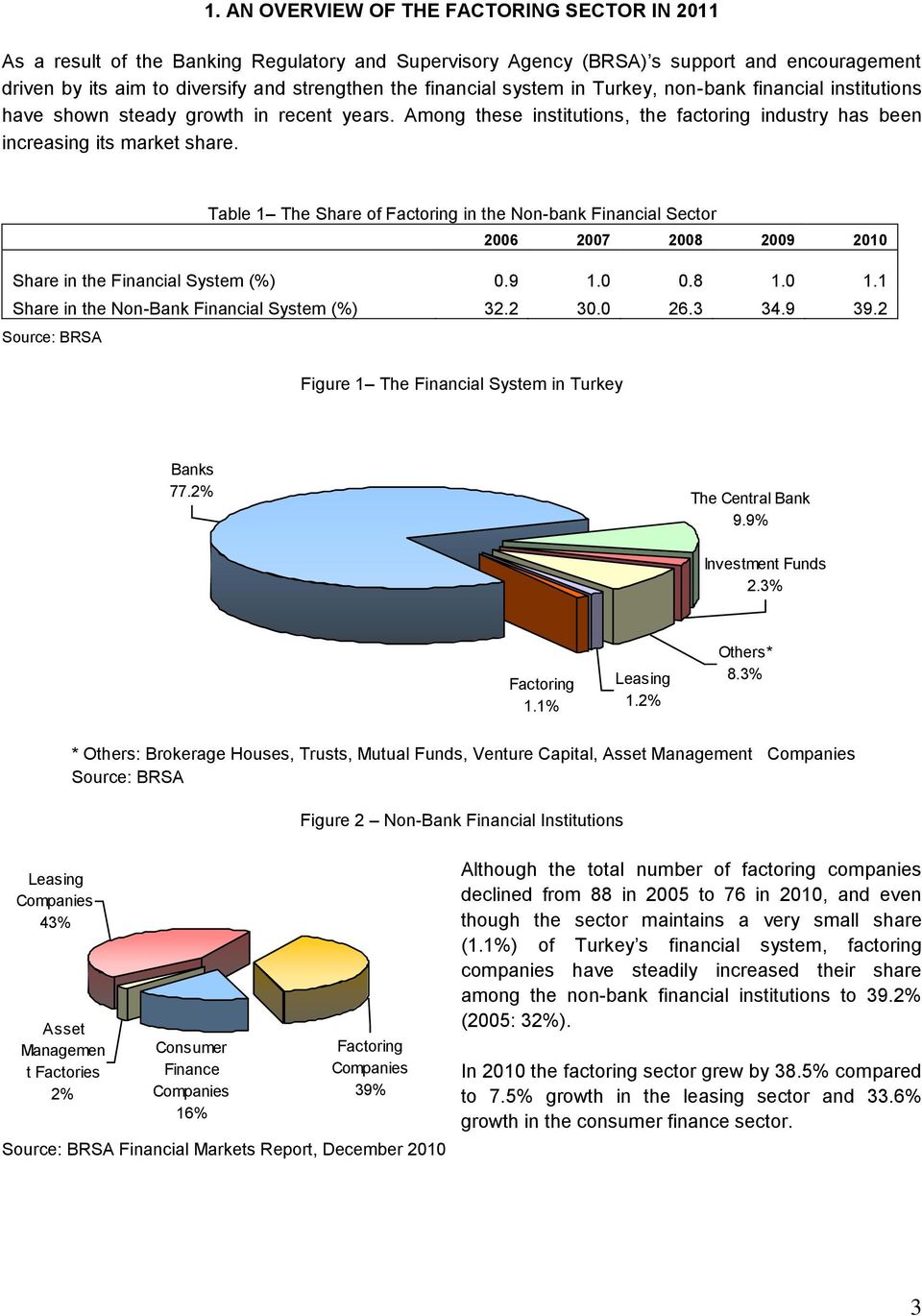
9 1. AN OVERVIEW OF THE FACTORING SECTOR IN 2011 As a result of the Banking Regulatory and Supervisory Agency (BRSA) s support and encouragement driven by its aim to diversify and strengthen the financial system in Turkey, non-bank financial institutions have shown steady growth in recent years. Among these institutions, the factoring industry has been increasing its market share. Table 1 The Share of Factoring in the Non-bank Financial Sector Share in the Financial System (%) Share in the Non-Bank Financial System (%) Source: BRSA Figure 1 The Financial System in Turkey Banks 77.2% The Central Bank 9.9% Investment Funds 2.3% Factoring 1.1% Leasing 1.2% Others* 8.3% Leasing Companies 43% Asset Managemen t Factories 2% * Others: Brokerage Houses, Trusts, Mutual Funds, Venture Capital, Asset Management Companies Source: BRSA Consumer Finance Companies 16% Factoring Companies 39% Source: BRSA Financial Markets Report, December 2010 Figure 2 Non-Bank Financial Institutions Although the total number of factoring companies declined from 88 in 2005 to 76 in 2010, and even though the sector maintains a very small share (1.1%) of Turkey s financial system, factoring companies have steadily increased their share among the non-bank financial institutions to 39.2% (2005: 32%). In 2010 the factoring sector grew by 38.5% compared to 7.5% growth in the leasing sector and 33.6% growth in the consumer finance sector. 3
10 In Turkey factoring services started in the 1980 s as a service offered by a bank. By the 1990s a few companies had been established, paving the way to the formation of a factoring sector. Economic production in Turkey is undertaken by 1.3 million companies, 80% of which employ 10 or fewer people. To illustrate, in 2009, among of the top 1,000 companies in Turkey according to the ranking of the Istanbul Chamber of Industry, the smallest had an asset size of TL10.2 million (US$7.0 million). This gives an idea of how small in size Turkish companies can be. Such an economic structure, where small businesses with small asset bases find difficulty in obtaining bank financing, generates a large demand for factoring. At the end of 2010 there were 76 factoring companies operating in 16 provinces with 28 branches and 175 representative offices. During 2010, 59 new rep offices were opened, and total staff increased by 598. The economic recovery triggered a larger demand for factoring operations, and this along with the addition of new rep offices resulted in an increase of 39.3% in the number of customers and an increase of 35.7% in the number of factoring operations. Table 2 - Main Indicators of the Factoring Sector Number of Companies Branches v.y Rep Offices n.a Number of Personnel v.y Number of Customers v.y. v.y. v.y. 50,228 40, Number of Transactions v.y. v.y. v.y. 146,558 65, Source: BRSA The sector has traditionally adhered to a structure whereby the top few bank-owned companies dominate the business volume. For example, at the end of 2010 the asset size of the top two companies accounted for 44.4% of the total assets of the sector. In terms of receivables, the same top two accounted for 46% of turnover. Eventually, the share of the smaller companies will be diminishing as already the combined market share of the top five companies has been diminishing since There is also a stark difference between the asset size of the eight most dominant factoring companies. To illustrate, the average asset size of the top eight companies in 2010 was TL1 billion, whereas the average asset size of the remainder was TL100 million. The average factoring receivables of these top eight companies of TL890 million was in sharp contrast to TL93 million of the remaining 69. The total number of factoring companies may be considered high, for in Turkey factoring companies outnumber banks and leasing companies. However the sector is made up of a number of sub-sectors differing one from the other in terms of organizational structure, customer base, services provided, and business strategies. In this respect, each company competes with its individual strengths and weaknesses within its particular sub-sector. For instance, those factoring companies that are subsidiaries or affiliates of banks, or those that are part of an industrial group owning a bank, carry a number of bank-related competitive advantages over the rest. The most obvious competitive advantage is that these companies have unlimited credit lines from the group bank. Secondly, some, if not all, benefit from the large branch network of its parent bank. To be sure, there are exceptions to these general comments, as in the case of one or two factoring companies who fund themselves from other sources. Even in such cases, it is not possible to know whether the parent bank provided the lenders with some sort of guarantee. 4

11 5,604 4,943 5,440 4,498 7,451 6,065 6,187 6,509 5,701 7,759 7,046 6,177 8, , , , ,400 11,110 Factories companies secure 77% of their funding requirements from bank loans and 20% from equity. Smaller companies operate by also purchasing the receivables of larger factoring companies. In 2008 an additional funding source became available with some companies issuing bonds in the domestic market. Turkey has a very large export volume (US$135 billion expected in 2011) and, needless to say, there exists a large potential in the area of export financing. Even still, export financing remains low, accounting for only 7% of total Turkish exports in Since 2006 the factoring sector has shown a very rapid growth pattern and total turnover has doubled since then. Similarly asset size has grown to TL14.5 billion in 2010 from TL7.8 billion in Compared to 2008, a year of no growth at all, total assets grew by 34.6% in 2009 and 38.5% in Factoring receivables grew by 46.1% in 2009 and 44.8% in 2010, in large part enabled by the 53.6% increase in the use of bank loans in 2010 (46.3% in 2009). Table 3 Factoring Companies Financial Indicators (1000 TL) Total Assets 6,332,000 7,552,000 7,796,460 10,490,340 14,530,820 Factoring Receivables 5,107,000 6,223,000 5,603,620 8,396,050 12,399,700 Shareholders Equity 1,758,000 2,005,000 2,373,590 2,536,770 2,969,810 Loans 4,210,000 4,915,000 4,945,350 7,595,230 11,112,850 Net Profit/Loss 491, , , , ,770 Source: BRSA Figure 3 Total Factoring Receivables and Use of Bank Loans (1000 TL) 14,000 Factoring Receivables 12,000 Bank Borrow ings 10,000 8,000 6,000 4,000 2,000 0 Q Q Q Q Q Q Q Q Q Q Q Source: BRSA Shareholders equity was up by 17.1% in 2010 and reached nearly TL3.0 billion. As a result, factoring companies funding of the real sector advanced to 4.4 times their equity. This ratio is still well below the 30x limit imposed by the BRSA. The year 2006 constituted an important turning point for the sector because the regulation and supervision of factoring companies was transferred to the BRSA. Since then there has been continuous progress in the 5

12 sector driven by the BRSA s modifications on legislative requirements. This process, which continues to date, has strengthened the factoring industry. Between 1 January, 2006 (the date the BRSA took over the factoring companies) and the end of 2010, the licenses of 27 factoring companies were annulled. The majority of the annulment decisions were based on non-compliance with the new regulations, though some were due to voluntary withdrawal. Meanwhile, the applications of 15 new factoring companies were accepted. Thus, while 27 companies exited from the sector, there were 15 new entries. Additionally, the BRSA has entitled four banks to conduct factoring operations. The BRSA s annual reports show that in recent years the highest number of license applications was made by factoring companies. (Table 4) Table 4 Annual License Applications to BRSA Leasing Companies Factoring Companies Consumer Finance Companies As illustrated in Table 5, most factoring receivables in Turkey are domestic. Among the current 64 members of the Factoring Association, only 20 engage in international factoring. Table 5 Factoring Receivables (Million TL) Factoring Receivables 5, , , A) Discounted Factoring Receivables 2, , , a) Domestic 2, , , b) International c) Unearned Revenues (-) B) Other Factoring Receivables 2, , , a) Domestic 2, , , b) International With the number of factoring companies currently standing at 76, competition is steadily increasing, and companies are finding it more and more difficult to maintain high profitability ratios. Nonetheless, it looks like competition is set to be even fiercer in the future given that the BRSA licensed three additional companies in the first quarter of BRSA s Report dated May 2010 prepared by the Implementation Department II, underlines the organization s future intentions in the final section: The assurance that the sector will remain under strict supervision and that the violators of regulations will face punitive action has enhanced the industry s prestige vis-à-vis the industry players, the financial system, and the customers, and led to a more competitive environment. To maintain and develop industry standards, factoring companies compliance with regulations is strictly supervised through reporting and on sight inspections. At this stage, as a short term goal, a proactive role to prevent the violation of regulations requires setting internal control standards as well as standards of IT systems which support such internal control systems. Moreover, studies are underway to align external 6

13 audit rules and procedures of factoring companies to that of banks and ascertain whether the utmost benefit is derived from the audit mechanism. Factoring in the World Annex 4 (Page 73) lists the members of Factors Chain International and their respective domestic and international factoring turnovers. In 2010, total world factoring turnover reached 1.6 trillion, a 28.4% increase over the previous year. The highest turnovers are in Europe, particularly in the UK, France, Italy and Spain. As a result of its own rapid economic growth, China s turnover has approached that of European countries. In Asia, turnover volumes are low except for Japan and Taiwan. Volumes are also low in the Middle East. With its 39.0 billion turnover, Turkey ranks twelfth among the 69 countries. Table 6 - Distribution of Turnover among FCI Members (Million Euro) /2009 % Ch. FCI Members Invoice Discounting 160, , , , , , Recourse Factoring 116, , , , , , Non-Recourse Factoring 232, , , , , , Collections 13,120 12,604 13,934 25,940 23,806 23, Total Domestic Factoring 522, , , , , , Export Factoring 42,073 59,302 68,424 88,244 75, , Import Factoring 13,190 14,944 17,416 22,363 17,626 23, Export Invoice Discounting 21,716 24,179 32,430 33,801 40,353 29, Total International Factoring 76,979 98, , , , , Total FCI 599, , , , , , World Domestic Factoring 930,061 1,030,598 1,153,131 1,148,943 1,118,100 1,402, World International Factoring 86, , , , , , TOTAL 1,016,547 1,134,288 1,299,127 1,325,111 1,283,559 1,648, Source: Factors Chain International Table 6 illustrates the distribution of various types of factoring of the FCI member countries between years 2005 and We noted that while the share of with recourse factoring increased the share of nonrecourse factoring decreased since In 2010, likewise, with-recourse factoring increased by 48% compared to 17% increase in non-recourse factoring. 7

14 The Factoring Association in Turkey The Factoring Association is a professional association established in Among the 64 members of the Association 16 companies are also members of Factors Chain International and four are members of International Factors Group (IFG). The Turkish Factoring Association, of which 64 companies out of the 76 factoring companies licensed by the BRSA are members, represents the industry. The functions of the Association are primarily: The development of factoring in Turkey. Participation in the preparations and modifications of the regulatory framework. Standardization of factoring services. Development and introduction of new ideas and opinions that will contribute to the improvement of the sector, and the conveying to the public and related authorities these suggestions. Conducting training for factoring employees. Promoting solidarity among its members. The Association selects the five members of the Executive Board and the Chairman of the Association every two years. In addition to the Executive Board there is a Supervisory Committee and a Disciplinary Committee. The Association has also organized committees responsible for regulations, legal matters, financial matters and MASAK. The Factoring Association s activities have been particularly concentrated on trainings, legislative improvements and the enhancement of the industry s public image in recent months. Courses have been designed to train the new recruits to the industry and to upgrade the skills of the existing staff. These activities are conducted by the General Secretary of the Association, Ms. Filiz Ünal, and its small staff under the guidance of the Chairman of the Association Mr. Zafer Ataman. The Board convenes very regularly to discuss matters related to the industry and to resolve current problems. In 2010 the Association moved to larger premises in Maslak and now has meeting rooms suitable for trainings. Trainings - Since October 2010 the Association conducts proficiency courses designed for all factoring company employees, a Certificate of Fundamental Factoring is issued upon completion. The training is given by university lecturers and experienced members of the industry. In May 2011 a new 3-month training program was initiated together with the Istanbul Bilgi University. This 65 hours training is also jointly given by academic and industry staff with extensive experience on specific topics. Improving the Image - The Association sponsored Nielsen a survey on the public image of factoring in Turkey. Nielsen s survey revealed that the image of the factoring industry still suffered from its heritage of being confused with money lenders and that there existed some uncertainty with regards to the role and functions of factoring and how banks evaluated customers who also used factoring services. Following the results of the survey new ethical standards were adopted by the Association. Participation in the Preparation of the New Legal Framework - The President of the Association, Mr. Zafer Ataman, and the Secretary General, Ms. Filiz Ünal, represent the factoring industry in all platforms including governmental entities, other NGOs, and they liaise with the Banking Regulatory and Supervisory Board. The Association has taken active part in recent years in the drafting of new regulations on factoring 8
15 activities, voicing the concerns of its members, responding to legislative changes with clear objections and suggestions. A new draft law was prepared by BRSA and sent to the Prime Ministry on 25 August This draft law has been waiting to be included on the agenda of the General Assembly since The Factoring Symposium in March In March 2011 a symposium was held in Istanbul with the participation of all factoring companies, their customers and related institutions such as audit companies. The government gave a clear indication of its support of the factoring industry as evidenced by the attendance of the Deputy Prime Minister for Economic and Financial Affairs Mr. Ali Babacan and the BRSA s Chairman Mr. Tevfik Bilgin. They were both very articulate in expressing the importance they attached to factoring in its role in the diversification and deepening of the financial markets. They also indicated the role played by the factoring industry in addressing the needs of SMEs in Turkey. The video recording of the symposium is available on the web pages of the Association. Such events undoubtedly contribute significantly to the enhancement of the public image of the factoring industry in Turkey. Even if not in the short-term, gradually the efforts of the Association, coupled with the promulgation of a new law, will bear its results and factoring companies will gain a much different standing among non-financial institutions. Advantages of Factoring In many respects factoring constitutes an alternative financing model to banking. It is often referred to as supplier financing or agency financing in Turkey. This is because the suppliers of financially strong and well respected companies can easily generate cash by factoring their receivables from such customers. This system facilitates the cash flow of SMEs by providing them with working capital and liquidity. Corporations with a wide network of agencies can reduce their operational expenses by transferring to factoring companies the credit assessment of and payment collection from their agencies. From the point of SME customers who use factoring services, the foremost advantage of factoring services is the relative simplicity of documentation and the speed of services. The time period between an application to factor a receivable and getting the payment is significantly shorter than the period necessary to obtain a bank loan. Another advantage for all companies, large and small, is balance sheet enhancement whereby receivables are replaced by cash items subsequent to a guaranteed factoring of receivables. By employing factoring services, companies may improve their liquidity positions and, thereby, the appearance of their balance sheets. One of the core functions of factoring companies is collection of debts. They provide prompt collection and minimize costs to the company. In this way companies effectively outsource the administration (and any related legal procedures) of collections. Factoring companies also provide exporters wider market access by using their international network. Additionally, they provide information related to overseas buyers. Factoring companies usually gain a wealth of market information on companies as a result of maintaining close contact with SMEs. This market information is usually very valuable and can be of use to companies 9

16 when advising their customers on the credit worthiness and financial strength of their business counterparties. There are three broad advantages to those seeking to invest, in whole or in part, in factoring companies: The required initial capital outlay of only TL7.5 million is much less onerous than the $300 million required to establish a bank. There is the opportunity to be involved in the financial services sector under a more flexible regulatory framework. The sector still enjoys high growth potential. 10

17 2. REGULATORY AND LEGISLATIVE FRAMEWORK Between 2007 and 2011 the BRSA brought discipline to the factoring sector through the introduction of a series of legislative changes. Following the transfer of regulation of factoring companies to the BRSA, entry to the sector became more difficult as a result of new licensing regulations which, inter alia, introduced higher capital requirements. The licenses of a number of companies were reconsidered in that period. The current implementation under the framework of regulations dated 10 October 2006 No (based on the Banking Law No.5411 dated 1 November 2005) has been effective since its introduction in that year. This regulation establishes the procedures and principles governing: a. Accounting, reporting and audits concerning financial leasing companies, factoring companies and financing companies b. Amendments made to the articles of association and share transfers c. Cancellation of operation licenses d. Contracts to be drawn up e. Establishment and operation licenses f. Managers g. Mergers, transfers, divisions and liquidation h. Transaction limits License Requirements Companies are required to maintain paid up capital of not less than TL7.5 million and to have issued all of the shares as registered and payable in cash. The commercial title of the company must contain the description Factoring Company. Articles of association shall comply with applicable laws and regulations, and the partnership structure is to be transparent and open, not hindering effective audits by the Board in case their founders are legal entities. There is a two-stage establishment permission procedure. At the first stage permission is granted for the establishment of the company. Once the procedures related to the establishment are completed (including registration with the Trade Registers Office; designating persons with signing powers; establishment of appropriate service units and internal controls; establishment of accounting, data processing and reporting systems; development of adequate staff positions for such units, including defining staff duties identifying staff powers and responsibilities) the company may apply to obtain an operating license. Establishment permissions of companies failing to apply for operating licenses within one hundred eighty days from the establishment permission are rendered null and void. Qualifications of founders Company founders and natural persons and legal entities holding a share of ten per cent or more in or controlling the founders of the company with a legal entity are expected to meet the following conditions: a. They have not been declared bankrupt, have not declared any forced restructuring and postponement of debts, have not any applications for restructuring through reconciliation, which have not yet been upheld or do not face any rulings for postponement of bankruptcy; 11

18 b. They have not directly or indirectly held a share of ten percent or more in, or the control of, banks, the operational permissions of which have been discontinued or which have been transferred to the Savings Deposit Insurance Fund or the banks transferred to the Fund before entry into force of Banking Law Nr. 5411, excluding discretional bankruptcy; c. They have not directly or indirectly held a share of ten percent or more in or the control of any factoring, financial leasing, financing and insurance companies and in any other organizations operating in the money and capital markets, the operating licenses of which have been abrogated, excluding voluntary liquidation and brokers forced into liquidation of their businesses; d. They have not received a sentence of any heavy imprisonment or imprisonment of more than five years pursuant to the abolished Turkish Criminal Code Nr. 765 dated March 1, 1926 and other laws, a sentence of imprisonment of more than three years pursuant to Turkish Criminal Code Nr dated September 26, 2004 and other laws or they have not been convicted of opposition to the imprisonment requiring provisions of the abolished Law on Banking Nr dated April 25, 1985, abolished Law on Banking Nr dated June 18, 1989, Banking Law Nr. 5411, Capital Market Law Nr dated July 28, 1981, Law on Money Lending Nr dated June 8, 1933 and Financial Leasing Law Nr or of infamous crimes such as simple or complicated embezzlement, extortion, bribery, theft, swindling, forgery, misuse of beliefs and offenses of fraudulent bankruptcy and smuggling offences other than smuggling of labor and consumers goods, rigging of public tenders and purchases and sales, money laundering and tax evasion or participation in such offenses pursuant to the abolished Turkish Penal Code Nr. 765, Turkish Penal Code Nr. 237 or other laws; e. They must enjoy such financial capability and standing which can meet the sums of capital subscribed by them. Opening of local branches and representation offices by companies operating in Turkey Opening of local branches and representation offices is subject to permission of the Board. A paid-up capital amount of TL1.0 million is required for each branch or representation office. The applications made to the Board should be accompanied by a feasibility report detailing the justification for opening such a branch or representation office. Branches and representation offices commence operation after they are registered with the Trade Registers Office, with relevant registration particulars being publicly announced thereafter, within ninety days from receipt of respective permissions. Failure to start operation within this deadline renders branch or representation opening permission null and void. Opening of first branches in Turkey by companies established abroad Companies established abroad may open branches in Turkey. The required capital is also TL7.5 million. The company has to evidence that where it has been established it has been operating for a minimum of three years. Opening of branches by these companies other than first branches are subject to the same procedures and principles applicable for opening of first branches. However, in this case, one of the 12

19 branches must be designated as head office and this must be notified to the Board. The opening of representation offices is similar. Overseas organizations of companies operating in Turkey Companies are free to organize abroad provided that the provisions of other applicable legislation are reserved. It is conditional that commencement and conclusion of overseas operations be notified to the Board no later than thirty days thereafter. Bans Related to Factoring Companies Transactions that cannot be performed by companies are listed as: Companies cannot engage in activities other than those specifically indicated by their articles of association Issue Letters of Guarantee. Collect funds through instruments such as deposits or any other similar things for any consideration other than issues of securities and borrowing of funds from international markets as per the Law on Capital Market Nr dated July 28, Also, factoring companies cannot buy or assume collection of any receivables arising from sales of goods or services which cannot be certified by means of invoices or other similar documents, even if they are based on bills of exchange, nor receivables arising from sales of goods and services that cannot be certified within the scope of procedures and principles specified by the Board. (This section of legislation was added on 24 February 2011) Limitations to transactions and provisions 1. The total sum of the receivables of factoring companies, which stem from the extension of funds, may not exceed thirty folds of their own-funds. 2. Companies have to set aside provisions subject to the procedures and principles to be laid down by the Board for the purpose of covering their losses already arisen or expected to arise out of their receivables from transactions, which cannot be precisely determined. 3. Minimum own funds amount of factoring companies cannot be lower than the minimum paid-up capital amount. Companies of which minimum own funds amount falls below this amount shall re-increase their own funds to this amount within one year. (This section of the legislation was added on 24 February 2011) External Audit Requirements Since 24 February 2011 factoring companies are required to present their annual balance sheets and income statements to the General Assembly. The external audits may be made only by independent audit companies authorized by the BRSA in compliance with the Regulation on the Authorization and Activities of Institutions to Realize Independent Audits in Banks, published in the Official Gazette dated 11 November 2006 Nr
20 Companies are required to send to the BRSA the independent audit contracts until the end of October of the related year and to send the Annual Audit Report no later than April 15th. List of Related Legislation Box 1 Regulation on Principles for the Establishment and Operations of Financial Leasing, Factoring and Financing Companies - Published in Official Gazette dated October 10, 2006 Nr prepared on the basis of the Article 93 (1a) of Banking Law Nr dated October of 19, 2005, Articles 10, 12 and 32 of Financial Leasing Law Nr dated June 10, 1985 and Articles 12 and 13 of Decree-Law Nr. 90 on Transactions of Lending Loans dated September 30, Amendments: - Official Gazette dated 23/03/2008 No Official Gazette dated No Official Gazette dated No Official Gazette dated No MASAK (The Financial Crimes Investigation Board of the Ministry of Finance) Regulations published in the Official Gazette dated January 9, 2008 No on The Prevention of Financing of Terrorism and the Prevention of Laundering Proceeds of Crime Circulars: Circular announced by the BRSA Implementation II Department on 8 July 2010 Circular announced by the BRSA Implementation II Department on 4 January 2011 By-Laws: Communiqué on Uniform Chart of Accounts to be Implemented by Financial Leasing, Factoring and Financing Companies and its explanation as well as the Form and Scope of Financial Statements to be Announced to the Public - Published in the Official Gazette dated May 17, 2007Nr Communiqué on Procedures and Principles for the Provisions to be set aside by Financial Leasing, Factoring and Financing Companies for their Receivables - Published in Official Gazette dated July 20, 2007 Nr

21 3. CHARACTERISTIC OF THE SECTOR AND STRUCTURE OF FACTORING COMPANIES Large Number of Companies High Concentration According to the BRSA, there are 76 companies in the factoring industry in Turkey with total receivables of only TL12.4 billion (US$9.0 billion). As mentioned earlier, the industry is structured to include several competitive groups targeting different niches and competition remains within the boundaries of each subgroup. The BRSA s report 2 revealed the market shares of the top 10 players. In 2009 the top five companies accounted for 46.2% of the market (51.5% in 2008), whereas the top ten accounted for 65.3% (66.4% in 2008). With such high concentration, the financial performance of the top ten factoring companies dictates the industry s financial indicators. Therefore, averages such as average profitability ratio can be highly misleading. As illustrated in Table 8, eight out of the top 10 companies are bank subsidiaries. If a parent bank chose to prioritize consolidated profits, the subsidiary factoring company would tend to operate under low profitability, pulling down the average ratio for the entire sector. A similar concentration study was conducted using data from the Factoring Association. In 2010 the share of the top five shows a decrease to 44% and the share of the top ten to 64%. The distribution by size shows lower but still large, 50%, concentration of the large companies. The shares of the medium and small companies have gained only one percentage point. Table 7 - Concentration of Assets (%) Top 5 companies Top 10 Companies Distribution by Size Large* Medium** Small*** Total Source: BRSA and the Factoring Association Note According to 2010 results *Large Companies: Total assets more than TL700 million ** Medium Size Companies: Total assets between TL150 million and TL700 million *** Small Size Companies: : Total assets less than TL150 million Table 8 gives us the list of the 64 factoring companies in What is striking is that out of these 64 companies (listed by the Association), 53 have market shares below 2% (41 with a market share of less than 1%). This structure looks set to continue although a number of companies will in time enlarge their shares. But, the important point is that quite a large number of companies are comfortable with their 2% shares and will remain within their respective customer segments. 2 Structural Developments in Banking, BRSA, December 2008 and
22 Table 8 List of Factoring Companies by Asset Size Rank Factoring Company 2009 Thousand TL 2010 Thousand TL Share in 2010 (%) 2010/2009 Change (%) 1 Yapı Kredi Faktoring A.Ş 1,537,409 2,024, Garanti Faktoring Hizmetleri A.Ş. 1,132,913 1,565, Deniz Factoring A.Ş 602, , Fiba Factoring Hizmetleri A.Ş 849, , Vakıf Finans Factoring Hizmetleri A.Ş 572, , TEB Factoring A.Ş 437, , Girişim Faktoring A.Ş. 673, , Kapital Faktoring Hizmetleri A.Ş 397, , Iş Factoring Finansman Hizmetleri A.Ş 276, , Creditwest Faktoring Hizmetleri A.Ş. 247, , Lider Faktoring Hizmetleri A.Ş. 306, , Finans Faktoring Hizmetleri A.Ş. 116, , Şirinoğlu Factoring Fins.Hizm.T.A.Ş. 154, , Destek Finans Factoring Hizmetleri A.Ş 176, , Ekspo Faktoring A.Ş. 152, , C Faktoring A.Ş. 220, , Eko Factoring Hizmetleri A.Ş. 118, , Pamuk Factoring A.Ş 129, , Yaşar Factoring Hizm.A.Ş. 141, , Şeker Faktoring Hizmetleri A.Ş. 115, , MNG Factoring Hizmetleri A.Ş. 70, , ING Faktoring A.Ş. 150, Anadolu Faktoring 144, , Strateji Factoring Hizmetleri A.Ş. 86, , Bayramoğlu Finans Faktoring Hizmetleri A.Ş. 129, , Ulusal Faktoring A.Ş. 85, , Tekstil Factoring Hizmetleri A.Ş 158, , Optima Faktoring Hizmetleri A.Ş 86, , Fortis Faktoring A.Ş. 43, , Tek Faktoring Hizmetleri A.Ş. 56, , Atılım Faktoring A.Ş. 68, , Akın Faktoring Hizmetleri A.Ş 63, , Akdeniz Factoring Hizmetleri A.Ş. 62,774 99, Başer Faktoring A.Ş 46,475 93, Çağdaş Finans Factoring Hizmetleri A.Ş. 92, Para Finans Factoring Hizm.A.Ş. 58,296 89, Kent Factoring A.Ş 37,164 79, Demir Factoring A.Ş 60,095 67, Huzur Faktoring Finansal Hizm.A.Ş. 27,551 67, Süzer Faktoring A.Ş 23,162 66, Yeditepe Faktoring Hizm.A.Ş. 51,313 64, Ar Faktoring Finansal Hizmetleri A.Ş. v,y, 56,
23 43 Erişim Finans Faktoring Hizm.A.Ş. 30,676 55, Arena Faktoring Hizm.A.Ş. 13,863 49, Devir Factoring Hizmetleri A.Ş 31,956 49, Analiz Faktoring A.Ş. 15,862 47, First Factoring A.Ş. 42,785 46, Çözüm Finans Faktoring Hizmetleri A.Ş. 30,573 41, Tuna Faktoring Hizm.A.Ş. 29,575 40, Trend Finans Faktoring Hizm.A.Ş. 19,381 32, Merkez Faktoring Hizmetleri A.Ş 22,149 29, Doğa Faktoring Hizmetleri A.Ş. 21,072 27, EDF Finans Faktoring Hizmetleri A.Ş. 26, Makro Factoring A.Ş. 18,653 24, Sümer Faktoring Hizm.A.Ş. 13,535 24, Kredi Finans Faktoring Hizmetleri A.Ş. 6,217 22, ACL Finans Faktoring A.Ş. 12,260 21, Doğan Factoring Hizm.A.Ş. 28,012 19, Acar Factoring A.Ş 12,598 16, Değer Faktoring A.Ş. 14, Met-ay Faktoring Finans Hizmetleri A.Ş. 17,548 13, vdf Faktoring Hizmetleri A.Ş. 12, Atak Faktoring Hizmetleri A.Ş 6,865 8, Eren Finans Faktoring Hizmetleri A.Ş. 6, TOTAL 9,998,326 14,039, The top ten companies have largely remained the same (Table 9). Also, considering the annual changes in asset size, it is evident that companies have been pursuing very different growth strategies. Their rates of growth diverged to a large extent. Table 9 Top 10 Factoring Companies and Market Shares Accoring to Asset Size 2008 Share (%) Küm. Pay (%) 2009 Share (%) Küm. Pay (%) 2010 Share (%) Küm. Pay (%) 1 Yapı Kredi Fakt Yapı Kredi Fakt Yapı Kredi Fakt Garanti Fakt Garanti Fakt Garanti Fakt Fiba Fakt Fiba Fakt Deniz Fakt TEB Fakt Girişim Fakt FİBA Fakt Deniz Fakt Deniz Fakt Vakıf Finans Fakt Kapital Fakt Vakıf Finans Fakt TEB Fakt Lider Fakt TEB Fakt Girişim Vakıf Finans Fakt Kapital Fakt Kapital Fakt Girişim Fakt Lider Fakt İş Fakt Şeker Fakt İş Fakt Lider Fakt Source: 2008 BRSA, 2009 Turkrating, 2010 Factoring Association The 2010 data has been given by the Factoring Association excluding Anadolu Factoring. Some of the data was corrected in cases where the company s financials were disclosed on their web pages before the completion of the report. 17
24 Diversification by Shareholder Structure Turkish factoring companies can be grouped in terms of asset size, turnover size, as well as shareholder structure. It is also possible to group them according to the services they offer or by their target customer base. In fact, the factoring industry has a multi-cultural structure in that companies with differing organizational setups and differing business strategies operate under common regulations. Each company has the opportunity to choose its own business strategy and customer base under such an industry structure. However, the existence of such different types of companies within the industry complicates efforts to improve the negative image of the industry. Bank Subsidiaries: The group that stands out first consists of subsidiaries of banks or parts of holding companies that also own banks. There are 14 factoring companies in this group classified by shareholder structure (note that Fortis Factoring ceased operations in 2011). While dissimilarities exist among these companies, it can be said that they generally benefit from the branch network, customer base and risk management system of the parent bank as well as from funds provided by the parent bank. Those same 14 factoring companies can be re-grouped by 1) joint ventures with foreign banks, and 2) wholly owned by foreign banks. Yapı Kredi, Garanti, Fiba, TEB and Turkish Bank Factoring Companies are participations of banks jointly owned by foreign banks, whereas Deniz Faktoring, Finans Faktoring ve ABN Amro Faktoring are participations of banks owned wholly by foreign banks. For many years Yapı Kredi Factoring has remained the top factoring company in the market. Yapı Kredi Factoring benefits from the 867 local branches of the parent Yapı Kredi Bank and from the international network of the UniCredit Group. Such a structure is undoubtedly an important element in its success in maintaining a dominant market share. TEB Factoring has a somewhat similar structure and has gained a significant international factoring turnover. The data of the Factoring Association shows that TEB Factoring has a 25% share of the market in international factoring volume, just next to Yapı Kredi Factoring s 30% share. Third in line comes FIBA Factoring with 8% share. Others with significant shares are Strategy (5%), ING Factoring (4.5%) and Garanti Factoring (4.3%). Vakıf Factoring is the subsidiary of Turkey s sixth largest bank, Vakıfbank. Anadolu Factoring and Tekstil Factoring are subsidiaries of smaller banks. Also in this group are FIBA and Girişim Faktoring Companies which are associated with the FIBA Group of companies with banks in Europe. In 2011, the FIBA Group acquired a bank in Turkey and renamed it Fibabank. Creditwest Faktoring has a similar shareholder structure; it is owned by Altınbaş Group of Companies which owns banks in Ukraine and Northern Cyprus. Demirhalk Bank BNV has shares in C Faktoring. Companies Wholly Owned by Foreign Capital: First Faktoring is owned by a German private equity fund. The company received establishment permission in November 2007 and subsequently the operation permission in April The majority shareholder is First Holding GmbH which was established in 2007 wholly with German capital. The shareholders of the 18
25 equity fund are predominantly Turkish citizens living in Germany. The capital of First Faktoring is an equity fund established with German capital and owned by Turks living in Germany. Companies with Foreign Partners: In this group there is only Lider Factoring in which Credit Suisse Investments Nederland B.V. participated with 9.9% stake in Companies Serving a Single Industry: VDF Factoring services dealers and distributors of automotive companies, while Doğan Factoring factors receivables of companies in the media industry. Companies Owned by Groups with More than One Factoring Company: There were three such groups, but now there are only two since Süzer and Kent Factoring merged in 2011 under Süzer Holding. One is the Cıngıllıoğlu family group which owns Demir and C Faktoring, and the other is the Fiba Group Companies which owns Girişim and Fiba Faktoring. Banks Elligible to Conduct Factoring Operations: As far as we are able to identify, there are three banks: Eurobank Tekfen, HSBC and Akbank. Publicly Listed Companies: Creditwest Faktoring and Garanti Faktoring are the only two companies that are publicly listed. Their market capitalizations are quite similar, around US$70 million. Another company, Öz Finans Faktoring, was previously listed but ceased operations in 2008 and restructured as Özderici Real Estate Investment Trust. Management and Managers Regulations introduced on October 10, 2006 brought a set of minimum eligibility requirements to shareholders and managers. It is now mandatory that members of executive boards of companies, as well as their officers who hold signature powers of the first degree, have at least a bachelor s degree earned at a university and have at least seven years of professional work experience in finance or management. Deputy general managers are required to have graduate education with a bachelor s degree and have at least seven years professional experience in finance or management. Other managers performing duties of an executive nature in positions equivalent to those of deputy generals, in respect of powers and duties, even if they are employed under other titles, are also subject to the provisions applicable for deputy general managers. These eligibility requirements have been effective in setting standards with respect to qualified and experienced managers in the factoring industry. Under Corporate Governance principles, the following information should be open to the public and all stakeholders: - Shareholder structure - Ultimate controlling individual shareholder/s (amount and proportion of their shares) - Roles and responsibilities of the board of directors - Organizational and managerial structure 19
26 - Management strategies - Annual and financial reports - CVs of executives Contrastingly, one aspect that stands out as positive in the factoring industry is gender equality. While no data exists on the exact numbers of female executives, we observed that the number of female general managers and assistant general managers is significantly high and possibly an exemplary case. While it is not possible to express an opinion on managerial cadres based on factual data, it appears that there are currently three types of executives: those with predominantly banking backgrounds, those who have spent most of their careers working for factoring companies, and those who actually run (and own) companies or who practically grew up in the factoring industry. There is no eligibility requirement for executive board members other than that related to Article 5 which stipulates a clean legal track record. In the case of companies established abroad and operating in Turkey, the regulations call for the establishment of a board of directors with at least three members, including the manager of the central branch, having the powers and responsibilities of an executive board, with their managerial head offices in Turkey. Factoring Companies have Simple Balance Sheets Factoring companies have very simple balance sheets which can be summarized as assets comprising cash plus factoring receivables, and liabilities comprising equity plus borrowings. Balance sheets are mostly short-term. The Uniform Standard of Accounting, compulsory in reporting financials, is unnecessarily long and detailed, though in essence balance sheets can be simplified as in Table 10. Table 10 Sector Balance Sheet (Million TL) Total Assets 6, , , , , Factoring Receivables 5, , , , , Non-Performing Loans Provisions Total Liabilities 6, , , , , Borrowings 4, ,914,8 4, , , Shareholders Equity 1, ,005,2 2, , , Funding/Total Assets (%) Shareholders Equity/Total Assets (%) Source: BRSA Rapid Growth Presently the factoring industry has gained a strong growth momentum as evidenced by the 34.6% growth in 2009 and the 38.5% growth in In the same years the banking sector grew at much lower rates, 12.9% and 20.8%, respectively. In 2009 while credit volume expanded by only 6.9% (33.9% in 2010), the 20

27 factoring industry increased its factoring receivables by 46.1% (44.8% in 2010). Such increase in the volume of business was funded by increased bank borrowings rather than by an increase in shareholders equity. Table 11 Annual Growth Rates Total Assets (%) Gross Factoring Receivables (%) Loans (%) Shareholders Equity (%) Non-cash Operations Collaterals Given (%) n.a. n.a Commitments (%) n.a. n.a Derivative Financial Instruments (%) n.a. n.a Turnover is Mostly Domestic Although a BRSA license allows both domestic and international factoring, only 20 companies conduct international business. In this respect, the Turkish factoring industry has limited export and import factoring operations. This is also noticeable from the fact that only 8.2% of assets were denominated in a foreign currency (FC) at the end of In terms of funding however, the share of FC is 16.9% due to FC and FC indexed borrowings. Figure 4 Annual Turnover (Million USD) Figure 5 - Distribution of Turnover (2010) 50,000 40,000 51,594 9% 30,000 26,405 20,000 10,000 5,943 91% 0 Domestic International Table 12 - Factoring Sector Distribution of Turnover World (Billion $)* , , , , , , ,175.7 Domestic , ,097i5 1, , , , ,851.0 International ,2 248,3 236, Turkey (Million $) 4,476 6,663 10,733 13,959 19,701 26,405 28,677 30,370 51,594 Domestic 3,216 5,250 8,640 11,607 16,216 22,470 24,447 27,110 46,919 International 1,260 1,413 2,093 2,352 3,485 3,935 4,230 3,260 4,675 Source: The Factoring Association * Year 2010 has been converted to USD from Euro. 21
28 In 2010 world factoring turnover volume increased by 28.4% to reach 1,648.3 billion. Total international turnover grew by 48.6% to 245.9, whereas domestic turnover grew by 25.4% to 1,402.3 billion. The Factoring Association of Turkey s data indicates a 100% increase in turnover in 2010 (Table 13). We noticed that a number of companies have increased their turnover without a meaningful increase in revenues. Lower yields on receivables have called for larger turnovers. One way of increasing turnover has been to roll-over receivables four to five times a year at shorter maturities. Table 13 Annual Turnover (1000 TL) Total Turnover 28,163,120 34,736,931 32,468,866 37,951,986 75,978,107 Annual Growth (%) n.a International Factoring n.a. n.a. n.a. 3,410,000 6,777,000 Table 14 - Sectoral Distribution of Annual Turonover (Million TL) SECTOR % Ch. Share Nuclear Fuel, Refined Petroleum and Coke 1, , Extracting of Mines Not Product Energy 157 1,396 9, Construction 3,271 4,007 5, Textile and Textile Products Industry 4,497 4,335 5, Extracting of Mines Product Energy , Main Metal Industry and Processed Material 2,791 2,051 3, Wholesale and Retail Trade Motor Vehicle Services 1,977 1,681 2, Paper Raw Materials and Paper Products Industry. 1,154 1,244 2, Transportation Vehicles Industry 2,942 6,034 2, Machinery and Equipment Industry 1,291 1,679 2, Transportation. Warehousing and Communication , Other Non-Metal Industry 1,730 1,457 2, Food, Beverage and Tobacco Industry 1,580 1,413 2, Chemicals, Chemical Products and Synthetic Fiber Industry 1,552 1,525 1, OTHER 10,133 9,238 13, GROSS TOTAL 35,369 37,952 75, Diversification of Services Browsing through web pages of various Turkish factoring companies, one identifies three major services: Financing collection, and guaranteeing of domestic and international future receivables through the assignment of receivables to the factoring company. The association makes it a point of specifying 22
29 receivables as all receivables arising from the sale of goods and services including receivables that will arise from future sale of goods and/or the rendering of services. Prepayment the customer means financing post-dated receivables against the assignment of future receivables to the factoring company, providing the company with cash. Guaranteeing the receivables refers to a payment guarantee of the receivables in case a debtor falls into payment difficulty or goes bankrupt. Collection is purely undertaking the responsibility of the payment of all receivables on the due dates, regardless of a guarantee, and reporting to the customer. Presently, collection of receivables has a relatively small share in these services but is rapidly growing. Table 15 - Distribution of Domestic/International and Recourse/Non-Recourse Factoring (1000 TL) Discounted Factoring Receivables-Domestic-Recourse 3,099,750 3,779,256 4,836,396 Discounted Factoring Receivables-Domestic-Non-Recourse 203,088 97, ,373 Discounted Factoring Receivables-Domestic Total 3,302,838 3,876,612 5,006,769 Discounted Factoring Receivables-International-Recourse Discounted Factoring Receivables-International-Non- Recourse ,936 Discounted Factoring Receivables-International-Total ,936 Other Factoring Receivables- Domestic-Recourse 2,377,882 5,564,043 3,459,791 Other Factoring Receivables- Domestic-Non-Recourse 381,192 1,001,393 5,339,863 Other Factoring Receivables- Domestic-Total 2,759,074 6,565,436 8,799,654 Other Factoring Receivables-International-Recourse 374, , ,113 Other Factoring Receivables-International-Non-Recourse 928, ,865 1,124,942 Other Factoring Receivables-International-Total 1,302, ,283 1,730,055 Factoring- GROSS TOTAL* 7,364,785 11,296,360 15,561,414 Source: BRSA Note: The above Gross Total of Factoring Receivables is higher than the Factoring Receivables given in the Balance Sheet because factoring companies report to BRSA their receivables amount, including interest and commission revenues. Table 15 illustrates the distributions of factoring services. The sudden hike in the energy sector has significantly altered the distribution structure. The number of factors servicing energy companies was limited, therefore this distribution gives a misleading picture. Although these tables are statistically correct, representatives of the factoring industry confirm that 90% of all receivables are under with-recourse arrangements. 23
30 Figure 6 - Distribution of Discounted and Other Factoring Receivables Other Factoring Receivables- Domestic 56.5% Discounted Factoring Receivables- International 0.2% Other Factoring Receivables- International 11.1% Discounted Factoring Receivables- Domestic 32.2% Table 16 Distribution of Factoring Receivables (1000 TL) Recourse 5,852,370 9,621,717 8,901,300 Non-Recourse 1,512,415 1,674,643 6,660,114 Total 7,364,785 11,296,360 15,561,414 Table 17 Distribution of Domestic/International Factoring (1000 TL) Domestic 6,061,912 10,442,048 13,806,423 International 1,302, ,312 1,754,991 Figure 7 With-recourse and Non-recourse Fac. Rec. Figure 8 Distribution by TL and FC Fac. Rec. Non- Recourse Factoring 42.8% TL Fac. Rec. 90.9% With Recourse Factoring 57.2% FC Fac. Rec. 9.1% Among Turkish factoring companies only 20 have international operations. Yapı Kredi Factoring and TEB Factoring together account for 52% of Turkey s volume of export and import factoring. Due to the international partners of their parent banks, they appear to have natural advantages over the others. In this respect, it is difficult for small companies to compete with them. Needless to say, relatively smaller companies that have qualified staff are also conducting export and import factoring. 24
31 Risk Concentration by Industry The factoring industry has traditionally served predominantly the textiles, construction and main metal industries. However, in 2010 the share of these industries declined as a result of large energy companies entering the factoring market. In three energy-related sectors (The Extraction of Energy Generating Minerals, The Extraction of Non-Energy Generating Minerals, Nuclear Fuel and Refined Petroleum and Coke Coal Industries), total factoring volume suddenly rose from TL1.1 billion to TL3.5 billion in When added together, these three sectors advance the share of energy in total factoring volume to 22.4% (10.1% in 2009 and 4.7% in 2008). Clearly, this energy company contributed to a total re-allocation of industry concentration. Among the current 76 factoring companies, those active in the energy market are believed to be few in number. Therefore, a study which excludes the energy sectors would seem to better indicate where the small and medium-sized factoring companies are concentrated. To this end, Table 18 was prepared excluding the energy sectors. Excluding energy concentration appeared on six industries: textiles, construction, wholesale and retail trade, machinery and equipment and transport vehicles. We noted that the sector Electricity, Gas and Water Sources had also gained 5% share. The drop of more than 50% in Transport Vehicles Industry can be attributed to the establishment of new consumer finance companies in that sector. At the same time, it was not possible to ascertain whether the growth in Transportation, Warehousing and Communication came from logistics, telecommunications or car rental companies. Table 18 Sector shares excluding three energy sectors (%) Textiles and Textile Products Construction Wholesale and Retail Trade Machinery and Equipment Industry Main Metal Industry and Processed Material Transport Vehicles Industry Electrcity, Gas and Water Sources Figure Distribution by Sector Energy 5% Textiles and Textile Products 14% Others 43% Construction 10% Transport Vehicles Industry 8% Wholesale and Retail Trade 6% Machine and Equipment Industry 4% Main Metal Industry 10% 25
32 Figure Distribution by Sector Others 34% Energy 23% Transport Vehicles Industry 6% Wholesale and Retail Trade 7% Machine and Equipment Industry 6% Main Metal Industry 6% Textiles and Textile Products 9% Construction 9% Table 19 - Factoring Receivables by Sector (1000 TL) % Change Total Agriculture 95, , , Total Manufacturing Industry 5,397,604 7,722,261 11,414, Extracting of Energy Producing Mines 85, ,527 1,451, Extracting of None-Energy Producing Mines 23, , , Food, Beverage and Tobacco Ind, 304, , , Textile and Textile Products Industry 1,050,976 1,273,851 1,419, Leather and Leather Products Industry 85,440 37,077 62, Wood and Wood Products Industry 177, , , Paper Raw Materials and Paper Products Industry 226, , , Nuclear Fuel and Refined Petroleum and Coke Coal Ind, 238, ,395 1,762, Chemical Products Industry 396, , , Rubber and Plastic Products Industry 174, , , Other Mines Excluding Metal Industry 430, , , Other 1,064,205 1,625,077 1,461, Total Services 1,802,147 3,149,444 3,873, Construction 713, ,957 1,366, Wholesale and Retail Trade, Motor Vehicles Services 477, , , Hotels and Restaurants (Tourism) 68, , , Transportation, Warehousing and Communication 190, , , Financial Intermediation 92, , , Other 159, , , Other 69, ,835 51, TOTAL 7,364,785 11,296,360 15,561, In view of the above concentrations we wondered whether factoring companies set risk limits in terms of customer and debtor, and whether they were making reliable risk assessments on their industry exposures. 26
33 It was not clear whether factoring companies had credit policies in consideration of industry risks or whether they observed limits per industry. Table 20 Sector Shares Including Energy (%) Energy Nuclear Fuel and Refined Petroleum and Coke Coal Industry The Extraction of Energy Generating Minerals The Extraction of Non-Energy Generating Minerals Textiles and Textile Products Construction Main Metal Industry Machinery and Equipment Industry Wholesale and Retail Trade Transportation Vehicles Industry Total Maturities The typical maturity in the industry is 90 to 120 days. Factor financing is usually for receivables under three months. Number of Transactions Information on the number of customers and transactions is available from 2008 onwards. The BRSA s recent report indicates that Turkish factoring companies have 57,904 customers. If this number has been derived by adding the number of customers reported by each company then there must be a significant amount of double counting as the same customer usually works with several factoring companies. These numbers can be useful when analyzing a particular factoring company. The number of customers and transactions can give an indication of the average size of transactions. Otherwise, the industry average does not say much given that there are companies factoring US$20 million transactions and others factoring small denominations such as TL2,000. Table 21 Number of Customer and Transaction Number of Customers 50,228 40,997 57,094 Number of Transactions 146,558 65,952 89,516 Source: BRSA Employment As of the end of 2010 total employment in the industry was 3,557. Although total factoring receivables trebled in the three years following 2007, employment increase was limited to 22%. In 2010 there were 598 additional employed. In 2011 no major increase is expected. 27
34 Table 22 Number of Staff Members and Personnel Expenditures Number of Personnel 2,425 2,912 3,009 2,959 3,557 Personnel Expenditures (1000 TL) 106, , , , ,030 Source: BRSA The number of employees compared to the volume of factoring receivables shown in Table 23 also shows differences in the business strategies adopted by different factoring companies. There are a few companies that employ more than 100 staff although they are not big enough to rank among the top five companies. These companies have adopted business strategies that address very large customer bases and are willing to discount small-denominated receivables. Table 23 Number of Staff (2010) Factoring Company Receivables (1000 TL) Number of Employee 1. Yapı Kredi Faktoring A.Ş 1,829, Garanti Faktoring Hizmetleri A.Ş. 1,425, Deniz Factoring A.Ş 876, Fiba Factoring Hizmetleri A.Ş 766, TEB Factoring A.Ş 601, Kapital Faktoring Hizmetleri A.Ş 522, Vakıf Finans Factoring Hizmetleri A.Ş 465, Girişim Faktoring A.Ş. 403, Lider Faktoring Hizmetleri A.Ş. 357, Iş Factoring Finansman Hizmetleri A.Ş 331, Creditwest Faktoring Hizmetleri A.Ş. 319, Destek Finans Factoring Hizmetleri A.Ş 236, Finans Faktoring Hizmetleri A.Ş. 222, Ekspo Faktoring A.Ş. 221, Şirinoğlu Factoring Fins.Hizm.T.A.Ş. 192, Eko Factoring Hizmetleri A.Ş. 181, Şeker Faktoring Hizmetleri A.Ş. 163, Yaşar Factoring Hizm.A.Ş. 161, MNG Factoring Hizmetleri A.Ş. 146, ING Faktoring A.Ş. 136, Tekstil Factoring Hizmetleri A.Ş 124, Strateji Factoring Hizmetleri A.Ş. 119, Ulusal Faktoring A.Ş. 117, Fortis Faktoring A.Ş. 117, Bayramoğlu Finans Faktoring Hizmet. A.Ş. 114, Optima Faktoring Hizmetleri A.Ş 110, Pamuk Factoring A.Ş 107, Akın Faktoring Hizmetleri A.Ş 100, Akdeniz Factoring Hizmetleri A.Ş. 98,
35 30. Atılım Faktoring A.Ş. 98, Tek Faktoring Hizmetleri A.Ş. 95, Başer Faktoring A.Ş 88, Çağdaş Finans Factoring Hizmetleri A.Ş. 86, Kent Factoring A.Ş 78, Para Finans Factoring Hizm.A.Ş. 77, C Faktoring A.Ş. 75, Huzur Faktoring Finansal Hizm.A.Ş. 64, Yeditepe Faktoring Hizm.A.Ş. 61, Süzer Faktoring A.Ş 59, Ar Faktoring Finansal Hizmetleri A.Ş. 55, Customers and Debtors Although a factor takes the customer s risk when the agreement is with-recourse, in reality the factor looks at the non-payment risk of the debtor. But statistics give us the sector distribution of customers, not debtors. If we had access to the identity of the debtors, we could have a better idea of the size of the debtor companies and their respective industries. The majority of customers are small and medium-size companies. In fact, some believe that they are too small to qualify for bank loans and therefore come to factoring companies for assistance. In view of the large range of opportunities offered by banks nowadays, this view does not appear to be valid. Nonetheless, about 20% of factoring customers could be described as such. The data of the Turkish Social Security Administration shows the existence of 1.3 million companies. Table 24 illustrates that 79% of these companies were employing fewer than 10 people at the end of December Table 24 The Distribution of SMEs in Turkey Size of Company Number of Companies % Share 1-3 person 834, person 196, person 247, person 13, , , Total 1, Source: December 2010 Bulletin of Statistics of the Social Security Administration A small number of employees does not necessarily mean that a company is not up to standards in terms of management and accounting. However, in Turkey the majority of companies would not be able to present financial statements that would satisfy the banks. They would be selling goods and services to companies who are creditworthy in the view of banks. Therefore, receivables from creditworthy customers give them 29
36 the advantage of generating cash by factoring. Such a structure obviously sets the stage for a high demand for factoring services including financing and cash management. Customer information is undoubtedly a very important strength for a factoring company. A company that has been active in the industry for many years will have a large collection of records on a particular customer segment. That will give that company a clear competitive advantage over the others. It will not be easy for a new entrant to the factoring industry to build up a customer base from among these small companies and obtain complete and accurate information on them. New entrants will require robust internal control mechanisms to avoid the vulnerabilities associated with going to riskier customer segments. One common practice to offset the information and data vacuum is to recruit experienced staff from other companies. There are also factors that address large companies and handle very large ticket transactions. Industry representatives have indicated that in recent years the share of large corporations has increased and that they expect this trend to continue. As the share of large corporations increases, likewise the share of nonrecourse factoring is due to increase. Contribution to Development An interesting aspect of the factoring industry which is often overlooked is its valuable contribution to economic development. By providing working capital and liquidity to these very small enterprises, factoring companies accelerate production and increase employment opportunities. While the factoring industry s contribution to the diversification and deepening of the financial sector is being acknowledged, its contribution to economic development is not given its due merit. This particular aspect of the factoring industry should be brought to the attention of international financial institutions such as the IBRD and EBRD which provide development funds in order that factoring companies could benefit from such funds. Moreover, it is not emphasized enough that factoring does not allow for any unrecorded transactions and therefore is a tool to minimize the grey economy. Geographical Diversification and Concentration Turkish factoring companies maintain a presence through their representative offices and branches in a number of provinces across Anatolia. Several companies have their headquarters in Ankara, Adana or Izmir, for example outside of Istanbul. Some companies have a large number of rep offices within Istanbul (for example, one company works with 30 rep offices in Istanbul). At the end of 2010 six companies had a total of 28 branches and 175 offices in 16 different provinces. (Annex 2) The opening of local branches and representation offices is subject to the permission of the BRSA which requires a feasibility report detailing the justifications for opening such a branch or representation office, along with a capital payment of one million TL for each such branch or representation office. If the BRSA finds the application appropriate, the license is given. Branches and representation offices commence operation after they are registered with the Trade Registers Office, within ninety days from receipt of 30
37 respective permissions. Opening branches and representation offices in free zones is subject to the same principles as those for opening local branches and representation offices. The regulations also regulate the international expansion of Turkish factoring companies. The establishment of an office abroad requires that provisions of the host country, including local and applicable legislation, be adhered to. It is conditional that commencement and conclusion of overseas operations be notified to the Board within 30 days. 31
38 4. THE FINANCIAL ANALYSIS OF FACTORING COMPANIES Balance Sheet Structure and Growth Rates Year 2010 was a year of high growth for the factoring industry: total assets grew by 38% and factoring receivables increased by 44.8%. Asset size rose to TL14.5 billion and gross receivables to TL12.5 billion enabled by a higher level of bank borrowings. Total borrowings were up by 11% and reached TL11.1 billion. Shareholders equity also grew by 17%. Factoring companies have short and simple balance sheets. Assets are 85% factoring receivables, 7% bank accounts and other liquid items and the remainder small items. There are quite a number of companies with receivables corresponding to more than 90% of their total assets. They rarely carry securities on their balance sheets. One or two have financial or non-financial participations. Table 25 - The Composition of Assets and Liabilties (Million TL) % Change Cash and Banks 1,153 1,096 1,176 Factoring Receivables 5,604 8,396 12,400 Others 1, Total Assets 7,796 10,490 14, Borrowings 4,943 7,593 11,110 Equity 2,374 2,537 2,970 Others Total Liabilities 7,796 10,490 14, Figure 11 Distribution of Assets(2010) Figure 12 Distribution of Liabilities (2010) Factoring Receivables 85% Borrow ings 77% Cash and Banks 8% Others 7% Others 3% Equity 20% There is a similar simple liabilities composition with 77% borrowings, 20% equity, and the remaining 3% provisions and other small items. The share of equity declined from 30% to 20% in the last three years. As factoring companies gain access to more bank funds the share of equity is likely to continue to fall. The evaluations of Turkrating have been confined to data pertaining to year 2007 and after because the BRSA s web pages do not provide very detailed data related to previous years. Externally-audited financial reports became mandatory in Therefore only data pertaining to 2007 and onwards is reliable for 32
39 comparative purposes. Although the balance sheets of factoring companies in Turkey can easily be reduced to fewer than 10 lines, they are subject to the Uniform Chart of Accounts 3 which covers leasing and financing companies. Therefore the format includes lines for all three types of companies and creates a complicated tool for analysis. Table 26 gives the summary version of the balance sheet (the full balance sheet as given in BRSA s web page can be found in Annex 1). Table 26 - Factoring Sector- Summary Balance Sheet (1000 TL) Cash 18,000 16,000 10,960 4,320 9,930 Banks 571, ,000 1,130,810 1,067,660 1,156,690 Securities (1) 6,000 35,000 12, ,260 90,900 Derivative Financial Assets ,840 7,960 3,530 Gross Factoring Receivables 5,251,000 6,483,000 6,107,470 8,920,890 12,915,970 Allowance for Impaired Factoring Receivables 132, , , , ,560 Impaired Factoring Receivables 144, , , , ,270 Net Factoring Receivables 5,107,000 6,223,000 5,603,620 8,396,050 12,399,700 Assets Held for Sale 437, , , , ,530 Tangible Assets 70,000 97, , , ,310 Intangible Assets 15,000 17,000 7,580 8,050 13,110 Deferred Tax Assets 0 0 9,440 17,270 36,850 Other Assets (2) 96, , ,390 96, ,160 Total Assets 6,332,000 7,552,000 7,796,460 10,490,340 14,530,420 Derivative Financial Liabilities (3) 7,650 2,790 8,160 Loans (4) 4,210,000 4,915,000 4,945,350 7,595,230 11,112,860 Factoring Payables ,520 33,070 57,640 Marketable securities Issued , , ,000 Other Liabilities 176, , ,900 63,390 42,120 Income Tax Payable (5) 33, ,000 35,140 36,310 32,180 Reserves 155, ,000 59, ,830 93,720 Subordinated loans Total Liabilities 4,574,000 5,547,000 5,422,870 7,953,570 11,560,680 Paid-in Capital 748, ,000 1,032,330 1,031,620 1,108,310 Capital Reserves 537, ,000 93, , ,930 Retained Earnings /Loss and Minority Interests (6) -18, , , ,440 1,222,800 Net Period Profit/Loss 491, , , , ,700 Total Equity 1,758,000 2,005,000 2,373,590 2,536,770 2,969,740 Total Liabilities and Equity 6,332,000 7,552,000 7,796,460 10,490,340 14,530,420 Source: BRSA (1) Trading Financial Assets + Financial Assets Where fair value Change is reflected to Income Statement + receivables from Reverse Repurchase Agreements + Financial Assets Held for Sale(Net) (2) Other Assets = Other Assets + Assets Held for Sale Purpose and Held from Terminated Operations (Net) (3) Trading DFL + DFL held for Hedging (4) Loans Borrowed + Factoring payables + Lease Payables (5) Income Tax Payable + Deferred Tax (6) Profit Reserves + Retained Earnings or Loss Annual growth rates significantly improved in 2010 after a difficult period. Net income was up by 18.5%, reaching TL389.7 million, but remained below the TL million net income of In some ways it is 3 The Communiqué on the Uniform Standards of Accounts was Published in the Official Gazette dated May 17, 2007Nr
40 inappropriate to compare 2010 with 2008 given that not only were economic conditions entirely different in those years, but the composition (i.e. the companies) of the sector was also significantly different. Some of the companies that existed in 2008 are now replaced with others. Table 27 Annual Growth Rates Factoring Operating Income Net Factoring Interest Income Factoring operating Margin Operating Expenses Operating Income Income before Tax Allowance for Impaired Factoring Receivables Net Profit Off Balance Sheet Accounts The commitment and contingencies have two major items: Collaterals Taken and Items Held in Custody. Collaterals taken grew by 66.6% in tandem with the growth in factoring receivables. Collaterals given have decreased by 38.2%. One of the striking developments is the increase in irrevocable commitments which is probably associated with the increase in the factoring volume of an energy company. Items held in custody consist of checks and commercial bills that are to be collected. Table 28 Commitments and Contingencies (1000 TL) Recourse Factoring Operations , Non-Recourse Factoring Operations 3, , , Collaterals Taken 15, , , Collaterals Given Commitments A) Irrevocable Commitments B) Revocable Commitments a) Lease Commitments b) Other Irrevocable Commitments Derivative Financial Instruments 1, , , A) Derivative Financial Instruments held for Hedging a) Fair Value Hedges b) Cash flow Hedges c) Foreign Investment Hedges B) Trading Transactions a) Forward Foreign Currency Buy- Sell Transactions b) Currency and Interest rate Swaps c) Currency, Interest Rate and Security Options d) Currency, Interest Rate Futures e) Other Items held in Custody 7, , , Total Off balance Sheet Commitments 30, , ,
41 Profitability In recent years the factoring companies operational profits have decreased under declining interest rates and increased competition. Operational costs have either remained stable or decreased. As the economy recovers and business becomes more robust, operational income and operational costs also rise. Factoring companies made net profits of TL440 million when total net factoring receivables were TL5.6 billion in In 2010, although net factoring receivables were much higher, TL12.4 billion, net profits were TL390 million. Table 29 Income Statement (1000 TL) Factoring Interest Income 1,022,000 1,401,000 1,584,750 1,208,290 1,325,500 Factoring Commission Income 104, , , , ,580 Factoring Commission Expenses - (9,000) (11,000) (18,330) (17,140) (20,350) Factoring Operating Income 1,117,000 1,520,000 1,738,580 1,340,720 1,493,730 Financial Expenses (495,000) (608,000) (789,760) (495,270) (664,410) Interest on Loans Borrowed - (495,000) (608,000) (772,700) (467,580) (635,650) Other Financial Expenses - - (17,060) (27,690) (28,760) Foreign Exchange Gain/Loss (net) (70,000) 5,000 (234,430) 3,320 11,180 FX Gains 696,000 2,107,000 1,505,570 1,571,120 2,642,980 FX Loss- (766,000) (2,102,000) (1,740,000) (1,567,800) (2,631,800) Trading Income (net) ,450 (28,100) (4,710) Specific Provision for nonperforming Factoring Receivables - (93,000) (173,000) (188,620) (152,720) (188,100) Total Factoring Operating Expenses (658,000) (776,000) (1,198,360) (672,770) (846,040) Factoring Operating Margin 459, , , , ,690 Factoring Operations Non-Interest Income 40,000 28,000 60,900 65,270 83,450 Personnel Expenses - (106,000) (140,000) (193,730) (180,770) (232,030) Operating Expenses - (99,000) (125,000) (147,900) (133,990) (158,190) General Administration Expenses - (89,000) (111,000) (111,460) (107,510) (137,010) Other Operating Expenses- (10,000) (14,000) (33,070) (23,050) (17,950) Retirement Pay Provision Expenses (3,370) (3,430) (3,230) Other Operating Income/Expenses- 22,000 43, ,730 1, ,980 Total Operating Expenses (205,000) (265,000) (341,630) (314,760) (390,220) OPERATING PROFIT 316, , , , ,900 Subsidiaries, Affiliates and Joint Venture Gain/Loss 22,000 14,000 3,660 10,640 2,340 Other Income 225,000 8, Other Expenses- (11,000) (67,000) (2,810) (7,610) (4,050) Net Other Income/Loss 236,000 (45,000) 1,180 3,030 (1,380) Income Before Tax 552, , , , ,520 Tax (61,000) (78,000) (67,090) (93,910) (86,750) Net Period Profit 491, , , , ,770 Source: BRSA 35
42 The cumulative balance sheets of all factoring companies as reported by the BRSA indicate a 12% increase in the period net income of the industry. In this case an average ratio is misleading; we calculated that out of the 63 members of the Factoring Association 12 had reported loss and 27 had reported lower earnings compared to Yet, 10 companies had increased their net profits by more than 100%. Again, BRSA reports that the ROAA of the sector is 3.1%. The members of the Association had 3.2% ROAA ratio but if one excludes the eight bank-owned companies out of the top 10 companies, then this ratio rises to 3.4%. If one excludes the loss making factoring companies, it rises to 5.6%. There were 17 companies in 2010 with ROAA ratios above 6, and five of the 17 had ratios above 10%. This goes to show that the performances of Turkish factoring companies are extremely divergent. Some are very profitable, some not profitable at all. Quite a sizeable number of companies have evidenced that you can be very profitable in this sector. The Impact of Falling Interest Rates In the last five years the highest volume of interest income was earned in In 2009 income from factoring operations decreased by 23% to TL1.3 billion compared to TL1.7 billion in In 2010, total factoring income was TL1.5 billion despite an 11% increase in interest income. The financial stability program in Turkey, launched in 2001 following the financial crisis, continued to be implemented over the years. As a result, even despite the temporary hike during the global crisis, interest rates have been on a steady decline ever since. The borrowing rate of the factoring sector was on average 23% in By June 2010 it had declined to 8%. Similarly, the rates charged on financed receivables declined from 36% in 2006 to 13% in 2010 leading to the net interest margin falling from 19% in 2006 to 7% in In the same period, Turkish banks experienced a fall in their net interest margins to 5.5% - 6.5% levels. While the net interest margin was on a declining trend, commission income increased. Nonetheless, average returns on assets and average return have also remained on a declining trend in parallel to declining interest margins. Figure 13 Funding Cost and Yield on Assets (%) Avg. Yield on earning assets (%) 36.4 Cost of interest bearing liabilities (%)
43 Figure 14 - Net Interest Margin (%) In years the share of foreign currency interest and commission income was less than 4%. This amount also includes income from FC indexed receivables. This is not compatible with the volume of FC receivables having 9% share in the total. This suggests that the earnings of some of the bank-owned factoring companies which dominate the international factoring business remain with their parent banks. Table 30 - Factoring Income (Million TL) TL FC Total TL FC Total TL FC Total Interest Income 1, ,585 1, ,208 1, ,326 Commission Fee Income Total Factoring Income 1, ,757 1, ,358 1, ,514 Source: BRSA Considering that there have been a total of 44 applications to BRSA to establish factoring companies, one tends to view that this is an extremely attractive business segment. However, considering that 11 companies reported no profits at all or reported losses in 2009, it is hard to say that factoring is a profitable business. On the other hand, it is clear that the combination of management skills, appropriate strategies, low-cost funding and cautious risk policies have enabled many companies to double their net income that same year. Another development that stands out in these annual results is that the increase in commission income has remained very low. Representatives in the sector reported that rates dropped from 2% to 1% and that some companies do not charge any commission at all in order to look more competitive. Table 31 - Factoring Companies Main Income Items (Million TL) Factoring Interest and Commission Income 1, , , , ,514.1 Interest Income Commission Income Other Income 1, , , , ,945.0 Factoring Interest and Commission Expenses Other Expenses , , , ,719.8 Operating Expenses Source: BDDK 37
44 Table 32 Profitability Ratios (%) Average Yield on Earning Assets 22.3% 23.1% 14.6% 11.6% Cost of Interest bearing Liabilities 13.3% 15.6% 7.7% 6.9% Faktoring Alacaklarından alınan Faiz/Faiz Gelirleri 98.0% 96.3% 94.9% 94.1% Net Factoring Interest Margin 13.5% 12.6% 9.5% 6.1% Net Interest Margin 12.4% 11.2% 8.2% 5.4% Factoring Operations Margin / Avg. Net Factoring Receivables 13.1% 9.1% 9.5% 6.2% Factoring Operations Margin / Avg. Assets 10.7% 7.0% 7.3% 5.2% Recurring Earning Power (operating profit / avg. assets) 7.9% 6.6% 4.6% 3.8% Return on Average Assets ROAA 6.2% 5.7% 3.6% 3.1% Return on Equity (period end) ROE 21.3% 18.5% 13.0% 13.1% Net factoring interest income coverage of loan loss provision Total Operating Cost / Operating Income 48.2% 67.6% 75.0% 81.7% Loan loss provisions / Operating, income 31.5% 37.3% 36.4% 39.4% Factoring Operations margin coverage of loan loss provision Factoring operations income coverage of loan loss provision Net Loan Loss Provision/Operating profit 41.1% 76.8% 104.7% 92.2% Asset Quality Due to uncertainties in the economic environment, the asset quality of factoring companies deteriorated as of the fourth quarter of As illustrated in Figure 16, the non-performing loan (NPL) ratio of the factoring sector rose to 5.3% in March 2008 from 4.0% in 2007 and continued to rise reaching 9.8% as of March In nominal terms the NPLs increased by 94% during 2008 from TL260 million to TL504 million. In 2009 in nominal terms there was no decrease in NPLs, but because the volume of receivables increased, the ratio eased to 5.9%. In many respects year 2010 was a year of recovery, and the NPL ratio improved to 4.0%. Yet, there has only been a decrease of TL8.0 million (2%) in NPLs and we believe that a good portion of the uncollected receivables of 2008 has still not been totally liquidated. Table 33 Asset Quality Factoring Receivables (Million TL) , , ,70 Impaired Factoring Receivables (Million TL) 143,6 259,7 503,85 524,84 516,27 Impaired F. Receivables / Factoring Receivables (%) 2,7 4,0 8,2 5,9 4,0 Impaired F. Receivables / (Equity+ Allowances for Imp. Fact. Receivables.) (%) 11,7 18,2 17,6 15,1 Specific Reserves (Million TL) 132,3 226,1 387,80 439,54 440,56 Reserve Ratio (%) 92,1 86,9 77,0 83,7 85,3 Source: BRSA 38
45 Q Q Q Q Q Q Q Q Q Q Q Q Q Q Q Q Q Q Q Q NPLs Figure 15 Annual NPLs and NPL Ratios NPLs/Total Factoring Receivables Figure 16 - NPLs/Factoring Receivables (Quarterly) % In compliance with the BRSA s regulatory provisioning requirements, specific provisions cover 85% of impaired factoring receivables. Figure 17 Specific Provisions/NPLs (%) Q Q Q Q Q Q Q Q Funding In most cases a factoring company can have a business volume only in as much as funding allows. In 2010, 76.5% of the operations were funded by market funds, the remainder by equity. BRSA regulations 39
46 allow a company to grow its factoring receivables up to 30 times its equity. Hence a company s funding capacity is critically important. Strong funding power translates into funding as much as business requires and funding at competitive costs. Obviously, under a declining interest rate environment, a company s competitive strength and its annual net income is closely related to its ability to access lower-cost funding. A. Credits Items other than loans (such as factoring liabilities) appear to be very small. Bank loans represent the main source of funding of factoring companies these loans are provided by both domestic and international banks. In the last four years bank borrowings have increased and represented 70% of their assets. In that respect, the creditworthiness attributed to a company by banks, the diversity of banks that extend lines of credit, and the volume of the credit lines which are available to a company, are fundamental to any factoring company. In 2008 foreign currency borrowings advanced to 54.8% of total borrowings and subsequently regressed to 23% in years 2009 and It appears that several banks incurred significant foreign exchange losses as a result of their FC borrowings in 2008 and turned to local currency in subsequent years. Table 34 Factoring Industry Funding (Million TL) Total Liabilities 7, , , Loans 4, , , ,110.1 FC Loans / Total Loans Loans / Assets (%) Avg. Securities Issued / Average Total Funding (%) Equity 2, , , , Table 35 Loans (Million TL) Loans 4, , , Factoring Payables Lease Payables A) Financial Lease Payables B) Operational Lease Payables C) Other D) Deferred Financial Lease Expenses ( - ) Securities Issued (Net) A) Bills B) Asset-backed Securities C) Bonds Miscellaneous Payables Other Foreign Liabilities
47 Turkey s central bank data shows that bank loans extended to factoring companies from deposit taking Turkish banks increased by 53% in 2010 reaching TL5.8 billion. Compared to the data of the BRSA and the Factoring Association, this amount accounts for only 52% of the sector s funding. The remaining 48% is probably sourced from international banks. Yapı Kredi Factoring, Garanti Factoring, Deniz Factoring and FİBA Factoring, who rank among the top five factoring companies, have shareholder structures which allow them to obtain 30% to 40% of their funding internationally. They pull up the average. On the opposite end of the spectrum there are a number of small and medium-sized banks that only borrow TL-denominated loans from Turkish banks specifically to avoid any foreign currency risk. Million TL 7,000 6,000 5,000 4,000 3,000 2,000 1,000 0 Figure 18 Loans Obtained from Deposit Taking Banks in Turkey ,435 1,275 3,810 5, Source: Central Bank of Turkey: Money and Banking Statistic B. Bond Issues The opportunity to issue domestic bonds has opened up a new source of funding and, hence, the opportunity to diversify funding sources to factoring companies. This is an important development although the share in total funding remains almost negligible. If market conditions allow, many more factoring companies will be issuing bonds in the near term. In 2007 a factoring company made the first issue of TL30.0 million (a private placement). The same company completed a second issue in When the market revived in 2010, three factoring companies completed issues totaling TL270.0 million nominal value and with maturities of two years. Issues have continued in Table Factoring Companies- Bond Issues Application Maturity for Registration Registration Date Face Value TL Face Value $ 1. Company 2 years ,000,000 62,609, Company 2 years ,000,000 95,183, Company 2 years ,000,000 14,022,295 Source: The Capital Markets Board of Turkey 41
48 Table Total Bond Issues of the Factoring Sector (Million TL) Securities Issued (Net) A) Bills B) Asset Backed Securities C) Bonds Source: BRSA C. Subordinated Loans To date, no Turkish factoring company has obtained a subordinated loan. D. No Borrowing In 2009, eight factoring companies appeared to have operated with only equity (i.e. no bank borrowings). In 2010, there were only four such companies. In the absence of quarterly financial statements we only see the year-end financial situation. It is possible that these companies were using bank loans and closed those accounts by the end of the year. Equity Total equity amounted to TL3.0 billion at the end of Equity growth was limited to 17% in 2010 compared to 38.5% growth in factoring receivables due to relatively weaker profits. Paid-in capital showed a 7.4% increase, in part due to the entrance of new companies to the sector. Table 38 Composition of Equity (Million TL) Equity 2, , , A) Paid-in Capital 1, , , B) Capital Reserves a) Share Premium b) Share cancellation Profits c) Valuation Changes of Marketable Securities d) Revaluation Changes of Property and Equipment e) Free Share from Investment and Associates, Subsidiaries and Joint Ventures f ) Hedging Funds (Active part) g) Value increase in Property and Equipment Held for sale Purpose and Held from Terminated Operations h) Other Capital Reserves C) Profit Reserves a) Legal Reserves b) Status Reserves c) Extraordinary Reserves d) Other profit Reserves D) Profit or Loss (97+98) a) Prior Year Income or Loss
49 Table 39 Capital Ratios (Period End) (%) Equity/ Total Assets (%) Earning Assets / Interest Bearing Liabilities (%) (Loan loss reserves)/ Equity (%) On 24 February 2011, the BRSA raised the minimum capital requirement for factoring companies to TL7.5 million. At the end of 2010 there were 16 companies with equity under TL7.5 million, ten companies under TL7.0 million, and eight below TL5.0 million. Since the deadline to meet this requirement is 31 December 2011, it is entirely plausible that shareholders may fail to inject the required capital in one or more of the 16 companies which are currently inadequately capitalized. There may be acquisitions and/or changes in ownership. Efficiency and Productivity There is a clear worsening in the cost income ratio of the factoring industry. In 2007 operating expenses accounted for only half of operational income. By 2010 it went up to 82% under declining interest rates and fierce competition. In fact, even the operating income per employee ratio has declined from TL187,000 in 2007 to TL150,000 in In the same period operating expenses per employee increased by 35% from TL91,000 to TL123,000. Table 40 Efficiency Ratios Cost / Income Ratio (Operating Expenses / Operating Income) (%) Operating expenses % Average Assets (%) Commission Income / Total Factoring Turnover (%) Operating income/ No. of employee (1,000 TL) Operating expenses/no. of employee (1,000 TL ) Total assets/employee (1,000 TL ) 2,593 2,591 3,545 4,569 Gross Factoring Receivables / No. of employee (1,000 TL) 2,226 2,030 3,015 4,062 Gross Factoring Receivables / No. Branches and Rep, Offices (1,000 TL) 48,022 41,267 62,823 71,755 Figure 19 Gross Factoring Receivables/Number Employed 1000 TL ,226 2,030 3,015 4,
50 5. RISK MANAGEMENT Risk Management The information on the debtor is usually first hand information on the business he does, how punctual he is on his payments, whether the goods (or services) have been actually delivered, whether his business has been stable or expanding or contracting lately. This market information is complemented by the Central Bank s records on un-paid checks and, if necessary, with reference obtained from the debtor s banks. Since the factoring sector s customers are to a large extent SMEs, risk management gains added importance given that these companies are known to be more risky than larger companies and more vulnerable to cyclical economic developments. The sharp contraction of the business volume in 2008 is a good evidence of how factoring companies can be impacted by their exposure to SMEs. Table 41 - Ratios Gross Factoring Receivables / Assets (%) Gross Factoring Receivables / Equity (X) Securities / Assets (%) Loans / Assets (%) Equity / Loans (%) Equity / Total Funding (%) Equity / Assets (%) Collaterals Given / Equity (%) n,a, Commitments / Equity (%) n,a, Derivative Financial Instruments / Equity (%) n,a, Risk Management Criteria It was not easy to obtain information on what risk management systems were used. The prospectuses related to bond issues on the Capital Market Board s web pages gave us some idea on limitations observed by some of the companies. In one case the business model was based on the observance of the following limits: - Credit Limit per Customer Not to exceed 10% of equity - Credit Limit per Debtor Not to exceed 4% of equity - Exposure to a particular industry cannot exceed 20% of total Factoring Receivables, and - Equity/Total Factoring Receivables ratio to be kept at minimum 15% level Another company had adopted a different set of targets: - Credit Limit per Customer Not to exceed 10% of equity - Exposure to any industry Not to exceed 10% of equity 44
51 - Capital Adequacy Ratio Minimum 20% - Foreign Currency Exposure/Equity maximum 10% - Commissions Paid to Receivables Guarantee Not to exceed 10% of total Expenditures A number of other factoring companies probably observe similar rules but such practice is not common. Credit rating agencies attach importance to the existence and implementation of such risk limits and these can contribute to upgrading a company s rating. Market Risk Market risk is what factoring companies are primarily exposed to. Market risk includes interest risk and foreign currency risk. Additionally, factoring companies are exposed to concentration on industries. Interest Rate Risk Factoring companies core earnings come from the margin between interest received from discounted receivables and their interest expenses paid to funding sources. In recent years Turkey has experienced very volatile interest rate levels and this has increased the significance of interest risk. The average financing period is 90 days. There can often be a difference between the fixed interest rate charged to the customer and the interest rates of borrowing during those 90 days. The balance between fixed and floating rate interest income and expenditures should also be observed. Some companies are taking the risk of funding their activities with fixed interest rates while financing their customers with floating rate interest. Exchange Rate Risk There are a considerable number of factoring companies who have confined their activities to domestic factoring. These companies do not borrow in FC and do not carry any exchange rate risk. In 2008 a few companies have taken significant exchange rate risks and incurred losses. That year 54% of the funding was FC compared to only 9.6% FC receivables. In the following years FC funding has dropped to 23.2% in 2009 and 22.8% in The 9.6% FC share in factoring receivables in 2008, fell to 6.1% in 2009, then rose to 9.3% in Table 42 FX Transaction Profit/Loss (1000 TL) Profit from Foreign Exch. Transactions 1, , , Loss from Foreign Exch. Transactions 1,740,00 1,567,80 2, Net Foreign Exch. Trans. Profit/Loss Table 43 Factoring Receivables TL/FC Distribution (Million TL) TL YP Total , , ,400 45
52 Table 44 Loans TL/FC Distribution (Million TL) TL YP Total ,235 2,708 4, ,831 1,762 7, ,574 2,538 11,110 Source: BRSA Business/Sector Risk Unlike banks who carry industry risk based on the composition of their credits, factoring companies are exposed to industry risks due to the industry mix of both their customers and the debtors of their receivables. To what extent this sector risk is taken seriously and limits are observed is not documented. There is no question that this is one of their important risk factors. Regional Risk As part of market risk factors, factoring companies also carry regional risk. At present there are companies standing at the two extreme ends: there are companies that are spread out in a large geographical area through their branches and representative offices and others entirely focused on one small market. Maturity Risk Maturity risk results from the maturity mismatch between assets and liabilities. As a large number of the companies are confined to days maturity or less than one year, the maturity mismatch impacts the liquidity and interest rate risks. Liquidity Risk Liquidity risk stems from the inability to cover cash payments in full and in due time with the level and quality of cash receipts. There is no liquidity requirement for factoring companies. In general, factoring companies keep 10% of their assets in cash and quasi-cash instruments. The ratios of a number of companies are well below or well above this ratio Table 45 Cash, Funding & Balance Sheet Structure (%) Avg.Liquid Assets / Avg. Total Assets Avg.Liquid Assets / Avg. Total Funding Avg. Equity / Avg. Total Funding Avg. Gross Factoring Receivables / Avg. Total Assets
53 Operational Risks Operational risks are defined as risks of loss a company undertakes due to inadequate or failed processes, people and systems, or from external events. The purpose of sound operational risk management systems is to identify these risks in advance and introduce strict internal rules that will ensure that proper insurance coverage is obtained, back-up systems are in place and necessary measures are taken to minimize potential losses. External events include unforeseen natural incidents such as floods and earthquakes and accidents like fire. The operational risks incurred by a company residing at a main street due to street demonstrations would also be considered an operational risk. Losses arising from negligent behavior or human failure to meet a professional obligation are the most common operational risks: errors due to the implementation of software programs, systems failure, reporting mistakes, inappropriate payments, theft and fraud and failure of the internal control system. Operational risks would also cover the losses incurred by the company as a result of loss of prestige vis-àvis customers and banks due to the unethical behavior of employees. Additionally, all sorts of illegal behavior such as intended corruption, fraud and theft are operational risks that would cause significant damage to the company. Basel II does not include systemic risks and loss of prestige among the list of operational lists but includes the legal process under operational risks. 47
54 6. CHALLENGES AND EXPECTATIONS Expectations remain very positive in the factoring industry. On 28 February 2011 Dünya newspaper (roughly equivalent to the Financial Times for Turkey) printed a special supplement on the factoring industry. The editor had interviewed executives of most factoring companies and all expressed favorable outlook expectations. Nearly all indicated that the steady growth would continue and that growth potential existed in several areas. However, all executives shared two fundamental concerns which remain to be addressed: negative public perception and imposition of unfair taxes. In terms of the negative public image, the majority of executives are expecting that when the new law regulating the factoring industry is promulgated, the public image will turn positive to a large extent. The Image Dilemma As discussed in the previous sections of the report, factoring companies suffer from a negative image problem which has its roots in the absence of strict supervision before the supervision was passed on to BRSA. The Factoring Association is determined to change this image and is currently undertaking a series of initiatives including events like the Symposium in March 2011, media coverage, publications and the observance of a code of ethics among its members. Trainings are also part of these efforts to upgrade the standards of the workforce of the factoring industry. In the past even some banks discriminated against companies who discounted their receivables or worked with factoring companies. Nowadays, the approach of the banking sector is much more positive and highly unlikely that any Turkish bank would discriminate against a customer who also arranged financing from factoring. Tax Issues In 2010 the factoring industry encountered a serious tax problem due to the different approaches of BRSA and the Ministry of Finance in the accounting practices of specific provisions held against impaired receivables. The divergence in the interpretation of accounting standards plays a vital role in the profitability of factoring companies. The BRSA attempted to solve this issue by specifically mentioning in the Draft Legislation on Factoring Companies that factoring companies would be allowed to book provisions as expenditures. This draft has been modified at the Prime Ministry before being dispatched to parliament and that phrase has been taken out. While the above tax issue retains its top priority for factoring companies, there are other various smaller problems related to the implementation of taxes. Most of these difficulties stem from the fact that the BRSA regards factoring companies as financial institutions whereas tax regulations do not consider them as such. As a result, factoring companies are unable to benefit from a series of exemptions granted to all financial institutions, and they (quite rightly) object to this unfair treatment. Yet another unfair implementation of tax regulations is the double BITT taxation applied to factoring companies. Factoring companies pay five percent BITT tax on the principal and interest of their domestic bank borrowings. Then, they are charged another five percent BITT on the interest and commission earned from their customers. They end up being exposed to double taxation which no doubt impacts their earnings. 48
55 Q Q Q Q Q Q Q Q Q Q Q Q Q Q Q Q Q Q Q Q ECONOMIC AND FINANCIAL ENVIRONMENT A comprehensive analysis of factoring companies calls for an assessment of the economic environment for the period as well as an understanding of the sector s regulatory framework. With these objectives in mind, this section summarizes the fundamental developments experienced in the Turkish economy in the last three years. Economic Contraction As illustrated in Figure 20 the Turkish economy entered into a severe contraction in mid The impact of the global crisis resulted in a 4.7% GDP contraction in 2009, with manufacturing industries hit particularly hard. Following a steep contraction in 2009, consumption and investments recovered in 2010 and entered into a rapid growth trend. The increase in capital investments in 2010, 29.9%, was in stark contrast with the decreases of 6.2% in 2008 and 19.1% in Figure 20 Quarterly GDP increase/decrease (%) Inflation Inflation (based on the consumer price index) slowed to 6.5% from the 10% level of 2008 and 2009 largely due to lower domestic demand. Table 46 Annual Increase in the Consumer Price Index Consumer Prices Lower Interest Rates The decline in inflation has been instrumental in bringing about a significant decline in interest rates. The gradual fall in interest rates since 2002 was accelerated by stringent fiscal and monetary policies. As a result of the reduction in the Treasury s borrowing requirement and the Central Bank s lowering of interest rates by 15% between November 2008 and the end of The Central Bank s interest rate policy enabled the Treasury to borrow at a lower cost and banks to charge lower interest rates on consumer and commercial loans. 49
56 Feb-09 May-09 Aug-09 Nov-09 Feb-10 May-10 Aug-10 Nov-10 Figure 21 Cost of Turkish Treasury Borrowing Figure 22 Deposit Rates on 3-month Deposits Figure 23 Interest Rates on Loans and Deposits 25.0 % Q Q Q Average Interest Rates on Credits Q Q Q Q Q Q Q Average Interest Rates on Deposits Figure 24 Yields of Interest Yielding Assets and Cost of Interest Bearing Liabilities % Q Q Q Q Q Q Q Q Q Q Average cost of interest bearing liabilities Average yield of interest earning assets Source: BRSA 50
57 Figures 23 and 24 illustrate the cost of interest bearing assets and the yields of interest bearing liabilities including securities based on data from the BRSA s reports. The downward trend since 2003 is very clear. Yet despite this downward trend, there was high volatility with the interest rate margin which narrowed and widened significantly at certain periods. In the second half of 2009, in particular, banks were able to readily reflect the Central Bank interest rates in their deposit customers rates and widen their interest margins, resulting in a 50% increase in their net income that year. The volatility experienced in the banking sector may be responsible for diverting some banking customers to the factoring companies. The Impact of Falling Interest Rates on the Factoring Sector The fall in interest rates also affected factoring companies. We note that funding costs have come down to 6.9% in 2010 from 13.3% in The average yield of interest bearing liabilities, on the other hand, eased to 11.6% from 22.6% in the same period. Consequently, the net interest margin was down from 12.4% in 2007 to 5.4% in 2010, impacting profit margins (Graph 13 and 14). Competition among factoring companies was further fueled by excessive price cuts to valued customers at a time when interest margins were already declining. Diminishing interest earnings had to be offset by doing much larger volumes of factoring business. In 2010 net interest margins remained around 4-5%, and factoring companies that were bank subsidiaries, in particular, turned to financially stronger companies and tried to increase their profits with much higher turnovers. Despite having focused on generating more commissions with higher turnover under lower interest margins, the factoring sector s overall net commission income in 2010 could only come close to the 2008 level. There has been a severe competition in the last three years leading to the weakening of commissions income. Compared to TL32.5 billion turnover in 2008, turnover was TL76.0 in 2010 but commission earnings remained low. The impact of lower interest margins on profitability is also seen on the rates of return on assets and equity. ROAA and ROAE have been 3.1% and 16.3%, respectively, in 2010 almost half of the 2007 levels. Small and Medium Size Companies in Turkey and Payment Channels A survey of conditions shaping demand for factoring services in Turkey usually opens up the subject of the role of SMEs in the Turkish economy. In 2004 a study on Macro Credit Sources in the Turkish Economy was prepared by Dr. Ercan Türkan, advisor to the Central Bank of Turkey 4. This report was the result of a comprehensive research covering years analyzing the various channels of payment and credits. During those years the credit volume as a percentage of GDP in Turkey was very low, around 20%. The study indicated that there were several sources of unofficial payment and credit channels used by companies in addition to the official bank credits such as suppliers credits, post-dated checks and borrowing from international banks. In fact, the study revealed that only 41.3% of total credit sources (i.e. credits extended by banks and other non-bank financial institutions) of what the author called Macro Credit
58 Channels were official. The rest he called quasi-official and not official. Consequently, the volume of total credit use in Turkey was in fact 2.6 times larger than the volume of bank loans. Table 47 Macro Credit Channels % Share A. Official Credit Channels Deposit Banks Investment Banks Development Banks Leasing Companies Factoring Companies Consumer Finance Companies 0.3 B. Semi-official Credit Channels International Sources Post-dated checks and bills 13.0 C. Unofficial Credit Channels Suppliers Credits 16.4 MACRO CREDIT CHANNEL (A+B+C) Source: Macro Credit Sources in the Turkish Economy, The Central Bank of Turkey This research was conducted in 2004 based on year 2003 data. We estimate that if it is to be adjusted to the present day, the 2.6 coefficient would decrease to 1.6. We attempted to reconstruct these numbers to date and found that these semi-official payment channels are clearly still in use. Figure 25 Credit Channels (2003) Suppliers' Credits 16.40% Leasing 2.20% Factoring 0.20% Domestic Financial Institutions 32.00% Post-dated Checks and Bills 13.00% International Banks 28.60% Foreign Branches of Turkish Banks 7.60% We do know that excluding consumer credits (inclusive of credit card loans) the total volume of bank loans was US$300 billion at the end of We could add US$15 billion leasing and factoring receivables to that number. Also at the end of 2010 the corporate sector s use of international loans was US$82.6 billion, suppliers credits were US$20 billion and the credits extended through Turkish banks foreign branches was US$30.8 billion. These numbers indicate that the growth of Turkish banking has increased the share of official credit channels. Nonetheless, the widespread use of future dated checks continues. 52
59 The Central Bank s May 2011 Financial Stability Report underlines that the widespread use of commercial bills and post-dated checks continues and that the average volume of transactions over the last five years has been TL200.0 billion. The year 2010 transaction volume was TL228.0 billion (US$150 billion). When checks are sorted by value, we noted that 57.28% were under TL5,000 (US$2,800 in today s exchange rate), 77.98% were under TL10,000. These numbers are important in explaining to us how factoring companies dealing with a large number of customers financing small ticket checks have built their strategies in response to market behaviour. Table 48 - Volume of Transactions of Post-Dated Checks in Turkey Transaction Volume (BilionTL) 188,3 220,5 234,3 200,8 228,0 Kaynak: T.C. Merkez Bankası Table 49 Distribution of Checks by Value (%) 2,000 TL 2,000-5,000 TL 5,000-10,000 TL 10,000 50,000 TL 50,000 TL ,71 31,51 16,63 14,30 1, ,33 32,62 18,24 16,42 2, ,70 34,07 19,10 16,73 2, ,81 34,47 20,70 18,94 3,08 Source: T.C. The Central Bank of Turkey and BTM (Interbank Settlement Center) Developments in the Banking Sector In 2010 banking sector credits increased by 33.9% (6.9% in 2009). Non-performing loans decreased in nominal terms, but the decline in the NPL ratios from 5.6% in 2009 to 3.8% in 2010 was particularly due to the rapid growth in credits. Shareholders equity also rose by 21% following the 28% increase in 2009, and capital adequacy ratios were as high as 20%. While lower interest rates had a negative impact on the factoring industry, the impact was different for banks. Banks were able to offset losses due to interest income from credits with interest income from government securities, thereby achieving a 50% increase in net income that year. The factoring industry could not use this opportunity, however, as factoring companies do not carry securities. Interestingly, in spite of such a situation the factoring industry reported better ROAA and ROAE compared to the leasing and banking sectors (Table 34). Table 50 Comparison of Profitabiity Ratios in Banking and Leasing Factoring Net Profit/Loss (Million TL) ROAA (%) ,1 ROAE (%) Leasing Net Profit/Loss (Million TL) ROAA (%) n.a. n.a ROAE (%) n.a. n.a Banks Net Profit/Loss (Million TL) 11,364 14,916 13,422 20,076 21,931 ROAA (%) ROAE (%) and Turkrating s calculations 53
60 Q Q Q Q Q Q Q Q Q Q Q Q Q ,223 6,460 5,604 5,440 7,451 7,759 6,509 7,046 8,396 9,078 10,423 11,364 12,400 Q Q Q Q Q Q Q Q Q Q Q Q Q , , , , , , , , , , , , ,905 Table 51 Financial Indicators of Banks Total Assets (Million) 581, , ,014 1,007,556 Annual Increase (%) Credits (Million) 285, , , ,905 Annual Increase (%) Non-Performing Loans (Million) 8,550 10,345 21,853 19,932 NPLs /Total Credits Net Income (Million) 14,916 13,422 20,076 21,931 Annual Increase (%) Shareholders Equity (Million) 75,850 86, , ,290 Annual Increase (%) ,9 28, Source: BRSA Statistics show that in the 3rd quarter of 2008 Turkish banks stopped lending altogether and froze their level of loans. Until the 3rd quarter of 2009 bank loans show no increase. It was reported that many SMEs turned to the factoring sector in that period because banks had reduced or discontinued their lines, yet statistics point to the contrary. The factoring sector put a sudden break on loans in the 4th quarter of 2008 and decreased receivables by 28%. In 2009, factoring companies resumed lending earlier, in June, and posted a 49% increase in factoring receivables that year. Figure Banking Sector Credit Volume (Million TL) 550, , , , , , , ,000 Figure Factoring Sector Credit Volume (Million TL) 12,000 10,000 8,000 6,000 4,000 2,
61 Q Q Q Q Q Q Q Q Q Q Q Q There is also an interesting comparison between the banking and factoring sectors: In 2008 when the NPL ratio on factoring receivables rose to 8.2%, this ratio was still 3.7% in the banking sector. The banking sector experienced its peak level of NPL ratio by the third quarter of 2009 at a time when the ratio in factoring was improving. Figure 28 Banking Sector Credit Volume and NPL Ratios 25,000 20,000 15,000 10, , NPLs NPL Ratio 55
62 8. GENERAL ASSESMENT The data we examined, along with the analysis of the various aspects of the factoring industry, reveal a strong and vital sector which clearly contributes to the diversification of Turkey s financial markets. Factoring meets the requirements of SMEs and the wide use of check payments particular to Turkish companies. Moreover the factoring industry provides SMEs with the opportunity to outsource the collection of their receivables. Major conclusions of the study: 1. Economic structure determines demand. Existing structural factors have interacted to build demand for factoring services. The existence of very small companies that are responsible for 90% of Turkey s production, along with a significant degree of unrecorded production and employment, coupled with the existence of widespread use of future dated checks, have all combined to create the demand for a factoring infrastructure. 2. The development of factoring services is part of the government s program. The sector has the support of official government policies. All annual programs include targets that underline the development of the factoring sector among others. A similar target is also part of The Strategy and Action Plan for Istanbul International Financial Center announced in October The Action Plan covers the period. Strategy and Action Plan For Istanbul International Financial Center It shall be ensured that private sector and local government debt instruments markets shall be functioning by reducing the cost of issuing and shortening issue duration; necessary infrastructure shall be established for the over-the-counter derivatives market; securitization transactions shall be facilitated; specialized commodity exchanges, energy and carbon emission exchanges and diamond and precious stones markets shall be created; and service diversity that could be offered by insurance, financial leasing, factoring and consumer finance companies shall be enhanced. Action No 23 - Enhancing financial leasing and factoring services i) The draft bill of Law on Financial Leasing, Factoring and Finance Companies which would strengthen the legal infrastructure for financial leasing and factoring operations and allow various activities shall be speedily legislated within the framework of the views provided by the sector representatives. ii) The legal and actual infrastructure to carry out factoring as in the developed financial markets shall be created. The participation of Deputy Prime Minister Ali Babacan and BRSA Chairman Tevfik Bilgin in the Factoring Association s Symposium held on March 10, 2011 is further indication of the importance and support the sector receives from government officials
63 3. High growth potential. Most companies have confidence that the factoring sector presents strong prospects for growth. Among the three major areas of growth potential, the first is the increase in factoring volume that will come as a result of better promotion. As more company executives will be acquainted with the services provided by factoring companies, they will adopt a more positive approach and embrace those services, and this will lead to higher demand. The second potential growth area is increase in export and import factoring. It should be possible to increase export factoring volume, for instance, in a country where annual exports are expected to reach US$150 billion. While the potential is there, there doesn t appear to be enough will amongst many companies to engage in such activity. Table 52 - Annual Volume of Exports and Imports (Billion USD) Exports Imports Finally, the third area that presents potential is geographical expansion. There seems to be a ready supply of untapped areas in Turkey where services could be increased by facilitating access to services. Factoring services are largely concentrated in and around Istanbul. There is already a trend towards opening branches and rep offices in large commercial and industrial centers. That is likely to continue in the future. 4. Market shares are likely to change given different growth targets. Where companies operate under different management styles and strategies, it is fair to expect major changes in market shares in future years. Besides, we observed that while some companies have no growth target at all, others pursue quite aggressive growth strategies. In the meantime, those small companies having approximately 1% market share will continue to work with their particular customer segment and be able to survive despite their small scale. 5. Foreign investor interest will continue. This sector will remain attractive to foreign investors. Private equity funds are showing interest, and they are likely to invest in the factoring industry with the expectation that companies will gain market value. There also could be strategic partnerships with international banks. 6. Tighter regulatory rules are to be expected. The BRSA s regulations published in July 2010 have already indicated that tighter rules are to be introduced in the future. This process will undoubtedly continue and, as a result, it is likely that some companies will either voluntarily close down or their licenses will be annulled by the regulator. As pointed out earlier, those companies that are unable to raise their equity to TL7.5 million before the end of 2011 may have to terminate their factoring activities, or be acquired by new shareholders 7. A difficult period has passed under the impact of the global crisis and adjustment to new regulations. It would not be accurate to evaluate the factoring industry using only the limited data available since 2007 the year regulation and supervision of factoring companies transferred to the BRSA. This report highlights the fact that factoring companies are not uniform they all have a different story. From that perspective we have avoided making sweeping generalizations. More 57
64 importantly, the period 2007 to 2010, when factoring companies were adjusting to new BRSA regulations, coincides with very severe economic turbulence both in Turkey and globally. During these years economic activity and investments exhibited tremendous volatility, and a number of factoring companies weakened financially. The financial analysis of a company, therefore, calls for an understanding of the prevailing economic conditions. Overall, while the factoring industry has been one of the least affected by the global recession, some companies have endured great hardship and others have emerged better off and better able to benefit from new opportunities. 8. Risk management systems will gradually improve The absence of rigid risk management principles provides an important degree of flexibility to managers. They can grow their businesses depending on opportunities, and/or switch to whichever sector or borrower that brings business. We observed that a number of factoring companies which are subsidiaries of banks are implementing risk management systems. These are companies which, to a large extent, adhere to the generally accepted principles of good management and operation. Nonetheless, there is still room for improvement in risk management. There are small factoring companies which do not use any bank loans at all, doing only as much business their equity allows. Among them, there are a few who have lost considerable amounts in bad loans, but even this has not kept them from continuing their operations. It could be argued that since these companies do not collect deposits it is for them to determine whether they should implement a risk management system in place or not. However, both bank analysts and credit rating agency analysts attach importance to the existence and effective implementation of risk management systems. A large number of factoring companies use bank loans. Larger banks have been improving their scoring systems by incorporating qualitative factors in addition to financial data. In this respect, the reinforcement of risk management systems is a key factor in upgrading those factoring companies profiles and ratings. In 2011 these turbulences are left behind. The adaptation period for the sector is also over. Yet, there is a degree of uncertainty about the Turkish economy resulting from the planned measures to counter overheating. Expectations of higher inflation also lead to uncertainty vis-à-vis the direction of interest rates. Factoring companies that had difficulty maintaining their profit levels in 2010 due to harsh competition and lower interest rates are finding that this same competitive environment continues to exit. Notwithstanding these risk factors, the opportunities presented by the factoring industry render it still vibrant and attractive to newcomers could be a more profitable year for those companies who succeed in diversifying their product range and enlarging their customer base. All improvements on transparency and accountability issues will most certainly contribute significantly to changing the present perception. We have noted that along with the various strengths and opportunities of the factoring industry in Turkey, the main area of concern appears to be the need to improve corporate governance. While making this general comment, we would like to underline that there are exceptions (e.g., factoring companies that are robust in terms of transparency and disclosure). 58
65 Sources: - BRSA Reports and Statistics - Interviews with the members and representatives of the Factoring Association - Interviews with various sector representatives - Dünya Daily dated 28 February
66 ANNEX 1 FINANCIAL STATEMENTS BALANCE SHEET (Million TL) ASSETS (Million TL) CASH FINANCIAL ASSETS AT FAIR VALUE CHANGE IS REFLECTED TO 2 INCOME STATEMENT (Net) A) Financial Assets Held for Trading B) Financial Assets Where Fair value Change is Reflected to Income 4 statement C) Derivative Financial Assets held for Trading BANKS 1, RECEIVABLES FROM REVERSE REEPURCHASE AGREEMENTS FINANCIAL ASSETS AVAILABLE FOR SALE (Net) FACTORING RECEIVABLES (10+14) 5, , , A) Discount Factoring Receivables ( ) 2, , , a) Domestic 2, , , b) Foreign c) Unearned Income (-) B) Other Factoring receivables (15+16) 2, , , a) Domestic 2, , , b) Foreign NON-PERFORMING RECEIVABLES A) Non-Performing Factoring Receivables B) Non-Performing Financial Loans C) Non-Performing Lease Receivables D) Specific Provisions (-) DERIVATIVE FINANCIAL ASSETS HELD FOR HEDGİNG A) Fair Value Hedges B) Cash Flow Hedges C) Net Foreign Investment Hedging INVESTMENTS HELD TO MATURITY (Net) SUBSIDIARIES (Net) AFFILIATES (Net) JOINT VENTURES (Net) TANGIBALE ASSETS (Net) INTANGIBALE ASSETS (Net) (44+45) A) Goodwill B) Other DEFERRED TAX ASSETS ASSETS HELD FOR SALE PURPOSE AND HELD FROM 47 TERMINATEDOPERATIONS (Net) A) Held for Sale B) Terminated Operations OTHER ASSETS TOTAL ASSETS 7, , ,
67 LIABLITIES (Million TL) DERIVATIVE FINANCIAL LIABILITIES HELD FOR TRADING LOANS AND BORROWINGS 4, , , FACTORING PAYABLES LEASE PAYABLES ( ) A) Finance Lease Payables B) Operational Lease Payables C) Other D) Deferred Financial Lease Expenses ( - ) MARKETABLE SECURITIES ISSUED (Net) ( ) A) Bills B) Asset Back Securities C) Bonds MISCELLANEAOUS PAYABLES OTHER EXTERNAL RECOURCES DERIVATIVE FINANCIAL LIABILITIES HELD FOR HEDGİNG 66 ( ) A) Fair Value Hedges B) Cash Flow Hedges C) Net foreign Investment Hedging TAXES PAYABLES AND OTHER LIABILITIES PROVISIONS ( ) A) Provisions for Restructuring B) Reserve for Employee Benefits C) Other Reserves DEFERRED TAX LIABILITIES PAYAV-BLES RELATED TO ASSETS HELD FOR SALE PURPOSE 76 AND HELD FROM TERMINATED OPERATIONS (Net) (77+78) A) Held for Sale B) Terminated Operations SUBORDINATED LOANS SHAREHOLDERS EQUITY ( ) 2, , , A) Paid-in Capital 1, , , B) Capital Reserves ( ) a) Share Premium b) Share Cancellation Profits c) Valuation Changes of Marketable Securities d) Revaluation Changes of Property and Equipment e) Free Share from Investment and Associates. Subsidiaries and Joint 87 Ventures f) Hedging Funds (Active part) g) Value increase in Property and Equipment Held for sale Purpose and Held from Terminated Operations h) Other Capital Reserves C) Profit Reserves ( ) a) Legal Reserves b) Status Reserves c) Extraordinary Reserves
68 95 d) Other Profit Reserves D Profit or Loss (97+98) a) Prior Year Income or Loss b) Current Year Income or Loss TOTAL LIABILITIES 99 ( ) 7, , , STATEMENT OF OFF BALANCE SHEET CONTINGENCIES AND COMMITMENTS (Million TL) GUARANTEED FACTORING OPERATIONS UNGUANTEED FACTORING OPERATIONS 3, GUARANTESS TAKEN 15, , , GUARANTEES GIVEN COMMITMENTS ( ) A) Irrevocable Commitments B) Revocable Commitments ( ) a) Lease Commitments ( ) b) Other Revocable Commitments DERIVATIVE FINANCIAL INSTRUMENTS ( ) 1, , , A) Derivative Financial Assets Held for Hedging ( ) 1, , a) Fair Value hedges b) Cash Flow Hedges c) Foreign Investment Hedges B) Trading Transactions ( ) a) Forward Foreign Currency Buy- Sell Transactions b) Currency and Interest rate Swaps c) Currency. Interest Rate and Security Options d) Currency. Interest Rate Futures e) Other ITEMS HELD IN CUSTODY 7, , , TOTAL OFF BALANCE SHEET ( ) 30, , ,
69 INCOME STATEMENT (Million TL) OPERATING INCOME (2+9+12) 1, , , FACTORİNG INCOME (3+6) 1, , , A) Factoring Interest Income (4+5) 1, , , a) Discount 1, b) Other B) Factoring Commission Income (7+8) a) Discount b) Other OPERATING EXPENSE (-) ( ) A) Personnel Expenses B) Retirement Pay Provision Expenses C) Research and Development Expenses D) General Administration Expenses E) Other OTHER OPERATING INCOME ( ) 1, , , A) Interest income from Deposits B) Interest income from Reverse Repurchase Agreements C) Interest income from Marketable Securities Portfolio ( ) a) Financial Assets held for trading b) Financial assets where value change is reflected to Income Statement c) Financial Assets Available for Sale d) Investments Held to Maturity D) Dividend Income E) Capital Market Operations Profit (32+33) a) Derivative Financial Operations b) Other F) Foreign Exchange Gains 1, , , G) Other FİNANCIAL EXPENSES (-) ( ) A) Interest on Loans Borrowed B) Interest on Factoring Payables C) Financial Lease Expenses D) Interest on Marketable Securities Issued E) Other Interest Expenses F) Other Fees and Commissions SPECIFIC PROVISION FOR NON-PERFORMING FACTORING 43 RECEIVABLES (-) OTHER OPERATING EXPENSES (-) ( ) 1, , , A) Expense from Decrease in Value of marketable Securities ( ) a) Financial Assets at Fair value Through Profit and loss b) Financial Assets Available for Sale c) Financial assets Held to maturity B) Expenses from decrease in Value of Fixed Assets ( ) a) Expense from Decrease in Value of Tangible Assets b) Expense from Decrease in Value of Assets Held for sale and Terminated Operations c) Expense from Decrease in Value of Goodwill d) Expense from Decrease in Value of Other Intangible Assets
70 54 e) Expense from Decrease in Value of Subsidiaries. Affiliates and Joint Ventures (Business partners) C) Losses from derivative Financial Operations D) Foreign Exchange Loss 1, , , E) Other NET OPERATING PROFIT/LOSS (1+22)-( ) AMOUNT EXSESS RECORDED AS GAIN AFTER MERGER NET MONETARY POSITION GAIN OR LOSS PROFIT/LOSS ON CONTINUING OPERATIONS BEFORE TAX ( ) TAX PROVISIONS FOR CONTINUING OPERATIONS (±) ( ) A) Current Tax Provision B) Loss Effect of Deferred Tax (+) C) Gain Effect of Deferred Tax (-) NET PROFIT/LOSS FOR CONTINUING OPERATIONS (61±62) INCOME ON TERMINATED OPERATIONS ( ) A) Income on Assets Held for Sale B) Income on Sale of Subsidiaries. Affiliates and Joint ventures (Business 69 partners) C) Other Income on Terminated Operations TERMINATED OPERATIONS EXPENSES (-) ( ) A) Assets Held to Maturity Expenses B) Loss on Sale of Subsidiaries. Affiliates and Joint ventures (Business 73 partners) C) Terminated Operations Expenses PERIOD PROFIT/LOSS ON TERMINATED OPERATIONS BEFORE TAX 75 (67-71) TAX PROVISION FOR TERMINATED OPERATIONS (±) ( ) A) Current Tax Provision B) Loss Effect of Deferred Tax (+) C) Gain Effect of Deferred Tax (-) NET PERIOD PROFIT/LOSS ON TERMINATED OPERATIONS (75±76) NET PERIOD PROFIT/LOSS (66+80) Earnings/Loss Per Share
71 Sector Turnover Distribution (1000 TL) Agriculture. Hunting. Forest Products 433, , , , Fishing 38,262 45,957 38,195 62, Total Agriculture (1+2) 472, , , , Extracting of Mines Product Energy 118, , ,037 4,676, Extracting of Mines Not Product Energy 111, ,867 1,396,000 9,490, Food. Beverage and Tobacco Ind. 2,086,900 1,580,030 1,412,866 2,015, Textile and Textile Products Industry 5,347,832 4,497,337 4,334,646 5,400, Leather and Leather Products Industry 283, , , , Wood and Wood Products Industry 888, , , , Paper Raw Materials and Paper Products Industry 1,796,839 1,153,588 1,244,192 2,293, Nuclear Fuel and Refined Petroleum and Coke Coal Ind. 530,922 1,171, ,253 14,966, Chemical Products Industry 1,566,939 1,551,801 1,525,118 1,485, Rubber and Plastic Products Industry 875, , , , Other Mines Excluding Metal Industry 1,338,464 1,730,433 1,457,021 2,040, Main Metal Industry 2,947,185 2,791,265 2,050,944 3,556, Machine and Equipment Industry 1,451,527 1,290,884 1,679,008 2,459, Electrical and Optical Devices Industry 804,330 1,437,433 1,067,894 1,438, Transportation Vehicles Industry 2,639,027 2,942,022 6,034,296 2,536, Manufacturing Industry Not Classified In Another Places 919, , ,490 1,468, Electric. Gas and Water Resources 255, ,838 1,343,005 2,016, Total Manufacturing (4+ +20) 23,963,654 23,359,699 26,520,937 57,776, Construction 3,217,347 3,270,543 4,006,767 5,940, Wholesale and Retail Trade. Motor Vehicles Services 2,462,576 1,976,641 1,681,031 2,874, Hotels and Restaurants (Tourism) 274, , , , Transportation. Warehousing and Communication 1,037, , ,450 2,421, Financial Intermediation 897, , ,478 1,368, a) Financial Institutions 786, , ,716 1,184, b) Other Financial Intermediation 111,455 23,729 45, , Real Estate Brokerage 183, , , , Defense and Public Administration And Social Security Institutions 1,772 8,339 38,677 6, Education 14,044 23,081 25,046 70, Health and Social Services 400, , , , Other Social and Personal Services 464, ,542 1,148,914 1,726, Private Person Employing Worker 97,917 98,563 16,130 50, International Organizations and Institutions 1,636 56,810 1, Total Services ( ) - (27+28) 9,053,935 8,240,507 9,845,325 16,439, OTHER 1,247, , , , GENERAL TOTAL ( ) 34,736,931 32,468,866 37,951,986 75,978,
72 Sector Turnover Distribution (%) Agriculture. Hunting. Forest Products Fishing Total Agriculture (1+2) Extracting of Mines Product Energy Extracting of Mines Not Product Energy Food. Beverage and Tobacco Ind Textile and Textile Products Industry Leather and Leather Products Industry Wood and Wood Products Industry Paper Raw Materials and Paper Products Industry Nuclear Fuel and Refined Petroleum and Coke Coal Ind Chemical Products Industry Rubber and Plastic Products Industry Other Mines Excluding Metal Industry Main Metal Industry Machine and Equipment Industry Electrical and Optical Devices Industry Transportation Vehicles Industry Manufacturing Industry Not Classified In Another Places Electric. Gas and Water Resources Total Manufacturing (4+ +20) Construction Wholesale and Retail Trade. Motor Vehicles Services Hotels and Restaurants (Tourism) Transportation. Warehousing and Communication Financial Intermediation a) Financial Institutions b) Other Financial Intermediation Real Estate Brokerage Defense and Public Administration And Social 30 Security Institutions Education Health and Social Services Other Social and Personal Services Private Person Employing Worker International Organizations and Institutions Total Services ( ) - (27+28) OTHER GENERAL TOTAL ( )
73 Factoring Receivables Distribution (1000 TL) Agriculture. Hunting. Forest Products 83, , ,455 2 Fishing 12,410 9,212 16,744 3 Total Agriculture (1+2) 95, , ,199 4 Extracting of Mines Product Energy 85, ,527 1,451,132 5 Extracting of Mines Not Product Energy 23, , ,738 6 Food. Beverage and Tobacco Ind. 304, , ,976 7 Textile and Textile Products Industry 1,050,976 1,273,851 1,419,056 8 Leather and Leather Products Industry 85,440 37,077 62,201 9 Wood and Wood Products Industry 177, , , Paper Raw Materials and Paper Products Industry 226, , , Nuclear Fuel and Refined Petroleum and Coke Coal Ind. 238, ,395 1,762, Chemical Products Industry 396, , , Rubber and Plastic Products Industry 174, , , Other Mines Excluding Metal Industry 430, , , Main Metal Industry 699, , , Machine and Equipment Industry 282, , , Electrical and Optical Devices Industry 390, , , Transportation Vehicles Industry 597,754 1,425, , Manufacturing Industry Not Classified In Another Places 205, , , Electric. Gas and Water Resources 26, , , Total Manufacturing (4+ +20) 5,397,604 7,722,261 11,414, Construction 713, ,957 1,366, Wholesale and Retail Trade. Motor Vehicles Services 477, , , Hotels and Restaurants (Tourism) 68, , , Transportation. Warehousing and Communication 190, , , Financial Intermediation 92, , , a) Financial Institutions 89, , , b) Other Financial Intermediation 3,275 31,767 39, Real Estate Brokerage 33,056 89, , Defense and Public Administration And Social Security Institutions 333 3,316 1, Education 5,470 7,135 21, Health and Social Services 48, , , Other Social and Personal Services 167, , , Private Person Employing Worker 1,423 6,154 12, International Organizations and Institutions 2, Total Services ( ) - (27+28) 1,802,147 3,149,444 3,873, OTHER 69, ,835 51, GENERAL TOTAL ( ) 7,364,785 11,296,360 15,561,414 67
74 Factoring Receivables Distribution (% Share) Agriculture. Hunting. Forest Products 2 Fishing 3 Total Agriculture (1+2) Extracting of Mines Product Energy Extracting of Mines Not Product Energy Food. Beverage and Tobacco Ind Textile and Textile Products Industry Leather and Leather Products Industry Wood and Wood Products Industry Paper Raw Materials and Paper Products Industry Nuclear Fuel and Refined Petroleum and Coke Coal Ind Chemical Products Industry Rubber and Plastic Products Industry Other Mines Excluding Metal Industry Main Metal Industry Machine and Equipment Industry Electrical and Optical Devices Industry Transportation Vehicles Industry Manufacturing Industry Not Classified In Another Places Electric. Gas and Water Resources Total Manufacturing (4+ +20) Construction Wholesale and Retail Trade. Motor Vehicles Services Hotels and Restaurants (Tourism) Transportation. Warehousing and Communication Financial Intermediation a) Financial Institutions b) Other Financial Intermediation Real Estate Brokerage Defense and Public Administration And Social Security Institutions Education Health and Social Services Other Social and Personal Services Private Person Employing Worker International Organizations and Institutions Total Services ( ) - (27+28) OTHER GENERAL TOTAL ( )
75 ANNEX 2 BRANCHES AND REP OFFICES Branch Rep Office Analiz Faktoring A.Ş. 1 Atılım Faktoring A.Ş. 1 Arena Faktoring Hizm.A.Ş. 1 Başer Faktoring A.Ş 3 Bayramoğlu Finans Faktoring Hizmetleri A.Ş. 3 C Faktoring A.Ş. 1 Creditwest Faktoring Hizmetleri A.Ş. 1 Çözüm Finans Faktoring Hizmetleri A.Ş. 3 Demir Factoring A.Ş 1 Deniz Factoring A.Ş 13 Doğa Faktoring Hizmetleri A.Ş. 3 EDF Finans Faktoring Hizmetleri A.Ş. 6 Eko Factoring Hizmetleri A.Ş. 9 Erişim Finans Faktoring Hizm.A.Ş. 4 Fiba Factoring Hizmetleri A.Ş 7 Finans Faktoring Hizmetleri A.Ş. 1 Fortis Faktoring A.Ş. 1 Garanti Faktoring Hizmetleri A.Ş. 13 Kapital Faktoring Hizmetleri A.Ş 6 Kent Factoring A.Ş 1 Lider Faktoring Hizmetleri A.Ş. 14 Met-ay Faktoring Finans Hizmetleri A.Ş. 6 MNG Factoring Hizmetleri A.Ş. 1 7 Optima Faktoring Hizmetleri A.Ş 4 3 Para Finans Factoring Hizm.A.Ş. 4 - Strateji Factoring Hizmetleri A.Ş. 10 Şeker Faktoring Hizmetleri A.Ş. 8 Şirinoğlu Factoring Fins.Hizm.T.A.Ş. 31 TEB Factoring A.Ş 6 - Tek Faktoring Hizmetleri A.Ş. - 7 Yaşar Factoring Hizm.A.Ş. 7 - Yapı Kredi Factoring A.Ş. 5 TOPLAM
76 ANNEX 3 CLOSED FACTORING COMPANIES Factoring Companies Whose License was cancelled by BRSA Date of Cancellation 1. KIZILKAPLAN FAKTORİNG FİNANS HİZMETLERİ A.Ş KOÇ FAKTORİNG HİZMETLERİ A.Ş K FAKTORİNG A.Ş ÖZ FİNANS FACTORİNG HİZMETLERİ A.Ş EURO FACTORİNG ALACAK ALIMI A.Ş TASFİYE HALİNDE ADK FAKTORİNG FİNANS HİZMETLERİ A.Ş AVRASYA FAKTORİNG HİZMETLERİ A.Ş BAYINDIR FAKTORİNG HİZMETLERİ A.Ş PERA FAKTORİNG HİZMETLERİ A.Ş KÖROĞLU FİNANS FAKTORİNG HİZMETLERİ A.Ş GOLD FAKTORİNG HİZMETLERİ A.Ş SAFİR FİNANS VE FACTORİNG A.Ş ÜNİVERSAL FİNANS FAKTORİNG A.Ş KURTULUŞ FACTORİNG HİZMETLERİ A.Ş ORTAK FAKTORİNG A.Ş ŞARK FİNANS FAKTORİNG A.Ş BEST FACTORİNG A.Ş SERAY FAKTORİNG A.Ş AKÇE FİNANS FAKTORING HİZMETLERİ A.Ş ANA FAKTORİNG HİZMETLERİ A.Ş FON FACTORİNG HİZMETLERİ A.Ş GİSAD FAKTORİNG A.Ş ULUS FAKTORİNG A.Ş D FAKTORİNG A.Ş ERA FİNANS FAKTORİNG HİZMETLERİ A.Ş İLKE FAKTORİNG HIZMETLERI A.Ş
77 ANNEX 4 FACTORING TURNOVER BY COUNTRIES IN 2010 Factoring Turnover by Country in 2010 (Million Euro) Nr. of Companies EUROPE Country Domestic International Total 5 Austria 6,646 1,661 8,307 6 Belgium 24,203 8,000 32,203 1 Bosnia & Herzegovina Bulgaria Croatia 2, ,793 3 Cyprus 3, ,450 8 Czech Rep. 3, ,410 6 Denmark 5,000 3,000 8,000 4 Estonia ,227 5 Finland 10,800 1,600 12, France 127,193 26, , Germany 99,411 30, , Greece 13,465 1,250 14, Hungary 3, ,339 8 Ireland 18,947 1,250 20, Italy 125,777 17, ,745 8 Latvia Lithuania ,540 1 Luxembourg Malta Netherlands 25,000 10,000 35,000 7 Norway 13,150 1,925 15, Poland 12,823 3,387 16, Portugal 18,800 1,956 20, Romania 1, , Russia 12, , Serbia Slovakia Slovenia Spain 101,796 11, , Sweden 17,760 1,000 18,760 5 Switzerland 3, , Turkey 34,931 4,057 38, Ukraine United Kingdom 210,745 15, , Total Europe 900, ,415 1,045,069 AMERICAS 5 Argentina Bolivia ,120 Brazil 49, , Canada 3, , Chile 15,108 1,314 16, Colombia 2, ,784 3 Honduras
78 11 Mexico 14, , Panama Peru 2, , United States 85,000 10,000 95, Total Americas 173,065 12, ,357 AFRICA 5 Egypt Morocco ,071 5 South Africa 14, ,120 4 Tunisia Total Africa 16, ,686 ASIA 4 Armenia China 119,960 34, , Hong Kong 6,000 8,400 14, India 2, ,750 6 Israel 1, ,650 7 Japan 97, ,500 1 Jordan Korea 0 5,079 5,079 1 Lebanon Malaysia 1, ,058 2 Mauritius Qatar Singapore 3,800 2,000 5, Taiwan 30,300 36,700 67, Thailand 2, ,095 4 United Arab Emirates 1, ,000 7 Vietnam Total Asia 267,071 88, ,602 AUSTRALASIA 19 Australia 44, ,915 7 New Zealand Total Australasia 45, , TOTAL WORLD 1,402, ,898 1,648,229 72
79 Total Factoring Volume by Country (Million Euro) EUROPE Austria 2,181 2,275 2,932 3,692 4,273 4,733 5,219 6,350 6,630 8,307 Belgium 9,000 9,391 11,500 13,500 14,000 16,700 19,200 22,500 23,921 32,203 Bosnia & Herzegovina Bulgaria Croatia ,100 2,100 2,450 2,793 Cyprus 1,554 1,997 2,035 2,140 2,425 2,546 2,985 3,255 3,350 3,450 Czech Rep. 1,230 1,681 1,880 2,620 2,885 4,025 4,780 5,000 3,760 4,410 Denmark 5,488 5,200 5,570 6,780 7,775 7,685 8,474 5,500 7,100 8,000 Estonia 1,400 2,143 2,262 3,920 2,400 2,900 1,300 1,427 1,000 1,227 Finland 7,445 9,067 8,810 9,167 10,470 11,100 12,650 12,650 10,752 12,400 France 67,660 67,398 73,200 81,600 89, , , , , ,252 Germany 29,373 30,156 35,082 45,000 55,110 72,000 89, ,000 96, ,536 Greece 2,050 2,694 3,680 4,430 4,510 5,230 7,420 10,200 12,300 14,715 Hungary ,142 1,375 1,820 2,880 3,100 3,200 2,520 3,339 Ireland 7,813 8,620 8,850 13,150 23,180 29,693 22,919 24,000 19,364 20,197 Italy 124, , , , , , , , , ,745 Latvia ,160 1, Lithuania 1,040 1,640 1,896 2,690 3,350 1,755 1,540 Luxembourg Malta Netherlands 17,800 20,120 17,500 19,600 23,300 25,500 31,820 30,000 30,000 35,000 Norway 5,700 7,030 7,625 8,620 9,615 11,465 17,000 15,000 15,100 15,075 Poland 3,330 2,500 2,580 3,540 3,700 4,425 7,900 7,800 12,000 16,210 Portugal 10,189 11,343 12,181 14,700 16,965 16,886 16,888 18,000 17,711 20,756 Romania ,300 1,650 1,400 1,800 Russia ,130 2,540 8,555 13,100 16,150 8,580 12,163 Serbia Slovakia ,311 1,380 1,600 1, Slovenia Spain 23,600 31,567 37,486 45,376 55,515 66,772 83, , , ,909 Sweden 5,250 5,250 10,229 10,950 14,500 19,800 21,700 21,700 16,000 18,760 18,760 Switzerland 1,430 2,250 1,514 1,400 1,900 2,000 2,513 2,590 5,000 4,000 Turkey 3,947 4,263 5,330 7,950 11,830 14,925 19,625 18,050 20,280 38,988 Ukraine , United Kingdom 136, , , , , , , , , ,243 Total Europe 468, , , , , , , , ,649 1,045,069 AMERICAS Argentina 1, Bolivia Brazil 11,020 11,030 12,040 15,500 20,050 20,054 21,060 22,055 29,640 49,050 Canada 2,699 3,100 3,161 3,157 3,820 3,386 4,270 3,000 3,250 3,723 Chile 3,123 3,130 3,500 4,200 9,500 11,300 14,620 15,800 14,500 16,422 Colombia ,030 2,100 2,392 2,784 Honduras 160 Mexico 6,890 6,340 4,535 4,600 7,100 8,150 9,200 9,550 2,120 14,538 73
80 Panama Peru ,712 United States 101,744 91,143 80,696 81,860 94,160 96,000 97, ,000 88,500 95,000 Total Americas 127, , , , , , , , , ,357 AFRICA Egypt Morocco ,071 South Africa 5,580 5,860 5,470 7,100 5,580 7,800 9,780 12,110 13,500 15,120 Tunisia Total Africa 5,801 6,203 5,840 7,586 6,237 8,513 10,705 13,263 14,796 16,686 ASIA Armenia China 1,234 2,077 2,640 4,315 5,830 14,300 32,976 55,000 67, ,550 Hong Kong 2,690 3,029 3,250 4,800 7,700 9,710 7,700 8,500 8,079 14,400 India 690 1,290 1,615 1,625 1,990 3,560 5,055 5,200 2,650 2,750 Israel ,400 1,400 1,650 Japan 61,556 50,380 60,550 72,535 77,220 74,530 77, ,500 83,700 98,500 Jordan Korea ,937 5,079 Lebanon Malaysia ,058 Mauritius Qatar Singapore 2,480 2,600 2,435 2,600 2,880 2,955 3,270 4,000 4,700 5,800 Taiwan 4,511 7,919 16,000 23,000 36,000 40,000 42,500 48,750 33,800 67,000 Thailand 1,240 1,274 1,425 1,500 1,640 1,925 2,240 2,367 2,107 2,095 UAE ,860 1,910 2,000 Vietnam Total Asia 76,078 69,850 89, , , , , , , ,602 AUSTRALASIA Australia 7,910 9,527 13,716 18,181 23,130 27,573 33,080 32,546 39,410 44,915 New Zealand Total Australasia 8,320 9,992 13,979 18,417 23,380 27,853 33,780 33,246 40,110 45,515 TOTAL WORLD 685, , , ,588 1,015,798 1,133,423 1,300,666 1,283,559 1,283,559 1,648,229 In years the data of Lithuania and Latvia and given under Estonia. Costa Rica, Cuba, El Salvador, Indonesia, Oman, Philippines, S. Arabia, Sri Lanka figures are not listed but included in the sub-total 74
81 Istanbul International Rating Services, Turkrating for short, is a local agency rating Turkish companies. Turkrating s rating coverage includes corporations, financial institutions, municipalities and public sector institutions. It was established in Turkey in 2006 by Turkish partners and a group of international experts with unrivaled experience in ratings, investor services, banking, and other industry sectors. Turkrating aims to be the number one provider of independent and objective opinions on the creditworthiness of Turkish obligors. The participation of experienced analysts in the rating process contributes to the observance of high standards but also that it is done with internationally accepted best practices. In addition to ratings and company financial evaluations reports, Turkrating provides comprehensive industry reports covering the overview of each industry, analyzing the dynamics of production, factors shaping domestic demand and the outlook of the industry. A discussion of risks and opportunities are presented giving creditors and investors the ability to evaluate their exposure within the context of the industry s characteristics. Turkrating is licensed by the Banking Regulatory and Supervisory Board (BRSA) and the Capital Markets Board to conduct rating services in Turkey. 75
82 76
THE TURKISH FACTORING INDUSTRY
 THE TURKISH FACTORING INDUSTRY December 2012 THE FACTORING INDUSTRY IN TURKEY December 2012 TABLE OF CONTENTS PREFACE... 1 1. EXECUTIVE SUMMARY... 3 2. AN OVERVIEW OF THE FACTORING SECTOR IN TURKEY...
THE TURKISH FACTORING INDUSTRY
 THE TURKISH FACTORING INDUSTRY September 2014 THE FACTORING INDUSTRY IN TURKEY September 2014 TABLE OF CONTENTS LIST OF TABLES... 7 PREFACE... 1 1. EXECUTIVE SUMMARY... 3 2. AN OVERVIEW OF THE FACTORING
By the Banking Regulation and Supervision Agency:
 By the Banking Regulation and Supervision Agency: REGULATION ON PRINCIPLES FOR ESTABLISHMENT AND OPERATIONS OF FINANCIAL LEASING, FACTORING AND FINANCING COMPANIES (Published in the Official Gazette dated
REGULATION ON ESTABLISHMENT AND WORKING PRINCIPLES OF INSURANCE COMPANIES AND REINSURANCE COMPANIES
 REGULATION ON ESTABLISHMENT AND WORKING PRINCIPLES OF INSURANCE COMPANIES AND REINSURANCE COMPANIES Official Gazette of Publication:.08.007 66 Issued By: Prime Ministry (Undersecretariat of Treasury) PART
Investor Presentation DECEMBER 31, 2009
 Investor Presentation DECEMBER 31, 2009 LEASING SECTOR IN TURKEY 3 ADVANTAGES OF LEASING Expertise on SMEs, consultancy and know-how support in addition to funding. Fast credit approvals -leased asset
How To Understand And Understand The Financial Sector In Turkish Finance Companies
 FEBRUARY 14, 2013 BANKING SECTOR COMMENT Turkish Finance Companies: New legislation on Financial Leasing, Factoring and Financing Institutions Is Credit Positive Table of Contents: SUMMARY OPINION 1 OVERVIEW
English Translation of Finance Companies Control Law
 English Translation of Finance Companies Control Law Article 1 Introductory Chapter Definitions The following terms and phrases wherever mentioned in this Law shall have the meanings assigned thereto unless
We endeavor to maximize returns.
 We endeavor to maximize returns. Ayşegül Özel Yapı Kredi Bankası Private Banking Portfolio Manager Erdoğan Yücel Yapı Kredi Emeklilik Sales Manager FInance 4 th largest private bank (asset size) Leader
REGULATION ON INDEPENDENT AUDITING IN INSURANCE AND REINSURANCE COMPANIES AND PENSION COMPANIES
 REGULATION ON INDEPENDENT AUDITING IN INSURANCE AND REINSURANCE COMPANIES AND PENSION COMPANIES Official Gazette of Publication: 12.07.2008-26934 Issued By: Prime Ministry (Undersecretariat of Treasury)
Turkey Domestic Corporate Bond Markets
 Turkey Domestic Corporate Bond Markets April 2011 Corporate Bond Market Development in Turkey Priorities and Changes Istanbul, Turkey G. Meltem Kökden T.İş Bankası A.Ş 1 Domestic Corporate Bond Markets
Investor Presentation December 31, 2013
 Investor Presentation December 31, 2013 Leasing Sector in Turkey 3 LEASING 1 % VAT on selected machinery. (Finance Ministry decree dated 27/12/2011) New Leasing Law approved(13/12/2012,law no: 6361). Product
Finansinspektionen's Regulations
 Finansinspektionen's Regulations Publisher: Gent Jansson, Finansinspektionen, Box 6750, 113 85 Stockholm. Ordering address: Thomson Fakta AB, Box 6430, 113 82 Stockholm. Tel +46 8-587 671 00, Fax +46 8-587
ARTICLES OF INCORPORATION OF HSBC BANK ANONİM ŞİRKETİ PART ONE PROVISIONS AS TO ESTABLISHMENT
 Article 1- ESTABLISHMENT ARTICLES OF INCORPORATION OF HSBC BANK ANONİM ŞİRKETİ PART ONE PROVISIONS AS TO ESTABLISHMENT A joint stock company was established by and between the incorporators whose names/surnames
How To Write A Law In Turkis
 FINANCIAL LEASING, FACTORING AND FINANCING COMPANIES LAW Nr. 6361 (Published in the Official Gazette dated December 13, 2012 Nr. 28496) SECTION ONE General Provisions PART ONE Objective, Scope and Definitions
SECTION ONE Objective and Scope, Basis and Definitions
 By the Banking Regulation and Supervision Agency: COMMUNIQUE ON PROCEDURES AND PRINCIPLES FOR THE PROVISIONS TO BE SET ASIDE BY FINANCIAL LEASING, FACTORING AND FINANCING COMPANIES FOR THEIR RECEIVABLES
SECTION ONE Objective and Scope and Basis and Definitions
 By the Banking Regulation and Supervision Agency: REGULATION ON THE PROCEDURES AND PRINCIPLES FOR DETERMINATION OF QUALIFICATIONS OF LOANS AND OTHER RECEIVABLES BY BANKS AND PROVISIONS TO BE SET ASIDE
SECTION ONE. Purpose and Scope, Basis and Definitions
 From the Banking Regulation and Supervision Agency: REGULATION ON THE ESTABLISHMENT AND OPERATING PRINCIPLES OF ASSET MANAGEMENT COMPANIES (Published in the Official Gazette Number 26333 dated November
Factoring in Turkey. Çağatay Baydar General Manager of TEB Faktoring A.Ş. Vice Chairman of FCI
 Factoring in Turkey Çağatay Baydar General Manager of TEB Faktoring A.Ş. Vice Chairman of FCI Factoring in Turkey First factoring company established in 1990 Today; around 75 factoring companies Minimum
REGULATION ON MEASUREMENT AND ASSESSMENT OF CAPITAL REQUIREMENTS OF INSURANCE AND REINSURANCE COMPANIES AND PENSION COMPANIES
 REGULATION ON MEASUREMENT AND ASSESSMENT OF CAPITAL REQUIREMENTS OF INSURANCE AND REINSURANCE COMPANIES AND PENSION COMPANIES Official Gazette of Publication: 19.01.2008 26761 Issued By: Prime Ministry
The Fine Print. A new phenomenon: Bitcoin
 The Fine Print Highlights of this issue A new phenomenon: Bitcoin Changes to E-Invoice Legislation Communiqué on Mergers and Spin-offs Financial Reporting by the Investment Funds Electronic Commercial
Ministry of Labour and Social Policy LAW ON VOLUNTARY FULLY FUNDED PENSION INSURANCE (189347.11)
 Ministry of Labour and Social Policy LAW ON VOLUNTARY FULLY FUNDED PENSION INSURANCE 1 Table of Contents CHAPTER 1 GENERAL PROVISIONS... 3 CHAPTER 2 VOLUNTARY PENSION FUNDS... 7 CHAPTER 3 PENSION COMPANIES
Pursuant to Article 95, item 3 of the Constitution of Montenegro I hereby pass the ENACTMENT PROCLAIMING THE LAW ON BANKS
 Pursuant to Article 95, item 3 of the Constitution of Montenegro I hereby pass the ENACTMENT PROCLAIMING THE LAW ON BANKS I hereby proclaim the Law on Banks, adopted by the Parliament of Montenegro at
REGULATION ON THE REGISTTRATION, SUPERVISION AND ACTIVITIES OF NON-BANKING FINANCIAL INSTITUTIONS CHAPTER I GENERAL PROVISIONS
 Pursuant to Article 35, paragraph 1, sub-paragraph 1.1 of the Law No. 03/L-209 on the Central Bank of the Republic of Kosovo (Official Gazette of the Republic of Kosovo, no.77/16, August 2010), Article
Investor Presentation
 Tekstilbank HQ, Istanbul GSD Holding HQ, Istanbul Investor Presentation October 2013 GSD Holding Highlights A 27 years old financial holding company with core investments in: Banking: one deposit accepting
Registration of Credit Institutions and the Licensing of Banking Activities
 Registration of Credit Institutions and the Licensing of Banking Activities The procedures for registering credit institutions and licensing banking operations, verifying the legitimacy of shareholding
20 April 2006. To Manager All Commercial Banks*
 Unofficial Translation by the courtesy of The Foreign Banks' Association This translation is for the convenience of those unfamiliar with the Thai language. Please refer to the Thai text for the official
REGULATION ON DEPOSITS AND PARTICIPATION FUNDS SUBJECT TO INSURANCE AND PREMIUMS COLLECTED BY SAVING DEPOSITS INSURANCE FUND
 () () REGULATION ON DEPOSITS AND PARTICIPATION FUNDS SUBJECT TO INSURANCE AND PREMIUMS COLLECTED BY SAVING DEPOSITS INSURANCE FUND Published in issue 226339 of the Official Gazette dated November 7, 2006
REGULATION ON EQUITY OF BANKS (Published in the Official Gazette Nr 26333 dated November 01, 2006)
 By the Banking Regulation and Supervision Agency: REGULATION ON EQUITY OF BANKS (Published in the Official Gazette Nr 26333 dated November 01, 2006) SECTION ONE Objective and Scope and Basis and Definitions
REGULATION ON FINANCIAL HOLDING COMPANIES (Published in Official Gazette dated November 1, 2006 Nr. 26333)
 By the Banking Regulation and Supervision Agency: REGULATION ON FINANCIAL HOLDING COMPANIES (Published in Official Gazette dated November 1, 2006 Nr. 26333) PART ONE Objective and Scope, Basis and Definitions
We continue our consumer finance activities with KoçFinans, Turkey s first consumer finance company.
 BANKING AND INSURANCE As the leading banking and insurance group in Turkey, we are the key thanks to our customer-oriented approach, strong financial structure, and millions of active customers. As Yapı
DECISION NO (94/R) OF 2005 CONCERNING THE LISTING OF DEBT SECURITIES
 DECISION NO (94/R) OF 2005 CONCERNING THE LISTING OF DEBT SECURITIES The Chairman of the Board of Directors of the Stocks and Commodities Authority has, After pursuing the provisions of Federal Law No.
Methodological Information on Foreign Exchange Assets and Liabilities of Non-Financial Companies Statistics Department
 Methodological Information on Foreign Exchange Assets and Liabilities of Non-Financial Companies Statistics Department Monetary and Financial Statistics Division Contents I- Purpose... 3 II- Definitions...
LAW ON FOREIGN EXCHANGE OPERATIONS
 LAW ON FOREIGN EXCHANGE OPERATIONS This Law shall govern: (Consolidated) 1 I. BASIC PROVISIONS Article 1 1) payments, collections and transfers between residents and non-residents in foreign means of payment
İŞ FACTORING FİNANSMAN HİZMETLERİ ANONİM ŞİRKETİ FINANCIAL STATEMENTS FOR THE YEAR ENDED 31 DECEMBER 2008
 İŞ FACTORING FİNANSMAN HİZMETLERİ ANONİM ŞİRKETİ FINANCIAL STATEMENTS FOR THE YEAR ENDED 31 DECEMBER 2008 (Translated into English from the Original Turkish Report). CONVENIENCE TRANSLATION OF THE INDEPENDENT
(Published by the General Letter numbered 1150, dated January 7, 2014.)
 PROCEDURE ON CENTRAL COUNTERPARTY SERVICE TO BE PROVIDED BY ISTANBUL SETTLEMENT AND CUSTODY BANK INC. TO BORSA ISTANBUL INC. FUTURES AND OPTIONS MARKET AND THE CLEARING AND SETTLEMENT PRINCIPLES REGARDING
eqube Gaming Limited Condensed Interim Consolidated Financial Statements For the Three and Nine Months Ended November 30, 2015 (Unaudited)
 Condensed Interim Consolidated Financial Statements For the Three and Nine Months Ended November 30, 2015 Notice to Reader The following interim consolidated financial statements and notes have not been
KINGDOM OF SAUDI ARABIA. Capital Market Authority CREDIT RATING AGENCIES REGULATIONS
 KINGDOM OF SAUDI ARABIA Capital Market Authority CREDIT RATING AGENCIES REGULATIONS English Translation of the Official Arabic Text Issued by the Board of the Capital Market Authority Pursuant to its Resolution
LAW ON PAYMENT AND SECURITY SETTLEMENT SYSTEMS, PAYMENT SERVICES AND ELECTRONIC MONEY INSTITUTIONS. Law No. 6493 Date of Enactment: 20/6/2013
 27 June 2013 THURSDAY Official Gazette Issue Nr: 28690 LAW ON PAYMENT AND SECURITY SETTLEMENT SYSTEMS, PAYMENT SERVICES AND ELECTRONIC MONEY INSTITUTIONS Law No. 6493 Date of Enactment: 20/6/2013 SECTION
Article 1. Article 2. The legislation shall mean this Law and the by-laws relating to the compliance with this Law.
 ACCOUNTING AND AUDITING LAW I BASIC PROVISIONS Article 1 This Law shall govern the requirements for and manner of keeping books of account, preparing, presenting, submitting and disclosing financial statements,
PAYMENT TRANSACTIONS ACT (PTA)
 PAYMENT TRANSACTIONS ACT (PTA) Published in the Official Gazette of the Republic of Slovenia No. 30 on 5 April 2002 All effort has been made to ensure the accuracy of this translation, which is based on
Catalogue of Major Existing Laws and Regulations in Effect on Foreign Exchange Administration (as of June 30, 2015) 1
 Catalogue of Major Existing Laws and Regulations in Effect on Foreign Exchange Administration (as of June 30, 2015) 1 I. General (24 Items) 1- Basic Rules 1. Regulations of the People's Republic of China
Minutes of the annual General meeting of Shareholders. of Joint-Stock Company "Kazkommertsbank" The location of the Bank in Almaty, Gagarin Ave 135 J.
 Minutes of the annual General meeting of Shareholders of Joint-Stock Company "Kazkommertsbank" The location of the Bank in Almaty, Gagarin Ave 135 J. Place of holding the meeting in Almaty, Gagarin Ave
FOR FINANCE LEASING INSTITUTIONS
 OPERATING GUIDELINES FOR FINANCE LEASING INSTITUTIONS BANKING SUPERVISION DEPARTMENT BANK OF SIERRA LEONE FREETOWN JANUARY 2011 Table of Content No. Heading Page 1 Authority 1 2 Definition 1 3 Application
FACTORING LAW I. BASIC PROVISIONS II. DEFINITIONS
 FACTORING LAW I. BASIC PROVISIONS Article 1 This Law governs the concept and subjects of factoring; parties to factoring; conditions and manner of providing factoring services; types of factoring; rights
FEDERAL RESERVE BULLETIN
 FEDERAL RESERVE BULLETIN VOLUME 38 May 1952 NUMBER 5 Business expenditures for new plant and equipment and for inventory reached a new record level in 1951 together, they exceeded the previous year's total
In practice, foreigners usually establish LLCs. Partnerships and joint stock companies are only established in exceptional cases.
 Company Laws The Companies Law is the principal body of legislation governing companies. Saudi company law recognizes eight forms of companies. The most common forms are limited liability companies (LLC),
BALANCE SHEET AND INCOME STATEMENT
 BANCOLOMBIA S.A. (NYSE: CIB; BVC: BCOLOMBIA, PFBCOLOM) REPORTS CONSOLIDATED NET INCOME OF COP 1,879 BILLION FOR 2014, AN INCREASE OF 24% COMPARED TO 2013. Operating income increased 23.8% during 2014 and
LAW ON FOREIGN CURRENCY TRANSACTIONS. ( Official Herald of the Republic of Serbia, Nos. 62/2006 and 31/2011) I GENERAL PROVISIONS
 LAW ON FOREIGN CURRENCY TRANSACTIONS ( Official Herald of the Republic of Serbia, Nos. 62/2006 and 31/2011) The present Law shall govern: I GENERAL PROVISIONS Article 1 1) payments, collections and transfers
(TR) A+ (TR) A1. Credit Rating. Rating Summary. Rating (National): Long Term
 Corporate Governance and Credit Rating Services Inc. 14 November 2014 Credit Rating Rating (National): Long Term (TR) A+ Outlook: Stable Rating (National): Short Term (TR) A1 Outlook: Stable KOÇ FIAT KREDİ
REGULATION ON FINANCIAL REPORTING BY INSURANCE AND REINSURANCE COMPANIES AND PENSION COMPANIES
 REGULATION ON FINANCIAL REPORTING BY INSURANCE AND REINSURANCE COMPANIES AND PENSION COMPANIES Official Gazette of Publication: 14.07.2007 26582 Issued By: Prime Ministry (Undersecretariat of Treasury)
LONDON STOCK EXCHANGE HIGH GROWTH SEGMENT RULEBOOK 27 March 2013
 LONDON STOCK EXCHANGE HIGH GROWTH SEGMENT RULEBOOK 27 March 2013 Contents INTRODUCTION... 2 SECTION A ADMISSION... 3 A1: Eligibility for admission... 3 A2: Procedure for admission... 4 SECTION B CONTINUING
2013 Corporate Governance Principles Compliance Report
 2013 Corporate Governance Principles Compliance Report Yapı Kredi 2013 1 Corporate Governance Principles Compliance Report 1. Declaration of Compliance with Corporate Governance Principles Yapı Kredi strives
Unofficial Translation with the courtesy of The Foreign Banks' Association ------------------------------------------------------------------------
 Unofficial Translation with the courtesy of The Foreign Banks' Association This translation is for the convenience of those unfamiliar with the Thai language. Please refer to the Thai text for the official
KINGDOM OF SAUDI ARABIA. Capital Market Authority CREDIT RATING AGENCIES REGULATIONS
 KINGDOM OF SAUDI ARABIA Capital Market Authority CREDIT RATING AGENCIES REGULATIONS English Translation of the Official Arabic Text Issued by the Board of the Capital Market Authority Pursuant to its Resolution
Hong Kong is increasingly seen as a necessary operations
 1 TIMOTHY LOH Financial Services & Law Review Setting Up In Hong Kong: A Guide for the Finance Industry Hong Kong is increasingly seen as a necessary operations center for the financial industry. It is
Daily Income Fund Retail Class Shares ( Retail Shares )
 Daily Income Fund Retail Class Shares ( Retail Shares ) Money Market Portfolio Ticker Symbol: DRTXX U.S. Treasury Portfolio No Ticker Symbol U.S. Government Portfolio Ticker Symbol: DREXX Municipal Portfolio
Financial Services AKBANK
 sabanc hold ng 2007 annual report 32 Financial Services AKBANK As of the end of 2007, Akbank was Turkey's most valuable bank having the most profitable banking operations among privately owned banks in
Factoring as an Alternative Trade Finance Instrument in a Competitive World
 Factoring as an Alternative Trade Finance Instrument in a Competitive World 22 November2013 Peter Brinsley Director, POINT FORWARD LTD Peter Brinsley - credentials 21 years in factoring Now a freelance
ACT ON COLLECTIVE INVESTMENT
 ACT ON COLLECTIVE INVESTMENT The full wording of Act No. 594/2003 Coll. on collective investment, as amended by Act No. 635/2003 Coll., Act No. 747/2004 Coll., Act No. 213/2006 Coll., Act No. 209/2007
Outstanding Loans Received From Abroad by Private Sector. Definitions and Explanations. Statistics Department Balance of Payments Division
 Outstanding Loans Received From Abroad by Private Sector Definitions and Explanations Statistics Department Balance of Payments Division Contents I- Definitions... 3 II- Compilation Of The External Debt
WHO WE WORK DAY AND NIGHT TO PROVIDE THE BEST PRODUCTS AND SERVICES TO OUR CUSTOMERS AND EXPAND OUR SERVICE NETWORK IN THE FINANCE.
 74 KOÇ HOLDİNG ANNUAL REPORT 2014 if not us, then WHO WE WORK DAY AND NIGHT TO PROVIDE THE BEST PRODUCTS AND SERVICES TO OUR CUSTOMERS AND EXPAND OUR SERVICE NETWORK IN THE FINANCE SECTOR KOÇ HOLDİNG ANNUAL
Not an Official Translation On Procedure of Coming into Effect of the Law of Ukraine On State Regulation of the Securities Market in Ukraine
 Not an Official Translation Translation by Financial Markets International, Inc., with funding by USAID. Consult the original text before relying on this translation. Translation as of July 1999. RESOLUTION
Deloitte GAAP 2014: FRS 102 - Volume B (UK Series)
 Deloitte GAAP 2014: UK Reporting - FRS 102 - Volume B (UK Series) Chapter B7: Free postage when you order online www.lexisnexis.co.uk/store or call 0845 370 1234 B7 Contents 1 Introduction 211 2 Scope
MINISTRY OF FOREIGN AFFAIRS AND EUROPEAN INTEGRATION CROATIAN PARLIAMENT
 CROATIAN PARLIAMENT 3136 Pursuant to Article 88 of the Constitution of the Republic of Croatia, I hereby issue the DECISION PROMULGATING THE ACT ON AMENDMENTS TO THE COMPANIES ACT I hereby promulgate the
REPORT OF THE SUPERVISORY BOARD ON OPERATION IN 2013 AND ORIENTATION FOR 2014
 JSC BANK FOR FOREIGN TRADE OF VIET NAM Address: 198 Tran Quang Khai St, Ha No Business Registration No. 0100112437 (8 th revision dated 1 st August, 2013) SOCIALIST REPUBLIC OF VIETNAM Independence - Freedom
IFRS IN PRACTICE. IAS 7 Statement of Cash Flows
 IFRS IN PRACTICE IAS 7 Statement of Cash Flows 2 IFRS IN PRACTICE - IAS 7 STATEMENT OF CASH FLOWS TABLE OF CONTENTS 1. Introduction 3 2. Definition of cash and cash equivalents 4 2.1. Demand deposits 4
Notification of Ministry of Finance Re: Rules, Procedures, and Conditions for Establishing a Commercial Bank
 (Unofficial Translation)* Notification of Ministry of Finance Re: Rules, Procedures, and Conditions for Establishing a Commercial Bank By virtue of the provisions of Section 5 of the Commercial Banking
THE INVESTMENT FUNDS AND MANAGEMENT COMPANIES ACT - 1. Ljubljana, 2003
 THE INVESTMENT FUNDS AND MANAGEMENT COMPANIES ACT - 1 (published in the Official Gazette of the Republic of Slovenia - no. 110 on December 2002) Ljubljana, 2003 The original text of this act is written
Arte Bunkering OÜ Annual Report 2014
 ANNUAL REPORT 2014 Contents Management report 3 Annual accounts 4 Balance sheet 4 Income statement 5 Cash flow statement 6 Statement of changes in owner s equity 7 Notes to annual accounts 8 Note 1. Accounting
Information. Canada s Life and Health Insurers. Canada s Financial Services Sector. Overview
 Information Canada s Life and Health Insurers Canada s Financial Services Sector September 2002 Overview Canada s life and health insurance industry comprises 120 firms, down from 163 companies in 1990,
SOCIALIST REPUBLIC OF VIETNAM Independence - Freedom - Happiness ---------------- Law No. 21/2012/QH13 Hanoi, November 20, 2012 LAW
 THE NATIONAL ASSEMBLY -------- SOCIALIST REPUBLIC OF VIETNAM Independence - Freedom - Happiness ---------------- Law No. 21/2012/QH13 Hanoi, November 20, 2012 LAW AMENDING AND SUPPLEMENTING A NUMBER OF
Temporary Measures on Overseas Use of Foreign Exchange Insurance Funds 保 险 外 汇 资 金 境 外 运 用 管 理 暂 行 办 法
 Temporary Measures on Overseas Use of Foreign Exchange Insurance Funds 保 险 外 汇 资 金 境 外 运 用 管 理 暂 行 办 法 Chapter I General Provisions Article 1 These Measures are formulated in accordance with the Insurance
Financial Overview INCOME STATEMENT ANALYSIS
 In the first half of 2006, China s economy experienced steady and swift growth as evidenced by a 10.9% surge in GDP. In order to prevent the economy from getting overheated and to curb excess credit extension,
Daily Income Fund Retail Class Shares ( Retail Shares )
 Daily Income Fund Retail Class Shares ( Retail Shares ) Money Market Portfolio Ticker Symbol: DRTXX U.S. Treasury Portfolio No Ticker Symbol U.S. Government Portfolio Ticker Symbol: DREXX Municipal Portfolio
THE CAPITAL MARKETS ACT (Cap. 485A)
 LEGAL NOTICE 183 THE CAPITAL MARKETS ACT (Cap. 485A) IN EXERCISE of the powers conferred by section 12 of the Capital Markets Act, the Capital Markets Authority, makes the following Regulations THE CAPITAL
UNITED STATES SECURITIES AND EXCHANGE COMMISSION Washington, D.C. 20549 FORM 10-Q
 UNITED STATES SECURITIES AND EXCHANGE COMMISSION Washington, D.C. 20549 FORM 10-Q È QUARTERLY REPORT PURSUANT TO SECTION 13 OR 15(d) OF THE SECURITIES EXCHANGE ACT OF 1934 For the quarterly period ended
/ Insurance. Regional Highlights * Bosnia and Herzegovina. karanovic/nikolic. /March 2015/
 / Insurance Regional Highlights * /March 2015/ The insurance sector in South Eastern Europe has undergone considerable change in recent years, marked by Croatia s accession to the EU, amendments to legislation
SECTION ONE PURPOSE, SCOPE, LEGAL BASIS AND DEFINITIONS
 COMMUNIQUÉ REGARDING THE PRINCIPLES ABOUT VENTURE CAPITAL INVESTMENT COMPANIES 1) (Communiqué on Amending the Communiqué Regarding The Principles About Venture Capital Investment Companies Serial: VI,
LITHUANIA LAW ON COMPANIES
 LITHUANIA LAW ON COMPANIES Important Disclaimer This translation has been generously provided by the Lithuanian Securities Commission. This does not constitute an official translation and the translator
British Virgin Islands Insurance Companies
 British Virgin Islands Insurance Companies Foreword This memorandum has been prepared for the assistance of those who are considering the formation of insurance companies in the British Virgin Islands.
for Analysing Listed Private Equity Companies
 8 Steps for Analysing Listed Private Equity Companies Important Notice This document is for information only and does not constitute a recommendation or solicitation to subscribe or purchase any products.
CONTENT OF THE AUDIT LAW
 CONTENT OF THE AUDIT LAW I. GENERAL PROVISIONS Article 1 This Law shall regulate the conditions for conducting an audit of legal entities which perform activities, seated in the Republic of Macedonia.
Guidelines. ADI Authorisation Guidelines. www.apra.gov.au Australian Prudential Regulation Authority. April 2008
 Guidelines ADI Authorisation Guidelines April 2008 www.apra.gov.au Australian Prudential Regulation Authority Disclaimer and copyright These guidelines are not legal advice and users are encouraged to
Notes to Consolidated Financial Statements Year ended March 31, 2014
 Notes to Consolidated Financial Statements Year ended March 31, 2014 Mitsui Oil Exploration Co., Ltd. and Consolidated Subsidiaries 1. Basis of Presenting Consolidated Financial Statements The accompanying
AUDITOR CESSATION STATEMENTS
 AUDITOR CESSATION STATEMENTS Sections 522 to 525 of the Companies Act 2006 set new requirements for auditors and companies to notify the appropriate audit authority when an auditor ceases to hold office.
REPUBLIC OF ARMENIA LAW ON CREDIT ORGANIZATIONS CHAPTER 1 GENERAL PROVISIONS
 REPUBLIC OF ARMENIA LAW ON CREDIT ORGANIZATIONS CHAPTER 1 GENERAL PROVISIONS ARTICLE 1. Subject Matter of the Law This Law shall govern the licensing procedure, regulation and supervision of activities
As of July 1, 2013. Risk Management and Administration
 Risk Management Risk Control The ORIX Group allocates management resources by taking into account Group-wide risk preference based on management strategies and the strategy of individual business units.
Investor Presentation. February 2015
 Investor Presentation February 2015 Table of contents (1) Introduction (2) The Factoring Industry (3) Lider Factoring Business Overview (4) Lider Factoring Risk Management and Asset Quality (5) Lider Faktoring
3. Structuring your company in the UK
 3. Structuring your company in the UK 3.1 Making sure the law is on your side The legal framework governing company registration in the UK The primary legislation governing the incorporation and registration
Financial Repression: A Driving Force for Mergers and Acquisitions?
 Strategy / Investment Financial Repression: A Driving Force for Mergers and Acquisitions? International capital markets have seen a growing number of corporate mergers and acquisitions (M&A) over the past
PRC REGULATORY OVERVIEW
 Our business is mainly conducted in China. The key laws and regulations regulating our business operations in China include the following: Measures on the Administration of Foreign Investment in the Leasing
Sri Lanka Accounting Standard-LKAS 7. Statement of Cash Flows
 Sri Lanka Accounting Standard-LKAS 7 Statement of Cash Flows CONTENTS SRI LANKA ACCOUNTING STANDARD-LKAS 7 STATEMENT OF CASH FLOWS paragraphs OBJECTIVE SCOPE 1 3 BENEFITS OF CASH FLOW INFORMATION 4 5 DEFINITIONS