
Global Reinsurance Guide 2014
|
|
|
- Job Hawkins
- 10 years ago
- Views:
Transcription
1 Global Reinsurance Guide 2014
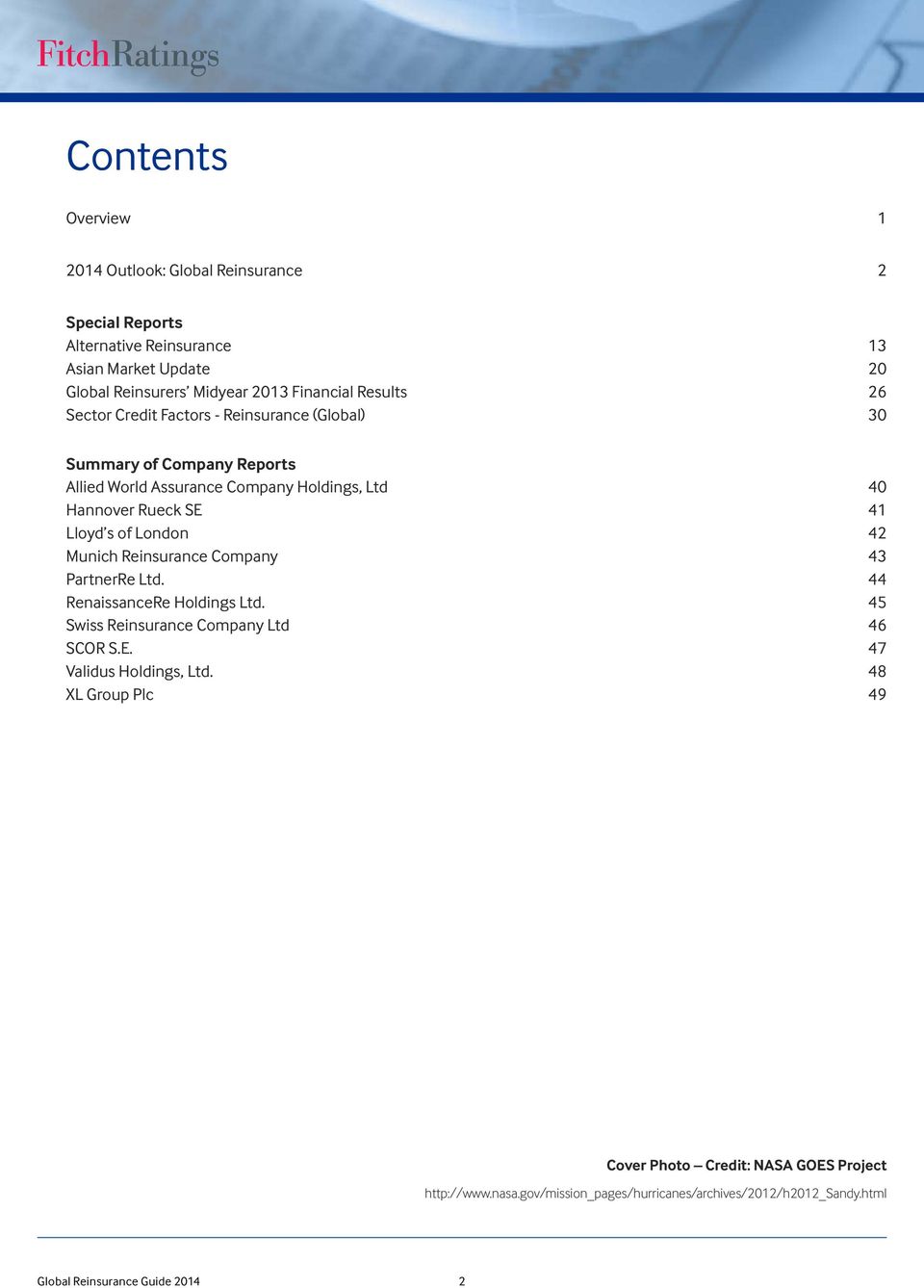
2 Contents Overview Outlook: Global Reinsurance 2 Special Reports Alternative Reinsurance 13 Asian Market Update 20 Global Reinsurers Midyear 2013 Financial Results 26 Sector Credit Factors - Reinsurance (Global) 30 Summary of Company Reports Allied World Assurance Company Holdings, Ltd 40 Hannover Rueck SE 41 Lloyd s of London 42 Munich Reinsurance Company 43 PartnerRe Ltd. 44 RenaissanceRe Holdings Ltd. 45 Swiss Reinsurance Company Ltd 46 SCOR S.E. 47 Validus Holdings, Ltd. 48 XL Group Plc 49 Cover Photo Credit: NASA GOES Project Global Reinsurance Guide
3 Contributors Brian Schneider Senior Director, Insurance Martyn Street Director, Insurance Siew Wai Wan Senior Director, Insurance Chris Waterman Managing Director, Insurance For information on Fitch s rating process please contact: Europe/Middle East Lucinda Jeffrey [email protected] David Turner [email protected] North America/Bermuda Brad Istwan [email protected] Greg Hiltebrand [email protected] Asia Wayne Li [email protected] Additional information on Fitch s ratings and research is available at Global Reinsurance Guide 2014

4 Overview Overview The fourth edition of Fitch Ratings Global Reinsurance Guide provides reinsurance brokers, security committees and reinsurance investors with the latest research on the global reinsurance sector and ratings views on the agency s universe of reinsurance coverage. The 2014 Outlook: Global Reinsurance report describes the expectations underlying Fitch s current stable rating outlook for the sector, as well as outlining the conditions that could lead Fitch to revise the outlook. The report also discusses some of the challenges that the sector will face in 2014, including the persistently lowyielding investment environment and softening pricing conditions across an increasing number of reinsurance classes. The Alternative Reinsurance Market Update report discusses the continued convergence of the traditional and alternative reinsurance markets, examining some of the factors that continue to attract alternative forms of capital. The Asian Market Update explores the significant growth potential that the region is expected to offer the reinsurance sector in the future, as well as providing an update on developments in the wake of the major flooding that occurred in Thailand during The Global Reinsurers Midyear 2013 Financial Results report provides a review of the financial results and performance highlights released during the half-year 2013 reporting period by Fitch s monitored universe of reinsurers. The Reinsurance Sector Credit Factors report complements Fitch s Insurance Rating Methodology master criteria report. This special report provides additional information on how criteria are applied to companies in the reinsurance sector. The final section of the report contains the most recent research on a selected group of reinsurers that are rated by Fitch. The summary credit reports provide details on key rating drivers and rating sensitivities for each individual company. Global Reinsurance Guide

5 2014 Outlook: Global Reinsurance Bond Yields and Softening Prices Set to Test Management Strategy Rating Outlook STABLE Global Reinsurer Rating Outlooks 100% 80% 60% 40% 20% 0% Source: Fitch Ratings. 6% 94% 0% Positive Stable Negative Related Research Alternative Reinsurance Market Update (September 2013) Global Reinsurers Mid-Year 2013 Financial Results (August 2013) Reinsurance (Global) Sector Credit Factors (August 2013) Hurricane Season 2013 A Desk Reference for Insurance Investors (May 2013) Bermuda 2013 Market Update (January 2013) Hurricane Sandy Update (January 2013) 2013 Outlook: Property/Casualty Insurance (December 2012) Analysts Brian Schneider [email protected] Martyn Street [email protected] Christopher Grimes [email protected] Chris Waterman [email protected] Outlook Remains Stable: Fitch Ratings expects to affirm the majority of its current ratings for reinsurers over the next months. Supporting factors are the continued strength of capitalisation and maintenance of profitable earnings. In the absence of a major catastrophe event, Fitch considers the key factors that could lead to a deterioration of the sector s credit profile to be the likely persistence of the low-yielding investment environment and softening pricing conditions. Price Softening to Broaden: In the absence of significant loss events, Fitch expects prices to continue to soften at the key 1 January 2014 renewal and beyond. Pricing fragmentation will persist, resulting in a disparity in the overall level of pricing movements, but the presence of surplus underwriting capacity will broaden soft market conditions to more classes. While Fitch expects prices to remain adequate across major classes, underwriting discipline will be tested. Competition between traditional and alternative capacity providers is expected to continue. Low Versus Rising Yields: Fitch expects the investment environment to provide the greatest challenge to the reinsurance sector in The agency s central forecast anticipates that the persistence of a low-yield investment environment will maintain earnings pressure for reinsurers. The recent rise in long-term government bond yields may not be sustained. While higher fixedincome yields would ultimately be a credit positive for the sector, the path to their return may not be a smooth one. Profitability Deteriorates: Fitch s central forecast (see Figure 1) assumes continued premium growth into 2014, albeit with a slowing of pricing momentum. Reserves are expected to develop favourably overall, but to decline somewhat, adding pressure to run-rate profitability. The underlying accident-year combined ratio excluding catastrophes is forecast to deteriorate slightly in 2014 as underwriting margins weaken from premium rate pressures. Figure /2014 Non-Life Projections (USDm) 2014F 2013F 2012A Net premiums written 102, ,300 97,339 Catastrophe losses 11,600 7,500 7,100 Net prior-year favourable reserve 4,050 5,950 6,586 development Calendar-year combined ratio (%) Accident-year combined ratio (%) Accident-year combined ratio excl catastrophes (%) Source: Fitch monitored universe of reinsurers Global Reinsurance Guide

6 2014 Outlook: Global Reinsurance What Could Change the Outlook Catastrophic Loss with Interest Spike: A sizeable catastrophic loss in conjunction with significant unrealised investment losses from an abrupt jump in interest rates is viewed as the greatest threat to the sector s stable outlook at this time. Such a scenario would leave balance sheets temporarily more exposed to adverse events. This would be particularly concerning should reinsurers not have sufficient liquidity to pay catastrophe claims and need to sell investments at a loss and/or raise new capital at a higher cost. The value of the single-loss event that the agency considers likely to trigger a sector outlook revision has been maintained at USD60bn. An event of this magnitude, coupled with a sudden spike in interest rates of 300bp or more and an inability for reinsurers to replenish lost capital, would likely result in negative rating actions. Fitch considers such a combination to be rare. Expectations Underpinning Fitch s Stable Outlook Fitch expects to affirm the majority of reinsurers ratings over the next months, as they are supported by strong capitalisation and continued underwriting profitability. The agency s central scenario for the remainder of 2013 entails a further strengthening of the sector s capital, driven by solid profitability in This continues on from the favourable results in 2012, as catastrophe losses have been reduced since the near record level in Throughout 2014, the agency anticipates low but stable investment yields and reducing contributions from prior-year reserve surpluses to continue. These factors are expected to make it more challenging for reinsurers to achieve a level of profitability similar to that forecast for The agency continues to view pricing as the key mechanism through which reinsurers will seek to maximise their earnings. Favourably, earned pricing increases are keeping pace with loss cost trends on most lines of business, resulting in a stable underlying accident-year loss ratio forecast for 2013, excluding catastrophes. Fitch expects this trend to reverse in 2014, resulting in a slight deterioration in the underlying run-rate combined ratio. The gradual improvement in economic data from the eurozone, which emerged from recession in August 2013, is a sign that a sustained recovery in economic growth could eventually lead to increased reinsurance demand across the economic bloc. The reinsurance sector remains exposed to contagion risk should the unresolved banking crisis deteriorate, although Fitch currently considered this risk to be remote. The agency continues to view the exposure held by European reinsurers to peripheral eurozone countries sovereign and bank debt as manageable, having stress-tested the investment portfolios of its rated universe of European insurers and reinsurers. Earnings Sustainability to Become More Challenging in 2014 Fitch believes earnings sustainability will become more challenging in 2014, but expects the sector to remain profitable. With the agency forecasting a calendar-year combined ratio of 96.8% (2013F: 90.5%), technical profitability is expected to show a decline of 6.3pp. Key drivers for the reduction in underwriting profits include a higher catastrophe burden in 2014 than that forecast by the agency for 2013 (11.5pp historical average forecast for 2014 vs 7.6pp below-average forecast for 2013), less favourable pricing margins and a reduced contribution from prioryear reserve surpluses. The persistence of low investment yields will continue to make it difficult for reinsurers to supplement earnings through investment income. Capital Abundance Drives Increased Return to Shareholders In the event of a limited loss hurricane season and in the absence of other significant losses nearing a one-in-100-year type of event, market conditions and pricing are likely to remain under pressure, with reinsurers not looking to increase capacity into As such, Fitch would expect increased share repurchases and dividends in fourth-quarter 2013, although with capital continuing to remain strong for most companies and the overall industry. The majority of reinsurers experienced a decline in shareholders equity between end-2012 and end-h113, with an average decrease of 2.6% (see Figure 2). This decline was driven by capital management activity and changes in unrealised investment gain/loss positions on fixed maturities, as an approximately 75bp rise in fixed-income yields reduced reinsurers unrealised gain position and even shifted some reinsurers bond portfolios to a net unrealised loss position. While most market commentators, including Fitch, agree that capitalisation across the reinsurance sector remains strong, changes in the mix of business written suggest that reinsurers are being more selective and cautious when choosing where to deploy financial resources to support their businesses and provide underwriting capacity. Capital market activities have increased thus far in 2013, with share repurchases (see Figure 3) of USD3.2bn for H113, up from the USD2.0bn seen in H112 and USD2.1bn recorded in H111. This increase was driven by significant improvements in earnings in 2012 and thus far in 2013, as the group benefited from the decline in global catastrophe losses relative to Related Criteria Insurance Rating Methodology (August 2013) Global Reinsurance Guide

7 2014 Outlook: Global Reinsurance Figure 2 Change H113 Equity - Reinsurers (%) Swiss Re (A+) Platinum (A) Validus (A) PartnerRe (AA-) Aspen (N/R) Hannover Re (A+) Munich Re (AA-) XL (Ap) AXIS (A+) Fairfax (A-) Everest (AA-) SCOR (A+) White Mount. (A) Ace (AA) Endurance (A) Arch (A+) Allied World (A+) Alleghany (A+) RenRe (A+) Montpelier (A) Berkshire (AA+) IFS Ratings. N/R - Not Rated, p - Positive Outlook Source: Fitch Figure 3 Reinsurer Share Repurchase Activity (USDm) H113 H112 ACE Ltd Alleghany Corporation Allied World Assurance Company Holdings Ltd Arch Capital Group Ltd Aspen Insurance Holdings Ltd AXIS Capital Holdings Ltd Berkshire Hathaway Inc. 0 0 Endurance Specialty Holdings Ltd Everest Re Group, Ltd Montpelier Re Holding Ltd RenaissanceRe Holdings Ltd PartnerRe Ltd Platinum Underwriters Holdings, Ltd Validus Holdings, Ltd White Mountains Insurance Group, Ltd XL Group plc Total 3,220 1,974 Source: Company reports Managing for an Interest Rate Increase Fitch believes that the reinsurance industry is well positioned to withstand a measured increase in interest rates, given the sector s more liquid and shorter-duration fixed-income securities (near three years) and low investment leverage (invested assets to shareholders equity of about 2x). This is particularly the case relative to other insurance sectors that have longer portfolio durations and higher investment leverage. Fitch calculates that each 100bp increase in interest rates would result in an approximately 5% decline in the reinsurance sector s stated shareholders equity. This negative is somewhat mitigated by higher investment yields on new purchases over time. Reinsurers Maintain Pricing Discipline Fitch believes that reinsurers will maintain their cautious approach to pricing business at the forthcoming 1 January 2014 renewal. This reflects in part an increased effort by reinsurers to segment the market and tailor price changes based on individual risk profiles. Fitch views this discipline positively, noting that the current environment makes it harder for reinsurers to earn back losses, as a general rise in rates across reinsurers portfolios is not expected. The agency also believes that reinsurers remain sensitive to the continued uncertainty created by the current global macroeconomic environment, as exposure growth remains restrained. Despite the expectation of flat to reduced prices, Fitch considers that pricing across most reinsurance lines remains adequate, with casualty classes being most exposed to inadequate pricing. Favourably, reinsurers continue to maintain discipline and will hold back capacity with an expectation to only deploy it at attractive pricing levels. Pricing Continues to Deteriorate in 2013 Thus far, 2013 has witnessed a continued deterioration in pricing as the year started with mostly flat rates at the 1 January property renewals, following Hurricane Sandy in October 2012 (see Figure 4). The June and July renewals saw rate declines of up to 25% for Florida property catastrophe, as the state has not had a hurricane make landfall since Hurricane Wilma in Property price increases have been restricted to loss-affected lines and regions, with most loss-free programmes experiencing reductions. Casualty reinsurance rates are showing flat to modestly softening rates, as capacity is ample and declining investment yields continue to pressure returns. Fitch does not foresee casualty returning to a hard market in the near term, barring significant loss events or a spike in interest rates that causes a sizeable loss in reported capital from declines in fixed-income investment values. Global Reinsurance Guide

8 2014 Outlook: Global Reinsurance Figure 4 Recent Reinsurance Renewal Pricing Trends Renewal season Developments June/July 2013 US Property Loss Hit: Down 5% to up 5% US Property Loss Free: Down 10% to 20% Florida Property Loss Free: Down 15% to 25% Casualty No Loss Emergence: Flat to declining April 2013 Japan Property Loss Hit: Flat to up 10% Japan Wind and Flood Loss Free: Flat to down 2.5% US Property Loss Free: Down 5% to 10% January 2013 US Wind Programs Loss Hit: Up 10% US Loss Free: Flat to down 5% Marine: Increases up to 30% International Property: Flat to down 5% Source: Company and broker reports Fitch expects interest rates to increase gradually, which should help to stabilise portfolio yields, although they will remain under pressure. The agency also has concerns about whether the recent increase in interest rates might serve to dampen any potential favourable pricing, as low investment yields have been a key factor in reinsurers justification of the need for increased pricing in casualty lines. As Figure 5 illustrates, reinsurance broker Guy Carpenter s Global Property Catastrophe Reinsurance Rate on Line Index (where rate on line is defined as premium divided by contract limit) fell marginally at the January 2013 renewals, following a 9.5% increase a year earlier. Assuming another average to below-average catastrophe loss year, Fitch expects the index to drop again at the January 2014 renewals, potentially by double digits. On top of price reductions, reinsurance buyers are benefiting from modified terms and conditions, including larger limits, multi-year agreements and additional reinstatements, as well as an increase in the availability of aggregate covers. Excess-of-Loss Reinsurance Feeling Most Pricing Pressure Fitch notes that reinsurance business is experiencing more pricing pressure than primary business, as price increases in insurance are not transferring to the reinsurance market. This is particularly the case for higher-layer property catastrophe excessof-loss reinsurance and retrocession business as there remains no shortage of reinsurance capacity. This capital support is coming from both traditional reinsurance and the growing alternative reinsurance market, which includes catastrophe bonds (cat bonds) and collateralised quota-share reinsurance vehicles (sidecars), with pricing for many alternative products currently very competitive with traditional reinsurance coverage. Fitch believes that convergence of the reinsurance market and the capital market will continue for the foreseeable future. Further discussion on the alternative reinsurance market can be found in Fitch s Alternative Reinsurance 2013 Market Update on page 14. Pro rata reinsurance pricing is less pressured than excess of loss, as quota-share rates tend to reflect the underlying primary insurance market, which has experienced rate increases since the third quarter of However, Fitch expects primary price increases to moderate somewhat going forward, as insurers seek to obtain a third year of rate increases heading into late 2013, a task that may prove more difficult. Reduced Reinsurance Demand Driving Muted Growth Fitch expects most reinsurance lines to experience difficulty growing as insurance companies retain more risk in both property and casualty lines of business. This flat to declining demand for reinsurance is driven by primary insurers favourable capital levels. Many cedents are increasing their level of retention as they need less overall reinsurance protection, although some insurers have taken advantage of reduced pricing levels to purchase additional reinsurance protection at lower costs. This includes several reinsurers that have increased retrocession purchases and reduced their catastrophe risk probable maximum loss. While the Figure 5 Guy Carpenter Global Property Catastrophe Rate on Line Index = 100 Rate on Line Source: Guy Carpenter & Company, LLC. Global Reinsurance Guide

9 2014 Outlook: Global Reinsurance supply of reinsurance remains abundant, particularly with new capital emerging in the form of alternative reinsurance structures, demand from traditional reinsurance purchasing is not expected to increase in the near term, resulting in a continued downward impact on price. As reinsurers manage reduced demand from mature markets, many global companies are capitalising on providing capacity to meet increased demand from emerging markets, including parts of Latin America, Asia Pacific, Africa and the Middle East. Fitch views the global reinsurance industry as taking a cautious approach in the expansion of its business to these relatively small but growing markets that traditionally utilised less (re)insurance or were historically more closed. However, over time these emerging markets will inevitably become a more important part of a diversified reinsurance risk portfolio. Crop Provides Opportunistic Growth One area that has witnessed recent growth is crop reinsurance, through both quota-share and excess-of-loss business. Crop (re) insurance losses from the US summer drought in 2012 totalled USD15bn-17bn. While the overwhelming majority of these insured crop losses were paid by the US federal government, the share paid by private (re)insurers still amounted to a meaningful approximately USD2bn loss. These significant 2012 losses caused many primary crop insurers to decrease retentions, thus creating an opportunity for reinsurers to take advantage of increased pricing and improved market conditions. Crop business has historically been very profitable and is uncorrelated with most other property/casualty insurance risk. As a result, several reinsurers added crop reinsurance business or wrote an increased level of crop reinsurance exposure. Reinsurers Expand in E&S and Other Primary Specialty Lines The lack of growth opportunities in reinsurance and generally inadequate returns on reinsurance capital has pushed several reinsurers to expand into excess and surplus (E&S) insurance and other specialty business that have historically generated higher profit margins. This trend has been aided by the return of risks to the non-standard market from the admitted markets as the US economy experiences growth, albeit very modest. Of particular note is the recent move by Berkshire Hathaway into the commercial E&S space, with the formation of Berkshire Hathaway Specialty Insurance. This will no doubt serve to increase the competitiveness of the market as Berkshire Hathaway has stated it is moving into commercial insurance in a substantial way. The company has the size and staying power to fundamentally alter the market. Arrangements With Reinsurance Intermediaries Growing The debate concerning co-insured broker portfolio arrangements continues and it is too soon to determine how their presence will influence the development of the reinsurance market. The three largest global insurance brokers, Marsh, Aon and Willis, have developed or are developing similar products, whereby (re) insurance carriers are offered a share of their market portfolio business. The terms of each programme vary, from a sole carrier agreement in the case of that between Aon and Berkshire Hathaway, to multi-carrier arrangements for the other two. The market will ultimately decide the success of these programmes. The agency believes that the automatic provision of capacity that follows London Market insurers could be interpreted as an endorsement of the high standard of underwriting present within that market. However, it could erode the diversity of underwriting input into each underwritten risk, and put smallercapacity providers under greater pressure to secure a place on an underwriting slip. Some Reinsurers Seek to Enhance Investment Returns The protracted low-yielding investment environment has not pushed reinsurers overall to stretch for yield and significantly increase portfolio risk. Companies are continuing to focus on maintaining sufficient liquidity to meet and settle liabilities in a timely manner and avoiding excessive balance sheet volatility through increased holdings of cash and short-term investments. However, Fitch has witnessed a few companies that have made modest changes as a means to enhance investment returns at the margin. These adjustments include slight increases in allocations to higher-yielding but riskier alternative/equity investments and non-investment-grade securities. In addition, a few companies have partnered with asset management firms as a means to improve investment returns. Reserve Redundancies Moderate Fitch expects that for 2014 favourable reserve development from prior years will be less supportive of underwriting results than it has been in recent years, adding pressure to run-rate profitability. Furthermore, in several cases, reinsurers have reported reserve deficiencies in certain product lines, particularly longer-tail classes, such as casualty reinsurance. Although favourable reserve development is masking weaker underwriting performance, Fitch does not believe that a reduction in reserve adequacy alone will result in a hardening of prices. Fitch believes that the greatest threat to maintaining adequate loss reserves is an unexpected shift in inflation/interest rates, or loss cost factors that more specifically influence insurance claims costs, such as medical costs, litigation settlements or social inflation. The level of favourable prior-accident-year reserve development generated by the sector in H113 once again exceeded the agency s forecast. Figure 6 shows observed reserving trends up to H is expected to be the eighth consecutive year of overall favourable development. This level of beneficial development has persisted longer than Fitch s expectations, driven in part by loss cost trends that have generally been more benign than originally anticipated by the industry. Global Reinsurance Guide

10 2014 Outlook: Global Reinsurance Figure 6 Calendar- and Accident-Year Combined Ratio Comparison H113 H Calendar-year combined ratio (%) Accident-year combined ratio (%) Difference (pp) Source: SNL Financial. Data is from 17 (re)insurance organisations in North America with significant reinsurance operations Risk of Rapid Rise in Inflation Viewed as Manageable Although Fitch s central forecast predicts a relatively stable level of inflation for most major economies through the next 24 months, the agency views the negative effects of rapidly rising inflation as a notable but manageable risk to reinsurers, were this to occur. The agency continues to assess the adequacy of protection put in place by those reinsurers deemed to be most exposed, with those that have underwritten longer-tail liabilities or that are holding sizeable fixed-income portfolios with a longer duration potentially being most exposed. Reinsurers have sought protection in a number of ways, including through the purchase of inflation-indexed bonds and the use of inflation swaps, to hedge exposure arising within investment portfolios and reserves. Predicting the occurrence and level of any rise in inflation remains challenging, not least as the most likely cause, the coordinated expansionary monetary policy by several major central banks, is unprecedented in its scale. Counter-inflationary effects including falling GDP and lower oil prices add to uncertainty as to the possibility and timing of any marked rise. M&A Remains Opportunistic The reinsurance market has appeared ripe for consolidation in recent years given the level of undeployed capital and the number of midsize companies with limited organic growth options. Fitch believes that a certain amount of consolidation would be a modest credit positive as a reduction in the number of reinsurers and associated underwriting capacity would be likely to ease competitive forces and help precipitate a hardening of premium rates. However, consolidation activity has been relatively limited as industry participants face a number of impediments to successfully complete merger and acquisition (M&A) deals. These include unfavourable pricing in many lines; significant integration risks; and uncertainty in relation to regulatory initiatives, such as Solvency II, that could affect reinsurer earnings and capital structures. In addition, while valuation multiples have improved in 2013, with many companies market values increasing to near or above book value, they remain below pre-financial crisis levels. As a result, share repurchases are still more attractive than M&A for most reinsurers. Several M&A Transactions of Interest in 2013 The largest and most notable reinsurance M&A transaction closed in May 2013 with Markel acquiring Bermuda-based Alterra. Fitch views the transaction as improving the business platform of the combined organisation, with 30 June 2013 shareholders equity of approximately USD6.3bn. Nevertheless, Fitch does not expect a wave of similar deals in that Markel s high valuation multiple (1.7x market/tangible book value ratio) allowed it the financial flexibility to utilise its stock as acquisition currency. Another notable transaction is the announced acquisition by SCOR of Generali US, a sizeable life reinsurer operating in the US. Fitch views the transaction as consistent from a strategic standpoint as SCOR is already a leading player in this market and will thus further strengthen its business position. Execution risk is mitigated by the strong integration track record demonstrated by SCOR over recent years. Most of the other deals announced or completed in 2013 have been small or have involved sales of particular operations or business lines that were no longer a strategic fit or were in runoff. Regulatory Developments Globally Systemically Important Reinsurers Set To Be Named In July 2014 In June 2013, the Financial Stability Board (FSB) confirmed that it will publish an initial list of globally systemically important reinsurers (G-SIIs) in July This follows the publication in July 2013 of a list of nine large insurance companies that the FSB deems to be globally important. The opaque nature of the assessment process has left companies that appeared on the initial list unsure as to the criteria that have caused them to be named, as well as what actions they may take in order to get themselves removed from it in the future. One of the key outcomes of being named will be the requirement to hold additional capital for non-traditional insurance business, which indicates a focus on risk rather than size. This is in line with the approach underlying our ratings. The requirements for G-SIIs will be introduced over a long timeframe, with additional capital requirements unlikely to come into force until This adds to the uncertainty about the final impact as it gives (re)insurers time either to lobby for further changes or to restructure or sell businesses in order to be removed from the list or limit the additional capital requirements. Delays to Solvency II Postpones Opportunities for Reinsurers Uncertainty remains over both the implementation date for the Solvency II regime, with the planned 1 January 2014 date delayed until at least 2016, and the final form that the new solvency regulations will take. Fitch has previously viewed Solvency II as an Global Reinsurance Guide

11 2014 Outlook: Global Reinsurance Figure 7 Reinsurance M&A Transactions Completed/Announced in 2013 Buyer Target Business Close date PartnerRe Presidio Reinsurance U.S. specialty A&H (re)insurance Jan 13 Enstar SeaBright California workers compensation Feb 13 Tower Canopius Bermuda Bermuda reinsurance March 13 White Mountains American Fuji Runoff subsidiary of AIG April 13 Validus Longhorn Re Crop reinsurance April 13 Markel Alterra Specialty insurance and reinsurance May 13 Private Ariel Re Goldman Sachs reinsurance business May 13 White Mountains Empire Insurance Runoff subsidiary of Leucadia National Q313 (Exp.) SCOR Generali U.S. life reinsurance Q413 (Exp.) Fairfax American Safety Specialty insurance Q413 (Exp.) Catalina American Safety Reins. Specialty casualty reinsurance Q413 (Exp.) Enstar Arden Reinsurance Runoff reinsurance Q413 (Exp.) Enstar Atrium Underwriting Lloyds (re)insurance Q413 (Exp.) Enstar Torus Insurance Global specialty (re)insurance Q413 (Exp.) Armour Group OneBeacon Runoff business Q413 (Exp.) Arch Capital CMG Mortgage US mortgage insurance Q413 (Exp.) Lancashire Cathedral Capital Lloyd s specialty (re)insurance Q413 (Exp.) M&A Merger and acquisition. A&H Accident and Health. Exp. Expected Source: Company data, Fitch opportunity for well-capitalised, diversified reinsurers, not least as they may well benefit from increased demand for reinsurance cover, as primary insurers look to reduce their capital requirements. While the agency believes that these opportunities remain, further postponement to the introduction of the new regime potentially delays the ability for reinsurers to realise any benefits. Achieving Solvency II Equivalence Remains Important Several countries have been working for a number of years to attain equivalence between their regulatory regime and that of Solvency II, including Bermuda and Switzerland. Equivalence is viewed as important to safeguard non-european reinsurers from potential competitive disadvantages. Jurisdictions that achieve equivalence will be exempt from European level group supervision and reinsurers collateral requirements with European insurers. Favourably, the delay provides countries with additional time to achieve unqualified Solvency II equivalence for commercial reinsurers by the final European Insurance and Occupational Pensions Authority s (EIOPA) equivalence assessment. As a step toward achieving this, jurisdictions such as Bermuda have recently established country-specific Own Risk and Solvency Assessment (ORSA). While the US was not in the first wave of equivalence discussions, Fitch believes that the US will ultimately attain equivalence recognition from the European authorities. US Government Flood Risk Concerns Could Provide Opportunities The US government has provided an unprecedented level of support for flood losses in recent years under its National Flood Insurance Program (NFIP). Flood insurance claims resulted in an estimated USD12bn-15bn in payments by the NFIP for Hurricane Sandy. This followed USD3 billion for Hurricane Ike in 2008 and almost USD22bn for Hurricanes Katrina and Rita in As a result of growing apprehension about the financial demands of the NFIP, the US government has been looking for ways to reduce its risk, including privatisation. This was put forth in early 2012, even before Hurricane Sandy, as part of the Flood Insurance Reform Act that reauthorised the NFIP for five years to 30 September This legislation requires a study of the private reinsurance market s capacity to assume a portion of the NFIP insurance risk and to clarify the authority to secure reinsurance from the private market to minimise the probability that the program would need to borrow from the US Treasury. As such, there is a potential opportunity for traditional private reinsurers or alternative capital market reinsurance to provide such capacity to this sizeable market. However, it remains to be seen if the private reinsurance market would be able to provide sufficient capacity for flood risk at an economically viable price. Global Reinsurance Guide

12 2014 Outlook: Global Reinsurance US Terrorism Reinsurance Renewal May Affect Private Market Recent legislation has been introduced in the US to extend the Terrorist Risk Insurance Program Reauthorisation Act (TRIPRA), which expires 31 December 2014, thus reigniting the debate on the role of the US government in providing federally backed terrorism reinsurance. Reinsurers have more flexibility than primary insurers to exclude terrorism risks from policy wordings. As a result, the reinsurance industry is significantly more distanced from the threat of terrorism than primary insurers. If TRIPRA is not extended or coverage is materially reduced, demand for specific terrorism reinsurance protection will inevitably increase, thus creating both opportunities and threats for the reinsurance sector. Increased demand for terrorism reinsurance could result in higher prices. However, as terrorism exposures are extremely difficult to model and quantify, reinsurers that under-price risks or provide broad coverage are likely to face substantial underwriting losses. Overall, Fitch is sceptical that reinsurers have sufficient underwriting information and modelling capabilities to underwrite terrorism exposures with the same level of technical expertise that is used to underwrite other catastrophe exposures. Florida Reforms Expected to Result in Increased Reinsurance Demand Recent actions by the state of Florida are likely to incrementally increase demand for both private market and capital market reinsurance. However, with a continuing increased supply from both traditional and non-traditional reinsurance providers, the ultimate impact on reinsurance pricing will likely be muted. In May 2013, Florida s governor signed new legislation that should modestly help to reduce the size of Citizens Property Insurance Corporation (Citizens), the state-sponsored property insurer. The legislation creates a clearing house targeted for 1 January 2014 to ensure that Citizens policies are not eligible for the private market and could thus shift more business to Florida-only specialist insurers that use more private market reinsurance. This shift of business out of Citizens could accelerate the recent trend of an increasing amount of Florida premiums being ceded to third-party reinsurers. In addition to the increased use of private reinsurance by Citizens, the Florida Hurricane Catastrophe Fund, the state-sponsored property reinsurer, has been gradually reducing the optional reinsurance coverage it provides following legislation enacted in NAIC Looks to Set Guidelines for More Relaxed Collateral Rules The National Association of Insurance Commissioners (NAIC) in the US is expected to finalise and implement a process in the near term to evaluate the reinsurance supervisory systems of non- US jurisdictions following an open comment period of its draft proposal. These guidelines are meant to help individual US states adopt the 2011 revisions to the Credit for Reinsurance Model Law and Regulation that reduce reinsurance collateral requirements for non-us reinsurers. These revisions allow for less than the 100% collateral requirements that are normally required to be posted by non-us reinsurers on their US obligations in order for a US ceding insurer to be allowed full credit for the reserves ceded. A non-us reinsurer certified by a state will now be able to post reduced collateral ranging from 0% to 100% based on a rating assigned by the state. These rules are similar to those that were first adopted in 2010 by Florida, followed by New York and several others, with a total of 12 states now having passed reduced minimum collateral requirements for non- US reinsurers, and several other states considering legislation. Bermuda Continues to Monitor Threats to Its Tax Advantage Concerns remain about the US government s efforts to curtail Bermuda s tax-advantaged status. This was evidenced by the introduction in May 2013 of bills in the US Congress by Representative Richard Neal (D-MA) and Senator Robert Menendez (D-NJ) to limit the deductibility of reinsurance premiums paid by insurers to their foreign affiliates, such as Bermuda. While similar bills by Representative Neal and others have not succeeded in the past, any potential, less contentious source of additional tax revenue could become a high-priority item as the US government continues to deal with budget deficit issues. These tax uncertainties have in the recent past provided incentives for several offshore (re)insurers to redomesticate or form new reinsurance companies in European domiciles, including Ireland, Luxembourg and Switzerland, although most companies maintain a key operating presence in Bermuda. Based on these and other operational risk management actions, Fitch believes that most Bermuda-based reinsurers have positioned themselves to limit the potential negative impact in the event such tax legislation passes. Global Reinsurance Guide

13 2014 Outlook: Global Reinsurance Appendix A Figure 8 Data on Select Non-Life Reinsurance Operations Net premiums written (USDm) Combined ratio (%) Shareholders equity (USDm) H113 H H113 H H113 H ACE Limited , ,295 25,762 27,531 24,332 Alleghany Corporation a 1,709 1,179 2,841 3, ,498 6,280 6,404 7,009 Allied World Assurance ,373 3,284 3,326 3,149 Holdings Ltd. Arch Capital Group Ltd , ,234 5,020 5,169 4,592 Aspen Insurance Holdings Ltd ,157 1, ,235 3,435 3,488 3,156 AXIS Capital Holdings Limited 1,572 1,325 1,815 1, ,562 5,698 5,780 5,444 Berkshire Hathaway Inc. NR NR 9,668 9, , , , ,850 Endurance Specialty , ,736 2,747 2,711 2,611 Holdings Ltd. Everest Re Group, Ltd. 1,860 1,486 3,229 3, ,623 6,417 6,733 6,071 Fairfax Financial Holdings 1,329 1,429 2,891 2, ,587 8,482 8,890 8,409 Limited Hannover Re SE 4,829 4,763 8,918 8, ,106 7,704 8,799 7,552 Lloyd s of London NR 6,668 11,176 11,172 NR NR 30,101 31,121 28,579 Mapfre SA NR NR 1,886 2,055 NR NR NR NR 1,269 1,143 Markel Corporation b ,321 6,507 6,728 6,197 Montpelier Re Holdings Ltd ,669 1,625 1,629 1,549 Munich Reinsurance 10,619 10,388 21,112 22, ,363 32,127 35,938 31,416 Company PartnerRe Ltd. 2,463 2,189 3,768 3, ,415 6,698 6,933 6,468 Platinum Underwriters ,747 1,722 1,895 1,691 Holdings Ltd RenaissanceRe Holdings Ltd ,572 3,847 3,507 3,609 SCOR S.E. 2,710 2,606 5,412 5, ,161 5,806 6,300 5,944 Swiss Reinsurance 9,639 7,826 12,407 11, ,135 32,986 34,026 31,287 Company Ltd. Validus Holdings Ltd c 1,031 1,050 1,265 1, ,116 4,719 4,455 4,255 White Mountains Insurance ,939 3,993 3,982 4,338 Group Ltd. XL Group plc 1,264 1,330 1,885 1, ,237 11,214 11,856 10,756 Total d 41,877 38,741 97,339 97, , , , ,141 a Pro forma for Alleghany/Transatlantic merger; H112 and 2012 exclude Transatlantic from 1 January 2012 through the acquisition date of 6 March b Pro forma for Markel/Alterra merger; H113 includes Alterra reinsurance for Q113 and Alterra segment from the acquisition date of 1 May 2013 through 30 June 2013; H113 combined ratio excludes transaction/acquisition-related costs. c Pro forma for Validus/Flagstone merger; 2012 includes Flagstone for first 9 months 2012 and from the acquisition date of 30 November 2012 through 31 December d To aid comparability, net premiums written totals for H1 exclude Alleghany, Lloyd s, Markel and Validus; combined ratio totals for H1 exclude Lloyd s; shareholders equity totals for H113 and H112 exclude Lloyd s, Markel and Validus and for 2012 and 2011 exclude Alleghany and Validus. NR: Not reported at publication date Combined ratio: Net losses and loss-adjustment expenses divided by net premiums earned plus underwriting expenses divided by net premiums earned Shareholders equity is organisation-wide equity and therefore depends on the company s reporting practices; includes equity that supports operations other than property/casualty reinsurance operations. Source: Company annual reports, financial supplements and SEC filings Global Reinsurance Guide

14 2014 Outlook: Global Reinsurance Appendix B Figure 9 Data on Select Life Reinsurance Operations Net premiums earned Pre-tax operating income/(loss) Shareholders equity (USDm) H113 H H113 H H Berkshire Hathaway Inc. 3,054 2,716 5,799 5,036 NR NR NR NR 202, , ,850 Hannover Re SE 3,651 3,279 6,984 6, ,106 8,799 7,552 Munich Reinsurance Company 6,999 6,638 13,758 12, ,363 35,938 31,416 PartnerRe Ltd NR NR NR NR 6,415 6,933 6,468 Reinsurance Group of America Inc. 4,015 3,814 7,907 7, ,888 6,910 5,819 SCOR S.E. 3,076 2,784 5,581 4, ,161 6,300 5,944 Swiss Reinsurance Company Ltd. 4,782 4,291 9,050 8, ,176 30,135 34,026 31,287 XL Group plc NR NR NR NR 11,237 11,856 10,756 Total 26,171 24,080 50,198 45,974 1,363 1,658 3,380 3, , , ,091 NR: Not reported at publication date. Shareholders equity is organisation-wide equity and therefore depends on the company s reporting practices; may include equity that supports operations other than life reinsurance operations. Source: Company annual reports, financial supplements and SEC filings Appendix C Figure 10 Fitch s International-Scale Ratings on Select (Re)Insurance Organisations Group IFS Rating Long-Term IDR Rating Outlook ACE Ltd. AA Stable Ace Tempest Reinsurance Ltd. AA Stable Allied World Assurance Company Holdings, Ltd. A Stable Allied World Assurance Company, Ltd. A+ Stable Alterra Capital Holdings Ltd. BBB+ Stable Alterra Bermuda Ltd. A Stable Amlin AG. A+ Stable Amlin plc. A Stable Arch Capital Group Ltd. A Stable Arch Reinsurance Company. A+ Stable AXIS Capital Holdings Ltd. A Stable Axis Reinsurance Company. A+ Stable Berkshire Hathaway, Inc. AA Stable Brit Insurance Holdings BV. BBB+ Stable China Taiping Insurance Holding Co. Ltd. BBB+ Stable Endurance Reinsurance Corporation of America. A Stable Endurance Specialty Holdings Ltd. A Stable Everest Re Group. A+ Stable Everest Reinsurance Company. AA Stable General Reinsurance Corp. AA+ Stable Hannover Re SE A+ A+ Stable Hiscox Insurance Company (Bermuda) Ltd. A+ Stable Hiscox Insurance Company (Guernsey) Ltd. A+ Stable Hiscox Ltd. A Stable Global Reinsurance Guide

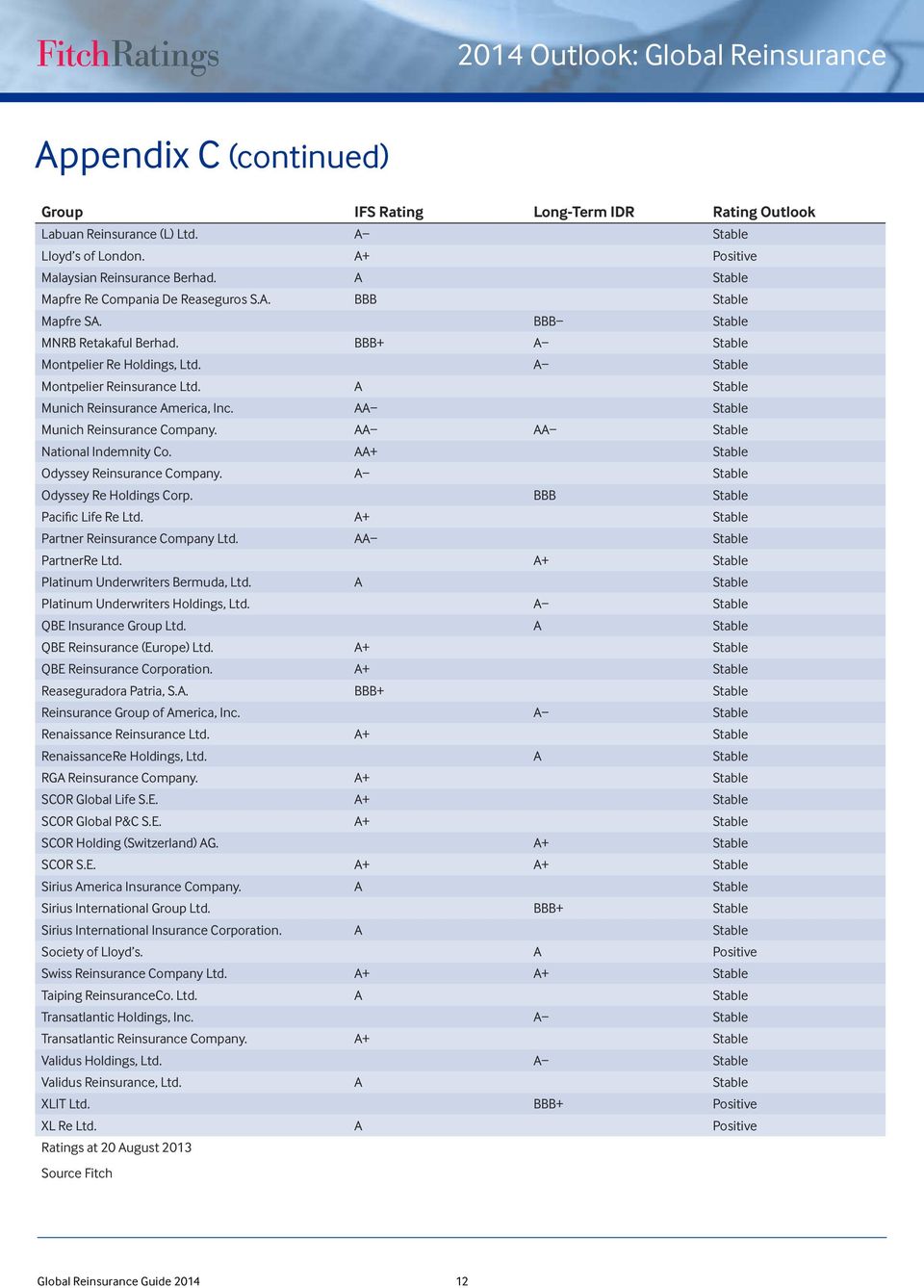
15 2014 Outlook: Global Reinsurance Appendix C (continued) Group IFS Rating Long-Term IDR Rating Outlook Labuan Reinsurance (L) Ltd. A Stable Lloyd s of London. A+ Positive Malaysian Reinsurance Berhad. A Stable Mapfre Re Compania De Reaseguros S.A. BBB Stable Mapfre SA. BBB Stable MNRB Retakaful Berhad. BBB+ A Stable Montpelier Re Holdings, Ltd. A Stable Montpelier Reinsurance Ltd. A Stable Munich Reinsurance America, Inc. AA Stable Munich Reinsurance Company. AA AA Stable National Indemnity Co. AA+ Stable Odyssey Reinsurance Company. A Stable Odyssey Re Holdings Corp. BBB Stable Pacific Life Re Ltd. A+ Stable Partner Reinsurance Company Ltd. AA Stable PartnerRe Ltd. A+ Stable Platinum Underwriters Bermuda, Ltd. A Stable Platinum Underwriters Holdings, Ltd. A Stable QBE Insurance Group Ltd. A Stable QBE Reinsurance (Europe) Ltd. A+ Stable QBE Reinsurance Corporation. A+ Stable Reaseguradora Patria, S.A. BBB+ Stable Reinsurance Group of America, Inc. A Stable Renaissance Reinsurance Ltd. A+ Stable RenaissanceRe Holdings, Ltd. A Stable RGA Reinsurance Company. A+ Stable SCOR Global Life S.E. A+ Stable SCOR Global P&C S.E. A+ Stable SCOR Holding (Switzerland) AG. A+ Stable SCOR S.E. A+ A+ Stable Sirius America Insurance Company. A Stable Sirius International Group Ltd. BBB+ Stable Sirius International Insurance Corporation. A Stable Society of Lloyd s. A Positive Swiss Reinsurance Company Ltd. A+ A+ Stable Taiping ReinsuranceCo. Ltd. A Stable Transatlantic Holdings, Inc. A Stable Transatlantic Reinsurance Company. A+ Stable Validus Holdings, Ltd. A Stable Validus Reinsurance, Ltd. A Stable XLIT Ltd. BBB+ Positive XL Re Ltd. A Positive Ratings at 20 August 2013 Source Fitch Global Reinsurance Guide
16 Alternative Reinsurance 2013 Market Update Convergence Here to Stay Alternative Reinsurance Here to Stay: A convergence of the reinsurance and capital markets persists with many companies both providing and using alternative forms of risk transfer to supplement the traditional balance sheet, transforming several reinsurers into risk asset managers. These structures include catastrophe bonds (cat bonds), collateralised quota-share reinsurance vehicles (sidecars), industry loss warranties (ILWs), hedge fund-supported reinsurers and asset managers investing in insurance-linked securities (ILS). Property Catastrophe Drives Market: The nature of property catastrophe risk as being highly modeled and commoditised serves as an important economic force driving its transfer into the capital markets. Casualty (re)insurance lines have had limited movement into the alternative reinsurance market thus far, as the less standardised and more specialised nature of these longer term risks makes them better suited for more permanent traditional capacity providers. Strong Investor Demand: Fitch Ratings believes that the comparatively high potential returns of catastrophe risk through cat bonds and sidecar investments are particularly attractive to investors, although this spread has been shrinking due to increased investor demand. However, the lack of correlation between catastrophe losses and returns on other major asset classes should continue to contribute to strong demand from investors, which include hedge funds, private equity and institutional investors. Shock Event Could Alter Market: One area of uncertainty is how investors would react to an environment of less favorable catastrophe risk spreads or a large unexpected catastrophe loss, either of which could cause capital to retreat. Fitch generally considers this risk to be higher for hedge fund capital, as pension fund capital tends to be more permanent, given their long-term investment outlook and more diversified risk exposure. Related Research Reinsurance (Global) Sector Credit Factors (August 2013) Bermuda 2013 Market Update (January 2013) Analysts Brian Schneider [email protected] Martyn Street [email protected] Christopher Grimes [email protected] Mixed Benefit to Reinsurers Ratings: Fitch views the growth and acceptance of alternative reinsurance as a mixed benefit for the credit quality of reinsurers ratings. Favorably, they can be used to manage reinsurers exposure and capital and serve as a source of fee income. Negatively, they represent competition for traditional reinsurers that, in conjunction with the strong overall capitalisation of the reinsurance industry, have worked to notably dampen reinsurance pricing. Sponsors Benefit From New Issuance: As investor demand has continued to grow for catastrophe bonds, sponsors have been able to offer deals at considerably lower coupon rates and with increasingly favorable structures that suit individual company needs. These market conditions are likely to drive further issuance of cat bonds in the near term if (re)insurers believe they can produce a cost-effective alternative to supplement their reinsurance program. As of midyear, 2013 is on track to produce a record amount of catastrophe bond issuance. Sidecars Continue to Provide Capacity: Several sidecars emerged late in 2012 and early into 2013 following Hurricane Sandy. These vehicles were opportunistically seeking to capitalise on any potential improvements in property catastrophe pricing. However, they also represented several newer entrants into the alternative reinsurance space looking to participate in what continues to be an important and growing segment of the reinsurance market. Alternative Reinsurance Market Here to Stay Fitch observes that the convergence of the reinsurance and capital markets is likely here to stay and should continue to grow in the near term as powerful economic forces have driven increased acceptance and use of capital market alternatives to traditional reinsurance. Most reinsurers have utilised or continue to make use of some form of alternative reinsurance vehicle or are currently in the process of exploring how alternative reinsurance can better serve their clients risk management needs and the demands of their stakeholders. Alternative nontraditional capital continues to enter the reinsurance market from sources such as catastrophe bonds (cat bonds), collateralised quota-share reinsurance vehicles (sidecars) and industry loss warranties (ILWs). Guy Carpenter & Company estimates that capital from the alternative markets currently totals a meaningful $45 billion, or approximately 14% of the global property catastrophe reinsurance limit, up from only 8% almost in At the same time, capitalisation of the traditional reinsurance sector remains at record levels. Reinsurers have accumulated a large capital buffer from manageable catastrophe losses in 2012 Global Reinsurance Guide

17 Alternative Reinsurance 2013 Market Update Alternative Capacity as a Percentage of Global Property Catastrophe Reinsurance Limit 16% 14% 12% 10% 8% 6% 4% 2% 0% Source: Guy Carpenter estimates. and thus far in This capacity glut is also driven by limited growth areas through which to profitably deploy reinsurance capital. This creates a tension between the traditional and alternative reinsurance markets that is increasing pressure on reinsurance pricing. Modeled Property Risk Driving Capital Market Activity One of the most important economic factors driving this convergence is the nature of the risk being transferred to the capital markets. Most of the focus of third-party capital remains on model-driven property risks, and, in particular, U.S. peak zone risk. Non-U.S. international catastrophe risk tends to be more fragmented and not as easily modeled and, thus, is less commoditised as U.S. risk. Furthermore, casualty risks are typically even more specialised, requiring significantly more expertise in underwriting, and suffer from a limited ability to model such risks. This longer tail casualty business creates problems for capital market providers, which have more of a short-term focus. As a result, many (re)insurers find it economically efficient to transfer to the capital markets a portion of their more standardised property and property catastrophe tail risk business. This action moves higher risk business off-balance sheet, thus freeing up capital in rated entities that can be used to support less volatile business or for other capital management activities. Related Criteria 2010 Insurance Rating Methodology (August 2013) Insurance-Linked Securities (August 2012) (Projected) This tradeoff is even more pronounced during a hardening reinsurance market, or periods of reduced market capacity, such as after a major catastrophe loss event. Alternative reinsurance coverage frequently remains available during a period of scarce underwriting capacity, and often with more cost-effective risk transfer pricing. Although in the immediate aftermath of a loss event, the traditional reinsurance market has an advantage over the capital markets in the ability to easily provide reinstatement coverage. Investor Demand Continues to Be Strong Another important economic factor in convergence is the continued growth of investor demand for the alternative reinsurance sector as pension funds, other institutional investors and hedge funds have increased their allocation to this diversifying asset class. Fitch notes that even a 1% allocation of total global pension fund assets (estimated to be at least $20 trillion) to ILS and reinsurance would represent a very significant $200 billion of capacity. This increased demand has reduced pricing in many alternative reinsurance products, with Aon Benfield recently noting that ILS pricing is down 30% since fourth-quarter As a result, pricing is very competitive with, and even below, the rate on line for some traditional reinsurance coverage. In addition, insurance securitisations have grown to a level in which insurance-linked securities (ILS) funds have become an accepted asset class, attracting new investors. This has been driven in large part by the more favorable spreads available from catastrophe investments relative to the exceptionally low investment market yields, although this spread has been shrinking due to the increased investor demand. The market has expanded to an extent that individual investors can invest in multiple transactions to create a more diversified portfolio of insurance securitisations. Increased Yields or Large Catastrophe Loss Could Alter Market A continued source of uncertainty is how investors would react to an environment of significantly higher investment yields or a large unexpected catastrophe loss, either of which could cause capital to retreat. For example, if the most recent modest rise in interest rates were to continue to much higher levels, other asset classes could become relatively more attractive to investors if catastrophe risk spreads became less favorable. Fitch considers this to be a greater concern for hedge fund capital, as pension funds have a longer term investment horizon and generally lower return expectations given their lower risk appetite. Global Reinsurance Guide

18 Alternative Reinsurance 2013 Market Update In addition, a major catastrophe loss event on a scale much greater than the industry s largest single loss events of Hurricane Katrina in 2005 and the Japanese earthquake and tsunami in 2011, could result in third-party capital deciding not to replenish the market, based on a higher perceived level of risk. Fitch notes that individual pension funds that invest in ILS tend to have a more limited overall allocation of 5% or less to this asset class, and therefore, may not be affected as much after a large loss event as hedge funds that generally have more concentrated risk exposure. However, pension funds face more potential headline flight risk should they suffer losses from a sizable catastrophe event. Positive and Negative Impacts to Reinsurers Credit Quality Fitch views alternative reinsurance as somewhat of a mixed benefit to reinsurers credit ratings and financial strength. Positively, the alternative reinsurance market can be an additional diversified source of revenue for reinsurers that receive fee income to underwrite or provide management services for such transactions. Furthermore, the nontraditional reinsurance market can be also used by reinsurers to manage their exposure, transfer risk and reduce capital volatility, similar to the benefit provided to primary insurers. As such, reinsurers can serve as both a provider and user of alternative forms of risk transfer to supplement the traditional balance sheet. As a result, several reinsurers are transforming into risk asset managers. Negatively, the capital market represents competition for reinsurers from the increased supply of capacity to the insurance industry. Stand-alone traditional property catastrophe reinsurers that have a less diversified source of earnings and compete more directly with the alternative reinsurance market are particularly affected by this added competition. The availability of capital from several sources has served to meaningfully dampen reinsurance pricing in recent periods (particularly on excess of loss business), even following the near record catastrophe losses in 2011 and Hurricane Sandy losses in In fact, 2013 witnessed a continued deterioration in pricing, starting with mostly flat rates at the Jan. 1, 2013 property renewals Catastrophe Bonds (Non-Life) ($ bn) Outstanding 14.1 and most recently experiencing up to 25% rate declines at the midyear Florida property catastrophe renewals. On top of price reductions, reinsurance buyers are also benefiting from modified terms and conditions including larger limits, multiyear agreements and additional reinstatements. In particular, cedents that have demonstrated to the market that they are willing and able to utilise alternative forms of reinsurance capacity are benefiting from the downward pressure that having diversified sources of reinsurance places on the cost of traditional reinsurance to the company. While this competition between the traditional reinsurance market and the considerably larger overall capital market can serve to reduce the volatility of rates after a large catastrophe, the ultimate level of impact also depends on the other fundamental factors that drive the (re)insurance underwriting cycle. 7.2 Bermuda Continues to Support Alternative Reinsurance Capacity Bermuda remains the preferred domicile of choice for many of the alternative reinsurance market special-purpose insurers, given the country s moderate regulatory environment, lower operational entry barriers and concentration of underwriting talent and capital resources. However, as these alternatives have become regarded as the more efficient and flexible preferred option to manage capacity, Fitch does not expect Bermuda to benefit from another sizable wave of start-up (re)insurers following a significant catastrophe event, which last occurred with the class of Catastrophe Bond Market at Record Heights Capacity in the cat bond market continues to increase in 2013, with 15 non-life cat bond transactions (with only two in the first quarter and 13 in the second quarter) totaling $3.8 billion completed in the first half of the year, according to an ILS Market Update report published by Willis Capital Markets & Advisory. This compares with 15 transactions totaling $3.4 billion in the first half of The second quarter of 2013 alone produced $3.3 billion of new and renewal Issued June Source: Willis Capital Markets & Advisory Global Reinsurance Guide

19 Alternative Reinsurance 2013 Market Update issuance, the second-largest individual quarter ever recorded, just shy of the $3.5 billion set during the second quarter of As a result, 2013 appears to be on pace to surpass the $5.9 billion issued in 2012 and could challenge the record $7.2 billion of issuance in The full-year 2013 issuance result will likely depend on the market conditions in catastrophe reinsurance and the level of catastrophe losses for the remainder of the year. Third-quarter activity is typically muted during the height of the U.S. hurricane season, although thus far it has witnessed several issuances. This included $200 million from MetroCat Re Ltd., which was sponsored by First Mutual Transportation Assurance Company, a subsidiary of the New York s Metropolitan Transportation Authority (MTA), as the first cat bond to provide protection solely for storm surge risk. In addition, Groupama issued Green Fields II Capital Ltd. to cover French windstorm risk for 280 million, the largest ever European windstorm cat bond transaction. Total cat bonds outstanding increased to $16.2 billion at June 30, 2013, up from $15.2 billion at year-end 2012, as issuances have outstripped maturities. This trend is expected to continue in the near term as only $1.0 billion of bonds are maturing in the second half of This reflects the more modest issuances during and immediately following the height of the financial crisis that are now maturing. Benefits of Catastrophe Bond Issuance Leaning Towards Sponsors As the investor demand for catastrophe bonds has continued to grow over the past year, Fitch has observed the advantage of moving to cat bond issuers, especially those that have minimised the cost of issuance and are regular participants. Over the past year, deals have been oversubscribed, risk spreads have generally declined and favorable terms and conditions have been granted. A number of the bonds issued through the first half of 2013 have been significantly oversubscribed as a result of significant investor demand. Issues have frequently been upsized by 50% 100% between the initial marketing phase and the eventual issue. Long Point Re III Ltd. (sponsored by Travelers Group) is one such example of a bond that grew significantly during the issuance process, with the three-year bond covering U.S. hurricane risk initially listed as $150 million before eventually issuing at $300 million. As the demand for cat bonds has remained strong, yield spreads have come down considerably over the past year. Coupon rates on cat bonds issued in 2013 have regularly been priced in the bottom of the range that was suggested during the marketing process and in some cases, coming in below the range. Of the bonds that have been issued in 2013, only Everglades Re Ltd. s $250 million offering sponsored by Citizens Property offered a double-digit coupon rate (10%), which was still below the initial suggested range of 11% 12%. This contrasts to 12 months earlier when Everglades Re issued a similar cat bond that sits in a higher and, thus, less risky layer of the company s reinsurance structure that offered a 17.75% coupon. This implies that the strength of investors demand in 2013 is such that they are willing to accept significantly less return while actually taking on more risk than in previous deals. Sponsors are also benefitting from more favorable cat bond terms and structures, with more deals being structured to include an indemnity trigger that reduces the sponsor s exposure to basis risk. Cat bond sponsors typically prefer the coverage of an indemnity Catastrophe Bond Issuances (Non-Life) First-Half 2013 Sponsor Transaction Amount ($ Mil.) 2013 Issue Date Peril Cincinnati Insurance Group Skyline Re Ltd January U.S. Earthquake and Thunderstorm Nationwide Mutual Caelus Re March U.S. Hurricane and Earthquake Citizens Property Insurance Everglades Re 250 March Florida Hurricane State Farm Merna Re IV 300 April U.S. Earthquake Nationwide Mutual Caelus Re April U.S. Hurricane and Earthquake North Carolina JUA/IUA Tar Heel Re 500 April North Carolina Hurricane Turkish Catastrophe Insurance Pool Bospherus 1 Re 400 April Turkey Earthquake Louisiana Citizens Pelican Re 140 May Louisiana Hurricane American Coastal Insurance Company Armor Re 183 May Florida Hurricane Travelers Long Point Re III 300 May Northeast U.S. Hurricane Florida Municipal Insurance Trust Sunshine Re 20 May Florida Hurricane Allianz Blue Danube II 175 May Earthquake USAA Residential Re 300 May U.S. Hurricane, Earthquake, Thunderstorm Southern Oak Oak Leaf Re 30 May Florida Hurricane Allstate Sanders Re 350 May U.S. Hurricane and Earthquake Amlin AG Tramline Re II 75 June U.S. Hurricane/Canada Earthquake Munich Re Queen Street VIII Re 75 June U.S. Hurricane/Australia Cyclone Assurant Ibis Re II 185 June U.S. Hurricane Source: Willis Capital Markets & Advisory, Fitch Ratings. Global Reinsurance Guide

20 Alternative Reinsurance 2013 Market Update trigger, which features a recovery that is more directly tied to the sponsor s actual loss experience. This type of trigger is less transparent to the investor as it is reliant on the company s own internal underwriting practices and claims handling procedures. Investors often desire the simplicity of a parametric trigger, in which a payment to the sponsor and corresponding loss to the bondholders is based on objective measurements of specified parameters. However, thus far in 2013, 67% of catastrophe bonds issued have been with indemnity structures, 27% have been with industry index triggers, while only one deal has been structured with a parametric trigger. Catastrophe Bond Market Remains Focused on U.S. While the majority of issuances thus far in 2013 included coverage for U.S. hurricane risk, they also covered other perils, including U.S. and Canada earthquake, Turkey earthquake, Australia cyclones and U.S. thunderstorms and winter storms. However, investors continue to be overweighted to U.S. hurricane exposure with approximately 72% of the outstanding cat bond market currently exposed to U.S. wind, compared with only 38% in As such, investors have been seeking more diversification of perils and regions. Looking ahead, the implementation of Solvency II could increase the use of cat bonds domiciled in the European Union (EU), as the new regulatory rules will allow capital relief for such ILS, whereas currently only traditional reinsurance is recognised. Sidecars Continue, but Reduced Activity at Midyear 2013 Renewals Reinsurers continued to fund sidecars late in 2012 and early into 2013, providing more than $1.3 billion of additional property catastrophe capital. This increased capacity was driven in part by reinsurers seeking to take advantage of potential improved market conditions following Hurricane Sandy in October These transactions included several sponsors that have tapped Sidecar Transactions Post Hurricane Sandy Sponsor Transaction Capital ($ Mil.) Date Lancashire Saltire Re I 250 November 2012 Alterra New Point V 247 December 2012 RenRe Upsilon Re II 185 January 2013 Argo Harambee Re N.A. January 2013 Validus AlphaCat Re January 2013 Everest Re Mt. Logan Re 250 January 2013 PartnerRe Lorenz Re 75 March 2013 ACE Altair Re 95 April 2013 N.A. Not available. Source: Company press releases and filings. the market multiple times, including Alterra Capital Holdings Limited (Alterra), Lancashire Holdings Limited (Lancashire), Validus Holdings, Ltd. (Validus) and RenaissanceRe Holdings Ltd. (RenRe). In addition, Argo Group International Holdings, Ltd. (Argo), established its first sidecar, Harambee Re Ltd., for the 2013 accident year, supporting both reinsurance and retrocession business. Also, Everest Re Group, Ltd. (Everest Re) formed Mt. Logan Re, Ltd. to provide collateralised capacity to the worldwide property catastrophe reinsurance market in However, as market pricing conditions were relatively flat at the Jan. 1 and April 1 renewals, the formation and utilisation of sidecars diminished as reinsurers anticipated up to double-digit pricing declines that materialised at the June 1 and July 1 renewals. As such, only two new modest-sized sidecar transactions were announced after January 2013, both from sponsors that have more limited involvement in nontraditional reinsurance markets. PartnerRe Ltd. formed Lorenz Re in March 2013, a multiyear facility providing catastrophe reinsurance capitalised at $75 million and ACE Limited established Altair Re in April 2013, a $95 million vehicle to provide additional global reinsurance collateralised capacity. This compares with the prior year when $585 million of sidecar capacity was formed or renewed in June 2012, which provided additional reinsurance capacity to the Florida property market. Fitch expects that sidecars will continue to be utilised by the market in the aftermath of major industry catastrophe loss events. Sidecars enable the sponsoring entity to opportunistically provide additional reinsurance capacity to hardening markets and take advantage of strong pricing without straining the company s capital or increasing aggregate catastrophe exposures beyond tolerances. Fitch also expects that sidecars will continue to be concentrated in the property catastrophe retrocessional market. This type of business provides very beneficial short-term pricing opportunities post event that favors the more flexible, easier set up, lower cost and limited life structure of sidecars. Sidecars can operate with a lower level of capital (as Bermuda Class 3 companies) than a start-up reinsurer and typically do not require ratings given the fully collateralised nature. As such, these entities are not likely to expand into longer tail casualty (re)insurance lines, such as workers compensation and general liability lines, which are better suited for more permanent traditional capacity providers. Industry Loss Warranties Not Significantly Triggered by Sandy Several ILW contracts in 2012 had the potential to be triggered due to industry losses from Hurricane Sandy. Most of these ILW covers are based on industry loss estimates as reported by Property Claims Services (PCS). In March 2013, PCS published a second re-estimated insured loss from Hurricane Sandy at $18.75 billion, up a considerable 70% from its initial estimate of $11 billion in November This loss amount compares to estimated total industry insured losses of $20 billion or more by most catastrophe modelers and Global Reinsurance Guide

21 Alternative Reinsurance 2013 Market Update industry sources. The difference is that the PCS estimate has several exclusions, most notably offshore marine losses, which were at a record level from Hurricane Sandy, and loss adjustment expenses, which are not typically part of ILW contracts. As a result, many buyers of ILWs were not able to recover on their contracts as the re-estimated loss of $18.75 billion still fell below the $20 billion ILW trigger in many of these contracts, thus benefiting the reinsurers that wrote these covers. Given this outcome, buyers may look to develop tighter ILW triggers going forward. Hedge Fund-Backed Start-Up Reinsurers Not Yet Tested Thus far, the recent start-up reinsurers sponsored by several wellknown hedge funds have yet to be tested by either a significant catastrophe loss event or a sizable investment market stress environment. These entities, including Third Point Reinsurance Co. Ltd. (Third Point Re); AQR Re Ltd.; PaCRe, Ltd.; and S.A.C. Re Holdings, Ltd., commenced operations in 2012 in response to the protracted low-yield environment and the desire for a more longterm asset management vehicle. These companies are Bermuda-domiciled (Class 4 or Class 3B [AQR]) reinsurers. As such, they are less regulated than many of the more traditional (re)insurers, thus increasing their attractiveness as a result of greater flexibility in investment and capital management strategies. One similar company that has been somewhat more tested is Greenlight Capital Re, Ltd. (Greenlight), a Cayman Island-domiciled reinsurer that started underwriting operations in 2006 and completed an IPO in As such, they have successfully endured more catastrophe events and withstood the financial crisis period. In August 2013, Third Point Re completed an IPO, taking another step in the evolution of the company. Fitch notes that this is the first sizable IPO in the property/casualty market space since 2007, when Greenlight was joined that year by Validus and Flagstone Reinsurance Holdings SA. Hedge Fund-Backed Reinsurers Company Initial Capital ($ Mil.) Operations Date Major Investors AQR Re Ltd. 260 Jan AQR Capital Management, LLC Greenlight 212 April 2006 Greenlight Capital Capital Re, Ltd. PaCRe, Ltd. 500 April 2012 Paulson & Co., Validus S.A.C. Re Holdings Ltd. Third Point Reinsurance Co. Ltd. Source: Company press releases and filings. 500 July 2012 S.A.C. Capital Advisors, Capital Z Partners III LP 750 Jan Third Point LLC, Kelso & Co, Pine Brook Road Partners Hedge fund-backed reinsurers are devised to generally take on less risk on the underwriting side, having tapped experienced reinsurance talent to operate the companies, while taking on more risk on the asset side, with a higher double-digit investment return expectation. One concern that Fitch has for reinsurers that are reliant on hedge fund returns is their ability to withstand the volatility that has historically been experienced by hedge funds. A huge fall in asset values by a hedge fund could deplete a reinsurers capital, putting potential strain on a company if it coincided with unusually high claims payouts. Fitch believes that the long-term future of this approach ultimately depends on its relative success in generating superior risk-adjusted returns over the market cycle compared with other alternative and more traditional reinsurance market structures. Furthermore, the ability of these companies to manage exposure to both underwriting and asset events as insurance and investment market conditions change will be a critical factor to their future success or failure. Reinsurers Investing in Asset Managers Several reinsurers have also formed asset managers or invested in independent asset managers that are focused on managed catastrophe/ils funds for outside investors. These asset managers invest third-party capital in instruments with returns linked to property catastrophe reinsurance, retrocession and ILS contracts. These ventures provide traditional reinsurers with another diversifying source of earnings through fee income based on the management of underwriting risk. Alleghany Corporation, Allied World Assurance Company Holdings (Allied World), Lancashire, Montpelier Re Holdings Ltd., Transatlantic Holdings Inc., XL Group plc (XL) and Validus recently joined several other reinsurers that have already invested in asset management platforms, including Amlin Group, Aspen Insurance Holdings Limited, RenRe, Munich Reinsurance Company, SCOR S.E. and Hannover Re SE. Reinsurers Investing in ILS Fund Managers (Re)insurer Asset Manager/Fund Alleghany Ares Management Allied World Aeolus Capital Management Amlin Leadenhall Capital Partners Aspen Re Cartesian Iris Re Hannover Re SE Leine Investment Lancashire Saltire Management Montpelier Re Blue Capital Management Munich Re MEAG Munich Ergo RenaissanceRe RenaissanceRe Ventures SCOR Atropos Transatlantic Pillar Capital Holdings Validus AlphaCat Fund XL Stone Point Capital Source: Company press releases and filings. Global Reinsurance Guide
22 Alternative Reinsurance 2013 Market Update Appendix Terminology Alternative Reinsurance Market Alternative reinsurance is effectively any form of managing and transferring (re)insurance risk through the use of the capital markets rather than the traditional reinsurance market. These nontraditional structures commonly include catastrophe bonds (cat bonds), collateralised quota-share reinsurance vehicles (sidecars) and industry loss warranties (ILWs). Alternatives to traditional reinsurance essentially began following Hurricane Andrew, with the introduction of exchange traded insurance options in 1992, the first cat bond in 1994, and later sidecars in 2001, following the events of Sept. 11, However, the market began to grow significantly following Hurricane Katrina in 2005, as (re)insurers were essentially forced to increase issuances of catastrophe bonds and expand the use of sidecars in order to absorb underwriting capacity as retrocession availability became more scarce and expensive. Catastrophe Bonds Cat bonds are bonds issued by an insurer with a condition that if the issuer suffers a catastrophe loss greater than a specified amount, the obligation to pay interest/principal is deferred or forgiven. Cat bonds allow sponsors (most often a (re)insurer) to transfer a portion of its catastrophe risk to the capital markets through securities purchased by investors and actively traded in the secondary market. Favorably for the sponsor, cat bonds offer collateralised (most often invested in U.S. Treasury Money Market Funds) protection that is locked in at a fixed cost over multiple years (typically two to four years). This allows the (re)insurer to be less subject to changing reinsurance market conditions. For the investor, cat bonds offer a comparatively high yield and an opportunity to diversify their portfolios. This is due to the lack of correlation between catastrophe losses and returns on other major asset classes that are tied to more macroeconomic and financial market conditions. Sidecars Sidecars are special-purpose reinsurers that provide dedicated collateralised quota-share reinsurance, often for a single ceding company that transfers a portion of its underwriting risk (and related capital investment), and in turn receives a ceding commission. They also can be a source of fee income for the reinsurers that underwrite or provide management services to such third-party risk vehicles. Sidecar vehicles are often established by traditional reinsurers as a means to tap into the external capacity offered by the capital markets from hedge funds, investment banks, private equity and other opportunistic investors and increase the efficiency and diversification of the company s reinsurance program. They typically have a limited life expectancy and are often wound up when market conditions deteriorate, after which any remaining capital funds are returned to investors and the sponsor. Industry Loss Warranties ILWs are a type of private reinsurance or derivative contract through which one party (often an insurer) will purchase protection based on the total loss arising from an event to the entire insurance industry rather than their own losses. The buyer pays a premium to the company that writes the ILW cover (often a reinsurer or hedge fund) and in return receives coverage for a specified limit if industry losses exceed the predefined amount under the ILW trigger. Global Reinsurance Guide
23 Asian Reinsurance Markets Fall in Regional Natural Catastrophes; Huge Growth Potential Solid Growth/Business Opportunities: The robust development of insurance in Asia coupled with good economic growth has attracted global investor interest in the region. Many Asian markets have low insurance penetration and offer good growth opportunities, including the relatively untapped Chinese and Indonesian markets. The contribution of Asian reinsurance premiums globally is low and not in line with population size and economic growth, suggesting huge growth potential. Premium Rates Mainly Flat: Asia has been affected by an increase in the frequency and severity of natural catastrophes in recent years, although there have been fewer events since Consequently, premium rates for regional reinsurance policies renewed during have reached a plateau, except for some marginal rate increases for selected policies written on catastrophe-prone areas within the Asian market. Catastrophe Occurrences Tighten Underwriting: Fitch Ratings believes that the potential financial impact caused by natural catastrophes has led to a review of risk appetite and management strategy for both the insurers and reinsurers. This has led to a stronger emphasis on having appropriate reinsurance protection. Reinsurers are tightening their underwriting conditions to stop offering free catastrophe coverage as part of their policies, and impose loss/event limits on policies written for catastrophe-prone areas, if need be. Regulations Reviewed and Enhanced: The regulatory environment in the region has been gradually updated as regulators strive to improve the overall financial health and risk management capabilities of companies in the industry. Fitch believes that various regulatory initiatives could indirectly lead to an increase in demand for reinsurance in Asia as direct insurers review their risk management strategies and appetites, which could lead these insurers to transferring more risk to reinsurers. Analysts Siew Wai Wan, CFA [email protected] Terrence Wong [email protected] Chutimas Sivamard [email protected] John Birch [email protected] 1 Source: Swiss Re Sigma No 3/2013 Vast Reinsurance Business Growth Potential in Asia Fitch believes there is significant room for the reinsurance market in Asia to grow given relatively low insurance penetration in Asian markets. Growth momentum is expected to be boosted by increasing risk awareness and continued demand for reinsurance protection by the direct insurance companies in the region, especially in the wake of multiple natural catastrophes that have occurred in recent years. Asian economies constitute a significant component of the global economy (33.0% of global GDP), along with 59.2% of the world s total population 1 in However, the total insurance penetration rate in Asia was 5.73% in 2012, compared with 8.03% in the US and 11.27% in the UK. In particular, three of the most populated emerging markets in Asia: China, India, and Indonesia, had relatively low penetration rates (from 1.77%-3.96%). These markets, with rising household income and rapid industrialisation, contain 68.6% of Asia s population. Reinsurance coverage in Asia remains small compared with global reinsurance coverage. Asia and Australia are estimated to contribute about 10%-15% of global reinsurance premiums, according to industry projections and the International Association of Insurance Supervisors. New Capacity Added to Asian Reinsurance Market Fitch envisages a trend of new Asia-based reinsurers being set up to tap the extensive reinsurance business potential in the region. The latest entrant is Peak Reinsurance (Peak Re), which was set up in January 2013 in Hong Kong. Peak Re was initially capitalised at USD550m; it focuses on underwriting property and casualty reinsurance business across Asia, particularly the emerging Chinese market. Catastrophes Less Intensive in Compared With 2011 The frequency and severity of natural catastrophes globally has increased. Asia has been one of the worst-hit regions, although there were fewer occurrences since Regional countries are exposed to catastrophes to different extents. Australia, Japan, and China are markets with high catastrophic exposure, while Singapore and Malaysia are relatively catastrophe free. Thailand is no longer viewed by the industry as a completely catastrophe-free market, after prolonged floods in H211 the worst in 70 years. Solid business opportunities for Asian reinsurance markets. Global Reinsurance Guide
24 Asian Reinsurance Markets Natural catastrophes to have hit the region in 2012 and so far in 2013 include: floods in China (May 2012); Sichuan earthquake in China (April 2012); floods in Jakarta, Indonesia (January 2013); Lushan earthquake in China (April 2013); and ex-tropical cyclone Oswald in Australia (January 2013). The April 2013 earthquake in China caused 193 deaths and more than 12,000 injuries. Industry estimates put economic losses in excess of USD27bn, but Fitch expects the insured losses to be manageable given the low insurance coverage in quake-affected areas. About 895 claims were reported, according to the China Insurance Regulatory Commission, with the aggregate claim payment to reach about CNY142m (USD23m) as at April Extropical cyclone Oswald in Australia in January 2013 cost insurers AUD1.2bn (USD1bn). There are unlikely to be any more catastrophe events in Australia until December 2013, as the number of such events is historically low during May-November. The floods in Jakarta in January 2013 affected 74 urban wards in 31 sub-districts across Jakarta s five municipalities, inundating more than 100,000 houses, along with some of the capital s main roads. Industry estimates put economic losses at IDR32.0trn (USD3.3bn), while insured losses are likely to top IDR3.0trn. Fitch attributes the significant difference between insured and economic losses to the large proportion of the affected areas not being covered by insurance because flood risks are not automatically included in many motor and property insurance policies in Indonesia. Expectation of Premium Rate Flattening in Latest Renewals Fitch believes that the rising occurrence of natural catastrophes will heighten the awareness of the importance of (re)insurance protection and risk management. This will prompt direct insurers to adopt appropriate risk transfer and capital preservation strategies, and reinsurers to press for higher premium rates that better reflect their claims experience. This will propel the growth of direct insurance and reinsurance businesses, supported by the increasing affluence and generally stable economic conditions in Asian markets. The agency expects premium pricing rates in the region to remain largely flat or soften slightly in 2013 given less frequent and less severe natural catastrophes. For instance, in Japan, the premium rates of the earthquake and wind/flood policies during renewals in April 2013 were generally flat, reflecting the relatively benign catastrophe environment in 2012 compared with In Australia main property catastrophe policies were renewed in early July The full impact of the premium price negotiations The gap between economic and insured losses from Asian catastrophes remains wide, suggesting under-insurance in the Asian market. The premium rates of reinsurance policies renewed in were generally at the same level as remains unknown, but Fitch expects mostly flat to modestly lower rates for catastrophe-free areas in the country, and flat to slightly higher rates for catastrophe-affected areas. Impact Update 2011 Thai Floods Reinsurance Coverage The large scale and severity of prolonged floods in Thailand in 2H11 means it has taken time for the industry to accurately compile loss statistics arising from the event. The flood, which affected 64 of Thailand s 77 provinces, was estimated by the World Bank to incur economic losses of about THB1.4trn (USD45bn) THB640bn in physical damages and THB717bn in lost business opportunities. The disaster resulted in a GDP contraction of 9% in Q411. The industry expects flood claims to tail off in 2013 as most of the reported claims were paid in Total claims (excluding business interruption (BI)) for the 2011 floods reached THB424bn of which 79% was paid at 31 December 2012 according to estimates by the Office of Insurance Commission. Claims arising from BI currently about THB35bn are still not finalised due to the complexity of claim assessments. The financial impact on non-life insurers in Thailand was generally limited compared with foreign reinsurers, with the exception of Thai Reinsurance Pcl (TR). Flood risks are typically included in the fire and industry all-risk policies (IAR), of which direct insurers transfer a high proportion of the risk to reinsurers. Foreign reinsurers have a large market share in Thailand, accounting for 75% of non-life reinsurance premiums ceded in TR incurred net losses of THB1.7bn in 2011 and THB4.3bn in The company raised funds of about THB7bn through private share and rights offerings in Its financial performance turned around with an estimated net profit of THB263m in Q113. Tightening of Underwriting Terms and Conditions Many reinsurers in the region have started to tighten their underwriting conditions to exclude free catastrophe coverage and impose event limits on selected property policies in response to the unexpectedly massive losses arising from the Thai floods. For instance, in Thailand flood insurance coverage, which was previously included in fire and IAR insurance, is now sold separately with sub-limit coverage. Some reinsurers have also trimmed their business volumes in catastrophe-prone Asian markets after conducting portfolio reviews. Global Reinsurance Guide
25 Asian Reinsurance Markets Fitch believes it is important for insurers to enhance their risk management practices and increase their catastrophe-modelling sophistication to better prepare for future disasters. Many industry players in markets such as Thailand and Indonesia have also started to look into developing a more comprehensive flood-risk statistical model for better risk assessment during the underwriting process. Positive Evolution of Regulatory Landscape The regulatory landscape has undergone considerable changes in recent years, particularly in the wake of higher catastrophe occurrences. Regulators in the region continue to enhance regulations to monitor the adequacy of capital resources in an effort to contain unforeseen volatilities. This means direct insurers will continue to employ reinsurance as a means to transfer their underwriting risk and reduce the strain on the capital requirements. Fitch is positive on the various regulatory initiatives that have been implemented to boost the overall financial health and transparency of (re)insurance markets. These regulations are likely to propel the demand for technical expertise, risk transfer, and reinsurance capacity by direct insurers to meet the higher regulatory requirements. For instance, an increasing number of jurisdictions, including Thailand and South Korea, have moved away from a one-size-fits-all solvency margin regime to a riskbased capital (RBC) regulatory framework. India is considering a RBC regime, while in Indonesia reinsurers will be required to meet the minimum regulatory capital requirement of IDR200bn by end- 2014, from IDR150bn in 2012 and IDR100bn in From 1 January 2013 the Australian Prudential Regulation Authority s RBC regime requires each insurer to set aside a certain amount of capital to adequately cover its net retention based on a single large 1-in-200-year catastrophic event, or accumulated from a series of smaller loss events. This additional capital component introduced by the regulator highlights the critical need for insurers to set sufficient capital resources to mitigate the financial impact of unexpected catastrophes. In Thailand the government set up the National Catastrophe Insurance Fund (NCIF) in 2012 to improve the industry s financial buffer to better cope with future catastrophes. The fund acts as a reinsurer, offering coverage for damages caused by three natural disasters: floods, earthquakes, and damaging winds, for households, SMEs, and industry sectors. The objective is to provide sufficient reinsurance capacity at the lowest possible premium rate, and provide easy access to catastrophe insurance to households and businesses. NCIF had a sum insured of THB55bn as of 7 May Regulatory initiatives lead to a rethink of risk management/appetite and could possibly spur demand for reinsurance. Global Reinsurance Guide
26 Asian Reinsurance Markets Appendix Figure 1 Fitch s Ratings on Select Asian Reinsurers Name Country Insurer financial strength rating Rating outlook Malaysia Reinsurance Berhad Malaysia A Stable Labuan Reinsurance (L) Ltd Malaysia A- Stable MNRB Retakaful Berhad Malaysia BBB+ Stable PT Tugu Reasuransi Indonesia Indonesia A(idn) Stable PT Asuransi MAIPARK Indonesia Indonesia BBB+(idn) Stable Taiping Reinsurance Co. Ltd Hong Kong A Stable Source: Fitch Figure 2 Insurance Penetration Data for 2012 Insurance penetration life (USD premiums as % of GDP) Insurance penetration non-life (USD premiums as % of GDP) Insurance per capita life (USD premiums as % of population) Insurance per capita non-life (USD premiums as % of population) Country Life premiums (USDm) Non-Life premiums (USDm) Population (m) Japan 524, , , , PR China 141, , ,372.3 South Korea 78,920 60, , , India 53,300 13, ,249.0 Taiwan 72,522 15, , Hong Kong 28,979 3, , Singapore 12,257 9, , Thailand 10,789 7, Malaysia 9,513 5, Indonesia 10,894 4, Philippines 2,265 1, Vietnam 882 1, Sri Lanka Asia total 957, , ,167.7 Australia 43,689 42, , , United States 567, , , , Europe 876, , World 2,620,864 1,991, ,034.6 Source: Swiss Re, Sigma No 3/2013 Global Reinsurance Guide
27 Asian Reinsurance Markets Appendix (continued) Figure 3 Statistics of Selected Asian Reinsurers Gross premiums (USDm) Loss ratio (%) Combined ratio (%) Name of reinsurer ACR Capital Holdings Asian Reinsurance Corporation 56 n.a n.a n.a. Central Reinsurance Corporation China Reinsurance Group Corporation 8,690 9, General Insurance Corporation of India 2,631 2, Korean Reinsurance Company 3,905 4, Labuan Reinsurance Ltd (A-/Stable) PT Asuransi MAIPARK Indonesia (BBB+(idn)/Stable) Malaysian Reinsurance Berhad (A/Stable) National Reinsurance Corporation of the Philippines Sing Reinsurance Corporation Limited Taiping Reinsurance Company Limited (A/Stable) Thai Reinsurance Public Co., Ltd The Toa Reinsurance Company, Limited 1,752 1, PT Tugu Reasuransi Indonesia (A(idn)/ Stable) Source: Company reports, Fitch s calculations Global Reinsurance Guide
28 Asian Reinsurance Markets Appendix (continued) Figure 3 continued Statistics of Selected Asian Reinsurers NPW/SH equity (%) NPW/GPW (retention ratio) (%) ROE (ie. net income/ SH equity) (%) SH equity/ total asset (%) Name of reinsurer ACR Capital Holdings Asian Reinsurance Corporation n.a n.a n.a n.a. Central Reinsurance Corporation China Reinsurance Group Corporation General Insurance Corporation of India Korean Reinsurance Company Labuan Reinsurance Ltd (A-/Stable) PT Asuransi MAIPARK Indonesia (BBB+(idn)/Stable) Malaysian Reinsurance Berhad (A/Stable) National Reinsurance Corporation of the Philippines Sing Reinsurance Corporation Limited Taiping Reinsurance Company Limited (A/Stable) Thai Reinsurance Public Co., Ltd The Toa Reinsurance Company, Limited PT Tugu Reasuransi Indonesia (A(idn)/ Stable) Global Reinsurance Guide
29 Global Reinsurers Mid-Year 2013 Financial Results Solid Underwriting Gains Offset by Increased Unrealised Investment Losses Non-Life Underwriting Results Favourable: Non-life reinsurers generated solid underwriting profitability in the first half of 2013 due mostly to manageable catastrophe-related losses and sustained favourable loss reserve development. As such, the nonlife global reinsurers that Fitch Ratings tracks posted an improved underwriting combined ratio of 85.9% in H113, compared with 87.7% in H112. Capital Growth Muted in 2013: Solid underwriting profitability was offset by increased unrealised investment losses on fixed maturities, resulting in shareholders equity growth of only 1.3% for non-life reinsurers since end In addition, this group experienced only marginal growth in premiums written as underwriting opportunities are somewhat limited. Life Reinsurers Premiums Grow: Life reinsurance operations monitored by Fitch reported a solid 8.7% increase in net premiums earned through the first six months of However, the pre-tax income of the life reinsurance operations declined by 17.8% compared with the prior-year period. While some reinsurers have suffered lower investment returns, adverse performance of group risk business within the Australian market has also affected certain reinsurers results. Manageable Catastrophes Losses: The (re)insurance industry experienced manageable and below-average natural catastrophe losses of USD13bn in H113, well below the 10-year average ( ) for the first-half periods of USD22bn in insured losses. The majority of losses in H113, listed in Figure 1, were from flooding in Europe, Canada and Australia as well as US severe thunderstorm activity. Related Research Reinsurance (Global) Sector Credit Factors (August 2013) Hurricane Season 2013 A Desk Reference for Insurance Investors (May 2013) U.S. Property/Casualty Insurers Year-End 2012 Financial Results (March 2013) Bermuda 2013 Market Update (January 2013) 2013 Outlook: Property/Casualty Insurance (December 2012) Analysts Brian Schneider [email protected] Martyn Street [email protected] Christopher Grimes [email protected] Figure 1 Largest Insured Natural Catastrophe Events, H113 Date Event Location Economic loss (USDbn) June 2013 Floods Europe > May 2013 US Storms, tornadoes Reserve Releases Continue: Fitch believes that the surplus held within non-life reinsurance industry loss reserves remains adequate, if reduced, following the release of significant reserve redundancies in recent years. Several individual reinsurance product lines continue to experience unfavourable development in 2013, primarily longer-tail casualty and liability lines. However, overall favourable development continues to boost underwriting performance, representing approximately 6.4% of earned premiums in H113 versus 6.6% at end H113 Financial Results Insured loss (USDbn) March 2013 Storms US June 2013 Floods Canada >3.0 >1.0 Jan 2013 Floods Australia Source: Munich Re NatCatService Non-Life Underwriting Performance Improved Non-life reinsurers underwriting results improved in H113 as catastrophe losses were slightly below average for the first half of the year and had less of an impact on company results than in H112. The group of reinsurers Fitch tracks that have reported results generated an 85.9% calendar-year combined ratio in the first six months of the year, down from 87.7% for the comparable prior-year period. H113 results also included modestly weaker prior-accidentyear reserve development than the group reported in the prior-year period, with favourable reserves continuing to provide a mid-singledigit benefit to the calendar-year combined ratio. Non-life reinsurers experienced modest net premiums written (NPW) growth in the first half of 2013 despite the pricing environment remaining generally flat to somewhat declining. A major factor contributing to the overall 8.1% increase in NPW for the group was Swiss Re, which reported a 2.2% increase in gross premiums written, but a 23.2% jump in NPW. This net growth was due to a sizeable decrease in ceded reinsurance premiums relative to H112, as the company s 20% quota share retrocession agreement with Berkshire Hathaway expired at the end of Excluding Swiss Re, the overall group s NPW increased a more modest 4.3%. Global Reinsurance Guide
30 Global Reinsurers Mid-Year 2013 Financial Results Shareholders equity increased only 1.3% (5.0% decrease excluding Berkshire Hathaway) in the first half of 2013 for this group of reinsurers on a comparable basis (assuming constant exchange rates). This is down from a 6.8% annual increase since H112, an 11.8% increase for full-year 2012 and a 6.5% increase in the first half of The deterioration in H113 was driven by modest favourable net earnings that were offset by capital management activity and an increase in net unrealised investment losses on fixed maturities in the second quarter of Figure 2 H113 Non-Life Reinsurance Results (USDm) H113 H112 Net premiums written 41,877 38,741 Combined ratio (%) Shareholders equity 377, ,226 Note: The above results include data only for those companies that had reported both H113 and H112 results on a comparable basis at this report s publication date. Shareholders equity is organisationwide equity and includes equity that supports operations other than non-life reinsurance operations. Source: Individual company data Life Profits Continue The group of life insurance operations monitored by Fitch reported a moderate increase in net premiums earned through the first six months of 2013 compared with the prior-year period. In US dollar terms, net premiums earned increased by 8.7% relative to H112. Each individual company experienced growth in life reinsurance earned premiums in H113, with the exception of XL Group plc, whose life business is in runoff. Through the first six months of 2013, the pre-tax income of the life reinsurance operations tracked by Fitch decreased by 17.8% in US dollar terms compared with the prior-year period. The group s shareholders equity, excluding Berkshire Hathaway, declined from end-2012 as several life reinsurers in the group reported unrealised investment losses. Figure 3 H113 Life Reinsurance Results (USDm) H113 H112 Net premiums earned 26,171 24,080 Pre-tax operating 1,363 1,658 income Source: Individual company data Related Criteria Insurance Rating Methodology (August 2013) Sector Performance Highlights H113 Catastrophe Losses Continue to be Manageable Worldwide insured natural catastrophe losses in H113 were manageable for the (re)insurance industry at USD13bn, according to a review published by Munich Re s NatCatService, down from USD19bn in H112. The H113 total was well below the USD22bn 10-year average insured losses for the first-half periods from 2003 to 2012, but in line with the 30-year average of first-half periods ( ) of USD13.5bn. The largest H113 industry loss was from inland flooding in Germany and central Europe, with Munich Re estimating nearly USD4bn of insured industry losses. Flooding in Alberta, Canada and parts of Queensland and New South Wales, Australia also resulted in sizeable first-half 2013 losses of over USD1bn for each event. US severe thunderstorm activity caused over USD6.3bn of insured losses, including the second- and third-largest events in H113, with the most notable loss from the EF5 tornado that hit Moore, Oklahoma. However, this level was reduced from over USD11bn of US thunderstorm insured losses for the prior-year period, including the five largest global insured loss events in H112, and was greatly improved from the record of almost USD25bn in H111. The Atlantic hurricane season has been relatively quiet thus far, although experts continue to predict above-average hurricane frequency this season relative to long-term results. Furthermore, there is always the potential for significant catastrophe losses during the peak period of hurricane formation from mid-august to mid-october. Indeed, Hurricane Sandy last year, with a global insured loss of over USD30bn as estimated by Munich Re, hit relatively late in the season on 29 October Moreover, while Hurricane Sandy was a widespread and powerful storm, it made landfall as a post-tropical cyclone, just below official category 1 hurricane level status. In fact, a major hurricane (category 3-5) has not made landfall in the US since Hurricane Wilma in 2005, the longest period since the 1860s. Reserve Redundancies Moderate Reinsurers continue to report favourable, although generally declining, prior-accident-year reserve development, with 2013 expected to be the eighth consecutive year of overall favourable development. Most reinsurers are reporting a mid-single-digit to mid-teen percentage-point benefit on the combined ratio. This level of beneficial development has persisted longer than Fitch s expectations, driven in part by loss cost trends that have generally been more benign than originally anticipated by the industry. Global Reinsurance Guide
31 Global Reinsurers Mid-Year 2013 Financial Results Fitch expects that going forward favourable reserve development from prior years will be far less supportive of underwriting results than in recent years, adding pressure to run-rate profitability. Furthermore, in several cases reinsurers have reported reserve deficiencies in certain product lines, particularly longer-tail classes, such as casualty reinsurance. Although favourable reserve development is masking weaker underwriting performance, Fitch does not believe that a reduction in reserve adequacy alone will promote a hardening in prices. Fitch continues to believe that the greatest threat to maintaining adequate loss reserves is an unexpected shift in inflation/interest rates, or loss cost factors that more specifically influence insurance claims costs, such as medical costs, litigation settlements or social inflation. Figure 4 Calendar- and Accident-Year Combined Ratio Comparison H113 H Calendar-year combined ratio (%) Accident-year combined ratio (%) Difference (pp) Data is from 17 (re)insurance organisations in North America with significant reinsurance operations. Source: SNL Financial Figure 5 Reserve Development of Net Earned Premiums, North American Reinsurers H 2013 Source: Highline data. Data is from 17 (re)insurance organisations in North America with significant reinsurance operations. Note: Negative values are adverse development, positive values are favorable development. Global Reinsurance Guide
32 Reinsurance (Global) Sector Credit Factors This special report is intended to complement Fitch s master criteria report entitled Insurance Rating Methodology, which describes the criteria applied by Fitch in assigning insurance industry ratings globally. This special report provides additional information on how criteria are applied to companies in this sector. Accordingly, users are encouraged to first read the master criteria for a fuller understanding of Fitch s ratings approach. Readers are also referred to the Limitations section on page 39 of this report. Related Criteria Insurance Rating Methodology (August 2013) Analysts Brian C. Schneider, CPA, CPCU, ARe [email protected] Martyn Street [email protected] Criteria Application for Sector: This report addresses how Fitch Ratings applies its global master criteria used in the insurance industry when analysing seasoned companies in the global non-life and life reinsurance sector. This report focuses on application of the key credit factors as outlined in Section I of the master criteria. This report does not introduce new criteria, but rather it interprets how master criteria are applied to reflect sector-specific attributes. Key Credit Factors: Consistent with the master insurance criteria, companies in the global reinsurance sector are evaluated considering 12 qualitative and quantitative key credit factors. The key qualitative factors are: 1) sovereign and country-related constraints; 2) industry profile and operating environment; 3) market position and size/scale; 4) ownership; and 5) corporate governance and management. In select cases, the start-up or runoff nature of an organisation acts as an additional qualitative credit factor than can limit the rating level. The key quantitative factors are: 6) capitalisation and leverage; 7) debt service capabilities and financial flexibility; 8) financial performance and earnings; 9) investment and asset risk; 10) asset/ liability and liquidity management; 11) reserve adequacy; and 12) reinsurance, risk mitigation and catastrophe risk. Typical Ratings Range: Ratings in global reinsurance typically range between the AA through A category for Insurer Financial Strength (IFS) ratings and between AA and BBB for unsecured senior debt ratings. Key reinsurance industry risk factors include cyclical pricing, intense market competition, pricing and reserving uncertainty, investment risk tied to fixed-income and equity holdings, catastrophe loss exposures and regulatory issues. Higher Rated Company Attributes: The higher rated global reinsurance companies (IFS rating category of AA ) typically exhibit all or some of the following characteristics: large market position and scale, strong capitalisation and moderate financial leverage; strong profitability with underwriting results, returns on capital and capital formation that consistently outperform industry averages; a high-quality investment portfolio; and conservative reserving philosophy demonstrated over time by limited unfavourable reserve changes. Lower Rated Company Attributes: The lower rated global reinsurance companies (IFS rating of BBB and below) typically exhibit all or some of the following characteristics: a mixed operating track record with low single-digit returns on equity and underwriting losses with combined ratios that under perform industry averages; marginal capitalisation and/or an aggressive financial leverage strategy; less conservative reserving philosophy with more frequent periods of adverse development overall and reserve levels judged to be adequate to modestly deficient; and medium to small market positioning and scale. Global Reinsurance Guide
33 Reinsurance/Global Sector Credit Factors Sector Credit Factors Building Blocks for Reinsurers (Global) (Sample IFS Rating Application) Factor Characteristic Impact on IFS Rating Qualitative Factor Weighting Sovereign/Country AAA Sovereign rating No constraints Industry Profile Non-Life Reinsurance/Blended Book Industry-implied IFS rating range at AAA and < BBB ; most common between AA and A. Market Position Medium Implies IFS rating range of low AA to high BBB, with A most common. Ownership Public Impact on rating range is neutral. Governance Effective Impact on rating range is neutral. Length of Operations 15 years Impact on rating range is neutral. Weighted Conclusion Implies IFS rating range of low AA to high BBB, with most likely category of A. Factor Characteristic IFS Rating Guideline Impact on IFS Rating Qualitative Factor Weighting Capital/Leverage Net Premiums Written/Equity = 0.9x Net Leverage = 3.7x Gross Leverage = 4.5x Financial Leverage Ratio = 28% AA A A A A blended rating category implied by ratios. Most capital metrics are in the A range with low net premiums written to equity being offset by moderately higher net leverage and financial leverage. Debt Service/Financial Flexibility IFRS/GAAP Fixed Charge Coverage Ratio = 4.5x BBB BBB blended rating category implied by ratios. Financial Performance/Earnings Combined Ratio = 93% AA AA blended rating category implied by ratios. Operating Ratio = 83% Premium Growth Absolute = 6% Return on Equity = 13% AA Neutral AA Investments/Liquidity a Unaffiliated Equities/Equity = 20% AAA A blended rating category implied by ratios. Risky Assets to Equity = 65% Liquid Assets/Loss and LAE Reserves = 125% A A Reserve Adequacy Long-Term Average Loss Reserve AA AA blended rating category implied by ratios. Development to Equity = (2%) Long-Term Average Loss Reserve Development to Earned Premiums = (3%) AA Reinsurance, Risk Mitigation, and Net Written Premium/Gross Written = 67% A A blended rating category implied by ratios. Catastrophe Risk Reinsurance Recoverables to Equity = 25% 1:250 Year Modeled Annual Aggregate Catastrophe Losses to Equity = 30% AA A Weighted Conclusion A Fitch places a higher weighting on balance sheet strength, where the sample company performed in line with the A rating category. The sample company currently is in line with the AA category for financial performance. Evaluation of profitability also considers performance over the longer term given market cyclicality, and relative performance versus peers and industry averages. a The two credit factors Investment and Asset Risk and Asset/Liability and Liquidity Management are combined for presentation purposes in the global reinsurance sector. IFS Insurer Financial Strength. Source: Fitch. Global Reinsurance Guide
34 Reinsurance/Global Sector Credit Factors Application of the Key Credit Factors The following is a discussion of how each of the 12 key credit factors outlined on page 1 (and discussed in more detail in Section I of the insurance master criteria) are interpreted for global reinsurance within Fitch s ratings analysis. A sample of how these factors can be summarised and weighted in a building block format, to arrive at an implied rating, appears on the prior page. It is important to note that many global (re)insurance organisations write both primary insurance and reinsurance business. The sector credit factors in this report are generally intended for application to a predominately reinsurance company. Thus, to the extent that a company has material primary insurance lines, Fitch would take a blended approach, also giving reasonable emphasis to the applicable non-life or life insurance sector credit factors. Qualitative Factors Sovereign- and Country-Related Constraints The sovereign ratings of the countries in which Fitch currently rates reinsurers typically range from AAA to BBB, with the most significant countries being Bermuda, France, Germany, Spain, Switzerland, the U.K. and the U.S. The sovereign local currency Issuer Default Rating (IDR) expresses the maximum limit for local currency ratings of most, but not all, issuers in a given country. Since for competitive reasons reinsurers typically target IFS ratings of A or higher, in the cases of reinsurers domiciled in lower-rated countries (Spain, for example), their ratings are at risk of being constrained by the respective sovereign rating and macroeconomic risk. As discussed in Fitch s master insurance criteria, ratings are often set no higher than the sovereign rating, but can be one to two notches higher if the (re)insurer is considered by Fitch to not be significantly exposed to a sovereign crisis (see criteria report for details). One exception of particular interest to the reinsurance sector is Bermuda, in which Fitch would theoretically rate certain Bermuda insurance and reinsurance companies at levels of four or more notches higher than the sovereign rating (should the sovereign rating be downgraded in the future). Fitch generally views Bermuda-based (re)insurance organisations as being highly isolated from country-related risks since their businesses, assets and operations typically have few direct linkages to the country. Industry Profile and Operating Environment The figure below demonstrates that the typical rating range for IFS ratings in global reinsurance is from AAA through BBB. A majority of global reinsurers in Fitch s rated universe have IFS ratings in the AA and A categories. In the reinsurance sector, capacity (i.e. capital size) and credit strength play larger roles in generating competitive advantages than they play in the primary sector. Also, given that reinsurance is used more extensively among non-life than life insurers, the non-life reinsurance industry is larger and thus has more market opportunities than the life reinsurance industry. In addition to the general risks for non-life and life insurance products, key reinsurance industry risk factors include potential liquidity needs for collateral requirements, continued threat of capital market alternative reinsurance products, low entry barriers, reliance on cedants for reserving and pricing data, volatile loss exposure from property or liability excess of loss reinsurance and heavy dependence on concentrated broker distribution. Also, life reinsurers need to develop and maintain unique underwriting expertise as well as face possible significant exposure to pandemics or other mortality catastrophes. Market Position and Size/Scale A company s competitive position is an important factor in considering a reinsurer s risk profile and can play a key role in establishing rating levels. The global reinsurance market is diffused into numerous submarkets defined by product and geography. A company s market position is evaluated by assessing competitive standing and market share in the overall market and larger individual reinsurance product lines. The geographic spread of business by country or region and concentrations of market share by geographic segment are other key considerations. Size and scale is assessed by considering several absolute financial figures, most notably, reinsurance premium volume and total shareholders equity/capital. It is important to note that many global (re)insurers also have significant primary insurance operations and in some cases non-insurance operations that are also supported by the company s total shareholders equity. Large Position and Scale Companies with larger market shares in reinsurance lines segments that are widely dispersed geographically are viewed as having large positions. Reinsurance net premiums written of $4.5 billion or more and total shareholders equity approaching $7 billion would fit into this category. Medium Position and Scale Reinsurers with medium size and scale are typically less diversified in terms of reinsurance product mix or geographic spread of business. Reinsurance net premiums written between $1 billion and $4.5 billion and total shareholders equity of at least $2.5 billion would fit in this category. Medium size/scale reinsures would include a number of large global insurers that are more heavily weighted to primary insurance, with a smaller focus on reinsurance lines. However, many medium size/scale reinsurers are strategically dedicated in only a few reinsurance lines market segments, and may have considerably better market scale in individual products or speciality niches relative to their overall industry market share. Reinsurers with a product focus concentrated in one or a few reinsurance product Rating Range Based on Industry Profile/Operating Environment IFS Rating Category AAA AA A BBB <BBB Reinsurance Lines Global Reinsurance Guide
35 Reinsurance/Global Sector Credit Factors segments would need to maintain a leading market share in a relatively large segment to be considered of medium size/scale. Small Position and Scale As size remains a very important competitive factor in the reinsurance industry, there are fewer individual reinsurers that fit into the small position and scale category (i.e. net premiums less than $1 billion, equity less than $2.5 billion). This group of reinsurers includes smaller reinsurers that may have a leading or dominant market position in a limited geography. The figure below demonstrates how market position and size/ scale can further affect the typical range for global reinsurance ratings. Ratings in the AA category for IFS are typically achievable only for larger companies with both significant scale and major market positioning. Midsize companies more typically are rated no higher than the A category, but in some instances can reach the AA category. However, companies with a property catastrophe reinsurance focus are less likely to be rated in the AA category due to the earnings and capital volatility inherent in this business. Smaller reinsurers with a speciality niche can achieve ratings in the A category, whereas very small and/or narrowly focused companies are more often rated in the BBB category. To the extent that small reinsurers maintain a major market position in a particular country or region that Fitch views as generally favourable, the company could achieve an A category IFS rating. The table below does not represent ratings caps or floors, but rather demonstrates how this one credit factor contributes to the rating assessment. Rating Range Based on Market Position and Size/Scale IFS Rating Category AAA AA A BBB <BBB Large Market Position and Size/ Scale Medium Market Position and Size/ Scale Small Market Position and Size/ Scale Ownership There are no unique attributes of the global reinsurance sector that would affect how criteria related to ownership are applied. As with other types of insurers, public ownership is generally considered neutral to the ratings of global reinsurers, and private ownership for example, by a hedge fund or private equity firm, bank or corporate/industrial entity can be neutral, positive or negative for the insurance ratings, depending on unique circumstance, including the rating of the private parent owner. Fitch currently does not, nor does it anticipate, assigning AAA IFS ratings to public or private reinsurance companies. The need to meet shareholder return hurdles, together with the marginal (if any) competitive advantages of being rated in the AAA category versus the AA category for IFS, imply that AAA rating levels generally do not make economic sense for stock companies. Ownership is distinct from notching, such as the establishment of a holding company rating relative to that of its operating company subsidiaries. Reinsurance specific notching issues are discussed in Appendix B. Rating Range Based on Ownership Form IFS Rating Category AAA AA A BBB <BBB Stock Corporate Governance and Management There are no unique attributes of the global reinsurance industry that would influence how criteria related to corporate governance and management are applied. However, compared with primary insurers, management s ability to implement internal controls and risk management capabilities takes on even more importance for reinsurers given the comparatively large value contracts they write and volatile risks they insure. Generally, the figure below should be interpreted such that if governance and management are considered other than adequate/effective, ratings will typically be affected quite negatively, often by a full rating category or more, depending on the depth and breadth of the perceived problems (sample shown is for a reinsurer with large market position and size/scale). Rating Range Based on Corporate Governance and Management IFS Rating Category AAA AA A BBB <BBB Effective Generally Effective, but Some Weakness Noted Ineffective Global Reinsurance Guide
36 Reinsurance/Global Sector Credit Factors Quantitative Factors In addition to reviewing the applicable global ratios and guidelines that are shown in the noted master insurance criteria, the table below highlights additional key median ratios by rating category used in global reinsurance. In certain cases, ratio guidelines differ for non-life and life reinsurers, and for non-life reinsurers, certain Median Ratio Guidelines guidelines are further delineated between those writing a more blended book compared to non-life reinsurers whose business is primarily property catastrophe risks. IFS Ratings AAA AA A BBB Capitalisation and Leverage Net Premiums Written/Equity (x) Non-Life Blended Net Premiums Written/Equity (x) Non-Life Prop. Catastrophe Net Leverage (x) Non-Life Blended Net Leverage (x) Non-Life Property Catastrophe Gross Leverage (x) Non-Life Blended Gross Leverage (x) Non-Life Property Catastrophe EU Solvency I Ratio (%) Non-Life and Life U.S. NAIC RBC (%) Non-Life U.S. NAIC RBC (%) Life Financial Leverage Ratio (%) Non-Life and Life Debt Service Capabilities and Financial Flexibility IFRS/GAAP Fixed Charge Coverage Ratio (x) Non-Life and Life Statutory Fixed Charge Coverage Ratio (x) Non-Life and Life Financial Performance and Earnings (%) Combined Ratio Non-Life Blended Combined Ratio Non-Life Property Catastrophe Operating Ratio Non-Life Blended Operating Ratio Non-Life Property Catastrophe Return on Equity Non-Life and Life Investments and Liquidity a (%) Unaffiliated Common Stocks to Equity Non-Life and Life Risky Assets to Equity Non-Life and Life Liquid Assets/Loss and LAE Reserves Non-Life Reserve Adequacy (%) Loss Reserve Development to Equity Non-Life (4) (1.5) 0 5 Loss Reserve Development to Earned Premiums Non-Life (5) (2) 0 3 Reinsurance, Risk Mitigation, and Catastrophe Risk (%) Net Premiums Written/Gross Premiums Written Non-Life Reinsurance Recoverables to Equity Non-Life :200-Year Modeled Annual Aggregate Cat. Losses to Equity Blended :250-Year Modeled Annual Aggregate Cat. Losses to Equity Blended :250-Year Modeled Annual Aggregate Cat. Losses to Equity Property Catastrophe a The two credit factors Investment and Asset Risk and Asset/liability and Liquidity Management are combined for presentation purposes in the global reinsurance sector. IFS - Insurer Financial Strength ratings. Cat. - Catastrophe. LAE - Loss adjustment expense. Source: Fitch. Global Reinsurance Guide
37 Reinsurance/Global Sector Credit Factors Capitalisation and Leverage Assessing a reinsurer s ability to withstand financial adversity through fundamental analysis of reinsurers capital levels and risk exposures relative to capital is a very important element in the rating process. The absolute level of capital is considered as well as changes in capital over time, and the nature or quality of capital (e.g. debt/equity, intangibles and goodwill/equity). Fitch considers both risk- and nonrisk-based capital ratios and other tools in its evaluation of capital adequacy and makes a qualitative judgment on which measures are most appropriate for an individual reinsurer. Nonrisk-adjusted leverage ratios measure capital levels in relation to a company s notional exposure to pricing (net premiums written to equity) and reserving errors (net leverage). The primary measurements of risk-based capital include the regulatory measures and Fitch s Prism capital model, including a U.S. non-life model that is currently in use and models in other parts of the world/sectors that are being updated. Reinsurers tend to utilise less operating leverage than primary insurers, especially those with property catastrophe concentrations. Fitch believes that this lower operating leverage is appropriate in light of reinsurers higher earnings and capital volatility, reduced ability to spread risk in an economically feasible way through retrocessional reinsurance and higher exposure to potential adverse reserve development. These are reflected in lower operating leverage guidelines for reinsurers than used by Fitch for primary insurers. As a result of their lower intrinsic operating leverage, to the extent such data is available, Fitch stress tests reinsurers reported operating leverage ratios to include a modeled probable maximum loss (PML) for 100-year and 250-year return periods, particularly for property catastrophe focused reinsurers. The total financing and commitments (TFC) ratio is used by Fitch to measure exposure to both financial and operating debt and other off-balance sheet debt and debt-like commitments. Reinsurers with large undrawn letter of credit balances (used for ceding company collateral purposes) or significant use of operating debt can experience elevated TFC ratios. Also, securitisations as part of catastrophe reinsurance programs have become more prominent, and are included within TFC, which could skew the ratio upward for some companies. In cases where the TFC ratio is high on a relative basis (i.e. above 0.7x for a reinsurer), Fitch examines the components of the ratio and assesses the risks associated with the various exposures captured by TFC to judge any ratings impact. In assessing the financial leverage ratio, Fitch recognises there is significant use of hybrid debt financing in the global reinsurance industry, driven by favourable regulatory capital treatment, particularly in Europe. Under concepts outlined in Fitch s insurance master criteria (Section IV), this significant use of hybrids by European reinsurers often results in relatively high financial leverage and low interest coverage for rating levels, balanced by relatively high capital strength (i.e. low operating leverage). This is because Fitch typically treats hybrid debt as debt in financial leverage ratios, but as capital in capital adequacy ratios, consistent with the regulatory treatment. Debt Service Capabilities and Financial Flexibility Fitch s evaluation of global reinsurance companies debt service capabilities and financial flexibility closely follows the process described in the agency s global insurance master criteria. Key sector credit factors used for global reinsurers include fixed charge coverage ratios, which are typically based on consolidated group GAAP/IFRS operating earnings, as well as statutory fixed charge coverage, which considers reinsurance subsidiary dividend capabilities relative to annual parent interest and preferred dividend obligations (statutory coverage ratios are used most commonly in the U.S.). It is common for a global reinsurer s organisational structure to include nonreinsurance entities that may provide funds for debt servicing to the holding company, as well as insurance agencies and other service providers that have fee-based revenues and earnings that increase debt-servicing capabilities. Fitch considers the potential benefit of these nonregulated cash flows, as well as the risk inherent in any non-insurance operations. Fitch also takes into account the scale of such operations in relation to the reinsurance operations. Financial Performance and Earnings Fitch s evaluation of global reinsurance companies financial performance and earnings closely follows the process described in the agency s global master criteria. The primary measure of underwriting performance and key non-life reinsurer sector credit factor for financial performance is the combined ratio, which measures incurred losses and underwriting expenses relative to premium revenues. Fitch observes that reinsurance underwriting results are more volatile than those of primary insurance, especially for property catastrophe reinsurance and for very long-tail writers subject to acute reserve volatility. However, the effect of this volatility on ratings is mitigated somewhat by non-life reinsurers pricing their business to obtain lower run-rate combined ratios than primary insurers. To act as a rating mitigant to periodic poor performance in a given year, this favourable run-rate combined ratio difference should be observed in most nonlarge loss years, as well as on average over an extended time period (5 to 10 years) that includes both light and heavy catastrophe-related losses and incorporates different cyclical market conditions. When such data is available, Fitch stress tests reinsurers combined ratios to include a modeled PML for 100-year and 250-year return periods, to judge the capacity for such large losses to be absorbed into the run rate. This is particularly the case for property catastrophe-focused reinsurers. Investment performance is incorporated into financial performance ratio analysis through the operating ratio. The operating ratio only incorporates interest and dividend income from investments, while realised and unrealised investment gains are excluded. Fitch also considers the return on equity (ROE). Interpreting the ROE ratio requires some care as the ratio is influenced by the degree of operating and financial leverage. Higher leverage may Global Reinsurance Guide
38 Reinsurance/Global Sector Credit Factors boost returns, but is balanced by offsetting increases in balance sheet risks. Fitch views reinsurers ROE as inherently more volatile than that of primary insurers, given that primary insurers often use reinsurers to reduce their earnings volatility. In addition, several reinsurers include unrealised gains and losses in investment income, increasing ROE volatility. As a result, reinsurers generally have higher ROE return objectives, but in turn also have more conservative leverage positions. Premium Growth Factors Top-line premium and revenue changes over time are also considered as part of the analysis of financial performance. Controlled organic growth of revenue and premiums are typically a signal of a successful organisation. However, in non-life and life reinsurance, rapid growth has been a leading indicator of subsequent stress. Given most global reinsurance markets are mature, rapid growth is often driven by declines in underwriting quality or pricing, which can go undetected in reported profits for several years, especially for longer tail lines where reserves may not be carried at adequate levels. Reinsurers with premium growth at rates considerably greater than the market or peers are viewed more cautiously, especially during periods of pricing competitiveness and soft market conditions. Fitch looks at premium growth trends both on an absolute basis and adjusted for any acquisition activity compared with the industry and relevant peers. Conversely, a rapid decline in premium can indicate instability within an organisation and could be the sign of a declining franchise and bring with it greater risk of taking on underpriced risks. General guidelines looked at by Fitch to help judge if growth may be too rapid or premium declines may be too severe are shown to the left. When the indication is caution, this could negatively affect Fitch s view on overall financial performance, following additional analysis into the basis for the growth or decline. Investment and Liquidity Risk In Fitch s rating assessment of asset risk, four key areas are emphasised: credit risk, interest rate risk, market risk and liquidity risk. The primary sector credit factor for reinsurer investment risk captures exposure to credit, market and liquidity risk. The risky assets-to-equity ratio sums all holdings in non-investment-grade Premium Growth Absolute Premium Growth Range Indication 8% to -10% Neutral > 8% Caution < -10% Caution Relative Premium Growth Range Indication 5% to -5% Neutral > 5% Caution < -5% Caution Source: Fitch bonds, equities, affiliates and other investments and measures the result as a percentage of equity. Market risk exposure is largely tied to a portfolio allocation to equity securities, and as such, a separate sector credit factor is considered for equity investments given the potential for volatility in market values over time. Fitch also separately utilises stress tests to consider the impact on capital from severe equity market downturns. Equity investments, along with positions in private equity and hedge funds, may provide higher long-run expected returns, but also are significantly more volatile. Affiliated investments represent an illiquid holding, and do not typically have a public market value. Affiliated holdings of global reinsurance groups typically represent life insurance or foreign non-life operations, which have their own capital requirements. Investment or distribution-related subsidiaries are also common. Reinsurers can have more sudden and dramatic liquidity needs than primary insurers. For non-life reinsurers, higher liquidity needs typically reflect catastrophe-related property exposures. For life reinsurers, higher liquidity needs reflect the products comparatively large notional amounts at risk and the reinsurers institutional customer base. Fitch may also consider how any collateralisation requirements for reinsurance business written may affect liquidity and financial flexibility, particularly to the extent such requirements are linked to financial covenants or rating triggers. Because of their liquidity needs, reinsurers often invest a larger percentage of their total fixed-income investments in shorter duration securities than primary insurers. Additionally, reinsurers generally invest in higher credit quality fixed-income investments. As a result, the reinsurance sector s average investment yield is somewhat lower than that of the primary sector. Fitch notes that financial flexibility between reinsurers can vary significantly. For example, publicly traded reinsurers that have strong brands and institutional investor bases typically have more immediate sources of financial flexibility and liquidity than closely held reinsurers that have limited brand strength and private investor bases. Reserve Adequacy Fitch believes that reinsurers face more exposure to prior year reserve development, both favourable and unfavourable, than primary insurers. This is largely because reinsurers typically are once or twice removed from the underlying policy, claim and reserve information. Additionally, it often takes longer for reinsurers to receive information regarding opened claims than it does for primary insurers, and thus they are not able to react as quickly to changing loss cost and other trends. Fitch views reinsurers that focus more on long-tail casualtyrelated lines as having a greater balance sheet exposure to reserve development than reinsurers that focus more on short-tail propertyexposed lines. This can be especially true for reinsurers participating on excess layers. However, the agency notes that property catastrophe-focused reinsurers have greater off-balance sheet risk because of most accounting regulations that prohibit companies from recording reserves for potential catastrophes. Global Reinsurance Guide
39 Reinsurance/Global Sector Credit Factors Fitch assesses loss reserve development trends over time relative to a reinsurer s original loss estimates, total reserves and capital. These are reflected in the reserving sector credit factors that compare calendar year loss reserve development with both equity and net earned premiums. Since historical loss development experience alone is not the best indicator of current reserve adequacy and future loss experience, Fitch also completes a squaring the triangle analysis from U.S. nonlife reinsurers statutory filings as well as for several Bermuda nonlife reinsurers that publish loss triangles (when such information is available to Fitch). Ultimate incurred losses are estimated on a line by line basis using loss development factors on a paid loss and case incurred basis, where available. These sector credit factors are considered along with any available actuarial analysis completed by staff or independent actuaries, when such studies are made available to Fitch. Reinsurance, Risk Mitigation and Catastrophe Risk Reinsurers often utilise less reinsurance (retrocessional protection) than primary insurers given that reinsurers business models are often based on their ability to accept potential underwriting volatility from primary insurers. However, some reinsurers purchase significant amounts of reinsurance in the retrocessional market because of their specific financial condition, limited capital size, or because of perceived arbitrage opportunities based on pricing. Fitch monitors a company s net premiums written/gross premiums written ratio to gauge a company s reliance on the reinsurance/ retrocession market to execute its business strategy, and as a predictive indicator of potential accumulation of exposure to ceded reinsurance recoverables. To judge the magnitude of ceded reinsurance exposures, Fitch calculates the ratio of reinsurance recoverables to equity to gauge whether a retrocedent may be exposed to potentially uncollectible reinsurance. Where possible, depending on the available data, Fitch also estimates the average credit quality of a reinsurer s reinsurer (retrocessionaire) recoverables, both gross and net of offsetting collateral, which typically fall within the A to AA IFS rating categories. Catastrophe Risk As discussed in Fitch s master criteria, Fitch s approach to gauging a global reinsurers exposure to catastrophe risk includes an analysis of the company s business mix, geographic concentration, premium growth rate and past results in order to understand the company s overall catastrophe risk management profile. When made available, Fitch also reviews the results generated by global reinsurers internal catastrophe models and software. While the internal model results do not necessarily establish capital adequacy thresholds in Fitch s analysis, they can be informative to the reinsurer s risk management approach and risk appetite. In the context of its sector credit factors, Fitch reviews modeled results at various confidence levels and has ratio guidelines by rating category that focus on the 1:200-year (European Solvency standard) and 1:250-year PMLs (commonly used return period in most other jurisdictions). In its U.S. non-life Prism capital model, Fitch also captures and reviews estimated PMLs at the 10 through 10,000 year levels, when such information is available or can be estimated. Given the nature of their business, property catastrophe-focused reinsurers have greater exposure to catastrophes relative to their capital and, as such, a review of their modeled PML results by Fitch has an increased importance relative to that of reinsurers with a more balanced portfolio. Fitch recognises the potential shortfalls in any model-driven analysis and also takes care not to become overly reliant on the results of any one model without also applying judgment in interpretation of the model outputs. In addition to results from catastrophe models, Fitch will also compare a reinsurers actual catastrophe loss to an implied loss based on market share. Fitch would favorably view a reinsurer whose actual losses were consistently below their market share losses, as this could imply good risk management. Limitations This special report describes indicative features observed for rated issuers. Ratio levels refer to the midpoint of a range expected through the cycle, and as a result, actual observations are likely to vary from these. The weighting of factors will vary substantially over time for a given rated entity and among rated entities based on relative significance of any given factor(s) as agreed upon by a rating committee. The factors described give a high level overview as a convenience for rating users and are neither exhaustive in scope nor uniformly applicable. Appendix A: Financial Ratio Definitions The following is a discussion of the key financial ratios generally used by Fitch in its financial review of global reinsurance companies. Capitalisation and Leverage Ratios Net Premiums Written to Equity (Non-Life) This indicates a company s net operating leverage on current business written and measures the exposure of equity to pricing errors. Acceptable levels of net operating leverage vary by line of business, with longer tail lines and catastrophe-prone lines often requiring lower levels of net underwriting leverage due to their greater exposure to pricing errors. Since net premiums written are influenced by both volume and rate adequacy, interpretations must be made carefully since an adverse decline in rate adequacy could lead to apparent improvements in this ratio. Net Leverage (Non-Life) This indicates a company s net of reinsurance operating leverage on current business written and existing liabilities. The ratio is calculated by dividing the sum of net premiums written and total liabilities, less any ceded reserves and debt, by equity. The ratio measures the exposure of equity to both pricing and reserving errors. Typical levels for this ratio will generally be higher for Global Reinsurance Guide
40 Reinsurance/Global Sector Credit Factors long-tail writers and lower for short-tail writers, reflecting natural differences in the growth and payment pattern of loss reserves. Gross Leverage (Non-Life) This indicates a company s gross (before ceded reinsurance) operating leverage on current business written and existing liabilities. The ratio is calculated by dividing the sum of direct and assumed premiums written and total gross liabilities ceded to reinsurers, by equity. The ratio measures the exposure of equity to both pricing and reserving errors, as well as uncollectable reinsurance. Typical levels for this ratio will also generally be higher for long-tail writers and lower for short-tail writers, reflecting natural differences in the growth and payment pattern of loss reserves. Solvency Ratio (Non-Life and Life) The Solvency I capital ratio is the key regulatory solvency measure used in Europe. It compares the capital resources of a company or group with its regulatory capital requirements. Risk-Based Capital Ratios (Non-Life and Life) The National Association of Insurance Commissioners (NAIC) RBC ratio is the key regulatory solvency measure used in the U.S. The primary RBC figure that Fitch reviews is the company action level required capital level as a percentage of total adjusted capital reported in statutory filings. Financial Leverage Ratio/Adjusted Debt to Total Capital (Non- Life and Life) The financial leverage ratio (FLR), as defined by Fitch, considers the ratio of debt to capital adjusted for the impact of unrealised gains/ (losses) on fixed-income investments and is designed to capture the extent long-term capital (i.e. capital that supports regulatory capital adequacy, or is used to fund acquisitions) is debt financed, or financed by debt-like hybrids. The FLR also includes debt used for short to intermediate liquidity or working capital needs (most commonly at the holding company level). See insurance master criteria for complete definition. Total Financing and Commitments Ratio (Non-Life and Life) The TFC ratio is a comprehensive measure of debt-related leverage, making use of a broad definition of debt to include essentially all financing activities, including traditional financial debt as well as both recourse and nonrecourse securitisations, letters of credit facilities with banks provided to third-party beneficiaries (largely used by alien or offshore reinsurers), match-funded debt, and debt guarantees and other financing-related commitments. See insurance master criteria for a complete definition. The TFC is typically calculated at the holding company level or at a group consolidated level. Debt Service Capabilities and Financial Flexibility Ratios IFRS/GAAP Fixed Charge Coverage Ratio (Non-Life and Life) This is an earnings-based measure of the ability of a reinsurer to pay adjusted interest expense and preferred dividends. The ratio is calculated both on an IFRS/GAAP EBIT basis (excluding realised investment gains and losses) and on a pretax operating income basis (a non- IFRS/GAAP measure typically reported by European reinsurers). Adjusted interest expense is interest expense on debt included in the financial leverage ratio. A higher ratio is better than a lower ratio. This ratio is typically calculated at the holding company level or at the consolidated group level. Statutory Fixed Charge Coverage Ratio (Non-Life and Life) This is the ratio of statutory maximum dividends that an operating company can upstream to a parent holding company without receiving prior regulatory approval to adjusted interest expense and preferred dividends. Adjusted interest expense is defined above in the fixed charge coverage ratio. A higher ratio is better than a lower ratio. This ratio is calculated on a consolidated operating company level. Financial Performance and Earnings Ratios Combined Ratio (Non-Life) The combined ratio measures overall underwriting profitability and is the sum of the loss ratio and expense ratio (including any policyholder dividends). The loss ratio measures the magnitude of incurred losses (including loss adjustment expenses) for the current calendar year relative to net premiums earned. The expense ratio measures the level of underwriting and acquisition expenses, such as commissions, salaries and overhead, relative to net premiums earned. Operating Ratio (Non-Life) The operating ratio measures operating profitability, which is the sum of underwriting and pretax investment income, excluding realised and unrealised capital gains or losses. The ratio is the combined ratio less the ratio of investment income to net earned premiums. Due to the combining of underwriting and investment earnings, the ratio is fairly comparable across both long-tail and short-tail lines of business. Return on Equity (Non-Life and Life) Return on equity measures a company s after-tax net income relative to mean annual equity levels, and indicates both overall profitability and the ability of a company s operations to generate capital organically. Variances among companies are explained by both differences in operating profitability and differences in net operating and/or financial leverage. For a profitable company, a less favourable (i.e. higher) leverage position will result in a more favourable result on this test. Change in Premium Written Absolute Basis and Relative Basis (Non-Life) Fitch calculates a company s absolute premium growth as the year-over-year change in a reinsurer s net premiums written. Fitch calculates a company s relative premium growth as the difference between the year-over-year change in a reinsurer s net premiums written and the absolute premium growth of the overall market. Investment and Asset Risk and Liquidity Ratios Unaffiliated Common Stocks to Equity (Non-Life and Life) This measures the equity exposure to common stock investments. Since common stocks are both subject to price volatility and are Global Reinsurance Guide
41 Reinsurance/Global Sector Credit Factors carried at market values, a high level of common stocks adds a considerably higher degree of volatility to reported equity levels, relative to holdings in fixed-income securities. Risky Assets to Equity (Non-Life and Life) This measures the reinsurer s equity capital exposure to total risky assets, which includes non-investment-grade bonds, equities, affiliates and other investments. This basic ratio is intended to measure the insurer s exposure to both credit and market risk. Liquid Assets to Loss and LAE Reserves (Non-Life) This ratio measures the portion of a company s net loss and loss adjustment expense reserves covered by cash and unaffiliated investment-grade bonds, stocks and short-term invested asset balances. Higher values indicate better levels of liquidity. Reserve Adequacy Ratios Loss Reserve Development to Equity (Non-Life) This ratio measures a company s one-year loss reserve development as a percentage of prior years equity and indicates the extent equity was either under or overstated due to reserving errors. Loss Reserve Development to Net Earned Premiums (Non- Life) This ratio measures a company s one-year loss reserve development as a percentage of calendar year net earned premiums and indicates the extent underwriting results were affected by prior period loss reserve adjustments. Reinsurance, Risk Mitigation and Catastrophe Risk Ratios Net Premiums Written/Gross Premiums Written Ratio (Non-Life) This ratio measures a reinsurer s reinsurance (retrocession) utilisation. A higher ratio indicates that a reinsurer is retaining more risk and that its reliance on the reinsurance market to execute its business strategy is relatively low. Reinsurance Recoverables to Equity (Non-Life) This measures a company s exposure to credit losses on ceded reinsurance recoverables. The ratio should also be interpreted in light of the credit quality of reinsurers, the stability of the relationship between reinsurer and retrocessionaire, historical collection patterns and any security held in the form of letters of credit, trust accounts, or funds withheld. Typical levels for this ratio will generally be higher for long-tail writers and lower for short-tail writers, reflecting natural differences in the build-up of ceded loss reserves. 1:200-Year or 1:250-Year Annual Aggregate Catastrophe Losses to Equity (Non-Life) This ratio measures the potential balance sheet risk due to natural catastrophes, and is simply the 1:200-year (European Solvency standard) or 1:250-year annual aggregate pretax PML, net of reinsurance and retrocessional recoveries, divided by equity. The PML can be estimated by Fitch or provided by the reinsurer s management based on its catastrophe modeling. Appendix B: Reinsurance Notching See Section VI of the insurance master criteria report for a complete discussion of notching concepts applied to the (re) insurance industry. For convenience, here Fitch highlights several aspects of notching for reinsurance organisations that differs somewhat from that for primary insurers. These relate to differences in payment restrictions between operating subsidiaries and holding companies (including the impact of capital regimes), and differences in priority of policyholder claims. Payment Restrictions and/or Capital Regime Several of the domiciles commonly used by reinsurers have less restrictive regulatory environments, especially with respect to capital requirements and upstream dividend-paying capacity (e.g. Bermuda) than the domiciles most commonly used by primary insurers. As such, the notching between reinsurance operating company IDRs and holding company IDRs in these jurisdictions is often tighter. In most cases, when payment restrictions are less strict, the two IDRs are aligned. This is done to recognise that the less restrictive regulatory regime makes the credit worthiness of the operating and holding company approximately the same, since capital and liquidity are easily shifted between the two entities. This compares to regulatory environments for most primary companies in which dividend and capital flows are more restricted, and the holding company IDR is set lower than that of the operating company, reflecting its relative higher default/failure risk. Priority of Policyholders Many major reinsurers are domiciled in jurisdictions where reinsurance obligations are ranked pari passu with senior unsecured obligations in liquidation (e.g. U.S. and Europe). In contrast, most jurisdictions provide primary insurance obligations with priority over senior unsecured obligations in liquidation. Bermuda is somewhat unique in that it provides priority to both primary and reinsurance obligations. The lack of liquidation priority for reinsurance obligations in many domiciles does not affect the sector s overall credit quality. It does, however, reduce reinsurance operating company IFS ratings relative to operating company IDRs. In most primary markets, IFS ratings are set one notch higher than the operating company IDR to reflect the priority of policy obligations and an assumption that this priority will allow better recoveries in the event of insolvency. In contrast, in the reinsurance sector in many cases, the IFS rating and IDR are aligned (i.e. no notching up of the IFS rating), since in liquidation, reinsurance obligations are assumed to have somewhat weaker recoveries. For a complete discussion and understanding of notching concepts in the (re)insurance sector, readers should review the master criteria. Global Reinsurance Guide
42 Summary of Company Reports Global Reinsurance Guide
43 Insurance Property/Casualty Insurers/U.S. Allied World Assurance Company Holdings, Ltd. And Subsidiaries Update Ratings Allied World Assurance Company Holdings, Ltd. Long-Term Issuer Default Rating A Senior Unsecured A Allied World Assurance Co. Ltd Allied World Assurance Co. (U.S.) Inc. Allied World National Assurance Co. Allied World Reinsurance Co. Insurer Financial Strength A+ Rating Outlook Long-Term Issuer Default Rating Insurer Financial Strength Financial Data Stable Stable ($ Mil.) YE12 1H13 Total Equity 3,326 3,373 Total Debt Total Assets 12,030 12,263 Operating Income Net Income Combined Ratio (%) Source: SNL Financial. The ratings above were unsolicited and have been provided by Fitch as a service to investors. The issuer did not participate in the rating process, or provide additional information, beyond the issuer s available public disclosure. Related Research Alternative Reinsurance 2013 Market Update (September 2013) 2014 Outlook: Global Reinsurance (August 2013) Global Reinsurers Mid-Year 2013 Financial Results (August 2013) Global Reinsurance Sector Credit Factors (August 2013) Related Criteria Insurance Rating Methodology (August 2013) Analysts Christopher A. Grimes, CFA [email protected] Brian C. Schneider, CPA, CPCU, ARe [email protected] Key Rating Drivers Solid First-Half Underwriting: Allied World Assurance Company Holdings, Ltd. (Allied World) reported an 83.9% combined ratio in first-half 2013, down from 85.2% at mid-year Net earned premiums grew by 16.7% over the first half of Allied World reported net earnings of $157 million in first half 2013, although 2 nd quarter earnings were modestly negative, largely due to $115 million of realized investment losses during the quarter. The company generated an annualized return on average equity of 9.4%, down from 19.6% for half-year Strong Capitalization: Total shareholders equity has increased by 1.4% to $3.4 billion at June 30, 2013 from $3.3 billion at year-end The increase in equity was led by positive earnings, modestly offset by $82 million of share repurchase activity during the first half. Allied World uses a moderate amount of financial leverage in its capital structure. At June 30, 2013, debt securities represented approximately 19.1% of the company s more than $4.2 billion of capital. Strategic Partnerships: During the fourth quarter of 2012, Allied World Financial Services Inc. entered into four strategic partnerships with Cunningham Lindsey, MatlinPatterson, Aeolus Capital Management and Crescent Capital Group. The partnerships may provide the company with an opportunity to improve investment returns in the persistent low-yielding environment and diversify its knowledge base with the addition of third-party expertise. Robust Favorable Reserve Development: Allied World reported $92.5 million of reserve releases in the first half of 2013, representing 9.5% of half-year net earned premium. Allied World has a history of conservative reserving practices and has benefited from an average of 18.7 percentage points on the combined ratio of favorable reserve development during the period 2008 and 2012, which is more than the company's Bermuda peer average of 12.1 points of benefit from reserve releases during the same period. Premium Mix Focus on Primary Commercial: Allied World generates the vast majority of its premium through primary commercial liability lines of business, both domestic U.S. and internationally, with commercial reinsurance business representing approximately one-third of the company s premium allocation. Allied World also writes property business and is exposed to the effects of industrywide catastrophe losses, but to a lesser extent than its Bermuda peers. Rating Sensitivities Downgrade Triggers: Key rating triggers that could result in a downgrade include a material loss of capital; underwriting results that no longer outperform peers, significant adverse reserve development; increases in underwriting leverage above a 1.0x net premiums written-to-equity ratio; financial leverage increasing above 25%; and catastrophe loss experience that greatly exceeds the company s probable maximum loss estimates. Upgrade Triggers: Key rating triggers that could result in an upgrade include continued favorable underwriting results in line with higher rated property/casualty (re)insurer peers; material improvement in key financial metrics (e.g. net premiums written to equity) to more overcapitalized levels; and enhanced competitive positioning, while maintaining strong profitability with low earnings volatility. August 7, 2013 Global Reinsurance Guide
44 Insurance Hannover Rueck SE Update Germany xx Ratings Insurer Financial Strength A+ Long-Term Foreign-Currency IDR A+ Hannover Finance (Lux) S.A. EUR750m sub debt/2024 Hannover Finance (Lux) S.A. EUR500m sub debt/perp A A E + S Rueckversicherung AG Insurer Financial Strength A+ Outlooks Insurer Financial Strength Stable Long-Term Foreign-Currency IDR Stable Financial Data Hannover Rueck SE 31 Dec 31 Dec Total assets (EURm) 54,812 49,867 Total equity (EURm) 6,740 5,607 Gross written premiums 13,774 12,096 (EURm) Net income (EURm) Reinsurance combined ratio (%) The ratings above were unsolicited and have been provided by Fitch as a service to investors. The issuer did not participate in the rating process, or provide additional information, beyond the issuer s available public disclosure. Related Research Alternative Reinsurance 2013 Market Update (September 2013) 2014 Outlook: Global Reinsurance (August 2013) Global Reinsurers Mid-Year 2013 Financial Results (August 2013) Key Rating Drivers Strong Capitalisation, Quality Moderate: Based on Fitch Ratings risk-adjusted assessment, the agency views Hannover Rueck SE s (Hannover Re) capitalisation as commensurate with the current ratings level. Fitch considers quality of capital to be moderate due to the high level of hybrid debt present within the capital structure. This is mitigated by what the agency considers to be a less volatile mix of business relative to peers. Leverage Commensurate With Ratings: Financial leverage remains at a level commensurate with the current ratings, although the proportion of hybrid debt within Hannover Re s capital structure is above that of peers. Fitch does not employ an absolute cap on the amount of hybrid debt that resides in a capital structure, and considers that the current proportion does not put undue strain on the reinsurer s financial flexibility. Good Consistency of Earnings: Fitch views positively the relative stability of Hannover Re s profitability generation in recent years. The agency believes that this reflects the diversified nature of the reinsurer s underwriting platform, as well as the prudent investment strategy pursued. Fitch s expectation of continued earnings resilience through 2013 assumes a normal level of catastrophe losses through the remainder of the year. Strong Global Franchise: Hannover Re is one of a select band of global reinsurance companies with the financial strength to provide underwriting capacity across a broad range of underwriting classes and geographical markets. Hannover Re maintains a strong position in the property & casualty reinsurance market and an ever-strengthening position in life & health reinsurance. Credit Reinsurance Exposure: Hannover Re has higher exposure to credit reinsurance than many of its peers. Credit and surety reinsurance accounted for approximately 8% of non-life premium income in Fitch believes that this exposure is managed through significant pricing flexibility but that losses from this business line remain possible in the near term due to challenging economic conditions. Rating Sensitivities Upside: Possible upgrade triggers include: net financial leverage consistently below 22%; fixed charge coverage consistently above 11x; and a combined ratio consistently below 97%. Downside: Possible downgrade triggers include: net financial leverage consistently above 30%; fixed charge coverage consistently below 5x; and a combined ratio consistently above 103%. Global Reinsurance Sector Credit Factors (August 2013) Related Criteria Insurance Rating Methodology (August 2013) Analysts Martyn Street [email protected] Harish Gohil [email protected] 27 August 2013 Global Reinsurance Guide
45 Insurance Reinsurers / United Kingdom Lloyd s of London Full Rating Report Ratings Lloyd s of London Insurer Financial Strength Rating A+ The Society of Lloyd s Long-Term IDR Subordinated debt A BBB+ Lloyd s Insurance Company (China) Ltd Insurer Financial Strength Rating A+ Outlooks Insurer Financial Strength Ratings Long-Term IDR Financial Data Positive Positive Lloyd s of London Total assets (GBPm) 78,091 76,548 Total liabilities (GBPm) 58,791 58,332 Gross written 25,500 23,477 premiums (GBPm) Pre-tax profit (GBPm) 2,771 (516) Combined ratio (%) Return on capital (%) 14.8 (2.8) The ratings above were solicited by, or on behalf of, the issuer, and therefore, Fitch has been compensated for the provision of the ratings. Related Research Alternative Reinsurance 2013 Market Update (September 2013) 2014 Outlook: Global Reinsurance (August 2013) Global Reinsurers Mid-Year 2013 Financial Results (August 2013) Global Reinsurance Sector Credit Factors (August 2013) Related Criteria Insurance Rating Methodology (August 2013) Analysts Martyn Street [email protected] Key Rating Drivers Underwriting Performance Key: Fitch Ratings regards continued underwriting discipline by Lloyd s of London as important. We expect Lloyds future cross-cycle underwriting profitability to be more favourable than historically, due in part to the work undertaken by the Performance Management Directorate (PMD). The agency has increased confidence that prior underwriting years will develop favourably on aggregate across the rating horizon. Fitch forecasts a sub- 95% calendar-year combined ratio for 2013, subject to normal catastrophe experience. PMD s Market Oversight Positive: Fitch considers the increased oversight of market participants provided by the PMD to have played a key role in the reduction in cross-cycle earnings volatility since it was established in Processes including business plan reviews and syndicate benchmarking have helped PMD and syndicates improve key aspects of underwriting, including pricing, reserving, claims management, risk-adjusted capital setting and catastrophe modelling techniques. Favourable Performance Versus Peers: Lloyds has achieved marginally reduced crosscycle earnings volatility in the context of the wider industry, both in absolute terms and when compared with peers. Extensive Financial Flexibility: The variety of funding sources for the Central Fund (see Appendix B: Glossary) gives The Society of Lloyd s (the Society) significant financial flexibility. The Society has the ability to raise funds both internally through contributions, levies and syndicate loans and externally through the capital markets. Capitalisation Remains Strong: Fitch expects capitalisation to continue to support the current rating, assuming future losses fall within boundaries anticipated by the market. The threelayered capital structure at Lloyd s syndicates Premium Trust Funds, members Funds at Lloyd s and the Central Fund remained strong in 2012, helped by reduced large loss activity during the year. Management of Major Losses: Lloyd s ability to absorb major loss events has been proved on several occasions in recent years. The agency s view of improved market oversight is supported by initial market loss estimates posted by Lloyd s in relation to recent major loss events including Hurricane Sandy (2012), flooding in Thailand, and earthquakes in Japan, New Zealand and Australia ( ), all of which remain within the boundaries of originally reported estimates. Rating Sensitivities Continued Lower Earnings Volatility: Key drivers for an upgrade would be the maintenance of Fitch risk-adjusted capitalisation close to, or at, the current level, combined with a continuation in the recent trend of lower cross-cycle earnings volatility, including the cross-cycle combined ratio remaining below 95%. Weakened Capitalisation: A marked decline in the level of reported profitability, erosion of capital, including Central Fund assets, and poor performance relative to peers could lead to a downgrade. Anna Bender [email protected] 21 August 2013 Global Reinsurance Guide
46 Insurance Reinsurers / Germany Munich Reinsurance Company And Subsidiaries Full Rating Report Ratings Insurer Financial Strength Rating Long-Term Foreign-Currency IDR Subordinated debt Senior unsecured debt (issued by Munich Reinsurance America Corporation) Outlooks Insurer Financial Strength Rating Long-Term Foreign-Currency IDR Financial Data AA AA A A+ Stable Stable Munich Reinsurance Company 31 Dec Dec 2011 Total assets (EURm) 258, ,580 Total equity (EURm) 27,423 23,309 Gross written premiums 51,969 49,572 (EURm) Net income (EURm) 3, Reinsurance combined ratio (%) Primary insurance combined ratio (%) The ratings above were solicited by, or on behalf of, the issuer, and therefore, Fitch has been compensated for the provision of the ratings. Related Research Alternative Reinsurance 2013 Market Update (September 2013) 2014 Outlook: Global Reinsurance (August 2013) Global Reinsurers Mid-Year 2013 Financial Results (August 2013) Global Reinsurance Sector Credit Factors (August 2013) Related Criteria Insurance Rating Methodology (August 2013) Analysts Martyn Street [email protected] Harish Gohil [email protected] Key Rating Drivers Consistently Strong Group Earnings: Munich Reinsurance Company s ability to generate strong and consistent earnings is underpinned by the large scale and relative diversity of the (re)insurance operating companies that form the Munich Re group. Fitch Ratings expects Munich Re s core reinsurance business to continue to drive the company s profitability in the medium term, with its ERGO-branded primary insurance operations providing some additional diversification in terms of earnings and business lines. Reinsurance Underwriting Volatile: Group results have been relatively volatile in recent years, despite the diversity of Munich Re s operating companies. This volatility arises because of the large scale of the property and casualty (P&C) reinsurance segment. Munich Re s underwriting performance relative to other reinsurers rated by Fitch will prove a key factor in determining the future direction of its ratings. Capitalisation Strong: Fitch regards Munich Re s strong capitalisation as commensurate with its rating level. The reinsurer s IFRS equity is sensitive to interest-rate-induced movements in the market value of its fixed-interest investment portfolio; however, the agency believes that on an economic-value basis such sensitivity would be reduced by offsetting movements in the value of liabilities. Munich Re s strong capitalisation enables it to provide underwriting capacity on a continuous and large-scale basis, should it so wish. Primary Operations in Transition: The performance of Munich Re s primary life operations continues to face headwinds created by persistently low interest rates. While H113 results for primary P&C have been slightly weakened by the effects of the European floods, results for the international P&C segment are showing signs of improvement following management actions taken in recent years. Leverage and Coverage Adequate: Munich Re s debt leverage of 19% at end-2012 is commensurate with its rating. Assuming the level of shareholders funds remains stable, Fitch expects the company s leverage to reduce at end-2013 due to the calling of EUR1bn of debt in June The strong earnings Munich Re reported for 2012 led to a marked recovery in its fixed-charge coverage to 15.8x (2011: 5.4x). Limited Retrocession, Manageable Exposure: Munich Re makes only limited use of retrocession or other forms of risk mitigation, so its net losses are relatively close to its gross losses. Fitch considers Munich Re s catastrophe risk reasonable, in the context of a highly diversified catastrophe portfolio by geography and also in light of the group s strong capital position. Rating Sensitivities Improved Profitability: Munich Re s ratings could be upgraded if the reinsurer improves profitability on a sustainable basis to a return on equity of 10% or above and a multi-year average combined ratio of 96% or lower, provided the capital base remains strong on a riskadjusted basis. Weakened Capitalisation: The key rating triggers that could result in a downgrade include a sustained material drop in the company s risk-adjusted capital position measured by Fitch s risk-based capital assessment, a multi-year average combined ratio of 102% or above, or strong underperformance relative to peers August 2013 Global Reinsurance Guide
47 Insurance PartnerRe Ltd. And Partner Reinsurance Company Ltd. Update Reinsurers/Bermuda Ratings Security Class Rating Long-Term Issuer Default A+ Preferred Stock BBB+ Subordinated Debt BBB+ Senior Debt A Partner Reinsurance Company Ltd. Insurer Financial Strength Rating Outlook Stable Financial Data PartnerRe Ltd. AA ($ Mil.) 2012 YTD 6/30/13 Net Income Available to Common Shareholders 1, Annualized Return on Avg. Equity (%) Total Debt and Hybrids 1,707 1,667 Total Capital 7,747 7,180 Combined Ratio (%) Source: PartnerRe. Related Research Alternative Reinsurance 2013 Market Update (September 2013) 2014 Outlook: Global Reinsurance (August 2013) Global Reinsurers Mid-Year 2013 Financial Results (August 2013) Global Reinsurance Sector Credit Factors (August 2013) Related Criteria Insurance Rating Methodology (August 2013) Analysts Gregory W. Dickerson [email protected] Brian Schneider, CPA, CPCU, ARe [email protected] Key Rating Drivers Ratings Reflect Strong Franchise: PartnerRe Ltd. s (PartnerRe) ratings reflect the company s strong competitive position, high-quality balance sheet and solid long-term operating profitability. The ratings also consider Fitch Ratings belief that the company s risk management capabilities will enable it to maintain its strong and liquid balance sheet during periods that experience heightened underwriting losses and/or capital market volatility. Business Offers Potential Volatility: Partially offsetting these favorable factors is PartnerRe s exposure to low-frequency, but high-severity events. This was most recently illustrated by PartnerRe s pretax losses of $112 million (net of reinstatement premiums and retrocession) related to the European floods and flooding in Alberta, Canada in June Investments Hurt 1H13 Profitability: PartnerRe s 1H13 net income of $20 million included after-tax net realized and unrealized investment losses of $218 million, with most of the decline attributable to the increase in risk free interest rate during the period. In contrast, the company s $1.1 billion of net income in 2012 was boosted by $392 million of after-tax net realized and unrealized investment gains. Because PartnerRe includes unrealized investment results in net income, the company s reported net income will exhibit greater volatility than peers that include unrealized investment results in accumulated other comprehensive income. Long-Term Performance Is Solid: PartnerRe has a strong long-term track record of good operating results and solid capital generation. However, it is difficult for any reinsurer with catastrophe exposure to maintain stable earnings given that the purpose of reinsurance is largely to absorb earnings volatility on behalf of clients. Therefore, Fitch recognizes that reinsurers with catastrophe exposure will periodically suffer losses of a magnitude sufficient to significantly affect earnings and reduce capital, as PartnerRe experienced in Rating Sensitivities Near-Term Upgrade Unlikely: Due to PartnerRe s high current rating category, Fitch views a near-term ratings upgrade as unlikely, in the absence of a material change in risk profile resulting in significantly lower underwriting volatility observed over an extended period. Deteriorating Run-Rate Results: Fitch could downgrade PartnerRe s ratings if, on a run-rate or multiyear rolling average basis, the company failed to report calendar-year combined ratios in the mid-90% range, or if operating earnings-based interest and interest and preferred dividend coverage ratios fell below approximately 10x and 6x, respectively. Weaker Relative Performance: If PartnerRe were to report significantly worse underwriting results and overall profitability than comparably rated peers for a sustained period, it could result in a ratings downgrade. Additionally, Fitch could downgrade the company s ratings if the company reported investment impairments or adverse loss reserve development of a magnitude that caused Fitch to question the strength of PartnerRe s balance sheet. Increased Underwriting Leverage: Barring a significant shift in business mix toward less volatile lines, an increase in net written premium-to-gaap equity ratios to levels that exceed 1.0x could result in a ratings downgrade. August 13, 2013 The ratings above were solicited by, or on behalf of, the issuer, and therefore, Fitch has been compensated for the provision of the ratings. Global Reinsurance Guide
48 Insurance RenaissanceRe Holdings Ltd. And Subsidiaries Update Reinsurers/Bermuda Ratings Long-Term Issuer Default Rating Preferred Stock RenRe North America Holdings Inc. Senior Unsecured Notes A BBB A Renaissance Reinsurance Ltd. Insurer Financial Strength A+ Rating Outlook Long-Term Issuer Default Rating Insurer Financial Strength Stable Stable Financial Data RenaissanceRe Holdings Ltd. ($ Mil.) 12/31/12 6/30/13 Total Equity and Minority Interest 4,475 4,469 Total Debt Total Assets 7,929 8,467 Operating Revenue 1, Net Income Combined Ratio (%) ROAE (%) Source: RenaissanceRe Holdings Ltd. The ratings above were unsolicited and have been provided by Fitch as a service to investors. Related Research Alternative Reinsurance 2013 Market Update (September 2013) 2014 Outlook: Global Reinsurance (August 2013) Global Reinsurers Mid-Year 2013 Financial Results (August 2013) Global Reinsurance Sector Credit Factors (August 2013) Related Criteria Insurance Rating Methodology (August 2013) Analysts Brian C. Schneider, CPA, CPCU, ARe [email protected] Gregory W. Dickerson [email protected] Key Rating Drivers Competitive Position Remains Strong: RenaissanceRe Holdings Ltd. (RNR) has a leadership position in the property catastrophe reinsurance market derived largely from the company s ability to provide consistent capacity in the marketplace and its ability to effectively underwrite and price catastrophe-related risks. RNR uses a proprietary model in conjunction with vendor models in its underwriting and risk evaluation process, and Fitch Ratings views RNR s property catastrophe underwriters as having a demonstrated record of expertise. Profitable, but Volatile Underwriting Results: Fitch views RNR s year-to-year underwriting profitability as volatile, but the effect of this volatility on the company s ratings is mitigated somewhat by RNR s low average combined ratios over extended periods. Fitch views this as an important factor supporting the company s ratings and evidence of RNR s underwriting prowess. Favorable Recent Underwriting Results: RNR recorded favorable net income of $217 million for the first six months of 2013 and $566 million for full year 2012, as catastrophe losses have been reduced in recent periods. RNR posted a GAAP calendar year combined ratio of 49.2% for the first six months of 2013, compared with 57.8% for full-year 2012, which included 19.0 points for catastrophe losses, primarily from Hurricane Sandy (16.0 points). Modest Financial Leverage: Fitch believes that RNR s financial leverage ratio (adjusted for equity credit) continues to be modest at 6.7% as of June 30, This is down from 11.4% at Dec. 31, 2012, as the company repaid its $100 million senior notes upon maturity in February 2013 and issued $275 million of new preference shares (100% equity credit) in May 2013 to partially redeem existing preference shares that have a lower level of equity credit (50%). Reasonable Operating Leverage and Capitalization: RNR utilizes a reasonable amount of operating leverage with a ratio of net premiums written to shareholders equity of 0.2x 0.3x in recent periods. In the event that the premium rate environment improves, Fitch expects RNR s operating leverage to increase somewhat, although it should not exceed 0.5x. Rating Sensitivities Downgrade Triggers: Key rating triggers that could result in a downgrade include significant deterioration in RNR s historically strong profitability, as demonstrated by sustained underwriting losses or adverse investment portfolio results. Also, material weakening in the company s current balance sheet strength, as measured by net premiums written to shareholders equity, above 0.5x; equity credit-adjusted financial leverage above 25%; or a catastrophe event loss that is 25% or more of shareholders equity could result in a downgrade. Upgrade Triggers: Fitch considers a rating upgrade to be unlikely in the near term due to the earnings and capital volatility inherent in the company s property catastrophe reinsurance focus. Key rating triggers that could lead to an upgrade over the long term include continued favorable underwriting results relative to other property catastrophe reinsurers and comparably rated property/casualty (re)insurer peers; improvement in RNR s competitive position in profitable market segments outside of property catastrophe reinsurance, including its specialty reinsurance and Lloyd s business; and material risk-adjusted capital growth. August 1, 2013 Global Reinsurance Guide
49 Insurance Reinsurance / Global Swiss Reinsurance Company Ltd Update Ratings Insurer Financial Strength A+ Long-Term Foreign-Currency IDR A+ Outlooks Insurer Financial Strength Stable Long-Term Foreign-Currency IDR Stable Financial Data Swiss Reinsurance Company Ltd 31 Dec 31 Dec Total assets (USDm) 215, ,899 Total equity (USDm) 34,026 31,287 Gross written premiums 31,723 28,664 (USDm) Net income (USDm) 4,201 2,626 Reinsurance combined ratio (%) The ratings above were unsolicited and have been provided by Fitch as a service to investors. The issuer did not participate in the rating process, or provide additional information, beyond the issuer s available public disclosure. Related Research Alternative Reinsurance 2013 Market Update (September 2013) 2014 Outlook: Global Reinsurance (August 2013) Global Reinsurers Mid-Year 2013 Financial Results (August 2013) Global Reinsurance Sector Credit Factors (August 2013) Related Criteria Insurance Rating Methodology (August 2013) Analysts Martyn Street [email protected] Key Rating Drivers Resolution of Legacy Business: Fitch Ratings views Swiss Re s residual exposure to credit derivatives activities as a manageable risk for the group. While the reinsurer s total financing commitments (TFC) ratio remains high in relation to peers, estimated by Fitch to be in excess of 1.3x at end-h113, it continues to exhibit a favourable downward trend, reducing from 1.7x at end The agency views positively Swiss Re s product de-risking in recent years. Strength of Capitalisation: The strength of capitalisation is viewed positively and is ultimately expected to remain supportive of the current rating. The agency anticipates that risk-adjusted capitalisation will decrease modestly over the rating horizon, mainly due to a proportionately higher capital charge for premiums written. The reduced uncertainty of future capital deterioration, following the cessation and scaling-back of riskier trading and underwriting activities, is viewed as a further positive. Repositioning of Reinsurance Portfolio: Fitch considers that the repositioning of Swiss Re s Property & Casualty (P&C) business will benefit near- and possibly medium-term earnings. The main change in the company s reinsurance portfolio has been a reduction in the weight of casualty business written in favour of a larger property book. Historically, Swiss Re maintained a significantly riskier profile than peers due to its capital markets and financial guarantee underwriting. Risk is now considered to be more in line with peers. Earnings Sustainability: The consistent cross-cycle earnings generated by Swiss Re s core reinsurance business are viewed favourably by Fitch. The core insurance and reinsurance segments have continued to produce positive results when compared with peers, reflecting Swiss Re s high-quality underwriting, in the agency s opinion. The expiry of the Berkshire quota share in December 2012 adds 20% potential growth within the P&C and Corporate Solutions businesses, which could provide significant uplift to results. Moderate Investment Risk: Swiss Re s current investment portfolio is considered to be of high quality and moderately low risk. Published guidance indicates that a consistent investment strategy will likely remain over the medium term. The risk contained within Swiss Re s investment portfolio has been significantly reduced since 2008, when sizeable exposure to both structured mortgage- and asset-backed securities caused significant volatility in the reinsurer s reported results. Rating Sensitivities Upgrade: Ratings could be upgraded if Swiss Re s TFC ratio declines below 1.2x, with other credit metrics remaining close to current levels. This would include a reduction in financial leverage to below 25% and maintenance of risk-adjusted capitalisation. Downgrade: Ratings could be downgraded if there was a marked increase in the TFC ratio above 2.0x or if financial leverage rises above 35%. A deterioration in risk-adjusted capitalisation, excessive growth or further increased use of hybrid debt, could also lead to a downgrade. Brian Schneider [email protected] 21 August 2013 Global Reinsurance Guide
50 Insurance France SCOR S.E. Update Ratings Insurer Financial Strength Rating A+ Long-Term Foreign-Currency IDR A+ Senior unsecured debt A+ Junior subordinated debt A Outlooks Insurer Financial Strength Rating Long-Term Foreign-Currency IDR Financial Data Stable Stable SCOR S.E. 31 Dec (EURm) 12 Net earned premiums 8,399 Total assets 32,590 Net income 418 Adjusted equity 4,810 The ratings above were solicited by, or on behalf of, the issuer, and therefore, Fitch has been compensated for the provision of the ratings. Key Rating Drivers Solid Risk Profile: SCOR S.E. s ratings reflect the group s strong solvency and average debt in relation to its risk profile. SCOR also benefits from significant business and risk diversification. The ratings also take into account the group s consistent and comprehensive strategy, solid business positions and somewhat volatile profitability. Consistent Strategy: SCOR s management team has implemented a consistent strategy since Thanks to both internal and external growth, the group s activities are well balanced between life and non-life reinsurance, and within each of these business lines. This brings considerable diversification, with a favourable impact on the group s risk profile. In addition, SCOR s integration of acquired operations has been well managed and should continue to deliver synergies in the near future. Strong Solvency: SCOR s capital position has strengthened in the past five years, and financial debt leverage is in line with current ratings. SCOR maintains a very cautious investment policy. Fitch Ratings expects SCOR s capital adequacy to stabilise at around its current strong level, as future retained earnings are likely to compensate for increased capital requirements, largely relating to internal growth. Improved Business Position: Fitch considers that SCOR s business position has improved as a result of the integration of acquired operations. This is based on the group s solid financial strength and on its ability to offer attractive reinsurance solutions in selected countries and business lines. Fitch expects the group to continue to strengthen its business positions in areas where it can apply its expertise in addition to its risk-taking capacity. Recovering Profitability: SCOR s profitability could still be improved. Competitive underwriting conditions in a number of business lines and exposure to natural catastrophes could challenge the group s ability to achieve significant earnings improvement in the short to medium term. In addition, SCOR s strategic plan, aimed at significantly reducing group expenses, has yet to deliver its full benefits. Rating Sensitivities Related Research Alternative Reinsurance 2013 Market Update (September 2013) 2014 Outlook: Global Reinsurance (August 2013) Global Reinsurers Mid-Year 2013 Financial Results (August 2013) Global Reinsurance Sector Credit Factors (August 2013) Recovering Profitability: Although unlikely in the short term, a rating upgrade could be triggered by a material and sustainable recovery of profitability, in both the life (pre-tax profit to life assets ratio around 1.1%) and non-life segments (combined ratio around 95% over the cycle), translating into significant capital accumulation or debt redemption. Deterioration in Capital Adequacy: Triggers that could result in a downward revision of the Outlook or a rating downgrade include deterioration in capital adequacy or profitability (combined ratio sustainably above 103% or pre-tax profit to life assets ratio below 0.9%). Related Criteria Insurance Rating Methodology (August 2013) Analysts Marc-Philippe Juilliard [email protected] Martyn Street [email protected] 21 August 2013 Global Reinsurance Guide
51 Insurance Validus Holdings, Ltd. And Validus Reinsurance Ltd. Update Reinsurers / Bermuda Ratings Security Class Rating Long-Term Issuer Default Rating A Sr. Unsecured Notes BBB+ Junior Subordinated Debt BBB Validus Reinsurance Ltd. Insurer Financial Strength Rating Outlook Stable Financial Data Validus Holdings, Ltd. YTD ($ Mil.) /30/13 Net Income Available to Common Shareholders Annualized Return on Avg. Equity (%) Total Debt (Par) Total Capital 5,243 4,904 Combined Ratio (%) Source: Company data. Related Research Alternative Reinsurance 2013 Market Update (September 2013) 2014 Outlook: Global Reinsurance (August 2013) Global Reinsurers Mid-Year 2013 Financial Results (August 2013) Global Reinsurance Sector Credit Factors (August 2013) Related Criteria Insurance Rating Methodology (August 2013) Analysts Gregory W. Dickerson [email protected] Brian Schneider, CPA, CPCU, ARe [email protected] A Key Rating Drivers Operating History Is Strong: Validus Holdings, Ltd. s (Validus) ratings reflect the company s record of strong underwriting performance and overall profitability. Fitch Ratings notes favorably that Validus has produced an operating and underwriting income profit in each year of its existence, a period during which many of its comparably rated peers have occasionally generated significant annual underwriting losses and sizable negative operating income. Ratings Recognize Potential Volatility: Validus ratings also consider the company s significant exposure to earnings and capital volatility derived from its property catastrophe reinsurance products, most recently evidenced by $78 million of net losses and loss adjustment expenses from European floods in second-quarter Capitalization Appears Solid: Fitch believes that Validus capitalization provides adequate protection for the underwriting and investment risks the company faces. Fitch views capitalization as reasonable when measured by operating and asset leverage ratios. Flagstone Acquisition Rating Neutral: Validus acquisition of Flagstone Reinsurance Holdings, S.A. (Flagstone), which was completed on Nov. 30, 2012, resulted in negligible impacts to Validus currently moderate financial leverage and high-quality balance sheet. Integration risk is partially mitigated by Validus track record of successfully integrating acquisitions, as well as Flagstone s relatively small size and manageable infrastructure. Rating Sensitivities Sustained Strong Results: Key rating triggers that could generate longer term positive rating pressure include a prolonged period when Validus outperformed comparably rated peers with respect to underwriting performance and overall profitability, continued strong risk-adjusted capitalization metrics, and enhanced competitive positioning and scale in the key product lines. Deteriorating Performance/Capital Strength: A ratings downgrade could occur if underwriting leverage (measured by traditional net premiums written-to-equity ratios) increased to levels at or above 0.7x from recent levels of 0.4x. Likewise, an increase in Validus and year per event catastrophe probable maximum loss (PML) to 30% (currently 20%) and 40% (currently 26%) of total equity, respectively, could result in a downgrade. Fitch could also downgrade the company s ratings if Validus were to suffer catastrophe losses that were unfavorably inconsistent with its own internally modeled results or that resulted in earnings and/or capital declines that were significantly worse than comparably rated peers. Additionally, failure to maintain a run-rate average combined ratio in the mid-80% range, which approximates Validus average result from , could result in ratings downgrade. Higher Financial Leverage: A material increase in Validus debt-to-capital ratio to levels in excess of 25% or a decrease in run-rate interest coverage ratios to the low single digits for a period of consecutive years could lead Fitch to downgrade the company s debt ratings. August 12, 2013 The ratings above were solicited by, or on behalf of, the issuer, and therefore, Fitch has been compensated for the provision of the ratings. Global Reinsurance Guide
52 Insurance XL Group plc And Subsidiaries Update Ratings XLIT Ltd. Long-Term Issuer Default Rating (IDR) BBB+ Senior Unsecured Notes BBB Preferred Stock BB+ XL Insurance (Bermuda) Ltd. XL Re Ltd. XL Re Europe plc XL Re Latin America Ltd. XL Insurance Switzerland Ltd. XL Reinsurance America Inc. XL Insurance Company Ltd. XL Insurance Company of New York, Inc. XL Specialty Insurance Co. Indian Harbor Insurance Co. Greenwich Insurance Co. XL Insurance America, Inc. XL Select Insurance Co. Insurer Financial Strength A Rating Outlook Long-Term Issuer Default Rating Positive Insurer Financial Strength Positive Financial Data XL Group plc ($ Mil.) 12/31/12 6/30/13 Total Shareholders Equity 11,856 11,237 Total Debt 1,673 1,672 Total Assets 45,388 45,105 Operating Revenue 7,211 3,670 Net Income Combined Ratio (%) ROAE (%) Source: XL Group plc. Related Research Alternative Reinsurance 2013 Market Update (September 2013) 2014 Outlook: Global Reinsurance (August 2013) Global Reinsurers Mid-Year 2013 Financial Results (August 2013) Global Reinsurance Sector Credit Factors (August 2013) Related Criteria Insurance Rating Methodology (August 2013) Analysts Brian C. Schneider, CPA, CPCU, ARe [email protected] James B. Auden, CFA [email protected] Key Rating Drivers Property/Casualty Insurers/Bermuda and U.S. Improved Net Earnings: XL Group plc (XL) posted recent net earnings totaling $1.3 billion for 2012 and through the first six months of 2013 as results have benefited from more modest catastrophe losses. This is improved from a net loss of $475 million for full-year 2011, which included $761 million of catastrophe losses from several significant international catastrophe events. Full-year 2011 results also included a fourth-quarter $429 million goodwill impairment charge in the insurance segment. Underwriting Results Favorable: XL s core property/casualty operations posted a favorable six month 2013 GAAP combined ratio of 90.8%, which included 4.7 points of catastrophe losses. This is improved from 96.3% and 107.5% for full years 2012 and 2011, respectively, which included 8.0 points (6.2 points from Hurricane Sandy) and 14.3 points for catastrophe losses, respectively. Insurance Segment Turnaround: XL s insurance segment, in particular, has demonstrated meaningful improvement, with an accident year combined ratio, excluding catastrophes, of 95.2% in the first six months of 2013 compared with 98.5% in full-year 2012 and a sizable 104.2% in This favorable result is due to reduced large property loss activity and underwriting actions taken by the company over the last several years to improve the margins in its poorer performing insurance businesses. Improving Earnings-Based Interest Coverage: XL s operating earnings-based interest and preferred dividend coverage has been weak in recent years, averaging a low 3.0x from , resulting in expanded notching of holding company ratings. However, earnings coverage has improved to more historic levels in 2012 at 4.3x and thus far in 2013 at 5.2x with more normal catastrophe losses and overall reduced interest costs, following negative coverage in 2011 due to the sizable catastrophe losses. Reasonable Financial Leverage: XL continues to maintain a reasonable financial leverage ratio of 13.2% at both June 30, 2013 and Dec. 31, 2012, with debt plus preferred equity to total capital of 23.4% at June 30, 2013, compared with 22.3% at Dec. 31, XL s capital position has declined thus far in 2013, with shareholders equity of $11.2 billion at June 30, 2013, down 5% from $11.9 billion at Dec. 31, 2012 as net income has been more than offset by share repurchases and unrealized investment losses on fixed maturities. Rating Sensitivities Upgrade Triggers: Key rating triggers that could result in an upgrade include consistent favorable underwriting profitability with combined ratios of 98% or better; overall flat to favorable loss reserve development, financial leverage ratio maintained below 20%; run-rate operating earnings-based interest and preferred dividend coverage of 7x; and continued strong capitalization of the insurance subsidiaries. Downgrade Triggers: Key rating triggers that could result in a downgrade include significant charges for reserves, investments, or runoff business that affect equity and the capitalization of the insurance subsidiaries; financial leverage ratio maintained above 25% or debt plus preferred equity to total capital above 30%; and future earnings that are significantly below industry levels. July 31, 2013 The ratings above were solicited by, or on behalf of, the issuer, and therefore, Fitch has been compensated for the provision of the ratings. Global Reinsurance Guide
53 Disclaimer ALL FITCH CREDIT RATINGS ARE SUBJECT TO CERTAIN LIMITATIONS AND DISCLAIMERS. PLEASE READ THESE LIMITATIONS AND DISCLAIMERS BY FOLLOWING THIS LINK: IN ADDITION, RATING DEFINITIONS AND THE TERMS OF USE OF SUCH RATINGS ARE AVAIL- ABLE ON THE AGENCY S PUBLIC WEB SITE AT PUBLISHED RATINGS, CRITERIA, AND METHODOLOGIES ARE AVAILABLE FROM THIS SITE AT ALL TIMES. FITCH S CODE OF CONDUCT, CONFIDENTIALITY, CONFLICTS OF INTEREST, AFFILIATE FIREWALL, COMPLIANCE, AND OTHER RELEVANT POLICIES AND PROCEDURES ARE ALSO AVAILABLE FROM THE CODE OF CONDUCT SECTION OF THIS SITE. FITCH MAY HAVE PROVIDED ANOTHER PERMISSIBLE SERVICE TO THE RATED ENTITY OR ITS RELATED THIRD PARTIES. DETAILS OF THIS SERVICE FOR RATINGS FOR WHICH THE LEAD ANALYST IS BASED IN AN EU-REGISTERED ENTITY CAN BE FOUND ON THE ENTITY SUMMARY PAGE FOR THIS ISSUER ON THE FITCH WEBSITE. Copyright 2013 by Fitch, Inc., Fitch Ratings Ltd. and its subsidiaries. One State Street Plaza, NY, NY Telephone: , (212) Fax: (212) Reproduction or retransmission in whole or in part is prohibited except by permission. All rights reserved. In issuing and maintaining its ratings, Fitch relies on factual information it receives from issuers and underwriters and from other sources Fitch believes to be credible. Fitch conducts a reasonable investigation of the factual information relied upon by it in accordance with its ratings methodology, and obtains reasonable verification of that information from independent sources, to the extent such sources are available for a given security or in a given jurisdiction. The manner of Fitch s factual investigation and the scope of the third-party verification it obtains will vary depending on the nature of the rated security and its issuer, the requirements and practices in the jurisdiction in which the rated security is offered and sold and/or the issuer is located, the availability and nature of relevant public information, access to the management of the issuer and its advisers, the availability of pre-existing third-party verifications such as audit reports, agreed-upon procedures letters, appraisals, actuarial reports, engineering reports, legal opinions and other reports provided by third parties, the availability of independent and competent third-party verification sources with respect to the particular security or in the particular jurisdiction of the issuer, and a variety of other factors. Users of Fitch s ratings should understand that neither an enhanced factual investigation nor any third-party verification can ensure that all of the information Fitch relies on in connection with a rating will be accurate and complete. Ultimately, the issuer and its advisers are responsible for the accuracy of the information they provide to Fitch and to the market in offering documents and other reports. In issuing its ratings Fitch must rely on the work of experts, including independent auditors with respect to financial statements and attorneys with respect to legal and tax matters. Further, ratings are inherently forward-looking and embody assumptions and predictions about future events that by their nature cannot be verified as facts. As a result, despite any verification of current facts, ratings can be affected by future events or conditions that were not anticipated at the time a rating was issued or affirmed. The information in this report is provided as is without any representation or warranty of any kind. A Fitch rating is an opinion as to the creditworthiness of a security. This opinion is based on established criteria and methodologies that Fitch is continuously evaluating and updating. Therefore, ratings are the collective work product of Fitch and no individual, or group of individuals, is solely responsible for a rating. The rating does not address the risk of loss due to risks other than credit risk, unless such risk is specifically mentioned. Fitch is not engaged in the offer or sale of any security. All Fitch reports have shared authorship. Individuals identified in a Fitch report were involved in, but are not solely responsible for, the opinions stated therein. The individuals are named for contact purposes only. A report providing a Fitch rating is neither a prospectus nor a substitute for the information assembled, verified and presented to investors by the issuer and its agents in connection with the sale of the securities. Ratings may be changed or withdrawn at anytime for any reason in the sole discretion of Fitch. Fitch does not provide investment advice of any sort. Ratings are not a recommendation to buy, sell, or hold any security. Ratings do not comment on the adequacy of market price, the suitability of any security for a particular investor, or the tax-exempt nature or taxability of payments made in respect to any security. Fitch receives fees from issuers, insurers, guarantors, other obligors, and underwriters for rating securities. Such fees generally vary from US$1,000 to US$750,000 (or the applicable currency equivalent) per issue. In certain cases, Fitch will rate all or a number of issues issued by a particular issuer, or insured or guaranteed by a particular insurer or guarantor, for a single annual fee. Such fees are expected to vary from US$10,000 to US$1,500,000 (or the applicable currency equivalent). The assignment, publication, or dissemination of a rating by Fitch shall not constitute a consent by Fitch to use its name as an expert in connection with any registration statement filed under the United States securities laws, the Financial Services and Markets Act 2000 of the United Kingdom, or the securities laws of any particular jurisdiction. Due to the relative efficiency of electronic publishing and distribution, Fitch research may be available to electronic subscribers up to three days earlier than to print subscribers Global Reinsurance Guide
54 Fitch Group New York London Fitch Ratings One State Street Plaza 30 North Colonnade Fitch Solutions New York, NY Canary Wharf London E14 5GN FITCH
InsuranceLinked. Investing in hurricanes. A concise guide to reinsurance, catastrophe bonds and insurance linked funds. insurancelinked.
 The online resource for insurance linked investments Investing in hurricanes A concise guide to reinsurance, catastrophe bonds and insurance linked funds September 2014 v1.3 Contents InsuranceLinked 1
Just When You Needed Good News on Catastrophe Insurance It s Here! NAIC P/C Committee Bradley Kading
 Just When You Needed Good News on Catastrophe Insurance It s Here! NAIC P/C Committee Bradley Kading August 2013 Summary Document role of reinsurance in cat events Document distribution of cat losses globally
ONEBEACON REPORTS $11.13 BOOK VALUE PER SHARE
 NEWS RELEASE For Immediate Release Investor Relations Media Contact: Paul McDonough Carmen Duarte Phone: 952.852.6020 781.332.7268 Email: [email protected] [email protected] Website: www.onebeacon.com
Hannover Re - growth opportunities despite the crisis? Dr. Michael Pickel Member of the Executive Board
 Hannover Re - growth opportunities despite the crisis? Dr. Michael Pickel Member of the Executive Board 9th WestLB Deutschland Conference Frankfurt, 16 November 211 HR Group Diversification Opport. & cycle
Capital management, capital allocation and the demand for insurance and reinsurance
 Capital management, capital allocation and the demand for insurance and reinsurance Denis Kessler CEO & Chairman - SCOR RVS conference Monte Carlo, 11 September 2012 Capital management, capital allocation
VALIDUS ANNOUNCES 2015 FULL YEAR NET INCOME OF $374.9 MILLION 2015 NET OPERATING RETURN ON AVERAGE EQUITY OF 11.3%
 VALIDUS ANNOUNCES 2015 FULL YEAR NET INCOME OF $374.9 MILLION 2015 NET OPERATING RETURN ON AVERAGE EQUITY OF 11.3% BOOK VALUE PER DILUTED COMMON SHARE OF $42.33 AT DECEMBER 31, 2015 Pembroke, Bermuda,
Hannover Re - before and after the crisis. Roland Vogel CFO
 Roland Vogel CFO Bank of America Merrill Lynch, 16th Annual Banking & Insurance CEO Conference London, 6 October 211 HR Group Diversification Opport. & cycle man. non-life R/I S'what different L/H R/I
News from The Chubb Corporation
 News from The Chubb Corporation The Chubb Corporation 15 Mountain View Road P.O. Box 1615 Warren, New Jersey 07061-1615 Telephone: 908-903-2000 FOR IMMEDIATE RELEASE Chubb Reports Second Quarter Net Income
THE REINSURANCE PRINCIPLES
 THE REINSURANCE PRINCIPLES Contents 1. Concepts of Insurance and Reinsurance 2. Functions of Reinsurance 3. Types & structures of Reinsurance 4. Introduction to Pricing 5. Introduction to Portfolio Strategy
Formation of Amlin Bermuda and rights issue to raise 215 million (net) November 2005
 Formation of Amlin Bermuda and rights issue to raise 215 million (net) November 2005 Important notice This document, which is personal to the recipient and has been issued by Amlin (the Company ), comprises
Financial Review. 16 Selected Financial Data 18 Management s Discussion and Analysis of Financial Condition and Results of Operations
 2011 Financial Review 16 Selected Financial Data 18 Management s Discussion and Analysis of Financial Condition and Results of Operations 82 Quantitative and Qualitative Disclosures About Market Risk 90
News from The Chubb Corporation
 News from The Chubb Corporation The Chubb Corporation 15 Mountain View Road P.O. Box 1615 Warren, New Jersey 07061-1615 Telephone: 908-903-2000 Chubb Reports Fourth Quarter Net Income per Share of $2.35;
Aspen Insurance Holdings Limited
 Aspen Insurance Holdings Limited Chris O Kane, Chief Executive Officer Julian Cusack, Chief Financial Officer February 2007 Safe Harbor Disclosure This presentation contains non-gaap measures and is for
State of the Industry
 Attorney Advertising Prior results do not guarantee a similar outcome Models used are not clients but may be representative of clients 321 N. Clark Street, Suite 28, Chicago, IL 6654 312.832.45 State of
Reinsurance Pricing for Florida Property Risks. Presented by Michael Lyons Weston Insurance Holdings Corporation
 Reinsurance Pricing for Florida Property Risks Presented by Michael Lyons Weston Insurance Holdings Corporation About the Author Michael Lyons is the founder & CEO of Weston Insurance Holdings Corporation
FINANCIAL REVIEW. 18 Selected Financial Data 20 Management s Discussion and Analysis of Financial Condition and Results of Operations
 2012 FINANCIAL REVIEW 18 Selected Financial Data 20 Management s Discussion and Analysis of Financial Condition and Results of Operations 82 Quantitative and Qualitative Disclosures About Market Risk 88
Specialty Insurance Where Are We Headed?
 2013 PLUS D&O Symposium Specialty Insurance Where Are We Headed? David Cash Endurance Specialty New York - February 6-7, 2013 Keynote Outline 1. Who are the Specialty Companies? 2. Economic drivers for
Protective Reports First Quarter of 2011 Results and Announces Completion of Coinsurance Agreement
 Protective Life Corporation Post Office Box 2606 Birmingham, AL 35202 205-268-1000 FOR IMMEDIATE RELEASE Protective Reports First Quarter of 2011 Results and Announces Completion of Coinsurance Agreement
2. The European insurance sector 1
 2. The European insurance sector 1 As discussed in Chapter 1, the economic conditions in European countries are still fragile, despite some improvements in the first half of 2013. 2.1. Market growth The
Insurance linked securities Showcasing the convergence of traditional reinsurance with capital markets
 Insurance linked securities Showcasing the convergence of traditional reinsurance with capital markets Mark Baumgartner Partner Audit Deloitte James Dockeray Director Tax Deloitte Jeff Bennett Manager
The Bermuda (Re)Insurance Market Remains Resilient
 19th annual Bermuda Insurance Survey 2013 with analysis by Standard & Poor s The Bermuda (Re)Insurance Market Remains Resilient Bermudian property and casualty (P&C) (re) insurers showed their financial
Reinsurance in Europe: The role of Swiss Re a global reinsurer in Switzerland
 Reinsurance in Europe: The role of Swiss Re a global reinsurer in Switzerland Agostino Galvagni, Swiss Re Content Reinsurance and its value proposition Current reinsurance challenges Swiss Re s role in
financial supplement 31 december 2009 Contact: Jonathan Creagh-Coen Telephone: +44 (0) 207 264 4066 Email: [email protected]
 financial supplement 31 december 2009 Contact: Jonathan Creagh-Coen Telephone: +44 (0) 207 264 4066 Email: [email protected] NOTE REGARDING FORWARD-LOOKING STATEMENTS: CERTAIN STATEMENTS AND INDICATIVE
Munich Re Group Turning risk into value
 Munich Re Group Dresdner Kleinwort 9th German Investment Seminar New York Nikolaus von Bomhard Chairman of the Board of Management 9 January 2007 A world leading reinsurer with a significant primary insurance
News from The Chubb Corporation
 News from The Chubb Corporation The Chubb Corporation 15 Mountain View Road P.O. Box 1615 Warren, New Jersey 07061-1615 Telephone: 908-903-2000 FOR IMMEDIATE RELEASE Chubb Reports 4th Quarter Net Income
Quarterly Listing of Alien Insurers October 2014
 Quarterly Listing of Alien Insurers October 2014 INTRODUCTION Due to the prominence afforded the Quarterly Listing of Alien Insurers in the Nonadmitted Insurance title of the Dodd-Frank Wall Street Reform
40 Broad Street New York, NY 10004-2373 Telephone 212.440.9400 Fax 212.440.5260
 1399 New York Avenue, NW Washington, DC 20005-4711 Telephone 202.434.8400 Fax 202.434.8456 www.bondmarkets.com 40 Broad Street New York, NY 10004-2373 Telephone 212.440.9400 Fax 212.440.5260 St. Michael
EIOPA Risk Dashboard September 2014 Q2 2014 data EIOPA-FS-14/083
 EIOPA Risk Dashboard September 2014 Q2 2014 data EIOPA-FS-14/083 17 September 2014 Summary This release of the EIOPA Risk Dashboard is based on 2014- Q2 indicators submitted on a best efforts basis The
What are Insurance Linked Securities (ILS), and Why Should they be Considered?
 What are Insurance Linked Securities (ILS), and Why Should they be Considered? Presentation to the CANE Fall Meeting, September 2012 Swiss Re Capital Markets 1 What are Insurance Linked Securities? Natural
Below is a general overview of Captives with particular information regarding Labuan International and Business Financial Centre (Labuan IBFC).
 LABUAN CAPTIVES Below is a general overview of Captives with particular information regarding Labuan International and Business Financial Centre (Labuan IBFC). Kensington Trust Labuan Limited is a licensed
American International Group, Inc. Financial Supplement Fourth Quarter 2005
 Financial Supplement Fourth Quarter 2005 This report should be read in conjunction with AIG's Annual Report on Form 10-K for the year ended December 31, 2005 filed with the Securities and Exchange Commission.
EIOPA Risk Dashboard March 2015 Q4 2014 data PUBLIC. EIOPA-FS-15/209 Frankfurt, 20th March 2015
 EIOPA Risk Dashboard March 2015 Q4 2014 data PUBLIC EIOPA-FS-15/209 Frankfurt, 20th March 2015 Summary The release of this EIOPA Risk Dashboard is based on 2014- Q4 indicators submitted on a best effort
Amlin plc. Numis Non-life Insurance Briefing 13 January 2011. Charles Philipps, CEO
 Amlin plc Numis Non-life Insurance Briefing 13 January 2011 Charles Philipps, CEO This presentation contains or may contain forward-looking statements. It is important to note that the Company s actual
INSURANCE RATING METHODOLOGY
 INSURANCE RATING METHODOLOGY The primary function of PACRA is to evaluate the capacity and willingness of an entity / issuer to honor its financial obligations. Our ratings reflect an independent, professional
Charlene Hamrah (Investment Community) (212) 770-7074 Joe Norton (News Media) (212) 770-3144
 Contact: Charlene Hamrah (Investment Community) (212) 770-7074 Joe Norton (News Media) (212) 770-3144 AIG REPORTS FIRST QUARTER 2006 NET INCOME OF $3.20 BILLION NEW YORK, NY, May 10, 2006 American International
QBE INSURANCE GROUP Annual General Meeting 2009. All amounts in Australian dollars unless otherwise stated.
 Annual General Meeting 2009 All amounts in Australian dollars unless otherwise stated. John Cloney Chairman 2 Results of proxy voting A total of 4,874 valid proxy forms were received. The respective votes
MARKEL REPORTS 2015 FINANCIAL RESULTS
 For more information contact: Bruce Kay Markel Corporation 804-747-0136 [email protected] FOR IMMEDIATE RELEASE MARKEL REPORTS 2015 FINANCIAL RESULTS Richmond, VA, February 10, 2016 --- Markel Corporation
QUARTERLY FINANCIAL STATEMENTS AS AT 30 SEPTEMBER 2011
 QUARTERLY FINANCIAL STATEMENTS AS AT 30 SEPTEMBER Media telephone conference 8 November Agenda Overview Financial highlights Jörg Schneider 2 Munich Re (Group) Jörg Schneider 4 Torsten Oletzky 13 Torsten
2013 GSAM Insurance Survey & Industry Investment Trends
 Global Insurance Asset Management AASCIF Annual Workshop Fall 23 23 GSAM Insurance Survey & Industry Investment Trends Michael Siegel, PhD Global Head of GSAM Insurance Asset Management September 3, 23
Remarks by George Quinn (slides 2 to 12), Chief Financial Officer of Zurich Insurance Group.
 Q1 Results 2015 Remarks by George Quinn (slides 2 to 12), Chief Financial Officer of Zurich Insurance Group. May 7, 2015 Slide 2: Key highlights Good morning or good afternoon. My name is George Quinn
2. The European insurance sector
 2. The European insurance sector Insurance companies are still exposed to the low interest rate environment. Long-term interest rates are especially of importance to life insurers, since these institutions
First Quarter Highlights
 The Hanover Reports First Quarter Net Income of $1.80 per Diluted Share; Record First Quarter Operating Income (1) of $1.64 per Diluted Share; Combined Ratio of 95.0%, including Catastrophe Impact of 2.7
Attachment Probability The attachment probability is the likelihood a cat bond will suffer some losses over the course of a one-year period.
 ILS Glossary Attachment Probability The attachment probability is the likelihood a cat bond will suffer some losses over the course of a one-year period. Basis Risk Basis risk is the difference between
The Aon Benfield Aggregate
 Aon Benfield Analytics Market Analysis The Aon Benfield Aggregate Results for the year ended December 31, 2014 Risk. Reinsurance. Human Resources. Table of Contents Global Reinsurer Capital... 3 Executive
Insurance market outlook
 Munich Re Economic Research 2 May 2013 Global economic recovery provides stimulus to the insurance industry long-term perspective positive as well Once a year, MR Economic Research produces long-term forecasts
How To Manage Capital From A Reinsurance To A Catastrophe Risk
 REINSURANCE SOLUTIONS Managing Economic And Rating June 2009 redefining Capital Access Advocacy Innovation Contents Capital Management Challenges Eased Through Reinsurance Placements 3 Reinsurance Benefits
THE POTENTIAL MACROECONOMIC EFFECT OF DEBT CEILING BRINKMANSHIP
 OCTOBER 2013 THE POTENTIAL MACROECONOMIC EFFECT OF DEBT CEILING BRINKMANSHIP Introduction The United States has never defaulted on its obligations, and the U. S. dollar and Treasury securities are at the
Reinsurance 101: How it Works and the Impact on the Marketplace
 Reinsurance 101: How it Works and the Impact on the Marketplace Kathleen A. McCullough Associate Professor and State Farm Professor Florida State University 2012 Oklahoma Domestic Conference May 23, 2012
Rating Methodology for Domestic Life Insurance Companies
 Rating Methodology for Domestic Life Insurance Companies Introduction ICRA Lanka s Claim Paying Ability Ratings (CPRs) are opinions on the ability of life insurance companies to pay claims and policyholder
News Release. new.chubb.com @Chubb. Chubb Limited Bärengasse 32 CH-8001 Zurich Switzerland
 Chubb Limited Bärengasse 32 CH-8001 Zurich Switzerland new.chubb.com @Chubb News Release Chubb Limited Reports Legacy ACE Operating Income of $780 Million for the Fourth Quarter and $3.2 Billion for the
Remarks by George Quinn (slides 2, 11 and 12), Chief Financial Officer, and Vibhu Sharma (slides 3 to 10), Group Controller of Zurich Insurance Group.
 Q1 Results 2014 Remarks by George Quinn (slides 2, 11 and 12), Chief Financial Officer, and Vibhu Sharma (slides 3 to 10), Group Controller of Zurich Insurance Group. May 15, 2014 Slide 2: Key messages
ASPEN INSURANCE HOLDINGS LIMITED REPORTS SECOND QUARTER 2006 EARNINGS. Net profit of $101.8 million for three months ended June 30, 2006
 FOR IMMEDIATE RELEASE Investor Contact: Aspen Insurance Holdings Limited T 441-297-9382 Noah Fields, Head of Investor Relations Julian Cusack, Chief Financial Officer European Press Contact: The Maitland
Go Further 1Q 2015 FIXED INCOME REVIEW APRIL 28, 2015
 Go Further 1Q 2015 FIXED INCOME REVIEW APRIL 28, 2015 FORD CREDIT 1Q 2015 OPERATING HIGHLIGHTS* Another strong performance with pre-tax profit of $483 million and net income of $306 million Managed receivables
INSURANCE MARKETS AND RISK TRENDS IN 2014 JANUARY 2014
 JANUARY 2014 UNITED STATES INSURANCE MARKET REPORT 2014 For a copy of Marsh s US Insurance Market Report 2014, please visit marsh.com or ask your Marsh representative. AVERAGE PROPERTY RATE CHANGES ALL
Year Ended December 31, 2011
 Cigna Reports Full Results Projects Strong Business Growth for 2012 BLOOMFIELD, Conn., February 02, 2012 - Cigna Corporation (NYSE: CI) today reported fourth quarter and full year results that included
SAGICOR GENERAL INSURANCE INC. BEST'S CREDIT RATINGS RATING RATIONALE
 Operating Company Non-Life Ultimate Parent: Sagicor Financial Corporation SAGICOR GENERAL INSURANCE INC. Beckwith Place, Lower Broad Street, Bridgetown, Barbados Haggatt Hall, St. Michael, Barbados Web:
Investment insight. Fixed income the what, when, where, why and how TABLE 1: DIFFERENT TYPES OF FIXED INCOME SECURITIES. What is fixed income?
 Fixed income investments make up a large proportion of the investment universe and can form a significant part of a diversified portfolio but investors are often much less familiar with how fixed income
COLUMBUS, Georgia July 24, 2012 Aflac Incorporated today reported its second quarter results.
 News Release FOR IMMEDIATE RELEASE AFLAC INCORPORATED ANNOUNCES SECOND QUARTER RESULTS, RAISES AFLAC JAPAN SALES OUTLOOK, AFFIRMS 2012 AND 2013 OPERATING EPS TARGETS, DECLARES THIRD QUARTER CASH DIVIDEND
Quarterly Listing of Alien Insurers January 2012
 Quarterly Listing of Alien Insurers January 2012 INTRODUCTION Due to the prominence afforded the Quarterly Listing of Alien Insurers in the Nonadmitted Insurance title of the Dodd-Frank Wall Street Reform
United Fire & Casualty Company Reports Record Quarterly Earnings
 FOR IMMEDIATE RELEASE For: United Fire & Casualty Company 118 Second Avenue SE, PO Box 73909 Cedar Rapids, Iowa 52407-3909 Contact: John A. Rife, President/CEO, 319-399-5700 United Fire & Casualty Company
FOR IMMEDIATE RELEASE
 FOR IMMEDIATE RELEASE O-I REPORTS FULL YEAR AND FOURTH QUARTER 2014 RESULTS O-I generates second highest free cash flow in the Company s history PERRYSBURG, Ohio (February 2, 2015) Owens-Illinois, Inc.
Guardian Life Insurance, Core Operating Subsidiaries 'AA+' Ratings Affirmed On Criteria Review, Outlook Negative
 Research Update: Guardian Life Insurance, Core Operating Subsidiaries 'AA+' Ratings Affirmed On Criteria Review, Outlook Negative Primary Credit Analyst: Neal I Freedman, New York (1) 212-438-1274; [email protected]
1ST VIEW. 1 July 2013
 1ST VIEW 1 July 2013 Table of Contents Renewals 1 July 2013 Introduction 3 Property Territory and Comments 4 Rates 5 Pricing Trend Graphs 6 Casualty Territory and Comments 7 Rates 8 Specialties Line of
Financial Review. 16 Selected Financial Data 18 Management s Discussion and Analysis of Financial Condition and Results of Operations
 Financial Review 16 Selected Financial Data 18 Management s Discussion and Analysis of Financial Condition and Results of Operations 80 Quantitative and Qualitative Disclosures About Market Risk 86 Consolidated
HSBC North America Holdings Inc. 2015 Comprehensive Capital Analysis and Review and Annual Company-Run Dodd-Frank Act Stress Test Results
 2015 Comprehensive Capital Analysis and Review and Annual Company-Run Dodd-Frank Act Stress Test Results Date: March 5, 2015 TABLE OF CONTENTS PAGE 1. Overview of the Comprehensive Capital Analysis and
Hannover Re - The somewhat different reinsurer. Claude Chèvre Member of the Executive Board
 Hannover Re - The somewhat different reinsurer Claude Chèvre Member of the Executive Board UniCredit/Kepler, 1th German Investment Conference Munich, 26 September 212 Facts & figures 212 1. Growing HR
American International Group, Inc.
 Financial Supplement First Quarter 2012 This report should be read in conjunction with AIG s Report on Form 10-Q for the quarter ended March 31, 2012 filed with the Securities and Exchange Commission.
Goldman Sachs U.S. Financial Services Conference 2012
 Goldman Sachs U.S. Financial Services Conference 2012 Steven A. Kandarian Chairman, President & Chief Executive Officer December 4, 2012 Cautionary Statement on Forward Looking Statements and Non-GAAP
Agreement to Acquire a World Leading Specialty Insurer, HCC Insurance Holdings, Inc.
 (English Translation) June 10, 2015 Tokio Marine Holdings, Inc. Agreement to Acquire a World Leading Specialty Insurer, HCC Insurance Holdings, Inc. Tokio Marine Holdings, Inc. ( TMHD )(President: Tsuyoshi
ENTERPRISE RISK MANAGEMENT BENCHMARK REVIEW: 2013 UPDATE
 March 2014 ENTERPRISE RISK MANAGEMENT BENCHMARK REVIEW: 2013 UPDATE In April and October 2009, Guy Carpenter published two briefings titled Risk Profile, Appetite and Tolerance: Fundamental Concepts in
NN Group N.V. 30 June 2015 Condensed consolidated interim financial information
 Interim financial information 5 August NN Group N.V. Condensed consolidated interim financial information Condensed consolidated interim financial information contents Condensed consolidated interim
ACE Limited Bärengasse 32 CH-8001 Zurich Switzerland
 ACE Limited Bärengasse 32 CH-8001 Zurich Switzerland acegroup.com @ACEGroup NEWS RELEASE ACE Reports Second Quarter Operating Income of $788 Million or $2.40 per Share, P&C Combined Ratio of 87.7% and
RISK FACTORS AND RISK MANAGEMENT
 Bangkok Bank Public Company Limited 044 RISK FACTORS AND RISK MANAGEMENT Bangkok Bank recognizes that effective risk management is fundamental to good banking practice. Accordingly, the Bank has established
Reinsurance and Capital Markets
 Reinsurance and Capital Markets April 15, 2015 Craig Hupper TransRe Capital Partners Overview & Summary Historical perspective on reinsurance and capital markets Motivations for investor and sponsor interest
We also assign a D- bank financial strength rating (BFSR) to the bank. The rationale for this rating mirrors that for the BCA.
 Moody s Investors Service Ltd CREDIT OPINION MORTGAGE AND LAND BANK OF LATVIA Summary Rating Rationale In accordance with Moody s rating methodology for government-related issuers (GRIs), we assign A2/Prime-1
Rating Methodology by Sector. Life Insurance
 Last Updated: March 26, 2012 Rating Methodology by Sector Life Insurance *This rating methodology is a modification of the rating methodology made public on July 13, 2011, and modifications are made to