
Annual Report Lifecycle care for electronics
|
|
|
- Lora Stephens
- 10 years ago
- Views:
Transcription
1 Annual Report 2010 Lifecycle care for electronics
2 OVERVIEW 2 Key data million euro (unless stated otherwise) Revenue EBITDA Depreciation, amortization and impairment EBIT (operating income) Financial expenses, net Income tax expense Net income Operating cash flow 1) Weighted average number of shares (x 1,000) 37,789 55,469 59,838 60,010 60,538 Earnings per share (euro); Basic Earnings per share (euro); Fully Diluted Operating cash flow per share (euro) 2) Book value per share (euro) Selected Balance Sheet Data 31 Dec Dec Dec Dec Dec 2010 Cash and cash equivalents Net debt, excluding convertible bonds Balance sheet total Total equity Equity ratio (%) Number of employees at year end 5,206 6,217 5,777 5,939 5,408 1) Operating cash flow is cash-generated from operations. 2) Operating cash flow per share is calculated by dividing cash-generated from operations by the weighted average number of shares. EBIT million euro Net income million euro EPS Basic euro

3 COMPANY PROFILE About Us Teleplan is one of the top suppliers of high-tech after-market services and provides total service solutions for the world of Computers, Communications and Consumer Electronics ( 3Cs ). These industries are in constant need of after-market services ranging from simple repairs to the most sophisticated technological and electronic solutions. The companies within the sector show a growing trend of outsourcing more and more of their warranty obligations to after-market specialists such as Teleplan in order to focus on their respective core areas of operation and competence. 1 Teleplan s 3Cs are made up of nine product groups in total, with which the Company is able to serve the industry in its entirety. The focus of the Netherlands-based company, listed on the German stock exchange, is to provide high-tech services across the globe from the point at which a company sells its product to the end of its lifecycle and beyond. Teleplan currently operates from 22 sites in Europe, North America, Asia and Australia. Teleplan International N.V. is made up of approximately 5,400 quality- and serviceoriented employees around the world, all of whom contribute to protecting our customers brands by providing their dedication, unique skills, knowledge and enthusiasm. The corporate values of Teleplan: Leading unifying caring

4 2

5 Table of contents Letter of the management board 05 3 Investor Relations and Teleplan Share 11 corporate governance report 15 Company Profile 15 Structure 15 Dutch Corporate Governance Code 16 Compliance with and Enforcement of the Code 17 Other Information Group MANAGEMENT report 21 Corporate Strategy 23 Analysis of the Income Statement 25 Discussion of Cash Flow and the Statement of Financial Position 26 Risk Management 29 Events after the end of the financial year 29 Declaration in accordance with financial Supervision Act 5.25c Consolidated Financial Statements 32 Consolidated Income Statement 32 Consolidated Statement of Comprehensive Income 33 Consolidated Cash Flow Statement 34 Consolidated Statement of Financial Position 36 Consolidated Statement of Changes in Equity 37 Notes to the Consolidated Financial Statements Company Financial Statements 75 Company Income Statement 75 Company Balance Sheet 76 Notes to the Company Financial Statements independent auditor s report 81 Report by the supervisory board Safe Harbor Statement Shareholders Information backcover Financial Calendar 2011 backcover Contact Corporate Office Imprint
6 4 Gotthard Haug (CEO), born 1958, German. Mr. Haug was officially appointed as CEO of the Company at the Annual General Meeting of 7 May He joined Teleplan as CFO in Prior to joining Teleplan, Mr. Haug served as CFO in various international functions.

7 Letter of the management board 5 After a very successful 2009 in terms of profitability and cash flow we entered the year 2010 optimistically with the target to drive sustainable and profitable growth. Net profit 2010 indeed ended as the second best in our Company history. Despite this success we had to realize that shifting the organization from a profit and cash focus to a profitable growth mindset takes longer than expected. Revenue came in at million euro, which was a 3 % decline year-on-year. Net profit increased by 15.8 % from 17.5 million euro to 20.2 million euro. Declining margins and the investment in our business as well as in our growth strategy led to a decrease on an EBITDA and EBIT level. EBITDA declined by 12.8 % to 29.5 million euro and EBIT fell by 13.7 % to 24.9 million euro. Earnings per share improved from 0.29 euro to 0.33 euro per share. In realizing our future growth strategy, it was also important to provide financial flexibility for the Company. In the autumn of 2010 we refinanced 40 million euro in debt facilities. This will cause a reduction of interest expenses and will provide additional relief to the bottom line going forward. Enhancement of Global Presence and Footprint To underpin our growth aspirations and increase our technical expertise, we have further elevated our engineering talent in the area of networking. We have established a competence center in Tallinn, Estonia, which has been operational since August In Belgium we acquired the operational activities of EuroTwice, an aftermarket service company in the Communications segment. This strengthened our leading position in this service area in the Benelux countries. In addition, we are also enhancing our European presence in Spain with a sales office in Madrid focusing on life cycle repair services in the Mobile area. We have also opend another site in Seoul to enhance our services in the APAC region.
8 LETTER OF THE MANAGEMENT BOARD 6 GLOBAL SERVICES EXECUTED ON A REGIONAL LEVEL Denver Roseville Dallas Mexicali Reynosa Colchester Havant Hasselt Weiterstadt Madrid Tallinn Zoetermeer/Amsterdam Bydgoszcz Prague Shanghai Seoul Suzhou Hong Kong Singapore Penang Jakarta Sydney Teleplan Attracts Analysts and Institutional Investors The re-entry into the SDAX at the end of December 2009 combined with the business performance of Teleplan was a further step in raising our profile with analysts and investors. Commerzbank and Kempen & Co started their coverage in summer Throughout the year Teleplan participated in and presented at several European capital market conferences and hosted numerous roadshows and one-on-one meetings at the Company s headquarters in Schiphol/Amsterdam. A dividend of 3.6 million euro or 0.06 euro per share was paid to Teleplan shareholders in June This was the first dividend in the Company s history. Teleplan had to correct its guidance at the end of July 2010, which resulted in the share price declining from its year high at the beginning of January 2010 from 2.72 euro to 1.71 euro in November 2010.

9 LETTER OF THE MANAGEMENT BOARD Attractive Shareholder Structure and Valuation 7 After an intensive and profound due diligence phase, Gilde, one of Europe s leading mid-market private equity investors, through AMS Acquisition B.V., an acquisition company controlled by it, announced on 28 November 2010 the voluntary public takeover offer for all shares in Teleplan. The six major shareholders, making up a total of more than 53 % of the currently issued and outstanding share capital, had already committed to tender their shares at that time, anticipating that the transaction would be successful. Both the Supervisory Board and the Board of Management, which had been advised by ABN AMRO Bank N.V., supported the offer and concluded that it is in the best interest of the shareholders and all other stakeholders of Teleplan. Following the issuance of the offer in January 2011, acceptance of % was achieved and the transaction became effective. With Gilde as a new and stable financial shareholder, Teleplan will have a number of advantages. Gilde is fully supporting the overall growth strategy and will provide our Company with financial resources and expertise to accelerate our growth strategy, which is comprised of both organic growth and growth through acquisitions. Additional Member of the Management Board The implementation of the new organization structure in July 2010 entailed the creation of two divisions: Sales & Marketing and Operations. PK Bala joined Teleplan in May 2010 as Executive Vice President of Operations. In order to convince our customers and develop innovative and high-tech lifecycle care service solutions for our customers, Operations has become one of the key success factors for future growth. This is also reflected in the structure of the Board of Management. Teleplan s Extraordinary Shareholders Meeting appointed PK Bala on 28 January 2011 as an additional member of the Management Board. With this appointment PK Bala became Chief Operating Officer. Outlook and Latest Trends Based on our latest analysis, we estimate the total global after-market service depot repair market at roughly 16.6 billion US dollars in We believe this market size will be 21.6 billion US dollars by the end of We also see our Computer, Communications and Consumer Electronics segments growing over the same period of time. We are among the top ten companies in the world within this market area. Our aspiration is to drive our market growth and to be known and recognized as one of the leading industry experts within the top three companies.

10 LETTER OF THE MANAGEMENT BOARD 8 PK Bala left, born 1957, American national. Mr. Bala was officially appointed as COO of the Company at the Extraordinary General Meeting on 28 January He joined Teleplan in May 2010 as Executive Vice President Operations. Before joining Teleplan, Mr. Bala served as President of Vmedia Research Inc. Thiem Schoonderbeek middle, (CFO), born 1956, Dutch. Mr. Schoonderbeek was officially appointed as CFO of the Company at the Annual General Meeting of 7 May He joined Teleplan as Group Director Controlling and Reporting in Prior to joining Teleplan, Mr. Schoonderbeek served as Group Controller and CFO within multinational firms including Arthur Andersen and Saatchi & Saatchi.

11 LETTER OF THE MANAGEMENT BOARD On our customer side we can see increasing demand for end-to-end solutions as a new standard, and GREEN will become an imperative initiative. In our industry there is no such thing as standard off the shelf ; therefore our global sales force must deeply understand our customers needs and take charge of developing the right service solution for them. New customers are also entering the market, and internet selling platforms are becoming more and more relevant and important for our industry. This kind of service solution is driven by taking the product, processing it and selling it to another sales channel. At the end of 2010 we won a new customer with Gazelle, which is our first major entrance into the recycling market. This is a recommerce service online platform that helps you sell and recycle your used electronics. 9 In terms of product trends influencing our industry and the service solutions we provide in the Computer segment, tablet PCs as well as 3D TV and convergent smart TVs will become dominant technologies. In the Communications segment, smartphones will continue to become an individual s most important gadget. All studies show the increasing path of end-consumers using their smartphones more and more as access points to the internet instead of accessing via their notebooks and laptops. Overall we see a lot of new business opportunities that Teleplan can harvest. More than ever, we are convinced that the Company is on the right track and will continue towards sustainable and profitable growth in 2011 and beyond. With Gilde as our new major, stable shareholder providing financial resources and expertise, we will be able to accelerate the realization of our growth strategy, which is comprised of both organic growth and growth through acquisitions. Last but not least, we would not be where we are today without the hard work and dedication of our talented team of employees around the world. In a year of fundamental change, our people demonstrated flexibility and their full commitment to making their individual contribution and bringing Teleplan to the next level. We also want to express our deepest gratitude to our shareholders and other stakeholders who have put their faith in our Company. For 2011 we are looking forward to working and cooperating with all of you on our ambitious growth plans. Amsterdam, 6 April 2011 Gotthard Haug Thiem Schoonderbeek PK Bala

12 10 Investor relations and teleplan share 11 Volatile Stock Markets 11 Volatile Performance of the Teleplan Share 12 Directors Dealings 12 Extended Coverage from Sell-Side Analysts

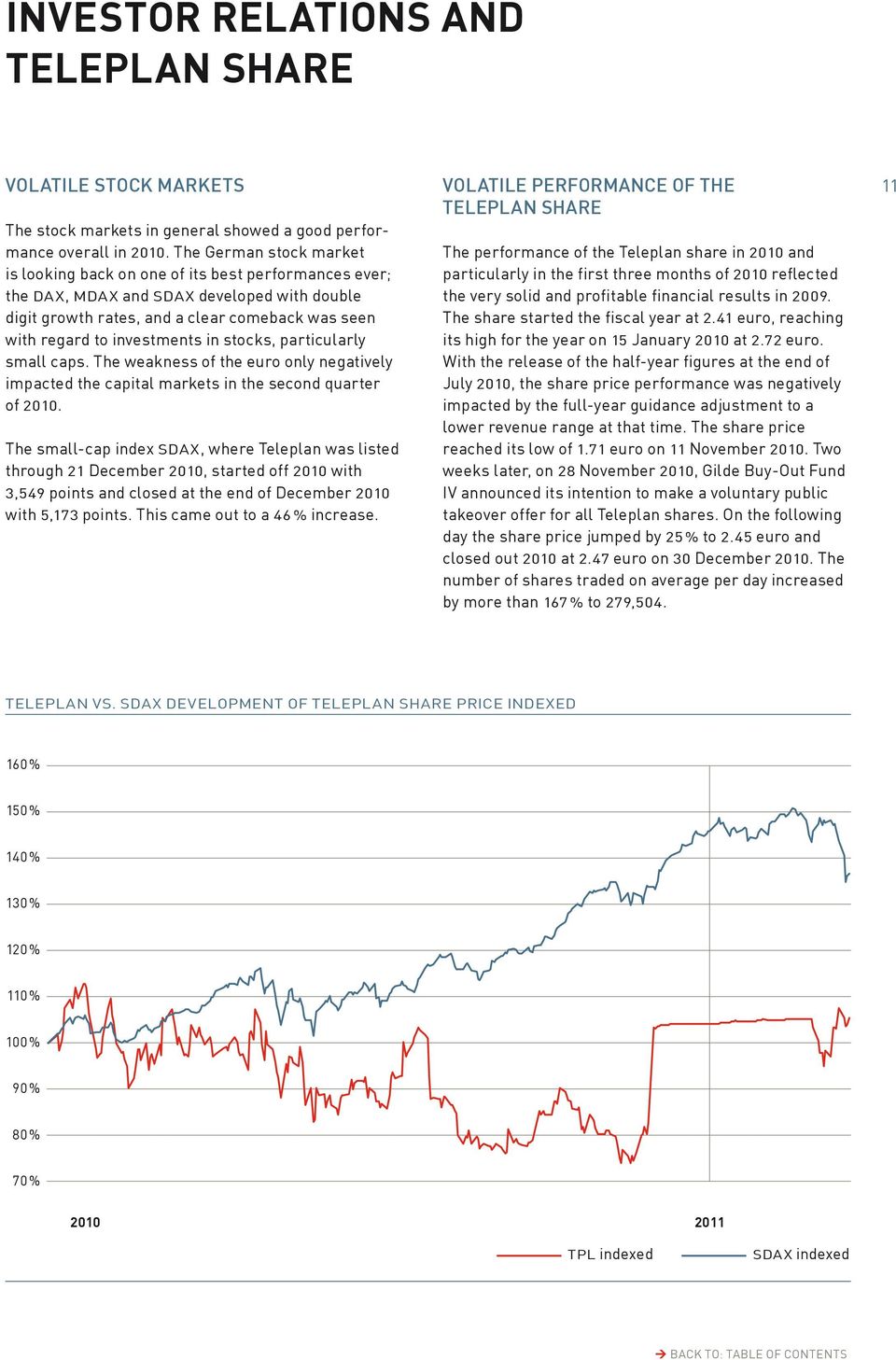
13 Investor Relations and Teleplan Share Volatile Stock Markets The stock markets in general showed a good performance overall in The German stock market is looking back on one of its best performances ever; the DAX, MDAX and SDAX developed with double digit growth rates, and a clear comeback was seen with regard to investments in stocks, particularly small caps. The weakness of the euro only negatively impacted the capital markets in the second quarter of The small-cap index SDAX, where Teleplan was listed through 21 December 2010, started off 2010 with 3,549 points and closed at the end of December 2010 with 5,173 points. This came out to a 46 % increase. Volatile Performance of the Teleplan Share The performance of the Teleplan share in 2010 and particularly in the first three months of 2010 reflected the very solid and profitable financial results in The share started the fiscal year at 2.41 euro, reaching its high for the year on 15 January 2010 at 2.72 euro. With the release of the half-year figures at the end of July 2010, the share price performance was negatively impacted by the full-year guidance adjustment to a lower revenue range at that time. The share price reached its low of 1.71 euro on 11 November Two weeks later, on 28 November 2010, Gilde Buy-Out Fund IV announced its intention to make a voluntary public takeover offer for all Teleplan shares. On the following day the share price jumped by 25 % to 2.45 euro and closed out 2010 at 2.47 euro on 30 December The number of shares traded on average per day increased by more than 167 % to 279, Teleplan vs. SDAX Development of Teleplan share price indexed 160 % 150 % 140 % 130 % 120 % 110 % 100 % 90 % 80 % 70 % TPL indexed SDAX indexed
14 INVESTOR RELATIONS AND TELEPLAN SHARE 12 Share Performance Data (Xetra Closing Prices in euro) In euro Year end Year high Year low Market capitalization [Year end / million euro] ,4 Number of shares traded on average per day [XETRA+Floor] 52,703 83,312 85, , ,596 Weighted average number of shares (million) Earnings Per Share [EPS], basic Earnings Per Share [EPS], fully diluted Operating cash flow per share (euro) Book value per share (euro) Directors Dealings In the year under review, one transaction with shares of the respective party was disclosed to Teleplan as an issuer in May. Gotthard Haug, Chief Executive Officer, purchased 15,000 shares at a price of 1.98 euro each. Extended Coverage from Sell-Side Analysts The re-entry into the SDAX on 21 December 2009 combined with the Management Board s ongoing emphasis on a proactive and continuous dialogue with the capital market raised the level of recognition of Teleplan. As a result, Commerzbank and the merchant bank Kempen & Co. began providing full coverage of the Teleplan share in summer In December 2010 Teleplan failed to meet the required market capitalization criteria of the German Stock Exchange and the SDAX. As a consequence, the Teleplan stock was delisted from the SDAX on 21 December 2010 and is now back in the German Prime Standard quality segment. Each release of quarterly results was followed by an analysts and investors conference call. The annual analysts conference took place at the German Equity Forum in Frankfurt, Germany, in November For the fourth year in a row, Teleplan s 2009 annual report won an award at the 2009 Vision Awards annual report competition. Teleplan received the gold award from the independent jury of the League of American Communications Professionals (LACP) for the 2009 report.
![5 149,4 Number of shares traded on average per day [XETRA+Floor] 52,703 83,312 85,717 104,726 280,596 Weighted average number of shares (million) 37.8 55.5 59.8 60.5 60.](/docs-images/43/5631329/images/page_14.jpg "5 Earnings Per Share [EPS], basic 0.21 0.06 0.11 0.29 0.33 Earnings Per Share [EPS], fully diluted 0.21 0.06 0.11 0.28 0.33 Operating cash flow per share (euro) 0.19 0.22 0.38 0.67 0.")
15 INVESTOR RELATIONS AND TELEPLAN SHARE Key share data Shareholder Structure (60.5 million shares), as of 31 December 2010 and reported to the company 13 ISIN Ticker Symbol Reuters Instrument Code NL TPL TELP.DE A Bloomberg Instrument Code TPL:GR Trading Segment Prime Sector Industry Group Indices Designated Sponsor Subscribed Capital at December 31, 2010 Class of Shares SDAX (until 21 December 2010) Industrial Industrial Product & Services Prime All Share, Classic All Share VEM Aktienbank AG 15,134, euro Bearer Shares G A Sterling Strategic Value % B Tinos Guernsey % C Cycladic Capital 4.19 % D Monolith Investment 5.73 % E Merval AG 5.47 % F Management Board 1.00 % G Free float % (as reported to the Company) B C D E F As of 8 March 2011 AMS Acquisition B.V., an acquisition company controlled by Gilde Buy-Out Fund IV, is the major shareholder of the company with a shareholding position of 94 %. AMS acquired its Teleplan position through a public takeover offer procedure.

16 14 corporate governance report 15 (I) Company Profile 15 (II) Structure 15 (III) Dutch Corporate Governance Code 16 (IV) Compliance with and Enforcement of the Code 17 (V) Other Information

17 Corporate Governance Report (I) Company Profile Teleplan was incorporated under Dutch law as a public limited liability company (naamloze vennootschap) on 13 August The Company s corporate seat is located in Amsterdam, the Netherlands, and its head office is at Amsterdam Airport Schiphol, the Netherlands. Teleplan is registered with the Commercial Register at the Chamber of Commerce and Industry for Amsterdam under No The Articles of Association were most recently amended by a notarial deed executed on 8 March The Company s fiscal year coincides with the calendar year. Teleplan shares are traded in the regulated market in the sub-sector Prime Standard at the Frankfurt Stock Exchange and over-the-counter (Freiverkehr) at the stock exchanges in Berlin, Düsseldorf, Hamburg, Hanover, Munich and Stuttgart. (II) Structure Teleplan has a two-tier board structure. Its Management Board is collectively responsible for the Company s management and thus for the realization of its (strategic) objectives as well as its strategy and policy. Teleplan s Supervisory Board is responsible for supervising and advising the Management Board as well as for monitoring the general performance of the Company. By supervising and advising the Management Board, the Supervisory Board also monitors the general affairs of the affiliated businesses and enterprises of Teleplan International N.V. The Supervisory Board has been carefully selected to include members with backgrounds and experience in fields related to Teleplan s core activities and with international experience in the foreign markets in which Teleplan is active. The Supervisory Board is assisted by the Company Secretary. The aim of supervision by the Supervisory Board is to realize Teleplan s objectives and strategy. Furthermore, the Supervisory Board monitors the design and operation of the internal risk management and control systems. Supervisory Board approval is required for certain Management Board resolutions as reflected in Teleplan s Articles of Association and in the respective rules and regulations of both the Supervisory Board and the Management Board. Three committees, which were appointed by the Supervisory Board from among its members, served during the 2010 financial year: (i) an Audit Committee, (ii) a Remuneration, Selection, and Appointment Committee, and (iii) a Strategy Committee. These committees prepared the decision-making process of the Supervisory Board and focused on supervising certain activities of the Management Board, among other tasks. Teleplan s General Meeting of Shareholders has the power to appoint, suspend and dismiss the members of the Management Board and the members of the Supervisory Board. The approval of the General Meeting of Shareholders is required for resolutions of the Management Board regarding a significant change in the identity or nature of the Company or the enterprise, as regulated in the Company s Articles of Association. Furthermore, the General Meeting of Shareholders resolves upon amendments to the Articles of Association, the dissolution of the Company, legal mergers or split-offs, the adoption of the financial statements, the making of interim dividends, profit reservation and appropriation, as well as the making of distributions from the Company s reserves. Finally, the General Meeting of Shareholders sets the remuneration policy for the Management Board, determines the remuneration of the members of the Supervisory Board, and may additionally remunerate the members of any Supervisory Board committee for their services. (III) Dutch Corporate Governance Code The Dutch Corporate Governance Code (the Code ) entered into force on 1 January The full text of the Code can be found on As a Dutch public company with limited liability whose shares are admitted to trading on a regulated market in the European Economic Area, Teleplan International N.V. is required to dedicate a chapter in its Annual Report to its compliance with the Code. Each company must indicate in its annual report to what extent it has complied with the principles and best practice provisions of the Code, and if not, give explanation. This is referred to as the apply or explain principle. 15

18 CORPORATE GOVERNANCE REPORT 16 Teleplan subscribes to the basic principle stated in the Code that a company is a long-term form of collaboration between the various stakeholders. The Management Board and the Supervisory Board have overall responsibility for taking these interests into account, with a general focus on ensuring continuity for the Company. In doing so, Teleplan endeavours to create long-term shareholder value. The majority of the principles and best practice provisions of the Code are common practice at the Company. Integrity, openness, supervision, transparent reporting and accountability are considered the pillars of Teleplan s corporate governance policy. In 2010, Teleplan ensured that its practice and procedures complied with the Code to the extent possible and desirable, taking into account the specific circumstances of the Company. (IV) Compliance with and Enforcement of the Code After evaluating its corporate governance in light of the principles and best practice provisions set out in the Code, Teleplan concluded that, in 2010, it substantially complied with the principles and best practice provisions, insofar as they apply. There are, however, a few exceptions, the most important of which are listed below. The numbering in this section follows the structure of the Code. In Relation to the Supervisory Board Best Practice Provision III.2.1 (Independence of Supervisory Board members) In the 2010 financial year, four members of Teleplan s Supervisory Board were not independent within the meaning of best practice provision III.2.2 of the Code. As a result of his previous appointment as a member of the Management Board in the years 2004 and 2005, Mr. Rolf Huber was deemed not independent according to best practice provision III.2.2 (a) of the Code. As a result of their positions in Sterling Strategic Value Limited ( Sterling ), the largest shareholder of the Company in 2010, both Mr. Massimo Pedrazzini (Chairman of the Board of Directors of Sterling) and Mr. Hendrikus Visser (Member of the Board of Directors of Sterling) were deemed not independent according to best practice provision III.2.2 (f) of the Code. As Managing Partner and Chief Investment Officer of Cycladic Capital LLC, an investment management firm representing three of the Company s major shareholders in 2010 (Cycladic Archipelago Fund, RIT Capital Partners Ltd., Tinos Guernsey Ltd.), Mr. Dimitri Goulandris was deemed not independent according to best practice provision III.2.2 (f) of the Code. At its meeting on 21 March 2007, the General Meeting of Shareholders amended the Company s Articles of Association and thereby allowed the appointment of more than one not independent Supervisory Board member. The General Meeting appointed Mr. Huber and Mr. Goulandris as members of the Supervisory Board on 21 March 2007, and Mr. Pedrazzini and Mr. Visser as members of the Supervisory Board on 17 December Teleplan is of the opinion that in view of the respective background, knowledge and experience of each of these members of the Supervisory Board, their appointment was in the best interest of the Company. Mr. Goulandris, Mr. Pedrazzini and Mr. Visser resigned from the Supervisory Board on 28 January Mr. Huber resigned from the Supervisory Board on 8 March Effective as of the same date, Mr. Boudewijn T. Molenaar and Mr. Nikolai R.D. Pronk were appointed as members of the Supervisory Board. As a result of their positions in Gilde Buy-Out Partners, Messrs. Molenaar and Pronk are deemed not independent according to best practice provision III.2.2 (f) of the Code. Best Practice Provision III.5.10 (Remuneration Committee) and Best Practice Provision III.5.14 (Selection and Appointment Committee) In view of the size of the Supervisory Board, the proposed members of both such committees would have consisted of the same persons. Therefore, in 2010 Teleplan had a combined Remuneration, Selection and Appointment Committee.

19 CORPORATE GOVERNANCE REPORT In Relation to the Shareholders and the General Meeting of Shareholders Best Practice Provision IV.3.6 (Posting of information on website that the Company is required to publish or provide) Teleplan will continue to update its website in 2011 and expects that all relevant information required to be posted will be available later this year. (V) Other Information Conflicts of Interest No (potential) conflicts of interest between Teleplan and the members of its Management Board or between Teleplan and legal or natural persons who hold at least 10 % of the shares in Teleplan were reported during the 2010 financial year. In this respect, the Company complied with Best Practice Provisions II.3.2 to II.3.4 and III.6.1 to III.6.4 of the Code. Anti-Takeover Measures Teleplan does not have any anti-takeover measures with the exclusive or near-exclusive purpose of frustrating future public bids on the shares in the capital of Teleplan in the event that no agreement is reached with the Management Board on such public bid. Furthermore, Teleplan does not have measures with the specific purpose of frustrating the attempts of a bidder, also once it has acquired 75 % of the shares in the capital of Teleplan, to appoint or dismiss members of the Management Board and subsequently amend the Articles of Association of Teleplan. To avoid any doubt, it should be noted that also in the event of (an attempt at) a hostile takeover, the Management Board and the Supervisory Board are authorized to exercise in the interest of Teleplan all powers attributed to them. Shareholders Rights and Additional Disclosures The Company s authorized share capital amounts to 16,250, euro and is divided into 65,000,000 shares. Each share is an ordinary bearer share with a par value of 0.25 euro and carries full dividend rights in accordance with the Company s Articles of Association. Each share must be paid in full upon issue. Currently, 60,537,859 shares of the Company are issued and outstanding. Each share entitles the holder to cast one vote at the General Meeting of Shareholders, with the exception of shares belonging to the Company or a subsidiary of the Company. The Company may acquire its own fully paid up shares in its own share capital for a consideration, subject to certain provisions of Dutch Law and the Articles of Association of the Company. Such acquisition may only take place if the General Meeting of Shareholders has authorized the Management Board to that end. The Annual General Meeting of Shareholders on 20 May 2010 resolved to authorize the Management Board for a period of 18 months or until the date on which the General Meeting would extend the authorization, if earlier, to acquire shares in the Company s share capital at any time during this period. In relation to the authorization granted on 20 May 2010, the maximum number of shares that the Company may hold in its own share capital at any one time shall not exceed 1 % of its issued share capital. Shares may be acquired through the stock market or otherwise, at a price between par value and the market price of the share (as quoted on the Frankfurt Stock Exchange on the day of the acquisition by or on behalf of the Company), provided that such market price shall not exceed the opening stock price on the day of the acquisition by or on behalf of the Company plus 10 %. Resolutions of the Management Board to acquire shares in the Company s share capital are subject to the approval of the Supervisory Board. 17

20 CORPORATE GOVERNANCE REPORT 18 The issue of shares shall be effected pursuant to a resolution of the Management Board if it has been designated for that purpose by the General Meeting of Shareholders. Any resolution of the Management Board to issue shares, if designated to do so, is subject to the prior approval of the Supervisory Board. The Annual General Meeting of Shareholders on 20 May 2010 resolved to authorize the Management Board for a period of 18 months or until the date on which the General Meeting would extend the authorization, if earlier, (a) to issue and grant subscription rights to shares within the limits of the Company s authorized share capital and (b) to restrict or exclude the preemptive rights allowed to shareholders by virtue of the law in respect of the issue of shares or the granting of subscription rights in conformity with (a), but only regarding shares issued pursuant to a decision of the Management Board. General Meetings of Shareholders shall be held as often as deemed necessary by the Management Board or the Supervisory Board, and must be held if one or more shareholders or holders of depositary receipts jointly representing at least one-tenth of the issued share capital make a written request to that effect to the Management Board or the Supervisory Board, specifying in detail the subjects to be discussed. If the General Meeting is not convened within six weeks of such a request, the applicants themselves may call the General Meeting with due observance of the Articles of Association and the law. At least one General Meeting of Shareholders shall be held annually no later than six months after the end of the financial year. The agenda of the Annual General Meeting shall contain, amongst others, the Management Board s annual report, the adoption of the annual accounts, the determination of the allocation of profits, the discharge of the members of the Management and Supervisory Board, the distribution of dividends, any substantial changes to the corporate governance structure, and any other item that has been put on the agenda by the Management or Supervisory Board in accordance with the Articles of Association. In addition, an item which is requested by one or more shareholders or holders of depositary receipts for shares, who acting solely or jointly represent at least one hundredth part of the issued share capital, shall be included in the agenda in accordance with the Articles of Association, provided such request is received no later than on the sixtieth day prior to the day of the General Meeting. The General Meeting of Shareholders resolves upon the appointment, suspension and dismissal of members of the Management Board and of members of the Supervisory Board in accordance with the Company s Articles of Association. Resolutions with regard to amending the Articles of Association may be passed by the General Meeting of Shareholders, without requiring a proposal of the Management Board and approval of the Supervisory Board. Under the Articles of Association, a resolution to pay dividends shall be addressed as a separate item on the agenda at the General Meeting of Shareholders. In general, the Management Board is authorized to reserve such amount of the profits as it, with the approval of the General Meeting, shall determine. The profits remaining after application of this reservation shall be at the free disposal of the General Meeting. The Management Board, with the approval of the
21 CORPORATE GOVERNANCE REPORT 19 Supervisory Board, as well as the General Meeting may resolve to make distributions on shares to the debit of the distributable part of the shareholders equity. Every shareholder has the right to attend a General Meeting in person or through written proxy, to address the General Meeting and to exercise voting rights in accordance with the Company s Articles of Association. For further information on the General Meeting of Shareholders, please refer to the Company s Articles of Association as published on As of 31 December 2010, direct or indirect stakes in the share capital of the Company exceeding 5 % of voting rights were reported in favour of Sterling Strategic Value Limited (with a stake of %), Tinos Guernsey Limited (10.97 %), Monolith N.V. (5.73 %) and Merval AG (5.47 %). Following the voluntary public takeover offer, on 8 March 2011 AMS Acquisition B.V., an acquisition company controlled by Gilde Buy Out Fund IV, held approximately 94 % stakes in the share capital of the Company indirectly through AMS Acquisition B.V. Disclosures of substantial holdings must be made to the Netherlands Authority for the Financial Markets (AFM). For more recent notifications, please refer to the AFM website. On authorization of the General Meeting of Shareholders, Teleplan introduced a Management Equity Incentive Plan on 26 October Under this plan, eligible employees (which include the members of the Management Board and key employees) can be granted share options. The maximum number of options to be granted is fixed, but can be adjusted annually. Options can, however, only be issued within the limits of the authorized share capital of the Company. In principle, all options have an exercise price that is determined upon the average market value of a Teleplan share within thirty calendar days preceding the grant date. The options have a term of seven years, and are partly exercisable as from one year after the grant date (3 years for the members of the Management Board). Further information on share-based compensation can be found on page 61. The Company s borrowing facility agreements and most of its commercial contracts contain standard change of control clauses under which some or all of the respective commitments may be cancelled in the event of a change of control.
22 20 group management report 21 Corporate Strategy 23 Analysis of the Income Statement 25 Discussion of Cash Flow and the Statement of Financial Position 26 Risk Management 29 Events after the end of the financial year 29 Declaration in accordance with Financial Supervision act 5.25C
23 Group management report CORPORATE STRATEGY Core Segments: The 3Cs Teleplan s core business refers to the 3C segments of Computer, Communications and Consumer Electronics. The focus of the Company s technological expertise lies in its ability to adapt to the needs of customers and their lines of business. Each segment is divided into product groups. These nine product groups are Storage, PC & Notebook, Display and Printer (Computer), Mobile and Networking (Communications) and Videocom, Gaming and Imaging (Consumer Electronics). NEW ORGANIZATIONAL STRUCTURE FOR FUTURE GROWTH In a constant effort to adapt to changes in the business environment, the Company has taken active steps to implement a customer-centric organization by placing more emphasis on sales and marketing as well as operations, while shifting its technology expertise inward. We have reviewed the range of services offered to our customers and came up with our lifecycle care model, from the point at which a company sells equipment through to the end of its lifecycle and even beyond. Implementing this new organizational structure was the last important milestone in taking an active approach to top-line growth within the Company s Lifecycle care for electronics strategy. The new organization, in place and effective since 1 July 2010, is comprised of two divisions: Sales & Marketing and Operations. In order to underline the importance of these two divisions, a new Executive Vice President of Operations was appointed in May The position of the Executive Vice President of Sales & Marketing is vacant and will be filled in the course of The businesses that Teleplan aims to address will not be limited to its existing segments. The Company s main customer segment has and will continue to be OEMs. However, plans entail expanding into growth markets including (but not limited to) after-market services for sectors ranging from retailers and insurers to operators and radio base stations. Teleplan will also begin to service the segment of recycling for device parts, thereby rounding off the complete lifecycle care for electronics as is embodied in the motto. The growth strategy is comprised of both organic growth and growth through acquisitions. 21 Teleplan s lifecycle care model for Electronics
24 GROUP MANAGEMENT REPORT 22 Teleplan s Employees Teleplan is a unique company where opposites unite and diversity is seen as a complementary strength. Its employees are challenged to use their entrepreneurial skills and encouraged to work closely in multi-capability teams. The Company also expects its staff to take a leading role in their professional contribution to Teleplan s success. Our Market With growth and an improvement to the top line as a new priority for the years ahead, Teleplan wants to be known and recognized as one of the leading industry experts. There are plenty of opportunities to do so. Looking at the core segment of original equipment manufacturers (OEMs), we have identified growth potential with existing and new customers in this segment. In addition to the OEM segment, we will also target the operator segment, where we see significant growth opportunities, especially with the roll-out of our already successful and proven in shop repair model. With the focus on these customer segments, there is additional potential in the BRIC countries and one clear focus in 2011 will be on developing the Brazilian market. Technology Outlook In order to remain competitive in a difficult market environment, Teleplan s customers continue to increase the complexity and functionality of their products and constantly seek out global partners in their attempt to outsource these non-core segments of their business. The result is more opportunities for Teleplan to expand. Looking at the 3Cs, the Communications segment will offer the most potential for growth at Teleplan. This is largely due to the emerging trend of smartphone devices. These phones offer consumers advanced capabilities and computer-like functions in the palm of their hand, thereby increasing mobility for the user. Examples include products that have dominated the market in the past, such as the Blackberry and iphone, as well as new phones being developed by major players like Microsoft and Google and other phones based on the Android operating system. The features of these devices go far beyond simply mobile phone communication to include and Internet use in addition to the now seemingly standard features of a camera/video camera, MP3 player, text messaging, a personal organizer and a great deal more. The rising popularity of apps, the term coined to describe the millions of software applications available on smartphone devices, is best described by Apple s motto: There s an app for that. The comprehensive functionality that these offer is largely responsible for the smartphone becoming a standard device among the increasingly tech-savvy population. Furthermore, the rising number of devices offering web capabilities gives consumers more access points to the Internet, thereby increasing the need for radio base stations. These stations provide the infrastructure for use of the advanced technology that smartphones offer. Many companies are under pressure to free up resources and focus on their core areas of business by outsourcing the maintenance and repair of these stations once they are in place. Netbooks maintain their position in the market. These computers allow the user to access the Internet from nearly anywhere in the world, as well as to send and receive s, access web-based applications and more. The added benefit of the technology is the size of the devices, which are generally anywhere from approximately five to twelve inches and weigh as little as two to three pounds. In 2010 Apple also launched a new product on the market called the ipad. Generally referred to as tablet PCs, these products feature nearly all of the functions of a netbook, yet are even smaller and are nearly as portable as a mobile phone. Sales of tablet PCs are expected to grow from 15 million units in 2010 to 50 million in Apple is not the only player here; many other companies are already entering the market. Teleplan therefore sees it as imperative to take up activities with this technology.
25 GROUP MANAGEMENT REPORT With regard to the Consumer Electronics segment, the business area of Videocom saw a shift resulting from the mandatory switch from analogue to digital broadcasting in the US in 2009 (despite the delay as a result of complications in issuing vouchers in order to make the transition affordable for viewers). Furthermore, trends in home entertainment continue to move away from standard definition and in the direction of high definition television and DVDs. High definition, or HD for short, is very rapidly becoming the new standard for viewers. 3D and Smart TVs are also emerging as a new future technology in entertainment. These devices as a general principle integrate television sets with the Internet, with a major focus on on-demand streaming of television and movies, often in 3D, as well as online interactive media. The technology also incorporates apps similar to those available on smartphones. At the moment this segment is dominated by just five brands, which together make up more than 99 % of the growing market. Studies have already shown that use of these devices is on the rise, and all indications suggest that the market trends will continue down this path in the future. One consequence is that devices are becoming more and more complex, and with greater complexity often comes greater potential for failure rates on the part of the hardware and equipment. In addition, if a company is under pressure to launch a product quickly in order to capitalize on the demand for it, this can sometimes come at the expense of careful design, structure and assembly of the phones. Manufacturers in these fields must tailor to the growing popularity of their products in order to keep up with the competition and to continue growing. Teleplan is in a position to help them focus their efforts on the core areas of expertise by taking care of their after-market needs. Analysis of the income statement The underlying trend of the financial results for 2010 demonstrated that the Company was able to maintain strong profitability. However, the third quarter 2010 was impacted by high costs associated with the discontinuation of a customer program in the Communications segment. Revenues for the 2010 financial year amounted to million euro and represent a decrease of 3.0 % from million euro in Eliminating the impact of exchange rates, in particular with a strengthened US dollar versus the euro, Teleplan s revenue decrease in 2010 would have been 5.2 %. Teleplan s product segments consist of Computer, Communications and Consumer Electronics. These segments contributed to the top line and the bottom line as follows: Revenue in the Computer segment decreased by 6.8 % to million euro in the financial year 2010 compared to million euro last year, due to the divestment of the Hamburg site at the end of 2009, the volume reduction of a fulfillment program and the scaling-down of lower-margin programs as well as transfer of business to a low-cost Teleplan site as part of the portfolio optimization strategy throughout The Communications segment continued to grow over last year by 7.6 % to 94.4 million euro in 2010 compared to 87.8 million euro in the 2009 financial year, despite the discontinuation of a customer service program within the segment in the third quarter. The segment continued to show robust growth in the network and smartphone business, as Teleplan is investing in expanding this segment. Revenue in the Consumer Electronics segment fell by 9.2 % to 62.1 million euro compared to 68.4 million euro last year. This decline in reported revenue was caused by a slow-down in repair volumes that began in the first quarter of 2010, following the introduction of updated, more reliable device models by a major customer, and the expiration of manufacturer warranty periods for the older models. Other business in the segment continued to grow, more than 20.3 % year-on-year and is helping to compensate for the volume slow-down. 23
26 GROUP MANAGEMENT REPORT 24 strong profitability in the computer segment Computer Communication Consumer Electronics 131,0 122,0 87,8 94,4 68,4 62,1 10,5 8,3 16,1 14,2 11,4 11,8 6,2 7,1 10,2 10,4 4,7 6, in million euro Revenue EBITDA EBIT Raw materials and consumables used in 2010 were 3.1 % lower than the previous year. Gross margin as a percentage of revenue at 60.9 % versus 60.8 % in the previous year. Personnel costs amounted to million euro in 2010 versus 2009, an improvement of 2.0 %. The strict control over the headcount, which contributed to improved results in 2009, has continued into The total headcount was 8,9 % lower at 5,408 as of 31 December 2010 compared to 5,939 as of 31 December Staff costs as a percentage of revenue were 36.4 %, a figure marginally higher than last year (2009: 36.0 %) mainly caused by volume reduction in the low margin fulfillment activities in the Computer segment. Other operating costs increased by 3.5 % to 38.7 million euro compared to 2009, reflecting investments in growth areas expected to deliver new revenue streams in Earnings before interest, taxes, depreciation and amortization [EBITDA] fell from 33.8 million euro in 2009 to 29.5 million euro in 2010, thus representing an EBITDA margin of 10.6 % (2009: 11.8 %). This margin reduction reflects additional costs incurred during the second half of 2010 due to the discontinuation of a customer program in the Communications segment. Improvements to the operating performance in the Computer segment, as part of Teleplan s portfolio optimization, more than compensated for the revenue decline, causing the segment EBITDA margin to climb from 8.1 % in 2009 to 13.2 % in The EBITDA for the segment was 16.1 million euro (2009: 10.5 million euro). The Communications segment results were impacted by the additional costs for winding down a customer service program in the second half of 2010, investment expenditures in network engineering and pricing pressure in the segment. EBITDA for the segment was 6.2 million euro compared to 11.4 million euro last year. EBITDA margin fell from 13.0 % in 2009 to 6.5 % in EBITDA margin in the Consumer Electronics segment fell from 17.2 % (11.8 million euro) to 11.4 % (7.1 million euro). The drop in segment EBITDA is due to lower repair volumes. Amortization and depreciation amounted to 4.6 million euro in 2010, a figure lower than the 4.8 million euro posted last year due to the expiration of a property lease in 2009 that attracted depreciation on leasehold improvements. Operating profit (EBIT) fell with 13.8 % to 24.9 million euro, resulting in a 2010 EBIT margin of 9.0 % compared to an EBIT margin of 10.1 % in 2009.
27 GROUP MANAGEMENT REPORT Net financial expenses have been reduced from 6.8 million euro in 2009 to 3.8 million euro in The reduction in financial costs follows the early repayment of loans in 2009 including fees paid in 2009 associated with these early repayments. The income tax charge amounted to 0.9 million euro and included a 1.6 million euro tax credit on the liquidation of ESL Canada Ltd. Given the lower tax charge of 0.9 million euro (2009: 4.7 million euro), net income increased by 15.8 % to 20.2 million euro (2009: 17.5 million euro). Consequently, basic earnings per share increased to 0.33 compared to 0.29 last year. Total comprehensive income is 24.8 million euro (2009: 17.8 million euro) comprehensive income includes other comprehensive income of 4.4 million euro related to exchange differences upon the translation of foreign operations into euro (2009: negative 0,9 million euro). Other comprehensive income measures income and expenses that are not recognized in profit or loss (e.g. translation of gains and losses, effective gains/losses on hedging instruments in a cash flow hedge). Discussion of the Cash Flow and Statement of the Financial Position Cash used in financing activities was an outflow of 7.9 million euro due to loan repayments and a 3.6 million euro dividend. Total assets as of 31 December 2010 amounted to million euro (31 December 2009: million euro). Compared to 2009, non-current assets increased by 4.6 million euro to 67.8 million euro mainly driven by investing activities. Current assets increased by 10.5 million euro to 93.4 million euro, mainly caused by the increase in inventory together with a foreign currency translation impact. Cash and short-term deposits decreased by 0.7 million euro to 16.0 million euro (2009: 16.7 million euro). Total liabilities fell by 4.8 million euro as of 31 December 2010 compared to 31 December 2009, thereby reflecting the reduction of borrowings and provisions. Total equity increased by 21.2 million euro to 72.0 million euro as of 31 December 2010 (31 December 2009: 50.8 million euro), reflecting the 2010 net income, currency translations on foreign operations and a 3.6 million euro dividend distribution. Total equity as a percentage of the balance sheet total improved by 9.9 percentage points to 44.7 % as of 31 December 2010 compared to the previous year. 25 In 2010, cash-generated from operations came out to 20.2 million euro compared to 40.1 million euro for last year. This result followed a 5.9 million euro increase in net working capital (2009: 5.0 million euro decrease) and a 3.4 million euro reduction in provisions. Assets 43% 42% Equity & liabilities 45% 35% The 2010 net working capital increase includes a 5.8 million euro increase in inventory (2009: 2.7 million euro decrease) arising from material parts for newly launched customer service programs and materials procurement in response to a global parts shortage that is driving increased minimum order quantities in all segments. 57% 58% 14% 41% 24% 41% Net cash from operations after financial expenses and income tax paid for 2010 is 13.5 million euro compared to 31.2 million euro last year. Net cash used in investing activities increased by 2.7 million euro to 6.0 million euro compared with last year (2009: 3.2 million euro), thus reflecting investments in new customer programs and the acquisition of EuroTwice (now: Teleplan Belgium) effective 1 September Non-current assets Current assets Equity Non-current liabilities Current liabilities
28 GROUP MANAGEMENT REPORT 26 Risk Management Introduction The following sections present an overview of Teleplan s approach to risk management and business control as well as a description of the nature and extent of its exposure to risk. Teleplan recognizes the following risk categories: strategic risks, market risks, operational risks, compliance risks and financial risks. These are described in the Risk Categories section of this annual report. The risk overview highlights the main risks that may hinder Teleplan in achieving its strategic objectives. The overview may not include all the risks that Teleplan may ultimately face. Some risks not yet known to the Company, or currently believed not to be material, could later turn out to have a major impact on its businesses, objectives, revenues, assets, liquidity or capital resources. Risk Management Approach The Management Board views risk management as an integral part of running Teleplan s business. It is responsible for ensuring that the Company complies with applicable laws and regulations as well as for properly financing the Company and identifying and managing the risks that it faces. The Management Board periodically reports on and accounts for internal risk management and control systems to the Supervisory Board. Risk Categories Taking risks is an inherent part of entrepreneurial behavior. A structured risk management process allows the management to take calculated risks in a controlled manner. Teleplan has a structured risk management process that recognizes strategic risks, market risks, operational risks, compliance risks and financial risks. Strategic risks include threats and opportunities that influence Teleplan s strategic ambitions. Market risks cover the effect that changes in the market may have on Teleplan, including any economic and political developments that are likely to affect all market participants in a similar manner. Operational risks include adverse, unexpected developments that result from internal processes, people and systems, or external events that are linked to the actual running of each business (examples include the logistics process and supply chain management). Compliance risks cover unanticipated failures to comply with or enact appropriate policies and procedures. Within the area of financial risk, Teleplan identifies interest rate risks, foreign currency risks, credit risks and fiscal risks. Risk Profile Under the explicit understanding that this is not an exhaustive enumeration, Teleplan faces the following main operational and financial risks, not listed in order of importance: Strategic risks: Dependence on a limited number of key customers in certain areas; Tax compliance and reporting risk the Company is becoming increasingly profitable in many jurisdictions, increasing the implications of business decisions. Market risks: Rapid developments in the IT and telecommunications industries which may adversely affect Teleplan s services; Dependence on outsourcing trends by manufacturers and integrators and on continued consumer demand for in- and out-of-warranty after-market services; Limited barriers to entry for new competitors and consolidation by existing competitors in certain segments. Operational risks: Suboptimal capacity planning and usage due to the unpredictability of the volume of repair services demanded; Dependence on key personnel; Dependence on IT for efficient operational activities, managing financial performance and customer delivery increases the risk of IT continuity.
29 GROUP MANAGEMENT REPORT Compliance risks: Global and cross-border procurement activities increases the complexity of maintaining appropriate import/export documentation; Failure to enact company policies and procedures across Teleplan s global footprint; Operating in multiple countries presents unique local regulatory compliance requirements in different markets. Financial risks: Foreign exchange exposure; Interest rate exposure; Tax exposure from transfer pricing. There may be current risks that the Company has not fully assessed or that are currently identified as not having a significant impact on the business, but which could, at a later stage, develop into a significant potential impact on the Company s business. The current risk management and control systems as well as the planned improvements (see below) are aimed at timely discovery of such developments. Control Systems The Management Board is responsible for managing the risks that the Company faces. The Company s internal risk management and control systems include the following key elements: The structure of the Company is such that everyone s responsibility is clearly defined and results are measurable. Teleplan s structure with centralized responsibilities on a global level, represented in an executive management team, support this philosophy; Market coverage and market analysis on a regional level, in order to identify developments and trends in the industry, to react to changing customer demand as well as to acquire new customers; Regular strategic meetings on a corporate level aimed at preserving and expanding the competitiveness of the Company, as well as at possible strategic acquisitions and restructurings and the integration thereof; Local management provides representation letters regarding their financial reporting; Monitoring of operations is achieved through monthly performance reviews by the Management Board, in which efficiency programs have played an important role. These reviews also address capacity planning and effective HR management; A planning and control cycle is in place. Regular budget-forecast-actual variance analyses are made. Financial Key Performance Indicators (KPI s) have been formalized for the Company; The corporate functions operate to formal procedures; The Company takes recommendations by the external auditors seriously; The Company s centralized data center is outsourced to a large professional partner; It is common practice for customers to conduct site or program audits. In addition, quarterly business reviews are performed together with major customers. Effectiveness The proper design of risk management and control systems reduces but cannot fully eliminate the possibility of poor judgment in decision-making, human error, control processes being deliberately circumvented by employees and others, management overriding controls and the occurrence of unforeseeable circumstances. The Management Board is aware of the fact that the risk management and control systems can only provide reasonable assurance that objectives will be met in the areas of strategy, operations, reporting and compliance, also due to cost/benefit considerations regarding possible risk responses. In this context, reasonable assurance refers to the degree of certainty that would be satisfactory for a prudent manager in the management of her/his affairs in the given circumstances. During the year under review, certain issues were identified as in need of improvement within the existing risk management and control processes. Appropriate measures were taken in these areas and the risk management system was enhanced. Taking into consideration the above limitations, the Management Board is of the opinion that the internal reporting mechanisms, the planning and control cycle and the existing charters, policies, procedures, 27
30 GROUP MANAGEMENT REPORT 28 instructions and manuals provide reasonable assurance that: financial reporting does not contain any material inaccuracies; and internal risk management and control systems worked properly during The review of the Company s risk management and control systems was effectively performed by its internal audit function and through periodical operations reviews by the Management Board. The findings and results were discussed between the Management Board and the Supervisory Board. Weaknesses and Failings The Company has not identified material weaknesses or failings regarding the achievement of the reporting, strategic, operational and compliance objectives. The achievement of these objectives in 2011 will be further secured through the implementation and further application of the improvements discussed in the next paragraph. Improvements Planned Teleplan will continue to improve relevant policies and procedures. In pursuing a continuous improvement of the adequacy and effectiveness of the risk management and control systems, the continued emphasis will be on the following in 2011: Continued improvement of internal representations from various management levels through adapted regulations; Further improvement of the efficiency of the control system through the implementation and application of both internal and external authority regulations; Further enhancement of the employee performance review process through standardized processes and procedures linked to the performance of the individual employees and adaptable to the needs of the organization; Continuous monitoring of the embedded risk and control reporting in the existing management information process; Further formalization and rationalization of the financial statement closing process; Increasing automation of the financial reporting process and reduction of manual interfaces; Detailed reporting from the Group s internal audit function, with regular updates to the Supervisory Board and subsequent discussions. The above points have been discussed with the Supervisory Board.
31 GROUP MANAGEMENT REPORT Events after the end of the financial year Please see note 28 of the NOTES TO THE CONSOLIDATED FINANCIAL STATEMENTS. Declaration in accordance with financial supervision act 5.25C To the best of our knowledge, and in accordance with the applicable consolidated reporting principles, the consolidated financial statements give a true and fair view of net assets, financial position and result of operations of the Group. The Group management report includes a fair review of the development and performance of the business and the position of the Group, together with a description of the principal opportunities and risks associated with the expected development of the Group. 29 Schiphol, 6 April 2011 Teleplan International N.V. The Management Board
32 30 consolidated financial statements Consolidated Income Statement 32 Consolidated Statement of Comprehensive Income 33 Consolidated Cash Flow Statement 34 Consolidated Statement of Financial Position 36 Consolidated Statement of Changes in Equity
33 CONSOLIDATED FINANCIAL STATEMENTS
34 Consolidated Income Statement 32 Amounts in thousands of euro unless otherwise stated Notes Revenue 4 278, ,191 Raw materials and consumables used 108, ,513 Personnel costs 5 101, ,524 Other operating costs 38,689 37,388 EBITDA 29,479 33,766 Amortization of intangible fixed assets and impairment of goodwill 10 1,093 1,021 Depreciation of fixed assets 11 3,447 3,824 Operating income (EBIT) 24,939 28,921 Interest income and other financial income 1, Interest expense and other financial expenses 5,244 7,435 Financial expenses, net 6 3,797 6,794 Income before tax 21,142 22,127 Income tax ,675 Net income for the year 20,205 17,452 Attributable to: Equity holders of the parent company 20,205 17,452 Net income for the year 20,205 17,452 Earnings per share in euro: 9 Basic, for profit for the year attributable to ordinary equity holders of the parent company Fully diluted, for profit for the year attributable to ordinary equity holders of the parent company Consolidated statement of Comprehensive income Amounts in thousands of euro unless otherwise stated Notes Net income for the year 20,205 17,452 Exchange differences on translation of foreign operations 4, Gain (loss) on fair value of cash flow hedge ,321 Other comprehensive income for the year, net of tax 4, Total comprehensive income for the year, net of tax 24,835 17,850 Attributable to: Equity holders of the parent company 24,835 17,850 24,835 17,850
35 Consolidated Cash Flow Statement Amounts in thousands of euro unless otherwise stated Notes Operating activities Income before tax 21,142 22,127 Income before tax 21,142 22, Adjustment to reconcile income before tax to net cash flows Depreciation and impairment of property, plant and equipment 11 3,447 3,824 Amortization and impairment of intangible fixed assets 10 1,093 1,021 Share-based payment expense Financial and interest expenses, net 6 3,797 6,794 Movement in provisions and retirement benefit obligation 3,374 1,010 26,140 35,108 Movements in working capital Decrease / (increase) in inventories 5,820 2,656 Decrease / (increase) in trade and other receivables 70 1,357 Increase / (decrease) in trade and other payables 167 3,717 Cash generated from operations 20,223 40,124 Interest paid 1,633 4,439 Other financial expenses 402 2,154 Income taxes paid 4,703 2,324 Net cash from operating activities 13,485 31,207 Investing activities Acquisition of new subsidiary, net of cash acquired Investments in property, plant and equipment 11 4,700 3,267 Disposal of property, plant and equipment Investments in intangible assets 10 1, Net cash used in investing activities 5,970 3,237 Financing activities Proceeds from borrowings 19 28,792 Repayment of borrowings 19 33,023 27,304 Exercise of share options 804 Dividend paid 16 3,637 Net cash used in financing activities 7,868 26,500 Net increase / decrease in cash and cash equivalents 353 1,470 Net foreign exchange rate difference Cash and short-term deposits at 1 January 16,656 15,757 Cash and short-term deposits at 31 December 14 15,950 16,656
36 CONSOLIDATED STATEMENT OF FINANCIAL POSITION 34 Amounts in thousands of euro unless otherwise stated Notes Assets Non-current assets Intangible assets 10 45,603 44,409 Property, plant and equipment 11 13,601 11,060 Deferred tax assets 8 8,586 7,679 Total non-current assets 67,790 63,148 Current assets Inventories 12 16,477 9,848 Trade and other receivables 13 55,990 52,913 Prepaid expenses 2,232 2,554 Current income tax 2, Cash and short-term deposits 14 15,950 16,656 Total current assets 93,400 82,897 Total assets 161, ,045
37 CONSOLIDATED FINANCIAL STATEMENT Amounts in thousands of euro unless otherwise stated Notes Equity & liabilities Equity Issued capital 15 15,134 15,134 Share premium 156, ,673 Retained earnings 52,601 69,735 Currency translation reserve 46,655 51,079 Share warrants Cash flow hedge reserves Total equity 72,029 50,796 Non-current liabilities Long-term borrowings 19 17,880 29,764 Retirement benefit obligations 20 1,732 3,185 Provisions 21 1, Derivative financial instruments Deferred tax liabilities Total non-current liabilities 22,035 34,647 Current liabilities Short-term borrowings 19 10,858 2,500 Trade and other payables 22 45,752 41,651 Accrued liabilities 7,363 9,220 Current income tax 2,705 4,693 Provisions ,538 Total current liabilities 67,126 60,602 Total liabilities 89,161 95,249 Total equity and liabilities 161, ,045
38 CONSOLIDATED STATEMENT OF CHANGES IN EQUITY 36 Amounts in thousands of euro Notes Share capital Attributable to equity holders of the parent Share premium Retained earnings Currency translation reserve Share warrants Cash flow hedge reserves Total equity Balance at 1 January , ,044 88,844 50,156 1,856 2,049 31,810 Net income for the year 17,452 17,452 Other comprehensive income 923 1, Total comprehensive income 17, ,321 17,850 Issue of shares Expiry of warrants 17 1,325 1,325 Share-based compensation Balance at 31 December , ,673 69,735 51, ,796 Balance at 1 January , ,673 69,735 51, ,796 Net income for the year 20,205 20,205 Other comprehensive income 4, ,630 Total comprehensive income 20,205 4, ,835 Issue of shares Expiry of warrants Share-based compensation Dividend Distribution 16 3,637 3,637 Balance at 31 December , ,673 52,601 46, ,029
39 Notes to the Consolidated Financial Statements company financial statements Note 1 38 Corporate information note 2 38 Basis of preparation and compliance with accounting policies note Basis of preparation note Changes in accounting policies note Significant accounting judgements, estimates and assumptions note 3 42 Summary of significant accounting policies note 4 52 Segment information note 5 54 Personnel costs note 6 54 Financial expenses note 7 54 Components of other comprehensive income note 8 55 Income tax note 9 56 Earnings per share note Intangible assets note Property, plant and equipment note Inventories note Trade and other receivables note Cash and short-term deposits note Share capital and share premium note Dividend and interim distribution note Share warrents note Share-based compensation note Borrowings note Retirement benefit obligations note Provisions note Trade and other payables note Commitments and contingencies note Related party disclosures note Financial risk management objectives and policies note Financial instruments note Business combinations note Events after the balance sheet date 75 Company financial statements 76 notes to the company Note 1 76 General financial statements note 2 76 Intangible assets note 3 77 Property, plant and equipment note 4 77 Financial fixed assets note 5 78 Receivables note 6 78 Cash and short-term deposits note 7 78 Equity note 8 78 Provisions note 9 78 Borrowings note Other liabilities note Commitments and contingencies note Remuneration of the management board and supervisory board note Financial instruments note Audit fees
40 NOTES TO THE CONSOLIDATED FINANCIAL STATEMENTS 38 Note 1 Corporate information The financial statements of Teleplan International N.V. ( Teleplan, the Company or the Group ) were authorized for issue in accordance with a resolution of the Supervisory Board on 6 April Teleplan International N.V. is a limited liability company incorporated on 13 August 1998 with its corporate seat in Amsterdam and head office in Schiphol, the Netherlands. The shares of Teleplan are publicly traded on the Frankfurt stock exchange. The principal activities of the Group are described in note 4 of this annual report. Note 2 BASIS OF PREPARATION AND Compliance with accounting policies Note 2.1 BASIS OF PREPARATIon The consolidated financial statements have been prepared on a historical cost basis except for certain financial instruments that are measured at fair value as described further in the notes below. The consolidated financial statements are presented in euro and all values are rounded to the nearest thousand (euro 000) except when otherwise indicated. Statement of Compliance The consolidated financial statements of the Group are prepared in accordance with International Financial Reporting Standards (IFRS) as adopted by the European Union (EU). Basis of consolidation The consolidated financial statements comprise the financial statements of Teleplan International N.V. and its subsidiaries as of 31 December of the respective year. The financial statements of the subsidiaries are prepared for the same reporting year as the parent company using consistent accounting policies. All intra-group balances, transactions, income, expenses, profit and losses resulting from intra-group transactions are eliminated in full. Subsidiaries are fully consolidated from the date of acquisition, i.e. the date on which the Group obtains control, and continue to be consolidated until the date that such control ceases. For a list of subsidiaries, please refer to note 24 of these financial statements. Note 2.2 CHANGES IN ACCOUNTING POLICIES The accounting policies adopted are consistent with those of the previous financial year except as follows: The Group has adopted the following new and amended IFRS and IFRIC interpretations as of 1 January 2010: IFRS 2 Share-based Payment Group Cash-settled Share-based Payment Arrangements, effective 1 January 2010 IFRS 3 Business Combinations (Revised) and IAS 27 Consolidated and Separate Financial Statements (Amended), effective 1 July 2009 IAS 39 Financial Instruments: Recognition and Measurement Eligible Hedged Items, effective 1 July 2009 IFRIC 12 Service Concession Arrangements, effective 1 April 2009 IFRIC 15 Agreements for the Construction of Real Estate, effective 1 January 2010 IFRIC 16 Hedges of a Net Investment in a Foreign Operation, effective 1 July 2009 IFRIC 17 Distributions on Non-cash Assets to Owners, effective 1 November 2009 IFRIC 18 Transfers of Assets from Customers, effective 1 November 2009 Improvements to IFRSs (Issued May 2008), effective 1 January 2010
41 NOTES TO THE CONSOLIDATED FINANCIAL STATEMENTS Improvements to IFRSs (Issued April 2009), effective 1 January 2010 IFRS Practice Statement Management Commentary, effective 8 December 2010 When the adoption of the standard or interpretation is deemed to have an impact on the financial statements or the performance of the Group, its impact is described below: IFRS 3 Business Combinations (Revised) and IAS 27 Consolidated and Separate Financial Statements (Amended) IFRS 3 (Revised) introduces significant changes in the accounting for business combinations occurring after this date. Changes affect the valuation of noncontrolling interest, the accounting for transaction costs, the initial recognition and subsequent measurement of a contingent consideration and business combinations achieved in stages. These changes will impact the amount of goodwill recognized, the reported results in the period that an acquisition occurs and future reported results. IAS 27 (Amended) requires that a change in the ownership interest of a subsidiary (without loss of control) is accounted for as a transaction with owners in their capacity as owners. Therefore, such transactions will no longer give rise to goodwill, nor will it give rise to a gain or loss. Furthermore, the amended standard changes the accounting for losses incurred by the subsidiary as well as the loss of control of a subsidiary. IAS 39 Financial Instruments: Recognition and Measurement Eligible Hedged Items The amendment clarifies that an entity is permitted to designate a portion of the fair value changes or cash flow variability of a financial instrument as a hedged item. This also covers the designation of inflation as a hedged risk or portion in particular situations. IFRIC 18 Transfers of Assets from Customers IFRIC 18 applies to all entities that receive from customers an item of property, plant and equipment or cash for the acquisition or construction of such items. These assets are then be used to connect the customer to a network or to provide ongoing access to a supply of goods or services, or both. The interpretation provides guidance on when and how an entity should recognize such assets. Improvements to IFRSs (Issued April 2009) In April 2009, the IASB issued a second omnibus of amendments to its standards, primarily with a view to removing inconsistencies and clarifying wording. There are separate transitional provisions for each standard. The adoption of the following amendments resulted in changes to accounting policies but did not have any impact on the financial position or performance of the group: IFRS 8 Operating Segment Information: Clarifies that segment assets and liabilities need only be reported when those assets and liabilities are included in measures that are used by the chief operating decision maker. IAS 1 Presentation of Financial Statements: Clarifies that the terms of a liability that could result, at any time, in its settlement by the issuance of equity instruments at the option of the counterparty do not affect its classification. IAS 7 Statement of Cash Flows: Explicitly states that only expenditure that results in recognizing an asset can be classified as a cash flow from investing activities. IAS 18 Revenue: The IASB has added guidance (which accompanies the standard) to determine whether an entity is acting as a principal or as an agent. The features to consider are whether the entity: Has primary responsibility for providing the goods or service Has inventory risk Has discretion in establishing prices Bears the credit risk The Group has assessed its revenue arrangements against these criteria and concluded that it is acting as principal in all arrangements. The revenue recognition accounting policy has been updated accordingly. IAS 36 Impairment of Assets: Clarifies that the largest unit permitted for allocating goodwill, acquired in a business combination, is the operating segment as defined in IFRS 8 before aggregation for reporting purposes. 39
42 NOTES TO THE CONSOLIDATED FINANCIAL STATEMENTS 40 IAS 38 Intangible Assets: Clarifies that if an intangible asset acquired in a business combination is identifiable only with another intangible asset, the acquirer may recognise the group of intangible assets as a single asset provided the individual assets have similar useful lives. Clarifies that valuation techniques presented for determining the fair value of intangible assets acquired in a business combination that are not traded in active markets are only examples and are not restrictive in the methods that can be used. Other amendments resulting from improvements to IFRSs to the following standards did not have any impact on the accounting policies, financial position or the performance of the Group: IFRS 2 Share-based Payment IFRS 5 Non-current Assets Held for Sale and Discontinued Operations IAS 17 Leases IAS 39 Financial Instruments: Recognition and Measurement IFRIC 9 Reassessment of Embedded Derivatives IFRIC 16 Hedges of a Net Investment in a Foreign Operation Future changes in accounting policies The Group anticipates that these changes will have no material effect on the financial statements, except for: IFRS 7 Financial Instruments: Disclosures The amendments to IFRS 7 are effective for annual periods beginning on or after 1 July 2011 and will improve the understanding of transfer transactions of financial assets including understanding the possible effects of any risks that may remain with the entity that transferred the assets. The amendments also require additional disclosures if a disproportionate amount of transfer transactions are undertaken around the end of a reporting period. IFRS 9 Financial Instruments IFRS 9 as issued reflects the first and second phase of the IASBs work on the replacement of IAS 39 and applies to classification and measurement of financial assets and liabilities as defined in IAS 39. The standard is effective for annual periods beginning on or after 1 January In subsequent phases, the IASB will address hedge accounting, de-recognition and asset and liability offsetting. The completion of this project is expected in early The adoption of the first phase of IFRS 9 will have an effect on the classification and measurement of the Group s financial assets. The Group will quantify the effect in conjunction with the other phases, when issued, to present a comprehensive picture. Standards issued but not yet effective up to the date of issuance of the Group s financial statements are listed below: IFRS 7 Financial Instruments: Disclosures Amendment to Disclosures*, effective 1 July 2011 IFRS 9 Financial Instruments, effective 1 January 2013 IAS 12 Income Taxes Recovery of Tax Assets*, effective 1 January 2012 IAS 24 Related Party Disclosures (Revised), effective 1 January 2011 IAS 32 Financial Instruments: Presentation Classification of Rights Issues, effective 1 February 2010 IFRIC 14 Prepayments of a Minimum Funding Requirement, effective 1 January 2011 IFRIC 19 Extinguishing Financial Liabilities with Equity Instruments, effective 1 July 2010 Improvements to IFRSs (Issued May 2010)*, effective 1 January 2011 Improvements to IFRSs (Issued May 2010) In May 2010, the IASB issued a third omnibus of amendments to its standards, primarily with a view to removing inconsistencies and clarifying wording. There are separate transitional provisions for each standard: IFRS 1 First-Time Adoption of IFRS Accounting policy changes in the year of adoption Revaluation basis as deemed cost Use of deemed cost for operations subject to rate regulation IFRS 3 Business Combinations Transition requirements for contingent consideration from a business combination that occurred before the effective date of the revised IFRS Measurement of non-controlling interests Un-replaced and voluntarily replaced share-based payment awards * Not yet endorsed by the EU as per 27 December 2010
43 NOTES TO THE CONSOLIDATED FINANCIAL STATEMENTS IFRS 7 Financial Instruments: Disclosures Clarifications of disclosures IAS 1 Presentation of Financial Statements Clarification of statement of changes in equity IAS 27 Consolidated and Separate Financial Statements Transition requirements for amendments made as a result of amended IAS 27 to IAS 21, IAS 28 and IAS 31 IAS 34 Interim Financial Reporting Significant events and transactions IFRIC 13 Customer Loyalty Programs Fair value of award credit The Group has studied the improvements and is currently assessing its impact. Note 2.3 SIGNIFICANT ACCOUNTING ESTIMATES AND ASSUMPTIONS Judgments The preparation of the Group s consolidated financial statements requires management to make judgments, estimates and assumptions that affect the reported amounts of revenues, expenses, assets and liabilities, and the disclosure of contingent liabilities, at the end of the reporting period. However, uncertainty about these assumptions and estimates could result in outcomes that require a material adjustment to the carrying amount of the asset or liability affected in future periods. Estimates and assumptions The key assumptions concerning the future and other key sources of estimation uncertainty at the balance sheet date, that have a significant risk of causing a material adjustment to the carrying amounts of assets and liabilities within the next financial year are discussed below. Impairment of Goodwill The Group determines whether goodwill is impaired on at least an annual basis. This requires an estimation of the value in use of the cash-generating units to which the goodwill is allocated. Estimating the value in use requires that the Group makes an estimate of the future cash flows from the cash-generating units and also chooses a suitable discount rate in order to calculate the present value of those cash flows. Share-based Payment The Group measures the cost of equity-settled transactions with employees by reference to the fair value of the equity instruments at the date on which they are granted. Estimating fair value requires determining the most appropriate valuation model for granting equity instruments, which is dependent on the terms and conditions of the grant. This also requires determining the most appropriate inputs to the valuation model, including the expected life of the option, volatility and dividend yield and making assumptions about them. Deferred Tax Assets Deferred tax assets are recognized for time differences and unused tax losses to the extent that it is probable that taxable profit will be available against which the losses can be utilized. The management s judgment is required to determine the amount of deferred tax assets that can be recognized, based on the likely timing and level of future taxable profits together with future tax planning strategies. Further details are provided in note 8. Provisions The Group recognizes provisions related to transition of business activities to low cost sites. Provisions associated with headcount reductions are assessed based on agreements made to fulfil obligations to fund social plans, as required under local employment jurisdictions. In addition, and as applicable, an assessment is made in respect of the present value of any remaining lease and other associated long term obligations. Further details are provided in note 21. Pension and Other Post-Employment Benefits The cost of defined benefit pension plans and other post-employment benefits is determined using actuarial valuations. The actuarial valuation involves making assumptions about discount rates, expected rates of return on assets, future salary increases, mortality rates and future pension increases. Due to 41
44 NOTES TO THE CONSOLIDATED FINANCIAL STATEMENTS 42 the long-term nature of these plans, such estimates are subject to significant uncertainty. Further details are provided in note 20. Fair Value of Financial Instruments The fair value of financial instruments actively traded in organized financial markets is determined by reference to quoted market bid prices at the close of business on the balance sheet date. In the case of financial instruments for which there is no active market, fair value is determined using valuation techniques. Such techniques may include using recent arm s length market transactions, reference to the current fair value of another instrument that is substantially the same, discounted cash flow analysis or other valuation models. Changes in assumptions about these factors could affect the reported fair value of financial instruments. Note 3 SUMMARY OF SIGNIFICANT ACCOUNTING POLICIES Business combinations and goodwill Business combinations from 1 January 2010 Business combinations are accounted for using the acquisition method. The cost of an acquisition is measured as the aggregate of the consideration transferred, measured at acquisition date fair value and the amount of any non-controlling interest in the acquiree. For each business combination, the Group measures the non-controlling interest in the acquiree either at fair value or at the proportionate share of the acquiree s identifiable net assets. Acquisition costs incurred are expensed and included in administrative expenses. When the Group acquires a business, it assesses the financial assets and liabilities assumed for appropriate classification and designation in accordance with the contractual terms, economic circumstances and pertinent conditions as at the acquisition date. This includes the separation of embedded derivatives in host contracts by the acquiree. If the business combination is achieved in stages, the acquisition date fair value of the Group s previously held equity interest in the acquiree is re-measured to fair value at the acquisition date through profit or loss. Any contingent consideration to be transferred by the acquirer will be recognised at fair value at the acquisition date. Subsequent changes to the fair value of the contingent consideration which is deemed to be an asset or liability will be recognised in accordance with IAS 39 either in profit or loss or as a change to other comprehensive income. If the contingent consideration is classified as equity, it should not be remeasured until it is finally settled within equity. Goodwill is initially measured at cost being the excess of the aggregate of the consideration transferred and the amount recognised for non-controlling interest over the net identifiable assets acquired and liabilities assumed. If this consideration is lower than the fair value of the net assets of the subsidiary acquired, the difference is recognised in profit or loss. After initial recognition, goodwill is measured at cost less any accumulated impairment losses. For the purpose of impairment testing, goodwill acquired in a business combination is, from the acquisition date, allocated to each of the Group s cash-generating units that are expected to benefit from the combination, irrespective of whether other assets or liabilities of the acquiree are assigned to those units. Where goodwill forms part of a cash-generating unit and part of the operation within that unit is disposed of, the goodwill associated with the operation disposed of is included in the carrying amount of the operation when determining the gain or loss on disposal of the operation. Goodwill disposed of in this circumstance is measured based on the relative values of the operation disposed of and the portion of the cash-generating unit retained. Goodwill arising on business combinations prior to 1 January 2010 Goodwill acquired in a business combination is initially measured at cost, being the excess of the cost of the business combination over the Group s interest in the net fair value of identifiable assets, liabilities and contingent liabilities. Following initial recognition, goodwill is measured at cost less any
45 NOTES TO THE CONSOLIDATED FINANCIAL STATEMENTS accumulated impairment losses. Goodwill is reviewed for impairment annually or more frequently if events or changes in circumstances indicate that the carrying value may be impaired. For the purpose of impairment testing, goodwill acquired in a business combination is, from the acquisition date, allocated to each of the Group s cashgenerating units, or groups of cash-generating units, that are expected to benefit from the synergies of the combination, irrespective of whether other assets or liabilities of the Group are assigned to these units or groups of units. Each unit or group of units to which the goodwill is so allocated: represents the lowest level within the Group at which the goodwill is monitored for internal management purposes, and is not larger than a segment based on either the Group s operating segment before aggregation determined in accordance with IFRS 8 Operating Segments. Impairment is determined by assessing the recoverable amount of the cash-generating unit (or group of cashgenerating units), to which the goodwill relates. Where the recoverable amount of the cash-generating unit (or group of cash-generating units) is less than the carrying amount, an impairment loss is recognized. Where goodwill forms part of a cash-generating unit (or group of cash-generating units) and part of the operation within that unit is disposed of, the goodwill associated with the operation disposed of is included in the carrying amount of the operation when determining the gain or loss of the disposal of the operation. Goodwill disposed of in this circumstance is measured based on the relative values of the operation disposed of and the portion of the cash-generating unit retained. Foreign Currencies The consolidated financial statements are presented in euro, which is the Company s functional currency. The functional currency of foreign operations is generally the local currency, unless the primary economic environment requires the use of another currency. The foreign operations outside the euro zone are to be regarded as foreign entities since they are financially, economically and organizationally autonomous. Transactions in foreign currencies for all Group entities are initially recorded by these entities in the functional currency at the rate ruling on the date of the transaction. Monetary assets and liabilities denominated in foreign currencies are retranslated at the functional currency rate of exchange ruling at the balance sheet date. All differences are taken to the income statement, with the exception of differences on foreign currency borrowings that provide a hedge against a net investment in a foreign entity. These are recognized in other comprehensive income until the disposal of the net investment, at which time they are recognized in the income statement. Tax charges and credits attributable to exchange differences on such borrowings are also dealt with in other comprehensive income. Non-monetary items measured in terms of historical cost in a foreign currency are translated using the exchange rates as of the dates of the initial transactions. Any goodwill arising on the acquisition of a foreign operation and any fair value adjustments to the carrying amounts of assets and liabilities arising on the acquisition are treated as assets and liabilities of the foreign operation and translated at the closing rate. The assets and liabilities of foreign subsidiaries are translated into the presentation currency of the Group at the rate of exchange ruling at the balance sheet date. The foreign subsidiaries income statements are translated at the weighted average exchange rates for the year. The exchange differences arising on the translation are recognized in other comprehensive income. On disposal of a foreign entity, the deferred cumulative amount recognized in other comprehensive income relating to that particular foreign operation is recognized in the income statement. Revenue Recognition Revenue is recorded based on performance of repair and associated services and as such revenue can only be recognized when all the following conditions have been satisfied: a) ownership of the goods repaired and the significant risks and rewards connected thereon has transferred to the customer; b) revenue has arisen during the course of the ordinary activities of the Group; 43
46 NOTES TO THE CONSOLIDATED FINANCIAL STATEMENTS 44 c) the Group retains neither continuing managerial involvement nor effective control over the goods repaired; d) the amount of revenue can be measured reliably; e) it is probable that the economic benefits associated with the transaction will flow to the Group; f) the costs incurred by the Group, or to be incurred, in respect of the transaction can be measured reliably; and g) the collect-ability of the revenue is reasonably assured. Rendering of services Revenue is recognized when contractual terms regarding the provision of repair and other after-sales services to customers have been met and Teleplan is entitled to all associated benefits. Sale of goods Teleplan provides life cycle care services to its customers covering the complete after market services value chain. The contractual selling prices for these services include the use of parts in the repair process. The revenue from both the rendering of services and the sale of goods are viewed as a single transaction as the sale of the goods has limited or no value to the customer unless accompanied by the remaining services provided in the repair process. Accordingly, the Company measures the revenue from the full service rendered to its customers rather than the individual components of this service e.g. the revenue from the sale of goods. Taxation Current Income Tax Current income tax assets and liabilities for the current and prior periods are measured at the amount expected to be recovered from or paid to the tax authorities. The tax rates and tax laws used to compute the amounts are those that have been enacted or substantively enacted by the balance sheet date. Current income tax relating to items recognized directly in equity is recognized in equity and not in the income statement. Management periodically evaluates positions taken in the tax returns with respect to situations in which applicable tax regulations are subject to interpretation and establishes provisions where appropriate. Deferred Income Tax Deferred income tax is provided using the liability method on temporary differences at the balance sheet date between the tax bases of the assets and liabilities and their carrying amounts for financial reporting purposes. Deferred income tax liabilities are recognized for all taxable temporary differences, except: where the deferred income tax liability arises from the initial recognition of goodwill or of an asset or liability in a transaction that is not a business combination and, at the time of the transaction, affects neither the accounting profit nor taxable profit or loss; and in respect of taxable temporary differences associated with investments in subsidiaries, associates and interests in joint ventures, where the timing of the reversal of the temporary differences can be controlled and it is probable that the temporary differences will not reverse in the foreseeable future. Deferred income tax assets are recognized for all deductible temporary differences, carry forward of unused tax credits and unused tax losses, to the extent that it is probable that taxable profit will be available against which the deductible temporary differences and the carry forward of unused tax credits and unused tax losses can be utilized except: where the deferred income tax asset related to the deductible temporary difference arises from the initial recognition of an asset or liability in a transaction that is not a business combination and, at the time of the transaction, affects neither the accounting profit nor taxable profit or loss; and in respect of deductible temporary differences associated with investments in subsidiaries, associates and interests in joint ventures, where deferred tax assets are recognized only to the extent that it is probable that the temporary differences will reverse in the foreseeable future and taxable profit will be available against which the temporary differences can be utilized. The carrying amount of deferred income tax assets is reviewed at each balance sheet date and reduced to the extent that it is no longer probable that sufficient taxable profit will be available to allow all or part of the
47 NOTES TO THE CONSOLIDATED FINANCIAL STATEMENTS deferred income tax asset to be utilized. Unrecognized deferred income tax assets are reassessed at each balance sheet date and are recognized to the extent that it has become probable that future taxable profit will allow the deferred tax asset to be recovered. Deferred income tax assets and liabilities are measured at the tax rates expected to apply to the year when the asset is realized or the liability is settled, based on tax rates (and tax laws) that have been enacted or substantially enacted at the balance sheet date. Deferred tax relating to items recognized outside profit or loss is recognized outside profit or loss. Deferred tax items are recognized in correlation to the underlying transaction either in other comprehensive income or directly in equity. Deferred income tax assets and deferred income tax liabilities are offset, if a legally enforceable right exists to set off current tax assets against current income tax liabilities and the deferred income taxes relate to the same taxable entity and the same taxation authority. Sales Tax Revenues, expenses and assets are recognized net of sales taxes except: where the sales tax incurred on a purchase of assets or service is not recoverable from the tax authority, in which case the sales tax is recognized as part of the cost of acquisition of the asset or as part of the expense item if applicable, and receivables and payables that are stated with the amount of sales tax included. The net amount of sales tax recoverable from, or payable to, the tax authority is reported under receivables or payables in the statement of financial position. Other Intangible Assets Intangible assets acquired separately are measured on initial recognition at cost. Following initial recognition, intangible assets are carried at cost less any accumulated amortization and any accumulated impairment losses. The useful lives of intangible assets are assessed as either finite or indefinite. Intangible assets with finite lives are amortized over the useful economic life and assessed for impairment whenever there is an indication that the intangible asset may be impaired. The useful life of, the method of amortization and the amortization period for the asset is reviewed yearly and, if expectations are significantly different from previous estimates, the amortization charge or amortization method for the current and future periods is adjusted. The amortization expense on intangible assets with finite lives is recognized in the income statement under amortization of intangible fixed assets. Intangible assets with indefinite useful lives are not amortized, but are tested for impairment annually, at the cash-generating level. The assessment of indefinite life is reviewed annually to determine whether the indefinite life continues to be supportable. If not, the change useful from indefinite to finite is made on a prospective basis Property, Plant & Equipment Property, plant and equipment are recognized and carried at cost and any directly attributable costs of bringing the asset to working condition for its intended use; less accumulated depreciation and accumulated impairment. The carrying values of property, plant and equipment are reviewed for impairment when events or changes in circumstances indicate that the carrying value may not be recoverable. Depreciation is calculated using the straight-line method over the expected economic life of the assets. The useful life and method of depreciation of an item of property, plant and equipment is reviewed yearly and, if expectations are significantly different from previous estimates, the depreciation charge or depreciation method for the current and future periods is adjusted. An item of property, plant and equipment is derecognized upon disposal or when no future economic benefits are expected from its use or disposal. Any gain or loss arising on de-recognition or removal of the asset (calculated as the difference between the net disposal proceeds and the carrying amount of the asset) is included in the income statement in the year the asset is de-recognized. 45
48 NOTES TO THE CONSOLIDATED FINANCIAL STATEMENTS 46 The depreciation expense on property, plant and equipment is recognized in the income statement under depreciation of fixed assets. Borrowing Costs Borrowing costs are recognized as an expense when incurred. Borrowing costs consist of interest and other costs that the entity incurs in connection with the borrowing of funds. The company complies with the standards requirement that borrowing costs are capitalised if they are directly attributable to the acquisition, capitalisation or production of a qualifying asset. Inventories Inventories are stated at the lower of cost and net realizable value. The cost of inventories, determined on a first-in, first-out basis (FIFO), comprises all costs of purchase and other costs incurred in bringing the inventories to their present location and condition. Net realizable value represents the estimated selling price taking into account all estimated costs to completion and the costs necessary to make the sales. Cash and Cash Equivalents Cash and short-term deposits in the statement of financial position comprise cash at banks and in hand and short-term deposits with an original maturity of three months or less. The Group had no restricted cash in In million euro was reported as prepaid expenses under current assets. For the purpose of the consolidated cash flow statement, cash and cash equivalents consist of cash and short term deposits as defined above, net of outstanding bank overdrafts. Share-Based Payment Transactions In October 2005, the Company introduced a Management Equity Incentive Plan, under which members of the Management Board and senior executives of the Group receive remuneration in the form of share-based payment transactions, whereby employees render service as consideration for equity instruments ( equity-settled transactions ). Equity Settled Transactions The cost of equity-settled transactions with employees is measured by reference to the fair value at the date on which they were granted. The fair value is determined by an external valuer using the Black-Scholes option pricing model. In valuing equity-settled transactions, no account is taken of any performance and/or service conditions, other than conditions linked to the price of the shares of Teleplan International N.V. ( market conditions ), if applicable. The cost of equity-settled transactions is recognized, together with a corresponding increase in equity, over the period in which the performance and/or service conditions are met, ending on the date on which the relevant employees become fully entitled to the award ( the vesting date ). The cumulative expense recognized for equity-settled transactions at each reporting date until the vesting date reflects the extent to which the vesting period has expired and the Group s best estimate of the number of equity instruments that will ultimately vest. The income statement charge or credit for a period represents the change in cumulative expense recognized as of the beginning and end of that period. No expense is recognized for awards that do not ultimately vest, except for awards where vesting is conditional upon a market or a non-vesting condition, which are treated as vesting irrespective of whether or not the market or non-vesting condition is satisfied, provided that all other performance and/or service conditions are satisfied. Where the terms of an equity-settled award are modified, as a minimum an expense is recognized as if the terms had not been modified. In addition, an expense is recognized for any modification which increases the total fair value of the share-based payment arrangement or is otherwise beneficial to the employee as measured on the date of modification. Where an equity-settled award is cancelled, it is treated as if it had vested on the date of cancellation, and any expense not yet recognized for the award is
49 NOTES TO THE CONSOLIDATED FINANCIAL STATEMENTS recognized immediately. This includes any award where non-vesting conditions within the control of either the entity or the employees are not met. However, if a new award is substituted for the cancelled award and designated as a replacement award on the date it is granted, the cancelled and new awards are treated as if they were a modification of the original award, as described in the previous paragraph. All cancellations of equity-settled transaction awards are treated equally. The dilutive effect of outstanding options is reflected as additional share dilution in the computation of earnings per share (further details see note 9). Cash Settled Transactions The cost of cash-settled transactions with employees is measured by reference to the fair value at the date on which they were granted and recognized as personnel costs with a corresponding increase in short-term liabilities. At year-end and each subsequent yearend, the fair value of the cash-settled instruments is re-calculated. The difference between the initial recognition and the fair value at each year-end and each subsequent year-end is reported as personnel costs. The fair value is determined by an external valuer using the Black-Scholes option pricing model. In valuing cash-settled transactions, no account is taken of any performance conditions, other than conditions linked to the price of the shares of Teleplan International N.V. ( market conditions ), if applicable. Employee Benefit Obligations The Group operates defined benefit as well as defined contribution pension schemes. Defined benefit plans are either externally funded, with the assets of the scheme held separately from those of the Group in independently administered funds, or unfunded with the related liabilities carried in the statement of financial position. The pension provisions for defined benefit plans are calculated in accordance with IAS 19 (Employee Benefits) by the projected unit credit method. The future benefit obligations are valued by actuarial methods on the basis of an appropriate assessment of the relevant parameters. All defined benefit plans necessitate actuarial computations and valuations. All actuarial gains and losses of defined benefit plans are recognized as income or expense when the cumulative unrecognized actuarial gain or loss for each individual plan exceeds 10 % of the higher of defined obligation and fair value of plan assets. These gains and losses are recognized over the expected average remaining working lives of the employees participating in the plans. For other employee benefit plans, the actuarial gains and losses are accounted for in the income statement in the year they occur in accordance with IAS 19. The past service cost is recognized as an expense on a straight line basis over the average period until the benefits become vested. If the benefits are already vested immediately following the introduction of or changes to a pension plan, past service cost is recognized immediately. The defined benefit liability comprises the present value of the defined benefit obligation less past service costs and actuarial gains and losses not yet recognized and less the fair value of the plan assets, out of which the obligations are to be settled directly. The value of any asset is restricted to the sum of any past service cost and actuarial gains and losses not yet recognized and the present value of any economic benefits available in the form of refunds from the plan or reductions in the future contributions to the plan. In the case of defined contribution plans, the Company pays contributions to publicly or privately administered pension insurance plans on a mandatory, contractual or voluntary basis. Once the contributions have been paid, the Company has no further obligations. Expenses on defined contribution plans are recorded in the accounting records and reported in the financial statements of the periods to which they relate. Leases The determination of whether an arrangement is, or contains a lease is based on the substance of the arrangement and requires an assessment of whether the fulfillment of the arrangement is dependent on the use of a specific asset or assets and the arrangement conveys a right to use the asset. Finance leases, which transfer to the Group substantially all the risks and benefits incidental to ownership of the leased item, are capitalized at the inception of 47
50 NOTES TO THE CONSOLIDATED FINANCIAL STATEMENTS 48 the lease at the fair value of the leased property or, if lower, at the present value of the minimum lease payments. Lease payments are apportioned between the finance charges and reduction of the lease liability so as to achieve a constant rate of interest on the remaining balance of the liability. Finance charges are charged directly against income. Capitalized leases are depreciated over the shorter of the estimated useful life of the asset and the lease term if there is no reasonable certainty that the Group will obtain ownership by the end of the lease term. Operating lease payments are recognized as expense in the income statement on a straight-line basis over the lease term. Provisions Provisions are recognized by the Group when: an entity has a present obligation (legal or constructive) as a result of a past event; it is probable that an outflow of resources embodying economic benefits will be required to settle the obligation; and a reliable estimate can be made of the amount of the obligation. Restructuring provisions are only recognised when the general recognition criteria for provisions are fulfilled. Additionally, the Group needs to follow a detailed formal plan about the business or part of the business concerned, the location and number of employees affected, a detailed estimate of the associated costs and appropriate time-line. The people affected have a valid expectation that the restructuring is being carried out or the implementation has been initiated already. The amount recognized as a provision is the best estimate of the expenditure required to settle the present obligation at the balance sheet date. Where the effect of the time value of money is material, the amount of a provision is the present value of the expenditures expected to be required to settle the obligation. Restructuring provisions normally comprise lease termination penalties and employee termination payments, and are recognized in the period in which the Group becomes legally or constructively committed to payment. Financial Assets Initial Recognition and Measurement Financial assets within the scope of IAS 39 are classified as financial assets at fair value through profit or loss, loans and receivables, or as derivatives designated as hedging instruments in an effective hedge, as appropriate. The Group determines the classification of its financial assets at initial recognition. Financial assets are recognized initially at fair value plus, in the case of investments not at fair value through profit or loss, directly attributable transaction costs. Purchases or sales of financial assets that require delivery of assets within a time frame established by regulation or convention in the marketplace (regular way purchases) are recognized on the trade date, i.e. the date that the Group commits to purchase or sell the asset. The Group s financial assets include cash and shortterm deposits, trade and other receivables, loan and other receivables, quoted and unquoted financial instruments, and derivative financial instruments. Subsequent Measurement The subsequent measurement of financial assets depends on their classification as follows: Financial Assets at Fair Value through Profit or Loss Financial assets at fair value through profit or loss include financial assets held for trading and financial assets designated upon initial recognition at fair value through profit or loss. Financial assets are classified as held-for-trading if they are acquired for the purposes of trading in the near term. Derivatives, including separated embedded derivatives, are also classified as held-for-trading unless they are designated as effective hedging instruments. Financial assets at fair value through profit or loss are carried in the balance sheet at fair value with gains and losses recognized in the income statement.
51 NOTES TO THE CONSOLIDATED FINANCIAL STATEMENTS The Group has not designated any financial assets as at fair value through profit or loss. Derivatives embedded in host contracts are accounted for as separate derivatives when their risks and characteristics are not closely related to those of the host contracts and the host contracts are not carried at fair value. These embedded derivatives are measured at fair value with gains or losses arising from changes in fair value recognized in the income statement. Reassessment only occurs if there is a change in the terms of the contract that significantly modifies the cash flows that would otherwise be required. Loans and Receivables Loans and receivables are non-derivative financial assets with fixed or determinable payments that are not quoted in an active market. After initial measurement, such financial assets are subsequently measured at amortized cost using the effective interest rate method (EIR), less impairment. Amortized cost is calculated by taking into account any discount or premium on acquisition and fee or costs that are an integral part of the EIR. The losses arising from impairment are recognized in the income statement in finance costs. Impairment of Financial Assets The Group assesses at each reporting date whether there is any objective evidence that a financial asset or a group of financial assets is impaired. A financial asset or a group of financial assets is deemed to be impaired if, and only if, there is objective evidence of impairment as a result of one or more events that has occurred after the initial recognition of the asset (an incurred loss event ) and that loss event has an impact on the estimated future cash flows of the financial asset or the group of financial assets that can be reliably estimated. Evidence of impairment may include indications that the debtor or a group of debtors is experiencing significant financial difficulty, default or delinquency in interest or principle payments, the probability that they will declare bankruptcy or other financial reorganization and where observable data indicate that there is a measurable decrease in the estimated future cash flows, such as changes in arrears or economic conditions that correlate with defaults. Financial liabilities Initial Recognition and Measurement Financial liabilities within the scope of IAS 39 are classified as financial liabilities as loans and borrowings, or as derivatives as hedging instruments in an effective hedge, as appropriate. The Group determines the classification of its financial liabilities at initial recognition. Financial liabilities are recognized initially at fair value and in the case of loans and borrowings, directly attributable transaction costs. The Group s financial liabilities include trade and other payables, bank overdrafts, loans and borrowings, financial guarantee contracts, and derivative instruments. Subsequent Measurement The subsequent measurement of financial liabilities depends on their classification as follows: Loans and Borrowings After initial recognition, interest bearing loans and borrowings are subsequently measured at amortized cost using the effective interest rate method. Gains and losses are recognized in the income statement when the liabilities are de-recognized as well as through the amortization process. Offsetting of Financial Instruments Financial assets and financial liabilities are offset and the net amount reported in the consolidated statement of financial position if, and only if, there is a currently enforceable legal right to offset the recognized amounts and there is an intention to settle on a net basis or to realize the assets and settle the liabilities simultaneously. Fair Value of Financial Instruments The fair value of financial instruments traded in active markets at each reporting date is determined by reference to quoted market prices or dealer price quotations (bid price for long positions and ask price for short positions) without any deduction for transaction costs. 49
52 NOTES TO THE CONSOLIDATED FINANCIAL STATEMENTS 50 For financial instruments not traded in an active market, the fair value is determined using appropriate valuation techniques. Such techniques may include using recent arm s length market transactions, reference to the current fair value of another instrument that is substantially the same, discounted cash flow analysis or other valuation models. De-recognition of Financial Instruments Financial Assets A financial asset (or, where applicable, a part of a financial asset or part of a group of similar financial assets) is de-recognized when: the rights to receive cash flows from the asset have expired, or the Group has transferred its rights to receive cash flows from the asset or has assumed an obligation to pay the received cash flows in full without material delay to a third party under a pass through arrangement, and either (a) the Group has transferred substantially all risks and rewards of the asset, or (b) the Group has neither transferred nor retained substantially all risks and rewards of the asset, but has transferred control of the asset. If the Group has transferred its rights to receive cash flows from an asset or has entered into a passthrough arrangement, and has neither transferred nor retained substantially all risks and rewards of the asset nor transferred control of the asset, a new asset is recognized to the extent of the Group s continuing involvement in the asset. Continuing involvement that takes the form of a guarantee over the transferred asset is measured at the lower of the original carrying amount of the asset and the maximum amount of consideration that the Group could be required to repay. When continuing involvement takes the form of a written and/or purchased option (including a cashsettled option or similar provision) on the transferred asset, the extent of the Group s continuing involvement is the amount of the transferred asset that the Group may repurchase, except that in the case of a written put option (including a cash-settled option or similar provision) on an asset measured at fair value, the extent of the Group s continuing involvement is limited to the lower of the fair value of the transferred asset and the option exercise price. Financial Liabilities A financial liability is de-recognized when the obligation under the liability is discharged or cancelled or expired. If an existing financial liability is replaced by another from the same lender on substantially different terms, or the terms of an existing liability are substantially modified, such an exchange or modification is treated as a de-recognition of the original liability and the recognition of a new liability, and the difference in the respective carrying amounts is recognized in the income statement. Derivative Financial Instruments and Hedging Initial Recognition and Subsequent Measurement The Group uses derivative financial instruments such as forward currency contracts and interest rate swaps to hedge its risk associated with foreign currency risks and interest rate risks, respectively. Such derivative financial instruments are initially recognized at fair value on the date on which a derivative contract is entered into and are subsequently re-measured at fair value. Derivatives are carried as assets when the fair value is positive and as liabilities when the fair value is negative. Any gains or losses arising from changes in fair value on derivatives during the year that do not qualify for hedge accounting and an ineffective portion of an effective hedge are taken directly to the income statement. The effective portion of cash flow hedges is recognized in other comprehensive income. The fair value of forward currency contracts is the difference between the forward exchange rates and the contract rate. The forward exchange rate is referenced to current forward exchange rates for contracts with similar maturity profiles. The fair value of interest rate swap contracts is determined by reference to market values for similar instruments.
53 NOTES TO THE CONSOLIDATED FINANCIAL STATEMENTS For the purposes of hedge accounting, hedges are classified as: fair value hedges when hedging the exposure to changes in the fair value of a recognized asset or liability or an unrecognized firm commitment (except for foreign currency risks), or cash flow hedges when hedging exposure to variability in cash flows that is either attributable to a particular risk associated with a recognized asset or liability or a highly probable forecast transaction or the foreign currency risk in an unrecognized firm commitment. At the inception of a hedge relationship, the Group formally designates and documents the hedge relationship to which it wishes to apply hedge accounting and the risk management objective and strategy for undertaking the hedge. The documentation includes identification of the hedging instrument, the hedged item or transaction, the nature of the risk being hedged and how the entity will assess the hedging instrument s effectiveness in offsetting the exposure to changes in the hedged item s fair value or cash flows attributable to the hedged risk. Such hedges are expected to be highly effective in achieving offsetting changes in fair value or cash flows and are assessed on an ongoing basis to determine that they actually have been highly effective throughout the financial reporting periods for which they were designated. Hedges which meet the strict criteria for hedge accounting are accounted for as follows: Fair Value Hedges The change in the fair value of a hedging derivative is recognized in the income statement in finance costs. The change in the fair value of the hedged item attributable to the risk hedged is recorded as a part of the carrying value of the hedged item and is also recognized in the income statement in finance costs. For fair value hedges relating to items carried at amortized cost, the adjustment to the carrying value is amortized through the income statement over the remaining term to maturity. Amortization may begin as soon as an adjustment exists and shall begin no later than when the hedge item ceases to be adjusted for changes in its fair value attributable to the risk being hedged. If the hedge item is de-recognized, the unamortized fair value is recognized immediately in the income statement. When an unrecognized firm commitment is designated as a hedged item, the subsequent cumulative change in the fair value of the firm commitment attributable to the hedged risk is recognized as an asset or liability with a corresponding gain or loss recognized in the income statement. Cash Flow Hedges The effective portion of the gain or loss on the hedging instrument is recognized in other comprehensive income, while any ineffective portion is recognized immediately in the income statement. Amounts recognised as to other comprehensive income are transferred to the income statement when the hedged transaction affects profit or loss, such as when the hedged financial income or financial expense is recognized or when a forecast sale occurs. If the hedged item is the cost of a non-financial asset or non-financial liability, the amounts taken to other comprehensive income are transferred to the initial carrying amount of the non-financial asset or liability. If the forecast transaction or firm commitment is no longer expected to occur, the cumulative gain or loss amounts previously recognized in other comprehensive income are transferred to the income statement. If the hedging instrument expires or is sold, terminated or exercised without replacement or rollover, or if its designation as a hedge is revoked, amounts previously recognized in other comprehensive income remain in other comprehensive income until the forecast or firm commitment occurs or is no longer probable of occurring. The Group uses forward exchange contracts as hedges of its exposure to foreign currency risk in forecast transactions and firm commitments. Refer to note 26 for further details. 51
54 NOTES TO THE CONSOLIDATED FINANCIAL STATEMENTS 52 NOTE 4 SEGMENT INFORMATION Teleplan provides after-market service reverse logistics services to the information technology and telecommunications industries and to selective segments of the consumer electronics industry. The services offered to customers range from equipment repairs to complex value-added and integrated after-market services, including providing total after sales repair warranty responsibilities. In addition, Teleplan also renders services to retail operators and end-users not benefiting from after-sales warranty arrangements. Taking into account a number of important market factors, including in-house technological expertise, product and supply chain similarities and the trend in product integration, Teleplan services are segmented into 3 distinct service groupings, each serving products with similar technological and/or supply chain characteristics: The management monitors the operating results of these segments separately for the purpose of making decisions about resource allocation and performance assessment. Segment performance is evaluated based on operating profit or loss and is measured to EBITDA and EBIT consistently with the operating profit or loss in the consolidated financial statements. However, Group financing (including finance costs and finance income) and income taxes are managed on a Group basis and are not allocated to operating segments. Segment assets exclude current and deferred tax balances, cash and corporate assets as these are considered corporate in nature and are not allocated to a specific operating segment. There is no intersegment trading; therefore segment revenue does not include inter-segment revenue. In a number of Group locations, the segments share resources which are allocated to each segment on the basis of the use that these segments make of the shared resources. Computer: Storage, Displays, Personal Computers & Notebooks, and Printers; Communications: Mobile phones, and Networks; Consumer Electronics: Videocom, Gaming, and Imaging.
55 NOTES TO THE CONSOLIDATED FINANCIAL STATEMENTS The following table presents revenue and profit information regarding the Group s operating segments: 53 Computer Communications Consumer Electronics Subtotal Amounts in thousands of euro Revenue External revenue 122, ,007 94,435 87,772 62,141 68, , ,191 Inter-segment revenue Total revenue 122, ,007 94,435 87,772 62,141 68, , ,191 Results EBITDA 16,139 10,545 6,204 11,430 7,136 11,791 29,479 33,766 Depreciation and amortization 1,936 2,246 1,510 1,254 1,094 1,345 4,540 4,845 Segment results (EBIT) 14,203 8,299 4,694 10,176 6,042 10,446 24,939 28,921 Net finance costs 3,797 6,794 Income (loss) before income taxes 21,142 22,127 Income tax charge 937 4,675 Net income for the year 20,205 17,452 Assets and liabilities Segment assets 74,603 72,929 28,994 27,318 17,009 14, , ,096 Unallocated corporate assets 40,584 30,949 Total consolidated assets 161, ,045 Segment liabilities 20,808 23,131 14,981 11,259 6,189 7,485 41,978 41,875 Unallocated corporate liabilities 48,433 53,374 Total consolidated liabilities 90,411 95,249 Other segment information Capital expenditure Tangible fixed assets 1,844 1,387 1, , ,074 2,714 Intangible fixed assets Unallocated capital expenditure Tangible fixed assets Intangible fixed assets 192 Total capital expenditure 5,870 3,294
56 NOTES TO THE CONSOLIDATED FINANCIAL STATEMENTS 54 Geographical Information The following table shows a geographical analysis of revenue and non-current assets: Revenue Non-Current Assets Amounts in thousands of euro Netherlands 40,384 37,623 4,808 4,803 Germany 13,058 32, Czech Republic 23,869 26, USA 82,844 98,733 7,254 16,404 Malaysia 37,369 30,569 33,154 31,423 Other countries* 81,088 61,065 13,221 1,880 Total 278, ,191 59,204 55,469 * other countries only include countries that individually represent less than 10 % of Group revenue. The revenue information above is based on the location of the operating entity. Non-current assets for this purpose consist of property, plant and equipment and intangible assets. Revenue from the seven largest customers amounted to million euro (Computer segment 76.4 million euro, Communications segment 61.8 million euro, Consumer Electronics segment 37 million euro). This revenue is relatively evenly spread over these customers. In 2009 the ten largest customers amounted to million euro (Computer Segment: 89.9 million euro; Communications Segment: 63.6 million euro; and Consumer Electronics Segment: 60.3 million euro). NOTE 5 PERSONNEL COSTS Amounts in thousands of euro Notes Salaries and wages* 87,260 88,046 Social security costs 10,979 9,435 Pension costs 20 1,298 1,238 Expense of share-based payment Other staff costs 1,875 4,473 Total personnel costs 101, ,524 * Including agency temps and other temporary staff Number of employees Weighted average 5,548 5,712 At 31 December 5,408 5,939 NOTE 6 FINANCIAL EXPENSES Amounts in thousands of euro Interest income and other financial income 1, Bank loans and overdrafts 2,227 4,727 Other financial expenses 3,017 2,708 Total financial expenses, net 3,797 6,794 Foreign exchange results, for both 2010 and 2009, are now presented as follows: foreign exchange gains are included under interest income and other financial income, foreign exchange losses are included under other financial expenses. Other financial expenses in 2010 include 0.3 million euro bank fees and other costs in connection with the early repayment of Group loans (2009: 2.0 million euro). The net result of foreign currency exchange gains and losses amounted to a 1.0 million euro loss in 2010 (2009: 0.6 million euro gain).
57 NOTES TO THE CONSOLIDATED FINANCIAL STATEMENTS NOTE 7 COMPONENTS OF OTHER COMPREHENSIVE INCOME The cash flow hedge has been effective for the whole year 2010 and no reclassification adjustments for gains or losses are made in the income statement. NOTE 8 INCOME TAX The components of income tax in the consolidated income statement are as follows: Amounts in thousands of euro Current tax 577 5,999 Deferred tax from temporary differences Deferred tax from carry forward losses Income tax expense reported in the income statement 937 4,675 The reconciliation between tax expense and the product of accounting profit multiplied by the Group s average statutory tax rate for the years ended 31 December 2010 and 2009 is as follows: Amounts in thousands of euro Accounting profit before tax 21,142 22,127 At the Group s average statutory tax rate of 29.2 % (2009: 30.0 %) 6,161 6,638 Non-taxable income Non-deductable expenses 1, Tax holiday and other tax rate differences 1,483 1,732 Adjustment current and deferred taxes prior year Unrecognized tax losses 1,103 1,500 Utilization of previously unrecognized tax assets 5,659 1,656 Other At the effective income tax rate of 4.4% (2009: 21.1%) 937 4,675 Deferred income tax as of 31 December is as follows: Amounts in thousands of euro Deferred tax assets 8,586 7,679 Deferred tax liabilities 763 Total deferred tax 7,823 7, Deferred tax relates to the following: Consolidated Statement of Financial Position Income Statement Currency exchange movements As of 1 January Amortization of Goodwill 1,357 1,329 2, , Depreciation of fixed assets 1,420 1,276 1, Inventory valuation 3,500 3,139 3, Deferred tax from carry forward losses and other 4,260 4,593 4, Balance as of 31 December 7,823 7,679 7, , The Group has not set up a deferred tax asset for the following tax losses available for offset against future taxable profits because they cannot be used to offset taxable profits elsewhere in the Group or have arisen at subsidiaries that have been loss-making for some time.
58 NOTES TO THE CONSOLIDATED FINANCIAL STATEMENTS 56 Amounts in thousands of euro Germany 37,900 28,523 United Kingdom 4,212 9,791 Other countries 13,915 3,395 Total 56,027 41,709 In 2010 the Dutch carry forward losses are no longer considered as unrecognised because they are offset with deferred tax liabilities on the recapture of branch losses. The number of years in which the carry forward losses can be utilized without restriction is shown in the table: Expiry Year 2011 Expiry Year 2012 Expiry Year 2013 Expiry Year 2014 Expiry Year 2015 Expiry Year 2016 & Beyond Expiry Year Indefinite Total Amounts in thousands of euro 2010 Germany 37,900 37,900 United Kingdom 4,212 4,212 Other countries 13,915 13,915 Total 56,027 56,027 Please note the 2009 Income Tax comparative information is presented in a format consistent with NOTE 9 EARNINGS PER SHARE Basic earnings per share amounts are calculated by dividing net profit for the year attributable to the ordinary equity holders of the Company by the weighted average number of ordinary shares outstanding during the year. Diluted earnings per share are calculated by dividing the net profit attributable to the ordinary equity holders of the Company by the weighted average number of ordinary shares outstanding during the year plus the weighted average number of shares that would be issued on the conversion of all the dilutive potential ordinary shares into ordinary shares. The following table reflects the income and share data used in the basic and diluted earnings per share computations: Amounts in thousands of euro Net profit attributable to ordinary equity holders of the parent company from continuing operations 20,205 17,452 Net profit attributable to ordinary equity holders of the parent company for basic earnings 20,205 17,452 Thousands of shares Weighted average number of ordinary shares for basic earnings per share 60,538 60,010 Effect of dilution: Share options, excluding phantom options 1,305 1,044 Warrants* Weighted average number of ordinary shares adjusted for the effect of dilution 61,843 61,686 * number of dilutive warrants as at 31 December
59 NOTES TO THE CONSOLIDATED FINANCIAL STATEMENTS On 30 June 2008, the Company agreed to grant 632,072 share warrants at an exercise price of 0.25 euro to Lloyds TSB as Original Lender under a new loan facilities agreement. As a consequence of the new loan financing arrangements entered into in November 2010, these warrants expired, unexercised. There were no other transactions involving ordinary shares or potential ordinary shares between the reporting date and the date of completion of these financial statements. NOTE 10 INTANGIBLE ASSETS 2009 Amounts in thousands of euro Goodwill Other assets Total Balance 1 January Cost 49,159 10,784 59,943 Accumulated impairment and amortization 6,653 7,744 14,397 Book value 42,506 3,040 45,546 Changes in book value: Additions Impairment losses Amortization charge 1,021 1,021 Disposals Exchange rate adjustment Book value 42,363 2,046 44,409 Balance 31 December Cost 49,016 10,811 59,827 Accumulated impairment and amortization 6,653 8,765 15,418 Book value 42,363 2,046 44,409 Amortization rates % 2010 Amounts in thousands of euro Goodwill Other assets Total Balance 1 January Cost 49,016 10,811 59,827 Accumulated impairment and amortization 6,653 8,765 15,418 Book value 42,363 2,046 44,409 Changes in book value: Additions ,170 Impairment losses Amortization charge 1,093 1,093 Disposals Exchange rate adjustment 1,117 1,117 Book value 44,208 1,395 45,603 Balance 31 December Cost 50,861 11,253 62,114 Accumulated impairment and amortization 6,653 9,858 16,511 Book value 44,208 1,395 45,603 Amortization rates % Goodwill additions during 2010 relate to the acquisition of Teleplan Belgium BVBA (formally Euro Twice BVBA). Other intangible assets mainly consist of licenses as well as development and implementation activities in relation to Teleplan s IFS ERP platform. Impairment Testing of Goodwill Goodwill acquired through business combinations as well as patents and licenses with indefinite lives have been allocated to reflect the principle activities originally acquired, or covered by the patents or licenses purchased. For the purposes of impairment testing the cash-generating unit can be the original activity or business entity acquired, or a combination 57
60 NOTES TO THE CONSOLIDATED FINANCIAL STATEMENTS 58 of relevant cash flows from combined groups of activities now benefiting from the original acquisition and reflecting the organization s development along segmental lines. The cash-generating units in which the goodwill is included in the operating segments are shown below: 4 % to negative growth of 4 %). These growth rate assumptions are below the long-term average growth rate for the IT and telecommunications industries. The pre-tax discount rate applied to cash flow projections is 11.5 % (2009: 11.2 %) and is based on the Company s weighted average cost of capital. Amounts in thousands of euro Segment Teleplan Technology Services Sdn Bhd, Penang, Malaysia Tecnomex Industrial SA de CV,Mexicali, Mexico & Teleplan Service Solutions Inc., New Castle, DE,USA ESL Technologies Inc., Roseville, CA, USA Teleplan Communications BV, Zoetermeer, The Netherlands Teleplan Belgium BVBA, Hasselt, Teleplan Polska Sp. z.o.o., Bydgoszcz, Poland Mainly Computer 25,819 25,812 Mainly Computer 10,307 9,572 Communication 5,272 4,897 Communication 1,752 1,752 Communication 728 Mainly Computer Total 44,208 42,363 The recoverable amount for each of the cash-generating units has been determined based on a value in use calculation using cash flow projections using the annual financial budgeting process. This process is based on budgets approved by senior management representing a bottom up approach whereby the sales organisation presents its projections for the coming year and these are allocated to the appropriate cash-generating unit(s) based upon the most efficient and effective use of the Group s resources. The budget process reflects the market dynamics of the individual segments whereby, for example, the relative maturity of the underlying products serviced in the computer segment exhibit stronger linear growth pattern than the other segments; this dynamic is reflected in the cash-generation expectation of the cash-generating units. The resulting budget projections for all the cash-generating units are subjected to formal scrutiny, critical review, and finally to the approval of the senior management. Cash flows for the four years following the 12 month budget period, for each cash-generating unit, are each extrapolated based on a range of the same growth rate scenarios (from maximum growth Key Assumptions Used in Value in Use Calculations The calculations of the value in use for the cash-generating units are most sensitive to assumptions for revenue development and the weighted average cost of capital. Revenue development in the years following the budget period is based on the existing business, which includes the impact of known customer losses and new customers won at the time of establishing the budget. Gross margin and staff costs as a percentage of revenue for the main cash-generating units were relatively stable and are not expected to change. The Group s long-term financing arrangements include a substantial portion of fixed interest financing. Equity market and interest rate developments, and industry Betas are taken into account when calculating the weighted average cost of capital. Teleplan s management continues to believe that it is not exposed to significant increases in its weighted average cost of capital. There are no material differences between cash-generating units relating to the assumptions used in the calculations of the value in use. Sensitivity to Changes in Assumptions Future cash flows are extrapolated based on a range of growth assumptions. When applying a negative growth assumption of 18.8 % at a weighted average cost of capital of 11.5 % to the segment cashgenerating units Penang (Computer Segment) and Belgium (Communications Segment) could lead to the carry value exceeding the recoverable amount. The management is however confident that given the continued improvement of these units and the prospects for future growth that the probability of a negative growth of such magnitude is highly remote. The sensitivity to changes in the Group s weighted average cost of capital is however more sensitive to a change leading to the carry value exceeding the recoverable amount. Should the group cost of capital
61 NOTES TO THE CONSOLIDATED FINANCIAL STATEMENTS increase to 20.9 % in combination with negative growth of 4 %, then this would lead to a probable impairment in relation to the cash-generating unit Penang (Computer Segment) amounting to 1.0 million euro. 59 NOTE 11 PROPERTY, PLANT AND EQUIPMENT Amounts in thousands of euro Balance 1 January 2009: Land and buildings Equipment Other assets Cost 9,072 39,676 11,471 60,219 Accumulated depreciation 3,980 33,898 10,724 48,602 Book value 5,092 5, ,617 Changes in book value: Additions 382 2, ,267 Impairment losses Depreciation charge 701 2, ,824 Disposals Exchange rate adjustment Book value 4,778 5, ,060 Balance 31 December 2009: Cost 9,454 41,733 12,299 63,486 Accumulated depreciation 4,676 36,440 11,310 52,426 Book value 4,778 5, ,060 Depreciation rates 4 % 20 % - 33 % 10 % - 20 % Total Amounts in thousands of euro Balance 1 January 2010: Land and buildings Equipment Other assets Cost 9,454 41,733 12,299 63,486 Accumulated depreciation 4,676 36,440 11,310 52,426 Book value 4,778 5, ,060 Changes in book value: Additions 474 3, ,700 Impairment losses Depreciation charge 616 2, ,447 Disposals Exchange rate adjustment ,375 Book value 5,420 7,047 1,134 13,601 Balance 31 December 2010: Cost 10,723 45,959 12,879 69,561 Accumulated depreciation 5,303 38,912 11,745 55,960 Book value 5,420 7,047 1,134 13,601 Depreciation rates 4 % 20 % - 33 % 10 % - 20 % Total
62 NOTES TO THE CONSOLIDATED FINANCIAL STATEMENTS 60 Please refer to note 19 providing details of pledged assets related to 2009, pledged to secure the Group s bank loans. No asset pledge provisions are made to the lender in the new loan facilities agreement. NOTE 12 INVENTORIES Amounts in thousands of euro At 1 January 1,854 2,434 Charge for the year Utilized 1, Unused amounts reversed Exchange rate adjustment At 31 December 236 1,854 Amounts in thousands of euro Repair parts and consumables 14,096 8,394 Work in progress 2,140 1,404 Finished goods ,477 9,848 Gross inventory value 22,266 15,397 Provision for excess and obsolete inventory 5,789 5,549 16,477 9,848 The amount of write-down of inventories recognized as an expense is 1,527,000 euro (2009: 2,926,000 euro), which is reported in materials and consumables used. As of 31 December, the aging analysis of trade receivables is as follows: Amounts in thousands of euro Neither past due nor impaired 47,488 46,002 Past due but not impaired 30 days 3,967 4, days days days days Total 52,180 51,168 NOTE 13 TRADE AND OTHER RECEIVABLES Amounts in thousands of euro Trade receivables 52,180 51,168 Other tax and social securities 967 Other receivables 2,843 1,745 55,990 52,913 Trade receivables are non-interest bearing and are generally on 30 to 90 day terms. As of 31 December 2010, trade receivables at nominal value of 236,000 euro (2009: 1,854,000 euro) were impaired and fully provided for. Changes in the provision for impairment of receivables were as follows: NOTE 14 CASH AND SHORT TERM DEPOSITS Amounts in thousands of euro Cash on hand and with banks 15,950 16,656 15,950 16,656 There is no cash attributable to discontinued operations and there are no bank overdrafts. For the purpose of the consolidated cash flow statement, cash and cash equivalents are as disclosed in the table above. Cash at banks earns interest at floating rates based on daily bank deposit rates. Short-term deposits are made for varying periods of between one day and three months, depending on the immediate cash requirements of the Group, and earn interest at the respective short-term deposit rates. At the balance sheet date the Company had zero balances on short-term deposit accounts. The fair value of cash and short-term deposits is 15,950,000 euro (2009: 16,656,000 euro).
63 NOTES TO THE CONSOLIDATED FINANCIAL STATEMENTS As of 31 December 2010, the Group had 10 million euro of unused committed borrowing facilities available. NOTE 15 SHARE CAPITAL AND SHARE PREMIUM The authorized share capital of Teleplan International N.V. at 31 December 2010 was unchanged at 16,250,000 euro (2009: 16,250,000 euro) and consisted of 65,000,000 ordinary shares (2009: 65,000,000) with a par value of 0.25 euro. Ordinary shares Issued and outstanding at 1 January 60,537,859 59,837,859 Share options exercised 700,000 Issued and outstanding at 31 December 60,537,859 60,537,859 Effective 26 October 2009, Teleplan increased its issued share capital by 0.7 million shares, as the result of a stock option exercise. NOTE 17 SHARE WARRANTS A total of 632,072 share warrants entitling the warrant holder to acquire one ordinary share with a nominal value of 0.25 euro have, as of 30 November 2010, expired unexercised. These warrants were issued to former lenders in June 2008 as consideration payable by Teleplan for credit facilities now fully repaid and discharged. The expired share warrants resulted in a release from the Share Warrants Reserve to Retained Earnings of 531,000 euro (2009: 1,325,000 euro). Warrants Issued and outstanding at 1 January 632,072 2,100,962 Expired Warrants 632,072 1,468,890 Issued and outstanding at 31 December 0 632,072 NOTE 18 SHARE-BASED COMPENSATION Employee Share Options 61 NOTE 16 DIVIDEND 2009 Dividends on ordinary shares: Dividend Paid for 2009: 6 cents per share 3,637 3,637 Reference is made to note 28 events after the balance sheet date. In 2005, the Company issued a Management Equity Incentive Plan under which share options could be awarded to eligible employees. Under the plan, a total of 2 million options are available for awards. This number can be adjusted annually however share options can only be granted within the limits of the authorized share capital of the Company. The options vest over a period of three years starting one year after the date of the award provided that the employee is still employed by the Group. The options will expire seven years after the date of the grant. These options are equity-settled. In 2007, the Company issued 600,000 phantom options, which are cash-settled. These options are vested in 2007 and are, in other aspects, governed by the rules in the Management Equity Incentive Plan issued in It should be noted that, on 27 February 2009, the expiry date of these phantom options, previously granted to Mark Twaalfhoven, former Chief Executive Officer, was reset to 30 September 2011; during 2010 the options were exercised in full.
64 NOTES TO THE CONSOLIDATED FINANCIAL STATEMENTS 62 In the twelve months year ended 31 December 2010; 200,000 new share options were granted to the Chief Executive Officer, Gotthard Haug, at an exercise price of 2.30 euro; 100,000 new share options were granted to the Chief Financial Officer, also at an exercise price of 2.30 euro. In addition 100,000 options each were granted to two senior executives of the company with exercise prices of 2.32 euro and 2.18 euro, respectively. The total number of options outstanding at 31 December 2010 is 1,304,566. A total of 120,433 vested share options, granted to senior executives of the company, were cancelled and settled in cash; further a total of 218,501 share options, granted to senior executives were forfeited. The following table summarizes information about the stock options outstanding as of 31 December 2010; all options are stock option rights on ordinary shares of Teleplan International N.V. Options outstanding Number outstanding Weighted Average Exercise Price in euro Remaining life (years) , , , ,000 euro (2009: 332,000 euro) in connection with the stock options granted in 2010 and previous years. Current board members held 900,000 stock options as of 31 December 2010 (2009: 700,000 stock options and 600,000 phantom options, of which 100,000 stock options and 600,000 phantom options were held by former Board Members). Other employees and Supervisory Board Members together held 404,566 options as of 31 December 2010 (2009: 293,500). The fair value of equity and cash settled share options granted is estimated at the date of grant using the Black & Scholes model, taking into account the terms and conditions upon which the options were granted. The following table lists the inputs to the model used for the year ended 31 December: Dividend yield (%) Expected volatility (%) Historical volatility (%) Risk-free interest rate (%) Expected life of option (years) Weighted average share price (euro) , , Total 1,304, A summary of the status of the Company s stock option plan as of 31 December 2010 and changes during the year then ended are presented below: Number of stock options Outstanding at 1 January 1,743,500 2,443,500 Granted 500, ,000 Exercised 600, ,000 Cancelled 120,433 20,000 Forfeited 218,501 80,000 Outstanding at 31 December 1,304,566 1,743,500 In 2010, in accordance with IFRS 2, the Group accounted for an employee benefit expense of 35,000 euro (2009: 332,000 euro), an increase of equity of The expected life of the options is based on historical data and is not necessarily indicative of exercise patterns that may occur. The expected volatility reflects the assumption that the historical volatility is indicative for future trends, which may also not necessarily be the actual outcome. No other features of option grants were incorporated into the measurement of fair value. In respect of share options outstanding at 31 December 2010, reference is made to note 28 events after the balance sheet date, concerning the voluntary public takeover offer to the shareholders of Teleplan International N.V. At 31 December 2010 the number of share options exercisable was 804,566.
65 NOTES TO THE CONSOLIDATED FINANCIAL STATEMENTS NOTE 19 BORROWINGS On 30 November 2010 the Company refinanced its 2007 Revolving Finance Facility with RABO Bank. The facility amounts to a total of 40 million euro and consists of 4 sub-facilities. With this new facility all outstanding borrowings under the 2007 Revolving Facility have been fully repaid. All securities in the form of pledged assets provided to the previous lenders under the 2007 Revolving Facility have been released to Teleplan (in 2009 land and buildings, equipment and other current assets with a carrying amount of 52,938,355 euro were pledged to secure the Group s bank loans). In addition to the above mentioned facilities, the Company has a committed revolving term loan of 10 million euro, which was not utilized at 31 December The interest rate is based upon EURIBOR + 2 %. This facility also expires on 30 November The Company is subject to financial covenants, which are customary for these types of financing facilities. The covenants consist of net debt/ebitda ratios, cash flow cover, and maximum capital expenditure and interest cover ratios. The covenants are tested on a quarterly basis. The Company complies with the covenants during the year and at 31 December Amounts in thousands of euro Effective interest rate Maturity Euro bank loan (A) 5.6 % ,453 Euro bank loan (B) 7.0 % ,811 Rabo Bank Revolving Credit A 2.75 % ,880 0 Rabo Bank Revolving Credit B 2.50 % ,000 0 Subtotal 27,880 32,264 Borrowing Facility acquired (Teleplan Belgium) 2.57 % Total Group Borrowings 28,738 32,264 Repayable as follows: 1 year 10,858 2, years 17,880 29,764 After 5 years ,738 32,264 Additional unused Guarantee Facility (Rabo Bank) 0.35 % In respect of borrowings at 31 December 2010 reference is made to note 28 events after the balance sheet date, concerning the voluntary public takeover offer to the shareholders of Teleplan International N.V. NOTE 20 RETIREMENT BENEFIT OBLIGATIONS The Group uses a defined benefit early retirement plan in the Netherlands and two small defined benefit retirement plans in Germany and Poland. In addition, a subsidiary company participates in a multi-employer industry-wide pension plan. The industry-wide pension fund is not able to provide the Company stand-alone disclosure information required under IAS 19. Therefore, this industry-wide plan has been treated as a defined contribution plan. Under these plans, employees are entitled to pension benefits upon retirement. The Company recognises that due to the global credit crisis, the coverage ratio for pension funds has generally decreased significantly. However, the Group would only be impacted by required changes to contributions from the subsidiary participating in the industry-wide pension plan. Pension plan contributions for both employer and employees are covered in this plan by an industry wide collective bargaining agreement. The Group management conclude that the risk of exposure to significant contribution increases is limited in terms of materiality in relation to the entire Group s future performance. The amounts recognized in the income statement in relation to the three defined benefit plans and the amounts paid under defined contribution plans are as follows:
66 NOTES TO THE CONSOLIDATED FINANCIAL STATEMENTS 64 Amounts in thousands of euro Current service costs Interest costs on benefit obligations Expected return on plan assets Amortization of actuarial amounts 25 Plan curtailments & settlements 52 Actuarial gains and losses Expense on employee benefit obligations Expense on defined contribution plans 1, Total expense on pension obligations 1,298 1,238 All defined benefit plans necessitate actuarial computations and valuations. These are based on life expectancy but also on the following parameters, which vary from country to country according to economic conditions: Amounts in thousands of euro Discount rate 3 % to 5 % 4 % to 6 % Projected future remuneration increases 3 % to 4 % 3 % Projected future pension increases 2 % to 3 % 2 % to 3 % Projected return on plan assets 0 % to 5 % 5 % The funded status and amounts recognised in the balance sheet for the current and previous four periods are as follows: Amounts in thousands of euro Present value of obligations 3,295 3,375 3,362 3,448 3,557 Fair value of plan assets 1, ,514 2,811 2,798 2,886 2,979 Unrecognized actuarial gains Benefit liability 1,732 3,185 3,210 3,341 3,327 Experience adjustments on plan obligations Experience adjustment on plan assets The changes recognized in the net liability in the statement of financial position are as follows: The changes in the fair value of the plan assets are as follows: Amounts in thousands of euro Defined benefit obligation at beginning of the year 3,375 3,362 Interest costs Current service costs Benefits paid Fair value adjustment 4 Actuarial losses (gains) on obligation Defined benefit obligation at end of the year 3,295 3,375 Amounts in thousands of euro Beginning of the year Expected return Contributions by employer Benefits paid *Receivable from Pension Fund 1,222 Actuarial gains 8 End of the year 1, * The major element of pension obligations relating to the early retirement plan in the Netherlands has been transferred to a third party, except for the annual indexation liabilities. As this transaction is not a full settlement of the pension obligations a Plan Asset has been established.
67 NOTES TO THE CONSOLIDATED FINANCIAL STATEMENTS NOTE 21 PROVISIONS The provision for restructuring principally relates to the downsizing and closing of sites in Europe. Amounts in thousands of euro Balance at 1 January 3,508 2,473 Additions 440 2,200 Unused amounts reversed 1, Utilized 1,223 1,065 Exchange rate adjustments Balance as of 31 December 1,586 3,508 Current, payable within one year 448 2,538 Non-current, payable after one year 1, ,586 3,508 As of 31 December 2010, the Group had provisions of 1.6 million euro in connection with the transitioning of activities to low cost countries including headcount reductions. An amount of 1.2 million euro, mainly for redundancy and property lease payments was charged against the provision during 2010 (2009: 1.0 million euro). NOTE 22 TRADE AND OTHER PAYABLES Amounts in thousands of euro Trade payables 25,331 20,804 Other tax and social securities 3,029 2,181 Other payables 17,392 18,666 45,752 41,651 Terms and conditions of the above financial liabilities: Trade payables are non-interest bearing and normally settled on 50 to 60 day terms. Other tax and social securities are normally settled on a monthly basis throughout the financial year. Other payables and accrued liabilities are noninterest-bearing and have an average term of six months. NOTE 23 COMMITMENTS AND CONTINGENCIES Operational Lease / Rental Agreements The Group leases facilities, equipment, office space and cars. As of 31 December 2010, the minimum lease commitments were as follows: Amounts in thousands of euro , ,456 6, ,566 4, ,649 3, ,583 2, ,154 Thereafter 1,864 2,759 Total 20,272 28,080 Service Agreements Commitments under various long-term service agreements regarding facility services and IT infrastructure management services are as follows: Amounts in thousands of euro , ,130 1, , , , Thereafter 1,601 1,587 Total 6,871 4,880 Bank Guarantees As of 31 December 2010 bank guarantees and letters of credit issued on behalf of the Group amounted to a total of 1.1 million euro (2009: 1.5 million euro). Litigation Teleplan International N.V. or its subsidiaries are, from time to time, involved as a plaintiff or defendant in 65
68 NOTES TO THE CONSOLIDATED FINANCIAL STATEMENTS 66 litigation arising in the normal course of business. The management is of the opinion that there is no reason to assume that the claims will entail any material risk to the financial position of the Company. Tax contingencies In certain legal jurisdictions Teleplan is engaged in discussions with tax authorities. This is considered as part of the normal financial operations of the Group. Teleplan has an active policy to reduce the global tax expense, within the opportunities and the boundaries set by international tax regulation on transfer pricing. NOTE 24 RELATED PARTY DISCLOSURES The consolidated financial statements include the financial statements of Teleplan International N.V. and the subsidiaries listed in the following table. Equity participation Name Teleplan Holding Europe B.V., Amsterdam (Schiphol), the Netherlands 100 % 100 % Teleplan Holding Asia B.V., Amsterdam (Schiphol), the Netherlands 100 % 100 % Teleplan Repair Services B.V., Amsterdam (Schiphol), the Netherlands 100 % 100 % Teleplan Communications B.V., Zoetermeer, the Netherlands 100 % 100 % Teleplan & White Electronics B.V., Amsterdam (Schiphol), the Netherlands 100 % 100 % Teleplan Service Solutions Asia B.V., Amsterdam (Schiphol), the Netherlands 100 % 100 % Teleplan Colchester Ltd., Colchester, United Kingdom 100 % 100 % Teleplan Computer Services Ltd., Havant, United Kingdom 100 % 100 % Teleplan Germany GmbH, Weiterstadt, Germany 100 % 100 % Teleplan Rhein-Main GmbH, Weiterstadt, Germany 100 % 100 % Teleplan Belgium BVBA, Hasselt, Belgium 100 % Teleplan Polska Sp. z o.o., Bydgoszcz, Poland 100 % 100 % Teleplan Prague s.r.o., Prague, Czech 100 % 100 % 1 st Repair Agency s.r.o. Prague, Czech 100 % 100 % LLC First Repair Agency, Kiev, Ukraine 100 % 100 % Teleplan Lifecycle Services SRL, Madrid, Spain 100 % Teleplan Estonia Osauhing (OU), Tallinn, Estonia 100 % Teleplan Holding USA, Inc., California, USA 100 % 100 % Teleplan Service Logistics, Inc., California, USA 100 % 100 % ESL Technologies, Inc., California, USA 100 % 100 % Teleplan Service Solutions, Inc., California, USA 100 % 100 % Teleplan Videocom Solutions, Inc., California, USA 100 % 100 % Teleplan Services Colorado, Inc., Lafayette, Colorado, USA 100 % Teleplan Computer Services Georgia, Inc., Georgia, USA 100 % 100 % Teleplan Services Texas, Inc., Texas, USA 100 % 100 % Teleplan Wireless Services, Inc., Minnesota, USA 100 % 100 % Teleplan Nominee, Inc., California, USA 100 % 100 % Teleplan Services Ohio, Inc., Ohio, USA 100 % 100 % Teleplan Services Oregon, Inc., Oregon, USA 100 % 100 % Tecnomex Industrial S.A. de C.V., Mexicali, Mexico 100 % 100 % Teleplan de Mexico S.A. de C.V. Reynosa, Mexico 100 % 100 % Teleplan Technology Services Sdn Bhd, Penang, Malaysia 100 % 100 % Teleplan Technologies (Suzhou) Co. Ltd., Suzhou, China PR 100 % 100 % Teleplan Electronic Technology (Shanghai) Co. Ltd., Shanghai, China PR 100 % 100 % Teleplan Macau Limitada, Macau SAR., China PR 100 % 100 % Teleplan Hong Kong Limited, Hong Kong, China PR 100 % 100 % PT. Teleplan Indonesia, Jakarta, Indonesia 100 % 100 % Teleplan APAC Holding PTE LTD, Singapore 100 % 100 % Teleplan Korea Yuhan Hoesa, Seoul, Korea 100 %
69 NOTES TO THE CONSOLIDATED FINANCIAL STATEMENTS Dormant companies and companies in liquidation: Equity participation Name Teleplan Communications Holding B.V., Zoetermeer, the Netherlands 100 % 100 % RFJ Industries, Inc., California, USA 100 % 100 % Teleplan Taiwan Ltd., Taiwan 85 % 85 % The following entities were liquidated during the course of 2010: Teleplan Ireland Ltd., Ireland ESL Canada Ltd., Toronto, Canada Teleplan & K Litex Sarl, France NATI EURL, France The following entity was sold in 2010: First Repair Agency EOOD, Sofia, Bulgaria Remuneration of the Management Board and Supervisory Board The remuneration including pension costs of the members of the Management Board amounted to 0.9 million euro. In 2009 remuneration including pension costs amounted to 2.2 million euro, including 0.8 million euro paid to the former CEO (including 0.5 million euro in settlement payments). In the financial year, additional stock option rights of 300,000 were allocated to the members of the Management Board (2009: 100,000). As of 31 December 2010 members of the Management Board held 900,000 stock option rights at a weighted average exercise price of 1.10 euro (see note 18 for further information on stock options). As of 31 December 2010 members of the Management Board held 100,000 ordinary shares of Teleplan International N.V. (as of 31 December 2009: 85,000 shares). In accordance with their respective employment contracts, members of the Management Board are entitled to receive a cash bonus and stock options for exceeding the performance targets set by the Supervisory Board. All members of the Management Board have a company car at their disposal or may instead choose a car allowance. The summary of salaries, bonuses accrued, and other amounts paid to the members of the Management Board are: Amounts in thousands of euro G.Haug T. Schoonderbeek* 319 *493 M. Twaalfhoven (former CEO) 808 Total 896 2,206 * Represents full year salary The above table excludes Share based payments. The breakdown of the compensation of the Management Board is: Amounts in thousands of euro Short term employment benefits* 884 2,197 Post employment pension benefits 12 9 Share based payments Total compensation paid to key management personnel 1,095 2,346 * in 2009 included total termination payments 480,000 euro in 2009 relating to the former CEO The remuneration of the members of the Supervisory Board amounted to 482,000 euro (2009: 487,000 euro). As of 31 December 2010, the members of the Supervisory Board held a total of 150,000 stock options in Teleplan International N.V. The summary below indicates the remuneration of the members of the Supervisory Board: Amounts in thousands of euro A. Schmassmann D. Goulandris R. Huber R. Westerhof F. van der Zee M. Pedrazzini H. Visser Total
70 NOTES TO THE CONSOLIDATED FINANCIAL STATEMENTS 68 In addition to the remuneration detailed above A. Schmassmann held 100,000 share options previously granted in 2007 with an exercise price of 1.29 euro and D. Goulandris held 50,000 share options also previously granted in 2007 with an excerise price of 1.29 euro. The summary below provides information on the option holdings of individual members of the Management Board, and the Supervisory Board at 31 December Management Board Amounts in euro G. Haug T. Schoonderbeek Supervisory Board Former Board members Total Outstanding at 1 January , , , ,000 1,450,000 Granted stock options 200, , ,000 Forfeited 100, ,000 Exercised 600, ,000 Outstanding at 31 December , , ,000 1,050,000 Average exercise price Last year of expiration In the year ended 31 December 2010, 200,000 new share options were granted to the Chief Executive Officer, Gotthard Haug, at an exercise price of 2.30 euro. Also in the year ended 31 December 2010, 100,000 new share options were granted to the Chief Financial Officer, Thiem Schoonderbeek at an exercise also at an exercise price of 2.30 euro. The 600,000 phantom options previously granted to Mark Twaalfhoven, former Chief Executive Officer, and reset to 30 September 2011, were all exercised during the year ended 31 December Compensation of Key Management Personnel of the Group The compensation of key management personnel of the Group, excluding the members of the Management Board and Supervisory Board is as follows: Amounts in thousands of euro Short-term employment benefits* 5,289 4,116 Post-employment pension benefits Share-based payments Total compensation paid to key management personnel 5,560 4,202 Total combined remuneration of Management Board, Supervisory Board and Other Key Management Personnel of the Group is : Amounts in thousands of euro Short-term employment benefits 6,224 6,107 Post-employment pension benefits Termination benefits Share-based payments Total compensation paid to key management personnel 6,987 7,035 In respect of related party transactions, reference is made to note 28 events after the balance sheet date, concerning the voluntary public takeover offer to the shareholders of Teleplan International N.V. * includes total termination payments of 281,000 euro (2009: 213,000 euro) related to three (2009: three) individuals.
71 NOTES TO THE CONSOLIDATED FINANCIAL STATEMENTS NOTE 25 FINANCIAL RISK MANAGEMENT OBJECTIVES AND POLICIES Financial Risk Factors The Group s principal financial liabilities comprise bank loans. The Group has various financial assets and liabilities such as trade receivables, cash and trade payables, which arise directly from its operations. The Group has entered into interest rate swaps and currency option contracts. The purpose is to manage the interest rate and currency risks arising from the Group s operations and its sources of financing. Throughout 2010 and 2009 it was the Group s policy that no speculative trading in derivatives shall be undertaken. The main risks arising from the Group s financial instruments are cash flow interest rate risk, liquidity risk, foreign currency risk and credit risk. The Management Board reviewed and agreed on policies for managing each of these risks, which are summarized below. Market risk Market risk is the risk that the fair value of future cash flows of a financial instrument will fluctuate because of changes in market prices. Market prices comprise the following types of risk: interest rate risk and currency risk. Financial instruments affected by market risk include loans and borrowings, deposits, and derivative financial instruments. The sensitivity analyses in the following sections relate to the position as of 31 December 2010 and The sensitivity analyses have been prepared on the basis that the ratio of fixed to floating interest rates of the debt and derivatives and the proportion of the financial instruments in foreign currencies are all constant and based on hedge designations in place at 31 December 2010 and The analyses exclude the impact of changes in market variables on the carrying value of pension and other post-retirement obligations, provisions and on the nonfinancial assets and liabilities of foreign operations. The following assumptions have been made in calculating the sensitivity analyses: The statement of financial position sensitivity relates to derivatives, borrowings and the receivable and payable balances. The sensitivity of the relevant income statement item is the effect of the assumed changes in respect to market risks. This is based on the financial assets and financial liabilities held as of 31 December 2010 and 2009 including the effect of hedge accounting. The sensitivity of equity is calculated by considering the effect of any associated cash flow hedges and hedges of a net investment in a foreign subsidiary as of 31 December 2010 for the effects of the assumed changes in the underlying rate. Interest Rate Risk Interest rate risk is the risk that the fair value or future cash flows of a financial instrument will fluctuate because of changes in market rates. The Group s exposure to the risk of changes in the market interest rates relates primarily to the Group s long-term debt obligations with floating rates. In 2010 the Group managed its exposure to interest rate fluctuation by utilizing interest rate swap instruments; these instruments are fully effective ; consequently the Group is not exposed to the impact of interest rate fluctuations. The following table demonstrates the sensitivity to a reasonably possible change in interest rates with all other variables held constant, of the Group s profit before tax. Increase / decrease in basis points Effect on profit before tax 2010 thousands of euro thousands of euro
72 NOTES TO THE CONSOLIDATED FINANCIAL STATEMENTS 70 Foreign Currency Risk Foreign currency risk is the risk that the fair value or future cash flows of a financial instrument will fluctuate because of changes in foreign exchange rates. The Group s exposure to the risk of changes in foreign exchange rates relates primarily to its operating activities (when revenue or expense are denominated in a different currency from the Group s functional currency) and its net investments in foreign subsidiaries. The Group also has transactional currency exposures. Such exposure arises from sales or purchases by operating units in currencies other than the units functional currency. The following table demonstrates the sensitivity, to a reasonably possible change in the US dollar exchange rate, with all other variables held constant, on the Group s profit before tax and equity. Credit Risk Credit risk is the risk that counterparty will not meet its obligations under a financial instrument or customer contract, leading to a financial loss. The Group is exposed to credit risk from its operating activities primarily for trade receivables and from its financing activities, including deposits with banks and financial institutions, foreign exchange transactions and other financial instruments. The Group trades only with recognized, creditworthy third parties. Due to the nature of its customer portfolio, there is a concentration of trade receivables with approximately ten large customers representing 79 % of trade receivables at 31 December 2010 (2009: 69 %). Continuous customer contact and the monitoring of receivable balances on an ongoing basis have resulted in an insignificant exposure to bad debt. The maximum exposure is the carrying amount as disclosed in note 13. Strengthening / weakening of US dollar versus euro Effect on profit before tax thousands of euro Effect on equity thousands of euro 2010 Stronger by 10 % 3,033 5,091 Weaker by 10 % 2,481 4, Stronger by 10 % 1,434 3,296 Weaker by 10 % 1,173 2,697 With respect to credit risk arising from the other financial assets of the Group, which comprise cash and cash equivalents, the Group s exposure to credit risk arises from default of the counterparty, with a maximum exposure equal to the carrying value of these instruments as disclosed in note 14. Liquidity Risk The Group monitors its risk to a shortage of funds using a recurring liquidity planning tool. This tool considers the maturity of its financial assets (e.g. accounts receivables and short-term cash deposits) and projected cash flows from operations. The Group s objective is to maintain a balance between continuity of funding and flexibility through the use of the revolving credit facility. As of 31 December 2010, 38 % of the Group s debt will mature in less than one year (2009: 8 %). The table below summarizes the maturity profile of the Group s financial liabilities as of 31 December 2009 and 2010 based on contractual undiscounted payments.
73 NOTES TO THE CONSOLIDATED FINANCIAL STATEMENTS Amounts in thousands of euro Year ended 31 December 2010 On demand Less than 3 months 3 to 12 months 1 to 5 years 5 years Total Interest bearing loans and borrowings ,072 20,064 31,882 Derivative Financial Instruments Trade and other payables 11,652 30,433 3,667 45,752 Trade Receivables 19,274 35,466 1,250 55,990 7,622 4,287 14,011 20,064 22, Amounts in thousands of euro Year ended 31 December 2009 On demand Less than 3 months 3 to 12 months 1 to 5 years 5 years Total Interest bearing loans and borrowings 277 4,309 36,810 41,396 Derivative Financial Instruments Trade and other payables 20,622 16,149 4,880 41,651 Trade Receivables 24,647 27,123 1,143 52,913 4,025 10,697 8,774 36,810 30,862 Capital management The primary objective of the Group s capital management is to ensure that it maintains a strong credit rating and healthy capital ratios and compliance to meeting financial covenants in order support its business and maximize shareholder value. The group manages its capital structure and makes adjustments to it, in light of changes in economic conditions. To maintain or adjust the capital structure the Group takes into account dividend payments to the shareholders, returning capital to shareholders or issuance of new shares. No changes were made in the objectives, policies or processes during the year ending 31 December The Group monitors capital using a net debt leverage ratio, which is the net debt divided by EBITDA. Within net debt, the Group includes interest-bearing loans less cash and cash equivalents. Amounts in thousands of euro Long-term borrowings 17,880 29,764 Short-term borrowings 10,858 2,500 Less cash and cash equivalents 15,950 16,656 Net debt 12,788 15,608 EBITDA 29,479 33,766 Net debt leverage At the end of 2010 the Group s net debt leverage was 0.4, far below the target maximum of 1.5. The Group was also in compliance with financial covenants established under the new blending Senior Facility Agreement. Covenants in respect of cash flow and interest cover where managed accordingly and are also in compliance with established financial covenants under the new lending Senior Facility Agreement.
74 NOTES TO THE CONSOLIDATED FINANCIAL STATEMENTS 72 NOTE 26 FINANCIAL INSTRUMENTS Fair Value of Financial Statements Set out below is a comparison by category of carrying amounts and fair values of all of the Group s financial instruments that are carried in the financial statements: Carrying Value Amount Fair Value Amount Amounts in thousands of euro Financial Assets Cash 15,950 16,656 15,950 16,656 Trade and other receivables 55,990 52,913 55,990 52,913 Financial Liabilities Long-term borrowings 17,880 29,764 17,880 29,764 Derivative financial instruments Trade & other payables 45,752 41,651 45,752 41,651 Short-term borrowings 10,858 2,500 10,858 2,500 The fair values of financial assets and liabilities are included at the amount at which the instrument could be exchanged in a current transaction between willing parties, other than in a forced or liquidated sale. The following methods and assumptions were used to estimate the fair values: Cash and short-term deposits, trade receivables, trade payables, and other current liabilities approximate their carrying amount largely due to the short-term maturities of these instruments Long-term borrowings have been calculated by discounting the expected future cash flows at prevailing interest rates Derivative financial instruments relate to interest rate contracts are estimated by discounting expected future cash flows using market interest rates and yield curve over the remaining term of the instrument. Fair Value Hierarchy Amounts in thousands of euro 31/12/2010 Level 1 Level 2 Level 3 Liabilities measured at fair value Derivative financial instruments Amounts in thousands of euro 31/12/2009 Level 1 Level 2 Level 3 Liabilities measured at fair value Derivative financial instruments The derivative financial instrument in place in 2009 related to the former Lloyds Bank loan facility was fully settled in The costs incurred in settlement amounted to 188,000 euro. As at 31 December 2010 the Group had two new financial instruments in place, for details see the section below under Hedging Activities.
75 NOTES TO THE CONSOLIDATED FINANCIAL STATEMENTS The Group used the following hierarchy for determining and disclosing the fair value of financial instruments by valuation techniques: Level 1: quoted (unadjusted) prices in activity markets for identical assets or liabilities. 125,000 euro was made in 2010, and the final payment will be made in the first quarter The acquisition gave rise to recognition of Goodwill to the amount of 728,000 euro and added 2.0 million euro to revenue for Level 2: other techniques for which all inputs that have a significant effect on the recorded fair value are observable, either directly or indirectly. NOTE 28 EVENTS AFTER THE BALANCE SHEET DATE Level 3: techniques which use inputs that have a significant effect on the recorded fair value that are not based on observable market data. Hedging Activities The objective of the Group entering purchasing or holding financial derivative instruments is purely to manage its currency and interest rate risks. At 31 December 2010 there were no outstanding currency forward contracts or currency options. As at 31 December 2010 the Group had two interest rate swap agreements, the first with a notional amount of 25 million euro whereby it received variable interest rates equal to 3 months EURIBOR on the notional amounts and paid a fixed interest rate of 1.83 %; the second with notional amount of 35 million euro whereby it received variable interest rates equal to 3 months EURIBOR on the notional amounts and paid a fixed interest rate of 2.64 %. As at 31 December 2009 the Group had one interest rate swap agreement in place with notional amount of 20 million euro whereby it received variable interest rates equal to 3 months EURIBOR on the notional amounts and paid a fixed interest rate of 4.50 %. 1. Public Offer by Gilde Buy-Out Fund IV On 10 January 2011, AMS Acquisition B.V., an acquisition company controlled by Gilde Buy Out Fund IV ( Gilde ), published the offer document for the voluntary public takeover offer to the shareholders of Teleplan International N.V. to acquire all their ordinary shares for a cash consideration of 2.50 euro per share. On 28 February 2011, 56,908,136 or approximately 94 % of the shares had been offered to Gilde. The settlement of the offer has taken place on 8 March 2011 ( Settlement Date ). The transaction is funded through equity of up to 80 million euro provided by Gilde Buy Out Fund IV and debt of up to 115 million euro provided by ABN-Amro Bank NV and Rabobank ( Lenders ). The facilities, for which the Group has provided securities which are market standard for these type of facilities, has customary EBITDA, cash flow and net debt covenants. The Company s previous facilities with Rabo Bank that were refinanced in the fourth quarter of 2010 (disclosed in note 19) have been repaid from the new facility on the Settlement Date. As further disclosed in note 26, the Company has hedged the interest rate risk on the two senior loans. NOTE 27 BUSINESS COMBINATIONS At the beginning of quarter Teleplan acquired, by share purchase, for a consideration of 1.0 million euro the operational activities of the Belgian aftermarket service company EuroTwice NV. Payment of the consideration will be by instalment, the first payment of The facilities agreement includes provisions that require AMS Acquisition B.V. to push down the senior loans to operating companies in the Group. The first step down of this push is the payment of an interim distribution of 56.3 million euro to the Teleplan shareholders (disclosed in note 16). This interim distribution was approved by the Supervisory Board on 11 March 2011 and paid on 25 March 2011 from the share premium reserve. The facilities agreement
76 NOTES TO THE CONSOLIDATED FINANCIAL STATEMENTS 74 with the Lenders contains commitments to push additional debt down into Europe and the US within 60 days after the Settlement Date. Based on a transaction bonus agreement entered into by the Company with Teleplan s Chief Executive Officer Mr. G. Haug in 2009, upon the public takeover having become effective the Supervisory Board awarded a transaction bonus of 2.5 million euro to Mr. Haug which was paid out in March In addition, following the change of control, sustainability cash incentives granted to Mr. Haug and Mr. Schoonderbeek in November 2009 for an amount of 400 thousand euro each became due, and have been paid out in March Effective on 8 March 2011 the Supervisory Board resolved to accelerate the vesting and exercisability of the share options held by the Management Board, the Supervisory Board and senior management that had not fully vested prior to the Settlement Date. Thereafter, in agreement with the option holders all 1,204,566 remaining share options were cancelled and settled in cash. A total 100,000 share options granted to a senior executive were forfeited in January following employment contract termination. 2. Extraordinary General Meeting of Shareholders held on 28 January 2011 In the Extraordinary General Meeting of Shareholders held on 28 January 2011, PK Bala was appointed as Chief Operating Officer of Teleplan International N.V. Effective from the conclusion of the Extraordinary General Meeting, Mr. D. Goulandris, Mr. M. Pedrazzini, and Mr. H. Visser resigned from the Supervisory Board. The Extraordinary General Meeting resolved, as of the Settlement Date, to reduce the number of members of the Supervisory Board from seven to five, and to appoint Mr. B. Molenaar and Mr. N. Pronk as members of the Supervisory Board. As of the same date, Mr. R. Huber and Mr. S. Van der Zee resigned from the Supervisory Board. The Extraordinary General Meeting also approved the amendment of the Articles of Association of the Company with the purpose, among other matters, to extend the rights of the General Meeting. Schiphol, 6 April 2011 Teleplan International N.V. The Management Board
77 Company Financial Statements 2010 Company Income Statement 75 As the Company financial information of Teleplan International N.V. is included in the consolidated financial statements, the Company income statement is presented in abridged form in accordance with Article 402, Book 2 of the Dutch Civil Code. Amounts in thousands of euro Income/(loss) from subsidiaries after tax 4,747 11,641 Other income and expenses after tax 15,458 5,811 Net result 20,205 17,452 Company Balance Sheet (After appropriation of net result) Amounts in thousands of euro Assets Notes 31 Dec Dec 2009 Non-current assets Intangible assets 2 2,591 3,429 Property, plant and equipment Financial fixed assets 4 189, ,259 Total non-current assets 192, ,253 Current assets Receivables 5 35,461 29,250 Cash and cash equivalents 6 8,773 13,835 Total current assets 44,234 43,085 Total Assets 237, ,338 Amounts in thousands of euro Notes Equity & Liabilities Equity attributable to the equity holders of the company 7 31 Dec Dec 2009 Issued capital 15,134 15,134 Share premium 156, ,673 Retained earnings 52,601 69,735 Currency translation reserve 46,655 51,079 Share warrants 531 Cash flow hedge reserves Total Equity 72,029 50,796 Provisions Provision for consolidated subsidiaries 8 17,520 13,076 Non-current liabilities Long-term borrowings 9 17,880 29,764 Derivative financial instruments Total non-current liabilities 35,922 43,568 Current liabilities Short-term borrowings 9 10,000 2,500 Other liabilities , ,474 Total current liabilities 129, ,974 Total Liabilities 165, ,542 Total Equity and Liabilities 237, ,338
78 NOTES TO THE COMPANY FINANCIAL STATEMENTS 76 NOTE 1 General The Company Financial Statements of Teleplan International N.V. have been prepared in accordance with Dutch Generally Accepted Accounting Principles and the financial reporting requirements included in Part 9 of Book 2 of the Dutch Civil Code. In the Company Financial Statements, Teleplan International N.V. refers to the stand-alone legal entity. The accounting policies are the same as those used for the consolidated financial statements, in accordance with the provisions of article 2:362.8 of the Dutch Civil Code, except for investments in group companies which are carried at net asset value. NOTE 2 Intangible assets Amounts in thousands of euro Goodwill 1,419 1,419 Other Assets 1,172 2,010 2,591 3,429 The movement in intangible fixed assets is as follows: 2010 Amounts in thousands of euro Goodwill Other assets Total Balance 1 January Cost 1,419 10,038 11,457 Accumulated impairment and amortization 8,028 8,028 Book value 1,419 2,010 3,429 Changes in book value: Additions Amortization charge 1,046 1,046 Book value 31 Dec 1,419 1,172 2,591 Balance 31 December Cost 1,419 10,246 11,665 Accumulated impairment and amortization 9,074 9,074 Book value 1,419 1,172 2,591 Amortization rates 10 %-20 % The goodwill relates to a proportion of the total goodwill of the cash-generating unit of Penang (note 11 of the consolidated financial statements). In addition reference is also made to note 10 of the consolidated financial statements for a discussion of the impairment testing of goodwill. Other intangible assets mainly consist of licenses and development and implementation activities in relation to Teleplan s ERP platform Amounts in thousands of euro Goodwill Other assets Total Balance 1 January Cost 1,419 10,038 11,457 Accumulated impairment and amortization 7,023 7,023 Book value 1,419 3,015 4,434 Changes in book value: Additions Amortization charge 1,005 1,005 Book value 31 December 1,419 2,010 3,429 Balance 31 December Cost 1,419 10,038 11,457 Accumulated impairment and amortization 8,028 8,028 Book value 1,419 2,010 3,429 Amortization rates 10 %-20 %
79 NOTES TO THE COMPANY FINANCIAL STATEMENTS NOTE 3 Property, Plant and Equipment The movement in property, plant and equipment is as follows: Amounts in thousands of euro Balance 1 January 2010: Equipment and other assets Cost 2,683 Accumulated depreciation 2,118 Book value 565 Changes in book value: Additions 216 Depreciation charge 307 Book value 31 December Balance 31 December 2010: Cost 2,899 Accumulated depreciation 2,425 Book value 474 Depreciation rates 10 %-33 % Amounts in thousands of euro Balance 1 January 2009: Equipment and other assets Cost 2,509 Accumulated depreciation 1,861 Book value 648 Changes in book value: Additions 174 Depreciation charge 257 Book value 31 December Balance 31 December 2009: Cost 2,683 Accumulated depreciation 2,118 Book value 565 Depreciation rates 10 %-33 % Please refer to note 19 of the consolidated financial statements providing details of pledged assets, pledged to secure the Group s bank loans. NOTE 4 Financial fixed assets The movement in financial fixed assets is as follows: Amounts in thousands of euro Investments in group companies Net receivables from group companies Total financial fixed assets Balance 1 Jan , , ,183 Net result after tax 4,747 4,747 Movement in receivable balances 3,183 3,183 Translation differences 6,152 6,152 Balance at 31 Dec , , ,265 Reported as Financial fixed assets 189,785 Reported as Provision for subsidiaries 17,520 Amounts in thousands of euro Investments in group companies Net receivables from group companies 172,265 Total financial fixed assets Balance 1 Jan , , ,558 Net result after tax 11,641 11,641 Movement in receivable balances 3,273 3,273 Translation differences 1,924 1, Balance at 31 Dec , , ,183 Reported as Financial fixed assets 171,259 Reported as Provision for subsidiaries 13, ,183 Group companies with a negative net asset value not exceeding the receivable from that group company are reported as financial fixed assets. The Company will account for a provision if the negative net asset value of a group company exceeds the receivable from that group company and to the extent that the Company incurred a legal or constructive obligation for that group company. 77
80 NOTES TO THE COMPANY FINANCIAL STATEMENTS 78 Included in the receivables for Group companies are long term loans and interest thereon. The interest rates are in the range of 2.2%-2.6% on euro based loans and 4%-5% on British Pound loans. For a list of subsidiaries reference is made to note 24 of the consolidated financial statements. NOTE 5 Receivables Amounts in thousands of euro Receivables from consolidated companies 34,858 28,665 Other receivables Total receivables 35,461 29,250 No interest is charged on the receivables from consolidated companies. NOTE 6 Cash and short-term deposits Amounts in thousands of euro Cash and cash equivalents 8,773 13,835 NOTE 7 Equity 8,773 13,835 For the movement in equity in 2010 reference is made to the consolidated statement of changes in shareholders equity and note 15 of the consolidated financial statements. NOTE 8 Provisions The provision for subsidiaries is solely related to group companies where the negative net asset value exceeds the receivable from those group companies and to the extent that the Company incurred a legal or constructive obligation with respect to those group companies (reported as Provision for subsidiaries, in note 4). NOTE 9 Borrowings On 30 November 2010 the Company refinanced its 2007 Revolving Finance Facility with RABO Bank. The facility amounts to a total of 40 million euro and consists of 4 sub-facilities. With this new facility all outstanding borrowings under the 2007 Revolving Facility have been fully repaid. All securities provided to the previous Lenders under the 2007 Revolving Facility have been released to Teleplan. Amounts in thousands of euro Effective interest rate Maturity Euro bank loan (A) 5.6 % ,453 Euro bank loan (B) 7.0 % ,811 Revolving Credit A 2.75 % ,880 0 Revolving Credit B 2.50 % ,000 0 Total Borrowings 27,880 32,264 Repayable as follows: 1 year 10,000 2, years 17,880 29,764 After 5 years ,880 32,264 In addition to the above mentioned facilities, the Company has a committed revolving term loan of 10 million euro, which was not utilized at 31 December The interest rate is based upon EURIBOR + 2 %. This facility also expires on 30 November The Company is subject to financial covenants, which are customary for these types of financing facilities. The covenants consist of net debt/ebitda ratios, cash flow cover, and maximum capital expenditure and interest cover ratios. The covenants are tested on a quarterly basis. The Company complies with the covenants during the year and at 31 December An amount of 10 million euro is payable on demand and therefore classified as short-term.
81 NOTES TO THE COMPANY FINANCIAL STATEMENTS NOTE 10 Other liabilities Amounts in thousands of euro Liabilities to consolidated companies 114, ,958 Other liabilities 4,524 6,516 Total other liabilities 119, ,474 Europe B.V., Teleplan Repair Services B.V., Teleplan Communications B.V., Teleplan & White Electronics B.V., Teleplan Holding Asia B.V. and Teleplan Service Solutions Asia B.V. form a fiscal entity for corporate income tax purposes. Consequently, the companies included in the fiscal entity are jointly liable for the tax liabilities of the fiscal entity. 79 Liquidity loans are subject to variable interest, charged on an arm s-length basis. Liquidity loans are classified as short-term. NOTE 11 Commitments and contingencies Several liability The Company has issued a liability statement pursuant to article 403, Book 2 of the Dutch Civil Code in respect of the consolidated subsidiaries Teleplan Holding Europe B.V., Teleplan Communications B.V., Teleplan & White Electronics B.V., Teleplan Holding Asia B.V. and Teleplan Service Solutions Asia B.V. Fiscal entity Teleplan International N.V. and its wholly owned subsidiaries in the Netherlands, Teleplan Holding NOTE 12 Remuneration of the Management Board and Supervisory Board The remuneration of the Management Board is as follows: Amounts in euro 2010 T Schoonderbeek 2010 G Haug 2010 Total Short-term employment benefits 307, , ,719 Post Employment Pension Benefits 11, ,707 Share Options 66, , ,877 Profit sharing and other variables 150, ,000 Grand Total 385, ,480 1,095,303 Amounts in euro 2009 **M Twaalfhoven 2009 *T Schoonderbeek 2009 G Haug Short-term employment benefits 651, , ,139 1,316,153 Post Employment Pension Benefits 6,147 6,147 Profit sharing and other variables 429, , ,902 1,217,348 Grand Total 1,080, ,838 1,037,041 2,539,648 * represents full year salary ** includes total termination payments of 480,000 euro relating to the former CEO 2009 Total The remuneration of the Supervisory Board is of a short term benefits nature and does not include bonuses. The remuneration of the members of the Supervisory Board amounted to 482,500 euro (2009: 487,500 euro). As of 31 December 2010, the members of the Supervisory Board held a total of 150,000 ordinary shares in Teleplan International N.V.
82 NOTES TO THE COMPANY FINANCIAL STATEMENTS 80 The summary below indicates the remuneration of the members of the Supervisory Board: A. Schmassmann 100, ,000 D. Goulandris 55,000 57,500 R. Huber 70,000 70,000 R. Westerhof 70,000 70,000 F. van der Zee 67,500 70,000 M. Pedrazzini 60,000 60,000 H. Visser 60,000 60,000 Total 482, ,500 In addition to the remuneration detailed above A. Schmassmann held 100,000 share options previously granted in 2007 with an exercise price of 1.29 euro and D. Goulandris held 50,000 share options also previously granted in 2007 with an excerise price of 1.29 euro. For full details of all related party transactions and for information on the option holdings of individual members of the Management Board and Supervisory Board reference is made to note 24 in the consolidated financial statements. NOTE 13 Financial Instruments Reference is made to note 26 of the consolidated financial statements. NOTE 14 Audit Fees The cost of the external auditor referred to in Section 1, 1(a) and (e) of the Auditors Organizations Supervision Act, being Ernst & Young Accountants LLP to be charged to the financial year amounted to 235,000 euro fees for the audit of the financial statements (2009: 226,500 euro) and 4,000 euro for other audit fees (2009: 70,000 euro). Schiphol, 6 April 2011 Teleplan International N.V. The Management Board Thiem Schoonderbeek Gotthard Haug PK Bala Other information Appropriation of net income Statutory regulations concerning profit appropriation Article 24 of the Articles of Association concerning dividends and reserves determines: The management board is authorized to reserve such amount of the profits as the management board with the approval of the general meeting shall determine The profits remaining after application of the previous paragraph shall be at the free disposal of the general meeting In the event of a loss the management board shall, with the approval of the supervisory board, be authorized to allocate such loss The management board, with the approval of the supervisory board, as well as the general meeting may resolve upon interim dividend, to the extent the profits so permit and with due observance of section 2:105 Civil Code The general meeting can resolve to distribute dividends in whole or in part in the form of shares in the share capital of the Company or, in the event of a distribution on ordinary shares, in the form of shares in companies, in which the Company has a participating interest The management board, with the approval of the supervisory board, as well as the general meeting may resolve to make distributions on shares to the debit of the distributable part of the shareholders equity. These distributions may also be made in kind in the way as described in article The Company is not entitled to distributions on shares that it holds in its own share capital, or on which it holds a right of usufruct; furthermore the Company is not entitled to distributions on shares in its own share capital or shares for which it holds the depositary receipts issued or a right of usufruct on such depositary receipts. Shares that do not entitle the Company to distributions as referred to in the preceding sentence, shall not be taken into account when determining the division of the amounts to be distributed on shares Dividend or interim dividend shall be announced in accordance with article 9.5. Appropriation of net result It will be proposed to the General Meeting of Shareholders to add the net income for the year to retained earnings. Events after the balance sheet date Reference is made to note 28 of the consolidated financial statements.
83 independent Auditor S report Report on the financial statements We have audited the accompanying financial statements 2010 of Teleplan International N.V., Amsterdam. The financial statements include the consolidated financial statements and the company financial statements. The consolidated financial statements comprise the consolidated statement of financial position as at 31 December 2010, the consolidated statements of comprehensive income, changes in equity and consolidated cash flow statement for the year then ended, and notes, comprising a summary of the significant accounting policies and other explanatory information. The company financial statements comprise the company balance sheet as at 31 December 2010, the company income statement for the year then ended and the notes, comprising a summary of the accounting policies and other explanatory information. Management s responsibility Management is responsible for the preparation and fair presentation of these financial statements in accordance with International Financial Reporting Standards as adopted by the European Union and with Part 9 of Book 2 of the Dutch Civil Code, and for the preparation of the group management report in accordance with Part 9 of Book 2 of the Dutch Civil Code. Furthermore management is responsible for such internal control as it determines is necessary to enable the preparation of the financial statements that are free from material misstatement, whether due to fraud or error. Auditor s responsibility Our responsibility is to express an opinion on these financial statements based on our audit. We conducted our audit in accordance with Dutch law, including the Dutch Standards on Auditing. This requires that we comply with ethical requirements and plan and perform the audit to obtain reasonable assurance about whether the financial statements are free from material misstatement. An audit involves performing procedures to obtain audit evidence about the amounts and disclosures in the financial statements. The procedures selected depend on the auditor s judgment, including the assessment of the risks of material misstatement of the financial statements, whether due to fraud or error. statements in order to design audit procedures that are appropriate in the circumstances, but not for the purpose of expressing an opinion on the effectiveness of the entity s internal control. An audit also includes evaluating the appropriateness of accounting policies used and the reasonableness of accounting estimates made by management, as well as evaluating the overall presentation of the financial statements. We believe that the audit evidence we have obtained is sufficient and appropriate to provide a basis for our audit opinion. Opinion with respect to the consolidated financial statements In our opinion, the consolidated financial statements give a true and fair view of the financial position of Teleplan International N.V. as at December 31, 2010 its result and its cash flows for the year then ended in accordance with International Financial Reporting Standards as adopted by the European Union and with Part 9 of Book 2 of the Dutch Civil Code. Opinion with respect to the company financial statements In our opinion, the company financial statements give a true and fair view of the financial position of Teleplan International N.V. as at December 31, 2010 and of its result for the year then ended in accordance with Part 9 of Book 2 of the Dutch Civil Code. Report on other legal and regulatory requirements Pursuant to the legal requirement under Section 2:393 sub 5 at e and f of the Dutch Civil Code, we have no deficiencies to report as a result of our examination whether the group management report, to the extent we can assess, has been prepared in accordance with Part 9 of Book 2 of this Code, and whether the information as required under Section 2:392 sub 1 at b-h has been annexed. Further we report that the group management report, to the extent we can assess, is consistent with the financial statements as required by Section 2:391 sub 4 of the Dutch Civil Code. Rotterdam, 6 April In making those risk assessments, the auditor considers internal control relevant to the entity s preparation and fair presentation of the financial Ernst & Young Accountants LLP Signed by C. Th. Reckers
84 82 Report by the supervisory board 83 Supervision and Advice 83 Supervisory Board Activities 84 Remuneration Policy and 2010 Remuneration Report 86 Corporate Governance 86 Organization of the Supervisory Board
85 REPORT BY THE SUPERVISORY BOARD TELEPLAN ANNUAL REPORT 2010 REPORT BY THE SUPERVISORY BOARD Supervision and Advice In the 2010 financial year, the Supervisory Board continued to perform the supervisory and advisory functions for which it is responsible by law and under the Articles of Association. Numerous issues and transactions were discussed in the meetings of the Supervisory Board, and the Supervisory Board was involved in all significant decisions from an early stage. Our cooperation with the Management Board was characterized by an open and intensive exchange, where the Supervisory Board was provided with in-depth information and reports on all aspects of relevance, ranging from the general course of business of the Company and its affiliated entities, the organization of the Teleplan Group, to more fundamental issues of planning and corporate strategy and how to best position the Company going forward. In the second half of 2010, the Supervisory Board, with the exception of three of its members who had reported a potential conflict of interest, participated in the discussions and resolutions regarding the voluntary public takeover offer to Teleplan s shareholders. We were in regular contact with the Management Board throughout the year, also outside the Supervisory Board meetings. In particular, the Chairman of the Supervisory Board was in close contact with the Chief Executive Officer. Similarly, the Chairman of the Audit Committee was in close contact with the Company s Chief Financial Officer. Overall, through our meetings and contacts with the Management Board, we were able to render supervision and advice, thereby acting in the interest of the Company and of all of its stakeholders. Supervisory Board Activities Meetings and Attendance During 2010, the Supervisory Board held eleven meetings, four of which as conference calls. Most meetings took place in the presence of the Management Board. No members of the Supervisory Board were frequently absent. The Company s Corporate Legal Officer and Company Secretary, Mr. Zilli, acted as the Supervisory Board s secretary. During our meetings and contacts with the Management Board, we evaluated our procedures, working methods, as well as our own functioning and that of our committees. We also discussed the composition of the Supervisory Board and of its committees. In addition, we assessed the functioning of the Management Board and of its individual members, and our relationship with the Management Board. All relevant issues in connection with Teleplan s performance, strategy, corporate governance and risk management were addressed. Regular agenda items included: financial reporting, budget, business update, organization and business analysis, sales & marketing and operations presentations, market and customer updates, investor relations, organization of shareholder s meetings, initiatives, strategy, risk reports, and reports of Supervisory Board Committee meetings. In accordance with the Articles of Association of the Company, the Supervisory Board took certain resolutions in writing outside of a meeting, if such resolutions did not need to be discussed in a meeting or were required due to the urgency of the matter. 83 Work of the Supervisory Board Committees In the 2010 financial year, the Supervisory Board had three standing committees, the Audit Committee, the Strategy Committee, and the Remuneration, Selection and Appointment Committee. All committees met separately throughout the year and effectively supported the work of the full Supervisory Board. The main conclusions and recommendations of the committees were shared in the Supervisory Board meetings.
86 REPORT BY THE SUPERVISORY BOARD 84 Audit Committee In 2010, the Audit Committee, consisting of Mr. Westerhof (Chairman), Mr. Goulandris and Mr. Visser, held three meetings, two of which in the presence of the Company s internal and external auditors. The Audit Committee discussed the financial statements, as well as Teleplan s Annual Report, reports by the internal and external auditors, internal and external control procedures, risk management and compliance, tax planning, applications of information and communication technology, investor relations, and the external auditor s performance and independence. Strategy Committee The Strategy Committee, consisting of Mr. Huber (Chairman), Mr. Pedrazzini and Mr. Schmassmann, held one meeting in 2010, and its members were in close contact throughout the year. Taking the relevant interests of the Company and of its stakeholders into account, the Committee specifically focused on strategic opportunities for Teleplan, including but not limited to acquisition and divestment opportunities, and advised the Supervisory Board accordingly. Remuneration, Selection and Appointment Committee In 2010, members of the combined Remuneration, Selection and Appointment Committee were Mr. Van der Zee (Chairman) and Mr. Schmassmann. The Remuneration, Selection and Appointment Committee held two meetings in 2010, and its members were in close contact throughout the year. The Committee made recommendations on the remuneration and remuneration policy for the members of the Management Board, including their personal targets. The Committee also covered the review and selection processes, and advised the Supervisory Board accordingly. Remuneration Policy and 2010 Remuneration Report The Supervisory Board reviews the compensation and benefits of the members of the Management Board, and authorizes their general compensation and benefit programs. For this purpose, the Supervisory Board considers, among other factors, the desired levels of remuneration and emphasis on particular aspects of Teleplan s short and long-term performance, and its current compensation and benefits structures and levels benchmarked against relevant peer companies. Teleplan s remuneration policy was adopted by the Annual General Meeting of Shareholders on 19 May The policy, including all structures and policies related to the remuneration and employment contracts of the Management Board, was and is continuously being reviewed in light of the Corporate Governance Code. In addition, the Supervisory Board monitors the effectiveness of the policy and of its implementation. In 2010, the structure and individual elements of Teleplan s remuneration policy did not change substantially. The remuneration policy intends that the amount and structure of the remuneration of the Management Board members is such that qualified managers can be retained and motivated. Individual specific responsibilities are taken into consideration in respect of the determination and differentiation of the remuneration of the Management Board members. The Company has committed itself in providing a total remuneration that is comparable to and consistent with the practice in the after-market services industry. The total remuneration package of the members of the Management Board currently consists of five elements: Base salary, performance-related (variable) annual cash incentive, performance-related (variable) stock option incentive, pre-determined severance payments, and other benefits such as pension benefits and company car provisions. Base salaries are set and occasionally adjusted in line with Teleplan s position in the market and competitive salary ranges. The Base Salary will reflect a Management Board member s responsibility and experience. Valid deviations may be made based on personal qualities and on the person s potential to contribute to the Company within the scope of his or her assigned duties. As for variable cash incentives, the Supervisory Board, latest at the end of each year, sets financial target ranges for the Management Board to achieve. Such financial targets are predetermined, measurable and influenceable. A variable cash incentive will be based on the Company s annual performance and, if appropriate, individual accomplishments against pre-determined objectives. For the year 2010, the financial targets set for the Management Board related to the Company s EBITDA. The Chief Executive Officer,
87 REPORT BY THE SUPERVISORY BOARD Mr. Haug, was entitled to a (gross) variable annual cash incentive of (i) 5% of the amount of EBITDA of the Company exceeding 30 million euro and provided that the Company achieved a revenue above 300 million euro, or (ii) 2.5% of the amount of EBITDA of the Company exceeding 30 million euro, if the Company achieved a revenue below 300 million euro. With regard to the Chief Financial Officer, Mr. Schoonderbeek, the target variable incentive was defined to be (i) 2% of the amount of EBITDA of the Company exceeding 30 million euro and provided that the Company achieved a revenue above 300 million euro, or (ii) 1% of the amount of EBITDA of the Company exceeding 30 million euro, if the Company achieved a revenue below 300 million euro. In addition to the above, in 2009 the Company granted the Chief Executive Officer and the Chief Financial Officer a specific cash incentive payable under the condition of a sustained earnings position of the Company in the years 2010 and In this regard, the target sustainability cash incentive for each of the Management Board members in relation to the 2010 performance amounted to 400,000 euro gross. With regard to the actual pay-out levels for the 2010 variable cash incentives of both members of the Management Board, performance was below target and, therefore, in principle no variable cash incentives will have to be paid out. In view of his individual accomplishments, the Supervisory Board using its discretionary authority resolved to grant Mr. Haug a cash incentive of 150,000 euro gross in relation to the 2010 financial year. With regard to stock option incentives, the Chief Executive Officer is in principle entitled to a performance related variable annual stock option incentive of up to 200,000 stock options per year, which are to be granted after the audited results of the Company for such year have been approved both by the Supervisory Board and the General Meeting of Shareholders. On 21 May 2010, 200,000 stock options were granted to Mr. Haug in relation to the 2009 financial year. On the same date, Mr. Schoonderbeek was granted 100,000 stock options. No performancerelated (variable) stock option incentives will be granted in relation to the 2010 financial year. Severance payments for the members of the Management Board are aligned with the Corporate Governance Code, with a maximum severance arrangement of one year base salary. The Company finances 50 % of the premium relating to the Dutch pension plan of the Chief Financial Officer. Other benefits of the members of the Management Board such as expense allowances and company car provisions needed for the execution of their roles are broadly in line with other companies of similar complexity and size, as well as market standards. The members of the Management Board Messrs. Haug and Schoonderbeek are appointed for a period of two years. As for the term of their employment, all members of the Management Board have entered into employment contracts for an indefinite period of time. The minimum notice period to be observed by either a Management Board member or the Company is to be determined in accordance with the law. Below table shows an overview of the costs (in euro) incurred by the Company in relation to the remuneration of the Management Board in relation to the 2010 financial year: 85
88 REPORT BY THE SUPERVISORY BOARD 86 Costs incurred in relation to Management Board Remuneration Management board members Amounts in euro thousands Base Salary Variable Cash Incentive Stock Options Pension Rights Other Benefits Gotthard Haug Total ,037 Thiem Schoonderbeek former Management board members Amounts in euro thousands Base Salary Variable Cash Incentive Stock Options Pension Rights Other Benefits Mark Twaalfhoven 2010 Total For additional information with regard to the remuneration of the Management Board, reference is made to page 67. Corporate Governance During 2010, we ensured that Teleplan s practice and procedures complied with the Dutch Corporate Governance Code, to the extent possible and desirable, and taking into account the specific circumstances of the Company. In 2011, we will continue to review and align our existing corporate governance policy and regulations to the Code. For a detailed description of Teleplan s corporate governance reference is made to page 15. Organization of the Supervisory Board Scope and Composition of the Supervisory Board The Supervisory Board oversees the policy of the Management Board and the general course of business of the Company and the businesses affiliated with it. The Supervisory Board has determined its profile defining the basic principles for the size and composition of the Supervisory Board, taking account of the nature of the business, its activities, and the desired expertise and background of the Supervisory Board members. All nominees for the election to the Supervisory Board must fit within this profile. According to this profile, the Supervisory Board shall consist of a mix of persons with executive experience, preferably gained in the private sector, experience in corporate governance of large stock-listed companies, and experience in the political and social environment in which such companies operate. Members of the Supervisory Board are appointed by the General Meeting of Shareholders for a maximum period of four years. Supervisory Board members can be reappointed, but may only be a member of the Supervisory Board for a maximum period of twelve years. According to the Articles of Association in effect during the 2010 financial year, the Supervisory Board had to consist of at least three and not more than seven members. In 2010, Teleplan s Supervisory Board consisted of seven members. Effective from the conclusion of the Extraordinary General Meeting of Shareholders held on 28 January 2011, Mr. Dimitri J. Goulandris, Mr. Massimo G. Pedrazzini, and Mr. Hendrikus Visser resigned from the Supervisory Board. The Extraordinary General Meeting of 28 January 2011 resolved, subject to settlement of the voluntary public takeover offer by AMS Acquisition B.V., to reduce the number of members of the Supervisory Board from seven to five, and to appoint Mr. Boudewijn T. Molenaar and Mr. Nikolai R.D. Pronk as members of the Supervisory Board. Settlement of the takeover offer occurred on 8 March As of the same date, Mr. Rolf Huber and Mr. Sigfridus J.L.H. Van der Zee resigned from the Supervisory Board.
89 REPORT BY THE SUPERVISORY BOARD As of 8 March 2011, the Supervisory Board consists of: 87 The Supervisory Board Mr. Adrian S. Schmassmann (1959) Chairman Nationality Swiss Date of initial appointment Occupation Chairman of the Board of Directors of Katadyn Produkte AG, Switzerland Board Memberships None Current term Mr. Boudewijn T. Molenaar (1953) Nationality Dutch Date of initial appointment Occupation Managing Director and Partner, Gilde Buy Out Partners Board Memberships Koninklijke Gazelle B.V. Heiploeg Holding B.V. Koninklijke Nedschroef Holding B.V. Koninklijke Swets & Zeitlinger Group B.V. Novagraaf Group B.V. Current term Mr. Nikolai R.D. Pronk (1974) Nationality Dutch Date of initial appointment Occupation Managing Director and Partner, Gilde Buy Out Partners Board Memberships Hofmann Menü GmbH Powerlines Group GmbH Current term Mr. Robert M. Westerhof (1943) Nationality Dutch Date of initial appointment Board Memberships Nucletron B.V. (Chairman) Verdonck, Klooster & Associates B.V. AND International Publishers N.V. TCL Multimedia Ltd. Current term The Supervisory Board intends to propose the appointment of a fifth member of the Supervisory Board at the Company s Annual General Meeting of Shareholders on 19 May Independence In the 2010 financial year, Teleplan did not comply with best practice provision III.2.1 of the Dutch Corporate Governance Code ( Code ), requiring that all Supervisory Board members, with the exception of not more than one person, shall be independent within the meaning of best practice provision III.2.2 of the Code. In 2010, four members of Teleplan s Supervisory Board were not independent within the meaning of best practice provision III.2.2 of the Code. As a result of his previous appointment as a member of the Management Board in the years 2004 and 2005, Mr. Rolf Huber was deemed not independent according to best practice provision III.2.2 (a) of the Code. As a result of their positions in Sterling Strategic Value Limited ( Sterling ), the largest shareholder of the Company in 2010, both Mr. Massimo Pedrazzini (Chairman of the Board of Directors of Sterling) and Mr. Hendrikus Visser (Member of the Board of Directors of Sterling) were deemed not independent according to best practice provision III.2.2 (f) of the Code. As Managing Partner and Chief Investment Officer of Cycladic Capital LLC, an investment management firm representing three of the Company s major shareholders in 2010 (Cycladic Archipelago Fund, RIT Capital Partners Ltd., Tinos Guernsey Ltd.), Mr. Dimitri Goulandris was deemed not independent according to best practice provision III.2.2 (f) of the Code. All other members of the Supervisory Board were independent within the meaning of the Code. Currently, two members of Teleplan s Supervisory Board are not independent within the meaning of best practice provision III.2.2 of the Code. As a result of their positions in Gilde Buy Out Partners, Messrs. Molenaar
90 REPORT BY THE SUPERVISORY BOARD 88 and Pronk are deemed not independent according to best practice provision III.2.2 (f) of the Code. Conflicts of interest Other than the potential conflict of interest as described below in relation to the voluntary public takeover offer by AMS Acquisition B.V., no other (potential) conflicts of interest between Teleplan and members of its Supervisory Board were reported during the financial year In this respect, best practice provisions III.6.1 to III.6.3 of the Code were complied with. Remuneration of the Supervisory Board The General Meeting of Shareholders determines the remuneration of the members of the Supervisory Board. On 7 May 2009, the Annual General Meeting of Shareholders last amended the remuneration for the members of the Supervisory Board, with effect as of 1 January The Supervisory Board currently receives a gross fixed remuneration of 70,000 euro annually for the Chairman of the Supervisory Board and 45,000 euro annually for each of the other Supervisory Board members. In addition, the Supervisory Board members receive gross fixed meeting attendance fees of 5,000 euro for the Chairman and 2,500 euro for all other members. Such meeting attendance fees are limited to ordinary Supervisory Board meetings and to a maximum number of 6 ordinary meetings per calendar year. Whereas there is no additional remuneration for the membership in a Supervisory Board Committee, each chairman of a committee is granted a gross remuneration of 10,000 euro per year for his chairmanship. Finally, the Supervisory Board members can be granted additional remuneration for special projects. Such potential additional remuneration consists of a project fee of 2,000 euro gross per day and project, with a ceiling of 10,000 euro gross per project and a maximum of two projects per calendar year for the respective Supervisory Board member. In order for a Supervisory Board member to be entitled to this remuneration for special projects, the Supervisory Board must resolve to assign the special project to the respective member. For additional information with regard to the remuneration of the Supervisory Board during 2010, reference is made to page 67. Financial Statements and Allocation of Net Result Teleplan submits to the shareholders the Financial Statements and the Report of the Management Board of the Company for the financial year 2010, as prepared by the Management Board and agreed by the Supervisory Board. The 2010 Financial Statements were audited by Ernst & Young Accountants LLP. The Independent Auditor s Report appears on page 81. The 2010 Financial Statements were discussed between the Auditor, the Audit Committee of the Supervisory Board and the Management Board. Based on these discussions and on recommendation of the Audit Committee, the Supervisory Board believes that the 2010 Financial Statements represent the required correctness and transparency. The Supervisory Board considers that these Financial Statements form a good basis to account for the supervision provided and recommends that the shareholders adopt the financial statements for 2010 as presented in this Annual Report. Voluntary public takeover offer by AMS Acquisition B.V. On 20 January 2011, the Supervisory Board and Management Board published their combined joint reasoned opinion and position statement regarding the voluntary public takeover offer by AMS Acquisition B.V. The Supervisory Board had been directly involved in the decision-making process in relation to the offer, approved the Management Board s resolution to enter into a merger protocol with the offeror, and resolved to support the offer. Prior to the Supervisory Board discussions regarding a potential transaction concerning the offer, Messrs. Goulandris, Pedrazzini and Visser had reported that they might have a conflict of interest. Subsequently, until the moment
91 REPORT BY THE SUPERVISORY BOARD the shareholders related to these Supervisory Board members signed irrevocable undertakings, Messrs. Goulandris, Pedrazzini and Visser neither received any information on the offer, nor participated in any discussions or decision-making on the offer. Due to the offer, the Company convened an Extraordinary General Meeting of Shareholders which was held on 28 January 2011 and discussed the offer and the recommendation of the Supervisory Board and Management Board. The General Meeting also granted discharge to the resigning members of the Supervisory Board Messrs. Goulandris, Huber, Pedrazzini, Visser and Van der Zee in respect of their performance in the supervision of the Management Board s policies and the general course of the Company s affairs and its business. At the upcoming Annual General Meeting, it will be proposed to the shareholders to grant discharge to the members of the Management Board for the performance of their management during 2010, and to the members of the Supervisory Board in office in 2010 for their performance in the supervision of the Management Board during Finally, the Supervisory Board would like to thank all shareholders for their trust in the Company and all employees and management for their contributions, dedication and effort during Schiphol, 6 April 2011 On behalf of the Supervisory Board Adrian Schmassmann Chairman 89
92 Safe Harbor Statement for the Private securities Litigation reform Act of This document contains certain forward-looking statements with respect to the financial condition, results of operations and business of Teleplan International N.V. and certain of the plans and objectives of Teleplan International N.V. with respect to these items. By their nature, forward-looking statements involve risk and uncertainty because they relate to events in the future and depend on circumstances that are then valid. There are a number of factors that could cause actual results and developments to differ materially from those expressed or implied by these forward-looking statements. These factors include, but are not limited to, levels of consumer and business spending in major economies, changes in consumer tastes and preferences, the levels of marketing and promotional expenditures by Teleplan International N.V. and its competitors, raw materials and employee costs, changes in future exchange and interest rates, changes in tax rates and future business combinations, acquisitions or dispositions and the rate of technical changes. Market share estimates contained in this report are based on outside sources such as specialized research institutes, industry and dealer panels, etc. in combination with Management estimates. The Company assumes no obligation to update any information contained herein.
93 shareholders information financial calender 2011 teleplan international n.v April 2011 Release of audited results 2010 Release of annual report May 2011 Release of the first quarter figures 2011 Release of the first three months report May 2011 Annual General Meeting (AGM) Schiphol/Amsterdam, the Netherlands 21 July 2011 Release of half-year figures 2011 Release of six months report October 2011 Release of nine months figures 2011 Release of nine months report 2011 Imprint Published by: Teleplan International N.V. schiphol Boulevard BG Schiphol the Netherlands telephone: fax: Teleplan International N.V Contact: Teleplan International N.V. Investor Relations Monika Collée telephone: [email protected] Concept PvF Investor Relations, Eschborn, Germany Design DianaDesign, Berlin, Germany
94
Annual Report 2011. Lifecycle care for electronics
 Annual Report 2011 Lifecycle care for electronics About Us Teleplan is one of the top suppliers of integrated end-to-end after-market supply chain and services solutions and provides total service solutions
Interim Report Third Quarter 2010
 Q3 Interim Report Third Quarter Third quarter and first nine months Key data 2 million euro (unless stated otherwise) 9 Months 2008 9 Months 9 Months Revenue 227.4 215.8 206.9 EBITDA 18.3 24.6 21.5 Depreciation,
Ordina does not have a one-tier board. In view of the above, a limited number of the Code s best practices do not apply.
 CORPORATE GOVERNANCE STATEMENT This is a statement regarding corporate governance as meant in article 2a of the decree on additional requirements for annual reports (Vaststellingsbesluit nadere voorschriften
*See note 4 to our Summary Financial Information table below concerning our current operational and reporting structure
 INTERIM REPORT 1(39) Nokia Corporation Interim Report for Q1 2014 FINANCIAL AND OPERATING HIGHLIGHTS First quarter 2014 highlights for continuing operations*: Nokia s non-ifrs diluted EPS in Q1 2014 of
QIAGEN N.V. Corporate Governance
 118 QIAGEN N.V. Corporate Governance Corporate Governance 119 Corporate Governance Decl ar ation of Com pliance of Q IAGEN N.V. regarding the Ger m an Corpor ate Governance Code In QIAGEN s 2001 Annual
ASM INTERNATIONAL N.V. REPORTS THIRD QUARTER 2015 RESULTS
 Almere, The Netherlands October 28, 2015 ASM INTERNATIONAL N.V. REPORTS THIRD QUARTER 2015 RESULTS ASM International N.V. (Euronext Amsterdam: ASM) today reports its third quarter 2015 operating results
HALF YEAR REPORT AS OF JUNE 30
 2 0 1 4 HALF YEAR REPORT AS OF JUNE 30 T O O U R S H A R E H O L D E R S Dear shareholders, ladies and gentlemen, The Nemetschek Group continued its successful development in the second quarter of 2014
2015 Quarterly Report II
 2015 Quarterly Report II 2 Key data Eckert & Ziegler 01 06/2015 01 06/2014 Change Sales million 69.0 61.9 + 11 % Return on revenue before tax % 16 % 9 % + 87 % EBITDA million 15.6 9.7 + 61 % EBIT million
UNAUDITED CONDENSED INTERIM CONSOLIDATED FINANCIAL STATEMENTS FOR THE SIX MONTHS ENDED JUNE 30, 2015
 BE SEMICONDUCTOR INDUSTRIES N.V. DUIVEN, THE NETHERLANDS UNAUDITED CONDENSED INTERIM CONSOLIDATED FINANCIAL STATEMENTS FOR THE SIX MONTHS ENDED JUNE 30, 2015 Contents Unaudited Condensed Interim Consolidated
TO OUR SHAREHOLDERS PROFITABLE GROWTH COURSE INTERNATIONALIZATION FURTHER EXTENDED US MARKET IN FOCUS
 QUARTERLY STATEMENT AS OF MARCH 31, 2015 TO OUR SHAREHOLDERS Patrik Heider, Spokesman of the Executive Board and CFOO The Nemetschek Group has made a dynamic start in the 2015 financial year and continues
GrandVision reports 2.8 billion Revenue and 449 million EBITDA for 2014
 GrandVision reports 2.8 billion Revenue and 449 million EBITDA for 2014 Schiphol, the Netherlands 18 March 2015. GrandVision N.V. publishes Full Year and Quarter 2014 results. 2014 Highlights Revenue grew
GrandVision reports Revenue growth of 13.8% and EPS growth of 31.7%
 GrandVision reports Revenue of 13.8% and EPS of 31.7% Schiphol, the Netherlands 16 March 2015. GrandVision NV (EURONEXT: GVNV) publishes Full Year and Fourth Quarter 2015 results. 2015 Highlights Revenue
Articles of Association. SQS Software Quality Systems AG
 Status: 10 November 2015 Articles of Association of SQS Software Quality Systems AG III. General Provisions 1 Name, Registered Office, Fiscal Year 1. The name of the company is SQS Software Quality Systems
TO OUR SHAREHOLDERS DYNAMIC FIRST HALF YEAR
 HALF YEAR REPORT AS OF JUNE 30, 2015 TO OUR SHAREHOLDERS Patrik Heider, Spokesman of the Executive Board and CFOO The Nemetschek Group maintained its dynamic development from the first quarter of 2015
Key figures as of June 30, 2013 1st half
 Never standing still. Interim Report as of June 30, 2013 Contents 2 Key figures as of June 30, 2013 1st half 3 Key figures as of June 30, 2013 2nd quarter 6 Strong revenue growth 12 Consolidated interim
Consolidated Interim Report
 Consolidated Interim Report as of 31 March 2015 UNIWHEELS AG CONTENTS 1. Key performance data 2. Condensed group management report as of 31 March 2015 3. Condensed consolidated financial statements as
Annual General Meeting of Fresenius SE on May 12, 2010. Speech of Dr. Ulf M. Schneider, Chairman of the Management Board
 Annual General Meeting of Fresenius SE on May 12, 2010 Speech of Dr. Ulf M. Schneider, Chairman of the Management Board The spoken word has precedence. Chart: Welcome Good morning, ladies and gentlemen.
Overview of the key figures for the first half of the year
 Half-Year Report 2015 Q2 Revenues increase in the first half of the year by 23% EBIT increased by 1.5 million euros compared to the previous year Order book is growing Overall annual forecast remains unchanged
FINANCIAL REPORT H1 2014
 FINANCIAL REPORT H1 2014 HIGH SPEED BY PASSION 02_Key Figures 03_Group Status Report 05_Consolidated Financial Statements 10_Notes 11_Declaration of the Legal Representatives 02 PANKL KEY FIGURES EARNING
Significant reduction in net loss
 press release 12 May 2015 Royal Imtech publishes first quarter 2015 results Significant reduction in net loss Order intake in Q1 at a satisfactorily level of 912 million Revenue 3% down excluding Germany
NOTICE OF NO AUDITOR REVIEW OF INTERIM FINANCIAL STATEMENTS
 Condensed Interim Consolidated Financial Statements of THE BRICK LTD. For the three months ended March 31, 2013 NOTICE OF NO AUDITOR REVIEW OF INTERIM FINANCIAL STATEMENTS Under National Instrument 51-102,
Herzogenaurach, Germany, July 27, 2004 PUMA AG announces its consolidated nd
 P Quarter P Half-Year For immediate release MEDIA CONTACT: INVESTOR CONTACT: U.S.A.: Lisa Beachy, Tel. +1 617 488 2945 Europe: Ulf Santjer, Tel. +49 9132 81 2489 Dieter Bock, Tel. +49 9132 81 2261 Herzogenaurach,
Summary of Consolidated Financial Statements for the Second Quarter of Fiscal Year Ending March 31, 2012 (Japanese GAAP)
 This document is a translation of the Japanese financial statements and is not in conformity with accounting principles of the United States. Summary of Consolidated Financial Statements for the Second
D.E MASTER BLENDERS 1753 N.V.
 UNAUDITED CONDENSED CONSOLIDATED INTERIM FINANCIAL STATEMENTS For the six months periods ended 31 December 2012 and 31 December 2011 TABLE OF CONTENTS UNAUDITED CONDENSED CONSOLIDATED INTERIM FINANCIAL
Contact : Robert L. de Bakker, + 31 30 229 85 40 Mary Jo Dieckhaus, + 1 212 986 29 00
 ASM International N.V. Contact : Robert L. de Bakker, + 31 30 229 85 40 Mary Jo Dieckhaus, + 1 212 986 29 00 ASM INTERNATIONAL REPORTS FINAL FOURTH QUARTER 2004 AND FULL YEAR 2004 OPERATING RESULTS Full
LONDON STOCK EXCHANGE HIGH GROWTH SEGMENT RULEBOOK 27 March 2013
 LONDON STOCK EXCHANGE HIGH GROWTH SEGMENT RULEBOOK 27 March 2013 Contents INTRODUCTION... 2 SECTION A ADMISSION... 3 A1: Eligibility for admission... 3 A2: Procedure for admission... 4 SECTION B CONTINUING
Half Year 2015 Results
 Half Year 2015 Results Letter to shareholders LifeWatch First Half Highlights Revenue growth of 9.1% to USD 52.5 million Above-market growth of over 12% in core monitoring services resulting in market
Howelliott.Com Is A Major Supplier Of Aeroceo
 Almere, The Netherlands March 4, 2015 ASM INTERNATIONAL N.V. REPORTS FOURTH QUARTER 2014 RESULTS ASM International N.V. (NASDAQ: ASMI and Euronext Amsterdam: ASM) reports today its fourth quarter 2014
Unaudited Financial Report
 RECRUITING SERVICES Amadeus FiRe AG Unaudited Financial Report Quarter I - 2015 Temporary Staffing. Permanent Placement Interim Management. Training www.amadeus-fire.de Unaudited Amadeus FiRe Group Financial
Interim consolidated financial statements as of September 30, 2007
 1 Interim consolidated financial statements as of September 30, 2007 January 1 through September 30, 2007 MeVis Medical Solutions AG laying the foundation for further dynamic growth: Sales plus other operating
STATEMENT OF COMPLIANCE WITH CORPORATE GOVERNANCE PRINCIPLES
 STATEMENT OF COMPLIANCE WITH CORPORATE GOVERNANCE PRINCIPLES The Board of Impexmetal S.A., pursuant to Article 91 Section 5 and 4 of the 19 February 2009 Regulation of the Minister of Finance Regarding
November 4, 2015 Consolidated Financial Results for the Second Quarter of Fiscal Year 2015 (From April 1, 2015 to September 30, 2015) [Japan GAAP]
![November 4, 2015 Consolidated Financial Results for the Second Quarter of Fiscal Year 2015 (From April 1, 2015 to September 30, 2015) [Japan GAAP]](/thumbs/25/6762882.jpg "November 4, 2015 Consolidated Financial Results for the Second Quarter of Fiscal Year 2015 (From April 1, 2015 to September 30, 2015) [Japan GAAP]") November 4, 2015 Consolidated Financial Results for the Second Quarter of Fiscal Year 2015 (From April 1, 2015 to September 30, 2015) [Japan GAAP] Company Name: Idemitsu Kosan Co., Ltd. (URL http://www.idemitsu.com)
November 4, 2015 Consolidated Financial Results for the Second Quarter of Fiscal Year 2015 (From April 1, 2015 to September 30, 2015) [Japan GAAP] Company Name: Idemitsu Kosan Co., Ltd. (URL http://www.idemitsu.com)
9-MONTHS REPORT. Stable development of business in Q3 Lila Logistik confirms full-year forecast
 /08 9-MONTHS REPORT Stable development of business in Q3 Lila Logistik confirms full-year forecast Key figures for the first three quarters of 2008 in accordance with IFRS 01.01. 01.01. Change in Change
Articles and Memorandum of Association - English convenience translation -
 Articles and Memorandum of Association - English convenience translation - as of April 08, 2015 This is the convenience translation of the German original version of the Articles and Memorandum of Association
NedSense enterprises n.v. Condensed consolidated Interim financial statements
 NED NEDSENSE enterprises n.v. NedSense enterprises n.v. Condensed consolidated Interim financial statements 30 June 2012 NedSense enterprises n.v. Half-year Report 2012 (unaudited) Report of the Board
German Corporate Governance Code
 (as amended on May 26, 2010) Government Commission German Corporate Governance Code 1. Foreword 1 This German Corporate Governance Code (the "Code") presents essential statutory regulations for the management
LSP Advisory B.V. Report on the first half of 2015
 LSP Advisory B.V. Report on the first half of 2015 LSP Advisory B.V. Financial statements for the period January until June 2015 Table of contents Financial report Directors report 2 Balance sheet as at
Service Tax Planning - Expected Revenue Growth in FY 2015
 Munich, Germany, May 7, 2015 Earnings Release FY 2015 January 1 to March 31, 2015 Portfolio gains drive income»for business volume, we performed well in our markets. The profitability of our Industrial
(PREPARED IN ACCORDANCE WITH ARTICLE 84-BIS OF CONSOB REGULATION 11971 OF 14 MAY 1999, AS SUBSEQUENTLY AMENDED AND SUPPLEMENTED)
 (PREPARED IN ACCORDANCE WITH ARTICLE 84-BIS OF CONSOB REGULATION 11971 OF 14 MAY 1999, AS SUBSEQUENTLY AMENDED AND SUPPLEMENTED) MILAN, 11 NOVEMBRE 2015 UPDATED ON 16 NOVEMBER 2015 AND SUPPLEMENTED ON
2013 results in line with objectives
 2013 results in line with objectives 53.2 million in operating profit; 6.1% operating margin 27.1 million in attributable net profit, Group share 22.3 million in free cash flow (Paris 12 March 2014 5:35
Consolidated Financial Results for the Third Quarter Ended December 31, 2014
 Consolidated Financial Results for the Third Quarter Ended February 3, 2015 SHARP CORPORATION Stock exchange listings: Tokyo Code number: 6753 URL: http://www.sharp.co.jp/ Representative: Kozo Takahashi,
Pfeiffer Vacuum announces results for FY 2014
 PRESS RELEASE Pfeiffer Vacuum announces results for FY 2014 Total sales of 406,6 million EBIT margin at 11,0 percent Dividend proposal of 2.65 euros Asslar, Germany, March 26, 2015. Total sales for FY
China Cord Blood Corporation Reports Financial Results for the Second Quarter and First Half of Fiscal 2016
 China Cord Blood Corporation Reports Financial Results for the Second Quarter and First Half of Fiscal 2016 2Q16 Added 16,744 New Subscribers 2Q16 Revenue Up 12.7% YOY to RMB171.5 Million ($27.0 Million)
HARMONIC DRIVE SYSTEMS INC. AND CONSOLIDATED SUBSIDIARIES CONSOLIDATED FINANCIAL STATEMENTS MARCH 31, 2013
 HARMONIC DRIVE SYSTEMS INC. AND CONSOLIDATED SUBSIDIARIES CONSOLIDATED FINANCIAL STATEMENTS MARCH 31, 2013 HARMONIC DRIVE SYSTEMS INC. AND CONSOLIDATED SUBSIDIARIES CONSOLIDATED BALANCE SHEETS ASSETS
2014 Quarterly Report II
 2014 Quarterly Report II 2 Key data Eckert & Ziegler 01 06/2014 01 06/2013 Change Sales million 61.9 55.3 12% Return on revenue before tax % 9 % 12 % 26 % EBITDA million 9.7 10.2 5 % EBIT million 6.2 6.9
ADVANCED SYSTEMS AUTOMATION LIMITED (Company Registration No: 198600740M) (Incorporated in the Republic of Singapore)
 Financial Statements and Related Announcement::Second Quarter and/ or Half Yearly... http://infopub.sgx.com/apps?a=cow_corpannouncement_content&b=announcem... Page 1 of 1 8/13/2015 Financial Statements
Overview of Business Results for the Second Quarter of Fiscal Year Ending March 2015 [Japanese Standard Form] (Consolidated)
![Overview of Business Results for the Second Quarter of Fiscal Year Ending March 2015 [Japanese Standard Form] (Consolidated)](/thumbs/38/17889580.jpg "Overview of Business Results for the Second Quarter of Fiscal Year Ending March 2015 [Japanese Standard Form] (Consolidated)") Overview of Business Results for the Second Quarter of Fiscal Year Ending March 2015 [Japanese Standard Form] (Consolidated) November 6, 2014 Name of the Company: Cosmo Oil Co., Ltd. Shares traded:tse
Overview of Business Results for the Second Quarter of Fiscal Year Ending March 2015 [Japanese Standard Form] (Consolidated) November 6, 2014 Name of the Company: Cosmo Oil Co., Ltd. Shares traded:tse
Half Year Financial Statement And Announcement for the Period Ended 31/12/2010
 AUSSINO GROUP LTD Company Registration No.: 199100323H Half Year Financial Statement And Announcement for the Period Ended 31/12/2010 PART I - INFORMATION REQUIRED FOR ANNOUNCEMENTS OF QUARTERLY (Q1, Q2
Check against delivery. Hans Dieter Pötsch Speech at the Annual Media Conference and Investor Conference on March 13, 2014.
 Check against delivery Hans Dieter Pötsch Speech at the Annual Media Conference and Investor Conference on March 13, 2014 Part II Good morning, Ladies and Gentlemen, I, too, would like to wish you a very
March 10, 2011 Company name:
 Second Quarter Financial Results For the Six Months Ended January 31, 2011-[Japanese Standards]Consolidated March 10, 2011 Company name: Dr. Ci:Labo Co., Ltd. Shares listed on: The First Section of the
Reece Australia Limited (ABN 49 004 313 133) and controlled entities
 Reece Australia Limited (ABN 49 004 313 133) and controlled entities Half-year information for the six months ended 31 December 2014 provided to the ASX under listing rule 4.2A.3 This half-year financial
Financial Results. siemens.com
 s Financial Results Fourth Quarter and Fiscal 2015 siemens.com Key figures (in millions of, except where otherwise stated) Volume Q4 % Change Fiscal Year % Change FY 2015 FY 2014 Actual Comp. 1 2015 2014
Convenience Translation the German version is the only legally binding version. Articles of Association. Linde Aktiengesellschaft.
 Convenience Translation the German version is the only legally binding version Articles of Association Linde Aktiengesellschaft Munich 9 March 2015 Page 1 of 12 I. General Rules 1. Company Name, Principal
How To Calculate Earnings In Euro
 3 MONTH REPORT AS AT 31 DECEMBER 2014 KEY FIGURES IFRS in KEUR 10/2014 12/2014 10/2013 12/2013 Difference in % Earnings situation Sales revenues 61,403 56,296 5,107 9% EBITDA 7,159 5,901 1,258 21% EBITDA
Report on compliance of AB S.A. with the Corporate Governance Rules
 Report on compliance of AB S.A. with the Corporate Governance Rules Contents 1. Indication of corporate governance rules applicable to AB S.A.... 3 2. Indication of corporate governance rules which have
Unaudited financial report for the. sixt-month period ended 30 June 2015. Deutsche Bahn Finance B.V. Amsterdam
 Unaudited financial report for the sixt-month period ended 30 June 2015 Deutsche Bahn Finance B.V. Table of contents Annual report of the directors 3 Balance sheet as at 30 June 2015 4 Profit and loss
Unaudited Nine Months Financial Report
 RECRUITING SERVICES Amadeus FiRe AG Unaudited Nine Months Financial Report January to September 2015 Temporary Staffing. Permanent Placement Interim Management. Training www.amadeus-fire.de Unaudited Nine
Declaration to the Annual General Shareholder Meeting 23 April 2012
 Declaration to the Annual General Shareholder Meeting 23 April 2012 This document is a translation of the Dutch original and is provided as a courtesy only. In the event of any disparity, the Dutch version
ARTICLES OF ASSOCIATION OF QUMAK JOINT-STOCK COMPANY I. GENERAL PROVISIONS
 Appendix No 1 to the Resolution No 13 of the General Meeting of 11 June 2015 (Consolidated text) ARTICLES OF ASSOCIATION OF QUMAK JOINT-STOCK COMPANY I. GENERAL PROVISIONS 1 1. The name of the Company
Financial report 2014. Deutsche Bahn Finance B.V. Amsterdam
 Financial report 2014 Deutsche Bahn Finance B.V. Table of contents Annual report of the directors 3 Balance sheet as at 31 December 2014 4 Profit and loss account for the year ended 31 December 2014 6
Quarter Report 2014 ESSANELLE HAIR GROUP AG
 Quarter Report 2014 ESSANELLE HAIR GROUP AG Q1 2 Q1/2014 ESSANELLE HAIR GROUP KEY FIGURES for 1 January to 31 March 2014/2013 (IFRS) million 2014 2013 Change* Consolidated sales 32.3 30.8 +4.7% essanelle
Interim report as at 31 March 2015
 Interim report as at 31 March 2015 Increase of unit sales, revenue and profit Dividend raises to 1.60 per share Fielmann expects continuation of positive business performance Fielmann Aktiengesellschaft
(2) Adoption of special accounting methods for preparing quarterly consolidated financial statements: No
 Consolidated Financial Results for the 1st Nine Months of FY 2012 [Japanese GAAP] February 6, 2013 Listed company name EDION Corporation Listed on first sections of Tokyo and Nagoya Stock Exchanges Code
Travel24.com AG. Quarterly Report Q1 2015
 Travel24.com AG Quarterly Report Q1 2015 2 Selected Key Group Data January 1 - March 31 Change In thousands of euro 2015 2014 % Revenue 4,494 7,810-42 % EBIT 806 1,231-35 % Net profit 66 518-87 % Earnings
TIPTEL AG. Interim report of the TIPTEL Group. for the period from January 1 to September 30, 2006. tiptel
 TIPTEL AG Interim report of the TIPTEL Group for the period from January 1 to September 30, 2006 tiptel Letter to the Shareholders Dear shareholders and business friends, By September 30, 2006 our turnover
Report on the compliance of AB S.A. with the corporate governance rules
 Report on the compliance of AB S.A. with the corporate governance rules Contents 1. Indication of corporate governance rules applicable to AB S.A.... 3 2. Indication of corporate governance rules which
February 2, 2016 Consolidated Financial Results for the Third Quarter of Fiscal Year 2015 (From April 1, 2015 to December 31, 2015) [Japan GAAP]
![February 2, 2016 Consolidated Financial Results for the Third Quarter of Fiscal Year 2015 (From April 1, 2015 to December 31, 2015) [Japan GAAP]](/thumbs/34/17006729.jpg "February 2, 2016 Consolidated Financial Results for the Third Quarter of Fiscal Year 2015 (From April 1, 2015 to December 31, 2015) [Japan GAAP]") February 2, 2016 Consolidated Financial Results for the Third Quarter of Fiscal Year 2015 (From April 1, 2015 to December 31, 2015) [Japan GAAP] Company Name: Idemitsu Kosan Co.,Ltd. (URL http://www.idemitsu.com)
February 2, 2016 Consolidated Financial Results for the Third Quarter of Fiscal Year 2015 (From April 1, 2015 to December 31, 2015) [Japan GAAP] Company Name: Idemitsu Kosan Co.,Ltd. (URL http://www.idemitsu.com)
Diodes Incorporated Reports Record Fourth Quarter and Full Year 2005 Results
 FOR IMMEDIATE RELEASE Diodes Incorporated Reports Record Fourth Quarter and Full Year 2005 Results Annual revenues up 15.6% to a record $214.8 million Annual net income increases 30.4% to a record $33.3
Roche Capital Market Ltd Financial Statements 2014
 Roche Capital Market Ltd Financial Statements 2014 1 Roche Capital Market Ltd - Financial Statements 2014 Roche Capital Market Ltd, Financial Statements Roche Capital Market Ltd, statement of comprehensive
Delta Galil Reports 2016 First Quarter Results
 Delta Galil Reports 2016 First Quarter Results Sales Rise to $256.7 Million; Net Income to Shareholders is $7.9 Million Reaffirms 2016 Guidance; Sales Expected to Reach $1,090 Million-$1,110 Million and
ENGINEERING.COM INCORPORATED 2002 FINANCIAL STATEMENTS
 ENGINEERING.COM INCORPORATED 2002 FINANCIAL STATEMENTS 2 MANAGEMENT S RESPONSIBILITY FOR FINANCIAL REPORTING To the Shareholders of ENGINEERING.com Incorporated: The consolidated financial statements and
Diluted net income per share. Six months ended Sep. 30, 2012 0.40 0.39 Six months ended Sep. 30, 2011 (1.09) -
 November 9, 2012 Summary of Consolidated Financial Results for the Second Quarter of Fiscal Year Ending March 31, 2013 (Six Months Ended September 30, 2012) [Japanese GAAP] Company name: Japan System Techniques
Reece Australia Limited (ABN 49 004 313 133) and controlled entities
 Reece Australia Limited (ABN 49 004 313 133) and controlled entities Half-year information for the six months ended 31 December 2008 provided to the ASX under listing rule 4.2A. This half-year financial
Revenue increase of 21% in the first half of 2015
 Press release: 2015 First Half Results Igny, August 7, 2015 First half results of 2015 Consolidated Profit & Loss (in M) Revenue increase of 21% in the first half of 2015 From January 1, 2015 to June 30,
GUIDE TO LISTING OF PIK NOTES ON THE CISE: PRIVATE EQUITY TRANSACTIONS IN THE CHANNEL ISLANDS
 GUIDE TO LISTING OF PIK NOTES ON THE CISE: PRIVATE EQUITY TRANSACTIONS IN THE CHANNEL ISLANDS CONTENTS PREFACE 1 1. PIK Notes 2 2. CISE Listing 2 3. Appleby Securities (Channel Islands) Limited 2 APPENDIX
Management s Discussion and Analysis
 Management s Discussion and Analysis of Financial Conditions and Results of Operations For the quarter and six months ended June 30, 2012 All figures in US dollars This Interim Management s Discussion
FOR IMMEDIATE RELEASE
 FOR IMMEDIATE RELEASE O-I REPORTS FULL YEAR AND FOURTH QUARTER 2014 RESULTS O-I generates second highest free cash flow in the Company s history PERRYSBURG, Ohio (February 2, 2015) Owens-Illinois, Inc.
Consolidated Settlement of Accounts for the First 3 Quarters Ended December 31, 2011 [Japanese Standards]
![Consolidated Settlement of Accounts for the First 3 Quarters Ended December 31, 2011 [Japanese Standards]](/thumbs/37/17704792.jpg "Consolidated Settlement of Accounts for the First 3 Quarters Ended December 31, 2011 [Japanese Standards]") The figures for these Financial Statements are prepared in accordance with the accounting principles based on Japanese law. Accordingly, they do not necessarily match the figures in the Annual Report issued
The figures for these Financial Statements are prepared in accordance with the accounting principles based on Japanese law. Accordingly, they do not necessarily match the figures in the Annual Report issued
The debt-to-equity conversion is a part of the Debt Restructuring Plan. The principles of a debt-to-equity conversion are as follows:
 "! 1. Policy and Procedures of the Debt-to-Equity Conversion Scheme, Rationale, Advantages and Disadvantages, and Benefits which the Company will obtain from the Debt-to-Equity Conversion Scheme 1.1 Policy
NorCom Information Technology AG, Munich. Interim Report for the 1st half of 2006
 2006 NorCom Information Technology AG, Munich Interim Report for the 1st half of 2006 NorCom Information Technology AG at a glance IFRS Group indicators Jan-Jun 2006 Jan-Jun 2005 Revenues 13,144,811 12,374,916
TCS Financial Solutions Australia (Holdings) Pty Limited. ABN 61 003 653 549 Financial Statements for the year ended 31 March 2015
 TCS Financial Solutions Australia (Holdings) Pty Limited ABN 61 003 653 549 Financial Statements for the year ended 31 March 2015 Contents Page Directors' report 3 Statement of profit or loss and other
CENIT AG Systemhaus. Industriestraße 52-54 D-70565 Stuttgart Tel: + 49 711 7825-30 Fax: + 49 711 7825-4000 Internet: http://www.cenit.
 9 Months Report 2007 CENIT AG Systemhaus Industriestraße 52-54 D-70565 Stuttgart Tel: + 49 711 7825-30 Fax: + 49 711 7825-4000 Internet: http://www.cenit.de Investor Relations: ISIN:DE0005407100 Fabian
Chapter 14 EQUITY SECURITIES NOTIFIABLE TRANSACTIONS. Preliminary
 Chapter 14 EQUITY SECURITIES NOTIFIABLE TRANSACTIONS Preliminary 14.01 This Chapter deals with certain transactions, principally acquisitions and disposals, by a listed issuer. It describes how they are
BMW Group. Corporate Governance Code. Principles of Corporate Governance.
 BMW Group Corporate Governance Code. Principles of Corporate Governance. - 2 - Contents Page Introduction 3 1. Shareholders and Annual General Meeting of BMW AG 5 1.1 Shareholders of BMW AG 5 1.2 The Annual
RTL Group reports strong digital growth and a record fourth quarter EBITA in 2014
 RTL Group reports strong digital growth and a record fourth quarter EBITA in 2014 Q4/2014: EBITA up 7.1 per cent to 466 million, driven by Mediengruppe RTL Deutschland and Groupe M6 Full-year revenue and
KAZAKHSTAN LAW ON JOINT STOCK COMPANIES
 KAZAKHSTAN LAW ON JOINT STOCK COMPANIES Important Disclaimer This does not constitute an official translation and the translator and the EBRD cannot be held responsible for any inaccuracy or omission in
Ahlers AG, Herford. ISIN DE0005009708 and DE0005009732 INTERIM REPORT
 Ahlers AG, Herford ISIN DE0005009708 and DE0005009732 I N T E R I M R E P O R T for the first six months of the 2006/07 financial year (December 1, 2006 to May 31, 2007) BUSINESS DEVELOPMENT IN THE FIRST
BetaShares Geared U.S. Equity Fund - Currency Hedged (hedge fund) ASX code: GGUS
 BetaShares Geared U.S. Equity Fund - Currency Hedged (hedge fund) ASX code: GGUS ARSN 602 666 615 Annual Financial Report for the period 10 November 2014 to 30 June 2015 BetaShares Geared U.S. Equity Fund
COMPANY CONTACTS: Jay S. Hennick Founder & CEO. D. Scott Patterson President & COO (416) 960-9500
 COMPANY CONTACTS: Jay S. Hennick Founder & CEO D. Scott Patterson President & COO John B. Friedrichsen Senior Vice President & CFO (416) 960-9500 FOR IMMEDIATE RELEASE FirstService Reports Record Fourth
ARCH CAPITAL ADVISORS
 ARCH CAPITAL ADVISORS TERM SHEET Mezzanine Debt This term sheet does not constitute an offer and is solely for discussion purposes. This term sheet shall not be construed as creating any obligations on
Global City Holdings N.V. Interim Financial Report as at 30 June 2015
 Interim Financial Report as at 30 June 2015 Interim Financial Report for the six months ended 30 June 2015 CONTENTS Page Directors' report 1 Interim Condensed Consolidated Financial Statements as at 30
CONSOLIDATED TEXT OF ARTICLES OF ASSOCIATION OF CYFROWY POLSAT SPÓŁKA AKCYJNA SEATED IN WARSAW
 CONSOLIDATED TEXT OF ARTICLES OF ASSOCIATION OF CYFROWY POLSAT SPÓŁKA AKCYJNA SEATED IN WARSAW (consolidated text with amendments implemented on January 16, 2015, adopted by the Supervisory Board in resolution
Staples, Inc. Announces First Quarter 2016 Performance
 Media Contact: Mark Cautela 508-253-3832 Investor Contact: Chris Powers/Scott Tilghman 508-253-4632/1487 Staples, Inc. Announces First Quarter 2016 Performance FRAMINGHAM, Mass., May 18, 2016 Staples,
LOTTOMATICA GROUP ANNOUNCES RESULTS FOR THE THIRD-QUARTER AND NINE-MONTH PERIOD ENDED SEPTEMBER 30, 2011
 PRESS RELEASE LOTTOMATICA GROUP ANNOUNCES RESULTS FOR THE THIRD-QUARTER AND NINE-MONTH PERIOD ENDED SEPTEMBER 30, 2011 Consolidated Financial and Business Highlights Continued quarterly Revenue growth