
Troy University Graduate Catalog
|
|
|
- Annis Burns
- 10 years ago
- Views:
Transcription
1 TROY UNIVERSITY Troy University Graduate Catalog Troy University Troy, Alabama Please consult the Troy University Website for changes that may have occurred.

2 2 TROY UNIVERSITY TROY UNIVERSITY ACCREDITATIONS, MEMBERSHIPS, AND AFFILIATIONS Troy University is accredited by the Southern Association of Colleges and Schools Commission on Colleges to award associate, baccalaureate, masters, education specialist and doctoral degrees. Contact the Commission on Colleges at 1866 Southern Lane, Decatur, Georgia or call for questions about the accreditation of Troy University. Refer to the college sections of this catalog for information regarding specialized accreditation. Troy University is accredited by the following: Accreditation Board for Engineering and Technology Accreditation Commission for Education in Nursing Accreditation Council for Business Schools and Programs Commission on Accreditation of Athletic Training Education Commission on Sport Management Accreditation Council for Accreditation of Counseling and Related Educational Programs Council for the Accreditation of Educator Preparation Council on Rehabilitation Education Council on Social Work Education National Association of Schools of Music Network of Schools of Public Policy, Affairs, and Administration Troy University is a member of the following: Alabama Association of Colleges for Teacher Education Alabama Association of Higher Education in Business Alabama Association of College Administrators American Association of Colleges for Teacher Education American Association of State Colleges and Universities Council on Education American Council on Education American Association of Colleges of Nursing Association to Advance Collegiate Schools of Business Council for Adult and Experiential Learning International Association of Schools of Social Work National Strength and Conditioning Association - Education Recognition Program Southern Business Administration Association Southern Council on Collegiate Education for Nursing Troy University is affiliated with the following: Servicemember s Opportunity College Program

3 TROY UNIVERSITY 3 TABLE OF CONTENTS Accreditation Information... 2 University Mission Statement... 4 The Graduate School... 4 General Regulations... 5 Admissions Information... 5 Curricula College of Art and Sciences Sorrell College of Business College of Communication and Fine Arts College of Education College of Health and Human Services Course Descriptions Board of Trustees and Administration Graduate Faculty Index

4 4 TROY UNIVERSITY UNIVERSITY MISSION STATEMENT Troy University is a public institution comprised of a network of campuses throughout Alabama and worldwide. International in scope, Troy University provides a variety of educational programs at the undergraduate and graduate levels for a diverse student body in traditional, nontraditional, and emerging electronic formats. Academic programs are supported by a variety of student services which promote the welfare of the individual student. Troy University's dedicated faculty and staff promote discovery and exploration of knowledge and its application to life-long success through effective teaching, service, creative partnerships, scholarship, and research. WELCOME TO TROY UNIVERSITY Troy University s history of teaching excellence dates to its founding in February 1887 as Troy Normal School. From the outset, the institution quickly earned a reputation for innovation and accessibility. Troy Normal became Troy State Teachers College in 1929, Troy State College in 1957, and Troy State University in The Montgomery campus earned independent accreditation in 1983, as did the Dothan campus in The Phenix City campus and the locations around the nation and the world, administered by the Troy Global Campus, have always operated under the accreditation of the Troy campus. In 2005, the separately accredited campuses were merged into a single university structure forming Troy University. This name change represented the fifth major advancement in the storied, dynamic rise of the University to national and international prominence. Today, Troy University serves nearly 30,000 students in Alabama and around the world. The Troy University calendar may be found in each schedule of classes or at THE GRADUATE SCHOOL Authorized by the State Board of Education, Troy University, then known as Troy State College, offered its first master's degree program in 1957 and awarded the first master's degree in education in Since that time, Troy University has continued to meet the needs of its graduate students, and now the Graduate School offers advanced degrees in the colleges of education, business, the arts and sciences, and health and human services. Purpose of the Graduate School The purpose of the Graduate School is to provide quality, accessible degree programs that respond to the needs of the University's constituency for professional development and educational enrichment. The degree offerings reflect a wide range of master's degrees and a selected number of specialist programs that serve students and practitioners throughout this region and at site locations globally. A purpose further exists to provide educational services for the larger community, especially graduate and advanced education for adult students. Through the various degree programs, the Graduate School provides an academic environment conducive to the maximum development of students. This unit of the university provides quality programs to students and the larger community through the utilization of staff and facilities and through research, superior teaching, scholarship, and public service. The goals of graduate study are: 1. to develop the professional skills and academic competencies of students; 2. to prepare students for research and further graduate study; 3. to promote the development of intellectual inquiry and the desire for life long learning. Organization and Administration of the Graduate School The Graduate School of Troy University is under the general supervision of the Graduate Council. The Senior Vice Chancellor for Academic Affairs and Dean of the Graduate School serve as ex officio members of the Council. The Council is organized to provide for systematic examination, approval, and evaluation of all curricular offerings and degree requirements. All policies and regulations affecting graduate curricular and degree programs are formulated by the Graduate Council. Members of the Graduate Council are elected from the graduate faculty in the five colleges of the University. Scope of the Instructional Program The basic purposes of the University are determined by the Alabama State Legislature and the University's Board of Trustees. While the past history of the University reflects an institutional purpose that was dedicated to teacher education, there has been in recent years broadening dedication to the advancement of the arts and sciences, business, communication and fine arts, and health and human services. The faculty and administration of the University recognize that changes in technology, urbanization of the region, advances of science, greater participation by working students, national and world economics, international relations, and advancement of democratic processes, along with the preservation and advancement of the cultural heritage, will demand constant attention in determining the future purposes of the University. Nature of Graduate Work Graduate level work differs appreciably from that of undergraduate programs. Graduate students will find that their programs are geared toward meeting certain criteria. The first of these criteria is that the graduate student should understand the ramifications of research as well as the manner in which it is conducted. Research, the context of graduate study, is conducted in a systematic, thorough, critical, interpretative, and analytical manner free of preconceived notions and receptive to new ideas; such research attempts to collate and synthesize new patterns of meaning, discover new truths, and correct past errors. The second component of the graduate program requires that graduate students master their field of study. Such mastery would entail a thorough grasp of the subject matter, literature in the field, theory, and methodology related to the student's field of interest. Finally, every graduate program must give students the opportunity to demonstrate research skills, knowledge of the field, and opportunity to contribute to the field of study. Thus, a person who wishes to do graduate level work must be prepared to pass examinations, both written and oral, to write coherent papers that reflect the results of research as defined above, and to participate in course projects.

5 TROY UNIVERSITY 5 GENERAL REGULATIONS Admission Requirements All regulations governing the Graduate School are designed to equal or exceed the minimum criteria recommended by the Commission on Colleges of the Southern Association of Colleges and Schools, the Alabama State Department of Education, and specialized accreditation. All regulations regarding admission, retention, and completion are minimum, and departments, schools, and colleges may prescribe more stringent requirements. Applicants are advised to check with the dean, department chair, or program adviser in the academic area, or Graduate Admissions Office for degree requirements specific to the degree sought. Pre-Admission Procedures Application Forms Application forms for admission to the Graduate School are available online at admissions.troy.edu The application should be submitted at least one month before the first day of the semester or term of intended attendance. If fraudulent information is discovered on the application form, a student may be administratively withdrawn. Applications must include: 1. A completed online application form with fee; 2. Validated proof of earning a BS degree from a regionally accredited or otherwise approved college by submitting official transcripts from all universities attended; 3. Appropriate standardized admission exam; 4. A letter of recommendation; and 5. Other documentation supporting the application Please see the following explanation of these application requirements. Consult the Troy University webpage at admissions.troy.edu for additional information. Admission Contact Information Troy Campus [email protected] Phone: Dothan Campus [email protected] Phone: Global Campus (including online programs) [email protected] Phone: Phenix City Campus [email protected] Phone: Montgomery Campus [email protected] Phone: International Students [email protected] Phone: Transcripts All official transcripts (raised seal with Registrar's signature, security paper, and without Issued to Student stamped on them) from all universities attended noting that credit was accepted toward the completion of the bachelor s degree are required for applicants holding a bachelor's degree. Troy University undergraduates do NOT need to provide a transcript. All official transcripts showing the completion of the bachelor s, master's, or higher degree are required for applicants holding a master's or higher degree. These transcripts must be sent directly from the previous university or college directly to and be filed in the Graduate Admissions Office at the address listed below. Failure to report all universities previously attended may result in denial and/or dismissal. Applicants are responsible for requesting official transcripts from each institution previously attended. The Admissions Office will assist students in completing transcript requests. Applicants who have not completed the undergraduate degree are required to submit one official transcript at the time of application and one official transcript upon completion of the degree. Once the Application for Admission is on file, all transcripts submitted become the property of Troy University and will not be returned. Transcripts should be sent to the appropriate address: Domestic Students Graduate Admissions University Park Suite 100 Troy University Troy, AL [email protected] Phone: Standardized Admission Test (Entrance Exam) Scores Official scores from nationally standardized aptitude examinations, such as the GRE, MAT or GMAT must be submitted at the time of application. No time limit for test scores is established for admission into Graduate School, although most scores are only available for five years. All GRE, MAT, or GMAT scores can be sent to: Domestic Students Graduate Admissions University Park Suite 100 Troy University Troy, AL [email protected] Phone: International Students International Admissions 003 Hawkins Hall Troy University Troy AL [email protected] Phone: International Students International Admissions 003 Hawkins Hall Troy University Troy AL [email protected] Phone: Letter of Recommendation The official Troy University Letter of Recommendation that addresses the individual s potential for success in the selected graduate program as well as his/her written and oral communication skills must be completed and submitted electronically to the location that the Application for Admission was submitted. The official Letter of Recommendation form may be found at trojan.troy.edu/graduateschool/forms.html. Note: A letter submitted to meet specific program requirements may be used for admission to the Graduate School to satisfy this admission requirement. Other Documents Required 1. College of Education students seeking advanced teacher certification (Class A) must furnish a copy of a valid teaching certificate (not Optional or Provisional certificates). Alternative Fifth-year students seeking initial certification are not required to present a teaching certificate. See the College of Education section for additional information. 2. Students who have completed an Air Force, Navy, Army or Marine Corps intermediate or senior level Professional Military Education (PME) course must submit an official transcript from the Registrar at Air University, Naval War College, or Army War College. Students who have completed U.S. Army Command and General Staff College or the Marine Command and Staff College must submit an official

6 6 TROY UNIVERSITY transcript. Students who have completed any other servicesponsored PME School must submit a course completion certificate. 3. Students who enroll or take courses on the Troy campus must submit a medical record to the Health Center (Troy Campus requirement). Submission of the completed application, application fee, official test scores, letter of recommendation, and official transcripts normally completes an application for admission. Graduate Program Admission Classifications Masters Degree Programs Unconditional Admission - Master's Degree To qualify for unconditional admission to a master's degree program, applicants must meet the following requirements: 1. Hold a master's or higher degree from a regionally accredited or equivalent foreign university. No test score or letter of recommendation is required for those who hold a master s or higher degree from an accredited university. All official transcripts must be provided. OR 2. Hold a baccalaureate degree from a regionally accredited or equivalent foreign university with a minimum overall undergraduate grade point average of 2.5 (4.0 scale) or a 3.0 grade point average on the last 30 semester hours. All hours attempted in the term in which the 30 semester hours were reached will be used to calculate the grade point average. Students entering licensure and professional programs must meet specified grade point average requirements. OR 3. Hold a baccalaureate degree from an unaccredited or otherwise accredited college or university with a minimum overall undergraduate grade point average of 2.5 (4.0 scale) or a 3.0 grade point average on the last 30 semester hours. All hours attempted in the term in which the 30 semester hours were reached will be used to calculate the grade point average. (See Unaccredited or Otherwise Accredited Baccalaureate Degree Holders - Student Admission Requirements.) Note: Students seeking advanced degrees in teacher education or nursing programs must hold a baccalaureate degree from a regionally accredited college or university. AND 4. Have an acceptable score on the appropriate entrance exam (official test score required). Exam requirements vary by program: DNP: GRE 850 (450 verbal, 400 quantitative (old)) OR 294 (152 verbal, 142 quantitative (new)) MACC: GMAT 500 MBA: GRE 900 combined (old) or 294 (new), GMAT 500 MPA: GRE 920 combined (old) or 294 (new), MAT 400, GMAT 490 MSBMS: GRE 850 (old) OR 290 (new) and GRE writing score MSCS: GRE 850 (old) or 286 (new), GMAT 380. MAT 385 MSHRM: GRE 900 combined (old) or 294 (new), GMAT 500 MSIR: GRE 920 combined (old) or 294 (new), MAT 396, GMAT 490 MSM: GRE 900 combined (old) or 294 (new), GMAT 500 MSN: GRE 850 combined (old) or 290 (new), MAT 396 PhDSM: GRE 1000 (old) or 297 (new) All other graduate programs: GRE 850 combined (old) OR 290 combined (new) MAT 385 GMAT Provide an official Troy University Letter of Recommendation that addresses the individual s potential for success in the selected graduate program as well as his/her written and oral communication skills. See web request form at trojan.troy.edu/graduateschool/forms.html. Note: A letter submitted to meet specific program requirements may be used for admission to the Graduate School to satisfy this admission requirement. AND 6. Meet the unconditional requirements of a program. See specific programs for details. Some programs have higher standards. Conditional Admission - Master's Degree Conditional admission may be granted under certain circumstances to applicants who cannot satisfy all unconditional admission requirements. Not applicable for Ed.S., Alternative Fifth- Year Certification programs, DNP, or PhD. students. Students admitted conditionally only because of a low undergraduate grade point average will be cleared of their conditional status if, at the completion of nine semester hours, they have achieved a 3.0 grade point average or greater on all graduate work attempted. Students must clear the conditional admission requirement of a 3.0 average at the completion of nine semester hours, or they will be dropped from the graduate program for one calendar year after which they may petition the Dean of the Graduate School to re-enter. Students admitted conditionally only because of a low test score will be granted unconditional admission prior to the completion of nine semester hours provided they have maintained a 3.0 grade point average on all graduate work attempted and have retaken the test and received a satisfactory score. Note: Please consult the individual program test score requirement prior to taking the exam. Exam requirements vary by program. Baccalaureate Degree Holders Students who have earned a baccalaureate degree from a regionally accredited or equivalent foreign college or university, but lack the required grade point average and/or acceptable test score (official test score required) to be admitted unconditionally, may be granted conditional admission for a maximum of nine semester hours. Students admitted under conditional status may, with the consent of their major adviser, enroll in as many as nine semester hours during their first semester. (Also see Unaccredited or Otherwise Accredited Student Admission requirements.) Temporary Admission Master s Degree (Nine-semester-hour maximum load for full time enrollment) Temporary admission may be granted under certain circumstances to applicants who have not submitted all original transcripts, the letter of recommendation, or original exam score. Note: Please consult the individual program test score requirement prior to taking exam. Exam requirements vary by program. Application fees must be paid in full to be considered for Temporary Admission status. Students must provide, at a minimum, proof of eligibility, copy of bachelor s degree transcript, diploma or letter of completion to be initially considered as eligible for Temporary status. Not applicable for Licensure programs, Ph.D., DNP, Ed.S., M.Acc, MA.Eco., MBA, MPA, or MSN students. Procedures A baccalaureate graduate of a regionally accredited or equivalent foreign college or university who lacks certain necessary records may be granted temporary admission. Such records should be completed before the end of the semester or term for which the student was given temporary admission. Students admitted in temporary status are under conditional admission requirements until

7 TROY UNIVERSITY 7 admission status may be determined. Conditional admission status requires that students must clear the conditional admission requirement of a 3.0 grade point average at the completion of nine semester hours, or they will be dropped from the graduate program for one calendar year, after which they may petition the Dean of the Graduate School to re-enter. Students from non-accredited or otherwise accredited universities or students seeking dual enrollment are not eligible for temporary admission. (See Unaccredited or Otherwise Accredited Student Admission requirements.) Records 1. If the records are completed before the term ends and the results indicate that the student is not eligible for admission, the student must withdraw from the class or classes, with a refund if applicable, or receive non-degree credit for the class or classes for which he/she is registered. Applicable refunds will be made in accordance with regulations as stated in published refund policies. 2. When the records are completed and if it is determined that the student was not eligible for graduate admission, all hours pursued will be converted to non-degree credit with no refund of tuition. Students receiving financial aid are responsible for repayment. 3. When the records are completed and if it is determined that the student was not eligible for unconditional enrollment because of low grade point average or low exam score(s), students will be admitted under conditional status. See Conditional Admission requirements. 4. If the student has completed the term for which temporary admission was granted and the records are still not in order, the hours pursued will be held in abeyance until the records are clear. No refund of tuition will be made, and the student will not be permitted to enroll in succeeding terms until the records are complete and admissibility is determined; however, with the permission of the appropriate graduate admission authority, the student may extend temporary admission for a second term. Written approval authorizing the extension must be in the student s permanent record. A student may attend only a maximum of one semester, two terms, or complete nine credit hours in temporary status. There is no second semester or third term extension. 5. When the records are complete and if it is determined that the student was eligible for unconditional admission, all hours pursued will be counted toward the appropriate graduate program requirement. Doctoral Degree Programs Doctor of Nursing Practice (DNP) Unconditional Admission Doctoral Degree Doctorate of Nursing Practice (DNP) students will be admitted only under unconditional admission status. Admission to the program will have limited availability. To be considered for unconditional admission to the DNP program the applicant must 1. Hold the required degree from a nationally-accredited program (ACEN, NLNAC or CCNE). 2. Have earned a minimum cumulative GPA of 3.0 (4.0 scale) on all post-secondary coursework. 3. Submit official transcripts for all post-secondary academic study. 4. Earn a minimum GRE score of 290 (150 verbal, 140 quantitative) or 850 on pre-november 2011 GRE test (450-verbal, 400 quantitative). Note: This requirement is waived for post-msn applicants. 5. Possess a current unencumbered license as a registered nurse in Alabama or in the state where clinical practice will occur. 6. Submit two letters of professional reference that address academic ability, professional competence, and leadership potential in nursing. 7. Complete a successful interview conducted by the Nursing Graduate Admissions Committee. 8. Submit an 800 to 1000 word essay describing professional goals and how completion of the DNP program will enhance future roles and activities. 9. Submit a resume that includes education, work experience in nursing, research experiences, publications, presentations, community service, professional memberships and service. 10. Possess a valid certification in advanced practice nursing from a nationally recognized credentialing body or be eligible to take a nationally recognized certification exam. Note: This requirement applies only to post-msn applicants. 11. Submit documentation of academic clinical hours. Note: This requirement applies only to Specialty to DNP and post-msn applicants. Conditional Admission Doctoral Degree All candidates for admission to the DNP program must meet the requirements of unconditional admission as described above. Conditional admission is not available for DNP applicants. Doctor of Philosophy in Sport Management (Ph.D.) The applicant must submit an application to the Troy University Graduate School. No pre-requisites will be required for admission other than the applicant must have attained a master s degree from a regionally accredited institution of higher education. In order to be given full consideration, all requested materials must be received by the deadlines listed below: Application Deadlines: Fall Admission for U.S. citizens: May 1 Fall Admission for non U.S. citizens: March 1 Spring Admission for U.S. citizens: September 1 Spring Admission for non U.S. citizens: July 1 Admission Examination Requirements 1. TOEFL scores are required for all international students; this requirement is waived if the student has earned a bachelor s or master s degree from a regionally accredited U.S. institution. Students scoring 80 or higher on the Internet-based TOEFL Test, 213 or higher on the Computer-based Test, and a 550 or higher on the Paper-based TOEFL Test will be given full consideration for admission into the Doctoral Program. Students scoring below these requirements may be required to (in addition to other admission requirements) interview with the Doctoral Admissions Committee prior to full consideration of admission into the program. 2. Official scores from nationally standardized aptitude examinations, such as the Graduate Record Examination (GRE), Miller s Analogy Test (MAT), General Management Admissions Test (GMAT), or Law School Admissions Test (LSAT) must be submitted at the time of application. All entrance exams must have taken place within 5 years of submission to the program. Applicants achieving the minimum scores on the submitted entrance exam will be given full consideration for admission into the doctoral program. Minimum scores are presented below. MAT = 399 total score GMAT = 540 total score (verbal and quantitative) LSAT = total score GRE = 304 on the Revised GRE (verbal and quantitative only) OR 1000 or higher on the Non-Revised GRE (verbal and quantitative score totals only)

8 8 TROY UNIVERSITY 3. Students scoring slightly below the minimum scores indicated may request an interview with the Doctoral Admissions Committee prior to full consideration of admission into the program. If the Doctoral Admissions committee deems the applicants transcripts, references, writing sample, and statement of intent submitted items acceptable, the interview may be conducted. It is the applicants responsibility to contact the Doctoral Program Coordinator to request an interview. The applicant must submit the following materials to the Troy University Graduate School: 1. Troy University Graduate School Application Form 2. One official transcript per each institution of higher education ever attended. 3. Three (3) Letters of Reference The letters of reference must address the applicant s readiness to enroll in a doctoral program. It is recommended that such individuals be previous undergraduate or graduate professors, advisors or others who can substantiate the applicant s academic preparation for admittance to a doctoral program. 4. Statement of Intent. The statement of intent should: A. Identify and obtain support for a TROY Sport Management doctoral faculty member to serve as potential research advisor B. Include details of your rationale for pursuing a Ph.D. in Sport Management. C. Include details regarding your career and research interests. 5. Writing Sample The goal of the writing sample is to measure the applicant s ability to write clearly and succinctly in an academic fashion. The writing sample will assist the Doctoral Admissions Committee in evaluating the applicant's research, writing, analytical and problem-solving skills. The writing sample may include a thesis completed by the student or a significant research paper, preferably written at the graduate level, and solely by the applicant. The paper must be double spaced, 12 point, Times New Roman font with 1 inch margins on all sides. It is recommended that the writing sample follow the American Psychological Association (APA) style. However, other writing styles, including but not limited to Chicago, Modern Language Association (MLA), AMA Manual or other accepted research writing styles, will be considered. The Doctoral Admissions Committee will evaluate the writing sample based on the following criteria: 1) Writing Development and Critical Thinking ability to articulate the primary concept and inform the reader of its focus; 2) Organization and Structure - development of the topic to include fluid transitions; 3) Paragraph Development - use of transitions and language within each paragraph.; 4) Mechanics appropriate spelling, grammar, and punctuation; and 5) Use of Writing Style Although all classes and dissertation will employ the APA format, the Committee will review the sample for appropriate use of other acceptable academic research writing style such as cited in the previous paragraph. NOTE: The writing sample could also include accepted or published research that the applicant has been sole or coauthor of a research project. The applicant must submit a pdf of the paper or a link as proof of publication. 6. Resume or Curriculum Vitae 2. Present a transient authorization form from the parent school to the Admissions office of the campus location where the course will be delivered. The authorization must identify the course(s) to be taken and the term in which it will be taken, or indicate that the course is to be taken at the student's discretion. The form must be signed by a designated official of the University or campus (i.e., Registrar, Director, etc.). 3. Meet all prerequisites and provide the documentation prior to being admitted to a particular course. Application status for the semester is determined by the information supplied on the application for admission. Admission status may not be changed following the last day to add/drop for the semester. Transfer Admission The admission requirements for transfer students are the same as regular admission standards. Students on temporary, permanent academic, or disciplinary suspension from any other college or university should refer to Transfer of Students on Suspension. Transfer of Students on Suspension from Another Institution 1. Temporary, Indefinite, or Permanent Academic Suspension: A student who has been suspended from another college or university is not eligible to apply for admission to Troy University. Appeals may be made to the Dean of the Graduate School. 2. Disciplinary Suspension: Students on disciplinary suspension from another institution must be eligible to return to that institution before being considered for admission to Troy University. Note: Requests for waivers must be submitted in writing to the Dean of the Graduate School. TROY Honors Graduate Admission Students holding a TROY University baccalaureate degree from the list of undergraduate degrees provided below and a cumulative grade point average of 3.4 or above may be unconditionally admitted to the listed graduate program below. Not all graduate programs participate in Troy Honors Graduate Admission. Participating graduate programs are listed on the following page. Students admitted as a Troy Honors Graduate must complete an Application for Admission and pay the application fee. Upon verification of the graduating cumulative grade point average and corresponding undergraduate degree, all admission exams, letters of recommendation and other admission requirements are waived. Transient Admission Students from other accredited universities who wish to take a course(s) from Troy University must: 1. Complete a standard ''Application for Admission,'' provide proof of a baccalaureate degree (no official transcripts required), and pay the application fee.
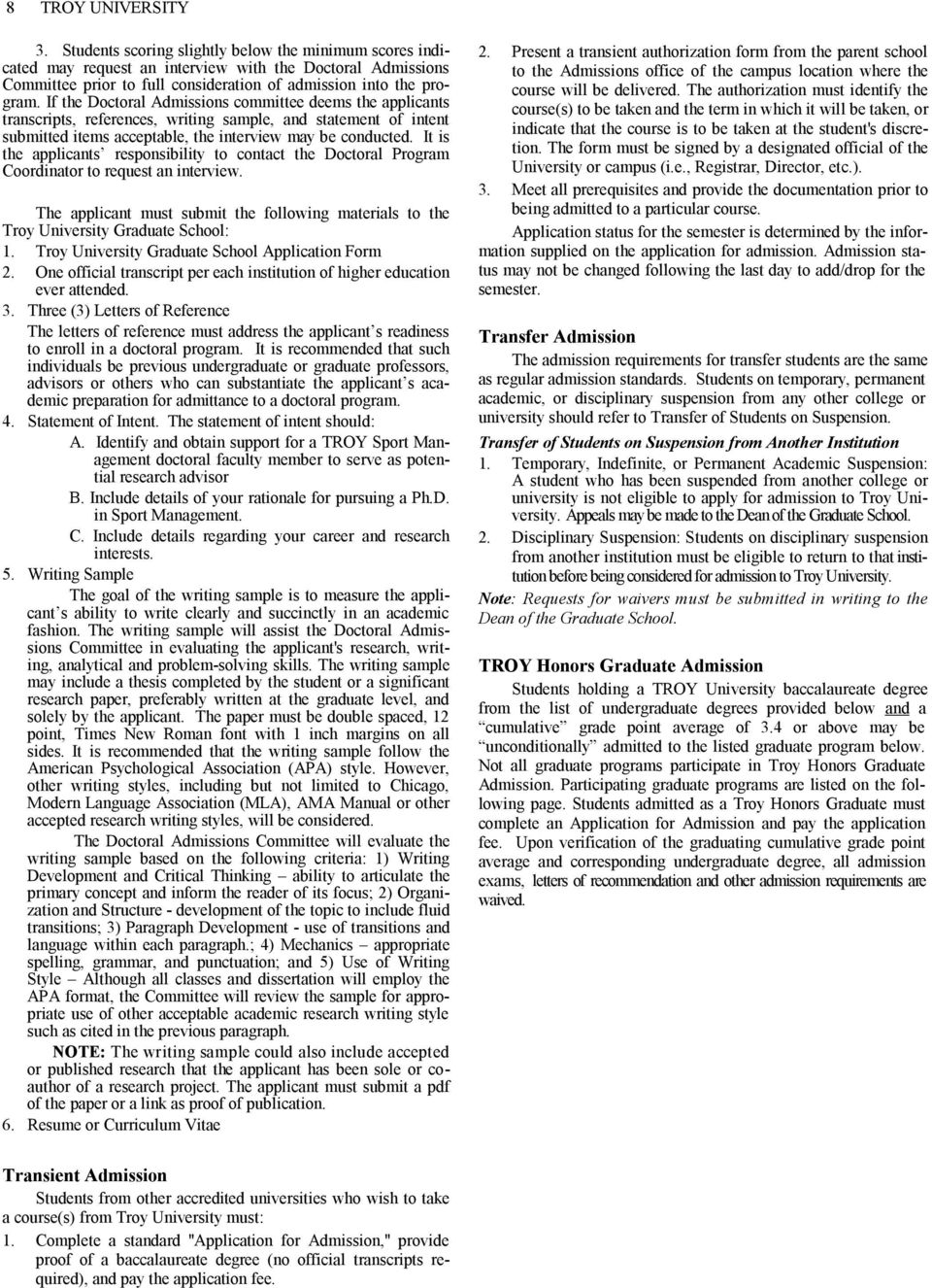
9 TROY UNIVERSITY 9 Troy Honors Graduate Admission applies only to the following graduate programs: Graduate Program Master of Science in Accountancy Adult Education Certificate of Taxation Computer Science Criminal Justice Economics Environmental and Biological Sciences Health Practice Management History International Relations Master of Business Administration-All options Human Resource Management Management Nursing (MSN) Social Science Social Work Strategic Communication MS Sport and Fitness Management Corresponding Undergraduate Degrees BA/BS in Accounting Any area Accounting Computer Science or related field Any Area Any Area Any area plus demonstrate an adequate academic background in the sciences that includes natural or biological sciences, general chemistry, and statistics. Any Area Any Area Any area Business Administration, Global Business, Economics, Accounting Any Area Any Area Nursing Any Area Any Area Multimedia Journalism, Broadcast Journalism, Communication Arts, English Exercise Science; Hospitality, Sport, and Tourism Management; Business Admin., Global Business., Economics, Accounting Unaccredited or Otherwise Accredited Baccalaureate or Master s Degree Holders Student Admission Requirements (United States and Foreign Universities) Students must submit an official transcript(s) with degree(s) posted at least one semester/term prior to the desired date of registration. The appropriate academic college and the Graduate Council will evaluate all submitted transcripts using commonly accepted practices and guidelines. A determination will be made based on (1) the unaccredited or otherwise accredited institution s affiliation with the following agencies which honor recognition provided by the former: Council on Postsecondary Accreditation (COPA) and the Commission on Recognition of Post Secondary Accreditation (CORPA), and/or the Council for Higher Education Accreditation (CHEA); (2) acceptance of credit by three other regionally accredited universities located in the area of the unaccredited institution, (3) review and approval of the Graduate Council. The applicant will be required to submit a copy of the college s catalog and other information as needed. Only upon the approval of the Graduate Council may a student begin taking graduate courses at Troy University. Should the student be inadvertently (without the University s knowing that the baccalaureate degree or masters degree is from an unaccredited or otherwise accredited institution) admitted into classes prior to baccalaureate degree or master s degree approval and the evaluation indicates that the student is not eligible for admission, the student will be withdrawn from the class or classes, or receive non-degree credit for the class or classes for which he/she is improperly registered, and all tuition will be forfeited. Note: Students seeking advanced degrees in teacher education or nursing programs must hold a baccalaureate degree from a regionally accredited college or university. Note: Students seeking a Master s degree from the Sorrell College of Business who hold an undergraduate degree from a non-regionally accredited U.S. college or university must obtain and submit a letter from the Dean of three Colleges/Schools of Business accredited by the AACSB or ACBSP stating that students from the student s non-regionally accredited undergraduate institution have been accepted into the graduate business programs at those institutions. Post Master s Admission Students admitted in this category must hold the master's degree from a regionally accredited or equivalent foreign institution. Graduate credit taken while enrolled as a post master s degree student is not admissible as degree credit unless it is approved by the Program Director and is limited to a total of six semester hours. All official undergraduate and graduate transcripts are required for admission. If the degree is earned outside the United States, an American Association of Collegiate Registrars and Admission Officers (AACRAO) or Educational Credential Evaluators, Inc. (ECE) evaluation is mandatory. Applicants to the DNP program are eligible only for Unconditional admission status. Special Admission: Non-Degree Matriculates A student interested in earning graduate credit, but who is not an applicant for a graduate degree at Troy University, may be admitted as a ''Special Student'' with the approval of the Dean of the Graduate School or his/her designee. Admission may be granted to qualified students holding a baccalaureate degree or higher from a regionally accredited or equivalent foreign institution or to students in good standing at another regionally accredited or equivalent graduate school (official copy of transcript must be provided). Should a student apply later and be accepted to a degree program, a limit of six semester hours will be considered for credit toward the degree. Graduate students may earn no more than six semester hours of grades below B (See Academic Suspension). It is the responsibility of the student to observe the limitations imposed on credit hours, grade point average, coursework, and transfer of credit. Special students may not be admitted at a later date on a temporary admission. Credits taken in Special Admission status by students who are found not to be in good standing at their previous institution will be voided with the posting of no grade NG by the Registrar. Doctoral students are not eligible for special admission status. Certificate Program Admission Requirements Students interested in completing a certificate program offered through the Graduate School must apply to be unconditionally admitted into the Graduate School through the standard admission process. All certificate courses are graduate courses. Consult the Unconditional Admission section of this catalog for admission requirements.
10 TROY UNIVERSITY 10 International Student Admission International Student Graduate Admission Requirements 1. Meet all Graduate School Admission Criteria 2. The Troy University International Admissions Office will evaluate student degree credentials using standardized best practice procedures and determine equivalency to a U.S. degree. 3. Meet English Proficiency Requirements for Graduate Admission. All graduate students must demonstrate English proficiency for admission to the Graduate School prior to taking graduate courses. Proficiency may be demonstrated by ONE of the following options: Make a satisfactory score on the Test of English as a Foreign Language (TOEFL): 193 (computerbased test), 70 (Internet-based test), or 523 (paper test). Make a satisfactory score on the International English Language Testing System (IELTS): score of 6.0. Make a satisfactory score on the ACT COMPASS ESL exam. To pass the ACT Compass ESL, a student must attain a total of 270 on the Listening, Reading, and Grammar sections, with no individual score below 85, and a minimum score of 8 out of 12 on a writing test. Note: The ACT Compass ESL may be taken only once. Students lacking satisfactory test scores may be admitted following satisfactory completion of the Troy University English as a Second Language (ESL) courses. English Placement for Non-native Speaker of English Any student whose first language is not English must submit an official score report for the Test of English as a Foreign Language (TOEFL), the International English Testing System (IELTS), or the ACT Compass ESL examination. Students who do not meet the minimum English proficiency requirements specified for the TOEFL, IELTS, or ACT Compass ESL test will be placed at the appropriate level in the Troy University English as a Second Language (ESL) program. The ESL program is available on the Troy campus and at the Global Campus site in Atlanta. The following process will be used to satisfy the Graduate School language admissions requirements through the Troy University ESL program: Students will be placed in the appropriate level of English as a Second Language (ESL) class based on the score made on the ACT Compass ESL test. A standardized final exam will count as 30% of the final grade in each class at the advanced level. Students must make a grade of B or better in their last semester/term at the completion of level five and/ or six in order to be certified as having met the English proficiency requirement for admission to the Graduate School. The certification form will be submitted by the International Programs Admissions Office to the Student Services Office upon the student s successful completion of the ESL program. Students may not begin taking graduate courses until they are certified as English proficient. Contact the Center for International Programs at [email protected] for specific information. Student Visa Requirements Only the Troy University campuses in Alabama and the teaching site in Atlanta, Georgia, are approved to host students on a nonimmigrant student visa. Students may refer to the web site for information on program availability at a specific Troy University campus. Persons requesting U.S. Citizenship and Immigration Services (USCIS) form I-20 to obtain an F-1 visa or DS-2019 to obtain a J-1 visa who require additional information should contact the Center for International Programs, Troy, Alabama, 36082, USA; telephone: 1 (334) ; [email protected]; or visit the website at admissions.troy.edu/international. International Student Submission Requirements Students must submit the following official documents: 1. Completed Application for Admission. 2. Application fee. 3. All official transcripts and preferably an American Association of Collegiate Registrars and Admission Officers (AACRAO) or Educational Credential Evaluators, Inc.(ECE) evaluation of the transcript if the institution is not an accredited United States institution. Prospective students must submit an institutionally transcribed transcript in English. Applicants who cannot obtain an institutionally translated transcript may obtain a translation utilizing the services of an approved credential evaluating service. AACRAO 1 Dupont Circle, NW, Suite 520 Washington, D.C. USA Telephone , Fax OR Educational Credential Evaluators, Inc (ECE) P.O. Box Milwaukee, WI Telephone (414) Fax: (414) , [email protected] Institutionally translated transcripts will be evaluated preferably by AACRAO or ECE, or may be evaluated by Troy University using standard accreditation practices and guidelines. If the foreign school does not appear in any of these sources or if the transcript does not provide the information necessary to determine admission status based on standard criteria, the applicant must utilize the credential evaluation services of AACRAO. Whenever possible, applicants transferring credit should submit a copy of the school catalog. 4. Students must make a satisfactory score on the TOEFL, IELTS, or ACT Compass ESL exam (may be taken only once) prior to beginning graduate coursework. See English Proficiency Requirements provided under International Student Admission Requirements. 5. Satisfactory score on the graduate admission examination. Note: Please consult the individual program test score requirement prior to taking exam. Exam require-

11 TROY UNIVERSITY 11 ments vary by program. (Contact the Troy University International Admission office or an International Troy University site office near you for more information.) 6. Troy University Letter of Recommendation The Letter of Recommendation form is located online at trojan.troy.edu/ graduateschool/forms.html. The following items must be addressed in the Letter of Recommendation: the recommender s name, organization, position or title, telephone or ; how long and in what capacity the recommender has known the applicant; and the key characteristics that the candidate possesses (e.g. leadership, communication, knowledge, creativity, reliability, ability to communicate in writing, initiative, ability to get along with others, scholarly potential). 7. A detailed statement of financial status showing that adequate financial resources are ensured. Non U.S. citizens (and immediate family members) who are members of allied military forces or civilian agencies assigned to U.S. military installations are exempt from providing financial statements or TOEFL scores provided that their proficiency in English is certified in writing by an appropriate U.S. military official. Such a statement of financial status is required only for those international students seeking a J-1 or F-1 student visa. Three-Year Baccalaureate Degree Holders Requesting Admission to the Graduate School 1. No Bridge Program courses are required for students completing at least one year of a graduate program in their home country prior to applying to the Troy University Graduate School. Applicants must meet all English proficiency requirements that are provided under International Student Admission Requirements. OR 2. Students identified as exceptional graduates by an institutionally recognized external agency may be eligible for Unconditional admission with no Bridge Program requirements. If the institution is identified as a Top Institution and the graduate holds an honors diploma, meets all admission and English proficiency requirements that are provided under International Student Admission Requirements, then she/he may be enrolled in the qualifying graduate program. OR 3. Students who do not qualify for admission by the two options listed above will meet with the dean of the discipline, for which the student seeks admission, who will prescribe a mandatory one-year baccalaureate equivalent course of study of at least 30 semester hours of undergraduate coursework, to be completed with a cumulative grade point average of 2.5. all grades below the grade of C must be retaken. This prescribed course of undergraduate study shall be referred to as a Bridge Program. Bridge program students should not repeat courses taken at the undergraduate level. Bridge program students will be enrolled as Undergraduate students. This coursework must be successfully completed and certified by the dean of the college prescribing the coursework prior to admission to the Graduate School. Upon completion of the Bridge Program, students will be admitted to the appropriate graduate program. Dual Enrollment Lacking Prerequisites Students holding a baccalaureate degree from a regionally accredited or equivalent foreign college or university, who are applying for graduate admission, will have transcripts reviewed by their adviser to determine if specific degree program prerequisites are met prior to admission to a graduate program. Students needing to meet prerequisite requirements will be considered Post-Baccalaureate students until such time as prerequisites are fully completed and the cumulative grade point average for the prerequisite courses is a 2.5. Post-Baccalaureate students having six semester hours or fewer of prerequisites remaining may begin dual enrollment coursework and apply for Graduate Admission with the approval of their adviser. Final Semester of Graduating Seniors Only With the approval of the Dean of the Graduate School or designee, seniors lacking six semester hours or fewer for graduation may, during the term in which their undergraduate requirements are being completed, be enrolled in one or more courses for graduate credit provided they present an acceptable score on the appropriate entrance exam and have an overall grade point average of 2.5 (on a 4.0 scale) or a 3.0 grade point average on the last 30 semester hours. All hours attempted in the term in which the 30 semester hours were reached will be used to calculate the grade point average. Consult specific program for specific admission requirements. If admitted, the student may enroll in no more than a combined total of nine semester hours of undergraduate and graduate work. See TROY Honors Graduate Admission requirements for applicability. Academic Program Evaluation The Academic Program Evaluation serves as a formalized program document developed by a graduate student and his/her adviser. Together, the student and adviser confirm this document. The Academic Program Evaluation provides an outline of the coursework and requirements leading to a specified graduate degree. It should be referenced during each registration. If the student selects courses outside the approved plan of study, without prior faculty adviser approval, the credits may not apply toward degree requirements, but will affect the student s grade point average. The Academic Program Evaluation may be found on WebExpress. Academic Suspension/Dropped from Program/ Retention Graduate students may earn no more than six semester hours of grades below ''B''. Students who earn more than six semester hours of ''C'' grades or below are automatically academically suspended from the University for a period of one calendar year, at which time the student may petition the Dean of the Graduate School for readmission. Conditionally admitted students who do not attain a 3.0 grade point average (4.0 scale) at the completion of nine semester hours will be academically suspended from the University for a period of one calendar year at which time the student may petition the Dean of the Graduate School for readmission. Students who are academically suspended are prohibited from attending the Graduate School or any academic level of the University for a period of one calendar year. Any courses taken at another university during the time of academic suspension will not be accepted for credit. Courses that are over eight years old are not computed in grade point averages for retention purposes. Quality points are no longer considered in determining retention.

12 12 TROY UNIVERSITY Attendance Policy In registering for classes at the university, graduate students accept responsibility for attending scheduled class meetings, completing assignments on time, and contributing to class discussion and exploration of ideas. Students receiving financial assistance are required to attend classes according to the regulations for financial assistance benefits in addition to those regulations required for the course. A student will be excused for a class absence for circumstances beyond the student s control or if the student has been required to attend an activity sponsored by the university. Faculty members who sponsor activities that require class absences must send a list of student names approved by the Dean or designee or Office of the Provost to each member concerned at least three days before the scheduled absence. Faculty members may levy academic penalties upon unexcused absences; however, such penalties for unexcused absences will be a part of each course syllabus and will be distributed to each class at the beginning of each class and a copy filed in the departmental office. Changes in Class Schedules The courses for which a student registers must bear the approval of his/her adviser and the appropriate Academic Dean. Changes in the class schedule are not permitted after the close of the registration period. Registration for a course makes the student responsible for completing the course unless he/she officially drops or withdraws from the course(s). Drops A student who wishes to reduce, but not entirely eliminate, his or her credit load may drop a course. Students may drop a course or courses via Trojan Web Express, or submit a request in the Record s Office. The last day to drop a course will be assigned for each term, session, or semester based on 65% completion of the length of the course. Dates will be published on the Schedule of classes and the Academic Records web page ( The 65% rule also applies to International teaching locations. From Early Registration through Late Registration Free Course Schedule Adjustment Period Students may drop a course or courses during the Free Course Schedule Adjustment Period. Tuition and refundable fees will be returned. From End of Late Registration (Free Course Schedule Adjustment Period) through the Last Day to Withdraw A non-punitive grade of DR will be assigned up until the last day to drop, as posted in the Schedule of Classes and on appropriate web pages. Students may not drop after the deadline. Any student who fails to drop by the deadline will be assigned a grade. Extenuating circumstances such as military deployments must be documented before an exception can be considered. Withdrawals Withdrawal from the University is defined as a removal from all courses for all current semesters, sessions, or terms. The last day to drop a course will be assigned for each term, session or semester based on 65% completion of the length of the course. Dates will be published on the Schedule of classes and the Academic Records web page (trojan.troy.edu/records/). The 65% rule also applies to International teaching locations. From Early Registration through Late Registration Free Course Schedule Adjustment Period Students who wish to withdraw from all classes prior to the last day of late registration must CANCEL their registration in writing through the designated withdrawal official (DWO) located on the Academic Records web page (trojan.troy.edu/records/). Written cancellation does not require the completion of the withdrawal form or an exit interview. Tuition and refundable fees will be returned. From End of Late Registration (Free Course Schedule Adjustment Period) through the Last Day to Withdraw A student who wishes to withdraw from all courses for a current semester/session/term may withdraw with no academic penalty with a non-punitive grade of W until the last day to withdraw (posted in the Schedule of Classes and on appropriate web pages). Tuition and fees will be charged during this period. Students may not withdraw via Trojan Web Express. An official withdrawal form must be completed and processed before the student s withdrawal is considered final. The form may be accessed at trojan.troy.edu/records/. Students may not withdraw after the withdrawal deadline. Any student who fails to withdraw by the deadline will be assigned a grade. Check with the Financial Aid Department to determine how financial aid is calculated prior to withdrawing. Extenuating circumstances such as military deployments must be documented before an exception can be considered. Changing Program of Study If a student decides to change his/her declared program of study, the student must be in good academic standing or eligible for readmission and meet the entrance requirements for the new degree program in effect at the time of admission to the new program. The student must submit a completed Graduate Change of Academic Program Application (no fee required) to the Graduate Admissions office at his/her home campus. Graduate Change of Academic Program Applications are available at campus Admissions offices and online at trojan.troy.edu/graduateschool/ forms.html. Final approval to change programs will be granted by the appropriate academic dean consistent with change of program procedures established by that college. Courses previously credited to the former program will be evaluated for acceptability for the new degree program through the process of Petition for Transfer of Graduate Credit evaluation. Petition for Transfer of Graduate Credit forms are available from any graduate program office or online at trojan.troy.edu/ graduateschool/forms.html. Grades below a B will not be considered for transfer, and any loss of credit will be reported to the student and the Financial Aid Office, if applicable. All grades from work attempted in the first graduate program will contribute to the cumulative grade point average, unless the credit is older than eight years. All graduate programs requires a cumulative grade point average of a 3.0. Note: Students using VA benefits should be aware that the VA may not pay for courses taken in a second program unless the VA has been notified of the degree program change. (See the VA certifying official for further details.)

13 TROY UNIVERSITY 13 Class Cancellation The institution reserves the right to cancel any course for which there is insufficient enrollment. Inclement Weather and Emergency Situations Both faculty and students are responsible for meeting all assigned classes. In the event of inclement weather, faculty and students will be expected to attend classes as usual as long as they may do so without risking peril to themselves or to others. During periods of inclement weather, faculty and students will not be penalized for absences dictated by perilous conditions. In severe cases of inclement weather or other emergency conditions, the Office of the Senior Vice Chancellor for Academic Affairs or designee will announce cancellation of classes through the local and regional media as well as through the University s web sites. Correspondence Credit Credit earned through correspondence will not be acceptable for graduate work. A correspondence course is defined as a complete pre-packaged course designed to be delivered through sequential steps at the student s own pace without instructor or student interaction. Course Numbers Courses numbered 9950 to 9999 are for workshops or continuing education credit. Courses numbered 8800 to 8899 are open to students in the doctoral program. Courses numbered 7700 to 7799 are open only to students who have received the master s degree. Courses numbered 6600 to 6699 are open to qualified graduate students or to students who have already received the master s degree. Courses numbered 5500 to 5599 are open only to graduate students and graduating seniors. Seniors must have the approval of the instructor of the course and meet unconditional graduate admission criteria. Courses numbered 5500 to 5599 in business, English, history, and mathematics are open only to graduate or post-graduate students. A student may not enroll in a course numbered 5500 to 5599 if it duplicates the same course listed on an undergraduate transcript. For the master s degree, 50% of the total graduate program must be earned in 6000 level courses. In the Education Specialist program, 50% of the total graduate program must be earned in 7000 level courses. Credit Hour Definition of a Credit Hour Equivalency: 1. One hour of classroom or direct faculty instruction and a minimum of two hours of out-of-class student work each week for approximately fifteen weeks (does not include final exam time) for one semester or the equivalent amount of work over a different amount of time; or minutes of classroom instruction plus additional out-ofclass work (the general expectation is two hours) for fifteen weeks ; or 3. A minimum of 2,250 minutes per three semester hour course of instruction, which does not include final exam time; or 4. An amount of work represented in intended learning outcomes that are at least an equivalent amount of work as required in items 1-3 above of this definition for other academic activities including laboratory work, internships, practica, studio work, and other academic work leading to the award of credit hours. Degree Semester Hour Requirements The minimum number of semester hours required for graduate programs varies. Additional coursework may be required for a student with academic deficiencies and/or a limited background and experience. Additional degree requirements will be determined by the student's adviser or advisory committee with the concurrence of the dean of the appropriate academic discipline. This process may result in additional semester hours in excess of the minimum number of published degree requirements. Directed Studies, Specialized Studies, Readings, Advanced Readings, Selected Topics Course Restrictions Students may not exceed a total of six semester hours taken in any combination of Directed Studies, Specialized Studies, Readings, Advanced Readings, or Selected Topics course credits. Consult individual programs for additional restrictions. Global Campus The Senior Vice Chancellor for Academic Affairs is charged with the administrative oversight of Global Campus, which is responsible for the delivery of educational programs outside the state of Alabama and abroad as well as online through etroy. Global Campus is designed to meet the needs of non-traditional learners, who generally have educational needs that are different from those supported by traditional colleges and universities. Courses and degrees are delivered at times and in formats to fit the needs of adult learners who have full-time employment, work shifts or are prone to short-notice moves. Troy University has a long history of service to the United States military. Working in cooperation with base educational services personnel who provide local program support, Global Campus delivers educational programs on many military bases, typically in classroom space provided by the military. Global Campus academic offerings and programs are under the purview of the various departments and colleges of the university. Troy University faculty and administrative oversight functions include, but are not limited to academic oversight and control; monitoring of institutional effectiveness; faculty selection, certification, evaluation and faculty status determination. Student services are provided from the Troy campus and include, but are not limited to, admissions and maintenance of official academic records. All of the degree programs offered at Global Campus sites are approved programs in the Graduate Catalog; however, not all degree programs are offered at every location. etroy Troy University s etroy was established as a comprehensive, educational unit of Troy University s Global Campus to allow and provide any student, regardless of location, the opportunity to earn a Troy University degree online. Since its inception,

14 14 TROY UNIVERSITY etroy has expanded to include different programs and methodologies to reach local students, working adults, and the military. etroy offers students the opportunity to obtain both undergraduate and graduate courses and degree programs online. The online courses integrate textbooks with online materials, graphics, audio, and video, and facilitate faculty and student interactions. Specialized software is utilized. For more information on graduate programs offered via this format, visit trojan.troy.edu/etroy/ onlinegraduateprograms/. Student Services The Senior Vice Chancellor for Academic Affairs is charged with the administrative oversight of Global Campus, which is responsible for student services. These services meet the needs of students at each location and include orientation, counseling, financial aid, transcript service, graduation ceremonies, learning support, career services as well as other services and activities such as library support and alumni organizations. Tuition and Fees Each educational site provides its own schedule of tuition and fees for students and procedures for payment and refunds. Registration Registration dates and in-class offerings may be found at each Global Campus site s website. Registration dates and online course offerings may be found on Trojan Web Express. Students may register for in-class and online courses through Trojan Web Express at State Authorizations Information of state authorizations is located at: trojan.troy.edu/etroy/accreditation.html. Grade Appeals Faculty members have the authority to grade student work and to assign grades; these are academic judgments. A faculty member s syllabus enumerates student academic performance expectations and consequences. Faculty members render academic judgments when a student s academic performance violates established standards or fails to meet stated expectations. Academic judgments made by faculty are based on academic content, course requirements, and student performance. Students may not appeal grades based on allegations concerning the competence of a faculty member, the fairness of examinations, the difficulty of a course, or other matters of a purely academic nature. Grades for individual assignments and exams may not be appealed. While it is recognized that faculty hold the right and responsibility to grant a grade, a student who receives a course grade that he or she believes to be unwarranted for reasons other than those listed above may appeal that grade using these stated procedures. Step 1. Within the first four weeks of the start of the following term or semester in which the grade is received, the student shall have informally appealed the grade to the instructor. If that instructor is not teaching at Troy University during the term following issuance of the grade, the student will make contact with the instructor through the department chair to informally appeal the grade. Step 2. If the issue is not resolved at this informal level and the student wishes to pursue the appeal, the student shall request in writing a meeting with the respective department chair. This request shall be addressed to the department chair and shall be received no later than the end of the fifth week of instruction for the term or semester following issuance of the grade. The request must summarize the student s complaint and the student s informal appeal to the instructor. Step 3. Within two weeks of receipt of the request, the department chair shall discuss the appeal with the student and with the instructor, separately or at the same time. If the department chair upholds the decision, the matter is closed. The decision is final. Step 4. If the department chair does not support the decision of the instructor, the matter shall be appealed within two weeks of the department chair s decision to the designated associate dean or dean of the college. The department chair will forward the appeal package to the designated associate dean or dean. The designated associate dean or dean will empanel three full-time faculty colleagues from the department and/or discipline to review the matter. The decision of this panel shall be final and binding on all parties. Note: Students may not use this procedure to appeal grades resulting from violations of academic honesty. Students should refer to the Oracle, the University s official student handbook, for these appeals. Grading System Grade Description Credit Grade points per hour A Excellent Yes 4 B Above Average Yes 3 C Average Yes 2 D Below Average Yes 1 F Failure No 0 AU Audit No 0 DR Dropped course No 0 FA Failure to attend any classes (Calculates as an F in the GPA) No 0 I Incomplete No 0 IP Thesis or Clinical Research in Progress No 0 FI NG Course requirements not completed by end of time limit for course assigned an Incomplete or In-Progress (Calculates as an F in GPA) No grade reported by faculty at end of term (assigned by Registrar) No 0 No 0 P Pass Yes 0 W Withdrawal No 0 Note 1: Some grades, in addition to the F, calculate as an F in the grade point average. Note 2: If the student makes a " D" or " F" in a core course, the course must be retaken. Note 3: If the student makes a "D" or "F" in an elective course, the course must be retaken or another elective taken in its place.

15 TROY UNIVERSITY 15 Grade Point Average (GPA) The grade point average is computed by dividing the number of credit hours attempted into the total number of grade points earned. Incomplete Grades This incomplete grade policy replaces all other incomplete grade policies as of August 9, If a student is unable to complete all course grading requirements, the student may be eligible to request the assignment of an incomplete grade. An Incomplete grade is not automatically assigned by the instructor, but must be requested by the student and approved by the instructor. The decision to approve or reject a student s request for an incomplete grade is at the discretion of the instructor using the following criteria: Student submits a completed Incomplete Grade Request form prior to assignment of a course grade. Student s progress in the course is deemed satisfactory. Student is passing the course when the request is made. The circumstances that prevented the student s completion of course requirements are beyond the student s control and adequate documentation is provided. A student may request an incomplete by completing and submitting to the instructor an Incomplete Grade Request form. This form can be found at trojan.troy.edu/graduateschool/ forms.html. An incomplete grade will not be assigned until the student receives from the instructor the approved request form which outlines the work to be completed, the grading weight of the assignment(s), and a deadline for when all required work must be received. It is the student s responsibility to follow up with the instructor on the status of their request for an incomplete grade and become informed of all work required and deadlines. Time limit for Removal of Incomplete Grades. Any student who receives an I must adhere to the deadlines set by the instructor for when required assignments must be received. The instructor deadline must not exceed 9 weeks from the date of the end of the semester that the I was awarded. All instructor set deadlines apply whether or not the student enrolls for the semester or term following the assignment of the incomplete grade. Work received on or before the instructor set deadlines will be graded and computed into the final course grade. The instructor will submit a Change of Grade form to the registrar on or before the last day to remove an Incomplete from the previous term or semester published in the university s master calendar. Student assignments not received by instructor s deadlines will not be graded and a Change of Grade form will not be submitted. If a Change of Grade form is not submitted by the appropriate time, the I will automatically be converted to an FI. An FI is calculated as an F when determining grade point average. IP (In-Progress) Grades Students who show satisfactory progress in one of the following courses, but are unable to complete requirements in one semester, may be issued IP grades. No other courses are eligible to award the grade of IP. IP grades may be issued only for the following courses: Thesis Research (Not Research Methods Courses) Practicum Internship Thesis Personal Supervisor and/or Curriculum Development Field Problem Time limit for Removal of In-Progress (IP) Grade IP grades must be removed within one calendar year from the date at which the IP was assigned. An IP grade that is not removed during the stated time limit will automatically become a grade of FI. Program Completion Requirements Grade Point Average Students must have a 3.0 grade point average (4.0 scale) for all work attempted at the time of degree completion. Credits over eight years old shall not be used in computing the final grade point average at the time of degree completion. In the case of courses that have been retaken due to grades of "C" or below, all grades will be counted as hours attempted in determining the overall grade point average. Research Requirement For Initial Master s Degree All graduate programs require certification of the student's ability to do research in a specialization. This requirement is met by achieving a grade of "B" or better in an approved research course(s) in the student's program. Students must repeat the research course if a grade of C or below is attained. For Second Master s Degree If the research requirement was completed for the first master s degree, students are exempt from this requirement in the second master s degree. Students exercising this exemption must complete an additional elective course in their program, or obtain approved transfer credit to achieve the minimum required credits for graduation. Comprehensive Examinations Students admitted to a graduate program requiring a comprehensive examination must pass the required comprehensive examination, written and/or oral, covering the work taken in the major field. All students must register in advance for comprehensive examinations in their academic departments. Students should consult with their advisors regarding procedures for scheduling and taking comprehensive examinations. This examination is usually taken during the last semester/term prior to graduation. The passing of the comprehensive exams is not to be considered a waiver of any other requirement for any program. Students who have unsuccessfully attempted the comprehensive exam may not change their program of study. Should students fail the comprehensive exam, they must successfully retake the exam within one year of the date originally taken. Thesis or Field Project A thesis or field project is frequently the culmination of graduate education at Troy University. A thesis or field project requires a commitment of one or more years. While faculty assist in the direction of the thesis or field project, the graduate student is responsible for the development, research, writing, and completion of the thesis or field project. Graduate students should consult with their program director and faculty adviser about thesis or field project availability and suitability. The Troy University Thesis Guidelines located at trojan.troy.edu/graduateschool/assets/documents/thesisguidelines.pdf provides students with essential requirements concerning the

16 16 TROY UNIVERSITY thesis preparation, completion, and submission. Individual departments, schools, and colleges may impose additional requirements or may specify requirements in greater detail. The graduate student has a responsibility to learn what, if any, special departmental/ school/college requirements may apply. The thesis should be prepared in accordance with the instructions of the Troy University Thesis Guidelines and department, school or college special requirements. Thesis Students Continuous Enrollment Students must be enrolled in at least one semester hour of thesis the semester in which they defend their thesis. Intent to Graduate Procedure Candidates for a graduate degree must indicate their intentions to complete the requirements for graduation by filing an ''Intent to Graduate'' form at the beginning of the term/semester prior to the term/semester of graduation with the Graduate Records Office. Since this form is used to check completion of requirements, order diplomas, and enter students in the commencement program, it must be filed in accordance with the published deadlines. Students failing to submit Intents to Graduate by the published date will graduate at the next semester of graduation. Candidates must use the online form located at splash.troy.edu/goto/intent/. If the online form is not accepted this means that the application is too late for participation in the upcoming graduation. A graduation fee must be paid at the time of filing. Graduation Ceremony Attendance at commencement is not required for degree conferral; however, all candidates are urged to attend. Students will attend the graduation ceremony immediately following their program completion. Students may select which graduation ceremony to attend based on their preferred location. The students will be provided with a link to the graduation ceremony selection when the student files an Intent to Graduate form. Time Limit to Complete Master s and Ph.D. Degree Programs All credits used to satisfy Masters or Ph.D. degree requirements may not exceed eight years at the time of degree completion. For students completing the Master of Science in Nursing, all credits used to satisfy degree requirements may not exceed five years at the time of degree completion. A student not enrolled with Troy University for three years or more must meet all degree requirements current at the time of readmission. Time Limit to Complete DNP Degree Program For students completing the Doctor of Nursing Practice-Post BSN program, all credits used to satisfy Doctoral degree requirements may not exceed eight years at the time of degree completion. For students completing the Doctor of Nursing Practice Post Master s program, all credits used to satisfy degree requirements may not exceed five years at the time of degree completion. A student not enrolled with Troy University for three years or more must meet all degree requirements current at the time of readmission. Readmission Procedures Readmission to Graduate School after Academic Suspension Graduate students may petition for readmission to the Graduate School only twice. In order to be eligible to petition for readmission, a student must have been out of school for at least one calendar year. Students may submit petitions for readmission two months prior to the eligible readmission date. Students who have been academically suspended must follow the procedures outlined below: 1. A student must petition the Dean of the Graduate School in writing and cite the particulars of his/her case. The petition packet should include: a. A letter describing the circumstances that led to academic suspension and give evidence of probable success before being considered for readmission; b. Copy of the student s transcript; c. Appropriate letters of support from faculty d. Documentation of circumstances which led to suspension; and e. Readmission Application. Note: Student petitions for readmission must be documented, circumstances verified by the appropriate academic official at each location, and a letter recommending support or non-support should accompany the packet before the Dean of the Graduate School will present the petition to the respective Academic Dean (s). 2. The Dean of the Graduate School in turn will submit the petition and supporting documentation, e.g., transcripts, updated Application for Admission, letter of petition, letters of support, etc., to the appropriate departmental faculty committee through the office of the dean of the discipline in which the student requests readmission. 3. The departmental committee will review the case and make a recommendation for approval or disapproval to the dean of the discipline. 4. The dean of the discipline has the authority to accept or reject the recommendation of the department. If the dean of the discipline accepts a favorable recommendation from the departmental committee, he or she must forward it along with his/her endorsement to the Dean of the Graduate School and the Chair of the Graduate Council for their concurrence. 5. If the student s petition is rejected by the dean of the discipline (in 4 above), the student is notified in writing by the dean of the discipline with copies placed in the student s permanent record. 6. If the Dean of Graduate School and Chair of Graduate Council accept the recommendation of the dean of the discipline (in 4 above), the student is notified by the Dean of the Graduate School in writing of the decision and informed of any conditions that were placed on his/her readmission. If admitted, it will be on a conditional basis only. The decision of the Dean of Graduate School and Chair of Graduate Council is final. 7. If the Dean of the Graduate School or Chair of the Graduate Council rejects the recommendation of the dean of the discipline, the request is referred to the Graduate Council as a final appeal. The decision of the Graduate Council is final. 8. Students who have been suspended or dropped from other universities programs for academic reasons must follow the procedures noted below: a. The processes of # 1-7 above must be followed. All transcripts from all universities must be submitted as part of this process. b. A student will be eligible for readmission 12 months from the beginning of the suspension period. c. Troy University will accept transfer credit only from universities where students are in good academic standing. The acceptance of any transfer credit is at the discretion of Troy University.

17 TROY UNIVERSITY 17 Readmission to a Graduate School Program by a Student in Good Standing A student who is not enrolled in courses for one to up to three years must contact the Student Services office and complete a Readmission to Graduate School Application. These students are allowed to remain in the program for which they originally enrolled. A student not enrolled with Troy University for three or more years must meet all degree requirements current at the time of readmission and complete a Readmission to Graduate School Application. All students who have attended another institution of higher learning since last attending Troy University, must submit a Readmission to Graduate School Application and provide official transcript(s) from that institution before re-enrolling. Readmission to Graduate School Applications are available online at trojan.troy.edu/graduateschool/forms.html Registration Students must be registered for all classes prior to attendance in these classes. If a student s name does not appear on a class roster, he/she may not sit in or otherwise attend the course. Students should register during designated registration times. Once students have registered for a course or courses, they incur a financial commitment which must be met. Students can pay their tuition online by accessing the Trojan Web Express. Students who fail to attend a class without following drop/ withdrawal policies will receive a grade of FA, and those students will still be charged full tuition and fees. Students with an outstanding balance will not be permitted to register for future terms. Repeating Courses Students may repeat a course in which they received a grade of D, F, or W. Students who received a grade of "C" or below in the required research course or courses requiring a grade of B or better must repeat the course and attain a B or higher grade to satisfy the coursework requirements in their program of study. Both grades will be counted as hours attempted in determining the overall grade point average. See degree program for additional minimum course grade requirements. Residency Requirements See specific program for details. Resident Credit Calculation Residency, the number of Troy University credit hours earned, must be established to be eligible for a Troy University graduate degree. Resident credit for a program is determined by deducting the non-troy University transfer/transient credit hours allowed in the program from the total hours required for the program. Residency requirements vary by degree program. See specific programs for minimum residency requirements. See the appropriate degree program for specific transfer credit requirements. Semester Hour Load Limits Definitions: A semester is defined for hour load limit purposes as 16 weeks of class meetings. A term is defined for hour load limit purposes as up to a nine week period of class meetings. A session is defined for hour limit purposes as up to nine weeks of class meetings within a semester. A full-time graduate student for admission status purposes is a student taking eight or nine semester hours per semester or six semester hours per term, or eight to nine semester hours in a combination of semesters, terms, and/or sessions over a sixteen-week period. A part-time student is defined as a graduate student taking less than a full-time load. Warning: Students who register for coursework in excess of the approved load without prior approval and violate the University's policy regarding course load will be required to drop the overload or lose the excess credit. Load Limit for Students with Temporary Admission Status Students with a temporary admission status are limited to a maximum of nine semester hours per semester or six semester hours per term, or a combination thereof not to exceed nine semester hours over a sixteen-week period. Load Limit for Students with Conditional Admission Status Students admitted conditionally may take a maximum of nine semester hours per semester or six semester hours per term or a combination thereof not to exceed nine semester hours over a sixteen-week period until the ''conditions for admission'' are removed. Load Limit for Students with Unconditional Admission Status The maximum load for unconditionally admitted graduate students is twelve semester hours per semester, or six semester hours per term, or a combination thereof not to exceed twelve semester hours over a sixteen-week period. With the written approval of the student's academic adviser, the maximum load may be increased to 16 semester hours for unconditionally admitted students. Students who schedule an overload may not reschedule an overload in the subsequent term unless they maintain an overall grade point average of a 3.0 on a 4.0 scale during the term in which the overload was scheduled. For Graduate Assistants Graduate Assistants are restricted to a minimum of six semester hours or a maximum of nine semester hours per semester. Transfer Credit Transfer credit is defined as college credit that was earned at another regionally accredited or equivalent foreign institution and is transferable and accepted for credit toward a degree program at Troy University. Transfer credit includes any work previously earned at Troy University as part of a degree program other than the one in which the student is currently enrolled. No grade earned in a transfer credit course is included in the calculation of the institutional grade point average (Graduating GPA), to include all prior master s degrees. Academic credit and/or degrees accepted for transfer to Troy University must be earned at regionally accredited U.S. universities or at foreign universities whose academic credit and/or degrees have been evaluated and determined by appropriately prepared faculty to be equivalent to that awarded by a U.S. institution. All transfer credit is evaluated in terms of level, content, quality,

18 18 TROY UNIVERSITY comparability, and degree program relevance. the official Troy University transcript. Transfer Credit From a Previous U.S. Graduate Degree Courses taken at the graduate level that contributed to the completion of a prior U.S. graduate degree program may be applicable for credit in the new program based on review by the dean of the program. A limit of six semester hours of credit earned from any previous graduate degree may be applied to the requirement for a second master s degree. Up to ten semester hours of credit earned from a prior graduate degree may be applied to the DNP. Transfer credits are subject to departmental approval and time limitations. All credits used to satisfy the second master s degree must be less than eight years old at the time of degree completion. A Petition for Transfer of Graduate Credit form must be completed and approved. See TRANSFER CREDIT FROM A REGION- ALLY ACCREDITED INSTITUTION section for specific requirements for the evaluation of transfer credit. Petition for Transfer of Graduate Credit forms are available at trojan.troy.edu/ graduateschool/forms.html Note: Refer to TIME LIMITS TO COMPLETE GRADU- ATE DEGREE PROGRAMS and TIME LIMITS TO COM- PLETE GRADUATE NURSING DEGREE PROGRAMS for more information on limitations of transfer credits. Transfer Credit From Regionally Accredited Universities No credit may be transferred to a Troy University graduate program until a student is unconditionally admitted and has successfully completed a minimum of nine semester hours with the university. The maximum number of graduate credit hours transferred into a graduate program will not exceed 12 semester hours. Please consult specific degree programs to determine allowable transfer credit hours. 1. A grade of ''B'' or higher must have been earned in each course. Transfer credit will not be used to determine the Troy University grade point average. A copy of the course syllabus may be required. 2. Sixth-year degree program students must refer to the specific discipline section of the Graduate Catalog for further requirements. 3. To be acceptable as transfer credit, all hours must have been earned within eight years of the date of degree completion of the graduate program at Troy University. Credit accepted as transfer credit, which becomes over eight years old (graduate nursing courses may not exceed five years) before the graduate degree requirements are completed, will become invalid and will not be counted toward graduate degree requirements. 4. Where Troy University is replacing another university under Department of Defense contracts, students will be permitted to transfer up to 18 semester hours of Troy University equivalent coursework. This rule applies for one calendar year from the start of the Troy University program and is only for students who have been in attendance at that site. Documents Required for Evaluation of Transfer Credit: 1. A completed Petition for Transfer of Graduate Credit form. 2. A copy of the official transcript showing the course(s) taken. 3. A course description taken from the college catalog where the course was taken. 4. Evidence that the course was taken for graduate credit or would have been accepted as graduate credit if not indicated on the transcript. 5. Course substitutions may be considered, as applicable. 6. A copy of the course syllabus may be required. Officially accepted transferred graduate coursework will be posted on Transfer Credit From Unaccredited or Otherwise Accredited Universities Some degree programs prohibit the acceptance of transfer credit from unaccredited or otherwise accredited universities. If a student meets unconditional graduate admission standards and has earned graduate level credit at an unaccredited or otherwise accredited institution of higher learning, the student may petition for transfer credit. Petitions for transfer credit must be submitted immediately upon admission. Credits will not be accepted until the student has completed nine semester hours and has maintained a 3.0 grade point average necessary for good standing. Credits will be evaluated and approved by the dean of the discipline and the Graduate Council, if needed. All requests must meet the stated conditions specified in the Transfer Credit from Regionally Accredited Universities section above. A determination will be made based on (1) the unaccredited or otherwise accredited institution s affiliation with the following agencies which honor recognition provided by the former: Council on Postsecondary Accreditation (COPA) and the Commission on Recognition of Post Secondary Accreditation (CORPA), and/or the Council for Higher Education Accreditation (CHEA); (2) acceptance of credit by three other regionally accredited universities located in the area of the unaccredited institution, (3) review and approval of the Graduate Council. Note: A Petition for Transfer of Graduate Credit request form must be completed, with the request annotated across the top of the form, that the institution is non-regionally accredited. A copy of the official transcript, course descriptions, syllabus, and faculty credentials, if available, should be attached. All information submitted by the student must be verified by the appropriate academic official at each location, and a letter recommending support or non-support must accompany the request before the dean of the college will have the petition reviewed. Transfer Credit from Foreign Universities Students seeking transfer of credits from a foreign university must submit a Petition for Transfer of Graduate Credit form and an official credit evaluation to the Troy University International Admissions Office as discussed below. Petition for Transfer of Graduate Credit forms are available at trojan.troy.edu/ graduateschool/forms.html Students may use one of two methods for an official credit evaluation: 1. Present to the Troy University Admissions Office original transcripts including an English translation and universityprepared course descriptions for courses the student desires to transfer. Using established university protocols, the International Admissions Office will determine if the foreign university is considered equivalent to a U.S. regionally accredited university, and authenticate all submitted documents. When appropriate, the International Admissions Office will translate the credit value of each course(s) being petitioned for transfer into U.S. equivalents. 2. Request an official evaluation from AACRAO or ECE by submitting transcripts and course description. The official evaluation, along with the original transcripts, must be presented to the Troy University International Admissions Office. A Petition for Transfer of Graduate Credits form and a letter from the International Admissions Office will be forwarded to the appropriately qualified faculty for review, evaluation, and determination of the acceptability for transfer of each course. Petition packets are returned to the International Admissions for inclusion in the student s file. If the faculty have deemed the course equiva-

19 TROY UNIVERSITY 19 lent to a Troy University course applicable to the student s degree program, the International Admissions office will verify that the grade earned is equivalent to the Troy University grade of B or better before an approval for transfer is granted. The International Admissions Office will notify the student of the approval or denial of the petitioned course(s) for transfer. No credit may be transferred to a Troy University graduate program until a student is unconditionally admitted and has completed a minimum of nine semester hours with the university. The maximum number of graduate credit hours transferred into a graduate program will not exceed 12 semester hours. Please consult specific degree programs to determine allowable transfer credit hours. A grade of ''B'' or higher must have been earned in each course. Transfer credit will not be used to determine the Troy University grade point average. A copy of the course syllabus may be required. To be acceptable as transfer credit, all hours must have been earned within eight years of the date of degree completion of the graduate program at Troy University. Credit accepted as transfer credit, which becomes over eight years old (graduate nursing courses may not exceed five years) before the graduate degree requirements are completed, will become invalid and will not be counted toward graduate degree requirements. Professional Military Education Credit (PME) Troy University awards transfer credit for specific Professional Military Education (PME) courses completed at select military service schools for which credit is recommended by the American Council on Education and approved by the dean of the appropriate College. The maximum number of credit hours transferred into a graduate program, to include PME credit, will not exceed 12 semester hours. Please consult your adviser for individual program acceptance. No credit may be granted for work that will be over eight years old at the time of graduation from the Troy University program for which transfer credit was requested. No waivers will be permitted. Transient Credit Under no circumstances may a student be enrolled in another institution while enrolled at Troy University without prior transient authorization. Students who have been granted unconditional admission to the Graduate School, and who are in good standing, may petition to take pre-approved graduate level courses at another regionally accredited or equivalent foreign graduate school. Transient credit does not count toward Troy University residence credit or one s Troy University grade point average (GPA). See specific program restrictions for transient credit. The maximum number of credit hours transferred into a graduate program, to include transient credit, will not exceed 12 semester hours. Pre-approval to enroll in such courses must be obtained from the appropriate dean of the degree-granting college prior to enrollment in the course. A grade of ''B'' or higher must be earned in each transient course. Military senior service school credits, if appropriate for the degree, may be accepted as transient credit upon approval. The combined total of transfer and transient credits may not exceed 12 semester hours. Transcript Requests Requests for transcripts must be submitted in writing or by a signed fax as required by the Family Educational Rights and Privacy Act of 1974 (FERPA). requests cannot be accepted at this time. A transcript request form may be printed from the Troy University website at splash.troy.edu/go-to/transcripts/index.html. All transcript orders will be charged a $10.00 fee. The following information must be provided in all transcript requests: 1. Full name 2. Social security number or Troy University student ID number 3. Dates of attendance 4. Location of attendance 5. Address where the transcript(s) is to be sent 6. The number of transcripts requested An official transcript is one that bears the official university raised seal with the Registrar s signature on security paper and is issued by the Registrar s Office and sent directly to another institution. It reflects all transferred credit accepted, non-traditional credit accepted, and credit courses taken at Troy University. To receive a consolidated official transcript, a student must 1. Receive an admission status other than temporary, 2. Clear all outstanding financial obligations to Troy University, 3. Prepare a Transcript Request Form at any Troy University office and pay the appropriate fee. Note: Official copies are mailed from one institution to another. Student copies mailed or released to the student will be stamped Issued to Student. Financial Information Tuition and Fees Alabama Campuses Consult the trojan.troy.edu/sfs/tuition_fees.html website for current tuition and fees. etroy Course Rates Consult the trojan.troy.edu/etroy/tuition.html website for current tuition and fees. For more information concerning online graduate programs, please contact etroy at [email protected], call , or consult the website at trojan.troy.edu/etroy/onlinegraduateprograms/. Global Campus Course Rates Tuition and fees vary according to campus site and are subject to change without notice. Clearance of Obligations All financial or other obligations to the University must be cleared prior to the end of each semester or term. An outstanding balance for a prior semester or term must be paid before the student will be allowed to register for subsequent semesters or terms. Transcripts will not be issued if financial obligations have not been satisfied. Failure to meet financial obligations to the University could subject the student to additional late payment charges, as well as collection costs. Financial Aid Graduate students at Troy University may receive limited financial aid. Transient students are not eligible for financial aid through Troy University. Students may apply for a Federal Direct Unsubsidized Stafford Loan for a maximum of $20,500 per academic year; the total combination of all funds received regardless of the source cannot exceed the total cost of education. Troy University has limited funds (awarded first-come, first-

20 20 TROY UNIVERSITY served) in the College Work Study Program and the Federal Perkins Student Loan Program for which graduate students may apply. The application priority deadline is March of each year for students enrolling the following fall term. Students are urged to use the financial aid section of the website for more detailed information on the financial aid application process. Students must be enrolled at least half-time to be eligible to receive a student loan. Graduate Course Loads Semester Hours Accelerated SH (Terms only) Full Time /4 Time Half Time < Half-Time All forms and contact information required to apply for graduate student financial aid are available in the financial aid section of the University website. Students who, for any reason, register for classes but do not attend MUST NOTIFY THE RECORDS OFFICE IN WRITING TO WITHDRAW, PRIOR TO THE FIRST CLASS MEETING. Any student who fails to do so will be responsible for payment of fees and will be charged with failing grades. Transient Students and Financial Aid Availability Transient students are not eligible for financial aid through Troy University. Withdrawals for Students Receiving Title IV Aid In addition to Troy University's withdrawal policy, if a student is a recipient of Title IV aid (Federal Direct Loans or Perkins Loans, for example) federal regulations administered through the U.S. Department of Education will apply. If a recipient of Title IV aid withdraws during the term, the university will calculate the amount of aid the student did not earn, and the unearned portion will be returned to the Title IV programs. The student is responsible for any charges which are unpaid as a result of the return of Title IV funds. Generally speaking, a student earns Title IV aid based on the number of days completed during the term prior to withdrawal. Once 60% of the term has been completed, the student is considered to have earned 100% of the Title IV aid awarded. A student who withdraws must complete the Exit Interview Form. (For any disbursed student loans, repayment begins six months after you are no longer a half-time student.) Veterans Education Benefits The following is a summary of the educational assistance that the Department of Veterans Affairs offers to veterans, service members, and their dependents. More detailed information is available on our web site. 1. The Montgomery GI Bill (Chapter 30) assists students who entered active duty for the first time after July 1, 1985, and who agree to have their pay reduced $100 for 12 months. Veterans must have been honorably discharged, and activeduty personnel must have served at least two years. 2. The Post 9/11 GI Bill (Chapter 33) assists students who have served at least 90 aggregate days on active duty after September 10, 2001, and are still on active duty or were honorably discharged from active duty; or released from active duty and placed on the retired list or temporary disability retired list; or released from active duty and transferred to the Fleet Reserve or Fleet Marine Corps Reserve; or released from active duty for further service in a reserve component of the Armed Forces. Students may also be eligible if honorably discharged from active duty for a service connected disability if they have served 30 continuous days after September 10, The Montgomery GI Bill Selected Reserve Education Assistance Program (Chapter 1606) assists students who have a six-year obligation in the Selected Reserves. Students who are officers must agree to serve six years in addition to current obligation, complete initial active duty for training, serve in a drilling Selected Reserve unit, and remain in good standing. 4. The Veterans Educational Assistance Program VEAP (Chapter 32) assists students who enlisted in the military after December 31, 1976, and before July 1, 1985, who contributed money to the educational fund. 5. Vocational Rehabilitation (Chapter 31) provides assistance to veterans who have a service-connected disability and need vocational rehabilitation because his/her disability creates an employment handicap. 6. The Dependents Educational Assistance Program (Chapter 35) provides education and training opportunities to eligible dependents and survivors of certain veterans who either died of, or are permanently and totally disabled as the result of, a service-connected disability. The disability must arise out of active service in the Armed Forces. Application Procedures Students who are eligible for educational benefits from the Department of Veterans Affairs should contact the Troy University VA specialist at their location to complete the necessary forms. After all of the necessary forms and documentation are submitted to the Troy University VA specialist, the student s enrollment information will be certified to the Department of Veterans Affairs. The Department of Veterans Affairs processes claims 8 to 12 weeks after receiving the completed paperwork. More detailed information is available on the VA section of the financial aid section of the web site. Payment Methods The amount of money a student receives from the Department of Veterans Affairs depends on which education program the student is eligible for, how many hours of credit the student is registered for, the length of the term, and, for retirees, the number of dependents. Graduate Assistantship/Fellowship Program The objectives of the Graduate Assistantship/Fellowship program are to provide professional experiences which complement graduate instruction and research while contributing financial assistance to students pursuing graduate degrees. This assistantship/fellowship program is designed to aid in the successful completion of the degree pursued and to enhance career opportunities through applied professional experiences. The Graduate Assistantship/Fellowship Program is administered by the Dean of the Graduate School. Additional questions regarding this program should be directed to the Dean of the Graduate School. The Graduate Assistantship/Fellowship program is available only on campuses located in Alabama. Eligibility To qualify for a graduate assistant/fellow appointment, a student must satisfy the following general eligibility requirements.

21 TROY UNIVERSITY 21 Additional eligibility requirements may exist according to teaching and/or research positions. 1. Must possess an undergraduate degree with an excellent academic record. 2. Must be admitted to a graduate program at Troy University. 3. Must be pursuing a graduate degree in the field to which assigned or in a related field in which the student has substantial background. 4. Must be registered in the Graduate School for at least six graduate semester credit hours during a regular semester or at least six graduate semester credit hours for the summer term. An exception to this requirement may be made by the Dean of the Graduate School under the following conditions: a. If a student is classified as a graduate student and is required to take undergraduate courses for the graduate degree, either a minimum of nine undergraduate hours or a minimum of three graduate hours and six undergraduate hours must be taken to qualify for a graduate assistantship. b. If a student has made satisfactory progress toward obtaining the graduate degree and needs fewer than six graduate hours to complete the degree, the student may be considered for an assistantship. 5. When a tuition scholarship is included in the graduate assistantship, this award may impact on the student's eligibility for federal programs of financial assistance. Students are responsible for checking with the Financial Aid Office. Undergraduate prerequisite courses are not eligible for payment by the graduate out-of-state scholarship. 6. International graduate students must be in compliance with all U.S. Citizenship and Immigration Services (USCIS) of the Department of Homeland Security (DHS) requirements. 7. Students who are required to submit Test of English as a Foreign Language (TOEFL) scores as part of their graduate admission requirements must have a score of 79 (Internetbased test) or 213 (computer based test or 550 (paper-based test) or higher to be considered. Additionally, evidence of English language proficiency may be required for some positions. Doctoral Teaching Assistantships Students who are fully admitted to the Doctor of Philosophy in Sport Management program may apply for a doctoral teaching assistantship offered on the Troy, Alabama campus. Consult the Director of the Ph.D. in Sport Management program for more details. Refund Policy Receipt of Refunds Each registered Troy University student will receive a Trojan OneCard. The Trojan OneCard will be mailed to the student using the address on file with the University. To receive any refunds from the University, a student must activate his or her Trojan One- Card. During card activation, the student will choose how to receive his or her refund money. Options available include having the refund Directly deposited to the student s Trojan OneCard OneAccount (1 day or less) The OneAccount from Higher One is a fully functioning, FDIC insured, free checking account that allows a student to access his or her refund quickly and easily. The OneAccount has no minimum balance, no monthly fees, and free Internet banking features. With the OneAccount, a student may use his or her Trojan OneCard to make purchases anywhere Debit MasterCard is accepted. The student will receive an when a refund has been directly deposited to the OneAccount. The student may view detailed activity of the OneAccount by accessing the OneAccount Statement online at Deposited to another bank account of the student s choice (2-3 business days) If a student chooses to have his or her refund deposited to another bank account of choice, the transfer may take two to three business days from the day the University releases the funds. In order to have a refund deposited to his or her bank, a student must first activate his or her Trojan OneCard at For this option, the student will need to complete, print, and mail the third party form to the designated address. The third party form is available on Regardless of how students choose to receive their funds, they need to activate their Trojan OneCards. Students are required to activate their Trojan OneCards and make refund selections online at Scholarships Students seeking scholarship information should visit the Financial Assistance webpage at trojan.troy.edu/financialaid/ Student Accident & Sickness Insurance Plan For additional information on student accident and sickness insurance plans, please refer to trojan.troy.edu/healthservices/ assets/documents/ _health_brochure.pdf. Troy University Library The Troy University Libraries (trojan.troy.edu/library/) hold a wide variety of resources in multiple formats, including print, multimedia (CD, DVD, video, audio cassettes, microfilm, and microfiche), as well as electronic linkages, both on the library network and on the Internet, to libraries and information sources worldwide. These resources allow the Library staff to ensure that students and faculty have access to the information they need to fulfill their educational and research goals. Students should contact their local Troy University office for additional library information. The Library s networked system consists of the online public access catalog and numerous online bibliographic databases, many with full text journals. The Library s homepage is constantly developing to provide more sophisticated and user friendly access to resources in the library and around the world. The Library faculty and staff are continually developing quality collections, facilities, and services to assist students and faculty in their educational journeys. The Library faculty and staff provide professional and technical assistance and instruct users in the best methods of utilizing the Library s resources. Through this instruction and assistance, students learn information literacy skills that will support lifelong learning and continuing education. Housing Troy Campus Only Housing accommodations are available on-campus for students in residence halls at Troy University. Inquiries and applica-
22 22 TROY UNIVERSITY tions should be submitted to the Director of University Housing. University Apartments, located at the end of North Franklin Drive, consists of 48 air-conditioned one- and two-bedroom units operated by the University for married students. Since the demand for these units is considerable, interested couples should contact the Housing Office well in advance for reservation. The University Housing office endeavors to assist persons seeking apartments, rooms, or other off-campus housing in finding suitable accommodations. Students desiring assistance in securing off-campus accommodations should contact the Housing Office. UNIVERSITY-WIDE REGULATIONS Only a portion of the University-wide regulations are represented below. Please consult the Oracle, the University s official Student Handbook, online at trojan.troy.edu/oracle/ for the most current and complete version. Standards of Conduct By publication of these Standards of Conduct, the university calls to the special attention of students and organizations the standards by which they are expected to abide. Students and organizations should be aware of the STANDARDS and should know they will be held accountable for their provisions. General All students enrolling in Troy University assume an obligation to conduct themselves at all times as responsible members of the campus community and in accordance with standards of common decency and decorum, with recognition and respect for the personal and property rights of others and the educational mission of the University. Authority for Rules and Regulations The Board of Trustees of Troy University is vested with the authority to promulgate rules and regulations regarding the conduct of students while enrolled at Troy University by Title , Code of Alabama, The University Trustees have delegated full authority to the University administration to prepare and administer rules and regulations for the welfare and discipline of its students. Administrative Responsibility and Authority The Student Affairs Division of the University has primary authority for the supervision of student conduct and administration of discipline. The Senior Vice Chancellor for Academic Affairs and staff are responsible for working with students and student organizations to encourage support and compliance with University standards. They delegate specific responsibilities to members of their respective staffs and, in some instances, to student government agencies. It is permissible for the Dean of Student Services to handle disciplinary decisions administratively if the student or student organization agree to an administrative hearing. The Dean of Student Services is responsible for coordinating all disciplinary procedures and maintaining appropriate records of student conduct and disciplinary actions. Misconduct Defined By enrollment at the University, a student or organization neither relinquishes rights nor escapes responsibilities of local, state, or federal laws and regulations. The STANDARDS OF CONDUCT are applicable to behavior of students and organizations on and off the university campus if that behavior is deemed to be incompatible with the educational environment and mission of the university. A student or organization may be disciplined, up to and including suspension and expulsion, and is deemed in violation of the STANDARDS OF CONDUCT, for the commission of or the attempt to commit any of the following offenses: 1. Dishonesty, such as cheating, plagiarism, or knowingly furnishing false information to the University, faculty or other officers or employees of the University. 2. Forgery, alteration or misuse of university documents, records, or identification. 3. Issuance of a worthless check made payable to Troy University. 4. Actual or threatened physical abuse, threat of violence, intimidation, hazing, harassment, or any other act that endangers the health or safety of any person. 5. Any sexual conduct that takes place without the victim s consent, sexual harassment, or sexual misconduct. 6. Destruction, damage, or misuse of university property, public, or private. 7. Theft, attempted theft, burglary, attempted burglary, accessory to these acts, and/or possession of stolen property. 8. Unauthorized manufacture, sale, delivery, use, or possession of any drug or drug paraphernalia defined as illegal under local, state, or federal law. 9. The unlawful possession, use, or distribution of alcoholic beverages, public drunkenness, driving under the influence, or the public display of alcoholic beverages and the use or display of such in public areas of the residence halls and all other public areas of the campus. 10. Participation in any form of gambling. 11. Use, possession, display or distribution of any rifle, shotgun, handgun, or other lethal or dangerous device capable of launching a projectile by air, gas, explosion, or mechanical means (including BB guns, air-soft guns, and paintball guns). Only duly-constituted law enforcement officers may possess firearms on campus. 12. Use, possession, display, or distribution of any toy weapon which resembles a real weapon, any swords, any illegal knives, any explosives (including fireworks and sparklers), any martial arts weapons, or any devices which are used to threaten the safety and well-being of any person. 13. Disorderly conduct, including rioting, inciting to riot, assembling to riot, raiding, inciting to raid, and assembling to raid university properties. 14. Pervasive behavior or dress that is objectively offensive and detracts from the educational experience of other students. 15. Trespassing or unauthorized entry to or use of university facilities. 16. Unauthorized use or attempted use of any services belonging to or provided by the University, including but not limited to, computer, telephone, cable television, copying facilities, or any other such service. 17. Unauthorized possession of a key to any university facility. 18. Interference with the use of or access to university facilities, obstruction or disruption of teaching, research, administration, service, disciplinary procedures, or other activities on university property by either university or non-university person or groups. 19. Classroom disruption to include any classroom behavior that
23 interferes with the instructor s ability to conduct class or the ability of other students to learn. 20. Failure to dress appropriately for academic exercises or campus events including no foot wear, pajamas, dirty clothes/ body offensive to others, and head coverings indoors unless considered to be a part of religious dress. 21. Failure to promptly comply with directions of university officials (faculty, staff or student employees) or law enforcement officers acting in the performance of their duties as such officials and officers. 22. Participation in setting or causing to be set any unauthorized fire, entering false fire alarms, bomb threats, tampering with fire extinguishers, alarms, or other safety or fire-fighting equipment, failure to evacuate or immediately respond to a fire alarm. 23. Pervasive use of the mail, telephone, computers, and electronic media that undermines and detracts from the educational experience of other students and/or the ability of faculty or staff to meet their obligations to provide for students educational experience. 24. Conviction of any misdemeanor or felony that adversely affects the educational environment of the University. 25. Violation of any university policies or regulations as published or referred to in the Student Handbook, including, but not limited to, those governing the time, place, and manner of public expression; the registration of student organizations; the use of university facilities; occupation and visitation of residence halls and other housing owned or controlled by the university; and the use and parking of motor vehicles on the campus. 26. Conduct in violation of public law, federal and state statutes, local ordinances, or university regulations or policies, whether or not specified in detail, that adversely affects the student s suitability as a member of the academic community and regardless of whether such conduct has resulted in a conviction under a statute of ordinance. 27. Any other activity, conduct, or dress not specifically stated herein that impairs, endangers, or disrupts any person, property, social order, or the educational environment of the University. Complaint Policy Please consult the TROY Student Complaint Policy located at trojan.troy.edu/students/documents/troy-student-complaint- Policy-and-Form.pdf and submit a completed form to the Graduate School, 11 Adams Administration Building, Troy, AL, Disability Services: Policies and Procedures Please consult the Oracle, the University's official Student Handbook, online at trojan.troy.edu/oracle/ for the most current and complete policies and procedures related to disability services. Harassment and Discrimination Policy Please consult the Oracle, the University s official Student Handbook, online at trojan.troy.edu/oracle/, for the most current and complete policy related to harassment and discrimination. Student Records Policy Please consult the Oracle, the University s official Student Handbook, online at trojan.troy.edu/oracle/, for the most current and complete policy related to student records under Family Educational Rights & Privacy Act (FERPA). Tobacco Policy TROY UNIVERSITY 23 Introduction Troy University is committed to providing a healthy and safe environment for all students, faculty and staff. The University s Board of Trustees demonstrated this commitment with the approval of a resolution designating Troy University as a tobacco-free institution. This new policy, which went into effect on August 13, 2012, prohibits smoking and the use of all tobacco products within all University buildings, parking lots, structures, walkways, indoor and outdoor athletic facilities, University vehicles, worksites and grounds and any vehicles on campus regardless of ownership. The health care and health education programs of the University perform an important function by demonstrating and promoting healthy lifestyles through activities such as curtailment of the use of tobacco products. Definitions A. Smoking means inhaling, exhaling, burning, or carrying any lighted or heated cigar, cigarette or pipe. B. Tobacco Products such as all forms of tobacco, including but not limited to cigarettes, cigars, pipes, water pipes (hookah), electronic cigarettes, and smokeless tobacco products (e.g. chewing tobacco and snuff). C. Members of the University Community include its faculty, staff, students, volunteers, vendors, customers, and visitors. Policy This policy applies to all Troy University employees, students, contractors, vendors, recruits, and visitors. The use of all tobacco products is prohibited on all property that is owned, operated, leased, occupied, or controlled by the University. Property for the purposes of this paragraph includes buildings and structures, grounds, parking lots, non-public walkways, sidewalks and vehicles, as well as personal vehicles in these areas. These same policies apply for all TROY campuses and locations. Troy University will provide a variety of wellness initiatives to assist students, faculty, and staff to achieve nicotine independence and smoking cessation. Implementation Authority Authority for enforcement of this policy is vested in the Deans of Colleges, Department Chairs, Supervisors or the Dean of Students and Athletic Director or their designee, in conjunction with the Senior Director of Human Resources. Compliance Violation of this policy may result in corrective action under the Student Code of Conduct, Human Resources Policies and Procedures or other applicable University Regulations or Policies. Visitors refusing to comply may be asked to leave campus.
24 24 TROY UNIVERSITY
25 COLLEGE OF ARTS AND SCIENCES 25 COLLEGE OF ARTS AND SCIENCES The College of Arts and Sciences is, from both historical and functional points of view, the core of the modern university. The College of Arts and Sciences views creativity, inquiry and understanding as among the greatest values in human experience. Thus, the College of Arts and Sciences is dedicated to the questioning, creation and transmission of knowledge; to the provision of undergraduate and graduate educational programs that are responsive to the need of an enlightened and productive citizenry; and to the provision of programs and services that enhance the quality of life of the people it serves. These goals complete a commitment to creativity and inquiry free of bias and based upon the principles of objective scholarship. The College s goals require a responsibility to promote and convey those elements of the liberal arts and sciences that must be essential components of the educational goals of all units of the university. The college seeks richness through diversity of its programs and strength through erudition. Degree Program Biomedical Sciences Troy Campus X Phenix City Campus Dothan Campus Montgomery Campus Computer Science X X Computer Network and Security Concentration Artificial Intelligence Concentration Software Development Concentration Global Campus* Criminal Justice X X X X Environmental & Biological Sciences X History X X International Relations X X X Public Administration X X X Social Science X X Certificate in Biomedical Sciences X Certificate in Government Contracting * Please refer to for specific program availability by location etroy X X MASTER OF SCIENCE IN BIOMEDICAL SCIENCES (M.S. BMS) Students should consult the General Regulations section of the Graduate Catalog for additional information regarding Graduate School admission requirements, transfer credit, and other critical policies and procedures. Mission The M.S. program and certificate in the Biomedical Sciences are designed to achieve the following: 1) to prepare students for future entry into medical and other professional schools in the health sciences and 2) to provide students with advanced knowledge in the biomedical sciences. Upon completion of the degree program, students will gain a thorough knowledge of biomedical concepts developed through courses that focus on the changing face of medicine and biotechnology. This program will foster strategic and critical thinking, logical analysis, and propose solutions to the challenges of medicine, the allied health sciences, and biotechnology. The expected program learning outcomes of students enrolled in the Master of Science in the Biomedical Sciences include: 1. Demonstrate a conceptual competence of the basic biomedical sciences. 2. Develop a framework for maintaining technological currency in the biomedical sciences and healthcare. 3. Develop critical thinking skills for applying scientific knowledge in problem-solving. 4. Acquire skills for developing hypotheses, analyzing data, and interpreting and communicating results in the biomedical sciences. 5. Develop written and oral skills for communicating effectively and professionally. 6. Promote ethical standards for all professional activities in the biomedical sciences and healthcare.
26 26 COLLEGE OF ARTS AND SCIENCES Prerequisite Requirements Candidates for admission must have a baccalaureate degree from a regionally accredited college or university. Prerequisites include physics, general chemistry, and organic chemistry. Students with undergraduate degrees outside of the biological sciences and chemistry are encouraged to inquire about the program. Admission Requirements To apply for admission to the M.S. program in Biomedical Sciences, applicants must submit the following: 1. Completed Application for Admission to the Graduate School; 2. Official transcript(s) from all universities or colleges attended; 3. Official copy of one of the following: GRE (with writing score), GMAT or MCAT, PCAT, OAT, or equivalent. 4. Two letters of recommendation from professors, physicians, or other appropriate professionals that address the applicant s potential for success in a graduate program; and 5. A 500-word personal statement that addresses the applicant s professional goals, readiness for graduate school, and potential for completing the M.S. B.M.S. program. Unconditional Admission Applicants may be admitted unconditionally if they meet the following requirements: 1. Applicants who have completed a master's or higher degree from a regionally accredited college or university may be admitted unconditionally. Applicants must submit all materials listed in Admission Requirements for the M.S. in Biomedical Sciences. 2. Attained a bachelor's degree from a regionally accredited college or university and achieved a minimum of 2.5 GPA in all undergraduate courses. 3. Have an acceptable score on the appropriate entrance exam: GRE 290 (recommended: 150 verbal, 140 quantitative) and GRE writing score. If the student has taken the MCAT or equivalent professional exam, then this may be substituted for the GRE. Conditional Admission Conditional admission may be granted under certain circumstances to applicants who cannot satisfy all unconditional admission requirements to a graduate program. See conditional admission requirements in the general regulations section of this Catalog. Transfer Credit A maximum of four courses (12 semester credit hours) taken at another regionally accredited institution, each with a "B" grade or better, can be applied toward the degree. These courses must be comparable in catalog description to Troy University courses in the M.S. program in Biomedical Sciences and must be approved by the Chair of the Department of Biological and Environmental Sciences. Students who transfer a "core" course will still be held accountable for all material and Troy courses. In addition, transfer students must still successfully complete the comprehensive exam. Degree Requirements 1. Unconditional admission 2. Overall 3.0 GPA in all graduate work completed 3. No more than two grades in any course work attempted with a grade of C or below 4. If the student makes a "C" or lower in a core course, the course must be retaken. If the student makes a "D" or "F" in an elective course, the course may be retaken or another elective taken in its place 5. Completion of the curriculum listed below 6. Successful completion of the comprehensive examination Requirements for Admission to Candidacy To be admitted to candidacy, students must have a 3.0 GPA on all work attempted. Students must have completed 18 hours of coursework and attained grades of A or B in each of the three required core classes. In addition, students who have more than two grades of C or lower will not be eligible for candidacy. Readmitted students will be eligible to candidacy upon raising their GPA to a 3.0. Unconditionally admitted students must apply for admission to candidacy after completing nine semester hours of requirements as outlined for the specific degree program. The Admission to Candidacy form must be completed within the first 18 semester hours of the program. If the Admission to Candidacy form is not completed by the conclusion of 18 semester hours, a hold will be placed on the student s registration until the Admission to Candidacy process is completed. If the student makes a C or lower in a core course, the course must be retaken. If the student makes a D or F in an elective course, the course may be retaken or another elective in its place. Curriculum (30-31 sh) The Master of Sciences in Biomedical Sciences is a hour non-thesis degree. * The University requires that 6000-level courses make up at least 50% of the semester hours. *Courses with separate lectures and labs must be taken together. *Please note that 5000-level courses cannot duplicate under graduate courses that the student has taken as an under graduate. *Please note that the 6000-level core classes are ONLY offered in a 16-week format during the fall and spring semesters. Summer courses (6000-level) are offered on an 8 -week format. All core courses require a grade of B or better. Required Core Courses (23 sh) BMS Medical Microbiology and Immunology BMS Neuroscience BMS Medical Cell Biology BMS Medical Physiology BMS Anatomical Sciences BIO Research Methodology and Experimental Design In addition to these Required Core Classes, students must take additional classes to complete the graduation requirement of semester hours.
27 COLLEGE OF ARTS AND SCIENCES 27 Elective courses (7-8 sh) Courses with separate lectures and labs must be taken together. BIO Microbial Ecology BIO L516 1 Microbial Ecology Lab BIO Applied Genetics BIO L530 1 Applied Genetics Lab BIO Toxicology BIO L551 1 Toxicology Lab BIO Parasitology BIO L571 1 Parasitology Lab BIO Special Topics BIO Histology BIO L580 1 Histology Lab BIO Guided Independent Research BIO Guided Independent Study BIO Environmental and Biological Ethics BIO Environmental Toxicology BIO Specialized Study in Biology 6626 BIO Special Topics 6671 BMS Medical Pharmacology BMS Clinical Biochemistry PA Public Health Services Administration and Policy PA Legal and Social Issues in Public Health Administration PA Public Health Preparedness and Emergency Response PA Introduction to Public Health Comprehensive Examination After the completion of all coursework (in the semester or term prior to graduation), students must successfully complete a comprehensive examination. Students should work closely with their advisor to prepare for their comprehensive exams, which will be prepared, administered, and evaluated by the graduate committee. Comprehensive exams will be taken as scheduled by the University and/or Department during the last semester of coursework. GRADUATE CERTIFICATE IN BIOMEDICAL SCIENCES (BMS) Students should consult the General Regulations section of the Graduate Catalog for additional information regarding Graduate School admission requirements, transfer credit, and other critical policies and procedures. Admission Requirements All certificate students must be admitted to the Graduate School and M.S. BMS program to qualify for the Certificate. See Graduate Admissions and M.S. BMS Admission Requirements. Certificate Requirements Students admitted in the M.S. BMS program may qualify for the BMS Certificate by completing the required courses and maintaining an overall 3.0 grade point average or better. The Graduate Certificate requires 22 semester hours of coursework as described below: Required Courses (20 sh) BMS Medical Microbiology and Immunology BMS Neuroscience BMS Medical Cell Biology BMS Medical Physiology BMS Anatomical Sciences Other Requirements Students who wish to be issued a certificate must submit the following to their home campus: Certification Intent Certificate Plan and Progress Record Copy of student transcripts MASTER OF SCIENCE IN COMPUTER SCIENCE Students should consult the General Regulations section of the Graduate Catalog for additional information regarding Graduate School admission requirements, transfer credit, and other critical policies and procedures. The Master of Science degree in Computer Science prepares students for a professional career in the computer science industry, IT industry, or computer science research. Typical graduates of the program may be employed as software developers, network engineers, database administrators, or further pursue a Ph.D. degree. Objectives of the program are as follows: 1. To provide students with opportunities to refine their skills and core competencies in computer science through the advancement and development of concepts, techniques, and methodologies appropriate in the field. 2. To facilitate the development of advanced skills in an environ ment that will ensure both a realistic and varied exposure to contemporary information processing problems. 3. To promote the integration and application of cutting edge con cepts and approaches in the computer science field. Prerequisite Requirements Candidates for admission must have a baccalaureate degree in Computer Science or a related field from a regionally accredited four-year college or university. Admission Requirements Unconditional Admission 1. Hold a bachelor s degree in Computer Science (CS) or a related field from a regionally accredited four-year college or university with a minimum overall undergraduate grade point average of 2.5 (on a 4.0 scale) or a 3.0 grade point average for the last 30 semester hours. All hours attempted in the term in which the 30 semester hours were reached will be used to calculate the grade point average. All transcripts from all colleges or universities attended are required. 2. An acceptable score on the appropriate entrance exam [GRE
28 28 COLLEGE OF ARTS AND SCIENCES 286 (850 on the old exam) (verbal plus quantitative), MAT 385 or GMAT 380]. Conditional Admission For those students who cannot satisfy all unconditional admission requirements, conditional admission may be granted under certain circumstances. Individuals admitted on a conditional basis may satisfy the requirements for unconditional admission as follows: 1. Students failing to achieve the minimum entrance exam score exam [GRE 286 (850 on the old exam) (verbal plus quantitative), MAT 385 or GMAT 380] may satisfy the test requirement by successfully completing nine semester hours of graduate CS courses with a minimum grade point average of Students not having a 2.5 undergraduate grade point average may satisfy the requirement by the successful completion of nine semester hours of graduate CS courses with a minimum grade point average of A student with a bachelor s degree outside the field of CS may satisfy the bachelor s degree requirement by completing ALL of the following courses or their equivalent: MTH 2215 Applied Discrete Mathematics CS 2250 Computer Science I and CS 2255 Computer Science II or CS3360 Concepts of Object Oriented Programming I CS 3310 Foundations of Computer Science CS 3323 Data Structures CS 3332 Software Engineering Additional courses may be required by the CS Graduate Advisor depending on the student s background. A student must complete all courses with a grade point average of 3.0. Note: To remain eligible for Federal Financial Aid, all undergraduate courses MUST be completed before students enroll in any graduate courses. Students receiving Federal Financial Aid may NOT enroll in undergraduate courses after they have begun graduate coursework. Transfer of Credit A maximum of four courses (12 semester credit hours) taken at another regionally accredited institution, each with a B or better grade, can be applied toward the degree. These courses must be comparable in catalog description to Troy University courses in the department s graduate program and must be recommended for transfer credit by the Chair of the Department of Computer Science and approved by the Dean of the Graduate School. Nonthesis students who transfer a core course are still required to take a written comprehensive exam based on the material presented at Troy University. Degree Options There are two degree options: thesis and non-thesis. In the thesis option, the student must successfully complete and defend a thesis as well as complete other requirements stated below. See Thesis Guidelines for additional information. In the non-thesis option, the student must pass a written comprehensive exam and must successfully complete a research paper. Degree Requirements The successful completion of 33 semester hours, including 6 hours of thesis research for the thesis option and 33 semester hours, including 3 hours of research project for the non-thesis option, with an overall grade point average of 3.0, and successful completion of a thesis or a paper. If the student makes a D or F in a core course, the course must be retaken. In both cases, a student must complete the Core Courses and choose one of the several specialization concentrations. Thesis 1. Complete 33 SH of graduate -level courses to include 6 SH of course CS 6699; 2. Maintain a minimum overall 3.0 GPA; AND 3. Successfully complete and defend a thesis. Curriculum All courses offer three semester hours of credit. Computer Network and Security Concentration Core Courses (9 sh) CS Analysis of Algorithms CS Computer Architecture CS Operating System Principles Select one option below: Non-Thesis Option: (24 sh) Required Courses: (9 sh) CS Advanced Computer Network CS Network and Information Security CS Specialized Study in Computer Science Elective Courses (15 sh) Select 15 hours of advisor- approved Computer Science graduate courses. Thesis Option: (24 sh) Required Courses: (12 sh) CS Advanced Computer Network CS Network and Information Security CS Research and Thesis Elective Courses (12 sh) Select 12 hours of advisor- approved Computer Science graduate courses. Artificial Intelligence Concentration Core Courses (9 sh) CS Analysis of Algorithms CS Computer Architecture CS Operating System Principles Non-Thesis 1. Complete 33 SH of graduate-level courses to include 3 SH of course CS 6625; 2. Maintain a minimum overall 3.0 GPA 3. Pass the written comprehensive examination; AND 4. 6 hours of thesis research 4. Successfully complete an approved research paper.
29 COLLEGE OF ARTS AND SCIENCES 29 Select one option below: Non-Thesis Option: (24 sh) Required Courses: (9 sh) CS Advanced Artificial Intelligence CS Machine Learning CS Specialized Study in Computer Science Elective Courses (15 sh) Select 15 hours of advisor- approved Computer Science graduate courses. Thesis Option: (24 sh) Required Courses: (12 sh) CS Advanced Artificial Intelligence CS Machine Learning CS Research and Thesis (6 sh) Elective Courses (12 sh) Select 12 hours of advisor- approved Computer Science graduate courses. Software Development Concentration Core Courses (9 sh) CS Analysis of Algorithms CS Computer Architecture CS Operating System Principles Select one option below: Non-Thesis Option: (24 sh) Required Courses: (9 sh) CS Advanced Software Engineering CS Advanced Database Concepts CS Specialized Study in Computer Science Elective Courses (15 sh) Select 15 hours of advisor- approved Computer Science graduate courses. Thesis Option: (24 sh) Required Courses: (12 sh) CS Advanced Software Engineering CS Advanced Database Concepts CS Research and Thesis (6) Elective Courses (12 sh) Select 12 hours of advisor- approved Computer Science graduate courses. Comprehensive exam A candidate that chooses the non-thesis option must pass the comprehensive exam before the degree can be awarded. The comprehensive exam should be taken during the students last semester of course work. The exam format is a written exam covering the basic core courses only. Students must pass all of the 3 sections of the exam. Thesis/Project Proposal Students who choose the thesis option must prepare a thesis proposal no later than the second graduate academic semester and must be approved by the thesis proposal committee. Elective Courses: (12/15 sh) CS Advanced Database Concepts CS Theory and Design of Compilers CS Information Systems for Operations and Management CS Simulation and Modeling CS Optimization Modeling CS Algorithmic Graph Theory CS High-Performance Computing CS Computer Graphics CS Network Security CS Applied System Analysis and Design Other Electives (approved by adviser semester hours vary) CS 6625, 6626, 6627 Specialized Study in Computer Science* CS 6649 Special Topics in Computer Science CS 6699 Research and Thesis MASTER OF SCIENCE IN CRIMINAL JUSTICE Students should consult the General Regulations section of the Graduate Catalog for additional information regarding Graduate School admission requirements, transfer credit, and other critical policies and procedures. The purpose of the Master of Science degree in Criminal Justice is to broaden and enhance each student s ability to understand, analyze and evaluate issues that confront the American criminal justice system. The objectives of the program s core coursework are (a) the analysis of personnel situations in light of standard personnel processes applying major personnel laws and regulations to situations arising in criminal justice organizations; (b) demonstrate a comprehensive understanding of the evolution of criminal law and procedures as evidenced by recent U.S. Supreme Court decisions; (c) critically evaluate the scholarly evidence considering the effectiveness of various crime control policies employed by the police, the courts, and the correctional system with both juvenile and adult offenders; and (d) explain situations in criminal justice and criminal behavior by applying various criminological theories; and (e) demonstrate an ability to appropriately apply various research designs and methodologies in criminal justice situations. Specific institutional objectives of the program are as follows: 1. to prepare students to fulfill a need in American society for professional law enforcement personnel and competent criminal justice administrators by providing educational programs that develop each student s problem solving skills in ways that prepare the student to address the issues that arise in the dynamic and evolving criminal justice field; 2. to develop each student s ability to synthesize and apply knowledge of the critical theories and concepts in the field of criminal justice in his/her problem solving analysis; 3. to develop each student s ability to identify and develop alternative solutions to problems that confront the modern criminal justice system based on his/her knowledge of current theories and concepts; 4. to develop each student s ability to evaluate and appropriately choose solutions to problems that confront the criminal jus-
30 30 COLLEGE OF ARTS AND SCIENCES tice system; 5. to develop each student s ability to effectively communicate the results of his/her analysis. 6. to provide students who seek administrative and managerial positions in the field of criminal justice with the credentials to qualify for those positions; 7. to provide an appropriate program of graduate study for students who are interested in research in the field of criminal justice and in advanced graduate study. Prerequisite Requirements The minimum requirement for admission to the Master of Science program in Criminal Justice is a baccalaureate degree from a regionally accredited four-year institution. Students who desire to enter this program but do not have a degree in criminal justice, police administration, law enforcement, or corrections may be required to meet other criteria such as additional coursework regarding undergraduate or professional preparation. Significant professional experience may be considered. However, admission to the program does not imply official admission for the degree. Admission Requirements For Master of Science in Criminal Justice Unconditional Admission 1. Hold a masters or higher degree from a regionally accredited university. No test score is required. An official transcript showing completion of a master s or higher degree is required. OR 2. Hold a baccalaureate degree from a regionally accredited college or university with a minimum overall undergraduate grade point average of 2.5 (4.0 scale) or a 3.0 grade point average on the last 30 semester hours. All hours attempted in the term in which the 30 semester hours were reached will be used to calculate the grade point average. All transcripts from all colleges or universities attended are required. AND 3. Have an acceptable score on the appropriate entrance exam [GRE 290 (850 on the old exam) (verbal plus quantitative), MAT 385 or GMAT 380]. Conditional Admission Conditional admission may be granted under certain circumstances to applicants who cannot satisfy all unconditional admission requirements to the graduate program. See Conditional Admission requirements in the general regulations section of this catalog. Students with a baccalaureate degree from an unaccredited or otherwise accredited institution should see Unaccredited or Otherwise Accredited Student Admission. Students with academic deficiencies (course work, GPA, GRE, or MAT scores) may be required to complete additional course work before being granted unconditional admission to the program. Transfer Credit A maximum of four courses (12 semester hours) taken at another regionally accredited institution each with a grade of B or better can be applied toward the degree. These courses must be comparable in catalog description to Troy University courses in the Criminal Justice Graduate Program and be approved by the main campus dean/department chair. If the student transfers a core or required course, he/she is still subject to a written comprehensive exam based on the material presented at Troy University. Degree Requirements Students completing the degree program with a GPA of 3.0 or higher, a grade of B or better in CJ 6650 Research Methods for Criminal Justice and for Non-Thesis option students a grade of B or better in CJ 6690 Capstone for Criminal Justice or for Thesis Option students successful defense of the master s thesis, will be eligible to be awarded the degree of Master of Science in Criminal Justice. If the student makes a D or F in a core course, the course must be retaken. If the student makes a D or F in an elective course, the course may either be retaken or another elective taken in its place. Curriculum The Master of Science in Criminal Justice is a 30 (non-thesis option) or 36 hour (thesis option) program. The curriculum includes six (6) required courses. Six (6) of the first nine (9) hours completed by students must include CJ 6622 Administration of Criminal Justice, CJ 6636 Criminological Theory, or CJ 6610 Principles of Administration; the remaining 3 hours may be selected from any course for which a prerequisite does not preclude enrollment. All courses offer three semester hours credit. Required Courses: Required Courses (15 sh) CJ Principles of Administration CJ Current Trends in Criminal Law CJ Seminar in the Administration of Justice CJ Criminological Theory CJ Survey of Research Methods in Criminal Justice Non-Thesis Option (30 semester hours) Non Thesis Option Degree Requirements CJ Capstone in Criminal Justice Required Courses 15 Semester Hours Electives 12 Semester Hours Total 30 sh OR Thesis Option (36 semester hours) (Note: Available only to students in residence at the Troy, Al campus.) Thesis Option Degree Requirements: Required Courses 15 Semester Hours (same as non-thesis option) Electives 15 Semester Hours CJ 6694 CJ 6695 Total 36 sh 3 Semester Hours 3 Semester Hours Electives (12-15sh) Select elective hours from the following graduate courses: CJ Current Issues in Corrections CJ Court Administration CJ Specialized Study
31 COLLEGE OF ARTS AND SCIENCES 31 CJ Juvenile Justice CJ Community-Based Corrections/Correctional Systems CJ Seminar in Civil Liberties Related to Corrections CJ Seminar in Law Enforcement CJ Administrative Law CJ Ethics in Criminal Justice Organizations CJ Statistics for Criminal Justice Research CJ Seminar in Corrections CJ Selected Topics in Criminal Justice CJ Advanced Readings in Criminal Justice CJ Organizational Theory CJ Agency Experience CJ Masters Project MASTER OF SCIENCE IN ENVIRONMENTAL AND BIOLOGICAL SCIENCES Students should consult the General Regulations section of the Graduate Catalog for additional information regarding Graduate School admission requirements, transfer credit, and other critical policies and procedures. Purpose and Goals The Master of Science Graduate Program in Environmental and Biological Sciences is designed to broaden the student's perspective and provide skills and knowledge for understanding and solving problems in the environmental and biological sciences. The Program teaches students the direct and indirect economic, social, and political contributions of the environmental and biological sciences. The Program underscores the interdisciplinary and cooperative nature of environmental and biological issues. The Program teaches how to manage conflicts and emphasizes the importance of effectively communicating with the private and public sectors, regulatory agencies, interest groups, and communities. The Program objectives are listed below: 1. To demonstrate the pivotal role of the environmental and biological sciences in understanding and addressing environmental, ecological, medical, agricultural, and policy-related issues; 2. To promote the professional development of students for entry and advancement in the private and public sectors as scientists, educators, administrators, or managers; 3. To provide students with the necessary skills for performing research, reviewing and evaluating regulatory guidelines, and writing professional documents; 4. To foster an understanding and appreciation of the role of values and ethics in research, management, and institutional performance; 5. To strengthen the academic foundations of students seeking entry into professional schools and into doctoral programs at graduate schools; and 6. To provide teachers with opportunities for advancement and to broaden and update their knowledge in order to enrich the classroom experience of their students. Prerequisite Requirements Candidates for admission must have a baccalaureate degree, preferably in a technical subject area. Candidates should have completed foundation courses in the biological sciences, one year of general chemistry, and one course in statistics. Note: To remain eligible for Federal Financial Aid, all undergraduate courses MUST be completed before students enroll in any graduate courses. Students receiving Federal Financial Aid may NOT enroll in undergraduate courses after they have begun graduate coursework. Admission Requirements for Master of Science in Environmental and Biological Sciences Unconditional Admission Unconditional admission may be granted to students who fulfill the following requirements: 1. Hold a baccalaureate degree from a regionally accredited university with a minimum overall undergraduate grade point average of 2.5 (4.0 scale) or a 3.0 grade point average on the last 30 semester hours 2. Demonstrate an adequate academic background in the sciences that includes natural or biological sciences, general chemistry, and statistics 3. Have an acceptable score on the appropriate entrance exam [GRE 290 (850 on the old exam) (verbal plus quantitative)]. Conditional Admission Conditional admission may be granted under certain circumstances to applicants who cannot satisfy all unconditional admission requirements to the graduate program. See Conditional Admission requirements in the general regulations section of this catalog. Students with a baccalaureate degree from an unaccredited or otherwise accredited institution should see Unaccredited or Otherwise Accredited Student Admission. Students with academic deficiencies (coursework, GPA, GRE score) may be required to complete additional course work before being granted unconditional admission to the program. Transfer Credit A maximum of 12 semester hours taken at another regionally accredited institution, each with a "B" grade or better, can be applied toward the degree. These courses must be comparable in catalog description to Troy University courses in the Department s graduate program and also be approved by the Department Chair. Non-thesis students who transfer a "core" course are still required to take a written comprehensive exam based on the material presented at Troy University. Degree Requirements 1. Unconditional Admission 2. Completion of curriculum listed below. If the student makes a D or F in a core course, the course must be retaken. If the student makes a D or F in an elective course, the course may either be retaken or another elective taken in its place. 4. Successful completion of EBS 6691 with a "B or better 5. Overall 3.0 GPA 6. Successful completion of the comprehensive examination for non-thesis students or a thesis, including a presentation of a public seminar, for thesis students A student who successfully completes the requirements listed above will be awarded the Master's degree (M.S.) in Environmental and Biological Sciences. Graduate Assistantships The Graduate School offers several different types of assistantships and fellowships. Students should check the Graduate School s website ( for details about assistantships and fellowships, deadlines, and copies
32 32 COLLEGE OF ARTS AND SCIENCES of application forms. Students should send the completed assistantship forms to the Department of Biological and Environmental Sciences, 213 Math-Science Complex (MSCX). Students should also contact a faculty member who would be willing to serve as their graduate thesis adviser before applying for an assistantship. Curriculum for M.S. in Environmental and Biological Sciences The Master of Science in Environmental and Biological Science degree is offered as a 30 semester hour thesis option or 36 hour non-thesis option. BIOLOGICAL SCIENCES CONCENTRATION Required Core Courses (9 sh) BIO Environmental and Biological Ethics BIO Public Health BIO Research Methodology and Experimental Design Select one option below: Non-Thesis Option : (27 sh) Select Advisor-approved course electives (27 sh) Courses with separate lectures and labs must be taken together. BIO Limnology BIO L513 1 Limnology Lab BIO Microbial Ecology BIO L516 1 Microbial Ecology Lab BIO Population Ecology BIO L521 1 Population Ecology Lab BIO Applied Genetics BIO L530 1 Applied Genetics Lab BIO Environmental History BIO Parasitology BIO L571 1 Parasitology Lab BIO Special Topics BIO Environmental Assessment BIO L579 1 Environmental Assessment Lab BIO Histology BIO L580 1 Histology Lab BIO Environmental Toxicology BIO Pollution Science BIO Clinical Biochemistry BIO Issues in Aquatic Ecology BIO Conservation Biology BIO Sustainable Development BMS L615 1 Medical Microbiology & Immunology Lab BMS Neuroscience BMS Medical Cell Biology BMS Medical Pharmacology BMS Medical Physiology BMS Anatomical Sciences OR Thesis Option: (30 sh minimum) The Thesis Option includes: Required Core Classes 9 sh Thesis hours 6 sh Advisor-approved electives 15 sh Total 30 sh Required courses : (6 sh) BIO Thesis Research Select Advisor-approved course electives (15 sh). Courses with separate lectures and labs must be taken together. BIO Limnology BIO L513 1 Limnology Lab BIO Microbial Ecology BIO L516 1 Microbial Ecology Lab BIO Population Ecology BIO L521 1 Population Ecology Lab BIO Applied Genetics BIO L530 1 Applied Genetics Lab BIO Environmental History BIO Parasitology BIO L571 1 Parasitology Lab BIO Special Topics BIO Environmental Assessment BIO L579 1 Environmental Assessment Lab BIO Histology BIO L580 1 Histology Lab BIO Environmental Toxicology BIO Pollution Science BIO Clinical Biochemistry BIO Issues in Aquatic Ecology BIO Conservation Biology BIO Sustainable Development BMS Medical Microbiology & Immunology BMS L615 1 Medical Microbiology & Immunology Lab BMS Neuroscience BMS Medical Cell Biology BMS Medical Pharmacology BMS Medical Physiology BMS Anatomical Sciences ENVIRONMENTAL POLICY CONCENTRATION Required Core Courses (9 sh) EBS Environmental and Biological Ethics EBS Public Health EBS Research Methodology and Experimental Design Non-Thesis Option: (27 sh) Select nine courses EBS Environmental History of the U.S. EBS Environmental Management EBS Global Pollution and International Environmental Policy EBS Environmental Impact Studies and Risk Management
33 COLLEGE OF ARTS AND SCIENCES 33 EBS Environmental Law, Permitting, and Regulatory Compliance EBS Environmental Toxicology EBS Specialized Study in Environmental and Biological Sciences EBS Specialized Study in Environmental and Biological Sciences EBS Pollution Science EBS Land Use Planning EBS Environmental Economics EBS Sustainable Development PA Public Policy PA Managing Government Contracts PA Strategic Planning PA Program Evaluation ENVIRONMENTAL SCIENCE CONCENTRATION Required Core Courses (9 sh) EBS Environmental and Biological Ethics EBS Public Health EBS Research Methodology and Experimental Design Select one option below: Non-Thesis Option: (27 sh) Required courses (9 sh) EBS Environmental Toxicology EBS Pollution Science EBS Sustainable Development critical policies and procedures. Mission Statement The mission of the Troy University Master of Arts program in history is to develop broad, analytical historical knowledge in a variety of subject areas. The MA will also educate students in writing and research skills necessary to the historical profession. Students choose from two separate tracks under the 12- course, 36-hour Master of Arts program in History. The Thesis track prepares students for further graduate study, especially Ph.D. programs in History. Under this track, students prepare and defend a substantial, original work of research using primary documents. The Non-Thesis track is a terminal degree for those students interested in furthering their knowledge of history, but not necessarily in further graduate work. The Non-Thesis track includes coursework in subject areas and research and concludes with comprehensive exams. Students may switch tracks during their coursework, with the understanding that doing so may increase the time needed to obtain their degree. In either track, the students must choose a primary field of study from the following: (1) American history; or (2) European history. In addition, students must choose a secondary field from the following: (1) American history; (2) European history; or (3) a specific thematic emphasis. Prerequisite Requirements Candidates for admission must have a baccalaureate degree in any subject area from a regionally accredited college or university. There are no prerequisite course requirements. Students with undergraduate degrees outside of history are encouraged to inquire about the program. Adviser Approved Electives courses: (18 sh) Admission Requirements OR Thesis Option: (30 sh minimum) The Thesis Option includes: Required Core Classes 9 sh Required EBS Courses 9 sh Thesis hours 6 sh Advisor-approved electives 6 sh Total 30 sh Required courses : (15 sh) EBS Thesis Research EBS Environmental Toxicology EBS Pollution Science EBS Sustainable Development Adviser Approved Electives: (6 sh) Choose any six (6) hours from BIO/EBS courses listed above and/or GIS courses. MASTER OF ARTS IN HISTORY Students should consult the General Regulations section of the Graduate Catalog for additional information regarding Graduate School admission requirements, transfer credit, and other Unconditional Admission 1. Hold a master s or higher degree from a regionally accredited university. No test score is required. An official transcript showing completion of a master s or higher degree is required. OR 2. Hold a baccalaureate degree from a regionally accredited college or university with a minimum overall undergraduate grade point average of 2.5 (4.0 scale) or a 3.0 grade point average on the last 30 semester hours. All hours attempted in the term in which the 30 semester hours were reached will be used to calculate the grade point average. All transcripts from all colleges or universities attended are required. AND 3. Have an acceptable score on the appropriate entrance exam: GRE [294 (920 on the old exam)(verbal plus quantitative), MAT 396, GMAT 490] Conditional Admission Conditional admission may be granted under certain circumstances to applicants who cannot satisfy all unconditional admission requirements to a graduate program. See conditional admission requirements in the general regulations section of this Catalog. Transfer Credit A maximum of four courses (12 semester credit hours) taken at another regionally accredited institution, each with a "B" grade
34 34 COLLEGE OF ARTS AND SCIENCES or better, can be applied toward the degree. These courses must be comparable in catalog description to Troy University courses in the MA program in History and must be approved by the Chair of the History Department. Students who transfer a "core" course will still be held accountable for all material in Troy courses. In addition, transfer non-thesis track students must still successfully complete the comprehensive exam on their primary and secondary fields. Transfer thesis track students must still complete the comprehensive examination in their secondary field. Requirements for Admission to Candidacy To be admitted to candidacy, students must have a 3.0 GPA on all work attempted. Students must have completed 18 hours of coursework and attained grades of A or B in each of the three required core classes. In addition, students who have more than two grades of a "C" or lower will not be eligible for candidacy. Unconditionally admitted graduate students must apply for admission to candidacy after completing nine semester hours of requirements as outlined for the specific degree program. If the student makes a "C" or lower in a core course, the course must be retaken. If the student makes a "D" or "F" in an elective course, the course may be retaken or another elective taken in its place. Specific Notes Regarding Plagiarism Plagiarism is the most serious ethical violation in the history profession. All History Masters students are expected to understand the concept of plagiarism as well as the rules of proper citation. Students caught plagiarizing in any way in any graduate history course face an automatic F in the class as well as possible expulsion from the program. For more information on plagiarism, consult the Oracle (Troy University's student handbook), as well as the graduate history website, and your advisor and professors. Degree Options There are two degree options: thesis track and nonthesis track. In the thesis track option, the student must successfully complete and defend a thesis as well as complete other requirements listed. In the non-thesis track option, the student must pass two written comprehensive exams as well as complete other requirements listed. Degree Requirements For the History MA, students must complete the following: 1. Unconditional admission 2. Overall 3.0 GPA in all graduate work completed 3. No more than two grades below a B. 4. Completion of all Core Courses with a B or better. 5. Completion of the curriculum 6. Successful completion of the comprehensive examinations, and/or thesis, as applicable. 7. For thesis track students, demonstration of reading proficiency in an applicable language 8. For thesis track students, successful defense of the thesis 9. Admission to candidacy prior to the completion of 18 semester hours Thesis Three required core classes The selection and completion of a primary field of study (either American or European history) The selection and completion of a secondary field of study (either American, European, or a specific thematic field of history, not to duplicate the primary field) The successful completion of a comprehensive examination in the secondary field The successful completion of a reading proficiency language exam The successful completion of a thesis Non-Thesis Three required core classes The selection and completion of a primary field of study (either American or European history) The selection and completion of a secondary field of study (either American, European, or a specific thematic field of history, not to duplicate the primary field) The successful completion of comprehensive examinations in the primary and secondary fields. Submission of Thesis For Thesis Track students, the Thesis must be submitted according to Thesis Guidelines. Curriculum The Master of Arts in History is a 36-hour (12 course) degree. Students in the MA in History program may choose from one of two tracks: (1) The thesis track; or (2) the non-thesis track. In either program, students must choose a primary and secondary field for their degree. All courses offered in the degree are for 3 credit hours (a 1-hour thesis class is available for those students who have met the thesis hour requirements but have not yet had their thesis approved). Continuous enrollment is required. The MA history curriculum is divided into two types of courses. Students must take some of each type as they move toward their degree. Readings Courses (5000-level courses) or 6000 level with Readings in the title cover a specific topic and provide a background of knowledge. These may be either in a discussion or lecture-based format. Research Courses (6000-level courses with Seminar in the title) provide an opportunity for students to complete original research in a specific area or topic of history, while solidifying knowledge of subject matter and historiography in that area. Both types of classes include significant amounts of reading and writing. Core classes (to be taken by all students regardless of track)
35 COLLEGE OF ARTS AND SCIENCES 35 All history masters students, regardless of track or chosen field, must first take: HIS 6630 Foundations of Graduate Study in History (3 credit hours) HIS 6632 American Historiography (3 credit hours) HIS 6634 European Historiography (3 credit hours) Note: Core courses do NOT count toward the primary or secondary field requirements. Primary/Secondary Fields In addition to these Core Classes, students must also take classes based on their specific track and primary/secondary fields. Core Classes must be successfully completed prior to taking any other classes toward the degree. Exceptions may only be made with the written permission of the student s advisor and the Chair of the Department. Available Emphases for Primary Field American History European History Available Emphases for Secondary Field American History European History Specific Thematic Emphasis* *The specific thematic emphasis must be chosen in consultation with (and approved by) both the Chair of the History Department and the student's advisor. These may be, for example (note that the following is by no means an exhaustive list): public history, gender history, history of science, environmental history, African American history, the American South. The thematic secondary field should not overlap with the student's primary field to a significant degree, and must include a historiography course and a 6000-level research course. Thesis Track (36 hours) The Thesis Track is offered to students who wish to continue their graduate studies with a Ph.D. It includes the completion of a significant piece of original historical research (approximately 100 pages) dependent on primary source material. Coursework Students must take: 3 core courses 9 sh 5 courses - Primary Field 15 sh (at least 2 at 6000-level) 2 courses - Secondary Field 6 sh (at least 1 at 6000-level) Thesis 6 sh TOTAL 36 sh Language Requirements All thesis track students must demonstrate reading proficiency in a foreign language prior to enrolling in their thesis hours. The foreign language requirement depends upon the student s primary field. Students should consult with their advisors for available language exams. Members of the history graduate faculty (or other qualified graduate faculty) will compose, administer, and evaluate all foreign language exams. Students must satisfy the language requirement by successful completion of a proctored reading proficiency/translation exam, to be evaluated by members of the graduate history faculty (or other qualified graduate faculty). This exam must be completed and passed prior to the completion of the first 18 semester hours of the program. Exceptions to this policy may be made in writing by the Chair and advisor. Thesis Requirements The thesis is a substantial work of original research (generally around 100 pages), based upon primary sources. Students should develop their masters topic and thesis in close consultation with their advisor and Thesis Committee. The Thesis Committee will be composed of two members of the Troy graduate faculty and one outside member, who must be able to qualify as a member of the graduate faculty. The Chair of the Department is an ex officio member of each Thesis Committee. Thesis hours are taken only after the successful completion of all coursework and the comprehensive examinations. Online students may not register for more than 3 thesis credit hours in one term. (exceptions to this may only be granted by the Chair of the Department). Students who enroll in these hours and do not complete their thesis must reenroll in at least one hour per semester until graduation. No other courses may be taken at the same time as the thesis hours. In addition to preparing the written thesis, the student must also successfully pass an oral defense of their thesis before their thesis committee. The thesis defense will be scheduled for the end of the semester in which the thesis hours are taken. The defense may, only in extreme circumstances, be conducted via electronic conferencing systems. Students should consult the Thesis Guidelines for additional information. The Thesis Track is available to all History MA students, including online students. Comprehensive Examinations After the completion of all coursework (in the semester or term prior to taking thesis hours), Thesis Track students must successfully complete a comprehensive examination in their secondary field. Students should work closely with their advisor to prepare for their comprehensive exam, which will be prepared, administered, and evaluated by members of the graduate faculty. Comprehensive exams will be proctored and written.. Comprehensive exams will be taken as scheduled by the university and/or department during the last semester/term of coursework prior to taking the exam. Non-Thesis Track (36 hours) The Non-Thesis Track is designed for those students wishing to broaden their expertise in certain areas of history. The Non-Thesis track is considered a terminal degree. Students who believe they might be interested in further graduate study (a Ph.D.) should take the Thesis Track. Coursework Students must take: 3 core courses 9 sh 5 courses - Primary Field 15 sh (at least 2 at 6000-level)
36 36 COLLEGE OF ARTS AND SCIENCES 3 courses - Secondary Field 9 sh (at least 1 at 6000-level) 1 course - Elective 3 sh (6000 level) TOTAL 36 sh Language Requirements There are no language requirements for the Non-Thesis Track. Comprehensive Examinations After the completion of all coursework (in the semester or term prior to graduation), Non-Thesis Track students must successfully complete comprehensive examinations in both their primary and secondary fields. Students should work closely with their advisor to prepare for their comprehensive exams, which will be prepared, administered, and evaluated by the student's advisor and graduate committee. Comprehensive exams in the primary and secondary fields will be proctored and written. Comprehensive exams will be taken as scheduled by the university and/or department during the last semester/term of coursework. Courses Required Core Classes HIS Foundations of Graduate Study in History HIS American Historiography HIS European Historiography Readings Classes American History Classes HIS Military History of the United States HIS Old South HIS New South HIS Colonial America HIS The American Revolution and the New Nation HIS Sectionalism, Civil War, and Reconstruction HIS Gilded Age and Progressive Era HIS Contemporary America HIS Jacksonian America HIS The Vietnam War HIS African American History HIS History of American Women HIS Civil Rights Movement HIS US Diplomatic History HIS Interwar and World War II America HIS History of American Minorities HIS American Constitutional Development HIS The West in American History HIS Environmental History of the U.S. European History Classes HIS French Revolution and Napoleon HIS Europe from HIS Contemporary Europe HIS England to 1688 HIS England Since 1688 HIS Modern Russia HIS The Cold War HIS Renaissance and Reformation HIS Age of Absolutism HIS Enlightenment Europe HIS Modern Germany HIS Late Antiquity HIS The Crusades HIS Medieval Europe HIS Modern Eastern Europe Elective Classes HIS Selected Topics in History Research/Seminar Classes American History HIS Seminar in 19th Century American History HIS Seminar in 20th Century American History HIS Seminar in 18th Century American History HIS Seminar in 17th Century American History HIS Seminar in Slavery HIS Seminar in Ethnicity/Race in America HIS Seminar in War and American Society HIS Seminar in Gender History European History HIS Seminar in Modern France HIS Seminar in Comparative Revolutions HIS Seminar in 19th Century Europe HIS Seminar in 20th Century Europe HIS Seminar in British History HIS Seminar in Holocaust and Genocide HIS Seminar in Medieval History HIS Seminar in Renaissance and Reformation Europe HIS Seminar in Age of Absolutism and Enlightenment Thesis Hours HIS Thesis Elective Classes HIS Seminar in the History of Science HIS Thematic Historiography HIS Readings in the History of the Middle East HIS Readings in Modern East Asia HIS Readings in the History of Africa HIS Readings in Colonial Latin America HIS Readings in Modern Latin America HIS Readings in the History of Mexico HIS Readings in the ABC Powers HIS Readings in the History of the Caribbean HIS Readings in Women, Health, and History HIS Readings in Infectious Disease and History
37 COLLEGE OF ARTS AND SCIENCES 37 HIS Teaching College History HIS Selected Topics in History MASTER OF SCIENCE IN INTERNATIONAL RELATIONS Students should consult the General Regulations section of the Graduate Catalog for additional information regarding Graduate School admission requirements, transfer credit, and other critical policies and procedures. World politics have undergone a profound alteration over the past two decades. The collapse of the former Soviet Union, the evolution of the European Union, events in the Greater Middle East, the rising power of China as well as other developing countries, the influence of non-state actors such as terrorist groups and NGOs, plus concerns about national and global economic issues demonstrate a paradigm shift in international affairs. The Cold War, which dominated global events for nearly five decades, is over, yet what will replace the norms and institutions of that era is not clear. What is apparent, however, is that the world community is increasingly interdependent, that traditional identities and values are being reexamined, and that new challenges are likely to emerge. The Master of Science in International Relations (MSIR) degree program is a 12-course, 36-credit-hour curriculum of study designed to provide students with the foundation and knowledge needed to understand the context and conduct of international relations. Students are encouraged to gain a wide-ranging appreciation of the political, historical, cultural, economic, and geographical factors that affect international relations. This appreciation is accomplished through a program of instruction focused on international relations theory and its application but drawing from disciplines such as history, economics, and geography. Students also acquire methodological and analytical skills that improve their understanding and ability to evaluate national and global developments. The program offers courses covering history, regional studies, comparative government, foreign policy, the global economy, geography, conflict management, national security, global climate change, international organization, international law, intercultural relations, and the politics of developing countries. Prerequisite Requirements Candidates for admission must have a baccalaureate degree in any subject area from a regionally accredited college or university. There are no prerequisite course requirements. Students with undergraduate degrees in areas not included in the curriculum are encouraged to inquire about the program. Graduates of the Master of Science in International Relations program include individuals with undergraduate degrees in the social sciences as well as in such areas as English, foreign language, engineering, chemistry, mathematics, psychology, education, and business administration. Admission Requirements for the Master of Science in International Relations Degree Unconditional Admission 1. Hold a master s or higher degree from a regionally accredited university. No test score is required. An official transcript showing completion of a master s or higher degree is required. OR 2. Hold a baccalaureate degree from a regionally accredited college or university with a minimum overall undergraduate grade point average of 2.5 (4.0 scale) or a 3.0 grade point average on the last 30 semester hours. All hours attempted in the term in which the 30 semester hours were reached will be used to calculate the grade point average. All transcripts from all colleges or universities attended are required. AND 3. Have an acceptable score on the appropriate entrance exam [GRE 294 (920 on the old exam) (verbal plus quantitative), MAT 396, GMAT 490]. Conditional Admission Conditional admission may be granted under certain circumstances to applicants who cannot satisfy all unconditional admission requirements to a graduate program. See conditional admission requirements in the General Regulations section of this Catalog. Transfer Credit A maximum of four courses (12 semester credit hours) taken at another regionally accredited institution, each with a B or better grade, can be applied toward the degree; graduate-level courses completed by U.S. service personnel in Professional Military Education programs may also qualify for transfer credit. These courses must be comparable in catalog description to Troy University courses in the MSIR program and must be recommended for transfer credit by the Chair of the Department of Political Science and approved by the Dean of the Graduate School. Degree Requirements 1. Unconditional admission 2. Overall 3.0 GPA 3. Completion of the curriculum listed below. If the student makes a D or F in a core course, the course must be retaken. If the student makes a D or F in an elective course, the course may either be retaken or another elective taken in its place. 4. Successful completion of the comprehensive examination or a thesis* 5. Successful completion ( B or better) of IR 6601 Research Methods in International Relations, the program research requirement *The thesis option is not available to etroy students. Curriculum All courses offer three semester hours credit. The MSIR curriculum of study consists of three integral components. 1. Four core required courses 2. The selection and completion of one program concentration 3. The successful completion of a comprehensive examination OR the preparation and defense of a Master s Thesis Non-Thesis Option Core Courses 12 Concentration Courses 24 Total 36 Thesis Option Core Courses 12 Concentration Courses 18 Thesis Hours 6
38 38 COLLEGE OF ARTS AND SCIENCES Total 36 REQUIRED CORE COURSES (12 SH) All MSIR students must take the following four courses: IR Survey of International Relations IR Research Methods in International Relations IR International Political Economy IR Theory and Ideology of International Relations MSIR CONCENTRATION OPTIONS Students must choose ONE of the following concentrations: Global Studies (24 sh) National Security Affairs (24 sh) Regional Affairs (24 sh) GLOBAL STUDIES CONCENTRATION (24 sh) Students may choose any eight of the following courses: HIS Contemporary Europe HIS Military History of the United States IR International Political Geography IR Contemporary American Foreign Policy IR Comparative Government IR Conflict Processes IR Middle Eastern Security IR Diplomacy IR Middle Eastern Political Economy IR European Political Economy and the European Union IR International Law IR Selected Topics in International Relations IR Geostrategic Studies IR International Organizations IR Comparative Public Policy IR East Asian Security IR East Asian Political Economy IR European Security IR Arab-Israeli Conflict IR Geopolitics of Eurasia IR Specialized Study in International 6626 Relations 6627 IR Intercultural Relations IR Tradition, Revolution, and Change IR National Security Policy IR Government and Politics of Developing Nations IR Comparative Politics of Latin America IR Comparative Politics of Russia and Eastern Europe IR Comparative Politics of the Middle East IR Comparative Politics of East Asia IR Comparative Politics of South Asia IR Comparative Politics of Western Europe IR Comparative Politics of Sub-Saharan Africa IR Environmental Security, Conflict, and Development IR International Conflict Management IR International Power and Influence IR Military Strategy and International Relations IR Readings in International Relations IR Thesis IR Thesis IR Tribalism and Colonialism in Africa IR Terrorism and Political Violence IR Latin American Security IR Latin American Political Economy IR Islamic Fundamentalism PA Foundations of Public Administration PA Public Policy NATIONAL SECURITY AFFAIRS CONCENTRATION (24 SH) Students must choose any four of the following courses: (12sh) HIS Military History of the United States IR Contemporary American Foreign Policy IR Conflict Processes IR Middle Eastern Security IR International Law IR Geostrategic Studies IR East Asian Security IR European Security IR Arab-Israeli Conflict IR Geopolitics of Eurasia IR National Security Policy IR Environmental Security, Conflict, and Development IR International Conflict Management IR International Power and Influence IR Military Strategy and International Relations IR Terrorism and Political Violence IR Latin American Security Approved Elective Courses: (12 sh) Students must choose four courses from the remaining electives listed for the Global Studies Concentration. REGIONAL AFFAIRS CONCENTRATION (24 sh) Students must take 9 hours from the following courses: (9sh) IR International Political Geography IR Comparative Government IR Diplomacy IR International Law IR International Organizations IR Comparative Public Policy IR Intercultural Relations Concentration Relevant Electives Courses: (9 sh) Students must choose three courses from one of the following regional groups: Africa and Middle East
39 COLLEGE OF ARTS AND SCIENCES 39 IR Middle Eastern Security IR Middle Eastern Political Economy IR East Asian Security IR Arab-Israeli Conflict IR Geopolitics of Eurasia IR Government and Politics in Developing Nations IR Comparative Politics of the Middle East IR Comparative Politics of Sub-Saharan Africa IR Tribalism and Colonialism in Africa IR Terrorism and Political Violence IR Islamic Fundamentalism Asia IR East Asian Political Economy IR Geopolitics of Eurasia IR Government and Politics of Developing Nations IR Comparative Politics of East Asia IR Comparative Politics of South Asia Europe HIS Contemporary Europe IR European Political Economy and the European Union IR European Security IR Geopolitics of Eurasia IR Comparative Politics of Russia and Eastern Europe IR Comparative Politics of Western Europe Latin America IR Government and Politics of Developing Nations IR Comparative Politics of Latin America IR Latin American Security IR Latin American Political Economy Approved Electives Courses: (6 sh) Students must choose two courses from the remaining electives listed for the Global Studies Concentration. THE THIRD COMPONENT OF THE MSIR DEGREE PROGRAM IS THE SUCCESSFUL COMPLETION OF ONE OF THE FOLLOWING OPTIONS: 1. Comprehensive Examination Students choosing this option must successfully complete a six-hour comprehensive examination, typically after all course work is completed or during the last term that they are registered for course work. Comprehensive examinations are given each term. Examination questions are developed by the MSIR faculty and approved by the Chair. Students must pass by successfully demonstrating the ability to integrate and synthesize information obtained from the course work. The comprehensive examination is graded by a minimum of two full-time and selected part-time MSIR faculty, reviewed by the Chair, and certified by the Graduate Dean. Troy University faculty and staff administer comprehensive examinations. 2. Thesis * Students choosing the thesis option must register for IR 6668 (3 credit hours) and IR 6669 (3 credit hours) as their last two courses in the program. They must successfully research, write, and defend their thesis while taking IR 6668 and IR This process involves directed research in selected areas of international relations, based on the student s proposal, related to the student s needs, with the advice and approval of a thesis adviser and a faculty reader, and culminating in a substantive research paper of appropriate depth and scholarship. Students will receive a Pass or Fail for the two thesis courses, no letter grade. Students completing this option are not required to take the Comprehensive Examination. * The thesis option is not available to etroy students. Divisional Chair approval is required prior to enrolling for the thesis option. Students must obtain faculty support for their thesis prior to seeking such approval. Note: Program changes from the Comprehensive Examination Option to the Thesis Option are not permitted after attempting the Comprehensive Examination. MASTER OF PUBLIC ADMINISTRATION Students should consult the General Regulations section of the Graduate Catalog for additional information regarding Graduate School admission requirements, transfer credit, and other critical policies and procedures. Mission Statement The mission of Troy University s Master of Public Administration program is to strengthen the quality of public service by facilitating learning, promoting scholarship, improving practice, and engaging in public service. The program strives to develop graduates who bring to the public work force the intellectual acuity, ethical commitment and professional competence to effectively serve the public interest. The MPA degree is a 12-course, 36 credit hour curriculum of study. Students may take courses as pre-service, in-service, full-time, and part-time students and through etroy. The MPA degree program is offered at the Global Campus site in Atlanta, through online courses, and at the Troy campus. Students with less than one year of work experience in a paraprofessional, professional, technical, or supervisory position that involves relevant service to the profession and/or public service will complete an additional three-hour internship course for a total of 39 credit hours or students may substitute the PA 6694 internship course for one (1) elective concentration course resulting in a total of 36 credit hours to complete the degree requirements. However, the student s internship must be approved by the PA 6694 instructor in advance and performed in an area that is related to the student s identified concentration. Accreditation The Troy University Master of Public Administration (MPA) degree is accredited by the Network of Schools of Public Policy, Affairs, and Administration (NASPAA). Admission Requirements for Master of Public Administration To apply for admission to the Master of Public Administration program, applicants must submit the following material to the relevant
40 40 COLLEGE OF ARTS AND SCIENCES Troy University address specified in the Graduate Catalog s General Regulations section under Pre Admission Procedures Application Forms : 1. Competed Application for Admission to the Graduate School; 2. Official transcript(s) from all universities or colleges attended; 3. Official copy of one of the following test scores: GRE, MAT or GMAT; 4. A letter of recommendation from former professors or other appropriate professionals that addresses the applicant s potential for success in professional graduate studies and public service; 5. A 500 word personal statement that addresses the applicant s professional goals, readiness for graduate studies, and potential for completing the MPA program; and, 6. A resume listing professional experience, certifications, and other preparation for graduate studies. Eligibility for an internship waiver is initially determined by clear evidence in the personal statement an/or resume the applicant has more than one year work experience in a paraprofessional, professional, technical, or supervisory position in relevant service to the profession and/or public service. Applicants with a master s or higher degree from a regionally accredited university are exempt from submitting test scores. MPA Applicants are not permitted to register for MPA course prior to acceptance into the program. Students enrolled in other accredited universities who wish to take Troy University MPA courses may use the Transient Admission Procedures specified in the General Regulations section of this Catalog. Unconditional Admission Applicants may be admitted unconditionally if they meet the following requirements: 1. Applicants who have completed a master s or higher degree from a regionally accredited college or university. OR 2. Attained a bachelor s degree from a regionally accredited college or university, and achieved a minimum grade point average of 2.5 (on a 4.0 scale) in all undergraduate courses or a minimum 3.0 GPA in the last thirty undergraduate semester hours; and 3. Have an acceptable score on the appropriate entrance exam: GRE 294 (920 on the old exam) (verbal plus quantitative), MAT 400, or GMAT 490. The MPA admissions review process considers the complete packet of materials in determining acceptance into the program. Conditional Admission Upon recommendation by the MPA Admissions Committee and approval by the Director of the MPA Program, conditional admission may be granted under certain circumstances to applicants who do not satisfy all unconditional admission requirements. See also conditional admission requirements in the General Regulations section of this Catalog. Readmission of MPA Students in Good Standing Students who have not been enrolled for three or more years in the MPA program must complete a Readmission to Graduate School Application and meet degree requirements as stated in the most current catalog upon readmission. Students will be readmitted to the most current catalog at the time of readmission. Transfer Credit A maximum of 12 credit hours taken at another regionally accredited university with a grade of B or better can be applied to the MPA degree. Transfer credit for MPA core courses is limited to courses completed at Network of Schools of Public Policy, Affairs, and Administration (NASPAA) accredited MPA programs. These courses must be comparable in catalog description to courses in the MPA program and recommended by the Director of the MPA Program and approved by the Dean of the Graduate School. Professional Military Education (PME) courses and programs will not be accepted as transfer credits for Public Administration core courses but may be accepted as transfer credit for elective courses. Internship Requirements Students with less than one year work experience in a paraprofessional, professional, technical, or supervisory position that involves relevant service to the profession and/or public service are required to complete PA 6694 Internship. Students may substitute the PA 6694 Internship course for one (1) elective concentration course. However, the student s internship must be approved by the PA 6694 instructor in advance and performed in an area that is related to the student s identified concentration. Research Requirement For Initial Master s Degree All graduate programs require certification of the student s ability to do research in a specialization. For the MPA program, this requirement is met by achieving a grade of B or better in PA Students must repeat PA 6601 if a grade of C or below is attained. For Second Master s Degree If the research requirement was completed for the first master s degree with a B or above, students are exempt from this requirement in the MPA program. Students exercising this exemption must complete an additional elective course in their program, or obtain approved transfer credit to achieve the minimum required credits for graduation. Degree Requirements 1. Unconditional Admission 2. Overall 3.0 GPA 3. Successful completion of PA 6699, Capstone in Public Administration, with a grade of B or better 4. Completion of MPA Degree curriculum. If the student makes a D or F in a core course, the course must be retaken. If the student makes a D or F in an elective course, the course may either be retaken or another elective taken in its place. Curriculum The MPA degree curriculum consists of 12 courses including nine core courses and three elective courses from one concentration. It is strongly recommended that students complete PA Research Methods in Public Administration and PA Foundation of Public Administration within their initial 18 hours in the MPA program. Required Core Courses : (27 SH) PA Research Methods in Public Administration PA Foundations of Public Administration PA Theory of Organizations
41 COLLEGE OF ARTS AND SCIENCES 41 OR PA Organizational Behavior PA Public Policy PA Public Human Resource Management PA Governmental Budgeting and Financial Management PA Ethics in Public Administration PA Capstone in Public Administration PA Economics for Public Management OR PA Program Evaluation *Students in Nonprofit Management concentration must take PA PA 6601 must be completed prior to taking PA Concentrations (9 hours) Students must select one of the following concentrations and take three courses from that concentration: Government Contracting Justice Administration National Security Affairs Nonprofit Management Public Health Administration Public Human Resource Management Public Management Concentrations Government Contracting PA Managing Government Contracts PA Advanced Contract Administration PA Contract Negotiation PA Government Contract Law PA Grant Management for Public and Nonprofit Organizations Justice Administration CJ Current Trends in Criminal Law CJ Seminar in the Administration of Justice CJ Court Administration CJ Juvenile Justice CJ Seminar in Corrections National Security Affairs IR Contemporary American Foreign Policy IR Survey of International Relations IR International Law IR Geostrategic Studies IR Seminar in International Relations IR National Security Policy IR International Power and Influence IR Military Strategy and International Relations Nonprofit Management* PA Performance Measurement and Management for Public and Nonprofit Organizations PA Strategic Planning PA Program Evaluation* PA Foundations of Nonprofit Organizations PA Executive Leadership in Nonprofit Organizations PA Grant Management for Public and Nonprofit Organizations *Students in Nonprofit Management must take PA PA 6601 must be completed prior to taking PA Public Health Administration PA Public Health Services Administration and Policy PA Legal and Social Issues in Public Health Administration PA Public Health Preparedness and Emergency Response PA Introduction to Public Health Public Human Resource Management* PA Workforce Planning and Staffing PA Training and Development PA Issues in Managing the Public Workforce PA Advanced Public Human Resources Management *Students in Public Human Resources Management must take PA 6624 prior to taking PA 6604 or PA Public Management PA Economics for Public Management PA Performance Measurement and Management for Public and Non-profit Organizations PA Theory of Organizations PA Strategic Planning PA Program Evaluation PA Intergovernmental Relations PA Administrative Law PA Managing Government Contracts PA Organizational Behavior PA Leadership in Public Administration PA Grant Management for Public and Nonprofit Organizations PA e-governance PA 66xx 3 Approved Adviser elective Concentration Courses PA 6625 Specialized Study in Public Administration or PA 6660 Readings in Public Administration may be utilized in any concentration with the prior approval of the Director of the MPA Program. In combination, these courses may not be used for more than six total credit hours. A course completed for one concentration cannot be used for another concentration. GRADUATE CERTIFICATE IN GOVERNMENT CONTRACTING Students should consult the General Regulations section of the Graduate Catalog for additional information regarding Graduate School admission requirements, transfer credit, and other critical policies and procedures. Admission Requirements
42 42 COLLEGE OF ARTS AND SCIENCES Applicants who want to pursue the Graduate Certificate in Government Contracting must be admitted to the Graduate School. See Graduate Admissions requirements. Course Requirements The Graduate Certificate in Government Contracting requires the following four courses: PA Managing Government Contracts PA Advanced Contract Administration PA Contract Negotiation PA Government Contract Law Admitted MPA students may qualify for the Certificate by completing the four required courses and maintaining an overall 3.0 GPA or better in order to meet certification requirement. Other Requirements Students who wish to be issued a certificate must submit the following to their home campus: Certification Intent Copy of student transcript MASTER OF SOCIAL SCIENCE Students should consult the General Regulations section of the Graduate Catalog for additional information regarding Graduate School admission requirements, transfer credit, and other critical policies and procedures. Mission statement The Master of Social Science Degree (M.S.Sc.) is an interdisciplinary program for graduate students that offers a wide variety of disciplinary and interdisciplinary opportunities for advancing academic or career goals. The M.S.Sc. Degree makes the Social Science resources of Troy University available for student-centered and highly individualized programs of graduate study. Students are welcome and encouraged to choose classes from around the University that suit their research interests. The M.S.Sc. Degree provides every student with a vibrant and collaborative intellectual community and core-course training in social science theory, analytical abilities, and methodology. After completing three core courses, students may choose additional courses from a variety of graduate offerings. Classes may be selected from any combination of the following subject areas; Anthropology, Sociology, Psychology, Economics, History, Geography, Social Science, and International Relations. Students have the option to take all of their elective courses in one area or can select courses from a variety of subjects. Depending on needs, individualized programs will provide students with skills to: 1. Provide services to a variety of public agencies and institutions. 2. Teach in one or a variety of Social Science subject areas at a college or university level. Eighteen hours taken in a single subject area (as part of the 36 hour master s degree) will provide qualifications to teach in that subject area. 3. Teach at a high school level (with required teaching certification). 4. Effectively communicate with individuals and groups from all backgrounds. 5. Develop methodologies and skills to facilitate societal change. 6. Pursue doctoral or professional school degrees. Objectives 1. To prepare students to fulfill a need in American Society for professionals in the area of Social Science by providing educational programs that develop each student s problem solving skills to address issues that arise in the dynamic and evolving Social Sciences field; 2. To develop each student s ability to synthesize and apply knowledge of the critical theories and concepts in the field of Social Science in his/her problem solving analysis; 3. To develop each student s ability to identify and develop alternative solutions to problems that are confronted in Social Sciences field; 4. To develop each student s ability to evaluate and appropriately choose solutions to problems confronted in the Social Sciences field; 5. To develop each student s ability to effectively communicate the results of his/her analysis; 6. To provide an appropriate program of graduate study for students who are interested in research in the field of Social Science and in advanced graduate study. Prerequisite Requirements The minimum requirement for admission to the Master of Social Sciences is a baccalaureate degree from a regionally accredited four year institution. Students who desire to enter this program but do not have a degree in Social Sciences or a closely related discipline may be required to meet other criteria such as additional coursework regarding undergraduate or professional preparation. Admission Requirements for the Master of Social Science A committee of graduate faculty in the Department of Social Sciences will evaluate and decide upon all applications to the program. To apply for admission to the Master of Social Science program, applicants must submit the following: 1. Completed Application for Admission to the Graduate School; 2. Official transcript(s) from all universities or colleges attended; 3. Official copy of one of the following: GRE (with writing score), MAT, or GMAT scores; and 4. A letter of recommendation that addresses the applicant s potential for success in a Master of Social Science graduate program. Unconditional Admission Applicants may be admitted unconditionally if they meet the follow-
43 ing requirements: 1. Applicants who have completed a master's or higher degree from a regionally accredited college or university may be admitted unconditionally. 2. Applicants who have attained a bachelor's degree from a regionally accredited college or university and achieved a minimum of 2.5 GPA in all undergraduate courses. 3. Applicants must have an acceptable score on the appropriate entrance exam: GRE 850 combined (old) or 290 combined (new), MAT 385 or GMAT 380. Conditional Admission Conditional admission may be granted under certain circumstances to applicants who cannot satisfy all unconditional admission requirements to a graduate program. See conditional admission requirements in the general regulations section of this Catalog. Transfer Credit A maximum of four courses (12 semester hours) taken at another regionally accredited institution each with a grade of B or better can be applied toward this degree. These courses must be comparable in catalog description to Troy University courses in the Social Science Graduate Program and be approved by the department chair and college dean. If the student transfers a core or required course, (s)he is still subject to a written comprehensive exam based on the material present at Troy University. Requirements for Admission to Candidacy To be admitted to candidacy, students must have a 3.0 GPA on all work attempted. Unconditionally admitted graduate students must apply for admission to candidacy within the first eighteen semester hours of graduate coursework and complete any additional requirements outlined for the specific degree program. If not completed within the first eighteen hours, a hold will be placed on the students registration until the Degree Plan/ Admission to Candidacy process is completed. Degree Options There are two degree options: thesis and non-thesis. In the thesis option, the student must successfully complete and defend a thesis as well as complete other requirements stated below. See Thesis Guidelines for additional information. In the non-thesis option, the student must pass a written comprehensive exam. Degree Requirements Any student completing the coursework with a 3.0 GPA or better, fulfilling candidacy requirements, successfully completing either the Thesis or Comprehensive Exam will be awarded the master s degree. If the student makes a D or F in a core course, the course must be retaken. If a student makes a D or F in an elective course, the course may be retaken or another elective taken in its place. Students must receive a B or better in SS 6691: Survey of Research Methods in Social Science. Approval Process Thesis Option 1. Achieve unconditional admission to the program; COLLEGE OF ARTS AND SCIENCES Complete 9 SH of graduate level core courses; 3. Complete 6 SH of thesis classes; 4. Complete 21 SH hours of electives; 5. Maintain a minimum overall 3.0 GPA; AND 6. Submit an approved thesis proposal. 7. Thesis Option is not available for etroy students. Non-Thesis Option 1. Achieve unconditional admission to the program; 2. Complete 9 SH of graduate level core courses; 3. Complete 27 SH of electives; 4. Maintain a minimum overall 3.0 GPA; 5. Students must successfully complete a Comprehensive Exam; Submission of Thesis The thesis must be submitted according to Thesis Guidelines. Curriculum All courses offer three semester hours credit. Thesis Option* Required Core Courses Electives Thesis Course Total *Not available for etroy students. 9 SH 21 SH 6 SH 36 SH Non-Thesis Option* Required Core Courses 9 SH Electives 27 SH Total 36 SH *Non-thesis option includes a comprehensive examination. Required Core Courses (9 SH) SS 6690 (3) Seminar in Social Sciences SS 6691 (3) Survey of Research Methods in Social Science* *A grade of B or better is required. SS 6698 (3) Social Theory Electives (21/27 SH) Select any 21/27 semester hours of graduate coursework* from the following disciplines: Anthropology, Economics, Geography, History, International Relations, Psychology, Social Science, or Sociology. *Courses must be advisor- approved. Thesis Courses SS 6693 (3) Thesis Practicum SS 6695 (3) Thesis
44 44 COLLEGE OF ARTS AND SCIENCES
45 COLLEGE OF ARTS AND SCIENCES 45
46 46 COLLEGE OF ARTS AND SCIENCES
47 COLLEGE OF ARTS AND SCIENCES 47
48 48 COLLEGE OF ARTS AND SCIENCES
49 COLLEGE OF ARTS AND SCIENCES 49
50 50 COLLEGE OF ARTS AND SCIENCES
51 COLLEGE OF ARTS AND SCIENCES 51
52 52 COLLEGE OF ARTS AND SCIENCES
53 COLLEGE OF ARTS AND SCIENCES 53
54 54 COLLEGE OF ARTS AND SCIENCES
55 COLLEGE OF ARTS AND SCIENCES 55
56 56 COLLEGE OF ARTS AND SCIENCES
57 COLLEGE OF ARTS AND SCIENCES 57
58 58 COLLEGE OF ARTS AND SCIENCES
59 COLLEGE OF ARTS AND SCIENCES 59
60 60 COLLEGE OF ARTS AND SCIENCES
61 SORRELL COLLEGE OF BUSINESS 61 SORRELL COLLEGE OF BUSINESS The Sorrell College of Business supports the Troy University mission by preparing our diverse student body to become ethical professionals equipped to compete in the global business environment. To achieve this, our faculty, staff, and administration will: (1) provide quality education in global business through our graduate programs, delivered around the world through face-to-face and online environments, to traditional, non-traditional, military, and international students; (2) contribute to the development and application of knowledge focused on applied business, learning, and pedagogical research; and (3) provide service to the University, business and professional organizations, and our communities through individual involvement, business outreach, and our centers for research. The vision of the Sorrell College of Business is to be a recognized and respected leader for quality and flexibility in the delivery of business education that prepares graduates to succeed in the global business environment. The Sorrell College of Business offers Masters degrees in Accountancy, Business Administration, Economics, Human Resource Management, and Management, as well as the Certificate of Taxation and the Certificate of Health Practice Management. The table below summarizes the campuses authorized to award these degrees. Degree Program Dothan Campus Montgomery Campus Phenix City Campus Troy Campus etroy International Master of Accountancy X Master of Business Administration Option 1: General Management X X X X Option 2: International Management X X X Option 2: International Finance Option 2: International Information Systems X X Master of Business Administration Executive X Master of Arts in Economics X Master of Science in Human Resource Management X X Internship Option X Master of Science in Management X X Option 1: Leadership Concentration X Option 2: Project Management Concentration Certificate of Taxation Certificate of Health Practice Management X X X X * Please refer to for specific program availability by location
62 62 SORRELL COLLEGE OF BUSINESS MASTER OF ACCOUNTANCY (M.Acc.) Students should consult the General Regulations section of the Graduate Catalog for additional information regarding Graduate School admission requirements, transfer credit, and other critical policies and procedures. The mission of the Master of Accountancy program is to prepare students for careers with increasing professional and managerial responsibility in public accounting as well as government and industry and prepare students for admission to accounting Ph.D. programs. To achieve this, the program will focus on the development of specialized functional accounting knowledge; effective research and communication skills, using technology appropriate for the accounting profession; objectivity, integrity, and ethical behavior; and effective critical thinking and analytical problem solving skills. Business Foundation Requirements for the M.Acc 1. The undergraduate business course requirements to enter the M.Acc degree program ensure that students have acquired a common body of knowledge in business administration. a. Candidates for admission to the M.Acc degree program must within eight years of enrolling in the M.Acc program have earned an undergraduate degree in business administration or accounting from a school holding regional accreditation* for its business degree program. These undergraduate degree courses must be equivalent in content and quality, and completed at an equal or higher level to Troy University courses.** OR b. Before attempting 6000-level course work, the student will have successfully completed, within eight years of initial enrollment in the M.Acc program, all courses or their equivalent in the following subject areas from a school holding regional accreditation* for its business degree program: These undergraduate degree courses must be equivalent in content and quality, and completed at an equal or higher level to Troy University courses.** Principles of Management Principles of Marketing Managerial Finance Accounting (Principles of Financial and Managerial Accounting ) Legal Environment Microeconomics Statistics Information Systems (Principles and strategic implications in addition to desktop applications) *For international students, the business degree is to be awarded by an institution granted license to offer business degrees in their country of origin by the appropriate government agency or ministry. Note: To remain eligible for Federal Financial Aid, all undergraduate courses MUST be completed before students enroll in any graduate courses. Students receiving Federal Financial Aid may NOT enroll in undergraduate courses after they have begun graduate coursework. OR c. Prior to starting 6000-level course work, the student will have successfully completed the following undergraduate courses (with a grade of C or better) or the self-paced foundation modules equivalent to the required undergraduate courses through Troy University.** The following modules will be offered through Continuing Education at Troy University. Self-Paced Module Troy University Courses/ Module Equivalents Understanding Corporate FIN 3331 Financial Management I Finance Business Math and Statistics QM 2241 Business Statistics I Business Law Essentials LAW 2221 Legal Environment of Business Financial Accounting ACT 2291 Principles of Accounting I Managerial Accounting ACT 2292 Principles of Accounting II Information Systems IS 3310 Global Electronic Business Fundamentals of Economics ECO 2252 Principles of Microeconomics Principles of Management MGT 3300 Principles of Management Principles of Marketing MKT 3300 Principles of Marketing 2. If the content of the M.Acc undergraduate business coursework has been completed and the content is more than eight years old, the student may attempt to qualify for a waiver of these two requirements by achieving a satisfactory score on the Educational Testing Service Major Field Test in Business (Undergraduate). A satisfactory score is defined as no less than one-half standard error of the mean below the national average reported at the time the exam is attempted. For this catalog year, a score of 149 (rounded up) is acceptable. Should the student s total score be less than 149, if the scores for any of the individual business sub-areas are at or above the national average for that sub-area, the undergraduate business course for that sub-area will be waived; the student will be required to complete the undergraduate business course if the sub-area score is below the current national average. **Note: For select and predetermined student cohort groups only, the undergraduate foundation courses requirement may in part or in full be waived by the Dean of the Sorrell College of Business. 3. Along with the M.Acc foundation courses above, students entering the M.Acc program must have completed a degree in accounting from a school holding regional accreditation* for its business degree program or have completed within the last 8 years with a grade of C or better from a school holding regional accreditation* for its business degree program the following courses based on accounting standards, auditing standards, and tax laws that are prevalent in the United States: ACT Intermediate Accounting I ACT Intermediate Accounting II ACT Governmental Accounting ACT Accounting Information Systems ACT Income Tax Accounting I
63 SORRELL COLLEGE OF BUSINESS 63 ACT Income Tax Accounting II ACT Auditing In addition, M.Acc students may be required to complete with a C or better the following from a school holding regional accreditation* for its business degree program: ENG Composition and Modern English II *For international students, the business degree is to be awarded by an institution granted license to offer business degrees in their country of origin by the appropriate government agency or ministry. Note: To remain eligible for Federal Financial Aid, all undergraduate courses MUST be completed before students enroll in any graduate courses. Students receiving Federal Financial Aid may NOT enroll in undergraduate courses after they have begun graduate coursework. Admission Requirements for the M.Acc. Unconditional Admission 1. Students applying for admission must provide official transcripts from all universities attended. 2. Applicants who have completed a master s or higher degree from a regionally accredited university may be admitted unconditionally. (No GMAT graduate admission test scores are required.) Official transcripts from all universities attended must be submitted, to include an official transcript showing completion of a master s or higher degree. 3. A bachelor s degree from a regionally accredited college or university is required. (Students with a baccalaureate degree from an unaccredited or otherwise accredited institution should see Unaccredited or Otherwise Accredited Student Admissions.) 4. Applicants must have achieved at least a 3.0 GPA in all undergraduate work or at least a 3.0 GPA in the last 30 semester hours. 5. Official graduate admission exam results of 500 or above on the GMAT admissions test must be on file (except for applicants with a previous master s or higher degree; see #2 above). The GRE and MAT exams will not be accepted. 6. A letter of recommendation is required with all applications for the M.Acc. program. The individual s potential for success in the M.Acc. program, his/her professional, managerial or administrative experience, as well as his/her written and oral communication skills must be addressed. Conditional Admission Students not satisfying the minimum graduate admissions test score and grade point average requirements for unconditional admission may be conditionally admitted to the program if they satisfy both of the following conditions: 1. A score of 400 or better on the GMAT. 2. A 3.0 GPA in all undergraduate work or at least a 3.0 GPA in the last 30 semester hours of undergraduate coursework. After the student completes the first three graduate (6000 level) courses with a B or better average, the student will be granted unconditional admission. Students who do not earn a B or better in their first three graduate (6000 level) courses, will be dropped from the program for one calendar year, after which time the student must petition for readmission. Reapplication Students not satisfying the GMAT test score requirement for conditional admission may retake and resubmit when the minimum score of 400 is achieved. Transfer Credit A maximum of two courses (six semester hours) taken at another regionally accredited institution, each with a B grade or better, can be applied toward the degree. Credit accepted for transfer into the business core, or to satisfy specified concentration courses, is limited to institutions holding ACBSP or AACSB specialized accreditation for their business programs. These courses must be comparable in catalog description, level, and content to Troy University courses and must be approved by the appropriate Troy University dean/department chair. No more than two courses (six semester hours) may be transferred in from a completed master s degree program. Degree Requirements Successful completion of the courses listed below with an overall grade point average of 3.0 is necessary to fulfill requirements for the degree. If the student makes a "D" or "F" in a core course, the course must be retaken. If the student earns a "D" or "F" in an elective course, the course may be retaken, or another elective taken in its place. All grades, including those for courses that are retaken, are calculated in the GPA required to fulfill the requirements for the degree. The student can satisfy the research component for the Master of Accountancy by receiving a B or better in ACT 6652, Financial Accounting Research. Curriculum 30 Semester Hours The curriculum for the Master of Accountancy program consists of 30 semester hours. Of these 30 semester hours, 21 hours consist of required courses and nine hours consist of electives chosen in consultation with the student s adviser. Below is a list of the required courses and the electives. Required Courses (21 Semester Hours) ACT Accounting Systems and Control ACT Financial Accounting Research ACT Advanced Financial Reporting & Analysis ACT Advanced Auditing and Assurance Services ACT Professional Certification TAX Federal Tax Research LAW Legal Issues for Accountants Electives (9 Semester Hours) Select three courses from the following: ACT Forensic Accounting & Fraud Examination ACT Advanced Management Accounting TAX Taxation of Individuals TAX Estate and Gift Taxation TAX Taxation of Corporations and Shareholders TAX Taxation of Partnerships and Partners Other courses as approved by advisor Note: Master of Accountancy Students may take no more than four classes online. There are no cross-listings with other Troy University graduate degree programs for the program. All transfer credits must be processed through normal academic approval procedures. All authorizations for M.Acc students to be a transient student at another institution must be approved before the course is attempted.
64 64 SORRELL COLLEGE OF BUSINESS Professional military education courses are not accepted for credit in the M.Acc program. GRADUATE CERTIFICATE OF TAXATION Students should consult the General Regulations section of the Graduate Catalog for additional information regarding Graduate School admission requirements, transfer credit, and other critical policies and procedures. Admissions Requirements All certificate students must be admitted to the Graduate School and meet the Master of Business Administration (MBA) program admissions requirements in order to qualify for the Certificate. Contact the Director of the School of Accountancy. See Graduate Admissions and Master of Business Administration Admission Requirements. Course Requirements Students admitted to the Graduate School and who meet the Master of Business Administration (MBA) program admissions requirements may qualify for the Certificate of Taxation by completing the required courses and maintaining an overall 3.0 grade point average or better. The Graduate Certificate of Taxation requires 15 semester hours of coursework as described below: Required Courses (12 Semester Hours): TAX Federal Tax Research TAX Taxation of Individuals TAX Taxation of Corporations and Shareholders TAX Taxation of Partnerships and Partners Select one of the following (3 Semester Hours): TAX Estate and Gift Taxation TAX Tax Practice and Procedure TAX State and Local Taxation Other Requirements Students who wish to be issued a certificate must submit the following to their home campus: Certification Intent Copy of student transcript MASTER OF BUSINESS ADMINISTRATION (MBA) Students should consult the General Regulations section of the Graduate Catalog for additional information regarding Graduate School admission requirements, transfer credit, and other critical policies and procedures. In today s business world, the globalization of markets and production is more evident than ever. Global trade is affecting all businesses, even those focused on the domestic market. Students graduating with the Master of Business Administration (MBA) degree will develop an understanding of these important issues along with knowledge of the strategies used by multinational corporations and how to manage in a cross-cultural environment. Mission Statement In consonance with the mission of the University and the Sorrell College of Business, the MBA program endeavors to offer a superior learning experience to traditional and nontraditional students in an on-campus and online setting. Rooted in fundamental business knowledge, the curriculum will be globally focused with attention to both developed and emerging economies. Accreditation The Troy University MBA degree is accredited by the Accreditation Council for Business Schools and Programs (ACBSP). Business Foundation Requirements for the MBA 1. The pre-requisite course requirements to enter the MBA degree program ensure that students have acquired a common body of knowledge in business administration: a. Candidates for admission to the MBA degree program must within eight years of enrolling in the MBA program have earned an undergraduate degree in business administration or accounting from a school holding regional accreditation* for its business degree program. These undergraduate degree courses must be equivalent in content and quality, and completed at an equal or higher level to Troy University courses.** OR b. Before attempting 6000-level course work, the student will have successfully completed, within eight years of initial enrollment in the MBA program, all courses or their equivalent in the following subject areas from a school holding regional accreditation* for its business degree program. These courses must be equivalent in content and quality, and completed at an equal or higher level to Troy University courses.** Principles of Management Principles of Marketing Managerial Finance Accounting (principles of financial and managerial accounting) Legal Environment Microeconomics Statistics Information Systems (principles and strategic implications in addition to desktop applications) *Note: For international students, the business degree is to be awarded by an institution granted license to offer business degrees in their country of origin by the appropriate government agency or ministry. Note: To remain eligible for Federal Financial Aid, all undergraduate courses MUST be completed before students enroll in any graduate courses. Students receiving Federal Financial Aid may NOT enroll in undergraduate courses after they have begun graduate coursework. OR c. Prior to starting 6000-level course work, the student will have successfully completed the following undergraduate courses (with a grade of C or better) or the self-paced foundation modules equivalent to the required undergraduate courses through Troy University.**
65 SORRELL COLLEGE OF BUSINESS 65 The following modules will be offered through Continuing Education at Troy University. Self-Paced Module Understanding Corporate Finance Business Math and Statistics Business Law Essentials Financial Accounting Managerial Accounting Information Systems Fundamentals of Economics Principles of Management Principles of Marketing Troy University Courses/ Module Equivalents FIN 3331 Financial Management I QM 2241 Business Statistics I LAW 2221 Legal Environment of Business ACT 2291 Principles of Accounting I ACT 2292 Principles of Accounting II IS 3310 Global Electronic Business ECO 2252 Principles of Microeconomics MGT 3300 Principles of Management MKT 3300 Principles of Marketing 2. If the content of the MBA undergraduate business coursework has been completed and the content is more than eight years old, the student may attempt to qualify for a waiver of these requirements by achieving a satisfactory score on the Educational Testing Service Major Field Test in Business (Undergraduate). A satisfactory score is defined as no less than one-half standard error of the mean below the national average reported at the time the exam is attempted. For this catalog year, a score of 149 (rounded up) is acceptable. Should the student s total score be less than 149, if the scores for any of the individual business sub-areas are at or above the national average for that sub-area, the undergraduate business course for that sub-area will be waived; the student will be required to complete the undergraduate business course if the subarea score is below the current national average. This option applies only to those students with an undergraduate degree in business administration or accounting that is more than eight years old from a regionally accredited institution. The ETS MFT (undergraduate) may only be taken one time. **For select and predetermined student cohort groups only, the undergraduate foundation course requirement may in part or in full be waived by the Dean of the Sorrell College of Business. Admission Requirements for the MBA Unconditional Admission 1. Students applying for admission must provide official transcripts from all universities attended. 2. Applicants who have completed a master s or higher degree from a regionally accredited university may be admitted unconditionally. (No graduate admission test scores are required.) Official transcripts from all universities attended must be submitted, to include an official transcript showing completion of a master s or higher degree. 3. A bachelor s degree from a regionally accredited college or university is required. (Students with a baccalaureate degree from an unaccredited or otherwise accredited institution should see Unaccredited or Otherwise Accredited Student Admissions.) 4. Applicants must have achieved at least a 2.5 GPA in all undergraduate work or at least a 3.0 GPA on the last 30 semester hours. 5. Official graduate admission exam results, i.e., GMAT [500 or above] or GRE [1050 or above in verbal and quantitative], or 294 or above on the revised GRE [verbal and quantitative]), must be on file (except for applicants with a previous master s or higher degree; see #2 above). 6. A letter of recommendation is required with all applications for the MBA program. The individual s potential for success in the MBA program, his/her professional, managerial or administrative experience, as well as his/her written and oral communication skills must be addressed. Conditional Admission 1. Students with a score of on the GMAT or on the GRE (verbal and quantitative)/ on the revised GRE (verbal and quantitative), and the overall 2.5 grade point average/3.0 GPA on the last 30 semester hours may be conditionally admitted to the MBA program. 2. After the student completes the first three 6000 level graduate courses with a B (3.0) or better average, the student will be granted unconditional admission. 3. After completing three graduate MBA courses, students not obtaining unconditional admission status will be dropped from the program for one calendar year, after which time the student must petition for readmission. 4. A letter of recommendation is required with all applications for readmission to the MBA program. The letter should address the individual s potential for success in the MBA program as well as his/her written and oral communication skills. No Admission Students with an overall undergraduate GPA of less than 2.5/3.0 on the last 30 semester hours or a score of less than 400 on the GMAT or a score of less than 930 on the GRE (verbal and quantitative), or a score of less than 274 on the revised GRE (verbal and quantitative), will not be eligible for admission into the MBA program. Temporary Admission Students will not be allowed to register for any 6000 level MBA course until temporary admission is cleared. The student will be allowed to take only the undergraduate pre-requisite business courses listed above. Transfer Credit A maximum of two courses (six semester hours) taken at another regionally accredited institution, each with a B grade or better, may be applied toward the degree. This is not automatic or guaranteed. The course description is evaluated and the course can be transferred into the program only if it is comparable to a Troy University MBA course and approved by the appropriate graduate business faculty or administrator. These courses must be comparable in catalog description, level, and content to Troy University courses. If the course is not comparable to a Troy University MBA course then the transfer credit request will be denied.
66 66 SORRELL COLLEGE OF BUSINESS Note that the capstone courses, for example, BUS 6611 Global Business Strategy and BUS 6607 Capstone Experience must be taken with Troy University and will not be accepted as transfer credit from another institution. Credit accepted for transfer into the MBA core or to satisfy specified concentration courses or electives is limited to institutions holding ACBSP or AACSB accreditation for their business programs or, for international students, by an institution granted license to offer business degrees in their country of origin by the appropriate government agency or ministry. No more than two courses (six semester hours) may be transferred in from a completed master s degree program. Transient credit must meet Graduate School policy, and be pre-approved by the Dean. Professional military education courses are not accepted for credit in the MBA program. Degree Requirements Successful completion of the courses listed below with an overall grade point average of 3.0 (A = 4.0) is necessary to fulfill requirements for the degree. If the student receives a D or F in a core or an option course, it must be retaken. If the student earns a D or F in an elective course, the course may be retaken, or another elective taken in its place. The capstone and research component courses must be completed with a grade of B or better. A third grade below a B removes the student from the program for one full calendar year after which a readmission petition may be made to the graduate school. Core Curriculum (22 semester hours) ECO Managerial Economics for the Global Manager FIN Global Financial Management ACT Financial and Managerial Accounting for the Global Manager QM Data Analysis for Global Managers MKT Global Strategic Marketing MGT Ethical Leadership & Management in a Global Economy BUS Global Business Strategy (capstone) Prerequisites include all core courses. A grade of B or better is required for this course. BUS Capstone Experience Prerequisites include all core courses. Co-requisite with BUS 6611, Global Business Strategy. A grade of B or better is required for this course. MBA Options Students have the following options to complete their MBA degree program: (1) MBA General Management Electives: Students may take nine hours of electives and focus on industry-specific coursework that aligns with their career interests, or (2) MBA International Business: MBA International Business Concentrations: Students can complete a concentration in International Management, International Information Systems, or International Finance. Some program courses may only be offered online. Option 1: MBA General Management (31 SH) Electives: (9 semester hours) Select any three graduate business courses (9 semester hours) as approved by the faculty advisor (excluding BUS 6600). Elective courses allow students to customize their MBA program. Option 2: MBA International Business (31-37 SH) Select one concentration: International Management (31 SH) MGT Organization Development and Change MGT Seminar in International Management (Research course: A grade of B or better is required) HRM International Human Resource Management International Information Systems (37 SH) IS Information Systems in the Global Economy IS Information Security and Assurance in a Global Economy IS ecommerce for Global Business IS International Information Technology Project Management IS Leadership Series on Information Technology (Research course: A grade or B or better is required) International Finance (31 SH) ACT Corporate Financial Reporting FIN Corporate Risk Management (Research course: A grade of B or better is required) FIN Investments Master of Business Administration (MBA) Executive (Cohort Only Program) (36 semester hours) The MBA Executive degree offers three 36-semester-hour options: General Management, Healthcare Management, and Information Systems. All options require nine core courses (27 semester hours) and three concentration courses (9 semester hours). The MBA Executive is only available as a cohort based delivery program as approved by the Dean of the Sorrell College of Business. Business Foundation Requirement For select and predetermined student cohort groups only, the business foundation and experience requirements may in part or in full be waived or modified by the Dean of the Sorrell College of Business. Core Curriculum (27 semester hours) ACT Financial and Managerial Accounting for the Global Manager EMBA Business Strategy (grade of B or better required)
67 SORRELL COLLEGE OF BUSINESS 67 EMBA Managerial Finance EMBA Strategic Marketing Management EMBA Organizational Behavior EMBA Ethics in Business EMBA Quantitative Analysis for Managers OR EMBA Decision Theory EMBA Managerial Economics IS Management Information Systems Select ONE Concentration (9 sh) General Management EMBA Human Resource Management EMBA Specialized Study in Business (with a Management focus) EMBA Operations Management Healthcare Management EMBA Human Resource Management EMBA Specialized Study in Business (with a Healthcare Management focus) HSA Health Services Administration and Policy Information Systems IS Information Systems and Business Strategy IS Information Systems in the Global Economy IS ecommerce for Global Business All courses offer three semester hours credit except IS 6625, 6626, and 6627 which can vary from one to three semester hours each. All transfer credits must be processed through normal academic approval procedures. All authorizations for MBA students to be a transient student at another institution must be approved before the course is attempted. And, transient credit must meet Graduate School policy, and be pre-approved by the Dean. Professional military education courses are not accepted for credit in the MBA program. There are no cross-listings with other Troy University graduate degree programs for this program. All transfer credits must go through normal academic approval procedures. All authorizations for EMBA students to be a transient student at another institution must be approved before the course is attempted. Professional military education courses are not accepted for credit in the EM- BA program. MASTER OF ARTS IN ECONOMICS Students should consult the General Regulations section of the Graduate Catalog for additional information regarding Graduate School admission requirements, transfer credit, and other critical policies and procedures. The Master of Arts in Economics program provides students with advanced training in economics to prepare for a career as an economist or to pursue a doctoral degree in economics. The Master of Economics program also develop students research skills and ability to communicate economic research. Foundation Requirements for the MA in Economics The prerequisite course requirements to enter the MA in Economics program ensure that students have acquired a common body of knowledge in economics. Candidates for admission to the MA in Economics degree program must within eight (8) years of enrolling in the program have earned an undergraduate degree and completed the following courses from a school holding regional accreditation* for its degree programs: 1. Intermediate Microeconomics 2. Intermediate Macroeconomics 3. Calculus or Business Calculus 4. Statistics or Business Statistics These undergraduate degree courses must be equivalent in content and quality, and completed at an equal or higher level to Troy University courses. OR Before attempting 6000-level courses, the student will have successfully completed (with a C or better), within eight years of initial enrollment in the program, all of the following courses from a school holding regional accreditation* for its degree programs. These courses must be at an equal or higher level to Troy University Courses. 1. Intermediate Microeconomics 2. Intermediate Macroeconomics 3. Calculus or Business Calculus 4. Statistics or Business Statistics Subject Intermediate Microeconomics Intermediate Macroeconomics Calculus or Business Calculus Statistics or Business Statistics Troy University Course ECO 3352 (3 hours) ECO 3351 (3 hours) MTH 1125, MTH 1126 (3 hours each), MTH 2201 MTH 2210 or QM 2241 Note: To remain eligible for Federal Financial Aid, all undergraduate courses MUST be completed before students enroll in any graduate courses. Students receiving Federal Financial Aid may NOT enroll in undergraduate courses after they have
68 68 SORRELL COLLEGE OF BUSINESS begun graduate coursework. Admission Requirements for the Master of Arts in Economics Unconditional Admission 1. Students applying for admission must provide official transcripts from all universities attended. 2. Applicants who have completed a master s or higher degree from a regionally accredited university within eight years of enrolling may be admitted unconditionally. (No graduate test scores are required). Official transcripts from all universities attended must be submitted, to include an official transcript showing completion of a master s or higher degree. 3. A bachelor s degree and the following courses from a regionally accredited college or university within eight years of enrolling are required: 1. Intermediate Microeconomics; 2. Intermediate Macroeconomics; 3. Calculus or Business Calculus; and 4. Statistics or Business Statistics. (Students with a baccalaureate degree from an unaccredited or otherwise accredited institution should see Unaccredited or Otherwise Accredited Student Admissions) 4. Applicants must have at least a 2.5 GPA in all undergraduate work or at least a 3.0 GPA for the last 30 semester hours. 5. Official graduate admission exam results, i.e., GMAT (500 or above) or GRE (1050 or above in verbal and quantitative), or 294 or above on the revised GRE (verbal and quantitative), must be on file (except for applicants with a previous master s or higher degree; see #2 above). 6. One letter of recommendation is required with all applications for the program. The individual s potential for success in the program, his/her professional, managerial or administrative experience, as well as his/her written and oral communication skills must be addressed in the letter of recommendation. 7. Students are admitted for the Fall and Spring semesters only. Conditional Admission Students with a score of on the GMAT or on the GRE (verbal and quantitative)/ on the revised GRE (verbal and quantitative), and the overall 2.5 grade point average/3.0 GPA for the last 30 semester hours may be conditionally admitted to the program. After the student completes the first three 6000 level graduate courses with a B (3.0) or better average, the student will be granted unconditional admission. After completing three graduate courses, students not obtaining unconditional admission status will be dropped from the program for one calendar year, after which time the student may petition for readmission. A letter of recommendation is required with all applications for the program and this letter should address the individual s potential for success in the program as well as his/her written and oral communication skills. No Admission Students with an overall undergraduate GPA of less than 2.5/3.0 for the last 30 semester hours or a score of less than 400 on the GMAT or a score of less than 930 on the GRE (verbal and quantitative), or a score of less than 274 on the revised GRE (verbal and quantitative), will not be eligible for admission into the program. Temporary Admission Students will not be allowed to register for any 6000 level courses until temporary admission is cleared. The student will be allowed to take only undergraduate prerequisite courses. Transfer Credit A maximum of two courses (six semester hours) taken at another regionally accredited institution, each with a B grade or better, can be applied toward the degree. This is not automatic or guaranteed. The course description is evaluated and the course can be transferred into the program only if it is comparable to a Troy University course and approved by the appropriate graduate business faculty or administrator. These courses must be comparable in catalog description, level, and content to Troy University courses. If the course is not comparable to a Troy University course, then the transfer credit request will be denied. *Note: For international students, the business degree is to be awarded by an institution granted license to offer business degrees in their country of origin by the appropriate government agency or ministry. Degree Requirements Successful completion of the courses listed below with an overall grade point average of 3.0 is necessary to fulfill requirements for the degree. If the student makes a "D" or "F" in a core course, the course must be retaken. If the student earns a "D" or "F" in an elective course, the course may be retaken, or another elective taken in its place. All grades, including those for courses that are retaken, are calculated in the GPA required to fulfill the requirements for the degree. Curriculum (33 sh) The curriculum for the Master of Economics program consists of 33 semester hours. The program has a thesis and nonthesis option. Students who choose the thesis option complete 24 hours of courses and 9 hours of thesis credit. Students who choose the non-thesis option must complete 30 semester hours of courses and a 3 semester hour Master s Research course. Each option has a common 12 hours of regular core courses. Electives must be chosen in consultation with the student s adviser. Below is a list of the required courses and the electives. Required Core Classes (12 sh) ECO Advanced Macroeconomics ECO Advanced Microeconomics ECO Econometrics I ECO Mathematical Economics Electives (12 or 18 Semester Hours) ECO Econometrics II ECO Public Choice ECO Austrian Economics ECO History of Economic Thought ECO Economic Institutions & Prosperity ECO International Economic Development
69 SORRELL COLLEGE OF BUSINESS 69 ECO Monetary Theory and Policy ECO Constitutional Economics ECO Economics of Public Policy ECO Advanced Austrian Economics Other courses as approved by advisor. Research (9 hours Thesis Option, 3 hours Non-Thesis Option) ECO Master s Research ECO Master s Thesis MASTER OF SCIENCE IN HUMAN RESOURCE MANAGEMENT (MSHRM) Students should consult the General Regulations section of the Graduate Catalog for additional information regarding Graduate School admission requirements, transfer credit, and other critical policies and procedures. The Master of Science in Human Resource Management (MSHRM) is a specialized program designed to offer the student an opportunity to obtain proficiency in contemporary human resource management concepts, activities, and skills, particularly as they are applied in developing and executing human resource management systems in support of strategic organizational objectives. As a result of successfully completing the MSHRM program, graduates should know core human resource management functions and practices, understand how human resource management supports business strategy, appreciate the need to act ethically in their professional lives, and have a global business perspective of human resource management. Accreditation The Troy University MSHRM degree is accredited by the Accreditation Council for Business Schools and Programs (ACBSP). Business Foundation Prerequisite Requirement for the MSHRM Program Candidates for admission who have not earned an undergraduate business degree from a regionally accredited college or university within eight years of enrolling in the MSHRM program are required to complete in their first term, with a a grade of B or better, the prerequisite course for the MSHRM program, BUS 6600, Survey of Business Concepts. (Students with a baccalaureate degree from an unaccredited or otherwise accredited institution should see Unaccredited or Otherwise Accredited Student Admissions in the Graduate Catalog). Admission Requirements for the MSHRM Unconditional Admission 1. Candidates for admission must, within eight years of enrolling in the MSHRM degree program, have earned an undergraduate business degree from a school holding regional accreditation* for its business degree programs. 2. Students applying for admission must provide official transcripts from all universities attended. 3. Applicants who have completed a master s or higher degree from a regionally accredited university may be admitted unconditionally. (No graduate admission test scores are required.) Official transcripts from all universities attended must be submitted, to include an official transcript showing completion of a master s or higher degree. 4. A bachelor s degree from a regionally accredited college or university is required. (Students with a baccalaureate degree from an unaccredited or otherwise accredited institution should see Unaccredited or Otherwise Accredited Student Admissions.) 5. Applicants must have achieved at least a 2.5 GPA in all undergraduate work or at least a 3.0 GPA on the last 30 semester hours. 6. Official graduate admission exam* results (GRE, GMAT [verbal and quantitative]), must be on file (except for applicants with a previous master s or higher degree; see #2 above). The GRE score (verbal and quantitative) must be 1050 or above, or 294 or above on the revised GRE (verbal and quantitative). The GMAT score must be 500 or above. 7. A letter of recommendation is required with all applications for the MSHRM program. The individual s potential for success in the MSHRM program, his/her professional, managerial or administrative experience, as well as his/her written and oral communication skills must be addressed. *Note: For international students, the business degree is to be awarded by an institution granted license to offer business degrees in their country of origin by the appropriate government agency or ministry. **Note: Applicants with a minimum overall undergraduate cumulative grade point average of 3.0 (4.0 scale), or a grade point average of 3.0 (4.0 scale) or better for the last 30 semester hours of undergraduate coursework completed are not required to submit GMAT or GRE scores for admissions consideration. Formal notification of this waiver will be given to the student after review of the official transcripts. Conditional Admission Students not satisfying the minimum graduate admission test score and grade point average requirements for unconditional admission may be conditionally admitted to the program. After the student completes the first three graduate (6000-level) courses with a B (3.0) or better average, the student will be granted unconditional admission. After completing three graduate courses, students not obtaining unconditional admission status will be dropped from the program for one calendar year, after which time the student must petition for readmission. A letter of recommendation is required with all readmission applications for the MSHRM program. The letter should address the individual s potential for success in the MSHRM program as well as his/her written and oral communication skills. Transfer Credit A maximum of two courses (six semester hours) taken at another regionally accredited institution, each with a B grade or better, may be applied toward the degree. This is not automatic or
70 70 SORRELL COLLEGE OF BUSINESS guaranteed. Note that the capstone course HRM 6698 Strategic Human Resource Management must be taken with Troy University and will not be accepted as transfer credit from another institution. Credit accepted for transfer into the MSHRM program or to satisfy specified courses is limited to institutions holding ACBSP or AACSB accreditation for their business programs. These courses must be comparable in catalog description, level, and content to Troy University courses and approved by the appropriate graduate business faculty or administrator. If the course is not comparable to a Troy University MSHRM course then the transfer credit request will be denied. No more than two courses (six semester hours) may be transferred in from a completed master s degree program. Transient credit must meet Graduate School policy, and be pre-approved by the Dean. Professional military education courses are not accepted for credit in the MSHRM program. Degree Requirements All graduates from the MSHRM program must successfully complete the courses listed below with an overall grade point average of 3.0 (A = 4.0) or better. If the student receives a D or F in a core course, it must be retaken. A third grade below a B removes the student from the program for one full calendar year after which a readmission petition may be made to the graduate school. The MSHRM degree program is a non-research oriented master s degree that requires an understanding of the accepted professional practices in the field of human resource management. This program provides students with the opportunity to gain an understanding of the subject matter that will enhance their career opportunities. Business Foundation Prerequisite (3 semester hours) Candidates for admission who have not earned an undergraduate business degree from a regionally accredited business school within eight years of enrolling in the MSHRM program must take the prerequisite course for the MSHRM program, BUS 6600 Survey of Business Concepts, which must be taken in the student s first term. Curriculum (30-35 SH) Required MSHRM Program (students without undergraduate business degrees within 8 years of enrolling) (33 semester hours) BUS Survey of Business Concepts (taken during the first term; a grade of B or better is required) All Required MSHRM Program Courses below (30 semester hours) Core Curriculum Required MSHRM Program Core Courses (30 sh) (students with undergraduate business degrees within 8 years of enrolling) HRM HRM Legal Environment of Employment Decisions Human Resource Management MGT HRM HRM HRM HRM MGT HRM HRM Ethical Leadership & Management in a Global Economy Workforce Planning & Staffing Training & Development of Human Resources (designated research course) A grade of B or better is required. Compensation & Benefits Employee Relations & Safety Organization Development & Change International Human Resource Management Strategic Human Resource Management (capstone course taken during the last term) A grade of B or better is required. MSHRM Options Students have the following options to complete their MSHRM degree program: Option 1: Traditional MSHRM Program (30 sh) Traditional MSHRM Program students may take the ten specified core courses. Option 2: Internship Option-Montgomery Residential Students Only (35 sh) Students may take the Core curriculum and the additional 5 semester hours of internship. Core Courses 30 sh Internship Courses 5 sh Total 35 sh Additional courses for Option 2 MGT Internship I MGT Internship II MGT Internship III MGT Internship IV MGT Internship V Notes regarding Option 2: 1. Option 2 is available only on the Montgomery Campus to residential students. 2. All internships are subject to availability and prior approval is required. 3. Only one internship per term may be taken for credit. 4. Internship courses (credit hours) do not apply to the MSHRM Option 1 and may not be transferred, substituted, or otherwise counted in Option 1 of the MSHRM degree program. All transfer credits must be processed through normal academic approval procedures. All authorizations for MSHRM students to be a transient student at another institution must be approved before the course is attempted. And, transient credit must meet Graduate School policy, and be pre-approved by the Dean. Professional military education courses are not accepted for credit in the MSHRM program.
71 SORRELL COLLEGE OF BUSINESS 71 MASTER OF SCIENCE IN MANAGEMENT (MSM) Students should consult the General Regulations section of the Graduate Catalog for additional information regarding Graduate School admission requirements, transfer credit, and other critical policies and procedures. The purpose of the Master of Science in Management program is to provide a specialized professional program for the student who wants to acquire leadership skills. The MSM program is tailored to meet the needs of individuals with non-business backgrounds or degrees, or those focused specifically on enhancing leadership skills. This program is designed to develop leadership capabilities centered around motivating teams and managing people and processes in businesses and non-profit organizations. Effective communication, ethical leadership, decision-making and a quality, systematic approach to management are emphasized to assist in developing the skills and abilities necessary to manage people, processes, and to lead teams. The MSM program is designed specifically for undergraduate majors who desire a focus on leadership development. Applicants with a minor in business, a major in a non-business field, or an interest in the leadership concentration are encouraged to apply. Accreditation The Troy University MSM degree is accredited by the Accreditation Council for Business Schools and Programs (ACBSP). Business Foundation Prerequisite Requirement for the MSM Program All students must complete with a grade of B or better the prerequisite course for the MSM program, BUS 6600 Survey of Business Concepts, which must be taken during the student s first term. Admission Requirements for the MSM Unconditional Admission 1. Students applying for admission must provide official transcripts from all universities attended. 2. Applicants who have completed a master s or higher degree from a regionally accredited university may be admitted unconditionally. (No graduate admission test scores are required.) Official transcripts from all universities attended must be submitted, to include an official transcript showing completion of a master s or higher degree. 3. A bachelor s degree from a regionally accredited college or university is required. (Students with a baccalaureate degree from an unaccredited or otherwise accredited institution should see Unaccredited or Otherwise Accredited Student Admissions.) 4. Applicants must have achieved at least a 2.5 GPA in all undergraduate work or at least a 3.0 GPA for the last 30 semester hours. 5. Official graduate admission exam* results (GRE, GMAT [verbal and quantitative]), must be on file (except for applicants with a previous master s or higher degree; see #2 above). The GRE score (verbal and quantitative) must be 1050 or above, or 294 or above on the revised GRE (verbal and quantitative). The GMAT score must be 500 or above. *Note: Applicants with a minimum overall undergraduate cumulative grade point average of 3.0 (4.0 scale), or a grade point average of 3.0 (4.0 scale) or better for the last 30 semester hours of undergraduate coursework completed are not required to submit GMAT or GRE scores for admissions consideration. Formal notification of this waiver will be given to the student after review of the official transcripts. 6. A letter of recommendation is required with all applications for the MSM program. The individual s potential for success in the MSM program, his/her professional, managerial or administrative experience, as well as his/her written and oral communication skills must be addressed. Conditional Admission Students not satisfying the minimum graduate admission test score and grade point average requirements for unconditional admission may be conditionally admitted to the program. After the student completes the first three graduate (6000-level) courses with a B (3.0) or better average, the student will be granted unconditional admission. After completing three graduate courses, students not obtaining unconditional admission status will be dropped from the program for one calendar year, after which time the student must petition for readmission. A letter of recommendation is required with all readmission applications for the MSM program. The letter should address the individual s potential for success in the MSM program as well as his/her written and oral communication skills. Transfer Credit A maximum of two courses (six semester hours) taken at another regionally accredited institution, each with a B grade or better, may be applied toward the degree. This is not automatic or guaranteed. Note that the capstone course MSM 6650 Leadership Role in Strategic Management must be taken with Troy University and will not be accepted as transfer credit from another institution. Credit accepted for transfer into the MSM core or to satisfy specified program courses is limited to institutions holding ACBSP or AACSB accreditation for their business programs. These courses must be comparable in catalog description, level, and content to Troy University courses and approved by the appropriate graduate business faculty or administrator. If the course is not comparable to a Troy University MSM course then the transfer credit request will be denied. No more than two courses (six semester hours) may be transferred in from a completed master s degree program. Transient credit must meet Graduate School policy, and be preapproved by the Dean. Professional military education courses are not accepted for credit in the MSM program. Degree Requirements Students graduating with an MSM degree will have successfully completed the courses listed below with an overall grade point average of 3.0 (A = 4.0) and with no more than two grades of C to fulfill requirements for the degree. Students may be required to take additional testing from non-troy organizations as part of their program. A third grade below a B removes the student from the program for one full calendar year after which a readmission petition may be made to the graduate school. Curriculum 30 Semester Hours Business Foundation Prerequisite (3 semester hours) All students must compete with a grade of B or better the
72 72 SORRELL COLLEGE OF BUSINESS prerequisite course for the MSM program, BUS 6600 Survey of Business Concepts, which must be taken during the student s first term. Core Curriculum (21 SH) BUS Survey of Business Concepts (must be taken during the first term; B or better required) MSM Theories of Organizational Behavior MGT Ethical Leadership & Management in a Global Economy MSM Leading and Developing High Performance Teams MSM Leadership of Innovation and Change MSM Total Quality Management in Organizations MSM Leadership Role in Strategic Management (taken during the last term, assessment exams must be completed) A grade of B or better is required. MSM Concentrations Leadership Concentration (9 SH) MSM Management Information Systems for Leaders MSM Foundations of Leadership and Motivation* MSM Advanced Leadership *Research Course: A grade of B or better is required Project Management Concentration (9 SH) QM Introduction to Project Management QM Seminar in Project Management A grade of B or better is required QM Advanced Project Management All transfer credits must be processed through normal academic approval procedures. All authorizations for MSM students to be a transient student at another institution must be approved before the course is attempted. Transient credit must meet Graduate School policy, and be pre-approved by the Dean. Professional military education courses are not accepted for credit in the MSM program. GRADUATE CERTIFICATE OF HEALTH PRACTICE MANAGEMENT Students should consult the General Regulations section of the Graduate Catalog for additional information regarding Graduate School admission requirements, transfer credit, and other critical policies and procedures. The Graduate Certificate of Health Practice Management prepares the student with the underlying business knowledge and skills required to manage a contemporary health care practice/clinic enterprise. The curriculum addresses health care economics and financial management, reimbursement for services, law and health care policy, business case analysis, data base management, and small business practice management. The Graduate Certificate of Health Practice Management consists of two semesters/four courses offered by Troy University s Sorrell College of Business and requires 12 semester hours for completion. Students will be accepted into the program only in the fall semester and can complete the program in two semesters (fall, spring). The program is offered totally online and is open to graduate students enrolled in any graduate business program, students with a completed M.S. in Nursing and students enrolled in the Doctor of Nursing Practice program. There is not a certification exam available with completion of this certificate. Admissions Requirements: All certificate students must be admitted to the graduate school. Please consult the Graduate Program Admission Classifications section for additional information. Certificate Requirements Students may qualify for the Health Practice Management Certificate by completing the required courses and maintaining an overall 3.0 grade point average or better. The Health Practice Management Certificate requires 12 semester hours of coursework as described below: BUS Survey of Business Concepts HSA Health Services Administration and Policy HSA Legal and Social Issues in Health Administration HSA Healthcare Economics Other Requirements Students who wish to be issued a certificate must submit the following to their home campus: Certification Intent Copy of student transcript
73 SORRELL COLLEGE OF BUSINESS 73
74 74 SORRELL COLLEGE OF BUSINESS
75 SORRELL COLLEGE OF BUSINESS 75
76 76 SORRELL COLLEGE OF BUSINESS
77 SORRELL COLLEGE OF BUSINESS 77
78 78 SORRELL COLLEGE OF BUSINESS
79 SORRELL COLLEGE OF BUSINESS 79
80 80 SORRELL COLLEGE OF BUSINESS
81 SORRELL COLLEGE OF BUSINESS 81
82 82 SORRELL COLLEGE OF BUSINESS
83 SORRELL COLLEGE OF BUSINESS 83
84 84 SORRELL COLLEGE OF BUSINESS
85 SORRELL COLLEGE OF BUSINESS 85
86 86 SORRELL COLLEGE OF BUSINESS
87 SORRELL COLLEGE OF BUSINESS 87
88 88 SORRELL COLLEGE OF BUSINESS
89 COLLEGE OF COMMUNICATION AND FINE ARTS 89 COLLEGE OF COMMUNICATION AND FINE ARTS The mission of the College of Communication and Fine Arts is to provide excellence in instruction in selected communication, foreign language, and fine arts disciplines along with practical experiences in journalism, mass communication, music, speech communication, classics, modern languages, theatre, visual arts and design. The college assumes that the richest experiences of human beings arise from their abilities to analyze and interpret intelligently and imaginatively works of art and performances as well as the rhetoric and actions of past and present leaders; to communicate effectively within a variety of contexts using the multiple languages and tools of the communication and fine arts disciplines; to make intelligent decisions in an increasingly complex and diverse, media-driven society; and to work together harmoniously in groups to accomplish established goals. The mission of the college includes the creation of a climate within and beyond its institutional boundaries that encourages responsible, ethical, and informed expression within the disciplines of which it is composed. Troy University's College of Communication and Fine Arts is a primary provider of cultural events benefiting the citizens of Troy, Alabama and the region. Accordingly, the college offers such fine arts events as art exhibits; symphony band, jazz band, and choral concerts; and theatrical performances (including musical and children's theatre). In addition, the college offers a variety of symposia and workshops and an annual fine arts season subscription. As part of ongoing planning and evaluation, the College of Communication and Fine Arts regularly evaluates student learning outcomes for each degree program. Degree Program Troy Campus Phenix City Campus Dothan Campus Montgomery Campus etroy Strategic Communication X * Please refer to for specific program availability by location. MASTER OF SCIENCE IN STRATEGIC COMMUNICATION Students should consult the General Regulations section of the Graduate Catalog for additional information regarding Graduate School admission requirements, transfer credit, and other critical policies and procedures. The Master of Science Degree in Strategic Communication, offered by the Hall School of Journalism and Communication in Troy University's College of Communication and Fine Arts, is modeled on a futuristic perspective and detours from traditional graduate programs. This is a program that focuses on the leading-edges of communication issues and positions graduates for immediate responses to the new realities facing today s communication industries. The online delivery system of the Strategic Communication program appeals to professionals across various disciplines seeking to add the skills of effective communication and leadership recognized as valued and critical to professional success in all major professions. Prior to completion of the program, the student will successfully complete a capstone strategic communication course. Upon completion of the degree program, the student will have a thorough knowledge of critical thinking regarding strategic communication through a myriad of courses ranging from communication research to theories of strategic communication, ethics and legal issues in communication to advertising and public relations and online media communication systems. The student will succeed in a theoretically grounded, multifaceted media learning environment. The following outlines the additional expected program learning outcomes of participants enrolled in the Master of Science Degree in Strategic Communication: Knowledge of digital media and multi-media platforms as they pertain to communication and leadership; Academic research skills in strategic communication and related scholarly fields; Critical thinking; Written professional communication skills; Professional network formation; Knowledge of and the skills to study the emerging communication trends and how online media impact the public and communication industries; Develop a framework on how to use the evolving communication models to better serve the public with information Admission Requirements Unconditional Admission 1. Hold a baccalaureate degree from a regionally accredited college or university with a minimum overall undergraduate grade point average of 2.5 (4.0 scale) or a 3.0 grade point average on the last 30 semester hours. All hours attempted in the term in which the 30 semester hours were reached will be used to calculate the grade point average. AND 2. Have an acceptable score on the appropriate entrance exam [GRE 290 (850 on the old exam) (verbal plus quantitative), MAT 385 or GMAT 380].Official test score required. AND
90 90 COLLEGE OF COMMUNICATION AND FINE ARTS 3. Provide an official Troy University Letter of Recommendation that addresses the individual s potential for success in the Master of Science in Strategic Communication. AND 4. Provide an official baccalaureate transcript from a regionally accredited college or university. Conditional Admission Conditional admission may be granted under certain circumstances to applicants who cannot satisfy all unconditional admission requirements. Students admitted conditionally only because of a low undergraduate grade point average will be cleared of their conditional status if, at the completion of nine semester hours, they have achieved a 3.0 grade point average or greater on all graduate work attempted. Students must clear the conditional admission requirement of a 3.0 average at the completion of nine semester hours, or they will be dropped from the graduate program for one calendar year after which they may petition the Dean of the Graduate School to re-enter. Baccalaureate Degree Holders Students who have earned a baccalaureate degree from a regionally accredited college or university, but lack the required grade point average and/or acceptable test score (official test score required) to be admitted unconditionally, may be granted conditional admission for a maximum number of nine semester hours. Students admitted under conditional status may, with the consent of their academic adviser, enroll in as many as nine semester hours during their first semester. Degree Requirements Successful completion of the courses listed below with an overall grade point average of 3.0 or better and successful completion of the required comprehensive examination is necessary to fulfill requirements for the degree. If a student makes a D or F in a core or concentration course, the course must be retaken. If the student earns a D or F in an elective course, the course may be retaken, or another elective course taken in its place. A B or better must be earned in the capstone course, COM 6699, and the research course, COM Coursework: (30 Semester Hours) COM COM COM COM COM COM COM Communication and Influence Strategic Communication Theories Leadership and Media Strategies Contemporary Issues in Strategic Communication Strategic Communication & Emerging Media Strategic Organizational Communication Strategic Communication Inquiry & Research Strategic Communication Capstone COM JRN Public Relations and Strategic Communication JRN Communication Law and Ethics Transfer Credit A maximum of 12 semester hours taken at another regionally accredited college or university, with a grade of B or better, can be applied toward the degree. These courses must be comparable to Troy University s courses and must be approved the Hall School of Journalism and Communication s graduate faculty.
91 COLLEGE OF COMMUNICATION AND FINE ARTS 91
92 92 COLLEGE OF COMMUNICATION AND FINE ARTS
93 COLLEGE OF EDUCATION 93 COLLEGE OF EDUCATION The College of Education offers teacher education programs that lead to certification as well as non-certification programs in graduate study. Offerings reflect a flexible program of current curricula, educational plans, and requirements, which may be altered as warranted by changes in the professions and accrediting agencies. As regulating agencies (e.g., Alabama State Department of Education, NCATE, CACREP, and CORE) modify standards and expectations, programs may be modified during a candidate s period of study. At such time, candidates may be subject to revised program or certification requirements. The purpose of all College of Education graduate programs is to develop innovative, informed, reflective decision makers. TEACHER CERTIFICATION PROGRAMS Approved by the Alabama State Department of Education Semester Hours Alabama Campuses Master of Science in Education (M.S. Ed.) Trad Alt A Dothan Montgomery Phenix City Troy Global Campus* etroy Elementary Education (K-6) 36^ 45 X^^ X^^ X^^ X^^ X^ Collaborative Teacher (K-6) 36^^ 45 X^^ X^^ Collaborative Teacher (6-12) 36^^ 45 X^^ X^^ Secondary Education (6-12) Biology X History X X English/Language Arts X X General Science X Mathematics X X Social Science X X Interdisciplinary Programs (P-12) Art X Gifted Education 36^^ --- X Music Instrumental X Music Vocal/Choral X Physical Education X Instructional Support Programs (P-12) Instructional Leadership & Administration X^^ X^^ School Counseling X X X X Education Specialist (Ed.S.) Trad Alt A Dothan Montgomery Phenix City Troy Global Campus etroy Elementary Education (K-6) X^^ X^^ X Instructional Support Programs (P-12) Instructional Leadership & Administration 30 X^^ X^^ X Instructional Leadership &Administration Reduced Hour Option for Certification X^^ X^^ School Counseling X X X Teacher Leader 30^^ X^^ X * Please refer to for specific program availability by location. ^Traditional program offered online through Global Campus ^^ Offered as blended program. A blended program combines both online and face-to face courses in the required program of study.
94 94 COLLEGE OF EDUCATION NON CERTIFICATION PROGRAMS* Alabama Campuses Master of Science (M.S.) Hours Dothan Montgomery Phenix City Adult Education Troy Global Campus* Curriculum and Instructional Design 33/36 X^^ X Instructional Technology 33/36 X Leadership Studies 33/36 X etroy Adult Education Certificates 12 X Curriculum and Instructional Design 12 X Instructional Technology 12 X Leadership Studies 12 X Workforce Development 12 X Second Language Instruction 31/33 X X Education Specialist (Ed.S.) Community Counseling 30 X COUNSELING AND PSYCHOLOGY PROGRAMS* Alabama Campuses Program Specialty Hours Dothan Montgomery Phenix City Troy Global Campus* Clinical Mental Health Counseling 60 X X X X X Rehabilitation Counseling 48 X X X X School Counseling (M.S. Ed.) 48 X X X X General Counseling (non-licensure; non-certification program) 36 X X Student Affairs Counseling 48 X Substance Abuse Counseling 48 X Addictions Counseling Certificate 15 X X X X Post-Master s Certificate in Clinical Mental Health Counseling 15 X X X X X * Please refer to for specific program availability by location. Accreditation Council for Accreditation of Counseling and Related Educational Programs (CACREP) The Master of Science in Counseling and Psychology degree programs in Community Counseling and Clinical Mental Health Counseling offered at the Phenix City campus are accredited by CACREP. The Master of Science in Counseling and Psychology degree program in Community Counseling offered at the Dothan and Montgomery campuses are accredited by CACREP. The Master of Science in Counseling and Psychology degree programs in Clinical Mental Health Counseling offered at Pensacola, Panama City, Orlando, Tampa, Ft. Walton, FL, and Troy are accredited by CACREP. The Master of Science in Education degree programs in School Counseling offered at the Dothan, Montgomery, Phenix City, and Troy campuses are accredited by CACREP. Council on Rehabilitation Education (CORE) The Master of Science degree programs in Rehabilitation Counseling offered at the Dothan, Montgomery, Phenix City and Troy campuses are accredited by CORE. The CORE accreditation includes all campuses under one accreditation. Council for the Accreditation of Educator Preparation (CAEP) The Teacher Education Unit at the Troy, Dothan, Montgomery, and Phenix City campuses is accredited by the Council for the Accreditation of Educator Preparation (CAEP). This accreditation covers initial teacher preparation and advanced education preparation programs. CAEP is recognized by the US Department of Education and the Council for Higher Education Accreditation to accredit programs for the preparation of teachers and other professional school personnel. Teacher Certification All teacher education certification programs are approved by the Alabama State Department of Education. Students seeking teacher certification should refer to the specific program for eligibility and program completion requirements. Only those students
95 COLLEGE OF EDUCATION 95 who are properly admitted to an approved teacher certification program and complete all current requirements will be recommended for certification. The purpose of all certification programs in the College of Education is to develop practicing master teachers, instructional support personnel, and education specialists who more effectively serve students in P-12 settings. As master teachers, instructional support personnel, and education specialists, they participate as leaders in their schools and contribute to their profession. College of Education students in Troy Global Campus must meet all specialized accreditation requirements to be classified as graduates of specialized accredited programs (CACREP and CORE). Up to 12 hours of coursework completed at a site/ university without appropriate specialized accreditation may be considered for application toward program completion. See TRANSFER CREDIT section for additional information. Certification in Alabama Candidates completing an approved teacher certification program are eligible to apply for the Alabama Class A professional certificate, provided they meet the following: a grade point average of 3.0 on all graduate coursework attempted. a grade of C or better in all coursework which applies to certification. a grade of B or better in the research requirements for the program. Any D earned in a teaching field course must be successfully repeated with a grade of C or better. Successful completion of the Praxis II examination in all areas of initial certification. Any candidate who applies for a professional certificate is subject to all regulations set forth by the Alabama State Department of Education. These regulations may include a comprehensive background check, verification of appropriate experience, and prior certification specific to the certification sought. Additional requirements (e.g., standardized examinations to demonstrate content mastery) may be added as the Alabama State Board of Education and other accrediting agencies modify regulations. Candidates should consult their education adviser for details. Only candidates properly admitted to an approved certification program and who successfully fulfill all program and certification requirements will be recommended for certification. The Certification Officer, appointed by the Dean of the College of Education, is the only Troy University official authorized to recommend candidates for certification in any state. Certification in Other States Other states may grant professional certification to candidates completing the Troy University teacher education program. Some states may have additional requirements. Candidates seeking certification in other states should contact the appropriate State Department of Education. Only candidates properly admitted to an approved certification program and who successfully fulfill all program and certification requirements will be recommended for certification. The Certification Officer, appointed by the Dean of the College of Education, is the only Troy University official authorized to recommend candidates for certification in any state. Education to the Alabama Bureau of Investigation (ABI) and the Federal Bureau of Investigation (FBI) pursuant to Act Fingerprinting must be done prior to conduction of observations in P-12 schools. Admission Requirements for College of Education Unconditional admission to the Graduate School does not constitute unconditional admission to specific programs in the College of Education. Students seeking advanced degrees in the College of Education should refer to the admission requirements specific to the degree program. Transfer Credit A maximum of four courses (12 semester hours) taken at another regionally accredited institution each with a grade of "B" or better within eight years of graduation may be considered for application toward the degree. These courses must be comparable in catalog description to Troy University courses in the specific degree program and must be approved by the appropriate department chair and dean. If the Troy program holds specialized accreditation, all courses taken at other sites/institutions will be reviewed to ensure that they are eligible for credit under specialized accreditation requirements. Degree Requirements Successful completion of the courses listed under each program area with an overall grade point average of 3.0 on a 4.0 scale is necessary to fulfill requirements for the degree. If the student makes a "D" or "F" in a core course, the course must be retaken. If the student makes a "D" or "F" in an elective course, the course may be retaken or another elective may be taken in its place. Program Completion Requirements All graduate programs require successful completion of specific end-of-program assessments. These assessments may include, but are not limited to, written comprehensive examinations, a portfolio, a thesis, a field project, and standardized examinations. Statement of Guarantee for New Educators Candidates who are recommended by Troy University for Alabama State Teacher Certification or other school personnel certification shall be granted remediation at no cost if: 1. Teaching or have employment in-field and at level of the awarded certificate; 2. Not meeting minimum criteria using the State evaluation system or state approved system evaluation; 3. Remediation is requested within two years of the valid date of the Professional Educator certificate, issued based on recommendation by the unit. In no case shall the unit be required to provide remediation for more than the first two years of employment. Fingerprinting Requirement Effective no later than the beginning of the fall 2008 semester, any candidate applying for admission to a State-approved program shall be required to be fingerprinted for a criminal history background check through the Alabama State Department of
96 96 COLLEGE OF EDUCATION TEACHER CERTIFICATION PROGRAMS Approved by the Alabama State Department of Education Semester Hours Alabama Campuses Master of Science in Education (M.S. Ed.) Trad Alt A Dothan Montgomery Phenix City Troy Global Cam pus* etroy Elementary Education (K-6) 36^ 45 X^^ X^^ X^^ X^^ X^ Collaborative Teacher (K-6) 36^^ 45 X^^ X^^ Collaborative Teacher (6-12) 36^^ 45 X^^ X^^ Secondary Education (6-12) Biology X History X X English/Language Arts X X General Science X Mathematics X X Social Science X X Interdisciplinary Programs (P-12) Art X Gifted Education 36^^ --- X Music Instrumental X Music Vocal/Choral X Physical Education X Instructional Support Programs (P-12) Instructional Leadership & Administration X^^ X^^ Instructional Leadership & Administration Reduced Hour Option for Certification X^^ X^^ School Counseling X X X X Education Specialist (Ed.S.) Trad Alt A Dothan Montgomery Phenix City Troy Global Campus etroy Elementary Education (K-6) X^^ X^^ X Instructional Support Programs (P-12) Instructional Leadership & Administration 30 X^^ X^^ X School Counseling X X X Teacher Leader 30^^ X^^ X * Please refer to for specific program availability by location. ^Traditional program offered online through Global Campus ^^ Offered as blended program. A blended program combines both online and face-to face courses in the required program of study.
97 COLLEGE OF EDUCATION 97 MASTER OF SCIENCE IN EDUCATION (M.S.Ed.) TRADITIONAL FIFTH-YEAR CERTIFICATION PROGRAMS FOR TEACHERS Students should consult the General Regulations section of the Graduate Catalog for additional information regarding Graduate School admission requirements, transfer credit, and other critical policies and procedures. Purpose The purpose of the fifth-year certification program for teachers is to provide an opportunity for advanced study within their discipline for candidates who are seeking advanced certification in the same discipline/level in which they hold baccalaureate level professional educator certification. Advanced Certification at the Master s Level The College of Education offers the Traditional Fifth-Year Master of Science in Education Program for candidates seeking advanced certification in the same discipline/level in which they hold baccalaureate level professional educator certification. Initial Certification at the Master s Level For candidates seeking initial certification at the graduate level, or those who are seeking certification in an area or at levels other than those in which they hold baccalaureate level certification, the Alternative Fifth-Year (Alternative-A) Master of Science in Education Program is offered. See specific programs for any additional admissions and/or certification requirements. In addition to the programs for teachers, fifth-year certification programs are offered in the following instructional support areas: Instructional Leadership & Administration, School Counseling, and School Psychometry. Admission Requirements for Traditional Fifth- Year Certification Programs Unconditional admission to the Graduate School does not constitute unconditional admission to any professional education program. In addition to the admission requirements for the Graduate School, candidates seeking admission to a traditional fifth year certification program for teachers must hold professional baccalaureate-level certification in the teaching field in which the Class A certification is sought except in Collaborative Teacher K- 6, Collaborative Teacher 6-12, and Gifted Education. Temporary, provisional, and other nonrenewable certifications are not acceptable. See specific program descriptions for any additional admission requirements. Admission to the Graduate Teacher Education Program (GTEP) The following documents will be submitted at the time the candidate applies for admission to the University. Teacher Education staff will approve the admission and remove the candidate s hold for taking graduate courses. 1. Submission of proof of baccalaureate level professional education certification. 2. Successful completion and submission of an essay on the Candidate s teaching philosophy. Candidates must clear university requirements for admission and the College of Education admission requirements listed above prior to enrolling in any graduate work. Troy Global Campus students must meet all specialized accreditation requiremnets to be classified as graduates of specialized accredited programs (CACREP). Required Courses for the Traditional Fifth-Year Certification Program for Teachers Common Required Core (18 sh) EDU The Master Teacher PSY Psychological Foundations of Education EDU Educational Technology in the Curriculum (or an approved technology course in the discipline) SPE Collaboration for Inclusion EDU Educational Evaluation (or approved Evaluation course in the teaching field) EDU Research Methodology* OR EDU XXX 3 Adviser approved research course in discipline* *Must earn a grade of B or better. Note: In addition to the required core, a survey course in special education is required unless previously completed at the undergraduate and graduate level. ELEMENTARY EDUCATION (ELE) 36 sh (Grades K-6) Locations: Dothan, etroy, Montgomery, Phenix City, and Troy Required Core Courses: (18 sh) Teaching Field Courses: (18 sh) Select 12 semester hours of adviser-approved ELE courses. Select six additional hours of adviser-approved ELE courses or other adviser approved courses related to the profession (e.g., EDU, ECE, SPE, RED). A candidate may not enroll in a 5000-level course if it duplicates the same course listed on an undergraduate transcript. At least nine semester hours of teaching field courses must be at the 6000 level. COLLABORATIVE TEACHER 36 sh (Grades K-6) Locations: Dothan, Troy Additional Admission Information for Collaborative Teacher: Candidates holding professional baccalaureate-level certification in any teaching field may be admitted to the traditional master s program in Collaborative Teacher provided all other admissions criteria are met. A candidate s prior coursework will be evaluated by the College of Education to determine if undergraduate prerequisite coursework is required. All prerequisites must be satisfied prior to unconditional admission. Required Core Courses: (15 sh) EDU The Master Teacher SPE Research Trends and Issues in Special Education SPE Collaboration for Inclusion SPE Assessment and Individual Programming SPE Meeting Instructional Needs Through Technology, or approved technology course Note: In addition to the required core, a survey course in special education is required unless previously completed at the undergraduate or graduate level.
98 98 COLLEGE OF EDUCATION Select ONE: (3 sh) PSY Psychological Foundations of Education EDU Nature of Intelligence Teaching Field Courses: (12 sh) SPE Adaptive Teaching Strategies for Students with Mild Disabilities K-6 SPE Adaptive Teaching Strategies for Students with Moderate/Severe Disabilities K-6 SPE Teaching Students with Emotional And Social Needs SPE Legal Issues in Special Education Select ONE: (3 sh) SPE Collaborative Teacher K-6 Practicum SPE Collaborative Teacher K-6 Initial Practicum (Required for initial certification in Collaborative Teacher K-6.) SPE Field Based Research Project Select ONE: (3 sh) RED Advanced Study of Literacy* XXX 3 Adviser-Approved Elective * Required if not ECE, ELE, or Reading Specialist certified COLLABORATIVE TEACHER (Grades 6-12) Locations: Dothan, Troy 36 sh Additional Admission Information for Collaborative Teacher: Candidates holding professional baccalaureate-level certification in any teaching field may be admitted to the traditional master s program in Collaborative Teacher provided all other admission criteria are met. A candidate s prior coursework will be evaluated by the College of Education to determine if undergraduate coursework is required. All prerequisites must be satisfied prior to unconditional admission. Required Core Courses: (15sh) EDU The Master Teacher SPE Research Trends and Issues in Special Education* SPE Collaboration for Inclusion SPE Assessment and Individual Programming SPE Meeting Instructional Needs Through Technology, or approved technology course *Must earn a grade of B or better. Note: In addition to the required core, a survey course in special education is required unless previously completed at the undergraduate and graduate level. Select ONE of the following: (3 sh) PSY Psychological Foundations of Education EDU Nature of Intelligence Select ONE of the following: (3 sh) RED Advanced Study of Literacy* XXX XXXX 3 Adviser Approved Elective *Required if not ECE, ELE, or Reading Specialists certified. Teaching Field Courses: (15 sh) SPE Content Enhancement SPE Service Delivery Models for Multiple Disabilities SPE Teaching Students with Emotional and Social Needs SPE Legal Issues in Special Education Select ONE of the following: (3 sh) SPE Collaborative Teacher Practicum (6-12) SPE Collaborative Teacher Initial Practicum Required For Initial Certification (6-12) SPE Field Based Research Project SECONDARY EDUCATION 36 sh (Grades 6-12) Location: Dothan, Troy Dothan: English/Language Arts, Mathematics, Social Science Troy: Biology, History, English/Language Arts, Mathematics, Social Science, General Science Required Core Courses: (18 sh) Teaching Field Courses: (18 sh) Select 18 semester hours of adviser-approved courses specific to the major. Choices for major are biology, English/language arts, general science, history, mathematics, and social science. A candidate may not enroll in a 5000-level course if it duplicates the same course listed on an undergraduate transcript. At least nine semester hours of teaching field courses must be at the 6000 level. Comprehensive degree programs (i.e., English/language arts, general science, and social science) require course work in multiple disciplines. Candidates should consult their academic adviser regarding any specific course requirements in the teaching field. INTERDISCIPLINARY EDUCATION (Grades P-12) Location: Troy Required Core Courses: (18 sh) Teaching Field Courses: (18 sh) 36 sh Choices are art, instrumental music, choral music, or physical education. For art education, students should select 12 semester hours of adviser approved courses in art, and ART 6662 (3) Seminar in Art Education. All other fields should select 18 semester hours of adviser-approved courses specific to the major. A candidate may not enroll in a 5000-level course if it duplicates the same course listed on an undergraduate transcript. At least nine semester hours of teaching field courses must be at the 6000 level. Candidates should consult their academic adviser regarding any specific course requirements in the teaching field. The purpose of the graduate professional educator certification program in the School of Music is to provide advanced, specialized music education experiences that will assist graduate students in developing the musical skills, knowledge, and attitudes needed to begin/continue a viable career as a professional music educator. The School of Music works in collaboration with the College of Education to provide educational experiences for advanced music students with traditional music certification and for advanced music students pursuing alternative music teacher certification in Alabama, and supports the University NCATE conceptual framework to develop innovative, informed, reflective decision makers. GIFTED EDUCATION 36 sh (Grades P-12) Location: etroy Additional Admission Information for Gifted Education Candidates holding professional baccalaureate-level certification in any teaching field may be admitted to the traditional master s program in Gifted Education provided all other admissions criteria are met. A candidate s prior coursework will be
99 COLLEGE OF EDUCATION 99 evaluated by the College of Education to determine if undergraduate coursework is required. All prerequisites must be satisfied prior to unconditional admission. Required Core Courses: (12 sh) EDU The Master Teacher EDU Educational Technology in the Curriculum SPE Collaboration for Inclusion EDU Classroom Management and Behavior Intervention Select One Sequence (2 courses): (6 sh) EDU Educational Evaluation EDU Research Methodology* OR EDU Introduction to Research* EDU Research in Practice *Must earn a grade of B or better. Note: In addition to the required core, a survey course in special education is required unless previously completed at the undergraduate and graduate level. Teaching Field Courses: (18 sh) EDG Nature and Needs of Gifted Individuals EDG Creativity EDG Integrating Thinking Skills into the Curriculum EDG Teaching Methods in Gifted Education EDG Special Populations of Gifted Students EDG Practicum in Gifted Education MASTER OF SCIENCE IN EDUCATION (M.S.Ed.) TRADITIONAL FIFTH-YEAR CERTIFICATION PROGRAM IN INSTRUCTIONAL SUPPORT AREAS Students should consult the General Regulations section of the Graduate Catalog for additional information regarding Graduate School admission requirements, transfer credit, and other critical policies and procedures. Purpose The purpose of the fifth-year certification program for instructional support areas is to provide initial certification at the graduate level in the areas of Instructional Leadership & Administration, School Counseling, and School Psychometry. In addition to the admission requirements for the Graduate School, candidates for the fifth-year programs for instructional support personnel must have baccalaureate-level professional certification in a teaching field. Temporary, provisional, and other nonrenewable certification are not acceptable. See the Specific programs for other admissions and degree completion requirements. Troy University College of Education students must meet all specialized accreditation requirements to be classified as graduates of specialized accredited programs (CAEP, CACREP). INSTRUCTIONAL LEADERSHIP 36 sh & ADMINISTRATION (Grades P-12) Locations: Dothan, Phenix City Additional Admission Requirements for Traditional Fifth-Year Certification Program in Instructional Leadership & Administration Graduate Teacher Education Program (GTEP) All candidates must be unconditionally admitted to the university. The ILA program admits two cohorts per academic year (Fall/ T1-Dothan; Spring/T3 Phenix City). The admissions deadline for Dothan is June 15th. The admissions deadline for Phenix City is September 15th. Applicants Must: 1. Hold a valid Class B baccalaureate-level Professional Education Certification in a teaching field or master s level Professional Educator s Certificate in a teaching field or instructional support area. Verification of a Professional Educator Certification certificate must be provided upon application to the program. 2. Verify a minimum of three years of successful teaching experience. 3. Submit prior to the interview an admission portfolio containing: Three (3) signed letters of recommendation including one from the applicant s principal or supervisor on letterheads stationary. (These letters should address the leadership abilities of the candidate and any previous leadership experiences.) Copies of the most recent performance appraisal including professional development component, if available Evidence of leadership and management potential, including evidence of most recent accomplishments in the area of educational leadership or/and student achievement. Summary of candidate s reasons for pursuing a master s degree in Instructional Leadership & Administration. Summary of candidate's expectations from the preparation program. Supplemental Experience Form (Form ) Curriculum Vitae All admission items must be submitted prior to the application deadlines 4. Pass an interview conducted by the Program Admission Committee. 5. Pass a written assessment. Required Professional Core Courses: (27 sh) ILA Tools for Managing Educational Resources ILA Community Relationships ILA Legal Dimensions of Education ILA Instructional Leadership ILA Human Resource Administration ILA Working with Diverse Populations ILA Curriculum and Instructional Strategies ILA Research Methods (must earn a B or better) ILA Using Data to Make Decisions Select ONE of the following: (3 sh) ILA Readings in Leadership
100 100 COLLEGE OF EDUCATION ILA Communication and Problem Solving ILA Grant Writing ILA Specialized Topics in Instructional Leadership ILA Building & Maintaining Collaborative Learning Environments SCHOOL COUNSELING 48 sh Locations: Dothan, Montgomery, Phenix City, Troy Additional admissions requirements, curriculum, and program completion expectations are listed in the Counseling and Psychology section. Internship: (6 sh) ILA Orientation in Instructional Leadership and Administration ILA Practicum I ILA Practicum II Note: In addition to the required core, a survey course in special education is required unless previously completed at the undergraduate and graduate level. INSTRUCTIONAL LEADERSHIP & ADMINISTRATION REDUCED HOUR OPTION FOR CERTIFICATION 19 sh Admission Requirements 1. Hold a valid Class A Professional Educator Certificate 2. Verify a minimum of three years of successful teaching experience 3. Submit an admissions portfolio prior to interview containing: Three (3) signed letters of recommendation including one from the applicant s principal or supervisor on school letterhead stationary. (Letters should addrss the leadership abilities of the candidate and any previous leadership experiences) Copies of the most recent performance appraisal including professional development, if available Evidence of leadership and management potential, including evidence of most recent accomplishments in the area of educational leadership and/or student achievement Summary of candidate s reasons for pursuing certification in Instructional Leadership and Administration Summary of candidate s expectations from the preparation program Supplemental Experience Form (Form ) Curriculum vitae 4. Pass an interview conducted by the Program Admission Committee 5. Pass a written assessment Required Courses: (19 SH) ILA Tools for Managing Educational Resources ILA Community Relationships ILA Legal Dimensions of Education ILA Instructional Leadership ILA Human Resources Administration ILA Practicum I ILA Practicum II MASTER OF SCIENCE IN EDUCATION (M.S.Ed.) ALTERNATIVE FIFTH-YEAR CERTIFICATION PROGRAM FOR TEACHERS Students should consult the General Regulations section of the Graduate Catalog for additional information regarding Graduate School admission requirements, transfer credit, and other critical policies and procedures. Purpose The purpose of the Alternative Fifth-Year Program is to provide initial teacher certification programs for individuals holding a baccalaureate level degree in a field other than education or those desiring initial certification in a new teaching field. Candidates shall have acquired knowledge and skill above the level required for the completion of the baccalaureate program in the same discipline, including subject matter knowledge, student development, diversity, instructional strategies, classroom management and learning environment, communication, planning, assessment, professionalism, and collaboration. The College of Education adopted the model standards for beginning teacher licensure developed by the Interstate New Teacher Assessment and Support Consortium (INTASC) in These standards are applied throughout the Alternative-Fifth-Year Program. Troy Global Campus College of Education students must meet all specialized accreditation requirements to be classified as graduates of specialized accredited programs (CACREP, and CORE). Up to 12 hours of course work completed at a site/ university without the appropriate specialized accreditation may be considered for application toward program completion. See Transfer Credit section for additional information. Admission Requirements for Alternative Fifth-Year Program for Teachers Prior to applying for admission to the Graduate School and the Master of Science Alternative Fifth-Year certification program, individuals must possess a baccalaureate degree or higher from a regionally accredited institution with a posted minimum cumulative/overall graduating grade point average of 2.5 on the official baccalaureate transcript from the degree granting institution. (Students will not be permitted to use additional undergraduate or post degree courses to raise their grade point average.) Admission Status Classification In order to establish admission status, an individual must be evaluated by the College of Education and the discipline of study to determine prerequisites. Prior to seeking admission to the Graduate School, individuals should make an appointment with the Teacher Education office on the respective campus to have all undergraduate transcript(s) reviewed by the Certification Officer/Alternative-A Evaluation Coordinator. Individuals must bring an official copy of
101 all undergraduate transcripts to the session. The evaluation process may take up to one week to complete. Note: An individual s admission to the Graduate School will be determined by the transcript(s) evaluation. Individuals will be classified as a post-baccalaureate student until they have completed all prerequisites. In addition to completing the undergraduate prerequisite coursework, students should also be working to meet admission criteria for the Graduate Teacher Education Program. Admission Requirements to the Teacher Education Program (GTEP) Admission to the Graduate School does not automatically qualify a student for admission to the Graduate Teacher Education Program. Written application to the Graduate Teacher Education Program is required from all students seeking acceptance. In addition to the written application, the following are also required: 1. A grade of C or better in the two English composition courses. 2. A grade of C or better in mathematics courses completed for the baccalaureate degree that is equivalent to the required general studies courses for the teacher education major. If equivalent courses were not completed at the baccalaureate level, these must be completed as prerequisites. 3. A minimum cumulative/overall graduating grade point average of 2.5 on the baccalaureate transcript. 4. A minimum of 2.75 grade point average on (post baccalaureate) prerequisite coursework. 5. A passing score on the Alabama Educator Certification Testing Program (AECTP). (Music students must also receive a passing score on the Basic Music Skills Test.) 6. A passing score on the Troy University College of Education Math Module exam. 7. Successful completion of a speech and interview. 8. Completion of a minimum of 12 clock hours of classroom observation/participation. 9. Successful completion of an impromptu essay. Students working to complete pre-admission requirements for the Graduate Teacher Education Program are encouraged to work closely with their discipline adviser. This individual will assist in course selection and course sequencing for completion of these requirements. Information regarding qualification and acceptance into the Graduate Teacher Education Program can also be obtained through the Teacher Education Office on the respective campus. In addition to the discipline specific pre-requisites, individuals must also complete the Professional Studies prerequisite coursework. Once all of the prerequisite requirements are met, the individual will be considered for admission into the Master of Science Alternative Fifth-Year certification program. Internship All candidates completing the Alternative Fifth-Year initial certification program for teachers must complete a six-semester hour internship in the grade level(s) and academic subject(s) of the certification sought. Instructions regarding qualifications and applications for internship should be obtained from the Office of Teacher Education. Prerequisites for internship include the following: 1. Admission to the Graduate Teacher Education Program 2. A grade point average (GPA) of 3.0 overall on all graduate work attempted 3. Internship Advisor Approval Form (A) 4. Completion of all coursework except for Internship Seminar, which is taken in conjunction with internship COLLEGE OF EDUCATION Completion and verification of a minimum of 150 contact hours of clinical experiences. Ninety of these 150 hours must be in increments of at least three hours each. The majority of field experiences must occur in a P-12 setting. At least half of the field experiences shall be in the candidate s teaching field and shall emphasize the application of content knowledge. 6. Evidence of current First Aid and CPR certifications 7. Passing score on all three sections of the Alabama Educator Certification Testing Program (AECTP): Applied Mathematics, Reading for Information, and Writing 8. A received (by the Alabama State Department of Education) passing Praxis II score in each teaching field area of initial certification. 9. Successful completion of comprehensive exam in the teaching field(s) 10. Evidence of current professional liability coverage of $1,000,000 minimum. 11. Completion of any additional requirements mandated by the Alabama State Department of Education. Courses for the Alternative Fifth-Year Program Required Core Courses: (18 sh) EDU Planning for the Classroom PSY Psychological Foundations of Education SPE Collaboration for Inclusion EDU Research Methodology (or approved research course in the discipline)* EDU Educational Evaluation (or approved evaluation course in the discipline) EDU Educational Technology in the Curriculum OR EDU XXX 3 Adviser Approved technology course in the discipline *Must earn a grade of B or better. **Secondary/P12 Interdisciplinary students are required to take the appropriate XXX 4481 Methods and Materials course in the appropriate content area. Select the Appropriate Reading Course: (3 sh) RED Directed Reading Practicum (Secondary and P-12) RED Advanced Study of Literacy (Elementary) Select the Appropriate Internship: (6 sh) ELE Elementary Internship Grades K-6 IED Interdisciplinary Internship Grades P-12 SED Secondary Internship Grades 6-12 SPE Collaborative Internship 6-12 SPE Collaborative Internship K-6 Select the Appropriate Internship Seminar: (3 sh) (Co-requisite for internship. Prefix should be consistent with internship.): Internship Seminar ELEMENTARY EDUCATION (Grades K-6) Location: Dothan, Phenix City, Troy 45 sh Required Core Courses: (30 sh) Teaching Field: (15 sh) Select 15 semester hours of adviser-approved ELE courses. A candidate may not enroll in a 5000 level course if it duplicates the
102 102 COLLEGE OF EDUCATION same course listed on an undergraduate transcript. At least eight semester hours of teaching field courses must be at the 6000 level. COLLABORATIVE TEACHER (Grade K-6) Location: Troy, Dothan 45 sh Required Core Courses: (21 sh) EDU Planning for the Classroom PSY Psychological Foundations of Education EDU Research Methodology* (or Adviser Approved research course in the discipline) SPE Legal Issues in Special Education EDU Educational Technology in the Curriculum SPE Assessment and Individual Programming RED Advanced Study of Literacy *Must earn a grade of B or better. Teaching Field: (15 sh) SPE Collaboration for Inclusion SPE Adaptive Teaching Strategies for Students with Mild Disabilities K-6 SPE Adaptive Teaching Strategies for Students with Moderate/Severe Disabilities K-6 SPE Teaching Students with Emotional/Social Needs RED Literacy Instruction for Diverse Populations Internship & Internship Seminar: ( 9 sh) SPE Internship Seminar SPE Collaborative Internship K-6 Survey of Special Education Coursework (Required if not previously completed) SECONDARY EDUCATION 45 sh (Grades 6-12) Location: Dothan, Troy Dothan: History, English/Language Arts, Mathematics, Social Science Troy: Biology, History, English/Language Arts, Mathematics, Social Science, General Science Required Core Courses: (30 sh) Teaching Field: (15 sh) Select 15 semester hours of adviser-approved courses specific to the discipline. A candidate may not enroll in a 5000-level course if it duplicates the same course listed on an undergraduate transcript. At least eight semester hours of teaching field courses must be at the 6000 level. Candidates should consult their academic adviser regarding any specific course requirements in the teaching field. Comprehensive degree programs require coursework in multiple disciplines. For certification recommendation in English Language Arts an applicant must have earned credit 12 semester hours of adviser approved courses in two of the following areas: English, journalism, speech, drama (theatre). Additionally, must have earned 3 semester hours in language or composition study. For certification recommendation in General Social Science an applicant must have earned credit in two of the following areas: economics, geography, history, political science, and social science. For certification recommendation in General Science an applicant must have earned credit in two of the following areas: biology, chemistry, earth and space science, and physics. INTERDISCIPLINARY EDUCATION 45 sh (Grades P-12) Location: Troy Alternative Fifth-Year certification programs are offered in the following elementary/secondary (grades P-12) areas: Art, Instrumental Music Choral Music, and Physical Education. COLLABORATIVE TEACHER (Grade 6-12) Location: Troy, Dothan 45 sh Required Core Courses: (21 sh) PSY Psychological Foundations of Education EDU Planning for the Classroom EDU Educational Technology in the Curriculum EDU Research Methodology (or Adviser Approved research course in discipline)* SPE Legal Issues in Special Education SPE Assessment and Individual Programming RED Directed Reading Practicum *Must earn a grade of B or better. Required Core Courses: (30 sh) Teaching Field: (15 sh) For art, students should select 12 semester hours of adviser approved courses in art, and ART 6622 (3) Seminar in Art Education. Students in other interdisciplinary areas should select 15 semester hours of adviser-approved courses specific to the discipline. A candidate may not enroll in a 5000-level course if it duplicates the same course listed on an undergraduate transcript. At least eight semester hours of teaching field courses must be at the 6000 level. Candidates should consult their academic adviser regarding any specific course requirements in the teaching field. Teaching Field: (15 sh) SPE Collaboration for Inclusion SPE Content Enhancement SPE Service Delivery Models for Multiple Disabilities SPE Teaching Students with Emotional/Social Needs RED Literacy in the Content Area Grades 6-12 Internship & Internship Seminar: (9 sh) SPE Internship Seminar SPE Collaborative Internship 6-12 Survey of Special Education Coursework (Required if not previously completed)
103 COLLEGE OF EDUCATION 103 EDUCATION SPECIALIST CERTIFICATION PROGRAM (Ed.S.) SIXTH-YEAR CERTIFICATION PROGRAM FOR TEACHERS Students should consult the General Regulations section of the Graduate Catalog for additional information regarding Graduate School admission requirements, transfer credit, and other critical policies and procedures. Purpose The purpose of the Education Specialist (Ed.S.) certification programs in teaching is to extend the expertise and further develop knowledge, competencies, and skills of professionals holding master s level certification in the same teaching field in which the Class AA certification is sought. All coursework applied toward the Ed.S. degree program must be earned at the 6000 level or above, and no courses applied toward certification at the master s level may be applied toward certification at the education specialist level. See the specific degree program for additional admission and degree completion requirements. College of Education students must meet all specialized accreditation requirements to be classified as graduates of specialized accredited programs (NCATE). Up to 12 hours of course work at a site/university without the appropriate specialized accreditation may be considered for application toward program completion. See Transfer Credit section for additional information. All sixth-year certification programs are approved by the Alabama State Department of Education. Elementary Education offers a thesis and non-thesis option. Admission Requirements for Education Specialist Programs and Graduate Teacher Educational Program (GTEP) Admission to the Graduate School does not automatically constitute admission to the Education Specialist Program. All candidates must complete all requirements for the Alabama Class AA certification. All Ed.S. candidates must successfully complete a written comprehensive examination prior to program completion. In addition to the Admission Requirements for Graduate School, candidates seeking the education specialist degree in a teacher education program must: 1. Hold a masters degree from a regionally accredited college or university. 2. Hold valid master s level certification in the same teaching field in which the Class AA certificate is sought. 3. Be unconditionally admitted and complete all additional admission requirements identified in the specific program. 4. Elementary program applicants must have three years of teaching experience at the elementary level documented by the submission of the EXP form. 5. Submit three (3) College of Education Reference forms. One must be from an immediate supervisor. Program Requirements 1. Have a GPA greater than Pass comprehensive exam (both non-thesis and thesis options) 3. Complete thesis (thesis option) 4. No more than two grades below B 5. Grade of B or better in ECE/ELE 7790 Qualitative Research Methodology 6. No more than 12 semester hours of transfer credit 7. All credits earned within 8 years of graduation Certification in Alabama Candidates completing an approved Education Specialist certification program are eligible to apply for the Alabama Class AA professional certificate, provided they meet the following: 1. a grade point average of 3.25 on all education specialist coursework attempted 2. a grade of C or better in all coursework which applies to certification 3. a grade of B or better in the research requirements for the program 4. Complete a special education survey course and EDU 6611, if not previously completed Any candidate who applies for a professional certificate is subject to all regulations set forth by the Alabama State Department of Education. These regulations may include a comprehensive background check, verification of appropriate experience, and prior certification specific to the certification sought. Additional requirements (e.g., standardized examinations to demonstrate content mastery) may be added as the Alabama State Board of Education and other accrediting agencies modify regulations. Candidates should consult their education adviser for details. Only candidates properly admitted to an approved certification program and who successfully fulfill all program and certification requirements will be recommended for certification. The Certification Officer, appointed by the Dean of the College of Education, is the only Troy University official authorized to recommend candidates for certification in any state. Certification in Other States Other states may grant professional certification to candidates completing the Troy University Education Specialist program. Some states may have additional requirements. Candidates seeking certification in other states should contact the appropriate State Department of Education. Only candidates properly admitted to an approved certification program and who successfully fulfill all program and certification requirements will be recommended for certification. The Certification Officer, appointed by the Dean of the College of Education, is the only Troy University official authorized to recommend candidates for certification in any state. ELEMENTARY EDUCATION Location: Dothan, Phenix City 36 sh Required Professional Core*: (15 sh) PSY Psychological and Educational Statistics EDU Seminar in Decision-Making for Teachers and Educational Administrators EDU The Teacher Leader (documented by the submission of the EXP form.) ELE Qualitative Research Methodology ELE Problem Analysis in Elementary Education *Additional requirements for certification include the following unless previously completed: 1) a survey course in special education, and 2) EDU 6611 Educational Technology in the Curriculum
104 104 COLLEGE OF EDUCATION Select Non-Thesis or Thesis Option: (6 sh) Non-Thesis Option: EDU Practicum in Area of Specialization EDU Leading for Learning in the School Environment OR Thesis Option: EDU Thesis Teaching Field Courses: (12 sh) ELE Mentoring and Supervision in ELE ELE Effective Schools ELE School Accreditation Process ELE Legal Issues and Ethics in Education Adviser-Approved Teaching Field Courses: (3 sh) Select three additional hours of adviser-approved course related to the profession (e.g., EDU, ECE, SPE, RED). A candidate may not enroll in a 6000-level course if it duplicates the same course listed on the master s transcript. EDUCATION SPECIALIST (Ed.S.) CERTIFICATION PROGRAM SIXTH-YEAR CERTIFICATION PROGRAM FOR INSTRUCTIONAL SUPPORT AREAS candidates must complete all requirements for the Alabama Class AA certification. All Ed.S. candidates must successfully complete a written comprehensive examination prior to program completion. In addition to the Admission Requirements for Graduate School, candidates seeking the education specialist degree in a instructional support program must: 1. hold a masters degree from a regionally accredited college or university, 2. complete a special education course as a prerequisite if not previously completed, (Not required for Community Counseling.) 3. be unconditionally admitted and complete all additional admission requirements identified in the specific program, 4. hold a valid master s level certification in the same instructional support area or teaching field in which the Class AA certificate is sought, (not required for Community Counseling). Certification in Alabama Only candidates properly admitted to an approved certification program and who successful fulfill all program and certification requirements will be recommended for certification. The Certification Officer, appointed by the Dean of the College of Education, is the only Troy University official authorized to recommend candidates for certification in any state. Candidates completing an approved Education Specialist Certification program are eligible to apply for the Alabama Class AA professional certificate, provided they meet the following: Ed.S. Degree Sought Required Valid Class A (Masters level Certification) Students should consult the General Regulations section of the Graduate Catalog for additional information regarding Graduate School admission requirements, transfer credit, and other critical policies and procedures. Instructional Leadership & Administration School Counseling Education Administration or Instructional Leadership School Counseling Purpose The purpose of the Education Specialist (Ed.S.) certification programs in instructional support areas is to extend the expertise and further develop knowledge, competencies, and skills of professionals holding master s level certification in school psychometry, school counseling, or educational administration. All coursework applied toward the Ed.S. degree program must be earned at the 6000 level or above, and no courses applied toward certification at the master s level may be applied toward certification at the education specialist level. See the specific degree program for additional admission and degree completion requirements. Troy Global Campus College of Education students must meet all specialized accreditation requirements to be classified as graduates specialized accredited programs. Up to 12 hours course work at a site/university without the appropriate specialized accreditation may be considered for application toward program completion. See Transfer Credit section for additional information. Admission Requirements for Education Specialist Programs in Instructional Support Areas Admission to the Graduate School does not automatically constitute admission to the Education Specialist Program. All Teacher Leader Community Counseling In any Teaching Field or Area of Instructional Support None Required (noncertification Ed.S. program) a grade point average of 3.25 on all education specialist coursework attempted a grade of C or better in all coursework which applies to certification a grade of B or better in the research requirements for the program. meet the PRAXIS II requirement of the Alabama Educator Certification Testing Program (AECTP).* *Note: This condition applies only to those applicants seeking initial certification in an instructional support area. Any candidate who applied for a professional certificate is subject to all regulations set forth by the Alabama State Department of Education. These regulations may include a comprehensive background check, verification of appropriate experience, and prior certification specific to the certification sought. Additional requirements (e.g., standardized examinations to demonstrate content mastery) may be added as the Alabama State
105 Board of Education and other accrediting agencies modify regulations. Candidates should consult their education adviser for details. Testing for Class AA Certification for Instructional Leadership & Administration Applicants for Class AA Certification who are meeting requirements for a Certificate which covers a grade span different from the grade span covered by the Certificate used as the basis for admission to the Class AA Instructional Leadership program must meet Praxis II requirements of the Alabama Educator Certification Testing Program (AECTP). Some individuals hold an Alabama Certificate for principal 1-6 or 7-12 rather than P-12. A person holding one of those Certificates and completing the Class AA Instructional Leadership P-12 program must meet the Praxis II requirements as a precondition for Certification. Certification in Other States Other states may grant professional certification to candidates completing the Troy University Education Specialist program. Some states may have additional requirements. Candidates seeking certification in other states should contact the appropriate State Department of Education. Only candidates properly admitted to an approved certification program and who successfully fulfill all program and certification requirements will be recommended for certification. The Certification Officer, appointed by the Dean of the College of Education, is the only Troy University official authorized to recommend candidates for certification in any state. Degree Requirements All coursework applied toward the Ed.S. degree program must be earned at the 6000 level or above. Courses applied toward certification at the master s level may not be applied toward certification at the education specialist level. All Education Specialist degree students must complete at least 18 semester hours of required coursework at the campus where the internship and/or practicum is supervised. Ed.S. Instructional Support Certification Programs INSTRUCTIONAL LEADERSHIP & ADMINISTRATION (ED.S.) 30 sh Location: Dothan, etroy, Phenix City Goals and Objectives: The goal of the Ed.S. Instructional Leadership & Administration program is to strengthen and extend the student s knowledge, skills, and abilities developed at the Master s level so that the candidate will become an informed, reflective decision maker who demonstrates the ability to: 1. Articulate a clear vision and inspire and engage stakeholders in developing and realizing the mission; 2. Manage and leverage systems and processes to achieve desired results; 3. Act with a sense of urgency to foster a cohesive culture of learning; 4. Express their commitment to student and adult learners and to their development; 5. Facilitate and monitor the teaching and learning process; 6. Model professional, ethical behavior and expect it from others. COLLEGE OF EDUCATION 105 School, candidates seeking admission to a cohort to complete the requirements for the Education Specialist degree in Instructional Leadership & Administration must hold the master s Professional Educator Certificate in Educational Administration or Instructional Leadership. In addition the candidate must meet one of the following criteria: 1. Hold a Class A Instructional Leadership & Administration certificate earned after completing a redesigned program at an Alabama university; 2. Be currently serving as a superintendent, assistant superintendent or associate superintendent, assistant to the superintendent, principal, assistant principal, supervisor (any subject and/or grade level), administrator of career and technical education, coordinator, or evaluator; or 3. Document three years of employment in an instructional leadership position for which one of the certificates in Rule (2)(b) is proper certification according to the current edition of the Subject and Personnel Codes of the Alabama State Department of Education. In an effort to maintain the rigorous nature of the Instructional Leadership & Administration program, to stay in step with changes in the field of administration and to ensure that our candidates maximize the benefit from the program, Troy University strongly recommends that each candidate have completed at least one year of administrative experience in a public K-12 school prior to admission to the Ed. S. program. Candidates must be admitted to GTEP prior to taking any coursework. Applicants who completed a Class A program other than one approved by the Alabama State Board of Education on or after September 8, 2005, must submit a portfolio which includes: 1. Three (3) signed letters of recommendation including one from the applicant s principal or supervisor on letter head stationary. (These letters should address the leadership abilities of the candidate and any previous leadership experiences.) 2. Copies of most recent performance appraisal including professional development component, if available 3. Evidence of ability to lead student achievement 4. Evidence of leadership and management potential. 5. Summary of candidate s reasons for pursuing the Class AA certificate in Instructional Leadership & Administration. 6. Supplemental Experience Forms (Form 125.4) 7. Curriculum Vitae Required Courses*: ( 30 sh) Note: Courses taken as Professional Learning Unit s (PLU) prior to admission to the Ed.S. ILA program are not eligible for use towards this certification program. ILA Adult Learning Theories & Managing Change ILA Involving Parents and Community Stakeholders ILA Law, Ethics, and Policy Development ILA Mentoring ILA Creating Effective Learning Environments ILA Organization and Human Resource Development ILA Current Trends and Issues in Instructional Leadership ILA Advanced Comprehensive Research Strategies ILA Program Evaluation ILA Research in Action *A survey course in special education is required unless previously completed. Additional admission requirements for the EdS in Instructional Leadership & Administration: In addition to the Admission Requirements for Graduate Courses applied toward certification at the master s level may not be applied toward certification at the education specialist level.
106 106 COLLEGE OF EDUCATION SCHOOL COUNSELING (ED.S.) Location: Dothan, Montgomery, Phenix City 36 sh Goals and Objectives: The goal of the Ed.S. School Counseling program is to strengthen and extend the students knowledge and skills developed at the Master s level so that the students will: 1. Become informed, reflective decision makers; 2. Understand the developmental, proactive, and preventive focus of counseling in the schools; 3. Facilitate academic, career, and personal-social development of K-12 students; 4. Provide interventions for learning and behavioral problems; and 5. Work collaboratively with parents, school personnel, and with other agencies and organizations to facilitate student learning, and manage a comprehensive developmental counseling program. Admission to the Graduate Education Program (GTEP) School Counseling 1. Submission of proof of master s level professional education certification in school counseling. 2. A grade of B or better in CP 7702 Advanced Theories and Techniques of Counseling. 3. Two full years of acceptable experience verified on a Supplemental Experience Form program graduate will: 1. Demonstrate the ability to facilitate the improvement of academic achievement for all students within a school setting; 2. Support the development of and improve the practice of shared leadership among instructional and administrative personnel; 3. Demonstrate the ability to facilitate collective learning with faculties and schools as a whole. Additional admission requirements for the Ed.S. Teacher Leader Program and Graduate Teacher Education Program (GTEP): In addition to the Admission Requirements for Graduate School, candidates seeking admission to the Ed.S. Teacher Leader program must: 1. Hold an Alabama Class A master s Professional Educator Certificate in any teaching field or area of instructional support; * 2. Have a minimum of three full years of full-time teaching experience in a P-12 setting; 3. Provide a portfolio containing three letters of recommendation, evidence of ability to positively affect student achievement, and evidence of collaborative leadership potential. *Note: Students admitted into the Ed.S. Teacher Leader program with a master s level Professional Educator certificate in a teaching field or area of instructional support from another state, must earn an Alabama Class A Professional Educator certificate in a teaching field or area of instructional support before becoming eligible to apply for an Alabama Class AA Certification. Required Courses*: (12 sh) CP Marriage, Family and Sex Therapy Counseling CP Advanced Practicum in Group Leadership CP Advanced Theories and Techniques of Counseling PSY Behavior Pathology *In addition to the required courses, a survey course in special education is required unless previously completed. Select ONE Research Course*: (3 sh) PSY Psychological and Educational Statistics EDU Quantitative Methods of Evaluation of Teaching and Learning EDU Advanced Research in Education * A grade of B or better is required in all research courses. Field Project or Thesis *: (3-6 sh) CP 7791/92/ Research Seminar CP Field Project CP Thesis * All Education Specialist degree students must complete at least 18 semester hours of required coursework at the campus where the internship and/or practicum is supervised. Adviser Approved Electives: ( sh) All coursework applied toward the Ed.S. degree program must be earned at the 6000 level or above. Courses applied toward certification at the master s level may not be applied toward certification at the education specialist level. TEACHER LEADER (ED.S.) 30 sh Location: Dothan, etroy Goals and Objectives: The goal of the Ed.S. Teacher Leader program is to strengthen and extend the practicing teacher s knowledge and skills so that the Certification: In addition to the certification requirements required for all instructional support areas, candidates completing an approved Ed.S. Teacher Leader program requirements are eligible to apply for the Alabama Class AA Professional Certificate, provided they meet the following: 1. Satisfactory completion of a state approved program with a minimum GPA of 3.25 for all courses in the Alabama State Board of Education approved Teacher Leader program as verified on an official transcript. 2. Satisfactory completion of a problem-based research project. 3. A passing score on a comprehensive assessment documenting mastery of the curriculum of the Teacher Leader program which may include, but may not be limited to, an oral examination. 4. A survey of special education course, if not previously completed. 5. Meet the Praxis II requirements of the Alabama Educator Certification Testing Program (AECTP). 6. Hold an Alabama Class A Professional Educator Certificate in a teaching field or area of instructional support. Required Courses*: ( 30 sh) TL Adult Learning Theories and Managing Change TL Involving Parents and Community Stakeholders TL Mentoring TL Curriculum TL Creating Effective Learning Environments TL Instructional Coaching TL Staff Development TL Communication and Consultation Methods (Practicum) TL Advanced Comprehensive Research Strategies TL Research in Action *A survey course in special education is required unless previously completed. Courses applied toward certification at the master s level may not be applied toward certification at the education specialist level.
107 COLLEGE OF EDUCATION 107 NON CERTIFICATION PROGRAMS* Alabama Campuses Master of Science (M.S.) Hours Dothan Montgomery Phenix City Adult Education Troy Global Campus* Curriculum and Instructional Design 33/36 X X Instructional Technology 33/36 X Leadership Studies 33/36 X Certificates in Adult Education Curriculum and Instructional Design 12 X Instructional Technology 12 X Leadership Studies 12 X Workforce Development 12 X Second Language Instruction 31/33 X X Education Specialist (Ed.S) Community Counseling 30 X etroy X * Please refer to for specific program availability by location. MASTER OF SCIENCE (M.S.) ADULT EDUCATION NON-CERTIFICATION PROGRAM This is a non-certification program. Students holding this degree will not be recommended for any teacher/counselor/ administrator certificate or license. Students should consult the General Regulations section of the Graduate Catalog for additional information regarding Graduate School admission requirements, transfer credit, and other critical policies and procedures. Purpose The purpose of the Master of Science in Adult Education (MSADE) program is to offer students an opportunity to acquire proficiency, knowledge, and skills in the social context of adult education, program development and management, and the facilitation of adult learning. This program prepares students for careers in such areas as industry, continuing professional education, training and program development, instructional technology, corporate consulting, health care, post-secondary education, government agencies, non-profit organizations, professional organizations, and professional military education. Program Objectives Upon successful completion of the M.S. in Adult Education, graduates will be able to: 1. Develop curricula that incorporate an understanding of how the social context influences the field, including culture, policy, economics, and technology. 2. Discuss the different ways in which adults learn and how to assess their needs, interests, motivations, and capabilities. 3. Apply specialized knowledge related to their concentration area to practical situations. 4. Evaluate relevant research and apply it to their concentration area. 5. Articulate a personal adult education teaching philosophy. Admission Requirements To apply for admission to the Master of Science in Adult Education program, applicants must submit: 1. A completed Application for Admission to the Graduate School. 2. An official transcript(s) from all universities attended. 3. An official copy of GRE or MAT or GMAT scores. 4. A letter of recommendation that addresses the applicant s potential for success in professional graduate studies. Unconditional Admission Students should meet the unconditional admission requirements for the Graduate School. Conditional Admission Upon recommendation by Graduate Admissions, conditional admission may be granted under certain circumstances to applicants who cannot satisfy all unconditional admission requirements. See also conditional admission requirements in the General Regulations section of this Catalog. After the student completes the first three graduate courses with a B or better average, the student will be granted unconditional admission. Students not satisfying conditional admission requirements will be dropped from the university for one calendar year, after which time the student must petition for readmission. Transfer Credits A maximum of 12 credit hours taken at another regionally accredited university with a grade of B or better can be applied to the MSADE degree. These courses must be comparable in catalog description to courses in the MSADE program and must be approved by the Dean of the College of Education.
108 108 COLLEGE OF EDUCATION Academic Advisement Faculty advisement for the program is required. Degree Requirements Students must select either Option I or Option II, successfully complete the required core courses (either 15 sh or 18 sh), successfully complete an approved concentration, and successfully complete either a capstone or thesis. Students interested in additional areas of graduate study must go through the College of Education for pre-approval. Faculty advisement for the program is required. Program of Study Students must successfully complete ONE of the following options: Option I is a 33 semester-hour program consisting of a 15- semester-hour core of required courses which includes the successful completion of a 3-semester-hour capstone course. Additionally, an 18-semester-hour concentration is required. 33 Semester Hours Required Core Courses: (15 sh): ADE Foundations of Adult Education ADE Social Context of Adult Education ADE Adult Learning and Development ADE Research Methodology (A grade of B or better is required) ADE Capstone Select an approved concentration: (18 sh) Students choosing this option must register for ADE 6699 (3 sh) and successfully complete this course. This course is a culminating experience that helps students integrate and apply the knowledge they have gained in their program. Emphasis is placed on challenging students to view the adult educational process from many perspectives. Working independently students will create an educational portfolio to demonstrate mastery of program objectives and proof of readiness to receive a master s degree, which will be submitted in portions throughout the term/semester for feedback from the instructor and classmates. An oral presentation will be required. Prerequisite: Completion of all core courses (ADE ADE 6660, ADE 6670, ADE 6691) and at least four of the six required concentration classes. Students must obtain a 3.0 GPA before entering ADE Grading system is Pass/Fail. Option II* is a 36-semester-hour program consisting of an 18- semester-hour core of required courses which includes the successful completion of a 6-semester-hour thesis. Additionally, an 18- semester-hour concentration is required. Note: Option II may only be offered at an approved location with a fulltime Adult Education faculty member on site. *Thesis option is not available to etroy students. Select an approved concentration: (18 sh) Students choosing this option must register for ADE 6695 (total of 6 credit hours) as their last two courses in the program. The thesis must be related to both the student s concentration area and adult education. The student must successfully research, write, and defend a thesis. This process involves directed research in selected areas of study based on the student s proposal, related to the student s needs, with the advice and approval of a thesis adviser and a faculty reader, and culminating in a substantive research paper of appropriate depth and scholarship. Students completing this option are not required to take the capstone course. Prerequisite: Completed all core courses; completed at least four of the six required concentration classes. Students must obtain a 3.0 GPA before entering ADE Grading system is Pass/Fail. Concentrations Curriculum and Instructional Design 18 Semester Hours Location: etroy, Montgomery Concentration Purpose: The M.S. in Adult Education with a concentration in Curriculum and Instructional Design equips graduates with the ability to analyze, design, develop, implement, and evaluate curricula for the education and training of adults in diverse learning situations. Both theoretical and practical aspects of adult learning, the instructional design process, teaching strategies, and educational evaluation are explored to provide a comprehensive program useful in designing instruction at multiple levels including community, post-secondary, workplace, or government applications. Objectives: Upon successful completion of the M.S. in Adult Education with a concentration in Curriculum and Instructional Design, graduates will be able to: Discuss the nature of the adult learner and the appropriate methods for teaching and evaluating adult learners. Apply the instructional design process to a variety of adult learning situations. Synthesize a client s unique education and training needs to create a contextually relevant and effective curriculum. Concentration Courses: ADE Educational Evaluation ADE Methods and Strategies for Teaching Adults ADE Curriculum Development for Adult Education EDU Principles of Instructional Design EDU Advanced Instructional Design Advisor Approved Elective (3 sh) Instructional Technology 18 Semester Hours Location: etroy 36 Semester Hours Required Core Courses: (18 sh): ADE Foundations of Adult Education ADE Social Context of Adult Education ADE Adult Learning and Development ADE Research Methodology (A grade of B or better is required) ADE Thesis Concentration Purpose: The M.S. in Adult Education with a concentration in Instructional Technology prepares graduates for an instructional technology profession based on their field of specialty such as teachers, trainers, instructional designers, training specialists, instructional media specialists, and other human services professionals. Graduates will be able to analyze, design, develop, implement, and evaluate curricula and instructional technologies for education and training in diverse learning situations. The focus will be on both theory and application of instructional technology as it relates to the graduate area of interest.
109 Objectives: Upon successful completion of the M.S. in Adult Education with a concentration in Instructional Technology, graduates will be able to: Apply learning theories to instructional design. Select and develop instructional delivery systems. Integrate instruction with other factors that influence human performance. Use technology in support of the development and delivery of instruction. Concentration Courses: EDU Current and Emerging Instructional Technologies EDU Principles of Instructional Design EDU Advanced Instructional Design EDU Distance Learning Strategies EDU Graphic Design in Multimedia Instruction EDU Advanced Multimedia Instruction Leadership Studies 18 Semester Hours Location: etroy Concentration Purpose: The M.S. in Adult Education with a concentration in Leadership Studies emphasizes the development of 21st century leadership. It focuses on developing leaders who are globallyminded, proficient in technology, and who can apply and generate knowledge from real-world situations. The Leadership Studies concentration is designed for professionals who desire to develop leadership competencies and dispositions that can be applied in a variety of settings and situations, including private, non-profit, public, military, and healthcare industries. Objectives: Upon successful completion of the M.S. in Adult Education with a concentration in Leadership Studies, graduates will be able to: Interpret the psychological, legal, social, political, economic, and cultural environments of organizations. Utilize technology and empirical data to plan, develop initiatives, make decisions, and evaluate effectiveness. Model the dispositional and interpersonal skills necessary to provide effective organizational leadership. Concentration Courses: ADE Organizational Behavior and Group Dynamics EAL Communication and Problem Solving EAL Leadership EAL Evaluation and Organizational Improvement PA Strategic Planning Select ONE of the following courses: ADE Seminar in Personnel Planning and Leadership EAL Administration of School Personnel PA Public Human Resource Management For students pursuing the MSADE degree with a dual concentration, a single course can be applied only one time to satisfy degree requirements. COLLEGE OF EDUCATION 109 GRADUATE CERTIFICATES IN ADULT EDUCATION Students should consult the General Regulations section of the Graduate Catalog for additional information regarding Graduate School admission requirements, transfer credit, and other critical policies and procedures. Students holding a graduate certificate in Adult Education (ADE) will not be recommended for any teacher/counselor/administrator certificate or license. Four (4) graduate certificates in Adult Education are available: Certificate in Curriculum and Instructional Design (CID) Certificate in Instructional Technology (IT) Certificate in Leadership Studies (LS) Certificate in Workforce Development (WD) Admissions Requirements Applicants pursing the Graduate Certificate in 1) Curriculum and Instructional Design, 2) Instructional Technology, 3) Leadership Studies, and 4) Workforce Development must be admitted to the Graduate School and MSADE program. See Graduate Admissions and MSADE Admission requirements. Option 1: Special Admission Non-Degree Matriculates See Special Admission: Non-Degree matriculates requirements in the graduate catalog. Option 2: Admission for Current Students Student must be admitted to the Graduate School and the Master of Science in Adult Education program at Troy University. See Graduate Admission and the Master of Science in Adult Education program requirements. Option 3: Admission for Post-Master s Students Students who have graduated from a master s degree program at Troy University or another university may be admitted to the certificate program. See Post Master s Admission and Certificate Admission requirements in the graduate catalog. Admission is unconditional. Course Requirements (12sh) Admitted ADE students may qualify for a certificate by completing the four required courses and maintaining an overall 3.0 GPA or better in order to meet the certification requirement. **For students pursuing a MSADE concentration along with a certificate, a single course can be applied only one time to satisfy the concentration or certificate requirements. Due to overlapping courses, students may not earn a certificate that is comparable to their concentration. Faculty approval is required. Advisement Faculty advisement for the certificate program is required. Certificate Assessment Exit Survey All students will complete an exit survey. Financial Aid Follow Graduate School guidelines.
110 110 COLLEGE OF EDUCATION Guidelines/Procedures for Obtaining Certificate Students who wish to be issued a certificate must submit the following to the Chair of the Division of Education or designee: 1. Complete Certification Intent 2. Copy of transcript Internal processing for certificate: 1. Division of Education Chair/designee collects certification intent form and student transcripts 2. Division of Education Chair/designee sends documents to registrar for processing of certificate Locations etroy Certificate in Curriculum and Instructional Design Performance Objectives: Upon completion of the ADE/CID certificate, students should be able to demonstrate the following competencies: 1. Describe unique aspects of adult learning and how these traits impact curriculum and instructional design for adult learners. 2. Explain prominent activities in the development of curricula and instructional materials associated with instructional systems design, instructional strategies, and learner characteristics. 3. Identify methods for evaluating adult education programs. Requirements (12sh) Admitted ADE students may qualify for the certificate by completing the four required courses and maintaining an overall 3.0 GPA or better in order to meet the certification requirement. ADE ADE EDU Adult Learning and Development Curriculum Development for Adult Education Principles of Instructional Design Select ONE of the following courses: ADE Methods and Strategies for Teaching Adults EDU Distance Learning Strategies *Complete Certificate Assessment Exit Survey Certificate in Instructional Technology Performance Objectives: Upon completion of the ADE/IT certificate, students should be able to demonstrate the following competencies: 1. Describe some of the unique aspects of adult education in terms of development, learning theory, and/or historical foundations. 2. Develop curricula in systematic and practical ways to create effective, efficient, and appealing instruction in any content area and with any medium, including live instruction. 3. Incorporate state-of-the art technologies and innovative strategies in adult education curricula. Requirements (12sh) Admitted ADE students may qualify for the certificate by completing the four required courses and maintaining an overall 3.0 GPA or better in order to meet the certification requirement. ADE Adult Learning and Development EDU Current and Emerging Instructional Technologies EDU Principles of Instructional Design EDU Distance Learning Strategies *Complete Certificate Assessment Exit Survey Certificate in Leadership Studies Performance Objectives: Upon completion of the ADE/LS certificate, students should be able to demonstrate the following competencies: 1. Develop and implement an organizational vision. 2. Demonstrate the skills necessary for the development and implementation of short, long, emergency, and strategic plans. 3. Understand how organizations function and demonstrate an ability to utilize this knowledge with a wide variety of organizational stakeholders. 4. Understand personal development and personnel processes in order to build support for organizational change and progress. Requirements (12sh) Admitted ADE students may qualify for the certificate by completing the four required courses and maintaining an overall 3.0 GPA or better in order to meet the certification requirement. EAL Leadership ADE Organizational Behavior and Group Dynamics COM Communication and Influence Select ONE of the following courses: ADE Seminar in Personnel Planning and Leadership COM Leadership and Media Strategies EAL Evaluation and Organizational Improvement *Complete Certificate Assessment Exit Survey Certificate in Workforce Development Performance Objectives: Upon completion of the ADE/WD certificate, students should be able to demonstrate the following competencies: 1. Develop an understanding of workforce development policies and systems in the United States. 2. Develop skills in the collection, analysis, and interpretation of labor market data and trends. 3. Understand the needs, characteristics, and learning styles of the labor force. 4. Develop skills in the development, management, and evaluation of programs. 5. Develop an understanding of business models and concepts. Requirements (12sh) Admitted ADE students may qualify for the certificate by completing the four required courses and maintaining an overall 3.0 GPA or better in order to meet the certification requirement. ADE ADE Foundations of Workforce Development Workforce Management & Organizational Development
111 COLLEGE OF EDUCATION 111 ADE Adult Learning and Development Select ONE of the following courses: PSY Vocational Psychology/Career Development ADE Curriculum Development for Adult Education *Complete Certificate Assessment Exit Survey MASTER OF SCIENCE (M.S.) SECOND LANGUAGE INSTRUCTION NON-CERTIFICATION PROGRAM former or current professors. The letters are expected to provide insights into the applicant s ability and aptitude for graduate study. If working, letters from colleagues will be accepted. See web request form at: graduateschool/forms.html Unconditional Admission Students should meet the unconditional admission requirements for the Graduate School with the following exceptions: 1. Applicants must have achieved at least a 3.0 GPA on all undergraduate work. 2. Students must demonstrate a strong evidence of excellence in language skills by providing an essay on a topic in literature, writing, language, linguistics, education or any related field. This is a non-certification program. Students holding this degree will not be recommended for any teacher/counselor/ administrator certification or license. Students should consult the General Regulations section of the Graduate Catalog for additional information regarding Graduate School admission requirements, transfer credit, and other critical policies and procedures. Purpose The purpose of the Master of Science in Second Language Instruction (SLI) is to offer students an opportunity to acquire proficiency, knowledge and skills in the pedagogical process of teaching language to non-native speakers. Program Objectives Upon successful completion of the Master of Science in Second Language instruction, our students will demonstrate: 1. The professional skills and academic competencies required for second language instruction; 2. Knowledge of recent theories of how languages are structured and acquired; 3. Knowledge of and understanding of principles necessary to create and deliver appropriate lesson plans; 4. Knowledge of and ability to create appropriate assessments; 5. Knowledge of a wide range of research methodologies and how they rate to increased achievement for language learning students; 6. Knowledge of a wide range of cultural values and beliefs represented by different cultures and how they relate to increased achievement for all students. Admission Requirements To apply for admission to the Master of Science in Second Language Instruction program, applicants must submit: 1. A completed Application for Admission to the Graduate School. 2. Must hold a baccalaureate degree in English or another language, sociology, education, psychology, journalism, linguistics or any language related discipline. 3. Official transcript(s) from all universities attended. 4. Two (2) letters of recommendation submitted in English from Conditional Admission Students entering the English as a Second Language Track must successfully satisfy one of the following: 1. Make a satisfactory score on the Test of English as a Foreign Language (TOEFL): TOEFL: IBT (internet based test) 80/ 213/ CBT (computer based test) 213/ PBT (paper based test) Make a satisfactory score on the International English Language Testing System (IELTS): score of Make a satisfactory score on the ACT COMPASS ESL exam. To pass the ACT Compass ELS, a student must attain a total of 270 on the Listening, Reading and Grammar sections, with no individual score below 85, and a minimum score of 8 out of 12 on the writing test. Note: The ACT Compass ESL may be taken only once. Transfer Credits A maximum of 12 credit hours taken at another regionally accredited university with a grade of B or better can be applied to the MSSLI degree. These courses must be comparable in catalog description to courses in the MSSLI program and must be approved by the Dean of the College of Education. Academic Advisement Faculty advisement for the program is required. Degree Requirements 1. Credit hours required in major courses: 27 semester hours 2. Credit hours required in support courses: 4 to 6 semester hours (Capstone Option) 3. Credit hours in required or free electives: None 4. Credit hours for thesis or dissertation: 4 to 6 semester hours (Thesis Option). Additional requirements such as preliminary qualifying examination, comprehensive examination, thesis, dissertation, practicum or internship, some of which may carry credit hours included in the list above. Curriculum The MSSLI degree curriculum consists of 9 core required courses and 2 courses that consist of a choice of either the Thesis Option or the Capstone Option. All courses offer three semester hours (SH) of credit except the Practicum Course which offers 1 3 hours of
112 112 COLLEGE OF EDUCATION credit. SL Survey of SLA for SL Teachers SL Intro to Linguistics SL Survey of Sociolinguistics for Second Lan guage Teachers SL Principles, Techniques & Materials in SL Teaching SL Methods & Approaches in SL Teaching SL Teaching Language Skills SL Grammar SL Assessment & Evaluation SL Research Methodology Select Either the Capstone Option or the Thesis Option: Capstone Option 9 Core Courses 27 SH SL Practicum AND SL Capstone TOTAL SH Thesis Option 9 Core Courses SL Practicum SL Thesis TOTAL SH Capstone Option 1. Successfully complete 9 Core Courses (27 SH) 2. Successfully complete a Practicum (1 3 SH) 3. Successfully complete an approved capstone (3 SH) Thesis Option TOTAL SH 1. Successfully complete 9 Core Courses (27 SH) 2. Successfully complete a Practicum (1 3 SH) 3. Successfully complete a Thesis (3 SH) TOTAL SH EDUCATION SPECIALIST(Ed.S.) NON-CERTIFICATION PROGRAM Community Counseling (Ed.S.) Non-Certification Program Students should consult the General Regulations section of the Graduate Catalog for additional information regarding Graduate School admission requirements, transfer credit, and other critical policies and procedures. 30 Semester Hours Location: Montgomery The Ed.S. in Community Counseling is restricted to students who hold a minimum 36-semester hour master s degree in counseling. It is not a program which is approved by the Alabama State Department of Education as a certification program. Goals: The Community Counseling program provides broader experiences in counseling. The knowledge base expands the student s exposure to theories of counseling, group leadership, and specialized areas of study. Objectives for Community Counseling Ed.S.: 1. To expand knowledge of the functions, roles, professional identity, current trends/issues, professional organizations, and professional identity. 2. To expand sensitivity and skill in providing counseling services to diverse cultural populations. 3. To expand knowledge and skill in research. 4. To expand knowledge of principles, theories, and practices of community interventions. 5. To expand knowledge related to the general principles and practices of etiology, diagnosis, treatment, referral, and prevention of mental and emotional disorders and dysfunctional behavior. 6. To expand the ability to apply sound clinical and ethical judgment and skills. 7. To demonstrate psychological health and the ability to use high levels of self-awareness. Coursework: (30 Semester Hours) Required Courses: (15 18 sh) CP Advanced Theories and Techniques of Counseling CP Advanced Practicum in Group Leadership CP Internship: Advanced Counseling CP Research Seminar CP 7794, 3-6 Field Project OR CP Thesis PSY Psychological and Educational Statistics Adviser Approved Electives: (12-15 sh)
113 COLLEGE OF EDUCATION 113 Program Specialty COUNSELING AND PSYCHOLOGY PROGRAMS* Hours Dothan Alabama Campuses Phenix Montgomery City Troy Global Campus* Clinical Mental Health Counseling 60 X X X X X Rehabilitation Counseling 48 X X X X School Counseling (M.S. Ed.) 48 X X X X General Counseling (non-licensure; non-certification program) 36 X X Student Affairs Counseling 48 X Substance Abuse Counseling 48 X Addictions Counseling Certificate 15 X X X X Post Masters Certificate in Clinical Mental Health Counseling 15 X X X X X * Please refer to for specific program availability by location. MASTER OF SCIENCE IN COUNSELING AND PSYCHOLOGY (M.S.C.P.) Students should consult the General Regulations section of the Graduate Catalog for additional information regarding Graduate School admission requirements, transfer credit, and other critical policies and procedures. Accreditations The Clinical Mental Health Counseling program is accredited by the Council for Accreditation of Counseling and Related Educational Programs (CACREP) at the following locations: Ft. Walton Beach, Montgomery, Orlando, Panama City/Tyndall AFB, Pensacola, Phenix City, Tampa, and Troy. The School Counseling Program available at all four Alabama Campuses is accredited by both CACREP and by the Council for the Accreditation of Educator Preparation (CAEP). The School Counseling program is approved by the Alabama State Department of Education and lead to Alabama Class A certification. The Rehabilitation Counseling Program offered at all four Alabama Campuses are accredited by the Council on Rehabilitation Education (CORE). Troy Global Campus College of Education students must meet all specialized accreditation requirements to be classified as graduates of specialized accredited programs (NCATE, CACREP, and CORE). Up to 12 hours of coursework completed at a site/university with the appropriate specialized accreditation may be considered for application toward program completion. See Transfer Credit Section for additional information. Counseling and Psychology Mission Statement The mission of the Department of Counseling and Psychology is to educate, develop and train counseling and psychology professionals by utilizing the highest external standards set by state and national licensing/certifying boards. Counselor education faculty design and deliver counseling programs through a variety of instructional modalities. The counseling degree programs provide graduate education at regional and state locations. The program seeks students from diverse populations. Goals and Objectives Students graduating from Troy University s counseling programs should: 1. Obtain knowledge and understanding of the identity, roles, history, philosophy, credentials, licensure, legal/ ethical, current trends, practices, supervision models, collaboration-crisis-trauma concepts, and self-care strategies related to the counseling profession. 2. Gain knowledge and understanding of program evaluation and research methodology to include application, evaluation and analysis of quality research and effective counseling programs. 3. Develop personal and professional dispositions to effectively analyze and evaluate ethical, legal, diverse, and best practice issues related to the counseling profession. 4. Develop counseling abilities to analyze, evaluate. Apply and create treatment methodologies, therapeutic interventions, assessment techniques, effective cultural strategies, and other abilities that apply to the practice of counseling in school, agency clinical and community settings. 5. Demonstrate analysis, evaluation and application of core counseling concepts as applied to the knowledge of professional identity and practice. Counseling and Psychology Admission Policy In addition to meeting graduate school admissions requirements, the student is required to have the following: 1. Three specified reference forms/letters to include one from the applicant s undergraduate adviser, department chair or dean, most recent employer, and a person chosen by the applicant. If the applicant is unable to obtain references regarding educational or employment history, selected individuals may be approved by the Graduate Counseling Admissions Committee. These references must attest to the applicant s potential in forming effective interpersonal relationships, aptitude for graduate study, appropriate vocational goals relevant to the program, and personal and professional self-development as well as other relevant information to be determined by the program faculty.
114 114 COLLEGE OF EDUCATION 2. A resumé that includes personal information and professional portfolio regarding topics such as, but not limited to, educational and work history, personal and professional goals, professional affiliations, awards, articles, and references. 3. Individual and/or group interviews conducted by members of the program faculty to assess the following topics: appropriateness of academic history, work history, relationships in individual and group contexts, vocational goals and objectives and their relevance to the program, each applicant s openness to self-examination, personal and professional self-development, and other factors deemed relevant by the program faculty regarding successful performance as a graduate student and as a counselor. 4. Evidence of academic skills deemed essential by the program faculty to include, but not limited to, written and oral communication, comprehension and critical analysis of professional literature, basic use of the library, Internet, and other information systems, and competence in statistics and relevant mathematics. 5. Approval of the Graduate Counseling Admissions Committee for the department within the parameters established by the College of Education and the Graduate Council. For conditionally admitted students, a Plan for Proving Graduate Status (PPGS) shall be developed during the student s first semester/term of enrollment. The PPGS may include specific undergraduate or graduate courses as prerequisites, retaking entrance exams, and proficiency examinations and/or work samples, papers, projects or other measures of performance. The required level of performance for the PPGS shall be communicated to the student in writing with a designated completion deadline. Students who are conditionally admitted may take for graduate credit only courses that are approved in the PPGS. Conditionally admitted students must complete all requirements specified in the PPGS and maintain a grade of B or better on each course attempted within the first nine hours of graduate work. Those students who do not meet the requirements described in item four above (evidence of academic skills) but who meet all other requirements for unconditional or conditional admission shall also develop a PPGS. These students may be admitted conditionally subject to the requirements and time period specified in the PPGS. Such students must also complete all requirements specified in the PPGS and maintain a 3.0 (4.0) scale grade point average on each course attempted within the first nine hours of graduate work. Students must complete all admission requirements prior to registering for any graduate courses. However, those students who are required to develop a PPGS due to deficiencies in academic skills may have additional time as specified in the PPGS to remediate those deficiencies. If the student fails to meet all admission requirements within the time specified in the PPGS, the student will be withdrawn from classes with no credit. Counseling Program Guidelines 1. Required Hours. Students enrolled in programs in Counseling and Psychology must complete 60% of required hours (excluding internship and/or practicum) at the site where internship and/or practicum are completed. (Required hours to be completed at internship/practicum location 60 hour program 10 courses; 48 hour programs-8 courses; 36 hour program-7 courses) Students should see their academic adviser for specific requirements. 2. Internships/Practicum. Students are required to complete supervised internship and practicum courses at the same campus. 3. Comprehensive Examination. Student must pass a written comprehensive examination for completion of counseling and psychology programs. For more detailed information, please consult the Counseling Programs Student Handbook. 4. Student Handbooks. Students enrolled in Counseling programs are required to follow all policies, procedures, guidelines and regulations stated in the Counseling Programs Student Handbook and the Practicum/Internship Handbook. These two handbooks are common for all campuses. A third common handbook, Supervisor's Manual, is provided to professionals supervising practica and internships. 5. Research Requirement. Students enrolled in the Counseling and Psychology programs are required to take CP 6691 Research Methods only at Troy University. This course may not be substituted with another Troy University research course or one transferred from another university. Counseling and Psychology Programs CLINICAL MENTAL HEALTH COUNSELING 60 sh Locations: Augusta, Dothan, Ft. Walton Beach, Montgomery, Orlando, Panama City/Tyndall AFB, Pensacola, Phenix City, Troy, and Tampa Mission Statement: The Clinical Mental Health Program is designed to train mental health counselors. This 60-semester hour program has been tailored to meet educational standards for state licensure and national counseling credentials. The program is designed to provide students with knowledge of theory, application of counseling skills to various agency populations, knowledge of both normal and pathological development and behavior, and expertise in treatment planning. Objectives for Clinical Mental Health Counseling: The Clinical Mental Health Counseling Program seeks to prepare graduates who have achieved the following: 1. An in-depth knowledge of professional ethics, including an understanding of ethical issues and applications 2. An active professional identity as evidenced by participating in professional associations, such as the American Counseling Association 3. A strong knowledge base regarding counseling facilitation skills, theories, and techniques 4. An understanding of human development, both normal and abnormal 5. Culturally sensitive skills to ensure the ability to work with diverse populations 6. An understanding of career development and related life factors 7. An understanding of theoretical and experiential concepts of group work 8. An understanding of individual and group approaches to assessment and evaluations 9. An understanding of research methods, statistical analysis, needs assessment, and program evaluation Coursework for Clinical Mental Health Counseling (60 sh) Required Courses: (51 sh) CP Professional Orientation & Ethics CP Legal, Ethical, and Professional Standards CP Foundations of Mental Health Counseling CP Facilitation Skills and Counseling Techniques CP Group Dynamics and Counseling CP Theories of Counseling CP Research Methodology
115 PSY Vocational Psychology and Career Development PSY Evaluation and Assessment of the Individual PSY Human Lifespan and Development PSY Behavior Pathology PSY Diagnosis and Treatment Planning CP Practicum (100 hours) CP Counseling Diverse Populations CP Marriage, Family & Sex Therapy Counseling CP Internship: Mental Health (300 hours) CP Internship: Mental Health (300 hours) Select Option I or Option II below: (9 sh)* *Option I (Required for licensure in Florida) *CP Drug Education, Prevention, and Intervention 6 Hours of adviser approved electives OR Option II 9 sh of Adviser-approved electives REHABILITATION COUNSELING Locations: Dothan, Montgomery, Phenix City, Troy 48 sh The Rehabilitation Counseling program at Troy University is fully accredited by the Council on Rehabilitation Education (CORE) through 2015 ( Students are admitted each semester. Those interested in applying should complete an application at The Rehabilitation Counseling program was awarded the RSA Long Term Training Grant in 2005 and again in This grant makes scholarships available to Rehabilitation Counseling students who intend to work in a nonprofit rehabilitation setting. Any student interested in applying for the scholarship should contact his or her advisor for an application and further details on the scholarship. Student outcomes are evaluated using common assignments in all required courses. In addition, students must complete a program midpoint evaluation and a final dispositions evaluation during their last internship. All student outcome evaluations are based on CORE standards and data is collected using LiveText. Students must also successfully pass a comprehensive exam prior to graduation. Students enrolled in the rehabilitation counseling program can opt to take the CPCE or CRC exam for their comprehensive exam. The Rehabilitation Counseling program is offered on the Dothan, Montgomery, Phenix City and Troy campuses. There are six faculty members who are Certified Rehabilitation Counselors (CRC). As of Spring 2013, Troy University has 87 students (full and part time students combined) on the four campuses. Approximately 84% of the students are from underrepresented groups, including those with disabilities. In 2012, a total of 16 students graduated from the program. These graduates work in a variety of settings including state rehabilitation agencies (Alabama, Florida, and Georgia), the VA, and community rehabilitation programs. Further information regarding enrollment, retention, graduation rate, and employment of students can be obtained from the program coordinator. In addition, Troy University publishes the Fact Book annually which gives enrollment and graduation rates for all programs at the university. COLLEGE OF EDUCATION 115 Mission Statement: The mission of the Troy University Rehabilitation Counseling program is to prepare rehabilitation counselors to provide rehabilitation services designed to assist individuals with disabilities to achieve their maximum potential. In addition, services will be provided to rehabilitation agencies and programs, and research related to rehabilitation will be pursued. The Troy University program leads to a Master of Science degree with a specialty in Rehabilitation Counseling. Students may choose an emphasis area in either hearing or visual impairment. Upon graduation, students will have the basic foundational knowledge, skill and experiences necessary to enter the profession of rehabilitation counseling and practice as rehabilitation counselors. Objectives for Rehabilitation Counseling: To prepare master s-level rehabilitation counselors who 1. understand and follow the Code of Professional Ethics for Rehabilitation Counselors; 2. know the laws that affect individuals with disabilities and are able to advocate for the rights of those individuals; 3. understand the concept of choice, self-advocacy and selfdetermination, and promote these concepts throughout the rehabilitation process; 4. value the worth and dignity of all individuals and view individuals with disabilities as equal partners in the rehabilitation process; 5. demonstrate the ability to practice counseling techniques, job placement skills, and career strategies that will assist individuals with disabilities to develop the skills and competencies they need to function effectively in society; and 6. know the technology and accommodations that are available to provide individuals with disabilities access to work, leisure, and school activities. To continuously update the Rehabilitation Counseling Specialty by 1. encouraging communication, feedback, and evaluation between faculty, students, and community resources to promote quality programmatic improvement; 2. providing a balanced curriculum of knowledge and skill development that is consistent with the requirements of the Council on Rehabilitation Education (CORE); 3. promoting research by students and faculty in the area of rehabilitation counseling; and 4. promoting participation in local, state and national professional rehabilitation and counseling associations. Coursework for Rehabilitation Counseling (48 sh) Required Courses (45 sh) CP Professional Orientation and Ethics CP Facilitation Skills and Counseling Techniques CP Theories of Counseling PSY Evaluation and Assessment of the Individual CP Research Methodology CP Counseling Diverse Populations PSY Vocational Psychology and Career Development PSY Human Lifespan and Development CP Practicum (100 hours) CP Internship: Rehabilitation Counseling (300 hours) CP Internship: Rehabilitation Counseling (300 hours) PSY Medical/Psychosocial Aspects of Disability CP Rehabilitation Delivery and Process CP Job Development and Placement CP Group Dynamics and Counseling Select one (adviser approval required): (3 sh) PSY Assessment of Disabling Conditions CP Placement of Special Disability Groups CP Seminar: Counseling Approaches to Working with Hearing Impairments CP Seminar: Counseling Approaches to Working with Visual Impairments Or Adviser-Approved Elective in Rehabilitation Counseling
116 116 COLLEGE OF EDUCATION SCHOOL COUNSELING 48 sh Locations: Dothan, Montgomery, Phenix City, Troy the Individual Education Plans (IEP), the 504, and the Student Support Team (SST). Mission Statement: The School Counseling Program is designed to train graduate level students as school counselors. The program meets Alabama State Department of Education guidelines for school counselor certification and follows guidelines of Council for Accreditation of Counseling and Related Programs. The curriculum is designed to train school counselors in the knowledge of theory, application of counseling skills in working with K-12 grade level students, knowledge of program development, foundations, and implementation of comprehensive guidance programs, development of professional and personal dispositions, advocacy of children and adolescents, and development of graduate students to become professional school counselors. Objectives for School Counseling: 1. To develop knowledge of the foundations of school counseling to include history, philosophy, current trends/issues, models, role, functions, professional identity, leadership/ advocacy strategies and legal and ethical issues. 2. To develop skills in technology as applied to school counseling. 3. To develop sensitivity to provide counseling to diverse school populations and skills to identify barriers that may impede academic, career, and personal/social development of students. 4. To develop skills in comprehensive guidance program development (e.g. ASCA National Model) to include needs assessments, program development and program evaluation. 5. To develop skills related to academic and behavioral assessment of students and interpretation of assessment results to administrators, parents and students. 6. To develop knowledge of understanding the influence of multiple factors (family dynamics, violence, abuse, disorders, substance abuse, anxiety, depression) that impact school age students. 7. To develop knowledge and skills in counseling to include individual, group, crisis management and classroom guidance 8. To develop knowledge and skills in collaboration and consultation to effectively work with community agencies, parents, teachers and other school personnel. 9. To develop knowledge and skills in conducting programs designed to enhance students academic, personal/social, career and other developmental needs of students. 10. To understand the effects of health/wellness, atypical growth and development and resiliency on school age children. 11. To develop school emergency management plans and understand the role of the school counselor during crises, disasters and other trauma-causing events. 12. To develop knowledge in counseling, prevention and intervention including theories of effective counseling, techniques of counseling, treatment planning, and strategies for identifying student strengths and weaknesses to deal with problems. 13. To develop an understanding of research and evaluation including research relevant to the practice of school counseling, program evaluation, accountability, outcome data and best practices. 14. To develop knowledge of the relationship of the school counseling program to the academic mission of the school and skills for teaching counseling and guidance-related curricula. 15. To develop knowledge of the qualities, principles and skills of effective leadership in schools and to understand the role of the school counselor as system change agent. 16. To understand and have knowledge of student services such as Additional School Counseling Requirements: 1. Hold a valid Teaching Certificate in any field. Temporary, provisional, and other nonrenewable certifications are not acceptable. (See below for admission option for students without a current Teaching Certificate). 2. To complete certification requirements, students also must have two years of professional experience. Note: Candidates are restricted to six hours of graduate coursework prior to admission to the Graduate Teacher Education Program (GTEP) School Counseling. Admission to CACREP Accredited School Counseling Program without Teaching Certificate (Option offered by Alabama State Department of Education): 1. Students who have an earned bachelor s degree from a regionally accredited college or university but who did not complete a bachelor s or master s degree professional educator preparation program may apply for admission to a Troy University CACREP accredited school counseling program. 2. Students applying to the program must meet all University and Counseling & Psychology program admission requirements as outlined in this catalog. 3. Background check. Coursework for School Counseling 48 Semester Hours Required Courses: (45sh) CP Professional Orientation and Ethics CP Facilitation Skills and Counseling Techniques CP Group Dynamics and Counseling CP Current Trends in School Counseling CP Theories of Counseling CP Research Methodology CP Counseling Diverse Populations CP School Counseling Program Management PSY Interventions for Children and Adolescents PSY Evaluation and Assessment of the Individual PSY Human Lifespan and Development CP Practicum (100 hours) CP Internship: School Counseling (300 hours) CP Internship: School Counseling (300 hours) PSY Vocational Psychology and Career Development Electives Students must take one advisor approved elective (3sh) *Students who have not taken the survey of special education course are required to take that course. GENERAL COUNSELING* 36 sh Locations: Ft. Walton Beach, Montgomery, Orlando, Panama City/Tyndall, Pensacola, and Tampa *This is a non-licensure / non-certification degree. Mission Statement: The General Counseling Program is designed to train social
117 COLLEGE OF EDUCATION 117 service providers. This 36-semester-hour program has been tailored to meet needs of individuals interested in providing social services in settings that do not require licensure. The program is designed to provide students with knowledge of theory and application of counseling skills particularly as it relates to providing general counseling. Coursework for General Counseling 36 Semester Hours Required Courses: (30 sh) CP Professional Orientation and Ethics CP Group Dynamics and Counseling PSY Evaluation and Assessment of the Individual CP Theories of Counseling CP Counseling Diverse Populations CP Practicum: General Counseling (100 hours) CP Research Methodology PSY Vocational Psychology and Career Development CP Facilitation Skills & Counseling Techniques PSY Human Lifespan and Development Adviser-Approved Electives: ( 6 sh) STUDENT AFFAIRS COUNSELING Location: Troy 48 sh Mission Statement: The mission of the Troy University Student Affairs Counseling program is to prepare student affairs counselors to provide competent professional service in all areas of student services counseling at the post-secondary level. Upon graduation, students will have foundational knowledge of the theories of student development and of the characteristics, needs, and programs required to assist students in higher education. Students will also have the basic skills and experience in assessment, services, and administration of student affairs departments to enter the profession of Student Affairs Counseling. Objectives for Student Affairs Counseling: 1. Develop knowledge of the foundations of the student affairs profession to include history, philosophy, current trends/ issues, functions, and legal and ethical considerations. 2. Develop knowledge and sensitivity to provide counseling services to students from diverse populations. 3. Develop knowledge and skills in conducting student affairs programs to provide the academic, social and career environments that promote student success. 4. Develop skills related to assessment of students and the college environment and interpretation of assessment results to administrators, students and faculty. 5. Develop skills in consultation to include working with faculty, professional staff, and student families in areas related to student development and welfare. 6. Develop skills in technology as applied to student affairs services. 7. Develop knowledge and skills of theories, models, and practices of leadership, organizational management, and program development. Coursework for Student Affairs Counseling 48 Semester Hours Required Courses: (30 sh) CP Professional Orientation and Ethics CP Facilitation Skills and Counseling Techniques CP Group Dynamics and Counseling CP Theories of Counseling CP Counseling Diverse Populations CP Research Methodology PSY Human Lifespan Development PSY Evaluation and Assessment of the Individual PSY Vocational Psychology and Career Development CP Practicum (100 hours) Specialty Courses: (12 sh) CP Foundations of Student Affairs CP Administration of Student Affairs Programs CP Internship: Student Affairs Counseling (300 hours) CP Internship: Student Affairs Counseling (300 hours) Advisor Approved Electives : (6 sh) SUBSTANCE ABUSE COUNSELING Location: Montgomery 48 sh Mission Statement: The Substance Abuse Counseling Program is designed to train substance abuse counselors. This 48-semester-hour program has been tailored to meet educational standards for state licensure and national counseling credentials. The program is designed to provide students with adequate knowledge of theory, application of counseling skills particularly as it relates to substance abuse counseling, knowledge of both normal and pathological development and behavior, and expertise in treatment planning. Objectives for Substance Abuse Counseling: 1. To develop knowledge of the foundations of the counseling profession to include history, current trends/issues, roles, functions, and professional identity. The program is designed to provide students with adequate knowledge of theory, application of counseling skills particularly as it relates to substance abuse, knowledge of both normal and pathological development and behavior, and expertise in treatment planning. 2. To develop knowledge of commonly abused drugs, the physiological and psychological implications related to substance abuse, drug abuse prevention and intervention. 3. To develop knowledge and skills in technology as it is applied to psycho- educational presentations and general counseling, as well as understanding the limitation of technology as it applies to counseling. 4. To develop sensitivity and skill in providing counseling services to diverse cultural populations. 5. To develop knowledge and skill in research to include the capacity for being a consumer of research data, and the ability to contribute to program evaluation. 6. To develop sound clinical and ethical judgment and skills. 7. To develop knowledge and skill in consultation and cooperation with other counseling agencies and professionals. 8. To promote counselor accountability and professional credibility. 9. To demonstrate psychological health and the ability to use high levels of self awareness. Coursework for Substance Abuse Counseling 48 Semester Hours Required Courses: (39 sh) CP Professional Orientation and Ethics CP Facilitation Skills and Counseling Techniques CP Theories of Counseling
118 118 COLLEGE OF EDUCATION CP Group Dynamics and Counseling PSY Behavior Pathology PSY Evaluation and Assessment of the Individual CP Internship: Addictions Counseling CP Internship: Addictions Counseling CP Research Methodology CP Counseling Diverse Populations PSY Vocational Psychology and Career Development PSY Human Lifespan and Development CP Practicum (100 hours) Select THREE courses from the following: (9 sh) CP Seminar in the Prevention/Treatment of Chemical Dependency CP Treatment of Addictive Family Diseases CP Treatment Theories and Modalities of Addictive Diseases CP Drug Education, Prevention, and Intervention PSY Physiological Dynamics of Alcohol and other Drugs GRADUATE CERTIFICATE IN ADDICTIONS COUNSELING Students should consult the General Regulations section of the Graduate Catalog for additional information regarding Graduate School admission requirements, transfer credit, and other critical policies and procedures. Locations: Augusta District, Dothan Campus, etroy, Ft. Walton Beach District, Montgomery Campus, Orlando District, and Phenix City Campus Mission Statement: The graduate certificate program is designed to provide Counseling and Psychology students with adequate knowledge of theory, application of counseling skills particularly as it relates to addictions counseling, knowledge of both normal and pathological development and behavior, and expertise in diagnosis and treatment planning. Admission Requirements Option 1: Admission for Current Students Students must be admitted to the Graduate School and the Master of Science in Counseling and Psychology program at Troy University. See Graduate Admissions and the Master of Science in Counseling and Psychology program requirements. Option 2: Admission for Post-Master s Students Completed Master s in Counseling (48 sh minimum) Students who have graduated from a master s degree counseling program (minimum 48 semester hours) at Troy University or another university may be admitted to the certificate program. See Post Master s Admission and Certificate Program Admission Requirements in the graduate catalog. Admission is unconditional. Additional requirements for Option 2: completion of a master s in counseling degree program that required 48 semester hours or equivalent. degree is from a regionally accredited university degree in counseling must have included a counseling clinical practicum and internship two letters of professional reference Course Requirements Students admitted to the Addictions Counseling Certificate Program may qualify for the Certificate by completing five (5) specified courses or 15 semester hours with an overall 3.0 grade point average or better. Required Courses: (6 sh) CP Internship: Addictions Counseling CP Internship: Addictions Counseling Select THREE courses from the following: (9 sh) CP Seminar in the Prevention/Treatment of Chemical Dependency CP Treatment of Addictive Family Diseases CP Treatment Theories and Modalities of Addictive Diseases CP Drug Education, Prevention, and Intervention PSY Physiological Dynamics of Alcohol and other Drugs Other Requirements Students who wish to be issued a certificate must submit the following to their home campuses: a) Certification Intent b) Copy of student transcript POST-MASTER S CERTIFICATE IN CLINICAL MENTAL HEALTH COUNSELING Students should consult the General Regulations section of the Graduate Catalog for additional information regarding Graduate School admission requirements, transfer credit, and other critical policies and procedures. Locations: Augusta District, Dothan Campus, Ft. Walton Beach District, Montgomery Campus, Orlando District, Phenix City Campus, Troy Campus Mission Statement The Post-Master s Certificate in Clinical Mental Health Counseling is designed to provide post-master s counseling students with advanced concentration of theory and application skills specifically related to clinical mental health counseling with a conceptual framework of both normal and pathological development and behavior, as well as, expertise in diagnosis and treatment planning for mental health disorders. Rationale The Post-Masters Certificate in Clinical Mental Health Counseling provides an opportunity for current Masters level counselor to enhance their clinical skill set and expand their professional expertise. NOTE: This is not a CACREP accredited certificate program.
119 Admission Requirements Option I: Students who have graduated with a 48 semester hours Masters Degree in Counseling and Psychology from Troy University may be admitted for the Post-Masters certificate. The 48 hours Masters Degree in Counseling must have included a minimum of at least one Clinical Practicum or Internship. Admission is unconditional. Additional requirements for Option I: Two letters of professional reference Letter of intent Resume Admission Interview Option II: Students who have graduated with a 48 semester hours Masters Degree in Counseling and Psychology from another regionally accredited university may be admitted to the Post-Masters certificate. The 48 semester hours Masters Degree in Counseling must have included at least one Clinical Practicum and/or Internship. Admission is unconditional. Additional requirements for Option II: Two letters of professional reference Letter of intent Resume Admission Interview Option III: Students who have graduated with less than a 48 hours Masters Degree in Counseling and Psychology from Troy University or another regionally accredited university may be admitted to the Post-Masters certificate upon completion of prerequisites that are COLLEGE OF EDUCATION 119 equivalent to a 48 hour program. Admission is unconditional. Additional requirements for Option III: Two letters of professional reference Letter of intent Resume Admission Interview Coursework Required Courses: (6sh) CP 6650 (3) Practicum: Clinical Mental Health Counseling (100 hours)* or if previously taken, an advisor approved elective CP 6661 (3) Internship: Clinical Mental Health Counseling Elective: (9sh) CP 6601 (3) Legal, Ethical, and Professional Standards CP 6605 (3) Foundations of Mental Health Counseling PSY 6644 (3) Bio-Psychology PSY 6670 (3) Diagnosis and Treatment Planning* CP 7740 (3) Theories of Counseling Supervision *Must have successfully completed a graduate level counseling course in Behavior Pathology. Other Requirements Students who wish to be issued a certificate must submit the following to their home campus: 1. Certification Intent 2. Certificate Plan and Progress Report 3. Copy of transcript 4. Recent passing score on the CPCE or NCE
120 120 COLLEGE OF EDUCATION
121 COLLEGE OF EDUCATION 121
122 122 COLLEGE OF EDUCATION
123 COLLEGE OF EDUCATION 123
124 124 COLLEGE OF EDUCATION
125 COLLEGE OF EDUCATION 125
126 126 COLLEGE OF EDUCATION
127 COLLEGE OF EDUCATION 127
128 128 COLLEGE OF EDUCATION
129 COLLEGE OF EDUCATION 129
130 130 COLLEGE OF EDUCATION
131 COLLEGE OF EDUCATION 131
132 132 COLLEGE OF EDUCATION
133 COLLEGE OF EDUCATION 133
134 134 COLLEGE OF EDUCATION
135 COLLEGE OF EDUCATION 135
136 136 COLLEGE OF EDUCATION
137 COLLEGE OF EDUCATION 137
138 138 COLLEGE OF EDUCATION
139 COLLEGE OF EDUCATION 139
140 140 COLLEGE OF EDUCATION
141 COLLEGE OF EDUCATION 141
142 142 COLLEGE OF EDUCATION
143 COLLEGE OF EDUCATION 143
144 144 COLLEGE OF EDUCATION
145 COLLEGE OF EDUCATION 145
146 146 COLLEGE OF EDUCATION
147 COLLEGE OF EDUCATION 147
148 148 COLLEGE OF EDUCATION
149 COLLEGE OF EDUCATION 149
150 150 COLLEGE OF EDUCATION
151 COLLEGE OF EDUCATION 151
152 152 COLLEGE OF EDUCATION
153 COLLEGE OF EDUCATION 153
154 154 COLLEGE OF EDUCATION
155 COLLEGE OF EDUCATION 155
156 156 COLLEGE OF EDUCATION
157 COLLEGE OF EDUCATION 157
158 158 COLLEGE OF EDUCATION
159 COLLEGE OF EDUCATION 159
160 160 COLLEGE OF EDUCATION
161 COLLEGE OF EDUCATION 161
162 162 COLLEGE OF EDUCATION
163 COLLEGE OF EDUCATION 163
164 164 COLLEGE OF EDUCATION
165 COLLEGE OF EDUCATION 165
166 166 COLLEGE OF EDUCATION
167 COLLEGE OF EDUCATION 167
168 168 COLLEGE OF EDUCATION
169 COLLEGE OF EDUCATION 169
170 170 COLLEGE OF EDUCATION
171 COLLEGE OF EDUCATION 171
172 172 COLLEGE OF EDUCATION
173 COLLEGE OF HEALTH AND HUMAN SERVICES 173 COLLEGE OF HEALTH & HUMAN SERVICES The College of Health and Human Services provides quality education for professional practice in a variety of areas associated with health and human services. The college aspires to the highest standard of educational excellence blending a professional perspective with a liberal arts and science foundation. The College is committed to the development of students who are knowledgeable, caring, responsive and selfdirected. The college aspires to produce graduates who are self-directed individuals able to meet the health and human caring needs of a diverse and complex society through change, advocacy and leadership within their communities. The college s School of Nursing offers graduate programs at the Master s and Doctoral levels. Graduate programs within the School of Nursing include a Master s of Degree Program Dothan Campus Montgomery Campus Nursing (MSN) in one of two tracks: Informatics and Family Nurse Practitioner. For the nurse who already holds a MSN degree, post master s certificates options are offered in Family Nurse Practitioner and Nursing Informatics Specialist. The School of Nursing also offers post baccalaureate and post master entry options into the Doctor of Nursing Practice (DNP). Post baccalaureate DNP students enter the Family Nurse Practitioner track. The College of Health and Human Service also offers through its School of Hospitality, Sport, and Tourism Management a Master of Science in Sport and Fitness Management, and a Doctor of Philosophy in Sport Management. Phenix City Campus Troy Campus Master of Science in Nursing X^ X^ X^ X^ Doctor of Nursing Practice X^ X^ X^ X^ Master of Science in Sport & Fitness Management Global Campus* Sport Management X X Coaching X X Exercise Science Doctor of Philosophy in Sport Management Master of Social Work X X X X etroy X Direct Practice Concentration X X X Organizational Leadership and Management Concentration Nursing Informatics Certificate X X * Please refer to for specific program availability by location. ^ All courses are offered online in 16-week semesters. MASTER OF SCIENCE IN NURSING (M.S.N.) Students should consult the General Regulations section of the Graduate Catalog for additional information regarding Graduate School admission requirements, transfer credit, and other critical policies and procedures. The Master of Science in Nursing Program is designed to provide graduates of baccalaureate programs in nursing the opportunity to develop the advanced knowledge and clinical skills required for leadership positions in nursing. The program prepares Nursing Informatics Specialists and Family Nurse Practitioners. Students are accepted for admission to the MSN tracks every semester. Fall admission is recommended for students who wish to pursue full-time study. Post MSN certificate options are offered in Family Nurse Practitioner and Nursing Informatics Specialist. The MSN program is offered online with faculty based on the Troy, Montgomery, Dothan, and Phenix City campuses in Alabama. MSN Student Learning Outcomes Upon successful completion of the MSN program, the student will be able to: 1. Incorporate advanced knowledge and theories from nursing and related disciplines to continually improve nursing care across diverse settings; 2. Integrate leadership, management and education principles into advanced nursing care that utilizes ethical and critical decision-making; 3. Apply the evolving standards and principles of quality improvement and safety for advanced nursing within a defined setting; 4. Evaluate research outcomes and current evidence in conjunction with culturally-appropriate, patient-centered care for the purpose of selectively integrating research findings into the practice setting; 5. Manage informatics and communication technologies to enhance, integrate, and coordinate appropriate patient care; 6. Develop interdisciplinary advocacy strategies to impact
174 174 COLLEGE OF HEALTH AND HUMAN SERVICES healthcare policy at the system level; 7. Communicate, collaborate and consult as a leader and member of intraprofessional and interprofessional teams for improvement of health care outcomes; 8. Integrate clinical prevention interventions for the provision of culturally responsive advanced nursing care to individuals and populations in a global society; 9. Demonstrate role competencies in a specialized area of advanced nursing practice at the master s level. Accreditation The School of Nursing MSN Program is accredited by the Accreditation Commission for Education in Nursing, 3343 Peachtree Rd. NE, Suite 850, Atlanta, GA, Prerequisite Requirements Candidates for admission must hold the baccalaureate degree in nursing. Admission Requirements Note: Meeting minimal admission requirements does not assure admission. Application Deadlines: May 1 for Fall Semester October 1 for Spring Semester March 1 for Summer Semester Unconditional Admission 1. Hold a baccalaureate degree in nursing (BSN) from a regionally accredited university and a nationally accredited nursing program (ACEN, NLNAC, or CCNE). Students with a baccalaureate degree from an unaccredited or otherwise accredited institution should see Unaccredited or Otherwise Accredited Student Admission. 2. Overall undergraduate grade point average (GPA) of 3.0 on a 4.0 scale, or 3.0 on a 4.0 scale in the nursing major; 3. Score of 396 or higher on the Miller s Analogy Test (MAT) or score of 290 on Graduate Record Exam (850 on the old exam) (verbal plus quantitative). GRE or MAT required; 4. Current RN licensure; 5. Undergraduate health assessment course or the equivalent. 6. Two letters of professional reference; 7. Minimum of one year experience as a registered nurse is required for the Family Nurse Practitioner track. Conditional Admission 1. Hold a baccalaureate degree in nursing (BSN) from a regionally accredited university and a nationally accredited nursing program (ACEN, NLNAC, or CCNE). Students with a baccalaureate degree from an unaccredited or otherwise accredited institution should see Unaccredited or Otherwise Accredited Student Admission. 2. Overall undergraduate GPA of 2.5 on a 4.0 scale or 2.5 on a 4.0 scale in the nursing major. 3. Score of 380 on the MAT or score of 277 on the GRE (650 on the old exam) (verbal plus quantitative). GRE or MAT required. 4. One or more years of clinical experience as an RN; or graduate study without a graduate degree in nursing or another discipline, and a graduate GPA of 3.0 on a 4.0 scale. 5. Current RN licensure. 6. Undergraduate health assessment course or the equivalent. 7. Two letters of professional reference. 8. Minimum of one year experience as a registered nurse is required for the Family Nurse Practitioner track. A student admitted conditionally to the graduate nursing program must clear conditional admission after nine semester hours. The student must attain an overall GPA of 3.0 on a 4.0 scale. Students not satisfying conditional admission requirements will be dropped from the program for one calendar year, after which time the student may petition for readmission. Note; To facilitate success in the program, a student admitted under conditional status should pursue a part-time course of study. Admission Requirements for Post-Masters Certificate Option 1. Graduate of a nationally accredited MSN Program (NLNAC or CCNE). 2. Current unencumbered RN licensure in the state in which the student plans to have clinical experiences. 3. Two letters of professional reference. 4. Minimum of one year experience as a registered nurse. Transfer Credit A maximum of six semester hours taken at another regionally accredited institution of higher education with a "B" grade or better may be applied toward the degree. These courses must be comparable to Troy University courses and must be reviewed by the graduate nursing faculty who will make a recommendation to the Dean of the College of Health and Human Services and the Graduate Dean. For students completing the Master of Science in Nursing, all transfer credits used to satisfy degree requirements may not exceed five years at the time of the degree completion. Degree Requirements A student completing the coursework with a 3.0 or better GPA, fulfilling candidacy requirements, and successfully completing the required comprehensive examination requirement will be awarded the degree. NOTE: 1. Requirements for the MSN degree must be satisfied within five years of the initial enrollment for that degree. NOTE 2. Grades below C are not acceptable for meeting requirements for a subsequent course. NOTE 3. Students must earn a grade of B or better in NSG 6691: Research Methodology. Requirements for Students in Clinical Courses All students must maintain RN licensure, current CPR certification, professional liability insurance, proof of annual physical examination and negative drug screen and a clear background check when enrolled in clinical nursing courses. Professional liability insurance is available through the School of Nursing. Students are responsible for their own medical care if needed in the clinical setting. Students are also responsible for personal transportation costs incurred during the program. Students must meet Communicable Disease Center (CDC) and Occupational Safety and Health Administration (OSHA) guidelines. Laboratory Fees for the MSN Program: NSG 6618, 6696, 6697 $ NSG 6613, 6621, 6623, 6666, 6668 $ NSG 6639 $105.00
175 COLLEGE OF HEALTH AND HUMAN SERVICES 175 NSG 6636, 6638, 6680 $ Note: Fees subject to change annually Curriculum FAMILY NURSE PRACTITIONER (FNP) TRACK Minimum Total Hours: 47 Required Core Courses (13 sh) Nursing Core Courses NSG Theories in Nursing NSG Healthcare Economics NSG Foundations of Advanced Practice Research Courses NSG Research Methodology NSG Data Analysis Techniques in Quantitative Research NSG Scholarly Inquiry Practicum I NSG Scholarly Inquiry Practicum II Nursing Specialty Courses (27 hrs)* NSG Advanced Health Assessment NSG Advanced Health Assessment Preceptorship NSG Family and Cultural Theories in Advanced Nursing Practice NSG Advanced Pharmacology NSG Primary Care I NSG Primary Care I Preceptorship NSG Primary Care II NSG Primary Care II Preceptorship NSG Advanced Pathophysiology Role Courses (6 hrs)* NSG Role Synthesis Seminar NSG Family Nurse Practitioner Internship Synthesis and Evaluation (1hr) NSG Synthesis and Evaluation of Advanced Nursing Practice Optional NSG Thesis NURSING INFORMATICS SPECIALIST TRACK Minimum Total Hours: 34 Required Core Courses (13 sh) Nursing Core Courses NSG Theories in Nursing NSG Healthcare Economics NSG Foundations of Advanced Practice Research Courses NSG Research Methodology NSG Data Analysis Techniques in Research NSG Scholarly Inquiry Practicum I NSG Scholarly Inquiry Practicum II Nursing Specialty Courses (11 sh) NSG Concepts of Healthcare Informatics NSG Theoretical Foundations of Nursing Informatics NSG Health Care Information Systems NSG Informatics Applications Nursing Role Courses (6 sh) NSG Role of the Nursing Informatics Specialist NSG Nursing Informatics Internship Elective (3 sh) Any 5000/6000 Approved Elective Synthesis and Evaluation (1 hr) NSG Synthesis and Evaluation of Advanced Nursing Practice Optional NSG Thesis GRADUATE CERTIFICATE OF HEALTH PRACTICE MANAGEMENT (OFFERED THROUGH THE SORRELL COLLEGE OF BUSINESS) Students should consult the General Regulations section of the Graduate Catalog for additional information regarding Graduate School admission requirements, transfer credit, and other critical policies and procedures. The Graduate Certificate in Health Practice Management prepares the student with the underlying business knowledge and skills required to manage a contemporary health care practice/ clinic enterprise. The curriculum addresses health care economics and financial management, reimbursement for services, law and health care policy, business case analysis, data base management, and small business practice management. The Graduate Certificate in Health Practice Management consists of two semesters/four courses offered by Troy University s Sorrell College of Business and requires 12 semester hours for completion. Students will be accepted into the program only in the fall semester and can complete the program in two semesters (fall, spring). The program is offered totally online and is open to graduate students enrolled in any graduate business program, students with a completed M.S. in Nursing and students enrolled in the Doctor of Nursing Practice program. There is not a certification exam available with completion of this certificate. Accreditation The Sorrell College of Business is accredited by the Accreditation Council of for Business Schools and Programs (ACBSP). Admissions Requirements: All certificate students must be admitted to the graduate school. Course Requirements Students may qualify for the Health Practice Management Certificate by completing the required courses and maintaining an overall 3.0 grade point average or better. The Health Practice
176 176 COLLEGE OF HEALTH AND HUMAN SERVICES Management Certificate requires 12 semester hours of coursework as described below: BUS Survey of Business Concepts HSA Health Services Administration and Policy HSA Legal and Social Issues in Health Admin istration HSA Healthcare Economics Other Requirements Students who wish to be issued a certificate must submit the following to their home campus: Certification Intent Copy of student transcript POST-MASTER S CERTIFICATE OPTIONS Students should consult the General Regulations section of the Graduate Catalog for additional information regarding Graduate School admission requirements, transfer credit, and other critical policies and procedures. Mission Statement The post-master s certificate options provide lifelong learners with the opportunity to specialize in an area other than that obtained in their MSN program. An MSN degree is required. Those who complete the certificate option earn a certificate of completion, not another master s degree, and are eligible to apply for the appropriate specialty certification exam. Accreditation The School of Nursing MSN Program is accredited by the Accreditation Commission for Education in Nursing, 3343 Peachtree Rd. NE, Suite 850, Atlanta, GA, Admission Requirements 1. Graduate of nationally accredited MSN Program (NLNAC or CCNE). 2. Current unencumbered RN licensure in the state in which the student plans to have clinical experiences. 3. Two letters of professional reference. 4. Minimum of one year experience as a registered nurse. Curriculum FAMILY NURSE PRACTITIONER CERTIFICATE Minimum Semesters: 5 Minimum Total Hours: 33 sh, 705 clinical clock hours The post-master s certificate option provide lifelong learners with the opportunity to specialize in an area other than that obtained in their Master of Science in Nursing (MSN) program. An MSN degree is required. Those who complete the certificate option earn a certificate of completion, not another master s degree, and are eligible to apply for the appropriate specialty certification exam. The post-master s certificate in Family Nurse Practitioner Option consists of five semesters/11 courses offered by Troy University s School of Nursing and requires 33 semester hours and 705 clinical clock hours for completion. Students will be accepted into the program only in fall semester and can complete the program in two and a half years or five semesters attending fall and spring semesters. The program is offered totally online and would be open to graduate students who have complete an MSN program and meet the requirements provided below for admission. There is a certification exam available with completion of this certificate. Accreditation The School of Nursing Master of Science in Nursing program is accredited by the Accreditation Commission for Education in Nursing, Inc., 3343 Peachtree Rd. NE, Suite 850, Atlanta, GA Admission Requirements 1. Graduate of nationally accredited MSN program (ACEN, NLNAC, or CCNE). 2. Current unencumbered RN licensure in the state in which the student plans to have clinical experiences. 3. Two letters of professional reference. 4. Minimum of one year experience as a registered nurse. Required Nursing Specialty Courses (27 sh) NSG Advanced Health Assessment NSG Advanced Health Assessment Preceptorship NSG Family and Cultural Theories in Advanced Nursing Practice NSG Advanced Pharmacology NSG Primary Care I NSG Primary Care I Preceptorship NSG Primary Care II NSG Primary Care II Preceptorship NSG Advanced Pathophysiology Required Role Courses (6 sh) NSG Role Synthesis Seminar NSG Family Nurse Practitioner Internship NURSING INFORMATICS CERTIFICATE Minimum Semesters: 2 Minimum Total Hours: 17 sh, 200 clinical clock hours Required Nursing Specialty Courses (11 sh) NSG Concepts of Healthcare Informatics NSG Theoretical Foundations of Nursing Informatics NSG Health Care Information Systems NSG Informatics Applications Required Role Courses (6 sh) NSG Role of the Nursing Informatics Specialist NSG Nursing Informatics Internship (200 clinical clock hours)
177 COLLEGE OF HEALTH AND HUMAN SERVICES 177 DOCTOR OF NURSING PRACTICE (DNP) Students should consult the General Regulations section of the Graduate Catalog for additional information regarding Graduate School admission requirements, transfer credit, and other critical policies and procedures. The Doctor of Nursing Practice (DNP) is a terminal degree and prepares the graduate to provide the most advanced level of nursing care for individuals, families and communities. The objectives for the program are consistent with the American Association of Colleges of Nursing s (AACN) specifications for practice doctoral programs in nursing in accordance with The Essentials of Doctoral Education for Advanced Nursing Practice. Fall admission is recommended for students who wish to pursue full-time study. Upon successful completion of the Doctor of Nursing Practice the graduate will be able to: 1. Evaluate advanced knowledge and theories from nursing and related disciplines for advanced practice nursing at the highest level. 2. Design quality, cost effective and innovative nursing care models based on the knowledge of interrelationships among nursing, organizational, political, and economic sciences. 3. Incorporate systems engineering concepts to prevent and solve complex health care delivery problems. 4. Translate research to transform nursing practice and support evidence-based nursing practice for diverse patient populations and organizations. 5. Provide leadership in the integration of technology and information systems for quality improvements in patient care and healthcare systems. 6. Develop effective practice standards for managing ethical issues inherent in patient care, health care organizations and research. 7. Initiate changes in health care systems through the design and implementation of health policies that strengthen the health care delivery system. 8. Evaluate system responses to health and illness as a basis for clinical prevention and population health services in rural and urban settings within a global market. 9. Demonstrate role competencies in a specialized area of advanced practice nursing as a Doctor of Nursing Practice. Accreditation The School of Nursing DNP Program is accredited by the Accreditation Commission for Education in Nursing, 3343 Peachtree Rd. NE, Suite 850, Atlanta, GA, Admission Requirements for the Doctor of Nursing Practice Doctorate of Nursing Practice (DNP) students will be admitted only under unconditional admission status. Conditional admission is not available for DNP applicants. Admission to the program will be limited to the number of available spaces. To be considered for unconditional admission to the DNP program the applicant must: 1. Hold the required degree from a nationally-accredited program (ACEN, NLNAC, or CCNE). Applicants are admitted as: Post BSN candidates Post MSN candidates 2. Earned a minimum cumulative GPA of 3.0 (4.0 scale) on all nursing coursework if post-baccalaureate applicant or on all graduate coursework if post-masters applicant. 3. Submit an official transcripts for all post-secondary academic study 4. Earn a minimum GRE score of 294. Note: This requirement is waived for post-msn applicants. 5. Possess a current unencumbered license as a registered nurse in Alabama or in the state where clinical practice will occur. 6. Submit two letters of professional reference that address academic ability, professional competence, and leadership potential in nursing. 7. Complete a successful interview by the Nursing Graduate Admissions Committee 8. Submit a 800 to 1000 word essay describing professional goals and how completion of the DNP program will enhance future roles and practice. 9. Submit a Resume that includes education, work experience in nursing, research experiences, publications, presentations, community service, professional memberships and service. 10.Possess a valid certification in advanced practice nursing from a nationally recognized credentialing body or be eligible to take a nationally recognized certification exam. Note: This requirement applies only to post-msn applicants. 11.Submit documentation of academic clinical hours. Note: This requirement applies only to post-msn applicants. Transfer Credit After DNP Coordinator evaluation of course syllabi, a maximum of 12 credit hours of coursework may be accepted from only an existing Master of Science in Nursing towards the DNP degree. Curriculum DOCTOR OF NURSING PRACTICE (DNP) POST BACCALAUREATE PROGRAM Family Nurse Practitioner Minimum Total Hours: 70 Advanced Nursing Core (17 sh) NSG Theories in Nursing NSG Healthcare Informatics & Data Mgmt. NSG Policy & Politics in Healthcare NSG Principles of Epidemiology NSG Leadership in Organizations & Systems NSG Bioethical Issues in Healthcare NSG Diversity & Social Issues in Healthcare Advanced Nursing Specialty (24 sh) NSG Advanced Health Assessment NSG Advanced Health Assessment Preceptorship for FNP NSG Advanced Pharmacology NSG Advanced Pathophysiology NSG Primary Care I NSG Primary Care I Preceptorship NSG Primary Care II NSG Primary Care II Preceptorship
178 178 COLLEGE OF HEALTH AND HUMAN SERVICES Scholarly Inquiry Methods for Evidence-based Practice (12 sh) NSG Research Methodology NSG Applied Biostatistics NSG Foundations of Evidence-based Practice NSG Evaluation Methods for Improvement of Clinical Outcomes Advanced Nursing Roles (6 sh) NSG Role Synthesis Seminar NSG Family Nurse Practitioner Internship Practice Synthesis (8-12 sh) NSG Synthesis of Evidence Based Practice I: Project Identification NSG Synthesis of Evidence Based Practice II: Project Development NSG Synthesis of Evidence Based Practice III: Project Implementation NSG Synthesis of Evidence Based Practice IV: Project Evaluation Synthesis and Evaluation (3 sh) NSG Dissemination Total Hours: Advising Notes: For potential students who hold a MSN without a clinical specialty the following is a possible course of study if approved by an academic adviser: Advanced Nursing Core (15 sh) NSG Healthcare Informatics & Data Mgmt. NSG Policy & Politics in Healthcare NSG Principles of Epidemiology NSG Leadership in Organizations & Systems NSG Bioethical Issues in Healthcare NSG Diversity & Social Issues in Healthcare Advanced Nursing Specialty (24 sh) NSG Advanced Health Assessment NSG Advanced Health Assessment Preceptorship for FNP NSG Advanced Pharmacology NSG Advanced Pathophysiology NSG Primary Care I NSG Primary Care I Preceptorship NSG Primary Care II NSG Primary Care II Preceptorship Scholarly Inquiry Methods for Evidence-based Practice (9 sh) NSG Applied Biostatistics NSG Foundations of Evidence-based Practice NSG Evaluation Methods for Improvement of Clinical Outcomes Advanced Nursing Roles (6 sh) NSG Role Synthesis Seminar NSG Family Nurse Practitioner Internship Practice Synthesis (8-12 sh) NSG Synthesis of Evidence Based Practice I: Project Identification NSG Synthesis of Evidence Based Practice II: Project Development NSG Synthesis of Evidence Based Practice III: Project Implementation NSG Synthesis of Evidence Based Practice IV: Project Evaluation Synthesis and Evaluation (3 sh) NSG Dissemination DOCTOR OF NURSING PRACTICE (DNP) POST MASTERS PROGRAM Minimum Total Hours: 35 Total Hours: Advanced Nursing Core (15 sh) NSG Healthcare Informatics & Data Management NSG Policy & Politics in Healthcare NSG Principles of Epidemiology NSG Leadership in Organizations & Systems NSG Bioethical Issues in Healthcare NSG Diversity & Social Issues in Healthcare Scholarly Inquiry Methods for Evidence-based Practice (9 hrs) NSG Applied Biostatistics NSG Foundations of Evidence-based Practice NSG Evaluation Methods for Improvement of Clinical Outcomes Practice Synthesis (8-12 hrs) NSG Synthesis of Evidence Based Practice I: Project Identification NSG Synthesis of Evidence Based Practice II: Project Development NSG Synthesis of Evidence Based Practice III: Project Implementation NSG Synthesis of Evidence Based Practice IV: Project Evaluation Synthesis and Evaluation (3 hrs) NSG Dissemination Total Hours: Requirements for Students in Clinical Courses All students must maintain RN licensure, current CPR certification, professional liability insurance, proof of annual physical examination, negative drug screen and clear a background check when enrolled in clinical nursing courses. Professional liability insurance is available through the School of Nursing. Students are responsible for their own medical care if needed in the clinical setting. Students are also responsible for personal transportation costs incurred during the program. Students must meet Communicable Disease Center (CDC) and Occupational Safety and Health Administration (OSHA) guidelines.
179 COLLEGE OF HEALTH AND HUMAN SERVICES 179 Laboratory Fees for the DNP Program: NSG 6618 $ NSG 6613, 6621, 6623, 6666, 6668 $ NSG 6638, 6680 $ NSG 8810, 8820, 8830, 8840 $ Progression DNP students must achieve a grade of B or better in NSG 6691 Research Methodology (if BSN-DNP) and NSG 8812 Foundations of Evidence-Based Practice in order to meet Graduate School requirements. Students who earn a grade of C or less in more than one 8000 level course must repeat the second course and achieve a grade of B or higher. If the course to be repeated is a prerequisite for a subsequent course, the student may not progress. If two grades of C are earned in the same semester, the DNP Program Coordinator will select the course to be repeated. Graduate students may earn no more than six semester hours of grades below B. Students who earn more than six semester hours of C grades or below are automatically academically suspended from the University for a period of one calendar year at which time the student may petition the Dean of the Graduate School for readmission. Competency Evaluations Prior to completing NSG 8820: Synthesis of Evidence Based Practice II: Project Development, the student must complete the Initial Competency Evaluation by successfully defending the DNP Synthesis Project Proposal. Prior to completing NSG 8840: Synthesis of Evidence Based Practice IV: Project Evaluation, the student must complete the Final Competency Evaluation by successfully defending the DNP Synthesis Project. Degree Requirements Graduation from the DNP program requires completion of a prescribed plan of study. Consistent with recommendations from the AACN, the DNP program requires three academic years for post-baccalaureate and two years for post-master s options. Therefore, the number of credits required for graduation from the DNP program will depend upon prior degree. All credits used to satisfy the degree requirements for the DNP must not exceed eight years at the time of degree completion. Graduation requirements include: Completion of all prescribed coursework with a 3.0 GPA or better Submission of an approved comprehensive e-portfolio Completion of a minimum of 1000 hours of graduate level clinical practice as part of a supervised academic program Successful completion of the Synthesis Project DNP Synthesis Project Doctor of Nursing Practice (DNP) students will identify, develop, implement, evaluate, and disseminate findings of a clinical project that has systems level impact for the improvement of healthcare outcomes for a population group within a specific nursing practice. Specific courses in the DNP curriculum guide the completion of this project. Transfer Credit A maximum of twelve semester hours taken at another regionally accredited institution of higher education with a "B" grade or better may be applied toward the degree. These courses must be comparable to Troy University courses and must be reviewed by the graduate nursing faculty who will make a recommendation to the Dean of Health and Human Services. For students completing the Doctorate of Nursing Practice, all transfer credits used to satisfy degree requirements may not exceed eight years at the time of the degree completion. MASTER OF SCIENCE IN SPORT AND FITNESS MANAGEMENT Students should consult the General Regulations section of the Graduate Catalog for additional information regarding Graduate School admission requirements, transfer credit, and other critical policies and procedures. The Sport and Fitness Management program is designed to provide the graduate with the knowledge, skills, and attitudes to engage in the practice of management in a variety of settings. The goals and objectives of the program are guided by, but are not limited to, the criteria and guidelines set forth in the Standards for an Accredited Educational Program by the North American Society for Sport Management. Students are provided with classroom, laboratory and clinical experiences to accomplish these objectives. Students are evaluated on their progress in meeting the above objectives throughout the program. Opportunities and evaluations are provided for actual participation in professional clinical sites including athletic, sport and club fitness, coaching facilities, rehabilitation facilities and community settings in the practice of Sport and Fitness Management. The program aims to provide a broad-based, comprehensive curriculum, with an emphasis on interdisciplinary collaboration that prepares a sport and fitness manager practitioner to 1. direct an individual's participation in selected clinical opportunities aimed at reinforcing and enhancing performance; facilitate learning of those skills and functions essential for productivity, thus the individual will be able to better communicate effectively with clients, subordinates and the public; 2. provide services to improve function to prevent deficits in activities of daily living, work, play/leisure, and in the underlying performance of managing to ensure quality of services and effectiveness of the program; and 3. function in a variety of roles including direct managing provider, consultant, case manager, educator, administrator, researcher and advocate in a variety of sport and fitness management delivery models and systems where sport and fitness management is traditionally practiced and in emerging areas of local community, state, regional, national and international arenas. Upon successful completion of the SFM program, the student will be able to 1. plan, develop, implement and evaluate programs of service designed to meet local community, state, regional, national and international needs; 2. administer and manage a sport and fitness management ser-
180 180 COLLEGE OF HEALTH AND HUMAN SERVICES vice; 3. articulate and apply sport and fitness management principles, intervention approaches, rationales, and expected outcomes of service; 4. be innovators and leaders in the profession, applying sport and fitness management knowledge to the solution of complex sport and fitness managerial issues and health problems; 5. demonstrate an attitude of inquiry and nurture the capacity for creative thinking, critical analysis and problem solving; to interpret research studies and to apply research results to sport and fitness management practice; and to contribute to the advancement and dissemination of research and knowledge in the behavioral science. Prerequisite Requirements Candidates for admission must hold a baccalaureate degree in sport and fitness management or related field. Admission Requirements for the Master of Science in Sport and Fitness Management Unconditional Admission 1. Applicants must have a baccalaureate degree from a regionally accredited four-year institution. Students with a baccalaureate degree from an unaccredited or otherwise accredited institution should see Unaccredited or Otherwise Accredited Student Admission. 2. Applicants must achieve a score of 385 or higher on the Miller Analogies Test or a score of 286 or higher on the Graduate Record Examination (850 on the old exam) (verbal and quantitative) or 380 on the GMAT. 3. Applicants must have an overall grade point average of 2.5 on a four-point scale. Conditional Admission 1. Students not satisfying the unconditional admission requirements may be conditionally admitted to the program pending satisfactory completion of the first 12 semester hours with a 3.0 grade point average. Students with a baccalaureate degree from an unaccredited or otherwise accredited institution should see Unaccredited or Otherwise Accredited Student Admission. 2. Students not satisfying conditional admission requirements will be dropped from the program for one calendar year, after which time the student must petition for readmission. Transfer Credit A maximum of 12 semester hours taken at another regionally accredited institution of higher learning, with a grade of "B" or better, can be applied toward the degree. These courses must be comparable to Troy University s courses and must be approved by the SFM graduate faculty. Degree Requirements Successful completion of the courses listed below with an overall grade point average of 3.0 or better and successful completion of the required comprehensive examination is necessary to fulfill requirements for the degree. If a student makes a D or F in a core or concentration course, the course must be retaken. If the student earns a D or F in an elective course, the course may be retaken, or another elective taken in its place. The student can satisfy the research component requirement by successfully completing SFM 6617 and SFM 6691 with a grade of B or better. Curriculum All courses offer three semester hours of credit except SFM 6625, 6626, 6627, 6680, 6681, and SPORT AND FITNESS MANAGEMENT Minimum Total Hours: 36 Students may choose one of three concentrations: 1. Sport Management 2. Coaching 3. Exercise Science Students may choose thesis or non-thesis options in each concentration. Required Core Courses: (12 sh) SFM Foundations of Sport & Fitness Management SFM Statistical Analysis and Interpretation SFM Research Methods I SFM Research Methods II Concentration Requirements (24 sh) Select One of the Following Concentrations: Sport Managemnet, Coaching, or Exercise Science Sport Management Concentration Non-Thesis Option SFM Required Core SFM Courses Total Thesis Option SFM Required Core SFM Courses Thesis I Thesis II Total 12 sh 24 sh 36 sh 12 sh 18 sh 3 sh 3 sh 36 sh Electives (18-24 sh) SFM Physical Education, Sport, and the Law SFM Risk Management in Sport SFM Organizational Behavior and Leadership in Sport SFM Sport Finance SFM Sport Economics SFM Sociological Aspects of Sport SFM Specialized Study in SFM/KHP SFM Current Issues in Sport and Fitness Management SFM Sport Consumer Behavior SFM Sport Communication SFM Sport Marketing SFM Sport Facility and Event Management SFM Human Resource Management in Sport and Physical Activity SFM Revenue Generation in Sport SFM Sport Psychology SFM Ethics in Sport SFM Entrepreneurship in Sport SFM NCAA Governance, Compliance, and Institu-
181 COLLEGE OF HEALTH AND HUMAN SERVICES 181 SFM 6680 SFM 6690 tional Control 3 Practicum in SFM 3 Internship in SFM Coaching Concentration (24 sh) Non-Thesis Option SFM Required Core KHP Courses Total Thesis Option SFM Required Core KHP Courses Thesis I Thesis II Total KHP 6602 KHP 6620 KHP 6650 KHP 6670 KHP 6672 SFM sh 12 sh 18 sh 3 sh 3 sh 36 sh 12 sh 24 sh 3 Motor Skills & Human Performance 3 Physical Fitness: A Critical Analysis 3 Sport Nutrition and Exercise Metabolism 3 Exercise Physiology 3 Sport Psychology 3 NCAA Governance, Compliance, and Institutional Control Select one: KHP Internship Advisor Approved Elective OR KHP Thesis I KHP Thesis II Exercise Science Concentration Non-Thesis Option SFM Required Core 12 sh KHP Courses 24 sh Total Thesis Option SFM Required Core KHP Courses Thesis I Thesis II Total KHP 6602 KHP 6620 KHP 6623 KHP 6650 KHP 6670 KHP sh 12 sh 18 sh 3 sh 3 sh 36 sh 3 Motor Skills & Human Performance 3 Physical Fitness: A Critical Analysis 3 Biomechanics of Sport Techniques 3 Sport Nutrition and Exercise Metabolism 3 Exercise Physiology 3 Advanced Exercise Science Select one: KHP Internship Advisor Approved Elective OR KHP 6694 KHP Thesis I 3 Thesis II DOCTOR OF PHILOSOPHY (PH.D.) IN SPORT MANAGEMENT Students should consult the General Regulations section of the Graduate Catalog for additional information regarding Graduate School admission requirements, transfer credit, and other critical policies and procedures. Purpose The Doctor of Philosophy (Ph.D.) in Sport Management is a terminal degree focusing on student comprehension and interpretation of contemporary, theoretical and applied studies within the field of Sport Management. The mission of the program is to prepare the graduate with a broad range of sport management-related positions to include, but not limited to higher education, research, professional or amateur athletics, and professional sport industry. Expected Program Outcomes The program aims to provide a comprehensive curriculum with an area of specialization to prepare a sport manager practitioner or academician to: 1. Demonstrate the ability to conduct research related to the sport industry. 2. Analyze, evaluate, and implement solutions to complex sport issues, to prepare innovators and leaders in the field of sport management. 3. Support the dissemination of scholarly and practical research and knowledge in the behavioral sciences. 4. Demonstrate teaching and research skills needed for success in professional sport management roles. Expected Student Outcomes Upon successful completion of the Ph.D. in Sport Management the graduate will be able to: 1. Recall knowledge from core and specialized areas of study in the curriculum. 2. Identify essential teaching strategies necessary for success in the sport management education environment. 3. Effectively express complex concepts both orally and in writing. 4. Interpret research studies and apply research results to sport management practices. 5. Apply sport management knowledge to the solution of complex sport management issues, with demonstration of sensitivity to crucial, controversial sport issues. 6. Analyze and apply sport management principles, approaches, rationales, and expected outcomes of service. 7. Organize and plan programs of service designed to meet local, state, regional, national, and/or international needs. 8. Prepare research within the field of sport management for presentations and purposes. Admissions The applicant must submit an application to the Troy University Graduate School. No pre-requisites will be required for admission other than the applicant must have attained a Master s degree from a regionally accredited institution of higher education. In order to
182 182 COLLEGE OF HEALTH AND HUMAN SERVICES be given full consideration, all requested materials must be received by the deadlines listed below: Application Deadlines (Preferred Application Dates): Fall Admission for U.S. citizens: May 1 Fall Admission for non U.S. citizens: March 1 Spring Admission for U.S. citizens: September 1 Spring Admission for non U.S. citizens: July 1 Admission Examination Requirements 1. TOEFL scores are required for all international students; this requirement is waived if the student has earned a bachelor s or master s degree from a regionally accredited U.S. institution. Students scoring 80 or higher on the Internet-based TOEFL Test, 213 or higher on the Computer-based Test, and a 550 or higher on the Paper-based TOEFL Test will be given full consideration for admission into the Doctoral Program. Students scoring below these requirements may be required to (in addition to other admission requirements) interview with the Doctoral Admissions Committee prior to full consideration of admission into the program. 2. Official scores from nationally standardized aptitude examinations, such as the Graduate Record Examination (GRE), Miller s Analogy Test (MAT), General Management Admissions Test (GMAT), or Law School Admissions Test (LSAT) must be submitted at the time of application. All entrance exams must have taken place within 5 years of submission to the program. Applicants achieving the minimum scores on the submitted entrance exam will be given full consideration for admission into the Doctoral Program. Minimum scores are presented below. MAT =399 total score GMAT =540 total score (verbal and quantitative) LSAT = total score GRE =304 [Revised GRE (verbal and quantitative only)] OR 1000 or higher [nonrevised GRE (verbal and quantitative score only)] 3. Students scoring slightly below the minimum scores indicated may request an interview with the Doctoral Admissions Committee prior to full consideration of admission into the program. If the Doctoral Admissions committee deems the applicants transcripts, references, writing sample, and statement of intent submitted items acceptable, the interview may be conducted. It is the applicants responsibility to contact the Doctoral Program Coordinator to request an interview. The applicant must submit the following materials to the Troy University Graduate School: 1. Troy University Graduate School Application Form 2. One official transcript per each institution of higher education ever attended. 3. Three (3) Letters of Reference The letters of reference must address the applicant s readiness to enroll in a doctoral program. It is recommended that such individuals be previous undergraduate or graduate professors, advisors or others who can substantiate the applicant s academic preparation for admittance to a doctoral program. 4. Statement of Intent. The statement of intent should: A. Identify and obtain support for a TROY Sport Management doctoral faculty member to serve as potential research advisor B. Include details of your rationale for pursuing a Ph.D. in Sport Management. C. Include details regarding your career and research interests. 5. Writing Sample The goal of the writing sample is to measure the applicant s ability to write clearly and succinctly in an academic fashion. The writing sample will assist the Doctoral Admissions Committee in evaluating the applicant's research, writing, analytical and problem-solving skills. The writing sample may include a thesis completed by the student or a significant research paper, preferably written at the graduate level, and solely by the applicant. The paper must be double spaced, 12 point, Times New Roman font with 1 inch margins on all sides. It is recommended that the writing sample follow the American Psychological Association (APA) style. However, other writing styles, including but not limited to Chicago, Modern Language Association (MLA), AMA Manual or other accepted research writing styles, will be considered. The Doctoral Admissions Committee will evaluate the writing sample based on the following criteria: 1) Writing Development and Critical Thinking ability to articulate the primary concept and inform the reader of its focus; 2) Organization and Structure - development of the topic to include fluid transitions; 3) Paragraph Development - use of transitions and language within each paragraph.; 4) Mechanics appropriate spelling, grammar, and punctuation; and 5) Use of Writing Style Although all classes and dissertation will employ the APA format, the Committee will review the sample for appropriate use of other acceptable academic research writing style such as cited in the previous paragraph. NOTE: The writing sample could also include accepted or published research that the applicant has been sole or co-author of a research project. The applicant must submit a pdf of the paper or a link as proof of publication. 6. Resume or Curriculum Vitae Doctoral Admissions Committee The Doctoral Admissions Committee will be composed of all Sport Management faculty members with doctoral directive status. Once all of the application information has been received from the Graduate School, the Sport Management Doctoral Admissions Committee will review all eligible applicants. Additionally, all eligible applicants will be required to schedule a phone interview by the committee. After the committee considers all aspects of the admission process, it will make a recommendation regarding an applicant s admission into the Ph.D. in Sport Management Program. After a decision has been made, applicants will be notified of their status. Only those faculty members with doctoral directive status will be able to serve as a dissertation chair and will function as the applicants major advisor. It is important for the applicant to note that no doctoral directive faculty member will be the major
183 COLLEGE OF HEALTH AND HUMAN SERVICES 183 advisor for more than two students per academic year. However, since there are two opportunities for admission, should students not be admitted into the program for a Fall semester, they may be considered for the following Spring semester. All applicants are strongly encouraged to read about the backgrounds and interests doctoral directive faculty members to at and contact the faculty member who best represents the applicant s research interest prior to applying to the program. Doctoral Teaching Assistantships Students who are fully admitted to the Doctor of Philosophy in Sport Management program may apply for a doctoral teaching assistantship offered on the Troy, Alabama campus. Consult the Director of the PhD in Sport Management program for more details. Transfer of Credit The Ph.D. degree in Sport Management at Troy University requires a minimum of 90 credits beyond a baccalaureate degree. In order to satisfy the 90 credits past a baccalaureate degree, no more than 30 credits of a Master s or juris doctorate (J.D.) degree from another regionally accredited institution of higher education will be recognized. As such, the student must complete a minimum of 60 credit hours in the Sport Management doctoral program at Troy University. Conditions for Transfer Credit from another Sport Management doctoral program: 1. Students must complete the admissions application packet as described previously 2. A maximum of 24 credits from another Sport Management doctoral program will be allowed to transfer to the Troy University Sport Management Sport doctoral program 3. All transfer courses must be comparable to Troy University s graduate courses and must be approved by the admissions committee Entrance into the Program All students accepted into the Ph.D. in Sport Management program are required to complete a new student orientation. The new student orientation may take the form of visiting the Troy campus or via virtual orientation. Students must meet with their major advisors routinely, preferably using technology such as but not limited to Skype, WebX or BlackBoard Collaborate that permits visualization of the parties, to discuss progress towards the degree. The primary research faculty member usually assumes the role of major academic advisor and Chair of the Comprehensive Examination and Dissertation Committees. Students and their committee chairs are responsible of organizing the Comprehensive examinations as well as the dissertation proposal and defense dates. Time to Complete Degree Consistent with other terminal degree programs at TROY, the Sport Management doctoral student will have a maximum time for degree completion of eight years, inclusive of completing dissertation requirements. However, it is important to note that a full-time student (i.e., taking 6 credits per term) may be able to complete coursework in two (2) years. Additionally, dissertation may require 1-2 years to fully complete. As a result, students can finish the program in as little as three (3 years). Doctoral Student Evaluation At least once per academic year all faculty with doctoral directive status and graduate faculty teaching in the doctoral program will meet to discuss and evaluate the progress of all doctoral students in the program. This evaluation is designed to assist the doctoral student in successfully completing the program on a timely basis. The results of the evaluations will be distributed to the students by the coordinator of the doctoral program in a timely manner. Comprehensive Examinations Sport Management doctoral students are required to successfully complete a written and oral comprehensive examination prior to generating a dissertation proposal and subsequent research study. The purpose of the comprehensive exam is to provide the doctoral candidate the opportunity to demonstrate a degree of mastery related to the salient concepts, theories, and practices pertaining to the discipline of Sport Management. The doctoral student will be provided an opportunity to demonstrate an understanding of research methodologies, including statistical methodology. Timeframe for the Comprehensive Examination The comprehensive exam may be taken in the last term of class enrollment but not any later that the end of the three subsequent terms, unless extenuating circumstances arise and approved by the committee chair. For example, should students complete their final classwork during term 2, they may elect to take the comprehensive exam in term 2 but no later than the end of term 5 unless extenuating circumstances arise. Applying for the Comprehensive Examination Students must inform their major advisor of their intent to take Comprehensive Exam in ample time to permit the development of the examination questions and for the preparation of the student for those questions. All students must submit a Doctoral Comprehensive Exam Application and receive approval from their major advisor, who generally serves as the comprehensive exam committee chair, at least two (2) weeks before the exam is given. Preparing for the Comprehensive Examination The comprehensive exam is a collaborative process between the student and the comprehensive exam committee chair, with participation by other three other selected members of the comprehensive exam committee. Students will meet with their respective Comprehensive Examination Committee Chair to discuss components of the exam and resources to assist them in responding to the questions. Under no circumstances should the students be given the actual questions that are to be included on the exam. Contact by the student with other committee members is recommended. Each member, including the chair, of the examination committee will be prepare and evaluate questions within the areas of their expertise, including at least one section for research and statistics. Taking the Comprehensive Examination The sport management comprehensive exam will be offered in three ways: take-home only, proctored only, or combination of take-home and proctored exams. The comprehensive examination committee will determine the dates of the exam and the timeframe for the students to return their responses. Both the exam and response return dates will be provided to the student
184 184 COLLEGE OF HEALTH AND HUMAN SERVICES well in advance of taking the exam to minimize interference of external entities (i.e., jobs, family issues, etc ). The chair of the comprehensive examination will oversee the administration of the comprehensive exams including the distribution of the written exam to the student, collection of the responses, dissemination of the answers to the other members of the comprehensive examination committee and scheduling the oral examination. Written Examination Questions on the written portion of the comprehensive examination will cover and integrate material from one research class and three content classes associated to the student s area of specialization. The student must return the exam to the committee chair by the assigned date and time. Unless the student notifies the committee chair of extenuating circumstances and such circumstances are approved by the committee, failure to do so may result in the student being terminated from the program. Oral Examination Once a student has completed the written portion of the comprehensive exam, an oral examination with the student s Comprehensive Examination Committee will be scheduled. The oral examination must be conducted in such a manner (i.e. Skype, BlackBoard Collaborate or other acceptable technological means) that there is visualization between all involved parties. Performance on both the written and oral components of the exam must be acceptable to the comprehensive examination committee for the student to receive a passing grade. Evaluating the Comprehensive Examination The written examination will be read and evaluated by all members of the student s comprehensive exam committee. Generally, one week after the written examination the comprehensive exam committee will meet with the student for an oral component of the exam. NOTE: each question must be scored by at least three members of the committee. Except for allowed substitutions, all members of the examination committee must be present with the student at the oral part. Performance on both the written and oral components of the exam must be acceptable to the comprehensive examination committee. At this time, the examination committee is responsible for deciding whether the student is qualified to be admitted to doctoral candidacy. After completing the written and oral examination, the committee will score the exam in the following manner: Pass with Distinction: All of the committee members agree that the student responded to all parts of the examination in an outstanding manner. Pass: The majority of the committee members agree student responded to the majority parts of the examination in an acceptable manner. However, in case of a tie, either the Dean or Associate Dean of the College of Health and Human Services will asked to read and evaluate the exam. Fail Retake Permitted: At least three of the committee members agree that the student failed to respond in an acceptable manner to more than one of the sections asked and this is the first time the exam has been taken. Under such circumstances, the exam cannot be retaken until the next semester. The student will be required to be enrolled in at least one credit hour for the semester the exam will be taken for the second time. While the committee members will remain the same, the questions asked may be different. The student will not be allowed to propose a doctoral dissertation until the exam is passed. Additionally, if the committee members agree that the student failed to respond in an acceptable manner in the second exam, the student s program will be terminated. Retaking the comprehensive final will be permitted only once. Fail: All of the committee members agree that the student failed to respond in an acceptable manner to more than one of the parts asked, no retake will be permitted, and the student s program is terminated. Reporting Results of the Comprehensive Doctoral Examination 1. Only after the Committee reaches a decision on the results of the Comprehensive Exam should students be notified. Typically this should occur within about three weeks of the examination date. 2. The comprehensive examination committee chair will be responsible for notifying students of the examination results in a timely manner. Other Committee members should treat all exam information in the strictest confidence. 3. After a student successfully completes the written and oral components of the comprehensive examination, the comprehensive examination committee chair will be responsible for notifying the Troy University Dean of the School of Graduate School. Admission to Doctoral Candidacy Students seeking to enter Doctoral Candidacy must have: 1. Completed all coursework with a GPA of 3.0 or higher; 2. Passed the comprehensive exams; 3. Received approval and finalized a doctoral dissertation committee; 4. Passed Doctoral Dissertation Proposal Dissertation Proposal The members of the Dissertation Advisory Committee should be appointed as soon as possible after the student has begun doctoral work, and in general, no later than the end of 18 hours or three terms into the program. The proposal is a document that formally presents the student s written description of the projected doctoral dissertation. The dissertation advisory committee is responsible for reviewing the proposal to determine the feasibility of the project. The committee s approval endorses the research plan and indicates the committee supports initiating or continuing the dissertation project. Generally, the proposal should be submitted to, and approved by, the Dissertation Advisory Committee as soon as the student has successfully passed their comprehensive examination but no more than three terms thereafter. The dissertation committee for a candidate for the doctoral degree shall consist of no fewer than three but no more than four members selected from individuals with full-time Graduate Faculty status at Troy University. At least two persons (including the chairperson) must be from the School of Hospitality, Sport, and Tourism Management and one member may be selected from a different academic, yet related, discipline. If a third member cannot be located on the Troy University campus, a faculty member from another campus may be invited to serve on the dissertation committee. Such a faculty member must hold a full-time Graduate Faculty status at the home institution and must be approved by the other members of the Disser-
185 COLLEGE OF HEALTH AND HUMAN SERVICES 185 tation Committee and be acknowledged by the Dean of the Graduate School at Troy University Writing the Dissertation The dissertation proposal indicates the student s commitment to the dissertation advisory committee to complete the proposed project in a reasonable timeframe, generally a year or more. The most recent edition of the American Psychological Association (APA) will the only writing style accepted in writing the dissertation. Additionally, a 12 point font Times New Roman font should be used consistently throughout the document. The student is encourages to review the dissertation guidelines on the Troy University Graduate school website for further information. The drafts of the dissertation will only be reviewed by all members of the dissertation committee. Feedback and suggestions from the dissertation committee members should be incorporated until the draft is considered acceptable by all members of the committee. The student should anticipate review by the dissertation committee and the incorporation of feedback to consume approximately two to three weeks. Students must be continuously enrolled for a minimum of 1 credit hour in Dissertation (SFM 8860) per term during and including the semester in which they successfully defend their dissertation. Dissertation credit hours may exceed but may not be less than the minimum of 18 term hours. For example, if students attain18 dissertation credits but do not successfully defended their dissertation, they will be required to enroll in at least one credit hour of in Dissertation (SFM 8860) until they successfully defend their dissertation. If a student fails to maintain the continuous enrollment requirement he or she may be required to undergo readmittance into the Ph.D. program. Dissertation Defense The defense provides the candidate with an opportunity to address the components of the dissertation such as the introduction, importance of the study, methodology, results, and discussion/ conclusion. The work must be of publishable quality using the Graduate School s format requirements. To complete their degree, each doctoral candidate is required to prepare, present, and orally defend a dissertation that shows independent investigation. Upon completion of the dissertation, the student must successfully complete an oral defense pertaining to the dissertation research. When the dissertation has been approved by all members of the Dissertation committee, the student with the approval of the Dissertation chair will determine the date, time, and site of the oral Dissertation defense. All members of the defense committee must receive a copy of the candidate s dissertation at least two weeks prior to the scheduled defense. If the student does not pass the oral dissertation defense, a subsequent oral defense may be scheduled at the discretion of the Dissertation chair. Only after the student has successfully defended the dissertation will the members of the dissertation committee sign the Dissertation Acceptance Page(s). The dissertation chair will notify the Dean of the Graduate School at least one week in advance of the scheduled oral Dissertation defense. The oral Dissertation defense must occur at least four weeks before the intended date of graduation/commencement. Due to distance constraints, if the student cannot physically be on the Troy campus for the dissertation defense, the student is responsible to arrange technology such as Skype, WebX or BlackBoard Collaborate, per the dissertation committee approval, for the dissertation defense. After Dissertation Defense Dissertations must be written in English and must be acceptable in form and content to present to the Dissertation Committee and to the Graduate School. The work must be of publishable quality and must be in a form suitable for publication, using the Graduate Schools format requirements. The Dissertation must be reviewed by the Graduate School for adherence to Dissertation formatting requirements (Appendix C in the Dissertation Guidelines). The student must submit a flawless copy printed on regular paper to the Graduate School (Adams Administration Building, Room 011, Troy campus) for format review. The appropriate number of Dissertation Acceptance Pages and Human and Animal Review Forms printed on bonded paper with appropriate original signatures should be submitted along with Dissertation. The Dissertation and other required pages are to be submitted in a 10 x 13 heavy manila envelope with a copy of the title page adhered to the front of the manila envelope. The last date a fully approved Dissertation may be submitted to the Dean of the Graduate School is three (3) full weeks prior to the date of graduation. THIS DEADLINE IS NOT NEGOTIABLE. The student is responsible for checking the University academic calendar for relevant deadlines for commencement for the semester in which he or she plans to graduate ( trojan.troy.edu/academic_calendar.html). Plagiarism The awarding of a university degree attests that an individual has demonstrated mastery of a significant body of knowledge and skills of substantive value to society. Any type of dishonesty in securing those credentials therefore invites serious sanctions, up to and including suspension and expulsion (see Standard of Conduct in each TROY Catalog). Examples of dishonesty include actual or attempted cheating, plagiarism*, or knowingly furnishing false information to any university employee. *Plagiarism is defined as submitting anything for credit in one course that has already been submitted for credit in another course, or copying any part of someone else s intellectual work their ideas and/or words published or unpublished, including that of other students, and portraying it as one s own. Proper quoting, using strict APA formatting, is required. Plagiarism is a very serious offense that Troy University does not tolerate. Evidence of plagiarism may prevent granting of a degree. Academic Suspension Graduate students may earn no more than six term hours of grades below ''B''. Students who earn more than six term hours of ''C'' grades or below are automatically academically suspended from the University for a period of one calendar year, at which time the student may petition the Dean of the Graduate School for readmission. Conditionally admitted students who do not attain a 3.0 grade point average (4.0 scale) at the completion of six term hours will be academically suspended from the University for a period of one calendar year at which time the student may petition the Dean of the Graduate School for readmission. Students who are academically suspended are prohibited from attending the Graduate School or any academic level of the University for a period of one calendar year. Any courses
186 186 COLLEGE OF HEALTH AND HUMAN SERVICES taken at another university during the time of academic suspension will not be accepted for credit. Further information may be found in the Troy University catalog at General-Information.pdf. Readmission For any student seeking readmission into the program, he or she must meet all degree requirements current at the time of readmission. Further information regarding readmission procedures may be found in the Troy University catalog at trojan.troy.edu/catalogs/1415graduate/pdf/documents/general- Information.pdf Doctoral Program Completion Requirements All students will be required to take and achieve a minimum grade of B in each of the following doctoral core classes: Doctoral Core (15 sh) SFM Seminar in Sport Marketing SFM Seminar in Sport Finance SFM Seminar in Organizational Behavior and Leadership SFM Seminar in Legal Aspects of Sport SFM Seminar in Sport Management Pedagogy Statistics Requirements (6 sh) All students will be required to take HSTM 8810 Seminar in Applied Statistics in Sport Management SFM Seminar in Applied Statistics in Sport Management (Must achieve a minimum grade of B ) The student, in consultation with the major advisor, must select a minimum of three hours of advisor approved electives of research courses. Research Requirements (9 sh) SFM Research Methods for Doctoral Students (Must achieve a minimum grade of B ) The student, in consultation with the major advisor, must select a minimum of six hours of advisor approved electives of research courses to include but not limited to, the following classes: SFM Specialized Study in the Area of Sport Management SFM Specialized Study in the Area of Sport Management Other 3 as approved by major advisor Cognate Area Requirements (12 sh) The cognate area represents the area of specialization that the student wishes to pursue. In consultation and with approval of the major advisor, the student will select four graduate level classes to fulfill the 12 credit cognate area requirement. Cognate areas may include, but are not limited to, Sport Organization Behavior/ Theory; Sport Marketing, Sport Finance, Legal Aspects of Sport, Athletic Administration, Sport Communication, or Sport Tourism. Comprehensive Examination (0 sh) Students must take and receive an acceptable evaluation from their comprehensive examination committee before they may begin the dissertation research project. Dissertation Requirements Total Hours (18 sh) 60 semester hours MASTER OF SOCIAL WORK Students should consult the General Regulations section of the Graduate Catalog for additional information regarding Graduate School admission requirements, transfer credit, and other critical policies and procedures. The Troy University Master in Social Work Program derives its mission from the University s goal of preparing students to demonstrate competence in their chosen field and to encourage excellence in student learning. The purpose of the Master in Social Work Program is to prepare students for advanced social work practice. The Program is dedicated to enhancing the quality of life beginning with, and progressing through, the individual system and increasingly complex levels of social organization. The basic aim is to prepare the graduate with advanced social work knowledge, values, and skills to practice within the context of a diverse, multicultural, global, and technologically oriented society. Teaching, learning, and service are exercised in an atmosphere that prizes and upholds the traditions, values, and ethics of the social work profession. Accreditation Statement The Master in Social Work Program is seeking accreditation by the Council on Social Work Education (CSWE) and program graduates will be eligible to sit for the social work examination. Social work licensure is required in the state of Alabama for those in the practice of social work. Objectives The Master in Social Work derives the program s objectives in accordance with the Council on Social Work Education Educational Policy Handbook. Students will be able to: 1. Identify as a professional social worker and conduct oneself accordingly. Social workers serve as representatives of the profession, its mission, and its core values. They know the profession s history. Social workers commit themselves to the profession s enhancement and to their own professional conduct and growth. 2. Apply social work ethical principles to guide professional practice. Social workers have an obligation to conduct themselves ethically and to engage in ethical decision-making. Social workers are knowledgeable about the value base of the profession, its ethical standards, and relevant law. 3. Apply critical thinking to inform and communicate professional judgments. Social workers are knowledgeable about the principles of logic, scientific inquiry, and reasoned discernment. They use critical thinking augmented by creativity and curiosity. Critical thinking also requires the synthesis and communication of relevant information. 4. Engage diversity and difference in practice. Social workers understand how diversity characterizes and shapes the human experience and is critical to the formation of identity. The dimensions of diversity are understood as the inter-
187 sectionality of multiple factors including age, class, color, culture, disability, ethnicity, gender, gender identity and expression, immigration status, political ideology, race, religion, sex, and sexual orientation. 5. Advance human rights and social and economic justice. Each person, regardless of position in society, has basic human rights, such as freedom, safety, privacy, an adequate standard of living, health care, and education. Social workers recognize the global interconnections of oppression and are knowledgeable about theories of justice and strategies to promote human and civil rights. Social work incorporates social justice practices in organizations, institutions, and society to ensure that these basic human rights are distributed equitably and without prejudice. 6. Engage in research-informed practice and practiceinformed research. Social workers use practice experience to inform research, employ evidence-based interventions, evaluate their own prac tice, and use research findings to improve practice, policy, and social service delivery. Social workers comprehend quantitative and qualitative research and understand scientific and ethical approaches to building knowledge. 7. Apply knowledge of human behavior and the social environment. Social workers are knowledgeable about human behavior across the life course; the range of social systems in which people live; and the ways social systems promote or deter people in maintaining or achieving health and well-being. Social workers apply theories and knowledge from the liberal arts to understand biological, social, cultural, psychological, and spiritual development. 8. Engage in policy practice to advance social and economic well-being and to deliver effective social work services. Social work practitioners understand that policy affects service delivery, and they actively engage in policy practice. Social workers know the history and current structures of social policies and services; the role of policy in service delivery; and the role of practice in policy development. 9. Respond to contexts that shape practice. Social workers are informed, resourceful, and proactive in responding to evolving organizational, community, and societal contexts at all levels of practice. Social workers recognize that the context of practice is dynamic, and use knowledge and skill to respond proactively 10. Engage, assess, intervene, and evaluate with individuals, families, groups, organizations, and communities. Professional practice involves the dynamic and interactive processes of engagement, assessment, intervention, and evaluation at multiple levels. Social workers have the knowledge and skills to practice with individuals, families, groups, organizations, and communities. Practice knowledge includes: identifying, analyzing, and implementing evidence-based interventions designed to achieve client goals; using research and technological advances; evaluating program outcomes and practice effectiveness; developing, analyzing, advocating, and providing leadership for policies and services; and promoting social and economic justice. 11. Engage in Advanced Practice. Synthesize and apply a broad range of interdisciplinary and multidisciplinary knowledge and skills. In areas of specialization, advanced practitioners assess, intervene, and evaluate to promote human and social well-being. To do so they suit each action to the circumstances at hand, using the discrimination learned COLLEGE OF HEALTH AND HUMAN SERVICES 187 through experience and self-improvement. Advanced practice incorporates all of the core competencies augmented by knowledge and practice behaviors specific to a concentration. 12. Engage in Field Education. Social workers apply the theoretical and conceptual contribution of the classroom with the practical world of the practice setting. It is a basic precept of social work education that the two interrelated components of curriculum classroom and field are of equal importance within the curriculum, and each contributes to the development of the requisite competencies of professional practice. Field education is systematically designed, supervised, coordinated, and evaluated based on criteria by which students demonstrate the achievement of program competencies. Program Eligibility All students must be admitted to Troy University Graduate School. There is not a conditional admission based on grade point average. All students holding an earned baccalaureate degree from a college or university accredited by a recognized regional accrediting association are eligible for application to the Two Year (60) hour program. Students must have a 2.5 (4.0 scale) or a 3.0 grade point average on the last 30 semester hours taken. Students holding a Bachelor s degree in Social Work (BSW) from a CSWE accredited program and have a 3.0 grade point average in the last 30 semester hours of Social Work course work are eligible to apply for Advanced Standing. Advanced Standing applicants may receive a MSW upon successful completion of 30 semester hours of Concentration Curriculum. The Director of the MSW Program is responsible for determining academic eligibility for Advanced Standing Placement. The Director is also responsible for answering questions related to academic credit applied to the degree program in adherence to accreditation and policy standards. In addition to the grade point average requirements, students must take the GRE or MAT. The GRE acceptable score is 850 combined (old) or 290 combined (new). The MAT acceptable score is 385. There is a conditional admission only because of a low test score. Students admitted conditionally only because of a low test score will be granted unconditional admission after the completion of nine (9) semester hours provided they have maintained a 3.0 grade point average on all graduate work attempted. There is not a requirement to re-take the test once the academic requirement is met. An additional requirement of being able to complete the MSW Program is the production of a current (within 30 days) criminal background check for Foundation and Concentration Practicum. Providing the background check does not guarantee acceptance into a Practicum setting or eligibility to sit for licensure. Students applying to this program should be aware of the potential ramifications of a positive criminal background check and the potential of not being able to complete this program. Ongoing participation requires the continual development and demonstration of the highest standards of ethical, interpersonal, and professional engagement. Program Initiation The Master of Social Work two year program admits students each fall. Cohorts begin only in the fall semester. The program is currently offered in a combination of face-to-face and hybrid formats. Advanced Standing (one year) program admits students in the fall. Cohorts begin for Advanced Standing only in the fall and this program is offered in a combination of face-to-face and hybrid formats. Applications may be submitted throughout the year. Acceptance notifications will be issued in October, March, and June for the next August and May cohorts.
188 188 COLLEGE OF HEALTH AND HUMAN SERVICES Program Prerequisites All applications must have an undergraduate or graduate statistics course prior to attendance. If this requirement has not been met students may take: PSY 3301, QM 2241, MTH 2210 or the Director of the MSW program approved equivalent. Admission Requirements In addition to meeting University graduate school admissions requirements, the student must also submit the following admission requirements: 1. Three reference letters from the following list: applicant's most recent academic adviser, department chair, dean, college instructor, most recent employer, or one personal reference chosen by the applicant. These references must attest to the applicant's potential in forming effective interpersonal relationships, aptitude for graduate study, appropriate vocational goals relevant to the program, and personal and professional self-development. 2. A résumé that includes personal information including topics such as, but not limited to, educational and work history, personal and professional goals, professional affiliations, volunteer work, awards, articles/grant work, and references. 3. A personal statement written in APA format ( words) addressing the following: a) reason for seeking a Master in Social Work degree; b) relevant experiences which have shaped this decision; c) future expectations post-graduation. Transfer Credit In addition to University transfer requirements, the Masters in Social Work will only accept master s level courses from a CSWE accredited Social Work program. The Director of the MSW program must review and approve these transfer credits. Practicum Requirements Students are required to complete supervised practicum course(s) in the sequence set by the program. The student must have a current (within 30 days) national criminal background check, liability insurance, and all required documentation (shots, drug screens etc.) as required by the University and practicum site prior to participation. Providing the background check does not guarantee acceptance into a Practicum setting or eligibility to sit for licensure. Students applying to this program should be aware of the potential ramifications of a positive criminal background check and the potential of not being able to complete this program. Degree Requirements Foundation Curriculum The foundation curriculum allows students to develop the foundation level competencies named above. This includes a minimum of thirty (30) semester hours of required study. The foundation practicum (6 semester hours) requires a minimum of 400 contact hours in the field. Concentration Curriculum (30 Semester Hours) The concentration curriculum allows students to develop competencies associated with either Direct Practice (DP) or Organizational Leadership and Management (ORGM). This includes a minimum of thirty (30) credits of required study. The Concentration Practicum is 9 semester hours requiring a minimum of 510 clock hours in the field. MSW Requirements Two Year 60 Semester Hour Foundation Program Foundation Courses 30 sh Core Concentration Courses 24 sh Electives 6 sh Total 60 sh Advanced Standing 30 Semester Hour Program Core Concentration Courses 24 sh Electives 6 sh Total 30 sh Two Year Program Foundation Courses (30 semester hours): The following are required foundation courses for all students who do not hold a BSW degree from an accredited institution. All courses are 3 semester hours. SWK Social Welfare Policy and the Social Work Profession SWK Human Behavior in the Social Environment I SWK Human Behavior in the Social Environment II SWK Direct Practice Methods with Individuals and Families SWK Theory and Practice with Groups SWK Theory and Practice with Communities and Organizations SWK Cultural Diversity SWK Foundation Research Methods* SWK Foundation Practicum and Seminar I* (200 Contact Hours) SWK Foundation Practicum and Seminar II* (200 Contact Hours) *A grade of B or better is required. Total Foundation Curriculum: 30 semester hours Upon successful completion of foundation courses and selection of a concentration, students may enroll in the appropriate concentration courses. Concentration Curriculum (30 Semester Hours) The concentration curriculum allows students to develop competencies associated with either Direct Practice (DP) or Organizational Leadership and Management (ORGM). This includes a minimum of thirty (30) credits of required study. The Concentration Practicum is 9 semester hours requiring a minimum of 510 clock hours in the field. Direct Practice Concentration Core Requirements (24 sh) A student choosing the Clinical Practice concentration is required to enroll in: SWK Advanced Social Work Practice with Individuals and Families SWK Direct Practice Evaluation* SWK Assessment and Psychopathology SWK Advanced Social Work Practice with Groups SWK Advanced Direct Practice Senior Seminar SWK Concentration Practicum I* (170 hours) SWK Concentration Practicum II* (170 hours)
189 COLLEGE OF HEALTH AND HUMAN SERVICES 189 SWK Concentration Practicum III* (170 hours) *A grade of B or better is required. Organizational Leadership and Management Core Requirements (24 sh) A student choosing the Organizational Leadership and Management concentration is required to enroll in: SWK Organizational Leadership and Management Practice Evaluation* SWK Program Design and Development SWK Advanced Policy Analysis SWK Organizational Leadership and Management SWK Organizational Leadership and Management Senior Seminar SWK Concentration Practicum I* (170 hours) SWK Concentration Practicum II* (170 hours) SWK Concentration Practicum III* (170 hours) *A grade of B or better is required. Program Electives (6 sh) SWK Social Work with Women SWK Crisis Intervention SWK Special Topics (Social Work with Abusing and Neglecting Families) SWK Social Work in Health Care Settings SWK Topics in Grant Writing and Program Development SWK Social Work with Military Families
190 190 COLLEGE OF HEALTH AND HUMAN SERVICES
191 COLLEGE OF HEALTH AND HUMAN SERVICES 191
192 192 COLLEGE OF HEALTH AND HUMAN SERVICES
193 COLLEGE OF HEALTH AND HUMAN SERVICES 193
194 194 COLLEGE OF HEALTH AND HUMAN SERVICES
195 COLLEGE OF HEALTH AND HUMAN SERVICES 195
196 196 COLLEGE OF HEALTH AND HUMAN SERVICES
197 COLLEGE OF HEALTH AND HUMAN SERVICES 197
198 198 COLLEGE OF HEALTH AND HUMAN SERVICES
199 COLLEGE OF HEALTH AND HUMAN SERVICES 199
200 200 COLLEGE OF HEALTH AND HUMAN SERVICES
201 COLLEGE OF HEALTH AND HUMAN SERVICES 201
202 202 COLLEGE OF HEALTH AND HUMAN SERVICES
203 COLLEGE OF HEALTH AND HUMAN SERVICES 203
204 204 COLLEGE OF HEALTH AND HUMAN SERVICES
205 COLLEGE OF HEALTH AND HUMAN SERVICES 205
206 206 COLLEGE OF HEALTH AND HUMAN SERVICES
207 ACCOUNTING ACT 6625 Specialized Study in the Area of Accounting (1-3) 6626 Study of problem or problems using research tech niques. Selection of the problem must be approved by the student s adviser, instructor under whom the study is to be made, and the appropriate dean. The study must contribute to the student s program. Preparation of a scholarly paper is required and may involve an oral defense. Total credit for any combination of enrollments in these courses may not exceed six semester hours. A specialized study may be substituted for a required course only once in a student s program. See semester hour limits listed under Course Restrictions in the General Regulations section. Prerequisites: All business and accounting foundation courses or equivalent. ACT 6632 Corporate Financial Reporting (3) A study of corporate financial accounting topics, including income and expense recognition, recording of assets and liabilities, and financial statement presentation. ACT 6650 Forensic Accounting and Fraud Examination (3) Auditing theory and procedures as applied to fraud prevention, detection, and investigation. Prerequisites: Admission to Master of Accountancy degree program and completion of all MACC foundation and accounting prerequisites. ACT 6651 Accounting Systems and Controls (3) An advanced study of accounting information systems concepts, applications, and control issues. Case studies will provide the students an opportunity to relate systems concepts to the actual problems encountered in the analysis, design, implementation, and utilization of computer-based information systems. Prerequisites: Admission to Master of Accountancy degree program and completion of all MACC foundation and accounting prerequisites. ACT 6652 Financial Accounting Research (3) An individual study of specific accounting topics utilizing the accounting authoritative literature and written and oral communication of the results of the research. A grade of B or better is required. Prerequisites: Admission to Master of Accountancy degree program and completion of all MACC foundation and accounting prerequisites. ACT 6653 Advanced Financial Reporting & Analysis (3) A study of advanced financial accounting topics from a practical perspective with emphasis on rele vant pronouncements by professional organizations and governmental agencies. Prerequisites: Admission to Master of Accountancy degree program and completion of all MACC foundation and accounting prerequisites. ACT 6654 Advanced Auditing and Assurance Services (3) A study of advanced auditing theory, standards, practices and problems encountered in the practice COURSE DESCRIPTIONS COURSE DESCRIPTIONS 207 of public accounting. Prerequisites: Admission to Master of Accountancy degree program and completion of all MACC foundation and accounting prerequisites. ACT 6655 Advanced Management Accounting (3) A study of accounting as related to making decisions. Course will include readings, cases, and problems dealing with managerial accounting issues, accounting concepts, budgeting and cost control using accounting information in planning and control. Prerequisites: Admission to Master of Accountancy degree program and completion of all MACC foundation and accounting prerequisites. ACT 6656 Professional Certification (3) A certification review course. This course requires co-enrollment in an independent professional certification review course designated by the School of Accountancy. Verification of enrollment is required. Prerequisites: Admission to Master of Accountancy degree program and completion of all MACC foundation and accounting prerequisites. ACT 6691 Financial and Managerial Accounting for the Global Manager (3) A study of sources and classifications of accounting data, classification and behavior of revenues and costs, use of accounting data for profit planning and cost control, and use of accounting data for special analysis. Prerequisite: Graduate standing, acceptance into the MBA program and all undergraduate business prerequisite courses or equivalents completed. ACT 6692 Advanced Accounting Problems (3) A consideration of problems relating to pension plans, long-term leasing arrangements, refunding of bonds payable, stock options, allocation of income taxes, changing price levels, cash flow statements, and other financial accounting topics with emphasis on relevant pronouncements by professional organizations and governmental agencies. Prerequisites: All business foundation courses or equivalent and ACT 3391, ACT 3392, ACT 3394, ACT 3396, ACT 4494, ACT 4495 and ACT ACT 6695 Accounting Research & Communication (3) An individual study of specific accounting topics and written and oral communication of the results of the study. A grade of B or better is required. Prerequisites: All business foundation courses or equivalent and ACT 3391, ACT 3392, ACT 3394, ACT 3396, ACT 4494, ACT 4495 and ACT ACT 6696 Accounting Information Systems (3) An advanced study of accounting information systems concepts and applications. Case studies will provide the students an opportunity to relate systems concepts to the actual problems encountered in the analysis, design, implementation, and utilization of computer-based information systems. Prerequisites: All business foundation courses or equivalent and ACT 3391, ACT 3392, ACT 3394, ACT 3396, ACT 4494, ACT 4495 and ACT 4497.
208 208 COURSE DESCRIPTIONS ACT 6698 Advanced Auditing (3) A study of advanced auditing theory, practice and problems encountered in the practice of public accounting. Prerequisites: All business foundation courses or equivalent and ACT 3391, ACT 3392, ACT 3394, ACT 3396, ACT 4494, ACT 4495 and ACT ACT 6699 Contemporary Issues in Accounting (3) A study of contemporary accounting issues and an analysis of how accounting practice is influenced by regulatory agencies, economic conditions, and professional accounting organizations. Prerequisites: All business foundation courses or equivalent and ACT 3391, ACT 3392, ACT 3394, ACT 3396, ACT 4494, ACT 4495 and ACT ADULT EDUCATION ADE 5560 Instructional Systems Development (3) This course emphasizes systematically developed course design. Special attention is given to learning and instructional systems theory. ADE 6600 Foundations of Adult Education (3) An overview of adult education to give an understanding of characteristics of adults as learners as well as the history, philosophy, and nature of adult education. Includes exposure to fundamental adult education concepts such as lifelong learning, selfdirected learning, and contract learning. ADE 6605 Computer Based Instructional Technologies (3) This graduate level advanced survey course is designed to prepare students to use classroom adaptable technologies. Emphasis is given to historical and social context, computer systems, software, hardware, and curriculum adaptation. ADE 6644 Workforce Management and Organizational Development (3) This course provides an introducation to the field of Workforce Management and Organizational Development (WMOD). It examines basic concepts and principles of human performance, the theoretical underpinnings of the field, research and application literature, and various approaches to solving human performance problems. A systematic approach to the analysis, design, development, implementation, and evaluation of performance improvement interventions within organizations is emphasized. Prerequisite: EDU 6606, EDU 6613 ADE 6617 Seminar in Personnel Planning and Leadership (3) This course focuses specifically on an understanding of how leadership is distributed among leaders (formal and informal) and followers within an organization. Special emphasis will be given to building leadership capacity with an organization. ADE 6620 Seminar in Communication and Human Relations (3) An investigation of literature and research related to verbal and nonverbal communication, listening, and human relations appropriate to adult education. ADE 6630 Programs for Adult Education (3) A study of current concepts and objectives of adult education programs, courses and activities. Includes study of adult education programs and agencies serving diverse adult learners. ADE 6640 Social Context of Adult Education (3) This course examines the social context of adult education in terms of the impact of social, political, economic, global, and technological changes. Special emphasis will be given to the analysis of trends and issues, synthesis of complex concepts, and development of reflective practice. ADE 6606 Current and Emerging Instructional Technologies (3) This course focuses on current and emerging instructional technologies. The emphasis of this class is on the instructional use of production software, desktop publishing, graphics, hypermedia, on-line services, optical technology, and telecommunications. ADE 6608 Curriculum Integration of Technology (3) The purpose of this course is to prepare students to apply knowledge and competency in instructional technologies in relation to curriculum design, diverse models, and teaching situations at all developmental levels. Included is evaluation of software, audio/visual production, and instructional design using technology as a basis for instruction. ADE 6610 Foundations of Workforce Development (3) This introductory course provides an exploration of the scope, values, and purposes of the field of Workforce Development. ADE 6641 Organizational Behavior and Group Dynamics (3) An overview of paradigms, theories, models, and constructs of organizational cultures designed to provide students with an understanding of group dynamics within organizations. ADE 6653 Educational Evaluation (3) The course presents basic procedures used in evaluation. A major focus is on planning and constructing teacher-made tests and non-test evaluation techniques. Also includes study of a variety of standardized tests. ADE 6670 Adult Learning and Development (3) This course is a study of the distinctive characteristics of adult development and the implications for adult learning. Emphasis will be given to the understanding of philosophical orientations related to the nature of adult learners and their learning processes; principles of motivation and effective facilitation geared toward adult learners; and social and cultural
209 COURSE DESCRIPTIONS 209 influences on adult learning. ADE 6674 Methods and Strategies for Teaching Adults (3) A study of methods and formats used in organizing educational materials for adult learners. Emphasis is given to designing effective instruction which matches methods and strategies to educational demands. ADE 6680 Curriculum Development for Adult Education (3) A study of concepts, learning theories, materials, and media related to curriculum and program development in adult education. ADE 6691 Research Methodology (3) The study and evaluation of research methods commonly used in the social sciences. The course will provide information necessary to understand and apply research processes, synthesize knowledge and writing, and plan and organize research problems for interpretation and application of research results. Application of these skills in the form of a written project using the Publication Manual of the American Psychological Association (APA) is required. A grade of B or better is required. ADE 6694 Special Problems in Adult Education (1-3) A study of problem or problems using research techniques. Selection of problem to be approved by student s adviser and instructor under whom study is to be made. Study should contribute to student s program. Preparation of scholarly paper or project required and may involve oral defense. ADE 6695 Thesis (1-6) The thesis must be related to both the student s concentration area and adult education. Information regarding thesis guidelines and requirements may be obtained from the Graduate School office. Grading system is Pass/Fail. ADE 6696 Practicum in Adult Education (1 3) 6697 Supervised experiences related to instruction in area 6698 of specialization. Emphasis on application of skills, concepts, and principles acquired in previous courses. Grading system is Pass/Fail. Prerequisite: Completion of coursework and approval of adviser are required. ADE 6699 Capstone (3) This course is a culminating experience that helps students integrate and apply the knowledge they have gained in their program. Emphasis is placed on challenging students to view the adult educational process from many perspectives. Working independently students will create an educational portfolio to demonstrate mastery of program objectives and proof of readiness to receive a master s degree, which will be submitted in portions throughout the term/semester for feedback from the instructor and classmates. An oral presentation will be required. Grading system is Pass/Fail. Prerequisites: Completion of all core (ADE 6600, ADE 6640, ADE 6670, ADE 6691) and at least four of the six required concentration classes. Students must obtain a 3.0 GPA before entering ADE ANTHROPOLOGY ANT 5510 High Civilizations of the Old World (3) An anthropological examination of the sociocultural systems that formed the foundations of the pre-industrial high civilizations of the Old World and a survey of past cultures that achieved this degree of development. Emphasis on the theoretical basis for the anthropological interpretation of past societies. ANT 5511 High Civilizations of the New World (3) An anthropological examination of the sociocultural systems that formed the foundations of preindustrial civilizations of the New World and a survey of past cultures that achieved this degree of development. Emphasis on the theoretical basis for the anthropological interpretation of past societies. ANT 5540 Culture in the Media (3) This course explores anthropological concepts by focusing on the connections between the media of mass communication and multiple forms of popular art and culture. ANT 5550 Anthropology of Sex and Gender (3) This course will focus on gender as a primary organizing principle of society and explore how these categories get created, reproduced and transformed. Topics of discussion include: the social position of men and women in the family; changing social, economic and political ideologies with respect to the construction of gender and the reproduction of gender inequality from a global perspective. ANT 5560 Magic, Witchcraft and Religion (3) An examination of the role of religion and the supernatural among traditional peoples with an emphasis on the theoretical aspects of the anthropological approach to religion. ANT 5570 Anthropology of Power and Citizenship (3) This course explores anthropological concepts of state power, governmental centralization and the simultaneous devolution of governmental responsibilities to ordinary citizens. It uses ethnographic materials to demonstrate the negative consequences of budget-cutting and unfettered free market ideologies employed by nation-states and provides ethnographic examples of resistance to current global trends promoting Western economic hegemony. ANT 6625 Specialized Study in Anthropology (3) This course provides the student an opportunity to pursue in-depth study on a topic or issue of personal interest under the guidance and direction of a depart-
210 210 COURSE DESCRIPTIONS ment faculty member. May be repeated up to a total of six credit hours. See semester hour limits listed under General Regulations section. ANT 6665 Advanced Readings in Anthropology (3) This course is designed to allow graduate students the opportunity to acquire a basic background in Anthropology literature. The readings will be in specific areas in Anthropology. May be repeated (with different topic) for credit. See semester hour limits listed under Course Restrictions in General Regulations section. BIO L505 Entomology Lab (1) A study of morphology, classification, and identification of insects. A collection is required. Corequisite: BIO 5505 BIO 5513 Limnology (3) A study of the physical, chemical, geological, and biological aspects of freshwater ecosystems as influenced by activities in surrounding watersheds. Prerequisites: general biology, general ecology, general chemistry. Co-requisite: BIO L513 BIO L513 Limnology Lab (1) Field and laboratory exercises in lake and stream science, including instrumentation, measurement, sampling, and analysis. Co-requisite: BIO 5513 ANT 6696 Selected Topics in Anthropology (3) An examination of a particular subject which is not offered under the normal course offerings. May be repeated (with different topics) for credit. See semester hour limits listed under General Regulations section. ART ART 5581 Methods and Materials in Art (3) Teaching methods, selection, organization, and use of art materials. ART 5599 Advanced Studio Projects (3) Supervised study and projects in an area not included in the student s undergraduate studies. ART 6605 Seminar in Art History (3) Historical inquiry into art with emphasis on sources and approaches to the visual arts as they interact with other facets of culture. ART 6625 Specialized Study in Area of Art (1-3) 6626 An individualized study with studio art faculty Total credit for any combination of enrollments in these courses may not exceed six semester hours. See semester hour limits listed under Course Restrictions in General Regulations section. ART 6662 Seminar in Art Education (3) A review of issues and research in art education and the visual arts. ART 6664 Research in Art Education (3) A review of contemporary research in art education and the presentation of a scholarly paper. Prerequisite: ART BIOLOGY BIO 5505 Entomology (3) A study of the orders of insects with the emphasis on morphology, taxonomy, and life cycles. Prerequisites: General Biology. Co-requisite: BIO L505 BIO 5514 Food Microbiology (3) This course focuses on topics in microbial metabolism, food spoilage, food preservation techniques, and foodborne pathogens and their control. Some molecular techniques will be introduced. Prerequisites: BIO 3372/L372. Corequisite: BIO L514. BIO L514 Food Microbiology Lab (3) This lab focuses on advanced microbiological laboratory techniques including enumeration and analysis of bacteria in food, water, and dairy products. Prerequisites: BIO 3372/L372. Corequisite: BIO BIO 5516 Microbial Ecology (3) A study of the taxonomy, diversity, and ecology of microbial populations in ecosystems, with the emphasis on the roles that they play in biogeochemical cycles, their contributions to metabolic diversity, their interactions with animals and plants, their niches and bioremediation. Prerequisites: microbiology, organic chemistry. Co-requisite: BIO L516 BIO L516 Microbial Ecology Lab (1) Microbial ecology laboratory techniques including isolation, identification, and enumeration of microorganisms from aquatic and terrestrial environments. Co-requisite: BIO 5516 BIO 5520 Field Vertebrate Zoology (4) A study of the basics of vertebrate identification, with emphasis on phylogeny, anatomy, morphology, life histories, habitats, distributions, and conservation. Prerequisites: General Biology, General Chemistry BIO 5521 Population Ecology (3) This course covers animal and plant populations, food supply, competition, disease, fecundity, distribution, and other environmental factors. Management of endangered species and protected ecosystems are included. Prerequisites: General Ecology, Genetics, General Chemistry, Statistics. Corequisite: BIO L521 BIO L521 Population Ecology Lab (1) Field exercises in identifying ecological problems, formulating and testing hypotheses, and evaluating data using standard statistical methods. Corequisite: BIO 5521
211 COURSE DESCRIPTIONS 211 BIO 5525 Field Botany (4) A survey of vascular plants from different habitats in southeast Alabama. Principles of plant taxonomy, including history and systems of classification and nomenclature, the use of dichotomous keys, and general herbarium techniques. Emphasis is placed on plant identification and habitat types. Prerequisites: General Biology, General Ecology. See semester hour limits listed under Course Restrictions in General Regulations section. BIO 5530 Applied Genetics (3) Advanced studies in genetics with emphasis on cytogenetics and molecular genetics. Prerequisites: genetics, organic chemistry. Co-requisite: BIO L530 BIO L530 Applied Genetics Lab (1) An introduction to procedures and equipment used in the study of cytogenetics and molecular genetics. Co-requisite: BIO 5530 BIO 5545 Ichthyology (3) This course covers the morphology, anatomy, physiology, taxonomy, life histories, distribution, and adaptations of fishes. Prerequisites: General Biology, General Ecology. Co-requisite: BIO L545 BIO L545 Ichthyology Lab (1) A study of the structural features, identification, and classification of freshwater and marine fishes. Corequisite: BIO 5545 BIO 5546 Herpetology (3) A study of the morphology, anatomy, physiology, taxonomy, life histories, distribution, and adaptations of amphibians and reptiles. Prerequisites: General Biology, General Ecology. Co-requisite: BIO L546 BIO L546 Herpetology Lab (1) A study of the structural features, identification, and classification of amphibians and reptiles. Co-requisite: BIO 5546 BIO 5547 Ornithology (3) A study of the morphology, anatomy, physiology, taxonomy, life histories, distribution, and adaptations of birds. Prerequisites: General Biology, General Ecology. Co-requisite: BIO L547 BIO 5550 Environmental History (3) An introduction to environmental history of the United States from the 18th century to the late 20th century, emphasizing the post WWII period. The course will focus on the historical development of the science of ecology, the origins of environmental problems and solutions attempted by government and experts, and responses by grassroots activists over time. Prerequisite: Graduate standing at Troy University. BIO 5551 Toxicology (3) A study of the principles related to the adverse effects of chemicals on living organisms. Prerequisite: Organic Chemistry. Co-requisite: BIO L551 BIO L551 Toxicology Lab (1) An assessment of terrestrial and aquatic toxicity of chemical agents following standard protocols. Corequisite: BIO 5551 BIO 5571 Parasitology (3) This course covers the taxonomy, structure, life histories, distribution, pathogenesis, and control of parasitic protozoa, helminths, and arthropods, with the emphasis on those of medical importance. Prerequisites: Any 3000-level BIO lecture and lab. Corequisite: BIO L571 BIO L571 Parasitology Lab (1) A laboratory study of parasitic protozoa, helminths, and arthropods, with the emphasis on those of medical importance. Co-requisite: BIO 5571 BIO 5576 Special Topics (1-4) Specialized topics not generally included in course offerings. Prerequisite: Permission of instructor BIO 5578 Cell Biology (3) This course covers cell structure and function with the emphasis on biochemical and molecular mechanisms. Topics include cell movement, differentiation, and recognition. Prerequisites: Genetics, Microbiology, Organic chemistry. Co-requisite: BIO L578 BIO L578 Cell Biology Lab (1) Experimental approaches for studying cells at the biochemical and molecular levels. Co-requisite: BIO 5578 BIO L547 Ornithology Lab (1) A study of the structural features, identification, and classification of birds. Co-requisite: BIO 5547 BIO 5548 Mammalogy (3) A study of the morphology, anatomy, physiology, taxonomy, life histories, distribution, and adaptations of mammals. Prerequisites: general biology, general ecology. Co-requisite: BIO L548 BIO L548 Mammalogy Lab (1) A study of the structural features, identification, and classification of mammals. Co-requisite: BIO 5548 BIO 5579 Environmental Assessment (3) An examination of theory and practices required in performing stream environmental assessment as currently practiced by state and federal agencies in their attempt to preserve biological integrity. Sustainable management of natural resources and a systems approach to environmental problem solving will be emphasized. Topics covered include water quality, habitat assessment, indicator species used in ecological inventory with a concentration on macro invertebrate and fish assemblages, and the index of biological integrity. Prerequisites: BIO 1101/L101; 2202/L202 or 2229/L229. Corequisite: BIO L579. BIO L579 Environmental Assessment Lab (1)
212 212 COURSE DESCRIPTIONS Laboratory instruction and hands-on field training regarding stream environmental assessment as currently practiced by state agencies in their attempt to preserve biological integrity. Topics covered include measurement of water quality, habitat, and practice sampling techniques, with a concentration on fish and macro invertebrate assemblages. In addition, students will learn the use of the index of biological integrity using their own collections of fish assemblages.. Prerequisites: BIO 1101/L101; 2202/L202 or 2229/L229. Corequisite: BIO BIO 5580 Histology (3) A study of the microscopic anatomy and function of cell types and tissues of mammalian organs. Prerequisite: general biology. Co-requisite: BIO L580 BIO L580 Histology Lab (1) A study of the microscopic anatomy of cell types and tissues of mammalian organs. Co-requisite: BIO 5580 BIO 5582 Molecular Biology (3) The study of the fundamental principles of chromosomal organization and gene expression, with emphasis on the structure and function of nucleic acids and proteins. Prerequisites: Genetics, Microbiology, Organic Chemistry. Co-requisite: BIO L582 BIO L582 Molecular Biology Lab (1) Experimental approaches in molecular analyses of nucleic acids and proteins, with the emphasis placed on common techniques utilized in clinical and research settings. Co-requisite: BIO 5582 BIO 5592 Guided Independent Research (1-4) Additional information is indexed under Guided Independent Research and Study. BIO 5594 Guided Independent Study (1-4 ) Additional information is indexed under Guided Independent Research and Study. BIO 6601 Environmental and Biological Ethics (3) Examination of major ethical theories as they apply to environmental, biological, and medical issues. The linkage of ethics to decision-making in social, public, and business policy. Course develops skills in understanding value systems and framing ethical positions. BIO 6603 Environmental Management (3) Concepts and practices underlying procedures for environmental resource management, including planning, organizing, and conducting programs. BIO 6610 Principles and Methods for the Teaching Assistant (1-2) This course will provide each student with significant hands-on experiences in college level instruction and develop the knowledge and skills teachers need to implement intquiry-based instruction. Students will work under the direct mentorship and supervision of the course instructor and will be trained in techniques, current presentations, and teaching methods of laboratory-based biology. BIO 6611 BIO 6612 (Students seeking one (1) semester hour credit will be required to assist in one laboratory course. Students seeking two (2) semester hours credit will be required to assist in two laboratory courses or laboratory courses with multiple sections.) Global Pollution and International Environ mnetal Policy (3) An examination of global environmental issues, such as global climate change, oxone depletion, and acid precipitation. This course also deals with alter native in developing global policies and treaties to address these problems. Environmental Impact Studies and Risk Manage Ment (3) An examination of practices used in analysis of land, water, and air to determine the impact of human activities such as construction, mining, clearing, and industrial operation. Planning approaches and eco logical constraints, economic evaluation, and quanti tative approaches to predict impact. BIO 6617 Seminar in Environmental and Biological Sciences (1) 6618 Presentations on interdisciplinary principles and concepts, current issues, and new studies and research from a variety of fields, with environmental science serving as a unifying theme. Faculty members and outside speakers will present guest lecturers. Candidates for the master s degree in the thesis option will present their research findings and conclusions. BIO 6621 Environmental Toxicology (3) This course is a foundation for scientific decisionmaking involving contaminants and their effects on biological systems. It covers the basic principles of environmental toxicology including bioaccumulation, the biological effects of toxicants from the molecular to global level of organization, and a basic understanding of the risk of environmental pollutants and the science of risk assessment. Prerequisites: Eight semester hours or equivalent of chemistry BIO 6624 Public Health (3) The impact of the environment on humans as well as the human impact on the environment serve as the dual focus of this course. Environmental agents of physical, chemical, and biological nature with adverse effect on human health will be considered. The physiological, molecular, cellular, genetic, and biochemical mechanisms of action of environmental carcinogens, toxins, pollutant, and other diseasecausing environmental agents and the interaction of various environmental agents with biological systems will be addressed. BIO 6625 Specialized Study in Biology (1-4) 6626 The student has the opportunity to engage in intensive study of a particular subject or learn a pertinent skill, which fits his/her academic and/or professional needs but is not available in the regular curriculum. This study may include educational activities or
213 COURSE DESCRIPTIONS 213 training outside of the University. The student will follow the guidelines that the Department established for the supervision and the pursuance of this study. Requires approval of the student s adviser and chairs. BIO 6630 Pollution Science (3) A study of pollution of atmosphere, surface water, and soil and groundwater from animate activities and inanimate processes. Adverse effects, fate, and transport of pollutants in air, soil, and water. Prerequisite: general chemistry. BIO L630 Pollution Science Lab (1) Theory and analytical techniques used in both field and laboratory for the analysis of air, water, and soil contaminants. Prerequisite: general chemistry BIO 6650 BIO L650 Spatial Analysis Using Geographical Information Systems (3) A graduate level GIS course geared for beginners that presents the understanding behind the four functional and physical components of a GIS: data input; storage and retrieval; manipulation; and data output. Multiple GIS applications are also discussed. Prerequisites: BIO 6630, BIO L630, or permission of chair. Co-requisite: BIO L650 Spatial Analysis Using Geographical Information Systems Lab (1) This lab is intended for average computer users with little or no experience in ArcView GIS or any other GIS software. At the end of the labs, students will be able to use ArcView to view, query, analyze, chart, and map geographic data. Co-requisite: BIO BIO 6655 Clinical Biochemistry (3) This course is the discipline of pathology (or laboratory medicine) that is concerned with the detection and measurement of biochemical changes in disease. This course will give a succinct overview, the big picture, and relevance of biochemistry and essential pathways that regulate and affect various disorders. Discussion of potential targets for research and drug development through the use of case studies will be included. Prerequisites: Cell Biology/Lab, General Chemistry/Lab, Genetics or equivalent, or by permission of instructor. BIO 6660 Issues in Aquatic Ecology (3) Case studies on the overexploitation and degradation of aquatic ecosystems and their resources, with a primary focus on freshwater systems. Prerequisite: An undergraduate ecology course is highly recommended. BIO 6661 Conservation Biology (3) Examination of the principles, practices, and philosophy of measuring, maintaining, and enhancing biological diversity. The course focuses on the applications of ecology, population biology, and genetics of the conservation of keystone and rare species and ecosystems. Prerequisite: An undergraduate ecology course is highly recommended. BIO 6665 Sustainable Development (3) This course will increase student awareness of sustainability issues concerning the future survival of humans and other organisms on the planet. The course specifically covers the following: biological diversity trends, human population growth, agriculture and food consumption issues, water use and supplies, global warming and effects on biological diversity, sustainable fisheries, forest products and services, and other issues. BIO 6670 Special Topics (1-4) 6671 Specialized topics not generally included in course offerings. A maximum total of 4 semester hours is allowed for program credit. BIO 6691 Research Methodology and Experimental Design (3) This course will include hands-on statistical experience emphasizing hypothesis testing using a statistical software system. It will combine several elements of research methodology including developing a grant proposal that will include topic selection, literature search, question formulation, methods, statistics, and a budget. Prerequisite: Three semester hours in probability and statistics or permission of instructor. A grade of B or better is required. BIO 6695 Thesis Research (1-6) Under the guidance of the student s adviser and the chair of the department, the student may pursue original research (independent acquisition and interpretation of data) in a particular area of environmental or biological science. The completion of a thesis is required. The results and conclusions must be successfully defended before the student s graduate committee. Grading system is Pass / Fail. Prerequisites: 3.0 GPA and permission of the Chair of the Biological and Environmental Sciences department. BIOMEDICAL SCIENCE BMS 6615 Medical Microbiology and Immunology (3) Emphasizes the basic clinical applications of microbiology and immunology in the treatment and prevention of infectious diseases. Co-requisite: BMS L615 BMS 6620 Neuroscience (3) Introduces the structure and functions of the nervous system. Special attention will be placed on the functional systems of the brain and the senses. BMS 6625 Medical Cell Biology (3) Focuses on the cellular and molecular bases of human diseases and disease processes. BMS 6630 Medical Pharmacology (3) This course reviews the beneficial and harmful actions of drugs on the tissues and organs of the body. Provides the foundation for understanding drug actions in health and disease.
214 214 COURSE DESCRIPTIONS BMS 6635 Medical Physiology (3) Reviews the functions of the various organ systems and their integration in the human body at an advanced level. BMS 6640 Anatomical Sciences (8) This intensive course is organized by the four major body regions: upper limbs; back and lower limbs; thorax,.abdomen and pelvis; and head and neck. Histology and embryology will be taught within this course. Permission of the instructor and department chair required. BMS 6655 Clinical Biochemistry (3) This course is the discipline of pathology (or laboratory medicine) that is concerned with the detection and measurement of biochemical changes in disease. This course will give a succinct overview, the big picture, and relevance of biochemistry and essential pathways that regulate and affect various disorders. Discussion of potential targets for research and drug development through the use of case studies will be included. Prerequisites: Cell Biology/Lab, General Chemistry/Lab, Genetics or equivalent, or by permission of instructor. BUSINESS BUS 5501 Survey of Business Concepts I (3) Survey of Business Concepts I provides a survey of key concepts in Management, Marketing, Management Information Systems, and Law that provides a foundation for further study in the MSM or MSHRM courses. Course will not transfer to any other programs. Students must earn a grade of B or better in the course. BUS 5502 Survey of Business Concepts II (3) Survey of Business Concepts II provides a study of key concepts in Accounting, Finance, Quantitative Management, and Economics that provides a foundation for further study in the MSM or MSHRM courses. Course will not transfer to any other programs. Students must earn a grade of B or better in the course. BUS 6601 International Business Law (3) A review of international business legal systems and international law as it applies to Multinational businesses operating in a Global environment to include: international sales, credits, and commercial transactions, international treaties, U.S. trade law and regulation of the international market place. BUS 6607 Capstone Experience (1) This course is a complement to the capstone course in the MBA program. It provides an opportunity to apply the concepts learned in earlier courses and in the capstone course by using an international business simulation. The course includes two program assessments. A grade of B or better is required to complete this course successfully. The course may not be transferred into the MBA program from another institution. Co-requisite: BUS BUS 6605 Business & Professional Communication (3) Development of skills to assist managers to communicate to both internal and external audiences, to conduct meetings, to negotiate, and to resolve conflict. Emphasis is placed on oral and written presentation skills using state of the art technologies and presentation software. Prerequisite: All business foundation courses or equivalent. BUS 6600 Survey of Business Concepts (3) An overview course of the business management field including the functional areas of economics, marketing, quantitative methods, human relations, and human resource management. A grade of B or better is required. Graduate standing, acceptance into the MBA program, all undergraduate business prerequisite courses or equivalent completed. BUS 6610 Business Research Design (3) Designed for the student to develop and demonstrate competency in business research methodology and techniques. This course teaches the business student proper research techniques and includes a research proposal. A grade of B or better is required. Prerequisite: All business foundation courses or equivalent. BUS 6611 Global Business Strategy (3) This course is the capstone course in the MBA program. It integrates the skills and knowledge developed in earlier courses and emphasizes case analysis. Formulation and implementation of strategies are stressed. The course includes two program assessments. Prerequisites: Completion of a minimum of 24 sh in the MBA program with a B average or better including the following courses: ACT 6691, ECO 6655, FIN 6631, MKT 6661, MGT 6615, and QM 6640 or approval of the Department Chair. Students should be in their last term or semester of their program when completing this course. Corequisite: BUS A grade of B or better is required. The course may not be transferred into the MBA program from another institution. BUS 6612 Applied Business Research (3) The study of applied research of business problems to develop managerial skills in the preparation and evaluation of a research project. A grade of B or better is required. Prerequisite: All business foundation courses or equivalent. BUS 6613 Seminar in Business (3) Study and analysis of current topics on the leading edge of business. A combination of core material, readings, and research reports on contemporary aspects of business. Prerequisite: All business foundation courses or equivalent. BUS 6625 Specialized Study in the Area of Business 6626 Administration (1-3) 6627 Study of problem or problems using research techniques. Selection of the problems must be approved by the student s adviser, the instructor under whom the study is to be made, and the appropriate dean. The study should contribute to the
215 COURSE DESCRIPTIONS 215 student s program. Preparation of a scholarly paper is required and many involve and oral defense. Total credit for any combination of enrollments in these courses may not exceed six semester hours. A specialized study may be substituted for a required course on once in student s program. Prerequisite: All business foundation courses or equivalent. BUS 6686 Internship I (1) Supervised professional business experience in a field setting. Required course for the MSHRM Internship Program. Permission of Internship Director and Authorization of the Designated School Official required. Must be accepted into the MSHRM Internship Program and enrolled in MSHRM program courses. BUS 6687 Internship II (1) Supervised professional business experience in a field setting. Required course for the MSHRM Internship Program. Permission of Internship Director and Authorization of the Designated School Official required. Must be accepted into the MSHRM Internship Program and enrolled in MSHRM program courses. BUS 6688 Internship III (1) Supervised professional business experience in a field setting. Required course for the MSHRM Internship Program. Permission of Internship Director and Authorization of the Designated School Official required. Must be accepted into the MSHRM Internship Program and enrolled in MSHRM program courses. BUS 6689 Internship IV (1) Supervised professional business experience in a field setting. Required course for the MSHRM Internship Program. Permission of Internship Director and Authorization of the Designated School Official required. Must be accepted into the MSHRM Internship Program and enrolled in MSHRM program courses. BUS 6691 Internship V (1) Supervised professional business experience in a field setting. Required course for the MSHRM Internship Program. Permission of Internship Director and Authorization of the Designated School Official required. Must be accepted into the MSHRM Internship Program and enrolled in MSHRM program courses. BUS 6694 Global Immersion (1-3) This course will be developed as required by designated faculty. For example, a trip to visit a number of businesses engaged in export activity can be arranged, or an overseas trip conducted by a tour agency to visit overseas firms during a break period with a faculty member is feasible. CHEMISTRY CHM 5500 Special Topics in Chemistry (3) A study of topics of special interest, such as advanced physical chemistry, advanced analytical chemistry, advanced organic, group theory, surface chemistry, and colloid chemistry. Prerequisites: CHM 2242 and CHM 3343 CHM 5503 Advanced Organic Chemistry (3) A more in-depth study of many of the topics studied in Organic Chemistry I and II. Topics will include reaction mechanisms, synthetic methods, and structure determination using spectroscopic techniques. Prerequisite: CHM 3357 CHM 5544 Advanced Inorganic Chemistry (3) This course covers the spectroscopy of inorganic molecules, detailed molecular orbital applications, descriptive chemistry of the transition elements, including organometalic and bioorganic compounds. Prerequisites: CHM 2242, 5552 and L552 CHM L544 Advanced Inorganic Laboratory (1) A study of the preparation and characterization of inorganic compounds. Experience will be provided in techniques such as using a tube furnace and handling air-sensitive compounds with a glove bag and Schlenk line. Co-requisite or prerequisite: CHM 5544 CHM 5545 Instrumental Analysis (3) A study of the operating principles of modern analytical instrumentation for determining composition and concentration. Prerequisites: CHM 2242, CHM 3343: PHY 2253 and L253 or PHY 2263 and L263. Co-requisite: CHM L545 CHM L545 Instrumental Analysis Laboratory (1) The practical application of select modern analytical instruments to qualitative and quantitative examination of matter. Considerable attention is given to the instrument and elementary electronics involved in each. Co-requisite: CHM 5545 CHM 5552 Physical Chemistry I (3) A study of the theory and applications of thermodynamics, reaction kinetics, and transport properties with an emphasis on the description of ideal/non ideal gasses and solutions. Prerequisite: CHM 3343; PHY 2253 and L253 or PHY 2263 and L263; MTH Co-requisite: CHM L552 CHM L552 Physical Chemistry I Laboratory (1) An introduction to methods and techniques used in the physical chemistry laboratory, including experiments in calorimetry, phase equilibria, reaction kinetics, and transport properties. Co-requisite: CHM 5552
216 216 COURSE DESCRIPTIONS CHM 5553 Physical Chemistry II (3) A continuation of CHM 5552 with an introduction to surface phenomena, quantum chemistry, and spectroscopy with an emphasis on properties of surfaces, atomic and molecular structure, molecular orbital theory, and photochemistry. Prerequisite CHM 5552 CHM L553 Physical Chemistry II Laboratory (1) A continuation of CHM L552 with an introduction to methods and techniques in computational chemistry and spectroscopy. Co-requisite or prerequisite: CHM 5553 CHM 6625 Specialized Study in Area of Chemistry (1-4) 6626 A study of a problem or problems using research 6627 techniques. Selection of problem must be approved by the professor under whom the study is to be made and the Dean of Arts and Sciences. The study should contribute to the student's program. Preparation of a scholarly paper is required and may involve oral defense. Total credit for any combination of enrollments in these courses may not exceed four semester hours. A Specialized Study may be substituted for a required course only once in a student's program. See semester hour limits listed under Course Restrictions in General Regulations section. management, and the technical aspects of the judicial function at both trial and appellate levels. CJ 6625 Specialized Study (3) This course provides the student an opportunity to pursue in-depth study on a topic or issue of personal interest under the guidance and direction of a department faculty member. May be repeated up to a total of six credit hours. See semester hour limits listed under Course Restrictions in General Regulations section. CJ 6630 Juvenile Justice (3) An examination of the agencies, institutions, and personnel that work with juvenile offenders. Of special interest will be how the police, courts and correctional agencies interact and deal with juvenile offenders, as well as a review of the current issues and proposals being discussed at the national level. CJ 6635 Community-Based Corrections/Correctional Systems (3) This course will advance the concept of the development of programs for offenders which substitute treatment in the community for institutionalization or imprisonment. Collectively, these programs constitute what is termed Community-Based Corrections. CRIMINAL JUSTICE CJ 6610 Principles of Administration (3) A survey of the basic principles and functions of personnel administration with special attention paid to criminal justice applications. CJ 6620 Current Trends in Criminal Law (3) A critical review through case studies of recent trends and developments affecting the interpretation of major portions of the United States Constitution which safeguard personal liberties and those which safeguard the public; an examination of principal trends and changes in the judicial processes in the light of historical experience. CJ 6636 Criminological Theory (3) An in-depth overview of major criminological perspectives as well as their nature and extent, especially those found in the United States, and an analysis of the etiology of criminal behavior, criminal law, and the societal reaction to criminals. CJ 6638 Seminar in Civil Liberties Related to Corrections (3) This course is concerned with prisoners rights as they are guaranteed by the United States judicial system. Because of the ongoing nature of the process defining rights of prisoners currently, decisions of federal appellate and district courts as well as state courts are utilized. This course is a critical review of recent trends and developments affecting personal liberties of incarcerated individuals. CJ 6621 Current Issues in Corrections (3) An analysis of the contemporary problems surrounding corrections. Examples of topics include, but are not limited to, police unionization, court reforms, correctional problems, community-based correctional philosophy, comparative issues, and contemporary problems related to correctional officers retention and employment practices. CJ 6622 Seminar in Administration of Justice (3) A critical examination of the administration of the criminal justice system in America, including the myths and misconceptions it generates, the controversial issues and trends it produces, and the current and future policies and administrative decision making it promotes. CJ 6624 Court Administration (3) A study of the judicial process from the standpoint of its situational and legal basis, organization and CJ 6640 Seminar in Law Enforcement (3) An in-depth examination of the various issues and problems currently being experienced in American policing. CJ 6644 Administrative Law (3) A study of the legal environment in which the public administrator functions. The process and procedures of administrative agencies including administrative discretion, rule-making, investigating, prosecuting, negotiating, and settling; constitutional law, statutory law, common law, and agency-made law. Liability of governments and their officers. Selected cases and decisions. CJ 6645 Ethics in Criminal Justice Organizations (3) The study of philosophical and practical issues related to ethical decision making in criminal justice organizations. Emphasis is given to the analysis of ethical dilemmas confronting the contemporary criminal justice system and the development of ana-
217 lytical skills and a values framework to act as ethical criminal justice professionals. CJ 6649 Statistics for Criminal Justice Research (3) This course provides a review of advanced statistical techniques with emphasis upon their application in a criminal justice setting. CJ 6650 Survey of Research Methods in Criminal Justice (3) An analysis of research strategies employed to study the causes of crime and the societal response to it. A grade of B or better is required. Students must have completed 12 hours in the program before enrolling in this course. CJ 6652 Seminar in Corrections (3) An in-depth examination of the various issues and problems in corrections with a special emphasis relating to administration and management. CJ 6655 Selected Topics in Criminal Justice (3) An examination of a particular subject which is not offered under the normal course offerings. May be repeated (with different topics) for credit. See semester hour limits listed under Course Restrictions in General Regulations section. CJ 6660 Advanced Readings in Criminal Justice (3) This course is designed to allow beginning graduate students the opportunity to acquire a basic background in criminal justice literature. The readings will be in specific areas in criminal justice. May be repeated (with different topics) for credit. See semester hour limits listed under Course Restrictions in General Regulations section. COURSE DESCRIPTIONS 217 A supervised practice in an approved criminal justice agency. Reserved for students with no prior experience in a criminal justice setting. CJ 6693 Master s Project (3) An applied professional research project involving the analysis of a management or public policy problem, designed for the student who does not wish to write a thesis but nonetheless desires to prepare a major written work in the field of criminal justice. CJ 6694 Thesis Practicum (3) This course is designed to offer the student who elects to write a thesis an opportunity to review research strategies, initiate a literature search, and prepare preliminary drafts of the thesis. The student will receive a letter grade of IP until the completion of the thesis. Enrollment is available ONLY to students in residence at the Troy, Alabama campus. CJ 6695 Thesis (3) The completion and oral defense of the thesis. Grading system is Pass / Fail. Enrollment is available ONLY to students in residence at the Troy, Alabama campus. COMMUNICATION STUDIES COM 5531 Interpersonal Communication (3) A study of theories of Communication behavior in relatively unstructured face-to-face situations, including small-group discussion. COM 5541 Oral Interpretation (3) A study and application of the principles and practices of oral interpretation (reading) of literature, including individual and ensemble performance. CJ 6671 Organization Theory (3) An examination of the theories of modern criminal justice organization, including current trends and development. CJ 6690 Capstone for Criminal Justice (3) This course is the culmination of the MSCJ program and serves to assess the student s ability to critically analyze and integrate learning acquired in coursework across the program. Emphasis is on critical examination of current trends and research in criminal justice as well as design and implementation of criminal justice research. Comprehensive examinations will be administered in each of the MSCJ program core curriculum areas. Students must earn a grade of B or better in the course. Students should enroll in the capstone course during their last semester of enrollment. Prerequisites: Students must have successfully completed at least 24 semester hours of coursework which must include all core courses (CJ 6610, CJ 6620, CJ 6636, and CJ 6650). Students must have a GPA of at least 3.0 and a grade of B or better in CJ 6650 before enrolling in the capstone course. CJ 6692 Agency Experience (3) COM 5542 Rhetoric (3) A study of the historical development of rhetorical theory in Western thought from the Classical to the Contemporary periods and its relationship to practice and criticism. The course includes opportunities for advanced public speaking and small group discussion. COM 6600 Communication and Influence (3) This class is designed to increase the students understanding of and ability to use social media in an advocacy role. Students will study argument, interaction and political communication in personal, print, and online environments. Emphasis is placed on persuasion theories and the role of messages as agents for change. COM 6605 Strategic Communication Theories (3) Students will explore communication theories from classical to current times along with their practical applications. Special attention is placed on crisis communication and the role of new technologies. COM 6610 Leadership and Media Strategies (3) Using leadership skills to approach communication effectively with a variety of media tools. Topics include media relations, media characteristics, media
218 218 COURSE DESCRIPTIONS decisions, the impact of emerging communication technologies on the communication process, mentoring communication skills, presentation skills and media budgets. COM 6620 Contemporary Issues in Strategic Communication (3) The study of contemporary issues related to strategic communication and appropriate delivery mechanisms. Students will develop communication plans for critical audiences facing problematic situations. COM 6625 Specialized Study in Area of Speech 6626 Communication (1-3) 6627 Under the supervision of the faculty course supervisor, the student may pursue an extensive study of a particular area which fits his/her academic needs but is not available in the regular curriculum. Each proposal must be approved the preceding term by adviser, course supervisor, and department chair. Total credit for any combination of enrollments in these courses may not exceed six hours. See semester hour limits listed under Course Restrictions in General Regulations section. Total specialized study hours may not exceed six semester hours. COM 6630 Strategic Communication and Emerging Media (3) Students will examine the strategic use of emerging media in communication campaigns. Topics include Internet usage, audience analysis, media relations, public relations media plans, social media advertising, blogs, electronic publishing and web design. COM 6635 Strategic Organizational Communication (3) This course allows students to discuss the impact of mediated communications within organizations and how to use digital and conventional communication technologies to reach diverse publics. COM 6691 Strategic Communication Inquiry and Research (3) The examination and evaluation of research methods used with strategic communication data. Students will apply this knowledge in a study of communication problems. Students may not enroll in COM 6699 without successfully completing this course. A grade of B or better is required. COM 6699 Strategic Communication Capstone (3) This course provides a culminating experience in which students will integrate the theoretical and practical strategic communication skills developed in prior courses. Students will apply these skills by developing an effective communication campaign. A grade of B or better is required. This course is open only to students who have completed 18 hours of coursework (including COM 6691) in the program. COUNSELING CP 6600 Professional Orientation and Ethics (3) An introductory course to the world of professional counseling. Course content includes historical overview, concepts, approaches, philosophy and development of the counseling profession. Professional roles, organizations, credentialing, legal/ethical issues, and professional standards of care are covered. Prerequisites: Recommended first course. CP 6601 Legal, Ethical, and Professional Standards (3) This course assists counseling personnel in acquiring information and understanding necessary to effectively deal with legal, ethical and professional standards of the counseling profession. CP 6602 Seminar in the Prevention/Treatment of Chemical Dependency (3) An examination of specified issues which must be addressed to promote successful recovery in the treatment of chemical dependency. CP 6605 Foundations of Mental Health Counseling (3) A study of the historical, philosophical, societal, cultural, economic, and political dimensions within mental health practice. This course will address the professional identity, functions, and issues facing mental health practitioners: principles, theories, and practice of community intervention and the human services network; fiscal and administrative management of programs; and public policy and governmental relations impacting mental health services. CP 6610 Facilitation Skills and Counseling Techniques (3) A focus on the development and application of basic facilitation skills necessary for becoming an effective helping professional. Skills are developed through a combination of didactic, experiential, and demonstrated learning activities to train the beginning counselor in the establishment and maintenance of therapeutic relationships. CP 6616 Treatment of Addictive Family Diseases (3) A study of typical characteristics of dysfunctional families. Provides the basis for suggested intervention techniques, appropriate areas of family education, and guidelines for effective therapy. CP 6617 Treatment Theories and Modalities of Addictive Disease (3) A study of historical perspectives and the most effective treatment and assessment approaches of addictive diseases. CP 6620 Readings in Counseling and Psychology (1-3) 6621 An independent exploration of the literature related 6622 to verbal and nonverbal communication, listening, and human relations under the supervision of a faculty member. An examination will be required upon the conclusion of the course. This course may be offered as a seminar. See semester hour limits listed under Course Restrictions in General Regulations section. CP 6625 Specialized Study in Counseling (1-3) 6626 A study of a problem or a topic using research 6627 techniques or a guided program of readings. Preparation of a scholarly paper is required and may involve an oral defense. A specialized study may be
219 COURSE DESCRIPTIONS 219 substituted for only one required course or elective in a student s program. Approval by the student s adviser, the course instructor, and department chair is required. See semester hour limits listed under Course Restrictions in General Regulations section. CP 6634 Drug Education, Prevention, and Intervention (3) A study of commonly abused drugs, drug abuse prevention, and treatment techniques. Examines characteristics of people at high risk to become substance abusers/addicted. CP 6635 Crisis Response Management (3) This course provides community personnel, school personnel and other education and/or health professionals/paraprofessionals information about the nature of global and local disasters. Course content includes appropriate responses to a variety of crisis scenarios and information on major theories of crisis intervention. CP 6636 Foundations of Student Affairs (3) This course is designed to provide a comprehensive introduction to the field of student affairs in higher education through a review of its historical and philosophical influences; purpose, roles, and functions; and contemporary issues and trends. CP 6637 Administration of Student Affairs Programs (3) This course is designed to provide the knowledge and skills required for effective administration of student affairs in higher education. The course will focus on designing, managing, and evaluating student affairs programs. CP 6638 Internship: Student Affairs Counseling (3) This course provides supervised student affairs counseling experiences in the college environment. The experience is accompanied by scheduled oncampus supervision with the university supervisor. Internship equals 300 clock hours, to include 120 hours of direct student affairs service. Prerequisite: CP Grading system is Pass/Fail. CP 6639 Internship: Student Affairs Counseling (3) This course provides supervised student affairs counseling experiences in the college environment. The experience is accompanied by scheduled oncampus supervision with the university supervisor. Internship equals 300 clock hours, to include 120 hours of direct student affairs service. Prerequisite: CP Grading system is Pass/Fail. CP 6641 School Counseling and Program Management (3) In this course students will study planning, designing, implementing, and evaluating a comprehensive developmental school guidance program. The school counselor s role as an advocate and school leader will be emphasized. Historical perspective, new academic achievement, guidance curriculum and ethical and legal issues will be included. CP 6642 Group Dynamics and Counseling (3) The study of group dynamics and group counseling theories, including ethics, group leadership styles, types of groups, group counseling methods and skills, group developmental stages, and therapeutic factors of group work. Experiential activities included. Prerequisite: CP 6610 CP 6644 Community Counseling Services (3) A study of multifaceted, comprehensive, community counseling and school psychological services, needs assessment, resource identification, program development, and program evaluation. Alternative models of service delivery and alternative sources of funding and program regulation are explored. CP 6645 Current Trends in School Counseling (3) The course is designed to provide the students with relevant information and current trends in the school counseling profession. CP 6649 Theories of Counseling (3) A study of the major theoretical approaches in counseling including the affective, behavioral, and cognitive theories. Application of theories to basic types of problems in the counseling relationship is included. Includes case studies, class demonstrations and role-playing. CP 6650 Practicum (3) This study provides an opportunity for the student to perform, under supervision, a variety of activities that a regularly employed professional counselor would perform. Practicum provides for the development of counseling skills under supervision. The student must complete 100 clock hours including a minimum of 40 hours of direct service with clients. Experiences are accompanied by regularly scheduled, weekly on campus group supervision designed to provide opportunity for analysis and evaluation of supervised activity. Students enrolled in practicum must complete requirements in program major area. Students changing majors will be required to retake practicum in another program area. Grading system is Pass / Fail. Prerequisites: Permission of instructor and department chair required. CP 6600, CP 6610, CP 6642, and CP 6649 are required for all programs. In addition, PSY 6669 and PSY 6670 are required for Clinical Mental Health; CP 6652 is required for Rehabilitation Counseling; CP 6641 is required for School Counseling. CP 6651 Counseling Diverse Populations (3) A study of the psychological and sociological factors relative to cultural diversity. Special emphasis is placed on current practices utilized in counseling interventions with culturally diverse populations. Special emphasis is placed on current practices utilized in counseling interventions with diverse populations as well as increasing counselor sensitivity to the unique needs and experiences of such populations. CP 6652 Rehabilitation Delivery and Process (3) A study of the rehabilitation process including historical developments, philosophical bases, and legal aspects, with an emphasis on the operational aspects of rehabilitation service delivery systems.
220 220 COURSE DESCRIPTIONS CP 6655 Practicum: General Counseling (3) This study provides an opportunity for the student to perform, under supervision, a variety of activities that a regularly employed counselor would perform. Practicum provides for the development of counseling skills under supervision. The student must complete 100 clock hours including a minimum of 40 hours of direct service with clients. Experiences are accompanied by regularly scheduled, weekly oncampus group supervision designed to provide opportunity for analysis and evaluation of supervised activity. Grading system is Pass / Fail. Prerequisites: Permission of instructor and department chair required. CP 6600, CP 6610, CP 6642, CP This practicum does NOT meet criteria for licensure. CP 6656 Marriage, Family, and Sex Therapy Counseling (3) The course is designed to provide the student with a conceptual framework for dealing with marriage, family, and sex problems. Students will be equipped with the skills necessary for working with all members of the family. CP 6657 Internship: School Counseling (3) This course provides supervised school based experience at both the elementary and secondary levels. The school-based experience will be accompanied by scheduled on campus supervision with the university supervisor. Course equals 300 clock hours of internship, to include 120 hours of direct student service. Grading system is Pass/Fail. Prerequisite: CP CP 6658 Internship: School Counseling (3) This course provides supervised school-based experience at both the elementary and secondary levels. The school based experience will be accompanied by scheduled on campus supervision with the university supervisor. Internship equals 300 clock hours, to include 120 hours of direct student service. Grading system is Pass/Fail. Prerequisite: CP CP 6659 Internship: Mental Health (3) This course provides an opportunity for the student to perform under supervision a variety of activities that a regularly employed professional counselor in an agency setting would be expected to perform. Experiences are accompanied by regularly scheduled, weekly group supervision. Course equals 300 hours of internship. Students may take up to six semester hours of internship per semester with adviser approval. Each student must complete 120 hours of direct service with clients. Grading system is Pass/Fail. Prerequisite: Completion of CP 6650 and adviser approval. CP 6660 Internship: Mental Health (3) This course provides an opportunity for the student to perform under supervision a variety of activities that a regularly employed professional counselor in an agency setting would be expected to perform. Experiences are accompanied by regularly scheduled, weekly group supervision. Course equals 300 clock hours of internship. Students may take up to six semester hours of internship per semester with adviser approval. Each student must complete 120 hours of direct service with clients. Grading system is Pass/Fail. Prerequisite: Completion of CP 6650 and adviser approval. CP 6661 Internship: Mental Health (3) This course provides an opportunity for the student to perform under supervision a variety of activities that a regularly employed professional counselor in an agency setting would be expected to perform. Experiences are accompanied by regularly scheduled, weekly group supervision. Course equals 300 clock hours of internship. Students may take up to six semester hours of internship per semester with adviser approval. Each student must complete 120 hours of direct service with clients. Grading system is Pass/Fail. Prerequisite: Completion of CP 6650 and adviser approval. CP 6662 Internship: Community Counseling (3) This course provides supervised, on-the-job, experiences in Community Counseling. These field experiences are accompanied by weekly, on-campus, supervised sessions. Students must receive individual and group supervision. Course equals 300 clock hours of internship. Students may take up to six semester hours of internship per semester with adviser approval. Each student must complete 120 hours of direct service with clients. Grading system is Pass/Fail. Prerequisite: Completion of CP 6650 and adviser approval. CP 6663 Internship: Community Counseling (3) This course provides supervised, on-the-job, experiences in Community Counseling. These field experiences are accompanied by weekly, on-campus, supervised sessions. Students must receive individual and group supervision. Course equals 300 clock hours of internship. Students may take up to six semester hours of internship per semester with adviser approval. Each student must complete 120 hours of direct service with clients. Grading system is Pass/Fail. Prerequisite: Completion of CP 6650 and adviser approval. CP 6665 Internship: Addictions Counseling (3) This course provides an opportunity for the student to perform a variety of activities that a regularly employed professional counselor in an Addictions Counseling Treatment setting would be expected to perform. Experiences are accompanied by regularly scheduled, weekly group supervision. Course equals 300 clock hours of internship. Students may take up to six semester hours of internship per semester with adviser approval. Each student must complete 120 hours of direct service with clients. Grading system is Pass/Fail. CP 6666 Internship: Addictions Counseling (3) This course provides an opportunity for the student to perform a variety of activities that a regularly employed professional counselor in an Addictions Counseling Treatment setting would be expected to perform. Experiences are accompanied by regularly scheduled, weekly group supervision. Course equals 300 clock hours of internship. Students may take
221 COURSE DESCRIPTIONS 221 up to six semester hours of internship per semester with adviser approval. Each student must complete 120 hours of direct service with clients. Grading system is Pass/Fail. CP 6670 Internship: Rehabilitation Counseling (3) This course provides supervised experiences in a rehabilitation setting. The experience will be accompanied by scheduled on campus supervision with the university supervisor. Course equals 300 clock hours of internship. Students may take up to six semester hours of internship per semester with adviser approval. Each student must complete 120 hours of direct service with clients. Grading system is Pass/Fail. Prerequisite: Completion of CP 6650 and adviser approval. CP 6671 Internship: Rehabilitation Counseling (3) This course provides supervised experience in a rehabilitation setting. The experience will be accompanied by scheduled on campus supervision with the university supervisor. Course equals 300 clock hours of internship. Students may take up to six semester hours of internship per semester with adviser approval. Each student must complete 120 hours of direct service with clients. Grading system is Pass / Fail. Prerequisite: CP 6650 CP CP 6680 Seminar: Counseling Approaches to Working with Hearing Impairment (3) This course is taken in conjunction with the practicum/internship in rehabilitation counseling, offers students an opportunity to apply medical, psychological and sociological research/techniques to counseling with individuals who are hearing impaired. Prerequisite: Permission of instructor Seminar: Counseling Approaches to Working with Visual Impairment (3) This course is taken in conjunction with the practicum/internship in rehabilitation counseling, offers students an opportunity to apply medical, psychological and sociological research/techniques to counseling with individuals who are visually impaired. Prerequisite: Permission of instructor. CP 6682 Leadership and Advocacy: Hearing Impairment (3) The purpose of this course is to develop an appreciation for the organization, administration, and coordination of services for the hearing impaired. Strategies for consulting with various agencies, educating the general public, counseling with hearing impaired and their families as well as approaches for advocating for these populations will be explored. Prerequisites: CP 6650, CP 6652, PSY Taken in conjunction with internship. CP 6683 Leadership and Advocacy: Visual Impairment (3) The purpose of this course is to develop an appreciation for the organization, administration and coordination of services for the visually impaired. Strategies for consulting with various agencies, educating the general public, counseling with the visually impaired and their families as well as approaches for advocating for these populations will be explored. Prerequisites: CP 6650, CP 6652, PSY Taken in conjunction with internship. CP 6685 Case Management (3) A study of the case management process, including case findings, service coordination, referral and utilization of other disciplines, and client advocacy. CP 6686 Job Development and Placement (3) A study of the analysis of job development and placement in the rehabilitation process and related fields. CP 6687 Placement of Special Disability Groups (3) A study of effective job development and placement techniques and strategies in the rehabilitation process for disability groups traditionally challenging to place: Blind, Deaf, Hard of Hearing, Mentally Ill, Traumatic Brain Injured, Spinal Cord Injured, Multidisabled and Learning Disabled. CP 6691 Research Methodology (3) The study and evaluation of research methods commonly used in the social sciences. The course will provide information necessary to understand and apply research processes, synthesize knowledge and writing, and plan and organize research problems for interpretation and application of research results. Application of these skills in the form of a written project using the Publication Manual of the American Psychological Association (APA) is required. Students enrolled in the Counseling and Psychology programs are required to take CP 6691 Research Methodology only at Troy University. This research course may not be substituted with another Troy University research course or one transferred from another university. A grade of B or better is required. CP 7700 Advanced Practicum in Group Leadership (3) Supervised training in group leadership, including experiential and didactic activities, focusing on group facilitation. Prerequisites: CP 6642 and CP 6650 or equivalents and permission of the instructor. Enrollment restricted to Ed.S. students.. CP 7701 Seminar in Counseling and Student Personnel Work (3) Individual readings and conferences, group discussions and reports focusing on the advanced student s special interest in counseling and human development. Emphasizes research findings. CP 7702 Advanced Theories and Techniques of Counseling (3) An in-depth study of current viable theories of counseling utilizing techniques appropriate for each framework. Some areas to be covered include the cognitive, affective, and eclectic approaches. Prerequisite: CP 6649 or equivalent CP 7725 Advanced Studies in Counseling (1-3) 7726 A study of a problem or topic using research 7727 techniques or a guided program of readings. Preparation of a scholarly paper is required and may involve an oral defense. A specialized study may be substituted for only one required course or elective in a student s program. Approval by the student s
222 222 COURSE DESCRIPTIONS adviser, the course instructor, and department chair is required. CP 7753 Internship: Advanced Counseling (1-3) 7754 This course provides advanced graduate students 7755 with full-time, supervised, on-the-job experience in settings appropriate to their area of specialization. Experiences accompanied by weekly on-campus meetings designed to provide opportunity for analysis and evaluation of supervised activity. Grading system is Pass/Fail. CP 7791 Research Seminar (1-3) 7792 This course provides in-depth assistance to pre pare students for development of, research for, and preparation of theses or field project proposal. CP 7794 Field Project (3) An independent study of a problem of a practical nature which is encountered in a field setting. A proposal for the study and a written report of the findings must be approved by the student s advisory committee. The advisory committee will administer an oral examination covering the research findings. Grading system is Pass/Fail. Enrollment limited to Ed.S. students. CP 7795 Thesis (3-6) 7796 Research for and preparation of a scholarly paper related to a counseling and guidance problem or situation under the supervision of the student s advisory committee. Grading system is Pass/Fail. Enrollment limited to Ed.S. students. COMPUTER SCIENCE CS 5545 Computer Architecture (3) Functional descriptions of the major components of digital computer architectures are explored, explored, such as arithmetic and control units, memory hierarchies, channels and characterizations and interactions of individual major components of small and large computers. Also included are minicomputer architectures, specialized computer architectures, and distributed data processing architectures. Prerequisite: CS 3310, CS 3365 or CS 4445 CS 5549 Analysis of Algorithms (3) This course discusses various algorithms that solve searching, sorting, and cryptographic problems. There are many candidate algorithms to solve such problems. Tradeoffs involved when choosing an algorithm are discussed. Sorting algorithms such as merge, insertion, quick, and heap, search algorithms such as binary search tree, red-black tree, hashing, and B-Trees are discussed. Prerequisite: CS 3323 CS 5550 Operating Systems Principles (3) This course discusses what operating systems are, what they do, how they are designed and organized. Topics discussed include: process management (scheduling, intercommunication, synchronization, and deadlock handling), storage management (memory management and virtual memory management). I/O systems (hardware, interfaces, requesthandling, performance issues). Applications of these concepts in modern operating systems such as Windows and Unix are presented. Prerequisite: CS 3323 CS 6625 Specialized Study in Computer Science (1-3) 6626 This course involves the study of a problem or pro blems using research techniques. Selection of a problem is to be approved by the student s advisor, instructor, college dean, and Dean of the Graduate School. The study should contribute to a student s program. Preparation of a scholarly paper is required and may involve an oral defense. Total credit for any combination of enrollments in the specialized study courses may not exceed three (3) semester hours. The course may not be substituted for a required course. See semester hour limits listed under Course Restrictions in General Regulations. CS 6640 Advanced Database Concepts (3) This course discusses design and implementation issues associated with relational and object-oriented databases. Topics include E-R modeling, relational modeling, normal forms, data storage, and concepts of object-oriented data modeling. Prerequisite: CS 3323 CS 6643 Theory and Design of Compilers (3) The formal properties of grammars, lexical and syntactic analysis, macro generators, and code selection are presented. Additional topics include hardwire compilers, extensibility of languages, and implementation of simple compilers. Prerequisite: CS 3372 or 3370 CS 6646 Information Systems for Operations and Management (3) Conceptual and practical foundations of information processing systems support for management and decision-making functions are examined. Computer system project management, economic and legal considerations of management information systems, systems implementation and evaluation are additional topic areas covered in this course. Prerequisite: CS 5547 CS 6647 Simulation and Modeling (3) The theory and design of modeling problems, validation and verification of simulation models for dynamic queuing and static Monte Carlo problems are reviewed. Discrete event and continuous simulation models are analyzed. Random number generation used in simulation languages and the implementation of models on computer hardware and software engineering using general purpose and simulation languages re presented in this course. Prerequisite: CS 5547 CS 6648 Optimization Modeling (3) A systems approach is explored as it relates to using various algorithms to solve different classes of managerial problems with a computer. Prerequisite: CS 3325 or CS 5547 CS 6649 Special Topics in Computer Science (3) A series of advanced topics in areas of computer science is offered. The course details a structured discussion of varied subjects to include technologi-
223 COURSE DESCRIPTIONS 223 cal updates, a more intense study of topics covered in other course offerings, and an introduction to advanced concepts such as artificial intelligence, the theory of computability, and formal languages. Prerequisites: 12 semester hours of graduate credit CS 6660 Algorithmic Graph Theory (3) Theory and algorithms for solving computational problems in graphs and hypergraphs. The topics may include minimum transversals, maximum matchings, trees and bipartite graphs, chordal graphs, planar graphs and graph coloring, hypertrees, chordal hypergraphs, planar hypergraphs and hypergraph coloring, colorability, perfection, and chromatic spectrum. Prerequisites: CS 3323 and MTH 4420, or permission of the instructor. CS 6664 High-Performance Computing (3) This course teaches the methods and technology of high-performance computing and its usage in solving scientific problems. Topics focus on advanced computer architectures, parallel algorithms, parallel languages, performance-oriented computing, and grid and cluster computing. Prerequisite : CS 3323 CS 6666 Computer Graphics (3) This course covers the theory, design, implementation and applications of computer graphics. Topics include common graphics hardware, 2D and 3D transformations and viewing, basic raster graphics, concepts image processing, modeling, rendering, illumination, shadows, textures, programmable shaders, and animation. Prerequisite : CS 3323 CS 6668 Network Security (3) The course covers theory and practice of communication security in computer systems and networks. Topics include authentication and access control, virtual networks, shared key encryption, public key encryption, and digital signature. Prerequisite : CS 4445 CS 6670 Applied System Analysis and Design (3) Introduction to information systems development process. Systems analysis methods, covering activities, tools, and techniques for requirements gathering, modeling and specification. Systems design methods, including activities, tools and techniques for design, with an emphasis on architecture, rapid development and prototyping, and detailed design. Introduces classical approaches such as information engineering as well as object-oriented analysis and design. Prerequisite: CS 4447 recommended CS 6672 Distributed Algorithms (3) This course will study issues in distributed computing through models, algorithms and bounds, with an emphasis on fundamental problems. Topics in this course will include but not limited to basic models and complexity measures, leader election, mutual exclusion, consensus, fault-tolerance, broadcast and multicast, causality, synchronization, simulations among models. Prerequisite: CS 3329 CS 6674 Network and Information Security (3) The goal for students in this course is to learn the fundamentals of network and information security. The topics include introduction to network security, basic cryptography, authentication, cipher techniques, attacks and defenses on computer systems, overview of essential concepts and methods for providing and evaluating security in information processing systems, importance of management and administration, social issues such as individual privacy and public policy. CS 6676 Advanced Computer Network (3) The goal of this course is to discuss contemporary issues of computer networks such as Wireless networks, Sensor networks, Optical Networks etc. Students are expected to review research papers and work on semester long projects. Topics will cover issues related to network communication protocol stacks and simulation of these computer networks. This course assumes good knowledge of objectoriented programming. CS 6678 Advanced Artificial Intelligence (3) Intelligent agents, problem-solving, search, knowledge representation and reasoning, planning, and reasoning with uncertain knowledge. Machine learning. Design and implementation of artificial intelligence systems including expert systems, planning, logic and constraint programming. CS 6680 Advanced Software Engineering (3) This course covers advanced theoretical concepts of software engineering. Topics include software development models, requirement analysis, project planning and management, software architecture and design, implementation, and testing and validation. CS 6682 Machine Learning (3) Introduction to Machine Learning, covering key algorithms in supervised, unsupervised, and reinforcement learning, such as Kernel Methods, Bayesian Networks, Hidden Markov Models, K-Means, etc. The class will also address key concepts and challenges in Machine Learning, such as the biasvariance tradeoff, generalization, regularization, boosting, etc. The course is project-based, with a focus on application in computational biology/ bioinformatics. A basic knowledge of statistics and probability is a must. CS 6699 Research and Thesis (1-6) Guided research in Computer Science results in the preparation of a scholarly thesis. The thesis includes a discussion of the research design and methodology available to plan and conduct a systematic, thorough, critical, interpretive and analytical research in an area appropriate to the interest of the individual student and consistent with the degree program. The course requires students to prepare a thesis within guidelines provided by the faculty member and to defend it before a thesis committee.
224 224 COURSE DESCRIPTIONS DRAMA DRA 5543 Theatre History I (3) A history of the theatre from the origin of tragedy through English drama of the 17th century. A study of dramatic literature and elements of the theatre designed to enhance the student s appreciation of contemporary theatrical practices in the staging of the classics. DRA 5551 Directing I (3) Script analysis and directing principles with studies in the direction of contemporary scenes one-act plays. DRA 6625 Specialized Study in Area of Theatre (1-3) Under the supervision of the faculty course supervisor, the student may pursue an extensive study of a particular area which fits his/her academic needs but is not available in the regular curriculum. Each proposal must be approved the preceding term by the student s advisor, the faculty course supervisor, and the department chair person. Total credit for any combination of enrollments in these courses may not exceed six semester hours. See semester hour limits listed under Course Restrictions in General Regulations section. EDUCATIONAL ADMINISTRATION & LEADERSHIP EAL 6609 Communication and Problem Solving (3) This course is designed to develop communication and problem solving skills required for effective leadership of people, processes, and organizations. Emphasis will be placed on verbal, interpersonal, and written communication, group dynamics, conflict resolution and consensus building. Special attention will be given to working diverse populations. EAL 6625 Specialized Topics in Educational Leadership (3) A seminar concerned with an in-depth examination of one topic that is acutely important to educational leadership. Students are expected to use primary resources, journals, and the Internet to research and discuss the topic. The primary format of the class will be discussion, although group exercises, individual presentations and written response will also be used. EAL 6633 Leadership (3) This course deals with the development of knowledge and skills needed for the responsibilities and major functions of educational leaders. The concept of leadership is discussed from both a theoretical and practical standpoint. Distinctions between management skills and leadership skills are emphasized. Key leadership challenges such as vision, motivation, staff development, inclusive decision making and strategic planning are stressed. Historical and contemporary accounts are successful leaders are utilized. The ethical and moral aspects of leadership are examined. EAL 6643 Administration of School Personnel (3) This course develops capacities to effectively recruit, coordinate, and develop human resources within an educational environment. Administrative procedures such as facilities management, materials management, and technology management will also be discussed. EAL 6653 Evaluation and Organizational Improvement (3) This course focuses on basic models and approaches used in evaluating programs and processes for effectiveness. Students will define and discuss evaluation concepts and explore conceptual issues and practical guidelines for conducting a program evaluation. ENVIRONMENTAL AND BIOLOGICAL SCIENCES EBS 5513 Limnology (3) The physical, chemical, geological, and biological aspects of freshwater ecosystems as influenced by activities in surrounding watersheds. Prerequisite: General Biology. Co-requisite: EBS L513 EBS L513 Limnology Lab (1) Field and laboratory exercises in lake and stream science, including instrumentation, measurement, sampling, and analysis. Co-requisite: EBS 5513 EBS 5516 Microbial Ecology (3) The study of the diversity and ecology of microbial populations in ecosystems, with the emphasis on the roles that they play in biogeochemical cycles, their contributions to metabolic diversity, their interactions with animals and plants, their niches and bioremediation. Prerequisites: Microbiology, Organic Chemistry. Co-requisite: EBS L516 EBS L516 Microbial Ecology (1) Microbial ecology laboratory techniques including isolation, identification, and enumeration of microorganisms from aquatic and terrestrial environments. Co-requisite: EBS 5516 EBS 5520 Field Vertebrate Zoology (4) The basics of vertebrate identification, with emphasis on phylogeny, anatomy, morphology, life histories, habitats, distributions, and conservation. Prerequisites: General Biology, General Chemistry EBS 5521 Population Ecology (3) A study of animal and plant populations, food supply, competition, disease, fecundity, distribution, and other environmental factors. Management of endangered species and protected ecosystems are included. Prerequisites: General Ecology, Genetics, General Chemistry, Statistics. Co-requisite: EBS L521 EBS L521 Population Ecology Lab (1) Field exercises in identifying ecological problems, formulating and testing hypotheses, and evaluating Co- data using standard statistical methods. requisite: EBS 5521
225 COURSE DESCRIPTIONS 225 EBS 5525 Field Botany (4) A survey of vascular plants from different habitats in southeast Alabama. Principles of plant taxonomy, including history and systems of classification and nomenclature, the use of dichotomous keys, and general herbarium techniques. Emphasis is placed on plant identification and habitat types. Prerequisites: General Biology, General Ecology EBS 5530 Applied Genetics (3) Advanced studies in genetics with emphasis on cytogenetics and molecular genetics. Prerequisites: Genetics, Organic Chemistry. Co-requisite: EBS L530 EBS L530 Applied Genetics Lab (1) An introduction to procedures and equipment used in the study of cytogenetics and molecular genetics. Co-requisite: EBS 5530 EBS 5550 Environmental History of the U.S. (3) An introduction to environmental history of the United States from the 18 th century to the late 20 th century, emphasizing the post World War II period. The course will focus on the historical development of the science of ecology, the origins of environmental problems and solutions attempted by government and experts, as well as responses by grassroots activists over time. EBS 5551 Toxicology (3) A study of the principles related to the adverse effects of chemicals on living organisms. Prerequisite: organic chemistry. Co-requisite: EBS L551 EBS L551 Toxicology Lab (1) Assessment of terrestrial and aquatic toxicity of chemical agents following standard protocols. Corequisite: EBS 5551 EBS 5576 Special Topics (1-4 ) Specialized topics not generally included in course offerings. Prerequisite: Permission of instructor EBS 5578 Cell Biology (3) This course covers cell structure and function with the emphasis on biochemical and molecular mechanisms. Topics include signal transduction, cytoskeleton, intracellular compartments, cell movement, differentiation, and recognition. Prerequisites: genetics, microbiology, organic chemistry. Co-requisite: EBS L578 EBS L578 Cell Biology Lab (1) Experimental approaches for studying cells at the biochemical and molecular levels. Co-requisite: EBS 5578 EBS 5579 Environmental Assessment (3) An examination of theory and practices required in performing stream environmental assessment as currently practiced by state and federal agencies in their attempt to preserve biological integrity. Sustainable management of natural resources and a systems approach to environmental problem solving will be emphasized. Topics covered include water quality, habitat assessment, indicator species used in ecological inventory with a concentration on macro invertebrate and fish assemblages, and the index of biological integrity. Prerequisites: BIO 1101/L101; 2202/L202 or 2229/L229. Corequisite: EBS L579. EBS L579 Environmental Assessment Lab (1) Laboratory instruction and hands-on field training regarding stream environmental assessment as currently practiced by state agencies in their attempt to preserve biological integrity. Topics covered include measurement of water quality, habitat, and practice sampling techniques, with a concentration on fish and macro invertebrate assemblages. In addition, students will learn the use of the index of biological integrity using their own collections of fish assemblages.. Prerequisites: BIO 1101/L101; 2202/L202 or 2229/L229. Corequisite: EBS EBS 5582 Molecular Biology (3) A study of the fundamental principles of chromosomal organization and gene expression, with emphasis on the structure and function of nucleic acids and proteins. Prerequisites: genetics, microbiology, organic chemistry. Co-requisite: EBS L582 EBS L582 Molecular Biology Lab (1) Experimental approaches in molecular analyses of nucleic acids and proteins, with the emphasis placed on common techniques utilized in clinical and research settings. Co-requisite: EBS 5582 EBS 6601 Environmental and Biological Ethics (3) Examination of major ethical theories as they apply to environmental, biological, and medical issues. The linkage of ethics to decision-making in social, public, and business policy. Course develops skills in understanding value systems and framing ethical positions. EBS 6603 Environmental Management (3) Concepts and practices underlying procedures for environmental resource management, including planning, organizing, and conducting programs. EBS 6611 Global Pollution and International Environmental Policy (3) An examination of global environmental issues, such as global climate change, ozone depletion, and acid precipitation. This course also deals with alternatives in developing global policies and treaties to address these problems. EBS 6612 Environmental Impact Studies/Risk Management (3) An examination of practices used in analysis of land, water, and air to determine the impact of human activities such as construction, mining, clearing, and industrial operation. Planning approaches and ecological constraints, economic evaluation, and quantitative approaches to predict impact. EBS 6615 Environmental Law, Permitting, and Regulatory Compliance (3) A study of the steps needed and programs required to insure that public and private sector organizations
226 226 COURSE DESCRIPTIONS are in compliance with federal and state environmental regulations. Prerequisites: An undergraduate ecology or environmental course, or approval of adviser. EBS 6617 Seminars in Environmental and Biological 6618 Sciences (1) Presentations on interdisciplinary principles and concepts, current issues, and new studies and research from a variety of fields, with environmental science serving as a unifying theme. Faculty members and outside speakers will present guest lecturers. Candidates for the master s degree in the thesis option will present their research findings and conclusions. EBS 6621 Environmental Toxicology (3) This course is a foundation for scientific decisionmaking involving contaminants and their effects on biological systems. It covers the basic principles of environmental toxicology including bioaccumulation, the biological effects of toxicants from the molecular to global level or organization, and a basic understanding of the risk of environmental pollutants and the science of risk assessment. Prerequisites: Eight semester hours or equivalent of chemistry EBS 6623 Environmental Negotiations and Conflict Resolution (3) An examination of the approaches to resolving environmental disputes through alternative dispute resolution techniques. EBS 6624 Public Health (3) The impact of the environment on humans as well as the human impact on the environment serve as the dual focus of this course. Environmental agents of physical, chemical, and biological nature with adverse effect on human health will be considered. The physiological, molecular, cellular, genetic, and biochemical mechanisms of action of environmental carcinogens, toxins, pollutant, and other diseasecausing environmental agents and the interaction of various environmental agents with biological systems will be addressed. Prerequisite: None EBS 6625 Specialized Study in Environmental and 6626 Biological Sciences (1-3) The student has the opportunity to engage in intensive study of a particular subject or learn a pertinent skill, which fits his/her academic and/or professional needs, but is not available in the regular curriculum. This may include educational activities or training outside of the University. The student will follow the guidelines that the Department has established for the supervision and the pursuance of this study. Requires approval of the student s adviser and the department chair. See semester hour limits listed under Course Restrictions in General Regulations section. EBS 6630 Pollution Science (3) A study of pollution of atmosphere, surface water, and soil and groundwater from animate activities and inanimate processes. Adverse effects, fate, and transport of pollutants in air, soil, and water. Prerequisite: general chemistry. EBS L630 Pollution Science Lab (1) Theory and analytical techniques used in both field and laboratory for the analysis of air, water, and soil contaminants. Prerequisite: general chemistry. EBS 6635 Land Use Planning (3) An introduction to land use planning and land use tools, including zoning and comprehensive planning. The course also examines the interaction between land use and environments and explores strategies to reduce environmental impacts and protect natural resources. EBS 6637 Environmental Economics (3) Introduction to the micro and macro aspects of environmental economics. The course will explore the various economic and institutional means of controlling environmental problems for effectiveness, efficiency and equity. EBS EBS 6650 Spatial Analysis Using Geographical Information Systems (3) A graduate level GIS course geared for beginners that presents the understanding behind the four functional and physical components of a GIS: data input; storage and retrieval; manipulation; and data output. Multiple GIS applications are also discussed. Prerequisites: EBS 6630, EBS L630, or permission of chair. Co-requisite: EBS L650 L650 Spatial Analysis Using Geographical Information Systems (1) This lab is intended for average computer users with little or no experience in ArcView GIS or any other GIS software. At the end of the labs, students will be able to use ArcView to view, query, analyze, chart, and map geographic data. Co-requisite: EBS 6650 EBS 6660 Issues in Aquatic Ecology (3) Case studies on the overexploitation and degradation of aquatic ecosystems and their resources, with a primary focus on freshwater systems. Prerequisite: An undergraduate ecology course is highly recommended. EBS 6661 Conservation Biology (3) Examination of the principles, practices, and philosophy of measuring, maintaining, and enhancing biological diversity. The course focuses on the applications of ecology, population biology, and genetics of the conservation of keystone and rare species and ecosystems. Prerequisite: An undergraduate ecology course is highly recommended. EBS 6665 Sustainable Development (3) This course will increase student awareness of sustainability issues concerning the future survival of humans and other organisms on the planet. The course specifically covers the following: biological diversity trends, human population growth, agriculture and food consumption issues, water use and supplies, global warming and effects on biological
227 COURSE DESCRIPTIONS 227 diversity, sustainable fisheries, forest products and services, and other issues. Prerequisites: None investigate and implement these techniques with young children. EBS 6670 Special Topics (1-4) 6671 Specialized topics not generally included in course offerings. A maximum total of four semester hours is allowed for program credit. EBS 6691 Research Methodology and Experimental Design (3) This course will include hands-on statistical experience emphasizing hypothesis testing using a statistical software system. It will combine several elements of research methodology including developing a grant proposal that will include topic selection, literature search, question formulation, methods, statistics, and a budget. Prerequisite: Three semester hours in probability and statistics or permission of instructor. A grade of B or better is required. EBS 6695 Thesis Research (1-6) Under the guidance of the student s adviser and the chair of the department, the student may pursue original research (independent acquisition and interpretation of data) in a particular area of environmental or biological science. The completion of a thesis is required. The results and conclusions must be successfully defended before the student s graduate committee. Grading system is Pass / Fail. Prerequisites: 3.0 GPA and permission of the Chair of the Biological and Environmental Sciences department. Refer to specific departmental listings in the Troy University Graduate Catalog for full course descriptions of BIO (biology), BUS (business), CHM (chemistry), and GEO (geography). Information pertaining to MB (marine biology) is also provided. Note: Graduate students may not enroll in a 5000 numbered course if it duplicates the same course listed on an undergraduate transcript. EARLY CHILDHOOD ECE 5544 Internship Seminar (3) This course provides interns an opportunity to develop analytical thinking skills through examining broad educational issues and concerns, topics on the state and local levels, and those of personal interest. The scope of the course ranges from juvenile law, classroom management, professionalism, professional development for teachers, and other course topics. This course must be taken concurrently with internship. Grading system is Pass / Fail. ECE 6618 Designing Prosocial Learning Environments (3) An examination of early childhood education learning environments. Program models such as the English Infant School, the Open School, Montessori's Prepared Learning Environment and other selected models will be studied. In addition, techniques for creating, maintaining, and assessing an environment that fosters knowledge construction, integration of technology resources, the development of autonomy, and independence will be examined. Students will ECE 6620 Inquiries into Physical Knowledge (3) The purpose of this course is to assist graduate students as they investigate and construct a deeper understanding about their own questions related to young children's construction of physical knowledge and the facilitation and evaluation of that knowledge construction in the early childhood classroom. In addition, the students will interact with young children through observation and participation in the application of appropriate physical knowledge experiences and the investigation and evaluation of children's construction of knowledge. ECE 6622 Parents as Partners in Education (3) The purpose of this course is to assist graduate students as they investigate and construct a deeper understanding of and develop techniques to strengthen the school-parent relationship while developing mutual supporters for the total development of the young child. Pertinent topics include: stress and children, parents and families in crisis, and helping children cope with the future. ECE 6625 Specialized Study in Early Childhood Education 6626 (1-3) 6627 A study of a problem using research techniques. Selection of problem must be approved by the professor under whom the study is to be made and the Dean of Education. The study should contribute to the student s program. Preparation of a scholarly paper is required and may involve an oral defense. Total credit for any combination of enrollments in these courses may not exceed four semester hours. A specialized study may be substituted for a required course only once in a student s program. See semester hour limits listed under Course Restrictions in General Regulations section. ECE 6628 Inquiries into Literacy Acquisition (3) This course is designed to explore emergent literacy and the role of developmentally appropriate practices for young children, N-3. The course includes emphasis on: role of the teacher and teaching reading to young children, children and multiple learning styles, the reading process, and developing a developmentally appropriate reading program for young children, N-3. ECE 6630 Inquiries into Representation (3) This course is designed to assist graduate students as they investigate and construct knowledge of symbolic representation in all of its form. Topics include: children s talk, play, art, writing process, music, movement and construction. ECE 6631 Historical Perspectives in Early Childhood Education (3) The purpose of this course is to assist graduate students in constructing a sense of identity with the field of early childhood education through an understanding of the past as a prologue to contemporary thought and practice. The philosophy, history, and
228 228 COURSE DESCRIPTIONS ECE 6632 impact of education from the time of Plato to the present will be examined with special emphasis on the major influences in early childhood education. Authentic Assessment in the Early Childhood Classroom (3) The purpose of this course is to explore the investigation and evaluation of teaching and learning in the early childhood education program through the use of human and material resources. Purposes, types, and designs for developmentally appropriate evaluation will be examined. ECE 6633 Integrated Thematic Curriculum (3) The purpose of this course is to assist graduate students as they construct an operational knowledge of integrated thematic curriculum. The course will focus on theory, planning, implementation, and evaluation of an integrated thematic curriculum. Additionally, issues surrounding the implementation of innovative teaching methodology in traditional settings will be examined. ECE 6634 Inquiries into Logico-Mathematical Knowledge (3) The purpose of this course is to assist graduate students as they investigate and construct a deeper understanding about their own questions related to young children's construction of logicomathematical knowledge and the facilitation and evaluation of that knowledge construction in the early childhood classroom. In addition, the students will interact with young children through observation and participation in the application of appropriate logico-mathematical knowledge experiences and the investigation and evaluation of children's construction of knowledge. ECE 6635 Program Evaluation in Early Childhood (3) This course is designed for the education student to examine evaluation in early childhood and elementary education programs. Techniques and procedures concerning the design and implementation of evaluation in the total school program will be investigated. ECE 6640 Integrating Children s Literature (3) The purpose of this course is to assist graduate students as they investigate and construct a deeper understanding of and develop techniques to incorporate quality children s literature across the curriculum. Pertinent topics include award winning authors and titles found in children s literature among a variety of genre, along with developmentally appropriate techniques for focusing curriculum delivery through quality children s literature. ECE 7725 Specialized Study in ECE (1-3) A study of the problem using research techniques. Selection of problem must be approved by the professor under whom the study is to be made, and the Dean of Education. The study should contribute to the student s program. Preparation of a scholarly paper is required and may involve an oral defense. Total credit for any combination of enrollments in these courses may not exceed four semester hours. A specialized study may be substituted for a required course only once in a student s program. See semester hour limits listed under Course Restrictions in General Regulations section. ECE 7760 Leading for Learning in the School Environment (3) This course is designed to extend the teacher leader from the classroom to the school environment. Students will be provided a study of the processes involved in evaluating school settings and the problems faced by instructional leaders. Major emphasis will be placed on the transition to a teacher leading in the school environment. Characteristics of leading for learning will be explored. Topics that affect today s teacher leaders and positive ways to deal with instructional issues will also be investigated. ECE 7761 Effective Schools and Teachers (3) This course is designed to examine the knowledge base for effective schools to enable teacher leaders to develop skills in their own practices. There will be emphasis through in-depth study of the research literature on effective school settings. Students will critically examine, analyze, and evaluate the components and characteristics of effective school environments. ECE 7762 School Accreditation Process (3) The purpose of this course is to examine the local, state, regional, and national standards associated with school accreditation. The accreditation process in these areas will be reviewed and analyzed. Students will compare and contrast the different ways schools are accredited. Topics such as: the accreditation process, school self-study procedures, validation/documentation, roles of school personnel, and creating school improvement plans will be investigated. ECE 7763 Legal Issues and Ethics in Education (3) The purpose of this course is to allow educational leaders to explore the organizational development and maintenance services required for effective operation of the schools within the legal framework established by local, state, and federal legislative and judicial requirements. Major emphasis will be given to studying legal issues and community relations. Legal issues and services related to exceptional children will be closely examined. The development of ethical standards, informed legal decision making, and emergency procedures for ensuring safety, as well as the political factors which impact schools, society and community relations will be studied. ECE 7790 Qualitative Research Methodology (3) The purpose of this course is to provide graduate students with an introduction to qualitative research methodology. The historical development, rationale, and relationship to quantitative research will be examined. Qualitative research methods will include procedures for selection and sampling and for data collection and analysis. Students will read a
229 variety of qualitative studies and conduct a brief qualitative research project. Prerequisite: Course in research or tests and measurement. A grade of B or better is required. ECE 7793 Problem Analysis in ECE (3) A study of processes involved in identifying, framing, evaluating analyzing, and seeking information about problems. Emphasis is given to information collection and processing. Students will select and analyze a problem related to early childhood education or elementary education. Restricted to students enrolled in an Education Specialist program. ECONOMICS ECO 6630 Advanced Macroeconomics (3) A survey of modern economic theories of the business cycle. The mathematical methods employed in macro and micro-foundations of macroeconomics will also be covered. ECO 6631 Advanced Microeconomics (3) A mathematical analysis of consumer chice, firm production decisions, and maket exchange. Mathematical methods employed in microeconomics will also be covered. ECO 6632 Econometrics I (3) An introduction to regression analysis as employed in cross sectional time series econometrics. The statistical and probability tools required for regression analysis will also be covered. ECO 6633 Econometrics II (3) A survey of important regression models employed in econometric analysis. Topics will vary according to the interest of instructor, but could include forecasting models, panel data analysis, limited dependent variable, and spatial econometrics. ECO 6634 Mathematical Economics (3) An introduction to fundamental mathematical methods used in economic analysis: overviews of differential calculus, linear algebra, constrained optimization, and comparative statics. Also includes an introduction to mathematical statistics as applied to econometrics. ECO 6652 Macroeconomics and Forecasting (3) An analysis of the courses of business cycles with the applications of macroeconomic theory and economic forecasting techniques available to the business manager. Prerequisite: All business foundation courses or equivalent. ECO 6655 COURSE DESCRIPTIONS 229 ECO 6654 Labor Economics (3) An overview of the forces of supply and demand as related to labor markets; wage determination and resource allocation in U.S. labor market operations; the interrelationship of labor and the national economy, wages, prices, and employment; and labor economics in the microenvironment. An introduction to wage determination policies and strategies in a competitive global marketplace. Prerequisite: All business foundation courses or equivalent. Managerial Economics for the Global Manager (3) A study of the decision-making process of business maagers when operating in a global economy The efficacy of market based approaches to real world problems is considered. Various theories of the firm and managerial strategies are used to study the optimal decision-making rules for business firms when such firms must operate under conditions of uncertainty and in a global environment. Graduate standing, acceptance into the MBA program, all undergraduate business prerequisite courses or equivalent completed. ECO 6657 International Trade and Economics (3) Principles and problems of international economics, trade theory, international payments, and monetary policies, economic integration, international economic institutions and policies, and contemporary developments in political economy. Prerequisite: All business foundation courses or equivalent. ECO 6660 Public Choice (3) An analysis of government decision-making using economic models. Topics include voting, the theory of elections, interest groups, rent seeking, bureaucracies, and the organization of legislatures. ECO 6661 Austrian Economics (3) An introduction to the market process theory of the Austrian School of economics. Topics include spontaneous order, entrepreneurship, the discovery function of the market, information transmission, and the role of time and uncertainty in economic activity. ECO 6662 History of Economic Thought (3) An analysis of the development of economic thinking and the history of the discipline, including the contribution of major economists and trends in economic analysis. ECO 6663 Economic Institutions and Prosperity (3) Analysis of the role of institutions in an economic system and an examination of the types of institutions which allow for prosperity, growth, and human flourishing. Theories of institutional change may also be studied. ECO 6664 International Economic Development (3) Examination of theories and case studies of how nations develop and rise out of poverty. Topics would include the impact of foreign aid, comparative economic systems, and international trade. Specific countries of focus will vary with instructor. ECO 6665 Monetary Theory and Policy (3)
230 230 COURSE DESCRIPTIONS Examination of the role of money, credit, and financial institutions in an economy, and the history of the development of money and financial institutions. ECO 6666 Constitutional Economics (3) Examination of the role constraints beyond election of government. Normative theories of constitutional constraints and comparative analysis of the performance of constraints will be covered. Theories of constitutional change will be examined. ECO 6667 Economics of Public Policy (3) Tools of economic theory used in the analysis of government sector policies. Topics will include normative vs. positive theories of government policy, cost-benefit analysis, theories of market failure, and comparative institutional analysis. ECO 6668 Advanced Austrian Economics (3) Further study of the Austrian theory of the market process. Topics include roles of the equilibrium construct in Austrian versus neoclassical price theory, capital theory, and the Austrian theory of business cycle. Prerequisite: ECO ECO 6690 Master s Research (3) Directed research on a selected topic of economics, with the advice and approval of a faculty advisor, culminating in a research paper of appropriate length and original scholarship. ECO 6695 Thesis Hours (1-9) Directed research on a selected topic of economics, based on a student s proposal, and with the advice and approval of a faculty advisor, culminating in a research paper of appropriate length and original scholarship. Pass/Fail GIFTED EDUCATION EDG 6666 Nature and Needs of Gifted Individuals (3) This foundation course in the study of gifted education and talent development focuses on understanding gifted individuals, assessment and identification issues in finding gifted students in the schools, models often used to provide education for gifted students and developing support systems for programs for gifted learners. EDG 6667 Creativity (3) This course in creative thinking in gifted education focuses on understanding creativity and creative students. This course emphasizes the importance of helping children and adolescents become more selfactualized, creative individuals to better enable them to make important contributions to society. Prerequisite: EDG 6666 EDG 6668 Integrating Thinking Skills into the Curriculum (3) The focus of this course is the integration of critical and productive thinking skills into the curriculum for gifted learners. This course emphasizes an inquiry-based approach to differentiation of the curriculum content for gifted learners. Prerequisite: EDG EDG 6669 Teaching Methods in Gifted Education (3) This methods course in curriculum development in gifted education focuses on planning, designing, and developing appropriate curriculum for gifted students. This course emphasizes the connection between the needs of gifted learners and the cognitive, affective, social, and aesthetic areas of curriculum experiences. Prerequisites: EDG 6666, EDG 6667, and EDG EDG 6670 Special Populations of Gifted Students (3) This course examines ways in which teachers can identify and plan for gifted children from special and underrepresented populations with particular emphasis on underachieving students, minority students, and students with physical, emotional, and learning disabilities. Prerequisite: EDG EDG 6696 Practicum in Gifted Education (3) Supervised experiences related to instruction in gifted education. The application of skills, concepts, and principles acquired in previous courses will be emphasized. Prerequisite: At least six hours in teaching field component and a research course must be completed. EDUCATION EDU 6600 Classroom Management and Behavior Intervention (3) This course is a study of current theory, research, and practice in psychology, sociology, leadership, and human behavior as related to school age students, the nature of the educational organization, and the role of the teacher in that organization. Emphasis is placed upon the formation of a positive, developmental philosophy for effective management of classroom resources and student behavior as well as the identification of some appropriate methods and techniques to apply this philosophy. EDU 6603 Planning For the Classroom (3) This course provides students with an overview of the K-12 classroom environment and the planning necessary to establish environments that are conductive for learning. EDU 6606 Current and Emerging Instructional Technologies (3) This introductory course focuses on current and emerging instructional technologies. The emphasis of this class is on the instructional use of computers, Microsoft Office applications, software, desktop publishing, graphics, hypermedia, and the internet. Prerequisite: permission of instructor. EDU 6607 Curriculum Integration of Technology (3) This course covers the evaluation, selection, and integration of various instructional software and web -based technologies into curricula, taking into consideration teaching and learning styles while relating technologies to instructional settings, diverse models, and developmental levels. Micro-lessons are produced using multimedia-authoring tools. Prerequisite: EDU 6606 or permission of instructor.
231 COURSE DESCRIPTIONS 231 EDU 6611 Educational Technology in the Curriculum (3) The purpose of this course is to advance pre-service and in-service teachers beyond simple computer literacy and basic understanding of Computer-Based Instructional Technologies. It will focus on more advanced educational use of multimedia and Internet based technologies. The student will explore technologies and learning tools that foster a more learner centered constructivist environment within their specific teaching area. Critical issues arising from the integration of these technologies such as development of interactive environments and new modes of communication and subsequent effects on the definition of learning will also be investigated. Prerequisites: undergraduate or graduate technology course or placement exam EDU 6613 Principles of Instructional Design (3) This course focuses on the development of instruction by using the Instructional Systems Design (ISD) approach based on the ADDIE Model. Students will develop the necessary pedagogical skills that will facilitate the analysis, design, development, implementation, and evaluation of instructional needs to synthesize appropriate teaching and learning curriculum. EDU 6614 Advanced Instructional Design (3) This course further exposes students to the pedagogies, processes, tools, and techniques that facilitate proficiency in developing instructional strategies and materials. This includes case study analysis and in-depth discussion of the literature to foster theoretical application and evaluation of instructional design products. Prerequisite: EDU 6613 EDU 6616 Distance Learning Strategies (3) A study of various forms of distance learning with emphasis on computer based systems and on-line learning. The course integrates relevant technology including multimedia authoring, web design, and internet delivery systems. The course concentrates on the development of web-based instructional materials and the management of internet-based courses and programs. Students design an educational web site and develop a strategy to deliver web-based instruction. Prerequisite: EDU 6606 and EDU 6613 design and presentation graphics in the development of a multimedia lesson or course. The course concentrates on the total instructional process culminating complete multimedia class delivered either by disk or internet. Students develop their own video and audio elements learning the complete production process necessary for multimedia instructional products. Prerequisite: EDU 6617 EDU 6625 Specialized Study in Area of Education (1-3) 6626 This course focuses on the study of a problem or 6627 problems using research techniques. Selection of the problem must be approved by the student s adviser, the instructor under whom the study is to be made, the appropriate college dean, and the Dean of the Graduate School. The study should contribute to the student s program. Preparation of a scholarly paper is required and may involve an oral defense. Total credit for any combination of enrollments in these courses may not exceed 4 semester hours. A specialized study may be substituted for a required course only once in a student s program. See semester hour limits listed under Course Restrictions in General Regulations section. EDU 6629 The Master Teacher (3) This course is designed to assist the beginning graduate student in determining the expectations and attributes of the master teacher. Major emphasis will focus on effective teacher characteristics, skills and practices of teaching, as well as a review of the requirements for National Board for Professional Teaching Standards (NBPTS). EDU 6630 Teachers and the Law (3) This course is designed to help teachers become legally literate by providing them with information about the law that affects them, how the legal system works, and how that system can work for them. EDU 6632 Seminar in Classroom Teaching (2) This course is an inter-disciplinary seminar course designed for classroom teachers who desire to investigate in depth the techniques, procedures and strategies related to improving learning through improved teaching. EDU 6617 Graphic Design in Multimedia Instruction (3) A study of graphic design principles as they apply to the development of multimedia instructional courseware. The course integrates advanced graphics, multimedia authoring and web design software to teach the student relevant technology as it applies to instructional design. Students apply graphic design principles in developing a variety of multimedia instructional products working individually and in teams. Prerequisite: EDU 6606 and EDU 6613 EDU 6618 Advanced Multimedia Instruction (3) An advanced course in computer based multimedia interactive course design. The course integrates course design software, multimedia authoring, web EDU 6645 The Nature of Intelligence (3) This course provides a description and analysis of the quantitative and qualitative aspects of intelligence. It includes classic and contemporary theories of learning and their relationship to the understanding of individual differences. EDU 6650 Global Education in the Elementary/Middle School (3) This course is designed to instruct teachers about the complexities of citizenship in a world community, current issues, and concerns in this field, and methods of globalizing the existing elementary curriculum. EDU 6653 Educational Evaluation (3)
232 232 COURSE DESCRIPTIONS A study of the basic statistical processes and measures used in education. Analysis of a variety of standardized tests and measurements procedures including construction, use and interpretation. Construction of teacher made tests and measuring devices. EDU 6655 The Arts Curriculum (3) This course prepares the teacher to provide a broadbased arts education program that includes history, interpretation, production, and appreciation. Emphasis is placed on utilizing the arts to enrich students learning in all curricular areas. EDU 6656 Teaching the Bilingual Child (3) This course prepares teachers to make classroom and instructional accommodations to meet the needs of the bilingual child. It also addresses facilitating homeschool partnerships with families of bilingual children. EDU 6658 Understanding Cultural Diversity (3) Understanding of culturally different studies, the psychological and sociological factors that influence the counseling, teaching or training, and the employment of the culturally different. Special emphasis is placed on current practices utilized in overcoming the deficiencies in school, home, and work settings. EDU 6665 Field Project (3) The content of this course is variable, depending on student interests. The determination of the course content for each student will be made through collaboration between the student, the student s adviser, and the Instructor. Students may focus on supervised teaching, action research, or a project with a P- 12 school system. This course is open only to students enrolled in teacher education programs. The field project does not replace the comprehensive exam. Students are required to take the comprehensive exam. EDU 6672 The Wiregrass Writing Project (3) The Wiregrass Writing Project is the local affiliate of the Alabama Writing Project and the National Writing Project. The National Writing Project strives to improve student writing achievement by improving the teaching and learning of writing in the nation s schools. The 165 sites operate on a teachers teaching teachers model. Successful writing teachers who attend this invitational summer institute will examine their classroom practice, conduct research of sound theory supporting particular approaches to the teaching of writing, and develop their own writing skills. EDU 6680 The Alternative Experience Internship Grades K-6 (3) This field experience is designed only for students who are admitted to the Alternative Fifth-Year Experience Route Program in Elementary Education. The internship will consist of a minimum of 100 clock hours of instructional experiences in elementary classroom (K-6) settings. Grading system is Pass/Fail. This field experience is designed for teacher education candidates who hold current graduatelevel professional educator certification and desire additional certification in another field and/or level. Experiences include planning, teaching and supervised activities in an approved clinical setting. Grading system is Pass / Fail. Prerequisite: Admission to the Teacher Education Program, completion of all required coursework, and approval from the Director of Teacher Education. EDU 6691 Research Methodology (3) This course is a study and evaluation of a variety of research methods and types of reporting. (May carry the prefix appropriate to the program of study i.e. SPE, SED, IED). A grade of B or better is required. EDU 6693 Quantitative Methods of Evaluation of Teaching and Learning (3) This course is a study of descriptive and inferential statistics commonly used in the literature of psychology and education. Emphasis is placed on the application of statistical method to research design. Instruction deals specifically with measures of central tendency and variability, probability theory, estimation and significance, correlation and regression, analysis of variance, and chi-square. A grade of B or better is required. EDU 6695 Thesis (3) The thesis must be related to an educational problem or situation. Information regarding the thesis program may be obtained from the Dean of the Graduate School. This course may be repeated. Grading system is Pass/Fail. EDU 6696 Practicum in Area of Specialization (1-6) The Practicum is supervised experiences related to instruction in area of specialization. The application of skills, concepts, and principles acquired in previous courses will be emphasized. Prerequisite: All Teaching Field courses must be completed. EDU 6698 Introduction to Research (3) This course is designed to assist graduate students as they become competent consumers and producers of educational research. Purposes, designs, and characteristics of quantitative and qualitative research will be examined as students read and analyze a variety of studies. A grade of B or better is required. EDU 6699 Research in Practice (3) The purpose of this course is to provide graduate students in teacher education programs with an opportunity to design, implement, and write about practical quantitative or qualitative research related to their own teaching. Joint research projects with P- 12 school systems are encouraged. Prerequisite: EDU 6698 or EDU A grade of B or better is required. EDU 6682 Internship in Area of Specialization (3) EDU 7706 Environmental Education: Teaching Across the
233 EDU 7709 Curriculum (3) This course is designed to provide an interdisciplinary experience in teaching using an approach designed around environmental education themes. The graduate students will be immersed in teaching across the curriculum using issues related to the environment. The focus will be interdisciplinary and utilize hands-on learning experiences which will help to make learning meaningful and authentic. Seminar in Decision-Making for Teachers and Educational Administrators (3) The purpose of this course is to critically examine, analyze, and evaluate American public education in order to frame problems, identify possible causes, seek and collect information, delineate steps to solutions, and generate possible solutions to problems facing schools today. Particular focus will be given to curriculum and instruction, financial, political, cultural, economic ethical and legal policies, and the impact of cultural diversity in American schools. Restricted to students enrolled in an Education Specialist program. COURSE DESCRIPTIONS 233 in the school environment. Characteristics of leading for learning will be explored. Topics that affect today s teacher leaders and positive ways to deal with instructional issues will also be investigated. EDU 7761 Effective Schools and Teachers (3) This course is designed to examine the knowledge base for effective schools to enable teacher leaders to develop skills in their own practices. There will be emphasis through in-depth study of the research literature on effective school settings. Students will critically examine, analyze, and evaluate the components and characteristics of effective school environments. EDU 7762 School Accreditation Process (3) The purpose of this course is to examine the local, state, regional, and national standards associated with school accreditation. The accreditation process in these areas will be reviewed and analyzed. Students will compare and contrast the different ways schools are accredited. Topics such as: the accreditation process, school self-study procedures, validation/documentation, roles of school personnel, and creating school improvement plans will be investigated. EDU 7725 Specialized Study in Education (1-3) 7726 Study of the problem using research techniques Selection of problem must be approved by the professor under whom the study is to be made, and the Dean of Education. The study should contribute to the student s program. Preparation of a scholarly paper is required and may involve an oral defense. Total credit for any combination of enrollments in these courses may not exceed four semester hours. A specialized study may be substituted for a required course only once in a student s program. See semester hour limits listed under Course Restrictions in General Regulations section. EDU 7730 The Teacher Leader (3) The purpose of this course is to help teachers develop as t eacher leaders in their schools. Major emphasis will focus on teacher leader characteristics, skills and effective practices in teacher leadership (recommended as the first course in the ELE/ECE Ed.S. programs). EDU 7750 Practicum in Area of Specialization (1-3) 7752 The Practicum is a supervised application of the 7757 concepts, principles, and skills acquired by the students in previous course work. Students will explore and identify alternative solutions to the problems through group interaction. EDU 7760 Leading for Learning in the School Environment (3) This course is designed to extend the teacher leader from the classroom to the school environment. Students will be provided a study of the processes involved in evaluating school settings and the problems faced by instructional leaders. Major emphasis will be placed on the transition to a teacher leading EDU 7763 Legal Issues and Ethics in Education (3) The purpose of this course is to allow educational leaders to explore the organizational development and maintenance services required for effective operation of the schools within the legal framework established by local, state, and federal legislative and judicial requirements. Major emphasis will be given to studying legal issues and community relations. Legal issues and services related to exceptional children will be closely examined. The development of ethical standards, informed legal decision making, and emergency procedures for ensuring safety, as well as the political factors which impact schools, society and community relations will be studied. EDU 7764 Models and Strategies for Instruction (3) The purpose of this course is to assist education specialist candidates as they explore a variety of instructional models throughout the educational and other learning environments. There will be an emphasis on current research of effective teaching and learning practices. Students will compare and contract different educational instructional practices and develop set of strategies to enhance the instructional environment. EDU 7792 Advanced Research in Education (3) This course is designed primarily for students planning to prepare a thesis. Particular attention is given to the research techniques related to the types of thesis study the student desires to undertake. (May carry the prefix appropriate to the program of study i.e. SPE, SED, IED). A grade of B or better is required. Prerequisite: This course is restricted to Ed.S. candidates only.
234 234 COURSE DESCRIPTIONS EDU 7795 Thesis (1-6) Research for and preparation of a scholarly paper related to a school administration, supervision, and/ or curriculum problem. The project will be under the direction of the student s advisory committee. Grading system is Pass/Fail. ELEMENTARY EDUCATION ELE 5544 Internship Seminar (3) This course provides interns an opportunity to develop analytical thinking skills through examining broad educational issues and concerns, topics on the state and local levels, and those of personal interest. The scope of the course ranges from juvenile law, classroom management, professionalism, professional development for teachers, and other course topics. This course must be taken concurrently with internship. Grading system is Pass / Fail. ELE 6600 Diagnostic Approach to Teaching Mathematics (3) The diagnostic/prescriptive component of teaching mathematics will be studied with an emphasis on the interpretation of diagnostic materials ELE 6601 The Art of Teaching Writing (3) Course in which classroom teachers investigate and apply the art of teaching writing via whole language/ natural approach. Focus on writing process. ELE 6602 Seminar in Mathematics Education (3) This course will look at recent research and publications relative to the teaching of elementary school mathematics. Not only will specific areas selected by the instructor be examined, but the students in the class will have the opportunity to suggest areas of particular interest to them. This course provides opportunities for the student to extend knowledge and skills necessary for developing programs, selecting appropriate methods and employing materials, and evaluating in mathematics instruction, kindergarten through grade 6. ELE 6603 Seminar in Science Education (3) This course will examine relevant research and a variety of instructional strategies appropriate in the field of natural science. Emphasis is placed on appropriate instruction and materials including technology for teaching science to students in grades K-6. ELE 6604 Seminar in Language Arts Education (3) This course is a seminar for elementary educators desiring to design and implement developmental programs of language arts instruction in view of recent research. An examination of the research in the language arts and current practices in teaching techniques will be pursued. ELE 6605 Seminar in Social Science Education (3) This course will examine relevant research and a variety of instructional strategies appropriate in the field of social science. Emphasis is placed on appropriate instruction and materials including technology for teaching social science to students in grades K-6. ELE 6622 Parents as Partners in Education (3) The purpose of this course is to assist graduate students as they investigate and construct a deeper understanding of and develop techniques to strengthen the school-parent relationship while developing mutual supporters for the total development of the young child. Pertinent topics include: stress and children, parents and families in crisis, and helping children cope with the future. ELE 6625 Specialized Study in Elementary Education (1-3) 6626 A study of a problem using research techniques Selection of problem must be approved by the professor under whom the study is to be made and the Dean of Education. The study should contribute to the student s program. Preparation of a scholarly paper is required and may involve an oral defense. Total credit for any combination of enrollments in these courses may not exceed four semester hours. A specialized study may be substituted for a required course only once in a student s program. See semester hour limits listed under Course Restrictions in General Regulations section. ELE 6633 Integrated Thematic Curriculum (3) The purpose of this course is to assist graduate students as they construct an operational knowledge of integrated thematic curriculum. The course will focus on theory, planning, implementation, and evaluation of an integrated thematic curriculum. Additionally, issues surrounding the implementation of innovative teaching methodology in traditional settings will be examined. ELE 6635 Program Evaluation in Elementary Education (3) This course is designed for the education student to examine evaluation in early childhood and elementary education programs. Techniques and procedures concerning the design and implementation of evaluation in the total school program will be investigated. ELE 6640 Integrating Children s Literature (3) The purpose of this course is to assist graduate students as they investigate and construct a deeper understanding of and develop techniques to incorporate quality children s literature across the curriculum. Pertinent topics include: award winning authors and titles found in children s literature among a variety of genre, along with developmentally appropriate techniques for focusing curriculum delivery through quality children s literature. ELE 6674 Elementary Internship Grades K-6 (6) The Professional Internship Program is the culminating clinical field-based experience for students seeking certification in a teaching field. The Professional Internship Program provides the student with the opportunity to conduct classes and assume the role of a teacher while receiving supervision from a class-
235 COURSE DESCRIPTIONS 235 room teacher and a university supervisor for a period of one full semester. Grading system is Pass/Fail. ELE 7725 Specialized Study in Elementary Education (1-3) 7726 A study of a problem using research techniques Selection of problem must be approved by the professor under whom the study is to be made, and the Dean of Education. The study should contribute to the student s program. Preparation of a scholarly paper is required and may involve an oral defense. Total credit for any combination of enrollments in these courses may not exceed four semester hours. A specialized study may be substituted for a required course only once in a student s program. See semester hour limits listed under Course Restrictions in General Regulations section. ELE 7736 Mentoring and Supervision in ELE (3) This course is designed for the advanced sixth year education student to examine the faculty leadership roles of mentor/supervisor in ELE settings. Techniques and procedures will be investigated. ELE 7760 Leading for Learning in the School Environment (3) This course is designed to extend the teacher leader from the classroom to the school environment. Students will be provided a study of the processes involved in evaluating school settings and the problems faced by instructional leaders. Major emphasis will be placed on the transition to a teacher leading in the school environment. Characteristics of leading for learning will be explored. Topics that affect today s teacher leaders and positive ways to deal with instructional issues will also be investigated. ELE 7761 Effective Schools and Teachers (3) This course is designed to examine the knowledge base for effective schools to enable teacher leaders to develop skills in their own practices. There will be emphasis through in-depth study of the research literature on effective school settings. Students will critically examine, analyze, and evaluate the components and characteristics of effective school environments. ELE 7762 School Accreditation Process (3) The purpose of this course is to examine the local, state, regional, and national standards associated with school accreditation. The accreditation process in these areas will be reviewed and analyzed. Students will compare and contrast the different ways schools are accredited. Topics such as the accreditation process, school self-study procedures, validation/documentation, roles of school personnel, and creating school improvement plans will be investigated. ELE 7763 Legal Issues and Ethics in Education (3) The purpose of this course is to allow educational leaders to explore the organizational development and maintenance services required for effective operation of the schools within the legal framework established by local, state, and federal legislative and judicial requirements. Major emphasis will be given to studying legal issues and community relations. Legal issues and services related to exceptional children will be closely examined. The development of ethical standards, informed legal decision making, and emergency procedures for ensuring safety, as well as the political factors which impact schools, society and community relations will be studied. ELE 7790 Qualitative Research Methodology (3) The purpose of this course is to provide graduate students with an introduction to qualitative research methodology. The historical development, rationale, and relationship to quantitative research will be examined. Qualitative research methods will include procedures for selection and sampling and for data collection and analysis. Students will read a variety of qualitative studies and conduct a brief qualitative research project. Prerequisite: Course in research or tests and measurement. ELE 7793 Problem Analysis in ELE (3) A study of processes involved in identifying, framing, evaluating analyzing, and seeking information about problems. Emphasis is given to information collection and processing. Students will select and analyze a problem related to early childhood education or elementary education. Restricted to students enrolled in an Education Specialist program. MASTER OF BUSINESS ADMINISTRATION-EXECUTIVE EMBA 5501 Survey of Business Concepts (3) An overview course of the business management field including the functional areas of accounting, economics marketing, finance, human relations and human resource management. Must be completed as a prerequisite by all students as a condition of entrance in the EMBA program. (Prerequisite course to EMBA program; not for credit in other degree programs) Student must earn a B grade or better. EMBA 6603 Human Resource Management (3) An overview of recruitment, selection, training, retention, compensation, and termination of employees and the relationship of an HR strategy to the strategic and operational roles of general managers. EMBA 6611 Business Strategy (3) This course is the capstone course in the EMBA program. It integrates the skills and knowledge developed in earlier courses and emphasizes case analysis. Formulation and implementation of strategies are stressed. The course includes an end-ofcourse comprehensive examination. A grade of "B" or better is required to complete this course successfully. The course may not be transferred into the EMBA program. Students are required to complete the graduate Educational Testing Service Major Field Test and a Capstone Examination in this course. Prerequisites: Completion of a minimum of 27 semester hours in the EMBA program, with a "B" average or better, including the following courses: ACT 6691, EMBA 6651, EMBA 6631, EMBA 6661 and EMBA 6640 or 6641; or approval of the department chair. Students should be in the last
236 236 COURSE DESCRIPTIONS term of their program when completing this course. A grade of B or better is required. EMBA 6625 Specialized Study in the Area of EMBA 6626 Concentration (1-3) 6627 A study of problem or problems using research techniques. Selection of the problem must be approved by the student s adviser, the instructor under whom the study is to be made, and the appropriate dean. Preparation of an applied research paper is required and may involve an oral defense. See semester hour limits listed under Course Restrictions in General Regulations section. EMBA 6631 Managerial Finance (3) A comprehensive and advanced study of financial analysis, planning, and control techniques for a business entity with emphasis on corporations. EMBA 6640 Quantitative Analysis for Managers (3) This course provides an in-depth study of the fundamental theories, concepts, and principles of statistics. Coursework will include extensive use and application of statistical tools to analyzing business data using statistics software. Topics covered include descriptive statistics, probability distributions, sampling, estimation, hypothesis testing, ANOVA and regression analysis. EMBA 6641 Decision Theory (3) An analysis of the probabilistic and deterministic quantitative techniques available to the business manager involved in the decision making process of the market place. Included is an evaluation of the models and processes now available for problemsolving purposes. EMBA 6651 Managerial Economics (3) A study of the decision-making process of business firms in the resource allocation process. Both the functioning of markets and the decisions of firms in a variety of market structures are considered. Various theories of the firm are used to study the optimal decision-making rules for business firms under conditions of uncertainty. EMBA 6661 Strategic Marketing Management (3) An application of marketing concepts, principles and procedures for planning, development, implementation and control of marketing programs in profit and non-profit organizations. Emphasis is on the matching of organization resources and strengths with global marketing opportunities, and strategies to overcome environmental threats. EMBA 6671 Organizational Behavior (3) A study of contemporary concepts and theories of organization and the behavior of individuals and groups applied to organizations in the global business environment. EMBA 6673 Operations Management (3) An analysis of the conditions under which production and management of goods and services take place in business organizations with attention to the delineation of roles played by management and labor in carrying out production and application of selected quantitative techniques used in production. EMBA 6674 Ethics in Business (3) The course examines ethical problems and issues faced by managers in the American business and industry with attention to analyzing issues and developing recommended approaches to increase longterm organizational effectiveness. ENGLISH ENG 5501 Chaucer (3) A study of Chaucer s major poetry. ENG 5502 Studies in Medieval Literature (3) A study of non-chaucerian British literature from the Middle Ages, including Beowulf, Piers Plowman, Sir Gawain and the Green Knight, mystery plays, Le Morte d Arthur, and other works. ENG 5503 English Renaissance Literature (3) This course covers English prose and poetry of the 16 th and early 17th centuries, with emphasis on Sidney, Spenser, Donne, and Jonson. ENG 5504 Milton (3) A study of Milton s poetry and major prose. ENG 5505 History of the English Language (3) A study of the development of English from the Anglo-Saxon period through the present, with reference to the Indo-European background of English. ENG 5513 Modern Short Story (3) An examination of 20th- and 21st-century short stories. ENG 5515 Modern Drama (3) A detailed study of selected British and/or American plays written between 1900 and present. Review of production history, subject matter, staging, and dramatic techniques. Several oral and written reports. List of plays may vary with each offering. ENG 5516 Nineteenth-Century American Novel (3) A study of representative American novels of the 19 th century. ENG 5526 Modern Poetry (3) A study of 20 th - and 21 st- century poetry. ENG 5527 Contemporary American Literature (3) An examination of representative American literature from the postmodern period (1960-present), with special emphasis on the diversity of themes, styles, and cultural contexts influencing the literary marketplace. Course readings may vary with each offering.
237 COURSE DESCRIPTIONS 237 ENG 5528 The Age of Johnson (3) A study of the works of Samuel Johnson and his most important contemporaries, from about 1745 to ENG 5530 Shakespeare I: The Tragedies (3) A study of major and minor tragedies, with some attention to non-dramatic poetry. List of plays may vary with each offering. ENG 5531 Shakespeare II: The Comedies (3) A study of comedies and romances. List of plays may vary with each offering. ENG 5532 Shakespeare III: The Histories (3) A study of history plays, especially those concerning Wars of the Roses. List of plays may vary with each offering. ENG 5533 Literary Criticism (3) A study of the major literary critics and their works from classical times to the present. ENG 5534 Romantic Period in English Literature (3) A study of Romantic prose and poetry with emphasis on the writings of Blake, Coleridge, Wordsworth, Byron, Keats, and Shelley. ENG 5535 The Bible as Literature (3) This course studies select works for the Bible for their literary qualities, composition and preservation techniques, and the historical factors that determined inclusion or exclusion as a sacred text. ENG 5542 Advanced Writing (3) An intensive study of and practice in expository and argumentative prose. Requires writing several essays. Some evaluation of other students writing. ENG 5543 Southern Writers (3) A study of works by writers from the American South from colonial times to the present. ENG 5552 Medieval and Renaissance English Drama (3) A survey of drama from the Middle Ages and Renaissance, excluding Shakespeare. Begins with brief study of folk and liturgical origins of drama, includes a few medieval mystery and morality plays, and features Renaissance plays by Heywood, Udall, Kyd, Marlowe, Beaumont, Fletcher, Jonson, and Webster. ENG 5557 Form and Theory of Nonfiction Literature (3) This course examines the theories behind various forms of nonfiction literature, whether autobiography, biography, the essay, diaries and/or travel writing, with special emphasis on the historical evolution of a particular form. List of readings will vary with each offering. ENG 5560 Victorian Poetry (3) A study of Victorian poetry, with emphasis upon the works of Tennyson, Browning, Arnold, and Hardy. ENG 5561 Victorian Prose (3) A survey of the works of major Victorian prose writers, with emphasis upon the works of Carlyle, Newman, Mill, Ruskin, Arnold, and Pater. ENG 5562 The Arthurian Legend Through the Ages (3) This course will examine the Arthurian legend not only in literary and historical works from its earliest traces in the Middle Ages to the present, but also in archaeology, the visual and decorative arts (especially painting and sculpture), manuscript decoration, film, music, and opera. ENG 5565 African American Literature (3) A study of selected works by significant African American writers from the eighteenth century to the present. Works include poetry, fiction, autobiography, and argumentative and expository prose. ENG ENG 5568 Methods and Approaches in Second Language Teaching (3) This course traces the evolution of language teaching from the methods era (e.g., grammar translation method, audiolingual method) to post-methods approaches (e.g., task-based learning, content-based learning, communicative approaches). Students will develop a repertoire of teaching approaches and identify appropriate options for different language teaching scenarios Principles, Techniques, and Materials in Second Language Teaching (3) This course overviews the teaching principles, techniques, and materials relevant to an interactive approach to second language teaching. Students will expand their teaching repertoire by studying curriculum design, assessment measures, learner variables, techniques for teaching grammar/vocabulary/four skills (listening, speaking, reading, writing), and sociopolitical contexts for teaching ESL/EFL. ENG 6601 Seminar in Chaucer (3) A close examination of two major works of Chaucer and critical responses to them. Special consideration given to Chaucer s language and versification and the medieval social background to his writing. ENG 6603 Seminar in Shakespeare (3) A study of selected tragedies or comedies. Examination of various critical approaches. Extensive reading in relevant criticism. List of plays, as well as genre, may vary with each offering. ENG 6605 Linguistic Approaches to Grammar (3) Study of American English from point of view of modern linguistic theories. Special consideration given to structural grammar and its possibilities in classrooms. ENG 6606 Theory and Practice of Analyzing Poetry (3) A critical study of representative types of poetry, employing several approaches in analytical process.
238 238 COURSE DESCRIPTIONS ENG 6607 The Backgrounds of Victorian Literature (3) A study of Victorian literature ( ) as it reflects social, economic, political, educational, aesthetic, and religious concerns. ENG 6608 Shakespeare s History Plays (3) A study of eight plays, from Richard II to Richard III, concerning the Wars of the Roses. Supplemental reading in Shakespeare s sources and in twentiethand twenty-first-century histories. ENG 6609 The Backgrounds of Nineteenth-Century American Literature (3) A study of literature (fiction, nonfiction prose, and poetry) as it reflects key issues, ideas, concerns, problems, and trends of the period. May be taught in conjunction with a course in American history. ENG 6610 The Backgrounds of Twentieth-Century American Literature (3) A study of literature (fiction, nonfiction prose, poetry, and drama) as it reflects key issues, ideas, concerns, problems, and trends of the period. May be taught in conjunction with a course in American history. ENG 6613 Theory and Practice of Analyzing the Short Story (3) A critical study of representative types of short stories employing theoretical approaches in the analytical process. ENG 6620 Seminar in Restoration and 18 th Century Literature (3) A study of English prose and poetry in the Restoration and early 18 th century, with emphasis on Dryden, Behn, Swift, and Pope. ENG 6625 Specialized Study in Area of English (1-4) 6626 A study of problem or problems using research 6627 techniques. Selection of problem to be approved by student s adviser, instructor under whom study is to be done, and director of graduate studies. Study should contribute to student s program. Preparation of scholarly paper required and may involve oral defense. Total credit for any combination of enrollments in these courses not to exceed four semester hours. A specialized study may be substituted for a required course only one time in student s program. See semester hour limits listed under Course Restrictions in General Regulations section. ENG 6630 Survey of SLA for Second Language Teachers (3) SLA is the study of how language, social, and psychological factors influence language learning. A range of SLA topics are addressed from the perspective of language teaching: theories of human learning, theories of language acquisition, learning styles and strategies, communicative competence, crosslinguistic influences, and sociocultural factors. ENG 6631 Survey of Sociolinguistics for Second Language Teachers (3) Sociolinguistics is the study of how social, political, and educational factors affect language use. A range of Sociolinguistics topics are addressed from the perspective of language teaching: literacy, world Englishes, language standardization, language variation and change, multilingual education, language planning and policy, group identity/morality, and regional/social dialects. ENG 6632 American Realism and Naturalism (3) A seminar stressing critical approaches to the major works of such writers as James, Howells, Twain, Crane, and Dreiser. ENG 6635 The Victorian Novel (3) The study of the content and techniques of representative novels of the period with some consideration of these novels in relation to significant social, philosophical, and literary needs.. ENG 6636 The American Renaissance (3) A seminar stressing critical approaches to the major works of Emerson, Thoreau, Hawthorne, Melville, Poe, and Whitman. ENG 6638 Major American Writers: WWI to Present (3) A study of major American writers who represent the various currents in American literature and thought from 1917 to present. ENG 6641 Theory and Practice of Grammar Studies (3) Advanced studies in descriptive grammar in conjunction with sentence structure and standards of usage. Special emphasis upon current procedures for presenting the various systems of grammar (particularly structural). ENG 6642 Theory and Practice of Written Composition (3) Advanced studies in expository and argumentative writing. Special emphasis upon procedures for presenting methods for organizing and developing various types of essays. ENG 6643 Trends in Children s and Young Adult Literature (3) A study of literature at the elementary, middle, and senior high levels. It includes reading the primary sources and studying the research and theory that support the use of children s and young adult literature in the classroom. ENG 6648 Studies in the American Renaissance (3) A study of the major works of the American Renaissance. ENG 6651 Studies in Modern Novel (3) A study of selected American, British, and/or European novels of the modern age. ENG 6656 Studies in Literacy and the English Language (3) Explores the rationale and practices for integrating the study of grammar and composition in the English language arts classroom. ENG 6660 Introduction to Applied Linguistics (3) This course introduces the main content areas and research practices of Linguistics and Applied Linguistics. Linguistics involves the systems of a lan-
239 COURSE DESCRIPTIONS 239 guage (phonology, morphology, syntax, semantics). Applied Linguistics requires familiarity with these systems for the purpose of researching and teaching the way language is used (e.g., Sociolinguistics, Second Language Acquisition). ENG 6665 Studies in African American Literature (3) A study of major works by African American writers. ENG 6670 Seminar in Selected Topics (3) 6671 Maximum of two semesters. Study of topic of 6672 special interest and importance which is not covered in regularly offered courses for advanced graduate students. See semester hour limits listed under Course Restrictions in General Regulations section. ENG 6680 Thesis Option in Literature (3) An advanced study of a problem or issue in literary studies. Selection of topic must be approved by the student s thesis director, who will oversee the project. Final project must demonstrate knowledge of extant criticism on the topic and should contribute to the student s program. Oral defense of the thesis required before final approval. Recommended for students interested in pursuing doctoral work in literature. ENG 6691 Research in Education (3) Research strategies for English educators and procedures for evaluating the language arts. ENG 6691 is a prerequisite for ENG 6696 Practicum. A grade of B or better is required. ENG 6696 Practicum in Area of Specialization, English (3) Supervised experiences related to instruction in area of specialization. The application of skills, concepts, and principles acquired in previous courses will be emphasized. Prerequisite: All courses in Teaching Field Component and ENG 6691 must be completed. into the MBA program, all undergraduate business prerequisite courses or equivalent completed. FIN 6632 Investments (3) An introductory investments course which identifies and analyzes various forms of investments (such as corporate bonds, common stock, preferred stock) and government securities (such as bonds, notes and bills). The course also includes discussion of the securities market, brokerage functions, and stock exchanges. Particular emphasis is placed on the selection of securities based on the degree of risk and expected rate of return. Prerequisite: Graduate standing, acceptance into the MBA program, all undergraduate business prerequisite courses or equivalent completed. FIN FIN 6633 International Finance (3) An examination of the foreign exchange market, exchange rate determination, international financial institutions, and the management of the risks associated with international business. Prerequisite: FIN FIN 6634 Derivative Securities (3) A study of options and futures markets, with emphasis on the nature of speculative transactions, pricing, and method of trading. Prerequisite: FIN FIN 6651 Financial Institutions (3) A comprehensive graduate study of financial markets and institutions. Prerequisite: FIN FIN 6652 Problems in Financial Management (3) Case discussions used to examine a broad range corporate finance issues and decisions. Topics include forecasting financial statements, capital budgeting, risk and return, estimation of capital costs, working capital analysis and business valuation. Prerequisite: FIN FINANCE FIN 6625 Specialized study in the Area of Finance (1-3) 6626 Study of problem or problems using research 6627 techniques. Selection of the problem must be approved by the student s adviser, the instructor under whom the study is to be made, and the appropriate dean. The study must contribute to the student s program. Preparation of a scholarly paper is required and may involve an oral defense. Total credit for any combination of enrollments in these courses may not exceed six semester hours. A specialized study may be substituted for a required course only once in a student s program. See semester hour limits listed under Course Restrictions in the General Regulations section. Prerequisite: All business foundation courses or equivalent. FIN 6631 Global Financial Management (3) A comprehensive and advanced study of financial analysis, planning and control techniques for a business entity with emphasis on corporations in a global setting. Prerequisite: Graduate standing, acceptance FIN 6653 Finance Research (3) A comprehensive graduate study of practical research in Finance. Prerequisite: FIN FIN 6656 Analysis of Financial Data (3) This course provides a study of the basic methods and techniques of data analysis in finance. It covers tolls such as regression and time series, including non-stationary models, multivariate concepts such as co-integration, and models of conditional volatility. Prerequisite: FIN FIN 6657 Corporate Risk Management (3) This course is a study of the analysis and treatment of the pure risks faced by corporations. The course includes development of the risk management process, analysis and uses of various techniques for managing identified exposures. For the MBA this is a research course. A grade of B or better is required. Prerequisite: MBA FIN 6658 Special Topics in Finance (3)
240 240 COURSE DESCRIPTIONS A study in unique topics in Finance. Prerequisite: FIN GEOGRAPHY GEO 5503 Conservation (3) A study of the conservation of natural and human resources with emphasis on population expansion as the major element in a changing ecology. GEO 5506 Urbanism (3) A study of the historical, physical, economic, and social evolutions of urbanized areas. Emphasis on contemporary urban problems with implications for policy and planning. GEO 5511 Demography (3) An analysis of past and present population changes, population characteristics and the interrelationship of population and other social, economic, environmental, and political factors. GEO 5512 Geography of Latin America (3) This course covers Latin American countries and colonies and their strategic and economic importance to the U. S. NOTE: Not open to education majors. GEO 5526 Geography of the Russian Realm (3) An analysis of the physical and cultural elements of Russia and the other former republics of the Soviet Union. GEO 5535 Historical Geography of North America (3) An analysis of the physical and cultural factors in the development of North America from early European settlement to the present. GEO 5550 Introduction to Geographic Information Systems (3) This course provides an overview of the theory and general principles of geographic information systems (GIS) and hands-on experience in its use. It introduces various methods of geographic data processing and analysis using computer-based mapping software and data gathering techniques, including global positioning systems. GEO 5595 Selected Topics in Geography (3) This course focuses on a topic of a timely nature and/or special interest. Course may be taken twice for a maximum of six hours toward degree requirements. See semester hour limits listed under Course Restrictions in General Regulations section. GEO 6625 Specialized Study in Area of Geography (1-6 ) 6627 A study of a problem or problems using research techniques. Selection of problem must be approved by the professor under whom the study is to be made, and the Dean of Arts and Sciences. The study should contribute to the student s program. Preparation of a scholarly paper is required and may involve oral defense. Total credit for any combination of enrollments in these courses may not exceed four semester hours. A specialized study may be substituted for a required course only once in a student s program. See semester hour limits listed under Course Restrictions in General Regulations section. GEO 6650 Geography of the Global Economy (3) An examination of the global economy from colonialism to the present. Social, political, and environmental factors associated with the diffusion and intensification of world trade are examined. HISTORY HIS 5501 French Revolution and Napoleon (3) A study of the absolutist-aristocratic France challenged by democratic-egalitarian ideals and revolution. The role of Napoleon as conqueror of Europe and as propagator and destroyer of the French Revolution is also studied. HIS 5502 Europe from (3) A study of Europe from the Congress of Vienna to 1900, including political, social, and economic developments in various countries, the rise of nationalism and unification movements, and imperialism. HIS 5503 Contemporary Europe (3) Traces European developments in the 20 th century, including domestic developments, World War I, Great Depression, rise of totalitarianism, World War II, European integration, the Cold War, and the post- Cold War era. Note: May be taken for MSIR credit. HIS 5504 Military History of the United States (3) A study of war in U.S. history from the colonial era through the Vietnam war, with emphasis on the role of warfare in American history and the militarycivilian relationship. Note: May be taken for MSIR credit. HIS 5505 Old South (3) An examination of the cultural, political, religious, and economic trends that shaped the colonial and antebellum south and the Civil War which ended that era. HIS 5506 New South (3) An examination of the political, social, racial, and religious trends and policies that defined the New South. Topics include reconstruction, redemption, agrarian unrest, Jim Crow, industrialization, Progressive Movement, World War I, the Great Depression, World War II, and the Civil Rights Movement. HIS 5509 England To 1688 (3) A survey of English history from the Anglo-Saxons to the Glorious Revolution, emphasizing the interaction of the geographical, political, economic, and cultural forces which shaped England as a monarchy. HIS 5510 England Since 1688 (3) The final evolution of the English political system from the reign of William and Mary to the contemporary era, including social and economic transformations, the British Empire, the two world wars, the welfare state, and current issues.
241 COURSE DESCRIPTIONS 241 HIS 5511 Colonial America (3) Study of the colonial period from European discovery to the end of the French and Indian War, with emphasis on the political, economic, and social developments that set the stage for the American Revolution. HIS 5512 American Revolution and New Nation (3) Ideas and institutions which led to American independence, the creation of an American union, and the development of a distinctive American culture in the period preceding HIS 5513 Sectionalism, Civil War and Reconstruction (3) Examines territorial expansion, slavery and sectional strife, and the resulting Civil War and Reconstruction. HIS 5514 Gilded Age and Progressive Era (3) Examines the period in American history between 1877 and Topics covered include the results of Reconstruction, the development of the New South, agricultural decline and crisis, industrialization, urbanization, Progressive Era reform, the growth of America as a world power, and the causes and effects of World War I. HIS 5515 Contemporary America(3) Examines the political, economic, and cultural themes in American history from 1945 to the present. Topics covered include the effects of World War II, the origins and development of the Cold War, the Civil Rights Movement, other social movements of the 1960s and 1970s, the Vietnam War, the economic and political crises of the 1970s, the rise of conservatism in the 1980s, and the effects of America s rise to superpower status. HIS 5517 Jacksonian America (3) A study of the emerging American nation. Topics will include Jeffersonian and Jacksonian democracy, the market revolution and slavery, the Second Great Awakening and the rise of reform movements, Manifest Destiny, and the Mexican War. HIS 5520 The Vietnam War (3) A study of the period 1946 to 1975 in Indochina with emphasis on the American involvement during and after the French colonial period, the escalating involvement of the Kennedy and Johnson administrations, and Vietnamization and withdrawal under President Nixon. HIS 5521 African American History (3) A study.of the history of African Americans from the 17th century to the present, including slavery, Civil War and emancipation, legalized discrimination, and the struggles for equality in post World War II American society. HIS 5522 History of American Women (3) A study of the history of women in America from the 17th century to the present, exploring the major economic, religious, social, and political ideas and developments which have shaped their status and role in American history. HIS 5523 American Diplomatic History (3) A study of the factors, forces, and functions in the making of American foreign policy from the 1760 s to the present. HIS 5530 Civil Rights Movement (3) Study of the origins of the Civil Rights Movement in the late 19th century, beginnings of change in the 1930s and the World War II era, and the movement itself as defined by legal, political, and social conflict and change from the latter 1940s to the present. HIS 5533 Modern Russia (3) The development of the revolutionary movements and tsarist reform attempts, World War I, the revolutions of 1917 and Bolshevik victory, establishment of the Stalinist state, World War II, the Cold War, Soviet domestic problems, and the disintegration of the USSR. HIS 5537 Interwar and World War II America (3) A study of America in the years between the end of World War I and the end of World War II. Topics will include cultural and economic changes during the 1920s, the causes and effects of the Great Depression, the programs of the New Deal, and the diplomatic, cultural, and social causes and effects of World War II. HIS 5538 The Cold War (3) This course explores the history of the Cold War, focusing on its origins, the major events (the Korean War, the Cuban Missile Crisis, the Vietnam War, the Berlin Crises, and so on), and the collapse of the Soviet Union. The emphasis of the course is placed on analyzing newly available primary documents from Western and former communist sources and their impact on previous Cold War historiography. HIS 5540 History of American Minorities (3) A study of selected ethnic, racial, cultural, social, and religious minorities, their treatment within and their contributions to American society. HIS 5541 American Constitutional Development (3) American constitutional system with emphasis upon its origin and evolution via amendments and Supreme Court decisions. HIS 5542 Renaissance and Reformation (3) Historical review of the transitional centuries bridging the medieval and the modern eras, including the rebirth of art and literature, the Protestant and Catholic reform movements, and the role of kings and states. HIS 5543 Age of Absolutism (3) Survey of political and religious controversies that shaped affairs in Europe during the 16 th and 17 th centuries, emphasizing the flowering of monarchy and aristocracy.
242 242 COURSE DESCRIPTIONS HIS 5544 Enlightenment Europe (3) Survey of European history in the 18 th century, emphasizing the cataclysmic developments in scientific, political, humanitarian, and economic thought that prepared the way for the rise of democracy in both the old and the new world. HIS 5545 Modern Germany (3) Survey of Germanic peoples from the Revolutions of 1848 to the present, emphasizing unification, two world wars, postwar division, and reunification. HIS 5548 The West in American History (3) Study of the history of the American West from European contact to the present. Topics will include the role of the US government, the effects of American expansionism on immigrants and indigenous populations, and struggles over resources and territory. HIS 5550 Environmental History (3) An introduction to environmental history of the United States from the 18 th century to the late 20 th century, emphasizing the post World War II period. The course will focus on the historical development of the science of ecology, the origins of environmental problems and solutions attempted by government and experts, and responses by grassroots activists over time. HIS 5553 Late Antiquity (3) Study of developments in the Mediterranean and Europe during the 3rd through 8th centuries, including the fall of the Roman empire and rise of barbarian kingdoms. The course examines the interrelatedness of economics, politics, warfare, and religion in shaping late ancient societies. HIS 5564 The Crusades (3) Study of the origins and execution of the series of religious wars called the crusades. In addition to analyzing the various campaigns, the course also examines the phenomenon in the context of social and cultural conditions in medieval Europe, Byzantium, and Islam. HIS 5567 Medieval Europe (3) Study of Western Europe and the Byzantine and Islamic worlds from the 7th century to the eve of the Renaissance. The course addresses the role of economics, politics, warfare, religion and intellectual activity in shaping medieval societies. HIS 5574 Modern Eastern Europe (3) This course examines political, economic, and social developments of 19th and 20th century Eastern Europe from the Revolutions of 1848 through the collapse of the Soviet block and beyond. The course analyzes the impact of the disintegration of Russian, Ottoman, and Habsburg empires on inter-war Eastern Europe; examines the establishment, development, and eventual collapse of communism in the region; and explores the dynamics of post-cold War European integration. HIS 5595 Selected Topics in History (3) Historical examination of a designed topic of special and/or current interest and importance, which is generally not covered in regularly offered courses by the department. See semester hour limits listed under Course Restrictions in General Regulations section. HIS 6600 Seminar in 19 th Century American History (3) An exploration of the major historical works and historiographical controversies in 19th century American history. Emphasis on discussion and student producing a major research paper. HIS 6602 Seminar in 20 th Century American History (3) An exploration of the major historical works and historiographical controversies in 20th century American history. Emphasis on discussion and student producing a major research paper. HIS 6603 Seminar in 18 th Century American History (3) An exploration of the major historical works and historiographical controversies in 18th century American history. Emphasis on discussion and student producing a major research paper. HIS 6604 Seminar in Modern France (3) The evolution of France from the formation of the Third Republic to the present. Emphasis on discussion and student producing a major research paper. HIS 6610 Seminar in Comparative Revolutions (3) An examination of the background, outbreak, development, and conclusion of the American, French, Russian, and other revolutions. Emphasis on discussion and student producing a major research paper. HIS 6611 Seminar in 19 th Century Europe (3) An exploration of the major historical works and historiographical controversies in 19th century European history. Emphasis on discussion and student producing a major research paper. HIS 6612 Seminar in 20 th Century Europe (3) An exploration of the major historical works and historiographical controversies in 20th century European history. Emphasis on discussion and student producing a major research paper. HIS 6613 Seminar in British History (3) An exploration of the major historical works and historiographical controversies in British history. Emphasis on discussion and student producing a major research paper. HIS 6614 Seminar in Contemporary Japan (3) Study and analysis of Japan from the Meiji reforms to the present; Japan s impact on Asia and the rest of the globe; two world wars, the occupation and U.S.
243 COURSE DESCRIPTIONS 243 administration; internal changes and resurgence as a world power; the impact of Japan s domestic and foreign policies on other countries; Japan in international activities and as a regional model. Emphasis on discussion and student producing a major research paper. HIS 6615 Seminar in Latin American History (3) Concentrated study in specialized areas with emphasis on 20 th century history. Emphasis on discussion and student producing a major research paper. Prerequisite: HIS 5583 or permission of instructor. HIS 6630 Foundations of Graduate Study in History (3) Introduces the student to the basics of graduate work. Topics covered include the methods of historical research, writing, and citation as well as general themes and topics in historiography. HIS 6632 American Historiography (3) An overview of the major historical works and historiographical controversies in American history. Emphasis on discussion and students producing a major research paper. HIS 6634 European Historiography (3) An overview of the major historical works and historiographical controversies in European history. Emphasis on discussion and students producing a major research paper. HIS 6640 Seminar in 17th Century American History (3) An exploration of the major historical works and historiographical controversies in 17th century American history. Emphasis placed on discussion and students producing a major research paper. HIS 6641 Seminar in Slavery (3) An exploration of the major historical works and historiographical controversies in the history of slavery. Emphasis placed on discussion and students producing a major research paper. HIS 6642 Seminar in Ethnicity/Race in America (3) An exploration of the major historical works and historiographical controversies in the history of race and ethnicity. Emphasis placed on discussion and students producing a major research paper. HIS 6643 Seminar in War and American Society (3) An exploration of the major historical works and historiographical controversies in the history of war and its impact on American society. Emphasis placed on discussion and students producing a major research paper. HIS 6650 Seminar in the History of Science (3) An exploration of the major historical works and historiographical controversies in the history of science. Emphasis placed on discussion and students producing a major research paper. HIS 6651 Thematic Historiography (3) 6652 An exploration of the major historical works and historiographical controversies in a specific topic not generally covered by the curriculum Emphasis placed on discussion and students producing a major research paper. Designed to fulfill the historiography component for the thematic secondary field. HIS 6653 Seminar in Gender History (3) An exploration of the major historical works and historiographical controversies in gender history. Emphasis placed on discussion and students producing a major research paper. HIS 6660 Seminar in Holocaust and Genocide (3) An exploration of the major historical works and historiographical controversies in holocaust and genocide studies. Emphasis placed on discussion and students producing a major research paper. HIS 6665 Seminar in Medieval History (3) An exploration of the major historical works and historiographical controversies in medieval history. Emphasis placed on discussion and students producing a major research paper. HIS 6666 Seminar in Renaissance and Reformation Europe (3) An exploration of the major historical works and historiographical controversies in European Renaissance and Reformation history. Emphasis placed on discussion and students producing a major research paper. HIS 6667 Seminar in Age of Absolutism and Enlightenment (3) An exploration of the major historical works and historiographical controversies in the history of European absolutism in the history of European absolutism and enlightenment. Emphasis placed on discussion and students producing a major research paper. HIS 6670 Readings in the History of the Middle East (3) Examines the region during the rise of Islam, the Ottoman Empire, and in the modern era. The course also addresses political, social, cultural, and economic developments since World War II. HIS 6671 Readings in Modern East Asia (3) Study of East Asian history since the rise of imperialist and militarist Japan in Asia in the 1930s, encompassing countries like China, Japan, Korea, and Vietnam. The course focuses primarily on China and Japan given these countries cultural and/or political dominance in the region for most of the twentieth century. HIS 6672 Readings in the History of Africa (3) Study of 19th and 20th century political, social and cultural history of the region, including the partition of Africa by European powers and decolonization. HIS 6673 Readings in Colonial Latin America (3) Study of the history of Latin America from pre- Columbian times to the beginning of the independence movements of the early 19th century. Topics
244 244 COURSE DESCRIPTIONS will include the indigenous populations, European colonialism and its effects, and the causes and early development of revolution. HIS 6674 Reading in Modern Latin America (3) Study of Latin America from the early 19th century to the present. Topics will include the cultural, social, political, and economic developments as well as international and U.S. relations in the area. HIS 6675 Readings in History of Mexico (3) A history of Mexico from pre-columbian times to the present. The course follows social, cultural, political, and economic themes in Mexican history, as well as Mexico s relationship with the United States. HIS 6676 Readings in the ABC Powers (3) This course examines the social, cultural, diplomatic, political, and economic history of three of the largest and wealthiest Latin American nations Argentina, Brazil, and Chile. HIS 6677 Readings in the History of the Caribbean (3) A history of the Caribbean region from pre- Columbian times to the present. Topics will include the indigenous population, European colonialism and its legacy, the impact of slavery and racial diversity in the region, cultural and political revolutions, and the area s relationship with the United States. HIS 6678 Readings in Women, Health and History (3) Explores the historical relationships between sex, gender, and medicine in the western world and improves students cultural and historical literacy, understanding of major health issues in the health professions, the role of gender and sex in medicine and culture, and the diversity of medical and social practices. HIS 6679 Readings in Infectious Diseases and History (3) The course provides a study of the causes and effects of infectious diseases on major events in human history from the Neolithic revolution to the present. A selected case study will be presented. HIS 6680 Teaching College History (3) This course examines issues and pedagogy of teaching college-level history. Students will produce a course syllabus, develop and present lectures, and develop assessments for their course content. Students will also observe a variety of teaching styles and begin to understand benefits and problems of a variety of course delivery methods, including online teaching. HIS 6695 Thesis Hours (3) Directed research in selected areas of history, based on a student s proposal, related to the student s needs, and with the advice and approval of a faculty thesis advisor, and culminating in a research paper of appropriate depth and original scholarship. Grad ing will be on a Pass/Fail basis. Prerequisite: Successful completion of 30 semester hours of graduate level history courses and admission to candidacy. If taken online, this course is ONLY available in a 16 week format. On campus classes are available in the semester format. HIS 6696 Selected Topics in History (3) 6697 An exploration of the major historical works and historiographical controversies in a specific topic not generally covered by the curriculum Emphasis placed on discussion and students producing a major research paper. HUMAN RESOURCE MANAGEMENT HRM 6601 Legal Environment of Employment Decisions (3) This course is designed to help the student understand the law as it applies to the management of human resources. Its coverage is aimed at preparing the managers of human resources to recognize legal problems, to know the legal impact of decisions on personnel matters and to be knowledgeable of the law as it might impact individuals in organizations. All business foundation courses or equivalent are required for MBA, MSM, and MSHRM programs. HRM 6603 Human Resource Management (3) The study of the management of people at work with emphasis on recruiting, selecting, training and evaluating personnel. The study of the use of technology to streamline HR activities. Prerequisite: Graduate standing, admission into the MBA, MAM, or MSHRM programs and all undergraduate prerequisite courses or equivalents completed. HRM 6604 Labor Law (3) A broad overview of relevant laws, court decisions and administrative agency rulings relating to union/ management relations. An introduction to the techniques, strategies and objectives of contract negotiation and collective bargaining in union/management relations. All business foundation courses or equivalent are required for MBA, MSM, and MSHRM programs. HRM 6619 Seminar in Human Resource Administration (3) Analysis and discussion of current problems and issues in HRM. All business foundation courses or equivalent are required for MBA, MSM, and MSHRM programs. HRM 6622 Workforce Planning and Staffing (3) A study of theory, principles, and legal requirements for effective workplace planning, recruitment selection, and employment in organizational settings. The course provides an in-depth analysis of tools, techniques and statistical concepts applied to the fundamental HR function of workforce planning and staffing. All business foundation courses or equivalent are required for MBA, MSM, and MSHRM programs. HRM 6623 Training and Development of Human Resources (3)
245 HRM A study of concepts and practices critical to identifying human resources training and developmental needs critical to ensuring organizational effectiveness. This course fulfills the research component requirement of the MSHRM program. A grade of B or better is required. All business foundation courses or equivalent are required for MBA, MSM, and MSHRM programs Specialized Study in the Area of Human Resource 6626 Management (1-6) 6627 Study of a problem or problems using research techniques. The study topic requires approval of the student s adviser, the instructor under whom study is to be made, the college dean and the graduate dean. The course requires preparation of a scholarly paper or project and may involve an oral defense. Total credit for any combination of enrollments in these courses is not to exceed six semester hours. A specialized study, with prior approval, may be substituted for only one required course in a student s program. See semester hour limits listed under Course Restrictions in General Regulations section. Prerequisite: All business foundation courses or equivalent. COURSE DESCRIPTIONS 245 request to the faculty adviser who will supervise the internship. The request should include the student s reasons for wanting to participate in the internship program as well as the goals the student hopes to achieve. The internship request must be approved prior to registration for credit. HRM 6698 Strategic Human Resource Management (3) This course focuses on an integration of theories and concepts related to the formulation and implementation of human resource strategies to support business strategies. Students analyze case studies, identify problems and their causes, and propose solutions both orally and in writing. The course is also designed to broaden the student s exposure to the classical and contemporary literature of human resource management. A grade of B or better is required. Prerequisites: Successful completion of all required HRM core courses. Entrance into HRM 6698 may be permitted with Department head approval as long as only one core course has not been completed and it is being taken concurrently with HRM HEALTH SERVICES ADMINISTRATION HRM 6632 Compensation and Benefits (3) This course is designed to provide the student with both the theoretical and practical knowledge to design, administer, and evaluate compensation systems. It will address the application of both tangible and intangible forms of compensation to attract, motivate and retain employees. All business foundation courses or equivalent are required for MBA, MSM, and MSHRM programs. HRM 6635 Employee Relations and Safety (3) This course is designed to introduce the student to major law requirements, sound employee/labor relations practices, knowledge of safety legislation and design of effective safety programs. Prerequisite: All business foundation courses or equivalent. HRM 6645 International Human Resource Management (3) A survey of theory and practice of human resource management in global firms and issues of cross cultural communication and behavior affecting organizational effectiveness in culturally diverse organizations. Prerequisite: All business foundation courses or equivalent. HRM 6689 Human Resource Management Internship (3) Must be unconditionally admitted to the Master of Science in Human Resources Management program, must have less than one year s work experience in the Human Resources Management field, must not be currently employed in any capacity by a firm or organization sponsoring the internship, must have completed at least four required courses by the start of the semester in which the internship begins (i.e., courses should include HRM 6603 and at least one of the following courses: HRM 6622, HRM 6623, or HRM 6632, as approved by the student s academic adviser). At least one semester prior to registration for the internship, students must submit a written HSA 6625 Specialized Study in the Area of Healthcare 6626 Management (1-3) 6627 Study of problem or problems using research techniques. Selection of the problem must be approved by the student s adviser, the instructor under whom the study is to be made, and the appropriate dean. The study must contribute to the student s program. Preparation of a scholarly paper is required and may involve an oral defense. Total credit for any combination of enrollments in these courses may not exceed six semester hours. A specialized study may be substituted for a required course only once in a student s program. Prerequisite: All business foundation courses or equivalent. HSA 6680 Health Services Administration and Policy (3) Focuses on the unique characteristics of the U.S. healthcare delivery system; acquaints students with increased understanding of the context of health services administration and healthcare policy; and examines key factors and forces impacting total health system performance in the United States. Co or Prerequisite: BUS 5501 HSA 6681 Legal and Social Issues in Health Administration (3) Includes an examination of legal and ethical aspects of contemporary issues associated with the health services administration process. Prerequisite: BUS 5501 HSA 6682 Healthcare Planning and Management (3) This course stresses application of traditional management concepts to a variety of health service operational issues, analyzes similarities and differences in management of health service organization (HSO) and other organizational models, formulates new
246 246 COURSE DESCRIPTIONS organizational designs and management practices appropriate to current HSO environments, and evaluates adequacy of new models. Prerequisite: All business foundation courses or equivalent. HSA 6683 Healthcare Economics (3) This course stresses economic analysis applied to the health services sector. Prerequisite: BUS 5501 HSA 6684 Managed Care: Origins, Organizations, and Operations (3) Covers managed care programs, structures, practice models, role of physicians and other clinicians, capitation, cost-accounting and forms of reimbursement. Prerequisite: All business foundation courses or equivalent. INTERDISCIPLINARY EDUCATION IED 5544 Internship Seminar (3) This course provides interns an opportunity to develop analytical thinking skills through examining broad educational issues and concerns, topics on the state and local levels, and those of personal interest. The scope of the course ranges from juvenile law, classroom management, professionalism, professional development for teachers, and other course topics. This course must be taken concurrently with internship. Grading system is Pass/Fail. IED 6655 Interdisciplinary Internship in Grades P-12 (6) The Professional Internship Program is the culminating clinical field-based experience for students seeking certification in a teaching field. The Professional Internship Program provides the student with the opportunity to conduct classes and assume the role of a teacher while receiving supervision from a classroom teacher and a university supervisor for a period of one full semester. Grading system is Pass/Fail. INSTRUCTIONAL LEADERSHIP AND ADMINISTRATION ILA 6603 Tools for Managing Educational Resources (3) This course teaches instructional leadership candidates the skills and knowledge needed to conduct school business. Candidates will learn to manage a school s educational resources. This course will focus on the following areas: organizational skills, financial planning, facilities management, technology usage, and principles and best practices needed to manage a school. Prerequisite: Restricted to candidates who are admitted to a State of Alabama approved Instructional Leadership & Administration program. ILA 6607 Readings in Leadership (3) This course explores current literature and thinking in the field of organizational and administrative theory and practice pertaining to instructional leadership. Prerequisite: Restricted to candidates who are admitted to a State of Alabama approved Instructional Leadership & Administration program. ILA 6609 Communication and Problem Solving (3) This course is designed to improve the instructional leadership candidates skills in communication and problem solving. Emphasis will be placed on listening skills, group dynamics, conflict resolution and consensus building. Special attention will be given to these topics while working with ethnically diverse populations. Prerequisite: Restricted to candidates who are admitted to a State of Alabama approved Instructional Leadership & Administration program. ILA 6610 Grant Writing (3) This course explores how to write a grant and discusses alternative ways of fundraising. Particular attention will be given to grant writing protocols and procedures, as well as dynamics involved in responding to a Request for a Proposal, and understanding the school system's bureaucratic structures. Prerequisite: Admission into an NCATE approved instructional leadership program. ILA 6611 Community Relationships The instructional leader realizes that there is great power in the community that can assist in increasing student achievement. This course will provide strategies that will enable the instructional leader to involve the community in meaningful ways and will result in significant student achievement. Prerequisite: Restricted to candidates who are admitted to a State of Alabama approved Instructional Leadership & Administration program. ILA 6613 Legal Dimensions of Education (3) Public schools are among the most regulated industries in the United States. Constitutional, Legislative, and Judicial mandates control everything from the length of the school day/year to who is qualified to teach. This course will examine the legal precedents that impact instructional leaders. Distinct attention will be given to special education law, Constitutional freedoms, personnel law, civil law and to federal and state mandates related to student ILA 6625 accountability. Prerequisite: Restricted to candidates who are admitted to a State of Alabama approved Instructional Leadership & Administration program. Specialized Topics in Instructional Leadership (3) A seminar concerned with an in-depth examination of one topic that is acutely important to instructional leadership. Candidates are expected to use primary resources, journals, and the Internet to research and discuss the topic. The primary format of the class will be discussion, although group exercises, individual presentations and written responses will also be used. Pre-requisite: Restricted to candidates who are admitted to a State of Alabama approved Instructional Leadership & Administration program. ILA 6633 Instructional Leadership (3) This course examines the essence of instructional leadership. It considers the importance of being able to develop and articulate a vision. The focus of the
247 COURSE DESCRIPTIONS 247 ILA 6640 course centers on those leadership abilities and traits that promote student achievement for all students. Prerquisite: Restricted to candidates who are admitted to a State of Alabama approved Instructional Leadership & Administration program. Building and Maintaining Collaborative Learning Environments (3) With the changes mandated by the 2007 reauthorization of the Individuals with Disabilities Act (IDEA), it is vital for instructional leaders to be aware of their responsibilities in the development and maintenance of collaborative learning environments. This course will present the most up-to-date research related to collaborative learning environments as well as how to establish and promote them. Prerequisite: Restricted to candidates who are admitted to a State of Alabama approved Instructional Leadership & Administration program. ILA 6643 Human Resource Administration (3) This course is designed to deal with the selection, staffing, and development of all school personnel. Salary schedules, personnel policies, and fringe benefits will be studied. Prerequisite: Restricted to candidates who are admitted to a State of Alabama approved Instructional Leadership & Administration program. ILA 6658 Working with Diverse Populations (3) According to recent demographic predictions, the American classroom will continue to increase in diversity. According to some estimates, within the next 20 years ethnic minorities will become the majority. To succeed in this changing world, instructional leaders must be prepared to lead a diverse learning environment. This course will provide instructional leadership candidates with the skills, abilities, dispositions, and strategies to foster learning environments where all children including those ILA 6662 with special needs, can experience success. Prerequisite: Restricted to candidates who are admitted to a State of Alabama approved Instructional Leadership & Administration program. Orientation in Instructional Leadership & Administration (2) This course is designed to orient the instructional leadership candidate to the expectations and requirements of the instructional leadership administration program. Course content includes assessments of learning approaches as well as leadership aptitudes and skills. The residency and mentoring components of the programs, as well as other program requirements are covered. Pre-requisite: Restricted to candidates who are admitted to a State of Alabama approved Instructional Leadership & Administration program. ILA 6663 Practicum I (2) The purpose of this course is to provide instructional leadership candidates with school-based experiences at the elementary, middle, secondary grade levels as well as the central office level supervised by fulltime university faculty members and approved local mentors. The intern will gain school-based experiences in planning, for continuous improvement, teaching and learning, human resource development, diversity, community and stakeholder relationships, and technology. Pre-requisites: ILA Restricted to candidates who are admitted to a State of Alabama approved Instructional Leadership & Administration program. ILA 6664 Practicum II (2) The purpose of this course is to provide instructional leadership candidates with school-based experiences at the elementary, middle, secondary grade levels as well as the central office level supervised by fulltime university faculty members and approved local mentors. The intern will gain school-based experiences in leading, teaching, and learning. Prerequisites: ILA Restricted to candidates who are admitted to a State of Alabama approved Instructional Leadership & Administration program. ILA 6684 Curriculum and Instructional Strategies (3) Which instructional practices support the highest gains in student achievement? If one reads the publicity enclosed with new programs, they all do! How is the busy instructional leader to know how to separate the genuine instructional practice from the fad? This course examines the current research that supports student learning and engagement. In order for instructional leaders to promote effective learning environments, they must be able to understand, identify, and apply effective learning theories and methodologies. Prerequisite: Restricted to candidates who are admitted to a State of Alabama approved Instructional Leadership & Administration program. ILA 6691 Research Methods (3) This course is a study and evaluation of a variety of research methods; including but not limited to quantitative, qualitative, and action research, and reporting formats used in education and the social sciences. Prerequisite: Restricted to candidates who are admitted to a State of Alabama approved Instructional Leadership & Administration program. grade of B or better is required. ILA 6692 Using Data to Make Decisions (3) This course focuses on basic statistical processes and measures used in education. It provides an opportunity for the student to analyze a variety of standardized prognostic, diagnostic, and achievement tests. Candidates will also learn to collect data from teacher and student observations to obtain knowledge concerning teacher evaluation. Prerequisites: ILA Restricted to candidates who are admitted to a State of Alabama approved Instructional Leadership & Administration program. ILA 7700 Adult Learning Theories and Managing Change (3) This course will focus on the examination of how adults learn in instructional settings and managing A
248 248 COURSE DESCRIPTIONS change. The adult learners characteristics will be examined. Adult learning theory and current trends on advancement in adult learning and managing change will be examined. The focus will be on preparing the student to make better instructional decisions and use of resources in the education and training of adults. ILA 7702 Involving Parents and Community Stakeholders (3) The focus of this course is on the successful school and what it must do to garner parental involvement and community support that it needs. This course is a combination of theory of community relations (why must communities support local schools to achieve their goals?) and a primer on how to develop the family and community partnership which will help the school to achieve its goals. ILA 7703 Law, Ethics, and Policy Development (3) This course considers the relationship between policy and school operations. The candidate will have the opportunity to explore firsthand the creation, development and evaluation of policy, specifically educational policy. A review of ethics and the law will help to understand the role that policy plays in the daily affairs of education. ILA 7717 Mentoring (3) The purpose of this course is to prepare educational leaders to serve as role models and mentors for individuals. The educational leaders will develop methods, techniques and organize mentorship programs. Leaders will develop a knowledge base upon which to make informed reflective decisions about mentorship programs in diverse educational settings. ILA 7740 Creating Effective Learning Environments (3) Instructional leaders must work within the framework of the Individual with Disabilities Education Act (IDEA) in order to effectively create, develop and maintain a highly efficient learning environment. This course will present best practices and the most up to date research related to the creation of effective learning environments within the public schools. The focus of the course will be both theoretical and practical in nature. As a result of the course, instructional leaders will be able to establish, develop, maintain and evaluate instruction in order to build an effective learning environment. ILA 7746 Organization and Human Resource Development (3) The greatest asset any organization possesses is its employees. Current research indicates that organizations routinely report 80% of the expenses go to employee compensation. This figure underscores the need for skills to increase the performance of this very important asset. This course examines the leadership of human resources and what it takes to create an environment where employees can thrive. ILA 7791 Current Trends and Issues in Instructional Leadership (3) Examines the trends and issues that arise impacting educational policy. Emphasizes group and individualized integration of theory and application of professional knowledge toward a given trend and /or issue affecting public education from a national, state, or school-based level. ILA 7792 Advanced Comprehensive Research Strategies (3) This course is intended to explore the concepts of quantitative and qualitative research methods application for research in education. Participants apply their skills in research design by completing a proposal for a substantive study related to the improvement of instructional services. A grade of B or better is required. ILA 7793 Program Evaluation (3) This course focuses on a variety of concepts and strategies associated with effective planning in Educational and Human Services organizations. ILA 7794 Research in Action (3) The purpose of this course is to provide instructional leaders with a study of the processes involved in identifying, framing, evaluating, analyzing and seeking information about problems faced by schools. The goal for the student is to propose a research and implement a study that examines a problem currently impacting the K-12 school setting. INTERNATIONAL RELATIONS IR 5502 International Political Geography (3) An analysis of the reciprocal effects of geography and political organization on the behavior of states including boundaries and frontiers, national resources, spatial strategy and maritime power. IR 5524 Contemporary American Foreign Policy (3) An examination of the foreign policies processes of the United States including historical traditions, political institutions, economic and military capabilities, the Congress, the Presidency, interest groups, the media, and public opinion. IR 5533 Comparative Government (3) A comparative analysis of state governments in the world with an emphasis on political cultures, governmental institutions and political processes that lead to differences and international tensions. IR 5540 Conflict Processes (3) This course introduces students to the literature and methodological approaches relating to the study of war and violent conflict as political and social processes. It focuses on causes and patterns of conflict at the interstate and intra-state levels. Topics include the bargaining theory of war, the role of domestic politics in conflict, economics and conflict, civil wars, and militarized interstate disputes. IR 5541 Middle Eastern Security (3) This course provides an examination of Middle Eastern security issues using international relations and comparative politics theories. Topics include conflict between Sunni and Shi a Muslims, conflicts involving ethnic and religious minorities such as Kurds and Druze, democratization, relations and
249 tensions with the West including recent military and development operations, and Saudi Arabia s special relationship with the United States, and conflict involving non-state actors, and nuclear politics with Iran. IR 5542 Diplomacy (3) This course provides an examination of diplomacy in International Relations, viewed from both theoretical and practical perspectives. Topics will include fundamentals in the practice of statecraft, including negotiation and conflict resolution, and the difference between public and private diplomacy, ethics and morality in diplomacy, and the continually evolving nature of diplomatic practices. COURSE DESCRIPTIONS 249 IR 6602 Geostrategic Studies (3) An examination of the political, military, economic and cultural effects of geography in historical and contemporary terms: specific emphasis is placed on the role of geography in the formulation of militarypolitical policy in land power, sea power, airpower, and outer space. Comprehensive geopolitical theories will be employed as analytical tools in the course. IR 6610 International Organizations (3) An examination of the evolution and functions of international organizations; political structures and international systems for the collective use of power and cooperative action among states; and the impact of international Non-Governmental Organizations (NGO) and other types of transnational relations and organizations on global affairs. IR 5543 Middle Eastern Political Economy (3) This course provides an examination of Middle Eastern political economy issues using international relations and comparative politics theories. Topics include the politics of oil, the role of Islam, the legacy of colonialism in economic development, the impact of globalization on economics in the region and the potential for economic reforms. IR 5544 European Political Economy and the European Union (3) This course provides an examination of European political economy issues using international relations and comparative politics theories, with specific attention to the European Union. Topics include models of economic and political integration, the evolution, development, structure and function of the E.U., and economic relations between E.U. countries and the world. IR 5551 Survey of International Relations (3) A survey of the discipline of International Relations (IR) introducing IR theory, power, national interests, instruments of foreign policy, international law and organizations, international political economy, comparative government, and research methodology. IR 5552 International Law (3) An examination of the sources and development of international law from historical, political, legal, and philosophical standpoints, with emphasis on substantive areas of law. IR 6600 Selected Topics in International Relations (3) An examination of a specifically defined topic of special and/or current interest and importance, which is not covered in regular course offerings in the International Relations program. A selected topic in International Relations course can only be used as an elective in the program. See semester hour limits listed under Course Restrictions in General Regulations section. IR 6601 Research Methods in International Relations (3) An investigation of the research methodologies employed in the study of International Relations including research design, variables and hypotheses, citations and reference, qualitative analysis and quantitative techniques. Note: MSIR candidates must achieve a grade of B or better in IR 6601 to complete degree program requirements. IR 6612 Comparative Public Policy (3) This course examines the process of policy making in a cross-comparative framework that illustrates how different nation states, both in the developed and the developing worlds, formulate and implement public policy. IR 6616 East Asian Security (3) This course provides an examination of East Asian security issues using international relations and comparative politics theories. Topics include nuclear proliferation in North Korea, military upgrades in China, territorial disputes, rising nationalism, Association of Southeast Asian Nations (ASEAN), and the United States role in the region. IR 6620 International Political Economy (3) An examination of the interrelationships between international politics and economics covering theories of International Political Economy, states and markets, trade, foreign investment, international monetary affairs, foreign aid, state development strategies, and globalization. IR 6621 East Asian Political Economy (3) This course provides an examination of East Asian political economy issues using international relations and comparative politics theories. Topics include economic development in Japan, China, and on the Korean Peninsula, economic development and democratization, regional and global economic integration and discussion of the relationship of economics to security in the region. IR 6622 European Security (3) This course provides an examination of European security issues using international relations and comparative politics theories. Topics include political and military integration, examining both NATO and the European Union, NATO expansion, relations between Western Europe and Russia, European peacekeeping, the United State-Europe relationship, and comparative security and foreign policy. IR 6623 Arab-Israeli Conflict (3) This course focuses on the Arab-Israeli conflict since 1948 with a special focus on the challenges to conflict resolution on both the Arab and Israeli sides and the role great powers play in Middle Eastern politics. The course will begin by examining the
250 250 COURSE DESCRIPTIONS major historical events from the birth of Israel to the present day. Attention will be given to important groups, events, movements that will allow the complexity of this relationship to come to light. Additionally, the course will focus on the relationship between the West, particularly Europe and the United States, and the Middle East. relations and linkages to the world system. IR 6644 Comparative Politics of the Middle East (3) An examination of Middle East politics, legal systems, economics, culture, military power, geography, and their impact on regional relations and linkages to the world system. IR 6624 Geopolitics of Eurasia (3) This course provides an examination of geopolitical issues and power politics across Eurasia. Topics include the Putin Doctrine, Russian regional hegemony and the legacy of the Soviet Union, regional integration, the role of natural resources in power politics, and the increasing prominence of Central Asia in international politics. IR 6625 Specialized Study in International Relations(3) 6626 A study of a problem or problems using research 6627 techniques. Selection of the problem must be approved by the student s adviser, the instructor under whom the study is to be made, and the department chair. The study should contribute to the student s program. Preparation of a scholarly paper is required and may involve an oral defense. A specialized study may be substituted for a required course only once in a student s program. It may, however, be substituted for one or two electives. Prerequisite: IR See semester hour limits listed under Course Restrictions in General Regulations section. IR 6631 Intercultural Relations (3) An analysis of the influence of culture on interstate relations including theories, concepts, and applications. IR 6634 Tradition, Revolution, and Change (3) An interdisciplinary, cross cultural approach to the study of comparative cultural change and its impact on the international system; it examines the origins, processes, and outcomes of sociopolitical change within various nations and states. IR 6635 National Security Policy (3) An examination of the structures, motivations, and major objectives of national security policymaking from a comparative perspective with particular emphasis on the politics of national defense in the United States. IR 6640 Government and Politics of Developing Countries (3) An analysis of the government and politics of developing states including economic, social, and cultural perspectives and strategies pursued for growth and development. IR 6641 Comparative Politics of Latin America (3) An examination of Latin American politics, legal systems, economics, culture, military power, geography, and their impact on Latin American regional relations and linkages to the world system. IR 6642 Comparative Politics of Russia and Eastern Eu rope (3) An examination of Russia and Eastern Europe s politics, legal systems, economics, culture, military power, geography, and their impact on regional IR 6645 Comparative Politics of Asia (3) An examination of Asia politics, legal systems, economics, culture, military power, geography, and their impact on regional relations and linkages to the world system. IR 6646 Comparative Politics of South Asia (3) An examination of the intrastate and global relationships of South Asia; the course will focus on India and Pakistan, but also cover Bangladesh, Sri Lanka, and additional states in South Asia to engage the student in the security, political, cultural, and social aspects of the region.. IR 6647 Comparative Politics of Western Europe (3) An examination of Western Europe and the European Union, including state and EU politics, legal systems, economics, culture, military power, geography, and their impact on regional relations and linkages to the world system. IR 6648 Comparative Politics of Sub-Saharan Africa (3) An examination of Sub-Saharan politics, legal systems, economics, culture, military power, geography, and their impact on regional relations and linkages to the world system. IR 6650 Environmental Security, Conflict and Development (3) An analysis of how environmental issues such as resource scarcity, desertification, loss of biodiversity, global warming, etc., may influence development and/or affect the national security of nation-states, communities and individuals. The course also examines the evolution and function of global environmental governance institutions including international organizations (IGOs), transnational nongovernmental organizations (NGOs), and legal/ regulatory structures. IR 6652 Theory and Ideology in International Relations (3) An examination of historical and contemporary theories in international relations; the role of political, economic, ethnic, religious and other belief systems or philosophical approaches within the global system. IR 6653 Political Psychology (3) An examination of the impact of individual and collective human behavior on the political process including an introduction to the methods of inquiry into a society s belief system, social cognition, socialization, and political behavior. Special attention is placed on the behavioral sources of political violence, the relationship between culture and political behavior, and collective alienation. IR 6654 Media, Technology, and International Politics (3) An examination of the role of media in international politics with particular emphasis on the impact of technological change. The course explores issues
251 COURSE DESCRIPTIONS 251 related to cultural change through media communication, elite empowerment and ownership of media assets, the changing nature of foreign and domestic influences in politics and the role of media technology in affecting approaches to public policy issues. IR 6655 International Conflict Management (3) An analysis of responses to international conflict and approaches to establishing peace and peacekeeping at the local, national, and global levels to include theoretical constructs about conflict management techniques such as mediation, negotiation, escalation, de-escalation, termination, and outcomes. IR 6656 International Power and Influence (3) A theoretical and empirical examination of how nations use political, military, and economic resources to influence the behavior of other nations including the effectiveness of political communications, public relations, foreign aid, economic sanctions, threats of force, and limited uses of force. IR 6660 Military Strategy and International Relations (3) An examination of the core ideas of classical and contemporary military strategists, the international context that inspired their strategic concepts, and a review of the interaction and influence of armed forces and their leadership and strategies on national security policies and interstate relationships. IR 6665 Readings in International Relations (3) A guided program of readings and study in international relations related to the needs of the student. Enrollment must be approved by the department chair. See semester hour limits listed under Course Restrictions in General Regulations section. IR 6668 Thesis (3) 6669 A directed research in selected areas of international relations, based on a student s proposal, related to the student s needs, and with the advice and approval of a faculty thesis adviser, and culminating in a research paper of appropriate depth and scholarship. The final, bound product must be approved by a faculty committee composed of the thesis adviser and a faculty reader. The first course will cover the paper design and supporting research; the second course will be undertaken to support the actual writing of the thesis. Prerequisites: IR 6601 and the satisfactory completion of 30 semester hours in the MSIR program. Grading system is Pass/Fail. IR 6670 United Kingdom in World Affairs (3) An examination of the United Kingdom and its relations with the global community; the course will involve the student in the political, cultural, and social aspects of the state and its relations with other states. IR 6672 Germany in World Affairs (3) An examination of Germany and its relations with the global community; the course will involve the student in the political, cultural, and social aspects of the state and its relations with other states. IR 6675 Central America in World Affairs (3) An examination of the Central American region and its relations with the global community; the course will involve the student in the political, cultural, and social aspects of regional states and their relations with other states. IR 6676 Japan in World Affairs (3) An examination of Japan and its relations with the global community; the course will involve the student in the political, cultural, and social aspects of the state and its relations with other states. IR 6677 China in World Affairs (3) An examination of China and its relations with the global community. The course will involve the student in the political, cultural, and social aspects of the state and its relations with other states. IR 6681 Tribalism and Colonialism in Africa (3) An investigation of the politics that govern tribalism and colonialism, the sociological influences it has induced, and how the two concepts impact the people of Africa today. IR 6685 Terrorism and Political Violence (3) An examination of the origins and significance of contemporary political violence with an emphasis on the phenomenon of terrorism. The course employs an interdisciplinary, case-study approach. IR 6686 Latin American Security (3) This course provides an examination of Latin American security issues using international relations and comparative politics theories. Topics include the production and trafficking of narcotics, human trafficking and immigration, and the formulation of US drug and immigration policy. IR 6687 Latin American Political Economy (3) A critical analysis of the origins, development, consolidation and limitations of free trade and economic integration in the Western Hemisphere; special attention will be given to the complex political, economic and social forces that support, hinder and otherwise shape such international economic agreements. IR 6688 Islamic Fundamentalism (3) An advanced seminar dealing with the theology and practice of Islam and its impact on international, legal, political, security, and social issues. INFORMATION SYSTEMS IS 6625 Specialized Study in the Area of Information 6626 Systems (1-3) 6627 Study of problem or problems using research techniques. Selection of the problem must be approved by the student s adviser, the instructor under whom the study is to be made, and the appropriate dean. The study must contribute to the student s program. Preparation of a scholarly paper is required and may involve an oral defense. Total credit for any combination of enrollments in these courses may not exceed six semester hours. A specialized study may be substituted for a required course only once in a student s program. Prerequisite: All business foundation courses or equivalent.
252 252 COURSE DESCRIPTIONS IS 6672 Information Systems and Business Strategy (3) Considers the role of operations and information systems in defining competitive business strategies. Structural decisions (product design, marketing, and finance) as well as issues that cross corporate boundaries (strategies for distribution, supply management and global operations) are addressed. Examines emerging issues such as global manufacturing, e- commerce, sourcing strategies, manufacturing automation and environmental issues. Prerequisite: All business foundation courses or equivalent. IS 6674 Information Systems in the Global Economy (3) Theoretical and practical applications for managing computerized information systems; planning and control functions of the firm; emphasis on case studies of design projects; the application of human and organizational issues of Management Information Systems (MIS); current academic research into the analysis, design, and implementation of computer information systems. Prerequisite: All business foundation courses or equivalent. A grade of B or better is required. IS 6675 Information Security and Assurance in a Global Economy (3) This course introduces the various technical and administrative aspects of information security and assurance within a global networked environment and provides the foundation for understanding the key issues related to them. Topics covered include inspection and protection of information assets, detection of and reaction to internal and external threats, determining the levels of protection needed, and the design of a consistent, reasonable information security architecture along with an implementable process. Other topics include technical and managerial aspects of a wide range of policies and issues relating to reporting and monitoring, upgrading and patching, intrusion detection, maintenance and mining of security logs, backup and recovery, and global issues related to trans-border data flow and intellectual property rights. Prerequisites: Graduate standing, admission into the MBA program and all undergraduate business prerequisite courses or equivalent completed. IS 6676 E-Commerce for Global Business (3) Introduces state-of-the-art concepts and applications which are emerging in the field of electronic commerce. Prerequisite: All business foundation courses or equivalent. IS 6677 Leadership Series on Information Technology (Seminar Course) (3) This course consists of seminars and a final semester student research paper. Seminars will be given by information technology (IT) leaders; each seminar will be followed by a session of questions and informal gathering. Seminar topics and speakers chosen based on the progression of other courses in the program and will have an international context. Each semester, students have the opportunity to complement their in-class learning experience with related practical experience from IT leaders. At the end of the semester, students must submit a quality written research paper to be presented in class or at a conference. Research course: A grade of B or better required. IS 6678 International Information Technology Project Management (3) This course discusses the processes, methods, techniques, tools, issues, and practices that organizations use to manage their international information systems projects. The course covers a systematic methodology for initiating, planning, executing, controlling, and closing projects. This course assumes that project management in a global organization is a complex team based activity, where various types of technologies including project management software as well as software to support group collaboration are an inherent part of the project management process. This course also acknowledges that project management involves both the use of resources from within the firm, as well as contracted from outside the organization. Prerequisites: Graduate standing, admission into the MBA program and all undergraduate business prerequisite courses or equivalents completed. IS 6679 Management Information Systems (3) Conceptual and practical foundations of information systems to include support of management and decision-making functions, computer system project management, economic and legal considerations of management information systems, and system implementation/evaluation. Prerequisite: All business foundation courses or equivalent. JRN 6615 JOURNALISM Public Relations and Strategic Communication Students will examine how the changing media environment affects outreach methods and explores practical solutions to achieve communication goals. Emphasis is placed on crisis public relations problems. Topics include the importance of research, designing a strategic communication program, advertising and the pervasive effect of public relations. JRN 6640 Communication Law and Ethics (3) This course provides students with an in-depth understanding of existing communication ethics, regulations and policies along with their application to media. Students will study how these legal doctrines and ethical considerations have evolved and will continue to evolve. KINESIOLOGY AND HEALTH PROMOTIONS KHP 6601 Philosophy and Principles of Health and Physical Education (3) This course will introduce the sociological- psychological, educational-motor learning, mechanicalkinesiological, and physiological aspects of health and physical education. KHP 6602 Motor Skills and Human Performance (3) In an interdisciplinary approach, students will be exposed to a systematic analysis of motor skills and human performance. Students will learn how to observe, evaluate and diagnose, and apply interventions to improve motor skill performance. KHP 6604 Statistical Analysis and Interpretation (3) This course requires graduate students to utilize
253 COURSE DESCRIPTIONS 253 statistical fundamentals, analyses, and interpretation of statistics. Statistical information includes, but is not limited to, sampling, hypothesis testing, regression, frequency distributions, t-tests, parametric and nonparametric statistical techniques, multivariate data analysis (MANOVA), and others using SPSS and other statistical software. KHP 6610 Physical Education, Sport and the Law (3) The course is designed to provide students with an in-depth awareness and understanding of legal responsibilities of sport managers, coaches, and administrators. Emphasis will be placed upon critically analyzing the legal theories, structures, statutes, case law, and standards that apply to the sport industry and that impact sport organizations. Substantive legal areas include tort, constitutional, antitrust, intellectual property, agency, contract, and business law. KHP 6615 Organizational Behavior & Leadership in Sport (3) In this course students will study the basic concepts, theories and organization of administration including financial management as applied to sport, physical education, and recreation. KHP 6616 Sport Finance (3) This course is designed to provide students with information concerning advanced theory in finance, accounting, and managerial control of budgets. KHP 6617 Research Methods I (3) An independent exploration of the literature and current research in the fields of Health Education and Physical Education. A grade of B or better is required. KHP 6620 Physical Fitness: A Critical Analysis (3) This course is designed to prepare the student for the American College of sports Medicine (ACSM) Health Fitness Specialists (HFS) certification. The course will examine the process of pre-participation health screening and risk stratification, administration of physical fitness assessments, and interpretation of results and the development of appropriate exercise prescriptions used in the evaluation and improvement of human fitness. Prerequisite: KHP 6650 KHP 6621 Supervision of Instruction in Health and Physical Education (3) Consideration is given to the broader viewpoint of supervision as it relates to the improvement of health and physical education through in-service training of personnel, association with the teaching and administrative-supervisory staff, and general school and community relationships. Techniques of supervision and their application in improving the teacher-pupil learning situations will be examined. KHP 6623 Biomechanics of Sport Techniques (3) This course is designed to prepare the student for the National Strength and Conditioning Association (NSCA) Certified Strength and Conditioning Specialist (CSCS) certification. The course explores basic biomechanical concepts and their application in the analysis of sport technique. Students will apply scientific knowledge to examine sport-specific testing assessments and interpretation of results, and practice the implementation of safe and effective training techniques for the goal of improving athletic performance. Prerequisite: KHP 6650 KHP 6625 Specialized Study in KHP (1-3) 6626 A study of the problem or problems using research 6627 techniques. Selection of problem must be approved by student s adviser, instructor under whom the study is to be made, and the appropriate Director of Graduate Studies. The study should contribute to the student s program. Preparation of a scholarly paper is required and may involve an oral defense. Total credit for any combination of enrollments in these courses may not exceed six semester hours. A specialized study may be substituted for a required course only once in a student s program. See semester hour limits listed under Course Restrictions in General Regulations section. KHP 6630 Programs in Health and Physical Education (3) The course is designed for prospective classroom teachers and health and physical educators who assume the responsibility of providing meaningful learning experiences for children in the area of health and physical education. KHP 6631 Programs in Health and Physical Education (3) The course reviews appropriate curriculum for children of various age levels. Particular attention is devoted to a study of the capacities, attitudes, and needs of pupils as they are related to health and physical education. The principles, problems and procedures in the development of a health and physical education curriculum are thoroughly examined. KHP 6632 KHP 6640 Critical Issues in Sport and Fitness Management and Health and Physical Education (3) Recognition, discussion, and systematic analysis of controversial issues and problems encountered in the conduct of professional activities in health and physical education. Sport Marketing: Physical Education, Athletics, Recreation and Intramurals (3) The purpose of this course is to teach educators how to create a marketing plan. The emphasis is on following a ten-step procedure designed primarily for the non-profit sector and learning the theoretical base required to complete the process accurately and proficiently. KHP 6650 Sport Nutrition and Exercise Metabolism (3) This course examines established dietary requirements of athletes relative to performance, training, and recovery. Emphasis will be placed on the use of peer reviewed literature to understand the importance of pre and post-event nutrition, nutritional issues faced by athletes, and possible ergogenic strategies, foods, and dietary supplements. Examination of metabolic pathways and will allow advanced interpretation of the metabolism and macronutrients during conditions of exercise and disordered metabolism. Prerequisite: KHP 6670
254 254 COURSE DESCRIPTIONS KHP 6662 Diagnostic and Prescriptive Physical Education for Exceptional Children (3) The course is designed to present assessment procedures, exercise prescription techniques, physical education program development, and IEP programming for the child with special needs. KHP 6670 Exercise Physiology (3) This course examines acute and chronic physiological responses to the respiratory, cardiovascular, and musculoskeletal systems to the demands of exercise. Contributions made by aerobic and anaerobic metabolism to energy production will be examined. The contribution of various physiological variables will be investigated to facilitate an understanding of the physiological basis of human performance. KHP 6694 Thesis I (3) Independent research leading to the preparation of a scholarly paper related to sport and fitness management topic under the supervision of the student s advisory committee. The student s advisory committee will administer an oral examination covering the research and findings. Grading system is Pass/Fail. KHP 6695 Thesis II (3) Independent research leading to the preparation of a scholarly paper related to sport and fitness management topic under the supervision of the student s advisory committee. The student s advisory committee will administer an oral examination covering the research and findings. Grading system is Pass/Fail. KHP 6671 Advanced Exercise Physiology (3) This course will allow students to experience and explore advanced concepts, topics, and laboratory techniques related to exercise physiology. Material covered in this course will prepare students to interpret, conduct, and share advanced material with their peers. Students will have the opportunity to implement an advanced research project or commence thesis-related research. Prerequisite: KHP 6650 KHP 6672 Sport Psychology (3) The course is designed for the student with a vocational interest in athletic coaching within the educational environment. Psychological theories will be applied to the teaching of sports skills and the development of individuals into efficient team units. KHP 6673 Ethics in Sport (3) The course is examines ethical matters and issues relating to sport and physical activity. KHP 6674 Entrepreneurship in Sport (3) The course provides the student with an awareness and understanding of basic concepts and problems in starting a business. KHP 6680 Practicum in Physical Education (3) A supervised application of concepts, principles, instructional, curriculum, and delivery skills acquired by students in previous coursework. Students will identify issues regarding classroom management, testing, and evaluation in physical education. Students will explore innovative ideas for the classroom and research peer reviewed journals for information for application in the classroom setting. KHP 6690 Internship (3) A 400-hour supervised experience in planning, staging, and evaluating a formal practicum in related field. KHP 6691 Research Methods II (3) This course examines the variety of research methods and reporting methods used in health & physical education research. A grade of B or better is required. Prerequisite: KHP 6604 and KHP 6617 with a B or better. LAW LAW 6600 Business Law for Accountants (3) This course focuses on the legal implications of business transactions, particularly as they relate to accounting and auditing. It includes, but is not limited to, such topics as contracts, commercial paper, secured transactions, business organizations, and real and personal property. This course is designed to give a review of basic legal principles and to enable a student to recognize and understand their legal significance in business transactions. Prerequisite: LAW 2221 or equivalent and all business foundation courses or equivalent. LAW 6610 Legal Issues for Accountants (3) This course focuses on the legal implications of business transactions, particularly as they relate to accounting and auditing. It includes, but is not limited to, such topics as ethics, professional and legal responsibilities, agency, contracts, Uniform Commercial Code, debtor-creditor relationships, government regulation of business, and business structure. This course is designed to give a review of basic legal principles and to enable a student to recognize and understand their legal significance in business transactions. Prerequisite: All business and accounting prerequisites. MARINE BIOLOGY (MB) Offered at Dauphin Island Sea Lab (DISL) only Courses are offered during the summer semester only. Since course offerings change, check the current DISL summer bulletin for specific course offerings and descriptions and contact the Marine Biology Adviser at Troy. The courses listed below are taught at Dauphin Island Sea Lab in the summer only. The faculty members are recruited from many colleges and universities within and outside Alabama. The courses are identified by an MB prefix. All Marine Biology courses for graduate students have the prerequisites of General Chemistry and Ecology, or the equivalents. MB 5502 Marine Invertebrate Zoology (4) A study of the natural history, systematics, and morphology of marine invertebrates from a variety of habitats in the Gulf of Mexico. Participation in extended field trips is part of the course.
255 COURSE DESCRIPTIONS 255 MB 5503 Marine Vertebrate Zoology (4) A study of the biology of marine vertebrates emphasizing systematics, behavior, physiology, and ecology of local forms. MB 5504 Marine Botany (4) A general survey of algae and vascular plants associated with the marine and estuarine environment. MB 5510 Introduction to Oceanography (4) A general introduction to the physics, chemistry, geology, and biology of the oceans. MB 5519 Marine Aquaculture (2) Techniques in live animal culture with an emphasis on basic principals that can be applied to the culture of any organism for research, display, or commercial profit. MB 5523 Marine Ecology (4) Lecture and laboratory studies of bioenergetics, community structure, population dynamics, predation, competition, and speciation in marine ecosystems. MB 5528 Shark and Ray Biology (2) An introduction to the biology of sharks and rays, with special emphasis on regional shark fauna and field techniques. MB 5532 Biology and Conservation of Marine Turtles (2) An overview of the biology and conservation of marine turtles, including identification, distribution, nesting behavior, migratory behavior, and feeding ecology. MB 5538 Coastal Wetlands Ecology (4) The course will focus on coastal and near shore wetland areas, with an emphasis on the biogeochemical processes that occur within. MB 5560 Introduction to Neurobiology (4) The study of the structure, development, physiology, and pharmacology of the nervous systems and sense organs. Prerequisite: Permission of the instructor. MASTER OF BUSINESS ADMINISTRATION MGT 6615 MBA 6611 Business Strategy (3) This course is the capstone course in the MBA program. It integrates the skills and knowledge developed in earlier courses and emphasizes case analysis. Formulation and implementation of strategies are stressed. The course includes an end-of-course comprehensive examination. A grade of B or better is required to complete this course successfully. The course may not be transferred into the MBA program. Students are required to complete the graduate Educational Testing Service Major Field Test and a Capstone Examination in this course. Prerequisites: Completion of a minimum of 24 semester hours in the MBA program, with a "B" average or better, including the following courses: ACT 6691, ECO 6655, FIN 6631, MKT 6661 and QM 6640; or approval of the department chair. Students should be in the last term of their program when completing this course. MANAGEMENT Ethical Leadership and Management in a Global Economy (3) Equips students with the critical leadership skills and solid understanding of today s ethical theory they need to become effective business leaders in today s turbulent times. The class explores the latest thinking in leadership theory and contemporary practices at work within organizations throughout the world. Closely connects theory to recent world events, such a the Wall Street meltdown, ethical scandals, and political turmoil. Students examine emerging topics, leadership vision and courage, leading virtual teams and actual leadership decisions. MGT 6625 Specialized Study in Management (1-6) 6626 Study of a problem or problems using research 6627 techniques. Selection of the problem must be approved by the student s adviser, the instructor under whom the study is to be made, and the appropriate dean. The study should contribute to the student s program. Preparation of a scholarly paper is required and may involve an oral defense. Total credit for any combination of enrollments in these courses may not exceed six semester hours. No more than three semester hours credit of this course may be transferred in from another institution. See semester hour limits listed under Course Restrictions in General Regulations section. Prerequisites: All business foundation courses or equivalent. MGT 6645 Quantitative Methods in Management (3) An introduction to statistics as applied to business problems. The course is designed to develop students ability to apply inferential statistical methods to decision making in business. Prerequisites: All business foundation courses or equivalent. MGT 6670 Seminar in International Management (3) A survey of theories and issues related to managing the internationalization of business firms and multinational management. For the MBA program, this is a research course. Prerequisites: All business foundation courses or equivalent. A grade of B or better is required. MGT 6671 Organizational Behavior (3) The study of theories and concepts of individual and group behavior within organizations. The course examines important behavioral processes, including learning, perception, attitudinal structuring, values, motivation, communication, conflict, and social reinforcement. Emphasis is placed on the relationship of these processes to individual and group performance and their implications for managerial decision-making. Prerequisites: All business foundation courses or equivalent. MGT 6673 Operations Management (3) An analysis of the conditions under which produc-
256 256 COURSE DESCRIPTIONS tion and management of goods and services take place in business organizations with attention to the delineation of rles played by management and labor in carrying out both production and service delivery, and application of selected quantitative techniques to support those processes. Prerequisites: All business foundation courses or equivalent. MGT 6674 Ethics in Business (3) Examination of ethical problems and conflicts encountered by managers attempting to fit their organizations to the larger social environment. Addresses ethics, codes of ethics, social responsibility of organizations in domestic and global environments. Prerequisites: All business foundation courses or equivalent. MGT 6675 Theory of Organizations (3) The study of general business management from a structural standpoint: planning, organizing, staffing, directing, and controlling. Prerequisites: All business foundation courses or equivalent. MGT 6677 Systems Management (3) The study, design, implementation and operation of a system within the organization. Prerequisites: All business foundation courses or equivalent. MGT 6681 Organization Development and Change (3) A study of management concepts and practices useful in improving organizational performance. Theories and concepts applicable to making organizations more hospitable to people and more productive in accomplishing their goals and objectives are identified and discussed. Special attention is paid to strategic interventions and change in both private and public sector organizations and in the global arena. MGT 6682 Leadership and Motivation (3) The course examines the foundational concepts of leadership, reviews traditional theories of leadership, and investigates critical issues in leadership and motivation as they apply in the contemporary workplace. Applications develop critical thinking skills about the concepts. Prerequisites: All business foundation courses or equivalent. MGT 6685 Management Strategy (3) Study of the integrative functions of senior management in long-range strategic planning and decision making to support implementation. This is a capstone course which utilizes all the skills and knowledge developed earlier in the program. It focuses on policy problems and planning beyond the boundaries of the firm. It emphasizes advanced case analysis and computer simulation. The course may not be transferred into the MSM program. Students are required to complete the graduate Educational Testing Service Major Field Test and a Capstone Examination in this course. A grade of B or better is required. Prerequisites: Must have completed 18 semester hours to include BUS 6610 (with a grade of B or higher), and MGT 6600, MGT6627, MGT 6671, and FIN 6631 (all with a grade of C or higher) and one other 3 SH course in either the concentration or an elective with a grade of C or higher. MGT 6689 Management Internship (3) Independent study of a practical problem or project, pertinent to a management concentration, taken in a field setting. A formal written paper or report on the problem or project will be submitted according to the guidelines set forth by the instructor. A verbal presentation and/or oral examination covering problem or project research and findings/results is required. No more than one internship may be used as the MSM "select one" elective. The course may not be substituted for a required course. Prerequisites: All business foundation courses or equivalent. MARKETING MKT 6661 Global Strategic Marketing (3) Application of marketing concepts, principles and procedures for planning, development, implementation and control of marketing programs in profit and non-profit organizations. Emphasis is on the matching of organization resource and strength with global marketing opportunities, and strategies to overcome environmental threats. Prerequisites: Graduate standing, acceptance into the MBA program, all undergraduate business prerequisite courses or equivalent completed. MASTER OF SCIENCE IN MANAGEMENT MSM 6605 Business Theories and Concepts (3) The study of foundational business and economic theories, concepts, principles, and practices in private, public, and not-for-profit organizations. Students examine business and economic theories and concepts essential for effective leadership application and practice. This course is required for MSM students and must be completed with a grade of B or better in the first term of the program. Prerequisite: Admission into the MSM degree program. MSM 6610 Theories of Organizational Behavior (3) This course is the study of the theories and concepts of individual leaders and group behaviors within organizations. The course examines important behavioral processes, including learning, perception, attitudinal structuring, values, motivation, communication, conflict, quality, and social reinforcement. Emphasis is placed on the relationship of these processes to individual and group performance and their implications for leadership and decision-making. Prerequisite: Admission into the MSM degree program. MSM 6615 Leadership and HRM Practice (3) This course addresses best practices, driving principles, and tactical concerns of human-resource management from the perspective of the hiring manager. The course reviews the functional areas of employment law, employee relations, staffing, compensation, performance management, training, strategy, and technology, to enable leaders to partner effectively with the HR staff in managing employees, crafting strategy, and demonstrating HR policy effectiveness. Prerequisite: Admission into the MSM degree program.
257 MSM 6620 Ethical Leadership and Decision Making (3) Examination of ethical problems and conflicts encountered by leaders attempting to fit their organizational responsibilities to the larger social environment. Addresses ethics, codes of ethics, and social responsibility of organizations in domestic and global environments. Prerequisite: Admission into the MSM degree program. MSM 6630 Management Information Systems for Leaders (3) Conceptual and practical foundations of information systems to include support of management and decision-making functions, computer system project management, economic and legal considerations of management information systems, and system implementation/evaluation. Prerequisite: Admission into the MSM degree program. MSM 6635 Leadership of Innovation and Change (3) The study of management concepts and practices useful in improving organizational performance. Theories and concepts applicable to making organizations more hospitable to people and more productive in accoumplishing their goals and objectives are identified and discussed. Special attention is paid to strategic interventions and change in both private and public sector organizations and in the global arena. Prerequisite: Admission into the MSM degree program. MSM 6640 Foundations of Leadership and Motivation (3) The course examines the foundational concepts of leadership, reviews traditional theories of leadership, and investigates critical issues in leadership and motivation as they apply in the contemporary workplace. Applications develop critical thinking skills about the concepts. Grade of B or better required. Prerequisite: Admission into the MSM degree program. MSM 6645 Total Quality Management in Organizations (3) Analysis of Total Quality Management (TQM) and the driving philosophy, including leadership, human resource management and human resource development, strategic planning, implementation, methods, benchmarking, results, and the principles of closing the loop. Case analyses used to illustrate TQM as a systemic approach to organizational effectiveness using the Baldrige Criteria. MSM core requirement; potential MBA unspecified elective; potential MSHRM elective. Prerequisite: MSM MSM 6650 Leadership Roles in Strategic Management (3) Study of the integrative functions of senior management in long-range strategic planning and decision making to support implementation. This is a capstone course which utilizes all the skills and knowledge developed earlier in the program. It focuses on policy problems and planning beyond the boundaries of the firm. It emphasizes advanced case analysis and computer simulation. Prerequisite: Admission into the MSM degree program and successful completion of at least 18 semester hours with a grade of C or better in core and concentration courses, not to include guided research or independent study courses. A grade of B or better is required. MSM 6633 COURSE DESCRIPTIONS 257 Leading and Developing High Performance Teams (3) An in-depth study of the process of developing a new team or revitalizing an existing team. The course will involve the study and application of current theories of team development and performance in the work setting. Special emphasis will be placed on the leadership of work teams in both faceto-face and virtual settings for effective performance and member satisfaction. MSM 6655 Advanced Leadership (3) The leadership concentration capstone course provides an in-depth examination of leadership theory and practical applications. Aspects of leadership are examined relative to change management, implementation, and communication, with an emphasis on ethical behavior, team and global leadership, team development, the learning organization, role modeling, and employee development. Analysis of cases and workplace situations focus on integrating theory and application. Prerequisite: Admission into the MSM degree program, MSM 6610, MSM A grade of B or better is required. MATHEMATICS Note: Multivariable calculus and a course in proof techniques or its equivalent or permission by the Chair of the Department are required prerequisites for all graduate mathematics courses. MTH 5512 Discrete Mathematics (3) Topics include counting techniques such as Pigeonhole Principle, permutations, combinations, binomial coefficients, inclusion-exclusion, and relations and graphs. MTH 5520 Graph Theory (3) The elements of graph theory including: trees; bipartite, chordal and planar graphs; graph coloring; graph traversals; and flows Prerequisites: Permission of instructor. MTH 5522 Numerical Analysis (3) This course covers topics including finite differences, interpolation, numerical integration and differentiation, solutions of equations of one variable, linear systems, and numerical solutions of ordinary differential equations. MTH 5524 Real Analysis I (3) A study of the real number system, completeness, limits, continuity, sequences, differentiation, and the Riemann integral. MTH 5525 Real Analysis II (3) A study of sequences and series of functions, series, and a continuation of the integral to include the Fundamental Theorem of Calculus. Prerequisite: MTH 4424 or MTH MTH 5526 Complex Analysis (3) A study of complex numbers, elementary functions and their mappings, complex limits and power series, analytic functions, integrals, contour integral, and Cauchy integral formula.
258 258 COURSE DESCRIPTIONS MTH 5536 Number Theory (3) This course covers divisibility, congruences, prime numbers, Fermat s theorem, Diophantine equations, number theoretic functions, quadratic reciprocity. MTH 5541 Abstract Algebra I (3) A study of properties of the integers, modular arithmetic. Elementary theory of groups, finite groups, subgroups, cyclic groups, permutation groups. Group isomorphisms and homomorphisms. Prerquisite: MTH MTH 5542 Abstract Algebra II (3) This course covers the elementary theory of rings, polynomial rings, divisibility, unique factorization domains. Integral domains, ideals, factor rings, divisibility in integral domains. Elementary theory of fields. Extension fields. Prerequisite: MTH 4441 or MTH MTH 5551 Mathematical Statistics I (3) A study of probability theory, sample spaces, random variables, mutual exclusion, independence, conditional probability, permutations and combinations, common discrete and continuous distributions, expected value, mean, variance, multivariate distributions, covariance, Central Limit Theorem. MTH 5552 Mathematical Statistics II (3) A study of the fundamentals of the theory of statistics, the Central Limit Theorem, point estimation, sufficiency, consistency, hypothesis testing, sampling distributions, confidence intervals, linear regression models, interpretation of experimental results, Bayesian Estimation. Prerequisite: MTH 4451 or MTH MTH 5560 Topology (3) An introduction to metric and topological spaces and associated topics, separation axioms, compactness, and connectedness. MTH 6600 Modern Topics in Mathematics (3) An investigation of current topics in mathematics that are generally not covered in regularly offered graduate courses in the mathematics graduate curriculum. Prerequisites will be determined by the topic under investigation. MTH 6601 Metric Education for Elementary Teachers (3) A study of the materials and methods program of instruction with workshops in selected school systems. Prerequisite: Admission by permission of instructor. MTH 6610 History of Mathematics (3) The course is designed to acquaint the secondary mathematics teacher with the historical development of mathematics with particular attention given to the techniques of the period studied. MTH 6612 Advanced Discrete Mathematics (3) This course covers trees, network models and Petri nets, Boolean algebra and combinatorial circuits, automata, grammars, and languages. Prerequisite: MTH 4412, MTH 5512 or permission of instructor. MTH 6615 Advanced Topology (3) Generalization of such topics as functions, continuous functions, open, closed, compact and connected sets, arbitrary topological spaces. Prerequisites: MTH 4424 or 5524, MTH 4426 or 5526 or permission of instructor MTH 6616 Mathematical Models (3) An introduction to the modeling process. Students will practice creative and empirical model constructions, analyze models and do independent model research. Application using paired data will be included. MTH 6620 Advanced Concepts of Algebra (3) This course covers topics including rings and fields, polynomial rings and factorization, and Galois theory. Prerequisite: MTH 4442 or 5542 or permission of instructor MTH 6621 Foundations of Mathematics (3) A study of the axiomatic nature of mathematics, theory of sets, cardinal and ordinal numbers, continuum hypothesis and axiom of choice. MTH 6624 Applied Combinatorics (3) A study of generating functions, Inclusion- Exclusion, Burnside s Theorem and Polya s Enumeration Formula. MTH 6625 Specialized Study in Area of Mathematics (3) 6626 A study of a problem or problems using research 6627 techniques. Selection of problem must be approved by student s adviser, instructor under whom the study is to be made, and the appropriate director of the Graduate School or Dean of Arts and Sciences. Note: Total credit for any combination of enrollments in these courses may not exceed six semester hours. See semester hour limits listed under Course Restrictions in General Regulations section. MTH 6632 Non-Euclidean Geometry (3) A study of non-euclidean geometries with emphasis given to their logical development. MTH 6633 Advanced Linear Algebra (3) A study of linear and orthogonal transformations, orthogonal and unitary matrices, numerical linear algebra, and applications. Spectral theory and duality. Prerequisite: MTH 3331 or permission of instructor MTH 6640 Advanced Concepts of Analysis (3) A study from the classical theory of point sets in Euclidean space and the theory of functions of one or more real variables to topology, continuous functions, and Lebesgue integral and the Henstock integral. Prerequisites: MTH 4425 or MTH 5525 MTH 6650 Trends in Technology and Problem Solving in Secondary Mathematics Instruction (3) A comprehensive study of contemporary teaching strategies that incorporate current technologies and effective problem solving approaches for use by the mathematics educator in the modern secondary school mathematics program. Emphasis will be placed upon the effective use of calculators, writing, and computer software in the mathematics curriculum.
259 MTH 6691 Research in Education (3) A study of a variety of research and evaluations methods in the teaching of mathematics. A grade of B or better is required. MUSIC NOTE: Graduate students may not enroll in a 5500-numbered course if it duplicates the same course listed on an undergraduate transcript. MUS 5500 Selected Topics (1-3 ) 5501 A detailed investigation of a specialized topic of interest and importance. The area of investigation should be a topic not covered in regularly offered courses in the School of Music or an advanced section for intensive study. See semester hour limits listed under Course Restrictions in General Regulations section. MUS Private Instruction in Performance (1) Individual studies in performance are a vital part of any music curriculum. The graduate student in music education or conducting should, upon consultation with his/her adviser, elect to study in the areas most consistent with his/her personal needs and career goals. For the secondary school teacher, this may involve deeper exploration of instruments he/she does not play well. For the prospective junior college or college teacher, it will involve further study of his/her principal performing area. Graduate study in performance is through private instruction only Violin 5511 Viola 5512 Cello 5513 String Bass 5514 Piano 5515 Organ 5516 Voice 5517 Clarinet 5518 Oboe 5519 Flute 5520 Bassoon 5521 Saxophone 5522 Trumpet 5523 Horn 5524 Trombone 5525 Euphonium 5526 Tuba 5527 Percussion 5528Guitar 5529 MUS 5543 History of the Band in the United States (3) The history of the band in this country from the early military bands through town, industrial, church, professional, circus, fraternal, school, and college bands. MUS 5553 Techniques and Literature of Brass Instruments (3) A study of the techniques of all the brass instruments, the use of extant methods and literature for developing these techniques, and their applicability in individual and group public school teaching situations. MUS 5554 Literature and Techniques of Sacred Music (3) A comprehensive survey of materials and methods for use in sacred choral music programs. COURSE DESCRIPTIONS 259 MUS 5562 Arranging for Band and Chorus (3) This course covers arranging for football shows, concert work, special vocal and instrumental groups. Study of ranges, voicing, and balance. Short-cuts and techniques in reproducing parts. MUS 5571 Music for ECE and Elementary School (3) A study of the materials and planning techniques for music in grades P-6. Singing, listening, movement, instrument playing, and creative activities will be explored. Multicultural elements, observation, teaching experiences, and practical application of ideas will be included. MUS 5582 Choral Techniques (3) This course focuses on organizational and rehearsal procedures, choral tone, diction, and choral literature. MUS 5584 Band Techniques (3) A study of rehearsal techniques, band pageantry, jazz band, instrument repair and music literature for band. MUS 6600 Instrumental Seminar (1) This course covers rehearsal, evaluation and performance of band literature. Two semesters required of all instrumental music majors. MUS 6601 Choral Performance Seminar (1) A study of the rehearsal, evaluation and performance of choral literature. Two semesters required of all choral music majors. MUS 6605 Advanced Music Technologies (3) An advanced study of the applications of microcomputers for the music educator in the modern school music program. MUS 6606 The Repertoire of the Band (3) An intensive study of music for the band, including an historical overview and intensive score study of representative works. MUS 6607 Literature and Techniques for the Beginning Band (3) A selective survey of materials for beginning instrumental music programs. Techniques will be presented for recruiting and retaining students. Performance, listening, and analysis will be included. MUS 6608 Literature and Techniques for Volunteer School and Community Choruses (3) A study of music and methods for working with school, church, and community choral groups. Emphasis on materials suitable for performers with little previous training or experience. MUS 6609 Choral Literature (3) A comprehensive survey of music for the choral medium. MUS 6610 Woodwind Instruments and Their Literature (3) A study of teaching techniques and materials for the bassoon, clarinet, flute, oboe, and saxophone. MUS 6611 Materials and Techniques for the Intermediate Band (3) A comprehensive survey of the literature for the
260 260 COURSE DESCRIPTIONS intermediate band program. Criteria for selecting and evaluating methods will be developed and new approaches to instruction presented. MUS 6612 Techniques for Modern School Band (3) An intensive study of the administration, materials, organization, and teaching techniques of school instrumental music programs. MUS 6613 Strategies for Performance Preparation (3) The investigation and diagnosis of the five elements that constitute an outstanding musical performance: tone, intonation, rhythm, technique, and interpretation. Emphasis will be placed upon teaching and achieving the style, phrasing, balance, dynamics, nuance, agogics, note leading, and interpretative articulation. MUS Private Instruction in Performance (1) Private instruction in performance. Students in the conducting program will be required to take two hours of performance instruction Piano 6615 Organ 6616 Voice 6617 Clarinet 6618 Oboe 6619 Flute 6620 Bassoon 6621 Saxophone 6622 Trumpet 6623 Horn 6624 Trombone 6645 Euphonium 6646 Tuba 6647 Percussion MUS 6625 Specialized Study in Area of Music (1-3) 6626 A study of a problem or problems using research 6627 techniques. Selection of problems must be approved by the student s adviser, instructor under whom the study is to be made, and the appropriate Director of the Graduate School. Study should contribute to student s program. Preparation of a scholarly paper is required and may involve an oral defense. Total credit for any combination of enrollments in these courses may not exceed six semester hours. A specialized study may be substituted for a required course only once in a student s program. See semester hour limits listed under Course Restrictions in General Regulations section. MUS 6630 Collaboration for Inclusion (3) This course is designed to provide advanced students with an in-depth study of current literature and research on collaboration and consultation as a service delivery model to meet the challenge of educating students with disabilities in the regular classroom. Specifically, this course focuses on collaborativerelated issues for teachers who work with students with disabilities. The course is premised on the federal mandate that re- quires educators to employ the interactive framework established by PL (now IDEA) to assure that all students are educated in the least restrictive environment. Prerequisite: MUS 4460, SPE 3340 or SPE 6640 MUS 6631 Advanced Conducting I (3) A study and conducting of a sequence of music which provides opportunities for appropriate skill development. Students will be evaluated and assigned materials suitable for their area of specialization. Choral students will work individually with the Director of Choral Activities, and instrumental students will work individually with the Director of Bands in addition to regular class lectures. MUS 6632 Advanced Conducting II (3) Selection, study, and conducting of specific repertoire in preparation for an individual conducting recital (MUS 6633). Individualized study and research of a coherent group of compositions appropriate for a performance. Choral students will work individually with the Director of Choral Activities, and instrumental students will work individually with the Director of Bands in addition to regular class lectures. MUS 6633 Conducting Recital (1) Graduate students in conducting, upon completing MUS 6631 and 6632, with the approval of their adviser and conducting mentor, will present and conduct a 30-minute recital with an appropriate vocal or instrumental ensemble. The performance will be videotaped for post-recital evaluation and final approval by the graduate conducting faculty. MUS 6635 Pedagogy of Music History, Theory and Musicianship (3) A study relating musical historical and theoretical concepts to the secondary school performance and general music class. Consideration of separate music theory and appreciation classes as secondary level subjects. Study of the concept of comprehensive musicianship as a point of departure for the modern music education curriculum. MUS 6636 Conducting and Score Analysis Techniques (3) A concentrated study of conducting patterns, gestures, and techniques. Score study through the coordinated application of music theory and history. Special emphasis will be placed on interpretation and the development of aural analysis skills. MUS 6637 The Heritage of the March (3) A historical and analytical survey of marches for the concert band. Marches for groups of all ability levels will be presented and discussed. Performance, listening and historical background will be included. MUS 6650 Band Adjudication (3) An intensive study of concert, marching, jazz band, and solo-ensemble adjudication and the requirements leading to certification. MUS 6653 Measurement and Evaluation of Musical Experiences (3) This course is designed to provide graduate students with tools and techniques to accurately evaluate and measure music students musical experiences, performances, and understandings. Additionally, a survey of recent research literature on assessment, musical and otherwise, will take place which will
261 COURSE DESCRIPTIONS 261 enhance various evaluation applications. MUS 6662 Advanced Instrumental Arranging (3) A study of advanced arranging and scoring concepts for instrumental ensembles. Study of contemporary harmony, voicing, scoring methods, and their applications to various ensemble groupings. MUS 6670 Practical Band Instrument Repair (3) This course covers the maintenance, repair and supervision of equipment used by modern music educators. Exploration of industry guidelines and evaluation of financial restraints on music programs. System and rationale for evaluating equipment will be developed. MUS 6691 Research and Evaluation in Music Education (3) A study and evaluation of a variety of research methods, types of reporting, analysis of standardized tests and construction of teacher-made tests. Required of all graduate music majors. A grade of B or better is required. MUS 6695 Thesis (3) Three hours may be applied toward fulfilling degree requirements when approved by the student s adviser and the Dean of Graduate Studies and Research. Grading system is Pass/Fail. MUS 6696 Practicum (1-3 credit hours) Supervised experiences related to instruction in music education. Application of skills, concepts and principles acquired in previous courses will be emphasized. NURSING [Course credit hours/contact hours (if different) per week are noted in parentheses] NSG 6604 Theories in Nursing (2) Explores the evolution and importance of knowledge and theory in nursing, mechanisms for developing and critiquing theory, and the analysis and application of theories in nursing practice. NSG 6605 Healthcare Economics (2) An introductory course in health economics, designed to provide the student with the elements of economic analysis as applied to the area of healthcare and healthcare policy. NSG 6606 Curriculum Development in Nursing Education (3) Provides content and learning experiences that enable students to understand all phases of the curriculum development process. Explores principles of curriculum development and major historical influences on nursing curricula. Includes in-depth analysis of the basic components and determinants of curriculum development as well as the concepts of balance, continuity, and sequence. NSG 6610 Power, Politics, and Policy Formulation in Nursing (3) Analysis of the relationship of power, politics, and policy formulation to nursing and healthcare. NSG 6612 Advanced Health Assessment (3) Designed to prepare an expert clinician in health assessment of patients across the lifespan. Advanced content in history and interviewing processes, physical examination, and documentation of assessment findings are included. The clinical diagnostic process is emphasized. Co-requisite: NSG 6613 (FNP) or NSG 6618 (CNS). NSG 6613 Advanced Health Assessment Preceptorship (3/9) Preceptorship course designed for clinical application of skills in advanced health assessment, clinical diagnosis and management, and maintenance of health promotion/disease prevention in the role of the primary care family nurse practitioner. Prerequisites: NSG 6671 and 6649 Co-requisite: NSG NSG 6616 Role of the Nursing Administrator (2) Assists students to evaluate the role of the nurse administrator. Explores principles of ethical and critical decision-making, quality improvement, and communication for management and resolution of issues and conflicts within the functional role. Examines use of research, evidence, and outcome data for informed decision-making and consideration of factors that influence policy making within the nursing organization. Prerequisite for MSN students: NSG 6604, 6660, 6691, 6692 and clinical specialty courses. Prerequisite for DNP students: NSG 6604, 6691, and clinical specialty courses. Co-requisite: NSG NSG 6617 Nursing Administration Internship (3/12) Provides opportunities to apply management theories basic to nursing, administration. Includes supervised experiences in role of nurse administrator. Prerequisite for MSN students: NSG 6604, 6660, 6691, 6692 and CNS clinical specialty courses. Prerequisite for DNP students: NSG 6604, 6691, and CNS clinical specialty courses. Co-requisite: NSG NSG 6618 CNS Advanced Health Assessment Practicum (1/2) Clinical laboratory course designed to review and expand skills and expertise in health assessment. Successful completion requires validation of knowledge and skills needed to perform complete health assessment of individuals. Co-requisite: NSG NSG 6620 Advanced Adult/Gerontology Care I (2) Introduces the role of the adult/gerontology clinical nurse specialist. Presents concepts, principles, and skills necessary to provide evidence based advanced practice nursing care for culturally diverse younger adults (older adolescents) through older adults. Emphasizes normal growth and development, health promotion, disease prevention and early detection, and management of common health problems in a variety of settings. Co-requisite: NSG Prerequisites: NSG 6604, 6612, 6618, NSG 6621 Advanced Adult/Gerontology Care I Preceptorship (3/9) Provides clinical preceptorship opportunities for the clinical nurse specialist student to apply concepts, principles, and skills necessary to provie evidence
262 262 COURSE DESCRIPTIONS based advanced practice nursing care for culturally diverse younger adults (older adolescents) through older adults in a variety of settings. Co-requisite: NSG Prerequisites: NSG 6604, 6612, 6618, and NSG 6622 Advanced Adult/Gerontology Care II (2) Focuses on the clinical nurse specialist s role in the management of younger adults (older adolescents) through older adults who are physiologically unstable, technologically dependent and/or highly vulnerable to complications. Emphasizes increasing the students knowledge and decision-making skills in order to accurately assess, diagnose and manage complex, acute and critically ill or injured adults. Prerequisites: NSG 6620, 6621, 6604, 6660, 6691, Co-requisite: NSG 6623, NSG 6623 Advanced Adult/Gerontology Care II Preceptorship (3/9) Provides clinical preceptorship opportunities for care of the younger adult (older adolescent) through older adults in acute care settings. Assumes the role of expert clinician and consult in care for adults with acute health problems by focusing on direct care competencies. Prerequisites: NSG 6620, Corequisites: NSG NSG 6625 Specialized Study in Advanced Nursing (1/4) 6626 Under supervision of a faculty member, student may 6627 pursue study in selected area applicable to the practice of nursing which fits his/her academic needs but is not available in the regular curriculum. Total credit for any combination of enrollments in these courses may not exceed four semester hours. F, Sp, Su See semester hour limits listed under Course Restrictions in General Regulations section. NSG 6631 Concepts of Health Care Informatics (3) An examination of concepts and technologies in the context of the healthcare delivery environment. Issues and applications addressed include hardware and software basics, data management, the Internet ecommunication, and security. NSG 6632 Theoretical Foundations of Nursing Informatics (2) Explores the foundations of nursing informatics, related theories and sciences. Identifies nursing and healthcare data sets, classification systems, and nomenclatures utilized in practice. Co-requisite or Prerequisite: NSG NSG 6633 Healthcare Information Systems (3) Explores the planning, analysis, design, implementation, and evaluation of clinical information systems. Includes strategies for developing a strategic plan and issues in project management along with major design and implementation issues. Various methods for the evaluation of outcomes of clinical information systems are critiqued. Prerequisites: NSG 6631, NSG 6634 Role of the Nursing Informatics Specialist(2) Focuses on the nursing informatics specialist s role in the healthcare environment. Emphasizes concepts, research, issues, and trends relative to the practice of the nursing informatics specialist. Prerequisites: Completion of nursing specialty courses for Nursing Informatics Specialist. Co-requisite: NSG NSG 6635 Informatics Applications (3) Integrates informatics concepts and tools in the healthcare environment. Addresses regulatory, security, electronic communication, ergonomics, electronic health records, clinical decisions support systems, human-computer interactions, and emerging technologies. Prerequisite: NSG NSG 6636 Nursing Informatics Internship (4/16) Facilitates the application of nursing and information systems theory to practice environments. Students participate in relevant clinical practice with a health or nursing information technology expert. Prerequisites: Completion of nursing specialty courses for Nursing Informatics Specialist. Co-requisite: NSG NSG 6638 Advanced Adult/Gerontology Care III (2) Focuses on the clinical nurse specialist s role in facilitating care transitions across the lifespan from younger adults (older adolescents) through elderly adults with chronic and complex health problems, including multisystem problems. Emphasizes management and negotiation with interdisciplinary teams across multiple health care systems for achievement of outcomes. Provides an overview of health and social policy issues relevant to adults across the lifespan, advanced practice nursing roles, advocacy and case management. Co-requisite: NSG Prerequisites: NSG 6622, NSG NSG Advanced Adult/Gerontology Care III Internship (3/12) Provides clinical internship opportunities for the clinical nurse specialist student caring for younger adults (older adolescents) through older adults with chronic and multisystem health problems in varied care settings and in transitions across settings. Co-requisite: NSG Prerequisite: NSG 6622, Family and Cultural Theories in Advanced Nursing Practice (3) Provides the student with in-depth knowledge of family and cultural assessment. Further analysis of diverse cultures and multi family structures enhance the student s application of family and/or cultural theories and advanced nursing interventions. NSG 6649 Advanced Pharmacology (3) Presents knowledge and theory critical to management of the pharmacological needs of a variety of populations across the lifespan. Discusses major classification of drugs and protocols for administration and use of technology in management of drug therapy. NSG 6655 Synthesis and Evaluation of Advanced Nursing Practice (1) Provides end of program reflective activities for selfevaluation of achievement of the MSN program student learning outcomes, which include the core elements of theory, research, and roles of the Ad-
263 COURSE DESCRIPTIONS 263 vanced Practice Nurse (APN). Grading system is Pass/Fail. Prerequisites: NSG 6605, Corequisite: NSG 6697 NSG 6660 Foundations of Advanced Practice (2) Focuses on the advance practice nurse s role in healthcare. Emphasizes the theoretical bases critical to leadership in the advanced practice role. NSG 6665 Primary Care I (3) Focuses on advanced knowledge and theory base in the assessment and care of children and women of child-bearing age. Health promotion is emphasized, but the practitioner is also prepared to deliver complex multifaceted care to patients in primary care settings. Prerequisites: NSG 6612 and Corequisite: NSG NSG 6666 Primary Care I Preceptorship (3/9) Clinical preceptorship course in the advanced practice role of the family nurse practitioner with pediatric patients and women of childbearing age in primary care settings. Prerequisites: NSG 6612, Corequisite: NSG NSG 6667 Primary Care II (3) Focuses on advanced knowledge and theory base in the assessment and management of care of adult and geriatric patients. Health promotion is emphasized, but the practitioner is also prepared to deliver complex multifaceted care to clients in primary and rehabilitative settings. Prerequisites for MSN students: NSG 6604, 6660, 6665, 6666, 6691, Corequisites: NSG Prerequisites for DNP students: NSG 6604, 6665, 6666, Co-requisites: NSG NSG 6668 Primary Care II Preceptorship (3/9) Clinical preceptorship course in the advanced practice role of the family nurse practitioner with adult and gerontological patients in the primary and rehabilitative care settings. Prerequisites: NSG 6665, Co-requisite: NSG NSG 6670 Role Synthesis Seminar (1) Provides a forum for the analysis and synthesis of role behaviors specific to the family nurse practitioner. Emphasis is on the role, patterns of health promotion, primary care, and professional, social, and political issues related to the role. Prerequisites: All core nursing specialty courses. MSN students only: Co-requisite: NSG NSG 6671 Advanced Pathophysiology (3) Provides an in-depth study of pathophysiologic processes across the lifespan to correlate changes that occur at the cellular and system level with the development, clinical manifestations, and management of various disease states. NSG 6680 Family Nurse Practitioner Internship (5/20) Internship course designed to provide extensive clinical experience with a broad spectrum of patients to allow students opportunities to strengthen clinical skills in specific areas. Prerequisites: All core and FNP nursing specialty courses. Co-requisite: MSN students only: NSG NSG 6691 Research Methodology (3) Evaluates the principles of the research process for both quantitative and qualitative research. Emphasis is on the utilization and generation of research and evidence-based practice relevant to advanced nursing. A grade of B or better is required. NSG 6692 Data Analysis Techniques in Quantitative Research (2) Examines basic statistical methods for analyzing, interpreting, and evaluating quantitative data. The focus is on developing knowledge necessary to critically evaluate research reports and selected data. NSG 6695 Thesis (4 minimum) Prerequisites: NSG 6691, Pass/Fail. NSG 6696 Scholarly Inquiry Practicum I (1/2) Faculty-guided experience to further develop the student s knowledge of a special area of interest utilizing research-based inquiry or evidence-based practice. Students must take this course during their final Fall semester. Grading system is Pass/Fail. Prerequisites: NSG 6604, 6660, 6691, NSG 6697 Scholarly Inquiry Practicum II (1/2) Faculty-guided experience for implementation and evaluation of student s scholarly inquiry. Grading system is Pass / Fail. Prerequisite: NSG Thesis Option Students who plan to progress to doctoral education will be encouraged to pursue the thesis option in preparation for the doctoral dissertation. Students should discuss with their adviser the option prior to filing their degree plan. NSG 8801 DOCTOR OF NURSING PRACTICE Healthcare Informatics and Data Management (3) Provides an overview of the planning, implementation, and evaluation of clinical information systems. Assists student in recognizing the applications of nursing informatics in healthcare systems. Includes a historical review of the evolution of nursing informatics and current trends. Prepares student with knowledge and skills necessary to retrieve, manage, and generate data relevant to evidence-based practice. Prerequisite: NSG 6655 or admission as post MSN. NSG 8802 Applied Biostatistics (3) Builds on prior knowledge of basic statistical concepts, including descriptive statistics and the components of statistical inference (p-values and hypothesis testing). Emphasizes ethically generated application and results rather than clinical theory. Focuses on application of statistical methods that evaluate evidence-based nursing practice including inferential statistics (t-test, ANOVA, risk index, linear and multiple regression, and other multivariate tests). Requires writing narrative and tabular results using
264 264 COURSE DESCRIPTIONS APA format. NSG 8804 Policy and Politics in Healthcare (3) Addresses healthcare policies and political forces that shape them. Analyzes the adequacy and impact of current legislation; federal, state, local and workplace policies; and best practice guidelines for patient-centered care, and advanced practice roles. Emphasizes the leadership role of the DNP in areas of analyzing, formulating and implementing healthcare policies. Explores the interrelationships between policies and nursing, organizations, politics, and the economics of healthcare. Prerequisites: NSG 8815, NSG 8820 NSG 8805 Principles of Epidemiology (3) Presents concepts, principles, and methods of the epidemiological approach to disease and intervention, identification of cause of disease, response to disease outbreak, disease surveillance, evaluation of screening and prevention measures, and ethical issues in epidemiological research. Applies biostatistical concepts necessary to interpret findings of epidemiological studies and to critically evaluate application to evidence-based practice. Examines distribution and determinants of disease risk in human populations across the lifespan with an emphasis on disease prevention and early detection. NSG 8810 Synthesis of Evidence Based Practice I: Project Identification (1) Orients and introduces the DNP Synthesis Project which focuses on the identification and initial development of the DNP Synthesis Project for improvement of nursing practice or patient outcomes within a specialized area of advanced practice. Requires the identification of feasible DNP Synthesis Project idea, synthesis of evidence-based literature, selection of a DNP Synthesis Project Chair and committee and initiation of an e-portfolio. Requires completion of a minimum of 60 clinical hours for the development of DNP role competencies. Co-requisite: NSG NSG 8812 Foundations of Evidence-Based Practice (3) Explores issues related to evidence-based practice. Emphasizes the process of evaluating evidence for best practices within healthcare delivery systems. Equips the advanced practice nurse with the skills needed to identify, critically appraise, and utilize best evidence to recognize and comprehend concurrent needs and demands of patients, communities, and organizations and direct appropriate interventions for the improvement of outcomes. Corequisite: NSG NSG 8815 Evaluation Methods for Improvement of Clinical Outcomes (3) Appraises the methods of evaluation of clinical and program outcomes as they guide safe and effective patient and aggregate health care. Focuses on application of evidence-based models and middle range nursing theories to methodologies and evaluation NSG 8820 methods; measurement of study variables related to evidence based practice; and nurse-sensitive outcomes. Synthesizes clinical, patient, aggregate and economic outcomes. Contributes to the development of DNP Synthesis Project methods and outcomes. Prerequisites: NSG 8801, NSG 8802, NSG Corequisites: NSG Synthesis of Evidence Based Practice II: Project Development (2) Develops the methodology for an evidence-based DNP Synthesis Project with a systems-level impact for the improvement of nursing practice or patient outcomes within a specialized area of advanced practice. Explores the impact of ethical, safe and effective patient and organizational outcomes in the translation of evidence into practice. Culminates in the defense of the DNP Synthesis Project proposal, compliance with the regulations involving human subjects and approval from Troy University s Institutional Review Board. Requires completion of a minimum of 120 clinical hours for the development of DNP role competencies. Pre-requisite: NSG Co-requisite: NSG 8815 NSG 8822 Leadership in Organizations and Systems (2) Prepares students to lead and manage the challenges of a global, dynamic, and changing healthcare environment. Analyzes and evaluates nursing leadership and evidence-based management theories critical to leading in today s healthcare systems. Focuses on integration and application of concepts of leadership, management, business planning, and evaluation of population-based efforts to provide affordable quality care. Prepares the student to utilize these concepts in articulating a vision encompassing evidence -based care. NSG 8824 Bioethical Issues In Healthcare (2) Focuses on the consistent themes in both bioethics and the laws related to bioethics. Includes: issues in morality, types of ethical theory, individual rights (freedoms), informed consent, patient-professional relations, right to privacy, professional ideals, and the four ethical principles of autonomy, nonmaleficence, beneficence, and justice. Analyzes the leadership role of the DNP in the areas of preventative ethics and utilization of decision models for resolving ethical conflicts are analyzed. NSG 8826 Diversity and Social Issues in Health Care Systems (2) Explores health disparity and diversity as a result of economics, class structures, cultural background and social stigmas. Critically analyzes the impact of local, national, and international social issues on health care delivery. Examines prominent social issues for the development of appropriate clinical guidelines and policy for patients, groups, and organizations. Analyzes healthcare models for accuracy and appropriateness based on evidence of cultural health seeking behaviors of groups. NSG 8830 Synthesis of Evidence Based Practice III: Project
265 COURSE DESCRIPTIONS 265 NSG 8840 Implementation (2-4) Focuses on implementation of an evidence-based DNP Synthesis Project with a systems-level impact for the improvement of nursing practice or patient outcomes within a specialized area of advanced practice. Requires integration of knowledge of nursing theory, evidence-based nursing practice, physiologic and pathophysiologic foundations, ethical and legal principles and healthcare systems. Involves development of datasets for analysis of DNP Synthesis Project outcomes. Requires completion of a minimum of 120 clinical hours and up to 240 clinical hours. Prerequisite: NSG Synthesis of Evidence Based Practice IV: Project Evaluation (3-5) Emphasizes the evaluation, synthesis and critique of DNP Synthesis Project outcomes to support quality clinical or organizational practices. Requires completion of a final paper to the DNP Advisory Committee and presentation to faculty and peers. Concludes with reflection and evaluation of achievement of DNP role competencies. Requires completion of a minimum of 180 clinical hours and up to 240 clinical hours. Prerequisite: NSG NSG 8850 Dissemination (3) Emphasizes preparation and submission of a manuscript to a professional peer-reviewed journal for dissemination of the DNP Synthesis Project. Includes selection of best fit journals and conferences, review of manuscript submission process, and techniques (guidelines) for scholarly writing. Examines ethical issues related to publication and dissemination. Co-requisite: NSG PUBLIC ADMINISTRATION PA 6601 Research Methods in Public Administration (3) An introduction to basic, applied, and evaluative research methodologies and data analysis techniques. Students apply these methodologies to issues, programs, and research problems in the field of public administration. A grade of B or better is required. PA 6603 Economics for Public Management (3) An introduction to economic theory emphasizing the application of selected micro-economic and macroeconomic theories to issues in public administration. PA 6604 Workforce Planning and Staffing (3) A study of theory, principles, and legal requirements for effective workforce planning, recruitment, selection, and employment in public and non-profit organizational settings. The course provides an indepth analysis of tools, techniques and statistical concepts applied to the fundamental HR function of workforce planning and staffing. Prerequisite: PA PA 6605 Training and Development (3) A study of concepts and practices critical to identifying human resources training and development needs critical to ensuring organizational effectiveness. PA 6606 Issues in Managing the Public Workforce (3) A study of concepts and practices to introduce the student to public sector employee performance management requirements, sound employee/labor relations practices, how compensation is determined and the various pay systems and benefits, special monetary incentives, and tangible and intangible awards to motivate, retain, and recognize employee performance of today s multi-generational workforce. PA 6607 Performance Measurement and Management for Public and Non-profit Organizations (3) This course focuses on how performance measurements are becoming increasingly important in public and non-profit settings. It will ground students in the fundamentals of performance measurementsystems and demonstrate how they are critical from a mission, strategic, funding, transparency and accountability perspective. It will cover not only how to select appropriate measures, but also how to implement a performance measurement system and use performance measures in managing an organization. In addition, the course will highlight the need for leadership and management acumen to ensure success in achieving meaningful, significant and lasting results. PA 6610 Foundations of Public Administration (3) An overview of the history and intellectual foundation of public administration including the major ideas, developments, theories, concepts, and contributors to the growth of public administration and its practice in the United States. The student is introduced to the case analysis method. PA 6620 Theory of Organizations (3) An introduction to the major theoretical approaches and debates in organization theory including core concepts and key issues arising from the classical and contemporary influences. Emphasis is on the evolution of organization theory in the United States and the elements that distinguish public from private organizations. PA 6622 Public Policy (3) An overview of the theoretical orientations underlying the public policy process and the conceptual framework for differentiating types of public policies. Students examine current issues and policies from various theoretical and practical perspectives. PA 6624 Public Human Resource Management (3) A survey of the basic principles, functions, and constitutional issues involved with managing public employees. Specific functions addressed include planning, job analysis, position classification, recruitment and selection, staffing, performance management and appraisal, labor-management relations, training, and other personnel functions. PA 6625 Specialized Study in Public Administration (3) A study of problem(s) in a public or nonprofit organization using research design and methodologies and producing a scholarly paper that contributes directly to the student s curriculum. The Director of the MPA Program must approve the topic. PA 6625
266 266 COURSE DESCRIPTIONS may substitute for a required concentration course only once in a student s program and only if taken for three credit hours. PA 6630 Strategic Planning (3) A study and application of decision making models with emphasis on understanding the role and importance of strategic planning in public and nonprofit organizations. PA 6631 Program Evaluation (3) An overview of the theoretical foundations and techniques of program evaluation including need assessments, outcome evaluations, surveys, program outcomes, and impact evaluation(s). Prerequisite: PA PA 6640 Intergovernmental Relations (3) An examination of the administrative, fiscal, and legal issues that govern relations among the various governmental entities in the United States. PA 6643 Advanced Public Human Resource Management (3) This course is designed to help the student understand the law as it applies to the management of human resources. Its coverage is aimed at preparing the managers of human resources to recognize legal problems, to know the legal impact of decisions of personnel matters and to be knowledgeable in general of the law as it might impact individuals in organizations. Prerequisite: PA PA 6644 Administrative Law (3) An overview of the legal environment of public administration. The focus is on the powers and procedures of administrative agencies including administrative discretion, rule-making, investigations, prosecuting, negotiating and settlement based on Constitutional law, statutory law, common law, and agency-made law and the liability of governments and their officers. PA 6645 Managing Government Contracts (3) An overview of the principles, legal aspects, processes, and strategies of contract management in public and nonprofit organizations. PA 6646 Organizational Behavior (3) A study of the various theoretical perspectives that help to explain complex organizational behavior in public and nonprofit organizations in the global environment. PA 6647 Advanced Contract Administration (3) An examination of the current processes, procedures, standards, issues and problems in planning, managing, auditing, and evaluating contract performance. Prerequisite: PA PA 6648 Contract Negotiation (3) This course focuses on management of the overall contract negotiation process and examines the basics of negotiation, including the procedures, processes, psychology, and skills. These contract negotiation processes are applied to the defense contracting framework. Perspectives of both government and commercial interests are explored. PA 6649 Government Contract Law (3) This course focuses on legal aspects of government contracting. Procurement laws and federal acquisition regulations are examined to serve as a basis for development of case methods. The case methods are used in this course to emphasize legal procedures and logic. The course highlights the significance of the legal process for practicing public administrators. PA 6650 Governmental Budgeting & Financial Management (3) A survey of concepts, principles, processes, and practices in governmental budgeting at national, state, and local levels and the interrelationships of planning, programming, and budgeting strategies. PA 6660 Readings in Public Administration (1-3) A study of problem(s) in a public or non-profit organization using analytical methods with a public policy focus and producing a scholarly paper that contributes directly to the student s curriculum. The Director of the MPA Program must approve the topic. PA 6660 may substitute for a concentration course only once in a student s program and only if taken for three credit hours. PA 6665 Leadership in Public Administration (3) A survey of leadership theories, styles, and strategies in the contemporary public and nonprofit workplace. PA 6666 Foundations of Nonprofit Organizations (3) A survey of the history, theory, and political, organizational, legal, financial, personnel, and service contexts unique to nonprofit management. PA PA 6667 Executive Leadership in Nonprofit Organizations (3) An examination of the managerial tools and professional practices for developing the internal and external capacity of nonprofits. Topics include working with boards, volunteers, and communities; developing partnerships with public, private and other nonprofit organizations; marketing the program; planning special events; and influencing policy directions through lobbying Grant Management for Public and Nonprofit Organizations (3) An overview of strategies and techniques integral to identifying potential funding resources and planning, developing, and writing grant proposals. Topics include program development and grant opportunities, the funding acquisition processes, stewardship of funds, and project management strategies including evaluation, dissemination, and continuation plans. PA 6674 Ethics in Public Administration (3) A study of the philosophical and practical issues related to ethical decision making in the public sector. Emphasis is on the analysis of ethical problems and the development of analytical skills and values framework to act ethically in public service roles.
267 PA 6675 Public Health Services Administration and Policy (3) The course provides a framework for developing and analyzing a range of U.S. public health policy areas and issues; acquaints students with increased understanding of the context of public health administration and healthcare policy; and examines key factors and forces impacting total public health system performances in the United States. PA 6676 Legal and Social Issues in Public Health Administration (3) An examination of the legal and ethical aspects of contemporary legal and social issues within the public health services administration process. PA 6677 Public Health Preparedness & Emergency Response (3) The course provides an overview of public health s involvement and response strategies to various natural and unnatural emergencies and the domestic and international responses to disasters, outbreaks, and epidemics. PA 6678 Introduction to Public Health (3) An introduction to the mission, roles, issues, and context of public health, community health, and health systems, including the history and mission of public health as well as a comprehensive exploration of the essential services and core functions of public health, social justice, and human rights. PA 6679 E-Governance (3) The course studies concepts and methods of e- Government strategies to include planning, implementing, and evaluating information technology used to deliver government services. Topics include e-government strategy, the use of Web 3.0 and social media, policy concerns, and how to assess the performance and function of e-government applications and strategies. PA 6694 Internship (3) A practical learning experience in a public or nonprofit organization that includes a written paper analyzing a problem pertinent to the student s concentration. PA 6699 Capstone in Public Administration (3) The required outcome assessment course using case analyses, papers, and/or computer simulations that emphasize the application of analytical skills and knowledge gained from curriculum courses to administrative, organizational, and policy problems. To enroll in PA 6699, students must have a 3.0 grade point average or better and take PA 6699 as the final core course or, with the approval of the instructor, in conjunction with the final core course in the MPA program. To successfully complete this course, the student must achieve a grade of B or better. Students should retain core course textbooks for use in PA NOTE: Cour ses fr om disciplines other than Public Administr a- tion (CJ and IR) used as PA concentration selections are described in the Catalog sections pertaining to those programs. COURSE DESCRIPTIONS 267 PHYSICS PHY 5500 Topics in Physics (3) This course focuses on selected topics in the field of physics. These may include geophysics, biophysics, nuclear power and waste, relativity, health physics, astrophysics, mathematical methods in physics, particle physics. PHY 5511 Advanced Modern Physics (3) Foundations of statistical physics, solid state physics, nuclear physics, elementary particles, astrophysics, and cosmology. Prerequisite: PHY 5510 PHY 5520 Mechanics (3) A study of the kinematics and dynamics of particles and systems of particles. PHY 5530 Electromagnetic Fields (3) A study of vector fields, dielectric and magnetic media, fields in conductors, electric and magnetic circuit elements. Maxwell's equations and boundary condition problems in one, two and three dimensions. PHY 5591 Guided Independent Research (1) A laboratory based physics research project under the direction of a faculty member. The project must culminate in a written report with the results presented at a department seminar. PHY 5593 Guided Independent Study (3) An independent study for advanced students under the direction of a faculty member. PHY 6600 Advanced General Physics (3) This course explores the scientific view of the world as it has developed from the earliest theories of Aristotle, Euclid and Newton to modern theories such as Einstein s relativity and quantum mechanics. Prerequisite: Eleven hours of college physics or permission of instructor. PHY 6625 Specialized Study in Area of Physics (1-3) 6626 A study of a problem or problems using research 6627 techniques. Selection of a problem must be approved by the professor under whom the study is to be made and the Dean of Arts and Sciences. The study should contribute to the student s program. Preparation of a scholarly paper is required and may involve an oral defense. Total credit for any combination of enrollments in these courses may not exceed four semester hours. A specialized study may be substituted for a required course only once in a student s program. See semester hour limits listed under Course Restrictions in General Regulations section. POLITICAL SCIENCE POL 5520 The Vietnam War (3) Study of the period 1946 to 1975 in Indochina with emphasis on American involvement during and after the French colonial period, escalating involvement of the Kennedy and Johnson administration, and Vietnamization and withdrawal under President Nixon.
268 268 COURSE DESCRIPTIONS POL 5523 U.S. Diplomatic History (3) Study of factors, forces, and functions in making of American foreign policy. Includes description and analysis of principal developments in U.S. and interactions with other countries from 1760s to POL 5524 Contemporary American Foreign Policy (3) Analysis of American role in the world since Pearl Harbor, nature and significance of current American foreign policy, rationales and suggested alternatives, and policy-making process. POL 5533 Comparative Government (3) Comparative analysis of major world power governments with emphasis upon comprehension of differences which lead to international tensions. POL 5551 International Relations (3) Analysis of contemporary world politics, including structures and processes through which states interact, power politics, geopolitics, regional alliances, and psychological warfare. POL 6625 Specialized Study in Area of Political Science (1-4) 6626 Study of problem or problems using research tech niques. Selection of problem must be approved by student s adviser, professor under whom study is to be made, and Dean of the Graduate School. Study should contribute to student s program. Preparation of scholarly paper required and may involve oral defense. Total credit for any combination of enrollments in these courses is not to exceed four semester hours. A specialized study may be substituted for a required course only once in a student s program. See semester hour limits listed under Course Restrictions in General Regulations section. POL 6665 Reading in International Relations (3) Guided program of reading and study of international relations. Should be related to student s needs and have approval of adviser. See semester hour limits listed under Course Restrictions in General Regulations section. POST SECONDARY EDUCATION PSE 6660 Trends and Issues in Adult Education (3) This course focuses on current trends in adult education. It includes a comprehensive investigation of current issues in adult education and an examination of how historical events and ides have influenced those issues and trends. Special emphasis will be given to the analysis of trends and issues and formation of judgments based on supportable information. PSE 6665 Field Project in Post Secondary Education (3) This course helps students make connections between theoretical knowledge and practical situations. The content of this course is variable, depending on the individual student s interests, present situation, and future plans. The determination of the content for each student will be made through collaboration between the student, the student s adviser, and the instructor of the course. Students may focus on supervised teaching, action research, or a project with a major field agency. Prerequisites: This course is open only to students enrolled in the Masters of Science in Post Secondary Education program who have completed 18 hours of coursework including the research class. PSE 6670 Psychological Foundations of the Adult Learner(3) An in-depth study of research findings and psychological concepts related to the nature of adult learners and learning processes; principles of motivation, effective instructional design geared toward adult learners; and social and cultural influences on adult learning. Emphasis will be given to the understanding of critical and variable attributes of adult learners. PSE 6680 Curriculum Development for Adult Education (3) A study of concepts, learning theories, materials, and media related to curriculum and program development in adult education. PSE 6691 Research Methodology (3) The study and evaluation of research methods commonly used in the social sciences. The course will provide information necessary to understand and apply research processes, synthesize knowledge and writing, and plan and organize research problems for interpretation and application of research results. Application of these skills in the form of a written project using the Publication Manual of the American Psychological Association (APA) is required. A grade of B or better is required. PSE 6695 Thesis (3-6) The thesis must be related to both the students concentration area and post secondary education. Information regarding thesis guidelines and requirements may be obtained from the Graduate School office. Grading system is Pass/Fail. PSE 6699 Capstone in Post Secondary Education (3) This course is a culminating experience that helps students integrate and apply the knowledge they have gained through their previous coursework. Emphasis is placed on challenging students to view the post secondary educational process from many perspectives. Students complete field experiences appropriate to their concentration areas and analyze case studies drawn from real-life situations. Students also create a personal philosophy of post secondary instruction. Prerequisites: This course is open only to students enrolled in the Master of Science in Post Secondary Education program. Students may take this class only during their last two semesters of coursework. PSYCHOLOGY PSY 5501 Psychological Tests and Measurements (3) The selection, evaluation, administration, scoring, interpretation and use of tests of intelligence, proficiency, interests, personality, aptitude and social adjustment. PSY 5556 Gerontology (3) The study of aging. Emphasis on biomedical, psychological, and social aspects of middle and late adulthood. PSY 5559 Applied Behavior Analysis (3) Training and experience in design, execution, and evaluation of behavior modification programs for
269 COURSE DESCRIPTIONS 269 professionals in fields of counseling, education, rehabilitation and psychology. Provides study of key concepts of classical and operant conditioning, as well as discussion and application of specific strategies building on conditioning principles. PSY 6606 Interventions for Children and Adolescents (3) This course examines the behavioral characteristics of children and adolescents including their emotional, social, and cognitive behaviors. Emphasizes intervention, assessment, diagnoses, teaching, and prevention. PSY 6610 Physiological Dynamics of Alcohol & Other Drugs (3) A study of physiological and psychological dynamics and resultant behavioral implications in use of alcohol and other drugs. Based on assessment of dynamics and behavior and application of diagnostic procedures using appropriate manuals and materials. PSY 6613 Objective Personality Assessment (3) An introduction to objective personality assessment. The student will learn basic administration, scoring procedures, and utilization of assessment results in clinical practice for various objective personality and temperament measures. Application of objective personality instruments and computer scoring will be explored. Prerequisites: PSY 6645 or similar graduate course and PSY 6669 or similar graduate course. PSY 6620 Introduction to Play Therapy (3) This course is designed to promote the development of a historical, theoretical and ethical basis for the practice of play therapy. This course must be taught by a registered play therapist. organizing, integrating, and utilizing educational and occupational information including electronic media. Career development theories, scope of the world of work, decision making strategies and counseling for career development including information on the relationship between career choice and life style. Attention is given to the appraisal of interest, aptitude and personality measurements. PSY 6636 Wechsler Scales (3) An exploration of the theory, nature, and measurement of human intelligence. Techniques of administering the Wechsler scales are taught include but are not limited to the following: WAIS-III, WISC-III, WPPSI-R, WIAT, and WMS. The student administers, scores, and interprets test batteries and writes satisfactory reports. Prerequisites: PSY 6645 and adviser approval. PSY 6637 Stanford Binet and Others (3) This course requires the administration, scoring, interpretation and reporting of psycho-educational batteries, including Binet IV, Woodcock Johnson, PIAT, and Kaufman. This course will include measures of intelligence, academic achievement, adaptive behavior, behavior rating, and perceptualmotor skills. The primary focus will be upon those instruments commonly used in schools excluding the Wechsler scales. Prerequisites: PSY 6645, PSY 6636, and adviser approval. PSY 6638 Philosophy of Cognitive Development (3) An investigation of educational philosophies and human development as they relate to cognitive development and teaching of thinking skills. PSY Specialized Study in Psychology (1-3) A study of a problem or topic using research tech niques or a guided program of readings. Preparation of a scholarly paper is required and may involve an oral defense. A specialized study may be substituted for only one required course or elective in a student s program. Approval by the student s adviser, the course instructor, and department chair is required. See semester hour limits listed under Course Restrictions in General Regulations section. PSY 6631 Psychological Foundations of Education (3) An overview of educational psychology, including research findings and philosophical concepts related to nature of learner and learning process; principles of motivation and educational evaluation; and educational concepts representing different schools of psychological theory. PSY 6633 Advanced Psychology of Learning (3) A study of the historical roots and contemporary principles and theories of human learning and their applications to educational practices. Emphasis of this course is on contemporary perspectives and developments; field and cultural influences on learning; and the relation of individual and group adjustment to school learning. PSY 6635 Vocational Psychology and Career Development (3) This course covers the procedures used in obtaining, PSY 6644 Bio-Psychology (3) A study of the physiological correlates of behavior focusing on the cells of the nervous system, the structure and functions of the nervous system, psychopharmacology, drug abuse, and research techniques. PSY 6645 Evaluation and Assessment of the Individual (3) The study of knowledge, understanding and skills necessary to obtain records, appraise information and write reports regarding individuals. Involves integration and use of data from interviews, standardized tests, scales, inventories, other procedures, including individual and group methods of assessment. Prerequisite: CP/EDU 6691 (with a grade of B or better), or permission of instructor PSY 6648 Theories of Personality (3) A critical analysis of major theories and systems of personality. PSY 6650 Practicum: Psychometry (3) This course provides field supervised experiences preparatory to the Internship in School Psychometry/ School Psychology. At least 100 hours of prescribed experiences in school psychometry/psychology must be completed at approved schools (K-12) and must be supervised by an approved school psychometrist or school psychologist. Prerequisites: PSY 6636 and PSY 6637 PSY 6653 Measurement and Evaluation (3)
270 270 COURSE DESCRIPTIONS A study of basic statistical processes and measures used in education, counseling, and psychology. Analysis of a variety of standardized tests and measurement procedures including construction, use, and interpretation. Construction of teacher/counselormade tests and measuring devices. PSY 6655 Internship: Psychology Assessment (6) This course will provide a clinical internship appropriate to the specialty and practice of psychological technician. Training will be six months in duration and consist of at least 500 hours, 250 of which hours must be in direct contact with patients/clients. The student will be supervised for at least one hour per each five hours of client contact. At least 60% of supervision will be provided by a licensed psychologist. Grading system is Pass/Fail. PSY 6659 Cognitive and Behavioral Interventions (3) This is a study of the basic principles and techniques of cognitive and behavioral systems of intervention. Applications of these techniques are applied to the problems of children and adults in school, home, and clinic settings are presented. PSY 6662 Internship: Psychometry (3) This course includes at least 300 hours of prescribed experiences in school psychometry, completed at approved schools (K-12), and supervised by an approved school psychometrist or school psychologist. Grading system is Pass/Fail. Prerequisites: PSY 6650 and approval of instructor PSY 6664 Assessment of Disabling Conditions (3) This course covers client assessment in the rehabilitation process and knowledge and skills required by the counselor in order to provide quality services to the individual. Prerequisite: PSY 6653 or permission of instructor. PSY 6668 Human Lifespan and Development (3) A study of the nature and needs of individuals at all developmental levels. Problems of human adjustment faced at all stages of development from conception through retirement, including adjustment issues in the home, school, work place, social groups, and retirement. An understanding of developmental crises in human behavior is also a goal of this course. PSY 6669 Behavior Pathology (3) A study of psychopathological disorders with emphasis on the psychological, social, and biological origins. The current classification system used by the American Psychiatric Association is used as a foundation. Diagnosis and treatment planning are emphasized. PSY 6670 Diagnosis and Treatment Planning (3) A course designed to assist mental health professionals in the understanding and application of a multiaxial system (current edition of the Diagnostic and Statistical Manual). Also included is a comprehensive treatment planning strategy for development statements of behavioral symptoms, short-term objective, long term goals and therapeutic interventions. Psychopharmacology treatment interventions are covered. Prerequisite: PSY PSY 6688 Medical/Psychosocial Aspects of Disability (3) A study of medical and psychological information related to the disabled persons and to their families. Aspects of personal and social adjustment will be emphasized. PSY 6693 Psychological and Educational Statistics (3) A study of variety of descriptive and inferential statistics commonly used in psychology and education. Emphasizes application of statistical methods to research design. A grade of B or better is required. Prerequisite: ADE/CP/EDU PSY 7700 Professional School Psychology (3) This course provides a knowledge base specific to the professional practice of school psychology and includes legal and ethical issues, professional standards, models of service delivery, roles of the school psychologist, modern technology, and assessment. Enrollment limited to Ed.S. students. PSY 7725 Specialized Study in Psychology (1-6) 7726 Under supervision of faculty member selected by 7727 student and approved by adviser and faculty supervisor, student may pursue extensive study of particular area which fits his/her academic needs but is not available in regular curriculum. Department will establish guidelines for supervision and pursuance of study. See semester hour limits listed under Course Restrictions in General Regulations section. PSY 7753 Internship: School Psychology (3-6) At least 300 hours per three-semester-hour course of prescribed experiences in school psychology, completed at approved schools (K-12), and supervised by an approved school psychologist. The student is advised to check national and multi-state requirements for internship experiences. Prerequisites: PSY 6650 and approval of instructor. PSY 7754 Internship: School Psychology (3) At least 300 hours per three-semester-hour course of prescribed experiences in school psychology, completed at approved schools (K-12), and supervised by an approved school psychologist. The student is advised to check national and multi-state requirements for internship experiences. Prerequisites: PSY 6650 and approval of instructor. PSY 7755 Internship: School Psychology (3) At least 300 hours per three-semester-hour course of prescribed experiences in school psychology, completed at approved schools (K-12), and supervised by an approved school psychologist. The student is advised to check national and multi-state requirements for internship experiences. Prerequisites: PSY 6650 and approval of instructor. PSY 7794 Field Project (3) An independent study of a problem of a practical nature that is encountered in a field setting. A proposal for the study and a written report of findings must be approved by the student s advisory committee. The advisory committee may administer an oral examination covering the research findings. PSY Thesis (3) Independent research for and preparation of a school arly paper related to a school psychology problem
271 COURSE DESCRIPTIONS 271 under the supervision of the student s advisory committee. A research proposal and the written paper must be approved by the student s advisory committee. The advisory committee will administer an oral examination covering the research findings. Grading system is Pass/ Fail. QUANTITATIVE METHODS QM 6640 Data Analysis for Global Managers (3) This applied course provides the skills managers need to analyze data quantitatively and to make decisions using spreadsheet modeling tools. As a basic understanding of statistical concepts is assumed, the focus will be on the application of these concepts. Topics covered include probability distributions, statistical inference, regression analysis, time series analysis and forecasting, quality management, and an introduction to simulation. Prerequisites: Graduate standing, admission into the MBA program and all undergraduate business prerequisite courses or equivalent completed. QM 6641 Management Science (3) An analysis of the probabilistic and deterministic quantitative techniques available to business managers involved in the decision- making process of the marketplace. Included is an evaluation of the models and processes now available for problem-solving purposes. Prerequisite: QM 6640 QM 6655 Introduction to Project Management (3) This course provides an introduction to effective project management theory, tools, and techniques used throughout the entire project sequence, from pre-project definition through post-project evaluation. QM 6660 Seminar in Project Management (3) An application of project management theories and practice in the workplace. This is the research course for the Project Management concentration. A grade of B or better is required. any combination of enrollments in these courses may not exceed four semester hours. A specialized study may be substituted for a required course only once in a student s program. See semester hour limits listed under Course Restrictions in General Regulations section. RED 6630 Directed Reading Practicum (3) This course is designed to provide the future teacher with directed practice in providing reading interventions to individual students or small groups of students in school settings. Experiences in the planning and preparation of lessons, modification of lesson procedures, and materials to fit student needs and the ongoing evaluation of student progress are included. RED 6670 Advanced Study of Literacy (3) This course prepares the student to examine the variables related to difficulties in learning to read printed material. Emphasis is placed on designing appropriate programs of improvement. RED 6674 Literacy in the Content Areas Grades 6-12 (3) The examination of research-based methods and materials for teaching reading and writing in grades Field experiences required. RED 6675 Literacy Instruction for Diverse Populations (3) A study of English language learners and culturally and academically diverse learners and an examination of appropriate instructional strategies for those learners. Field experiences required. RED 6678 Literacy and Multicultural Diversity (3) A course designed to help teachers explore the cultural values, language structures, and belief systems of the major racial, ethnic, and national groups found in today s classrooms. Specifically, methods, materials, and evaluation instruments and techniques which would maximize learning efficiency for these culturally diverse groups will be introduced. Children s literature and instructional activities that would increase self esteem and understanding of cultural diverse groups and their contributions to society will be explored. QM 6665 Advanced Project Management (3) This course provides an extension of QM Varied project approaches in different types of organizations are examined. The extensive use of project management software will enhance the student s knowledge of project management and his or her value to the organization. READING RED 6603 Special Topics in Literacy (3) An in-depth investigation of an approved topic designated by the instructor and the student for further research and exploration of a particular topic in literacy education. RED 6625 Specialized Study in Area of Literacy (1-3) A study of a problem or problems using research techniques. Selection of the problem must be approved by the student s adviser, the instructor` under whom the study is to be made, the appropriate college dean, and the Dean of the Graduate School. The study should contribute to the student s program. Preparation of a scholarly paper is required and may involve an oral defense. Total credit for RED 7778 Teaching Reading to Culturally Diverse Groups Through Literature (3) A course designed to help teachers explore the cultural values, language structure and belief systems of the major racial, ethnic, and national groups found in today s classrooms. Specifically methods, materials and evaluation instruments and techniques which would maximize learning efficiency for these culturally diverse groups will be introduced. GENERAL SCIENCE SCI 5503 Conservation (3) The conservation of natural and human resources with emphasis on population expansion as the major element in a changing ecology. SCI 5560 Science and Society (3) A study of the social, political and economic implications of scientific discovery, innovation, and implementation. Prerequisites: Twelve hours of coursework in science or permission of instructor SCI 5595 Selected Topics in Science (3)
272 272 COURSE DESCRIPTIONS Specialized topics not generally included in course offerings. Course may be taken twice for a maximum of six hours toward degree requirements. Prerequisite: Eight hours of coursework in science or permission of instructor. See semester hour limits listed under Course Restrictions in General Regulations section. SCI 6625 Specialized Study in Area of Science (1-4) 6626 A study of a problem or problems using research 6627 techniques. Selection of a problem must be approved by the professor under whom the study is to be made and the Dean of Arts and Sciences. The study should contribute to the student s program. Preparation of a scholarly paper is required and may involve an oral defense. Total credit for any combination of enrollments in these courses may not exceed four semester hours. A specialized study may be substituted for a required course only once in a student s program. See semester hour limits listed under Course Restrictions in General Regulations section. SECONDARY EDUCATION SED 5544 Internship Seminar (3) This course provides interns an opportunity to develop analytical thinking skills through examining broad educational issues and concerns, topics on the state and local levels, and those of personal interest. The scope of the course ranges from juvenile law, classroom management, professionalism, professional development for teachers, and other course topics. This course must be taken concurrently with internship. SED 6695 Secondary Internship Grades 6-12 (6) The Professional Internship Program is the culminating clinical field-based experience for students seeking certification in a teaching field. The Professional Internship Program provides the student with the opportunity to conduct classes and assume the role of a teacher while receiving supervision from a classroom teacher and a university supervisor for a period of one full semester. SECOND LANGUAGE INSTRUCTION SL 6610 Survey of SLA for SL Teachers (3) This course will look at recent research and publications relative to second language teaching. Not only will specific areas selected by the instructor be examined but the students in the class will have the opportunity to suggest areas of particular interest to them. This course provides opportunities for the student to extend knowledge and skills necessary for developing programs, electing appropriate method and employing materials, and evaluation in second language teaching. SL 6615 Intro to Linguistics (3) The purpose of this course is to provide students with a foundational understanding of the complex multifaceted system that we call language. Through lectures, discussions, and problem solving, students will develop an understanding of the various components that constitute language acquisition and to describe the interlanguage of language learners. In the first SL 6620 SL 6630 mid-term, the areas of psycholinguistics, sociolinguistics and animal communication as they relate to second-language learning will be explored. Survey of Sociolinguistics for Second Language Teachers (3) Sociolinguistics is the study of the systematic relations of language varieties and social groups. A wide variety of phenomena are investigated in sociolinguistics, including social, regional and stylistic variation, pidgins and creoles, multilingualism, age and gender differences, relationship between language and culture, etc. The goal of the course will be to gain understanding and an awareness of the socio-cultural factors that influence the way people use different language varieties to communicate with each other. Principles, Techniques & Materials in SL Teacing (3) This course overviews the teaching principles, techniques and materials relevant to an interactive approach to second language teachers. Students will expand their teaching repertoire by studying curriculum design, assessment measures, learner variables, techniques and materials for teaching grammar/ vocabulary/four skills (listening, speaking, reading and writing) and sociopolitical contexts for teaching ESL/EFL. Prerequisite(s): SL 6035 Methods and Approaches to Second Language Teaching. SL 6035 Methods & Approaches in SL Teaching (3) This course will look at recent research and publications relative to SECOND LANGUAGE TEACH- ING. Not only will specific areas selected by the instructor be examined, but the students in the class will have the opportunity to suggest areas of particular interest to them. This course provides opportunities for the student to extend knowledge and skills necessary for developing programs, selecting appropriate methods and employing materials and evaluating in language teaching. SL 6640 Teaching Language Skills (3) The purpose of this course is to assist graduate students as they investigate and construct a deeper understanding of language and develop techniques to teach a new language and its background culture connected to the language. This class will help participants to develop instructional strategies and practical tools for integrating culture into a language acquisition classroom. SL 6645 Grammar (3) The purpose of this course is to assist graduate students as they investigate and construct a deeper understanding of and develop techniques to teach a new language and its grammar connected to the language. This class will help participants to develop instructional strategies and practical tools for integrating grammatical instruction into a language acquisition classroom. SL 6653 Assessment & Evaluation (3) The purpose of this course is to provide students with an overview of the skills, techniques and information necessary to become competent in the process of second language assessment and research. Students will
273 COURSE DESCRIPTIONS 273 be required to learn and practice various forms of assessment and research. The learning structure of this course will consist of interactive instructor presentations, learning activities, group discussions, independent readings and practice of assessments and research procedures. SL 6691 Research Methodology (3) This course will examine issues and recent research on second language acquisition (SLA). The course will provide information necessary to understand and apply research processes, synthesize knowledge and writing, and plan and organize research problems for interpretation and application of research results. Application of these skills in the form of a written project using the Publication Manual of the American Psychological Association (APS) is required. This research course may not be substituted with another research course or one transferred from another university. A grade of B or better is required). SL 6695 Thesis (1-3) The thesis must be related to a Second Language Instruction problem or situation. Information regarding the thesis program may be obtained from the Dean of the Graduate School. This course may be repeated. Grading system is Pass/Fail. Prerequisite(s): All 9 of the Core Courses must be completed. SL 6696 Practicum (3) Supervised experiences related to instruction in area of specialization. The application of skills, concepts and principles acquired in previous courses will be emphasized as well as all the principles of the SIOP Model. Prerequisite(s): All 9 of the Core Courses must be completed. SL 6699 Capstone (1-3) This course helps students make connections between theoretical knowledge and practical situations. The content of this course is variable, depending on the individual student s interests, present situations and future plans. The determination of the content for each student will be made through collaboration between the student, the student s advisor and the instructor of the course. Students may focus on supervised teaching, action research or a project with a major field agency. Prerequisite(s): All 9 of the Core Courses must be completed. SOCIOLOGY SOC 5506 Urban Society (3) Historical, physical, economic, and social evolutions of urbanized areas. There is an emphasis on contemporary urban problems with implications for policy and planning. SOC 5515 Sociology of Gender (3) Provides an analysis of the conceptualization of gender, reinforced with a focus on the methods of studying gender, historical perspectives on gender, biological and social bases of gender, and how gender intersects with other stratification systems within societies. Using a multicultural perspective, special emphasis is placed on how gender is manifested in the family, work as well as other major social institutions. SOC 5517 Minorities in the U. S. Social Structure (3) An analysis of the role of racial and cultural minorities in American society. Contributions of anthropology, sociology, and psychology to theories of minority/majority group relations. SOC 5520 Sociological Theory (3) An introduction to the area of sociological theory with emphasis on theorists, their works and contributions to modern sociological theory. SOC 5530 Social Problems in Contemporary Society (3) A study of the changing social structure, urban and rural problems, self-help and citizen participation, indigenous leadership and urban-rural fringe problems. SOC 5546 Deviant Behavior (3) This course will explore the social meaning and construction of social behavior outside normative boundaries. Deviance is relative social behavior that occurs outside social norms. By the end of this course, students will be familiar with, and think critically about the attitudes, behaviors, and meanings associated with society and social deviance. In addition, students will be introduced to topics related to law, social change, social power, conflict, structure, and culture. SOC 5550 Peace, Conflict, and Human Rights (3) Sociological analysis of peace, conflict and human rights, with a focus on the last 100 years. Emphasis on non-violent struggles at the nation-state level internationally. The role of ethnic and religious affiliations in current war and conflict at home and abroad will also be examined. SOC 5555 Death and Dying (3) This course provides an examination of individual and societal attitudes toward death and the dying process. It will include the emotions experienced, cultural variations, theoretical perspective and institutional relationships. SOC 5556 Gerontology (3) Multidisciplinary overview of characteristics, strengths, and problems of older persons; diversity in aging process involving gender, race, ethnicity, subculture; services to older adults; gerontology as an academic discipline and a field of practice. SOC 5560 Sociology of Health, Medicine and Illness (3) The sociological perspective applied to medicine. Topics include changing ideas of disease causation, the role of practitioners and patients, the institutional setting, differential delivery of health services, differential patterns of morbidity and mortality and the politics of health. SOC 5570 Selected Topics in Social Problems (3) This course will focus on selected social problems in today s society. Topics may include problems in social institutions, global issues, social conflicts, gender/racial/ethnic inequality, deviance and social change. SOC 6625 Specialized Study in Area of Sociology (3) 6626 A study of a problem or problems using research 6627 techniques. Selection of problem must be ap-
274 274 COURSE DESCRIPTIONS proved by the professor under whom the study is to be made and the Dean of the Graduate School. The study should contribute to the student s program. Preparation of a scholarly paper is required and may involve oral defense. Total credit for any combination of enrollments in these courses may not exceed six semester hours. A specialized study may be substituted for a required course only once in a student s program. See semester hour limits listed under Course Restrictions in General Regulations section. SOC 6630 Advanced Gerontology (3) A graduate seminar on practical and methodological aspects of modern gerontology. Special emphasis is placed upon interdisciplinary, agency, and social intervention techniques for administrative and service workers with aged populations. The practical orientation of the seminar is designed to promote the development of professional skills in applied gerontology. Prerequisite: SOC SOC 6631 Social Deviation (3) A graduate seminar which focuses upon the social and cultural factors as they apply to deviance. The work of other disciplines in the study of deviation is reviewed and evaluated. Special emphasis is given to the different sociological approaches in the area of deviance; selected types of social deviation are examined and analyzed through these different sociological perspectives. The course is structured as a service course that has a pragmatic and interdisciplinary appeal to people in education, business, counseling, criminal justice and agency work, as well as to those who wish to further their training in sociology. SOC 6650 Educational Sociology (3) The school is one of the chief agencies of socialization and a requisite of social order in complex societies. Special consideration is given to the works of anthropologists. SOCIAL SCIENCE SS 5550 Peace, Conflict and Human Rights (3) Sociological analysis of peace, conflict and human rights, with focus on the last 100 years. Emphasis on non0violent struggles at the nation-state level internationally, the role of ethnic and religious affiliations in current war and conflict at home and abroad will also be examined. SS 6610 Grant Writing in the Social Sciences (3) In the non-profit world as well as in social science research, grant writing is a valuable skill to acquire. This course will explain how to research potential funding sources not only in the social sciences but also in the social service sector. It will also provide hands-on experience in writing well-crafted proposals. SS 6630 Quantitative Analysis in the Social Sciences (3) This course is designed to teach what social scientists do with the data they gather. Particular attention is given to descriptive and inferential statistics, the relationship between research and policy, evaluation research and research ethics. Special emphasis is given to utilization of SPSS. SS 6690 Seminar in Social Sciences (3) This course will focus on current issues in the Social Sciences and prepare the student for transition into a SS Social Science career or further graduate study at the doctoral level Survey of Research Methods in the Social Sciences (3) A survey of the methods used in the Social Sciences to collect, analyze, and report data. SS 6693 Thesis Practicum (3) During this course, the student, under the supervision of the instructor, will design and implement a plan to collect and analyze data in preparation for the completing of the thesis. SS 6695 Thesis (3) During this cours3e, the student, under the supervision of the instructor, will use data collected during SS 6693 Thesis Practicum to write a thesis as partial fulfillment of the requirements for the Master s degree. SS 6698 Social Theory (3) A survey of theoretical approaches used historically and currently in the Social Sciences. SOCIAL WORK SWK 6601 Social Welfare Policy and the Social Work Profession (3) This course is designed to assist students in developing a working understanding of American social policy, and the social welfare system, its response to human need and its relation to the organized profession of social work. Emphasis is placed on identifying and examining social, political, economic, legal and cultural concepts that influence policy formation, program development and service delivery. SWK 6604 Human Behavior In The Social Environment I (3) The overall purpose and primary focus of this course is the exposure to and acquisition of knowledge about the development of human behavior within the social systems of individuals, families, groups, communities, institutions, and organizations. This course will provide through a series of lectures, participatory discussions and in-class activities, a framework with which to gain a professional understanding of human behavior from an ecological systems perspective. SWK 6605 Human Behavior in the Social Environment II (3) The overall purpose and primary focus of this course is the exposure to and acquisition of knowledge about the development of human behavior within the social systems of individuals, families, groups, communities, institutions, and organizations as this relates to the adult to elderly aspects of the life span. This course will provide through a series of lectures, participatory discussions and in-class activities, a framework with which to gain a professional understanding of human behavior from an ecological systems perspective. SWK 6606 Direct Practice Methods with Individuals and- Families (3) This course focuses on direct social work practice with individuals and families based on an ecological multilevel systems framework and a strengths perspective.
275 COURSE DESCRIPTIONS 275 Knowledge, skills and values essential to the professional relationships (including mutuality, collaboration and respect for the client system) are developed. Knowledge, skills and values essential to implementation of a variety of social work roles are acquired through examination and analysis of appropriate practice models through experiential classroom activities and critiques of case studies. SWK 6608 Theory and Practice with Groups (3) This course is an introduction to theory and practice with diverse groups to assist students in developing a contextual understanding of group dynamics over the course of the group process. Viewed through the lens of race, culture, and gender, this course will emphasize group functioning within a strengths- based, resiliency framework. SWK 6691 Foundation Research Methods (3) Basic principles of developing, testing, refining, and using scientific knowledge for social work practice are presented. Consideration is given to the development of theory, formulation of testable problem statements, the design of appropriate strategies for obtaining and analyzing relevant information, drawing conclusions and applications for use in professional practice, and communication of findings to others. Prerequisites: Undergraduate or higher course in statistics SWK 6696 Foundation Practicum and Seminar (3) The Foundation Field Practicum and Seminar engages the student in an assigned human service agency. In addition to providing an orientation to the practicum experience, this course directs the student s study of the practicum client population and agency, promotes the student s self-assessment and learning goals for professional social work development. This course includes 200 contact hours at an agency; a second course (200 contact hours) will complete a total of 400 contact hours at the same agency. Prerequisites: Approved by Director of Field Education SWK 6612 Theory and Practice with Communities Organizations (3) Explores social work interventions at the community level, including organization, planning, and development. Discusses strategies for mobilizing community members, using community organizations, formulating coalitions, engaging in participatory planning, and social and economic development. SWK 6614 Cultural Diversity (3) The purpose of this course is to provide students with an opportunity to examine and integrate current trends, issues, and dynamics as they relate to professional social work practice with diverse individuals, families, groups, and communities. The effects of race, class, ethnicity, age, disability, and sexual orientation are examined as related to interpersonal, intergroup, inter-group, and inter-system power struggles and differences. SWK 6620 Social Work Practice with Women (3) This course is designed to facilitate an understanding and appreciation of diversity among women utilizing multiple practice perspectives (including feminist theories). In addition, it is designed to foster a critical understanding of the dynamics and consequences of social and economic injustices, inclusive of but not limited to discrimination and oppression in formulating our assessment and treatment plans with women and the critically assessment and challenge of policies that negatively impact women. SWK 6622 Crisis Intervention (3) Direct Practice techniques for dealing with crisis. Crisis theory, stress management and time-limited intervention will be examined. SWK 6697 Foundation Practicum and Seminar (3) The Foundation Field Practicum and Seminar engages the student in an assigned human service agency. In addition to providing an orientation to the practicum experience, this course directs the student s study of the practicum client population and agency, promotes the student s self-assessment and learning goals for professional social work development. This course is the second 200 contact hours at the same agency, completing the Foundation Practicum Requirements. Prerequisites: Approved by Director of Field Education SWK 7701 Advanced Social Work Practice with Individuals and Families (3) Advanced practice with individuals within family systems and community environments are addressed. The course builds from the knowledge acquired in SWK 6604 and SWK 6606 by expanding the conceptual dynamics of the ecological perspective related to individuals. Topics will include assessing individuals within a family and community context using multiple theoretical orientations. Prerequisites: SWK 6604 and SWK 6606 SWK 7703 Direct Practice Evaluation (3) This course is the second research course in the graduate social work curriculum. Building upon the principles of social science research methods acquired in SWK 6691, the content of this course focuses upon the linkages between family centered social work practice and social research. Prerequisites: SWK 6691 SWK 7705 Assessment and Psychopathology (3) This course provides an overview of social work assessment methods applicable to family-centered clinical practice. Topics include the basic principles of social work assessment (including reliability and validity) and a review of common methods of empirically supported assessment methods. SWK 7707 Advanced Social Work Practice with Groups (3)
276 276 COURSE DESCRIPTIONS This advanced clinical practice course teaches group practice skill development for use as a primary treatment modality in clinical social work practice. Theoretical and practice principles of group work are emphasized to enhance understanding and use of "group" as a complex system of roles and interrelationships in a highly experiential format. Prerequisites: Complete Foundation course work SWK 7720 Special Topics (Social Work with Abusing and Neglecting Families) (3) This course is a critical examination of current knowledge about the causality and interventions to prevent or remedy child abuse and neglect (more recently referred to as child maltreatment). Attention is given to ethical and cultural issues in defining and intervening with abusive and neglectful families. Legal aspects and implications for social policy and social work practice for prevention and remediation with families are emphasized. The course provides specialized content for graduate students interested in social work practice with families and children. It builds upon foundation content in social policy, social work theory and practice, and research provided during the first year of the graduate study in social work. SWK 7722 Social Work in Health Care Settings (3) This course enables students to explore and evaluate the issues involved in offering effective psychosocial interventions in a health care setting, understand managed care, compete within this environment, and influence the quality of health care. Emphasis on a holistic approach to health care will examine the biological, behavioral, cognitive, emotional, and spiritual components of the client within the health care system. The importance of these components as they interact with the individual s gender, ethnicity, and sexual orientation will also be explored. The complex but necessary interaction of the individual s experiences with family, social, political, and legal systems will also be examined. Finally, and with equal importance, the student s attitudes and feelings regarding the practice of social work in health care will be explored. SWK 7724 Topics in Grant Writing and Program Develop ment (3) This course examines current issues, major concepts, and principles in grant writing (primarily) and program development (secondarily). Specific content is focused on development of proposals for human service agencies and related programs. The components of a human service proposal are examined including: needs assessment, objectives, program designs and models, evaluation designs, budgeting, and future funding. SWK 7726 Social Work with Military Families (3) The course is designed as an elective for graduate students in the School of Social Work who wish to increase knowledge and skills for practice with military personnel, Veterans, and their families. Students will learn about the rold of social work within the military and the Department of Veterans Affairs in meeting the needs of active duty service members, National Guard and Reserve members, Veterans and their families. Students will develop a working understanding of the history of military social work, aspects of the military culture that they will need to know in order to be able to develop a strong therapeutic alliance, social and mental health needs and issues facing this ethnically and culturally diverse population, military social work policies and services, and needed advocacy efforts in that regard, evidence-based and other mental health interventions with emerging empirical support for this population, and other ethnic and cultural diversity issues in military social work. SWK 7730 ORGM Evaluation (3) This course is designed to teach the integration of systems of care practices with the essential tools of ongoing assessment and development. There is a direct linkage between SWK 7730 and SWK 7732 (Program Design and Development). The student will examine quantitative tools such as Logic Models, Tylerian model, and other utilitarian models in addition to qualitative tools such as action research, participants model, and other pluralistic models. SWK 7732 Program Design and Development (3) The student learns current issues, theories, policies, and methods in the development and management of nonprofit organizations, with emphasis upon strategic planning; resource acquisition through marketing, fund-raising, and grants; financial and managerial accounting; and human resources development, including the board, staff, and volunteers. Prerequisites: Graduate student, completion of core curriculum. SWK 7734 Advanced Policy Analysis (3) This course is designed to provide students with the ability to analyze contemporary social welfare policy issues and programs and to understand the relationship between social policy theory and social work practice. The course focuses on historical, political, economic, and other social conditions that influence policy development in the United States and some other countries. SWK 7736 Organizational Leadership and Management (3) This course examines current issues, theories, policies, and methods in the development and management of organizations, with emphasis upon strategic planning; resource acquisition through marketing, fundraising, and grants; financial and managerial accounting; and human resources development, including the board, staff, and volunteers. Prerequisites: Foundation Courses completed SWK 7738 Organizational Leadership and Management Senior Seminar (3) This course is conceptualized as a mechanism for students to draw upon all previous courses in the MSW program and integrate and apply all that they
277 COURSE DESCRIPTIONS 277 have learned. The course is taken concurrently with the final block field placement. Students demonstrate mastery of the current issues, theories, policies, and methods in the development and management of organizations. SWK 7769 Advanced Direct Practice Senior Seminar (3) This course is conceptualized as a mechanism for students to draw upon all previous courses int eh MSW Program and integrate and apply all that they have learned. The course is taken concurrently with the final block field placement. Students demonstrate mastery of the theoretical and empirically-based knowledge from all components of the curriculum, and the ability to apply this knowledge in advanced social work practice with children, youth, and families. SWK 7796 Concentration Practicum (3) Placement in a social service agency which provides the opportunity to practice and develop beginning professional social work skills under the joint supervision of a faculty and an agency supervisor. Includes a weekly seminar plus a minimum of 170 hours in a concentration agency setting. This is the first of three required practicum courses. Prerequisites: Completion of all Foundation Courses. Must have approval of Director of Field Education. SWK 7797 Concentration Practicum (3) Placement in a social service agency which provides the opportunity to practice and develop beginning professional social work skills under the joint supervision of a faculty and an agency supervisor. Includes a weekly seminar plus a minimum of 170 hours in a concentration agency setting. This is the second of three required practicum courses. Prerequisites: Completion of all Foundation Courses. Must have approval of Director of Field Education. SWK 7797 Concentration Practicum (3) Placement in a social service agency which provides the opportunity to practice and develop beginning professional social work skills under the joint supervision of a faculty and an agency supervisor. Includes a weekly seminar plus a minimum of 170 hours in a concentration agency setting. This is the third of three required practicum courses. Prerequisites: Completion of all Foundation Courses. Must have approval of Director of Field Education. SPORT AND FITNESS MANAGEMENT SFM 6600 Foundations of Sport & Fitness Management (3) This course is designed to introduce graduate students to the field of sport management. Various topics related to sport management and related fields will be discussed. Students must enroll in this course during their first semester of graduate school. SFM 6602 Motor Skills and Human Performance (3) In an interdisciplinary approach, students will be exposed to a systematic analysis of motor skills and human performance. Students will learn how to observe, evaluate and diagnose, and apply interventions to improve motor skill performance. SFM 6604 Statistical Analysis and Interpretation (3) This course requires students to utilize statistical fundamentals, analyses, and interpretation of statistics. Statistical information includes, but is not limited to, sampling, hypothesis testing, regression, frequency distributions, t-tests, parametric and nonparametric statistical techniques, multivariate data analysis (MANOVA), and others using SPSS and other statistical software. SFM 6610 Physical Education, Sport and the Law (3) The course is designed to provide students with an in -depth awareness and understanding of legal responsibilities of sport managers, coaches, and administrators. Emphasis will be placed upon critically analyzing the legal theories, structures, statutes, case law, and standards that apply to the sport industry and that impact sport organizations. Substantive legal areas include tort, constitutional, antitrust, intellectual property, agency, contract, and business law. SFM 6614 Risk Management in Sport (3) Sport organizations are required to ensure safety and, as a result, they may be held liable for injuries. While safety and risk management are not viewed as being overly complicated, the specific understanding of safety principles and risk management decisions that assist sport managers to provide reasonably safe environments may be more problematic. This class will examine various theories of risk management as managerial functions in modern sport organizations as applied, but not limited to negligence, premises liability, product liability, financial considerations, and harassment. SFM 6615 Organizational Behavior & Leadership in Sport(3) In this course students will study the basic concepts, theories and organization of administration including financial management as applied to sport, physical education, and recreation. SFM 6616 Sport Finance (3) This course is designed to provide students with information concerning advanced theory in finance, accounting, and managerial control of budgets. SFM 6617 Research Methods I (3) This course explores principles, methods, and strategies for planning, designing, evaluating, and applying research in sport and/or related fields. A grade of B or better is required. Prerequisites: SFM 6600 and permission of advisor. SFM 6618 Sport Economics (3) This course assists students in understanding past and contemporary trends in economics and sport economics research. In addition, major economic concepts and frameworks related to and outside of sport are researched and discussed. SFM 6620 Physical Fitness: A Critical Analysis (3) This course is designed to prepare the student for the
278 278 COURSE DESCRIPTIONS American college of Sports Medicine (ACSM) Health Fitness Specialist (HFS) certification. The course will examine the process of pre-participation health screening and risk stratification, administration, of physical fitness assessments and interpretation of results and the development of appropriate exercise prescriptions used in the evaluation and improvement of human fitness. Prerequisite: SFM 6650 SFM 6623 Biomechanics of Sport Techniques (3) This course is designed to prepare the student for the National Strength and Conditioning Association (NSCA) Certified Strength and Conditioning Specialist (CSCS) certification. The course explores basic biomechanical concepts and their application in the analysis of sport technique for goal of improving athletic performance. Prerequisite: SFM 6650 SFM 6625 Specialized Study in SFM (1-3) 6626 Study of problem or problems using research 6627 technique. Selection of problem must be approved by student's adviser, instructor under whom the study is to be made, and the appropriate Director of Graduate Studies. The study should contribute to the student's program. Preparation of a scholarly paper is required and may involve an oral defense. Total credit for any combination of enrollments in these courses may not exceed six semester hours. A specialized study may be substituted for a required course only once in a student's program. See semester hour limits listed under Course Restrictions in General Regulations section. SFM 6632 Critical Issues in Sport and Fitness Management (3) This course focuses on the recognition, discussion, and systematic analysis of controversial issues and problems encountered in the conduct of professional activities in sport, fitness, health and physical education. SFM 6633 Sport Consumer Behavior (3) This course examines the sport consumer as a decision maker by reviewing their social, cultural, and psychological influences on purchasing decisionmaking processes. Also, this course allows for students to gain an in depth review of such influences emphasizing their implications for marketing strategies. SFM 6639 Sport Communication (3) Students in this course will explore and apply communication theories to the sport industry. Emphasis will be on the examination of public and media relations with a special focus on organizational communication to external and internal publics. SFM 6640 Sport Marketing (3) The purpose of this course is to teach the sports manager how to create a marketing plan. The emphasis is on following a ten-step procedure designed primarily for the non-profit sector and learning the theoretical base required to complete the process accurately and proficiently. SFM 6641 Sport Facility and Event Management (3) This course is designed to provide the student with information concerning the planning, design, organization, and administration of sport and recreational facilities, with an added emphasis on event management. SFM 6642 Managing Sport and Physical Activity Organizations (3) This course focuses on the conceptual analysis of management in sport. The field of sport management is described in terms of the services within the field, and management itself is viewed as the coordination of the processes of production and marketing of those services. Students will discuss and demonstrate knowledge in managerial functions of planning, organizing, leading and evaluating problems associated with the production and marketing of services within the field of sport management. Prerequisite: SFM 6600 SFM 6644 Human Resource Management in Sport and Physical Activity (3) This course focuses on management of human resources within sport and physical activity organizations. The course will explore the organizational processes of job design, staffing, leadership, performance appraisal, and reward systems. Desired outcomes of job satisfaction are examined along with organizational commitment. Prerequisite: SFM 6600 SFM 6645 Revenue Generation in Sports (3) This course will explore the contemporary trends in revenue generation of professional and amateur sport teams and programs. The course will analyze and produce skills essential to the revenue production and sales process commonly found in business and sport business. SFM 6650 Sport Nutrition and Exercise Metabolism (3) This course examines established dietary requirements of athletes relative to performance, training, and recovery. Emphasis will be placed on the use of peer reviewed literature to understand the importance of pre and post-event nutrition, nutritional issues faced by athletes, and possible erogenic strategies, foods, and dietary supplements. Examination of metabolic pathways will allow advanced interpretation of the metabolism aof macronutrients during conditions of exercise and disordered metabolism. Prerequisite: SFM 6670 SFM 6670 Exercise Physiology (3) This course examines acute and chronic physiological responses of the respiratory, cardiovascular, and musculoskeletal systems to the demands of exercise. Contributions made by aerobic and anaerobic metabolism to energy production will be examined. The contribution of various physiological variables will be investigated to facilitate an understanding of the physiological basis of human performance. SFM 6671 Advanced Exercise Physiology (3) This course will allow students to experience and explore advanced concepts, topics, and laboratory
279 COURSE DESCRIPTIONS 279 techniques related to exercise physiology. Material covered in this course will prepare students to interpret, conduct, and share advanced material with their peers. Students will have the opportunity to implement an advanced research project or commence thesis-related research. Prerequisite: SFM 6650 SFM 6672 Sport Psychology (3) The course is designed for the student with a vocational interest in athletic coaching within the educational environment. Psychological theories will be applied to the teaching of sports skills and the development of individuals into efficient team units. SFM 6673 Ethics in Sport (3) The course examines ethical matters and issues relating to sport and physical activity. SFM 6674 Entrepreneurship in Sport (3) The course provides students with an awareness and understanding of basic concepts and problems in starting a business. SFM 6675 NCAA Governance, Compliance and Institutional Control (3) This course is designed to give graduate students an understanding of the history, purposes, fundamental policies, and administrative organization of the NCAA. The student will gain sufficient working knowledge of the Operating Bylaws of the NCAA Manual and learn to apply NCAA rules and regulations to compliance related scenarios. In addition the student will learn the basic principles of institutional control of an intercollegiate athletics program and the basic components and applications of an institutional compliance program. SFM 6680 Practicum in Sport and Fitness Mgt. (1-9) 6681 A supervised application of the concepts, principles, 6682 and skills acquired by the students in previous course work. Problems in the area of financial management, personnel supervision, fitness management, sport management, and curriculum development will be identified. Students will explore and identify alternative solutions to problems through group interactions. Permission of the instructor is required. SFM 6690 Internship (3) A 400-hour supervised experience in planning, staging and evaluating a formal practicum in related field. Prerequisite: Permission of instructor. SFM 6691 Research Methods II (3) This course examines the variety of research methods and reporting methods used in sport & fitness management research. A grade of B or better is required. Prerequisite: SFM 6600, SFM 6604, and SFM 6617 with a B or better SFM 6694 Thesis I (3) Independent research related to sport and fitness management topic under the supervision of the student s advisory committee. A thesis proposal must be approved by the student s advisory committee. Grading system is Pass/Fail. SFM 6695 Thesis II (3) Independent research leading to the preparation of a scholarly paper related to sport and fitness management topic under the supervision of the student s advisory committee. The student s advisory committee will administer an oral examination covering the research and findings. Grading system is Pass/Fail. SFM 8801 Statistical Analysis and Interpretation (3) This course examines the fundamentals, analyses, and interpretation of statistics. Statistical information to include sampling, hypothesis testing, regression, frequency distributions, t-tests, parametric/nonparametric statistical techniques, multivariate data analysis (MANOVA), and others using SPSS and other statistical software. SFM 8803 Research Methods for Doctoral Students (3) The purpose of this course is to introduce the student to broad and practically oriented research design methods within sport management as a social science. This course will also require students to investigate the development and usage of theory and design as they relate to research in sport management. Using this knowledge, students will be able to begin developing their own research agenda by identifying and expanding key questions within there area of interest. A grade of B or better is required. SFM 8805 Research Methods II (3) This course examines the variety of research methods and reporting methods used in sport and fitness management research. A grade of B or better is required. SFM 8807 Seminar in Research Dissemination (3) This course is designed to prepare individuals for the research demands of higher education and the sport industry. Emphasis will be given to both scholarly and practical publication and presentation processes including but not limited to: researching appropriate publication and presentation outlets, adhering to publication/presentation requirements, submitting projects according to the respective guidelines, and preparing for oral and poster presentations. SFM 8810 Seminar in Applied Statistics in Sport Manage ment (3) This course provides an introduction to the statistical techniques commonly employed in sport management research. Course topics will include statistical techniques that measure the relationship among variables, determine significance of group differences, predict group membership, and analyze scale structure. SFM 8812 Seminar in Sport Marketing (3)
280 280 COURSE DESCRIPTIONS This course will include discussions of current topics and issues impacting sport marketing and its application within the sport management field. Emphasis is on discussion and critical analysis in sport marketing theory, research, education, and current issues relative to social, cultural, political, and ethical issues in sport marketing. SFM 8814 Seminar in Sport Finance (3) This course is designed to provide students with an advanced appreciation and understanding of financial theories related to sport management. Emphasis is on review, research, discussion and application of financial cases. SFM 8816 Seminar in Organizational Behavior and Leadeship (3) This course covers a wide spectrum of organizational behavior and leadership topics and focuses intently on the theoretical evolution and underpinnings of the material and how research could be potentially directed in the future. This course exposes the student to various leadership theories, management principles, and variables, including analysis of the methods and materials commonly utilized by organizational researchers. SFM 8820 Seminar in Legal Aspects of Sport (3) This course is designed to provide students with an advanced appreciation and understanding of legal responsibilities of sport managers. Emphasis will be on researching and reviewing legal cases and understanding and applying legal theories to select cases. SFM 8822 Seminar in Sport Management Pedagogy (3) This course examines common practice and issues in higher education and sport management pedagogy. Emphasis will be placed on understanding the varying types of institutions, traditional roles and responsibilities within the respective institutions, ethical issues in higher education, research and practice for effective college teaching, the classroom environment, effective instructional formats (online and traditional), and teaching strategies. SFM 8824 Sociological Aspects of Sport (3) This course focuses on the advanced recognition, discussion, and systematic review and analyses of sociological and ethical issues in sport. Topics discussed will include but are not limited to: the development of sport and the sports industry; the political and cultural significance of sport; the part played by sport in international relationships; the relationship between sport, gender, class and ethnicity; a range of sports-related issues such as health, drugs, and violence, and the management of sports activities both in educational establishments and in the wider society. SFM 8825 Specialized Study in the Area of Sport Manage ment (3-6) This course is designed to provide the student with an opportunity to explore an area of interest related to his/her selected specialty under the direct supervision of a faculty member. SFM 8830 Special Topics (3) This course is designed to explore sport management related topics in depth to allow the graduate student to become an expert in that topic. Significant preparation, recognition of the topic, research, discussion, and collaboration with peers and colleagues will be required in order to adequately prepare for the submission of a scholarly research paper. SFM 8860 Dissertation (1-9) In consultation with the dissertation chair and committee, the student will design and conduct research to complete the aims identified in his/her research proposal, or as modified subsequently, in line with recommendations from the committee. Dissertation credit hours are offered in 3 hour increments. A student may not exceed 9 semester hours within a semester or six semester hours with a term. SPECIAL EDUCATION SPE 5544 Internship Seminar (3) This course provides interns an opportunity to develop analytical thinking skills through examining broad educational issues and concerns, topics on the state and local levels, and those of personal interest. The scope of the course ranges from juvenile law, classroom management, professionalism, professional development for teachers, and other course topics. This course must be taken concurrently with internship. Co-requisite: SPE 6654 or SPE 6655 SPE 6609 Content Enhancement (3) This methods course emphasizes inclusive teaching practices that combine an interactive instructional sequence with a teaching device for teachers of secondary level students (6-12) with mild disabilities. This course focuses on content enhancement routines that help teachers carefully organize and deliver content area information. SPE 6610 Research Trends and Issues in Special Education (3) This course is designed to provide advanced students with an in-depth study of significant research in special education. Specifically, this course focuses on (a) methodological issues that relate to descriptive research, intervention, research, case study, qualitative and longitudinal research, (b) issues in assessment and instrumentation and (c) ethical issues related to research in special education. The course is premised on the trend of recent changes in the discipline from a service orientation to one that is becoming more scientific. A grade of B or better is required. SPE 6614 Adaptive Teaching Strategies for Students with Mild Disabilities K-6 (3) This course focuses on the characteristics of students
281 COURSE DESCRIPTIONS 281 with learning disabilities and attention deficit/ hyperactivity as well as classroom-tested and research-based instructional strategies. Specifically this course provides strategies for adapting curriculum materials, teacher instruction, and student practice activities for both basic-skills and content area instruction. Prerequisite: SPE 3340 or SPE 6640 (or equivalent). SPE 6615 Adaptive Teaching Strategies for Students with Moderate/Severe Disabilities K-6 (3) A comprehensive study of research, theoretical issues, diagnosis, and educational planning for those students with moderate/severe disabilities. Curriculum adjustment and differentiated instruction will be emphasized. Prerequisite: SPE 3340 or SPE 6640 (or equivalent) SPE 6616 Teaching Students with Emotional and Social Needs (3) This course will emphasize the behavioral, psychological, and social needs of the learner who demonstrates emotional and behavioral disabilities that significantly impact their progress in the general education curriculum and in building and maintaining appropriate social relations with peers and adults. Appropriate intervention strategies used to increase appropriate social behavior and decrease inappropriate social behavior will be studied. Prerequisite: SPE 3340 or SPE 6640 (or equivalent) SPE 6617 Adaptive Teaching Strategies for Students with Mild Disabilities Grades 6-12 (3) This course focuses on instructional approaches that emphasize teaching students effectively, regardless of disability or special need. Specifically this course provides strategies for adapting curriculum materials, teacher instruction, and student practice activities for both basic-skills and content area instruction. Prerequisite: SPE 3340 or SPE 6640 or equivalent. SPE 6618 Adaptive Teaching Strategies for Students with Moderate/Severe Disabilities Grades 6-12 (3) A comprehensive study of research, theoretical issues, diagnosis, and educational planning for those students with moderate/severe disabilities. Curriculum adjustment and the development of differential instruction will be emphasized. Prerequisite: SPE 3340 or SPE 6640 or equivalent. SPE 6620 Service Delivery Models for Multiple Disabilities (3) The purpose of this course is to explore the many issues surrounding the education of secondary students with multiple disabilities. Special emphasis is placed on assessment, instructional models, transition programming, and data-based instructional decision making. Prerequisite: SPE 6640 or equivalent. SPE 6630 Collaboration for Inclusion (3) This course is designed to provide advanced students with an in-depth study of current literature and research on collaboration and consultation as a service delivery model to meet the challenge of educating students with disabilities in the regular classroom. Specifically, this course focuses on collaborativerelated issues for teachers who work with students with disabilities. The course is premised on the federal mandate that requires educators to employ the interactive framework established by PL (now IDEA) to assure that all students are educated in the least restrictive environment. Prerequisite: SPE 3340 or SPE 6640 SPE 6631 Legal Issues in Special Education (3) This course provides the special educator with relevant back-ground on the legal issues impacting students with disabilities. Advocacy issues and collaborative roles of administrators, parents, teachers, and significant others in implementing federal legislation will be addressed. The text will be supplemented by more recent case law and policy developments in special education. Prerequisite: SPE 3340 or SPE 6640 (or equivalent) SPE 6632 Assessment and Individual Programming (3) A comprehensive study of the assessment process used in the field of Special Education will be examined to include both standardized assessment measures and curriculum based measures. Emphasis will be on the selection, administration, and analysis of standardized assessment instruments along with the development, administration, and analysis of curriculum based instruments in determining eligibility for placement and instructional planning. Prerequisite: Undergraduate special education assessment SPE 6635 Meeting Instructional Needs Through Technology (3) This is an advanced survey course in the classroomadaptable and assistive technologies that are associated with the personal computer and other technologies that assist the learner with disabilities in accessing the teaching and learning environments. This course includes information on the assessment of assistive technology needs as a means of considering assistive technology and matching adaptations with individual needs in various settings. The student will explore ways to make instruction more meaningful for learning. Study will also focus on familiarity with keyboarding, disk operating systems, and tool software. Proficiency with word processing, database and spreadsheet use in an integrated program is developed. Prerequisite: an undergraduate course in the integration of technology into the curriculum. SPE 6640 Teaching Diverse Learners (3) The purpose of this course is oriented toward identifying exceptional students and providing appropriate learning experiences in the classroom setting. This course is a survey of the nature and needs of exceptional children and an introduction to their educational programs. SPE 6654 Collaborative Internship Grades 6-12 (6) The Professional Internship Program is the culminating clinical field-based experience for students seeking certification in a teaching field. The Professional Internship Program provides the student with
282 282 COURSE DESCRIPTIONS the opportunity to conduct classes and assume the role of a teacher while receiving supervision from a classroom teacher and a university supervisor for a period of one full semester. The student will demonstrate skills of the informed, reflective decision maker throughout the internship experience. Co-requisite: SPE 5544 SPE 6655 Collaborative Internship Grades K-6 (6) The Professional Internship Program is the culminating clinical field-based experience for students seeking certification in a teaching field. The Professional Internship Program provides the student with the opportunity to conduct classes and assume the role of a teacher while receiving supervision from a classroom teacher and a university supervisor for a period of one full semester. The student will demonstrate skills of the informed, reflective decision maker throughout the internship experience. Co-requisite: SPE 5544 SPE 6694 Collaborative Teacher K-6 Practicum (3) The practicum is designed to provide a supervised experience related to instruction in the area(s) of specialization (K-6). The application of skills, concepts, and principles acquired in previous coursework as well as current research will be emphasized. SPE 6695 Collaborative Teacher 6-12 Practicum (3) This course is designed to provide a supervised experience related to instruction in the area(s) of specialization The application of skills, concepts, and principles acquired in previous coursework, as well as in current research, will be emphasized. SPE 6697 Field Based Research Project (3) The purpose of this course is to provide graduate students with an opportunity to design, implement, and write about quantitative or qualitative research related to their own teaching. This course will be taken at the end of the graduate program of study. Prerequisite: SPE 6610 SPE 6698 Collaborative Teacher 6-12 Initial Practicum (3) This course is for those candidates who do not currently hold an undergraduate teaching certificate for Collaborative Teacher, This is a supervised experience in the 6-12 classroom with both the inclusion of disabled students into the general education classroom and with disabled students in a resource or self-contained setting. The prospective Collaborative Teacher will spend 100 clock hours in designing instructional and teaching methods that will allow the student with a disability to access the general education curriculum as outlined by the Alabama Course of Study. The prospective Collaborative Teacher will work collaboratively with the general education teacher, special education teacher, IEP committee, and other professionals to design and deliver an appropriate education for students with disabilities. Prerequisites: Completion of all core and teaching field areas for persons who do not currently hold an undergraduate teaching certificate in Collaborative Teacher, SPE 6697 Field Based Research Project (3) The purpose of this course is to provide graduate students with an opportunity to design, implement, and write about quantitative or qualitative research related to their own teaching. This course will be taken at the end of the graduate program of study. Prerequisites: SPE 6610 SPE 6699 Collaborative Teacher K-6 Initial Practicum (3) The practicum is for those candidates that do not currently hold an undergraduate teaching certificate for Collaborative Teacher, K-6. This is a supervised experience in the inclusive K-6 classroom and for students with disabilities in a resource and/or selfcontained setting. The prospective Collaborative Teacher will spend 100 clock hours in designing instructional programs that emphasize the adaptation and/or modification of the curriculum content and teaching methods that will allow the student with a disability to access the general education curriculum as outlined by the Alabama Course of Study. The prospective Collaborative Teacher will work collaboratively with the general education teacher, special education teacher, IEP committee, and other professionals to design and deliver an appropriate education for students with disabilities. Prerequisites: Completion of all core and teaching field courses for persons who do not currently hold an undergraduate teaching certificate in Collaborative Teacher, K-6. TAXATION TAX 6684 Federal Tax Research (3) A study of how to identify federal tax issues, locate the applicable tax authorities, evaluate the weight of the authorities, reach conclusions, and communicate the results of the research. Prerequisites: Admission to the MBA, M.Acc or M.Tx program, including fulfillment of all business foundation courses and ACT 4494 and ACT A grade of B or better is required for M.Tx students. TAX 6685 Taxation of Individuals (3) This course is an in-depth study of the federal taxation of individuals with heavy emphasis on property transactions. This course covers the major tax doctrines applicable to the taxation of individuals. This course addresses includible and excludible items of income and deductions allowed in calculating taxable income. The course requires the writing of a tax research paper, which would be suitable for submission to a high quality professional tax journal. Prerequisite or co-requisite: TAX 6684 TAX 6686 Estate and Gift Taxation (3) This course covers the federal taxation of estates and gifts and provides an introduction to the federal income taxation of estates and trusts. This course will have a tax planning focus. Prerequisite or Corequisite: TAX 6684
283 COURSE DESCRIPTIONS 283 TAX 6687 Tax Practice and Procedure (3) This course is a study of the Internal Revenue Service (IRS) tax assessment and collection process, including the examination of tax returns and the appeals process. The course covers the statutes of limitation on assessment, collection and refund claims. The course explains the legal and ethical requirements for practice before the IRS and the civil and criminal penalties that may be assessed. The course requires the preparation of a sample protest letter for a conference with the IRS Appeals Division. Prerequisite or co-requisite: TAX 6684 TAX 6688 Taxation of Corporations and Shareholders (3) The course is a study of the federal taxation of corporations and shareholders. The course covers the tax aspects of forming a corporation, operating a corporation, distributions in respect of stock, redemptions of stock, and corporate liquidations. The course requires the writing of a tax research paper, which would be suitable for submission to a high quality professional tax journal. Prerequisite or corequisite: TAX 6684 TAX 6689 Taxation of Partnerships and Partners (3) The course is a study of the taxation of partnerships and partners. The course covers the tax aspects of acquiring a partnership interest, the partner s share of partnership income or loss, distributions of partnership assets and calculation of a partner s basis in the partnership. The course requires the writing of a tax research paper, which would be suitable for submission to a high quality professional tax journal. Prerequisite or co-requisite: TAX 6684 TAX 6690 State and Local Taxation (3) The course is a study of state and local taxation. The course covers the tax aspects of state income tax, state and local sales and use tax, state franchise tax, and state gift and inheritance tax. Prerequisite or co-requisite: TAX 6684 TEACHER LEADER TL 7700 Adult Learning Theories and Managing Change (3) This course will focus on the examination of how adults learn in instructional settings and managing change. The adult learners characteristics will be examined. Adult learning theory and current trends and advancements in adult learning and managing change will be examined. The focus will be on preparing the student to make better instructional decisions and use of resources in the education and training of adults. TL 7702 Involving Parents and Community Stakeholders (3) The focus of this course is on the successful school and what it must do to garner parental involvement and the community support that it needs. This course is a combination of the theory of community relations (why must communities support local schools to achieve their goals?) and a primer on how to develop the family and community partnerships which will help the school to achieve its goals. TL 7717 Mentoring (3) The purpose of this course is to prepare educational leaders to serve as role models and mentors for individuals. The educational leaders will develop methods, techniques and organize mentorship programs. Leaders will develop a knowledge base upon which to make informed reflective decisions about mentorship programs in diverse educational settings. TL 7737 Curriculum (3) This course examines the tenets of curriculum. This course peruses the current research that supports student learning and engagement. In order for instructional leaders to promote effective learning environments, they must be able to understand, identify and apply effective learning theories and methodologies. TL 7740 Creating Effective Learning Environments (3) Instructional leaders must work within the framework of the Individuals with Disabilities Education Act (IDEA) in order to effectively create, develop and maintain a highly efficient learning environment. This course will present best practices and the most up to date research related to the creation of effective learning environments within the public schools. The focus of the course will be both theoretical and practical in nature. As a result of the course, instructional leaders will be able to establish, develop, and maintain and evaluate instruction in order to build an effective learning environment. TL 7747 Instructional Coaching (3) This course focuses on (a) common forms of instructional coaching including literacy coaching, cognitive coaching, and content coaching and (b) the components/stages of instructional coaching. TL 7757 Staff Development Candidates consider and evaluate methods for promoting professional growth focusing on the improvement of teaching and learning. Various approaches to staff development and in-service education are examined in terms of their purposes and components. TL 7767 Communication and Consultation Methods Practicum (3) This course explores communication models and consultation methods as well as the implementation of those models to improve educational practices in the teacher leader. The course provides an opportunity for the teacher leader candidate to perform a variety of activities that a teacher leader must perform, under the supervision of a practicing teacher/ instructional leader. Focus is placed on strategies that will result in enhanced communication among all stakeholders, and increased student achievement. TL 7792 Advanced Comprehensive Research Strategies (3) This course is intended to explore the concepts of quantitative and qualitative research methods appli-
284 284 COURSE DESCRIPTIONS cation for research in education. Participants apply their skills in research design by completing a proposal for a substantive study related to the improvement of instructional services. A grade of B or better is required. TL 7794 Research in Action (3) The purpose of this course is to provide instructional leaders with a study of the processes involved in identifying, framing, evaluating, analyzing, and seeking information about problems faced by schools. The goal for the student is to propose a research and implement a study that examines a problem currently impacting the K-12 environment.
285 BOARD OF TRUSTEES, ADMINISTRATION AND FACULTY 285 BOARD OF TRUSTEES, ADMINISTRATION AND FACULTY BOARD OF TRUSTEES HIS EXCELLENCY, ROBERT BENTLEY, M.D. Governor of Alabama, President, ex-officio GERALD O. DIAL President pro tempore JOHN D. HARRISON Vice President pro tempore Area 1st Area FORREST S. LATTA, J.D. 2nd Area R. DOUGLAS HAWKINS, D.V.M. 2nd Area JOHN D. HARRISON 3rd Area ALLEN E. OWEN, III 4th Area LAMAR P. HIGGINS 4th Area C. GIBSON VANCE 5th Area GERALD O. DIAL 6th Area KAREN E. CARTER 7th Area ROY H. DRINKARD At-Large C. CHARLES NAILEN, JR At-Large EDWARD F. CROWELL Non-voting Student Member SGA PRESIDENT JACK HAWKINS, JR., Ph.D., Secretary EXECUTIVE COMMITTEE Gerald O. Dial John D. Harrison Karen E. Carter Allen E. Owen, III CHANCELLOR AND SENIOR VICE CHANCELLORS OF THE UNIVERSITY Chancellor... Jack Hawkins, Jr., Ph.D. Senior Vice Chancellor for Advancement and Economic Development...Walter D. Givhan, M.S. Senior Vice Chancellor for Finance and Business Affairs James M. Bookout, Ed.D., CPA, CITP Senior Vice Chancellor for Student Services and Administration..... John R. Dew, Ed.D. Senior Vice Chancellor for Academic Affairs. Earl Ingram, Ph.D. Director, Athletics... John H. Hartwell, M.S. Executive Assistant to the Chancellor... Tom Davis, B.S. DIVISIONS OF THE UNIVERSITY I. Academic Affairs Vice Chancellor, Dothan Campus..Orrin K. (Skip) Ames, J.D., LL.M. Vice Chancellor, Montgomery Campus... Lance Tatum, Ph.D. Vice Chancellor, Phenix City Campus... Dave White, Ph.D. Vice Chancellor, Global Campus...Don Jeffrey, Ph.D. Associate Provost/Dean, Graduate School Dianne L. Barron, Ed.D. Associate Provost/Dean, Undergraduate Studies and First Year Studies..... Hal W. Fulmer, Ph.D. Associate Provost, Academic Support... Lee Vardaman, Ed.D. Assistant to the Provost, University Registrar. Vickie Miles, M.S. Associate Vice Chancellor, International Affairs Curtis H. Porter, Ph.D. Associate Vice Chancellor, Distant Learning...Glynn Cavin, Ph.D. Associate Vice Chancellor of Operations, Global Campus Mike Whitlock, D.B.A. Associate Vice Chancellor, Military Affairs.....William D. Barron, M.A. Dean, College of Arts and Sciences... James F. Rinehart, Ph.D. Dean, Sorrell College of Business... Judson C. Edwards, Ph.D. Dean, College of Communication and Fine Arts Larry Blocher, Ph.D. Dean, College of Education....Kathryn Hildebrand, Ph.D. Interim Dean, College of Health and Human Services......Mark Tillman, Ph.D. Dean, University Libraries... Chris Shaffer Ph.D. Dean, International Student Services Darlene Schmurr-Stewart M.B.A. Associate Dean, First Year Studies...Ivan Merritt, M.A., M.S. Assistant Dean, First Year Studies..Tamara Jones, M.S. Associate Dean, Graduate School..Mary Anne Templeton, Ph.D. Director, Development/Counseling... Teresa Rodgers M.S.E. Director, Institute for Leadership Development John A. Kline, Ph.D. Director, University Honors... Kenneth LaBrant, Ph.D. Campus Registrar, Dothan... Lisa Boutwell, M.S. Campus Registrar, Montgomery... Lynn Watts, Ed.S. Campus Registrar, Phenix City... Jerri R. Carroll, M.S.HRM. Campus Registrar, Troy....Chris Waid, B.S. Campus Registrar and Dean of Student Services, Global Campus... Robert Allen, M.A.T. II. Finance and Business Affairs Associate Vice Chancellor, Student Financial Services Sohail Agboatwala, M.B.A. Associate Vice Chancellor & Controller Tara Donaldson, M.B.A., CPA Associate Controller... Lauri Dorrill, B.S., M.B.A., CPA Associate Controller... Brenda Johns, B.S. B.A. Associate Vice Chancellor, Financial Aid Carol Supri Ballard, M.S. Sr. Director, Human Resources... Ray White, M.S. Chief Officer, Technology and Security... Greg Price, Ph.D. Director, Dining Services... Ibrahim Yildirim Director, Physical Plant... Mark Salmon, M.B.A. Director, Budget... Kim McNab, M.B.A. Director, Tax Services... Kenny Marcum, M.B.A., CPA Director, Financial Aid/Veteran Services... Angela Johnson, J.D. III. Advancement and Economic Development Associate Vice Chancellor, Development... Jean Laliberte, Sc.D. Associate Vice Chancellor, Marketing and Communications Donna Schubert, M.A. Director, Alumni Affairs... Faith West Ward, M.S. Director, Annual Giving... Bronda Denison, M.B.A. Director, Broadcast and Digital Media...Buddy Johnson, B.A.
286 286 BOARD OF TRUSTEES, ADMINISTRATION AND FACULTY Director, Graphics... Reba Allen, B.S Director, Local Government Relations and Coordinator of Special Projects... Vacant. Director, Marketing..Samantha Johnson, B.A. Director, Sponsored Programs... Judy Fulmer, M.S.Ed. Director, State/Federal Govt Affairs... Marcus Paramore, M.S. Director, University Relations...Andy Ellis, B.S. Coordinator, Special Events/Projects... Vacant Regional Director, Development... Kathy Ninas, M.Ed. Regional Director, Development... Melody Denson, B.A. Director, Planned Giving....Rob Ackerman, B.A. IV. Student Services and Administration Associate Dean, Student Services (Dothan)...Sandy Henry, M.S.HRM Associate Dean, Student Services (Montgomery) Jim Smith, M.S. Dean, Enrollment Management... Sidney R. Starling, Jr., M.B.A. Dean, Student Services (Troy)... Herbert E. Reeves, M.S. Executive Director, AGSC/STARS... Keith Sessions, Ed.D. Campus Registrar and Dean of Student Services for Global Campus... Robert Allen, M.A.T. Director, Student Involvement and Leadership......Barbara E. Patterson, M.S.Ed. Chief of University Police... John McCall, B.S.
287 BOARD OF TRUSTEES, ADMINISTRATION AND FACULTY 287 Complete faculty information is available from the Office of the Senior Vice Chancellor for Academic Affairs. GRADUATE FACULTY Abbey, Robert F., Associate Professor, Global Campus. B.S., University of Oregon, M.S., Colorado State University, M.P.A., University of Southern California, D.PA., University of Southern California, Aisami, Riad S., Associate Professor, Global Campus. B.A., Baghdad University, M.Ed., Tuskegee University, Ph.D., Wayne State University, Allard, Catherine L., Professor, Troy. B.M., SUNY College at Potsdam, M.S., SUNY College at Potsdam, D.M.A., Peabody Conservatory of John Hopkins, Allen, Annette M., Assistant Dean for Administration, College of Arts & Sciences; Associate Professor, Montgomery. B.A., Indiana University, M.A., University of North Texas, Ph.D., University of Houston, Allen, Pamela S., Associate Professor, Troy. B.A.E., University of Florida, B.F.A., Ringling School of Art and Design, M.F.A., University of Mississippi, Ames, Orrin K., Vice Chancellor, Dothan Campus; Assistant Dean for Administration, Sorrell College of Business; Associate Professor, Dothan. B.S., University of Alabama, J.D., Samford University, L.L.M., Harvard Law School, Amonson, Christina, Assistant Professor, Troy. B.M.E., University of Idaho, M.M., Manhattan School of Music, D.M.A., The University of Arizona, Amponsah, David K., Associate Professor, Troy. B.S., Andrews University, M.B.A., Andrews University, 1973.Ph.D., Michigan State University, Anderson, Terry, Associate Professor, Global Campus. B.A., Stetson University, B.A., University of Central Florida, M.S., Saint Thomas University, Ph.D., Florida Atlantic University, Arrington, David L., Assistant Professor, Dothan. B.S., University of Southern Mississippi, Ph.D., University of Alabama, Arrington, Pamela, Associate Dean, Professor, Montgomery. B.A., Spelman College, M.A., The University of Michigan, Ph.D., George Mason University, Baek, Chung, Associate Professor, Dothan. B.S., Yonsei University, M.S., University of Nebraska-Lincoln, Ph.D., University of Nebraska-Lincoln, Bailey, S. Scott, Associate Dean, Sorrell College of Business; Associate Professor, Troy. B.S., United States Military Academy, M.P.A., University of Colorado at Boulder, M.S., University of Colorado at Boulder, Ph.D., Colorado School of Mines, Bailey, Wendy C., Associate Professor, Troy. B.S., Pennsylvania State University, Ph.D., Colorado School of Mines, Bandow, Diane F., Professor, Global Campus. B.S., Iowa State University, M.S., National Louis University, M.A., The Fielding Institute, Ph.D., The Fielding Institute, Barron, Dianne L., Associate Provost and Dean of the Graduate School; Professor, Troy. B.S., University of Texas, M.Ed., University of Hawaii, Ed.D., George Washington University, Bateman, Benjamin J., Professor, Tr oy. B.S., Flor i- da State University, 1965.M.S., Texas A&M University, Ph.D., Texas A&M,1970. Beaver, Rodney W., Professor, Dothan. B.S., North Carolina State University, Ph.D., North Carolina State University, Belsches, Alan T., Professor, Dothan. B.A., College of William & Mary, M.A., University of North Carolina, Ph.D., University of North Carolina, Belyi, Sergey V., Professor, Troy. B.S., Donetsk State University, M.S., Donetsk State University, Ph.D., University of South Florida, Benton, Brian, Lecturer, Global Campus. B.A., Auburn University, B.M.E., Auburn University, J.D., Samford University, Berry, Stephan, Assistant Professor, Troy. B.S., Texas Tech University, M.Ed., Texas Tech University, Ph.D., Texas Tech University, Bethell, Detra, Assistant Professor, Dothan. B.A., The University of Georgia, M.Ed., The University of Georgia, Ph.D., University of South Florida, Bibbins, Wilfred Jerome, Professor,Troy. B.S., Auburn University at Montgomery, M.A., Southern Illinois University Edwardsville, Ph.D., University of Arkansas, Billington, Neil, Professor, Tr oy. B.S., Loughborough University, Ph.D., Loughborough University, Blackstock, Timothy A., Associate Professor, Troy. B.A., Newberry College, M.A., Tennessee Technological University, D.M.A., University of Kansas, Blackwell, Rodney Dean, Assistant Professor, Global Campus. B.B.A., University of Houston-Clear Lake, M.S., University of Houston-Clear Lake, Ph.D., University of North Texas, Blocher, Larry, Dean, College of Communication & Fine Arts; Professor, Troy. B.M.E., Morehead State University, M.M., Morehead State University, Ph.D., Florida State University, Blum, Elizabeth Dian, Professor, Tr oy. B.A., University of Texas at Austin, M.A., University of Houston, Ph.D., University of Huston, Bohler, Jeffrey A., Assistant Professor, Montgomery. B.S., Georgia Institute of Technology, M.S., Air Uni-
288 288 BOARD OF TRUSTEES, ADMINISTRATION AND FACULTY versity, 2000.Ph.D., Auburn University, Bowron, Rhonda K., Associate Professor, Troy. B.S., Troy State University, M.S., Troy State University, Ed.S., Troy State University, Ph.D., Auburn University, Boyd, Lynn, Assistant Professor, Montgomery. B.A., Auburn University at Montgomery, M.E., Auburn University at Montgomery, Ph.D., University of Alabama, Boyte-Eckis, Lane, Assistant Professor, Dothan. B.S., University of Tennessee at Martin, M.B.A., University of Tennessee at Martin, M.S., Auburn University, Ph.D., Auburn University, Brooks, Jeneve R., Assistant Professor, Dothan. B.S., Cornell University, M.S., Hunter College, Ph.D., Fordham University, Brown, Angela, Assistant Professor, Montgomery. B.S.N., Saint Joseph's College, M.S., Purdue University, Browning, Frank, Associate Professor, Global Campus. B.A., Wake Forest University, M.Ed., Boston University, M.H.A., Georgia State University, Ph.D., University of North Carolina at Greensboro, Bryant, Natalie, Assistant Professor, Troy. B.S., Troy University, J.D., Florida State University College of Law, Buckner, Timothy R., Associate Professor, Troy. B.A., Georgia State University, M.A., Florida State University, Ph.D., University of Texas at Austin, Bullock, Robert, Lecturer, Troy. Musical Industry Professional in Residence Burgan, William Michael, Assistant Professor, Phenix City. B.S., University of Montevallo, M.A., University of Alabama, Ph.D., University of Alabama, Burmeister, Laura, K., Assistant Professor, Troy. B.S., University of South Carolina, M.A., University of Connecticut, Ph.D., University of Connecticut, Burns, Djuana, Assistant Professor, Troy. B.S.N., Auburn University at Montgomery, M.S.N., Troy State University, D.N.P., The University of Alabama at Birmingham, Burroughs, Robert G., Associate Professor, Dothan. B.S., Fairmont State University, Ph.D., Mississippi State University, Busby, Ruth S., Associate Professor, Troy. B.S., Auburn University at Montgomery, M.Ed., University of West Alabama, Ed.D., University of West Alabama, Bush, Gayle L., Associate Professor, Troy. B.S., Baylor University, M.S.E., Baylor University, D.A., Middle Tennessee University, Bynum, Robin Strain, Associate Dean, College of Education; Professor, Dothan. B.S., Tuskegee Institute, M.Ed., Tuskegee University, Ed.D., Argosy University, Byrd, William L., Assistant Professor, Montgomery. B.S., Francis Marion University, M.S., Auburn University, Ph.D., Auburn University, Caldarola, Richard A., Associate Professor, Global Campus. B.A., La Salle University, M.B.A., Friends University, D.B.A., Nova Southeastern University, Campbell, Alan D., Associate Professor, Montgomery. B.S., Arkansas State University, M.B.A., Arkansas State University, Ph.D., University of North Texas,1988. Campbell, Joel R., Associate Professor, Global Campus. B.A., The University of Texas at El Paso, M.P.A., The University of Texas at Austin, Ph.D., Miami University, Capozzoli, Ernest, Associate Professor, Dothan. B.S., Troy State University, M.B.A., Lamar University, Ph.D., The University of Mississippi, Carlson, Robert David, Assistant Professor, Troy. B.F.A., Valdosta State University, M.A., Valdosta State University, Ph.D., Emory University, Carlson, Robert F., Assistant Professor, Phenix City. B.A., Georgia Southwestern College, M.A., Georgia Southern University, M.S., Columbus State University, Ph.D., Emory University, Carns, Michael, Lecturer, Global Campus. B.S., Kansas State University, M.A., Southwest Texas State University, Ph.D., University of North Texas State University, Carroll, Michael, Associate Professor. Global Campus. B.A., the University of North Carolina at Chapel Hill. M.E.S.S., University of Florida, Ph.D., University of Florida. Carter, Min Z., Assistant Professor, Troy. B.S., Zhejiang University, M.B.A., Troy State University, Ph.D., Auburn University, Carter, Robert N., Lecturer, Phenix City. B.B.A., University of Georgia, M.B.A., University of Georgia, Ph.D., University of Florida, Casile, Maureen, Assistant Professor, Global Campus. B.S.B.A., University of Florida, M.B.A., University of Pennsylvania, Ph.D., The University of Texas at Austin, Cates, Keith, Associate Professor, Troy. B.A., University of West Georgia, B.F.A., University of West Georgia, M.A., University of West Georgia, Ed.S., University of West Georgia, Ph.D., Auburn University, Chang, Hyung Jae, Assistant Professor, Montgomery. B.S., Oklahoma State University, M.S., University of Florida, M.S., The University of Texas at Dallas, Ph.D., The University of Texas at Dallas, 2012.
289 BOARD OF TRUSTEES, ADMINISTRATION AND FACULTY 289 Chekwa, Charles, Professor, Global Campus. B.S., Mississippi State University, M.B.A., Jackson State University, D.B.A., Nova Southeastern University, Chelladurai, Packianathan, Distinguished Professor, Global Campus. B.Com., University of Madras, D.P.E., University of Madras, M.A., University of Western Ontario, Master of Apllied Sciences, University of Waterloo, Ph.D., University of Waterloo, Cheng, William, Associate Professor, Global Campus. B.L., National ChengChi University, 1978.M.A., National ChengChi University, Ph.D., State University of New York, Clark, Eddie, Jr., Associate Professor, Montgomery. B.A., Faulkner University, M.S., Troy State University, Ph.D., Auburn University, Cleveland, Denise, Assistant Professor, Dothan. B.A., Judson College, M.A., The University of Alabama, M.S.W., The University of Alabama, Ed.D., The University of Alabama, Cleveland, Kelli Kervin, Associate Professor, Troy. B.S.N., Troy State University, M.S.N., Troy University, D.N.P., Troy University, Cochran, Maryjo Adams, Professor, Troy. B.F.A., Southern Methodist University, M.A., University of Michigan, Ph.D., University of Michigan, Cohen, Glenn M., Professor, Troy. B.A., Rutgers University, Ph.D., Florida State University, Colaco, Bridgette P., Assistant Professor, Troy. B.A., St. Xavier's College-Calcutta, India, M.A., University of Calcutta, India, Ph.D., Southern Illinois University, Colley, Mary Catherine, Associate Professor, Phenix City B.A., Auburn University, M.B.A., Auburn University, Ph.D., University of Southern Mississippi, Conner, Tonya, Assistant Professor, Dothan. B.S.E., Troy State University, M.S. E., Troy State University, Ed.S., The University of West Florida, Ed. D., The University of West Florida, Cooper, Stephen, Professor, Troy. B.A., University of Delaware, M.A., University of North Carolina at Chapel Hill, Ph.D., University of North Carolina at Chapel Hill,1985. Craig, Kern William, Associate Professor, Global Campus. B.S., California State University, M.B.A., Fairleigh Dickinson University, Ph.D., University of Mississippi, Crawford, Sherrionda, Assistant Professor, Phenix City. B.A., Auburn University, M.Ed., Auburn University, Ph.D., Auburn U university, Creamer, David Andrew, Associate Professor, Troy. B.A., University of Central Florida, M.Ed., Wayne State University, M.A., University of Central Florida, Ed.D., University of Florida, Crews, E. Mickey, Professor, Global Campus. B.A., Lee College, M.A., Auburn University, Ph.D., Auburn University, Crowley, George R., Associate Professor, Troy. B.B.A., Mercer University, Ph.D., West Virginia University, Curnutt, Kirk L., Professor, Montgomery. B.A., University of Missouri-Columbia, M.A., University of Missouri -Columbia, Ph.D., Louisiana State University, D'Andrea, Nicholas, Professor, Troy B.S., Troy State University, M.A., University of Southern Mississippi, Ph.D., University of Southern Mississippi, Daniels, Larry, Lecturer, Global Campus. B.A., University of Central Oklahoma, M.S., Florida Institute of Technology, Ph.D., Florida Institute of Technology, Dapper, John W., Professor, Dothan. B.A., Wartburg College, M.S., Tennessee Technological University, Ph.D., University of Southern Mississippi, Das, Sunil R., Professor, Montgomery B.Sc., University of Calcutta, India, 1956.M.S., University of Calcutta, India, Ph.D., University of Calcutta, India, Davis, Gregory Douglas, Associate Professor, Troy. B.A., Eckerd College, M.T.S., John Paul II Institute for Studies on Marriage and Family, M.A., The University of Arizona, Ph.D., The University of Arizona, Davis, James G., Assistant Professor, Troy. B.A., University of Alabama, M.F.A., University of Alabama, Davis, Kirk L., Associate Professor, Dothan. B.A., Mississippi State University, M.S., Mississippi State University, M.A., The University of Mississippi, Ph.D., The University of Mississippi, Davis, Rodney P., Associate Professor, Dothan. B.A., Southern Illinois University Edwardsville, Dr.Rel.Ed., Emmanuel Baptist University, Ed.D., George Fox Univeristy, Dawson, Gregory Alan, Associate Professor, Global Campus. B.A., Bowling Green State University, M.A., Wright State University, Ph.D., The Ohio University, Diamond, Alvin Roosevelt, Associate Professor, Troy. A.A., Jefferson Davis Community College, B.S., Troy State University, M.S., Auburn University, Ph.D., Auburn University, Diggs, Amanda M., Associate Professor, Troy. B.S., Troy State University, M.A., Auburn University, Ph.D., Auburn University, Dixon, Anthony W., Associate Professor, Troy. B.A., The University of North Carolina at Wilmington, M.B.A., East Carolina University, Ph.D., Clemson University, Dixon, Marlene, Professor, Global Campus. B.A., Trinity University, M.Ed., The University of Texas at Austin Ph.D., The Ohio State University, 2002.
290 290 BOARD OF TRUSTEES, ADMINISTRATION AND FACULTY Dodd, Charod, Assistant Professor, Troy. B.B.A., Alabama State University, M.B.A., Troy State University, Ph.D., Mississippi State University, Dodd-Walker, Eva, Associate Professor, Troy. B.B.A., University of Texas at Austin, M.B.A., University of Texas at Arlington, Ph.D., University of Texas at Arlington, Dove, John, Assistant Professor, Troy. B.A., Hillsdale College, M.A., Central Michigan University, Ph.D., West Virginia University, Duan, C. J., Assistant Professor, Global Campus. Bachelor of Engineering, Tsinghua University, M.B.A., Morgan State University, Ph.D., Clemson University, Duett, Edwin, Professor, Troy. B.S., Mississippi State University, M.B.A., Mississippi State University, Ph.D., The University of Georgia, Duggar, David J., Lecturer, Global Campus. B.S., Wayland Baptist University, M.S., Troy State University, Ed.D., Argosy University, Dunning, Pamela T., Associate Professor, Global Campus. B.S.O.E., Wayland Baptist University, M.P.A., Old Dominion University, Masters of Urban Studies, Old Dominion University,1999. Ph.D., Old Dominion University, Earnest, Samantha W., Lecturer. Troy. B.S., Troy State University, 2001., Ph.D., Florida State University, Edwards, Judson Carter, Dean, Sorrell College of Business; Associate Professor, Troy. B.S., Troy State University, M.S., University of Southern Mississippi, Ph.D., University of Southern Mississippi, Elbeck, Matthew A., Professor, Dothan. B.S., City University London, M.S., University of Wales, Ph.D., University of Wales, Eppler, Dianne B., Assistant Professor, Global Campus. B.S., College of William & Mary, M.B.A., Old Dominion University, D.B.A., Old Dominion University, Esteves, Tammy Lynn, Assistant Professor, Global Campus. B.A., University of Virginia, M.P.A., James Madison University, Ph.D., Virginia Polytechnic Institute and State University, Everett, Russell, Lecturer, Troy. B.F.A., Auburn University, M.F.A., University of Cincinnati, Everhardt, Sharon, Assistant Professor, Montgomery. B.A., The University of Toledo, M.A., The University of Toledo, Ph.D., Wayne State University, Faircloth, Patrick, Assistant Professor, Troy. B.A., Oakland University, M.A., Oakland University, Ph.D., Oakland University, Farnham, Brian, Lecturer, Dothan. B.S., Troy State University, M.S.W., The University of Alabama, M.B.A., Troy State University, Ed.D., Northcentral University, Farrell, Robin, Assistant Professor, Montgomery. B.S.N., Auburn University at Montgomery, M.S.N., The University of Alabama at Birmingham, D.N.P., The University of Alabama at Birmingham, Feng, Rui, F., Lecturer, Montgomery. B.A., Harbin Teachers University, M.A., Harbin Teachers University, M.Ed., University of Alberta, Ph.D., University of Alberta, Figliano, Fred, Assistant Professor, Troy. B.S., The College of New Jersey, M.A., Virginia Tech, Ph.D., Virginia Tech, Findley, Henry M., Associate Dean for Administration, Sorrell College of Business; Professor, Troy. B.A., Auburn University, M.B.A., Auburn University, Ph.D., Auburn University, Fitch, Tregon, Associate Professor, Global Campus. B.S., Troy State University, M.Ed., Auburn University, Ed.D., Texas A&M University, Fogelberg, Lawrence M., Assistant Professor, Troy. B.B.A., Cleveland State University, Ph.D., University of Alabama, Folmar, Jason, Assistant Professor, Troy. B.S., Troy State University, J.D., Faulkner University, Forehand, Wade, Assistant Professor, Troy. B.S.N., Troy State University, M.S.N., Troy University, D.N.P., The University of Alabama, Foxx, William Kenneth, Associate Professor, Montgomery. B.S., Auburn University, Master of Aquaculture, Auburn University, M.B.A., Auburn University, Ph.D., University of Alabama, Franks, Carol Jean, Associate Professor, Troy. B.M., University Illinois at Urbana-Champaign, M.M., Duquesne University, Fretwell, Cherie E., Assistant Dean for Administration, Sorrell College of Business; Professor, Phenix City. B.S.E., Auburn University, M.Ed., Auburn University, Ph.D., University of Southern Mississippi, Fulmer, Hal W., Associate Provost and Dean of Undergraduate and First Year Studies; Professor, Troy. A.A., Darton College, B.S., Georgia Southern College, M.A., University of Georgia, Ph.D., Louisiana State University, Gaillard, Franklin D., Lecturer, Global Campus. B.S., Howard University, M.S., The American University, M.B.A., Old Dominion University, Ph.D., Old Dominion University, Gallahan, Carla, Associate Professor, Troy. B.S., Auburn University, M.Ed., Auburn University, Ph.D., Auburn University, Gast, Tabitha, Assistant Professor, Global Campus. B.S.E., Henderson State University, M.S., Henderson State University, Ph.D., University of Central Florida, 2010.
291 BOARD OF TRUSTEES, ADMINISTRATION AND FACULTY 291 Gibson, Pamela A., Associate Professor, Global Campus. B.A., University of Virginia, M.P.A., Virginia Commonwealth University, Ph.D., Virginia Commonwealth University, Gibson, Robert, Lecturer, Troy. B.M., the University of Texas at San Antonio, M.M., The University of Texas at Austin, D.M.A., The University of Texas at Austin, Giunta, Stephen, Assistant Professor, Global Campus. B.A., University of West Georgia, M.A., University of West Georgia, Ph.D., University of Florida, Glover, Albert D, Assistant Professor, Troy. B.A., Southwest Baptist College, M.Div., Midwestern Baptist Theological Seminary, M.A., Southwest Missouri State University, Ph.D., Florida State University, Gnoinska, Margaret, Assistant Professor, Troy. B.A., Middlebury College, M.A., The George Washington University, Ph.D., The George Washington University, Gompa, Vijaya, L., Professor, Dothan. B.S., Andhra University, M.S., Andhra University, M.A., University of Toledo, Ph.D., University of Toledo, Gossett, Dianne D., Associate Dean, College of Education; Professor, Troy. B.S., Judson College, M.S., Jacksonville State University, Ed.D., University of Alabama, Grantham, Billy J., Associate Dean for Administration, College of Arts & Sciences; Professor, Troy. B.A., University of Alabama at Birmingham, M.A., University of Alabama, Ph.D., Northwestern University, Green, Denise Marcella, Associate Professor, Troy. B.A., University of North Carolina Wilmington, M.S.W., University of North Carolina at Chapel Hill, Ph.D., University of Georgia, Green, Frederick Eugene, Associate Professor, Troy. B.S., University of Kentucky, M.Ed., Frostburg State University, Ph.D., Florida State University, Green, Michael, Associate Professor, Troy. B.S., Troy State University, M.S., Troy State University, Ph.D., Georgia State University, Grice, John Stephen, Professor, Troy. B.S., Troy State University, Master of Accountancy, The University of Alabama, Ph.D., The University of Alabama, Grilliot, Matthew E., Assistant Professor, Montgomery. B.S., Auburn University, Ph.D., Auburn University, Hadwiger, Joy, Assistant Professor, Global Campus. B.A., Central State College, M.S., Oklahoma State University, Ph.D., Oklahoma State University, Hamilton, Bernita Knight, Professor, Troy. B.S.N., University of Alabama at Birmingham, M.S.N., University of Alabama at Birmingham, Ph.D., Medical College of Georgia, Hammonds, Joel Frank, Associate Professor, Troy. B.A., Auburn University, M.S., Auburn University, Ph.D., Auburn University, Hannay, Maureen D., Professor, Global Campus. B.A., University of British Columbia, M.S., University of Toronto, Ph.D., University of Toronto, Harden, Siegfried B., Associate Professor, Montgomery. B.S., The University of Alabama, M.P.H., The University of Alabama at Birmingham, Master of Aquaculture, Auburn University, Ph.D., Auburn University, Harrington, Jonathan Henry, Professor, Troy. B.A., Grinnell College, M.A., University of Hawaii at Manoa, Ph.D., Loyola University, Hayden, Susan, Associate Professor, Dothan. B.S., University of Maine, B.S.N., Auburn University at Montgomery, M.S.N., Troy State University, Ph.D., Loyola, University Chicago, Hayes, David R., Assistant Professor, Global Campus. B.A., Drew University, M.A., University of Rochester, Ph.D., University of Rochester, He, Ping, Associate Professor, Troy. B.S., Sichuan Institute of Light Industry & Chemical Technology, M.S., University of Massachusetts - Amherst, Ph.D., Virginia Tech, Heisler, William J., Professor, Global Campus. B.M.E., Union College, M.B.A., Syracuse University, Ph.D., Syracuse University, Heron, W. Thomas, Assistant Professor, Global Campus. B.A., Duquesne University, M.B.A., Florida-Atlantic University, D.B.A., NOVA Southeastern University, Hicks, Cynthia, Associate Professor, Dothan. B.A., Judson College, M.Ed., Troy State University at Dothan, Ph.D., Auburn University, Hildebrand, Kathryn, Dean, College of Education; Professor, Troy. B.A., Stanford University, M.A., Stanford University, Ph.D., The Florida State University, Hogan, Thomas, Assistant Professor, Troy. B.B.A., The University of Texas at Austin, M.B.A., The University of Texas at Austin, Ph.D., George Mason University, Holder, Kenyon, Lecturer, Troy. B.A., Rhodes College, M.Phil., Christie¹s Education London, M.A., University of Leeds, Ph.D., University of Leeds, Holladay, Patrick, Assistant Professor, Global Campus. B.S., Clemson University, M.S., Eastern Kentucky University, Ph.D., Clemson University, Hooten, Mary Ann, Associate Professor, Troy. B.S., University of Alabama at Birmingham, M.S., Clemson University, Ph.D., Clemson University, Hoover, David J., Associate Professor, Montgomery. B.A., Covenant College, M.Div., Westminster Theological Seminary, Ph.D., Virginia Tech, 1987.
292 292 BOARD OF TRUSTEES, ADMINISTRATION AND FACULTY Hoppin, Shari, Associate Professor, Troy.B.A., University of Ottawa, M.A., University of Southern California, Ph.D., University of Southern California, Hovsepian, Karen, Assistant Professor, Troy. B.S., Northland College, M.S., New Mexico Institute of Mining & Technology, Ph.D., New Mexico Institute of Mining & Technology, Howard-Shaughnessy, Candice, Associate Professor, Troy. B.S., Troy State University, M.S., Troy State University, Ph.D., Auburn University, Huff, Michael, Associate Professor, Troy. B.M.E., The University of Massachusetts, M.M., The Eastman School of Music, D.M.A., The Catholic University of America, Hunter, Debra Yvonne, Associate Professor, Global Campus. B.B.A., University of Georgia, M.B.A., Troy State University, D.B.A., Argosy University, Ickes, Jeffrey, Professor, Global Campus B.A., Grove City College, M.Ed., Slippery Rock University, Ph.D., Kent State University, Ingram, Earl, Senior Vice Chancellor for Academic Affairs; Professor,Troy. B.S., Auburn University, M.S., Auburn University, Ph.D., Auburn University, Ingram, Rebecca, Associate Professor, Troy. B.S., Auburn University, M.C.D., Auburn University, M.P.A., Troy State University, Ph.D., Auburn University, Irwin, John G., Associate Professor, Dothan. B.S., Michigan State University, M.B.A., Saginaw Valley State University, Ph.D., Florida State University, Jeffrey, Don, Vice Chancellor, Global Campus; Professor, Dothan. B.S.E., Troy State University, M.S., University of Tennessee, Ph.D., Florida State University, Jinright, John William, Associate Professor, Troy. B.A., Birmingham-Southern College, M.S.E., Troy State University, Ph.D., Auburn University, Johnson, Jerry, Professor, Troy. B.A., Southwestern Oklahoma State University, M.Ed., Southwestern Oklahoma State University, M.F.A., Louisiana Tech University, Johnson, Joseph W., Assistant Professor. Troy. B.S., Appalachian State University, M.S., University of Nebraska -Omaha, Ph.D., University of Nebraska-Lincoln, Johnson, Kenneth, Lecturer, Dothan. B.S., The Florida State University, M.S., Troy State University, Ed.S., Nova Southeastern University, Ed.D., The University of West Florida, Johnson, Theresa M., Lecturer, Troy. B.A., Troy State University, M.Ed., Troy State University, Jones, Allen, Professor, Troy. B.S., Francis Marion University, M.A., University of South Carolina, Ph.D., University of South Carolina, Jones, Gregory, Assistant Dean, Sorrell College of Business; Assistant Professor, Montgomery. B.S.B.A., West Virginia University, M.B.A., Alabama A&M University, J.D., Samford University, Jones, Jacqueline, Assistant Professor, Troy. B.S., Alabama State University, M.S., Troy University, Ph.D., Tuskegee University, Jones, Rita, Associate Professor, Phenix City.B.S., Auburn University, M.B.A., Auburn University, Ph.D., Mississippi State University, Jones, Stacey Jayroe, Assistant Professor, Troy. B.S.N., Troy State University, M.S.N., Troy State University, D.N.P., The University of Alabama at Birmingham, Kaylor, Noel Harold, Professor, Troy. B.S., University of Tennessee, M.A., University of Tennessee, M.A., Monterey Institute of Foreign Studies, M.A., Vanderbilt University, M.A., Vanderbilt University, Ph.D., Vanderbilt University, Kim, Hae S., Professor, Global Campus. B.A., Kyungpook University, M.A., University of Illinois, Ph.D., Florida State University, Kim, Haksoon, Associate Professor, Montgomery. B.A., Korea University, M.B.A., Korea University, M.A., University at Buffalo, Ph.D., Louisiana State University, Kim, Hwanyong (John), Assistant Professor, Montgomery. B.B.A., Chung-Ang University, M.B.A., Long Island University, Ph.D., University of Nebraska-Lincoln, Kim, MinKil, Assistant Professor, Global Campus. B.B.A., Yong-In University, B.S., University of Alabama, M.S., Univeristy of Florida, Ph.D., University of Florida, King, Christopher, Associate Professor, Troy. B.A., Coe College, Ph.D., Tulane University, Kline, John A., Director of Institute for Leadership Development; Distinguished Professor, Troy. B.S., Iowa State University, M.A., University of Iowa, Ph.D., University of Iowa, Kolasa, Thomas Stanley, Assistant Professor, Montgomery. B.A., The University of Michigan, Ph.D., Washington University in St. Louis, Koo, Win (Gi-Yong), Associate Professor, Troy. B.S., Yonsei University, M.S., Yonsei University, Ph.D., University of Arkansas, Kosiba, Sara A., Associate Professor, Montgomery. B.A., University of Wisconsin, M.A., Minnesota State University, Ph.D., Kent State University, Koyama, Chieko, Associate Professor, Dothan. B.A., Rikkyo University, M.A., University of Florida, M.A., University of Maryland, Ph.D., Virginia Tech, 2005.
293 BOARD OF TRUSTEES, ADMINISTRATION AND FACULTY 293 Krishnamoorthy, Anand, Associate Professor, Global Campus. B.S., Purdue University, M.S., Purdue University, Ph.D., Florida Atlantic University, Kronenburg, Maria A., Assistant Professor, Global Campus. B.S., College of William & Mary, M.B.A., Old Dominion University, Ph.D., Old Dominion University, Kruckeberg, Robert, Assistant Professor, Troy. B.A., University of North Texas, M.A., University of North Texas, 2001.Ph.D., University of Michigan, Kumar, Suman, Assistant Professor, Troy. B.Tech., Banaras Hindu University, Ph.D., Louisiana State University, Kuzmicki, Janice, Assistant Professor, Global Campus. B.S., University of Alabama, M.A., University of Alabama, Ph.D., University of Alabama, Labach, Elaine J., Assistant Professor, Global Campus.B.S., Wayne State University, M.B.A., University of Michigan-Flint, Ph.D., Indiana University-Bloomingdale, Lafleur, Reiff S., Associate Professor, Dothan. M.S., University of Rhode Island, Ph.D., University of Connecticut, Landers, Stephen C., Professor, Troy. B.S., Iowa State University, M.S., North Carolina State University, Ph.D., North Carolina State University, Lawton, Dianne Ford, Assistant Professor, Global Campus. B.A., University of Tennessee, M.R.E., Southwestern Baptist Theological Seminary, Ed.S., Georgia Southwestern State University, Ed.D., Valdosta State University, Leach, Justin, Assistant Professor, Global Campus. B.A., St. Edward's University, M.A., Australian National University, Ph.D., Australian National University, Ledet, Richard, Assistant Professor, Troy. Bachelor of General Studies, Louisiana State University and A & M College, M.A., San Diego State University, M.A., University of Notre Dame, Ph.D., University of Notre Dame, Lee, Ingyu, Associate Professor, Troy. B.S., Sogang University, M.S., University of Nebraska-Lincoln, Ph.D., The Pennsylvania State University, Lee, JeeHae, Assistant Professor, Dothan. B.A., Sookmyung Women's University, M.Ed., University of Georgia, Ph.D., University of Georgia, Lee, Jeffrey C., Professor, Troy. B.S., Florida State University, 1987.M.S., University of Alabama, Ph.D., University of Southern Mississippi, Lennon, Noreen, Assistant Professor, Montgomery. B.S.N., Troy State University, M.S.N., Troy State University, Ph.D., Georgia State University, Lewis, Carmen Clark, Associate Professor, Phenix City. B.S., Florida State University, M.B.A., Troy University, Ph.D., Florida State University, Lewis, Jonathan, Assistant Professor, Global Campus. B.A., Emory University, M.A., Georgia State University, Ph.D., University of California at Riverside, Lewis, Stanley X., Associate Professor, Troy. B.S., Louisiana Polytechnic Institute, M.B.A., Louisiana Polytechnic Institute, D.B.A., Mississippi State University, Lindsey-Bullwinkel, Vicki, Assistant Professor, Dothan. B.A., The University of Southern Mississippi, 1994.M.S., The University of Southern Mississippi, Ph.D., The University of Southern Mississippi, Lipscomb, Andrew D., Professor, Montgomery. B.A., Auburn University, M.A., University Virginia, Ph.D., University of North Carolina at Chapel Hill, Lipscomb, William P., Assistant Professor, Dothan. B.S., University of Southern Mississippi, B.S., University of Southern Mississippi, M.S., University of Southern Mississippi, Ph.D., Louisiana State University, Liu, Shaoyang, Assistant Professor, Tr oy. B.S., University of Science & Technology of China, Ph.D., University of Science & Technology of China, Loutzenhiser, Kirsten Kim, Assistant Professor, Global Campus. B.A., Washington University in St. Louis, M.A., Saint Louis University, 1986.Ph.D., Saint Louis University, Mack, LaKerri, Assistant Professor, Troy. B.A., Vanderbilt University, M.P.A., Auburn University, Ph.D., Auburn University, Mago, Vijay, Assistant Professor, Troy. B.A., Guru Nanak Dev University, M.S., Guru Nanak Dev University, Ph.D., Panjab University, Magrath, Christi, Associate Professor, Troy. B.S., University of Southern Mississippi, Ph.D., Tulane University, Magrath, Lorraine K., Professor, Troy. B.S., University of Southern Mississippi, M.B.A., University of Southern Mississippi, Ph.D., University of Alabama, Manfready, Gary M., Assistant Professor, Dothan. B.S., Asbury College, M.Ed., University of Southern Mississippi, Ph.D., University of Southern Mississippi, Mankelwicz, John M., Professor, Global Campus. B.A., Pennsylvania State University, M.S., Bucknell University, 1968.Ph.D., Temple University, Marshall, Jennifer, Associate Professor, Global Campus. B.A., Miami University, M.A., Heidelberg University, Ed.D., Texas A&M University, Martin, Christina, Associate Professor, Troy. B.S., Mississippi State University, M.S., Mississippi State University, Ph.D., University of Southern Mississippi, 2008.
294 294 BOARD OF TRUSTEES, ADMINISTRATION AND FACULTY Martin, Tyler, Associate Professor, Troy. B.S., Mississippi State University, M.S., University of Southern Mississippi, Ph.D., University of Southern Mississippi, Mason, Shawna, Assistant Professor, Montgomery. B.S.N., Troy State University, M.S.N., Troy State University, D.N.P., University of Alabama at Birmingham, Mathner, Robert Paul, Associate Professor, Troy. B.S., University of Southern Mississippi, M.S., University of Florida, Ph.D., Florida State University, Matise, Miles, Assistant Professor, Global Campus. B.S., The Citadel, M.Div., Wesley Biblical Seminary, M.S., Western Carolina University, 2002.Ph.D., University of Northern Colorado, Matuszek, Patricia C., Professor, Montgomery. B.A., University of Texas at Arlington, M.B.A., East Texas State University, M.S., University of Texas at Arlington, Ph.D., University of Texas at Arlington, McDaniel, Dayna M., Senior Lecturer, Global Campus. B.A., University of California, Riverside, M.S., Troy State University, D.P.A., University of Alabama, McKenzie, Dabney Hunter, Assistant Professor, Montgomery. B.A., Converse College, M.A., Auburn University at Montgomery, Ph.D., Auburn University, Meek, Gregory, Lecturer, Global Campus. B.S., James Madison University, M.Ed., James Madison University, Ph.D., The College of William & Mary, Meine, Manfred F., Professor, Global Campus. B.S., University of Nebraska at Omaha, M.A., John Jay College of Criminal Justice, Ph.D., Golden Gate University, Menon, Govind K., Professor, Troy. B.S., Troy State University, M.S., University of Alabama at Birmingham, Ph.D., University of Alabama at Birmingham, Menon, Priya, Associate Professor, Troy. B.A., University of Calicut, B.Ed., University of Calicut, M.Ed., Troy University, Ph.D., Georgia State University, Merriman, Scott A., Lecturer, Montgomery. B.A., College of Wooster, M.A., University of Cincinnati, Ph.D., University of Kentucky, Messina, James J., Assistant Professor, Global Campus. B.A., Catholic University of America, M.Ed., SUNY- University at Buffalo, Ph.D., SUNY-University at Buffalo, Michael, Daniel F., Assistant Professor, Global Campus. B.S., University of South Alabama, M.B.A., University of South Alabama, M.S., Auburn University, Ph.D., Auburn University, Mihal, Sandra P., Lecturer, Global Campus. B.A., Mount Saint Agnes College, M.A., New Mexico State University, M.A., Purdue University, Ed.D., Vanderbilt University, Miller, Barbara, Assistant Professor, Montgomery. B.S.N., Troy State University, M.S.N., Troy University, Ph.D., Georgia Baptist College of Nursing of Mercer University, Miller, Carrie, Assistant Professor, Troy. B.S., Widener University, Ph.D., University of Maryland College Park, Miller, John J., Associate Dean, College of Health & Human Services, Professor, Troy. B.S., The University of Wisconsin, M.A., University of Minnesota, Ph.D., The University of New Mexico, Milligan, Meg, Associate Professor, Phenix City. B.A., American University of Beirut, Ph.D., Auburn University, Minadeo, Dominic, Lecturer, Global Campus. B.S., University of Baltimore, M.B.A., Middle Tennessee State University, Doctor of Arts, Middle Tennessee State University, Minnick, Charlotte S., Associate Professor, Troy. B.A., St. Mary's University, M.Ed., University of Florida, Ph.D., Florida State University, Minsky, Barbara Dale, Professor, Dothan. B.A., CUNY Brooklyn College, M.S., CUNY Brooklyn College, M.B.A., University of Tennessee at Chattanooga, Ph.D., Louisiana State University, Misenhimer-Harpring, Mary, Assistant Professor, Global Campus. B.S., University of Cumberlands, M.S., Johns Hopkins University, Ph.D., North Carolina State University, Mitchell, Charles E., Associate Professor, Global Campus. B.S., University of South Alabama, M.Ed., Georgia State University, Ed.S., Georgia State University, D.P.A., University of Georgia, Mixon, Phillip Anthony, Associate Professor, Troy. B.A., Mississippi State University, Ph.D., Mississippi State University, Mixon, Stacey Tyrone, Associate Professor, Dothan. B.S., University of West Florida, Ph.D., Florida State University, Montgomery, Theron E., Professor, Troy. B.A., Birmingham-Southern College, M.A., Jacksonville State University, Ph.D., University of Southern Mississippi, Moore, Carol J., Assistant Professor, Phenix City. B.A., Auburn University, M.A., University of South Alabama, Ed.D., University of Alabama, Moore, Daneell, Assistant Professor, Troy. B.S., Lincoln University, M.Ed., West Chester University of Pennsylvania, Ph.D., Vanderbilt University, Moree, Adena H., Associate Professor, Troy. B.S.E., Troy State University, M.F.A., University of Southern Mississippi, 1981.
295 BOARD OF TRUSTEES, ADMINISTRATION AND FACULTY 295 Morin, Victoria A., Professor, Dothan. B.A., Queens College CUNY, M.Ed., Idaho State University, Ph.D., University of Florida, Morris, Michael Wayne, Associate Professor, Troy. B.S., Delta State University, M.S., Mississippi State University, Ph.D., University of Florida, Morrison, Rodger Glenn, Associate Professor, Montgomery. B.S., Troy State University, M.B.A., Troy State University, M.S., Troy University, Ph.D., Auburn University, Mosley, Gordon G., Associate Professor, Troy. B.A., Michigan State University, M.B.A., Michigan State University, Ph.D., Louisiana Tech University, Nair, Malavika, Assistant Professor, Troy. B.A., Pune University, M.A., Gokhale Institute of Politics & Economics, 2006.Ph.D., Suffolk University, Ndeh, F. Festus, Associate Professor, Troy. B.S., University of Yaounde I, M.S., University of Yaounde I, 1998.Ph.D., Duisburg Essen University, Niu, Xutong, Associate Professor, Troy. B.Sc., Zhejiang University, M.E., Zhejiang University, M.S., Ohio State University, Ph.D., Ohio State University, Nokes, Richard Scott, Associate Professor, Troy. B.A., Butler University, Ph.D., Wayne State University, Northam, Melissa C., Associate Professor, Global Campus. B.A., Baylor University, M.A., University of Alabama, Ph.D., University of South Carolina, Nott, Connie, Lecturer, Global Campus. B.S.B.A., Central Missouri State College, M.B.A., Central Missouri State College, Ph.D., Colorado School of Mines, Oh, Hyejung, Assistant Professor, Dothan. B.A., Dongduk Women s University, M.S.W., Yonsei University, Ph.D., University of Georgia, Oliver, Susan Jan, Associate Professor, Troy. B.S.E., Troy State University, M.S.E., Troy State University, Ed.S., Troy State University, Ph.D., Auburn University, Olliff, Martin T., Associate Professor, Dothan. B.S., Auburn University, M.A., Auburn University, Ph.D., Auburn University, Orendorff, James M., Lecturer, Troy. B.S., Fresno State College, J.D., University of California at Berkeley, Orlofsky, Diane D., Professor, Troy. B.M.E., Cedarville College, M.M., Wright State University, Ph.D., Florida State University, Orlofsky, Michael C., Professor, Tr oy. B.A., Jacksonville State University, M.F.A., University of Iowa, M.A., Pennsylvania State University, Orrock, Jason, Assistant Professor, Troy. B.S., Virginia Tech, M.Ed., University of Virginia, Ed.S., University of Virginia, Ph.D., University of Florida, Ortego, James N., Associate Professor, Dothan. B.A., University of New Orleans, M.A., University of New Orleans, Ph.D., University of Louisiana at Lafayette, Orvis, Gregory, Associate Professor, Troy. B.A., University of New Orleans, M.A., University of New Orleans, J.D., Tulane University, Ph.D., University of Houston, O Sullivan, Robin, Lecturer, Dothan. B.A., Dartmouth College, M. A., University of Southern Maine, Ph.D., University of Texas at Austin, Ozgen, Eren, Associate Professor, Dothan. B.S., Sage College, M.B.A., Rensselaer Polytechnic Institute, Ph.D., Rensselaer Polytechnic Institute, Ozkarahan, Irem, Professor, Montgomery. B.Sc., Middle East Technical University, M.A.Sc., University of Toronto, Ph.D., Arizona State University, Paleologos, Timon Mark, Associate Professor, Phenix City. B.S., Auburn University, M.Ed., Auburn University, Ph.D., Auburn University, Park, Joong-Wook, Assistant Professor, Troy. B.S., Yonsei University, M.S., Yonsei University, Ph.D., University of California, Riverside, Parks-Orendorff, Jean Q., Lecturer, Troy. B.S., Troy State University, M.A., Pepperdine University, Paul, Amanda N., Assistant Professor, Troy. B.S.B.A., Troy State University, M.B.A., Troy State University, Percy, Larry B., Associate Professor, Troy. B.A.E., Southwestern Oklahoma State University, M.E., Southwestern Oklahoma State University, M.F.A., The University of Kansas, Phillips, Timothy Scott, Associate Professor, Troy. B.M.E., University of Colorado at Boulder, M.M., University of Illinois at Urbana-Champaign, D.M.A., University of Illinois at Urbana-Champaign, 2006 Piron, Francis M., Lecturer, Global Campus. B.S.B.A., University of Southeastern Louisiana, M.I.M., American Graduate School of International Management, Ph.D., University of South Carolina, Pittman, Julian, Assistant Professor, Troy. B.S., The College of William and Mary, M.S., Virginia Tech, Ph.D., Mississippi State University, Plash, Shawn Hodges, Associate Professor, Dothan. B.S., University of South Alabama, M.S.E., Troy State University, 1978.Ed.S., Troy State University, Ed.D., The University of West Florida, Pollock, Sandra L., Assistant Professor, Global Campus. B.S.N., University of Florida, M.A., Rollins College, Ph.D., University of Central Florida, 2007.
296 296 BOARD OF TRUSTEES, ADMINISTRATION AND FACULTY Porter, Curtis H., Associate Vice Chancellor for International Affairs; Professor, Troy. B.A., Vanderbilt University, M.A., Washington University, Ph.D., Vanderbilt University, Porter, Diane D., Associate Professor, Troy. B.S.E., Troy State University, M.S.E., Troy State University, Ed.S., Troy State University, Premuda Conti, Paola, Assistant Professor, Dothan. B.S., Universidad de la Republica, M.S., Southern Illinois University Carbondale, Ph.D., Southern Illinois University- Carbondale, Price-Howard, Lisa "Kate", Assistant Professor, Global Campus. B.S., Florida International University, M.S., Florida International University, Ph.D., The University of Utah, Pritchett, Christopher, Associate Professor, Phenix City. B.S., Auburn University, M.E., Auburn University, Ed.S., Columbus State University, Ed.D., Liberty University, Puckett, Dan J., Professor, Montgomery. B.S., The University of West Alabama, M.A.T., The University West Alabama, Ph.D., Mississippi State University, Reed, Shelley, Assistant Professor, Phenix City. B.S., Columbus State University, M.S., Troy University, Ph.D., Auburn University, Reiner, Thomas, Assistant Professor, Global Campus. B.A., California State University-Sacramento, M.A., California State University - Sacramento, Ph.D., University of Nevada-Reno, Reynolds, Joseph H., Assistant Professor, Montgomery. B.S., United States Air Force Academy, M.S., University Colorado at Colorado Springs, Ed.S., Troy State University, Ed.D., Auburn University, Riley, Carol Patricia, Associate Professor, Montgomery. B.S.N., The University of Alabama at Birmingham, M.S.N., The University of Alabama at Birmingham, Ph.D., The University of Alabama at Birmingham, Riley, Trellys A., Associate Professor, Phenix City. B.S., Oklahoma State University, 1983.M.S., Oklahoma State University, 1987.Ed.D., Oklahoma State University, Rinehart, James F., Dean, College of Arts And Sciences; Professor, Troy. B.A., University of Florida, M.S., Syracuse University, Ph.D., Syracuse University, Roberts, Bertha B., Lecturer, Dothan. B.S., Oakwood College, MS.E., Troy State University, Ed.S., The University of West Florida, Ed.D., The University of West Florida, Roberts, Kristie, Assistant Professor, Global Campus. B.A., Fort Valley State University, M.P.A., Albany State University, Ph.D., Jackson State University, Robertson, Ben P., Professor,Troy. B.A., Henderson State University, M.A., University of Central Arkansas, Ph.D., The University of Tulsa, Robison, Daniel E., Lecturer, Global Campus. B.A., Mercer University, L.L.B., Mercer University, Ph.D., Auburn University, Roblee, Kenneth J., Professor, Troy. B.S., The University of Alabama, M.S., Auburn University, Ph.D., Auburn University, Ross, Karen D., Associate Professor, Troy. B.A., The University of Texas at Austin, Ph.D., University of Minnesota, Ross, Kristin, Associate Professor, Dothan. B.A., University of New Orleans, M.A., University of New Orleans, Ph.D., Louisiana State University and A&M College, Rosser-Mims, Dionne M., Associate Professor, Global Campus. B.S., Piedmont College, B.A., Piedmont College, M.P.A., The University of Georgia, Ph.D., The University of Georgia, Rossi, Patrick A., Professor, Troy. B.S., University of Rhode Island, M.S., University of Rhode Island, Ph.D., Auburn University, Roufagalas, John, Professor, Montgomery. B.A., The Piracus Graduate School of Industrial Studies, M.A., The Athens Graduate School of Economic and Commercial Science, Ph.D., University of Florida, Ruediger, Gregory J., Associate Professor, Dothan. B.S., Moorhead State University, M.S., Nova Southeastern University, Ed.D., University of Florida, Rush, Jeffrey, Assistant Professor, Troy. B.S., The University of Alabama at Birmingham, M.A., The University of Alabama at Birmingham, M.S.C.J., The University of Alabama at Birmingham, D.P.A., The University of Alabama, Russell, Carolyn Sayers, Associate Professor, Phenix City. B.S.E., Auburn University, M.S.E., Auburn University, Ed.D., Auburn University, Ryan, James E., Associate Professor, Phenix City. B.S.B.A., Auburn University, M.M.I.S., Auburn University, Ph.D., Auburn University, Sarapin, Susan, Assistant Professor, Troy. B.S., University of Illinois, 1973.M.A., Purdue University, Ph.D., Purdue University, Saunders, Robert S., Assistant Dean for Administration, College of Arts & Sciences; Associate Professor, Dothan. B.A., Salisbury State University, M.A., Salisbury State University, Ph.D., Auburn University, Schraeder, Michael A., Professor, Montgomery. B.A., University of Wyoming-Laramie, M.B.A., Auburn University at Montgomery, M.S., Auburn University, Ph.D., Auburn University, Self, Dennis Ryan, Professor, Montgomery. B.A., Mississippi State University, B.S., Mississippi State University, M.P.P.M., Birmingham-Southern College, M.S., Au-
297 BOARD OF TRUSTEES, ADMINISTRATION AND FACULTY 297 burn University, Ph.D., Auburn University, Shaffer, Christopher, Dean, Library; Associate Professor, Troy. B.A., Auburn University, M.E., Augusta State University, Ed.S., Albany State University, M.L.I.S., The University of Alabama, Ed.D., Alabama State University, Shannon, Cozetta D., Assistant Professor, Montgomery. B.S., Southern University and A&M College, M.S., The University of Memphis, Ph.D., Michigan State University, Sheridan, Kaye F., Director of School of Accountancy; Professor, Troy. B.S.B.A., Auburn University at Montgomery, M.Acc., The University of Alabama, D.B.A., Mississippi State University, Sherman, Steven, Lecturer, Global Campus. B.A., Emory University, M.B.A., San Jose University, Ph.D., Nova Southeastern University, Sherrill, Clifton W., Assistant Professor, Global Campus. B.A., University of South Alabama, J.D., University of Arkansas-Little Rock, M.S., Missouri State University, Ph.D., Florida State University, Simpson, Jimmy C., Associate Professor, Montgomery. B.S., University of Alabama, M.B.A., University of Alabama, Ph.D., The University of Alabama, Skaggs, James Gregory, Associate Professor, Troy. B.A., University of Central Oklahoma, B.S.E., University of Central Oklahoma, M.F.A., The University of Oklahoma at Norman, Skinner, Amy, Lecturer, Montgomery. B.A., The University of Alabama, M.A., The University of Alabama, 1998.Ed.D., The University of Alabama, Slobodchikoff, Michael, Assistant Professor, Troy. B.S., Georgetown University, M.B.A., Thunderbird School of Global Management, M.A., The University of Arizona, Ph.D., The University of Arizona, Sluder, J. Brandon, Associate Professor, Troy. B.S., University of South Carolina, M.S., Auburn University, Ph.D., Auburn University, Small, Lamon H., Associate Professor, Global Campus. B.A., The University of West Florida, M.S., Troy State University, Ph.D., Mississippi State University, Smith, Daniel, Associate Professor, Troy. B.B.A., Northwood University, M.A., George Mason University, Ph.D., George Mason University, Smith, E. Fran, Assistant Professor, Troy. B.S., Auburn University, M.B.A., Louisiana State University and A&M College, Smith, James W., Associate Professor, Troy. B.M.E., Troy State University, M.S.E., Jacksonville State University, M.S.E., Troy State University, Ed.S., Troy State University, Smith, Raymond H., Professor, Troy. B.M.E., Troy State University, M.M., University of South Florida, Smith, Robert W., Professor, Troy. B.M.E., Troy State University, M.M., University of Miami, Spurlock, Amy Lynne, Professor, Troy. B.S.N., James Madison University, M.S.N., University of Virginia, Ph.D., University of Kentucky, Spurlock, Jefferson T., Associate Professor, Troy. B.A., Western Kentucky University, M.S., Middle Tennessee State University, Ph.D., The University of Southern Mississippi, St. Onge, Judith, Assistant Professor, Montgomery. B.S.N., The University of Wisconsin, M.S.N., Marquette University, Ph.D., University of South Africa, Stevenson, Maryam, Assistant Professor, Troy. B.A., Rhodes College, J.D., University of Memphis School of Law, Ph.D., University of Nevada, Stewart, Paul M., Professor, Eminent Scholar,Troy. B.S., Ohio University, M.S., University Cincinnati, Ph.D., Virginia Polytechnic Institute, Strachan, Beverly Jean, Assistant Professor, Montgomery. B.S., University of South Alabama, M.A., University of South Alabama, M.B.A., Auburn University at Montgomery, Su, Xiaoli, Assistant Professor, Troy. L.L.M., Chinese People's Public Security University, 2002.M.A., University of Georgia, Sun, Feng, Associate Professor, Troy. B.L., Nanjing University, China, M.A., The University of Alabama, Ph.D., The University of Alabama, Sutter, Daniel, Professor, Troy. B.S., Rensselaer Polytechnic Institute, M.A., George Mason University, Ph.D., George Mason University, Tatum, Lance Edward, Vice Chancellor, Montgomery Campus; Professor, Troy. B.S., Troy State University, M.S., Troy State University, Ph.D., Florida State University, Taylor, Jonathan E., Assistant Professor, Montgomery. B.S., Towson University, M.A., Hood College, Ph.D., The University of Tennessee, Knoxville, Taylor, Steven L., Professor, Troy. B.A., University of California, Irvine, Ph.D., University of Texas at Austin, Teed, Dan G., Assistant Professor, Dothan. B.S., United States Military Academy, M.P.A., The University of Texas at Austin, Ph.D., University of North Texas, Templeton, Mary C., Associate Dean, Graduate School; Associate Professor, Troy. B.A., University of Alabama, M.A., University of Alabama, Ph.D., University of Alabama, 2006.
298 298 BOARD OF TRUSTEES, ADMINISTRATION AND FACULTY Teng, Kwok (Joe), L., Associate Professor, Troy. B.A., Southern Illinois University at Carbondale, B.S., Southern Illinois University at Carbondale, M.B.A., Arkansas State University, Ph.D., The University of Memphis, Tew-Washburn, Suzanne, Assistant Professor, Phenix City. B.A., Columbus State University, M.S., Troy State University, Ph.D., Auburn University, Thompson, Sharon R., Lecturer, Global Campus. B.S., Belmont University, M.A., Southwestern Baptist Theological Seminary, Ph.D., University of Alabama, Thompson, William B., Associate Professor, Troy. B.S., The University of Mississippi, B.A., Millsaps College, 1984.M.A., University of Virginia, Ph.D., University of Virginia, Tillman, Mark, Interim Dean, College of Health & Human Services; Professor, Troy. B.S., University of Florida, M.S., University of Florida, Ph.D., University of Florida, Todhunter, James, Assistant Professor, Troy. B.A., The Pennsylvania State University, M.A., University of Tennessee Knoxville, Ph.D., University of Tennessee Knoxville, Toner, Barbara F., Lecturer, Global Campus. B.S., SUNY Plattsburgh State University, M.S.Ed., SUNY Plattsburgh State University, M.A., SUNY Plattsburgh State University, Ph.D., Antioch University, Tori, Scott Leander, Assistant Professor, Global Campus. B.S., University of Florida, M.A., University of Kentucky, Ph.D., University of Kentucky, Tucker, Brent, Associate Professor, Dothan. B.A., Delta State University, M.S., University of Southern Mississippi, Ph.D., Indiana State University, Turpin, Richard A., Associate Professor, Troy. B.S., Indiana University, Ph.D., University of Alabama, Valkyrie, Karena T., Associate Professor, Troy. B.A., University of Houston, M.S., University of Houston-Clear Lake, Ph.D., University of Houston, Van Doorn, John, D., Assistant Professor, Global Campus. B.A., Berry College, M.A., Georgia State University, Ph.D., The University of Oklahoma, Vanderbleek, Linda M., Assistant Professor, Global Campus. B.S., University of Florida, M.A., University of Central Florida, Ph.D., University of Central Florida, Vardaman, Shellye Arlene, Associate Professor, Troy. B.S.N., University of Alabama, M.S.N., Troy State University, Ph.D., University of Texas at Tyler, Voloshin, Vitaly, Professor, Troy. M.Sc., Kishinev State University, Ph.D., Kiev Cybernetics Institute of Ukrainian Academy of Sciences, Voss, Richard Steven, Associate Professor, Dothan. B.A., University of California, Riverside, M.S., Troy State University, M.S., Troy State University, Ph.D., University of Alabama, Waldner, Leora Susan, Associate Professor, Global Campus. B.A., University of California, San Diego, Master of City Planning, University of California, Berkley, Ph.D., University of California, Berkley, Walker, Mark, Professor, Troy. B.S.E., Tennessee Technological University, M.S., University of Illinois, Ed.D., University of Illinois, Waller, Raymond J., Professor, Dothan. B.S., Georgia College, M.S.W., The University of Georgia, Ph.D., The University of Georgia, Walsh, Robin H., Lecturer, Global Campus. B.S., Georgia Southwestern State University, M.S., Columbus State University, Ph.D., Argosy University, Wang, Zhiyong, Assistant Professor, Troy. B.S., Peking University, Ph.D., Northwestern University, Ward, Eric L., Associate Professor, Troy. Bachelor of University Studies, Morehead State University, M.S., Troy University, Warren, Isabelle Leonard, Associate Professor, Troy. B.S., Auburn University, M.Ed., Columbus State University, Ed.S., Troy State University, Ed.D., Nova Southeastern University, Warren, Patricia, Assistant professor, Troy. B.S.Ed., Athens State College, M.S.E., Troy State university, Ph.D., Auburn University, Waters, Patricia, Assistant Professor, Troy. B.A., Memphis State University, M.A., University of Tennessee, Ph.D., University of Tennessee, Weed, Latricia Diane, Professor, Troy. B.S.N., Troy State University, M.S.N., University of Alabama in Huntsville, F.N.P., University of Alabama at Birmingham, Ph.D., University of Tennessee, Wheatley, Robert Lee, Jr., Professor, Troy. A.A., Goldey Beacom College, B.S., Elizabethtown Community College, M.A., University of Kentucky, Ph.D., Ohio State University, White, David Martin, Vice Chancellor, Phenix City Campus; Associate Professor, Phenix City. B.S., Florida State University, M.Ed., Georgia State University, Ph.D., University of Utah, Whitted, Kelli, Assistant Professor, Phenix City. B.S.N., Georgia College and State University, 1994.M.S.N., Troy State University, D.N.P., Troy University, Wickersham, Kimberly M., Assistant Professor, Phenix City. B.A., Birmingham-Southern College, M.P.H., The University of Alabama at Birmingham, M.S.W., The University of Alabama, Ph.D., The University of Alabama, Willis, Joel, Assistant Professor, Troy. B.S., Troy State
299 BOARD OF TRUSTEES, ADMINISTRATION AND FACULTY 299 University, M.S., Troy State University, Ph.D., Auburn University, Wingate, Jason J., Assistant Professor, Troy. B.S.E., Troy State University, M.Ed., Auburn University at Montgomery, Ph.D., Auburn University, Woods, Bret, Assistant Professor, Troy. B.M., Nazareth College of Rochester, M.M., Florida State University, Ph.D., Florida State University, Woods, Michael, Professor, Troy. B.S., Cumberland College, M.S., Murray State University, Ph.D., Southern Illinois University at Carbondale, Xu, Iris H., Director of Confucius Institute; Associate Professor, Troy. B.A., Harbin Normal University, China, M.Ed., University of Alberta, Ph.D., University of Alberta, Xu, Shuangyu, Assistant Professor, Troy. B.A., Dalian University of Foreign Languages, M.S., University of Missouri, Ph.D., North Carolina State University, Yang, Hui-Ting, Assistant Professor, Troy. B.M., TaiPei Municipal Teachers College, M.M., Ohio University, 1996.M.M., Florida State University, D.M., Florida State University, Yi, Huijun, Assistant Professor, Troy. B.S., Kunming University of Science & Technology, M.S., Southern Illinois University Carbondale, Ph.D., Southern Illinois University Carbondale, Yu, Kewei, Associate Professor, Troy. B.S., Jilin University, M.S., Chinese Academy of Sciences, Ph.D., Louisiana State University, Zhong, Jiling Bill, Associate Professor, Troy. B.S., Southeast University-Nanjing, China, Ph.D., Georgia State University, 2006.
300 300 BOARD OF TRUSTEES, ADMINISTRATION AND FACULTY EMERITI FACULTY Anderson, Betty B., Professor Emeritus of Education, Dothan. A.A., Palm Beach, B.S.E., Florida, M.Ed., Florida, Ph.D., Georgia, Argenti, Rudolph Martin, Professor Emeritus of Physical Education, Troy. B.S., Austin Peay State College, M.S., University of Tennessee, Ed.D., University of Tennessee, Bankester, Merrill R., Dean Emeritus, Hall School of Journalism, Troy. B.A., University of Alabama, M.A., University of Alabama, Barnett, Edward Franklin, Professor Emeritus of M athematics, Troy. B.S., Troy State University, M.S., Auburn University, Ph.D., University of Alabama, Barr, Jean Williams, Professor Emeritus of M usic, Troy. B.M.E., Oberlin Conservatory of Music, M.Ed., Auburn University, Batchelor, Urton Hillman, Associate Professor Emeritus of Accounting, Dothan. B.S., Troy State University, M.B.A., Auburn University, C.P.A., University of Alabama. Bonner, Frances W., Professor Emeritus of Human Resources Management, Troy. B.S., Maryland, M.Ed., Auburn University, Ed.D., Auburn University, M.S.P.M., Troy State University, Boothe, Anne, Assistant Professor Emeritus of Nursing, Troy. B.S.N., Troy State University, M.S.N., Troy State University, Brown, Mary A., Professor Emeritus of Science and M athematics, Dothan. B.S., University of Alabama, M.A., Rice, Ph.D., University of Alabama, Coleman, Claudette T., Assistant Professor Emeritus of Nursing, Troy. B.S.N., University of Alabama, Birmingham, M.S.N., University of Alabama, Ed.D., Auburn University, Cooper, Judith R., Assistant Professor Emeritus of Nursing, Troy. B.S.N., University of Alabama, Birmingham, M.S.N., University of Alabama, Birmingham, Corradino, George R., Associate Professor Emeritus of Education, Troy. B.A.Ed., Florida State University, M.Ed., Auburn University, Ed.D., Auburn University, Curtis, Wayne C., Professor Emeritus of Banking and Finance, Troy. B.S., Auburn University, M.S., Auburn University, Ph.D., Mississippi State University, Davidson, Barry S., 2002, Professor Emeritus, Troy. B.S., 1971, Pittsburgh State University, M.S., 1973, Pittsbrugh State University, Ed.S., 1974, Vanderbilt University, Ed.D, 1977, University of Arkansas. Deal, Alice, Associate Professor Emeritus of Nursing, Troy. B.S.N., Old Dominion, M.S.N., University of Alabama, Birmingham, Dell, Mary Ann, Associate Professor Emeritus, Dothan. B.S., Auburn University, M.N., Emory University, Ed.D., Auburn University, Denison, William Rae, Professor Emeritus of M usic, Troy. B.Mus., University of Michigan, M.Mus., University of Michigan, Ph.D., Florida State University, Dennis, Frank Allen, Professor Emeritus, Troy. B.A.,Tennessee Wesleyan College, M.A., Mississippi State University, Ph.D., Mississippi State University, Dillard, Julia A., Associate Professor Emeritus of Library Science, Troy. B.A., Troy State University, M.L.S., University of Alabama, Douglass, Merrian E., Associate Professor Emeritus and RN/ BSN Coordinator/Phenix City, Troy. B.S.N., Tuskegee Institute, M.N., Emory University, D.S.N., University of Alabama, Birmingham, Dwyer, James E. Jr., Professor Emeritus of Psychology, Troy. B.S., Auburn University, M.A., George Peabody, Ph.D., George Peabody, Dye, Ottis David, Professor Emeritus, Troy. B.S. Mississippi State University, M.F.A., Florida State University, Ph.D., Florida State University, Easley, Ann H., Professor Emeritus Counseling and Psychology, Dothan. B.S., Toledo, A.M., Michigan, Ed.D., Auburn University, Echols, Stanley L., Associate Professor Emeritus of Psychology, Troy. B.A., Howard Payne, B.Div., Southwestern Baptist Theological Seminary, M.Div., Southwestern Baptist Theological Seminary, Ph.D., Mississippi State University, Evans, William A., Professor Emeritus of Business, Dothan. B.S., West Virginia, M.B.A., West Virginia, D.B.A., Georgia State, Fell, Elizabeth, Professor Emeritus, Dothan. B.S., Livingston University, M.Ed., Livingston University, Ed.D., The University of Alabama, Fritchie, Patricia P., Professor Emeritus of Education, Dothan. B.A., SE Louisiana, M.Ed., New Orleans, Ph.D., Southern Mississippi, Garrott, Priscilla, Assistant Professor Emeritus of Inform ation Systems, Troy. B.S., Troy State University., 1974 M.S., Troy State University, Garrott, Stephen C., Professor Emeritus of M arketing, Troy. B.S., Murray State, M.B.A., Murray State, Ph.D., University of Arkansas, Gibson, Dennis, Professor Emeritus of Human Resources M anagement, Montgomery. Grubb, Todd C., Professor Emeritus, Global Campus. B.A., University of California, Santa Barbara, M.P.A., Syracuse University, Ph.D., University of Louisville, Gusick, Barbar I., Professor Emeritus, Dothan. B.A., Lewis University, M.A., DePaul University, Ph.D., Loyola University, Harney, James M., Assistant Professor Emeritus of Education, Troy. B.S., University of Minnesota-Dubuth, M.S., Northern Illinois University, Ph.D., Northern Illinois University, Hefron, Peter Oslin, Professor Emeritus, Global Campus. A.B., Middlebury College, A.M., Tufts University, M.A.L.D., Tufts University, Ph.D., Tufts University, Holland, Dorothy B., Assistant Professor Emeritus of Nursing, Tr oy. B.S., Minnesota, M.P.H., Tulane, Jenkins, Joyce W., Assistant Professor Emeritus of Nursing, Troy. B.S.N., Florida State University, M.Ed., Florida State University, M.S.N., University of Alabama, Birmingham, Johnson, Jerone P., Professor Emeritus, Department of Counseling and Psychology, Global Campus. B.S., University of Southern Mississippi, M.S., University of Southern Mississippi, Ph.D., University of Southern Mississippi, Johnson, Kline, Vice President Emeritus for Student Affairs, Montgomery. Johnson, Martha Lewis, Vice President Emeritus for Academic Affairs, Montgomery. Jones, Sandra Lee, Professor Emeritus of Education, Dothan. B.A., Columbus College, M.Ed., Columbus College, Ed.D., Auburn University, Kantor, Edward Michael, Professor Emeritus of Physical Science, Troy. A.S., Grays Harbor, B.A., Central Washington State, M.S., University of Mississippi, Keller, Harry B., Professor Emeritus of M anagement, Troy. B.S.E.E., U.S. Naval Academy, M.E.A., George Washington University, Nav.E., MIT, D.B.A., George Washington University, Kelley, Philip, Professor Emeritus of M usic, Troy. B.S., Appalachian State University, M.M., Florida State, D.M., Florida State University, Kimbrough, James D., Professor Emeritus, Troy. B.S., J acksonville State University, M.S., Jacksonville State University, Ed.D., University of Alabama, Lee, John W., Associate Professor Emeritus of M athem atics, Troy. B.S., Troy State University, M.A., Sam Houston State University, Lewis, Johnston C., Associate Professor Emeritus of Accounting, Dothan. B.S., Troy State University, M.S., University of Alabama, C.P.A., University of Alabama. Long, John M., Distinguished Professor Emeritus of M usic, Troy. B.S., Jacksonville State University, M.A., University of Alabama, LL.D., Jacksonville State University, 1971.
301 Lorance, Anne G., Associate Professor Emeritus of Education, Dothan. B.A., Southern Methodist, M.S.E., Central Arkansas, Ed.D., University of Memphis, Lovik, Lawerence, Professor Emeritus of Business, Troy. A.B., Mercer University, M.A., University of Georgia, Ph.D., Georgia State University, Lovrich, Frank M., Professor Emeritus of Sociology, Dothan. B.A., Southeastern Louisiana, M.A., South Dakota, Ph.D., South Dakota, Majors, Elizabeth S., Associate Professor Emeritus of Education, Dothan. B.S., Troy State University, M.S., Troy State University, Ed.D., University of Alabama, Marsicano, Hazel E., Professor Emeritus of Education, Troy. B.S., SUNY Col. At Buffalo, M.S., SUNY Col. At Buffalo, Ed.D., SUNY at Buffalo, Martin, Dale A., Professor Emeritus of Counseling and Human Development, Montgomery. Mathew, Sarama T., Professor Emeritus of Psychology, B.S., 1958, Kerala; B.T., 1959, Jabalpur; M.A., 1968, Howard; Ph.D., 1981 University of Florida. Mcpherson, Milton, Professor Emeritus of History, Troy. B.A., University of Alabama, M.A., University of Alabama, Ph.D., University of Alabama, Merkel, Edward T., Professor Emeritus of Business, Troy. B.A., 1968, Illinois Benedictine; M.A., 1970, Northern Illinois University; Ph.D., 1974, Northern Illinois University. Mitchell, Frank Joseph, Professor Emeritus of Philosophy and Religion, Troy. B.S.Ed., Auburn University, M.Div., Duke, Ph.D., Duke, Mitchell, Norma Taylor, Professor Emeritus of History, Troy. B.A., William and Mary, M.A., Duke, Ph.D., Duke, Muller, John Hendrix, Professor Emeritus of Chem istry, Troy. B.A., Oklahoma City, M.S., Oklahoma State, Ph.D., Louisiana State, Norman, Billy Ray, Professor Emeritus of Science, Troy. B.S., Troy State University, M.Ed., university of Georgia, Ed.D., University of Georgia, Norris, Charles Weaver, Associate Professor Emeritus of Mathematics., Troy. B.S., Troy State University, M.A., University of Alabama, M.S., Florida State University, Oberst, Gayle F., Assistant Professor Emeritus of Business, Dothan. B.S., Troy State University, M.B.A., Troy State University, Omasta, Eugene, Professor Emeritus of Physics, Troy. B.S., Auburn University, M.S., Auburn University, Ph.D., Iowa, O'Neal, James Frank, Professor Emeritus of M athem atics, Troy. B.A., Vanderbilt, M.R.E., Southwestern Baptist Theological Seminary, M.A., Columbia, Parsa, Amir Parviz, Professor Emeritus of Business, Dothan. B.A., Tehran, M.A., Texas Christian, Ph.D., Oklahoma, Patrick, Sarah, Professor Emeritus, Dothan. B.A., Georgia State University, B.S., Troy State University, M.A., Georgia State University, Ed.S., Georgia State University, Ph.D., Georgia State University, Peterson, Hans. Professor Emeritus, Global Campus. B.A., Univer - sity of Louisville, M.A., University of Denver, Ph.D., University of Denver, Post, Grady Jackson, Professor Emeritus of History, Troy. B.S., Troy State University, M.A., Emory, Poteat, George, Professor Emeritus, Global Campus. B.A., California State University, M.A., California State University, Ph.D., Washington University, Riley, Brenda J., Professor Emeritus of Nursing, Troy. B.S.N., Southern College, M.S., Ohio State University, D.S.N., University of Alabama, Birmingham, Roberts, Leonard H., Professor of Education, Dothan. B.S., New York University, M.Ed., Central Florida, Ed.S., Florida, Ph.D., Florida, Russell, Betty, Assistant Professor Emeritus of Nursing, Troy. Diploma, University Hospital Birmingham, B.S.N., Troy State University, M.S.N., University of Alabama- Birmingham, BOARD OF TRUSTEES, ADMINISTRATION AND FACULTY 301 Sanders, Jimmy D., Professor Emeritus., Global Campus. B.A., University of Nebraska at Omaha, M.A., University of Southern California, D.P.A., University of Southern California, Schroeder, Gertrude, Professor Emeritus of English, Troy. B.A., Cincinnati, B.S., Cincinnati, M.A., Cincinnati, Ph.D., Cincinnati, Schwab, Charlene H., Professor Emeritus of Nursing, Phenix City. B.S.N., Indiana University, M.S.N., Indiana University, Ph.D., Texas A&M University, Simkins, Rebecca Y., Assistant Professor Emeritus of Nursing, Troy. B.S.N., Troy State University, M.S.N., University of Alabama- Birmingham, M.S., Troy State University Dothan, Smith, Anna M., Professor Emeritus of Psychology, Troy. B.A., Kansas State, M.S., Kansas State, Ph.D., Auburn University, Smith, Earl J., Associate Professor of History, Troy. B.A., Haverford, M.A.T., Vanderbilt, M.A., Vanderbilt, Ph.D., Vanderbilt, Smith, William H., Professor Emeritus of Quantitative M ethods and Computer and Information Science, Troy. B.S., Black Hills State, Ph.D., Kansas State, Souter, Thomas A., Professor Emeritus of Library Science, Troy. B.S., Florida State University, M.L.S., Florida State University, Stewart, G.T., Professor Emeritus of Econom ics, Troy. B.S., Samford, M.B.A., University of Alabama, Ph.D., University of Alabama, Stewart, Lester D., Professor of Education, Dothan. B.S., Troy State University, M.Ed., Auburn University, Ed.D., University of Alabama, Stewart, Robert Earl, Associate Professor Emeritus of Finance, Troy. B.B.A., University of Mississippi, M.B.A., University of Mississippi, Stokes, Suzanne, Associate Professor Emeritus of Nursing, Troy. B.S., University of Alabama, M.S., University of Alabama, M.S., Troy State University, Ph.D., University of Alabama, Swords, I.R., Associate Professor Emeritus of Psychology, Dothan. B.S., Jacksonville State University, M.A., University of Alabama, M.A., University of Alabama, Ph.D., University of Alabama, Talmadge, Phyllis, Assistant Professor Emeritus of English, Troy. B.A., Judson College, M.A., Samford University, Tighe, Mary A., Professor Emeritus, Troy. B.A., University of Pittsburg, M.Ed., University of Pittsburg, Ph.D., University of Pittsburg, Tucker, John P., Associate Professor Emeritus, Phenix City. B.S., Troy State University, M.Ed., Auburn University, Ed.D., Auburn University, Viohl, Fredrick A., Professor Emeritus in Business, Troy. B.S., New York University, M.B.A., New York University, Ed.D., University of Georgia, Vollrath, Carl Paul, Associate Professor Emeritus of M usic, Troy. B.M., John B. Stetson, M.A., Columbia, Ed.D., Florida State University, Wadowick, James, Associate Professor Emeritus of M usic, Troy. B.S., Case Western Reserve, M.A., Case Western Reserve, Walker, Frank, Assistant Professor Emeritus, Dothan. B.S., University of Alabama, M.L.S., University of Alabama, Walters, Williams, Associate Professor Emeritus of Business, Troy. B.S., Troy State University, M.Ed., Auburn University, Walton, LeRoy, Professor Emeritus of Com puter and Inform ation Systems, Troy. B.A., Mississippi State University, M.S., Mississippi State University, Ward, Edward Hilson, Professor Emeritus of Chemistry, Troy. B.S., Troy State University, Ph.D., Mississippi, Wilkinson, Robert E., Professor Emeritus of Business, Dothan. A.B., Syracuse, M.S., Florida State, D.B.A., Florida State University, Wilson, Kathy, Assistant Professor Emeritus of Biological and Environmental Sciences, Troy. B.S., Troy State University, M.S., Troy State University, Welch, Willim M., Professor Emeritus, Tr oy. A.B., 1973, University of Alabama; M.A., 1975, University of Alabama; diploma, 1974, Institute of Mediterranean Studies; Ph.D., 1978, Oxford.
302 302 BOARD OF TRUSTEES, ADMINISTRATION AND FACULTY
303 INDEX 303 Academic Program Evaluation Academic Suspension Accreditation... 2 Admission Classification... 6 Admission Contact Information... 5 Admission Requirements and Procedures, General... 5 Alternative Fifth-Year Program for Teachers College of Education Doctor of Nursing Practice Education Specialist Sixth Year Certificate Programs for Instructional Support Areas Education Specialist Sixth Year Certificate Programs for Teachers Graduate Certificate Programs Addictions Counseling Adult Education Biomedical Sciences Clinical Mental Health Counseling Government Contracting Health Practice Management Family Nurse Practitioner Nursing Informatics Taxation International Student Admission Master of Accountancy Master of Arts in Economics Master of Arts in History Master of Business Administration-General Master of Business Administration-Executive Master of Business Administration-International Business Master in Public Administration M.S. in Adult Education M.S. in Biomedical Sciences M.S. in Computer Science M.S. in Counseling and Psychology M.S. in Criminal Justice M.S. in Environmental and Biological Sciences M.S. in Human Resource Management M.S. in Instructional Leadership & Administration Reduced Hour Option for Certification M.S. in International Relations M.S. in Management M.S. in Nursing M.S. in Second Language Instruction M.S. in Social Science M.S. in Sport & Fitness Management M.S. in Strategic Communication Master of Social Work Ed.S. in Community Counseling Ph.D. in Sport Management Traditional Fifth Year Certification Programs Admission to Graduate Teacher Education Program (GTEP) Ed.S. in Instructional Leadership and Administration Ed.S. in School Counseling Ed.S. in Teacher Leader INDEX Ed.S. Sixth-Year Certification Programs for Teachers M.S.Ed. Traditional Fifth-Year Certification Programs for Instructional Support Areas M.S.Ed. Traditional Fifth-Year Certification Programs for Teachers Admission to Graduate Teacher Education Program (GTEP). 101 Advanced Certification at the Master s Level Attendance Policy Baccalaureate Degree Holders-Student Admission... 6 Board of Trustees, Administration and Faculty Business Foundation Requirements Economics M.Acc MBA MBA Executive MSHRM MSM Certificate Program Admission Requirements... 9 Chancellor and Senior Vice Chancellors of the University. 285 Changes in Class Schedules Changing Program of Study Class Cancellation Clearance of Obligations Clinical Courses, Requirements for Students in DNP MSN Colleges College of Arts and Sciences College of Communication & Fine Arts College of Education College of Health and Human Services Sorrell College of Business College of Education Non-certification Programs Complaint Policy Comprehensive Examinations Conditional Admission Master s Degree... 6 Doctoral Degree... 7 Continuous Enrollment Correspondence Credit Counseling and Psychology Programs Course Descriptions Accounting Adult Education Anthropology Art Biology Biomedical Sciences Business Chemistry Criminal Justice Communication Studies Computer Science Counseling Drama
304 304 INDEX Doctor of Nursing Practice Early Childhood Education Economics Education Educational Leadership and Administration Elementary Education English Environmental and Biological Sciences Master of Business Administration Executive Finance General Science Geography Gifted Education Health Services Administration History Human Resource Management Information Systems Instructional Leadership and Administration Interdisciplinary Education International Relations Journalism Kinesiology and Health Promotions Law Management Marine Biology Marketing Master of Business Administration Master of Science in Management Mathematics Music Nursing Physics Political Science Post Secondary Education Psychology Public Administration Quantitative Methods Reading Secondary Education Second Language Instruction Social Science Social Work Sociology Special Education Sport and Fitness Management Taxation Teacher Leader Course Numbers Credit Hour Degree Plans College of Arts & Sciences College of Communication & Fine Arts College of Education College of Health & Human Services Sorrell College of Business Degree Semester Hour Requirements Directed & Specialized Studies Course Restrictions Disability Services: Policies and Procedures Discrimination, Policy on Doctor of Nursing Practice Post Baccalaureate FNP Program Post Masters Program Doctor of Philosophy in Sport Management DNP Synthesis Project Drops Dual Enrollment Lacking Prerequisites Final Semester Graduating Seniors Only Education Specialist Sixth-Year Certification Program for Instructional Support Areas Instructional Leadership & Administration School Counseling Teacher Leader Teachers Elementary Education Educational Specialist in Community Counseling Non-Certification Program Emeriti Faculty English Placement of Non-Native Speaker of English etroy Financial Information Fingerprinting Requirement Financial Aid Graduate Course Load Transient Students Withdrawal Implications Veterans Education Benefits General Regulations... 5 Global Campus etroy Registration State Authorizations Student Services Tuition and Fees Grade Appeals Grade Point Average Grading System Graduate Assistantship/Fellowship Program Eligibility Graduate Certificate in Addictions Counseling Graduate Certificates in Adult Education Curriculum and Instructional Design Instructional Technology Leadership Studies Workforce Development Graduate Certificate in Biomedical Sciences Graduate Certificate in Clinical Mental Health Counseling Graduate Certificate in Government Contracting Graduate Certificate in Health Practice Management Graduate Certificate in Family Nurse Practitioner Graduate Certificate in Nursing Informatics Graduate Certificate in Taxation Guarantee for New Educators Graduate Faculty Graduate School... 4 Graduation Ceremony... 16
305 INDEX 305 Graduate Program Admissions Classifications... 6 Harassment, Policy on Honors Graduate Admission... 8 Housing-Troy Campus Only Incomplete Grades Time Limit for Removal Initial Certification at the Master s Level Intent to Graduate Procedure International Student Admission Requirements International Student Submission Requirements Internship Requirements MPA M.S.Ed. Alternative Fifth Year Certificate Program for Teachers M.S. in Counseling and Psychology Programs IP (In-Progress) Grades Time Limit for Removal Letter of Recommendation... 5 Library Master of Accountancy (M.Acc) Master of Arts in History Master of Arts in Economics Master of Business Administration (MBA) Master of Business Administration-General Master of Business Administration-Executive General Management Health Management Information Systems Master of Business Administration-International International Management International Information Systems International Finance Master of Public Administration (M.P.A.) Government Contracting Concentration Justice Administration Concentration National Security Affairs Concentration Nonprofit Management Concentration Public Health Administration Concentration Public Human Resource Management Concentration Public Management Concentration Master of Science (M.S.) Adult Education Curriculum and Instructional Design Instructional Technology Leadership Studies Master of Science Biomedical Sciences (M.S.B.M.S.) Master of Science (M.S.) Counseling and Psychology Clinical Mental Health Counseling General Counseling Rehabilitation Counseling School Counseling (M.S.Ed.) Student Affairs Counseling Substance Abuse Counseling Master of Science in Computer Science (M.S.C.S.) Artificial Intelligence Computer Network and Security Software Development Master of Science in Criminal Justice (M.S.C.J.) Master of Science in Education (M.S.Ed.) Alternative Fifth-Year Certification Program for Teachers Elementary Education Collaborative K Collaborative Interdisciplinary Education Secondary Education Master of Science in Education (M.S.Ed.) Fifth-Year Certification Programs for Instructional Support Areas Instructional Leadership and Administration School Counseling Master of Science in Education (M.S.Ed.) Traditional Elementary Education K Collaborative K Collaborative Gifted Education P Interdisciplinary Education P Secondary Education Master of Science in Environmental and Biological Sciences (M.S.E.B.S) Biological Sciences Environmental Policy Environmental Science Master of Science in HR Management (MSHRM.) Master of Science in International Relations (M.S.I.R.) Global Studies Concentration National Security Affairs Concentration Regional Affairs Concentration Master of Science in Management (MSM) Leadership Concentration Project Management Concentration Master of Science in Nursing (M.S.N.) Family Nurse Practitioner (F.N.P.) Track Nursing Informatics Specialist Track Master of Science in Second Language Instruction Master of Science in Social Science Master of Science in Sport and Fitness Management (M.S.S.F.M.) Coaching Concentration Exercise Science Concentration Sport Management Concentration Master of Science in Strategic Communication (M.S.S.C.) Master of Social Work Direct Practice Organizational Leadership and Management Memberships... 2 Misconduct Defined Mission Statement... 4 Nature of Graduate Work... 4 Ph.D. in Sport Management Post-Masters Admission... 9 Pre-Admission Procedures... 5 Application Forms... 5 Letter of Recommendation... 5 Other Documents... 5 Standardized Admission Test... 5 Transcripts... 5 Professional Military Education Credit... 19
306 306 INDEX Program Completion Requirements Purpose of the Graduate School... 4 Readmission Procedures After Academic Suspension For Student in Good Standing Records... 7 Refund Policy Registration Repeating Courses Research Requirements For Initial Master s Degree For Second Master s Degree Residency Requirements Resident Credit Calculation Scholarships Scope of the Instructional Program... 4 Semester Hour Load Limits With Temporary Admission Status With Conditional Admission Status With Unconditional Admission Status For Graduate Assistants Special Admission: Non-Degree Matriculates... 9 Standards of Conduct Authority for Rules and Regulations Administrative Responsibility and Authority General Misconduct Defined Student Accident & Sickness Insurance Plan Student Records Policy Student Visa Requirements Teacher Certification Teacher Certification in Alabama Ed.S. Instructional Support Programs Ed.S. Teacher Programs M.S.Ed Teacher Certification in Other States Ed.S. Instructional Support Programs Ed.S. Teacher Programs M.S.Ed Temporary Admission... 6 Thesis/Field Project Three-Year Baccalaureate Degree Holders Requesting Admission to the Graduate School Time Limit To Complete Masters & PhD Degree Programs To Complete DNP Degree Program For Removal of Incomplete Grade For Removal of In-Progress Grade Tobacco Policy Traditional Fifth-Year Certification Programs for Teachers Transcript Requests Transcripts... 5 Transfer Admission... 8 Transfer Credit From Foreign Universities From a Previous Graduate Degree From a Regionally Accredited Institution From Unaccredited or Otherwise Accredited Universities Transient Admission... 8 Transient Credit Trojan OneCard Refund TROY Honors Graduate Admission... 8 Tuition and Fees Alabama Campuses etroy Global Campus Unaccredited or Otherwise Accredited Baccalaureate or Master s Degree Holders... 9 Unconditional Admission... 6 Master s Degree... 6 Doctoral Degree... 7 University-Wide Regulations Veterans Education Benefits Weather & Emergency Situations Welcome to Troy University... 4 Withdrawals... 12
2013-2014 Troy University Graduate Catalog
 TROY UNIVERSITY 1 2013-2014 Troy University Graduate Catalog Troy University Troy, Alabama 36082 1-334-670-3000 http://www.troy.edu Please consult the Troy University Web site for changes that may have
COLLEGE OF HEALTH & HUMAN SERVICES
 COLLEGE OF HEALTH AND HUMAN SERVICES 195 COLLEGE OF HEALTH & HUMAN SERVICES The College of Health and Human Services provides quality education for professional practice in a variety of areas associated
COLLEGE OF HEALTH & HUMAN SERVICES
 COLLEGE OF HEALTH AND HUMAN SERVICES 159 COLLEGE OF HEALTH & HUMAN SERVICES Degree Program Dothan Campus Montgomery Campus The College of Health and Human Services provides quality education for professional
How To Get A Ph.D. In Sport Management At Trotson University
 Addendum 2014-2015 Graduate Catalog DOCTOR OF PHILOSOPHY (PH.D.) IN SPORT MANAGEMENT NOTE: All applicants to the inaugural class of August 2015 must meet the program requirements listed in the Addendum
COLLEGE OF HEALTH & HUMAN SERVICES
 COLLEGE OF HEALTH AND HUMAN SERVICES 187 COLLEGE OF HEALTH & HUMAN SERVICES The College of Health and Human Services provides quality education for professional practice in a variety of areas associated
SORRELL COLLEGE OF BUSINESS
 59 The Sorrell College of Business supports the Troy University mission by preparing our diverse student body to become ethical professionals equipped to compete in the global business environment. To
SORRELL COLLEGE OF BUSINESS
 45 The vision of the Sorrell College of Business is to be the first choice for higher business education students in their quest to succeed in a dynamic and global economy. Sorrell College of Business
SORRELL COLLEGE OF BUSINESS
 61 The Sorrell College of Business supports the Troy University mission by preparing our diverse student body to become ethical professionals equipped to compete in the global business environment. To
Please refer to www.ubalt.edu/gradadmission for the current address to which all application supporting materials should be mailed.
 ADMISSION Office of Graduate Admission Academic Center, Room 117 Tel: 410.837.6565, 1.877.ApplyUB (toll free) Fax: 410.837.4793 Email: [email protected] Web: www.ubalt.edu/gradadmission Office of
SORRELL COLLEGE OF BUSINESS
 SORRELL COLLEGE OF BUSINESS 33 SORRELL COLLEGE OF BUSINESS Sorrell College of Business Degree Program Troy Phenix Atlantic Florida/ Pacific International Southeast Dothan Montgomery City Region Western
Coastal Carolina University Catalog 2004/2005 ADMISSIONS
 ADMISSIONS 25 ADMISSION INFORMATION The Office of Admissions is committed to marketing the University and attracting students who seek to attend a comprehensive liberal arts institution. As a team, we
Admission to the College of Graduate Studies
 30 Admission to the College of Graduate Studies Admission to the College of Graduate Studies The University welcomes applications from individuals qualified for graduate study. Admission to graduate studies
Graduate School. Admission to Graduate School Doctoral Program. Arriving at the Admission Score. Steps for Admission
 Dr. Angela Spaulding, interim dean Killgore Research Center, Room 102 WTAMU Box 60215 (806)651-2730 Fax (806)651-2733 www.wtamu.edu/graduateschool [email protected] Admission to Graduate School
ACADEMIC REGULATIONS FOR MASTER'S DEGREE PROGRAMS
 Additional Requirements 1. At least six hours of electives must be completed to present a minimum total of 120 semester hours. 2. A cumulative grade point average of 2.0, including a minimum of 2.0 in
GRADUATE AND POSTBACCALAUREATE ADMISSIONS
 CAL POLY POMONA CATALOG 2011-2012 GRADUATE AND POSTBACCALAUREATE ADMISSIONS APPLICATION PROCEDURES All graduate and postbaccalaureate applicants (e.g., master s degree applicants, those seeking credentials,
PIEDMONT COLLEGE. Demorest and Athens. Undergraduate and Graduate Catalog 2015 2016
 PIEDMONT COLLEGE Demorest and Athens Undergraduate and Graduate Catalog 2015 2016 2 Piedmont College 2015-16 Catalog CONTACT INFORMATION DEMOREST CAMPUS...706-778-3000 Admissions...706-776-0103 1-800-277-7020
Pat, Best regards, Richard
 Pat, Let me provide some context for this information. You will recall that last year the Graduate Council proposed new university requirements for admission to graduate study in response to the elimination
GIRNE AMERICAN UNIVERSITY TEACHING AND EXAMINATION BY LAW FOR ASSOCIATE AND BACHELOR S DEGREES
 GIRNE AMERICAN UNIVERSITY TEACHING AND EXAMINATION BY LAW FOR ASSOCIATE AND BACHELOR S DEGREES Name 1. This by law is referred to as the Girne American University Teaching and Examination By law for Associate
How To Become A Diabetic Nurse
 School of Nursing Doctor of Nursing Practice DNP Program Coordinator: R. Morgan The Doctor of Nursing Practice (DNP) degree at King is designed for nurses seeking a terminal degree in nursing practice.
Regulation of Florida A&M University
 Regulation of Florida A&M University 2.015 Admissions. (1) General Policies. (a) Florida A&M University (FAMU) uses the common application form for undergraduate admission to any one of the state universities.
Master of Business Administration
 Master of Business Administration Designed to meet the needs of working professionals and full time students in the Gulf South region Southern Miss MBA Hattiesburg A full-time program delivered in traditional,
Graduate Programs Manual Shawnee State University
 Graduate Programs Manual Shawnee State University INTRODUCTION The following is a guide to graduate programs at Shawnee State University (SSU). SSU retains the right to change its course offerings, academic
College of Graduate Studies
 College of Graduate Studies 365 College of Graduate Studies Oney Fitzpatrick, Ph.D., Interim Dean of Graduate Studies The Graduate College 219 Wimberly Bldg. Phone 880-8229 The Dean of the College of Graduate
Florida Gulf Coast University General Graduate Academic Policies
 I. Graduate Admission Policies Florida Gulf Coast University General Graduate Academic Policies A. Graduate Admission Requirements Applicants to graduate degree programs or post-baccalaureate professional
POLICY FOR APPLICANTS FOR UNDERGRADUATE ADMISSION: Degree and Non-Degree 11/16/2015. Policy Statement
 OFFICIAL POLICY 12.1.6 POLICY FOR APPLICANTS FOR UNDERGRADUATE ADMISSION: Degree and Non-Degree 11/16/2015 Policy Statement Undergraduate Admissions Policy Statement: In support of the statement of institutional
Admissions. Admissions Application Procedures. Visiting Campus. English Language Competency Requirement for All Applicants
 University of Illinois at Chicago 1 Admissions Mailing Address: Office of Undergraduate Admissions (MC 018) University of Illinois at Chicago Suite 1100 Student Services Building 1200 West Harrison Street
High School GPA: 3.0 on a 4.0 scale SAT: 1000 or Above ACT: 21 or Above
 APPLICATION PROCEDURES The Occupational Therapy Admissions Committee selects students for admission after they have met the general Tuskegee University requirements for admission to the Graduate Program.
Department of Computer Science Academic Policies
 Department of Computer Science Academic Policies Version 4 August 2008 This manual describes the academic policies for the Master of Science Degree in Computer Science, Master of Science Degree in Computer
Admission to the College
 Admission to the College Admission of Curriculum Students College of The Albemarle follows the open door admissions policy of the State Board of Community Colleges. This policy provides for the admission
NURSING COLLEGE OF NURSING AND HEALTH SCIENCES LEADING TO THE DEGREE OF MASTER OF SCIENCE IN NURSING (M.S.N
 NURSING COLLEGE OF NURSING AND HEALTH SCIENCES LEADING TO THE DEGREE OF MASTER OF SCIENCE IN NURSING (M.S.N.) INTERCOLLEGIATE CONSORTIUM FOR A MASTER OF SCIENCE IN NURSING DESCRIPTION OF THE PROGRAM The
COLLEGE OF VISUAL ARTS AND DESIGN Department of Art Education and Art History DOCTORAL PROGRAM IN ART EDUCATION PROCEDURES MANUAL
 COLLEGE OF VISUAL ARTS AND DESIGN Department of Art Education and Art History DOCTORAL PROGRAM IN ART EDUCATION PROCEDURES MANUAL Revised 3/2008 HEJC MANUAL FOR DOCTORAL STUDENTS IN ART EDUCATION The information
DOCTOR OF PHILOSOPHY (Ph.D.) DEGREE PROGRAMS IN EDUCATIONAL ADMINISTRATION with an emphasis in HIGHER EDUCATION ADMINISTRATION
 DOCTOR OF PHILOSOPHY (Ph.D.) DEGREE PROGRAMS IN EDUCATIONAL ADMINISTRATION with an emphasis in HIGHER EDUCATION ADMINISTRATION Department of Educational Leadership & Policies College of Education University
Graduate Programs In Business Administration
 Graduate Programs In Business Administration Accounting Student Learning Outcomes College of Business Administration M.S. in Accounting 1. Students will receive a high quality accounting education that
Master of Business Administration
 Master of Business Administration Designed to meet the needs of working professionals and full time students in the Gulf South region Southern Miss MBA Hattiesburg A full-time program delivered in traditional,
Admissions. Campus Visits and Admission Application
 Admissions Campus Visits and Admission Application Several opportunities are available for prospective students to gain a personal view of life on the Hannibal-LaGrange University campus. Tours, entertainment,
OUTDATED. 1. A completed University of Utah admission application and processing fee.
 Policy 9-6 Rev 12 Date October 14, 2002 Subject: FACULTY REGULATIONS - Chapter VI UNDERGRADUATE ADMISSION SECTION 1. APPLICATION FOR ADMISSION All prospective undergraduate students must apply through
Doctorate Degree Program (DBA) Objectives. Doctoral Program Committee. Applicant Qualifications. Application Material
 Doctorate Degree Program (DBA) The School of Business and Information Technology offers one professionally-oriented doctorate degree program: Doctor of Business Administration (DBA) The doctorate degree
Sciences Center New Orleans
 Louisiana State University Health Catalog/Bulletin 2013 2014 Sciences Center New Orleans [ARCHIVED CATALOG] Nursing, MN Delete this section RN to MN and MSN Track 1. Submit a completed application. 2.
Department of Computer Science Academic Policies
 Department of Computer Science Academic Policies January 2012 This manual describes the academic policies for the Master of Science Degree in Computer Science, Master of Science Degree in Computer Information
PIEDMONT COLLEGE. Demorest and Athens. Undergraduate and Graduate Catalog 2014 2015
 PIEDMONT COLLEGE Demorest and Athens Undergraduate and Graduate Catalog 2014 2015 2 Piedmont College 2014-15 Catalog CONTACT INFORMATION DEMOREST CAMPUS...706-778-3000 Admissions...706-776-0103 1-800-277-7020
Graduate Programs in Education and Human Development
 Graduate Programs in Education and Human Development Department of Curriculum and Instruction Two master s degree options and a doctorate degree are offered in Curriculum and Instruction. The Master of
Graduate School Colleges and Schools with Graduate Programs Second Master's Degree
 2015-2016 Prairie View A & M University 1 Graduate School The Prairie View A&M University Office for Graduate Studies is an administrative and educational support unit within the organizational jurisdiction
Policy S-5.01 UNIVERSITY OF FLORIDA COLLEGE OF NURSING ADMISSION TO DOCTOR OF NURSING PRACTICE PROGRAM
 Policy S-5.0 Page of TITLE: POLICY: RATIONALE: ADMISSION TO DOCTOR OF NURSING PRACTICE PROGRAM The Academic Affairs Committee reviews admission criteria annually and advises the Assistant Dean for Student
Masters Program in Political Science:
 Masters Program in Political Science: Frequently Asked Questions Division of Political Science Mark O. Hatfield School of Government www.pdx.edu/hatfieldschool/political- science (Updated, September 2011)
ADMISSION REQUIREMENTS BY PROGRAM
 ADMISSION REQUIREMENTS BY PROGRAM MASTER OF ARTS IN COUNSELING Candidates for admission to the Master of Arts in Counseling program must meet the following criteria: 1. Have earned an undergraduate degree
Undergraduate Admission
 Undergraduate Admission ADMISSION PHILOSOPHY The Office of Undergraduate Admission and University Registrar supports the mission of the University of Kentucky. Consistent with the University s mission
COLLEGE OF WILLIAM AND MARY ANTHROPOLOGY GRADUATE PROGRAM PROCEDURES
 1 COLLEGE OF WILLIAM AND MARY ANTHROPOLOGY GRADUATE PROGRAM PROCEDURES TABLE OF CONTENTS PROGRAM OVERVIEW 2 ADMINISTRATIVE STRUCTURE. 2 ADMISSION TO THE PROGRAM 3 Page MASTER OF ARTS 1. Introduction. 4
Doctor of Nursing Practice (DNP) College of Health Professions and Social Work http://www.fgcu.edu/chpsw/sondnp/index.
 Doctor of Nursing Practice (DNP) College of Health Professions and Social Work http://www.fgcu.edu/chpsw/sondnp/index.asp 239-590-7454 2015-2016 Catalog Year The Doctor of Nursing Practice (DNP) program
Policy S-5.01 UNIVERSITY OF FLORIDA COLLEGE OF NURSING
 Page 1 of 3 TITLE: POLICY: RATIONALE: ADMISSION TO DOCTOR OF NURSING PRACTICE PROGRAM The Academic Affairs Committee reviews admission criteria annually and advises the Assistant Dean for Student Affairs
Admission Information and Requirements
 Admission Information and Requirements Admission Contacting the Office of Admission Office of Admission Butler University 4600 Sunset Ave. Indianapolis, IN 46208-3485 Local: (317) 940-8100 Fax: (317) 940-8150
Requirements for Admission
 Requirements for Admission 25 Requirements for Admission Admissions Office Cope Administration Building 208 Application Filing Deadlines The deadline for Fall Semester applications is July 1. The deadline
Graduate Studies in. Civic Leadership. Linda Peek Schacht Executive Director, Nelson and Sue Andrews Institute for Civic Leadership
 Graduate Studies in Civic Leadership Linda Peek Schacht Executive Director, Nelson and Sue Andrews Institute for Civic Leadership Graduate Studies in Civic Leadership Master of Arts Linda Peek Schacht,
graduate academic policies and procedures
 graduate academic policies and procedures These pages contain information on policies, procedures, and regulations that are specific to graduate study at Columbia College Chicago. Students should check
Graduate Studies in. Civic Leadership. Linda Peek Schacht Executive Director, Nelson and Sue Andrews Institute for Civic Leadership
 Graduate Studies in Civic Leadership Linda Peek Schacht Executive Director, Nelson and Sue Andrews Institute for Civic Leadership Graduate Studies in Civic Leadership Master of Arts Linda Peek Schacht,
How To Get A Masters Degree In The United States
 The University of Texas Rio Grande Valley: Admissions criteria for graduate programs 13.0301.00 Doctor of Education in Curriculum and Instruction 1. Earned master s degree from a regionally accredited
Masters Program Handbook
 Masters Program Handbook Last Edited: November, 2014 Table of Contents I. Overview and VCU Graduate Bulletin 1 II. Mandatory Orientation 2 III. Registration 2 A. VCU e-services 2 B. Advising Requirements
Master of Public Administration Student Handbook
 Master of Public Administration Student Handbook TABLE OF CONTENTS Introduction 1 Mission 2 What is a Master of Public Administration Degree? 2 Why Public Administration? 3 The Core Foundations of Public
Admissions ADMISSION REQUIREMENTS
 Admissions Admission to Northwest University is granted to applicants meeting the University admissions requirements without regard to sex, race, color, age, national or ethnic origin, or physical disability.
Graduate Student Handbook
 Graduate Student Handbook Department of Chemistry and Biochemistry Auburn University Revised Apr. 2008 I. INTRODUCTION General regulations for graduate students at Auburn University are covered in the
COLLEGE OF GRADUATE STUDIES - TARLETON STATE UNIVERSITY
 COLLEGE OF GRADUATE STUDIES - TARLETON STATE UNIVERSITY Dr. Linda M. Jones, Dean Administration Building, Room 141 Box T-0340 (254) 968-9104 http://www.tarleton.edu/~graduate/ The Texas A&M University
The Graduate School promotes the professional competency of persons in schools, industry, and
 Graduate School A. JERALD AINSWORTH., Dean INITIAL STATEMENT OF PURPOSE The Graduate School promotes the professional competency of persons in schools, industry, and business, and prepares individuals
Chapter 3 Admissions. Application Deadlines. Admission Standards. Standards for Freshmen. Table 3.1 Idaho College Admission Core
 The Admissions Office responds to prospective and newly admitted students. The primary functions are: To provide information about Boise State To host campus tours and other on-campus events To conduct
GUIDELINES FOR CERTIFICATE PROGRAMS
 GUIDELINES FOR CERTIFICATE PROGRAMS These guidelines are intended to increase uniformity at GW in the use of the terms for certificate programs and related non-degree programs and to set guidelines for
College of Engineering and Applied Science Department of Computer Science
 College of Engineering and Applied Science Department of Computer Science Guidelines for Doctor of Philosophy in Engineering Focus Area: Security Last Updated October 2012. I. INTRODUCTION The College
GRADUATE PROGRAMS PURPOSE STATEMENT AMERICAN COUNCIL ON EDUCATION DEGREE PROGRAMS DISTANCE LEARNING TRANSFER COURSES GRADING SYSTEM
 GRADUATE PROGRAMS PURPOSE STATEMENT Graduate education in the School of Adult and Continuing Education (ACE) is grounded in the mission of Barry University. Students educational experiences contribute
Admissions. Office of Admissions. Admission. When to Apply. How to Apply. Undergraduate Admission Directly from High School
 Iowa State University 2015-2016 1 Admissions Office of Admissions Director Katharine Johnson Suski Admission When to Apply Applicants for the fall semester are encouraged to apply during the fall of the
*Offered in collaboration with the Orlean Bullard Beeson School of Education and Professional Studies.
 1 Graduate Programs This manual is a guide for applicants, candidates, and faculty members in matters related to graduate studies in music. As such, it complements the university catalog. The catalog and
Admission ADMISSION. Requirements for Admission
 ADMISSION T he admission of graduate students to the College of Graduate Studies of the University of Toledo Health Science Campus is determined by the recommendation of the program Admissions Committees
DEPARTMENT OF BIOLOGICAL SCIENCES GRADUATE POLICIES & PROCEDURES MANUAL
 DEPARTMENT OF BIOLOGICAL SCIENCES GRADUATE POLICIES & PROCEDURES MANUAL This graduate manual is intended for the informational use of graduate students in the Department of Biological Sciences only. Its
ADMISSION REQUIREMENTS AND PROCEDURES
 ADMISSION REQUIREMENTS AND PROCEDURES Changes to some admission requirements have occurred, edits are indicated below in red. Santa Fe University of Art and Design is an academically challenging institution
University Undergraduate Policies Academic Probation and Suspension for Undergraduate Students 1 Admissions for Undergraduates: Twin Cities 4 Campus
 University Undergraduate Policies Academic Probation and Suspension for Undergraduate Students 1 Admissions for Undergraduates: Twin Cities 4 Campus Specific Credit Requirements for an Undergraduate (Baccalaureate)
Master s/specialist Student Handbook
 1 Master s/specialist Student Handbook Prepared for Master s Students and Graduate Faculty If you print out a hard copy of this handbook, please be aware that it is subject to change. The most current
Doctor of Education Higher Education with Concentration in Community College Administration Program Handbook
 Doctor of Education Higher Education with Concentration in Community College Administration Program Handbook College of Education Graduate Education and Research Texas Tech University Box 41071 Lubbock,
Policy Statement for the Master of Public Administration (MPA) Program School of Public Policy and Administration University of Delaware
 Policy Statement for the Master of Public Administration (MPA) Program School of Public Policy and Administration University of Delaware (Revised October, 2015) Part I: Context and Program History The
ELECTRICAL ENGINEERING GRADUATE STUDENT HANDBOOK
 ELECTRICAL ENGINEERING GRADUATE STUDENT HANDBOOK Master of Science Doctor of Philosophy Department of Electrical and Computer Engineering College of Engineering North Carolina A&T State University McNair
The Office of Admissions Sheeler Lawson, Director
 The Office of Admissions Sheeler Lawson, Director Programs of Study The UNCSA college division is accredited by the Commission on Colleges of the Southern Association of Colleges and Schools to award the
P.C. Rossin College of Engineering and Applied Science Graduate Programs
 11-03-2011 P.C. Rossin College of Engineering and Applied Science Graduate Programs Listed below are the degree programs offered through the P.C. Rossin College of Engineering and Applied Science at Lehigh
University of Delaware. Program Policy Document
 University of Delaware Ph.D. in Economic Education A Joint Program of the Department of Economics and the School of Education Program Policy Document Fall 2009 GRADUATE PROGRAM POLICY STATEMENT FOR PH.D
GRADUATE SCHOOL OF EDUCATION AND HUMAN DEVELOPMENT
 GRADUATE SCHOOL OF EDUCATION AND HUMAN DEVELOPMENT Dean M.J. Feuer Senior Associate Dean C.A. Kochhar-Bryant Associate Dean for Research and External Relations M.B. Freund Administrative Dean and Chief
How To Get Into Darton College
 ADMISSIONS Section Three A. GENERAL The Office of Admissions at Darton College is responsible for providing information to prospective students, evaluating their applications, and notifying them concerning
COLLEGE OF NURSING Anita G. Hufft, Ph.D., R.N., Dean Room 224, S. Walter Martin Hall
 COLLEGE OF NURSING Anita G. Hufft, Ph.D., R.N., Dean Room 224, S. Walter Martin Hall The College of Nursing offers a program that leads to a Master of Science in Nursing (M.S.N.) degree. Master s nursing
UNDERGRADUATE PROGRAM UNDERGRADUATE PROGRAM. Undergraduate Admission Traditional Programs
 UNDERGRADUATE PROGRAM Undergraduate Admission Traditional Programs 800.422.4101 Institutional Codes 574.807.7600 ACT 1178 574.807.7650 (fax) SAT 1079 [email protected] TOEFL 1079 Bethel College
ONLINE ONLINE. Master of Science in. Bachelor of Science in
 ONLINE Bachelor of Science in INFORMATION SYSTEMS ONLINE Master of Science in Management Information Systems Information Systems Online University of Alabama at Birmingham COLLAT School of Business Dear
GRADUATE PROGRAM IN THEOLOGY MASTER OF ARTS IN CATHOLIC THEOLOGY
 GRADUATE PROGRAM IN THEOLOGY MASTER OF ARTS IN CATHOLIC THEOLOGY The Theology Program at Our Lady of Holy Cross College offers a Master of Arts in Catholic Theology (MACT). This degree is designed to be
Virginia Tech School of Education Graduate Requirements and Procedures
 Virginia Tech School of Education Graduate Requirements and Procedures Approved by the School of Education Graduate Task Force, 5.07.08 Effective 8.25.08, Updated 8.19.09 Revisions approved by SOE Leadership
DOCTORAL DEGREES ADMISSION REQUIREMENTS
 DOCTORAL DEGREES Ball State University offers programs leading to the doctor of philosophy degree (PhD), the doctor of education degree (EdD), the doctor of arts degree (DA), and the doctor of audiology
Master of Arts in Higher Education (both concentrations)
 Higher Education Dickinson Hall, Room 419 (501) 569-3267 Master of Arts and Doctor of Education The Master of Arts in Higher Education is designed for those individuals who are interested in entering or
GEDIZ UNIVERSITY UNDERGRADUATE EDUCATION AND EXAMINATION REGULATIONS PART ONE
 GEDIZ UNIVERSITY UNDERGRADUATE EDUCATION AND EXAMINATION REGULATIONS PART ONE Aim, Scope, Basis and Definitions Aim ARTICLE 1 (1) The aim of these regulations is to stipulate the procedure and principles
University of Miami Bulletin, 2003-2004 Graduate, School of Nursing
 SCHOOL OF NURSING - GRADUATE NURSING - Dept. Code: NUR The School of Nursing offers two degrees: the Master of Science in Nursing and the Doctor of Philosophy with a major in Nursing. Admission to graduate
COLLEGE OF NURSING Anita G. Hufft, Ph.D., R.N., Dean Room 224, S. Walter Martin Hall
 COLLEGE OF NURSING Anita G. Hufft, Ph.D., R.N., Dean Room 224, S. Walter Martin Hall The College of Nursing offers a program that leads to a Master of Science in Nursing (M.S.N.) degree. Master s nursing
GRADUATE APPLICATION INSTRUCTIONS
 201/201 GRADUATE APPLICATION INSTRUCTIONS All applicants must submit all of the required materials listed below to complete their applications for review. Do not send materials/credentials to departments.
Curriculum, Instruction, and Special Education
 Curriculum, Instruction, and Special Education Dr. Susie Burroughs, Interim Department Head Dr. Kent Coffey, Graduate Coordinator 310 Allen Hall PO Box 9705 Mississippi State, MS 39762 Telephone: 662-325-3703