
Re-awakening Australia
|
|
|
- Cori Cain
- 10 years ago
- Views:
Transcription
1 Re-awakening Australia The economic cost of sleep disorders in Australia, 2010 Sleep Health Foundation October 2011
2 Contents Glossary...i Executive summary... iii 1 Sleep disorders in Australia Prevalence of sleep disorders Sleep disorders and other health conditions Sleep disorders and the risk of accidents Sleep disorders in children Costs of sleep disorders Quality of life Population attributable fractions Methodology Cardiovascular disease Depression Injuries Health costs of sleep disorders Sleep disorders Health costs of other conditions Summary of health system costs Indirect costs Productivity Informal care Other costs of motor vehicle accidents Other costs of workplace accidents Deadweight loss Summary and sensitivity of indirect costs Burden of disease Methodology Disability weights for sleep disorders Loss in the stock of health capital Cost effectiveness of CPAP Description of CPAP Safety and efficacy of CPAP therapy Review of previous CUAs for CPAP CUA of CPAP Sensitivity analysis Comparisons and opportunities Summary of the cost of sleep disorders Liability limited by a scheme approved under Professional Standards Legislation. Deloitte refers to one or more of Deloitte Touche Tohmatsu Limited, a UK private company limited by guarantee, and its network of member firms, each of which is a legally separate and independent entity. Please see for a detailed description of the legal structure of Deloitte Touche Tohmatsu Limited and its member firms Pty Ltd

3 7.2 Comparisons in Australia Comparisons with Wake Up Australia International developments Opportunities for the future References Appendix A : Sleep disorder ICSD to ICD-10 mapping Limitation of our work Charts Chart 3.1 : Number of separations for sleep disorders Chart 3.2 : Hospital costs by sleep disorder, Chart 3.3 : Health system costs for conditions attributed to sleep disorders, Chart 6.1 : Sensitivity analysis, ICER health system Chart 6.2 : Sensitivity analysis, ICER society Chart 7.1 : Economic cost of sleep disorders, Tables Table 1.1 : Estimated prevalence of moderate-severe OSA in Australia, Table 1.2 : Large sample studies on the prevalence of OSAS Table 1.3 : Estimated prevalence rates of primary insomnia by age group Table 1.4 : Age-gender prevalence rates of RLS in Australia, Table 1.5 : Prevalence of sleep disorders in Australia Table 1.6 : Odds ratio of having OSA and hypertension Table 1.7 : Beck depression scale Table 1.8 : Relationship between insomnia and major depressive episodes Table 2.1 : Prevalence of stroke, Table 2.2 : PAFs of OSA to stroke Table 2.3 : Prevalence of CHF, Table 2.4 : PAFs of OSA to CHF Table 2.5 : Prevalence of coronary artery disease, Table 2.6 : PAFs of OSA to coronary artery disease Table 2.7 : PAFs of OSA to all CVDs Table 2.8 : Prevalence of depression,
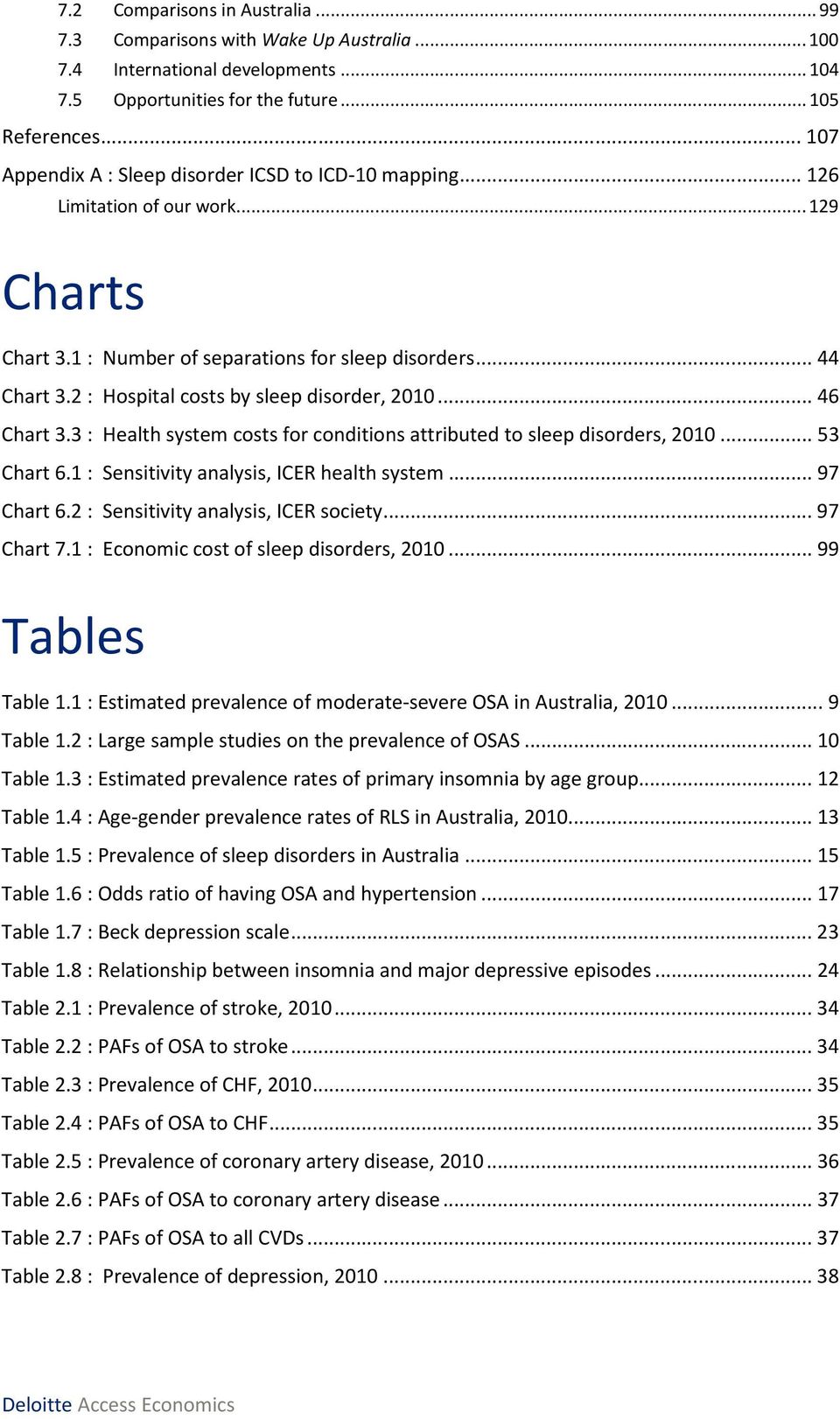
4 Table 2.9 : PAFs of sleep disorders to depression Table 2.10 : Incidence of hospitalised and non-hospitalised injuries caused by MVAs, Table 2.11 : PAFs of OSA to a MVA injury Table 2.12 : Incidence of serious workplace injuries, Table 2.13 : PAFs of OSA to a workplace injury Table 3.1 : Hospital costs for sleep disorders in Table 3.2 : Cost of sleep studies in Table 3.3 : Cost of medical practitioner visits due to OSA in Table 3.4 : Summary of direct health care system cost components for MVA Table 3.5 : Average cost per person and total cost of road injuries due to OSA, Table 3.6 : Summary of health care costs of sleep disorders, Table 4.1 : Prevalence of OSA and associated conditions caused by OSA by age and gender, Table 4.2 : Prevalence of insomnia and associated conditions by age and gender, Table 4.3 : Prevalence of RLS and associated conditions by age and gender, Table 4.4 : Lost productivity due to CVDs Table 4.5 : Lost productivity due to depression Table 4.6 : Assumed impact of injury on employment Table 4.7 : Productivity cost of temporary absence due to MVAs from OSA by gender, Table 4.8 : Productivity cost of premature mortality Table 4.9 : Productivity cost of absenteeism Table 4.10 : Estimated hours per week of care by level of disability, Table 4.11 : Cost of informal care, Table 4.12 : Estimated general costs of road traffic crashes, Table 4.13 : Other costs of workplace accidents, Table 4.14 : Social security payments to people not employed due to sleep disorders Table 4.15 : Deadweight loss, Table 4.16 : Summary of the costs of sleep disorders, Table 5.1 : Studies of pre-treatment health utility scores for those with OSA Table 5.2 : Average EQ-5D health utility scores for those with RLS Table 5.3 : YLDs due to OSA, RLS and insomnia in Table 6.1 : Reports of minor adverse events from CPAP Table 6.2 : Summary of CUA of CPAP versus conventional or no treatment Table 6.3 : Estimated total cost of CPAP treatment over 5 years in Australia Table 6.4 : Cost utility analysis... 94

5 Table 6.5 : Results from sensitivity analysis, inputs Table 7.1 : Summary of the economic cost of sleep disorders, Table 7.2 : Health cost comparison, national priorities and other, Table 7.3 : Summary of the methods and findings of this study compared with Access Economics (2004a) Figures Figure 6.1 : CPAP therapy... 84

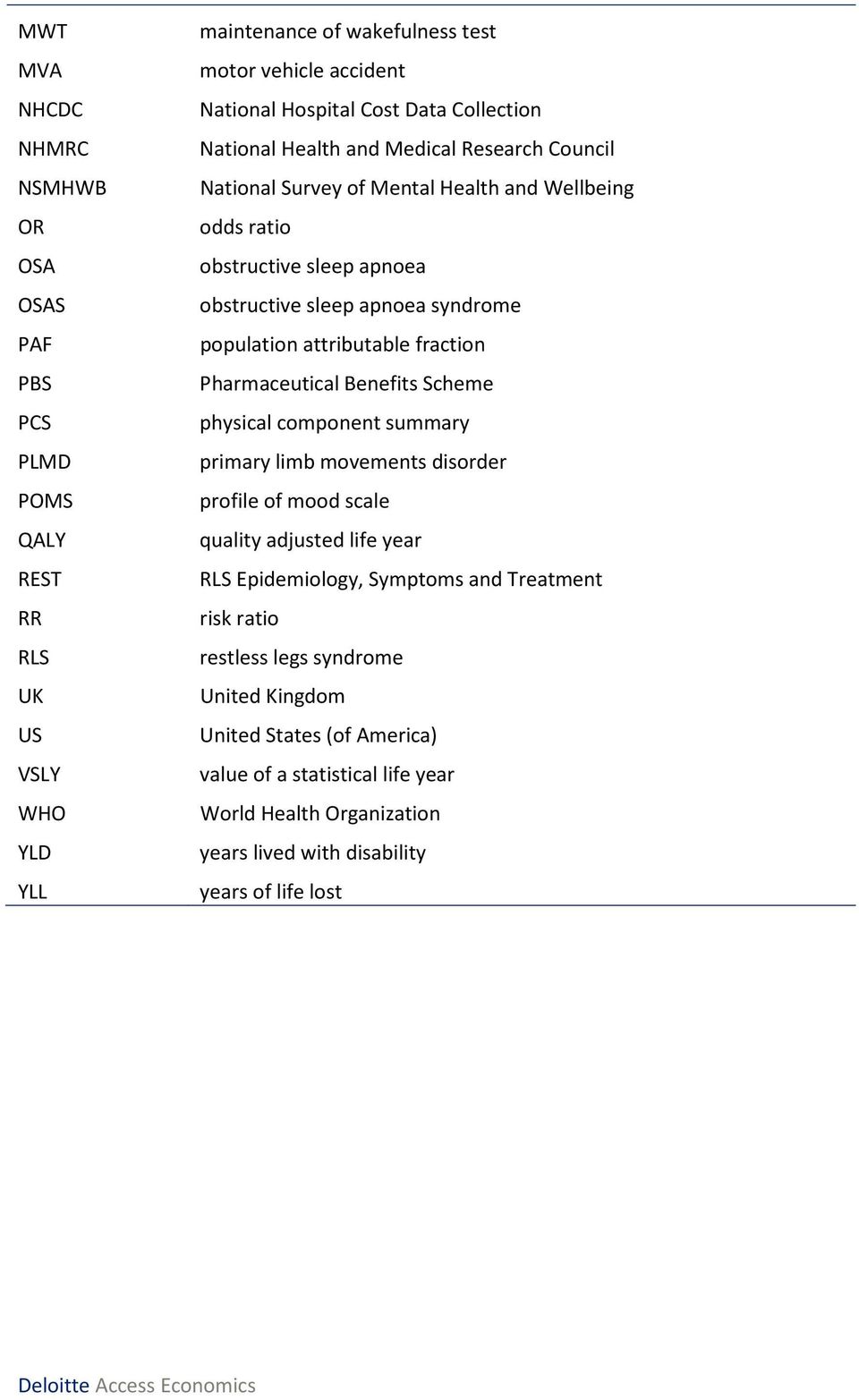
6 Glossary ABS ADHD AHI AIHW ATO BEACH BITRE BMI CEA CHF CI CPAP CSA CUA CVD DALY DRG Liability limited by a scheme approved under Professional Standards Legislation. Deloitte refers to one or more of Deloitte Touche Tohmatsu Limited, a UK private company limited by guarantee, and its network of member firms, each of which is a legally separate and independent entity. Please see for a detailed description of the legal structure of Deloitte Touche Tohmatsu Limited and its member firms Pty Ltd Australian Bureau of Statistics attention deficit/hyperactivity disorder apnoea-hypopnoea index Australian Institute of Health and Welfare Australian Tax Office Bettering the Evaluation and Care of Health Bureau of Infrastructure, Transport and Regional Economics body mass index cost effectiveness analysis congestive heart failure confidence interval continuous positive airway pressure central sleep apnoea cost utility analysis cardiovascular disease disability adjusted life year diagnostic related groups DSM-IV Diagnostic and Statistical Manual (of mental disorders), Version 4 DWL EDS ESS ICD-10 ICER ICSD GP HADS MBS MCS MSLT deadweight loss excessive daytime sleepiness Epworth sleepiness scale International Classification of Diseases (Tenth Revision) incremental cost effectiveness ratio International Classification of Sleep Disorders general practitioner hospital anxiety depression scale Medicare Benefits Schedule mental component summary multiple sleep latency test

7 MWT MVA NHCDC NHMRC NSMHWB OR OSA OSAS PAF PBS PCS PLMD POMS QALY REST RR RLS UK US VSLY WHO YLD YLL maintenance of wakefulness test motor vehicle accident National Hospital Cost Data Collection National Health and Medical Research Council National Survey of Mental Health and Wellbeing odds ratio obstructive sleep apnoea obstructive sleep apnoea syndrome population attributable fraction Pharmaceutical Benefits Scheme physical component summary primary limb movements disorder profile of mood scale quality adjusted life year RLS Epidemiology, Symptoms and Treatment risk ratio restless legs syndrome United Kingdom United States (of America) value of a statistical life year World Health Organization years lived with disability years of life lost
8 Executive summary Sleep disorders are a large and under-recognised problem in Australia. In 2004, Access Economics prepared a report on the economic cost of sleep disorders in Australia, Wake up Australia. This 2011 report was commissioned by the Sleep Health Foundation to re-estimate the cost of sleep disorders based on updated cost information and developments in the literature, which result in different methodology from the previous analysis. This report also includes a cost-utility analysis of continuous positive airway pressure (CPAP) the most common treatment for obstructive sleep apnoea (OSA). This report focuses on three of the most well recognised and researched sleep disorders, since these account for the majority of sleep impacts studied. These are: OSA; restless legs syndrome (RLS); and primary insomnia. Prevalence The prevalence of each sleep disorder was calculated in the Australian population aged 20 years and over (Table i). These prevalence rates do not overlap, that is they have been adjusted to avoid counting people with multiple disorders, by only counting the primary sleep condition (Section 1.1.5). In 2010 there were an estimated 1.5 million Australians (8.9% of the population) with these sleep disorders, comprising approximately: 775,000 people with OSA (4.7%); 492,000 people with primary insomnia (3%); and 199,000 people with RLS (1.2%). Costs may be underestimated given the prevalence of people experiencing symptoms of insomnia, RLS or OSA is substantially higher than the proportion of people who are diagnosed with these conditions, and given the exclusion of other sleep conditions. Table i: Prevalence of sleep disorders in Australia Sleep Disorder Low Base case High OSA (AHI 15) 4.0% 4.7% 6.0% Primary Insomnia 1.5% 3.0% Restless Legs Syndrome 1.2% Source: calculations. AHI = apnoea-hypopnoea index. Sleep disorders and other health conditions There is evidence of a causal relationship between sleep disorders and other illnesses and injuries. Population attributable fractions (PAFs) were used to estimate the proportion of each condition attributable to each sleep disorder. These are shown in Table ii. Some of the PAFs have changed since the previous report, due to changes in the literature evidence. In particular, in this report there is: a lower odds ratio for the impact of OSA on the risk of workplace injuries (potentially reflecting changes in occupational health and safety practices in the intervening years); iii

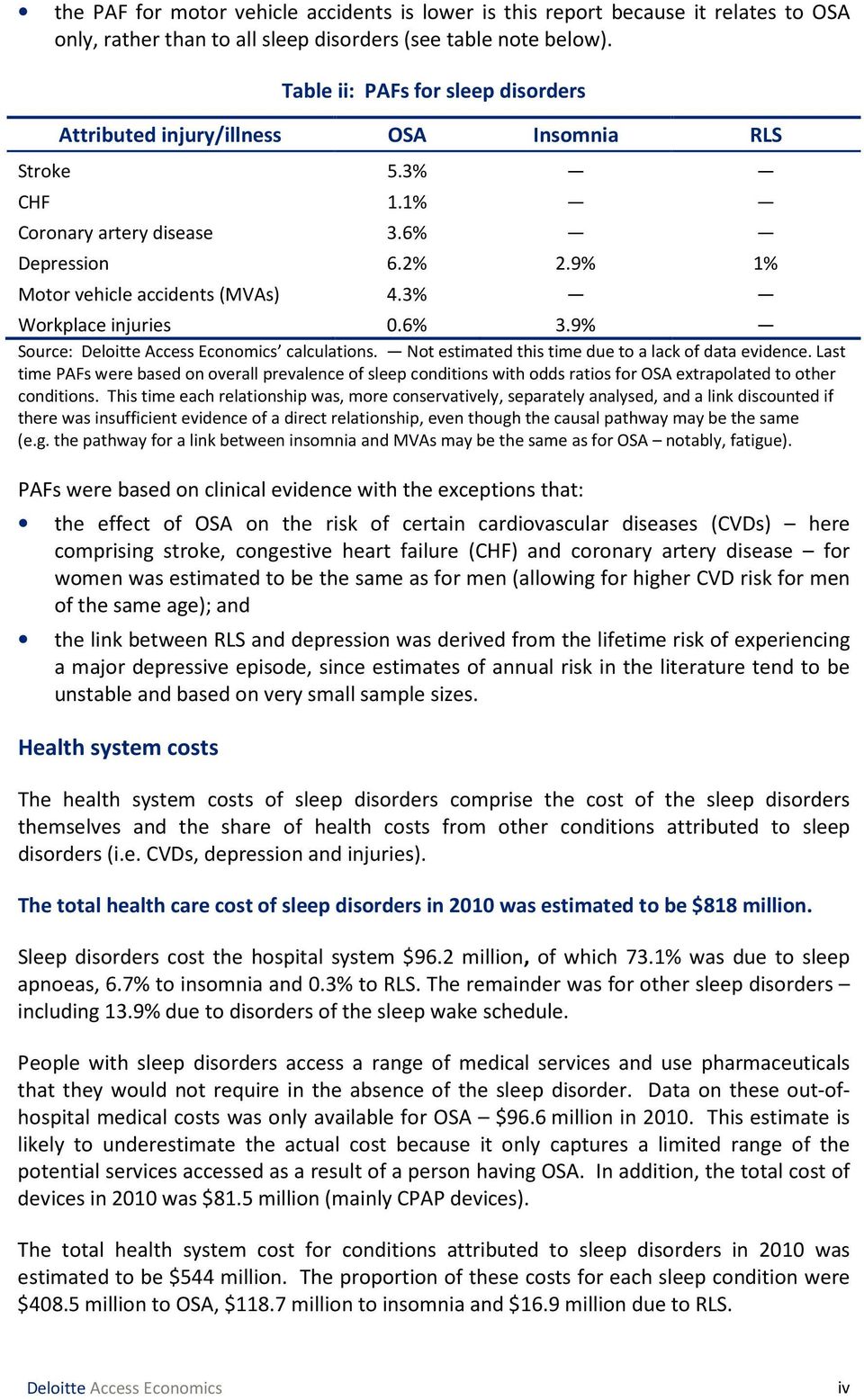
9 the PAF for motor vehicle accidents is lower is this report because it relates to OSA only, rather than to all sleep disorders (see table note below). Table ii: PAFs for sleep disorders Attributed injury/illness OSA Insomnia RLS Stroke 5.3% CHF 1.1% Coronary artery disease 3.6% Depression 6.2% 2.9% 1% Motor vehicle accidents (MVAs) 4.3% Workplace injuries 0.6% 3.9% Source: calculations. Not estimated this time due to a lack of data evidence. Last time PAFs were based on overall prevalence of sleep conditions with odds ratios for OSA extrapolated to other conditions. This time each relationship was, more conservatively, separately analysed, and a link discounted if there was insufficient evidence of a direct relationship, even though the causal pathway may be the same (e.g. the pathway for a link between insomnia and MVAs may be the same as for OSA notably, fatigue). PAFs were based on clinical evidence with the exceptions that: the effect of OSA on the risk of certain cardiovascular diseases (CVDs) here comprising stroke, congestive heart failure (CHF) and coronary artery disease for women was estimated to be the same as for men (allowing for higher CVD risk for men of the same age); and the link between RLS and depression was derived from the lifetime risk of experiencing a major depressive episode, since estimates of annual risk in the literature tend to be unstable and based on very small sample sizes. Health system costs The health system costs of sleep disorders comprise the cost of the sleep disorders themselves and the share of health costs from other conditions attributed to sleep disorders (i.e. CVDs, depression and injuries). The total health care cost of sleep disorders in 2010 was estimated to be $818 million. Sleep disorders cost the hospital system $96.2 million, of which 73.1% was due to sleep apnoeas, 6.7% to insomnia and 0.3% to RLS. The remainder was for other sleep disorders including 13.9% due to disorders of the sleep wake schedule. People with sleep disorders access a range of medical services and use pharmaceuticals that they would not require in the absence of the sleep disorder. Data on these out-ofhospital medical costs was only available for OSA $96.6 million in This estimate is likely to underestimate the actual cost because it only captures a limited range of the potential services accessed as a result of a person having OSA. In addition, the total cost of devices in 2010 was $81.5 million (mainly CPAP devices). The total health system cost for conditions attributed to sleep disorders in 2010 was estimated to be $544 million. The proportion of these costs for each sleep condition were $408.5 million to OSA, $118.7 million to insomnia and $16.9 million due to RLS. iv
10 Indirect costs Indirect financial costs associated with sleep disorders and conditions attributable to them were estimated to be $4.3 billion in This includes $3.1 billion in lost productivity due to premature workforce separation and mortality, and absenteeism. The deadweight loss of raising revenue to fund lost productivity, public health expenditure, social security payments and a number of costs associated with motor vehicle accidents that were due to sleep disorders cost $472 million. Informal care and other costs of motor vehicle and workplace accidents amounted to $129 million and $517 million respectively. OSA accounted for 62% of the total cost ($2.6 billion) while insomnia contributed $1.5 billion (36%) and RLS $115 million (3%). 1 Human cost of sleep disorders Sleep disorders impose a burden that extends beyond health care system and broader economic costs. A person living with a sleep disorder will likely experience a lower quality of life through increased morbidity, and may die prematurely e.g. from a motor vehicle accident. Loss of healthy life is measured in disability adjusted life years (DALYs). DALYs lost from OSA, insomnia and RLS as well as attributable conditions were calculated, with an adjustment made to avoid double counting. It was estimated 190,000 DALYs were lost due to sleep disorders in OSA contributed 109,000 DALYs, insomnia 56,000 DALYs and RLS 26,000 DALYs. Multiplying DALYs lost by the value of a statistical life year (VSLY) of $165,000, the total cost of lost wellbeing was estimated to be $31.4 billion ($23.5 billion $36.8 billion). This is not a direct cost to the economy in the traditional sense (i.e. a loss in productivity). It is the value of a loss in the stock of health capital. Cost effectiveness of CPAP CPAP is the most common treatment for people with OSA. Its cost effectiveness for treating the average Australian with OSA was evaluated in comparison with no treatment. The incremental cost effectiveness ratio (ICER) from the heath system perspective was $15,523 ($12,112 to $19,750) per DALY averted which is considered very cost effective based on World Health Organization (WHO) benchmarks. From the perspective of society, there was a saving of $8,736 per DALY averted, making CPAP for OSA a dominant intervention from a societal perspective saving healthy life and dollars. Comparisons and opportunities The total cost associated with sleep disorders in Australia was estimated at $36.4 billion ($27.0 billion to $42.8 billion) (Table iii). 1 The indirect costs in this report are lower than in the previous report because the cost is primarily based on OSA and its associated conditions rather than an estimate of all sleep disorders. Also, changes made to the PAF for OSA and workplace accidents have had a large impact on the results. v

11 This comprised $5.1 billion ($3.5 billion to $6.0 billion) in financial costs and $31.4 billion ($23.5 billion to $36.8 billion) in nonfinancial costs. Health care costs Table iii: Summary of the economic cost of sleep disorders, 2010 Low Base case High $m $m $m Sleep disorders Associated conditions Total health care cost Indirect financial costs Productivity 2,120 3,132 3,673 Informal care Other cost of MVA Other cost of workplace accidents Deadweight loss Total indirect financial cost 2,855 4,250 5,065 Total financial cost 3,487 5,069 6,042 Total non-financial costs 23,468 31,350 36,751 Total cost 26,955 36,419 42,793 Source: estimates. Chart i shows the total cost of sleep disorders in 2010, by type of sleep disorder. The total cost of OSA was estimated at $21.2 billion. The total cost of insomnia was estimated at $10.9 billion and the total cost of RLS was $4.4 billion. 2 Chart i: Economic cost of sleep disorders, 2010 Total economic cost $36.4 billion $10,871 m $4,356 m $21,151 m $39 m Source: estimates. OSA Insomnia RLS Other sleep disorders 2 These results should not be interpreted as meaning that OSA is the most costly sleep disorder as data limitations have not allowed us to include all costs associated with all sleep disorders. vi

12 The importance of sleep health is beginning to gain recognition overseas, in terms of acknowledgement of the need for and development of strategies to increase public awareness and intervention in relation to sleep disorders. A number of groups have sought to heighten awareness of sleep disorders. World Sleep Day was established on 18 March 2008 and, in the United States (US), National Sleep Awareness week occurs on 7 13 March. The European Respiratory Society and the British Lung Foundation have also played an important role in raising awareness in relation to OSA. Australia has comparative advantages in the analysis of sleep arena. Priority interventions to address the current fragmented and under-resourced sleep health landscape include the following. Education and awareness raising for community, health professionals and public policy makers, regarding the importance of good sleep hygiene and how to achieve better sleep outcomes. Research and development this report has identified a number of areas in which further research would be worthwhile (see Section 7). Cost-effective prevention, treatment and management options this report has shown CPAP to be a highly cost effective treatment for OSA yet it is largely privately funded. Other treatment options may provide improved compliance, one of the shortcomings of CPAP. A national coordination point the establishment of a catalysing agent with a forward national action plan is recommended. Although sleep disorders remain under-recognised, the future is positive if opportunities for action are pursued since such a large proportion of sleep-related impacts are preventable or treatable. vii

13 1 Sleep disorders in Australia This chapter reviews the literature on the prevalence and types of sleep disorders, links between sleep disorders and other medical and economic outcomes, and the cost of sleep disorders. 1.1 Prevalence of sleep disorders Over the course of their lives, a person may experience a range of sleep disorders. Among the nearly 70 clinically diagnosable sleep disorders listed in the International Classification of Sleep Disorders (ICSD), the most frequent and often the most severe are obstructive sleep apnoea (OSA), narcolepsy, restless legs syndrome (RLS), periodic limb movement disorder, insomnia, parasomnias, circadian rhythm disorders including jet lag and shift work, and sudden infant death syndrome. The majority of this report focuses on OSA, insomnia and RLS since they are among the most highly prevalent sleep disorders and there are established links between them and other health conditions, which is the area where the majority of costs are incurred. This section presents estimates of the prevalence of these three sleep disorders Obstructive sleep apnoea Sleep apnoea refers to abnormal reductions or pauses in breathing during sleep. OSA is a type of sleep apnoea characterised by sleep-related intermittent upper airway obstruction, which may be associated with episodes of oxygen desaturations and sleep fragmentation. OSA syndrome (OSAS) refers to a combination of OSA and symptoms, such as snoring, disrupted sleep, witnessed apnoeas and excessive daytime sleepiness OSA is commonly measured by the apnoea-hypopnoea index (AHI), which measures the number of obstructive and central apnoea or hypopnoea episodes per hour of sleep. 3 Two measures of the prevalence of OSA have been adopted in this report. the prevalence of those with AHI 15 (often described as moderate to severe OSA); and the prevalence of OSAS, defined as those with AHI 5 who also experience excessive daytime sleepiness. There are advantages and disadvantages to both measures. It is more common in epidemiological studies to report results in terms of those with AHI 15. This is because a number of epidemiological studies have found that OSA only affects health outcomes if AHI levels are above 15, or in some cases 30. For example Redline et al (2010) found that the effect of OSA on strokes is only observed among those with AHI 30. The second measure, 3 Central sleep apnoea refers to sleep apnoea characterised by episodes of shallow or absent breathing caused by the absence of movement in the chest wall during sleep (Bixler et al 1998) and is commonly observed in heart failure patients. The prevalence of CSA is much lower than the prevalence of OSA (Bixler et al 1998). 8
14 although including people with a lower AHI, captures only those who are actually affected by daytime sleepiness as a result of the condition. This is more important in studies looking at the relationship between OSA and accidents and depression The prevalence of moderate to severe OSA (AHI 15) Two major studies have reported the prevalence of OSA. Young et al (2005) analysed data from the Wisconsin Sleep Cohort Study 4 and found that 5.7% of US adults aged years had an AHI Bixler et al (2001) found that 2.2% of females and 7.2% of males had an AHI 15 in the US population aged years. 6 This implies an overall prevalence rate of 4.7%, assuming approximately equal numbers of men and women in that population. The prevalence estimates used in this report were based on Bixler et al (2001), due to a wider range of age groups than Young et al (2005). Table 1.1 shows the prevalence of OSA by age and gender based on Bixler et al (2001). The total number of people with OSA in Australia in 2010 was estimated to be 774,590 24% (185,410) were female and 76% (589,181) male. An age distribution was inferred using the age distribution for men in Bixler et al (1998). 7 The age distribution for females was taken from Bixler et al (2001). Table 1.1: Estimated prevalence of moderate-severe OSA in Australia, 2010 Age Group Women Men Persons % No. % No. % No , , , , , , , , ,606 Total , , ,591 Note: The age breakdown was derived based on the results from Bixler et al (1998; 2001). OSA is defined as being an AHI 15. Source: calculations The prevalence of OSAS The prevalence of OSAS has been estimated in a number of studies. The most commonly cited results are from Young et al (1993) who found that 4% of men and 2% of women have OSAS. The results of Young et al (1993) are broadly consistent with those found across the literature. Punjabi (2008) reviewed the literature on the prevalence of OSAS in studies with 4 At the baseline this study included 1,549 Wisconsin state employees aged between 30 and 60 years (Young 2009). 5 Young et al (2005) used the Wisconsin Sleep Cohort data to estimate relative risk ratios for OSA by categories of age, sex and BMI. This was then used to estimate the proportion of those with an AHI > 15 based on the age, sex and weight distribution in the 2003 US Census. 6 The 95% confidence interval around the female prevalence rate was 1.5% to 3.3% and for males, 5.6% to 9.3%. 7 The age distribution for men was available based on AHI 5, AHI 10 and AHI 20; an estimate for AHI 15 was made assuming a linear relationship between the number of men in each age group and the AHI. Bixler et al (1998) showed that prevalence declines as AHI increases. 9

15 relatively large samples. The studies he identified are described in Table 1.2. With the exception of Udwadia et al (2004), the estimates shown in Table 1.2 suggest that the prevalence of OSAS is likely to range between 3.1% and 4.5% for men and 1.2% and 3.2% for women. A subsequent study of OSAS in India found that the proportion of men with OSAS was 4.9% and the proportion of women with OSAS was 2.1%, more in line with studies for other countries (Sharma et al 2006). Country Table 1.2: Large sample studies on the prevalence of OSAS Study Sample size Ethnicity Diagnostic Method Men Women US Young et al (1993) 602 White Polysomnography 4% 2% US Bixler et al (2001) 1741 White Polysomnography 3.9% (a) 1.2% (a) Australia India Bearpark et al (1995) Udwadia et al (2004) 485 White MESAM IV 3.1% 250 Indian Polysomnography 7.5% 4.5% China Ip et al (2001) 258 Chinese Polysomnography 4.1% China Ip et al (2004) Chinese Polysomnography 2.1% Korea Kim et al (2004) 457 Korean Polysomnography 4.5% 3.2% (b) Note: (a) The definition of OSAS in Bixler et al (2001) required an AHI 10 as well as daytime sleepiness which differs from the normal definition which requires an AHI 5 as well as daytime sleepiness. (b) Figure misreported in Punjabi (2008) as 2.3%. Source: Punjabi (2008). In addition to these studies, Ram et al (2010) recently found using the US National Health and Nutrition Evaluation Survey that 5.7% of men and 2.8% of women had been diagnosed with sleep apnoea. However, physician diagnoses are unlikely to be as reliable an indicator of OSAS an overnight polysomnography studies, which was used in the studies outlined in Table 1.2. In this report an overall prevalence of 3% for OSAS is assumed (consistent with Young et al 1993) with sensitivity analysis conducted at 2% and 4% Insomnia Insomnia is broadly defined as difficulty initiating or maintaining sleep or the perception of poor quality sleep (WHO 1992). Analysis of insomnia is complex because insomnia can arise independently or as a result of other medical conditions, including other sleep disorders. Accordingly, it is important to distinguish between primary insomnia, which is not attributable to any other health condition, and secondary insomnia which is attributable to other physical and mental conditions (such as anxiety or depression). The criteria for a diagnosis of insomnia syndrome are not uniform. There are three insomnia classification standards namely the Diagnostic and Statistical Manual of Mental Disorders (DSM-IV), the International Classification of Sleep Disorders (ICSD) and the International Classification of Mental and Behavioural Disorders from the International Classification of Diseases, Tenth Revision (ICD-10). In this report the ICD-10 definition is used because the data used to calculate health system costs are based on this classification system. The ICD-10 criteria for primary (non-organic) insomnia syndrome is: 10

16 a complaint of difficulty falling asleep, maintaining sleep, or non refreshing sleep; the sleep disturbance occurs at least three times per week for at least one month; the sleep disturbance results in marked personal distress or interference with personal functioning in daily living; and the absence of any known causative organic factor, such as a neurological or other medical condition, psychoactive substance use disorder or a medication (WHO 1992). Lack et al (1988) found prevalence rates to be around 5% (4% - 20%), using South Australian data. This was similar to the prevalence of the use of sleep medications. The 1995 National Health Survey showed that "almost 4% of the population had recently used a tranquilliser, sedative and/or sleeping medication (ABS 1999). A subsequent large-scale study of general practitioner (GP) data on the prevalence of chronic morbidities (Knox et al 2008) found that the prevalence of insomnia syndrome in Australia was between 3.4% and 5%, and chose the midpoint (4.2%) as the estimate. This figure reflects the prevalence of both primary and secondary insomnia syndrome because it was possible in this study for multiple chronic morbidities to be recorded for each of the 9,156 participants. This is consistent with the prevalence range of 1.3% 3% for primary insomnia syndrome found in the international literature. In a US study, Ohayon and Caulet et al (1997a) found that 1.3% of the population had primary insomnia syndrome (with a further 4.3% having secondary insomnia) while Ohayon and Partinen (2002) found that the prevalence of primary insomnia syndrome in Finland was 1.6%. In a United Kingdom (UK) telephone survey, Ohayon and Caulet et al (1997a) found that the population prevalence for primary insomnia was slightly above 3%. The most recent large scale study of insomnia was a telephone survey of 25,579 individuals in seven European countries (Ohayon and Reynolds 2009). The authors found that 3% (95% confidence interval of 2.8% to 3.2%) of the sample had primary insomnia under either the ICD or DSM-IV criteria (with a further 3.6% having secondary insomnia). This comprised prevalence rates of 2% for males and 3% for females. While insomnia prevalence studies do not generally provide data on the prevalence of primary insomnia syndrome by age group, data are available on the prevalence of insomnia symptoms by age group. The distribution of insomnia symptoms by age group in Ohayon and Reynolds (2009) was used to estimate the prevalence of primary insomnia by age group, shown in Table 1.3. Under the assumption that the distribution of insomnia symptoms across age groups is the same as the distribution of insomnia itself, the prevalence of insomnia symptoms in each age group relative to the overall prevalence was used to form the relative ratio. This ratio was then multiplied by the total prevalence of primary insomnia (based on Ohayon and Reynolds (2009)) to form an estimate for each age group. Using this age distribution, the number of people in each age group was adjusted so that the total prevalence was equal to that implied by the overall prevalence rate. 11

17 Age Group Table 1.3: Estimated prevalence rates of primary insomnia by age group Insomnia symptoms Relative Ratio (a) Male primary insomnia (b) Female primary insomnia (b) % % No. % No (c) , , , , , , , , , , , ,422 Total , ,681 Note: (a) Ratio of the prevalence of symptoms in each age group to the total prevalence of symptoms. (b) This was estimated for each age group by multiplying the total population prevalence for each gender (2% and 3.9%) by the relative ratio of insomnia symptoms for each age group, adjusting so that the total across age groups was equal to the total prevalence. (c) Figures for the age group years were based on estimates by Ohayon and Reynolds (2009) for the age group years. Source: calculations. As indicated in Table 1.3, the proportion of individuals experiencing some form of insomnia symptoms (including difficulty initiating or maintaining sleep, early morning awakening or non restorative sleep) is substantially higher for people aged 45 years and over than the proportion of people who meet the diagnostic criteria for insomnia syndrome. Thus to some extent the prevalence of primary insomnia syndrome underestimates the experience of insomnia among the general population Restless legs syndrome RLS is a common, under-diagnosed and treatable central nervous system disorder characterised by disagreeable leg sensations that cause an almost irresistible urge to move the legs. Allen et al (2003) defined and diagnosed RLS according to the following four criteria: an urge to move the legs, usually accompanied or caused by uncomfortable or unpleasant sensations in the legs; the urge to move or unpleasant sensations begin or worsen during periods of rest or inactivity such as lying or sitting; the urge to move or unpleasant sensations are partially or totally relieved by movement, such as walking or stretching, at least as long as the activity continues; and the urge to move or unpleasant sensations are worse in the evening or night than during the day or only occur in the evening or night. RLS is closely related to periodic limb movements disorder (PLMD). The latter is characterised by periodic episodes of repetitive limb movements caused by contractions of the muscles during sleep. This report focused on RLS because it is more prevalent than PLMD (Ohayon and Roth 2002) and there is a greater body of evidence on the relationship between RLS and other health impacts. 12

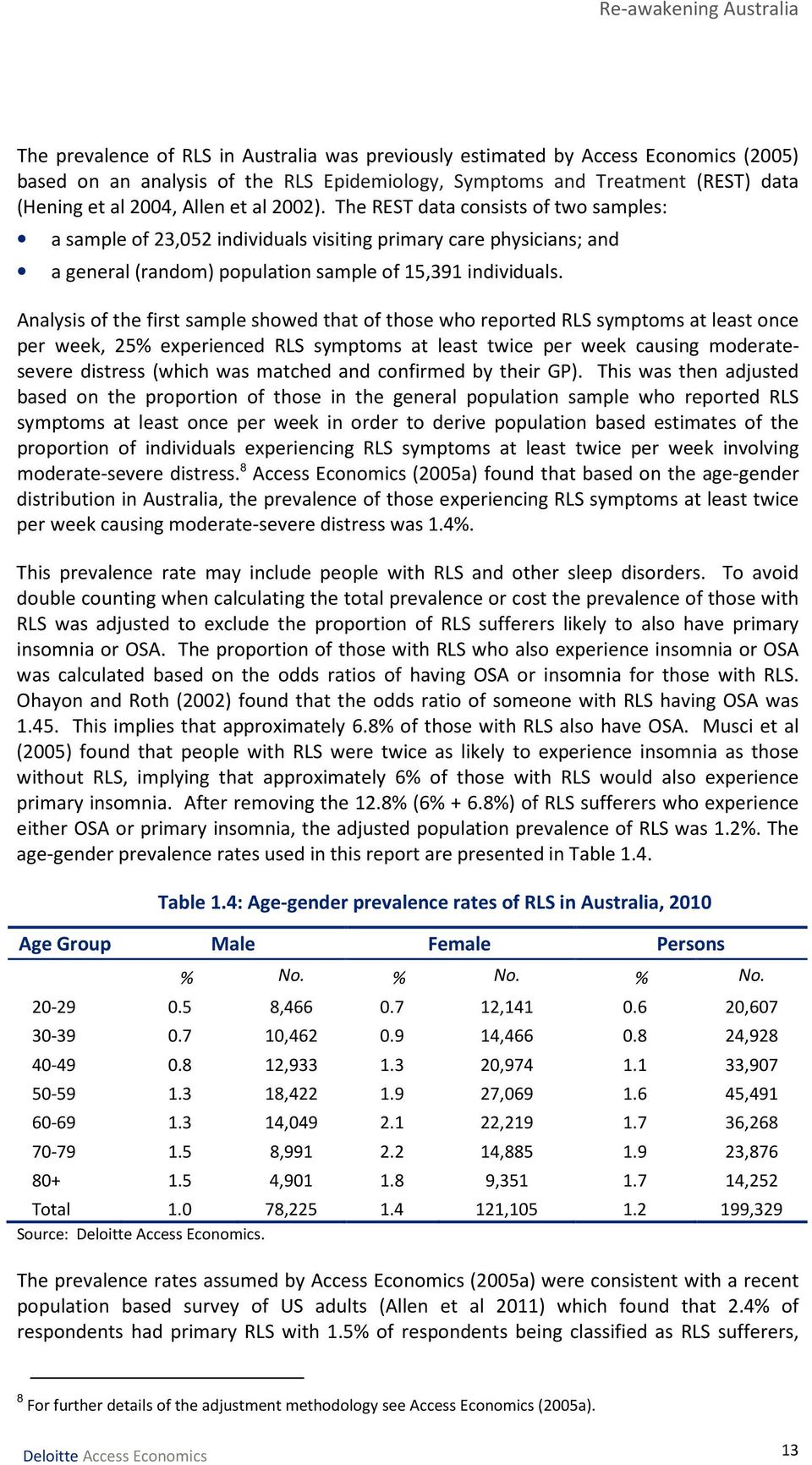
18 The prevalence of RLS in Australia was previously estimated by Access Economics (2005) based on an analysis of the RLS Epidemiology, Symptoms and Treatment (REST) data (Hening et al 2004, Allen et al 2002). The REST data consists of two samples: a sample of 23,052 individuals visiting primary care physicians; and a general (random) population sample of 15,391 individuals. Analysis of the first sample showed that of those who reported RLS symptoms at least once per week, 25% experienced RLS symptoms at least twice per week causing moderatesevere distress (which was matched and confirmed by their GP). This was then adjusted based on the proportion of those in the general population sample who reported RLS symptoms at least once per week in order to derive population based estimates of the proportion of individuals experiencing RLS symptoms at least twice per week involving moderate-severe distress. 8 Access Economics (2005a) found that based on the age-gender distribution in Australia, the prevalence of those experiencing RLS symptoms at least twice per week causing moderate-severe distress was 1.4%. This prevalence rate may include people with RLS and other sleep disorders. To avoid double counting when calculating the total prevalence or cost the prevalence of those with RLS was adjusted to exclude the proportion of RLS sufferers likely to also have primary insomnia or OSA. The proportion of those with RLS who also experience insomnia or OSA was calculated based on the odds ratios of having OSA or insomnia for those with RLS. Ohayon and Roth (2002) found that the odds ratio of someone with RLS having OSA was This implies that approximately 6.8% of those with RLS also have OSA. Musci et al (2005) found that people with RLS were twice as likely to experience insomnia as those without RLS, implying that approximately 6% of those with RLS would also experience primary insomnia. After removing the 12.8% (6% + 6.8%) of RLS sufferers who experience either OSA or primary insomnia, the adjusted population prevalence of RLS was 1.2%. The age-gender prevalence rates used in this report are presented in Table 1.4. Table 1.4: Age-gender prevalence rates of RLS in Australia, 2010 Age Group Male Female Persons % No. % No. % No , , , , , , , , , , , , , , , , , , , , ,252 Total , , ,329 Source:. The prevalence rates assumed by Access Economics (2005a) were consistent with a recent population based survey of US adults (Allen et al 2011) which found that 2.4% of respondents had primary RLS with 1.5% of respondents being classified as RLS sufferers, 8 For further details of the adjustment methodology see Access Economics (2005a). 13
19 namely those who experience two or more symptoms per week causing moderate severe distress. While RLS sufferers are more likely to require treatment for their condition, those with primary RLS who experience infrequent symptoms may still be adversely affected by their condition. Allen et al (2011) found that, of people with primary RLS, those with moderate RLS experienced an average productivity loss of 7.4%, compared to those with severe and very severe RLS who experienced an average productivity loss of 20.1%, and 57.8% respectively. This suggests that those with primary RLS experiencing moderate but infrequent symptoms may still be affected to some degree by RLS. For this reason basing prevalence rates on the proportion of individuals who experience at least two or more symptoms per week causing moderate-severe distress is likely to provide a conservative estimate of the proportion of individuals affected by primary RLS. Nevertheless such a definition provides a reasonable estimate of the proportion of individuals whose symptoms are severe enough to warrant treatment Other Another sleep condition which is highly prevalent is sleep deprivation. A recent study of 3,300 people in New South Wales found that 18.4% reported sleeping fewer than 6.5 hours per night on average (Bartlett et al 2008b). Although sleep deprivation has been linked to a range of health conditions (discussed in further detail in Section 1.2) this report did not include the cost of sleep deprivation because it reflects, to some extent at least, a lifestyle choice by individuals. By sleeping fewer hours individuals implicitly indicate that the cost of reduced sleep is outweighed by the benefits to them of other activities such as work, socialising or exercise Total prevalence of sleep disorders The prevalence assumptions for each sleep disorder are summarised in Table 1.5. To account for the possibility of overlap people with OSA and another condition were counted as having OSA. People with RLS and another condition were counted towards the other condition, rather than RLS. The reason for this was that in the costing exercise, the most information was available for OSA, then insomnia and then RLS, and this was the order of costliness. Hence for a person with more than one condition, the cost of the most expensive condition was counted and no additional cost of any other condition, which is probably conservative, but which was necessary due to the data contraints. A prevalence rate of 4.7% was assumed for OSA. This was based on the proportion of individuals with an AHI 15 estimated by Bixler et al (2001). Sensitivity analysis was conducted at 4% and 6% based on the results of Young et al (2005). Where a prevalence of OSAS was required for estimating the PAF, it was assumed to be 3% consistent with Young et al (2005). A sensitivity analysis was carried out at 2% and 4% based on the range of estimates provided in Table 1.3. The prevalence rate of primary insomnia was assumed to be 3% based on the results of a large-scale telephone survey of seven European countries by Ohayon and Reynolds (2009). Sensitivity analysis was also conducted at 1.5% given the results of other studies (Ram et al 2010, Ohayon and Partinen 2002, Ohayon and Caulet et al 1997a). The estimate of the prevalence of primary insomnia from Ohayon and Reynolds (2009) explicitly excluded those 14

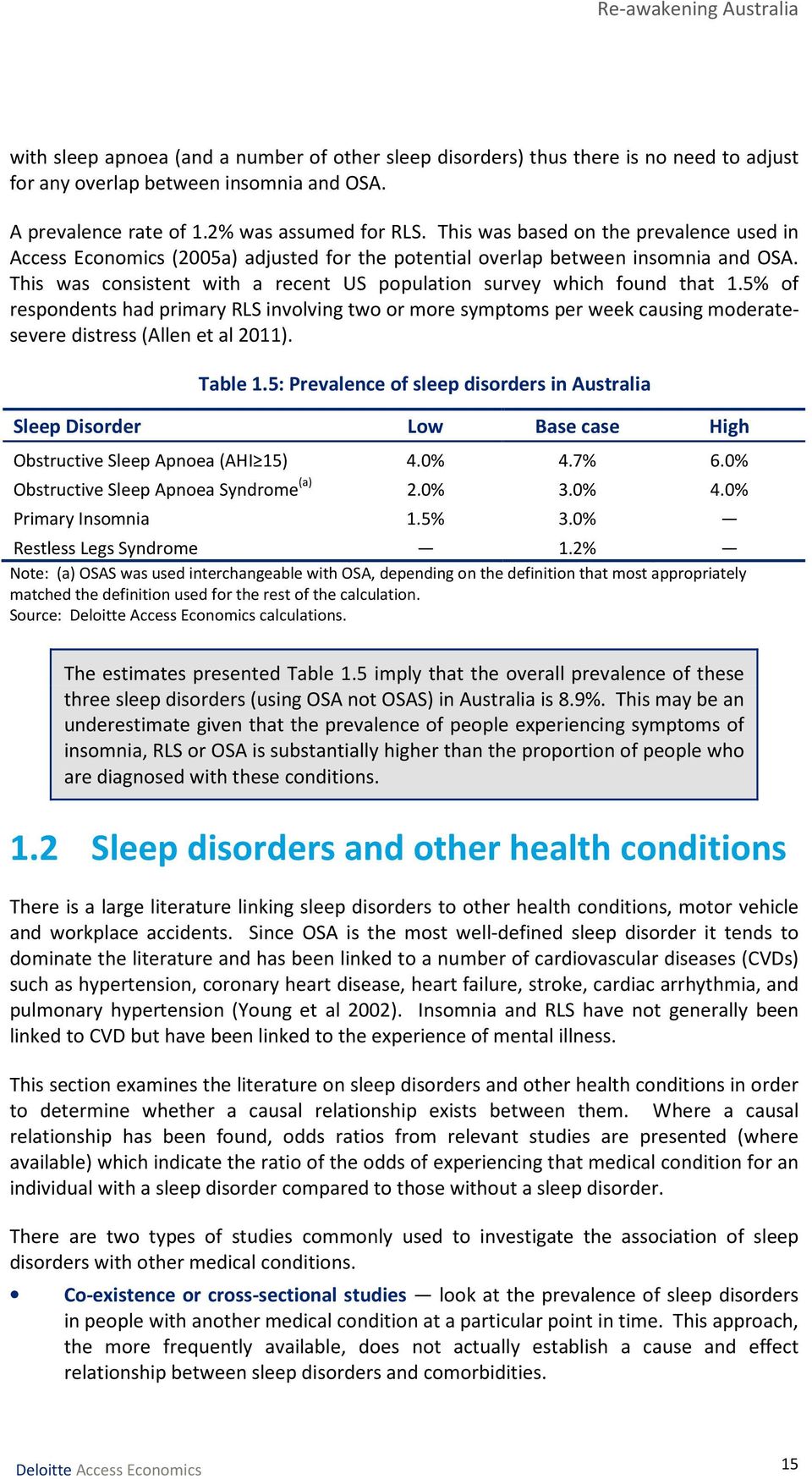
20 with sleep apnoea (and a number of other sleep disorders) thus there is no need to adjust for any overlap between insomnia and OSA. A prevalence rate of 1.2% was assumed for RLS. This was based on the prevalence used in Access Economics (2005a) adjusted for the potential overlap between insomnia and OSA. This was consistent with a recent US population survey which found that 1.5% of respondents had primary RLS involving two or more symptoms per week causing moderatesevere distress (Allen et al 2011). Table 1.5: Prevalence of sleep disorders in Australia Sleep Disorder Low Base case High Obstructive Sleep Apnoea (AHI 15) 4.0% 4.7% 6.0% Obstructive Sleep Apnoea Syndrome (a) 2.0% 3.0% 4.0% Primary Insomnia 1.5% 3.0% Restless Legs Syndrome 1.2% Note: (a) OSAS was used interchangeable with OSA, depending on the definition that most appropriately matched the definition used for the rest of the calculation. Source: calculations. The estimates presented Table 1.5 imply that the overall prevalence of these three sleep disorders (using OSA not OSAS) in Australia is 8.9%. This may be an underestimate given that the prevalence of people experiencing symptoms of insomnia, RLS or OSA is substantially higher than the proportion of people who are diagnosed with these conditions. 1.2 Sleep disorders and other health conditions There is a large literature linking sleep disorders to other health conditions, motor vehicle and workplace accidents. Since OSA is the most well-defined sleep disorder it tends to dominate the literature and has been linked to a number of cardiovascular diseases (CVDs) such as hypertension, coronary heart disease, heart failure, stroke, cardiac arrhythmia, and pulmonary hypertension (Young et al 2002). Insomnia and RLS have not generally been linked to CVD but have been linked to the experience of mental illness. This section examines the literature on sleep disorders and other health conditions in order to determine whether a causal relationship exists between them. Where a causal relationship has been found, odds ratios from relevant studies are presented (where available) which indicate the ratio of the odds of experiencing that medical condition for an individual with a sleep disorder compared to those without a sleep disorder. There are two types of studies commonly used to investigate the association of sleep disorders with other medical conditions. Co-existence or cross-sectional studies look at the prevalence of sleep disorders in people with another medical condition at a particular point in time. This approach, the more frequently available, does not actually establish a cause and effect relationship between sleep disorders and comorbidities. 15
21 Prospective or longitudinal studies track a group of people known to have a sleep disorder to determine the odds ratio of contracting another medical condition (assumed to be associated with the sleep disorder). Ideally such studies should exclude those with the medical condition at the base year and examine whether the presence of a sleep disorder increases the likelihood of experiencing that medical condition in the future. Both types of studies are discussed in the following sections although where prospective results are available these are discussed in greater detail since they are more likely to indicate a causal relationship between a sleep disorder and a medical condition, although this will depend on the particular methodology employed Cardiovascular disease In 1990 Partinen and Guilleminault (1990) highlighted the close association between OSA diagnosis and CVD in the general population. Since then, significant attention has been directed towards exploring the relationship between OSA and CVD. The pathogenesis between OSA and CVD is not yet fully understood, although current theories indicate that pathogenesis is likely to be a multifactorial process involving various mechanisms, such as sympathetic nervous system overactivity, selective activation of inflammatory molecular pathways, endothelial dysfunction, abnormal coagulation and metabolic dysregulationoxidative stress, systemic inflammation, hypercoagulability, hyperleptinemia, and insulin resistance (McNicholas and Bonsignore 2007). The effect of RLS and primary insomnia on CVD has not been considered in this report given uncertainty in the literature about whether RLS and insomnia are related to CVD. For example, while a recent study by Winkelman et al (2008) found that RLS was statistically significantly associated with CVD (but not hypertension), there have not been any long term prospective studies of the relationship between RLS and CVD to confirm this relationship. The pathogenesis for a link between RLS and CVD also remains unclear, although Winkelman et al (2008) suggest RLS may lead to electroencephalographic arousals or substantial autonomic hyperactivity during sleep. Furthermore Spiegelhalder et al (2010) noted that although some studies have found insomnia to be associated with CVD, most of these did not use adequate diagnostic criteria for insomnia or failed to control for the effect of depression on CVD. Spiegelhalder et al (2010) also observed that longitudinal studies have failed to find any increased mortality risk associated with insomnia. While Phillips and Mannino (2007) found that insomnia may lead to a slightly increased risk of CVD in their longitudinal analysis, they concluded that the: modest and inconsistent associations that we found between sleep complaints and incident cardiovascular disease and hypertension suggest that insomnia is not a robust contributor to adverse cardiovascular events. 16
22 Hypertension (high blood pressure) There is an established literature showing the likelihood of a person with OSA having hypertension is substantially higher than for a person without OSA. There is less concrete evidence of a causal link one of the difficulties in establishing a causal link is controlling for confounding factors such as obesity. However, several studies have investigated using prospective studies of people initially without hypertension and concluded that OSA appears to contribute to its development. Using the Sleep Heart Health Study (a longitudinal survey containing 6,132 respondents), Nieto et al (2000) undertook a co-existence study and found a statistically significant trend between AHI levels and hypertension (the p-value for the trend was 0.005) after adjusting for a range of factors including age, sex, ethnicity, BMI and neck, waist to hip ratios. The odds ratio of hypertension found for those with different categories of AHI levels is shown in Table 1.6. Table 1.6: Odds ratio of having OSA and hypertension AHI level Odds ratio of hypertension (95% confidence interval) ( ) ( ) ( ) ( ) Note: The odds ratios compare the AHI level indicated to that of a person with an AHI < 1.5. Source: Nieto et al (2000). While these co-existence studies illustrate a clear association between hypertension and OSA, they have not established a causal link. Peppard and Young et al (2000) found that a minimally elevated AHI (of less than five episodes of apnoea or hypopnoea per hour of sleep) in the starting period was associated with a statistically significant 42% increase in the odds of developing hypertension over a four-year follow up period. 9 Those with an AHI level of 15 or more had a statistically significant odds ratio of 2.9 for developing hypertension compared to individuals with an AHI of zero. Peppard and Young et al (2000) took into account hypertension levels at the base year, non modifiable risk factors, BMI, smoking and alcohol use. The relationship between OSA and hypertension has recently been brought into question by a prospective analysis of the Sleep Heart Health Study. O Connor et al (2009) found that although baseline AHI was associated with an increased likelihood of hypertension the relationship between baseline AHI and hypertension was not statistically significant after including baseline BMI. For those with an AHI > 30 the odds ratio for incipient hypertension was found to be 1.50 with a 95% confidence interval of 0.91 to While this was not statistically significant at the 5% level, the authors noted that it was still possible some association might exist between severe OSA and hypertension. Peppard (2009) argued that the differences between results presented in O Connor et al (2009) and Peppard and Young et al (2000) were largely attributable to the different samples and methodology used. In particular, the two studies used different base 9 With a 95% confidence interval of 13% to 78%. 17
23 categories (AHI=0 in the Wisconsin Sleep Cohort Study and AHI<5 in the Sleep Heart Health Study) and different methods of AHI estimation (Peppard and Young et al (2000) used laboratory polysomnography while O Connor et al (2009) used at home polysomnography). There was also a greater degree of survivor bias in the Sleep Heart Health Study, since 51% of individuals were excluded due to hypertension at the baseline. This is potentially problematic because the Sleep Heart Health Study consisted of an older age group (the survey only includes those aged over 40 years). Those who did not have hypertension at the baseline, given their older age, may have had some individual specific characteristics that make them less susceptible to hypertension such as genetics or lifestyle factors. This problem was less of an issue in the Wisconsin Sleep Cohort Study since the population was younger on average and 27% were excluded for being hypertensive at the baseline. For these reasons the odds ratio estimated by Peppard and Young et al (2000) was used to calculate PAFs for hypertension in this report. There was also some evidence from randomised clinical trials that supports a statistically significant relationship between OSA and hypertension. Duran et al (2001) conducted a random clinical trial of 340 patients recently diagnosed with systematic hypertension who had an AHI > 15, with half being assigned to continuous positive airway pressure (CPAP) treatment, and the remainder being assigned to a sham CPAP treatment. They found that CPAP led to a statistically significant but small reduction in blood pressure in patients with systemic hypertension and OSA. This result is consistent with Peppard and Young et al (2000) Congestive heart failure Congestive heart failure (CHF) occurs when the pumping action of the heart is inadequate to supply sufficient blood flow to meet the needs of the body. This can be caused by a number of other conditions such as high blood pressure, cardiomyopathy (primary heart muscle weakness) or a damaged heart valve (AIHW 2011a). CHF has traditionally been closely associated with central sleep apnoea (CSA) rather than OSA. However, there is some epidemiological evidence that suggests OSA may increase the risk of CHF. A recent study found that, among people with CHF, the prevalence of CSA was 37% compared to 12% for OSA (Javaheri 2006). The literature is largely uncertain as to whether CSA causes CHF or whether the reverse is true. Wolk et al (2003) note that CSA may have an important influence on prognosis, in that its presence is associated with increased mortality in CHF patients, although it is unclear whether CSA directly affects CHF pathophysiology and can therefore be causally linked to prognosis, or whether it is rather an index of the severity of CHF. Wolk et al (2003) also note that CHF predisposes to CSA and, in turn, CSA contributes to CHF progression. Thus the precise quantification of the cause and effect relationship between CSA and CHF is unclear. Epidemiological data suggest that OSA may also lead to an increased risk of CHF. In a crosssectional study, Shahar et al (2001) found that those with AHI scores in the top quartile had a 2.4 times increased risk of heart failure. Adjusting the top quartile from this study to an odds ratio for an AHI>15 or an AHI>30 presents challenges. Moreover, the study was crosssectional. However, a recent prospective study found that OSA was responsible for an increased risk of heart failure for men (but not for women). Gottleib et al (2010) found that 18
24 men who had an AHI>30 were 1.58 times more likely to experience heart failure (based on the adjusted hazard ratio). 10 Both studies used data from the Sleep Heart Health Study. The results of Gottleib et al (2010) were used in this report for the relationship between OSA and CHF, since it was prospective and presented results for AHI> Myocardial infarction and coronary artery disease Coronary artery disease, also referred to as coronary heart disease or ischaemic heart disease has two main clinical manifestations: myocardial infarction or angina. It is caused by a build up of plaque (fat, cholesterol, calcium, and other substances found in the blood), inside the coronary arteries and can result in a heart attack (or acute myocardial infarction) if a blood vessel supplying the heart is suddenly blocked completely (AIHW 2011a). The pathogenesis between OSA and coronary artery disease is not well understood. However, people with OSA appear to have a higher prevalence of coronary artery disease than the general population. Whether OSA is a causal factor in the development of coronary artery disease has not been widely researched but there is some evidence to suggest that it is. In a co-existence study, Shahar et al (2001) found a statistically significant relationship between OSA and coronary artery disease. They found that those in the top AHI quartile (with an AHI > 11) had an odds ratio for coronary artery disease of 1.27 compared to those in the lowest AHI quartile. In a small Swedish prospective study Peker et al (2006) found that those with OSA at the baseline who had not received or properly completed treatment for OSA had an odds ratio of 5.4 for developing coronary artery disease or experiencing a myocardial infarction, although their study only controlled for a limited set of confounding factors. In another prospective study Marin et al (2005) followed 1,651 Spanish men over a period of 10 years and found that the odds ratio for experiencing non-fatal cardiovascular events (defined as either myocardial infarctions, strokes or the need for coronary artery bypass surgery or percutaneous transluminal coronary angiography) was 3.17 for those with an AHI 30. While Peker et al (2006) found that those with OSA had a relatively high odds ratio for coronary artery disease and myocardial infarction, their study only controlled for a limited number of confounding factors. For this reason results from Marin et al (2005) were used in this report for the relationship between OSA and coronary artery disease Stroke The results of both co-existence and prospective studies have generally found that OSA is related to the onset of strokes. A stroke occurs when the blood supply to the brain is interrupted, either due to an arterial blockage or bleeding (AIHW 2011a), often resulting in 10 Although this particular category was not statistically significant, the overall effect of AHI levels (when measured as a continuous variable) on the incidence of CHF was statistically significant at the 5% level. 19
25 severe impairment or death. Similar to other CVDs, the pathogenesis between strokes and OSA has not been comprehensively established. However, there is evidence of a higher incidence of strokes among people with OSA. In a co-existence study, Shahar et al (2001) found that the association between OSA and strokes was stronger than the link between OSA and total CVD. They found that the odds ratio of prevalent stroke in people in the upper OSA AHI quartile, compared to those in the lowest quartile, was In a recent prospective study, Yaggi et al (2005) found that after controlling for relevant factors including hypertension, diabetes and BMI, those with OSA at the baseline had a hazard ratio of 1.97 for suffering a stroke or death from any cause. Valham et al (2008) examined the impact of OSA on strokes among patients with coronary artery disease. In this prospective study those with an AHI > 15 had a statistically significant hazard ratio of 3.56 for experiencing a stroke. Other prospective studies have examined the relationship between sleep disorders and strokes specifically. Using prospective data from the Wisconsin Sleep Cohort study, Arzt et al (2005) found that those with an AHI>20 had an odds ratio of 3.08 for experiencing a stroke compared to those with an AHI<5, but this was not statistically significant. Another prospective study using the Sleep Heart Health Study (Redline et al 2010) found that AHI levels were linearly associated with an increased risk of stroke for men, with each unit increase of AHI increasing stroke risk by 6% (with a confidence interval of 2% - 10%). Men in the highest AHI quartile (corresponding to an AHI > 19) had an adjusted hazard ratio for a stroke of However, there was not a statistically significant relationship between strokes and AHI quartiles for women. This gender difference may potentially explain why Arzt et al (2005) failed to find a statistically significant relationship in their data. The results of Redline et al (2010) were deemed to be the most robust given a large, unbiased sample and appropriate estimation methodology. As such these were used as the basis of the calculations for the relationship between OSA and stroke in this report Other cardiovascular diseases Although the exact nature of the relationship between OSA and many cardiovascular conditions is unclear, numerous cross-sectional studies have found OSA to be associated with increased CVD mortality (He et al 1988, Partinen et al 1988, Peker et al 2000, Mooe et al 2001, Ancoli-Israel et al 1996, Mant et al 1995). Two recent prospective studies have also found OSA to be significantly associated with CVD mortality. Marin et al (2005) found, in a 10 year prospective study, that men with an AHI > 15 had an odds ratio of 2.87 for fatal and 3.17 for non fatal cardiac events, after adjusting for controls and CVD at the baseline. 11 This compares people in the upper quartile of AHI (11 or more episodes of apnoea or hypopnoea per hour of sleep) with people in the lower quartile of AHI (< 1.3 episodes of apnoea or hypopnoea per hour of sleep). The 95% confidence interval was 1.02 to
26 Atrial fibrillation A number of studies have found an association between OSA and instances of atrial fibrillation. Gami et al (2004) found that the adjusted odds ratio of experiencing atrial fibrillation for those with OSA was 2.19, while Mooe et al (1995) found that the relative risk of atrial fibrillation for those with OSA was 2.8. However, Porthan et al (2004) was unable to find a statistically significant association between atrial fibrillation and OSA, suggesting that the strength of the association remains unclear. This report does not include impacts of OSA on atrial fibrillation due to the lack of conclusive evidence at this stage. More research is required in this area. The relationship with CVD mortality is not directly included, but is captured in costs from the established relationships between OSA and CHF, coronary artery disease and stroke Diabetes A large number of studies have examined the relationship between OSA and diabetes. Although the vast majority of cross-sectional studies have found that a statistically significant relationship exists between OSA and diabetes (see Shaw et al 2008 for an extensive review of this literature), this relationship has not yet been definitively confirmed in prospective studies. Consequently, it remains unclear whether a causal relationship exists between OSA and diabetes. Some cross-sectional studies have found a statistically significant relationship between OSA and diabetes. One large US cross-sectional study by Punjabi et al (2004) found a statistically significant relationship between those with an AHI > 15 and diabetes after taking into account age, gender, BMI and waist circumference. Punjabi et al (2004) found that those with an AHI > 15 had an odds ratio of 1.46 for experiencing diabetes. Another way in which the literature has sought to examine the relationship between OSA and type 2 diabetes has been to examine the relationship between OSA and insulin resistance. Punjabi et al (2002) found that sleep disordered breathing was associated with an increased risk for glucose intolerance and insulin resistance. This was consistent with the results of an earlier study by Bresnitz et al (1994). Ip et al (2002) also found that those with OSA were more insulin-resistant, with stepwise regression showing that AHI levels were independent determinants of insulin resistance in both obese and non obese subjects, with greater resistance the more severe the OSA. Another way in which the literature has sought to examine the relationship between OSA and diabetes has been through prospective studies. Reichmuth et al (2005) examined 978 subjects from the Wisconsin Sleep Cohort Study who reported no diabetes at the baseline and had at least one follow-up visit. They found that the odds ratio for a diagnosis of diabetes on a follow up visit for those who had an AHI > 15 was statistically significant after adjusting for age and sex but not statistically significant after body habitus (physique or body build) was taken into consideration. The odds ratio after accounting for age, sex and body habitus was 1.62 ( ). This contrasted with their cross sectional results, which had shown a significant association between the prevalence of diabetes and those with an AHI > 15. The authors hypothesised that OSA might be linked to obesity, which itself leads to an increased risk of developing diabetes. They also noted that while OSA may 21
27 impair the body s use of glucose (as found in the studies on insulin resistance) it may not hasten the development of diabetes mellitus independently of other factors such as age and weight. One notable limitation of the study was the relatively short follow-up period of four years. The results of Reichmuth et al (2005) were revisited in an Australian prospective analysis of those in the Busselton health study (Marshall et al 2009). They found that mild sleep apnoea (5 < AHI < 15) was not significantly related to subsequently developed diabetes. However, those with an AHI > 15 did have a statistically significant increased risk of developing diabetes with an odds ratio of after including controls for age, gender, waist circumference, BMI, mean arterial pressure and cholesterol. Nevertheless the study had a relatively small sample of individuals with an AHI > 15 (n=10), so the results were not definitive. In a 16 year Swedish follow-up, Celen et al (2010) found that OSA was significantly associated with incidence of diabetes among women but not men, although their definition of OSA was based on a low AHI threshold and their sample size only contained 168 individuals. Botros et al (2009) also conducted a prospective study of the relationship between OSA and diabetes among elderly patients in Connecticut, finding a significant association between OSA and incident diabetes with a hazard ratio of 1.43 per quartile. Although these prospective studies have strengthened the case for the existence of a causal relationship between OSA and diabetes, none contain a comprehensive data set and thus the existence of a causal relationship between OSA and diabetes (and therefore the associated costs) remains unclear. For this reason PAFs were not calculated for diabetes, although this is an active area of research interest and more definitive results on the link between OSA and diabetes is likely to emerge in the future Metabolic syndrome Tasali and Ip (2008) reviewed the relationship between OSA and metabolic syndrome. They found that although a number of cross-sectional studies showed a link between the two, the majority lacked sufficient sample size and did not adequately control for confounding factors such as visceral obesity. They also noted that data from prospective studies are currently lacking and that further research is need to elucidate the complex relationship between OSA, metabolic syndrome, obesity and type 2 diabetes. A relationship between OSA and metabolic syndrome was not included in this report, due to data and evidence gaps Depression Sleep disorders have been found to be closely linked to the experience of depression. One of the difficulties in assessing the relationship between sleep disorders and depression is that sleep disruption itself is a clinical symptom of depression (American Psychiatric Association 1987) thus, where possible, information from prospective studies was used. 22
28 OSA and depression In a seminal study, Vandeputte and de Weerd (2003) assessed the prevalence of depression in 917 patients with a range of sleep disorders from the Center for Sleep and Wake Disorders in the US. The Beck depression scale (see Table 1.7) was used to assess the level of depression indicated by each individual. Table 1.7: Beck depression scale Beck score Grade of depression 0-9 No or minimal depression On the border of a depression Mild depression Mild-moderate depression Moderate-severe depression Severe depression Source: Vandeputte and de Weerd (2003). Vandeputte and de Weerd (2003) examined 167 individuals with OSAS. Of those, 41% indicated some form of depression and 1.6% indicated moderate or severe depression. Interestingly, across all forms of sleep disorder more than 25% of patients indicated some form of depression. A subsequent prospective study by Peppard et al (2006) focused on the relationship between OSA and depression, finding a statistically significant relationship. Those with mild OSA (AHI 5) had an odds ratio of 2.0 for developing depression compared to those with no OSA. Those with moderate to severe OSA (AHI 15) had a 2.6 times higher risk of developing depression than those without OSA. The results of Peppard et al (2006) were used in this report to quantify the link between OSA and depression, since they controlled for confounding factors such as hypertension, age and so on, unlike Vandeputte and de Weerd (2003) Insomnia and depression An early prospective study of the relationship between insomnia and depression by Breslau et al (1996) found that those with a history of insomnia at the baseline had a four times higher relative risk for new onset of depression than those who did not have insomnia at the baseline. These results were later confirmed by Roberts et al (2000) who conducted a prospective study of Californian individuals aged 50 and over. Roberts et al (2000) found that after excluding those with a major depressive episode in the base year (1994), those experiencing insomnia in both 1994 and 1995 had an odds ratio of 8.08 for experiencing a major depressive episode in 1995 (Table 1.8). However, those who only experienced insomnia in 1994 did not have a significantly increased risk of experiencing a major depressive episode in Nonetheless, the results of Roberts et al (2000) suggest that persistent insomnia is causally related to the experience of major depressive episodes. 23
29 Table 1.8: Relationship between insomnia and major depressive episodes Unadjusted odds Relation to depression in 1995 Adjusted odds Sleep complaint Odds ratio 95% CI Odds ratio 95% CI Neither year only only and Note: N = 2,164; excludes subjects who were depressed in 1994 (N=206). Adjusted for age, gender, marital status, social isolation, education, financial problems, problems with daily activities, and heavy drinking. Source: Roberts et al (2000). A recent meta-analysis of 21 longitudinal studies on the relationship between insomnia and depression yielded an overall odds ratio for developing depression of 2.10 for those with insomnia at the baseline (Baglioni et al 2011). Since this estimate takes into account the results of a range of studies it is used for the purpose of calculating PAFs in this report RLS and depression Picchietti and Winkelman (2005) conducted a systematic review of the literature on the relationship between RLS and depression. They found that existing population based studies indicated a range of odds ratios for the risk of depression among those with RLS, with one study finding an odds ratio of 2.6, another an odds ratio of 3.1 while a third study found an odds ratio of among men but no significant relationship for women. A recent cross-sectional study in the US found that those with RLS had an adjusted odds ratio of 2.7 for experiencing major depressive disorder over an individual s lifetime and an odds ratio of 4.7 for having experienced a major depressive disorder in the last twelve months (Lee et al 2008). Another cross-sectional study, conducted on Korean adults, found that those with RLS had an odds ratio for depression over their lifetime of 2.57 and an odds ratio of 2.99 for experiencing major depressive disorders in the last twelve months (Cho et al 2009). However, Lee et al (2008) and Cho et al (2009) contained a small sample of those with RLS (42 and 72 individuals respectively). A cross-sectional study of German adults (Winkelman et al 2005) included a larger sample of those with RLS (130 individuals) and found that the odds ratio of experiencing a major depressive episode (not caused by another medical condition) was 1.93 over an individual s lifetime and 1.31 over the previous 12 months, although the latter odds ratio was not statistically significant. 24
30 The results of Winkelman et al (2005) were used as the basis of the calculation in this report given a larger sample size. Since the odds ratio for depression over the previous 12 month was not statistically significant, the lifetime odds ratio was used. 1.3 Sleep disorders and the risk of accidents Aside from the increased risk of experiencing particular health conditions, those with sleep disorders are also likely to face an increased risk of having a motor vehicle accident (MVA) or workplace accident, due to lapses in concentration or fatigue. OSA has been found to be associated with an increased likelihood of MVAs, although the effect of insomnia and RLS on MVAs has received relatively little attention in the literature. There also appears to be a relationship between OSA and insomnia and workplace accidents, although the literature on this relationship is less extensive Motor vehicle accidents The relationship between fatigue and MVAs has been well established. Ohayon and Caulet al (1997b) found that 9.3% of those with severe daytime sleepiness had experienced a MVA in the past 12 months, compared to 4.7% of those who did not suffer from daytime sleepiness. However, while the positive association between OSA and MVAs has been well established (Ellen et al 2006), the relationship between RLS and insomnia and MVAs has not been well documented (Philip and Akerstedt 2006). Given the link between fatigue and MVAs, more research is needed in order to clarify the effect of insomnia and RLS on MVAs OSA A number of studies have highlighted the relationship between OSA and increased risk of motor vehicle accidents (MVAs). Austroads cited a number of studies in their Fitness to Drive Guidelines (Austroads 2006) which indicated that: people with sleep apnoea are two to seven times more likely to have a motor vehicle accident than people without sleep apnoea; sleep apnoea impairs driving performance to a similar extent to illegal alcohol consumption or sleep deprivation; and drivers with severe sleep disordered breathing may have a much higher rate of accidents than those with a less severe sleep disorder. One difficulty in accurately estimating the magnitude of the relationship between OSA and MVAs is that many studies contain relatively small sample sizes. Terran-Santos et al (1999) found that those with AHI > 15 had an adjusted odds ratio of 8.1 for experiencing motor vehicle accidents although they used a sample of only 102 people, drawn from those who had been treated at emergency hospitals in Burgos or Santander in Spain following MVAs on a highway. 25
31 George (2001) took a different approach to examining the relationship between OSA and MVAs, examining the impact of CPAP treatment on the risk of motor vehicle accidents. George (2001) found (using a sample of 420 people) that those with untreated OSA had 0.18 motor vehicle crashes per year compared with 0.06 crashes per year for those without OSA. Following CPAP treatment the number of crashes for people with OSA fell to 0.06, in line with the control group. More recently, Mulgrew et al (2007) studied 375 crashes over a three year period and found that those with an AHI between 6 and 15 had a relative risk of 2.6 of being involved in an MVA compared to controls, while those with an AHI > 30 had a relative risk of 2.0 for being involved in a MVA compared to controls. Two major meta-analyses have also been conducted on the relationship between OSA and MVAs. Sassani et al (2004) conducted a meta-analysis of six studies to obtain a pooled OR of the risk of a MVA among those with OSAS. The six studies provided odds ratios ranging from 1.71 to 7.43 with a combined pooled odds ratio of Ellen et al (2006) also conducted a systematic review of the literature on OSA and MVAs. They found that 23 out of the 27 studies on non-commercial drivers had found a statistically significant relationship between OSA and MVAs including all studies the authors deemed to be high quality. The odds ratio of an MVA for people with OSA across the studies ranged from 1.2 to 13, with a median of 3.1. Sassani et al (2004) was used as the basis for the relationship between OSA and MVAs in this report Section provides more detail regarding the reasons for this choice Insomnia Surprisingly, a clear relationship between insomnia and MVAs has not yet emerged. An early study by Balter and Ulenhuth (1992) found that people with insomnia were 3.5 to 4.5 times more likely to experience a MVA than controls. More recently, Daley et al (2009) examined 948 adults and found no significant difference in MVAs in the previous six months for those with insomnia compared to good sleepers, although only 34 individuals reported experiencing accidents. In a study of 738 people, Leger et al (2006) found people with insomnia were more likely to report experiencing both major and minor accidents in the previous 12 months. However, there was no statistically significant difference in accident rates between those with insomnia and good sleepers. Philip et al (2010) also found no statistically significant relationship between insomnia and MVAs in a sample of 35,004 drivers, although they did find that insomnia and OSAS were statistically significant predictors of driving accidents caused by sleepiness. These mixed results indicate that more research is needed (preferably with large sample sizes) before a definitive link between insomnia and MVAs can be established, and a relationship is thus conservatively excluded in this report RLS There is little evidence on the relationship between RLS and MVAs. Phillip et al (2010) did not find a relationship between RLS and MVAs or MVAs due to sleepiness, although the sample contained a relatively small number of accidents among those with RLS. 26
32 A relationship between RLS and MVAs is thus excluded in this report. As with insomnia, RLS causes fatigue and fatigue increases risk of MVAs so this exclusion may also be conservative and further studies are needed Workplace accidents There is evidence that poor sleep impacts the risk of accidents in the workplace. However, the links between specific conditions remain largely unexplored. While evidence from small sample cross-sectional studies suggests that OSA and insomnia are associated with workplace accidents, few studies have explored the relationship between RLS and workplace accidents OSA Current studies on the relationship between OSA and workplace injuries have a number of limitations. A robust study was conducted by Lindberg et al (2001), who examined the effect of snoring and excessive daytime sleepiness (EDS) on the risk of occupational accidents. Snoring and EDS are the main symptoms of OSAS. A multivariate analysis revealed that men who reported both snoring and EDS in the base year had an adjusted odds ratio of 2.2 (95% confidence interval of ) of having an occupational accident over 10 years. 12 For those who reported snoring and EDS in the base year and the final year, the adjusted odds ratio became 3.1 (95% confidence interval of ). Two cross-sectional studies have examined the relationship between OSA specifically (rather than symptoms) and workplace accidents specifically. A 10 year retrospective study by Ulfberg et al (2000) found that men with OSAS had an odds ratio of 1.5 for experiencing a workplace accident but this was not statistically significant. 13 On the other hand, women with OSAS had a much higher odds ratio (6.3), which was statistically significant. 14 A New Zealand study by Fransen et al (2006), based on a large sample of blood donors, found that those with OSA had a statistically significant unadjusted odds ratio of 1.72 for experiencing a workplace accident. However, Fransen et al (2006) identified self-reported OSA rather than polysomnography and did not adjust the odds ratios for other confounding factors. The odds ratio of 1.5 (Ulfberg et al 2000) was used to estimate the relationship between OSA and workplace injuries, as unlike the other studies it looked at OSA specifically and controlled for confounding factors Insomnia Daley et al (2009) found that the odds ratio for those with insomnia experiencing other accidents compared to good sleepers was 2.43, although the number of accidents considered was relatively small. Leger et al (2002) also found that industrial accidents were 12 Adjustments were allowed for age, BMI, smoking, alcohol dependency, years at work, blue-collar job, shift work, exposure to noise, organic solvents, exhaust fumes and whole-body vibrations. 13 While this result was not statistically significant at the 5% level, the 95% confidence interval ranged from 0.9 to 2.6 making it statistically significant at the 10% level. 14 It should be noted that the number of accidents involving women was small, containing only 34 women. 27
33 more common among people with severe insomnia compared to good sleepers, which was statistically significant. The number of accidents among severe insomniacs was relatively similar in both studies. The odds ratio of 2.43 (Daley et al 2009) was used to estimate the relationship between insomnia and workplace injuries, since the odds ratio was not quantified in Leger et al (2002) RLS Phillips et al (2006) found that 34% of people who experienced symptoms of RLS a few nights a week reported making errors at work compared to 20% of those who did not. However, Swanson et al (2011) did not find RLS to be a significantly associated with mistakes at work, although it was significantly associated with concentration difficulties and problems in the organisation. A link between RLS and workplace accidents was not modelled in this analysis and report due to the lack of robust evidence uncovered to date. As RLS results in fatigue, which in turn is associated with workplace accident risk, it appears more studies are needed. 1.4 Sleep disorders in children There has been little research into the economic impact of sleep disorders in children due to a paucity of data. A survey in Queensland suggested almost 30% of parents reported sleep problems affecting the output and function of their children (Armstrong et al 1994). Associations between OSA and hyperactivity, aggressive or rebellious behaviour, inattention, and poor school performance has also been found (Ali et al 1993; Frank et al 1983; Guilleminault et al, 1981; Guilleminault 1982; Stradling et al 1990; Ali et al 1996). Existing studies of OSA in children indicate a prevalence rate of around 2% (Marcus 2001), although a longitudinal study by Brunetti et al (2001) found the prevalence of OSA in children in southern Italy to be slightly lower, between 1% and 1.8%. Picchietti et al (2007) found a prevalence rate of around 2% for RLS in children. The prevalence of insomnia symptoms for children has, however, been found to range from 10% to 30% (Saarenpaa- Heikkila et al 2000), although the proportion experiencing primary insomnia is likely to be much lower. The paucity of robust childhood studies using a polysomnography mean that the potential contribution of OSA to cardiovascular and neurobehavioural impairments is unclear (Young et al 2002). However, existing studies have concluded that there is an association. In their recent review of the literature, Loghmanee and Sheldon (2010) noted that pediatric OSA has been associated with failure to thrive, attention and behaviour problems, cognitive impairment, hypertension, ventricular dysfunction, insulin resistance, and lipid dysregulation. The relationship between sleep disordered breathing and neurobehavioural function and CVD are discussed in greater detail below. Neurobehavioural function 28
34 O Brien et al (2003) linked OSA to changes in neurobehavioral function leading to symptoms of attention deficit/hyperactivity disorder (ADHD). There is a growing body of literature associating OSA to behavioural problems like hyperactivity. ADHD is characterised by inattention, overactivity and impulsivity. It also leads to other emotional, behavioural and learning problems. There is increasing evidence that snoring and OSA are associated with behavioural problems especially hyperactivity and ADHD. Gottlieb et al (2003) recently found that sleep disorders in children were significantly related to experiences of hypertension, inattention and aggressiveness. They found that children with sleep disorders were twice as likely to experience these conditions. However, most of the studies on sleep and ADHD (including Gottlieb et al (2003)) rely on parental reports of sleep disturbance rather than objective sleep assessments using polysomnography. Existing research suggests that there is a "neurocognitive window" for the proper diagnosis and treatment of young children with sleep-breathing disorders before the impact on academic performance and behaviour (O'Brien et al 2003, Urschitz et al 2003). The high incidence of delayed sleep phase syndrome in older children and adolescents has implications for school performance and behaviour and is only now being realised with some US counties delaying high school starting times. The various economic impacts of such children utilising health and educational resources is thought to be significant but not yet quantified. There is a growing awareness that many children with sleep disorders such as OSA and sleep disordered breathing as well as non-respiratory sleep disorders such as Periodic Limb Movement Disorder (Chervin et al 2002, Walters et al 2000, Crabtree et al 2003) might present or even perform on testing like ADD/ADHD children (Teng et al 2003). Gottlieb et al (2004) found that five year olds with sleep disordered breathing performed significantly worse in tests of executive function, memory and intellectual ability than those who did not experience sleep disordered breathing problems. Cardiovascular and other impacts Kwok et al (2003) found that children with primary snoring have increased daytime blood pressure and reduced arterial distensibility, which may jeopardise long-term cardiovascular health. They concluded that the foundations for metabolic and vascular derangement in adult sleep disorders are laid earlier in childhood than previously imagined. Amin et al (2008) similarly found that sleep disordered breathing in children was independently associated with morning blood pressure surge, blood pressure load and 24-hour ambulatory blood pressure. There are other medical disorders that impact on sleep and are potential fragmenters of parental sleep, such as gastric reflux, nocturnal seizures, developmental disorders, chronic neonatal lung disease. Diette et al (2000) found that nocturnal asthma in children affects school attendance, school performance, and parent work attendance. While new data are emerging on the relationship between childhood sleep disorders and long term health conditions, more research is needed before sufficient robust data are available to derive PAFs. 29
35 1.5 Costs of sleep disorders To date there have been a number of studies on the economic costs of sleep disorders, particularly in the US. This report builds on the work of a previous Access Economics (2004a) report, Wake Up Australia, which estimated the economic cost of all sleep disorders in Australia. It found that that the total direct and indirect financial costs of sleep disorders were $6.2 billion with an additional estimated cost of $4.1 billion reflecting the net cost of suffering. Other studies have focused more specifically on the costs of OSA, insomnia or RLS. The most recent estimate of the costs of OSA was completed in Denmark by Jennum and Kjellberg (2011) who found that the total direct and indirect financial cost per person was 3,860 in 2006 prices ($A6,433). 15 If the total financial cost of sleep disorders estimated by Hillman et al (2006) was divided by the estimated number of Australian adults with sleep disorders in 2004, the average cost of sleep disorders per person with a sleep disorder was $4,880 in , which is not dissimilar to that estimated by Jennum and Kjellberg (2011). In New Zealand, Scott et al (2007) derived a substantially lower estimate of $NZ40 million in 2005 dollars for the economic costs of OSA, but their study only considered the effect of OSA on diabetes and CVD and did not consider the cost of reduced productivity. The economic cost of insomnia in 2002 dollars was estimated by Daley et al (2009) for the province of Quebec as $CAN 6.6 billion ($A 7.7 billion). 16 This was equivalent to an annual cost in 2002 dollars of $CAN 5,010 ($A 5,867) per person with insomnia. An earlier study of the cost of insomnia in the US by Walsh and Engelhardt (1999) estimated the direct costs of medical care associated with insomnia for the US to be around US$10.9 billion in 1990 dollars, of which US$1.1 billion was for prescribed medications. Health care services accounted for US$9.8 billion, the majority of which was associated with nursing home care. These studies suggest that insomnia is likely to involve large economic costs to society. The economic cost of RLS was estimated by Access Economics (2005a) to be $1.38 billion in 2004 dollars which equates to just under $5,000 per person with RLS. This is slightly lower than the estimated cost per patient of recent studies of OSA and insomnia. 1.6 Quality of life OSA has been linked to reductions in self-reported quality of life. Using the Sleep Heart Health Study, Baldwin et al (2001) found that severe sleep disordered breathing was significantly and negatively associated with general health perception, physical and social functioning and vitality. The odds ratio for having poor general health perception was 1.56 for those with severe sleep disordered breathing (similar odds ratios were derived for the other indicators). Those experiencing RLS have also been found to report significantly below average scores on a range of quality of life indicators (Allen et al 2005), while Leger 15 Reserve Bank of Australia (2011a) Conversion based on average monthly exchange rates during calendar year Reserve Bank of Australia (2011a). Conversion based on average daily exchange rates during calendar year
36 et al (2001) found that individuals with both mild and severe insomnia had significantly lower mean scores across a range of quality of life indicators. 31
37 2 Population attributable fractions Population attributable fractions (PAFs) refer to the proportion of one health condition, injury or risk factor that can be directly attributed another, in this case to a sleep disorder. This section estimates PAFs for sleep disorders, based on information obtained in the literature review on prevalence and linkages between sleep disorders and other health impacts. To estimate the PAFs the following prevalence estimates were used (from Section 1.1.5). Prevalence of OSA is 4.7% (based on the proportion of individuals with an AHI > 15) with sensitivity analysis at 4% and 6%. 17 Prevalence of primary insomnia in Australia is 3%, with sensitivity analysis at 1.5%. Prevalence of RLS in Australia is 1.2%. The information from Section 1.2 was used to estimate the PAFs between sleep disorders and CVDs (CHF, coronary artery disease and strokes) and between sleep disorders and depression. The information from Section 1.3 was used to estimate the PAFs between sleep disorders and MVAs and between sleep disorders and workplace injuries. PAFs were separately assessed for OSA, RLS and insomnia and were limited to those cases where a robust relationship was estimable from the literature evidence located. Although the effect of OSA on certain cardiovascular conditions (such as stroke and heart failure) has been found to be significant for men but not women, it was assumed that the effect of OSA for women was identical to that for men given that the mortality risk from OSA for women below 70 was found to be similar to that for men in a prospective study by Punjabi et al (2009). This report only considered the first round impact of sleep disorders on other conditions, not the potential impact of these conditions on the risk of other conditions. When including further round effects there is a risk of double counting or incorrectly attributing costs to the original condition. 2.1 Methodology Where evidence from clinical studies of a causal relationship between sleep disorders and another health condition was provided in terms of odds ratios, PAFs were calculated using the following method. First, the following two equations were solved simultaneously: (1) q1.s1 +q2.s2 = p1 17 In some cases the most appropriate epidemiological studies of OSA and other conditions do not use classifications of OSA that conform with these prevalence estimates. These prevalence estimates are based on the proportion of individuals with an AHI>=15. Where this happens, the prevalence of OSA is adjusted to reflect the prevalence of individuals in the category used by the study (eg men with an AHI>=20) based on the results in Bixler et al (1998). Where epidemiological studies use OSAS a prevalence of 3% is assumed (consistent with Young et al 1993) and sensitivity analysis is conducted at 2% and 4%. 32
38 (2) q1/(1-q1) / (q2/(1-q2)) = OR where q1 = probability of having the particular health condition given that an individual has OSA q2 = probability of having the particular health condition given that an individual does not have OSA s1 = share of people with OSA = probability of having OSA s2 = share of people without OSA = probability of not having OSA p1 = probability of having the particular health condition OR = odds ratio for that particular condition for individuals with OSA After solving these equations for q1 and q2, the following equation is solved: (3) PAF = (q1-q2).s1 / p1 Equation 3 was used to determine the PAF of each health condition due to OSA. 18 also used to determine PAFs for RLS and insomnia. It was Where epidemiological studies reported relationships in terms of a hazard ratio, the hazard ratios were assumed to be roughly equivalent to relative risk ratios. 19 The PAF was calculated using the following equation, which was taken from Eide and Heuch (2001). (4) PAF = s1.(rr-1) / (s1.(rr-1) + 1) s1 = share of people with OSA = probability of having OSA RR = relative risk ratio 2.2 Cardiovascular disease Given the established evidence between sleep disorders and CVD, PAFs were calculated for stroke, CHF and coronary artery disease Stroke The relationship between stroke and OSA was expressed in terms of a hazard ratio, hence Equation (3) was used to estimate the PAF. A hazard ratio of 2.86 was used, based on Redline et al (2010). This hazard ratio was for stroke among men in the top quartile of the sleep apnoea distribution (with an AHI>19). 18 See Eide and Heuch (2001) for derivation and background to this approach. 19 Choi et al (2010) show that where the risk of an event is rare, relative risk ratios are numerically quite similar to hazard ratios. 33
39 The PAF requires the prevalence and hazard ratio to reflect the same definition of OSA. Based on Bixler et al (1998), who noted that 4.7% of US men had an AHI of at least 20, the prevalence of OSA with AHI>19 was assumed to be 3%. 20 The prevalence of stroke was based on the National Health Survey (NHS) (ABS 2009a). The NHS did not provide data on stoke itself, rather it reports cerebrovascular disease, of which stroke is the most common type (AIHW 2011a). The prevalence for 2010 was estimated by applying the rate of stroke per 100,000 of the population in to the population in Since the NHS reported the prevalence by age and gender separately, a gender breakdown within each age group (Table 2.1) was estimated based on AIHW (2010c). Table 2.1: Prevalence of stroke, 2010 Age Male Female Persons Rate (%) 000 Rate (%) 000 Rate (%) Total Notes: Rates are per 100,000 of the population in the corresponding age-gender group. Source: calculations. Table 2.2 shows estimated PAFs for experiencing a stroke based on OSA prevalence of 2%, 3% and 4%. Based on a prevalence rate of 3%, 5.3% of strokes are attributable to OSA. If the prevalence of OSA is 4% then 6.9% of strokes would be attributable to OSA, while if the prevalence of OSA is only 2%, only 3.6% of strokes would be attributable to OSA. Table 2.2: PAFs of OSA to stroke Prevalence rate OSA PAF % % Low Base case High Note: OSA prevalence is based on AHI>19. Source: calculations. 20 This is based on the assumption that the percentage reduction in the prevalence for women, by AHI severity, is the same as for men. 21 The prevalence rate of stroke in the population was conservatively assumed to have remained constant because the treatment of stroke was changed in survey. All reports of stroke were treated as being relevant (i.e. current and non-current) (ABS 2009b). 34
40 2.2.2 Congestive heart failure The PAF for CHF was based on the hazard ratio of 1.58 estimated by Gottlieb et al (2010). Although this hazard ratio was derived from men with an AHI > 30, it was also applied to women. As the hazard ratio was based on an AHI > 30, the prevalence of OSA used to calculate the AF should also be based on those with an AHI > 30. The prevalence of people with an AHI > 15 (4.7%) was adjusted based on Gottlieb et al (2010), who found that just under 40% of those with an AHI > 15 also had an AHI > 30. The resulting proportion of people with an AHI > 30 was 2%. The prevalence of CHF was based on self reported prevalence in the NHS (ABS 2009a). The prevalence was projected to 2010 by applying the rate of CHF per 100,000 people to the Australian population in 2010 (ABS 2010a). 22 Table 2.3 shows the estimated prevalence of CHF in 2010 by age and gender. The gender breakdown was based on AIHW (2010c), which used data from the NHS. Table 2.3: Prevalence of CHF, 2010 Age Male Female Persons Rate 000 Rate 000 Rate Total Notes: Rate is per 100,000 of the population in the corresponding age-gender group. Source: calculations. The estimated PAF of CHF due to OSA was estimated as 1.1% for the base case prevalence estimate (Table 2.4). High and low prevalence of OSA gave PAFs of 0.6% and 1.7% respectively. Table 2.4: PAFs of OSA to CHF Prevalence rate OSA PAF % % Low Base case High Note: OSA prevalence is based on AHI>30. Source: calculations. 22 The prevalence rate of CHF in the population was conservatively assumed to have remained constant between and 2010 because the reporting treatment of CHF was changed in survey. All reports of CHF were treated as being relevant (i.e. current and non-current) (ABS 2009b). 35
41 2.2.3 Coronary artery disease The odds ratio used for calculating the PAF for coronary artery disease was 3.17, based on Marin et al (2005). This odds ratio was for men with an AHI of at least 30 experiencing a non-fatal cardiovascular event (defined as a myocardial infarction, stroke or the need for coronary artery bypass surgery or percutaneous transluminal coronary angiography). This outcome is not ideal for calculating the PAF for coronary artery disease because it includes stoke, although it was the most reliable estimate available (see Section ). Given the estimates of Marin et al (2005) apply to those with an AHI > 30, 2% prevalence of OSA was used. In , 5.5% of the population aged over 25 had coronary artery disease, based on reports of angina and myocardial infarction in the NHS (ABS 2009a), shown by age and gender in Table The rate per 100,000 of the population in was applied to the population in 2010 (ABS 2010a) to derive the estimated number of people with coronary artery disease in To calculate the PAF, the prevalence of coronary artery disease should reflect the same age group as the prevalence of OSA. As the OSA prevalence is for people aged 20 years and over, the prevalence of coronary artery disease was adjusted based on the assumption that the prevalence of coronary artery disease in people aged years was zero. The prevalence in the population aged 20 years and over was estimated as 4.9%. Table 2.5: Prevalence of coronary artery disease, 2010 Age Male Female Persons Rate 000 Rate 000 Rate Total Notes: Rate is per 100,000 of the population in the corresponding age-gender group. Source: calculations. Combining the prevalence of OSA, coronary heart disease and the odds ratio according to Equation (1) gives a PAF of 3.6% for an OSA prevalence of 2% (Table 2.6). Low and high prevalence estimates of 1% and 3% give PAFs of 1.8% and 5.3% respectively. 23 The gender breakdown in each age group is based on AIHW (2010a). AIHW (2010a) did not report age-gender data for year olds. The breakdown in this age group was based on the NHS, summarised in Access Economics (2005b). 36
42 Table 2.6: PAFs of OSA to coronary artery disease Prevalence rate OSA PAF % % Low Base case High Note: OSA prevalence is based on AHI>30. Source: calculations All cardiovascular diseases A PAF was calculated for CVD overall because some costs were not available broken down by illness. In accordance with Marin et al (2005), the attributable fraction of cardiovascular events due to OSA was calculated using an odds ratio of Given the results were based on an AHI great than 30, 2% prevalence of people with AHI > 30 was used (Marin et al 2005) The proportion of the population aged 20 years or over expected to have experienced a cardiovascular event was estimated based on data from the National Health Survey (ABS 2009c). The proportion of individuals experiencing either ischaemic heart disease, a stroke, oedema, heart failure or diseases of the arteries, arterioles and capillaries was found to be 5.2% in (ABS 2009c). Adjusting this figure based on the proportion of the population aged over 20 in 2010 (consistent with our prevalence data for OSA) (ABS 2010a), the proportion of Australians aged over 20 who had experienced a cardiovascular event was estimated to be 7.2%. 24 Table 2.7 details the likely range of possible PAFs for experiencing a cardiovascular event due to OSA. Table 2.7: PAFs of OSA to all CVDs Prevalence rate OSA PAF % % Low Base case High Source: calculations. 2.3 Depression The PAF for depression due to OSA was based on an odds ratio of 2.6 (for people with an AHI>15), using the results of Peppard et al (2006). For RLS, an odds ratio of 1.93 was adopted based on the odds ratio in Winkelman et al (2005) for experiencing a major depressive episode (not related to another medical condition) over an individual s 24 This prevalence was estimated by first estimating the total number of individuals aged over 20 who had experienced a cardiovascular event (multiplying the number of individuals in each age group (ABS 2010a) by the proportion of individuals experiencing cardiovascular events in that age group (ABS 2009)) and then dividing this number by the total population aged over 20 years (ABS 2010a). 37
43 lifetime. 25 An odds ratio of 2.10 was adopted for insomnia based on the meta-analysis conducted by Baglioni et al (2011). The prevalence of depression was based on the 2007 National Survey of Mental Health and Wellbeing (ABS 2008). This prevalence was reported for people aged years who experienced at least one depressive episode over the previous year or dysthymia. 26 An age breakdown was determined using the age distribution for affective disorders, of which depression is a sub-group. 27 The prevalence of depression in the population aged 20 years and over was estimated to be 5.1%. Table 2.8: Prevalence of depression, 2010 Age Male Female Persons % 000 % 000 % Total Source: calculations. The PAF for OSA is 6.2% assuming a prevalence rate of 4.7% for OSA (Table 2.9). A lower and higher prevalence rate of 4% and 6% respectively would result in PAFs of 5.4% and 7.8%. For RLS the PAF is 1% and for insomnia the PAFs are 1.5% and 2.9% assuming prevalence rates of 1.5% and 3% respectively. Table 2.9: PAFs of sleep disorders to depression Prevalence OSA Insomnia RLS Prevalence (%) PAF(%) Prevalence (%) PAF(%) Prevalence (%) PAF(%) Low Base case High Source: calculations. 25 Although an odds ratio for experiencing a major depressive episode over the previous twelve months was provided for RLS it was not used due to the small sample size. 26 A depressive episode is characterised as experiencing a number of the following symptoms: depressed mood, loss of interest in activities, lack of energy or increased fatigue, loss of confidence or self esteem, feelings of selfreproach or excessive guilt, thoughts of death or suicide, or suicide attempts, diminished ability to concentrate, think or make decisions, change in psychomotor activity; agitation or retardation, sleep disturbance or change in appetite over a period of at least two weeks. 27 Using the age breakdown, a rate per 100,000 of the population is calculated. It is assumed that the rate in the age groups years is the same as the rate in age group years. Similarly, the rate for years is assumed the same as
44 2.4 Injuries PAFs were calculated for injuries that occurred through motor vehicle and workplace accidents. For OSA, a PAF was calculated by type of accidents. A PAF was also calculated for insomnia and workplace accidents. However, there was inconclusive evidence found of a statistically significant association between motor vehicle accidents and insomnia. There was also insufficient information available to calculate a PAF for RLS and either type of accident Motor vehicle accidents The PAF for motor vehicle accidents (MVA) was based on an odds ratio of 2.52 for OSAS and motor vehicle accidents (Sassani et al 2004). Although Ellen et al (2006) (a study that uses OSA rather than OSAS) found that the median odds ratio across a large number of studies was 3.1, the studies used a variety of different definitions for OSA whereas the studies investigated by Sassani et al (2004) used a consistent definition (OSAS). A prevalence of 3% for OSAS was used in the calculation of PAFs. Due to a lack of data it was not possible to determine the prevalence of injury caused by MVA in the general population. Instead, the incidence of MVAs in 2010 was used to calculate the PAF. To limit the overlap between work related injuries that occur in motor vehicles, the prevalence data were adjusted to take into account the joint likelihood of MVA being work-related in the same manner as in Hillman et al (2006). 28 The number of injuries resulting from MVA was derived from the National Hospital Morbidity Database (AIHW 2009a). This data included the number of annual hospitalised injuries caused by road use between 2000 and 2007 broken down by age, gender and road user group. The Australian Institute of Health and Welfare (AIHW) defines a hospital admission as one related to a land transport accident if the external cause code for the injury was in the ICD-10-AM range V01-V89 and injury is the primary diagnosis. A linear trend was applied to the number of hospitalised injuries between 2000 and 2007 to estimate the total number of road injuries in 2010 (30,275). According to BITRE (2009), 32.8% of people who were hospitalised following a road traffic crash were discharged on the same day. In addition, for every hospitalised person there were: 1.1 people who were not hospitalised but were treated by a GP for less severe injuries, and 3.5 people who were taken to hospital but were not admitted (BITRE 2009). Non-hospitalised road injuries were estimated using the ratio of non-hospitalised road injuries to hospitalised injuries. Total injuries caused by MVAs are shown by age and gender in Table Total injuries were estimated to be around 288,000 in Given 28 MVAs included people in a car or on a motor cycle. An age breakdown was determined using the age distribution of all injuries to road users. 29 The age group was estimate using the population share of people 15-24, which was the original age grouping of the data. The remainder of injuries for people was added to those 5-14 to form the age group
45 Australia s population aged 20 years and over in 2010 (ABS 2010a) this is equivalent to an incidence rate for MVAs of 1.3%. 30 Table 2.10: Incidence of hospitalised and non-hospitalised injuries caused by MVAs, 2010 Age Male Female Persons % 000 % 000 % 000 < Total Source: calculations. The PAFs of MVAs due to OSA are presented in Table The PAF at a prevalence rate of 3% for OSA is 4.3%. High and low prevalence rates of 2% and 4% give PAF for 2.8% and 5.6% respectively. Table 2.11: PAFs of OSA to a MVA injury Prevalence rate OSA PAF % % Low Base case High Source: calculations Workplace injuries The PAF for OSA and workplace injury was based on an odds ratio of 1.5 (Ulfberg et al 2000). This odds ratio was based on a sample of men with OSAS. Although they also provided an odds ratio for women, it was based on a small sample. Given that the odds ratio was much higher for women (6.4), it was conservatively assumed that the odds ratio of 1.5 applies to both men and women. The PAF for insomnia and workplace injuries was based on an odds ratio of 2.4 (Daley et al 2009). The probability of being injured in a workplace accident was based on the incidence of workplace injuries in There are two sources of workplace accident data. ABS survey of work related injuries (ABS 2010b) a survey that captures people aged 15 years or older who self-report whether they have experienced a work-related injury 30 It was not possible to identify the age gender distribution of injuries where the driver was responsible for the accident due to lack of data. This definition would be the most consistent with the concept of the odds ratio. In addition to people with OSA who cause an accident, there would be other people injured in at least some of those accidents. Hence, the age gender distribution of injuries resulting from MVA was assumed to be the same as the distribution of those injured in an accident that was caused by a person with OSA. Moreover, people under the age of 20, although potentially injured in a road accident caused by a driver with OSA, were conservatively excluded. 40
46 or illness in the 12 months prior to being surveyed. The most recent data available were for The National Data Set for Compensation-based Statistics (NDS) based on administrative records of claims for workers compensations (Safe Work Australia 2011). ABS data has broader coverage than the NDS. It captures people who are not eligible for workers compensation (employers and the self-employed) and those who did not apply for worker compensation because they had only a minor injury or did not think it was necessary (Access Economics 2004b). However, the data are not as detailed as the NDS, which makes calculation of costs more difficult. Moreover, the estimates provided for the number of compensated incidents do not align with the administrative records. The lack of detail also makes it impossible to distinguish between injury and disease. Since workplace illnesses are not likely to be caused by OSA, the incidence should reflect injuries caused by accidents. To limit the inclusion of people with workplace illness, the number of workplace injuries was based on the NDS data. This was projected to 2010 by age group based on the rate of accidents per 1,000 employees from to The number of accidents was calculated using labour force data for 2010 (ABS 2011b). The total number of compensated workplace injuries in 2010 was estimated to be 202,800. This method was supplemented by combining elements of the approach used by Access Economics (2004b) and Safe Work Australia (2009) to reconcile these two data sources for the purpose of costing workplace accidents. The number of people from ABS (2010b) who reported not receiving workers compensation because they were not covered or not aware of workers' compensation or who thought it would have a negative impact on current or future employment was added to the total number of compensated injuries. 31 This resulted in the addition of 44,800 people to the total estimate. It was assumed that the age gender distribution was the same as for compensated injuries. The incidence of serious workplace injuries by age and gender is shown in Table Age Table 2.12: Incidence of serious workplace injuries, 2010 Male (compensated) Female (compensated) Persons (uncompensated) (a) Total persons % 000 % < Total Source: calculations. Note: (a) The age distribution is based on the age distribution of compensated injuries. 31 People whose most recent work-related injury or illness sustained was other or no further information were excluded on the basis that these groups could include people with illness rather than injury. 41
47 The total number of serious injuries due to workplace accidents in 2010 was estimated to be 247,600. For people aged 20 years and over, the number of accidents was 234,900. Since the OSA odds ratio used was for employed people, the incidence was calculated based on the number of people who were employed at some point over the previous twelve months (ABS 2010b). This equated to a probability of an employed person aged at least 20 years having a workplace accident of 2.1%. The odds ratio for insomnia was not estimated for a population of employed people, therefore based on the Australian population aged over 20 years in 2010, the incidence of workplace accidents was 1.4%. The prevalence of OSA was adjusted by the probability of being employed, for consistency with the odds ratio and incidence rate. Based on the assumption that a person with OSA has the same probability of employment as a person without OSA in the same age gender group, the probability of a person with OSA being employed is 44%. The prevalence rates of people with OSA who are employed are 0.9%, 1.3% and 1.8%, based on the low (2%), base case (3%) and high (4%) population prevalence rates respectively. The range of PAFs for workplace injuries due to OSA and insomnia are shown in Table The PAFs for OSA were 0.4%, 0.6% and 0.9% for the low, base case and high prevalence rates respectively. With a prevalence rate for insomnia of 1.5% the PAF is 2.0% and for a prevalence rate of 3.0%, the PAF is 3.9%. Table 2.13: PAFs of OSA to a workplace injury Prevalence OSA Insomnia Prevalence (%) PAF(%) Prevalence (%) PAF(%) Low Base case High Source: calculations. 42
48 3 Health costs of sleep disorders The health system costs of sleep disorders comprise two parts, the cost of the sleep disorder themselves and the share of other illnesses and injuries attributed to them. This chapter estimates both types of costs. 3.1 Sleep disorders This section estimates the costs of primary conditions, sleep disorders, to the health system. Limited data were available on these costs and the estimates presented in this section should be viewed as conservative. They are not directly comparable to those presented in Access Economics (2005) because the sleep disorders included have been reduced to those where the ICSD can be directly mapped to an ICD-10 code at the two digit level. Moreover, a bottom up approach has been used whereas the previous report used a top down approach Hospital costs The total cost of hospitalisation for sleep disorders was estimated by multiplying the number of separations for sleep disorders by an estimated average cost of hospitalisation. The number of hospitalisations was based on separation statistics from the National Hospital Morbidity Database (AIHW 2010c) for ICD-10 codes that capture sleep disorders (see Appendix A for details). The ICD-10 codes were based on a mapping between ICSD and ICD-10 at the two-digit level this meant that not all sleep disorders could be mapped to the available data. The number of separations for the broad categories of sleep disorders, G47 sleep disorders and F51 nonorganic sleep disorders are shown in Chart 3.1. A third category other covers all sleep disorders not included under these two broad headings. The number of separations was linearly projected to 2010 using data from to for G47, F51 and other. A linear projection was made based on data from to The total number of separations for G47, F51 and other in 2010 was 64, For other the linear projection was applied to each series, while for G47 and F51 the total was projected and a distribution across the individual series was based on the breakdown in , because the total was a smoother series and therefore could be projected more accurately. 43
49 Chart 3.1: Number of separations for sleep disorders ' Forecast ' Forecast G47 Sleep disorders F51 Nonorganic sleep disorders Other Source: AIHW (2010c) and projections. A cost was attached to these separations using data from the National Hospital Cost Data Collection (NHCDC) (DoHA 2010). The mapping between each ICD-10 sleep disorder and diagnostic related group (DRG) is shown in Table 3.1. This mapping was based on the ICD- 10 to AR-DRG mapping provided in DoHA (2006). The cost of a sleep apnoea separation was based on the DRG for sleep apnoea (E63Z). Most other conditions were based on the cost of the DRG for anxiety disorders (U65Z), due to a lack of data on more specific costs and since the ICD-10 codes for sleep disorders in practice map to the DRG for anxiety disorders (based on expert opinion). The average cost per bed day was calculated using the cost of a separation in a public hospital divided by the average length of stay. Public hospital costs were used because the data on private hospitals was incomplete. For example, specialist fees are not included in NHCDC information for private hospitals (DoHA 2010). The costs were inflated from dollars to 2010 dollars using the average rate of health inflation over the previous ten years (3.4%) found in AIHW (2010a). The average cost for each sleep disorder is shown in Table
50 Table 3.1: Hospital costs for sleep disorders in 2010 ICD-10 Description DRG Average cost Separations Total cost (a) Public (per sep per day) No. $m (2010) G25.8 Other specified extrapyramidal and movement disorders B06A, B06B, B67A, B67B, B67C G47.0 Disorders of initiating and maintaining sleep U65Z 1, , G47.1 Disorders of excessive somnolence U65Z 1, G47.2 Disorders of the sleep-wake schedule U65Z 1, , G47.3 Sleep apnoea E63Z 1, , G47.4 Narcolepsy and cataplexy B06A, B06B, B81A, B81B G47.8 Other sleep disorder U65Z 1, , G47.9 Unspecified sleep disorder U65Z 1, , F51.0 Nonorganic insomnia U65Z 1, F51.1 Nonorganic hypersomnia U65Z 1, F51.2 Nonorganic disorder of the sleep-wake schedule U65Z 1, F51.3 Sleep walking U65Z 1, F51.4 Sleep terrors U65Z 1, F51.5 Nightmares U65Z 1, F51.8 Other nonorganic sleep disorders U65Z 1, F51.9 Nonorganic sleep disorder, unspecified U65Z 1, P28.3 Primary sleep apnoea of newborn E72Z R06.3 Periodic breathing E67A, E67B Total n/a n/a n/a 96.2 Note: (a) Total cost is the average cost multiplied by separations and average length of stay. Source: ; DoHA (2010); AIHW (2010a). Commercial-in-confidence 45
51 It was estimated that in 2010 sleep disorders cost the hospital system $96.2 million. Chart 3.2 shows the breakdown of this cost by broad sleep disorder category. Sleep apnoeas contributed the greatest cost (73.1%) followed by disorders of the sleep wake schedule (13.9%) and insomnia (6.7%). RLS contributed only 0.3% of hospital costs. 33 Sleep apnoea encompasses a number of different types of apnoea OSA represented 59.6% of the total. Chart 3.2: Hospital costs by sleep disorder, 2010 Total cost in 2010 $96.2 million Parasomnia 0.1% Narcolepsy 0.1% Other 5.3% OSA 59.6% Disorders of the sleep wake schedule 13.9% Sleep apnoea 73.1% Hypersomnia 0.4% RLS 0.3% Insomnia 6.7% Source: calculations. Unspecified 12.7% CSA 0.8% Sleep apnea of a newborn & periodic breathing 0.1% 33 The cost of other specified extrapyramidal and movement disorders was assumed to be representative of the cost of RLS. Commercial-in-confidence 46
52 3.1.2 Out of hospital costs People with sleep disorders access a range of medical services and use pharmaceuticals that they would not require in the absence of the sleep disorder. The out-of-hospital costs in this section are estimated using a bottom up approach. Access Economics (2005a) used data from the Bettering the Evaluation and Care of Health (BEACH) study, combined with information on the ratio of hospital costs to out-of-hospital costs for chronic disease to estimate out-of-hospital costs. This report utilises a different methodology based on the diagnosis and treatment of sleep disorders. The advantage of this approach is that the costs are more transparent, although they are not as comprehensive due to data limitations. A bottom up approach requires an understanding of the treatment protocol for sleep disorders. In Australia the GP is the first point of contact for most medical events that are not emergencies. It is therefore assumed that all procedures, pharmaceutical use and treatments have an attached cost of a GP consultation Diagnosis and treatment Based on a patient history and reported symptoms a person with suspected OSA may be referred directly for a sleep study. Alternatively the person might first be referred to a sleep physician or other specialist. There are four types or levels of sleep studies. Level 1 a polysomnography conducted at a sleep laboratory (in a public or private hospital or a private clinic) overnight in the presence of sleep technician who can adjust equipment as required (Kee and Naughton 2009). Level 2 polysomnography conducted without a technician present, usually in the person s home, meaning that they are responsible for setting the test up themselves based on instructions provided. This test has a higher failure rate than an attended sleep study (Kee and Naughton 2009). Level 3 cardiopulmonary monitoring, which can be conducted at home or in hospital and monitors airflow, respiratory effort, oximetry and electrocardiogram (Kee and Naughton 2009). Level 4 single channel cardiopulmonary monitoring (Kee and Naughton 2009). Medicare reimburses the procedural cost and medical interpretation of a level 1 sleep study. If the sleep study is performed at a private hospital or sleep centre then there may be a bed fee charged, which is paid for privately (often covered by private health insurance) (Marshall et al 2007). Medicare also reimburses the cost of level 2 sleep studies (Medicare Australia 2011). Following diagnosis of OSA there are several approaches to management. Lifestyle management: weight loss, reducing alcohol intake, smoking cessation and positional therapy (modifying the position adopted for sleep). CPAP: positively pressurised air is used to hold open the upper airway during sleep. This is delivered via a mask worn over the nose - or nose and mouth - which is connected by a tube to a small electric pump (a CPAP device). Commercial-in-confidence 47
53 Dental device: splints that keeps the airway open either by holding the lower jaw forward (a mandibular advancement device) or the tongue forward (a tongue retaining device). Surgery: a tonsillectomy with adenoidectomy is often used to treat OSA in children. Surgery is less commonly used in adults although surgery to treat anatomical obstruction in the upper airway (e.g. nasal surgery) can be helpful. Daley et al (2009) estimated the economic cost of insomnia in Canada. They interviewed a range of health care professionals to estimate the difference in out-of-hospital costs for people with insomnia symptoms, insomnia syndrome and good sleepers. They found a statistically significant difference in the costs associated with GPs, psychiatrists and other specialists between people with insomnia syndrome and the two other groups. Insomnia is primarily diagnosed and managed in primary care, with assistance from allied health services. Treatment for insomnia includes: behavioural interventions: these are aimed at reducing poor sleep habits and psychological barriers to sleeping, for example: relaxation therapy: muscle relaxation and meditation can help assist with sleep onset; sleep restriction therapy: reducing the amount of time spent in bed lying awake; stimulus control therapy: aims to reassociate the bedroom/bed with sleeping only; and cognitive therapy: reduces the focus on needing to sleep and the stress generated when sleep is not achieved (Grunstein 2002). pharmacological interventions: benzodiazepines and other hypnotics including zolpidem, zopliclone and zaleplon, are the most commonly used treatments. RLS is usually diagnosed by a GP based on symptoms, including difficulty initiating or maintaining sleep and the presence of periodic limb movements in sleep. A person presenting with the symptoms of RLS might be referred to a sleep specialist or a neurologist if they have atypical symptoms, substantial disturbance to sleep or other potentially more severe problems. RLS can be managed in one or both of the following ways: non-pharmacological intervention: for example increasing iron intake and reducing caffeine, nicotine and alcohol consumptions; and/or a pharmacological intervention: typically benzodiazepines, low potency opioids, levodopa, or dopamine agonists (which are used to manage RLS) Cost of diagnosis and treatment Although there is evidence that people with sleep disorders are more likely to access medical services it is difficult to isolate the costs that are incurred due to a sleep disorder. For example, the pharmacological interventions used for sleep disorders are also used for other illnesses, meaning that data on the number of people using these pharmaceuticals are not sufficient to allocate a cost to sleep disorders. The cost of out-of-hospital services for OSA is based on the number of sleep studies claimed though the Medicare Benefits Schedule (MBS) in The item numbers, descriptions, Commercial-in-confidence 48
54 number of claims and schedule fees included are shown in Table 3.2. The total cost of sleep studies in 2010 was $61.6 million. Table 3.2: Cost of sleep studies in 2010 Item Description Scheduled fee Claims Total cost $ No. $ Level 1 sleep study, adult (aged over 18 years) ,140 47, Level 1 sleep study, adult (aged over 18 years), fourth or subsequent investigation in a 12 month period Level 1 sleep study, child aged < 12 years ,609 3, Level 1 sleep study, child aged years , Level 1 sleep study, child aged < 12 years, fourth or subsequent investigation in a 12 month period Level 1 sleep study, child aged years, fourth or subsequent investigation in a 12 month period Level 2 sleep study ,939 9,981 Total 61,640 Source: Medicare Australia (2011). Attached to each of these MBS claims are various consultations with medical practitioners. obtained expert clinical advice on the proportion of people likely to have been referred by a GP and the proportion by a sleep physician. It was assumed that 80% of people having a level 1 sleep study would have been referred by a sleep physician, while only 40% of people having a level 2 study would have been referred by a sleep physician. The remainder were assumed to have been referred by a GP. For paediatric sleep studies it was assumed that 40% would have been referred by a sleep physician. Following the sleep study, approximately 60% of adults would proceed to a trial of therapy (usually with CPAP), necessitating a further two consultations (one long and one short). The estimated numbers of consultations and costs are shown in Table The cost of a consultation with a sleep physician was based on the MBS scheduled fee for a professional attendance by a consultant physician other than psychiatry. The cost for a long consultation was $ and for a short consultation was $ Based on the assumption above, 81,960 people were referred for a sleep study by a sleep physician. These people incurred the cost of one long and one short consultation. Of these, 60% (49,008) required another long and short consultation related to treatment for OSA. In total these visits cost $28.5 million. The cost of a consultation with a GP was based on the MBS schedule fees for a Level C and a Level B consultation ($67.65 and $37.50 respectively). Each person referred for a sleep study by a GP required a Level C and a Level B consultation (39,378 people). Those commencing treatment required an additional Level C and Level B consultation (23,627). In total this cost $6.5 million. 34 Advice on these assumptions was obtained from Dr David Hillman, MBBS, FANZCA, FRCP(Edin), FRACP(Hon) Head, Department of Pulmonary Physiology and Sleep Medicine Director, West Australian Sleep Disorders Research Institute Sir Charles Gairdner Hospital Perth. Commercial-in-confidence 49
55 The total cost of medical practitioner fees due to OSA was therefore estimated to be $34.9 million. Table 3.3: Cost of medical practitioner visits due to OSA in 2010 Item Description Scheduled fee Claims Total cost Sleep physician $ 000 $m 110 Professional attendance, consultant physician, long Professional attendance, consultant physician, short General practitioner 36 Level C professional attendance, GP Level B professional attendance, GP Total 34.9 Source: Medicare Australia (2011). The cost of out-of-hospital health system use for OSA was estimated to be $96.6 million in This estimate is likely to underestimate the actual cost. Only one method of treatment for OSA has been considered and even for this it was not possible to capture all types of costs. The estimate also excludes the cost of other sleep disorders (including undiagnosed sleep disorders), which would include consultations with medical practitioners, pharmaceuticals and community mental health services Cost of devices The cost of CPAP devices was based on data obtained from two out of three of the leading manufacturers of CPAP devices in Australia. These data were an estimate of the annual size of the market. Averaging the two estimates suggests that 51,206 new devices were sold in 2010, costing an estimated $65.5 million. It was expected that a further $16 million in extra interfaces (mask or nasal pillow) and spare parts would also be sold. The total cost of devices in 2010 was estimated to be $81.5 million. 3.2 Health costs of other conditions The health system costs of other injuries and illness that are associated with sleep disorders were calculated by applying the PAFs presented in Chapter 2. In this section the middle estimates are presented, with results for the high and low PAFs shown in Section 3.3. The costs of CVD and depression were based on AIHW disease expenditure data. These data are constructed using a top down approach the AIHW uses total health system expenditure and then allocates it across diseases using information from hospital morbidity Commercial-in-confidence 50
56 records and casemix, Medicare, the Pharmaceutical Benefits Scheme (PBS), the Pharmacy Guild Survey, and the BEACH survey of general practice (AIHW 2008). 35 The total cost of CVD in was estimated to be $5.9 billion. This included $1.8 billion for strokes and $546 million on coronary artery disease (AIHW 2008). These costs were inflated to 2010 using the 10-year average health price inflation rate (3.4%). The total cost in 2010 was estimated to be $7.1 billion. The middle PAFs for stroke (Table 2.2) and coronary artery disease (Table 2.6) were applied to these totals. The attributed cost of these conditions to sleep disorders was estimated to be $34.8 million and $78.4 million for stroke and coronary artery disease respectively. The PAF for all CVD (shown in Table 2.7) was used to estimate the residual attributed cost for remaining CVD of $129.6 million. 36 The total cost of depression and anxiety in was estimated to be $1.4 billion (AIHW 2010b). In 2010 prices, this was $1.7 billion. Using the middle PAFs for OSA, insomnia and RLS, the cost of depression and anxiety attributed to sleep disorders in 2010 was $170.8 million $104.8 million to OSA, $49 million to insomnia and $16.9 million to RLS. AIHW (2010b) provided an estimate of the total cost of injuries, although it was not broken down by cause of injury. BITRE (2009) provided an estimate of the health system cost of a MVA, which was used as the basis for the cost of MVAs in Average health care system costs for hospitalised and non-hospitalised injuries and fatalities derived from BITRE (2009) were inflated to 2010 prices using an average health expenditure inflation rate of 3.4% (AIHW 2010a). Average costs by injury type were applied to the estimated number of injuries and fatalities in 2010 (Table 2.10) to estimate a total direct health care system cost associated with MVA where OSA was a contributing factor. The number of injuries attributed to OSA are shown in Table 4.1. This was estimated by applying the PAF to the number of MVAs in 2010 (see Section 4.1.1). Hospitalised road injuries were broken down by severity and level of disability using the distribution of severity levels from the Bureau of Infrastructure, Transport and Regional Economics (BITRE 2009). These are summarised in Table 3.5. The level of impairment was assessed medically to determine current and future treatment and to aid in lodging compensation claims to cover medical and other costs (BITRE 2009). Severity scores range from 0 to 100, where 0 means no impairment. The breakdown of the number of people by level of impairment in 2006 was estimated by BITRE (2009) using compensation claims data from the Transport Accident Commission of Victoria and hospitalisations data from AIHW. Direct health care system costs for road injuries and fatalities were separated into hospital, medical and paramedical costs, and ambulance costs. Table 3.4 provides a brief description of each of these cost components. 35 The AIHW includes only 86% of total recurrent health expenditure in its estimate of expenditure by disease and injury, referred to as allocated health expenditure. The unallocated remainder includes capital expenditure, expenditure on community health (excluding mental health), public health programs (except cancer screening), health administration and health aids and appliances. 36 This was calculated by applying the PAF for all CVD to the total CVD expenditure and deducting the cost already attributed to stroke and coronary artery disease. Commercial-in-confidence 51
57 Cost component Hospital costs Medical costs Table 3.4: Summary of direct health care system cost components for MVA Description Includes all costs associated with hospital stays for both public and private hospitals. BITRE (2009) assumed 39% of total bed days are in a private hospital where it incurs marginally higher costs per patient day compared to public hospitals. The cost per patient day is applied to average length of stay per injury using AIHW (2009), which is broken down by serious injuries and serious injuries with a high threat to life. Non-hospitalised injuries do not incur any hospital costs. Includes all costs related to a crash including consultations with GPs, specialists, hospital outpatient services, pharmaceuticals and medical excess payments (BITRE 2009). Per person medical costs are higher for people with serious to severe levels of impairment compared to minor to moderate levels. Paramedical costs Includes all public and private allied health costs such as rehabilitation, occupational therapy, vocational training, aids and equipment (for the person or in the home), home services due to disability and other associated services. The per person paramedical costs also increase as the level of impairment increases. Ambulance costs Estimated using BITRE (2009), which includes the proportion of crashes that are attended by ambulances, and the average cost per crash in Source:. The cost per person by severity of injury for the four types of health system costs are shown in Table 3.5. To estimate the health care system costs of fatalities, it was assumed that hospital and medical costs are only incurred for people who survived and were admitted to hospital but died within 30 days from injuries sustained in the road traffic crash (i.e. it does not include those who died at the crash site). Multiplying the estimated number of injuries and fatalities by the average health care system cost of each, it was estimated that direct health care system costs associated with MVA due to OSA were $51.3 million in Table 3.5: Average cost per person and total cost of road injuries due to OSA, 2010 Cost component Hospitalised Non-hospitalised Fatal Hospital ($ per person) 7,289 Medical costs ($ per person) 8,070 2,401 3,259 Paramedical costs ($ per person) 4,867 Ambulance costs ($ per person) 2,179 2,443 Number of people 1,193 10, Total cost ($m) (a) Note: (a) 21% of people are excluded under the assumption that they died at the crash site. Source: BITRE (2009), calculations. The health system cost of workplace accidents was based on Access Economics (2004), which estimated that the cost per injury in was $6,009 Inflating to 2010 prices using health price inflation gave a per injury cost of $8,256. Applying this to the number of workplace injuries (including fatalities due to injury) caused by sleep disorders in 2010, which was estimated to be 9,599 (see Table 4.1, Table 4.2 and Table 4.3 for the number of Commercial-in-confidence 52
58 injuries), gave a total cost of workplace injuries attributed to sleep disorders in 2010 of $79.2 million. The total health system costs for conditions attributed to sleep disorders in 2010 was estimated to be $544.1 million. The composition of this cost by condition is shown in Chart 3.3. Cardiovascular disease is the largest contributor, accounting for 44%. Depression and anxiety accounted for 31% of the costs while injuries contributed 25% 10% from MVA and 15% from work related injuries. Chart 3.3: Health system costs for conditions attributed to sleep disorders, 2010 Work -related injuries 15% Coronary heart disease 14% Injuries from motor vehicle accidents 10% Stroke 6% Depression and anxiety 31% Source: calculations. Other CVD 24% The proportion of total costs by each sleep condition was $408.5 million due to OSA, $118.7 million due to insomnia and $16.9 million due to RLS. 3.3 Summary of health system costs The total health care cost of sleep disorders in 2010 was estimated to be $818 million (Table 3.6). High and low PAF gave estimates of $631 million and $977 million respectively. The cost directly due to sleep disorders was $274 million, comprising $96 million for hospital costs, $97 million in out-of-hospital medical costs and $82 million for CPAP devices. The total health system cost of OSA was estimated at $644 million, comprising 79% of the total cost. Insomnia comprised 15% of the total cost and RLS 2.1%. The remaining 3.9% was from the cost of hospitalisation for other sleep disorders. In comparing these proportions, it should be remembered that out-of-hospital medical costs were not included for insomnia, RLS or other sleep disorders, but only for OSA. Commercial-in-confidence 53
59 Sleep disorders Table 3.6: Summary of health care costs of sleep disorders, 2010 Low Base case High $m $m $m Hospital costs Out of hospital costs Devices Total sleep disorders Associated conditions Coronary heart disease Stroke Other CVD Depression and anxiety Injuries from motor vehicle accidents Injuries from workplace accidents Total other conditions Total health care cost Note: Columns may not sum due to rounding. Source: estimates. Commercial-in-confidence 54
60 4 Indirect costs This chapter investigates the indirect costs of sleep disorders, including the share of indirect costs of the illnesses and injuries that were attributed to sleep disorders. Indirect costs are costs that do not relate to the direct health care system costs. In this chapter the following indirect costs are examined: productivity losses from reduced labour market participation through lower employment, and premature mortality associated with sleep disorders and attributed shares of other illnesses and injuries; costs to informal carers from providing care to someone who has a sleep disorder, including the cost associated with attributed shares of other illnesses and injuries; other costs related to the attributed shares of other illnesses and injuries; and deadweight loss associated with raising additional tax revenue to publicly fund health care services associated with sleep disorders and attributed shares of other illnesses and injuries. The majority of the costs presented in this chapter were based on the PAFs calculated for the middle prevalence rate for each of the sleep disorders. In Section 4.6, the cost estimates for the high and low prevalence rates are presented as a sensitivity analysis. 4.1 Productivity There are a number of theoretical links between the level of an individual s health and their labour supply (Grossman 1972). Quite simply, better health outcomes allow an individual to increase their supply of labour and to work more productively. Poor health outcomes are likely to be associated with lower labour supply and lower productivity, thereby imposing a cost on the economy. A loss in productivity of a person will only equate to a loss in productivity to the economy under fairly strict conditions. These are: the economy is at full employment so any reduction in hours worked due to sleep health and attributed shares of other illnesses and injuries, or any permanent reduction in labour force participation through early retirement or death, cannot be replaced by employing or increasing hours of other workers; and the income of an individual is proportional to the total value added to production. The first condition will fluctuate over time as the economy moves into, and out of, full employment. A reduction in labour when labour is scarce will have a greater impact on productivity compared to an economy with an abundant labour supply. In this situation, a temporary or permanent reduction in working hours due to sleep disorders and associated conditions cannot be replaced by hiring another worker. Consequently, a loss in productivity due to sleep disorders and associated conditions is expected to represent a real cost to an economy operating at a low level of unemployment. Commercial-in-confidence 55
61 The second condition will occur if there is a perfect labour market such that the marginal benefit from an additional hour of work (the value added) is equal to the marginal cost (the wage). In reality, labour markets are imperfect for a number of reasons, for example asymmetric information in the market, and labour market restrictions imposed by government regulation and natural barriers. In addition, synergy created between labour, capital and land means a reduction in working hours may also impact the productivity of other factors of production. Consequently the value of productivity from labour will be larger than the wage provided to an individual so using lost income as a proxy for lost productivity will tend to underestimate the true cost. It is likely that in the absence of their condition, people with sleep disorders and associated conditions would participate in the labour force and obtain employment at the same rate and average weekly earnings as others. The implicit assumption is that the numbers of such people would not be of sufficient magnitude to substantially influence the overall clearing of labour markets, and average wages remain the same. The potential production losses are of four types: premature workforce separation early retirement or other workforce withdrawal; temporary absenteeism due to being unwell more often than average and taking time off work, while remaining in the workforce; lower productivity at work ( presenteeism ) producing less due to reduced hours or lower capacity while at work; and premature mortality the discounted net present value of the future income streams that would have been earned if a person dies prematurely. The costs of presenteeism were not included due to data limitations - it is difficult to obtain Australian data on the difference in productivity between people with and without a particular illness or injury. However, a number of studies show the productivity impacts of sleep disorders on presenteeism as well as other types of productivity losses. For example, Kessler et al (2001) show that insomnia was significantly associated with lost work performance due to presenteeism, equivalent to 7.8 days per annum of lost work performance per individual with insomnia after controlling for comorbid conditions, equating to US$63.2 billion in total annually. The study suggests there are large potential productivity gains from increasing sleep and enhancing alertness, not only by decreasing absenteeism and premature workforce separation (including through premature mortality) but also through reducing presenteeism and thus enhancing creativity and innovation in the work force Premature workforce separation The amount of productivity loss that is attributable to a sleep disorder will depend on how many people are not employed as a result of a sleep disorder or a condition that is caused by a sleep disorder. There is risk of double counting when costing the impact to productivity of each sleep disorders and the associated conditions because data limitations make it difficult to isolate whether or not any reduced employment among people with sleep disorders is due to the sleep disorder or the associated conditions. The cost has therefore been based on the Commercial-in-confidence 56
62 share of the cost of injuries and illness attributable to sleep disorders. It was assumed that a sleep disorder does not compound the probability of premature workforce separation for people with a particular illness or injury and a sleep disorder, compared with those who have that illness or injury but not a sleep disorder. The cost to productivity for each injury and illness associated with a sleep disorder was determined by the difference in the employment rate of people with each injury or illness derived from a sleep disorder and the age gender standardised Australian population equivalent. Calculating this requires first determining the number of people, by age and gender, with each injury or illness. This was done by applying the PAFs calculated in Chapter 2 to the total prevalence, split by gender, of each of the CVDs and depression (Table 2.1, Table 2.3, Table 2.5 and Table 2.8) and the incidence of road and workplace accidents (Table 2.10 and Table 2.12). The attributed cases of each injury and illness were split by age and gender based on the relative probability that a person with both the sleep disorder and other injury or illness would be in each age-gender group. 37 People with sleep disorders could have multiple conditions associated with their sleep disorder. Applying the PAF to the number of people with each condition could result in the same person being counted towards multiple conditions. This would result in double counting when calculating the indirect costs. To avoid double counting the prevalence estimates were adjusted to take this into account. For each condition, the probability of having that condition and each of the other conditions was calculated (by multiplying the probability together to find a joint probability). The number of people with two conditions was subtracted from the number of people with each of those two conditions. This means that the cost calculated does not include these people at all. The reason for excluding them completely rather than removing them from one of the two conditions to which they were counted was twofold. The probability of having two conditions is not based on observation (for example a clinical study that measures the prevalence of people with two conditions caused by a sleep disorder). It is therefore unclear which condition it would be preferable to count them towards. The prevalence was only adjusted for people who have two conditions and there could be people with more than two conditions. Excluding people with two conditions will have an offsetting effect on the double counting of people with more than two conditions. The number of people in 2010 by age and gender with OSA and each illness and injury associated with OSA are shown in Table 4.1. Table 4.2 and Table 4.3 show the same for insomnia and RLS respectively. 37 For example, the probability that a person with depression and OSA is a female aged is the probability of a person with depression (in the population 20 years and over) being females aged (25%) multiplied by the probability of a person with OSA being female aged (13.3%). Cases are the allocated to female age based on the probability relative to other age groups. Commercial-in-confidence 57
63 Male Age-gender Table 4.1: Prevalence of OSA and associated conditions caused by OSA by age and gender, 2010 Coronary artery disease Stoke CHF Depression Workplace injury No. No. No. No. No. No. No , , , , MVA 3,128 OSA 131, ,166 1, , , , ,230 3, , ,029 4,487 1,031 1, ,075 Total 22,820 9,222 1,779 38, , ,181 Female , , , , , ,262 2, , ,929 Total 5,270 3,676 1,373 14, , ,410 Note: Numbers crossing multiple rows refer to the total for the combined age groups. Source: calculations ,775 58
64 Reawakening Australia Male Table 4.2: Prevalence of insomnia and associated conditions by age and gender, 2010 Age-gender Depression Workplace injury Insomnia , , , ,010 1,180 26, ,264 29, , ,916 Total 13,295 4, ,662 Female , , , ,380 1,023 52, ,417 1,560 58, , , , ,422 Total 10,674 4, ,681 Source: calculations. Table 4.3: Prevalence of RLS and associated conditions by age and gender, 2010 Age-gender Depression RLS Male Female Male Female ,233 6, ,464 13, ,290 11,697 17, ,596 15,678 24, ,033 16,236 24, ,917 35,345 Total 2,409 6,109 78, ,105 Note: Age-gender breakdown was determined for depression by assuming dividing the 10 year age groups into five year age groups by assuming 50% of people would occur in each group. Source: calculations. The loss of employment was calculated separately for each condition using information on the impact on employment rates for the relevant condition. All employment data for Australia was sourced from ABS (2011b). The rates of employment for each of the CVDs were taken from the NHS unit record data. 38 The proportion of people with each disease who are employed was compared with the employment rate that would be expected in the absence of the disease, based on the 38 The sample of the working age population with stroke, congestive heart failure or coronary artery disease is small (130; 418; 476 respectively). Also, it should be noted that the analysis was conducted on records of each condition not people that is the same person could have more than one condition. 59
65 Reawakening Australia probability of employment by age and gender of the Australian population. The result is that: stroke reduces the probability of employment on average by 34.1% (44.4% are employed compared with 67.5% likely to be employed in the absence of stoke); CHF reduces probability of employment on average by 27.1% (49.8% are employed compared with 49.8% likely to be employed in the absence of CHF); and coronary artery disease reduces the probability of employment on average by 26.2% (52.6% are employed compared with 71.3% likely to be employed in the absence of coronary artery disease). These percentage reductions in employment are based on data for the population. However, the age gender distribution of people with OSA and each of these conditions is different from that of people with the condition. This means that the expected rate of employment would also be different. To adjust for this, the expected rate of employment without the condition was calculated based on the age gender distribution of people with OSA and each of the CVD conditions (shown in Table 4.1, Table 4.2 and Table 4.3). This employment rate is shown in Table 4.4. The employment rate with the condition was then calculated based on the percentage reduction that the disease was expected to cause, shown above. 39 The number of people not working due to illnesses caused by sleep disorders was 1,351 people with stroke, 215 with CHF and 2,654 with coronary artery disease (Table 4.4). 40 The loss in wages was calculated based on an average wage weighted by age and gender (ABS 2011c). The resulting loss in productivity was $92.5 million due to stroke, $13.7 million due to CHF and $184.6 million due to coronary artery disease (Table 4.4) a total of $290.8 million in lost productivity due to CVDs from OSA. Table 4.4: Lost productivity due to CVDs Stroke CHF Coronary artery disease Potential employment rate 72.7% 70.1% 79.0% Actual employment rate 47.9% 51.0% 58.2% Number not employed 1, ,654 Average annual earnings ($) 68,468 63,588 69,564 Lost productivity ($m) Source: calculations 39 For example, based on the age gender distribution of people with stroke and OSA the number of people who would be employed if the employment distribution followed the Australian population would be 72.7%. This is higher than the proportion that would be expected to be employed if they just had stroke (67.5%). The reason for this is that people with stroke caused by OSA are on average younger than people with stroke (by construction of the sample). Assuming the impact of stroke on employment is the same regardless of whether the person has OSA, stroke reduces the probability of employment by 34.1%. Applying this percentage reduction to 72.7% gives a probability of employment for people with stroke and OSA of 47.9%. The difference in the number of people employed is 1,351 or 24.8%. 40 It was assumed that the probability of ceasing employment was constant across age and gender. Although this could be true if the severity of condition is independent of age, the probability is likely to also be associated with wealth, income and years remaining to retirement. 60
66 Reawakening Australia The employment rate for people with depression was based on the 2007 National Survey of Mental Health and Wellbeing (ABS 2008). This showed that only 21.7% of people with an affective disorder were employed full-time and 38.1% were employed part-time. The employment rates expected in the absence of depression (that is based on the age gender employments rates of the Australian population) were 57.7% for full-time and 14.5% parttime. The impact of depression was estimated to be a reduction in 30,736 people in fulltime employment and an increase of 20,091 people in part-time employment. Age gender adjusted average annual earnings (ABS 2011c) were calculated for each sleep disorder, on average this was $70,622 for full-time employees and $28,770 for part-time employees with OSA. The net loss in productivity in 2010 due to reduced employment was therefore estimated to be $1,593 million. OSA was the most costly, contributing $1,092 million to the total cost while insomnia contributed $417 million and RLS $82 million (Table 4.5) a total of $1.591 billion in lost productivity due to depression from sleep disorders. Table 4.5: Lost productivity due to depression OSA Insomnia RLS Full-time Part-time Full-time Part-time Full-time Part-time Potential employment rate 60.2% 12.7% 57.3% 16.5% 43.7% 20.5% Actual employment rate 21.7% 38.1% 21.7% 38.1% 21.7% 38.1% Number not employed 20,324-13,408 8,538-5,181 1,874-1,501 Average annual earnings ($) 73,275 29,592 65,507 27,458 66,858 28,584 Lost productivity ($m) 1, Net productivity loss ($m) 1, Source: calculations Lost productivity from injury was based on an incidence approach, hence the cost in 2010 was the lifetime cost of lost productivity due to injuries incurred during 2010 that can be attributed to sleep disorders. The total cost associated is therefore made up of temporary costs and the present value of lifetime costs. Temporary cost results from lost productivity associated with being temporarily out of work due to injuries sustained within a road traffic crash or workplace accident. Lifetime costs depend on the number of years that the disability continues to impact employment opportunity until retirement age is reached. Following BITRE (2009) it was assumed that the probability of returning to work if profoundly disabled was zero. Severely and moderately disabled people were assumed to return to work with probability 3.0% and 50.6% respectively following an absence of 44.1 weeks. All other injuries were assumed to have a much smaller impact on productivity following a temporary absence. The probability of returning to work along with the assumed number of weeks temporarily absent is shown in Table 4.6. BITRE (2009) estimated the breakdown of hospitalised injuries by level of disability using data from the Australian Bureau of Statistics (ABS) and data on disability on discharge. It was assumed that the distribution of injury severity in 2006 was the same as the distribution of injuries caused by OSA related MVA in
67 Reawakening Australia Severity Table 4.6: Assumed impact of injury on employment Not returning to work Returning to work Time temporarily absent % % weeks Profound None Severe Moderate Mild Impairment not permanent Non-hospitalised Source: BITRE (2009) and calculations. Not all people injured in a motor vehicle are necessarily employed at the time. It was assumed that the number of people in MVA employed at the time is the same as the probability of employment in the Australian population, by age gender and full-time parttime employment status. Temporary costs were estimated by multiplying the number of people expected to have returned to employment after a motor vehicle accident by the weeks temporarily absent and their expected weekly wage, based on severity of injury. The employment rate was based on age, gender and employment stats (full-time, part-time) from ABS (2011b) and earnings, using the same breakdown, were based on ABS (2011c). The cost of temporary absence due to MVAs from OSA was thus estimated as $11.5 million (Table 4.7). Table 4.7: Productivity cost of temporary absence due to MVAs from OSA by gender, 2010 Severe Moderate Mild Impairment not permanent Nonhospitalised Total $(000s) $(000s) $(000s) $(000s) $(000s) $m Male 22 1, ,218 7, Female Total 23 1, ,334 7, Note: Columns may not sum due to rounding. Source: calculations. Lifetime costs associated with lost productivity results from a permanent disability. This type of cost was calculated using the following method. Estimating the number of people who are not employed over their lifetime due to a road traffic crash acquired disability. This was done by multiplying the number of injuries by the proportion of people not returning to work (see Table 4.6). Of those people who are not employed due to a MVA acquired disability, estimating the number of people who would have been employed full time or part time over their lifetime given they had not acquired the disability. This was done by multiplying the number of people who were not employed by the probability of being employed either full time or part time over their lifetime. 62
68 Reawakening Australia Of those people who would have been employed given they had not acquired the disability, estimating their lost income over their expected working life. This was done by multiplying the expected annual income at each age bracket by the number of people who would have been employed. The potential income earned over a lifetime was based on the income distribution for Australia in 2010 (ABS 2011c). It was assumed that people involved road traffic crashes would have the same average income and probability employment as the general population. 41 The present value of lifetime costs associated with lost productivity was estimated to be $45.2 million in Adding the cost of temporary productivity loss from Table 4.7 to this cost of lifetime productivity loss, the total present value cost associated with lost productivity due to injury and disability associated with MVA among people with OSA was $56.8 million in There was no cost associated with MVA and insomnia or RLS due to inconclusive evidence on the contribution of these conditions to MVA. The cost of workplace injury was taken from Access Economics (2004b). Human capital costs lost productive capacity of the worker until retirement age for people with injuries were $25.7 billion in or $61,670 per person injured. Using wage price inflation between and 2010 (ABS 2011c) the human capital cost per person injured was $94,962. Production disturbance costs the value of production lost between the incident and when a worker either returns to work or is (fully or partially) replaced, as well as the staff turnover costs for people injured in the workplace were $876 million in or $2,972 per person injured. In 2010 prices this is a cost of $4,576 per person injured. The total productivity cost per person injured in the workplace in 2010 was $99,538. In ,584 people were injured in workplace accidents caused by sleep disorder (1,155 due to OSA and 8,586 due to insomnia). The total cost to productivity was estimated at $954 million. The cost due to OSA was $108 million and the cost due to insomnia was $926 million. There was not cost associated with RLS and workplace injuries due to inconclusive evidence on the contribution of RLS to workplace accidents Premature mortality In addition to the productivity loss associated with reduced employment, there is also productivity forgone from premature mortality due to each of the illness or injuries attributed to a sleep disorder. Total deaths from CVDs were based on a linear projection the number of deaths from 2000 to 2009 from ABS Cause of Death data (ABS 2011d). An age gender breakdown was determined using data from AIHW (2011a) for each of the CVDs, which was projected to 41 A real growth rate for income was assumed at 0.62%, which is the average real rate of growth in average weekly earnings between 1982 and 2020, based on forecasts made by Access Economics (2010). Future income was discounted at 7% (OBPR 2010). 63
69 Reawakening Australia The expected distribution in 2010 was then applied to the estimated total number of deaths. The number of deaths attributable to OSA was estimated by applying the PAF to the total number of deaths. An age-gender distribution was then determined based on the probability a person with both the CVD and OSA would be in each age gender group. It was difficult to determine the number of deaths due to depression because data on deaths is based on the underlying cause of death listed on the death certificate. The cause of death is determined by a medical practitioner or coroner as the condition that began the train of events that led directly to death (ABS 2003). The consequence of this is that for illnesses such as depression, there are very few if any records of death because the primary cause of death would be recorded as suicide. Based on AIHW (2010e) 42% of male and 53% of female suicides were attributed to depression. It was assumed that the proportion of suicides resulting from depression is the same across the age distribution. Depression related suicides were attributed to sleep disorders by applying the PAF for each disorder to the total number of deaths. Deaths from motor vehicle accidents in 2010 by age and gender were obtained from the Department of Infrastructure and Transport (2010). The number of deaths from workplace accidents in 2010 was not available, so deaths were estimated based on a projection of the number of deaths from to obtained from Safe Work Australia (2010). An age gender distribution was based on a projection of the age gender breakdown over this period. The number of accidental deaths due to sleep disorders were again obtained by applying the PAF to the total number of deaths and then backing out an age distribution using the age distribution of the sleep disorder and the deaths. The productivity lost due to premature deaths was calculated by multiplying the estimated number of deaths from each condition that can be attributed to OSA by lifetime potential earnings at the time of death. Lifetime earnings were based on age and gender and adjusted for the probability of employment, full-time or part-time. Assuming a retirement age of 65, the remaining years of employment were calculated for each age group based on the average for a person of each age in the group. The annual productivity loss from premature death was valued using 2010 average annual earnings data by workforce age group (ABS 2011c). Future streams of income were discounted to a present value using a 7% real discount rate, which is consistent with the federal government s choice of discount rate for assessing regulatory interventions (OBPR 2010). In 2010 the productivity cost of premature mortality due to stroke was estimated to be $15.7 million and from coronary artery disease was estimated to be $43.3 million. Deaths from depression related suicide cost $54 million and MVAs cost $23.7 million. Workplace accidents cost $8.0 million. The total cost of premature mortality in 2010 was $145.5 million. The cost premature mortality caused by OSA was $117.9 million. Insomnia and RLS accounted for $23.1 million and $4.4 million respectively. 64
70 Reawakening Australia Table 4.8: Productivity cost of premature mortality Condition Male Female Persons Full-time Part-time Full-time Part-time $m $m $m $m $m Coronary artery disease Stoke CHF Depression MVA injuries WPA Total Note: No deaths of working age people (15-64 years of age) were found to be attributable to a sleep disorder. Source: calculations Absenteeism People with chronic conditions such as sleep disorders and associated other conditions may take more days off work than the average Australian. Absenteeism was measured by looking at the number of work days missed by people with chronic conditions relative to the rest of the population. AIHW (2009b) found that people with chronic disease, including depression and CVD, reported missing 0.48 days of work per fortnight compared with 0.25 days per fortnight missed by people without a chronic disease. This amounts to an average of 11.5 days of sick leave per year for a person with a chronic condition compared to 6 days for a person without a chronic disease. The cost of absenteeism for each condition caused by a sleep disorder was therefore assumed to be 5.5 days per person employed. The cost of a missed day of work for each condition was based on number of people employed full-time and part-time and the ageweighted weekly wages from Section for each condition. In total absenteeism from sleep related CVD and depression cost $91.9 million in 2010 (Table 4.9). Depression was the largest component of the cost account from $76.4 million followed by coronary artery disease at $10.9 million. Stroke and CHF account for $3.8 million and $0.8 million respectively. Condition Table 4.9: Productivity cost of absenteeism Cost $m Coronary artery disease 10.9 Stoke 3.8 CHF 0.8 Depression 76.4 Total 91.9 Source: estimates. 65
71 Reawakening Australia The cost of temporary absence due to the event of the accident was included in Section However, people injured in a MVA or workplace accident could also incur an absenteeism cost once they return to work because they may have ongoing health issues as a result of their injury, which require days off work. Due to data limitations this cost could not be calculated. 4.2 Informal care An injury or illness that results in impairment or disability not only impacts on the individual experiencing the event, it can also impact on their family and friends. This is typically through the emotional strain it places on others, such as anxiety and stress associated with uncertainty surrounding survival. However, it can also impact through lifestyle changes that result from caring activities required. A range of informal care activities are usually provided to individuals who have a disability, illness or impairment. Informal care activities depend on the level of impairment and disability of the person, and can include: collecting any relevant prescriptions and organising and timing the administration of medication (if required); nursing care, such as feeding, washing, dressing, assisting with going to the toilet, cooking and laundry; ad-hoc tasks, such as shopping, transporting and cleaning activities; monitoring of the patient s physical and mental wellbeing; delivering a support network for any depression that may result from the disability or impairment; and assessment of certain activities on the patient s condition (e.g. determining the appropriateness of social engagements or work related activities). Due to limited data, it is problematic to separate the time that family and friends spend helping someone as a result disability or illness and the time when they are simply undertaking activities with the person unrelated to the injuries sustained. It is also problematic to estimate the cost of informal care as consideration must also be given to the number of people receiving informal care, the amount of time devoted to informal care per day, the number of days informal care is provided, and the value of time associated with informal care (which depends on whether the informal carer has substituted labour supply or leisure time in providing care). The opportunity cost method was used to estimate the cost of informal care. This method measures the value in alternative use of time spent caring, which is typically valued by productivity losses (or value of leisure time) associated with caring. It is based on the assumption that time spend providing informal care could be alternatively used within the paid workforce or in leisure activities. The value of informal care provided by one individual in any time period t using the opportunity cost method can be represented by: V it = t it w it where V it is the value of informal care for individual i in time t, t it is the time provided and w it is the net market wage rate (van den Berg et al 2006). 66
72 Reawakening Australia For those who provide informal care but are not in paid work (e.g. children or those who have retired), the value of providing informal care is the value of the lost opportunity of undertaking leisure time. This can be approximated by the willingness to pay to undertake leisure, or to avoid work. However, the value of leisure time is often proxied by an average age and sex specific wage rate (Brouwer and Koopmanschap 2000; Heitmueller 2007). If the value of non-work is more (less) than the average wage rate, the opportunity cost method will under (over) estimate the value of informal care. The cost of informal care for MVA was based on BITRE (2009). The average number of hours of care presented in BITRE (2009) was used to estimate the number of hours of informal care provided to people who sustain injuries in a road traffic crash resulting in permanent disabilities. BITRE (2009) estimates are based on ABS (2004) data and assumptions about a weekly care cycle whereby the average amount of care required per week increases with a person s level of disability. They also assumed that people with a mild disability or those who did not suffer from permanent disability do not require informal care. The estimated number of hours of care required per week by level of disability is summarised in Table Table 4.10: Estimated hours per week of care by level of disability, 2010 Profound Severe Moderate Number of people affected Total Days of care needed per week Hours of care per day Care hours per week Source: BITRE (2009) and calculations. Applying the number of informal care hours to the number of people estimated to sustain a moderate to profound disability as a result of a road traffic crash in 2010, it was estimated that around 192,174 hours of care was provided. It was assumed that the number of hours of care required would remain constant over the lifetime of the person injured. The average number of years for which care would be received was the difference between the age at which the disability was sustained, and an assumed life expectancy of 80 years (ABS 2010c). Because data for injuries by disability level for ages is unavailable, a uniform distribution in each age group is assumed. The age and gender adjusted average weekly earnings of primary carers in Australia in 2010 was $735 (ABS 2011c). 42 A long run average real rate of growth in average weekly earnings of 0.62% per year was assumed (Access Economics 2010a). Weekly earnings were multiplied by the number of people by level of disability for the remainder of their lifetime and discounted to a net present value using a discount rate of 7% (OBPR 2010). 42 The age gender distribution of primary carers in 2010 was estimated by Access Economics (2010b). 67
73 Reawakening Australia The lifetime cost of informal care for people injured in MVAs due to OSA in 2010 was estimated to be $48.3 million. The cost of informal care due to workplace accidents was based on Access Economics (2004b). In people injured in a workplace accident used $809.9 million of informal care or $2,748 per injured person. In 2010 prices this would be $3,589 of informal care per person injured. Applying this cost to the 9,584 people injured in workplace accidents due to OSA or insomnia gives a total cost in 2010 for informal care of $34.4 million. Access Economics (2005b) estimated that the cost of informal care due to CVD was $ per person with CVD in In 2010 prices this would be a cost of $1,055 per person with CVD. Applying this cost to the number of people with coronary artery disease, stroke and CHF due to OSA (Table 4.1) gives informal care costs of $29.6 million, $13.6 million and $3.3 million for each condition respectively. The total cost of informal care due to sleep disorders in 2010 was estimated to be $129.3 million (Table 4.11). The majority of this cost was attributable to OSA, which accounted for $99 million and insomnia accounting for $30.3 million. Condition Table 4.11: Cost of informal care, 2010 Cost Coronary artery disease 29.6 Stoke 13.6 CHF 3.3 Depression (a) MVA 48.3 Workplace accidents 34.4 Total Note: (a) No data were available on the cost of informal care for depression. Source: estimates. 4.3 Other costs of motor vehicle accidents Disability related costs Other disability-related costs of a road injury for people who suffer a permanent disability include a range of one-off and recurrent costs such as: specialist accommodation; therapy and specialist services; respite programs; aids and equipment; and modifications to the home (BITRE 2009). $m 68
74 Reawakening Australia Average disability-related costs increase with the severity of a person s disability, from $14,340 for a person with a moderate disability to $39,522 for a person with a profound and serious disability in 2006 (BITRE 2009). Recurrent costs are incurred annually over the expected lifetime of a person with moderate to profound disabilities. Multiplying the estimated number of permanent disabilities according to severity by the average cost relating to other disability services (sourced from BITRE (2009) and adjusted to 2010 prices) 43, the total disability-related cost of people incurring a permanent disability from MVA was estimated to be $5.8 million in Vehicle-related costs Vehicle related costs arise from property damage resulting from a road traffic crash. Vehicle related costs include: costs of repairing a damaged vehicle (including towing costs); and the cost of vehicle unavailability (that is, the loss in value to the owner due to the inability to use the car for personal or commercial purposes while being repaired). Average vehicle related costs were sourced from BITRE (2009) and inflated to 2010 prices. 44 The cost of repairing a damaged vehicle was based on average insurance claims and included an average excess payment of $500. The loss in value associated with not being able to use a car was based on the daily rate of hiring a car obtained through a survey of vehicle hire services, including Hertz, Budget, Europcar and Avis (BITRE 2009). It was assumed that motor vehicles involved in unreported road traffic crashes did not result in vehicle unavailability and therefore did not incur this type of cost. To estimate total vehicle related costs, average costs were multiplied by the estimated number of vehicles involved in OSA related MVAs in The total number of MVA was estimated to be 36,742 involving 64,470 vehicles. Total vehicle related cost was estimated to be $282.0 million in 2010, with $269.9 million attributed to the cost of vehicle repairs. The cost of vehicle unavailability was estimated to be $12.1 million General costs There are several other costs associated with MVAs. These have been classified as general costs, and were estimated using average costs sourced from BITRE (2009) inflated to 2010 prices. 45 The methodology used to estimate each general cost item is outlined below. Costs of emergency services from police and fire and rescue were based on an average cost per hospitalised injury. Total cost was calculated by multiplying the average cost to total number of hospitalised injuries. Insurance administration costs are associated with administering compulsory third party systems. It was estimated by multiplying an average cost per hospitalised 43 Average annual inflation rate was assumed to be 2.8% based off ABS (2011d). 44 Average annual inflation rate was assumed to be 2.8% based off ABS (2011d). 45 Average annual inflation rate was assumed to be 2.8% based off ABS (2011d). 69
75 Reawakening Australia injury to the total number of hospitalised injuries in This is based on Transport Accident Commission of Australia data. Legal costs in the event that a road traffic crash injury claim becomes litigious were estimated using an average cost per hospitalised injury and multiplied by the total number of hospitalised injuries in Costs were based on average size of claims from the Transport Accident Commission of Victoria. Cost of travel delay takes into account the value of time, flow rate during peak and non-peak hours, crash time of day and week, crash severity, response time of emergency services, time at crash scene and restricted flow factors as a result of the crash. Total cost was calculated using an average cost per fatality, injury and property damage crash and multiplying by the respective number of crashes. Health costs associated with local air pollution caused by additional time queuing in traffic with the engine running leading to atmospheric exhaust emissions. Total cost was calculated using an average cost per fatality, injury and property damage crash and multiplying by the respective number of crashes. Additional vehicle operating costs result from the extra time spent in congested traffic due to a road traffic crash. Total cost was calculated using an average cost per fatality, injury and property damage crash and multiplying by the respective number of crashes. The cost of repairing street furniture, especially for property damage only crashes. Total cost was estimated by multiplying the average cost of repairing street furniture with the total number of crashes in Fatalities due to MVA additional general costs. These types of costs were calculated by multiplying the inflated average cost for each cost item sourced from BITRE (2009) prices by the number of fatalities in These costs include: cost of a coronial investigation for deaths that are unexpected, violent, unnatural or suspicious; cost of premature funerals; insurance administration costs associated with processing claims for fatalities; criminal legal costs if a person is charged with a criminal offence following a fatality; and costs of providing correctional services for a person imprisoned following a fatality. Total general costs for road traffic crashes were estimated to be $176.9 million in Each general cost item is shown in Table The majority of general costs result from insurance administration costs ($101.5 million). Other substantial general cost items include the cost of travel delay and vehicle operating costs from congested traffic ($50.2 million), and legal costs ($10 million). Together with the costs of disability ($5.8 million) and vehicle related costs ($282.0 million) from Sections and 4.3.2, the total additional cost of MVAs was estimated as $464.7 million in Average annual inflation rate was assumed to be 2.8% based off ABS (2011d). 70
76 Reawakening Australia Table 4.12: Estimated general costs of road traffic crashes, 2010 Item Cost $ (million) Insurance administration Travel delay and vehicle operating costs 50.2 Legal costs 10.0 Health cost of crash-induced pollution 5.4 Police and fire and rescue services 3.2 Street furniture damage cost 4.5 Correctional services 1.7 Premature funeral cost 0.2 Coronial costs 0.1 Total general costs Source: Access Economics calculations. 4.4 Other costs of workplace accidents There are a number of other costs associated with workplace accidents. These costs were based on Access Economics (2004b) estimates per workplace injury inflated to 2010 prices. The total other costs of workplace accidents in 2010 due to sleep disorders was $52.5 million (Table 4.13). This comprised $15.4 million in legal costs, $10.5 million in investigation costs, $15.8 million in travel costs and $11 million in aids and equipment for people permanently disabled. The cost of premature funerals was $25,500. Table 4.13: Other costs of workplace accidents, 2010 Item Cost $ (million) Legal costs 15.4 Cost of investigation 10.5 Travel costs 15.8 Premature funeral cost 0.0 Aides and equipment 10.8 Total 52.5 Source: Access Economics calculations. 4.5 Deadweight loss Many of the costs associated with sleep disorders publically funded. These include some direct health care system costs, social security (transfer) payments, correctional services, coronial costs and the cost of emergency and police services. 71
77 Reawakening Australia Publically funding costs means the government must effectively increase tax revenue to achieve a budget neutral position. To look at it another way, if all sleep disorders were avoided, the government would need to raise less taxation revenue. Imposing taxes on a market reduces the efficiency of resource allocation within that market because it changes the price of those goods or services being taxed. For example, an increase in income tax rates will increase the relative price of work compared to leisure and therefore create a disincentive to work. This market distortion creates a reallocation of resources within the market being taxed and therefore creates an allocative efficiency loss. This is an economic cost to society because it results in less welfare through a reduction in producer and consumer surplus. Although transfer payments are not an economic cost in themselves (they do not involve the use of resources) they have been estimated, along with public funding of health care for sleep disorders and attributed shares of other diseases and injuries, to calculate the cost associated with a loss in allocative efficiency. There are several social security payments available to people with disability or unable to work, the main one being the Disability Support Pension. The Disability Support Pension is paid to people over the age of 16 who have disabilities that preclude them from working for at least 15 hours per week at or above the relevant minimum wage or able to return to such work for at least the next two years due to a disability (Department of Human Services 2010a). In addition, people receiving the Disability Support Pension are eligible for the Pension Supplement (which incorporates allowances for utilities, telephone, pharmaceuticals and GST) and Rent Assistance if they are renting in the private market (Department of Human Services 2010b). In 2010 the Disability Support Pension was paid at an average annual rate of $15,904 (FaHCSIA 2011). 47 In addition to the Disability Support Pension an annual amount of $1,297 was payable in Pension Supplement and $2,866 in Rent Assistance. It was assumed that 30% of people are eligible for rent assistance, in line with the proportion of Australians renting. The average social security payment for a disabled person was therefore estimated to be $18,061. The lifetime cost of social security payments was estimated for people who sustained injuries in motor vehicles that did not return to work using a discount rate of 7%. Social security payments made to people in workplace accidents were based on the cost per injury from Access Economics (2004b) in 2010 prices. For CVD and depression it was assumed that all people not employed due to their illness, who were of working age, would receive a pension. The social security cost of these illnesses was estimated for 2010 because the cost of these illnesses is based on a prevalence approach. It was estimated that $279 million was spent on social security payments in 2010 (Table 4.14). The cost due to OSA was $197 million (70%). The most costly condition associated 47 This rate is based on a weighted average (0.25, 0.5, 0.25) of the annual rates applicable as of 20/9/2009, 20/3/2010 and 20/9/2010. The couples and singles rate was averaged. 72
78 Reawakening Australia with OSA was depression followed by CVD. The cost of insomnia related social security payments was $77 million (28%) and for RLS the cost was $5 million. Table 4.14: Social security payments to people not employed due to sleep disorders OSA Insomnia RLS Total No. $m No. $m No. $m $m CVD 4, Depression 5, , MVA Workplace injury (a) n/a 4.1 n/a Total 9, , Note: (a) Social security payments to people not employed due to workplace accidents was based on Access Economics (2004b). Source: calculations. Reduced earnings from lower employment participation results in reduced taxation revenue collected by the Government. As well as forgone income (personal) taxation, there is also a fall in indirect (consumption) tax, as those with lower incomes spend less on the consumption of goods and services. Lost taxation revenue to the Government was estimated by applying an average personal income tax rate and average indirect taxation rate to lost earnings. Rates in were 19.2% and 11.7%, respectively (taken from Macroeconomic Model). Total lost taxation due to productivity reductions was $835 million in 2010 $234 million due to lost indirect taxation on consumption and $601 million due to lost taxation on income. The costs associated with deadweight loss will depend on the method used to raise additional taxation revenue. Studies that have evaluated the marginal welfare cost of raising additional tax revenue (known as the marginal cost of public funds) mostly relate to the US (Browning 1976, Stuart 1984, Ballard 1985, Browning et al 1987). Estimates have ranged from zero marginal cost to well over 100%. This wide range has been due to alternative models used (partial versus general equilibrium), alternative parameter estimates, and assumptions on the adjustment of employment relative to changes in tax rates (labour supply elasticities). There are limited studies available that estimate the marginal welfare cost of raising additional tax revenue in Australia. Following the Productivity Commission (2003), it was assumed the marginal cost of raising additional tax revenue is cents per dollar. This cost includes 27.5 cents per dollar of taxation raised in lost efficiency plus 1.25 cents per dollar of tax revenue raised for Australian Taxation Office (ATO) administration. For comparison, Campbell and Bond (1997) estimated the marginal cost of funds per dollar raised in Australia through personal income tax to be between 19 and 24 cents, using the assumption that additional taxes are raised through income tax rate changes. This estimate is similar to the estimate used by the Productivity Commission (2003). There is little information on the cost of compliance in Australia. The Treasury (2008) cited a cost of 0.9 cents per dollar raised based on the cost of ATO administration, although this does not include the cost of administering transfers or compliance with tax laws, which may have increased in complexity (Treasury 2008). Treasury (2008) suggests the average tax administration cost for business and personal could be between 7 to 11.9 cents per dollar. 73
79 Reawakening Australia If this were the case then the estimate of administration costs presented in this study would be conservative. The deadweight loss is based on total public expenditure and lost tax revenue as a result of lower productivity. Publically funded direct health system costs were estimated at $521 million. This comprised the following. The public cost of hospitalisations directly due to sleep disorders was $65.1 million. This cost was derived based on the assumption that the private cost component of the total cost of hospitalisations was the difference in the cost of a public and private bed day multiplied by the number of private bed days. The public cost of sleep studies was $50 million, based on public expenditure recorded in Medicare (2011) for each MBS item. Consultations with medical practitioners were assumed to be 75% publically funded, in accordance with the proportion of such fees that are reimbursable. For the health system costs of associated conditions, it was assumed that 69.7% were public, which is the proportion of government expenditure on total health care costs (AIHW 2010a). The present value revenue required to fund social security payments was $279.2 million. All of the costs of emergency services, street furniture damage and coronial inquests were assumed to be public funded. The revenue required to meet these costs is $7.7 million. The cost of imprisonment was included as a public cost ($0.5 million) while the remainder of the cost of correctional services (productivity and leisure losses) were considered to be private. The total public cost of sleep disorders including the attributed share of other illness and injuries was estimated to be $808 million in Estimated deadweight loss based on a marginal cost of cents per dollar is shown in Table The associated deadweight loss was calculated to be $232 million. Lost taxation due to lower productivity was $835 million, causing a deadweight loss of $240 million. In total the deadweight loss due to sleep disorders was $472.4 million in Table 4.15: Deadweight loss, 2010 Cost $ (millions) Direct health system costs Social security payments Emergency services 3.2 Street furniture damage cost 4.5 Coronial costs 0.1 Correctional services 0.5 Total public revenue Total lost tax revenue from reduced productivity Cost of raising revenue (28.75%) Source: calculations. 74
80 Reawakening Australia 4.6 Summary and sensitivity of indirect costs The indirect cost associated with sleep disorders in Australia is summarised in Table In total these impacts sum to $4.3 billion in In the low and high prevalence scenarios, the total costs are $2.9 billion and $5.1 billion. Lost productivity costs $3.1 billion (74%) ranging from $2.1 billion to $3.7 billion depending on the prevalence rate used to calculate the PAFs. Other costs of motor vehicle accidents are 11% of indirect costs ($465 million) while the DWL accounts for $472 million (11%). OSA accounts for 62% of the total cost ($2.6 billion) while insomnia contributed $1.5 billion (36%) and RLS $115 million (3%). Table 4.16: Summary of the costs of sleep disorders, 2010 Low Base case High $m $m $m Productivity 2,120 3,132 3,673 Informal care Other costs of MVA Other costs of workplace accidents Deadweight loss Total indirect financial 2,855 4,251 5,065 Source: estimates. 75
81 Reawakening Australia 5 Burden of disease For those experiencing sleep disorders, less tangible costs such as the loss of quality of life, loss of leisure and physical pain are often as or more important than the health system costs or indirect costs of those disorders. This chapter presents a quantitative analysis of the loss of wellbeing and premature death both from sleep disorders and other health conditions attributable to them. A disability adjusted life year (DALY) approach was taken to measuring the loss in the stock of health capital as a result of sleep disorders. 5.1 Methodology The Burden of Disease methodology developed by the World Health Organization (WHO) is a comprehensive measure of mortality and disability from diseases, injuries and risk factors for populations around the world in 1990, projected to 2020 (Murray and Lopez 1996). It uses a non-financial approach, where pain, suffering and premature mortality are measured in terms of Disability Adjusted Life Years (DALYs). DALYs are a measurement unit that quantify the morbidity aspect and premature death associated with various diseases and injuries (Murray and Acharya 1997). DALY weights are measured on a scale of zero to one, where a zero represents a year of perfect health and a one represents death. Other health states are given a weight between zero and one to reflect the quality of life that is lost due to a particular condition. For example, a disability weight of 0.2 is interpreted as a 20% loss in the quality of life relative to perfect health. Disability weights are determined by a reference group convened at the WHO on the basis of a person trade-off method for measuring health state preferences (Murray and Acharya 1997). Under the DALY framework, the total burden of disease for an individual with a condition is the sum of the mortality and morbidity components associated with that condition over time, including the years of healthy life lost due to disability (YLDs), and the years of healthy life lost due to premature death (YLLs). Incorporating time preference for health (and thus discounting), this is represented by: DALY i = a+ L t = a Dw (1 + r) i, t t a where Dw is the DALY weight of the condition experienced by individual i, L is the residual life expectancy of the individual at age a, and t represents individual years within that life expectancy. The total burden of disease from a condition on society can be calculated by aggregating DALYs of all individuals with the condition, which can be represented by: 76
82 Reawakening Australia DALY t N t = i= 0 DALY i, t where N is the prevalence of the condition at time t. DALYs based on YLD were calculated for OSA, insomnia and RLS only, not the associated conditions because disability weights should include the impact of all other conditions in their estimation (on average). Although there is debate as to what a DALY (or EQ-5D health utility score) does include there is a risk that including DALYs for each associated condition could result in double counting. Since there were few deaths directly associated with sleep disorders, YLLs were based only on the associated conditions. 5.2 Disability weights for sleep disorders Two main sources were used to determine disability weights for particular health conditions: Global Burden of Disease 2004 Update (WHO 2008); and Disability Weights for Diseases in the Netherlands (Stouthard et al 1997). In relation to sleep disorders, primary insomnia was given a disability weight of in the Global Burden of Disease Study. However, disability weights were not provided for RLS or OSA by either of the above studies. OSA Although disability weights were not provided for OSA, a number of articles in the literature have estimated quality adjusted life years (QALYs) for OSA in order to estimate the cost effectiveness of CPAP. QALYs were developed to reflect the fact that health is a function of length and quality of life by multiplying the value assigned to different health states by their duration. QALYs value a year of perfect health as unity, a year of less than perfect health as less than unity and death as zero. They provide a standard unit for measuring health gain across diseases and population groups. Various approaches have been used to derive health utility scores which can be used as preference (weights) quality levels for QALYs which are discussed below. A notable difference between QALYs and DALYs is that QALYs are based on the views of individuals in a particular sample who are assessing their own (or others) relative utility from different health states whereas DALYs are generally based on the views of health experts about the loss of quality of life resulting from a particular health state. Measuring health utility scores involves a number of steps: 1. Health states need to be defined using an instrument such as the Short Form Health Survey Questionnaire (SF-36) and the EuroQol EQ-5D (EQ-5D) which measures health status across a number of domains. 2. The desirability of each of these health states needs to be assessed based on general population or patient surveys. 77
83 Reawakening Australia 3. An appropriate scaling method must be used to determine utilities from the data collected in step two, such as the standard gamble or time tradeoff approach discussed in the box below. Under the standard gamble approach individuals are asked whether they would prefer a certain to a probability (p) of being in full health (U=1) and a probability (1-p) of immediate death (U=0). The probability where an individual is indifferent between the gamble and that particular health state indicates the utility of an individual in that particular health state (Jenkinson et al 1998). Under the time trade-off approach individuals are asked to consider the relative amounts of time they would be willing to trade in order to survive in various health states. The choice is often between continuing in a present defined state of ill health and moving to a shorter but healthier life. The duration of survival in the healthier state is varied until the subject indicates no preference between the two alternatives (similar to the standard gamble). For example, Jenkinson et al (1998) assessed individual s well being with OSA using the EQ- 5D questionnaire covering mobility, self-care, usual activity, pain/discomfort and anxiety/depression. Respondent s responses to these five areas (no problems, some problems, extreme problems) were used to map individuals to 243 different possible health states (Jenkinson et al 1998). The utility values for each of these health states was then determined based on a population survey of the UK population using the time-tradeoff method (Dolan et al 1996). Jenkinson et al (1998) applied a similar approach to the SF-36 which is a 36 item questionnaire on functioning and well-being. Summary scores were presented as a physical component summary (PCS) score and a mental component summary (MCS) score where the general population mean for each of these measures is 50. Table 5.1 shows a number of studies which have estimated health utility levels for those with OSA. Studies which estimated utility based on the standard gamble approach varied considerably, while studies using the EQ-5D questionnaire yielded health utility values within a relatively tight range of 0.74 to The one study using the SF-36 questionnaire found that health utility averaged 79.8 out of 100 after adding the two indexes. An advantage of using utility scores derived from the EQ-5D instrument is that EQ-5D utility scores have been validated to the general population in a number of countries which means that responses to the EQ-5D questionnaire can easily be converted to utility scores to compare the impact of particular conditions. 78
84 Reawakening Australia Table 5.1: Studies of pre-treatment health utility scores for those with OSA Study Sample Standard Gamble Tousignant et al (1994) Jenkinson et al (1998) Chakravorty et al (2002) Mar et al (2003) 19 Canadian adults with severe OSA 89 British men selected for CPAP assessment 53 British adults with an AHI Spanish sleep clinic patients who were found to have OSAS Time tradeoff using the EQ-5D (a) 0.75 (a) SF-36 (PCS) + SF-36 (MCS) 79.8 (b) ( ) Note: (a) Figures presented are the average of all participants as baseline utilities differed slightly between those receiving CPAP treatment and those receiving lifestyle treatment. (b) Each SF-36 index is scored out of 50. A common method for converting EQ-5D health utility scores to disability weights is to subtract the calculated EQ-5D health utility score for a particular condition from the population norm EQ-5D health utility scores for a person of that age and sex (Haagsma et al 2009). Since both Jenkinson et al (1998) and Chakravorty et al (2002) used population samples from the UK, the UK population norm EQ-5D utility scores are used as a comparator. The average health utility score from the three studies that provide utility scores based on the EQ-5D in Table 5.1 (weighted equally) was As the mean EQ-5D utility score for the UK population as a whole was 0.86 (Kind et al 1998), 48 subtracting from 0.86 results in a disability weight of for OSA. This disability weight is very similar to the disability weight of for primary insomnia used in the Global Burden of Disease study (WHO 2008). This is consistent with the fact that health utility scores for those with severe insomnia are relatively similar to those for OSA. Snedecor et al (2009) found that those with severe insomnia had a six month baseline EQ-5D utility score of 0.40, where 0.5 represents perfect health. If the results of Snecedor et al (2009) are scaled up to a situation where 1 indicates perfect health as for QALYs, this result implies a baseline health QALY of Another study by Botteman et al (2007), which was based on the Mark II Health Utility Index rather than EQ-5D index, found that patients with severe insomnia had a health utility level of compared to for those without insomnia. 50 Together these two studies suggest that health utility scores for those with severe insomnia are around 0.76 to 0.80, which is similar (albeit slightly higher) than utility scores estimated The mean utility score for those in the years age group (which was where the mean age of study participants was located in all three studies) was The results of Snedecor et al (2009) were based on responses to the SF-36 questionnaire which were then transformed to EQ-5D utility levels based on the transformation methodology outlined in Franks et al (2004). 50 These results were based on responses to the SF-36 questionnaire in the survey conducted by Katz and McHorney (2002), which the authors transformed into utility scores based on the methodology of Nichol et al (2001). HUI-2 scores for the US general population are similar to that estimated by the EQ-5D. Luo et al (2005) found that the US population mean for EQ-5D was 0.87 compared to 0.86 using the HUI-2 index. 79
85 Reawakening Australia for OSA. Thus using a disability weight of for OSA would appear to be consistent with the evidence in the literature on health utility scores for those with insomnia. Restless legs syndrome The quality of life experienced by those with RLS has also been examined in a number of studies. The self assessed health status of those with RLS has been found to be significantly lower than the general population (Cho et al 2009, Happe et al 2008), while a study by Kushida et al (2007) found that RLS sufferers had an average combined SF-36 mental and physical component summary score of compared to the US population norm of A number of studies have also derived health utility scores for those with RLS based on the EQ-5D survey (see Table 5.2). Happe et al (2008) found that the average EQ-5D health utility score for those diagnosed with RLS was 0.75, while Lees et al (2008) show that EQ-5D health utility scores are negatively associated with the severity of RLS symptoms. Those with mild, moderate and severe RLS had average utility scores of 0.89, 0.67 and 0.40 respectively. However, Lees et al (2008) used a relatively small sample size from a UK support group so their results should be viewed with some caution. The most recent largescale study examining EQ-5D health utility scores for those with RLS was completed by Allen et al (2011). They found that RLS sufferers had a mean EQ-5D health utility score of 0.75 compared to 0.94 for healthy controls. Table 5.2: Average EQ-5D health utility scores for those with RLS Study Sample EQ-5D health utility score Happe et al (2008) 519 German adults diagnosed with RLS by sleep clinics Lees et al (2008) 83 individuals from the Ekbom support group, a group for individuals with RLS in the UK Allen et al (2011) 251 US adults who suffer from primary RLS including 131 RLS sufferers Source: As specified in the table (mild), 0.67 (moderate), 0.40 (severe) Since the definition of RLS sufferers in Allen et al (2011) (namely those who experience at least two symptoms per week leading to moderate-severe distress) is identical to the one used to determine the prevalence of RLS in this report, the EQ-5D health utility score estimated in Allen et al (2011) of 0.75 (which was identical to that estimated by Happe et al 2008) was used to determine disability weights in this report. The population norm EQ-5D health utility score for US adults was found to be 0.87 in a population survey conducted by Luo et al (2005). Hence using the same approach as for OSA, the EQ-5D health utility score for those with RLS (0.75) was subtracted from the general population norm (0.86), yielding an estimated disability weight of Loss in the stock of health capital DALYs for OSA, insomnia and RLS were calculated by multiplying the relevant disability weights by the assumed prevalence of OSA, insomnia and RLS presented in Table 1.5. The YLDs from OSA, insomnia and RLS are shown in Table 5.3. The figures in parentheses 80
86 Reawakening Australia represent sensitivity analysis. The low scenario was based on prevalence for insomnia of 1.5% and a prevalence of OSA of 4%. The high scenario was based on a prevalence of insomnia of 3% and a prevalence of OSA of 6%. Total YLDs from the three sleep disorders are shown in Table 5.3. In the base case prevalence scenario the DALYs lost due to sleep disorders were 180,400. OSA contributed 81,300 DALYs, insomnia 49,200 DALYs and RLS 23,900 DALYs. DALYs for conditions associated with sleep disorders were 26,000. These were calculated using the average disability weight implied by the total YLDs divided by the prevalence of each disease in Mathers et al (1999). The disability weights for injuries due to motor vehicle accidents followed Mathers et al (1999), while for workplace accidents the weighted average disability weight by severity from Access Economics (2004b) was used. Disability weights for the combined burden of having a sleep disorder and the associated condition were estimated using a simple multiplicative model which constrained the total possible disability weight to less than one. Sleep Disorder Table 5.3: YLDs due to OSA, RLS and insomnia in 2010 Prevalence Disability YLDs Low Base case High Weight Low Base case High OSA Insomnia RLS Other conditions (a) Total 1, , , Note: (a) A multiplicative model was used to calculate the disability weight for each condition so that the total disability weight could not add to more than one. The YLDs are net of the DALYs due directly to the sleep disorder. Source: calculations. No YLLs were calculated directly for OSA, insomnia and RLS, since these conditions are unlikely to contribute directly to premature mortality. 51 The contribution of such disorders to YLL is indirect as it occurs through the impact of sleep disorders on other health conditions such as CVD and depression. The number of deaths attributed to sleep disorders was 1,431 (see Section 4.1.2), of which 1,371 were attributed to condition caused by OSA, 48 to conditions caused by insomnia and 12 to conditions caused by RLS. Life expectancy was based on the average years of life remaining for each age and gender group (ABS 2010c; BITRE 2009, Safe Work 2010). Applying a discount rate of 3%, the total YLL was estimated to be 9,623 DALYs in The high and low prevalence rates gave YLL of 12,422 and 6,245 respectively. Total DALYs lost as a consequence of sleep disorders was estimated to be 190,000 with a range of 142,000 to 223,000 in In 2009, there were 19 deaths with the primary cause recorded as a sleep disorder (ABS 2011e). Together these people cost 157 years of life, suggesting that they were on average over the age of
87 Reawakening Australia The DALY approach is not financial. A monetary conversion involves applying a value of a statistical life year (VSLY) in perfect health to the total number of DALYs estimated for a particular condition. Typically, a VSLY is derived from estimates of a willingness to pay for a reduction in the risk of physical harm in the context of OHS policy, transport and airspace regulation and environmental policy. The VSLY essentially estimates how much society is willing to pay to reduce the risk of premature death, expressed in terms of a saving a statistical life year. In this report, a VSLY of $165,000 for 2010 was used based on Department of Finance and Deregulation (DoFD) estimates (OBPR 2008). 52 The cost of the burden of disease due to OSA, insomnia and RLS consists of the burden associated with YLDs, and the value society places on a year of perfect health. Using the estimated VSLY, the total cost was estimated to be $31.4 billion ($23.5 billion $36.8 billion). This is not a direct cost to the economy in the traditional sense (i.e. a loss in productivity). It is the value of a loss in the stock of health capital. 52 As the recommended DoFD figure ($151,000) is expressed in 2007 prices, the VSLY was inflated to 2010 prices using an average inflation rate of 3% (ABS 2011d). 82
88 Reawakening Australia 6 Cost effectiveness of CPAP The cost effectiveness of CPAP versus no treatment was evaluated for the average Australian with OSA using a cost utility analysis. The cost effectiveness was measured using an incremental cost effectiveness ratio (ICER) expressed as cost per DALY averted by the intervention (CPAP) and compared with World Health Organisation (WHO) benchmarks. The WHO has recommended cost effectiveness benchmarks based on the advice of the Commission on Macroeconomics and Health. The following three categories of costeffectiveness were specified (WHO 2011): highly cost-effective: less than gross domestic product per capita in Australia this is less than (approximately) $60,000/DALY averted; cost-effective: between one and three times gross domestic product per capita in Australia this is (approximately) between $60,000 and $180,000/DALY averted; and not cost-effective: more than three times gross domestic product per capita in Australia over (approximately) $180,000/DALY averted. The ICER was estimated from two perspectives. Health care perspective including direct health system costs of the intervention and associated treatment only. Societal perspective including other financial costs such as productivity losses, informal care costs and deadweight losses. 6.1 Description of CPAP CPAP is the most common form of treatment for people with OSA. 53 It is delivered using a CPAP device, which consists of a mask worn over the nose - or nose and mouth - while sleeping, connected by a tube to a small electric pump that provides a flow of positively pressurised air (Figure 6.1). The air acts as a splint holding the upper airway open thereby preventing the occurrence of the apnoea (McDaid et al 2009). 53 This includes OSAS and obstructive sleep apnoea-hypopnoea syndrome, which includes people with full (apnoea) and partial (hypopnoea) obstruction of the airway. 83
89 Reawakening Australia Figure 6.1: CPAP therapy Source: Essig (2009) and Hook (2006). There are different types of CPAP devices, many of which have been developed to improve comfort and compliance. Varying features include (but are not limited to): air pressure: can be fixed or auto-titrating where it continually adjusts air pressure during the night rather than requiring manual adjustment; mask can be nasal (covering only the nose) or a full face mask covering both the mouth and nose; and a humidifier can be included to reduce drying in the mouth and airway (Basner 2008). CPAP is usually recommended following the diagnosis of OSA. A laboratory based polysomnography is currently the main diagnostic tool for sleep-disordered breathing (Merlin et al 2010). CPAP therapy is a method of managing OSA and not a cure, therefore the treatment process is long term. NHMRC (2000) specified the following treatment protocol for a five year period based on expert advice from clinicians: two overnight sleep studies (one at start of CPAP treatment, one routine follow-up at 18 months); first follow-up consultation with a physician; five annual follow-up consultations; minor attendances by physicians; minor attendances by technicians; initial rental of appliances for three months; purchase of a CPAP machine (standard model); and minor apparatus replacement (e.g. the filters require regular replacement and over time the mask and tube may need replacement). While this treatment protocol is no longer contemporary, and may overestimate resources required for management of some cases, it has been used in the measurements of cost effectiveness in this study, together with updated advice from clinicians. The life of a CPAP device is typically assumed to be five to seven years for the purpose of calculating the cost of treatment (NHMRC 2000, Ayas et al 2003, Mar et al 2003, McDaid et al 2009, Tousignant et al 1998). It is conservatively assumed in this report that a CPAP device would last for five years. 84
90 Reawakening Australia 6.2 Safety and efficacy of CPAP therapy There are some adverse events caused by CPAP, although serious adverse events are rare. The most commonly reported adverse events can often be addressed by changing the type of device used. These include: nasal congestion, sore or dry mouth or nasal bleeding may be caused by a high flow of dry air which can be reduced by preventing mouth leak with a chin strap and/or addition of a humidifier; eye irritation may be caused by leak of air from the mask and can be reduced through refitting or changing the mask; claustrophobia or anxiety using a lightweight and transparent mask or a mask that only covers the nostrils (nasal pillow) can reduce the incidence of this side effect; irritation and sores over the bridge of the nose this can be reduced by adjusting the mask so that it is fitted properly and cushioned; noise of the equipment disturbs sleep modern devices are very quiet: excessive noise usually means a mask leak or fluid in the tubing and is fixed by attending to these problems; chest wall discomfort this is caused by an increase in lung volume but is usually temporary; and gastric and bowel distension caused by air-swallowing air travels through the digestive tract rather than the respiratory tract (Watson and Mystkowski 2008) and can be counteracted by reducing the pressure delivered by the pump NHMRC (2000) summarised the results of studies on the incidence of minor adverse events (Table 6.1). The most commonly reported were dryness in the nose, mouth or throat followed by rhinitis. Table 6.1: Reports of minor adverse events from CPAP Adverse event % reported Dry nose/mouth/throat 41.7 Rhinitis 30.6 Noise 29.0 Nasal congestion 24.4 Sore eyes 23.4 Headache 16.0 Mask discomfort 12.5 Chest discomfort 5.2 Note: This is based on a summary of studies. Source: NHMRC (2001). The most severe side effects are extremely rare and include severe nose bleeding and pneumocephalus (air inside the skull, seen very rarely in association with acute head injury). Although no cases have been reported, there is a theoretical risk of pneumothorax (lung collapse) (Basner 2007). 85
91 Reawakening Australia Efficacy CPAP has been shown to be efficacious in reducing various metrics used to identify OSA in people of all ages. The typical outcomes used to assess efficacy are a reduction in the apnoea-hypopnoea index (AHI) and Epworth sleepiness scale (ESS). A cost utility analysis (CUA) requires information linking the intervention (CPAP) to improved outcomes in this case both in terms of OSA and the associated conditions and improved utility. In this section the efficacy data for each are reviewed Symptoms of OSA CPAP has been shown to be efficacious at reducing measures of OSAS, including day time sleepiness as measured by the ESS, maintenance of wakefulness test (MWT) and physiological and polysomnographic parameters such as the AHI. Lasserson et al (2006) undertook a Cochrane review of CPAP for the treatment of OSA in adults. In parallel and partial crossover studies they found that there were statistically significant differences in ESS (-3.83 units) for CPAP when compared with sham CPAP, placebo tables or conservative management (lifestyle changes). Similarly, in crossover studies they found a statistically significant difference in ESS (-1.92 units) and MWT (2.36 minutes). No significant difference in the multiple sleep latency test (MSLT) was found. CPAP was also found to have a statistically significant effect on AHI based on a metaanalysis of seven studies. The results using fixed-effects were a reduction in AHI of events per hour for parallel studies (Lasserson et al 2006). McDaid et al (2009) also conducted a comprehensive review of the efficacy of CPAP. The primary outcomes examined were the ESS, MSLT and MWT. Twenty-three clinical trials were identified for inclusion that had ESS as an outcome. When the results were pooled there were 1,334 participants, and a statistically significant difference in ESS (-2.7 units) was found between CPAP and either placebo or usual care. However, there was a large degree of heterogeneity. A sub-group analysis based on ESS severity found improvement in ESS symptoms was greatest in people with the most severe symptoms. A meta-analysis was conducted on five studies that had MWT as an outcome. A statistically significant difference was found between CPAP and placebo or usual care (3.3 minutes). Heterogeneity was low among these studies. Data from seven trials was used to examine the impact of CPAP versus placebo or usual care on MSLT. No statistically significant result was found. A meta-analysis of nine studies reporting AHI as an outcome revealed a statistically significant reduction in AHI. However, McDaid et al (2009) viewed these results as meaningless due to the large degree of statistical heterogeneity. Individually all of the studies reported a statistically significant reduction in AHI, ranging from -9.2 to Depression Evidence that CPAP reduces depression among people with OSA is mixed. McDaid et al (2009) concluded from their meta-analysis of five studies reporting on the hospital anxiety depression scale (HADS) that there was no statistically significant difference between CPAP and placebo for depression. Heterogeneity between the studies was moderate. There was only one study that reported the profile of mood scale (POMS), finding a statistically 86
92 Reawakening Australia significant improvement. Lasserson et al (2006) found a statistically significant improvement in HADS. Saunamäki and Jehkonen (2007) reviewed 27 studies that compared CPAP with a placebo or conservative treatment and included measures of mood as an outcome. Results on the effectiveness of CPAP in reducing depression were inconclusive. A possible reason for this was that the knowledge of requiring lifetime treatment for a chronic condition using CPAP could counteract some or all of the benefit of reducing depression caused by the symptoms of OSA (Saunamäki and Jehkonen 2007) Reducing accident risk CPAP has been shown to reduce the risk of MVA in people with OSA. For work-related injuries there has been less research directly comparing CPAP use and reduced risk of incidents. However, it is reasonable to interpret that, since CPAP is effective in treating OSA and a proportion of workplace incidents are attributable to OSA, that CPAP use should reduce workplace incidents in accord with the attributable proportion effectively treated. Ayas et al (2003) performed a meta-analysis using random-effects on the inverse variance of the logarithm of the odds ratio published in eight studies. They estimated that the odds ratio of a person treated with CPAP versus a person not treated with CPAP was McDaid et al (2009) supplemented this analysis with a study by Barbé et al (2001) and estimated an odds ratio of McDaid et al (2009) also reviewed the efficacy of CPAP in improving skills in a simulated driving test. They found there was no statistically significant difference in the number or percentage of obstacles hit. Kreiger et al (1997) conducted a prospective study on people with OSA using CPAP. The baseline questionnaire included questions concerning accidents in the previous 12 months, asking whether patients had had an accident and, if so, whether they felt that the accident(s) were related to sleepiness, and whether the patients felt that they had had near-miss accidents due to sleepiness. They showed a substantial reduction in the number of workplace accidents and MVA, although it was difficult to compare this with the general population because there were demographic differences. George (2001) examined the impact of CPAP treatment on the risk of motor vehicle accidents using a sample of 420 people. Those with untreated OSA had 0.18 motor vehicle crashes per year compared with 0.06 crashes per year in the three year period after CPAP therapy started. This rate was in line with the control group Cardiovascular diseases The impact of CPAP on the risk of CVDs is largely unknown. Although CPAP has been shown to reduce blood pressure (McDaid et al 2009, Lasserson et al 2006) in the short term, there is limited research examining the impact of treatment on the incidence of a CVD event. Peker et al (2006) undertook a prospective study over seven years on men with an average age of 50 years, without CVD at the baseline. They found that people with OSA at the baseline who had not received any treatment (treatments included CPAP, dental devices or 87
93 Reawakening Australia surgery) or who had not received efficient treatment (for CPAP this was defined as using CPAP during 50% of sleep hours) had an increased odds ratio for developing coronary artery disease or experiencing a myocardial infarction. The odds ratio for untreated OSA was 5.4 while for those using CPAP it was 1.7, which was not statistically significant. This study had a small sample, only 15 people with OSA received effective treatment and less than half of these used CPAP. The treatment population was younger than the untreated population (average 46.6 years). Doherty et al (2005) offered CPAP to patients who had been diagnosed with OSAS within the previous three months. They did not find a statistically significant difference in the incidence of hypertension, ischaemic heart disease and other cardiovascular disorders during follow-up. However, they found a higher rate of mortality in untreated patients. Marin et al (2005) also conducted a study where patients were offered CPAP. The study covered men at an average age of 50 years whose OSA symptoms ranged in severity and men without OSA. They found that long-term cardiovascular morbidity and mortality increased only in patients with untreated severe OSAS, and not in the general population or those complying with treatment Quality of life There is limited conclusive evidence examining the impact of CPAP on quality of life. McDaid et al (2009) identified six studies reporting SF-36 scales. The impact was not statistically significant, although there was moderate to high heterogeneity in the pooled estimates. In two of the individual studies there was an improvement in quality of life from using CPAP that was statistically significant. One study was identified in McDaid et al (2009) that measured EuroQol, although there was no difference between CPAP and conservative treatment. Lasserson et al (2006) found a statistically significant improvement to general health status and physical function from using CPAP in a meta-analysis of three parallel studies that measured SF-36. For other measures included in SF-36 there was too much heterogeneity to form an estimate. CPAP was also found to improve social outcomes, activity level and vigilance in a meta-analysis of three crossover studies Compliance A problem with CPAP treatment undertaken outside supervised clinical settings is noncompliance. Compliance is usually defined in clinical settings as using CPAP for more than four hours a night for 70% of nights (Wells et al 2007). The reason for non-compliance is most often the experience of an adverse event or inconvenience either socially or in terms of requiring professional assistance in adjusting the machine (Ballard 2008). Most clinical studies are conducted over short period (several weeks or months) and therefore little is known about long term compliance with CPAP. The most commonly used compliance rate in CUA is from McArdle et al (1999), who reported compliance for a sample of Scottish men. They observed a compliance rate of 84% one year after treatment began. At years two and three, compliance was 74% and 73% respectively, based on a survival curve analysis. By four years, compliance had fallen to 68% and then remained steady for the remaining two years of the study. 88
94 Reawakening Australia Sucena (2006) studied compliance among a sample of people in Belgium with OSA who began CPAP between 1991 and 1998 and were still using it at the end of They found that 60% of people were compliant for more than five years. Ballard (2008) reported the results of Kribbs et al (1993) citing compliance rates of 46% among people treated with OSA. 6.3 Review of previous CUAs for CPAP Previous cost utility analyses have found CPAP to be a cost-effective treatment for OSA (and OSAS/OSAHS). Table 6.2 summarises the most comprehensive CUAs that were identified in the literature by McDaid et al (2009). This section reviews these CUAs and others identified by McDaid et al (2009) and NHMRC (2000). McDaid et al (2009) compared CPAP versus dental devices and conservative management (lifestyle changes) for a male aged 50 years. 54 A lifetime Markov state transition cohort model was designed that included coronary artery disease, MVA and stroke. Three clinical endpoints were used to link utility with outcomes: ESS, blood pressure and MVA risk. Utility values were linked with efficacy that was measured using ESS though a regression analysis of four studies (Tousignant et al 1994, Jenkinson et al 1997, Chakravorty et al 2002, Mar et al 2003). Coronary heart disease and stroke were based on results found by Sullivan and Ghushchyan (2006) and for MVA from Currie et al (2005). The efficacy of CPAP versus conservative treatment was assumed to be 2.7 ESS points in the baseline. Compliance with CPAP was based on McArdle et al (1999). McDaid et al (2009) assumed that discontinuation of treatment resulted in ESS returning to pre-treatment levels. The incremental cost-effectiveness of CPAP compared with conservative treatment was estimated to be 3,899/QALY (for the financial year 2005). Ayas et al (2006) conducted a two arm CUA of CPAP versus no treatment. A Markov model with a five year time horizon was used for patients aged years newly diagnosed with OSAHS (AHI>15). The impact of CPAP on utility was based on the results of Chakravorty et al (2002), which is a retrospective study. After adjusting for differences in population, CPAP increased utility by 0.23 compared with no treatment. The effectiveness of CPAP on reducing the risk of MVA and improving utility was based on a random effects metaanalysis of eight observational studies. The types of studies included could be subject to reporting bias because they may have been referred to the analysis following a MVA (McDaid et al 2009). Compliance with CPAP was assumed to be 70% based on the average over five years from McArdle et al (1999). Ayas et al (2006) estimated an incremental costeffectiveness ratio of $US 3,354 (3 rd party payer) and $US 314 (societal) per QALY gained (in 2003 prices). Mar et al (2003) undertook a CUA of CPAP versus no treatment. A semi-markov model was developed for a five year time horizon. The base case was a male aged 50 with moderatesevere OSAHS (AHI 30 and ESS>10). The model included coronary artery disease, stroke and MVA. The effectiveness of CPAP on utility for people with OSAHS was based on a survey of 51 patients in Spain before and after a three month treatment period. Data on 54 NICE guidelines indicated that CPAP should treated as a single intervention, although there are different types of devices (McDaid et al 2009). 89
95 Reawakening Australia the relationship between CPAP and blood pressure was used to infer a reduction in stroke and coronary artery disease based on MacMahon et al (1990). It was not clear how compliance was treated. The cost analysis was based on the health care system perspective. In the base case the ICER was 7,861/QALY over a five year horizon and 4,938/QALY over a lifetime horizon (in 2000 prices). Resmed (2007) compared CPAP with no treatment for people with moderate-severe OSAHS using a Markov model over a 14 year horizon. The model included stroke, CVD events (such as myocardial infarction) and MVA. The efficacy of CPAP in improving utility was based on Mar et al (2003). Compliance with CPAP was assumed to stablise after one year at 79%. The efficacy of CPAP in reducing CVD was based on Marin et al (2005). From the health payer perspective the cost of no treatment per QALY gained was 10,645, for CPAP (fixed) 9,086 and 8,622 for auto-titrating CPAP (in 2005 prices). Shortcomings in the above studies include a lack of efficacy data linking CPAP to improved quality of life and reduced incidence of MVA and CVD events. Other analyses that were identified by NMHRC (2000) and McDaid et al (2009) are summarised below. These studies were less comprehensive than those mentioned above. Chilcott et al (2007) compared CPAP with no treatment in people with OSAS. The study was based on literature review and clinical opinion. Utility gains were estimated using data collected in a cohort study of people referred to a sleep clinic who were asked to complete an SF-36 questionnaire before and after treatment over a two week period. An attempt was made to adjust for the non-randomness of the study. The ICER at five years was found to be 3,200/QALY (the year prices refer to was not reported). Tousignant et al (1998) compared CPAP with no treatment using a sample of 19 people with moderate to severe OSAHS in Canada. They collected data on utility using a standard gamble approach retrospectively and found that utility after treatment was 0.24 higher than for pre-treatment. The cost-effectiveness was estimated from the health system perspective to be between $CAN 3,397 and $CAN 18,637 (the year prices refer to was not reported). Tan et al (2008) constructed a Markov model with a five year time horizon to estimate the cost-effectiveness of CPAP compared with no CPAP for people with moderate-severe OSA who are drivers. Data on MVA rates for people with and without CPAP were based on a literature search. They found that the ICER from the third-party payer perspective was $CAN 3,626 and from the societal perspective was $CAN 2,979 per QALY gained (in 2005 prices). NHMRC (2000) also reported on a study by Wessex Institute of Public Health Medicine (1994), finding a gain of 0.09 QALYS over 10 years at a cost of between 1,926 and 2,176 ( prices). 90
96 Reawakening Australia Study design/model Table 6.2: Summary of CUA of CPAP versus conventional or no treatment McDaid et al (2009) Ayas et al (2006) ResMed (2007) Mar et al (2003) Markov state transition cohort model Markov model Cohort based Markov model using effectiveness estimates from a before and after study Semi-Markov model Country UK US UK Spain Year Financial year Scope 50 year old male with OSAS (sensitivity analysis around gender, age and severity) Newly diagnosed with moderate to severe OSA (AHI>15) Age group in data n/a Age groups 25-34, and for males and females Severe OSAH (AHI>30 and ESS 12) 50 year old male with severe OSAS (AHI 30 per hour and an ESS > 10) 55 year old male n/a Time horizon Lifetime 5 years 14 years 5 years and lifetime Perspective Costs of other conditions included Cost-effectiveness Source: McDaid et al (2009) National Health Service and Personal Social Services Coronary artery disease, MVA, stroke ICER 3,899 ( ) per QALY gained. Societal and 3 rd party payer Health payer Health care MVA Incremental cost-effectiveness ratios of $3,354 (3 rd party payer) and $314 (societal) per QALY gained Stroke, myocardial infarction, MVA Cost was 10,645 for no treatment, 9,086 for CPAP (fixed) and 8,622 for CPAP (auto). Stroke, MVA ICER 7,861 per QALY over a 5- year time horizon and 4,938 per QALY for the lifetime horizon. 91
97 6.4 CUA of CPAP The cost effectiveness of CPAP versus no treatment was evaluated using the ICER. The ICER is the incremental cost of the intervention (CPAP) per incremental unit of health benefit gained relative to an appropriate comparator (no treatment) in this case. Health benefits were measured using DALYs averted. Costs were measured from two perspectives that of the health care system and that of society. The ICER was calculated for the average person with OSA in Australia in 2010 compared with the average person with OSA receiving no treatment. The cost of CPAP therapy was based on the five year treatment path outlined in NHMRC (2000), shown in Section 6.1. The cost was updated to 2010 using updated information from Medicare Australia and industry consultation. The updated cost information is shown in Table 6.3. The unit cost of an overnight sleep study was based on the MBS schedule price for items and 12250, weighted by the number of claims against the item in 2010 (Table 3.2). The cost of the first follow up consultation and the cost of the annual follow up consultations were also based on MBS items. The unit cost was based on a weighted average of the cost of a long consultation with a sleep physician and a level C professional attendance by a GP (at consulting rooms). These costs are detailed in (Table 3.3). The annual follow-up consultations were based on a weighted average of the cost of level B professional attendance by a GP (at consulting rooms) and a follow-up consultation with a sleep physician. The cost of each visit was $ The cost of a minor attendance by a physician was based on a level B professional attendance by a GP (at consulting rooms). A minor attendance by a technician was based on the cost used in NHMRC (2000) inflated to 2010 dollars. The cost was for the wages of the technician, so the inflator was growth in the wage price index from 1998 to 2010 (Reserve Bank of Australia 2011b). The cost of a CPAP device was based on information obtained from manufacturers (see Section 3.1.3). Since data were derived from the size of the market in 2010, which includes purchase of new devices, replacement devices, spare parts and accessories, this cost was assumed to be the annual cost in The total cost over five years was determined by multiplying the unit cost of each treatment item by the number of times it would be required. For example, the cost of each sleep study is $ Over five years the average person would require two sleep studies. The total cost is therefore $ This was converted to an expected annual cost by multiplying the probability of accessing the service in any one year by the total five year cost. For example, in any year the average person has a two in five chance of having a sleep study. Therefore the expected annual cost of a sleep study for CPAP therapy is $ This calculation was based on the assumption that the ratio of new people undertaking CPAP and people continuing with treatment is the same for each year. The total cost of treatment using CPAP therapy in 2010 was estimated to be $1,924 per person. 92
98 Table 6.3: Estimated total cost of CPAP treatment over 5 years in Australia Treatment protocol Unit cost Cost over 5 years (A$2010) (A$2010) Annual cost (a) (A$2010) Two overnight sleep studies (initial and, follow-up) First follow-up consultation with physician Five annual follow-up consultations Three minor attendances by physicians Six minor attendances by technicians Purchase of CPAP machine, accessories, spare parts 1, ,591.6 Total cost 1,924.1 Note: (a) The expected annual cost based on the probability of accessing an element of the treatment protocol during a one year period. Source: calculations. The financial benefit of CPAP treatment compared with no treatment is the health care system and indirect cost averted. It was assumed that CPAP was 100% efficacious in treating OSA, including reducing the increased risk of other conditions, based on clinical evidence (Section 6.2.3). However, the efficacy data supporting the reduced risk of other conditions is less well established (Sections to 6.2.6). Nonetheless, many CUAs in the literature have included the costs of either CVDs or MVA (McDaid et al 2009, Ayas et al 2006, ResMed 2007, Mar et al 2003). The costs of associated conditions were included in the cost utility model based on the premise that effective treatment of the primary condition will reduce the incidence of the secondary condition. If CPAP was not efficacious in reducing the risk of developing associated conditions, conclusions regarding cost effectiveness could be substantially different. As such, a sensitivity analysis including the costs of associated conditions was conducted (presented in Section 6.5). The cost averted by CPAP was based on the health system and indirect costs presented in Chapters 3 and 4. Since the comparator is no treatment, health system costs calculated in Section are not included as costs avoided. Costs avoided were therefore health system costs related to other conditions of $527 per person with OSA and indirect costs of $3,383 per person with OSA. CPAP is typically assumed to be 100% efficacious provided that the user complies with the recommended usage. It was assumed that compliance was 70% (Ayas et al 2006). This is the five year average compliance found in McArdle et al (1999), representing an estimate of the average compliance in the population at any one time. A sensitivity analysis was conducted because long term compliance rates vary across studies (see Section 6.2.8). Non-compliance reduced the probability of avoiding health system and indirect costs proportional to the rate of non-compliance. A non-compliant person still incurred treatment costs for two overnight sleep studies, a follow up consultation with a physician and the purchase of a CPAP machine, accessories and spare parts. It was assumed conservatively that the CPAP machine was purchased because non-compliance includes both people who discontinued therapy completely and those who do not use it frequently enough for it to be effective. The annual cost of CPAP therapy for a non-compliant person 93
99 was $1,816. The weighted average cost for a compliant and non-compliant person was $1,892. Net DALYs averted by using CPAP was based on the calculations presented in Chapter 5. Since it was assumed that CPAP was 100% efficacious at treating OSA it was also assumed that all DALYs would be averted through the use of CPAP. In total it was estimated that there were 109,000 DALYs lost as a consequence of OSA (Table 5.3). The number of DALYs averted per person from CPAP therapy was therefore However, since only 70% of people comply with treatment, only 70% of DALYs would actually be averted from treatment, making the net DALYs averted The results of the CUA are shown in Table 6.4. The net cost of CPAP therapy from the health system perspective was $1,522 dollars per person. From the perspective of society (including indirect costs avoided) the net cost was a savings of $857 per person. Net DALYs averted by using CPAP were The resulting ICER from the heath system perspective was $15,523 per DALY averted and from the perspective of society, -$8,736 per DALY averted. Based on the WHO benchmarks described above, CPAP would be considered a highly cost effective intervention for OSA from a health system perspective, and dominant from a societal perspective (i.e. saving money and healthy life). Table 6.4: Cost utility analysis Health system perspective Societal perspective Costs $ per person $ per person CPAP treatment 1,924 1,924 CPAP treatment if non- compliant 1,816 1,816 Expected cost of CPAP treatment (based on 70% compliance) 1,892 1,892 Benefits Health system costs avoided Coronary heart disease Stroke Other CVD Depression and anxiety Injuries from motor vehicle accidents Work -related injuries Total health system costs avoided Indirect costs avoided Productivity 2,240 Informal care 128 Other cost of MVA and workplace accidents 608 DWL 423 Total indirect costs avoided 3,399 Total costs avoided (included 70% probability of compliance) 369 2,748 94
100 Net cost of CPAP treatment 1, Net DALYs averted (included 70% probability of compliance) ICER 15,523-8,736 Source: calculations. 6.5 Sensitivity analysis The results reported in Section 6.4 are point estimates with uncertainty surrounding some parameter estimates. As such, the accuracy of the estimates cannot be determined from these results alone. In order to incorporate the uncertainty of inputs into the model, a sensitivity analysis was undertaken. The sensitivity analysis investigated how the ICER changed with different assumptions regarding inputs into the model. The inputs that were allowed to vary within the sensitivity analysis were: the PAF, which determines the share of the cost of each associated injury and illness that is attributed to OSA; the cost of a CPAP device; DALYs per person; and the rate of compliance with CPAP therapy. Each input was allowed to vary according to a Pert distribution. For each distribution the base case was used as the mean estimate. The high and low estimates for each PAF were used as the upper and lower bounds. The rate of compliance, cost of a CPAP device and DALYs per person were varied around the base cases by plus and minus 10%. The sensitivity analysis was undertaken using a Monte Carlo simulation 55, which simultaneously drew a random number for each input according to its distribution and recalculated the ICER. Random draws were made 10,000 times, providing 10,000 different estimates of each output from which output distributions were constructed. Table 6.5 shows the distribution, the minimum, mean, and maximum values, and the 90% confidence intervals for each simulated input. The confidence interval can be interpreted as a 90% chance that the interval contains the true value of the output. The inputs all appear to reflect the assumed distribution indicating that the simulation was of sufficient length. The ICER from a health care system perspective ranges from $12,112 to $19,750 with the mean of $15,581 per DALY averted. The ICER from a societal perspective ranges from -$13,801 to -$3,574 per DALY averted, with a mean of -$8,602 per DALYs averted. The conclusion that CPAP is a highly cost effective treatment for OSA is thus robust to variation in key inputs. 55 Monte Carlo simulation is a well known technique used to determine the sensitivity of model outputs from key model inputs. It iteratively replaces numbers attached to key parameters (inputs) with random numbers drawn from a specified distribution, where the type of distribution, the upper and lower bounds on the distribution, and the number of iterations are chosen by the analyst. The Monte Carlo simulation provides a distribution around chosen outputs from which sensitivity of outputs to inputs can be determined. The program used to undertake the Monte Carlo simulation 95
101 A correlation analysis showed that the ICER from the health system perspective was most sensitive to the choice of input for the compliance rate, price of a CPAP device, DALYs averted by treatment and the PAF for CVD. From the perspective of society the ICER was most sensitive to the PAF for MVA, compliance rate with CPAP, price of a CPAP device and the PAF for coronary artery disease and CVD. Table 6.5: Results from sensitivity analysis, inputs Input Distribution Min Mean Max 5% 95% Compliance rate 63% 70% 77% 66% 74% DALYs CPAP price 1,442 1,592 1,748 1,494 1,690 PAF-OSA CVD Coronary artery disease CHF Stroke Depression MVA Workplace accident PAF-insomnia Depression Workplace accident Source: simulation 96
102 Chart 6.1 and Chart 6.2 show a distribution of ICER results from the perspective of the health care system and society respectively. Chart 6.1: Sensitivity analysis, ICER health system Source: simulation Chart 6.2: Sensitivity analysis, ICER society Values x 10^ Values x 10^-4 Source: simulation 97
103 7 Comparisons and opportunities 7.1 Summary of the cost of sleep disorders The total financial cost associated with sleep disorders in Australia was estimated as $5.1 billion (ranging from $3.5 billion to $6.0 billion) in 2010 (Table 7.1). Health care costs were $818 million (16%), of which 33% were directly due to sleep disorders ($274 million). The remainder of health care costs (67% or $544 million) were attributable to other conditions associated with sleep disorders. Lost productivity cost $3.1 billion (62%) and other costs of motor vehicle accidents were $465 million (9%). The DWL accounted for $472 million or 9% of the total cost while informal care cost $129 million (3%). Non-financial costs were $31.4 billion, ranging from $23.5 billion to $36.8 billion. In total the economic cost of sleep disorders in 2010 was estimated to be $36.4 billion, ranging from $27.0 billion to $42.8 billion. Health care costs Table 7.1: Summary of the economic cost of sleep disorders, 2010 Low Base case High $m $m $m Sleep disorders Associated conditions Total health care cost Indirect financial costs Productivity 2,120 3,132 3,673 Informal care Other cost of MVA Other cost of workplace accidents Deadweight loss Total indirect financial cost 2,855 4,250 5,065 Total financial cost 3,487 5,069 6,042 Total non-financial costs 23,468 31,350 36,751 Total cost 26,955 36,419 42,793 Source: estimates. Chart 7.1 shows the total cost of sleep disorders in 2010, broken down according to the type of sleep disorder and the components of the cost of that sleep disorder: 98
104 the total cost of OSA was estimated at $21.2 billion; the total cost of insomnia was estimated as $10.9 billion; and the total cost of RLS was $4.4 billion. However, it is necessary when making comparison between conditions to note that data limitations have not allowed us to include all costs associated with all sleep disorders. Chart 7.1: Economic cost of sleep disorders, 2010 Total economic cost $36.4 billion $10,871 m $4,356 m $21,151 m $39 m Source: estimates. OSA Insomnia RLS Other sleep disorders 7.2 Comparisons in Australia The relative size of health spending for sleep disorders compared to seven of the national health priorities and other diseases is shown in Table 7.2. Health system expenditure on sleep disorders is lower than on the national health priorities and other diseases in the table. However, the estimate of health care costs presented in this report may be an underestimate, mostly capturing the cost of OSA rather than all sleep disorders. 99
105 Table 7.2: Health cost comparison, national priorities and other, 2010 Disease Category Total health Hospital Out of hospital care costs (a) medical services $m $m $m Cardiovascular disease* 7,142 3,616 1,362 Ischaemic heart disease 2,187 1, Stroke Musculoskeletal conditions* 4,755 2,407 1,419 Arthritis 1,678 1, Other conditions 3,077 1,286 1,139 Mental disorders* 4,961 1, Depression 1, Neoplasms* 4,552 2, Injuries* 4,092 2,911 1,016 Diabetes* 1, Asthma* Sleep disorders Total of all diseases (b) 63,291 29,111 14,302 Note: * indicates National Health Priorities. Expenditure costs were converted from 2004/05 dollars to 2010 dollars based on average annual inflation rate over ten years (3.4%) (AIHW 2010a). (a) Includes costs other than hospital and out-of-hospital medical services, which were not estimated for sleep disorders. (b) Includes conditions not listed in the table. Source: AIHW (2010b), calculations. The other diseases presented include costs in addition to hospital and out-of-hospital medical services. Since these were not estimated for sleep disorders, comparison was only made with hospital and out-of-hospital medical costs. Hospital costs of sleep disorders ($96 million) are of a similar order of magnitude as those of asthma ($118 million). Out of hospital costs ($97 million) are nearly twice those of stroke ($53 million). If the costs of associated conditions are included, the total health system cost is $818 million, higher than asthma and stroke Comparisons with Wake Up Australia This analysis has built on Access Economics (2004a), adopting updated methods and parameter estimates for the cost of sleep disorders due to subsequent literature findings and data that has become available. For ease of comparison, a summary of the differences in methods between the two analyses is provided in Table This cost cannot be directly compared to those in Table 7.2 as they only include primary costs and not costs associated with attributable conditions. 100
106 Table 7.3: Summary of the methods and findings of this study compared with Access Economics (2004a) 2005 report 2011 report Reason Impact Prevalence of sleep disorders OSA 4% Insomnia 1.25% RLS 1% 6% Prevalence was based on whole population. OSA 4.7% Insomnia 3% RLS 1.2% Total 8.9% Prevalence was based on population 20 years and over. OSA changed based on an assessment of the quality of the research and in consultation with the client. Insomnia changed based on new evidence. Prevalence was based on the population over 20 because this aligned with the prevalence data available and with data available on the relationship between sleep disorders and other conditions. Prevalence of all three sleep disorders is higher in 2011 report Relationship with other conditions Hypertension and CVDs Included effects of sleep disorders on hypertension and through this link to CVDs. Previous PAF was 0.6% for all CVD. Included effects on CVD conditions directly (rather than through the hypertension link). Included the impact of OSA on coronary artery disease, stroke and CHF. Resulted in PAFs of 5.3% for stroke, 1.1% for CHF, 3.6% for coronary artery disease, and 3.4% for all other CVDs. There is more literature available now on the direct linkages, which is methodologically better than using the risk factor pathway through hypertension Larger impact from CVD costs. Diabetes Included in the 2005 report with a PAF of 2.9% and 0.9% of kidney diseases. Not included in the 2011 report. Recent clinical evidence has been tenuous about a causal relationship between sleep disorders and diabetes. The literature is mixed in relation to whether obesity is the underlying cause of both or, once obesity is controlled for, there is still a link but it still may not be causative (e.g. it might be that diabetes is a risk factor for sleep disorders) Smaller (zero) impact from diabetes and kidney disease costs. 101
107 Depression Odds ratio of 2.85 for OSA and other sleep disorders. Prevalence of depression was based on people with a major depressive episode or dysthymia in the previous 12 months. (5.1%). PAF of 8.3%. Prevalence of depression was based on people with a major depressive episode or dysthymia in the previous 12 months (5.1%). Odds ratio for OSA 2.6 (PAF 6.2%) Odds ratio for insomnia 2.10 (PAF 2.9%) Odds ratio for RLS 1.93 (PAF 1.0%) An assessment of the now greater literature evidence. Smaller impact from depression costs. MVA Odds ratio 2.52, used for OSA and sleep disorders in total. Incidence of MVA based on BITRE (2000). PAF of 7.6%. Odds ratio 2.52 for OSA, no relationship found with RLS and insomnia. Incidence of MVA based on BITRE (2009) projected to PAF of 4.3% due to reduced prevalence. The evidence is sparse for RLS and insomnia suggest more research be done here as the pathway is fatigue so a relationship might be expected a priori. Smaller impact on from MVA costs. Workplace accidents Odds ratio 3 for OSA and sleep disorders in total. Incidence of workplace injuries based on ABS data, adjusted for the incidence of illness. PAF of 9.1%. Odds ratio of 1.5 for OSA and 2.4 for insomnia. RLS not included. Based on NDS data adjusted for unreported incidents and conditional on employment. PAFs of 0.6% and 3.9% respectively. The evidence is sparse for RLS suggest more research be done here as the pathway is again fatigue so a relationship might be expected a priori. Excludes very minor incidents. Smaller impact from workplace incident costs. Health system costs Sleep disorders Based on special request AIHW data ~$200m Used a bottom approach based on sleep studies. ~$274m. No updated data available from AIHW. Similar real (inflationadjusted) cost results from the 2 methods. Attributed health system costs All costs were based on AIHW DCIS data ~$429m. AIHW DCIS data used for CVD and depression. Workplace accidents based on AE (2004). MVA based on BITRE (2006). ~$544m Updated data on MVA was not publically available. Again, similar despite different methods. In total $818m this time compared to $629m last time (nominal). 102
108 Indirect costs Productivity Used lost productivity estimates for CVDs, diabetes, kidney disease and depression Workplace accidents and MVAs included below. ~$1.7bn for CVDs, diabetes, kidney disease and depression. Used data for each condition. $2.1 billion for CVDs and depression. Diabetes and kidney disease costs excluded. Workplace accidents and MVA estimated here (rather than below) as $962m and $80.5m respectively (excludes impacts from RLS and, for MVA, from insomnia). Changes reflect changes to PAFs as above, as well as minor methodological changes (e.g calculations with greater granularity by age and gender this time). Higher impact from CVDs but no impact from diabetes or kidney disease and smaller impact from depression. Workplace accidents and MVAs see below. Informal care Only included for workplace accidents and MVA included below in these cost elements. Included for all conditions except depression. Based on the number of people assumed not employed. Total was $129m ($46.5m for CVD, $48.4m for MVAs and $34.4m for workplace incidents). Subsequent (2005) costing of informal care losses from CVDs enabled this element to be added this time. Data still inadequate for depression carer costs. Higher impact due to including CVD this time. Workplace accidents and MVAs see below. DWL Only included DWL from lost productivity. $138m. Included DWL from lost productivity and public expenditure. $472m. Method for including DWLs from public expenditure developed since last report, enabling this element to be added this time. Higher impact due to including public expenditure DWLs this time. Workplace accidents Used Access Economic (2004), costs applied to injuries and illnesses. ~$2.7bn Used Access Economic (2004) but only costs that applied to injuries. $52.5m Excluded productivity as calculated above. Excluded loss in quality of life as included below. Decision to attribution by health sequelae rather than type of cost. $962m+$34.4m+$52.5m =$1.0bn this time. Smaller due to smaller PAF, and BoD being added in below. MVA Used BITRE calculations. ~$1.1bn Used updated BITRE estimates - $465m. Excluded productivity as calculated above. Excluded loss in quality of life as included below. Decision to attribution by health sequelae rather than type of cost. $80.5m+$48.4m+$464.7m =$593.6m this time. Smaller due to smaller PAF, and BoD being added in below. Burden of disease Based on condition associated with sleep disorders. ~$4.1bn Calculated for sleep disorders and associated conditions (adjusted for double counting). ~31.4bn New literature on the disability weight for sleep disorders themselves and updated value of a statistical life year. Substantially increased the estimate of the BoD. 103
109 7.4 International developments The importance of sleep health is beginning to gain recognition overseas, in terms of acknowledgement of the need for and development of strategies to increase public awareness and intervention in relation to sleep disorders. In the US, the National Commission on Sleep Disorders Research identified priorities for the sleep health agenda and called for action from Congress. The following is drawn from the Executive Summary of their Submission to Congress and the US Department of Health and Human Services. Despite their pervasiveness and impact on society, sleep-related problems are not recognised as a public health issue. Americans are essentially ignorant of their prevalence, impacts and basic information about sleep and sleep pathologies. Health care professionals receive minimal or no training in this area. Both the public and private sectors largely disregard the impact of sleep-related issues on productivity and safety. Thus, as a whole, American society fails to recognise and attend effectively to sleep-related issues. Although sleep-related research has been undertaken by the National Institutes for Health and the former Alcohol, Drug Abuse and Mental Health Administration, no organisational structure exists federally to foster information dissemination, access to medical care, education at all levels and biomedical and behavioural research into and for clinical diagnosis, prevention and treatment of sleep disorders. Six key recommendations to address these issues are: i ii iii iv v vi The establishment of a National Center for Research and Education on Sleep and Sleep Disorders, complementing other sleep-related research undertaken elsewhere, filling gaps and encouraging cross-cutting research, and developing new research programs and educational training and initiatives in the field. The expansion of basic, clinical, epidemiological, health services and prevention research on sleep and sleep disorders. The establishment of specifically identified offices on sleep and sleep disorders within all federal departments and agencies whose programs affect or are affected by sleep issues. Increased federal support for sleep and sleep disorder research training and career development opportunities. Broader awareness of and training in sleep and sleep disorders across all health professionals, particularly at the primary care level. A major public awareness and education campaign about sleep and sleep disorders. The 2006 US Institute of Medicine report Sleep Disorders and Sleep Deprivation: an unmet public health problem is also highly influential. 57 A number of groups have also sought to heighten awareness of sleep disorders internationally. World Sleep Day was established on 18 March 2008 and in the US National 5757 For example, see 104
110 Sleep Awareness week occurs on 7 13 March. The European Respiratory Society and the British Lung Foundation have played an important role in raising awareness in relation to OSA. However, more still needs to be done to enhance public awareness of sleep disorders. Colten and Altevogt (2006) noted that the public education campaigns used by the National Centre for Sleep Disorders Research in the US focus on children and adolescents. There were no multimedia awareness campaigns for adults. They argued that more needed to be done to inform individuals about sleep disorders and to integrate information on sleep disorders into the medical, nursing, and pharmacology curricula. 7.5 Opportunities for the future Australia is confronted with similar challenges. Sleep remains under-represented on the national health agenda. However, the future is positive if opportunities for action are catalysed, since such a large proportion of sleep-related impacts are preventable or treatable. Australia has comparative advantages in the analysis of sleep arena. We are a world leader in clinical practice, research and in the development, manufacturing and marketing of devices to diagnose and treat sleep disorders. A number of groups are already active, with the potential to build on these existing delivery mechanisms. The Australasian Sleep Association is a professional organisation responsible for training and advising health professionals. Sleep Disorders Australia is a group of state-based organisations providing patient support and local community programs. The Sleep Health Foundation has played an active role in raising community awareness of the impact of sleep disorders and poor sleep practices on health, safety, productivity and quality of life. Australian governments provide funding for part of the cost of diagnosis and treatment of sleep disorders. Individual clinicians, including sleep specialists, GPs, psychologists and surgeons, diagnose and treat sleep disorders. The Australian sleep health industry, including private, not-for-profit and public community health services, includes companies that are world leaders in the development and manufacture of diagnostic and therapeutic devices. Priority interventions to address the current fragmented and under-resourced sleep health landscape include the following: Education and awareness raising for community, health professionals and public policy makers, regarding the importance of good sleep hygiene and how to achieve better sleep outcomes. In particular, there is a need for: greater awareness, diagnosis and treatment of OSA, insomnia and RLS and other medical causes of disordered sleep; better understanding of the behavioural and social consequences of sleep health disturbance on the part of health professionals, government and the community; 105
111 a change in people s understanding of the need for effective sleep and misconceptions about the hours and quality of sleep required, including: education on healthy sleep practices; a change in the perception that sleep intrudes on the time available to complete daily activities; destigmatisation of snoring; and increasing awareness that treatments are available for sleep disorders. continuing education for key medical workforce such as GPs, which may involve: enhanced undergraduate education on sleep for medical students; Royal Australian College of General Practice post-graduate education and training on sleep disorders, for example Chai-Coetzer et al (2011) found that a six hour education program for GPs on OSA lead to greater confidence in diagnosing and treating OSA; and information technology support services. public awareness campaigns and regulation, for example through Safe Work Australia in relation to occupational incidents, to modify workplace practices and improve safety through better understanding and action in relation to the links between poor sleep, low productivity and workplace safety, especially in heavy industries and transport and shift-based businesses. Research and development areas where further research would be worthwhile to understand the link between sleep disorders and other injury and illness include: undertaking population based longitudinal studies on the relationship between OSA and diabetes (using for example the Sleep Heart Health Study); undertaking population based longitudinal studies and random clinical trials to evaluate the relationship between OSA and CVD for women; studying the relationship between primary insomnia and MVAs for a number of years to assess the effect of insomnia on MVAs; and studying the effectiveness of CPAP in reducing the risk of CVD and depression. Cost-effective prevention, treatment and management options: CPAP is a highly cost effective treatment option for OSA, although a large proportion of the cost is met privately. CPAP is not tolerated by everyone and there is a relatively high non-compliance rate. Other treatments that are also effective at treating OSA, such as dental devices, might be further investigated in terms of greater recommended use and government funding. A national coordination point the establishment of a catalysing agent with a forward national action plan. A national sleep health coordinating organisation would be an effective way of promoting greater knowledge of sleep disorders and their costs to society and promoting research into effective ways to treat OSA. Such an organisation could also help strengthen knowledge of sleep disorders among GPs and raise community awareness of the dangers of sleep disorders and poor sleep habits particular in relation to motor vehicle accidents. 106
112 References Access Economics 2010a, Business Outlook December 2010, Canberra b, The economic value of informal care in 2010, Report for Carers Australia , The economic costs of heart attack and chest pain (acute coronary syndrome), Report for Eli Lilly, June a, Restless legs syndrome: costs of the most common medical condition most people have never heard of, Report for Restless Legs Syndrome Australia, April b, The shifting burden of cardiovascular disease, Report for the National Heart Foundation of Australia a, Wake up Australia: the value of healthy sleep, Report for Sleep Health Australia, October b, Costs of workplace injury and illness to the Australian economy: reviewing the estimation methodology and estimates of the level and distribution of costs, Report for the National Occupational Health and Safety Commission. Akerstedt, T, Kecklund, G and Horte, LG 2001, Night driving, season, and the risk of highway accidents, Sleep, 24(4): Al-Delaimy, WK, Manson, JE, Willett, WC, et al 2002, Snoring as a risk factor for type II diabetes mellitus: a prospective study, American Journal of Epidemiology, 155: Ali, N, Pitson, D and Stradling, J 1996, Sleep disordered breathing: effects of adenotonsillectomy on behaviour and psychological functioning, European Journal of Pediatrics, 155: Ali, N, Pitson, D and Stradling J 1993, Snoring, sleep disturbance, and behavior in 4 5 year olds, Archives of Diseases in Childhood, 68: Allen, RP, Bell, TJ, Walters, A and Hening, W 2003, Impact of restless legs syndrome (RLS) symptoms on the quality of life (QoL) of adult sufferers in the USA, Neurology 2003; 60 (suppl 1): A11: S Allen, RP, Bharmal, M and Calloway, M 2011, Prevalence and disease burden of primary restless legs syndrome: results of a general population survey in the United States, Movement Disorders, 26(1): Allen, RP, Hening, W and Montplaisir, J, et al 2002, Restless legs syndrome (RLS) is a common disorder rarely diagnosed in Europe or USA: the REST (RLS Epidemiology, Symptoms and Treatment) study in primary care, Movement Disorders, 17(suppl 5):S240 S241:P
113 Allen, RP, Walters, AS and Montplaisir, J 2005, Restless legs syndrome prevalence and impact, Archives of Internal Medicine, 165: American Psychiatric Association 1987, Diagnostic and statistical manual of mental disorders, 3 rd edition, revised, Washington DC. Amin, R, Somers, VK, McConnell, K et al 2008, Activity adjusted 24-Hour ambulatory blood pressure and cardiac remodeling in children with sleep disordered breathing, Hypertension, 51: Ancoli-Israel, S, Kripke, D, Klauber, M et al 1996, Morbidity, mortality and sleep-disordered breathing in community dwelling elderly, Sleep, 19: Armstrong, KL, Quinn, RA and Dadds, MR 1994, The sleep patterns of normal children, Medical Journal of Australia, 161(3): Artz, M, Young, Tand Finn, L 2005, Association of sleep-disordered breathing and the occurrence of stroke, American Journal of Respiratory and Critical Care Medicine, 172: Australian Bureau of Statistics (ABS) 2011a, Consumer price index Dec 2010, Australia, Cat No , March. 2011b, Labour force, Australia, detailed electronic delivery, April 2011, ABS Cat No , 001Apr%202011?OpenDocument, accessed 3 May c, Employee earnings, benefits and trade union membership, Australia, August 2010, ABS Cat No , Aug%202010?OpenDocument, accessed 3 February d, Cause of Death, 2009, ABS Cat No a, Australian demographic statistics, June 2010, Cat. No , December b, Work-related injuries, Australia, , Cat. No , December c, Life tables, Australia, , Cat No 3302, ATS/[email protected]/DetailsPage/ ?OpenDocument, accessed 05 May a, National Health Survey: summary of results , ABS Cat No , August b, National Health Survey: users' guide - electronic publication, , ABS Cat No c, National Health Survey: basic CURF , National Survey of Mental Health and Wellbeing: summary of results, 2007, ABS Cat No , November. 108
114 -2004, Disability, ageing and carers: Summary of findings, Australia 2003, Australian Bureau of Statistics, Cat No , Canberra , Multiple cause of death analysis, , Cat No , accessed 23 January , National Health Survey: use of medications, Australia, ABS Cat No , January. Australian Institute of Health and Welfare (AIHW) 2011a, Cardiovascular disease: Australian facts 2011, Cardiovascular disease series No 35, Cat No CVD b, Health priority areas, accessed May 16, a, Australia s Health 2010, accessed May b, Health system expenditure on disease and injury in Australia, , accessed May 16, c, National Hospital Morbidity Database, tacub es/datacube_pdx.cfm, accessed 10 May d, Women and heart disease: cardiovascular profile of women in Australia, Cardiovascular Disease Series No 33, Cat No CVD 49, Canberra: AIHW e, Premature mortality from chronic disease, Bulletin 84, December a, Serious injury due to land transport accidents, Australia , Injury Research and Statistics Series No. 53, Canberra b, Chronic disease and participation in work, Cat No PHE , Health care expenditure on cardiovascular diseases , Cardiovascular disease series No 30, Cat No CVD 43. Austroads 2006, Assessing fitness to drive, b%20aug% pdf, accessed 04 March Ayas, NT, White, DP, Manson, JE et al 2003, A prospective study of sleep duration and coronary heart disease in women, Archives of Internal Medicine, 163(2): Baglioni, C, Battagliese, G and Feige, B 2011, Insomnia as a predictor of depression: a metaanalytic evaluation of longitudinal epidemiological studies, Journal of Affective Disorders, (forthcoming). 109
115 Ballard, R 2008, Management of patients with obstructive sleep apnea, The Journal of Family Practice, 57(8): S24-S30. Ballard, CJ, Shoven J and Walley, DJ 1985, General equilibrium computations of the marginal welfare costs of taxation in the United States, American Economic Review, 75(1): Baldwin, CM, Kent, AG, Nieto, J et al 2001, The association of sleep-disordered breathing and sleep symptoms with quality of life in the Sleep Heart Health Study, Sleep, 24(1): Balter, MB and Uhlenhuth, EH 1992, New epidemiological findings about insomnia and its treatment, Journal of Clinical Psychiatry, 53 (12, supplement): Barbé, F, Mayoralas, L, Duran, J et al 2001, Treatment with continuous positive airway pressure is not effective in patients with sleep apnea but no daytime sleepiness: a randomised, controlled trial, Annals of International Medicine, 134: Bartlett, DJ, Marshall, NS, Williams, A et al 2008a, Predictors of primary medical care consultation for sleep disorders, Sleep Medicine, 9: Bartlett, DJ, Marshall, NS, Williams, A et al 2008b, Sleep health New South Wales: chronic sleep restriction and daytime sleepiness, Internal Medicine Journal, 38(1): Basner, R 2007, Continuous positive airway pressure for obstructive sleep apnea, The New England Journal of Medicine, 356(17): Bearpark, H, Elliott, L, Grunstein, R, et al 1995, Snoring and sleep apnea: a population study in Australian, American Journal of Respiratory Critical Care Medicine, 151: Begg, S, Vos, T, Barker, B et al 2007, The burden of disease and injury in Australia 2003, AIHW Cat. No. PHE 82, AIHW Canberra. Bixler, EO, Vgontzas, AN, Lin, HM et al 2001, Prevalence of sleep-disordered breathing in women: effects of gender, American Journal of Respiratory and Critical Care Medicine, 163(3): Bixler, EO, Vgontzas, AN, Ten Have, T et al 1998, Effects of age on sleep apnea in men: I. prevalence and severity, American Journal of Respiratory and Critical Care Medicine, 157: Botros, N, Concato, J, Mohsenin, V et al 2009, Obstructive sleep apnea as a risk factor for type II diabetes, American Journal of Medicine, 122(12): Botteman, MF, Ozminkowski, RJ, Wang, S et al 2007, Cost effectiveness of long-term treatment with eszopiclone for primary insomnia in adults, CNS Drugs, 21(4): Bradley, TD and Floras, JS 2009, Obstructive sleep apnoea and its cardiovascular consequences, The Lancet, 373:
116 Breslau, N, Roth, T, Rosenthal, L et al 1996, Sleep disturbance and psychiatric disorders: a longitudinal epidemiological study of young adults, Biological Psychiatry, 39(6): Bresnitz, EA, Goldberg, R, Kosinski, RM 1994, Epidemiology of obstructive sleep apnea, Epidemiology Review, 16: Brouwer WBF and MA Koopmanschap 2000, On the economic foundations of CEA. Ladies and gentlemen, take your positions!, Journal of Health Economics, Vol. 19, pp Browning, EK 1987, On the marginal welfare cost of taxation, American Economic Review, 77(1): , The marginal cost of public funds, Journal of Political Economy, 84: Brunetti, L, Rana, S, Lospalluti, ML et al 2001, Prevalence of obstructive sleep apnea syndrome in a cohort of 1,207 children of southern Italy, Chest, 120(6): Buchner, NJ, Bernd, MS, Borgel, J et al 2007, Continuous positive airway pressure treatment of mild to moderate obstructive sleep apnea reduces cardiovascular risk, American Journal of Respiratory and Critical Care Medicine, 176: Bureau of Infrastructure, Transport and Regional Economics (BITRE) 2009, Cost of road crashes in Australia 2006, Report 118, Department of Infrastructure, Transport, Regional Development and Local Government, Canberra. Campbell, HF, Bond, KA 1997, The cost of public funds in Australia, Economic Record, 73(220): Celen, YT, Hedner, J, Carlson, J et al 2010, Impact of gender on incident diabetes mellitus in obstructive sleep apnea: a 16-year follow-up, Journal of Clinical Sleep Medicine, 6(3): Chai-Coetzer, CL, Antic, N, Rowland, LS et al 2011, An education program for general practitioners to improve awareness and knowledge of obstructive sleep apnea, Australian Family Physician (forthcoming). Chakravorty, I, Cayton, RM and Szczepura, A 2002, Health utilities in evaluating intervention in the sleep apnoea/hypopnoea syndrome, European Respiratory Journal, 20: Chan, AS, Lee, RW and Cistulli, PA 2007, Dental appliance treatment for obstructive sleep apnea, Chest, 132(2): Chervin, RD, Archbold, KH, Dillon, JE et al 2002, Associations between symptoms of inattention, hyperactivity, restless legs, and periodic leg movements, Sleep, 25:
117 Cho, SJ, Hong, JP and Hahm, BJ 2009, Restless legs syndrome in a community sample of Korean adults: prevalence, impact on quality of life and association with DSM-IV psychiatric disorders, Sleep, 32(8): Choi, BK 2010, Population attributable fraction: comparison of two mathematical procedures to estimate the annual attributable number of deaths, Epidemiologic Perspectives and Innovations, 7: 1-8. Colton, HR, Altevogt, BM (eds) 2006, Sleep disorders and sleep deprivation: an unmet public health problem, accessed on 19 May Connor, J, Norton, R, Ameratunga, S et al 2002, Driver sleepiness and risk of serious injury to car occupants: population based case control study, British Medical Journal, 324: Connor, J, Whitlock, G, Norton, R et al 2001, The role of driver sleepiness in car crashes: a systematic review of epidemiological studies, Accident Analysis & Prevention, 33(1): Crabtree, VM, Ivanenko, A and O'Brien, LM 2003, Periodic limb movement disorder of sleep in children, Journal of Sleep Research, 12: Currie, C, McEwan, P, Peters,J, Patel, TC and Dixon, S 2005, The routine collation of health outcomes data from hospital treated subjects in the Health Outcomes Data Repository (HODaR): descriptive analysis from the first 20,000 subjects, Value Health, 8: Daley, M, Morin, CM, LeBlanc, M et al 2009 The economic burden of insomnia: direct and indirect costs for individuals with insomnia syndrome, insomnia symptoms, and good sleepers, Sleep, 32(1): Daniels, E, King, M, Smith, I et al 2001, Health-related quality of life in narcolepsy, Journal of Sleep Research, 10: Davies, R and Stradling, J 1996, The epidemiology of sleep apnoea, Thorax, 51: S65-S70. Dawson, D, McCulloch, K, Baker, A 2001, Extended Working Hours in Australia: Counting the Costs, report commissioned by the Department of Industrial Relations, Australia. Department of Health and Ageing (DOHA) 2010, National Hospital Cost Data Collection, accessed 23 December , AR-DRG Version 5.2 Definitions Manual. Department of Human Services 2010a, Disability Support Pension, v.au/internet/internet.nsf/payments/disability_support.htm, accessed 23 January b, Rent Assistance, nts/rent_assistance.htm, 23 January
118 Department of Family, Housings, Community Services and Indigenous Affairs(FaHCSIA) 2011, Guide to social security law. Rates of pension - July 1909 to present date, accessed 23 January Department of Infrastructure and Transport (DIT) 2010, Australian Road Deaths Database, ash_database.aspx, accessed 18 January Diette, GB, Markson, L, Skinner, EA et al, 2000, Nocturnal asthma in children affects school attendance, school performance, and parents work attendance, Archives of Pediatrics & Adolescent Medicine, 154(9): Dolan, P, Gudex, C, Kind, P et al 1996, The time trade-off method: results from a general population study, Health Economics, 5: Dunstan, D, Zimmet, P, Welborn T, et al 2001, Diabesity and associated disorders in Australia 2000, The Australian Diabetes, Obesity and Lifestyle Study (AusDiab), accessed 15 January Duran, J, Esnaola, S, Rubio, R et al 2001, Obstructive sleep apnea-hypopnea and related clinical features in a population-based sample of subjects aged 30 to 70 yr, American Journal of Respiratory and Critical Care Medicine, 163: Eide, GE, Heuch, I 2001, Attributable fractions: fundamental concepts and their visualization, Statistical Methods in Medical Research, 10: Ellen, RLB, Shawn, C and Marshall, MD 2006, Systematic review of motor vehicle crash risk in persons with sleep apnea, Journal of Clinical Sleep Medicine, 2(2): Essig, M 2009, Continuous positive airway pressure (CPAP) for sleep apnea, edicinehealth.com/script/main/art.asp?articlekey=138603&ref=129796h Fell, DL and Black, B 1997, Driver fatigue in the city, Accident Analysis and Prevention, 29(4): Ferguson, KA, Cartwright, R, Rogers, R et al 2006, Oral appliances for snoring and obstructive sleep apnea: a review, Sleep, 29(2): Finn, L, Young, T, Palta, M et al 1998, Sleep-disordered breathing and self-reported general health satus in the Wisconsin Sleep Cohort Study, Sleep, 21(7): Folkard, S 1997, Black times: temporal determinants of transport safety, Accident Analysis and Prevention, 29(4): Frank, Y, Kravath, R, Pollak, C et al 1983, Obstructive sleep apnea and its therapy: clinical and polysomnographic manifestations, Pediatrics, 71: Franks, P, Lubetkin, EI, Gold, MR et al 2004, Mapping the SF-12 to the EuroQol EQ-5D Index in a national US sample, Medical Decision Making, 24:
119 Fransen, M, Wilsmore, B, Winstanley, J 2006, Shift work and work injury in the New Zealand Blood Donors Health Study, Occupational and Environmental Medicine, 63: Gami, AS, Pressman, G and Caples, SM 2004, Association of atrial fibrillation and obstructive sleep apnea, Circulation, 110(4): George, C 2001, Reduction in motor vehicle collisions following treatment of sleep apnoea with nasal CPAP, Thorax, 56: Gottlieb, DJ, Redline, S, Nieto, FJ et al 2006, Association of usual sleep duration with hypertension: the sleep heart health study, Sleep, 29(8): Gottlieb, DJ, Vezina, RM, Chase, C et al 2004, Sleep-disordered breathing symptoms are associated with poorer cognitive function in 5-year-old children, The Journal of Pediatrics, 145(4): Symptoms of sleep-disordered breathing in 5-year-old children are associated with sleepiness and problem behaviors, Pediatrics, 112(4): Gottlieb, DJ, Yenokyan, G, Newman, AB et al 2010, Prospective study of obstructive sleep apnea and incident coronary heart disease and heart failure: the Sleep Heart Health Study, Circulation, 122(4): Grossman, M 1972, On the concept of health capital and the demand for health, Journal of Political Economy, 80: Gruntstein, R 2002, Insomnia: diagnosis and management, Australian Family Physician, 31(11): 1-6, Guilleminault, C, Korobkin, R, Winkle, R 1981, A review of 50 children with obstructive sleep apnea syndrome, Lung, 159: Guilleminault, C, Winkle, R, Korobkin, R et al 1982, Children and nocturnal snoring: evaluation of the effects of sleep related respiratory resistive load and daytime functioning, European Journal of Pediatrics, 139: Haagsma, JA, Polinder, S, van Beeck, EF et al 2009, Alternative approaches to derive disability weights in injuries: do they make a difference?, Quality of Life Research, 18: Happe, S, Reese, JP, Stiasny-Kolster, K et al 2009, Assessing health related quality of life in patients with restless legs syndrome, Sleep Medicine, 10: He, J, Kryger, M, Zorick, F et al 1988, Mortality and apnea index in obstructive sleep apnea: experience in 385 male patients, Chest, 94: Heitmueller, A 2007, The chicken or the egg? Endogeneity in labour market participation of informal carers in England, Journal of Health Economics, Vol. 26, pp
120 Hening, W, Walters, A, Allen, RP, et al 2004, Impact, diagnosis and treatment of Restless Legs Syndrome (RLS) in a primary care population: the REST (RLS epidemiology, symptoms and treatment) primary care study Sleep Medicine, 5: Hillman, D, Murphy, AS, Antic, R et al 2006, The economic cost of sleep disorders, Sleep, 29(3): Hook, L 2006, CPAP -What is it?, =23168, accessed 11 May Ip, MS, Lam, B, Lauder, IJ et al 2001, A community study of sleep-disordered breathing in middle-aged Chinese men in Hong Kong, Chest, 119: Ip, MS, Lam, B, Ng, MM et al 2002, Obstructive sleep apnea is independently associated with insulin resistance, American Journal of Respiratory Critical Care Medicine, 165: Ip, MS, Lam, B, Tang, LC, et al 2004, A community study of sleep-disordered breathing in middle-aged Chinese women in Hong Kong: prevalence and gender differences, Chest, 125: Javaheri, S 2006, Sleep disorders in systolic heart failure: a prospective study of 100 male patients. The final report, International Journal of Cardiology, 106: Jenkinson, C, Stradling, J and Petersen, S 1998, How should we evaluate health status? A comparison of three methods in patients presenting with obstructive sleep apnoea, Quality of Life Research, 7: , Comparison of three measures of quality of life outcome in the evaluation of continuous positive airways pressure therapy for sleep apnoea, Journal of Sleep Research, 6: Jennum, P and Kjellberg, J 2011, Health social and economic consequences of sleep disordered breathing: a controlled national study, Thorax, (forthcoming). Kapur, V, Blough, KD et al 1999, The medical costs of undiagnosed sleep apnea, Sleep, 22(6): Katz, DA and McHorney, CA 2002, The relationship between chronically disrupted sleep and healthcare use, Journal of Family Practice, 51(3): Kee, K and Naughton, M 2009, Sleep apnoea: a general practise approach, Australian Family Physician, 38(5): Kessler RC, Berglund PA, Coulouvrat C et al 2011, Insomnia and performance of US workers: results from the America Insomnia Survey Sleep 34(9): Kim, J, In, K, Kim, J, et al 2004, Prevalence of sleep-disordered breathing in middle-aged Korean men and women American Journal of Respiratory Critical Care Medicine, 170:
121 Kind, P, Hardman, G, Macran, S 1999, UK population norms for EQ-5D, Centre for Health Economics University of York, Discussion Paper 172. Knox, SA, Harrison, CM, Britt, HC et al 2008, Estimating prevalence of chronic morbidities in Australia, Medical Journal of Australia, 189(2): Krakow, B, Melendrez, D, Ferreira, E et al 2001, Prevalence of insomnia symptoms in patients with sleep- disordered breathing, Chest, 120(6): Kribbs, NB, Pack, AI, Kline, LR, et al 1993, Objective measurement of patterns of nasal CPAP use by patients with obstructive sleep apnea, American Review of Respiratory Disease, 147: Kripke, DF, Garfinkel, L, Wingard et al 2002, Mortality associated with sleep duration and insomnia, Archives of General Psychiatry, 59(2): Kushida, C, Martin, M, Nikam, P et al 2007, Burden of restless legs syndrome on healthrelated quality of life, Quality of Life Research, 16: Kwok, LK, Ng, KKD et al 2003, BP and arterial distensibility in children with primary snoring, Chest, 123: Lack, L, Miller, W and Turner, D 1988, A survey of sleeping difficulties in an Australian population, Community Health Studies, 12(2): Lee, HB, Hening, WA and Allen, RP 2008, Restless legs syndrome is associated with DSM-IV major depressive disorder and panic disorder in the community, Journal of Neuropsychiatry Clinical Neuroscience, 20(1): Lees, M, Roberts, G, Tabberer, M et al 2008, Cost-effectiveness of licensed treatment options for restless legs syndrome in the UK and Sweden, Current Medical Research and Opinion, 24(10): Leger D, Guilleminault, C, Bader, G et al 2002, Medical and socio-professional impact of insomnia, Sleep, 25(6): Leger, D, Massuel, MA and Metlaine, A 2006, Professional correlates of insomnia, Sleep, 29(2): Leger, D, Scheuermaier, K, Phillip, P et al 2001, SF-36: evaluation of quality of life in severe and mild insomniacs compared with good sleepers, Psychosomatic Medicine, 63: Lindberg, E, Carter, N, Gislaso, T et al 2001, Role of snoring and daytime sleepiness in occupational accidents, American Journal of Respiratory Critical Care Medicine, 164: Lindberg, E, Gislason, T 2000, Epidemiology of sleep-related obstructive breathing, Sleep Medicine Review, 4:
122 Loghmanee, PA and Sheldon, SH 2010, Pediatric obstructive sleep apnea: an update, Pediatric Annals, 39(12): Luo, N, Johnson, JA, Shaw, JW et al 2005, Self-reported health status of the general adult U.S. Population as assessed by the EQ-5D and health utilities index, Medical Care, 43(11): Magee, CA, Iverson, DC and Caputi, P 2010, Sleep duration and obesity in middle-aged Australian adults, Obesity Journal, 18(2): Marshall, NS, Wong KH, Liu, PY et al 2009, Sleep apnea as an independent risk factor for allcause mortality: the Busselton Health Study, Sleep, 31(8): Marshall, NS, Wilsmore, B, McEvoy, D, et al 2007, Polysomnography in Australia trends in provision, Journal of Clinical Sleep Medicine, 3(3): McArdle, N, Devereux, G, Heidarnejad, H, Engleman, HM, Mackay,TW and Douglas, NJ, Long-term use of CPAP therapy for sleep apnea/hypopnea syndrome, American Journal of Respiratory and Critical Care Medicine, 159: McDaid, C, Griffin, S, Weatherly, H et al 2009, Continuous positive airway pressure devices for the treatment of obstructive sleep apnoea-hypoapnea syndrome: a systematic review and economic analysis, Health Technology Assessment, 13:4. MacMahon, S, Peto, R and Cutler, J et al 1990, Blood pressure, stroke and coronary heart disease. Part 1, prolonged differences in blood pressure: prospective observational studies corrected for the regression diluation bias, The Lancet, 335: McNicholas, WT and Bonsignore, MR 2007, Sleep apnoea as an independent risk factor for CVD: current evidence, basic mechanisms and research priorities, European Respiratory Journal, 29: Mant, A, King, M, Saunders, N et al 1995, Four year follow-up of mortality and sleeprelated respiratory disturbance in non-demented seniors, Sleep, 18: Mar, J, Rueda, JR and Duran-Cantolla, J 2003, The cost-effectiveness of ncpap treatment in patients with moderate-to-severe obstructive sleep apnoea, European Respiratory Journal, 21: Marcus, CL 2001 Sleep-disordered breathing in children American Journal of Respiratory Critical Care Medicine, 164: Marin, JM, Carrizo, SJ, Vincente, E et al 2005, Long-term cardiovascular outcomes in men with obstructive sleep apnoea-hypopnoea with or without treatment with continuous positive airway pressure: an observational study, Lancet, 365: Mathers, C, Vos, T, Stevenson, C 1999, The burden of disease and injury in Australia, AIHW Cat No PHE
123 Mathur, S 2002, Epidemic of coronary heart disease and its treatment in Australia, Australian Institute of Health and Welfare (AIHW), cat. no. CVD21, Canberra. Medicare Australia 2011, Medicare item reports, tistics/mbs_item.shtml, accessed 1 June Merlin, T, Liufu, Z and Wang, S 2010, Unattended sleep studies in the diagnosis and reassessment of obstructive sleep apnea, MSAC application 1130, Assessment Report, Commonwealth of Australia, Canberra, ACT. Mooe, T, Franklin, K, Holmstrom, K et al 2001, Sleep disordered breathing and coronary artery disease: long-term prognosis, American Journal of Respiratory Critical Care Medicine, 164: Mooe, T, Gullsby, S, Rabben, T et al 1995, Sleep-disordered breathing: a novel predictor of atrial fibrillation after coronary artery bypass surgery, Coronary Artery Disease, 7: Montplaisir, J, Boucher, S, Poirier, G et al 1997, Clinical, polysomnographic, and genetic characteristics of restless legs syndrome: a study of 133 patients diagnosed with new standard criteria, Movement Disorders, 12(1): MSAC (Medical Services Advisory Committee) 2010, Application No unattended sleep studies in the diagnosis and reassessment of obstructive sleep apnoea, BCA CB46D/$File/1130_MSAC_PSD.pdf, accessed 6 June Mulgrew, AT, Nasvadi, G, Butt, A et al 2007, Risk and severity of motor vehicle crashes in patients with obstructive sleep apnoea/hypopnoea, Thorax, 63: Murray, C and Acharya, AK 1997, Understanding DALYs, Journal of Health Economics, 16: Murray, C, Lopez, A 1997, Alternative projections of mortality and disability by cause : Global Burden of Disease Study, Lancet, 349: Musci, I, Molnar, MZ, Ambrus, C 2005, Restless legs syndrome, insomnia and quality of life in patients on maintenance dialysis, Nephrology Dialysis Transplantation, 20: National Commission on Sleep Disorders Research 1993, Wake up America: a national sleep alert, Report to the United States Congress and the Secretary US Department of Health and Human Services, January. National Health Service 2008, Continuous positive airway pressure for obstructive sleep apnoea/hypopnoea syndrome,understanding NICE guidance, National Institute for Health and Clinical Excellence. National Stroke Foundation 2011, Facts, figures and statistics, n.com.au/facts-figures-and-stats, accessed on 11 March
124 Naughton, M and Pierce, R 1991, Sleep apnoea s contribution to the road toll, Australian and New Zealand Journal of Medicine, 21: Nichol, MB, Sengupta, N and Globe DR 2001, Evaluating quality-adjusted life years: estimation of the health utility index (HUI2) from the SF-36, Medical Decision Making, 21: Nieto, F, Young, T, Lind, B et al 2000, Association of sleep-disordered breathing, sleep apnea, and hypertension in a large community-based study, Journal of the American Medical Association, 283: O Brien, LM, Holbrook, CR, Mervis, CB et al 2003, Sleep and neurobehavioral characteristics of 5- to 7-year-old children with parentally reported symptoms of attention-deficit/hyperactivity disorder, Pediatrics, 111: O Connor, GT, Caffo, B, Newman, AB et al 2009, Prospective study of sleep-disordered breathing and hypertension: the sleep heart health study, American Journal of Respiratory and Critical Care Medicine, 12: Ohayon, MM 1997, Prevalence of DSM-IV diagnostic criteria of insomnia: distinguishing insomnia related to mental disorders from sleep disorders, Journal of Psychiatric Research, 31(3): Ohayon, MM, Caulet, M, Priest, RG et al 1997a, DSM-IV and ICSD-90 insomnia symptoms and sleep dissatisfaction, The British Journal of Psychiatry, 17(10): M, Philip, P 1997b, How sleep and mental disorders are related to complaints of daytime sleepiness, Archives of Internal Medicine, 157: Ohayon, MM, Partinen, M 2002, Insomnia and global sleep dissatisfaction in Finland, Journal of Sleep Research, 11(4): Ohayon, MM, Reynolds, CF 2009, Epidemiological and clinical relevance of insomnia diagnosis algorithms according to the DSM-IV and the International Classification of Sleep Disorders (ICSD), Sleep Medicine, 10(9): Ohayon, MM, Roth, T 2002, Prevalence of restless legs syndrome and periodic limb movement disorder in the general population, Journal of Psychomatic Research, 53(1): Office of Best Practice Regulation (OBPR) 2008, Best practice regulation guidance note: Value of a statistical life, Department of Finance and Deregulation, ce.gov.au/obpr/docs/valuingstatisticallife.pdf, accessed 13 May Partinen M and Guilleminault, C 1990, Daytime sleepiness and vascular morbidity at sevenyear follow-up in obstructive sleep apnea patients, Chest, 97: Partinen, M, Jamieson, A and Guilleminault, C 1988, Long-term outcome for obstructive sleep apnea syndrome patients: mortality, Chest, 94:
125 Patel, SR and Hu, FB 2008, Short sleep duration and weight gain: a systematic review, Obesity, 16(3): Peker, Y, Carlson, J and Hedner, J 2006, Increased incidence of coronary artery disease in sleep apnoea: a long-term follow-up, European Respiratory Journal, 28(3): Peker, Y, Hedner, J, Kraiczi, H et al 2000, Respiratory disturbance index: an independent predictor of mortality in coronary artery disease, American Journal of Respiratory and Critical Care Medicine, 162: Peppard, P 2009, Is obstructive sleep apnea a risk factor for hypertension? Differences between the Wisconsin Sleep Cohort and the Sleep Heart Health Study, Journal of Clinical Sleep Medicine, 5(5): Peppard, P, Szklo-Coxe, M, Mae, K et al 2006, Longitudinal association of sleep-related breathing disorder and depression, Archives of Internal Medicine, 16: Peppard, P, Young, T, Palta, M et al 2000, Prospective study of the association between sleep-disordered breathing and hypertension, New England Journal of Medicine, 342: Philip, P and Akerstedt, T 2006, Transport and industrial safety, how are they affected by sleepiness and sleep restriction?, Sleep Medicine Reviews, 10: Philip, P, Sagaspe, P, Lagarde, E et al 2010, Sleep disorders and accidental risk in a large group of regular registered highway drivers, Sleep Medicine, 11: Phillips, B, Hening, W, Britz, P et al 2006, Prevalence and correlates of restless legs syndrome, Chest, 129(1): Phillips, B, Mannino, DM 2007, Do insomnia complaints cause hypertension or cardiovascular disease?, Journal of Clinical Sleep Medicine, 3(5): Picchietti, D, Allen, RP, Walters, AS et al 2007, Restless legs syndrome: prevalence and impact in children and adolescents the Peds REST study, Pediatrics, 120: Picchietti, D and Winkelman, JW 2005, Restless legs syndrome, periodic limb movements in sleep and depression, Sleep, 28(7): Pierce, RJ 1999, Driver sleepiness: occupational screening and the physician's role, Australian and New Zealand Journal of Medicine Editorial, 29(5): Porthan, KH, Melin, JH, Kupila, JT et al 2004, Prevalence of sleep apnea syndrome in lone atrial fibrillation: a case-control study, Chest, 125(3): Productivity Commission 2003, Evaluation of the Pharmaceutical Industry Investment Program, Research Report, AusInfo, Canberra. Punjabi, NM 2008, The epidemiology of adult obstructive sleep apnea, Proceedings of the American Thoracic Society, 5:
126 Punjabi, NM, Caffo, BS, Goodwin, JL et al 2009, Sleep-disordered breathing and mortality: a prospective cohort study, PLOS Medicine, 6(8): 1-9. Punjabi, NM, Shahar, E, Redline, S et al 2004, Sleep-disordered breathing, glucose intolerance, and insulin resistance, American Journal of Epidemiology, 160(6): Punjabi, NM, Sorkin, JD, Katzel, LI et al 2002, Sleep disordered breathing and insulin resistance in middle aged and overweight men, American Journal of Respiratory Critical Care Medicine, 165: Ram, S, Seirawan, H, Kumar, SKS et al 2010, Prevalence and impact of sleep disorders and sleep habits in the United States, Sleep Breath, 14: Redline, S, Yenokyan, G, Gottlieb, D et al 2010, Obstructive sleep apnea-hypopnea and incident stroke: the sleep heart health study, American Journal of Respiratory and Critical Care Medicine, 182: Reichmuth, KJ, Austin, D and Skatrud, JD 2005, Association of sleep apnea and type II diabetes: a population based study, American Journal of Respiratory Critical Care Medicine, 172: Reserve Bank of Australia 2011a, Exchange Rate Data, t-exchange-rates/index.html, accessed 02 June b, Wage price index labour costs-g06, accessed 02 June Resnick, HE, Redline, S, Shahar, E, et al 2003, Diabetes and sleep disturbances: findings from the sleep heart study, Diabetes Care, 26: Reynolds, C, Christiansen, C, Taska, L et al 1983, Sleep in narcolepsy and depression. Does it look alike?, The Journal of Nervous and Mental Disease, 171: Rice, TM, Peek-Asa, C, Kraus, JF 2003, Nighttime driving, passenger transport, and injury crash rates of young drivers, Injury Prevention, 9(3): Roberts, R, Shema, S, Kaplan, G et al 2000, Sleep complaints and depression in an aging cohort: a prospective perspective, American Journal of Psychiatry, 157: Roth, B and Nevsimalova, S 1975, Depression in narcolepsy and hypersomnia, Schweiz Arch Neurol Neurochir Psych, 116: Roth, T 2007, Insomnia: Definition, Prevalence, Etiology and Consequences, Journal of Clinical Sleep Medicine, 3(5): S7-S10. Saarenpaa-Heikkila, O, Laippala, P and Koivikko, M 2000, Subjective daytime sleepiness in schoolchildren, Family Practice, 17: Safe Work Australia 2011, National Data Set for Compensation-based statistics, accessed 10 May
127 -2010, Work-related traumatic injury fatalities, Australian , -2009, The cost of work-related injury and illness for Australian employers, workers and the community: , Australian Safety and Compensation Council. Sassani, A, Findley, LJ, Kryger, M et al 2004, Reducing motor-vehicle collisions, costs, and fatalities by treating obstructive sleep apnea syndrome, Sleep, 27(3): Saunamäki, T and Jehkonen, M 2007, Depression and anxiety in obstructive sleep apnea syndrome: a review, Acta Neurologica Scandinavica, 116: Scott, HM, Scott, WG and Mihaere, K 2007, Economic evaluation of the treatment of obstructive sleep apnoea syndrome in Aeotearea/New Zealand, International Review of Business Research Papers, 3(2): Shah, NA, Yaggi, HK and Concato, J 2010, Obstructive sleep apnoea as a risk factor for coronary events or cardiovascular death, Sleep Breath, 14: Shahar, E, Whitney, C, Redline, S et al 2001, Sleep-disordered breathing and cardiovascular disease: cross-sectional results of the Sleep Heart Health Study, American Journal of Respiratory and Critical Care Medicine, 163: Sharma, SK, Kumpawat, S, Banga, A et al 2006, Prevalence and risk factors of obstructive sleep apnea syndrome in a population of Delhi, India, Chest, 130(1): Shaw, JE, Punjabi, NM, Wilding, JP et al 2008, Sleep-disordered breathing and type 2 diabetes: a report from the International Diabetes Federation Taskforce on Epidemiology and Prevention, Diabetes Research and Clinical Practice, 81(1): Simon, H (eds) 2009, Obstructive sleep apnea treatment, University of Maryland Medical Center, ure_cpap_devices_used_sleep_apnea_000065_8.htm, accessed 14 May Snedecor, SJ, Botteman, MF and Bojke, C 2009, Cost-effectiveness of Eszopiclone for the treatment of adults with primary chronic insomnia, SLEEP, 32(6): Spiegelhalder, K, Scholtes, C and Riemann, D 2010, The association between insomnia and cardiovascular diseases, Nature and Science of Sleep, 2: Stewart, MD, Besset, A and Bebbington, P 2006, Insomnia comorbidity and impact and hypnotic use by age groups in a national survey population aged 16 to 74 years, Sleep, 29(11): Stouthard, M, Essink-Bot, ML, Bonsel, GJ et al 1997, Disability weights for diseases in the Netherlands, accessed 24 March Stradling, J, Thomas, G, Warley, A et al 1990, Effects of adenotonsillectomy on behaviour and psychological functioning, European Journal of Pediatrics, 155: Stuart, C 1984, Welfare costs per dollar of additional tax revenue in the United States, American Economic Review, 74(3):
128 Sucena, M, Liistro, G, Aubert, G, Rodenstein, G and Pieters, T 2006, Continuous positive airway pressure treatment for sleep apnoea: compliance increases with time in continuing users, European Respiratory Journal, 27: Sullivan, PW and Ghushchyan, V 2006, Preference-based EQ-5D index scores for chronic conditions in the United States, Medical Decision Making, 26: Swanson, J Arnedt,T, Rosekind, M, et al 2011, Sleep disorders and work performance: findings from the 2008 National Sleep Foundation Sleep in America poll, Journal of Sleep Research, Journal of Sleep Research, 20( 3): Taheri, S, Lin, L, Austin, D et al 2004, Short sleep duration is associated with reduced leptin, elevated ghrelin and increased body mass index, PLOS Medicine, 1(3): Tasali, E and Ip, MSM 2008, Obstructive sleep apnea and metabolic syndrome: alterations in glucose metabolism and inflammation, Proceedings of the American Thoracic Society, 5: Teng, AY, Betts, G, Williamson, B et al 2003, Sleep-disordered breathing and neurocognitive function in children, Sleep Medicine, 4S1: S46: A214. Teran-Santos, J, Jimenez-Gomez, A, Cordero-Guevara, J 1999, The association between sleep apnoea and the risk of traffic accidents, New England Journal of Medicine, 340: The AusDiab Report 2001, Diabetes and associated disorders in Australia- 2000, the accelerating epidemic: the Australian Diabetes, Obesity and Lifestyle Study (AusDiab), accessed 10 March Thrift, AG, Dewey, HM, Macdonell, RA et al 2000, Stroke incidence on the east coast of Australia, Stroke, 31: Tousignant, P, Cosio, MG, Levy, RD et al 1994, Quality adjusted life years added by treatment of obstructive sleep apnea, Sleep, 17(1): Treasury 2008, Architecture of Australia s tax and transfer system, y.gov.au/content/downloads/report/architecture_of_australias_tax_and_transfer_ System_Revised.pdf, accessed 23 January Udwadia, ZF, Doshi, AV, Lonkar, SG and Singh, CI 2004, Prevalence of sleep disordered breathing and sleep apnea in middle-aged urban Indian men, American Journal of Respiratory Critical Care Medicine; 169: Ulfberg, J, Carter, N and Edling, C 2000, Sleep-disordered breathing and occupational accidents, Scandanavian Journal of Work Environment and Health, 26(3): Urschitz, MS, Guenther, A, Eggebrecht, A et al 2003, Snoring, intermittent hypoxia and academic performance in primary school children, American Journal of Respiratory Critical Care Medicine, 168:
129 Valham, F, Mooe, T, Rabben, T et al 2008, Increased risk of stroke in patients with coronary artery disease and sleep apnea: a 10 year follow up, Circulation, 118: Van den Berg B, Brouwer W, van Exel J, Koopmanschap M, van den Bos GAM, and Rutten, F 2006, Economic valuation of informal care: Lessons from the application of the opportunity cost and proxy good methods, Social Science & Medicine, 62: Vandeputte, M and de Weerd, A 2003, Sleep disorders and depressive feelings: a global survey with the Beck depression scale, Sleep Medicine, 4: Walsh, KJ and Engelhardt, LC 1999, The direct economic costs of insomnia in the United States for 1995, Sleep, 22(2): Walters, AS, Mandelbaum, DE, Lewin, DS et al 2000, Dopaminergic therapy in children with restless legs/periodic limb movements in sleep and ADHD, Pediatric Neurology, 22: Watson, R, Greenberg, G and Bakos, L 1987, Sleep apnea and depression, Sleep Research, 16: 293. Watson, NF and Mystkowski, SK 2008, Aerophagia and gastroesophageal reflux disease in patients using continuous positive airway pressure: a preliminary observation, Journal of Clinical Sleep Medicine, 4(5): Wells, R, Freedland, K, Carney, R et al 2007, Adherence, reports of benefits, and depression among patients treated with continuous positive airway pressure, Psychosomatic Medicine, 69: Winkelman, J, Prager, M and Lieb, R 2005, Anxietas Tibiarum: depression and anxiety disorders in patients with restless legs syndrome, Journal of Neurology, 252: Winkelman, J, Shahar, E and Sharief, I 2008, Association of restless legs syndrome and cardiovascular disease in the Sleep Heart Health Study, Neurology, 70: Wolk, R, Kara, T and Somers, V 2003, Sleep-disordered breathing and cardiovascular disease, Circulation, 108(1): World Health Organization (WHO) 2011, Choosing interventions that are cost-effective (WHO CHOICE), cost effectiveness thresholds, thresholds/en/index.html, accessed March 20, , Global burden of disease 2004 update: disability weights for diseases and cond itions, eights.pdf accessed 24 March , The ICD-10 Classification of mental and behavioural disorders, Yaggi, HK, Concato, J and Kernan, WN 2005, Obstructive sleep apnea as a risk factor for stroke and death, New England Journal of Medicine, 353:
130 Yee, B and Killick, R 2009, Restless legs syndrome, Australian Family Physician, 38(5): Young, T 2009, Rationale, design and findings from the Wisconsin Sleep Cohort Study: toward understanding the total societal burden of sleep-disordered breathing, Sleep Medicine Clinics, 4: Young, T, Finn, L, Peppard, PE et al 2008, Sleep disordered breathing and mortality: eighteen-year follow-up of the Wisconsin Sleep Cohort, SLEEP, 31(8): Young, T, Palta, M, Dempsey, J, Skatrud, J, Weber, S and Badr, S 1993, The occurrence of sleep-disordered breathing among middle-aged adults, New England Journal of Medicine, 328(17): Young, T, Peppard, P and Gottlieb, D 2002, Epidemiology of obstructive sleep apnea a population health perspective, American Journal of Respiratory Critical Care Medicine, 165: Young, T, Peppard, P, Taheri, S 2005, Excess weight and sleep-disordered breathing, Journal of Applied Physiology, 99:
131 Appendix A: Sleep disorder ICSD to ICD-10 mapping International Classification of Sleep Disorders ICD-10 Code Name 1. Dyssomnias A. Intrinsic Sleep Disorders 1. Psychophysiological Insomnia F51.0 (Nonorganic Insomnia) 2. Sleep State Misperception F51.8 (Other Nonorganic Sleep Disorder) 3. Idiopathic Insomnia G47.0 (Disorders of Initiating and Maintaining Sleep (Insomnias)) 4. Narcolepsy 347 G47.4 (Narcolepsy and Cataplexy) 5. Recurrent Hypersomnia G47.8 (Other Sleep Disorder) 6. Idiopathic Hypersomnia G47.1 (Disorders of Excessive Somnolence (Hypersomnias)) 7. Posttraumatic Hypersomnia G47.1 (Disorders of Excessive Somnolence (Hypersomnias)) 8. Obstructive Sleep Apnea G47.3 (Sleep Apnea) Syndrome E66.2 (Pickwickian Syndrome) 9. Central Sleep Apnea Syndrome G47.3 (Sleep Apnea) R06.3 (Periodic Breathing) 10. Central Alveolar G47.3 (Sleep Apnea) Hypoventilation Syndrome 11. Periodic Limb Movement Disorder G25.8 (Other Specified Extrapyramidal and Movement Disorders) 12. Restles Legs Syndrome G25.8 (Other Specified Extrapyramidal and Movement Disorders) 13. Intrinsic Sleep Disorder NOS B. Extrinsic Sleep Disorders 1. Inadequate Sleep Hygiene F (Nonorganic Insomnia) 2. Environmental Sleep Disorder F (Nonorganic Insomnia) 3. Altitude Insomnia 289 G (Disorders of Initiating and Maintaining Sleep (Insomnias)) 4. Adjustment Sleep Disorder F51.8 (Other Nonorganic Sleep Disorder) 5. Insufficient Sleep Syndrome F51.8 (Other Nonorganic Sleep Disorder) 6. Limit-Setting Sleep Disorder F51.8 (Other Nonorganic Sleep Disorder) 7. Sleep-Onset Association F51.8 (Other Nonorganic Sleep Disorder) Disorder 8. Food Allergy Insomnia G (Disorders of Initiating and Maintaining Sleep (Insomnias)) 9. Nocturnal Eating (Drinking) F50.8 (Other Eating Disorder ) Syndrome 10. Hypnotic-Dependent Sleep F13.2 (Dependence Syndrome) Disorder 11. Stimulant-Dependent Sleep F14.2 / (Dependant Syndrome) Disorder F Alcohol-Dependent Sleep F10.2 (Dependance Syndrome) Disorder 13. Toxin-Induced Sleep Disorder F (Non-organic Insomnia) 14. Extrinsic Sleep Disorder NOS C. Circadian Rythm Sleep Disorders 1. Time Zone Change (Jet Lag) Syndrome G47.2 (Disorders of The Sleep-Wake Schedule) 2. Shift Work Sleep Disorder G47.2 (Disorders of The Sleep-Wake Schedule) 3. Irregular Sleep-Wake Pattern G47.2 (Disorders of The Sleep-Wake Schedule) 4. Delayed Sleep Phase Syndrome G47.2 (Disorders of The Sleep-Wake Schedule) 5. Advanced Sleep Phase G47.2 (Disorders of The Sleep-Wake Schedule) Syndrome 6. Non-24-Hour Sleep-Wake G47.2 (Disorders of The Sleep-Wake Schedule) 126
132 Disorder 7. Circadian Rhythm Sleep Disorder NOS 2. Parasomnias A. Arousal Disorders 1. Confusional Arousals F51.8 (Other Nonorganic Sleep Disorder) 2. Sleepwalking F51.3 (Sleepwalking (Somnambulism)) 3. Sleep Terrors F51.4 (Sleep Terrors (Night Terrors)) B. Sleep-Wake Transition Disorders 1. Rhythmic Movement Disorder F98.4 (stereotyped movement disorder) 2. Sleep Starts G47.8 (other sleep disorder) 3. Sleep Talking F51.8 (other non-organic sleep disorder) 4. Nocturnal Leg Cramps R25.2 C. Parasomnias usually asscociated with REM Sleep 1. Nightmares F51.5 (Nightmares) 2. Sleep Paralysis G47.4 (Narcolepsy and Cataplexy) 3. Impaired Sleep-Related Penile N48.4 (Other Disorders of Penis) Erections 4. Sleep-Related Painful Erections G (Disorders of Initiating and Maintaining Sleep (Insomnias) Other Disorders of Penis) 5. REM Sleep Related Sinus Arrest I46.8 (Cardiac Arrest) 6. REM Sleep Behavior Disorder G47.8 (Other Sleep Disorder ) D. Other Parasomnias 1. Sleep Bruxism F45.8 (Other Somatoform Disorder ) 2. Sleep Enuresis F98.0 (Nonorganic Enuresis ) 3. Sleep-Related Abnormal F45.8 (Other Somatoform Disorder ) Swallowing Syndrome 4. Nocturnal Paroxysmal Dystonia G47.8 (Other Sleep Disorder) 5. Sudden Unexplained Nocturnal R96.0 (Instantaneous Death) Death Syndrome 6. Primary Snoring R06.5 (Mouth Breathing) 7. Infant Sleep Apnea P28.3 (Primary Sleep Apnoea of Newborn ) 8. Congenital Central G47.3 (Sleep Apnoea) Hypoventilation Syndrome 9. Sudden Infant Death Syndrome 798 R95 (Sudden Infant Death Syndrome) 10. Benign Neonatal Sleep Myoclonus G25.8 (Other Specified Extrapyramidal and Movement Disorders ) 11. Other Parasomnia NOS Medical/Psychiatric Sleep Disorders A. Associated with Mental Disorders 1. Psychoses F (Nonorganic Insomnia) F (Nonorganic Hypersomnia) 2. Mood Disorders F (Nonorganic Insomnia) F39 F (Nonorganic Hypersomnia) F39 3. Anxiety Disorders 300 F (Nonorganic Insomnia) F (Nonorganic Hypersomnia) 4. Panic Disorder 300 F51.040/41 (Nonorganic Insomnia) F51.140/41 (Nonorganic Hypersomnia) 5. Alcoholism 303 F10.8 (Other Mental and Behavioural Disorders) B. Associated with Neurological Disorders 1. Cerebral Degenerative Disorders G47.084/G 10/G11/G2 4 (Disorders of Initiating and Maintaining Sleep (Insomnias)) G47.184/G 10/G11/G Dementia 331 G47.001/G 30/G31/G9 (Disorders of Excessive Somnolence (Hypersomnias)) (Disorders of Initiating and Maintaining Sleep (Insomnias)) 127
133 1 G47.101/G 30/G31/G9 1 (Disorders of Excessive Somnolence (Hypersomnias)) 3. Parkinsonism G (Disorders of Initiating and Maintaining Sleep (Insomnias)) G (Disorders of Excessive Somnolence (Hypersomnias)) 4. Fatal Familial Insomnia G47.8 (Other Sleep Disorder) 5. Sleep-Related Epilepsy 345 G40.8 (Other Epilepsy) 6. Electrical Status Epilepticus of G41.8 (Other Status Epilepticus) Sleep 7. Sleep-Related Headaches 346 G44.8 (Other Specified Headache Syndromes) G47.043/G 44 (Disorders of Initiating and Maintaining Sleep (Insomnias)) G47.143/G 44 (Disorders of Excessive Somnolence (Hypersomnias)) C. Associated with Other Medical Disorders 1. Sleeping Sickness 86 B56 (African Trypanosomiasis) 2. Nocturnal Cardiac Ischemia I20 (Angina Pectoris) I25 (Chronic Ischaemic Heart Disease) 3. Chronic Obstructive Pulmonary Disease G (Disorders of Initiating and Maintaining Sleep (Insomnias)) 4. Sleep-Related Asthma 493 G47.944/45 (Sleep Disorder, Unspecified) /67 5. Sleep-Related Gastroesophageal Reflux G47.020/21 (Disorders of Initiating and Maintaining Sleep (Insomnias)) 6. Peptic Ulcer Disease G47.025/26 /27 (Disorders of Initiating and Maintaining Sleep (Insomnias)) 7. Fibrositis Syndrome G (Disorders of Initiating and Maintaining Sleep (Insomnias)) 4. Proposed Sleep disorders 1. Short Sleeper F51.8 (Other Nonorganic Sleep Disorder) 2. Long Sleeper F51.8 (Other Nonorganic Sleep Disorder) 3. Subwakefulness Syndrome G47.8 (Other Sleep Disorder ) 4. Fragmentary Myoclonus G25.8 (Other Specified Extrapyramidal and Movement Disorders) 5. Sleep Hyperhidrosis R61 (Hyperhidrosis ) 6. Menstrual-Associated Sleep N95.1 (Menopausal and Female Climacteric States) Disorder G (Disorders of Initiating and Maintaining Sleep (Insomnias)) 7. Pregnancy-Associated Sleep Disorder G (Disorders of Initiating and Maintaining Sleep (Insomnias)) 8. Terrifying Hypnagogic F51.8 (Other Nonorganic Sleep Disorder) Hallucinations 9. Sleep-Related Neurogenic Tachypnea R06.8 (Other and Unspecified Abnormalities of Breathing) 10. Sleep-Related Laryngospasm F (Nonorganic Insomnia) 11. Sleep Choking Syndrome F (Nonorganic Insomniather and Unspecified Abnormalities of Breathing ) Note: Greyed ICD-10 codes were not included in the report. These were excluded because the sleep disorders were captured in an ICD-10 category where sleep disorders comprised an undeterminable proportion of the category. 128
134 Limitation of our work General use restriction This report is prepared solely for the use of the Sleep Health Foundation. This report is not intended to and should not be used or relied upon by anyone else and we accept no duty of care to any other person or entity. Selected passages, tables or diagrams may be reproduced provided acknowledgment of the source is included. Permission for any more extensive reproduction must be obtained from Pty Ltd.
135 Contact us ACN: Level 1 9 Sydney Avenue Barton ACT 2600 PO Box 6334 Kingston ACT 2604 Australia Tel: Fax: is Australia s preeminent economics advisory practice and a member of Deloitte's global economics group. The Directors and staff of Access Economics joined Deloitte in early Deloitte refers to one or more of Deloitte Touche Tohmatsu Limited, a UK private company limited by guarantee, and its network of member firms, each of which is a legally separate and independent entity. Please see for a detailed description of the legal structure of Deloitte Touche Tohmatsu Limited and its member firms. About Deloitte Deloitte provides audit, tax, consulting, and financial advisory services to public and private clients spanning multiple industries. With a globally connected network of member firms in more than 150 countries, Deloitte brings worldclass capabilities and deep local expertise to help clients succeed wherever they operate. Deloitte's approximately 170,000 professionals are committed to becoming the standard of excellence. About Deloitte Australia In Australia, the member firm is the Australian partnership of Deloitte Touche Tohmatsu. As one of Australia s leading professional services firms. Deloitte Touche Tohmatsu and its affiliates provide audit, tax, consulting, and financial advisory services through approximately 5,400 people across the country. Focused on the creation of value and growth, and known as an employer of choice for innovative human resources programs, we are dedicated to helping our clients and our people excel. For more information, please visit our web site at Liability limited by a scheme approved under Professional Standards Legislation. Member of Deloitte Touche Tohmatsu Limited 2011 Pty Ltd
Underwriting Sleep Apnea
 Underwriting Sleep Apnea Joel Weiner, MD, FLMI April 29, 2014 WAHLU The Northwestern Mutual Life Insurance Company Milwaukee, WI A Brief Survey Before We Get Started The Weiner Sleepiness Scale How likely
HEALTH EVIDENCE REVIEW COMMISSION (HERC) COVERAGE GUIDANCE: DIAGNOSIS OF SLEEP APNEA IN ADULTS DATE: 5/9/2013 HERC COVERAGE GUIDANCE
 HEALTH EVIDENCE REVIEW COMMISSION (HERC) COVERAGE GUIDANCE: DIAGNOSIS OF SLEEP APNEA IN ADULTS DATE: 5/9/2013 HERC COVERAGE GUIDANCE The following diagnostic tests for Obstructive Sleep Apnea (OSA) should
Obstructive sleep apnea and type 2 diabetes Obstructive Sleep Apnea (OSA) may contribute to or exacerbate type 2 diabetes for some of your patients.
 Obstructive sleep apnea and type 2 diabetes Obstructive Sleep Apnea (OSA) may contribute to or exacerbate type 2 diabetes for some of your patients. Prevalence of OSA and diabetes Prevalence of OSA Five
Raising Sleep Apnea Awareness:
 Raising Sleep Apnea Awareness: Among People with Diabetes in North Carolina, 2012 People with diabetes have more sleep problems than people without diabetes in the same age, sex, and race/ethnicity group.
Sleep Difficulties. Insomnia. By Thomas Freedom, MD and Johan Samanta, MD
 Sleep Difficulties By Thomas Freedom, MD and Johan Samanta, MD For most people, night is a time of rest and renewal; however, for many people with Parkinson s disease nighttime is a struggle to get the
Changes in the Evaluation and Treatment of Sleep Apnea
 Changes in the Evaluation and Treatment of Sleep Apnea Joseph DellaValla, MD FACP Medical Director Center for Sleep Medicine At Androscoggin Valley Hospital Sleep Related Breathing Problems Obstructive
Snoring and Obstructive Sleep Apnea (updated 09/06)
 Snoring and Obstructive Sleep Apnea (updated 09/06) 1. Define: apnea, hypopnea, RDI, obstructive sleep apnea, central sleep apnea and upper airway resistance syndrome. BG 2. What are the criteria for mild,
Diseases and Health Conditions that can Lead to Daytime Sleepiness
 October 21, 2014 Diseases and Health Conditions that can Lead to Daytime Sleepiness Indira Gurubhagavatula, MD, MPH Associate Professor Director, Occupational Sleep Medicine University of Pennsylvania,
SLEEP DISTURBANCE AND PSYCHIATRIC DISORDERS
 E-Resource December, 2013 SLEEP DISTURBANCE AND PSYCHIATRIC DISORDERS Between 10-18% of adults in the general population and up to 50% of adults in the primary care setting have difficulty sleeping. Sleep
The cost of physical inactivity
 The cost of physical inactivity October 2008 The cost of physical inactivity to the Australian economy is estimated to be $13.8 billion. It is estimated that 16,178 Australians die prematurely each year
Medical Information to Support the Decisions of TUECs INTRINSIC SLEEP DISORDERS
 Introduction Excessive daytime sleepiness (EDS) is a common complaint. Causes of EDS are numerous and include: o Intrinsic sleep disorders (e.g. narcolepsy, obstructive sleep apnoea/hypopnea syndrome (OSAHS)
Sleep Apnea. ACP Oct 26, 2014. Bashir Chaudhary, MD Sleep Institute of Augusta, Augusta GA
 Sleep Apnea ACP Oct 26, 2014 Bashir Chaudhary, MD Sleep Institute of Augusta, Augusta GA Emeritus Professor of Medicine and Assistant Dean of Clinical Affairs, CAHS Medical College of Georgia, Georgia
Maharashtra University of Health Sciences, Nashik. Syllabus. Fellowship Course in Sleep Medicine
 Maharashtra University of Health Sciences, Nashik Syllabus Fellowship Course in Sleep Medicine Appendix A a) Title of the Fellowship Course: Fellowship Course in Sleep Medicine b) Duration of Course: 1
Sleep Medicine. Maintenance of Certification Examination Blueprint. Purpose of the exam
 Sleep Medicine Maintenance of Certification Examination Blueprint Purpose of the exam The exam is designed to evaluate the knowledge, diagnostic reasoning, and clinical judgment skills expected of the
BCN e-referral Questionnaire Preview: Sleep study, outpatient facility or clinic-based setting
 Sleep studies, outpatient facility or clinic-based setting Blue Care Network provides coverage for attended sleep studies in the outpatient treatment setting for pediatric members and for adult members
Comorbidity of mental disorders and physical conditions 2007
 Comorbidity of mental disorders and physical conditions 2007 Comorbidity of mental disorders and physical conditions, 2007 Australian Institute of Health and Welfare Canberra Cat. no. PHE 155 The Australian
About Sleep Apnea ABOUT SLEEP APNEA
 ABOUT SLEEP APNEA About Sleep Apnea What is Sleep Apnea? Sleep Apnea (from Greek, meaning "without breath") is one of the most common sleep disorders in which breathing stops and then restarts again recurrently
Polysomnography in Patients with Obstructive Sleep Apnea. OHTAC Recommendation. Polysomnography in Patients with Obstructive Sleep Apnea
 OHTAC Recommendation Polysomnography in Patients with Obstructive Sleep Apnea June 16, 2006 1 The Ontario Health Technology Advisory Committee (OHTAC) met on June 16, 2006 and reviewed a health technology
Don t just dream of higher-quality sleep. How health care should be
 Don t just dream of higher-quality sleep. How health care should be Many of our patients with sleep disorders don t realize there s another way of life, a better way, until they are treated. Robert Israel,
Diagnosis and Treatment
 Sleep Apnea: Diagnosis and Treatment Sleep Apnea Sleep Apnea is Common Dangerous Easily recognized Treatable Types of Sleep Disordered Breathing Apnea Cessation of airflow > 10 seconds Hypopnea Decreased
MODULE. POSITIVE AIRWAY PRESSURE (PAP) Titrations
 MODULE POSITIVE AIRWAY PRESSURE (PAP) Titrations POSITIVE AIRWAY PRESSURE (PAP) TITRATIONS OBJECTIVES At the end of this module the student must be able to: Identify the standards of practice for administering
Australian health insurance: extrapolated savings from health and medical research Australian Society for Medical Research
 Australian health insurance: extrapolated savings from health and medical research Australian Society for Medical Research 2 June 2012 Pty Ltd ACN: 149 633 116 Dr Paul Dawson, President Australian Society
SLEEP AND PARKINSON S DISEASE
 A Practical Guide on SLEEP AND PARKINSON S DISEASE MICHAELJFOX.ORG Introduction Many people with Parkinson s disease (PD) have trouble falling asleep or staying asleep at night. Some sleep problems are
INF159. Tiredness can kill. Advice for drivers. including drivers with Obstructive Sleep Apnoea Syndrome (OSAS) 2/16
 INF159 Tiredness can kill Advice for drivers including drivers with Obstructive Sleep Apnoea Syndrome (OSAS) 2/16 What if I have a condition causing sleepiness/tiredness during the day? You need to tell
Key trends nationally and locally in relation to alcohol consumption and alcohol-related harm
 Key trends nationally and locally in relation to alcohol consumption and alcohol-related harm November 2013 1 Executive Summary... 3 National trends in alcohol consumption and alcohol-related harm... 5
NORTHERN TERRITORY VIEWS ON CGC STAFF DISCUSSION PAPER 2007/17-S ASSESSMENT OF ADMITTED PATIENT SERVICES FOR THE 2010 REVIEW
 NORTHERN TERRITORY VIEWS ON CGC STAFF DISCUSSION PAPER 2007/17-S ASSESSMENT OF ADMITTED PATIENT SERVICES FOR THE 2010 REVIEW OCTOBER 2007 ADMITTED PATIENT SERVICES Key Points: The Territory supports the
Coronary Heart Disease (CHD) Brief
 Coronary Heart Disease (CHD) Brief What is Coronary Heart Disease? Coronary Heart Disease (CHD), also called coronary artery disease 1, is the most common heart condition in the United States. It occurs
Sleep Medicine and Psychiatry. Roobal Sekhon, D.O.
 Sleep Medicine and Psychiatry Roobal Sekhon, D.O. Common Diagnoses Mood Disorders: Depression Bipolar Disorder Anxiety Disorders PTSD and other traumatic disorders Schizophrenia Depression and Sleep: Overview
HEALTH CARE COSTS 11
 2 Health Care Costs Chronic health problems account for a substantial part of health care costs. Annually, three diseases, cardiovascular disease (including stroke), cancer, and diabetes, make up about
DISCLOSURES RISK ASSESSMENT. Stroke and Heart Disease -Is there a Link Beyond Risk Factors? Daniel Lackland, MD
 STROKE AND HEART DISEASE IS THERE A LINK BEYOND RISK FACTORS? D AN IE L T. L AC K L AN D DISCLOSURES Member of NHLBI Risk Assessment Workgroup RISK ASSESSMENT Count major risk factors For patients with
COST OF SKIN CANCER IN ENGLAND MORRIS, S., COX, B., AND BOSANQUET, N.
 ISSN 1744-6783 COST OF SKIN CANCER IN ENGLAND MORRIS, S., COX, B., AND BOSANQUET, N. Tanaka Business School Discussion Papers: TBS/DP05/39 London: Tanaka Business School, 2005 1 Cost of skin cancer in
Atrial Fibrillation (AF) March, 2013
 Atrial Fibrillation (AF) March, 2013 This handout is meant to help with discussions about the condition, and it is not a complete discussion of AF. We hope it will complement your appointment with one
Aligning action with aims: Optimising the benefits of workplace wellness
 Aligning action with aims: Optimising the benefits of workplace wellness Dr Michael McCoy Medibank Health Solutions Strategy & Corporate Development Health & Wellbeing September 2011 Aligning action with
The benefits of prevention: healthy eating and active living
 The benefits of prevention: healthy eating and active living A Summary of Findings By increasing the proportion of the NSW population who are a healthy weight by 2018 (so that one in two adults are of
SLEEP DISORDERS IN ASBESTOS-RELATED DISEASES
 SLEEP DISORDERS IN ASBESTOS-RELATED DISEASES Asbestos pleural diseases ie benign asbestos pleural plaques, diffuse pleural thickening, benign asbestos pleurisy, benign asbestos pleural effusions and asbestosis
Disordered sleep at night has long been
 Neurology 59 Excessive daytime sleepiness in PD Excessive Daytime Sleepiness (EDS) in Parkinson s disease (PD) is an important issue that warrants serious attention because it can have adverse effects
CPAP Treats Muscle Cramps in Patients with Obstructive Sleep Apnea
 CPAP Treats Muscle Cramps in Patients with Obstructive Sleep Apnea Andrew J Westwood, M.D., MRCP(UK) 1, Andrew R Spector, M.D., 2 Sanford H Auerbach, M.D. 3 1 Columbia University College of Physicians
Barriers to Healthcare Services for People with Mental Disorders. Cardiovascular disorders and diabetes in people with severe mental illness
 Barriers to Healthcare Services for People with Mental Disorders Cardiovascular disorders and diabetes in people with severe mental illness Dr. med. J. Cordes LVR- Klinikum Düsseldorf Kliniken der Heinrich-Heine-Universität
Sleepiness, Drug Effects, and Driving Impairment. Thomas Roth Henry Ford Hospital Sleep Center
 Sleepiness, Drug Effects, and Driving Impairment Thomas Roth Henry Ford Hospital Sleep Center OUTLINE Scope of Sleepiness Related Accidents Causes of Sleepiness Other Causes of Accidents How to Measure
Costing statement: Depression: the treatment and management of depression in adults. (update) and
 Costing statement: Depression: the treatment and management of depression in adults (update) and Depression in adults with a chronic physical health problem: treatment and management Summary It has not
Why are you being seen at Frontier Diagnostic Sleep Center?
 8425 South 84th Street Suite B Omaha, NE 68127 Phone: 402.339.7378 Fax: 402.339.9455 SLEEP QUESTIONNAIRE NAME: ADDRESS: Last First MI Street Address DATE City State Zip PHONE: ( ) BIRTHDATE: HEIGHT: WEIGHT:
Sleep Disorders and Sleep Deprivation: An Unmet Public Health Problem
 Sleep Disorders and Sleep Deprivation: An Unmet Public Health Problem Nearly 40 million Americans suffer from sleep disorders Greater in women National Sleep Foundation 2010 Sleep in America Poll 25% reported
Risk factors and public health in Denmark Summary report
 Risk factors and public health in Denmark Summary report Knud Juel Jan Sørensen Henrik Brønnum-Hansen Prepared for Risk factors and public health in Denmark Summary report Knud Juel Jan Sørensen Henrik
Sleep History Questionnaire
 Sleep History Questionnaire Name Address Daytime Phone Height Evening Phone Weight Weight 5yrs ago Describe your sleep problem: 1. What time do you go to bed? 2. What time do you wake up? 3. What time
Rapid Resolution of Intense Suicidal Ideation after Treatment of Severe. From the Department of Psychiatry and Psychology (L.E.K.
 Category [Case Report] Rapid Resolution of Intense Suicidal Ideation after Treatment of Severe Obstructive Sleep Apnea Lois E. Krahn, MD Bernard W. Miller, RPSGT Larry R. Bergstrom, MD From the Department
ROLE OF ORAL APPLIANCES TO TREAT OBSTRUCTIVE SLEEP APNEA
 1 ROLE OF ORAL APPLIANCES TO TREAT OBSTRUCTIVE SLEEP APNEA There are three documented ways to treat obstructive sleep apnea: 1. CPAP device 2. Oral Appliances 3. Surgical correction of nasal and oral obstructions
UNIVERSITY OF BIRMINGHAM AND UNIVERSITY OF YORK HEALTH ECONOMICS CONSORTIUM (NICE EXTERNAL CONTRACTOR) Health economic report on piloted indicator(s)
 UNIVERSITY OF BIRMINGHAM AND UNIVERSITY OF YORK HEALTH ECONOMICS CONSORTIUM (NICE EXTERNAL CONTRACTOR) Health economic report on piloted indicator(s) Pilot QOF indicator: The percentage of patients 79
The cost of physical inactivity What is the lack of participation in physical activity costing Australia?
 The cost of physical inactivity What is the lack of participation in physical activity costing Australia? August 2007 Physically inactive Australian adults are costing the healthcare system an avoidable
Global Market Study on Sleep Aids: Sleep Apnea to Witness Highest Growth by 2020
 Brochure More information from http://www.researchandmarkets.com/reports/3422615/ Global Market Study on Sleep Aids: Sleep Apnea to Witness Highest Growth by 2020 Description: Sleep aids are pills and
Neurological causes of excessive daytime sleepiness. Professor Adam Zeman Royal Devon and Exeter Hospital University of Exeter Medical School
 Neurological causes of excessive daytime sleepiness Professor Adam Zeman Royal Devon and Exeter Hospital University of Exeter Medical School Excessive daytime sleepiness Physiological sleep deprivation,
The National Survey of Children s Health 2011-2012 The Child
 The National Survey of Children s 11-12 The Child The National Survey of Children s measures children s health status, their health care, and their activities in and outside of school. Taken together,
Marilyn Borkgren-Okonek, APN, CCNS, RN, MS Suburban Lung Associates, S.C. Elk Grove Village, IL
 Marilyn Borkgren-Okonek, APN, CCNS, RN, MS Suburban Lung Associates, S.C. Elk Grove Village, IL www.goldcopd.com GLOBAL INITIATIVE FOR CHRONIC OBSTRUCTIVE LUNG DISEASE GLOBAL STRATEGY FOR DIAGNOSIS, MANAGEMENT
Memorial Hospital Sleep Center. Rock Springs, Wyoming 82901. Sleep lab Phone: 307-352- 8229 (Mon - Wed 5:00 pm 7:00 am)
 Memorial Hospital Sleep Center Rock Springs, Wyoming 82901 Sleep lab Phone: 307-352- 8229 (Mon - Wed 5:00 pm 7:00 am) Office Phone: 307-352- 8390 (Mon Fri 8:00 am 4:00 pm ) Patient Name: Sex Age Date Occupation:
ECONOMIC COSTS OF PHYSICAL INACTIVITY
 ECONOMIC COSTS OF PHYSICAL INACTIVITY This fact sheet highlights the prevalence and health-consequences of physical inactivity and summarises some of the key facts and figures on the economic costs of
Counting all the costs: the economic costs of comorbidities
 Counting all the costs: the economic costs of comorbidities David McDaid and A-La Park LSE Health & Social Care, London School of Economics and Political Science E-mail: [email protected] European Parliament
Butler Memorial Hospital Community Health Needs Assessment 2013
 Butler Memorial Hospital Community Health Needs Assessment 2013 Butler County best represents the community that Butler Memorial Hospital serves. Butler Memorial Hospital (BMH) has conducted community
SLEEP DISORDER ADULT QUESTIONNAIRE
 SLEEP DISORDER ADULT QUESTIONNAIRE Name: Date: Date of Birth (month/day/year): / / Gender: ο Male ο Female Marital Status: ο Never Married ο Married ο Divorced ο Widowed Home Address: City: Zip: Daytime
The Cost of Workplace Stress in Australia
 The Cost of Workplace Stress in Australia August 2008 Workplace stress is costing the Australian economy $14.81 billion a year. Stress related presenteeism and absenteeism are directly costing Australian
Sick at Work. The cost of presenteeism to your business and the economy. July 2011 Part of the Medibank research series
 Sick at Work The cost of presenteeism to your business and the economy. July 2011 Part of the Medibank research series In 2009/10, the total cost of presenteeism to the Australian economy was estimated
Asthma, anxiety & depression
 Anxiety and are common in people with asthma. The good news is that there are effective treatments both for asthma and for anxiety and. With careful management, the symptoms of anxiety and can be treated
A Healthy Life RETT SYNDROME AND SLEEP. Exercise. Sleep. Diet 1. WHY SLEEP? 4. ARE SLEEP PROBLEMS A COMMON PARENT COMPLAINT?
 Diet Sleep Exercise RETT SYNDROME AND SLEEP DR. DANIEL GLAZE, MEDICAL DIRECTOR THE BLUE BIRD CIRCLE RETT CENTER A good night s sleep promotes learning, improved mood, general good health, and a better
General Information about Sleep Studies and What to Expect
 General Information about Sleep Studies and What to Expect Why do I need a sleep study? Your doctor has ordered a sleep study because your doctor is concerned you may have a sleep disorder that is impacting
bulletin 126 Healthy life expectancy in Australia: patterns and trends 1998 to 2012 Summary Bulletin 126 NOVEMBER 2014
 Bulletin 126 NOVEMBER 2014 Healthy life expectancy in Australia: patterns and trends 1998 to 2012 Summary bulletin 126 Life expectancy measures how many years on average a person can expect to live, if
Type 1 Diabetes ( Juvenile Diabetes)
 Type 1 Diabetes W ( Juvenile Diabetes) hat is Type 1 Diabetes? Type 1 diabetes, also known as juvenile-onset diabetes, is one of the three main forms of diabetes affecting millions of people worldwide.
3.5% 3.0% 3.0% 2.4% Prevalence 2.0% 1.5% 1.0% 0.5% 0.0%
 S What is Heart Failure? 1,2,3 Heart failure, sometimes called congestive heart failure, develops over many years and results when the heart muscle struggles to supply the required oxygen-rich blood to
Definition of Terms. nn Mental Illness Facts and Statistics
 nn Mental Illness Facts and Statistics This section contains a brief overview of facts and statistics about mental illness in Australia as well as information that may be useful in countering common myths.
Sleep Disorders Center 505-820-5363 455 St. Michael s Dr. 505-989-6409 fax Santa Fe, New Mexico 87505 QUESTIONNAIRE NAME: DOB: REFERRING PHYSICIAN:
 Sleep Disorders Center 505-820-5363 455 St. Michael s Dr. 505-989-6409 fax Santa Fe, New Mexico 87505 QUESTIONNAIRE NAME: DOB: REFERRING PHYSICIAN: PRIMARY CARE PHYSICIAN: Do you now have or have you had:
Part 4 Burden of disease: DALYs
 Part Burden of disease:. Broad cause composition 0 5. The age distribution of burden of disease 6. Leading causes of burden of disease 7. The disease and injury burden for women 6 8. The growing burden
DEPRESSION CARE PROCESS STEP EXPECTATIONS RATIONALE
 1 DEPRESSION CARE PROCESS STEP EXPECTATIONS RATIONALE ASSESSMENT/PROBLEM RECOGNITION 1. Did the staff and physician seek and document risk factors for depression and any history of depression? 2. Did staff
Insomnia affects 1 in 3 adults every year in the U.S. and Canada.
 Insomnia What is insomnia? Having insomnia means you often have trouble falling or staying asleep or going back to sleep if you awaken. Insomnia can be either a short-term or a long-term problem. Insomnia
THE CORRELATION BETWEEN PHYSICAL HEALTH AND MENTAL HEALTH
 HENK SWINKELS (STATISTICS NETHERLANDS) BRUCE JONAS (US NATIONAL CENTER FOR HEALTH STATISTICS) JAAP VAN DEN BERG (STATISTICS NETHERLANDS) THE CORRELATION BETWEEN PHYSICAL HEALTH AND MENTAL HEALTH IN THE
Stroke: Major Public Health Burden. Stroke: Major Public Health Burden. Stroke: Major Public Health Burden 5/21/2012
 Faculty Prevention Sharon Ewer, RN, BSN, CNRN Stroke Program Coordinator Baptist Health Montgomery, Alabama Satellite Conference and Live Webcast Monday, May 21, 2012 2:00 4:00 p.m. Central Time Produced
Upstate New York adults with diagnosed type 1 and type 2 diabetes and estimated treatment costs
 T H E F A C T S A B O U T Upstate New York adults with diagnosed type 1 and type 2 diabetes and estimated treatment costs Upstate New York Adults with diagnosed diabetes: 2003: 295,399 2008: 377,280 diagnosed
Understanding Sleep Apnea
 Understanding Sleep Apnea www.sleepmangementsolutions.com What is Obstructive Sleep Apnea (OSA)? OSA afflicts 20 million adult men and women in the U.S. People who have OSA stop breathing repeatedly during
SUMMA HEALTH SYSTEM. Sleep Medicine Services
 SUMMA HEALTH SYSTEM Sleep Medicine Services Contents Why should I be concerned about a sleep disorder? 2 Evaluate Your Daytime Sleepiness 3 Common sleep disorders 5 About sleep studies 6 What to expect
Absolute cardiovascular disease risk assessment
 Quick reference guide for health professionals Absolute cardiovascular disease risk assessment This quick reference guide is a summary of the key steps involved in assessing absolute cardiovascular risk
2015 Physician Quality Reporting System Data Collection Form: Sleep Apnea (for patients aged 18 and older)
 2015 Physician Quality Reporting System Data Collection Form: Sleep Apnea (for patients aged 18 and older) IMPORTANT: Any measure with a 0% performance rate (100% for inverse measures) is not considered
Question ID: 6 Question type: Intervention Question: Does treatment of overactive bladder symptoms prevent falls in the elderly?
 PRIORITY BRIEFING The purpose of this briefing paper is to aid Stakeholders in prioritising topics to be taken further by PenCLAHRC as the basis for a specific evaluation or implementation projects. QUESTION
Towards an Aboriginal Health Plan for NSW
 Submission Towards an Aboriginal Health Plan for NSW June 2012 beyondblue PO Box 6100 HAWTHORN WEST VIC 3122 Tel: (03) 9810 6100 Fax: (03) 9810 6111 www.beyondblue.org.au beyondblue Towards an Aboriginal
New Mouthpiece Provides Relief for Truckers with Obstructive Sleep Apnea
 For Immediate Release For More Information Contact: Dave Kushin Zebra Communications 805-955-0009 Fax: 805-955-0003 email: [email protected] www.zebracom.net New Mouthpiece Provides Relief for Truckers
Obstructive Sleep Apnoea
 Obstructive Sleep Apnoea What is obstructive sleep apnoea? People who suffer from Obstructive Sleep Apnoea (OSA) reduce or stop their breathing for short periods while sleeping. This can happen many times
Success factors in Behavioral Medicine
 Success factors in Behavioral Medicine interventions post myocardial infarction Depression Gunilla post myocardial Burell, PhD infarction Department of Public Health, Uppsala University, Sweden XIII Svenska
9 Expenditure on breast cancer
 9 Expenditure on breast cancer Due to the large number of people diagnosed with breast cancer and the high burden of disease related to it, breast cancer is associated with substantial health-care costs.
Introduction: Anatomy of the spine and lower back:
 Castleknock GAA club member and Chartered Physiotherapist, James Sherry MISCP, has prepared an informative article on the common causes of back pain and how best it can be treated. To book a physiotherapy
Population Health Management Program
 Population Health Management Program Program (formerly Disease Management) is dedicated to improving our members health and quality of life. Our Population Health Management Programs aim to improve care
Alcohol Disorders in Older Adults: Common but Unrecognised. Amanda Quealy Chief Executive Officer The Hobart Clinic Association
 Alcohol Disorders in Older Adults: Common but Unrecognised Amanda Quealy Chief Executive Officer The Hobart Clinic Association The Hobart Clinic Association Not-for-profit private Mental Health Service
Assessment of depression in adults in primary care
 Assessment of depression in adults in primary care Adapted from: Identification of Common Mental Disorders and Management of Depression in Primary care. New Zealand Guidelines Group 1 The questions and
What is a Heart Attack? 1,2,3
 S What is a Heart Attack? 1,2,3 Heart attacks, otherwise known as myocardial infarctions, are caused when the blood supply to a section of the heart is suddenly disrupted. Without the oxygen supplied by
Treatment of Obstructive Sleep Apnea (OSA)
 MP9239 Covered Service: Prior Authorization Required: Additional Information: Yes when meets criteria below Yes as shown below None Prevea360 Health Plan Medical Policy: 1.0 A continuous positive airway
Ass Professor Frances Kay-Lambkin. NHMRC Research Fellow, National Drug and Alcohol Research Centre UNSW
 Ass Professor Frances Kay-Lambkin NHMRC Research Fellow, National Drug and Alcohol Research Centre UNSW Frances Kay-Lambkin PhD National Health and Medical Research Council Research Fellow Substance Use