
College Catalog November 2013
|
|
|
- Ruby Hutchinson
- 10 years ago
- Views:
Transcription
1 College Catalog November 2013 Main Campus: 684 Newark Ave. Jersey City, NJ Phone: (201) Fax: (201) Branch Campus: 251 Washington Avenue, Belleville, NJ Phone: (973) Fax: (973) Effective Date: Volume 16, November 2013 Eastern International College

2 TABLE OF CONTENTS Philosophy / Mission Statement... 3 History... 3 Accreditation and Affiliations... 4 EIC Campus Facilities... 5 ENTRANCE INFORMATION... 7 Entrance Requirements for BS in Diagnostic Medical Sonography(Effective Spring 2014)... 7 Entrance Requirements for CVT-AAS and MA-AAS Degree Programs (Effective Spring Semester 2014)... 9 Entrance Requirements for Nursing Program ONLY (Belleville Campus) Entrance Requirements for Dental Hygiene Program ONLY (Jersey City Campus) TRANSFERRING CREDITS TO EASTERN INTERNATIONAL COLLEGE (Effective Spring Semester 2014) FINANCIAL INFORMATION Tuition Application Fees for Programs Cancellations Return of Title IV Calculations RULES AND REGULATIONS Professional Behavior Policy Probation and Dismissal Dress Policy Drug and Alcohol Free Policy College Property Attendance and Make-Up Policy Externship Rules and Regulations Externship-Related Injuries Leaves of Absence for a Program Withdrawal from Degree Classes or Semester Withdrawal from Degree Program Indemnification Disaster Damaged, Lost, or Stolen Items Orientation Definition of Clock Hours Conversion to Semester Credits for All Programs Hours of Operation for all Programs Repeating a Course in a Degree Program Transcripts Dean s and President s Lists Academic Advising Tutoring / Laboratory Availability Privacy Rights of Students GRADING Grading System (for all courses except Nursing and Dental Hygiene Clinical courses) i

3 Dental Hygiene Clinical Courses Grading System Nursing Clinical Courses Grading System Satisfactory Academic Progress Graduation Requirements Academic Freedom Academic Integrity STUDENT SERVICES Placement and Career Services Library/Learning Resource Center Transportation Maintenance of Records RIGHTS AND RESPONSIBILTIES: Student Rights and Responsibilities College Rights and Responsibilities PROGRAMS DIAGNOSTIC MEDICAL SONOGRAPHY B.S. DEGREE DENTAL HYGIENE AAS DEGREE (Jersey City Campus Only) Course Descriptions: DIAGNOSTIC MEDICAL SONOGRAPHY AAS DEGREE NURSING AAS DEGREE (Belleville Campus only) MEDICAL ASSISTANT AAS DEGREE ELECTIVE COURSES ACADEMIC CALENDAR College Holidays (Campus will be close) TUITION AND FEES COLLEGE PERSONNEL ii
4 Philosophy / Mission Statement Eastern International College is a student-centered institution dedicated to the development of its diverse student body. The EIC curriculum and environment provide students with the opportunity to develop the knowledge and skills necessary to succeed in their professions of choice. This outcome is accomplished in each program through classroom lectures, active learning, hands-on experiences, and is complemented by a general education segment of the curriculum. The College faculty and staff are focused on fostering student growth in critical thinking, decision-making, a positive self-image, and the development of social skills that will prepare all students to succeed. Student development is further encouraged through collegiate services and activities that enrich students personal and work lives. The College strives to assure that our students and graduates are: o Ethical and skilled persons dedicated to success in their careers and motivated to service others and their communities. o Independent thinkers informed and enriched by a general education and career competencies. o Lifelong learners skilled in and adaptable to new information and technologies. The Eastern International College community will achieve these goals through dedicated teaching and scholarship, the provision of student support services that include career and personal development programs, the meaningful participation of all the constituencies of the EIC community in the educational process, and by treating each other with mutual respect and understanding. History Micro Tech Training Center, now Eastern International College, was established in 1990 to provide customized computer training to students referred by local corporations. Initially, the school, which was located in East Orange, New Jersey, occupied two classrooms and trained 15 students in job-related software applications. Shortly thereafter, the school was approved by the New Jersey Department of Education and expanded its course offerings to include customized training for local companies in conjunction with the Job Training Partnership Act (JTPA). As training programs offered by the school met with success, student enrollment increased and additional classes were added to accommodate the scheduling demands of the working group. In 1995, after five years of demonstrated ability to train and place individuals in computer-related occupations, the Accrediting Commission of Career Schools and Colleges (ACCSC) granted initial accreditation to Micro Tech Training Center. In 1996, the school began offering financial aid to qualified students. In 1998, the school relocated to the business district of Newark, New Jersey, where PC Networking and PC Applications Specialist Programs were included in computer course offerings. In 2000, continuous evaluation, monitoring, and surveying of the school resulted in a second move to a more modern facility, located at 684 Newark Ave., Jersey City, New Jersey, where the main campus stands today. Decline in employment opportunities in 2001 caused a paradigm shift in program offerings, and in 2002, the school launched its first healthcare training programs. Initially, the school offered allied 3
5 health certificate programs in Diagnostic Medical Ultrasound Technology, Massage Therapy, and Medical Assistant. In 2005, the Belleville Branch Campus, located at 251 Washington Avenue, Belleville, New Jersey, opened to offer the new allied health certificate programs and better serve students in the Newark area and suburbs north and west of Newark. In 2009, Eastern International College began offering an Associate in Applied Science Degree in Diagnostic Medical Sonography (AAS). After much success, the College expanded its program base and began offering Associate in Applied Science Degrees in Nursing and Medical Assistant (AAS) in 2010, Dental Hygiene (AAS) in 2013, and Cardiovascular Degree (AAS) in In 2014 Eastern International College also began offering its first Bachelor Degree in Diagnostic Medical Sonography. In 2012, the American Council on Education s College Credit Recommendation Service (ACE CREDIT) had evaluated and recommended college credit for Eastern International College s general education courses. The American Council on Education, the major coordinating body for all the nation s higher education institutions, seeks to provide leadership and a unifying voice on key higher education issues and to influence public policy through advocacy, research, and program initiatives. Accreditation and Affiliations Eastern International College is accredited by the Accrediting Commission of Career Schools and Colleges (ACCSC), 2101 Wilson Boulevard, Suite 302, Arlington, Virginia (Phone: ), ACCSC is a nationally accrediting agency recognized by the United States Department of Education. General Education Courses are accepted by the American Council on Education (ACE). Eastern International College is licensed by the New Jersey Higher Education, 20 West State Street, 4th floor, PO Box 542, Trenton, NJ (Phone: ). The Associate Degree in Nursing program at Eastern International College in Belleville, NJ is approved by the New Jersey Board of Nursing, Division of Consumer Affairs, 124 Halsey Street, 6th Floor, P.O. Box 45010, Newark, New Jersey 07101, (Phone: (973) ). The Dental Hygiene program at Eastern International College in Jersey City, NJ has a grant of initial accreditation from the Commission on Dental Accreditation (CODA), American Dental Association, 211 East Chicago Avenue, Chicago, Illinois (Phone: 312/ ) 4
6 Description of the Facilities and Equipment EIC Campus Facilities EIC has two campus locations: Belleville and Jersey City. Each campus location is comprised of one building. The Belleville building, located at 251 Washington Avenue, is a refurbished, threefloor, modern facility and contains the classroom space, equipment, instructional resources and student services required of an accredited institution. The building is approximately 25,000 square feet and houses 9 classrooms and 7 labs/computer rooms. The Jersey City campus, located at 684 Newark Avenue, is comprised of a new, three-floor building that opened in October 2013 and is furnished will the latest technology and resources appropriate to EIC programs. The building is approximately 34,000 square feet and houses seven (7) classrooms, five (5) labs/computer and eighteen (18) dental hygiene workstations. Both campuses offer students and faculty sufficient access to desktop computers, overhead projectors, library resources, information technology and library resources and plastic models to facilitate hands-on, effective teaching and learning. Laboratories are well equipped to meet training needs, for example: the phlebotomy laboratories are equipped with arm models and phlebotomy supplies; the patient care laboratories are equipped with hospital beds and other related equipment, the dental hygiene laboratory is equipped with X-ray machines and patient clinical areas, the ultrasound laboratories are equipped with eight (8) ultrasound machines at each campus, one (1) of which is a portable machine, and EKG machines and supplies are available for laboratory activities and tutoring. The nursing lab on the Belleville campus is equipped with four (4) simulated hospital patient care settings, each complete with an electronic bed, over bed table and bedside stand, headwall containing a blood pressure system, suction, air/oxygen outlets, and equipment board containing otoscopes and ophthalmoscopes. The laboratory is equipped for wireless access to the campus network and is a smart classroom with a large screen and ceiling-mounted data projector. The Nursing department also has two simulation mannequins along with software components to make the mannequins fully functional. The laboratory also serves as a classroom and can accommodate 24 students. The entire third floor of the Jersey City site is devoted to the Dental Hygiene Program. The 11,300 square foot space houses a chair dental hygiene clinic, radiology rooms, panarex suite, a student simulator laboratory, classrooms plus faculty office spaces, storage and dental clinic reception area. The lab currently has ten student dental simulators and one instructor simulator. These simulators provide a realistic learning experience to develop the necessary motor skills and clinical knowledge. Students practice in pairs on the simulator while watching the large screen overhead video of the instructor performing a dental hygiene procedure. 5

7 The Clinical facility is 2013 State of the Art with computers at every station and patient monitors for oral health educational instruction. Digital radiographs can be brought up on the computer screen for treatment planning and patient education while digital patient record keeping will afford a paper-free environment. Each campus building has a lounge available for student use. Although the lounges offer vending machine options, each campus in located in an urban location that affords students access to a vast array of dining and refreshment opportunities. Each campus is available through public transportation, which is important because parking is extremely limited at each of the campuses. Each of the buildings is appropriately furnished for administrative operations. Faculty and advisors have access to private areas to secure their files and other areas to meet with students to discuss sensitive material, especially when discussing items related to student privacy. Each building has a physical security presence provided by Beau Dietl & Associates Security and Investigations. 6

8 ENTRANCE INFORMATION Applicants to all programs must follow program-specific criteria listed below. Each applicant will be interviewed and given a tour of the College by his/her assigned admissions representative. Information gathered during this meeting will be presented to the Campus Director for review. If said review results in a positive recommendation, the applicant is encouraged to proceed with the appropriate application process. Entrance Requirements for BS in Diagnostic Medical Sonography(Effective Spring 2014) Program Diagnostic Medical Sonography- BS (DMS) Criteria HS Diploma/GED/College Diploma and Official Transcript of Records (if applicable) Complete Admissions Process The following steps must be taken to complete the admissions process for Bachelor of Science in Diagnostic Medical Sonography (DMS-BS): 1. Admissions Application Complete and submit the official admissions application. 2. High School Diploma/Transcript Along with the application, present a copy of the applicant s diploma/transcript, or have the applicant s high school send a copy of his/her diploma/transcript directly to Eastern International College. Recipients of a State General Equivalency Diploma (GED) must submit a copy of the transcript of their test results with the application. Applicants whose secondary education was in a country outside the U.S. must obtain written official evaluation of transcripts showing equivalency from their native country, using one of the National Association of Credential Evaluation Services (NACES) accredited evaluating companies. A list of accredited evaluators can be found on the NACES website at This evaluation is done for a fee which the student needs to pay directly to the evaluation agency of his/her choice. It is also the responsibility of the student, NOT the college, to fulfill/send requirements needed by the evaluating agency. 3. Application Fee Pay the application fee. 4. Accuplacer Exam All applicants for the Diagnostic Medical Sonography degree program (DMS-BS) are required to take the Accuplacer examination in reading, sentence skills, and mathematics, which is administered at Eastern International College. To be admitted into the DMS-BS, the cumulative score, which is taken by adding all scores in the areas of reading, writing, and mathematics, must be 180 or better. Applicants who score 69 (or lower) in any or all of the areas must take and pass developmental courses (Developmental Reading or ENG 099, Developmental Writing or ENG 098, and Elementary Algebra or MAT 099) before being allowed to take college level courses in English and math 7
9 The Accuplacer is waived for any of the following reasons: a. Combined SAT score of 1100 or better (if applicable) with a minimum of 500 in each section of the verbal and math tests. Scores are valid for five (5) years from date of testing. b. Earned Associates degree (or higher) obtained from a nationally or regionally accredited institution with official transcript of record. A degree earned outside the United States must be evaluated by any NACES accredited agency for US degree equivalency. Transcript evaluation is the responsibility of the applicant. c. Earned credits for college level English and Elementary Algebra (or higher) with a grade of C or better (and with official transcript of record) from a nationally or regionally accredited institution d. Earned credits for English Composition and College Math through the College Level Examination Program (CLEP). CLEP score must conform to EIC s transfer policy. e. An Advanced Placement (AP) score of 3 or better in both College Math and English 5. An applicant with an earned Associates (or higher degree) from a nationally or regionally accredited institution must have obtained a cumulative GPA of 2.5. A degree earned outside the United States must be evaluated by a NACES accredited evaluating agency for degree equivalency. Transcript evaluation is the responsibility of the applicant. A list of accredited evaluators can be found on the NACES website at This evaluation is done for a fee which the student needs to pay directly to the evaluation agency of his/her choice. It is also the responsibility of the student, NOT the college, to fulfill/send requirements needed by the evaluating agency. 6. An applicant who attended a tertiary institution, but not completed a degree prior to applying for admission at EIC, must present upon application an official transcript of record of the last institution attended indicating a cumulative GPA of 2.5 or better. Any credits earned outside of EIC that were not divulged or presented during the admission process will not be considered for credit transfer. 7. For internal applicants (Those who started the DMS-AAS in EIC prior to application into the DMS-BS program) who wish to transfer to the DMS-BS program, an Accuplacer of 180 and a cumulative GPA of 2.5 are necessary to qualify for internal transfer. Internal transfer applicants may retake the Accuplacer twice if the cumulative score is less than 180, and must satisfy other admission requirements. 8. Essay Submit a personal statement in response to an essay question drafted by Eastern International College. 9. Interview 8
10 Entrance Requirements for CVT-AAS and MA-AAS Degree Programs (Effective Spring Semester 2014) Program Cardiovascular Technology- AAS Degree (CVT) Medical Assistant -AAS Degree (MA) Criteria HS Diploma/GED Complete Admissions Process HS Diploma/GED Complete Admissions Process The following steps must be taken to complete the admissions process for the AAS Degree Programs in Cardiovascular Technology and Medical Assistant: 1. Admissions Application Complete and submit the official admissions application. 2. High School Diploma/Transcript Along with the application, present a copy of the applicant s diploma/transcript, or have the applicant s high school send a copy of his/her diploma/transcript directly to Eastern International College. Recipients of a State General Equivalency Diploma (GED) must submit a copy of the transcript of their test results with the application. Applicants whose secondary education was in a country outside the U.S. must obtain written official evaluation of transcripts showing equivalency from their native country, using one of the National Association of Credential Evaluation Services (NACES) members. A list of accredited evaluators can be found on the NACES website at This evaluation is done for a fee which the student needs to pay directly to the evaluation agency of his/her choice. It is also the responsibility of the student, NOT the college, to fulfill/send requirements needed by the evaluating agency. 3. Application Fee Submit cash or money order for $125 with the application.. 4. Accuplacer Exam All applicants for the Cardiovascular Technology (CVT-AAS) and Medical Assistant (MA- AAS) degree programs are required to take the Accuplacer examination in reading, sentence skills, and mathematics, which is administered at Eastern International College. To be admitted into the CVT-AAS, the cumulative score, which is taken by adding all scores in the areas of reading, writing, and mathematics, must be 150 or better. MA-AAS applicants must have a cumulative score of 120 or better. Applicants who score 69 (or lower) in any or all of the areas must take and pass developmental courses (Developmental Reading or ENG 099, Developmental Writing or ENG 098, and Elementary Algebra or MAT 099) before being allowed to take college level courses in English and math. 9

11 The Accuplacer is waived for any of the following reasons: a. Combined SAT score of 1100 or better (if applicable) with a minimum of 500 in each section of the verbal and math tests. Scores are valid for five (5) years from date of testing. b. Earned Associates degree (or higher) obtained from a nationally or regionally accredited institution with official transcript of record. A degree earned outside the United States must be evaluated by any NACES accredited agency for US degree equivalency. A list of accredited evaluators can be found on the NACES website at This evaluation is done for a fee which the student needs to pay directly to the evaluation agency of his/her choice. It is also the responsibility of the student, NOT the college, to fulfill/send requirements needed by the evaluating agency. c. Earned credits for college level English and Elementary Algebra (or higher) with a grade of C or better (and with official transcript of record) from a nationally or regionally accredited institution. d. Earned credits for English Composition and College Math through the College Level Examination Program (CLEP). CLEP score must conform to EIC s transfer policy. e. An Advanced Placement (AP) score of 3 or better in both College Math and English 5. For internal applicants (Those who started the MA-AAS in EIC prior to application into the CVT-AAS program) who wish to switch degree program, an Accuplacer of 150 and a cumulative GPA of 2.0 are necessary to qualify for internal transfer. 6. Essay Submit a personal statement in response to an essay question drafted by Eastern International College. 7. Interview Information gathered from the application process will be presented to the campus director, chairperson or program director for a final decision. The applicant will be advised if additional information is required to complete the application. 10

12 Entrance Requirements for Nursing Program ONLY (Belleville Campus) Program Nursing AAS Degree Criteria HS Diploma/GED Take the HESI Exam with a preferred score of 75% Complete Admissions Process The following steps must be taken to complete the admissions process for AAS Nursing Program: 1. Admissions Application Complete and submit the official admissions application. 2. High School Diploma/Transcript Along with the application, submit a copy of the applicant s high school diploma/transcript, or have the applicant s high school send a copy of his/her diploma/transcript directly to Eastern International College. Recipients of a State Equivalency Diploma (GED) must submit a copy of the transcript of their test results with the application. Applicants whose secondary education was in a country outside the U.S. must obtain written official evaluation of transcripts showing equivalency from their native country, using one of the approved evaluating companies, such as WES, ECE, etc. 3. Application Fee Submit cash or money order for $125 with the application. 4. HESI (A2) Test Take the entire HESI test in a single session. The HESI Test is used to assess student competencies and readiness for entry into the nursing program. The exam has been shown to help predict the likelihood of student success in nursing programs. Specifically, the exam tests students across several academic domains, as well as results in a personality profile used to help identify each applicant s learning style. Below is an outline of the exam: Reading Comprehension Presents reading scenarios in order to measure reading comprehension; tests for skills such as identifying the main idea, finding meaning of words in context, demonstrating passage comprehension, making logical inferences, etc. Vocabulary and General Knowledge Posits vocabulary that is commonly used in the English language, as well as that which is specific to the healthcare field. Grammar Contains a basic grammar assessment, centering on parts of speech, common grammatical errors, etc. Basic Math Skills Centers on math skills needed for the healthcare field, including basic addition, subtraction, multiplication, fractions, decimals, ratio and proportion, household measures, general math facts, etc. Biology Covers basic concepts in biology, namely, biological molecules, metabolism, cells, cellular respiration, photosynthesis, etc. Anatomy & Physiology Includes general medical terminology and anatomical structures and systems. 11

13 Learning Style Assesses the preferred learning style of the prospective applicant and offers test-taking and study tips suited to that learning style. 5. Essay Submit a personal statement in response to an essay question drafted by the Chair of the Nursing program. 6. Proof of Citizenship / Legal Status Submit documentation to show legal status if not a citizen of the United States. 7. Criminal Background Check All students must undergo criminal history background checks and show favorable results. 8. Resume of Work Experience Submit a current resume. Related work experience will be given preference in the admissions process. 9. Health Requirements Provide required health and immunization records, including: a. Physical Exam b. Immunization Records c. Proof of Health Insurance The medical exam must be completed by physician or other qualified health care provider (Nurse Practitioner or Physician Assistant). Nursing students are also required to provide: Documentation of two MMR vaccines or proof of immunity to Measles, Mumps and Rubella Documentation of Varicella vaccination or proof of immunity Documentation of Tuberculin testing (PPD) with results less than 3 months prior to the start of the program -OR- Submission of a chest x-ray and TB Questionnaire for students known to be PPD positive Documentation of Hepatitis B vaccination or proof of immunity (If the student wishes to decline Hepatitis B vaccination, the student must sign the Hepatitis B Declination Form) Td or Tdap results from within the past 10 years 10. References Applicants must provide two (2) recent references, one of which must be related to past or present employment. 11. Interview A personal interview with the Nursing program committee may be required for candidates whose application package is marginal in one (1) or more of the admission criteria. Applicants are accepted into the program based on entrance application responses, exam results, references, and in some cases, the interview. Applicants will be notified of acceptance or denial of admission by letter. After an applicant has been accepted into the 12
14 program, he/she will be required to pass a criminal background check and complete an enrollment agreement as well as other required documentation. Accepted applicants will meet with admissions advisors to complete this process. Entrance Requirements for Dental Hygiene Program ONLY (Jersey City Campus) Program Dental Hygiene-AAS Degree Criteria HS Diploma/GED Take the HESI Exam with a preferred score of 75% Complete Admissions Process The following steps must be taken to complete the admission process for the AAS Dental Hygiene Program: 1. Admissions Application Complete and submit the official admissions application. 2. High School Transcripts (Or College if applicable) Along with the application, submit an official sealed copy of the applicant s high school transcript(s), or have the applicant s high school send the transcript(s) directly to Eastern International College. Recipients of a State Equivalency Diploma (GED) must submit a copy of the transcript of their test results with the application. Applicants whose secondary education was in a country outside the U.S. must obtain written official evaluation of transcripts showing equivalency from their native country, using one of the approved evaluating companies, such as WES, ECE, etc. 3. Application Fee Submit check or money order for $125 with the application. 4. HESI (A2) Test Take the entire HESI test in a single session. The HESI Test is used to assess student competencies and readiness for entry into the Dental Hygiene program. The exam has been shown to help predict the likelihood of student success in Dental Hygiene program. Specifically, the exam tests students across several academic domains, as well as results in a personality profile used to help identify each applicant s learning style. Below is an outline of the exam: Reading Comprehension Presents reading scenarios in order to measure reading comprehension; tests for skills such as identifying the main idea, finding meaning of words in context, demonstrating passage comprehension, making logical inferences, etc. Vocabulary and General Knowledge Posits vocabulary that is commonly used in the English language, as well as that which is specific to the healthcare field. Grammar Contains a basic grammar assessment, centering on parts of speech, common grammatical errors, etc. Basic Math Skills Centers on math skills needed for the healthcare field, including basic addition, subtraction, multiplication, fractions, decimals, ratio and proportion, household measures, general math facts, etc. 13

15 Biology Covers basic concepts in biology, namely, biological molecules, metabolism, cells, cellular respiration, photosynthesis, etc. Anatomy & Physiology Includes general medical terminology and anatomical structures and systems. Chemistry Covers the basic concepts of composition, structure and properties of substances and the transformation they undergo. Learning Style Assesses the preferred learning style of the prospective applicant and offers test-taking and study tips suited to that learning style. 5. Essay Submit a personal statement in response to an essay question drafted by the Chair of the Dental Hygiene program. 6. Proof of Citizenship / Legal Status Submit documentation to show legal status if not a citizen of the United States. 7. Criminal Background Check All students must undergo criminal history background checks and show favorable results. This will be done before the interview for acceptance into the program Resume of Work Experience Submit a current resume. Related work experience will be given preference in the admissions process. 9. Health Requirements Provide required health and immunization records, including: a. Physical Exam b. Immunization Records c. Proof of Health Insurance The medical exam must be completed by physician or other qualified health care provider (Nurse Practitioner or Physician Assistant). Dental Hygiene students are also required to provide: Documentation of two MMR vaccines or proof of immunity to Measles, Mumps and Rubella Documentation of Varicella vaccination or proof of immunity Documentation of Tuberculin testing (PPD) with results less than months prior to the start of the program -OR- Submission of a chest x-ray and TB Questionnaire for students known to be PPD positive Documentation of Hepatitis B vaccination or proof of immunity (If the student wishes to decline Hepatitis B vaccination, the student must sign the Hepatitis B Declination Form) Td or Tdap results from within the past 10 years 14
16 10. References Applicants must provide two (2) recent references, one of which must be related to past or present employment. 11. Interview A personal interview with the Dental Hygiene program committee may be required for candidates whose application package is marginal in one (1) or more of the admission criteria. Applicants are accepted into the program based on entrance application responses, exam results, references, and in some cases, the interview. Applicants will be notified of acceptance or denial of admission by letter. After an applicant has been accepted into the program, he/she will be required to complete an enrollment agreement as well as other required documentation. Accepted applicants will meet with admissions advisors to complete this process 15

17 TRANSFERRING CREDITS TO EASTERN INTERNATIONAL COLLEGE (Effective Spring Semester 2014) A student may apply to transfer coursework successfully completed at another accredited college approved by the US Department of Education. Upon review of the previous program curriculum, a determination to accept transfer of coursework will be made. Approval to transfer coursework is based upon program type, grade in the course, length of the course, course description, credit hours, and other factors. Transferring coursework may have an impact on credits in relation to financial aid determination. Specifically, students who have completed coursework at another accredited tertiary institution with a grade of C or better may apply to have those credits evaluated for transfer. This evaluation must conform to the following conditions: a) Credits can only be awarded on the basis of an official transcript. b) Science courses (e.g. Anatomy and Physiology) must have been taken within the past five years from the date of application. c) Only a course that covers essentially the same content as one taught at Eastern International College can be considered for transfer credit. d) Some specialized subjects may require more than one semester s study. When this is the case, at least the highest course in that series must be taken at Eastern International College. e) It is the student s responsibility to have the official transcript transmitted to the Registrar at Eastern International College prior to the start of their program in accordance with EIC policy. Transfer Credit Policy for AAS- Nursing and AAS- Dental Hygiene (Effective Spring Semester 2014) Aside from the policy above, Nursing and Dental Hygiene follows the following guidelines for credit transfer: a) Nursing accepts a maximum of 18 and Dental Hygiene 20 general education credits. Nursing and Dental Hygiene courses cannot be transferred. b) Transfer credit for science courses (Anatomy and Physiology I and II, Microbiology, and Chemistry) will be accepted if the course was taken no more than five years ago. c) Transfer credit for Anatomy and Physiology (A & P) will be accepted only if the student passed the A & P section of the HESI A2 entrance examination with a score of 70 or higher. A student who scores below 70 in A & P will be required to repeat A & P irrespective of the fact that the student took the class before. d) Transfer credit for English Composition I and II will be accepted if the student passed the English section of the HESI A2 entrance examination with a composite score of 70 or higher. A student with a score below 70 in English will be required to repeat English Composition irrespective of the fact that the student took the class before. e) Transfer credit for Mathematics (College Algebra) will be accepted if the student passed the Math section of the HESI A2 entrance examination with a composite score of 70 or 16

18 higher. A student with a score below 70 in Math will be required to repeat College Algebra irrespective of the fact that the student took the class before. Graduates of foreign schools seeking transfer credit must have a course-by-course transcript evaluation conducted by any evaluator accredited by the National Association of Credential Evaluation Services (NACES). A list of accredited evaluators can be found on the NACES website at This evaluation is done for a fee which the student needs to pay directly to the evaluation agency of his/her choice. It is also the responsibility of the student, NOT the college, to fulfill/send requirements needed by the evaluating agency. Credits Transfer Through College Level Examination Program (CLEP) Students who complete the College Level Examination Program (CLEP) are eligible for credit at Eastern International College. Credits will be given to exam courses meeting all requirements below: CLEP Test EIC Course Acceptable Credit Equivalent Score Received College English Composition ENG Introductory Psychology PSY Human Growth and PSY Development College Algebra MAT Introductory Sociology SOC American History I HIS American History II HIS Credits Transfer through Advanced Placement (AP) Examination A student who finished an Advanced Placement (AP) course and have taken the AP examination and obtained a score of 3 or better is eligible for credit at Eastern International College. AP courses must conform to the transfer credit policy of EIC. 17

19 International Students Eastern International College welcomes international students. Applicants who are not U.S. citizens or permanent residents will be assisted in meeting the requirements of the U.S. Immigration Service. All applicants who wish to receive an I-20 must be able to prove financial support to cover the tuition and local living expenses for each year at Eastern International College. Non-native English speakers must submit results of the TOEFL test, with scores of 500 or more needed for admission. Additionally, a certified translation must be submitted for all documents written in languages other than English. Non-Matriculated Students Students seeking to participate in specific coursework while not pursuing a degree may do so if admitted to the specific course by satisfying all prerequisites for the course, and by being admitted as a special non-matriculated student. When non-matriculated students wish to change to matriculated student status, they must satisfy all college admissions requirements. Credit for courses previously passed at Eastern International College may be applied towards matriculation. 18
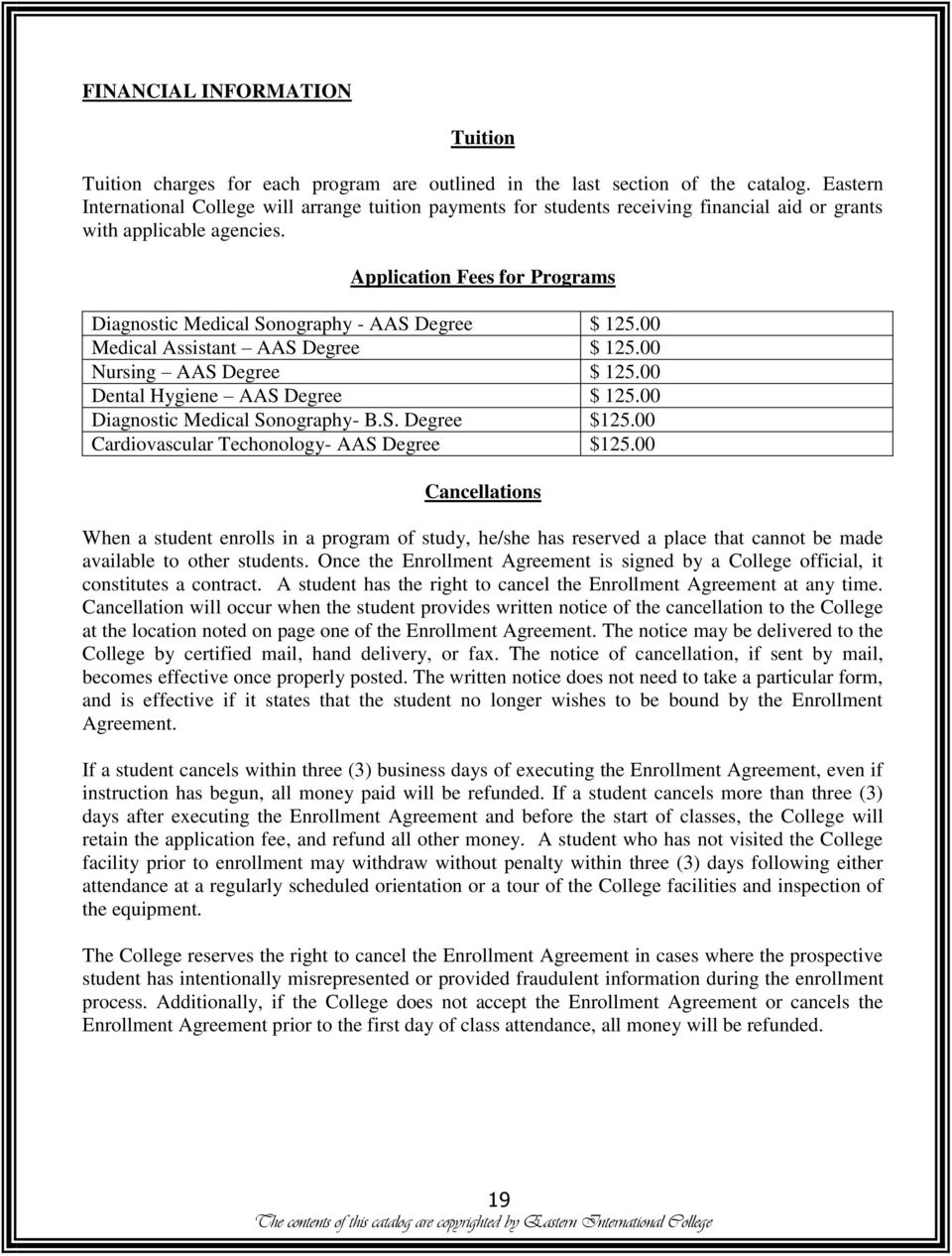
20 FINANCIAL INFORMATION Tuition Tuition charges for each program are outlined in the last section of the catalog. Eastern International College will arrange tuition payments for students receiving financial aid or grants with applicable agencies. Application Fees for Programs Diagnostic Medical Sonography - AAS Degree $ Medical Assistant AAS Degree $ Nursing AAS Degree $ Dental Hygiene AAS Degree $ Diagnostic Medical Sonography- B.S. Degree $ Cardiovascular Techonology- AAS Degree $ Cancellations When a student enrolls in a program of study, he/she has reserved a place that cannot be made available to other students. Once the Enrollment Agreement is signed by a College official, it constitutes a contract. A student has the right to cancel the Enrollment Agreement at any time. Cancellation will occur when the student provides written notice of the cancellation to the College at the location noted on page one of the Enrollment Agreement. The notice may be delivered to the College by certified mail, hand delivery, or fax. The notice of cancellation, if sent by mail, becomes effective once properly posted. The written notice does not need to take a particular form, and is effective if it states that the student no longer wishes to be bound by the Enrollment Agreement. If a student cancels within three (3) business days of executing the Enrollment Agreement, even if instruction has begun, all money paid will be refunded. If a student cancels more than three (3) days after executing the Enrollment Agreement and before the start of classes, the College will retain the application fee, and refund all other money. A student who has not visited the College facility prior to enrollment may withdraw without penalty within three (3) days following either attendance at a regularly scheduled orientation or a tour of the College facilities and inspection of the equipment. The College reserves the right to cancel the Enrollment Agreement in cases where the prospective student has intentionally misrepresented or provided fraudulent information during the enrollment process. Additionally, if the College does not accept the Enrollment Agreement or cancels the Enrollment Agreement prior to the first day of class attendance, all money will be refunded. 19
21 Refunds Eastern International College participates in the United States Department of Education student aid program and is required to comply with the Higher Education Amendments of The legislation requires the College to offer a refund policy that provides the most beneficial refund to students. A refund is the difference between the amount the student paid to the school (including financial aid) and the amount the College can retain as prescribed by the appropriate refund policy. Refund calculations are made in accordance with the following policies: The Return of Title IV Funds Policy and/or the Tuition Refund Policy for State Aid (TAG) and Cash Students listed below. If the College permanently closes and no longer offers instruction after a student enrolled, the student shall be entitled to a pro-rata refund of tuition. If a program is canceled subsequent to a student s enrollment, the College shall opt to: Provide a full refund of money paid; or Provide for the completion of the program If there is a delay in starting dates 14 days or less based on under-enrollment or facilities issues, it will not affect the refund policies. However, if the delay is more than 14 days, the student may cancel this Agreement within three (3) days of being notified of the delay and request a refund of all money paid. Effective February 1, 2006, a student s enrollment will be terminated when the student gives notification of his/her intent to withdraw, or the student has fourteen (14) consecutive absences without establishing an approved leave of absence. Students who drop individual classes but are otherwise enrolled at the College will not receive a refund or adjustment if they drop the class (es) after the last day of the drop and add period for the specific term, as stated on the academic calendar. However, refunds are available to students who withdraw or are withdrawn from the College prior to the completion of their program based on the Return of Title IV Funds Policy and/or the Tuition Refund Policy for State Aid (TAG) and Cash Students described below. Refunds are based on the total charge incurred by the Student at the time of withdrawal, not the amount the Student has actually paid. Tuition and fees attributable to any term beyond the term of withdrawal will be refunded in full. However, any books, equipment, and/or uniforms that have been issued are usually nonrefundable. When a Student withdraws from the institution, he/she must complete a student withdrawal form with the College. The College will process and post refunds within forty-five (45) days from the determination date the date on which the College determines that the student s enrollment should be terminated. The student s withdrawal date the date on which enrollment is deemed to have ended will be the same as the determination date in those cases where the student gives notice. When the student does not give notice, the withdrawal date will be the first class day following the student s fourteenth (14th) consecutive absence. 20
22 Return of Title IV Calculations A return of Title IV funds calculation, as required by federal regulations, will be used to determine how much Title IV aid has been earned by the student, and how much, if any, the College and/or student/parent must return to the Department of Education. Under current federal regulations, the amount of aid earned is calculated on a pro rata basis through 60% of the term. After the 60% point in the term, a Student has earned 100% of the Title IV funds. Federal regulations require the return to Title IV funds in the following order, if applicable: Unsubsidized loans, Subsidized loans, Plus loans, Pell grants, SEOG, or other Title IV. Tuition Refund Policy for State Aid (TAG) and Cash Students Any students receiving State Aid (TAG) or paying cash that officially withdraw from a course or the College may receive a refund of tuition, according to the refund policy and schedule established by the College. The following schedule shall be used in the calculation of refunds for students who receive State Aid (TAG) or pay cash: Time of Withdrawal Withdrawal during the first week of the semester 100% Withdrawal during the second week of semester 50% Withdrawal during the third and fourth week of semester 25% Withdrawal after the fourth week of semester 0% Additional Information Percentage of Tuition Refund This course of instruction follows the outline and procedures specified in the College catalog. Upon completion of the program, the student will receive an Associate of Applied Science Degree or a Bachelor of Science Degree Should any changes occur in program content, materials schedule, campus location, or expenses to the student, the student will be notified at least thirty (30) days prior to the change. Any delay in starting dates based on under-enrollment or facilities issues will not affect the refund policies. 21
23 New Institutional Scholarship Opportunities Eastern International College is pleased to announce the following institutional scholarship opportunities in 2014 for new and returning students: Founder s Scholarship The Founders Scholarship is open to all existing full time students of Eastern International College. The scholarship is academically based with the following criteria: Students with an earned Semester GPA of 3.7 will be awarded a scholarship of $ applied to their next semester attended Students with an earned Semester GPA of 3.8 will be awarded a scholarship of $ applied to their next semester attended Students with an earned Semester GPA of 3.9 will be awarded a scholarship of $ applied to their next semester attended Students with an earned Semester GPA of 4.0 will be awarded a scholarship of $ applied to their next semester attended Alumni Bachelors Degree Scholarship The Alumni Bachelors Degree Scholarship is open to all AAS and diploma graduates of Eastern International College or Micro Tech Training Center accepted into the BS in Diagnostic Medical Sonography program and enrolled full time. There are no additional criteria for the student s first semester of the program. For subsequent semesters of the program, the student must maintain a cumulative GPA of 3.5 or greater. Amount of the award: $ per semester Specific Details and Definitions 1. The definition of full time student is a minimum of 12 credits per semester. 2. Students must maintain a full time load to earn the scholarship. 3. Students who are part time for a current semester and switch to full time status will be eligible the next full time semester if the GPA requirements are achieved. 4. For the Alumni Scholarship, cumulative GPA is determined for semesters and courses taken at EIC after enrollment in the bachelors program. No transfer credits or prior credits will be used to calculate cumulative GPA. 5. Students will receive an initial award letter upon registration. A revised award letter will be issued if a student qualifies for the scholarship. 6. Students are eligible for only one institutional scholarship per semester. 7. Scholarships may impact the student s other grant, scholarships, and loans. The campus financial aid office will review the details on an individual basis. 8. Any documented behavioral probation or suspension disqualifies the student. 22
24 Awards will be posted on the campus bulletin boards, local newspapers, and students will receive an award certificate. These awards are another line on your professional resume! We sincerely hope as many students as possible become eligible for these Academic and Alumni Bachelors Scholarships. The associated benefits go far beyond the financial reward including being more proficient and better prepared for the challenges of the workplace, present higher GPA s to prospective employers or transfer institutions, and greater self-fulfillment. Awards will be determined after all final grades are in and semester GPA s calculated. Student s receiving a scholarship will be issued a revised award letter from financial aid. Challenge and motivate yourself to achieve this recognition. All the best and success in your upcoming semesters and beyond! If you have any questions, please address them to your campus financial aid department. 23
25 RULES AND REGULATIONS It is the student s responsibility to adhere to all rules and regulations set forth by Eastern International College. The College reserves the right to make changes in any area of the College, and all changes are effective thirty (30) days after announcement, circulation, and/or posting. Professional Behavior Policy Students are expected to adhere to standards of conduct, both in the classroom and at clinical externship sites. The College reserves the right to discipline a student, up to and including dismissal from his/her program at any time for behavior that is deemed unethical or unprofessional. Unethical or unprofessional behavior includes, but is not limited to: 1. Noncompliance with the civil law at the local, state or federal levels 2. Smoking on the College premises 3. Eating or drinking in any laboratories, patient care facilities, or classrooms 4. Noncompliance with the dress code 5. Verbal or physical abuse towards peers, faculty, administrative and/or support staff 6. Falsification of documents 7. Major violations contrary to principles of academic honesty (i.e. plagiarism, cheating, etc.) 8. Destruction of College or building property 9. Harassing, stalking, threatening, abusing, insulting or humiliating any student, instructor, administrator or member of the support staff 10. Demonstrated demeaning written or oral comments of an ethnic, sexist, or racist nature 11. Unwanted sexual advances or intimidation 12. Carrying or concealing firearms or any unlawful weapon 13. Use or under the influence of alcoholic or illegal drugs on the College premises or in any affiliating agency 14. Disruptive classroom behavior and persistent violation of College rules and regulations. (Students are not permitted to use cellular phones, ipods, or any other electronic devices, while in the classroom) 15. Slander or libel against the College 16. Other actions deemed unethical or unprofessional by the faculty and administration Any student who has been dismissed for violating any policy, rule, and/or regulation set forth by Eastern International College could appeal the dismissal and/or be granted permission by the Campus Director. 24
26 Probation and Dismissal Eastern International College reserves the right to dismiss or place on probation a student for any of the following reasons: failure to comply with the professional behavior policy or other school policies and procedures, failure to pass a course after the third attempt, failure to comply failure to maintain satisfactory academic progress, failure to pay school fees and/or tuition by applicable deadlines, disruptive behavior, posing a danger to student, faculty, staff, or affiliates, or making any false statements in connection with his/her enrollment. Tuition, fees and supplies becomes due and payable immediately upon a student s dismissal from the school. The college will determine if any Title IV funds need to be returned. Eastern International College can also discontinue the student s enrollment status, not issue grades, or deny requests for transcripts if a student fails to meet all of his/her financial and institutional obligations or for any false statements in connection with the student s enrollment. Students wishing to appeal a probation or dismissal can make a written request to the Appeal Committee for review. The Appeal Committee will conduct the review and make the appropriate determination. Grievance/Complaint Protocol The administration, faculty and staff of Eastern International College maintain an open-door policy for students to voice their concerns or complaints. Any student, who has a grievance or complaint, should follow the grievance protocol, as outlined below: Level 1: The student attempts to handle the grievance with the applicable official in a calm, professional manner. Level 2: If the grievance cannot be settled at this level, the student may request intervention from the Campus Director Level 3: If a satisfactory result is not accomplished at Level 2, a written description of the grievance should be directed to the College President, who will evaluate the grievance further. The student will be kept informed by the President as to the status of the grievance, as well as the resolution of the problem. Level 4: If a student does not feel that the College has adequately addressed a complaint or concern, the student may consider contacting the Accrediting Commission. The Student Complaint Procedure is as follows: 25
27 STUDENT COMPLAINT PROCEDURE Schools accredited by the Accrediting Commission of Career Schools and Colleges (ACCSC) must have a procedure and operational plan for handling student complaints. If a student does not feel that the school has adequately addressed a complaint or concern, the student may consider contacting the Commission. All complaints reviewed by the Commission must be in written form and should grant permission for the Commission to forward a copy of the complaint to the school for a response. This can be accomplished by filing the ACCSC Complaint Form. The complainant(s) will be kept informed as to the status of the complaint, as well as the final resolution by the Commission. Please direct all inquiries to: Accrediting Commission of Career Schools & Colleges 2101 Wilson Boulevard, Suite 302 Arlington, VA (703) A copy of the ACCSC Complaint Form is available and can be obtained at Eastern International College, and may be obtained by contacting Dr. Mustafa A. Mustafa at the Jersey City campus or Mr. William Ehrhardt, Belleville Campus Director In addition, you can find the complaint form online at: Complaints addressed to the ACCSC are meant to address issues with Eastern International College s compliance with ACCSC standards and requirements. ACCSC does not generally investigate complaints relating to disciplinary action, dismissal, or review decisions unless the context reasonably suggests that Eastern International College may not be in compliance with ACCSC standards and requirements. Any person who has good reason to believe that Eastern International College is not in compliance with the standards set forth by the ACCSC may file a complaint. Those who can file a complaint include, but are not limited to, students, former students, prospective students, governmental agencies, members of the public, and other accredited schools. In order to file a complaint, it must be sent to the commission in writing, and include the following: The basis of the allegation and all relevant names and dates, A brief description of the actions forming the basis of the complaint, Copies of any supporting material and documentation, A release from the complainant which authorizes the Commission to forward a copy of the complaint, including the identification of the complainant, to the school. 26
28 MEDIATION AND ARBITRATION If any dispute should arise with Eastern International College ( College ), the student will attempt to resolve it by using the Grievance/Complaint Protocol outlined in the school catalog. If the dispute is not resolved, the parties agree that any dispute arising out of or relating in any manner to Student s recruitment, enrollment, attendance, education, financial aid, or career service assistance at the College, or any individual claim, no matter how the Student or the College might describe, plead or style the dispute, including a dispute involving unpaid tuition, a dispute involving statutory rights (e.g., a claim under the New Jersey Consumer Fraud Act), or Student s relationship with the College, or any affiliates or employees thereof ( Dispute ), both the Student and the College agree that, if they cannot resolve the Dispute through their own negotiations, they shall first make a good faith effort to resolve the Dispute by participating in a confidential mediation process. The mediation shall be conducted by a neutral mediator selected from a list of approved mediators maintained by a court or bar association situated in the same community (the "Local Community") as the campus of the College which the Student is attending and the College shall pay the mediator's fees. If the Dispute is not resolved during the confidential mediation process, it shall then be resolved by confidential, binding arbitration before a single, neutral arbitrator under the Federal Arbitration Act ( FAA ) and conducted by the American Arbitration Association ( AAA ) under its Commercial Rules, and applicable Supplementary Consumer Rules available at as specified below: (a) If arbitration occurs, it shall be conducted at a convenient location within the Local Community. (b) The FAA (including all procedural and substantive provisions) and related federal decisional law shall govern this arbitration agreement to the fullest extent possible. However, the internal substantive laws of New Jersey shall govern any Dispute. (c) Neither party shall file an action in any court against the other, however, if a party does, any such action shall be stayed in favor of arbitration. The parties recognize that the breach of this arbitration agreement will cause the other party damage including, but not limited to, attorneys fees and costs, for which the other party will be liable. (d) Student shall be responsible for paying a portion of the AAA filing fee at the time the Claim is filed in an amount equal to $200 or the applicable filing fee for a lawsuit in the state court situated within the Local Community, whichever fee is less. The College will be responsible for paying the remaining AAA filing fee, the arbitrator s compensation, and other applicable AAA hearing fees. The parties shall bear their own costs and expenses associated with their attorneys, experts and witnesses, unless the arbitrator determines otherwise. However, the arbitrator s compensation and any fees and expenses incurred in arbitration, including attorney s fees, shall be paid by a party whose claim(s) is determined to be frivolous or filed for the purpose of harassment. The arbitrator has the power to award prevailing party attorney s fees and costs if a successful claim is based on a statute providing such fees to any party. (e) Except as specifically required by law, the fact and all aspects of an arbitration and the underlying Dispute shall remain strictly confidential by the parties, their representatives and counsel, and the AAA. (f) All determinations as to the scope, enforceability, validity and effect of this arbitration agreement shall be made by the arbitrator and not by a court. However, any issue concerning the validity of the below class action/consolidation waiver must be decided by a court, and an arbitrator does not have authority to consider the validity of the waiver. If for any reason the 27
29 class action/consolidation waiver is found to be unenforceable, any putative class action may only be heard in court on a non-jury basis and may not be arbitrated. (g) In order to promote the speedy resolution of the Dispute, Student agrees not to combine or consolidate any claims with any other person s claims, such as in a class or mass action, or for the claims of more than one person to be arbitrated or litigated jointly or consolidated with another person s claims. (h) If any part(s) of this arbitration agreement are found to be invalid or unenforceable, then such specific part(s) shall be of no force and effect and shall be severed, but the remainder of the arbitration agreement shall continue in full force and effect. (i) This arbitration agreement will survive the termination of Student s relationship with the School. (j) The arbitrator's award shall be final and binding on both parties, and the award may be filed for enforcement by either the Student or the College in any court having jurisdiction. 28
30 Dress Policy Eastern International College students must maintain a clean, professional appearance while on campus and while involved with any events affiliated with Eastern International College. The following dress policy must be adhered to at all times: 1. Students must wear the required uniform specific to their program during all classes. All uniforms must be presentable and bear the Eastern International College logo. 2. Students must wear nursing shoes or all white sneakers, no exceptions. 3. Students should avoid extreme and excessive hairstyles, make-up, long nails, jewelry and piercings. 4. Tattoos must not be visible. 5. Students must clearly display the Eastern International College I.D. at all times. 6. Unless otherwise noted, a minimum of business-casual attire must be worn when students are engaged in professional activities affiliated with Eastern International College. Students that are not in compliance with the dress policy will be dismissed from the building for that day. Drug and Alcohol Free Policy Eastern International College maintains a drug and alcohol-free environment. The Drug and Alcohol Policy applies to all enrolled students, as well as any individual present on campus. The unlawful possession, use and/or distribution of drugs and alcohol are strictly prohibited. Students who require prescription drugs that may impair their ability to perform should inform Eastern International College and their instructors via documentation from a licensed healthcare professional. College Property Under no circumstances should any software belonging to Eastern International College be removed from the premises for any reason. All software purchased by the College must be used within the classroom and the library. All computers are the property of Eastern International College. Students attending classes are afforded the use of the computers during class and laboratory hours. Any student found reconfiguring any computer belonging to Eastern International College will be subject to immediate disciplinary action. Internet access is permitted for job searches and class-related activities only. Any student accessing a site that is not within the scope of job searching or course study will be subject to disciplinary action. Laboratory equipment is technique /practice equipment that should not be utilized for diagnostic medical procedures. 29
31 Attendance and Make-Up Policy Students at Eastern International College are expected to attend all classes, labs, and clinical externships. At the beginning of each semester, instructors will provide the students with written guidelines regarding possible grading penalties for failure to attend class. Students should notify their instructors as soon as possible of any anticipated absences. Written documentation that indicates the reason for being absent may be required, and students are responsible for making up work missed during any absences. These guidelines may vary from course to course, but are subject to the following restrictions: 1. Students who miss class because of religious beliefs or practices will be excused from class or examinations on that day. The faculty member is responsible for providing the student with an equivalent opportunity to make up any examination, study, or work requirement that the student may have missed. 2. Students should notify course instructors at least one (1) week before any anticipated absence so that proper arrangements may be made to make up any missed work or examination. All make-up or missed work must be completed within a reasonable time frame, as determined by the faculty member. 3. Any student, who misses class due to a verifiable family or individual health emergency, or to attend a required appearance in a court of law, will be excused. 4. Students must communicate directly with the faculty member when they need to miss a class for those specific reasons. Likewise, faculty members who require documentation of those specific student absences will communicate directly with their students. 5. For all absences except those due to religious beliefs or practices, the course instructor has the right to determine whether the number of absences has been excessive, as it relates to the nature of the class that was missed, and the stated attendance policy. Depending on the situation, this can result in the student being removed from or failing the course. If there are extenuating circumstances that prevent a student from attending classes for an extended time period (e.g., hospitalization and recovery from a serious accident or illness), the student should apply for a leave of absence under the College s published leave of absence policy. A student's enrollment will be terminated when the student has fourteen (14) consecutive absences without establishing an approved leave of absence under the College's published leave of absence policy. As a general rule, any student whose enrollment has been terminated for violating the College's attendance policy will not be allowed to reapply for readmission to the College. A student whose enrollment has been terminated for violation of the College's attendance policy may be entitled to a refund, or, alternatively, may be required to return unearned Title IV federal financial aid to the Federal government and pay remaining tuition due to the College. If the student borrowed money under a federal student loan, or a private loan, the student is obligated to repay that money in accordance with the terms of the loan. Please refer to the above 30
32 refund policy and return of Title IV aid policy for further information concerning these obligations. Externship Policies and Procedures (for DMS & MA students only*) Eastern International College will place students in externships upon completion of their prerequisite didactic coursework. In cases where extenuating circumstances (leave of absence, illness, financial hardship, etc.) prevent the student from starting the externship immediately after their didactic coursework, Eastern International College will work with a student and help the student complete the externship as soon as possible. Eastern International College will continue to track students individually as to their start and completion dates for externships. The Externship Orientation is required for all students. Prior to starting the externship, all students must participate in the College s comprehensive externship orientation, which includes student/ College rights and responsibilities, externship policies and procedures, and attendance policies. This orientation is conducted by the Clinical Coordinator, Externship Administrator, and Campus Director. Externships will be provided to all students in programs requiring externships. Students enrolled in programs that contain an externship component must agree as part of their enrollment agreement that they will accept the externship site offered by the College. Students that refuse the site offered by the College must sign a refusal waiver and be responsible for finding their own externship site. All students must accurately document their hours worked on a timesheet supplied by Eastern International College. The students are responsible for tallying their hours and getting the hour s sheet signed by Site Manager. They must then submit the completed sheet to the Clinical Coordinator assigned to their program. All pre-externship paperwork and job rescheduling must be completed by the student prior to their final semester. Any student who fails to complete all of the externship administrative requirements prior to their final semester will not be allowed to enroll until all requirements are fulfilled.* All students must pass the required courses, maintain Satisfactory Academic Progress (SAP) with regard to their academic standing, and submit the following prior to the last semester before beginning the clinical externship: 1. Record of Required Immunizations: To complete the process, the student must obtain a signed record of all required immunizations. Some externship sites maintain additional health requirements that must be met prior to the start of externship (For additional details and requirements, see the clinical coordinator). 2. A Criminal Background Check. To complete the process, the student must contact the local police precinct/agency to obtain the report(s), and submit the results to Eastern International College. 3. Professional Liability/Malpractice Insurance. To complete the process, Eastern International College provides Professional Liability Insurance for its students. This is placed on file at the appropriate office and made available prior to the start of the student s externship. *For students in the Nursing, please refer to the program s Student Handbook for clinical externship procedures 31
33 Externship Rules and Regulations 1. All students must attend the clinical externship site assigned to them by Eastern International College. 2. Students in programs that contain an externship component must be prepared to attend externships sites whenever and wherever the externship sites are available. Evening students must be prepared for the possibility that externship sites may only be available during daytime working hours. 3. Students are required to adhere to any schedule issued by the externship site manager, and any changes in scheduling must be authorized by the assigned site and Eastern International College. Any student not in compliance with this rule will receive a failing grade (F). 4. Students must be punctual and remain at the facility for the required length of time that was assigned, and tardiness will not be tolerated. However, if students are going to be late, they must contact the clinical externship site manager and Eastern International College s Clinical Coordinator at (201) or (973) All students who have excess of (3) absences will fail the course for the semester and be required to retake the course next semester to graduate. In addition, students who are dropped for excessive absences must find their own clinical externship site. 6. Students must strictly adhere to the dress code of the assigned clinical externship site. 7. Students must keep personal habits (e.g. smoking, talking on phone, etc.) to a minimum, and pay very close attention to hygiene and appearance. Cellular phones must remain off while on the clinical externship site. However, if students need to utilize their cell phone, they must make a strong effort to do so during breaks and/or lunch, and keep all calls to a minimum. 8. Students are required to complete 100 percent of their externship hours. Otherwise, he/she will not be able to graduate. 9. At all times, students must display a positive attitude and perform to the best of their ability. If any mistakes occur on a student s behalf, the student must address the mistake promptly with the externship site manager. 10. Timesheets should be faxed by the end of the week, and no later than Monday of the following week. Students must also keep an accurate record of hours and make copies of all timesheets. 11. If students encounter any issues that could prohibit them from completing their clinical externship, they must contact Eastern International College s Clinical Coordinator immediately. 12. Any student who blatantly and consistently violates the rules set forth by Eastern International College and/or the clinical externship site will immediately be DISMISSED from the program. 32
34 Externship-Related Injuries Whenever an illness or injury occurs at a clinical externship site, the student must immediately notify the site supervisor so that appropriate measures are taken. The student shall be provided with emergency medical care at the clinical externship site, whenever necessary. If the facility does not cover necessary expenses, the student shall be responsible for expenses incurred. If a student is accidentally injured or exposed to a patient s body fluids, the patient with whom the student has contact may need to be tested to assess risk to the student. This might include testing the patient for hepatitis, HIV, or other infectious diseases. In situations where the externship facility does not cover the cost of these tests, the student is held responsible for the expense. It is the responsibility of the externship supervisor to notify Eastern International College of the details of the injury/ exposure. Leaves of Absence for a Program A student in circumstances that make it impossible for him/her to maintain adequate class attendance must submit a written and signed request for a Leave of Absence (LOA). The LOA may not begin until the College has approved the request. Additionally, the LOA period may not exceed 180 days within any 12-month period. The College may grant more than one leave of absence in the event that unforeseen circumstances arise, such as medical reasons affecting the student or a member of student s immediate family, military service requirements, or jury duty, provided that the combined leaves of absence do not exceed 180 days within the 12-month period. If a student fails to return from an approved Leave of Absence, then the College will terminate the student and apply its refund policy. Maximum Time Frame to Complete a Degree Program For a credit hour program, the credit hours attempted cannot exceed 1.5 times the credit hours required to complete the program. For a clock hour program, the maximum time frame shall not exceed 1.5 times the normal duration of the program. There are implications when a student does not complete either a degree within the maximum timeframe (i.e., loss of financial aid and program enrollment termination). The College is not required to terminate the enrollment of a student who is unable to complete the program within the maximum timeframe unless the College has determined that the student has failed to meet college policies that would otherwise warrant termination (e.g., academic progress or attendance policies). 33
35 Withdrawal from Degree Classes or Semester Students may withdraw from any or all classes up until the withdrawal deadline set forth for each semester with grades of W recorded on their transcript. Any withdrawals from class(es) will not result in a change in Financial Aid received for the student, and the student will be responsible for the full fee of the course. Please see the school calendar for add/drop/withdrawal period at the end of the catalog. Withdrawal from Degree Program Students who officially withdraw from the program may be eligible for a refund of tuition charges. In order to officially withdraw from the program, students submit their withdrawal request in writing and submit it to the Registrar. Indemnification The student releases and holds harmless Eastern International College, its employees, agents, and representatives with regard to all liabilities, damages, and other expenses which may be imposed upon, incurred by, or asserted against him/her by reason of bodily injury or property damage while enrolled in the College. Disaster In the event of labor disputes, natural disasters or calamities, Eastern International College reserves the right to suspend training effective for a period not to exceed ninety (90) days, unless a suitable substitute site is needed and unable to be secured by the ninety (90) day deadline. Damaged, Lost, or Stolen Items Eastern International College is not responsible for students personal property. Keeping books and other possessions safe is the student s responsibility. 34
36 ACADEMIC POLICIES Orientation New students are required to attend an orientation prior to the start of classes. During orientation, students are introduced to administrative staff and faculty. Definition of Clock Hours A clock hour is a 60-minute hour minus a ten-minute break, or 50 minutes of actual instructional time. Conversion to Semester Credits for All Programs The following formulas will be used when converting semester credits: One semester credit equals at least 15 hours of class time; or One semester credit equals at least 30 hours of supervised laboratory instruction One semester credit equals at least 45 hours of externship / internship or work-related experience. Average Classroom Size The student to faculty ratio for a classroom is students; for laboratories it is students. Examinations Midterm and final examinations are required in most all courses and are scheduled on specific dates. A student in extraordinary circumstances may be excused from the examinations, provided that the excuse is properly documented. Missed exams must be made up within a scheduled date as determined by the instructor and Chair of General Education. Hours of Operation for all Programs Days Mon-Thurs Friday Saturday Time 8:30am-10:30pm 8:30am-5:00pm 9:00am-3:00pm 35
37 AMENDMENTS TO PROGRAMS, POLICIES, OR PROCEDURES Eastern International College reserves the right to determine when courses are offered, the size of students course load, and any adjustments in program or course content, which includes policies and procedures. Should any changes occur in the content of a program, a policy, or a procedure, the student will be notified at least thirty (30) days in advance. Repeating a Course in a Degree Program A student must repeat any failed course that is required course in his/her program. A grade of D+ or lower is considered failing. The student can repeat a failed course twice. If the course is not passed after the third attempt, the student will be terminated from the program. Should this occur, the student has the right to appeal this decision to the Academic Appeal Committee (AAC). The students GPA will reflect an average of the previous failing grade and the passing grade received in the course. Transcripts All students are provided with a copy of their transcript upon graduation. Requests for student transcripts from federal or state agencies are honored free of charge. Additional transcripts are available upon request at a charge of $10.00 per transcript. A transcript is not issued to students who are financially indebted to Eastern International College. Dean s and President s Lists A student enrolled in the programs becomes a member of the Dean s List if he/she completes nine (9) or more credits and earns a GPA of 3.75 or higher. A student enrolled in the programs becomes a member of the President s List if he/she completes nine (9) or more credits and earns a GPA of 3.9 or higher. Academic Advising Eastern International College students are advised by faculty members, as well as program directors and department chairpersons. These Academic Advisors are well-versed in program specific scheduling, grading, and curricula, and are motivated to help students achieve their academic goals. In some special circumstances, the Vice-President of Academic Affairs may also advise the students. Tutoring / Laboratory Availability Students are encouraged to use the computer labs and the Library/Learning Resource Center after class hours. Students must sign in prior to using the facilities, and must sign out when they leave the facilities. Students who desire extra hands-on practice involving work in the labs may only undertake such practice with clinical faculty present. Tutoring is also available for general education courses at pre-arranged times set by the Chair of General Education. Times are posted in the library and tutoring is typically held in either the library or the laboratories. 36
38 Privacy Rights of Students Eastern International College protects the privacy of student files in accordance with the Family Education Rights and Privacy Act of 1974 (otherwise known as the Buckley Amendment). GRADING Eastern International College uses the following grading system: Grading System (for all courses except Nursing and Dental Hygiene Clinical courses) GRADE PERCENT EQUIVALENT GPA A B B C C D D F 59 and below 0.00 I Incomplete N/A AU Audit, No Credit N/A W Withdrawal N/A TR Transfer N/A Dental Hygiene Clinical Courses Grading System GRADE PERCENT EQUIVALENT GPA A A B B B C C F 75 and below 0.00 I Incomplete N/A IF Incomplete, converted to Failing 0.00 W Withdrawal N/A TR Transfer N/A 37
39 Nursing Clinical Courses Grading System GRADE PERCENT EQUIVALENT GPA A B B C C D D F Below I Incomplete N/A AU Audit, No Credit N/A W Withdrawal N/A TR Transfer N/A In Nursing, a grade less than a C+ in any course is considered unsatisfactory, and the course must be repeated. An incomplete (I) is issued to students not meeting the minimum course requirements. The incomplete must be converted to a letter grade within two (2) weeks of the end of the course. If the minimum course requirements are still not met, the I is converted to IF. An I does not count towards the cumulative Grade Point Average (GPA) until a grade is assigned. A W is given when a student either withdraws or is dropped from a class. The W remains on a student s academic transcript. Satisfactory Academic Progress Eastern International College makes every effort to provide our students with ample opportunity to successfully meet the academic requirements for graduation and to insure that each student is given sufficient preparation to meet all scholastic conditions necessary to be making satisfactory academic progress and to receive financial aid should they qualify. As such, the following policy for Satisfactory Academic Progress is in effect for all students enrolled in a collegiate program at the College. Satisfactory Academic Progress (SAP) for all students is determined after each semester in which the student is enrolled. At the end of each semester, a student s grade point average (GPA) will be reviewed. A determination will be made as to whether or not the student has met the requirements for SAP. The chart below will identify the standards for meeting SAP. The minimum GPA requirements necessary to be making satisfactory academic progress are as follows: 38
40 Semester Minimum GPA 1 st & 2 nd rd 1.75 If GPA is not met: Should a student not achieve a minimum GPA of 1.5 at the end of either semester, he/she will not have met the SAP requirement and will be placed on academic probation for that current semester. Should the student not achieve the minimum GPA of 1.5 for two consecutive semesters, the student will then, not be eligible to receive financial aid, unless the student follows the appeal guidelines described below. Should the student not achieve a minimum GPA of 1.75 at the end of the third semester, the student will be placed on academic probation and the conditions for financial aid eligibility, as set forth above will be followed accordingly. 4 th Until Completion of Program 2.0 At the end of a student s academic program, where all academic requirements have been met, a GPA of 2.0 is mandatory for graduation. Academic probation is established on a semester basis. Two consecutive semesters of academic probation, or failure to meet the SAP requirements, will result in a student loosing his/her financial aid eligibility and could lead to academic dismissal. Should a student be placed on academic probation for two consecutive semesters, he/she may appeal this decision to the Academic Appeal Committee (AAC). Conditions for appeals are established by the federal government and are as follows: - the death of a relative of the student; - an injury or illness of the student; or - other special circumstances. Satisfactory academic progress is reestablished when a student meets the minimum academic standard (minimum GPA) in subsequent semesters to the term in which the student was declared to be on academic probation or not meeting SAP. Should a student appeal his/her status of academic probation to the Academic Appeal Committee (AAC) and have the appeal approved, conditions regarding academic expectations could be imposed as necessary in order to meet the provisions of the appeal. In order to meet SAP requirements, in addition to the minimum GPA, a student must complete a minimum number of credit hours during an academic year. A minimum of 24 credit hours must be completed in order to be eligible to receive financial aid should the student qualify. 39
41 Appeals Process (Applies to all Programs except Nursing) A student in circumstances that lead to failure to maintain Satisfactory Academic Progress (SAP) may make a written request for an appeal to review his/her history. The Academic Appeal Committee (AAC) will conduct the review. Should the appeal be granted, the student has the opportunity to achieve satisfactory academic progress (SAP) within one (1) grading period. Any decision resulting from the review is final and cannot be appealed. Academic Appeals Committee (AAC) The committee is tasked with considering written appeals for any of the following: 1. College or program dismissals due to poor academic performance 2. Grade Appeal 3. Other Academic Concerns The committee, which is chaired by the Vice President for Academic Affairs, consists of the Academic Dean, Chairpersons, and at least two full time department faculty members. Appeal Process I. College or program dismissal due to poor academic performance Any student who believes that he/she was dismissed according to Eastern International College policies but has mitigating circumstances should submit a written appeal to the Academic Appeals Committee (AAC) c/o the Vice President for Academic Affairs. The letter should include the following: 1. Student s full name, address, program, and College ID 2. A full explanation of the circumstances surrounding the appeal. 3. Supporting documents (e.g. letter from a physician) when necessary must be attached with the letter. Submission by is acceptable. An appeal must be done within 7 working days from the date final grade was posted and/or released. The decision of the committee to approve or deny the appeal must be done in writing within 7 working days of receipt of the letter. The decision of the AAC is final and not subject to further appeal. II. Grade Appeal An appeal must be done within 7 working days from the date final grade was posted and/or released, When a student brings forth issues of unfair evaluation of his/her work, the following procedure will be followed: 1. Level One: Faculty The student shall request a review by the faculty. Every effort should be made to resolve the matter at this level. A grade appeal must be initiated with a request in writing (an is acceptable) to the faculty involved to review the grade in question. The faculty must notify the student in writing of the decision of the review regardless of the outcome within 7 working days. 40
42 2. Level Two: Department Chairperson A student who is not satisfied with the decision rendered by the faculty member may write a request for further review to the Department Chairperson. All supporting documents must be included in the letter. The Department Chairperson must inform both the student and the instructor of the decision in writing and, if the decision results in a change of grade, the instructor will have 7 working days to respond before the change of grade is initiated. 3. Level Three: Academic Dean If an appeal is denied at the Department Chair level, the student may send his/her appeal to the Academic Dean by submitting the same letter submitted to the Department Chair, along with the Chair s written response. A decision must be made 7 working days after the receipt of the letter. 4. Level Four: Academic Appeals Committee A student who is not satisfied with the decision rendered by the Academic Dean may write a request for further review to the Academic Appeals Committee (AAC) c/o the Vice President for Academic Affairs. All supporting documents must be included in the letter. The Chairperson and Academic Dean in levels Two and Three are excluded in the Academic Appeals Committee. The AAC must inform the student, faculty, and Chairperson of the decision within 7 working days after receipt of the appeal letter. The decision of the AAC is final and not subject to further appeal. III. Other Academic Concerns Any academic appeals, other than the ones mentioned above, must be discussed with the Department Chairperson. The Department Chair determines if the appeal would need to be coursed through the Academic Appeals Committee (AAC) or not. If the appeal has to go through the AAC, the Chair advises the student to write a formal letter of appeal to the Academic Appeals Committee c/o the VP for Academic Affairs. The appeal must be done 7 working days after the student and Department Chair consultation. The letter must include the following: 1. Student s full name, address, program, and College ID 2. A full explanation of the circumstances surrounding the appeal. 3. Supporting documents when necessary must be attached with the letter. Submission by is acceptable. The decision of the AAC to approve or deny the appeal must be done within 7 working days after the receipt of the letter. The decision of the AAC is final and not subject to further appeal. Appeal Process for Nursing Program Please refer to Student handbook. 41
43 Graduation Requirements The requirements for graduation are: Pass each course, including externship, in accordance to each programs guidelines Earn a cumulative GPA of at least 2.0 for Cardiovascular Technology, Diagnostic Medical Sonography and Medical Assistant students and 2.5 for Nursing and Dental Hygiene students Fulfill all financial obligations to the College Complete a student loan exit interview Academic Freedom Eastern International College is committed to the principles of academic freedom. The College acknowledges that this freedom is essential for the growth and maintenance of a strong faculty and for achieving student learning outcomes. A faculty member, while recognizing a special responsibility to the College as a member of the academic community, is free to use creative teaching methods and discuss relevant topics that will enhance student learning, is encouraged to promote freedom of inquiry in peers and students, and is free to do professional research and publish results. Teaching decisions of faculty members will reflect the objectives and content of the approved course syllabus in particular and the curriculum in general, and meet the standards of the College s policies and those of accrediting agencies and other regulatory bodies. While abiding by and supporting the policies, mission, standards, and procedures of the College, a faculty member is free and encouraged to participate in the discussion and revision of institutional policies and the improvement of the curriculum and instructional practice. A faculty member, while enjoying academic freedom, shares responsibility with the administration for the preservation of this freedom. Students and faculty are expected to adhere to academic integrity, the highest ethical standards, and professional conduct in all processes and practices. A faculty member, therefore, enjoys academic freedom as a shared responsibility not only with colleagues and students, but also with society and its basic mores and morals. Academic Integrity Academic integrity provides the foundation upon which a flourishing academic life rests. Like the word integrity itself, academic integrity is a complex concept, difficult to define. Simply stated, Academic integrity is essential to the educational mission of the College. Those who do attempt a definition generally declare that academic integrity means academic honesty. Eastern International College further defines academic integrity in terms of a commitment to the five fundamental values of honesty, trust, fairness, respect, and responsibility and the principles that flow from those values. Just as personal integrity involves standing up for ones fundamental commitments even in difficult circumstances, so too does academic integrity involve standing up for what is fundamentally right and just at all times. 42
44 STUDENT SERVICES Placement and Career Services Eastern International College offers job placement services to graduating students. Students are required to meet with the Director of Placement prior to graduation. Interviews and appointments are arranged for the student once graduation requirements are met. Although placement services are available to graduating students, Eastern International College does not guarantee or promise employment. However, Eastern International College makes every effort to assist each graduate in obtaining gainful employment. The hours of operation of the department are as follows: Monday- Thursday Friday 9am to 7pm 9am to 5pm Library/Learning Resource Center The Eastern International College Libraries consist of two distinct physical locations at both the Jersey City and Belleville Campuses of the College. The Library/Learning Resource Centers contain books, periodicals, software and additional publications directly related to training in specialized program areas. The libraries have a combined physical holding of 5,000 books. In addition, the library is also an active member in the National Libraries of Medicine and The Metropolitan New York Library Council (METRO) - a library consortium that allows students and faculty to access materials from over 250 member libraries. Computer stations provide access to the Internet, E-brary, and other online services. E-brary is an online library which offers about 89,000 books in subjects ranging from Nursing and Allied Health to History and Computing. The library also holds a subscription to ProQuest, an electronic database where students can find scholarly journals and magazines which specialize in the areas of Allied Health and Nursing. ProQuest currently offers access to 1,179 full text titles. Eastern International College offers a variety of workshops throughout the semester in order to acquaint students with computer skills and resources. Please see the College s website for the Library s Policies and Procedures. Housing Eastern International College is a commuter college and does not offer campus housing. Transportation The Eastern International College Campuses are easily accessible by New Jersey Transit buses and street parking is available. The College does not offer cross-campus transportation. Maintenance of Records Eastern International College maintains academic and attendance records for currently enrolled students, graduates, and students who have withdrawn or were terminated by the College, in accordance with statutory requirements. 43
45 Counseling & Academic Advising Counseling at the College is provided by a master s-level counselor who is experienced in working with college-aged and adult students. Students are encouraged to visit the college s counselor to discuss concerns related to family, friends, general anxiety, low self-esteem, etc. The counselor will meet with students on an as needed basis. Eastern International College students are advised by faculty members, as well as program directors, when needed. These Academic Advisors who are well-versed in program specific scheduling, grading, and curricula, motivated to help students achieve their academic goals. In some special circumstances, the Vice-President of Academic Affairs may also advise the students. 44
46 RIGHTS AND RESPONSIBILTIES: Student Rights and Responsibilities Before applying to Eastern International College, students have the right to receive accurate and comprehensive information about the College, including that which is related to admissions, financial aid, student life, academic policies, etc. Before applying to Eastern International College, students have the responsibility to research various academic institutions and understand said institutions individual programs, practices, and policies, including those of Eastern International College. While enrolled in Eastern International College, students have the right to freedom from harassment and discrimination, freedom of expression, accurate grading and evaluation, confidentiality with regard to student records, and access to facilities allotted for student use. While enrolled in Eastern International College, students have the responsibility to treat staff, faculty, and fellow classmates with respect, put forth effort in their program of study, and bring questions and concerns to the attention of the administration. College Rights and Responsibilities During the admissions process, Eastern International College has the right to offer admission to students who present as having the potential to succeed based on their previous academic history, placement test scores, interview and essay, as well as deny admission to students who do not present as having the potential succeed in the College. During the admissions process, Eastern International College has the responsibility to fully educate the student on information about the College, including that which is related to admissions, financial aid, student life, academic policies, etc. While students are enrolled in Eastern International College, the College has the right to set standards of acceptable behavior for all members of the community, dismiss students whose poor academic performance and/or whose presence on campus misaligns with policies set forth in the catalog, as well as add or adjust policies and programs that reflect the College s institutional mission. While students are enrolled in Eastern International College, the College has the responsibility to establish fair policies and relevant programs, hire faculty and staff who are committed to furthering the College s institutional mission, and communicate with students regarding additions or adjustments made to policies and programs. 45
47 PROGRAMS DIAGNOSTIC MEDICAL SONOGRAPHY B.S. DEGREE Program Outline: The Diagnostic Medical Sonography Baccalaureate Degree program prepares students to be competent sonography professionals beyond the level of entry- level sonographer in doctors offices, medical imaging laboratories and hospitals, and grants successful graduate a fouryear college degree. In addition to developing strong skills in diagnostic ultrasound and scanning, students will be educated in research in diagnostic medical sonography. The program has two major components: the theory/didactic/lab component and the clinical externship component. The general education portion of the program includes coursework in written and oral communication, quantitative principles, natural and physical sciences, social sciences, humanities, and the arts that are designed to develop essential academic skills for enhanced and continued learning. The program has a total of 128 semester credits, with 60 credits in general education and 68 credits in technical and major course work. The curriculum outline is below: General Education Courses Course Course Title Number ENG 101 English Composition I 3 ENG 102 English Composition II 3 ENG 301 Early American Literature 3 SPC 101 Interpersonal Communication 3 BIO 101 Anatomy and Physiology I 4 BIO 102 Anatomy and Physiology II 4 COM 101 Computer Skills 3 MAT 103 College Algebra 3 MAT 204 Fundamentals of Statistics 3 PHY 101 Fundamentals of Physics 4 PHI 101 General Philosophy 3 PSY 101 General Psychology 3 SOC 101 Introduction to Sociology 3 SOC 301 Cultural Diversity 3 REL 302 World Religions 3 HIS 101 American History I 3 HIS 201 American History II 3 HIS 302 Global Issues and 20 th Century World History 3 ART 101 Art Appreciation 3 Total General Education 60 Semester Credits 46
48 Program Major Courses Course Course Title Number DMS 101 Cross-Sectional Anatomy 3 DMS 102 Pathology 3 DMS 104 Law and Ethics for Health Care Professionals 2 DMS 105 Physics and Instrumentation I 3 DMS 106 Physics and Instrumentation II 3 DMS 200 Abdominal Sonography I 3 DMS 201 Abdominal Sonography II 3 DMS 202 Obstetric and Gynecological Sonography I 3 DMS 203 Obstetric and Gynecological Sonography II 3 DMS 204 Vascular Sonography 4 DMS 312 Advanced Vascular Sonography 2 DMS 313 Cardiology 3 DMS 314 Adult Echocardiography I 3 DMS 315 Adult Echocardiography II 3 DMS 316 Neurosonography 2 DMS 317 Advanced Case Study Critique 3 DMS 318 Advanced Test Registry and Review 3 DMS 319 Capstone Research 3 DMS 401 Clinical I 4 DMS 402 Clinical II 4 DMS 403 Clinical III 4 DMS 404 Clinical IV 4 Total Semester Credits: 68 Course Descriptions Semester Credits Abbreviations: BIO Biological Science CHE Chemistry ENG English PSY Psychology MAT- Math SOC Sociology HIS- History DMS- Diagnostic Medical Sonography ENG 101 English Composition This course introduces students to college-level writing and reading skills through critical reading, group analysis, formal essays, and research projects. Proper paragraph and essay structure is emphasized throughout the course. Prerequisites: ENG 098 and ENG 099 or passing of placement exams ENG 102 English Composition II This course gives students practice in the essentials of writing, with an emphasis on persuasive writing and oral presentations. Extensive reading and writing are combined with oral presentations, class work and activities to encourage students to assess and respond from their own perspective to notable people, debates, and events in society. Students will learn to write powerfully and credibly, and deliver argumentative speeches for a variety of audience. Prerequisite: ENG
49 ENG 301 Early American Literature This course introduces students to the literature of early America, including but not limited to Native American Literature, slave narratives, the literature of exploration and settlement, suffragist literature, and literature by other early American poets and writers. Students learn how to make thoughtful interpretation of the various types of early American literature, with consideration for their respective historical contexts. Students also study literary structure, literary strategies and different methods of critical analysis. Prerequisite: ENG 102 SPC 101 Interpersonal Communications This course is an overview of the process of human communication, with special emphasis on analyzing communication patterns. Students learn skills designed to improve interactions in family, social, and professional settings. The course also addresses effective listening, pacing, attending, making value judgments, summarizing, probing, empathy, handling emotions, perception checking, and conflict management. Hindrances to effective communication are also discussed. BIO 101 Anatomy and Physiology I 4 Semester Credits This course explores the structure and function of the human body. It includes the study of cells and tissue, with focus on the integumentary, skeletal, muscular, nervous, and endocrine systems. BIO 102 Anatomy and Physiology II 4 Semester Credits This course is a continuation of Anatomy and Physiology I. Topics include the reproductive system, circulatory system, blood, digestive system, urinary system, fluid and electrolyte imbalance, respiratory system and the lymphatic system. Prerequisite: BIO 101 COM 101 Computer Skills This course is designed to prepare the student to use alphanumeric keyboarding in a office environment. Students will learn how to increase typing speed and improve keyboarding with accuracy within the duration of this course. Once the skills have been mastered, students will then use these skills in Microsoft Word to create business letters, memos, tables and other important documents needed to maintain health care businesses today. MAT 103 College Algebra This course covers basic concepts of algebra, equations and inequalities in one or two variables, coordinate geometry and graphing techniques, exponential and polynomial functions, systems of linear equations in two or more variables, factoring, rational expressions, roots and radicals, and quadratic equations: MAT 099 or passing of placement exam MAT 204 Fundamentals of Statistics This course introduces students to basic statistical concepts. It focuses on frequency distributions of empirical data, calculations of descriptive statistics, probability distributions, confidence intervals, hypothesis testing, chi square, regression, and correlation. Prerequisite: MAT 103 PHY 101 Fundamentals of Physics 4 Semester Credits The courses centers on the fundamental laws of physics. Students become familiar with and appreciate the basic concepts involving the physics of mechanics, matter, waves, sound, and light. Students also participate in a lab component wherein they study basic principles and techniques of experimental physics. 48
50 PHI 101 General Philosophy This course explores central ideas in philosophy with emphasis on those pertaining to reality, law, ethics, values, justice and human motivation and understanding. Notable philosophers of past and present are studied with focus on philosophies relevant to today s society. Throughout the course, students are encouraged to share differing perspectives with a goal for expanding one another s worldviews and developing personal philosophical perspectives. PSY 101 General Psychology This course introduces students to the scientific discipline of psychology. It addresses crosscultural issues, historical perspectives, and the importance of psychological well-being, with topics ranging from psychological disorders, therapeutic approaches, and personality, to the biological basis of behavior, learning and memory, development, consciousness, and the social nature of human beings. SOC 101 Introduction to Sociology This course focuses on sociology as a way of understanding the world. Sociology is a field of study that considers social, political, and economic phenomena within the context of social structures, social forces, and group relations. Students will be introduced to the field of sociology by way of engaging with several important sociological topics, including socialization, culture, the social construction of knowledge, inequality, race and ethnic relations, poverty, and political sociology. SOC 301 Cultural Diversity This course centers on the role of culture in the development of attitudes, values, perceptions, behaviors, and interpersonal relations. Theories of cultural identity development and crosscultural exchange as they pertain to living and working in a multicultural society are explored. Students also examine cultural constructs in relationship to social inequities and practice developing the knowledge, skills and awareness needed to serve as culturally competent professionals. Prerequisites: ENG 101, SOC 101 REL 302 World Religions This course introduces students to the world s major religions. Study focuses on the historical development of the world s major religions, as well as on the central beliefs, customs and traditions associated with each religion studied. It is anticipated that throughout this course students will come to respect and learn from the diversity of religion that exists in today s world, whether or not they chose to practice a religion. Prerequisite: ENG 101 HIS 101 American History I This course focuses on major events, significant people, and important trends in American history. Beginning with Native American life and ending with 21 st century developments, topics of study include the Founding Fathers, the Civil War, World Wars I and II, the Roaring Twenties, The Civil Rights Movement, and Vietnam, among others. Emphasis is placed analyzing and interpreting both primary and secondary sources, as well as mastering a broad range of factual information. 49
51 HIS 201 American History II This survey course focuses on major events, significant people, and important trends in American History from 1870 through present day. Beginning with Reconstruction, topics of study include the Progressive Era, World Wars I and II, the Roaring twenties, the Great Depression, the Cold War, the Civil Rights Movement, Vietnam and the War on Terror, among others. Emphasis is placed analyzing and interpreting both primary and secondary sources, as well as mastering a broad range of factual information. Prerequisite: HIS 101, ENG 101 HIS 302 Global Issues and 20 th Century World History This course provides historical perspective that aims to engender responsible citizenship. The course centers on the study of Unites States foreign relations from the end of World War II to the present day. Topics discussed include the rise of the United States as a world power, United States intervention abroad, terrorism, and current events impacting foreign relations today. Connections between past and present and the importance of global awareness are underscored throughout the course. Prerequisite: ENG 101, HIS 201 ART 101 Art Appreciation This is a course that introduces students to the world of visual arts. It serves to enhance understanding and appreciation for a broad range of imagery, media, artists, movements, and periods in history. It also illustrates the place of art in social and cultural life. DMS 101 Cross-Sectional Anatomy This course teaches students how to conceptualize the major organs and vessels in the thoracic and abdominopelvic cavities of the tomographic sections, with exploration of the transverse (axial) sagittal, coronal, and oblique sections. Sections of the neck and brain are also studied. Emphasis is placed on the anatomic relationships between organs commonly scanned by sonography. Prerequisites: BIO 101 and BIO 102 DMS 102 Pathology This course centers on study of abdominal, breast, genitourinary, and cardiovascular pathologies and sonographic patterns. Discussion of pediatric, obstetrical and gynecological pathologies takes place. Comparisons are made between normal patterns and pathology appearances through the study of pathophysiology, differential diagnoses, correlation of lab tests, and etiology of congenital abnormalities. Prerequisites: BIO 101 and BIO 102 DMS 104 Law and Ethics for Health Care Professionals 2 Semester Credits The students will examine law and ethics applicable to the healthcare industry. Emphasis will be placed on understanding and properly employing the patient-healthcare provider relationship, maintaining patients right to privacy considerations and understand the parameters of liability and malpractice DMS 105 Physics and Instrumentation I This course presents the basic concepts and principles of ultrasound physics as a foundation for understanding image interpretation. Students learn by way of lecture, solving sample problems, and scanning in the student lab. Students review material and take practice exams in preparation for the ARDMS registry examination. Prerequisites: MAT 099 Elementary Algebra or passing of placement exam. 50
52 DMS 106 Physics and Instrumentation II This course is a continuation of Physics for Ultrasound I. It reinforces concepts learned and presents more advanced concepts in ultrasound theory and instrumentation, fluid hemodynamics, color-flow Doppler spectral analysis, and 3 and 4 -D ultrasound. Emphasis is placed on preparing students to pass the ARDMS registry examination. Prerequisites: DMS 105 DMS 200 Abdominal Sonography I This course introduces the student to sonographic imaging of the abdomen, with focus on relational anatomy of the abdominal organs. Emphasis is placed on the normal sonographic appearance of the abdominal organs and vasculature, along with normal clinical and laboratory findings specific to the system. The course includes examination of the liver, gall bladder and biliary system, pancreas, spleen, aorta, inferior vena cava and kidneys. Lecture time is complemented with hands-on work in the lab. Students actively participate in laboratory scanning, initially observing, then progressively assisting and performing scans under direct supervision of a clinical instructor. Case studies and imaging critique are addressed throughout the semester. Prerequisites: BIO 101, BIO 102, DMS 101 and DMS 102 DMS 201 Abdominal Sonography II This course is the continuation of Abdominal Sonography I, with emphasis on recognizing pathologic changes on ultrasound scans of organs in the upper abdomen. Also presented is sonographic imaging of small parts, including but not limited to thyroid, breast, scrotum, prostate, musculoskeletal, and pediatric ultrasound. Lecture time is complemented with hands-on work in the lab. Students actively participate in laboratory scanning, initially observing, then progressively assisting and performing under direct supervision of a clinical instructor. Case studies and imaging critique are addressed throughout the semester. Prerequisites: BIO 101, BIO 102, DMS 101, DMS 102 and DMS 200 DMS 202 Obstetric and Gynecological Sonography I This course is designed to familiarize students with the normal physiology of the female reproductive system. Study content includes both normal anatomy and congenital anomalies of the uterus, fallopian tubes, and ovaries. Scanning of first trimester pregnancy is covered using transabdominal (TAS) and transvaginal (TVS) scanning techniques. Evaluation of the viability of the fetus and measuring techniques for gestational dating are emphasized. Students actively practice scanning normal gynecology in the student lab and obstetric scanning in the clinical course. Case studies and imaging critique are addressed throughout the semester. Prerequisites: BIO 101, BIO 102, DMS 101, DMS 102 DMS 203 Obstetric and Gynecological Sonography II This course is a continuation of OB/GYN Sonography I. It covers more advanced topics, focusing on pathologic conditions as determined by gynecologic/obstetric ultrasound scanning, how to recognize abnormal and pathologic sonographic patterns of the uterus and adnexa and how to correlate these with patient history and lab values, normal and abnormal 2 nd and 3 rd trimester pregnancy including fetal number, position, grade, and location of the placenta. Students learn the components of a complete anatomy scan, including the ultrasound appearance of the head, neck, spine, heart, abdomen, pelvis, and extremities. Accurate assessment of gestational age through fetal biometry techniques is covered. Complications of pregnancy are also addressed, including IUGR, congenital syndromes, fetal disorders, multiple gestations, and placental abnormalities. 51
53 Lectures are complemented with scanning normal gynecology anatomy in the student lab. Prerequisites: BIO 101, BIO 102, DMS 101, DMS 102, DMS 202 DMS 204 Vascular Sonography 4 Semester Credits This course provides students with an understanding of the use of duplex ultrasound to investigate the extra-cranial circulation of the brain and arterial and venous circulation of the upper and lower extremities. Normal and pathological conditions are discussed in correlation with physical and clinical findings. Students actively participate in laboratory scanning in the student lab. Lab sessions include experience and competency testing in vascular sonography. Case studies and imaging critique are addressed throughout the semester. Pre-Requisites: BIO 102, DMS 101, DMS 102, DMS 105 DMS 312 Advanced Vascular Sonography 2 Semester Credits Content in this course includes vascular scanning and diseases of the cerebrovascular system, assessment of carotid artery stenosis, vascular steal, and occlusion. Students will learn the role vascular scanning plays in the management of extremity arterial disease, and venous thrombosis and insufficiency. Vascular diseases in the upper abdomen will be studied including assessment for portal hypertension, monitoring of the TIPS procedure, and evaluation of native kidney and renal transplants. Duplex Doppler of male and female genitalia will also be covered. Students actively participate in laboratory scanning under direct supervision of a clinical instructor. Case studies and imaging critique are addressed throughout the semester. Prerequisite: DMS 204 DMS 313 Cardiology This course presents the normal anatomy and physiology of the heart. It describes EKG tracings, echocardiograms and angiograms explaining how these modalities assist in diagnosis. Included in this course are the signs, symptoms, and blood tests of heart disease; pathology of coronary artery disease, heart failure, disorders of rate, rhythm and contraction, myocarditis; pericardial diseases, disorders of the cardiac valves, congenital heart disease, and diseases of the aorta and pulmonary artery. Case studies and imaging critique are addressed throughout the semester. Prerequisite: DMS 204 DMS 314 Adult Echocardiography 1 This course provides a foundation for clinical echocardiography of the adult heart. A review of normal anatomy and physiology of the heart is presented. Students learn the elements of a normal echocardiogram, including standard echocardiographic views of heart chambers, valves, and muscles and the surrounding great vessels. They will learn adult cardiac scanning protocols. Students become familiar with various modes of cardiac scanning, including M-Mode, 2D, and Color B-mode Scanning, Color flow Doppler Imaging, Doppler Tissue Imaging and Contrast Echocardiography. Prerequisite: DMS 204 DMS 315 Adult Echocardiography II This course focuses on pathologic states of adult cardiac disease. Included is an evaluation of systolic and diastolic left ventricular function, the hemodynamics of bloodflow through the heart, and valvular diseases, such as aortic and mitral stenosis. Study of cardiomyopathy includes echo evaluation of coronary artery disease, stress echocardiograms, endocarditis, LV hypertrophy, left and right ventricular outflow tracks and prosthetic valves. Case studies and critique are provided throughout the course. Prerequisite: DMS
54 DMS 316 Neurosonography 2 Semester Credits This course presents students with ultrasound scanning of the brain. Using the sonic windows of the anterior and posterior fontanelles, students learn the normal sonographic appearance of the brain in sagittal, axial, coronal, and oblique planes. Students also learn about various pathologies that can occur, such as congenital anomalies, hemorrhages, hydrocephalus, and the results of viral infections. Prerequisite: DMS 204 DMS 317 Advanced Case Study Critique This course is a comprehensive critical analysis of anatomical variants and normal and pathological sonographic findings and correlating them with clinical histories. Pathology associated with abdominal organs, gynecologic structures, superficial structures, vascular, and pathology seen in obstetrical examinations will be discussed. Students will review sonographic images to enhance their recognition of variations in normal human anatomy and of pathologic processes seen within the human body during sonographic examinations. Prerequisites: DMS 201, DMS 203, DMS 204, DMS 312, DMS 313, DMS 314, DMS 315, DMS 316 DMS 318 Advanced Test Registry and Review 4 Semester Credits This course provides an intensive and comprehensive review of materials taught throughout the Diagnostic Medical Sonography Program to prepare students to take the American Registry Diagnostic Medical Sonography (ARDMS) examinations. Topics focus on physical principles of sound and sonographic instrumentation, principles of propagation of ultrasound through tissues, transducers, pulse-echo instruments, image storage and display, Doppler ultrasound. Image artifacts and quality management. It also covers a comprehensive review of Diagnostic Medical Sonography applications in the specialties of abdominal/superficial structures and obstetrics/gynecology, and vascular ultrasound in accordance with the published outlines of the ARDMS. DMS 201, DMS 203, DMS 204 DMS 319 Capstone Research This course provides students with basic elements of conducting research as health professionals. Students formulate research questions and write proposals. They employ the common statistical methods used in research, and write research questions and proposals. Using medical search engines, they conduct extensive literature reviews on selected ultrasound topics. They prepare presentations using PowerPoint and deliver these to class. Prerequisites: MAT 204, ENG 101, ENG 102, COM 101 *DMS 319 can be taken only during senior year* DMS 401 Clinical I 4 Semester Credits This course provides the student with exposure to abdominal scanning in a clinical setting. The clinical site may be a laboratory in a hospital and /or private office setting. At the start of the semester, the course will meet for a one day classroom orientation session. During the orientation day, students will be instructed on professional behavior expected in a lab, including attendance, and dress code. They will also receive instruction on how to keep an hours log, a case log, case journals and the necessary evaluation forms. 53
55 DMS 402 Clinical II 4 Semester Credits This course provides the student with exposure to obstetrics and gynecologic scanning in a clinical setting. The clinical site may be a laboratory in a hospital and /or private office setting. At the start of the semester, the course will meet for a one-day classroom orientation session. During the orientation day, students will be instructed on professional behavior expected in a lab, including attendance, and dress code. They will also receive instruction on how to keep an hours log, a case log, case journals and the necessary evaluation forms. DMS 403 Clinical III 4 Semester Credits This course provides the student with exposure to vascular scanning in a clinical setting. The clinical site may be a laboratory in a hospital and /or private office setting. At the start of the semester, the course will meet for a one day classroom orientation session. During the orientation day, students will be instructed on professional behavior expected in a lab, including attendance, and dress code. They will also receive instruction on how to keep an hours log, a case log, case journals and the necessary evaluation forms. DMS 404 Clinical IV 4 Semester Credits This course provides the student with exposure to Echocardiography scanning in a clinical setting. The clinical site may be a laboratory in a hospital and /or private office setting. At the start of the semester, the course will meet for a one day classroom orientation session. During the orientation day, students will be instructed on professional behavior expected in a lab, including attendance, and dress code. They will also receive instruction on how to keep an hours log, a case log, case journals and the necessary evaluation forms. Clinical Experience IV will prepare the students for a broad scope of situations that they will face in the clinical setting. 54
56 DENTAL HYGIENE AAS DEGREE (Jersey City Campus Only) Program Outline: The dental hygienist is a member of the oral health team who provides treatment to prevent oral health diseases. Clinical skills include performing oral health assessments, examining head, neck and oral regions for disease, exposing and processing dental radiographs, other diagnostic assessments, debridement (removing) of deposits from the tooth structures, applying sealants and fluorides to prevent decay, providing nutritional counseling for maintenance of the oral cavity, fabricate athletic mouth guards, and other patient services allowed by the State Board of Dentistry. Dental hygienists are oral health educators within the community and plan oral health promotion strategies to better inform and serve their patients. The curriculum covers a two year program culminating in an AAS degree. The Associate Degree in Dental Hygiene in Jersey City, NJ has initial accreditation from the American Dental Association (ADA) and Commission on Dental Accreditation (CODA). In New Jersey, dental hygienists are required to be licensed by the NJ State Board of Registration and Examination in Dentistry (the Board) in order to practice. Graduates are eligible to apply to the Board for licensure to become NJ registered dental hygienists by taking the requisite examinations. However, since State licensure requirements are not controlled by the College and are subject to change without notice, Eastern International College cannot guarantee that graduates will be eligible for licensure in New Jersey, at all or at any specific time, regardless of their eligibility status upon enrollment. The program has a total of 78 semester credits, with 30 credits in general education and 48 credits in the program s major courses. Each semester will build on the student s knowledge of the art and science of dental hygiene, therefore all courses in each semester must be successfully completed before the student can move onto the next semester. The curriculum outline is below: General Education Courses Course Number Course Title Semester Credits BIO 101 Anatomy and Physiology I 4 BIO 102 Anatomy and Physiology II 4 BIO 110 Microbiology 4 CHE 101 General/Organic/Biochemistry For Allied Health Professionals 3 ENG 101 English Composition 3 PSY 101 General Psychology 3 SOC 101 Introduction to Sociology 3 SPC 101 Interpersonal Communications 3 MAT 103 College Algebra 3 Total 30 55
57 Program Major Courses Course Number Course Title Semester Credits DH 100 Dental Hygiene Preclinical Sciences 3 DH 101 Dental Hygiene Clinical Sciences I 3 DH 102 Dental Radiology 3 DH 103 Dental and Oral Anatomy & Physiology 2 DH 104 General and Oral Pathology 3 DH 105 Oral Embryology and Histology 2 DH 106 Medical Emergencies in the Dental Office, Basic Life Support C AHA 1 DH 200 Dental Hygiene Clinical Sciences II 4 DH 201 Dental Hygiene Clinical Sciences III 4 DH 202 Pharmacology 3 DH 203 Periodontics I 2 DH 204 Periodontics II 2 DH 205 Ethics, Jurisprudence and Practice Management 2 DH 206 Foundations of Nutritional Science 3 DH 207 National Board and Case Review 2 DH 208 Community Dentistry & Health Study 3 DH 209 Dental Material & Lab 2 DH 210 Prevention and Control or Oral Disease 2 DH 211 Local Anesthesia & Pain Control 2 Total 48 Total Credits: 78 Abbreviations: BIO Biological Science CHE Chemistry ENG English PSY Psychology SPC Speech DH Dental Hygiene SOC Sociology MAT Math Length of Program: 2 Years Course Descriptions: BIO 101 Anatomy and Physiology I 4 Semester Credits This course explores the structure and function of the human body. It includes the study of cells and tissues and organ systems of the body, with focus on the integumentary, skeletal, muscular, nervous, and endocrine systems. BIO 102 Anatomy and Physiology II 4 Semester Credits This course is a continuation of Anatomy and Physiology I. It provides additional study of the structure and function of the human body. It includes study of the cardiovascular, lymphatic and immunity, respiratory, circulatory, digestive, urinary, and reproductive systems. It also includes protein synthesis, meiosis and genetics, fluid and electrolyte balance. Prerequisite: BIO
58 BIO 110 Microbiology 4 Semester Credits This course focuses on the study of microbiological concepts and techniques central to the health professions. Topics include anatomy and physiology of microbes, microbial classification, principles of microscopy, sterilization, disinfection, immunology, chemotherapy, epidemiology, disease transmission, pathogenicity and virulence in relation to microbes. Laboratory skills, such as isolating, culturing, evaluation, and identification of microorganisms, are learned. CHE 101 General/Organic/Biochemistry for Allied Health Professionals This course is intended for allied health professionals. It introduces basic concepts in general, organic, and biological chemistry. Topics include atomic structure, chemical quantities and reactions, solutions, acids and bases, organic compounds, alkanes, nucleic acids and protein synthesis among others. ENG 101 English Composition This course further introduces students to college-level writing and reading skills through critical reading, group analysis, formal essays, and research projects. Proper paragraph and essay structure is emphasized throughout the course. Prerequisite: ENG 098 and ENG 099 or passing of placement exams PSY 101 General Psychology This course introduces students to the scientific discipline of psychology. It addresses crosscultural issues, historical perspectives, and the importance of psychological well-being, with topics ranging from psychological disorders, therapeutic approaches, and personality, to the biological basis of behavior, learning and memory, development, consciousness, and the social nature of human beings. SPC 101 Interpersonal Communications This course is an overview of the process of human communication, with special emphasis on analyzing communication patterns. Students learn skills designed to improve interactions in family, social, and professional settings. The course also addresses effective listening, pacing, attending, making value judgments, summarizing, probing, empathy, handling emotions, perception checking, and conflict management. Hindrances to effective communication are also discussed. MAT 103 Mathematics-College Algebra This course covers basic concepts of algebra, equations and inequalities in one or two variables coordinate geometry and graphing techniques, exponential and polynomial functions, systems of linear equations in two or more variables, factoring, rational expressions, roots and radicals, and quadratic equations. SOC 101 Introduction to Sociology This course focuses on sociology as a way of understanding the world. Sociology is a field of study that considers social, political, and economic phenomena within the context of social structures, social forces, and group relations. Students will be introduced to the field of sociology by way of engaging with several important sociological topics, including socialization, culture, the social construction of knowledge, inequality, race and ethnic relations, poverty, and political sociology. 57
59 DH 100 Dental Hygiene Preclinical Sciences This course shall serve as the foundation for dental hygiene practice. Clinical dental hygiene protocols and techniques will be the primary focus. These protocols will include but not be limited to: infection control, patient management, medical emergency management, data assessment, medical and dental histories, intraoral and extra oral exams, dental charting, data interpretation and treatment planning, instrumentation and homecare therapies. This course will prepare students to provide therapeutic, educational, and preventive services for patients in the Clinical Experience for the following semesters. The importance of professional development including legal, ethical, and personal responsibilities will be discussed. DH 101 Dental Hygiene Clinical Sciences I This course shall serve as a continuation of the foundation necessary for dental hygiene practice. The focus will be on preventive therapies and patient management techniques as well as providing the student with an increased knowledge of clinical dental hygiene protocols. Students will provide dental hygiene care including medical history, vital signs, intraoral and extraoral examinations, dental charting data interpretation, treatment planning, instrumentation, homecare therapies, and polishing for a variety of patients. Soft tissue management and periodontal maintenance will also be introduced. DH 102 Dental Radiology This course provides a basic theoretical foundation leading to implementation and application of dental radiographic techniques with special emphasis on radiation safety, exposure techniques, processing, and the interpretation of landmarks and individualizing patient assessment needs. The laboratory component will provide experience in exposing, patient management, and critiquing of quality and interpretation of radiographs. DH 103 Dental and Oral Anatomy & Physiology 2 Semester Credits This course is designed to study the anatomy and physiology of the teeth and oral structures. Topics will include identification of primary, mixed and permanent dentition, eruption patterns, classification of occlusion, and the detailed anatomy of the head and neck. Osteology, muscles, nerve innervation, and blood supply are studied. Cases are correlate to the clinical experience. DH 104 General and Oral Pathology This course will help the dental hygiene student facilitate the identification and treatment of oral diseases. The study will focus on understanding the disease process, recognizing deviations from normal, and identifying oral manifestations of local and systemic slide presentations. Presented in the course are current theories on etiology and pathogenesis, significance of genetics, environment, immune responses, and new therapeutic approaches in the treatment of disease. Case studies are presented on CD-ROM to help students distinguish between scientific discovery and its technological application. DH 105 Oral Embryology and Histology 2 Semester Credits This course will serve as an introductory study of the developing features of the head and face. Specific emphasis will be placed on those structures relating to the oral cavity. In addition, detailed attention will focus on the histologic aspects of the dental tissues in regard to their location, composition, development, structure, function, and clinical importance. This will provided essential fundamental knowledge for the clinical practice of dental hygiene. 58
60 DH 106 Medical Emergencies in the Dental Office, 1 Semester Credit Basic Life Support C AHA This course will serve as to instruct students in the management of medical emergencies that may occur in the dental office. It will explain how to anticipate potential emergencies and what resources must be on hand to deal effectively with these situations. Emergency situations, such as syncope, respiratory distress, seizure, cardiac arrest, stroke, are addressed. The course also will have a segment of training for a basic life support CPR certification. DH 200 Dental Hygiene Clinical Sciences II 4 Semester Credits This course of study continues to expand the student s clinical development and knowledge of current theories. CLII is designed to integrate cognitive knowledge with practical applications of dental hygiene therapies. The primary focus of this course is to prepare the dental hygiene student for the appropriate protocols and techniques for successful periodontal therapies including advanced instrumentation, anxiety/pain control, periodontal and implant maintenance. The development of dental hygiene care plans for the medically, physically, and sensory challenged patient is discussed. DH 201 Dental Hygiene Clinical Sciences III 4 Semester Credits The primary focus of this course is to prepare the student to make the transition from school to clinical setting in dental office. Through lecture, class participation, and hands-on experiences, the student will be exposed to a variety of career opportunities. Ethics, jurisprudence, State Practice Acts/Licensure will be integrated throughout the course and will be a co-content approach for the Ethics and Law 2-credit course given this semester. Emphasis will be also be placed on health care delivery systems, dental hygiene practice management, job search, resume writing, and interview process as well as professional networking. The clinical component of the course will focus on building speed with efficiency at the dental hygiene chair, incorporating advanced clinical therapies, alternative therapies/medicines - all in preparation for the move from student-hood to professional colleague. DH 202 Pharmacology This course presents pharmacology as the study of drugs and how they affect biological systems. Throughout the course of their everyday practice, dental hygienists must frequently draw upon their knowledge of Pharmacology for tasks ranging from the routing, such as obtaining a complete patient medical history and appointment planning, to the extreme, such as handling a medical emergency in the office. In addition to a base of knowledge of pharmacology and the drugs used in the current therapy of disease states, the dental hygienist must also have a solid foundation in the terminology and vocabulary that is associated with pharmacology. This course examines medications routinely prescribed for medical and dental conditions and the role of the dental hygienist in patient assessment and treatment planning. Systemic medications, complementary medicine, anesthesia, and oral pharmacotherapy will be included. Local anesthetic agents will be emphasized. 59
61 DH 203 Periodontics I 2 Semester Credits This course of study focuses on the basic concepts of the etiology, disease development and current theories of cure and/or control. Anatomy with emphasis on the gingival and periodontal structure is stressed. Disease pathogens causing the compromise of health in the periodontium and oral environment, epidemiology, biological factors, assessment protocols and evaluation of current philosophies in periodontal disease are reviewed. DH 204 Periodontics II 2 Semester Credits This course is a continuation of Periodontology I. The student will apply the foundation knowledge gained in the semester five s Periodontology I. Dental and dental hygiene treatments for the periodontally involved patient are reviewed with a formal presentation of a case developed by each student. Assessment, dental hygiene diagnosis, treatment plan, implementation evaluation of the periodontally challenged patient will be the concentration of this course. The philosophy of co-therapy between the professional and the patient is assessed and evaluated. Current home therapies are considered and reviewed. Dental hygiene therapy and its role with the periodontist specialist are evaluated. Surgical intervention, surgical reconstruction of the periodontium, implant insertion and maintenance with emphasis on the hygienist s role are explained. Alternative and holistic therapy, such as stress reduction, and behavioral habits, such as smoking cessation, for the patient are considered. DH 205 Ethics, Jurisprudence and Practice Management 2 Semester Credits This course introduces students to the legal and ethical implications of working in medical facilities and the obligations of practitioners and office personnel to follow ethical standards and codes of conduct. DH 206 Foundations of Nutritional Science This course is an introduction to general nutrition with an emphasis on the principles relating to human health. The course provides students with an understanding of the basics of the science of nutrition at various stages of the life cycle. Food sources of energy, nutrients and their consequences to health will be explored. Terminology and scientific resources pertinent to the nutrition field will be introduced. DH 207 National Boards and Case Review 2 Semester Credits This course will assist the graduating dental hygiene student in preparing for the National Written Board and State Licensing Boards. Study preparation and test construction are considered. Practiced stress control and test anxiety skills are addressed. Simulated MOCK written boards are given with review and comments. Case studies of patients are reviewed with emphasis on simulated Board cases. The cases will include all assessments, radiographs, patient records and other digitized reproductions for analysis. Short subject review, such as Pathology, Instrumentation, General Sciences, Pharmacology, among others will be presented by individual student groups. 60
62 DH 208 Community Dentistry & Health Study Dental health education and public health are introduced and evaluate in this 3-credit course. Emphasis is placed on the role of the hygienist in promoting dental health in the private office and community, educational methods, biostatistics, and epidemiology. The course is intended to provide the student with information necessary to enable her/him to understand the foundations upon which community dentistry and dental health education are built. Questions such as what is health, can it be measured, and if so, how what are the variables influencing health, can these be manipulated, are addressed. Who pays for health and what are the different avenues for delivering this healthcare will be evaluated. Community dental hygiene and oral health is every hygienist s concern. DH 209 Dental Material & Lab 2 Semester Credits Dental Materials is a comprehensive study of the science, technology, and application of dental materials. Various dental materials and their specific uses, along with related fundamental and specialty clinical dental hygiene skills, are presented through didactic laboratory and clinical components. DH 210 Prevention and Control or Oral Disease 2 Semester Credits Dental hygiene philosophy of care is based on the concept of prevention in all aspects of oral care. Behavioral habits such as smoking, bruxism, infantile swallowing, high sugar intake and dietary concerns, are discussed with emphasis on their cure and/or control. Consumer fluoride produces are evaluated along with a myriad of home care items. Patient assessments for childhood dental trauma including abuse are reviewed. DH 211 Local Anesthesia & Pain Control 2 Semester Credits This course is designed to introduce the student to the principles of local anesthesia and pain control in dentistry and dental hygiene. It will introduce both the didactic and clinical aspects of one of the most important areas of dentistry at the time in which the students are preparing to enter their clinical training. 61
63 CARDIOVASCULAR TECHNOLOGY-AAS DEGREE Program Outline: The Cardiovascular Technology Program (CVT) at Eastern International College prepares the student to perform diagnostic examinations and therapeutic interventions of the heart and/or blood vessels at the request or direction of a physician in noninvasive cardiologyechocardiography. The CVT program teaches the student the essential theoretical and hands-on knowledge to compete for entry-level positions in the field. General Education Courses Course Number Course Title Semester Credits BIO 101 Anatomy & Physiology I 4 BIO 102 Anatomy & Physiology II 4 ENG 101 English Composition 3 PSY 101 General Psychology 3 SPC 101 Interpersonal Communications 3 MAT 204 Fundamentals of Statistics 3 TOTAL 20 Program Major Courses Course Number Course Title Semester Credits CVT 101 Introduction to Cardiovascular Technology 2 CVT 102 Cardiopulmonary Anatomy & Physiology 2 CVT 103 Cardiopulmonary Resuscitation 1 CVT 104 Patient Assessment 2 CVT 105 Pharmacology 2 CVT 106 Physics and Instrumentation I 3 CVT 107 Physics and Instrumentation II 3 CVT 108 Medical Instrumentation 3 CVT 200 EKG and Interpretation 4 CVT 201 Cardiac Dysrhythmias 2 CVT 202 Pathophysiology 3 CVT 203 Vascular 4 CVT 204 Echocardiography I 4 CVT 205 Echocardiography II 4 CVT 210 Cardiovascular Technology Externship 7 Total 46 Total Program Credits: 66 Credits Length of Program: 2 Years BIO Biological Science ENG English PSY Psychology SPC Speech MAT- Math CVT- Cardiovascular Technology 62
64 Course Descriptions: BIO 101 Anatomy and Physiology I 4 Semester Credits This course explores the structure and function of the human body. It includes the study of cells and tissue, with focus on the integumentary, skeletal, muscular, nervous, and endocrine systems. BIO 102 Anatomy and Physiology II 4 Semester Credits This course is a continuation of Anatomy and Physiology I. It provides additional study of the structure and function of the human body. It includes study of the cardiovascular, lymphatic and immunity, respiratory, circulatory, digestive, urinary, and reproductive systems. It also includes protein synthesis, meiosis and genetics, fluid and electrolyte balance. Prerequisite: BIO 101 MAT 204 Fundamentals of Statistics This course introduces students to basic statistical concepts. It focuses on frequency distributions of empirical data, calculations of descriptive statistics, probability distributions, confidence intervals, hypothesis testing, chi square, regression, and correlation. Prerequisites: MAT 099 Elementary Algebra or passing of placement exams ENG 101 English Composition This course further introduces students to college-level writing and reading skills through critical reading, group analysis, formal essays, and research projects. Proper paragraph and essay structure is emphasized throughout the course. Prerequisites: ENG 098 and ENG 099 or passing of placement exams PSY 101 General Psychology This course introduces students to the scientific discipline of psychology. It addresses crosscultural issues, historical perspectives, and the importance of psychological well-being, with topics ranging from psychological disorders, therapeutic approaches, and personality, to the biological basis of behavior, learning and memory, development, consciousness, and the social nature of human beings. SPC 101 Interpersonal Communications This course is an overview of the process of human communication, with special emphasis on analyzing communication patterns. Students learn skills designed to improve interactions in family, social, and professional settings. The course also addresses effective listening, pacing, attending, making value judgments, summarizing, probing, empathy, handling emotions, perception checking, and conflict management. Hindrances to effective communication are also discussed. 63
65 CVT 101 Introduction to Cardiovascular Technology 2 Semester Credits This course provides the student with basic understanding of the Cardiovascular Technician Profession. Topics include discussions on Invasive and Non-Invasive Cardiology, Basic Cardiovascular Anatomy and Physiology, basic Cardiovascular terminology, cardiopulmonary patient assessment tools using Electrocardiography (ECG/EKG), infection control, asepsis, chest roentgenography, and related clinical laboratory tests. The course also includes discussion on ethical and legal considerations, current and coming technology, and trends on cardiovascular technology. CVT 102 Cardiopulmonary Anatomy & Physiology 2 Semester Credits This course provides the student with the understanding of Cardiac Anatomy and Physiology. Areas of study include normal cardiovascular and cardiopulmonary anatomy and physiology, embryology, congenital heart diseases, acquired cardiac and vascular diseases, microcirculation, autoregulation, blood components, fluid and electrolytes, lymphatics, oxygen transport and rennin angiotensin system, and other topics required in cardiopulmonary physiology. CVT 103 Cardiopulmonary Resuscitation 1 Semester Credit This course presents the techniques of cardiopulmonary resuscitation (CPR) and foreign body airway obstruction (FBAO) management. It presents information about the American Heart Association adult Chain of Survival and signs of heart attack, cardiac arrest, stroke and choking in adults. It also includes infant and child Chain of Survival, signs of choking in infants and children, how to reduce risk of sudden infant death syndrome (SIDS), and prevention of the most common fatal injuries in infants and children. Upon successful completion of written and skills evaluations, the student is issued an American Heart Association Healthcare Provider card. CVT 104 Patient Assessment and Care 2 Semester Credits This course introduces the concepts and techniques of patient assessment and patient care. The student will demonstrate proficiency in proper body mechanics, transfer techniques, medical asepsis, measuring vital signs, medical emergencies, and taking a complete patient medical history. Principles of barrier protection for blood and body fluid exposures and isolation precautions will also be included. CVT 105 Pharmacology 2 Semester Credits This course is an introduction to the principles of pharmacology. Topics include classes of drugs by body systems with emphasis on cardiovascular pharmacology; antiviral, antibiotics and chemotherapy agents; drug nomenclature; drug routes, drug action, contraindications and various types of injections. CVT 106 Physics and Instrumentation I This course presents the basic concepts and principles of ultrasound physics as a foundation for understanding image interpretation. Students learn by way of lecture, solving sample problems, and scanning in the student lab. Students review material and take practice exams in preparation for the ARDMS registry examination. 64
66 CVT 107 Physics and Instrumentation II This course is a continuation of Physics for Ultrasound I. It reinforces concepts learned and presents more advanced concepts in ultrasound theory and instrumentation, fluid hemodynamics, color-flow Doppler spectral analysis, and 3 and 4 -D ultrasound, and safety and bioeffects. Emphasis is placed on preparing students to pass the ARDMS registry examination. CVT 108 Medical Instrumentation This course is designed to give entry-level cardiovascular students an overview of electronic circuits, their components and the manner in which they function and operate medical equipment. Students will have a working knowledge of physiologic recording systems and the various functions they provide, with emphasis placed on electrical safety in the healthcare setting. CVT 200 EKG and Interpretation 4 Semester Credits This course covers twelve-lead EKG analysis including bundle branch blocks, hypertrophics, infarction patterns, and pediatric EKG interpretation and stress test procedures. The laboratory component of this course focuses on equipment set-up, patient preparation, performance of 12- lead EKGs, preparation and performance of stress testing, and analysis of both normal and abnormal twelve-lead EKG recordings. CVT 201 Cardiac Dysrhythmias 2 Semester Credits This course in non-invasive cardiology addresses cardiac electrophysiology, the process of rhythm analysis, heart sounds and ambulatory monitoring techniques. It highlights the theory, rationale, application, performance and interpretation of non-invasive modalities, which include auscultation, normal and abnormal heart sounds, phonocardiography, M-mode, A-mode and twodimensional Doppler. The laboratory component of this course will examine the twelve-lead EKG analysis and troubleshooting, patient preparation and instruction and ambulatory monitoring. CVT 202 Pathophysiology This course discusses the aspects of cardiovascular pathophysiology. It includes an in-depth discussion of various cardiac diseases and treatment options. Precedence will be on understanding the etiology and pathogenesis of a given disorder. The function and regulation of the heart and blood vessels, cellular structure and function, electrical activity and cardiovascular integration and adaptation are also discussed. CVT 203 Vascular 4 Semester Credits This course studies the procedures and principles involved in recording and performing an analysis of non-invasive peripheral vascular venous data. Quantitative and qualitative methods of detecting venous diseases are covered. The laboratory component of this course addresses performance of non-invasive peripheral vascular procedures related to venous diseases. CVT 204 Echocardiography I 4 Semester Credits This course is designed to introduce Cardiovascular Technology students to the foundations of Echocardiography, and provides discussions on cardiac ultrasound and its use in the evaluation of normal cardiac anatomy and physiology. Students learn and practice echocardiographic 65
67 scanning protocols. Basic machine mechanics, basic physics as related to ultrasound, twodimensional, M-mode, Doppler, and Color Doppler techniques are covered. CVT 205 Echocardiography II 4 Semester Credits This course focuses on advanced pathophysiology, including stress echo, transesophageal, ischemic and congenital heart diseases. The student learns to determine the presence of cardiac diseases and pathology as seen during an echocardiographic exam. A review of various medical and surgical treatments used in the care of patients with cardiac disease is included. Basic machine mechanics and physics as related to each Echo examination are also covered. The laboratory component of this course focuses on laboratory experiences covering advanced echocardiography studies with Doppler interpretation. CVT 210 Cardiovascular Technologist Externship 7 Semester Credits This course provides clinical experiences which allow the student to perform noninvasive echocardiography or peripheral vascular exams under the direct supervision of a qualified technologist. 66
68 Program Outline: DIAGNOSTIC MEDICAL SONOGRAPHY AAS DEGREE The Diagnostic Medical Sonography Associate Degree program prepares students to work as entry-level sonographers in doctors offices, medical imaging laboratories and hospitals. The applied science portion of the program has two major components: the theory/didactic/lab component and the clinical externship component. The general education portion of the program includes coursework in reading, writing, basic math, basic science, psychology, and speech. Emphasis in this portion of the program is placed on enhancing students academic and interpersonal skills. The Associate Degree in Diagnostic Medical Sonography in both Jersey City and Belleville, NJ are not programmatically accredited by the Commission for Accreditation of Allied Health Education Programs (CAAHEP). Therefore, students are eligible to take part one of the Registered Diagnostic Medical Sonographer (ARDMS) exam offered by the American Registry of Diagnostic Medical Sonographers (ARDMS) after passing their physics courses, but graduates are not eligible to take the second part of the RDMS exam or earn the RDMS credential until after they have obtained the required additional one year of work experience after graduation as defined by ARDMS. The RDMS exam is voluntary but obtaining it can enhance employment opportunities. However, since the requirements for taking and passing the RDMS examination are not controlled by the College and are subject to change without notice, Eastern International College cannot guarantee that graduates will be eligible to take the RDMS certification exam, or any other certification exam, at all or at any specific time, regardless of their eligibility status upon enrollment. The program has a total of 65 semester credits, with 20 credits in general education and 45 credits in vocational education/program major course work. The curriculum outline is below: General Education Courses Course Course Title Number BIO 101 Anatomy & Physiology I 4 BIO 102 Anatomy & Physiology II 4 MAT 103 College Algebra 3 ENG 101 English Composition 3 PSY 101 General Psychology 3 SPC 101 Interpersonal Communications 3 TOTAL 20 Semester Credits 67
69 Program Major Courses Course Number Course Title Semester Credits DMS 101 Cross-Sectional Anatomy 3 DMS 102 Pathology 3 DMS 103 Clinical Medicine/Patient Care 2 DMS 104 Medical Law and Ethics 2 DMS 105 Physics and Instrumentation I 3 DMS 106 Physics and Instrumentation II 3 DMS 200 Abdominal Sonography I 3 DMS 201 Abdominal Sonography II 3 DMS 202 Obstetric and Gynecological Sonography I 3 DMS 203 Obstetric and Gynecological Sonography II 3 DMS 204 Vascular Sonography 4 DMS 205 Case Study Critique 2 DMS 206 Sonographic Registry and Review 2 DMS 210 DMS Clinical 9 TOTAL 45 Total Credits (without elective courses): 65 Abbreviations: BIO Biological Science ENG English SPC Speech MAT Mathematics PSY Psychology DMS Diagnostic Medical Sonography Length of Program: 2 years Course Descriptions: ENG 098 Developmental Writing 3 Semester Units/0 Credits This course reviews the writing process, namely, brainstorming, prewriting, drafting, proofreading, revising, and publishing. Students learn how to write strong sentences, paragraphs, and short essays, with clarity, creativity, and voice. ENG 099 Developmental Reading 3 Semester Units/0 Credits This course introduces students to college-level reading strategies, such as identifying main point, summarizing, distinguishing between fact and opinion, making inferences, drawing conclusions, and paraphrasing. 68
70 MAT 099 Elementary Algebra 3 Semester Units/0 Credits This course is an introduction to the basics principles and skills of algebra. Topics include review of pre-algebra concepts, the real number system, linear equations and inequalities, graphs of linear equations and inequalities, and systems of linear equations. BIO 101 Anatomy and Physiology I 4 Semester Credits This course explores the structure and function of the human body. It includes the study of cells and tissue, with focus on the integumentary, skeletal, muscular, nervous, the senses, and endocrine systems. BIO 102 Anatomy and Physiology II 4 Semester Credits This course is a continuation of Anatomy and Physiology I. It provides additional study of the structure and function of the human body. It includes study of the cardiovascular, lymphatic and immunity, respiratory, circulatory, digestive, urinary, and reproductive systems. It also includes protein synthesis, meiosis and genetics, fluid and electrolyte balance. Prerequisites: BIO 101 MAT 103 College Algebra This course covers basic concepts of algebra, equations and inequalities in one or two variables coordinate geometry and graphing techniques, exponential and polynomial functions, systems of linear equations in two or more variables, factoring, rational expressions, roots and radicals, and quadratic equations. Prerequisites: MAT 099 Elementary Algebra or passing of placement exams. ENG 101 English Composition This course further introduces students to college-level writing and reading skills through critical reading, group analysis, formal essays, and research projects. Proper paragraph and essay structure is emphasized throughout the course. Prerequisites: ENG 098 and ENG 099 or passing of placement exams PSY 101 General Psychology This course introduces students to the scientific discipline of psychology. It addresses crosscultural issues, historical perspectives, and the importance of psychological well-being, with topics ranging from psychological disorders, therapeutic approaches, and personality, to the biological basis of behavior, learning and memory, development, consciousness, and the social nature of human beings. SPC 101 Interpersonal Communications This course is an overview of the process of human communication, with special emphasis on analyzing communication patterns. Students learn skills designed to improve interactions in family, social, and professional settings. The course also addresses effective listening, pacing, attending, making value judgments, summarizing, probing, empathy, handling emotions, perception checking, and conflict management. Hindrances to effective communication are also discussed. 69
71 DMS 101 Cross-sectional Anatomy This course teaches students how to conceptualize the major organs and vessels in the thoracic and abdominopelvic cavities of the tomographic sections, with exploration of the transverse (axial) sagittal, coronal, and oblique sections. Sections of the neck and brain are also studied. Emphasis is placed on the anatomic relationships between organs commonly scanned by sonography. Prerequisites: BIO 101 and BIO 102 DMS 102 Pathology This course centers on study of abdominal, breast, genitourinary, and cardiovascular pathologies and sonographic patterns. Discussion of pediatric, obstetrical and gynecological pathologies takes place. Comparisons are made between normal patterns and pathology appearances through the study of pathophysiology, differential diagnoses, correlation of lab tests, and etiology of congenital abnormalities. Prerequisites: BIO 101 and BIO 102 DMS 103 Clinical Medicine/Patient Care 2 Semester Credits This course introduces students to the fundamental principles of patient care. It emphasizes concepts of patient assessment, OSHA regulations, aseptic techniques, charting, and respiratory treatment. It also covers examinations and disorders of the eye, ear, and throat. Students are trained to recognize crucial indicators of patient health statuses, such as vital signs and anthropometric measurements. DMS 104 Medical Law and Ethics 2 Semester Credits This course introduces students to the legal and ethical implications of working in medical facilities and the obligations of practitioners and office personnel to follow ethical standards and codes of conduct. DMS 105 Physics and Instrumentation I This course presents the basic concepts and principles of ultrasound physics as a foundation for understanding image interpretation. Students learn by way of lecture, solving sample problems, and scanning in the student lab. Prerequisites: MAT 099 Elementary Algebra DMS 106 Physics and Instrumentation II This course is a continuation of Physics for Ultrasound I. It reinforces concepts learned and presents more advanced concepts in ultrasound theory and instrumentation, fluid hemodynamics, color-flow Doppler spectral analysis, and 3 and 4 -D ultrasound. Prerequisites: DMS 105 DMS 200 Abdominal Sonography I This course introduces the student to sonographic imaging of the abdomen, with focus on relational anatomy of the abdominal organs. Emphasis is placed on the normal sonographic appearance of the abdominal organs and vasculature, along with normal clinical and laboratory findings specific to the system. The course includes examination of the liver, gall bladder and biliary system, pancreas, spleen, aorta, inferior vena cava and kidneys. Lecture time is complemented with hands-on work in the lab. Students actively participate in laboratory scanning, initially observing, then progressively assisting and performing scans under direct supervision of a clinical instructor. Case studies and imaging critique are addressed throughout the semester. Prerequisites: BIO 101, BIO 102, DMS 101 and DMS
72 DMS 201 Abdominal Sonography II This course is the continuation of Abdominal Sonography I, with emphasis on recognizing pathologic changes on ultrasound scans of organs in the upper abdomen. Also presented is sonographic imaging of small parts, including but not limited to thyroid, breast, scrotum, prostate, musculoskeletal, and pediatric ultrasound. Lecture time is complemented with hands-on work in the lab. Students actively participate in laboratory scanning, initially observing, then progressively assisting and performing under direct supervision of a clinical instructor. Case studies and imaging critique are addressed throughout the semester. Prerequisites: BIO 101, BIO 102, DMS 101, DMS 102 and DMS 200 DMS 202 Obstetric and Gynecological Sonography I This course is designed to familiarize students with the normal physiology of the female reproductive system. Study content includes both normal anatomy and congenital anomalies of the uterus, fallopian tubes, and ovaries. Scanning of first trimester pregnancy is covered using transabdominal (TAS) and transvaginal (TVS) scanning techniques. Evaluation of the viability of the fetus and measuring techniques for gestational dating are emphasized. Students actively practice scanning normal gynecology in the student lab and obstetric scanning in the clinical course. Case studies and imaging critique are addressed throughout the semester. Prerequisites: BIO 101, BIO 102, DMS 101, DMS 102 DMS 203 Obstetric and Gynecological Sonography II This course is a continuation of OB/GYN Sonography I. It covers more advanced topics, focusing on pathologic conditions as determined by gynecologic/obstetric ultrasound scanning, how to recognize abnormal and pathologic sonographic patterns of the uterus and adnexa and how to correlate these with patient history and lab values, normal and abnormal 2 nd and 3 rd trimester pregnancy including fetal number, position, grade, and location of the placenta. Students learn the components of a complete anatomy scan, including the ultrasound appearance of the head, neck, spine, heart, abdomen, pelvis, and extremities. Accurate assessment of gestational age through fetal biometry techniques is covered. Complications of pregnancy are also addressed, including IUGR, congenital syndromes, fetal disorders, multiple gestations, and placental abnormalities. Lectures are complemented with scanning normal gynecology anatomy in the student lab. Prerequisites: BIO 101, BIO 102, DMS 101, DMS 102, DMS 202 DMS 204 Vascular Sonography 4 Semester Credits This course provides students with an understanding of the use of duplex ultrasound to investigate the extra-cranial circulation of the brain and arterial and venous circulation of the upper and lower extremities. Normal and pathological conditions are discussed in correlation with physical and clinical findings. Students actively participate in laboratory scanning in the student lab. Lab sessions include experience and competency testing in vascular sonography. Case studies and imaging critique are addressed throughout the semester. Pre-Requisites: BIO 101BIO 102, DMS 101, DMS 102, DMS
73 DMS 205 Case Study Critique 2 Semester Credits This course centers on critical analysis of anatomical variants and normal and pathological sonographic findings in diagnostic sonography case presentations. Attention is paid to imaging technique, positioning, and patient care. Sonographic case studies are presented with procedures discussed in depth. The goal of the case study method is to describe as accurately as possible the fullest, most complete description of the case. Emphasis is placed on effective approaches to generating meaning from qualitative data. DMS 206 Sonographic Registry and Review 2 Semester Credits This course provides a comprehensive review of materials taught throughout the Diagnostic Medical Sonography Program. Course content covers sonographic physics and instrumentation, and in the specialties of abdominal/superficial structures, obstetrics/gynecology, and vascular ultrasound Sonography. Students take practice exams and receive detailed feedback on their work. Prerequisites: All DMS courses excluding DMS 205 and DMS 210 DMS 210 DMS Clinical 9 Semester Credits This lab course provides the student with exposure to abdominal, obstetrics-gynecology, and vascular scanning in the clinical setting(s). The clinical setting may be a laboratory in a hospital and/or private office setting. At the start of the semester, students meet for a one-day classroom orientation. During the orientation, students are instructed on professional behavior expected in a lab, including attendance and dress code. Students also receive instruction on how to keep a time log, a case log, case journals, and necessary evaluation forms. At the clinical site(s), students learn to operate ultrasound equipment, perform basic exams under supervision, and interact appropriately as a member of the ultrasound lab. When the student achieves proficiency in obtaining basic images in abdominal, obstetrics-gynecology, and vascular scanning, additional emphasis is placed on integrating patient history into exam objectives, learning how pathologic states manifest themselves, and reporting on findings using differential diagnosis criteria. Prerequisites: All DMS courses excluding DMS 205 and DMS
74 NURSING AAS DEGREE (Belleville Campus only) Program Outline: The Nursing Associate Degree program prepares students to work as entry-level nurses in doctors offices, medical centers and hospitals. The applied science portion of the program has two major components: the theory/didactic/lab component and the clinical externship component. The general education portion of the program includes coursework in English, math, developmental psychology, microbiology, and nutrition. Emphasis in this portion of the program is placed on enhancing students academic and interpersonal skills. The Associate Degree in Nursing (ADN) program in Belleville, NJ is approved by the New Jersey Board of Nursing. The ADN program at Eastern International College is not programmatically accredited by the National League for Nursing Accrediting Commission. Since the ADN program is approved by the New Jersey Board of Nursing, graduates are eligible to apply for state licensure and sit for the National Council Licensure Examination for Registered Nurses (NCLEX-RN). However, since state licensure requirements are not controlled by the College and are subject to change without notice, Eastern International College cannot guarantee that graduates will be eligible for licensure in New Jersey, at all or at any specific time, regardless of their eligibility status upon enrollment. The program has a total of 78 semester credits, with 27 credits in general education and 51 credits in vocational/program major course work. The curriculum outline is below: General Education Courses Course Course Title Semester Credits Number BIO 101 Anatomy & Physiology I 4 BIO 102 Anatomy & Physiology II 4 ENG 101 English Composition I 3 ENG 102 English Composition II 3 MAT 103 College Algebra 3 PSY 102 Developmental Psychology 3 MIC 101 Microbiology 4 NUT 101 Nutrition 3 TOTAL 27 73
75 Program Major Courses Course Course Title Semester Credits Number NUR 101 Introduction to Nursing 3 NUR 102 Fundamentals of Nursing 6 NUR 103 Health Assessment 2 NUR 104 Pharmacology I 3 NUR 105 Pharmacology II 2 NUR 106 Concepts in Gerontology 2 NUR 107 Nursing Theory and Evidence-Based Practice 3 NUR 201 Adult Health I 6 NUR 202 Adult Health II 6 NUR 203 Psychiatric-Mental Health Nursing 3 NUR 204 Obstetrical Nursing 3 NUR 205 Pediatric Nursing 3 NUR 206 Concept Synthesis Capstone 3 NUR 207 Senior Clinical Practicum 6 TOTAL 51 Total Credits: 78 Abbreviations: BIO Biological Science ENG English MAT Mathematics MIC Microbiology NUT Nutrition NUR Nursing PSY Psychology Length of Program: 2 Years BIO 101 Anatomy and Physiology I 4 Semester Credits This course explores the structure and function of the human body. It includes the study of cells and tissues and organ systems of the body, with focus on the integumentary, skeletal, muscular, nervous, and endocrine systems. BIO 102 Anatomy and Physiology II 4 Semester Credits This course is a continuation of Anatomy and Physiology I. It provides additional study of the structure and function of the human body. It includes study of the cardiovascular, lymphatic and immunity, respiratory, circulatory, digestive, urinary, and reproductive systems. It also includes protein synthesis, meiosis and genetics, fluid and electrolyte balance. Prerequisite: BIO 101 ENG 101 English Composition I This course further introduces students to college-level writing and reading skills through critical reading, group analysis, formal essays, and research projects. Proper paragraph and essay structure is emphasized throughout the course. 74
76 ENG 102 English Composition II This course gives students practice in the essentials of writing, with an emphasis on persuasive writing. Extensive reading and writing are combined with class work and activities to encourage students to assess and respond from their own perspective to notable people, debates, and events in society. Students will learn to write powerfully and credibly for a variety of audiences. MAT 103 College Algebra This course covers basic concepts of algebra, equations and inequalities in one or two variables coordinate geometry and graphing techniques, exponential and polynomial functions, systems of linear equations in two or more variables, factoring, rational expressions, roots and radicals, and quadratic equations. MIC 101 Microbiology 4 Semester Credits This course focuses on the study of microbiological concepts and techniques central to the health professions. Topics include anatomy and physiology of microbes, microbial classification, principles of microscopy, sterilization, disinfection, immunology, chemotherapy, epidemiology, disease transmission, pathogenicity and virulence in relation to microbes.; and laboratory skills, such as isolating, culturing, evaluation, and identification of microorganisms PSY 102 Developmental Psychology This course centers on study of psychological changes across the lifespan. Students will examine the development of motor skills and other psycho-physiological processes; cognitive development involving problem solving, moral understanding, conceptual understanding; language acquisition; social, personality, emotional development; self-concept and identity formation; and development from the biological, cognitive, and psychosocial perspectives. NUT 101 Nutrition This course is an introduction to general nutrition with an emphasis on the principles relating to human health. The course provides students with an understanding of the basics of the science of nutrition at various stages of the life cycle. Food sources of energy, nutrients and their consequences to health will be explored. Terminology and scientific resources pertinent to the nutrition field will be introduced. NUR 101 Introductions to Nursing This course provides an overview of the dimensions of professional nursing and examines what it means to be a member of the nursing profession. There is specific emphasis on the non-clinical aspects of nursing. The course provides a historical overview of how nursing developed and how it has transformed into contemporary roles in an ever changing health care delivery system. NUR 102 Fundamentals of Nursing 6 Semester Credits This course will focus on the concepts, skills, and attitudes fundamental to professional nursing practice within a framework of clinical decision-making. The course provides opportunities to develop the competencies necessary to assist individuals in meeting their health care needs, with emphasis on safe, legal, and ethical issues pertaining to the nursing process. The course will emphasize critical thinking, the establishment of a culturally-sensitive therapeutic nurse-patient relationship, the development of the student s beginning comprehension of the patient s 75
77 physiologic and psychological responses to health and illness, and an understanding of the patient s Self-Care Deficits at various points on the health-illness continuum. At the conclusion of this course, students will demonstrate competency in performing basic nursing skills for individuals with common health alterations. NUR 103 Health Assessment 2 Semester Credits This course focuses on the development of interviewing skills and physical examination skills to provide the learner with a systematic method for collecting data using the nursing process. Students will learn the psychomotor skills necessary to complete physical, psychosocial, and spiritual assessments. The learner will apply these skills to collect a comprehensive database, demonstrate a complete physical examination, and create a plan of care. This course will begin with a discussion of optimal self-care behaviors through Self-Care Agency, then focus on deviations from those behaviors with assessment results for the healthy individual used as a reference point. The importance of assessment of cultural aspects of health will be emphasized. Students will have lab experiences in the Nursing Learning Laboratory where health assessment skills can be practiced. Students will utilize critical thinking skills in identifying health alterations, formulating nursing diagnoses, and documenting findings appropriate to the practice of nursing. NUR 104 Pharmacology I This course is designed to provide students with a basic foundation in clinical pharmacology on which to build. Key concepts in clinical decision making and medication safety are discussed. The course emphasizes pharmacological concepts, drug-body interactions, and nursing care measures to ensure safe and efficacious medication administration and patient education. NUR 105 Pharmacology II 2 Semester Credits This course builds on the previous course, Pharmacology I, and provides more advanced concepts in clinical pharmacology to further develop a foundation for clinical decision-making and medication safety. Emphasis is placed on advanced medication therapy, medication administration in patients with multiple morbidities, specialty medications, and medication administration across the lifespan and with special patient populations. NUR 106 Concepts in Gerontology 2 Semester Credits The focus of this course is to assist students in knowledge and application of key concepts of gerontology. There is specific emphasis on normal again processes as well as integration of holistic concepts, evidence-based practice, and challenges in the care of an aging population. Relevance of Self Care Deficit Theory concepts to the aging process will be emphasized. NUR 107 Nursing Theory and Evidenced-Based Practice This course emphasizes research and evidence-based competencies necessary to critically critique nursing research studies. Learning assessments focus on best practice in research utilization informing nursing practice decisions, based on the evidence, and incorporating research findings into professional nursing practice. Application and utilization of technology in the research process is explored. 76
78 NUR 201 Adult Health I 6 Semester Credits Using the foundation of Self-Care Deficit Theory and the nursing process, the course focus is on the chronic problems of adult patients associated with common, non-emergent disorders. The acute aspects of these diseases are also discussed. Selected general medical-surgical settings will be used for clinical practice in the management of patients in which students will learn nursing interventions appropriate to their care. Students will have an opportunity to demonstrate effective interpersonal communication skills with patients, families, and members of the healthcare team. Pharmacology principles and rationale are expected during supervised medication administration. Individualization of patient care is developed through the formation and implementation of patient-centered care plans. The student is expected to function progressively as a contributing member of the nursing team while caring for assigned clients with needs of varying complexity in the acute care setting. Nutrition, pharmacology, communication, and cultural concepts are integrated with the nursing process and Self-Care Deficit Theory to form the foundation of comprehensive care planning. NUR 202 Adult Health II 6 Semester Credits This course is the second of a two-course sequence in which the focus is on acute problems with associated emergent disorders and their effect on the adult patient. Chronic, long-term impact associated with these disorders is also addressed. The use of effective interpersonal communication skills with patients, their families, and members of the health care team is expected. Pharmacology principles and rationale continue to be applied during supervised medication administration. Students will develop and implement patient-centered care plans. The student is expected to function progressively as a contributing member of the nursing team while caring for assigned clients with needs of moderate complexity in the acute setting. Clinical assignments will be made that will provide an opportunity for students to enhance critical thinking and priority setting skills. Nutrition, pharmacology, communication, and cultural concepts are integrated with the nursing process and Self-Care Deficit Theory to form the foundation of comprehensive care planning. NUR 203 Psychiatric-Mental Health Nursing This course is designed to familiarize students with fundamental concepts in nursing care of patients with selected psychiatric-mental health disorders. There is emphasis on nursing process and foundations of evidence-based clinical decision in providing developmentally appropriate, culturally sensitive care in a variety of health care delivery settings. Concepts from Self Care Deficient Theory will be examined for relevance to the care of psychiatric patients. NUR 204 Obstetrical Nursing This course is designed to familiarize students with the normal physiologic processes for nursing care and actions in the care of the childbearing woman, the newborn, and the family. There is specific emphasis on scientific bases for maternal child nursing, nursing process in nursing care, communication in providing safe and effective care with inter-professional collaboration, integration of evidence-based practice, education of the child-bearing family, critical thinking, and the impact of cultural diversity related to childbearing families. 77
79 NUR 205 Pediatric Nursing This course emphasizes the major concepts of acute and chronic care for the pediatric patient in diverse and ever changing health care delivery setting. There is emphasis on communication with patients, families, peers, and other members of the inter-professional health care delivery team in a variety of health care delivery settings in care of pediatric patients with selected acute and chronic health care conditions focusing on developmental milestones. NUR 206 Concept Synthesis Capstone The theoretical component of this course will reinforce and complement prior knowledge developed throughout the nursing curriculum. Students will utilize the nursing process and critical thinking skills to review previously acquired nursing concepts. Students will participate in an NCLEX review that will assist them in preparing them for the NCLEX-RN licensure exam. The course focuses on a review of content using a variety of methods with an emphasis on the case study approach. Emphasis is placed on test-taking skills, computer-assisted simulations and practice tests, development of a prescriptive plan for remediation, and review of selective content specific to professional nursing practice. The HESI Exit Exam will be administered to allow students to assess their areas of strength and weakness as they prepare for the NCLEX-RN exam. Results will permit students to develop a remediation plan specific to their needs. NUR 207 Senior Clinical Practicum 6 Semester Credits This course is designed to provide senior nursing students with an opportunity to apply nursing concepts across the curriculum in a culminating practicum during which they function with a nurse preceptor in a designated clinical setting. The overarching goal is to provide students an opportunity to critically think and apply nursing concepts as they transition from the student nurse roll to nursing practice. The course provides a foundation for the novice nurse entering practice and there is specific emphasis on the leadership role as it pertains to safe delegation of nursing care and managing multiple patients within a health care system utilizing health care informatics and technology to shape and inform decision making. There is opportunity to examine and assess nursing competency and skills needed to function and communicate as a practicing nurse in a safe, effective, and cost-efficient manner with guidance and oversight by a nurse. 78
80 Program Outline: MEDICAL ASSISTANT AAS DEGREE The Associate of Applied Science in Medical Assistant Degree program provides students with thorough and practical training in medical and laboratory procedures, as well as general medical knowledge and training in the area of medical office procedures. The general education portion of the program includes coursework in reading, writing, basic math, basic science, psychology, and speech. Emphasis in this portion of the program is placed on enhancing students academic and interpersonal skills. The Medical Assistant Associate Degree program at Eastern International College in Belleville and Jersey City are not programmatically accredited by the Accrediting Bureau of Health Education Schools (ABHES) or the Commission on Accreditation for Allied Health Education Programs (CAAHEP). Programmatic accreditation is not required for employment in many cases, but its existence is a further indication that the program meets the standards of the profession, so it could enhance employment opportunities for graduates. The existence of programmatic accreditation can also allow graduates to sit for some credentialing exams upon graduation. Since the Associate Degree in Medical Assisting is not programmatically accredited, graduates are not eligible to take the Certified Medical Assistant (CMA) examinations offered by the American Association of Medical Assistants (AAMA). However, graduates should be eligible to take the Registered Medical Assistant (RMA) examination offered by American Medical Technologists (AMT), the National Certified Medical Assistant (NCMA) certification exam offered by National Center for Competency Testing (NCCT), and certification examinations offered by National Healthcareer Association (NHA) upon graduation. Requirements for taking and passing certification examinations are not controlled by the College and are subject to change without notice. Therefore, Eastern International College cannot guarantee that graduates will be eligible to take these certification exams, or any other certification exam, at all or at any specific time, regardless of their eligibility status upon enrollment. The program has a total of 65 semester credits, with 20 credits in general education and 45 credits in the program s major courses. The curriculum outline is below: General Education Courses Course Number Course Title Semester Credits BIO 101 Anatomy and Physiology I 4 BIO 102 Anatomy and Physiology II 4 MAT 103 College Algebra 3 ENG 101 English Composition 3 PSY 101 General Psychology 3 SPC 101 Interpersonal Communications 3 TOTAL 20 79
81 Program Major Courses Course Number Course Title Semester Credits MAP 101 Medical Terminology 3 MAP 102 Medical Communications 3 MAP 103 Law and Ethics for Medical Professionals 3 MAP 104 Medical Office Administration 3 MAP 105 Fundamentals of Computer Technology 2 MAP 200 Laboratory Techniques I 3 MAP 201 Laboratory Techniques II 3 MAP 202 Microbiology for Medical Professionals 3 MAP 203 Clinical Office Procedures 3 MAP 204 Electrocardiography with Interpretation 3 MAP 205 Pharmacology for Allied Health Professionals 3 MAP 206 Advanced Clinical Procedures 4 MAP 207 Electronic Medical Record Management 3 MAP 210 Medical Assistant Externship 6 TOTAL 45 Total Credits (without elective courses): 65 Abbreviations: BIO Biological Science ENG English SPC Speech MAT Mathematics PSY Psychology MAP Medical Assistant Professional Length of Program: 2 years Course Descriptions: ENG 098 Developmental Writing 3 Semester Units/0 Credits This course reviews the writing process, namely, brainstorming, prewriting, drafting, proofreading, revising, and publishing. Students learn how to write strong sentences, paragraphs, and short essays, with clarity, creativity, and voice. ENG 099 Developmental Reading 3 Semester Units/0 Credits This course introduces students to college-level reading strategies, such as identifying main point, summarizing, distinguishing between fact and opinion, making inferences, drawing conclusions, and paraphrasing. MAT 099 Elementary Algebra 3 Semester Units/0 Credits This course is an introduction to the basics principles and skills of algebra. Topics include review of pre-algebra concepts, the real number system, linear equations and inequalities, graphs of linear equations and inequalities, and systems of linear equations. 80
82 BIO 101 Anatomy and Physiology I 4 Semester Credits This course explores the structure and function of the human body. It includes the study of cells and tissues and organ systems of the body, with focus on the integumentary, skeletal, muscular, nervous, and endocrine systems. BIO 102 Anatomy and Physiology II 4 Semester Credits This course is a continuation of Anatomy and Physiology I. It provides additional study of the structure and function of the human body. It includes study of the cardiovascular, lymphatic and immunity, respiratory, circulatory, digestive, urinary, and reproductive systems. It also includes protein synthesis, meiosis and genetics, fluid and electrolyte balance. Prerequisite: BIO 101 ENG 101 English Composition This course further introduces students to college-level writing and reading skills through critical reading, group analysis, formal essays, and research projects. Proper paragraph and essay structure is emphasized throughout the course. Prerequisites: ENG 098 and ENG 099 or passing of placement exams MAT 103 College Algebra This course covers basic concepts of algebra, equations and inequalities in one or two variables coordinate geometry and graphing techniques, exponential and polynomial functions, systems of linear equations in two or more variables, factoring, rational expressions, roots and radicals, and quadratic equations. Prerequisites: MAT 099 Elementary Algebra or passing of placement exams PSY 101 General Psychology This course introduces students to the scientific discipline of psychology. It addresses crosscultural issues, historical perspectives, and the importance of psychological well-being, with topics ranging from psychological disorders, therapeutic approaches, and personality, to the biological basis of behavior, learning and memory, development, consciousness, and the social nature of human beings. SPC 101 Interpersonal Communications This course is an overview of the process of human communication, with special emphasis on analyzing communication patterns. Students learn skills designed to improve interactions in family, social, and professional settings. The course also addresses effective listening, pacing, attending, making value judgments, summarizing, probing, empathy, handling emotions, perception checking, and conflict management. Hindrances to effective communication are also discussed. MAP 101 Medical Terminology This course is designed to provide in-depth knowledge and understanding of medical language used by health care professionals, including roots, prefixes, suffixes and word meanings. A systematic approach to the language of diseases, treatments and diagnostic procedures is presented. Common medical abbreviations used in the clinical setting are emphasized. 81
83 MAP 102 Medical Communications Students will learn how to communicate effectively in the medical setting while taking medical histories, discussing procedures and working with the next-of-kin. The proper way of communicating with the elderly, handicapped, pediatric and even disgruntled patients are examined. Communication skills utilized while working with members of the health care team are also discussed. MAP 103 Law and Ethics for Medical Professional This course covers the history of healthcare: the development of skills, attitudes and roles of medical assistants, licensure requirements, ethics and legal issues, etc. Emphasis is placed on professionalism, the relationships between physicians and patients, professional liability, medical ethics, and the Health Insurance Portability & Accountability Act (HIPAA). The legality of the health record as legal document is emphasized. MAP 104 Medical Office Administration This course covers the responsibilities held by the medical office personnel. Topics include an introduction to basic medical office skills, including telephone techniques, filing and indexing, mail handling, appointment scheduling, travel arrangements, professional correspondence, and business transactions. Students will learn to utilize the medical database, Medisoft, which allows the user to register patients and input office data. An introduction to bookkeeping and other insurance and managed care claims will be provided. Medical transcription will be demonstrated and practiced on computer software. Theory and practice related to the ICD-9 and CPT-4 coding systems will be introduced. MAP 105 Fundamentals of Computer Technology 2 Semester Credits This course is designed to prepare the Medical Assistant student to use alphanumeric keyboarding. Students will increase their typing speed and improve their keyboarding with accuracy. Once the skills have been mastered, students will then use Microsoft Word to create business letters, memos, tables and other important documents needed to maintain health care businesses today. MAP 200 Laboratory Techniques I This course introduces students to aspects of the clinical laboratory sciences, such as laboratory organization, professional ethnics, basic laboratory use, safety, quality control, quality assurance and specimen collection. OSHA and CLIA regulations are stressed and applied to the performance of basic laboratory skills such as blood collection (phlebotomy), urinalysis, and microbiology. Prerequisites: BIO 101, BIO 102, MAP 101 and MAP 203 Co-requisite: MAP 202 MAP 201 Laboratory Techniques II This course is a continuation of Laboratory Techniques I. Blood collection (phlebotomy) is further studied, while chemistry testing and hematology testing (e.g., CBC, differential blood smears, blood typing, strep throat testing, glucose determinations, blood clotting, and cholesterol testing) is introduced. Prerequisites: BIO 101, BIO 102 and MAP 101, MAP 200, MAP 202 and MAP
84 MAP 202 Microbiology for Medical Professionals This course provides students with knowledge of pathogenic microorganisms. Students are introduced to the biological foundations of viruses and bacteria that are required for their viability. The strategies that microbial pathogens employ to successfully infect humans and cause disease are described. Laboratory procedures including gram-staining sensitivity testing and use of microscope are employed. Prerequisites: BIO 101, BIO 102, and MAP 101; Co-requisite: MAP 200 MAP 203 Clinical Office Procedures This course introduces students to the basic skills that are performed by the medical assistant. Emphasis is placed on patient-centered assessment, examination, intervention and treatment as directed by the physician. Additional study includes vital patient assessment, OSHA regulations, and charting. Anthropometric measurement and differentiation of signs and symptoms are also covered. Prerequisites: BIO 101and MAP 101; Co-requisite: BIO 102 MAP 204 Electrocardiography with Interpretation This course is designed and intended to prepare students for analysis of the anatomy and physiology of the heart, cardiovascular diseases, medical terminology, modern electrocardiography and basic ECG interpretation. The course covers anatomy and physiology of the cardiovascular system, electrophysiology, ECG rhythms, conduction problems and pacemaker recognition. Students learn to set up an ECG machine, prepare patients for testing, and conduct the ECG. Emphasis will also be placed on the relationship of the ECG in interpretation and disease states. Prerequisites: BIO 101, BIO 102 and MAP 101 MAP 205 Pharmacology for Allied Health Professionals This course is a basic introduction to the principles of pharmacology. Topics include classes of drugs and body systems; antiviral, antibiotics and chemotherapy agents; drug nomenclature; drug routes; drug interaction and contraindications; and various types of injections. Prerequisites: BIO 101, BIO 102, and MAP 101 MAP 206 Advanced Clinical Procedures 4 Semester Credits This course prepares students with advanced clinical skills required in a laboratory. These skills include pulmonary function testing; local application of heat and cold; therapeutic ultrasound; minor office surgery; wound care; suture removal; bandaging; parental administration; pediatric growth patterns; pediatric immunizations and procedures; gynecological exams; and emergency medical procedures related to heart attack, stroke, shock, bleeding, wounds, burns, seizures, pulmonary problems, gastrointestinal problems, etc. Prerequisites: MAP 200 and MAP
85 MAP 207 Electronic Medical Records Management This course introduces students to the basics of electronic medical records management practices using Medisoft through a hands-on approach. It includes an introduction to medical informatics, use of Medisoft in the medical office, entering patient and case information, transaction entry and claim management, electronic media claims, designing and printing reports, DRG, CPT, ICD-9-CMA Codes, claims, HIPAA Security Rule, HIPAA Transaction and Code Sets Rule, and establishing new practice database Prerequisites: MAP 104 and MAP 105 MAP 210 Medical Assistant Externship 6 Semester Credits This externship course provides students with exposure to a healthcare setting that reflects material covered in Phlebotomy, ECG, Patient Care Techniques, Vital Signs, and Billing and Coding. The clinical site includes a laboratory in a hospital and/or private office setting. The course will commence with a one-day classroom orientation session. During the orientation, students will be instructed on professional behavior expected in a lab, including attendance and dress code. They will also receive instructions on how to keep an hour s log, a case log, case journals, and the necessary evaluation forms. Prerequisites: All coursework, with the exception of MAP 201 and MAP
86 ELECTIVE COURSES Students are permitted to take elective courses in any program of their choice, as long as the prerequisites are satisfied and upon approval of the Department Chairperson and Chairperson of General Education. 85
87 ACADEMIC CALENDAR Degree Programs Fall 2013 September 5 September 6 September 9 September 23 October 31 November December 23 Orientation I (Belleville) Orientation II (Jersey City) First Day of Classes Last Day to Add/Drop Classes Last Day for Official Withdrawal from Classes Thanksgiving Break - College Close Last Day of Semester Degree Programs Spring 2014 January 16 January 17 January 20 January 21 February 3 February 17 March 28 May 6 Orientation I (Belleville) Orientation II (Jersey City) Martin Luther King Day- College Close First Day of Classes Last Day to Add/Drop Classes President s Day College Close Last Day for Official Withdrawal from Classes Last Day of the Semester Degree Programs Summer 2014 May 15 May 16 May 19 May 26 June 3 July 4 July 9 August 18 Orientation I (Belleville) Orientation II (Jersey City) First Day of Classes Memorial Day - College Close Last Day to Add/Drop Classes Independence Day College Close Last Day for Official Withdrawal from Classes Last Day of the Semester 86
88 College Holidays (Campus will be close) November 28 29, 2013 December 24, 2013 January 1, 2014 January 20, 2014 February 17, 2014 May 26, 2014 July 4, 2014 August 19 25, 2014 September 1, 2014 November 27-28, 2014 December 24, 2013 January 2, 2015 Thanksgiving Break Winter Break Martin Luther King Jr. Day President s Day Memorial Day Independence Day Summer Break Labor Day Thanksgiving Break Winter Break 87
89 TUITION AND FEES Tuition and fees are determined by the Board of Directors of the College and are subject to change without notice. Diagnostic Medical Sonography- B.S. Degree Program Tuition and Fees Per Semester Registration Fee $50.00 Full-time student (12-17 semester credits) - prior approval is required above 13 credits $7, Part-time student, per credit ( up to 11 and above 17 semester credits) $ Other Fees (Books/Supplies/ Laboratory Usage Additional Fees) $ Application Fee $ Dental Hygiene AAS Degree Program Tuition and Fees Per Semester Registration Fee $50.00 Full-time student (12-17 semester credits) - prior approval is required above 13 credits $8, Part-time student, per credit ( up to 11 and above 17 semester credits) $ Other Fees (Books/Supplies/ Laboratory Usage Additional Fees) $ Application Fee $ Cardiovascular Technology AAS Degree Program Tuition and Fees Per Semester Registration Fee $50.00 Full-time student (12-17 semester credits) - prior approval is required above 13 credits $6, Part-time student, per credit ( up to 11 and above 17 semester credits) $ Other Fees (Books/Supplies/ Laboratory Usage Additional Fees) $ Application Fee $ Diagnostic Medical Sonography AAS Degree Program Tuition and Fees Per Semester Registration Fee $50.00 Full-time student (12-17 semester credits) - prior approval is required above 13 credits $7, Part-time student, per credit ( up to 11 and above 17 semester credits) $ Laboratory Usage and Supplies Fee $ Application Fee $
90 Nursing AAS Degree Program Tuition and Fees Per Semester Registration Fee $50.00 Full-time student (12-17 semester credits) - prior approval is required above 13 credits $7, Part-time student, per credit ( up to 11 and above 17 semester credits) $ Other Fees(Books/Supplies/ Laboratory Usage Additional Fees) $ Application Fee $ Medical Assistant AAS Degree Program Tuition and Fees Per Semester Registration Fee $50.00 Full-time student (12-17 semester credits) - prior approval is required above 13 credits $4, Part-time student, per credit ( up to 11 and above 17 semester credits) $ Laboratory Usage and Supplies Fee $ Application Fee $
91 COLLEGE PERSONNEL Board of Directors Philip Balis, M.B.A. Joseph DeFuria, Esq. Donald Grunewald, D.B.A. Ann Marie Graff, Ph.D. Bashir Mohsen, M.S. Mustafa A. Mustafa, Ph.D. Gene Napoliello, DDS Executive Administration Bashir Mohsen, M.S., CEO and Founder William Ehrhardt, M.S., Interim President Mustafa A. Mustafa, Ph.D., Vice President for Academic Affairs/Main Campus Director Senior Administration Julius Wangiwang, Ed.D, Dean of Education Soha Elshick, L.L.B., Registrar/Bursar Veronica Johnsen, B.S., Institution Assessment & Improvement Plan Director Supportive Staff Stephanie Bassanini, B.A., Administrative Assistant to Academic Affairs and Marketing Accounting Karen LaBue, B.S., Accountant Admissions Shirley Bell, B.A., Director of Admissions Vanessa Chance, Admissions Representative Default Management Garcia, Leidy, M.Ed., Default Management and Student Life Administrator Evening Coordinator Kalam Chowdhury,MD, Evening Coordinator for Jersey City Roxann D Alessio, B.A., Evening Coordinator for Belleville Financial Aid Kinga Gizynska, M.S., Director of Financial Aid Christine Gutierrez, Financial Aid Officer Ashley Kende, B.A., Financial Aid Officer 90
92 Information Technology Services Marcus Jean, B.B.A., Information Technology Library Mark Lefkowitz, M.L.S., Library Director, Belleville Alena Mamonka, M.L.S., Library Director, Jersey City Placement and Career Services John D. Hunter, Sr., B.S., Director of Career Services, Belleville Annur Barnett, Director of Career Services, Jersey City Reception Nicholle Figueroa, Jersey City (Day) Kelly McIntyre, Jersey City (Evening) Jessenia Muniz, Belleville (Day) Susan Rojas, Belleville (Evening) Registrar/Bursar Shaline Sookdeo, Registrar/Bursar Irena Kotlicka, B.A., Administrative Assistant Student Life Jeanette McQuade, Student Life Coordinator 91
93 Program Administration and Faculty * Jersey City ** Belleville *** Both campuses General Education Department Dr. Julius Wangiwang, Program Chair, General Education *** Ed.D., De La Salle University M.A., De La Salle University M.Ed. Concordia University Portland Prof. Hong Kim, Mathematics *** M.Ed., Rutgers-State University of NJ B.A., Rutgers-State University of NJ Prof. Scott Methven, Psychology ** M.A., Fairleigh Dickinson University B.A., Montclair State University Prof. James Poindexter, Mathematics ** M.A., Austin Peay State University B.S., Austin Peay State University Prof. Michael Schwartz, English * M.F.A., The New School University B.A., State University of New York- Oneonta Prof. Michele Prezioso, Speech *** M.A.T., William Paterson University B.A., William Paterson University Prof. Nagy Shoukralla, Mathematics * M.A., New Jersey City University B.S., Suez Canal Universiy Prof. Shannon Brantley, Psychology *** M.A., Manhattan College B.S., State University of New York- Oneonta Dr. Zainab Abdullatif, Biology *** M.S., Seton Hall University M.D., Al Mustansuria Medical School 92
94 James Poindexter, Mathematics * M.A., Austin Peay State University B.S. Austin Peay State University Prof. Parvathy Ramachandran, Biology *** M.S., Seton Hall University M.Phil., Bharathidasan University M.Sc., University of Madras B.S., University of Madras Diagnostic Medical Sonography Dr. Nagy Guirguis, Program Chair/Clinical Coordinator, Diagnostic Medical Sonography* M.B.Ch.B. (M.D.), Cairo University M.S., Ain Shams University Prof. Pooja Bhandari, Diagnostic Medical Sonography *** B.A.M.S., Baba Farid University Dr. Essam Gamea, Diagnostic Medical Sonography ** M.B.Ch.B. (M.D.), Cairo University Dr. Shahida Qureshi,RVT, Diagnostic Medical Sonography *** M.D., Punjab Medical College Dr. Rajendra Shah, Diagnostic Medical Sonography ** M.B.B.S. (M.D.), BJ Medical College Dr. Mona Yassin, Diagnostic Medical Sonography *** M.B.Ch.B. (M.D.), Cairo University M.S., Cairo University Dr. Wagih H. Youssef, Diagnostic Medical Sonography *** M.B.Ch.B. (M.D.), Ain Shams University Medical School Dr. Shpend Pula, Diagnostic Medical Sonography *** M.P.H., Hunter College, CUNY M.D., University of Prishtine Medical School Dr. Kalam Chowdhury, RVT, Diagnostic Medical Sonography * M.D., University of Chittagong B.S., University of Chittagong 93
95 Medical Assistant Prof. Louis Frimet, Program Chair/Clinical Coordinator, Medical Assistant * M.S., New York University M.B.A., M.H.A., CUNY Baruch Dr. Shpend Pula, Program Chair/Clinical Coordinator, Medical Assistant *** M.P.H., Hunter College, CUNY M.D., University of Prishtine Medical School Dr. Maha Abdelmelek, Medical Assistant ** M.B.Ch.B. (M.D.), Assiut University Diploma in Gynecology and Obstetrics, Ain Shams University Mr. Galicano C. Munar, Medical Assistant *** L.L.B., Baguio Colleges Foundation A.B., St. Louis University (Philippines) Dr. Prisca Anuforo, Program Chair/ Nursing ** D.N.P., Fairleigh Dickinson University M.S.N., Kean University Prof. Meredith McCutcheon, Nursing ** M.S.N., St. Peter's College B.S.N., St. Peter's College Prof. Chinyere Obiakwata, Nursing ** M.S.N., Kean University B.S.N., Kean University Prof. Samir Samour, Nursing ** M.S.N., University of South Carolina B.S.N., University of Jerusalem Nursing Prof. Margaret Touw, Nursing ** D.N.P. (in dissertation), Fairleigh Dickinson University M.S., Rutgers, The State University of NJ B.S.N., Fairleigh Dickinson University Prof. Donette Walker, Nursing ** M.S.N., Kean University 94
96 Prof. Christiana Nwachukwu, Nursing ** M.S.N., UMDNJ/Ramapo College Prof. Daisy Perez, Nursing ** M.S.N., University of Phoenix B.S.N., New Jersey City University Prof. Andrea Crooks, Nursing ** DNP Nursing, UMDNJ/Ramapo MSEdu, UMDNJ M.S.N., UMDNJ B.S.N., State University of New York Ben Muthikul, Nursing Administrative Assistant ** AABA Dental Hygiene Dr. Marybeth Buniak, Program Chair/Dental Hygiene * D.M.D., UMDNJ A.A.S, Union County Technical Institute Prof. Johanne Lutter, CDA, RDH, Dental Hygiene Clinical Coordinator * M.Ed., Post University B.S., University of Bridgeport, Fones School of Dental Hygiene Dr. Alaa Mohsen, Dental Hygiene Lab Director * B.D.S., University of Baghdad M.S., New York University Prof. Lynn Safar, CDA, RDH, Dental Hygiene* B.S., Fairleigh Dickinson University Prof. Sally Elkhalifa, Dental Hygiene* D.D.S., Alexandria University A.A.S, Middlesex County College Prof. Nividita Puri, RDH * A.A.S, New York University B.D.S., Bharati Vidyapeeth Deemed University Prof. Tom McGivern, RDH * B.S. Montclair State University 95
97 Cardiovascular Technology Dr. Kalam Chowdhury, RVT, Program Chair, Cardiovascular Technology*** M.D., University of Chittagong B.S., University of Chittagong Dr. Shahida Qureshi, Program, RVT, Cardiovascular Technology*** M.D., Punjab Medical College 96
NURSING PROGRAM INFORMATION
 EASTERN INTERNATIONAL COLLEGE NURSING PROGRAM INFORMATION Information Booklet Nursing Are you interested in nursing but not sure where to go for your nursing education? Check out the Nursing Program at
NURSING PROGRAM INFORMATION BOOKLET
 2014 2015 Academic Year EASTERN INTERNATIONAL COLLEGE NURSING PROGRAM INFORMATION BOOKLET Pre Admission Package Nursing Department EASTERN INTERNATIONAL COLLEGE DEPARTMENT OF NURSING Are you interested
Medical Radiography Program Admission Information
 Medical Radiography Program Admission Information This is a selective admission program. A limited number of students are admitted into the program biannually. Class size is determined by the availability
Requirements for Admission
 Requirements for Admission 25 Requirements for Admission Admissions Office Cope Administration Building 208 Application Filing Deadlines The deadline for Fall Semester applications is July 1. The deadline
High School GPA: 3.0 on a 4.0 scale SAT: 1000 or Above ACT: 21 or Above
 APPLICATION PROCEDURES The Occupational Therapy Admissions Committee selects students for admission after they have met the general Tuskegee University requirements for admission to the Graduate Program.
G E T I N. G E T O U T. G E T O N W I T H Y O U R L I F E.
 8 9 0 9 S W B A R B U R B L V D S T E 1 0 0 P O R T L A N D, O R 9 7 2 1 9 t e l e p h o n e 503-223- 5100 f a c s i m i l e 503-952- 0010 WWW.SUMNERCOLLEGE.EDU R e g i s t e r e d N u r s i n g P r o
MEDICAL ASSISTANT PROGRAM Application and Information Packet HEALTH PROFESSIONS
 Updated 01/07/2015 MEDICAL ASSISTANT PROGRAM Application and Information Packet HEALTH PROFESSIONS DEADLINE: August 7, 2015 (For fall semester) November 20, 2015 (For spring semester) 1 Allied Health Program
Medical Assisting Program 2015 Application Packet
 Medical Assisting Program 2015 Application Packet The goal of the medical assisting program is to prepare competent, entry-level medical assistants in the cognitive (knowledge), psychomotor (skills), and
BSN Information Session. Traditional Pathway 7/20/15
 BSN Information Session Traditional Pathway 7/20/15 Today s Program Presentation (30 40 minutes) Application process Eligibility guidelines Program information Q&A Meet with an advisor (transcript review)
ADMISSIONS Mr. Walter Peacock Director of Admissions and Enrollment Management 1413 North Patterson Street
 ADMISSIONS Mr. Walter Peacock Director of Admissions and Enrollment Management 1413 North Patterson Street The admission policy of Valdosta State University is designed to admit those students whose academic
REGISTERED NURSING PROGRAM RN INFORMATION PACKET
 REGISTERED NURSING PROGRAM RN INFORMATION PACKET Get In. Get Out. Get On With Your Life. Get In. Get Out. Get On With Your Life. MESSAGE FROM THE PRESIDENT Education remains one of the best investments
CENTRAL GEORGIA TECHNICAL COLLEGE Macon Campus 3300 Macon Tech Drive, Macon, GA 31206 478-757-3403
 DENTAL ASSISTING CENTRAL GEORGIA TECHNICAL COLLEGE Macon Campus 3300 Macon Tech Drive, Macon, GA 31206 478-757-3403 www.centralgatech.edu DENTAL ASSISTING PROGRAM SELECTION Admission to the college and
Medical Assisting Admissions Requirements
 Medical Assisting Admissions Requirements 2014-2015 2 HEALTH PROGRAMS ADMISSIONS REQUIREMENTS Below are the general admissions requirements for all health programs followed by the program specific requirements.
2015-2016 Articulation Manual
 2015-2016 Articulation Manual Ringling College of Art and Design For more information please visit: www.ringling.edu Mission Ringling College of Art and Design recognizes that artists and designers play
Associate of Applied Science in Nursing Degree (ADN) Nursing Applicant Advising Sheet www.ncmich.edu
 Associate of Applied Science in Nursing Degree (ADN) Nursing Applicant Advising Sheet www.ncmich.edu The ADN program has a competitive admission process. Each fall semester 46 students can be admitted
Admission Policies (This language replaces the Admission Policies on pages 8-9)
 Campuses: Bellevue, KY; Madisonville, KY; Owensboro, KY; Online Daymar College Catalog 2014 2015 Addendum Admission Policies (This language replaces the Admission Policies on pages 8-9) Admission Procedures
2015-2016 Catalog SPECIALIZED ADMISSIONS PROGRAM INFORMATION GUIDE FOR MEDICAL LABORATORY TECHNOLOGY ASSOCIATE OF APPLIED SCIENCE (AAS-MLAB)
 2015-2016 Catalog SPECIALIZED ADMISSIONS PROGRAM INFORMATION GUIDE FOR MEDICAL LABORATORY TECHNOLOGY ASSOCIATE OF APPLIED SCIENCE (AAS-MLAB) PROGRAM CONTACT INFORMATION Program Coordinator: Dr. Victoria
Updated 04/29/2015. Medical Laboratory Technology Application and Information Packet HEALTH PROFESSIONS
 Updated 04/29/2015 Medical Laboratory Technology Application and Information Packet HEALTH PROFESSIONS DEADLINE: August 7, 2015 1 Health Professions at Utah State University-Eastern Blanding Campus Medical
Practical Nursing Program. Information Pack
 Cuyahoga Community College Division of Nursing Practical Nursing Program Information Pack 2014 2015 Disclaimer: All information is subject to change. For additional information, visit www.tri c.edu/programs/nursing.
Program Coordinator: Andrea Ceron Phone #: 915-831-4139
 PROGRAM CONTACT INFORMATION 2015-2016 Catalog SPECIALIZED ADMISSIONS PROGRAM INFORMATION GUIDE FOR MEDICAL ASSISTING ASSOCIATE OF APPLIED SCIENCE (AAS-MDCA) AND CERTIFICATE OF COMPLETION (C2-MDCC) Program
Associate Radiologic Technology Application
 Associate Application Admission Information for Fall 2016 Associate in Applied Science: Major in The Associate in Applied Science with a major in prepares students to perform radiologic procedures and
Steps to Getting Started
 COLLEGE OF LAKE COUNTY-ASSOCIATE DEGREE PROGRAM IN NURSING INFORMATION FOR PROSPECTIVE STUDENTS The information in this document is not a contractual agreement, but is intended to provide information on
Program Coordinator: Nora Balderas Phone #: 915-831-4141. Office Location: RG Campus, Health Science Bldg. RM H-158
 PROGRAM CONTACT INFORMATION 2016-2017 Catalog SPECIALIZED ADMISSIONS PROGRAM INFORMATION GUIDE FOR DIAGNOSTIC MEDICAL SONOGRAPHY ASSOCIATE OF APPLIED SCIENCE (AAS-DMSO) AND CERTIFICATE OF COMPLETION (C2-DMSC)
Admissions ADMISSION REQUIREMENTS
 Admissions Admission to Northwest University is granted to applicants meeting the University admissions requirements without regard to sex, race, color, age, national or ethnic origin, or physical disability.
Admission to the College
 Admission to the College Admission of Curriculum Students College of The Albemarle follows the open door admissions policy of the State Board of Community Colleges. This policy provides for the admission
2015-2016 Catalog SPECIALIZED ADMISSIONS PROGRAM INFORMATION GUIDE FOR SURGICAL TECHNOLOGY ASSOCIATE OF APPLIED SCIENCE (AAS-SRGT)
 PROGRAM CONTACT INFORMATION 2015-2016 Catalog SPECIALIZED ADMISSIONS PROGRAM INFORMATION GUIDE FOR SURGICAL TECHNOLOGY ASSOCIATE OF APPLIED SCIENCE (AAS-SRGT) Program Coordinator: Cynthia Rivera Phone
BSN Information Session
 BSN Information Session Accelerated Second Degree Pathway 6/1/15 Today s Program Presentation (30 40 minutes) Application process Eligibility guidelines Program information Q&A Meet with an advisor (transcript
Science and Health Professions Division. Radiography Program
 Dear Prospective Student, Science and Health Professions Division Radiography Program Thank you for your inquiry about the Mercer County Community College Radiography Program. The information contained
Admission to the College of Graduate Studies
 30 Admission to the College of Graduate Studies Admission to the College of Graduate Studies The University welcomes applications from individuals qualified for graduate study. Admission to graduate studies
Associate Degree Nursing Admissions Requirements. Entry Fall 2015 Weekend/Night Section
 Associate Degree Nursing Admissions Requirements Entry Fall 2015 Weekend/Night Section 2 SOUTH PIEDMONT COMMUNITY COLLEGE HEALTH PROGRAMS ADMISSIONS REQUIREMENTS Below are the general admissions requirements
2015-2016 CATALOG SPECIALIZED ADMISSIONS PROGRAM INFORMATION GUIDE FOR PHYSICAL THERAPIST ASSISTANT ASSOCIATE OF APPLIED SCIENCE (AAS-PTHA)
 PROGRAM CONTACT INFORMATION 2015-2016 CATALOG SPECIALIZED ADMISSIONS PROGRAM INFORMATION GUIDE FOR PHYSICAL THERAPIST ASSISTANT ASSOCIATE OF APPLIED SCIENCE (AAS-PTHA) Program Coordinator: Debra Tomacelli-Brock
Admission to the College
 Admission to the College OFFICE OF ADMISSIONS Director: Ms. Alba N. Cancetty Assistant Director: Mr. Thomas Bracken Loew Hall, Room 224 Phone: (718) 289-5895 GENERAL ADMISSIONS INFORMATION Bronx Community
Practical Nursing Admissions Requirements
 Practical Nursing Admissions Requirements Entry Fall 2016 2 HEALTH PROGRAMS ADMISSIONS REQUIREMENTS Below are the general admissions requirements for all health programs followed by the program specific
2016-2017 Catalog SPECIALIZED ADMISSIONS PROGRAM INFORMATION GUIDE FOR DENTAL HYGIENE ASSOCIATE OF APPLIED SCIENCE (AAS-DHYG)
 PROGRAM CONTACT INFORMATION 2016-2017 Catalog SPECIALIZED ADMISSIONS PROGRAM INFORMATION GUIDE FOR DENTAL HYGIENE ASSOCIATE OF APPLIED SCIENCE (AAS-DHYG) Program Coordinator: Elia M. Mendez, RDH, M.Ed.
Arkansas State University Occupational Therapy Doctorate Program Admission Packet
 Overview: Enrollment in the Occupational Therapy Doctorate (OTD) program is limited each year; therefore a screening procedure is used to select the most qualified students for the available positions.
Associate Degree Nursing Admissions Requirements
 Associate Degree Nursing Admissions Requirements Entry Fall 2016 2 HEALTH PROGRAMS ADMISSIONS REQUIREMENTS Below are the general admissions requirements for all health programs followed by the program
Radiologic Technology. Advanced Education. Program Mission
 Radiologic Technology Radiologic Technology is the art and science of applying ionizing radiation to create images of the human body. People educated in this profession are called radiographers, radiologic
Admissions. Office of Admissions. Admission. When to Apply. How to Apply. Undergraduate Admission Directly from High School
 Iowa State University 2015-2016 1 Admissions Office of Admissions Director Katharine Johnson Suski Admission When to Apply Applicants for the fall semester are encouraged to apply during the fall of the
Program Coordinator: Lourdes Garduno Phone #: 915-831-4048 Office Location: RG Campus, Health Science Bldg. RM H-231
 PROGRAM CONTACT INFORMATION 2016-2017 Catalog SPECIALIZED ADMISSIONS PROGRAM INFORMATION GUIDE FOR DENTAL ASSISTING ASSOCIATE OF APPLIED SCIENCE (AAS-DNTA) AND CERTIFICATE OF COMPLETION (C2-DNTC) Program
Medical Assisting and Office Management Program (to be renamed Medical Assisting Program)
 Community College of Philadelphia Proposal for a Revision to the Medical Assisting and Office Management Program (to be renamed Medical Assisting Program) Writer: Deborah D. Rossi Facilitator: Pete Watkins
Program Counselor: Patsy Saenz Phone #: 915-831-4608 Office Location: RG Counseling Dept., 103 Montana Ave., 3 rd. floor
 PROGRAM CONTACT INFORMATION 2015-2016 Catalog SPECIALIZED ADMISSIONS PROGRAM INFORMATION GUIDE FOR PHARMACY TECHNOLOGY ASSOCIATE OF APPLIED SCIENCE (AAS-PHRA) CERTIFICATE OF COMPLETION (C2-PHRC) Program
Practical Nursing Program Information for Applicants
 Practical Nursing Program Information for Applicants The application deadline is May 15, 2015 at noon. The Practical Nursing Program at ASUMH is designed to prepare the student to become a Licensed Practical
PHARMACY TECHNOLOGY PROGRAM Offered on the Macon Campus Admission Packet Criteria
 PHARMACY TECHNOLOGY PROGRAM Offered on the Macon Campus Admission Packet Criteria CENTRAL GEORGIA TECHNICAL COLLEGE Warner Robins Campus 80 Cohen Walker Drive, Warner Robins, GA 31088 (478)988-6850 Macon
Accelerated Bachelor of Science in Nursing (ABSN): Admission Requirements Olivet Nazarene University
 Accelerated Bachelor of Science in Nursing (ABSN): Admission Requirements Olivet Nazarene University Olivet Nazarene University ABSN Program 2809 Butterfield Road, Suite 210 Oak Brook, IL 60523 847.481.5940
SURGICAL TECHNOLOGY - CODE A45740
 SURGICAL TECHNOLOGY - CODE A45740 The Surgical Technology curriculum prepares individuals to assist in the care of the surgical patient in the operating room and to function as a member of the surgical
GIRNE AMERICAN UNIVERSITY TEACHING AND EXAMINATION BY LAW FOR ASSOCIATE AND BACHELOR S DEGREES
 GIRNE AMERICAN UNIVERSITY TEACHING AND EXAMINATION BY LAW FOR ASSOCIATE AND BACHELOR S DEGREES Name 1. This by law is referred to as the Girne American University Teaching and Examination By law for Associate
Robeson Community College
 Robeson Community College Traditional Health Science Admissions Timeline for 2016 Fall Enrollment Programs: Associate Degree Nursing (AAS) April 29 May 13 May 31 June 15 Admissions Application Submission
Associate Degree Nursing Admissions Requirements
 Associate Degree Nursing Admissions Requirements 2014-2015 SOUTH PIEDMONT COMMUNITY COLLEGE HEALTH PROGRAMS ADMISSIONS REQUIREMENTS Below are the general admissions requirements for all health programs
Dental Hygiene Program
 Community College of Philadelphia Proposal for a Revision to the Dental Hygiene Program Writer: Theresa Grady Facilitator: Lawrence MacKenzie August 29, 2011 1 I. Abstract In December 2009, Title 49, Professional
Medical Assisting Program 2013 Application Packet
 Medical Assisting Program 2013 Application Packet The goal of the medical assisting program is to prepare competent entry-level medical assistants in the cognitive (knowledge), psychomotor (skills), and
Contra Costa College Associate Degree Nursing Program Bulletin Entering Class of 2014
 Contra Costa College Associate Degree Nursing Program Bulletin Entering Class of 2014 General Information The Associate Degree Nursing Program has been graduating nurses since 1960. The program is designed
RADIOLOGIC TECHNOLOGY PROGRAM
 RADIOLOGIC TECHNOLOGY PROGRAM CENTRAL GEORGIA TECHNICAL COLLEGE Warner Robins Campus 80 Cohen Walker Drive, Warner Robins, GA 31088 (478)218-3216 Macon Campus 3300 Macon Tech Drive, Macon, GA 31206 478-757-3552
What you need to know. ADN / BSN Concurrent Enrollment Program (CEP) Working together to provide Associate and Baccalaureate Degrees in Nursing
 Working together to provide Associate and Baccalaureate Degrees in Nursing What you need to know ADN / BSN Concurrent Enrollment Program (CEP) Revised 6/10/15 INTRODUCTION The Pima Community College (PCC)/Northern
Practical Nursing Program Information for Applicants
 Practical Nursing Program Information for Applicants The application deadline is May 16, 2016 at noon. The Practical Nursing Program at ASUMH is designed to prepare the student to become a Licensed Practical
Nursing AAS (NURS) Catalog: 2015-2016 Effective Date: 9/01/2015. Introduction to College Writing or Writing Reading Workshop A/B
 Nursing AAS (S) [NOTE: The 2015-2016 Nursing AAS degree changes are pending SUNY/SED approval. These changes include elimination of the HRD, Health and Wellness and 1 elective credit requirements. Approval
Glossary of College Terms
 Glossary of College Terms Academic Advisor: Member of student services who helps and advises students on what classes to take, what major to pursue, etc. He or she also assists students during the registration
Nursing Admission Information
 Nursing Admission Information www.worwic.edu Table of Contents Introduction 3 Accreditation 3 Costs 3 CPN Program 4 Description 4 Admission Requirements 4-5 Drug Testing and Background Checks 5 GPA Admission
Practical Nursing Admissions Requirements
 Practical Nursing Admissions Requirements 2014-2015 HEALTH PROGRAMS ADMISSIONS REQUIREMENTS Below are the general admissions requirements for all health programs followed by the program specific requirements.
UTAH VALLEY UNIVERSITY DEPARTMENT OF DENTAL HYGIENE ADMISSION and PROGRAM BULLETIN 2014 (for the class beginning fall 2014)
 UTAH VALLEY UNIVERSITY DEPARTMENT OF DENTAL HYGIENE ADMISSION and PROGRAM BULLETIN 2014 (for the class beginning fall 2014) Admission/Application criteria stated in this bulletin replaces all previously
Dear Applicant: Sincerely, Grant Wilson Surgical Technology Program Director Calhoun Community College
 Dear Applicant: Thank you for your interest in the surgical technology program. Please complete your application and return it to the Allied Health Department on the third floor of the Health Sciences
Master of Arts in Psychology
 Master of Arts in Psychology Introduction This handbook describes the major milestones, program regulations and requirements that students will encounter as they complete the Master s program in Psychology
Nursing Program Information Packet May 2014 May 2015
 Nursing Program Information Packet May 2014 May 2015 Associate of Applied Science in Nursing Application Submission Dates September 15 for Spring Admissions May 15 for Fall Admissions Table of Contents
School Information Guide
 School Information Guide Accreditation and Approval Information Hamrick School is accredited by the Accrediting Commission of Career Schools and Colleges (ACCSC). Additionally, the School is approved by
Mercy School of Nursing Application Materials
 Mercy School of Nursing Application Materials Thank you for your interest in Mercy School of Nursing. Founded in 1906, the diploma program at Mercy continues to provide students with a quality nursing
Nursing Program Admission Information
 Nursing Program Admission Information Associate in Applied Science (A.A.S) - Nursing 1333 South Prospect Street Nanticoke, PA 18634-3899 Phone: 1-800-377-5222 Fax: (570)740-0238 www.luzerne.edu Rev. 2/2015
AREA: Dental Hygiene. DEGREE: Associate of Applied Science Degree in Dental Hygiene (VWCC) LENGTH: Five semesters program
 AREA: Dental Hygiene DEGREE: Associate of Applied Science Degree in Dental Hygiene (VWCC) LENGTH: Five semesters program PURPOSE: The curriculum is designed to prepare students as primary preventive oral
ADMISSION REQUIREMENTS AND PROCEDURES
 ADMISSION REQUIREMENTS AND PROCEDURES Changes to some admission requirements have occurred, edits are indicated below in red. Santa Fe University of Art and Design is an academically challenging institution
RADIOLOGIC TECHNOLOGY PROGRAM ASSOCIATE of SCIENCE DEGREE
 Mt. San Antonio College Technology and Health Division 1100 N. Grand Ave Walnut, CA 91789 TEL: 909-594-5611, EX. 4750 FAX: 909-468-3938 RADIOLOGIC TECHNOLOGY PROGRAM ASSOCIATE of SCIENCE DEGREE The course
Coastal Carolina University Catalog 2004/2005 ADMISSIONS
 ADMISSIONS 25 ADMISSION INFORMATION The Office of Admissions is committed to marketing the University and attracting students who seek to attend a comprehensive liberal arts institution. As a team, we
Medical Sonography Admissions Requirements
 Medical Sonography Admissions Requirements 2014-2015 SOUTH PIEDMONT COMMUNITY COLLEGE HEALTH PROGRAMS ADMISSIONS REQUIREMENTS Below are the general admissions requirements for all health programs followed
NON-MATRICULATED STUDENT APPLICATION AND REGISTRATION GUIDE
 COLLEGE OF NURSING Office of Student Affairs and Admissions 726 Broadway, 10 th Floor New York, NY 10003-9502 Telephone: (212) 998-5317 Fax: (212) 995-4302 NON-MATRICULATED STUDENT APPLICATION AND REGISTRATION
DIAGNOSTIC MEDICAL SONOGRAPHY *ACCREDITED DIPLOMA PROGRAM
 2014-2015 DIAGNOSTIC MEDICAL SONOGRAPHY *ACCREDITED DIPLOMA PROGRAM A GREAT CAREER AWAITS YOU Are you fascinated by the inner workings of the human body? Consider becoming a sonographer. The Canadian National
SULLIVAN COUNTY COMMUNITY COLLEGE FALL 2006 COLLEGE CATALOG PART 5 OF 8 NURSING
 SULLIVAN COUNTY COMMUNITY COLLEGE FALL 2006 COLLEGE CATALOG PART 5 OF 8 NURSING This is the fifth of a group of documents which comprise the Sullivan County Community College official College Catalog:
Medical Laboratory Assistant Admissions Requirements
 Medical Laboratory Assistant Admissions Requirements 2014-2015 1 2 HEALTH PROGRAMS ADMISSIONS REQUIREMENTS Below are the general admissions requirements for all health programs followed by the program
Upon completion of the Medical Assisting program, students will be eligible to take the national certification exam.
 Medical Assisting Metropolitan Community College s Medical Assisting program is a one-year certification program designed to give students the knowledge and skills to provide administrative and clinical
Admissions and Enrollment
 Admissions and Enrollment Admission Policy The University of Arkansas Community College at Batesville welcomes all individuals who meet the following criteria: 1. (a) Have a high school diploma from an
MASTER OF SCIENCE IN NURSING
 MASTER OF SCIENCE IN SCHOOL OF Available on the Jackson, Hendersonville, and Germantown Campuses Mission Statement To prepare graduates for advanced professional nursing practice with specific functional
Associate Degree Nursing Admissions Requirements
 Associate Degree Nursing Admissions Requirements Entry Fall 2016 2 HEALTH PROGRAMS ADMISSIONS REQUIREMENTS Below are the general admissions requirements for all health programs followed by the program
Registered Nursing (RN) Program. Application Process 2011. Dear Registered Nursing Applicant:
 Registered Nursing (RN) Program Application Process 2011 Dear Registered Nursing Applicant: Thank you for your interest in the Registered Nursing (RN) program at Klamath Community College. The RN program
RN to BSN/MSN Montgomery - Troy - Phenix City - Dothan
 T ROY UNIVERSITY C OLLEGE OF HEALTH & HUMAN SERVICES S CHOOL OF NURSING RN to BSN/MSN Montgomery - Troy - Phenix City - Dothan ONLINE EDUCATIONAL MOBILITY TRACK Two Semester Or Four Semester Program of
RIVERSIDE CITY COLLEGE SCHOOL OF NURSING ASSOCIATE DEGREE PROGRAM FOR REGISTERED NURSING 4800 Magnolia Avenue, Riverside, CA 92506-1299
 RIVERSIDE CITY COLLEGE SCHOOL OF NURSING ASSOCIATE DEGREE PROGRAM FOR REGISTERED NURSING 4800 Magnolia Avenue, Riverside, CA 92506-1299 ADN (RN) INFORMATION SHEET General Information The Associate Degree
Waynesburg University Department of Nursing LPN/BSN Informational Packet
 Waynesburg University Department of Nursing LPN/BSN Informational Packet 2013-2014 Acknowledgement of Receipt of the LPN/BSN Informational Packet I acknowledge that I received the current LPN/BSN Informational
ASSOCIATE DEGREE NURSING ADMISSION INFORMATION 2016
 www.gtcc.edu An Affirmative Action/Equal Opportunity College ASSOCIATE DEGREE NURSING ADMISSION INFORMATION 2016 SPRING 2016 ADMISSION Deadline: September 9, 2015 FALL 2016 ADMISSION Deadline: February
GREAT FALLS COLLEGE MSU RESPIRATORY THERAPIST PROGRAM
 GREAT FALLS COLLEGE MSU RESPIRATORY THERAPIST PROGRAM Student Information and Application Packet (Applications are subject to change from year to year) Fall 2015 Updated February 13, 2015 for Fall 2015
Admissions. Campus Visits and Admission Application
 Admissions Campus Visits and Admission Application Several opportunities are available for prospective students to gain a personal view of life on the Hannibal-LaGrange University campus. Tours, entertainment,
Certificate Programs. Practical Nursing Gainful Employment Disclosure for Practical Nursing Certificate
 Certificate Programs Practical Nursing Gainful Employment Disclosure for Practical Nursing Certificate Purpose: This 11-month program is designed to prepare selected students to qualify as contributing
Please remember these are minimum requirements and do not guarantee acceptance into the program.
 Dear Prospective Dental Hygiene Student: Thank you for your interest in the Dental Hygiene Program at Carbondale. The Dental Hygiene Program is nationally recognized for both quality of faculty and graduates.
Medical Assisting Program Fall 2015 Admissions Packet
 Fall 2015 Admissions Packet It is important that you read all information in this Admissions Packet for the fall 2015 Medical Assisting Program. Included in this packet: Admissions Guidelines Application
The Office of Admissions Sheeler Lawson, Director
 The Office of Admissions Sheeler Lawson, Director Programs of Study The UNCSA college division is accredited by the Commission on Colleges of the Southern Association of Colleges and Schools to award the
RESPIRATORY THERAPY ASSOCIATE OF APPLIED SCIENCE APPLICATION FOR ADMISSION. Application Deadline MAY 1 ST
 RESPIRATORY THERAPY ASSOCIATE OF APPLIED SCIENCE APPLICATION FOR ADMISSION Application Deadline MAY 1 ST EACH APPLICATION MUST INCLUDE THE FOLLOWING: o Application o Receipt of non-refundable $25 application
General Admission Requirements for Caldwell Community College and Technical Institute Radiography Program
 General Admission Requirements for Caldwell Community College and Technical Institute Radiography Program The deadline for completion of all requirements is January 15, 2016, to be considered for the fall