
MIDWAY COLLEGE BACCALAUREATE DEGREE NURSING PROGRAM. Student Handbook
|
|
|
- Annabel French
- 10 years ago
- Views:
Transcription
1 MIDWAY COLLEGE BACCALAUREATE DEGREE NURSING PROGRAM Student Handbook Revised 2004; 2005; 2006; 2007; 2008; 2009; 2010; 2011; 2012; 2013;

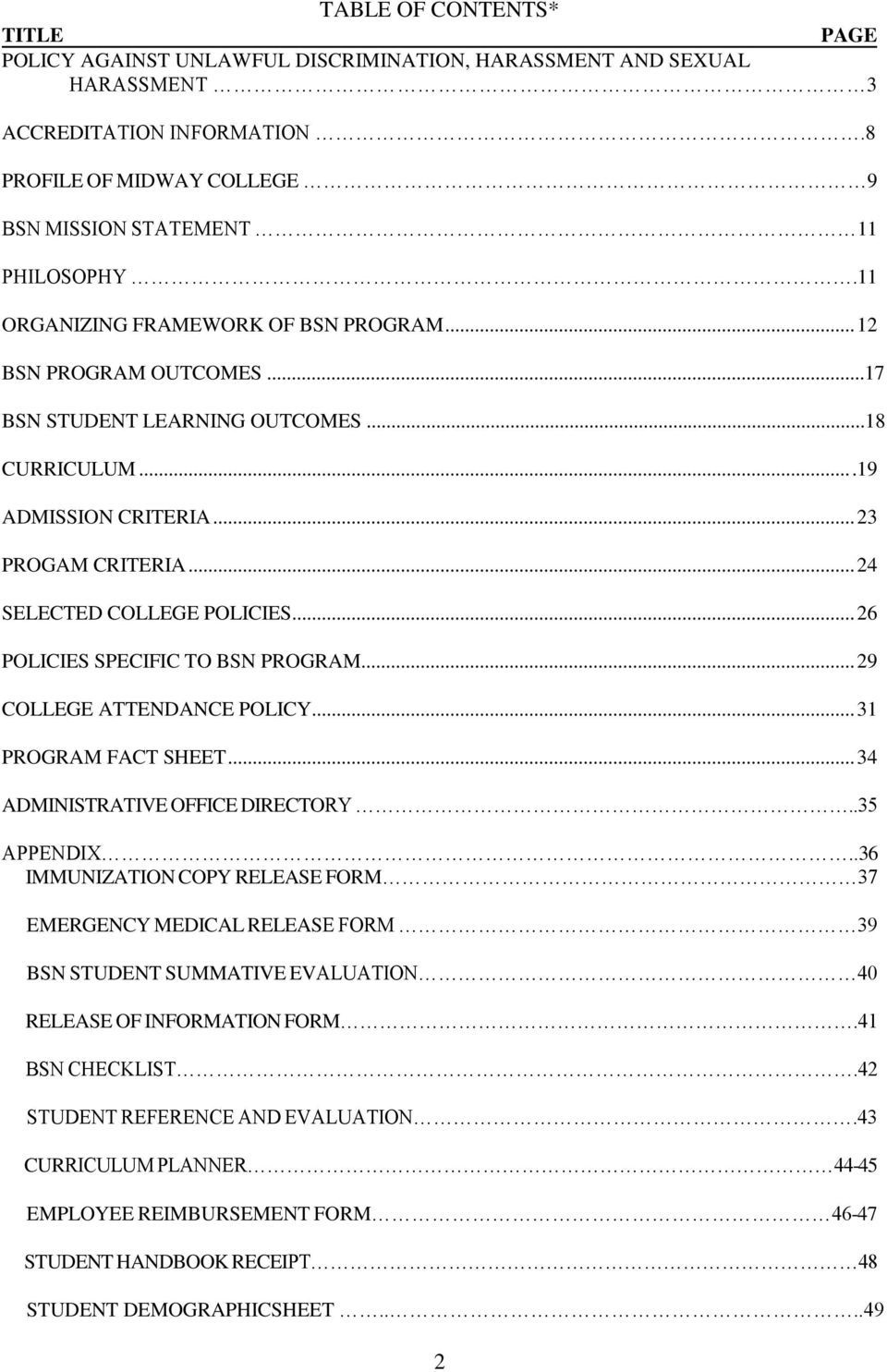
2 TABLE OF CONTENTS* TITLE PAGE POLICY AGAINST UNLAWFUL DISCRIMINATION, HARASSMENT AND SEXUAL HARASSMENT 3 ACCREDITATION INFORMATION.8 PROFILE OF MIDWAY COLLEGE 9 BSN MISSION STATEMENT 11 PHILOSOPHY.11 ORGANIZING FRAMEWORK OF BSN PROGRAM BSN PROGRAM OUTCOMES...17 BSN STUDENT LEARNING OUTCOMES...18 CURRICULUM ADMISSION CRITERIA PROGAM CRITERIA SELECTED COLLEGE POLICIES POLICIES SPECIFIC TO BSN PROGRAM COLLEGE ATTENDANCE POLICY PROGRAM FACT SHEET ADMINISTRATIVE OFFICE DIRECTORY..35 APPENDIX..36 IMMUNIZATION COPY RELEASE FORM 37 EMERGENCY MEDICAL RELEASE FORM 39 BSN STUDENT SUMMATIVE EVALUATION 40 RELEASE OF INFORMATION FORM.41 BSN CHECKLIST.42 STUDENT REFERENCE AND EVALUATION.43 CURRICULUM PLANNER EMPLOYEE REIMBURSEMENT FORM STUDENT HANDBOOK RECEIPT 48 STUDENT DEMOGRAPHICSHEET
3 Midway College Policy Against Unlawful Discrimination, Harassment and Sexual Harassment It is the policy of Midway College to maintain a work and academic environment that is free of sexual harassment and discriminatory actions based on race, color, religion, national or ethnic origin, marital status, sex, age, disability, or any other category protected by law. Unlawful discrimination and sexual harassment by officers, managers, faculty, supervisors, employees, students, advisors, vendors, and contractors will not be tolerated. This policy and procedures are applicable and available to faculty, staff, students, and any third parties with a relationship, contractual or otherwise, to Midway College. Further, any retaliation against an individual who has complained about sexual harassment or unlawful discrimination, or retaliation against individual for cooperating with an investigation of a complaint of sexual harassment or unlawful discrimination, is similarly unlawful and will not be tolerated. Persons who violate this policy will be subject to disciplinary action up to and including termination of employment, expulsions and/or termination of the contractual relationship. I. DEFINITIONS OF UNLAWFUL DISCRIMINATION, HARASSMENT AND SEXUAL HARASSMENT A. UNLAWFUL DISCRIMINATION Unlawful discrimination is strictly prohibited by the College and will not be tolerated. Treating an employee or student differently in the terms or conditions of his or her employment or education on the basis of the employee s or student s race, color, religion, national or ethnic origin, marital status, sex, age, disability, or any other category protected by law constitutes unlawful discrimination. B. HARASSMENT Harassment is any action, oral or written expression, repeated or persistent series of actions, or expressions that are reasonably perceived as creating an intimidating, offensive, hostile or demeaning educational, employment or College living environment for a student or College employee. A hostile environment is one that interferes with an individual s ability to participate in all and any aspects of academic, professional or residential life. C. SEXUAL HARASSMENT Sexual harassment is a form of harassment and sex discrimination that is illegal under both federal and state law and is strictly prohibited by the College. Unwelcome sexual advances, requests for sexual favors and other physical or verbal conduct of a sexual nature constitute sexual harassment when: Submission to such advances, requests or conduct is made either explicitly or implicitly a term or condition of an individual s employment or academic advancement or participation in College programs or activities, or is used as a basis for employment or academic decisions affecting the individual; or Rejection of such advances, requests or conduct affects a term or condition of an individual s employment or academic advancement or participation in College programs or activities, or 3
4 is used as a basis for employment or academic decisions affecting the individual; or Such conduct has the purpose or effect of unreasonably interfering with an individual s work, academic performance, education, or participation in College programs or activities, or of creating an intimidating, hostile work or academic environment. Sexual harassment refers to behavior that is not welcome and occurs in a variety of situation which share a common element: the inappropriate introduction of sexual activities or comments into the work or academic environment. Harassing conduct need not be motivated by sexual desire in order to constitute unlawful sexual harassment. Depending upon the circumstances and how they impact the workplace or academic environment, examples of sexual harassment include but are not limited to such conduct as the following: verbal conduct such as verbal abuse, insults, jokes, sexual innuendoes, offensive remarks about another person s clothing or body; physical conduct such as leering or ogling, obscene gestures, inappropriate touching, fondling or kissing, and coerced sexual contact; repeated unwanted social invitations, sexual flirtations, advances, propositions or unwanted requests for sexual favors; threatened, attempted, or completed physical sexual assault; indecent exposure; displaying or distributing sexually explicit drawings, pictures, or written materials; romantic involvement (even if consensual) between supervisors and subordinates that impacts the workplace and/or other individuals in areas such as assignments, advancements and benefits; romantic involvement (even if consensual) between supervisors and students they supervise that impacts the academic environment and/or other students in areas such as assignments, grades and academic benefits; and any of the above types of behavior carried out through any electronic medium, including but not limited to s, websites, chat rooms, and text messages. Sexual harassment can be perpetrated upon members of the opposite gender or one s own gender. Occasional compliments of a socially acceptable nature do not normally constitute sexual harassment. Similarly, depending upon the circumstances (including the nature of course materials or the context of an action), not all verbal or physical conduct will be considered sexual in nature. See IV. EDUCATIONAL SETTING. II. RETALIATION It is a violation of this policy to retaliate against a person who has complained about discrimination or harassment, or for assisting, participating or cooperating in an investigation or grievance of a complaint hereunder. III. WRONGFUL ALLEGATIONS It is a violation of this policy to bring a knowingly false complaint under this policy. However, failure to prove a claim of sexual harassment does not alone constitute proof of a false and/or malicious accusation. IV. EDUCATIONAL SETTING The academic setting is distinct in the workplace, and the College will maintain and encourage academic freedom. Academic curriculum and pedagogical goals that serve legitimate and reasonable educational purposes do not, in and of themselves, constitute sexual harassment or 4

5 other unlawful discrimination. Those participating in the educational setting bear a responsibility to balance their professional academic responsibilities and academic freedoms with a consideration of the reasonable sensitivities of other participants. Nothing contained in this policy shall be construed to limit the legitimate and reasonable academic responsibilities and academic freedoms of the College s professional educators. V. PROCEDURES FOR ADDRESSING COMPLAINTS OF UNLAWFUL DISCRIMINATION, HARASSMENT AND SEXUAL HARASSMENT Anyone who believes he/she has been subjected to discrimination or harassment in violation of this policy should immediately report those concerns to the Director of Human Resources, the Director of Student Affairs, instructor, chair, dean or any other member of the administration with whom you feel comfortable in making such a report. No one is required to make a complaint to the person who is the subject of the complaint. The report must be in writing. If the initial report is oral, the person to whom the report was made shall inform the complainant of the right to file a written complaint through these procedures. There is no established time frame for filing a complaint; however individuals are urged to file a complaint as soon as possible after the alleged event or offending act or behavior. It is the responsibility of all students and employees to bring to the College s attention any indication of sexual harassment and to report promptly any act or event that is believed to be a violation of this policy so that the matter can be investigated promptly and appropriate corrective action taken, if warranted. Complaints or reports shall be directed to the Director of Human Resources, 11 Pinkerton Hall, 512 E. Stephens St., Midway, KY 40347, If a College employee (faculty, staff or student employee) believes that she or he has been sexually harassed within the scope of his or her employment activities by an individual who is not a College employee or student, the College employee should report the alleged sexual harassment to her or his supervisor or to the Director of Human Resources. If a College student believes that she or he has been sexually harassed on campus by an individual who is not a College employee or student, the student should report the alleged sexual harassment to the Director of Human Resources, an instructor, chair, dean or any other member of the administration with whom the student feels comfortable. The Director of Human Resources or her/his designee is responsible for accepting and processing discrimination and harassment complaints under the College s Policy Against Unlawful Discrimination, Harassment and Sexual Harassment. Instructors, chairs, deans, supervisors and other members of the administration should notify the Director of Human Resources when they receive or otherwise become aware of complaints. To the extent permissible all complaints shall be treated confidentially and will be investigated by the College in an impartial, prompt, and responsible manner. Each complaint of discrimination or harassment must be evaluated on a case-by-case basis impartially with reference to the pertinent circumstances. If appropriate, a complaint may be resolved informally. Informal resolutions may be reached by direct communication between the individuals involved or with the help of mediation of a third party. However, such a strategy 5
6 may be inappropriate when the conduct is severe or when the person responsible for the alleged behavior holds a position of authority. At either Complainant s or Respondent s request any complaint will be removed from an informal resolution process to a formal investigation. Other complaints will be conducted as formal investigations, including but not necessarily limited to interviews of the Complainant, the Respondent, and witnesses, and review of documents. The rights of both parties are considered in conducting the investigation. Both parties have the right to present witnesses and other evidence on his/her behalf. Both the complainant and the respondent will be notified of the outcome of the investigation and the basis for the decision either orally or in writing. Absent extraordinary circumstances, the investigation will be completed and the parties notified of the results within 15 working days from the date the written complaint is received by the Director of Human Resources. In the event of extraordinary circumstances (to be defined by the Director of Human Resources but to include but not limited to situations with a large number of witnesses or evidence to review, non-cooperation from one or more parties or witnesses), the Complainant and Respondent shall be informed in writing of the need for an extension of time to complete the investigation not to exceed an additional 15 working days, the reasons for an extension of time, and the amount of time needed. In determining whether conduct constitutes a violation of the College s Policy Against Unlawful Discrimination, Harassment and Sexual Harassment, College officials will look at the record as a whole and at all of the circumstances of the situation. The Director of Human Resources or her/his designee, shall conduct the impartial formal investigation and make recommendations for appropriate corrective action and discipline as necessary to the Director of Student Affairs where the Respondent is a student and to the Provost where the Respondent is an employee or a third party who is not an employee or student of the College. Either the Director of Student Affairs or the Provost shall decide appropriate corrective action and discipline as necessary. If a violation of this policy is found, Midway will take steps to prevent further harassment and/or discrimination. If the College determines that a third party has sexually harassed a student on campus or a College employee within the scope of her or his employment, the College will take corrective action. However, individuals who are not students or employees of the College are not subject to discipline under the College s internal processes. Members of the College community are also advised that behavior that does not rise to the level of harassment or discrimination may nonetheless be unprofessional, inappropriate or disruptive in the workplace, classroom, or residence halls and could warrant appropriate corrective action and discipline. Members of the College community are expected to cooperate in investigations by designated College officials of alleged discrimination or harassment. Student complaints of harassment by other students may also be covered by certain provisions of Code of Student Conduct contained in the Midway College Student Handbook, and may be referred to the Director of Student Affairs or the Student Judiciary Board for final resolution and disciplinary action, if warranted. More complete information concerning the student judicial process, rights of the student who is the subject of the complaint, rights of the student bringing forward the complaint, and possible sanctions can be found in the Code of Student Conduct 6

7 section of the Midway College Student Handbook. VI. CONFIDENTIALITY The College will make reasonable efforts to keep all information relating to complaints under this policy confidential on a need-to-know basis, to the extent consistent with the College s legal obligations, its need to investigate allegations, and its need to take corrective and/or disciplinary actions. All participants in the grievance process or any investigation of any allegation hereunder shall respect the confidentiality of the process and violation of confidentiality on a need-to-know basis is a violation of this policy. VII. CORRECTIVE AND/OR DISCIPLINARY ACTION In the event that the investigation reveals that unlawful discrimination, harassment, sexual harassment, or other inappropriate or unprofessional conduct (even if not unlawful) has occurred, further action will be taken, including corrective and/or disciplinary action, up to and including termination or expulsion in accordance with appropriate College procedures (for students see Midway College Student Handbook; for staff see Midway College Policies and Procedures, Section B15; for faculty see Midway College Policies and Procedures, Section F7 and Faculty Handbook). If a violation of this policy is found, Midway will take steps to prevent further harassment and/or discrimination. VIII. STATE AND FEDERAL AGENCIES In addition to the above, employees or students who believe they may have been subjected to unlawful discrimination, harassment, or sexual harassment, may file a formal complaint with government agencies. Using the College s complaint process does not prohibit an employee or student from filing a complaint with these agencies. U. S. Department of Education Kentucky Commission on Human Rights Office for Civil Rights 332 W. Broadway, 7th Floor Philadelphia Office Louisville, KY Penn Square East, Suite 515 Phone: (502) The Wanamaker Building Toll-free: (800) Philadelphia, PA TDD: (502) (215) TDD: (215) U.S. Equal Employment Opportunity Commission 1801 L. Street, N.W. Washington, D.C (800)
8 ACCREDITATION Midway College is accredited by the Southern Association of Colleges and Schools Commission on Colleges to award both the Associate and Baccalaureate degree. Southern Association of Colleges and Schools Commission on Colleges 1966 Southern Lane Decatur, Georgia The BSN program is accredited by the Accreditation Commission for Education in Nursing, Inc. (ACEN). Accreditation review information is available from the Chair of the Nursing Division. Accreditation Commission for Education in Nursing, Inc. (formerly National League for Nursing Accrediting Commission) 3343 Peachtree Rd., Suite 850 Atlanta, Georgia Phone: Fax:

9 CONGRATULATIONS AND WELCOME...You have made an important decision to return to school to complete a Bachelor of Science Degree in Nursing. You enter into education now with a different perspective than you had as a first time college student; this has an impact upon the way you view learning. Through completion of general education courses you have a solid base in liberal arts which will provide the cornerstone for Baccalaureate Generalist Nursing practice. In addition, you and your peers come to this program with a broad variety of interests, skills, experiences, and motivations. However, you also share common concerns and similarities with one another about returning to school. Do not be hesitant to ask questions about your program or about Midway College. Become engaged with your classmates and your professors. Develop an open mind to accommodate creative thinking and innovation. The BSN courses are taught online and/or blended. Taking classes online may be new to you and this may be one of your concerns about returning to school. The Midway College online Learning Management System, Moodlerooms, offers an excellent tutorial to orient you to the system. The Online Support Center offers 24/7 assistances, someone is always available to help you navigate the system or help to solve any operating problems you may have. Of course, faculty is also available to assist you. Online learning does require more initiative on your part to communicate with the professors, meet deadlines, and take responsibility for your learning. With most of the BSN courses lasting just 8 weeks, the teaching and course work are conducted at an accelerated pace that demands good time management. This is especially true for those enrolled in the 12-month track curriculum plan. This handbook has been developed with the express intent of keeping you informed as a returning adult learner at Midway College. Students are responsible to know the information and policies in this handbook and in other publications of the College. Overview of Midway College Midway College is an independent, liberal arts college offering two-year, four-year and graduate degrees. The college calendar includes a fall and spring semester, evening and extension programs delivered in modular and cohort sessions, as well as online learning anytime and anywhere. The state-of-the-art Little Memorial Library holds a collection of 55,000 volumes and over 450 periodical titles. The 20,000 square-foot building includes a variety of study and reading facilities as well as an audio-visual room The Anne Hart Raymond Center for Math, Science and Technology was dedicated in October This building contains cutting-edge technology and houses the Nursing and Science Department. Our student body is comprised of students from across the United States and several foreign countries. The student population is a unique and rewarding blend of traditional-age and adult students. A uniquely personalized atmosphere is made possible by an exceptionally low student/faculty ratio. Midway College is located in the heart of the Central Kentucky Bluegrass region. Sitting atop rolling hills, the college overlooks the small town of Midway one-quarter mile away. The 200-acre campus is a short drive from Lexington, Louisville, and Cincinnati. Major airlines and interstates make traveling convenient. 9
10 Midway College has extended campuses in the following locations: Lexington, McKee, and Versailles. All statements in this publication are announcements of present policy only and are subject to change at any time without prior notice. MIDWAY COLLEGE MISSION STATEMENT Midway College shapes and inspires the lives of students in Kentucky s only college for women and in coeducational undergraduate and graduate programs through a student-centered, global education that leads to rewarding careers and responsible citizenship (adopted November 7, 2013). MIDWAY COLLEGE VISION STATEMENT Midway College will become a regional, vibrant University committed to academic quality and individual achievement. MIDWAY COLLEGE VALUES Midway College fosters core values shared by the Christian Church (Disciples of Christ) and reflect the beliefs of our founder, Dr. L.L. Pinkerton. These values include: Valuing the dignity of all people Acting with integrity and responsibility Viewing self as part of the community Living life within a global context Providing service to others Pursuing life-long learning OVERVIEW OF RN-BSN PROGRAM The Bachelor of Science in Nursing program for registered nurses offers the qualified student a program of study which combines general education courses with professional nursing theory, more complex critical thinking, and non-traditional leadership practicums. Students entering the RN-BSN completion program are RNs who have previously earned either an associate degree or diploma in nursing and have a current RN license. This track consists of the upper division level course work. The BSN program may be completed in 12 months or 24 months. Consistent with the mission and goals of the college, the BSN program prepares nurses as leaders who can provide high quality, safe health care to individuals, families, groups, and populations of diverse cultures in a variety of settings. The RN-BSN students learn to apply leadership concepts, skills, and decision making to promote high quality nursing care, while providing health team coordination, oversight, and accountability for care delivery. Emphasis is placed on issues related to the older adult including promoting quality end-of-life care. The RN-BSN program is flexible to allow registered nurses the opportunity, essential to many RN-BSN students, to continue in the work force while earning a baccalaureate degree. The online/blended format courses meet 2-3 times during the course. Online courses do not meet face-to-face. However, students may schedule appointments with faculty as needed. 10

11 The RN-BSN program was developed in and approved by SACS in June The first class of BSN students matriculated in fall of Following graduation of the first BSN class, the initial NLN self-study was conducted. The program was granted initial NLN accreditation in spring The accreditation has been continuous since RN-BSN MISSION STATEMENT The mission of the Midway College RN-BSN Program is to shape the practice of nursing through a student-centered, global education that inspires and empowers registered nurses as leaders, responsible citizens, professionals, and advocates for health, while preparing them for graduate education.the mission, philosophy and goals of the RN-BSN program are consistent with those of Midway College. In support of its mission, the RN-BSN Program aims to: 1. Create and maintain a flexible, student-centered intellectual environment that supports professional leadership development of RN-BSN students, 2. Integrate diversity into the curriculum so that students will confront, intellectually and critically, some of the key issues concerning gender, older adults, sexual orientation, ethnicity, race, religion, socioeconomic status and other special populations. 3. Prepare nurse leaders with the knowledge required to think critically and analytically, communicate effectively, and provide therapeutic nursing interventions in the management of care across the lifespan. 4. Provide advising for students so that they meet their academic and professional goals. 5. Equip students with the knowledge required in their professional field and provide a foundation for graduate education. 6. Encourage development of faculty members as teachers and scholars. 7. Provide information to students regarding available nursing scholarships and refer to financial aid and business office departments as indicated. PHILOSOPHY OF THE RN-BSN PROGRAM The philosophy of the RN-BSN program, developed by the nursing faculty, reflects the values of Midway College and the beliefs of the nursing faculty. The RN-BSN curriculum is guided by the philosophy. We believe that: Professionalism and the inherent values of altruism, autonomy, human dignity, integrity, and social justice are fundamental to the discipline of nursing. Professional nursing practice is grounded in the translation of current evidence into practice. Knowledge and skills in leadership, quality improvement and patient safety are necessary to promote high quality healthcare. Communication and collaboration among healthcare professionals are critical to delivering high quality and safe patient care. 11

12 Health promotion and disease prevention at the individual and population level are necessary to improve population health. Nurses care for clients across the lifespan. Nurses incorporate professional attitudes, values, and expectations about physical and mental aging when providing patient-centered care for older adults and families. Nurses value lifelong learning to support excellence in nursing practice. ORGANIZING FRAMEWORK OF THE BSN PROGRAM The Midway College BSN faculty adopted two national nursing best practice documents/standards as the organizing framework for the RN-BSN Curriculum: The Essentials of Baccalaureate Education for Professional Nursing Practice (AACN, 2008) and Recommended Baccalaureate Competencies and Curricular Guidelines for Nursing Care of Older Adults (2010). The BSN faculty determined that the Essentials of Baccalaureate Education for Professional Nursing Practice (AACN, 2008) best reflects the future professional nursing role and the competencies for nursing care of older adults constitutes best practices in care of this population. The college and nursing leaders recognize the myriad of changes taking place in health care. Patient safety, evidence-based practice and informatics are just a few of the areas receiving intense focus. Nurses are uniquely positioned to play a key role in transforming health care delivery and influencing health care policy. In addition, nursing leaders and Midway College Nursing faculty acknowledge the importance of educating nurses to care for the increasing number of older adults. The Essentials framework was first introduced and adopted by the American Association of Colleges of Nursing in 1998 with a revision in The Essentials document emphasizes such concepts as patient-centered care, interprofessional teams, evidence-based practice, quality improvement, patient safety, informatics, clinical reasoning/critical thinking, genetics and genomics, cultural sensitivity, professionalism, and practice across the lifespan in an ever-changing and complex healthcare environment. The Essentials document meets the Institute of Medicine s recommendations for core knowledge needed for all healthcare professionals (AACN, 2008) Older adults constitute a majority of people who receive nursing care in the United States. Currently 13 percent of the nation s population or close to 38 million people are over 65 years of age. By the year 2050, 19 percent of people will be over 65, and close to 21 percent of the 65- and-older population will be older than 85 years of age. Also, the percentage of individuals representing ethnic and racial minorities is high in the 65-and-older population (AACN, 2010). The health status of older adults is diverse and complex. Health status is often influenced by income level, living arrangements, and need for support. Many of the ailments of older adults are represented in the 38 proposed priority areas identified as responsive to health promotion and prevention activities for Healthy People 2020 (USDHHS, 2010). A major focus of health promotion is to minimize the loss of independence associated with functional decline and illness. There is now a consensus as to what constitutes Best Practices in care of older adults. 12
13 However, the overwhelming majority of nurses practicing in this country care for older adults but have not had enhanced preparation in caring for this population. Thus, the AACN s Essentials of Baccalaureate Education for Professional Nursing Practice (AACN, 2008) and Recommended Competencies and Curricular Guidelines for the Nursing Care of Older Adults (AACN, 2010) were adopted as the organizing framework for this program to better prepare graduates to care for older adults. The nine Essentials are: Essentials I: Liberal Education for Baccalaureate Generalist Nursing Practice o A solid base in liberal education provides the cornerstone for the practice and education of nurses. Essential II: Basic Organizational and Systems Leadership for Quality Care and Patient Safety o Knowledge and skills in leadership, quality improvement, and patient safety are necessary to provide high quality health care. Essential III: Scholarship for Evidence Based Practice o Professional nursing practice is grounded in the translation of current evidence into one s practice. Essential IV: Information Management and Application of Patient Care Technology o Knowledge and skills in information management and patient care technology are critical in the delivery of quality patient care. Essential V: Health Care Policy, Finance, and Regulatory Environments o Healthcare policies, including financial and regulatory, directly and indirectly influences the nature and functioning of the healthcare system and thereby are important considerations in professional nursing practice. Essential VI: Interprofessional Communication and Collaboration for Improving Patient Health Outcomes o Communication and collaboration among healthcare professionals are critical to delivering high quality and safe patient care. Essential VII: Clinical Prevention and Population Health o Health promotion and disease prevention at the individual and population level are necessary to improve population health and are important components of baccalaureate generalist nursing practice Essential VIII: Professionalism and Professional Values o Professionalism and the inherent values of altruism, autonomy, human dignity, integrity, and social justice are fundamental to the discipline of nursing. Essential IX: Baccalaureate Generalist Nursing Practice o The baccalaureate-graduate nurse is prepared to practice with patients, including individuals, families, groups, communities and populations across the lifespan and across the continuum of healthcare environments. o The baccalaureate graduate understands and respects the variations of care, the increased complexity, and the increased use of healthcare resources inherent in caring for patients. 13
14 Gerontological Nursing Competency Statements Corresponding to Essentials 1. Incorporate professional attitudes, values, and expectations about physical and mental aging in the provision of patient-centered care for older adults and their families. Corresponding to Essential VIII 2. Assess barriers for older adults in receiving, understanding, and giving of information. Corresponding to Essentials IV & IX 3. Use valid and reliable assessment tools to guide nursing practice for older adults. Corresponding to Essentials IX 4. Assess the living environment as it relates to functional, physical, cognitive, psychological, and social needs of older adults. Corresponding to Essential IX 5. Intervene to assist older adults and their support network to achieve personal goals, based on the analysis of the living environment and availability of community resources. Corresponding to Essential VII 6. Identify actual or potential mistreatment (physical, mental or financial abuse, and/or selfneglect) in older adults and refer appropriately. Corresponding to Essential V 7. Implement strategies and use online guidelines to prevent and/or identify and manage geriatric syndromes. Corresponding to Essentials IV & IX 8. Recognize and respect the variations of care, the increased complexity, and the increased use of healthcare resources inherent in caring for older adults. Corresponding to Essentials IV & IX 9. Recognize the complex interaction of acute and chronic co-morbid physical and mental conditions and associated treatments common to older adults. Corresponding to Essential IX 10. Compare models of care that promote safe, quality physical and mental health care for older adults such as PACE, NICHE, Guided Care, Culture Change, and Transitional Care Models. Corresponding to Essential II 11. Facilitate ethical, non-coercive decision making by older adults and/or families/caregivers for maintaining everyday living, receiving treatment, initiating advance directives, and implementing end-of-life care. Corresponding to Essential VIII 12. Promote adherence to the evidence-based practice of providing restraint-free care (both physical and chemical restraints). Corresponding to Essential II 13. Integrate leadership and communication techniques that foster discussion and reflection on the extent to which diversity (among nurses, nurse assistive personnel, therapists, physicians, and patients) has the potential to impact the care o older adults. Corresponding to Essential VI 14
15 14. Facilitate safe and effective transitions across levels of care, including acute, communitybased, and long-term care (e.g., home, assisted living, hospice, nursing homes) for older adults and their families. Corresponding to Essentials IV & IX 15. Plan patient-centered care with consideration for mental and physical health and well-being of informal and formal caregivers of older adults. Corresponding to Essential IX 16. Advocate for timely and appropriate palliative and hospice care for older adults with physical and cognitive impairments. Corresponding to Essentials IX 17. Implement and monitor strategies to prevent risk and promote quality and safety (e.g., falls, mediation mismanagement, pressure ulcers) in the nursing care of older adults with physical and cognitive needs. Corresponding to Essentials II & IV 18. Utilize resources/programs to promote functional, physical, and mental wellness in older adults. Corresponding to Essential VII 19. Integrate relevant theories and concepts included in a liberal education into the delivery of patient-centered care for older adults. Corresponding to Essential I The curriculum encourages students to think in greater depth, to question preconceived notions and entertain dialogue among their colleagues and faculty about the complex theoretical and conceptual basis for patient care. Course work in the RN-BSN program is built upon the technical knowledge of the practicing nurse and the liberal arts and sciences. Business, technology, liberal arts, sciences, and humanities serve an integral role in the development of the curriculum, fostering a deeper understanding of person and society. Nursing courses provide the student with theoretical and clinical content for implementation of therapeutic nursing interventions, communication, application of research evidence, and critical thinking. Therapeutic Nursing Interventions involve the nurse using theories and research evidence as a basis for implementation of the nursing process on behalf of individuals, families, groups, and populations to facilitate adaptation and to promote, maintain, and restore the public s health. Implementing therapeutic nursing interventions involves assessment, evidence-based judgments, and leadership in the coordination of care, patient advocacy, and evaluation of patient care outcomes. Communication is a dynamic process involving the exchange of information, ideas, and feelings between and among individuals and groups. Communication is influenced by interpersonal, intrapersonal, and cultural factors affecting those involved in the sending and receiving of messages. Critical Thinking is defined by the RN-BSN program as a purposeful process involving the ongoing synthesis of relevant information, examination of assumptions, identifications of patterns, prediction of outcomes, generation of options, and choice of actions with increasing independence and fair mindedness. (Adapted from Paul & Elder, 2012, 3 rd ed.). Further, this program of study is designed to prepare professional nurses to address key issues concerning gender, sexual orientations, ethnicity, race, religion, socio-economic status and other 15

16 special populations as well as to involve students in rigorous intellectual endeavors. Providing a foundation for graduate study, the emphasis of study encompasses the development of critical thinking, independent decision-making, creative problem solving abilities, refinement of written and verbal communication, self-sufficiency, leadership behaviors, moral and ethical insights, and active professional commitments. The principle of Adult Learning Theory is utilized through the curriculum. Because the learner in a BSN completion program is building on previously learned technical skills and a validated foundation of nursing knowledge, the role of the faculty is primarily that of facilitator of the nursing process and advisor for professional role/leadership development. Learning is a life-long process in which the learner acquires new knowledge, skills, understanding, and attitudes. Learning is an interactive process between the learner and the environment. How the student learns varies greatly in rate of learning and style, requiring a variety of teaching/learning strategies and activities to enhance the process. Learning is not directly observed, but can in part be inferred from behavior changes which occur as a result of experience (Knowles, Holton, & Swanson, 2011). In the learning process, the student assumes the autonomy inherent in the professional role and accepts its attendant accountability. A willingness to be receptive to new experiences in often unfamiliar and unpredictable settings is essential in the socialization to expanded professional roles. The baccalaureate learner fosters interdisciplinary collaboration in planning and coordinating high quality health care to individuals, families, and communities. Because learning is a lifelong process, a foundation must be developed to facilitate continuing self-development. Selfdevelopment implies an openness to diversity, a willingness to change, and an ability to incorporate new knowledge and understanding into one's value system. Baccalaureate education lays the foundation for graduate nursing education and continuing life-long learning. American Association of Colleges of Nursing. (2008). The essentials of baccalaureate education for professional nursing practice. Washington, DC: Author American Association of Colleges of Nursing. (2010). Recommended Baccalaureate Competencies and Curricular Guidelines for Nursing Care of Older Adults. Washington, DC: Author Knowles, M. Holton, E.F., & Swanson, R.A. (2011). The adult learner: The definitive classic in adult education and human resource management (7 th ed.). Elsevier: New York; Routledge. Paul, R., & Elder, L. (2012). Critical thinking: Tools for taking charge of your learning and your life, 3 rd ed.). Englewood, N.J.: Prentice Hall. U.S. Department of Health and Human Services, (2010). Washington, DC: Author 16

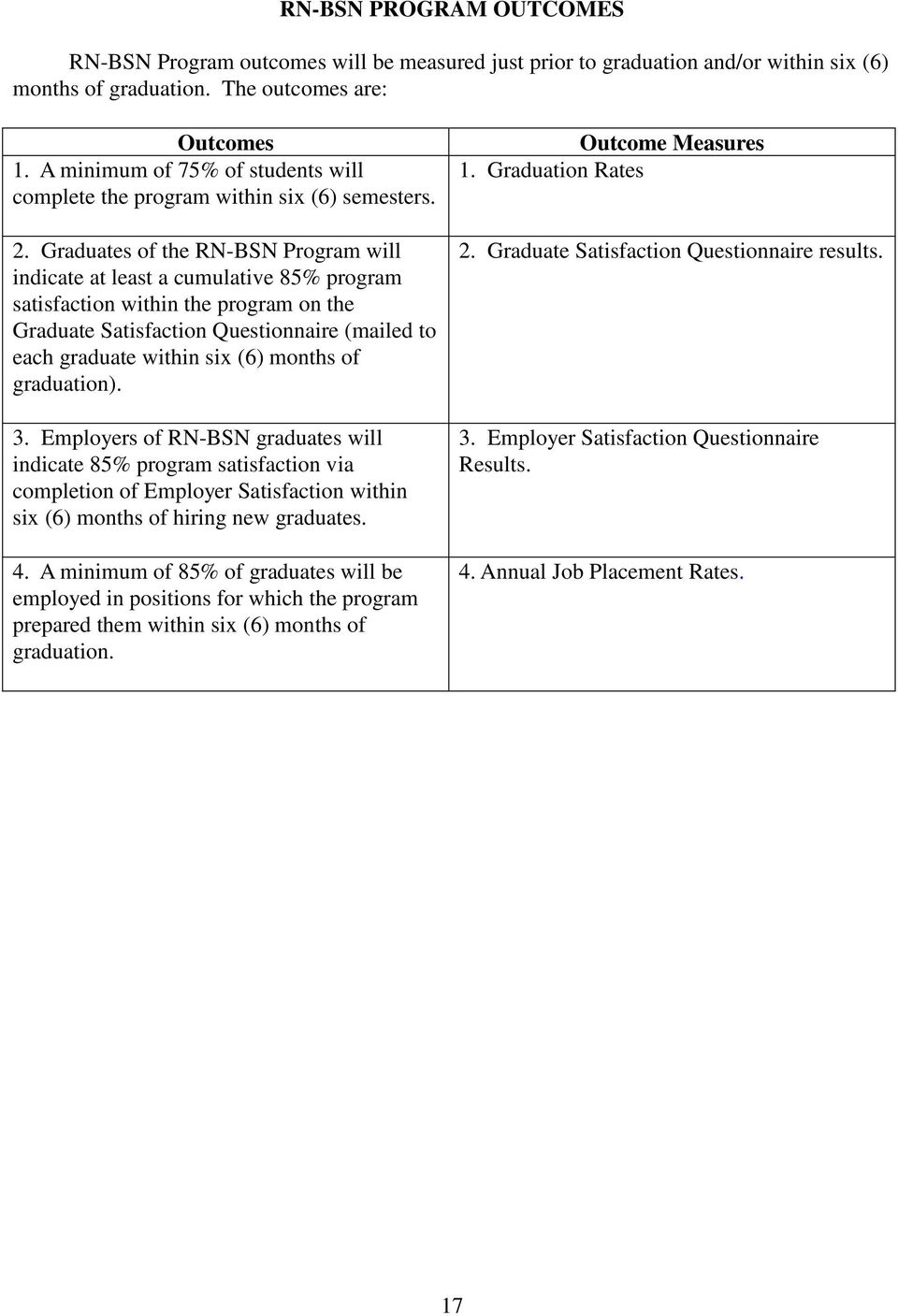
17 RN-BSN PROGRAM OUTCOMES RN-BSN Program outcomes will be measured just prior to graduation and/or within six (6) months of graduation. The outcomes are: Outcomes 1. A minimum of 75% of students will complete the program within six (6) semesters. 2. Graduates of the RN-BSN Program will indicate at least a cumulative 85% program satisfaction within the program on the Graduate Satisfaction Questionnaire (mailed to each graduate within six (6) months of graduation). 3. Employers of RN-BSN graduates will indicate 85% program satisfaction via completion of Employer Satisfaction within six (6) months of hiring new graduates. 4. A minimum of 85% of graduates will be employed in positions for which the program prepared them within six (6) months of graduation. Outcome Measures 1. Graduation Rates 2. Graduate Satisfaction Questionnaire results. 3. Employer Satisfaction Questionnaire Results. 4. Annual Job Placement Rates. 17
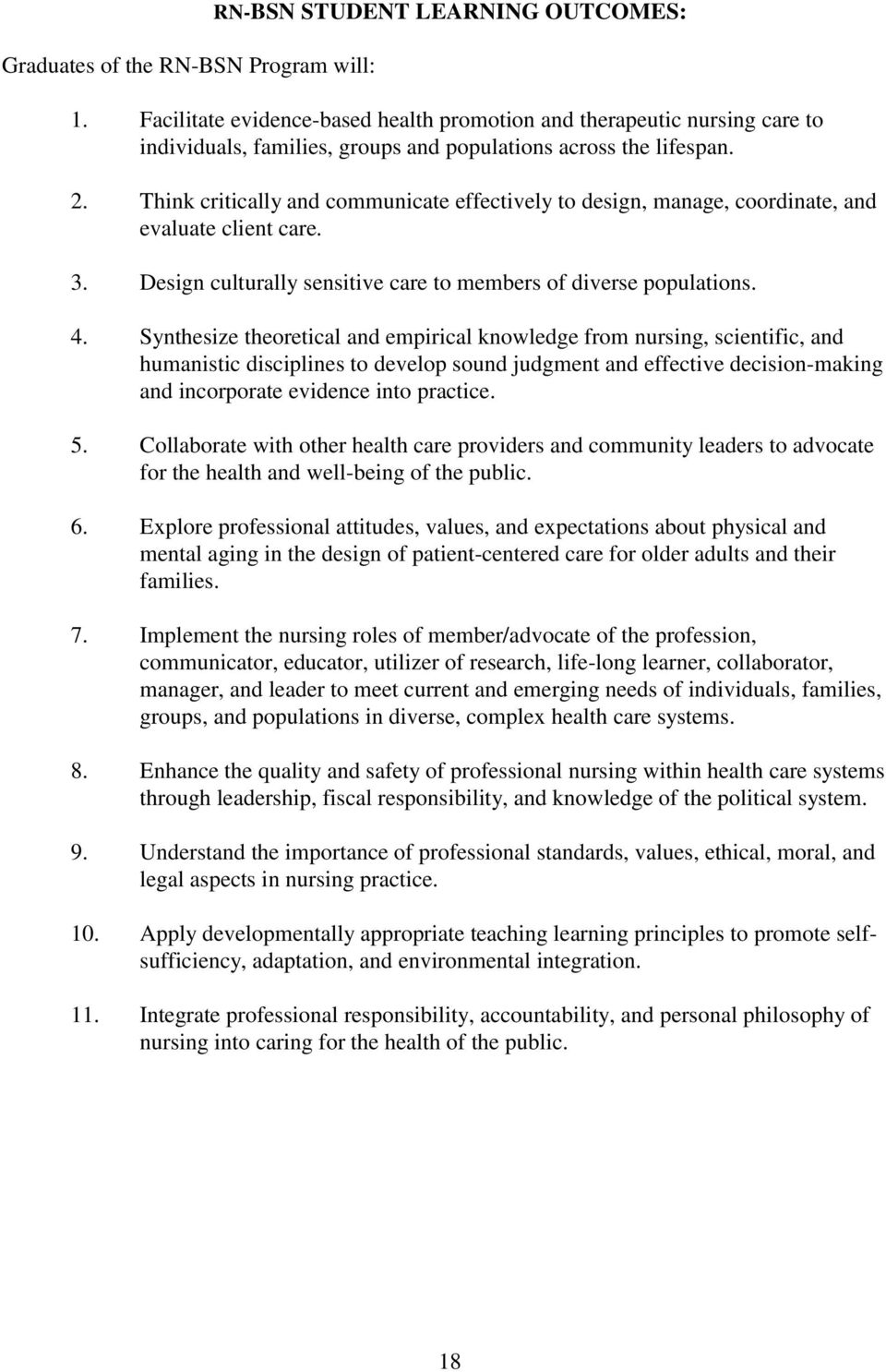
18 Graduates of the RN-BSN Program will: RN-BSN STUDENT LEARNING OUTCOMES: 1. Facilitate evidence-based health promotion and therapeutic nursing care to individuals, families, groups and populations across the lifespan. 2. Think critically and communicate effectively to design, manage, coordinate, and evaluate client care. 3. Design culturally sensitive care to members of diverse populations. 4. Synthesize theoretical and empirical knowledge from nursing, scientific, and humanistic disciplines to develop sound judgment and effective decision-making and incorporate evidence into practice. 5. Collaborate with other health care providers and community leaders to advocate for the health and well-being of the public. 6. Explore professional attitudes, values, and expectations about physical and mental aging in the design of patient-centered care for older adults and their families. 7. Implement the nursing roles of member/advocate of the profession, communicator, educator, utilizer of research, life-long learner, collaborator, manager, and leader to meet current and emerging needs of individuals, families, groups, and populations in diverse, complex health care systems. 8. Enhance the quality and safety of professional nursing within health care systems through leadership, fiscal responsibility, and knowledge of the political system. 9. Understand the importance of professional standards, values, ethical, moral, and legal aspects in nursing practice. 10. Apply developmentally appropriate teaching learning principles to promote selfsufficiency, adaptation, and environmental integration. 11. Integrate professional responsibility, accountability, and personal philosophy of nursing into caring for the health of the public. 18
19 RN-BSN Curriculum All general education courses must be completed prior to taking the BS Nursing courses. General Education Credit Hours BIO 190/191 Anatomy and Physiology I and Lab 4 BIO 198 Anatomy & Physiology II 3 BIO 225/226 Microbiology and Lab 4 BUS 3XX Business Elective, 300 or higher 3 CHM 150 Principles of Chemistry 3 COM 205 Fundamentals of Communication 3 DVS 300 Human Difference 3 ENG 101 College Writing I 3 ENG 102 College Writing II 3 ENG 3XX Writing in the Disciplines (Fulfilled by NSG 430) 0 ENV 3XX Contemporary Global ENV Issues (ENV Science, Global Ecol., Geography) 3 HUM XXX Humanities 3 MTH 140 College Algebra (MA 140/45 or higher) 3 MTH 245 Probability and Statistics 3 PHIL 301 Ethics 3 PSY 260 Human Growth and Development 3 SOC XXX Social Science (ANT, PS, PSY, SOC) 3 ADN Requirements NSG 115 Nursing I and Clinical 9 NSG 120 Nursing II and Clinical 9 NSG 210 Nursing III and Clinical 9 NSG 225 Nursing IV and Clinical 6 NSG 230 Nursing V and Clinical 4 BS Nursing Courses NSG 310 Introduction to Professional Nursing 3 NSG 330 Pathophysiology 3 NSG 340 Health Assessment and Clinical Inference 3 NSG 360 Pharmacology 3 NSG 390 Teaching and Learning 3 NSG 370 Adaptation: Advanced Concepts A/C Illness 3 NSG 410 Community Health Nursing 4 NSG 430 Nursing Research (Fulfills ENG 3xx) 3 NSG 440 Trends and Issues in Nursing 2 NSG 460 Nursing Management and Leadership 6 *Grade of C of higher in all courses required for graduation. 19

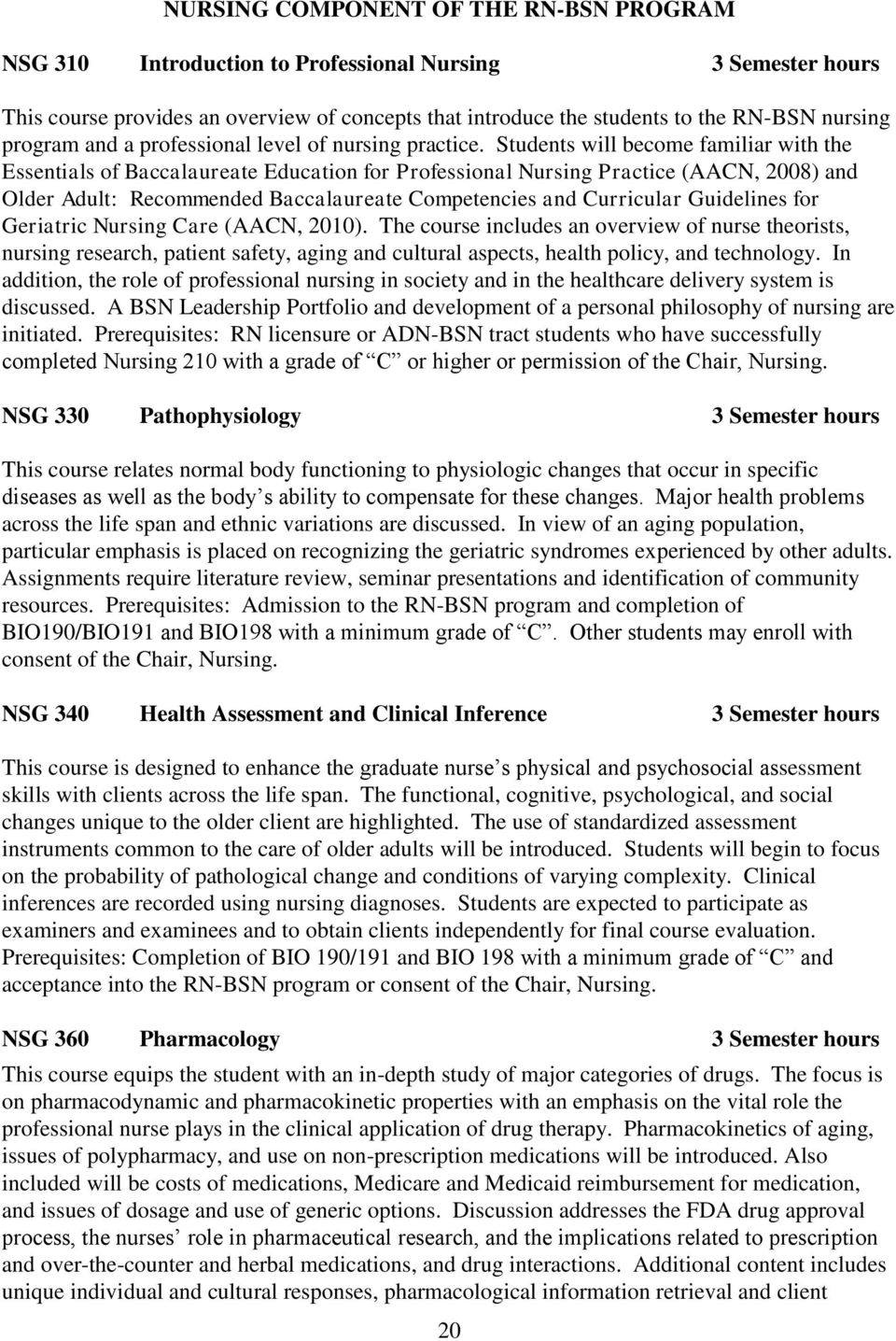
20 NURSING COMPONENT OF THE RN-BSN PROGRAM NSG 310 Introduction to Professional Nursing 3 Semester hours This course provides an overview of concepts that introduce the students to the RN-BSN nursing program and a professional level of nursing practice. Students will become familiar with the Essentials of Baccalaureate Education for Professional Nursing Practice (AACN, 2008) and Older Adult: Recommended Baccalaureate Competencies and Curricular Guidelines for Geriatric Nursing Care (AACN, 2010). The course includes an overview of nurse theorists, nursing research, patient safety, aging and cultural aspects, health policy, and technology. In addition, the role of professional nursing in society and in the healthcare delivery system is discussed. A BSN Leadership Portfolio and development of a personal philosophy of nursing are initiated. Prerequisites: RN licensure or ADN-BSN tract students who have successfully completed Nursing 210 with a grade of C or higher or permission of the Chair, Nursing. NSG 330 Pathophysiology 3 Semester hours This course relates normal body functioning to physiologic changes that occur in specific diseases as well as the body s ability to compensate for these changes. Major health problems across the life span and ethnic variations are discussed. In view of an aging population, particular emphasis is placed on recognizing the geriatric syndromes experienced by other adults. Assignments require literature review, seminar presentations and identification of community resources. Prerequisites: Admission to the RN-BSN program and completion of BIO190/BIO191 and BIO198 with a minimum grade of C. Other students may enroll with consent of the Chair, Nursing. NSG 340 Health Assessment and Clinical Inference 3 Semester hours This course is designed to enhance the graduate nurse s physical and psychosocial assessment skills with clients across the life span. The functional, cognitive, psychological, and social changes unique to the older client are highlighted. The use of standardized assessment instruments common to the care of older adults will be introduced. Students will begin to focus on the probability of pathological change and conditions of varying complexity. Clinical inferences are recorded using nursing diagnoses. Students are expected to participate as examiners and examinees and to obtain clients independently for final course evaluation. Prerequisites: Completion of BIO 190/191 and BIO 198 with a minimum grade of C and acceptance into the RN-BSN program or consent of the Chair, Nursing. NSG 360 Pharmacology 3 Semester hours This course equips the student with an in-depth study of major categories of drugs. The focus is on pharmacodynamic and pharmacokinetic properties with an emphasis on the vital role the professional nurse plays in the clinical application of drug therapy. Pharmacokinetics of aging, issues of polypharmacy, and use on non-prescription medications will be introduced. Also included will be costs of medications, Medicare and Medicaid reimbursement for medication, and issues of dosage and use of generic options. Discussion addresses the FDA drug approval process, the nurses role in pharmaceutical research, and the implications related to prescription and over-the-counter and herbal medications, and drug interactions. Additional content includes unique individual and cultural responses, pharmacological information retrieval and client 20
21 education needs. Patient safety and the role of information technology are highlighted. Emphasis is placed on the importance of communication between nurses and other health care professionals as clients, including older adults, transition between medical and nursing facilities and homes. Prerequisites: Admission to RN-BSN Program or permission of the Chair, Nursing. NSG 370 Adaptations: Advanced Concepts A/C Illness 3 Semester hours In this course the student begins to synthesize concepts from previous coursework with theories of adaptation in acute and chronic illness. Geriatric nursing competencies, evidence-based practice and patient safety are underscored. Students explore the ethical considerations and costs associated with topics such as an aging population, catastrophic illness and stem cell research. Situational and maturational crises, stress and coping are integral concepts for dialogue. Discussion focuses on high-risk diverse populations of individuals, families and communities and their adaptive responses to critical and long term complex problems. Assignments include seminar presentations, group interactions, and independent out-of-class-assignments. Students will explore group dynamics by attending various types of support groups and will reflect on experiences with journal writing. Prerequisites: Acceptance into the RN-BSN program. NSG 390 Teaching and Learning 3 Semester hours This course focuses on teaching strategies and critical thinking skills used by professional nurses in meeting individual, family and community needs relevant to holistic health care. The nursing process provides a basis for planning, implementing and evaluating teaching. Students will describe the impact of aging and co-morbid conditions on seniors, family, and caregivers ability to learn and will select age appropriate teaching strategies to overcome these differences. A health promotion group project allows students to practice and demonstrate teaching skills and techniques to various groups. Students examine content and reading levels of print, web and other materials and redesign resources for more appropriate reading levels. The effectiveness of the baccalaureate nurse s teaching on patient readmissions, quality patient outcomes and health care costs are emphasized. Prerequisites: Admission to the RN-BSN Program or permission of the Chair, Nursing. NSG 410 Community Health Nursing 4 Semester hours This senior level course provides a theoretical and practicum component. There is a focus on public health issues in the local setting and the wider global community. Discussion is framed around nursing care of aggregates of the general population. Principles of epidemiology, community characteristics, and available health services are identified by conducting an extensive community assessment. Students will learn to use research findings to influence the delivery of care and allocation of resources to design health promotion and illness prevention strategies. Assignments include resource utilization and planning within the current health care delivery system. Practicum experiences occur in a variety of community settings and focus on care of the family and vulnerable aggregates. Students will analyze the effectiveness of community resources in assisting older adults and their families to maximize functions and maintain independence. Prerequisite: Admissions to RN-BSN Program or consent of the Chair, Nursing. 21
22 NSG 430 Nursing Research 3 Semester hours This course is designed to introduce students to a basic knowledge of research while emphasizing nursing research as a product and a process. It prepares students to read and critically analyze research findings. The course emphasizes the professional nurse s role in participating in, conducting, and translating current research findings into clinical practice. Students will use structure, process and outcome measures to apply quality and safety concepts to identified clinical problems. The process of changing current nursing practice based on this evidence will be explored. Assignments may include critical analysis of research and literature reviews. Students will complete an initial Research Ethic Review Board (RERB) proposal. Prerequisites: Completion of MTH 245 with minimum grade of C or higher and admission to RN-BSN Program. This course must be taken in the semester prior to NSG 460. NSG 440 Trends and Issues in Professional Nursing 2 Semester hours This course is designed to examine current issues and emerging trends relevant to professional nursing. Historical perspectives as well as futuristic considerations provide the framework of study. Students will analyze the impact of an aging society on the health care system and various geriatric care models. Emphasis is placed on the evolving roles of professional nurses in the health care system as they relate to legal, ethical, economic, political and social issues, healthcare policy, finance, and regulatory environments. Students will explore information management and the use of technology in various local, state, regional, national and global health care settings. Assignments include extensive literature review, group discussions, and individual student presentations and papers. Prerequisite: Completion of NSG 310 with a grade of C or higher or permission of Nursing Division Chair. NSG 460 Nursing Management and Leadership/Senior Project 6 Semester hours This senior level course focuses on the leadership roles of the professional nurse in theory and an executive leadership practicum. Emphasis is placed on leadership concepts, skills and decision making in the provision of high quality nursing care and healthcare team coordination. Immersion experiences develop the students critical thinking/clinical reasoning skills and increase communication skills, time management, and organization abilities. Various professional practice and leadership models and change theories will be studied. The senior capstone project serves as a culmination of the students baccalaureate education and illustrates the values, knowledge, skills and attitudes of the professional nursing role. The senior project involves a review of the literature (completed in prior courses), approval of Research Ethics Review Board (RERB) Proposal (began in prior course), development/implementation of project, a formal paper, and a presentation of the project to the college and the professional community. Practicum experiences is designed to serve as the framework for the senior project and to provide opportunities to develop and practice leadership skills in a variety of health care settings. Prerequisites: All graduation requirements for General Education and Nursing must be completed prior to Nursing
23 RN-BSN ADMISSION CRITERIA ADMISSION CRITERIA For acceptance into the BSN Program the student must: 1. Be admitted to the college (unless continuing directly from the Midway College ADN program). 2. Submit official college and high school transcripts as required. 3. Submit a copy of a current RN license; will be validated by Nursing Office. 4. Be accepted by the college and complete an admission interview with the chairperson of the program or designee. 5. Submit a current resume. 6. Be a graduate from an ADN or diploma program. Graduates of diploma nursing programs must complete the NLN Acceleration Challenge Exam and achieve a minimum score of 90 to have nursing courses converted to college credit hours. This is a college requirement. Cost of the NLN Acceleration Challenge Exam is the responsibility of the student. 7. Have a GPA of 2.5 on a 4.0 scale, (2.0 on a 4.0 scale for Midway College ADN graduates). 8. Provide evidence of current clinical practice within the last 5 years via: 1) Graduation certificate from a school of nursing within the past five years. 2) Work experience. 9. Provide evidence of satisfactory clinical performance. The Student Reference and Evaluation form must be received from current nursing employer or from the ADN or diploma nursing program faculty for applications who have graduated within the last year. 10. Prior to admission, applicants must have earned a "C" or better in the required college courses listed below: 1) Anatomy and Physiology I and II (BIO 190/BIO 191 and BIO 198) 2) Microbiology (BIO 225/BIO 226) 3) Human Growth and Development (PSY 260) 4) College Writing I and II (ENG 101 and ENG 102) After students complete RN-BSN admission criteria, students may be admitted to the college and granted an interview with the chairperson (or designee) of the RN-BSN program. 23
24 RN-BSN PROGRAM REQUIREMENTS The student is expected to: 1. Provide transportation to practicum facilities. 2. Satisfy all college requirements for graduation. 3. Students are encouraged to be employed in the health care setting while enrolled in classes. 4. A minimum grade of C is required in all nursing courses. 5. All graduation requirements for General Education must be completed prior to nursing courses. 6. Technology requirements for online courses: *Computer with online access,.pdf reader, and flash. *Web browsers: Mac users will need Safari 3 or higher, Firefox 3 or higher, or Google Chrome 4 or higher; PC users will need Firefox 3 or higher, or Google Chrome 4 or higher. *Students will also need the equipment to record themselves giving oral presentations and to post those presentations online. 7. Provide evidence of immunization or immunity to rubella, rubeola and mumps (MMR) and hepatitis B, proof of Varicella immunization or immunity, current negative PPD tuberculin test, current CPR certification, current RN license and proof of health insurance prior to admission to NSG 310. Most practicum sites require influenza vaccination. IMMUNIZATIONS & REQUIREMENTS PRIOR TO PRACTICUM: All required immunizations, certifications, and other items listed below are to be submitted to the Nursing Office for students entering the RN-BSN Program. No student will be allowed to attend practicum until these requirements are met and appropriate documentation is on file in the Nursing Office. The practicum absence policy is in the RN-BSN Student Handbook, which each student receives at the beginning of the NSG 301 course. MMR (Measles (Rubeola), Mumps, and Rubella) 1. Official immunization record containing 2 documented MMR vaccination dates or; 2. Titer results showing positive immunity for each component of MMR Varicella (Chicken Pox) 1. Official immunization record containing 2 documented varicella vaccination dates or; 2. Titer results showing positive immunity for varicella -- Students may be required to provide titer results showing immunity to varicella before attending practicum rotations at particular facilities. These students will be notified at the time of practicum assignment, if documentation of a titer is not already on file. 24
25 Hepatitis B 1. Official immunization record containing dates of all vaccinations or; 2. Titer results showing positive immunity for Hepatitis B Surface Antibody or; 3. If a student does not wish to obtain the Hepatitis B vaccine or is not complete with the series, the Hepatitis B Waiver form should be signed and placed in the student s file. The form is available in the Nursing Office. Should the student complete the vaccine series or obtain a titer, it is the student s responsibility to submit documentation to the Nursing Office. TB skin test or T-Spot test 1. Students must retest and submit documentation annually. 2. Students testing positive for TB the first-time should be re-evaluated by chest x-ray and submit results. Documentation of symptom screening for TB performed by a primary healthcare provider must be submitted annually thereafter. CPR 1. Infant, Child, and Adult Resuscitation are required for certification. 2. Acceptable certifications: American Heart Association (preferred) = Basic Life Support for the Healthcare Provider American Red Cross = Professional Rescuers and Healthcare Providers -- Many certifications completed through an online format are not acceptable (i.e., ProCPR, ASHI, HIS). Please call the Nursing Office with questions. 3. It is the student s responsibility to recertify and submit documentation prior to the expiration date provided on the front of the CPR card. Influenza Vaccination Most practicum sites, contracted with Midway College s Nursing Program, require employees and students to provide documentation of influenza vaccination during the flu season. Any deferments would need to be approved by the contracted site. Those who are not vaccinated will be required to wear a mask while on the unit during flu season. A copy of the vaccination should be provided to the Nursing Office. HIPAA (Health Insurance Portability Accountability Act) Students must complete and sign the Midway College Nursing Students HIPAA Confidentiality Agreement. Student Health Insurance Midway College requires students registering for internships, practicums, clinical and student teaching to purchase their own health insurance and provide evidence of current insurance card. A copy of the insurance card must be submitted to the Nursing Office prior to attending clinical rotation. See College Catalog at for more information. 25
26 SELECTED COLLEGE POLICIES The following college policies apply to all students of Midway College. For more information about these and other college policies, please refer to the college catalog and your advisor for details. Graduating Student Assessments Nursing Program faculty will administer RN-BSN Exit Interview Survey. Program Self-Assessment Survey (PSAS). Academic Honesty Midway College seeks to promote the highest standards of academic and personal integrity in faculty and students. All persons associated with the college's academic community have a responsibility to establish, maintain, and foster an understanding and appreciation of academic standards and values. Academic dishonesty in any form cannot be tolerated in such an environment. Academic dishonesty is regarded as an act of fraud in which a student seeks to claim credit for the work or efforts of another without authorization or uses unauthorized materials or fabricated information in any academic exercise. Academic dishonesty also includes forging academic documents, impeding or damaging the academic work of others, or assisting students in acts of dishonesty. In essence, academic dishonesty can be categorized and defined as follows: Cheating: Cheating is defined as using or attempting to use unauthorized materials, information or study aids in any academic exercise. Cheating includes, but is not limited to, wrongfully giving, taking or receiving aid on any academic exercise for which the student will receive credit. Fabrication: Fabrication is the falsification or invention of any information or citation in an academic exercise. Fabrication includes, but is not limited to, falsely citing a source which does not exist and incorrectly citing a source (e.g. improperly citing an article's page numbers, volume number, etc.). Plagiarism: Plagiarism is any representation of the words or ideas of another as one's own. All academic assignments submitted to the student's professor shall be the result of the student's own ideas, research, composition, and expression. A student who submits any exercise which uses someone else's ideas, words, expressions, or pattern of organization without properly citing/acknowledging the author is guilty of plagiarism. Plagiarism also includes reproducing another's work and submitting it as one's own, whether it is an article, pages of a book, a paper from a friend, a file, or any other work. A student who has someone alter or revise their work and then submits it as their own is also guilty of plagiarism. Although students may discuss assignments with each other and with their professor, any work submitted to the professor should be done solely by the student who claims it as their own. 26
27 All members of the college community, including faculty, students, staff and administration should report any alleged incident of academic dishonesty. (See the college catalog for the process of handling cases of reported academic dishonesty.) Academic Grievances If a student thinks that the final grade awarded to him/her in a course was unjust, the student must contact course professor within two (2) weeks of the posting of grades for the academic term in which grade was received. If the student has not been able to resolve the situation by speaking to the course professor, then the student may file an academic grievance with the Vice President/Dean of School for Career Development. This must be done by the student within five academic days after contacting or attempting to contact the course professor. (Upon notification of a student appeal, the professor will inform the program chairperson whose opinion and advice will be solicited at this time.) The Vice President/Dean of School for Career Development will attempt to mediate the dispute with the course professor and the student. See college catalog under academic grievances for details concerning unsuccessful mediation. Complaint Procedures United States Code 1099b(a)(5)(1)(1999) and the United States Department of Education Regulations [34 CFR Ch. VI (b)(11.) and July 2002 at (a)(1)(ix)] requires accrediting agencies to evaluate an institution on specific indicators. One of those indicators is student complaints. An institution of higher education must keep a record of student complaints and resolution of complaints. Definition of Complaint: A written and signed statement by the individual that alleges some type of personal injury from a decision of the institution or accuses the decision-making process of being a scam. [A request for decision-making is not a complaint. An appeal of a decision is not a complaint. A grievance itself is not a complaint, i.e., grade dispute.] Clarification of Complaint Form: The individual who believes himself or herself to be wronged must submit a written statement giving all pertinent information and must sign and date the written complaint. The complaint must be given to an executive officer of the college, either by mail or hand-delivered. [An or conversation does not constitute a complaint.] Procedure for Handling Complaints: 1. The executive officer of the college who receives the complaint should determine which executive officer should handle the issue and submit the complaint to the appropriate executive officer. 2. The appropriate executive officer should investigate the complaint to determine validity of complaint and take appropriate actions, if any, to resolve the complaint. 3. The executive officer should notify the complainant of the investigation s findings and any actions taken and the reason for such. 4. The executive officer submits a copy of the complaint with findings and actions taken to the Provost of the college. 5. The decision of the executive officer may be referred to the Provost whose findings are final. 6. The office of the Provost will compile a record of student complaints. 27
28 7. The office of the Provost will keep a file of all complaint reports in accordance with the college s record-keeping practice. 8. At all times, compliance with EEOC and FERPA will be observed. 28
29 POLICIES SPECIFIC TO THE RN-BSN PROGRAM month/24 month tracks: The BS Nursing program may be completed in 12 month track or 24 month track. 1.1 Change of Name or Address: It is the student's responsibility to keep the nursing office, college registrar, IRIS (for ), business office and financial aid office abreast of current address, phone number, and name changes. If you should change any of the above, notify the Registrar ( ) and Nursing Office ( ) immediately. You may miss important student information if your records are not current Address: All Midway College RN-BSN students are responsible for obtaining Midway College address and keeping the Nursing Office apprised of that address. Students are expected to check their s at least daily for time-sensitive information and communication from the College or their instructor. All communication will be through Midway College with Midway College addresses. 1.3 Recent Graduates: Recent Associate Degree graduates planning to enter the RN-BSN program are encouraged to: indicate intentions to enter the RN-BSN program at least one month prior to entrance. complete NCLEX successfully prior to admission to RN-BSN program. 2.0 Transfer of Credit: A maximum of 32 hours of nursing credit will be accepted from NLN accredited nursing programs, and from satisfactory results on NLN Acceleration Challenge Exam or ACT/PEP battery of classical or integrated tests. A maximum total of 84 credit hours may be transferred from accredited institutions (see college catalog for further details). Final determinations will be made by the chairperson of the Nursing program, following consultation with the registrar. 3.0 Class/Lab/Clinical/Credit Hour Ratio: Class: The ratio of clock hours to credit hours is 50 minutes: 1 credit hour. For each credit hour enrolled the student is expected to spend one 50 minute hour per week in the classroom (in seat or online). Laboratory: The ratio of clock hours to credit hours is 2:1. Two 60 minute lab hours are equivalent to one credit hour. For example, NSG 340 Health Assessment and Clinical Inference is a four credit hour course with a lab. Three of the four credit hours are class hours and the student spends equivalent to three 50 minute hours per week (45 contact hours) in the classroom. One of the four credit hours is a lab hour and the student spends equivalent to two 60 minute hours per week in the laboratory. Practicum: The ratio of clock hours to credit hours is 3:1. Three 60 minute practicum hours are equivalent to one credit hour. For example, NSG 460 Nursing Leadership is a five credit hour course with a practicum component. Three of the five credit hours are class hours and the student spends equivalent to three 50 minute hours per week in the 29
30 classroom. Two of the five credit hours are clinical hours and the student spends six 60 minute hours per week in the clinical area. 4.0 Expenses: In addition to tuition and fees, additional expenses related to nursing courses may be incurred. The nursing faculty makes every attempt to keep these costs to a minimum. 4.1 Name Pin: A name pin (your name, RN, Midway College BSN nursing student) is provided by Midway College. Replacement pins may be purchased through the nursing office (approximate cost $15.00 payable in advance). 4.2 White Lab Coat: To be purchased independently by the student. 4.3 Books: The cost of textbooks ranges from $75 to $250 per semester. Textbooks may be ordered through e-campus.com or vendor of student s choice. The current edition of the APA Publication Manual is required for all RN-BSN courses. 4.4 Equipment: NSG 340, Health Assessment and Clinical Inference requires the following: Penlight Measuring tape Double-head stethoscope with diaphragm and bell Clear six-inch ruler marked in centimeters 4.5 Transportation: Students provide their own transportation to practicum sites. 4.6 BSN Nursing Pin: Graduating seniors may purchase this pin to wear after graduation. The cost of the pin varies according to current market prices. 4.7 Graduation Fees: There is a $ fee per diploma. 4.8 Emergency Medical Care: During the educational program, the student is required to attend practicum in a variety of settings within the community. Should medical treatment become necessary, during a practicum, the clinical agencies may be willing to provide emergency care, or to insure the student is transported to a site where emergency care can be provided. The student must accept the financial responsibility for such care and transportation. *Students must provide evidence of health insurance prior to attending practicum. 5.0 Tuition Structure: RN-BSN students are assessed tuition based on the number of credits for which they register. 5.1 Financial Aid: Students may be eligible for financial aid at various levels. Information is available through the financial aid office. 5.2 College: Information regarding Institutional Scholarships and Grants is available in the College Catalog in the Financial Assistance section. 30
31 5.3 Federal and State: (KHEAA Guaranteed Student Loan, Pell Grants, Scholarships, etc.) Students are encouraged to complete a Free Application for Federal Student Aid (FAFSA) as early as possible after income tax forms are completed January through April. Information from this source is used at the State, Federal, and college level to determine eligibility for financial assistance packages. 5.4 Private Foundations: Consult public libraries for reference sources for financial assistance/higher education through private organizations, foundations, civic groups, women's and professional organizations (e.g. KNA, ANA, AORN, KLN, etc.). 6.0 Liability Insurance: It is strongly encouraged that students be covered by malpractice insurance prior to entering practicum courses. 7.0 Dress Code: When in the practicum setting, students may wear lab coats as appropriate and the official name pin identifying the individual as a registered nurse and BSN student of Midway College. If the clinical agency designates a specific student dress code this must be followed. Lab coats are to be provided by the student, and name pins are provided through the nursing office. Students are expected to project a professional image as students of Midway College. Attire under the lab coat should be appropriate to the setting (e.g. scrubs may be worn in the trauma or critical care areas). Blue jeans are not acceptable in the practicum area. 8.0 Attendance: It is expected that all students attend scheduled class and practicum experiences. In addition to the general policies stated here, specific course policies concerning class and practicum attendance are listed in the respective course syllabi. 8.1 Class Attendance: Class attendance and promptness are expected. Students who must miss a class or attend late, should notify the appropriate faculty member as soon as possible and should make arrangements for obtaining class material. Because classes may meet only 3-4 times in an 8-week module, missing one class is equivalent to missing two-three week's material or three traditional class "cuts". Regular attendance for most students provides optimum opportunities for learning and efficient use of time and effort. For many courses participation in class discussions is a part of the final grade. 8.2 Practicum Attendance: Practicum attendance is mandatory. Students are required to keep a log documenting their practicum hours. Since there is some flexibility in practicum scheduling between the student and the facilitator, students are required to make-up all missed practicum time. The faculty teaching the course and the facilitator must approve of practicum time changes prior to the student altering his/her schedule. 9.0 Tape Recording: Taping classes is not prohibited by Midway College, however, individual faculty retain the right to determine whether students may tape in a specific course. 31
32 The nature of RN-BSN classes differs from the traditional lecture format in that RN-BSN courses encourage group discussion, peer and interdisciplinary collaboration, small group work, and various participatory learning experiences. Hence, the teaching/learning format is such that relying solely on taped information from classes can place the student in the position of not grasping all of the course information accurately or completely. Tapes of class meetings should not be used as the authoritative source for course content and faculty will not be responsible for accuracy or completeness of such tapes. The faculty recommends that if tapes are used they serve only as a refresher for the topics discussed and the flow of content and ideas generated in class Written Assignments: All assignments must follow current APA style. All assignments are to be turned in on or before the assigned time. Late assignments may be penalized. Unless otherwise determined by faculty, written assignments must be typewritten Grading: A grade of "C" or better is required in all courses required for the RN-BSN Program. Courses with grades below "C" must be repeated. Practicum courses with grades below "C" must be repeated and a grade of "C" or better achieved before the student is allowed to continue to the next practicum course. A grade of "C" or better is required in all courses to continue in the program Grading Scale: = A = B = C = D 69 and below = F 11.2 Practicum: Practicum is graded on a pass/fail basis. Students must earn a grade of pass in clinical. If a student earns an F for practicum he/she automatically earns an F for the course regardless of theory performance and theory grade Progression: After admission into the Midway College RN-BSN Program, a student who earns a grade below C is any two nursing courses (or who earns below a C in the same course twice) will be dismissed from the program Exams: Policies concerning makeup exams are determined by the course professor and will be included in each course syllabus. If a student must be absent for an exam, it is the responsibility of the student to inform the professor of the reason for the absence Evaluations: Evaluation methods of class content will be determined by the respective professor of that course and will appear on the course syllabus. Practicum evaluations will be an integral part of courses and conferences will be mutually arranged between student and professor. Student evaluations of faculty will follow established protocol of Midway College 32
33 13.1 Class Participation: Class participation is an integral component of adult learning (online and in-seat) and therefore, generally comprises a portion of each course grade. The student who participates in class does so both verbally and nonverbally; appears interested, on track, and eager to involve self within the context of discussion and activities. The student comes to class having read and thought about assigned materials; initiates discussion, responds to classmates comments and shares ideas with others, often initiates discussion, but listens attentively to opinions and points of peers. When debate ensues, the student maintains an open mind and is assertive but tactful in the critique of opposing points of view Learning assistance: Learning assistance is available through several campus services Academic Support Center (Midway Campus): Assistance for all students is available on an individual bases through the office of Academic Support. The Center is located in the Library; Room 110 the phone number is Leadership Portfolio: The RN-BSN Nursing Portfolio provides students an opportunity to reflect on their academic experiences and synthesize their learning and accomplishments. It provides a means for documenting professional skills and knowledge. It can serve as a supplement during job interviews and back up resume Senior Capstone Project: The senior project is designed to be a culmination of the student's baccalaureate education with demonstration of the integration of liberal education and the discipline of professional nursing. Students will submit a typewritten document containing all aspects of their project to the NSG 460 course coordinator. A date will be scheduled for the students to present their senior projects to the college community, clinical agency representatives and RN-BSN nursing faculty. This project is a component of the capstone course of the program, NSG 460, Nursing Leadership and Management Extracurricular Activities: Student participation in all aspects of the program is encouraged Servant Leadership: Each student must complete two (2) hours of community service per semester and during the final summer course Recognition of Student Achievement 18.1 Pinning Ceremony: Graduating ADN and RN-BSN students are honored and receive their Midway College Nursing Pin. Note: a substitute pin will be used for graudates who did not order a pin Honors Program: Outstanding academic students are recognized by the college community. All RN-BSN students who have earned a minimum of 48 hours in Midway College classrooms are eligible for participation in Honors Program BSN Professional Excellence Award: Recognition of outstanding professional achievements. 33
34 18.4 Dean's List: Recognition of outstanding academic achievement based on GPA for the current semester. 34
35 Dean, School of Health Sciences RN-BSN Director Nursing Administrative Assistant FACT SHEET RN-BSN COMPLETION PROGRAM MIDWAY COLLEGE Midway Campus Dr. Barbara Kitchen (859) Dr. Nancy Barnum (859) Ms. Beth Roberts (859) Nursing Office Fax (859) ADMINISTRATIVE OFFICE DIRECTORY Academic Affairs /6055 Academic Support Center Business Office Campus Health Clinic Communication Center Enrollment Services Financial Aid Food Service Information Systems /4357 Library Nursing Office Nursing Lab President s Office /5311 Registrar /5341/5725 Security Student Affairs /5391 Student Center Lobby EMERGENCY NUMBERS = 911 Ambulance Doctor Fire Department Hospital Police Post Office Sheriff
36 APPENDIX 36
37 MIDWAY BSN GRADUATES CONSENT TO COPY IMMUNIZATION SECTION OF HEALTH FORM (BSN Student File Copy) Please read carefully before signing. The immunization records reviewed and copied will be used by the RN-BSN Program to verify your immunizations that are required for practicums. We are only interested in the immunization records and this information will be held in strict confidence. Please sign both portions of consent form (one for BSN student file and one for campus nurse.) Thank you! TO BE COMPLETED BY STUDENT (If Midway ADN Graduate): This is to certify that I, (student name - print), authorize the Midway College campus nurse to release my immunization records which are listed on the college health form or in the ADN student file to the RN-BSN Program Chair so that I may be approved to enter the practicum setting. Signature: Date: 37
38 MIDWAY BSN GRADUATES CONSENT TO COPY IMMUNIZATION SECTION OF HEALTH FORM (Campus Nurse's Copy) Please read carefully before signing. The immunization records reviewed and copied will be used by the RN-BSN Program to verify your immunizations that are required for practicums. We are only interested in the immunization records and this information will be held in strict confidence. Please sign both portions of consent form (one for BSN student file and one for campus nurse.) Thank you! TO BE COMPLETED BY STUDENT (If Midway ADN Graduate): This is to certify that I,, authorize the Midway College (student name - print) campus nurse to release my immunization records which are listed on the college health form or in the ADN student file to the RN-BSN Program Chair so that I may be approved to enter the practicum setting. Signature: Date: 38
39 MIDWAY COLLEGE RN-BSN COMPLETION PROGRAM EMERGENCY MEDICAL CARE During the educational program, the student is required to attend practicum in a variety of settings within the community. Should medical treatment become necessary, during a practicum, the clinical agencies may be willing to provide emergency care, or to insure the student is transported to a site where emergency care can be provided. The student must accept the financial responsibility for such care and transportation. Students must provide evidence of health insurance prior to attending practicum. This form must be signed and retained in the student s file in the Nursing Office prior to the student beginning practicum courses. I accept the financial responsibility for any emergency medical care provided while in clinical practice as a Midway College RN-BSN nursing student. Print Name Signature of Student Date 39
40 BSN STUDENT SUMMATIVE EVALUATION Student Name: Instructor: Date: Factor Evaluated Professional Communication Professional Presentation Interprofessional Collaboration Writing Skills Information Management Technology Skills Care of Diverse Populations and groups Utilization of nursing process in written work Knowledge of care of older adults Health promotion and disease prevention Quality care and patient safety Translation of evidence into practice Nursing research Principles of teaching and learning Legal aspects Leadership skills Initiative Professional responsibility and accountability Professionalism Professional values Critical thinking and problem solving Health care policy Political system related to health care Outstanding Above Average Average Below Average Not Observed Comments: Completed by: 40
41 MIDWAY COLLEGE RN-BSN COMPLETION PROGRAM AUTHORIZATION FOR RELEASE OF INFORMATION The regulatory and accrediting bodies of the Accreditation Commission for Education in Nursing, INC. (ACEN) and the Southern Association of Colleges and Schools Commission on Colleges (SACSCOC) periodically review the Baccalaureate Nursing Program. A component of this review process includes the inspection and review of nursing students educational work such as papers, projects, and tests. Written consent of the student is required for such review. No information shall be released from a student s record without written permission of the student. I,, give my consent for site visitors from (student name - print) regulatory and accrediting bodies to inspect and review my educational works. Signature of Student Date 41
42 Midway College RN-BSN Student File Checklist Name: Interview College and High School Transcripts Resume Student Reference and Evaluation Form BSN Acceptance Letter BSN Curriculum Worksheet NLN Acceleration Challenge Exam Score (Diploma Graduates Only) Application to Midway College/School for Career Development Midway College/School or Career Development Acceptance Letter College GPA MMR Immunizations Hepatitis B Documentation or Signed Waiver Varicella (Vaccination or positive titer) RN License Exp. Date Exp. Date Exp. Date Exp. Date TB Skin Test Exp. Date Exp. Date Exp. Date Exp. Date CPR Certification Exp. Date Exp. Date Exp. Date Exp. Date Influenza Vaccine Exp. Date Exp. Date (Prior to NSG 410) Proof of Health Insurance HIPAA Training 42
43 MIDWAY COLLEGE RN-BSN PROGRAM STUDENT REFERENCE AND EVALUATION Name of Applicant Address Name of Reference Position/Organization Address I have applied for admission into the RN-BSN Nursing Program at Midway College. Please complete the reference information requested below and return to Barbara Kitchen, DNP, RN, Dean, School of Health Sciences, 512 E. Stephens St., Midway, KY I authorize you to release a candid evaluation and realize that the material will be kept confidential. Thank you. Signature of applicant Date I have taught the applicant a. Institution b. Courses taught c. Length of time I have known the applicant d. I would ( ) would not ( ) recommend this applicant for this program. If not, please comment Factor Evaluated Outstanding Above Average Average Below Average Not Observed Ability to utilize critical thinking skills Ability to make logical decisions Ability to recognize patient care problems Ability to take directions from those in authority Attitude toward work and motivation concerning it Degree of cooperation with others Ability to recognize patient emotional needs Personal appearance Reaction to frustration Dependability Comment on applicant s strengths and weaknesses (use back side if needed) : Signature of Reference 43 Date
44 Office of the Registrar MIDWAY COLLEGE Midway, Kentucky (606) ID # Student Name BACHELOR of SCIENCE DEGREE, MAJOR: NURSING GENERAL EDUCATION REQUIREMENTS code no. Course title REQ. GRADE TAKEN TRANS BALANCE * BA 3xx BUS elective, 300 or higher 3 * BIO 190/191 ANATOMY & PHYSIOLOGY I AND LAB 4 * BIO 198 ANATOMY & PHYSIOLOGY II 3 * BIO 225/226 MICROBIOLOGY AND LAB 4 * CHM 150 PRINCIPLES of CHEMISTRY 3 * COM 205 FUNDAMENTALS OF COMMUNICATION 3 * DVS 300 HUMAN DIFFERENCE 3 * ENG 101 COLLEGE WRITING I 3 * ENG 102 COLLEGE WRITING II 3 * ENG 3XX WRITING IN THE DISCIPLINES (Fulfilled by NSG 430) 0 * ENV 3XX CONTEMPORARY GLOBAL ENV ISSUES 3 * HUM xxx HUMANITY(ART, MUS, HUM, PHIL, HIS, REL, Literature, Theater) 3 * MTH 140 COLLEGE ALGEBRA 3 * MTH 245 PROBABILITY and STATISTICS 3 * PHIL 301 ETHICS 3 * PSY 260 HUMAN GROWTH and DEVELOPMENT 3 * SS xxx SOCIAL SCIENCE (ANT, PS, PSY, SOC) 3 Sub-Total General Education......>> 50 ADN NURSING REQUIREMENTS * NSG 115 NURSING I and CLINICAL 9 * NSG 120 NURSING II and CLINICAL 9 * NSG 210 NURSING III and CLINICAL 9 * NSG 225 NURSING IV and CLINICAL 6 * NSG 230 NURSING V and CLINICAL 4 Sub-Total ADN Nursing.>> 37 BSN NURSING REQUIREMENTS * NSG 310 INTRO TO PROFESSIONAL NURSING 3 * NSG 330 PATHOPHYSIOLOGY 3 * NSG 340 HEALTH ASSESSMENT&CLINICAL INFERENCE 3 * NSG 360 PHARMACOLOGY 3 * NSG 370 ADAPTATION:ADV CONCEPTS A/C ILLNESS 3 * NSG 390 TEACHING AND LEARNING 3 * NSG 410 COMMUNITY HEALTH NURSING 4 * NSG 430 NURSING RESEARCH (Fulfills ENG 3XX) 3 * NSG 440 TRENDS & ISSUES PROF NURSING 2 * NSG 460 NURSING MANAGEMENT AND LEADERSHIP 6 Sub-Total BSN Nursing >> 33 TOTAL HOURS REQUIRED FOR DEGREE.>> 120 * grade of 'C' or higher required for graduation. Prepared by: Today's date: Maximum number of hours accepted in transfer toward this degree = 84 44
45 Midway College RN-BSN 12-Month Schedule Fall First 8 Weeks Course # Name of Course Credit Hrs. Fall 2nd Eight Weeks Course # Name of Course Credit Hrs. 310 Intro. to Prof. NSG (Blended) Teaching/Learning (Online) Health Assessment (Blended) Pharmacology (Online) Pathophysiology (online) 3 Spring First 8 Weeks Course # Name of Course Credit Hrs. Spring 2nd Eight Weeks Course # Name of Course Credit Hrs. 410 Community Health (Semester/Blended) Trends and Issues (Online) Adaptation: Adult/Geriatrics (Blended) Nursing Research (Blended) 3 Summer 10 weeks Course # Name of Course Credit Hrs. 460 NSG Leadership (Blended/Practicum) 6 24-Month Schedule Fall Fall First 8 Weeks 2nd Eight Weeks Course # Name of Course Credit Hrs. Course # Name of Course Credit Hrs. 310 Intro. to Prof. NSG (Blended) Teaching/Learning (Online) Health Assessment (Blended) Pathophysiology (Online) 3 Spring Spring First 8 Weeks 2nd Eight Weeks Course # Name of Course Credit Hrs. Course # Name of Course Credit Hrs. 370 Adaptation: Adult/Geriatrics (Blended) Nursing Research (Blended) Pharmacology (Online) Trends & Issues (Online) 2 Summer 10 weeks Course # Name of Course Credit Hrs. 410 Community Health (Blended) 4 Fall First Eight Weeks Course # Name of Course Credit Hrs. 460 NSG Leadership (Blended/Practicum) 6 45
46 IF YOU WANT TO USE EMPLOYER REIMBURSEMENT TO PAY ALL OR PART OF YOUR TUITION, PLEASE READ THE STUDENT S RESPONSIBILITIES BELOW. 1. At the beginning of each semester, term or cohort, the student must obtain an Employer Reimbursement Form from Midway College Business Office, fill the form out completely, have it signed by your employer and return it to the Midway Business Office. Only then will the anticipated payment by your employer be calculated into your account. Each course which you expect your employer to pay must be listed on the form. 2. When you complete the form, you will request an invoice from the Midway Business Office be sent to either you or your employer. 3. Upon receipt of your grade(s) for each class or set of classes, you must provide your employer with a copy of your grades. The grades should be attached to the invoice if the invoice was sent to you. If not, then your employer will already have the invoice, and you will need only to provide them with your grades. Only then will your employer have everything they need to pay your tuition. In the event that the employer does not cover the entire cost of a course, the student s portion is due prior to the beginning of class. We allow 30 days after the grade is posted for a course, for the employer s portion to be received by the college. After that time, the expected employer aid will be removed, and any amount not paid by then will be considered due from the student. Until the balance for your prior term is paid, a student will not be allowed to register for classes in the next term. 46
47 47
48 MIDWAY COLLEGE NURSING PROGRAM HANDBOOK ACKNOWLEDGEMENT FORM The Student Handbook outlines the Nursing Program and your responsibilities as a student. Please read the handbook; sign, date, and return this receipt to the Nursing administrative office for placement in your student file. I have read and understand the Midway College Student Handbook effective for the academic year. Print Name Student Signature Date 48
49 RN-BSN PROGRAM STUDENT DEMOGRAPHIC SHEET Full Name: (First, Middle, Last) (Maiden) Address: (Street, Route, PO Box, Apt.) (City, State, Zip) Phone: (Home) (Work) (Cell) Calling Instructions: Address: Can the above information be shared with classmates: Yes: No: Emergency Contact: (Name and Relationship) (Street, Route, PO Box, Apt.) (City, State, Zip) (Home) (Cell) (Work) 49
RN- BSN Program Admission and Curriculum. Accreditation Statement. Admission Criteria RN- BSN Program
 RN- BSN Program Admission and Curriculum Accreditation Statement The University of Pikeville RN- BSN program is accredited by the Accreditation Commission for Education in Nursing (ACEN), 4 Peachtree Road
University of Pikeville Division of Nursing RN- to- BSN Program. Accreditation Statement. Admission Criteria* RN to BSN Program
 University of Pikeville Division of Nursing RN- to- BSN Program Accreditation Statement The University of Pikeville RN- BSN program is a candidate for accreditation by the National League for Nursing Accrediting
MASTER OF SCIENCE IN NURSING Director: Jennifer Twaddell
 Nursing MASTER OF SCIENCE IN NURSING Director: Jennifer Twaddell Department of Nursing Mission and Purposes The Department of Nursing is dedicated to carrying out the mission of the College of Arts and
RN-MS Program. Purpose. Admission Requirements. State Requirements for Online/Distance Education. Degree Requirements
 RN-MS PROGRAM RN-MS Program Purpose This accelerated program is designed for the experienced, practicing registered nurse who plans to continue nursing studies through the master's level and does not hold
Purpose. Admission Requirements NURSING EDUCATION STUDENT LEARNING OUTCOMES RESIDENCY REQUIREMENTS. Clinical Requirements
 NURSING EDUCATION Purpose This program is designed for professional nurses who have earned a Master s or Doctoral Degree in Nursing and seek further education in advanced nursing practice. Concentrations
University of Pikeville Division of Nursing RN-to-BSN Program. Accreditation Statement
 University of Pikeville Division of Nursing RN-to-BSN Program Accreditation Statement The University of Pikeville RN-BSN completion program is a candidate for accreditation by the National League for Nursing
MASTER OF SCIENCE IN NURSING Director: Jennifer Twaddell
 Graduate Studies and Research 476 The University of North Carolina at Pembroke 2014-2015 Academic Catalog MASTER OF SCIENCE IN NURSING Director: Jennifer Twaddell Department of Nursing Mission and Purposes
Nurse Practitioner Student Learning Outcomes
 ADULT-GERONTOLOGY PRIMARY CARE NURSE PRACTITIONER Nurse Practitioner Student Learning Outcomes Students in the Nurse Practitioner Program at Wilkes University will: 1. Synthesize theoretical, scientific,
Post Graduate/APRN Certificate Programs
 POST-GRADUATE CERTIFICATE Post Graduate/APRN Certificate Programs Purpose This distance education program is designed for the experienced registered nurse who has earned a master s or doctoral degree in
Doctor of Nursing Practice (DNP)
 DOCTOR OF NURSING PRACTICE (DNP) Doctor of Nursing Practice (DNP) Purpose The distance education program leading to the Doctor of Nursing Practice degree at Wilkes University is linked to the mission statements
Master of Science in Nursing
 Curry College s Master of Science in Nursing focuses on the timely and relevant Clinical Nurse Leader (CNL ) role. The program is designed for nurses who want to enhance their practice with cutting-edge
Master of Science in Nursing Education and Administration
 BELLARMINE UNIVERSITY in veritatis amore Donna and Allan Lansing School of Nursing & Health Sciences Master of Science in Nursing Education and Administration The purpose of the Master of Science in Nursing
The faculty of BGSU reaffirms that the following are an accepted part of their responsibilities as teacher-scholars:
 Page 1 of 7 SECTION E: ETHICAL RESPONSIBILITIES Faculty members shall follow professional ethical standards in conducting the affairs of the University. These standards are articulated in the Statement
NEW COLLEGE OF FLORIDA REGULATIONS MANUAL. Chapter 3 Administrative Affairs
 3-4018 Discrimination/ Harassment NEW COLLEGE OF FLORIDA The College shall actively promote a community in which diversity is valued. The College is committed to promoting an environment free from discrimination
University of Pikeville Division of Nursing RN-to-BSN Program. Admission and Curriculum Information
 Admission Criteria for the RN-to-BSN Program University of Pikeville Division of Nursing RN-to-BSN Program Admission and Curriculum Information 1. Must submit an application for admission to the University
Master of Science in Nursing
 Curry College s Master of Science in Nursing is designed for nurses who want to enhance their practice with cutting-edge knowledge and skills. Among the program features are: Convenient campus locations
The University of Louisiana at Monroe
 i The University of Louisiana at Monroe Online Doctoral Program in Marriage and Family Therapy: Concentration in Creative Systemic Studies Doctor of Philosophy Degree Program Handbook Policies and Procedures
Clinical Practicum From the second semester of the sophomore year, students will engage in clinical practice in various clinical settings.
 School of Nursing Elizabeth Simon, RN, PhD, CCRN, CEN, ANP, Director Nursing Major - B.S. Primary Faculty, Rockland: Inseon Hwang, DNSc, NP-C, RN, Assistant Professor Maureen Kroning, EdD, RN, Associate
Running head: PROGRAM DESCRIPTION 1. Program Description. Bachelor of Science and Master of Science Degree Programs in Nursing
 Running head: PROGRAM DESCRIPTION 1 Program Description Bachelor of Science and Master of Science Degree Programs in Nursing Messiah College Department of Nursing Approved_11-3-15 PROGRAM DESCRIPTION 2
The World Bank Group Policy on Eradicating Harassment Guidelines for Implementation
 1.0 Introduction The World Bank Group Policy on Eradicating Harassment Guidelines for Implementation The World Bank Group is committed to fostering a workplace free of harassment and intimidation, where
ESSENTIAL DUTIES AND RESPONSIBILITIES. Program Duties and Responsibilities:
 An Invitation to Apply: Simmons College School of Nursing and Health Sciences: Department of Nursing Director of the Doctor of Nursing Practice (DNP) Program THE SEARCH Simmons College School of Nursing
Bachelor of Science Degree In Nursing
 Bachelor of Science Degree In Nursing Option for Registered Nurses 2013/2014 Student Handbook On Blackboard at UT Martin Campus and UT Martin Ripley Center Campus Accredited by the Accreditation Commission
BACHELOR OF SCIENCE IN NURSING (BSN)
 BACHELOR OF SCIENCE IN NURSING (BSN) (Please see the Undergraduate Program Offerings by Campus chart in the catalog or on the Herzing Website at www.herzing.edu/career-programs/downloads for a list of
COLLEGE OF HEALTH & HUMAN SERVICES
 COLLEGE OF HEALTH AND HUMAN SERVICES 159 COLLEGE OF HEALTH & HUMAN SERVICES Degree Program Dothan Campus Montgomery Campus The College of Health and Human Services provides quality education for professional
THE SCHOOL OF NURSING
 NURSING BACHELOR OF SCIENCE IN NURSING The RN to BSN Program is a baccalaureate program for Registered Nurses who hold an active, unencumbered license as a Registered Nurse from any state in the United
Moreover, sexual harassment is a violation of federal, state and county fair employment laws.
 Sexual harassment interferes with a productive working environment, interjects irrelevant considerations into personnel decisions and generally demeans employees who are victims of harassment. Moreover,
Master of Science in Nursing Program. Nurse Educator PRECEPTOR / FACULTY / STUDENT ORIENTATION HANDBOOK. Angelo State University
 Master of Science in Nursing Program Nurse Educator PRECEPTOR / FACULTY / STUDENT ORIENTATION HANDBOOK Angelo State University Revised Fall 2014 1 TABLE OF CONTENTS Master of Science in Nursing Program
Appendix A. Educational Policy and Accreditation Standards
 Appendix A Educational Policy and Accreditation Standards A new Educational Policy and Accreditation Standards has been approved by the CSWE Board of Directors in April 2008. Preamble Social work practice
OAKLAND UNIVERSITY SCHOOL OF NURSING RN/BSN DEGREE COMPLETION SEQUENCE
 OAKLAND UNIVERSITY SCHOOL OF NURSING RN/BSN DEGREE COMPLETION SEQUENCE Please visit the School of Nursing website at: www2.oakland.edu/nursing/ ON-LINE PROGRAM AT IN-STATE TUITION RATES Oakland University
2. Educational Policy and Accreditation Standards
 2. Educational Policy and Accreditation Standards Preamble Social work practice promotes human well-being by strengthening opportunities, resources, and capacities of people in their environments and by
STUDENT PROTECTION FROM DISCRIMINATION AND HARASSMENT
 STUDENT PROTECTION FROM DISCRIMINATION AND HARASSMENT The Law School has been embracing diversity and equal opportunity since its founding in 1899. Our founders believed that a legal education should be
Graduate Curriculum Guide Course Descriptions: Core and DNP
 Graduate Curriculum Guide Course Descriptions: Core and DNP APN Core Courses (35 credits total) N502 Theoretical Foundations of Nursing Practice (3 credits) Theoretical Foundations of Nursing Practice
Educational Policy and Accreditation Standards
 Educational Policy and Accreditation Standards Copyright 2001, Council on Social Work Education, Inc. All rights reserved. Sections renumbered December 2001, released April 2002, corrected May 2002, July
CITY OF CHESAPEAKE, VIRGINIA NUMBER: 2.09 (20.5) ADMINISTRATIVE REGULATION EFFECTIVE DATE: 12/15/04
 CITY OF CHESAPEAKE, VIRGINIA NUMBER: 2.09 (20.5) Page 1 of 1 ADMINISTRATIVE REGULATION EFFECTIVE DATE: 12/15/04 SUBJECT: DEPARTMENT OF HUMAN RESOURCES SUPERCEDES: 1/19/96 EQUAL EMPLOYMENT OPPORTUNITY POLICY
Course Descriptions NUR 3805 Nursing Roles, Dimensions and Perspectives 3 credits NUR 3069 Advanced Health Assessment 2 credits
 Course Descriptions NUR 3805 Nursing Roles, Dimensions and Perspectives 3 credits The discipline of Nursing has been identified as having the potential for making a major impact on the transformation of
Non-Discrimination and Anti-Harassment Policy OP 03.03
 Non-Discrimination and Anti-Harassment Policy OP 03.03 Policy Mississippi State University is committed to assuring that the University and its programs are free from discrimination and harassment based
Texas A&M University-Commerce Bachelor of Social Work (BSW) Student Handbook
 Texas A&M University-Commerce Bachelor of Social Work (BSW) Student Handbook Department of Social Work P. O. Box 3011 Commerce, TX 75429-3011 (903) 468-8100 www.tamu-commerce.edu/socialwork 1 Texas A&M
Comparison of Tuning Competencies to U.S. National Accepted Competencies
 November, 2008 Comparison of Tuning Competencies to U.S. National Accepted Competencies How Tuning might benefit higher education in the U.S. We in the United States might learn a great deal from the Tuning
ORGANIZATIONAL FRAMEWORK
 ORGANIZATIONAL FRAMEWORK The organizing framework of the associate degree in nursing program is derived from the Philosophy of the Division of Nursing. It supports the Values of the College, which include
DEPARTMENT OF PUBLIC WORKS MANAGEMENT MANUAL
 DEPARTMENT OF PUBLIC WORKS MANAGEMENT MANUAL Personnel Directive Subject: PROCEDURE FOR PREVENTING AND/OR RESOLVING PROBLEMS RELATED TO SEXUAL HARASSMENT ADOPTED BY THE BOARD OF PUBLIC WORKS, CITY OF LOS
Nursing (BS) Health assessment Leadership and management Nursing research Care of culturally diverse populations Global Health and policy issues
 Nursing (BS) ACADEMIC DIRECTOR: Margaret Reilly CUNY School of Professional Studies 101 West 31 st Street, 7 th Floor New York, NY 10001 Email Contact: Margaret Reilly, [email protected] URL: http://sps.cuny.edu/programs/bs_nursing
How To Teach Health Care To A Health Care Worker
 BELLARMINE UNIVERSITY in veritatis amore Donna and Allan Lansing School of Nursing & Health Sciences Master of Health Science (MHS) The Master of Health Science degree is distinguished by its interdisciplinary
Calendar. Program Mission and Outcomes
 Mercy College of Nursing and Health Sciences 31 Mercy College of Nursing and Health Sciences Master of Science in Nursing Dean: Kezia Lilly Faculty: Dana Hunt Office: 4431 S. Fremont St. Springfield, MO
Harassment and Discrimination Prevention Policy
 Harassment and Discrimination Prevention Policy Updated October 2013 POLICY The Clark University community depends, for the achievement of its goals, on an atmosphere of trust, tolerance, and respect.
Westminster Campus Nursing Program Curriculum Organizing Framework
 Westminster Campus Nursing Program Curriculum Organizing Framework The curriculum organizing framework describes the concepts, beliefs and philosophy upon which the nursing curriculum is organized and
NEW JERSEY STATE POLICY PROHIBITING DISCRIMINATION IN THE WORKPLACE
 NEW JERSEY STATE POLICY PROHIBITING DISCRIMINATION IN THE WORKPLACE I. POLICY a. Protected Categories The State of New Jersey is committed to providing every State employee and prospective State employee
Master s Entry into Nursing. Academic Manual 2015-2016
 Master s Entry into Nursing Academic Manual 2015-2016 TABLE OF CONTENTS Overview of the Master s Entry into Nursing (MEN) Program 2 Outcomes 2 Plan of Study 3-4 Course Descriptions 5-11 Overview of the
THE SCHOOL OF NURSING
 NURSING BACHELOR OF SCIENCE IN NURSING The RN to BSN Program is a baccalaureate program for Registered Nurses who hold an active, unencumbered license as a Registered Nurse from any state in the United
Masters of Science in Nursing Curriculum Guide Course Descriptions
 Masters of Science in Nursing Curriculum Guide Course Descriptions Core Courses (26 credits total) N502 Theoretical Foundations of Nursing Practice (3 credits) Theoretical Foundations of Nursing Practice
How To Be A Baccalaureate Prepared Nurse
 1 Statement of Understanding Thank you for your interest in becoming a part of the Carroll College Nursing Program. The decision to apply to the nursing program is one that you have already spent time
Health Science. FOR INFORMATION CONTACT Teri Miller Liberal Arts Building Room 308 Direct: (313) 927-1333 E-mail: tmiller@marygrove.
 Health Science FOR INFORMATION CONTACT Teri Miller Liberal Arts Building Room 308 Direct: (313) 927-1333 E-mail: [email protected] PROGRAMS OFFERED Bachelor of Science, Health Science Interdisciplinary
2.2.2 Policy Prohibiting Discrimination and Harassment The University of San Diego is committed to upholding standards that promote respect and human
 2.2.2 Policy Prohibiting Discrimination and Harassment The University of San Diego is committed to upholding standards that promote respect and human dignity in an environment that fosters academic excellence
NLN Competencies for Graduates of Practical/Vocational Programs (2012) which LPN Programs shall meet.
 Added by ICN/INAC Education Subcommittee NLN Competencies for Graduates of Practical/Vocational Programs (2012) which LPN Programs shall meet. Competencies to Facilitate Seamless Nursing Educational Transition
HANDBOOK FOR GRADUATE NURSING STUDENTS Supplement to the Ferris State University Code of Student Community Standards
 FERRIS STATE UNIVERSITY COLLEGE OF HEALTH PROFESSIONS SCHOOL OF NURSING HANDBOOK FOR GRADUATE NURSING STUDENTS Supplement to the Ferris State University Code of Student Community Standards JULY 2015 TABLE
HARASSMENT, INTIMIDATION AND INSTITUTIONAL VANDALISM - Policy No. C006
 EDINBORO UNIVERSITY OF PENNSYLVANIA HARASSMENT, INTIMIDATION AND INSTITUTIONAL VANDALISM - Policy No. C006 Supersedes Policy C006, Dated 10/10/89, 1/10/90, 7/25/94, 2/1/04, 5/1/04, 4/3/08, 1/18/10 & 1/25/11
Sex Discrimination, Sexual Harassment, and Related Unprofessional Conduct Policy No. G004
 EDINBORO UNIVERSITY OF PENNSYLVANIA Sex Discrimination, Sexual Harassment, and Related Unprofessional Conduct Policy No. G004 Supersedes Policy G004, Dated 10/7/88, 1/10/90, 12/2/92, 1/l/99, 1/1/04, 2/29/08,
MASTER OF SCIENCE IN NURSING
 300 MASTER OF SCIENCE IN NURSING Clarke University offers a Master of Science in Nursing degree in Nurse Educator and Family Nurse Practitioner programs, a post-master s certificate program and a master
RN - BSN/MSN T ROY UNIVERSITY C OLLEGE OF HEALTH & HUMAN SERVICES S CHOOL OF NURSING ONLINE EDUCATIONAL MOBILITY TRACK. For More Information:
 T ROY UNIVERSITY C OLLEGE OF HEALTH & HUMAN SERVICES S CHOOL OF NURSING RN - BSN/MSN ONLINE EDUCATIONAL MOBILITY TRACK Two Semester or Four Semester Program of Studies Academic Advisors: Troy/Montgomery
How To Get A Nursing Degree
 MASTER OF SCIENCE IN NURSING Program Director Judith L. Papenhausen, Ph.D., RN Graduate Coordinator and Chairperson Denise M. Boren, Ph.D., RN The mission of the graduate program in nursing at California
School of Nursing. Objectives. Undergraduate Degree Offered. Graduate Degree Offered. Accreditation. Programs of Study.
 256 Luth M. Tenorio, PhD, RN, Dean Janet M. Claypool, MN, RNC, Associate Dean Objectives The aim of the is to provide educational preparation for professional practice. There are four major goals for the
Department of Health Sciences Moss School of Nursing. Master of Science Degree in Nursing (MSN)
 Department of Health Sciences Moss School of Nursing Master of Science Degree in Nursing (MSN) MSN Program Information Packet The Master of Science in Nursing degree will provide graduates with a foundation
Computer competency that includes word processing skills and the ability to communicate electronically.
 College of Nursing Graduate Programs The College of Nursing at the University of Toledo offers several graduate-level degree and certificate programs. DNP and MS degrees and academic certificates are offered.
GRADUATE PROGRAMS WITH A MAJOR IN NURSING (MS)
 GRADUATE PROGRAMS WITH A MAJOR IN NURSING (MS) Associate Dean: Dr. Donna Wofford Graduate Coordinator: Dr. Joe Franta Faculty: Belport, Coram, DeNiro, Howard, Murtagh, Rooney The Department of Nursing
EDYTH T. JAMES DEPARTMENT OF NURSING
 EDYTH T. JAMES DEPARTMENT OF NURSING Our nursing program has a rich 106-year history that includes being the first nursing school established in the state of Maryland. The Washington Missionary College
SOUTHERN UNIVERSITY AND A&M COLLEGE BATON ROUGE, LOUISIANA
 MASTER OF SCIENCE IN NURSING (MSN) COURSE DESCRIPTIONS 600. THEORETICAL FOUNDATIONS OF ADVANCED NURSING (Credit, 3 hours). A systematic examination of the concepts of nursing, human beings, health, and
Doctor of Nursing Practice
 308 Doctor of Nursing Practice Clarke University offers a Doctor of Nursing degree in Family Nurse Practice to serve the needs of the working health care professionals seeking post baccalaureate study.
WWCC NURSING STUDENT HANDBOOK 2015-16 ADDENDUM: SECOND-YEAR STUDENTS DURING 2015-16 ACADEMIC YEAR ONLY (Revised 9.16.15) PROGRAM OF LEARNING
 WWCC NURSING STUDENT HANDBOOK 2015-16 ADDENDUM: SECOND-YEAR STUDENTS DURING 2015-16 ACADEMIC YEAR ONLY (Revised 9.16.15) Second-year nursing students during the 2015-16 academic year will be completing
r o c h e s t e r co l l e g e c ta lo g 141
 School of Nursing r o c h e sdepartment School t e r coof l lnursing e gof e Religion cata lo& g Bible 2012-2013 141 school of (NUR) The mission of the Rochester College School of Nursing is to prepare
National Standards. Council for Standards in Human Service Education. http://www.cshse.org 2013 (2010, 1980, 2005, 2009)
 Council for Standards in Human Service Education National Standards BACCALAUREATE DEGREE IN HUMAN SERVICES http://www.cshse.org 2013 (2010, 1980, 2005, 2009) I. GENERAL PROGRAM CHARACTERISTICS A. Institutional
Advanced Practice Nursing
 Wegmans School of Nursing Master of Science in: Advanced Practice Nursing Program Overview The mission of the program at St. John Fisher College is to provide a stimulating milieu of academic and clinical
How To Get A Nursing Degree At Troy University
 T ROY UNIVERSITY C OLLEGE OF HEALTH & HUMAN SERVICES S CHOOL OF NURSING RN - BSN/MSN ONLINE EDUCATIONAL MOBILITY TRACK Two Semester or Four Semester Program of Studies Academic Advisors: Troy Dr. Shellye
Southern Illinois University At Carbondale
 Southern Illinois University At Carbondale School of Social Work Graduate Program Handbook of Field Instruction Dr. Mizan Miah, Director Judith McFadden Graduate Field Practicum Coordinator School of Social
National Standards. Council for Standards in Human Service Education. http://www.cshse.org 2013 (2010, 1980, 2005, 2009)
 Council for Standards in Human Service Education National Standards ASSOCIATE DEGREE IN HUMAN SERVICES http://www.cshse.org 2013 (2010, 1980, 2005, 2009) I. GENERAL PROGRAM CHARACTERISTICS A. Institutional
SEXUAL HARASSMENT POLICY PROCEDURES FOR MANAGERS
 Town of Greenfield, Massachusetts Human Resources Department SEXUAL HARASSMENT POLICY PROCEDURES FOR MANAGERS Table of Contents Topic Page Policy Provisions 2 Definitions 3 Types of Sexual Harassment 4
How To Become A Doctor Of Nursing Practice
 Department of Health Sciences Moss School of Nursing Doctor of Nursing Practice: Family Nurse Practitioner (DNP) DNP Program Information Packet The Doctor of Nursing Practice (DNP) degree is designed for
SEXUAL HARASSMENT. Definition of sexual harassment In Massachusetts, the legal definition of sexual harassment is:
 ACAA Also GBB SEXUAL HARASSMENT It is the goal of the Milton School Committee and the Milton Public Schools to promote a school environment and workplace that is free of sexual harassment. Sexual harassment
Doctor of Nursing Practice
 Doctor of Nursing Practice The Doctor of Nursing Practice at Bellarmine is available as a post-masters program or as a BSN-DNP. The practice doctorate is designed for nurses seeking a terminal degree in
Council on Social Work Education. Curriculum Policy Statement for Baccalaureate Degree Programs in Social Work Education
 Council on Social Work Education Curriculum Policy Statement for Baccalaureate Degree Programs in Social Work Education B1.0 SCOPE AND INTENT OF THE CURRICULUM POLICY STATEMENT B1.1 This document sets
Competency-Based Education for Baccalaureate Nursing
 Competency-Based Education for Baccalaureate Nursing Judy, EdD, DNP, CPNP Dorothy M. Rogers Professor of Nursing Associate Dean, Academic and Student Affairs Columbia University School of Nursing What
College of Education. Rehabilitation Counseling
 * 515 MEDICAL AND PSYCHOSOCIAL ASPECTS OF DISABILITIES I. (3) This course is designed to prepare rehabilitation and mental health counselors, social works and students in related fields with a working
Center for Medicine, Nursing and Health Sciences North Haven Campus
 School of Nursing School and Program Information..................................................168 Mission Statement.............................................................. 169 Values.........................................................................
Washburn University School of Nursing. Preceptor Handbook for Graduate Students
 1 Washburn University School of Nursing Preceptor Handbook for Graduate Students 2 TABLE OF CONTENTS Description of the Program...3 Graduate Program Preceptor Guidelines...4 Code of Professional Conduct...7
COLLEGE OF HEALTH & HUMAN SERVICES
 COLLEGE OF HEALTH AND HUMAN SERVICES 195 COLLEGE OF HEALTH & HUMAN SERVICES The College of Health and Human Services provides quality education for professional practice in a variety of areas associated
646 HEALTH CARE POLICY IN THE U.S.: DEVELOPMENT, IMPACTS AND IMPLICATIONS FOR NURSES
 Graduate Courses: Master s Courses (NURS) AY 2012-13 (Effective August 2012) Professional Core 646 HEALTH CARE POLICY IN THE U.S.: DEVELOPMENT, IMPACTS AND IMPLICATIONS FOR NURSES (3). This course examines
M.S.N. Graduate Program
 M.S.N. Graduate Program Graduate Program Mission The Saint Luke s College of Health Sciences is an educational leader serving exceptional students pursuing a graduate nursing degree. An institution of
NURSING. Kathleen Hirthler, DNP, CRNP, FNP-BC; Chair, Graduate Nursing Program; Assistant Professor 570-408-5027 kathleen.hirthler
 NURSING Deborah A. Zbegner, Ph.D., CRNP, WHNP-BC; Dean of Nursing; Associate Professor 570-408-4086 [email protected] Kathleen Hirthler, DNP, CRNP, FNP-BC; Chair, Graduate Nursing Program; Assistant
COUNTY OF RIVERSIDE, CALIFORNIA BOARD OF SUPERVISORS POLICY. Policy Subject: Number Page. HARASSMENT POLICY AND COMPLAINT PROCEDURE C-25 1 of 3
 HARASSMENT POLICY AND COMPLAINT PROCEDURE C-25 1 of 3 PURPOSE: The purpose of this policy is to establish a strong commitment to prohibit and to prevent unlawful harassment in employment, and to set forth
Computer competency includes word processing skills and the ability to communicate electronically.
 College of Nursing Graduate Programs The College of Nursing at the University of Toledo offers several graduate-level degree and certificate programs. DNP and MS degrees and academic certificates are offered.
NATIONAL CATHOLIC SCHOOL OF SOCIAL SERVICE Baccalaureate Study in Social Work Goals and Assessment of Student Learning Outcomes
 NATIONAL CATHOLIC SCHOOL OF SOCIAL SERVICE Baccalaureate Study in Social Work Goals and Assessment of Student Learning Outcomes In keeping with the social teachings and values of the Roman Catholic Church,
WASHBURN UNIVERSITY SCHOOL OF NURSING. Program Comparisons: Prelicensure BSN and RN-BSN Undergraduate Degrees
 WASHBURN UNIVERSITY SCHOOL OF NURSING Program Comparisons: Prelicensure BSN and RN-BSN Undergraduate Degrees Introduction The Washburn University School of Nursing offers two tracks for the Bachelor of
The University of Mississippi School of Education
 The University of Mississippi School of Education Master s Degree in Literacy Education Department of Teacher Education Educators as Reflective Professionals Graduate Handbook Revised Fall 2012 1 Table
Nursing. Admission. Nursing (540) 568-6314 http://www.nursing.jmu.edu/ Department Head Dr. Merle Mast. Graduate Program Coordinator Dr.
 Nursing Nursing (540) 568-6314 http://www.nursing.jmu.edu/ Department Head Dr. Merle Mast Graduate Program Coordinator Dr. Patty Hale Professors P. Hale, M. Mast, J. Rocchiccioli Associate Professors L.
Kaplan University School of Nursing
 Kaplan University School of Nursing 2013 School Overview healthcare.kaplan.edu Contents Who We Are... 5 Our Goal... 5 Kaplan University History... 6 School of Nursing Mission... 6 School of Nursing Philosophy...
Crosswalk of the Master s Essentials with the Baccalaureate and DNP Essentials
 Crosswalk of the Master s Essentials with the Baccalaureate and DNP Essentials Essential 1: Background for Practice from Sciences and Humanities Baccalaureate: Liberal Education for Baccalaureate Generalist
Traditional Nursing. Admission. 2014-2015 Creighton University Catalog 1
 2014-2015 Creighton University Catalog 1 Traditional Nursing The traditional baccalaureate curriculum Program of Study is designed for recent high school graduates and requires eight (8) semesters of full-time
Stephen F. Austin State University Department of Human Services. Clinical Mental Health Counselor Education Program
 Stephen F. Austin State University Department of Human Services Clinical Mental Health Counselor Education Program Information Packet Revised January 2016 THE DEPARTMENT OF HUMAN SERVICES Stephen F. Austin