
August 5, 1998 Updated March 2005
|
|
|
- Debra Norman
- 10 years ago
- Views:
Transcription
1 Guide for Timekeeping August 5, 1998 Updated March 2005 U.S. Department of Health and Human Services Program Support Center Office of Human Resources Service Systems Design and Analysis Division

2 ABOUT THIS GUIDE Introduction This guide replaces the Department of Health and Human Services (DHHS) Timekeeping Manual for Timekeepers/Supervisors, 1993 version. Caution The guide addresses Departmental policy which is on occasion modified at the Operating Division Level. When discrepancies between the two occur, consult your payroll liaison for clarification or guidance. Use The Guide for Timekeeping is intended to be used in conjunction with the User Manual for the automated timekeeping system you are using. It covers the rules, regulations, and Department policy for leave, time and attendance, whereas the User Manual for the automated system you are using provides detailed procedures for the use of the software to record, certify, and transmit time and attendance data. To Obtain Copies Individual requests for the Guide for Timekeeping may be directed to your payroll liaison. Payroll liaisons may obtain copies through the Office of Human Resources Service Helpdesk at the following address: Department of Health and Human Services Program Support Center HRS Helpdesk 8455 Colesville Road - Suite 700 Silver Spring, MD (Internet address: [email protected]) Important As many authorities have been delegated down to the Operating Division (OPDIV) levels, it is important that you have a copy of your OPDIVs policy to use in conjunction with this guide. We recommend that you file a copy of your OPDIVs policy with your copy of the guide. Be sure to read the first two chapters of this guide before looking at the rest of it. Many of the concepts and definitions which you need to understand before you can learn the rules of timekeeping are presented in these two chapters.

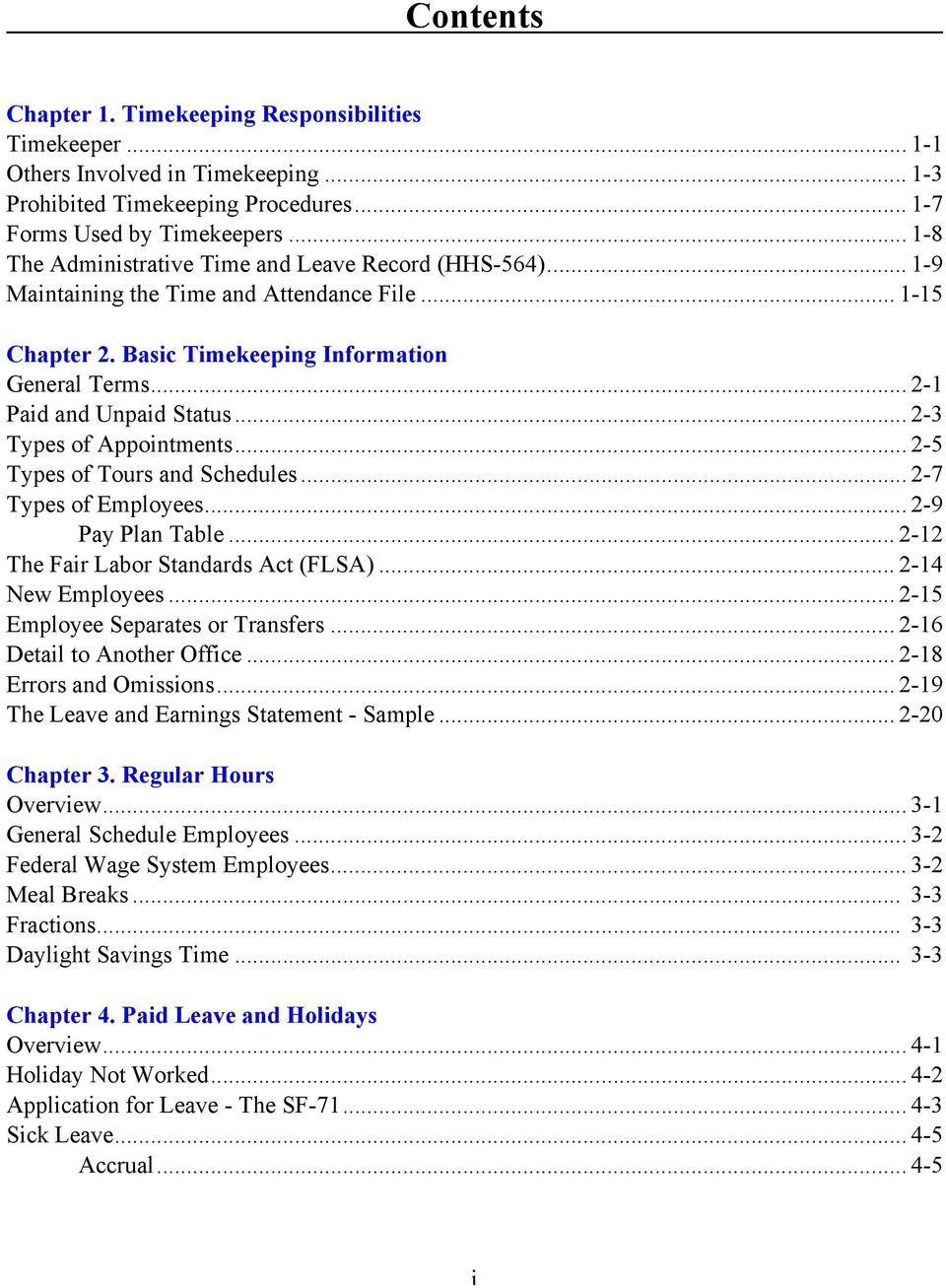
3 Contents Chapter 1. Timekeeping Responsibilities Timekeeper Others Involved in Timekeeping Prohibited Timekeeping Procedures Forms Used by Timekeepers The Administrative Time and Leave Record (HHS-564) Maintaining the Time and Attendance File Chapter 2. Basic Timekeeping Information General Terms Paid and Unpaid Status Types of Appointments Types of Tours and Schedules Types of Employees Pay Plan Table The Fair Labor Standards Act (FLSA) New Employees Employee Separates or Transfers Detail to Another Office Errors and Omissions The Leave and Earnings Statement - Sample Chapter 3. Regular Hours Overview General Schedule Employees Federal Wage System Employees Meal Breaks Fractions Daylight Savings Time Chapter 4. Paid Leave and Holidays Overview Holiday Not Worked Application for Leave - The SF Sick Leave Accrual i
4 Loss of Accrual Rules Use The Federal Employees Family Friendly Leave Act (FFLA) Advanced Sick Leave Annual Leave Accrual Appointments Less Than 90 Days Loss of Accrual Special Accrual (Leave Category 6) Change in Leave Category Maximum Carryover Advanced Annual Leave Restored Annual Leave - Introduction Conditions for Consideration Exigency Extended Exigency Time Limit for Use Procedures for Requesting Documents Required Forms Changing Annual Leave to Sick Leave and Vice Versa Military Leave - Introduction Regular Military Leave Special Military Leave Military Leave for Parades and Encampments Leave Without Pay - Military Military Leave - Quick Reference Table Chapter 4. Paid Leave and Holidays (cont.) Administrative Leave Administrative Leave Situations Bone-Marrow or Organ Donors Official Time Court Leave Jury Duty Witness Duty Court Order Certificate of Attendance Fees and Expense Money ii
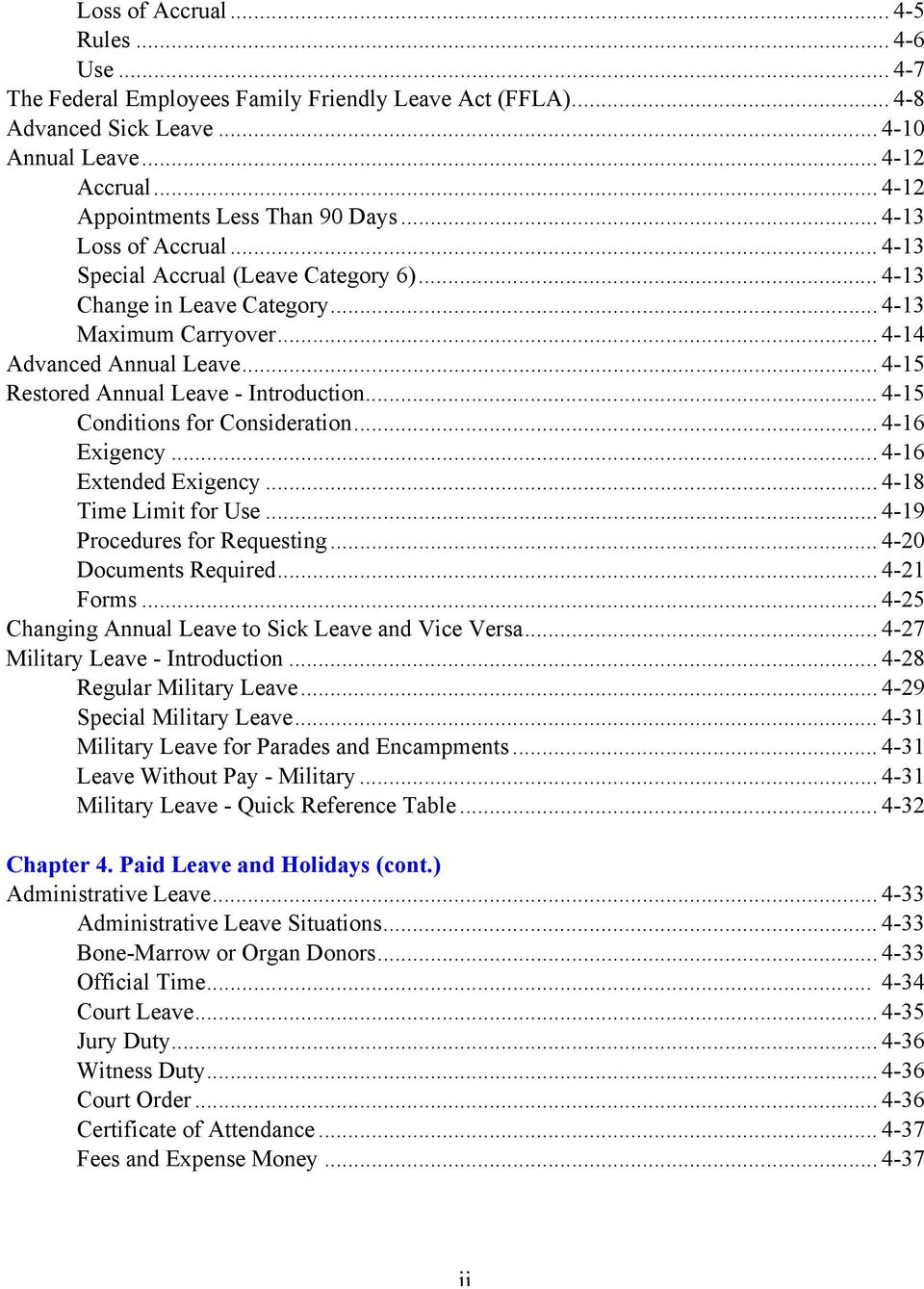
5 Court Leave - Quick Reference Table Funeral Leave Funerals - Law Enforcement Officers/Firefighters Home Leave Time Off Award The Family and Medical Leave Act (FMLA) Chapter 5. Unpaid Leave Overview Unpaid Leave and Holidays Leave Without Pay Extended Leave Without Pay Absence Without Leave Suspension Furlough Substituting Overtime for Unpaid Leave Chapter 6. Continuation of Pay Introduction Requirements Day of Injury Charging COP COP Depleted Medical Visits/Certificates Chapter 7. Religious Compensatory Time Introduction Rules Requesting Religious Compensatory Time Evaluating Requests Employee Separates Chapter 8. Compensatory Time Off for Travel Introduction Eligibility Rules OPM Examples iii

6 Chapter 9. Temporary Closing of the Workplace Introduction Definitions Rules Special Situations Tables (Charging Leave or Excusing Absence) Alternative Work Schedules Chapter 10. Premium Pay and Differentials for General Schedule Employees Overview Overtime Regularly Scheduled Overtime Unscheduled Irregular or Occasional Overtime Preshift and Postshift Activities Callback Overtime Administratively Uncontrollable Overtime Regularly Scheduled Standby Duty PL Overtime Law Enforcement Availability Pay Compensatory Time Holiday Worked Night Differential Sunday Premium Pay Two Tours on Sunday Hazard Differential Chapter 11. Premium Pay and Differentials for Federal Wage System Employees Overview Overtime Night Differential Temporary or Substitute Tour Sunday Premium Pay Two Separate Tours Environmental Differential Tables of Exposure Categories and Percentages Computing EDP Rates Actual Exposure - Rules Per Shift Basis - Rules iv

7 Chapter 12. Other Employees Part-time Employees Additional Hours and Overtime Differentials Holiday Not Worked Holiday Worked Paid Leave Unpaid Leave Compensatory Time Religious Compensatory Time Time Off Award Military Leave Continuation of Pay Alternative Work Schedules Intermittent Employees Student Educational Employment Program Temporary Employees Appointments Less Than 30 Days Hour Appointments Experts/Consultants Firefighters Law Enforcement Officials Chapter 13. Title 38 (Baylor/Non-Baylor/Physician Special Pay) Overview Non-Baylor Baylor Plan Physician Special Pay Chapter 14. Alternative Work Schedules Overview Compressed Work Schedules - Overview Regular Hours Overtime and Compensatory Time Night Differential Sunday Premium Pay Holiday Worked Leave Holiday Not Worked v

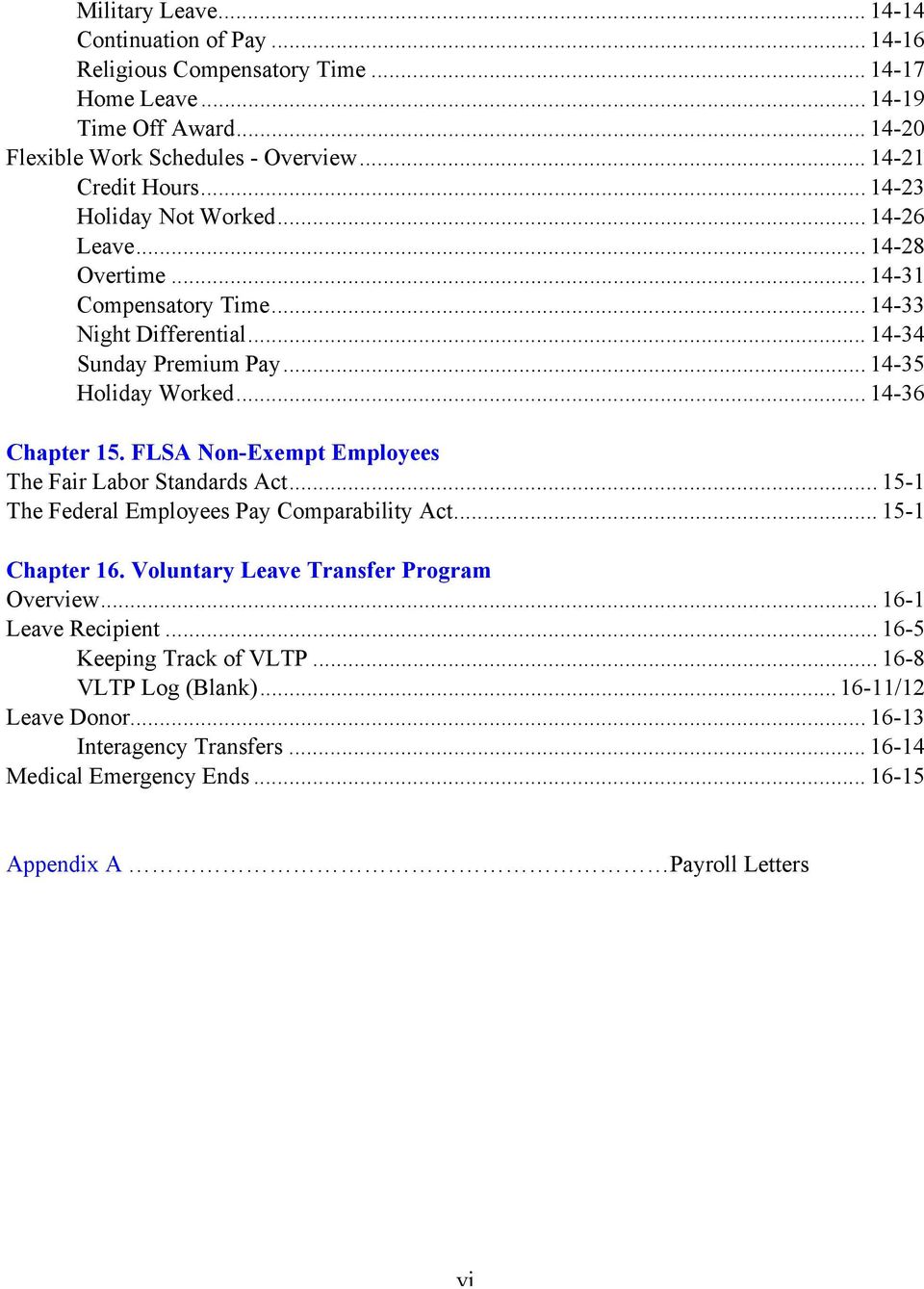
8 Military Leave Continuation of Pay Religious Compensatory Time Home Leave Time Off Award Flexible Work Schedules - Overview Credit Hours Holiday Not Worked Leave Overtime Compensatory Time Night Differential Sunday Premium Pay Holiday Worked Chapter 15. FLSA Non-Exempt Employees The Fair Labor Standards Act The Federal Employees Pay Comparability Act Chapter 16. Voluntary Leave Transfer Program Overview Leave Recipient Keeping Track of VLTP VLTP Log (Blank) /12 Leave Donor Interagency Transfers Medical Emergency Ends Appendix A Payroll Letters vi
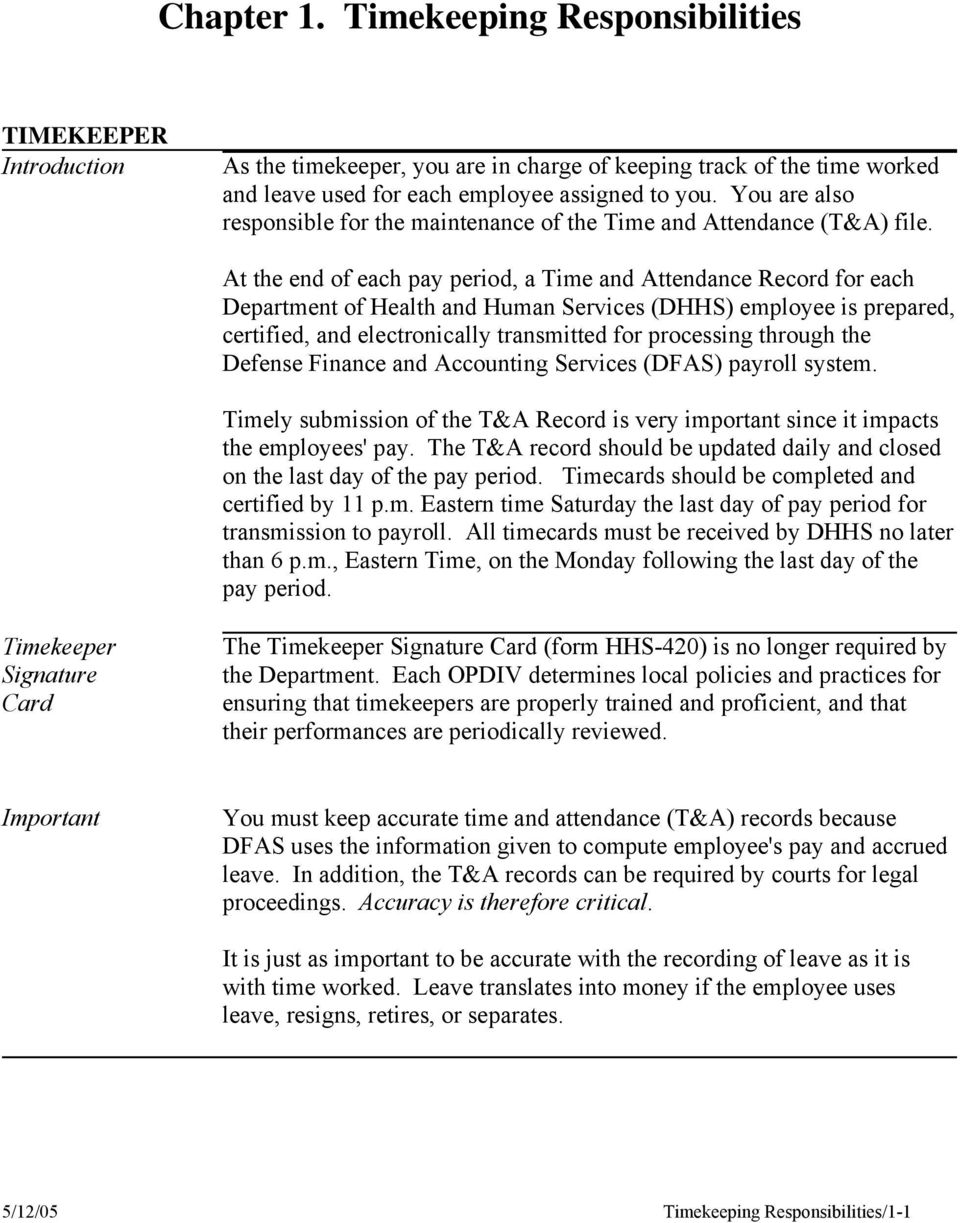
9 Chapter 1. Timekeeping Responsibilities TIMEKEEPER Introduction As the timekeeper, you are in charge of keeping track of the time worked and leave used for each employee assigned to you. You are also responsible for the maintenance of the Time and Attendance (T&A) file. At the end of each pay period, a Time and Attendance Record for each Department of Health and Human Services (DHHS) employee is prepared, certified, and electronically transmitted for processing through the Defense Finance and Accounting Services (DFAS) payroll system. Timely submission of the T&A Record is very important since it impacts the employees' pay. The T&A record should be updated daily and closed on the last day of the pay period. Timecards should be completed and certified by 11 p.m. Eastern time Saturday the last day of pay period for transmission to payroll. All timecards must be received by DHHS no later than 6 p.m., Eastern Time, on the Monday following the last day of the pay period. Timekeeper Signature Card The Timekeeper Signature Card (form HHS-420) is no longer required by the Department. Each OPDIV determines local policies and practices for ensuring that timekeepers are properly trained and proficient, and that their performances are periodically reviewed. Important You must keep accurate time and attendance (T&A) records because DFAS uses the information given to compute employee's pay and accrued leave. In addition, the T&A records can be required by courts for legal proceedings. Accuracy is therefore critical. It is just as important to be accurate with the recording of leave as it is with time worked. Leave translates into money if the employee uses leave, resigns, retires, or separates. 5/12/05 Timekeeping Responsibilities/1-1
10 TIMEKEEPER Introduction The automated timekeeping system contains the official daily record of an employee's hours of work and absence. This record is required by the General Accounting Office. Important In order to perform your timekeeping duties, you need to know how to access your automated system. You also need to know the pay period number and year for which you will be entering data. Information about each employee assigned to you is available from the employee's supervisor or from your Servicing Personnel Office (SPO). This information includes the employee's name, Social Security number, tour information, pay plan, service computation date, leave category, and pay basis. Daily Duties Timekeepers must be well versed in the rules of Timekeeping and particularly any special conditions that affect the employee s time they manage. Timekeepers must be aware of the work schedules and hours absent for employees for whom they are responsible in order to ensure the reliability of time and attendance data. If an employee is absent part of the day, they must have an approved leave slip (SF-71) or equivalent indicating times of absence and the type of leave approved and used. If overtime hours are worked, you must have written approval for the hours, as well as a record of the dates and hours worked. You must review documentation daily to ensure that you have the proper authorizations and approvals for absences and overtime. You must enter employee T&A data for each day of the pay period, if appropriate. (For exception based systems, this will not apply.) Employees are paid based on the 2-week pay period. Pay Day Duties You must perform these duties for each employee: 1. Must have T&A records available based on the scheduled required by their T&A transmission coordinators. 2. Maintain each employee's time and attendance file and keep for 6 years. 3. Resolve employee s leave/pay difference on time and attendance record and that of his/her Civilian Payroll record. 4. Notify employees in changes or system down time that will affect their access. 2/22/2005 Timekeeping Responsibilities/1-2
11 OTHERS INVOLVED IN TIMEKEEPING Introduction In addition to timekeepers, other people involved in timekeeping functions include: Pay Services Division (PSD) Defense Finance and Accounting System(DFAS)/Defense Civilian Pay System (DCPS) Servicing personnel officers System Administrators/Administrative Officer/ITAS Coordinator Payroll liaisons Employees Supervisors/Approving officials Payroll Services Division PSD is the principal HHS point of contact for payroll services and advisor to it clients. Customer Services Representative (CSR) advises and consults with client organization Coordinates system updates to DFAS/Defense Civilian Pay System (DCPS) for VLTP, Military, COP, Advanced Sick Leave, Time- Off-Awards, etc. Coordinates HHS systems changes based on DFAS releases, enhancements, new directives Defense Finance and Accounting Services(DFAS) /Defense Civilian Pay System (DCPS) Coordinates global and systemic issues. DFAS/Defense Civilian Pay System is responsible for: 1. Computing salary payments, lump-sum payments and cash awards payments. 2. Maintaining official pay and leave records; 3. Withholding monies as authorized by employees or regulations; 4. Establishing procedures for keeping time and leave accounts; and 5. Ensuring that timekeeping procedures and regulations are followed. 2/22/2005 Timekeeping Responsibilities/1-3

12 OTHERS INVOLVED IN TIMEKEEPING Servicing Personnel Officer Payroll Liaison Servicing personnel officers are responsible for: 1. Advising timekeeper and/or Payroll Liaison of new employees. 2. Counseling employees and supervisors on leave policies and regulations; and 3. Reminding timekeepers and leave-approving officials of their responsibilities at least once a year. Payroll liaisons are responsible for: 1. Providing liaison between timekeepers, payroll, and personnel; 2. Providing guidance and answering questions about timekeeping and time and attendance errors and/or omissions; 3. Reporting critical errors to PSD/Customer Service Team; 4. Receiving and processing reports of missing salary payments, as well as requesting reissue of salary checks when necessary and monitoring progress of the action; 5. Requests and, receives necessary paper documentation to support, special pay/leave request, Advance Sick, Leave Transfer Program, military leave, COP, etc. 6. Prepares necessary Peregrine Ticket in order for Payroll Customer Service Team to update employee s DCPS pay/leave record. 7. Informing timekeepers of updates to employee s pay/leave record so special pay/leave request can be process on the timecard. 8. Keeping timekeepers informed of policy/procedure changes and ensuring that all memoranda from PSD and/or DFAS/DCPS are distributed to timekeepers; 9. Providing information and assistance to managers and employees for requesting Special Pay. 10. Providing new timekeepers with a copy of the Guide for Timekeeping, related instructional materials, and other necessary information, as well as distributing revisions or new information and materials to timekeepers. Providing instructions on use of timekeeping guide to new timekeepers. We also recommend that Payroll Liaisons perform random reviews of timekeeper records and practices to ensure compliance with OPDIV and Department policies and procedures. 2/22/2005 Timekeeping Responsibilities/1-4

13 OTHERS INVOLVED IN TIMEKEEPING System Administrator/ Administrator Officer/ITAS Coordinator Employee Provides assistances and answers day-to-day questions about the automated timekeeping system that you are using. The system administrator assures that T&A data is transmits to the Defense Civilian Pay System collection point at the end of each pay period. HHS employees are responsible for keeping supervisors informed about their time, attendance, and leave, as well as for ensuring that they have sufficient leave to cover all requests. Plan, apply for, and obtain approval in advance for all anticipated leave. Provide appropriate supporting documents for requested leave when requested by Approving Official or as required by regulations. Supervisor They are also responsible for verifying the accuracy of their earnings and leave statements and reporting any errors or omissions. As used here, the term "supervisors" includes managers and approving officials. An important duty of supervisors is to certify that the hours recorded by timekeepers reflect the employee's actual attendance and entitlement to pay and leave. Supervisors are responsible for: 1. Ensuring that all employees timecards are accurate and approved in timely matter. 2. Reviews timecards to ensure that information in the record are accurate and complete 3. Answering questions about work and leave; must be well versed in the rules of timekeeping and particularly any special conditions that effect the employees time they manage. 4. Advising timekeepers: When new employees are entering on duty or when employees are leaving; What tour/work schedule employees are on; What kind of leave to charge; When overtime and other premium pay should be entered; Whether employees are covered by the Fair Labor Standards Act; 2/22/2005 Timekeeping Responsibilities/1-5
14 2/22/2005 Timekeeping Responsibilities/1-6

15 OTHERS INVOLVED IN TIMEKEEPING Supervisor continue 5. Ensuring that all employees are informed of the procedures they must follow for requesting and using leave. 6. Obtaining leave-supporting documents from employees 7. Ensuring that employees have a sufficient leave balance prior to approving leave requests; 8. Notify employees that they must submit leave request before start of the third pay period before the end of the leave year each year, in order to avoid forfeiture of Use or Lose annual leave. 9. Ensuring that overtime, compensatory time, credit hours, etc. are authorized in advance in writing, performed, and properly recorded; 10. Ensuring that employee basic tour hours do not exceed 80 for full time employee or 8 hours per day; 11. Ensuring that the timekeeper submits the T&A data to them so they will have plenty of time to review and certify the records prior to the transmission time. 12. Ensuring that new timekeepers are trained before beginning duties; 13. Reviewing timekeeper performance regularly; Notifying the Payroll Liaison of the addition of new timekeepers or any timekeeper changes. 2/22/2005 Timekeeping Responsibilities/1-7
16 PROHIBITED TIMEKEEPING PROCEDURES Introduction Timekeepers are responsible for the prompt and accurate reporting of T&A information. This has a positive and direct effect on the financial welfare and morale of all employees. Supervisors have a direct responsibility to oversee and ensure the integrity of the T&A reporting. Rules To help ensure the separation of timekeeping responsibilities: Timekeepers - Are prohibited from keeping their own official T&A records; - Cannot modify employee T&A data after supervisor Certification; and - Are prohibited from certifying timecards Approving Officials/Supervisors - Are prohibited from keeping or approving their own official T&A records; - May permit temporary employees (appointments of 90 days or less) to perform timekeeper duties; and - May permit non-federal employees to perform timekeeping duties; Important - Are expected to periodically examine the time and attendance records of all employees, especially those of employees associated with time and leave reporting. Employees who violate timekeeping procedures may be subject to official reprimand, suspension, or termination. Employees who deliberately prepare or transmit false data may be subject to termination or criminal penalties including fines or imprisonment. 2/22/2005 Timekeeping Responsibilities/1-8
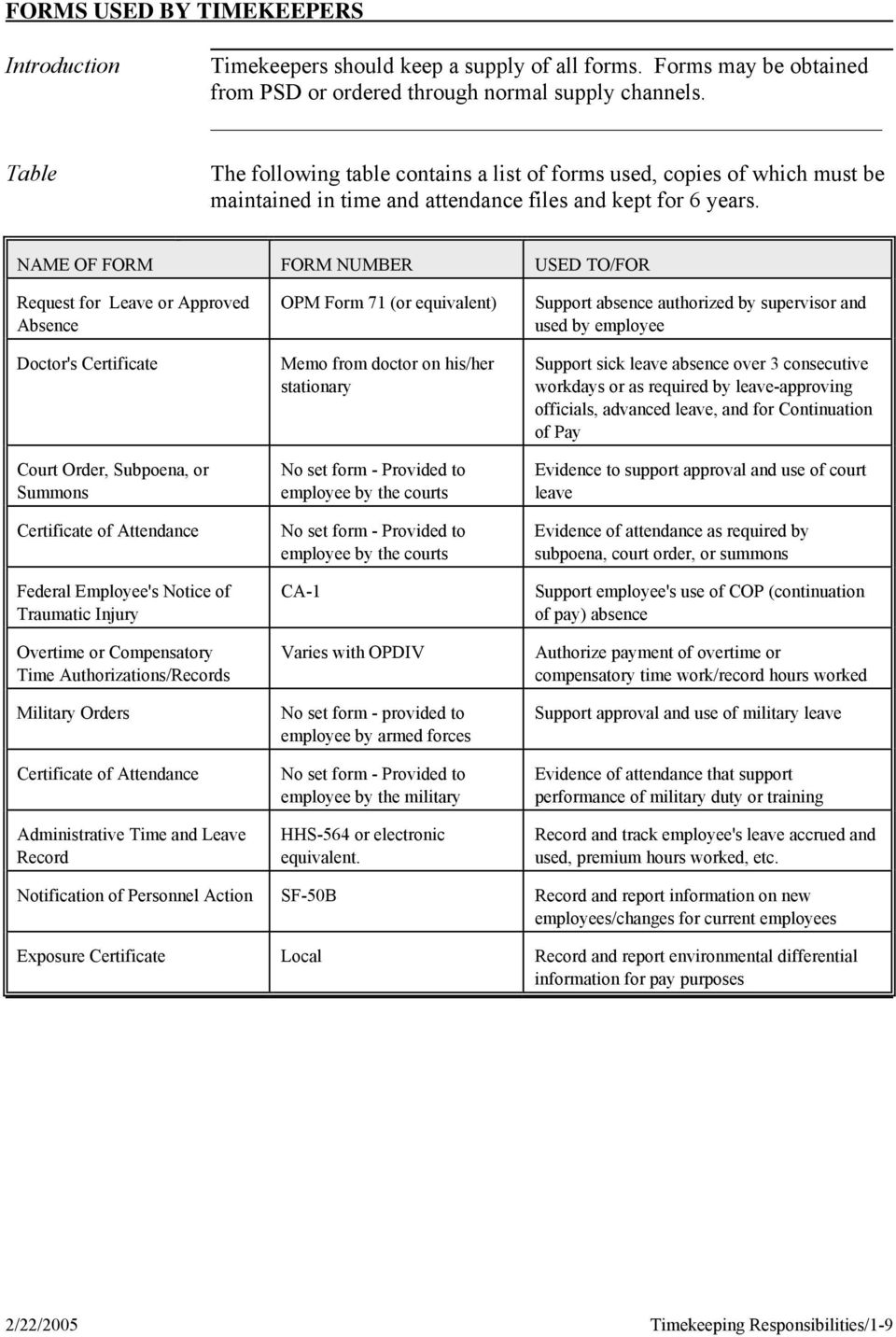
17 FORMS USED BY TIMEKEEPERS Introduction Table Timekeepers should keep a supply of all forms. Forms may be obtained from PSD or ordered through normal supply channels. The following table contains a list of forms used, copies of which must be maintained in time and attendance files and kept for 6 years. NAME OF FORM FORM NUMBER USED TO/FOR Request for Leave or Approved Absence Doctor's Certificate Court Order, Subpoena, or Summons Certificate of Attendance Federal Employee's Notice of Traumatic Injury Overtime or Compensatory Time Authorizations/Records Military Orders Certificate of Attendance Administrative Time and Leave Record OPM Form 71 (or equivalent) Memo from doctor on his/her stationary No set form - Provided to employee by the courts No set form - Provided to employee by the courts CA-1 Varies with OPDIV No set form - provided to employee by armed forces No set form - Provided to employee by the military HHS-564 or electronic equivalent. Support absence authorized by supervisor and used by employee Support sick leave absence over 3 consecutive workdays or as required by leave-approving officials, advanced leave, and for Continuation of Pay Evidence to support approval and use of court leave Evidence of attendance as required by subpoena, court order, or summons Support employee's use of COP (continuation of pay) absence Authorize payment of overtime or compensatory time work/record hours worked Support approval and use of military leave Evidence of attendance that support performance of military duty or training Record and track employee's leave accrued and used, premium hours worked, etc. Notification of Personnel Action SF-50B Record and report information on new employees/changes for current employees Exposure Certificate Local Record and report environmental differential information for pay purposes 2/22/2005 Timekeeping Responsibilities/1-9
18 THE ADMINISTRATIVE TIME AND LEAVE RECORD (HHS-564) Introduction All payroll systems require the maintenance of a detailed record of data submitted to the payroll system. For DHHS, the Administrative Time and Leave Record, form HHS-564 (blank form on following page) is this detailed record. The HHS-564 must be kept in the time and attendance file for each employee. OPDIVs may use a paper form or an electronic form similar to the HHS-564, as long as it contains the same detailed data. If an electronic form is used, a hard copy must be placed in the time and attendance file at the end of each leave year. In addition to providing details of annual and sick leave, LWOP, AWOL, etc., the HHS-564 is used to keep track of any other types of leave and pay including, but not limited to: Premium pay Religious compensatory hours earned and used Compensatory hours earned and used Credit hours earned and used Sick leave used under the Family Friendly Leave Act (FFLA) Leave used under the Family Medical Leave Act (FMLA) Military leave Court leave Leave received and used under the Voluntary Leave Transfer Program (VLTP) Continuation of Pay (COP) leave for work related injuries Compensatory travel hours earned and used A completed, current HHS-564 must be submitted as supporting documentation with any requests for leave adjustments. It is also a valuable tool which may be used by supervisors to verify leave balances before approving leave, and by timekeepers to verify that their records match official records in the payroll system. The HHS-564 is a history record which is used by auditors when auditing time and attendance records. Part-Time Employees Important For details on completing the HHS-564 for part-time employees, see Chapter 12. All leave or premium hours should be shown on the HHS-564 on the day they were actually used or earned, not when they were recorded or transmitted on the time and attendance record. 2/22/2005 Timekeeping Responsibilities/1-10

19 THE ADMINISTRATIVE TIME AND LEAVE RECORD (HHS-564) Completing the HHS-564 At the beginning of each new leave year, or when new employees enter on duty, prepare an HHS-564 for each employee. 1. Complete the employee identification section, filling in the employee's name, Social Security Number, service computation date (SCD), leave category, timekeeper number, and tour information in the blanks provided. Note: If the timekeeper changes during the year, the new timekeeper number is noted in the second box, and the dates that each timekeeper maintained the HHS-564 during that year should be recorded in each box. 2. The year, pay period and leave period numbers and dates, and Federal holidays have been pre-printed on the HHS-564. Start each record on the date the employee first enters on duty (EOD date), or at the beginning of the leave year, whichever applies. If the employee starts in the middle of the leave year, note the EOD date on the record. Note: The pay period and leave period numbers usually are not the same. Pay period 1 may start in the old leave year. 3. Because most employees earn and use annual and sick leave, these sections are more detailed. In each of these sections, there are four columns headed: E (earned this pay period); U (used this pay period); UTD (used year to date); and BAL (balance at the end of this pay period). At the top of each section for annual and sick leave on both sides of the HHS-564, there are blank spaces under the UTD and BAL columns. On the front side, in the blank spaces under the headings: UTD - the space is always left blank. Remember, this is a "year to date" column and at the beginning of the leave year, no leave has been used. BAL - record the balance shown on the HHS-564 at the end of the last pay period for the previous leave year. 2/22/2005 Timekeeping Responsibilites/1-10

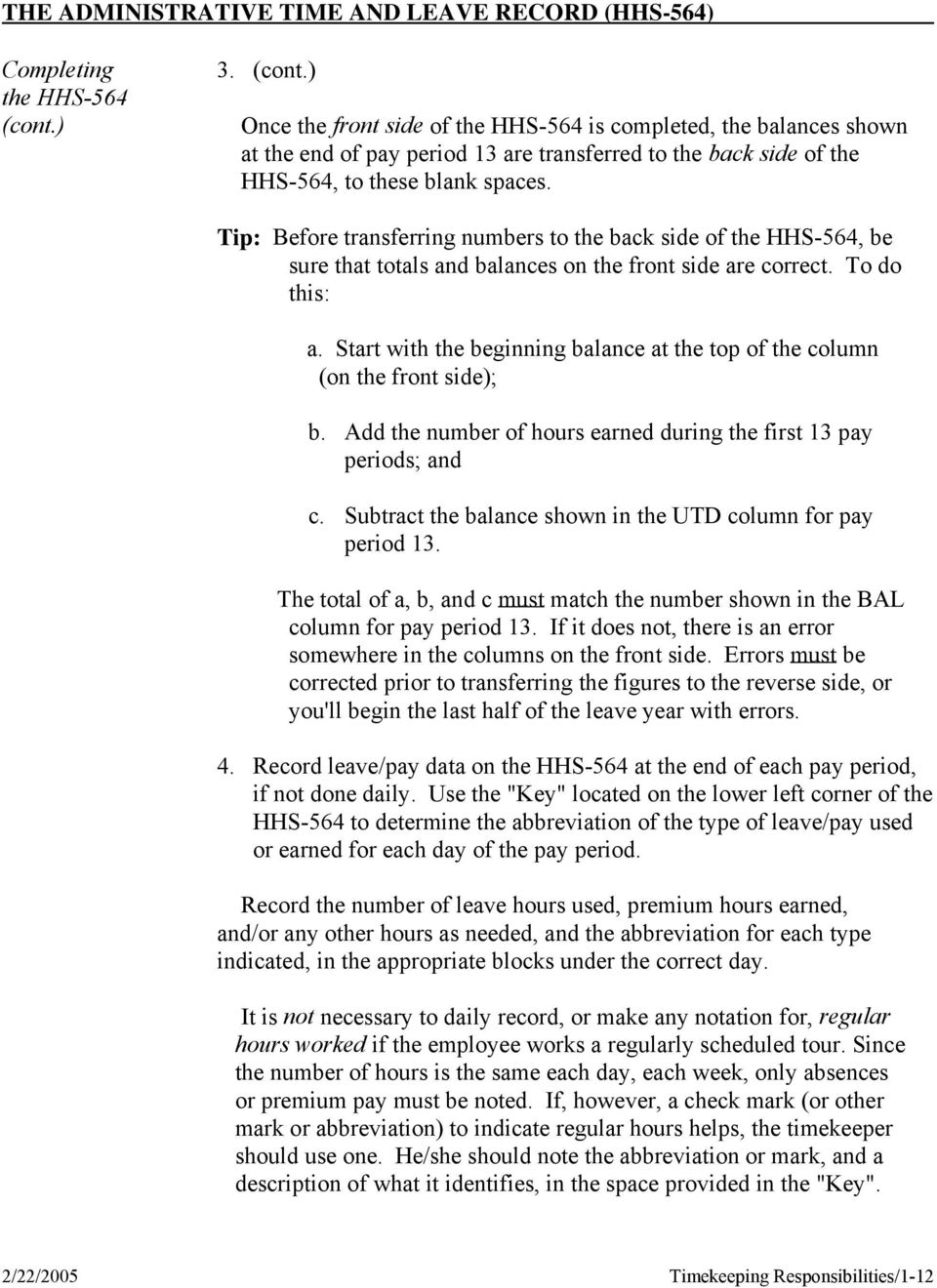
20 THE ADMINISTRATIVE TIME AND LEAVE RECORD (HHS-564) Completing the HHS-564 (cont.) 3. (cont.) Once the front side of the HHS-564 is completed, the balances shown at the end of pay period 13 are transferred to the back side of the HHS-564, to these blank spaces. Tip: Before transferring numbers to the back side of the HHS-564, be sure that totals and balances on the front side are correct. To do this: a. Start with the beginning balance at the top of the column (on the front side); b. Add the number of hours earned during the first 13 pay periods; and c. Subtract the balance shown in the UTD column for pay period 13. The total of a, b, and c must match the number shown in the BAL column for pay period 13. If it does not, there is an error somewhere in the columns on the front side. Errors must be corrected prior to transferring the figures to the reverse side, or you'll begin the last half of the leave year with errors. 4. Record leave/pay data on the HHS-564 at the end of each pay period, if not done daily. Use the "Key" located on the lower left corner of the HHS-564 to determine the abbreviation of the type of leave/pay used or earned for each day of the pay period. Record the number of leave hours used, premium hours earned, and/or any other hours as needed, and the abbreviation for each type indicated, in the appropriate blocks under the correct day. It is not necessary to daily record, or make any notation for, regular hours worked if the employee works a regularly scheduled tour. Since the number of hours is the same each day, each week, only absences or premium pay must be noted. If, however, a check mark (or other mark or abbreviation) to indicate regular hours helps, the timekeeper should use one. He/she should note the abbreviation or mark, and a description of what it identifies, in the space provided in the "Key". 2/22/2005 Timekeeping Responsibilities/1-12
21 THE ADMINISTRATIVE TIME AND LEAVE RECORD (HHS-564) Completing the HHS-564 (cont.) 4. (cont.) For example: Jenny is a timekeeper who found that it helped her to put a check mark in each appropriate block on the HHS-564 to indicate that an employee worked his/her regular hours that day. In the "Key" on the HHS-564, she noted, "check mark = regular tour hours worked" and used the check mark only to indicate exactly that. 5. Once the pay period has ended, total all annual and sick leave hours used during the pay period, record each total in the space provided (under the U columns), and update the current leave balances. To update the current balances: a. Start with the ending balance of the previous pay period; b. Add the number of hours earned during the current pay period (under the E column); and c. Subtract the total hours used during the current pay period (under the U column). The total of a + b minus c is the new "current balance" and is recorded under the BAL column for the current pay period. Note: The UTD (used year to date) column is not used to update current balances. However, it should be totaled each pay period, adding the total hours used (under the U column) in the current pay period to the total in the UTD column for the previous pay period. The UTD column is used to balance the HHS-564 and it provides at a quick glance, the total number of hours the employee has used to date in the current year. 6. Record the totals of the other types of leave used in the current pay period and update the balances. There are specific columns for AWOL or LWOP, Credit Hours, and Part-Time Hours, plus two blank columns. Use the blank columns for any other leave (i.e., compensatory hours, VLTP, FFLA, FMLA, COP, etc.) 2/22/2005 Timekeeping Responsibilities/1-13
22 THE ADMINISTRATIVE TIME AND LEAVE RECORD (HHS-564) Tips For Timekeepers Record the leave and/or pay data at the end of each pay period, if not done daily. It takes only a few minutes when recording at the end of each pay period, but if timekeepers wait until several pay periods later, or until an audit is required, it is much more time consuming and difficult. It also increases the possibility of errors. The HHS-564 is the timekeeper's record and it must be complete at the end of each pay period in order to verify balances. The less unnecessary writing on the HHS-564, the better. For instance, if leave is not used, you are not required to put 0 (zero) in the daily column or in the "Used" column for that pay period. Just leave it blank - unless it helps you in some way to have it there. Be sure, however, to keep the UTD columns up to date each pay period. If the UTD does not change in a pay period, you may leave it blank as long as you are sure to pick up the previous total when it does change. Remember, this is an official time and leave record. Be neat, concise, and accurate. Note anything that will help you or an auditor determine what the employee did during the leave year. Keep this record in the time and attendance file with all supporting documentation for leave use, paid overtime, etc. Begin each new year with (0) zero balance in the "Used Year To Date" (UTD) columns. Remember, this is a year to date total, not forever. Before recording annual and sick leave earned during a pay period, and before posting holiday pay for an employee, be sure to total any hours in an unpaid status (AWOL/LWOP/Suspension). If the total unpaid hours in a pay period equals 80, or any multiple of 80 (i.e., 160, 240, 320, etc.), the employee does not accrue leave that pay period. If the employee was in an unpaid status immediately before a holiday and immediately after a holiday, he/she is not entitled to holiday pay. For details on the effect of an unpaid status on annual and sick leave accruals, see Chapters 4 and 5. 2/22/2005 Timekeeping Responsibilities/1-14
23 THE ADMINISTRATIVE TIME AND LEAVE RECORD (HHS-564) - SAMPLE 2/22/2005 Timekeeping Responsibilities/1-15
24 MAINTAINING THE TIME AND ATTENDANCE FILE Introduction Time and attendance source records, or the documentation upon which leave input data is based, must be completed and maintained in the individual time and attendance file for each employee. Generally, this responsibility falls upon the time and attendance clerk, or timekeeper. The General Records Schedule identifies records which must be kept for 3 years, 6 years, or until after an audit by the General Accounting Office, whichever is sooner. However, rather than going through each individual file to destroy some documents after 3 years and others after 6 years, maintain time and attendance files for 6 years. Purpose The time and attendance file contains the employee's record of attendance and leave use. It should be kept orderly and easy to use: For auditing a disputed or unbalanced record; As a history; or For preparing amended time and attendance records. Supporting Documents Source records which must be kept in the time and attendance file include, but are not limited to: Administrative Time and Leave Records (HHS-564) or equivalent forms SF-71 (leave request) or equivalent forms Supporting documentation for jury duty or court leave Military orders for military leave Doctor's certificates for continuation of pay leave, sick leave (as required), and advanced sick leave Federal Employee's Notice of Traumatic Injury (form CA-1) for continuation of pay leave Exposure certificates Authorizations for earning or using religious compensatory time Authorizations for premium pay, overtime, or compensatory time must be maintained at the duty post for 6 years. 2/22/2005 Timekeeping Responsibilities/1-16
25 Chapter 2. Basic Timekeeping Information GENERAL TERMS Administrative Workweek The administrative workweek consists of 7 consecutive calendar days which run from 12:01 a.m. Sunday to 12:00 midnight Saturday. Basic Workweek The basic workweek consists of the days and hours within the administrative workweek which make up the employee's regularly scheduled workweek. For full-time employees who work a regular tour, the basic workweek is the 40-hour week. For part-time employees, the basic workweek means the officially prescribed days and hours within the administrative workweek during which the employee is scheduled to be on duty. Pay Period A pay period is a 2-week period beginning at 12:01 a.m. on Sunday and ending two weeks later on Saturday at 12:00 midnight. A pay period covers 2 administrative workweeks. There are usually 26 pay periods in a pay year, but there are 27 pay periods in some pay years. Leave Year A leave year begins with the first day of the first complete pay period in a calendar year and ends with the day immediately before the first day of the first complete pay period in the following calendar year. A leave year is divided into 26 leave periods which do not coincide with pay periods. There are always 26 leave periods in a leave year. Core Hours Also referred to as core time, core hours are those hours during the workday, workweek, or pay period during which an employee is required to be present for work. If an employee is absent during core hours, he/she must account for the hours with appropriate leave. Core hours are established by each OPDIV. 3/24/2005 Basic Timekeeping Information/2-1
26 PAID AND UNPAID STATUS Introduction Employees are either: Working; On paid leave; On unpaid leave; Absent without leave; Suspended; or Furloughed. Time in a Pay Status Time in a pay status is time for which employees are paid. This includes time when employees are working regular hours or overtime, absent on paid leave or holidays, taking compensatory time or religious compensatory time off, or using credit hours. Employees are not in a pay status when they are absent on unpaid leave (LWOP), absent without leave (AWOL), suspended, or furloughed. Time Absent Time absent is time when employees are normally scheduled to be at work, but are not at work. This includes time on paid leave and unpaid leave. If the absence is for less than a full day, you must record when the absence began and when it ended. Regular Hours Regular hours are hours of work that are paid at the employee's base rate of pay. Leave Unpaid Leave Leave is approved time off from work which may be paid or unpaid. Not every employee is eligible for every type of paid leave. Unpaid leave (also called non-pay status) is time away from the job for which employees do not get paid. Types of unpaid leave include: Leave without pay (LWOP) - approved unpaid leave; Absence without leave (AWOL) - unapproved unpaid leave; Furlough - unpaid leave due to lack of work or funds; and Suspension - unpaid leave taken as a result of a disciplinary action. For more information about unpaid leave, see Chapter 5. 3/24/2005 Basic Timekeeping Information/2-2
27 PAID AND UNPAID STATUS Paid Leave Paid leave is time away from the job, for which employees receive their base rate of pay. Types of paid leave include: Holidays (time off for national holidays); Annual leave (for vacations, etc.); Sick leave (for illness, injury, or medical/dental appointments); Military leave (for Reserve or National Guard duty); Funeral leave (only granted to an employee in connection with the funeral of, or memorial service for, an immediate relative who died as a result of wounds, disease, or injury incurred while serving as a member of the armed forces in a combat zone); Excused Absence or Administrative leave (approved time away from the job that is not charged to any other category); Court leave (to be a juror or, in some cases, a witness); Voting leave (to allow time to vote or to register to vote); Home leave (for overseas employees); and Time off incentive award (when an employee is granted time off from duty without loss of pay as an incentive award in recognition of superior accomplishment). For more information about paid leave, see Chapter 4. Credit Hours Only employees on a flexible work schedule may earn and use credit hours. Credit hours are hours of work performed within a flexible time band, at the employee's option and with the approval of the supervisor, in excess of the basic work requirements. Employees may then use the credit hours they have earned to take time off later. SES employees are not eligible to earn Credit Hours. Employees on Compressed Work Schedule are not eligible to earn Credit Hours. For more information about credit hours, see Chapter 14. 3/24/2005 Basic Timekeeping Information/2-3
28 PAID AND UNPAID STATUS Compensatory Time Compensatory time (comp time) is compensation for overtime work on the basis of time off equal to the number of hours of overtime work performed. Instead of being paid for overtime hours worked, extra hours worked are accrued for later use by the employee as a type of leave. Compensatory hours must be worked before they may be used. General Schedule employees may choose to earn compensatory time rather than overtime. Federal Wage System employees may not earn compensatory time unless they are on a compressed or flexible work schedule. (Do not confuse regular compensatory time with religious compensatory time.) For more information about compensatory time, see Chapters 10 and 11. Religious Compensatory Time Compensatory Time - Travel Continuation of Pay Premium Pay Differentials Religious compensatory time is time off for a religious holiday. Subject to supervisory approval, all employees may elect to work additional time in order to take time off to accommodate religious beliefs. Employees may work the additional time either before or after taking religious compensatory time off. For more information about religious compensatory time, see Chapter 7. Travel compensatory time is compensation for time in a travel status away from the employee s official duty station when travel time is not otherwise compensable. For more information about travel compensatory time see chapter 8. Continuation of pay (COP) is time off for disabilities due to on-the-job injuries. COP provides for continuation of an employee's regular pay for up to 45 calendar days. For more information about COP, see Chapter 6. Premium pay is extra pay for overtime, Sunday work, night work, holiday work, standby duty, or administratively uncontrollable overtime work. Exception: For Federal Wage System employees, night work is not considered to be premium pay. For more information about premium pay, see Chapters 10 and 11. Differentials are differences in the rates paid to equal employees doing the same work because of differing conditions, such as work at night or work involving hazardous conditions. For more information about differentials, see Chapters 10 and 11. 5/12/05 Basic Timekeeping Information/2-4
29 TYPES OF APPOINTMENTS Full-Time Most full-time employees are scheduled to work 40 hours a week, 80 Employees hours a pay period. Some have tours of more than 80 hours a pay period. Part-Time Employees Part-time employees have a regular tour that is 32 to 64 hours a pay period. Part-time employees are entitled to night differential. They do not receive Sunday premium pay (except for Title 38 employees). For more information about part-time employees, see Chapter 12. Employees appointed under the Student Educational Employment Program (formerly the Stay-in-School Program) receive the same treatment as other part-time employees except during school vacation periods. They may work full-time during a school vacation period. See Chapter 12. Intermittent Employees Intermittent employees (also referred to as when actually employed or WAE employees) have no regular tour. They are on call and come in at the discretion of the supervisor. These employees do not earn annual leave or sick leave and are not paid for holidays. They are, however, entitled to COP. Intermittent employees are entitled to night differential. They do not receive Sunday premium pay (except for Title 38 employees). For more information, see Chapter 12 Temporary Employees Employees may be appointed on temporary appointments for specified periods up to a year. The appointment can be extended in 1-year increments for a maximum of 3 additional years. Employees with appointments of less than 90 days may earn and use sick leave, but may not earn annual leave. If and when an appointment is extended beyond 90 days, or is changed to a permanent appointment, employees may at that time earn annual leave. They may not use annual leave unless they have accrued annual leave which was transferred from another appointment. See Chapter 12. 5/12/05 Basic Timekeeping Information/2-5
30 TYPES OF APPOINTMENTS Seasonal-On- Call Employees 1040-Hour Employees Experts or Consultants Seasonal employees may be full-time or part-time. They earn leave for partial pay periods when coming on or going off a job. Some temporary employees may have a 1040-hour appointment. Keep track of all their hours worked, including overtime, so that these employees do not work beyond the hours in their appointments. In every other way, record data for them as you would other temporary employees. See Chapter 12.. An expert or consultant is usually a specialist from outside HHS appointed to serve by giving advice to individuals or departments or to perform difficult and challenging tasks. Experts and consultants are either intermittent or temporary employees, and they are paid on a daily or an hourly pay basis. See Chapter 12. 3/24/2005 Basic Timekeeping Information/2-6
31 TYPES OF TOURS AND SCHEDULES Tour of Duty A tour of duty (also called a tour) describes the hours of a day (a daily tour of duty) and the days of an administrative workweek (a weekly tour of duty) that constitute an employee's regularly scheduled administrative workweek. A tour of duty is scheduled in advance and the employee is expected to perform work during the tour on a regularly occurring basis. Standard Tour A standard tour is one that generally consists of 40 hours a week or 80 hours a pay period. Employees with standard tours may work a regular work schedule or may participate in an alternative work schedule, if so allowed by their OPDIV. The most common regularly scheduled tour is 8 hours a day, 5 days a week (Monday through Friday), which is 80 hours a pay period. Regular Work Schedule A regular (or normal) work schedule is a fixed schedule consisting of 8 hours a day, five days a week, generally Monday through Friday. The days of the week and the beginning and ending hours of the day are set. There is no flexibility in the regular work schedule. Alternative Work Schedule There are two types of work schedules jointly referred to as alternative work schedules (AWS). They are the compressed work schedule (CWS) and the flexible work schedule (FWS). Either of these schedules is available to employees upon approval from their Operating Division head or Regional Director. See information on AWS, see Chapter 14. Compressed Work Schedules A compressed work schedule (CWS) is one of the alternative work schedules in which an employee's basic work requirement for each pay period is scheduled by the Agency for less than 10 days. An Agency may have more than one CWS from which an employee may select his/her preferred schedule. Compressed work schedules are always fixed schedules. They are not flexible in any way. 3/24/2005 Basic Timekeeping Information/2-7
32 TYPES OF TOURS AND SCHEDULES Compressed Work Schedules (cont.) Full-time employees on CWS schedules are scheduled to work more than 8 regular hours on some days. They complete their required 80 hour tours in less than 10 days in a bi-weekly pay period. Part-time employees on CWS schedules may be scheduled to work more than 8 hours on some days in order to work the number of hours required to complete their tours in less than 10 workdays during the bi-weekly pay period. See Chapter 14 for more information on CWS. Flexible Work Schedules A flexible work schedule includes designated hours (core hours) and days when an employee must be present for work. It also includes designated hours during which an employee may elect to work in order to complete the employee's basic (non-overtime) work requirement. Flexible hours - Flexible hours (also referred to as flexible time bands, flexitime, or flextime) are the hours during the workday, workweek, or pay period within the tour of duty during which an employee covered by a flexible work schedule may choose to vary his or her times of arrival to and departure from the worksite, consistent with the duties and requirements of the position. The flexible time bands are established by the OPDIV. Do not confuse flexitime with flexitour. Employees on flexible work schedules may earn and use credit hours. For more information on flexible work schedules, see Chapter 14. Non-Standard Tours Some employees work unusual or non-standard tours. They are: Title 38 (Baylor and Non-Baylor Plans) Tours worked with hours in excess of 8 hours a day or 40 hours a week (e.g., firefighters and law enforcement employees). For example, some firefighters work 24-hour shifts, for a total of 112 hours or 144 hours per pay period. For more information on Title 38, see Chapter 13. For more information on firefighters and law enforcement employees, see Chapter 12. 3/24/2005 Basic Timekeeping Information/2-8
33 TYPES OF EMPLOYEES Introduction A pay plan is the pay system or pay schedule under which an employee's rate of basic pay is determined. One way of classifying employees is by pay plan. General Schedule Most HHS employees are General Schedule (GS) employees, paid according to: Title 5 of the U.S. Code Fair Labor Standards Act Federal Wage System Federal Wage System (FWS) employees are paid according to rates set by local Wage Boards to correspond to pay scales for non-government employees in the same area doing the same work. FWS employees work on shifts and tend to have blue collar and trade positions. They are also called "prevailing rate employees" because their salaries are based on what private sector employees receive in the prevailing area. For example, the pay of an FWS electrician would depend on the area of the country in which he worked. Title 38 Title 38 compensation is applied to clinical center nurses (pay plan GN) and allied health professionals (pay plans GS, GM). Although compensated in accordance with Title 38, these employees are appointed under Title 5. Your servicing personnel office (SPO) can inform you which employees follow Title 38 premium pay provisions and it will also be noted on the SF-50. Baylor Plan - Title 38 also authorizes the use of a Weekend Alternative Schedule, an unusual tour of duty referred to as the Baylor Plan. For information on Title 38 employees, see Chapter 13. Experts/ Consultants Experts and consultants are usually hired to work on special projects or jobs. They are paid by the day or by the hour. For more information, see Chapter 12. 5/12/05 Basic Timekeeping Information/2-9
34 TYPES OF EMPLOYEES Senior Executive Service The Senior Executive Service (SES) consists of employees under pay plan ES who are: Paid through a compensation system designed to attract and retain competent senior executives; and In a position above GS-15 or the equivalent. The SES includes both general positions and career-reserved positions. HHS determines which positions are included. Qualification Review Boards must certify the qualifications of a candidate before a career appointment can be made. To be eligible for payment of a performance award, an employee's performance rating must be "fully successful" or higher. SES employees may: Earn and use religious compensatory time; and Accrue annual leave at a rate of 1 day (8 hours) for each full biweekly pay period with a maximum carryover limit of 90 days (720 hours) when a new leave year begins. Annual leave accumulated prior to SES appointment may be carried into the SES appointment. However, annual leave accumulated prior to movement to the SES that is in excess of the maximum allowed for the former position must be used by the end of the leave year in which appointed to the SES or it is subject to forfeiture. Example: Jan had a balance of 300 hours in her annual leave account at the time she moved from a non-ses position into an SES position. In the former non-ses position, the maximum annual leave carryover limit was 240 hours. Jan has 60 hours more than the maximum carryover allowed in her former non-ses position. She must use the excess 60 hours by the end of the leave year in which she is appointed to the SES position or it is subject to forfeiture. If an SES employee moves to a position outside the SES, any annual leave accumulated while serving in the SES may be carried over into the new position. If he/she has more than 720 hours accumulated, the personal carryover ceiling remains at 720 hours. However, once the balance is reduced below 720 hours, the lower amount becomes the new ceiling. 3/24/2005 Basic Timekeeping Information/2-10
35 TYPES OF EMPLOYEES Senior Executive Service (cont.) Example: Jim is an SES employee who moves into a non-ses position with an annual leave balance of 730 hours. He must use 10 of these hours or they will be forfeited at the end of the SES appointment year. The new position has a maximum carryover amount of 240 hours. Jim uses his annual leave until the balance drops to 690 hours. His new personal ceiling is 690 hours and remains at 690 hours until the balance drops lower. The following leave year, Jim uses annual leave until the balance drops to 500. His new personal ceiling is now 500 hours and remains at that number until it drops lower. Should his leave balance ever drop to the maximum carryover for his newer position, 240 hours, Jim's carryover maximum reduces to and remains at that maximum carryover amount of 240 hours for the balance of his government career (unless he moves into a position with a higher carryover). SES employees may not: Receive premium pay or earn compensatory time; Earn and use credit hours; and/or Participate in a compressed work tour such as a schedule unless the entire work unit closes on the same workday(s) every pay period. 3/24/2005 Basic Timekeeping Information/2-11
36 TYPES OF EMPLOYEES - Pay Plan Table TYPE OF EMPLOYEE PAY PLAN CODE EARN LEAVE PREMIUM PAY Judges AL Administrative Law Judge yes* yes** Other Specialized Plans AD Administrative Determined ST Scientific and Professional SL Senior Level RS Senior Biomedical Research Service yes* yes** Experts/ Consultants ED Expert (5 USC 3109) EE Expert (other) EF Consultant (5 USC 3109) EG Consultant (other) EH Advisory Committee Member (5 USC 3109) EI Advisory Committee Member only if FLSA nonexempt** Executives ES Senior Executive Service EX Executive Pay General Schedule GG Graded Similar to General Schedule GS General Schedule Managers GM Performance Management and Recognition System Special Nurses GN General Nurse (Title 38/Baylor Plan) Volunteers SV Student Volunteer ZZ Volunteer Service (WOC Without Compensation) Federal Wage System WD Production Facilitating Nonsupv-Federal Wage System WG Nonsupv-Federal Wage System WL Leader-Federal Wage System WN Production Facilitating Supv-Federal Wage System WS Supv-Federal Wage System WT Apprentices and Shop Trainees-Federal Wage System yes* no (Absence may be excused by the Secretary of HHS. yes* yes* yes* no yes* no no yes** yes** yes** no yes** Production Facility (Federal Wage System) XD XL XN XP XS Nonsupv Production Facilitating Jobs*** Leader Jobs*** Supv Production Facilitating Jobs*** Nonsupv Jobs*** Supv Jobs*** yes* yes** 3/24/2005 Basic Timekeeping Information/2-12
37 KEY: * All employees (except intermittent employees) regardless of length of appointment earn sick leave. Appointments of less than 90 days do not earn annual leave. ** Yes, unless employee's biweekly pay, including locality and special pay rates, exceeds the pay of the maximum rate of GS-15, Step 10 (i.e., the general aggregate biweekly limitation of the maximum rate for GS-15, Step 10). *** Printing and Lithographic in designated areas. 3/24/2005 Basic Timekeeping Information/2-13
38 THE FAIR LABOR STANDARDS ACT (FLSA) Introduction Another way of categorizing employees is whether or not they are covered by the Fair Labor Standards Act (FLSA). FLSA is a law that regulates the hours of work and pay for certain federal employees. Employees are classified as: FLSA non-exempt (covered by FLSA); or FLSA exempt (not covered by FLSA). The servicing personnel offices determine who is covered by FLSA. Both GS and FWS employees can be either non-exempt or exempt. For Additional Information For more information on FLSA, refer to Chapter 15 and also: 5 CFR, Part 551, Subpart A HHS-Instructions 3/24/2005 Basic Timekeeping Information/2-14
39 NEW EMPLOYEES Enter on Duty Date The date on which a new federal employee completes the necessary paperwork and is sworn in as an employee is referred to as that employee's entry on duty (EOD) date (also referred to as enter on duty). New employees do not always start work on the effective date of their appointments. For example, if a new federal employee is appointed on a Sunday and is scheduled to work Monday through Friday, then that employee is appointed effective on Sunday, but actually starts work and is sworn in on Monday. Monday is the EOD date. Holidays New federal employees working Monday through Friday do not enter on duty on Monday when Monday is a holiday. They enter on duty on Tuesday, the day they start work and are sworn in. If a person has accepted an appointment, the effective date of which is a Sunday before a Monday holiday and the employee is sworn in on the day following the holiday, the employee is paid for the holiday. If the effective date of appointment is on the Tuesday following the holiday, the employee is not paid for the holiday. His appointment is not effective until after the holiday. Federal employees who transfer from another agency or within HHS on Sunday when the following Monday is a holiday are paid for the holiday as usual. 3/24/2005 Basic Timekeeping Information/2-15
40 EMPLOYEE SEPARATES OR TRANSFERS Introduction When an employee separates from HHS, the timekeeper must document the separation. An employee may separate by: Resigning; Retiring; Transferring to another Federal agency; Termination of appointment; Termination for other reason; or Death. Note: In the event of the death of an employee, there are specific procedures which must be followed. Procedures follow in this section. Separations For any separation, the timekeeper should verify that all leave balances are correct and that they match those in the payroll system (shown on the Earnings and Leave Statement). The time and attendance file should be complete and up to date through the date of separation. On the final time and attendance record for the employee, a remark stating the reason for separation (Retired, Resigned, Transferred, etc.) and the date of separation (COB mm/dd/yy) must be recorded. Transfers Within HHS For transfers to another office within your OPDIV, follow the policies set by your OPDIV for details, reassignments, or transfers. For transfers within HHS, the losing timekeeper should send a copy of employee profile information and a copy of the HHS-564 to the new timekeeper. For assistance, contact your OPDIVs Payroll Liaison. Separation Due to Death If an employee dies, do not wait until the end of the pay period to report his or her hours. Immediately complete a record for the pay period and enter a remark ("mm/dd/yy Died"). Have the supervisor certify the record. Print a copy of the record and give it to your Servicing Personnel Office (SPO), along with a copy of the HHS-564. Each SPO will forward the report along with all required death claim forms to the Payroll Services Division (PSD) marked "ATTN: Death Claims." 3/24/2005 Basic Timekeeping Information/2-16
41 EMPLOYEE SEPARATES OR TRANSFERS Separation Due to Death (cont.) If death occurs while in a pay status (i.e., working or on paid leave), the employee is entitled to compensation up to and including the date of death, regardless of the time of day that death occurs. Hours on the day of death are reported as regular hours, not as any type of leave. If the employee was in a pay status on the last scheduled workday before death and dies on the next scheduled workday, the employee is paid regular pay for the date of death. Example: Bob works a regular tour, Monday through Friday. He dies on Monday after being out on sick leave the preceding Friday. He was in a pay status (sick leave) on the last scheduled workday before death (Friday) and is paid regular pay for Monday. If death occurs while in a non-pay status (i.e., a non-work day, or while on unpaid leave), employees are not compensated for the day of death. They are charged appropriately for the day (i.e., LWOP, AWOL, or Suspension). 3/24/2005 Basic Timekeeping Information/2-17
42 DETAIL TO ANOTHER OFFICE Introduction Sometimes employees work in other workplaces temporarily. This is called a detail. The table below gives information about timekeeping for an employee who has been detailed to another office. DETAILS 60 DAYS OR MORE DETAILS LESS THAN 60 DAYS Timekeeping is done at temporary duty station. Timekeeping is done at home station. If timekeeping is done at the home station, be sure to keep the timekeeper informed of all leave used and time and attendance information. 3/24/2005 Basic Timekeeping Information/2-18
43 ERRORS AND OMISSIONS Introduction Errors occur if you report hours incorrectly or if you do not record hours or premium pay. If there are errors or omissions, you must amend the Time and Attendance (T&A) record, following the procedures outlined in the User Manual for the timekeeping system used by your OPDIV. Examples: You reported 8 hours of annual leave that should have been leave without pay or you failed to report overtime worked. Corrections to previous pay period T&A records will be transmitted to DFAS as amended T&A along with regular T&A data. The amended T&A records will be processed through the DFAS retro system in the same pay period they are received. Note: For errors considered critical (i.e., Employee is not paid but you submitted a correct record, employee receives incorrect pay, etc.), contact your Payroll Liaison immediately. Non-Receipt of Salary Payments When an employee reports that a biweekly salary payment was not received, the Payroll Liaison or designee must verify that the salary was due and not issued. This verification is necessary prior to notifying the Payroll Services Division (PSD) regarding non-receipt of salary payment. The Payroll Liaison or designee must Check the Impact Master to ensure that an EFT payment or hard copy check does not exist. If payment does not exist: - Check to see if the proper authorization was submitted, i.e. time and attendance data updated; - Check to see if the accession SF-50, and/or EFT authorization, updated properly; - Check to see if the EFT authorization information on the form (routing number and account number) match the information in EHRP; - Check to see if the address is in the record and if it is correct. After verify that no payment was issued and the supporting documents (time and attendance, EFT authorization, address information and/or SF-50) properly updated, a Peregrine ticket must be created to request Special Pay. Follow procedures outline in Payroll Services Letter PS-05-XX Subject: Non- Receipt of Salary Payment and Special Pay. See Appendix A 3/24/2005 Basic Timekeeping Information/2-19
44 THE LEAVE AND EARNINGS STATEMENT - SAMPLE DEPARTMENT OF DEFENSE CIVILIAN LEAVE AND EARNINGS STATEMENT 3. NAME DOE JANE Q 4. PAY PLAN/GRADE/STEP GS12 / HOURLY/DAILY RATE BASIC OT RATE BASIC PAY + LOCALITY ADJ = ADJUSTED BASIC PAY = SOCIAL SEC NO 9. LOCALITY % 10. FLSA CATEGORY 11. SCD LEAVE 12. MAX LEAVE CARRY OVER E 12/02/ FINANCIAL INSTITUTION - NET PAY 15. FINANCIAL INSTITUTION - ALLOTMENT #1 16. FINANCIAL INSTITUTION - ALLOTMENT #2 AMSOUTH BANK OF FLORIDA 17. TAX MARITAL EXEMPTIONS ADD'L STATUS FED S 1 AL S P1/D10 GA S CURRENT YEAR TO DATE PEN AIR FEDERAL CREDIT UNION 18. TAX MARITAL EXEMPTIONS ADD'L TAXING AUTHORITY STATUS S 11 MOBILE NR S 1 LILLIAN 22. WARRINGTON BANK 19. CUMULATIVE RETIREMENT GROSS PAY TAXABLE WAGES NONTAXABLE WAGES TAX DEFERRED WAGES DEDUCTIONS AEIC NET PAY TSP DATA 13% CURRENT EARNINGS TYPE HOURS/DAYS AMOUNT TYPE HOURS/DAYS AMOUNT TYPE HOURS/DAYS A REGULAR RETROACTIVE EARNINGS TYPE HOURS/DAYS AMOUNT TYPE HOURS/DAYS AMOUNT TYPE HOURS/DAYS A OVERTIME DEDUCTIONS TYPE CODE CURRENT YEAR TO DATE TYPE CODE CURRENT YEAR TO DATE ALLOTMENTS.SV (1) FEGLI C MEDICARE RETIRE, FERS K CHARITY AA FEHB OASDI TAX, FEDERAL TAX, LOCAL TAX, LOCAL TAX, STATE AL TAX, STATE GA TSP SAVINGS LEAVE TYPE PRIOR YR ACCRUED ACCRUED USED USED DONATED/ CURRENT USE-LOSE/ BALANCE PAY PD YTD PAY PD YTD RETURNED BALANCE TERM DATE ANNUAL SICK HOLIDAY ADMIN REMARKS SEND YOUR EMPLOYMENT/LOAN VERIFICATIONS TO YOUR HUMAN RESOURCE OFFICE. TSP DEDUCTION PERCENT OR AMOUNT CHANGED 3/24/2005 Basic Timekeeping Information/2-20
45 THE LEAVE AND EARNINGS STATEMENT Introduction The Leave and Earnings Statement (LES) also known as the pay slip, is a printed statement issued to every employee which documents the employee's: Earnings and deductions; Leave earned and used; Pay adjustments for each pay period; and The year to date totals to that date. The LES confirms the employee's rate of pay and explains deductions. The employee is responsible for verifying the data on the LES. There are 6 main areas on the Leave and Earnings Statement: 1. Employee information 2. Current Earnings 3. Retroactive Earnings 4. Deductions 5. Leave information 6. Remarks A detailed description of each section of the Leave and Earnings Statement follows. 3/24/2005 Basic Timekeeping Information/2-21
46 THE LEAVE AND EARNINGS STATEMENT Section 1 Employee Information Pay Peroid End ( PPE) - This is the last day of the pay period reflected in the data on this LES. Pay Date Pay period disbursing date this is the actual payday for the above pay period. Name Last name, first name and middle initial of the employee as it appears in the payroll record. Pay Plan Grade/Step - This is the employee s current pay plan code, (such as GS or WG) pay grade and step. If an employee is in retained grade status the retained pay plan, grade and step used to calculate pay entitlements are not printed, however, the message PAY COMPUTED USING RETAINED INFORMATION is printed in the Remarks section. Hourly/Daily Rate - This is the daily rate of pay for employees who pay basis is per day, or the hourly rate of pay for all others. Basic OT Rate Graded overtime hourly limit. For employees not eligible for overtime pay, this block will be blank. For employees eligible for overtime pay: - for Federal Wage System employees, this is the Hourly Rate in block 5 times 1.5, although the actual overtime rate for any given day can be affected by shift or other premium pay; - for exempt employees, this is the Hourly Rate times 1.5, or the maximum overtime rate payable (GS10 Step 1). - for non-exempt employees, this is the maximum overtime rate, therefore this will be the Hourly Rate times 1.5, or the maximum overtime limit of a GS10 Step 1 if the employees overtime pay is equal to or exceeds the GS10 Step 1 amount. Base Sal +Loacaity ADj = Adjusted Basic Pay - For employee's paid an annual salary (pay basis PA ), this is the basic annual pay. If a locality adjustment is applicable, the block will also contain the locality adjustment annual amount and the adjusted basic annual pay. These values are shown on the SF-50. 3/24/2005 Basic Timekeeping Information/2-22
47 Employee Information Section 1 - continued Social Sec NO Employee Identification -For U.S. citizens, this is the employee s Social Security number. For non-citizens, this is the Identification number assigned by the HRO. Locailty % - Locality Pay Percentage This is the percentage for any applicable locality adjustment. FLSA Category Fair Labor Standards Act Exempt Status This is the employee s Fair Labor Standards (FLSA) status, E for exempt, N for nonexempt. The FLSA. Status used to calculate the employee s pay is printed. SCD Leave The Service Computation Date Leave This is the employee Service Computation Date for Leave. This date represents the total number of years of government service which determines the leave category. Max Leave Carry Over - The maximum number of annual leave hours which the employee may carried from one leave year to the next leave year, 240 hours for most employees. Leave Year End This is the last day of the current leave year. This is the date any annual leave above the Max Leave Carry Over amount will be forfeited. Financial Institution- Net Pay This is the name of the financial institution receiving the employee s net pay direct deposit. Financial Institution- Allotment #1 This is the name of the financial institution receiving a direct deposit of an employee savings allotment. Financial Institution- Allotment #2 This is the name of the financial institution receiving a direct deposit of an employee savings allotment.. Tax/Martial Status/Exemptions/Additional Taxing Authority Code, Marital Status, Exemptions, Additional Tax Withholding [0]block contains any applicable federal and state tax information. Line 1 contains "FED" for federal tax, if applicable, under the heading TAX". The current federal filing status, 'M' for married or 'S' for single, prints under the heading "MARITAL STATUS". Lines 2 and 3 contain information for any state, U.S. territory, or foreign country taxes currently being withheld. The Postal Service two character state abbreviation or a two character country code prints under the heading "TAX". This abbreviation will also print in the Deductions Section of the LES, on the applicable "TAX, STATE" line, for easy identification of the tax deduction amount by taxing authority. The filing status (M, S, Z, O, Y, X, or H, 3/24/2005 Basic Timekeeping Information/2-23
48 Section 1 Employee Information continued depending on state) prints under the heading "MARITAL STATUS". For the Republic of Panama, the filing status codes (A, B, C, D, E) prints. Under the heading "EXEMPTIONS", the number of exemptions claimed prints, when applicable. If the state allows personal and dependent exemptions a "P" or "D" will precede the number of exemptions printed. Any amount being voluntarily deducted in addition to the calculated withholding amount prints under the heading "ADD'L". All "ADD'L" amounts are required to be positive amounts, with the exception of the State of Connecticut and the Republic of Panama which allow the employee to request a negative amount of "ADD'L Tax/Martial Status/Exemptions/Additional - [0]This block contains any applicable city, county or other local tax information. Each taxing authority has an assigned code which prints under the heading "TAX". The current filing status prints under the heading "MARITAL STATUS". Under the heading "EXEMPTIONS", the number of exemptions claimed prints, when applicable. If the locality allows personal and dependent exemptions a "P" or "D" will precede the number of exemptions printed. Any amount being voluntarily deducted in addition to the calculated withholding amount prints under the heading "ADD'L". The name of the tax or taxing authority prints under the heading "TAXING AUTHORITY". When applicable, if the employee claims non-resident status "NR" will print at the end of the taxing authority name. The code assigned to the tax also prints in the Deductions Section of the LES, on one of the following lines, "TAX,LOCAL, TAX, LOC JEDD, TAX,LOC SCH, TAX,LOC,OCC, TAX,LOC TRAN," for easy identification of the tax deduction amount. More than 2 different local taxing authority codes may appear in the deduction section, but a maximum of 2 are printed in this block 3/24/2005 Basic Timekeeping Information/2-24
49 THE LEAVE AND EARNINGS STATEMENT Section 1 Employee Information continued Cumulative Retirement This is the cumulative amount of retirement made since transfer to the current payroll office for Civel Service Retirment System (CSRS) or Federal Employees Retirement System(FERS)employees. BIWEEKLY ANNUITY For re-employed annuitants, block 19 also contains the biweekly annuity amount used to reduce the employee s biweekly gross pay. Military Deposit- This is Military Deduction X5 Deduction amounts. PAID: This is a total of Payroll deductions plus cash payments made by employee. OWED: This is the balance owed which includes Interest that has been applied. Current/Year to Date Information on: Gross Pay - The Sum of all types of earnings. Taxable Wages The sum of all earnings subject to federal tax. For Non- US employees in Panama this will be earnings subject to Panama Income Tax. NONTAXABLE WAGES -The sum of all earnings exempt from federal tax, currently defined as: - interest paid on back pay award - cost of living allowance - cola (subject to Hawaii tax) - living quarters allowance - post allowance - separate maintenance allowance - subsistence expense allowance - temporary quarters subsistence allowance - remote site/offshore allowance (subject to California tax) - lump sum cost of living allowance (subject to Hawaii tax) - transfer allowance - education allowance/education travel The sum of all deductions exempt from federal tax, currently defined as: - lodging - subsistence - parking - transit - vanpool For employees with a Pretax FEHB indicator R (Reduction Applied) the following deductions are also defined as exempt from federal tax. 3/24/2005 Basic Timekeeping Information/2-25
50 Section 1 Employee Information continued - the biweekly FEHB deduction - any FEHB indebtedness collected in the current pay period Tax Deferred Wages The sum of all deductions not subject to federal tax, currently defined as: - Thrift Saving Plan - 401(k) Saving Plan - Teachers Insurance Annuity Association/College Retirement Equities Fund (Retirement and Supplemental Retirement Annuity) - Fidelity Investment Program (Retirement and Supplemental Retirement Annuity) - For Non-U.S. employees in Panama who are eligible for TSP, this will be blank. Republic of Panama does not allow tax deferment of TSP. Deductions The sum of all payroll deduction amounts AEIC The advanced earned income credit included in the employee s net pay. Net Pay The amount which remains after all deductions are subtracted from Gross Pay, plus any Advanced Earn Income Credit. The amount of employee s biweekly direct deposit or check. TSP/401(K) DATA This block contains any applicable Thrift Savings Plan (TSP) or 401(K) Savings Plan information. For TSP, the block contains the employee selected percentage. For 401(k) plan the block contains the employee selected deduction percentage designated for each of the 401(K) Investment Funds: the Preservation of Capital (A), The Bonds and/or Other Securities (B), and Stocks (C). In addition, the total wages used for the calculation of the deduction for 401(k) savings, when based on a percentage of pay, is printed. Section 2- Current Earnings The name of the earning is printed under the column heading TYPE. The number of hours or days used in determining the amount is printed under the column heading HOURS/DAYS. The dollar amount of the earnings prints under the heading AMOUNT. If an entitlement is not based on hours or days worked, the HOURS/DAYS column will be blank. For any employee paid at a daily rate, all the figures under the column heading HOURS/DAYS are in days instead of hours. 3/24/2005 Basic Timekeeping Information/2-26
51 THE LEAVE AND EARNINGS STATEMENT Section 3 Retroactive Earnings Section 4 - Deductions Section 5- Leave The column headings in this section will be the same as the Current Earnings section. The same types of earnings may also be present. This section is to distinguish earnings for prior pay periods due to corrections to time and attendance, late processing of personnel actions, or other similar corrections, from current pay period earnings. The earnings in this section may be negative, showing collections for previous overpayments. The name of the deduction prints under the column heading TYPE. Information to further identify certain deductions may print under the heading CODE. The current pay period deduction amounts prints under the heading Current. The total amount of the deduction for the pay year prints under the heading YEAR TO DATE. Only those types of leave applicable to an individual employee print on the employee s LES. The name of the type of leave prints under the heading TYPE. Any balance carried from the previous leave year prints under the heading PRIOR YR BALANCE, when applicable. The accrual for the pay period is reflected on this LES prints under the heading ACCRUED PAY PD, when applicable. Usage for the pay period reflected on this LES prints under the heading USE YTD. Any leave donated to another person prints under the heading DONATED/RETURNED. Any unused amount returned in the same year will be subtracted from this amount and added to the balance. Any balance of leave available for use prints under the heading CURRENT BALANCE. In the case of advanced leave, the current balance will be a negative figure. Under the heading USE-LOSE/TERM DATE THERE WILL BE AN AMOUNT OR A DATE, depending on the type of leave. These will be explained further below. The following are types of paid leave or absence. TYPE ANNUAL SICK RESTORED Definition The USE-LOSE/TERM DATE column contains the amount projected to exceed the maximum carry over at the end of the leave year; the use or lose amount. Accrued of 4 hours as applicable. No maximum amount. An employee may have up to three restored leave. For each, the amount restored is shown in the accrued ACCRUED YTD column in the pay period in which the leave is restored. The LOSE-USE/TERM column contains the date of expiration, or forfeiture, when applicable. COMPENSATORY (COMP TIME) Compensatory time earned by an employee in a pay period is limited to the number of hours which the employee would be entitle to receive 3/24/2005 Basic Timekeeping Information/2-27
52 Section 5 Leave continued COMP-RELIG overtime compensation before reaching the biweekly maximum of GS-15, step 10. DCPS will systematically payoff/forfeit compensatory time aged 26 pay periods. Religious compensatory time is for religious observances. Time off for religious reasons are recorded in this field and may be worked either before or after the period of time off. CREDIT HRS DONATED TIME OFF AWD MILITARY SHORE HOME INJURY (COP) LAW ENFORCEMENT HOLIDAY FAMILY ADMIN COURT DC GUARD INJ ADMIN Credit hours may only be worked by employees on flexible schedules. Credit hours are hours in excess of the basic work requirements, but with the tour of duty. Credit hours shall be earned and used in the same increments as other leave. This leave type prints for leave recipients ONLY. Donated leave received is shown in the ACCURED YTD column in the pay period in which the adjustment is processed. Any amount of unused donated leave returned to the donors prints under the Column heading DONATED/ RETURNED. The employee has a year from the effective date to use the award hours. When an award is used the employee has two fields, which are updated. The USE YTD and USE TD. The leave end roll will zero out the USE YTD field on the employees Master Leave History record, but the USE TD will remain until the award is over one year old. The LES has no USE TD field so the USE YTD field on the LES is used to show the number of hours used toward the given award. Military leave is based on a fiscal year, therefore, the annual accrual will show in the ACCRUED YTD column in the pay period containing Oct 1. The USE-LOSE/TERM DATE column contains the amount which will be forfeited on September 30 is not used. The LOSE-USE/TERM DATE column contains the expiration date, if applicable. Employees who served aboard. The LOSE-USE/TERM DATE column contains the applicable injury date/injury number. Leave for law enforcement purposes are based on calendar year, not leave year, with a maximum of 22 days authorized. Official day off with pay The sum of all types of family leave used. The USE-LOSE/TERM DATE column contains a date 1 year from the first reported use of family leave. Administrative leave granted by the employer. Jury duty or Witness Leave Leave for duty with DC National Guard Time reported from the time of injury until the 3/24/2005 Basic Timekeeping Information/2-28
53 Section 5 Leave continued EXCUSED NONWORK PD end of the scheduled shift. Authorized absence from duty, such as tardiness. The following are all types of unpaid leave or absence. TYPE LWOP SUSPENSION AWOL FURLOUGH MIL LWOP WORKERS COMP DEFINATION Authorized leave without pay Temporary non-pay and non-duty status. Absence without Leave Activity ordered leave without pay, usually due to temporary lack of funds. For employees called to active duty Absence when the employee is paid by the Office of Worker s Compensation. Section 6 Remarks Remarks that apply to an employee print on the LES, unless there is insufficient room on the form due to the number of earnings, deductions and leave entires. There are three types of remarks that may be printed on the LES: SPECIAL, ADDITIONAL, or GENERAL. All SPECIAL remarks applicable to an employee are printed prior to any ADDITIONAL remarks being printed. All ADDITIONAL remarks will be printed after any SPECIAL remarks and prior to any applicable GENERAL remarks. SPECIAL REMARKS: Open Season TSP or FEHB, Saving Bonds, W-2 address, etc. ADDITIONAL REMARKS: are generated per DFAS Headquarters (DFAS-HQ) direction. GENERAL REMARKS: are generated based on changes made by employees or explanation of pay or leave changes, etc. 3/24/2005 Basic Timekeeping Information/2-29
54 THE LEAVE AND EARNINGS STATEMENT Rule - Insufficient Gross Pay When gross pay is insufficient to cover all deductions for a specific pay period, deductions are made in the following order: 1. FICA (OASDI - Old Age Survivors and Disability Insurance) 2. Retirement (CSRS or FERS) 3. Medicare 4. Federal income taxes 5. Health insurance premiums (health benefits) 6. Basic life insurance premiums (FEGLI) 7. State income taxes 8. City income taxes 9. County income taxes 10. City occupational taxes 11. Debt collections: indebtedness to the United States such as levies, salaries, or other government debts; court-ordered alimony and child support payments; court-ordered private or commercial debts; court-ordered bankruptcy payments 12. Optional Federal taxes 13. Optional life insurance premiums (FEGLI - additional insurance, standard, and family) 14. Optional State taxes 15. Quarters, Subsistence, and Laundry 16 Voluntary repayments of indebtedness to the United States and/or voluntary payments of child support or alimony 17. Thrift savings plan loan repayments 18. Thrift savings deductions 19. All other voluntary deductions (employee association dues such as union dues, etc.; charity contributions; U.S. Treasury Bonds; savings allotments such as banks, credit unions, etc.; and any others) 3/7/05 Basic Timekeeping Information/2-30
55 Chapter 3. Regular Hours OVERVIEW Introduction For most employees, follow General Schedule or Federal Wage System timekeeping procedures. Exceptions are Senior Executive Service, Title 38 Baylor Plan employees, experts/consultants. An employee is either at work, working his or her regularly scheduled tour (regular hours), or on leave (either paid or unpaid). Regular hours are hours of work that are paid at the employee's base rate of pay and are only recorded for hours that the employee actually works. Do not record hours spent on leave under regular hours. When an employee works regular hours or uses paid leave, the employee is in a pay status. When an employee is on unpaid leave, he or she is not in a pay status. The total number of hours (regular hours plus paid leave hours plus unpaid leave hours) for the 2-week pay period must equal the number of hours in the employee's official tour of duty. For information on paid leave and unpaid leave, see Chapters 4 and 5. Reminder An employee's regularly scheduled tour is the period within the administrative workweek when the employee is regularly scheduled to work. A tour is defined by the days of the week, number of hours a day, number of days per week, and number of hours per pay period that the employee is assigned to work. The most common regularly scheduled tour is Monday through Friday, 8 hours a day, 5 days a week, and 80 hours a pay period. Tours for employees on alternative work schedules vary, but are still regularly scheduled tours. See Chapter 14 for information on alternative work schedules. The two week pay period covers 2 administrative workweeks. The administrative workweek is 7 consecutive days from 12:01 a.m. on Sunday through midnight Saturday. The basic workweek for full-time employees on a regular tour is the 40-hour week. Do not record regular hours on days outside the employee's regularly scheduled tour. 5/12/05 Regular Hours/3-1
56 REGULAR HOURS General Schedule (GS) Employees General Schedule (GS) employees are paid under Title 5 of the U.S. Code and the Fair Labor Standards Act. GS is the basic pay schedule. For a list of pay plans that follow GS procedures, see the pay plan table in Chapter 2. Pay Basis - Pay for GS employees is based on an annual salary. For pay calculation purposes, the hourly rate for regular hours is derived by dividing the annual salary by See Chapter 10 for premium pay. Federal Wage System (FWS) Employees Federal Wage System (FWS) employees (also called prevailing rate employees) are paid according to rates set by Wage Boards. These Wage Boards set the rates according to what non-government workers in the same part of the country, who are doing the same kinds of work, are being paid. For a list of pay plans that follow FWS procedures, see the pay plan table in Chapter 2. Pay Basis - Pay for FWS employees is based on established hourly rates rather than on annual salary. See Chapter 11 for premium pay. FWS Table - Shifts FWS employees work one of 3 different shifts as described below: IF A MAJORITY OF HOURS OF EMPLOYEE'S REGULAR TOUR ARE... from 7:00 a.m. to 3:00 p.m. from 3:00 p.m. to midnight THEN EMPLOYEE'S REGULAR HOURS ARE DURING... Shift 1 Shift 2 from 11:00 p.m. to 8:00 a.m. Shift 3 FWS employees must be scheduled for a majority of their hours during a shift (including meal breaks) to receive that shift rate (i.e., at least 5 hours of an 8-hour shift). Otherwise they receive the next lowest rate. Note: All hours of a shift which begins on one day and ends on the following day are recorded on the day the shift begins. Guide for Timekeeping/3-2 5/12/05
57 REGULAR HOURS Meal Breaks Employees are not paid for meal breaks. Do not record time taken for meal breaks under regular hours worked. Exception: Firefighters are paid for their meal breaks. According to Title 5, breaks of more than 1 hour may not be scheduled. Meal breaks are usually scheduled for 1/2 hour. For the time allotted for an employee's meal breaks, check with the employee's supervisor. Fractions The standard minimum charge for absence in a paid or unpaid status is 1/4 hour, except in those cases where OPDIV heads have established a minimum of 1/2 hour or 1 hour. Rule When employees work less than a full hour, record any fractions in 15- minute increments (15, 30, or 45 minutes). Round 7 minutes or less down; round 8 to 14 minutes up. Examples: Barry worked 20 minutes (15 minutes + 5 minutes). Enter 15 minutes. Marta worked only 4 minutes. Do not enter anything. Charlie worked 27 minutes ( ). Enter 30 minutes. Daylight Savings Time Spring Night Shift: Clocks are advanced 1 hour; the regular 8-hour tour is reduced to 7 hours. When an employee loses an hour due to an official time change, he or she is automatically charged one hour of leave, unless the supervisor approves the employee's request to work an extra hour. Fall Night Shift: Clocks are set back 1 hour; the regular 8-hour tour is increased to 9 hours. Employee receives overtime pay for the extra hour. Note: Employees earn only 8 hours of Sunday premium pay for tours on Sunday. Employees do NOT earn Sunday premium pay for any hours when they are not at work. This includes any type of absence, either paid or unpaid. 12/09/04 Regular Hours/3-3
58 Chapter 4. Paid Leave and Holidays OVERVIEW Introduction Paid leave and holidays are the same for permanent full-time GS and FWS employees. Each OPDIV is responsible for establishing procedures for use of leave. Generally, all anticipated leave should be requested in advance, with emergency leave being requested as determined by each OPDIV. It is possible for an employee to use more than one type of leave on the same day, and to use both paid and unpaid leave in the same day. Regular hours plus paid leave hours plus unpaid leave hours plus holiday hours must equal the total hours in the biweekly scheduled tour of duty. If an employee is absent on leave for less than a full day, you must record the time that the absence began and the time that the absence ended, or the actual hours absent. If an employee is absent all day, it is not necessary to record times that the absence began and ended. Rule - Meal Break If absence is less than a full day and part of the absence includes the meal break, adjust the time to account for the break so that the employee is not charged leave for the meal period. For example: If an employee who ordinarily takes a 1/2 hour lunch break from noon to 12:30 p.m. is absent on paid leave from noon to 2:00 p.m.: Charge leave from 12:30 p.m. to 2:00 p.m. Leave Year A leave year begins with the first day of the first complete pay period in a calendar year (the first pay period of the calendar year in which all of the days of the pay period are in January). A leave year ends with the day immediately before the first day of the first complete pay period in the following calendar year. 11/15/04 Paid Leave and Holidays/4-1
59 HOLIDAY NOT WORKED Introduction A holiday is an official day off with pay granted by the federal government; or a day off granted instead of the official holiday, if the holiday falls on a non-work day for the employee. Record holiday hours as holiday not worked for the day specified as the official holiday. An application or other request for leave is not required for holiday leave. Formal approval is assumed, unless otherwise notified. Table For employees who work 5 days in a row and are off 2 days in a row: IF THE HOLIDAY FALLS ON THE... First day off Second day off THEN THE EMPLOYEE GETS THE... Day before the holiday off Day after the holiday off Example: Judy works Monday through Friday. 1. July 4th falls on a Saturday, so Judy gets Friday, the day before the holiday, off. 2. Christmas falls on a Sunday, so Judy gets Monday, the day after the holiday, off. Note The President may grant "extra" days off for holidays. For example, if Christmas falls on a Tuesday, the President may decide to grant federal employees the Monday prior to the holiday off as well. In this case, a Presidential Order will be issued and the extra hours or days granted should also be entered as holiday not worked. Caution If employees work on a holiday, you must record the hours worked on that holiday. See Chapter 10 and 11 for premium pay. Under certain conditions, employees who are on unpaid leave do not receive holiday pay. See Chapter 5, Unpaid Leave. Guide for Timekeeping/4-2 5/12/05
60 APPLICATION FOR LEAVE The OPM-71 Introduction OPDIVs have the option to either use the OPM- 71 ((Formerly Standard Form (SF) 71) or to prescribe other procedures and/or forms for requesting leave. Use the procedure prescribed by your OPDIV. The OPM Form-71, Application for Leave, was designed for the purpose of requesting leave. Employees complete the OPM-71 and give it to their supervisors or leave-approving officials. The supervisor signs the form if the leave is approved and gives it to the timekeeper. See the next page for a copy of the OPM /15/04 Paid Leave and Holidays/4-3
61 Formerly Standard Form (SF) 71 11/15/04 Paid Leave and Holiday/4-4
62 SICK LEAVE Accrual Sick leave is accrued beginning with the first full pay period on duty. Full-time employees earn 4 hours of sick leave for every pay period in which they are in a pay status. Employees do not accrue sick leave for incomplete pay periods, i.e., the first or last pay period if they either: begin employment after the first workday of the pay period or end employment before the last workday of the pay period. Exceptions: For leave accrual purposes, employees who enter on duty the Tuesday after a Monday holiday are considered to have worked the full pay period. They do accrue sick leave. Employees who transfer from another federal agency during the middle of a pay period without a break in service do accrue sick leave. Sick leave is not affected by the type of appointment or the length of service. Intermittent employees do not have a regular weekly tour of duty and are not entitled to earn sick leave. There is no limit on sick leave accumulation. Loss of Accrual Full-time employees lose their accrual of 4 hours of sick leave for any pay period in which they accumulate 80 hours, or multiples of 80 hours, in a nonpay status. The total nonpay hours consists of any combination of hours of Suspension, Leave Without Pay (LWOP), and Absence Without Leave (AWOL). The hours of absence need not be consecutive. For more information, see Chapter 5, Unpaid Leave. 1/13/05 Paid Leave and Holidays/4-5
63 SICK LEAVE Rules Employees must file a written application for sick leave using the form determined by the OPDIV. Sick leave for non-emergency purposes must be requested in advance. Employees must submit evidence as required by their leave approving officials to support approvals of sick leave. Officials have the discretion to require different forms of evidence depending upon the circumstances. Required doctor's certificates and/or personal statements must be submitted as determined by the OPDIV, generally for periods of absence in excess of 3 consecutive days. Required evidence must be submitted within a reasonable amount of time after return to duty. Failure to do so is grounds for taking a disciplinary action for failure to follow proper leave procedures. Leave approving officials may require that employees submit medical documentation during a period of extended sickness in order to obtain information which is necessary for planning work or for determining that the approval of continued leave is appropriate. If an employee becomes ill within a period of annual leave and, immediately upon returning to duty, submits medical documentation to support the sick leave, sick leave may be substituted for the annual leave. Annual leave must not be substituted retroactively for regular sick leave. Exception: Annual leave may be substituted retroactively only to liquidate an employee's indebtedness for advanced sick leave. Leave approving officials will usually charge sick leave only at an employee's request. However, officials may place an employee on sick leave without the employee's request when: the employee is absent under extenuating circumstances clearly indicating that he/she is unable to work and unable to request leave (e.g., employee is in a coma); or the employee reports for duty, but is determined to be unable to work because of mental or physical illness. Guide for Timekeeping/4-6 1/18/05
64 SICK LEAVE Rules (cont.) If all sick leave is exhausted and the employee is still unable to request appropriate leave, the leave approving official may consider advancing sick leave or charging the continued absence to annual leave or to leave without pay. In addition, the official may pursue the use of the Voluntary Leave Transfer Program on behalf of the employee. Leave approving officials should check with their Servicing Personnel Offices for assistance before charging sick leave without the employee's request or consent. Use of Sick Leave Sick leave may be used: for emergency and/or non-emergency dental, optical, or medical examination or treatment for physical or mental conditions; if the employee is incapacitated for the performance of duties due to physical or mental illness, injury, temporary disability, pregnancy, or childbirth; when the organization has made a determination that the employee is incapacitated and meets the requirements for disability retirement, and OPM is processing the employee's retirement application; for treatment of a disabled veteran or adjudication of a claim concerning a job-related injury or illness; if the employee would, as determined by the health authorities having jurisdiction or a health care provider, jeopardize the health of others by his or her presence on the job because of exposure to communicable disease; or in connection with the adoption of a child (including appointments with adoption agencies, social workers, and attorneys, court proceedings, required travel, and any other activities necessary). See the next section for information on use of sick leave under the Federal Employees Family Friendly Leave Act (FFLA). Information on the Family and Medical Leave Act (FMLA) is in this chapter also. 1/13/05 Paid Leave and Holidays/4-7
65 SICK LEAVE - Family Friendly Leave Act Federal Employees Family Friendly Leave Act (FFLA) Subject to limitations set forth in the Federal Employees Family Friendly Leave Act (FFLA), sick leave may be used by an employee: to provide care for a member of his/her immediate family as a result of physical or mental illness, injury, pregnancy, childbirth, or who receives medical, dental, or optical examination or treatment; and/or to make arrangements necessitated by the death of a family member or to attend the funeral of a family member. Note: OPDIVs must maintain accurate records tracking the use of sick leave under the FFLA, and report such information as required by OPM for the purpose of evaluating the program. Family Member Under the FFLA Under the FFLA a family member is: Spouse and his/her parents; Children (including adopted children) and their spouses; Parents; Brothers and sisters and their spouses; and Any individual related by blood or affinity whose close association with the employee is the equivalent of a family relationship. Limitations For Using Sick Leave Under the FFLA The amount of sick leave granted during any leave year under the FFLA may not exceed a total of 104 hours for full-time employees. For parttime employees and employees with an uncommon tour of duty, the amount of sick leave granted during any leave year may not exceed the number of hours of sick leave normally accrued by that employee during a leave year. The following limitations apply: Full-time employees may use up to 40 hours (or 5 days) of sick leave under the FFLA during a leave year. However, To be granted any more than 40 hours (or 5 days) during the leave year, in each instance that the employee uses sick leave under the FFLA, he or she must retain a sick leave account balance of at least 80 hours after deducting the amount to be used. Maximum hours allowed per leave year are 104 (13 days). Guide for Timekeeping/4-8 1/18/05
66 SICK LEAVE - Family Friendly Leave Act Limitations For Using Sick Leave Under the FFLA (cont.) Part-time employees or employees with an uncommon tour of duty may, under the FFLA, use an amount of sick leave equal to the average number of hours in the employee's scheduled tour of duty each week. However, To be granted any amount over the average number of hours in the employee's scheduled tour of duty each week, in each instance that the employee uses sick leave under the FFLA, he/she must retain a sick leave account balance of at least twice the average number of hours in the employee's scheduled tour of duty each week after deducting the amount to be used. Example: Carrie is a part-time employee with a scheduled tour of duty of 40 hours per pay period (20 hours per week). Based on her tour of duty, Carrie will accrue 52 hours of sick leave during a leave year. The maximum number of sick leave hours that Carrie may use during a leave year under the FFLA is 52 hours, the number of hours equal to the amount she will normally accrue during the leave year. To use any more than 20 hours in the leave year (the number of hours in her weekly tour of duty), Carrie must retain a sick leave account balance of at least 40 hours after deducting the amount to be used. To compute her required sick leave balance, multiply Carrie's weekly tour (20 hours) times 2 (equals 40). Forty hours is twice the amount of Carrie's weekly tour, and is the balance that she must retain in her sick leave account after deducting the amount to be used. Advanced Sick Leave and the FFLA Full-time employees may be advanced up to 40 hours (or 5 days) of sick leave per year in order to grant the use of sick leave under the FFLA. Part-time employees or employees with an uncommon tour of duty may be advanced an amount equal to the number of hours in the employee's scheduled weekly tour of duty. (In the example shown above, Carrie may be advanced up to 20 hours per year.) Sick leave may not be advanced in order to meet the requirement to maintain a minimum sick leave balance; OR to use additional sick leave for purposes covered under the FFLA when such use would cause the employee's sick leave balance to fall below the minimum required. 1/13/05 Paid Leave and Holidays/4-9
67 ADVANCED SICK LEAVE Advanced Sick Leave Sick leave may be advanced, if the employee has a serious disability or ailment, provided that there is a reasonable expectation that the employee will return to duty. Usually the disability or ailment will be of such seriousness as to require a period of absence of at least 5 consecutive work days or longer, unless an absence for a shorter period is determined to be appropriate (for example, intermittent absences for cancer chemotherapy, kidney dialysis, etc.). Advance sick leave may be granted regardless of whether the employee has annual leave to his/her credit. The total advance at no time may exceed 30 days, or 240 hours. The employee's request for advance sick leave must be in writing and must be supported by medical documentation. A maximum of 5 days of sick leave may be advanced for family care or bereavement purposes. For an employee holding a limited appointment, sick leave must not be advanced in excess of the number of hours of sick leave to be earned during the remaining period of employment. Sick leave must not be advanced when it is likely the employee will retire, be separated, or resign before the advanced leave will be earned or repaid. Sick leave may not be advanced for the purpose of meeting the requirement to retain a minimum sick leave balance or for using additional sick leave for the purposes covered under the Family Friendly Leave Act, when such use would otherwise cause the employee's sick leave balance to fall below the minimum required. Advanced sick leave is a debt owed to the Federal government. Any sick leave earned after the sick leave is advanced will be used to liquidate the advanced sick leave. An employee separated while indebted for advance sick leave must refund the amount due or have the amount owed deducted from any monies due to the employee. There is no requirement for granting a request for advance sick leave. Check your OPDIVs' policy or ruling on procedure. Guide for Timekeeping/4-10 1/18/05
68 ADVANCED SICK LEAVE Advanced Sick Leave Use The DFAS Defense Civilian Pay System (DCPS) maintains advanced sick leave balances and requires that the number of hours be updated in DCPS prior to submission of the T&A data. It is the responsibility of the timekeeper to be sure that the request for advance sick leave is properly authorized and submitted to the Payroll Liaison. The notification must include the following: Employee Name SSN Date effective (usually the first day that the advanced sick leave is to be used). Number of hours authorized A not to exceed date for use of the advanced sick leave. Payroll Liaison must include the above information in a Peregrine ticket and send it to their Payroll Customer Service Team. Notifications of advance sick leave approvals for the current pay period must be received in PSD no later than close of business Wednesday, the second week of the pay period. See Appendix A - Payroll Letter PS05-XX Advanced Sick Leave Requests The advanced sick leave hours must be updated in DCPS before the hours will be accepted when processing the T&A. If advance sick leave notifications are not received in PSD on time, the DFAS payroll system will perform a leave conversion, i.e., the advanced sick leave will convert to annual leave, compensatory, credit hours or leave without pay. Timekeepers will be responsible for seeing that employee T&A leave balances are corrected when DFAS payroll system uses leave conversion. 1/13/05 Paid Leave and Holidays/4-11
69 ANNUAL LEAVE Accrual Annual leave is accrued based on an employee's length of federal service, beginning with the first full pay period on duty. Full-time and part-time employees who have regular tours of duty are eligible for annual leave. Senior Executive Service (SES) employees, employees in senior level (SL) and scientific or professional (ST) positions and employees covered by equivalent pay systems, as determined by the Office of Personnel (OPM) will accrue annual leave at the rate of 1 day (8 hours) for each full biweekly pay period. Intermittent employees do not have a regular weekly tour of duty and are not entitled to earn or use annual leave. The following table indicates the amount of annual leave accrued by fulltime employees. For part-time employees, see Chapter 12. IF THE EMPLOYEE HAS BEEN WITH THE FEDERAL SERVICE FOR... THEN FOR EACH FULL PAY PERIOD THE EMPLOYEE EARNS years 4 hours 3-15 years 6 hours - except for the last full pay period in the calendar year when the employee earns 10 hours over 15 years 8 hours Employees do not accrue annual leave for incomplete pay periods, i.e., the first or last pay period if they either: begin employment after the first workday of the pay period or end employment before the last workday of the pay period. Exceptions: For leave accrual purposes, employees who enter on duty the Tuesday after a Monday holiday are considered to have worked the full pay period. They do accrue annual leave. NOTE: All hours of a shift which begins on one day and ends on the following day are recorded on the day the shift begins. Guide for Timekeeping/4-12 5/12/05
70 Maximum Accrual Appointments Less Than 90 Days Annual leave is limited to a maximum accumulation, or carryover, balance of 240 hours for most employees. See the section concerning maximum carryover later in this chapter. Employees with appointments of less than 90 days may not earn or use annual leave. If an appointment is extended or converted to another appointment of less than 90 days, the employee still does not earn annual leave. However, if the appointment is extended or converted to an appointment of 90 days or more, the employee earns annual leave retroactive to the date of the initial appointment. If employees under appointments of less than 90 days use leave without pay and then earn annual leave retroactive to the initial date of the appointments as described above, they may not substitute annual leave for the leave without pay already used. Loss of Accrual Special Accrual for Leave Category 6 Employees Full-time employees lose their accrual of 4, 6, or 8 hours of annual leave for the pay period in which they accumulate 80 hours, or multiples of 80 hours, in a nonpay status. The total nonpay hours consists of any combination of hours of Suspension, LWOP, and AWOL. The hours of absence need not be consecutive. For more information, see Chapter 5, Unpaid Leave. Employees in leave category 6 earn a total of 10 hours of annual leave during the last full pay period of the calendar year (the last pay period of the calendar year in which all of the days of the pay period are in December), regardless of when they entered on duty or changed to leave category 6. Employees, who lose their leave accrual during this particular pay period due to accumulating a multiple of 80 hours of unpaid leave, lose 10 hours of annual leave. Change in Leave Category The leave category change is based on the service computation date (SCD). It occurs after 3 full years of service and again after 15 full years of service, and goes into effect at the beginning of the pay period following the anniversary date of the SCD. Exception: If the anniversary date is on Sunday, the first day of the pay period, the new leave category goes into effect that pay period. 1/13/05 Paid Leave and Holidays/4-13
71 ANNUAL LEAVE Maximum Carryover For most full- and part-time employees, the maximum annual leave that can be brought forward at the beginning of a new leave year is 30 days or 240 hours. Exceptions to this rule are: Special Maximum Carryover - Certain employees have brought forward more than the 240-hour maximum since the beginning of They may bring this higher maximum or personal leave ceiling, forward until and unless their maximum has been lowered at the end of any leave year since Once the higher maximum has been lowered at the end of any leave year, the new, lower number becomes the maximum. Example: Jane had a carryover balance of 320 hours of annual leave at the end of 1953; therefore, 320 hours is Jane's maximum carryover, or personal leave ceiling. She maintained that number of hours carryover until In 1960 Jane's leave balance at the end of the year dropped to 295. Her new maximum is now 295. If Jane continues to reduce the number of carryover hours at the end of the leave years, her maximum carryover balance will be reduced until it reaches the 240 hours limit. Overseas Employees - Overseas employees are allowed 45 days or 360 hours of maximum annual leave carryover. Service must be outside the 50 states and outside the U.S. territory (or Puerto Rico) of residence. Non-Standard Tours - Employees who are on non-standard tours of more than 40 hours a week and more than 80 hours a pay period (e.g., firefighters) can also have more than 240 hours maximum annual leave carryover. Senior Executive Service - SES employees accrue annual leave with a 90 day (720 hours) limit on carryover hours. Any annual leave accumulated prior to the SES appointment which was in excess of the maximum carryover, or personal leave ceiling, for the prior non-ses appointment must be used or forfeited by the end of the leave year in which appointed. For further information, see Chapter 2. Guide for Timekeeping/4-14 1/18/05
72 ADVANCED ANNUAL LEAVE Advanced Annual Leave Employees have no entitlement to advance annual leave. However, under very unusual circumstances, an employee may be granted advance annual leave. The maximum advanced annual leave that may be granted to an employee is an amount equal to the number of hours the employee will earn by the end of the appointment or the end of the current leave year, whichever is sooner. Advanced annual leave is a debt owed to the Federal government. Any annual leave earned after the annual leave is advanced will be used to liquidate the advanced annual leave. An employee separated while indebted for advanced annual leave must refund the amount due or have the amount owed deducted from any monies due to the employee. Annual leave must not be advanced when it is likely the employee will retire, be separated, or resign before the advanced leave will be earned (repaid). 1/13/05 Paid Leave and Holidays/4-15
73 RESTORED ANNUAL LEAVE Introduction As a general rule, annual leave in excess of the maximum carryover balance is forfeited if not used by the end of the leave year. This excess annual leave, sometimes called "use or lose" leave, may be considered for restoration only under certain special circumstances. If, after consideration, annual leave is restored, those hours are then referred to as restored annual leave. Each OPDIV Head has been delegated the authority to determine that an exigency of public business exists and to approve restoration of forfeited annual leave. All requests for determination of exigencies or for restored leave must be forwarded to the OPDIV appointed person. In addition to Department and Federal policies and regulations, each OPDIV has its own policies and procedures regarding restored leave which must be used in conjunction with this guide. Important OPM regulations require that "use or lose" annual leave must be scheduled in writing at least three pay periods prior to the end of the leave year, or it may not be considered for restoration. The Department has no authority to waive this requirement. Conditions a. Forfeited annual leave may be considered for restoration only under one of the following conditions: 1. To correct an administrative error, when the error causes the loss of annual leave. 2. When annual leave was scheduled in writing, in advance, but its use was denied because of an exigency of the public business. 3. When use of scheduled annual leave is prevented by illness or injury, provided that the annual leave was scheduled in writing, in advance, and its use could not be rescheduled between the termination of the illness and the end of the leave year, either because of an exigency or because the termination of the illness occurred too late in the leave year to permit rescheduling. Guide for Timekeeping/4-16 1/18/05
74 RESTORED ANNUAL LEAVE Conditions (cont.) b. The leave-approving official must approve the employee's request "in writing, in advance" for "use or lose" annual leave for use at the time requested by the employee OR, if that is not possible, must reschedule it for use at some other mutually agreeable time before the end of the leave year. c. If an exigency of public business arises which necessitates cancellation of the employee's "use or lose" annual leave, the situation must be presented to the official with authority to make an exigency determination who must decide: 1. Whether or not an exigency of public business exists which is of such importance that an employee cannot be released from duty (See following section, Exigency.); and 2. Whether or not there is any reasonable alternative to the cancellation of an employee's "use or lose" annual leave or to the assignment of that employee to the work generated by the exigency. Determination to cancel an employee's leave must be documented. (See page 4-20.) Important: Determination of the exigency must be made before the employee's scheduled leave is canceled and not after the fact. d. If the requirements in b and c above are not met (i.e., if the employee's request was submitted but not approved, or the exigency determination was not made before the employee's leave was cancelled), this may be considered an administrative error and the forfeited annual leave may be considered for restoration. However, if the employee did not request the leave in writing in advance (prior to three pay periods before the end of the leave year), this cannot be considered an administrative error and the forfeited annual leave cannot be restored. The only exception is for a prolonged illness preceding the end of a leave year, where the employee may be presumed to have requested proper scheduling of the annual leave. 1/13/05 Paid Leave and Holidays/4-17
75 RESTORED ANNUAL LEAVE Conditions (cont.) Exigency e. If an exigency or illness that caused the cancellation of an employee's "use or lose" annual leave terminates before the end of the leave year, every effort must be made to reschedule the annual leave before the end of the leave year in order to avoid forfeiture. An exigency of public business is a crisis in which the public is in need of immediate assistance. The determination that such a situation exists must be made by the appointed official in each OPDIV. The determination must be documented and must include: Date of determination that the exigency exists; Specific beginning and ending dates of the exigency (dates must be fixed); Nature of exigency (describe); Any other factors which support the exigency decision. Except where it is made by the head of the OPDIV, the determination may not be made by any official whose leave would be affected by the decision. Reminder: The determination of an exigency must be made before an employee's scheduled leave is cancelled and not after the fact. Extended Exigency An extended exigency is defined as significant circumstances that meet all of the following four conditions: 1. Threaten the national security, safety, or welfare; 2. Last more than 3 calendar years; 3. Affect a segment of an agency or occupational class; and 4. Preclude subsequent use of both restored and accrued annual leave within the time limit specified. Guide for Timekeeping/4-18 1/18/05
76 RESTORED ANNUAL LEAVE Date of Restoration The date of restoration is determined as follows: 1. The date the annual leave was restored in correcting an administrative error; or 2. The date fixed by management as the end of the exigency that resulted in the forfeiture of the annual leave; or 3. The date the supervisor, after considering the medical documentation, ascertains that the employee is able to return to duty, if the leave was forfeited because of sickness. Time Limit for Use of Restored Annual Leave The maximum time limit for use of restored leave is the end of the leave year in which the 2-year anniversary date of restoration occurs. Restored leave which is not used by this deadline may not be restored again. Example: If leave is restored on June 7, 1998, it must be used by the end of the leave year in the year The 2-year anniversary is actually June 7, 2000, but they have until the end of that leave year, which will occur in January, Extended Exigency - The time limit for use of restored annual leave due to an extended exigency is two years for each calendar year, or part thereof, that the exigency existed, regardless of the number of years during the exigency. Using Restored Leave Caution Employees with a restored annual leave account may use their regular annual leave and their restored leave in any order they wish. However, they must advise their leave-approving officials of their choices when requesting the leave. Once the restored leave is used, it may not be changed. Employees and leave-approving officials should pay special attention to current year leave balances when employees use restored leave, in order to prevent placing employees in another possible forfeit of "use or lose" leave situation (or restored leave request situation). 1/13/05 Paid Leave and Holidays/4-19
77 RESTORED ANNUAL LEAVE Missing Employees Active employees are in a missing status when they are determined to be absent in a status of missing, missing in action, interned in a foreign country, captured by hostile forces, or detained in foreign country against their will. Former missing employees may elect to receive payment for their forfeited leave or to have that leave restored to them. A written request for either must be filed within 90 days immediately following the termination of their missing status. If payment for forfeited leave is elected, it shall be paid at the employee's rate of basic pay in effect at the time of forfeit. If restored leave is elected, OPM shall prescribe the time limit for use in each case, taking into consideration the amount of the restored leave and other relevant factors. Employee Separates Separating employees who have an unused restored leave balance are paid a lump-sum at the current hourly rate for all unused leave at the time of separation. If there is a general pay increase, lump-sum leave pay will be adjusted to include the higher rate for that period of time covered by leave which would have been used after the increase. Lump-sum payments may also be adjusted to collect any debts owed to the Government. Procedures for Requesting Restoration of Annual Leave The following procedures should be used in conjunction with your OPDIVs policy and procedures: 1. Employees, or any level of management below the approving official, may submit requests for restoration of forfeited annual leave to the appointed individual within your OPDIV. Requests must be in writing and must include the following information: Date of employee request; Employee name and Social Security number; Employee timekeeper number; Number of hours of annual leave to be restored; and Justification for the request. Guide for Timekeeping/4-20 1/18/05
78 RESTORED ANNUAL LEAVE Procedures for Requesting Restoration of Annual Leave (cont.) 1. (cont.) Requests should also have a space for: Date of restoration; Approval or disapproval; Approving official's signature and title; Date approved or disapproved. 2. Attach copies of all required documentation to the request and submit the package to the OPDIV appointed person for consideration. 3. If the request is approved, the approving official must sign and date the approval which must then be forwarded to your OPDIVs Payroll Liaison for processing. A blank example of a request for restoring leave is shown at the end of this section. If approved by your OPDIV, this form may be used. Documents Required A copy of the approved leave request (OPM-71 or other written documentation) which shows the date of the application for leave, calendar dates and amount of annual leave scheduled, date of approval, and signature of the leave-approving official should be attached to all requests. Additional documentation, as listed below, which supports the justification is also required and must be attached to the request. a. If restoration is requested because of an administrative error, the documentation must: Describe the event that caused the error. Show dates of the event. Show amount of leave forfeited as a result of the error. Include official statements attesting to the events and to the amount of forfeited leave. 1/13/05 Paid Leave and Holidays/4-21
79 RESTORED ANNUAL LEAVE Documents Required (cont.) b. If restoration is requested because of an exigency of public business, the documentation must include a copy of the exigency determination and any other facts which support action taken including: The reason for determination that exigency was of major significance requiring that employee could not be released from duty during the period of the exigency. The reason there was no alternative to the cancellation of leave. The reason that the employee who forfeited leave was affected by work requirement generated by exigency. The reason that another employee could not do the work. If exigency terminated before the end of the leave year, the efforts made, if any, to reschedule the cancelled annual leave, including: date of the rescheduling of the cancelled leave, the date(s) on which the leave was rescheduled for use and amount of leave that was rescheduled, and reason why not all of the cancelled leave was rescheduled or used. Reminder: An exigency determination document must include: The date of determination that the exigency existed; A description of the nature of the exigency; and The beginning and ending dates of the exigency. c. If restoration is requested because of illness which precluded the use of annual leave, documentation must include: Beginning date of illness and date employee was determined to be recovered and able to return to duty (Include a copy of the medical certificate.). Type of leave used and number of hours charged. RESTORED ANNUAL LEAVE Guide for Timekeeping/4-22 1/18/05
80 Documents Required (cont.) c. (cont.) If illness terminated before the end of the leave year, efforts made, if any to reschedule the cancelled annual leave, including: The date of rescheduling of the cancelled leave; The dates on which the leave was rescheduled for use and the amount of leave that was rescheduled, and Reason why not all of the cancelled leave was rescheduled or used. If an exigency precluded the rescheduling and use of the cancelled annual leave following the illness, include the information in item b above. Any other documentation which supports action taken. Important Requests for approval of restoration of annual leave must be signed by your OPDIVs approving official and then submitted to your Payroll Liaison so that a special restored leave account may be established. Until a restored leave account has been established by your Payroll Liaison in the DFAS/DCPC for the employee, the restored leave may not be used. Timekeepers may not enter the use of restored annual leave into a time and attendance record until a balance shows on the employee's Leave and Earnings Statement. Note: Restored annual may be donated under the Voluntary Leave Transfer Program (VLTP). Caution Just because forfeited annual leave may be considered for restoration does not mean that it will be restored. 1/13/05 Paid Leave and Holidays/4-23
81 RESTORED ANNUAL LEAVE Procedures for creating restored leave account If it is approved for restoration, Payroll Liaison must send restore leave request through the Peregrine System. Use the Peregrine classification category LEAVE Subcategory: ADVANCED/RESTORED LEAVE and input following information in the appropriate fields: Employee Name SSN Efective Date Number of hours approved Leave year The Payroll Customer Service Team will process the request to establish a restored leave account in the DFAS payroll system. See Payroll Service Letter PS05-XX in Appendix A. Until information is updated in payroll system, an employee may not use the restored leave. Payroll Customer Service Team notifies the Payroll Liaison when employee account has been established. The Payroll Liaison will notify the timekeeper and employee. Timekeepers must not submit restored annual leave on time and attendance record until they verify with the employee that the balance shows on the employee s Leave and Earning statement. Guide for Timekeeping/4-24 1/18/05
82 RESTORED ANNUAL LEAVE Sample request for restoration which may be used if approved by your OPDIV: REQUEST FOR RESTORATION OF ANNUAL LEAVE Date of Request Employee's Name Social Security Number Timekeeper Number Number Hours A/L to be Restored Justification for restoration (Attach all required documentation.): Employee's Signature Approved Disapproved ** Date Annual Leave Restored **Date of restoration of annual leave to correct administrative error, or date exigency ended, or date employee is able to return to duty after illness, whichever applies. Name of Approving Official (please print) Signature of Approving Official Title of Approving Official Date Approved/Disapproved 1/13/05 Paid Leave and Holidays/4-25
83 RESTORED ANNUAL LEAVE If approved by your OPDIV, and if the restoration of annual leave is approved, the SPO/Payroll Liaison may use the following sample form to notify the employee and timekeeper of restoration: EMPLOYEE'S NAME: TIMEKEEPER # SSN: # HOURS A/L LEAVE RESTORED DATE RESTORED EXPIRATION DATE FOR USE: END OF LEAVE YEAR Your Payroll Liaison Officer has received documentation authorizing the establishment of a special restored leave account for you. This letter is your certification that the account has been established for the amount of hours listed above. Please do not use your restored leave until it appears on your Leave and Earnings Statement. Employees with restored leave balances must use the restored leave by the last day of the second leave year following the year containing the date your leave was restored or it will be forfeited. Employees must specify on the written leave request (SF-71 or other approved form) that they wish to use restored leave. Once the leave is used, it may not be changed. Employees and their leave-approving officials are responsible for ensuring that restored annual leave is charged accordingly. If your appointment is terminated before your restored leave account balance is totally used, we will authorize payment for any remaining unused balance. Payment will be included in your lump sum payment. If you have any questions concerning your account, please contact your leave-approving official. More specific information, including documentation required, may be found in the HHS GUIDE FOR TIMEKEEPING, Chapter 4. Recorder (SPO/Payroll Liaison) Date Guide for Timekeeping/4-26 1/18/05
84 CHANGING ANNUAL LEAVE TO SICK LEAVE AND VICE VERSA Rules 1. Annual leave must not be changed or substituted retroactively for regular sick leave to avoid forfeiture of annual leave at the close of the leave year, or for any other reason. 2. Annual leave may be substituted to liquidate indebtedness for advanced sick leave. 3. If an employee is sick while on annual leave and, immediately upon returning to duty, submits medical documentation, the annual leave may be changed to sick leave. 1/13/05 Paid Leave and Holidays/4-27
85 MILITARY LEAVE Introduction Military leave is the authorized absence of an employee from official duty to perform active military duty, active duty for training, or law enforcement. Military leave is not authorized for inactive duty training (usually weekend drills). Note: For military funerals, see "Administrative Leave - Funeral" in this chapter. Eligibility Full-time and part-time employees with permanent or temporary indefinite appointments who are members of the National Guard or the Armed Forces Reserves are eligible for military leave. Part-time employees must have a scheduled tour of duty of 16 to 32 hours a week. See the table following this section for detailed information. Requirement Employees called to military duty must furnish a copy of their military orders, or a statement from their commanding officers, to their approving officials when requesting military leave. The copy must remain on file for six years. Leave is approved and charged according to the days and dates as specified on the military orders. Types of Military Leave There are three types of military leave, and the rules and regulations are different for each one. The three types are: Regular military leave; Special military leave; and Military leave for parades and encampments. Military Leave Exhausted After military leave is exhausted, annual leave or leave without pay must be granted to reservists and National Guard members for military duties. Guide for Timekeeping/4-28 1/18/05
86 MILITARY LEAVE Regular Military Leave Regular military leave is used for active duty or active duty for training. Full-time employees are entitled to 15 calendar days of regular military leave in a fiscal year. A fiscal year runs from October 1 to September 30. A full-time employ working a 40-hour workweek will accrue 120 hours (15 days x 8 hours) of military leave in a fiscal year, or the equivalent of three 40-hour workweeks. Military leave under 6323(a) will be prorated for part-time employees and for employees on uncommon tours of duty based proportionally on the number of hours in the employee's regularly scheduled biweekly pay period. Examples Hours in the regularly scheduled biweekly pay period Ratio of hours in the regularly scheduled pay period to an 80- hour pay period (the number of hours in the pay period 80) Hours of military leave accrued each fiscal year Pay Periods of military leave accrued each fiscal year (40 80).5 x 120 = 60 hours hour pay periods (106 80) x 120 = 159 hours hour pay periods (120 80) 1.5 x 120 = 180 hours hour pay periods (144 80) 1.8 x 120 = 216 hours hour pay periods Additional 22 workdays of military leave per calendar year for emergency duty as ordered by the President or a State governor. This leave is provided for employees who perform military duties in support of civil authorities in the protection of life and property or employees who perform full-time military service as a result of a call or order to active duty in support of a contingency operation and support of the national emergency declared by the President. For members of the National Guard, the active duty or active duty for training must be for the Federal Government and not just for the State. 1/13/05 Paid Leave and Holidays/4-29
87 For members of the National Guard of the District of Columbia for certain types of duty ordered or authorized under title 39 of the District of Columbia are entitle to additional 22 workdays of military leave. Military leave should be credited to a full-time employee on the basis of an 8- hour workday. Leave is charged in increments of one hour of absence on military duty. An employee may be charged military leave only for the hours that the employee would otherwise have worked and received pay. The fact that more than one set of orders may be involved is not sufficient reason to consider a continuous period of absence as separate periods of military duty. Non-work days falling at the beginning or end of military leave are not included in the period of military leave. Employees who request military leave for inactive duty training (which generally is 2, 4, or 6 hours in length) will now be charged only the amount of military leave necessary to cover the period of training and necessary travel. Members of the Reserves or and National Guard will no longer be charged military leave for weekends and holidays that occur within the period of military service. Employees may use up to 30 days of regular military leave (if available) in any fiscal year, during one or more periods of military duty during the fiscal year. A maximum of 15 days (or prorated earnings for part-time employees) of unused regular military leave may be carried over from one fiscal year to the next. Employees may use the full 15 days at the beginning of the fiscal year, even if the maximum of 30 days of military leave had been used during the prior fiscal year, and even if the military service is continuous. Guide for Timekeeping/4-30 1/18/05
88 MILITARY LEAVE Special Military Leave Special military leave is used for the purpose of providing military aid to enforce the law or for the purpose of providing assistance to civil authorities in the protection or saving of life or property or the prevention of injury, (i.e., riots, severe weather, and natural disasters). Maximum entitlement shall not exceed 22 work days (176 hours) per calendar year. Leave is charged in the same increments as annual and sick leave. Special military leave may be used in addition to regular military leave. Unused portions of 22 work days may not be carried over to the next calendar year. Military Leave for Parades and Encampments Military leave for parades and encampments is used by members of the National Guard of the District of Columbia (D.C.) for all days of a parade or encampment ordered. Leave is charged in increments of one day. Entitlement is unlimited. Military leave for parades and encampments may be used in addition to regular military leave and special military leave. Leave is not subject to carryover. Leave Without Pay - Military Leave without pay - military leave is a long-term absence and is unpaid. When an employee leaves a regular government job for full-time service in the Armed Forces, he or she goes on LWOP - Military, not military leave. This requires a personnel action. Return To Duty Military Leave Certification Return to Duty from military leave when employee returns to work he or she must provide written documentation substantiating the employee was entitled to the leave report for each date contained in the employees record. The Payroll Liaison must forward the notification of leave certification to their Payroll Customer Service Team. The notification must be sent to your Payroll Customer Service Team electronically through the Peregrine system. See Appendix A Payroll Letter PS-05-XX Leave Certification. 1/13/05 Paid Leave and Holidays/4-31
89 MILITARY LEAVE Table Use the following table as a quick reference for military leave details. REGULAR MILITARY LEAVE SPECIAL MILITARY LEAVE MILITARY LEAVE FOR PARADES AND ENCAMPMENTS ELIGIBILITY Member of National Guard or Armed Forces Reserves Member of National Guard or Armed Forces Reserves Members of the National Guard of the District of Columbia (DC) ACCRUAL RATES Full-Time Employees: 15 calendar days per fiscal year (October 1 to September 30). Part-Time Employees: prorated based upon tour. 22 workdays (176 hours) per calendar year. May be used in addition to regular military leave. Unlimited. CHARGES TO LEAVE Increments of 1 hour An employee may be charged military leave only for hours that the employee would otherwise have worked and received pay. In the same increments as annual and sick leave (charged as it is used). Increments of 1 day (1 day = number of hours in daily tour). CARRY-OVER PROVISIONS 15 days maximum carry-over (or prorated earnings for parttime employees) to next fiscal year. No carryover allowed. N/A Employee may accumulate days at one time, if the period of service extends into a new fiscal year. PURPOSE Active duty or active duty for training (Must be service for the Federal Government and not just for the State). Provide military aid to enforce the law or assist civil authorities in the protection or saving of life or property or the prevention of injury (riots, severe weather, natural disasters, etc.). For parades and encampments (i.e., on standby in anticipation of civil disorder) in the District of Columbia. RESTRICTIONS Employees on intermittent and temporary appointments of less than one year are not eligible. Same as for regular military leave. Same as for regular military leave. Guide for Timekeeping/4-32 1/18/05
90 ADMINISTRATIVE LEAVE Introduction Administrative leave is excused absence from duty, administratively authorized, without loss of pay and without charge to leave. It is also referred to as excused absence. Administrative leave is not earned. It is granted at the discretion of the OPDIV, or the official with the delegated authority, for reasonable periods of time for a variety of special situations. Check with your OPDIV for supervisory limits and delegated authorities on granting administrative leave. Administrative Leave Situations Situations where excused absence may be authorized include, but are not limited to, the following: Attendance at administrative hearings; Blood donations; Holidays for part-time employees (See Chapter 12.); Medical examinations or treatments in connection with an application for disability retirement initiated by the Department, or for absence on the day of an on-the-job injury; Registration for military service; Participation in civil defense activities; Voting and registration; Job interviews and other out-placement activities when it is determined that it is in the Department's interest (Downsizing is the most common example.); or Inclement weather or closure of work place. (See Chapter 9.) Bone-Marrow or Organ Donors Employees who serve as bone-marrow donor may use up to 7 days of paid leave each calendar year or As an organ donors may use up to 30 days of paid leave each calendar year. Leave for bone marrow and organ donation is a separate category of leave that is in addition to annual and sick leave 5/12/05 Paid leave and Holidays/4-33
91 ADMINISTRATIVE LEAVE Caution - Official Time Official time is not excused absence, but there may be situations where an employee is authorized to use official time to perform activities other than his/her normal duties. The distinction can be very important because, for example, an employee injured while on excused absence may not be entitled to benefits under the Federal Employees' Compensation Act (FECA), while an employee injured while on official time may be covered. Official time is included on the employee's record as regular hours worked and is not entered as administrative leave. Examples of situations where supervisors may authorize official time include, but are not limited to, the following: For an employee serving as a labor organization representative. Must be properly documented and approved. See applicable negotiated agreements; For an employee meeting with an equal opportunity counselor or an employee assistance staff for counseling; or For employees to participate in fitness activities to help them meet jobrelated medical standards or physical requirements. Guide for Timekeeping/4-34 1/18/05
92 ADMINISTRATIVE LEAVE - Court Leave Court Leave Court leave is the authorized absence of an employee from official duty for attendance at court and other judicial proceedings, either as a juror or, in certain circumstances as a witness, without charge to other leave or loss of pay. Court leave is granted to permanent and temporary employees, both full-time and part-time, for serving in a nonofficial capacity for: a. Jury duty with a Federal, District of Columbia, State or local court; b. Witness duty on behalf of a State or local government; or c. Witness duty on behalf of a private party when the Federal or District of Columbia government, or State or local government, is a party to the judicial proceeding. Intermittent employees may not be granted court leave. Employees on leave without pay may not be granted court leave. A night shift employee who is eligible for court leave and who is in court during the day is granted court leave for the night shift. The employee is entitled to the night shift differential. When an employee is required to serve on a jury or as a witness while on annual leave, the leave-approving official must substitute court leave if the employee is eligible. Court leave is granted only for the days, or portions of days, of an employee's scheduled tour of duty on which the employee performs court service. Jury Duty It is Department policy to request exemption of an employee from jury duty only in those rare cases where the employee's absence would seriously handicap the work of the Department. In such cases, the supervisor should prepare a written statement which clearly relates how the work of the Department would be adversely affected and request exemption from the appropriate court authority. Employees may request exemptions for compelling personal reasons on their own initiative. 1/13/05 Paid Leave and Holidays/4-35
93 ADMINISTRATIVE LEAVE - Court Leave Jury Duty (cont.) Witness Duty When excused from jury duty for a day or a part of a day, an employee must return to work if dismissed early enough to return more than 2 hours before the tour of duty is over. The official authorized to grant court leave may continue the employee on court leave for the rest of the day in such cases only if the official determines that return to work would constitute a hardship for the employee. Attendance at judicial proceedings as a witness in an official capacity is considered official duty and no leave of any kind is charged. If an employee is summoned by the court or authority, or assigned by the Department, to testify in a nonofficial capacity on behalf of the United States government or that of the District of Columbia, it is considered official duty. Travel expenses for court attendance may be authorized in situations where the employee is considered to be performing official duty. Court leave may be granted to an employee who is testifying in a nonofficial capacity on behalf of a State or local government. Court leave may be granted to an employee who is testifying in a nonofficial capacity on behalf of a private party when the United States or District of Columbia Government or a State or local government is a party to the proceeding. Court leave may not be granted to an employee who appears as a witness on his/her own behalf if such a suit is filed by that employee or if the employee is the defendant in the suit. For absences for this purpose, the employee may request annual leave or leave without pay. Court leave may not be granted to an employee who is testifying in a nonofficial capacity in a court suit between private individuals or companies. He/she may request annual leave or leave without pay. Subpoena, Court Order, or Summons An employee who is called for court service, either as a witness or juror, must present the court order, subpoena, or summons to the leave-approving official. A copy of the order, subpoena, or summons must be maintained in the time and attendance file for six years. Guide for Timekeeping/4-36 1/18/05
94 ADMINISTRATIVE LEAVE - Court Leave Certificate of Attendance On return to duty after court leave, the employee must submit written evidence of court attendance, such as a marshal s statement or a certificate of attendance from the court, to the leave-approving official. A copy of the evidence of court attendance must be maintained in the time and attendance file for six years. Certification Procedures: Timekeepers must notify their Human Resource (HR) Center Payroll Liaison when employee returns to duty. The Payroll Liaison must forward the notification of leave certification to their Payroll Customer Service Team electronically through the Peregrine system. Use the Peregrine category/subcategory LEAVE ADJUSTMENT. See Appendix A Payroll Letters PS05-XX Leave Certification. Fees and Expense Money Fees received for jury duty or witness service cannot be retained by the employee when court leave is granted, or when an employee is on official duty. The employee should accept such fees and submit them to the appropriate HHS finance office. Fees received may be retained if they are for service outside the regular tour of duty or on a non-workday or holiday. Fees may also be retained if they are for service as a nonofficial witness in a court suit between private individuals or companies, since the employee is not on court leave or official duty in such a situation. Expense Money - Not all monies received for jury or witness service are classified as fees. Some government entities provide "expense money" which is considered reimbursement for expenses incurred while serving as a juror or witness. Expense money received may be retained by the employee. 1/13/05 Paid Leave and Holidays/4-37
95 ADMINISTRATIVE LEAVE - Court Leave Table Use the following table as a quick reference for using and/or approving court leave: IF THE EMPLOYEE IS... On jury duty A witness in any official capacity A witness on behalf of the U.S. or D.C. government, either official or nonofficial A witness on behalf of a state or local government, in a nonofficial capacity A witness on behalf of a private party when the U.S., D.C., state, or local government is a party in the suit A witness on behalf of a private party when the U.S., D.C. or state government is not a party in the suit A witness on his/her own behalf in a court suit filed by the employee, or when the employee is the defendant A court suit between private individuals or companies THEN THE EMPLOYEE IS ON... Court leave Official duty Official duty Court leave Court leave Annual leave or leave without pay Annual leave or leave without pay Annual leave or leave without pay Reminder: Intermittent employees and employees on leave without pay may not be granted court leave. Guide for Timekeeping/4-38 1/18/05
96 ADMINISTRATIVE LEAVE - Funeral Funeral Leave Funeral Leave is excused absence (administrative leave) which may be granted to employees to make arrangements for, or to attend a funeral or memorial service for: An immediate family member who was an active member of the Armed Forces whose death resulted from wounds, disease, or injury incurred while in a combat zone. The maximum excused absence which may be granted for funeral leave in the above instance is three workdays per occurrence. Excused absence for funeral leave may also be granted to a veteran to enable him/her to participate in a military funeral as an active pallbearer or as a member of a firing squad or guard of honor. The maximum excused absence allowed in this instance may not exceed four hours in any one day. In all other cases, annual leave or leave without pay may be granted for funeral leave. Within certain limitations under the Family Friendly Leave Act, sick leave may also be granted for funerals. See the Sick Leave section for these limitations. Proof that the employee is entitled to excused absence for funeral leave may also be required. Note: There is no annual limit on the amount of funeral leave used. Funerals - Federal Law Enforcement Officers and Firefighters Federal law enforcement officers or Federal firefighters may be excused from duty to attend the funeral of a fellow Federal law enforcement officer or Federal firefighter who was killed in the line of duty. Attendance at such a service is considered official duty and is, therefore, recorded as regular hours. 1/13/05 Paid Leave and Holidays/4-39
97 ADMINISTRATIVE LEAVE - Home Leave Introduction Home leave is a special category of leave which is earned by employees who serve abroad, in addition to annual leave, and is for use in the United States, in the Commonwealth of Puerto Rico, or in the territories or possessions of the United States. Service abroad is service on and after September 6, 1960, at a post of duty outside the United States and outside the employee's place of residence, if his place of residence is in the Commonwealth of Puerto Rico or a territory or possession of the United States. Note: Service abroad begins on the date of the employee's arrival at a post of duty outside the U.S., or on the date of his entrance on duty when recruited abroad. It ends on the date of the employee's departure from the post, or on the date of his separation from duty when separated abroad. Overseas employees eligible to accumulate up to 45 days of annual leave are entitled to earn home leave. Rules To use home leave, employees must meet the following conditions: Employee must have completed a basic service period of 24 months of continuous service abroad; Employee must return to duty abroad; Home leave must be used within the U.S., the Commonwealth of Puerto Rico, or a territory or possession of the U.S.; and Home leave must be used during an employee's period of service abroad, or within a reasonable period after his return from service abroad when it is contemplated that he will return to service abroad immediately or on completion of an assignment in the U.S. Home leave may not be used as terminal leave (leave granted immediately prior to separation from Federal service). Unused home leave is not included in lump-sum leave payments. Guide for Timekeeping/4-40 1/18/05
98 ADMINISTRATIVE LEAVE - Home Leave Using Home Leave SF-50 Home leave is used in increments of 1 day. A full day is subtracted from the home leave balance for each day, or portion of a day, that an employee is absent. When an employee is entitle to home leave, a Personnel Action (SF-50) authorizing the employee's entitlement to the Home Leave will be processed, stating the effective date. The employee must provide a copy of the SF-50 to the timekeeper as supporting documentation for home leave hours used. Earning Rate Home leave is earned in increments of 1 day. For each 12 months of service, employees earn home leave at the following rates: An employee who accepts an appointment to, or occupies, a position which requires that the incumbent accept assignments anywhere in the world as the needs of the agency dictate - 15 days. Service with a U.S. mission to a public international organization - 15 days. Service at a post with a differential (not tropical) of 20 percent or more - 15 days. Service at a post with a differential (not tropical) of 10 to 19 percent - 10 days. All other overseas employees - 5 days. 1/13/05 Paid Leave and Holidays/4-41
99 ADMINISTRATIVE LEAVE - Time-Off Award Time-Off Award A time-off award is an incentive award granted to an employee that allows an excused absence from duty without charge to leave or loss of pay. These awards are granted to employees in recognition of a contribution to the quality, efficiency, or economy of Government operations. Granting Time Off OPDIVs may authorize supervisors to grant time-off awards without further review or approval for periods not to exceed 1 workday. Each determination to grant a time-off award for periods of more than 1 workday, including the amount of such an award, shall be reviewed and approved by an official who is at a higher level than the official who made the initial decision (unless there is no higher level official). Check with your OPDIV for policies and limitations concerning time-off awards. SF-50 When an employee receives a time-off award, a Personnel Action (SF-50) authorizing the employee's entitlement to the Time Off Award will be processed, stating the number of time-off leave hours granted. The employee must provide a copy of the SF-50 to the timekeeper as supporting documentation for any time-off leave hours used. Using Time- Off Leave To use time-off leave, employees follow the usual procedures established by the OPDIV, using the SF-71 or other documentation as determined by the OPDIV to request leave. Timekeepers must record the use of time-off leave and maintain the balance to ensure that the number of hours used equals the number specified on the SF-50. Unused Time- Off Leave There is no time limit for using time-off-award leave. However, if an employee separates, transfers, or retires without using the time-off leave, it will be lost. The law prohibits converting time-off leave to a cash payment under any circumstances. Guide for Timekeeping/4-42 1/18/05
100 FAMILY AND MEDICAL LEAVE ACT Family and Medical Leave Act To be eligible for leave under the FMLA, full-time or part-time employees must have completed at least 12-months of service (not required to be 12 recent or consecutive months). In addition to other leave to which employees may be entitled, the Family and Medical Leave Act (FMLA) provides full-time Federal employees with a total of 12 administrative workweeks of unpaid leave during any 12-month period for: a. the birth of a son or daughter of the employee and care of the newborn; b. the placement of a son or daughter with the employee for adoption or foster care; c. the care of a spouse, son, daughter, or parent of the employee with a serious health condition; or d. a serious health condition of the employee that makes the employee unable to perform any one or more of the essential functions of his or her position. If agreed to by the employee and the OPDIV, and when medically necessary, leave may be used intermittently or at a reduced schedule. Supporting medical certification may be required. Leave entitlement for part-time employees equals 12 times the average number of hours in an employee's regularly scheduled workweek. (If the number of hours varies from week to week, a weekly average of the hours scheduled over the 12 weeks prior to the date leave commences shall be used as the basis for this calculation.) Example: A part-time employee works 30 hours per week, 60 hours per pay period. Entitlement would be twelve 30-hour weeks of unpaid leave during any 12-month period under FMLA. Invoking FMLA Employees must invoke their entitlement to FMLA leave. Leave must be requested in writing, stating that the leave is for use under FMLA. Employees may not invoke entitlement to FMLA leave retroactively for any previous absence from work. 1/13/05 Paid Leave and Holidays/4-43
101 FAMILY AND MEDICAL LEAVE ACT Advance Notice Employees must provide 30 days advance written notice of intent to use FMLA leave before it is to begin, or as soon as practicable, except in cases of medical emergency or the unexpected availability of a child for adoption or foster care. Medical Certification When a request for FMLA leave is for a medical problem, OPDIVs may require that appropriate medical certification be provided. Certification information shall relate only to the serious health condition of the employee, or the family member, for which the current need for FMLA leave exists, including the date the serious health condition began, probable duration, and a general statement as to the incapacitation, examination, treatment required, or amount of time needed. Confidential or personal information should not be included. Substituting Paid Leave Employees may elect to substitute annual leave or sick leave, or advanced annual or sick leave, consistent with current laws and regulations, for any unpaid leave under the FMLA. Compensatory time earned and/or credit hours earned may not be substituted for leave used under the FMLA. However, compensatory time and/or credit hours may be used in addition to leave used under the FMLA. Expanded FMLA Employees can take up to 24 hours of unpaid leave during any 12-month period to fulfill certain family obligations. Employees could use unpaid leave to: Participate in school activities directly related to the education advancement of a child Accompany children to routine medical and dental examinations; and Tend to the needs of older relatives Employees may not always be able to schedule leave in advance for these purposes and all efforts should be made to accommodate the employee needs as mission requirements permit. FAMILY AND MEDICAL LEAVE ACT Guide for Timekeeping/4-44 1/18/05
102 Benefits and Protection Employees retain their health benefits coverage during the entire period they are on FMLA leave. They may pay the employee share of the premiums on a current basis, or pay upon return to work. Upon return from FMLA leave, employees must be returned to the same positions, or to equivalent positions, with equivalent benefits, pay, status, and other terms and conditions of employment. Records and Reports OPDIVs must maintain accurate records tracking the use of leave used under the Family and Medical Leave Act, and report such information as required by OPM for the purpose of evaluating the program. 1/13/05 Paid Leave and Holidays/4-45
103 Chapter 5. Unpaid Leave OVERVIEW Introduction When employees are on unpaid leave they are not in a pay status. Types of unpaid leave include: Leave without pay (LWOP); Absence without leave (AWOL); Suspension; and Furlough. Differentials and Overtime Employees do not receive pay or differentials for the time they are absent from their jobs in an unpaid status. Overtime and hours in an unpaid status during the same administrative work week generally require substitution of the overtime hours for the unpaid leave hours. Effects of Unpaid Leave In addition to the loss of pay, excessive use of unpaid leave will also have an adverse effect on leave accruals, payment of health benefits, service computation dates (SCD), and within-grade increases. See the next section for leave accrual reduction. Check with your servicing personnel office on health benefits, SCDs, and within-grade increases. Leave Reduction Year to date AWOL plus LWOP plus Suspension is totaled each pay period to compute leave reduction. For any pay period in which they accumulate 80 hours, or multiples of 80 hours (i.e. 160, 240, etc.), in a non-pay status, full-time employees lose their annual and sick leave accrual. When this occurs, the Payroll System will not accrue the annual and sick leave for that particular pay period. Leave balances on earnings and leave statements will reflect the non-accrual. Note: Any balances of unpaid leave hours used are dropped at the end of each leave year. Employees begin each new leave year with a zero balance in unpaid leave categories. 3/24/2005 Unpaid Leave 5/1
104 OVERVIEW Time Absent If an employee is absent on unpaid leave for less than a day, you must record the time the leave began and the time the leave ended. Adjust the time absent to the closest 15-minute increment, unless your OPDIV has established a different minimum leave charge. Meal Break If part of the absence includes a meal break, adjust the time to account for the break. Example: If an employee who ordinarily takes a 1/2 hour lunch break some where between 12:00 noon to 2:00 p.m. is absent from 12:00 noon to 2:00 p.m., Charge leave from 12:30 p.m. to 2:00 p.m., allowing time for the 1/2 hour lunch break. Holiday Pay Employees who are in a nonpay status immediately before and after a holiday are not entitled to pay for the holiday. In other words, if employees are on AWOL, LWOP, or Suspension: The last hour (or 1/4 hour) they are scheduled to work before the holiday, AND The first hour (or 1/4 hour) they are to report to work after the holiday. they must be charged AWOL, LWOP, or Suspension, as appropriate, for the holiday. If they are in a pay status either the last hour (or 1/4 hour) they are scheduled to work before the holiday, or the first hour (or 1/4 hour) they are to report to work after the holiday, employees do receive holiday pay. Caution: Employees must not be returned to pay status either the day before of the day after a holiday for the sole purpose of getting paid for the holiday. 3/24/2005 Unpaid Leave 5/2
105 LEAVE WITHOUT PAY Introduction Leave without pay (LWOP) is approved absence for which the employee is not paid. LWOP must be requested by the employee. An employee is eligible for LWOP regardless of length of service or annual and sick leave balances. Employees must submit a written application to the supervisor before using LWOP. If, for emergency reasons, that is impossible, the supervisor must collect a written application when the employee returns to work. Note: See the next page for information on Extended LWOP. Important Except for specific situations such as the Family and Medical Leave Act, employees do not have a right to LWOP. Management has the discretion to determine whether requests for LWOP will be approved. LWOP must not be granted when absence without leave (AWOL) is appropriate. If a request was not approved, or not made, and the employee is absent, he or she is then absent without leave (AWOL). If an employee has followed the proper procedures for requesting leave and provides acceptable evidence, the supervisor must grant a request for LWOP if the employee: Is a disabled veteran seeking treatment required in connection with the disability; or Has suffered an incapacitating job-related injury or illness, has exhausted any available continuation of pay, and is awaiting adjudication of a Workers Compensation claim. Charging LWOP Charge LWOP in 1/4-hour units (15-minute increments), unless your OPDIV has established a minimum leave charge of 1/2 hour or 1 hour. There is no limit to the amount of LWOP that can be charged, as long as it does not exceed the tour for the pay period. Excessive use of LWOP does, however, have adverse effects on leave accruals, etc. 3/24/2005 Unpaid Leave 5/3
106 EXTENDED LEAVE WITHOUT PAY Extended LWOP If an employee requests more than 30 days of LWOP, it is called extended leave without pay. This extended LWOP requires a personnel action (SF- 50). Reasons for extended LWOP include, but are not limited to: Recovery from an illness or disability; Fulfillment of family responsibilities (e.g., to care for an elderly parent or sick child); Protection or improvement of health; Protection of status and benefit eligibility pending final action on claims for disability retirement or injury compensation; For educational purposes, when the course of study or research is in line with work being performed by the Department; and Furtherance of a program of interest to the government (e.g., Peace Corps, Presidential Executive Exchange Program, etc). Requirement Timekeepers must continue to submit T&A data at the end of each pay period for an employee who is on extended LWOP, even though he or she has been officially removed from a pay status. 3/24/2005 Unpaid Leave 5/4
107 ABSENCE WITHOUT LEAVE Introduction Absence without leave (AWOL) is unpaid leave charged when: An employee is absent without permission or approval; or An employee has not notified his/her supervisor of the absence; An employee has not provided satisfactory explanation or documentation for the absence from duty. A timekeeper does not have the authority to grant leave. Therefore, when it cannot be determined that leave has been approved for an employee; the proper charge for the absence is AWOL, not LWOP. The leave approving official will inform the timekeeper when an employee is AWOL. An AWOL charge may be changed later to an appropriate type of leave, if the leave-approving official determines that the employee has satisfactorily explained the absence or presented acceptable documentation. Requirement A written application for AWOL is never appropriate. If LWOP and AWOL are both involved, use the written application for leave to determine how much time is LWOP. The balance is AWOL. 3/24/2005 Unpaid Leave 5/5
108 SUSPENSION Introduction Suspension is the placement of an employee, for disciplinary reasons, in a temporary status without duties and without pay. Requirement An SF-50B, Notification of Personnel Action, must be processed for a suspended employee. One must also be processed to return the employee to duty after suspension. Employees who are suspended are entitled to appeal the suspension through an applicable grievance procedure or to the Merit Systems Protection Board. Accordingly, appropriate documentation pertaining to each suspension and the return to duty (SF-50s, etc.) must be maintained. If Suspension hours are changed to pay hours, then the procedures currently being used to correct LWOP will be used to correct Suspension hours. Employees are not paid while they are suspended. This means that they do not receive any money, including differentials or premium pay or any other form of pay, for the days on suspension. Pay A Suspension charge may be reversed by the appeal process. 3/24/2005 Unpaid Leave 5/6
109 FURLOUGH Introduction A furlough is the placement of an employee in a temporary status without duties and pay because of lack of work or funds or other non-disciplinary reasons. For example, a furlough is sometimes due to sequestration or lapsed appropriations. Furloughs are not considered to be a break-inservice. A furlough can be either: Continuous (without a break); or Discontinuous (e.g., 1 day per week for 22 weeks). Furlough places an employee in non-pay status. It impacts the calculation of annual and sick leave accruals and recording the non-pay status for Within Grade Step increases. Requirement An SF-50, Notification of Personnel Action, must be prepared for each individual subject to furlough. A return to duty SF-50 is required for employees returning from continuous furloughs. An SF-50 is not required for employees returning from discontinuous furloughs. Holidays Employees may be furloughed for periods of time that include holidays. As a general rule, an employee is entitled to pay for a holiday as long as he or she is in a pay status either the workday preceding a holiday or the workday following a holiday. However, if an employee is on furlough the last hour (or 1/4 hour) of the day before the holiday and the first hour (or 1/4 hour) after the holiday, he or she is not paid for the holiday. Reminder: Pay status is any day, for which an employee is entitled to receive pay, including leave and holidays. Note: Furloughs will not normally start or end on a holiday. Continuation of Pay (COP) Furloughs do not interrupt or terminate continuation of pay (COP). For information about COP, see Chapter 6. 3/24/2005 Unpaid Leave 5/7
110 SUBSTITUTING OVERTIME FOR UNPAID LEAVE Overview By law, employees who work more than 8 hours on any given day, and/or 40 hours in any week, must be paid overtime for that day and/or week. However, because employees must be in a pay status for 8 hours a day and/or 40 hours a week, those who use unpaid leave must substitute approved overtime hours to cover the time in a nonpay status - before they may be paid overtime. This time is recorded under substitute hours. Substitute hours are actually regular hours worked. Before overtime hours may be recorded and paid, regular hours plus substitute hours must equal 40 for the administrative workweek. Exception: As stated above, an employee who works more than 8 hours on any given day must be paid overtime for that day. Therefore, if an employee works more than 8 hours in a day, he/she must be paid overtime for the number of hours over 8 for that day, even though he/she has not worked 40 hours in the administrative workweek. These overtime hours would then not count toward the required total of 40 regular hours. Note: For non-standard tours, such as a compressed work schedule, employees must be paid overtime for any hours worked over their regularly scheduled daily tours (i.e., hours over 9, 10, or the applicable number of hours). See examples on next page. Pay Rate Substitute hours are paid at the employee's regular hourly rate, not the overtime rate. Same Administrative Workweek If unpaid leave is used, any overtime hours worked during the same administrative workweek must be substituted for the unpaid leave hours in that workweek (up to 8 hours a day and/or 40 hours a week), before any overtime hours are paid. Different Administrative Workweek Overtime hours in one administrative workweek cannot be substituted for unpaid leave used in a different administrative workweek, even if the weeks are during the same pay period. 3/24/2005 Unpaid Leave 5/8
111 SUBSTITUTING OVERTIME FOR UNPAID LEAVE Examples Example 1: Phyllis works 8 hours a day (40 hours a week), Monday through Friday, with a 30 minute lunch break each day. In Week 2, she was approved to work 12 hours of overtime (2 hours each day Wednesday through Friday, and 6 hours on Saturday). Phyllis worked her regular schedule during Week 1. However, in Week 2 she used 8 hours LWOP on Monday. She did work the overtime as approved, but her total overtime paid is only 6 hours. Clarification: In Week 2, Phyllis did work the approved 12 hours overtime, but she also used 8 hours of LWOP. Since her total regular hours worked was 32 instead of the required 40, she needed another 8 hours for the week. The 6 hours overtime worked on Saturday then had to be substituted for LWOP, giving her a total of 38 regular hours for the week paid at her regular rate of pay. She is paid at the overtime rate of pay for the 2 hours worked each day Wednesday through Friday. Because she worked more than 8 hours on these days, Phyllis must be paid at the overtime rate (even though she did not have 40 hours for the week). Example 2: Robert works 8 hours a day (40 hours a week), Monday through Friday, with a 30 minute lunch break each day. In Week 2, he was approved to work 16 hours of overtime (2 hours each day Tuesday through Friday, and 8 hours on Saturday). In both workweeks, Robert used 8 hours of LWOP on Monday. He worked his regular schedule the rest of the pay period, plus the 16 overtime hours as approved. His total overtime paid is 8 hours. Clarification: Robert did work the approved 16 hours overtime in Week 2. However, he also used 8 hours LWOP that week, giving him a total of 32 regular hours in a pay status. The 8 overtime hours worked on Saturday then had to be substituted for the LWOP hours, giving him a total of 40 regular hours for the week. In Week 1, no overtime hours can be substituted for LWOP because it is a different administrative workweek than the one in which overtime hours were worked. Also, even if hours could be substituted, the 2 worked each day Tuesday through Friday, Week 2, must be paid at the overtime rate because Robert worked over 8 hours each day. 3/24/2005 Unpaid Leave 5/8
112 SUBSTITUTING OVERTIME FOR UNPAID LEAVE Examples Example 3: Jane works 8 hours a day (40 hours a week), Monday through Friday, with a 30 minute lunch break each day. In Week 1, she was approved to work 14 hours of overtime (2 hours each day Wednesday and Thursday, and 10 hours on Saturday). In Week 1, Jane worked her regular schedule Monday through 12:00 noon on Friday. She then used 4 hours LWOP for the balance of the day on Friday. She worked the overtime as approved. In Week 2, Jane worked her regular schedule. Her total overtime pay for the pay period was 10 hours. Clarification: In Week 1, although Jane did work the approved 14 hours overtime, she also used 4 hours of LWOP on Friday, giving her a total of 36 regular hours for the week. Of the 10 hours worked on Saturday, 4 were substituted for the LWOP hours used on Friday. The other 6 hours worked on Saturday were paid as overtime because they were over the required weekly total of 40. The extra 2 hours worked each day on Wednesday and Thursday were paid at the overtime rate. They cannot be substituted for LWOP hours, and Jane must be paid overtime for these hours, because any hours over 8 in a day must be paid at the overtime rate. Example 4: Curtis works 10 hours a day (40 hours a week), Monday through Thursday, with a 30 minute lunch break each day. He was approved to work 20 hours of overtime (10 hours each Friday of the pay period). Curtis worked his regular schedule Monday through Wednesday, both weeks, plus the approved 20 hours overtime as scheduled. On Thursday, both weeks, he used 10 hours LWOP. Curtis is not paid any overtime hours. Clarification: The overtime worked both Fridays must be used to substitute for the LWOP hours Curtis used both Thursdays in order for him to reach a total of 40 hours per week. Curtis is not entitled to any overtime pay. 3/24/2005 Unpaid Leave 5/8
113 Chapter 6. Continuation of Pay CONTINUATION OF PAY Introduction Continuation of pay (COP) is time off for work-related injuries when claims under the Federal Employees Compensation Act are pending. Employees are eligible for COP when they are absent from work due to a job-related injury or medical treatment for a job-related injury. An employee who sustains a disabling job-related traumatic injury is entitled to the continuation of regular pay for a period not to exceed 45 calendar days for each occurrence. Definition Differentials and Premium Pay Holiday Worked Time Limitations Traumatic injury is a wound or other condition caused by an accident at the workplace during working hours. It does not include occupational disease or illness. Employees absent on COP do earn night and shift differential, and premium pay, as if they had worked their normal tour. Exceptions: They do not earn Sunday differential or overtime pay while on COP except in case of firefighters and law enforcement officers. If employees are in a position in which they are normally required to work all of the holidays that fall within their normal tour of duty, they are to be paid holiday premium pay for any holidays that fall within the period of COP. These hours are reported as COP holiday. Use of COP days must be tracked to ensure that no more than 45 calendar days are used for each injury. All COP must be used within 45 days of first COP day. The first COP day is the first day disability begins following the date of injury (providing it is within the 45 days following the date of injury),except where the injury occurs before the beginning of the work day or shift, in which case the date of injury is charge COP. If the employee returns to work with any of the 45 days of COP remaining, it may be used as necessary for medical appointments or recurring disability related to the injury - as long as use of COP begins within 45 days after the employee's initial return to work. If the employee does not use, or begin to use, the remaining COP leave within 45 days after the initial return to work, the leave is forfeited. 03/29/06 Continuation of Pay/6-1
114 CONTINUATION OF PAY Requirements The employee, or someone acting on the employee's behalf, must complete a Form CA-1, Federal Employee's Notice of Traumatic Injury and Claim for Continuation of Pay/Compensation, and submit it to the official superior as soon as possible, but no later than 30 days after the date of injury. Medical evidence of a traumatic disabling injury must be submitted to the employing agency within 10 work days after claiming COP. Non- receipt of medical evidence is sufficient reason for termination of COP. Copies of the CA-1 and the medical certification stating the beginning and ending dates of disability, or partial disability, must be maintained in the time and attendance file for 6 years. Check with your servicing personnel office for agency policies and procedures, as well as for Forms CA-1. COP applies to every calendar day including days that the employee does not normally work until his or her return to work. An employee is on COP, including the final Saturday and Sunday, up to the day that the doctor's certificate states the employee can return to duty. Timekeepers are required to forward the date of injury and type of injury to their Payroll Liaison each pay period an employee is placed on COP. Payroll Liaison must send information via Peregrine ticket to the Payroll Customer Service Team (see Payroll Services Letter PS05-XX Continuation of Pay) with the following information: Name SSN Employee ID (Optional) Date of Injury The first line of the description field must indicate COP and date of injury. The Payroll Customer Service Team will input data in DFAS system. It is important that the COP information be updated before the COP hours submitted on the T&A will be accepted in the DFAS payroll system. Guide for Timekeeping/6-2 3/29/06
115 CONTINUATION OF PAY Day of Injury Unless the injury occurs before the beginning of the work day, COP begins the day after the injury occurs. On the day of the injury, any absence due to the injury must be charged to excused absence (administrative leave). Record the regular hours worked on the day of injury as usual. Record the actual time absent on the day of injury as excused absence. Annual or Sick Leave and LWOP Substitutions An employee may elect to use annual or sick leave instead of claiming continuation of pay. However, the 3 day time limit referred to in the next section, "After 45 Days or When COP Is Depleted", does not begin to run until the use of annual or sick leave ends. The use of annual or sick leave may not be used to delay or extend the 45- day continuation of pay period or to otherwise affect the time limitations. Therefore, where annual or sick leave is used during a period when COP is otherwise payable, each day for which leave is taken will be counted against the 45 days of entitlement as though the employee had been in a continuation of pay status. After 45 Days or When COP Is Depleted Charging COP When employees are disabled for work beyond 45 calendar days and desire compensation, they may elect to use their sick and/or annual leave to avoid interruption of pay, or they may use leave without pay. After the use of the 45 day entitlement, a claim may be filed with the Department of Labor for paid compensation based on loss of wages. This compensation is payable only after the employee has been in a non-pay status (LWOP) for 3 days beyond the 45th day of COP. Employees are charged 1 full day of COP against the 45-day COP balance for every day absent after the day of the injury. This is true even if the employee is: Intermittent or part-time; Works a compressed or flexible work schedule; or Is absent for only part of the day. If an employee is absent the entire day on COP, charge COP tour hours for the number of hours that the employee was scheduled to work (i.e. 8 for an 8 hour day, 9 for a 9 hour day, etc.). For every partial day absent, record the actual hours absent on the T&A record. 03/29/06 Continuation of Pay/6-3
116 CONTINUATION OF PAY Charging COP (cont.) In either case, 1 full day must be subtracted from the COP balance. When an employee is on continuous COP, days on which the employee is not scheduled to work (e.g., Saturdays, Sundays, holidays) are considered as non-tour COP days. On these non-tour days, regardless of the number of hours the employee would usually work on tour days, charge 8 hours of COP. For every day absent, 1 full day must be subtracted from the COP balance. COP is payable for maximum of 45 calendar days, and ever day used is counted toward this maximum. When an employee returns to work and uses the remaining COP leave for therapy, medical treatments, or doctor's appointments, the actual hours absent should be recorded on the T&A record. These hours are reported to the Department of Labor. One full day of COP must be deducted from the COP balance. All absences beyond the 45 day limit for COP must be charged to another type of leave (annual leave, sick leave, LWOP, etc.). If the employee has used all available COP leave for a particular injury, he or she must request another type of leave in writing for any remaining needs. Charge only the exact number of leave hours actually used. Administrative leave is allowable for doctor's appointments beyond the 45 days only if it is a doctor's appointment scheduled by and at the request of the Department of Labor. Otherwise, administrative leave is inappropriate and cannot be granted. Caution: Length of Medical Visits - Employees do not have a right to remain away from the office for longer than is necessary for medical appointments or treatments. Any hours away from the office beyond those required for the appointment must be charged to another type of leave (annual leave, LWOP, etc.). Guide for Timekeeping/6-4 3/29/06
117 CONTINUATION OF PAY Important Reminder You must have a medical certificate for any absence for COP, including partial days for medical treatments. Supervisors may require a doctor's certificate indicating the length of time required for the appointment. COP is charged according to the doctor's certificate. For example: If the doctor's certificate states that an employee should remain away from work through September 25, a Friday, no COP is charged for the following Saturday or Sunday. Caution If the doctor's certificate states that the employee may return to work on Monday, September 28, COP is charged for the preceding Saturday and Sunday, September 26 and 27. Pay for COP leave is calculated differently for: Intermittent employees, Part-time employees who do not work the same tour every week, and Daily Consultants. Their pay is calculated using weekly average earnings for the 1-year period prior to the date of the injury. Although they are allowed 45 days of COP, COP leave is paid differently for these employees. See Chapter 12 for more information. 03/29/06 Continuation of Pay/6-5
118 Chapter 7. Religious Compensatory Time RELIGIOUS COMPENSATORY TIME (RCT) Introduction Religious compensatory time is time off used for religious observances which require the abstention from work during certain periods of time. Employees must accumulate or repay the amount of religious compensatory time used by working beyond their scheduled tours for the same number of hours used. Religious compensatory time may be earned up to four (4) pay periods before the event. All advanced religious compensatory time must be paid back within four (4) pay periods after the event. Use of religious compensatory time is subject to supervisor approval. Reasonable accommodations must be made to grant religious compensatory time to employees for such observances, unless the adjustment of the work schedule will interfere with the efficient accomplishment of the organization's mission. All DHHS civilian employees, regardless of exempt/non-exempt status or grade, may be granted religious compensatory time. Experts and consultants paid at a daily rate are also eligible for religious compensatory time. (See Chapter 12 The statute is not intended to give Federal employees additional holidays or annual leave. Rather, it is intended to provide employees an added option for following their religious beliefs. Employees may request other forms of accumulated leave as appropriate (i.e., annual leave, credit hours, etc.), or LWOP, or a combination of leave and LWOP, for religious purposes. Rules Religious compensatory time is entirely different from regular compensatory time. Do not confuse the two. Regular compensatory time is covered in Chapter 10 Employees may earn and use religious compensatory time in the same increments as they are permitted to earn credit hours, regular compensatory time, and overtime. Part-time employees may earn religious comp time for work performed outside their scheduled tour of duty even though such work is not necessary in excess of 8 hours in a day or 40 hours in a week. Religious compensatory time may be earned before or after its use. Employees may earn religious compensatory time up to four pay periods before the religious observance. Once the leave is earned, no other religious compensatory time can be earned until it is used. Advance religious compensatory time must be paid before the end of four pay periods. If the advanced leave is not repaid, the timekeeper must amended the timecard for pay period the compensatory time was used and charge the employee annual leave or LWOP on the fifth pay period to eliminate the negative balance. 08/09/05 Guide for Timekeeping/7-1
119 RELIGIOUS COMPENSATORY TIME Rules (cont.) Important: Employees may not earn regular compensatory time or be compensated for overtime until any outstanding balance owed for religious compensatory time is repaid (worked off) in full. Religious compensatory time may not be earned at an alternative work site unless the employee is already approved to work at the alternative work site (e.g., under an approved flexi-place agreement). Requesting Religious Compensatory Time Evaluating Employee Requests Employees who earn religious compensatory time and subsequently are unable to use the time earned, retain credit for the religious compensatory time earned until it is used or until the employee separates. Employees must request approval from their leave-approving officials to earn and use religious compensatory time. The request must be made in advance, in writing, and must include the following: The date(s) and number of hours requested; Identify the specific future religious observances for which the compensatory time off will be used. A brief explanation of the personal religious belief that requires the employee to abstain from work at the time requested; and The date(s) and times the employee will repay the hours used. Before granting an employee's request for religious compensatory time, the leave-approving official must ensure that the employee has provided the information required. If the employee failed to provide the required information, the employee should be informed and the request returned without action. "Personal religious belief" shall be interpreted broadly. Approval or disapproval must be in writing. When the request is disapproved, the reason for disapproval must be specified in writing. Examples of situations warranting possible disapproval are: High priority work will not be performed timely. Absence will cause unsafe working conditions for co-workers. Essential work cannot be performed by another employee during the absence. The work cannot appropriately be performed during overtime periods. It will result in more than a nominal increase in operating costs. It will compromise employment entitlements of other employees. Guide for Timekeeping/7-2 01/07/05
120 RELIGIOUS COMPENSATORY TIME Process Employee fails to repaid Advanced RCT Employee Separates Once religious comp time has been approved then the approving official must notify the timekeeper. Timekeeper should set up a tickler in the employee s time and attendance file. If the advanced religious compensatory time hours have not been repaid within 4 pay periods then the timekeeper must process an amended timecard and charge the employee annual leave or leave without pay. DFAS/Division of Civilian Pay Systems does not automatically convert advanced religious compensatory time. If religious compensatory time used has not been repaid by the date the employee is separated, the DFAS Civilian Payroll Office will charge the hours to annual leave if he or she has a sufficient annual leave balance. If not an appropriate amount will be withheld from the employee s final settlement. Premium pay provisions of the Fair Labor Standards Act (FLSA) do not apply to overtime worked in connection with religious compensatory time. Religious compensatory time is merely a substitution of time and cannot result in an entitlement to premium pay. Should payment for religious compensatory time become necessary (employee separates with unused religious compensatory time), the hours are not paid at the overtime rate. They are paid at the basic rate of pay at the time the work was performed. 01/07/05 Religious Compensatory Time/7-3
121 Chapter 8. Compensatory Time Off for Travel COMPENSATORY TIME off for Travel (CTT) Introduction Compensatory Time Off for Travel (also referred to as Travel Comp Time ) is time off for time spent by an employee in a travel status away from the employee s official duty station when such time is not otherwise compensable. To make clear that an employee may not receive double compensation for travel hours, the term travel status as used in 5 CFR b, Subpart N. Eligibility Compensable hours defined as any hours of a type that are creditable under other compensation provisions, even if there are compensation caps that limit the payment of premium pay for those hours. For availability pay recipients, this means that hours of travel are not creditable as time in a travel status for compensatory time off purposes if the hours are (1) compensated by basic pay, (2) regularly scheduled overtime hours creditable under 5 U.S.C or (3) unscheduled duty hours as described in 5 CFR (a), (c) and (d. DHHS civilian employees, regardless of exempt/non-exempt status or grade, may be granted compensatory time off for travel. Exceptions: employees who receive Availability Pay (represents full compensation for all unscheduled duty hours) and SES employees are not eligible to earn or use compensatory time for travel. Each OPDIV is required to ensure that compensatory time off for travel is properly approved, recorded and documented. Documentation must be maintained with time and attendance data for six years. Time and attendance records must distinguish between regular compensatory time off and compensatory time off for travel. Therefore, it is important that you know the difference between the two types and it is recorded correctly. 2/09/05 Guide for Timekeeping/8-1
122 COMPENSATORY TIME off for TRAVEL Rules CTT Accrual and Usage To qualify for this purpose - Travel must be officially authorized for work purposes and must be approved by an authorized agency official or otherwise authorized under established agency policies. Employee s travel order should reflect eligibility for CTT. If CTT is not authorized and travel plans change to extent that the employee became eligible for CTT, employee must submit written documentation supporting his/her eligibility within (2) weeks after his or her return from travel status. If documentation is sufficient, the supervisor may authorize CTT. Creditable travel time is time in a travel status that is not otherwise compensable hours of work under other legal authority. Travel status includes only the time spent traveling between the official duty station and a temporary duty station or between two temporary duty stations and the usual waiting time that preceded or interrupts such time. Accrual and usages for compensatory time off will be creditable time in a travel status in increments of one-quarter hour (15 minutes). There is no limit on the amount of comp time for travel an employee may earn. CTT may not be advanced. It may be earned and used in same pay period it is credited. Employees must request permission from his or her supervisor to schedule the use of his or her accrued compensatory time off for travel in accordance with their OPDIV policy. Travel Comp Time may be used when the employee is granted time off from his or her scheduled tour of duty established for leave purposes. Employees must use accrued Travel Comp Time in increments of one-quarter of an hour (15 minutes). Employee must use accrued compensatory time off for travel by the end of the 26 th pay period after the pay period in which it was credited. If an employee fails to use the travel compensatory time within 26 pay periods after it credited, the compensatory time is forfeited. Lump-sum payment is prohibited by law for unused travel comp time under any circumstances. Employees who separate or moves to a position not covered by travel comp time he or she must forfeit all of his or her unused travel comp time. 2/09/05 Travel Compensatory Time/8-2
123 TRAVEL COMPENSATORY TIME Restored Travel Comp Time Unused compensatory time off for travel will be held in abeyance for an employee who separates, or is paced in a leave without pay status (LWOP), and later returns following: Separation or LWOP to perform service in the uniformed services Return to service through the exercise of reemployment right Separation or LWOP due to an on-the-job injury with entitlement to injury compensation under 5 U.S.C. chapter 81. Maximum Biweekly Pay The employee must use all of the restored travel comp time by the end of the 26 th pay period following the pay period in which the employee returns to duty, or such compensatory time off will be forfeited.. Inapplicability of premium pay and aggregate pay caps compensatory time off for travel accrued under 5 CFR part 550, subpart N, is not considered in applying the premium pay limitations or the aggregate limitation of pay. 2/09/05 Travel Compensatory Time/8-3
124 . TRAVEL COMPENSATORY TIME Examples Examples of Creditable Travel Time as published by Office of Personnel Management: Example 1: Travel to a temporary duty station on a workday From home to business meeting 6:00-7:00 a.m. 7:00-8:00 a.m. 8:00-8:30 a.m. 8:30-11:30 a.m. 11:30 a.m. - 12:30 p.m. Drive to airport Wait at airport Wait at airport Plane departs/lands Drive to worksite Noncreditable travel time Creditable travel time Regular working hours Regular working hours Regular working hours From business meeting to home 5:00-6:00 p.m. 6:00-6:30 p.m. 6:30-7:30 p.m. 7:30-10:30 p.m. 10:30-11:30 p.m. Drive to airport Dinner at airport Wait at airport Plane departs/lands Drive home Creditable travel time Noncreditable travel time Creditable travel time Creditable travel time Noncreditable travel time On a workday, an employee is required to travel to a temporary duty station for an afternoon meeting. The employee's regular working hours are 8:00 a.m. to 4:30 p.m. In total, the employee spends 13 hours (6:00 a.m. to 12:30 p.m. and 5:00 p.m. to 11:30 p.m.) traveling to and from the worksite. However, the time between 8:00 a.m. and 12:30 p.m. is compensable as part of the employee's regular working hours. Also, an employee's time spent traveling outside of regular working hours to or from a transportation terminal (e.g., an airport or train station) within the limits of his or her official duty station is considered to be equivalent to commuting time and is not creditable travel time. (See 5 CFR (d).) In this case, the employee spends 2 hours traveling to and from an airport within the limits of his official duty station. Finally, bona fide meal periods during actual travel or waiting time are not considered to be creditable travel time. (See 5 CFR (b)(2).) Therefore, the 30 minutes the employee spends having dinner while waiting at the airport on the return trip home is not creditable travel time. In this example, the employee's compensatory time off for travel entitlement is as follows: Total travel time 13 hours minus Travel time within regular working hours 4.5 hours Travel to/from airport within limits of official duty station 2 hours Bona fide meal period 0.5 hour Compensatory time off for travel 6 hours 2/09/05 Travel Compensatory Time/8-4
125 Example 2: Travel to a temporary duty station on a nonworkday Travel from home to a hotel on a Sunday 5:00-6:00 p.m. 6:00-7:30 p.m. 7:30-10:00 p.m. 10:00-10:30 p.m. Drive to airport Wait at airport Plane departs/lands Drive to hotel Noncreditable travel time Creditable travel time Creditable travel time Creditable travel time Travel from a hotel to home on the following Saturday 6:30-7:00 a.m. 7:00-7:30 a.m. 7:30-10:30 a.m. 10:30 a.m. - 1:00 p.m. Drive to airport Breakfast at airport Wait at airport 2 hour delay Plane departs/lands Creditable travel Noncreditable travel Creditable travel time Creditable travel time time time 1:00-2:00 p.m. Drive home Noncreditable travel time An employee is required to travel to a temporary duty station for a week-long conference. The employee's regular working hours are 8:00 a.m. to 4:30 p.m., Monday through Friday. Because the conference begins early Monday morning, the employee travels to a hotel at the temporary duty station the Sunday evening before the conference. The conference is scheduled to continue into the evening on Friday, so the employee returns home on Saturday morning. In total, the employee spends 13 hours (5:00 p.m. to 10:30 p.m. on Sunday and 6:30 a.m. to 2:00 p.m. on the following Saturday) traveling to and from the conference. However, the hour the employee spends on Sunday traveling to the airport and the hour the employee spends on Saturday traveling from the airport within the limits of her official duty station is considered equivalent to commuting time and is not creditable time in a travel status. Also, the 30 minutes the employee spends having breakfast while waiting at the airport on the return home is considered a bona fide meal period and is not creditable travel time. In this example, the employee's compensatory time off for travel entitlement is as follows: Total travel time 13 hours minus Travel to/from airport within limits of official duty station 2 hours Bona fide meal period 0.5 hour Compensatory time off for travel 10.5 hours 2/09/05 Travel Compensatory Time/8-5
126 Example 3: Travel from a temporary duty station on a workday (with cancelled connecting flight) From temporary duty station to intervening airport for connecting flight on a Friday. 5:30-6:30 a.m. 6:30-8:00 a.m. 8:00-11:00 a.m. 11:00-3:00 p.m. Drive to airport Wait at airport Plane departs/lands Connecting flight delayed due to severe weather. Creditable travel time Creditable travel time Regular working hours Flights are cancelled. Regular working hours Employee checks into hotel near airport No creditable travel time. Employee returns to airport on Saturday morning. 6:30-7:00 a.m. 7:00-8:30 a.m. 8:30 a.m. - 12:00noon 12:00noon - 1:00 p.m. Drive to airport Wait at airport Plane departs/lands Drive home Creditable travel time Creditable travel time Creditable travel time Noncreditable travel time On a Friday (workday), an employee is required to travel from a temporary duty station to home. However, due to severe weather, the employee's connecting flight is cancelled until Saturday morning (nonworkday). On Friday, the employee's regular working hours are 8:00 a.m. to 4:30 p.m. In total, the employee spends 16 hours (5:30 a.m. to 3:00 p.m. and 6:30 a.m. to 1:00 p.m.) traveling from the worksite. However, the time between 8:00 a.m. and 3:00 p.m. is compensable as part of the employee's regular working hours. The extended waiting period from 3:00 p.m. until the employee returned to the airport on Saturday morning is not creditable travel time, since the employee was free to use the time for his or her own purposes. (See 5 CFR (b)(3).) An employee's time spent traveling outside of regular working hours to or from a transportation terminal (e.g., an airport or train station) within the limits of his or her official duty station is considered to be equivalent to commuting time and is not creditable travel time. (See 5 CFR (d).) In this case, the employee spent 1 hour traveling from an airport within the limits of his official duty station. In this example, the employee's compensatory time off for travel entitlement is as follows: Total travel time 16 hours minus Travel time within regular working hours 7 hours Travel from airport within limits of official duty station 1 hour Compensatory time off for travel 8 hours 2/09/05 Travel Compensatory Time/8-6
127 Example 4: Driving to and from a temporary duty station on a workday Travel to and from a training session 6:00-7:00 a.m. 7:00-8:00 a.m. 8:00 a.m. - 4:30 4:30-5:30 p.m. 5:30-6:30 p.m. p.m. Drive to training Drive to training Training Drive home Drive home session session Noncreditable travel time Creditable travel time Regular working hours Creditable travel time Noncreditable travel time An employee is required to travel to a temporary duty station on a workday for a 1-day training session. The training location is a 2-hour drive from the employee's home. The employee's regular working hours are 8:00 a.m. to 4:30 p.m. In total, the employee spends 4 hours (6:00 a.m. to 8:00 a.m. and 4:30 p.m. to 6:30 p.m.) driving to and from the training session. If an employee travels directly between home and a temporary duty station outside the limits of his or her official duty station, the time spent traveling outside regular working hours is creditable travel time. However, the agency must deduct the time the employee would have spent in normal home-towork/work-to-home commuting. (See 5 CFR (c).) In this case, the employee's normal daily commuting time is 2 hours (1 hour each way). Therefore, 2 hours must be deducted from the employee's creditable travel time. In this example, the employee's compensatory time off for travel entitlement is as follows: Total travel time 4 hours minus Normal commuting time 2 hours Compensatory time off for travel 2 hours 2/09/05 Travel Compensatory Time/8-7
128 Example 5: Travel to multiple temporary duty stations on a workday Travel from home to first presentation site 6:00-7:00 a.m. 7:00-8:00 a.m. 8:00-8:30 a.m. 8:30-10:00 a.m. Drive to airport Wait at airport Wait at airport Plane departs/lands Noncreditable Creditable Regular Regular working travel time travel time working hours hours 10:00-10:30 a.m. Drive to site Regular working hours 10:30-12:00noon Presentation Regular working hours Travel from first presentation site to second presentation site 12:00noon to 12:30 p.m. Drive to airport Regular working hours 12:30-1:30 p.m. Wait at airport Regular working hours 1:30-2:30 p.m. 2:30-3:00 p.m. 3:00-4:30 p.m. Plane departs/ lands Regular working hours Drive to site Regular working hours Presentation Regular working hours Travel from second presentation site to home 4:30-5:00 p.m. 5:00-5:30 p.m. 5:30-6:30 p.m. 6:30-9:30 p.m. 9:30-10:30 p.m. Drive to airport Dinner at airport Wait at airport Plane Drive home departs/lands Creditable travel time Noncreditable travel time Creditable travel time Creditable travel time Noncreditable travel time An employee is required to travel on a workday to two temporary duty stations to make presentations to stakeholders. The employee's regular working hours are 8:00 a.m. to 4:30 p.m. In total, the employee spends 13.5 hours traveling (6:00 a.m. to 10:30 a.m., 12:00 noon to 3:00 p.m., and 4:30 p.m. to 10:30 p.m.) between home and the two presentation sites. However, the time between 8:00 a.m. and 4:30 p.m. is compensable as the employee's regular working hours. Also, the 2 hours the employee spends traveling outside of regular working hours to and from the airport within the limits of the official duty station is not creditable travel time. Finally, the 30 minutes the employee spends having dinner while waiting at the airport on the return home is considered a bona fide meal period and is not creditable travel time. In this example, the employee's compensatory time off for travel entitlement is as follows: Total travel time 13.5 hours minus Travel time within regular working hours 5.5 hours Travel to/from airport within limits of official duty station 2 hours Bona fide meal period 0.5 hour Compensatory time off for travel 5.5 hours 2/09/05 Travel Compensatory Time/8-8
129 Chapter 9. Temporary Closing of the Work Place TEMPORARY CLOSING OF THE WORK PLACE Introduction A temporary closing is the closing, in whole or in part, of a work place because of an emergency or administrative situation. Absences for these short periods of time are generally excused. Examples of emergency or administrative situations are severe inclement weather conditions, failure of building services, etc. If there is an emergency or situation causing a temporary closing, an administrative order will be issued by an authorized official which will either: Relieve personnel, except those identified as emergency employees to provide critical services, from active duty and excuse their absences for a specific amount of time without charge to leave or loss of pay; or Announce an unscheduled leave policy which permits nonemergency employees to use a reasonable amount of annual leave or LWOP (or another appropriate accumulated leave such as compensatory time or credit hours) without receiving advance approval from their supervisors. Important: Unscheduled leave policy does not mean that employees are excused without a charge to leave. Rather, the policy for requesting the leave in advance is relaxed. Employees are expected to call, if possible, to resolve any doubt about their intentions to report for duty and to request a determined type of leave. Supervisors may not deny leave once an administrative order policy has been issued. Definitions Adjusted Home Departure - Permits employees to leave their homes later than their normal departure times and be excused for late arrival. For example, if an "adjusted home departure" policy is in effect, it means that employees who normally leave for work at 7:00 a.m. would delay their departures until 9:00 a.m. Designated emergency employees are expected to report to work on time. 03/10/05 Temporary Closing of the Work Place/9-1
130 TEMPORARY CLOSING OF THE WORK PLACE Definitions (cont.) Adjusted Work Dismissal - Permits employees to leave work early relative to their normal departure times. For example, if a 3-hour early dismissal is authorized, employees who would normally leave work at 5:00 p.m. would be authorized to leave at 2:00 p.m. Designated emergency employees are expected to remain at work until their scheduled departure times. Disabled Employees - Employees who have medical impairments, either permanent or temporary, that adversely affect their mobility. Emergency Employees - Employees who have been designated by management as necessary, during an administrative or emergency situation, to perform critical functions. Rules If there is no announcement, all employees are to assume that their work place will be open each regular work day regardless of any conditions that may develop. They are also to assume that they are expected to report for duty on time and remain through their scheduled work hours unless they are on previously approved leave. All employees are expected to report to work and depart from work at their regularly scheduled times in spite of weather conditions and traffic and transportation disruptions, unless an administrative order is issued by an authorized official. Employees are expected to take whatever steps necessary to cope with disruptive conditions (e.g., leave home early or use public transportation rather than a personal car, etc.). When emergencies arise that cause late arrivals and an administrative order authorizes reasonable tardiness, employees are expected to arrive as soon as possible. Under these circumstances, immediate supervisors may, at their discretion, excuse tardiness for periods of up to two hours - unless some other time period is authorized by the administrative order. Higher level management approval is usually required to excuse tardiness over two hours or longer than that authorized by the administrative order. For further information on temporary closing of the work place, see HHS Instruction Guide for Timekeeping/9-2 03/10/05
131 TEMPORARY CLOSING OF THE WORK PLACE Special Situations In emergency situations, supervisors should be aware that individuals with disabilities have specific needs and that those needs may change during each emergency situation. Individuals with the same disability may have different needs under similar weather and environmental conditions. Individuals needs may also differ before, during, and after inclement weather, depending on environmental conditions both in the air and on the ground. Some conditions may include snow drifts at curb cuts, unusually large numbers of people being discharged at the same time, public transportation emergencies, and police and safety emergencies. Even seemingly mild weather or environmental conditions could be hazardous to a person with a disability. When emergency dismissal or closure procedures are operative, those employees with disabilities should be dismissed as early as possible, rather than at normal departure times. Supervisors should rely heavily on the feelings of employees with disabilities and be flexible when making decisions. Another special situation is that employees may occasionally face family circumstances not covered by an announcement in the media. For example, employees are expected to report to work, but schools open late or are closed. Supervisors should be flexible and as understanding as possible in approving leave in these situations. Tables Use the tables on the following pages as a guide for charging leave or excusing absences. 03/10/05 Temporary Closing of the Work Place/9-3
132 TEMPORARY CLOSING OF THE WORK PLACE Table I If emergency conditions arise during working hours: AND THE EMPLOYEE IS... THEN THE LEAVE CHARGED IS... At work at the time of dismissal, On approved leave, but is expected to return to work before the end of the day, Excused absence (administrative leave.), even if the employee was scheduled to take leave later in the day The approved leave up to the time of dismissal and excused absence after the time of dismissal. Example: Employee usually works from 8:30 a.m. to 5:00 p.m., uses 4 hours annual leave from 8:30 a.m. to 12:30 p.m. A storm closes the work place at 11:30 a.m. Employee is charged 3 (not 4) hours of annual leave from 8:30 a.m. to 11:30 a.m., and excused absence for the rest of the day (5 hours). At work when the closing time is announced and goes on approved leave before the time is set for dismissal, Approved leave or LWOP only from the time the employee left until the announced dismissal time and excused absence for the rest of the day. Example A: Employee usually works from 8:30 a.m. until 5:00 p.m. He is told at 9:30 a.m. that the work place will close at 11:30 a.m. Employee then requests and uses approved annual leave from 10:30 a.m. to 11:30 a.m., and is on excused absence for the rest of the day. Example B: Conditions similar to Example A except the reason for requesting release at 10:30 a.m. is to avoid hardship due to: a) car pool driver released earlier or b) younger children are released early from school and no alternate forms of child care are available to the employee. Hence, employee is on excused absence from 10:30 a.m. for the rest of the day. On approved leave when official dismissal is announced and is expected to be on leave for the rest of the day anyway (includes employees on maxiflex credit hours day off), At work and leaves before official word of the pending dismissal is received, Scheduled to report to work before the dismissal but fails to do so, The leave or maxiflex credit hours that the employee is already on. Example: Employee is on annual leave all pay period. A storm closed the plant early on Tuesday. Employee is charged annual leave, not excused absence. Leave or LWOP for the rest of the day. Example: Employee works from 8:30 a.m. to 5:00 p.m., and decides to leave work at 9:30 a.m. on approved leave or LWOP. The dismissal order is received by the agency after the employee has left. The employee is charged annual leave or carried in LWOP status for the rest of the day from 9:30 a.m. Annual leave, sick leave, LWOP, or AWOL, as appropriate, for the entire work day. Guide for Timekeeping/9-4 03/10/05
133 TEMPORARY CLOSING OF THE WORK PLACE Table II If emergency conditions arise during non-working hours: AND THE EMPLOYEE IS... THEN THE LEAVE CHARGED IS... Scheduled to work on that day (includes employees who arrive at work to discover the work place closed), On previously authorized paid leave, Excused absence. Example: Employee is scheduled to work on Friday. Due to a storm on Thursday night, the work place is closed all day Friday. Employee is charged excused absence. Excused absence. Example: Employee is on sick leave when the work place closes for the entire day. Employee is charged excused absence (not sick leave). On maxiflex day off, On either LWOP or AWOL both the day before and the day after the work place closes, No absence is charged since the employee was not scheduled to report to work. LWOP or AWOL, depending on whether the employee is on LWOP or AWOL. Table III If emergency conditions arise prior to or early in the working hours and excused tardiness is authorized: AND THE EMPLOYEE IS... THEN THE LEAVE CHARGED IS... Already at work, En-route or still at home, On approved leave, Nothing. Work hours are reported as usual. No excused absence is necessary. Administrative leave (excused absence authorized by the administrative order or approved by leave-approving official). Leave the employee is already on. 03/10/05 Temporary Closing of the Work Place/9-5
134 TEMPORARY CLOSING OF THE WORK PLACE Alternative Work Schedules (AWS) Employees on alternative work schedules (AWS) are subject to the absence and leave provisions covered in this chapter, as well as to the following provisions: When early dismissal is authorized for: a specific time, AWS employees are dismissed at the end of their tour of duty or at the specific time, whichever is earlier; a specific number of hours, AWS employees are dismissed the stated number of hours earlier than the end of the specific tours they are working that day. Late Arrival: Tardiness of AWS employees who do not revert to a fixed schedule during emergency is treated in accordance with procedures established by the OPDIV. Tardiness of AWS employees who are required to revert to a fixed schedule during emergencies is treated consistent with that of employees on a fixed work schedule in the same OPDIV. AWS employees who start work before the excused tardiness is authorized work their regular tours of duty. They do not receive extra compensation or credit hours for being on duty earlier than other employees whose tardiness is excused. Closure: AWS employees whose tour of duty commences before the closure of the work place is announced, and who reported to work prior to the time of the closure announcement, return home and do not receive extra compensation or credit hours for having come to work. Employees on compressed work schedules who are not scheduled to work on a day that the work place is closed are not entitled to any compensation, credit hours, or "in lieu of" consideration for the closure day. Guide for Timekeeping/9-6 03/10/05
135 Chapter 10. Premium Pay and Differentials for General Schedule Employees OVERVIEW Introduction Premium pay and differentials for full-time General Schedule (GS) employees are additional pay authorized for overtime, holiday, night or Sunday work, hazardous or standby duty, law enforcement availability, or administratively uncontrollable work when the work has been ordered and approved by authorized persons and performed by the employee. For Additional Information For information about premium pay and differentials for part-time, intermittent, Title 38/Baylor Plan, or Federal Wage System employees, or for non-standard tours, see the respective chapters. Information about premium pay and differentials for General Schedule employees may also be found in the following: HHS Instruction 550-1, Premium Pay 5 CFR, Part 550, Subpart A Title 5 - Government Organization and Employees GAO Title 6, Chapter 3 Guide for Timekeeping/ /02/04
136 OVERTIME Introduction Most full-time GS employees on regularly scheduled tours are paid overtime if they work more than 8 hours a day or more than 40 hours in an administrative workweek. Overtime includes both regularly scheduled overtime and unscheduled irregular or occasional overtime. Exceptions - Alternative Work Schedules Employees who have flexible work schedules, and for whom credit hours are applicable, receive overtime pay only for excess hours which are not credit hours. Employees who are authorized to work compressed work schedules earn overtime only for work in excess of those specified hours that constitute the compressed schedule. (i.e., over 8 hours if their scheduled day is an 8 hour day, over 9 hours if it is a scheduled 9 hour day, etc.). Important Each OPDIV is required to ensure that overtime is properly approved, recorded, and documented. Documentation must be maintained with time and attendance data for six years. Time and attendance records must distinguish between unscheduled irregular or occasional overtime and regularly scheduled overtime. Therefore, it is important that you know the difference between the two types, and that overtime is recorded under the correct, applicable transaction code. With the exception of emergencies, overtime must be authorized both in advance and in writing. In emergencies, employees may be ordered to work overtime without prior approval, provided that approval is documented the next work day. For employees on non-reimbursable details outside the Department, OPDIVs must ensure that a clear understanding exists with the gaining organization with respect to when overtime may be worked and whether the cost of any overtime will be reimbursed. Overtime and Paid Leave For overtime purposes, hours during which the employee is absent on paid leave are considered to be hours of work. Use of paid leave does not reduce the amount of overtime to which the employee is entitled. Guide for Timekeeping /02/04
137 OVERTIME Overtime and Unpaid Leave Overtime Hourly Rate Use of unpaid leave does affect overtime pay. It reduces the amount of overtime to which the employee is entitled. See Chapter 5 for information regarding substituting overtime for unpaid leave. Employees with rates of basic pay equal to or less than the rate of basic pay for GS-10, Step1, the overtime hourly rate is the employee s hourly rate of basic pay multiplied by 1.5. Under the amended 5 U.S.C. 5542(a)(2), for employees with rates of basic pay greater than the basic pay for GS-10, Step 1, the overtime rate is the greater of--- (1) the hourly rate of basic pay for GS-10, step 1, multiplied by 1.5, or (2) the employee s hourly rate of basic pay. The hourly overtime pay limitations do not apply to prevailing rate (wage) employees or to FLSA overtime pay. Limitations Biweekly pay limitation that limits the amount of premium pay that can be paid during a biweekly pay period under 5 U.S.C. 5547(a) and 5 CFR premium pay cannot be paid to General Schedule employees (including law enforcement officers and other covered employees) to the extent that doing so would cause an employee s basic pay, overtime pay, the dollar value of compensatory time off, night pay, annual premium pay, Sunday premium pay and holiday premium pay to exceed the greater of the biweekly rate for (1) GS-15, Step 10 (including any applicable special salary rate or locality rate of pay), or (2) Level V of the Executive. Exception: For employees performing emergency work (as determined by the agency head or OPM), or mission-critical work (as determined by the agency head), premium pay cannot be paid which causes the total of basic pay and premium pay to exceed the greater of the annual rate for- (1) GS-15, Step 10 (including any applicable special salary rate or locality rate of pay), or (2) Level V of the Executive. 11/02/04 Premium Pay & Differentials for GS Employees10-3
138 OVERTIME Limitations continued These limitations do not apply to wage employees or to FLSA overtime pay. Note: The following types of premium pay remain subject to a biweekly limitation when other premium payments are subject to an annual limitation: Suffer and Permit Overtime (1) Standby duty pay under 5 U.S.C. 5545(c)(1); (2) Administratively uncontrollable overtime under 5 U.S.C. 5545(c)(2); (3) Availability pay for criminal investigators under 5 U.S.C. 5545a; and (4) Overtime pay for hours in the regular tour of duty of a firefighter covered by 5 U.S.C. 5545b. Compensatory Time Off: The biweekly pay limitation in 5 U.S.C is also a ceiling on compensatory time off. Supervisors should not permit unauthorized work by employees outside their tour hours. If, however, FLSA non-exempt employees perform work for the benefit of DHHS, whether requested or not: During hours outside the established tour, and Which the supervisor knows about, or has reason to believe is being performed, and has an opportunity to prevent, They are entitled to irregular or occasional overtime pay referred to as suffer and permit overtime. Note: Employees on flexible work schedules are not entitled to suffer and permit overtime pay. On-Call Status Time spent in an on-call status is not considered hours of work and is not paid as overtime if the employee: Is allowed to leave a telephone number or to carry a "beeper" to allow quick contact, even though the employee is required to remain within a reasonable call-back radius; or Is allowed to make arrangements for any required work during the oncall period to be performed by another person. See the Callback Overtime and Regularly Scheduled Standby Duty sections in this chapter for other related information. Guide for Timekeeping /02/04
139 OVERTIME Travel Time spent on travel is considered overtime only when: 1. It is requested and approved in advance; and 2. It is within the employee's regularly scheduled administrative workweek, including regular overtime work; or involves the performance of actual work while traveling, is incident to travel that involves the performance of work while traveling, is carried out under such arduous and unusual conditions that the travel is inseparable from work, results from an event which could not be scheduled or controlled administratively, including travel by an employee to such an event and the return of the employee to his or her official duty station. Training, Meetings, or Conferences For FLSA non-exempt employees, time spent outside regular working hours to attend training (including preparatory time for attendance at training) shall be considered overtime if: The employee is directed by the agency to participate in the training (means that the training is required by the agency and the employee's performance or continued retention in the current position will be adversely affected by non-enrollment in such training); and The purpose of the training is to improve the employee's performance of the duties and responsibilities of current position (not upward mobility training). Time spent outside regular working hours to attend lectures, meetings, or conferences shall be considered overtime if the employee: Is directed by the agency to attend the event; or Performs work for the benefit of the agency during such attendance. 11/02/04 Premium Pay & Differentials for GS Employees10-5
140 OVERTIME Types of Overtime Types of overtime include: Regularly scheduled overtime Unscheduled irregular or occasional overtime (includes preshift/postshift activities and callback overtime) Administratively uncontrollable overtime Regularly scheduled standby duty PL (double time for Quarantine inspectors) Compensatory time Guide for Timekeeping /02/04
141 REGULARY SCHEDULED OVERTIME Regularly Scheduled Overtime Regularly scheduled overtime (sometimes referred to as ARSOT or authorized regularly scheduled overtime) is overtime which is authorized in writing by supervisors before the beginning of the administrative workweek. The overtime work then becomes part of the regularly scheduled administrative workweek. This is important when determining entitlement to night differential. Reminder: The administrative workweek for all HHS employees is 7 consecutive days, 12:01 a.m. Sunday through midnight Saturday. The basic workweek consists of the days and hours which make up the employee's regularly scheduled tour. Example: On Friday afternoon, Robert is notified of overtime to be worked on Tuesday of the following week. The overtime was authorized before the beginning of the administrative workweek (Sunday 12:01 a.m.), and therefore it is regularly scheduled overtime. Important Regularly scheduled overtime may not be authorized or approved in increments of less than 15 minutes. Supervisors are responsible for assuring that employees do not perform overtime work in increments of less than 15 minutes. Fractions of Hours Overtime may be credited in quarter hours as well as whole hours. Both FLSA non-exempt and exempt employees are compensated for every minute of regular overtime unless their overtime or premium pay exceeds the maximum biweekly pay. Therefore, regularly scheduled overtime must be scheduled and worked in quarter-hour increments. 11/02/04 Premium Pay & Differentials for GS Employees10-7
142 UNSCHEDULED IRREGULAR OR OCCASIONAL OVERTIME Unscheduled Irregular or Occasional Overtime If overtime is authorized during the same administrative workweek in which it is performed, it is considered to be unscheduled irregular or occasional overtime. Unscheduled irregular or occasional overtime must also be approved by supervisors, but employees are notified in the same administrative workweek in which the overtime is performed, rather than in advance of the administrative workweek. Reminder: The administrative workweek for all HHS employees is 7 consecutive days, 12:01 a.m. Sunday through midnight Saturday. The basic workweek consists of the days and hours which make up the employee's regularly scheduled tour. Example: On Monday afternoon, the employee is notified of overtime work on Friday of that week. The overtime was authorized after the beginning of the administrative workweek (Sunday 12:01 a.m.), and therefore it is unscheduled irregular or occasional overtime. Important Regular Compensatory time may be substituted for irregular or occasional overtime at the employee's request. Compensatory time is covered later in this chapter. Unlike regularly scheduled overtime, unscheduled irregular or occasional overtime does not have to be worked in 15-minute increments. Sometimes employees work an unusual number of minutes, such as 20 or 37. Leftover minutes should be accumulated each week and then rounded down or up to the nearest full quarter hour at the end of the administrative workweek (7 minutes or less, round down; 8 to 14 minutes, round up.) Examples: Jane worked 5 hours and 6 minutes of irregular overtime. There are 6 leftover minutes. She is paid for 5 hours. Pierre worked 4 hours and 23 minutes of irregular overtime. There are 8 leftover minutes (23-15). He is paid for 4 hours and 30 minutes. Guide for Timekeeping /02/04
143 PRESHIFT AND POSTSHIFT ACTIVITIES Preshift and Postshift Activity Preshift activity is preparatory activity performed prior to the commencement of the principal activities. Postshift activity is concluding activity performed after the completion of the principal activities. If such activities meet the following criteria, they shall be considered hours of work and the time for the employee to perform the activities must be scheduled. Activities must: Be required by the agency; Be indispensable and closely related to the employee's principal activities; and Require more than 10 minutes a day. Preshift or postshift activities outside the employee's daily tour of duty that meet the above three requirements are compensated with irregular or occasional overtime. Note: A preshift or postshift activity that is not closely related to the performance of the principal activities is considered a preliminary or postliminary activity. Time spent in preliminary or postliminary activities is excluded from hours of work and is not compensable. 11/02/04 Premium Pay & Differentials for GS Employees10-9
144 CALLBACK OVERTIME Introduction Callback overtime is unscheduled irregular or occasional overtime work performed at a time when the employee: Was not scheduled to work; or Was required to return to work after leaving the work site. Rules Because callback work is irregular or occasional overtime work, compensatory time off may be substituted for pay at the employee's request. GS employees who are required to perform callback overtime are entitled to a minimum of 2 hours of overtime pay, or 2 hours of compensatory time off, for each time they are called back into work (even if they work less than 2 hours each time). Example: On Wednesday Stanley finished the 8-hour tour and went home. At home, Stanley received a call to return to work due to an emergency. He actually worked one hour, however he is paid for two hours overtime because: He was not scheduled to work and was called back after he had left the work site; and, He must be paid a minimum of 2 hours overtime. It is possible to have several call-backs in a 24-hour period. Each callback is individually payable at the 2 hour minimum, until the bi-weekly pay for exempt employees totals the maximum bi-weekly payable rate for a GS-15. (There is no maximum pay limit for FLSA non-exempt and wage grade employees.) Called-back employees who are required to work for more than 2 hours will be compensated for the actual hours worked, rounded to the closest quarter-hour. Guide for Timekeeping /02/04
145 ADMINISTRATIVELY UNCONTROLLABLE OVERTIME Introduction Administratively uncontrollable overtime work (AUO or AUW) is work for which the employee has the responsibility for recognizing, without supervisory direction, circumstances that require him or her to remain on duty or to return to duty. This administratively uncontrollable overtime work is paid on an annual premium pay basis determined by a percentage of the employee's basic annual salary and the average number of hours worked. Your servicing personnel office determines the amount of the premium pay, adjusts the annual salary by the correct amount, and enters the rate into the Personnel and Pay Master. If you are unsure if an employee is paid AUO/AUW premium pay, check with your servicing personnel office. Administratively uncontrollable overtime is paid on an annual basis, in lieu of irregular or occasional overtime. Hours worked should be documented just as are other overtime hours. However, because the employee's annual pay has been adjusted to include an amount for AUO/AUW, timekeepers should not enter the overtime hours worked into the timekeeping system. Requirements The employee must: Occupy a position for which the additional hours of work cannot be controlled administratively; Perform substantial amounts of irregular or occasional overtime work (at least 3 hours per week); and Be able to recognize, without supervision, the circumstances which require that he or she remain on duty or return to duty. An example of this type of position is an investigator. Pay Rate AUO/AUW premium pay is an appropriate percentage of the employee's regular pay. It may be no less than 10 percent and no more than 25 percent of an employee's rate of basic pay. 11/02/04 Premium Pay & Differentials for GS Employees10-11
146 REGULARLY SCHEDULED STANDBY DUTY Introduction Regularly scheduled standby duty pay (RSSD) is premium pay approved on an annual basis for an employee in lieu of regularly scheduled overtime, night, holiday, and Sunday pay. To receive RSSD, an employee is required to remain at, or within the confines of, a duty station longer than ordinary periods of duty, a substantial part of which consists of remaining in a standby status rather than performing work. While in a standby status, the employee's whereabouts and activities are severely limited and the employee must be available in the event that his/her services are required. Regularly scheduled standby duty (RSSD) pay is sometimes referred to as standby duty premium pay, standby premium pay, and standby pay. Note: Prevailing rate employees (or Federal Wage System employees) are not eligible for RSSD. An SF-50 must be issued by the servicing personnel office for every employee who is authorized regularly scheduled standby pay. The servicing personnel office determines the amount of the premium pay, adjusts the annual salary by the correct amount, and enters it into the Personnel and Pay Master. If you are unsure if an employee is paid RSSD premium pay, check with your servicing personnel office. Rules RSSD is paid in lieu of all other premium pay except irregular or occasional overtime. To be authorized for regularly scheduled standby duty pay, the employee's standby hours must be: Associated with employee's regularly assigned duties; Definite and the employee must be officially ordered to remain at his/her station; and Included in the employee's tour of duty on a regularly recurring basis over a substantial period of time. An employee entitled to regularly schedule standby pay does not receive premium pay for regular overtime work or night or Sunday work. However, RSSD employees would be paid overtime or receive compensatory time for irregular or occasional overtime work. Guide for Timekeeping /02/04
147 REGULARLY SCHEDULED STANDBY DUTY Rules (cont.) If standby duty includes a holiday, the employee is still on standby duty during the holiday. If he/she is not needed on the holiday, the employee must be excused from work that day. If the employee is not excused, but is absent during the holiday, he/she must be charged annual leave, sick leave, LWOP, or AWOL, as appropriate. Pay Rate RSSD is paid on an annual basis and is determined by a percentage of the employee's annual basic salary which may not exceed 25% of the basic rate of a GS-10, Step 1 employee, including any applicable locality-based comparability payment or special rate. This percentage is added to the employee's basic annual salary, and an hourly rate is computed from the total of the two. This increased hourly rate appears on the Leave and Earnings Statement. Note: The additional percentage of pay earned is creditable for retirement and life insurance purposes only. The adjusted hourly rate is not used to compute overtime pay for irregular or occasional overtime. Overtime RSSD pay covers both regular hours and standby hours. Irregular or occasional overtime work is defined as overtime work that is not part of the employee s regularly scheduled administrative week. An employee s tour of duty constitutes his or her regularly schedule administrative workweek, including the time for regularly scheduled standby duty. Therefore, actual work performed during the period of standby duty would not fall under the category of irregular or occasional, and would not entitle the employee to additional pay over and above his annual standby premium pay. Overtime pay is calculated based on a rate equal to 1.5 times the hourly rate of basic pay not including the RSSD premium pay percentage. Reminder An employee is in a standby status while on standby duty only at times when he or she is not required to perform actual work and is free to eat, sleep, read, or engage in other similar pursuits. An employee is not in a standby status while on standby duty when the employee's full attention is devoted to his or her work, even though the nature of the work does not require constant activity. Rev. 06/07/05 Premium Pay & Differentials for GS Employees/10-13
148 REGULARLY SCHEDULED STANDBY DUTY Example Fred is an X-ray technician with a regularly scheduled tour of Monday through Friday, 8:00 a.m. to 4:30 p.m., with lunch from noon to 12:30 p.m. He is scheduled for 3 hours RSSD each day (until 7:30 p.m.) in case of emergencies. During the standby period in the first week of the pay period, Fred spent 2 hour on Monday from 4:30-6:30 p.m. and 1 hour on Friday from 8:00-9:00 p.m performing X-rays. The second week, he worked no hours during the standby period. The pay period total hours are: 80 regular hours (8 each day, Monday through Friday, both weeks); and 1 Irregular or occasional overtime hour on Friday, Week 1 Clarification: Fred is not paid overtime for the 2 hours worked on Monday because the work was performed during the regularly schedule administrative work week (including the time for regularly scheduled standby duty) and is being compensated by RSSD annual premium pay. Fred is paid 1 hour of irregular or occasional overtime for Friday, week 1 because the work was performed outside of his regularly scheduled administrative work week (including RSSD). Premium Pay & Differentials for GS Employees/10-14 Rev. 06/07/05
149 PL OVERTIME Introduction PL overtime is paid to quarantine inspection officers for the Public Health Service for any hours worked over their regular tours of duty as necessary to prevent the introduction of communicable diseases into the United States and possessions of the United States. Overtime duties include the operation of vessels, the inspection or quarantine treatment of persons, conveyances, or goods arriving by land, water, or air in the United States or jurisdictions. Pay Rate Overtime in this category is paid at two times the basic hourly rate of pay, or double time. 11/02/04 Premium Pay & Differentials for GS Employees10-15
150 LAW ENFORCEMENT AVAILABILITY PAY Introduction Law Enforcement Availability Pay (LEAP) is paid to certain criminal investigators to ensure the availability of criminal investigators for unscheduled duty in excess of the 40-hour workweek, based on the needs of the employing agency. LEAP is paid on an annual premium pay basis in lieu of standby duty pay, administratively uncontrollable overtime pay, and irregular or occasional overtime pay. Criminal investigators receiving LEAP may earn overtime pay for regularly scheduled overtime, excluding the first 2 hours of overtime work on any regular workday. Your servicing personnel office adjusts the annual salary and enters the rate into the Personnel and Pay Master. If you are unsure if an employee is paid LEAP, check with your servicing personnel office. Hours worked should be documented just as are other overtime hours. However, because the employee's annual pay has been adjusted to include an amount for LEAP, timekeepers should not enter the unscheduled hours worked into the timekeeping system. Requirements The criminal investigator must meet the "substantial hours requirement" which is an annual average number of hours of unscheduled duty per regular workday of 2 hours or more. Unscheduled duty hours include hours not part of the 40-hour basic workweek of the investigator and not a part of compensated regularly scheduled overtime hours. The investigator must be determined by the OPDIV to be generally and reasonably accessible to perform unscheduled duty, based on the needs of the OPDIV. The investigator and the appropriate supervisor must annually certify that he/she currently meets, and is expected to continue to meet the "substantial hours" requirement. Pay Rate LEAP premium pay is 25 percent of an employee's rate of basic pay. It is paid only for periods of time during which the investigator receives basic pay. Guide for Timekeeping /02/04
151 COMPENSATORY TIME Introduction Compensatory time (also referred to as "comp time") is compensation for overtime work on the basis of time off equal to overtime work performed. It may be substituted only for irregular or occasional overtime pay. Compensatory time worked is subject to the same rules as irregular or occasional overtime. It must be requested in advance, in writing, and approved by the supervisor. Caution Do not confuse compensatory time with religious compensatory time or credit hours. The three types are not the same and each has entirely different rules and regulations. Religious compensatory time is for religious observances only. (See Chapter 7.) Credit hours may be earned and used only by employees on flexible work tours (not compressed work schedules). Compensatory time is an entitlement to pay for overtime, but credit hours are performed at the option of the employee, with the concurrence of the supervisor. (See Chapter 14.) FLSA-Exempt Employees Rules OPDIVs may require that any FLSA-exempt employee whose basic rate of pay exceeds GS-10, step 10, be compensated for irregular or occasional overtime with compensatory time instead of overtime. Compensatory time may not be advanced. It may be used in the same pay period it is earned; however, compensatory time may not be used until after it is earned. Compensatory time must be used within 26 pay periods after it is earned. Any compensatory time that is not used within 26 pay periods will automatically be paid at the overtime rate at which it was earned. Maximum Biweekly Pay Compensatory time is subject to the same maximum pay limitation as is overtime. Therefore, an employee's total biweekly pay (the basic pay plus premium pay, plus the compensatory hours earned, plus the compensatory hours balance already accrued which was carried over) may not exceed the equivalent pay of a GS-15, Step 10, employee. 5/12/05 Premium Pay & Differentials for GS Employees/10-17
152 COMPENSATORY TIME Maximum Biweekly Pay (cont.) At no time may the number of compensatory hours accumulate beyond the number that would allow the employee's biweekly pay to equal that of a GS-15, Step 10, employee. 1. This limitation is not applicable to FLSA non-exempt employees. 2. This limitation for a pay period may be exceeded in emergency situations which pose a direct threat to life or property. OPDIV heads or their designees have the authority to make emergency determinations. Note: Even when an emergency determination is made, the maximum yearly aggregate salary may not exceed the highest yearly rate payable for a GS For law enforcement officers, see Chapter 11. Reminder: The maximum hourly rate may not exceed 1.5 times the hourly rate of basic pay for a GS-10, step 1 employee, including any applicable internal geographic adjustment or locality-based comparability payment and special rates. Determine Maximum Compensatory Hours Use the following steps to compute the maximum number of compensatory hours that may be earned by an employee. In the example, assume that: the employee is a GS-13, Step 10 with an annual salary of $72,758.00, and the annual salary for a GS-15, Step 10, is $101,142.00, and the annual salary for a GS-10, Step 1, is $35, Note: The example involves an employee who is at a higher grade level. An employee at a grade level lower than a GS-10, Step 1, will have a lower hourly overtime rate. The maximum biweekly pay is still that of a GS-15, Step 10, employee, but the hourly overtime rate of pay will be less. Example: Using the above data and the following steps, compute the maximum number of compensatory hours allowed this employee. Guide for Timekeeping /02/04
153 COMPENSATORY TIME Determine Maximum Compensatory Hours (cont.) 1.Determine the maximum hourly overtime rate (GS-10, Step 1): Divide the annual rate of pay by 2,087 hours and round to the nearest cent, counting one-half cent and over as a whole cent. $35, divided by 2,087 X 1.5 = $25.69 The maximum hourly overtime rate is $ Determine the biweekly pay for the employee and for a GS-15: To compute a biweekly rate, determine the basic hourly rate as in 1 above and multiply that hourly rate by 80. Employee - $72, divided by 2087 = $34.86 X 80 = $ GS-15 - $101, divided by 2087 = $48.46 X 80 = $ Subtract the biweekly pay of the GS-13 from that of the GS-15. $ $ = $ Divide the difference in the two by the maximum hourly overtime rate. $ divided by $25.69 = hours (rounded to nearest 1/4 hour = hours) 5. Maximum number of compensatory hours this employee may have in a pay period is (Carryover + earned - used) Remember: The employee cannot go over the $ difference including basic pay, compensatory time earned this pay period, compensatory time balance carried over from the last pay period, and any other additional pay. Any number of hours over the maximum will be dropped by the Payroll System. 11/02/04 Premium Pay & Differentials for GS Employees10-19
154 HOLIDAY WORKED Introduction Pay for work performed on a holiday during hours which correspond to regularly scheduled hours of duty is double time. Double time is the basic pay normally received for the holiday, plus a premium equal to the employee's basic rate of pay. Pay for work on a holiday is applicable only to the time within the regularly scheduled duty hours. When employees work hours outside their regular tour hours on a holiday, it is overtime. They are paid at the usual overtime rate. When employees work hours in excess of the scheduled work requirements for that day, it is overtime. They are paid at the usual overtime rate. Important All holiday work must be approved in writing, in advance. Each OPDIV is required to ensure that holiday pay (like overtime pay) is properly approved, recorded, and documented. Documentation must be maintained with time and attendance data for six years. An employee who is required to report for work on a holiday is paid for at least 2 hours, whether or not work is actually performed. Employees on regularly scheduled tours cannot receive more than 8 hours of holiday pay on any one holiday. Employees on compressed work schedules or non-standard tours cannot receive more hours of holiday pay than are in their regularly scheduled daily hours. Pay Rate In addition to receiving their regular pay for a holiday not worked, employees who work any hours which correspond to their regularly scheduled hours of duty are paid their basic rate of pay for the hours worked. Hours worked over 8 on a holiday are overtime. For holidays involving night differential, see the following section, Night Differential - Holiday. See examples on next page. Guide for Timekeeping /02/04
155 HOLIDAY WORKED Examples Example 1: Rick is scheduled to work 8 hours a day, from 8:00 a.m. to 4:30 p.m., Monday through Friday, with lunch from noon to 12:30 p.m. During the second week of the pay period, he worked 6 hours on Thanksgiving (Thursday) from 9:00 a.m. to 3:30 p.m., with lunch from noon to 12:30 p.m. The pay period totals are: 72 regular hours; 8 hours of holiday not worked; and 6 hours of holiday worked. Example 2: Ruth regularly works from 7:00 a.m. to 3:30 p.m., Monday through Friday, with lunch from 11:30 a.m. to 12:00 p.m. During the second week of the pay period, on Thanksgiving (Thursday), she worked from 7:00 a.m. to 5:30 p.m., with a meal break from 12:00 to 12:30 p.m. The overtime hours were scheduled in advance of the administrative workweek. The pay period totals are: 72 regular hours; 8 holiday not worked hours; 8 holiday worked hours; and 2 hours regularly scheduled overtime. 11/02/04 Premium Pay & Differentials for GS Employees10-21
156 NIGHT DIFFERENTIAL Introduction Night differential is paid for any regularly scheduled work performed between 6:00 p.m. and 6:00 a.m. Pay Rate Night pay differential for GS employees is 10 percent of their scheduled basic pay rate, regardless of grade. Rules GS employees receive night differential for the period of their regularly scheduled tour which falls between 6:00 p.m. and 6:00 a.m. Example 1: An employee who works from 6:00 p.m. to 2:30 a.m., with a meal break from 9:00 to 9:30 p.m., receives 8 hours of night differential because all regularly scheduled hours fall within the range of 6:00 p.m. and 6:00 a.m. The pay period totals are: 80 regular hours; and 80 hours night differential. Example 2: An employee who works from 1:30 p.m. to 10:00 p.m., with a meal break from 5:30 to 6:00 p.m., receives 4 hours of night differential for the regularly scheduled period of time between 6:00 p.m. and 10:00 p.m. The pay period totals are: 80 regular hours; and 40 night differential hours. An employee who is absent on paid leave is entitled to night differential only when the total amount of paid leave used in the pay period (including both night and day hours) is less than 8 hours. Night differential is paid in addition to overtime, Sunday, or holiday pay, but it is not included in the rate of basic pay used to compute the overtime, Sunday, or holiday pay. Caution Night differential is not paid: For meal periods; For unscheduled irregular or occasional overtime work at night; Guide for Timekeeping /02/04
157 NIGHT DIFFERENTIAL Caution (cont.) For night work that is not regularly scheduled (except for temporary assignments to another daily tour); For paid leave used when the total amount of paid leave used in the pay period (including night and day hours) is 8 or more hours; For any unpaid leave used (AWOL, LWOP, Suspension) during the pay period; or To a person substituting at night on another employee's shift, unless such substitution was ordered in advance of the administrative workweek (Sunday through Saturday). Temporary Assignment An employee who is temporarily assigned to a daily tour of duty that includes night work, regardless of when the assignment is made, is entitled to a night differential for work performed between 6:00 p.m. and 6:00 a.m. Travel Status An employee is entitled to night differential for night hours of his tour of duty while he is in an official travel status, whether performing actual duty or not. 11/02/04 Premium Pay & Differentials for GS Employees10-23
158 NIGHT DIFFERENTIAL - Holiday Introduction An employee is entitled to night differential when he is excused from nightwork on a legal holiday, or other day off from duty granted by Executive or administrative order. Example: Karen is scheduled to work from 1:30 p.m. to 10:00 p.m. Monday through Friday, with a meal break from 5:30 p.m. to 6:00 p.m. Thursday of week 1 was Thanksgiving holiday. The pay period totals are: 72 regular hours; 8 hours holiday not worked; and 40 night differential hours. Karen is paid night differential for the 4 hours after 6:00 p.m. each day that she worked and for the 4 hours after 6:00 p.m. on the holiday that she did not work. Holiday Worked Employees who are required to report to work on a holiday are paid for the holiday (including night differential) and they are paid their regular basic pay (minus night differential) for any hours worked. They are not paid double night differential, once for the holiday and once for actually working. Example: Karen is scheduled to work from 1:30 p.m. to 10:00 p.m. Monday through Friday, with a meal break from 5:30 p.m. to 6:00 p.m. Thursday of week 1 was Thanksgiving and Karen was required to work 8 hours on the holiday. The pay period totals are: 72 regular hours; 8 hours holiday not worked; 8 hours holiday worked; and 40 night differential hours. Karen is paid night differential for the 4 hours after 6:00 p.m. each day that she worked and for the 4 hours after 6:00 p.m. on the excused holiday. She is not paid night differential for hours that she actually worked on the holiday, regardless of the time of day worked. Guide for Timekeeping /02/04
159 NIGHT DIFFERENTIAL - Overtime Introduction Night differential for overtime is paid to employees who are scheduled to work regularly scheduled overtime (sometimes referred to as ARSOT or authorized regularly scheduled overtime) between the hours of 6:00 p.m. and 6:00 a.m. Overtime work must be performed before any compensation is paid. Reminder: Regularly scheduled overtime must be approved in writing before the beginning of the administrative workweek in which the overtime work will be performed. Rules An employee who is regularly scheduled to work 5 hours overtime, but works 6 hours because the estimate of time it would take to perform the job was in error, is entitled to a night differential for any part of the 5 hours worked between the hours of 6:00 p.m. and 6:00 a.m. The extra hour is irregular or occasional overtime with no entitlement to a night differential. If, however, the employee should work only 4 of the 5 hours scheduled, the employee is entitled to only 4 hours of regularly scheduled overtime, plus up to 4 hours night differential for any hours worked between 6:00 p.m. and 6:00 a.m. First-shift employees (midnight to 8:00 a.m.) on a three-shift daily operation who are scheduled to perform overtime on the third shift (4:00 p.m - midnight) are entitled to a night differential for the hours between 6:00 p.m and midnight, if they are scheduled before the beginning of the administrative workweek. This is in addition to their night differential for the first shift. A break between shifts has no effect on the entitlement. Caution Night differential is not paid for unscheduled irregular or occasional overtime work. Exception: Night differential is paid for irregular or occasional overtime when an employee habitually and recurrently works overtime at night because the nature of his employment requires him to remain on duty until his tasks are completed or until he is relieved from duty. No employees (including medical personnel) are eligible for night differential for callback overtime. 11/02/04 Premium Pay & Differentials for GS Employees10-25
160 NIGHT DIFFERENTIAL - Overtime Example 1 Ted works Monday through Friday from 8:00 a.m. to 4:30 p.m., with lunch from noon to 12:30 p.m. Before the beginning of the administrative workweek, he was scheduled to work overtime from 4:30 p.m. to 7:00 p.m. on the second Wednesday, and from 4:30 p.m. to 8:30 p.m. on the second Friday of the pay period. He did work the overtime ordered. The pay period totals are: 80 regular hours; 6.5 regularly scheduled overtime hours; and 3.5 night differential hours (1 hour on the second Wednesday and 2.5 hours on the second Friday). Example 2 Marcy works Monday through Friday from 8:30 a.m. to 5:00 p.m., with lunch from noon to 12:30 p.m. On the first Friday she was scheduled by her supervisor to work 2 hours of overtime on the following Wednesday from 5:00 p.m. to 7:00 p.m. On that Wednesday night, Marcy was ordered to work an additional extra hour of overtime, until 8:00 p.m., to complete the project. She did work the hours ordered. The pay period totals are: 80 regular hours; 2 regularly scheduled overtime hours; 1 irregular or occasional overtime hour; and 1 night differential hour. Marcy is entitled to 1 hour night differential, from 6:00 p.m. to 7:00 p.m. on Wednesday. She is not entitled to night differential for the additional hour (even though it was worked after 6:00 p.m.) because it was not ordered prior to the beginning of the administrative workweek and is, therefore, irregular or occasional overtime. Guide for Timekeeping /02/04
161 NIGHT DIFFERENTIAL - And Paid Leave Introduction The amount of paid leave a GS employee uses during the pay period affects the amount of night differential pay that the employee receives. If an employee uses 8 or more hours of paid leave during a pay period, night differential is not paid for any paid leave absences during that pay period. Conversely, if an employee uses less than 8 hours of paid leave during a pay period, he/she is paid night differential for any period of absence on paid leave. For any night hours actually worked, an employee receives night differential, regardless of the amount of leave he has used during the pay period. Exceptions GS employees who are on regular military leave, special military leave, court leave, or continuation of pay continue to get night differential for nights they do not work, no matter how long they are away on leave. Reminder Employees never receive night differential for periods of absence on unpaid leave. Do not record night differential for these hours. Table Use the following table to determine if night differential should be paid. IF THE EMPLOYEE HAS USED... less than 8 hours of paid leave during the pay period 8 or more hours of paid leave during the pay period THEN... He/she is entitled to night differential for all of the scheduled hours of night duty worked, and for all hours absent on paid leave. He is entitled to night differential only for the scheduled hours actually worked, but he is not entitled to a night differential for any hours absent on paid leave. 11/02/04 Premium Pay & Differentials for GS Employees10-27
162 NIGHT DIFFERENTIAL - And Paid Leave Example 1 - More Than 8 Hours of Paid Leave Rosemary works from 4:00 p.m. to 12:30 a.m., Monday through Friday, with a meal break from 7:00 to 7:30 p.m. During the first week of the pay period, she used annual leave on Monday and Tuesday. The pay period totals are: 64 regular hours; 16 annual leave hours; and, 48 night differential hours. Rosemary is paid night differential for the 6 hours after 6:00 p.m. each day that she worked. She is not paid night differential for hours that she used annual leave because she used "8 hours or more". Example 2 - Less Than 8 Hours of Paid Leave Michael works from 6:00 p.m. to 2:30 a.m., Monday through Friday, with a meal break from 10:00 to 10:30 p.m. On the first Tuesday of the pay period, Michael went home sick 2 hours early. The pay period totals are: 78 regular hours; 2 sick leave hours; and 80 night differential hours Michael is paid night differential for each day he worked and for the 2 hours sick leave he used, because he did not use "8 hours or more" for the pay period. Example 3 - Court Leave June works between 6:00 p.m. and 2:30 a.m., Monday through Friday, with a meal break from 10:00 to 10:30 p.m. She was on court leave both weeks of the pay period. The pay period totals are: court leave hours; and night differential hours. June receives night differential even though she was absent on paid leave for more than 8 hours in the pay period, because GS employees receive night differential for absence on court leave. Guide for Timekeeping /02/04
163 SUNDAY PREMIUM PAY Introduction Rules Sunday premium pay (also referred to as Sunday differential) is paid to full-time employees for non-overtime, regularly scheduled work on a Sunday. Sunday premium pay is not authorized for part-time or intermittent employees. Sunday premium pay is not paid for overtime hours, only for the regularly scheduled tour hours. Sunday premium pay hours begin at 12:01 a.m., Sunday morning, and continue until 12 midnight, Sunday night. If an employee's regular schedule starts at 12:01 a.m. Monday, that employee does not earn Sunday premium pay. If any part of the daily tour of duty falls on Sunday, the entire tour for that day is considered to be Sunday work. The maximum number of hours of Sunday premium pay that an employee can be paid for on Sunday is 16 hours. (This would be two 8-hour tours: one starting on Saturday night and ending on Sunday morning; and next tow starting Sunday night and ending on Monday morning.) A GS employee who works on Sunday night between 6:00 p.m. and 6:00 a.m. as part of his or her scheduled tour may receive both night differential pay and Sunday premium pay. See examples on next page. Pay Rate The Sunday premium rate is 25 percent of the hourly rate of basic pay. Premium pay for GS employees who perform Sunday work is in addition to premium pay for holiday work, overtime pay, or night differential pay. It is not included in the rate of basic pay used to compute hourly rate of pay for holiday work, overtime pay, or night differential pay. Caution Sunday must be a part of the employee's regularly scheduled tour in order for the employee to receive Sunday premium pay; and Employees must actually be at work in order to be paid Sunday premium pay. Those who are scheduled to be at work on a Sunday tour, but are not at work, do not receive the Sunday premium pay. SUNDAY PREMIUM PAY 11/02/04 Premium Pay & Differentials for GS Employees10-29
164 Examples Example 1: Sharon works from 8:30 a.m. to 5:00 p.m., Sunday through Thursday, with lunch from noon to 12:30 p.m. She worked her regular tour this pay period. The pay period totals are: 80 regular hours; and 16 Sunday premium hours. Example 2: Melissa works from 5:30 p.m. to 2:00 a.m., Sunday through Thursday, with a meal break from 9:00 to 9:30 p.m. The pay period totals are: 80 regular hours; 75 night differential hours; and 16 Sunday premium hours. Note: Though Melissa actually worked only 6 hours on Sunday (5:30 p.m. to 12:00 midnight Sunday, subtracting the 1/2 hour meal break), she receives Sunday premium pay for the entire 8-hour tour. Example 3: Amahl works 8 hours a day, Sunday through Thursday evenings from 3:00 p.m. to 11:30 p.m., with a meal break from 7:00 to 7:30 p.m. The pay period totals are: 80 regular hours; 50 night differential hours; and 16 Sunday premium hours. Guide for Timekeeping /02/04
165 SUNDAY PREMIUM PAY - And Paid Leave, Excused Absence, and Holidays on Sunday Introduction Rule Full-time employees who are regularly scheduled to work nonovertime hours on Sunday, but do not work during their Sunday tour of duty because they are on paid leave or excused absence, because they are using compensatory time off or credit hours, or because Sunday is a holiday, are not entitled to Sunday premium pay. Sunday premium pay may be paid only for periods when an employee performs work on Sunday. Example: Hans is scheduled to work 8 hours on Sunday, but uses 3 hours of annual leave. For that day, the hours would be: 5 regular hours; 3 hours of annual leave; and 5 hours of Sunday premium for the hours worked. Hans does not receive Sunday premium pay for the hours absent on annual leave. Example: Bill works from 9:00 a.m. to 5:30 p.m., Sunday through Thursday, with lunch from noon to 12:30 p.m. He used annual leave on the first Sunday of the pay period from 1:30 p.m. to 5:30 p.m. The pay period totals are: 76 regular hours; 4 annual leave hours; and 12 Sunday premium hours. Employees on leave for the part of the tour which falls on Sunday do not receive Sunday premium pay for the rest of the day's work. Example: Frieda works from 11:00 p.m. to 7:30 a.m., Sunday through Thursday, with a meal break from 1:00 a.m. to 1:30 a.m. The first Sunday of the pay period, she used annual leave from 11:00 p.m. to 12:00 midnight. The pay period totals are: 79 regular hours; 1 annual leave hour; 8 Sunday premium hours; and 65 night differential hours. Since Frieda was on annual leave for all of her tour that fell on Sunday during Week 1 (the hour between 11:00 p.m. and midnight), she does not receive Sunday premium pay for that entire day. Rev. 04/19/05 Premium Pay & Differentials for GS Employees 10-31
166 SUNDAY PREMIUM PAY - And Overtime Introduction Employees who are entitled to Sunday premium pay cannot earn more than 8 hours of Sunday premium pay on one Sunday tour (unless on a compressed work schedule). Any Sunday hours over 8 in one tour must be entered as overtime hours. Sunday premium pay is not paid for overtime hours. Example Martin is scheduled to work from 2:30 to 11:00 p.m., Sunday through Thursday, with a meal break from 6:00 to 6:30 p.m. On Sunday afternoon, Martin's supervisor asked him to work 2 hours of unscheduled irregular overtime that evening from 11:00 p.m. to 1:00 a.m., for a total of 10 hours worked on Sunday. The pay period totals are: 80 regular hours; 16 Sunday premium hours; 45 night differential hours; and 2 irregular overtime hours. Martin is not paid Sunday differential for the unscheduled irregular overtime hours. (Note also that he is not paid night differential for his 1/2 hour meal break each day, or for the unscheduled irregular overtime hours.) Guide for Timekeeping /02/04
167 SUNDAY PREMIUM PAY - Two Tours on Sunday Introduction Full-time GS employees who change shifts on Sunday, resulting in two daily tours of duty between midnight Saturday and midnight Sunday, or portions thereof, are entitled to Sunday premium pay for both shifts, or for each daily tour. Sunday premium pay is paid for each hour of each daily tour of duty which is not overtime work. Night differential is paid for any hours worked between 6:00 p.m. and 6:00 a.m. on each tour. Sunday differential does not apply to overtime hours. Note: Unless unavoidable, supervisors should not schedule an employee to work on two different daily tours on the same Sunday. Examples Ann works 8 hours a day, 10:00 p.m. to 6:30 a.m., Saturday through Wednesday, with a meal break from 1:00 a.m. to 1:30 a.m. The pay period totals are: 80 regular hours; 32 Sunday premium hours; and 75 night differential hours. Because she ends one tour on Sunday morning and begins another tour on Sunday evening, Ann is paid 8 hours of Sunday premium for each Sunday and each Saturday. She is paid 7.5 hours night differential for each day. No night differential is paid for the 1/2 hour meal break or for the 1/5 hour from after 6:00 a.m. If Ann works the same schedule as above and she also works 8 hours of unscheduled overtime (6:00 p.m. to 10:00 p.m. on both Wednesday and Sunday, Week 2), the pay period totals are: 80 regular hours; 32 Sunday premium hours; 75 night differential hours; and 8 irregular overtime hours. Reminder: Ann is not paid premium pay (Sunday differential or night differential) for overtime hours. 11/02/04 Premium Pay & Differentials for GS Employees10-33
168 HAZARD DIFFERENTIAL Introduction Hazard differential pay may be granted to full time, part-time, and intermittent GS employees. It is paid in addition to any additional pay or allowances payable under other statutes. Hazard differential pay is additional compensation paid to employees for duty involving physical hardship or hazard. For conditions and circumstances qualifying for hazardous duty pay, see next pages. Caution Hazard pay may not be paid to an employee when the hazardous duty has been taken into account in the classification of the position. For Federal Wage System employees, see Chapter 11. Before crediting hazard pay, verify with your servicing personnel office that both the situation and the employee qualify for hazard pay. Rules When an employee performs duty for which hazard pay differential is authorized, HHS pays the hazard differential for the hours in a pay status on the day (calendar day or a 24-hour period) on which the duty is performed. Hazard duty pay is not subject to the limit placed on other premium pay. Hazard duty pay may not be more than 25 percent of the employee s rate of basic pay. Hours in a pay status for work performed during a continuous period extending over 2 days shall be considered to have been performed on the day on which the work began and charged to that day. Requests to consider conditions for hazard differential other than those specified must be made through the DHHS Office of the Assistant Secretary for Management and Budget for approval by the Office of Personnel Management. Example Michael is a GS employee who works from 8:00 a.m. to 4:30 p.m., Monday through Friday, with lunch from noon to 12:30 p.m. During the first week of the pay period, he took part in snow removal all day on Tuesday and Wednesday. The pay period totals are: 80 regular hours; and 16 hazard differential hours. Guide for Timekeeping /02/04
169 HAZARD DIFFERENTIAL Hazard Duty Exposure Situations EXPOSURE TO HAZARDOUS WEATHER OR TERRAIN: Small craft tests under unsafe sea conditions Hazardous boarding or leaving of vessels Snow or ice removal operations Travel on Lake Pontchartrain Traveling under hazardous conditions Water search and rescue operations Work in rough and remote terrain Working on a drifting sea ice floe EXPOSURE TO PHYSIOLOGICAL HAZARDS: Pressure chamber subjects Simulated altitude chamber subjects/observers Centrifuge subjects Rotational flight simulator subjects Hot Work Environmental thermal-chamber tests EXPOSURE TO HAZARDOUS AGENTS (work with or in close proximity to): Explosive or incendiary materials At-sea shock and vibration tests Toxic chemical materials Fire retardant materials tests Virulent biologicals Asbestos PARTICIPATING IN LIQUID MISSILE PROPULSION TESTS AND CERTAIN SOLID PROPULSION OPERATIONS: Tanking and detanking Hoisting a tanked missile Pressure tests Test stand tests Disassembly and breakdown "Go" condition test stand work Arming and dearming propulsion systems Demolition and destruct tests FIREFIGHTING: Forest and range fires Equipment, installation, or building fires In-water under-pier firefighting operations 11/02/04 Premium Pay & Differentials for GS Employees10-35
170 HAZARD DIFFERENTIAL Hazard Duty Exposure Situations (cont.) UNDERWATER DUTY: Submerged submarine or deep research vehicle Diving (including SCUBA) FLYING (participating in): Pilot proficiency training Delivery of new aircraft for flight testing Test flights of new modified, or repaired aircraft Reduced gravity - parabolic arc flights - subjects/observers Launch and recovery Limited control flights Flight tests of expandable aircraft tires Landing and taking-off in polar areas OTHER: Work in fuel storage tanks Work in open trenches Underground work Sea duty aboard deep research vessels Collection of aircraft approach & landing environmental data Experimental landing/recovery equipment tests Land impact or pad abort of space vehicle Height work Experimental parachute jumps Ground work beneath hovering helicopters Sling-suspended transfers Carrier suitability trials aboard aircraft carriers Cargo handling during lightering operations Work in unsafe structures Tropical jungle duty For More Information For further clarification of the hazardous duty situations, and for more information on hazard duty pay, see 5 CFR, Part 550, Subpart I. Guide for Timekeeping /02/04
171 Chapter 11. Premium Pay and Differentials for Federal Wage System (FWS) Employees OVERVIEW Introduction Premium pay for full-time Federal Wage System (FWS) employees is additional compensation for overtime, standby duty, Sunday work, or holiday work when the work has been requested and approved by authorized persons and performed by the employee. Differentials are paid for night shift and environmental hazard duty. Reminder HHS pays FWS employees according to rates of pay set by local Wage Boards. These Wage Boards set the rates according to what nongovernment workers in the same part of the country, doing the same work, are getting paid. FWS employees are also called prevailing rate employees. Pay for FWS employees is different from pay for General Schedule (GS) employees. It is calculated at an hourly rate, not a yearly rate. For Additional Information For information about premium pay and differentials for part-time and intermittent employees, see Chapter 12. For Title 38/Baylor Plan, see Chapter 13. For General Schedule employees, see Chapter 10; and for employees on an alternative work schedule, see Chapter 14. Information about premium pay and differentials for FWS employees may also be found in the following: HHS Instruction , Pay for Environmental Hazards HHS Instruction 532-4, Overtime Pay - Federal Wage System 5 CFR Part 532, Subpart E 3/17/05 Premium Pay & Differential for FWS Employees/11-1
172 OVERTIME Introduction Overtime work for FWS employees on regularly scheduled tours means authorized and approved hours of work performed in excess of 8 hours in a day or in excess of 40 hours in an administrative workweek, whichever results in the greater number of overtime hours. It includes both irregular or occasional overtime and regular overtime. FWS employees are not eligible for Regularly Scheduled Standby Duty. For FWS employees, hours in a standby or on-call status, or while sleeping or eating, shall not be credited for the purpose of determining hours of work in excess of 8 hours in a day. Exceptions - Alternative Work Schedules Employees who have flexible work schedules, and for whom credit hours are applicable, receive overtime pay only for excess hours which are not credit hours. Employees who are authorized to work compressed work schedules earn overtime only for work in excess of those specified hours that constitute the compressed schedule. (i.e., over 8 hours if their scheduled day is an 8 hour day, over 9 hours if it is a scheduled 9 hour day, etc.). Compressed work schedules are can not earn or use credit hours. Important Each OPDIV is required to ensure that overtime is properly approved, recorded, and documented. Documentation must be maintained with time and attendance data for six years. Time and attendance records must distinguish between regularly scheduled overtime and unscheduled irregular or occasional overtime. Therefore, it is important that you know the difference between the two types, and that overtime is recorded under the correct, applicable transaction code. With the exception of emergencies, overtime must be authorized both in advance and in writing. In emergencies, employees may be ordered to work overtime without prior approval, provided that approval is documented the next work day. Guide for Timekeeping/11-2 3/17/05
173 OVERTIME Paid Leave and Holidays Unpaid Leave Pay Rate For overtime purposes, hours during which the employee is absent on paid leave or holidays are considered to be hours of work and do not reduce the amount of overtime to which the employee is entitled. Use of unpaid leave does affect overtime pay. See Chapter 5 for information regarding substituting overtime for unpaid leave. Overtime is paid in accordance with Title 5 or FLSA regulations, whichever is applicable. FWS employees are not subject to the pay limitations imposed on GS employees. Note: FWS employees who are FLSA non-exempt shall be paid overtime in accordance with Fair Labor Standards Act guidelines. Suffer and Permit Overtime Supervisors should not permit unauthorized work by employees outside their tour hours. If, however, FLSA non-exempt employees perform work for the benefit of HHS, whether requested or not: During hours outside the established tour, and Which the supervisor knows about, or has reason to believe is being performed, and has an opportunity to prevent, they are entitled to irregular or occasional overtime pay referred to as suffer and permit overtime. Note: Employees on flexible work schedules are not entitled to suffer and permit overtime pay. Caution - Compensatory Time Compensatory time off can also be approved for a prevailing rate employee, as defined at 5 U.S.C. 5342(2), but there is no authority to require that any prevailing rate (wage) employee be compensated for irregular or occasional overtime work by granting compensatory time off. 5/12/05 Premium Pay & Differentials for FWS Employees/11-3
174 OVERTIME Callback Overtime FWS employees receive callback overtime pay for being called back to the workplace. When called back, they receive a minimum of 2 hours of overtime pay (or the actual number of hours worked, whichever is greater), whether or not work is performed. Overtime Examples Note: You must assign the same shift code regularly worked to overtime worked. Shifts are discussed in the next section, but are also shown here. Example 1: Sally works from 7:00 a.m. to 3:30 p.m., with a lunch break from noon to 12:30 p.m. On Monday, Week 1, she worked overtime until 5:30 p.m. The pay period totals are: 80 regular hours; and 2 overtime hours (Shift 1). Example 2: Jerry works from 8:00 a.m. to 4:30 p.m., Monday through Friday, with lunch from noon to 12:30 p.m. On the first Thursday of the pay period Jerry took an 1/2 hour break from 4:30 until 5:00 p.m., and then resumed work for 5 hours of overtime until 10:00 p.m. The pay period totals are: 80 regular hours; and 5 overtime hours (Shift 1). Clarification: Jerry regularly works Shift 1. Therefore, even though the overtime hours were worked at night, they are paid at the Shift 1 rate. Note For night differential and overtime, see the following section. Guide for Timekeeping/11-4 3/17/05
175 NIGHT DIFFERENTIAL Introduction Night differential is a differential paid to FWS employees who work a majority of their regularly scheduled tour hours between 3:00 p.m. and 8:00 a.m. Pay Rate Rates are set by local Wage Boards and are recorded in the employee's Pay Master. The amount of night differential paid is determined by the scheduled hours of the shift. Hours are divided into two shifts: Second Shift (3:00 p.m. to 12:00 midnight) - Pay is increased 7.5 percent. Third Shift (11:00 p.m. to 8:00 a.m.) - Pay is increased 10 percent. Rules - Determining Shift Rate for Night Differential FWS employees must be scheduled for a majority of their hours during a shift to receive that particular shift rate. Majority of hours means a number of whole hours greater than one-half of the shift, e.g., 5 hours of a scheduled 8-hour shift. Meal breaks of 1 hour or less that occurs when a night shift differential is authorized should be included for purposes of determining an FWS employee's entitlement to night differential. The night shift differential is paid for the entire shift when the majority of the regularly scheduled hours fall within the specified tour. If employees are scheduled for less than a majority of their hours during a shift, they receive the next lowest shift rate. Use the following table to determine the shift rate for the employee. EMPLOYEE REGULARLY WORKS A MAJORITY OF HOURS DURING... EMPLOYEE RECEIVES... 7:00 a.m. to 3:00 p.m. no night differential pay 3:00 p.m. to midnight Shift 2 night differential pay for the entire shift 11:00 p.m. to 8:00 a.m. Shift 3 night differential pay for the entire shift 3/15/05 Premium Pay & Differentials for FWS Employees/11-5
176 NIGHT DIFFERENTIAL Important There is no authority to permit a splitting of the night shift differential. If a person works an equal number of hours in Shift 2 and Shift 3, or if there is no majority of whole hours in either shift, then the employee receives the lower of the two differentials (Shift 2). If a person works an equal number of hours in Shift 1 and Shift 2, or if there is no majority of whole hours in either shift, the employee receives no night differential. Travel An FWS employee regularly assigned to a shift for which night differential is payable continues to receive the usual night differential for hours of his/her tour of duty while in an official travel status. Examples Example 1 - No night differential: Stephanie works Monday through Friday, 11:00 a.m. to 7:30 p.m., with a meal break from 3:00 to 3:30 p.m. Count the hours worked in each shift, including the meal break: 4 hours in Shift 1 (11 a.m. - 3 p.m.) 4.5 hours in Shift 2 (3 p.m. - 7:30 p.m.) The pay period totals are: 80 regular hours. Clarification: There are zero night differential hours because Stephanie does not work a majority of whole hours on the second shift. Therefore, she is paid at the Shift 1 rate. Example 2 - Shift 2 night differential: Bob works Monday through Friday, 7:00 p.m. to 3:30 a.m., with a meal break from 11:00 to 11:30 p.m. Count the hours worked in each shift, including the meal break: 5 hours in Shift 2 (7 p.m midnight) 4.5 hours in Shift 3 (11 p.m. - 3:30 a.m.) The pay period totals are: 80 regular hours; and 80 night differential hours, Shift 2. Guide for Timekeeping/11-6 3/17/05
177 NIGHT DIFFERENTIAL Examples (cont.) Example 2 - Shift 2 night differential (cont): Clarification: Bob works a majority of whole hours on the second shift, so he is paid at the Shift 2 rate. Example 3 - Shift 3 night differential: Manuel works Monday through Friday, 7:30 p.m. to 4:00 a.m., with a meal break from 11:30 p.m. to 12:00 midnight. Count the hours worked in each shift, including the meal break: 4.5 hours in Shift 2 (7:30 p.m midnight) 5 hours in Shift 3 (11 p.m. - 4:00 a.m.) The pay period totals are: 80 regular hours; and 80 night differential hours, Shift 3. Clarification: Because Manuel works a majority of whole hours on the third shift, he is paid at the Shift 3 rate. 3/15/05 Premium Pay & Differentials for FWS Employees/11-7
178 NIGHT DIFFERENTIAL - Overtime Night Differential and Overtime Overtime pay for an FWS employee, who regularly works a shift for which night differential is paid (i.e., Shift 2 or 3) will be computed on the night rate, even though the hours of overtime worked extend into, or fall entirely within the day shift. When the overtime work is performed on a non-workday, overtime pay is computed on the rate of the employee's last previous regularly scheduled shift. Rotating Tour An employee regularly assigned to a rotating schedule involving work on both day and night shifts: who performs overtime work which extends or falls entirely within the succeeding shift is entitled to overtime pay computed on the rate of the employee's regularly scheduled shift in effect for that calendar day; or when the overtime is performed on a nonworkday, the employee is entitled to overtime pay computed on the average rate of basic pay for all regularly scheduled shifts worked by the employee during the basic workweek. Examples #1 - Overtime on a workday: Elsa's regularly scheduled tour is from 11:30 p.m. to 8:00 a.m., Monday through Friday, with a meal break from 2:00 a.m. to 2:30 a.m. During the first week of the pay period, she worked 3 hours of overtime from 8:00 to 11:00 a.m. on both Monday and Wednesday. Count the hours worked in each shift for Elsa's regularly scheduled tour (not when the overtime was worked). The pay period totals are: 80 regular hours; 6 overtime hours, Shift 3; and 80 night differential hours, Shift 3. Clarification: Elsa is paid at the Shift 3 rate for the overtime hours (the shift in which she usually works), even though the overtime hours were worked during Shift 1. Guide for Timekeeping/11-8 3/17/05
179 NIGHT DIFFERENTIAL - Overtime Examples (cont.) #2 - Overtime on a workday: Sylvia works Monday through Friday, from 3:00 p.m. to 11:30 p.m., with a meal break from 8:00 to 8:30 p.m. During the second week of the pay period, she worked 6 hours of overtime on Friday from 11:30 p.m. to 6:00 a.m., with a meal break from 2:30 a.m. to 3:00 a.m. Count the hours worked in each shift for Sylvia's regularly scheduled tour (not when the overtime was worked). The pay period totals are: 80 regular hours; 6 overtime hours, Shift 2; and 80 night differential hours, Shift 2. Clarification: Even though the overtime hours were worked during Shifts 2 and 3, Sylvia is paid at the Shift 2 rate for the overtime (the shift in which she usually works). #3 - Overtime on a nonworkday: Michelle's regularly scheduled tour is from 3:00 p.m. to 11:30 p.m., Monday through Friday, with a meal break from 6:00 to 6:30 p.m. On Saturday, the second week of the pay period, she worked 5 hours of overtime from 11:00 a.m. to 4:00 p.m. without a break. Count the hours worked in each shift for Sylvia's regularly scheduled tour (not when the overtime was worked): The pay period totals are: 80 regular hours; 5 overtime hours, Shift 2; and 80 night differential hours, Shift 2. Clarification: Regardless of the time of day that the overtime hours were actually worked, Michelle is paid at the Shift 2 rate for the overtime because it is a nonworkday and her last previous regularly scheduled shift was Shift 2. 3/15/05 Premium Pay & Differentials for FWS Employees/11-9
180 NIGHT DIFFERENTIAL - Temporary or Substitute Tour Introduction FWS employees may be assigned to a temporary tour on a night shift or to serve as a substitute for another employee on a night shift. Rules An FWS employee regularly assigned to a night shift, who is temporarily assigned to another night shift with a higher differential, receives the higher night shift differential when the majority of the employee's nonovertime hours of work fall within the shift having the higher differential. An FWS employee regularly assigned to a night shift continues to receive his/her usual night shift differential during a temporary assignment to the day shift or to another night shift with a lower differential. An FWS employee regularly assigned to a day shift is entitled to a night shift differential for any period during which he/she is temporarily assigned to work a regular shift for which a night shift differential is otherwise payable. Examples #1 - Temporary tour with a higher shift differential: Rupert's regularly scheduled tour is from 6:00 p.m. to 2:30 a.m., Monday through Friday, the second shift. This pay period, Rupert was temporarily assigned to work from 2:30 a.m. to 11:00 a.m., the third shift, with a meal break from 6:00 a.m. to 6:30 a.m. The pay period totals are: 80 regular hours; and 80 night differential hours, Shift 3. Clarification: Rupert receives the higher shift rate (Shift 3). An employee regularly assigned to a night shift, who is temporarily assigned to a shift with a higher differential, receives the higher differential when the majority of the regularly scheduled hours of the temporary tour fall within that shift. Guide for Timekeeping/ /17/05
181 NIGHT DIFFERENTIAL - Temporary or Substitute Tour Examples (cont.) #2 - Substitute Tour with Lower Shift Differential: Peggy's regularly scheduled tour is Monday through Friday, from 2:30 a.m. to 11:00 a.m., the third shift. This pay period, she worked as a substitute from 6:00 p.m. to 2:30 a.m., Monday through Friday, the second shift, with a meal break from 10:00 p.m. to 10:30 p.m. The pay period totals are: 80 regular hours; and 80 night differential hours, Shift 3. Clarification: Peggy receives the higher shift differential (Shift 3) even though the substitute tour was on Shift 2. An employee regularly assigned to a night shift receives his/her regular night shift differential during another night shift with a lower differential. #3 - Temporary tour with higher shift differential: Tom usually works the first shift, from 9:00 a.m. to 5:30 p.m., Monday through Friday. This pay period, he was temporarily assigned to work from 6:00 p.m. to 2:30 a.m., Monday through Friday, the second shift, with a meal break from 10:00 p.m. to 10:30 p.m. The pay period totals are: 80 regular hours; and 80 night differential hours, Shift 2. Clarification: Tom receives night differential. An employee regularly assigned to a day shift is entitled to night differential for any period during which he/she is temporarily assigned to work a night shift. 3/15/05 Premium Pay & Differentials for FWS Employees/11-11
182 NIGHT DIFFERENTIAL - Holiday Introduction FWS employees regularly assigned to a shift for which a night shift differential is payable, continue to receive the night differential for paid absence on holidays or other days off from duty granted by Executive or administrative order. The night differential is paid at the same rate the employee usually earns for the regularly scheduled shift. Example Daniel works the third shift, Monday through Friday, from 11:30 p.m. to 8:00 a.m., with a meal break from 2:30 to 3:00 a.m. During the first week of the pay period, Monday was a holiday. The pay period totals are: 8 holiday not worked hours; 72 regular hours; and 80 night differential hours, Shift 3. Clarification: Daniel receives his usual night differential. An employee who regularly works a night shift is entitled to the appropriate night differential for any period of excused absence on a holiday. Note For information about holiday hours worked, see the Holiday Worked section later in this chapter. Guide for Timekeeping/ /17/05
183 NIGHT DIFFERENTIAL - Paid Leave Introduction FWS employees who are regularly assigned to a night shift are paid a night shift differential for any absence on paid leave, regardless of the amount of paid leave used during the pay period. The rate payable is determined by the shift to which the employee is assigned at the time of going on leave. See the following rules. Note: FWS employees do not receive night differential for nights when they are absent on unpaid leave. Rules Rotating Tour - An FWS employee assigned to a regular rotating schedule involving work on both day and night shifts will be paid a night shift differential only for any paid leave taken during periods when the employee is scheduled to work a night shift. The employee does not receive night differential for absences occurring during periods when he/she is scheduled to work the day shift. Irregular Shifts - If an FWS employee's shift is changed at irregular intervals, the employee is paid night differential during periods of paid leave if he/she received night differential for the last shift worked preceding the absence on paid leave. Temporary Tour - When an FWS employee who is regularly scheduled to work the day shift is absent on paid leave during a temporary assignment to a night shift, the employee is paid as follows: If the assignment to the night shift is of indefinite duration and no expiration date is specified, an employee going on paid leave receives night differential; and If the assignment to the night shift is of specified duration, an employee going on paid leave receives night differential only for that portion of the absence which falls within the specified period of assignment to the night shift. After the expiration of the specified period, the employee's pay reverts to the day rate. 3/15/05 Premium Pay & Differentials for FWS Employees/11-13
184 NIGHT DIFFERENTIAL - Paid Leave Examples Example 1 - Employee on night shift: Christopher's regularly scheduled tour is from 5:00 p.m. to 1:30 a.m., Monday through Friday, with a meal break from 9:00 to 9:30 p.m. He used annual leave during the first week of the pay period. The pay period totals are: 40 regular hours; 80 night differential hours, Shift 2; and 40 annual leave hours. Example 2 - Employee on a temporary tour: Madelyn's regularly scheduled tour is from 8:30 a.m. to 5:00 p.m., Monday through Friday, with a meal break from 12:00 noon to 12:30 p.m. This pay period she was temporarily assigned to work from 5:00 p.m. to 1:30 a.m., Monday through Friday, with a meal break from 9:00 to 9:30 p.m. This assignment was a specified duration, lasting from Monday of Week 1 through Tuesday of Week 2. Madelyn was absent on sick leave the entire second week of the pay period. The pay period totals are: 40 regular hours; 56 night differential hours, Shift 2; and 40 sick leave hours. Clarification: There are zero hours of night differential for Wednesday through Friday of Week 2, because Madelyn's temporary tour expired at the end of Tuesday and she ordinarily works the day shift. Madelyn receives night differential only for that portion of the absence which falls within the specified period of assignment to the night shift. After the expiration of the specified period, Madelyn's pay reverts to the day rate. Guide for Timekeeping/ /17/05
185 SUNDAY PREMIUM PAY Introduction Pay Rate Sunday premium pay (also referred to as Sunday differential) is extra pay for full-time FWS employees who work on Sunday as a part of their regularly scheduled tour. The Sunday premium rate is 25 percent of the hourly rate of basic pay. Basic rate of pay includes night differential. Rules Sunday premium pay hours begin at 12:01 a.m., Sunday morning, and continue until midnight, Sunday night. If an employee starts work at 12:01 a.m. Monday, that employee does not earn Sunday premium pay. If any part of the tour falls on Sunday, the entire tour is considered to be Sunday work. Employee who works on Sunday does not receive Sunday premium for hours in excess of 8 hours. Caution Examples Sunday premium pay is not paid for any periods of time when the employee is not at work, including holidays, paid leave, excused absence with pay, compensatory time off, credit hours, continuation of pay, or time off award. FWS employees, who are not regularly scheduled to work on Sunday, do not get Sunday premium pay if they do work on Sunday. Sunday differential is not authorized for part-time or intermittent employees. #1 - Day Shift: Nancy works from 8:00 a.m. to 4:30 p.m., Sunday through Thursday, with lunch from noon to 12:30 p.m. The pay period totals are: 80 regular hours; and 16 Sunday premium hours, Shift 1. #2 - Night Shift: Kevin works from 11:00 p.m. to 7:30 a.m., Shift 3, Sunday through Thursday with a meal break from 2:00 to 2:30 a.m. The pay period totals are: 80 regular hours; 80 night differential hours, Shift 3; and 16 Sunday premium hours, Shift 3. 3/15/05 Premium Pay & Differentials for FWS Employees/11-15
186 SUNDAY PREMIUM PAY - Leave Introduction FWS employees do not receive Sunday premium pay for any hours when they are not at work. This includes any type of absence, either paid or unpaid. If part of an employee's tour falls on a Sunday, and the employee is on leave for the entire part of the tour which falls on Sunday, the employee does not receive Sunday premium pay for any hours worked that day. Examples #1 - Day shift and leave: Peter works Sunday through Thursday from 9:00 a.m. to 5:30 p.m., with lunch from 12:30 to 1:00 p.m. On the second Sunday of the pay period, he took annual leave from 2:30 to 5:30 p.m. The pay period totals are: 77 regular hours; 3 annual leave hours; and 13 Sunday premium hours, Shift 1. #2 - Shift 2 and leave: Cindy works the second shift from 3:30 p.m. to midnight, Sunday through Thursday. On the second Sunday, she took annual leave all day. The pay period totals are: 72 regular hours; 8 annual leave hours; 8 Sunday premium hours, Shift 2; and 72 night differential hours, Shift 2. #3 - Shift 3 and leave: Charles works the third shift from 11:00 p.m. to 7:30 a.m., Sunday through Thursday, with a meal break from 2:00 to 2:30 a.m. He took annual leave for the first hour of the tour (11:00 p.m. to 12:00 midnight Sunday) and returned at 12:01 Monday morning. The pay period totals are: 79 regular hours; 1 annual leave hour; 8 Sunday premium hours, Shift 3; and 72 night differential hours, Shift 3. Guide for Timekeeping/ /17/05
187 SUNDAY PREMIUM PAY - Overtime Introduction Sunday premium pay is not paid for overtime hours, only for the regularly scheduled tour hours. Any Sunday hours in excess of 8 in one tour must be entered as overtime hours and paid at the overtime rate. Exception: Employees on compressed work schedules. See Chapter 14. Example Natasha works Sunday through Thursday, from 3:30 p.m. to 12:00 midnight, Shift 2, with a meal break from 6:30 to 7:00 p.m. During the second week of the pay period, she worked 2 hours of overtime on Sunday from midnight to 2:00 a.m., for a total of 10 hours on Sunday. The pay period totals are: 80 regular hours; 80 night differential hours, Shift 2; 16 Sunday premium hours, Shift 2; and 2 overtime hours, Shift 2. Natasha is not paid Sunday differential for the overtime hours. 3/15/05 Premium Pay & Differentials for FWS Employees/11-17
188 SUNDAY PREMIUM PAY - Two Separate Tours Introduction In the event that a full-time FWS employee has two separate regular tours of duty on Sunday, the employee is entitled to Sunday premium pay not to exceed 8 hours for each regularly scheduled tour that does not involve overtime. Exception: Compressed work schedules. See Chapter 14. Sunday premium pay does not apply to overtime hours. Night differential is paid for each shift at the applicable rate for the time of the shift. Note: Unless unavoidable, supervisors should not schedule an employee to work on two different daily tours on the same Sunday. Examples Susan works on Shift 2, 6:30 p.m. to 3:00 a.m., Sunday through Wednesday, and 6:30 p.m. Saturday to 3:00 a.m. Sunday, each week. She takes a meal break from 10:30 p.m. to 11:00 p.m. each day. The pay period totals are: 80 regular hours; 80 night differential hours, Shift 2; and 32 Sunday premium hours, Shift 2. Clarification: Susan earns 8 hours of Sunday premium pay for 6:30 p.m. Sunday to 3:00 a.m. Monday (5 actual hours on Sunday). She also earns 8 hours of Sunday premium pay for 6:30 p.m. Saturday to 3:00 a.m. Sunday (3 actual hours on Sunday). Thus, Susan is entitled to 16 hours of Sunday premium pay each Sunday. If Susan works the same schedule as above and she also works 8 hours of unscheduled overtime (3:00 a.m. to 7:00 a.m. on both Sundays), the pay period totals are: 80 regular hours; 80 night differential hours, Shift 2; 32 Sunday premium hours, Shift 2; and 8 irregular overtime hours, Shift 2. Reminder: Susan is not paid Sunday premium pay for overtime hours. Guide for Timekeeping/ /17/05
189 HOLIDAY WORKED Introduction Pay for work performed on a holiday during hours which correspond to regularly scheduled hours of duty is double time. Double time is the basic pay normally received for the holiday (including night differential), plus a premium equal to the employee's basic rate of pay (including night differential) for any hours worked. Important All holiday work must be approved in writing, in advance. Each OPDIV is required to ensure that overtime is properly approved, recorded, and documented. Documentation must be maintained with time and attendance data for six years. Rules Minimum hours - FWS employees who are required to report for work on a holiday are entitled to at least 2 hours of holiday pay, whether or not work is actually performed. Night differential - Night differential is a part of basic pay. FWS employees receive their usual night differential pay (Shift 2 or 3) for any holiday hours worked. It is paid in addition to that paid for the holiday not worked. Overtime - Pay for holiday hours worked is applicable only to those hours within the regularly scheduled duty hours. Any hours worked outside, or in excess of, the regularly scheduled tour hours on a holiday, are overtime. They are paid at the usual overtime rate. Employees on regularly scheduled tours cannot receive more than 8 hours of holiday pay on any one holiday. Any hours over 8 worked on a holiday are overtime. Employees on compressed work schedules or non-standard tours cannot receive more hours of holiday pay than are in their regularly scheduled hours for that day. Additional hours are overtime. Pay Rate In addition to receiving their regular pay for a holiday not worked, for any hours worked on a holiday during their regularly scheduled hours of duty, employees are paid an additional basic rate of pay. 3/15/05 Premium Pay & Differentials for FWS Employees/11-19
190 HOLIDAY WORKED Examples Reminder: Employees are paid their regular shift differential when they work overtime, regardless of when the overtime was actually worked. Example 1 - Day shift: Tony works the first shift from 8:00 a.m. to 4:30 p.m., Monday through Friday, with lunch from noon to 12:30 p.m. During the first week of the pay period, Tony worked his regular tour on Thanksgiving (Thursday) and then worked 1 hour of overtime (until 5:30 p.m.). The pay period totals are: 72 regular hours; 8 holiday not worked hours; 8 holiday worked hours, Shift 1; and 1 overtime hour, Shift 1. Example 2 - Night shift: Amy works the second shift from 3:00 p.m. to 11:30 p.m., Monday through Friday, with a meal break from 6:00 to 6:30 p.m. During the second week of the pay period, she worked 6 hours on July 4th (Friday) from 3:00 p.m. to 9:30 p.m., with a meal break from 7:00 p.m. to 7:30 p.m. The pay period totals are: 72 regular hours; 80 night differential hours, Shift 2; 8 holiday not worked hours; and 6 holiday worked hours, Shift 2. Clarification: Amy will be paid night differential for the 6 holiday worked hours (Shift 2), in addition to her regular night differential for 8 holiday hours not worked. Guide for Timekeeping/ /17/05
191 ENVIRONMENTAL DIFFERENTIAL Introduction Environmental differential is a differential pay authorized for FWS employees who are exposed to specific hazards, physical hardships, or working conditions of an unusually severe nature. Any employee exposed to a situation for which environmental differential pay (EDP) is authorized is entitled to the appropriate differential without regard to the type of appointment or tour. Basic Environmental Rates The Office of Personnel Management (OPM) authorizes a percentage rate for the category in which the working condition or hazard falls. Those employees entitled to an EDP are paid an amount equal to the appropriate percentage rate multiplied by the current hourly rate for a WG-10, Step 2, employee for the wage area for which the EDP is payable. Actual exposure categories with percentages and shift categories with percentages are listed on the next pages. Important Environmental differential is paid in two ways: On a shift basis - for the entire shift on the day on which the exposure occurred; or For actual exposure - for each specific exposure, subject to some limitations. You must verify the percentage paid for each on the current list approved by OPM. Requirement You must obtain an Exposure Certificate from the supervisor, which lists: Employee's name and Social Security number Date of exposure Type of exposure situation (actual exposure or shift basis) Time of exposure Rate of differential (percentage) Exposure Certificates must be kept on file for 2 years. 3/15/05 Premium Pay & Differentials for FWS Employees/11-21
192 ENVIRONMENTAL DIFFERENTIAL Rules Employees may be entitled to both actual exposure and on a shift basis. However, employees may not be paid more than one environmental differential for the same hours of work. If they are entitled to both types of differential during particular hours, they are paid the higher of the two rates. The number of hours an employee is paid environmental differential pay may not exceed the number of hours of duty performed by the employee on the day of exposure. Exception: Employees paid on a per shift basis are paid for all hours in a pay status on the day on which he/she is exposed to the situation. Environmental differential pay is considered to be a part of basic pay and is used to compute premium pay for overtime, holiday, or Sunday work. It is not considered a part of basic pay and is not used when computing lump-sum annual leave or severance pay. Tables See the tables on the following pages for more specific information on exposure categories and percentages. For More Information For more information, see: 5 CFR Part 532, Subpart E, Appendix A. Guide for Timekeeping/ /17/05
193 ENVIRONMENTAL DIFFERENTIAL Exposure Categories and Percentages Table 1 - Situations for actual exposure pay basis - The following table lists qualifying situations and applicable percentages used to compute the EDP rate on an actual exposure basis. Reminder: When employees are exposed to a hazard in these situations, they are paid EDP for the amount of time they are exposed only. ACTUAL EXPOSURE CATEGORY Cargo handling during lightering operations Cold work Dirty work Duty aboard surface craft Exposure to hazardous weather or terrain Fibrous glass work Floating targets Flying, e.g., flight testing (applies to duties performed involving flying - not applicable for passenger travel) Ground work beneath hovering helicopter Hazardous boarding or leaving surface craft High voltage electrical energy High Work Hot work Micro-soldering or wire welding and assembly Unshored work Welding, cutting, burning in confined spaces Welding preheated metals Work at extreme heights PERCENTAGE 8 percent 4 percent 4 percent 15 percent 25 percent 6 percent 15 percent 100 percent 15 percent 15 percent 50 percent 25 percent 4 percent 4 percent 25 percent 6 percent 4 percent 50 percent 3/15/05 Premium Pay & Differentials for FWS Employees/11-23
194 ENVIRONMENTAL DIFFERENTIAL Exposure Categories and Percentages (cont.) Table 2 - Situations for per shift pay basis - The following table lists qualifying situations and applicable percentages used to compute the EDP rate on a per shift basis. Reminder: When employees are exposed to a hazard in these situations, they are paid EDP for the entire shift. Reminder: If employees are entitled to EDP on both a shift basis and an actual exposure basis, they receive the higher of the two. EXPOSURE SITUATIONS FOR PER SHIFT PAY Asbestos Duty aboard aircraft carrier Duty aboard submerged vessel Experimental landing/recovery equipment tests Explosive and incendiary material - high degree Explosive and incendiary material - low degree Firefighting - high degree Firefighting - low degree Land impact or pad abort of space vehicle Mass explosives and/or incendiary material Micro-organisms - high degree hazard Micro-organisms - low degree hazard Participating in missile liquid or solid propulsion Poisons (toxic chemicals) - high degree Poisons (toxic chemicals) - low Degree Pressure chamber and centrifugal stress Work in fuel storage tanks PERCENTAGE 8 percent 4 percent 50 percent 8 percent 8 percent 4 percent 25 percent 8 percent 8 percent 4 percent 8 percent 4 percent 8 percent 8 percent 4 percent 8 percent 8 percent Guide for Timekeeping/ /17/05
195 ENVIRONMENTAL DIFFERENTIAL Computing EDP Rates Three different environmental differential pay (EDP) rates must be computed for every wage area. You must enter the appropriate rate into the time and attendance records for any employees receiving EDP. To determine the rate of the environmental differential which is payable to the employee, you must know the percentage rate authorized for the particular exposure situation. Refer to the two tables on the preceding pages for this information. Reminder: The rates are computed on the WG-10, Step 2 pay applicable for your wage area and apply to any grade. Therefore, you do not have to compute them for each individual employee. Caution The rates must be re-computed anytime the rate for a WG-10, step 2, employee changes in your wage area. Do not use the rates computed in the following example in actual situations. First, verify the WG-10, Step 2, rate in your wage area. Then, using the formula in the example, compute the correct one for your area. Example Jack is in the Washington, D.C. wage area and his hourly rate is $18.00/hour. He is assigned to duty aboard surface craft which is a qualifying situation for actual exposure differential pay. The percentage rate authorized is 15 percent. The hourly rate for a WG-10, Step 2, in Jack's area is $16.58/hour. 1) Compute the Basic EDP Rate: The basic EDP rate is the current hourly rate for a WG-10 step 2 in the employee's wage area, multiplied by the percentage payable for the exposure situation, counting one-half cent and over as a whole cent. Use this formula regardless of the grade of the employee. Note: The basic EDP rate is also used for any holiday hours worked. Multiply $16.58 (not $18.00) by 15 percent: X.15 = 2.487, rounded off = 2.49 $2.49 is the basic EDP rate. ENVIRONMENTAL DIFFERENTIAL 3/15/05 Premium Pay & Differentials for FWS Employees/11-25
196 Computing EDP Rates Example (cont.) 2) Compute the Sunday EDP Rate: The EDP rate for Sunday work is the basic EDP rate plus 25 percent. Multiply $2.49 (base rate) X.25 =.6225, rounded off =.62 $ = $3.11 $3.11 is the Sunday EDP rate. 3) Compute the Overtime EDP Rate: The EDP rate for overtime work is the basic EDP rate multiplied by 1.5. $2.49 (basic rate) X 1.5 = 3.735, rounded off = 3.74 $3.74 is the overtime EDP rate. Guide for Timekeeping/ /17/05
197 ENVIRONMENTAL DIFFERENTIAL C Actual Exposure Introduction An employee entitled to EDP on an actual exposure basis is paid a minimum of 1 hour EDP for the exposure. For exposure beyond one hour, the employee is paid in increments of one quarter hour for each 15 minutes or portion in excess of 15 minutes. Entitlement begins with the first instance of exposure and ends one hour later, except that when exposure continues beyond the hour, it is considered ended at the end of the quarter hour in which exposure actually terminated. Rules to Determine Number of EDP Hours For 1 hour or less - 1 hour of EDP. Example: Nancy is exposed for 5 minutes. She earns 1 hour of EDP. For more than 1 hour - 1 hour of EDP and 1/4 hour for each additional 15 minutes and portion thereof in excess of 15 minutes. Example: Sarah is exposed for 1 hour and 18 minutes. She earns 1 hour and 30 minutes of EDP. Example: Bill is exposed for 1 hour and 16 minutes. He earns 1 hour and 30 minutes of EDP (two quarter-hour increments). Reminder: Always round up. For intermittently during a shift - Each exposure is considered separately, and each exposure that is less than 1 hour is first increased to an hour and then added together. However, the number of hours of EDP may not exceed the number of hours worked by the employee on the day of the exposure. Example: Richard is exposed to unusually severe hazards between: 8:00 a.m. and 8:20 a.m. 10:15 a.m. and 10:35 a.m. 1:05 p.m. and 1:40 p.m. He is entitled to 3 hours of EDP. However, if Richard had been exposed at 9 different times, for periods of less than 1 hour each during an 8-hour shift, he would receive 8 hours of EDP, not 9 hours. 3/15/05 Premium Pay & Differentials for FWS Employees/11-27
198 ENVIRONMENTAL DIFFERENTIAL - Actual Exposure Rules to Determine Number of EDP Hours (cont.) More than one category or situation during the same hour - The exposure which results in the highest differential. Example: Matthew is required to perform high work (25 percent rate) involving high voltage electrical energy (50 percent rate) for 20 minutes during an 8-hour shift. He receives 1 hour of EDP at the 50 percent rate applicable to "high voltage electrical energy" working conditions. Examples Assume that the employees in the two examples here are both in a hypothetical wage area, XYZ, and that the EDP rates were computed correctly. The EDP rate of actual exposure is $10.00 for regular hours, $12.50 for Sunday hours, and $15.00 for overtime hours. Example 1: Janice works on the second shift from 3:00 to 11:30 p.m., Sunday through Thursday, with a meal break from 6:00 to 6:30 p.m. During Week 2, she was exposed to a hazard (flying as a crew member) for 2 hours on Sunday, 3 regular hours on Monday, and 4 overtime hours on Friday. The pay period totals are: 80 regular hours; 80 night differential hours, Shift 2; 16 Sunday premium hours, Shift 2; 4 overtime hours, Shift 2; 2 Sunday premium EDP hours (rate - $12.50); 3 regular EDP hours (rate - $10.00); and 4 overtime EDP hours (rate - $15.00). Clarification: Janice receives: 8 regular hours each day (Sunday through Thursday); 8 night differential hours, Shift 2, each day; 16 Sunday premium hours, Shift 2 (8 each Sunday); 4 overtime hours, Shift 2 (overtime on Friday); 2 Sunday premium EDP hours (EDP at the Sunday rate); 3 regular EDP hours (EDP at the basic rate); and 4 overtime EDP hours (EDP overtime on Friday). The percentage for flying is 100 percent. Therefore, Janice is paid the full amount of the computed EDP rates for the XYZ wage area. Guide for Timekeeping/ /17/05
199 ENVIRONMENTAL DIFFERENTIAL - Actual Exposure Examples (cont.) Example 2: Manuel works on the first shift from 7:30 a.m. to 4:00 p.m., Monday through Friday, with lunch from 12:00 noon to 12:30 p.m. During the first week of the pay period, on Thursday after leaving work at 4:00 p.m., he was called back to work overtime from 6:00 to 7:00 p.m. On Saturday, he worked overtime from 9:00 a.m. to 12:00 noon. During Week 1, Manuel was actually exposed to two hazards, dirty work (4%) and high work (25%). The EDP rate of actual exposure for 4% is $.40 for regular hours and $.60 for overtime hours. The EDP rate of actual exposure for 25% is $2.50 for regular hours and $3.75 for overtime hours. The pay period totals are: 80 regular hours; 2 callback overtime hours, Shift 1; 3 overtime hours, Shift 1; 4:30 regular EDP $.40; 3:30 regular EDP $2.50; 1 overtime EDP $.60; and 1 overtime EDP $3.75. Clarification: See chart on next page for actual exposure hours. Manuel receives: 1 hour of regular $.40 for Monday, Week 1; 1 hour of regular $2.50 for Monday, Week 1; 1:30 hours of regular $.40 for Tuesday, Week 1; 1:30 hours of regular $2.50 for Tuesday, Week 1; 1 hour of regular $2.50 for Wednesday, Week 1; 1 hour of regular $.40 for Wednesday, Week 1; 1 hour of overtime $.60 for Thursday, Week 1; 1 hour of regular $.40 for Friday, Week 1; and 1 hour of overtime $3.75 for Saturday, Week 1. 8 regular hours each day, Monday through Friday, both weeks; 2 hours callback overtime, Shift 1, Thursday, Week 1 (though he worked 1 hour, he is entitled to 2 hours of pay for callback overtime); and 3 overtime hours, Shift 1, Saturday, Week 1. 3/15/05 Premium Pay & Differentials for FWS Employees/11-29
200 ENVIRONMENTAL DIFFERENTIAL - Actual Exposure Chart Chart for Example 2: Manuel's actual exposure hours are: Day Hours Actually Exposed Type of Actual Exposure & Rate Differential Earned by the Employee Monday 8:30 a.m. - 9 a.m. 9:20 a.m. - 9:30 a.m. Dirty work, 4% 1 4% (2nd exposure is at same rate in same hour) 10 a.m. - 10:30 a.m. 10 a.m. - 10:05 a.m. High work, 25% Dirty work, 4% 1 25% (pay for an hour at higher rate only) Tuesday 8 a.m. - 8:05 a.m. 8:55 a.m. - 9:20 a.m. Dirty work, 4% Dirty work, 4% 1 4% 30 4% (continuation of preceding hour) 10 a.m. - 10:04 a.m. Dirty work, 4% 1 (see following - employee receives higher of two rates) 10:55 a.m. - 11:10 a.m. High work, 25% 15 (continuation of preceding hour) 15 25% 11:14 a.m. - 11:20 a.m. Dirty work, 4% Wednesday 8:45 a.m. - 9 a.m. 9:40 a.m. - 9:45 a.m. Dirty work, 4% High work, 25% 1 hour 25% (pay for an hour at higher rate) 3:55 p.m. - 4 p.m. Dirty work, 4% 1 4% Thursday 6 p.m. - 6:30 p.m. Dirty work, 4% 1 overtime 4% Friday 8:45 a.m. - 8:50 a.m. Dirty work, 4% 1 4% Saturday 9:05 a.m. - 9:30 a.m. Cold work, 25% 1 overtime 25% Guide for Timekeeping/ /17/05
201 ENVIRONMENTAL DIFFERENTIAL - Shift Basis Introduction An employee entitled to EDP on a shift basis is paid EDP for the entire shift in which the exposure occurred. Reminder: Some employees may be entitled to EDP on a shift basis and an actual exposure basis. Should this happen, they receive the higher of the two. Rules 1) If an employee entitled to EDP on a shift basis is exposed to a hazard at any time during work (including regular hours or overtime), he/she receives EDP: for every hour in the regular tour; and for all overtime hours that day (if any). For the day on which the exposure took place, record regular EDP hours for the entire shift, even if the exposure was during overtime. Record any overtime hours worked in conjunction with a shift in which exposure took place as overtime EDP hours, even if the exposure was during regular hours. 2) If an employee is exposed to a hazard for which EDP is payable on a shift basis, and on the same day is exposed to a hazard for which EDP is payable on an actual exposure basis at a higher rate, he/she receives EDP: for actual exposure at the higher rate for the time of exposure, and at the shift rate for the rest of the shift. For the actual exposure hours at a higher rate, record the type of exposure, the EDP rate and the number of hours of actual exposure. Subtract the actual exposure hours from the number of hours in the tour for that day and record difference in the EDP shift-based hours. Do not record hours under the shift-based hours that you already recorded under actual exposure hours. 3/15/05 Premium Pay & Differentials for FWS Employees/11-31
202 ENVIRONMENTAL DIFFERENTIAL - Shift Basis Example 1 Sam is entitled to EDP on a shift basis. His tour is 7:00 a.m. to 3:30 p.m., Monday through Friday, with lunch from 12:00 to 12:30 p.m. The percentage rate for asbestos exposure is 8 percent. In Sam's area, the EDP rate is $.80 for regular hours and $1.20 for overtime hours. On Monday during Week 1, at the request of his supervisor, Sam worked until 5:30 p.m. (2 hours overtime). He was exposed to asbestos from 5:00 p.m. to 5:30 p.m. during the overtime. The pay period totals are: 80 regular hours (8 hours each day, Monday through Friday); 2 overtime hours, Shift 1 (Monday, Week 1); 8 regular EDP hours (Monday, Week $.80 per hour); and 2 overtime EDP hours (Monday, Week $1.20 per hour). Clarification: Sam receives EDP pay on Monday, Week 1, for the 8 hours of his regular tour, because even though he was exposed during overtime, he is entitled to EDP for the entire shift. Example 2 Mark is entitled to EDP on a shift basis. His tour is 7:00 a.m. to 3:30 p.m., Monday through Friday, with lunch from 11:30 a.m. to noon. On a shift basis, the percentage rate for exposure to low degree micro-organisms is 4 percent ($.40 for regular hours in Mark's area). For actual exposure, welding in confined spaces, the percentage rate is 6 percent ($.60 per hour in Mark's area). On the first Tuesday of the pay period, Mark was exposed to microorganisms (low degree hazard). From 9:00 a.m. to 11:00 a.m. on that same Tuesday, Mark was also exposed to a higher level hazard, welding in confined spaces. The pay period totals are: 80 regular hours (8 hours each day, Monday through Friday); 2 EDP hours actual exposure (Tuesday, Wk $.60/hr); and 6 EDP hours shift environmental (Tuesday, Wk $.40/hr). Clarification: Although Mark is entitled to EDP on a shift basis for his entire 8 hour tour on Tuesday, he was actually exposed for 2 hours to a higher level hazard. Therefore, for those 2 hours, he is entitled to actual exposure EDP. Guide for Timekeeping/ /17/05
203 ENVIRONMENTAL DIFFERENTIAL - And Paid Leave Introduction The amount of EDP employees receive while on paid leave depends on whether the employee is paid on a shift basis or an actual exposure basis. Employees are not paid an environmental differential during periods of absence on paid leave on any day on which they are not exposed to situations for which an environmental differential is authorized. Note: Employees do not receive an environmental differential for hours absent on unpaid leave. Rule - Shift Basis If an employee is exposed to a situation for which EDP is authorized on a shift basis, the environmental differential will be paid during a period of absence on paid leave for the day on which the exposure occurs. In other words, an employee who has been exposed is entitled to EDP for the entire shift, including the hours absent on paid leave during the same workday. The employee is not paid environmental differential on any days of paid leave that he/she is not exposed. Rule - Actual Exposure If an employee is exposed to a situation for which EDP is authorized on an actual exposure basis, the environmental differential will be paid during a period of absence on paid leave only to the extent that the leave falls within minimum payment periods. In other words, if an employee worked 10 minutes and then spent the rest of the same hour on paid leave, the employee would receive 1 hour of EDP, even though he or she had worked only 10 minutes. The employee would not receive EDP for any additional hours absent on paid leave that day. 3/15/05 Premium Pay & Differentials for FWS Employees/11-33
204 ENVIRONMENTAL DIFFERENTIAL - And Paid Leave Example 1 - Shift Basis Paul works from 7:00 a.m. to 3:30 p.m., Monday through Friday, with lunch from noon to 12:30 p.m. On the second Friday of the pay period, he was exposed to toxic chemicals (low degree), for which the percentage rate is 4 percent. He then used annual leave from 12:30 to 3:30 p.m. Paul is entitled to shift EDP at a rate of $.40 per hour. The pay period totals are: 77 regular hours (8 hours each day Monday through Friday, Wk 1, and Monday through Thursday, Wk 2, 5 hours on Friday, Wk 2; 3 annual leave hours (Friday, Wk 2); and 8 regular EDP hours (Friday Wk $.40/hr). Clarification: Since Paul receives EDP on a shift basis and was exposed to a hazard on a day he used paid leave, he is entitled to EDP for the entire shift, including the hours on paid leave. Example 2 - Actual Exposure Diane works Monday through Friday from 8:00 a.m. to 4:30 p.m., with lunch from 10:45 to 11:15 a.m. On the second Monday, she was intermittently exposed to hazardous weather for 5 intervals of 5 minutes each, between 8:00 a.m. and 12:30 p.m. (as shown below), for which the percentage rate is 25 percent. Diane then used annual leave for 4 hours, from 12:30 p.m. to 4:30 p.m. on the day of the exposure. Her basic EDP rate is $2.50 per hour. Actual Exposure Times: Entitlement to EDP: 8:05-8:10 a.m. 1 hour 9:10-9:15 a.m. 1 hour 10:15-10:20 a.m. 1 hour 11:20-11:25 a.m. 1 hour 12:25-12:30 p.m. 1 hour The pay period totals are: 76 regular hours (8 each day Monday through Friday, Wk 1, Tuesday through Friday, Wk 2, and 4 on Monday, Wk 2) ; 4 annual leave hours (Monday, Wk 2); and 5 EDP hours (Monday, Wk $2.50/hr). Guide for Timekeeping/ /17/05
205 ENVIRONMENTAL DIFFERENTIAL - And Paid Leave Example 2 - Actual Exposure (cont.) Clarification: Each 5-minute segment of exposure is rounded up to 1 hour, for a total of 5 hours. Though Diane worked only 4 hours during the shift, since her last exposure was between 12:00 noon and 1:00 p.m., and part of that hour was spent on paid leave, Diane is entitled to EDP for 1 of the 4 hours of paid leave. Thus, Diane is entitled to 5 hours of EDP for that day. (If Diane had been absent on unpaid leave instead, she would only have received 4 hours of EDP.) Note: Diane's exposures were all discontinuous (i.e., not falling within the same hour). If any exposures had been continuous (i.e., falling within the same hour), she would not have been entitled to 1 hour of EDP. For example, if her second exposure had been from 8:55 a.m. to 9:12 a.m., she would have received 1 hour for the first exposure and 15 minutes for the second exposure because it is continuous. 3/15/05 Premium Pay & Differentials for FWS Employees/11-35
206 Chapter 12. Other Employees PART-TIME EMPLOYEES - Overview Introduction Part-time employees work from 16 to 32 hours a week. Exception: Part-time employees employed prior to April 8, 1979, may work less than 16 hours or more than 32 hours a week. With special exception, other part-time employees may work less than 16 hours per week, but there is no authority to allow more than 32 hours per week. The number of hours for the part-time tour is determined prior to employment and is entered on the SF-50. In some cases, exact hours are also pre-determined and are recorded on the SF-50. The number of predetermined hours (and, if applicable, the exact days and hours) must be accounted for with either regular hours or appropriate leave. Examples Example 1: Regular Tour - Floyd is a part-time employee scheduled to work 30 hours a week, 8:30 a.m. to 3:00 p.m., Monday through Friday, with 1/2 hour for lunch. He worked his regularly scheduled tour during both weeks of the pay period. The pay period total is: 60 regular hours (6 hours each day Monday through Friday, both weeks). Example 2: Less Than Scheduled Tour - Mary is a part-time employee scheduled to work 18 hours a week, 8:00 a.m. to 2:30 p.m., Monday, Wednesday, and Friday, with 1/2 hour for lunch. On the first Monday of the pay period, Mary worked from 8:00 to 11:00 a.m. She worked her regularly scheduled tour for the balance of the pay period. The pay period total is: 33 regular hours (3 hours Monday, Week 1, plus 6 hours each day Wednesday and Friday, Week 1, and Monday, Wednesday, and Friday, Week 2). Mary must request appropriate leave for the 3 hours absent on the first Monday. 12/15/04 Other Employees/12-1
207 PART-TIME EMPLOYEES - Additional Hours and Overtime Additional Hours Worked and Overtime Like full-time employees, part-time employees on regular tours do not receive overtime pay until they have been in pay status (i.e., working or absent on paid leave) for more than 8 hours in a day or 40 hours in a week. All hours up to 8 in a day or 40 in a week are regular hours, even if the part-time employee: Has been in pay status more hours than the scheduled tour, and/or Worked on non-scheduled days. Any hours over 8 in one day or 40 in a week are overtime. Examples - Additional Regular Hours Example 1: Renee works 6 hours a day from 8:30 a.m. to 3:00 p.m., Monday through Thursday, with lunch from 12:00 noon to 12:30 p.m. In Week 2, she worked until 5:00 p.m. on Tuesday and Thursday. The pay period totals are: 52 regular hours (6 each day Monday through Thursday, Week 1, and Monday and Wednesday, Week 2; plus 8 each day Tuesday and Thursday, Week 2). Clarification: There is no overtime. Renee did not work more than 8 hours on any day or more than 40 hours in a week. Example 2: Emil works 5 hours a day from 8:30 a.m. to 2:00 p.m. with lunch from noon to 12:30 p.m., Monday through Friday. Emil worked his regular tour, and he worked 8 hours each day Thursday, Friday, and Saturday during Week 1. The pay period totals are: 64 regular hours (5 each day, Monday through Wednesday, and 8 each day Thursday through Saturday, Week 1; plus 5 each day Monday through Friday, Week 2). Clarification: There is no overtime. Emil worked outside his regular tour, including a Saturday, but worked less than 40 hours in that week. Guide for Timekeeping/ /15/04
208 PART-TIME EMPLOYEES - Additional Hours and Overtime Examples - Overtime Example 1: Ellen works 7 hours a day, Monday through Friday, from 8:00 a.m. to 3:30 p.m., with lunch from 11:30 p.m. to noon. The first Monday, she worked 9 hours (until 5:30 p.m.). Pay period totals are: 71 regular hours (8 on Monday, Week 1, and 7 each day, Tuesday through Friday, Week 1, and Monday through Friday, Week 2); and 1 overtime hour (Monday, Week 1). Clarification: Because she worked 9 hours (more than 8 hours a day) on the first Monday, Ellen is paid 1 hour overtime. Example 2: Mel was scheduled to work 8 hours a day, 8:30 a.m. to 5:00 p.m., Monday, Tuesday, and Wednesday each week, with lunch from noon to 12:30 p.m. During the first week of the pay period, Mel used annual leave on Monday and worked 8 hours on Tuesday through Saturday. He worked his regular tour the balance of the pay period. The pay period totals are: 8 annual leave hours (Monday, Week 1); 56 regular hours (8 each day, Tuesday through Friday, Week 1, and Monday through Wednesday, Week 2); and 8 overtime hours (Saturday, Week 1). Clarification: Because Mel had been in pay status for more than 40 hours during the first week (8 hours annual leave and 32 regular hours), he is paid overtime for those 8 hours worked on Saturday. 12/15/04 Other Employees/12-3
209 PART-TIME EMPLOYEES - Differentials Introduction Part-time employees who work at night as part of their regular tour are entitled to earn night differential. Sunday differential is not authorized for part-time employees, even if it is a part of their regularly scheduled tour. Exception: Title 38 employees. See Chapter 13. Hazard differential is paid to part-time GS employees. Environmental differential is paid to part-time Federal Wage System employees. Night Differential and Leave As is the case with full-time employees, the amount of paid leave a parttime GS employee uses during the pay period affects the amount of night differential pay that the employee receives. If a part-time GS employee uses 8 or more hours of paid leave during the pay period, night differential is not paid for any paid leave absences during that pay period. Exceptions: If absent on regular military leave, special military leave, court leave, or continuation of pay, they continue to get night differential for nights they do not work, no matter how long they are away on leave. FWS employees who are regularly assigned to a night shift are paid a night shift differential for any absence on paid leave, regardless of the amount of paid leave used during the pay period. Reminder: Night differential is never paid for absences on unpaid leave. For Additional Information For additional rules governing night, Sunday, environmental, and hazard differentials, see: Chapter 10 for GS employees; and Chapter 11 for FWS employees. Guide for Timekeeping/ /15/04
210 PART-TIME EMPLOYEES - Holiday Not Worked Introduction Part-time employees are paid for holidays not worked only when they are regularly scheduled to work on that day, and only for the number of hours in their regularly scheduled tour for that day. If a part-time employee is not scheduled to work on the day on which a holiday falls, he/she is not entitled to pay for that day. Part-time employees are not paid for holidays that are celebrated on "in lieu of holidays", whether they are scheduled to work or not. An "in lieu of holiday" is when the holiday actually falls on one day, but is celebrated on another day. For example, if a holiday falls on a Saturday and employees are given a day off on Friday to celebrate, Friday is the "in lieu of holiday" day off; or if the holiday falls on a Sunday, and they are given a day off on Monday to celebrate, Monday is the "in lieu of holiday" day off. This means that if Christmas falls on a Sunday, and the "in lieu of" holiday is Monday, a part-time employee is not entitled to the Monday as a holiday, even if he/she were scheduled to work on that day. However, in such a situation, the employee may be granted excused absence (administrative leave) where, for example, the office is closed. Example - In Lieu of Holiday Jo works both weeks of the pay period, Monday through Friday, from 8:00 a.m. to 12:00 noon, with no meal break. July 4th fell on Saturday, Week 2, and Federal employees were given an "in lieu of holiday" day off on the Friday before the 4th. Jo worked her regular tour each day except for that Friday, which she did not work because the office was closed. The pay period totals are: 36 regular hours (4 hours per day Monday through Friday, Week 1, and Monday through Thursday, Week 2); and 4 hours excused absence (Friday, Week 2). Clarification: Since she is a part-time employee, Jo cannot be paid for the day off which was celebrated "in lieu of" the actual holiday. As the office was closed, Jo's supervisor granted her 4 hours excused absence. Otherwise, Jo would have had to use 4 hours annual leave or LWOP. 12/15/04 Other Employees/12-5
211 PART-TIME EMPLOYEES - Holiday Not Worked Examples - Holiday Not Worked Example 1: John works a regularly scheduled tour Monday through Thursday from 6:00 a.m. to 10:00 a.m., without a meal break. On Labor Day holiday, which fell on Monday during the first week of the pay period, he did not work. The pay period totals are: 4 holiday not worked hours (Monday, Week 1); and 28 regular hours (4 hours per day Tuesday through Thursday, Week 1, and Monday through Thursday, Week 2). Clarification: John is paid for the holiday he did not work because the actual holiday falls on a Monday when he was scheduled to work. Example 2: Shane works a regularly scheduled tour Wednesday, Thursday, and Friday, from 7:30 a.m. to 2:00 p.m., with lunch from 11:30 a.m. to 12:00 noon. Memorial Day falls on a Monday, Week 2. The pay period total is: 36 regular hours (6 hours each day Wednesday through Friday, both weeks). Clarification: Shane is not paid for the holiday because he is not regularly scheduled to work on Monday. Guide for Timekeeping/ /15/04
212 PART-TIME EMPLOYEES - Holiday Worked Introduction Part-time employees are entitled to holiday premium pay for work performed on a holiday which falls within their regularly scheduled daily tour. They must be paid a minimum of 2 hours pay. Part-time employees may not receive holiday premium pay for hours of work performed outside their regularly scheduled tour. Example - Holiday Hours Worked During Tour Jeff works 6 hours a day, 8:00 a.m. to 2:30 p.m., Monday through Friday, with a lunch break from noon to 12:30 p.m. On Labor Day (Monday), Week 1, he worked his scheduled tour of 6 hours on the holiday. The pay period totals are: 54 regular hours (6 each day Tuesday through Friday, Week 1, and Monday through Friday, Week 2); 6 holiday not worked hours (Monday, Week 1); and 6 holiday worked hours (Monday Week 1). Clarification: Jeff is paid double time for working on the holiday (his regular pay for the holiday not worked plus his regular pay for the holiday worked) because he worked on a holiday that fell on one of his regularly scheduled workdays. Note: Had Jeff worked fewer hours on the holiday, he would have been paid holiday premium pay, or holiday worked hours, for the actual number of hours he worked (or a minimum of 2 hours). Example - Holiday Hours Worked Outside Tour Mark's regular tour is 6 hours a day, from 7:30 a.m. to 2:00 p.m., Monday through Friday, with lunch from 11:30 a.m. to 12:00 noon. Friday of Week 2 was a holiday. He worked on the holiday from 12:00 noon to 4:00 p.m. without a break. The pay period totals are: 56 regular hours (6 each day, Monday through Friday, Week 1, and Monday through Thursday, Week 2, plus 2 hours on Friday, Week 2); 6 holiday not worked hours (Friday, Week 2); and 2 holiday worked hours (Friday, Week 2). 12/15/04 Other Employees/12-7
213 PART-TIME EMPLOYEES - Holiday Worked Example - Holiday Hours Worked Outside Tour (cont.) Clarification: Mark is paid 2 hours of holiday premium pay for the hours worked between 12:00 noon and 2:00 p.m. which fall within his regular tour on that holiday, and regular pay for the 2 hours worked from 2:00 to 4:00 p.m. because these hours are outside his regular tour. Since he did not work over 8 hours that day, he is not paid overtime pay. Note: Had Mark worked only until 3:00 p.m., he still would have received 2 hours of holiday premium pay because there is a 2 hour minimum requirement. Example - More Hours Than Tour But Not Overtime Maria works 6 hours a day, 8:00 a.m. to 2:30 p.m., Monday through Friday, with a meal break from 11:30 a.m. to 12:00 noon. On Monday, Labor Day, Week 1, she worked from 8:00 a.m. to 4:30 p.m. with a break at the usual time. The pay period totals are: 56 regular hours (2 hours Monday, Week 1, plus 6 hours each day for the balance of her regular schedule); 6 holiday not worked hours (Monday, Week 1); and 6 holiday worked hours (Monday, Week 1). Clarification: Maria is paid holiday premium pay for the six hours between 8:00 a.m. and 2:30 p.m. on the holiday because those are her regularly scheduled hours of duty. She is paid regular pay for the 2 hours from 2:30 to 4:30 p.m. because the hours are outside her tour. Example - Holiday Worked - Not Overtime Raphael is a part-time employee who works 8 hours a day, 8:30 a.m. to 5:00 p.m., Wednesday, Thursday, and Friday, with a meal break from noon to 12:30 p.m. On Monday, Labor Day, he worked from 8:30 a.m. until 4:00 p.m. (7 hours). The pay period total is: 55 regular hours (8 each day, Wednesday, Thursday, and Friday, both weeks, and 7 regular hours, Monday, Week 1 ). Clarification: Raphael is not paid for a holiday not worked or holiday premium pay because Monday is not part of his regular scheduled tour. Guide for Timekeeping/ /15/04
214 PART-TIME EMPLOYEES - Holiday Worked Example - Holiday Worked - Overtime Theresa is scheduled to work 6 hours a day, 11:00 a.m. to 5:30 p.m., Monday through Friday, with lunch from 2:30 to 3:00 p.m. On Monday, Labor Day, she worked from 11:00 a.m. until 8:30 p.m. (9 hours).the pay period totals are: 56 regular hours (6 hours each day Tuesday through Friday, Week 1, and Monday through Friday, Week 2, plus 2 hours on Monday, Week 1); 6 holiday not worked hours (Monday, Week 1); 6 holiday worked hours (Monday, Week 1); and 1 overtime hour (Monday, Week 1). Clarification: For the holiday, Theresa is paid holiday premium pay for her regularly scheduled hours worked, 11:00 a.m. to 5:30 p.m. For the additional hours, she is paid her regular pay for two hours and overtime for one hour. Reminder: Overtime is paid for any hours worked over eight in a day. Note: The Labor Day work in this example was not regularly scheduled; therefore, there is no night differential paid for the 6:00 to 8:30 p.m. work. 12/15/04 Other Employees/12-9
215 PART-TIME EMPLOYEES - Paid Leave Important Introduction Except for holiday leave, paid leave for part-time employees is basically the same as for full-time employees (e.g., annual leave, sick leave, court leave). However, for part-time employees, accruals are computed each pay period, based on the number of hours worked, and leave is charged only for the number of scheduled hours of their tours. Example: Wesley is scheduled to work Monday, Wednesday, and Friday each week from 7:00 a.m. to 2:00 p.m., with a lunch break from 11:00 a.m. - 11:30 a.m. He was absent on annual leave the first week of the pay period. The pay period totals are: 19.5 hours annual leave (6.5 hours each day, Monday, Wednesday, and Friday, Week 1); and 19.5 regular hours (6.5 hours each day, Monday, Wednesday, and Friday, Week 2). Clarification: Charge leave only for the number of hours per day that Wesley was scheduled to work. Do not charge leave for lunch breaks or for the days or hours that he was not scheduled to work. Annual and Sick Leave Accruals Part-time employees earn annual and sick leave at the same rate of accrual as full-time employees. Because part-time employees work fewer hours than full-time employees, the leave hours earned by them are proportionately less. Their accruals must be prorated, based on total hours in a pay status and number of years in Federal service. For conversions from full-time to part-time, or vice-versa, during a pay period, use the part-time formula to compute leave accruals. A chart of leave accruals for part-time employees follows. The formula for computing prorated leave for part-time employees begins on the page after the chart. Below is a reminder of leave categories: If employee has been with Federal Service for... The Leave Category is years 4 hours over 3-15 years 6 hours over 15 years 8 hours Guide for Timekeeping/ /15/04
216 PART-TIME EMPLOYEES - Paid Leave Chart of Leave Accruals for Part-Time Employees (4 pages): HOURS IN PAY STATUS LEAVE CATEGORY 4 AND SICK LEAVE ACCRUAL LEAVE CATEGORY 6 LEAVE CATEGORY 8 HOURS EARNED CARRY- OVER HOURS EARNED CARRY- OVER HOURS EARNED CARRY- OVER /15/04 Other Employees/12-11
217 HOURS IN PAY STATUS LEAVE CATEGORY 4 AND SICK LEAVE ACCRUAL LEAVE CATEGORY 6 LEAVE CATEGORY 8 HOURS EARNED CARRY- OVER HOURS EARNED CARRY- OVER HOURS EARNED CARRY- OVER Guide for Timekeeping/ /15/04
218 HOURS IN PAY STATUS LEAVE CATEGORY 4 AND SICK LEAVE ACCRUAL LEAVE CATEGORY 6 LEAVE CATEGORY 8 HOURS EARNED CARRY- OVER HOURS EARNED CARRY- OVER HOURS EARNED CARRY- OVER /15/04 Other Employees/12-13
219 HOURS IN PAY STATUS LEAVE CATEGORY 4 AND SICK LEAVE ACCRUAL LEAVE CATEGORY 6 LEAVE CATEGORY 8 HOURS EARNED CARRY- OVER HOURS EARNED CARRY- OVER HOURS EARNED CARRY- OVER Guide for Timekeeping/ /15/04
220 PART-TIME EMPLOYEES - Paid Leave Maximum Accrual For determining leave accruals, part-time employees are limited to a maximum of 80 hours in a pay status per pay period (including regular hours and paid leave hours). Any hours over 80 are disregarded in computing leave earnings. Caution Part-time employees in annual leave category 6 do not accrue the additional 4 hours in the last full pay period of the calendar year. Carryover Hours Carryover hours are the regular hours remaining after the computation of annual and sick leave accruals for the current pay period. They are carried over to the next pay period, added to the number of regular hours worked in that pay period, and used to compute those accruals. There are both sick leave carryover hours and annual leave carryover hours. Since the sick leave category is always 4, regardless of the time in Federal service, carryover hours for employees in annual leave category 4 will always be the same for annual and sick leave; and carryover hours for employees in annual leave category 6 and 8 may be the same, but usually are not the same, for annual and sick leave. If an employee changes from part-time to full-time, any carryover hours are dropped. Divisor Table Use the following table to determine the correct divisor to use to compute annual leave accruals. For sick leave, always use divisor 20. IF THE LEAVE CATEGORY IS... THEN DIVIDE THE TOTAL HOURS BY /15/04 Other Employees/12-15
221 PART-TIME EMPLOYEES - Paid Leave Formula for Prorating Leave Use the HHS-564 (Administrative Time and Leave Record), or similar form, to record and accurately calculate leave accrued for part-time employees. There are 3 columns labeled "Part-Time" on the right hand side of the HHS-564 for this purpose. 1. Total the number of regular hours and paid leave hours for the pay period and record the total in the column marked "HRS WRKD PP" on the HHS-564. Reminder: Paid leave includes any type of paid leave (compensatory time, annual leave, sick leave, administrative leave, etc.) used, as well as any holidays not worked. Hours worked in excess of 80 are not included in the total. 2. Add any previous carryover hours to the total hours worked this pay period. For example, if Peter worked 32 hours this pay period and has 6 annual leave carryover hours and 12 sick leave carryover hours: a. 32 hours worked + 6 annual leave carryover hours from the last pay period = 38 hours. This total is used to compute the annual leave accrual. b. 32 hours worked + 12 sick leave carryover hours from the last pay period = 44 hours. This total is used to compute the sick leave accrual. 3. Compute the annual leave and sick leave accruals by dividing the total number of hours by the correct divisor. For example, if Peter worked 32 total hours this pay period, has 6 annual leave carryover hours and 12 sick leave carryover hours from last pay period, and is in leave category 6: a. Peter earned 2 hours of annual leave this pay period and has 12 carryover hours for next pay period = 38 divided by 13 = 2 with 12 hours left over b. Peter earned 2 hours of sick leave this pay period and has 4 carryover hours for next pay period = 44 divided by 20 = 2 with 4 hours left over Guide for Timekeeping/ /15/04
222 PART-TIME EMPLOYEES - Paid Leave Formula for Prorating Leave (cont.) 3. Clarification: Using total hours worked this pay period, 32; add the previous pay period carryover hours (if any). The chart shows a divisor of 13 for annual leave category 6. (Always use 20 for sick leave.) After performing the division, the remaining numbers of hours are the carryover hours for next pay period. 12/15/04 Other Employees/12-17
223 PART-TIME EMPLOYEES - Unpaid Leave Introduction Part-time employees may use approved leave without pay (LWOP) or be absent without leave (AWOL), furloughed, or suspended. These types of leave are unpaid. Part-time employees should only be charged unpaid leave for the number of hours per day for which they are regularly scheduled to be at work, or for an appropriate portion of those hours. Examples Example 1: Angela works 4 hours a day, 8:00 a.m. to 12:00 noon, Monday through Thursday, without a meal break. She was authorized for leave without pay every day during Week 1. The pay period totals are: 16 hours LWOP (4 hours each day Monday through Thursday, Week 1); and 16 regular hours (4 hours each day Monday through Thursday, Week 2). Clarification: since Angela is scheduled for only 4 hours on Monday through Thursday each week, she is not charged leave for days she is not scheduled (Fridays), nor is she charged more hours per day than those for which she is scheduled (4). Example 2: Angela works 4 hours a day, 8:00 a.m. to 12:00 noon, Monday through Thursday, without a meal break. She was authorized for 2 hours leave without pay every day during Week 1. The pay period totals are: 8 hours LWOP (2 hours each day Monday through Thursday, Week 1); and 24 regular hours (2 hours each day Monday through Thursday, Week 1, and 4 hours each day Monday through Thursday, Week 2). Clarification: Angela is charged 2 hours per day only for days she is scheduled to work. She is not charged for day she is not scheduled to work (Fridays). Guide for Timekeeping/ /15/04
224 PART-TIME EMPLOYEES - Compensatory Time and Time Off Incentive Award Compensatory Time Part-time GS employees are entitled to earn and use compensatory time instead of receiving payment for unscheduled irregular or occasional overtime. The rules and regulations are the same as for full-time employees. However, because their scheduled hours are fewer, the compensatory time used by part-time employees is proportionately less. Reminder: Compensatory time must be earned before it can be used. Also, employees must work 8 hours in a day or 40 hours in a week before they can earn overtime or compensatory time. Do not confuse regular compensatory time with religious compensatory time. They are not the same and each has entirely different rules and regulations. See Chapter 10 for rules and regulations for compensatory time. Religious Compensatory Time Part-time employees are entitled to earn and use religious compensatory time for religious holidays. Part-time employees may earn religious comp time for work performed outside their scheduled tour of duty even though such work is not necessary in excess of 8 hours in a day or 40 hours in a week. Part-time employees are charged religious compensatory time only for the number of hours of their scheduled tour. Therefore, the amount of religious compensatory time earned and used is proportionately less than for full-time employees. For more information, see Chapter 7, Religious Compensatory Time. Time Off Incentive Award Part-time employees may be granted Time Off Incentive Awards. The amount of time which they may be granted, however, is proportionately less than that for full-time employees. They may be granted time off leave for an amount equal to the average number of hours of work in his/her biweekly scheduled tour of duty during a leave year. A single award of time off leave may be granted not to exceed an amount equal to 2 of the maximum amount that could be granted during the leave year. See Chapter 4, Time Off Incentive Award. Rev Other Employees/12-19
225 PART-TIME EMPLOYEES - Military Leave Introduction Part-time employees with permanent appointments AND a scheduled tour of duty of 16 to 32 hours a week, who are members of the Armed Forces Reserves or National Guard, are eligible for military leave on a fiscal year basis just as are full-time employees. The rules and requirements for military leave for part-time employees are the same as those for full-time employees. However, the number of days of regular military leave for part-time employees is prorated. For definitions of the three types of military leave and applicable rules, see Chapter 4, Military Leave. Regular Military Leave Regular military leave for part-time employees is a percentage of the 15 days of regular military leave granted to full-time employees. It is prorated by: Multiplying the scheduled number of hours in the employee's workweek by 15 (the maximum days granted per year); and then dividing that number of hours by 40 (the number of hours in a regular workweek). See the chart on the following page. Example: An employee who is regularly scheduled to work 32 hours a week is entitled to 12 days of regular military leave per fiscal year. (32 hours times 15 = 480, divided by 40 = 12). Part-time employees who do not use the entire prorated number of regular military leave days may carry over the unused portion from one fiscal year to the next. The maximum number of days which may be carried over is the number of days prorated for the employee for the fiscal year. Regular military leave is charged in increments of one of one hour of absence on military duty. An employee may be charged military leave only for the hours that the employee would otherwise have worked and received pay. For regular workdays absent, charge the number of scheduled tour hours. Non-work days falling at beginning or end of military leave are not included in period of military leave. Guide for Timekeeping/ /15/04
226 PART-TIME EMPLOYEES - Military Leave Regular Military Leave You may use the formula on the previous page to compute the number of days of regular military leave that part-time employees are allowed, or you may use the following chart. IF the biweekly Part-time tour is... HOURS THEN the annual regular military leave allowed is... DAYS Special Military Leave Part-time employees are entitled to 22 work days (176 hours) of special military leave per calendar year just as are full-time employees. This leave is charged only for the hours used, in the same increments as annual and sick leave. Military Leave for Parades and Encampments Part-time employees who are members of the National Guard of the District of Columbia are entitled to unlimited military leave for parades and encampments for all days of a parade or encampment ordered, just as are full-time employees. Leave is charged in increments of one day. Examples Example 1: Sylvia works 6 hours a day, Monday, Wednesday, and Friday with a 1/2 hour lunch break. She was absent all of Week 2 on military leave for parades and encampments. The pay period totals are: 18 regular hours (6 hours each day Monday, Wednesday, and Friday, Week 1); and 18 hours military leave for parades and encampments (6 hours each day Monday, Wednesday, and Friday, Week 2). Sylvia used 3 days of military leave for parades and encampments. Nontour days are not counted. 12/15/04 Other Employees/12-21
227 PART-TIME EMPLOYEES - Military Leave Examples (cont.) Example 2: Henry works 6 hours a day, Monday through Thursday, from 8:00 a.m. to 2:30 p.m., with lunch from noon to 12:30 p.m. He presented military orders which stated that he had military duty from the first Monday of the pay period through the second Monday of the pay period. Henry was absent on regular military leave the first week of the pay period and returned on Tuesday of the second week. The pay period totals are: 30 hours regular military leave (6 hours per day Monday through Thursday, Week 1, and 6 hours Monday, Week 2); 18 regular hours (6 hours per day Tuesday through Thursday, Week 2). Five days are subtracted from the military leave balance (days falling within the period of absence indicated on the military orders). Example 3: Joy works 4 hours a day, Monday through Friday, from 8:00 a.m. to 12:00 noon, with no lunch break. She was called for special military duty from the first Friday of the pay period through the second Monday of the pay period and was absent during that time, returning to work on Tuesday. The pay period totals are: 8 hours special military leave (4 hours per day Friday, Week 1 and Monday, Week 2); 32 regular hours (4 hours per day Monday through Thursday, Week 1 and Tuesday through Friday, Week 2). Joy has used 8 hours of special military duty leave. Leave is charged in increments actually used and non-tour days are not counted. Guide for Timekeeping/ /15/04
228 PART-TIME EMPLOYEES - Continuation of Pay Introduction Part-time employees who have work-related injuries qualify for continuation of pay (COP) for up to 45 days, the same as full-time employees. However, because part-time employees may have a schedule in which the hours each week are the same OR one in which the hours each week are different, OR sometimes they do not work each week of the appointment, there are two ways to compute COP pay. Specific details on computing pay in the different instances are located in Title 20, Volumn 1, Section 10. For any days that the employee is not scheduled to work during the period of disability (including Saturdays, Sundays, holidays, or off days), charge 8 hours of non-tour COP, regardless of the number of hours the employee works on a scheduled tour day. If the employee returns to work and then is absent part of a day for a medical appointment related to the injury, or because he/she is required to work a limited schedule because of the injury, charge the exact amount of COP time that the employee is actually absent. For every day or portion of a day that the employee is absent, 1 full day is subtracted from the COP balance. For rules and regulations on Continuation of Pay, See Chapter 6. Same Hours Worked Each Week For part-time employees who work the same number of hours each week, charge only the number of regularly scheduled tour hours per day to COP. As usual, charge 8 hours COP for each non-workday. Example: Jake works from 8:00 a.m. to 12:00 noon, Monday through Thursday, without a break. He was on COP for the entire pay period, continuing from the previous pay period. The pay period totals are: 32 COP hours (4 hours each day, Monday through Thursday, both weeks); and 48 non-tour COP hours (8 hours each day, Sundays, Fridays, and Saturdays, both weeks). Fourteen days will be deducted from the COP balance. 12/15/04 Other Employees/12-23
229 PART-TIME EMPLOYEES - Continuation of Pay Works Irregular Hours OR Does Not Work Each Week of the Appointment For part-time employees who do not work the same number of hours each week OR who do not work each week of the year or appointment, pay is calculated using weekly average earnings for the 1-year period prior to the date of the injury. Although they are allowed 45 days of COP, COP is paid differently for these employees. In these cases, follow the procedures for the time and attendance system you are using to transmit a time and attendance record for the employee. A hard copy of the certified time and attendance record should also be forwarded immediately to the Pay Services Division (PSD) for computation. PSD will forward information to DFAS. Example: Maureen is a part-time employee who works each week of the year, but does not work the same number of hours each week. Currently, during the first week of the pay period, she works from 8:00 a.m. to 2:30 p.m. on Monday through Friday, with lunch from 12:00 noon to 12:30 p.m. During the second week of the pay period, she works Monday through Friday, 8:30 a.m. to 12:30 p.m., with no lunch break. Maureen was on COP for the entire pay period, continuing from the previous pay period. Because Maureen does not work the same hours each week, her pay must be computed by PSD. Guide for Timekeeping/ /15/04
230 PART-TIME EMPLOYEES - Alternative Work Schedules Introduction Part-time employees may work an alternative work schedule (AWS). An AWS is either flexible or compressed (CWS) and the regulations are the same as they are for full-time employees. For rules governing flexible and compressed work schedules and for additional information, see Chapter 14. Flexible Work Schedules Like full-time employees, part-time employees on flexible work schedules are entitled to earn credit hours when they work more than their daily tour. Credit hours must be earned before they can be used. A limited number of credit hours may be carried forward from one pay period to the next. For part-time employees, the maximum number of credit hours which may be carried forward is 1/4 of their biweekly work requirement. Compressed Work Schedules (CWS) Compressed work schedules enable part-time employees to work their tours in fewer days by sometimes working over 8 hours in a day. A parttime employee on a CWS works: Normally less than 40 hours per week; but 32 to 64 regular hours a pay period. There are no common schedules for part-time employees on a compressed work tour. They are unique. However, once determined, they are fixed schedules and any changes must be requested and approved prior to the beginning of a new pay period. Employees on Compressed work schedule cannot earn or use credit hours. Overtime and/or Compensatory Time For employees on compressed work schedules: Only hours over the scheduled tour may be reported as overtime/compensatory time; Only hours over 8 in a day or 40 in a week may be considered for overtime/compensatory time; and The overtime/compensatory time rules must be followed. 12/15/04 Other Employees/12-25
231 PART-TIME EMPLOYEES - Alternative Work Schedules CWS Examples Example 1: Regular hours - Mary is a part-time employee who works three 12-hours days, Monday and Wednesday, Week 1, and Tuesday, Week 2. Her compressed work schedule is from 7:00 a.m. to 7:30 p.m. on those days, with lunch from noon to 12:30 p.m. Mary worked her regular schedule. The pay period total is: 36 regular hours (12 each day Monday and Wednesday, Week 1, and Tuesday, Week 2). Example 2: Overtime - Matthew has a compressed work schedule of 12 hours Monday and Wednesday, Week 1, and 6 hours Tuesday and Wednesday, Week 2. Matthew worked 14 hours on Monday, 8 hours on Tuesday, and 12 hours on Wednesday, Week 1. He worked 8 hours on Tuesday and 6 hours on Wednesday, Week 2. The pay period totals are: 46 regular hours, (12 hours each day Monday and Wednesday, and 8 hours Tuesday, Week 1, 8 hours Tuesday and 6 hours Wednesday, Week 2); and 2 hours overtime (Monday, Week 1). Clarification: Matthew is paid overtime pay for 2 hours on Monday, Week 1, because he worked over his scheduled tour of 12 hours and, as required by law, the number of hours worked were over 8 in a day. (He is not paid overtime pay for the hours worked on each Tuesday, because the total hours worked did not exceed 8 in a day or 40 in week.) Guide for Timekeeping/ /15/04
232 INTERMITTENT EMPLOYEES Introduction Rules Intermittent employees, also called when actually employed (WAE) employees; do not have regularly scheduled tours of duty. They are paid only for the actual hours worked each day and do not account for absence with leave. If an intermittent employee does not work during an entire pay period, a time and attendance record for him or her is not submitted. Regular hours - For intermittent employees, record only the actual number of hours worked. Do not record absences. Holidays/Leave - Intermittent employees do not qualify for annual and sick leave, and they do not receive pay for holidays not worked. Holiday Work - Intermittent employees do not received Holiday Pay and all hours worked on holiday should be posted as Regular hours work. Note: If a regular employee changes to an intermittent employee, DFAS pays the employee a lump-sum of money for any unused annual leave The leave may not be used. Premium Pay/Differentials - Intermittent employees earn overtime premium pay for working over 8 hours per day or 40 hours per week. Intermittent employees are entitled to night differential when the night work is regularly scheduled. They do not earn Sunday premium pay. (Except Title 38 employees.) Federal Wage System intermittent employees earn environmental differential pay. Continuation of Pay Intermittent employees are entitled to 45 days of continuation of pay (COP). However, COP wages are paid differently for these employees. It is calculated using weekly average earnings for the 1-year period prior to the date of the injury. In these cases, a hard copy of the certified time and attendance record should be forwarded with a memo immediately to Payroll Services Division for payment. PSD will calculate the amount due and forward information to DFAS. 12/15/04 Other Employees/12-27
233 STUDENT EDUCATIONAL EMPLOYMENT PROGRAM Introduction Students appointed under the Student Educational Employment Program (formerly the Stay-In-School Program) are assigned to work according to their school schedules. They may work full-time or part-time schedules, from 1-40 hours in a week. Rules Hours are reported for students the same way as they are for any other part-time or full-time employee. There are no limitations on the number of hours a student can work per week, but the student's work schedule should not interfere with the student's academic schedule. The SF-50 will indicate whether the employee is full-time or part-time and the number of base hours for each student's tour of duty. Students may work in excess of their regular tour. Hours in excess of the tour are reported the same way as they are for any other employee. Overtime Students are paid overtime on the same basis as any other part-time or full-time employee. Part-time students who work more than their regularly scheduled tour hours are not paid overtime, unless they work more than 8 hours in a day or 40 hours a week. Excess hours less than 8 in a day or 40 in a week are paid as regular hours. Full-time students are paid overtime for any hours worked over 8 in a day or 40 hours a week. Annual and Sick Leave Students earn annual and sick leave just as do regular part-time and fulltime employees, unless their appointments are for less than 90 days. If the appointment is less than 90 days, they earn sick leave, but they do not earn annual leave. (See Temporary Employees in this Chapter.) The amount earned is determined by their part-time or full-time status and their Service Computation Dates. Guide for Timekeeping/ /15/04
234 STUDENT EDUCATIONAL EMPLOYMENT PROGRAM Holiday Not Worked Part-time student employees receive pay for holidays on the same basis as regular part-time employees. They are paid only for the number of hours they are regularly scheduled to work that day. If they are not scheduled to work that day, they do not receive holiday pay. Like regular part-time employees, students do not get paid for holidays that are celebrated on "in lieu of" holidays, whether they are scheduled to work or not. However, if a student is scheduled to work on an "in lieu of" holiday, the employee may be granted excused absence (administrative leave) where, for example, the office is closed. If students are placed on a full-time schedule, they are paid 8 hours of holiday pay for holidays that fall within their full time schedules. Table To determine the number of holiday hours to enter for students, see the following table: IF AND THEN The holiday falls on a regularly scheduled workday The holiday falls on a regularly scheduled workday The holiday is celebrated on an "in lieu of" holiday (i.e., holiday is Saturday, but is celebrated on Friday) The holiday is celebrated on an "in lieu of" holiday (i.e., holiday is Sunday, but is celebrated on Monday) Student is in a full-time pay status Student is in a part-time pay status Student is in a full-time pay status Student is in part-time pay status Student is paid full-time pay (8 hours) for the holiday. Student is paid holiday pay based on the regularly scheduled part-time tour for that day (i.e., the number of hours normally scheduled to work that day, e.g., 4 hours.) Student is paid full-time pay (8 hours) for the holiday. Student is not paid holiday pay whether scheduled to work or not on the celebrated day. Note: Student may be granted administrative leave for the number of hours scheduled to work if, for example, office is closed. 12/15/04 Other Employees/12-29
235 TEMPORARY EMPLOYEES Introduction Temporary employees may be either General Schedule (GS) or Federal Wage System (FWS). They may be appointed for 90 days or more (including 1040-hour appointments) or appointed for less than 90 days. Appointments of Less Than 90 Days Sick Leave - GS and FWS temporary employees who are appointed for less than 90 days are entitled to earn and use sick leave. Annual Leave - GS and FWS temporary employees who are appointed for less than 90 days do not earn annual leave. If they have an annual leave balance transferred from another appointment, they may use it. Note: If appointments for temporary employees are extended beyond 90 days, or are made permanent, the employees are credited with annual leave retroactive to the first day of the original appointment. LWOP used prior to the extension, may not be changed to annual leave after the extension. GS Employees - Holidays - GS employees with appointments of less than 90 days are entitled to paid holidays if the holiday is a part of their regularly scheduled tours. They are entitled to holiday premium pay if they work on a holiday that is a part of their regularly scheduled tours. FWS Employees - Holidays - FWS employees with appointments of less than 90 days are not entitled to paid holidays. They are not entitled to holiday premium pay for hours worked on a holiday. If they work on a holiday, they are paid regular pay Hour Appointments Employees on 1040-hour appointments cannot work more than 1040 hours. Supervisors must be kept informed of the number of hours these appointees have worked. Guide for Timekeeping/ /15/04
236 TEMPORARY EMPLOYEES Important For 1040-hour appointments: Do count and apply the following hours toward the 1040 hours: regular hours worked overtime worked compensatory time worked holiday hours worked Do not count the following as part of the 1040 hours: holiday hours not worked annual or sick leave used LWOP or AWOL court leave used administrative leave used Table To determine annual leave entitlement and retroactive accrual for temporary employees, see the table below: TYPE OF APPOINTMENT ANNUAL LEAVE ENTITLEMENT RETROACTIVE CREDIT Temporary - 89 days or less None N/A Temporary - 90 days or longer (Includes 1040-hour appointment) Appointment extended to 90 days or longer Immediate on date of appointment On date of extension (because extension constitutes an appointment of 90 days or longer) N/A On completion of 90 consecutive days of service, annual leave is credited retroactive to first day of appointment. 12/15/04 Other Employees/12-31
237 EXPERTS/CONSULTANTS Introduction An expert or consultant is usually a specialist from outside HHS appointed to serve by giving advice to individuals or departments or to perform difficult and challenging tasks. Important Experts or consultants may have more than one appointment (up to a maximum of 10 appointments) and each appointment has a different common accounting number (CAN). A separate time and attendance record must be transmitted for each appointment/can and the CAN entered next to the hours description code in the record must match the one in the employee profile portion of the record. Rules Temporary or Intermittent - Experts and consultants are either intermittent or temporary employees. If "intermittent" is not indicated on the SF-50, the employee is temporary. Daily or Hourly - Experts and consultants are assigned and paid on a daily or an hourly pay basis which is documented on the SF-50. It is indicated in the salary box as a daily rate followed by "PD", or as an hourly rate followed by "PH". How they are paid determines the way you record their T&A data. Hourly experts/consultants are paid for each hour worked and time is reported as number of hours worked. They must certify the time they worked on a daily basis. Daily experts/consultants are paid for each day worked, regardless of the number of hours involved, and time is reported as number of days worked. Note: Experts/consultants approved to perform duties away from the worksite must be paid on an hourly basis. Common Accounting Number - A common accounting number (CAN) is the number assigned to a fund account used to pay employees. The correct CAN must be used when recording time and attendance data for experts or consultants. Travel - Experts and consultants are not paid for the time spent traveling to and from their duty stations. Guide for Timekeeping/ /15/04
238 EXPERTS/CONSULTANTS Rules (cont.) Leave Benefits - Intermittent experts/consultants do not earn or use leave. Temporary experts and consultants with appointments of 90 days or longer are entitled to earn and use annual and sick leave. Their eligibility will be indicated in the remarks section of their SF-50s. Rates of accrual, conditions under which leave may be used, and provisions of lump-sum payment for unused annual leave are the same as for other full-time or part-time employees. Premium Pay An experts or consultants paid on an hourly or a daily basis, may receive premium pay. Premium pay includes overtime, night differential, holiday, Sunday differential, compensatory time, and compensatory time for religious observance. The overtime rates are capped at the overtime rate for GS-10, Step 1 for locality in which they reside. If paid on a daily basis, experts and consultants are not eligible for night differential, holiday pay and Sunday differential. Exception: In the unusual event that experts/consultants are covered by the Fair Labor Standards Act (FLSA), overtime provisions for more than 8 hours a day or 40 hours a week must be followed. Credit Hours - Experts/consultants may not earn or use credit hours. Holidays - Experts/consultants who work on a holiday are paid at their regular rates of pay. Intermittent experts/consultants are not entitled to holiday pay when they do not work on the holiday, regardless of when the holiday falls. Temporary experts/consultants are entitled to pay at their regular rates when they do not work on a holiday if the holiday falls within their regularly scheduled tour of duty. If so entitled, the remarks section of the SF-50 must state, for example, "To be paid for holidays occurring within regular tour of duty whether or not work is performed." They will not be paid for holidays that fall outside their regular tours of duty. 12/15/04 Other Employees/12-33
239 EXPERTS/CONSULTANTS Maximum Pay Limitation The biweekly pay for an expert/consultant may not exceed the biweekly rate of pay for Level IV of the Executive Schedule. Examples Example 1: Jane is paid the maximum daily rate. She worked 11 days this pay period. The pay period total is: 10 days (Monday - Friday, both weeks). Clarification: Jane can only receive pay for 10 days, since pay for the 11th day would exceed the statutory maximum. Example 2: Kirby is an hourly consultant. This pay period he worked 8 hours a day, Monday through Friday, except for the second Monday when he used sick leave. The pay period totals are: 72 regular hours (8 each day Monday through Friday, Week 1, and 8 each day Tuesday through Friday, Week 2); and 8 sick leave hours (Monday, Week 2). Example 3: Juanita is a daily consultant. She worked 6 hours on Monday and Tuesday for both weeks of the pay period. The pay period total is: 4 days (Monday and Tuesday, Week 1, and Monday and Tuesday, Week 2). Clarification: Experts and consultants who work by the day may work more than or fewer than 8 hours. Record time as 1 day for each day they work, regardless of how long they actually worked. Don't forget! The CAN number must always be recorded next to each hours description code in the time and attendance record and it must match the CAN number in the employee profile! Guide for Timekeeping/ /15/04
240
241 FIREFIGHTERS Introduction Firefighters who have a common 80-hour bi-weekly tour of duty are process exactly the same as other 80 hour GS employees. However most firefighters work a non-standard tour that is more than 40 hours a week and 80 hours a pay period. Their daily tours may be 24 hours a day and are usually 112 or 144 base hours per pay period. This section deals with those firefighters who have base hours of 112 or 144. Note: Meal breaks for firefighters are considered as part of the regular tour. Do not deduct time spent on meal breaks from hours of work. Pay Rate Firefighter Hourly Rate of Basic Pay - The firefighter hourly rate of basic pay is computed by dividing the applicable annual rate of basic pay by 2756 hours. The firefighter hourly rate of basic pay is used to compute biweekly pay. Overtime - Overtime hours are any hours of work in excess of 53 hours per week or 106 hours in a biweekly pay period. The overtime rate of pay is 1.5 times the firefighter hourly rate of basic pay. For FLSA-exempt firefighters, the hourly overtime rate is capped at 1.5 times the GS-10, step 1, rate (2087-hour basis), but cannot be less than the individuals' firefighter hourly rate of basic pay. There is no pay cap for FLSA non-exempt employees. Rules Special-Regular Hours - Firefighters are paid overtime pay for all hours in excess of 53 in a week (106 in a pay period). These excess hours (over 53 in a week/106 in a pay period) that are part of a firefighter's regular basic tour of duty, are referred to as special-regular hours. Firefighters on 112-hour tours receive overtime pay for 6 special-regular hours per pay period. Those on 144-hour tours receive overtime pay for 38 special-regular hours per pay period. It is not necessary to report special-regular hours separately on the T&A record. Record all hours of the basic tour as regular hours. The payroll system will automatically generate the special-regular hours. Guide for Timekeeping/ /15/04
242 FIREFIGHTERS Rules (cont.) Differentials - Firefighters do not earn night, hazard, or environmental differentials. They do not earn Sunday premium pay, standby duty pay or holiday pay. Funeral Leave - A Federal firefighter may be excused from duty to attend the funeral of a fellow Federal firefighter who was killed in the line of duty. When excused for this reason, it is considered to be official duty and the hours absent for the funeral are recorded as regular hours worked. For any other funeral leave, see Chapter 4. Leave Like other employees, firefighters may earn and use leave. See Chapter 4 for paid leave and Chapter 5 for unpaid leave. Leave Use - Leave is charged according to the daily tour. If the daily tour is 24 hours a day and the firefighter uses leave for 1 day, the firefighter is charged 24 hours of leave for that day. If the daily tour is 8 hours, the firefighter is charged 8 hours for absence on that day. Leave Accruals - Firefighters who work a 112 or 144 hour tours, or an uncommon tour, accrue annual and sick leave at an accelerated rate which is determined by using a conversion factor. The conversion factors and the formula for determining leave accruals are detailed in the section following the tables on the next page. The tables may be used to obtain the leave accruals. Note: For sick leave, always refer to the annual leave category 4 on the table. Caution: Excessive use of unpaid leave results in the loss of accruals of annual and sick leave for firefighters, just as it does for regular employees. If/when unpaid leave reaches a cumulative total, or multiple cumulative totals, equal to the number of hours in the pay period tour (i.e., 112 or 144 hours), accrual of annual and sick leave is lost for that pay period. 12/15/04 Other Employees/12-37
243 FIREFIGHTERS Leave Tables The following tables show the rates of accrual for annual leave for each pay period. These tables may be used for other uncommon tours of duty of 112 or 144 hours (i.e. law enforcement officials, etc.) 112-Hour Pay Period For sick leave, always refer to annual leave category 4 on the tables. Notice that the number of annual and sick leave hours accrued in the last full pay period in the calendar year is more than in other pay periods and that the maximum carryover amounts are higher. Note: For employees with these tours who are in leave category 6, the rule for earning an extra 4 hours in the last pay period does not apply. IF LEAVE CATEGORY IS ANNUAL LEAVE EARNED PER YR EARNED EACH PAY PERIOD... EARNED LAST PP IN YEAR MAXIMUM CARRYOVER hours 5 hours 21 hours 336 hours hours 8 hours 24 hours 336 hours hours 11 hours 16 hours 336 hours 144-Hour Pay Period IF LEAVE CATEGORY IS... ANNUAL LEAVE EARNED PER YR EARNED EACH PAY PERIOD EARNED LAST PP IN YEAR MAXIMUM CARRYOVER hours 7 hours 12 hours 432 hours hours 11 hours 13 hours 432 hours hours 14 hours 24 hours 432 hours Formula for Determining Leave Accrual Annual Leave - To determine the annual leave accruals in the tables: 1. Divide the number of tour hours scheduled for each biweekly pay period by 80 to get the conversion factor. 112 divided by 80 = divided by 80 = 1.8 FIREFIGHTERS Conversion factors are 1.4 for 112- hour tours and 1.8 for 144-hour tours. Guide for Timekeeping/ /15/04
244 Formula for Determining Leave Accrual 2. Using the yearly annual leave accruals for regular employees (shown below), multiply the total by the appropriate conversion factor to get the yearly accruals for 112- and 144-hour tours. Divide that yearly total by 26 pay periods to get the biweekly accrual. Annual leave yearly accruals for regular employees: Leave category 4 is 104. Leave category 6 is 160. Leave category 8 is 208. Example: For an employee in leave category 6 with a 112-hour tour of duty: 160 X 1.4 = 224 (yearly) divided by 26 (pay periods) = 8.6 The leave earned each pay period is 8.0. (See table.) The.6 fractional remainder is dropped from the biweekly accrual and used at the end of the year. See #3. 3. Any fractional remainder for each pay period is multiplied by 26 pay periods. The answer is then rounded off and added to the regular biweekly accrual to get the total accrual for the last full pay period of the calendar year. Using the example above (#2):.6 (remainder) X 26 = 15.6 rounded off is = 24.0 The accrual for the last full pay period of the calendar year is (See table.) Sick Leave - The same formula is used to compute sick leave accruals, always using annual leave category 4. For 144-hour tour: X 1.8 = divided by 26 = 7.2 The sick leave earned each pay period is 7.0. (See table.) 2..2 (remainder) X 26 = 5.2 rounded off is = 12.0 The sick leave accrual for the last full pay period of the calendar year is (See table.) 12/15/04 Other Employees/12-39
245 FIREFIGHTERS Unpaid Leave -Substitute Hours If the amount of unpaid leave in a pay period exceeds the number of special-regular hours, the pay for special-regular hours is reduced by the hours of unpaid leave used. You do not need to do this subtraction. The payroll system does it for you. Any irregular hours (additional hours of work which are outside a firefighter's regular tour of duty) worked, will be substituted first for unpaid leave hours in the regular tour of duty (53 a week/106 a pay period), and then the special-regular hours. If the firefighter's regular tour of duty includes a basic 40 hour workweek, irregular hours must be substituted first for hours of unpaid leave in the basic 40 hour workweek/80 hour biweekly tour. If the firefighters pay is computed on a weekly basis, the irregular/substitute hours must be worked in the same administrative workweek. Normally, this applies to those employees with 112-hour tours. Time Off Incentive Award Military Leave A firefighter may be granted a Time Off Incentive Award (TOIA) the same as other employees. For regular military leave, charge the number of tour hours scheduled for each regular tour day the employee is absent. If the daily tour is 24.0 hours, charge 24.0 hours; for a daily tour of 8.0, charge 8.0. For each day absent, regardless of the number of hours charged, 1 full day is deducted from the military leave balance. Military leave for parades and encampments is charged in 1 day increments only for the regularly scheduled tour days that the employee is absent. Special military leave is charged in the same increments as annual and sick leave only for those hours absent. See Chapter 4 for more information on military leave. Guide for Timekeeping/ /15/04
246 FIREFIGHTERS Continuation of Pay (COP) Firefighters are entitled to COP for injuries received on the job, just as are regular employees. Reminder: Employees receive excused absence for absence on the day of injury. For COP absences on a regularly scheduled tour day, always charge the scheduled number of tour hours for each day, beginning the day after the injury. For absences for a portion of a day for an injury related medical appointment or absence, charge the actual amount of COP time that the employee is absent. For days on which the firefighter is not scheduled to work, charge 8 hours. For each day, or portion of a day, absent, 1 full day is subtracted from the 45-day balance, regardless of the number of hours charged. For more information on Continuation of Pay, See Chapter 6. 12/15/04 Other Employees/12-41
247 LAW ENFORCEMENT OFFICIALS Introduction Most employees engaged in law enforcement activities work a special tour of duty of more than 40 hours a week and/or more than 80 hours a pay period. Overtime Overtime hours are any hours over 42 3/4 hours per week. Overtime Rate of Pay Overtime is paid at same rate of pay as other employees, except in the case of law enforcement officials whose basic pay exceeds that of a GS-10, step 1, employee. For these employees, overtime is paid at the employees' actual rates of hourly pay. Maximum Pay The maximum limitation for law enforcement officers is either 150 percent of the minimum rate for GS-15, or the rate for Level V of the Executive Schedule, whichever is less. Funerals A Federal law enforcement officer may be excused from duty to attend the funeral of a fellow Federal law enforcement officer who was killed in the line of duty. When excused for this reason, hours absent are considered to be official duty and are recorded as regular hours worked. For any other funeral leave, see Chapter 4. Guide for Timekeeping/ /15/04
248 Chapter 13. Title 38 (Baylor/Non-Baylor Premium Pays and Physician Special Pay) TITLE 38 - OVERVIEW Introduction In occupations specified by the Department (DHHS), Title 38 compensation applies to permanent and temporary, full-time and parttime, and intermittent General Schedule employees and Administratively Determined Clinical Research Support (AD CRS) employees. Title 38 premium pays are authorized only for nurses and other health-care professionals (non-physicians).. Title 38 employees are paid differently depending on which of the following two plans apply to an employee: Non-Baylor, or Baylor Plan. If an employee is in an occupation approved for Title 38 premium pay, it must be noted on the personnel action (SF-50B). If he/she is a Baylor Plan employee, it must also be noted on the SF-50B. Employees can be placed on the Baylor Plan only at the beginning of the pay period and taken off it only at the end of the pay period. A personnel action is required to do either. Under Title 38, there is also a discretionary special pay which is available for OPDIVs to use to recruit and retain highly qualified physicians and dentists. This pay is known as Physician Special Pay or PSP. If an employee receives PSP, it will be noted on his/her SF-50B. It may also be verified by your servicing personnel office (SPO). Physician Special Pay See the last page in this chapter for information on leave and premium pay for those employees receiving Physician Special Pay (PSP). Refer to HHS Instruction 590-1, Title 38 Physician Special Pay, for other detailed information. Non-Baylor Employees Non-Baylor employees work regular schedules and their hours worked are recorded as regular hours just as they are for other employees. 03/24/05 Title 38/13-1
249 TITLE 38 - OVERVIEW Baylor Plan Title 38 authorizes the use of a weekend schedule. This is an unusual tour Employees of duty referred to as the Baylor Plan. Baylor Plan employees work 2 regularly scheduled 12-hour tours contained within Saturday and Sunday. Although their regular tour is only 48 hours a pay period, they are considered to be full-time employees. Their regular hours worked are recorded as Baylor or Non-Baylor hours. Regular Base Pay Premium Pay Base Rate Overtime Title 38 Part- Time and Intermittent Employees Maximum Pay The regular base hourly rate for Title 38 employees, except for Baylor employees, is computed by dividing their annual salary by 2087, just as for other employees. For Baylor employees, their annual salary is divided by This rate is used for all purposes other than to calculate premium pay. The Title 38 hourly premium pay base rate is computed by dividing their annual salary by Premium pay (night differential, overtime, etc.) is calculated using this hourly premium. The Title 38 overtime rate is 1.5 times the employee's hourly premium pay base rate. The overtime pay under Title 38 may be greater than under Title 5 because the GS-10, Step 1, provision is not applicable. Unless otherwise stated, these employees are eligible for premium pay. For example, unlike Title 5, Title 38 premium pay for Saturday and Sunday work is payable to part-time and intermittent employees. Pay for a Title 38 employee (basic pay plus premium pay) is limited in any one pay period to the maximum payable rate of Executive Level V. Exception: Physician Special Pay. See page for PSP. For Additional Information Specific differences between Title 38 Baylor and Non-Baylor employees and regular employees are contained within this chapter. For the rules and regulations governing each topic, see the respective chapter. Guide for Timekeeping/13-2 5/12/05
250 TITLE 38 NON-BAYLOR Alternative Work Schedules Title 38 non-baylor employees may work on alternative work schedules (compressed or flexible work tours). For information about these tours, see Chapter 13, Non-Standard Tours. Annual and Title 38 employees earn and use annual and sick leave just like regular Sick Leave employees and hours are recorded the same. See Chapter 4. Military Leave Title 38 non-baylor employees are entitled to military leave if they meet the requirements. Record hours the same way as you would for other employees. See Chapter 4. Continuation of Pay Title 38 non-baylor employees are entitled to continuation of pay (COP) for work-related injuries. Record hours the same way as you would for other employees. For the rules regarding COP procedures and examples, see Chapter 6. For part-time and intermittent employees, see Chapter 12. Religious Title 38 non-baylor employees are entitled to earn and use religious Compensatory compensatory time off for religious holidays. Hours are recorded just as Time they are for regular employees. See Chapter 7. Unpaid Leave Non-Baylor employees may use and be charged unpaid leave (LWOP, AWOL), just the same as regular employees. See Chapter 5. Premium Pay and Differentials Title 38 non-baylor employees are eligible for night differential and for overtime, Sunday, and holiday worked premium pay. Title 38 non-baylor employees in designated positions only are eligible for on-call and Saturday premium pay. Check with your SPO to see if the employee is in one of these positions. Caution: Commissioned Corps officers and T42 scientific employees assigned to the AD pay plan are not covered by Title 38 premium pay provisions. Only GS and T42 CRS employee in the AD pay plan are authorized to receive Title 38 premium pays. 03/24/05 Title 38/13-3
251 TITLE 38 NON-BAYLOR Overtime Most Title 38 non-baylor employees are paid overtime when working: More than 8 hours per day, or the hours in the employee s compressed work schedule; or More than 40 hours in an administrative workweek. Under Title 38, overtime work does not have to be scheduled before the beginning of the workweek in order to be compensated with premium pay. Holiday Worked Title 38 non-baylor employees on compressed work schedules receive overtime pay only for work over the number of hours specified in their compressed schedules. Those with a credit hour option on flexible work schedules receive overtime pay only for hours in excess of the flexible schedule which are not credit hours. Title 38 non-baylor employees are entitled to premium pay for working on a holiday. All hours worked during the employee's scheduled tour for the day of the holiday are reported as holiday worked. All hours in excess of the tour are reported as holiday overtime. Night Differential A Title 38 non-baylor employee required to perform work on a holiday is entitled to at least 2 hours of holiday premium pay. Title 38 non-baylor employees are eligible for night differential pay for work performed on a tour between 6:00 p.m. and 6:00 a.m. For work during these hours, Title 38 employees are paid an additional 10 percent of their premium base hourly rate. Note: If at least 4 hours of the tour fall between 6:00 p.m. and 6:00 a.m., employees are paid night differential for the entire tour. If less than 4 hours of the tour fall between 6:00 p.m. and 6:00 a.m., employees are paid night differential only for the hours actually worked between 6:00 p.m. and 6:00 a.m. Guide for Timekeeping/13-4 3/24/05
252 TITLE 38 NON-BAYLOR Night Differential (cont.) Sunday Premium Pay Title 38 employees are also paid night differential for officially ordered and approved overtime and when substituting for another employee during designated night hours. Sunday work is work performed on a tour between midnight Saturday and midnight Sunday. All Title 38 non-baylor employees, including part-time and intermittent employees, are eligible for Sunday premium pay (Sunday differential). Title 38 employees are paid an additional 25 percent of their hourly premium pay rate for the entire tour that begins or ends on a Sunday (i.e., tour that includes any hours between midnight Saturday and midnight Sunday). Title 38 employees are also paid Sunday premium pay for officially ordered and approved overtime or when substituting for another employee during designated weekend hours. Saturday Premium Pay Title 38 employees do not receive Sunday premium pay for periods of leave on Sunday. Saturday work is work performed on a tour between midnight Friday and midnight Saturday. Only Title 38 employees in designated positions are eligible for Saturday premium pay (Saturday differential). Ask your SPO for an up-to-date list of these occupations. Title 38 employees in designated occupations are paid an additional 25 percent of their hourly premium pay rate for the entire tour that begins or ends on a Saturday (i.e., tour that includes any hours between midnight Friday and midnight Saturday). Title 38 employees also receive Saturday premium pay for officially ordered overtime work or when substituting for another employee. Differential Combinations Title 38 employees do not receive Saturday premium pay for periods of leave on Saturday. Title 38 non-baylor employees may be eligible for 2 or more types of premium pay and differentials for the same period of service. For example, an employee scheduled to work from 3:00 p.m. to 11:30 p.m. on Sunday would be eligible for both: 03/24/05 Title 38/13-5
253 TITLE 38 NON-BAYLOR Differential Sunday premium pay at 25 percent and night differential at 10 Combinations percent of the employee's hourly premium rate. (cont.) On-Call On-call premium pay may be granted to Title 38 employees only in designated positions when an employee is officially scheduled as ready to return to work when contacted and ready for duty either: Outside regular work hours, or On a holiday. Ask your SPO if the employee is in a designated position. Note: To be considered on-call, the employee must be: Accessible by telephone or beeper, Ready to return to work, and In a physical condition that allows him or her to resume duty assignments. Pay Rate - Title 38 employees in the designated positions are paid 10 percent of their overtime hourly rate for each hour of on-call duty outside their regular work hours. Employees are not paid for on-call duty when they are in leave status Part-time and intermittent employees in designated occupations are also eligible for on-call pay in the above situations. Suspending and Resuming On-Call Pay - On-call pay is suspended during the period of actual callback overtime or holiday duty. The employee is then paid callback overtime pay or holiday pay. On-call pay resumes when the callback period is complete and the employee resumes the remaining scheduled on-call duty, if any. Caution: Title 38 employees do not receive night differential, Sunday premium pay, or Saturday premium pay when in conjunction with on-call pay. Guide for Timekeeping/13-6 3/24/05
254 TITLE 38 NON-BAYLOR Callback Callback work for Title 38 employees is: Work on a day an employee is not scheduled to work; or Work performed outside regular hours when an employee is required to remain at the worksite or return to work after leaving. Rate of Pay for Call-back: Employees who are called back to the worksite are paid; At the overtime rate for hours exceed either 8 hours in a day or the employee s compressed work schedule or 40 hours in week; At the regular rate for hours that are not overtime hours; or At the holiday rate for service on a holiday. Part-time and intermittent employees are eligible to receive callback pay. Note: Employees do not have to be in an on-call status to qualify for callback pay. Starting Callback Pay - Callback pay starts when the employee reports to work. If the employee was on-call prior to the call-back, on-call pay is suspended during the time an employee works the callback. Minimum Callback - A minimum of 2 hours callback must be credited for each call back to the work site. Compensatory Time Title 38 non-baylor employees may earn and use compensatory time in 15-minute increments, just as regular employees do. The same rules and regulations apply. They must voluntarily request (in writing) to earn compensatory time off in lieu of overtime pay. Reminder: Compensatory time must be earned before it can be used. Note: Compensatory time is also referred to as comp time. See Chapter 10 for more information. 03/24/05 Title 38/13-7
255 TITLE 38 BAYLOR PLAN Tour of Duty Reminder: Baylor Plan employees work 2 regularly scheduled 12-hour tours contained within Saturday and Sunday, and are paid for 40 hours of work. An SF-50 is required to place a Title 38 employee on the Baylor Plan and to remove him or her from the Baylor Plan. The basic Baylor workweek for Title 38 Baylor Plan employees is 2 regularly scheduled 12-hour tours of duty occurring between midnight Friday and midnight Sunday. The administrative workweek is 7 consecutive calendar days, Sunday through Saturday. Substitutes There is no provision or requirement for paying substitutes at the rate for Baylor Plan employees during the basic workweek. Therefore, substitutes are paid in accordance with their regular rates, with the Title 38 overtime rate and any differentials that are applicable. Pay Rate The hourly rate of basic pay for Baylor Plan regular hours (worked during the basic Baylor workweek) is derived by dividing the annual salary by The hourly rate of basic pay for non-baylor Plan regular hours (worked outside the basic Baylor workweek) is derived by dividing the annual salary by Hours Worked There are 3 kinds of hours for which Baylor employees can be paid: 1. Baylor regular hours (worked within the basic workweek); 2. Non-Baylor regular hours (worked outside the basic workweek); and 3. Overtime hours (hours worked which do not qualify as either Baylor regular or non-baylor regular hours). Guide for Timekeeping/13-8 3/24/05
256 TITLE 38 BAYLOR PLAN Hours Worked Example 1: Mary is a nurse on the Baylor Plan. She works from 8:00 Examples a.m. to 8:30 p.m. on Saturdays and Sundays, with lunch from 1:00 to 1:30 p.m. This pay period she worked her regular tour plus 6 hours on Tuesday, Week 1, and 8 hours on Wednesday, Week 2. The pay period totals are: 48 Baylor hours; and 14 non-baylor hours. Clarification: Mary is paid non-baylor hours for any hours worked outside her basic Baylor workweek, 6 Tuesday, Week 1, and 8 Wednesday, Week 2. Example 2: Using Example 1, let's assume that on the Wednesday of Week 2, Mary worked 10 hours rather than 8. The pay period totals would then be: 48 Baylor hours; 14 non-baylor hours; and 2 overtime hours. Clarification: Mary is paid overtime for the additional 2 hours because she worked over 8 hours on a non-baylor day. Therefore, the hours are neither Baylor nor non-baylor hours. See Baylor Overtime later in this chapter. Leave Leave for Baylor Plan employees is charged for each hour absent during the basic Baylor workweek. This applies to all types of leave, both paid and unpaid. Leave is not charged for absences outside the basic Baylor workweek (on days other than Saturdays and Sundays). Reminder: The basic Baylor workweek for Baylor employees is two regularly scheduled 12 hour shifts on Saturdays and Sundays. Note: For more about leave, see Chapter 4, Paid Leave, and Chapter 5, Unpaid Leave. Accelerated Title 38 Baylor Plan employees use leave at an accelerated rate of Leave Use for every hour of leave. This applies to all leave types that are charged hourly, including both paid and unpaid leave. 03/24/05 Title 38/13-9
257 TITLE 38 BAYLOR PLAN Accelerated Leave Use (cont.) It includes annual, sick, administrative, voting, and court leave, compensatory time and religious compensatory time, special military leave, funeral leave, LWOP, and AWOL. For example, if a Baylor Plan employee uses 1 hour of annual leave, he/she is actually charged for hours of leave. Therefore, the employee must have earned more than 1 hour of leave to be able to use 1 hour. It is not necessary to convert this yourself. If a Baylor Plan employee is absent on leave for an hour, record 1 hour on the T&A record. The system converts it to the actual charge of hours which then appears on the Earnings and Leave Statement. The system converts the accelerated amount of leave used by multiplying the amount of leave charged by Fractional hours are rounded to the closest 15-minute interval. Leave that is charged by the day (e.g., regular military leave, COP) is not accelerated. Leave Accrual Baylor Plan annual leave accrual rates are: Category Rate 4 1 hour for every 12 hours worked 6 1 hour for every 8 hours worked, and 4 additional hours on the last pay period in December 8 1 hour for every 6 hours worked Always use category 4 for sick leave. Examples Example - Annual Leave Use: Ben works from 8:00 a.m. to 8:30 p.m. on Saturday and Sunday, with lunch from 1:00 to 1:30 p.m. He worked his regular tour for Week 1. During Week 2, Ben used annual leave all day on Saturday. Guide for Timekeeping/ /24/05
258 TITLE 38 BAYLOR PLAN Examples (cont.) Example - Annual Leave Use (cont.): The pay period totals are: 36 Baylor hours (12 each day Saturday and Sunday, Week 1, and Sunday, Week 2); and 12 hours annual leave (Saturday, Week 2). The payroll system calculates the accelerated charge (12 hours X = 20 annual leave hours used) which shows up on the Leave and Earnings Statement. Example - Annual Leave Balance: Jane is a nurse on the Baylor Plan. Her tour is 12 hours a day Saturday and Sunday, from 7:30 a.m. to 8:00 p.m., with a lunch break from 1:00 to 1:30 p.m. She is in leave category 6 and her previous balance was 72 hours. This pay period she used annual leave on the first Saturday. Jane's annual leave balance: Balance forward 72 hours A/L earned this pp 6 hours A/L used this pp 12 hours (X = , rounded off = 20) Current balance 58 hours ( = 78 hours - 20 = 58 hours) Her current leave balance is 58 hours. Example Sick Leave Use/Balance: Amy is a nurse on the Baylor Plan who works from 7:00 a.m. to 7:30 p.m. on Sunday and Saturday, with lunch from 12:30 to 1:00 p.m. Her previous sick leave balance was 80. On Sunday, Week 2, Amy used sick leave from 1:30 p.m. to 7:30 p.m. The pay period totals are: 42 Baylor hours (12 each day Sunday and Saturday, Week 1 and Saturday, Week 2; and 6 hours Sunday, Week 2); and 6 sick leave hours (Sunday, Week 2). The system calculates the accelerated charge (6 hours used X = 10 sick leave hours used). Previous balance = earned = used = 74 new balance. 03/24/05 Title 38/13-11
259 TITLE 38 BAYLOR PLAN Military Leave Eligible Title 38 Baylor Plan employees are entitled to military leave. For regular military leave, they may be granted up to 15 calendar days per fiscal year, just as are regular employees. Regular military leave is charged by the day and is not accelerated. For each day absent, 1 full day is deducted from the regular military leave balance. Special military leave is charged by the hour and is accelerated. Charge 12 hours regular military leave for both days during the Baylor weekend. Example Jo works 7:00 a.m. to 7:30 p.m. Sunday and Saturday, with lunch from 12:30 to 1:00 p.m. She submitted military orders and is absent on regular military leave the entire pay period. Pay period totals are: 48 regular military leave hours (12 each day Sunday and Saturday, both weeks); and 4 days are subtracted from her military leave balance. Continuation of Pay Title 38 Baylor Plan employees are entitled to continuation of pay (COP) for work-related injuries for up to 45 days. COP is charged by the day and is not accelerated. For each day absent, 1 full day is deducted from the 45-day COP balance, even if the employee is not absent the entire day. Note: COP is covered in Chapter 6. Charge excused absence (administrative leave) for the time absent on the day of injury. For each day absent during the Baylor weekend after the day of injury, charge 12 hours COP. For any non-baylor workdays that fall within the period of time covered by the doctor's certificate, charge 8 non-tour COP hours. If the employee returns to work and then uses part of a day during the Baylor weekend for a medical appointment, charge the amount of time that the employee is actually absent to COP. 1 full day is deducted from the remaining COP balance. Guide for Timekeeping/ /24/05
260 TITLE 38 BAYLOR PLAN COP Example Roberto works from 8:00 a.m. to 8:30 p.m., Sunday and Saturday, with lunch from 1:00 to 1:30 p.m. He was injured in the previous pay period and was still absent on COP during Week 1 of the current pay period. The doctor's certificate authorized Roberto to return to work as of Monday, Week 2. However, his next scheduled day of work was not until Saturday. On that day he had a doctor's appointment from 5:30 p.m. to 8:30 p.m. The pay period totals are: 39 COP hours (12 each day Sunday and Saturday, Week 1, and Sunday, Week 2; and 3 on Saturday, Week 2); 40 non-tour COP hours (8 each day, Monday through Friday, Week 1); and 9 Baylor hours (Saturday, Week 2). Nine days are subtracted from Roberto's 45-day COP balance. Remember, 1 full day is subtracted for Saturday, Week 2, when he was absent only 3 hours. Note: If the doctor had not authorized Roberto to return to work until Saturday of Week 2, he would have been charged 40 additional non-tours COP hours against the 45-day COP balance (for the non-baylor hours in Week 2). Religious Compensatory Time Title 38 Baylor Plan employees are entitled to earn and use religious compensatory time off for religious holidays. Baylor Plan employees can only use religious compensatory time during their regularly scheduled weekend hours (i.e., the basic workweek, Sunday or Saturday). Religious compensatory time may be earned during any hours that are: In excess of their 12 hours scheduled each Sunday and Saturday; In excess of 8 hours worked any day Monday through Friday; In excess of 40 hours in the administrative workweek. 03/24/05 Title 38/13-13
261 TITLE 38 BAYLOR PLAN Religious Compensatory Time (cont.) Caution: Since the first 8 hours Baylor employees work each day on Monday through Friday are non-baylor hours, they may not be credited for religious compensatory hours. Also, because Baylor employees work only 24 hours during an administrative workweek, they must work at least 16 non-baylor hours to reach the hours "in excess of 40 in the administrative workweek" in order to earn religious compensatory time. Baylor Plan employees use religious compensatory time at the accelerated rate of hours of religious comp time for each scheduled weekend hour. When they earn religious comp time, it is accrued at the accelerated rate. Charge 1 hour on the T&A record and the system converts this to The actual charge of hours appears on the Earnings and Leave Statement. Note: See Chapter 7 for more information on religious compensatory time. Religious Compensatory Time Example Philip works from 8:30 a.m. to 9:00 p.m., Sunday and Saturday, with lunch from 1:00 to 1:30 p.m. He requested and was approved for religious compensatory time for Sunday, Week 1. Philip left work at 5:00 p.m. that day, using 4 hours of religious compensatory time off. He worked till 11:00 p.m. on the both Saturdays to earn religious compensatory time. The pay period totals are: 44 Baylor hours (8 hours Sunday, Week 1, and 12 hours both Saturdays, and the second Sunday); 4 hours religious compensatory time used (Sunday, Week 1); and 4 hours religious compensatory time earned (2 hours, both Saturdays). The system converts the religious comp time earned and used to the accelerated amounts. Guide for Timekeeping/ /24/05
262 TITLE 38 BAYLOR PLAN Premium Pay Baylor Plan employees are not entitled to premium pay (e.g., overtime, Sunday, Saturday, holiday, or night differential) for hours worked during the basic Baylor workweek (Saturday and Sunday). Baylor Plan employees do receive Title 38 overtime pay and other differentials, as applicable, for all work performed outside the basic Baylor workweek. Overtime Baylor Plan employees are paid the non-baylor hourly rate for nonovertime work outside the period between midnight Friday and midnight Sunday. Overtime for Baylor Plan employees is paid for work which is more than: 24 hours worked on Saturday and Sunday; 8 hours on any day Monday through Friday; or 40 hours within an administrative workweek. Note: Under these provisions, overtime worked immediately before or after a Baylor tour (e.g., 4 extra hours worked at the end of a Sunday Baylor tour) would be paid at the overtime rate. However, 4 non-baylor hours worked mid-week in addition to the regular Baylor hours would be paid at the regular hourly rate, not the overtime rate. Overtime Example Sheila is a Baylor Plan nurse who works 8:00 a.m. to 8:30 p.m., Sunday and Saturday, with lunch from 12:30 to 1:00 p.m. She worked overtime from 6:00 a.m. to 8:00 a.m. on Saturday for both weeks, and 10 hours on Wednesday, Week 1. The pay period totals are: 48 Baylor hours (12 each day, Sunday and Saturday, both weeks); 8 non-baylor hours (Wednesday, Week 1); 6 overtime hours (2 Wednesday, Week 1, and 2 each Saturday, both weeks). Clarification: Sheila is paid overtime for 2 hours on Wednesday because she worked more than 8 hours that day. She is paid 2 hours each Saturday because she worked more than her scheduled 12 hour tour each day. 03/24/05 Title 38/13-15
263 TITLE 38 BAYLOR PLAN Holiday Worked If a holiday falls during the Baylor weekend, Baylor employees are not given the day off and do not receive holiday premium pay for working. Baylor employees receive holiday premium pay only if they work on a holiday outside the Baylor weekend. Baylor Plan employees are paid at double their hourly premium rate for each hour worked on a holiday outside their basic workweek. Holiday hours worked by Title 38 Baylor employees outside the Baylor weekend, up to 8 hours in a day, are recorded as holiday worked. Holiday hours over 8 in a day must be recorded as holiday overtime. A Baylor employee required to perform work on a holiday outside the basic Baylor workweek is entitled to at least 2 hours of holiday premium pay. Important - If Baylor employees work hours on an "in lieu of holiday" outside their basic Baylor workweek, they do not get the holiday premium pay. An "in lieu of holiday" is when the holiday actually falls on one day, but is celebrated on another day. For example, when a holiday falls on a Saturday and most employees are given a day off on Friday to celebrate, Friday is the "in lieu of holiday"; or if the holiday falls on a Sunday, and they are given a day off on Monday to celebrate, Monday is the "in lieu of holiday". Example: July 4, 1992, fell on a Saturday. An "in lieu of holiday" day off was given to non-baylor employees on the preceding Friday. If a Baylor employee worked on that Friday, the hours worked would be reported either as non-baylor regular hours or, for any hours worked over 8, as overtime hours - because this is an "in lieu of holiday" day off. However, if July 4 holiday actually fell on a Friday and the Baylor employee worked that day, then the employee would receive holiday premium pay for up to 8 hours and holiday overtime for hours worked beyond 8. Holiday Pay Holiday premium pay for Baylor Plan employees is paid at 2 times the Rate annual salary rate divided by Guide for Timekeeping/ /24/05
264 TITLE 38 BAYLOR PLAN Holiday Pay Example Sharon works 12 hours a day, Sunday and Saturday, from 7:00 a.m. to 7:30 p.m., with lunch from 12:30 to 1:00 p.m. She worked her regular tour and, during Week 2, Sharon also worked 10 hours on a Thanksgiving holiday, Thursday. The pay period totals are: 48 Baylor hours (12 each day, Sunday and Saturday, both weeks); 8 holiday worked hours (Thursday, Week 2); and 2 holiday overtime hours (Thursday, Week 2). Clarification: The actual holiday fell on that Thursday, so Sharon is paid holiday worked pay. Since the maximum holiday pay is 8 hours, the additional 2 hours must be paid at the holiday overtime rate. Night Differential Night differential for Baylor employees is payable only for work performed between 6:00 p.m. and 6:00 a.m. outside the basic Baylor workweek. The night differential rate is an additional 10 percent of the hourly premium rate. If employees work at least 4 hours between 6:00 p.m. and 6:00 a.m. of an assigned tour of duty outside their basic Baylor workweek, they are paid night differential for the entire tour. If employees work less than 4 hours between 6:00 p.m. and 6:00 a.m. of the tour outside their basic Baylor workweek, they are paid night differential just for the hours actually worked. Night Differential Example Sandra works two 12-hour Baylor shifts between midnight Friday and midnight Sunday, from midnight to 12:30 p.m., with a meal break from 4:00 to 4:30 a.m. She worked her regular tour. During Week 2, Sandra also worked on Tuesday from 5:00 to 11:30 p.m. with a meal break from 7:30 to 8:00 p.m., and on Thursday from 4:00 to 8:00 p.m. without a meal break. 03/24/05 Title 38/13-17
265 TITLE 38 BAYLOR PLAN Night Differential Example (cont.) The pay period totals are: 48 Baylor hours (12 each day, Sunday and Saturday, both weeks; 10 non-baylor hours (6 hours Tuesday and 4 hours Thursday, Week 2); 8 hours night differential (6 hours Tuesday and 2 hours Thursday, Week 2). Clarification: Night differential is paid for the hours of the entire tour on Tuesday, minus the 1/2 meal break, because Sandra worked at least 4 hours between 6 p.m. and 6 a.m. Night differential is paid for only 2 hours on Thursday, the hours Sandra actually worked, because she worked less than 4 hours between 6 p.m. and 6 a.m. Do not enter night differential for Sunday or Saturday because these are during the basic Baylor workweek. Sunday Premium Pay Baylor employees do not receive Sunday premium pay for hours worked during the basic Baylor workweek. Baylor employees do receive Sunday premium pay for any hours worked outside the basic Baylor workweek between midnight Saturday and midnight Sunday. Note: Sunday premium pay is also referred to as Sunday differential. Pay Rate - Baylor employees are paid an additional 25 percent of their hourly premium rate for Sunday premium pay. Guide for Timekeeping/ /24/05
266 TITLE 38 BAYLOR PLAN Sunday Premium Pay Example Jill's Baylor tour is from 7:00 a.m. to 7:30 p.m., Sunday and Saturday, with a lunch break from 12:30 to 1:00 p.m. On Sunday of Week 1, she also worked from 7:30 p.m. until 10:30 p.m. The pay period totals are: 48 Baylor hours (12 each day, Sunday and Saturday, both weeks); 3 overtime hours (Sunday, Week 1); 3 Sunday premium hours (Sunday, Week 1); and 3 night differential hours (Sunday, Week 1). Clarification: Do not record Sunday premium pay or night differential for the Baylor hours because Jill's hours are within her basic Baylor workweek. However, for the additional 3 hours worked on Sunday, Jill is paid overtime, Sunday differential, and night differential because the hours are outside her basic Baylor workweek and more than her scheduled tour. Had Jill simply worked her regular Baylor tour, she would not receive Sunday premium pay or night differential (or overtime) because all Sunday hours are within the basic workweek and, therefore, not eligible for premium pay. Saturday Premium Pay Only Baylor employees in designated positions are eligible for Saturday premium pay (Saturday differential) for hours worked outside the basic Baylor workweek. Ask your SPO if the employee is eligible. Pay Rate - The designated employees are paid an additional 25 percent of their hourly premium rate for work performed between midnight Friday and midnight Saturday which is outside the basic workweek. 03/24/05 Title 38/13-19
267 TITLE 38 BAYLOR PLAN Saturday Premium Pay Example Jane worked her regular Baylor tour from 8:00 a.m. to 8:30 p.m., with a lunch break from noon to 12:30 p.m., on Sunday and Saturday, both weeks. On Saturday, Week 2, she began work at 4:00 a.m. (an additional 4 hours for Saturday) and she is in an occupation that is entitled to Saturday premium pay. The pay period totals are: 48 Baylor hours (12 each day, Sunday and Saturday, both weeks); 4 overtime hours (Saturday, Week 2); 2 night differential hours (Saturday, Week 2; and 4 Saturday premium hours (Saturday, Week 2). Clarification: Jane is paid Saturday premium hours for Saturday, Week 2, from 4:00 a.m. to 8:00 a.m. because the hours are outside her basic Baylor workweek. She is not paid Saturday premium for the regular Baylor hours because they are within her basic Baylor workweek. Had Jane simply worked her regular Baylor tour, she would not receive Saturday premium pay because all her Saturday hours are within the basic Baylor workweek. On-Call Baylor employees in designated positions only are eligible for on-call premium pay outside the basic workweek. Ask your SPO for an up-todate list of these positions. Requirements/Pay Rate - The designated employees are paid an additional 10 percent of their hourly overtime rate for: Each hour of on-call duty on a federal holiday outside the basic workweek; or Each hour of on-call duty for hours outside of the employee s 24 hour administrative workweek exceed: TITLE 38 BAYLOR PLAN - 24 hours on Saturday and Sunday of the administrative workweek, - 8 hours on any day, Monday through Friday, or - 40 hours within an administrative workweek. Guide for Timekeeping/ /24/05
268 On-Call (cont.) Suspending/Resuming On-Call Pay - On-call pay is suspended during the period of actual call-back overtime or holiday duty. The employee then receives callback overtime pay or holiday pay. On-call pay resumes when the callback period is complete and the employee resumes the remaining scheduled on-call duty, if any. Caution - Title 38 Baylor employees do not receive night differential, Sunday premium, or Saturday premium when in an on-call status. Note: To be considered on-call, the employee must be accessible by telephone or beeper, be ready to return to work, and be in a physical condition that allows him or her to resume duty assignments. Callback Callback pay for Title 38 Baylor Plan employees is paid for work: On a day an employee is not schedule to work; or Performed outside regular Baylor hours when an employee is require to remain at the worksite or return to work after leaving. Rate of Pay for Call-back: Employees who are called back to the worksite are paid; At the overtime rate for hours exceed 12 hours in a Baylor workday; At the regular rate for hours that are not overtime hours; or At the holiday rate for service on a holiday. Starting Callback - Callback pay starts when the employee reports to work. If the employee was on-call prior to the call-back, on-call pay is suspended during the time an employee works the callback. Minimum Callback - A minimum of 2 hours callback overtime must be credited for each call back to the work site. Note: Title 38 Baylor employees may receive night differential, Sunday premium, or Saturday premium when working callback overtime. 03/24/05 Title 38/13-21
269 TITLE 38 BAYLOR PLAN Example - On- Call Pay with Callback Overtime Rose works from 7:00 a.m. to 7:30 p.m., Sunday and Saturday, with lunch from 12:30 to 1:00 p.m. She is in an occupation that is eligible for on-call pay and Saturday differential. Rose was on-call both days, during both weeks of the pay period, from 8:00 p.m. to 4:00 a.m. On Saturday, Week 1, she was called back to work from 9:00 p.m. to 11:00 p.m. The pay period totals are: 48 Baylor hours (12 each day, Sunday and Saturday, both weeks); 30 hours on-call (8 each day, Sunday, Week 1, and Sunday and Saturday, Week 2, plus 6 on Saturday, Week 1); 2 hours callback overtime (Saturday, Week 1); 2 night differential hours (Saturday, Week 1); and 2 Saturday differential hours (Saturday, Week 1). Compensatory Time Baylor Plan employees may earn and use compensatory time. The employee must voluntarily request in writing to earn compensatory time in lieu of overtime pay. Reminder: Comp time must be earned before it can be used. Compensatory time for Baylor Plan employees can be earned only during hours that are in excess of: 24 hours on Sunday and Saturday of the administrative workweek; 8 hours on any day Monday through Friday; or 40 hours in the administrative workweek. Caution - Hours in excess of the basic Baylor workweek that do not constitute overtime hours (i.e., non-baylor regular hours) may not be credited for compensatory use. For example, if an employee who worked 24 hours on a Baylor weekend worked 8 hours on Tuesday, the employee cannot earn comp time for the 8 hours because they are not overtime hours. They are non-baylor hours. To be credited as earned comp time, hours worked would have to be more than 8 in a day. TITLE 38 BAYLOR PLAN Guide for Timekeeping/ /24/05
270 Compensatory Time (cont.) Using Comp Time - Baylor Plan employees can only use compensatory time during their scheduled weekend hours (i.e., the basic workweek) They use compensatory time at the rate of hours for each scheduled weekend hour. Record an hour on the T&A record and the system does the conversion. The actual charge of hours then shows up on the Earnings and Leave Statement. Compensatory Time Example Frank works from 9:00 a.m. to 9:30 p.m., Sunday and Saturday, with lunch from 1:00 to 1:30 p.m. On Saturday, Week 1, he worked overtime from 9:30 p.m. to 11:30 p.m. Frank submitted a written request to earn compensatory time instead of overtime pay, which was approved. He used an hour of comp time off from 8:30 to 9:30 p.m. on Saturday, Week 2. The pay period totals are: 47 Baylor hours each day (12 each day, Sunday and Saturday, Week 1, and Sunday, Week 2, plus 11 on Saturday, Week 2); 2 hours compensatory time earned (Saturday, Week 1); and 1 hour compensatory time used (Saturday, Week 2). The system converts the compensatory time earned and used to the accelerated amounts. 03/24/05 Title 38/13-23
271 TITLE 38 PHYSICIANS SPECIAL PAY Maximum Pay Total compensation for employees who receive PSP under Title 38 authority, basic pay, and other supplemental pay under Title 5, cannot exceed the amount of annual pay received by the President of the United States as specified in Section 102 of Title 3 ($400, as of the date of this guide). Note: As of the date of this guide, HHS policy restricts total compensation for physicians to $200,000 unless an exception is approved. Premium Pay Employees who receive PSP may not: be paid overtime; earn or use regular compensatory time off; be paid any other form of premium pay such as night and Sunday differentials and holiday premium pay; or receive a Physicians Comparability Allowance. Credit Hours Employees who receive PSP may earn and use credit hours if they are working under a flexible work schedule. Religious Compensatory Time Employees who receive PSP are entitled to earn and use Religious Compensatory Hours the same as all other GS employees. Refer to Chapter 7 for Religious Compensatory Time policy and regulations. Leave Employees who receive PSP are governed by the same leave provisions as other GS employees. Refer to Chapters 4 and 5 for paid and unpaid leave rules and regulations. Part-Time Part-time physicians and dentists who have a tour of duty of at least 20 Service hours per pay period may be paid PSP. Full-Time Status Physicians and dentists under PSP who are employed on a full-time basis are considered to be in an on-call status 24 hours a day, 7 days a week. Guide for Timekeeping/ /24/05
272 Chapter 14. Alternative Work Schedules OVERVIEW Introduction There are two types of work schedules jointly referred to as Alternative Work Schedules or AWS. They are Compressed Work Schedules (CWS), and Flexible Work Schedules (FWS). AWS schedules are available to employees upon approval from their Operating Division head or Regional Director. There are many types of flexible work schedules and compressed work schedules under an AWS. This handbook does not attempt to cover every situation that may arise under an AWS. Also, since AWS programs for bargaining unit employees are established by negotiated agreements, bargaining unit employees and their supervisors and managers should consult the applicable agreement for its provisions. There is no authority to create a separate work schedule that combines flexible and compressed work schedules benefits. Do not "borrow" selectively from both schedules to establish another work schedule that provides unauthorized benefits. There are, however, some forms of flexible work schedules which do allow work to be compressed into fewer than 10 workdays in a biweekly pay period. Time Accounting Method Agencies participating in AWS programs must establish time accounting methods that provide the supervisor with "affirmative" or personal knowledge of each employee's entitlement to pay by showing number of hours of duty, attendance, and nature and length of absences. For Additional Information See the Handbook on Alternative Work Schedules by OPM (12/96), or HHS-Instruction (6/17/96). For non-standard tours (Firefighters and Law Enforcement Officials), see Chapter 12, Other Employees. 05/12/04 Alternate Work Schedules/14-1
273 COMPRESSED WORK SCHEDULES - Overview Introduction A compressed work schedule or CWS is one in which an employee's basic work requirement for each pay period is scheduled by the Agency for less than 10 days. An OPDIV may have more than one CWS from which an employee may select his/her preferred schedule. Compressed work schedules are always fixed schedules. They are not flexible. Once approved, full-time and part-time employees work the same scheduled days and hours each pay period, unless there is a change made in writing prior to the beginning of the pay period. Credit Hours: Employees on compressed work schedules may not earn or use credit hours. Compressed Work Schedules Full-time employees on CWS are required to work their 80 hour tours in less than 10 days in a bi-weekly pay period. Part-Time Employees on CWS work fewer than 80 hours a biweekly pay period, but they are also required to complete their tour hours in less than 10 workdays during the bi-weekly pay period. Examples of 80-hour CWS schedules: 1.10 hours a day, 4 days a week 2.9 hours a day for 8 days, 8 hours one day, and one day off each pay period 3.13 hours and 20 minutes a day, 3 days a week CWS employees do not earn overtime for hours worked that are part of their regularly scheduled tours, even if the hours are over 8 in a day. Important When a full-time employee on a compressed work schedule goes on travel, to a training class, or is temporarily assigned to an office without CWS, supervisors may change the employee's work schedule to a regular or flexible work schedule for that pay period (or pay periods, if appropriate). However, any changes required must be made in writing prior to the beginning of the pay period. No changes may be made after a pay period has started. If the pay period has already started and travel/training is required, the supervisor may consider approving compensatory time or overtime for the employee's regular day off. Guide for Timekeeping/ /03/04
274 COMPRESSED WORK SCHEDULES - Overview Regular Hours Regular hours for CWS employees are the same as for regular or flexible schedules. They are still regular hours, but hours are recorded on the time and attendance record only on the days CWS employees are scheduled to work. On unscheduled days, nothing is recorded. Exception: Such things as military leave, continuation of pay, overtime, etc. See the following respective sections. Reminder: Compressed Work Schedules are fixed schedules. CWS employees work the same schedule each day unless there is a change made in writing prior to the beginning of the pay period. Any hours scheduled for CWS employees must be accounted for with hours worked or leave used. CWS Examples Example 1: Chris is scheduled to work 10 hours a day, Monday through Thursday, from 7:30 a.m. to 6:00 p.m., with lunch from 11:30 a.m. to 12:00 noon. He worked the full scheduled tour this pay period. The pay period total is: 80 regular hours (10 each day, Monday through Thursday, both weeks). No hours are recorded on days that Chris is not scheduled to work. Example 2: Joy works eight 9-hour days, Monday through Thursday, both weeks, (8:00 a.m. to 5:30 p.m.); one 8-hour day on Friday, Week 1, (8:00 a.m. to 4:30 p.m.); and is off on Friday of Week 2. Her lunch break is from 12:00 noon to 12:30 p.m. She worked her regular schedule. The pay period total is: 80 regular hours (9 each day, Monday through Thursday, both weeks; and 8 hours on Friday, Week 1). No hours are recorded on days that Joy is not scheduled to work. Had she used annual leave on one Monday, the pay period total would be: 9 hours annual leave (Monday, Week 1); and 71 regular hours. She must account for her scheduled number of hours with leave. 11/03/04 Alternative Work Schedules/14-3
275 COMPRESSED WORK SCHEDULES - Overtime and Compensatory Time Overtime Employees on compressed work schedules are regularly scheduled to work more than 8 hours on most days. Full-time employees on CWS schedules do not earn overtime for working over 8 hours in a day as a part of their scheduled tour. They do earn overtime time for working hours over their scheduled tour, and/or for working more than 80 hours in a pay period. Example: Jo is scheduled to work 10 hours a day. If she works 11 hours one day, she is paid 1 hour of overtime (not 3 hours). Part-time employees on CWS schedules do not earn overtime for hours in excess of their compressed work schedules unless it is more than 8 hours in a day or 40 hours per week. For hours worked over 8 in a day or 40 hours in a week that are not a part of their regular schedules, they do earn overtime. Example: Larry is scheduled to work 5 hours a day. If he works 8 hours one day, he is paid 8 regular hours. If he works 10 hours, he is paid 8 regular hours and 2 hours of overtime (not 5 hours). As with other employees, overtime for employees on compressed work schedules must be requested and approved in writing, in advance. Note: See Chapters 10 and 11 for more information on overtime. Overtime Rate Compensatory Time Overtime pay is 1 1/2 times the hourly rate of basic pay, not to exceed 1 1/2 times the hourly rate of basic pay of GS-10, step 1. Employees on compressed work tours may be granted compensatory time off, instead of payment for, an equal amount of irregular or occasional overtime. Like overtime, compensatory time must be requested and approved in writing, in advance. Reminder: Compensatory time must be earned before it is used. Note: See Chapters 10 and 11 for more information on compensatory time. Guide for Timekeeping/14-4 5/12/05
276 COMPRESSED WORK SCHEDULES - Overtime and Compensatory Time Examples Example 1: Joe works 10 hours a day, Monday through Thursday, from 7:00 a.m. to 5:30 p.m., with lunch from 11:30 a.m. to noon. During Week 1, he worked 12 hours on Tuesday and Wednesday (2 hours of unscheduled irregular or occasional overtime each day). During Week 2, Joe worked his regular tour, plus 8 hours of regularly scheduled overtime on Friday. The pay period totals are: 80 regular hours (10 each day, Monday through Thursday, both weeks); 4 irregular overtime hours (2 each day, Tuesday and Wednesday, Week 1); and 8 regularly scheduled overtime hours (Friday, Week 2). Clarification: Joe worked 2 hours over his regularly scheduled tour on Tuesday and Wednesday, Week 1, and is therefore paid overtime for these 4 hours. (Note: The 4 hours could be compensatory hours rather than overtime, if Joe requests it and it is approved in advance.) Since Friday was Joe's regular day off, he was paid overtime for the 8 hours worked. (Note: These 8 hours could not be compensatory hours because they were regularly scheduled overtime hours.) Example 2: During the first week of the pay period Julia works 8 hours (8:00 a.m. - 4:30 p.m.) on Monday, 9 hours (8:00 a.m. - 5:30 p.m.) Tuesday through Friday (Week 1) and Monday through Thursday (Week 2). Her lunch break is from noon to 12:30 p.m. and Friday is her day off. On Thursday, Week 2, of the current pay period, she worked 12 hours (3 hours of regularly scheduled overtime). The pay period totals are: 80 regular hours (8 on Monday, Week 1, and 9 each day Tuesday through Friday, Week 1, and Monday through Thursday, Week 2); and 3 regularly scheduled overtime hours (Thursday, Week 2). Clarification: Julia is paid overtime for the 3 hours worked over her regular schedule. 11/03/04 Alternative Work Schedules/14-5
277 COMPRESSED WORK SCHEDULES -Night Differential Introduction Employees on compressed work schedules who work nights as part of their scheduled tours are entitled to receive night differential pay. For detailed information, see Chapters 10 and 11. Night Differential GS employees on CWS earn night differential for all hours of the compressed tour between 6:00 p.m. and 6:00 a.m. FWS employees on CWS earn night shift differentials if the majority of their hours fall within the second or third shift. For example: If 6 or more hours of a 10 hour tour fall in the second shift, the employee earns second shift differential for the entire shift. If 5 or more hours of a 9-hour tour fall in the third shift, then the employee earns a third shift differential for the entire shift. Examples Example - GS Employees: Vince works from 12:00 midnight to 10:30 a.m., Monday through Thursday, both weeks, with a meal break from 3:00 to 3:30 a.m. The pay period totals are: 80 regular hours (10 each day Monday through Thursday, both weeks); and 44 hours of night differential (5:30 each day Monday through Thursday, both weeks, for the hours worked between midnight and 6:00 a.m., excluding the meal break). Example - FWS Employees: Henry works from 12:00 midnight to 10:30 a.m., Monday through Thursday, both weeks, with a meal break from 3:00 to 3:30 a.m., both weeks. The pay period totals are: 80 regular hours (10 each day Monday through Thursday, both weeks); and 80 hours of night differential - Shift 3 (10 each day Monday through Thursday, both weeks because more than half the tour falls in the third shift). Guide for Timekeeping/14-6 5/12/05
278 COMPRESSED WORK SCHEDULES Sunday Premium Pay Introduction Full-time employees on compressed work schedules earn Sunday premium pay just as those employees do who work regular schedules. Only fulltime employees are eligible for Sunday premium pay. Part-time employees are not eligible for Sunday premium pay. Note: Sunday premium pay is also referred to as Sunday differential. For detailed information about Sunday premium pay, see Chapters 10 and 11. Sunday Premium Pay Full-time employees on CWS who work on Sundays as part of their regularly scheduled tours receive Sunday premium pay. If any part of the tour falls on a Sunday, the employee earns Sunday premium for all the hours of the tour. Employees with compressed work schedules are the only employees allowed to earn more than 8 hours of Sunday premium pay. Part-time employees are not entitled to Sunday premium pay. Example Margaret is a GS employee who works 10 hours a day, from 7:00 a.m. to 5:30 p.m., Sunday through Wednesday both weeks, with a meal break from noon to 12:30 p.m. The pay period totals are: 80 regular hours (10 each day, Sunday through Wednesday, both weeks); and 20 hours of Sunday premium (10 for each Sunday). 5/12/05 Alternate Work Schedule/14-7
279 COMPRESSED WORK SCHEDULES Holiday Worked Introduction Employees on compressed work schedules who are regularly scheduled to work on a holiday are entitled to holiday premium pay if they do work on the holiday, just as are those employees on regular schedules. CWS employees earn holiday worked premium pay up to the number of hours they are regularly scheduled to work on that day. Hours worked in excess of those regularly scheduled are overtime. Example: An employee regularly scheduled to work 10 hours a day may earn up to 10 hours of holiday premium pay for any hours worked. Any hours over 10 would be overtime. Note: Holiday worked premium pay is discussed in Chapters 10 and 11. Example Jerry works 10 hours a day, Monday through Thursday, from 8:00 a.m. to 6:30 p.m., with lunch from noon to 12:30 p.m. On Monday of Week 2, which was a holiday, he worked 12 hours. The pay period totals are: 70 regular hours (10 each day Monday through Thursday, Week 1, and 10 each day Tuesday through Thursday, Week 2); 10 holiday not worked hours (Monday, Week 2); 10 holiday worked hours (Monday, Week 2); and 2 overtime hours (Monday, Week 2). Guide for Timekeeping/ /12/05
280 COMPRESSED WORK SCHEDULES Leave Introduction Employees on compressed work schedules earn and use paid leave and unpaid leave just like other employees. The difference is that the employees generally have more hours for which they must account. For instance, whether using paid or unpaid leave, if the employee is scheduled to work 8 hours one day, he/she must use 8 hours of leave; for 9-hour days - 9, for 10-hour days - 10, etc. Note: Leave is discussed in Chapters 4 and 5. Examples Example 1: Ferdinand works 10 hours a day, Monday through Thursday, from 7:30 a.m. to 6:00 p.m., with lunch from 11:30 a.m. to noon. On Monday of Week 2, he used a full day of annual leave. The pay period totals are: 70 regular hours (10 each day Monday through Thursday, Week 1, and Tuesday through Thursday, Week 2; and 10 annual leave hours (Monday, Week 2). Ferdinand spent 80 hours in a pay status. Example 2: Maurice works 9 hours a day, from 8:00 a.m. to 5:30 p.m., Monday through Friday, Week 1, and Monday through Wednesday, Week 2. On Thursday, Week 2, he works from 8:00 a.m. to 4:30 p.m. Lunch is from noon to 12:30 p.m. each day, and Friday is his day off. On Thursday, Week 2, Maurice was absent on sick leave until 12:30 p.m. The pay period totals are: 76 regular hours (9 each day Monday through Friday, Week 1, and Monday through Wednesday, Week 2, plus 4 hours on Thursday, Week 2); and 4 sick leave hours (Thursday, Week 2). Clarification: Maurice accounted for 80 hours. For his absence on Thursday, Week 2, he does not account for the meal break not used. 11/03/04 Alternative Work Schedules/14-9
281 COMPRESSED WORK SCHEDULES Holiday Not Worked Introduction Full-time employees on compressed work schedules who are regularly scheduled to work on a day designated as a holiday or an "in lieu of holiday", are entitled to as many hours of holiday leave as they would regularly have worked that day. Part-time employees on compressed work schedules who are regularly scheduled to work on a day designated as a holiday are entitled to as many hours of holiday leave as they would regularly have worked that day. Part-time employees are not entitled to holiday leave for holidays that are celebrated on "in lieu of holidays". This means that if Christmas falls on a Saturday, and the "in lieu of holiday" is Friday, a part-time employee is not entitled to the Friday as a holiday, even if he/she were scheduled to work on that day. However, in such a situation, the employee may be granted excused absence (administrative leave) where, for example, the office is closed. Reminder: An "in lieu of holiday" is when the holiday actually falls on one day, but is celebrated on another day. For example, if a holiday falls on a Saturday and full-time employees are given a day off on Friday to celebrate, Friday is the "in lieu of holiday" day off; or if the holiday falls on a Sunday, and they are given a day off on Monday to celebrate, Monday is the "in lieu of holiday" day off. Holidays on Nonwork Days Employees on CWS sometimes have a situation in which holidays fall on their regularly scheduled off days. To determine the "in lieu of" holiday day off when the holiday falls on a nonworkday for full-time CWS employees: a.nonworkdays Other than Sunday - If a holiday falls on any day except Sunday, and the day is a nonworkday for the employee, the employee's preceding workday will be the designated the "in lieu of" holiday day off. b.sunday Nonworkdays - If a holiday falls on a Sunday, and Sunday is a nonworkday for the employee, the following workday will be the employee's designated "in lieu of" holiday day off. Guide for Timekeeping/ /03/04
282 COMPRESSED WORK SCHEDULES Holiday Not Worked Caution Part-time CWS employees are not entitled to an "in lieu of" holiday day off when a holiday falls on a nonworkday for the employee. Table Use the following table to determine "in lieu of holiday" days off for fulltime employees on compressed work schedules. IF THE HOLIDAY FALLS ON... A scheduled workday, Any day except Sunday, Sunday, THEN THE EMPLOYEE IS OFF... That day for the number of hours he/she was scheduled to work. The workday before the holiday. The workday after the holiday. Full-Time Employee Examples Example 1: Candace works 10 hours a day, Monday through Thursday, from 7:30 a.m. to 6:00 p.m., with lunch from 11:30 a.m. to noon. During the first week of the pay period, Christmas was on a Saturday, which is a nonwork day for her. The pay period totals are: 70 regular hours (10 each day, Monday through Wednesday, Week 1, and Monday through Thursday, Week 2); and 10 holiday not worked hours (Thursday, Week 1). Clarification: Friday is also a nonworkday for Candace, so she was granted holiday leave for the previous Thursday as the "in lieu of holiday" day off. Example 2: Roberto is scheduled to work Tuesday through Friday, 10 hours a day, from 6:30 a.m. to 5:00 p.m., with a 30 minute lunch break each day. During Week 1, Tuesday was Christmas and this year, by presidential order, Monday was also a holiday. New Year's Day was Tuesday, Week 2. The pay period totals are: 50 regular hours (10 each day Thursday and Friday, Week 1, and Wednesday through Friday, Week 2); and 30 holiday not worked hours (10 each day Tuesday and Wednesday, Week 1, and Tuesday, Week 2). COMPRESSED WORK SCHEDULES Holiday Not Worked 11/03/04 Alternative Work Schedules/14-11
283 Full-Time Employee Examples Example 2 (cont.): Clarification: Since Roberto is normally off on Monday, which was the holiday granted by Presidential order, and he was off on Tuesday for Christmas, Roberto was granted the day after the holiday for his "in lieu of" holiday day off for Monday. He was also off on Tuesday, Week 2, for New Year's. Example 3: Natalie is scheduled to work 9-hour days (8:00 a.m. to 5:30 p.m.), Monday through Friday, Week 1, and Monday through Wednesday, Week 2. On the second Thursday, she is scheduled for 8 hours (8:00 a.m. to 4:30 p.m.), and Friday is her day off. Her lunch break is from 12:00 noon to 12:30 p.m. During the second week of the pay period, Monday was Memorial Day. Natalie was off for the holiday off and worked her regular schedule the balance of the pay period. The pay period totals are: 71 regular hours (9 each day, Monday through Friday, Week 1, and Tuesday and Wednesday, Week 2, plus 8 hours on Thursday, Week 2); and 9 holiday not worked hours (Monday, Week 2). Clarification: Natalie is granted holiday leave for the number of hours she was normally scheduled to work on the holiday, Monday, Week 2. Part-Time Employee Examples Example 1: Kevin works 40 hours a pay period, 6 hours a day Monday through Friday, Week 1, and 10 hours on Monday, Week 2, During the first week of the pay period, Monday was Labor Day holiday. The pay period totals are: 30 regular hours (6 each day, Monday through Friday, Week 1); and 10 holiday not worked hours (Monday, Week 2). Clarification: Kevin is granted 10 hours of holiday leave on the second Monday because he is regularly scheduled to work 10 hours on that day. Guide for Timekeeping/ /03/04
284 COMPRESSED WORK SCHEDULES Holiday Not Worked Part-Time Employee Examples (cont.) Example 2: Carrie works 5 hours a day Monday through Thursday, both weeks. The 4th of July was on Friday of Week 2. Full-time employees on CWS schedules, whose regular day off was on Friday, were granted an "in lieu of" holiday day off on that Thursday. Carrie worked her regular schedule. The pay period totals are: 40 regular hours (5 each day, Monday through Thursday, both weeks). Clarification: Carrie is not entitled to an "in lieu of" holiday day off because she is a part-time employee. Part-time employees are not entitled to an "in lieu of" holiday when a holiday falls on a nonworkday for the employee. She is paid her basic rate of pay for Thursday. 11/03/04 Alternative Work Schedules/14-13
285 COMPRESSED WORK SCHEDULES Military Leave Introduction Regulations for military leave are the same for CWS employees as they are for regular employees. Hours are recorded a little differently to account for the CWS schedules. Military leave is covered in Chapter 4. Military Leave Regular Military Leave - For regularly scheduled workdays, always charge the number of tour hours scheduled for the entire day that the employee is absent on regular military leave. For all non-workdays that fall within the period of time covered by the military orders, regardless of the number of hours the employee works on a tour day, record 8 hours as non-tour military leave. Note: For every day absent, 1 full day is subtracted from the regular military leave balance. Military Leave for Parades and Encampments - Always charge the number of tour hours scheduled for the entire day absent on military leave for parades and encampments. Special Military Leave - Charge special military leave in the same increments as annual and sick leave (i.e., 15 minutes, 30 minutes, 45 minutes, 1 hour). Examples Example 1: Enrique works a CWS, 10 hours a day, Monday through Thursday, with a 30 minute lunch break each day. He was absent on regular military leave beginning Monday, Week 1, and returning on Wednesday of Week 2. The pay period totals are: 60 regular military leave hours (10 each day Monday through Thursday, Week 1, and Monday through Tuesday, Week 2); 24 non-tour military leave hours (8 each day, Friday and Saturday, Week 1, and Sunday, Week 2); and 20 regular hours (10 each day Wednesday and Thursday, Week 2). Nine days are subtracted from his military leave balance. COMPRESSED WORK SCHEDULES Military Leave Guide for Timekeeping/ /03/04
286 Examples (cont.) Example 2: Violet works a CWS. Her tour is 9 hours a day during the first week of the pay period, Monday through Friday, and also during the second week, Monday through Wednesday, from 8:00 a.m. to 5:30 p.m., with lunch from noon to 12:30 p.m. On Thursday of the second week of the pay period, her tour is 8 hours a day from 8:00 a.m. to 4:30 p.m., with lunch from noon to 12:30 p.m. Friday is her day off. Per her orders, Violet was absent on regular military leave for the entire pay period, beginning on Monday of Week 1 and continuing into the following pay period. The pay period totals are: 80 regular military leave hours (9 each day Monday through Friday, Week 1, and Monday through Wednesday, Week 2, plus 8 on Thursday, Week 2); and 32 non-tour military leave hours (8 each day Saturday, Week 1, and Sunday, Friday, and Saturday, Week 2). Thirteen days are subtracted from her military leave balance. Example 3: Jason works a CWS, 10 hours a day, Monday through Thursday, with a 30 minute lunch break each day. Per his orders, he was absent on military leave for parades and encampments all of Week 2. The pay period totals are: 40 regular hours (10 each day Monday through Thursday, Week 1); and 40 military leave for parades and encampments hours (10 each day Monday through Thursday, Week 2). 11/03/04 Alternative Work Schedules/14-15
287 COMPRESSED WORK SCHEDULE Continuation of Pay Introduction Employees on compressed work schedules are entitled to 45 days of continuation of pay (COP) for injuries received on the job, just as are those on regular schedules. See Chapter 6 for regulations on COP. Continuation of Pay For CWS employees, charge COP for the number of hours regularly scheduled for each workday of the tour that the employee is absent, starting the day after the injury. For non-workdays during the period of time covered by the medical certificate, charge 8 hours, regardless of the number of hours the employee normally works each workday. If the employee returns to work and then uses part of a day for a doctor's appointment related to the injury, charge the actual amount of time absent to COP. For each day or partial day absent, 1 full day is subtracted from the 45-day COP balance. Reminder: For absence on the day of injury, charge administrative leave for the hours absent. Example Charlie works Monday through Thursday, 10 hours a day, 7:00 a.m. to 5:30 p.m., with lunch from 11:30 a.m. to noon. On Tuesday at 2:30 p.m., Week 1, Charlie broke his leg while on the job. He was granted COP and was absent until Wednesday of Week 2. On Thursday, Week 2, he went to a doctor's appointment, using COP from 3:30 to 5:30 p.m. The pay period totals are: 35 regular hours (10 on Monday and 7 on Tuesday, Week 1, plus 10 on Wednesday and 8 on Thursday, Week 2); 3 administrative leave hours (Tuesday, Week 1); 42 COP hours (10 each day, Wednesday and Thursday, Week 1, and Monday and Tuesday, Week 2, plus 2 on Thursday, Week 2); and 24 non-tour COP hours (8 each day Friday and Saturday, Week 1, and Sunday, Week 2). Eight COP days are subtracted from Charlie's 45-day COP balance. Guide for Timekeeping/ /03/04
288 COMPRESSED WORK SCHEDULE Religious Compensatory Time Introduction Employees on compressed work schedules are entitled to earn and use religious compensatory time, just as those on regular schedules. For rules regarding religious compensatory time, see Chapter 7. Religious Compensatory Time Full-time CWS employees earn religious compensatory time by working more hours a day than are in their scheduled tour, and/or for working more than 80 hours in a pay period. Example: Brenna is scheduled to work 10 hours a day. If she works 12 hours a day, she earns 2 hours of religious compensatory time. Part-time CWS employees earn religious compensatory time by working more than 8 hours in a day or 40 hours per week. Example: Jim is scheduled to work 5 hours a day. If he works 11 hours a day, he is paid for 8 regular hours and earns 3 hours of religious compensatory time (not 6 hours). Full-Time Employee Example Pattie works 9 hours a day during the first week of the pay period (8:00 a.m. to 5:30 p.m., with lunch from noon to 12:30 p.m.), and 9 hours a day during the second week, Monday through Wednesday. On Thursday her tour is 8 hours (until 4:30 p.m.). Friday is her day off. During Week 1, Pattie worked an extra hour each day, to earn 5 hours of religious compensatory time. She used religious compensatory time for the entire day on Monday, Week 2. The pay period totals are: 71 regular hours (9 each day Monday through Friday, Week 1, plus 9 on Tuesday and Wednesday and 8 on Thursday, Week 2); 9 religious comp time hours used (Monday, Week 2); and 5 religious comp hours earned (1 each day Monday through Friday, Week 1). Pattie must earn 4 more religious comp hours to repay what she used. Note: She cannot earn regular comp time or overtime until she has repaid the religious comp hours. 11/03/04 Alternative Work Schedules/14-17
289 COMPRESSED WORK SCHEDULE Religious Compensatory Time Part-Time Employee Example Ginger works 6 hours a day (8:00 a.m. to 2:30 p.m., with lunch from noon to 12:30 p.m.), both weeks of the pay period. During Week 1, Ginger worked until 3:30 p.m. each day and 7 hours on Saturday. In Week 2, she worked until 5:30 p.m. Monday through Thursday, and used 6 hours of religious compensatory time all day on Friday. The pay period totals are: 72 regular hours (7 each day Monday through Friday, and 5 hours Saturday, Week 1, plus 8 each day Monday through Thursday, Week 2); 6 religious comp time hours used (Friday, Week 2); and 6 religious comp hours earned (2 on Saturday, Week 1, and 1 each day Monday through Thursday, Week 2). Clarification: Ginger worked one hour over her tour each day during the first week, but she did not work over 8 hours in a day. The extra hour each day is paid at regular pay. After working on Saturday, her total hours worked equaled 42, so the 2 hours over 40 may be credited to her religious comp earned. In Week 2, Ginger worked 3 hours over her tour each day Monday through Thursday, or 9 hours per day. The 1 hour over 8 each day is credited toward her religious comp earned. Caution Reminder: Employees cannot earn overtime pay or regular compensatory time until any religious comp hours owed are repaid. Guide for Timekeeping/ /03/04
290 COMPRESSED WORK SCHEDULE Home Leave Introduction Always charge the scheduled tour hours for the entire day absent on home leave. A full day will be subtracted from the home leave balance for each day absent. For the rules regarding home leave, see Chapter 4. Examples If the employee works 10 hours a day, 4 days a week, and is absent on home leave for one day, you enter 10 hours of home leave. If the employee works 9 hours a day for 8 days, 8 hours one day, and has one day off each pay period, and the employee uses home leave for one of the 9-hour days, you enter 9 hours of home leave. 11/03/04 Alternative Work Schedules/14-19
291 COMPRESSED WORK SCHEDULE Time Off Incentive Award Time Off Incentive Award Leave An employee on a compressed work schedule may be granted a Time Off Incentive Award up to the average number of hours of work in the employee's biweekly scheduled tour of duty during a leave year. The employee may be granted a single contribution of time off leave up to 1/2 of the maximum amount that could be granted during the leave year. Guide for Timekeeping/ /03/04
292 FLEXIBLE WORK SCHEDULES - Overview Introduction A flexible work schedule or FWS includes designated hours (core hours) and days (core days) when an employee must be present for work. It also includes designated hours during which an employee may elect to work in order to complete the employee's basic (non-overtime) work requirement. An OPDIV may have more than one FWS from which an employee may select his or her preferred schedule. Flexible hours: Flexible hours (also referred to as flexible time bands, flexitime, or flextime) are the times during the workday, workweek, or pay period, within the tour of duty, during which an employee covered by a flexible work schedule may choose to vary his or her times of arrival to and departure from the worksite, consistent with the duties and requirements of the position. The flexible time bands are established by the OPDIV. Do not confuse flexitime with flexitour. Credit Hours: All employees on flexible work schedules may earn and use credit hours, a system which allows more flexibility for the employee than would a normal tour. Flexible Work Schedules Employees on flexible work schedules have a regularly scheduled tour which determines their pay, differentials, and leave. Employees can be either full time or part time. Full-time employees must work 80 hours per biweekly pay period, or a multiple of this requirement, as determined by the OPDIV. Part-time employees work fewer hours than a full-time employee within a specified period of time, as determined by the OPDIV. There are several types of flexible work schedules. OPDIV Heads are responsible for establishing the FWS available for their OPDIVs. Regardless of those FWS available for their OPDIV, employees must obtain approvals from their supervisors prior to working them. Models of flexible work schedules are: Flexitour Gliding Schedule Maxiflex Variable Day Schedule Variable Week Schedule 11/03/04 Alternative Work Schedules/14-21
293 FLEXIBLE WORK SCHEDULES - Overview Flexible Work Schedules Models The following are general descriptions and guidelines of model flexible work schedules. For specific details and more information on different FWS available at your OPDIV, see your local policy manual. Note: Part-time employees work less than 80 hours per biweekly pay period. For each of the flexible work schedules described, OPDIVs determine the number of hours required for part-time employees for each specified period of time (i.e., daily, weekly, biweekly). Flexitour - A type of FWS in which employees are allowed to select starting and stopping times within established flexible hours. However, once selected, the hours are fixed until the OPDIV provides an opportunity to select different starting and stopping times. Full-time employees must work 8 hours a day, 40 hours a week, and 80 hours a biweekly pay period. Gliding Schedule - A type of FWS in which employees may select a starting and stopping time each day, and may change starting and stopping times daily within established flexible hours. Full-time employees must work 8 hours a day, 40 hours a week, and 80 hours a biweekly pay period. Variable Day Schedule - A type of FWS containing core hours on each workday in the week. Full-time employees must work 40 hours in each week of the biweekly pay period. They may vary the number of hours worked on a given workday within the week, within the limits established for the organization. Variable Week Schedule - A type of FWS containing core hours on each workday in the week. Full-time employees must work 80 hours in a biweekly pay period. They may vary the number of hours worked on a given workday or the number of hours each week, within the limits established for the organization, as long as they account for core hours with work or leave. Maxiflex - A type of FWS that contains core hours on fewer than 10 workdays in the biweekly pay period. Full-time employees must work 80 hours in a biweekly pay period. They may vary the number of hours worked on a given workday or the number of hours worked each week, within the limits established for the organization. Guide for Timekeeping/ /03/04
294 FLEXIBLE WORK SCHEDULES Credit Hours Introduction Credit hours are those hours within a flexible work schedule that an employee elects to work in excess of his or her basic work requirement so as to vary the length of a workweek or workday. More simply, credit hours are a voluntary extension of a normal workday to earn hours that may be used later in place of other leave. They are worked at the election of the employee, consistent with OPDIV policies, and with the concurrence of the supervisor. Credit hours are distinguished from overtime hours in that they are not officially ordered and approved in advance by management. Credit hours must be worked within an employee's non-overtime tour of duty. In general, the tour of duty comprises all hours and days for which the flexible and core hours have been designated, including those days within a maxiflex schedule for which only flexible hours are scheduled. The tour of duty also defines the limits within which an employee must complete his or her basic work requirement (i.e., 8 hours a day, or 40 hours a week, or 80 hours a biweekly pay period). This means, for example, that if the basic work week is generally 8 hours a day, Monday through Friday, credit hours cannot be worked on Saturday and Sunday. They must be worked Monday through Friday after completing the basic work requirement of 8 hours per day. Each OPDIV may designate specific flexible time bands within which employees may earn credit hours. Note: Credit hours must be considered daytime hours whenever possible. Caution Only employees on flexible work schedules (FWS), either full-time or part-time, may earn and use credit hours. Employees on compressed work schedules (CWS) may not earn or use credit hours. OPM regulations prohibit SES employees from accumulating credit hours. Credit Hours Credit hours may be earned and used in quarter hour (15-minute) increments. However, each OPDIV has its own policy on increments allowed and you must verify that amount with your local policy. Credit hours may never be advanced. If the employee doesn't have enough credit hours to cover the requested time off, he or she must use another type of leave. Credit hours may be earned and used within the 11/03/04 Alternative Work Schedules/14-23
295 same pay period, but they must be earned prior to use. Guide for Timekeeping/ /03/04
296 FLEXIBLE WORK SCHEDULES Credit Hours Credit Hours (cont.) An OPDIV may place a limit on the number of credit hours employees may earn on a daily, weekly, or biweekly basis, as well as on the number of credit hours that employees may carryover from one pay period to the next. U. S. Code, however, limits the maximum number of credit hours which may be carried forward from one pay period to the next to 24 credit hours for a full-time employee. For part-time employees the maximum carryover is one-fourth of the parttime biweekly work requirement. Example: A part-time employee who usually works 64 hours a pay period could have a maximum carryover of 16 credit hours. Pay Rate Basically, credit hours are used in the same manner as annual leave is used. When employees use credit hours, the credit hours are paid at the employees' rate of basic pay, not premium pay. Credit hours may not be used by an employee to create or increase entitlement to overtime pay. Employees may not be paid overtime pay, Sunday premium pay, or holiday premium pay for credit hours. Travel Credit hours may not be earned for travel time. Unused Credit Hours At the time of termination or retirement, or when an employee ceases to have a flexible work schedule, the employee must be paid for all unused credit hours at the current rate of basic pay. Payment for full-time employees is limited to a maximum of 24 hours. For part-time employees, the maximum is one-fourth of the biweekly work requirement. Employees may not be compensated for credit hours for any reason other than termination or retirement, or the employee ceases to have a flexible work schedule. Payment may not be made for excess or unused credit hours that cannot be carried forward into the next pay period. 11/03/04 Alternative Work Schedules/14-25
297 FLEXIBLE WORK SCHEDULES Credit Hours Examples Example 1: Dana works a flexible work schedule of 8 hours a day, Monday through Friday, from 8:30 a.m. to 5:00 p.m., with lunch from 12:30 p.m. to 1:00 p.m. With her supervisor's prior approval, Dana worked an extra hour each day during Week 1 (until 6:00 p.m.), earning 1 credit hour per day. Dana also worked an extra hour on Monday, Tuesday, and Wednesday of Week 2, earning 1 credit hour per day. On Thursday, Week 2, she worked her usual 8 hours and on Friday, Dana used 8 credit hours. The pay period totals are: 72 regular hours (8 each day Monday through Friday, Week 1, and Monday through Thursday, Week 2); 8 credit hours earned (1 each day Monday through Friday, Week 1, and Monday through Wednesday, Week 2); and 8 credit hours used (Friday, Week 2). Example 2: Yvonne works a flexible work schedule from 9:30 a.m. to 6:00 p.m., Monday through Friday, with lunch from 12:30 p.m. to 1:00 p.m. During Week 1, she requested and received approval to earn 4 credit hours on Monday and Tuesday by working from 7:30 a.m. to 6:00 p.m. (10 hours each day). However, on Tuesday, Yvonne only worked from 8:30 a.m. - 6:00 p.m. The pay period totals are: 80 regular hours (8 each Monday through Friday, both weeks); and 3 credit hours earned (2 on Monday and 1 on Tuesday, Week 1). Clarification: Although Yvonne requested and was approved to work 4 credit hours, she did not work the required number of hours. She cannot be credited for hours not worked. Guide for Timekeeping/ /03/04
298 FLEXIBLE WORK SCHEDULE Holiday Not Worked Introduction Holidays not worked for employees on flexible work schedules are the same as for regular employees and it is recorded the same. Full-time employees are entitled to their regular rate of basic pay for holidays off during their regular tour, up to a maximum of 8 hours. Part-time employees are entitled to their regular rate of basic pay for the number of hours for which they are scheduled that day, up to a maximum of 8 hours. (Part-time employees who are not scheduled to work that day are not entitled to pay.) If a part-time employee on a flexible work schedule does not have a typical regular schedule (i.e., the employee works a specified number of hours per week with no set days or hours per day) the OPDIV may average the number of hours in prior weeks on days corresponding to the holiday to determine an employee's pay entitlement for that holiday, not to exceed 8 hours. A work schedule submitted in advance of the administrative work week also may be used by an OPDIV as the basis for determining the number of hours to pay a part-time employee on a holiday. However, OPDIVs should ensure that there is no abuse of entitlement. For example, an employee should not schedule more hours of work on a holiday than he or she has scheduled in prior weeks on days corresponding to the holiday. Holidays on Nonwork Days Employees on FWS sometimes have a situation in which holidays fall on their regularly scheduled off days. To determine the "in lieu of" holiday day off when the holiday falls on a nonworkday for full-time FWS employees: a.nonworkdays Other than Sunday - If a holiday falls on any day except Sunday, and the day is a nonworkday for the employee, the employee's preceding workday will be the designated the "in lieu of" holiday day off. b.sunday Nonworkdays - If a holiday falls on a Sunday, and Sunday is a nonworkday for the employee, the following workday will be the employee's designated "in lieu of" holiday day off. Part-time employees are not entitled to holiday leave for holidays that are celebrated on "in lieu of" holidays. FLEXIBLE WORK SCHEDULE Holiday Not Worked Holidays on Reminder: An "in lieu of holiday" is when the holiday actually falls on 11/03/04 Alternative Work Schedules/14-27
299 Nonwork Days (cont.) one day, but is celebrated on another day. For example, if a holiday falls on a Saturday and employees are given a day off on Friday to celebrate, Friday is the "in lieu of holiday" day off; or if the holiday falls on a Sunday, and they are given a day off on Monday to celebrate, Monday is the "in lieu of holiday" day off. This means that if Christmas falls on a Saturday, and the "in lieu of" holiday is Friday, a part-time employee is not entitled to the Friday as a holiday, even if he/she were scheduled to work on that day. However, in such a situation, the employee may be granted excused absence (administrative leave) where, for example, the office is closed. Guide for Timekeeping/ /03/04
300 FLEXIBLE WORK SCHEDULE Leave Introduction Employees on flexible work schedules earn and use paid or unpaid leave just like other employees. They are eligible for all the same types of leave as regular employees including military, continuation of pay, religious compensatory time, etc., and the same rules and regulations apply. In addition to other leave, employees on FWS may earn and use credit hours as described in this chapter. Regular compensatory time is slightly different for employees on flexible work schedules. Refer to the section later in this chapter for Compensatory Time. Just like regular employees, employees on FWS must account for the number of hours for which they are regularly scheduled to work, in the required period of time (i.e., 8 hours a day, 40 hours a week, 80 hours in a biweekly pay period). Either hours worked or leave used (paid or unpaid) must be recorded to account for the required number of hours regularly scheduled. For leave used by employees on flexible work schedules, refer to the appropriate chapters for rules and regulations. Exception: Holiday not worked, or holiday leave, for FWS employees is discussed previously in this chapter. Paid Leave There is no requirement that employees use flexible hours for medical or dental appointments or other personal matters if the employee wishes to charge this time to leave. In other words, employees may choose to charge this time off scheduled during flexible hours to an appropriate leave category or to credit hours. Employees may apply no more sick or annual leave to a given day than they are scheduled to work on that day. For example, if scheduled for 8 hours, at least, but not more than, 8 hours must be accounted for with the appropriate leave. In organizations in which employees are not required to schedule their daily work hours in advance, agencies should develop policies to ensure that sick leave is not abused. Excused Absence or Administrative Leave FLEXIBLE WORK SCHEDULE Leave For employees on flexible work schedules, the amount of excused absence to be granted should be based on the employees' established basic work requirements in effect for the period covered by the excused absence. 11/03/04 Alternative Work Schedules/14-29
301 Excused Absence or Administrative Leave (cont.) To determine excused absence/administrative leave for employees based upon individual patterns of arrival and departure, use the following methods: 1.Constant Pattern on Arrival - The majority of employees tend to arrive within 5 to 10 minutes of the same time each day. Once a pattern has been established, it should be used as a reference point. 2.Predominant Pattern of Arrival - If an employee maintains a schedule in which one particular arrival time predominates, this arrival time should be used to determine the amount of excused absence to be granted. 3.Variable Pattern of Arrival - Where there is such variation in an employee's arrival time each day that there is no discernible pattern, the average of the employee's arrival time for the previous 2-week period may be computed and used as a reference for determining excused absence. Employees on FWS who are not scheduled to work on a day during an office closure or furlough may not be granted a period of time off on another day. They are considered to be in a non-pay status on those nonscheduled workdays. Therefore, if, for example, the agency is closed because of weather conditions, the employees have no entitlement to an additional day off. Temporary Duty When employees covered by an FWS program are assigned to a temporary duty station using another schedule - either traditional or AWS - the agency may allow them to continue to use the schedule used at his or her permanent work site (if suitable) or require the employee to change the schedule to conform to operations at the temporary work site. Guide for Timekeeping/ /03/04
302 FLEXIBLE WORK SCHEDULE - Overtime Introduction For employees under flexible work schedule programs, overtime hours are all hours of work in excess of 8 hours in a day or 40 hours in a week which are officially requested and approved in advance by management. The difference between overtime and credit hours is: Overtime: The supervisor officially requests that the employee work overtime beyond his or her flexible tour. Credit Hours: The employee elects to earn credit hours and they are not officially ordered in advance by management. Credit hours must be approved in advance by the supervisor. Note: Overtime is also covered in Chapters 10, and 11. Important Overtime hours must be requested and approved in advance, in writing, for all employees including FWS employees, exempt or nonexempt. Caution: Employees on flexible work schedules may not earn overtime pay as a result of including "suffered or permitted" hours as hours of work. Excess Hours Management may request that an employee covered by an FWS program work hours that are in excess of the number the employee planned to work on a specific day. If the hours are not in excess of 8 in a day or 40 in a week at the time they are performed, the OPDIV may, at its discretion, permit or require the employee to: take an equal number of hours of compensatory time off on a subsequent workday; complete his or her basic work requirement as scheduled and count the extra hours of work ordered as credit hours; or complete his or her basic work requirement as scheduled if OPDIV policy permits, and be paid overtime for any hours over 8 hours in a day or 40 hours in a week. 5/12/05 Guide for Timekeeping/14-31
303 FLEXIBLE WORK SCHEDULE - Overtime Introduction For employees under flexible work schedule programs, overtime hours are all hours of work in excess of 8 hours in a day or 40 hours in a week which are officially requested and approved in advance by management. The difference between overtime and credit hours is: Overtime: The supervisor officially requests that the employee work overtime beyond his or her flexible tour. Credit Hours: The employee elects to earn credit hours and they are not officially ordered in advance by management. Credit hours must be approved in advance by the supervisor. Note: Overtime is covered in Chapters 9, 10, and 14. Important Overtime hours must be requested and approved in advance, in writing, for all employees including FWS employees, exempt or nonexempt. Caution: Employees on flexible work schedules may not earn overtime pay as a result of including "suffered or permitted" hours as hours of work. Excess Hours Management may request that an employee covered by an FWS program work hours that are in excess of the number the employee planned to work on a specific day. If the hours are not in excess of 8 in a day or 40 in a week at the time they are performed, the OPDIV may, at its discretion, permit or require the employee to: take an equal number of hours of compensatory time off on a subsequent workday; complete his or her basic work requirement as scheduled and count the extra hours of work ordered as credit hours; or complete his or her basic work requirement as scheduled if OPDIV policy permits, and be paid overtime for any hours over 8 hours in a day or 40 hours in a week. Guide for Timekeeping/ /03/04
304 FLEXIBLE WORK SCHEDULE - Overtime Example Dan is an FWS employee who works a 40 hour week basic tour. He worked his normal schedule of Monday through Friday from 7:00 a.m. to 3:30 p.m., with a 30 minute lunch break, both weeks. During the first week of the pay period, Dan's supervisor asked him to work 2 extra hours on Monday through Thursday (until 5:30 p.m.) that week. The supervisor, per OPDIV policy, permitted Dan to accrue the extra hours as credit hours. The pay period totals are: 80 regular hours (8 each day, Monday through Friday, both weeks; and 8 credit hours earned (2 each day, Monday through Thursday, Week 1). 11/03/04 Alternative Work Schedules/14-33
305 FLEXIBLE WORK SCHEDULE Compensatory Time Introduction Flexible work schedule employees earn and use compensatory hours just as do other employees. The main difference is that employees under FWS may (at their written request) work compensatory time in place of either regularly scheduled or irregular or occasional overtime. This includes prevailing rate employees (Federal Wage Grade) and nonexempt employees. FWS employees are the only employees allowed to earn compensatory time instead of payment for authorized regularly scheduled overtime. Reminder: Comp time must be earned before it is used. Caution Compensatory time off, in lieu of overtime pay, may not be required for: any prevailing rate employee; an employee who is nonexempt from the FLSA; or any FLSA-exempt employee whose rate of basic pay is equal to or less than the rate for a GS-10, step 10. Example Franklin is an FWS employee who works Monday through Friday, from 8:30 a.m. to 5:00 p.m., with lunch from 1:00 to 1:30 p.m. During Week 1, he worked 3 hours of regularly scheduled overtime and 1 hour of irregular overtime on Tuesday. He requested, in writing, to earn compensatory time instead of overtime pay, which was granted by his supervisor. During Week 2, he used the 4 hours of comp time on Monday from 8:30 a.m. to 12:30 p.m. The pay period totals are: 76 regular hours (8 each day Monday through Friday, Week 1, and Tuesday through Friday, Week 2, plus 4 hours Monday, Week 1); 4 hours comp time earned (Tuesday, Week 1); and 4 hours comp time used (Monday, Week 2). Clarification: Compensatory time may be earned and used in the same pay period. However, it must be earned before it is used. Guide for Timekeeping/ /03/04
306 FLEXIBLE WORK SCHEDULE - Sunday Premium Pay Introduction Full-time employees on flexible work schedules are entitled to Sunday premium pay for Sunday work that is part of the regularly scheduled daily tour, not to exceed 8 hours. It is possible for employees to have two daily tours of duty that begin or end on the same Sunday. Employees on flexible work schedules do not earn Sunday premium pay while earning credit hours or for credit hours used on Sunday. Part-time employees are not entitled to Sunday premium pay. Note: Sunday premium pay is also referred to as Sunday differential. See Chapters 10 and 11 for information. Example Christina is a GS employee who works from 6:30 a.m. to 3:00 p.m, Sunday through Thursday, with a meal break from 11:30 a.m. to 12:00 noon. She elected and was approved to earn 2 credit hours each day by working from 3:00 p.m. to 5:00 p.m., Sunday through Thursday the first week. During the second week, Christina used credit hours all day on Sunday. The pay period totals are: 72 regular hours (8 each day, Sunday through Thursday, Week 1, and Monday through Thursday, Week 2); 8 Sunday premium hours, Sunday, Week 1; 10 credit hours earned (2 each day, Sunday through Thursday, Week 1); and 8 credit hours used (Sunday, Week 2). Clarification: Christina is not paid Sunday premium pay for the 2 credit hours earned on the first Sunday or for the credit hours used on the second Sunday. She has a balance of 2 credit hours. 5/12/05 Alternative Work Schedule/14-35
307 FLEXIBLE WORK SCHEDULE - Holiday Worked Introduction Employees who work flexible work schedules are entitled to holiday premium pay as indicated below. Employees on flexible work schedules may receive night differential for night work on a holiday during their regularly scheduled tour if other requirements for night differential are met. Holiday Worked Full-time employees under an FWS program who perform non-overtime work on a holiday (or a day designated as the "in lieu of" holiday) are entitled to holiday premium pay, up to a maximum of 8 hours. For any hours worked over 8 that are a part of their basic work requirement, they are paid their basic rate of pay. OPDIVs must designate the 8 holiday hours applicable to each FWS employee. The 8 hours designated as holiday hours must include all applicable core hours. Example: John works a flexible work schedule and is regularly scheduled to work 9 hours on Monday, Labor Day. At the request of his supervisor, John worked that day for 10 hours. John would earn 8 hours of holiday premium pay for the 8 holiday hours designated by the OPDIV, 1 hour of basic pay, and 1 hour of overtime pay. Part-time employees under an FWS program are entitled to holiday premium pay only for work performed during their regularly scheduled basic work requirement on a holiday (not to exceed 8 hours). Part-time employees scheduled to work on a day designated as an "in lieu of" holiday for full-time employees are not entitled to holiday premium pay for work performed on that day. For Additional Information For more information on holiday worked premium pay, see Chapters 10 and 11. Alternative Work Schedule/ /12/05
308 Chapter 15. FLSA Non-Exempt Employees OVERVIEW Introduction The Fair Labor Standards Act (FLSA) is a law that regulates the hours of work and pay for certain federal employees. Personnel offices determine who is covered (non-exempt) and who is not covered (exempt) under the FLSA, and identifies them on the SF-50B. Non-exempt, or covered, employees are identified on the SF-50B by the phrase "FLSA non-exempt". Any employee not identified as non-exempt (coded "E"), is exempt from the regulations of FLSA. For more information about FLSA, see 5 CFR, Part 551. Defining Exempt Employees FLSA exemption is based on the nature of the work performed, the level of responsibility, and the independence of action for executive, professional, and administrative positions. Exemption status is normally determined at the time the position is classified and should be clearly marked on the position description. If you are unsure of the status of an employee, ask your Servicing Personnel Office (SPO). Federal Employees Pay Comparability Act With the enactment of Federal Employees Pay Comparability Act (FEPCA) on May 4, 1991, the requirement to perform overtime pay computations for FLSA non-exempt employees under two laws (Title 5 and FLSA) was eliminated. Under the amended law, overtime pay for non-exempt employees is computed solely under FLSA. FLSA Rules FLSA rules and regulations have been appropriately incorporated into various chapters as needed. For information, refer to those chapters. Overtime and Compensatory Time: For GS employees, see Chapter 10. For Federal Wage System (prevailing rate) employees, see Chapter 11. Note: These chapters also cover Callback Overtime, On-Call Status, Suffer and Permit Overtime, and Regularly Scheduled Standby Duty. 03/05/05 FLSA Non-Exempt Employees/15-1
309 FLSA NON-EXEMPT EMPLOYEES - Overview FLSA Rules (cont.) Substitute Hours: See Chapter 5. Alternative Work Schedules: For employees on Compressed Work Schedules (CWS) or Flexible Work Schedules (FWS), see Chapter 14. Firefighters and Law Enforcement Officials: See Chapter 12. Guide for Timekeeping/ /05/05
310 Chapter 16. Voluntary Leave Transfer Program (VLTP) OVERVIEW Introduction The Voluntary Leave Transfer Program (VLTP) permits Federal employees to transfer their unused, accrued annual leave to other employees who have been determined to have a personal or family medical emergency and have been approved as a leave recipient. All employees who earn annual leave are eligible to participate in the VLTP. For more information, see 5 CFR, Part 630, Subpart I. Voluntary Leave Bank Program OPDIVs may elect to establish and administer a Voluntary Leave Bank Program, consistent with the applicable laws and OPM regulations. The Voluntary Leave Bank Program enables Federal employees to contribute accrued or accumulated annual leave to a "leave bank". The leave from this bank may be made available to employees who require leave because of a medical emergency. For more information, see 5 CFR, Part 630, Subpart J. Sick Leave Sick leave may not be donated under either program. Records and Reports Each OPDIV is required to maintain records concerning the administration of the VLTP and may be required by OPM to report any information necessary to evaluate the effectiveness of the programs. Information which must be maintained is: The number of applications approved that affect employees; The number of applications approved that affect family members of employees; The grade or pay level of each donor; The grade or pay level and gender of each recipient; Total amount of transferred annual leave used by each recipient; Any additional information OPM may require. Voluntary Leave Transfer Program/16-1 5/23/05
311 VOLUNTARY LEAVE TRANSFER PROGRAM (VLTP) - Overview Other Federal Agencies DHHS will accept the transfer of annual leave from donors employed in other Federal agencies, and employees of DHHS may donate annual leave to employees in other Federal agencies, if the other agencies will accept outside donations. If an employee who is a current leave recipient under the VLTP transfers to another Federal agency without a break in service, the OPDIV must complete a form SF 1150-A, Transfer of Leave Records for Leave Recipient Covered by the Voluntary Leave Transfer Program. This is an addendum which must be attached to the SF-1150, Record of Leave Data, and forwarded to the receiving agency. See the page following this section, Overview, for a copy of the SF-1150A. Timekeepers must inform the OPDIVs VLTP Coordinator if there is any balance left in the VLTP account of a participating employee who transfers to another Federal agency. Definitions Medical emergency - is a medical condition of an employee or a family member that is likely to require an employee's absence from duty for a prolonged period of time and to result in a substantial loss of income to the employee because of the unavailability of paid leave. Such absence can be consecutive or intermittent hours during the leave year. Absence from duty because of pregnancy and/or child birth is an acceptable reason for use of VLTP. Family member - includes the following relatives of employees: Parents Spouse and his/her parents Children (including adopted children) and their spouses Brothers and sisters and their spouses Any individual related by blood or affinity whose close association with the employee is the equivalent of a family relationship 3/21/05 Guide for Timekeeping/16-2
312 VOLUNTARY LEAVE TRANSFER PROGRAM (VLTP) - Overview Prohibition of Coercion Employees may not directly or indirectly intimidate, threaten, or coerce, or attempt to do so, any other employee for the purpose of interfering with any right employees may have with respect to donating or using annual leave under the VLTP. This includes conferring, or promising to confer, any benefit or threatening any reprisal. Retroactivity VLTP received may be substituted retroactively for any period of LWOP, or to liquidate advanced annual or sick leave, that began on or after the date fixed by the OPDIV as the beginning of the medical emergency. Accrual of Annual and Sick Leave During VLTP Status The maximum amount of annual leave or sick leave that a full-time employee may accrue while in a VLTP status is 40 hours for each approved emergency situation. If an employee who is in a leave transfer status terminates his/her Federal service, the amount of leave in the separate accounts may not be credited to the employee's account for lump-sum leave purposes. The employee loses the annual and sick leave hours accrued while participating in the VLTP. Any unused donated leave is returned to the donor(s). Full-time employees using donated annual leave continue to accrue annual and sick leave up to a maximum of 40 hours in each category, which must be kept in a separate account. (Sometimes this is called "banking the hours".) For part-time employees or employees with uncommon tours of duty, the maximum number is an average of the number of hours of work in the weekly scheduled tour of duty. Once the maximum number of hours is accumulated in this separate account, leave accumulation stops. No more annual and sick leave may be accrued once the maximum accrual in the separate accounts is reached, until the medical emergency terminates. The employee is not allowed to use the leave in the separate annual and sick leave accounts until the first pay period beginning after the medical emergency ends and the employee is no longer in a VLTP status. Exception: The only exception is that if the employee exhausts all donated leave, the hours in the separate account may be used. VOLUNTARY LEAVE TRANSFER PROGRAM (VLTP) - Overview Voluntary Leave Transfer Program/16-3 3/21/05
313 Accrual of Annual and Sick Leave During VLTP Status (cont.) Should the leave recipient return to work on a part-time schedule while still in a medical emergency situation (e.g., therapy, gradual return to work under doctor's orders, family member's therapy), he/she will earn annual and sick leave credited to the regular leave account. If the recipient uses some donated leave, but also works and uses regular leave, in any given pay period, all leave earned is prorated based on the number of hours of donated leave used during that pay period. Example: Employee used 40 hours donated leave and worked 40 hours, 50% each of the A/L and S/L accrual would be put in the set-aside and 50% of each would go in regular leave accounts. Any annual or sick leave balance in regular leave accounts must be used before more donated leave can be used. If an employee is in an advanced annual leave status when the VLTP leave begins: 1. The OPDIV must establish procedures to ensure that 40 hours (or the appropriate number of hours for part-time and uncommon tour of duty employees) of annual leave are placed in a separate annual leave account and made available for use by the employee as described above, and 2. The employee will continue to accrue annual leave while in a shared leave status to the extent necessary for the purpose of reducing any indebtedness caused by the use of annual leave advanced at the beginning of the leave year. 3/21/05 Guide for Timekeeping/16-4
314 VOLUNTARY LEAVE TRANSFER PROGRAM (VLTP) - Leave Recipient To Apply An employee must apply in writing to become a leave recipient. In the event that an employee is not capable of making application on his/her own behalf, another DHHS employee, a family member, or an employee's representative may make the application. Each application for VLTP is to be initially submitted to the immediate supervisor of the potential leave recipient for consideration and must include: The name, position title, and grade or pay level of the prospective leave recipient; A brief description of the nature, severity, and anticipated duration of the personal or family medical emergency affecting the applicant; and A statement from a physician or other appropriate expert (e.g., Christian Science Practitioner, chiropractor, psychologist, etc.) and any additional information as appropriate, that shows the nature, severity, and duration of the personal or family medical emergency. The application should also include the timekeeper's name and number, as well as his/her phone number, and the number of hours needed. Approval The immediate supervisor must forward the application to the OPDIV's designated officials for consideration. Follow additional procedures as established by your OPDIV. The employee must be notified of a decision within 10 working days after the request has been received. If approved, the OPDIV's VLTP Coordinator must notify the leave recipient's Payroll Liaison and timekeeper in writing that the employee has been placed on the VLTP. The Payroll Liaison and timekeeper must also be advised of any hours received and kept updated as other donated leave is received. If not approved, the employee must be advised of the decision and the reasons for its disapproval. Voluntary Leave Transfer Program/16-5 5/23/05
315 VOLUNTARY LEAVE TRANSFER PROGRAM (VLTP) - Leave Recipient Requirements To qualify as a recipient under the VLTP, the potential leave recipient's absence from duty without available paid leave because of the personal medical emergency, or family medical emergency, must be (or be expected to be) for a prolonged period of time. The period of unpaid absence, either consecutive or intermittent hours during the leave year, must be: At least 24 hours for full-time employees; and For part-time employees or employees with uncommon tours of duty, at least 30% of the average number of hours of work in the biweekly scheduled tour of duty. There is no limit to the number of hours which may accumulate. Before using VLTP leave: A leave recipient whose participation is based on personal emergency must first use all annual and sick leave that was accrued before the medical emergency began. A leave recipient whose participation in VLTP is based on a family medical emergency must first use all annual leave and only the amount of sick leave as authorized by the Family Friendly Leave Act. The Payroll Liaison must send the following information to Division of Payroll Services to established DFAS payroll VLTP Account. See HHS Pay Services Letter, PS05-27 for detail information. - RECIPIENT INFORMATION Last Name, First SSN Pay Period End Date Pay Period Number Donated Leave Type - NEW or Continuing Date Emergency began Status Indicator Self or Family Guide for Timekeeping/16-6 5/23/05
316 - DONOR(s)INFORMATION Last Name, First SSN Date Donated Hours Restoration Same Payroll Office Payroll Office Address, City State, Zip NOTE: Employee can not use donated leave until a VLTP leave account has been established in the DFAS payroll office. 5/25/2005 Voluntary Leave Transfer Program/16-7
317 VOLUNTARY LEAVE TRANSFER PROGRAM (VLTP) - Leave Recipient Requirements continued Annual leave that has been transferred to a leave recipient may not be: Transferred to another recipient, except in the reaccrediting of unused VLTP leave; Made available for re-credit upon re-employment by a Federal agency; Included in lump-sum leave payments; Used for any purpose other than the medical emergency for which it was donated; or Used after the recipient's personal or family medical emergency is terminated. The leave recipient's OPDIV VLTP Coordinator and Payroll Liaison shall continuously monitor the status of the medical emergency affecting the leave recipient to ensure that the leave recipient continues to be affected by a medical emergency. Guide for Timekeeping/16-8 5/23/05
318 VOLUNTARY LEAVE TRANSFER PROGRAM (VLTP) - Leave Recipient Keeping Track of VLTP Timekeepers must manually keep track of the leave recipient's VLTP leave received, used, and the balance. You may use copies of the sample VLTP Manual Log following our example; OR You may choose to use the HHS-564, Administrative Time and Leave Record to record hours received and used, and make a separate list of donors and number of hours each donated on a blank piece of paper. OR You may choose to record everything on blank pieces of paper. OR Your agency automated Timekeeping system that will produce a report of information needed. Whichever method is used, the timekeeper must keep close track of VLTP hours to ensure that employees are credited with the exact number they receive and use. Timekeepers must be continually aware of balances in order to inform the supervisor, employee, and VLTP coordinator of hours available, and to report any unused hours which must be restored. Follow procedures established by your OPDIV. This information should be maintained in the employee's time and attendance file. Example (The Manual Log for this VLTP example is on the following pages.) Courtney works a regular tour of 40 hours a week. She had a personal medical emergency and was placed in a VLTP status during pay period 16. She received and used VLTP leave as shown in the following example. Reminder: Courtney must use all of her accrued annual and sick leave before using VLTP leave. Blank Copy of the VLTP Manual Log A blank copy of a sample manual log follows our example, which may be copied and used if preferred. VLTP MANUAL LOG 5/25/2005 Voluntary Leave Transfer Program/16-9
319 Name of recipient: FROST, COURTNEY A. SSN: Series and grade: GS-9 Supervisor Name: HOFFMAN, BILL Start date of emergency: 07/27/98 End Date of Emergency: 10/31/98 Type of emergency (check one): X Personal Family VLTP Balance Sheet Pay Period VLTP Leave Received CPP Beginning VLTP Leave Balance CPP VLTP Leave Used CPP Ending VLTP Leave Balance CPP Guide for Timekeeping/ /23/05
320 VLTP MANUAL LOG Name of recipient: FROST, COURTNEY A. Name of Donors Donors SSN PP Number Hours Donated Total Hours Rcvd. for PP Starkey, Jack H Baker, Emma Fisher, Fred 16 8 Zebrowski, Maureen 16 8 Ellison, Cindy 16 8 Aldiss, Susan Olaf, Anne S Brown, Evelyn King, Amanda Jarvis, Saul E 17 6 Leguin, Paul Belasco, Sidney Malinowski, Sid Rodriguez, Elsa Scarpello, Florence Washington, Sylvia Gross, Jean M 18 8 Lewis, Henry Barry, James E Van Hogt, Hilda Santana, Carlos Campbell, David Blankey, George Fry, Millie 20 8 Carey, Alice B /25/2005 Voluntary Leave Transfer Program/16-11
321 VLTP MANUAL LOG Name of recipient: Series and grade: SSN: Supervisor Name: Start date of emergency: End Date of Emergency: Type of emergency (check one): Personal Family VLTP Balance Sheet Pay Period VLTP Leave Received CPP Beginning VLTP Leave Balance CPP VLTP Leave Used CPP Ending VLTP Leave Balance CPP Guide for Timekeeping/ /23/05
322 VLTP MANUAL LOG Name of recipient: Name of Donors Donors SSN Pay Period (PP) Number Hours Donated Total Hours Rcvd. for PP 5/25/2005 Voluntary Leave Transfer Program/16-13
323 VOLUNTARY LEAVE TRANSFER PROGRAM (VLTP) - Leave Donor Introduction Once an employee has been approved as a leave recipient, those employees wishing to become leave donors may transfer a limited amount of their accrued annual leave to the recipient. Procedure To donate accrued annual leave within their agency, employees must voluntarily submit a written request (OPM-71 or other form approved by their OPDIV and/or Optional Form 630-A) specifying the number of hours which may be transferred to a specified leave recipient. Note in the remarks section of the OPM-71, "Annual leave donated to Recipient's Name" (include other information, if necessary). Rules Employees may not donate leave to their immediate supervisors. Only annual leave which is already accrued may be donated. ** Employees may not donate more than one-half the amount of annual leave that they are entitled to accrue during the leave year in which the donation is made. This one-half limit applies whether the leave is donated all at one time or in increments at various times during the leave year. ** Employees who are projected to have annual leave that otherwise would be subject to forfeiture at the end of the leave year ("use or lose leave") may donate the lesser of: Half of the amount of annual leave that they are entitled to accrue during the leave year, or The number of work hours remaining in the leave year as of the date of transfer, for which the donor is scheduled to work and receive pay. Example: Ted, who works 8 hours a day - 5 days a week, has an annual leave balance of 268 hours. There are 2 working days left in the current leave year. He may donate only 16 (2 work days) of the 28 hours scheduled for forfeiture. ** Waivers, which must be in writing, for these two restrictions may be granted by leave-approving officials. Guide for Timekeeping/ /23/05
324 VOLUNTARY LEAVE TRANSFER PROGRAM (VLTP) - Interagency Transfers Introduction A designated VLTP coordinator located within each OPDIV is responsible for accommodating the interagency transferring, receipt, and restoration of VLTP leave. Follow procedures established by your OPDIV. Procedure Employees wishing to donate leave to an employee in another Federal agency must complete OPM-71 or Part A of OPM form 630-B, Request to Donate Annual Leave to Leave Recipient (Outside Agency) Under the Leave Transfer Program to be sent to another Federal Agency. The completed form (71 or 630-B) must then be submitted to the OPDIV VLTP Coordinator who will complete Part B of the 630-B form. The VLTP Coordinator must verify the leave balance of the donor and ensure that the timekeeper charges the leave being donated against the donor's account. Donations From Another Federal Agency On receipt of official authorization from a representative of another Federal agency, the VLTP coordinator must advise the employee's timekeeper of the amount of annual leave being transferred to the recipient. The timekeeper records the number of hours on his/her manual log and credits the recipient with those VLTP hours for appropriate use. Timekeeper forwards information to Payroll Liaison to have employees DFAS payroll record updated. Payroll Liaison notifies timekeeper when the employee may start using donated leave. At the end of the medical emergency, the timekeeper must notify the VLTP Coordinator of the number of unused hours of donated leave, if any. Donations To Another Federal Agency The transfer of annual leave from an HHS employee to an employee in another Federal agency is processed in the same manner as that received from another agency. The timekeeper of the employee who is donating leave must deduct the number of hours of annual leave that are being donated from the employee's account and then forward the paperwork to the OPDIV VLTP Coordinator for processing to the other agency. Voluntary Leave Transfer Program/ /23/05
325 VOLUNTARY LEAVE TRANSFER PROGRAM (VLTP) - Medical Emergency Ends Medical The personal or family medical emergency ends: Emergency Ends When a leave recipient leaves the Federal government; or At the end of the pay period in which written notice is received from the employee, employee's representative or employing agency, that the leave recipient is no longer affected by a medical emergency; or At the end of the pay period in which HHS receives notice from the Office of Personnel Management that an application for disability retirement has been approved. Unused VLTP Leave Once the personal or family medical emergency is terminated, no further donated leave may be received by the employee, and any unused donated annual leave must be restored to the donor(s). Exception: If the total number of eligible donors exceeds the total number of hours of annual leave to be restored, no unused donated annual leave shall be restored. The DFAS Payroll Service notifies the donor and advises the donor(s) and his/her timekeeper(s) of the number of hours to be restored. The VLTP leave is restored on a percentage basis and the number of employees involved. The amount of leave restored to a donor cannot exceed the amount of leave donated by that donor. If a donor retires or leaves federal service before the date on which the VLTP leave can be restored, then no leave is restored to that donor. Donor Options On receipt of unused VLTP annual leave hours, each donor has five options available to him/her for the restored hours. Donors may use the following chart to determine which option is best in each individual situation. Voluntary Leave Transfer Program/ /23/05
326 VOLUNTARY LEAVE TRANSFER PROGRAM (VLTP) - Medical Emergency Ends Table of Options OPTIONS FOR RESTORING UNUSED VLTP LEAVE OPTION 1 OPTION 2 OPTION 3 OPTION 4 OPTION 5 Have all of the restored VLTP leave reaccredited immediately to the donor's annual leave account in the current leave year. Have all of the restored VLTP leave reaccredited to the donor's annual leave account at the beginning of the next leave year. Transfer all of the restored VLTP leave to another approved VLTP leave recipient. Transfer part of the restored VLTP leave to another approved VLTP leave recipient and have the remaining amount restored to the donor's annual leave account immediately in the current leave year. Transfer part of the restored VLTP leave to another approved VLTP leave recipient and have the remaining amount restored to the donor's annual leave account at the beginning of the next leave year. Donor Options (cont.) Restored VLTP leave is subject to end-of-leave-year balance limitations in the year during which it is restored. Any leave that exceeds the maximum carryover allowable at the end of the leave year will be forfeited. Example: Mickey donated 20 hours of annual leave to a VLTP employee. He and his timekeeper received a written memorandum authorizing the re-crediting of 10 hours of unused VLTP leave. Mickey's current "use or lose" leave balance is 40 hours. The annual leave was transferred and re-credited in the same leave year. If Mickey elects Option 1, because the leave would be re-credited to his annual leave balance for the current leave year, the restored 10 hours will become "use or lose" leave. Unless he plans to use it prior to the end of the leave year, Option 1 is not the best one for Mickey. Option 2 allows the leave to be re-credited to an annual leave account as of the first day of the first pay period of the next leave year. Although it becomes subject to the maximum carryover, this would be a better option for Mickey because he has more time to use it. Guide for Timekeeping/ /23/05
327 APPENDIX A Payroll Services Letters Advanced Sick Leave Request PS05-01 Compensatory Time PS05-07 Continuation of Pay PS05-08 Leave Certifications PS05-11 Non-Receipt of Salary Payments and Special Pay PS05-12 Religious Compensatory Time PS05-17 Restored Annual Leave Request PS05-19 SF-1150 Record of Leave Data (Transfer-In) PS05-21 Transfer-In Temporary Leave Balances PS05-25 Voluntary Leave Transfer Program (VLTP) PS05-27 Environmental Differential Pay PS05-29 Hazardous Duty Pay PS /18/05 Appendix A Payroll Letters
328 Payroll Services Letter Number: PS05-01 Date: April 17, 2005 Subject: Advanced Sick Leave Requests Category: Leave Purpose This letter describes new procedures for submitting notifications of advanced sick leave approvals to the Payroll Services Division (PSD) Currently, after advanced sick leave is approved, it is submitted on the time and attendance (T&A) record and updated in the employee s payroll record. Effective April 17, 2005, HHS Timekeepers must forward approvals for advanced sick leave to their Human Resource (HR) Center Payroll Liaison. This new procedure is being implemented to comply with the Defense Finance and Accounting Service (DFAS) payroll processing requirements. The DFAS Defense Civilian Pay System (DCPS) maintains advanced sick leave balances and requires that the number of approved hours be updated in DCPS prior to submission of the T&A data. It is the responsibility of Timekeepers to be sure that the request for advanced sick leave is properly authorized and submitted to the Payroll Liaison. The notification must include the following information: Employee name SSN Date effective (usually the first day that the advanced sick leave is to be used). Number of hours authorized A not to exceed date for use of the advanced sick leave Payroll Liaisons must include the above information in a Peregrine ticket and send it to their Payroll Customer Service Team. There is a specific field for this purpose in Peregrine Category: LEAVE Subcategory: ADVANCED/RESTORED LEAVE. The advanced sick leave hours must be updated in DCPS before the hours will be accepted when processing the T&A. Notifications of advanced sick leave approvals for 4/18/05 Appendix A Payroll Letters
329 the current pay period must be received in PSD no later than close of business Wednesday, the second week of the pay period. If advanced sick leave notifications are not received in PSD on time, the DFAS payroll system will perform a leave conversion, i.e., the advanced sick leave will convert to annual leave, compensatory, credit hours or leave without pay. The leave and earnings statement will show the leave charged accordingly. Also, Payroll Liaisons will receive a Conversion of Hours report that lists leave that was converted for employees. For further information on leave conversion, see the Payroll Services Letter entitled Biweekly Payroll Process. Payroll Liaisons should review the leave conversions and report any discrepancies to their Payroll Customer Service Team. PSD can accept and process notifications of advanced sick leave approvals for previous pay periods and adjustments will be made to the employee records. For further assistance or for questions regarding the information in this letter, please contact your Payroll Customer Service Team. 4/18/05 Appendix A Payroll Letters
330 Payroll Services Letter Number: PS05-07 Date: April 17, 2005 Subject: Compensatory Time Category: Leave Purpose This letter describes the new policy regarding the use of Compensatory Time. Compensatory time is time off with pay in lieu of overtime pay for irregular or occasional overtime work, as permitted by your OPDIV internal policy and flexible work schedule programs. Effective April 17, 2005, employees will be required to use all accumulated compensatory time within 26 pay periods of accrual or the time will be converted to overtime pay. This new procedure is in accordance with the processing changes needed to support the conversion of HHS Payroll to the Defense Civilian Pay System operated by the Defense Finance and Accounting Service. After the 26 th pay period, unused compensatory time will be automatically converted to overtime pay at the rate at which it was earned, and will be included with the biweekly salary payment. The amount of the overtime pay will be displayed in the Current Earnings Section of the Leave and Earnings Statement (LES). Any remaining compensatory hours accrued will be displayed in the Leave Section of the LES. Defense Civilian Pay System will not make separate payments for compensatory time. For further assistance or for questions regarding the information in this letter, please contact your Payroll Customer Service Team. PS05-08 Page 1 of 2
331 Payroll Services Letter Number: PS05-08 Date: April 17, 2005 Subject: Continuation of Pay Category: Leave Purpose This letter describes new procedures for handling Continuation of Pay (COP). Effective April 17, 2005, Payroll Liaisons and Timekeepers must provide information to the Payroll Services Division on employees who are placed on COP. The new procedure is part of the HHS payroll system conversion to the Defense Finance and Accounting Service (DFAS). The DFAS payroll system has additional requirements for processing COP. When employees are placed on COP, the date of the injury and injury number must be submitted with the time and attendance (T&A) data. Currently, this information cannot be submitted on the HHS T&A record. Timekeepers will be instructed to forward the date of injury and injury number to their Payroll Liaison each pay period an employee is placed on COP. Payroll Liaisons must send the information via Peregrine ticket to the Payroll Customer Service Team. Use the Peregrine classification Category: LEAVE Subcategory: LEAVE ADJUSTMENT. Note: DFAS describes the injury number as a four-digit field, which comprises the month and date (MMDD) of the actual injury date. The Peregrine ticket must include the following information: Name SSN Employee ID (optional) Date of Injury The first line of the description field must indicate COP and the date of injury. The Payroll Customer Service Team will input the data in the DFAS system. It is necessary that the COP information be updated before the COP hours submitted on the T&A are accepted in the DFAS payroll system. For further assistance or for questions regarding the information in this letter, please contact your Customer Service Team in the Payroll Services Division. PS05-08 Page 2 of 2
332 Payroll Services Letter Number: PS05-11 Date: April 17, 2005 Subject: Leave Certifications Category: Leave Purpose This letter describes new procedures for certifying leave when an employee is absent from work due to court, military (DC Guard), law enforcement, and/or military leave types. The new procedure is being implemented to comply with the Defense Finance and Accounting Service (DFAS) payroll processing requirements. Effective April 17, 2005, HHS Timekeepers must notify their Human Resource (HR) Center Payroll Liaison when an employee who was placed on court, military (DC Guard), law enforcement, and/or military leave returned to duty and provided documentation substantiating the employee was entitled to the leave reported for each date contained in the employee s leave record. The Payroll Liaison must forward the notification of leave certification to their Payroll Customer Service Team. Certifications are accepted from the employee after the employee returns from the respective leave. The notification must be sent to your Payroll Customer Service Team electronically through the Peregrine system. Use the Peregrine category/subcategory - LEAVE/ADJUSTMENT. The first line in the description field must state: The employee provided documentation substantiating the period of leave listed. Include the information below in the description field: Type of Leave Dates (shown on the document provided by the employee) Number of Hours The Payroll Services Division will receive a report of all uncertified leave, the Outstanding Leave Documentation Report, and will follow-up with the Payroll Liaison if the certifications are not received. There is no leave conversion of uncertified leave balances. For further assistance or for questions regarding the information in this letter, please contact your Payroll Customer Service Team in the Payroll Services Division. PS05-11 Page 1 of 1
333 Payroll Services Letter Number: PS05-12 Date: April 17, 2005 Subject: Non-Receipt of Salary Payments and Special Pay Category: Payments Purpose The purpose of this letter is to describe the procedures necessary to respond to an employee s inquiry for Non-Receipt of Salary Payments. This letter also introduces a new term, Special Pay that will be used when processing manual payments. Non-Receipt of Salary Payments After the conversion to the Defense Finance and Accounting Service (DFAS) on April 17, 2005, if an employee does not receive a salary payment the Payroll Liaison, Human Resource Center (HRC) must respond differently than they have in the past. This new procedure is necessary to support the processing of payroll for HHS by DFAS, Defense Civilian Pay System (DCPS). The following information regarding non-receipt of salary payments is included in this letter: A. Electronic Funds Transfer (EFT) B. Hard copy checks When an employee reports that a biweekly salary payment was not received, the Payroll Liaison or designee must verify that the salary payment was due and not issued. This verification is necessary prior to notifying the Payroll Services Division (PSD) regarding non-receipt of a salary payment. The Payroll Liaison or designee must: Check the Impact Master to ensure that an EFT payment or hard copy check does not exist. If the payment does not exist: Check to see if the proper authorization was submitted, i.e. time and attendance data updated; Check to see if the accession SF-50, and/or EFT authorization, updated properly; Check to see if the EFT authorization information on the form (routing number and account number) match the information in EHRP; Check to see if the address is in the record and if it is correct. After verifying that no payment was issued and the supporting documents (time and attendance, EFT authorization, address information and/or SF-50) properly updated, a Peregrine ticket must be created to request Special Pay. Complete the following information to notify PSD that a payment is due. PS05-12 Page 1 of 2
334 Using the Peregrine system, the proper person will select the Service Desk PSD tab. On the left-hand side of the panel select: Create PSD Incidents. The following information is required input on the screen you see after selecting PSD Incidents: Description Category and Subcategory Hours PP End Date First Name Last Name SSN This information is forwarded to the Payroll Customer Service Team in the PSD. The Customer Service Representative will treat the information as a Special Pay request. Special Pay Payroll Services Division will receive the special pay request, make some additional checks, confirm the payment is due and forward the request to DCPS. Requests for special pay received in PSD before 1 pm EST will be sent to DCPS on the same day if the time and attendance and the personnel master are properly updated. Normally DCPS will process the request from PSD within 24 hours of receipt. After DCPS sends the authorization to Treasury, allow 2 days for Treasury to process the check to the employee s account through the Federal Reserve Board. Allow 5 to 7 days for receipt of hard copy checks. In order for an employee to request a special pay, the employee must have received less than 90% of basic pay and allowances. This does not include overtime, night differential (except for FWS employees), holiday premium, Sunday Differential, etc. DCPS does not produce a Leave and Earnings Statement (LES) for special pay payments. Any adjustments to pay and leave will appear on the next pay period s LES. DCPS delivers a special pay to the employee in the same manner that the employee currently receives his biweekly net pay. Therefore, if an employee receives his biweekly net pay via EFT, then DCPS will forward the special pay to his account via EFT. NOTE: If the Impact Master shows that a payment was issued, go to PS05-?? to get instructions relative to requesting a lost or misdirected payment. Other payments not received i.e., Lump-Sum Annual Leave, Retroactive Adjustments, Cash Awards, etc. do not qualify for Special Pay and, if appropriate, will be paid on the next regular payroll. However, if the Impact Master shows that a payment was issued, go to PS05-?? to get instructions relative to requesting a lost or misdirected payment. For further assistance or for questions regarding the information in this letter, please contact your Payroll Customer Service Team. PS05-12 Page 2 of 2
335 Payroll Services Letter Number: PS05-17 Date: April 17, 2005 Subject: Religious Compensatory Time Category: Leave Purpose This letter provides the repayment of religious compensatory time. The change in procedure is part of the conversion of the HHS payroll system to the Defense Finance and Accounting Service (DFAS). Effective April 17, 2005, the payroll system will no longer automatically convert religious compensatory time to annual leave if the hours used has not been repaid within four pay periods. The HHS policy requires that the advanced religious compensatory time be repaid within four pay periods of use. If the religious compensatory hours are not repaid within the four pay periods, the HHS payroll system automatically charges the religious compensatory time used to annual leave or leave without pay. The DFAS payroll system does not automatically convert the time to leave when the religious compensatory time is not repaid. Therefore, HHS Timekeepers must submit an amended time and attendance record charging the employee leave for the advanced religious compensatory hours that have not been repaid within four pay periods. The amended time and attendance records will be automatically processed through the DFAS retro process. In addition, the DFAS payroll system limits the number of advanced religious compensatory time to 80 hours. Once the balance for advanced religious compensatory time reaches 80 hours, no additional hours will be advanced. For further assistance or for questions regarding the information in this letter, please contact your Payroll Customer Service Team. PS05-17 Page 1 of 1
336 Payroll Services Letter Number: PS05-19 Date: April 17, 2005 Subject: Restored Annual Leave Requests Category: Leave Purpose This letter describes new procedures for processing approved restored annual leave requests. The new procedure is part of the conversion of the HHS payroll system to the Defense Finance and Accounting Service (DFAS). Effective April 17, 2005, Human Resource Centers will no longer have the ability to process restored leave requests using the Payroll Error Correction System. Payroll Liaisons must forward the approved requests for restored leave to their Payroll Customer Service Team for processing. The restored leave requests must be sent electronically through the Peregrine system. Use the Peregrine classification Category: LEAVE Subcategory: ADVANCED/RESTORED LEAVE and input the following information in the appropriate fields: Employee name SSN Effective date Number of hours approved Leave year The Payroll Customer Service Team will process the request to establish a restored leave account in the DFAS payroll system. Until the information is updated in the payroll system, an employee may not use the restored leave. Timekeepers must not submit restored annual leave on the time and attendance record until they verify with the employee that the balance shows on the employee's Leave and Earnings Statement. Otherwise, the leave hours will be converted to another form of leave (annual, compensatory, credit hours or leave without pay). For further information on leave conversion, see the Payroll Services Letter entitled Biweekly Payroll Process. For further assistance or for questions regarding the information in this letter, please contact your Payroll Customer Service Team. PS05-19 Page 1 of 1
337 Payroll Services Letter Number: PS05-21 Date: April 17, 2005 Subject: SF-1150 Record of Leave Data (Transfer-In) Category: Leave Purpose This letter provides instructions for transmitting SF-1150, Record of Leave Data Transferred to Human Resource (HR) Centers to follow when processing leave data for employees transferring in to HHS. The instruction is being released as part of the conversion of the HHS payroll system to the Defense Finance and Accounting Service (DFAS). Effective April 17, 2005, HR Centers will no longer be required to process the SF- 1150, Record of Leave Data Transferred (nature of action code 9100) to update leave data in the payroll system. When an employee transfers to HHS, the HR Center must send a copy of the SF-1150 Record of Leave Data Transferred directly to the DFAS payroll office. The SF-1150 must be mailed or faxed to: DFAS Charleston Payroll Office Code PCPS P. O. Box Pensacola, FL Toll Free: 1 (866) Commercial: 1 (850) Employees can verify their leave balances by reviewing the Leave and Earnings Statement. Payroll Liaisons should send inquiries concerning the status of the updating of the SF-1150 to their Payroll Customer Service Team using the Peregrine system. The Peregrine category/subcategory is: LEAVE/ TRANSFER IN/SF For information about temporary leave balances, see Payroll Services Letter, PS05-25: Transfer-In Temporary Leave Balances. For further assistance or if you have questions regarding the information in this letter, please contact your Payroll Customer Service Team. PS05-21 Page 1 of 1
338 Payroll Services Letter Number: PS05-25 Date: April 17, 2005 Subject: Transfer-In Temporary Leave Balances Category: Leave Purpose This letter provides a new procedure for establishing temporary leave balances for employees transferring to the Department of Health and Human Services (HHS). This procedure is being implemented as part of the conversion of the HHS payroll system to the Defense Finance and Accounting Service (DFAS). Effective April 17, 2005 Human Resource (HR) Centers will no longer be required to process HHS 510 Leave data (nature of action code 9101) to update temporary leave balances in employee payroll records. Payroll Liaisons should verify the leave from the employee's last pay statement and send a request to their Payroll Customer Service Team for processing. The request must be sent electronically through the Peregrine system. Use the Peregrine classification Category: LEAVE Subcategory: TRANSFER-IN/SF The first line of the description field must indicate Temporary Leave update and should include the annual and sick leave balances. Temporary leave balances can be updated in the payroll system for annual and sick leave only. For other categories of leave and for transfer in to the employee s permanent record, HR Centers must submit a copy of the SF-1150 form (Record of Leave Data) directly to the DFAS payroll office. For more information, see Payroll Services Letter PS05-21: SF-1150 Record of Leave Data (Transfer-In). The Payroll Customer Service Team must receive requests that should be processed in the current pay period by close of business Wednesday, the second week of the pay period. If the request is not received by this cut-off and annual and/or sick leave is submitted on the time and attendance record, the DFAS payroll system will reject the hours and charge the leave to Leave Without Pay. For further assistance or for questions regarding the information in this letter, please contact your Customer Service Team in the Payroll Services Division. PS05-25 Page 1 of 1
339 Payroll Services Letter Number: PS05-27 Date: April 17, 2005 Subject: Voluntary Leave Transfer Program (VLTP) Category: Leave Purpose This letter transmits new procedures for forwarding information on Voluntary Leave Transfer Program (VLTP) recipients and donors to the Defense Finance and Accounting Service (DFAS) Charleston payroll office. Effective April 17, 2005, HHS Timekeepers and Human Resource Center (HRC) Payroll Liaisons must follow a new procedure to notify the payroll office of employees approved to participate in VLTP and employees who donate leave to VLTP recipients. The new procedure is part of the payroll system conversion to the DFAS. Employee requests that have been approved, either to receive or to donate leave hours through the VLTP, should be sent from HHS Timekeepers to Payroll Liaisons. Payroll Liaisons will forward the information electronically to the DFAS payroll office using the Peregrine system. The Peregrine category/subcategory is: LEAVE/ DONATED LEAVE. The Peregrine screen contains a specific section to input the following VLTP information: For the Recipient: For Donors (tabs for up to five donors): Last Name; First Name SSN SSN PPE (Pay period end date) Date Signed PP (Pay period number) Hours (decimal) Donated Leave Type 1 Restoration 2 Date Emergency Began Same Payroll Office Status Indicator (Self or Family) Payroll Office Address, City, State, ZIP 1 Indicate the VLTP program type; new, Continuing, liquidated indebtedness or Remove from program. 2 Leave blank if not restoring leave to donor. If restoring, indicate if hours are to go to donor s normal or restored account, or to another recipient. PS05-27 Page 1 of 3
340 The donated leave account and balance must be established in the Defense Civilian Pay System (DCPS) before hours will be accepted when processing the T&A. Notifications of VLTP approvals for the current pay period must be entered into Peregrine no later than close of business Thursday, the first week of the pay period. If notification is not processed timely, the DFAS payroll system will perform a leave conversion. Leave hours in excess of the employee s own sick leave balance will follow the standard leave conversion, i.e., sick leave will convert to annual leave, compensatory, credit hours or leave without pay. The employee s Leave and Earnings Statement will show the leave charged accordingly. Also, Payroll Liaisons will receive a Conversion of Hours report that lists leave that was converted for employees. For further information on leave conversion, see the Payroll Services Letter entitled Biweekly Payroll Process. Payroll Liaisons should review the leave conversions and report any discrepancies to their Payroll Customer Service Team. Retroactive Donated Leave DFAS will retroactively apply donated leave. Donated leave does not have a not to exceed (NTE) date or expiration date. It will remain in the employee s donated leave balance until the employee is removed from the program. When the Payroll Services Division (PSD) sends the information to DFAS to establish the donated leave account, it will give an effective date. When the emergency situation is over and the employee is removed from the program, the HR Center/Payroll Liaison must notify Payroll Services via a Peregrine ticket. DFAS will not return leave to donors until notified by Payroll Services to remove the employee from the program. Leave Accrual Employees are eligible to accrue leave (annual and sick while they are using donated leave. If they use a partial number of donated hours during the pay period, the full leave accrual is given. However the accrual is prorated and a portion is credited to a Donated Leave Account for Accruals and the remainder goes to the regular leave account. Waivers Waivers are sometimes granted when an employee wants to donate more leave than the regulations permit. Traditionally, DCPS assumes that the waiver has been granted for the employee to donate more than the allowable maximum. However, the staff at DFAS-Charleston may call the CSR to verify that the employee donating the hours above the maximum has received a waiver. Use of Advanced Sick Leave and Donated Leave in the same Pay Period If an employee s time and attendance (T&A) record has both advanced sick leave and donated leave in the same pay period, the following occurs: DCPS checks to see if the employee has the Donated Leave in his account. If Donated Leave is in his account the system charges the leave that was recorded on the T&A record. PS05-27 Page 2 of 3
341 DCPS converts the advanced sick leave to LWOP if the advanced sick leave on the T&A is not posted correctly. To avoid this conversion to LWOP, the CSR must check to see if the employee has donated when establishing an advanced sick leave account. If so, the CSR will call the DCPS Donated Leave Coordinator to ensure that the leave is charged appropriately. If the combination is detected before Final Pass, the DCPS Donated Leave Coordinator will adjust the record so the leave is appropriately charged to the donated and advanced sick leave accounts. After Final Pass or for a retroactive T&A record, the CSR must contact the DFAS- Charleston Donated Leave Coordinator for help correcting the record. The CSR must check to see if the employee received less than 90% of the basic pay due for that pay period because advanced leave was not credited. If the employee received less than 90%, the CSR must request Special Pay. If 90% or more was received, no action is necessary. For further assistance or for questions regarding the information in this letter, please contact your Customer Service Team in the Payroll Services Division. PS05-27 Page 3 of 3
342 Payroll Services Letter Number: PS05-29 Date: April 17, 2005 Subject: Environmental Differential Pay Category: Time and Attendance (T&A) Purpose The conversion of the HHS payroll system to the Defense Finance and Accounting Service (DFAS) will change how Environmental Differential Pay is handled by HHS. This letter explains those changes. _ Background Environmental Differential Pay is a differential pay authorized for Federal Wage System (FWS) employees who are exposed to specific hazards, physical hardships, or working conditions of an unusually severe nature. Any employee exposed to a situation for which Environmental Differential Pay is authorized is entitled to the appropriate differential without regard to the type of appointment or tour. New Procedure DFAS enters Environmental Differential Pay through the Time and Attendance (T&A) and Pay Adjustment programs. Due to the small number of HHS employees receiving Environmental Differential Pay, the HHS Payroll Office had processed Environmental Differential Pay manually. From now on, HHS Timekeepers must enter Environmental Differential Pay data through T&A. Timekeepers will maintain the Environmental Differential hours, rates and certification. Before close of business on Friday, before the end of the pay period, the Timekeeper will forward the hour(s) and rate(s) to the Payroll Liaison. The Environmental Differential must be sent electronically through the Peregrine system. Use the following Peregrine category/subcategory: Pay / Environmental Differential. The first line of the description must include the words Environmental Differential. Then input the following information in the appropriate fields: Employee name SSN Effective date or Pay Period Ending Date Environmental/Hazard Code PS05-29 Page 1 of 2
343 Ungraded (UNGR) or Graded (GR) Number of hour(s) The Peregrine ticket must be received by the Payroll Services Division (PSD) before noon on Monday after the end of the pay period. For further assistance or for questions regarding the information in this letter, please contact your Payroll Customer Service Team. Reference: The HHS Timekeeper Manual provides information about Exposure Categories and Percentages. An electronic version of this manual is located on the HHS web site at PS05-29 Page 2 of 2
344 Payroll Services Letter Number: PS05-30 Date: April 17, 2005 Subject: Hazardous Duty Pay Category: Time and Attendance (T&A) Purpose The conversion of the HHS payroll system to the Defense Finance and Accounting Service (DFAS) will change how Hazardous Duty Pay is handled by HHS. This letter explains those changes. Background _ Hazardous Duty Pay is a differential paid for duty involving physical hardship or hazard. It may be granted to full-time, part-time and intermittent GS employees. It is paid in addition to any additional pay or allowances payable under other statutes. It may not be considered part of the employee s rate of basic pay in computing additional pay or allowances payable under other statutes. New Procedure DFAS enters Hazardous Duty Pay through the T&A and Pay Adjustment programs. Due to the small number of HHS employees receiving Hazardous Duty Pay, the HHS Payroll office had formerly processed Hazardous Duty Pay manually. From now on, Hazardous Duty Pay data must be entered through the T&A process. A personnel action is not used for Hazardous Duty Pay. Here is the procedure for entering Hazardous Duty Pay. OPDIV Timekeepers will continue to submit an amended timecard along with the following required documentation to the Payroll Liaison: HHS 411A (error notice) Written justification or documented verification signed by the Supervisor The Payroll Liaison in the Human Resource (HR) Center will do the following: Review the amended timecard and verify the documentation. Either retain the documentation or forward the documentation to the Customer Service Representative (CSR) in the Payroll Services Division (PSD). (Procedure to be decided.)
345 The CSR will do the following: Annotate the amended timecard with the correct DFAS Hazardous Duty Pay code. If necessary, calculate the Hazardous Duty Pay amount for Retroactive pay. Submit the T&A to DFAS. For further assistance or for questions regarding the information in this letter, please contact your Payroll Customer Service Team.
DoD Financial Management Regulation Volume 8, Chapter 2 March 2006 SUMMARY OF MAJOR CHANGES TO DOD 7000.14-R, VOLUME 8, CHAPTER 2 TIME AND ATTENDANCE
 SUMMARY OF MAJOR CHANGES TO DOD 7000.14-R, VOLUME 8, CHAPTER 2 TIME AND ATTENDANCE Substantive revisions are denoted by a preceding the section, paragraph, table or figure that includes the revision. PARAGRAPH
Department of Veterans Affairs October 2011 Payroll: Hours of Duty and Leave Volume XV Chapter 5
 Department of Veterans Affairs October 2011 VA Financial Policies and Procedures Payroll: Hours of Duty and Leave CHAPTER 5 0501 OVERVIEW... 3 0502 POLICIES... 3 0503 AUTHORITY AND REFERENCES...11 0504
ADMINISTRATIVE INSTRUCTION
 Director of Administration and Management ADMINISTRATIVE INSTRUCTION NUMBER 28 January 5, 2011 HRD, WHS SUBJECT: Overtime, Prescribed Hours of Duty, and Alternative Work Schedules for Civilian Employees
03.602 Compensatory Leave and Overtime.
 03.602 Compensatory Leave and Overtime. 1. Purpose. To insure that staff members are compensated for overtime worked in accordance with the Fair Labor Standards Act of 1938, as amended, and the Texas Government
POLICY AND PROCEDURES MANAGEMENT VOLUNTARY LEAVE TRANSFER PROGRAM. Table of Contents
 POLICY AND PROCEDURES MANAGEMENT VOLUNTARY LEAVE TRANSFER PROGRAM Table of Contents PURPOSE...1 BACKGROUND...1 POLICY...2 RESPONSIBILITIES...6 When receiving donated leave as a recipient applicant...6
Premium Pay Under Title 5
 United States Department of Agriculture Food Safety and Inspection Service Premium Pay Under Title 5 FSIS Directive 4550.4 PREMIUM PAY UNDER TITLE 5, UNITED STATES CODE (U. S. C.) TABLE OF CONTENTS PART
4 FAH-3 H-520 ATTENDANCE AND LEAVE
 4 FAH-3 H-520 ATTENDANCE AND LEAVE (Office of Origin: CGFS/FPRA/FP) 4 FAH-3 H-521 DESCRIPTION AND AUTHORITIES 4 FAH-3 H-521.1 Description Attendance and leave provides information on timekeeping functions,
Policy Statement PAYROLL TIME AND LEAVE REPORTING
 Policy Statement PAYROLL TIME AND LEAVE REPORTING It is the policy of the County of Monterey to pay all employees for time worked in an accurate and timely manner, in accordance with applicable Federal
Environmental Management Consolidated Business Center (EMCBC) Subject: EMCBC WORK SCHEDULE POLICY
 Date: 10/05/07 Environmental Management Consolidated Business Center (EMCBC) Subject: EMCBC WORK SCHEDULE POLICY Policy, Procedure and Plan APPROVED: (Signature on File) EMCBC Director 1. Policy The Office
Policies of the University of North Texas Chapter 5. Human Resources. 1.4.2 Compensatory Leave and Overtime
 Policies of the University of North Texas Chapter 5 1.4.2 Compensatory Leave and Overtime Human Resources Policy Statement. To insure that staff members are compensated for overtime worked in accordance
ASSOCIATED STUDENTS, INCORPORATED CALIFORNIA STATE UNIVERSITY, LONG BEACH DATE REVISED: 12/10/2008 PURPOSE... 1 POLICY STATEMENT...
 Employee Attendance PURPOSE... 1 POLICY STATEMENT... 2 WHO SHOULD KNOW THIS POLICY... 2 DEFINITIONS... 2 REGULATIONS... 3 1.0 OFFICE HOURS... 3 1.1 Flexible Scheduling... 3 2.0 EMPLOYEE WORK SHIFTS...
CALIFORNIA INSTITUTE OF TECHNOLOGY STAFF PERSONNEL MEMORANDA
 CALIFORNIA INSTITUTE OF TECHNOLOGY STAFF PERSONNEL MEMORANDA Subject: Paid Time Off for Benefit Based Employees Memo No. 15-2 Pages: 10 Date: May 20, 2015 Approved by: Julia M. McCallin, Associate Vice
City of Minneapolis Fair Labor Standards Act Procedures for Exempt Employees (Link to Policy)
 City of Minneapolis Fair Labor Standards Act Procedures for Exempt Employees (Link to Policy) Applies to: All employees classified as exempt as defined by the Fair Labor Standards Act (FLSA). These procedures
UNITED STATES DEPARTMENT OF AGRICULTURE FOOD SAFETY AND INSPECTION SERVICE WASHINGTON, DC SPECIAL PROVISIONS FOR THE END OF THE LEAVE YEAR
 UNITED STATES DEPARTMENT OF AGRICULTURE FOOD SAFETY AND INSPECTION SERVICE WASHINGTON, DC FSIS NOTICE 72-15 11/23/15 I. PURPOSE SPECIAL PROVISIONS FOR THE END OF THE LEAVE YEAR This notice informs employees
Oklahoma State University Policy and Procedures
 Oklahoma State University Policy and Procedures ATTENDANCE AND LEAVE FOR STAFF 3-0713 ADMINISTRATION and FINANCE June 2008 PURPOSE 1.01 An integral part of the staff program for the University is a uniform
SUBCHAPTER S8 PAY ADMINISTRATION
 S8-1 General SUBCHAPTER S8 PAY ADMINISTRATION a. Introduction. Pay schedules for wage employees are established by the head of the designated lead agency in each wage area. This subchapter provides the
Department of Defense INSTRUCTION
 Department of Defense INSTRUCTION NUMBER 1400.25, Volume 610 November 28, 2014 USD(P&R) SUBJECT: DoD Civilian Personnel Management System: Hours of Duty References: See Enclosure 1 1. PURPOSE a. Instruction.
Overtime Pay Administration and Hours of Work
 CLACKAMAS COUNTY EMPLOYMENT POLICY & PRACTICE (EPP) EPP # 15 Implemented: 12/31/92 Revised: 12/01/10 Overtime Pay Administration and Hours of Work PURPOSE: To ensure compliance with a variety of state
PERSONAL LEAVE SICK PAY POLICY
 PERSONAL LEAVE Hope College recognizes the need for employees to occasionally be absent from work for reasons other than personal illness or death in the immediate family. Such personal time with pay may
Timekeeping Policy. A guide for Employees, Timekeepers, Approvers, and Department Managers/Supervisors
 Timekeeping Policy A guide for Employees, Timekeepers, Approvers, and Department Managers/Supervisors TABLE OF CONTENTS TIMEKEEPING SYSTEM OVERVIEW... 1 TIMEKEEPING PROCEDURES... 1 RESPONSIBILITIES OF
COLORADO DEPARTMENT OF LABOR AND EMPLOYMENT 1515 Arapahoe Street Denver, Colorado 80202-2117
 COLORADO DEPARTMENT OF LABOR AND EMPLOYMENT 1515 Arapahoe Street Denver, Colorado 80202-2117 MEMORANDUM Effective Date: 07/06/89 Supersedes: Revision Date: Director's Approval (Date): Under Revision: Document
May 2006. Payroll Operations Division Denver, Colorado. For Use With The FEDERAL PERSONNEL/PAYROLL SYSTEM
 T&A PAY CODES MANUAL Denver, Colorado For Use With The FEDERAL PERSONNEL/PAYROLL SYSTEM Table of Contents INTRODUCTION...Intro-1 Responsibilities...Intro-1 Retention...Intro-2 Amendments...Intro-2 Tour
UNITED STATES DEPARTMENT OF AGRICULTURE FOOD SAFETY AND INSPECTION SERVICE WASHINGTON, DC ALTERNATIVE WORK SCHEDULES PART ONE--BASIC PROVISIONS
 UNITED STATES DEPARTMENT OF AGRICULTURE FOOD SAFETY AND INSPECTION SERVICE WASHINGTON, DC FSIS DIRECTIVE 4610.5 Revision 1 Amendment 2 8/18/94 I. PURPOSE ALTERNATIVE WORK SCHEDULES PART ONE--BASIC PROVISIONS
Regulation No: 2.8. 2. Compensatory time is accrued at one and one-half hours for each hour of overtime earned.
 I. OVERTIME PAY Under the Fair Labor Standards Act, an employer who requires or permits an employee to work overtime is generally required to pay the employee premium pay for such overtime work. Unless
Table of Contents. Chapter 1 - Introduction. pg. 1 Leave Year Beginning and Ending Dates. pg. 1
 Leave Guide - 1 - Table of Contents Table of Contents. Chapter 1 - Introduction. pg. 1 Leave Year Beginning and Ending Dates. pg. 1 Chapter 2 - Annual Leave... pg. 2 Requesting and Approving Annual Leave...
ABSENCE FROM WORK ABSENCE FROM WORK
 ABSENCE FROM WORK Revised 12/17/2015 Employee Handbook: Absence From Work 1 of 11 VACATION To define time-off from regular work hours. It is company policy to grant time off from work under specific rules
September 2015. Guidance for Shutdown Furloughs
 September 2015 Guidance for Shutdown Furloughs Overview The U.S. Office of Personnel Management (OPM) has prepared human resources guidance for agencies and employees on shutdown furloughs (also called
NEWTON ISD TIME CLOCK POLICY AND GUIDELINES
 NEWTON ISD TIME CLOCK POLICY AND GUIDELINES Table of Contents 1. INTRODUCTION... 4 2. OFFICIAL TIME OF RECORD... 4 3. EMPLOYEE TIME REPORTS... 4 4. NISD ID NUMBER... 4 5. CLOCK LOCATIONS... 4 6. DAILY
Educational Purposes Only - 1
 Educational Purposes Only - 1 In this Guide About this Guide 2 Fair Labor Laws and Policy at UAB 3 Nonexempt and Exempt Status 4 Managing Nonexempt and Exempt Employees _ 5 Paid Time 5 Recordkeeping 6
STAFF EMPLOYMENT MANUAL
 Title: 4.0 Pay STAFF EMPLOYMENT MANUAL Chapter: 4.02 Hours, Overtime and Pay Practices Issuance Status and Effective Date: March 2013 1. Established Work Week For compliance with the overtime provisions
Guidance for Administrative Furloughs June 10, 2013
 Guidance for Administrative Furloughs June 10, 2013 a New Day for Federal Service Overview The U.S. Office of Personnel Management (OPM) has prepared human resources guidance for agencies and employees
Q1: What law regulates the payment of overtime?
 Guidance for managing Non-Exempt Staff Q1: What law regulates the payment of overtime? A: The Fair Labor Standards Act (FLSA) establishes minimum wage, overtime pay, recordkeeping, and child labor standards
VOLUME 8, CHAPTER 7: DEPARTMENT OF DEFENSE EDUCATION ACTIVITY (DoDEA) EMPLOYEES SUMMARY OF MAJOR CHANGES. All changes are denoted by blue font.
 VOLUME 8, CHAPTER 7: DEPARTMENT OF DEFENSE EDUCATION ACTIVITY (DoDEA) EMPLOYEES SUMMARY OF MAJOR CHANGES All changes are denoted by blue font. Substantive revisions are denoted by an * symbol preceding
Montgomery I.S.D. 2015-2016 Payroll Procedures Manual
 Montgomery I.S.D. 2015-2016 Payroll Procedures Manual Table of Contents SECTION A GENERAL INFORMATION 01. INTRODUCTION... 2 02. LOCATION........ 2 03. PAYROLL CONTACT INFORMATION... 2 04. PAY DATES...
SOUTH CAROLINA DEPARTMENT OF ADMINISTRATION OVERTIME/COMPENSATORY TIME POLICY AND PROCEDURE
 SOUTH CAROLINA DEPARTMENT OF ADMINISTRATION OVERTIME/COMPENSATORY TIME POLICY AND PROCEDURE THE LANGUAGE USED IN THIS DOCUMENT DOES NOT CREATE AN EMPLOYMENT CONTRACT BETWEEN THE EMPLOYEE AND THE AGENCY.
"Base Daily Hours" Average hours that an employee will work in a normal workday.
 2490 Payroll PURPOSE: To establish the College s payroll procedure regarding pay schedules, classification, absences and to comply with the requirements of the Fair Labor Standards Act. DEFINITIONS "Base
RELATED ACA STANDARDS: EFFECTIVE DATE: ` March 18, 2015 DEPARTMENT OF REHABILITATION AND CORRECTION
 STATE OF OHIO SUBJECT: PAGE 1 OF 8. Payroll and Timekeeping NUMBER: 35-PAY-04 RULE/CODE REFERENCE: SUPERSEDES: ORC 5120.01; ORC 124.18; 35-PAY-04 dated 04/23/14 FLSA 52.STAT1060,29 USCA.207,213 RELATED
Operating Policy and Procedure. DATE: February 9, 2015
 [Major revision posted 2/9/15 (replaces 9/19/12 edition)] Operating Policy and Procedure : Overtime DATE: February 9, 2015 PURPOSE: The purpose of this Operating Policy and Procedure (OP) is to establish
LEAVE ADMINISTRATION POLICY AND PROCEDURES FOREWORD
 November 18, 2010 INSPECTOR GENERAL INSTRUCTION 1424.630 LEAVE ADMINISTRATION POLICY AND PROCEDURES FOREWORD This Instruction provides general policy guidance, instructions, and states responsibilities
Overtime Personnel Policies for All Staff and Temporary Employees Indiana University UHRS
 1 of 7 AFSCME(BL, IN, SB) 6.2 CWA 5.3 PA/SS 4.4 Police(BL, IN, NW, SB, SE) Temporary 4.2 Effective: May 16, 2010 Last Updated: December 7, 2012 Responsible University Office: University Human Resources
Compensation Flexibilities
 Compensation Flexibilities INTRODUCTION The Federal Government uses its competitive advantage to attract and keep candidates who will contribute to the success of the organization. The compensation flexibilities
California State University Employees Union (CSUEU) (Units 2, 5, 7, and 9)
 California State University Employees Union (CSUEU) (Units 2, 5, 7, and 9) NOTE: The following summary is intended to provide an overview of leave program information. Please refer to the respective collective
COUNTY OF ALBEMARLE PERSONNEL POLICY
 P-61 COUNTY OF ALBEMARLE PERSONNEL POLICY P-61 OVERTIME/COMPENSATORY TIME POLICY I. GENERAL A. Purpose. This policy establishes the general guidelines and procedures Albemarle County will follow regarding
THE FLORIDA POLYTECHNIC UNIVERSITY BOARD OF TRUSTEES FLORIDA BOARD OF GOVERNORS NOTICE OF PROPOSED REGULATION
 THE FLORIDA POLYTECHNIC UNIVERSITY BOARD OF TRUSTEES FLORIDA BOARD OF GOVERNORS NOTICE OF PROPOSED REGULATION REGULATION TITLE: Hours of Work, Benefits and Leave Requirements. REGULATION NO.: FPU-6.003
1.1 Work Services Corporation recognizes certain designated days throughout the year as paid holidays.
 Policy #300 Time, Attendance and Leaves of Absence Purpose Work Services Corporation provides various types of leave for employees covered by a collective bargaining agreement as well as those not covered
UNITED STATES DEPARTMENT OF AGRICULTURE FOOD SAFETY AND INSPECTION SERVICE WASHINGTON, DC TRAVEL COMPENSATORY TIME (TCT)
 UNITED STATES DEPARTMENT OF AGRICULTURE FOOD SAFETY AND INSPECTION SERVICE WASHINGTON, DC FSIS DIRECTIVE 4610.9 1/19/10 TRAVEL COMPENSATORY TIME (TCT) I. PURPOSE This directive: A. Informs employees of
Court Services and Offender Supervision Agency Page 2
 Court Services and Offender Supervision Agency Page 2 C. Eligible Employee A non-trainee CSOSA employee whose current performance is fully satisfactory ( Fully Met ) or better, is not on a Performance
B. ACTUAL TIME IN- After arriving at the workplace, the time an employee actually begins work.
 SECTION: PAY/BENEFITS Subject: TIMEKEEPING POLICY Date: 01/06/15 Approved by: Ordinance No. 15-01-01 Revision Date: I. STATEMENT OF PURPOSE AND OVERVIEW: The City of Frisco is subject to numerous laws
b. Any change in the standard work week for full-time employees shall require approval of the appropriate employer representative and the President.
 Page: 45 C. Civil Service Employees 1. Coverage This Subsection C. applies to all civil service employees of the Board unless otherwise provided by these Regulations, by law, or by the terms of a collective
YOUR BENEFITS as an Employee of the City of High Point
 YOUR BENEFITS as an Employee of the City of High Point This handbook is a brief outline of benefits available to employees of the City of High Point. It is not intended to constitute an expressed or implied
DATE ISSUED: 6/14/2010 1 of 12 LDU 2010.07 DEC(LOCAL)-X
 COMPREHENSIVE COMPENSATED The District s comprehensive leave program includes both paid leave and unpaid leave privileges. Eligibility for the various types of leave depends on the employee s position,
Supervisor s Guide to FMLA Compliance
 Supervisor s Guide to FMLA Compliance Revised March 2009 SUPERVISOR'S GUIDE TO FMLA COMPLIANCE As a supervisor or manager, you have a major role in assuring compliance with the federal FMLA regulations
SENIOR MANAGEMENT PERSONNEL POLICY
 SENIOR MANAGEMENT PERSONNEL POLICY A POLICY OF THE CITY OF AUBURN, NEW YORK, TO PROVIDE A COMPENSATION AND BENEFIT PLAN FOR SENIOR MANAGERS AND NON- UNION EMPLOYEES. The Senior Management Policy is designed
CHAPTER 5: TIME-OFF BENEFITS AND LEAVE PLANS
 CHAPTER 5: TIME-OFF BENEFITS AND LEAVE PLANS Time-Off Benefits and Leave Plans Section 500 The college supports your overall health and well-being and your need to balance the challenges of work and family
Family and Medical Leave
 Family and Medical Leave Application: All positions covered under the Virginia Personnel Act to include full-time and part-time classified, restricted employees, and eligible wage employees. Background
Compensation and Salary Administration
 Compensation and Salary Administration 1 Ori Murdock, SPHR HR Manager of G&A Partners Provides HR assistance and support to over 250 companies through out Texas and various other states. Over 15 years
Timekeeping Ethics Policy
 Timekeeping Ethics Policy The California Institute of Technology, as an employer and a government contractor, is subject to numerous laws and regulations that govern the way the Institute conducts business.
Attachment 1: DOE Phased Retirement Implementation Plan
 Attachment 1: DOE Phased Retirement Implementation Plan Purpose: Phased retirement is designed to assist agencies with knowledge management and continuity of operations in the short term. Although the
Trans Canada Trail Ontario
 TABLE OF CONTENTS Section PAGE 1.0 Purpose and Scope of Policy 1 2.0 Introduction and Regulations 1 3.0 Recruitment and Selection 1 4.0 Probation 2 5.0 Hours of Work 3 6.0 Performance Appraisal 3 7.0 Employee
2. Employees will receive regular pay for the hours scheduled on the day of injury.
 SECTION 10.5 WORKERS COMPENSATION POLICY A. Statement of Purpose Jefferson County provides Workers' Compensation benefits for injuries or illnesses sustained in the course and scope of employment in accordance
LAFOURCHE PARISH FIRE PROTECTION DISTRICT #3 CIVIL SERVICE BOARD RULES RULE I
 LAFOURCHE PARISH FIRE PROTECTION DISTRICT #3 CIVIL SERVICE BOARD RULES MEETING OF THE BOARD: RULE I SECTION 2: SECTION 3: SECTION 4: SECTION 5: SECTION 6: The board shall hold one regular meeting within
Payroll 101 Training. Summer Finance Conference July 2015
 Payroll 101 Training Summer Finance Conference July 2015 Topics Duties and Responsibilities Work Assignments and Procedures Timesheet Procedures Payroll Reporting Procedures Payroll Process Why It s Important
My Time. Time Tracking. C&T Employees
 My Time Time Tracking C&T Employees Welcome!! We re glad you re here! 2 Course Schedule Overview Time Tracking Time Off Requests Questions 3 Time Capture Overview My Time is accessed through the My University
WELCOME TO THE FAIR LABOR STANDARDS ACT. Randall D. Van Vleck General Counsel New Mexico Municipal League Santa Fe, New Mexico Rvanvleck@nmml.
 WELCOME TO THE FAIR LABOR STANDARDS ACT Randall D. Van Vleck General Counsel New Mexico Municipal League Santa Fe, New Mexico [email protected] I. What is the Fair Labor Standards Act? The Fair Labor
Department of Veterans Affairs VA HANDBOOK 5011/23 HOURS OF DUTY AND LEAVE
 Department of Veterans Affairs VA HANDBOOK 5011/23 Washington, DC 20420 Transmittal Sheet November 20, 2012 HOURS OF DUTY AND LEAVE 1. REASON FOR ISSUE: To implement provisions of the Caregivers and Veterans
8.6.1.4. Background Investigations and Reference Checks
 8.6 WORKING CONDITIONS The Superintendent of Schools will provide the working conditions for a sound educational program. 8.6.1. Conditions of Employment 8.6.1.1. Immigration Reform Act Requirements All
Remedies for Sick Leave Abuse
 Remedies for Sick Leave Abuse Sick leave is a necessary benefit for all your employees. If you didn't offer sick leave, you'd accelerate health problems and the spread of illness, thereby lowering productivity
MANUAL OF PROCEDURES
 MANUAL OF PROCEDURES PROCEDURE NUMBER: 2831 PAGE 1 of 12 PROCEDURE TITLE: COMPENSATION PRACTICES FOR NON- INSTRUCTIONAL PERSONNEL STATUTORY REFERENCE: FLORIDA STATUTE 1001.64 BASED ON POLICY: II-51: SALARY
478-1-.16 Absence from Work.
 478-1-.16 Absence from Work. (1) Introduction. It is the State s intent to provide a reasonable amount of time off to employees to assist employees in managing family, medical, and/or personal situations.
PIMA COUNTY, ARIZONA BOARD OF SUPERVISORS POLICY
 PIMA COUNTY, ARIZONA BOARD OF SUPERVISORS POLICY D 23.17 1 of 6 Background It is the policy of the Board of Supervisors that all of its managers and supervisors are versed in the requirements of the Fair
CHAPTER 4. Pay Plan, Hours of Work and Overtime
 CHAPTER 4 Pay Plan, Hours of Work and Overtime 4.1 Pay Ranges -1 In preparing the pay plan, consideration shall be given to the duties and responsibilities of the various types of positions, the prevailing
UNI V E RSI T Y O F M I C H I G A N
 SE C T I O N: Human Resources Number: 201.11-0 Revised: 10/14/2010 SUBJE C T: Sick Pay Plan Date Issued: Review Date: 10/14/2012 Attachment(s) 0 APPL I ES T O: Short-term sick time pay: All staff, with
UNIFORMED SERVICES EMPLOYMENT AND REEMPLOYMENT RIGHTS ACT (USERRA) TRAINING. Report Tile UNITED STATES OFFICE OF PERSONNEL MANAGEMENT
 UNIFORMED SERVICES EMPLOYMENT AND REEMPLOYMENT RIGHTS ACT (USERRA) TRAINING Report Tile UNITED STATES OFFICE OF PERSONNEL MANAGEMENT Overview Uniformed Services Employment and Reemployment Rights Act (USERRA)
TO: Director, Superintendents and Supervisors DATE: March 26, 2010 RE: New Employee Guidelines: Time Keeping, Phones/PDA s and Personal Business
 Memo from HR TO: Director, Superintendents and Supervisors DATE: March 26, 2010 RE: New Employee Guidelines: Time Keeping, Phones/PDA s and Personal Business The following information is being distributed
GETTING STARTED - PAYROLL ABSENCE AND ATTENDANCE REPORTING
 GETTING STARTED - PAYROLL ABSENCE AND ATTENDANCE REPORTING Desktop Settings: Please make certain you have followed the SAP setup instruction as outlined in the Setup and Navigation document. If you fail
Updated 1/1/2010 Updated EHR provisions. Updated 1/1/2014 Removed STD language. The income for which an employee may be eligible under this Policy.
 Policy effective date: 1/1/2003 Policy Updates Updated 7/1/2004 Added reporting requirements. Deleted reference to Phillips Pipe Line Relief Labor Pool in Eligibility section. Updated 1/1/2010 Updated
SAFETY WELFARE AND BENEFITS
 Prepared by the Pesonnel Management Office. This is a new Administrative Procedure. November 1986 SAFETY WELFARE AND BENEFITS A9.770 STATE OF HAWAII TEMPORARY DISABILITY BENEFITS PLAN FOR CIVIL SERVICE
Timekeeping at USC Supervisor and Employee Responsibilities
 Timekeeping at USC Supervisor and Employee Responsibilities Both supervisors and employees share responsibility for compliance with university policies established to meet the requirements of federal and
SUTTER COUNTY RULES GOVERNING EMPLOYEE COMPENSATION, BENEFITS AND WORKING CONDITIONS TABLE OF CONTENTS SECTION 1.0 PURPOSE... 1
 SUTTER COUNTY RULES GOVERNING EMPLOYEE COMPENSATION, BENEFITS AND WORKING CONDITIONS TABLE OF CONTENTS SECTION 1.0 PURPOSE... 1 SECTION 2.0 DEFINITIONS Section 2.1 Appointing Authority... 1 Section 2.2
HUMAN RESOURCES MANAGEMENT POLICY WORKERS COMPENSATION. Policy 27
 HUMAN RESOURCES MANAGEMENT POLICY WORKERS COMPENSATION Policy 27 NOTE: THE LANGUAGE USED IN THIS DOCUMENT DOES NOT CREATE AN EMPLOYMENT CONTRACT BETWEEN THE EMPLOYEE AND THE MEDICAL UNIVERSITY OF SOUTH
for Work-Related Injuries and Disease Chapter 102 Table of Contents SUBCHAPTER 102A CSRS AND FERS... 1
 CSRS Relationship Between Retirement Annuity and Compensation FERS i Table of Contents SUBCHAPTER 102A CSRS AND FERS... 1 Part 102A1 General Information... 1 Section 100A1.1-1 Overview... 1 A. Introduction...
FREQUENTLY ASKED QUESTIONS
 1/09 FREQUENTLY ASKED QUESTIONS 1. Which employees are eligible for an FMLA qualifying leave? An "eligible employee" is a State employee who: a) Has been employed by the State for at least 12 months, and
COMPENSATION POLICY DOCUMENTATION OF LABOR COSTS In the OPERATION OF THE CACFP REQUIRED by FNS Instruction 796-2, Rev 3
 COMPENSATION POLICY DOCUMENTATION OF LABOR COSTS In the OPERATION OF THE CACFP REQUIRED by FNS Instruction 796-2, Rev 3 This sample for documenting Labor Costs has been created to provide a guideline for
Sam Houston State University A Member of The Texas State University System
 Finance & Operations Human Resources Policy ER-3 Work Schedules & Employee Compensation SUBJECT: PURPOSE: POLICY: Work Schedules & Employee Compensation To provide a standard policy for non-faculty employees
SICK LEAVE AND SHORT TERM DISABILITY THE PEOPLE CENTER
 SICK LEAVE AND SHORT TERM DISABILITY THE PEOPLE CENTER SECTION I PURPOSE OF THE POLICY The purpose of this procedure is to establish guidelines and procedures for using Sick Leave and applying for Short
ARTICLE 11 HOURS OF WORK
 ARTICLE 11 HOURS OF WORK A. EXEMPT EMPLOYEES 1. The normal workweek for a full-time exempt employee is considered to be 40 hours, and for part-time exempt employees the proportion of 40 hours equivalent
Oklahoma State University Policy and Procedures. TIMEKEEPING AND OVERTIME (In Compliance with the Fair Labor Standards Act)
 Oklahoma State University Policy and Procedures TIMEKEEPING AND OVERTIME (In Compliance with the Fair Labor Standards Act) 3-0742 ADMINISTRATION & FINANCE JUNE 2015 1.00 PURPOSE 1.01 An integral part of
THREE RIVERS COMMUNITY COLLEGE PERSONNEL REGULATION
 Last Revision: Page 1 of 10 Introduction The Federal Fair Labor Standards Act (the Act ) was enacted by Congress to regulate such employment matters as hours of work, minimum wage, overtime compensation,