
Iowa. Higher Educ ation Data Dashboard
|
|
|
- Alexina Golden
- 10 years ago
- Views:
Transcription
1 Higher Educ ation Data Dashboard

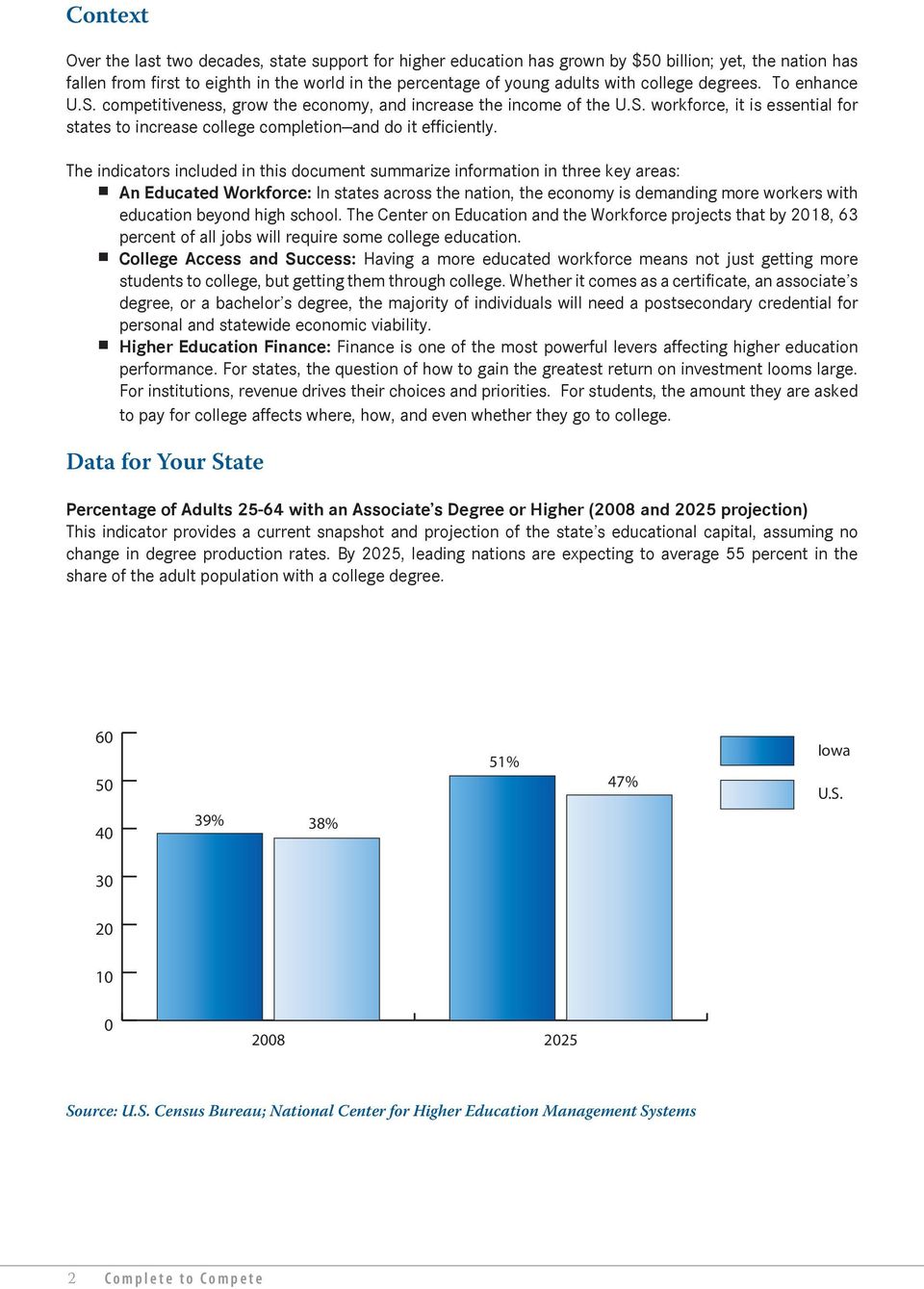
2 Context Over the last two decades, state support for higher education has grown by $5 billion; yet, the nation has fallen from first to eighth in the world in the percentage of young adults with college degrees. To enhance competitiveness, grow the economy, and increase the income of the workforce, it is essential for states to increase college completion and do it efficiently. The indicators included in this document summarize information in three key areas: An Educated Workforce: In states across the nation, the economy is demanding more workers with education beyond high school. The Center on Education and the Workforce projects that by 218, 63 percent of all jobs will require some college education. College Access and Success: Having a more educated workforce means not just getting more students to college, but getting them through college. Whether it comes as a certificate, an associate s degree, or a bachelor s degree, the majority of individuals will need a postsecondary credential for personal and statewide economic viability. Higher Education Finance: Finance is one of the most powerful levers affecting higher education performance. For states, the question of how to gain the greatest return on investment looms large. For institutions, revenue drives their choices and priorities. For students, the amount they are asked to pay for college affects where, how, and even whether they go to college. Data for Your State - Chart 1 Percentage of Adults with an Associate s Degree or Higher (28 and 225 projection) This indicator provides a current snapshot and projection of the state s educational capital, assuming no change in degree production rates. By 225, leading nations are expecting to average 55 percent in the share of the adult population with a college degree % 47% 4 39% 38% Source: Census Bureau; National Center for Higher Education Management Systems 2 C o m p l e t e t o C o m p e t e
3 - Chart 2 Number of Jobs Requiring Postsecondary Education (28 and 218 projection) This indicator shows the workforce demand for a college education in the state. 1,2, 1,, 999, 1,1, , 6, 538, 583, 4, 2, 124, 135, HS Dropout HS Diploma Postsecondary Source: Center on Education - Chart and the Workforce, Georgetown 3 University Educational Attainment by Race/Ethnicity (28) This indicator shows the educational attainment of racial/ethnic subgroups within the state. White Black Hispanic Asian/Pacific 6% 32% 23% 39% 18% 31% 26% 25% 43% 28% 12% 17% 12% 14% 12% 62% Less than HS Graduate HS Graduate Some College Associate s Degree or Higher American Indian 14% 3% 31% 25% All totals are rounded to 1. Source: Census Bureau; National Center for Higher Education Management Systems H i g h e r E d u c a t i o n D a t a D a s h b o a r d 3

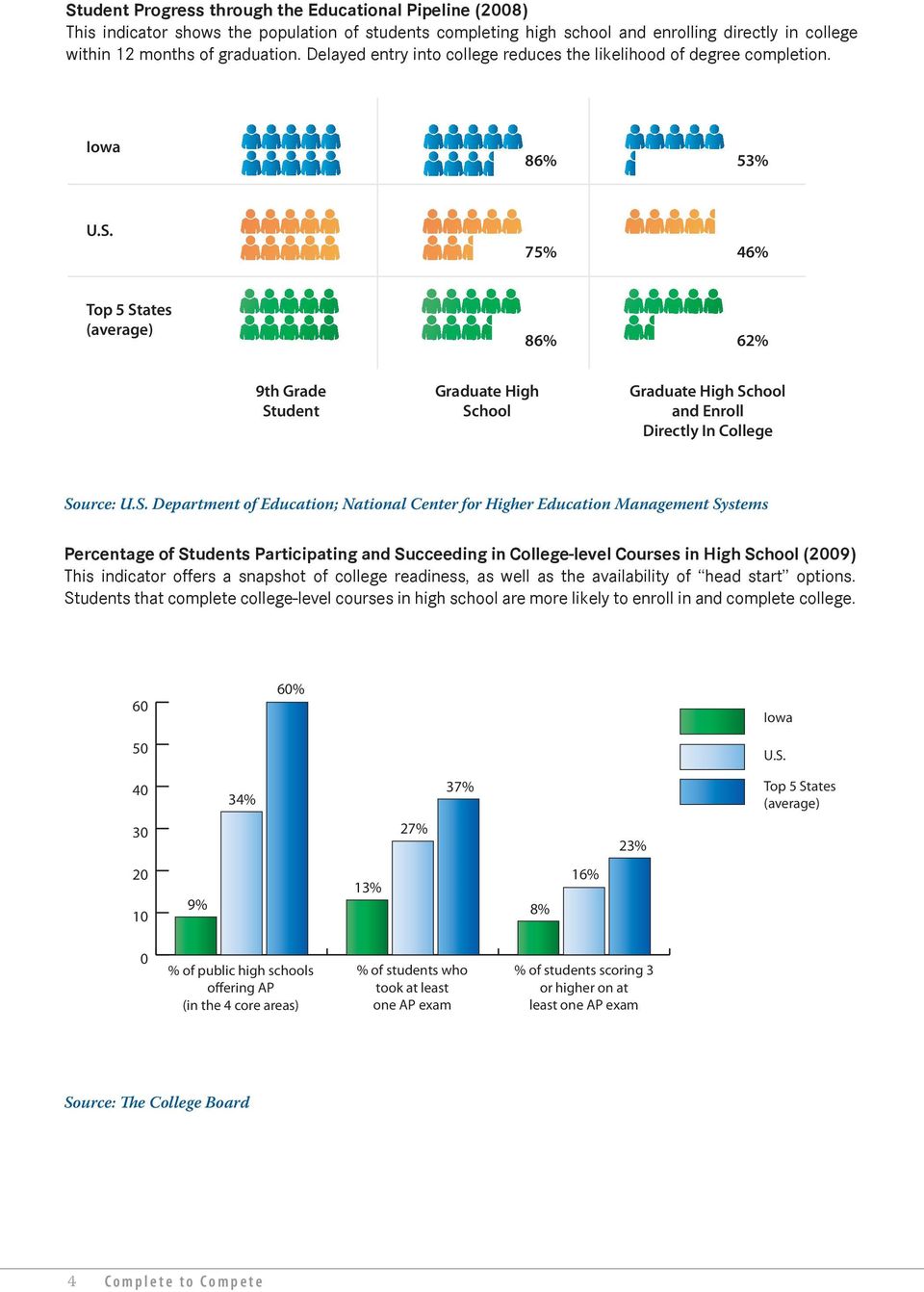
4 Student Progress through the Educational Pipeline (28) This indicator shows the population of students completing high school and enrolling directly in college within 12 months of graduation. Delayed entry into college reduces the likelihood of degree completion. 86% 53% 75% 46% 86% 62% 9th Grade Student Graduate High School Graduate High School and Enroll Directly In College - Chart 5 Source: Department of Education; National Center for Higher Education Management Systems Percentage of Students Participating and Succeeding in College-level Courses in High School (29) This indicator offers a snapshot of college readiness, as well as the availability of head start options. Students that complete college-level courses in high school are more likely to enroll in and complete college % 4 34% 37% 3 27% 23% 2 1 9% 13% 8% 16% % of public high % schools of public offering high schools AP % (in of students the 4 core % who of areas) students took % at of least who students one AP scoring % exam of students 3 or higher scoring on at 3 least one AP exam offering AP took at least or higher on at (in the 4 core areas) one AP exam least one AP exam Source: The College Board 4 C o m p l e t e t o C o m p e t e
5 - Chart 6 Percentage of Adults Enrolled in College by Age (29) This indicator shows how well the state is reaching different segments of the population through higher education. 48% % 48% 18% % 1% - Chart Source: Department of Education; National Center for Higher Education Management Systems Persistence of Students from First to Second Year in College (28) This indicator gauges how well institutions perform in moving students from their first to second year, which is a key predictor of completion % 77% 84% 6 5% 52% 61% Chart 8 Public Two-Year Public Four-Year Source: Department of Education; National Center for Higher Education Management Systems Number of Certificates and Degrees Completed per 1 Students Enrolled (28) This indicator provides a basic measure of degree productivity output relative to input for the state s postsecondary system. This information is important to track over time in conjunction with enrollment to ensure that productivity is not increasing as a direct result of limiting access to college Public Two-Year Public Bachelor's and Master's Public Research Source: Department of Education; National Center for Higher Education Management Systems H i g h e r E d u c a t i o n D a t a D a s h b o a r d 5

6 - Chart 9 Percentage Change in In-state Tuition (24-5 to 29-1, not adjusted for inflation) This indicator gauges the degree to which state colleges and universities have used tuition as a funding source during the recent economic downturn % 28% 24% 38% Public Two-Year Public Four-Year - Chart 1 Source: The College Board Price of College as a Share of Median Family Income (29) This indicator captures college affordability for the average family in the state. It takes into account the average cost of attending a state institution minus the average aid provided to a family % 13% 16% 16% 1 5 Public Two-Year Public Four-Year Source: Census Bureau; National Center for Higher Education Management Systems 6 C o m p l e t e t o C o m p e t e

7 - Chart 11 State Higher Education Funding (FY5-FY9) This indicator shows funding per full-time student received by institutions. $13, 13 $1,4 $7,8 $5,2 $6,271 $6,272 $6,466 $6,53 $5,871 $1,739 $11,4 $11,25 $1,993 $1,247 $5,551 $5,781 $5,984 $6,29 $6,238 Total Tuition Revenue per FTE Appropriations per FTE $2,6 FY5 FY6 FY7 FY8 FY9 - Chart 12 Source: State Higher Education Executive Officers Education and Related Spending per Completion (28) This indicator provides another view of output in relation to input how much it costs to produce certificates and degrees by institution type. $8, $7, $6, $67,896 $54,252 $62,654 $58,979 $5, $4, $36,93 $45,949 N/A $46,62 $3, $2, $1, Community College Public Bachelor's Public Master's Public Research Source: Delta Cost Project H i g h e r E d u c a t i o n D a t a D a s h b o a r d 7

8 Policy Questions and Directions Higher Education and Economic Development Are public postsecondary institutions producing enough degrees in high-growth fields to meet the state s current and future demands? Establish goals for increasing college attainment in the state (if they do not already exist) and link the goals to current/ projected workforce needs. Attainment Gaps Are groups whose population is significantly increasing simultaneously increasing their educational attainment? Include goals for closing educational attainment gaps as part of the state s overall goals for higher education performance. Preparation - Are high school graduates prepared to succeed in first-year, credit bearing coursework? Are there significant gaps across groups in college preparation? Align requirements for high school graduation with entrance requirements for the state s public colleges and universities. Establish an assessment of college and career readiness in high school and develop a statewide strategy to remedy skill gaps. Completion - What state policies are in place to encourage students to complete a degree or certificate, particularly students from groups historically at greater risk of not completing degrees? Review the state s financial aid program and institutional funding mechanisms to determine if there are incentives for completion. Performance Funding Does the state fund institutions based only on enrollment? Are there incentives for institutions to focus on progress to or completion of a certificate or degree (i.e., number of transfers, degrees produced in high-growth fields, percentage of students graduating on-time)? Set a goal of allocating a significant portion (e.g. at least 1 percent) of institutional funding on the basis of performance measures aligned with state goals. References The College Board National Center for Higher Education Management Systems - Delta Cost Project - State Higher Education Executive Officers - Census Bureau - Center on Education and the Workforce, Georgetown University - National Center for Education Statistics, Department of Education - Acknowledgements The dashboards were prepared collaboratively by Travis Reindl and Ryan Reyna of the NGA Center; Tom Rudin, Christen Pollock, Jennifer Jenkins, and John Lee of The College Board; Art Coleman and Jennifer Rippner of EducationCounsel LLC; and Patrick Kelly of the National Center for Higher Education Management Systems. John Thomasian and Dane Linn of the NGA Center also provided valuable feedback and insight. The NGA Center gratefully acknowledges USA Funds for its financial support. J o h n T h o m a s i a n, D i r e c t o r NGA Center for B est Prac tices 444 N. Capitol Street, S uite 267 Wa s h i n g t o n, D C w w w. nga.org/center 8 C o m p l e t e t o C o m p e t e
Suggested Citation: Institute for Research on Higher Education. (2016). College Affordability Diagnosis: Florida. Philadelphia, PA: Institute for
 FLORIDA Suggested Citation: Institute for Research on Higher Education. (2016). College Affordability Diagnosis: Florida. Philadelphia, PA: Institute for Research on Higher Education, Graduate School of
Our Challenge: Graduating Students College & Career Ready The Long Island Regional Advisory Council on Higher Education January 31, 2013
 Our Challenge: Graduating Students College & Career Ready The Long Island Regional Advisory Council on Higher Education January 31, 2013 EngageNY.org Graduating College and Career Ready New York's 4-year
Closing the Gap 2020: A Master Plan for Arkansas Higher Education Executive Summary
 1 Closing the Gap 2020: A Master Plan for Arkansas Higher Education Executive Summary Objective This five year planning cycle is a critical component in the long-term objective to reach the 2025 goal of
IDAHO 2011 For a strong economy, the skills gap must be closed.
 For a strong economy, the skills gap must be closed. 63% 34% 29% By 2020, jobs requiring a career certificate or college degree Skills gap Too few students make it through college. MEMBER Idaho adults
The Importance of Higher Education to Our Economy. Commissioner David Buhler Utah System of Higher Education March 20, 2014
 The Importance of Higher Education to Our Economy Commissioner David Buhler Utah System of Higher Education March 20, 2014 Utah s Eight Public Colleges & Universities Research Universities University of
Jim Williams and Joe Adams Public Affairs Research Council of Alabama
 Jim Williams and Joe Adams Public Affairs Research Council of Alabama SREB Fact Book Index of Tables and Updates Population and Economy Enrollment Degrees Student Tuition and Financial Aid Faculty and
Readiness Matters The Impact of College Readiness on College Persistence and Degree Completion
 Readiness Matters The Impact of College Readiness on College Persistence and Degree Completion Steve Kappler AVP Career & College Readiness ACT, Inc. [email protected] NACAC Webinar Series February
collegeready.rice.edu
 Innovation to Increase Student College Readiness 2011 UPCEA South Regional Conference Destin, FL Dr. Jennifer Gigliotti Executive Director, Center for College Readiness Rice University [email protected]
Category Preparation How prepared are students for college-level work? Participation How many students are going to college?
 JUNE 014 The State of Higher Education in Average Won t Do Regional Profile San Francisco Bay Area Counties of Alameda, Contra Costa, Marin, Napa, San Francisco, San Mateo, Santa Clara, Solano, Sonoma
The Performance and State Policies Of Higher Education in Illinois: Insights from a Five- State Policy Review Project
 The Performance and State Policies Of Higher Education in Illinois: Insights from a Five- State Policy Review Project Laura W. Perna Joni Finney Patrick Callan With Assistance from: Michael Armijo, Jamey
Increasing Postsecondary Credential Attainment among Adult Workers: A Model for Governors
 Increasing Postsecondary Credential Attainment among Adult Workers: A Model for Governors Discussion Paper * Despite the turbulent economy, there is growing demand in today s labor market for skilled workers
The Bronx Achievement Pact
 The Bronx Achievement Pact Every Student Counts Overview The Bronx Achievement Pact works to improve educational outcomes in the Bronx by closing the gaps in the high school-college pipeline. This comprehensive
College and Career Readiness in New York State 1
 College and Career Readiness in New York State 1 New York's Regents Reform Agenda is grounded in the belief that all students should graduate from high school ready for success in postsecondary education
Virginia s College and Career Readiness Initiative
 Virginia s College and Career Readiness Initiative In 1995, Virginia began a broad educational reform program that resulted in revised, rigorous content standards, the Virginia Standards of Learning (SOL),
The Greenville County Schools homepage provides five goals for the school system (www.greenville.k12.sc.us/district/admin/stats/measures.
 Education Greenville County Schools The Greenville County Schools homepage provides five goals for the school system (www.greenville.k12.sc.us/district/admin/stats/measures.asp): 1. Raise the academic
Borrowers Who Drop Out
 A Neglected Aspect of the College Student Loan Trend By Lawrence Gladieux and Laura Perna May 2005 The National Center for Public Policy and Higher Education National Center Report #05-2 2005 by The National
KANSAS 2011 For a strong economy, the skills gap must be closed.
 For a strong economy, the skills gap must be closed. 66% 41% 25% By 2020, jobs requiring a career certificate or college degree Skills gap Too few students make it through college. MEMBER Kansas adults
Early College Access. A Fast Track to College Completion For Maryland High School Students
 Early College Access A Fast Track to College Completion For Maryland High School Students In late 2011, the Associated Press reported on census data revealing that nearly half of all Americans a record
Accountability System Reports for Selected Success Measures Very Large Community College Districts Spring 2008
 1 Accountability System Reports for Selected Success Measures Very Large Community College Districts Spring 2008 Membership in Group: The group of very large community colleges in Texas includes the following
Analysis Brief. Trends in Public Higher Education: Enrollment, Prices, Student Aid, Revenues, and Expenditures
 Analysis Brief Trends in Higher Education Series Trends in Public Higher Education: Enrollment, Prices, Student Aid, Revenues, and Expenditures Sandy Baum Senior Fellow, George Washington University Graduate
Bowen, Chingos & McPherson, Crossing the Finish Line
 1 Bowen, W. G., Chingos, M. M., and McPherson, M. S. (2009). Crossing the Finish Line: Completing College at America s Public Universities. Princeton, N.J.: Princeton University Press. The authors begin
Florida. Who attends Florida's public schools? Total 2010-11 Public Elementary and Secondary Enrollment: 2,643,347
 Florida Who attends Florida's public schools? Total 2010-11 Public Elementary and Secondary Enrollment: 2,643,347 Student Enrollment by Race/Ethnicity Student Enrollment by Income, Disability, and English
Dual Credit/ Dual Enrollment and Data Driven Policy Implementation: Reform Initiatives and Postsecondary Credential Attainment
 Dual Credit/ Dual Enrollment and Data Driven Policy Implementation: Reform Initiatives and Postsecondary Credential Attainment NACEP Seattle, WA October 29 th, 2012 Eric Lichtenberger, Ph.D.-Illinois Education
Understanding Ohio s New Local Report Card System
 Achievement Performance Indicators Performance Index The Performance Indicators show how many students have a minimum, or proficient, level of knowledge. These indicators are not new to Ohio students or
a topic for a future issue brief, please Minnesota is heading into challenging territory. In the decades
 RESEARCH BRIEF September 2011 Minnesota Educational Needs and Higher Education Finance Policy This is one in a series of research-based briefs prepared by the Minnesota Private College Council for members
The Condition of College & Career Readiness 2013. National
 The Condition of College & Career Readiness 2013 National 2013 by ACT, Inc. All rights reserved. The ACT college readiness assessment is a registered trademark of ACT, Inc., in the U.S.A. and other countries.
Texas College Access Inventory
 Carrie Warick, Project Manager Tina Milano, Consultant Laurie Arnston, Editor Karla Garcia, Graduate Research Assistant Matthew Jacobs, Graduate Research Assistant January 31, 2011 Table of Contents Executive
Connecticut College and Career Readiness Toolkit Supplemental Data Central High School
 Connecticut College and Career Readiness Toolkit Supplemental Data Central High School Prepared by the Educational Policy Improvement Center on behalf of the Connecticut P-20 Council Preface This packet
Chapter V: How Washington Compares with Other States
 Chapter V: How Washington Compares with Other States Key Facts about Higher Education in Washington Page 56 Washington s public four-year colleges are highly productive in degree completion... An undergraduate
Testimony for the National Commission on Accountability in Higher Education Oklahoma State Regents for Higher Education. Pre-Collegiate Initiatives
 Testimony for the National Commission on Accountability in Higher Education Oklahoma State Regents for Higher Education Prepared by: Dr. Dolores Mize, Associate Vice Chancellor and Special Assistant to
An Equity Profile of the Kansas City Region. Summary. Overview. The Equity Indicators Framework. central to the region s economic success now and
 An Equity Profile of the Kansas City Region PolicyLink and PERE An Equity Profile of the Kansas City Region Summary Overview Across the country, regional planning organizations, community organizations
Colorado High School Graduation Guidelines
 Colorado High School Graduation Guidelines Adopted by the State Board of Education May 2013 Introduction In 2007, the General Assembly adopted H.B. 07-1118 that set forth a process for developing statewide
Ohio and Selected Peer States
 Advancing Postsecondary Opportunity, Completion, and Productivity Essential Performance Indicators for Ohio and Selected Peer States 2012-2013 Midwestern Higher Education Compact 2012-13 State Performance
MEASURING UP 2008 THE STATE REPORT CARD ON HIGHER EDUCATION. Florida
 MEASURING UP 2008 THE STATE REPORT CARD ON HIGHER EDUCATION What Is Measuring Up? Measuring Up is a series of biennial report cards that provide the general public and policymakers with information to
Trends in Higher Education Series. Trends in College Pricing
 Trends in Higher Education Series Trends in College Pricing 2006 Introduction This report, based on the College Board s Annual Survey of Colleges, provides up-to-date information on tuition and other expenses
The Reality of College Readiness 2013. Georgia
 The Reality of College Readiness 2013 Georgia Annually, ACT provides each state with The Condition of College & Career Readiness, a report that details the college readiness of students who took the ACT
Indiana s Graduation Requirements. (Class of 2016 & Beyond)
 Indiana s Graduation Requirements (Class of 2016 & Beyond) Education in the US The national average high school graduation rate is 70% 1/3 of students are dropping out 1/3 are graduating but are unprepared
Making Opportunity Affordable: Ramping Up Postsecondary Student Success While Containing Costs and Maintaining Quality
 Making Opportunity Affordable: Ramping Up Postsecondary Student Success While Containing Costs and Maintaining Quality A Choicework Discussion Starter created by Public Agenda INTRODUCTION It is now widely
Paying Double: Inadequate High Schools and Community College Remediation
 August 2006 This issue brief was made possible with the generous support of MetLife Foundation. Paying Double: Inadequate High Schools and Community College Remediation Americans are beginning to recognize
In today s economy, a college education is essential for
 Virginia s Great Cost Shift How Higher Education Cuts Undermine the State s Future Middle Class robert hiltonsmith & mark huelsman In today s economy, a college education is essential for getting a good
Title: College enrollment patterns for rural Indiana high school graduates
 Abstract Title Page Title: College enrollment patterns for rural Indiana high school graduates Authors and Affiliations: Mathew R. Burke, Elizabeth Davis, and Jennifer L. Stephan American Institutes for
74% 68% 47% 54% 33% Staying on Target. ACT Research and Policy. The Importance of Monitoring Student Progress toward College and Career Readiness
 Staying on Target ACT Research and Policy The Importance of Monitoring Student Progress toward Research Brief 74% Percentage of ACT-tested 11 high school graduates took a core curriculum in high school
Presentation for the Leading the Way Compact Forum West Virginia Higher Education Commission Laura W. Perna [email protected].
 Promoting College Access For All Students Presentation for the Leading the Way Compact Forum West Virginia Higher Education Commission Laura W. Perna [email protected] @lauraperna1 March 31, 2014 Improving
Undergraduate Degree Completion by Age 25 to 29 for Those Who Enter College 1947 to 2002
 Undergraduate Degree Completion by Age 25 to 29 for Those Who Enter College 1947 to 2002 About half of those who start higher education have completed a bachelor's degree by the ages of 25 to 29 years.
JUST THE FACTS. Washington
 JUST THE FACTS Washington The Institute for a Competitive Workforce (ICW) is a nonprofit, nonpartisan, 501(c)(3) affiliate of the U.S. Chamber of Commerce. ICW promotes the rigorous educational standards
Developing the STEM Education Pipeline
 Developing the STEM Education Pipeline Developing the STEM Education Pipeline For almost 50 years, ACT has played a pivotal role in promoting student access into and success in science, technology, engineering,
(If your school has an International Baccalaureate (IB) program, ask the following :)
 www.ga411.org Now 9 th Grade Advisement Activity Estimated Time: 20-30 minutes Georgia s Teachers-As-Advisors Framework Goal 9-1.1: Create, manage, and enhance an educational and career planning portfolio.
DUAL CREDIT IN KENTUCKY. A significant body of research indicates that a high school diploma is not sufficient for
 DUAL CREDIT IN KENTUCKY A significant body of research indicates that a high school diploma is not sufficient for the skills required in most jobs of the 21 st century. As educators strive to provide students